Eight hours after leaving New York City, the rickety
old Pathways Bus lurched to a bouncing halt in a
small Adirondack mountain town. Peggy Lane rose
from her seat and somewhat shakily managed to collect
her handbag, a small suitcase, a hatbox, two
coats, and her precious tin make-up kit.
“I wonder if I really look like an actress or more
like a walking luggage rack?” she thought excitedly as
she stepped down from the bus. The scene that
greeted her was breath-taking; Peggy gasped aloud
with delight. Before her, Lake Kenabeek lay gleaming
like a jewel in the afternoon sun. Pine trees rose
everywhere and although it was summer there was
a delicious nip and tang in the air. Peggy’s heart
raced with eagerness and the familiar nervous anticipation
she always felt when approaching something
new. She had been hired as resident ingénue for eight
wonderful weeks with her first summer stock company.
Each week she would be playing a different
part, gaining invaluable experience, and learning new
phases of life backstage.
2
“And I got the job all on my own!” Peggy thought
exultantly. “Just by reading for the producers! That
must mean something—at least, it means that I’m
really a professional actress now and don’t have to
depend on friends and ‘contacts’ for my work!” She
smiled happily, taking a deep breath of the fragrant,
pine-scented air.
“Miss Lane?” A voice interrupted Peggy’s thoughts.
She turned and saw a spectacled, studious-looking
boy about seventeen who was wearing dungarees and
a paint-smeared shirt. Offering her a slightly stained
hand, he grinned shyly. “Scene paint,” he explained,
“but it’s clean.”
Peggy could hardly shake his hand, laden down as
she was, and the boy stammered with embarrassment.
“Oh, I’m so sorry—I was so busy looking at you, I
didn’t notice.” He relieved her of some of her bags,
giving her a frankly admiring stare. “You sure look
like a good ingénue!”
“I do?” Peggy beamed.
“Just what I had in mind.” He smiled, taking in
Peggy’s trim little figure, dark chestnut hair and
fresh, mobile face. “I’m Michael Miller, and I have
the jeep waiting to take you to your hotel.”
The jeep had been painted bright blue with an eye-catching
sign on the hood. Kenabeek Summer Theater,
it proclaimed in large white letters.
“Good advertising,” Michael confided as they deposited
Peggy’s bags in the rear. “But then, you’re
not bad advertising either!” He nodded in the direction
of a few bystanders who were casting curious
glances at Peggy. Peggy smiled back at the townspeople,
and as she climbed into the front seat, her
nervousness unexpectedly dropped away. She was
really here at last, she realized, an actress with a season’s
contract—and suddenly she felt very professional.
3
As they drove carefully up the winding mountain
road, Peggy discovered that Michael was one of three
local boys who were to work as apprentices—helping
the scene designer, doing odd chores, and playing
small parts when needed. Michael’s father was Howard
Miller, a retired theater man, who was to do all
the older character parts during the season.
“Oh, I’ve heard of him!” Peggy exclaimed. “He’s
supposed to be a wonderful actor, and we’re lucky
to have him. You know how hard it is to get good
character men for stock. Michael,” she went on eagerly,
“do you think the theater will be a success?”
Michael considered a moment. “I don’t honestly
know,” he replied thoughtfully. “This is a very small
town, and actually we don’t have a large enough population
to carry a summer theater all on our own. But
one of the ideas behind this venture is to bring in
more summer resort business.”
Peggy nodded. She knew that Richard Wallace,
one of the two young producers, was a resident of
Lake Kenabeek, and wanted to help improve his
town—both culturally and financially.
4
“Of course Richard’s Aunt Hetty is vice-president
of the Chamber of Commerce,” Michael continued,
“and the Chamber of Commerce put up half the
financial backing for the theater. So we do have solid
support there. But some people here resisted the idea
of a group of actors—you know, they think that
actors are a strange, Bohemian breed—” He glanced
at Peggy and laughed. “Bohemian, huh! All they need
is to take one look at you, or any of the other actors
who have come up from New York.”
Peggy smiled gratefully. She knew that a lot of
people didn’t realize what honest, hard work the theater
could be. But obviously this intelligent young
boy had a deep feeling for the profession and knew
that an actress’ life wasn’t only curtain calls and
bouquets after the performance.
“Yes, we do have a lovely group of people,” Peggy
agreed earnestly. She had met most of them in New
York during the tryouts and been impressed, not only
by their acting ability, but by their responsible and
intelligent attitude. “And we have a really good director,
wonderful plays, and at least half the town is behind
us. That should be enough if we work hard!”
she concluded with a twinkle.
Michael turned from the twisting, ribbonlike shore
line and drew up in front of a large, old-fashioned,
rustic building. “Here we are,” he announced grandly,
“Kenabeek Inn! But you’re not in the main building;
your company is staying in the annex.”
Peggy followed him around the side of the inn,
down a little path fringed with fir trees. In a small
clearing, well away from the kitchen noises issuing
from the rear of the inn, Peggy saw a tiny, two-story
building. There was a roofed-over patio outside with
two sofas, some chairs, and a table on which stood a
hot plate and stacked cups and saucers. Peggy smiled
to herself, recognizing the sure sign of an actors’ residence—coffee,
coffee, and more coffee.
5
Rita Stevens came bursting out of the door, a radiant
smile transforming her rather plain features.
“Margaret, ‘Peggy’ Lane—Star of Stage, Screen, Radio,
Television, and Summer Stock! Welcome!” she
cried, running up and giving Peggy a hug.
They grinned at each other happily. “Oh, I’m so
glad to see you!” Rita bubbled. “I’ve been positively
frantic for some female company around here. We’ve
been up for three days and Gus has spent every single
minute at the theater—”
Rita was married to Gus Stevens, the scene designer—a
lucky combination for the company. Although
young, Rita had one of those ageless faces
and a maturity which made her a perfect character
woman. Peggy had liked her the instant they met at
the readings in New York.
“No women?” Peggy asked, “Hasn’t Alison Lord
arrived yet?”
“Oh, no, my deah,” Rita intoned in a stagy accent.
“No, our leading lady is being flown up in someone’s
private plane and isn’t expected until tomorrow
morning.” She waved a hand airily, imitating perfectly
a prima donna.
“Oh, no!” Michael grimaced in disgust. “Is she
really like that?”
“No, Mike,” Peggy said with a laugh, “she’s really
quite friendly and nice—and a very good actress.
Just a little theatrical, but I’m sure you’ll like her.”
“Well, I hope so,” Michael said, obviously still
doubtful. “Look, I’ve got to scoot back to the theater.
May I leave your things here, Peggy?”
6
“Oh, I’ll take them, Mike.” Rita grabbed some of
Peggy’s luggage and started up the stairs of the little
house. “See you later, Mike.”
“And thanks for the ride and everything,” Peggy
called after him.
“He’s such a sweet kid,” Rita commented as they
climbed. “A wonderful help to Gus—I have a feeling
Michael may make this business his life work. Here’s
where you live, Peggy!”
They stepped into a tiny white room, sparsely
furnished with only a day bed, a large bureau, a folding
screen, straight chair, and a bedside table.
“The manager of the inn must know something
about summer stock companies,” Rita observed ruefully.
“Obviously he has a good idea of just how
much time we’ll be spending in our rooms.”
Peggy looked at her questioningly and Rita laughed.
“It’s your first season, I know—but just you wait and
see!”
“My trunk!” Peggy interrupted with a sudden disturbing
thought. “I sent it ahead by Railway Express.
Hasn’t it come?”
“Right here, madame.” Rita folded back the screen
and revealed Peggy’s large, black wardrobe trunk,
which was somewhat dented and worn, parts of old
labels still sticking to it here and there. “You know,
for a girl who hasn’t done stock before, or been on the
road, this trunk is really strange. What did you do?”
she asked with a teasing smile. “Stick on labels, and
tear them off, and then jump up and down on it
wielding a hammer?”
7
Peggy hooted. “Rita Stevens, you have a very suspicious
mind! I want you to know that this trunk
belonged to a friend of my father’s—a wonderful
woman who was in the theater years ago.” Peggy’s
face softened wistfully. “And I imagine that this battered
old trunk has seen more drama—on stage and
off—than we can even imagine.”
The girls looked at it thoughtfully, a picture of the
old, romantic days of the theater—great plays, great
producers, great stars—all the golden history of the
stage firing their imagination.
Peggy broke the spell, “Well, anyway, May Berriman
gave it to me. She runs the rooming house where
I live in New York, you know. And believe me, I’m
grateful! Besides needing a trunk, I think of it as a
symbol of good luck. Some time soon, Rita, would
you mind taking a look at my wardrobe? I think I
brought enough, but I’d like to be sure.”
“I’d love to,” Rita said. “But now let me show you
where everything is in our little annex, and then you’d
better rest awhile. I’m sure you’re tired, and we have
a company call tonight.”
Alison Lord would be in the room across the hall
from Peggy. Rita and Gus were also upstairs, on the
opposite side of the house. Danny Dunn, Chris Hill
and Chuck Crosby, the director, were all downstairs.
The patio was community property for coffee, line
rehearsals, and just plain relaxation. It seemed like
a good arrangement. Rita showed Peggy where she
could shower and freshen up and said she would call
her in time for dinner.
8
But Peggy was too keyed up to take a real nap.
She sat on the edge of her bed, thinking of all the
steps that had led her here, to this place, at this time.
Her love of acting, the school plays, the productions
in college, coming to New York, the long, hard work
at the Dramatic Academy and in the Penthouse Theater.
She was grateful for a private room where she
could be quiet and think.
She remembered her home town of Rockport, Wisconsin,
and suddenly had a vision of that other gay
little bedroom where she had often sat quietly and
thought—much as she was doing now. She remembered
her mother’s kind, attractive face and her encouragement
and understanding. Her father, too,
would be glad to hear of this job, Peggy thought, and
would probably run an article about her in his paper,
the Rockport Eagle. She smiled, visualizing the headline—Local
Girl Signed in New York—or something
like that. Thomas Lane was a good newspaper
man and would try to “hook” them with the headline.
Nothing so simple as Local Girl Makes Good.
Peggy promised herself to write them good long
letters as soon as possible. And she should write to
May Berriman, and to her housemate in New York,
Amy Preston. Well, there was a lot to do—and a lot
ahead. Peggy sighed and opened a suitcase to change
into something fresh for the evening.
After dinner, Peggy, Rita, and her young husband,
Gus, walked up the road to the theater. Gus had
joined them for dinner in the little roadside restaurant
where the cast had made arrangements for meals
at a percentage off the regular cost.
“Mrs. Brady, who runs the place, is anxious to do
all she can for the theater,” Rita explained.
9
“To say nothing of the extra customers she hopes to
attract by having real actors in her dining room,” Gus
added. “Not that I’m a candidate for glamour, you
understand—”
The girls laughed. Gus had hastily donned a clean
shirt and a fresh pair of blue jeans, but the unmistakable
signs of sheer hard work still showed on his
pleasant, tanned face.
Rita squeezed his hand affectionately as they hurried
up the road. “I do wish you’d let up a little,” she
said. “After all, we do have nine days before opening.”
“And it’s going to take every minute!” Gus nodded
emphatically. “You haven’t seen the auditorium yet,
have you, Peggy?”
“No, I haven’t. You know,” Peggy confessed, “I was
really disappointed when I learned that we were
playing in the high school. I had visions of a rustic
barn with candlelight, bats in the wings and mice
for rehearsals—”
“There is one.” Gus chuckled warmly. “Aunt Hetty
has a barn that we can remodel next summer if this
season is a success. But we couldn’t afford to do it
this year. It’s better to rent the school and see what
happens. If it bothers you, Peggy,” he added, looking
at her with amusement, “hold on to the thought that
we’re helping education! We are, too. The school
needs the money.”
The front doors of the school auditorium faced the
highway. A large sign for the theater gleamed brightly
under the floodlights that played on it. “It’s never too
early to advertise,” Gus observed as they walked to
the back of the building.
10
Entering the stage door, they came through the
wings and walked out on a dark stage, only a single
worklight throwing a white circle on the bare boards.
The heavy drapes were pulled back, framing the
empty house, the vacant seats ghostlike in the silence.
“Well, where is everybody?” Peggy gasped in the
eerie quiet.
Gus and Rita roared. “We just thought you’d like
to see the stage, Peggy,” Gus laughed.
“You didn’t think we were going to rehearse tonight,
did you?” Rita teased, and then took Peggy’s
hand. “Come on, dear, we’re only kidding. Everybody’s
down here.”
They crossed the stage, descended some stairs, and
entered a door that led directly into the school gym.
“Here’s our ingénue,” Rita called as she ushered
Peggy in, “ready to work!”
Peggy blinked, coming into the sudden light and
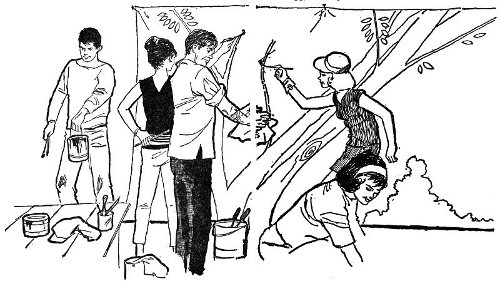
busy scene. The gym was bright as daytime. A huge
canvas ground cloth covered the floor and several
people knelt, beside cans, buckets, and paintbrushes,
over the scenery flats that were strewn from one end
of the gym to the other. Peggy had difficulty recognizing
anyone. They were all spotted and paint-smeared,
in a variety of strange work clothes.
“Hi!” someone called, raising a hand with a dripping
brush. Peggy peered intently at the slight figure
and dark hair, and recognized Chuck Crosby, their
intense young director. “Get to work,” he ordered
with a smile and went back to his painting.
11
A well-built young man with a heavy mass of light-brown
hair rose with his can and beckoned to her.
Peggy picked her way through buckets and flats, following
him.
“Danny Dunn!” she said with a shock of surprise.
“How on earth am I supposed to know you under that
disguise?” Danny was to do juvenile and some character
parts for the company. Now he looked like a
clown as he smiled at her with a paint-dotted mouth.
“Tomorrow is another day!” he quoted dramatically.
“Tomorrow and tomorrow—I can hardly wait!
By the way, sorry I couldn’t join you all for dinner,
but I just had a sandwich here. Tell me everything
tomorrow—if I’m still alive.” He made a face, “Here,
ingénue, fill a can.”
In a clear corner near the wall, Michael Miller sat
hunched over a hot plate with a bubbling pot of melting
glue. He looked like an ancient alchemist as he
stirred and poured, mixing paint, whiting, and glue
into large buckets.
“The white cliffs of Dover,” Michael muttered romantically,
taking a bag of powdered chalk and measuring
it into his caldron.
“Sure, double, double, and all that,” Danny replied,
nodding kindly. “Well, just keep steady, old chap,
we’re all a little tired tonight.”
“It really is the white cliffs of Dover,” Michael
protested as Danny walked away. “For the ground
coat,” he added, peering up at Peggy through his
steaming glasses. “Here, have fun.” He waved her
away.
12
For the next four hours Peggy knelt on her hands
and knees, laboriously painting flats. These were
frames of white pine, over which was stretched unbleached
muslin, like a painter’s canvas. They had
already been sized with a solution of glue and water
until they were drum-tight. Over the ground coat
that Peggy was painting, Gus would design wallpaper
for interiors, fireplaces, outdoor scenes. Peggy’s back
ached as she worked silently. No one said a word.
13
“A funny way to begin,” thought Peggy, sighing.
She had expected a line reading, even some work on
stage. “And Chuck hardly said how-do-you-do, and
I don’t know half the people here.” She glanced
around, guessing that the young boys must be Michael
Miller’s friends, and that older man by the
other wall his father, Howard Miller. He noticed
Peggy looking at him and smiled.
14
“Well,” Peggy decided, acknowledging him with
a sigh, “if a man his age thinks nothing of working
like this until all hours of the night, I guess I can do
it too!” She worked on with renewed energy. By the
time all the flats were finished, it was after midnight.
“Rehearsal promptly at nine o’clock in the morning,”
Chuck announced crisply as they cleaned up
and prepared to go home.
“Heavens to Betsy!” Peggy thought wearily as she
lay in her bed, her back aching, muscles jumping
from the unaccustomed effort. “Now I know why
everyone was so quiet. They’d been at it all day—and
I feel like this after only a few hours!” Her head spun
dizzily as she closed her eyes. “Well, I’m part of a
company,” she mused dreamily, “and that’s what
counts. Even if I don’t like the parts I’m given—even
if I have to do other things than act.” Plays and
parts and costumes danced before her like a mirage.
“I guess this is summer stock, all right!” she thought
as she fell asleep.
15
II A Serious Complication
“Not quite so serious, Peggy.” Chuck Crosby pulled
on a lock of his straight, black hair as he listened to
her read. “If you don’t have a slight tongue-in-cheek
attitude, it’s not going to be funny. She is an earnest
young girl, but it’s got to be exaggerated in a comic
way.”
Peggy tried again. “Dad, I’m disappointed in you,”
she read. “The world’s on fire and you’re occupied
with a cigarette lighter!”
“Thank you,” Howard Miller answered dryly. He
was reading the part of Peggy’s father in their opening
show, Dear Ruth.
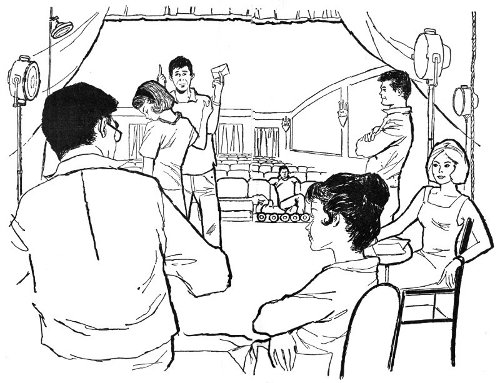
The cast was having its first line rehearsal on the
sunny patio of the annex. Peggy had awakened excitedly
with the expectation of working on stage,
only to find that the company would be at the annex
all day. She had wondered, in a resigned way, if she
would ever see the stage at all. But now, as they progressed
to the second scene of Act One, her disappointment
was forgotten. She was concentrating on
her part of Miriam, “Dear Ruth’s” younger sister.
16
“We can use you,” Peggy read on, addressing her
father. “We can use anybody we can get!” She read
the last line in a hopeless, adolescent fashion, timing
it carefully, and the cast spontaneously laughed.
“That’s it,” Chuck cried. “That’s the quality I
want.”
A pretty local girl, Mary Hopkins, who was playing
the part of the maid, Dora, didn’t come in on her cue.
Everyone looked at her as she nervously rattled her
papers, looking quite lost.
“That’s your cue, Mary,” Chuck said patiently.
“Miriam says, ‘We can use anybody we can get,’ and
you enter.”
“I don’t see it,” Mary replied helplessly.
“Right here.” Rita was sitting beside her and
pointed it out. “Anybody we can get.”
“But that’s not the whole line—oh, I see.” Mary
blushed.
“We’re using sides, Mary,” Chuck said kindly. They
were half sheets of paper bound like a small pamphlet.
“I have the master script here with the whole
play, but you’ll find only about four or five words of
the preceding speech printed on your sides. You can
fill in the other words if you find it easier.”
Peggy gave Mary an understanding smile. She had
been busy writing in speeches herself, as she found
the short sides difficult to work from. Peggy liked to
think of the play as a whole, but she knew that some
actors worked better from short cue lines, and that
for stock, with so many different parts to learn each
week, sides were often faster.
17
Rita read the part of the mother with assurance
and humor. She made a perfect partner for Howard
Miller, and one could tell that she was used to this
type of part. Miriam made her exit, and then Ruth
appeared for a short scene with her father and
mother. Before her next cue, Peggy had time to examine,
with a certain fascination, their leading lady.
Alison Lord had arrived that morning, making a
grand and breathless entrance at exactly nine A.M.
Her luggage was still stacked in the patio, and
peering at it, Peggy raised her eyebrows. “And I
thought I had a lot!” She wondered how many
costumes Alison expected to wear on stage, but judging
by the stunning outfit she was wearing for rehearsal,
Alison must intend to dress as glamorously
off stage as on. Her bright auburn hair was caught up
under an eye-catching sun hat of fringed red straw.
The color exactly matched the sleeveless blouse she
wore over a beautiful pair of beige, basket-weave
slacks. With her enormous straw bag, gay sandals,
and dark glasses, she looked like a visiting star. And a
really beautiful girl underneath all that, Peggy
thought, noticing the careful make-up that enhanced
Alison’s features.
Peggy glanced down at her simple, peasant skirt
and blouse. It was pretty, but hardly spectacular like
Alison’s attire. For a moment she wished that she had
thought of bringing more colorful everyday clothes—was
it good advertising for the theater perhaps?—but
then she laughed at herself. “You’re just a little bit
envious, Peggy Lane, and you know it! Now just forget
about clothes, and tend to your knitting!”
18
Her cue came, and she jumped back into her
part with gusto, really enjoying it now that she had
caught the flavor of Miriam. She found that playing
with Alison was fun. She was even better than Peggy
remembered. She had a certain awareness of herself,
a special “here I am” quality that would make an audience
notice her. She wasn’t a very deep actress, but
she had poise and presence and moved the play
along.
Chuck was pleased with the reading. He looked at
his watch and called a break. “Take five. Chris ought
to be here any minute, and there’s no point in going
on now without him.”
The cast paused for coffee, waiting for their leading
man to arrive. Chris Hill, who was to play the
part of Bill opposite Alison in Dear Ruth, was the
only cast member Peggy hadn’t met. He had been
held up in New York with a last-minute television
show, and was due on the ten-thirty bus.
“What’s he like?” Peggy asked Rita as she broke off
a piece of doughnut to share with her. The cast kept
snacks in an old-fashioned icebox on the patio.
“Oh, he’s lovely!” Rita grinned mischievously.
“He’s quite tall and very blond, tanned and terribly
handsome, blue eyes, a great smile, romantic—”
“Really! He’s all that, hm?” Peggy teased back.
“Well, all I want to know is, can he act?”
“He certainly can. I’ve worked with him before—”
Rita looked at Peggy curiously. “It will be very interesting
to see your reaction to Chris. It’s a shame that
you didn’t have a chance to meet him before and
more or less prepare yourself.”
19
“Oh, Rita!” Peggy exclaimed, shaking her head in
protest. She didn’t know what a picture she was with
the sunlight striking her dark hair and framing her
pretty face. Rita watched her, noticing the fine, high
cheekbones, straight nose, and soft, wide mouth.
“You really have a captivating quality, Peggy,”
Rita said thoughtfully. “I wouldn’t be surprised if
Chris Hill is quite taken with you.”
“With me?” Peggy blurted in astonishment. “Oh,
Rita, I haven’t even met him yet, and anyway,” she
added, “I’m not really interested in anyone.” She was
remembering Randy Brewster in New York, and all
the fun they’d had together in dramatic school and
in the off-Broadway production they’d been involved
in. Kind, steady Randy, with the marvelous sense of
humor. It would have to be somebody quite wonderful
to share the special place that Randy occupied in
Peggy’s thoughts. “Why, there’s no time for romance
here, Rita,” she said. “We’re all too busy. And besides,
I should think Alison would be more his type.”
“Um-hm. Maybe,” Rita interrupted rather mysteriously
and nudged Peggy. “You’ll soon have a chance
to find out.”
Following her glance, Peggy looked up the little
path and saw Chris Hill, a duffel bag slung over one
shoulder, hurrying down with long, energetic strides.
His appearance was certainly everything Rita had
said and more. She glanced at Rita, her eyes wide,
and Rita returned a bland “I-told-you-so” expression.
Chris ran the last few yards, dumped his bag carelessly
on the patio, and with a wide, completely engaging
smile, announced, “Reporting for duty—on
the dot, I hope!” He shook Chuck’s hand. “Svengali,
how are you? You picked a beautiful spot—it’s just
great. Alison!” He leaned over her chair, planting an
audible kiss on her cheek. Peggy’s eyes popped.
20
“Doesn’t mean a thing,” Rita whispered to Peggy.
“Watch.”
“Darling!” Alison replied extravagantly. “What
kept you so long? Did you come up by dogcart?”
Chris noticed Rita and ran over, swooping her up
in a big bear hug and giving her a kiss, too. “My favorite
actress!” he laughed, standing back and looking
at her with delight. “And where’s her favorite husband?
Don’t tell me—he’s up to his ears in flats!
When do I see him? Don’t tell me—probably never!”
Rita laughed. “Such energy, Chris! How do you do
it after all night on a bus? Chris, here’s someone you
haven’t met—our ingénue, Peggy Lane. Star of Stage,
Screen, Radio—”
“Television and Summer Stock!” Chris finished for
her. “Don’t mind us, Peggy, it’s an old joke from
another summer company. Well!”
He stopped and Peggy couldn’t tell whether he
was pausing for breath or from the interest in her
which his look seemed to indicate.
“Well!” he said again, and there was something in
his voice that caused an unexpected flurry in Peggy’s
emotions.
“Hello,” Peggy said tremulously. She would never
know what his next words might have been, because
just then Chuck interrupted with a call to resume
the reading.
21
The company sat down again, and Peggy forgot
Chris Hill, the young man, as she listened to Chris
Hill, the actor. He read the part of Bill with so much
energy and interest one would think he had just returned
from a long vacation instead of a grueling bus
trip. He was a good actor, Peggy thought. He brought
a special kind of magic to the play, and as they finished
the first act, Peggy had a sudden feeling that
Dear Ruth would be a hit. Chuck couldn’t have
chosen a better opening bill for the cast. It was perfect
for their company, and she looked at him with
renewed respect.
After lunch the furniture was rearranged on the
patio as it would be on stage. Chuck wanted to block
the first act. Pencils in hand, they busily scribbled on
their sides, marking movements as Chuck directed
them. He had blocked the play in advance, but it was
still a long process, as, with the actors in front of him,
he saw many necessary changes.
Mary Hopkins had to be told that Stage Right was
her right, and not the right of the audience. She
caught on quickly, though, and very soon Peggy
noticed that she was lightly penciling in initials—C.U.L.
and D.R., instead of writing out “Cross Up
Left” and “Down Right.”
Danny Dunn was enjoying himself enormously. He
had the part of Albert, a stuffy, amusing character
who is engaged to Ruth before Bill captures her heart.
Peggy was struck by this boy’s amazing versatility.
She had read with him in New York and knew how
well he did juvenile parts. Yet, here he was, playing
a slightly older man and doing a perfectly wonderful
job. Danny had a face almost like putty; he could
do anything with it he wished, and Peggy realized
that here was a true actor—who would never be
typed, who could play anything he was given.
22
“Hello, Mother. Hello, Dad.” Danny made his
entrance, and Peggy stifled a laugh. He was really
very funny.
They finished the second scene of Act One and
Chuck called, “Curtain!” There was a sound of hands
clapping, and a voice said, “Bravo!” Peggy looked
around. She had been so engrossed in her work that
she hadn’t noticed Richard Wallace standing near the
patio, looking on. Beside him stood a tall, white-haired
woman with strong, craggy features, and
sparkling blue eyes framed by a network of tiny lines.
“What a wonderful face!” Peggy exclaimed to herself,
realizing that this must be the famous Aunt
Hetty.
“Bravo!” Richard repeated in a deep voice. He was
a large young man, mature for his age, with the same
observant blue eyes as his aunt.
“It’s a pity to think that all this work may go to
waste,” he said bitterly, coming on to their outdoor
stage.
There was a stunned silence. Peggy didn’t know
what to think—was this Richard’s way of kidding?
Chuck got up to give Aunt Hetty a seat, and plunking
herself down heavily, she stated matter-of-factly,
“You’re all so good—so much better than I expected—I’ll
hate to see you go!”
The cast looked blank. Chuck was struck dumb for
a moment, and then he suddenly exploded. “What are
you talking about? We’re having a rehearsal here and
this is not the time for idiotic jokes!” He looked at
Aunt Hetty and controlled himself. “Excuse me, but
really, Richard knows better than to interrupt us like
this.”
23
“It’s no joke, young man,” Aunt Hetty said bluntly.
“Richard, tell them all about it.” She peered closely
at Chuck. “And you ought to know better, Mr.
Crosby, than to think we’d intrude for anything less
than a very good reason!”
“My!” Peggy thought. “It certainly isn’t wise to
cross Aunt Hetty. She’s a stubborn old girl. No wonder
she got all that backing from the Chamber of
Commerce—they could hardly say no.”
“I imagine you haven’t seen this,” Richard said,
holding up a newspaper so the cast could see the
front page.
The Kenabeek Gazette, Peggy read on the masthead,
and right underneath was a headline: Theater
In School Illegal.
“I hate to bring you bad news,” Richard said as the
cast gathered around, “but the man who was responsible
for this may be right.”
Peggy looked at the bottom of the column and saw
that it was signed “Ford Birmingham.”
“No, that’s just the man who wrote it,” Richard
said, noticing Peggy’s glance. “Ford Birmingham covers
art, music, theater, and local features for the paper—he’s
supposed to write our reviews, too. But the man
behind this article is either Max Slade or his brother
William—or both. The Slade brothers run the local
movie house and they’ve opposed this theater from
the beginning, thinking it will affect their business—”
“But it shouldn’t.” Peggy couldn’t help interrupting,
and Richard agreed with her.
24
“No, of course, it shouldn’t. Our theater could even
help their business by exposing more people to entertainment
and thereby drawing them to the movies,
too. However, the Slade brothers don’t see it that
way.”
“The Slade brothers don’t see much of anything at
all,” commented Aunt Hetty brusquely. “Not even
their own movies, from what I gather. If they used
better judgment in selecting films, they might have
better business.”
“Why, I’ve known Max Slade for years,” said Howard
Miller, coming over to Aunt Hetty. “I realized
that he didn’t exactly approve of the summer theater,
but what’s all this about our not being legal?” He ran
a hand through his handsome, graying hair, frowning.
“Read it and weep, Howard,” Aunt Hetty responded.
“Apparently they’ve found a loophole.”
“The article claims that a high school cannot legally
be used by a profit-making organization such
as a summer theater,” Richard explained.
“But we’re helping the school by paying rent to
them,” Chuck protested.
“Sure, but the Slade brothers aren’t concerned
about the school,” Richard continued. “They’re thinking
of themselves and are willing to use any means to
get us out of town. This article says that we will be
taken to court if we don’t suspend our operation.”
“Can they?” asked Chris Hill. “I mean, wouldn’t
the case be thrown out?”
“No,” Richard answered seriously, “I don’t think
it would be thrown out, because there’s a chance—a
good chance—that they’re right!”
25
“Marvelous!” Alison Lord exclaimed ironically.
“Just wonderful! And I guess we’re just supposed to
sit here and take it!”
“No, why should we?” Peggy rushed in with a sudden
thought. “Why can’t we stop the case before it
even gets to court?”
“Right!” Richard smiled at her. “That’s exactly
what I’m going to do, Peggy. I’m flying up to Albany
tonight to see the commissioner of education. But,”
he said earnestly, “his decision may go against us, and
you’ll all have to be prepared for that. That’s really
why I’m here. If we can’t play in the school, we can’t
play at all this year. I want to know if you’re willing
to go on rehearsing on the slight chance that we’ll be
able to open. I’ll probably be gone for several days,
and you may be working for nothing. It’s up to you.”
A determined chorus of voices responded.
“Of course, we’ll work.”
“I want to go on.”
“We’ll open or else—”
“I’d like to meet this Max Slade—”
Mary Hopkins’ little voice trailed on after everyone
else’s, “... and besides all the boxes of crackerjack,
I see that the script calls for dozens of bunches
of lilacs. I may be able to make them for you”—she
faltered, a little embarrassed—“I—I’m kind of good
with my hands.”
Everyone applauded, and Aunt Hetty came over to
give her a hug. “Good girl, Mary. You sound like the
other professionals.” She beamed at the cast, displaying
an unexpected warmth, and then, as if remembering
a role, barked gruffly, “Back to work, then!”
26
“Why, she’s really soft and sentimental under that
brusque exterior,” Peggy thought, watching Aunt
Hetty walk stiffly away. “She’s in love with this theater
and it would break her heart to see it fold.”
Everyone wished Richard luck in the state capital
as he walked away toward the interview that meant
everything to this little group of actors.
Chuck Crosby turned to face them, and with a
resolute look that reflected the feelings of all, he
firmly called, “Places!”
27
III A Broadcast
The next few days were almost a mirage of feverish
activity. Never had Peggy worked so hard! Rehearsals
morning and afternoon, helping Gus with the scenery
at night, and always, in back of everyone’s mind, the
big question—would the theater open at all?
“What do you think, Rita?” Peggy asked late one
night when the two exhausted girls returned to her
room. They had stayed late at the theater helping
Gus, for tomorrow with the set finally up, the cast
would have its first rehearsal on stage.
“I think we’re going to open!” Rita answered hopefully.
“At least I’m working with that idea. It is disturbing
not to hear from Richard again, though.”
Richard had wired the company from Albany the
disquieting news that the commissioner of education
was off on a fishing trip and could not be reached.
Now, on top of everything else, a new problem—would
the commissioner return in time? And if he
did, would Richard be able to persuade him to come
to a favorable decision? It was already Sunday, and
Dear Ruth was scheduled to open Thursday.
28
Thinking of all this, Peggy sighed loudly, unconsciously
repeating the heavy stage sigh she used in
the play.
“All right, Miriam,” Rita laughed, “better be quiet
or you’ll wake our leading lady!”
Alison had returned to the annex early after rehearsal,
saying that it was about time she had some
sleep.
“I do think she might have stayed to help, too,”
Peggy whispered indignantly. “After all, we’re all in
this together, and I’m sure we’re all equally tired.
Gus needed the help—he’s still up there, for goodness
sake!”
“Well,” Rita said, “that’s Alison. And maybe she
didn’t realize how much was involved here.”
“Then why did she come?” Peggy persisted. “She
must have known beforehand that she’d be asked to
do other things besides act.”
“Oh, a good company to work with, I suppose, and
a good director and parts that she wanted to play.
Maybe she’s interested in the leading man!” Rita
laughed softly. “If there’s another reason, I’m sure
I don’t know it. Peggy,” she added eagerly, “while
we’re here, why don’t I take a look at your wardrobe?
Unless you’re ready for bed—”
“I couldn’t sleep right now on a bed of down!”
Peggy agreed enthusiastically as she opened her
trunk. “I’m too tired, and it always takes me awhile
to wind down. Gosh! I wonder if I’ll really be using
all these things!”
29
The trunk stood flat against the wall, rather like a
second bureau, with drawers on one side and hangers
on the other. “I tried to think of everything,” Peggy
said. “If we don’t open, this certainly will be a monument
to wasted effort!”
The girls worked quickly through Peggy’s wardrobe.
She had tried to bring an average of three
changes apiece for eight different plays, knowing that
summer audiences don’t like to see actresses wearing
the same thing twice. Besides appearing in a different
costume each time, Peggy had to think of the seasons
of the plays and be prepared to dress appropriately
for spring, summer, fall, and winter.
Suits, dresses, jumpers, skirts, evening gowns,
housecoats, sweaters, blouses, shoes, hats, coats,
aprons, scarfs! Rita exclaimed, “My! If there’s anything
you haven’t remembered, Peggy, I’d like to
know what it is. You’re beautifully prepared. It looks
as if I might be borrowing from you! And this would
look lovely on Alison.” She lifted a silver-sequined
jacket from a bed of tissue paper. “I can just see her
in it, making a spectacular entrance!”
“Why, I’d be glad to lend it to her,” Peggy said.
“I borrowed it myself. But is that done?” She was
surprised. “I mean, we all do borrow from each other
at the Gramercy Arms—my home in New York. In
fact, that’s how I managed this wardrobe. I just
couldn’t have done it without help. But somehow,
well,” she confessed, “I didn’t think it would be very
professional in stock.”
“Pooh,” Rita chuckled. “Nobody ever has all the
things she needs in stock, Peggy. We all borrow from
each other.”
30
“I doubt if Alison will want anything, anyway,”
Peggy said, reflecting on the piles of luggage Alison
had brought. “Oh, Rita, here we are, talking as if the
theater will actually open, and for all we know,
Thursday night may come and we’ll all be on the bus
going back to New York!”
She sank dejectedly on her bed while Rita carefully
folded the little jacket. “We might be,” Rita
conceded cheerfully, “but I don’t think we will!
You’re forgetting your trunk, Peggy. Remember?
Your symbol of good luck!” She patted it with a smile
as she left the room, leaving Peggy some of her contagious
optimism.
On stage at last! Peggy could hardly believe it. She
ran lightly up the steps from the auditorium floor,
crossed the stage, tried each piece of furniture, moving
back and forth—
“What on earth are you doing?” Alison called from
the front row where she was seated, holding a coffee
container while she waited for rehearsal to begin.
“Getting the feel of the set,” Peggy called happily
as she ran to the stairs up left, crossed down right,
and exited. “Where’s the prop phone?” she asked, reappearing
from the wings.
“Michael’s out getting props,” Gus answered, coming
on stage with a paintbrush to put the finishing
touches on the banister.
Peggy ran down to the auditorium floor again,
walked up the aisle, and stood looking at the stage.
Gus had done a beautiful job, she realized with a
thrill. For their opening show an effective set was
important, and Gus had transformed the flats with
a miracle of paint and imagination. The room was so
realistic that Peggy felt she could touch the molding
on the walls.
31
“You’d think you never saw a stage before in your
life,” Alison commented lazily, getting up and stretching.
“I feel like this every time,” Peggy said. “There’s
something absolutely magical about a good set—like
moving into a brand-new home. I love it!”
“Well, let’s just hope it will be home for a week,”
Alison remarked. “Personally, I have my doubts.”
“Act One,” Chuck called, and the cast scrambled
for the wings. “Places.”
At noon, Aunt Hetty presented herself at the theater
and asked for two people to do a radio interview
at the station in Merion Falls about twenty miles
away.
“Anybody,” she said briskly, “as long as they’re part
of the resident company. John Hamilton wants people
from New York—and we’ll be gone all afternoon,
Chuck, so give me someone you don’t need.”
“I need everybody,” Chuck said with a laugh, “but
advertising is important too, so—let’s see.” He looked
around at the cast. “Peggy, you’ll go—I need the rest
of the family and Albert, but there should be a man
along, too—Chris! Your scenes with Ruth are going
well—I won’t need you today. Go along with Peggy.”
“Have fun, you lucky people,” Danny called after
them. “This may be your first and last day off!”
“And don’t let on that there’s any doubt about
opening!” Chuck reminded Chris and Peggy. “Tell
them we’re doing fine!”
32
“Just fine!” Alison echoed, smiling grimly. Looking
back at her, Peggy realized with sudden surprise
that Alison wanted to go too! Why? Peggy wondered.
Surely she didn’t think a local radio show was that
important to her career? And then Peggy recalled
what Rita had said. She looked curiously at Chris as
he walked along beside her to Aunt Hetty’s car.
Maybe Rita was right and Alison was interested in
the leading man! Oh, well, it wasn’t any of her business,
anyway, Peggy told herself as she got into the
car.
“Sorry to take you off like this so suddenly,” Aunt
Hetty was saying, “but it’s quite important. I promised
Richard to get in as much advertising as I could
while he’s gone, and John Hamilton requested this
interview on the spur of the moment.”
“Will he ask us to play a scene?” Chris questioned.
“Oh, I don’t think so. I imagine he’ll just want you
to talk about what you’ve done in the theater—personal
stuff. Now you two hush and don’t bother me
with questions. I like to keep my mind on the road!”
Peggy and Chris exchanged amused glances. Aunt
Hetty drove as carefully and slowly as if she were on
eggshells. Peggy could see why they would indeed
be all day getting to Merion Falls and she sat back
with resignation to enjoy the scenery. Chris winced as
he watched Aunt Hetty at the wheel, holding it so
tightly with both hands that her knuckles were actually
white. He was itching to drive himself, and
Peggy smiled as she watched his inner struggle—whether
or not to ask. Aunt Hetty won. Looking at
her determined shoulders from the back seat, he
evidently decided that she would never relinquish the
wheel. Chris sighed in defeat and slumped back. As
he met Peggy’s twinkling eyes, they both had to
cover their laughter.
33
A good while later, when they finally reached
Merion Falls, there was barely time to find the radio
station and John Hamilton’s studio. Aunt Hetty
plumped herself down in the booth with the engineer,
and Peggy and Chris took seats at a little table with
Mr. Hamilton and a microphone.
Looking at the large clock over the booth, Mr.
Hamilton shook his head. “Four minutes to go,” he
said anxiously. “I wish we had more time to prepare,
but this will have to do. I’ll just ask you both about
your background, and then you can plug your theater
all you like. We want to hear about your players and
something about the plays if there’s time—”
“Can I hear some voices?” the engineer’s voice interrupted
him from the booth.
Peggy and Chris spoke into the microphone while
the engineer tested sound. “Okay. Fine,” he said.
“One minute—” They watched his hand, held up in
the air while the minute hand of the clock made a
full circle, and then he brought his arm down sharply.
“Good afternoon. This is John Hamilton again, with
another interview of interest for residents of the lake
area—”
Peggy was impressed, listening to this suave young
man and the competent way he handled himself at
the microphone. She felt a beginning, just a twinge,
of mike fright, but then Mr. Hamilton introduced her,
and as she said a few words, Peggy felt easier. As the
interview went on, she was fascinated to hear details
of Chris Hill’s background that she hadn’t known.
34
“Then you’ve really been a professional actor for
only two years or so?” Mr. Hamilton was asking Chris.
“Yes, since I was discharged from the Army—but
before that, of course, I did a lot of work in college
and little theaters—and in the Army I was attached
to Special Services overseas.”
“Soldier shows?”
“Partly, but my main job was ferreting out good
civilian actors to work with us—to bring about a better
feeling between the local population and the
Army.”
John Hamilton laughed. “Sounds as if you were
doing shows in two languages—”
“Oh, no,” Chris said easily. “They had to be English-speaking,
of course. It was a wonderful experience
all around, but then I was in a skiing accident in
Bavaria. Broke my leg. That finished both the job
and the Army for me, and I came straight to New
York.”
Mr. Hamilton handled the questions and conversation
so skillfully that soon Peggy and Chris almost
forgot this was a radio interview. They spoke about
theater and sketched the plot of Dear Ruth, talking
up Alison Lord as the star of the show.
“And the idea behind this theater, as I understand
it,” Mr. Hamilton said, “is to attract more visitors to
our area, isn’t that right?”
Peggy and Chris agreed enthusiastically.
35
“Then certainly it should be a good thing for Lake
Kenabeek,” Mr. Hamilton went on, “and I want to
wish you a lot of luck. But I’ve heard a rumor recently
that you two might set straight while we have
the opportunity here. People are saying that you are
operating illegally in the high school—”
Peggy gasped, but Hamilton didn’t give them a
chance to reply just then.
“—and that you may not be able to open at all!” he
continued. “Now, what about this rumor? I’m sure
our listening audience would like to hear.” He sat
back and looked at them—“as if we were two fish on
a hook,” Peggy thought, aghast at his question.
In the booth, Aunt Hetty had turned beet red and
looked as though she might explode. Chris’s mouth
tightened and Peggy found that she was becoming
angrier by the moment. Of all the dirty tricks—John
Hamilton asking them here to “plug” their theater,
and then bringing out this issue! But Peggy had had
enough experience with her father’s newspaper to
know how newsmen operated—and she knew how
to counter. Before Chris had a chance to reply, and
in the face of Aunt Hetty gesturing frantically from
the booth to say nothing, Peggy lashed back.
“Oh, yes,” she said quite calmly. “We saw that little
piece in the paper. Rather childish, wasn’t it? Do you
know that if we weren’t renting the auditorium the
high school wouldn’t make a penny this summer? I’m
sure you’ve heard of the great need for a new science
lab. By the way,” she went on in a new vein, “I
wouldn’t be surprised if you could help raise funds
for the school, too—with your radio program. I’m
sure people would be glad to donate to a cause like
that!”
36
It was John Hamilton’s turn to flush, which he did,
as they looked at each other like two sparring partners
in a contest. Ignoring Peggy’s thrust, he came back
firmly to the question. “Is it true that the theater may
not open at all?”
In the booth, Peggy could see the engineer signaling
thirty seconds to go. If she hesitated, a lot of
potential theatergoers might tune out this program
thinking of the Kenabeek Summer Theater as a myth,
as a good idea that failed. She couldn’t lie, but perhaps
there was another way. She thought quickly, and
her pretty voice sounded young and gay as it traveled
through the microphone.
“The theater is scheduled to open this Thursday
night, curtain at eight-forty, for Dear Ruth. We’ll be
looking forward to seeing you, Mr. Hamilton, and we
hope your listening audience will be there, too.”
Peggy had timed her speech carefully, and Mr.
Hamilton had barely time to say, “This is John Hamilton,
good day.” The red light blinked off, and they
were off the air!
John Hamilton took out a handkerchief and wiped
his brow. Then he looked at Peggy, laughed good-naturedly,
and shook her hand. “You were a charming
guest! And a tough opponent! But you win, I won’t
say another word about your theater until you do
open—and then I’d like to have you both back.” He
shook Chris’s hand. “I know you were angry, but
that’s the news business. Sorry. I’ll be there for your
opening if I can make it.”
37
Aunt Hetty looked grimly at Peggy as they walked
out the studio door. “I hope you knew what you were
doing, young lady,” she said under her breath. “You
shouldn’t have said a thing! If we don’t open, you’ll
have made a laughingstock of my nephew’s name and
mine—to say nothing of the theater!”
Aunt Hetty drove back in a silence so thick that
Peggy and Chris didn’t have the courage to break it.
Peggy felt acutely miserable. Had she done wrong?
She leaned over to Chris and whispered, “What else
could I do? But maybe she’s right. Maybe I should
have let you speak instead. Now I’ve probably messed
everything up!”
“But I would have said the same thing!” Chris
whispered back. “I was mad!” He nodded at Peggy
warmly, and she smiled back. She liked Chris Hill,
there was no question about that. He was impulsive,
but wonderfully kind and engaging.
Aunt Hetty dropped them off in front of the high
school and was about to drive away when Danny
Dunn came racing out of the stage door.
“Wait a minute!” he yelled, tearing over to the car
and waving a piece of paper in the air. “We opened
it,” he panted, handing Aunt Hetty the telegram. “It’s
to you and all of us, but we couldn’t wait. Where’s
that brilliant girl!” He gave Peggy a tremendous pat
on the back. “We listened to you—and we nearly had
heart failure when he pinned you down. There wasn’t
time to call you at the studio, but—”
38
“I suppose I owe you an apology,” Aunt Hetty interrupted,
handing the telegram to Peggy, “but I still
think you were taking a terrible chance. Terrible,”
she repeated, but her eyes were twinkling.
EVERYTHING OK STOP COMMISSIONER GIVES GO AHEAD
STOP DETAILS ON RETURN TOMORROW STOP HALLELUJAH
RICHARD
39
“Oh, thank goodness!” Peggy cried. She could have
almost wept with relief, but Danny’s excitement affected
them all, and instead of tears there were hugs
and handshakes and Danny pulling Peggy back to the
theater to display “the most intelligent girl who ever
graced a stock company!”
“Intelligent!” Peggy laughed. “Oh, Danny, just
lucky!”
“Mental telepathy,” Danny insisted, “and that takes
intelligence!”
40
“Have everybody come to my house after rehearsal,”
Aunt Hetty called. “We’ll celebrate the good
news. That’s a nice girl,” she remarked to Chris, who
was still standing by the car. “Even if she is a little
hasty. Not that you wouldn’t have said the same
thing.”
Startled, Chris stared at Aunt Hetty, who gave him
an understanding smile. Even in a whisper, it seemed,
there was very little that Aunt Hetty missed.
41
IV A Favorable Decision
When Richard returned from Albany the next day
he couldn’t find enough words to praise Peggy for
what she had said on the radio.
“But your aunt was upset,” Peggy exclaimed, “and
she might have been right! Just suppose we couldn’t
have opened—”
“It wouldn’t have made a bit of difference,” Richard
said. “But if you had said we might not open,
think of all the audience we would have lost!”
“That’s exactly what I was thinking of,” Peggy declared
happily. “That’s why I went ahead.”
Richard called the cast together on stage to tell
them what had happened in Albany. “I got panicky
when I heard that the commissioner was out of town—almost
decided to hire a guide and try to trail him
in the woods! But then he sent a wire from some little
town saying he’d return Monday, so I decided to
wait.”
“By the way,” Chuck interrupted, “you know we
have dress rehearsal tomorrow night, and the next
night we open! Have you sent anything to the papers
yet? Does the town know we’re going to open?”
42
Richard gave Chuck an amused “where-do-you-think-I’ve-been”
look. “Mr. Crosby, I sent out at least
six press releases Monday afternoon from Albany.
Not only to Lake Kenabeek, but to the New York
papers, too. The Albany paper is running a long article
on this—it’s an interesting issue, you know. I
wouldn’t be surprised if we get a good press all
around. The Slade brothers may have actually helped
this theater!”
Chris laughed out loud. “I’ll bet they love that
idea!”
“Oh, certainly! They’ll be here with bells on Thursday
night,” Alison drawled.
Michael Miller was listening, too, covered with
scene paint as usual, and wearing his carpenter’s
apron stuffed with tools. “I’ll bet anything that when
they hear about this, we’ll be hearing from them
again! Those boys don’t give up so easily!”
“Oh, now, Michael,” his father remonstrated,
“they’re not as bad as all that—”
“I want to hear what happened!” Rita urged Richard.
“We don’t know how you wangled this or what
the commissioner said—”
“Well, I explained our problem to him,” Richard
began. “That someone had questioned the legality of
operating a profit-making business in a school, and
that we were threatened with court proceedings if
we continued. I told him who was behind it and why—the
brothers Slade and their movie house—and I
also explained that we were helping the school by our
rent. Of course, he couldn’t have agreed more with
that, knowing as much as he does about educational
funds! And I ranted—really ranted—about what the
Kenabeek Summer Theater could do for this town—and
the whole area—and the school.” Richard was
declaiming now as he walked back and forth in front
of the stage, and the cast was highly amused.
43
“So, the commissioner promised to look into the
matter some time soon.” Richard stopped dramatically.
“Some time soon,” he repeated, obviously enjoying
the effect on the cast.
“Why, he’s a regular ham!” Peggy thought, grinning.
“Well, you should have seen me,” Richard continued,
laughing himself. “I got up from my seat,
leaned over the desk, stared him straight in the eye,
and said, as if this was the biggest thing since the end
of the Ice Age, ‘The Kenabeek Summer Theater opens
on Thursday. This Thursday!’”
“What did he do? What happened?” Mary Hopkins
asked breathlessly.
“He decided that he’d better do something about
it!” Richard laughed. “He was galvanized! He told
his secretary to drop everything, and together we
went through a list of all the companies operating in
the state. We found that two other companies were
playing in high schools! If we couldn’t go ahead here,
those theaters would have to fold, too!
44
“Well, it didn’t seem fair, and yet, since no one had
ever before questioned the legality of playing in a
school, there was no precedent to go by. And no time
to get a court decision!” Richard was very serious
now, and the cast listened interestedly, hanging on
every word. “So, the commissioner decided that the
only thing he could do legally was to postpone a
decision until Labor Day! If anyone raises the question
again, they will be informed that nothing can be
done about it until after Labor Day—and by that
time, of course, all the theaters will have finished
their seasons!”
“Very clever!” Mr. Miller nodded thoughtfully.
“Very clever indeed!”
“Yes, but there’s one other little thing,” Richard
added. “It was also decided, in order to squelch any
rumors or new questions, that this theater will operate
on a non-profit basis.”
“We are now a non-profit organization?” Chuck
asked slowly.
“We are indeed,” Richard replied. “Any money left
over at the end of the season, after expenses, goes to
the Kenabeek High School toward their new science
lab.”
“Well!” Chuck exclaimed, looking perfectly blank.
“Oh, what a pity!” Rita cried. “Then you two won’t
make any money this summer!” She knew that Chuck
and Richard were working for nothing beyond their
living expenses. They weren’t even on regular salaries
like the rest of the company. Every penny would be
poured back into the theater to pay back the Chamber
of Commerce and the individual investors.
Chuck laughed. “I had hoped to have something
left over at the end of the season, but I can’t imagine
that we need the profits as much as the school does.
Actually, I’m glad about this arrangement!”
45
“There probably won’t be too much left over, anyway,”
Richard added. “Did you ever hear of a summer
theater making a real profit on a first season? I
agree with Chuck. We just want to have a season
successful enough to warrant a return next year.”
“We won’t have a season this year if we don’t get
back to work!” Chuck declared. “We have a lot to
clean up today. Places for the second act, everybody,
Scene Two.”
“Congratulations, Richard,” Peggy said as she took
a seat in the auditorium. She had some time before
she was due on stage, and she wanted to watch the
other actors. “I think you did a wonderful job!”
“The Chamber of Commerce is going to be awfully
pleased with the way this turned out,” Mr. Miller
said, shaking Richard’s hand. “And the School Board
will be delighted.”
“Thanks, Mr. Miller,” Richard said. “I hope Max
Slade will change his mind about us now, too.”
“He might,” Mr. Miller agreed. “He just might. If
I have an opportunity, I’ll try to speak with him about
it. Well, back to work, now. Congratulations again,
Richard.”
Watching him go, Peggy was struck again by the
company’s good fortune in having Howard Miller.
He was such a finished actor and lent dignity to the
theater by his position with the Chamber of Commerce
and the School Board. “Mr. Miller did a lot in
the theater in his time, didn’t he?” Peggy whispered
to Richard as the act began.
“He certainly did. His background’s very impressive!”
“Do you think he might be able to work something
out with Max Slade?” Peggy asked.
46
“It’s possible, but if he can’t,” Richard whispered
with a twinkle, “maybe I’ll sic you on the job! You
did just fine with John Hamilton.”
Peggy laughed. “Oh, Richard! All I said was that
Dear Ruth would open Thursday. What on earth
would I say to Max Slade?”
“I would leave that entirely up to you!” Richard
teased. “I’m sure you’d think of something!”
“But not until after Thursday,” Peggy said with
mock seriousness.
“No, no, certainly not until after Thursday!” Richard
agreed, chuckling. “We couldn’t take a chance on
losing you opening night! He might lock you up in
the movies!”
“And I’d have to look at one of those awful pictures
twelve times.” They both laughed. “But isn’t it exciting,
really?” Peggy said. “I mean the opening—only
two more days! It doesn’t seem possible.”
“Two more days,” Richard echoed thoughtfully,
“and there’s such a lot to do.”
“NO!” Chuck suddenly shouted from the orchestra,
and Peggy and Richard both jumped. “No! How
many times do I have to tell you—you cannot throw
that line away!”
He ran up on stage and motioned Danny out of the
way, saying, “Now watch this! I hate to show you
how to do your part, but we can’t get hung up on this
every time we play the scene!”
Peggy’s eyes opened wide. She had never seen
Chuck Crosby like this before.
47
“You pause after you say, ‘I got to the turnstile,’
etc. Then you say, ‘I didn’t have a nickel’—and you
don’t throw it away! You’ll kill your next line if it
isn’t just right. Now watch.”
“I see,” Danny said when Chuck had finished.
“Thanks, Chuck.”
“This is not Chekhov we’re playing, it’s a Norman
Krasna comedy!” Chuck said, speaking to everybody.
“Now suppose we get to work! And stop playing Alison
Lord and Chris Hill and Danny Dunn—and
Peggy Lane, radio heroine.” He pointed straight at
her. “Let’s play Dear Ruth!”
He jumped off the stage and resumed his place
down front. “Take it again,” he called, “from the beginning!”
And he was right. Watching him, Peggy knew that
it was time to get down to serious work. In two days
they had to have a play ready. Really ready, not half-way.
And Chuck, like all good directors, was giving
them the impetus and the drive to do it.
48
V Opening Night
Thursday! Peggy woke up with a funny feeling in the
pit of her stomach and for a moment wondered why.
Then she remembered—opening night!
“Oh!” she groaned and turned over, feeling the
butterflies come and go somewhere in the region of
her chest. “Oh,” she moaned again and turned over
on her back.
“Good morning!” There was a knock at her door,
and Rita entered bearing a steaming cup of coffee.
The cup rattled a bit in the saucer as she put it down,
spilling coffee over the sides.
“You, too?” Peggy asked, sitting upright.
“Naturally!” Rita held her arm out, showing Peggy
her trembling hand.
“That’s nothing!” Peggy scoffed. “Look at this!”
They compared hands, and indeed, Peggy’s was much
the shakier.
“Well, you haven’t been up as long as I have,” Rita
said. “Wait awhile.”
49
“I know. It’ll get better, and by noon I’ll feel fine,
and by dinnertime I’ll wish I’d never thought of being
an actress in the first place. Oh dear!” Peggy steadied
herself with a sip of coffee. “I wonder how Alison
feels.”
“I’d better wake her up, too,” Rita said and went
out for more coffee. In a moment she was back, and
Alison, beautifully sleepy-eyed, joined them in Peggy’s
room.
“Why, oh, why did I ever decide to be an actress
in the first place?” Alison muttered over her coffee.
Peggy and Rita went off into gales of laughter
while Alison looked at them indignantly. “It isn’t
funny,” she said. “I don’t feel funny in the least.”
“We know!” Peggy laughed. “It’s just exactly what
I said a minute ago—I mean what I said I would be
saying about eight o’clock tonight!”
“Well, but you don’t have to carry the show,” Alison
said, still glum. “I’ll blow up, I know I will—or
I’ll trip over the stairs coming down—I’ll probably
fall flat on my face on my first entrance. Oh, I wish it
were over! Heavens, my hair! I’ve got to wash and set
my hair!” She gulped down the last of her coffee and
fled to the shower.
Peggy and Rita watched her go with real compassion—they
knew exactly how she felt!
Chuck Crosby knew what he was about when he
called the cast together for a morning reading of next
week’s play, Angel Street. By the time the cast had
finished, they had forgotten their anxiety about opening
night. It helped to be reminded that Dear Ruth
was not the only play of the season. There would be
other opening nights, too. But this was the big one—everyone
felt that as the day wore on and nervousness
slowly returned.
50
The company gathered together at a large table
for an early dinner at Mrs. Brady’s. They seldom ate
en masse like this, but tonight they did, almost huddled
together for support.
“It feels like the last meal!” Danny mourned as he
stirred his soup listlessly.
“I can’t even stand the thought of food!” Alison declared,
looking at her bowl with distaste.
Even Chris was nervous. Peggy couldn’t help giggling
as she watched him break cracker after cracker
into his soup until it looked like a snowbank. He
didn’t have the slightest idea of what he was doing.
Rita plowed into her food, grimly determined to put
something into her stomach, and urged Peggy to do
the same.
“Never mind how you feel about it—you’ll have
more energy.”
“I can’t,” Peggy said, still giggling. “I just can’t.
There’s something absolutely ridiculous about food
at a time like this! Imagine—tomato soup and Dear
Ruth—they just don’t mix!” She started laughing
again, and everyone looked at her accusingly. “I can’t
help it.” She giggled helplessly. “I always do this—it’s
just nerves. It’ll stop in a while!” She took a deep
breath, trying to calm down, but then another
thought sent her off again. “What do you imagine
your husband is having for dinner tonight?” she
asked Rita. “I can just see him up at the theater, decorating
the set and eating lilacs dipped in crackerjack!”
“Oh, Peggy, please stop!” Danny protested as he
choked on a mouthful of soup. “Stop talking and eat.”
51
“Please!” everyone echoed, and Peggy subsided,
trying to force down some food. It was worse, though,
than nervous giggles. The palms of her hands were
first icy and then hot, her stomach felt as if a thousand
birds were migrating through, and the very
thought of walking on stage gave her a shiver from
head to toe.
“Well, the worst is over!” Rita said with relief as
they finished dinner and left, with Mrs. Brady’s good
wishes following them.
And she was right. Somehow the food, the sparkling
night air, the familiar feeling of the auditorium,
and the good smell of grease paint in their dressing
rooms relaxed everyone. This was their job—it was
opening night. In half an hour when they walked
on stage, they would be fine—and everybody knew
it.
“It’s funny how the anticipation is always worse
than the fact,” Rita mused as she started to put on
her make-up. “And that dinner is the most dreadful
thing of all. It’ll never be that bad again.”
“Aren’t you nervous?” Mary Hopkins asked innocently
from her table. The girls all shared one large
dressing room, and the men another.
“What a question!” Peggy laughed. “Aren’t you?”
“Well, a little,” Mary replied. “Not much.”
“That’s because you’re not a professional,” Alison
said. “If you ever become one—just watch. You’re
not nervous at first, but the more you work, the more
nervous you get.”
52
“I think that’s because in the beginning we all
think we’re just wonderful,” Peggy said, “but after
a while, we realize how much we have still to learn.”
“Zip me up, please?” Alison asked Peggy. She
looked perfectly beautiful, Peggy thought, in her
pretty two-piece dress, and marvelous make-up. Alison
sat down again and took a little black candle
out of her make-up kit. She lit it and tilted it over a
small tin cup.
“Is that some kind of a ritual?” Peggy asked in
amazement. “What on earth are you doing, Alison?”
“Eyelashes,” Alison replied, dipping a brush in the
cup and carefully lifting it to her eyes. “I always do
this last.”
“Eyelashes!” Peggy exclaimed—and looked into
the little cup. It held black wax melted by the flame,
which thickened when Alison applied it, making her
lashes look thick and long.
“I don’t like to wear false lashes,” Alison explained,
“and this works just as well if not better.”
“If you’ll put a little white at the outer corner of
your eyelid, Peggy,” Rita offered, “it will give you a
young effect—and a dot of red in the inner corner
helps, too.”
Peggy tried it and it worked.
“No line under your eyes,” Rita said. “That makes
you look older, and you have to shave off about five
years since Miriam is supposed to be about fourteen.
Now, bring your rouge up a little closer to your eyes
and not so far out on your cheek—you want to have
a round effect. There!” Rita looked at Peggy appraisingly.
“What do you think?”
53
Peggy looked at herself and was pleased. She
would appear about fourteen on stage, she thought.
She hadn’t been quite satisfied with her make-up
at dress rehearsal. She put on her little navy-blue
jumper and white blouse, brushed on her powder
and was done.
“Telegrams!” a voice outside the door announced.
“Are you decent?”
“We are, come in,” Rita said, and Richard came
through with a stack of yellow envelopes, handing
them to the girls.
“I have to get out front,” Richard said, “but I know
you’ll be terrific. Break a leg!”
“Break a leg!” Mary gasped as he left. “Why—what
a thing to say!”
“It means good luck,” Peggy explained as she put
her telegrams in front of her mirror. “Theater people
always say that, or something like it—it’s an old
superstition.”
“I see. Why don’t you open your telegrams?” Mary
asked.
“Oh, we never do,” Alison answered. “Not until
after the show.”
“That’s in case any of them are bad news,” Rita
explained.
“But they’re just good-luck wires, aren’t they?”
“Of course,” Peggy laughed, “but it’s another old
superstition—like whistling in the dressing room!”
“Fifteen minutes!” Gus called, rapping a tattoo on
the door.
54
“Where’s the music?” Chuck asked, coming by.
“Get that turntable going, Gus—and better check the
door buzzer again.” He came into the room. “Alison,
don’t worry about the orange juice—if you’re shaky
about drinking it tonight, let it go. Peggy, let’s see
your make-up. Good! That’s much better! Now listen—I
know it’s opening night and I know it means a lot—to
all of us. And I know we’re all excited and nervous—but
I know you’re going to be just fine!
“Remember—pace it! Keep it moving! It’s a terrific
comedy and it ought to carry you along. It will,
if you just keep it moving. I’ll be watching, but I
don’t think you’ll see me until after the show unless
there’s someone I can’t hear. Mary, watch that. I
couldn’t hear you in the last row last night.” He
paused a moment. “What else? Guess that’s it.
Break a leg, everyone!”
As Chuck left, the girls heard the music begin, and
Gus came by, calling, “Five minutes!”
There was a sudden silence in the dressing room
as everyone felt the mounting tension. It was a different
excitement, though, from their morning nerves.
Peggy began to yawn while Rita took very deep
breaths and Alison did a bending exercise. All these
things helped their systems adjust to the impending
effort.
Peggy felt that she had to move. Movement always
helped and it was time, anyway. She walked backstage
and took her place in the wings.
“Peggy,” a voice whispered behind her, “have a lot
of fun.”
“Thanks, Michael,” Peggy replied shakily. “Do you
know what kind of a house we have?”
“I think it’s pretty good—there’s a peephole in the
curtain if you want to look.”
“No, not tonight—”
55
“Have fun, Dad,” Michael said to his father as
Howard Miller took his place beside Peggy.
“How do you feel, Peggy?” Mr. Miller asked.
“Nervous!” Peggy smiled. “Break a leg, Dad.”
“House lights!” they heard Gus call to Michael,
who was at the lightboard. “Music! Spots!”
Peggy took a deep breath and adjusted the little
beret she wore for her entrance. Suddenly her knees
felt like water. “What’s my first line?” she thought
frantically. “I don’t remember what I’m supposed to
say—”
“Curtain!” Gus said, and the heavy drapes swept
back.
There was dead silence for a moment, and then
Peggy heard a gasp from the audience followed by
a wave of applause for the set. It was evident they
hadn’t expected anything so charming and good.
“Morning, Mis’ Wilkins.” Mary Hopkins entered
with her first line.
“Good morning, Dora,” Rita said, her voice clear
and steady.
Five more lines before Peggy’s entrance. She was
desperately trying to remember her first line....
“... and that’s the last box of Kleenex,” Mary
said. That was it—Peggy’s cue.
Almost in a trance she made her entrance. “Good
morning, Dora,” she said, the words coming from
somewhere—and the minute she spoke, bathed in the
bright lights of the familiar, homey set, everything
connected, everything fell into place.
56
Peggy began to act easily, feeling out the audience,
trying to sense its mood. It was a curious, rather
tight house in the beginning. She felt the spectators
were silently saying, “Show me!”
Mr. Miller and Alison got nice hands on their entrances,
but nothing seemed to “zip” yet—the audience
still seemed too polite. Peggy watched from the
wings when Chris made his entrance—and then it
happened. That magical moment when a play suddenly
comes to life. Chris entered with exuberance
and power, carrying the audience right along with
him, and the play began to move. It did have pace
and rhythm, just as Chuck had said. The whole cast
could feel it and the audience began to laugh. At the
end of the first act there was a resounding wave of
applause.
Chuck couldn’t wait out front as he had said he
would. He came running backstage with a huge grin.
“It’s great,” he cried, slapping everybody on the back.
“It’s great—just great! Keep it up—keep it moving—it’s
great!” Vocabulary had apparently deserted
Chuck Crosby, and his praise made the actors very
happy. They knew how he felt out there, watching
his actors, as nervous as they were, and probably
praying that they would come through. Directing
was a big responsibility.
There were six curtain calls! Richard presented
Alison Lord with a big bouquet of flowers from the
Chamber of Commerce—a nice gesture for a special
opening, and by the way the applause went on and
on, the cast knew that this audience didn’t want to
leave. A sure indication that they had really had a
wonderful time!
57
Gus finally turned on the music, the curtains closed
on the company, and opening night of Dear Ruth was
over.
Almost over. There was to be a party later in the
dining room of the Kenabeek Inn, and now there
were congratulations and backstage visitors, and the
exhilaration that always follows a good show.
As she rubbed cold cream on her face in the dressing
room, Peggy finally read her telegrams. BREAK A
LEG LITTLE ONE, from her big brother, David, now off
in San Francisco on an assignment for his news service.
BEST WISHES FOR A GRAND OPENING STOP WE KNOW
YOU AND THE COMPANY WILL BE WONDERFUL, from
Mother and Dad. A wire from May Berriman and all
the girls in New York; and another from Randy Brewster,
THINKING ABOUT A VERY SPECIAL ACTRESS.
The telegrams brought family and friends backstage
as if they were right here, congratulating her
now. Peggy looked at Rita, remembering the way
they had felt in the morning. “Did I ever say I didn’t
want to be an actress?” she asked, and they laughed,
comparing absolutely steady hands this time.
58
VI Chance Encounter
There was no review of Dear Ruth in the Kenabeek
Gazette the next day! The cast sat around the patio
after blocking the first act of Angel Street, glum and
disheartened. The wonderful elation of last night’s
opening had left them.
“Isn’t Ford Birmingham going to review us at all?”
Peggy wondered unhappily. “Isn’t it his job? Doesn’t
he have to?”
“Oh, he’ll probably write a token piece—it would
be too obvious if he didn’t,” Chuck answered grimly.
“But I imagine he won’t do it until the middle of the
week when we’re almost finished with Dear Ruth. By
that time we’ll have lost an audience—people will
lose interest in our theater.”
“But didn’t he like the play?” Alison demanded.
“Everyone else simply loved it!”
“He wasn’t there,” Chuck said shortly. “He didn’t
come last night, and I doubt if he’ll come at all. Max
Slade must have that man wrapped around his little
finger! We had an audience last night only because
of our own advertising and publicity. But people expect
reviews! And if Birmingham doesn’t give us one
next week on opening night—I’ll write one myself!”
59
“Oh, you can’t!” Peggy said anxiously. “If you do,
he’ll be sure to bring it out in the paper, and then
we’ll seem like amateurs!”
Chuck sighed. “I know, Peggy. I wouldn’t, of
course, but I just don’t see any other way!”
“Well, for heaven’s sake!” Alison protested. “He
can’t write a review unless he comes to see a play!”
“Sure he can,” Chris Hill returned. “Easy. He’ll
write about two lines to the effect that Dear Ruth
opened at the high school last Thursday, and in the
cast were..., et cetera and et cetera. By saying
nothing he’ll create the impression we were terrible!”
Peggy looked uneasily at Chris. He was terribly
angry. She had a momentary vision of him storming
into the offices of the Kenabeek Gazette and demanding
to have it out with Mr. Birmingham. She wasn’t
far wrong.
“Why don’t I go to see him?” Chris fumed. “I’d
love to see that guy and—”
“—tell him just exactly what you think of him!”
Chuck finished. “Yes, I know. So would I, but that’s
probably what they expect us to do, so we’d better
not. Better sit tight.”
“Just what is the connection between Max Slade
and Birmingham?” Peggy persisted. “It seems very
mysterious to me. I can’t imagine why a newspaperman
would be working hand in glove with a theater
manager—it doesn’t make sense. Newsmen usually
just want news! Period!”
60
“Who knows?” Chuck shrugged. “All I know is that
we’ll be able to judge from the house tonight how it’s
going to go from now on without a review. It’s too
early to tell—maybe people will come anyway. But if
they don’t, I can tell you this theater isn’t going to
last long!”
Watching Chuck, Peggy felt worried. She noticed
that Chris was looking at their director too, and
catching his eye, she knew that he felt as she did. This
meant so much to Chuck, and he had worked so hard.
If there were only something she could do....
“Peggy,” Chuck said, as if in answer to her thought,
“would you mind going with Danny and Mike Miller
this afternoon to hunt for furniture?” He was going
to work on the second act of Angel Street, in which
Peggy didn’t appear. “You don’t have to—I know you
need a rest—but if you feel like it, it would be a great
help.”
“I’d love to!” Peggy beamed cheerfully. “Really,
I would. It’ll give me a chance to see the town.”
Chuck smiled gratefully. “Well, if you’re sure—”
“Anything that’s Victorian?” Peggy asked as she
collected her sides and pencil, dropping them into
the large knitting bag she carried to rehearsals.
“Mike has the furniture and prop list up at the
theater,” Chuck said. “I’d like you to keep an eye
out for decoration. Knickknacks and pictures and
maybe a statue—you know.”
“They shouldn’t be hard to find here,” Peggy called
gaily as she left the annex. “These houses look as if
they’re stuffed with Victorian antiques!”
“Thanks, Peggy.” The cast went back to rehearsal,
and Peggy started up to the theater.
61
“We need a chaise longue, a desk, two tables, four
straight chairs, two easy chairs, and a hall table plus
extras.” Danny Dunn checked the list as Michael
Miller turned the little blue jeep out of the school
driveway and down the main road.
“Are you sorry not to be in Angel Street?” Peggy
asked him. Danny would not be playing next week
and had taken the job of stage-managing instead,
giving Gus an opportunity to concentrate on the set
alone.
“Not a bit!” Danny grinned. “You know I’ve played
Sergeant Rough before, and although I enjoyed doing
it, I felt I was a little young. It will be a real treat
to see Howard Miller in the part. I think he’ll be
fabulous!”
Peggy chuckled. Danny’s remarks were always liberally
peppered with words like fabulous, terrific,
fantastic, out of this world. Danny asked why she
laughed and Peggy told him.
“Well,” he pronounced expansively, “the theater is
a little bit out of this world—and I’m in the theater.
So where am I?”
“Passing the office of that ‘fantastic’ paper, the
Kenabeek Gazette,” Michael informed him, laughing.
“There it is, children, look your fill.”
Peggy and Danny whipped around in their seats
to look. “The building looks just like my father’s
newspaper in Rockport,” Peggy said, “only a little
smaller. I wonder if Ford Birmingham is in.”
“Well, you won’t have a chance to find out,” Michael
said. “I’m taking you across town to see Mary
Hopkins’ mother. Mary said they might have some
things we could use.”
62
Peggy looked eagerly around the little town of
Lake Kenabeek as they drove through. It was only a
few buildings on either side of the main highway. A
post office, drugstore, general store, and sporting
goods shop, the newspaper building, and a couple of
restaurants. The residents’ houses and cottages were
almost all off the main highway, on twisting roads,
hidden behind the profusion of pine trees and thick
forest growth.
Peggy wished she could have just a few minutes
to stroll around. “Goodness,” she said, “I’ve been here
ten days, and this is the first time I’ve been into town
since I got off that bus!”
“You mean ten years!” Michael retorted. “I’ve felt
at least ten years go by since I first saw you that afternoon!”
Danny and Peggy laughed. Looking at Michael,
though, Peggy realized that he wasn’t far wrong
about himself. He had grown up in the past week!
And he seemed to be having more fun. He wasn’t as
serious and shy as he had been at the start. For his
sake, Peggy was glad of the change.
“The jeep has aged, too,” Danny commented.
“Don’t I detect a cough in the engine?”
“Oh, no, that’s only her way of saying hello.” Michael
patted the wheel as if the jeep were alive.
“Look—there it is—the ogre!” Michael pointed to
the movie house and shook a fist playfully as they
drove by.
“Well, you certainly don’t seem too worried about
the state of affairs!” Danny commented.
63
“I’m not!” Michael responded. “I have absolute
faith in the ultimate triumph of the Kenabeek Summer
Theater! Hey!” Michael suddenly braked the jeep
and pulled to the side of the road. “Bladen’s Antiques!
I’d forgotten about them. This is the one antique
store in the area, Peggy.”
They looked at the little house at the side of the
road. Outside, by the gate, was a huge iron elk carrying
the shop’s sign on his antlers. The yard was
strewn with marble pedestals, bird cages hanging
from trees, and a huge red sleigh with massive iron
runners. There was even a small weather-beaten totem
pole leaning rather precariously to one side.
“Is that the real thing?” Peggy asked Michael.
“Well, if it wasn’t when they put it up, it’s certainly
an antique by now! No, it’s not a real Indian one,
Peggy. It’s a fake, like a lot of souvenir items up here.
But we don’t pretend they’re real.”
“Think we might borrow one of those pedestals?”
Peggy asked. “We could use one on the set.”
“Couldn’t carry it back—they’re too heavy,” Michael
answered. “Why don’t I drop you here, Peggy,
and you can browse around inside? We’ll pick you up
on our way back from Mrs. Hopkins’.”
“Well, all right,” Peggy agreed doubtfully, climbing
out. “But suppose they don’t want to lend us anything?”
64
“Make a big pitch about the program credit. Say
it’s great advertising! See you later.” They drove off,
leaving Peggy feeling even more dubious. She had
never been very good at this type of thing—program
credit or not. She remembered a time when she had
been asked to sell advertising for the high school
yearbook at home, and how shy she had felt about it.
Acting was one thing, but this was another.
Some people didn’t realize that actors and actresses
didn’t always make good salesmen, she thought, as
she entered the gate and walked up the little flagstone
path to the shop. She wished that Richard Wallace
were with her. He could talk anybody into anything!
But then, Peggy recalled, he seemed to think
the same of her. She smiled, remembering how he
had kidded about sending her to see Max Slade. Well,
even if that had been a joke, at least she could try to
do something useful here.
Chimes rang above her head as she opened the
door, and Peggy blinked, coming into a room so
stuffed with bric-a-brac and furniture that she could
hardly see her way. There was a narrow path of clear
space, only about a foot wide, that led to the counter.
She had to avoid things hanging from the ceiling:
bunches of toy bark canoes on strings, birds carved
out of wood that danced merrily in the air at the
breeze from the door. Leaning down from the wall
behind the counter and staring at her roundly was a
huge, stuffed owl, his eyes gleaming strangely in the
dim light. Peggy stared back at the owl, fascinated.
“Yes, may I help you?” For a moment Peggy almost
thought the owl had spoken, but then she saw a
little splinter of a man, so fragile and old that it
seemed as if he might break into a thousand pieces
at any moment.
“Oh dear!” Peggy thought. “He’s so old, and probably
can’t hear very well, and won’t know what I’m
talking about!” But she had to begin somewhere.
65
“Why, yes,” she said, speaking clearly in hopes
he could hear. “I’m Peggy Lane from the Kenabeek
Summer Theater, and we hoped you might be able to
help us. We’re doing a Victorian play next week—Angel
Street—and we thought you might have some
furniture or decoration we could use on our set....”
Peggy stopped lamely while the old man just smiled
and said nothing. Obviously, he hadn’t understood a
word.
“We couldn’t pay you for them, of course,” she
rushed on, determined to finish at any rate. “But if
you’d be interested, we’d give you a good credit in
our programs, and that’s free advertising for you,
you know.”
Peggy felt bumbling and awkward, at a loss for
words. Well, there was only one thing left to say.
She would finish and leave quickly. “We would take
very good care of whatever you lent us,” she mumbled
faintly—it didn’t matter, he couldn’t hear anyway.
“Well, I’ve certainly made a mess of this,”
Peggy thought. “They should have sent somebody
who knows the old man and how to talk to him!”
“Ah, yes. Angel Street is an excellent play!” Peggy
could hardly believe her ears as the old man spoke.
“Quite a thriller, yes, indeed. I made a special trip to
New York to see that play once—type of thing I like.
I was waiting for you to say something about taking
care of anything I might lend you,” he went on.
“You see, some of my things here are quite valuable
and I would have to be sure they were in responsible
hands.”
“Oh, of course,” Peggy said eagerly.
66
“If you hadn’t mentioned that, I might not have
said anything at all! Might have let you leave thinking
I was deaf as a stone!” He cocked his head humorously
on one side, giving Peggy a wink that reminded
her of the wise old owl.
“I’m Mr. Bladen,” the old man said as he came
out from behind the counter and threaded his way
among the piles of stuff on the floor, crooking a finger
for Peggy to follow. There was hardly room to
squeeze through, but she valiantly held her breath
and went sideways, picking her way carefully around
the vases, picture frames, statues, tables, and chairs.
“Been here forty years,” he added, leading her over
to one wall under a window. He drew back the curtains
and a dust cloud rose as he pinned them back
to get some light. Peggy sneezed. “Gesundheit!” Mr.
Bladen said.
Peggy sneezed again. “Gesundheit!” he repeated,
and Peggy giggled.
“Think I’m a funny old codger, don’t you?” he
said, his eyes twinkling. “And you’re right—I am—I
am! Can’t get to be as old as I am and not be funny
somehow! Now look—” He started removing a pile
of odds and ends that were burying a piece of furniture
covered with a dusty red shawl. “Take this and
put it somewhere.” He handed Peggy a plaster cast
of a nymph blowing a conch shell. Peggy looked
around and placed it on a table already filled with
other figurines. “And this—and this—” He gave her
pictures, frames, little boxes, lamps. Peggy was hard
pressed to find a place for them, but somehow she
managed. Finally they reached bottom and Mr.
Bladen pulled off the shawl. After the cloud of dust
had subsided, among more sneezes and Gesundheits,
Peggy looked at the “buried treasure” and gasped.
It was a perfect Victorian chaise longue with a curving,
dark mahogany frame, beautifully upholstered
in red and gold striped satin.
67
“It’s perfect!” Peggy cried excitedly. “Oh, Mr.
Bladen, it’s simply perfect! We couldn’t find anything
better if we looked for a million years! Oh, may we
use it, really?” She clasped her hands eagerly.
“Of course!” Mr. Bladen laughed, his thin, sensitive
fingers patting the edge of the sofa. “I know it’s
perfect. Just like the one they used in New York—noticed
it myself when I saw the play. Been waiting,
really, to find a use for it. Nobody would ever discover
it under all this stuff!”
Peggy looked around, wondering how many other
lovely pieces were hidden under the incredible litter.
“Yep,” Mr. Bladen said, “I have a lot of nice things
here, but can’t ever find the time to straighten things
up so they can be seen. Too old, I guess—and then
there’s my work.”
Peggy’s surprise was evident. His work? Wasn’t
this his work? Mr. Bladen answered her unspoken
question with another conspiratorial wink.
“Write poetry, you see—only thing worth doing at
my age. Wouldn’t you agree?”
Peggy was charmed. She hadn’t met anyone so delightful
as Mr. Bladen for a long time. Wouldn’t her
parents love to hear about this wonderful old man
with his fantastic little shop and his poetry!
“Then of course you’d know about the theater and
plays and everything,” she cried with sudden understanding.
“No wonder!”
68
“It’s perfect!” Peggy cried excitedly.
69
“Yes,” Mr. Bladen answered cheerfully. “And it’s
nice to know that someone’s bringing the theater to
us here. Town needs it—wish you a lot of luck. Anxious
to help all I can. Now, let’s see if we can’t find
some little extras for that set—” He poked around,
and like a magician drawing rabbits out of a hat, triumphantly
produced pictures, ornaments, a student
lamp, and two beautiful porcelain vases.
“Think you’ll need these,” he told Peggy, holding
up the vases. “Seems to me I remember something
special about a vase—”
“That’s right.” Peggy smiled. “The rubies are hidden
in a vase. But those are much too good, Mr. Bladen!”
“Nonsense,” he scoffed. “You want to be realistic,
don’t you? Now you just take these vases and scoot
along. I’ll put them in your care. Here, take this along
with you now, too.” He balanced the student lamp
precariously between the vases that Peggy held in
each hand. The china shade was just under her chin.
“But I really don’t think—” Peggy started.
“Send somebody back for the rest of the things.”
Mr. Bladen ignored her protest. “I’m here all the
time,” he said as he opened the door.
“Well, now about the advertising for the program—”
“Worry about that later—have to get back to work
now. Run along and good luck.”
70
Mr. Bladen closed the door firmly, the chimes
ringing good-by as Peggy found herself outside. She
hadn’t even thanked him, she realized, looking back
at the house. Why was he in such a sudden hurry,
she wondered? And then she remembered—poetry!
Peggy laughed softly. Mr. Bladen must have had a
new idea and wanted to write it down quickly. She
wondered if the poem would be about the theater, or
Angel Street, or if the sofa could have given him an
idea, or the vases. It could be anything! Peggy smiled
broadly as she stepped down the little path to the
gate, carefully holding the vases and lamp. What a
surprise to find someone like Mr. Bladen in Lake
Kenabeek! It proved that it paid to get into town
once in a while—there might be other fascinating
people to meet in this resort.
Peggy leaned forward to open the gate and the
lamp started to tumble. Grabbing it, she almost let
go of one of the precious vases which started to slide
out of her hand. It kept slipping and she couldn’t get
a secure grasp on it. In a flash she saw an awful picture
of shattered porcelain, and Mr. Bladen’s disappointment
at having entrusted something so valuable
to her. Just as it was about to fall entirely and crash
on the pavement, two hands reached over the gate,
grabbed the vase, and removed the lamp from her
arms.
“Now maybe you’ll be able to see where you’re going!”
A handsome young man in a conservative summer
suit stood there smiling, and Peggy sighed with
relief.
“Thank you so much!” she said gratefully. “I don’t
know what I’d have done if they’d been broken.
You’ve really saved the day—I can’t thank you
enough!”
71
“Well, I don’t know about that,” the young man
said, grinning, “It may be enough to know that I’ve
saved the day! How have I saved the day, by the
way?” He looked amused and interested, and Peggy
laughed.
“By the way, you’ve saved the day and helped the
play!” she rhymed. “Really you have. And you’ve also
saved one of Mr. Bladen’s precious antiques!”
He raised an eyebrow, turning the vase over in his
hand. “Is it really good?” he asked. “And what does
it have to do with a play?”
“We’re going to use them in Angel Street,” Peggy
explained. She liked this friendly young man who
somehow made her feel as if she’d known him for
years. Was he another interesting resident, she wondered.
“I’m Peggy Lane from the Summer Theater,”
she said, “and next week’s play is Angel Street.”
“Oh,” he said slowly, and Peggy was surprised to
see him frown slightly. But then he smiled again,
handing back the vase. “How are you going to manage
all this?” he asked, still holding on to the lamp.
“I don’t think you can carry them all without breaking
something. Can I drop you somewhere?”
Peggy noticed a car parked a few feet away and
shook her head, declining, “No, thank you—”
“I realize we haven’t met formally,” he said, bowing
a little, “but in Lake Kenabeek we’re not very
formal. I’d be glad to drive you to the theater.”
He hadn’t introduced himself, Peggy realized suddenly,
but he seemed so well-mannered that she
imagined it was just a slip. “No, thanks again, but
the jeep is coming back for me. I’d better wait.”
72
He gave her a regretful glance and put the lamp
carefully on the ground. “Well, I’m sorry,” he said.
“It would be a pleasure to help you. A real pleasure,”
he added softly, almost under his breath. “But
perhaps we’ll meet again sometime.” He looked
at her as if about to add something, but then, apparently
changing his mind, gave her a peculiar smile
and walked to his car. “Good luck,” he called as he
got in, leaving Peggy thoroughly puzzled.
The little blue jeep was coming back just as the
young man drove away, and they passed each other
on the road. Michael turned and pulled up in front
of Peggy, exclaiming when he saw the lamp and
vases.
“Success! They look wonderful, Peggy, and look
what we have!”
The back of the jeep was crammed with chairs and
tables. “Mrs. Hopkins has taken care of the table and
chair department, and all we have left now of any
real importance is that couch. Can’t seem to find
one,” Danny said.
“I’ve found it!” Peggy declared. “And wait until
you see it! But we have to come back for it later. Oh,
I have such a lot to tell you!” She handed Danny the
lamp and climbed into the front seat, carefully holding
the vases.
“By the way,” Michael said as they drove back to
the theater, “did you see one of the ogres? He drove
right past you—back there in front of Bladen’s.”
“Who? What ogre?” Peggy asked. “Where?”
“Remember the car that passed us just as we came
back for you?”
73
Peggy certainly did remember, and her heart sank
as she guessed what Michael’s next words would be.
“That, my girl,” he confirmed, “was none other than
our Mr. Slade!”
“Max Slade!” Peggy breathed softly. “Why, it
doesn’t seem possible....”
“No, not Max,” Michael corrected. “That was his
shadow—his younger brother, Bill.”
Peggy had such a peculiar expression that Danny
worriedly asked, “What’s the matter, Peggy? You all
right?”
“Why, I don’t know,” she said slowly, hardly hearing
as she recalled Bill Slade’s parting words—
“... it would be a pleasure to help you ... a
real pleasure.”
“Oh, Michael,” Peggy cried, “I’ve got to see your
father and Richard Wallace right away! There may
be a lot more to all this than we realize! There may
even be a way to help the theater!”
74
VII Unfair Play
“I think you should send someone to see him. I’m
sure he’d really like to help!” Peggy was saying. She
had dropped into Aunt Hetty’s home with Richard
and Mr. Miller to discuss her meeting with Bill Slade.
“I had the feeling when he spoke that he doesn’t approve
of what his brother’s doing, doesn’t like this
feud—”
“Whether he approves or not, there’s nothing he
can do about it!” Aunt Hetty said firmly. “They both
run the movie house, but it’s Max who makes the
decisions and Bill just follows along.”
“That’s right, Peggy,” Howard Miller agreed. “I’d
hate to stir up any friction between those two
brothers. I spoke at length to Max the other night,
and I’ve never heard him so unreasonable about anything
in all the years I’ve known him! He won’t even
discuss the problem. He’s so terrified that we’re going
to ruin his business that he just clams up.”
“Was Bill Slade there when you saw him?” Peggy
asked curiously.
75
Mr. Miller nodded. “And he didn’t say a word. I
hate to disappoint you about Bill, Peggy, but he’s
never been strong enough to stand up to his brother;
and no matter how he impressed you, I don’t think
this issue is the one to change his character.”
Peggy sighed. “Well, I guess that’s that,” she said
regretfully. “I’m sorry—for a while I thought something
could be done. He seemed so nice—and sad
somehow. It’s a shame.”
“How’s Angel Street going?” Aunt Hetty asked,
tactfully closing the subject of Bill Slade.
“Wonderful,” Richard said. “It’s going to be even
better than Dear Ruth—if that’s possible! Come on,
Peggy,” he said, “I’ll walk you home.”
“Thank you for the coffee and the cake,” Peggy
said to Aunt Hetty. “It was wonderful to have something
homemade for a change!”
“Remind you of home?” Aunt Hetty asked.
“Yes—it all does,” Peggy said wistfully, looking
around the comfortable living room with the beamed
ceiling, fireplace, and gay chintz coverings on the
furniture. “But then,” she laughed, “anything like this
is a startling change from the annex! It makes me
wonder if I shouldn’t go home for a visit after the season
is over....”
“Good idea,” Aunt Hetty agreed. “You’ll need a
rest.”
“Are you staying, Mr. Miller?” Richard asked.
“Yes, I want to go over some things with your aunt,
Richard. We have to give a report soon to the Chamber
of Commerce.”
“And I want to talk over some more promotion
ideas with you,” Richard said, “if you’ll be here when
I get back.”
76
“Your aunt and Mr. Miller make a nice couple,”
Peggy observed as she and Richard started back to
the annex. “Have you ever noticed?”
Richard grinned at Peggy. “You mean that just
occurred to you? Why, I guess everybody in town
has seen that for years. We’re all just waiting for Aunt
Hetty and Mr. Miller to wake up and notice it, too!
“I’m sorry that we had to squelch your idea of
appealing to Bill Slade,” Richard went on seriously,
“and believe me, we wouldn’t if there were the slightest
chance of his making any headway with his
brother. But I’m afraid Mr. Miller’s right. Bill Slade
is a pretty weak character. If he really felt strongly
about this, he’d do something about it on his own.
Don’t you think so, Peggy?”
“Yes, I do,” Peggy said thoughtfully. “And do you
know, Richard, I wouldn’t be surprised if he did do
something! Maybe he isn’t as weak as all of you think.
I just have a feeling—”
“Woman’s feelings!” Richard laughed. “For once,
I’m afraid your intuition is wrong, Peggy!”
And as the week wore on, it seemed that Richard
was right. By the night of dress rehearsal for Angel
Street, the cast was terribly dispirited, having seen
audiences diminish little by little each night for Dear
Ruth. Apparently Max Slade was talking down the
theater at every opportunity—calling them amateurs,
and saying that if Ford Birmingham wouldn’t even
bother to go, the townspeople could certainly judge
from that. Unfortunately, the company hadn’t been
playing long enough to secure the loyal audience
that could keep it going regardless.
77
Alison Lord, who was playing the very demanding
lead of “Mrs. Manningham” in Angel Street, was particularly
upset.
“It’s bad enough to be under the strain of doing
this part,” she said tearfully to Chuck. “Sometimes
I wonder why I bother at all—why not just quit? It
doesn’t seem worth the effort!”
“It will, tomorrow night, when we open,” Chuck
reassured her. “You’re doing a beautiful job, Alison,
and, of course, it’s worth while!”
“Cheer up, Mrs. Manningham,” Howard Miller
said, patting Alison on the shoulder, “you and I are
going to have a wonderful time out there, audience
or not. Right?”
“I guess so.” Alison dried her tears and smiled
ironically. “I’m unhappy enough really to feel like
Mrs. Manningham, anyway. If this keeps up, I won’t
have to work very hard!” She went to the dressing
room to change into her costume. Peggy followed,
worried about Alison’s mood. “Mrs. Manningham”
was on stage almost constantly and really carried the
show. If some of Alison’s fire was gone, even the fine
performance that Howard Miller was giving wouldn’t
be enough to save the play.
“How is your costume?” Peggy asked Alison, thinking
that clothes and make-up always seemed to have
a magical effect on the leading lady. “Have you unpacked
it yet?” The large boxes of costumes had arrived
earlier in the afternoon from New York. Because
Angel Street was a period piece, everything
had to be rented. Measurements had been sent, and
now the girls could only hope that everything fitted
properly. If not, there would be last-minute sewing—a
difficult project to fit into the next few short hours.
78
“It’s dull,” Alison replied disinterestedly, “but it
fits. At least I don’t have to worry about that!” She
put on a smock and sat down at the table to apply her
make-up. Watching her draw in the tiny lines on her
forehead, and apply blue shadow under her eyes,
Peggy had to giggle.
“Oh, Alison!” She laughed. “Forgive me, but really,
what a change!”
Alison stared blankly into her mirror and then had
to smile at herself. Gone was the bright, vivacious
“Ruth,” and even beautiful Alison. In her place was
a wan, haunted woman about thirty, with circles
under her eyes and an expression of fear. “For once
I look just the way I feel,” said Alison, and as Peggy
and Rita laughed, even she had to join in.
“I really should be a blonde for this,” Peggy considered
as she put up her hair, arranging it in little
curls on the top of her head. She was playing the
pert, saucy maid, Nancy.
“You could spray your hair,” Rita told her, “but it’s
a mess, and I wouldn’t advise it. I think you’re all
right just like that.”
“Except that my skirt is too long,” Peggy noticed
as she walked about the dressing room, strutting a bit
as “Nancy” did, with a rustle of taffeta. “I’ll trip on it,
I’m afraid.”
“Here, maybe I can pin it,” Rita offered.
Finally, dressed in their costumes and make-up,
the girls walked out on stage for an inspection under
lights.
79
“What base are you using, Alison?” Chuck called
from the aisle. “You’re too yellow under all this amber
light. Gus, kill that spot and let me see what happens.
Now, will you walk over and sit on the sofa, Alison?
And Peggy, let me see you up by the fireplace.”
The girls moved around the stage while Gus
worked with the lights, changing filters and spots
until Chuck was satisfied. It was a wonderful, eerie
set, Peggy thought. Gus had stenciled a wallpaper
design on the flats, and with the couch that Mr.
Bladen had lent them, and the other Victorian pieces
and bric-a-brac, the room had a heavy, mysterious
quality. The atmosphere affected Peggy strongly. She
felt as if some dire event was going to take place. She
walked down to the auditorium to look at the stage.
“Now try the bracket circuit,” Chuck called. “Let
me see how they dim. Where’s Mr. Miller? Get him
and take that bit in Act Two, Alison, where the lights
go down.”
Already nine o’clock, and dress rehearsal hadn’t
even started yet. It would go on until the early hours
of the morning, Peggy knew. Missing props would be
found and put in place, movements changed, and
last-minute touches made to the set. Peggy settled
down, curling up as comfortably as she could on the
hard seat, as she waited for rehearsal to begin.
Chris Hill walked out on stage, his appearance
completely transformed with the mustache, small
beard, and sideburns that he used for Mr. Manningham.
Even his attitude was different, Peggy noticed.
He seemed a lot older and his voice was deep and
serious as he checked his make-up with Chuck.
80
Finally, at nine-thirty, they were ready. The curtains
were drawn, Alison settled herself in her chair,
Chris stretched out on the couch, and Peggy took
her place in the wings. Even a dress rehearsal, she
thought, as she mentally prepared for her entrance,
had a feeling of excitement and pressure. Well, this
was their one chance to feel the play as it would be
on opening night—to rehearse with continuity.
“I’m not going to stop you,” Chuck called. “I’ll be
taking notes and we’ll iron out the flaws later. Ready,
Danny?”
“All set,” Danny affirmed, his hands on the curtain.
“All right then; make it a performance, everyone.”
The first half of Act One went well. Peggy had a
very small part and was able to watch almost continuously
from the wings. Chris was really sinister,
she thought, shivering as she observed his scene with
Alison. And Alison was wonderful. She was a little
young to play Mrs. Manningham but her own personality
had disappeared in the part, and she was
completely believable.
“How I would love to play that part someday!”
Peggy dreamed. “Or something like it. I wish I had
just one dramatic part to do this summer!” She sighed
as she thought of the season ahead—one comedy part
after another.
81
Chris made his exit with a slam of the door, and
Rita, as the housekeeper, came on to announce the
arrival of Sergeant Rough. Peggy drew up a box near
Gus at the switchboard, and leaned forward excitedly
to watch. With his old-fashioned cape-coat and painstaking
make-up, Howard Miller was the very picture
of a Scotland Yard Inspector. Peggy tensed as the
suspense mounted; even Gus at the lights was so engrossed
in the play that he almost forgot to dim the
lights at the right time.
“Gus,” Peggy whispered, “the lights! Gus, isn’t that
your cue?”
He started, quickly dimmed the lights, and then
shook his head sheepishly. “Thanks, Peggy!”
“I’m afraid you are married to a tolerably dangerous
gentleman,” Sergeant Rough said to Mrs. Manningham,
and as she stood there, slowly realizing his
meaning, the curtain closed on Act One.
“House lights,” Chuck called. “Open the curtain,
Danny, and everybody on stage.”
Surprised, the cast gathered on the set.
“I thought we were doing a straight run-through”
Alison complained crossly. “I need it, Chuck, to get
a feeling of the continuity!”
“I know, Alison,” Chuck said, “I’m sorry. But something’s
come up that you’ll all know about tomorrow,
and it might ruin opening night. I’d rather tell you
now so you can work it out during rehearsal. Better
a bad dress rehearsal than a dreary opening.”
“What now?” Peggy wondered. She had never seen
Chuck so depressed or listless. All his energy seemed
to have left him as he walked forward and looked up
at everybody.
82
“You’re all wonderful,” he said slowly, “and you’re
doing a job that’s worthy of Broadway—honestly,
you are.” He watched Alison closely as he spoke, letting
the words sink in. “Now, I don’t want this to
throw you. Just hear it quietly, and then we’ll finish
rehearsal. Aunt Hetty dropped in a minute ago—she’d
been in town and happened to drive past the
movie house. She saw the advertisement for the new
bill which opens tomorrow night.”
“Oh, no!” Chris broke in with instant comprehension.
“I’m afraid so, Chris,” Chuck said quietly. “They
are showing the movie of Angel Street this week.
Under another title, of course, but everybody knows
it’s the same play. The story’s too famous. Slade is
counting on the stars of the film to draw audiences
away from our production.” Chuck tried to think of
something else to say, but it was no good. Everyone
recognized the seriousness of this move, and what it
could mean. “I—I’m sorry.” Chuck concluded lamely.
Alison was standing stiffly, her hands clenched and
her mouth tight as she tried to control her tears. But
then she broke. “I told you it wasn’t worth the effort,”
she sobbed. “I’m not going to ruin my health and
nerves doing this part and then have nobody in the
audience! They can all go to the movies as far as I’m
concerned! This whole theater has been a fiasco from
the beginning, and the sooner we close the better.
You can give the part to somebody else—I’m
through!” She ran off the stage and to the dressing
room as the rest of the cast looked after her unhappily.
Rita started to follow her, but Chuck shook his
head. “Let her go,” he said. “She doesn’t really mean
it, and she might as well get it out of her system. The
part is a terrific strain, and I’m not surprised at her
reaction!”
83
Peggy dropped onto the couch beside Howard Miller,
who was sitting there twirling his hat thoughtfully.
“I had a feeling something was going to happen,”
Peggy said sadly, “but I never dreamed it would
be this. Guess I really was all wrong about Bill Slade.
If he didn’t make an effort to stop his brother this
time, I guess he never will. Maybe he’s just as opposed
to the theater as Max.”
“I don’t know, Peggy,” Mr. Miller replied, “I’m beginning
to wonder if we shouldn’t have had someone
go to see him as you suggested. Perhaps any try
would have been better than none at all. This move
of theirs may ruin the theater for good. We can’t
possibly stay open if business drops off any more.” He
frowned. “The Chamber of Commerce will never
want to hear of a summer theater again, and we can’t
afford the loss of money either.”
“Do you think it’s too late?” Peggy questioned intently.
“Too late to see Bill Slade?”
“I’m afraid so,” he said. “I’ve already spoken to
Max. Aunt Hetty is so furious that she won’t talk to
either one of them, and they won’t speak to Richard
or Chuck.” He smiled ruefully. “Impasse. Like nations
trying to get together without a common language.”
84
Peggy was silent, remembering that Bill Slade had
seemed to speak her language. Could she have been
so very wrong about that, after all? Why couldn’t she
see him herself? Why did it have to be one of the
directors of the theater or of the Chamber of Commerce?
If the Slades were too stubborn or unreasonable
to talk with “authority,” maybe they—or at least
Bill—would be freer with her. She laughed softly to
herself, thinking of the Hatfields and McCoys. This
feud was every bit as unreasonable and silly—and in
the stories, it was always the younger generation that
somehow managed to work things out! Feeling a little
like a heroine in a legend, Peggy decided to try.
But how? All through the rest of the rehearsal—with
Alison back and working just as Chuck had predicted—Peggy
thought about it. She couldn’t call
and ask for an appointment. It had to be subtler than
that. She would have to arrange something that
seemed quite accidental. Yes, a chance meeting with
Bill Slade! But how?
85
VIII An Explanation
“Chuck, are you up yet?” Peggy knocked cautiously
on the door of his combination office-living quarters
on the lower floor of the annex. It was eleven o’clock
and the tired company hadn’t turned in until three-thirty
in the morning.
“Come in, Peggy.” Chuck opened the door and motioned
her in. His desk was covered with work, and
crumpled wads of paper littered the floor. “Been up
for hours,” he said. “I was just going over the budget.”
His eyes were hollow and ringed from lack of sleep.
“The answer is, what budget?” He tore up the piece
of paper he was holding and dropped it in the waste-basket.
“It doesn’t look good, Peggy.”
“Oh, Chuck, I’m sorry!” Peggy felt dreadful, realizing
the enormous amount of work that he had put
into the theater, and the possible futility of it all. But
she couldn’t reveal her plan, much as she would like
to, even to offer him some hope. It might not work
out after all, and Chuck was so depressed that he
would probably try to dissuade her from seeing Bill
Slade. She had determined to try, at any cost, and she
must do it very quietly and all alone.
86
“Could I possibly be excused from the reading today?”
Peggy asked. “There are so many things I need
from town, and I haven’t had a chance yet to catch
up on shopping—”
“Go ahead,” Chuck answered dully. “There isn’t
going to be a reading, anyway. I don’t know if we’ll
even be open after this week, so I’m not going to work
you any harder than I have to. Today everyone gets
a rest; tomorrow we’ll begin again.”
“Thank you,” Peggy said, wishing she could wave
a magic wand and set everything right. “Is there anything
I can get for you while I’m in town?”
“No, thanks, Peggy. By the way, we will have a line
rehearsal before the show tonight. Five o’clock here.”
Five o’clock. Peggy calculated. Yes, that would
work out. She could be about her business and get
back in plenty of time. She left quietly, hoping that
nobody noticed her as she walked up the little path
around the side of the inn and down the hill to the
highway.
The weather was changing, Peggy noticed, as she
walked along. When she had arrived a hint of spring
had still been in the air, but now it was hot and beginning
to feel like real summer. Wouldn’t it be fun
to enjoy some of the pleasures of the resort, she
thought, looking at the beautiful blue of the lake
dotted with sails and speedboats. Michael had promised
to take her out in his boat someday. Someday!
Everyone had been so busy that even Michael hadn’t
had an opportunity to be out on the water that he so
dearly loved.
87
“When we get settled into a routine,” the company
had dreamed optimistically. “In a few weeks, after
things are going smoothly, well, then we’ll have time
to swim once in a while and go boating!”
Peggy sighed, taking off the little jacket that
topped her gaily flowered summer dress. It could still
work out, she thought, things could run smoothly if
everyone knew that the theater would stay open.
This uncertainty, though, was terrible for everyone’s
morale and left no time for play. Actors needed relaxation,
too, she mused. The theater was fun, but it
was hard work as well.
“And today I’m free for a while!” She smiled with
a sudden sharp enjoyment at being outdoors and
away from the theater.
As Peggy passed the offices of the Kenabeek Gazette,
she paused for a moment. She needed a newspaper
and wondered if she should go in. But no, she
decided, somebody might recognize her, so she hastened
on and walked into the drugstore. There were
several copies of the paper left and Peggy bought one
along with some cosmetics she needed. Outside again,
she flipped through the paper, seeking the information
she wanted. There it was—the first showing of
the movie today would be at noon. She had just
enough time. Hurriedly, she walked on, nodding back
at several people who smiled at her, apparently part
of their grateful, if small, audience.
88
“Oh, Miss Lane—” A middle-aged woman, smartly
attired in sports clothes, stopped her on the sidewalk.
“I just want to tell you how much my husband and I
enjoyed you in Dear Ruth. We saw it on Broadway
years ago and I must say we were surprised at the
professional excellence of your cast. Tell me, who did
that lovely set?”
“Oh, thank you.” Peggy smiled. “Our set designer
is Gus Stevens. He’s the husband of the girl you saw
playing the part of the mother. And she was awfully
good, wasn’t she?”
“Wonderful,” the woman agreed warmly. “Just
wonderful. You know, we’ve been coming up here to
Lake Kenabeek for years—our son goes to a camp
nearby. This is the first summer that we’ve had any
real entertainment! You tell your director that we
wish him a lot of luck—and the whole cast. We hope
you’ll be here every year from now on!”
Peggy left her thoughtfully, realizing that if the
theater should have to close, it would affect more
than just the company and the Chamber of Commerce.
People here really wanted entertainment.
Surely there was room for a summer theater and the
movies to exist side by side!
She bought her ticket for the film, hoping that the
woman in the booth didn’t recognize her. Probably
not, Peggy thought. It might be a sin for anyone employed
at the movies to go to the Summer Theater!
She shook her head impatiently and went into the
dark interior. Now that she was here, Peggy wondered
if her plan had been so ingenious after all. Perhaps
Bill Slade wouldn’t even be here today. Perhaps
instead of finding him, she would run smack into his
brother Max! And that was a prospect she didn’t particularly
want to face.
89
Peggy took a seat in the first row at the side of the
balcony. Here she was close enough to the mezzanine
to get up frequently and look around the lounge
where a sign on a door announced, Office of the
Manager. Looking at it doubtfully as she left her seat
for what must have been the tenth time, Peggy wondered
if anyone was inside. She might have to stay
here all day, seeing the film several times as she
waited for someone to emerge. Two ushers walked
by and Peggy heard one of the girls say, “No, Mr.
Slade isn’t here yet. He said he’d be in around five-thirty.
But you’re off duty then, aren’t you?” They
went on, leaving Peggy feeling that her brilliant idea
hadn’t been so brilliant after all! She was just about
to go back and watch the end of the movie, when the
door opened and Bill Slade walked out!
Peggy was in luck! It must be Max who was expected
later on.
Bill Slade saw her standing there, and an incredulous
expression suffused his face. “Why—why, it’s
you!” he blurted, in utter astonishment.
“Oh, Mr. Slade! How nice to run into you again!”
Peggy’s acting experience came in handy right now.
She hoped she seemed genuinely surprised.
“And you know my name now, it seems,” he said,
reddening slightly as he came over to her. “I’m sorry
about that. I didn’t dare introduce myself that day,
not knowing how you’d feel about it.”
Something tugged at Peggy’s heart. She felt she
had never met anyone so basically nice or so unhappy
with a situation.
“What on earth are you doing here?” he asked,
frowning a little as if he had only just realized where
they were.
90
Peggy had planned the answer. “Why, I was
having a little difficulty with my part this week,” she
said easily, “and I thought I’d take a look at the movie
to see how it was done.” From the balcony, the sound
of the closing music of the film swelled around them, followed
by the martial strains of music for the news-reel.
“You missed the end,” Bill Slade observed, looking
at her closely.
“Oh, that doesn’t matter.” Peggy was slightly flustered.
“I’m not in the end, anyway. I’m just playing
the maid.” She hoped it sounded logical.
Bill laughed. “No wonder you were having trouble,”
he said. “That’s miscasting if I ever heard of it!”
“Oh, no, it isn’t.” Peggy smiled back. “You just
come to see the play and you’ll see what a good character
actress I can be!”
Again she noticed that sad expression come into his
eyes, but then he brightened and said, “Miss Peggy
Lane, why don’t we do something utterly insane and
go out for some lemonade or something together? Do
you have time?”
Peggy glowed. This invitation was exactly what
she had hoped for! “I’d love to,” she agreed happily.
Bill Slade walked with her back to the drugstore
and they took one of the little booths in the rear, well
away from curious eyes. In the middle of the afternoon
there were few people in the store, and they
could speak freely without being overheard.
“I wish you would come up to the theater just
once,” Peggy implored. “I think you’d enjoy seeing
a play for a change.”
91
“I know I would,” Bill said slowly. “I love the theater,
Miss Lane—”
“Peggy, please!” she twinkled.
“Peggy!” he agreed. “All right. But we might as
well not beat about the bush. You know how my
brother feels about the theater! I’ve talked to him,
Peggy, believe it or not.” He looked at her pleadingly,
and she wondered how an attractive, intelligent
young man like this could bear to remain so entirely
under his brother’s influence. Bill Slade looked as
though he should have a more independent role.
“But what does your brother have to do with it?”
Peggy asked, hoping to jolt him a little. “Surely, if
you would like to be on our side—and I gathered
from the way you spoke that day that you would—?”
Bill answered her implied question with an emphatic
nod.
“Well, then,” Peggy urged, “why not take a stand?
Come up to the theater and let your brother know
exactly how you feel.”
“He does know,” Bill said softly.
“I don’t see why we have to be in competition,”
Peggy went on earnestly. “Don’t you think the two
forms of entertainment could complement each
other? For instance, we’re doing a melodrama this
week, and if instead of choosing the same story, you
had run a comedy film, both our businesses would
have benefited. Or don’t you agree?”
92
She looked at him anxiously over her glass of lemonade,
her large eyes serious and her pretty dress
making a splash of color against the dull gray of the
seat. Bill Slade smiled, saying, “You make an incongruous
picture, Peggy! You’re much too young and
pretty to be carrying the weight of rival businesses on
your shoulders. Tell me—” he leaned forward intently—“did
anyone ask you to come and see me
about this? I can’t quite believe your story about the
movie!”
Peggy decided to be completely honest with him.
“No, no one asked me to come—but I did hope to see
you. I came with that intention. I thought perhaps if
we talked together, you might see our point of view
and persuade your brother to put an end to this silly
feud!”
“I have tried to persuade him, Peggy,” Bill said
uneasily. “I’ve argued about it from the beginning.
Then when he decided to run this particular movie
this week—well, it was almost the last straw!”
“Well, then,” Peggy cried, “why not let it be the
last straw? Why don’t you choose a picture for once
instead of your brother? He doesn’t have everything
to say about your business, does he?”
Bill looked at her unhappily. “There’s a lot you
don’t know, Peggy,” he said. “We are partners, yes,
but partners in name only. You see, when we bought
that theater, Max was the one who put up the money.
He was older, and had been in a very successful public
relations business in New York. His dream had
always been to come back here to live, with a business
of his own. I had just come out of the Army and
didn’t have any money to invest.”
“And your brother bought the theater all on his
own?” Peggy asked. “My! He must have saved a lot!”
93
“No, not entirely on his own,” Bill said. “I don’t
know why I’m telling you all this, Peggy—” he smiled
as her wistfully—“I guess it’s because I want you to
like me, and I want to clear myself. But please promise
me that anything I say will be a confidential matter
between us.”
“Of course,” Peggy agreed warmly. She was glad
to know that Bill Slade trusted her, and thought that
it was probably a very good thing for him to talk to
somebody. She had an impression that he was very
lonely.
“Max couldn’t have done it all on his own,” Bill
confided. “He had another investor—a silent partner
whom almost nobody knows about. Not that there’s
anything wrong about it, but—”
“Ford Birmingham!” Peggy guessed excitedly as
the pieces began to fall into place.
“That’s right. Ford put up the rest of the money.
He keeps his partnership silent because of his job on
the paper. He loves the newspaper business and writing,
and manages to carry both jobs very well. However,
if people knew he was a partner, they might
think his movie reviews were prejudiced!” Bill
laughed. “They’re not, of course. Ford is a painfully
honest critic!”
“And he goes right along with your brother’s attitude
about us?” Peggy asked incredulously.
94
“Well, you see, I’m afraid that Max has said some
pretty awful things about your theater to Ford.” Bill
seemed almost ashamed. “Not about the people personally,”
he added hastily, “but professionally. Max
honestly thinks you’re all amateurs and he’s persuaded
Ford of that.” He shook his head ruefully.
“And Max resents a little company of newcomers
coming into the town and possibly drawing away his
business. He—he’s not a very happy man, Peggy, and
he is my brother. I have to understand how he feels.”
“Of course,” Peggy said sympathetically. “I know
some people like that in my home town. They’re terrified
of anything new and become completely unreasonable
about it.”
Bill nodded. “If Max would just let me choose some
of the films, as you said, I think our own business
would pick up. It’s been terrible lately, but I know
why. It isn’t the Summer Theater, as Max thinks. It’s
his choice of old, dull movies that nobody wants to
see. This is the first good one we’ve shown in a long
time!” He sighed ironically. “And it took your theater
to make him choose it—for all the wrong reasons!”
They were silent, each thinking of the seemingly
impossible situation. Now that she saw the design
more clearly, Peggy couldn’t think of a way out. Apparently,
neither could Bill. He frowned and shook
his head again. “I’m sorry, Peggy, but there just
doesn’t seem to be anything I can do. I wish I could.
Believe me, I wish I could!”
95
Peggy walked back to the annex for the line rehearsal,
feeling disconsolate and subdued. It was
really almost hopeless, she thought, mulling over all
the problems. Without any real authority in the business,
Bill couldn’t be of much help. But she had been
right about one thing. Bill Slade was certainly not the
weak, spineless creature that people imagined! He
had good reason for his actions, and actually, it was
wonderfully loyal and brave of him to stick by his
brother in the face of a lot of criticism. Peggy didn’t
doubt that more persons than those concerned with
the Summer Theater regarded Bill as his brother’s
younger shadow—possibly even Ford Birmingham!
Peggy thought of the little paragraph Mr. Birmingham
had written on Dear Ruth toward the end of the
week—just as Chuck had predicted. Chris had been
right, too. It had said almost less than nothing—a
mere notice, in fact! Well, it was all a shame, Peggy
thought sadly, a terrible and unnecessary shame!
96
IX A Lifeline
Angel Street opened to a house of twelve persons!
Fortunately, Alison was so engrossed in her work
that she was not aware of the ridiculously small audience
until curtain calls, when they showed their intense
appreciation of the play by standing while they
applauded and shouted, “Bravo!” It was indicative of
the fine performances the actors had given and a deliberate
gesture of support. Almost everyone in the
audience came backstage after the show, congratulating
the company and telling Alison and Howard
Miller in particular how wonderful they had been.
Aunt Hetty was singularly impressed. “I knew you
were a good actress, Alison,” she complimented her,
“but I really had no idea you could do a demanding,
difficult part like this so well!”
Overhearing, Peggy couldn’t help wishing again
that she could have a chance to sink her teeth into
a dramatic part, too. Not that she was at all envious
of Alison—or was she, Peggy wondered? No, she
didn’t think so. It was just that seeing someone else
in a serious role opened up a part of Peggy that hadn’t
been tapped this summer and wished to be used.
97
There was something else to it, too, Peggy thought,
smiling secretly. Something that almost nobody outside
of the theater knew. And it wasn’t such a bad
idea to keep audiences in ignorance about it—otherwise
their enjoyment might be lessened. The secret
was that in many ways it was really easier to play
a dramatic part than a comedy role. Comedy was the
hardest thing of all.
Peggy suddenly saw Mr. Bladen, who was popping
about on stage like a sprightly old bird, nodding with
satisfaction at the set. The friendly woman Peggy
had met on the street that morning had come with
her husband, and they were speaking with Richard
Wallace. She noticed Peggy and smiled, beckoning
her to come and join their group.
“I’d like you to meet Mr. and Mrs. Cook, Peggy,”
Richard said. “They’re interested in our theater and
in some of the furniture we’re using this week.”
“Oh,” Peggy exclaimed. “Well, I met part of the
family this morning.” She smiled at Mrs. Cook. “And
if you’re interested in the pieces on stage, you might
speak to Mr. Bladen. He’s here somewhere—”
“I noticed in the program that he loaned the
couch,” Mr. Cook said. “We think it’s such a beautiful
piece that we’d be very interested in buying it.”
“Well, wait a minute, and I’ll find him for you.”
Peggy beamed and hurried away. Wouldn’t it be wonderful
if the theater could be of assistance to Mr.
Bladen, too! She found him behind a flat, looking
curiously at a prop table and, pinned above it, the list
of scenes in which the things were used.
98
“Neat. Very neat,” Mr. Bladen said. “Haven’t been
backstage since I was a boy. It smells wonderful!”
Peggy laughed. She knew exactly what he meant.
There was a very special aroma about backstage. It
had a hint of glue, paint, make-up, and even the
peculiar, musty odor of ropes and pulleys.
“I think you’ve sold your chaise longue,” Peggy
told him happily. “That is, if you’re interested in selling
it!” She brought him back to meet the Cooks, and
soon all were engrossed in a discussion of antiques.
Peggy saw that it might indeed be a fruitful night for
Mr. Bladen. When the boys returned the props and
furniture after Angel Street was over, maybe they
would be willing to clean up Mr. Bladen’s shop a bit.
It was little enough to do in return for the things he
had lent them. Peggy made a mental note to remind
Michael and his friends.
The audiences for the rest of the week were uniformly
small. Either people were going to the movie
instead of the play, as Max Slade had hoped, or his
comments about the company were having their
effect. The absence of anything in the paper except
their own advertisements was keeping people away,
too. If only Ford Birmingham would break down and
come to the theater, Peggy thought!
The company began rehearsals for the next play,
Charley’s Aunt, not knowing if they would even have
an opportunity to play it! Rehearsals had never gone
so badly. All the fire had left Chuck’s direction, and
the cast responded just as dully. Toward the middle
of the week, Richard and Chuck called everyone together
and announced that the theater would definitely
have to close unless everyone took a cut in
salary. If the actors were willing to do this and work
just for expenses, they might be able to pull through
another week.
99
Rita and Gus looked at each other gloomily. Peggy
knew that they had counted on saving something
this summer to take a long-dreamed-of vacation. In
the four years they’d been married, they had never
had a honeymoon! Still, Rita and Gus were the first
to say they’d be glad to forego their salaries.
Rita even laughed about it. “It’s fate, that’s all. We
might have known it! And if we did leave now, we’d
only have to go back unemployed to New York. It’s
too late to get other jobs this summer. Might as well
stay here another week and enjoy the scenery!”
Everyone else felt the same way. There was little
point in not making one last effort, even though
they knew the theater couldn’t last long.
“Maybe I can talk the manager of Kenabeek Inn
into letting us stay for a few days after we close,”
Chuck added glumly. “Then you could all at least
have a little leisure and swimming after your work!”
“Do you remember when we had all that space in
the paper after the commissioner of education made
his decision about the theater?” Chris Hill asked. “It
probably accounted for the good house we had opening
night of Dear Ruth. Couldn’t we somehow find
something else that would bring us space in the paper—maybe
to be mentioned in some of the social columns—anything,
as long as they write about us!”
100
“I’ve tried,” Richard said. “I’ve been to see everyone
on that paper who could do us the slightest bit
of good, and Aunt Hetty has used her influence, too.
We do get things in. But the social columns aren’t the
answer, Chris, as long as people regard us as amateurs.
They don’t want to spend money on anything
that isn’t professional! That’s why we only get the
same small audience over and over again. Even people
who bought season tickets before we opened
aren’t using them! They’re beginning to regard their
investment as some kind of charity to help the town!
No, Chris, I’m afraid we’re licked.”
And for the first time, Peggy thought so, too. Until
now she always had felt a stirring of hope, an optimistic
sense that the theater would pull through somehow.
But now everything looked too bleak. It would
be unrealistic to hope for a miracle at this point.
Peggy began to visualize the letters she would
shortly have to write home: “Sorry, we folded! How
would you like a visitor for a while?” If, she thought
dismally, she could even manage a ticket home now
with the cut in salary. It would be too defeating to
ask her parents for that. Maybe she wouldn’t be able
to go home after all!
On the last night of Angel Street a pall hung over
the entire theater. It was so thick the company could
almost taste it. All the magic had deserted the dressing
rooms and the stage, and Peggy realized anew
how much the theater was a two-way romance. Plays
needed an audience. One couldn’t work to a vacuum.
Still, there was a job to be done, and although the
actors had long since lost their excitement, they began
the play with a determination to do the best possible
job, and with that inexplicable feeling of loss
that always occurred on the last night of a show. It
was sad, saying good-by to a part and a story. Angel
Street wouldn’t live again until some other company
somewhere took it and molded it into being.
101
The curtain fell to loud but scattered applause, and
the actors, too enervated to rush to their dressing
rooms tonight, stood about on stage longer than
usual. Peggy was talking to Rita about Charley’s
Aunt, when a movement in the wings caught her eye,
and she turned to see a sight so astonishing that she
literally dropped onto Mr. Bladen’s couch.
Bill Slade, accompanied by two other men, was
walking onto the stage and heading straight for
Chuck Crosby with a purposeful air and a broad
smile.
Peggy gasped, unwilling to trust her eyes! The men
were all talking to Chuck now, and he seemed as
flabbergasted as Peggy.
Rita pulled on her sleeve, “Who are they, Peggy?
What’s it all about?”
“That’s Bill Slade, one of them,” Peggy said. “I
don’t know who the others are.”
“Bill Slade!” Rita exclaimed in disbelief. “Well, for
heaven’s sake!”
Suddenly the little group laughed, and Bill turned
to smile at Peggy. “I took your advice, you see,” he
said, coming over to her. “I know I’m a little late getting
here, but I wanted to bring someone with me.
Peggy, this is Ford Birmingham!”
102
Ford Birmingham! Everyone heard the name and
stared openly. Mr. Birmingham was an interesting,
distinguished-looking man, younger than Peggy had
imagined, with streaks of premature gray in his hair.
As he spoke to her, Peggy felt a quality of integrity
in everything he said.
“I’m so sorry that I didn’t come on my own initiative
sooner. I feel that I owe you all an apology—particularly
in view of the superb play I saw tonight! I’m
afraid I misjudged you. I had no idea it would be like
this.”
He was kind enough to see each member of the
company personally and offer his apologies. Peggy
was struck by the graciousness of the gesture. It
couldn’t be easy for him.
“So that is Ford Birmingham!” she exclaimed to
Bill. “He’s so—so entirely different from my picture
of him!”
“Thought you’d like him.” Bill smiled. “And I think
there’s another surprise for the cast, Peggy!” He indicated
the other member of the trio, who was still
deep in conversation with Chuck.
“Who is he?” Peggy asked curiously. But before
Bill could answer, Chuck, grinning from ear to ear,
asked the cast to gather around.
“Someone here has a proposition for us,” Chuck
said, introducing Mr. Eugene Vincent, the entertainment
director for Lake Manor, a huge resort hotel
three miles down the highway.
“If you people would be interested,” Mr. Vincent
said, his plump face wreathed with good humor, “I’d
like to have you play one night a week down at the
Manor! It would be a wonderful addition to our program,
and you wouldn’t have to worry about a thing.
We’d do our own sets for your plays, take care of
moving your props, and transport you back and forth.
All you have to do is act!” He beamed at them. “How
does that sound to you?”
103
“It might mean that we’d be able to continue our
season,” Chuck broke in anxiously. “I’m not sure yet,
but the additional money might carry us through—”
“And there’s one other inducement,” Mr. Vincent
added. “You’d come early for dinner on performance
days, and have the recreation facilities available for
your use at any time. Swimming, Ping-pong, volleyball....”
He raised his eyebrows and peered at
them like a genie offering infinite temptations.
They couldn’t believe their ears. After a stunned
silence, Chris Hill was the first to give a mighty
whoop. “Mr. Vincent,” he exclaimed, pumping his
hand furiously, “I have always believed in Santa
Claus, and now that you have come along, I know
it’s true!” He turned to the company. “What about
the rest of you? Don’t you believe in miracles?”
“You mean it’s true,” Danny said, with a perfectly
blank expression. Then as it sank in he grinned,
and grabbing Peggy, began to waltz about on stage.
“It’s true,” he sang, “it’s terrific, it’s fantastic, it’s
the most amazing ever!”
The cast merrily congratulated one another,
showering Mr. Vincent with handshakes and praise,
and finally dragging him and even Ford Birmingham
into an impromptu conga line about the stage. Gus
turned on the music and it wasn’t long before a real
party developed. Michael Miller went out to bring
back sandwiches and soft drinks, and the set of Angel
Street changed, miraculously, from a gloomy room to
one of brightness and gaiety.
104
“How did it all happen?” Peggy asked Bill Slade
breathlessly during a lull in the dancing.
“Simple,” he answered, smiling. “It occurred to me
after our talk that there was one effort I could make
in your behalf. I had never spoken seriously to Ford
about the theater. I took it for granted that he knew
how I felt, but then I remembered that I’d never actually
told him so. He’d only heard Max’s side of the
story. So”—he grinned at her—“after I saw you that
day, I went to see Ford. It took all week to persuade
him to come up here, but I finally managed.”
“But what did you say to him?” Peggy questioned,
her eyes alight with interest. “It must have been
good!”
“I appealed to his sense of honor,” Bill said. “Since
we’re all in the same business, I felt he should make
an effort to understand your side of the question, too.
And after enough insistence that you were really professional,
and that he ought to check that for himself,
well—he agreed. You know,” Bill added rather sheepishly,
“I was terribly impressed. I really didn’t think
the play would be as good as it was. Will you forgive
me?”
Peggy laughed delightedly, “Oh, Bill! Of course!”
“I think Ford will give you a terrific review,” Bill
said.
“And what about Mr. Vincent?” Peggy asked, “Was
that your doing, too?”
“No.” Bill shook his head shyly. “Just a coincidence,
Peggy. Ford was having dinner with him—”
“And you persuaded both of them to come!” Peggy
cried. “Now don’t deny it, Bill Slade, I know you did!”
105
“Well,” he admitted reluctantly, “I just said that it
might be interesting.”
“Oh, Bill, how will we ever be able to thank you!”
Peggy’s face was flushed with gratitude. “And I’ll bet
Chuck and Richard don’t know a thing about this—”
She got up with every intention of telling them, but
Bill put out his hand to stop her.
“No, please don’t, Peggy,” he pleaded. “They think
we came out of simple curiosity and were pleasantly
surprised. If the real story should get back to Max, it
might hurt him dreadfully. I’d rather keep the whole
thing as quiet as possible.”
“Of course,” Peggy agreed, sitting down again. “I
hadn’t thought of that. Bill, what are you going to
do about your brother? I’m sure he thought the theater
would close, and he’ll be furious at this new development.”
“Well,” Bill said slowly, “he’s bound to know I had
something to do with it, but he doesn’t have to know
how much—until I prove to him that your theater
isn’t the problem! I’ve already talked with Ford and
together we’re going to try to improve our choice of
films. Ford’s on my side about that.” He smiled ruefully.
“If I’d only spoken to him before, Peggy! I
guess it took a nudge from you to open my eyes!”
“Say! When’s this set coming down?” Gus Stevens
asked everyone. “Do you people know what time it
is?”
106
And it was late—so late that no one could think of
leaving Gus and the boys to work all alone. Everyone,
including Ford Birmingham and Mr. Vincent, pitched
in to help. The wonderful night ended as the last flat
was stacked away and Mr. Vincent, dusting himself
off, waved good-by with the cheery promise, “Be seeing
you next week at the Manor!”
Bill said good-by to Peggy, holding her hand for
a moment as he reminded her, “Don’t forget, Peggy,
if you’re grateful to me, that I have a lot to thank
you for, too. A lot!”
“Well,” Chris observed as he watched Bill drive
away with his friends, “I think there’s more to this
than meets the eye! You two seem to know each other
very well!” He looked at Peggy curiously as they
started the walk back to the annex together under
a bright night sky so clear that it looked like a canopy
of diamonds.
“Oh, well, you heard the story of my meeting Bill
Slade when I went to Mr. Bladen’s that day,” Peggy
reminded him, hoping that it would satisfy Chris. She
didn’t want anyone to know of their further talk.
“And you two became such fast friends in all of
about five minutes?” Chris raised his eyebrows. “Oh,
now, Peggy! I watched you together tonight and I
still say—there’s more to this than meets the eye!”
“Well”—Peggy was glad of the night that effectively
covered her blush—“he’s really nice, Chris.”
She wasn’t very good at evasion and wished that she
could tell the whole story, but for Bill’s sake she
mustn’t.
“I see,” Chris said softly. “Yes, he is a pleasant fellow,
Peggy, but you know there are other people
around, too. I hope you won’t forget that when you’re
thinking of Mr. Slade.”
107
“What does he mean?” Peggy wondered in silence
all the way home. Could Chris possibly be putting
a different interpretation on her friendship with Bill
Slade? “Oh dear,” Peggy thought, “I may have
helped untangle the theater, but I’ve certainly tangled
up my personal affairs!” She sighed, remembering
a little nervously that tomorrow For Love or
Money would go into rehearsal and she would be
playing a romantic lead opposite Chris Hill!
108
X Friends—New and Old
“‘Last night a group of professional actors, backed
by years of experience on Broadway, television, and
radio, presented a stunning performance of Angel
Street to an audience of fewer than twenty persons.
It is this reviewer’s duty to apologize publicly for having
neglected the Kenabeek Summer Theater. Until
now he has not had the pleasure of viewing one of
its productions. It is his loss. And he would like to say
that the Summer Theater is one of the finest additions
to our town in many years. It deserves all the
support our local residents and out-of-towners can
give it.’
“Oh, just listen to that!” Peggy interrupted herself
and squealed with delight as she read Ford Birmingham’s
review in the Gazette to Rita, Alison, and Chris.
They were having dinner together before the opening
of Charley’s Aunt. Ford Birmingham had timed
the appearance of the review to coincide with the
opening of the new play, and tomorrow there would
be yet another review in the Gazette.
“Go on,” Alison urged.
109
“‘Angel Street was so electrifying,’” Peggy continued,
“‘that despite the small house, your reviewer
was sitting—literally—on the edge of his hard seat
in our high school auditorium. (That he was unaware
of his discomfort is another indication of the quality
of the performance.) Do not make the mistake of
assuming that a production given in the high school
is an amateurish effort. The set was excellently
executed by Gus Stevens, a young man, who, we suspect,
will shortly be designing for Broadway.
“‘Alison Lord, as Mrs. Manningham, gave a controlled,
vibrant performance that was a delight to
watch. As that colorful inspector, Sergeant Bough,
our own Howard Miller was simply superb.’” As
Peggy read on, the wonderful words of praise made
everyone glow with a feeling of success and satisfaction.
“‘Peggy Lane, in the small role of the maid Nancy,
was pert and charming, leaving us with the notion
that we’d like to see her do something else—’”
“Well, they will,” Chris interrupted, giving Peggy
a wink. “Next week, Peggy the Star!”
“Oh, Chris,” Peggy laughed. “I’m not really the
star—it’s you—and Alison, too.”
“Leave me out,” Alison said mockingly. “I had my
big chance and no audience. It’s your turn next, Peggy,
and it looks as if you’ll be luckier.” There was a hint of
envy in Alison’s tone that surprised Peggy. Only last
week she had been complaining about having two
big leads in a row. Peggy had thought Alison was
looking forward to the smaller but very good part she
had in For Love or Money.
110
“Doesn’t he say anything about me?” Chris asked.
“Go on, Peggy, I can’t believe he isn’t going to offer
any criticism at all.”
Peggy resumed reading: “‘Rita Stevens was excellent
as the housekeeper; so believable in fact, that one
might tend to overlook a program note which explains
that she is much younger than she appeared.’
“Oh, and here you are, Chris,” Peggy said. “‘Chris
Hill, a romantic leading man if ever we saw one,
made a valiant effort to create the difficult, heavy role
of Mr. Manningham. That he didn’t quite succeed is
no slur on his ability. He was very good indeed and
there were moments in the play when he was truly
spine-chilling. We suspect, however, that underneath
those sideburns Mr. Hill is basically just too nice a
fellow. We’re looking forward to him in Charley’s
Aunt where, we understand, he will be playing something
closer to his type. This should be a real treat for
the young women of the area, and we assure you, if
you’re interested, that you needn’t look further for
a living, breathing matinee idol!’
“Oh, Chris!” Peggy whooped and burst out laughing.
“Why, Christopher Barrymore Hill!” Alison giggled.
“I had no idea you were such a heart throb!”
“Heavens! You won’t be able to walk down the
street alone after that!” Rita teased, as Chris got redder
and redder and looked as if he would like to
vanish into the floor.
“Oh, no,” he groaned. “And I was beginning to
think that Ford Birmingham was a pretty nice guy!
Why did he have to do this to me?”
111
“Because it’s wonderful publicity, that’s why!”
Peggy cried. “Oh, Chris, don’t you see? Look at everything
he said—about the quality of the actors, and
then establishing you as a draw. Why,” she declared
brightly, “we’ll have everybody in town rushing up to
see you! And they’ll bring their friends. It’s a beautiful
idea!”
“Umphm,” Chris moaned dismally. “It’s a hideous
idea! However, he was right in his criticism. There
were moments when I did feel distant from the part.”
“After this, you won’t even have to act any more.”
Alison laughed. “Just be yourself while everyone
swoons!”
“Oh, Alison, cut it out!” Chris pleaded, looking
around as if a thousand eyes were fastened on him.
“I wish Birmingham had settled on you for a drawing
card instead.”
“I wouldn’t mind,” Alison smiled, preening a little.
“As a matter of fact, I’d probably love it!”
“I’ll bet you would,” Chris muttered, while Peggy
frowned uneasily. The conversation was taking an
unpleasant turn, she thought, noticing the look Alison
gave Chris.
“Well,” Peggy said cheerily, trying to change the
subject, “who’s looking forward to Monday besides
me? Personally I can’t wait!”
Monday was the day that Mr. Vincent had asked
the company to give their first performance at Lake
Manor. It would be the last night of the play each
week, as Chuck and Richard had decided to move
the opening up one day to Wednesday instead of
Thursday. This meant also that there would be one
day less than usual to get For Love or Money into
shape.
112
Talking excitedly about the Manor, the group finished
dinner in good spirits and left the restaurant
with Mrs. Brady’s wish for good luck trailing after
them.
From the first night of Charley’s Aunt, Ford Birmingham’s
review made its effect felt. There was a
difference in everyone’s attitude now that the theater
had gained status. Audiences improved nightly, and
Richard said that if things kept up like this, the theater
might even be able to recoup some of its losses.
“And this is the way summer stock should be,”
Peggy thought as she greeted each day with the anticipation
of a good rehearsal and a satisfying show.
Now she could concentrate more fully on her part in
For Love of Money. “A good thing, too, that I’m not
worried about the theater at a time like this,” she
realized. For as the week wore on, Peggy saw more
and more that Alison had been right about the role
of Janet. It was a long, demanding lead, and Peggy
worked furiously, knowing that next week she would
have to carry the show.
She found it a strange sensation to work opposite
Chris. He was so good in his part and made it all
seem so real that Peggy often caught herself wondering
if she were in a play or doing something right out
of life. At times she forgot herself completely. She
was Janet Blake, a young girl who was gradually
growing deeply fond of Preston Mitchell.
113
Alison was quite evidently annoyed at the developing
friendship between Chris and Peggy. “Don’t
forget, dear, that you’re supposed to be playing comedy,”
she said to Peggy one day at rehearsal. “Sometimes
I get a feeling that you think you’re doing
Camille.”
Peggy was worried and hurt, wondering if Alison
was right. “Do you think I’m funny enough?” she
asked Rita privately. “Alison is finding fault with
everything I do.”
“Well, are you going to listen to her or to your
director?” Rita demanded. “Chuck seems satisfied
with your work. Look, Peggy, Alison is jealous because
you’re playing opposite Chris. I wouldn’t pay
any attention to anything she says. My own private
opinion is that you’re more interested in Chris than
you think—”
“Rita!” Peggy blushed furiously. “Here we go again!
It’s just that I like Chris enormously and—well—it is
exciting to work with him!”
“I know!” Rita teased her. “It seems to me I told
you something like that ages ago! Don’t say I didn’t
warn you, Peggy Lane! Before you know it, you’ll
have a dyed-in-the-wool crush on our new matinee
idol!” Both the girls laughed, remembering how uncomfortable
Chris had been with the role Ford Birmingham
had assigned him.
The week flew by and when Monday arrived, Peggy
noticed an excitement she hadn’t felt since the theater
opened. Something new was in the air; they were
to face a fresh audience in unfamiliar surroundings.
None of the cast had seen the famous Lake Manor,
and all were intensely curious as they rode along in
the station wagon the Manor had sent for them.
114
“This is more like it!” Danny observed gleefully.
“Our own private chauffeur and dinner awaiting—I
always did like to live in style!”
“How could I have missed the Manor on the way
up by the bus?” Peggy wondered as they drove down
the highway. “This is the way I came—”
“Ah, yes, but you don’t see the Manor from the
road,” Danny replied poetically. “It is hidden, like all
goodies, a surprise package lurking in the midst of
tall trees and sparkling waters. And as we leave
the highway,” he intoned in travelogue fashion, “we
find ourselves driving under an arch of fir trees, their
graceful fronds meeting as they embrace above the
roadway—”
“Oh, Danny,” Peggy giggled, “we can see it, too.”
But he wasn’t to be deterred. “And around a winding
road which curves gracefully through acres—and
acres—and acres—”
The cast laughed and joined in the joking as they
drove through the spacious grounds that belonged to
the Manor.
“And finally,” Danny said as the Manor came into
view, “as we reach our destination—Oh, my gosh!
It’s a palace!” he concluded abruptly, forgetting his
travelogue as the car stopped under the awning in
front of the entrance.
“It really is a palace,” Peggy marveled as she
stepped out of the car, “or the next thing to it!”
115
The main house of Lake Manor was a huge white
building frosted with turrets and bay windows and
surrounded by cottages and a few other sprawling
buildings that appeared to be recreation halls. Peggy
saw stables, tennis courts, and a swimming pool off in
the distance. Ping-pong tables, croquet courts, and
lawn chairs dotted the velvet-green grass.
“Oh, it’s absolutely beautiful!” Rita exclaimed. “I
had no idea anything like this existed here!”
Just then Mr. Vincent appeared and, smiling
broadly, took the cast on a short tour of the Manor.
“It’s early,” he said, showing them the stage in one
of the recreation halls where they would play, “and
dinner won’t be served until six o’clock. Come along
and I’ll show you your dining room. We have several,
and I don’t want you to get lost! Then please do anything
you’d like to amuse yourselves. We want you to
have a good time!”
“How about some Ping-pong, Peggy?” Chris asked
after Mr. Vincent had left them.
“I’d love it,” Peggy said, “but I wish we could look
at the stage again first—Mr. Vincent took us through
so quickly.”
“Don’t you ever think of anything besides the stage,
Peggy?” Alison asked waspishly. “Really, it gets a
little boring after a while!” She turned and left the
group in a sudden huff.
“What’s the matter with her?” Danny asked wonderingly.
“I thought she was all a-flutter about playing
at the Manor.”
“Maybe she was all a-flutter about playing before
the show,” Rita said softly with a knowing look at
Peggy.
116
Peggy suddenly realized what she meant. Alison
was disappointed that Chris had asked Peggy instead
of her. “Oh, for heaven’s sake,” she thought wearily,
“how could Alison possibly be upset over a little thing
like a game of Ping-pong!” When a group of people
lived so closely together, Peggy was beginning to
realize, little things could cause undue friction. A
word or a glance could be magnified out of all proportion.
Hadn’t she even been a little guilty of that
herself when Alison had criticized her performance?
“Your serve, Miss Lane,” Chris reminded her.
“Where are you anyway—off in a dream?”
“Yes,” Peggy smiled, “I guess I was!” She couldn’t
help observing how handsome Chris was with his
wonderful tan and his blond hair gleaming in the sun.
He did look like a movie star, and several people
stopped to watch them play together. Peggy felt almost
ashamed to realize that she was proud to be seen
with him. “And a minute ago you were condemning
Alison for the same thing!” she chided herself
fiercely. “I think it’s about time you had a long talk
with yourself, Peggy Lane!” She slammed the ball
hard, and it hit the far corner of the table, out of
Chris’s reach.
“Good play!” he cried. “That’s it.”
“Who won?” Peggy asked. She hadn’t even noticed.
“You don’t deserve to know,” he grinned. “You’re
off on a cloud somewhere. Come on, ingénue, let’s go
for a walk.”
They strolled through the lovely grounds, finding
that one winding path led to another even more
charming. Most of the landscaping was designed to
offer the best possible view of the lake, and Peggy
felt actively envious watching the boats dart back
and forth like large birds.
117
“I’ve wanted to tell you, Peggy,” Chris said as they
sat down on a large rock that jutted out over the
water, “what fun it is working with you. So far I’m
enjoying For Love or Money more than any other
play we’ve done. It means more to me than just a
play,” Chris went on seriously. “I feel that we do awfully
well together—in almost anything.” He stopped,
looking at her intently as Peggy caught her breath.
She didn’t know what to say. Finally, a moment later,
she tremulously suggested that they had better get
back to dinner.
“Dinner!” Chris exclaimed with humorous disgust.
“At a time like this, with romance in the very air
around you! Honestly, Peggy, you’re enough to try
anybody’s patience!”
Peggy wished with all her might that she knew
what her real feelings were in regard to Chris. It was
all so confusing, she thought, as they found their way
back to the dining room through the maze of pathways.
Dinner was a sumptuous affair and a refreshing
change from the good but rather plain food at Mrs.
Brady’s.
“Cheddar cheese soup!” Michael Miller peered at
his bowl like a hungry owl. “Haven’t seen this since
Dad took me to New York last year!”
“Personally, I prefer turtle Madeira,” Alison said
languidly, taking a few sips of the delicious broth.
“Listen to the prima donna,” Chris whispered to
Peggy. “She was fine as long as she had all the leads,
but now wait and see. For the rest of next week she’ll
be impossible. I know—I’ve seen it happen before.”
118
“But I thought you liked her,” Peggy said softly.
She had decided she might as well find out how things
stood between Chris and Alison.
“I do,” Chris answered, slightly surprised, “I like
her a lot. She’s a very good actress.”
Thoughtfully, Peggy wondered if Chris judged
people by their acting ability—if that was the basis of
his sudden pronounced interest in her. Peggy was
very conscious of his presence beside her as they
finished dinner together.
Charley’s Aunt was riotously received by the Lake
Manor audience. The actors had to be unusually alert
to restrict their movements sufficiently to work on the
smaller stage. There were several times when Peggy,
almost bumping into another player, came close to
breaking up and laughing out loud. And when an
angry bee somehow found his way on stage and got
lost in the tea things, all the cast had a difficult time
controlling themselves. Microphones were suspended
overhead to overcome the poor acoustics in the hall,
and the buzz of the bee came loud and clear over the
actors’ voices. The audience loved it! They roared and
applauded when the bee finally made a grand exit
over their heads and out the rear door.
Weak with laughter, Peggy made her way back toward
the tiny, dark dressing room that was stacked
with boxes of costumes and props. The hall was usually
reserved for the individual comedy acts that the
Manor booked for its guests.
“I’m sure they think we’re just another variation on
the same theme!” Peggy giggled. “That silly bee! He
sounded like a dive bomber!”
119
“They loved it!” Chris cried exuberantly, whirling
Peggy around in the small hall. Chris was always like
this after a show, Peggy noticed. Excited and gay and
ready to go on for the rest of the night.
“Miss Lane?” one of the stagehands called to her.
“There’s someone outside to see you.”
“Aha!” Chris intoned dramatically. “An admirer,
no doubt. Come along, Peggy—take me to your stage-door
Johnny and I’ll protect you!” Laughing, they
stepped out of the door into the courtyard of the
building.
“Peggy!” A tall, lanky, redheaded boy grinned
down at her, stretching out both hands in greeting.
“Randy Brewster!” Peggy cried, “Randy—of all
people! Well, how on earth—why—how did you—oh,
Randy!” She was so excited and pleased that she
stuttered.
“I loved the show,” Randy declared happily, hugging
her, “and I was so surprised to see you down
here at the Manor! I thought I’d have to wait to surprise
you up at the theater.”
“Oh, Chris,”—Peggy remembered him—“I’d like
you to meet a very dear friend of mine—I met him
when I started in dramatic school. This is Randy
Brewster—Chris Hill.”
“How nice,” Chris said shortly, his exuberance
gone.
“I certainly enjoyed your performance,” Randy congratulated
him. “Very funny. You have a lot of vitality.
Hope I’ll do as well here—”
“Oh,” Peggy exclaimed with sudden understanding,
“is that why you’re here? The Manor hired you?”
120
“Yep,” Randy said. “I’ll be here for a week doing
a new comedy routine. I hope we’ll be able to see
each other often. I was so pleased, Peggy, knowing
you’d be in the neighborhood.” He grinned at her
with that funny, warm, crooked smile that Peggy remembered
so well.
“I’m coming to see your opening day after tomorrow,”
Randy went on. “Wouldn’t miss it for anything.
I’m glad that I’ll be here while you’re playing a lead.”
“Are you familiar with the play?” Chris interrupted
suddenly.
“No,” Randy said with a smile, “but that will make
it even more fun.”
“Well,” Chris said mysteriously, “I don’t know how
much fun it will be for you, but you should certainly
find it interesting! You’re familiar with the old saying,
‘All’s fair in love and war’?” He flashed a teasing smile
at Randy. “Well, we’ll look forward to seeing you, Mr.
Brewster—yes, indeed!”
Chris left them gaping after him while Randy shook
his head. “That’s a strange fellow,” he puzzled. “He’s
very charming, but I’d swear that he doesn’t like me
one little bit! I wonder why! What have you been up
to, Peggy?”
He looked at her curiously while Peggy wondered
if things could conceivably get any more complicated!
She had been so happy to see a friend from New York—and
especially Randy. Now, she realized suddenly,
she would have to play her big lead with the knowledge
that Randy was in the audience, watching her
and Chris. “Well,” she thought, shivering slightly,
“that will be quite an experience!”
121
XI Quick Thinking
Peggy sat at her dressing table applying her make-up
carefully. For the first time this summer she had to be
just as beautiful as possible with no little tricks or
different hair styles for characterization. This time
she could look just like Peggy, only more so. After she
had put on the gown she wore for her entrance, she
combed out her thick, glowing hair that had grown in
the past few weeks until it just touched her shoulders.
It framed her face in soft waves, and as she looked at
herself in the mirror, she was pleased.
“You look absolutely lovely, Peggy,” Rita said,
“dreamy, in fact. I think the audience will go into
a tail spin—to say nothing of your friend Randy.”
The minute she mentioned his name, Peggy’s knees
began to shake. “Here I go again,” she said nervously.
“Opening night! Clammy hands and butterflies!”
“Well, don’t worry about it,” Rita said gently. “It’s
only because you’re doing a lead. It’ll go away.”
But privately, Peggy wasn’t so sure. Was she nervous
because of the play or Randy in the audience?
“Oh, I wish he hadn’t told me,” Peggy thought desperately.
“Now I’ll be thinking of him out there—”
122
“Five minutes!” Gus called, and Peggy made her
way to the wings.
“Break a leg, leading lady,” Chris whispered as he
walked by, “and don’t worry about a thing.” He
grinned at her encouragingly and Peggy thought
again what a wonderful person Chris was. She wished
he hadn’t teased Randy in that manner, but then
Chris did everything all the way. No half measures
for him! Peggy watched him close his eyes for a moment,
getting into character and collecting his energy.
Chris would be good, Peggy had no doubt. “And what
about me?” she wondered. “I hope I can concentrate
and not be distracted by my own private thoughts.”
“Curtain!” The play had begun.
Peggy didn’t make her entrance until the second
scene of Act One. Now she wished that she had
stayed in her dressing room instead of watching from
the wings. By the time she walked on she was more
nervous than ever, but fortunately, Janet was supposed
to be in an excited state, too. Peggy was just
beginning to relax and feel comfortable, timing her
laugh—when the phone didn’t ring on cue!
Peggy looked at Chris and Chris looked at Peggy.
There was dead silence for a moment. Something
must have gone wrong with the phone bell or, worse,
someone had forgotten! They couldn’t go on, either,
until it rang. The call was necessary to the action.
123
“Well”—Peggy plunged in with an improvisation—“I’ve
heard of sea gulls that are supposed to be
angels of ships at sea.” Preston and Janet had just
been talking about gulls—perhaps they could continue
until the phone rang. But Chris didn’t pick
it up. He looked perfectly blank, and Peggy read in
his eyes that desperation that means an actor is completely
at a loss. In theater terms, Chris had “gone
up”—higher than a kite.
“I think there was an article about sea gulls in the
Reader’s Digest,” Peggy ad libbed valiantly while
Chris stayed silent as a tomb. If only he would come
back a little and help her out! Peggy got up from the
couch and strolled around the room as if seeing it for
the first time. If she could disappear in the wings for
a moment, she might be able to signal someone. “I
hadn’t noticed what a lovely place you have here, Mr.
Mitchell,” she went on, making her way upstage to
the hall. “Is this the way to the kitchen?” She was
out in the hall now and disappeared for a moment,
waving her hand frantically in the wings.
Chris suddenly came to life and realized what she
was doing. “Why, don’t tell me you’re hungry,” he
called after her. “But if you want to snoop around—go
ahead.”
“I’m not snooping!” Peggy reappeared for a second.
This was better—at least they were improvising in
character. “I’m just naturally curious, that’s all.” She
disappeared again, desperately whispering, “Sst—sst—where’s
the phone?”
Michael signaled her that they were working on it,
the battery was dead! “Well, use the doorbell then—anything!”
Peggy whispered. She came back on stage,
her ingenuity giving out—but there it was, the ring!
Chris dived for the receiver. Gus had used the doorbell
but they managed to cover well enough and finished
the first act with relief.
124
“Whew!” Chris said when the curtain closed.
“Thanks a lot for pulling me through, Peggy. When
that bell didn’t ring, I blew completely. First time
that’s happened in ages.”
“You were wonderful, Peggy,” Rita said. “I don’t
think the audience noticed a thing!”
“Gosh, I’m sorry.” Gus came up apologetically. “We
should have used the doorbell right away instead of
tinkering with the phone. That was quick thinking,
Peggy.”
“So I did have my mind on my work after all!”
Peggy thought happily. “How silly of me to worry
about it.”
But as the play progressed to the last act where
Preston finally embraces Janet, Peggy was amazed to
find that the simple scene had suddenly acquired
enormous value. All she could think of was Randy out
in the audience! As they took their curtain calls she
looked anxiously for him, wondering what he was
thinking.
“Terrific!” Randy congratulated her with a friendly
hug when he came backstage. “You were funny and
wonderful and perfect and you looked like a vision!”
“Why don’t you introduce me, Peggy?” Alison
asked as she came by. “This must be your famous
friend—”
“Randolph Clark Brewster,” Peggy said gaily, relieved
that Randy had taken the play as a play. “He’s
a wonderful comedian, but his heart isn’t in it. He
wants to be a playwright.”
“Really!” Alison drawled. “You aren’t related to the
Brewsters of Long Island by any chance?”
125
Randy frowned and sent an appealing look to
Peggy. He hated anyone to know about his wealthy
family as he was trying his best to be successful on his
own. “Well, uh, yes,” he muttered reluctantly. “Look,
Peggy, change your things, and let’s go out for a
snack. This is my night off and I want to make the
most of it!”
“I always did like that strong, silent type,” Alison
said as they entered the dressing room, “and besides
having that wonderful face and red hair, he comes
from a very prominent family. I don’t blame you for
leaving Chris in the lurch for your old friend.” The
barb sank in, and Alison’s contrived innocent smile
did nothing to relieve it.
“Well,” Peggy thought miserably as she took off
her make-up, “if people can’t understand a thing like
friendship, then let them think whatever they like!”
“Hey, open up, Peggy.” Peggy got up to open the
door and saw Bill Slade standing there. “You were
great, Peggy. You’ll have to do another lead this summer.
Want to go out for some coffee?” He smiled,
accepting her silence as consent.
“Peggy—a small tribute to a great leading lady!”
It was Chris, and he handed her a huge bouquet of
roses with an elegantly mocking little bow. “But let’s
eat. I’m famished.”
“That’s a really fine set,” Randy commented, returning
from a tour of the stage. “Are you ready yet?”
Peggy hastily excused herself and closed the door
while the three boys waited in the hall, each assuming
that she was his special date for the evening.
126
Rita looked at Peggy’s perplexed expression with
undisguised amusement, finally breaking into laughter.
“The only solution, as I found out long ago, is
marriage!” she chuckled. “You’d better start thinking
about it, Peggy!”
127
“That is the last thing in the world I’m going to
think about—for a long time!” Peggy said emphatically.
She picked up her bag and sighed heavily, wondering
how to handle the situation.
Alison was grimly combing her hair and putting her
make-up away. “I don’t blame her for feeling left out,”
Peggy thought. “Playing a lead does seem to make a
difference in people’s interest—although it shouldn’t.
And taking a back seat isn’t easy for Alison.” Peggy
wondered how Alison would react if she asked her
to join them. It would simplify everything, but she
mustn’t appear to do it out of kindness.
128
“Are you ready, Alison?” Peggy asked matter-of-factly.
“Ready for what?” Alison looked up, surprised.
“Why, to go to Mrs. Brady’s or the inn—or wherever
we’re going. I think we ought to let the boys decide.”
Peggy treated it as if it had been understood
from the beginning. “Are you and Gus coming along,
too?” she asked Rita.
“I’m sorry, we can’t, Peggy. We have to go over the
prop list for You Can’t Take It with You. It’s a difficult
show on the backstage end, and I want to help all
I can.”
Peggy nodded. Next week was going to be a challenge
for everyone. “Better hurry, Alison,” she said.
“We can’t stay out too late. We have an early call
tomorrow.”
It worked out just as Peggy had hoped. They went
to the inn for sandwiches and Alison attached herself
to Chris, leaving Peggy free to enjoy Randy’s company.
Bill Slade had a marvelous time with all of
them. Alison’s presence prevented Chris from kidding
Randy, which, Peggy suspected, Chris would have
loved to do. Just once in the evening, when Alison
excused herself for a moment, Chris leaned across the
table and said, “Say—how’d you like that last act,
Randy? Think it was realistic?”
129
Randy looked from Chris to Peggy and back again.
“Well,” he said with a slow smile, “it wasn’t exactly
the way I would have played it, a little too theatrical
for me. But then, Preston Mitchell was an actor! I’d
be inclined to take that scene too seriously, I’m
afraid.” He looked steadily at Peggy and she thought
she understood. Randy was telling her that Chris’s
interest in her was a professional mood—something
she had guessed already. But more important, he was
saying that his own feelings went deeper. Peggy felt
comforted and secure. Whatever happened with their
friendship, it would always be a lasting one. Peggy
smiled at him understandingly.
“What’s your play next week, Peggy?” Randy
asked.
“You Can’t Take It With You! And it’s going to be a
job! We have to use a lot of townspeople because it’s
such a large cast—”
“It’s a great show, though,” Chris added enthusiastically.
“And the most awful thing, Randy,” Peggy continued,
“is that I won’t be able to see your act down
at the Manor.”
“Well, at least you can say good-by.” Randy smiled.
“The day you play there is the day I leave.”
“Leave!” Peggy suddenly had an inspiration. “Oh,
Randy, why don’t you stay here for another week?
We’re going to need so many people in You Can’t
Take It with You—I’m sure Chuck and Richard
would love to have you.”
“The Russian!” Alison cried. “Everyone’s been biting
their nails, wondering who could play the Russian!”
130
“Oh, yes, you’d be perfect, Randy,” Peggy urged.
“And I’m doing Essie, the little ballerina. We could
work together—do say you’ll stay!”
“We-e-ell,” Randy hesitated, “I suppose I don’t
have to rush back—”
“You’re absolutely sure?” Chris asked, raising an
eyebrow. “I mean, we wouldn’t want you to miss anything
in New York—” He looked at Peggy for a moment,
and noticing her pained expression, laughed
good-naturedly, leaning across the table to shake
Randy’s hand. “Okay. You win, Mr. Brewster! I can’t
compete with old school ties and all that. You would
be great for the part and we’d love to have you.”
The boys shook hands, grinning at each other, while
Peggy looked on, happy and relieved. Chris had evidently
decided to “bury the hatchet.”
Alison seemed a little mystified. “What’s going on
with you two? You look as though you had a deep,
dark secret.”
“Deep, but not dark, Alison,” Chris laughed. “Light
as summer. Which reminds me, who knows something
good for mosquito bites? They’ve decided all of
a sudden that I’m a particularly delectable morsel!”
“Oh, oh, you’ve come to the right place,” Bill Slade
offered eagerly. “Take it from an old hand—”
“No, no, I know the best thing of all—” Alison
urged.
“But I found something brand-new—” Peggy
started, and then everyone laughed, plying Chris
with their favorite remedies. Randy promised Peggy
that he’d speak to the producers the next day, and
the party broke up with happy expectations of next
week’s show.
131
XII Varied Explosions
Just as Peggy had expected, the producers were delighted
to have Randy stay an extra week and play
the Russian ballet teacher, Kolenkhov, in You Can’t
Take It with You. With Randy in the cast and everyone
working comfortably together, Peggy couldn’t
remember ever having such fun at rehearsals! And
what a cast! The play needed so many actors that
everyone was pressed into service. Michael Miller
and the apprentices all had small parts, Chuck Crosby
played the part of Peggy’s father as well as directing,
Mr. Miller brought some friends of his to fill in, and
even Aunt Hetty was persuaded to play. Mary Hopkins
brought a friend to try out for the part of the
Grand Duchess. June Tilson was a lovely young girl
who turned out to have a really fine talent.
“Where have you been all summer?” Chuck asked
when he heard her read for the first time. “We could
have used you before!”
“She’s been in hiding,” Mary laughed, “or I would
have brought her long ago.”
“I’ve been at the music camp, actually,” June explained.
“You know—the group of folk singers who
have a summer session nearby.”
132
“Oh, yes.” Chuck nodded. “We’re giving them the
auditorium one night for a benefit performance. Let’s
see—it comes during the week of Guest in the House,
I believe.”
“Oh, will I be glad when we do that play!” Alison
said. “I love the part!”
“The part of Evelyn?” Chuck asked.
“Yes, I’ve done it before and I can hardly wait to
play it again.”
“Don’t count too much on having the same part
this time,” Chuck cautioned her. “I’m not sure yet
how we’re going to cast the play.”
Alison shrugged. “Well, of course, I’m doing Evelyn,”
she commented blithely. “That was one of the
reasons I came up here!”
“We’ll discuss it later,” Chuck said firmly. “And
now, let’s get to work. By the way, does anyone have
an idea on how to handle the fireworks?”
The script of You Can’t Take It with You calls for
a display of fireworks onstage and an explosion offstage
during the show. Michael Miller assured Chuck
that he could easily take care of it.
“I have a workshop, you know, and it won’t be any
trouble—be fun, in fact!”
“You’ll have to be very careful,” his father warned.
“Naturally!” Michael said indignantly.
“And don’t make it too realistic.” Peggy giggled.
“Just a loud noise. We don’t want the auditorium
down around our heads.”
133
“That Michael Miller is quite a character,” Randy
commented to Peggy during a lull in rehearsal. “He
seems so serious and yet sometimes I catch a gleam
of sheer mischief under those horn rims. You don’t
think he’ll do anything silly with the explosion, do
you?”
“Of course not!” Peggy laughed. “Michael’s much
too intelligent for that!”
Rehearsals went along as smoothly as could be
expected with such a large cast. It was amazing,
Peggy thought, that the local people were able to
work so professionally with the rest of the company.
Aunt Hetty was a delight to watch. She was enjoying
herself hugely in her small but important role, and
took all the direction that Chuck gave her with the
greatest good humor.
“She’s a wonderful sport,” Peggy thought, watching
her with amusement, “and I think she really loves
this.”
Randy was so good that it seemed as if he might
steal the show. It was hard for him, too, playing late
at the Manor every night and then rushing to the
high school each morning.
“What a schedule!” he sighed. Randy and Peggy
were having a picnic lunch on the school grounds together.
“But after tonight it will all be over.” It was
Randy’s last night at the Manor.
“For you,” Peggy said, “but not for us. Tomorrow
we play For Love or Money at the Manor, then comes
the dress rehearsal and opening of You Can’t Take It,
and after that we start on the old-fashioned melodrama.
I wish you could be here for that one, too!”
“So do I—” Randy smiled affectionately—“but I
really will have to get back to New York soon. Let’s
not talk about it now, Peg, we still have a whole
week! And you have two more nights as Janet.”
134
For Love or Money had been the most successful
play of the season. People came in droves all week
and money flowed into the box office.
“You think it would have happened anyway, after
Mr. Birmingham’s review,” Randy told her seriously,
“but that isn’t the whole story. I don’t think you realize
how good you actually are in that part, Peggy.
People are coming to see you—I’ve heard the comments
around town!”
“Oh, Randy!” Peggy beamed at the delicious compliment.
Randy was very cautious with his praise, and
coming from him, the words made Peggy doubly
happy.
“I wouldn’t be surprised if Richard and Chuck gave
you another fat lead to do this summer,” Randy went
on. “As a matter of fact, they’d be foolish if they
didn’t.”
“But there isn’t another lead I could do,” Peggy
said, surprised. “There’s just the little part in the
melodrama and then, I suppose, the model in Guest
in the House—”
“What about Evelyn?” Randy asked, looking at her
intently.
“Oh,” Peggy laughed, “that’s Alison’s part. She’s
been waiting for it all summer!”
135
Randy nodded and said nothing while Peggy suddenly
remembered what Chuck had said to Alison—not
to count on the part. Her heart skipped a beat
as she wondered if Chuck had meant that he might
give it to her! Oh! Peggy took a deep breath, feeling
a little giddy. It just couldn’t happen, it was too good
to possibly be true! No, she simply wouldn’t let herself
think about it. She looked at Randy and caught
him smiling at her.
“Yep,” he agreed with her unspoken thought.
“Don’t think about it. You’re quite right. Put it entirely
out of your mind!” They laughed happily and
went back to rehearsal.
Opening night of You Can’t Take It with You made
a permanent place in the history of Lake Kenabeek.
With so many local people in the cast, the auditorium
was overflowing with relatives and friends as well as
summer guests. It was the best house the theater had
had.
Michael Miller arrived with a little package carefully
wrapped in cotton wool and asked Chuck where
he should set it off.
“Set what off?” Chuck demanded, distracted and
intent on getting things settled backstage as well as
remembering his own part.
“My Kenabeek Special!” Michael answered. “You
know, the explosion.” He hadn’t brought it to dress
rehearsal with the explanation that there was only one
firecracker. It hadn’t mattered—everyone was too
busy to care. At this point, Chuck was crossing his
fingers and trusting to luck that everything would
turn out all right.
“Is it loud?” Chuck asked hastily.
“Very,” Michael assured him. “At least I hope so—I
followed instructions to the letter.”
“What instructions?” Chuck almost yelped. “Didn’t
you just make an ordinary firecracker?”
136
“Good heavens no! You can’t trust those things.
This is very special and safe!”
“Well, put it in an ashcan out on the stairs and set
it off there. Be sure you’re careful!” Chuck called after
him.
“Don’t worry, I will be.”
The play went unbelievably well. None of the
props were missing, everyone came in on cue, the action
zipped along, the audience was in stitches at the
comedy. The end of Act Two approached and Peggy
was onstage with Randy, Chris, Mr. Miller, the apprentices,
and June Tilson. They had paced the show
furiously, warming up to the big scene. Mr. Miller
gave the cue for the explosion. A moment of silence—and
then they heard it.
Wham!
It sounded as if the roof of the auditorium had been
blown off. Huge, billowing clouds of smoke poured
on stage, almost obscuring the actors as they finished
the scene amid coughs and tears, with a hysterical
audience laughing as if their sides would split as the
curtain closed.
The applause was deafening, but the actors hardly
heard as they rushed backstage to see what had happened.
There stood Michael Miller, black with smoke
and ashes, peering at them helplessly from glasses
that were absolutely opaque with grime.
“I put it in the ashcan, Chuck, just like you said,”
Michael offered timidly. “I think it blew the top off.”
The ashcan was a crumpled mass of tin. The top
had been blown across the stair well and ashes were
strewn about, several inches deep.
137
“I guess you didn’t look in the can first,” Chuck
said very quietly, his eyes still smarting.
“I didn’t know it would make so much smoke—”
Michael whispered.
“No, I guess you didn’t,” Chuck agreed softly.
“I was very careful, but I guess maybe I should
have just used a firecracker.” Michael sat down sorrowfully
on the stairs, looking like a lump of coal in
a bin.
Peggy couldn’t restrain herself any longer. She
burst out laughing. “Oh, Michael,” she gasped, “and
you worked so hard! It couldn’t have been funnier if
you’d tried!”
Nobody could control himself any longer, and they
all laughed until their sides hurt. The play ended
without another mishap and the audience left, still
talking about the “bomb.”
“Your place in folklore is assured, Michael,” his
father told him dryly. “But next time I suggest you
take a simple little walk to the store!”
The week flew by so quickly that Peggy didn’t
know where the time had gone. They were rehearsing
the melodrama, Love Rides the Rails, and during the
day Randy would come to the theater to watch and
cue the actors.
“Only one more day,” Peggy said incredulously,
“and then you’ll be off to New York and we’ll only
have three more weeks here! Oh, the summer is going
so fast!”
“I’ll miss all this,” Randy admitted, “the theater
and the lake—and you!”
138
Randy decided to go back to New York on the night
bus that left the Manor right after the last performance
of You Can’t Take It with You. Peggy walked
with him to the gates to say good-by, feeling that the
nicest part of the summer was going with him.
“It’s been fun, Randy,” she said shyly. “I’m awfully
glad you were here—”
“I am too,” he said seriously, taking her hand. “I
think maybe I came along at the right time. Chris is
an awfully nice guy, but—well—this is summer stock,
Peggy. Funny things can happen when you act with
people. If you’re really interested in him, I hope
you’ll see him in a different environment—maybe
back in New York.” He smiled and suddenly leaned
down and kissed her. “In the meantime, don’t forget
me!”
Randy started to get on the bus and then paused
with another thought. “And don’t forget that you’re
an awfully good actress,” he said. “I have a lot of
faith in you. I’d like you to remember that for the
next few weeks.”
The bus pulled away, leaving Peggy with a funny
lump in her throat. She’d be seeing Randy again in a
little while—why did she feel so strange, she wondered.
She suddenly had an acute appreciation of the
difference between Randy’s loyal and generous attitude
and the impulsive, surface interest of Chris Hill.
That was it, she realized. She was a little ashamed of
herself for having been swept up in a current by a
dashing leading man, nice as he was. She watched
Randy’s bus turn the corner and disappear, knowing
that nobody could quite take his place.
139
The annex seemed strangely quiet the morning
of the day Love Rides the Rails was to open. Rita and
Gus were down first as usual, having coffee and relaxing
on the patio before rehearsals started. Peggy
joined them, having hastily dressed in pedal pushers
and a halter.
“It’s getting hotter and hotter,” she remarked, looking
for a shady place to sit down and have her breakfast.
“But so peaceful after that hectic show,” Rita said
lazily. “Really cozy! Will you ever forget Michael’s
bomb?”
“I thought my hair would stand on end.” Gus
laughed. “But it turned out to be a wonderful show.
Your friend Randy certainly did a remarkable job!”
“I’m hoping that at last I get to play a nice young
woman my own age.” Rita stretched out luxuriously
on the wicker couch. “It doesn’t happen to me very
often, you know!”
“You mean the wife in Guest in the House?” Peggy
asked.
Rita nodded. “The wife to Chris Hill’s husband.”
She grinned mischievously at Gus. “That is, if Gus
approves!”
“Oh, certainly certainly.” Gus smiled and rumpled
her hair as he rose. “Chris may be the Kenabeek heart
throb, but I think my place is assured at home. See
you all later—I have to go build a house!”
“He must really love his work,” Peggy sighed as
she watched him go. “I think he’s worked harder
than any of us this summer.”
140
“Except maybe Richard and Chuck,” Rita agreed.
“I’m going to make him take a vacation after we’re
through here, whether he likes it or not!”
One by one, the other actors appeared, and after
breakfast Chuck started to hand out the sides for
Guest in the House. Peggy felt unusually nervous.
She had promised herself not to think of the possibility
of playing Evelyn, but as the moment approached
when her part was to be handed her,
Peggy’s heart beat faster and her hand trembled.
Chuck gave her the sides without a word, and after
closing her eyes for a moment, Peggy took a deep
breath and looked.
Evelyn! He had given it to her! She hugged the
little pamphlet as if it were a long-lost friend. Here
it was at last—a wonderful, rich, dramatic role, far,
far different from all the ingénues she had played
all summer!
Rita noticed her ecstatic expression and peeked
at the sides. “Well,” she breathed softly, “I kind of
thought so. I’m awfully glad, Peggy. You should
play it!”
“Just a minute!” Alison’s voice was shrill in the
quiet patio. “I’m not playing the model, Chuck. You
gave me the wrong part!”
“No,” Chuck said firmly. “Peggy is going to do
Evelyn and I want you to play Miriam Blake. You’re
right for it, Alison, just as Peggy is right for Evelyn.
It’s the only way to cast this show.”
“That’s true,” Rita whispered to Peggy.
“Well, I’m not going to do it!” Alison interrupted.
“I’ve played Evelyn before and this just doesn’t make
sense.”
141
“She did play it,” Chris broke in cautiously with
a concerned look at Peggy. “We were both in the
play last summer—”
“And who did the model?” Chuck asked.
“A girl we got from New York. We had to job the
part,” Chris replied.
“Yes, you had to job the part, and we can’t afford
to do that. I’m sorry, Alison,” Chuck said gently, “I
know you’d like to do it again and I’m sure you were
wonderful. But you yourself can see that with our
company this is the only possible casting. Peggy is
too young and unsophisticated to play the model. It
just wouldn’t work out.”
“Well, then, get somebody else to play the model,”
Alison said impatiently. “Why not get that June Tilson—what’s
the matter with her?”
“Because audiences want to see Peggy again in
a good part.” Chuck was adamant. “They want to
see you, too. That’s part of stock, Alison. Your summer
audiences grow fond of their actors and are interested
in seeing them in varied roles. The model
is a perfect part for you, Alison, and you’ll be good
in it. Now let’s start the reading!”
Peggy had listened anxiously, almost without
breathing. Now, as she looked at Alison, who was
obviously seething as she opened her sides, Peggy
wondered if this casting wouldn’t create too many
difficulties. She knew that Chuck was right, though.
His explanation made perfect sense. It was best for
the play. But how was Alison going to react? How
would rehearsals go if Alison remained as hostile as
she was now? Peggy watched her worriedly and
was shocked to see the hateful glance that Alison
returned.
142
Peggy grew more and more nervous as the time
approached for her to read. She hadn’t considered
this before, but Alison was a very good actress with
a fine technique. Would Peggy be able to do as well
in this part? Her mouth was dry and she was terribly
tense. She stumbled over her first lines as she felt
everyone watching her—Chuck hopefully, Chris and
Danny curiously, Rita with calm compassion, and
Alison with a spiteful expression that said, “All right—let’s
see you try and do it!”
No audience could ever be as critical as this small
group of professional actors. And even though she
had a week to work, Peggy knew that she was being
severely judged on this first reading.
143
XIII Double Trouble
During the week of rehearsal Peggy found that the
drama inherent in the part itself wasn’t going to be
enough to carry her through. Evelyn was a girl who
was emotionally disturbed and there was one scene
toward the end of the play when she broke down altogether
and appeared in a state of unreasonable
fear. Peggy worked and worked on the scene, trying
it every conceivable way, while Chuck patiently encouraged
her. But it wasn’t going right and she knew
it. Alison was doing a marvelous job as the model
and it was a trial for Peggy to know that she was
watching, criticizing, and comparing Peggy’s efforts
with her own past success as Evelyn.
“I don’t think I can do it!” Peggy told Chuck
miserably one day after rehearsal. “You should have
given the part to Alison after all! I’m terrible.”
“You’ll be fine,” Chuck said quietly, but Peggy
knew by the tone of his voice that Chuck had his
doubts, too. She hadn’t made a real identification
with the role yet, and it was drawing fearfully close
to opening night. Worried and unhappy, Peggy wondered
if she had any right to call herself an actress
after all. If she couldn’t do this part that she had
been so overjoyed to get, what hope was there?
144
She was tense and straining and finally even Chuck
lost patience. “What’s the matter with you, Peggy?”
he said sharply at rehearsal one day. “You’re missing
this thing by a mile. You’re acting like an insipid little
daisy that’s about to wilt on the stem! Evelyn isn’t
like that—she’s crazy like a fox! She has power in her
own strange way—”
“Could I say something, Chuck?” Alison interrupted,
coming out from the wings where she’d been
watching. “It might help Peggy. When I played the
part I did it as though I were perfectly sane. Peggy’s
trying to act crazy and it’s never believable that
way.”
“Yes, that’s true,” Chuck admitted, “it’s a good suggestion,
Peggy. Try the scene again with that in
mind.”
Peggy didn’t protest or try to justify herself, even
though she had been perfectly aware all along of
what Alison had just said. She tried again, doing
even more badly than before, terribly conscious of
Alison watching from the wings and judging every
move.
“That was a rotten trick!” Rita fumed in a whisper
when the scene was finished and Peggy, almost in
tears, ran off stage. “Alison offering to help you! She
knew exactly what she was doing—trying to draw
attention to herself and make comparisons. Peggy,
you’re never going to relax in this part if you can’t
forget that Alison played it before. Can’t you see
what she’s doing?”
145
“But it’s too late to give her the part,” Peggy said
dully, “so she can’t be after that. Alison’s never been
like this before. I’ve always liked her, really. What
is she trying to do?”
“Make you give a dreadful performance!” Rita insisted
strongly. “I know Alison Lord like a book.
She’s a fine, nice girl as long as she’s in the limelight,
but her career comes first, and she’ll walk roughshod
over anyone who interferes with it!”
“But this is only a summer stock company—”
Peggy protested.
“Yes, and people go back to New York saying,
‘Gosh, have you seen Peggy Lane in Guest in the
House? She was great!’ These things do get around,
Peggy. Alison came up here to be the big cheese, and
she wants it to stay that way. If she can’t play the
part at least she figures that people can say, ‘They
really should have given that part to Alison Lord;
Peggy Lane was awful!’”
Rita spelled it out in no uncertain terms, leaving
Peggy feeling bleaker than ever. She knew that Rita
was trying to prod her, make her angry enough to
forget Alison and come through with a good performance.
But Peggy didn’t work that way. She
couldn’t act out of spite or anger. She was aware, too,
that other people in the company were disappointed
in her. Danny Dunn couldn’t conceal his surprise or
Chris Hill his impatience. The fine rapport that
Peggy and Chris had had in For Love or Money was
a thing of the past.
146
Dress rehearsal for Guest in the House took place
Tuesday afternoon. The company had to be out of the
theater by five P.M. for the group of folk singers who
had the auditorium for the evening. It was a benefit
affair and the Summer Theater was glad to donate
its stage for the night. Peggy didn’t know if it was
the strangeness of working in the afternoon or if it
would have happened in any case, but her performance
was the worst one she had ever given. Not only
was she unable to get into the role at all, but she
forgot her lines on several occasions—something that
hadn’t happened all season. Chuck was so unhappy
with the show that he didn’t even criticize her. It was
obvious that he thought it too late.
Miserably, Peggy took off her make-up and started
to leave the theater, wishing that she had never been
given the part at all. Perhaps she would never attempt
to play a dramatic role again. “And I was feeling
so self-satisfied, thinking it was easy!” she thought
as she walked out the stage door.
“Peggy, how’s it going?” Michael Miller rounded
the corner of the building, coming from the little
shack the boys used for a scene shop.
“Awful.” Peggy tried an unsuccessful smile.
“What you need is a little relaxation—a change of
scenery.” Michael smiled. “What are you going to do
with your first free evening of the summer?”
“Tonight?” Peggy shook her head. “Going to work
on my part again, I guess—see if I can come up with
something—”
“Why don’t you forget it for a while?” Michael
asked. “I’m going to take Mary Hopkins over to the
other side of the lake for dinner; we’d love to have
you come along.”
147
“In your boat?” Peggy asked, feeling a faint stirring
of interest.
“What else?” Michael laughed. “We’re not going
to swim, that’s for sure! Come on, Peggy, it’ll do you
good.”
It would at that, Peggy thought, suddenly feeling
a sense of freedom at the prospect of being far away
from the theater for a while, if even just for dinner.
Maybe she could regain her perspective out on the
water; there was nothing like putting a little distance
between one’s self and one’s problem.
“I will, Michael,” she accepted gratefully. “I’d love
to. Goodness, it’ll be the first boat ride I’ve had all
summer!”
“And long overdue. I promised you a ride once,
remember?”
Peggy felt better than she had all week when they
arrived at Michael’s house and walked down to his
dock where Mary Hopkins was already waiting.
“Peggy—how nice!” she cried. “Are you coming
with us?”
“I certainly am—if I’m not intruding,” Peggy said,
suddenly wondering if she was interrupting a date.
“Oh, heavens, no!” Mary laughed. “I’ve been pestering
Michael to take me out in the boat for weeks.
This is the first time he’s been free!”
“I’ll just go and tell Dad we’re off,” Michael said.
“That’s a rule around here when I take out the boat.”
He was back in a minute and they all got into the
trim little craft, Peggy feeling almost carefree as
Michael started the motor and they zipped away.
148
“We call her the Merry Mac,” Michael shouted
over the noise of the motor to the two girls. “She’s
Dad’s pride and joy—and mine.”
“I can see why,” Peggy laughed, loving the feel of
the water underneath as they skimmed along. It had
been a beautiful day. The lake was sky-blue and
frosted with little points of white whipped up by the
wind.
“It’s a little choppy,” Michael called.
“Fun!” Peggy cried as the spray blew over the
windshield and splashed her face.
“You’re going to get wet,” Mary warned as Michael
passed over the wake of another boat, the
Merry Mac slapping across, the spray leaping to
drench Peggy’s face.
“I love it!” Peggy cried happily. “The wetter the
better! Where are we going, Michael?”
149
“Straight across.” Michael cut his speed a little so
he could hear. “See that cluster of buildings? The
Golden Hound is the last one on the left. Good food
and music—very rustic.”
They were in the middle of the lake now, and
Peggy realized that it was much larger than she had
thought. There were islands dotted all around, some
so tiny that there was only room for one or two
houses.
“Private islands,” Michael informed her. “How
would you like one of those, Peggy?”
“Oh, would I! It would be sheer heaven!” Peggy
took a deep breath of the wonderful fresh air. “No
wonder you love this place, Michael. I wouldn’t ever
want to leave if I’d been raised here!”
“The winters are cold, though.” Mary laughed.
“How do you feel now, Peggy? Better?”
“Marvelous! I’ve almost forgotten about the theater
entirely. This is just what the doctor ordered!”
Michael slowed the Merry Mac and carefully
turned her into the dock in front of the restaurant.
Peggy was impressed by his expert handling of the
boat.
“Dad would never forgive me if anything happened
to our little friend here, and I’d never forgive
myself!” he said as he stepped out and helped the
girls up from the boat.
They had a wonderful dinner at a lovely candlelit
table by a picture window that afforded a sweeping
view of the lake.
150
“What a beautiful spot,” Peggy said dreamily as
twilight fell, and lights in the little cottages dotting
the shore twinkled on like a fringe of decoration.
“Why haven’t we been here before?”
“We can come again during the last week of the
season,” Michael said. “I’ll bring everybody over
sometime.”
“Michael, isn’t it getting awfully dark?” Mary
interrupted, watching the sky that had changed from
sunset violet to a deep, heavy gray.
Michael looked at the sky and smiled. “Sure, it’ll
be dark before we get back. You’re not worried about
going back at night, are you?”
“Well,”—Mary hesitated—“do you know how to
find your way back at night?”
Michael laughed. “Mary Hopkins! And you’ve
lived at Lake Kenabeek for sixteen years!”
“How do you find your way back?” Peggy asked.
“By my landing light.” Michael was still laughing
at Mary. “I take a straight course from here, across
the lake, home. It’s impossible to miss it. Where have
you been all these years, Mary?”
“Well,” she said with a shy smile, “I guess I just
never thought of it before.”
They finished dinner in a leisurely fashion, enjoying
the music and the peaceful atmosphere of this
beautiful spot.
“This really has been lovely, Michael,” Peggy
thanked him as they left the restaurant. “I feel so relaxed
and different—not half as worried as I was
this afternoon.”
“You’ll probably knock ’em in the aisles tomorrow
night,” Michael said cheerfully as they got into the
Merry Mac again.
151
And Peggy thought he might be right, at that.
Somehow, getting away from the part had done her
a world of good. She found that she was actually
looking forward to trying it again, and sure that she
could improve her performance.
“My, it really is rough!” Mary said nervously as
they started back. A high wind had come up and the
choppy water was blowing in all directions, making
the boat rock furiously.
Michael was quite unconcerned. “See—there’s the
light, Mary.” He pointed it out to her dead ahead
across the black lake. “We just take a bead on that,
and home we go without obstacles—in the rain, it
seems.”
A freak summer storm had suddenly come up, and
the rain pelted down heavily, mixing with the spray
that rose over the sides of the little boat.
“This is nothing,” Michael reassured Mary. “I’ve
been out in storms much worse than this. As long as
we can see the landing light there’s nothing to worry
about, and it doesn’t look—”
But Michael had spoken too soon. The rain suddenly
poured down in such force that it was impossible
to see. In an instant it descended in driving torrents
and Michael lost the landing light! In a second
he had cut the motor. “I don’t think,” he began—but
then it happened. There was a grinding crash that
threw Peggy and Mary forward, their heads hitting
the windshield, while the Merry Mac reared up and
came to a shuddering stop.
There was dead silence for a moment. Then, “Is
anybody hurt?” Michael asked tightly.
152
“No, I don’t think so....” Peggy moved a bit.
“Mary, are you all right?”
“My head,” she said shakily. “No—it’s all right—I
just bumped it.”
“Thank heaven!” Peggy breathed. “And thank
goodness you cut the motor so fast, Michael. If you
hadn’t been so quick....” They were all silent, realizing
that it was only Michael’s alert action that
had saved them from a much more serious accident.
“Where are we?” Peggy finally asked.
“I don’t know,” Michael said, “but we’d better get
out and see. I hope we’re not on a rock somewhere.”
The rain was so thick and the night so black that
they couldn’t see a foot in front of them. Michael
climbed out first, feeling his way. “It’s rock, all right,”
he said nervously. “No—then it goes on into sand.
Maybe we’re on a small island. Peggy, throw out the
cushions from the seats, will you? I don’t know if the
boat is lodged too tightly to sink or not, but we might
as well have them to sit on.”
Groping in the dark, Peggy withdrew the cushions
and handed them to Michael. Her hands touched
something slick and cold. “What’s in the back seat,
Michael?” she asked.
“Oh, good girl! Oilskin raincoats. I would have forgotten
all about them. We keep them there—for
emergencies.” Michael’s voice was hollow and Peggy
knew that he was beginning to feel the situation.
Michael had wrecked his precious boat. Well, there
was no time now to think about that. Peggy took out
the coats and wrapped one around Mary, who was
still shivering slightly from shock.
153
They climbed up on their hands and knees, feeling
their way precariously from the rocks on which the
boat had crashed to the sandy beach. Peggy bumped
into something and shrieked, then she realized it was
a tree trunk. “Michael, we’re in some woods! Come
on, Mary, get under cover and out of the rain!”
“Why doesn’t somebody light a match?” Mary
asked plaintively. “Let’s make a fire or something.”
At this, Peggy dropped down on the boat cushion
and began to laugh helplessly.
“What do you find so funny, may I ask?” Michael
questioned sourly from the gloom beside her.
“A fire!” Peggy giggled. “A fire in all this rain! I’m
sorry, Michael—it’s just nerves!”
“Very funny,” Michael said. “Well, I suggest we
just sit here until the storm stops. Then we’ll be able
to see where we are.”
But the storm continued in full fury for hours while
the three, drenched and shivering, waited. Mary lay
down on a cushion and, unbelievably, in a few minutes,
was fast asleep. Michael too began to yawn as
the hours passed, and Peggy offered him her cushion
to doze on. She couldn’t possibly have slept. She
curled up at the base of a tree, wrapped in her oilskin,
and waited for the rain to stop. By the time the
storm had subsided a little, dawn was breaking in a
gray haze that filtered through the rain and trees
and gave Peggy a view of the surroundings. She
judged that they must be on an island, and getting
up to look through the woods, saw a little path.
Looking back at her sleeping comrades, Peggy decided
to explore a little before awakening them. She
hadn’t followed the path more than a few yards
when she came to a clearing and a cottage among
the trees. All night, a refuge had been this close!
Seeing the house, Peggy realized how cold and exhausted
she was. She raced back to the others and
woke them up.
154
“I feel like the three bears,” Mary said sleepily.
“I hope they have three beds and a stove; I’m chilled
through.”
“It’s a lucky break we had your raincoats,” Peggy
told Michael. “Do you realize we might all have
caught pneumonia?”
Peggy knocked timidly at the door, hating to rouse
anyone at this hour. It must be close to five in the
morning, she guessed. There was no answer and Michael
knocked again, louder this time.
A sleepy, startled voice called out, “Who is it?” and
Peggy knew that the voice was familiar. Before she
could place it, the door opened a crack and then was
flung wide. There stood Mrs. Cook, wide awake now
with the shock of seeing the three young people—wet
and bedraggled as lost kittens.
“Oh, come in, come in!” she cried. “What on earth
happened?”
If Mrs. Cook was astonished to see them, it was
nothing to Peggy’s surprise at finding her here. “Mrs.
Cook!” she exclaimed. “I thought you were staying
at one of the hotels—”
“Oh, no, we’ve had this house for years, only one
on the island.”
155
Now the little group knew that they had crashed
on one of the little private islands in the middle of
the lake. Within minutes the story was told and Mrs.
Cook had given them all warm bathrobes and hot
drinks, fussing over them as if they were her own
children.
“Now, all of you get some real rest,” she commanded,
showing Peggy and Mary into her own room
and giving Michael the couch. “We’ll talk about
everything later after you’ve had some sleep!”
As she gratefully snuggled down under the warm
covers on the comfortable bed, Peggy sleepily wondered
why they hadn’t seen Mr. Cook. But she was
too tired to think for more than a moment. Almost
immediately she dropped off into a deep, dreamless
sleep, utterly exhausted.
156
XIV Ups and Downs
Hours later Peggy awoke to the sound of rain beating
on the windows and a whining wind that lashed
the tree tops mercilessly. It was a bleak world, dark
as evening, and it was only noon. Mary and Michael
had been up for some time, and Peggy found them
in the living room, chatting with Mrs. Cook, who had
prepared a hearty breakfast for everybody.
“Peggy—good!” Mrs. Cook said as she saw her
emerging from the bedroom. “I was going to wake
you any minute. You must be ravenous.”
“I am,” Peggy admitted, sitting down at the table
Mrs. Cook had set in front of the fireplace. “A fire
in the summertime! It doesn’t seem possible.”
“Well, when these storms come up it can get good
and chilly here. The dampness goes right through
you.” Mrs. Cook smiled.
“Have you called to notify your father that we’re
all right?” Peggy asked Michael. “It just occurred to
me that everyone must be terribly worried about
us.”
157
“Can’t call,” Michael replied, frowning. “The
phone’s out. Wire’s blown down, I guess. But I’m not
too worried. I’m pretty sure Dad will assume we
stayed on the other side of the lake because of the
storm. It’s happened before. He’ll have called Mrs.
Hopkins, and the theater for you, Peggy.”
Peggy noticed the worry in Michael’s eyes. There
was something he wasn’t telling her, she felt sure.
Mrs. Cook came to the rescue, gently putting her
hand on Peggy’s shoulder as she said, “I’m afraid you
may have to stay here all day, dear. My husband took
the boat to town and couldn’t get back last night in
the storm. He called to tell me before the phone went
out. None of the boats are out today. We’ll just have
to wait until it clears before you can be picked up.”
“But the show!” Peggy cried. “I have to get back
for the opening.”
“Well, maybe you can,” Mrs. Cook placated her.
“It should clear by evening, and my husband is sure
to return as soon as he can.”
But as the hours progressed, the storm showed no
sign of relenting. The wind whistled angrily, blowing
the rain in blinding sheets. No boat could dare the
lake in weather like this.
“A fine idea I had!” Michael accused himself
grimly. “A little fun, a little relaxation—and what
happens? I not only wreck the Merry Mac, but I’m
responsible for your missing the show!”
158
“Oh, Michael, it isn’t your fault,” Peggy comforted
him. But she was sick at heart. She had felt so optimistic
about her new approach to the part, ready to
play Evelyn tonight as if she had never played it before.
Now she might not even be there. She had no
doubt as to what Chuck would do; he would have
Alison play the part and get somebody to read the
model for this one performance. It had been done
before in stock. And there went Peggy’s chance to
prove herself, not only to the company, but to a deep
part of her that said, “If I fail this, the opportunity
may never come again.” She wandered over to the
window and stood there, looking out, trying to hold
back the tears of disappointment. “Maybe it’s better
this way,” she told herself. “Perhaps I wouldn’t do
any better than I have all week.” But she remembered
Randy’s words as he left her that day on the
bus—“You’re a fine actress and I have faith in you!”
Randy must have foreseen both the part and the
trouble with Alison. What he could never have imagined
was the possibility of Peggy’s not being there
to play it at all.
By six o’clock the storm finally showed signs of
subsiding. Peggy anxiously watched the sky, wondering
if it would be possible after all to get back in
time for the curtain. At seven-thirty the rain had
stopped and the wind was reduced to a murmur.
Mrs. Cook took the group down to the dock to watch
for her husband’s boat. “He’s sure to come soon,” she
said. “I think you’ll make it, Peggy.”
Peggy strained to see across the lake. The sky was
still gray, but in the distance they could hear a motor.
“Somebody’s out, Peggy,” Mary cried happily. “I
think we will get back!”
159
But the boat appeared and it wasn’t Mr. Cook
after all. They waved and shouted frantically, but
the owner didn’t see them and he veered off in the
opposite direction. A few minutes later another boat
came into view and Mrs. Cook gave Peggy an impulsive
hug. “There he is, dear.” She laughed. “Get
ready to dash!”
Mr. Cook didn’t have a chance to say hello as he
pulled into the landing. The three young people practically
fell into the boat with Mrs. Cook shouting
hasty directions and waving him off as if to a fire.
“Hurry,” she called as he turned around and sped
off. “And good luck, Peggy—” Her voice trailed away
and Peggy gripped the sides of the boat, her heart in
her mouth as the possibility of making the curtain
became a reality.
“This little runabout isn’t too fast,” Mr. Cook
warned, “but I’ll make her do her best!” He pushed
the little boat to her limit and in about twenty minutes
they pulled up at Michael’s landing. “This is the
closest one to the theater, Peggy,” Mr. Cook said.
“Run! Don’t say thanks—just make that curtain!”
But Peggy was already out and running up the
stairs. With a hasty wave she sprinted up the walk
beside Michael’s house and started to run to the
theater.
The parking lot was jammed with cars, but Peggy
didn’t see anyone going into the theater. Panting,
she started to run back to the stage door, but then realized
that Chuck might be out front. She’d better
let him know she was here. She dashed back to the
entrance and tore through the large doors by the box
office. Richard was just coming out of the little room
and, seeing her, he grabbed her arm with a sigh of
relief. “Thank goodness, Peggy! We were beginning
to think you’d drowned!”
160
“Where is everybody?” Peggy gasped. “I’m here—tell
Chuck—”
“Wait a minute,” Richard held on to her with concern.
“The show’s started, Peggy....”
Breathlessly, Peggy stopped short while it sank in.
Of course! Nobody in the lounge, the doors to the
auditorium closed— The audience were in their seats
and the curtain had opened! Still trying to get her
breath, she looked at Richard helplessly while tears
came to her eyes.
“Oh, come on, Peggy.” Richard patted her shoulder
kindly. “It isn’t that important. If you only knew
how worried we were about you! I’m so glad you’re
safe and sound I don’t give a hoot about the show!”
“Thank you,” Peggy managed to say. “I couldn’t
help it—I tried to get back.”
“I know. You can tell me all about it later. Why
don’t you go home now and get some rest?”
“No! Oh, no.” Peggy collected herself and took a
deep breath. “As long as I’m here, I’m going to
watch!” It was a difficult decision. “Who’s doing the
model?”
“That girl, June Tilson; she’s winging it.”
“Well, come on, then.” Peggy smiled bravely.
“Aren’t you going to give me a seat?”
Richard grinned at her admiringly. “You’re quite a
girl, Peggy. I’ll give you the best seat in the house!”
161
But Peggy preferred to watch from the rear of the
auditorium, so she and Richard quietly found places
together. It was almost unbearable to see someone
else doing her part, but Peggy grimly watched, determined
to be as objective as possible. It was doubly
difficult to admit that Alison was quite marvelous as
Evelyn. She was obviously working on emotion and
excitement, but it didn’t matter. She established
herself as the star of the play, projecting her self-assurance
and technique so that the audience had eyes
for no one else on stage. June Tilson did a remarkable
job as the model on such short notice. No one
but Peggy or another actor could have known that
she was reading the part in bits and pieces before
she made an entrance, improvising, and finding her
lines on the back of furniture where they had been
carefully pasted before the show.
“She’s good!” Peggy whispered. “My, she’s good!
Winging a part like that takes a lot of courage. I
thought she probably would read it.”
“Chuck said she could, but she wanted to do it
this way. She’s a fast study, too!” Richard nodded in
agreement.
Watching Guest in the House was one of the most
painful experiences of Peggy’s life. By the time the
play was over she felt as though she’d been drawn
through a wringer. Wearily, she left her seat, as the
actors were taking curtain calls, and bravos for Alison’s
performance were filling the air. She walked
outside and back to the stage door. Alison deserved
her congratulations, and she sincerely wanted to tell
June Tilson how good she had been.
162
Alison was still in make-up on stage, flushed with
excitement and satisfaction. Everyone was milling
around with words of praise for her wonderful job.
No one would ever know what courage it took for
Peggy to join the group and add her congratulations.
Alison was too much in a whirl with her own triumph
to take any special satisfaction from Peggy’s praise,
and Peggy realized how right Rita had been. Alison
had no personal spite; it was only her career that concerned
her.
Everyone was glad to see Peggy back unharmed,
but it was impossible to miss the undercurrent backstage.
The company also was relieved that Alison had
played Evelyn and “saved the show.”
A middle-aged man from the audience drew Alison
away from her group of admirers and took her aside
for a private discussion. In a few minutes, Alison
rushed back excitedly, looking for Chuck. “I’ve got a
screen test!” she exulted. “I have to leave tomorrow!”
“Leave!” The entire company was stunned. Actresses
just didn’t walk out on a theater in the middle
of the season. But Alison was blithely unconcerned.
“That was Sidney Mitchell, the talent scout from
Lion Studios! He said he’d never been so impressed
with a performance in summer stock! He thinks I’m
great, said he couldn’t believe anybody could do a
job like that at the last minute!”
“But you told him you’d played the part before,
didn’t you?” Chris Hill demanded incredulously.
“Of course not!” Alison hotly defended herself.
“Why should I? Let him think whatever he likes. The
important thing is that he wants to test me for a part
immediately. They’re looking for an unknown, and
the part is of a girl very like Evelyn. Oh,” Alison
glowed, looking more beautiful than ever with her
taste of success, “just think, I might actually get to
Hollywood!”
163
“Well, of course we can’t ask you to stay,” Chuck
said. “I suppose June won’t mind continuing in your
part—”
“I’d love to,” June agreed, “and by tomorrow I’ll
know the lines.”
“Good.” Chuck smiled. “And Peggy will resume
Evelyn tomorrow night.”
Everyone turned to look thoughtfully at Peggy,
only now realizing that if she hadn’t missed the show,
the talent scout would have seen her, maybe “discovered”
her, instead of Alison. Their expressions were
easy to read. Curiosity, pity, and a slight feeling of
guilt at their obvious approval of Alison’s performance.
Peggy bravely accepted their glances and
smiled back at Alison. “I hope you do get the part,
Alison,” she said gravely. “Be sure to let us know.”
Peggy couldn’t wait to get back to the annex and
be by herself for a while. The reaction was just beginning
to set in. If she had to stay another minute,
she felt, she would break into tears. Hastily excusing
herself with a promise to recount her adventure the
next day, she started to leave.
But Rita stopped her at the stage door. “Don’t let
it bother you too much, Peggy,” she said gently.
“These things happen all the time. It’s just rotten
luck for you. The only time we’ve had a talent scout
all summer, and you had to have an accident!”
“It doesn’t matter, Rita,” Peggy said with difficulty.
She didn’t want to talk another minute.
“But it does—I mean Alison’s lying like that....”
“But she wasn’t lying,” Peggy protested.
164
“Well, it amounts to the same thing, withholding
the fact that she’d played the part before—that
wasn’t very honest. I just thought you ought to know
that everyone feels the same way about that. It
wasn’t very ethical.”
“Let’s talk about it tomorrow,” Peggy pleaded, and
Rita, understanding that she wanted to be alone,
gave her a comforting pat and let her go.
Once in the privacy of her tiny bedroom, Peggy
finally broke down and wept. It was rotten luck, she
admitted to herself. The one chance she’d had all
summer, and she’d missed it. Why did Mr. Mitchell
have to pick this particular night to come?
“It isn’t that I don’t wish Alison good luck,” she
cried softly, “but at least he could have seen both of
us in the play. He would probably have picked Alison
anyway, because she’s good movie material. But if he
had only seen my work—it would have been something
to take back to New York with me.”
And on top of that she had missed the opportunity
to play Evelyn at the peak of her feeling about the
part. Would she be able to do it at all tomorrow
night? She buried her face in the pillow and sobbed
until she was too exhausted to cry any more. Then,
blessedly, sleep came.
Alison was gone by the time Peggy awoke the next
morning. It seemed unbelievable that she had managed
to assemble her things and pack in such a short
time, but her little room was as stark and bare as if
no one had been in it all summer.
165
The cast didn’t attempt to disguise their disapproval
of Alison’s hasty exit. “That’s typical of anybody
so career-minded,” sniffed Danny Dunn. “No
gratitude. Alison doesn’t have the least conception of
anyone’s problems except her own.”
“Thank goodness we have June Tilson to take her
place,” Rita echoed. “I don’t know what Chuck and
Richard would have done.”
By evening Peggy was so exhausted that she almost
didn’t care how the play went. She was tired of
questioning looks and concern. Tired of thinking
about Evelyn. She put on her make-up and dressed
for her entrance, as unconcerned as if she were simply
going out to dinner. She watched the other actors
begin the play and waited for her cue with such a lack
of emotion that she wondered for a moment if she
could possibly be coming down with a cold or a fever.
She simply didn’t care. Her cue came up, and marshaling
as much energy as possible under the circumstances,
Peggy walked on stage.
For the two hours that she played Evelyn, Peggy
worked with a most peculiar sensation. She felt as
though she were standing beside herself, looking on.
She watched Evelyn, heard Evelyn, moved her
around like a puppet, with an objective, detached
viewpoint completely new to her. She felt nothing
whatsoever inside.
After the play Peggy took her solo curtain call and
received the most tremendous ovation she had ever
heard in the theater. She bowed and smiled, wondering
what all the shouting was about, and was utterly
astonished to see Chuck come to her with real
tears in his eyes.
166
“That was one of the most beautiful performances
I have ever seen in my life,” he said, looking at her
with something like awe. “I won’t even ask you what
happened. It was too wonderful to spoil by trying to
analyze it!”
Ford Birmingham came back to congratulate her,
too. “I haven’t yet written my review, Peggy, because
I heard what happened last night. I saw both of you
play it. Alison was awfully good, but I haven’t seen a
job like yours in years! I’m truly grateful for having
had the opportunity to see you!”
The entire cast looked at Peggy with a respect so
new and surprising that Peggy didn’t know what to
think. “You’re not fooling me, are you, Chuck?” she
whispered. “I didn’t feel a thing out there. Was I
really that good?”
“Oho!” Chuck grinned at her mysteriously. “So our
little ingénue has discovered another secret—and all
by accident! Listen, Peggy, sometimes it happens
that way. Just when you feel dead inside you’ll give a
performance so electrifying that everybody wonders
what happened. It doesn’t always work, you can’t
always be so objective. But I guess that’s what happened
to you tonight. Tomorrow it’ll be different,
but you’ll never have trouble with Evelyn again!”
And Peggy never did. Whether it was because
Alison was no longer in the wings, watching and
criticizing, or just because Peggy had finally “caught”
it, she finished the week giving a glorious performance
that brought more and more people to the theater,
and sent them away knowing that they’d had a
rare experience.
167
“This is what really counts,” Peggy thought gratefully.
“Not a screen test or my ‘career,’ but the knowledge
that I can really contribute something to the
theater. Play a part with the author’s intention, not
from my personal viewpoint.” Peggy felt immensely
gratified to know that she was beginning to return a
little of what the theater had already given to her.
168
XV Summer Stock
The season closed with a rollicking farce that drew
a full house every night. Enough money poured into
the box office to pay back the investors and the
Chamber of Commerce and even leave something
over for the new science lab. On the last night of
See How They Run, a tremendous party was held
backstage after the show. Everybody was there. Aunt
Hetty was hostess, beaming and brusque as ever, with
lavish promises of what the theater would do with
her barn next summer. For it was certainly established
now that the Kenabeek Summer Theater was
here to stay!
The directors of the Chamber of Commerce and
the members of the School Board were there; all the
apprentices and their families came; Mr. Bladen read
a special poem of praise for the theater; Mr. and Mrs.
Cook and Mrs. Hopkins and all their friends joined
the celebration. Mr. Miller and Michael were happy
to report that the Merry Mac had not been damaged
beyond repair after all, and that next summer she
would be back, ready to take the cast across the lake
to the Golden Hound for dinner.
169
“Are you game, Peggy?” Michael asked with a
twinkle.
“Any time,” Peggy laughed. “Tonight if you like!”
“Well! That certainly speaks well for my son’s seamanship,”
Mr. Miller declared.
“If it weren’t for him, we’d all be at the bottom of
Lake Kenabeek,” Mary Hopkins said. “Wreck or no
wreck, Michael’s a mighty good sailor!”
“And the Merry Mac was a smart boat to pick the
Cooks’ island out of all the islands in the lake!” Peggy
said. “I’d trust her again any time.”
“And the Cooks have practically put Bladen’s Antiques
out of business,” Mr. Bladen added, winking
at Peggy. “After your boys cleaned up my shop, the
Cooks couldn’t seem to take things away fast enough.
Then their friends started to come! Pretty soon, I’ll
have to start buying more antiques or just stick to
poetry!”
Bill Slade dashed into the theater, breathlessly
waving an envelope and calling for everyone to be
quiet. “I know this is going to be a huge shock,” he
cried excitedly, “but you all know how much our
business has improved since the Kenabeek Summer
Theater came to town—for many reasons.” He
grinned at Peggy. “Well! Although my brother Max
is too shy, and to be honest, still too stiff-necked to
come here personally and admit a mistake, he’s tried
to redeem himself in a mighty concrete way!” With
a huge smile of satisfaction, Bill dramatically opened
the envelope. “Here’s a check to match whatever the
Summer Theater is donating to the high school—from
Maximilian W. Slade! You just fill in the amount!”
170
Amid cheers and hurrahs, the School Board gratefully
accepted the check.
“Oh, Bill, that’s just about the nicest thing that’s
happened all summer!” Peggy cried.
“It makes me very happy!” Bill said, grinning from
ear to ear. “Next summer, Max might even put in an
appearance at a play!”
Richard Wallace made a short, funny speech,
thanking everyone for their cooperation, and at the
end giving a word of special praise to the actors who
“worked together without undue friction, without too
many complaints, and with only a minimum of backstage
feuds, which is probably a ‘first’ for any Adirondack
stock company! Or any other, for that matter!”
There were toasts to the actors, toasts to Gus and
the apprentices, toasts to everyone, including the
Merry Mac, the annex, Lake Manor, the audiences,
and Mrs. Brady’s food. The party lasted long, with
all the actors talking about the possible jobs that
awaited them in New York.
“What do you think you’ll do when you get back
to New York, Peggy?” Chris Hill asked. “Do you suppose
we’ll have a chance to work together again?”
“I hope so,” Peggy replied, glad to know that she
could now talk to Chris naturally and calmly, as actor
to actor. “I’m going home for a visit first, but after
that anything can happen!”
“And next time we won’t let personal feelings interfere
with our work, right?” Chris beamed at her,
his handsome face teasing a little, but now Peggy understood.
“Right!” Peggy smiled.
171
“And give Randy my regards,” Chris added seriously.
“He’s a great guy, and I really hope to see
him again sometime.”
The party finally broke up, with everyone going
back to the annex to start packing. Chuck and Richard
had to stay after the close of the season to wind
things up, but almost everybody else was leaving
Lake Kenabeek on tomorrow’s bus. Peggy remained
quietly in the theater after everyone had gone. She
wanted to be alone for a little in this theater that she
might never see again.
The flats had been stacked away for the party, and
now only the worklight was left, its circle casting a
small pool of light on the empty stage. Peggy stood
there alone, looking out at the silent auditorium and
thinking of everything that had happened this summer.
She remembered the first time Rita and Gus had
brought her up to the theater—the stage had looked
just like this. That night she had had her first taste of
the hectic backstage activity of painting flats. She
had learned so much this summer, Peggy thought
gratefully. She had learned about the theater and
about working with people—even about summer romance
and handsome leading men! Peggy smiled
wistfully, wishing that Randy could be here with her
now. He was the only person she knew who could
share her feelings about a dark theater like this—the
smell and the memories and the ghosts.
172
For it seemed to her that the house was filled with
echoes from all the plays they had done that summer,
that all the parts and the plays and the authors were
still alive here somehow. This emotion was the magic
that had brought Peggy to the theater in the first
place—this sense of life, of living literature, of a
communication that was nowhere else so special as
between actor and audience.
Peggy remembered the first time she had walked
out on this stage in Dear Ruth. How nervous she had
been! And then as the weeks progressed, her sureness
had developed, her professionalism had increased. She
had learned from Rita and Gus and Chuck, from
Richard and Danny and Alison. Yes, perhaps most of
all from Alison Lord, who had shown her the contrast
between career and dedication.
“I hope I will come back here sometime,” Peggy
said aloud in farewell. She was sentimental enough
to wish to say a private good-by to her summer. “And
thank you,” she whispered, “thank you for everything.”
As she finally walked out the stage door for the
last time, her make-up kit tucked under her arm, she
could already hear the questions her parents would
ask when she arrived home for her visit.
“Well! What did you do this summer, Peggy?” they
would say. “What happened? Tell us all about it.”
“My goodness,” Peggy wondered, smiling at the
stars, “how can I possibly tell them?”
PEGGY GOES STRAW HAT — Peggy Lane Theater Stories
Peggy Lane’s education in the theater and in life
is “accelerated,” the summer she takes to the Straw Hat
Circuit. Signed with the newly organized Kenabeek Summer
Theater, Peggy is thinking only of her work when
she arrives at the Adirondack resort. But acting turns out
to be only one of her problems.
Immediately, she learns that the Summer Theater is
opposed by Max Slade, the local movie theater owner,
who is exerting every effort to force the “competition”
to leave town. And she meets Chris Hill, blond, exciting,
romantic leading man of the company—who can make
any girl feel she’s his One and Only, and not realize himself
that he’s insincere. Finally, there’s the back-breaking,
bone-wearying, nerve-jangling job of mounting a new
play a week—never knowing if it will open!
The maneuvering—legal and personal—as the actors
fight to save their theater is as dramatic as their nightly
shows. But in the end it is Peggy’s own warmth, charm,
and intelligence which precipitate the surprising climax
to their efforts to make the theater an accepted part of
the community!
Peggy Finds the Theater Peggy Plays Off-Broadway Peggy Goes Straw Hat Peggy on the Road
Transcriber’s Notes
Copyright notice provided as in the original—this e-text is public domain in the country of publication.
In the text versions, delimited italics text in _underscores_ (the HTML version reproduces the font form of the printed book.)
Silently corrected palpable typos; left non-standard spellings and dialect unchanged.