“It’s really the most horrible thing!” said Mrs. Wyndham.
“I don’t know what to do about it; and your
father is so determined! I can’t shake his confidence
that he is right, do as I will.”
“But what is it, mother? Whatever can be the matter?”
asked Molly Wyndham, a sweet, gentle-looking girl
of about fifteen years of age.
“Yes, what is it?” chimed in Jessie, another daughter,
one year Molly’s senior.
“Why, it’s this, my dears. I assure you it has quite
prostrated me, and it’s all on your account.”
Jessie, brimful of curiosity, wanted to ply her mother
with questions; but Molly took a wiser course.
“Jess,” she said, “can’t you see how tired and fagged
the mums looks?—Sit in this easy-chair, mums, and take
things quietly for a minute.”
Mrs. Wyndham’s eyes filled with tears. She was a
really kind-hearted woman and was much loved in the
neighbourhood of Preston Manor, her husband’s beautiful
house. She was kind to her poor neighbours, and
liked well her position as Lady Bountiful to the parish.
2But, with all her open-handedness and generosity, there
was a streak of worldliness in Mrs. Wyndham, and that
worldliness made what was just going to happen intensely
disagreeable to her. She was proud of her home,
her children, her husband, proud of her husband’s position
as the Squire of Preston Manor; and just now, as
she considered it, that pride of hers was to receive a
fall. The girls Molly and Jessie, the Wyndhams’ only
daughters—there was a son called Jack some years older—were
enjoying their Easter holidays when the blow,
so unlooked-for, so unexpected, fell.
Molly knelt down by her mother and took her hand.
“What is it, darling?” she began. “Whatever it is,
be sure of one thing—we’ll stick to you whatever happens.”
“Oh, it’s nothing of that sort, Molly; I mean, I don’t
quite know what you’re alluding to, my child. But I
may as well tell you. You have surely heard your father
talk of his great friend Peter Desmond?”
“Certainly we have,” said Jess.
“Why, of course, mother,” exclaimed Molly. “And
haven’t we laughed and laughed over Captain Desmond’s
funny Irish stories? Oh, is it possible that he’s coming
to see us at last? That will be fun!”
“No, it isn’t that, Molly; it’s something very different,
something very sad. Poor Captain Desmond has just
died of typhoid fever in India, and now, my darlings,
comes the crux. He wrote on his deathbed to your
father, making a sort of confession. He said that long
ago, in Ireland, in the County Kerry, he met a beautiful
Irish peasant girl, fell in love with her, and married her.
They had one little daughter, and the mother died at the
child’s birth. The little girl was brought up by her maternal
grandparents until they died; then for the last
3five or six years some people of the name of O’Flynn took
charge of her, her father paying them for doing so. The
O’Flynns are very poor and common sort of people. The
girl is fifteen years of age, and has lived all her life in
Irish cabins in the County Kerry. Now, Peter Desmond
on his deathbed told your father that the child is penniless,
except for a small annuity which she will get from
the Government as his daughter. He has asked your
father to adopt this poor girl, to bring her here—here!—and
to let her grow up as a lady; and your father says he
will. Nothing will turn him, no amount of imploring on
my part; he has made up his mind. Captain Desmond
was his dearest friend. He is going to Ireland to-night
to fetch this child—Peggy, he calls her. Now, what is to
be done?”
Mrs. Wyndham burst into tears. “To think of such a
creature coming to us!” she said. “Why, even the servants
would be ashamed of her.”
Jess, the eldest girl, was quite silent; but Molly, after
a moment’s pause, kissed her mother’s flushed cheek and
said:
“Well, mums, I do think that father could do nothing
else.”
Mrs. Wyndham gazed at the child in despair.
“It’s very hard on mums, I must say,” exclaimed
Jessie.
“Yes, of course,” answered Molly; “but still it’s right.
Right things are often hard,” she added.—“And, mother,
we’ll look after her; you mustn’t be worried,” continued
the girl.
“But it is on account of you both that I am so unhappy.
Oh,” continued the good lady, “you have never
seen an Irish peasant! She is a most disgraceful creature!”
4“Oh mother, but this girl is a lady by birth!”
“On her father’s side,” said Mrs. Wyndham; “but
what about her mother? Her father, as well as I can
tell, has never troubled himself even to see her, and now
he hands her over to us. I do call it terrible!”
As Mrs. Wyndham spoke she rose from her chair and
stood for a few minutes looking out of the window at the
peaceful landscape.
“Mother,” said Jessie suddenly, “couldn’t she go to
school for a bit—until she’s polished up a little, I mean?
Oh, I don’t mean to our school, of course, but to some
other school.”
“I thought of that, my dears; but your father won’t
have it. He says that if the child comes here she is to
be treated from the first as a lady, as a daughter of the
house; and if possible, and we can get Mrs. Fleming to
take her, she is to go to your school at The Red Gables.”
“Oh mother!”
Both girls looked rather dismayed at this prospect.
Mrs. Wyndham soon afterwards left them. She had to
attend to her husband, who was making preparations for
his journey.
“Now, my darling,” he said, as he kissed his wife affectionately,
“you know, my dearest Lucy, there is nothing
else to be done. Desmond was my best friend, and I’d
rather die than neglect his child.”
Soon afterwards Mrs. Wyndham was left alone to her
own reflections, and to the eager comments of her young
daughters, who were full of curiosity about Peggy Desmond,
wondering what sort of young savage would soon
arrive at Preston Manor.
Meanwhile, Wyndham took train to Holyhead, crossed
over to Dublin, and then took train from Dublin to
Kerry. He arrived in the neighbourhood of the well-known
5town of Tralee in the course of the following afternoon;
and, having inquired for the O’Flynns, was directed
to their “bit of a house,” as the neighbour described it.
Wyndham was a tall, well-set-up man of about forty years
of age; he had a pleasant, kindly face, bright blue eyes,
and was, in short, every inch a gentleman.
Now, no one in all the world knows better who is a
gentleman and who is not than the peasant of Ireland.
He sees who belong to the “quality,” as he calls it, and
who does not, at a single glance; he also sees this fact,
although one man may be dressed in rags and the other
have a carriage and smart clothes, his ring with a diamond
in it, and his swell manners. Mr. Wyndham was
pronounced by the old man who directed him to the
O’Flynns as a “oner.” “Why, thin, sure a gintleman to
the innermost bone of him.”
He entered the small lane—or, rather, as the man
shouted to him, “boreen”—and, walking down its narrow,
pretty path, soon found himself outside a small cottage,
which was surrounded by a sort of ill-kept farmyard.
Some pigs were grunting and poking their noses into the
soft earth, a dog sprang up at his approach and ran
towards him, barking, a cat leaped out of sight and sprang
into the branches of a neighbouring tree.
A girl who was standing by the cottage door came
forward.
“An’ what may yer honour want?” she asked.
Wyndham looked at her curiously and with a sort of
tremble at his heart. The girl bore a striking resemblance
to his dearest friend, Peter Desmond. She had very
large, dark-blue eyes, the true heritage of a Kerry girl;
those eyes were put in, as is the proverbial expression,
with “dirty fingers.” The thick, curly, long black lashes
were lowered for an instant, then the eyes, bright as stars,
6fixed themselves on the stranger’s face. The girl’s hair
was of a tawny shade, with a very slight touch, an almost
imperceptible touch, of red in it; it was very thick,
very long, and curled in fascinating little waves all over
her small head. She wore a blue cotton frock which came
down just above her ankles, coarse white stockings, and
hobnailed shoes. Under her arm she carried a big dish
filled with all sorts of farm refuse, which she had prepared
to give to the fowls. Her sleeves were pushed up
as far as her elbows, showing her pretty rounded arms,
which were, however, reddened through exposure to all
weathers.
“I need hardly ask your name,” said Wyndham. “You
are, of course, Peggy Desmond?”
“Arrah, thin, I be,” answered the girl. “An’ what
may ye be wantin’ wid me, yer highness?”
Wyndham put out his hand and took the rather dirty
little one of Peggy Desmond.
“I have come from your father, my dear.”
“Ah! an’ wisha! have ye? Why, thin, I haven’t had a
line from hisself this many a day. Is he took with the
sickness forby, or does anything ail him at all, at all?”
“Peggy, do you love your father?”
“Why, thin, yes, yer highness; only I never clapped
eyes on him since I was a tweeny bit that high, yer highness.”
“My poor little girl, your father is dead!”
“Dead!” The girl started back. “Ah, thin, I want
to let a screech out o’ me! Dead! is he dead? Oh, the
holy powers! An’ is his sowl in glory?”
“I hope so, Peggy. I have heard from him. He was
my greatest friend always.”
“Ye look too mighty fine to have a friend like me
father, that ye do.”
7“But your father was a gentleman, Peggy.”
“Ah, well!” said Peggy. She drew a long breath. Suddenly
the tears rose brimming up to her eyes. “I don’t
like to think that he is in the ground,” she said. “Did
they lay him out proper—at a wake, belike?”
“I don’t think so, my child. He died in India of
fever.”
“Faver, was it? It’s a mighty cruel thing is faver.”
“Yes, Peggy; and before he died he wrote me a letter.
He has given you to me.”
“What!”
“Yes, you must come with me, my child; I want to
be a father to you.”
The girl looked at him. Up to the present she had
scarcely taken in his words; now her face turned white
and the tears dropped fast from her eyes. She said,
“Hould a bit! whist, for the Lord’s sake!” and rushed
into the cabin.—“Biddy O’Flynn! Biddy O’Flynn!” she
cried, “come along—ye and Patrick—this blessed minute.
There’s a gintleman mightiness from foreign parts come
to say that me father’s dead, an’—oh glory!—never waked
at all, at all; nothing done proper for his sowl. And
me here to go away wid his highness. I won’t! I won’t!
Biddy, ye won’t let me go, will ye?”
A blear-eyed, very ancient woman rose from her seat
by the fireside. She was smoking a short black pipe, and
came out presently into the sunshine to stare at the
stranger. She was followed by her husband, a little
crooked man, who limped, and supported himself on a
crutch.
“Now, my good people,” said Wyndham, “I have come
to fetch Miss Desmond. Her poor father, Captain Desmond,
is dead, and has put her into my charge. I want
to catch the next train to Dublin, and will take her
8with me. You have been very kind to her, and I am
prepared to pay you handsomely for your services.”
“Never a bit o’ money I’ll take for the colleen,” answered
Patrick O’Flynn.
“Nor me nayther!” cried the old crone, “except what
the Captain’s sent us hisself, through the Protestant
clergyman, Mr. Wynne, yer highness, an’ that was a
pound a month, no more an’ no less.”
“Well, if you won’t take money from me you must
at least receive my grateful thanks, and perhaps I may
be able to show my gratitude in another way. Perhaps
Peggy can tell me what you want most?”
But Peggy’s black lashes were lowered, and one big
tear after another was dropping on the ground. She did
not attempt to dry her tears, but let them roll down
her soft, delicately-tinted cheeks. Her whole attitude
was that of a terribly frightened and also half-savage
young creature. “I’m not goin’ along ov him,” she
suddenly cried, “don’t ye fear, Mammy O’Flynn darlint.”
As the child spoke she flung her pretty arms around
the neck of the old woman. “I’ll stay along wid ye,”
she whispered. “What ’u’d the cows an’ the little hins
an’ the turkeys, an’ the lambs do widout me, I’d like
to know? Oh mammy, I won’t go wid that mightiness
to England, not ef ye pay me in gould. Sure! an’ that’s
the gospel truth I’m after sayin’.”
But Bridget O’Flynn had different views. She looked
the child all over, then she gave an earnest, comprehensive
gaze at the handsome, well-spoken gentleman. After
a long pause, she loosened the little arms from round
her neck.
“Colleen,” she said, “ye’ll do what’s right an’ proper.
Ef he can prove that the father ov ye has handed ye
over to hisself, why, wid him ye must go. Oh sor, don’t
9I recall as well as it were yesterday when the mother
of this child married with his mightiness Captain Desmond;
an’ wasn’t we proud of ’em both jest? Ah,
sure, the mother were tuk when the babe were born; but
we had a beautiful wake over her, that we had, there
wasn’t wan present that didn’t get dead drunk at it—an’
what more can ye want, yer honour?”
Wyndham gave a stiff bow.
Old Pat now came forward. “Faix, child,” he said, “ye
must go wid his honour ef his honour can prove that
he is takin’ ye wid yer father’s consint. Now, sure
then, yer honour, it’s a Protestant we has brought her
up, though her mother was a Catholic; but it wor the
Captain’s wish that she should be trained in his own
religion. Hadn’t ye better spake to Mr. Wynne, the
Protestant clergyman, that lives jest beyant? I’ll take
ye to him ef ye wish, yer honour. Ye can spake wid him,
for he knows the thwist o’ yer tongue, which is more
than me an’ herself can foller.”
This advice was gladly followed by poor Wyndham.
The Reverend George Wynne proved himself kind and
sympathetic. He accepted a ten-pound note from Wyndham
for the use of the O’Flynns; and Peggy, who
had been their right hand, who had practically farmed
their little bit of land for them, had milked their cows,
and attended to their hens, and sold their eggs and
butter, and kept the tiny cabin wonderfully clean, would
soon be on her way to Dublin—on her way to Dublin
City, carrying with her a broken heart, for sure she
hated foreign parts, and what wish had she to live “wid
the quality?”
CHAPTER II. THE JOURNEY.
10
When Peggy Desmond found, as she expressed it, “all
the world set agen me,” she shed no more tears. A look
of proud resignation passed over her face, and she
went up to her attic, where she had always slept the
healthy sleep of a child who knew neither care nor
sorrow, and packed her few belongings in a shabby little
black trunk which her father had bought for her peasant
mother to use during their brief honeymoon. How little
there was to put into the trunk, but how precious that
little was to Peggy! They were mostly tokens from
the neighbours, who came flying from every direction
to see the colleen and to wish her God speed. Her own
little wardrobe was of the scantiest: two blue cotton
frocks for week-days, and a rough, coarse serge for Sundays;
a shabby little hat, trimmed with a piece
of faded blue ribbon, which she never put on her curly
head except when she went to church to listen to “his
riverance” preach. “Sure thin,” she used to whisper to
herself, “I’d a sight rayther be goin’ to Mass with
Mammy and Daddy O’Flynn.” But the old people were
very strict. Captain Desmond wished his daughter to
be brought up a Protestant, and a Protestant she should
be. Peggy, however, refused point-blank to attend Sunday
school; but once every Sunday she went to church,
11and she received a certain amount of tuition on week-days
at the board school until she was fourteen years of
age, when her education was supposed to be complete.
She was a clever little girl, and could read well, write
well, and spell correctly; she also knew her “tables,”
as she expressed it, “an’ sure, what did a body want more
in the figurin’ line?” She was taught by the nuns of the
convent near her home, however, to make exquisite crochet
lace, wonderfully like real lace, and this she used to sell
for the benefit of her adopted father and mother. Yes,
her simple life was truly happy, she loved every one and
every one loved her; she was exceedingly pretty, and
when she was older would be beautiful. But now what
a cruel and torturing fate had overtaken her!
But if pretty little Peggy Desmond shed passionate
tears in her corner of the first-class carriage, where Wyndham
had placed her, there surely were few men in the
length and breadth of Ireland more perplexed than he.
With all his wildest ideas he had never dreamt of bringing
a creature like Peggy Desmond into his stately home.
Her appearance, her dress, her accent, her absolute and
complete ignorance of even the rudiments of refined life,
appalled him. He could bear these things for the sake
of his dead friend; but what would his wife say? Already
she was angry at the intrusion of the girl into their
midst, but then she had not yet seen the girl. When she
did! Poor Wyndham felt his heart beat fast. What
was to be done? How was he to train this poor little
creature? Was she, during their journey, to receive the
first rudiments of education, the first rudiments of introduction
into that state of life which, as her father’s
daughter, she inherited?
After weeping till she could weep no longer, the child
fell into a heavy sleep, and the train was reaching Dublin
12when she awoke with a violent start and a cry of
“Oh wurra, wurra me! wherever be I, at all, at all?”
She looked with terror across the carriage at Wyndham,
who now thought the time had come to take a place near
her and hold her hand. “Peggy,” he said.
“Yes, sor—yer mightiness, I mane.”
“Don’t call me that, Peggy. Peggy dear, listen. Listen
hard, I want to explain things to you.”
She fixed her lovely eyes on his face. Until she opened
her lips—and yet, even then, her brogue was soft and
winsome—how beautiful and refined was her charming
little face!
“Peggy, my child, I was your father’s greatest friend.”
“Were ye then? Bedad then, I don’t care.”
“But you ought to care, Peggy.”
“I can’t help it, yer honour, I want to be back in
Kerry, along ov Mammy an’ Daddy O’Flynn.”
“But you wouldn’t disobey your dead father, would
you, Peggy?”
“No, I suppose the fairies would be at me if I did.”
“Oh no, that isn’t the reason at all. You see, your
father, while he lived, was poor and was not able to
help you much; but he did a very wise thing—he left
you to my care, and I mean to make a lady of you,
Peggy.”
“Sure, thin, ye’ll niver do that, for I’d be but a
peasant colleen, an’ wishin’ for nothin’ else, yer honour.”
“You are very young, Peggy; you will change your
mind.”
“Sure thin, no, yer honour. I’m not wishin’ ye any
bad luck, but me mind is made up. I’ll stay wid yer
honour for a bit, if it’s the will ov me dead father;
but it’s back to Ireland I’ll go when I have the manes.
Ye’ll niver make no lady ov me, yer honour.”
13“I think, Peggy, you have a kind heart.”
“Bedad, I suppose so,” said the girl. She dropped her
eyes and looked on the ground, the faintest semblance
of a smile visiting the corners of her bewitching little
mouth.
“And,” said Wyndham, pursuing his advantage, “you
wouldn’t really hurt me, who am your own father’s
friend?”
“I’ve no wishes that way, yer honour, an’ if I was
to try I couldn’t. What am I? A colleen, as poor as
they’re made, an’ wishin’ to stay that same.”
“I want you to come to my house, to live with my
girls.”
“Oh Lord ’a’ mercy! Be they grand like yerself, yer
honour?”
“They are not grand at all, they are just nice girls.”
“Oh my! oh my! Arrah thin, yer honour, I’ll niver
take to them, so don’t ye be thinkin’ it.”
Poor Wyndham sighed. Suddenly it occurred to him
that he would go to visit a friend of his in Dublin, a
certain Miss Wakefield, who was a very kind-hearted
woman, and who could advise him with regard to Peggy.
Of course this poor little wild creature could be tamed
in time; but before she appeared at Preston Manor
she must at least be dressed according to her new station.
“Peggy,” said Wyndham, after a long pause, “we are
going to stay in Dublin to-night.”
“Yes, yer honour.”
“We are going to a hotel.”
“Is it a public-house, yer honour?”
“No, a hotel; not a public-house.”
Peggy was silent.
They soon reached Dublin, the little black trunk was
14put on the top of a cab, and they drove away to the
Shelburne Hotel. There Wyndham secured two bedrooms,
one for himself and one for Peggy, and ordered a meal
to be served in the coffee-room. Peggy looked a strange
little figure as she entered the room. All eyes followed
her as, accompanied by her guardian, she approached a
small table and slipped down awkwardly into her chair.
A waiter came up with a dish which contained eggs and
bacon, and presented it to Peggy. She looked at it and
pushed it away.
“Sure thin, it’s ashamed of yerself you ought to be!”
she said.
The man stared at her in amazement. Wyndham felt
a catch in his breath.
“Sure thin, is it beautiful fresh eggs ye’d break like
that? I’d like to give ye a lesson in cooking.”
“Perhaps, Peggy, you would like a boiled egg best?”
said her guardian.
“I wouldn’t, unless it was laid right into the saucepan,
an’ that’s thrue,” replied the Irish maiden from
Kerry.
In short, the meal was fraught with misery for poor
Wyndham; but Peggy was tired, and was glad to go
to bed. Wyndham saw her into her room, and then
went downstairs. He had a short talk with the young
lady who had charge of the bureau; he begged her to
send a kind-hearted Irishwoman to the little girl, giving
her a very brief outline of her story. The girl, all agog
with curiosity, said she knew the very woman who would
help and comfort Peggy, and sent for her. The result
of this was that Peggy and Bridget O’Hara slept in
the same bed that night, Peggy’s arms round Bridget’s
neck, and her little face lying against the good woman’s
breast.
15“Why thin, the poor colleen, the poor colleen!” said
the kind-hearted Irishwoman.
As soon as ever he was alone, Wyndham hailed an
outside car and drove to Miss Wakefield’s address. He
told her his predicament.
She was a good-hearted woman, very Irish and very affectionate.
She said, “My dear Paul, you have put your
foot in it! Well, I will do my very best for the child.
I will take her out to the shops to-morrow and get her
fitted out properly.”
“You need spare no money on her,” said Paul Wyndham.
“Get her anything she requires. I want to start to-morrow
for Holyhead by the night boat. Do you think
you can manage this for me, Kathleen?”
Kathleen Wakefield promised, and the next day Peggy
was taken from one shop to another. She was extremely
sulky now, hardly opening her lips, scarcely uttering a
word. However, Miss Wakefield, with plenty of money
at command, managed to fit the child with a pretty neat
coat and skirt, a nice dark-blue hat, and a few more
articles of wardrobe, also a fair amount of underclothing.
She bought a new trunk for the girl, and told her she
had better leave the little black trunk behind her at
the hotel.
At this request Peggy’s pent-up feelings gave way to
a sudden screech. “Is it to lave me mother’s trunk behind
I’d be doin’? Not me. It’s every single thing
you bought me flung into the say; but the trunk goes
wid me to that cauld England, or I don’t set foot in it.”
Wyndham happened to be near, and assured Peggy
that she need not fret, for all her own special belongings
would go with her to Preston Manor in the little black
trunk.
CHAPTER III. AT PRESTON MANOR.
16
The Wyndham girls were considerably excited at the
thought of the new and strange companion who was to
come into their midst. After their first astonishment
they were more pleased than otherwise; Molly, especially,
was determined to make the very best out of this strange,
new event in her career. At The Red Gables one of the
girls happened to be Irish. She was a well-educated, ladylike
girl, but oh such fun! Her name was Bridget O’Donnell,
and wherever amusement was to be found Bridget
was invariably in the midst of it. Suppose this poor little
Peggy turned out to be a second Bridget! If so, all
would go well. Molly chattered over the subject with
Jessie as the two girls were dressing on the morning of
the day when Peggy Desmond was to arrive. Their father
was expected with the new-comer about eleven o’clock that
morning, he having decided at the last moment to spend a
little time in London, in order to give Peggy a good
sleep after her night-journey, and also to buy her some
more clothes. Miss Wakefield had furnished the child
with what the child herself considered “owdacious” magnificence;
but Wyndham, who knew his wife’s tastes, was
clever enough to see that a good many necessary things
were left out. Accordingly, having seen Peggy sound
asleep in a bedroom at the Euston Hotel, he started off
17to visit his wife’s dressmaker. He put Peggy’s case into
this good woman’s hands, who quickly and deftly made
up a box of what she called “necessary garments.” These
consisted of white silk stockings, white satin shoes, one
or two pretty evening frocks, and a vast supply of delicate
and richly trimmed underclothing. Mrs. Ferguson
also threw in one or two muslin frocks, suitable to the
hot weather which was coming on, and finally trimmed
up a couple of smart hats for the “Irish princess,” as she
laughingly called the poor little girl.
“She’ll be here soon—very soon,” said Jessie. “Do
you know what it is, Moll, I feel absolutely nervous about
her.”
“Why should you be nervous?” said Molly.
“Well, I can see that mother is,” replied Jessie; “and
suppose, Molly, she eats with her fingers, or does anything
dreadful before the servants?”
“I don’t suppose for a single moment she’ll do that,”
said Molly; “and, even if she does, we’ll have to tell
her not, and then of course she’ll never do it again. She
is in great luck to come to a beautiful house like ours,
and we’ll soon train her. I think on the whole it will
be fun. I’ll look upon it as a sort of adventure.”
“I have a terrible fear,” said Jessie after a pause.
“Whatever can that be, Jess?”
“This. You know how determined our darling dad is,
and when he makes up his mind to do a thing he’ll
do it in spite of all the rest of the world. You know
what poor mother said, that if Peggy goes to school, she
goes to our school—our nice, refined school. Oh, that
would be awful!”
Molly was silent for a minute, then she said, “Well, when
the trouble comes it will be time enough to fret about
it. Now, I suppose they’ll be here soon after eleven
18o’clock. I tell you what it is, Jessie, let’s be awfully nice
to her, just like real sisters, and let’s pretend not to notice
any of her funny ways, then she’ll soon cease to be shy.
And let’s go out after breakfast and pick a lot of flowers
to put into her bedroom. There’s nothing like flowers to
comfort a person if that person is inclined to be homesick.”
“Homesick after a cabin!” said Jessie, a look of contempt
spoiling her nice little face for a moment.
“But,” answered Molly, with a wider comprehension,
“you must not forget, Jess, that the cabin, however humble,
was her home.”
Mrs. Wyndham, having got over her first sense of dismay,
was now fully determined to do all that was kind
and right for the orphan girl. She acquainted her maid
Ford with a few of the circumstances of the case, and
told her that if the new young lady was a little eccentric
at first, the servants, especially the men who waited at
table, were to take no notice. In short, the good lady
acted very judiciously, and enlisted her servants on the
side of the new-comer, telling Ford how sad was her
story and how right it was that they should all do their
best for her.
A room was selected for Peggy’s accommodation next
to that occupied by Molly and Jessie. It was a pretty
and daintily furnished chamber, the paper was of pale
green and the curtains and draperies to match. There
was a moss-green carpet on the floor, and, in short, the
little white bed, the charming view from the windows, and
the dressing-table with its tall vases of flowers, all looked
most inviting for any girl.
“How surprised and charmed she will be!” said Jessie.
But Jessie little guessed that the girl in question loved
a tiny chamber under a sloping thatched roof, with one
19wee, very wee, window, and a little feather bed on an
old wooden bedstead, the bedding covered with a patchwork
quilt. This was Peggy’s idea of a bedroom, the
only one she had ever cared to occupy. From there she
could let out a screech to the fowls if they tried to force
their way in at an open window, which, as a matter of
fact, they often did. From there she would halloo to
her granny, as she sometimes called Mrs. O’Flynn, to
inform her that Pearl or Rose or Dandy had laid another
egg. Peggy’s window seemed to her to command
her little world; a larger window would have been, in
the girl’s opinion, more or less “ondacent;” “for sure,”
she was heard to exclaim, once or twice, “ye don’t want
to see too much of yerself when yer dressin’ or undressin’.”
The girls got the room into perfect order, and were
disappointed when a telegram arrived announcing that
Mr. Wyndham and Peggy would not put in their appearance
at Preston Manor until about six o’clock that evening.
He gave no reason for this delay in London. Mrs.
Wyndham was pleased at having a few hours more without
the objectionable child, and, in consequence, started off
to see a special friend of hers, a certain Miss Fox Temple,
who lived about three miles away. This lady’s name was
Lucretia; she was very proud and stately, and lived at
a beautiful place called Mulberry Court, which she had
inherited from her ancestors. Miss Fox Temple was
about forty years of age, had decided long ago never to
marry, dressed well, lived well, entertained lavishly, and
was much respected and looked up to by her neighbours.
There were few people whose opinion was as well worth
having as that of Miss Fox Temple. She was worldly
without being silly; kind-hearted, but at the same time
full of practical common-sense.
20Mrs. Wyndham arrived at Mulberry Court about twelve
o’clock, and after a brief interval, during which the two
ladies exchanged commonplaces, she told her friend what
had occurred. “I am really shaking in my shoes,” said
the good lady, “you cannot imagine what it is to me.
My dear husband, you know, in some ways is a trifle unreasonable.
He was always devoted to that poor fellow
Captain Desmond; and I don’t for a moment wonder,
for he was really altogether charming. But to think of
the Captain keeping the existence of that child a complete
secret from all his friends; to think of his marrying
a mere peasant girl, and then on his deathbed handing
the child on to my husband as though he were giving him
a fortune, begging of my dear Paul to do all he could
for his orphan child! Of course every scrap of sentimentality
in Paul’s nature is aroused to the uttermost.”
“It is certainly extremely disagreeable for you,” said
Miss Fox Temple. “You say the child has lived all her
life in a cabin in Ireland?”
“Yes, in the County Kerry, the very wildest, most uncouth
part of that—in my opinion—uncouth island.”
“Well, I do pity you,” said Miss Fox Temple; “but
now, my dear Lucy, won’t your husband be reasonable?
If the child has lived all her life in a cabin, if she is the
daughter of an Irish peasant woman, she simply cannot
associate with your children.”
“That is precisely what I have said,” remarked Mrs.
Wyndham, “but I assure you, that hasn’t the least effect
on Paul. He says the girls must get accustomed to her
and must train her, and when I suggested school he said,
‘I am quite agreeable, but she shall go to the same school
as the children.’”
“What, to The Red Gables!” said Miss Fox Temple.
21“I really don’t think Mrs. Fleming will permit it even
for a moment. I tell you what. I shall come over to
see you to-morrow or next day, and I will have a talk
with Paul.”
“He has a very great respect for you; I must say that,
Lucretia.”
“I shall suggest that the child is sent to a good-natured
governess, who will take her to the seaside and train her
for a year or so, and at the end of that time she’ll have
got over the worst of her gaucherie, and be fit to associate
with your family.”
“I wish you would, Lucretia; and I do trust, my dear,
that your advice will be listened to, but I very much doubt
it. You don’t know Paul as well as I do. When he
takes the bit between his teeth nothing can move him.”
“Well, I am sorry for you,” said Miss Fox Temple.
“All the same,” she added, “it is very fine of Paul; it
isn’t every man who would act as he is doing.”
The two ladies had a little further talk together. Miss
Fox Temple suggested that if the new-comer proved
quite unbearable, Molly and Jessie should spend the remainder
of their holidays with her at Mulberry Court.
This proposition Mrs. Wyndham hailed with delight, although,
as she did so, she doubted whether her husband
would permit it. She lunched with her friend and went
back in the cool of the evening.
“Mother,” said Molly, rushing to meet her, as the time
approached for the travellers to appear, “what dresses shall
we wear? Don’t you think we ought to put on something
very quiet?”
“No, I don’t think so at all,” said Mrs. Wyndham;
“you will dress as you dress for the evening, my dear
Molly. Now go upstairs and get Ford to put out your
frocks. Nothing, after all, can be simpler than pure
22white. I should like you to be in the hall when your
father and that poor child arrive.”
Molly and Jessie ran up to their room. Ford arrayed
them in simple and very pretty white silk frocks with high
necks and long sleeves, they wore round their waists
sashes of pale blue, their stockings were silk, and they
had white satin shoes. Altogether, two more elegant looking
girls it would have been difficult to find.
Molly and Jessie Wyndham had from their earliest days
been brought up with extreme care by a devoted father
and mother. They had never come across evil or even eccentricity
in any form. Their lives were spent in the
greatest happiness, all that money could bestow was
lavished upon them. But they were also taught the best
things; for both Wyndham and his wife were people of
high principle. For the first years of their young lives
they had a governess, to whom they were devoted. Her
name was Miss Sherwood; she was gentle, kind, and very
amiable. She was well informed, and, above all things,
she had the highest principles.
Molly was a little easier to guide than Jessie, who had
a slight crank in her nature; it was a curious crank and
did not often appear. Jessie—and her most intimate
friends knew it—was in reality consumed with intense
vanity. She was not so very vain of her appearance as
she was of her position in life. The first thing she
noticed with regard to any new friend was how was
that friend born, how much money had that friend, how
many chances had that friend to make a mark in society?
At school one or two of her greatest friends observed this
failing in her character; it was just the very failing which
would be certain to come to the surface when poor little
Peggy Desmond appeared on the scene.
Jessie was a fair-haired, tall, slender girl. Her features
23were long, her face very pale, her eyes wide-open and
of a pale shade of blue-gray. She was slightly aristocratic-looking,
and was a contrast in every way to Molly. Molly
was rather dark, with quantities of thick dark hair, brown
eyes, a brown complexion, very rosy cheeks, and a round
face. She had a merry and careless laugh, she had the
kindest heart in the world, she was not a scrap vain or
conceited. She looked forward with the deepest interest
to the arrival of Peggy Desmond. At school Molly was
the greater favourite; but Jessie had one or two sworn
friends who would almost die for her. These girls appear
later on in the story.
But now six o’clock sounded from the stable-clock in
the yard. The toot-toot of the motor-car would be heard
any moment as it dashed down the avenue. The two
girls held each other’s hands as they appeared in the
wide hall. Mrs. Wyndham was wearing her garden hat,
she had a pair of scissors in her hand, and she cut off
some withered roses from the rosebushes which grew at
each side of the front door.
“They’re coming, mums! coming!” suddenly cried
Molly. “Oh dear,” she continued, looking at Jessie, “my
heart does beat!”
Jessie made no response. Her face suddenly turned
white; she felt a violent inclination to turn and run away,
but Molly caught her hand.
“Let’s welcome her, let’s be nice,” she said; and then
the two sisters, hand in hand, came and stood at the
top of the wide steps.
The motor drew up at the front door. Mr. Wyndham
alighted and held out his hand to Peggy.
“Why on earth! ain’t we goin’ straight home?” was
Peggy’s first remark.
“This is home, my dear.”
24“Please, yer—yer laughin’ at me!”
“I am not, my child. Now come, these are your two
little friends.—Molly, Jessie, come and assure Peggy Desmond
that she is welcome to Preston Manor.”
“Oh me word!” exclaimed Peggy, as she tumbled rather
than stepped out of the car, “I’m in a moil, an’ so I am!”
A moil—what was a moil? Jessie felt more than ever
inclined to turn tail and rush away; but Mrs. Wyndham
came up, held out her hand to the child, looked into her
face, and bent forward and kissed her.
“Oh my, ma’am, what did you do that for?” exclaimed
Peggy. “Why, ye don’t know me at all, at all!”
“I want to welcome you to Preston Manor, Peggy.”
“And is this where you live?” Peggy looked all round
her. “Would ye mind if I let a screech in a minute?”
“I think, Molly,” said Mr. Wyndham, “you had better
take Peggy up to her bedroom. She is dead-tired.”
“Now thin, sor, I wouldn’t be tellin’ lies if I was you,
because most ov the day I was sound asleep on the bed
at that big inn where ye tuk me. I’m not tired a bit, not
me. Well, I’ll go with ye, miss, if you like; but you
can’t expect me to have the manners of a place like this.
Oh mercy, mercy me! Glory be to heaven, however am
I to get used to the likes ov this?”
“You’ll soon get accustomed to it,” said Molly, in her
gentle tone. “Come now with me, I want to show you
your bedroom.”
Peggy, dressed as she was, was not so remarkable. Her
little face was undoubtedly pretty, pretty beyond the
beauty of most. Her eyes were absolutely lovely, her
eyelashes were wonderful; and, owing to Miss Wakefield
and Mrs. Wyndham’s clever dressmaker, her appearance
was all that it ought to be. But her speech! her untrained,
wild, untutored speech!
25The next minute Molly and the Irish girl had disappeared
upstairs, and Wyndham and his wife and Jessie
were alone.
“Why didn’t you go with your sister, Jessie?” said
her father.
“I cannot, father. I cannot speak to her, really.”
“Now, Jessie, I will have none of this.”
“Father!” the girl’s pale-blue eyes filled with tears.
“Father, you cannot expect it, she’s not a lady—father,
father!”
“She’s as much a lady by birth as you are.”
“I think not quite, dear,” interrupted the mother. “Remember
the girl’s own mother.”
“I am thinking of her father,” said Wyndham, who
was now thoroughly angry. “Of course the poor child
knows nothing, and I should be ashamed of any daughter
of mine who laughed at her and made life hard at
present. Well done, little Molly! Jessie, if you wish to
retain your father’s respect and affection you will follow
your sister.”
Jessie walked away slowly. She did not say a word,
but instead of going into Peggy’s room she retired into
her own, where she flung herself into a chair, covered her
face with her hands, and burst into a flood of weeping.
“Oh dear! oh dear!” she sobbed, “I will never, never
know happiness again!”
Meanwhile Wyndham and his wife were alone.
“My dear Paul, you have brought a creature
here!”
“I admit it, Lucy, I admit everything; but she’s a
beautiful little thing, and has a warm, loving heart. Oh
my dear, if you are kind to her you will soon train her,
and I assure you, my dear Lucy, she is quite as sorry to
come to us as you are to receive her. If you had witnessed
26that poor child parting with her foster-parents you would
know how full of love her heart is.”
Mrs. Wyndham gave an impatient sigh. “The fact is,”
she said, “I can’t help saying it, Paul, you make a mistake
in bringing that untutored, rough child to our house.
I quite agree with you that she ought to be trained and
looked after; but the kindest thing would be to put her
with a woman in her mother’s class of life, who would
educate her. Then, of course, as she becomes fit to associate
with the gentry she might come here occasionally.
You are doing wrong, Paul, and you are doing the worst
thing for the happiness of the poor little thing herself.”
Molly, full of affection, determined to make the very
best of Peggy, and took her up to her room.
“I hope you will be happy with us,” said Molly. “I
know you must be feeling very sad at saying good-bye
to your friends; but we mean to love you—at least Jessie
and I do—and I hope you will love us.”
“I can’t love ye, miss dear.” The great dark-blue eyes
were brimful of tears. “Oh my goodness glory me!
’tain’t a room like this I—I want. Yer niver going to
say to me that I’ll sleep here. Why, I can’t an’ that’s
true! Why, there ain’t even a little hin about nowhere!”
“A little what?” Molly shook her head.
“They that lay eggs. Did ye niver hear ov hins?”
“Oh hens! We have a lot of them about.”
“Then ye have thim! Thank the good God, I can live
if I see hins. An’ have ye—tell me, for the good Lord’s
sake, tell me—have you got pigeens here?”
“I think there are pigs. I will inquire to-morrow.”
“Oh it’s me heart that’s broke intirely!”
She sat down on a chair, tears rolled down her cheeks.
“You see, miss dear,” she continued, after a minute,
“’tain’t that I ain’t grateful, ’tain’t Peggy’s way not to
27be grateful; but it’s a big mistake takin’ me from thim
who belonged to me. I’m torn up by the roots, that’s
what I be, an’ I’m all bleedin’ like. Wouldn’t you be
the same if ye was tuk from yer grand, wonderful, awful
mansion of a place, an’ put into my speck of a cabin—wouldn’t
you be feelin’ as I’m feelin’?”
“I expect I should; so you see, Peggy, I can understand
you.”
“Ah, no! no! niver a bit, niver a bit; no one can understand
me, no one can. I’m all alone, alone! Oh
wurra, wurra me!” The girl kept on crying.
“Look at your pretty room, Peggy,” said Molly.
“I hate it!”
“Peggy, look at the flowers. All the world over flowers
are the same.”
“Be they now? Well, I’ll look at them. Oh I don’t
know the names ov them. Does ye get the Michaelmas
daisy, an’ the London pride, an’ the cowslip, an’ the
buttercup, an’ the primrose, an’ the violet—them’s the
flowers for me. Oh no, miss dear, I’ll niver tek to ye
nor yer ways. I hope to goodness mercy me that ye won’t
expect me to go downstairs an’ ate me males in front
of ye, for I don’t know how to do it, an’ that’s truth
I’m tellin’. What sort ov males have ye?”
“I suppose the sort of things every one has.”
“Have ye got the Indian male stirabout? That’s what
I’m partial to, an’ I don’t mind a couple ov eggs now
an’ then when they can be spared.”
“But why shouldn’t they be spared if you have plenty
of hens?”
“Now, missy dear, it’s jokin’ you must be wi’ me.
Haven’t the little eggs to be sold to get in the money?
Didn’t I go round every day an’ sell the eggs to the
neighbours, an’ bring in the money for me poor grandad
28and grandma. Oh me, wurra, wurra, it’s a quare
wurrald!”
“Look here, Peggy. Suppose I bring up something for
you to-night, and you have it all alone with me?”
Peggy raised large and terrified eyes. “Why, surely,
for the Lord’s sake, ye ain’t goin’ to ate again at this
hour?”
“Of course we are, we haven’t had dinner yet.”
“Dinner! dinner! what’s the hour? Why, it’s past
siven!”
“Yes, we don’t dine till close on eight.”
“Ah well, I can’t do it. I’m accustomed to me big
male about twelve o’clock ov the day, an’ a good drink
of buttermilk and some brown loaf at six in the evenin’,
then me bed and sound slape, an’ glory be to God! Miss
dear, you’ll niver manage the likes o’ me in yer grand
house.”
“Peggy, aren’t you fond of your father?”
“Sure then I be.”
“Well, he has sent you to my father, for him to care
for you. Won’t you try and do what your father and my
father would like?”
The girl looked up at the other girl with bewildered
eyes. “I don’t understand at all, at all,” she said.
“Well, I would like to explain to you if I can. At
first, of course, you will find it very difficult, being with
us and getting accustomed to our ways; but after a
time you will find it becoming easier and easier, and your
father up in heaven will be looking down at you, ever
so pleased.”
“Will he smile, belike?”
“I think he will.”
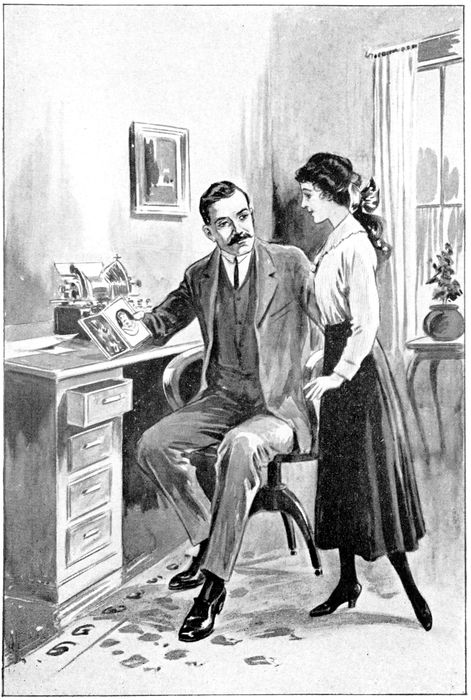
“I’ve a picter of him. I’d like to see him smile.
Have you got ghosties and fairies round here?”
29“Oh dear no, we don’t believe in those sort of things.”
“Yon tell me, miss, that you don’t believe in the magpie?
“One for sorrow,
Two for mirth,
Three for a wedding,
And four for a birth.”
“No, I have never heard that rhyme.”
“Oh me word! There be some things yer ignorant
about, missy.”
“Well, I am going down to get some food for you and
me, and you must keep looking at me and eat just as I
do, and then to-morrow morning when you come down
to breakfast I’ll teach you how to eat and what to do.
I’m going to love you, Peggy, so you must love me.”
The sweet brown eyes looked into the sweet blue ones,
and at that moment a swift, indescribable rush of
sympathy passed from one girl to the other.
CHAPTER IV. ADVENTURES AT FARMER ANDERSON’S.
30
Peggy, notwithstanding the strangeness of her lot, slept
softly and soundly in that delicious bed. Never before
had she known the cool, delightful feel of fine linen sheets,
never before had her curly head reposed on a pillow of
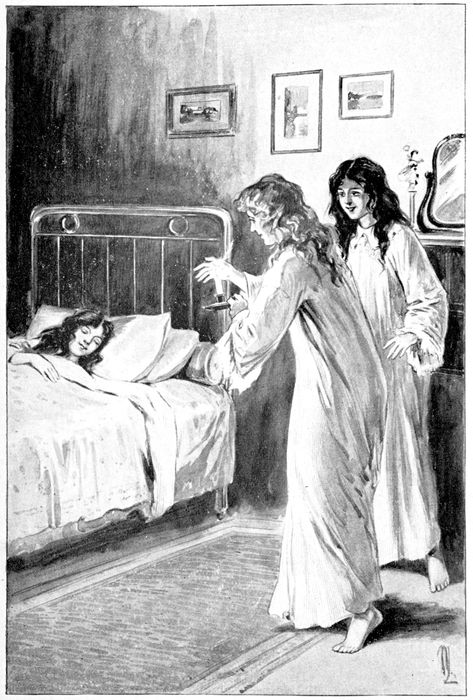
down. She slept, and in her sleep Molly and Jessie stole
softly into the room to look at her. Shading a candle,
they bent forward, and certainly their present view of
the little face was all that was charming. Not a trace
of lack of refinement could be perceived in those delicate
features, those long, curly black lashes, the true symbol
of an Irish girl, and the well-formed, sensitive little red
mouth.
“Oh, we’ll win her yet!” whispered Molly. “And she’s
worth winning,” she added; “she’s a perfect darling.”
Even Jessie was silent with regard to the Irish child
while the guardian angel of sleep protected her.
But when Peggy awoke the next morning matters were
very different. She awoke early, as was her habit in
Old Ireland. The stable clock had struck four when she
opened her eyes and stared about her. She had been
dreaming of the little old homestead and the hins and the
turkeys—wasn’t Colleen Bawn going to bring out her
clutch of eggs that very mortal day? “Twenty fluffy,
downy chicks, as sure as I’m alive,” whispered Peggy;
31and then she sat up in bed and stared around her. How
far off—oh how far off!—was Colleen Bawn and her
brood of little yellow chicks; how far away were the rest
of the hins, and the pigeens—bless ’em—and the little
turkey poults, and the—the—oh all the home-things!
What right had she, Peggy Desmond, to be here, in this
awful grand room, for all the world like a palace fit
for a king? How hateful was this soft white bed to
one accustomed to sleep on feathers, it is true, but with
the coarsest sheets and with the roughest blankets? And
what right, for that matter, had she to be in bed at all,
at all, at this hour, instead of up and busy? At home,
wouldn’t her work come handy to her—cows to milk,
calves to cosset, lambs to pet, and all the other creatures
to supply with their breakfast? “Oh wurra me!” thought
Peggy, “whativer’ll they do widout me at all? Why,
me grandma, she ain’t got the strength enough to rise
with the lark; it’s ‘Peggy mavourneen,’ she’ll be callin’
for an’ there’ll be niver a Peggy mavourneen to listen.
Oh but I can’t stand this, I can’t! And be the powers,
what’s more! I’ll get up and dress me anyhow. Then
I’ll get out. Maybe there’ll be a hin or a cock or a
bit ov a wee calf for me to pet. I suppose they have a
back yard. I’ll make for it an’ see what sort o’ place
they kape. Wouldn’t me heart light up if I saw a big
dirty pigeen?”
Accordingly Peggy put on her clothes. Their newness
and softness drew scornful remarks from her lips and
anger from her heart. “Why, to glory now, what do I
want wid the likes of thim? It’s a morshial shame to
waste the good money on thim when ye can buy unbleached
calico for threepence a yard.”
But as Peggy had nothing else to wear she was forced
to resort to the soft clothing which had been purchased
32for her in London the day before; and, finally, dressed
in a little dark-blue serge skirt and a white muslin blouse,
she opened the French windows and stepped out. She
found herself on a part of the roof, which did not trouble
her much, for she was accustomed to climbing anywhere,
and after some slight difficulty she managed to
spring into the welcoming arms of an old yew-tree, and
from thence to descend to the ground. The cool fresh
morning air revived her and raised her spirits; but, try
as she would, she could nohow manage to get into the
back yard, for the simple reason that it was not as yet
open, the workmen not arriving until six o’clock.
Peggy sat down on a garden bench and looked around
her. This was the first time she had had any sense of
liberty since her arrival. As long as she was travelling
with Mr. Wyndham she was nothing more nor less than
a prisoner; a prisoner surrounded by hateful luxury, it
is true, but still a prisoner. What she specially disliked
in her present surroundings was that sense of belonging
to some one else, that sense of being a prisoner. At
home she could do exactly what she liked, the O’Flynns
never dreaming of interfering with their darling; but
here all was different. If she could retain her liberty she
might in the end work her way back to Ireland, and be
once again a happy Kerry girl in her cabin home. She
thought and thought, and the more dazzling did the
prospect of liberty appear in her eyes. Presently she
stole her hand into her pocket, and to her relief and
pleasure found that she was the proud possessor of three
shillings. Wyndham had given her the change the day
before, telling her that she might like to have the money
to buy stamps and such like things. Ah yes! but she
would not waste it on stamps. Was it not a nucleus which
might be increased? To Peggy’s ignorant little soul three
33shillings seemed a vast lot of money, and if it were spent
carefully it would go a long way. There was no doubt
whatever that Mr. Wyndham, kind gentleman though
he was, and Mrs. Wyndham, whom she did not take to
at all, and Jessie, whom she pronounced a foreigner out
and out, and Molly, who was more to her taste, but
was also a foreigner, be the same token, all meant between
them, in some sort of fashion, to keep her prisoner. Now
a prisoner she would not remain, not while the good
God had given her a strong pair of legs, and there was
liberty in the world. She made up her mind; she
would run away. There was no time like the present,
“when all the worruld of England seemed dead aslape,
bad cess to it! But, be the same token, this was the
good-luck for her!”
She started from her seat, and, walking quickly, soon
discovered a stile, over which she mounted and got into
a large meadow. Here some bulls were feeding; there
were three of them at least, and they all raised their
stout, stolid heads, and fixed their blinking little eyes
on the child. They had each of them a ring in his nose,
and had short, strong horns. Had the Wyndhams seen
the bulls they would have rushed screaming back into
safety; but not so Peggy Desmond, she was no more
afraid of a bull than she was of a little bit of a heifer. Why
should she be at all, to be sure? She had put no hat
on her curly head, and now she stood still within an
inviting range of the great beasts, looking from one
to the other with love and interest in her dark-blue eyes.
“Why thin, me darlin’s,” she called out, “is it lonely
ye be, like meself for all the wurrald? Ah wurra then,
come along and let me pet ye! Why thin, it’s home
ye remind me of, and it’s the water to me eyes ye do
bring.”
34It is a well-known fact that cows, and in especial
bulls, are some of the most absolutely curious creatures
under the light of the sun; they are, in short, at all times
devoured with curiosity. To see a small girl, therefore,
standing calmly in their midst, and not running away
from them, as most small girls did, excited their curiosity
to a painful degree. They must investigate this person
and find out what she was made of, afterwards they could
toss her or not just as the fancy took them. Accordingly,
bellowing slightly, and bending their heads,
as was their custom when after mischief, Farmer Anderson’s
three fierce bulls came up to examine that
curiosity, Peggy Desmond. When they approached within
close reach of her, Peggy came up to the nearest, laid
her hand on his warm, soft red coat, said, “Ah thin, me
darlin’, it’s mighty invitin’ ye look;” and the next
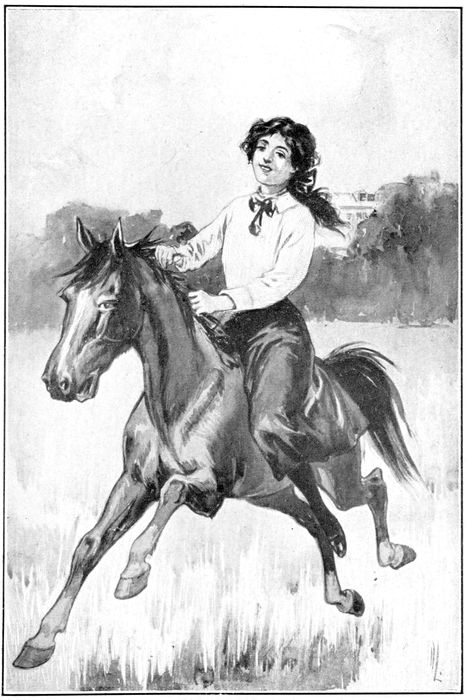
minute, laying hold of one of his short horns, she sprang
on his back, crept up toward his forehead, and began
to pat him between his horns, calling him endearing
names and keeping her seat by means of the horns. The
beast gave an infuriated roar and rushed across the field,
his brothers following in an equal state of indignation.
Peggy patted, stroked, uttered endearing words, and by
a sort of magic kept her seat. The roar of the bull
had been heard by Farmer Anderson, whose house was
quite close by; but when he appeared on the scene
he, as he afterwards expressed it, nearly died of the
shock.
There was a pretty little strange girl seated on the
back of Nimrod, who was now going quietly about the
field, having ceased to make any effort to dislodge his
unwelcome guest—or was she unwelcome any longer?
Perhaps her soft words and gentle, endearing expressions
proved soothing rather than otherwise to his turbulent
35spirit. Anyhow, he had ceased to attempt to dislodge
Peggy Desmond, who, laughing and singing, was thoroughly
enjoying her ride. The other two bulls were
trotting after Nimrod, who went round and round the
great field a little faster each time.
Farmer Anderson stood as one stunned. “For the
Lord’s sake, get down, missy!” he shouted, “get down
this minute, or Nimrod will bait you!”
But the dark-blue Irish eyes of Peggy looked calmly at
Farmer Anderson. She turned Nimrod by giving one
of his horns a tug, and rode up to his master.
“I’m likin’ me ride intirely,” she said; “and whatever’s
the matter wid ye? I’m doin’ no harm to the
baste.”
“But the beast will do harm to you. Here, off you
get! The Lord preserve us, never did I see such a sight
in the whole course of my life!”
As he spoke, the farmer, who was a big, burly man,
lifted Peggy to the ground, drove the bulls to the other
side of the field, and taking the girl’s hand led her
into a narrow lane which happened to be an approach to
his own house.
“For the Lord’s sake tell me what you have been doing
with my bull!” he exclaimed.
“Why thin, it’s only a ride I was takin’ on him,”
said Peggy.
“A ride on a bull! Wherever were you riz, girl?”
“In Ireland, sure, yer honour; we ain’t afeard of bulls
in Ould Ireland.”
“So I should say. You’re an uncommonly brave lass,
you might have been killed.”
“Not me. ’Tain’t any animal under the sun as ’u’d
injure me. I’ve a heart inside of me, ye see, to love
thim all.”
36The man looked at her attentively. “Whoever be you?”
he said. “Your face is strange to me.”
“Ah well, and that’s likely enough. I’m Peggy Desmond.
I come from a cabin in Ireland, County Kerry,
as pretty a spot as ye could find on the face of the
globe.”
“And what are you doing here?”
“Nothing but killing meself wid grief.”
“I suppose you did want to kill yourself, and that’s
why you got on Nimrod’s back.”
“No, when I want really to kill meself I won’t go to
Nimrod. I’m lookin’ out for a little bit of a place; do ye
happen to know, sor, anyone who would take a young
girl who was accustomed to feeding hins and looking
afther the farm-work all by her lonesome? I can give
a fine character of meself from Mr. and Mrs. O’Flynn in
County Kerry. You wouldn’t be thinkin’ ov wanting
wan like me, sor? I’d take small wages at first, and I’d
do yer biddin’, you’d find me rare an’ useful. I can’t
help me brogue, yer honour; but I’ve an honest heart,
an’ I’ll work faithful and long.”
“I should say you were accustomed to farm life,” said
the man, “otherwise you couldn’t possibly have ventured
to mount Nimrod; but as to your coming to us as servant—why
now, you aren’t dressed like a servant.”
“Oh for the Lord’s sake don’t mind me dress, yer
honour. I’ve as nate a little frock in me bit of a box
as you could find. This is me best Sunday-go-to-meetin’
frock, sor, an’ ef I’m to lose a good place because of
me dress, why, wurra, I don’t know how I’ll live, at
all, at all!”
The man stared at the girl in perplexity. Her voice,
her accent, what she had done with regard to Nimrod, all
seemed to speak to the truth of her words. But she
37wore the dress of a lady. He had, of course, heard nothing
whatever with regard to the Wyndhams’ protégée; and,
finally, much puzzled, and knowing that he and his wife
did want just such a sort of girl as Peggy professed
herself to be, he took her hand and led her toward the
big farm-kitchen.
“You’ve a nice little bit of a boreen here,” said Peggy,
as they walked along.
“What are you calling it?”
“Boreen, just where we are standing now.”
“But we call that a lane in England.”
“Well, it’s a boreen in Ireland. I’m right glad ye’re
takin’ me on.”
“I don’t say so for a minute, but I’ll speak to the
missis about you.”
The “missis” was busy “scalding,” as she called it, a
great dish of hot meal for the fowls. She was a stout,
red-faced woman, an excellent wife of a farmer. As the
farmer and Peggy entered the kitchen the dish, an
enormous one, nearly slipped from her hand, and a little
bit of the very hot meal scalded her fingers. In one instant
Peggy had rushed up and nipped the dish from
her.
“Why, ma’am, for mercy’s sake, don’t hould it like that;
ye’ll get yerself scalded all to nothing! Let me go
out an’ feed the hins. I’d love to be at it!”
“Who in the world is the child?” asked the astonished
woman; but Peggy did not wait for any explanations with
regard to her whereabouts or who she was. With that
dish of hot, comforting food in her arm, she was
once again back at Ballyshannon, as she called her home
in the County Kerry; once again the sniff of the warm
meal assailed her nostrils, her dark-blue eyes sparkled
with ecstasy, and she ran into the yard and made a
38peculiar shout to the fowls, the unmistakable shout which
every highly respectable fowl in the whole of Christendom
understands, the shout which means food, and
nothing but food. They surrounded her in a trice—geese,
ducks, hens, chickens, turkeys. With the utmost
carefulness and the most splendid genius, she arranged
her food, giving the fierce gobblers the coarse bits, and
reserving the dainty morsels for the little chickens and
the small “hins,” as she called them. The farmer and
the farmer’s wife watched her from the door of the
house.
“I never did!” said the farmer. “If you believe me,
Mary Ann, I might have been cut in two by a knife at
that minute, to see her sitting as cool as brass on the
back of Nimrod, with no more fear than if she were sitting
in the easy-chair by the fire! And now look at
her with those fowls. Whoever on earth is she? She’s
more like a fairy than a girl.”
“We must find out who she is. She’s too well-dressed
to belong to us, and yet she’s the very gal after my own
heart,” said the farmer’s wife. “I want a hearty, clever,
natty sort of creature who’ll do her work in a jiff without
having to be told anything.”
Peggy, having got the fowls quite satisfied with their
breakfast, now came up glibly. “Where’s the milkin’-pails?”
she asked.
“Why, you bit of a girl, you can’t milk cows,” said
the farmer, laughing as he spoke.
“Can’t I? You try me.”
“Well, we’re a hand short this morning, and twenty
cows to be milked,” said the farmer’s wife. “You can
go along to the sheds. I’m quite certain that Tom and
Sam will be glad of your help.”
Tom and Sam were exceedingly glad of the help of
39Peggy Desmond. What wonderful knack was there in
those slim little fingers! The most troublesome cows,
those who, as a rule, knocked over the pail, were as good
and quiet as mice under her gentle manipulations, and
what a lot of delicious, frothy milk she got them to yield
to her gentle touch! The farmer and his wife regarded
her as a perfect treasure.
“I wish we knew who she is. If she is respectable-like
we could keep her until the hay harvest and the wheat
harvest are over,” said the farmer.
“We could, for sure,” said the farmer’s wife. “Well,
anyhow, she has earned her breakfast.”
It was now past six o’clock. The farmer’s wife went
into the kitchen. She put a frying-pan on the fire, cut
great slices of bacon, broke in about a dozen eggs, and
began to fry.
“Come, you want your breakfast,” she said to the girl.
“You milked right well, I will say. I never saw a neater
touch.”
“To be sure, ma’am, an’ why shouldn’t it be?”
“You must be hungry for your breakfast.”
“Oh there’s no hurry, bless ye, ma’am! Shall I lay
the table for ye?”
“I don’t mind if you do, but you won’t be able to find
the things.”
“I tell you what would be better. You let me attend
to that fry on the fire, an’ you lay the breakfast. Yes,
I’m a bit hungry, no doubt ov that, at all, at all.”
“You come from Ireland the farmer says.”
“That same I do, ma’am.”
“You must be glad to be in a decent, respectable country
like England.”
“Is it me!” almost screamed Peggy. “Dacent, respectable!
that’s all you know. Ma’am, if ye want to
40bring the water from me eyes an’ to torture me broken
heart ye’ll spake like that ov Ould Ireland!”
“I don’t want to do that, of course, child.”
The meal was cooked to a turn, the farmer, his wife,
and the upper farm-servants sat around the board. Peggy
enjoyed herself vastly, and her spirits rose.
But when the meal had come to an end, the farmer’s
wife said, “Now, I want a word or two all by myself
with you.”
“Yes, ma’am, right you be!”
“Well, first of all, tell me your name.”
“Oh whisht! ma’am, what a short memory the Almighty
has given you! Didn’t I say Peggy Desmond
a score ov times?”
“Perhaps you did; but where are you living, Peggy
Desmond?”
“At the back of beyont.”
“I never heard of that place. Where is it?”
“I can’t tell ye more than that. ’Tain’t far off, an’ yet
it’s a good way off.”
“Have you any one belonging to you in the
place?”
“Niver a sowl, an’ that’s the truth I’m telling ye. I
was torn from thim as I loved, an’ I lived last night at
the back of beyont, and here I be; an’ if ye’ll take me
I’ll work for ye for next to nothing. I want to earn
a few shillings to go back again to thim I love. I ain’t
demented or anything of that sort; but I’m sore, sore
at heart. Me roots have been torn up, an’ they’re bleeding
all the time, only nothing on earth comforts them
like feedin’ the fowls an’ milking the cows an’ runnin’
about in yer farmyard.”
“Well, to be sure,” said the woman, “you’re about the
queerest child I ever heard of; you certainly don’t look
41mad, but you speak as if you were. At the back of beyont!
What on earth do you mean?”
“It’s the way we have ov speakin’ in Ireland, ma’am.
You can’t blame me for having the manners of me counthry.”
“Well, I’ll keep you for to-day, and I’ll give you—let
me see—a shilling a day and your meals.”
“Oh ma’am, may the Lord Almighty bless ye for ever
and ever!”
The girl sprang forward, fell on her knees, clasped
Mrs. Anderson’s hand, and pressed it to her lips.
CHAPTER V. PEGGY LOST AND FOUND.
42
While Peggy was enjoying herself to her heart’s content
at the Andersons’, laughing and joking, and helping
Mrs. Anderson in a dozen ways—so that that good woman
said she had never met her like before, and never would
again—a very different scene was taking place at Preston
Manor; for although it was the custom for the family
not to think of getting up until seven in the morning,
yet that hour arrived all in good time, and the very first
thing Molly thought of as she opened her brown eyes
was of the stranger, the queer, beautiful, unpolished, and
yet altogether lovable Peggy Desmond. How had Peggy
slept? How was she that morning? Was she still lonely
and heartbroken because of the Irish cabin and the Irish
friends?
At a few minutes after seven each morning the girls’
own special maid came in, as her custom was, with two
cups of nice, tempting hot tea, and a plate of thin bread
and butter.
“Shall I take some tea to the young lady next door,
miss?” asked Ruth, addressing Jessie as she spoke.
But Molly hastily made reply, “No, Ruth, bring Miss
Desmond’s tea in here, and I’ll take it to her; I’d like
to, just for once,” she added, looking appealingly at
Jessie.
43Jessie’s face grew rather red and her lips and eyes
rather cross; but she made no remark until Ruth had
left the room, having first placed a little tray with tea
and bread and butter on a small table by Molly’s side.
“I suppose you’re going to spoil that girl,” said
Jessie, when at last the sisters were alone. “I hope, I’m
sure, you won’t; it will annoy mother and me dreadfully.”
But when Molly said in her sweet voice, “It’s only just
for the first morning, Jess,” Jessie’s crossness dissolved
into a sleepy smile. Having drunk off her tea she fell into
another doze, for she need not get up until half-past
seven. Molly, however, rose softly, put on a pretty
blue flannel dressing-gown, and, holding the tempting little
tray in her hand, entered Peggy Desmond’s room.
“Well, Peggy,” she cried, “I hope you have slept well;
and here’s your tea, and——Oh good gracious!”
Hastily Molly put the tray on a table and gazed around
her with a sense of astonishment and dismay, for the
bed had no longer an occupant, the pretty soft nightdress
lay on the floor, the window was wide open, and the
bird had flown!
For a moment a fearful thought assailed Molly. Could
the child in her despair have run away? But no—this
must be impossible. Molly determined not even to
begin frightening anybody until she had had a good
search for Peggy in the gardens and farmyards. Accordingly,
she dressed with remarkable speed, and before
Jessie opened her eyes again was not only out of the
room but out of the house. Wherever Peggy was she
would find her.
Easier said than done, for Peggy had been clever in
her day and generation, and had escaped out of doors and
also out of Preston Manor grounds before another soul
44was awake. Molly, therefore, rushing here and there,
and making what inquiries she could of every single individual
she met, could get no news at all with regard
to Peggy. Her heart began to beat fast, and fear took
possession of her. The child had been really unhappy on
the previous night; she, Molly, had done wrong to allow
her to sleep alone. There was something terribly pathetic
about that poor little face, and her want of appetite and
her long-drawn, heavy sighs had gone straight to Molly’s
warm heart.
After wandering round and round, and discovering no
sign or news of Peggy anywhere, she was forced to go
back to the house. She had a wild hope for a minute
that Peggy might be safely ensconced in her bedroom;
but there was no such luck. Peggy was no more to be
found in the house than out of the house. What could
have happened to her?
Jessie wakened at her usual hour, and when she missed
her sister concluded that she had gone to make friends
with the stranger. She said to herself, “How troublesome
all this is!” and then had calmly and quietly dressed,
with the assistance of Ruth, who brushed her hair, plaited
it in two long, fair plaits, which were tied at the ends
with big bows of white ribbon. As the day happened to
be a very hot one, Jessie was arrayed in a white frock.
She looked with pleasure at her pretty reflection in the
glass, and then went downstairs to join her parents in
the cheerful breakfast-room. Peggy, of course, must be
present during the meal; what enormities would she
commit, what awful solecisms would she be guilty of?
When, however, on her way downstairs, Jessie suddenly
caught sight of her sister Molly, with her hat hanging
on her arm, her face very hot and flushed, her hair in
wild disorder, she stood still in amazement, and then
45said, “Well, whatever can be the matter with you? Have
you and that horrid Irish girl been dancing a jig together
on the lawn? You look like it, you really do.”
“Oh don’t!” said Molly, “don’t! If you knew you
wouldn’t speak like that.”
“If I knew!” exclaimed Jessie. “If I knew what?”
“Why, she’s gone, she’s gone away, she can’t be found
anywhere, high or low! Oh dear, oh dear! she—she may
have—have drowned herself! Oh I am miserable!” And
poor Molly burst into tears.
Even Jessie ceased to scoff at this turn in events. She
took her sister’s hand quite kindly, and said, “Of course
she’s not lost, girls can’t lose themselves in that fashion.
Let’s go to father, and he’ll soon find her.”
Jessie’s sympathy was uncommonly sweet to Molly
just then, and the two children appeared in the breakfast-room.
Mrs. Wyndham was seated opposite the tea-tray;
and her husband was crunching some toast, eating
an egg, stirring his coffee, and reading his morning
paper all at the same time. He heard his wife say, “One
of you girls had better go upstairs and bring Peggy Desmond
down to breakfast,” when suddenly a sob from
Molly’s lips caused the man to drop his paper and the
lady to put down the cream-jug and turn with a sense
of dismay to hear the news.
“Father, I can’t find her anywhere.”
“Can’t find who?” inquired Mrs. Wyndham.
“Peggy Desmond, mother. I went into her bedroom
this morning with a cup of tea, but she was gone, gone
quite away, I don’t know where! And I have been searching
all the place for her, and inquiring of every one. I
didn’t want to frighten you until it was necessary to tell;
but I had to at last. She’s gone, she’s lost, perhaps
she’s drowned. Oh father! father!”
46“Molly, don’t be such a little goose,” said her mother.
“There now, my dear,” she continued, turning to her
husband, “you see for yourself what a great mistake you
made when you brought that wild Irish creature over to
upset us all round and disturb the happiness of our
own children.”
“Never mind that now, Lucy, we’ve got to find the poor
little creature. I am exceedingly sorry that I didn’t take
better care of her.”
“Better care!” cried Mrs. Wyndham. “I’m sure no one
could accuse you on that account. You went to Ireland
and fetched her over, and did all that man could for her
benefit, and this is the way she treats you!”
“Well, the great thing at present is to find her,” said
Mr. Wyndham. “I will go immediately and start inquiries.—Molly,
sit down and eat some breakfast. Stop
crying, love, the child cannot be far away. I’ll bring
her back. When I do I’ve one request to make.”
“What is that?” asked his wife. She looked up at
him, and noticed the stern expression on his brow.
“That child is not to be scolded. She knows no better;
she is a very ignorant, very spirited, very affectionate
creature. You can’t drive her, you must lead her. I
wish that to be understood. She is the daughter of my
dearest friend, and I won’t have the little creature tortured.
Now I’m off. I expect I shall return in a few
minutes with Peggy in my wake.”
“Well, this is a nice state of things!” said Mrs. Wyndham,
when Wyndham, having absolutely forgotten his
meal, had left the room. “Dear me, girls, sit down and
eat, and don’t make things worse. I shall go immediately
after breakfast to Miss Fox Temple; she’ll tell me what
I had better do for this barbarian.”
“Mother,” said Molly suddenly.
47“Well, Molly?”
“You must admit one thing.”
“Well, Molly?”
“She’s a very pretty barbarian, isn’t she?”
“My dear, I dare say. I hardly looked at her. She has
no style, no manners, no nothing. I can’t say whether
she’s pretty or not.”
“She is pretty, mother, there’s no doubt of that,” said
Jessie; “but of course I’m quite sure that she’s going to
be fearfully troublesome.”
“She certainly has gone the right way about it,” said
Mrs. Wyndham. “Help yourself to some fresh toast. I’m
not going to let myself be annoyed by the tiresome
child.”
Jessie, as far as possible, tried to follow her mother’s
example; but Molly was too restless and miserable to
enjoy her meal. The fact is, she had fallen in love with
the poor, wild, beautiful little Irish girl. She was rather
ashamed of her own feelings, and determined, therefore,
to keep her sensations to herself.
Meanwhile Mr. Wyndham wandered over the grounds,
made inquiries of the men, and could get no news about
Peggy. It was strange, it was unaccountable; no one had
seen the child, not a soul knew anything whatever about
her; and meanwhile Peggy herself was enjoying life at
their very door. She had managed her own affairs with
rare cleverness, simply by not managing them at all. She
had, by this very easy device, put every one off the
scent.
“I’m well shut of them!” she was heard to remark as
she scrubbed pails and polished the different farm-vessels
in Mrs. Anderson’s roomy kitchen.
“What a queer expression!” said the farmer’s wife;
“and who are you shut of?”
48“They that lives away at beyont,” was her enigmatical
answer. “Ah, an’ sorra a wan of thim I want to see
again!”
Up to the present, therefore, Mrs. Anderson had no clue
whatever to the real whereabouts of the child. It was harvest-time,
and immediately after breakfast her husband
and all the men available on the place went off to the
harvest-fields; she and Peggy had sole possession of the
big kitchen. Never before had she so willing a maid, so
capable and clever, and “all there.” There was a great
charm, too, about Peggy when she liked. Her face was no
longer sorrowful, it was beaming. Whenever she passed
Mrs. Anderson she laid her hand on that good woman’s
shoulder or her arm and gave it a squeeze. “Sure, then,
it’s loving ye I be,” she said.
And Mrs. Anderson looked into that charming, lovely
face, and felt that she also loved the poor little waif who
had been brought to her door. But where was “beyont”?
Somebody surely knew the child.
Meanwhile Wyndham, not having got the slightest
clue to the whereabouts of Peggy, was forced to start off
to the nearest town, where he had important business to
transact, business which should have been attended to days
ago, but which his visit to Ireland delayed.
Molly and Jessie wandered about the grounds, and
Mrs. Wyndham stepped into her carriage and drove to
the house of her friend Miss Fox Temple.
Mrs. Wyndham found that good lady at home, and
quickly revealed her troubles. “Never was there such
a miserable case before,” she said. “My husband arrived
late last night with that fearful Irish girl, who behaved
in a most disgraceful manner, set the servants giggling,
and would not do one single thing she was told; in short,
she’s an absolute barbarian. And to crown all, she has
49run away this morning. We haven’t the least idea where
she is.”
“Oh but surely you will try and find her, Lucy!” said
Miss Fox Temple.
“Try and find her! We are doing our best. My husband
says he will get the police to search for the girl.
And there are my own children! Molly is almost breaking
her heart about the creature. It is all terrible! Oh,
of course, my dear Lucretia, she will be found, there is
no doubt on that point; but the thing is this: what is to
be done when we do find her?”
“Yes, that is the thing,” said Miss Fox Temple.
“You must try and imagine for yourself the state of
ignorance that child is in,” was Mrs. Wyndham’s next remark.
“She knows less than nothing; there isn’t a servant
in my establishment who does not think she is a
disgrace. She can’t hold her knife and fork. I questioned
Molly, and she confessed that Peggy eats with her fingers
and she speaks like a young savage; in fact, I don’t
understand her language; it is an unknown tongue to
me. She has no knowledge of anything, as far as I can
make out, and only wants to go back to her state of savagery.
Now, would you believe it, my dear Lucretia, my
husband wants that girl to go to The Red Gables at the
end of the holidays with my own two girls? Is it reasonable,
is it fair?”
“It certainly sounds to me the reverse of reasonable or
fair,” was Miss Fox Temple’s answer.
“You promised when I saw you before that you would
have a talk with him. Can you come over this evening
and do so? I’m sure he will be reasonable with you, he
always is.”
“I will do my best. If I had the management of that
child I should send her to a quiet, respectable woman, a
50little above the people who brought her up, and leave
her with this person for about a year; from there give
her a good governess, say in the house of the same person;
that might occupy another year. Then, at the end of that
time she might be able to take up the position your husband
wishes her to assume in your house.”
“Oh but he will never consent—never, never; I know
him,” said Mrs. Wyndham. “I must say I think men are
trying at times.”
The two ladies talked and talked as ladies will. They
soon left poor little Irish Peggy behind in their special
interest in one or two subjects of local gossip. The time
flew, the whole morning went by, Miss Fox Temple induced
her friend to stay to lunch with her, and Mrs.
Wyndham, nothing loath, agreed. “I do not want to go
home now,” she said, “while that horrible little viper is
about.”
“But I thought you gave me to understand that the poor
viper had disappeared.”
“Oh my dear, she’ll come back, and be more viperish
than ever.”
“But you don’t really want the child to be lost?”
“I don’t know what I want. Don’t question me about
my feelings, Lucretia; I am too miserable.”
Meanwhile the girls began to search for Peggy on their
own account; it was Molly who first propounded the idea.
“Jess, I do wish we could find her. Do you know
what father said when he went away—that if there were
no news of her by the time he got back he’d get the
police to search for her? Oh I really don’t know what to
do! I wish we could find her. Won’t you help me to
find her?”
“I don’t mind if I do, she must be pretty clever to
have hidden herself so completely. Is there a single place
51in the grounds you have overlooked in searching for her,
Molly?”
“Not one, not a single one, not one hole or corner. I’ve
been in every one of the summer-houses, and I’ve looked
behind them, I’ve been in the stableyard—in short, I’ve
been everywhere. She’s not in the place. Besides, if she
had been there this morning she’d have been found long
ago by the gardeners and stablemen and grooms.”
“That’s true enough. Well, suppose we have the pony
put to our little basket-carriage and go for a drive. We
can question all the farmers’ wives on our way; they
may have seen her.”
“That’s a very good idea,” said Molly, “for there’s
no doubt of one thing. Peggy lost herself very easily by
getting up early, and I’ve always heard that farmers’
wives get up early, so perhaps they may have seen her going
by, and can give us some account of her whereabouts.”
“The nearest farm to us,” said Jessie, “is Anderson’s,
but I don’t particularly care to go there because of those
wild bulls.”
“The bulls won’t hurt us, they’re in the field; we can
drive round by the road, and you can stay in the pony
carriage while I run to the house and ask Mrs. Anderson
if she has seen a girl who looks like Peggy.”
“Well, all right,” said Jessie, “we shall be doing something.
Do you know, Molly, that often and often I think
the holidays too long; we have much better fun at school,
where all our time is mapped out for us.”
But to this Molly would not agree. The pony carriage
was brought round, the children stepped into it, and very
soon found themselves—that is a little before noon that
day—outside Anderson’s big farm. Peggy happened to
be at the back of the premises at that moment, and did
52not see them arrive. Had she done so she would have
quickly rushed away and hidden herself either behind or
under one of the haystacks. Molly walked up the neat
little path which led to the front door; she rang the bell,
and after a minute’s delay Mrs. Anderson came to answer
it, and when she saw Molly her face beamed with welcome.
“Miss, I’m delighted to see you. Is there anything
you want, or your dear mother or father? I’m charmed
to see you, miss. We’re rather in a fluster to-day, it being
harvest-time; but, thank goodness! I’ve got a very
smart little girl to come in and help me.”
There was something in the tone of the woman’s voice
which aroused Molly’s suspicions. “What sort of a girl
is she?” she asked. “When did she come?”
“Oh miss, you wouldn’t be likely to know anything
about her; she isn’t in your class at all. My husband
brought her in this morning, a queer, wild little thing
she is, but splendid at the work. Where do you think he
found her, miss?”
“Where?” asked Molly, her heart beginning to beat
very fast.
“Why, miss, you’d never guess if you was to try
till Doomsday; on the back of Nimrod, no less, riding
him round and round the field, and as pleased as Punch,
and as cool as though she were sitting in an easy-chair at
home!”
Just at this moment, before Mrs. Anderson had time
to say a word more, Peggy herself put in an appearance.
“Sorra a bit o’ me is goin’ back,” she said; and then
she looked at Molly, laughed, ran up to Mrs. Anderson,
began to kiss her, and the next minute flung her arms
round her neck. “It’s here I’m goin’ to stay.”
“And you mean to tell me,” said Mrs. Anderson, “that
53you have anything to do with the ladies at Preston
Manor?”
“Yes, she has a great deal to do with us, and we have
been very unhappy about her. Oh Peggy, how could you
treat us like that? I have been crying about you all
the morning. Oh I have been unhappy!”
“And if I’d suspicioned ye was really frettin’ for me,”
began Peggy, looking askance at Molly as she spoke,
“faix! I don’t think I could face it! If you really want
me?”——
“Of course I want you, we all want you.”
“I thought it was too good to last,” said Mrs. Anderson.
“Do you mean to say, miss, that this young girl
is a new servant you’ve got?”
“Mrs. Anderson, she’s not a servant at all, she’s a
young lady by birth.”
“No, I ain’t! I ain’t no more a lady than Mrs. Anderson
herself, nor as much. Then I’ll tell ye the whole
story. As I was lyin’ stretched out this mornin’, I began
to think, ‘Now, how can I get away from this awful hole
of a place, at all, at all?’ An’ I thought an’ thought until
at last it came over me that there was nothin’ for me
but to run away, an’ so I did, maining, if ye will belave
me, to go to some one who’d give me a trifle of money
for me labours; for although I be ignorant of ye’r sort
o’ things, miss, there’s a sight o’ things I can do, as
Mrs. Anderson knows well.”
“Yes, I do; I can testify to that,” said Mrs. Anderson.
“It seems a great pity she’s no servant, because I never
came across a better one. But, my dear little girl, you see
you can’t stay with me if you belong to these young ladies.
You belong to the quality.”
“Faix, I don’t, an’ niver will!”
“Oh fie, child! fie! You’ve no right to quarrel with
54the position into which God Almighty places you. Miss,
I’m more vexed than I can say; but you’ll excuse me.
I was took all of a heap, so to speak, and when the young
lady would only give out that she lived ‘back of beyont,’
how was I to guess that she meant your beautiful place,
miss?”
“So you won’t kape me then?” said Peggy, raising eyes
of blank despair to Mrs. Anderson’s face.
“Oh Peggy, you will come back with us!” said poor
Molly.
“Will it make ye cry bitter bad if I don’t?”
“Yes, I think I shall be quite ill.”
“Faix, then, I’ll go, but I don’t like it a bit. Oh
wurra, but I’m dazed intirely, that I be! Good-bye, Mrs.
Anderson, give my love to the little hins. I can’t live your
life, but I can’t love the life they live at the back of
beyont. Good-bye, Mrs. Anderson, dear.”
The sad little figure was soon walking down the path,
and Molly, half-triumphant and yet with a sinking at her
heart, saw her safe into the pony carriage.
CHAPTER VI. PEGGY’S ESCAPADE.
55
Peggy was certainly very troublesome, there was no
doubt whatever on that point. Even Molly had to agree
to this most patent fact. She did not want even kind
Molly’s attentions; and as to the rest of the family, she
openly said that she couldn’t “abide the sight o’ them.”
These words were not pleasant to hear, and Mrs. Wyndham
was not the sort of person to take them quietly. When
the child refused to eat her meals properly, and sat sulky
and speechless in one of the beautiful drawing-rooms,
having first of all spilt a cup of tea all over one of the
pretty frocks which had just been bought for her, Mrs.
Wyndham determined to defy her husband and take the
bit between her teeth. Accordingly, she marched up
to Peggy, took her hand, and led her up to her bedroom.
There she pushed her in with some violence, and said,
“You’re a very naughty, ungrateful little girl; but here
you shall stay until you express sorrow for your misdemeanours.”
“Whativer’s thim?” inquired Peggy.
“I’ll leave you to find out, you naughty, bad child!”
Mrs. Wyndham left the room, locking the door behind
her and putting the key into her pocket. She told her
daughters that they were neither of them to go near
Peggy, and expressed anger and annoyance when Molly
began to cry.
56“You make me sick, Molly,” she said. “Now do control
yourself; take a lesson from your sister. That girl’s
spirit must be broken in, or I won’t live in the house
with her. Thank goodness, she’s safe for the present.
I declare, she has quite tired me out. Girls, you had
better take the pony trap and drive over to see the Wrenns
and invite them to tea to-morrow. I shall go and lie down
in my bedroom.”
Mrs. Wyndham lay on her sofa close to the open window,
and, the day being warm and she really tired, dropped
asleep. “For once I’ve got the better of that Irish imp,”
she murmured to herself as she dropped into placid
slumber.
But Mrs. Wyndham had reckoned without her host.
When Peggy found herself locked up in her spacious bedroom
she first gave vent to some angry words, and burying
her little face in the bedclothes, “drownded” herself, as she
expressed it, in her tears. But tears with the Irish girl
were something like the showers of an April day. Soon
she was looking around her and smiling to herself. The
window of her bedroom was wide open, and had she
not escaped by that same window before on that very
day?
“Faix thin,” she muttered, “it’s herself don’t know
much. I’m not in dread of her, not at all, nor any of
the grand folk I’m likely to meet here. Is it me that’s
scared? Not me. Why, even the servants, they don’t
paralyse me; us in Ireland”—here she threw her head
back—“ah! it takes a dale o’ trouble to import us to a
place like this. I declare, for the love o’ goodness! I
think I’ll run away again.”
No sooner had the thought occurred to her than Peggy
resolved to act upon it. She was out of the window and
sitting on the roof, then she managed to scramble until
57she got to a great stack of chimneys. These she inspected
with keen interest, not in the least regarding the fact
that her white frock was turning black. She had now
mounted up to a good height, and from where she stood
she could get a glimpse of the yard. Some fowls of different
sizes and sorts were strutting about there in a most
important manner; a flock of geese came into view, led
by a great white gander; and, finally, the king of the
farmyard appeared, in the shape of a huge turkey-cock,
who said, “Gobble, gobble, gobble,” as he was followed
hither and thither by his troop of wives.
“The Lord be praised!” cried Peggy, “glory be to
heaven, but it’s consoled I be.”
By turning and twisting and clinging, occasionally
climbing up a little way and occasionally going down a
little way, Peggy found herself right round at the back
of the house and hanging over the farmyard. There was a
good drop, however—at least thirty feet—between her
and the ground, and this drop, try as she would, she
did not dare to manage unaided. Several men, belonging
to the farm, were moving about, employed over their several
duties; not one, however, looked up to where the child
with the bright eyes and face much blackened with chimney
smuts, was regarding them wistfully. Presently, however,
a burly-looking man came and stood exactly under
the portion of the roof to which poor Peggy was clinging.
He was a big man, at least six feet in stature. Here
was her opportunity.
“Yerra, Pat!” she screamed, “hould aisy, for the love o’
God; don’t stir, man, as you value your immortal! I’m
comin’.”
The next instant the man, who was christened Pat by
the girl on the roof, felt a sharp bump on his shoulders,
and Peggy, clinging with her dirty little arms to his
58neck, burst into a fit of laughter and tumbled to the
ground.
“Holy Moses!” she cried, “if I didn’t have a stitch in
me side intirely at the face of ye, Pat, when I let out that
screech! But there, I’m all right, and I have me liberty,
praise the Lord! To be sure now, I was dumfoundered
how to get off that roof until ye placed yerself so handy.”
Several men and women now came flocking round the
girl, and it must be owned that they all burst into
laughter, and one or two of them said, “Well done, missy!
it’s you that have the spirit.”
“You’d better let me wash you, my dear,” said a big,
red-faced woman, who had charge of the fowls. “You’re
a sight to behold if you were to meet any of the family.”
“But I don’t want to meet the family,” said Peggy;
“I want to stay here along wid ye an’ the dear little hins
an’ the turkeys an’ the geese. Why then, me fine master,
an’ do ye think I’m afraid o’ ye?” Here she went up
to the great turkey-cock and pulled him by the tail.
The fierce bird tried furiously to peck at her, but she
kept her ground, rushing round and round in a circle,
clinging on to the bird, while the servants and farm-labourers
held their sides with laughter. At last, however,
Mrs. Johns, as the red-faced woman was called, induced
Peggy to come and be washed; but, although the
young lady’s face and hands could be restored to a state
of moderate cleanliness, the frock was past all hope.
“Whatever is to be done?” said Mrs. Johns. “The
frock will tell on you, missy dear.”
“I don’t care if it does,” answered the child; “now that
I am here I want to have a bit o’ fun. Can none o’ ye
consale me for a bit if the quality go by? I’m ragin’
with a hunger, too, bedad, for I couldn’t swallow a bit
at tea-time, wid herself scowlin’ at me. Oh now thin,
59Mary asthore, it’s you that will be kind to me, won’t
ye? Ye’ll wet a drop o’ tay an’ bring it out here to
the farmyard, an’ I’ll dhrink it, for I’m as dhry as a
cinder; an’ I could do with a lump o’ cake, too. You
run an’ fetch thim for me, Mary asthore.”
“My name is Ann,” replied the woman, “but I’ll do
what you want, you poor little thing.”
Accordingly, Peggy, seated on a three-legged stool in
the yard, enjoyed herself vastly. She was surrounded by
her satellites, the sort of people she could appreciate
and understand. She drank cup after cup of “tay” and
devoured many hunches of rich cake, chattering as she ate,
and throwing crumbs to the different birds that flocked
round her. When she was quite satisfied she rose and
shook the crumbs from her dirty frock.
“I’ll come again to-morrow, God bless ye all, me darlin’s,”
she said. “An’ now, fetch a ladder, for I must be
goin’ back by the road I come. Pat, man, run. Why,
man, have ye got joints in yer bones? Ye’ll have me
cotched if ye don’t stir yer stumps.”
Pat, whose real name was William, secured a ladder,
and held it while Peggy climbed. Soon she was lost to
view in the intricacies of the roof.
The servants looked at each other after she had gone,
and vowed an unspoken vow that they would rather have
their tongues cut out than tell on the poor Irish missy.
“Please God, she doesn’t catch it from Mrs. Wyndham,”
exclaimed Mrs. Johns. “She’d have a hard and bitter
tongue for an innocent child like that.”
“She took me all of a heap,” exclaimed William, “when
she jumped on my back. But I do declare, she’s as pretty
a little thing as I ever set eyes on.”
Meanwhile the “pretty little thing” in question re-entered
by the open window, changed her dirty frock, put on
60a clean one, and sat demurely in a chair, looking as though
she had not stirred an inch since Mrs. Wyndham had left
her, when that lady appeared again on the scene. It is
true there was a wonderful brightness in the eyes of the
culprit, and not a vestige of sorrow on the small, defiant
face; but Mrs. Wyndham considered that she had gained
a victory.
“Come, Peggy,” she said, “Mr. Wyndham is waiting to
speak to you in the study. I will take you to him. Come
at once. I hope, Peggy, you are sorry for your naughtiness.”
“Arrah thin, niver a bit,” replied Peggy, looking full
up into the good lady’s face.
Mr. Wyndham, poor man, had been given a most vivacious
account of Peggy’s iniquities, her conduct at the
Andersons’ farm, her dreadful exploit with the bull,
the scene which the two girls had come across of Peggy
as maid-of-all-work to Mrs. Anderson; and finally, her
behaviour at tea, when she had spilt a whole cup down
her pretty new frock, and had not expressed a word of
contrition.
“To tell the truth,” Mrs. Wyndham finally added, “unless
you can manage to make that child conform to our
rules, Paul, I really shall be obliged to say that I must
go from home for the present, and take my girls with
me.”
“Oh it won’t come to that, dear,” replied Wyndham;
but he felt a good deal of distress, of pity for the child,
and of pity also for his wife and daughters.
“Send her to me. I’ll have a talk with her, and
afterwards I will tell you what I think is best to be done,”
was his remark.
Accordingly, Peggy was fetched, and undoubtedly there
was no sorrow on the face of Peggy, and no sorrow in her
61defiant words when she was ushered into Wyndham’s
study.
“Here she is, Paul, and I greatly fear from her manner
that she isn’t in the least repentant,” said Mrs.
Wyndham.
“Ah, thin, an’ that I’m not,” was Peggy’s response.
Then the door was shut.
Wyndham glanced up from his desk; he was busy writing
a letter, and he did not say a word to Peggy at first,
but calmly went on writing. There was something rather
fascinating to the child in his manner. He was a very
handsome, distinguished-looking man. He wrote very
fast. She had never seen any one write properly before,
and she had been taught writing, after a fashion, herself,
but never writing of this sort. The words seemed to
fly over the paper, and then what a funny sort of machine
he had close by, with queer little letters sticking up
all over it! Suddenly, having finished writing his letter,
Wyndham put a sheet of paper into the machine, turned
on, as Peggy expressed it, “a kind of tap,” and began
making a loud noise and printing as hard as he could.
“Arrah thin! don’t go so fast!” said the child.
Wyndham did not take any notice of her, but went on
typing his letter until he had come to the end. Then he
folded it up, put it into an envelope, which he addressed,
stamped, and laid to one side. Then, for the first time, he
looked up at Peggy. She was immensely interested.
“I wish you’d do that again,” she said.
“What am I to do again?” he asked.
“That tip-tapping-tap.”
“Oh, this is what they call a typewriter.”
Peggy shook her head. “Don’t know anything about
it,” she remarked.
“Peggy, will you sit down for a little? I have”—he
62took out his watch—“exactly a quarter of an hour in
which to speak to you.”
“Bedad, thin, that’ll be long enough,” was her response.
“Why do you say that?”
“Because, if ye’re goin’ to be scoldin’ me all the time,
I think a quarter of an hour will be as long as will be
good for yer breath. It’s bad when ye riz the voice
in passion, an’ a quarter of an hour’ll do the business
fine.”
“Peggy dear!” There was something gentle in the
voice, something reserved, and at the same time something
pained.
It was that pained note that arrested the child’s indifference.
From the moment Wyndham had come to the
Irish cabin, Peggy had been feeling that little heart in her
breast getting colder and colder and harder and harder;
but now, all of a sudden, it began to throb with new life.
“Peggy, instead of a quarter of an hour being too long
for what I have to say to you, it will be a great deal too
short; I don’t want to waste a moment. To begin, I have
something here I should like you to look at.”
Now, if Peggy had one fault greater than another, it
was the bump of curiosity. Wyndham went to a drawer,
took a key from his pocket, opened the drawer, and took
out a little brown morocco case. He opened the case.
“Come here, Peggy,” he said. The girl advanced, he
slipped his arm round her waist. “I want you to look at
this,” he said.
She looked down at the picture of a man, a man with a
kind, brave, noble face, the eyes were shining with a
strange sort of wistfulness. The lips were firm and beautifully
curved, the brow was broad, but it was the expression
which made the face altogether charming.
“Peggy, he was a gentleman.” The child was silent.
“Your mother was a very beautiful peasant woman; your
father loved her and married her, and afterwards, when
you were born, she died, poor thing! Your father was
very poor then, very poor; he was in India with his regiment,
and could not come home to take care of his little
baby, but he loved her very much. He often wrote to
me, and told me about her. He sent all the money he
could spare to the people who looked after you, Peggy,
and when at last he came to die he wrote me a long letter,
a very long letter; it was all about you and his love for
you. He said in that letter, ‘I want you to bring Peggy
up as your own child, and, above all things, I want her
to be a lady. I want her to be good and never to tell
lies, and to put honour first, and I want her to learn
all those things that ladies ought to know. I want her
to be a comfort to you and to your wife and to your
girls. I think she will be, if she is her mother’s child
and mine. Tell her when you see her, all that I want her
to be, and give her, when you think she is fit to receive it,
the letter which I enclose for her. It is a letter partly
from me and partly from that poor, sweet young mother
whom she never saw. But don’t give Peggy either of
these letters until she is fit to receive them.’ In the letter
which your father wrote to me, Peggy, he said that I was
to bring you up as I thought right; and he further said
that he felt that he, perhaps, would be not far away, and
would be listening to you, and watching you when you
were striving to overcome the many faults which you
learnt when you were a little girl in a cabin in Ireland.”
“And how am I to forget, bedad?” said Peggy. Her
voice had altered in tone, and there were tears in her eyes.
64“Give me that letter o’ me father’s,” she said, “and I’ll
run away an’ not bother ye any more.”
“I couldn’t do that, Peggy. Your father when he wrote
said that you were not to receive his letter until you were
fit to read it, until you were sufficiently trained to appreciate
what he has written for your guidance, until you
love me enough to love his message to you. Peggy, look
at me.”
The child turned and stared.
“At the present moment I am afraid, my poor little
girl, that you are hating me.”
“Arrah no, not quite,” said Peggy, “but I hate herself
and Jessie. I don’t mind Molly one way or t’other.”
“The person you speak of as ‘herself’ happens to be my
wife. Jessie is my daughter. Do you think that it is
pleasant to me to hear that you, a little ignorant girl, hate
them when they wish to be so kind to you?”
“Bedad, it mayn’t be pleasant, but it’s thrue.”
“Now, Peggy, I have told you about your father. I
have one or two other things to say. Your father was my
greatest friend; once he saved my life. It was a long
time ago. I’ll tell you that story some day. There is
nothing under the sun I would not do for your father; his
death was a very bitter grief to me, and the one consolation
I had when he passed away, was the thought of looking
after his child; the only thing I am sorry for is this—that
he didn’t put you into my care a long time ago. Peggy,
my dear, I have no intention of letting you go; you must
submit to the new life. It is the life you were born to,
remember.”
Peggy fidgeted restlessly. “I don’t like it a bit, yer
mightiness,” she said.
“Peggy dear, you must not call me ‘your mightiness.’
There are a great many words you must forget.”
65“An’ however am I to do that, yer—yer honour?”
“That is not a right way to speak to me either. You
and I are, I hope, a gentleman and a lady.”
“Bedad, thin, I’m no lady.”
“Then, Peggy, you honestly say to my face that you
deny your own father, for there never was, in the course
of the world’s history, a better gentleman than Peter
Desmond.”
“I’m not goin’ for to deny it to him, but me mother.”
“Your pretty young mother was, it is true, a peasant by
birth, but she was well educated in a convent school, and,
compared to you, was a lady. She did everything that
her husband told her. I saw her once, Peggy; it was
shortly before you were born, and I was touched with her
sweetness and gentleness. She would not have dreamed
of saying ‘your mightiness,’ or ‘your honour,’ or
‘bedad,’ or ‘wurra,’ or ‘begorra,’ or any of those
words. Now, Peggy, I want to ask you if you will
help me?”
“To be sure I will, Uncle Paul, if I may call ye that.”
“Yes, that will do splendidly. I should like you to
call me Uncle Paul.”
“I’ll manage yer hins an’ milk yer cows. How will
that do?” said Peggy.
“My dear little girl, that won’t do at all. I don’t
want you to manage hens or to milk cows. It was quite
right for you to do those things when you were living
in the cabin with the O’Flynns; but now that you are here
you must act differently; you must allow yourself to be
trained, you must dress nicely and speak nicely, and obey
those who know better than yourself. At present you are
so shockingly ignorant that I am positively ashamed of
you. Do you know that you might have been killed to-day
when you got on that bull’s back?”
66“Oh, wurra wisha, not at all, your mightiness, there
wasn’t a sthroke o’ malice in the poor crayture.”
“Now, Peggy, there you are again! Your language is
to be completely altered. How could I introduce a little
girl like you to my friends? If you love your father I
will give you his letter as a reward; but I will not give it
to you until you have proved your love by learning how to
speak nicely, how to eat properly—in short, how to be a
worthy daughter of Peter Desmond. I don’t mean to
punish you, I don’t wish to be unkind to you; and in
order to help you I have asked a great friend of mine,
Mary Welsh, to come here for the next fortnight.”
“I niver heard her name before. I’m moithered intirely
wid the lot o’ fresh people ye’re bringin’ round
me, Uncle Paul.”
“I think you will like Mary Welsh, and I will tell you
why. She’s an Irishwoman.”
“Oh thin, bedad, is she? An’ does she know about hins
an’ turkey-cocks an’ geese an’ little pigeens?”
“I dare say she will talk to you about those things;
but there’s a wide difference between her and you, for
she speaks like a cultivated lady, whereas you talk like
a little girl of the people.”
“Sure thin, yer mightiness, if you’d only lave me wid
thim I’d be as happy as the day is long.”
“Now, my dear little Peggy, how can I do that when
your father has implored of me to bring you up as one of
my own children? Now, Peggy, set your wits to work—you’re
quite clever enough—do you think that would
be carrying out your father’s wishes if I did as you wished
now? But you don’t know any better, you are just a
silly, silly little girl.”
“Maybe you’re right, sor.”
“Uncle Paul.”
67“Uncle Paul.”
“When Mary Welsh comes you can talk with her just
as much as ever you like about Old Ireland; she will
stay here for one fortnight, and at the end of that time
she will tell me what she thinks had best be done towards
your education.”
“How many things must I larn, Uncle Paul? I was
sent out from school finished, so to spake.”
“Yes, but there are other schools where you would not
be considered finished.”
“Oh glory! All right, Uncle Paul, I’ll do me level
best.”
“I think you will, my poor child. Now run upstairs,
wash your face and hands, then go to the schoolroom
and try to copy the way Molly speaks and the way
Jessie speaks. They will be having supper together
in the schoolroom, and I want you to have it
with them,”
“I’d like to confess a bit before I go, your mightiness.”
“To confess?”
“Why, this. It’s only right I should tell ye. Herself
locked me up because I spilt me tay down in the drawin’-room.
She locked me up in me room for many a
long hour.”
“If I had been at home I wouldn’t have left you so
long by yourself.”
“Oh blessings on ye, I didn’t miss ye. I wasn’t a bit
unhappy when I was on the roof, an’ jumped on the back
o’ Pat, an’ had tay wetted fresh for me by Mary, an’
lumps o’ cake to swallow, an’ the turkey-cock to pull
by the tail and run round and round wid it. It wasn’t
lonely I was, yer mightiness.”
“Little Peggy, you are absolutely the most distracting
68child I ever came across. I don’t know who Pat is or who
Mary is.”
“They’re the people in your own farmyard, yer honour.
I jumped on Pat’s back, an’ didn’t he let out a screech
too, be the same token!”
“Well, all these things, my dear, you must not do
again, that’s all. I will not speak of this adventure,
and don’t you, dear. Now go and get ready for supper,
and meet your cousins in the schoolroom. When Mary
comes I’m sure you will begin to say it is very nice
to be a little lady—to be an Irish lady, remember. If you
don’t fall in love with Mary Welsh you will be the first
young person who ever did not.”
“Ah thin, there’s never no sayin’,” replied Peggy, and
with these ambiguous words she walked as far as the
door. There she stood and pondered for a minute, presently
she came back. “Uncle Paul.”
“Yes, little child.”
“How long do ye think I’ll be gettin’ ready to read
the letter of me own father, what’s lyin’ in his cold
grave?”
“That depends on yourself. When you are, in my
opinion, fit to read the letter, it will be given to you.”
“I’ll have a good thry,” said Peggy. “Kiss me, Uncle
Paul.”
He did kiss her very tenderly. He looked into her
wonderful, luminous eyes, and there came back to him
a memory of his boyhood, and Peter Desmond, the merriest,
cheeriest, jolliest boy in the public school where
they had both been educated.
“There’s nothing I would not do for that poor little
thing,” he said to himself; “and if there is any one in the
world who can help me it is Mary Welsh.”
CHAPTER VII. MARY WELSH TO THE RESCUE.
69
The Welsh family lived about twelve miles away from
the Wyndhams. Mr. Welsh was a clergyman, with a
very large country parish, and Mary was his eldest daughter.
He was an Irishman by birth, and Mary had lived
in Ireland, in the County Kerry, until she was seventeen
years of age. She, therefore, adored Irish people; and
when, after the death of an aunt, she was obliged to return
to England, she loved to tell her brothers and sisters
stories of the life she led in the old country, and
fired their hearts with accounts of the kindly hearted
peasants, of the bogs, of the flowers, the mosses, the ferns—the
marvellous things that grew in Ireland and Ireland
alone.
“Sure,” cried Irish Mary—or Irish Molly, as the other
children chose to call her—“it’s just the Star of the
Ocean, the Pearl of the Sea!” The others, all brought
up in England, could not share Mary’s enthusiasm, but
they could adore Mary for herself.
Mary was one of eight children, there were two girls
younger than Mary, then there came two boys, then another
girl, and then two baby boys. The elder boys were
at a preparatory school, Mary was now her father’s right
hand in the parish, and her sisters Marcia and Angela
were both at the same school as the Wyndhams. Marcia
70and Angela were very particular friends of Molly and
Jessie.
When “Irish Molly,” as they used to call the eldest
daughter of the Rev. Mr. Welsh, however, received a letter,
on a certain sunny morning, from Mr. Wyndham of Preston
Manor, she read it in some amazement, and then turned
to her mother.
Mrs. Welsh was a gentle, sweet-looking woman, very
young-looking for her age. She had always been the darling
of her children, devoting her life to their care, living
for them, adoring them as only the best mother can. Mr.
Welsh was an earnest and hard-working clergyman. Mary
was a sort of curate to her father, looking after the poor
people; she was their nurse in times of sickness and their
playmate in times of rejoicing. It was Mary who organised
the village feasts, the bean-treats, all the different
amusements which took place in the summer. “Miss
Mary” was adored by young and old, by rich and poor.
She was “Miss Mary” with some, “Miss Molly” with
others, “Miss Polly” with others again; but by all she
was loved, and there was no one who had not a good word
for Mary Welsh.
Now there was something particularly pleasing about
this young girl’s appearance; without being pretty she
had a certain charm of face and manner which could not
but arrest attention. Her face was oval. She had soft
brown hair, a delicate sort of mouse-brown in colour; it
was very thick and was divided simply on her broad, white
brow, and rolled up in a great coil at the back of her
head without any attempt at fuzz or curl or ornament of
any sort. Mary’s hair, when let down, fell far below her
knees, and was very much admired by her brothers and
sisters; her one object, however, was to coil it up as
tightly as possible, hairpin it, and have, as she expressed
71it, done with it for the day at least. The broad, rather
low forehead had a pair of delicately curved eyebrows,
and beneath the brows were two wonderfully soft, velvety
brown eyes, the colour of delicate brown velvet or of a
hazel-nut. The eyes were large, well opened, and very
clear, and they were surrounded by thick and curly black
lashes. Her little features were neat and small, her mouth
had a dimple at one corner, and her teeth were white as
milk. This little face, which was altogether charming
and yet not in the least beautiful, added greatly to the
effect which Mary produced on all who came in contact
with her. She was a well-grown, well-developed girl, she
had a neat waist and a firm column of a throat, her head
was nobly set upon the throat, and she walked like a
young princess. The other girls and boys were all good-looking;
but Mary was, as her Irish mother was fond of
saying, “the cream of the crock and the flower of the
flock.”
“Well, we shall have a busy day,” said Angela on this
special morning. “Why, Polly Molly Mary, what on
earth’s the matter?”
“Oh, this, this—do listen, girls. I’ve had a letter from
Uncle Paul.”
Now, Mr. Wyndham was not “Uncle Paul” in
any sense of the word to the Welsh family, but he
was such a kind-hearted, good, affectionate man
that Mary had long ago christened him uncle, and
insisted on his speaking of her as “his affectionate
niece.”
“Uncle Paul’s in a bit of a bother, and wants me to
go over there at once.—Daddy, can I have the pony trap?
I ought to go as soon as possible.”
“But, my darling child, you really can’t go to-day,”
said her father. “You know we’re having the infant
72school feast in the hayfield. How can we manage without
you?”
“Oh daddy, I really think I must go. Just listen to
what he says.”
There were no secrets in the Welsh family, and what
one knew all knew. They not only knew the little things,
but they knew the big things; they knew, for instance,
when Mr. and Mrs. Welsh were short of money, and when
money came in. They knew the people who were uncongenial
to their gentle mother, and the people whom she
loved to meet; they were open as the day to each other.
But do not let it be supposed for a single moment that
they were demonstrative to outsiders, that the Welsh family
secrets went any farther. No, close as wax were all
these young people with regard to home affairs except to
one another.
“It would be the meanest thing on earth to tell anything
with regard to our family affairs,” Mary Welsh had
once pronounced; and Sam, the eldest boy, immediately
illuminated the speech in the most flowery style, with a
quantity of blue and gold and crimson paint, and stuck
it up above the schoolroom mantelpiece, so that every
member of the Welsh family could thus proclaim the
sentiments of Mary to the others.
“This is the letter,” said Mary, standing up now and
reading it aloud:
“My Dear Polly,—I am in an awful fix. Dear Peter Desmond
is dead, and I went a few days ago to fetch his little girl
from an Irish cabin in County Kerry. She is a most difficult
subject, my dear Polly, and I don’t think any one on earth can
help her if you don’t come to the rescue; so, will you come to-day?
Come the very minute you get this, for I really don’t
know what we shall do with the child. You will understand me
when I tell you that this morning she lost herself and had exercise
on the back of Farmer Anderson’s bull, Nimrod! You will
73perceive that she is what is termed an ‘impossibility.’ You,
being Irish yourself, can doubtless touch her heart. For goodness’
sake, Polly, come and save us all, and in particular poor
little Peggy Desmond.”
“There, now, daddy and mum,” said Mary, after she
had read the letter, “this is a call which cannot possibly
be neglected. I put it to the family.”
“And the family say that you are right,” was her
father’s response.
“I’ll go and get the pony put to the cart,” said Sam.
“And I’ll pack your things. You’ll want your best
evening dresses,” said Angela.
And so Mary started off on her visit to Preston Manor.
The children ran with her a good bit of the way, shouting
to her and giving her directions. She was on no account
to be bullied or oppressed by the grandeur of Preston
Manor, and she was on no account either to allow
the heart of the poor little Irish colleen to be broken;
she was to keep herself to herself, as all self-respecting
Irish maidens did, and at the same time she was to be a
comfort and consolation to every single individual in the
house. “And, above all things, Mary Molly Polly,” cried
Sam, “you are to come back to your loving family as soon
as possible, for we’ll be in a rare fix without you.”
“That we will,” said Angela.
But at this moment Mary pulled up the pony which
she was driving. “I think you had better all go back now,”
she said to her adoring brothers and sisters; “you have
given me invaluable advice, and you may be quite certain
I will carry it out to the letter. And now I want to give
you a trifle of advice. It is this: I want you to see that
the mums doesn’t overtire herself, and that daddy has a
good strong cup of tea, and doesn’t sit in a draught, and
doesn’t get too hot, pretending to be a young man, which
74you know he often does when we are having our school-feasts.
In short, Angela and Marcia and Sam, you are to
take the burden of the infant school feast on your own
shoulders; and you know well what that means—cutting
bread and butter and serving out buns, and laying the
cloths upon the long tables, and afterwards seeing that the
children have their games to their hearts’ content.”
“We’ll manage; we’ll manage,” cried Angela. “And
now, good-bye, and God bless you, Mary Molly Polly!”
So Mary went on her way, thinking a good deal of the
loved ones she had left behind, and a good deal also of the
loved ones she was going to, for Mary had such a very
big and such a very warm Irish heart! All those people
she loved she cared for with a great zest, a rush of wholesome
affection. This was what made her so beloved and
so looked-up-to by rich and poor alike, for she never,
never thought of herself, her one object from the time she
rose in the morning until she laid her tired head on the
pillow at night was what she could do for the benefit of
other people. She was not at all proud with regard to
the fact that Uncle Paul Wyndham had written to her
in his distress. It was the last thing possible for Mary
to be proud; but she was exceedingly glad, and she determined
to do her utmost for the sad little Irish child who
was to be entrusted to her care.
It was, of course, known at Preston Manor that Mary
Welsh was expected at a fairly early hour that day. In
consequence, the room which was known as the “forget-me-not”
room was got ready for her. There were several
lovely bedrooms in the beautiful house, but there was no
room quite so sweet as the “forget-me-not” room. The
paint was all of a delicate shade of forget-me-not blue,
and the paper was of soft, very soft, white, the hangings
of the bed were blue forget-me-not in tone, and so also
75were the curtains looped back from the charming French
windows. There were, of course, books in the room, and
a very nice, comfortable sofa, and a couple of easy-chairs;
also, a small table, where a girl could write letters or do
needlework, just as she pleased. In short, the forget-me-not
room was essentially a girl’s room, and essentially
also a cheerful and pleasant room.
The room having been ordered to be in a perfect state
of readiness for Miss Welsh, the two young Wyndhams
walked up the avenue to watch for Mary’s arrival. They
did not take Peggy with them.
Peggy was much quieter than usual that morning; she
had been fairly good the night before—that is, she had
with a violent effort refrained from using her fingers instead
of a knife and fork, and, when she was about to
say “faix,” or “wurra,” or “wisha,” she clapped her hand
to her mouth and said, “Beg pardon, sure,” and then
stopped talking altogether. The girls tried to encourage
her to talk as they did, but she only nodded her head and
was silent. She went to bed early, and, as far as they
could tell, she slept soundly. As a matter of fact, unknown
to them, she rose at her usual early hour in the
morning, got out by way of the roof, climbed down again
by the yew-tree, and went straight round to the poultry-yard.
There she dazzled and amazed “Mary” and “Pat,”
as she insisted on calling these two good people, by announcing
her intention of coming every morning to see
the poultry, in order to keep herself alive.
“For, if I don’t, sure as I’m a breathing girl, I’ll
burst!” said Peggy.
“Oh, indeed you won’t, darling; you won’t be so silly,”
said Mrs. Johns.
“Yerra, thin,” said Peggy, “that’s all ye know about
it. If I can’t let out me feelin’s when I’m here, I’ll
76burst, as sure as me name’s Peggy Desmond. Why, thin,
now, didn’t hisself spake to me last night, an’ tell me
that I wasn’t niver to say ‘yerra,’ nor ‘whisht,’ nor ‘wurra,’
nor ‘faix,’ nor ‘oh glory!’ I can’t remember them
all. Yes, though there was more—nor ‘sure thin,’ ‘your
mightiness,’ nor ‘yer honour’—in fact, there was scarcely
a word left in the language that I was to spake, an’, however
was I to let out me voice if I was to be pulled up
with niver a ‘yerra,’ nor a ‘wurra,’ nor a ‘whisht’ passing
me lips? I ask you that, Mary, and, in the name of Almighty
God, tell me how it’s to be done?”
“You must learn fresh words, honey,” said Ann Johns.
“In our part of England we don’t say the words you
use.”
“Oh, thin, faix, to be sure, I expect ye don’t. Ye
haven’t got what I call a cosy, cossetty, nice, consolin’
sort ov word amongst ye; never was there a colder place,
an’ me heart’s broke intirely!” The poor child burst
into tears. “It’s Mary Welsh they’re going to put on me
to-day,” she said, after a pause; and, as she uttered these
words, both Johns and his wife approached the child and
each took possession of an arm.
“What are you trying to say, missy?” asked Mrs. Johns.
“Oh, thin, wurra, nothing at all, only it’s Mary Welsh
they’re putting on me to-day. Whoever be she,
bedad?”
“You’re in luck if she’s coming! Why, she’s as Irish
as yourself, only she knows just how to manage. She’ll
teach you beautiful. Oh, you’ll love her!”
“Mary, for the love of heaven, don’t say another word
about her, for, if ye do, as sure as me name’s Peggy
Desmond, I’ll hate her! Don’t ye praise her, woman,
for, if ye do, hate her I will! Now, thin, I’ll be off.
I suppose ye haven’t a nice little hin that ’u’d like a bit
77of breakfast that I could give to the crature, it would
ease me heart like.”
Mrs. Johns rushed into one of the stables, filled a dish
full of corn, took it out to Peggy, and said, “There, dear,
feed the little hens round the corner, and then go back
to your bed, because if the family see you they’ll be
really angry.”
So Peggy did go back to her bed, crept into it, and,
what is more, fell asleep, wondering as she sank into the
land of dreams who this extraordinary Mary Welsh was
who would help her, and whom everybody seemed to love.
“But I’ll hate her,” thought Peggy; “it’s the way with
me. I hate thim whom other folks praise; it’s a sort of
twist I have in me nature, bedad.”
A servant came in to call Peggy, and also offered to
help her to dress, and Peggy submitted, and was, on the
whole, apparently quite a good little girl this morning.
The nice maid brushed out the child’s soft, beautiful hair,
and took her hand and led her to the schoolroom.
There Jessie and Molly were waiting for her. They
all sat down to breakfast, Peggy with her hands hidden
in her lap; the other two were seated one at the foot and
the other at the head of the table. Molly was pouring
out the coffee, and Jessie turned to Peggy and asked her
what she would like to eat.
“Is it ate ye want me to? Have ye any stirabout?”
“What’s stirabout?” asked Jessie.
“Oh, wurra! I beg yer pardon. Don’t ye know stirabout
in this poor sort of a country?”
“No, I never heard of it,” said Jessie.
“It’s made of Indian male, bedad—I beg your pardon.
I don’t think I’ll ate anything, if ye don’t mind.”
“Oh yes, you really must, dear,” said Molly; “and you
know when Mary Welsh comes——”
78“For the love of goodness, don’t!” said Peggy.
“Don’t what?” exclaimed Molly.
“Don’t praise her in the sight of me; ye’ll repent it if
ye do.”
Molly looked in despair at Jessie.
Jessie shook her head; suddenly, however, she rose from
her seat. “Now, look here, Peggy,” she said. “Molly
and I want to be kind to you.”
“Am I sayin’ that ye don’t?”
“Well, we can’t be kind while yon go on in this silly
way. Here’s a nice piece of toast which I am going to
butter for you. Would you like some salt butter on it,
or would you prefer it plain?”
“It’s stirabout I’m wantin’.”
“You can’t have stirabout, there’s none in the house.
If you have a craving for it, perhaps there’ll be some
ordered to-day. Now, here’s some nice toast. Would you
like an egg?”
“Is it an egg laid by a hin? No, I won’t touch it.
Poor little doaty things, to ate their eggs! Bedad, thin—I
beg yer pardon.”
The girls thought it best to talk to one another, which
they did, and Peggy ate a very moderate breakfast, looking
at them wistfully from time to time. At last the meal
was over, and the girls consulted together. Jessie went
out of the room and Molly was left alone with Peggy.
“Now, then, Peg, we’re going to have such a nice morning;
and, first of all, we must meet Mary Welsh. I’m
not going to praise her, of course, if you don’t wish me
to; but we are very fond of her. Will you come with us?
We thought of walking up to the gate to see her come
along; she’ll drive over in the pony cart.”
“I won’t go with ye—no, thanks.”
“Very well, dear, you must please yourself.”
79“Thank ye for that same, I will.”
“Peggy, you don’t know how anxious we are to make
you happy!”
“Ah, thin, if I were you, I wouldn’t.”
“I don’t understand,” said Molly.
“I mane that I wouldn’t fret; for ye can’t make me
happy if ye were to try for ever and ever, amen.”
“But, why not, Peggy?”
“Because ye can’t, and I’ve no raison to give. But lave
me; I’m much more aisy in me mind when I’m let alone.”
“Very well, dear; I will let you alone; only, don’t you
think I might give you one little kiss?”
“Arrah, why should ye be kissin’ me? I’m not in yer
class, at all, at all.”
“Yes, you are, Peggy, you are quite in our class.”
“Ah, thin, I wouldn’t be tellin’ lies if I was ye.”
“Well, anyhow, whether you are in my class or not, I’m
fond of you and I mean to be fonder, and I mean to kiss
you, whether you like it or not. Come, Peggy, come; one
warm kiss from an English girl to an Irish girl. Come,
Peggy, come!”
Peggy submitted to the embrace, and as Molly flung
both arms round her neck affectionately she suddenly felt
a queer softening of the heart. She did not respond to
the kiss; but as Molly reached the door of the schoolroom,
on the way to her own room, the Irish girl rushed towards
the door and embraced her tightly, saying, “Here’s from
an Irish girl to an English girl!”
Peggy’s kiss was soft, her eyes were full of tears. Molly
went soberly to her own room. Oh, how earnestly she
trusted that Mary Welsh would come and tell her how
she was to manage this wild young creature!
A few minutes later both girls walked slowly up the
avenue. Peggy, from her point of vantage on the roof—which
80she now liked best as an exit—watched them. When
they were out of sight, she climbed down by the aid of
the yew-tree; then she ran swiftly along the shrubbery,
and a good while before the girls reached the gates of
Preston Manor Peggy had got there, and, with the agility
of a young squirrel, had climbed up into a tall elm-tree.
There she ensconced herself comfortably in the branches,
and looked down and watched what was going on.
“I’ll see what kind that Mary Welsh is, whativer I
do,” she said to herself. “Ah, thin, bedad, I can say the
words comfortably while I’m alone. The trees don’t
mind, nor the sky, nor does God in His heaven; but, thin,
it’s moithered I am intirely!”
The girls, little knowing that Peggy was watching
them, presently reached the gates. There was a lodge
just inside the big gates, and the woman who lived at the
lodge, Mrs. Jordan by name, came out and began to talk
to the young ladies.
Peggy, up in her tree, could hear most of the words
which passed between them. To her disgust, the words
happened to be praises, extreme praises, of Miss Welsh.
Mrs. Jordan said, “I’m right glad she’s coming, miss;
it’s good for sair e’en to see her.” Then the woman began
a long story about when Jack scalded himself, and
how wonderfully Mary Welsh managed, sitting up all
night to mind him, and dressing his wounds herself, and
he never crying at all when she touched him—that good
he was—though a very torment when Miss Welsh was
out of the room. Presently, however, the woman began to
talk about Peggy. There was a little rustling sound in the
elm-tree into which Peggy had climbed; the time, however,
was midsummer, and, as the leaves were very thick
on the tree, nobody noticed when the girl slipped down
to a branch a little nearer the ground.
81“I may as well know,” she said to herself. “I suppose
it’s a bit mane of me to listen, but I may as well know.”
“You’ve got a wonderful young lady staying with you
now, miss,” said Mrs. Jordan.
Peggy began to whistle exactly like a thrush.
Molly looked up into the tree. “How sweetly that bird
sings!” she said. She could not possibly see even a glimpse
of Peggy, who was surrounded by a curtain of green leaves.
“I hope the poor little lady won’t be lonesome,” continued
Mrs. Jordan.
Peggy now thought that she would venture to imitate
a nightingale, and she did so with rare success.
“Oh, do listen! listen!” said Jessie. “I hadn’t the least
idea that nightingales were so close.”
“Nor had I,” said Mrs. Jordan. “I’m very glad if
they’re going to pair so near us; it will be nice.”
“I’ll tell father about them when he comes in,” said
Jessie; “he will be interested.”
“And so will Mary Welsh!” exclaimed Molly.
Just then a cuckoo, the sweetest note imaginable,
sounded on the girls’ ears.
“I never knew the birds sing in such a lovely fashion
as they are doing to-day, and such a variety of them,
too,” said Molly.
Peggy had hard work to keep back a violent fit of
laughter; she, however, restrained herself. She began
a low, clear note, which might have belonged to a blackbird
or to a lark; she did not venture to do many of the
lark’s notes, fearing that she would be recognised, for
larks do not sing so near the ground. At last, however,
the sound of approaching wheels was heard; Peggy made
a tiny opening for herself in her screen of green leaves,
and the next minute the little pony trap appeared in
view. A boy was seated at one side—he was evidently
82a groom, as he was dressed like one—and a girl in a
brown holland dress, with a brown hat trimmed simply
with a band of brown ribbon, was holding the reins. She
stopped abruptly when she saw the girls, sprang lightly
from the cart, and flung the reins to the boy.
“Joe, you had better take Sally up to the house; she
will like a feed of oats before she goes home again. Well,
my dears, here I am. I’m so glad to come!”
“And, oh, we are delighted! delighted to see you!” said
Molly.
“And so am I delighted to see you.—Joe,” she called,
aloud, “have my little trunk sent up to my room, please;
don’t take it back again in the pony cart.”
The boy laughed and nodded. Soon the entire party
were out of sight, and there was perfect silence all around;
but Peggy remained up in her tree. At last, however,
she slipped down towards the ground and ran as fast as
she could to the house. She had liked the Irish tone of
“Mary Polly Molly’s” voice, and was anxious to hear it
again.
About half-an-hour before lunch the said Mary Polly
Molly was in the “forget-me-not” room. She had unpacked
her few possessions, and was standing by the open
window. She had not yet seen Peggy, although she had
heard a vast lot about her. She had listened to the despairing
tones of her friends Jessie and Molly, but she
had also heard Mrs. Wyndham declare positively that if
something was not done she could not endure the child
in the house.
“It comes to this, Mary,” Mrs. Wyndham said, “that
if she doesn’t improve I must ask you to get her into your
father’s house for a bit.”
“Oh, but, mother, that’s not fair!” exclaimed Jessie.
“We would have her with a heart and a half,” said
83Mary, “except that we haven’t got even a scrap of a corner
to put her in.”
“Of course, you haven’t, dear,” said Mrs. Wyndham,
flushing slightly, “and it was very shabby of me even to
suggest it. Well, Mary, if you can stay with us for a
few days you will tell us what we ought to do with the
child?”
“I don’t expect she will be a bit difficult,” said Mary;
and now, as she stood by her window, she thought about
Peggy. Just then there came an imperious knock at the
door. She said, “Come in.” A slight pause followed her
words, then the door was very slowly opened and a small
head of bright hair peeped round it—peeped round the
door somewhat in the manner of a very ignorant lower-class
servant in Ireland.
“Why, thin, it’s me,” said a sweet little voice; and the
body which belonged to the head now showed itself. The
little head and the slender figure made altogether an absolutely
enchanting study, the sapphire-blue eyes were so
very, very bright, the ruddy chestnut hair was such a mass
of soft curls, the lips were curved like a true Cupid’s
bow, and the pearly teeth were small and absolutely even.
Then the young figure was by no means devoid of grace;
and, although there was an ominous stain of green on
the white frock, otherwise the little maid was neatly and
suitably dressed. Her tan shoes and neat tan stockings
were the best of their kind, and the fact that the small
hands were very brown and sunburnt did not in the least
detract from the other fact that this Irish girl looked, at
least, a perfect lady.
“Mary Polly Molly,” gazed at Peggy for a moment in
undoubted astonishment; but then, alas! the small girl
began to speak, and the crown of young ladyhood tumbled
down from the stately head.
84“Why thin, but might I come nigh to ye for a minute?”
was the first remark of Irish Peggy.
“Of course, you may, dear,” replied Mary; “I am so
glad to make your acquaintance. I have been hearing
about you and wondering when I should see you. It is
very, very kind of you to come to my room like this.”
“Yerra, not at all,” replied Peggy. “It’s in a bit of
a hole I be, and I thought, savin’ yer presence, yer ladyship,
as ye’re Irish-bred yerself, and I liked the looks of
ye when I saw ye driving up to the gates in a humble
little gig, that perhaps ye’d help me.”
“Of course, I will help you, Peggy; but I’m puzzled
to know when and how you saw me.”
“Oh wisha, worn’t that aisy? Didn’t I just climb up
into a tree belike, close nigh to the big gates, and looked
down on ye and the young ladies; and afore ye come up,
and when they two was chattering with a woman they
called Mrs. Jordan, didn’t I—to beguile the weary time—imitate
the tunes the bits of birds sing, the cratures!
They was all in a moil with wondering why so many birds
set up singin’ in that wonderful tree, an’ I was fit to
choke with the laughter, for ye comprehend they couldn’t
get a sight of the smallest spalpeen of me through the
branches.”
Mary laughed very heartily. “I think, Peggy, you are
a very clever girl,” she said.
“Me! Is it me clever? May Heaven forgive ye! Why,
ever since I set me fut in this bitter cowld country it’s
nothing but a fool I do be makin’ o’ meself, an’ it’s on
that account I ventured into yer ladyship’s presence, for
how I’m to spake at all, at all, beats me.”
“Whatever do you mean, Peggy dear?”
“Oh ‘Peggy dear’! ’Tisn’t that ye’ll be callin’ me
for long; why, it’s hatin’ me ye’ll be, like the rest of thim.
85Now listen. I can’t come round yer tongue, at all, at all,
and that’s the truth, an’ the words that I mustn’t say—oh
my, but I’m blethered!—I’m not to say ‘arrah,’ nor
‘musha,’ nor ‘wurra,’ nor ‘yer mightiness,’ nor ‘yer honour,’
nor ‘yer ladyship,’ which, be the same token, I
thought for sure would plase herself, and she as proud
as Lucifer; but there, Lord save us! I must be dumb, for
I don’t know no other way to express me feelings, an’
that’s the bare truth!”
“Poor little Peggy! Sit down and let me talk to you;
we have a few minutes before lunch. I can understand
so well what you feel, for you see I am Irish myself. I
think I can help you fine; but, first, before all things, we
must be friends.”
“Does ye mane it, Miss Mary Molly Polly? Oh for
the Lord’s beautiful sake, does ye mane it?”
“Most certainly I do.”
“Thin let me give ye a hug. There, now, thin; that’s
consoling; I’m better now, I am, truly. Me heart’s not
so sore. Ye’ll tell me how to spake yer tongue, for ’tain’t
mine. How does the quality spake in Ireland, Miss Mary
Molly Polly? That’s what I’m wantin’ to get at.”
“Peggy, I’m afraid you will have a hard time before
you. The ‘quality,’ as you call them, in Ireland, speak
exactly as the quality speak in England. Now listen, darling.
All well-educated people speak somewhat alike, whatever
country they stay in.”
“Oh, thin, wherever’s the use o’ bothering about languages,
when iverybody spakes the same?”
“You must say ‘speak,’ not ‘spake.’”
“Speaks the same. Oh, me word, there seems no flavour
in that!”
“Now listen to me, Peggy. I will write out a list of
the words you must say instead of the words you do say;
86and I will ask Mrs. Wyndham to let you sit next me at
lunch, and whenever you say a word you oughtn’t to say
I’ll just give you a gentle little push with my hand. I
won’t correct you all the time, for you can’t possibly, my
dear child, learn our way of speaking all at once. But
will you listen to me—you will try and copy me, won’t
you? For I love Old Ireland, and for that matter, Peggy
my dear, I love the very part of Ireland you love, for we
both have come from the County Kerry.”
“Oh, wusha, wurra, wurra, wurra! Let me dance up
and down the room! An’ did ye see the mountains ov her,
and the lakes ov her, an’ did ye see the clouds come down,
forming a nightcap on some ov the mountains; an’ did
ye see the flowers all a-blowin’ and a-growin’, an’ the little
bastes in the fields, an’ the little hins? An’, oh my!
wurra, wurra! to think of it!”
“Now, Peggy, don’t you think you can express all these
feelings without saying, ‘my’ and ‘wurra, wurra’?”
“I can’t, Miss Mary Molly Polly, I can’t.”
“In the first place, dear, you mustn’t say ‘miss’; you are
to say ‘Mary’ to me.”
“Mary! I wouldn’t take the liberty; not if you was to
beat me black an’ blue.”
“But if I ask you?”
“I couldn’t, Miss Mary—I beg your pardon—Mary, that
is.”
“There, now, you’ve said it, you see, and it isn’t so
difficult.”
“There’s no colour in it,” said Irish Peggy.
“Wouldn’t you like, Peggy, to be a little lady some
day?”
“That’s the worst of me; I don’t want it at all. I’d
a sight rayther be wan of the common people. That’s
what I’m afther wishin’ for.”
87“You mustn’t say ‘afther wishin’ for;’ you must say,
‘that’s what I wish.’”
“An’ what’s wrong in ‘afther,’ Miss—Mary, I mane.”
“It isn’t good English, dear.”
“Oh, bedad!”
“You mustn’t say ‘bedad.’ That’s quite wrong.”
“I’d best be dumb, hadn’t I, miss?”
“I think, Peggy, for a short time when you are downstairs,
you had better just say, ‘yes,’ or ‘no,’ or ‘please,’
or ‘thank you,’ and when I’m up in my room with you,
or walking with you, or telling you stories about Ireland,
I will gradually tell you the words you mustn’t say, and
you will see, darling, at the end of a week that you will
have learnt to drop a lot of the words that now seem to
you so necessary and you will have fresh ones to take
their place.”
“Very well, Miss Mary.”
Just then the luncheon gong sounded.
“Now, dear, I’m not ‘Miss Mary,’ and remember that
the girls are Jessie and Molly, and when you speak to
Mrs. Wyndham you are to say, ‘Mrs. Wyndham,’ not
‘ma’am,’ and you are to sit close to me, and on no account
to eat your food with your fingers.”
“Why for not? It’s twice as fast.”
“But that is not the question, dear; it isn’t done.”
“I can’t manage a knife and fork nohow.”
“Well, watch me. Will you try and eat like me and
speak like me? Now, I know you’re very clever—you
can imitate. If you can imitate a bird, surely
you can imitate a girl. Well, now, imitate me, won’t
you?”
“But that would be laughin’ at ye like.”
“No, no, not at all; it won’t be laughing at me. Try
and speak the way I speak.”
88“I’d a sight sooner imitate that Jessie; she’s so stiff
an’ stuck-up. I don’t like her, not a bit.”
“Oh, you mustn’t imitate in that way; that would be
very rude.”
“Or,” said Peggy, her eyes dancing, “I’d like best of
all to imitate herself. Me word! wouldn’t I like to strut
into a room like herself, me head thrown back an’ me
chest bulged out, an’ meself very nearly fallin’ backwards?
Would it be right of me to do it, Miss Mary—I mane
Mary—because, if it would, it would tickle me fancy
mightily.”
“No, it wouldn’t be right at all, Peggy, and you’re not
to do it.”
Presently the two girls went downstairs. Mary undoubtedly
felt that she had got a “handful” in Peggy
Desmond. Peggy was wondering and looking about her;
she had caught a little of Mary’s spirit, and wished to
please Mary, and Mary had put a new idea into her head—she
was to imitate. She did not think for a minute that
it would be much fun imitating Mary herself; besides,
whatever Mary said, it was rude to imitate. Her grandfather
and grandmother and the O’Flynns had told her
that she must not ever “make game of folks,” as they expressed
it. Surely, then, she would not make game of
dear, dear Miss Mary; not she, no, indeed, not for the
world. But who could she imitate? She was told she
mustn’t imitate Jessie, and she mustn’t imitate Mrs.
Wyndham, and it would be rude to imitate dear little
Molly, for she quite liked Molly; but there were the servants;
she might imitate one of them.
There were generally two men to serve at lunch-time at
Preston Manor. Mary came downstairs holding Peggy’s
hand, and with a nod to Jessie it was quickly arranged
that the little girl was to sit next her new friend. Occasionally
89Mary took the small hand and pressed it. Lunch
began. Peggy was strangely silent. When she was asked
if she would take such a thing, she said, “Yes, I thank
you,” and when she was asked if she would take another,
she said, “No, I’m obliged”; and on the whole her behaviour
was fairly good, but all this time her small mind
was exceedingly busy.
There happened to be a new footman in the room that
day, and this man, it so happened, had a rather painful
stammer in his speech. Now, nothing makes one so nervous
as a stammer, and Peggy observed that the footman
flushed very red indeed when he passed things round,
and also that when he was spoken to, he said, “Y-y-y-yes,”
and could not very well go on. Suddenly it occurred to
Peggy that it would be a delightful thing if she imitated
Joseph, as this servant was called.
The first part of the luncheon went off without anything
special occurring; but by the time the puddings and
other sweets were handed round Peggy had quite learnt
her lesson.
“Will you have some pudding, Peggy, or some of this
stewed fruit?” inquired Mrs. Wyndham. She spoke in a
somewhat languid tone and looked at the child as she did
so.
“I’ll have p-p-p-p-p—fr-u-it—’m,” said Peggy.
Mary turned and looked at the girl. The footman,
Joseph, rushed out of the room, and there was a sound of
convulsive laughter in the hall. Peggy looked up with
her innocent eyes. “Did I frighten him?” she said. “Ye
told me I was to imitate.” She looked full at Mary.
“Oh my dear, I didn’t mean that. Forgive her, please,
Mrs. Wyndham; she—she’ll soon be all right.”
“No, I won’t; I’ll always be wrong,” said Peggy; “always
and always and always; there ain’t no use trying to
90bother about me at all, at all!” And the excited child
burst into tears.
But Mary, after all, had her way. Ever since she came
into the world had not Mary Polly Molly had her own
way? She had it now with Peggy when she took the girl
up to her room, and got into an American rocking-chair
and rocked backwards and forwards with the angry child
folded in her arms. When the little girl’s passion was
over, Mary began to talk to her in gentle, sweet tones,
telling her stories of Ireland—beautiful stories, stories of
its glens and vales, of its rivers and mountains, of its
meadows of emerald green, of its waterfalls, of its countless
delights, and the lonely Irish child listened, fascinated
by the stories. Then Mary, who saw her opportunity,
brought in very delicately little fairies and little brownies,
and made up tales about them, and she suddenly suggested
to Peggy that nothing could be better for her than
to have a dear little fairy godmother who would remain
with her day and night and tell her what to do.
“We will call her the Fairy Princess Mona,” said Mary.
“Where I lived there was a dear little Irish girl called
Mona, and I think the dear little fairy of that name will
be a sweet godmother for you, Peggy. She will sleep in
your bed at night, and she will make herself very disagreeable
when you are naughty, and she will make herself
very agreeable when you are good.”
“But is it nonsense ye’re talking, Miss Mary?”
“Not Miss Mary.”
“Is it nonsense ye’re talking, Mary, or is it sense?”
“It is sense, darling, and now I will explain it to you.
The little Fairy Princess Mona really lives inside you.
She has got another name; her name is ‘Conscience,’ and
she will tell you, with her dear little clear voice, when
you are doing wrong and hurting people; she will hurt
91you a little bit herself then; and, of course, you being a
sweet, true Irish child, will stop immediately. Now, it
was very unkind of you to imitate poor Joseph to-day, and
the little fairy, the Princess Mona, must have been fearfully
hurt when you did it. I’m dreadfully afraid that
poor Joseph, although he laughed then, did not laugh afterwards,
and he certainly ran out of the room in great
confusion.”
“Whativer will I take him to make him happy again?”
asked Peggy.
“Well, we’ll take him an ‘I beg your pardon,’ to-morrow,”
said Mary, “and I will be with you when you speak
to him; and now, darling, try and remember about the
fairy princess, and don’t make her unhappy. You can’t
think how she will sing in your heart when you have done
a kindness to any one.”
“But I’m anxious to be always doin’ kindness. Sure,
for glory’s sake——”
“Now, Peggy, that is not a right word. Say it without
‘sure’ and ‘for glory’s sake.’”
“There’s no end to it without its beginning,” said
Peggy, turning a little sulky.
“Well, darling, I want you to try and speak like a dear
little Irish lady. You can’t forget all your pretty words
at once, and some of them you may say now and then—not
quite all, but some—and then, dear, you needn’t lose
your sweet accent, for it is altogether charming, and you
needn’t lose your dear Irish blue eyes, for nobody who
wasn’t an Irish girl could have such sapphire-blue eyes as
yours. My dear child, I am certain you will be very happy
if only you obey little Fairy Princess Mona.”
By the evening of that day, Peggy had really made valiant
efforts to improve her language. Mary, however, allowed
the girl to talk to her pretty much as she liked.
92In the evening Mary had a conversation about her with
Mrs. Wyndham. “I think,” she said, “that Peggy ought
not to go to a regular school for at least two months. During
that time, if you are wise, you will let me send her
to my friend Nancy Grey. Nancy Grey lives with her
father on the borders of Wales; she is a dear, sweet girl,
and has got two little baby-brothers to take care of, and
her father. Her dear mother is dead, and Nancy would
be glad to have Peggy to keep her company. At the end
of her visit she will be ready to come back, and, perhaps,
go to school to The Red Gables with the girls after Christmas.”
“My dear Mary, I think your plan is a splendid one!
I never knew anybody who had such patience. I only
wish you could take the child yourself.”
“I wish with all my heart I could,” replied Mary; “but,
as a matter of fact, we have hardly standing-room in our
crowded rectory. But I will write to Nancy if Uncle Paul
says I may.”
“Speak to him yourself, Mary; he is the most obstinate
man in existence. If he agrees, all will be well.”
CHAPTER VIII. PEGGY AND HER SCHOOL COMPANIONS.
93
Strange to say, however, Mr. Wyndham’s obstinacy
was too strong to be overcome by Mary’s keen desire that
Peggy should go to her friend before she was launched
into the terrors—as terrors they certainly would be to
her—of a fashionable English school.
“No, Mary; I hope you will stay with us for the remainder
of the holidays, and do what you can for the poor
little thing; but I have already written to Mrs. Fleming,
describing Peggy’s character and begging of her to be
kind to the child. I have received a letter, telling me
that she will accept the charge of Peggy, and that she has
no doubt that in a very short time the girl will turn out
all that is satisfactory. She says there is nothing, after
all, like school for breaking a girl in. She promises to
be very kind to the child, and patient, and says that if the
other girls laugh at her they will be reprimanded. I am
certain that I am doing right, my dear. The girl needs to
be educated and that without delay; she would never get
the education she requires at home, and will become interested
in her life at The Red Gables, will choose her own
friends, and, in short, will soon be happy as the day is
long.”
Mary had to bring this information to Mrs. Wyndham,
who, as may be easily imagined, was anything but gratified
when she heard of her husband’s determination.
94“Really some men are too annoying!” Mrs. Wyndham
could not help saying; then she was silent, for the simple
reason that she had nothing more to say.
The Red Gables was one of those select schools which
are to be found here and there in England; they are, as
time progresses, growing rarer and rarer. The high
schools, the schools of the County Council, the colleges,
&c., seem to shut them out, to oppose them, to make them
undesirable; nevertheless, a few still do exist; the old-fashioned
sort of home-school, and of these there could
not be a more delightful specimen than The Red Gables.
The house was exceedingly old-fashioned, and was situated
in a most lovely part of Devonshire. From the windows
could be seen a distant peep of the sea and of some
neighbouring hills; the grounds were extensive, consisting
of many acres; and the house itself belonged to a
very much earlier period than the date of this story. For
nearly two hundred years The Red Gables had been a
school for girls, and one mistress after another had taken
possession of it; and it so happened that the girls of the
present day were the children of the girls of the past day,
their mothers, their grandmothers, even their great-grandmothers
having been educated at The Red Gables. The
school was select and small; there were in all only twenty
girls, and these were divided into the Upper and the Lower
Schools, with ten girls in each. The Upper School lived
quite apart, having little or nothing to do with the Lower
School except on feast-days and on days of special ceremony.
The teachers were—first of all, Mrs. Fleming, who was
the daughter of the late head-mistress (a Mrs. Medbury,
a very sweet old lady, who had died some time ago). Mrs.
Fleming had married early in life, had lost her husband,
had lost her children, and had been only too glad to take
95possession of The Red Gables. She was essentially a
teacher; she had that inestimable gift of tact which is
necessary for all good teachers. She was very sympathetic
and very patient; she had long ago discovered for herself
that there were no two girls alike, so she expected that
each girl who came to her would differ in character from
her predecessors. She watched these young characters
most carefully, and as far as possible she treated them in
such a manner as she thought best calculated to help them
in their journey through life.
It was an exceedingly difficult thing to get into The Red
Gables, the school being so small; limited, in short, to
twenty boarders, it was all but impossible to admit any
girl there on short notice. Mrs. Fleming had often been
implored to enlarge her borders, and had been assured
that she could just as easily take a hundred girls under
her care as twenty; but she was determined to keep to
the good old rules, and not to increase the numbers of
her school. One reason, therefore, why Mr. Wyndham
was so very anxious that Peggy should go to The Red
Gables at once was the fact that there happened to be a
vacancy suddenly in the Lower School, caused by the serious
illness of a little girl who had been obliged to be
moved in order to undertake her education at home. Mrs.
Fleming had written immediately to the Wyndhams to
tell them of this vacancy, and to ask them if they had any
young friend they would like to send to her school.
The Wyndhams happened to be some of Mrs. Fleming’s
most esteemed and loved friends. By a curious coincidence
this letter of Mrs. Fleming’s arrived on the day before
Mr. Wyndham got his letter from poor Captain Desmond,
begging him to take compassion on his only child.
The two things seemed to Wyndham to fit together too
closely to be disregarded. He accordingly wrote immediately
96to Mrs. Fleming, describing most fully the character
of the child, and asking her to help him to bring
Peggy up. “She is fifteen,” he said, “and she is as wild
as a young colt. She has been taught after a fashion at
a board school in Ireland, but what her accomplishments
are I know not. She would make a very excellent servant,
but she has not the most remote ideas of the part
assigned to her—the life of a young lady. But will you
take her? Dare you put such a little wild colt into the
midst of your very orderly school?”
Now it so happened that Mrs. Fleming was rather fascinated
than otherwise by Wyndham’s description of
Peggy Desmond. She wrote immediately to say that she
would take Peggy, and had every confidence that she
could train the “little wild colt” to her own views and
wishes. In short, without spoiling Peggy’s character, she
would make her what was most desirable—a real lady.
“The difficulty will be this,” she said, “I must on no account
break her spirit, for the child, from what you tell
me, must have enormous spirit. I must train her without
breaking that.”
It was, therefore, impossible for Wyndham to accede
to Mary Polly Molly’s request. The girl must go to The
Red Gables; if she did not seize the chance she might not
be able to go to the school at all.
Amongst the teachers at the school was a certain Miss
Greene, a very tall, graceful, and clever woman of about
five-and-twenty years. She was head-teacher to the Upper
School; thoroughly understood English literature and history,
and was also a charming companion to the older
girls. She had been carefully trained, first at St. Hilda’s
at Cheltenham, and then at Girton College. She had now
been only a year and a half at The Red Gables, but already
her influence in the school was strongly felt. The
97next teacher, who exercised an enormous influence over
the girls, was Miss Archdale, the head-teacher in the
Lower School. Then there was Mademoiselle France and
Fräulein Stott; these good women taught in both schools,
the Lower and Upper. Miss Smith was a sort of nurse-teacher
to the little ones. She was beloved by all the children,
and more particularly by the small girls. In addition,
there was the housekeeper, who had charge of the
commissariat of the establishment; but Miss Smith was
the one to whom the sick and weary invariably went, and
they never went in vain. A German teacher of the name
of Herr Harleigh used to come twice a week to instruct
the higher forms in German; he also taught music; and
there was Monsieur Romanes, a Frenchman, who taught
French in the Upper School, and painting as well.
The names of the special girls who figure in this story
were, first of all, Alison Maude. She was the head-girl
of the school; was tall, graceful, and just eighteen years
of age. She would leave The Red Gables in another year,
and the rest of the girls did not know how they could
ever get on without her. Her dearest friend was Molly
Wyndham, but she was also fond of Jessie. Both these
girls had been for a couple of years now in the Upper
School. Then there was Bridget O’Donnell, the Irish girl
about whom Jessie and Molly had spoken. Bridget was
absolutely charming. She was the life and fun of the
place; her laughter was most infectious, and her jokes
were inimitable. She was a perfect lady and yet she was
also a perfect Irishwoman; she would not give up her
native land for all you could offer her. She was extremely
pretty, with the dark-blue eyes which are the sure accompaniment
of the true Irish maiden; but, unlike poor little
Peggy, her hair was black as jet and grew in profusion
to far below her knees. Her complexion was that of the
98brunette; she had a vivid colour in her cheeks, and
lovely crimson lips with a little dimple at the right
corner, which, when she smiled, gave the final touch to
her charms.
Marcia and Angela Welsh were also members of the
Upper School; and, being Mary’s sisters, it was impossible
for them to be anything but lively and charming girls.
They were fairly good-looking without being the least
beautiful. They were well-informed for their age, without
having any one special talent; in short, they were
ordinary, very nice, trustworthy everyday sort of girls.
Although they had Irish blood in their veins, they had,
unlike Mary, never lived in the dear old country. They
were accustomed, however, to small means, to the hard
work which falls to the lot of girls who belong to a big
family where riches are unknown, and where it is only
just possible by the utmost economy to make two ends
meet. Marcia was fourteen and Angela sixteen; but, in
mentioning the two, Marcia was invariably spoken of before
Angela, because she had far more character than her
sister.
The Red Gables was an expensive school, and it would
have been quite impossible for Marcia and Angela Welsh
to have gone there had not Mrs. Fleming taken them practically
without payment. Mrs. Welsh had been a pupil
of her dear mother, and this good woman was in consequence
only too anxious to help her friend. Marcia and
Angela had received a long letter from Mary with regard
to Peggy, and were in consequence all agog to see her,
although they knew that as Peggy would be in the junior
school they would not, under ordinary conditions, have
much to say to her.
And now to speak of that Lower School, where the
little Irish girl was to dwell, was to cast off that curious
99and yet fascinating sense of humour and peculiarity of
language, which kept her apart from ordinary girls in
that new class of life where she was expected to walk.
The Lower School would, indeed, not prove itself a bed
of roses for poor Peggy. There was one girl who considered
herself, whether rightly or wrongly, the captain of
the school. Her name was Kitty Merrydew; she was
twelve years old, and some people said that those glorious,
great dark eyes, that exceedingly dark skin, that hair of
jetty black, the rich, deep colour in each rounded cheek,
pointed to Spanish ancestors. Whatever her birth may
have been, there was no doubt of one thing, she was exceedingly
mischievous, and her mischievous ways were
joined to an amount of cunning which made her young
companions afraid of her—that is, those who were not on
her side. Kitty was far too clever to be found out by her
teachers. She was small and very slender. Her nickname
in the school was The Imp, although a few of the
more venturesome of the girls called her The Brat. In
very truth, Kitty Merrydew deserved both these names,
and if Mrs. Fleming had had the slightest idea of this
strange girl’s influence over her younger pupils she would
have dismissed her at once; but Kitty was one of the people
it is exceedingly difficult to understand. Before her
teachers and in the presence of the head-mistress she could
only be regarded as a gentle, low-voiced, rather sweet-looking
girl, a girl decidedly handsome, given to change
colour violently, and, in consequence, to be considered
rather delicate; the sort of girl to be adored by her mistresses
and masters, because lessons, however difficult, were
a mere nothing to The Imp. She drank in all instruction
as a thirsty child will drink water, she played beautifully
both on the piano and violin, she recited with such exquisite
pathos that those who listened to her felt tears at the
100back of the eyes; and yet there was not one girl in the
whole school who did not know well that The Brat or The
Imp was up to mischief; so she had her own way with all
those with whom she came in contact, making them her
slaves, and daring them to defy her, or, as she expressed
it, “to tell tales out of school.”
Kitty Merrydew’s special friends were Grace and Anne
Dodd. They were both of them exceedingly plain and exceedingly
wealthy; they were dull-looking girls, and not
only looked dull but were dull; nevertheless they were
invaluable to The Imp, who used them on all occasions
as her tools.
The youngest child in the school was a most lovely
little creature of about six years of age. Her name was
Elisabeth Douglas. Her father and mother had to leave
her behind when they went to India; and little Elisabeth,
who had been an only darling, and a much petted and
much loved treasure, very nearly broke her little heart
when she found herself alone at The Red Gables. All
that money could do was done for Missy Elisabeth’s comfort,
and in particular she had a black servant who had
been her “Nanny” all her life to wait on her. It was
very unwillingly that Mrs. Fleming consented to the admission
of Chloe into the school; but at last she agreed
that the woman should remain with the child for the first
year, and after that time she might see her during the
holidays. Little Elisabeth had her own bedroom, where
she and Chloe slept; Chloe curled up on a mat by the
door, and the little one lying fast asleep in her pretty cot,
which the mulatto ayah had decked most fancifully with
curtains of the softest white muslin, looped up with many-coloured
ribbons.
When little Elisabeth arrived at the school The Imp
began by sneering and laughing at her; but after a very
101short time she changed her tactics, for she perceived an
expression in Chloe’s eyes and a certain watchful manner
which made the clever Imp see that she had met her
match. Accordingly The Imp took up little Elisabeth,
and the child quickly yielded to her fascinations. Elisabeth
was the sort of little girl who might be described as
an angel. She had great, dark-blue eyes, which looked
strangely dark in that fair little round face; the pupils
of the eyes were very much distended, and the eyelashes
were long and very dark. Above the eyes were delicate,
soft brows, most beautifully marked, the little mouth was
a rosebud, and when she laughed there issued from those
small lips a peal of something like angel’s bells. Nevertheless,
little Elisabeth was by no means in the best place
in the world for either her education or happiness, and
all this was caused by the secret and pernicious influence
of Kitty Merrydew.
Now it was into this hornets’ nest that poor, wild, untutored
Peggy Desmond was to enter. There was a great
deal to dazzle and even delight the child who had all the
wild imagination and poetry of her race. Could any one,
for instance, be quite so wonderful in appearance as little
Elisabeth, who was dressed according to her mulatto
nurse’s ideas, and made in consequence a vivid and even
coquettish effect. The little face was pale and full of
reserve, strange and almost unnatural at her tender years.
She had been born in South Carolina; hence the presence
of Chloe on the scene. Her dark-blue eyes were big, wondering,
and wistful; her hair was thick and straight, and
rather fair. She wore as a rule a frock of orange and scarlet
striped cotton, which came down just to her knees.
On her head she invariably had perched a small cap of
scarlet, with a great flaring bow of yellow of the most
vivid shade. Wherever Elisabeth appeared there came the
102stout, cumbersome form of Mrs. Chloe, in her wonderful
turban of crimson and gold.
Mrs. Fleming hoped to alter this strange attire on the
part of both child and maid before the next term had
come to an end, but this she was wise enough to know
could only be effected by degrees.
Meanwhile Peggy was being fitted with a suitable wardrobe.
This caused much annoyance to the small person,
and but for Mary’s soothing influence it is doubtful if the
clothes would ever have arrived at The Red Gables. Peggy
was at the age when dress was not of the smallest importance
to her; and to be called from Mary’s side to be fitted
and measured, to be turned to right and to left just because
of the set of a frock, nearly drove this small girl
wild. “Lawk-a-mercy me,” she was heard to say, “what
do I care so that I’m just covered; for the Lord’s sake,
ain’t that enough? I don’t want fine clothes; that I
don’t, Miss Mary Polly Molly.” But then Mary looked
at her sadly, and she dropped her voice, lowered her long
lashes, and said after a minute, “Does ye want me to be
a vain little colleen, Mary?”
“No, I don’t want you to be vain, Peggy; but I want
you to be properly dressed. It would not be at all pleasant
for you to go to The Red Gables not dressed neatly,
like other little girls. You would be teased a good deal
if you did.”
“Is it tased? What’s that?”
“Well, they would make fun of you.”
Peggy’s sapphire-blue eyes sparkled. “Let them!” she
said; “I can pay them back in their own coin!”
“Now, Peggy, I’m quite sure you won’t do that.
You’ve improved enormously; you haven’t been in any
sort of scrape for the last three days, and I’m ever so
proud of my pupil.”
103“Are ye thin, miss?”
“Not miss, Peggy.”
“Are ye thin, Mary?”
“I am, Peggy. I am very proud of you.”
Peggy said nothing, but soon afterwards she took an
opportunity to go away to her own room. There she
locked the door; then she flung herself on her knees by
her bedside, and burst into a stormy fit of weeping. After
she had dried her eyes she stood for a minute deliberating;
then said to herself, “I may as well do it, for I can’t do
otherways. Mercy me, ’t ain’t one dhrop o’ slape I’ll
get to-night if I don’t do it.” The next minute she was
out of the window, had crawled along the roof, and had
come to the poultry-yard. She was bending down and
waiting for Pat, as she now invariably called him, to bring
a ladder. Pat was accustomed to his name; he liked the
Irish missy, and so did his wife. The ladder was forthcoming,
and Peggy had a good time with the little “hins”
and “pigeens.”
“Is it true, Miss Peggy,” said Ann Johns, “that they’re
sending you to school at the end of the holidays?”
“Why, thin, it is,” said Peggy. “If I could run away,
I would.”
“Oh, but it’s a beautiful school I’ve heard tell,” remarked
Ann, winking as she spoke at her husband to
induce him to hold his peace.
“It doesn’t matter to me whether it’s beautiful or not,”
said Peggy. “I hate it; I hate all schools! Haven’t
I had me larnin’?” she continued. “Didn’t I know up
to the third standard, and what more could any young
girrul want?”
“For a poor girl, of course, that would be plenty,” said
Mrs. Johns, “but then you’re a lady, missy.”
“And I tell ye, Mary, I ain’t, and I niver will be. When
104I’m a growed-up woman I’ll run away back to the
O’Flynns. They can’t niver make a lady o’ me, try as
they will!”
The servants clustered round as usual to listen to their
favourite. Presently a girl rushed up and began to whisper
to Mrs. Johns.
“Well, I never!” she said. “I didn’t expect it till to-morrow
morning.”
“What is it? What are ye whisperin’ about?” said
Peggy.
“Why, missy, dear, you’re in the very luck of time;
there’s the little hen Charity has brought out her brood
of chicks. We didn’t expect them to be hatched until to-morrow
morning.”
“Oh glory! oh let’s see!” said Peggy. She began to
hop on one leg, to pull Mrs. Johns by the hand to get
her to take her to the spot where Charity sat guarding
her brood. The bright eyes of the little white hen looked
up with conscious pride and at the same time a touching
mixture of apprehension at those who were gazing down
at her. Peggy smoothed her delicate little top-knot, and
then, thrusting in her hand, took out a tiny chick, a ball
of yellow fluff. She kissed it very tenderly and then put
it back again under its mother.
“Oh, an’ don’t me heart go out to ye, Charity?” she
said, “an’ ain’t ye a darlin’? Look ye here, Mammy Mary,
mayn’t I stay an’ watch wid Charity for a bit, an’ give
her some hard-boiled egg to feed her little chicks wid?
Bedad, now, ye’ll let me, won’t ye, Mary?”
“I daren’t, darling, I wish I could.”
Peggy frowned. “Oh dear, wurra!” she said, “it’s a
sad worruld!”
After a time, however, she was induced to go back,
Johns and his wife being, as a matter of fact, most anxious
105to get rid of her; if she did not go back almost immediately
they would be discovered, and then they did
not know what mischief might befall them. Accordingly,
Johns put the ladder up to the house and Peggy said
good-bye to Charity, although there was a very knowing
look in her eyes, and then returned to her own
room.
Now these little escapades on the part of Peggy were
never breathed even to Miss Mary Polly Molly; and Peggy
quieted that conscience of hers—that fairy Princess Mona,
who would speak and would not be quiet—at least she
tried to quiet her by disregarding her.
The days flew past, the holidays were over. Peggy,
compared to what she was when first she arrived at
Preston Manor, was outwardly vastly improved, but it is
sad to relate that her nature was very much the same
as it was before. She did, however, cry very heartily
when she bade Mary good-bye, but no one else seemed to
evoke any feelings in her breast.
Mrs. Wyndham said to her husband: “Mark my words,
you will have trouble with that child, that’s a certainty.”
Wyndham said, “I mean to do my utmost, and I am
convinced that in the long run I shall conquer.”
And then Peggy went off to school with her cousins.
They had a long journey from Preston Manor to The
Red Gables, and the three girls were tired long before
it came to an end. Peggy went to sleep in her corner,
and Jessie and Molly began whispering together. They
had a first-class carriage to themselves.
Jessie said, “Well, I do wonder how she’ll get on.”
“Oh she’ll get on all right,” said Molly.
“But you see,” continued Jessie, “the difficulty is this.
It was all very fine while dear old Mary Welsh was with
us, looking after her every single minute of her time, but
106now things will have vastly changed. You see, my dear,
we two are in the Upper School, and have little or nothing
to do with the girls in the Lower School. I’m so terrified
that she’ll get into the power of The Imp.”
“Yes, I must say I don’t like The Imp at all in connection
with Peggy,” said Molly, “but I tell you what
I’ve been thinking, Jess.”
“What’s that?”
“I might have a little talk with dear Mrs. Fleming,
and perhaps she’ll manage that I may sometimes see
Peggy.”
“Perhaps she will,” said Jessie, “but there’s one thing
certain, you mustn’t tell any stories of The Imp.”
“Of course I won’t. Whoever heard of such a thing?
You don’t suppose I’d do that, do you, Jessie?”
“I don’t know, you’re such a queer girl, Molly; you
take people up in such a hot sort of fashion. You are almost
as impulsive as that dreadful little Irish thing in the
corner.”
Now “the dreadful little Irish thing in the corner,” as
it so happened, opened, not the eyes of her body, but the
eyes of her mind at that moment, and heard the words
which Jessie had pronounced. A sudden stab, a sudden
queer tremor took possession of her frame. She, who
loathed England, who had come over because she had been
dragged there, was called by one of those detestable English
girls “that dreadful little Irish thing in the corner.” Oh
wouldn’t she give it to her! Without opening her eyes she
knew quite well who had spoken—it was Jessie. Molly
would not be so unkind. From the very first Peggy had
hated Jessie.
“I’ll make things unpleasant for her at school,” she
thought, “see if I don’t!” Her cheeks flushed, her eyes
brightened. “I’ll kape things dark. Who’s The Imp?
107I’ll make friends wid her, if she’ll help me to punish
Jessie Wyndham,” thought the girl. Then she opened her
bright eyes wide and fixed them on the other girls. “How
soon will we be there? I’m sick of this jolting along,”
she said.
“We won’t be there for at least an hour,” said Jessie, in
a cross voice; “and as to jolting along, I’m sure, my
dear Peggy, you were never in such a beautiful train before
in the whole course of your life.”
“Wasn’t I? The trains in Ireland are twice as nice.
They go jogglety-jogglety, an’ stop just when ye want
them. If there’s a little pigeen lost by the wayside, why,
the man stops the train an’ out he gets to take it up.
We’ve a heart of our own in Ould Ireland; ye haven’t a
bit of it in England, ye’re as cold, as cold as a lump of
stone!”
“Well, you needn’t abuse us,” said Jessie, in rather a
cross tone, “it’s disagreeable enough to be going to school
with you without your abusing us too.”
“Don’t scold her, Jessie. Remember that, although
this is our fourth or fifth term at school, it is poor little
Peggy’s first,” said Molly. “Peggy, come over and sit
close to me, and I will point out the beautiful things as
we pass them by.”
“There ain’t no beautiful things,” said Peggy; “there
are no beautiful things anywhere except in Ireland, bless
its heart!”
“Oh come now, come and look at this view; isn’t this
quite superb?”
But Peggy refused to admire. Jessie snatched up a
school story which she was reading and turned her back
upon the other two, pretending to read.
Peggy whispered to Molly, “Why thin, I don’t like her.
What’s put her in that sulk now, you tell me?”
108“You mustn’t speak against my sister,” Molly whispered
back.
Then Jessie shrugged one of her shoulders, for of course
she heard the whispering, and made up her mind that,
come what would, she would try to induce Mrs. Fleming
to send Peggy away from the school.
Thus these three young people were by no means in
a state of harmony when they arrived at The Red Gables.
CHAPTER IX. THE IMP OF THE RED GABLES.
109
It was the custom at The Red Gables for the entire
school to meet together, and in the presence of their
teachers to have tea together during the first evening
of each term. Afterwards the Upper and the Lower
School might still remain in the great central hall, talking
with their mutual friends and discussing how and
where the holidays were spent. This evening was looked
forward to with deep interest by all the old pupils; they
had so much to say, to inquire about, to whisper together.
For the rules were very strict, and except in the case of a
holiday, or the Saturday half-holiday, the pupils of the
Upper and Lower Schools never met except on this one
precious evening.
But while the old pupils delighted in these few moments
of reunion, the new pupils—when there were new
pupils—did not find this time of mutual confab so
agreeable. They, poor things, felt strange and out in the
cold, and as a rule longed for the moment when they
might cross the quadrangle and retire to their own rooms.
The Red Gables was an old-fashioned house, built round
three sides of a square. This gave it a slightly foreign
appearance. On the fourth side a great archway was
flung across where the square opened on to the long avenue,
which was very broad and straight.
110Facing this was the school itself, where were the classrooms,
the great refectory, and the chapel where prayers
were read morning and evening. To the right were the
rooms occupied by the girls of the Upper School. Here
each girl had her own special bedroom. Here was the
suite of rooms appropriate to the head-mistress, and here
also slept the English teacher, Miss Green, the French
governess, and the German governess. Here was a lovely
library of most choice books for the use and pleasure
of the girls, and here also was the private sitting-room
sacred to the girls themselves, and into which not even
the head-mistress had a right to enter without the special
invitation of the girls. This room was most carefully
laid out in ten compartments, each girl owning one, and
keeping therein her own precious gifts and possessions.
The room had easy-chairs, a thick Axminster carpet, and
in winter and spring a bright fire burning in the grate.
On the walls hung lovely pictures, many of them the
work of former pupils.
The left wing of The Red Gables was devoted to the
Lower School. Here also slept Miss Archdale, the clever
and delightful second English teacher. Here was to be
found Miss Smith, the beloved of all sick or sorrowful
children, and here also, on the upper floor, slept the
servants of the establishment. The children here—with
the exception of little Elisabeth Douglas, who had her own
small room on the second floor—slept in two long and
very cheerful dormitories. One dormitory was on the first
and the other on the second floor. At the end of each
dormitory was a small room occupied by a teacher. There
was also a large sitting-room downstairs for the use of
the girls in wet or cold weather, but this room was unlike
the luxurious sitting-room of the Upper School. It was
plainly and almost severely furnished, and had a high
111nursery-fender to keep the young and giddy children from
going too near the flames. This room was not private like
the Upper sitting-room, but was liable at all times or at
any moment to be invaded by Miss Archdale or Miss
Smith.
The fact was this: Mrs. Fleming, having a reason in all
she did or said, made it a great object that her pupils
should realise that promotion to the Upper School was
worth waiting for and worth striving for, so that those
girls who were really worthy, quite irrespective of age,
might go there. This being the case, there were now and
then times in the history of The Red Gables when up to
twelve girls would be members of the Upper School,
while only eight remained in the Lower. Of late years, it
is true, this was not the case; and the good lady wondered,
without in the least knowing the cause—namely,
the baneful influence of The Imp.
The Imp was a great correspondent, and had learned
from her friends and satellites, the Dodds, that a most
peculiar Irish girl—a sort of raw material—was coming
to the school.
The Dodds lived in a huge, vulgar-looking place called
Hillside, in the same parish as the Welsh family. Mr.
Dodd had made his money in pigs, and had built Hillside
some years before this story begins. His one object was
to get in with the County, and the object of the said
County was to avoid him and his vulgar, red-faced wife
and singularly plain daughters. The link between the
County and himself seemed to John Dodd to be the
clergyman of the place, and in consequence he tried to
make great friends with the Welsh family. It was entirely
on account of them that he got his daughters admitted
into Mrs. Fleming’s school.
The Misses Dodd were quite as commonplace as their
112name implied, and being completely under the power of
The Imp, rejoiced in writing letters to her. Their luxurious
home at Hillside was supplied with unlimited carriages,
motor-cars, horses, pony traps—in short, all that
money could buy. But it is well known that money cannot
buy everything; it cannot buy refinement of taste,
it cannot buy those inalienable things which come from
long descent, from the heart and soul of the born gentleman
or lady. These things the young Dodds had not got,
and nothing could ever give them those inestimable possessions.
Mr. Welsh was, however, the sort of man who could
not possibly be rude or unkind to any one; he told his
children that they were to be as nice as possible to the
Dodds, he allowed them to visit at Hillside, and the news
that Mary Welsh had gone to Preston Manor because a
little wild Irish girl had arrived there quickly reached
the ears of Grace and Anne Dodd. For Grace and Anne
to know a thing was, of course, for Kitty Merrydew to
know it as soon after as possible. Accordingly, Kitty was
prepared for the advent of poor little Peggy in the school.
The first evening passed as usual. The girls assembled
in the great hall and stared at each other. Peggy found
herself standing close to Molly, who instinctively put out
her hand and linked it in that of her little friend. Peggy
felt a warm rush of something like gratitude filling her
heart, then her bright eyes, blue as sapphires, shining like
stars, fixed themselves on the equally bold black eyes of
The Imp. There was an instant challenge between those
two pairs of eyes. Peggy held herself very erect. The
Imp also drew herself up as high as she could—she was a
tiny creature, and really exquisitely made—and looked at
Anne Dodd, and Anne Dodd laughed. This laugh was
very bad manners, and would not have been permitted had
any of the governesses been by.
113The evening passed much as usual, and by-and-by the
moment came when Peggy had to say good-bye to Molly
and go across the courtyard to the left wing, where the
Lower School lived. For the first time Molly was startled
by the passionate intensity of Peggy’s nature, as she said
in a low whisper: “For the Lord’s sake don’t let me go
alone over there!”
“But I must, Peggy, and you know you’re no coward;
and you also know—you are quite sure, you are certain—that
nothing will happen to you, darling.”
“Oh I—I can’t go over there alone. Oh, she lives over
there!”
“Who do you mean by she, Peggy?”
“That thing with black eyes, that stare and stare at
me.”
But just at that moment other eyes looked compassionately
into Peggy’s; they were the wistful, thoughtful,
pleading eyes of the little creature Elisabeth Douglas.
She was wearing her peculiar dress of striped scarlet and
yellow. On her little head was placed her dainty scarlet
cap. Her pale face became suddenly illumined with a
brilliant colour.
Elisabeth went up to Peggy and held out her little
hand. “I will take care of you,” she said.
There was something wonderfully touching in the tone
of the almost baby voice. Peggy looked beyond her, and
encountered the affectionate gaze of Chloe, the large, very
stout mulatto woman.
“I’m all right,” said Peggy suddenly. “I’ll go wid
her. She’s a little duck, she’s almost as good for all
the worruld as a hin. Good-night, Molly; I’ll see ye some
time to-morrow.”
Molly did not like to say to Peggy that she could not
by any possibility see her until the following Saturday
114except in school hours, when, of course, the girls were not
allowed to speak to each other. The playgrounds for the
Upper and the Lower School were quite apart; and the
only time of intercourse between the two schools was on
Saturday afternoons. As soon as the child had departed,
holding the hand of little Elisabeth, Molly looked wistfully
after her, then she turned and met the earnest gaze
of Alison Maude.
“What a queer, nice child!” said Alison.
“Yes,” said Molly very eagerly. “I’m so glad you like
her; but do you know, Alison, I’m awfully frightened
about her?”
“Why?” asked Alison.
“I can’t half tell you what she is or what she’s like.”
“Well, shall we go up to our sitting-room and talk?”
said Alison. “There’s so much we have to say, these
summer holidays are so long; for my part I am very
glad to be at school again. Heigho! it’s my last year, my
very last; to think of it, girls—to think of it!”
“Well, don’t think of it to-night, Ally darling,” said
another girl belonging to the school, running up to Alison
and kissing her.
Suddenly Bridget O’Donnell came up and spoke to Jessie.
“Is that new girl Irish?” she asked.
“Need you ask?” was Jessie’s reply.
“I thought she must be. I am ever so glad.”
“Are you?” said Jessie. “That’s because you don’t
know her.”
“And you don’t know me,” retorted Bridget, “or you
wouldn’t suppose, even for a single moment, that I
could be anything but glad to see a fellow countrywoman
in the same school.”
“A fellow countrywoman!” echoed Jessie, “fellow country
baby, if you like! Why, she’s a regular little brat,
115that’s all I can say. If I’m glad of one thing more
than another it is that she’ll be at the mercy of The
Imp.”
“Oh hush!” said Bridget, “it isn’t kind of you, Jessie.”
“I know it isn’t, Bridget; but you can’t imagine what
we have been suffering from that girl. Since her arrival,
at the very beginning of the holidays, we haven’t had
one minute’s peace or comfort. Since she came to live
with us I can’t tell you what it’s been like!”
“Well, I have a lot of things to talk over,” said Bridget.
“I want to call a private council. Please may I,
Alison?”
“Of course you may, Biddy, my dear,” replied Alison,
looking with some surprise at Bridget as she spoke.
Bridget suddenly darted about the hall, collecting her
several friends, and a few minutes later ten girls were
assembled in a sort of circle in the lovely sitting-room.
How cosy and bright it looked! How homelike, with its
ten compartments each filled with the treasures of the
girl to whom the said compartment belonged! How
brilliantly the fire burnt in the grate! The easy-chairs
were drawn up, the circle widened, the doors were shut.
Lights, except the light of the fire, were extinguished.
Then Bridget suddenly sprang to her feet. “Now I have
got something to say,” was her remark.
“Well, whenever you have anything to say, Biddy, I
will acknowledge this—it’s worth listening to,” was Alison’s
answer.
“It’s about The Imp,” said Bridget.
They all looked very grave when she said this; a dead
silence fell over the room. The girls, including Marcia
and Angela Welsh, pressed a little nearer, and some
quick, hurried breaths were drawn from more than one
pair of lips.
116“The fact is this,” said Bridget, “I have been having my
eyes on The Imp for a long time. I haven’t pried on her,
because it isn’t in my nature to pry; but I know what I
suffered from her even for the half-year that I remained
in the Lower School, and I don’t know that it is at all
right to have her spreading an evil influence over nine
young girls, which is what she is doing. She trades
upon our good nature, upon that old proverb which says
that no one should tell tales out of school; but she may
trade a trifle too far, particularly now that she has got
those Dodds to uphold her—to be, in short, her satellites.
I think that we ought to speak about The Imp to Mrs.
Fleming.”
“Oh but I don’t think we could,” said Alison, “you
know what it would mean, don’t you, Bridget?”
“Yes,” said Bridget. “I know quite well what it would
mean. I have been thinking it over at night during the
holidays, when I have lain awake. I have been thinking
it over also in the daytime, when I ought to have been
enjoying myself, and I tell you, girls, it downright hurts
me. It isn’t right, that’s what it isn’t, and nothing
will ever make me think it’s right! When I got home
to-day—for you know I call this darling old place home—one
of the first things I noticed was the wicked way
that Imp looked at poor little——What’s the name of
your friend, Molly?”
“Peggy Desmond.”
“At poor little Peggy Desmond. She will make that
child’s life unbearable.”
Jessie burst into a peal of laughter. “Little you know,
Peggy, if you think any one will make her life unbearable!
She’ll just have her own way, and be a match for The
Imp if any one can.”
“If I could think that!” said Bridget. “I wish I might
117have a talk with her; but there, I daren’t—I daren’t appear
to side with any one. What I should like to do
would be to consult dear, dear, kind Miss Smith, she is so
affectionate and so good to all those children; but at the
same time I don’t believe that she is really the right person
to speak to. I think the right person is Mrs.
Fleming.”
“And now, suppose you did speak to her,” said Alison,
“what would you say?”
Bridget looked a little puzzled at this.
“There it is!” continued Alison. “We all suspect her,
we none of us like her; but there isn’t a single girl in
the school who can lay any wrong, absolute wrong-doing,
at her door; all we can say about her is that we don’t like
her. And when it comes to that, have we a right to
ruin a girl’s future by making mischief?”
“But when every girl in the whole school dislikes her,
except those Dodds, there must be a reason for it,”
pursued Bridget.
“Oh Biddy, you are Irish, you truly are!” said Molly,
running up to her friend at this moment and kissing
her.
“I couldn’t bear the look on that other dear little Irish
girl’s face, that seemed to finish me altogether,” said
Bridget O’Donnell at that moment. “I wish you’d tell us
about her, tell us something of her story; how is it she
has come to you?”
“Oh don’t let us wander now from the subject under
discussion. I’ll tell you her story in half-a-dozen lines,”
said Jessie. “She is the daughter of an old friend of
father’s, and father has gone mad about her. Her
father is dead, she was brought up in an Irish cabin, she
doesn’t know how to behave as a lady, she has turned
our house topsy-turvy, she has made us all miserable, and
118no doubt she will make school miserable too. However,
Mrs. Fleming was told all about her—all her ways, her
queernesses, and everything else, and she’s absolutely willing
to take her in hand. That being the case, there’s
nothing for it but to rest satisfied and make the best of the
worst. If The Imp does annoy Peggy a little it will do
her good, that’s all I can say.”
“You’re a very queer girl!” said Bridget. “Well, I
must say that I don’t like The Imp. I’m certain
she works for evil in the school. I don’t know what
there is about her; but I never feel happy in her
presence, and I think she is doing her utmost to
effect a bad influence over that dear little child, Elisabeth
Douglas.”
“Well, Elisabeth took to Peggy; she went away holding
Peggy’s hand.”
“Yes, a nice quarrel there’ll be to-night between Peggy
and The Imp,” said Jessie with a laugh. “Fancy anybody
daring to come in the way of one of The Imp’s favourites!”
The girls talked a little longer on the subject of The
Imp, it was discussed more and more fully, and after a
great deal of conversation it was finally decided that for
the present nothing was to be told with regard to this
peculiar girl, but that she was to be watched, and the
girls would have a further consultation at the end of a
fortnight, when, if necessary, they would speak to Mrs.
Fleming on the subject.
Bridget O’Donnell went to bed that night feeling really
unhappy. Her little room was so cosy, everything was
so nice and comfortable, but the dark-blue eyes of the
other Irish child seemed to haunt her. She wanted to kiss
that child, to put her arms round her, to say to her, “I
too, come from the Emerald Isle; I too come from the land
119of the mountain and the lake; I too love what you love;
I too have the warm, warm heart of the Irish maiden.”
But nothing of this could poor Bridget waft across to
Peggy Desmond.
Peggy herself, still holding little Elisabeth’s hand, went
across the quadrangle to the left wing, where the Lower
School was situated.
There she was met by Miss Archdale, who spoke very
kindly and said: “Oh you are our dear, new little pupil,”
and then, bending down, she kissed little Elisabeth.
“What is your name, dear?” she said in a kind tone to
Peggy.
“Why thin, me name’s nothing at all,” replied Peggy.
“I don’t quite understand you, dear. What did you
say?”
“I said nothing at all, wisha thin.”
“Wisha thin!”
There came a mocking laugh. Peggy raised her blue
eyes. There was The Imp looking at her over the balusters—The
Imp in a scarlet dress, in which she looked more
bewitching and imp-like than usual.
The Imp was bending forward. “Wisha thin!” she
said, “Wisha thin! The top of the mornin’ to ye, or the
top of the evenin’ belike!”
In one moment, in a flash, Peggy had dropped the hand
of her little companion, had rushed upstairs, and taking
The Imp by the two shoulders, had shaken her violently,
until the angry and enraged little girl had to cry for
mercy.
“Now thin, that’s for yer bad manners, bad cess to ye!
Don’t ye be goin’ on like that, don’t ye be talking like
that, for I won’t have it! Do ye hear—do ye hear—do
ye hear?”
“Come, Peggy, come, you must stop this,” said Miss
120Archdale who had discovered the girls’ quarrel from the
actions of little Elisabeth, who, white as a sheet, was
crouching in a corner in absolute terror.
Peggy let go The Imp’s shoulders, pushed her violently
towards Anne Dodd, and then turned to Miss Archdale.
“I’ve relieved meself a bit,” she said. “Where am I to
slape, tell me, please?”
Miss Archdale took the girl’s hand, little Elisabeth
clinging once again to Peggy’s other hand. They walked
up the stairs in the direction of the supper-room. “First
of all I will take you to your dormitory,” said Miss Archdale.
“What on earth’s a dormitory?” asked Peggy.
“It is where you are to sleep.”
“Is it sleep?”
“Yes, sleep.”
“Is there a bed there?”
“Of course there is.”
“Oh my! Well, I suppose I dished her; I shook her
pretty rough.”
“You must not do that sort of thing again, Peggy, it
won’t do.”
“Mustn’t I? But she mustn’t take me off, I tell ye,
Miss—what’s yer name?”
“Archdale.”
“I can’t go round that word at all, and it’s plain that
I can’t.”
“Well, don’t mind it to-night, my dear.”
Just then some one crept up behind, snatched little
Elisabeth violently away from Peggy, and rushed off with
her. The child began to kick and scream, and Peggy
would have flown after the two had not Miss Archdale’s
detaining hand kept her back.
“Come, Peggy Desmond,” she said, “this won’t do. I
121cannot allow fighting in the school. I am the head of the
Lower School and I insist on obedience.”
“Ye mane by obedience that one girl is to do as she
likes, and the other is to do nothing? Bedad, I don’t see
the sinse of that, nohow.”
“There is plenty of sense in what I say, Peggy. Now
come, come, my dear. The little girl will be with her
nurse, and you shall see plenty of her to-morrow. And
I will speak to Kitty Merrydew. She must not attempt
to take you off. I certainly won’t allow it.”
“Faix ye needn’t bother. I’ll pay her out!”
“But that is just what you mustn’t do, you must leave
those sort of things to me.”
Peggy laughed. “Is it likely?” she said.
Miss Archdale pretended not to hear this last remark.
They had now entered the lower dormitory, where five
girls slept; the upper dormitory had only four inmates,
as little Elisabeth and her nurse had a room to themselves.
“You are rather lucky in one way, Peggy,” said Miss
Archdale, “your bed is next to my room. I sleep here.
If anybody worries you or does anything to annoy you,
you have only to open your door and come to me at once.
I hope you won’t be annoyed or frightened, my dear; I
shall speak to the girls about you. I am glad to say
that Kitty Merrydew sleeps in the dormitory upstairs, and
has nothing to do with this room. You will, therefore,
be quite comfortable here.”
“Ah thin, thank ye, ma’am, for that same.”
“I hope you will be happy with us, Peggy; we want
you to be happy.”
“Ye’re not at all likely to have yer wish thin, ma’am.”
“And why not, my child?”
“Because ’tis me heart is breakin’, ma’am; it’s breakin’
122slow but sure, the crack gets wider every day, an’ whin
I see her an’ hear her voice trying to take off me blessed,
beautiful tongue, why, fire rises up in me. Oh ma’am,
did ye iver feel the fire rise up inside of ye an’ burn so that
ye could scarcely hold yerself together?”
“I’m afraid I have; but of course all good and brave
girls learn to conquer that, Peggy; if they cannot, they
had far better be out of the world.”
“Is that truth ye’re speakin’, ma’am?”
“I am speaking the truth. ‘He that ruleth his spirit
is better than he that taketh a city.’ The blessed, beautiful
Bible says that, and it is true.”
“Say thim words again for me, ma’am.”
Miss Archdale did so.
“May I go to bed now?” said Peggy.
“But wouldn’t you like to go downstairs and have supper
first?”
“No, I thank ye kindly, ma’am, I’d rather go to bed.
I’m that moithered by the train and the addling ways of
this new place, and the looks of them stupid girls, an’—an’
the whole thing, that I’d rather lay me head on me
pillow an’ pray that I may go off into the land of dreams.
If it wasn’t for Mary Welsh, ma’am, you wouldn’t be able
to stand me at all, but she’s been teachin’ me an’ I’m
trying to follow her. Good-night, ma’am, I know ye
mane well, I’ll try to do me best for ye, but don’t let that
black thing come near me, for I can’t abide her, that’s
the solemn gospel truth.”
Poor little Peggy was allowed to have her way. She
tumbled into bed now, and her head was no sooner on
her pillow than she fell into the land of dreams.
Meanwhile The Imp, black with rage, called her satellites
round her. Little Elisabeth had been taken off to
bed by Chloe. Little Elisabeth had kissed The Imp, had
123looked gravely and steadily with her curious, thoughtful
blue eyes into The Imp’s face, and had said, “I love that
little new girl, I think she’s very pretty.”
“You’re a horrid little wretch if you love her as well
as you love me.”
“I am not a horrid little wretch, and you mustn’t
call me so!” The little spoilt Elisabeth burst into
tears.
“Think of her taking Elisabeth from me already!” said
The Imp, looking at the two Dodd girls.
“Oh isn’t it shameful?” said Anne Dodd.
“Well, good-night, child,” said Kitty, pushing little
Elisabeth from her. “I’m sure I don’t want your caresses,
I don’t want anything belonging to you. Get off to your
new friend; go, go out of my sight!”
Little Elisabeth put a finger into her mouth, stared
solemnly and with great amazement at The Imp, and then
backed into the affectionate arms of Chloe.
“Is it my little darling precious that’s to be spoken to
like that?” cried the mulatto woman. She took the child
into her arms, crooned over her in a way that the child
adored, and shut the door of the tiny room which they
shared together. Soon the small child was fast asleep in
her white bed, and the mulatto was rolled up on her
rug by the door, watchful to guard her dear one from any
attacks of the enemy.
“Oh then, it’s me that hates that bit of a horrible
black thing!” thought the mulatto, “and that little Irish
girl who gave it to her so well—why, I like her, that I
do!”
Meanwhile The Imp sat with a hand of Anne Dodd
locked in hers, while Grace stared full into Kitty’s face,
and presently put out a hand and stroked her curly black
hair.
124“Do you think I’m going to stand this?” said Kitty,
looking with flashing eyes at the two.
“Of course you’re not, darling; we’ll help you, of
course we will.”
“We must think out a plan,” said Kitty.
“Yes, we must think out a plan,” exclaimed Anne.
“Look here, girls, there’s no good doing anything except
when we’re by ourselves. Then we’ll excite her, and
we’ll be three to one. My arms are black and blue from
the way she shook me—but three to one! We’ll get her
down and whip her till she screams for mercy, as I
screamed to-night. Are you willing and ready to help
me, girls?”
“Yes, that we are,” said both.
“Well, then, let’s coax her into the back playground
after morning lessons to-morrow. We must pretend to
be very kind to her, and then she’ll come fast enough.
You manage to sit next her at breakfast and don’t laugh
at her whatever you do. We’ll manage fine.”
“Yes, we will,” was the reply.
CHAPTER X. THE HOWARD BEQUEST.
125
Although Miss Archdale spoke very soothingly to
wild Peggy she did not feel so comfortable as her words
seemed to imply. She was a very clever and very conscientious
woman, and saw immediately that a very strong
new element had come into the Lower School with the
advent of Peggy. Whether it was for good or evil remained
to be proved. Miss Archdale was wise enough to
know that the best teachers in the world can only guide
girls; they can only, so to speak, give them a little push
here and a little nudge there in the direction in which
they are to go. The girl is really, when all is said and
done, her own teacher, her own guide; if she chooses to
follow the paths of evil, not all the accomplishments in
the world, not all the knowledge, not all the loving-kindness,
can keep her back. God, inside the girl, must be the
propelling force for good; and, alas! Satan inside the girl
must be equally the propelling force for evil. Because
Miss Archdale recognised this fact she was an admirable
and efficient and dearly loved teacher; and because Mrs.
Fleming recognised the same fact even in greater fullness
she had made The Red Gables the school that it was.
Miss Archdale, to all appearance, had taken little or no
notice of The Imp and her ways. She called her Kitty
Merrydew, and was consistently kind to her.
126Kitty’s conduct was always excellent before her teachers.
She learnt her numerous tasks with the ease of very pronounced
talent; she was a favourite with the occasional
masters and mistresses who came to the school, for her
music was decidedly above the average, and so also was
her drawing and painting. She had a perfect genius for
caricature, and could make thumbnail sketches of the
different girls and mistresses in a way which convulsed
the school with mirth. These caricatures she kept, however,
carefully hidden from the eyes of the mistresses.
Kitty could tell a story better than anybody else, she could
sing a song to “bring down the house,” she could act to
perfection, and here her powers of mimicry did her immense
service. Up to the present Miss Archdale had left
The Imp more or less alone; she knew that the girl was
peculiar, difficult, and that she had a power in her which
seemed to be more directed to evil than to good; but,
nevertheless, up to the present she knew that she had no
right to interfere. The Imp was The Imp, and as she
seemed not to cause any unhappiness, and was on the
whole more a favourite than the reverse, she judiciously
let her alone. But now things were different. The new
girl was a power to be reckoned with, and already between
the new girl and Kitty Merrydew open war had
been declared. Miss Archdale was truly thankful that
Peggy’s bed had been made up for her in the lower dormitory,
where some quiet, well-behaved little girls slept.
She would have altered matters at once had things been
different, and had the child been put into the dormitory
where Kitty Merrydew and the Dodds, her satellites, were
placed.
It was one of the strictest rules of the school that the
girls were never to visit the dormitories during the daytime,
and that no girl was ever to be seen at night in
127any dormitory but her own. The rules of The Red Gables
School were not many, but they were very strict; to
break them was to get into dire disgrace and to be subjected
to instant punishment. Miss Archdale had, therefore,
no fear of Peggy being molested during the time
devoted to slumber; and, in consequence, having seen all
the girls safely into their respective dormitories, she crossed
the quadrangle in order to have a conversation with Mrs.
Fleming.
As a rule nothing would have induced her to trouble
her dear head-mistress on the first night of school; but
this special occasion needed special counsel, and Miss
Archdale did not hesitate. Mrs. Fleming’s beautiful
suite of rooms was in a small wing on the ground floor of
that portion of the house which was reserved for the
Upper School. The suite consisted of a spacious and
lovely sitting-room, which looked out into the celebrated
rose-garden, and had French windows which in summer
were always open; beyond the sitting-room was a bedroom,
a dressing-room (where Mrs. Fleming’s own special
maid slept), and a bathroom. Besides the sitting-room,
at the opposite side of the passage was a small
room which went by the name of the library. Its walls
were completely lined with books from ceiling to floor,
and Mrs. Fleming was fond of saying that not one of
these books had been purchased, they had all been gifts
from the different schoolgirls to the different head-mistresses.
The books were bound in calf and were all
uniform in appearance, and therefore looked extremely
neat and tempting to lovers of literature. There was a side
devoted to fiction (almost all classical), another side to
belles-lettres, another side to foreign languages, and
another to religious works and philosophical treatises.
Behind the outer row of books was an inner row where
128obsolete volumes were placed to make room for the newest
and best books as they came along. The sole furniture
of the library, besides the books, was a large roll-top desk,
where the head-mistress kept her important letters, a
table on which a typewriter stood, a chair facing the desk
where the head-mistress could sit, and two or three other
chairs, plain and stiff and covered with green leather. It
was in this room that Mrs. Fleming received her pupils
when they were in disgrace, or when, as sometimes happened,
they were in trouble; it was here, in short, that
she conducted all her business affairs, and it was here on
this special night that Miss Archdale sought for her.
She was not to be found there, however, and the governess
was wondering whether she might knock at the sitting-room
door when the door was flung open and the head-mistress
came out, accompanied by Miss Greene.
“I think, Henrietta,” said the mistress, in her pleasant
voice, “that those ideas are quite excellent. I won’t keep
you now, my dear, as I am sure you have quite enough to
do to get things into order. Yes, I agree with you, the
prize must be thrown open to the whole school, or it would
not meet with the wishes of our dear old friend.—Ah,
Julia,” here she turned and held out her hand to Miss
Archdale, “I am glad to see you, my dear girl. Were you
coming to consult me about anything special?”
“I was, although I admit it’s a shame,” said Miss
Archdale.
“Not a bit of it, nothing is a shame that is for the
good of the school. Well, Henrietta, as Julia has come
I’ll tell her myself about the prize. Good-night, dear.—Come
in, Julia—come in.”
Julia Archdale felt her heart beating fast; she hated
to worry her beloved friend at this moment. Mrs. Fleming
had a sort of dual personality; she was one person in
129the library and another in this lovely and gracious sitting-room,
which was replete with every modern comfort, the
electric lights rendered soft by rose-coloured shades. Mrs.
Fleming drew a chair near the fire, which was by no
means unwelcome, and motioned to Miss Archdale to be
seated.
“Now, Julia,” she said, “whatever your business may
be, I have something both pleasant and exciting to relate
to you. I have already told Henrietta Greene, and of
course will mention the matter to Mary Smith and to
Mademoiselle and Fräulein. I will own, my dear, that the
thing has taken me rather all of a heap, and I sincerely
trust that it will do good, not harm. You know, Julia,
that I have always hitherto rather set my face against
prizes, wishing to avoid in the school the spirit of emulation
which seems to me in a small place of this sort to be
unworthy and beneath the dignity of The Red Gables
School. Nevertheless, the thing is thrust upon me, and
I could not neglect it without doing dishonour to the
dead, and”—here her voice trembled—“the dead whom I
loved—whom I love. You have heard me speak, dear, of
my very old friend Mrs. Howard. Her children and
grandchildren were educated at The Red Gables, and if
there were any great-grandchildren they would certainly
be here to-day; but, alas! dear Mrs. Howard, in her ninetieth
year, has passed away, the last of her race, every
child and grandchild having gone before her into the
world of spirits. She always took a deep interest in the
school, and there was never a summer holiday that I did
not find time to spend at least a day and night with her,
talking over old times and unforgotten memories. Well,
my dear, she is dead, and amongst the letters which
awaited me here to-day was one from her lawyers, in
which they inform me that the school has been endowed
130by Mrs. Howard with the munificent sum of twenty
thousand pounds. This money is to be spent in the education
of five young girls who are otherwise too poor to
receive a first-class education. Mrs. Howard begs that
only the income of the money shall be used on the education
of the girls, so that it may go on into futurity and
add to the honour of the school. Each Howard scholar
on her departure from the school is to be presented with
one hundred pounds to help to start her in life, and for
this purpose an additional sum of money is provided. The
whole thing is to be called the Howard Bequest, and the
Howard scholars are only to be admitted to the school
after passing a strict examination in morals, in knowledge
of English literature, and the usual curriculum that a
young girl of fourteen ought to attain to. The Howard
Bequest girls are to remain at the school from the age of
fourteen to eighteen, a special new wing is to be built
for their convenience, and they are to be treated, not as
paupers, receiving their education for nothing, but as
scholars of high distinction on whom many special honours
are to be conferred. I have, therefore, Julia, to break
that rule which I kept so firmly to, and which my ancestors
kept so firmly to before me, of admitting only twenty
girls to the school. In future—that is, as soon as the
wing is built—there will be twenty-five girls in The Red
Gables; these girls will be admitted, after strict examination
by a governing body of myself, you, Julia Archdale,
Henrietta Greene, and my dear and special friend Mr.
Wyndham, of Preston Manor. I expect him to call in two
or three days to talk this matter over with me, for it
involves much. With regard to the prize, however, that
is an immediate thing, and must be dealt with without
delay. Mrs. Howard, dear soul, said to me that she had
a strong desire to be remembered in the future by the
131children whom she loved. In consequence, once every
year, a prize will be competed for in the school, which is
to be called the Howard Prize. It is to consist of an exquisite
little miniature of the old lady herself when she
was young and beautiful. The original picture (one of
Conway’s) is to be copied on ivory by a well-known miniature
painter; it is to be set in a diamond frame, with a
golden back, and is to have a narrow gold chain attached,
so that the young possessor can wear it round her neck.
In addition to the miniature, the prize-winner will obtain
a beautifully illuminated scroll, which sets forth in old-fashioned
language the reason why she obtains the prize.
The reason is threefold—for morals, for intellect, and
for beauty of person. This last clause may amaze you,
my dear friend, but Mrs. Howard had peculiar ideas on
that score, and said that a really lovely character invariably
produced a lovely expression of face. She particularly
makes a clause in her will relating to this prize,
that she does not desire mere beauty of feature, it is
beauty of expression which she demands. So valuable
does she consider these miniatures of herself thus won,
that wherever the girl who obtains the said miniature
should happen to be in the future, she has, in case of need,
simply to put an advertisement in an English paper, and,
as a recipient of the Howard miniature, she will be entitled,
not only to pecuniary relief, in case such is needed,
but also to unlooked-for friendship because she is the
possessor of the miniature. Thus it will be a very valuable
asset in the life of any girl who honourably wins it,
and none other can, for the rules are most severe. Now,
my dear, I shall announce this amazing prize to the entire
school in a few days, and after consulting Mr. Wyndham
shall probably give the first of the Howard prizes at the
end of the spring term, so that the girls will have this
132term and the next to work for it. It is rather surprising,
is it not, Julia?”
“It is. I am altogether amazed. I can hardly take it
in,” said Miss Archdale.
“You, my dear, and Henrietta, are the only people at
present in the school who know about it,” said Mrs.
Fleming. “Yes, it means a great deal of extra work on
all our parts, but I believe it may do good.”
“It must do good,” said Julia with fervour. “It is a
noble thought. That dear old lady has left her money
worthily.”
“She has indeed. I cannot tell you where the bulk of it
has gone, but I am given to understand that a considerable
amount will be put out to interest, in order to
create a fund for the hundred pounds which each Howard
scholar receives on leaving the school; but also a fund is
to be collected to expend if necessary on those girls who
receive the Howard portrait, in case of need at any future
time of their lives. This part of the strange legacy
is most carefully guarded in order to prevent fraud occurring,
or the portraits being sold or stolen. Only the
original proprietor of the portrait can receive any benefit
from its possession. And now, my dear, it is getting
late; what is your trouble, Julia?”
“How could you guess that it was a trouble, dear Mrs.
Fleming?”
“My good Julia, I happen to have a strong pair of eyes,
and can tell at a glance when anything upsets the
equilibrium of my dear teachers. Now, what is
wrong?”
“I hope nothing, but I am a little anxious.”
“Ah! well, tell me, my dear—tell me.”
“You know the Irish child, Peggy Desmond?”
“Unquestionably. What a charming little face she has
133too! I have not had time yet to talk to her; but I took
to her, my dear, amazingly.”
“You have not heard her speak, Mrs. Fleming?”
“No, but I am quite prepared for any eccentricity of
language. Paul Wyndham gave me her history, and it is
a very sad one. The dear little creature hasn’t got a
penny in the world; she would be the very case for the
Howard Bequest, but I do not intend to take his privileges
from Paul. Peggy’s father was his dearest friend,
and he left him the child as a keepsake; he means to bring
her up as though she were his own, to put her in all respects
on a level with his girls and to endow her with an
equal fortune. He does right. I respect a man who takes
up a responsibility as Paul does. He wrote to me at once
on the matter, and luckily little Violet Darrell’s illness
gave me the opportunity to help him. I intended to speak
to you about the child before now, Julia. She will have
a difficult time, but she will succeed, and of course we
must help her. Fortunately, she does not look like a
coward.”
“Coward!” replied Miss Archdale, with a laugh; “it
might have been better for her if she were more cowardly.
Already we have had a scene, and she has made an enemy
in the school.”
“Ah! who is that?”
“Kitty Merrydew. It was Kitty’s fault, of course.”
“What did Kitty do?”
“Took her off, bent over the balusters and laughed at
her, and imitated her Irish. She was chattering to me,
poor little soul, and holding the hand of Elisabeth Douglas,
who had taken one of her violent fancies to the new
girl. Suddenly Peggy looked up, and there was Kitty
grimacing overhead, laughing at her, and imitating her
Irish. In one moment, like a flash, Peggy was on her,
134had taken her by both shoulders and shaken her as a dog
shakes a rat, and screaming to her, Peggy’s face purple
with rage, ‘Take that for your bad manners,’ she said;
‘don’t ye be talking like that, for I won’t have it!’ You
never knew such a scene. The Imp, as the girls call
Kitty, was absolutely frightened.”
Mrs. Fleming could not help laughing. “Do you
know,” she said, “it is very wicked of me, but I’m rather
glad to have some one in the school with sufficient courage
to stand up to Kitty Merrydew?”
“Oh, then you know?” began Miss Archdale, and
stopped.
“My dear, of course I know.”
“But you have done nothing!”
“Nothing yet. I am biding my time. Perhaps my
work will be done for me by Peggy Desmond; in which
case, God bless her!”
“But, my dear friend, forgive me, do you think it well
to have a girl like Peggy under the thraldom of such a
very knowing girl as Kitty Merrydew?”
“It won’t do Peggy any harm. Keep an eye on them
both for the present, dear, and say nothing. You did
right to come to me. I shall learn a great deal more about
Peggy after Paul Wyndham comes here. And now, good-night,
Julia. Don’t take things too seriously.”
CHAPTER XI. ADVENTURE IN THE HOCKEY-FIELD.
135
When Peggy awoke the next morning she could not
for a long time make out where she was or what had happened
to her. She raised her head and looked around
her. The light had hardly yet begun to break, and Peggy,
accustomed all her life to wake at five o’clock, could not
yet get over the habit. It is true that it was now very
nearly six o’clock; but even so, six o’clock towards the
latter end of September meant but a very faint degree of
light. The girl’s first wish was to spring out of bed, to
open her tiny attic window, and call to the little “hins”
and the “turkey poults” the welcome intelligence that
Peggy was coming; but, alack and alas! she was far, very
far away from the hens, the turkeys, the geese of her
happy childhood. It occurred to her for a wild minute
that she was in bed in her large, luxurious, and hateful
room at Preston Manor; from there she had at least the
consolation of getting on the roof and making for the
farmyard. But the window just opposite to her bed was
longer and more severe-looking, and the little cubicle in
which her bed reposed was plainly, though neatly, furnished.
“Ah wurra!” sighed Peggy, “I’m at school at long last,
and it’s the bitter day for me—the bitter, bitter day for
me!”
136She little guessed, poor little thing, how very bitter that
day was to be. She lay for a minute or two in her comfortable
bed reflecting on the changes which had taken
place, wishing earnestly that her father had not died
and gone to glory, but had stayed in his “rigiment—a fine
figure of a soldier, bedad!”—and had gone on sending a
pound monthly for her maintenance to her good foster-parents.
She looked round her little cubicle. There was
no use in wishing for the past; the past, bedad, was over
and done! “Why, I was finished off as nate as nate, in
Ould Ireland,” she soliloquised; “whyiver should I be
comin’ back to a fresh school at all? Bedad, I can’t make
head nor tail of it, an’ I don’t like it, not a bit.”
She lay very still while the light came in more and
more broadly through the window, which was open at the
top. There was a fresh, delicious breeze filling the long
dormitory, and Peggy could hear the other four girls
snoring. They snored in a sort of concert, each taking
a distinct and different note. Peggy burst out laughing.
“Why thin, it’s bad manners they have in their slape,”
she said aloud.
Then one of the snorers awoke, and listened to the
words of wild Peggy. Moving very softly, she stood on
her bed and glanced for a minute at Peggy over the curtain
which divided the two cubicles. This girl’s name was
Hannah Joyce. She was a good-humoured, plain sort
of girl; her face was thickly powdered with freckles, and
her hair was of a brilliant red.
Peggy, absorbed in her own thoughts, did not see her,
but presently a fresh bit of laughter on the part of the
Irish girl caused Hannah to giggle delightedly, and Peggy
looked up and caught sight of her. “Whativer be ye a-doin’
there?” she asked.
“Looking at you,” replied Hannah.
137“A cat may look at a king,” responded Peggy. “I’m
goin’ to have a bit more slape.” She turned on her pillow
and closed her eyes.
“No, don’t do that,” said Hannah, “I want you to laugh
again. Whatever were you laughing at?”
“At all of yez, to be sure.”
“Whatever did we do to make you laugh?”
“Shnored an’ shnored an’ shnored.”
“I don’t understand your language,” said Hannah.
“Poor ignorums!” said Peggy. “’Tain’t to be expected
of the like of yez. There! I’ve no more slape in me,
I’m gettin’ up.” She sprang to her feet as she spoke and
began to pour cold water into her basin.
“But we don’t get up at this hour,” said the admiring
and astonished Hannah.
“Ye mayn’t, but I does.” Splash, splash went the water
in the basin. Peggy had submerged her little face and
quantities of her glowing reddy-gold hair.
“Ah wisha!” then she said, “that’s reviving.” She
scrubbed at her cheeks with a coarse towel, and then proceeded
to dress. Hannah watched from over the curtain,
spellbound.
“Whatever will you do when you’re dressed?” she
asked in a whisper.
“Go out, av course,” said Peggy in a loud, clear voice.
“But it’s against the rules.”
“Faix, I don’t care for thim.”
“Don’t you?”
Hannah had heard of Peggy’s courage with The Imp
the previous evening. She felt a wild glow of ecstatic
admiration for this queer, new girl. “May I come with
you?” she asked.
“Plase yerself,” answered Peggy.
Hannah slid down onto her bed, put on her shoes and
138stockings, got into her clothes with the rapidity of a
very much hurried mouse who knows that the cat will
be out if she isn’t quick; and by the time Peggy had
noisily attired herself, Hannah, who had hardly made
a sound, stood fully equipped by the side of her cubicle.
“Here I am,” she said. “Don’t put on your shoes if you
don’t want to be caught. Here, I’ll hold them for you.
We’ll creep downstairs, and I know a window by which
we can get out. If we’re not quick the maids will be up,
and then we won’t have a chance.”
“Is it me not have a chance?” said Peggy, curling her
lip. “Well, come along then, you lead the way if ye like.”
In consequence, Hannah, who had never done a daring
thing before in the whole course of her short life, but who
did happen to be acquainted with one special window which
The Imp employed when she was up to mischief, conducted
Peggy through the silent house and into the quadrangle;
without saying a word the children crossed over into a
big meadow to their left, and there they walked slowly,
Hannah shaking and trembling with mingled feelings of
ecstasy and terror, and Peggy looking languidly and indifferently
about her.
“It’s an ugly place this,” Peggy remarked after a time.
“Ugly!” cried Hannah, “why, it’s thought most beautiful!”
“Be it now? Ah well, ye’ve niver seen Ould Ireland.”
“No, I haven’t. Is it wonderfully beautiful?”
“Beauty ain’t in it,” said Peggy, “it’s that amazin’ an’
consolin’ that it melts the very heart in ye. Think of
Torc wearing his nightcap!”
“Turk!” responded Hannah, “who on earth is he? I
don’t think he can be very pretty with a nightcap on.”
“Ah, lave me alone,” said Peggy, “ye make me double
up wid the laughter. Is it a man ye think I’m spakin’
139of? Why, it’s a beauteous mountain with his head in
the clouds, that’s why we call it his nightcap, an’ most
days he has it on, for most days it rains, God bless it!”
“But that can’t be at all nice—rain can’t.”
“Howld yer tongue, Hannah, don’t be abusin’ me counthry
to me face, or I’ll treat ye as I treated that black
thing last night.”
“Oh Peggy Desmond, I admired you when you flew at
her; we all did—me, and Annie Jones, and Priscilla
Price, and Rufa Conway—we all did, I think, in our
hearts, except those horrid Dodds.”
“Did ye truly now?”
“Indeed, indeed we did.”
“Well, that’s consolin’. I’ll do for that black thing
if she ill-manners me.”
“Oh Peggy, you don’t know what she is! We’re all
afraid of her—we are really.”
“Sit down here an’ tell me all about her,” said Peggy.
Hannah, nothing loath, obeyed, and soon to Peggy’s
listening ears was revealed a vast amount of the treacherous
ways and the cruel doings of The Imp. But before
Hannah began her story she looked full into the dark-blue
eyes of the Irish girl and asked: “Have you ever
been at school before?”
“Yes, sure I have, an’ I’m up to Third Standard.”
“I only asked you for this reason,” continued Hannah.
“What raison? Out with it, an’ be quick.”
“It is this. You won’t tell anybody what I am saying
to you now in confidence?”
“Here’s me tongue,” said Peggy, putting out the
pretty little red member, “ye can cut it off if ye find
me tale-bearin’.”
“That’s all right, Peggy, and now listen. I mean to
like you and I know lots of the other girls in the Lower
140School who will like you too, and they’ll be, oh so
thankful that you have come, for we are all terribly
afraid of The Imp; indeed, some of us call her worse than
The Imp, we call her The Brat, for you see she has got a
sort of real power over us, she makes us do just exactly
what she likes. At all times and in every place we have
to do precisely what The Imp wants us to do, and we’re
real cowards to allow it.”
“So ye be, there’s no doubt on that point,” said Peggy.
“But you are not afraid of any one, are you, Peggy?”
“Yerra, niver a wan!” was Peggy’s response.
“And you won’t mind her if she laughs at you because
you don’t speak English like us?”
“Yerra, she won’t try that on again, or she’ll get more
than she gives, that’s all! I’m ashamed of the way ye
all spake the beautiful tongue; ye don’t know how to spake
so as to put colour into it, it’s exactly like a gray day, a
rainy an’ misty day, a soft day, as we call it in Ould
Ireland, the way ye spake; but when I spake, bedad, out
comes the sun, and the flowers bloom, and the sky is heavenly
blue. Oh, give me Ould Ireland an’ the way we
talk the tongue in my land of the mountain and the
lake!”
Hannah stared at her little companion. “How beautiful
you are!” she said.
“Don’t ye be flatterin’ me up now, for I’m not goin’
to belave it, an’ that’s a fact. Tell me about that Imp—the
black thing, I call her.”
So Hannah, nothing loath, complied. She gave a vivid,
and on the whole a fairly truthful, history of The Imp—of
her conduct with regard to the Dodds, who were enormously
rich and toadied The Imp to any extent; of little
Elisabeth Douglas, who had been taken in hand by The
Imp, and was being fast spoilt by her.
141“It is the very last straw, the child taking to you,”
said Hannah, “but I am right glad of it, for the poor little
thing was learning nothing but mischief from that
dreadful girl.”
Peggy sat and thought. “Seems as though my work
was cut out for me,” she said. “Well, now thin, Hannah,
I don’t pertend for one minute that I’ve tuk to ye;
I’ll have to prove ye well first; but as to bein’ afraid,
there’s niver a scrap o’ fear in me heart an’ niver were.
But I’ve got to please a young lady called Mary Welsh,
an’ because o’ her I’ve got to learn yer cold, colourless
English, an’ because of her I’ve got to do me lessons as
well as I can; but she niver told me about any Imp.
I’ll soon settle her.”
“Peggy,” said Hannah at that moment, “we’d best be
going home; it would never do for The Imp to find us
during your very first morning out of doors without
leave.”
Peggy hesitated for a minute. The delightful fresh
morning air soothed her, the companionship of Hannah
was the reverse of disagreeable, the knowledge that she certainly
would have to get the upper hand of The Imp, and
would have to win little Elisabeth over to her side put
a fresh interest into her life. On the whole, therefore, she
was satisfied to return to the house with Hannah as guide.
The girls managed to get back again to the dormitory
and to lie down in their beds, well covered up, just as
though they had not been out at all, before the housemaid
came round with cans of hot water, which she put
into every room. She looked slightly amazed when she
saw Peggy’s basin quite full of soapy water; but, beyond
emptying the basin, took no further notice of it.
Meanwhile, upstairs a very different scene was being
enacted. The Imp had drawn her satellites round her,
142and their determination was to get Peggy Desmond entirely
under the control of this latter young person before
the day was out. The fourth girl in the upper dormitory
was called Sophia Marshall, and she was completely
and absolutely under the power both of the Dodds and
The Imp. She was a mild, good-humoured-looking girl,
who always did precisely what she was told, tried to learn
her lessons well and to keep out of scrapes, but was on
the whole very much afraid of her room-fellows. Annie
Dodd had a short conversation with Sophia that morning.
Sophia, who, in her heart admired Peggy beyond description
for fighting The Imp, was forced to pretend to be
altogether on the other side. A very slight sketch was
given to Sophia of what the day’s proceedings were to be,
and then the girls went downstairs. They all met soon
afterwards in the chapel which belonged to the school.
There Mrs. Fleming read a short prayer and a few verses
of the Bible and the girls went into the refectory for breakfast.
Peggy, to her secret disgust, was put beside The
Imp at breakfast time. How this was managed nobody
quite knew, but it seemed to come naturally. At the
other side of Peggy, to her great delight, sat little Elisabeth
Douglas.
“Oh I am glad to be near you,” said little Elisabeth.
Peggy bent down at once and kissed the sweet little
baby face. “And I’m glad to be near you, darling,” she
said. Her soft, cooing voice, the delicious, fascinating
brogue, which was soft as her native island, smote upon
the fanciful ears of little Elisabeth. She clung to Peggy
as though she could not let her go. The Imp looked across
Peggy, her black eyes fixing themselves on little Elisabeth’s
face. The child crouched a little behind Peggy, as though
to avoid the said eyes; but The Imp insisted on continuing
143her gaze, and after a minute or two Elisabeth, to
her surprise, found herself smiling.
“Now, that’s right,” said The Imp. She turned and
looked at Peggy. “Do you know?” she said.
“What am I to know widout ye tellin’ me?” said Peggy.
“Do you know that I could hardly sleep the whole of
last night?”
“Whyiver was that?” said Peggy. “What ’u’d keep
ye awake?”
“I was thinking of you.”
“Perhaps it’s yer shoulders were achin’ a bit; I know
I caught them rather rough.”
“Oh it wasn’t that; besides, they didn’t ache, you aren’t
strong enough to make them really ache. No, I was
thinking how horribly rude I was to you. I want to beg
your pardon. I hope you’ll forgive me.”
“Ah wisha! ’tain’t worth beggin’ pardon about.”
“But what do you mean?”
“I mane what I say—’tain’t worth it. Let’s get on
with our breakfast now.”
“But won’t you be friends with me, Peggy? You see,
we belong to the same school, we both belong to the Lower
School, and there are so few of us in the Lower School
that it would be horrible not to be friends. Besides, I
mean to do you a great kindness.”
Peggy’s sapphire eyes fixed themselves on the black eyes
of The Imp. “I’m wondering,” she said.
“What are you wondering about?”
“Oh niver ye mind.”
“Yes, but I would like to know.”
“Well, I’m wondering if you can do me a kindness.”
“I will tell you what I am going to do. Do you know
who was my dearest friend in this school?”
“Ah, how can I tell? I neither can tell, an’ to be
144truthful wid ye, neither do I care. Ye can have any
friends ye like as far as I am concerned.”
“But aren’t you fond of Elisabeth Douglas?”
The little hand of Elisabeth tugged Peggy’s hand at that
moment.
“Why, to be sure I am.”
“Well, and so am I; but I’m going to give her up—up
to you. Isn’t that good of me?”
“Oh, oh, I say, Kitty, are you? May I love Peggy best?
You won’t be cross to me afterwards if I love Peggy
best?” said little Elisabeth.
“No, Elisabeth, I wish you to love Peggy best. There,
Peggy, isn’t it kind of me?”
“Well, it sthrikes me like this, that ye can’t help yerself,
an’ ye think ye may as well do it with a good grace;
but if it gives ye any pleasure for me to say I’m obliged,
why thin, I’ll say it. Now, what on earth are those
ladies glaring at us for?”
“Of course they’re glaring at us for talking English;
we’re not supposed to say anything except in French.”
“The Lord save us! What’ll I do? I don’t know a
word of the tongue.”
“Oh you will soon.”
“Maybe, there’s no sayin’, I wasn’t born stupid, thank
the Lord; I’m sure if I was I’d be dazed enough since
I came to this cold land. There, don’t talk to me any
more if it’s against the rules; let me ate me bit of food
or I won’t have strength to nourish me brain.”
The girls finished the rest of the meal in silence, the
Dodds kept glancing across at Peggy and then at The Imp,
then at one another, and finally at Sophia Marshall, who
could not exactly make out what was happening. As
the girls, however, filed afterwards into the great central
schoolroom, where each class could be quite undisturbed
145by the voices of the other class—so immense was
the room—Grace Dodd fell back and took Sophia’s arm.
“Sophy, will you do something for us?”
“If I can.”
“You know the back playground?”
“The field where we have hockey in the winter? Of
course I know it.”
“Will you meet Kitty and Anne and me there to-day at
recess? Will you come there without fail, and don’t let
anybody else come—come alone, will you? Peggy is to be
there too. We want to have a little secret confab. You
understand?”
“Yes, I understand.”
“You are on our side?”
“I suppose so.”
“You’d best be on our side. I’ve brought such a
glorious lot of chocolates back with me. You’re mad on
chocs, aren’t you, Sophy?”
“Yes,” said Sophy, turning a rather greedy little face
towards Grace.
“Well, put your hand down into my pocket, you’ll
find some creams there; help yourself to as many as you
like, but don’t forget the field at the back.”
“I won’t forget,” said Sophia.
That first day at school was not likely to be a very
brilliant one for poor little Peggy. She was, however, a
remarkably smart and clever child, although she had
only been given an Irish education at an Irish Board
School. Yet, nevertheless, her learning was quite sound,
she could read fluently, she could recite poetry with a
wonderfully pathetic sort of lilt in her voice, she knew her
history admirably, she spelt to perfection, her writing
was good, her geography and grammar were absolutely up
to the average, and there was not the slightest doubt that
146with a little instruction she would be exceedingly musical.
At present, however, her musical education—except as
far as her wild and lovely voice was concerned—was completely
neglected. On the whole, the teachers who examined
Peggy Desmond gave a promising account of her.
As to foreign languages she, of course, knew none. She
must begin at the very beginning and begin at once;
French—yes, French certainly. After the first term,
French and German. For the rest of her education she
might go on with the head-class of the Lower School—in
fact, there were several subjects that she knew a great
deal more about than did Kitty Merrydew. Nothing could
exceed Kitty’s final disgust when she discovered that for
almost all subjects Irish Peggy was in the same class with
herself. Peggy was informed by her teacher that if she
took pains and really applied herself to her studies she
might have the great honour of being moved into the
Upper School before her first year was up; the only thing
that would keep her back was her absolute ignorance of
foreign languages. But Peggy, when she did make up her
mind to study, could study with a will; already she was
eager to begin her French, to overcome the grammar, to
learn the pronunciation. She had a remarkably correct
ear, and this thing itself was a wonderful help to her.
Mrs. Fleming, who had a short conversation with the
child, knew that the best way of breaking Peggy from
her barbarities of speech was to give her another language
besides English to learn. Accordingly it was arranged
that the child was to have special lessons to herself alone
in the French tongue each day, that she was to talk with
Mademoiselle in the French tongue; but during the rest
of the time she was to be allowed the freedom of her
broken English, for it could scarcely be called anything
else. But what finally delighted and charmed Peggy
147was when she was told that she was now to learn the
piano. Miss Archdale sat down and played something
for her, and the child’s eyes filled with sudden tears at the
ecstasy which overpowered her at the sound. She bent
forward, flung her arms round her teacher’s neck, and
kissed her several times.
“Oh, wurra, wurra!” she said, “stop that, will ye, for
the Lord’s sake! Ye’re breakin’ me heart intirely.”
“But why so, dear—why so?”
“Oh because it’s just too beautiful!”
“You shall learn to make the lovely music yourself,
Peggy.”
“Oh no, it’s jokin’ ye be.”
“No, I am not, Peggy dear. I see that you are a very
clever girl; you will have it all your own way in no time,
I can prophesy that.”
And now at last the recess had come. For half-an-hour
every morning the girls could do as they pleased and
nobody interfered with them. They left their lesson-books
and went out into the grounds. As a rule, during the
first day of school, there was so much to talk over that
special friend walked with special friend, games came on
later in the day, but now news of all sorts had to be imparted
from one to the other.
Suddenly Grace Dodd ran up to Peggy, who was talking
to Hannah Joyce. “Peggy, will you come with me
just for a minute, I won’t keep you any time.”
“You come along too, Hannah,” said Peggy.
“No, no, no, we don’t want you, Hannah, we just want
Peggy. Please, Peggy, come—do. Peggy, will you?
You’ll be a coward if you don’t.”
“Me a coward!” said Peggy. “You wait here for me,
Hannah, I’ll be back in a minute.”
She wrenched her hand from Hannah, who looked suspiciously
148at Grace’s eager face. Grace took the little girl
through the Lower School, on purpose to blind Hannah’s
suspicions, and then out through a small paddock
into the field where hockey was played in the cold weather.
The hockey-field was long, smooth, and flat; it was situated
at some distance from the other playgrounds; at one
side of it was a paddock, where a rough-coated pony was
now nibbling grass, at the other side was a high wire-fence;
at the north was another fence, made of oak, about
ten feet high. The field was being already prepared for
the autumn sports; but at the present moment it was quite
empty, the gardeners being away at their midday meal.
This fact The Imp was well acquainted with, and knew
that she and her satellites would have the field to themselves.
She stood now towards the farther end of the
field, holding in her hand her hockey-club; the other girls
were also provided with their clubs, they were playing
hockey in a desultory sort of fashion, in reality not
playing it at all, but looking to an outsider as if they
were.
Peggy had never even seen a game of hockey. She entered
the field now through the paddock, her eyes fixed on
the ground, Grace Dodd holding her tightly by one arm.
Suddenly she caught sight of the pony and stopped dead.
“Ah, wisha, Whinsie, Whinsie!” she called, addressing
the rough little animal by the name of her own pet pony
on the O’Flynns’ little farm. “Ah, wurra, me pet,” she
continued, “and the top of the mornin’ to ye, Whinsie
boy.”
The pony turned his gentle eye and fixed it on Peggy. In
an instant Peggy had sprung on his back and was careering
round and round the paddock, holding on to a tuft
of Whinsie’s thick mane.
IN AN INSTANT PEGGY HAD SPRUNG ON HIS BACK AND WAS CAREERING ROUND AND ROUND THE PADDOCK.—Page 148.
149This was by no means what the expectant girls desired. The Imp whispered a word to Grace and Anne,
who rushed into the paddock, whirling their hockey-clubs.
“Lave me alone, will ye, or I’ll ride ye down!” cried
Peggy. She rode Whinsie straight up to them, but the
little animal shied violently and the girls stepped back
in terror. They were veritable cowards, and so Peggy
informed them. She sprang lightly off the animal’s back,
patted him tenderly on his rough coat, and entered the
hockey-field with a nonchalant air.
“Now thin,” she said, “whativer do ye want me for? I
tell ye what,” she continued, standing still and facing the
four girls, “it’s mighty cowardly ye look, grouped up together
in a hape, and with them ugly shillalahs in yer
hands. Is it to strike me ye want to be afther? Or
what is it ye want at all, at all? For I can’t be idlin’ me
time, I can tell ye; it’s back to Whinsie I want to go,
he suits me much better than any of ye. Now thin,
what’s up, what’s up?” She said this because she suddenly
found herself surrounded. The Imp and Sophia
stood in front of her, Grace Dodd and her sister stood behind,
the hockey-clubs were suddenly raised so as to
form a railing to right and left.
Peggy’s great sapphire eyes blazed with suppressed
fury, her pretty face grew a trifle pale. She was quick
enough to notice at once that she was caught in a trap.
“Now, out with it,” she cried. “What do you want wid
me at all, ye bits of cowards? Four to wan. Me word,
we don’t do that sort of thing in Ould Ireland!”
“We are four to one,” said The Imp, “and we are not
cowards, and don’t mean to take it from you, you common
little Irish cabin-girl. You have no right to be in
the school with ladies, and if you don’t do what I
want directly you will be punished by me and by my
friends.”
150Peggy held herself very erect. Lady or cabin-girl, she
looked glorious at that moment. Her arms were crossed,
she flung back her small, stately head. “Go on with
yer haranguin’,” she said. “I’m mighty curious to hear
it out an’ out.”
“You know what you did to me last night?” said The
Imp.
“Ah, to be sure, yes; I’m willin’ to do it again wid all
the pleasure in life—in fact, me hands tremble to be at
ye!”
“Hear her, girls,” said Kitty Merrydew; “you are witnesses
to her dreadful words.”
“You’d better be quick, Kitty,” said Sophy, who in her
heart of hearts hated this scene, “the bell will ring in no
time for us to go back to school.”
The Imp glanced at a small jewelled watch which she
wore in a bracelet round her wrist.
“There’s a quarter of an hour,” she said, “plenty of
time for our purpose. Now then, Peggy Desmond, you
have got to go right down on your knees and fold your
hands so and look up in my face and say, ‘Kitty Merrydew,
I beg your pardon from the bottom of my heart, and
I’ll let you laugh and laugh and laugh every bit of the
ugly Irish out of me.’ That’s what you’ve got to say,
Peggy, and if you don’t, why——”
“Why what?” asked Peggy. “I’m mighty curious to
know what’ll happen if I don’t do what ye’re requirin’
o’ me.”
“This is what is going to happen. We four girls are
going to force you down on the ground, and one of us
will sit on your shoulders, and another on your legs, and
the other two will give you a little taste of a small riding-whip
which we happen to have by us. That’s the
alternative. You beg my pardon, or Anne and Grace
151Dodd take turn about to whip you, and whip you well,
too.”
“Yes,” said Grace Dodd, “we can’t have our friend
abused the way you abused her last night, Peggy Desmond.
You’ve got to know your place in the Lower School, so
now on to your knees, or we must set to work.”
“On to me knees! Never!” said Peggy. “Afraid of yez,
ye cowards! not me. Let me go, Anne Dodd, don’t ye
dare to touch me. What’s yer name, ye little spalpeen
there, ye look as frightened as anything. Kape out o’ me
reach, or I’ll scratch yer face. There, there! Oh my,
but it’s shameful! One to four, I say—one to four!—Whinsie,
me beauty—Whinsie, come along! Whinsie,
come an’ help—come an’ help!”
The poor child was not frightened, nothing living could
make her that; but with four strong pairs of arms against
her one pair, with the judicious aid of the hockey-sticks,
one of which tripped her up violently when she tried to
run away, she was at last defeated to the extent of being
stretched on the ground.
“Oh, oh, do stop!” said Sophia. “Don’t go on! Oh
it’s horrid! And see how white she is! I think that
hockey-stick hurt her, I do really. Oh do stop, Kitty!
I’d never have come out with you if I’d known it was
like this. Oh what am I to do? I won’t sit on her
legs—no, I won’t!”
But there were times when Kitty Merrydew was nearly
mad, and such a time was the present. To be defeated
and defied by this brat of an Irish girl drove her beside
herself. She took out her whip, and with the aid of the
two Dodds was about to administer a severe cut across
Peggy’s back when there was a sudden noise and commotion,
the trampling of hoofs, and the quick sound of
a pony approaching. For a few minutes Whinsie had
152looked on in astonishment, too absolutely amazed to understand
poor Peggy’s cry for help, but within Whinsie’s
heart there was a very faithful pony-sense of justice.
Four against one! And wasn’t the girl who sat on his
back Irish, and hadn’t he himself first seen the light in
the Wicklow mountains? With a spirited neigh he leaped
the fence which divided the paddock from the hockey-field
and made straight for the girls. Now was their
turn to be frightened. Seizing their hockey-sticks and
Kitty’s riding-whip, they rushed away, leaving Peggy alone,
pale, cold, and unconscious in the centre of the field.
Whinsie sniffed all round her and tried to lick her little
white face; but she lay, to all appearance, white and dead.
The hockey-stick had done its work, and had broken her
leg just above the ankle.
CHAPTER XII. THE CULPRITS INTERVIEWED.
153
Nobody specially remarked the absence of Peggy Desmond
from school that afternoon. It is true that beyond
doubt the poor child would have been found much
sooner had not Miss Archdale been forced to go into the
nearest town on special business for Mrs. Fleming; but
when school was over, and it was time to go into the
refectory for the midday meal, The Imp knew well that
some immediate steps must be taken, or her conduct and
that of her satellites would be discovered. She, therefore,
during the few minutes which were given to the girls to
prepare for dinner, sought her chosen ally, Grace Dodd,
and told her that she must certainly go and look for
Peggy, and must get Peggy to promise to keep the whole
affair dark.
“She’s such an ignorant little cad,” said The Imp,
“that she does not know any of the rules of a school
where ladies are trained. Of course, if she were one of
the other girls she would know that what has occurred
would be kept a profound secret, and that any girl who
divulged that secret would break the honour of the school.
Go and find her as quickly as possible, Grace. Tell her
that of course the thing is at an end, and that I’ll be
decent to her in the future—that is, if she doesn’t tell.
If she does, I declare I could almost kill her! But run,
154do run, Grace; I don’t see her anywhere about, and we’ll
be late for hall.”
Grace, feeling anything but comfortable, rushed off to
the hockey-field. It was essential for her to keep in
with The Imp, or all kinds of unpleasant disclosures with
regard to her own conduct would get abroad; but she had,
almost as much as Sophy, disliked the proceedings of that
morning. She soon reached the hockey-field and her heart
did stand still for a minute when she saw the pony—whose
real name was Sam, not Whinsie—quietly cropping grass
not far from a perfectly motionless little figure. Was
Peggy really hurt? Grace felt a queer, sick feeling coming
over her. She recalled quite vividly the whack she
had given Peggy with her hockey-club on her slender leg.
Oh dear, oh dear! if Peggy were really hurt, what was
to be done?
She bent down over the child, who was conscious now
and was looking at her quietly.
“Have ye come back to finish me bating?” Peggy asked.
“Oh dear no, dear no! Poor dear Peggy! I’m so
frightfully sorry. I do hope you’re not hurt. After all,
you got only one tiny stroke from Kitty’s whip. Can’t
you get up, Peggy dear, and come to the house? It’s
just dinner-time, Peggy, and you shouldn’t be lying on
this cold grass any longer. See, shall I help you to stand?
Of course, Peggy, you’ll never tell what has happened?
No honourable girl ever, EVER tells.”
“But ye said I was not honourable, so why shouldn’t
I relave meself by tellin’?”
“Oh but, dear Peggy, you couldn’t, it would be so
awful. You see, we never meant really to hurt you, it
was nothing but a sort of a joke; and we’re so very
fond of Kitty we couldn’t quite stand your shaking her
as you did last night. But we only meant to frighten
155you a little bit, and to give you perhaps two little strokes
with the whip. You’ll never tell, will you, Peggy—you
promise, don’t you, Peggy? If you did, we’d—why, we
might be expelled, Peggy, ruined for life all of us, just
because we wanted to have a bit of a lark with you.”
“’Twarn’t much of a lark,” said Peggy, “but I’ll not
tell, make yer mind aisy. Tell them cowards that the
only wan I’ll tell the truth to will be Whinsie, poor dear.
Go along now, an’ ate up yer dinner. I can’t walk, even
to obleege ye. I think me leg’s broke—anyhow, I can’t
put it to the ground by no manner o’ manes. Ye lave me
an’ go an’ ate yer dinner.”
“Oh but, Peggy, your leg can’t be broken!” Grace’s
agony was now beyond words.
“An’ why shouldn’t it be?” answered Peggy. “Didn’t
ye hit out wid yer shillalah, an’ didn’t I see ye lettin’
it fly like blazes when I was tryin’ to get away from the
whole four of yez?”
“Oh Peggy, Peggy, I couldn’t have done it!”
“But ye did do it, Grace Dodd; an’ oh, for the Lord’s
sake, lave me, an’ don’t touch me leg or I’ll let out a
screech that’ll frighten the birds.”
“Oh Peggy, Peggy, I could die, I’m so sorry! Dear
Peggy, do forgive me. And you won’t tell, you promise
you won’t tell anybody?”
“Niver so much as a spalpeen of a word; only lave me,
for the Lord’s sake!”
Grace very unwillingly crossed the field; she entered
the refectory where the girls were all enjoying an excellent
dinner, glanced at The Imp, gave her head an imperceptible
shake, and then went up to where Mrs. Fleming
was seated at the top table in the sunny bay window.
The Imp could not hear what she said, and in consequence
went through a very awful half-hour. Grace had, however,
156collected her faculties. She was genuinely cut to the heart
at having injured Peggy, and the conviction that came
over her that nothing would make the poor little despised
Irish girl tell scarcely added at that moment to her happiness.
“If I weren’t in the power of The Imp, upon my word
I’d tell everything,” thought poor Grace; but, as it was,
she knew she must be silent.
Mrs. Fleming looked up in amazement when the tall,
awkward girl came to the head table.
“If you please, ma’am,” she said, “I’m afraid that new
girl, Peggy Desmond, is hurt.”
“Hurt?” said Mrs. Fleming.
“I’m afraid she is, Mrs. Fleming. I went into the
hockey-paddock just now, and found her lying on the
grass; Sam the pony was there too, he had got over the
stile which divides the paddock from the hockey-field.
He may have kicked her perhaps. Anyhow, her leg is
broken—at least she says so.”
“Thank you, Grace, for having told me. Go at once
and take your place at table, and listen. Do not speak
of this to any one until I give you permission. Oh, first
of all send Miss Smith to me. Miss Archdale is out, unfortunately;
send Miss Smith.”
Grace departed.
Mrs. Fleming rose from her seat. “I hope Grace
Dodd’s account may be exaggerated,” she said, looking at
Miss Greene, who was seated near her; “but we must
find out. Will you come with me, Henrietta?”
Accordingly, in a very short time Mrs. Fleming, Miss
Greene, and Miss Smith were seen crossing the hockey-field.
Mrs. Fleming, who knew something about surgery,
very tenderly felt the poor little broken leg. The gardeners
were summoned, and Peggy, with great care, was
157lifted on to a mattress, which mattress lay upon a door,
and was thus conveyed back to the house. The doctor
from the nearest town was hastily summoned, and the
poor child’s leg was set. It was a bad double fracture,
and the doctor said that it must have been caused
by a severe blow or a sudden kick. He judged of
this by the bruised state of the skin surrounding the
fracture.
Peggy had been moved to a lovely room in the main
building, which was kept as a sort of hospital, and was
replete with every luxury. The poor child was bravery
itself during the setting of the broken leg, but when it
was in splints, and some of the worst agony had abated,
Mrs. Fleming sat down by her wild little pupil and began
to question her.
“Now, my dear little girl,” she said, “you will just tell
me how this happened.”
Peggy shut up her pretty lips very firmly. She shook
her head, not a sound came from her.
“Peggy, I wish you to tell me, dear. You would not
disobey me when I issue a command to you, my dear
child?”
“I’m afeard that I must, misthress dear,” said poor
Peggy.
Mrs. Fleming was silent for a minute. To tell the
truth, she was a good deal disturbed, and now Peggy’s
silence confirmed a suspicion which had come into her
mind. The girl was the victim of foul play. The Imp,
beyond doubt, was at the bottom of this, and the poor
child had been put on her honour not to tell.
Mrs. Fleming pondered for a few minutes, then she
said gently: “I don’t wish to disturb you in any way
at present, Peggy, for you have gone through a great deal;
but I’m obliged to use my common-sense. Your leg was
158broken by a blow or a kick, that has been proved by
Dr. Hodge. I don’t ask you if anybody could have been
so savagely cruel as to give you a blow, Peggy; but the
pony being in the field may have kicked you. Poor Sam
is a very gentle beast; but if he did this I fear that his
days are numbered.”
“Oh merciful heaven, ma’am, what are ye talkin’
about?” Peggy half sat up in bed and her eyes grew bright
with fever. “Is it the baste ye mane, the poor blessed
powny? Why, ma’am, far from kickin’ me, it was himself—Whinsie,
I call him, after a little powny of the
same breed at home—it was hisself saved me life intirely,
that it was, ma’am.”
“Well,” said Mrs. Fleming, rising, “we won’t say anything
more about it to-night, Peggy dear, and you needn’t
be frightened about Whinsie—what a pretty name!—for
he certainly sha’n’t be punished. Now you must try and
go to sleep. Miss Smith will sleep in your room to-night,
Peggy dear, and to-morrow I’m going to get a nurse
for you for a few days, for you must keep that poor leg
very still. Now then, good-night, little girl, good-night.
I may look in again later on, and the doctor is going to
give you something to stop the pain.”
That evening Mrs. Fleming had a long and serious conversation
with all her teachers, and the consequence was
that the next day after prayers she desired the entire
school to wait, in order that they might listen to something
of the deepest importance which she had to speak to them
about.
“It is a grievous thing,” she said, “a dreadful and terrible
thing. I think you must all guess to what I allude.
A child came to our school, to The Red Gables, to our
happy school, where noble women have been reared and
have gone out into the world to do noble work therein.
159Girls, there are but few of you present who have not had
mothers in this school, and brave and noble mothers mean
brave and noble daughters; yet a dark and really terrible
crime has taken place in our midst, during the very first
day of our school life too. A child, a stranger, an exile
from her native land, and an orphan—for Peggy Desmond
has neither father nor mother—came here because the
brave man who has undertaken her education felt that he
could not do better than give her to me. Ah, girls, I was
so proud of the trust, I was so proud to be able to do anything
for the child of Captain Desmond, V. C.”—the girls
started and looked at each other—“the daughter of a noble
father I felt was worthy of all the care I could bestow
upon her. She came here bright, strong, healthy, full of
courage, full of marked individuality. She was brought
up, it is true, in an Irish cabin; but I thought that you
girls would be the very first to help me, kindly, gently,
lovingly, to correct a few phrases which she had learnt
from her foster-parents in her early infancy. Now, girls,
you of the Upper School have nothing to do with this
matter; will you therefore leave the hall? Girls of the
Lower School, come forward, I have something very important
to say to you.”
The Imp had one of those strange faces which never
revealed emotion; she was very pale now, but beyond
that fact she looked as usual. Her companions, the Dodds,
however, not only looked but were considerably troubled.
They were the sort of girls who, with muddy complexions,
small, deeply-set eyes, large mouths, and clumsy features,
must have been pronounced ugly whatever their dress or
whatever their wealth. Her complexion was Grace Dodd’s
special trial, it never served her in good stead, flushing up
vividly when she wished to look pale, leaving her patchy
and mud-coloured when she longed to look bright and
160rosy. Anne was exactly like Grace, her characteristics
only a little less prominent perhaps. The commonplace
origin of these two girls showed itself in their walk, in
their manner, their look. Mrs. Fleming had never wished
to admit nouveaux riches to the school; but Mrs. Dodd,
long, long ago, when she was but a very poor girl, and
in the days when Dodd himself had not loomed on the
horizon of her life, was daily governess to Mrs. Fleming,
then a young and rather naughty child. The rather despised
governess married Dodd in his poverty, he acquired
wealth—vast wealth—and Mrs. Dodd went up with him
in the social scale. She loved the feeling of affluence with
a passionate intensity, and the one desire of her life was
that her two girls should be educated at The Red Gables;
hence, therefore, the reason of their presence; and Mrs.
Fleming earnestly hoped to be able to help them to use
their wealth in the right direction. The other girls of the
Lower School were, besides those already mentioned, Hannah
Joyce (who had accompanied Peggy on her walk on
the previous morning), Annie Jones, Priscilla Price, and
Rufa Conway. These girls crowded round their teacher
now, wondering what she was about to say. Her quick
eyes took them all in, and she was not slow to discover
that while Kitty Merrydew betrayed no emotion of any
kind, the Dodds looked intensely uncomfortable, and so
also did Sophy Marshall. Hannah Joyce also looked
quite different from usual. Poor Hannah was now the one
sole point of danger, and in consequence she had been
attacked, not only by the Dodds, but by The Imp herself,
that morning.
The Imp had described to Hannah what might occur if
she mentioned the fact that Peggy had gone off mysteriously
with Grace Dodd. “When you are questioned you
must keep the very little you know dark,” said Kitty; “if
161you were to say that Grace had fetched Peggy while she
was talking to you the most horrible suspicions might
get abroad—they really might, Hannah! I don’t know
how to tell you what an unpleasant position we might
all find ourselves in. When questioned you have got to
be silent, Hannah—for the good of the school, you understand—and
when I assure you that nothing at all happened
to Peggy while we were with her you will know
how important your silence is. If it were known that
Grace called Peggy, there’s no saying what might not
come to light. Peggy herself is a brick, I will say that
for her; she won’t let out a single thing, just for fear
that her friends—as she knows we most truly are—might
get into hot water. She hardly knows us. You have
known us for a long time. We all belong to the
Lower School. You of course will follow Peggy’s
example.”
“But if there’s nothing to tell, how can I let out
things?” remarked Hannah, fixing her small, shrewd blue
eyes on The Imp’s face.
“Oh my dear, don’t you know how people are suspected?
Now, Hannah, you must be silent, and you must promise
me that you will. If you are, the Dodds and I will make
you one of our special friends; of course if you are one
of my friends I can do any amount of nice things for you,
for the Dodds simply pour their riches at my feet. I’ve
the greatest power over them, I do assure you, and I
can use it in your behalf too, Hannah, and I will. You
don’t like being poor. No more do I.”
“I don’t greatly care,” replied Hannah.
“Oh yes, you do, that’s all nonsense. I tell you what
it is, Hannah, I call it downright cruel that I, with
my beautiful face, should not have the Dodds’ money as
well.”
162“I don’t see that at all,” answered Hannah. “Why
shouldn’t the Dodds have their money? Why should one
person have everything?”
The Imp was silent for a minute, her big, dark eyes fixed
upon Hannah. Then she burst into a ringing and very
charming laugh. “I suppose you’re right,” she said,
“and the Dodds are useful; I’ve only to hint for a thing
and I get it. Hannah, they shall be fairy god-mothers
to you also. Meet me in the quad to-night and whisper
to me what you want most in the world, and I’ll guarantee
that you get it. Now I must run; but—don’t forget,
we are sure to be questioned, and mum’s the word
with us all.”
Hannah knew well that “mum” must be the word with
her, she was far too terrified to act in any other way; and
now, with the colour coming and going in her cheeks, she
faced Mrs. Fleming while that good lady questioned the
Lower School.
Mrs. Fleming stood on the little raised daïs, which she
always occupied in moments of intense emotion, or when
anything very special was about to occur. Her face was
pale; the girls all looked at her and then looked away,
they felt nervous thrills going through them. Mrs. Fleming
had that extraordinarily beautiful face which comes
from a soul at peace with God. She was one of those
women who all her life long had given herself up to God.
The cares, the sorrows, the temptations of this world were,
therefore, more or less at a little distance from her. Morning
after morning, evening after evening, she laid her
burden in the care of One who could never fail her. She
had laid the present burden in that safe keeping, and now
the gentle and yet sorrowful expression in her eyes caused
the girls to gaze at her with a curious wonder. There
was a struggle going on in almost every breast; it would
163be difficult to keep back anything from so loving, so kind,
so noble a teacher.
Mrs. Fleming waited to speak until the sound of the departure
of the Upper School had died away. Then, looking
solemnly round at the nine girls who formed the
Lower School, for little Elisabeth was not admitted into
this conclave, she spoke: “My dear children,” she said,
“I want to tell you something. Your friend—for each
schoolgirl in a small school like this must be the friend
of every other girl in the school, or she ought to leave
the school, and as Peggy Desmond has only just arrived
I don’t think that you can possibly regard her in any light
except that of a friendly one—your friend, my dear children,
is, I am grieved to tell you, in great pain, and to a
certain extent also in peril. She lay so long on the damp
grass that acute pains and fever have set in, and for the
present she is exceedingly ill; I have been obliged to get
two nurses to come and look after her. Now, when I saw
Peggy Desmond at morning school yesterday she was as
bright, as healthy, as happy-looking a child as I could possibly
see. My dears, can any of you throw light on the
marvellous, the terrible change which has taken place with
regard to her? Dr. Hodge says that the broken leg has
been unquestionably caused by a violent blow. Now, who
could have done this cruel thing to Peggy?”
“There was the pony, of course,” interrupted The Imp.
“Yes, I also thought of the pony; but the pony did not
kick Peggy, because I asked her the question, and she said
it did not.”
“Oh,” said The Imp, with a toss of her head, “do you
believe her?”
“I do. I do not lay it down to the pony.”
“I thought there was no doubt of it,” repeated The Imp
again.
164“Kitty Merrydew, I must ask you now to be silent except
when spoken to. Girls, will any of you who can throw
the slightest light on the strange thing which has happened
to Peggy Desmond hold up your hands?”
There was a dead silence, not a single hand was
raised.
Mrs. Fleming looked from one face to the other, she
seemed to be reading the souls behind the faces. “Are
you afraid?” she said then. “Is there any reason which
keeps you from telling me the simple truth?”
No answer.
Suddenly, however, Priscilla Price spoke. “I don’t know
anything,” she said. “If I did know anything at all I
should certainly tell.”
“Thank you, Priscilla; my dear, I believe you.”
“And I,” said Annie Jones, “know nothing either. If I
knew, I don’t think anybody could frighten me into keeping
silence.”
“And I, please Mrs. Fleming, know nothing either,” said
Rufa Conway.
“Thank you, my dears; I believe you three absolutely.
Do you mind, then, my dear children, leaving the room?
You have spoken so frankly and so honestly that I have
nothing further to say to any of you.”
“But is that fair?” suddenly interrupted The Imp.
“Kitty, I must request you to be silent; you really forget
in whose presence you are.”
Kitty gave an impatient sigh. Annie, Priscilla, and
Rufa slowly left the room.
“Now,” said Mrs. Fleming, “there remains in this room
Hannah Joyce”—poor Hannah shook from head to foot—“Sophy
Marshall, Grace and Anne Dodd, and you, Kitty
Merrydew, that means five girls in all. I am going to ask
each of you in turn if you know anything at all about this
165matter; but before I put such a solemn question to you
I want you to realise what it means.”
“Oh please, don’t, don’t lecture us!” said The Imp.
“Yes, Kitty, I must tell you what I mean. If now any
of you dare to conceal the truth, you do it in the face of an
angry God. Children, is it worth while making God
angry? Think, my children, how short is life, think how
for ever and ever is eternity. Do you want to incur His
displeasure? My children, we none of us know how long
we may have to live; but for each of us will come the day
when we draw our last breath, and when our naked souls
must stand in His presence. Think of that now. Children,
you may have been tempted to be unkind to that
little Irish girl, and if such were the case, and you were
tempted, believe me, I blame myself in the matter. I
should have realised far more deeply than I did how
ignorant the child was, I should have realised the fact
that she had never before been at a school like this, and
I should have guarded her with my own loving care. So,
my children, if now any of you will confess what has happened,
I promise not only freely to forgive you, but to keep
the matter secret from the rest of your companions. Peggy
will not tell, for Peggy is brave; but Peggy knows. A
girl doesn’t get her leg broken without knowing how it
happened. Now, children, will you really, really hold your
tongues, and brave the anger of God? No, I don’t think
that you will; I don’t think girls who have been trained at
The Red Gables School could do that. Think of your
mothers. Kitty, your mother was one of my favourite
pupils, and you have a look of her, my dear child; she is
dead, poor Kitty, or you would not have been the mischievous
little girl you are. She was the soul of honour,
Kitty, and it was for her sake that I admitted you here.
And, Anne and Grace, your mother long ago used to
166teach me, and she begged very hard that I would admit
you to my school; and I did, for her sake, for she was
very good and very kind to me. I am quite sure she
would not encourage dishonour or cruelty. And, Hannah
Joyce, your people are upright and brave and good,
your father fights for the king in distant lands. And,
Sophy, your mother is a great invalid, and the joy of her
life is getting a letter in which I can praise her little daughter.
And now, my children, think of those you love, and
take courage. I am far from perfect myself, so I think
I will try to understand. Could any one have been cruel
to that little Irish girl?
“Now I am going to question you. Hannah, do you
know anything about this matter? Hannah, I don’t think
for one minute that you are implicated in it, for I know
your nature so well, and I don’t think you could do anything
really cruel; but do you know anything that will
throw light on the circumstance; and if so, will you tell
me, dear? Don’t fear your fellows, my child; tell me
as you would tell God. It isn’t worth while lying down to
rest to-night and knowing that God is angry with you,
Hannah Joyce.”
There was a quick silence, a silence that might be felt.
“Now, Hannah!”
“I—I don’t—I don’t know—I don’t know anything.”
“Very well, Hannah. I think you may go, dear.”
Hannah left the room, her head drooping, her face crimson.
When she got outside she rushed away until she came
to a lonely part of the grounds, there she flung herself on
the grass and burst into a tempest of bitter weeping. “Oh
Peggy, Peggy, Peggy!” she moaned. “Peggy, if only I had
your courage!”
The question which Hannah would only answer in the
negative was now put in turn to each girl and each girl
167answered with more and more assurance that she knew
nothing whatsoever with regard to the circumstance.
“If I could tell I would,” said Kitty, when it came to her
turn. “I’ve no ill-feeling towards that girl. She wasn’t
very nice to me, that I will say. Why, anybody might just
take a girl off, and that was all I did, and she flew at me
like a little dragon, and tried to shake the very breath
out of me. She’s twice as big and strong as I am, how
could I possibly hurt her? Do you suppose I kicked her
until her leg was broken?”
“No, Kitty, I do not think that. You needn’t say any
more, you can go—all you girls can go. But one minute.
Before the rest of you leave, I wish to say that although
you have spoken as you have, I do not believe you. I have
no evidence to bring whatsoever to throw light on this matter;
but a very important prize is to be competed for
shortly in this school, and I greatly fear that until the
affair of Peggy Desmond is fully brought to light I cannot
allow the girls of the Lower School to compete for this
most valuable prize. This is between yourselves, my dears.
Now go, and God grant you all the seeing eye which cannot
be neglected, the hearing ear which must listen to the
truth. Farewell, children, for the present.”
CHAPTER XIII. PEGGY GOES TO THE UPPER SCHOOL.
168
For several days there was nothing talked of in the
school but Peggy Desmond and her serious injury. Peggy
herself was so ill that for a long time the doctor was anxious
about her; he said the child had received a most
curious shock that he could not possibly account for, and
that the shock was as bad for her as the injury to the leg.
After the first week, however, Peggy slowly began to mend,
and then her recovery became rapid. Her greatest pleasure
at this time was to have little Elisabeth in the room—dear
little innocent Elisabeth, who knew nothing, who
liked to sit by Peggy’s side and rattle off her pretty little
ideas for Peggy to listen to. The girl loved the child, and
the child loved the girl. Molly also came constantly to see
Peggy, and one day the Irish girl’s eyes brightened and
almost filled with tears when Mrs. Fleming entered the
room, accompanied by Mr. Wyndham. It was impossible
for Peggy even to imagine how glad she would be to see
Mr. Wyndham again. The colour rushed into her little
face, then left it white as a sheet.
“Why, Peggy, my child, you have been in the wars!” he
said; and then he stooped and kissed her, and sat down
by her bedside, holding her hand. Mrs. Fleming had had
a long talk with him, and, on purpose, she left him alone
with Peggy.
169“Now, Peggy,” he said, looking at her, “you will tell me
how this happened, won’t you? Which of those abominable
girls has been treating you cruelly, poor little woman?
You will tell Uncle Paul, won’t you?”
Peggy looked at him out of her wistful blue eyes. “I
mustn’t tell,” she said.
“But if I ask you, you will tell.”
“No, I mustn’t tell. I can tell you if you promise never
to tell anybody else at all, but you will tell—you will tell
Mrs. Fleming, and then she’ll tell the school. No, I can’t
tell.”
“But somebody was unkind to you?”
Peggy nodded. Then she said impulsively, “I don’t
want to talk of it. How long are ye going to stay, Uncle
Paul?”
“I am going to stay until to-morrow morning, Peg.”
“And how is everything at your house, Uncle Paul?”
“Very well, Peg; much as usual.”
“How are Pat and Mary?”
“I don’t know them, my dear.”
“Oh Uncle Paul, wisha now, of course ye know thim;
they have the charge of the poultry-yard. Why, Pat, he’s—he’s
me favourite of the whole place, although I love
Mary nearly as well.”
“I think you must be talking now of the Johns,” said
Mr. Wyndham with a laugh. “They’re quite well, Peggy;
but their names are neither Patrick nor Mary. Mrs. Johns’
true name is Ann and Johns’ true name is William.”
“That’s not what I call thim,” said Peggy.
“You haven’t inquired for Mrs. Wyndham,” said her
“uncle,” after a pause.
“No, belike, and I don’t want to.”
“Why not, dear? That sounds rather—rather rude.”
“I’m sorry, Uncle Paul; ye see, I don’t love her.”
170“You don’t love her?”
“No, Uncle Paul, neither she nor me fits, so to spake,
that’s why I don’t ask for her; I don’t want to see her at
all, at all, nor to hear her spoke of for that matter. Tell
me how the little downy chicks are. Oh Uncle Paul, aren’t
creatures much nicer than men and women, an’ than girls?
I used to think, Uncle Paul, that perhaps girls were as
nice as kittens an’ little hins an’ little chicks; but now—they’re
the worst of all, the very worst of all. Oh Uncle
Paul!”
“Poor child!” said Mr. Wyndham. He talked to her for
a little longer and then left her.
He said to Mrs. Fleming: “There’s no doubt that some
of the girls have treated Peggy very unkindly. If you
would like, my dear friend, I will remove her from the
school. What do you think?”
But he was astonished at the bright colour which rushed
into Mrs. Fleming’s face. “By no manner of means,” she
answered; “do you think that I am going to be conquered
by some of my own girls? No, indeed, my dear friend, I
will find out what happened before long, in some sort of
fashion. Certainly Peggy is not to go; when Peggy is
well I shall make a certain amount of fuss about her, and
in that way punish those who have treated her so unkindly.”
The subject of the great prize was kept in abeyance on
account of Peggy Desmond; but by-and-by she got slowly
well, and before the half-term was over was able to limp
about the house again, although she could not run as she
used to do. The roses had faded from her face, too, leaving
it pale and very tired-looking. She was now passionately
devoted to Mrs. Fleming, would do anything in the
world for the head-mistress, and she also loved Mademoiselle.
171“I want to learn the French,” Peggy said, “because I
won’t be makin’ the mistakes that are always croppin’ up
in that English. Oh thin, ma’am, it’s a poor tongue
whin ye come to consider of it; it ain’t kept the colour
in it that the Irish has.”
“But, my child, you don’t talk Irish.”
“The Irish-English, ma’am, is what I’m manin’.”
“Meaning, dear—say meaning.”
“Now, ma’am, don’t that sound thin-like; isn’t maning
much richer?”
“But it isn’t the right way to say it, Peggy.”
“Oh, wurra, thin, wid yer right ways; it bates me intirely,
ma’am, to have to spake as ye spake.”
“But for my sake you’ll try to speak as I speak, and for
my sake you won’t say ‘wurra,’ and you’ll say mean, not
mane, and speak, not spake.”
“What a queer, colourless girl I’ll grow! But, for the
Lord’s sake, ma’am, if it makes ye happy, I’m willin’—there,
I can’t do more.”
Mrs. Fleming, as a matter of fact, had given more
thought to Irish Peggy than she had given to any other
girl who had come to reside at The Red Gables. She
began to read the character of the child and to find out
for herself how sweet and true and rich and human it was.
She saw that Peggy was endowed with great gifts; but
they were the gifts which might easily, if not carefully
watched and directed now, lead to destruction. The child’s
passions were as strong as her affections were warm, the
extraordinary absence of fear in her nature was at once
a source of rejoicing to her governess and also a cause of
uneasiness. Peggy, in short, could only be guided by
love, and with all that warmth and strength of affection
which she possessed hers was by no means a nature to be
easily won. She could take as violent dislikes as she could
172take violent and tempestuous likings; she was also terribly
outspoken, and to have such a wild, untamed creature
in a small school of carefully brought-up and carefully
educated English girls was, Mrs. Fleming knew well,
a task of no small difficulty to her. A head-mistress has
to be very careful to excite no undue jealousy in a school.
Peggy, by every right, ought still to belong to the Lower
School; nevertheless, Mrs. Fleming determined to do a
somewhat daring thing, and to remove the child at once
into the Upper School. There she would be more or less
immediately under Mrs. Fleming’s own eyes, she would
be in the same school with the Wyndhams, her cousins,
as they were invariably called, although in reality they
were not related to Peggy at all; she would also be under
the influence of that charming Irish girl, Bridget O’Donnell.
Peggy would have, in the Upper School, a little
bedroom all to herself, and would, of course, have the use
of that lovely sitting-room into which even the head-mistress
could not enter without invitation. To make such
a remarkable change in Peggy’s favour must, Mrs. Fleming
knew well, cause a good deal of annoyance in the Lower
School; nevertheless, this fact did not deter her; on the
contrary, she felt that by removing Peggy altogether from
the influence of The Imp and her friends she was punishing
them without appearing to do so.
Mrs. Fleming had a long talk with both Miss Archdale
and Miss Greene, and they both approved of her plan. The
school, however, knew nothing at all with regard to this
until a certain morning in the first week of November,
when Peggy, having recovered her health, and being able
to walk once again with the slight assistance of a stick, entered
the school at prayer-time. There was a look of astonishment
on every face when they saw her, and Alison
Maude, suddenly giving the lead, a violent clapping of
173hands and stamping of feet began, and more than one girl
called out, “Welcome back, Peggy! welcome back!”
“It’s meself that’s glad to see yez,” answered Peggy,
the pretty, delicate colour rushing into her charming little
face. As she spoke she raised her starry eyes and let
them rove from one face to another of the assembled girls.
Suddenly the black eyes of The Imp and the sapphire-blue
eyes of Irish Peggy met in a long, bold stare; there was
a distinct challenge in both pairs of eyes, and this fact
was noticed and commented on afterwards by more than
one girl present.
“Peggy, you are not strong yet, my dear,” said Mrs.
Fleming; “come and sit by my side here on the platform.”
This was indeed an honour, and the black eyes of The
Imp flashed a wicked fire. Peggy took her seat with due
modesty, and prayers began. She looked sweetly pretty
in her neat, dark-blue serge frock, her little features, always
refined, were rendered more so than usual now owing
to her late severe illness. Prayers began and came to an
end. When the girls were about to disperse, Mrs. Fleming
raised her hand.
“I wish the attention of the school for a minute,” she
said. She then took Peggy’s little hand and led her to
the edge of the platform.
“Girls,” said Mrs. Fleming, “I have delayed until now
to speak to you all on a matter of great importance. I
have done this because of the absence of Peggy Desmond
from the school. I have a word now to say with regard
to Peggy, and then I can proceed to speak to you on the
other matter. It will take some little time, and you are
permitted, girls, to seat yourselves.”
The girls did so, all pressing eagerly forward.
“I am glad,” began Mrs. Fleming, “that you welcomed
174Peggy when she came into the school this morning. I am
glad that some amongst my girls are endowed with a right
spirit with regard to her. We all know the old story now
of that sad catastrophe which occurred during Peggy Desmond’s
first real day at school. Some girl, or some girls,
in the Lower School, are guilty of a terrible and most
ferocious act of cruelty towards her; a very little more of
this violence and Peggy Desmond might not be standing
here. I have questioned the girls of the Lower School,
but no one will throw light on the matter; I have used
what influence I possess to bring the culprits to listen to
reason, but no one will speak, no one will tell me how
Peggy’s leg was broken. She herself, brave child, knows,
but keeps silence, because of that noblesse oblige which,
girls of the Lower School, some of you, alas! do not possess.
Peggy has recovered, and in a few days she will be
as well as ever; but I wish to let you all know now that
there was a whole week during which the doctors and I
were more than anxious about her; we thought it highly
probable that she would not recover. Girls of the Lower
School, think what your feelings would have been had such
been the case.”
At this moment an unexpected interruption occurred,
for Peggy herself burst into tears. “Ah, thin, wisha, why,
ma’am,” she said, “don’t be rubbing it into thim like that;
for the Lord’s sake, ma’am, don’t! I’m gettin’ strong as
fast as possible, an’ the cratures needn’t be frightened at
all. If I had died, for sure an’ sartin I might have appeared
to some of thim as a white ghostie; but there, I’m
all right, ma’am, so go on wid yer beautiful talk. Cratures,
be aisy now, all of yez.” Here she looked boldly at
The Imp and her satellites.
The rage in the heart of the said Imp may be better
imagined than described, but far worse was to follow.
175Mrs. Fleming allowed Peggy’s little outburst; then she
said, gently, “Dear, you must not interrupt again while I
am speaking. It is not done, dear, and I don’t wish it.
Now, not a word, my love.”
Peggy subsided into her chair, where Mrs. Fleming had
motioned her, and then the good lady proceeded.
“The Lower School has been unkind to Peggy Desmond;
I therefore, having consulted with some of your teachers,
have decided to remove her into the Upper School, where
I can at least guarantee that she will not suffer again as
she did in the past.”
There was an astonished silence; a breathless look of
consternation was most markedly visible, not only on the
face of The Imp, who looked forward to a great deal more
fun out of Peggy, the Dodds, her satellites, but also on
the face of Jessie Wyndham, who glanced at her sister,
bent forward, and whispered something, and then was
silent.
“Miss Greene,” said Mrs. Fleming, “you will undertake
to arrange Peggy’s lessons, and you will tell her the drift
of the rules of the Upper School. She is now well enough
to study every day, although she must not overtire herself.
And now, girls all, to turn from Peggy Desmond, I
have something of the utmost importance to say to you.
It is something which I did hope would concern the whole
school; it does concern the whole school, but not quite as
I had hoped during the first night of term. My dear girls,
you have heard me speak of my very old and very dear
friend, Agatha Howard. She was the best friend to The
Red Gables School during her lifetime, and, children, she,
being dead, yet speaks. She has left this world, doubtless
to serve her heavenly Father in more extensive spheres and
in larger fields of usefulness elsewhere. With her present
occupations we have nothing to do, but we all have to love
176and bless her memory. She has richly endowed our
school and in various ways, some of which need not concern
the girls here assembled. She and I have met once,
at least, every vacation, and the prize which I now offer
in her name to the school has been most carefully thought
out by us both. It is a prize of sterling value, and can
only be obtained by one girl each year. My intention was
that the Howard Prize was to be competed for towards the
end of the spring term; but, owing to Peggy’s illness, I
am now obliged to make the competition take place at the
end of the summer term. The prize itself is a miniature of
Agatha Howard, done when she was young and—very
beautiful. It was done by the great miniature painter
Richard Cosway, and was one of his later works. The
miniature is to be copied by the best miniature painter of
the present day, regardless of expense; when copied, it is
to be set in a frame surrounded by large diamonds and
with a back of pure gold. It will be suspended to a narrow
gold chain, and will form a most exquisite ornament
to wear round the neck of the lucky girl who obtains it.
Now, this is the prize—the miniature of Mrs. Howard set
in diamonds. Some of you may think nothing of it at
the first idea, but let me explain its value. It will be
very hard to win, and yet each year one girl, chosen by a
committee of strangers to the school, people of the highest
integrity and the soundest learning, are to adjudge it.
The prize is to be given, not only for ability, but for conduct,
and for—beauty of expression. This latter clause
will, my dear children, doubtless surprise you very much,
for you may say to yourselves that no girl can possibly
help her expression; but let me assure you, children, that
this is very far from the case, and that a brave, steadfast,
and gallant soul, above all things the truthful soul, cannot
help shining in the eyes and being reflected on the
177lips of a girl who otherwise may be quite plain. This
beauty, this rare beauty of the mind, may pass by a face
otherwise charming, may have nothing to do with bright
eyes or a clear complexion or perfect features, but may
come to dwell with the homely and the otherwise almost
plain. Mrs. Howard in her lifetime so absolutely believed
in real goodness of heart, that goodness of heart which
comes from serving God, loving Him and obeying His
commandments, that she determined to make it the first
essential clause in her great competition. She may have
been wrong—she may have been right—I have no opinion
to give on these matters; I only know that such is her
ruling, and those who compete for the prize have to take
it into account. Now let me repeat over to you the three
points at issue.
“The girl who wins the Howard miniature is to be
brave, truthful, loving, and chivalrous. She is to be, as
far as possible, highly intellectual, and this fact is to be
tested by a paper which she will be set to write on a subject
yet to be decided on. Finally, she is to be athletic and
physically strong.
“Now, my dears, this is a strange prize, and the competition
for it is, if possible, still stranger. The rules for
the said competition will be given to you all to-morrow
morning after prayers; but before we close the subject of
the prize to-day, and return to our normal work, I have
something further to add. The girl who wins the Howard
miniature wins a great deal more than a beautiful painting,
set in gold and diamonds. Mrs. Howard has made
certain conditions in connection with her prize, and they
are, let me assure you, girls, very vital. Mrs. Howard,
dear soul, passed out of the world the last of her race;
but she had a strong desire to be remembered in futurity,
and in especial to be remembered by girls, for the most
178passionate love of her heart was given to girls, she herself
having lost her only granddaughter, who was educated
at this school. Now the girl who receives the miniature
and who sells it or loses it or exchanges the very
valuable diamonds for paste receives no further benefits
whatsoever; but, on the other hand, the girl who keeps it
as an inestimable treasure, and who eventually gives it to
her children or nearest of kin, possesses, both she and her
heirs, in the Howard portrait, a fairy gift; for it is arranged
by Mrs. Howard that the lucky possessor of a Howard
portrait obtains with it a small sealed parchment,
which she is not to open until her hour of need. Whenever
that time comes, and she finds herself in want of
money, or sympathy, or friendship, she has but to put herself
immediately into communication with the trustees of
the Howard Portrait Fund, who will immediately help her
according to her requirements. There may be at present
in this school girls who desire to do something big and
great and noble in their lives, and are kept back by that
common evil, want of funds. Let such a girl try for the
Howard Portrait Prize, and see how kind and great and
munificent a fairy she will evoke. The girl who gets the
prize, on the other hand, may never want to use it herself,
but some of her children may. In short, my dears,
the Howard Portrait Prize points not only to the present
time, but to futurity. It is meant to do that; it is meant
to spell happiness. One of you present will probably win
the prize and may not need money—mere money, children,
which counts for so little; but you may need sympathy,
friendship, counsel; the Howard portrait will obtain one
or all of these inestimable gifts for you.
“I have spoken of it, my dears, as a fairy gift. The
only thing it will not bestow is health; but even that is
very much quickened; in short, is accelerated by happiness.
179The Howard Prize, children, in my opinion, means
the beginning of a good life; and whether that life be long
or short, who need fear? For Death, to those who follow
the counsels laid down for their guidance in this prize,
will enter with a smiling face, and say to them, ‘Good
and faithful servant, enter into the joy of thy Lord.’
Children, I shall be ready to answer any private questions
with regard to the prize any day during the next week.
This is Saturday; but those who wish to put down their
names as competitors for the prize must do so between
now and this day week. I have one last word to say now
with regard to the Lower School. Any one who competes
for the Howard Prize must be prepared to say solemnly to
me that she had nothing whatever to do with the terrible
event which took place in connection with Peggy Desmond.
I do not think that there is one girl here present who
would dare to compete for such a prize with that sin on
her conscience. My dears, I leave the matter between
you and your God. And now to lessons—to lessons, children.”
CHAPTER XIV. MRS. FLEMING’S TROUBLES.
180
“Well, for my part, I think it’s abominably unfair,”
said Jessie Wyndham. She was standing in the room
which she shared with her sister, and there was a flush
of great annoyance on her pretty face.
“But, Jessie,” exclaimed Molly, “surely you must admit
that Mrs. Fleming has the right to do what she
pleases in the school.”
“Oh fiddlesticks!” exclaimed Jessie. “That horrid
Peggy has a way of bewitching people; it really is beyond
endurance. I did hope that when we got to school
we wouldn’t be worried with her. What right has she to
be in the Upper School? I am certain Alison Maude
doesn’t think it fair.”
“Oh yes, she does,” answered Molly, “for I spoke to
her about it during recess, and she said that Mrs. Fleming
had consulted her, and that she—she quite approved; so
there! now you see that you’re wrong, Jess.”
“But, if for no other reason, she doesn’t know enough,”
said Jessie.
“You are quite out there, she knows a wonderful lot
for her age. Miss Greene says that her knowledge of history
and geography would put us all to shame. As to
French, of course, she doesn’t know any; but she’ll soon
pick that up, she’s so clever.”
181“Oh I see,” said Jessie, “you’re as mad about her as
some of the other people who come in contact with her;
but I can tell you every one doesn’t agree with you. This
is Saturday, and I was able to have a long chat with that
nice girl, Kitty Merrydew, and she says that Peggy is a
horribly deceitful girl, that there’s no doubt whatever
that her leg was broken by the pony; but just to get her
schoolfellows into a scrape she managed matters in such
a knowing way that the fault was supposed to rest on
some of their devoted heads. Poor Kitty is in a horrible
way about it, because she says Mrs. Fleming, beyond
doubt, suspects her. Of course, she’s going to try for the
prize; naturally—I should think so, indeed—it’s most
important for poor Kitty to get it, for she’s anything
but well off; but she says it’s most painful the way Mrs.
Fleming doubts her, and that any one with eyes in her
head can detect the reason—it’s Peggy. Peggy declares
that the pony did not kick her, when she knew perfectly
well that it did. Oh, I’m sick of her, I really am! And
to have her next door to us again, it’s quite intolerable!
I told that dear little Kitty pretty straight out what my
views were, and I think I comforted her a good bit. I’m
going to ask mother if Kitty may come and stay with
us during the holidays. We can’t see much of her at
school. She would like to come, because she will be close
to her friends, the Dodds, who will probably ask her to
go to them after she has been with us for a week or so.
Oh dear, oh dear, it’s Kitty who ought to be in the Upper
School, not that horrid Peggy!”
It was just at that moment that a rustling sound was
heard in the room next to where the two Wyndham girls
slept. It was, as has been stated, the rule in the Upper
School for each girl to have a bedroom to herself; but
in the case of sisters this was sometimes altered, and
182Jessie and Molly, in consequence, had a large and lovely
room which they shared together. The room next to theirs
had not been used yet during the present term; it was,
therefore, with some astonishment that the Wyndhams
now listened to this slight rustle. Was it possible that
Peggy had been given the room next to them, and that
she was in it, and that she had overheard some of their
remarks? The door between the two rooms was a little
ajar. How had this come about?
Molly sank down on her chair, feeling cold and faint.
“Oh Jess,” she whispered, “can she be there, and could
she have overheard? Oh Jess, the poor, dear little thing!
you were speaking so unkindly of her.”
“Hush, nonsense!” said Jessie; “if she did hear, it
served her right for listening; eavesdroppers never hear
good of themselves.” But she spoke in a faltering voice,
for even she did not want to be too unkind.
“I feel queer,” said Molly; “you forget how fond father
is of her, and how he loved her father; and even I didn’t
know, until Mrs. Fleming mentioned it the other day,
that Peggy’s father was a V. C. Oh dear, I think somehow
she has inherited part of his gallant spirit.”
“Nonsense, nonsense!” said Jessie; “if you go on praising
her I shall positively hate her.”
“Jess, darling, do be kind! I do wonder who was rustling
in the other room. Shall we knock and find out?”
“Of course not, we are not allowed to go into each
other’s bedrooms.”
Meanwhile all sound in the next room had ceased, for
the simple reason that the girl who had been given that
room as her bedroom had left the apartment. She had
stood for a few minutes like one stunned, listening when
she ought not to listen, drinking in knowledge which
ought never to have reached her. Oh, oh, was it in that
183way they thought of her? She had told a lie to save
the pony, she had—what had she not done? At least one
thing was quite clear to the poor child. She had no right
to be in the Upper School; dear, kind, sweet Mrs. Fleming
had put her there in order to make her happy; but she
must not stay, of course she must not stay. Jessie was
right: she was an ignorant, silly girl, and Kitty ought to
be in the Upper School, not poor, despised Peggy Desmond.
Tears brimmed into those sapphire-blue eyes and
rolled down her cheeks. She was not at all strong yet;
her illness had weakened her considerably. In hospital
all had been delightful—the pretty flowers, the nice story-books,
the company of little Elisabeth and of Chloe, who
was so funny and agreeable, and made her laugh, and had
as much colour in her speech as the Irish had in their
speech. And then Mrs. Fleming had come to her night
after night and talked to her, much as an angel might
talk, and she had listened and resolved to do anything on
earth to please one so gracious and so kind. She would
drop for her sake the language of colour and take up the
language of cold neutrality, that gray tongue which sufficed
for a gray race; but she would do it to please her
mistress; she would do anything for her.
Peggy had not known that she was to be moved into
the Upper School until this morning, and when Miss
Greene had shown her the bedroom and told her that it
was next door to her cousins, and that Bridget O’Donnell,
the nice Irish girl, slept at the other side, Peggy supposed
it was all right. She had, it is true, a little nervousness
at the back of her heart with regard to both Jessie
and Molly; but still she really did like Molly, and she
supposed that Jessie would be kind to her. What she
heard, therefore, was a horrible revelation. Her small
belongings had not yet been sent up from the hospital;
184it was, therefore, easy to slip out of the room unheard
and go downstairs. She found herself presently in the
big hall, and by-and-by one of the junior teachers came
hurrying past. She stopped when she saw Peggy; every
one in the school knew Irish Peggy, and was interested
in her on account of her accident and her peculiarly rare
and vivid beauty.
“Do you want anything?” said Miss Armstetter, stopping
to speak to the child.
“Yes,” answered Peggy, “I’m wantin’ to spake wid herself,
if ye plase.”
“Herself?”
“Yerra, to be sure.”
“I’m afraid I don’t understand, Peggy. Who do you
mean? Who is ‘herself’? Has she a name?”
“Why thin, yes, for certain. Ye’re ignorant when ye
spake like that. She’s Mrs. Fleming, belike ye may have
heard of her.”
“Of course I have. I am sorry, Peggy; shall I take you
to her?”
“Will she be enthralled with work just now?”
“I hope not. I think she will see you.”
“Thank ye kindly, miss.” Peggy dropped a peasant
girl’s little bob. But when Miss Armstetter held out her
hand she took it. Presently she raised the soft hand
to her glowing red lips. “I’m liking ye entirely,” she
said.
“Thank you, Peggy, and I like you. This is Mrs.
Fleming’s room; shall we find out if she’s here?”
“Ye needn’t, miss; I can do that me lonesome.”
The governess departed, and in a minute Peggy found
herself inside the lovely sitting-room, which as a matter
of fact she had never seen before.
Mrs. Fleming was writing letters, and she looked up.
185When she saw Peggy’s face she rose at once and came
towards her. “My dear little girl, what’s wrong?”
“Ah thin, ma’am. Wisha dear heart, but ye’re wrong
intirely.”
“In what way am I wrong, Peggy?”
“In putting me up, ma’am. It’s down I should go.
Ye take the black un, ma’am, and put her in my place.
It’ll plase thim others, Mrs. Fleming dear; and it’s best,
it is truly. Ye can’t make out, dear Mrs. Fleming, how
things conthrive themselves; but it’s down I must go. So
I’m saying good-bye to ye, darling, an’ caed mille afaltha
for all yer kindness. I’ll come to school reg’lar, dear, an’
I’ll learn the gray tongue ’cause ye wish it, but I must go
to me own place, so I must.”
“Peggy, what utter nonsense you are talking! Do you
know, darling, you really almost annoy me? I have made
all arrangements for you, and I am the head of the school,
dear child, and no one can do anything except what I
wish. I wish you to be in the Upper School, Peggy, so in
the Upper School you must stay, and you must learn to
like it, my child, and not to be silly any more. Now,
I’ll ring the bell and ask Miss Greene to take you up
to your bedroom. You are looking very tired, Peggy, so
you must lie down, and Miss Forrest will come by-and-by
and put you to bed. You must have your supper in bed
to-night, Peggy. Now, good-night, good-night.”
“I can’t go, misthress dear.”
“But what does this mean, Peggy?”
“I can’t lie alongside of thim.”
“Of them? I am puzzled. What do you mean?”
“I heard them colloguing about me, an’ I can’t do it,
misthress.”
“Who are the people you are talking about, Peggy?”
“Thim Wyndhams, no less.”
186“What! your own cousins?”
“Ah, my lady swate, they ain’t true cousins to me at all,
at all. It’s with the people of the soil I ought to be, an’
not with ladies at all. I have nothing to say ag’in Molly;
but Jess, she said I shouldn’t be in the Upper School,
that Kitty should be in the Upper School, an’ that I’d
bother her intirely.”
“You heard your cousins speaking? Was the door
open?”
“I suppose so, a tweeny bit.”
“Did you open it, Peggy?”
“Faix thin, no, ma’am, is it likely?”
“I shouldn’t think it was likely. Well, Peggy, my dear,
you must be sensible. Whatever the girls said to one
another they didn’t mean you to hear, therefore you
must act as though you did not hear it, and I must act
as though you did not hear it, and you must not repeat
another word of it to me. I am extremely sorry, my child,
that anything should have happened to annoy you, and
now I’ll tell you what I’ll do. You shall sleep to-night in
your dear old hospital, and to-morrow Biddy O’Donnell
shall go into the room next to your cousins, and you shall
sleep in her room. Come, is that better?”
“Oh Mrs. Fleming, ain’t ye a wonder, to be sure?”
“No more tears now, Peggy. Ah! here comes Miss
Greene.—Henrietta, this poor little child is not as strong
as I could wish. Will you kindly ask Lucy Forrest to sleep
in the hospital with her to-night, and will you, Henrietta
dear, take her there at once now, and see that she goes
to bed? Don’t leave her until Lucy Forrest has charge
of her. Now, then, good-night, my Irish pickle.”
But when Peggy had gone, and Mrs. Fleming found
herself alone, she sat for a long time lost in thought.
She pressed her hand to her brow and a look of distress
187flitted across her eyes. This was quite unusual in her
case, for she was such a very placid woman. There came
a tap at her door in the course of the next hour, and Henrietta
Greene entered.
“Henrietta, you are the woman of all others I want.
Do you know, I am in a bit of a quandary?”
“What about, dear Mrs. Fleming?”
“About that Irish child.”
“I think she’s all right now,” answered Miss Greene.
“I have left her playing a very merry game with Lucy
Forrest and little Elisabeth and Chloe. I am sure she is
all right.”
“I am sure she is all right at the present moment,”
was Mrs. Fleming’s reply, “but that she is not all right
always is equally the case. What is the reason that the
poor child is disliked and treated unkindly? I could
stand it and think nothing about it if it were only that
intolerable girl Kitty Merrydew; but the thing seems
to be growing in the school, and I must say it is like an
evil weed and ought to be eradicated; it must be eradicated.”
Here Mrs. Fleming stood up and put her hands
behind her. “Henrietta,” she said, “advise me.”
“To the best of my power, dear friend. What advice
do you want?”
“Well, things are like this. The child came down,
having overheard through a mere accident some very unkind
words spoken of her by one of her cousins.”
“Oh yes, I am sure of that,” replied Miss Greene.
“She must have heard Jessie talking. I know Jessie
doesn’t like her, but Molly does.”
“But Jessie’s not liking her will cause a great deal of
mischief in the Upper School,” said Mrs. Fleming. “I
have moved her into the Upper School before she is really
quite, quite fit for the responsibilities and the life which
188the Upper School entails; but now, if one of her own
cousins is her enemy, things will be almost as difficult for
her in the Upper School as they were in the Lower.”
“What do you think ought to be done?” asked Miss
Greene.
“I am very much puzzled to know. You see, I can’t let
either of the Wyndham girls suppose that Peggy has
spoken to me about them.”
“Of course not.”
“And that is what makes the difficulty,” continued Mrs.
Fleming. “It is altogether most unpleasant. I little knew
when I wrote to my dear friend Paul what a hornets’ nest I
was bringing about my ears, and yet a sweeter child never
lived, more generous, more loving, more true. How is it
that the school has taken this extreme dislike to her?”
“Of course, her language——” began Miss Greene.
“Henrietta, dear, I didn’t think that you were so small-minded.”
“I don’t think I am, but you must remember we have
to deal with schoolgirls who, whenever they get a chance,
laugh at any one.”
“For my part,” said Mrs. Fleming, “I think her funny
little words quite sweet; I assure you I watch for them.
Of course, she must be broken off them, she mustn’t utter
a word of that sort in a year’s time; but how girls can
turn against her because she twists her tongue into the
Irish style and speech beats me. I should have imagined
that she would have been highly popular.”
Miss Greene sat and thought. “It is a very puzzling situation,”
she said. “The child has got an enemy in both
schools; but of course the worst enemy is in the Lower
School, and there she is completely away from your supervision.”
“Yes, I thought of all that, and that is why I put her
189into the Upper School; but then I did think that her own
cousins would look after her. I declare, Henrietta, this
is more than I can stand. I will just send for those two
children and speak to them.”
“Oh Mrs. Fleming! pardon me, dear, are you wise?”
“I won’t get Peggy into a scrape—no fear of that; but
I must talk to them.”
“I will go and find them and ask them to come to
you.”
“You may trust me, my dear; I will manage things all
right.”
Miss Greene, in spite of herself, felt a little doubtful;
but then Mrs. Fleming never did do anything wrong,
although she had that extraordinary impulse which drew
her so very close to little Peggy Desmond. Her character
was also strong, warm, true, chivalrous. She sat for a
long time thinking of that One who helped her through
every trouble; she uttered a short, very fervent prayer, the
sort of prayer that goes straight home, that never misses
its mark. Then there came a tap at the door, and Molly
Wyndham came in.
“Glad to see you, Molly; where is Jessie?”
“Jessie is practising hockey.”
“I should like to see Jessie as well as you, Molly; tell
her to come at once.”
“I will, Mrs. Fleming.” The girl withdrew.
A little frown came between Mrs. Fleming’s brows. “I
sent for them both,” she said to herself, “and Jessie disobeys
me. This will never do.”
Two or three minutes later both the girls came in.
Jessie was in her hockey costume, and looked very handsome.
The colour was high in her cheeks, and her long,
soft fair hair was tumbled partly over her face, partly
over her neck and shoulders.
190“I am sorry to interrupt your game, Jessie.”
“Oh, it doesn’t matter at all, Mrs. Fleming.”
“Sit down, both of you; I want to have a little chat
with you.”
The girls seated themselves.
“Quite confidential, you know,” said Mrs. Fleming, with
her sweet smile. Molly felt as though she longed to rush
to her and kiss her, but Jessie sat very cold and still. The
colour had faded now from her cheeks; she was annoyed
at her game being interrupted, and she showed it by her
manner.
“I want to talk to you both about your cousin.”
“Our—I beg your pardon—our what?” said Jessie.
“Your cousin, Peggy Desmond.”
“She isn’t our cousin,” said Jessie.
“Oh, I didn’t know, I thought she was.”
“She isn’t our cousin really,” said Molly; “although, of
course, I wish the dear little thing were; but she is no relation,
although father says that we are to consider her our
cousin. Father was simply devoted to her father; they
were boys together at school at Rugby, and afterwards they
were in the same college at Oxford, and all their lives
they seem to have been together until, well, until the last
few years. Father was just devoted to ‘Peter,’ as he called
Peggy’s father; he used to tell us Irish story after Irish
story about him, and when he died father was in a dreadful
state. He went at once over to Ireland to fetch
Peggy.”
“Yes,” said Jessie, “that’s the case. You see, she’s no
relation; there is no particular reason why we should be
fond of her, is there, Mrs. Fleming?”
“Every reason, I should have imagined, my dear.”
Jessie looked down, and pushed her little foot in and
out. There was impatience in her attitude, impatience in
191her face, impatience in her manner. Molly looked at her
sister and was silent.
“Well,” said Mrs. Fleming, “of course you clearly understand
that Peggy, being the daughter of Peter Desmond,
captain in his Majesty’s Second Punjab Border Regiment,
and having won his V. C., which he did, I understand,
in a most glorious way, by carrying a brother-officer
away from under the fire of the enemy and thus saving
his life, receiving himself a bullet-wound through the
shoulder which crippled him for the remainder of his days—this
gallant fellow was indeed a father that any child
might be proud of.”
“I am not saying anything about Peggy’s father,” said
Jessie, looking up again; “but the question is, as far as
we are concerned, have we any reason to be proud of
Peggy?”
“Assuredly yes,” was Mrs. Fleming’s reply.
“Proud of Peggy?” repeated Jessie.
“Yes, Jessie, I should say so. You have great reason
to be proud of her.”
“But why, please, Mrs. Fleming?”
“First of all, my dear, will you answer me a question?”
“Of course I will, with pleasure.”
“Jessie, you have a regard for me?”
“Oh, of course, Mrs. Fleming.”
“I mean by that, dear, you—you respect me, you consider
that I am a fair judge of character?”
“I think so indeed, Mrs. Fleming.”
“Well, that being the case, my dear child, don’t you
think that if I see good in Peggy Desmond you ought to
believe me and see good in her too?”
“I wish I could,” said Jessie; “but, you see, you haven’t
seen her at home.”
192“I have seen her where you have not seen her, on her
sickbed, tortured with acute pain and never murmuring,
bearing it with the patience of a martyr, never once betraying
those cruel, cruel girls who very nearly sacrificed
her life.”
“Oh, surely, Mrs. Fleming, surely,” exclaimed Jessie,
“you don’t really think any girl did such a dreadful
thing!”
“I was wrong to speak as I did,” said Mrs. Fleming,
“and I hope, girls, you won’t let it go any further. But
I may as well tell you now, plainly and absolutely and
from the bottom of my heart, that I don’t believe in the
pony theory; that was not the way Peggy’s leg was
broken.”
“She might have jumped over a stile,” interrupted Jessie,
“or there may be fifty other ways of accounting for
the accident.”
“No, beyond doubt the fracture was caused by a severe
kick or a blow from some instrument.”
“How could a girl do that, Mrs. Fleming?”
“Jessie, I am not going to enter upon the subject with
you, I can only say that some one did it, who that person
was I do not know, but I hope ere long to find out. However,
we will drop that. I don’t wish Peggy to remain
any longer in the Lower School; I have, therefore, brought
her into the Upper School, and I hope that you, whether
you are cousins or not, will take a cousin’s part and be
kind to her. Anyhow, I expect you both to be kind to
her, both of you.”
Jessie turned very white; she did not speak at all for
a minute. Molly, on the contrary, felt extremely red, hot,
and uncomfortable.
“My dears, I have sent for you, and I will tell you why.
Simply because you are supposed in this school to be
193Peggy’s cousins, and if you take her part the rest of the
school will follow suit; if, on the contrary, you go against
her, the rest of the school beyond any doubt whatsoever
will follow in your steps and make her life miserable.
You, I know, Molly, don’t wish that.”
“Indeed, I don’t; indeed, I am very fond of her.”
“And you, Jessie?”
“I suppose I will do my best, Mrs. Fleming. I can’t
say honestly that I feel with Molly in this matter. I am
not fond of Peggy; her vulgar ways disgust me, she is a
very rude, rough, ungovernable peasant child. I never
thought that father would expect us to associate with
such.”
“Jessie, you amaze me; and now I wish to tell you
that I don’t agree with you at all. I don’t consider Peggy
in any sense of the word vulgar; I don’t consider her in
any sense of the word a common, everyday child, she is
very much out of the common. She has unquestionably
a way of expressing herself which is not usual in our
class of life; but even now her accent is most sweet, most
charming. She will very soon drop these little peculiarities,
and when she does—I regret it—she will also drop
a little bit of her charm. Yes, I must say it. Then
look at her charming, exquisite face, think of those glorious
eyes, that sweet, enchanting smile! Jessie, you ought
to be very proud of your little cousin—your little friend,
anyhow. Your father loves her, he intends to adopt her
as a daughter, and you have no right to be unkind to
her.”
“I will do my best,” said Jessie.
“Then that is all right, my dear Jessie, I believe in your
best.”
Jessie started and looked attentively at her mistress, and
a queer stab went through her heart. “But,” she said, “I
194must be honest. I must tell you that, notwithstanding
every wish to the contrary, I don’t like her.”
“And I do,” said Molly, “and I’ll help Jessie all I can
to be kind to her, and I will try and influence the Upper
School in her favour.”
“Thank you, Molly; my child, you are a real comfort
to me. And now let us talk a little bit about this
lovely prize. I hope you two are going to compete for
it.”
Jessie was silent. After a minute she said: “I don’t
know that I shall.”
“I am going to,” said Molly.
“That’s right, Molly, it will be a splendid incentive to
work.”
“But ought girls who are extremely well off to compete
for a prize of that sort?” interrupted Jessie. “Now,
the girl in the whole school whom I should like best to
get it would be that poor, exceedingly pretty, dear little
Kitty Merrydew.”
“Oh, I don’t think she’s at all likely to get it,” said
Mrs. Fleming.
Jessie looked at her, contracting her light brows and
giving the head mistress a puzzled, reflective, and by no
means amiable glance. “Teachers aren’t perfect any more
than other people,” thought the girl to herself.
“We shall know in a few days who is and who is not
going to compete for the prize,” said Mrs. Fleming. “Of
course, sometimes it may fall to the lot of a girl who
doesn’t value it for its intrinsic merits; but to such a
one it will be always a very valuable reminder of a very
happy life, a memento of a very noble woman, and there
is no saying in futurity, my dear Jessie, whether your
grandchildren may not be glad of the Howard Prize to
help one of them out of a difficulty.”
195“Well, I can’t help that,” said Jessie. “I don’t think
I will try. I suppose one in a family is enough.”
“Certainly, and it gives a better chance to the others.
Now good-night, my dears.—Jessie, don’t forget, I hold
you to your word.”
Jessie said nothing. A minute or two later they were
out in the quadrangle. On this night the two schools
met. In a minute’s time Kitty had rushed to Jessie’s
side.
“I can guess, though. You look very cross, Jessie.”
“If I am cross it’s because of you, Kitty.”
“What about me?”
“You know perfectly well what a rage I’m in, and you
know the reason.”
“What is it?”
“I want you to be in the Upper School; why, it would
be perfectly heavenly! And do you know?—it’s the final
straw—they have put her into the room next to us, and
you’d have got that room! Think of it, isn’t it dreadful?”
“I don’t think I have a chance of going into the Upper
School yet, and I do call it abominably unfair; but then,
everything’s unfair in this world!” said Kitty.
“Kitty darling, there’s one thing—I hope you will try
for the Howard Prize.”
“Rather!” said Kitty. “I mean to try, and, what’s
more, I mean to get it; and when I get it I shall instantly
write to those blessed trustees, or whoever they are, and
get all the money and all the other things I can. I’m full
of ambition. I’m just wild to have a lot of things that I
haven’t got. I’ve got a little aunt who will be delighted
when I tell her about this prize.”
196“Kitty, I tell you what.”
“Yes?”
“Do you think your aunt would let you come to us for
a week or ten days at Christmas?”
Kitty looked full at Jessie. Beside Kitty’s peculiar, dark
Spanish beauty, Jessie looked extremely pale and washed-out.
After a minute Kitty said, in a tremulous voice:
“Wouldn’t I love it! Is it true, do you think they’d ask
me?”
“I’m going to write to mother to-morrow to beg of
her to do so; but you must write to your aunt and get
permission.”
“Oh, she’ll give it fast enough, poor old thing! But I
haven’t any grand frocks, you know, Jessie, and I suppose
your house is magnificent? I suppose you have no
end of parties, no end of gay times? You always look so
handsome yourself.”
“Oh, I don’t think dress much matters,” said Jessie
in a slightly abstracted way.
The girls walked quietly side by side for a few minutes
longer. Molly was talking to Hannah Joyce. The
one subject of conversation on every side was the prize—the
great prize, the startling, amazing prize, the Howard
miniature. Oh who would get it, who would be the
lucky individual to possess such an inestimable treasure?
CHAPTER XV. THE CULPRITS IN COUNCIL.
197
While Kitty and Jessie were having a confab of deep
interest to themselves, a conversation which was, indeed, to
mean tremendous results by-and-by, Hannah Joyce and
Molly walked together. Molly had taken a fancy to Hannah;
she belonged, of course, to the Lower School, and
could never be a great friend like Alison Maude or Bridget
O’Donnell, but nevertheless she could be a friend, and
there was something which attracted Molly now in Hannah’s
rather plain little freckled face. It struck Molly as
she watched the girl that Hannah would have a very great
chance of winning the prize on the score of expression,
for Hannah’s small blue eyes were honest, and when
she smiled her lips had a wonderfully kindly curve about
them, and when she looked her friends in the face her
friends were quite certain that Hannah Joyce would never
do a mean or shabby thing. But, nevertheless, Hannah
looked troubled to-night; she had indeed looked troubled
ever since that terrible accident which had occurred during
the first day of term. Yes, it was invariably spoken
of as an “accident;” no one dared think of it in any other
way, to do that would be too unspeakably dreadful.
“Now, Hannah,” said Molly, slipping her hand inside
Hannah’s thin little arm, “what do you think about the
big prize? Isn’t it altogether too astounding?”
198“It is indeed,” said Hannah, and she sighed.
“It would be the very thing for you, Hannah, if you got
it.”
“Yes,” answered Hannah gravely, “it would be the
making of me. You don’t know, Molly, for I have never
told you, how difficult it was for father and mother to
send me to The Red Gables at all. You see, mother won’t
send a girl to a school without paying the full terms, and
it is also one of Mrs. Fleming’s rules that there is to be
no abatement of terms in any case whatsoever. She says
she can and will help in other ways, but not in that.
Every girl must stand on her own merits in this school, or
not be here. Well, I can’t describe to you how father
and mother have toiled and saved and denied themselves
to send me here. You see, I’m the only girl, and the
boys—Jack and Tom and Harry—are all much older; and
mother was at this school herself, and simply said, the moment
I was born, that I must come here to be educated.
From the very first she and father saved up for this
object, and here I am. But, oh Molly, it is quite too
torturing to think of that prize! If what Mrs. Fleming
says is true, it would make all the difference—all the difference.”
“Of course what Mrs. Fleming says is true, Hannah;
how can you even imagine anything else, you silly girl?
And why shouldn’t you try for the prize and win it too?
I suppose I oughtn’t to tell you; but I know the literary
part of the prize is to be won by a sort of graduated scale—I
heard Miss Greene talking about it—so that each girl,
whether of the Lower or the Upper School, should have an
equal chance. You mustn’t think too badly of yourself,
Hannah, I am sure your abilities are quite up to the average;
and then this prize doesn’t only mean ability, it
means other and greater things.”
199“I know, I know,” said Hannah, “and it isn’t for a
single moment that I think so very badly of myself; it
isn’t on that account at all, Molly, but I can’t—try for the
prize.”
“You can’t! Nonsense, Hannah! what do you
mean?”
“Don’t ask me any more, dear Molly. I’d give anything
in all the world to try; but I can’t, so there’s an
end of it. Oh no, Molly, I’m not going to tell you why.
Dear Molly, you mustn’t inquire; it makes it harder for
me if you do, only I can’t compete, that’s all. I can never
compete,” she added in a low voice.
Molly looked at Hannah as she was speaking, and now
it was very strongly borne in upon her that during the
whole of this term Hannah was changed. She was a
very gay, bright, commonplace sort of little girl before;
but now she was neither gay nor bright, nor was she exactly
commonplace any longer. There was a look of suffering
about her face which rather improved her appearance
than otherwise. Molly was wise, and did not press the
matter; after a minute’s pause she turned the conversation,
and began to speak about Peggy. Here she found
an enthusiastic admirer in Hannah.
“I’m very glad she’s in the Upper School. I’m very
glad she’s with you!” was Hannah’s comment.
Molly felt a prick at her heart. Had the poor little
Irish girl any reason to rejoice in the fact that she was
close to her so-called cousins? Alas and alas! no. Molly
felt more and more certain that Jessie’s cruel words had
been overheard by Peggy that day. She was glad, however,
to talk about the child with Hannah, and soon it
was time for the girls to go indoors, and the Upper School
could have nothing more to do with the Lower School
until the Wednesday half-holiday.
200The next day was Sunday, and Sunday was considered a
very pleasant day indeed at The Red Gables. The holy
day was kept with no old-fashioned severity; nevertheless,
each girl in the school felt that Mrs. Fleming herself
looked upon Sunday as one of the red-letter days of her
life. An omnibus came round immediately after breakfast
to take the girls to church, and after church the two
schools went for a walk with their respective governesses;
then, when early dinner was over, they were allowed to
do exactly as they pleased, even to play together in a quiet
fashion, to read story-books, to exchange confidences, to
chat with their friends. After tea came the time of the
day, when Mrs. Fleming herself gave religious instruction
to every girl in the school, even little Elisabeth was present
at this. The great hall was made cosy, the fire blazed
high in the inglenook, and the girls sat round in a wide
circle. The religious instruction was of the pleasantest
kind, and was calculated not to fatigue any brain, although
it was possible that occasionally some consciences
might be pricked. But when the few earnest words had
come to an end, then followed the witching hour. Each
girl recited a short poem, chosen by herself, for the benefit
of her mistress. These recitations were so good as to
be almost famous, and many and many a time a teacher
crept into the hall unbidden to listen to the ringing and
enthusiastic words.
But after the girls had recited, the crowning moment
arrived. Mrs. Fleming either recited something herself
or went on with a story which was always in hand, and
which was intimately connected with the school. It was a
very strange, imaginary romance, in which the girls now
at the school were supposed to have entered on their future
lives, and to be carrying them on according to Mrs.
Fleming’s own ideas. This continuous tale was full of
201adventures and hairbreadth escapes and deep excitements.
It was a sort of modern Pilgrim’s Progress, and the character-drawing
was so good that no one could possibly miss
a word. The story itself was never spoken of afterwards,
this was part of the honour of the thing; it was a mutual
tie between Mrs. Fleming and her girls, and the teacher
who had listened to the recitations was always obliged to
leave the hall before it began. A few of the girls, it is
true, tried to take down some of the beautiful thoughts in
a peculiar shorthand which they had invented for themselves;
but Mrs. Fleming preferred that they should not
do this. In short, the Sunday evening hour was a great
hour with the girls, and even the wildest and most difficult
to manage never cared to miss it.
On the Sunday after Peggy Desmond had been admitted
to the Upper School and the subject of the great prize
had been broached, Kitty Merrydew and her satellites sat
together in the room which was devoted to the special use
of the girls. It so happened that Priscilla Price, Rufa
Conway, and Annie Jones had gone out for a long walk,
accompanied by Miss Archdale. They would be home in
time for tea, and of course in time for the Sunday class.
Kitty had the place of honour by the fire, as the day was
a bitterly cold one, with a north-east wind blowing. Kitty
lay back in the deep armchair, the only one that the room
possessed, Grace Dodd sat at her feet, her two pretty little
feet reposed in Grace’s lap, and Grace rubbed the fine black
silk stockings up and down. These stockings had been a
present from Grace and Anne Dodd to their darling. Kitty
looked particularly smart in her short frock of crimson
cashmere, which set off her glowing, dark face as only
such rich colour could. Anne fondled one of Kitty’s small
hands, and Sophy Marshall looked on, a little jealous, a
little disgusted. She admired Kitty, of course, but she by
202no means like the scrape into which The Imp had brought
her.
Kitty lay back with her eyes closed, the dark lashes
resting on her rosy cheeks. Suddenly she opened her great
eyes wide, and said: “Well, of course we’ve all agreed to
do it.”
“Oh yes, darling, don’t worry,” said Grace Dodd.
“It was you, Gracie, who really smashed her leg, you
know,” continued Kitty, with a wicked glance at her adorer.
“I saw you hit out with that club. You needn’t have been
so violent.”
“I don’t see why you should scold me,” said Grace, who
had not much spirit where Kitty was concerned, but nevertheless
had a little. “I did it for you. She’d have escaped
otherwise.”
“For goodness’ sake, don’t let’s talk about it,” said
Anne; “it makes me sick. Why, if it were known, Grace
would be expelled.”
“Not only Grace,” said Sophia, in a shaking voice, “the
whole of us—the whole of us. Oh dear, oh dear, I never
was so miserable in my life!”
“And what on earth are you miserable about now, pussycat?
I own I even didn’t feel too nice the day she was so
bad, and they prayed in church for her; but I got fright
enough, I can tell you, when you—you goose of a Grace!—fell
flop down in a faint on the floor of the pew.”
“I couldn’t help it,” said Grace; “it came over me. Oh
it was awful! I thought that if she died——”
“Well, she hasn’t died,” interrupted Kitty; “don’t let’s
talk any more about that! She’s as well and hearty as
ever. Why, my dear girls, we did her a good turn. Tell
me, would she be in the Upper School now but for us?
But, for goodness’ sake, let’s drop her. It’s the prize I
want to talk about. We must all try for it, that’s a certainty,
203and I mean to get it. Girls, you’ll none of you
really fight against me, will you?”
“Of course not, little sweetheart,” said Anne Dodd.
“But there’s that awful fresh lie we’ve got to tell,” said
Sophia Marshall; “it’s that that’s terrifying me. I don’t
want to tell any more lies. How can I listen to Mrs. Fleming
Sunday after Sunday and act as I’ve been doing
lately? I can’t—I tell you, I can’t!”
“Come along, Sophy, and sit here by me,” said Kitty.
“You’re blue with the cold out there. You squat on the
floor and take my feet on your lap.—You have had your
turn, Gracie.”
Grace withdrew meekly.
“How cold you look, Sophy; why don’t you wear a
warmer dress?”
“I haven’t got one. Mother wrote to say that I must
do with what I have.”
Kitty turned and pulled Anne Dodd down to talk to her,
and whispered in her ear. “It’s worth it,” she said
finally; “it’s for Grace’s sake, remember.”
“Of course, of course,” said Anne.
“Listen, Sophy,” continued Kitty. “Would two big
golden sovereigns buy you a frock? For, if they would,
they are yours.”
“Oh wouldn’t they just?” said Sophia, her eyes sparkling.
“Well, come close to me and let me hug you.—Now,
Anne.”
There was an instant silence, a quick movement on the
part of Anne, and then Kitty pushed Sophia from her.
“Put your hand in your pocket,” Kitty said with a laugh.
Sophia did so and produced two sovereigns. “There, didn’t
I say there were fairies about? Now, Sophy, my dear,
you’ve got to do what the rest of us do, whether you like
204it or not. If your conscience was so tender you should
have thought about it many weeks ago. It’s quite settled
that we all compete for the miniature, and do what’s
necessary to enable us to compete for it.”
Sophia wiped some tears from her eyes. “I hope I’ll do
it right,” she said. “Even two sovereigns don’t seem to
make up to me for it. I don’t know how I’ll look father
and mother in the face at Christmas; and, anyhow, even if
I do what you wish, there’s Hannah. What about her?”
“Hannah Joyce! Good gracious, what a mercy you
remembered her, Sophy! Of course she must join. Dear,
dear, what a worry things are!—If only you hadn’t been so
violent that time, Grace! What a job the rest of us have
trying to shield you!”
“I don’t think Hannah will do what you want,” said
Sophia. “Hannah is looking very unhappy lately.”
“She must do what we want,” was Kitty’s remark. “Let
some one fetch her without delay.—You’d best go, Grace,
as you are the culprit, the rest of us have done nothing
except try to shield you. Now trot, my dear Grace, trot.”
Hannah Joyce had been asked by her other room-mates
to join them in their walk, they wanted to consult her about
the prize. Hannah knew quite well that such was their
thought, and for that very reason, if for no other, she refused
to go. She was feeling intensely unhappy; she knew
that she was throwing away a splendid chance; she knew
well the capacities of every girl in the Lower School, and
she was thoroughly aware of the fact that, now that Peggy
was removed, she herself had the most marked ability and
the greatest firmness and steadiness of character. Priscilla,
Annie, and Rufa were very nice, good, everyday sort
of girls, but they were younger than Hannah to begin with,
and were none of them at all clever. The Dodds were
simply parasites, no more and no less. Did they happen
205to be poor, how soon would Kitty have spurned them from
her friendship! Sophia was weak—Hannah felt rather
sorry for Sophia—and then there remained Kitty, or The
Brat. Kitty was, beyond doubt, wonderfully beautiful,
and she had that sort of cleverness which belongs to a
treacherous, selfish, and designing nature; beyond that
she had nothing. She was not a steady worker, she could
not write an essay in decent English to save her life. Yes,
if Hannah chose, she had a fair, a more than fair, chance
of the prize.
When the girls went for their walk Hannah entered the
little school library—it was too cold to go out with no object
in view—and began to think about the prize. She
could not help that, she could not turn her thoughts to any
other subject. Try as she might, this was absolutely impossible.
She pictured the scene at home if things were
different, and if she had a right to compete for this delightful
miniature, the difference in her future it would
make, the difference in her present life it would make, the
pride of her father and mother and of her brothers. Oh,
if only those wicked girls would confess and let her try!
Once she started to her feet with the idea of persuading
them, but then again she sat down. It was so useless!
And, after all, she had already to a certain extent committed
herself. When questioned immediately after the
supposed accident she had said she knew nothing, when she
did know something, when she did know that Grace had
come for Peggy and taken the girl away, and would not
allow her, Hannah, to accompany them. If she mentioned
these things now, doubtless the necessary clue would be
forthcoming; but she had already yielded to the entreaties
of those whom she knew were her false friends. She had,
therefore, debarred herself from trying for the Howard
prize.
206“Well, I have been searching the house for you; where
on earth have you hidden yourself?” said Grace, coming
into the library and speaking in a very cross tone. “Ugh!
what a cold room!” she continued, pretending to shiver as
she spoke. “We thought, of course, you had gone for a
walk with the others, Hannah. Why on earth didn’t you
join us? We are having such a jolly time in the sitting-room.”
“I didn’t want to,” replied Hannah. “I am all right
here, thanks.”
“Well, you’ve got to come with me now,” said Grace.
“You’re wanted.”
“Wanted?” replied Hannah. “Who wants me?”
“Kitty wants you.”
“Kitty! Tell her if she wants me she can come here
and see me. I’m not going to her.”
“Nonsense, Hannah, you must go; it’s really very important.”
“I don’t see it, and I’m not going,” said Hannah. She
crouched up close to the heat which was produced by a
little stove, and held out her thin hands towards it.
Grace longed to snatch one of the hands and drag the
girl across the hall into the sitting-room. “Hannah,” she
said, “you really must come, it’s awfully important.
We’re talking about the prize, you know.”
“Oh, I thought you were! Well, then, less than ever
do I want to go with you, for I am not interested in the
prize.”
“Not interested in the prize!” exclaimed Grace, backing
a pace or so and looking fixedly at Hannah; “that does
seem ridiculous, Hannah—it really does. Why, of course
you’re going to try for it with the rest of us.”
“I don’t know what the rest of you are going to do, but
I know what I am not going to do.”
207“And what’s that?”
“I am not going to try for the Howard portrait prize.”
“Hannah!”
“No, Grace, I am not, and there’s an end of it, as far as
I am concerned. If you want to sit down I can’t prevent
you; but I am going up to my room to lie down.”
“You know you’re not allowed in the dormitories in the
daytime?”
“I know that quite well, except when I have a headache,
as I happen to have. I shall let Miss Archdale know when
she comes back. Good-bye, Grace.”
“No, no, you can’t go like that, Hannah. Hannah,
please, please let me speak to you! Hannah, it’s most
awfully important. You see, we are all, all, all of us
mixed up in this thing.”
“In what thing? I am not mixed up in anything with
you, so don’t you think it.”
“I think you’re most horribly, beastly unkind,” said
Grace. “I don’t know what’s the matter with you.”
“I know quite well what is the matter with myself. I
should not have made you that promise; if I hadn’t, I
should have tried for the prize. As I have made it, I am
not going to try. It would have been exceedingly important
for me to get the prize, far more important than
you have the least idea of; but I have done for myself
now. All the same, if you think I am going to tell any
more lies you’re mistaken. I suppose no one in the Lower
School will try, unless perhaps Prissy and Annie and Rufa.
They’re all right, of course; dear little Elisabeth is too
young.”
“Oh dear, what is to be done?” said Grace. Her face
clouded over, then it got very red, and she felt considerably
frightened.
“But please, Hannah, do let me speak.”
208“You may speak as much as you like, I’m not preventing
you.”
“Yes, but won’t you listen?”
“I am listening. Do go on.”
“Well, you see, Hannah, if—if you refuse to compete
for the prize you will have to give a reason.”
“I don’t see that at all. I don’t intend to give any reason.
I’ll simply say that I’d rather not try.”
“Oh, but really, really! Mrs. Fleming, she’s very suspicious
now. I know she’s just—just looking out for
things, and your refusing to compete will certainly give
her a clue, and we’ll get into trouble.”
“But how can my refusing possibly make things worse
for you? You surely have got to refuse too.”
“To refuse!” cried Grace. “I assure you we are not
going to do anything of that sort.”
“You mean,” said Hannah—she rose abruptly, she turned
and faced the other girl—“you calmly stand there and
tell me that you mean to compete for a prize which means
what that prize means, which means honour, kindness,
charity, love! No, Grace, you can’t do it; you really can’t.
I don’t believe even you would sink as low as that.”
“I must do it,” said Grace. “I have no help for it.”
“Grace, for God’s sake, don’t do this thing, I beseech
of you, don’t—don’t! Grace, it isn’t worth it; Grace, it
isn’t, really! Do you know how badly I want that prize?
Do you know that I have a mother who isn’t at all strong,
and if I got the prize she’d have relief all during the rest
of her life, relief and peace and rest? Do you think it is
nothing to me to give it up; but no—even for mother—I
won’t tell another lie, that I won’t!”
“You must come and see Kitty; if you speak to Kitty
perhaps it will be different. Do come and see her—do,
do!” said Grace.
209“All right, I will come and see her. I may as well give
her a piece of my mind.”
Hannah got up. She had never felt so strong before
in the whole course of her life. She walked behind Grace,
pushing the rich, vulgar girl in front of her. She opened
the door of the sitting-room and marched up the room.
Kitty was joking—she was taking Peggy off. “Arrah
thin! The top of the morning to ye, me pets,” she said,
raising her eyes and fixing them on Hannah. The other
girls roared with laughter. Hannah looked gravely at
Kitty.
“You don’t suppose,” Hannah said at last, “that you
are really taking off Peggy Desmond? She doesn’t speak
in the least like that.”
“When I want you to tell me how Peggy Desmond speaks
I’ll ask you,” replied Kitty, her face crimson with passion.
“You have sent for me. What do you want me for?”
asked Hannah.
“Oh, I don’t want to be bothered long with you. You
are going to try, I suppose, for the prize, like the rest of
us?”
“No, I am not; I haven’t an idea of trying.”
“Hannah!”
“I am not going to try. Kitty, I presume that if it is
impossible for me to try—and I regard it as impossible—it
is much, much more impossible for you to try.”
“It isn’t at all impossible for me to try, and I mean to
try. How dare you even to presume that I have done anything
wrong?”
“Very well, Kitty, you can please yourself; but I certainly
intend to please myself. I am not going to try,
and I think any girl in this room who dares to try, knowing
in her heart of hearts what has happened—oh, you
needn’t tell me, I am not quite a fool—knowing in her
210heart of hearts what has happened, is indeed unworthy.
Kitty, you may try, but you won’t succeed; you may try,
but I don’t think I’d imperil my immortal soul for a
trifle of that sort! Girls, I have nothing more to say to
any of you; you can go your own way. That’s all. I am
very sorry.”
She turned and left the room, and the girls stared after
her. There was a pause, a long, uncomfortable pause. All
of a sudden Grace burst out crying. It was Grace’s rather
loud sobs which awakened the sort of trance which fell
over the girls.
Kitty sprang to her feet. “Now, look here, Gracie, you
don’t intend to go on in that silly way because a girl like
that common, poor, good-for-nothing creature chooses to
set herself up against us! She can’t do us any harm; the
only thing she’ll effect will be that, in all probability, suspicion
will be fastened on her. I mean it to be fastened
on her too. I shall see about it; it isn’t at all impossible.
No, I shall say nothing at the present moment, but I’ll
say something presently. You wait and see—you wait and
see.”
With these words Kitty stretched herself, yawned, and
left the sitting-room. The other girls looked at one another.
Grace had now stopped crying.
“I didn’t like it a bit,” said Sophia.
“Nor I,” said Grace.
“Nor I,” said Anne.
“I wish,” said Sophia, “I was as brave as Hannah. I
respect Hannah more than I ever thought I could respect
any one.”
“I wish one thing,” said Grace, “and it is this—that
Kitty hadn’t such a fearful hold over me.”
“And over me too,” said Anne.
“Look here, Anne,” suddenly said Sophia, “you have
211given me two sovereigns to buy a frock. I’d rather you
took them back; won’t you, please; won’t you?”
“Oh I don’t mind; but you can keep them if you like;
it won’t make any difference.”
“No, I’d really rather not have them; but don’t tell her
that I’ve given them back to you.”
“No fear, Sophy. I want to say something to you. Do
you know that last summer Kitty was with us for a week?
Father won’t let her come any more. I can’t make out
what father found out; but she’s coaxing us now—she’s
coaxing us both—to get her an invitation for Christmas,
and we can’t do it. It’s jolly awkward, because, of course,
we are very fond of her.”
“I’m not fond of her,” said Sophia. “I wish she wasn’t
so powerful though, but I suppose we must go on with
this.”
“We certainly must; there’s no help at all for it; it
wouldn’t do to have Kitty for our enemy,” said both the
Dodd girls.
CHAPTER XVI. THE PRINCIPAL INTERROGATES.
212
Before the week was up the girls who intended to compete
for the Howard miniature prize had given in their
names. All was managed very quietly, without the least
fuss or excitement. Mrs. Fleming did not wish to have
excitement come into the matter, as she knew that such
would be against the wish of her dear old friend. The
rules were drawn up with extreme care, and were given to
each competitor. The intellectual part of the competition
would not begin until after Christmas; there would
then be two terms for the girls to work in—the Easter
and the summer term. The 15th of June was fixed as
the day when the prize would be awarded, and this would
be a very special day in the school. The fathers and
mothers of all the competitors would, if possible, be present;
in addition there would be some art judges and
judges of music and recitation. Then there would be the
judges for the competition itself; these would be six in
number, three men and three ladies; they would all be people
well known to the literary world, and the mere fact
of such distinguished people awarding the prize would
largely add to its distinction. As well as the prize itself
and the sealed parchment, there would be a beautifully
illuminated certificate, which would be set in a frame of
a simple band of gold. This would give the names of the
213judges, the date when the prize was won, and such other
particulars as would make the prize of great value in the
future.
The last girls to appear in Mrs. Fleming’s study to put
down their names as competitors for the Howard miniature
were Kitty Merrydew, Sophia Marshall, and the two
Misses Dodd. Kitty looked charming and insouciant.
Her black hair was tied carelessly back from her charming
little face with a wide bow of crimson ribbon; she
wore her favourite crimson frock and embroidered black
stockings and very neat little shoes with black satin rosettes.
Nothing could be smarter than her appearance;
no eyes could be brighter than hers. With her straight
little features, her beautifully curved lips, her teeth white
as pearls, and an additional crimson colour in her cheeks,
she made altogether a picture which ought to attract any
eye. Even her expression seemed at the first glance to be
altogether frank, lively, good-natured; but Mrs. Fleming
knew that face well, and wished the dark eyes did not look
at her so boldly, and wanted to see less of that spirit of
defiance round the proud mouth. She altogether distrusted
Kitty, and yet she had no loophole, not the slightest,
to account for her prejudice.
Kitty had taken immense pains with her attire on this
auspicious occasion, and she was equally careful that the
Dodds and Sophia Marshall should not outshine her. The
Dodds were allowed by their affectionate parents to spend
any amount of money they liked upon dress; but, unluckily
for them, they had money without taste. When
Kitty was in a good humour she took pains with their
toilets, taking good care whenever she did so to get them
to present her with a frock or a ribbon or a new bauble for
her trouble. The girls were quite willing to do this, for
she really attracted them immensely. On this special day
214they were astonished to see Kitty making herself so smart.
“We had better put on our best frocks too,” said Anne,
after looking for a minute at her idol.
“Oh, I don’t think so at all,” replied Kitty. “You’ll
do absolutely in those old dowds; but, let me see—perhaps
not. You might put on your green frocks.”
“But, Kitty, you said the green frocks made shows of
us.”
“Still, they must be worn, and they’re very handsome,”
said Kitty. “You’d better put them on. Miss Archdale
said we might go to our dormitory on this occasion to
dress if we liked. What a fuss there is being made over
this old prize! Well, girls, you hop into your green frocks.
I think brown stockings would look nice with them, and
brown shoes.”
“Wouldn’t black be best?” said Anne.
“No, no; you really mustn’t copy me; it must be brown.
Now go and tittivate.—By the way, what are you going to wear,
Sophy?”
“That’s nothing to you,” answered Sophia.
“Oh my! how grand we’ve become! My dear child,
I’m sure I don’t care; that rusty cashmere of yours will
be in holes if you don’t get a new one soon. You’d better
write to your beloved parents on the subject. I saw a
hole under your arm and another just by your elbow on
Sunday.”
Sophia marched out of the room. “Isn’t she huffy?”
said Kitty, looking at the two Dodds; “and, oh, don’t I
feel gay, gay, gay! What fun this is!”
She began to dance about the room in her exquisitely
graceful fashion. Suddenly she danced up to Grace. “Do
you know,” she said, “that Jessie Wyndham had a letter
from her mother this morning, and I’m to go to them to
spend Christmas? Isn’t it glorious? You’ll have to fork
215out, my cherubs, to buy your darling some new frocks.
I can do with three—one extra morning frock and two
evening. Twenty pounds will do the business. We had
better go and see Miss Weston about it, or she may get
filled up with orders. And, by the way, afterwards, of
course, Gracie, I’m coming on to you. Why, how glum
you look! Surely you’d love to have me?”
“Of course I would, and so would Anne; but the fact
is, we are not allowed to ask anybody without father’s
leave.”
“Well, write to him and tell him that I’m coming.”
Anne turned very white and looked at Grace.
Grace said, in a nervous tone, “We’d best go and dress.”
“You have written to your father,” said Kitty. “I see
it in your faces. Well, what did he say?”
“He said—he said—oh, Kit, we are fit to burst with
rage—he said you were not to come.”
A very rich colour now did indeed spread over Kitty’s
face. She was thoughtful for a minute; then she said
quietly, “What will you bet me that I’ll not go straight
from the Wyndhams’ to you, and that Daddy Dodd won’t
fetch me in his motor-car—the new Mercedes that you told
me he had bought?”
“Oh Kitty, we don’t want to bet.”
“You must bet—you must, you must! I’m going to
bet ten pounds with you that I’m going. Now then, now
then! You’ll each of you pay me ten pounds if I go,
and if I don’t I pay you ten pounds between you. Come,
that’s fair. Settle it quick, settle it quick.”
“Very well, Kitty,” said Anne; “but you’ll lose your
money, you know, for daddy never changes his mind.”
Meanwhile Sophia had gone up to her room. She was
about to put on her shabby frock when there came a tap
at the door. Hannah stood without.
216“Sophy, I do pity you so dreadfully. Have you quite
made up your mind?”
“Yes, I have. I wish I needn’t. You’d best not stand
there talking to me, Hannah.”
“Well, if you have,” said Hannah, “and there’s no way
out of it, I want to help you in a little trifle. I have nothing
to do this afternoon, and I want to mend your cashmere
and wash it over with ammonia; it will bring out
the colour like anything; and, as you and I are exactly the
same height, will you wear this frock of mine when you
go with the others to see Mrs. Fleming? See, it is quite
new; it came to me from mother this morning by post.”
“Oh Hannah, you are a duck! And what a pretty colour!
But ought I to wear it first of all?”
“Yes, please do; it will make me a little bit happier.
Let me help you to hook up the eyes; it fastens up the
back, you know.”
A few minutes later Sophia was arrayed in a dark-blue
cashmere frock, which suited her exactly. She gave Hannah
a sort of choky kiss; she tried to murmur some words,
but none would come, and then she left the room.
The four girls were, as has been said, the last to enter
the little library and to express their willingness to compete
for the Howard miniature. Mrs. Fleming looked
them all over, beginning at Kitty and ending with Sophia.
The Dodds looked sullen and ugly; their green dresses
were hideous, and made them look, as Kitty knew well,
their very worst. The dresses were made of rich double
crêpe de chine, a most expensive material, and had on the
bodices some handsome real lace and little knots of yellow
ribbon. The colour of the green was a sort of yellow
spring tint, which would really have tried a Venus, unless
she were as fair as Peggy Desmond, who could have carried
off one of those queer frocks to perfection. Sophia
217was the only one of the party suitably dressed, and this
was owing to Hannah.
Mrs. Fleming, after looking at the girls one after the
other, said quietly, “You are anxious and willing to compete
for this great prize?”
“Yes,” said Kitty, in a cheerful voice, “I wouldn’t miss
it for anything.”
“I am glad to be able to tell you,” continued Mrs. Fleming,
“that all the girls in the Lower School intend to
compete, with two exceptions—one is dear little Elisabeth,
who, of course, is far too young; the other is Hannah
Joyce. I am very sorry indeed about Hannah, and—surprised.”
“I’m not,” said Kitty.
“You are not what?”
“I mean I’m not surprised.”
Mrs. Fleming gave the girl a glance of almost contempt;
she knew that Kitty longed to say more, but was resolved
on no account to listen to her. “It is not our affair,” she
said, “why Hannah does not compete; she is a very nice,
good girl, and I have no doubt has wise reasons. I should
have liked her to have won the prize, for it would have
helped her and her dear mother; but she may perhaps
feel differently another year. Now then, to business. You
have each of you a copy of the rules of competition?”
“Yes,” said Anne.
“Speak up, Anne Dodd; don’t mumble.”
“Yes, Mrs. Fleming.”
“You know how severe these rules are, with regard to
conduct, past, present, and future?”
Sophia clutched her chair very tightly. Kitty, who was
sitting next to Sophia, gave her a nudge, and said at once
in a very cheerful voice, “I don’t pretend for a minute
to be perfect. Indeed, far from that, I’m afraid I’m
218rather a naughty little girl; I’ve such an eye for mischief;
but at least I’m honest and aboveboard, and those
are the main things, aren’t they, Mrs. Fleming?”
“They are the indispensable things, Katherine.”
“And,” continued Kitty, “I mean to have a tremendous
try for the future. I can’t tell you how hard I shall work
to overcome my faults—not to mimic, you know, or anything
naughty of that sort, and to be very kind and generous
to others. Don’t you think that’s what I ought to
aim at most of all, Mrs. Fleming?”
“It is what you all ought to aim at. But now, Kitty, I
need not listen to your resolutions for the future. You
have but to follow the rules with a humble prayer to God
to help you. But, my dear children, what I am coming
to is this: You know that in the case of you four I have
to demand more, far more than from any other girls in
the school. I have to ask each of you once again to assure
me, solemnly and before Almighty God, that you
had nothing to do with that accident which so nearly cost
the life of Peggy Desmond. The prize is great, no doubt,
but it is less than the dust compared to the iniquity, the
awful sin, of competing for it unworthily. Now, my dears,
you know. I don’t want to press the matter any further
home. God is your Judge whether you are speaking the
truth to me to-day; whether I believe you or not, I shall
have to act as though I believed you. You will, all four
of you, have the same chance of winning this prize as any
other girl in the school; but let me tell you, girls, that
if unworthily you attempt to compete for it it will be a
curse to you, not a blessing. Now, children, I have spoken.
I have spoken with pain, for I am unhappy. There
is a mystery, and I cannot get to the bottom of it. I lie
awake night after night, thinking of it, wondering and
wondering what serpent has come into my Eden. Oh
219my children, I love you so dearly; do not be tempted for
a little worldly gain and honour to imperil your souls!”
There was a profound silence in the room. The four
girls looked down. Sophia was shaking from head to foot,
and but for Kitty’s restraining hand placed upon hers she
would have fallen.
Mrs. Fleming now rose, and, taking a small Bible from
where it lay by her side, she put it into the hand of Kitty
Merrydew. “Kitty, can you tell me from the bottom of
your heart that you know nothing whatever with regard
to the mischief done to Peggy Desmond? Remember
the book you are holding. Answer me, my child, truthfully.”
“I know nothing,” said Kitty; “nothing whatsoever.”
She sprang to her feet as she spoke, and put the Bible on
the table; she almost pushed it from her, as though it
stung her. Her cheeks were crimson, her eyes unnaturally
bright.
The two Dodds went through the same ceremony; and,
following Kitty’s example, said that they knew nothing.
It now was Sophia’s turn. Sophia stood up, shaking.
“I’d rather not compete,” she said. “I’ve nothing to say,
nothing at all; but, please, I’d rather not compete. Hannah
and I will stand out together.”
“You must have a reason for this, Sophy.”
“I’ve nothing at all to say except that I won’t compete.
Please, please, let me go. The room is so—so hot—I—think
I’ll faint.”
“I will see you again after a time, Sophy.” Mrs. Fleming
opened the door herself for the girl, who slipped out
as though she were beaten.
“I’m glad of this,” said Kitty.
“Glad! What do you mean?”
“I suppose, Mrs. Fleming, you don’t wish me to be a
220tell-tale? Please may we go? This has been a very unpleasant
scene.”
Mrs. Fleming said, in a haughty voice, “You can go,
girls, and—if you see Miss Archdale, send her to me immediately.”
Sophia flew to Hannah’s side; Hannah was busily employed
mending the little girl’s old cashmere frock. She
was a very neat worker, having been taught by her careful
mother. She looked up with a start of extreme surprise
when she saw Sophia. Sophia flung herself on her knees
by her, put her head into her lap, and burst into a passion
of weeping.
“Oh Hannah, Hannah, darling,” she said, “it—it was
your frock did it; it—it saved me!”
Hannah turned a little pale. “What do you mean, Sophy?”
she asked.
“Oh I can’t quite tell you everything. It was too awful;
it was like—like the Judgment Seat. Oh Hannah, you
couldn’t have borne it for a minute! Mrs. Fleming was
so splendid, so—so like Jesus Christ somehow, so sorry
for us and so longing for us to do what was right. I
could hear it in her dear words and see it in her dear face,
and how they ever held out, I—I cannot understand.
Somehow, Hannah, all of a sudden my greatest fear left
me. Oh I’m a sad, sad coward, and I’m just awfully
afraid of Kitty; but nothing seemed worth while then but
to do right. I thought of you, who really know nothing
at all, and I thought of myself, and what I know. And—can
you realise it, Hannah?—Mrs. Fleming, after she
had spoken, oh so solemnly and so lovingly!—she got up
and brought the Bible to us, and Kitty held the Bible in
her hand and had to say she knew nothing; and the poor
Dodds, they followed her example; but I—I couldn’t—I
felt like a whipped cur, so mean and dreadful, but there
221was no help for it. I couldn’t tell, of course, but I could
at least do what you are doing. I said I wouldn’t compete.
I was asked, of course, to give a reason, and I said
I had no reason that I could give. I am sure Mrs. Fleming
suspects me awfully; but I don’t mind anything now;
I don’t even mind Kitty. Of course she’ll try to frighten
me to-night in the dormitory. You don’t know what she
does when we don’t obey. She just covers her face with
some stuff that makes it shine, and oh she makes us
scream; but I—I don’t think I mind her. Anyhow, the
other is worse—much worse. Don’t you think so, Hannah?”
“Yes,” said Hannah. “I want to kiss you, Sophy,” she
added.
“Come for a walk with me, Hannah, won’t you?” said
Sophia.
“I will. I have just finished your dress, and it looks
so tidy. Let’s fetch our hats, both of us, and go
out.”
Meanwhile Mrs. Fleming sat very quiet and thoughtful
in her library. There came a tap at her door, and
Miss Archdale entered.
“Julia, my dear,” said the head-mistress, “I never felt
in such a pickle in the whole of my life.”
“Why, what can be wrong now?” asked Miss Archdale.
Mrs. Fleming then related the scene which had just
taken place. “I must tell you quite plainly,” she said,
in conclusion, “that I am now convinced of Kitty’s bad
influence in the school, and yet the terrible thing is that
I have no positive proof, and cannot obtain a proof without
spying and prying, a thing which I cannot possibly
stoop to, nor allow any of my dear assistant teachers to
stoop to. My belief that real wickedness comes to light
in the end is as strong as ever; nevertheless, a great deal
222of mischief may take place before this desirable state of
things arrives.”
“The simple thing,” said Miss Archdale, after a pause,
“would surely be to ask her people to remove Kitty. You
could give a good reason for this without in any way injuring
her character.”
“That is just what I cannot do, my dear Julia. The
girl is going to compete for the Howard miniature, and
would be naturally very furious if she were dismissed now.
I would send her away to-morrow if I could find proof;
but I cannot get proof; that is the awful thing. I know
the child is poor; her mother was a very nice woman, and
was loved in the school; I know nothing about her father.
On her deathbed her mother wrote to me and begged of
me to take Kitty, if in any way possible. How then can I
dismiss her now? She goes in the holidays to an aunt,
an unmarried woman, a sister of her father’s. I have
never seen Miss Merrydew, but I rather fancy that she
has very little influence over her niece. No, my dear, we
must keep her for the present, although my heart aches
at the thought. There is no doubt whatever that there is
a conspiracy in the Lower School, and that Kitty Merrydew
is at the head of it. She is helped by the Dodds, weak,
poor children, with heaps of money. Sophia and Hannah
were both rather in her power, but have broken loose. I
consider that Sophia behaved with great bravery to-day;
the poor child was evidently sick with fright. And now
I want you, my dear, to get her right away from Kitty’s
influence. She must sleep for the future in the lower dormitory,
in the bed which was occupied by Peggy Desmond;
and Priscilla Price, an admirable, trustworthy girl, must
go and sleep in the upper dormitory. I will myself speak
to Priscilla about this. Indeed, it would not be at all a
bad plan to put both Rufa and Priscilla into the upper
223dormitory; it would never do to have that room handed
over to the machinations of Kitty and her satellites. Will
you speak to Miss Smith at once about these changes, dear,
and send Prissy to me when you see her? Oh dear, I am
tired, Julia. The management of a school is no sinecure.”
“You poor darling,” said Miss Archdale, “it is worse
than a sin to worry you.”
Mrs. Fleming was in her luxurious sitting-room when
Prissy arrived. She was a tall, rather handsome girl, with
straight features and good, honest eyes. Integrity and
uprightness shone all over her young face. She had something
the look of a young knight who had girded on his
armour, and, with his sword ever by his side, was ready
to fight in the cause of righteousness.
“Priscilla dear,” said the head-mistress, “I’m going to
ask you and Rufa to do something which I’m afraid you
won’t at all like.”
“You mean, Mrs. Fleming,” said Priscilla, “that you
want us to sleep in the upper dormitory? We don’t mind
at all—that is, if it will help you.”
“It will help me very much, Priscilla.”
“Then it’s settled, of course,” said Prissy, in her pleasant
voice.
“I don’t give you any reason for this change, dear,”
said the head-mistress, looking at her pupil.
“Of course not. Why should you?”
“Every girl wouldn’t speak like that, Prissy.”
“But every girl hasn’t got a head-mistress like you,”
answered Priscilla, and she bent gracefully on one knee,
and taking her mistress’s hand raised it in her young,
stately fashion to her lips.
“Priscilla, child, you know I can’t bear tale-bearers.”
“Of course you cannot,” replied Priscilla.
“But—if you and Rufa observe anything going on in
224the upper dormitory which you think I will not like you
are bound in honour to uphold me; and, if such upholding
fails, you are equally bound in honour to tell me what
has occurred.”
“I think I understand,” said Prissy, speaking very
slowly. A minute later she left the room.
“Why are we changed?” asked Rufa, when she met her
friend.
“I think,” said Priscilla, in a low tone, “because Mrs.
Fleming wants us, if possible, to discover a conspiracy.”
“But even if we do, Pris——”
“In that case, Rufa, we’ve got to be plucky.”
Rufa was silent for a minute; then she said slowly, “I
don’t like this change at all.”
“No more do I, but what does that matter if we can
help?”
“Help!” said Rufa.
“The good,” answered Priscilla.
“I think I understand,” said Rufa in a low tone.
CHAPTER XVII. GRACE AND ANNE IN TROUBLE.
225
It was Christmas-time and the holidays were in full
swing. For the time being The Red Gables was closed,
the busy hum of young life was silent, although workmen
of all sorts and descriptions were busy erecting that new
wing which was to accommodate five foundation scholars
of the great Howard Trust. Mrs. Fleming herself, in consequence,
remained at the school during the winter holidays,
and poor Peggy looked with longing eyes at her mistress,
wishing much that she could stay with her.
“Why, thin, it’s meself that would like it,” she said;
“ye have done me more good than any one else in all the
wide world.”
The child looked at her mistress out of her large, loving
eyes, and Mrs. Fleming felt a great pang at parting with
her. There had been a time when she almost felt inclined
to write to Paul Wyndham to ask him to let her
keep the little girl for the first holidays, at least; but on
second thoughts she made up her mind to trust Peggy,
and to give her this trial, which, in reality, would be best
for her character.
“It’s going to be very hard intirely,” said the child.
“Oh no, Peggy; you know now how to act, and you will
always have my loving sympathy; and if you are in any
difficulty you have only got to write to me, dear, and I
will immediately tell you what I would advise you to do.”
226“But ye don’t know, perhaps, ma’am, that The Imp is
going to stay part of the holidays at Preston Manor.”
This was a considerable shock to Mrs. Fleming, and she
had to confess that she did not know it.
“It’s Jessie who’s done it,” continued Peggy. “Of
course, The Imp wants to go somewhere, and so she came
round Jessie, and she’s coming along with us to-morrow.
Oh thin, wurra!—I beg your pardon, ma’am—oh, thin,
ye know how she hates me?”
“She won’t show her hatred, I trust, Peggy dear, and
you must just keep out of her way.”
“I’ll try to do that same, dear madam.”
But Mrs. Fleming felt very uncomfortable, and fervently
wished that she had been told sooner of Kitty’s visit
to Preston Manor; it was now too late to interfere.
Kitty was in the highest possible spirits; she had won
her way so far, although the invitation which she expected
from Hillside was not, so far, forthcoming. “It will come,
though,” said Kitty, as she was packing her things on the
evening of the day before the school was to break up;
“you leave it to me, and you see if it doesn’t come.”
The Dodds, however, were by no means so confident.
The next day there was a general breaking-up, saying
good-bye to one another, and gay cries of “Merry Christmas”
on all hands; and the school omnibuses drove away
to the nearest railway station, from whence the young
people were to be conveyed to their respective homes.
Kitty’s aunt, Miss Merrydew, was a woman who lived
in a boarding-house at Folkestone. She had lived there
for years, and was one of the greatest gossips that any of
these houses of entertainment contained. Being such an
old inhabitant, she was treated with a certain amount of
respect, which was a good deal, however, mixed with fear,
for it was not at all good for the ladies of the boarding-house
227if they fell out with Miss Gloriana Merrydew. Miss
Gloriana was very fond of talking about her niece; she
was proud of showing the photographs of pretty Kitty;
she was fond of expatiating on the marvellous school
where the child was educated; she was fond of relating
all her small witticisms, and, as far as possible, making her
out to be a great heiress. The other boarders listened,
some with belief, some with a considerable amount of derision,
a few with scepticism; but all liked to listen and all
wondered how Miss Gloriana could have afforded to place
Kitty at such an expensive school.
“It is two hundred per annum, I assure you,” said Miss
Gloriana; “but her father, poor dear man, when he was
dying, left special money for Kitty’s education, and I
wouldn’t deprive the precious lamb of so much as a penny.
She’s so beautiful that she’s likely to marry young, and
I expect she’ll make a very good match. She’s the idol
of the school, I can assure you.”
“And are we likely to see this charming young lady
during the Christmas holidays?” asked one of the boarders,
a certain Miss Glynn.
“No, I regret much we are not; but the fact is,” said
Gloriana, “Kitty is in such immense request that she cannot
spare her poor old auntie even a single day. She’s
going to spend the greater part of the holidays with her
friends the Wyndhams, at Preston Manor. You, of
course, know the Wyndhams; they are some of our county
people, some of the best folks in the whole of England.
Afterwards she intends to go on to stay with the Dodds.”
“Well, that doesn’t sound a very aristocratic name,”
said Miss Glynn.
“I’m not saying that it does, Miss Glynn, but sometimes
people, even in our station of life, have to put up with
mere wealth. The Dodds are enormously rich, and have
228taken such a great fancy to my Kitty that it is with the
utmost difficulty I can keep Mr. and Mrs. Dodd from
adopting her. That, of course, I could not consent to for
a moment, but you can imagine how greatly the child is
adored.”
Kitty, therefore, had very little difficulty in getting her
own way; but, although Miss Gloriana could not deny
the girl’s wish to spend the Christmas holidays with the
Wyndhams, she put down her foot very firmly when it
came to a question of expense.
“My dear,” she wrote, “I haven’t got it to give you. I
have barely the money which your father set aside for your
education; and when it is spent, unless you can get one
of those Dodd girls to let you live with her, I’m sure I
don’t know what you are to do. However, my dear Kitty,
there is plenty of money to keep you at The Red Gables
School for the next three years at least, and there is no
good, in my opinion, looking farther ahead. As to fine
dresses, I can’t give you another sou for your clothing;
but surely you can get what you want from the Dodds?”
Now Kitty did most earnestly intend to get what she
wanted from the Dodds, but for the first time the Dodds
were frightened. They had, it is true, during the early
part of the last term, been extremely lavish with regard
to Kitty; they had spent all their pocket-money upon her
and had given her several of their own dresses, which
could easily be altered to fit her exceedingly charming
little figure. But Mr. Dodd had written a severe letter,
first to Grace and then to Anne, on the subject of their
expenditure. He said that it was contrary to all reason
to have to pay such enormous bills for mere schoolgirls.
“When you come out, my dears,” he said, “there’s nothing
in the world I will deny you; but at present you are
only schoolgirls, and I am not going any longer to have
229bills of the sort that Miss Weston is sending in; so don’t
you think it. I have been showing them to your mother,
and she says they’re outrageous.”
After this letter, Grace and Anne had to refuse Kitty’s
demands for ten pounds to put into her pocket in order
to have plenty of money in hand for her visit, and also
for another evening frock.
“I’d give it you with a heart and a half,” said Grace.
“I’d give you every dress I possess myself,” said Anne;
“but you don’t know what daddy is when he puts down
his foot. He’s ever so cross. I can’t imagine what you
did to him last summer, Kitty; up to then there was
nothing he wouldn’t do for you; then, all of a sudden, he
turned against you.”
“I tell you it will come right; it will come quite right,”
said Kitty. “I tell you I can manage it; I am certain
on the subject. There, I suppose I must do with what
I have. You couldn’t let me have five pounds, could
you?”
No, the girls could not even let her have five pounds;
but, after much consultation, they managed to put three
pounds into her pocket.
“And you must do with that, you really must,” said
Anne, “until we meet again after the holidays. Oh dear,”
she added, “what fun! Next term we’ll be trying for the
prize as hard as we can. I hope the subject of the essay
won’t be too difficult.”
“Well, I don’t suppose it matters much to you whether
you win or not with all your enormous riches,” said Kitty.
“Oh but it does, I can assure you; it is just the very
sort of thing that will delight dad. There’s nothing he
won’t give us if we win the prize.”
“I wonder if he’d give me anything if I won it?” said
Kitty.
230“I expect he’d give you a great deal. He wrote me
one letter about it,” said Grace, “and he said it was the
most splendid thing he ever heard of, and he hoped both
his girls would try for it.”
The Dodds, the Wyndhams, Kitty Merrydew, and Peggy
Desmond occupied a carriage to themselves as far as the
station where they were to separate. There the Wyndham
motor-car was waiting to receive the four girls; it was a
splendid new motor, covered in so as to shut away all cold
winds. The Dodds also had a very smart motor-car waiting
for them. Good-byes were said, Molly and Jessie invited
the Dodds to come and see them during the holidays,
which the Dodd girls promised to do—“that is, if daddy
will consent”—and then they got into their car and drove
home. The last thing they saw was the anxious and sweetly
pretty little face of Peggy Desmond looking at them. She
was whirled past in the Wyndhams’ motor-car.
“There! we’re alone at last!” said Anne. “Upon my
word, I’m relieved.”
Grace did not speak at all for a minute; then she said,
“You know, Anne, there is something very haunting about
that Irish girl.”
“You mean Peggy Desmond?”
“Yes, of course; who else should I mean?”
“I agree with you,” said Anne. “I never saw such a
pretty girl. I could be frightfully fond of her if it weren’t
for Kitty.”
“I wish daddy would allow us to ask Peggy Desmond
to stay with us at Hillside!” exclaimed Grace.
“Oh, what would be the use of that?” said Anne;
“think what an awful time we’d have with Kitty when
we went back to school!”
“That’s true enough. As a matter of fact, Gracie, I’m
getting rather tired of Kitty.”
231“Tired of her!” exclaimed Anne. “I’m sick of her;
but there’s no getting out of it now.”
“I think,” said Grace, “she’s about the meanest girl I
ever came across! The way she puts down that accident
to poor little Peggy to me! You know what she’d have
said if I’d let Peggy escape that time. I never meant to
hurt her at all; but she ran so closely, and dodged me, and
before I knew where I was I’d given her that awful blow.
Oh it makes me sick! I can hear that bone crack in her
leg now!”
“Don’t—don’t speak of it!” said Anne.
“I wish I didn’t dream of it,” said Grace. “It is awful
to be going in for that prize with that load on my soul.
I never felt so bad in my life as that day when we had to
hold the Bible and say we knew nothing about it.”
“I wish I had the courage of Sophy,” was Anne’s remark.
“And so do I!” exclaimed Grace. “Oh there’s daddy!
Doesn’t he look pleased to see us? One minute, Anne,”
she continued. “We’ll be very careful what we say about
Kitty, won’t we? We mustn’t encourage daddy to turn
against her; it would never, never do.”
“You may be certain I won’t say anything against her,”
said Anne; “I wouldn’t be so silly.—Daddy, here we are
at last!”
“And welcome, my pets!” said Daddy Dodd, coming
forward to welcome his offspring. He was a large, stoutly-made
man, of between fifty and sixty years of age. His
hair was grizzled and grew back from a lofty forehead; he
had bushy eyebrows, small twinkling brown eyes, and a
very large moustache. His shoulders were enormously
square, and he had great brawny arms; those arms in their
day had wielded heavy instruments, for Daddy Dodd had
made his fortune by hard and unremitting toil. He had
232stood on the lower step of the ladder, and had gone conscientiously
up and up and up, until he found himself in
his present position. He was not “County;” oh no, but he
was next door to County, and his girls should be County
if he knew the meaning of the word. Through his wife’s
influence he had managed to get them into the most select
school in England. To him they were by no means plain—in
fact, he thought Grace downright pretty. Grace
reminded him of her mother, as she was when he was
courting her; he adored Mrs. Dodd, and told her so about
forty times a day. She was a gentle, good-natured, fairly
ladylike woman; she and her John had stood shoulder to
shoulder in the early days of their married life; for his
sake she had denied herself every possible comfort; she
had aided his ambitions, had fostered his toil, and encouraged
his work; she had praised his endeavours, and had
been the best of good wives to the best of husbands. She
loved him devotedly, and now that the toil was over, and
great wealth his, she rejoiced, because her John had really
earned his riches. He had earned them in the sweat of
his brow, and he had been straight. She loved Hillside,
which had been built under John Dodd’s special supervision.
She loved every scrap of the gaudy furniture,
every token of wealth which surrounded her, because these
things were John’s presents to his wife, and she loved John
better than she loved her daughters, although she loved
them, too, very dearly. She came out now to greet them.
“Oh, my dears,” she said, “welcome home! You must
be very cold.”
“No, mother, we’re not cold a bit,” said Grace.
“Don’t they speak elegant?” said the father, moving
back a space in the great hall and looking at them with
satisfaction. “Grace, let me take a good long look at you.—Don’t
you think she’s improved, mother?”
233“Well, I think she’s about the same as she always was,”
replied Mrs. Dodd.
“Now, not a bit of it, mother, not a bit of it; she’s
coming on; she’s going to be a beauty like yourself, my
dear.”
“Oh no, daddy,” exclaimed Grace, “I’m not a beauty
at all; if you were to see the girls at school—Kitty and
Peggy, yes, and even Priscilla—you wouldn’t call me
pretty.”
“Kitty! Is that Imp still at the school?” said Dodd, his
face puckering into a frown as he spoke.
“Why, of course, she is, father; why shouldn’t she be?”
“Ah, well, I could turn her out if I liked.”
“Daddy, why don’t you like poor little Kitty? She’s
very fond of you.”
“No, she ain’t; she ain’t fond of me a bit; she’s fond
of my money; that’s all she’s fond of. Now don’t let’s
talk of her any more; but if there’s a thing which would
make me send you two girls from The Red Gables it
would be the thought of your spending so much time with
Kitty Merrydew.”
“Your father has taken a dislike to her, children; don’t
worry him on the subject,” said Mrs. Dodd. “Come upstairs
now; you must be hungry. I’ve ordered a high
tea for you both; your father and I are going to have tea
with you instead of late dinner to-night.”
“Oh what fun that will be!” exclaimed Anne. She
tucked her hand inside her mother’s arm, and they went
up through the lofty, spacious house into an enormous
bedroom, most beautifully furnished.
“I’m glad to see you home, my pets,” said the mother,
kissing them both, and then looking at them with satisfaction.
“I want you, my darlings, just for yourselves;
but your father has set his heart on one of you being a
234beauty and the other a genius. What is all this talk about
a prize?”
“Oh mother, it’s a very long story; we’ll tell it you
presently,” said Anne.
“Mother,” said Grace, “I wonder if you can find out for
us why daddy has turned against Kitty.”
“I can’t. I asked him once or twice, and he said I
wasn’t to plague him.”
“But it seems so queer, because he began by liking her.”
“Well, I can’t satisfy your curiosity, girls, for I don’t
know myself. All I can say is that she did something
which turned him against her that time when she was
here in the summer. Oh there isn’t a hope of his asking
her back, not any hope; and, my dear girls, I trust you
will make it clear to him how you spent such a frightful
lot of money; you seem to have been very extravagant. As
he said to me, ‘My purse would not be the long one it is
if my wife had been like my girls are now.’ You mustn’t
do it, children. Your father will ask you to account for
every farthing before he pays Miss Weston’s bill, and I
thought I had better prepare you for it.”
Grace felt herself turn a little pale. Anne looked at
her sister and did not utter a word. The two girls had
reason for their troubled looks; even home, even the beloved
home, was not all that it should be just on account
of Kitty. Why should Kitty’s evil influence follow these
two poor girls everywhere?
When they were undressing in their lovely room that
evening, they sent their maid away.
Grace jumped on the bed, and, stretching her long legs
and folding her arms on the brass rail at the foot of the
bed, looked straight at Anne. “Now,” she said, “however
are we to manage about Miss Weston’s bill?”
“I haven’t an idea,” said Anne.
235“It is something frightful,” continued Grace, “from
what mother tells me, father is going to talk it all over
with us. Miss Weston must be paid; and, more than that,
the things that are ordered in our names belong to Kitty.
How are we to get over the matter?”
“Has the bill come yet?” inquired Grace.
“Yes, Grace, that is the worst of it. Miss Weston, it
seems from mother’s account, has sent in the bill she has
sent for years—‘To account rendered,’ &c.—but father
was very angry at the total being so large, and told mother
to write and ask for items. That bill hasn’t come yet,
but, of course, it will almost immediately. Of course, Miss
Weston has no suspicions—why should she?—and she’ll
just enter every item. There are our pretty white evening
dresses, and those green things that Kitty made us get,
I am certain, because she knew we’d be frights in them;
but what about her crimson frock and that new dark-blue
velvet which she insisted on getting in the middle of the
term, trimmed with real lace too? And then, there’s that
new pale primrose evening frock and two white India muslin
frocks. She got those things quite lately, in order to
be properly dressed at the Wyndhams’. Those items will
swamp the bill. What is to be done?”
“I wonder,” said Grace, after a long pause, “if it would
be any use confiding in mother? Mother would not like
to see us ruined just for the sake of a few frocks.”
“I know that,” replied Anne; “but you know quite well,
Gracie, that you and I would not be exactly ruined in the
matter. We’d have a bad time, no doubt; but, still,
nothing could part us from our father and mother and
our home. No, it’s Kitty Merrydew I’m thinking about.
For some extraordinary reason father has turned against
Kitty, whom he used to be so fond of, and if he discovered
that she had been buying frocks at our expense, why, he’d
236just go and see Mrs. Fleming and get her expelled from
the school, or he’d take us away. Somehow or other I
really think that poor Kitty is getting into hot water all
round, and I’ve no doubt whatever if this awful thing
were known that Kitty would go. That would ruin Kitty—ruin
her for ever. Grace, we must not let it happen; at
any risk we must prevent it. I don’t pretend that I love
her as I did; but she used to be a great, great friend, and
we must not let this happen. What is to be done?”
The girls pondered over this puzzle of puzzles, coming
to no solution of any sort, and in consequence lying awake
for some time even after their heads pressed their downy
pillows. But perhaps the person who was even more anxious
than the girls themselves was honest Mr. Dodd. He
paced up and down his luxuriously furnished drawing-room,
his hands thrust into his trouser-pockets, a frown
between his brows. “Mary Anne,” he said to his wife,
“I’m in a bit of a fluster.”
“And what’s that, John, my man?”
“Well, it’s about the girls.”
“I’m sure, John, I don’t know why you should be in
a fluster about them; they look remarkably well.”
“It isn’t their looks; it’s nothing to do with their looks.
I think Grace will be a very handsome woman, very like
what you were, Mary Anne, in the days when I was courting
you.”
“Handsome or not,” said Mrs. Dodd, “the great thing
for Grace is to be good.”
“Oh, of course, my dear; do you think I’d own a girl
who wasn’t straight? Of course, they’re both straight,
straight enough; but I tell you what it is, Mary Anne. I
don’t know how long they’ll stay straight if that Imp
remains at the school; that’s what’s fretting me—it’s
fretting me more than enough. Positively, I assure you,
237it’s taking my rest from me. I’m convinced, I’m
positive, that that girl has a bad influence on my
girls.”
“I wish, John, you’d tell me why you turned against
Kitty. How well I remember when she came last summer
you were so taken up with her; it was, ‘Kitty this,’ ‘Kitty
that.’ Don’t you remember going to town one day and
bringing her back a lovely gold hunter watch and a massive
gold chain; and I said that, seeing she wasn’t rich, the
present was a bit too handsome for her, but you wouldn’t
listen to a word. Then what on earth can have changed
you, John?”
“I have my reasons—I have my reasons,” was the response.
“And you’re not going to tell the old wifie?”
The ex-merchant went over and patted “old wifie” very
fondly on the shoulder. “No, my duckydums,” he said,
“no, I’m not going to tell anybody. There, let’s forget
it. Of course, I can’t send the girl from the school.”
“Send Kitty Merrydew from Mrs. Fleming’s school!
Why, my dear John, you’re mad! I assure you it was
extremely difficult to get our girls into a school of that
sort, and if we begin to interfere with Mrs. Fleming as
regards her pupils, I tell you what it is, John, the sooner
our girls are dismissed from the school the better pleased
she’ll be.”
“You don’t think so really and truly?”
“Yes, and, what’s more, I am certain of it.”
“Oh well, that clinches the matter. I am as proud as
Punch to have them at the school, and, what’s more, I’m
thinking that after they leave they’d better go straight to
Girton. I’m told it gives a girl a fine polish to send her
to Girton. You see, in our case money is of no consequence,
but we want to polish up—to polish up what’s
238rough, to rub away the rust, just to make the girls into
fine ladies; that’s what we want.”
“To make the girls into good women,” said Mrs. Dodd.
Dodd stared for a minute at his wife. “I declare,” he
exclaimed, “I declare, Mary Anne, how different you
make things look! It’s quite wonderful how neatly you
settle things. Yes, that’s it, and I’m a silly old man,
thinking of turning my girls into fine ladies! If they’re
women like you, Mary Anne, they’ll be blessings to their
husbands some day, and to their children. Oh dear, what
a silly old man I am, to be sure!”
“You’re not a silly old man, John, and I won’t allow
you to say it. And now, if you’re not tired, I am. I’m
going to bed.”
The girls thought and thought over what was to be done.
Any minute Miss Weston’s bill might arrive, and any
minute, as Anne remarked, “the fat might be in the fire.”
The only thing possible to do was, after all, to consult with
Kitty. Anne spoke to Grace on the subject.
“Gracie, there’s no way out of it.”
“Out of what?” asked Grace. “Has it come?”
“No, it hasn’t come this morning, and I have got mother
to promise that she won’t open it until we are present, and
do you know what I mean to do?”
“What—what is that, Anne?”
“I’m going to send a telegram to-day to Miss Weston,
to ask her not to enclose the bill for a few days.”
“I never thought of that,” said Grace. “Still, I can’t
make out what good it will do.”
“It will do this,” said Anne, “it will give us time.”
“But it must come in the end, and if she delays too long
daddy will begin to champ. You know one of his fads is
to have every debt he owes in the world finished off and
paid up before the last day of the year.”
239“I know that, and, of course, it will only give us two
or three days; but, still, Christmas hasn’t come yet, and
there’s time sufficient, anyhow. The next thing I am
going to do is this: I’m going over to Preston Manor to-day.
I’m going to ask dad to lend us the motor-car; I’m
going to drive over. Jessie and Molly have both invited
us, and, although it is a little soon, I am going, under
the circumstances, to take advantage of it.”
“Well, all right, Anne; but, do you know, I don’t think
I’ll go.”
“You won’t go?”
“No. I’ll stay with mother and daddy; they’d be so
disappointed if both of us went away this first day of the
holidays.”
“Perhaps you are right,” said Anne. “Well, anyhow, I
must go over; I must see Kitty.”
Accordingly Anne’s plan was carried out. It was announced
by both girls at breakfast. Mr. Dodd opened his
eyes; for a minute he was inclined to storm.
Then his wife said, “But I say, my dear, it is a very
great honour to be invited to Preston Manor; that’s what
I call a real lift for our girls. They have never been at
Preston Manor before.”
“No more they have, no more they have. Well, if you
take it like that, Mary Anne.”
“Of course, I take it like that. But, Anne, child,
wouldn’t it be better for you to wait until a proper invitation
comes from Mrs. Wyndham?”
“Oh no, mother,” replied Anne, “because, you see, Jessie
and Molly are at perfect liberty to invite any one they
like, and they begged and implored of me—of us both—to
come and see them immediately. The fact is, we are
concocting some little amusement for the Christmas holidays,
and we must talk it over, and the sooner the better.”
240Grace looked with some wonder at her sister, who was
inventing very nearly as cleverly as Kitty herself. But
now the result of Anne’s cleverness was that an hour after
breakfast she was whirling away in the beautiful motor-car
in the direction of Preston Manor. First of all, however,
she stopped at the post-office. There she sent a long,
explanatory telegram to Miss Weston. The telegram ran
as follows:
“Don’t send detailed account until you hear from me
again, on any account whatever. Don’t take any notice of
this telegram, but wait until you hear.
“Anne Dodd.”
The telegram had been sent off; it was clicking away,
indeed, on the little machine when Anne came flop up
against her father, who was entering the post-office.
“Whither away, girlie?” he said, when he saw Anne.
“Oh, I was sending a message, daddy, to a friend.”
“Well, child, you needn’t get so red about it. I’m sure
I’m the last to pry into your confidences. But don’t stay
out too long, girlie, because I want you back again. Now
let me put you in the car.”
He tucked her in, looking at her with pride. Really,
she would be good-looking; she would be quite handsome
with that colour in her face. But how very red she had
got! Dear, dear, were his girls going to be afraid of him?
That would be very unpleasant, the very last thing he
would wish; he wanted them to adore him. Didn’t he
think of them morning, noon, and night? Weren’t all
his thoughts brimful of them, and yet his girl Anne had
got scarlet, just as though she were afraid of him. It was
too absurd; but, of course, she could not have been really
afraid.
241“It’s a very handsome motor,” he said, as he watched it
out of sight. “I only wish I were going to Preston Manor—but
there! of course, the girls will go where their old dad
and the dear old mums can’t go. It’s the way of the
world—the way of the world! I’m very pleased—very
pleased with them on the whole, very, very pleased, and
I thank the Almighty God for His great blessings. I’ve
got a nice pair of girls. I’d have liked a boy, too, but it
wasn’t the will of Providence to give me one, and girls
get into less mischief—that’s what she says, dear old
wife! Oh dear, oh dear, if they’re as handsome as she
is, I’ll be satisfied, and I’ve every reason to imagine that
they will be.”
CHAPTER XVIII. THE GIRLS AT PRESTON MANOR.
242
The Wyndhams were out in the grounds when Anne
Dodd’s handsome motor-car was seen whirling down the
avenue.
Molly uttered an exclamation. “Dear me, who can be
coming now?” she thought.
Jessie, however, who was far sharper than her sister,
saw the colour of the car, and said, in a disgusted voice,
“Why, if that isn’t the Dodds’ car! Well, really, I never
knew anything so cheeky! They have certainly not lost
time.”
“Did you invite them to come, Jess?” asked Molly.
“Oh, in a kind of general way,” replied Jessie. “I simply
said that I knew mother would be glad to see them
at Preston Manor during the holidays.”
“But what can you expect from those sort of people?”
here interrupted Kitty, who, in her handsome crimson
frock and smart little squirrel-cap and jacket, all of which
she owed to the Dodds, was standing by. “Those kind of
people haven’t the slightest idea how to behave themselves.
Give them an inch and they take an ell.”
“GLORY BE!” ANSWERED PEGGY; “YOU ASK KITTY IF SHE’D LIKE ME TO FINISH THAT SENTENCE.”—Page 243.
243“Well, I suppose you are glad that one of the Dodds is
coming,” said Peggy, who was also walking up and down
before the drawing-room windows, and wondering eagerly
when she could escape to the poultry-yard. “They are
your friends, you know,” she added, “however low down
you may consider them. Oh, wurra, then,” she continued,
“and I like them, too; that Grace isn’t half bad, although——”
She stopped and fixed her bright eyes on
Kitty.
Kitty turned first red and then white. Oh how she
hated Peggy Desmond!
“What were you going to say, Peggy?” asked Jessie,
who saw that Kitty was annoyed; “you ought to finish
your sentences, you know.”
“Glory be!” answered Peggy; “you ask Kitty if she’d
like me to finish that sentence, bedad.”
“Don’t bother about her,” was Kitty’s indignant remark.
She put a hand through Jessie’s and dragged her along.
“Oh,” she said, “I know it’s wicked of me, but I almost
hate your cousin.”
“And I tell you she’s not my cousin, Kitty.”
But Kitty was sharp enough; she was not going to be
under the thumb of any one. She had got her entrée into
Preston Manor, and now she meant to make the best of it.
Hitherto she had been very subservient to Jessie Wyndham;
but now she might as well get the girl a little bit
under her power. Only a trifle, of course, but still it must
be done.
“All I can say is this,” Kitty remarked now, “that
whether Peggy is your cousin or not matters very little—less
than nothing, in fact—when she’s so fussed over by
your father. Did you see the welcome he gave her last
night? Why, he took her in his arms and kissed her over
and over, and inquired how she was—oh in such a loving
voice! And then he—after dinner, you know—he took
Peggy away with him into his smoking-room, and I heard
them chattering like a pair of magpies and laughing like
anything.”
244“But how could you hear if you weren’t in the room?”
said Jessie.
Kitty coloured faintly. “I hope I didn’t do wrong,”
she said; “but I couldn’t sleep. I suppose I was too excited
at coming to this heavenly place, so I thought I’d
go down to the library and find a book, in order to read
it to put me asleep, and the door of the smoking-room was
a little open; that’s how I heard them laughing. They
were talking about me, too, for I heard the word Kitty
quite distinctly; but I’m far too honourable to listen, of
course.”
“Good gracious!” exclaimed Jessie, “of course, you’re
too honourable to eavesdrop, Kitty; do you think if you
did such a thing you’d be allowed to come here? But it
was very funny about the smoking-room door being open,
for daddy always shuts it, as mother can’t bear the smell
of smoke.”
“Well, it was open,” said Kitty; “you don’t suppose I
opened it?”
“Of course I don’t, Kitty.”
“Well, then, I think you needn’t speak to me in that
tone; it isn’t very pleasant for me; and if you have any
suspicions I’d better go to poor auntie; she’s breaking
her heart about me; she was so looking forward to having
me with her for Christmas.”
“Kitty, I don’t suspect you of anything. Of course the
door was open, because you say so; but you really have a
funny way of contradicting yourself, doubtless without
meaning it, for when mother sent you an invitation to
spend Christmas here, and I said that I was afraid your
aunt would be disappointed, you said that, on the contrary,
it would be the greatest possible godsend and relief to her,
as she was going to visit some titled friends in the north
who had forgotten to give you an invitation. You ought
245to remember these things, Kitty, for in this house we
always say what we mean. Father and mother wouldn’t
allow anything else.”
“Then, however do you get on with the Irish girl?”
“Get on with her!” cried Jessie. “We don’t get on with
her, at least I don’t; but if she has a fault it is that she
is too straight. She’s the opposite to you in every way,
Kitty.”
Just then one of the footmen appeared. “If you please,
miss,” he said to Jessie, “Miss Dodd has called from Hillside,
and she hopes it isn’t too early, but she particularly
wants to see Miss Merrydew for a few minutes.”
“Oh, then, she didn’t call on us,” said Jessie. “We’ll
see her, of course, in a minute or two; but you had better
have a chat with her first, Kit. I suppose it’s one of your
innumerable secrets that you and she are always confabbing
over.”
“I’ve shown Miss Dodd into the blue drawing-room,”
said the servant.
Kitty, feeling extremely cross, shook out her crimson
skirts, tossed back her mane of black hair, and walked
in the direction of the blue drawing-room. It was a large
room facing north, a beautiful room in summer, because
it opened onto a great expanse of flower-garden; but
dreary at this time of year, notwithstanding the fact that
it was heated with hot pipes.
Anne was standing, feeling very restless and nervous,
by one of the windows. She knew she ought to have asked
for one of the Wyndhams as well as Kitty, but in her agitation
had forgotten this until it was too late. She glanced
apprehensively round the room; she was accustomed to
wealth and show, and this room bore traces of wealth; but
there was no attempt at show; it was essentially quiet,
restful, and refined. The paper on the walls was of a
246delicate shade of blue, the paint one or two shades darker.
There was one lovely landscape over the mantelpiece, and
no other picture in the room; but that landscape was a
gem, done by one of our greatest landscape painters, and
was worth thousands of pounds. Anne knew nothing
about art, but the whole effect of the room depressed her.
She knew she could never live up to such a room.
Just then the door was opened and Kitty flashed in;
wearing the finery which Anne had bought for her, she
looked at once radiant and very cross. “Now, what have
you come about? Don’t you know you oughtn’t to do it?”
“Oughtn’t to do what?” asked Anne.
“To come here like this the first morning of the holidays,
although you were asked in a kind of way.”
“Oh, don’t scold me, Kitty; I’ve come about you,
to save you. After all, it doesn’t matter so vitally to
Grace and me. At the worst we’ll only get a bad scolding;
but you—it will ruin you, Kitty, and it must be
stopped.”
“What are you talking about, Anne? Oh dear!”
But just then the door was opened, and Molly, looking
very pretty and sweet, entered.
“Mother sends her compliments to you, Anne, and hopes
now that you have come that you’ll stay to lunch. Mother
is sorry she is not down to receive you; but she seldom
comes down until lunch-time. Would you like to come
round and see the greenhouses? We have some lovely
orchids in bloom.”
“Yes, of course, you’d like that,” said Kitty. She was
really now on thorns to be alone with Anne, but knew
better than to show her fear. The three girls went from
one orchid-house to another, and by-and-by the great
luncheon-bell rang, and Anne was taken upstairs by Molly
in order to wash her hands and brush her hair. Molly
247acted the part of a very charming little hostess, and Kitty
could not get a word alone with Anne. She was inclined
to tear her hair, her brain was in a perfect whirl. Molly
and Jessie were under the impression that they were doing
their guest a great kindness by ridding her of Anne’s
society, and Anne herself was dimly wondering how she
could accomplish the object of her visit. Kitty, however,
was not The Imp for nothing. Imps can squeeze their
way into round and square holes alike.
As lunch was drawing to an end, Kitty looked up suddenly.
“Oh Molly,” she said, “I’ve got such a good
idea!”
“What is that?” asked Molly.
“Well, you know the charades that we are to act on
Christmas Eve in the hall for the benefit of the servants.
I can drive into Downton with Anne when she’s going
back, and choose some bright-coloured cheap sort of stuffs
to make up for our costumes. If you will trust me with
a pound or so I can make the money go a long way, and
we ought to begin to-night, if we are to have anything
effective.”
“But how are you to get back from Downton?” inquired
Molly, “for I’m ever so sorry, but all our carriages
will be out this afternoon. Mother has to pay calls, and
she wants us both to go with her, and the motor-car and
the omnibus are going to the train to meet our cousins,
the Franklins and the Arbuthnots.”
Kitty did not know anything about these arrivals.
Anne now came to her aid. “I can have the use of the
car for the greater part of the day,” she said, “so I can
drive you back from Downton to the lodge-gates, after
you have made your purchases, Kitty.”
“How kind of you, Miss Dodd!” said Mrs. Wyndham, in
her stately tones. “Yes, that would be a real help. I am
248very much obliged.” She spoke cordially to the girl, who,
plain as she was, rather took her fancy.
Thus it came to pass that Kitty and Anne found themselves
alone.
“Kitty, you are clever!” exclaimed Anne, as the smooth-rolling
car took them quickly over the king’s highway. “I
was puzzling my brains to know how I could possibly manage
to be alone with you; of course, I came over for no
other purpose. Even I know that it was a little forward,
a little pushing of me to call at the Wyndhams’ to-day; but
there was no help for it. I had to see you, and alone. Oh
Kitty, you are clever! I believe if any one in the world
can get us all out of this scrape, you are the girl.”
Kitty gave a profound sigh. “Sometimes,” she said—a
queer, unexpected look of pathos visiting her handsome
little face—“sometimes,” she continued, “I almost wish I
were not so clever. I tell you what it is, Anne, it’s an
awful mistake for a poor girl, a poor girl like me,
to be in a school with rich girls like most of the rest
of you.”
“Oh but a lot of us aren’t rich,” interrupted Anne.
“Priscilla, I know, isn’t, and I don’t think Rufa is, and
Hannah is poor, and so—so is Sophy.”
“Don’t talk to me about either Hannah or Sophy;
they’re a pair of cads, both of them.”
“I don’t think so,” faltered Anne; “I think, on the contrary,
they’re very courageous.”
“Courageous!” echoed Kitty. “I wonder if you will believe
in their courage when you feel yourself in that scrape
which sooner or later must happen? But, as I said, I am
often sorry that I am clever; I should not have done half
the things I have done but for my cleverness. Mother
wasn’t a bit like that. I don’t remember her very well,
but I have a few of the letters which she left, not to me
249but to father. Perhaps I take after father; I never saw
him, you know, but I do know one thing, and that is that
Auntie Gloriana is very like me, only not a quarter as
sharp and smart and knowing. Oh dear; oh dear! When
a girl is handsome, as I know I am, and is put in a school
with a whole lot of rich girls—for most of you are rather
rich, whatever you may like to say to the contrary—she
is in a nest of temptation, nothing less. And then, when
I see, as I do see, how easily I can get the upper hand of
you all, why, I just get the upper hand, and there I am.
But now, my dear Anne, what is the mystery? It must
be pretty bad or you wouldn’t have come tootling along
here this morning.”
“It is pretty bad. You know Miss Weston?”
“The dressmaker? Rather. That reminds me that I
really think, after a time, we ought to go to a more stylish
person. I was looking last night at Mrs. Wyndham’s
dress, and though, of course, what suits an elderly lady
is not suitable for a schoolgirl; nevertheless there is a
cut about them that Miss Weston, with all her trying,
could never aspire to. Yes, I really do think we ought to
go to a better class of dressmaker by-and-by.”
“Kitty!” said Anne, “Kitty!”
“Oh my dear Anne, what a doleful note! Well, here’s
Kitty, Kitty.”
“Don’t laugh at me, Kitty, for goodness’ sake! Do
you really suppose that Grace and I are always to dress
you, to provide you with your smart things?”
“I don’t know what you feel about it,” was Kitty’s rejoinder;
“but for the present I look upon you both as the
people who clothe me. It’s very funny, isn’t it?” Kitty
gave a merry laugh. “And very nice too,” she added;
“and your father is doing a lot of good without knowing
it. What’s that verse in the Bible which says, ‘Let not
250your right hand know what your left hand doeth.’ Well,
that’s what your father is doing for me.”
“Oh Kitty, I wish you wouldn’t talk like that! Do
you know, it’s dreadful!”
“Is it dreadful, poor little Anne, poor little Anne?”
Kitty stroked Anne’s arm as she spoke; but Anne pulled
it away with almost violence.
“No,” she said, “I can’t stand it—I can’t, Kitty. I
have something dreadful to say to you, and I must say
it. Do you know that father is awfully angry about our
account being so large at Miss Weston’s? Now you know
perfectly well that the account wouldn’t be large at all
but for you, Kitty. It’s that frock you’re wearing now,
and the blue velvet with the real lace—oh surely you
might have done with imitation lace!—and that primrose
evening dress, and those two white muslins, besides lots
of odds and ends—those black silk stockings, for instance,
and those nice little shoes. Oh dear! oh dear! and that
hat you have on your head now, with that great big ostrich
feather in it! It’s those things which have run up the
bill.”
“Very likely, my dear—very likely, but what of
that?”
“Only this, Kitty, that father intends to see the items;
he intends to see: ‘One crimson cashmere dress, to Miss
Katherine Merrydew; one blue velvet dress with real lace,
to Miss Katherine Merrydew,’ &c. And when he sees those
items, do you know what will happen?”
Kitty was very pale now, and very silent. She did not
speak at all for a minute.
Anne looked at her. “The letter with the items will
arrive any day now,” she continued. “What are we to say
about Miss Katherine Merrydew?”
“I suppose you are too timid to tell your father that
251you made poor little Kitty Merrydew a couple of trifling
presents?”
“A couple of trifling presents, Kitty! Why, they have
cost pounds and pounds. That red dress that you are
wearing came to over five pounds, and the blue velvet to
more than eight, and the—— Oh I can’t count them all;
but I know that the very few dresses we got last term came
to hardly anything, for we stinted ourselves in order to
clothe you.”
“And didn’t I tell you, Anne—didn’t I tell both you
and Grace—that you were to be sure to make Miss Weston
put ‘To account rendered.’ That would make it so easy.
What was the difficulty? Why didn’t you do it?”
“We did do it, Kitty—we did; but father saw the total,
and he immediately desired mother to write to Miss Weston
and get the items from her, and mother has written.
And oh, oh, oh Kitty! what is to be done?”
Kitty sat very quiet.
“I know quite well what will happen,” pursued Anne.
“It will be dreadful for us; but it will be ten times worse
for you, poor Kitty, because, for some extraordinary reason,
father has taken a great dislike to you. What did
you do to turn him against you, Kitty? Why, this time
last year he’d have given you those frocks and not said
a word, and he’d have given you a lot more, and he’d
have invited you to spend all the holidays with us. What
have you done to turn him?”
“Never mind,” said Kitty.
“You know what you have done?”
“I guess it.”
“Kitty, won’t you tell me?”
“No, no; you had much better not know. He has never
told you, has he?”
“No, he hasn’t, and he hasn’t told mother either. We
252both asked mother last night, and she says she hasn’t the
least idea, not the slightest. We can’t make out what it
is; we can’t make out what is the matter.”
Kitty breathed a short, sharp sigh of relief.
“And,” continued Anne; “oh dear! we’re nearly in the
town now, and we haven’t done anything at all yet. I
tell you what I have done, Kitty, I tell you what I have
done, dear. I am sorry for you; I am sorry from the
very bottom of my heart, and this morning I sent a telegram
to Miss Weston telling her on no account to forward
the items until she heard from me again.”
“Did you really do that for me, Anne? Well, you are
a brick!” Kitty bent forward and suddenly kissed her
companion. “I have despised you sometimes, Anne; but
you are a brick,” she repeated. “That was a very, very
good thing to do—I—that helps me; yes, that helps me.”
“Well, I wish you’d tell me how it will help you, for,
of course, if Miss Weston doesn’t send the bill in at once
father will write a stormy letter himself. You know one
of his fads is every last day of the year to look round at
us all and say, ‘Here I am, and I don’t owe a farthing to
any one in the wide world.’ He prides himself on that;
he’d no more allow Miss Weston’s bill to remain unpaid
before the New Year than he’d fly. It will be Christmas
Day in three days from now, and you know how quickly
New Year will come round. We have no time to lose, and
father is harping and harping on the matter. He spoke
to us both about it before we were five minutes in the
house. Oh Kitty, what is to be done?”
“Suppose nothing is done, what will happen?” said
Kitty.
“Well, I tell you what will happen. Father will go
straight to see Mrs. Fleming.”
“But isn’t Mrs. Fleming away?”
253“You know she’s not; she’s staying at The Red Gables
the whole of these holidays to watch the building of the
new wing. Father will go and see her, and he will tell
about you, and you will be expelled. Oh Kitty, Kitty,
it is true! There’s a feeling against you in the school.
I can’t really make out why, but there is; and, Kitty, I
don’t believe Mrs. Fleming would be very sorry to expel
you.”
“I dare say not,” said Kitty. Her hand trembled a
little. After a minute she said, “Can we go to the post-office
when we get to Downton?”
“Why, of course.”
“I want to write to Miss Weston, and I want to post
the letter, and when the reply comes, will you and Grace
promise me one thing?”
“What is that?”
“To make no remark of any sort. You will see when
the account comes in what I have done, and you’re not
to make any comment. It is the only thing to be done;
if you do anything else I’ll tell about the black silk stockings.
You know what I mean.”
“Oh, you couldn’t—you couldn’t!” said Anne, turning
crimson.
“My dear, when I am desperate I can and will. A person
who is drowning catches at straws, and if I am expelled
from The Red Gables it is much the same as if I
were drowned. There will be no mercy in me towards you
unless you show mercy to me now.”
“Kitty, you can’t accuse us of not showing mercy. I’m
sure all our days we were doing everything for you.”
“Well, all you have to do now is to be silent when Miss
Weston’s account comes in.”
“Oh dear, I wish you’d tell me what you are doing
about it.”
254“No, no; I should not think of doing such a thing.
However, I shall require from you and from Grace twenty
pounds when we return to The Red Gables. Can you manage
to get that for me?”
“I don’t know. I feel afraid to promise anything.”
“You can easily do it. You have but to sell one of
your jewels. I can manage that for you.”
“Oh I don’t think we need sell our jewels. I will see
what I can do. Well, I do feel pretty miserable!”
“It will be all right. You will be blamed a little, but
the worst will be avoided. Now then, shall we drive to
the post-office?”
The girls did so. There Kitty spent some time writing
a letter to Miss Weston.
This letter was received by the dressmaker on the following
morning. She read it in great amazement, she
pondered over it for some time, she said to herself, “No,
no, no, I won’t do that; no, I won’t do that.” Then she
went out and took a walk. She came in after a long walk,
still murmuring to herself, “No, I won’t do it.”
As the day wore on, she began to feel a certain weakening
of her resolution, and she murmured once, “Poor
child; after all, it would be a frightful thing for her, and
she’s very pretty; and, after all, twenty pounds would be
a great help to me. People think that dressmakers make
no end of money; but if they knew the expenses they have,
and what a long, long time they’re left out of their money,
they’d say differently. Anyhow, it would be an awful
thing to lose Mr. Dodd’s custom, and he does pay so sharp
to the very day; although people say that he was a poor
man, as I am a poor woman, yet he does pay up, I will
say that.”
CHAPTER XIX. “I’LL GIVE HER A CHANCE.”
255
There is an old saying that when a person begins to
hesitate that person is lost. Certainly such was the case
with Miss Weston—Miss Clarissa Weston, of the High
Street, Gable End, called thus, doubtless, on account of its
proximity to The Red Gables. The town was pretty and
bright, and very nice people lived in the neighbourhood;
and in consequence Clarissa Weston had quite a nice little
business. She and a certain Miss King vied with each
other in supplying the young ladies at The Red Gables
with their dresses. Miss King was a much cheaper dressmaker
than Miss Weston; and, in consequence, it was to
her that several of the girls went for their odds and ends
of clothing. The Wyndhams were supplied entirely from
home; but Alison Maude employed Miss Weston, and so
did Bridget O’Donnell; whereas Priscilla, Rufa, and Hannah
got what small things they required at Miss King’s.
But of all the young ladies who bought smart frocks at
Gable End there were none to compare with the Misses
Dodd—the Misses Dodd and Miss Kitty Merrydew. Whatever
the school suspected, none of them knew that Kitty’s
smart clothes were put down to the Dodds’ account. Kitty
showed off her finery to such great advantage—whereas
the Dodds, however expensively they were clothed, did not
show it off at all—that Miss Weston would almost have
256dressed her for nothing. Had she not—by means of Kitty’s
charming appearance in church, in her crimson frock and
squirrel-fur jacket and cap—obtained the custom of two
ladies of title who lived not far from Gable End; and did
not the blue velvet, with its shady hat and long, long ostrich
feather secure for Miss Weston the custom of another
large family who lived about a mile away from Gable
End at the other side? They were nouveaux riches, just
the people Miss Weston delighted in; and when they saw
Kitty at a bazaar in her blue costume they managed to
find out who had dressed her, and went straight to Miss
Weston to order four velvet frocks and four velvet hats
for their own commonplace girls, to be made up exactly
like Miss Kitty Merrydew’s. Yes, yes, Clarissa could not
lose Miss Merrydew.
A couple of days later Miss Weston’s bill arrived at
Hillside. Anne recognised the writing, and felt that her
very heart stood still. They were all collected round the
breakfast-table; the snow lay white and pure on the
ground outside; to-morrow would be Christmas Day. The
girls were going immediately after breakfast to motor
down to the village church in order to help to decorate, but
Anne could scarcely break her toast or crack her new-laid
egg. Mrs. Dodd took the head of the table, and began to
pour out tea and coffee; Dodd was in what he called his
“rollicking humour,” fit to shout with laughter and to
joke with and at everybody.
“Now, papa, here comes your precious letter,” said his
wife.
“My precious letter? Why, what do you mean, duckydums?”
“Oh the one you’re hankering after, the full and detailed
account of our girlies’ little bits of finery.”
“Oh that!” cried Mr. Dodd. “Remind me, Mary Anne,
257to send the dressmaker a cheque to-day; I hate to keep
poor people waiting for their money, and it Christmas-time
and all.”
“Well, then, John, you may as well take the letter at
once,” said Mrs. Dodd. “It’s your account, after all, not
mine.—Pass that letter along to your father, Anne, my
darling. Anne, child, how cold your hand is! Aren’t
you well?”
“It’s a very cold day, mums, but I’m quite well.”
Dodd looked up at Anne; his small, brown eyes fixed
themselves on her face. He did not know why the memory
returned to him at that moment, but he seemed to
see again a girl with a scarlet face rushing out of the post-office.
There was nothing whatever to connect that face
and this letter; nevertheless he got, as he expressed it,
“an attack of the fidgets.” He tore open the envelope and
spread the sheet of items before him. The girls pretended
to take no notice, and Grace, in particular, kept
her mother talking on all kinds of matters. Suddenly
Dodd, who had thrust out his lower lip and arranged his
glasses over his eyes, looked up with a frown.
“I say, Mary Anne, how much used you to pay in the
old days for a bit of a muslin rag?”
“A bit of a muslin rag, my dear? I don’t understand.”
“Well, a gown, my dear—a frock—whatever you like
to call it.”
“Oh I don’t know,” said Mrs. Dodd; “it would depend,
of course, on how it was made and how trimmed, and, of
course, prices are very much higher now. Yes, I remember
getting a very pretty muslin frock for three guineas,
and you thought it a lot of money, old man, at the time,
didn’t you?”
“Did I? Did I ever stint you in your clothes? But
258three guineas versus twelve guineas! Come, fashion or
no fashion, that’s a pretty big jump.”
“Oh come, my dears,” said the mother, looking at the
two girls, “Miss Weston cannot have charged twelve guineas
apiece for those plain muslin frocks. It’s quite impossible,
darlings!”
“Look for yourself, my dear, look for yourself. Seeing
is believing,” and the angry Dodd flung the bill across
the table. “There’s some green finery, which I haven’t
seen yet, put down at thirteen guineas each. It makes
me sick. And one dozen black silk stockings for each of
you at fifteen shillings a pair!”
“We didn’t ask the price, daddy. I’m ever so sorry,”
said Grace, in a tremulous voice.
“Then all I can tell you is this, Grace, you’re a fool,
and don’t deserve a hard-working man as your father.
Why, look at these items! I never saw anything like it.
Robbery, sheer robbery! I don’t work to pay thieves. I
must have this thing seen into.”
Anne suddenly burst out crying.
“There now, what’s the matter with you, girl? Mayn’t
your father say a word when he’s robbed right and left?”
“It isn’t that, daddy; it isn’t that; it’s that I’m so—so
dreadfully sorry.”
“There, now, poor little thing, we mustn’t make her
unhappy on Christmas Eve, father. No bill is worth that.”
“You’re right, wife, of course, you’re right, but really
such a thumping bill is enough to put any one into a fury.
Well, now, you listen, girls. You’re a pair of young
fools, and I’m very cross with you, but I’m not going to
scold any more. What’s done is done, and spilt milk
can’t get back into the jug. I’ll pay that thief’s confounded
bill, but it will be the last thing I’ll ever get
from her, and it will be the last thing you’ll ever get
259from her. You’d better tell her so, missis, when you’re
writing. There; wait a minute till I get my cheque-book.
I must have this off my mind, or I’ll be as cranky as a
bear with a sore head during the whole of Christmas.”
Dodd left the room.
Mrs. Dodd was looking over the enormous bill. “Really,
girls,” she said, “it is scandalous, and you’ve got hardly
anything to show for that money. Those muslin frocks
are just pretty, no more; they haven’t a scrap of real lace
on them. Of course one might pay any price for real
lace, and I’ve a passion for it myself, but there isn’t a
yard on those dresses, and I don’t like the green—crêpe
de chine, you call it. It’s a very poor quality; expensive
crêpe de chine is lovely stuff. Oh, and there are your
little fur jackets; I don’t much care for them either. I
think your father has a right to be angry, and as to those
silk stockings, a dozen pairs each! Have you got as many
black silk stockings, girls? I’d better speak to Dawson.”
“Oh don’t, mums, don’t!” whispered Grace; “we gave
some of them away; only don’t tell daddy.”
Dodd re-entered at this moment with his cheque, which
he tossed to his wife.
“How, Mary Anne,” he said, “get rid of that woman;
that’s the very last straw of my money that she’ll see.
’Pon my word! ’pon my word!”
When the girls, an hour later, arrived at the parish
church, they found the entire party from Preston Manor
had also arrived. They made a gay and lively set of young
people. Quantities of holly and ivy and white cotton-wool
lay on the floor of the church, and the rector’s daughter,
a tall, handsome girl of nineteen, took the lead, measuring
out the work that each person was to do, and smiling in
her pleasant, good-humoured way at the clumsy attempts
of the beginners. She and her father—who was a widower
260and she was his only child—wanted the church to look
specially beautiful this year, and Mr. Dodd had sent them
a substantial cheque for the purpose, as well as a most liberal
allowance of coal-tickets, grocery-tickets, blankets,
pounds of tea and packets of groceries, and plum-puddings
and joints of beef for the poor. Certainly Mr. Dodd was
a godsend to the parish; never before had the Ladislaws
known such liberality; and, in consequence, never before
had the poor people been so happy. When the two Dodds
arrived, Margaret Ladislaw went down the length of the
aisle to greet them.
“I am pleased to see you,” she said, “and I think you
will find some friends here. I don’t know how to thank
your good father and mother for their generosity; they
have just helped me in the very way I like best to be
helped. There’s many and many a poor person who will
eat a good Christmas dinner to-morrow who would go to
bed hungry but for the liberality of your parents. Now,
what would you like best to do, Miss Dodd? I don’t know
which of you is Miss Dodd,” she continued, with a smile.
“I think you’d better call us by our Christian names
at once,” said Grace, “for we are twins, you know. I am
Grace and this is Anne, and I really don’t know which of
us is the elder; anyhow, it’s a question of a minute or
two.”
“I’d much rather call you Grace and Anne. You have
a great look of each other too, and, what is more to the
purpose, a look of your dear mother. What a sweet, kind
face she has! it is a perfect comfort to talk about the poor
to her; she seems to understand them so.”
“She does,” said Anne suddenly. “We are not a bit
ashamed of it, you know, Miss Ladislaw; but long, long
ago father and mother were very poor themselves. Father
says that in those days he made a vow that if ever he came
261in for money the first thing he’d do would be to help his
poorer brethren, and I’m sure he does.”
“He does; you are right!” said Miss Ladislaw; “it is
grand of him. I wish there were more people in the
world who had his spirit; then the poor would not suffer
from neglect and want of thought as they do now.”
While the girls were talking, another girl was eagerly
watching, eagerly and impatiently watching. This girl
was Kitty Merrydew. She had been given some rather delicate
work to do; she was to help to make a wreath of
holly on a white ground to go round the edge of the pulpit.
Now holly berries are fragile and require more or less
delicate handling in order to prevent their being knocked
off. Kitty was an extremely stupid worker. Peggy was
standing not far from her.
“Oh you oughtn’t to do it like that,” said Peggy. “Let
me show you. That’s not a bit the way; ye hold it so,
and—and——”
“Nonsense!” said Kitty, in an angry voice; “I don’t
want you to show me; you always pretend you know more
than any of the rest of us.”
“I’m sure I don’t, Kitty; I couldn’t: but I used to
help at home.”
“Oh! when you lived in that cabin.”
“When I lived at home.” Peggy’s little voice was very
haughty, and she threw back her lovely head and looked
at Kitty out of her indignant eyes. “I’m not ashamed
of the cabin,” she said.—“Yes, Miss Ladislaw, do ye want
anything?”
“You are our little Irish friend, and you say you have
done work of this kind before; then there’s something
very important I want you to do. Come with me and I
will show you.”
Miss Ladislaw took Peggy’s hand and led her away.
262“I’m glad I am with you,” said the girl.
“And I am glad to have you, Peggy; I have heard so
much of you, dear.”
“I’m better than I was,” said Peggy “I don’t spake—speak,
I mean—with the same colour that I did.”
“Colour, love?”
“No, ma’am; they don’t want colour in this cowld—cold—land.
It seems strange to me like, but there, I
suppose where you’re born that’s the way you like to
go. It was a cruel twisht—twist—to me when I was
brought over here; perhaps you can understand it, Miss
Ladislaw?”
“I think I can, and I think that you—you look much
happier than you were when I first saw you.”
“Ah, then, I am. That’s because of Mrs. Fleming;
she’s the most beautiful lady entirely; never did ye clap
eyes on her like, true and sweet and good she be, and for
her sake I’m dropping the colour and all the quare—queer—ways
that I have brought over along with me. But
even for her I can’t be staying here for ever. When I’m
growed up I’m going back again; yes, back again to Pat
and Biddy O’Flynn. Ah, then, if ye could but see their
cabin—cabin, indeed, they call it here!—but it is downright
beautiful. Of a cold night we’d have the little hins
in to sleep along with us—it kept them warm, poor things;
and in the morning the first thing when I got up——But
there, I’m chattering, to be sure, and you want the
work. What is it you want me to do for you, miss, dear?
I’ll do my best; you may be certain of that.”
Miss Ladislaw gave the girl some very important work
to do, and Peggy’s deft little fingers were soon busily and
happily employed. Mr. Ladislaw’s nephew, a handsome
boy of about fifteen years of age, presently came up and
offered to help Peggy.
263Peggy said, “Is it yerself has got thumbs instead of
fingers?”
“Thumbs instead of fingers?”
“Yes; some people are all thumbs. Do ye see that little
mite of a thing in the red frock yonder? She’s mighty
pretty, but she’s all thumbs when it comes to work.”
“Well, I don’t think I am. Shall I sit down on this
bench and help you with this long wreath?”
“To be sure, and it’s kind ye be. Do ye know Old Ireland?”
“No; I have never been there.”
“Ah, then, what a cruel loss for ye! Ye don’t know
what beauty is. If ye was to shtretch and shtretch your
eyes ye couldn’t see the beauty anywhere else, and that’s
the truth I’m telling ye!”
While Peggy thus absorbed the one boy of the party,
to the secret indignation of Kitty, who had wished to
adopt him as her own squire of dames, the said Kitty managed
to reach the Dodds at last. They had been given
some work to do in the lower part of the church, and were
standing knee-deep in holly and ivy, which they were
cutting into lengths and preparing to make a great broad
wreath to go round and round two pillars that supported
the lower part of the church. It was a lovely old church,
built long, long ago; one of the oldest churches in England.
It had lately been restored, but required more to
be done to it, and it was rumoured in the parish that Mr.
Dodd intended to make the restoration of the old parish
church one of his special gifts to Almighty God for His
goodness to him. But this was not known to the public
at present.
“Here I am,” said Kitty. “I can’t stay with either
of you for a minute. I just want to know if it has
come.”
264“Don’t talk quite so loudly,” said Grace.
“Well, I don’t see why I should whisper; no one could
guess what it means. Has it come?”
“Yes.”
“Well?”
“I have nothing to say,” remarked Grace.
“You have nothing to say! You are not thankful to
me for getting you out of a scrape?”
“You have done a horrid thing, Kitty—a horrid, horrid
thing!”
“A very clever thing, I think.” Kitty began to laugh;
she laughed louder than ever, and presently peals of mirth
echoed through the church.
Miss Ladislaw walked quietly down. “Forgive me,
girls,” she said, “but you know where we are?”
Kitty looked at her out of her saucy eyes.
“We mustn’t forget,” continued Miss Ladislaw, “even
while we are working, that we are in God’s house.”
“Oh I beg your pardon,” said Kitty; she did not wish
to offend Miss Ladislaw. Anne and Grace evidently intended
to be cross to her, but, beyond doubt, they had got
out of their scrape; why should she hear the disagreeable
particulars? She had her frocks, her silk stockings, her
handkerchiefs, all her endless and lovely finery, and Mr.
Dodd had paid for them. Oh it was beyond a joke!
What a clever girl she was! What fun it would be talking
the thing over by-and-by with Miss Weston! She
went back again to join her own party.
By this time she was thoroughly at home at Preston
Manor. On the whole she liked Jessie, who was the person
instrumental in bringing her there, and had, of course,
to do her very best to give Kitty a good time, and Kitty
knew exactly how much to flatter and how far to go. She
saw that it was essential that she should become very
265friendly with Mrs. Wyndham, for Mrs. Wyndham really
ruled the house. Accordingly, in the course of the day,
when her little fingers smarted a great deal, owing to the
rough work of putting holly and ivy together, when she
discovered in very truth that Peggy was right, and that
her fingers were all thumbs, she went up to Jessie. “Jess,
I do hope you won’t mind.”
“What am I not to mind?” asked Jessie, who was exceedingly
busy, and just glanced up at Kitty and then
resumed her work.
“Well, this. Your mother—I thought she would like
me to go back and have lunch with her; she’s not very
well, and she told me last night that she often felt so
lonely. Don’t you think I might go back?”
“It’s two miles and more away; are you prepared to
walk the distance?” asked Jessie.
“But the Dodds’ motor-car is outside, and I could use
that to go back to Preston Manor.”
“Oh, by the way, I have a message from mother to the
Dodds. I will go and give it now, and then you can ask
if they’ll lend you the motor. But, really and truly,
Kitty, if you like being here, mother, I am sure, would
not wish to take you from your fun.”
“Oh I think it is only right that children should think
of their elders,” said Kitty.
The two girls walked down the aisle. Jessie held out
her hand to Anne Dodd.
“How do you do?” she said. “Grace, how are you?
Mother has sent a message. She wants to know if you
will both come up to our place to-morrow to see the charades;
I think they’ll be quite amusing. Would your father
mind—your father and mother I mean—mind your coming?”
“I don’t know; I will ask them,” said Anne.
266“Can you let us have a message back by to-morrow
morning?”
“Yes, we’ll send a messenger round,” said Anne. “I
expect father and mother will be pleased,” she added, “and
if so we’ll come.”
“Anne, duckie,” said Kitty at that moment. Anne pretended
not to hear. “Now, I declare, I’ll have to talk to
ye in Irish,” said Kitty, who observed that Peggy was
approaching; “to be sure now, alannah!—Peggy, Peggy,
how do they say it in Irish? I want to ask a great big
favour.”
“Ye couldn’t say it in Irish if ye talked yerself blue,”
said Peggy. She turned her back on Kitty and went on
talking to Ralph Ladislaw.
“Look at her; how she’s flirting with that handsome
boy!” said Kitty. “Well, I’m sure I don’t care; he must
have a funny taste to like her.”
“I don’t agree with you,” said Anne; “she is remarkably
handsome, and has, in addition, the most sweet face.”
“Well, anyhow, we needn’t bother about her face now,”
said Kitty. “I feel wonderfully happy; I feel somehow
that I ought, being happy myself, to help others. There’s
some one at Preston Manor whom I want to help, and might
I have your motor-car just to go down to Preston
Manor? You won’t be returning to your home for some
time.”
“Oh yes, of course, you may have the motor,” said
Grace; “but don’t keep it, please, and send it back to us
at once.”
“I will. Thank you a thousand times. You will be
sure to come to-morrow; I shall want to show you the
lovely Christmas presents I am getting. By the way, it’s
the time for giving presents all round. Do you know what
I want more than anything? I want a dozen pairs of
267the very best kid gloves—or suède, I think—some with
four buttons and some with ten. It’s only a hint, but
hints are useful. Ta-ta, girls, never forget how clever
Kitty is.”
Kitty left the church, the motor-car was at her service,
and she was soon bowled over the roads, and arrived at
Preston Manor just as the great luncheon-gong was
sounded. Mr. Wyndham and his wife were seated at table
when Kitty poked in her charming little face. They had
been talking about her and had the manner that people
generally have when they are caught in the act. Kitty
guessed at once that she had broken up a conversation of
interest to herself.
“Aren’t you well, Kitty? I didn’t know you would be
back until tea-time,” said Mrs. Wyndham. “I have sent
luncheon for you all to take in the parish room adjoining
the church.”
“It wasn’t that,” said Kitty; “I didn’t think about
lunch at all. I—I thought I’d like to stay with you a
little, if you don’t mind.”
“With me, my dear child?”
“Yes, perhaps I have made a great mistake; in that
case I can—I can”—she coloured—“walk back; it is only
two miles.”
“But what do you mean, Kitty?”
“Well, you know, you said yesterday that you often felt
lonely, and somehow I thought of it last night when I was
in my darling snug bed, and I thought that the girls
would be absent all day long with their friends, you know,
and that you would have no one——But perhaps I have
made a mistake, perhaps you don’t want me; in that case—I
am sorry—I can go back.”
“It was really very kind of you, Kitty, very kind. As
a matter of fact, I don’t mind being alone; but, as you
268have come, my dear child, of course, I must give you a
welcome. Have you had lunch yet?”
“No, but that doesn’t matter at all, and if you’d really
rather——”
“Oh nonsense, Kitty; now that you have come, of
course, you will stay. Ring the bell, will you, my dear?”
Kitty did so. Mrs. Wyndham gave some directions;
Kitty sat down to the table, and Wyndham left the room.
As soon as he had gone, Kitty took her plate, knife, and
fork, and put herself close to Mrs. Wyndham.
“You will forgive me, won’t you?” she said, looking up
at her with her appealing dark eyes.
“Yes, of course.”
“I can’t help, you know, being awfully fond of you,”
said Kitty.
“My dear little girl, I haven’t seen a great deal of you.”
“But one can get fond of a person without seeing a
great deal of her, cannot one?”
“I suppose one can, but, to tell you the truth, Kitty, I
am not a very impulsive person myself, so I don’t quite
see how you can be fond of me.”
“But you don’t mind if I am?”
“Oh no, no, I don’t mind at all, Kitty. That is a very
pretty frock of yours, and a remarkably nice jacket and
cap. You gave me to understand, my dear child, that you
and your aunt were not well off. Those clothes must have
cost a good penny.”
“Well, shall I tell you how I got them?”
“Oh no, dear, don’t; pray don’t; I am really not in
the least interested. I just admire them, and I thought
they must have cost a good deal; but don’t tell me your
secrets, my love; I am quite prepared to be satisfied with
all your dress.”
Kitty was silent. She had a very neat little untruth
269ready; but, after all, if it wasn’t required, why tell it?
She sat, looking thoughtfully and sadly out of the window.
“It isn’t very nice being an orphan, is it?” she said
suddenly.
“I think it must be nice for any girl to be at The Red
Gables School,” was Mrs. Wyndham’s answer. She had
no wish to have a sentimental Kitty flung upon her for
the afternoon. “And now, my dear,” she added, “finish
your lunch. When you have done you will find me in the
inner drawing-room. I shall be lying down, and it is
possible I may be asleep, in which case you can sit in a
cosy chair by the fire and read one of several books which
I shall leave ready for you.”
“And then, when you awake, will you let me give you
your tea; will you let me pour it out for you? You will
let me wait on you, you will let me be a little daughter
to you?”
“Yes, dear, I shall be quite willing.”
“Poor, dear, sweet Mrs. Wyndham!” said Kitty.
Mrs. Wyndham smiled rather vaguely. She left the
room.
“There’s something nice about that child,” she said to
herself. “I wonder why it is that Paul doesn’t seem really
to take to her. I can’t understand it. She is worth fifty
of Peggy, and yet he does nothing but praise Peggy, and
whenever I speak of Kitty he runs her down; but there,
whatever he may say to the contrary, Peggy would not
have given up her pleasure in decorating the church to-day
to come back and sit with a lonely old woman.”
Kitty, meanwhile, finished a most luxurious and tasty
lunch, and then went up to her bedroom. Here a fire
blazed all day; here was every imaginable comfort. She
sat down in an easy-chair, took off her cap and coat, and
stared into the blaze.
270Yes, she had done right; she had been really very clever.
There was no doubt the Dodds were angry; the Dodds
would not be as nice as usual at the beginning of term;
but she’d soon bring them round, and there was that
affair of the stockings. Yes, it wasn’t such a great thing,
after all; but if Mr. Dodd knew it! She sat and thought.
“I mustn’t tell him; I promised faithfully I wouldn’t,”
she said to herself. “There is something about me that I
think is, after all, quite straight, for I could get an invitation
to Hillside if I said what I know; but there, I have
promised. If I told it would shatter our friendship for
ever. Here’s a brilliant thought. Why did I never think
of it before? I’ll work it during the holidays. I’ll put
it into Grace’s head and into Anne’s that they should ask
their father for an allowance; thus they could buy their
own dresses, or, rather, they could buy my dresses without
anybody knowing anything about it. Let me see, now, how
much ought they to ask—how much could I do with?
That’s the question. I have taken the school by storm
with my handsome dresses, and it would not do to come
down a peg—never, never! I wonder if auntie would
help me? I might write to her; there’s one good thing
about Aunt Gloriana; she’s nearly as fond of clothes as
I am. I might write to her. I wonder, too, if Mrs. Wyndham
would help me. I might confide in Mrs. Wyndham
to-day. I know they’re not coming in to tea; they won’t
be home until it’s time to dress for late dinner. No, not
one of them will be home sooner, and afterwards we’ve
got to rehearse. How sick I am of those charades! But
I might tell Mrs. Wyndham how dreadfully ill-off I am
just now for money. I don’t want fine clothes; I’ve
plenty for the present; but I do want money. It gives a
girl such power! Then, if I only could get Mr. Dodd to
invite me to Hillside! I wish I could. I must think of
271a way. I’m generally rather clever at that sort of thing;
but it was so unlucky his seeing me that day! Oh I could
have bitten my tongue out! Oh it was dreadful, dreadful!”
Kitty sat back in the easy-chair. The day in question
rose before her mental vision. What a favourite she had
been then! How Mr. Dodd—“Old Daddy Doddy,” as she
called him under her breath—how fond he was of her!
How often she made him laugh, how liberal he was with
his presents to her, as well as to his own girls! And then,
then there came the blow! It happened on the very day
before she left. She had had her pleasant visit, and she
had just gone too far. She wanted some money very badly;
when did not Kitty Merrydew want money? She wanted
to send two pounds to a girl from whom she had borrowed
it. The girl had been plaguing her with letters on the subject,
and when several letters came from the same person
it was the rule of the school that the letters were brought
to Mrs. Fleming in order that she might see what they
were about. She never interfered with a letter from a
mother, a father, an aunt, or an uncle. But other letters,
the silly letters that schoolgirls might write, letters from
strangers—she did not want to be overprying, but when
letters came over and over in the same handwriting she
always insisted at last on seeing such letters.
Now Kitty had received a letter from a girl whose
friendship she had made during the last holidays, which
she had spent with Aunt Gloriana. The girl had lent her
two pounds; Kitty had promised to return the money in
a week, then in a fortnight, then in a month, then in two
months. But time went on and there was no sign of the
money being returned, for the simple reason that Kitty
had not got it to send back. Whenever Kitty received
money it seemed to fly; it had a process of melting through
272her fingers, of disappearing. She might go out with a
couple of pounds, but she invariably came in again with
nothing. This was the case, and on the present occasion,
just at the end of the summer holidays, she had got a
frantic letter from Miriam Dobell, the girl to whom she
owed the money. This girl had threatened to write to
Mrs. Fleming on the subject if it were not paid to her
before school began. Kitty was in an agony. She wrote a
frantic letter, imploring and imploring of Miriam to have
mercy, and then she suddenly found that she wanted an
envelope to put her letter into. She ran quickly downstairs
and entered Mr. Dodd’s study. She had no intention
when she went into the room of touching any of his money,
but lying on the table was a great pile of gold and of
notes. In one swift, flashing minute the deed was done.
Kitty had secured two of those precious sovereigns, had
thrust them into her pocket, and had left the room. As
she was leaving the room she came face to face with Mr.
Dodd, who was entering.
Oh why had she coloured? If she could only have
looked calm! But she had coloured up crimson, crimson,
and he had glanced at her in some wonder, and then he
had looked at the money on the table; but, even so, his
voice was kind and pleasant.
“Did you want anything, Kitty?” he said.
“I wanted an envelope,” she answered. He asked her
no more questions and she left the room. He said to himself,
“It is impossible, but what a queer colour she got!
Then he began to count the money; it was money he had
just drawn from the bank to pay the different servants
in the house and outside as well. There were two sovereigns
missing!”
He did not say a word to any one, not to a soul, but he
knew just as distinctly as if he had seen her take the gold
273that Kitty was the culprit. She had taken the money. He
made up his mind not to tell any one, although his first
furious thought was to denounce her. But there was
something about the expression of her eyes, something
about her little face, which made him refrain from ruining
her.
“She’ll tell me, she’ll confess, of course. I’ll give
her the chance. Poor child, I used to know myself the
pinch of not having a sovereign to my name. Yes, I’ll
give her a chance, and if she tells me I’ll forgive her.”
He watched anxiously all that evening; he even gave
Kitty a chance himself in the course of the evening, for
he took her into his study to show her some new books
which he had purchased, and which were very beautiful
and exquisitely bound; but Kitty had not spoken. She
went away the next day to The Red Gables School in the
company of his daughters, and it was with the utmost difficulty
that he could refrain from telling, from speaking
his mind to Mrs. Fleming, but even then he said to himself,
“I’ll give her a chance; she’ll write to me, perhaps.
It would be a dreadful thing to ruin her, and, of course,
it would ruin her.”
But Kitty did not write.
CHAPTER XX. RESTITUTION.
274
Kitty, during her talk with Mrs. Wyndham, managed
to inspire that good lady with a great many of her own
charming sentiments; in particular she praised both Molly
and Jessie, praising Jessie the most, as was but natural,
seeing that Jessie was her friend. It happened also that
of the two girls Jessie was her mother’s favourite. She
was not nearly so affectionate as Molly, but Mrs. Wyndham
did not want gushing, affectionate girls; as a matter of
fact, she could not bear them. She liked Jessie’s stately,
quiet way, and considered it ladylike. Then Kitty, feeling
her way very quietly, approached the subject of the
adopted child, Peggy. She had to be careful here, for she
knew she was treading on dangerous ground. She was far
too sharp not to have penetrated already into the true
state of the case. Mr. Wyndham was devoted to Peggy,
and Mrs. Wyndham could not bear her. But none the less
on that account might Kitty, apparently not knowing anything,
confide a few little things to Mrs. Wyndham about
Peggy’s conduct at school.
At first Mrs. Wyndham pretended to be not at all interested,
and in short let the subject drop; but when Kitty
said abruptly, “Well, I can’t help it. I do think it’s
awfully partial of her,” Mrs. Wyndham’s cold eyes seemed
to blaze for a minute, and she said, with real interest in
275her tone, “What do you mean? Whom are you speaking
about?”
“I’m speaking about Mrs. Fleming, and I know a little
girl oughtn’t to speak against her mistress, ought she?”
“Certainly not.”
Kitty looked up attentively. There was no real anger
in that emphatic “not,” and there was a great deal of
curiosity.
“She is sweet beyond words,” said Kitty, “and, of course,
we all adore her, but in that one case I do think she was
partial—I do think it, I do. We all feel alike about it in
the school.”
“Really, Kitty, I ought not to listen to stories of that
sort; but as you have begun you may as well tell me what
you are alluding to. What has Mrs. Fleming done that
you all consider partial?”
“Oh Mrs. Wyndham, you must know. She has moved
Peggy Desmond into the Upper School. Of course it was
very sad for the poor little girl to break her leg, and we’re
none of us likely to forget it, but why that should have
given her the entrée into the Upper School puzzles us all.
We feel a little—a little hurt about it. Of course she
doesn’t know anything like as much as the rest of us.”
“On the contrary,” said Mrs. Wyndham, “Mrs. Fleming
has told my husband that Peggy is very highly educated
up to a certain point.”
“Oh well,” said Kitty, with a smile, “of course, when
a girl has such shocking manners and speaks in the awful
way she does, one can scarcely think her educated. I’m
sure you agree with me, dear Mrs. Wyndham. I often see
you quite shudder when Peggy speaks, although you keep
it in so beautifully and bravely. Oh do let me settle this
couvre-pied over you, your dear feet will get so cold! Now,
isn’t that comfy? Ah, I wish I had a mother to pet!”
276Kitty suddenly went on her knees, took one of Mrs.
Wyndham’s slender hands, and pressed it to her lips. “You
must forgive me,” she said, and she raised dark eyes, brimful
of tears, to the lady’s face.
“She is a dear little thing,” thought Mrs. Wyndham,
“and how sensibly she talks about Peggy; no rancour or
bitterness, but just the feelings of a nice, ladylike girl. I
like her very much indeed. I am glad my children should
have her as a friend.”
“Kitty,” said Mrs. Wyndham, after a long pause, “can
you throw any light on that mystery of how poor Peggy
broke her leg?”
Kitty dropped her long eyelashes and remained silent.
After a minute she raised her eyes and fixed them on the
lady’s face.
“I could tell something, but—I mustn’t.”
“Indeed, my dear! You mean you could explain this
mystery? I understand that it has caused a great deal of
misery in the school.”
“Oh indeed, indeed it has. Ah, if you only knew half,
if I could tell you, if I could confide in you! We of the
Lower School have all been rendered miserable on account
of it. Dear Mrs. Wyndham, you don’t know what we have
lived through, how we have been suspected, and even now
are suspected! But we’ve made up our minds, we will
at any risk keep our knowledge to ourselves. We have
quite made up our minds.”
“But is that right or fair, Kitty? Is it right that you
should allow wickedness to go on unpunished in your
midst?”
“Oh, please, please, I can’t explain; I oughtn’t to have
said as much as I did, only you are so sympathetic! There,
I must not say any more. You see, if we are patient all
may come right, and we cannot ruin people, can we?”
277Mrs. Wyndham looked distressed, and Kitty thought it
well to change the subject.
The next day was Christmas Day, which was kept in a
truly old-fashioned style, and each girl and boy staying
in the house received various and handsome presents.
Kitty came off very well indeed, with boxes of handkerchiefs
and a case of lovely scent, to which she was very
partial. Mrs. Wyndham gave her a lovely little coral necklace,
which exactly suited her piquant appearance.
Mr. Wyndham, standing at the head of the breakfast table
on Christmas morning, said, “My dear children, I
am anxious to give you all what you really want. I think
it a mistake to give presents that are not useful; for instance,
one girl may adore books, and another not care
a bit about them, and so on. So I determined to wait
until Christmas Day, and then to ask you all to write
down on a piece of paper what you wish most for,
and, if possible, and within my means, I will give it to
you.”
The children all looked rather surprised at this speech,
and one or two were even a little disappointed; but Kitty’s
eyes glowed with intense pleasure, for a sudden thought
darted through her mind. Soon after breakfast she found
herself alone with Peggy.
“What are you going to ask for, Peggy?” she remarked.
“To be sure, I have it fixed up,” answered Peggy, “but
for certain I’m not going to enlighten ye.”
“Peggy,” said Kitty, in her most coaxing voice, “why
should you always be so cross and disagreeable to me? I
can’t make it out, I really can’t.”
“Can’t ye?” answered Peggy. “I thought ye had the
ordinary amount of brains; but if ye haven’t I’m sorry
for ye, poor thing. I can’t enlighten ye, if the reason
doesn’t blazon in your face.”
278Kitty gave a heavy sigh. “There’s no use,” she said.
“I’m always trying; there’s not a bit of use. There’s
Aunt Gloriana now, as bad as she can be with bronchitis,
and wanting money terribly, and I haven’t five shillings
in the world, and yet it will look so bad if I ask that my
present should be money. It is money I want more than
anything in the world; even a little sum like five pounds
would put me right, for, you see, I’ve got to leave here
in a few days, and I’m not exactly sure where I’ll be
going when I do leave.”
“I thought for sure ye were going to the Dodds,” said
Peggy.
“I wish I could, but nothing is settled. Don’t you say
a word to them when they come here to-night, will you,
Peggy?”
“Not me, to be sure, but if it’s money you want, why
don’t you say so? Uncle Paul won’t mind.”
“Couldn’t you ask for money too, Peggy? If we both
did it, it wouldn’t look so remarkable.”
“Is it me ask for money!” exclaimed Peggy, with a
sharp little cry, “when me whole soul is wrapped up in a
little Irish terrier? It’s himself then that I’m craving
for, to sleep in me room and comfort me, and much I need
his presence too, dear heart.”
“But you can buy the terrier out of the money.”
“I’ll manage it me own way, thanks,” said Peggy. She
got up as she spoke and left the room.
On the afternoon of that same day Mr. Wyndham was
alone with his wife, the young people were all very busy
putting the finishing touches to their charades, and, of
course, the Dodds, Margaret Ladislaw, and her father, and
last, but not least, dear Mary Welsh, were to join them in
the evening. Mr. Wyndham took a piece of paper from
his pocket and opened it.
279“What is that?” asked his wife.
“It is the list, my dear, of the presents that our young
friends would like. I shall have to run up to town the
day after to-morrow to get them.”
“I can’t think, Paul,” said his wife, “why you did not
buy anything that took your fancy, instead of putting yourself
to this unnecessary trouble.”
“I always like to do things in the best possible way,”
was his answer. “A present can mean a great deal to a
little boy or girl, and, carelessly given, it means little or
nothing. Now I know what the youngsters want, and I
must say their requests are modest, poor dears.”
“Show me the list, will you?” said Mrs. Wyndham. Her
husband put it into her hand. She ran her eyes quickly
down the different items, and suddenly she uttered an exclamation.
“Surely, Paul, you are not going to give
Peggy an Irish terrier?”
“Surely I am. Why, shouldn’t the poor child have a
pet? I can get her a nice dog at the Army and Navy
Stores.”
“Oh, but don’t you know what a fool she will make of
herself over it, and I positively cannot bear dogs in the
house.”
“My dear wife, you sha’n’t be worried with Peggy’s dog.
I’ll see to that.”
“You’ll ruin that child, Paul; you’ll rue it yet. I
wish you only knew what poor little Kitty says about her.
Now that’s a nice child, if you like!”
“Honestly, my dear wife, can you tell me that you would
compare Peggy and Kitty?”
“I would not. Paul, Kitty is a lady.”
“And the other?”
“Oh, there’s no use speaking; you are daft on the subject
of that girl.”
280“Well, at least,” said Mr. Wyndham, “Peggy had the
grace not to ask for money for her Christmas present.”
“Who has asked for money?”
“Look at the list, my dear; the name is plain enough—Kitty
Merrydew. See what she writes: ‘A little money
would be a great boon.’”
“Poor child!” said Mrs. Wyndham. “Yes, of course,
I’m sorry she has done this, but I fear she is really badly
off, and yet she does not look poor; she dresses quite
beautifully and with such taste.”
Wyndham took back the paper and slipped it into his
pocket. “Miss Merrydew need not wait until Wednesday
for her present,” he said, and presently he left his wife
alone.
At tea-time a flat envelope, addressed to Miss Merrydew,
lay on her plate. She opened it to see a five-pound note.
She coloured with a mixture of anger and relief; she knew
she had done a horribly low-down thing to ask for money,
and all the reward she had got was five pounds. Her
dreams had pictured twenty, perhaps thirty. When she
saw Mr. Wyndham next she tried to thank him, but he
pooh-poohed her words and left her abruptly, calling to
Peggy to come out with him as he did so.
It had been arranged that Kitty must leave the Wyndhams’
in the course of a few days; she could stay until the
last day of the old year, but not longer; then her room
would be required for other guests. Now what was she
to do? The Dodds had taken very little notice of her the
night before when they came to see the charades, and Kitty
had received on the following morning a long letter from
Aunt Gloriana, in which she expressed satisfaction at her
niece being in a nice, rich house.
“Whatever you do, my dear girl,” said Aunt Gloriana,
“don’t come to me. I’m as poor as a church mouse, if
281not poorer. I have been obliged to ask Mrs. Pirie to give
me a smaller bedroom, for I really cannot pay more than
a pound a week for my lodgings and bit of food, and I
must say she’s been rather nasty about it, sticking me in
an attic at the top of the house, where I just perish with
the cold. I wonder, Kit, if you could spare me ten shillings
to buy a little shawl and an indiarubber bottle to keep
my poor feet warm at night? I can’t afford a fire in my
bedroom—sixpence a scuttle, outrageous! Try and send
me ten shillings, like a good child. You must have got
lots of lovely Christmas boxes. But, whatever you do,
Kitty, don’t come here, for there literally isn’t a corner
for you. I’m glad you’re happy. Make the best of your
time at school and with your fine friends, and for the
Lord’s sake get that prize you told me about, for it would
be the making of you.”
Now this most uncheerful letter caused Kitty to make
up her mind. She was desperate. She could not go to
Aunt Gloriana; she could not remain where she was, and
through her own folly she had lost her entrée to the
Dodds’.
The different young people, all happy, merry, and
thoughtless, who were arranging how they would spend
their day at Preston Manor, little knew what anxiety was
weighing down the heart of the prettiest, and apparently
the brightest, of that group. There was Kitty, with her
cheeks flushed, partly from health, it is true, but a good
deal also from excitement, wearing her charming blue velvet
frock with its deep real lace collar, her raven-black hair
in two great plaits hanging down below her waist, and tied
with blue ribbon to match the colour of her frock, her lovely
little feet encased in priceless shoes and clothed in lovely
silk stockings. No girl could look more refined and more
beautiful, and yet this girl was, at the present moment,
282practically homeless. She could not return to The Red
Gables, for Mrs. Fleming had decided, after all, to take a
fortnight’s holiday before the school reopened, and the
entire house would be shut up. This news was related in
Kitty’s hearing by one of the Wyndhams, who had heard it
from their governess. Had Mrs. Fleming been at home,
Kitty, as a last resource, would have gone back to her; not
that she would have liked it—under existing circumstances,
indeed, she would have loathed it—but any port in a
storm.
Now it so happened that Kitty had made a great deal of
Aunt Gloriana. She had always allowed the girls of the
school to imagine that she was extremely well-off; the only
girls who had really the least idea of her poverty were the
two Dodds; the other girls supposed that Kitty was rich
of the rich, and her dresses certainly pointed to that fact.
Then Aunt Gloriana lived in a private hotel at Folkestone,
where she had every possible luxury and was surrounded by
adoring friends. It had been, on the whole, something
of a deprivation to Kitty to give up going to auntie for
Christmas; auntie and her friends were really pining for
her; but, of course, she could not refuse the dear, dear
Wyndhams when they asked her; for the sake of the dear,
dearest Wyndhams she would go to them for a little; but
darling auntie, she would postpone some of the gaieties
until Kitty arrived. Having made up that story with regard
to the stately way in which Miss Merrydew resided,
Kitty could not, therefore, make a poor mouth about her,
nor could she explain to her friend Jessie that she really
would be glad to have a room in one of the attics at Preston
Manor rather than leave that luxurious house. Molly
and Jessie both came up to Kitty after breakfast.
“We are so sorry you have to leave on New Year’s Eve,”
they said, “but, of course, you will enjoy it, won’t you?
283Your aunt will be glad to have you for a short
time. She’ll have you for nearly a fortnight, won’t
she?”
“Yes—that is, if I go to her.”
“Oh but you wouldn’t disappoint her when she’s so
anxious to have you.”
“No, of course not. I was thinking of going to see the
Dodds this morning. I suppose it isn’t possible for me
to have any sort of a trap to drive there? I can walk,
but——”
“Indeed you sha’n’t walk,” said Molly; “you can have
the pony trap. If you want to go alone, you can have it
at once. Will you be staying there long?”
“No, I think I shall be back to lunch. I don’t want to
lose the time with you.”
“What train will you be taking for Folkestone on Thursday?”
asked Molly. “Will you take a morning or an afternoon
train?”
“I’ll look up the trains when I come back from the
Dodds’,” was Kitty’s answer, and then she went out of the
room.
Molly looked at Jessie. “I don’t think Kitty is very
happy,” she said.
“Why do you say that?”
“I don’t know; she doesn’t look it.”
“I can’t imagine why she’s not going on to the Dodds’,”
was Jessie’s remark; “she was full of it a short time ago;
she told me when we asked her that she had, of course,
two invitations, one to her poor aunt and the other to the
Dodds.”
“I suppose she doesn’t like to disappoint her aunt,” said
Molly; “but don’t let us bother about her now; we have
so much to do. I’m so delighted that Mary Welsh and
her sisters are coming to stay with us. I don’t think anything
284is quite so nice as when we have the Welshes with
us; they’re such delightful girls.”
Meanwhile Kitty went to her room. She put on her
plainest dress, discarding for the nonce the crimson frock
and squirrel jacket and cap. She wore a neat dark-blue
serge; she had, as a matter of fact, no shabby dresses, having
been clothed by the Dodds for over a year now. The
dress, however, was the sort that no one could possibly
speak of as anything but extremely plain; it was her little
school everyday coat and skirt. Her hat was plain, with
a piece of dark-blue ribbon round it.
She ran downstairs. Her dress made such a difference
in her appearance that one or two girls who were standing
about did not recognise her at the first moment.
“Oh, it’s you, Kitty,” said one, and then the other
asked her how long she’d be away, and then they watched
her as she drove up the avenue, accompanied by Sam, one
of the grooms.
“I want, please, first of all to drive to the post-office,”
said Kitty to the boy.
He obeyed her. She jumped out of the little governess-cart
and went in; there she bought six pennyworth of
stamps and changed her five-pound note. She slipped
the precious money into her pocket. She then desired
Sam to drive her to the gates of Hillside.
“Stop at the gates, please,” she said, “I shall walk up
the avenue.”
They arrived there in about three-quarters of an hour.
Kitty got down.
“Shall I wait for you, miss?” asked the boy.
“I don’t know how long I will be,” said Kitty. “Yes,
wait for one hour; if I am longer than that time, you
can go away and say that I am staying to lunch at Mrs.
Dodd’s, and that they’ll see me back in the afternoon.
285You will be sure to give that message, won’t you, Sam?”
“Yes, miss, thank you, miss,” said the boy. He turned
the pony’s head and drove under a clump of trees, where
he arranged to wait for Kitty.
Kitty now entered the long avenue. Hillside was
rightly called; the house itself, perfectly modern, having
been built by Mr. Dodd for his own convenience and
according to his own ideas, stood upon the extreme rise
of the hill. It had a lovely view of the surrounding
country. As Kitty walked up this avenue, this avenue
where she had so often gone riding, driving, walking
with the Dodd girls, walking sometimes with her hand
inside Daddy Dodd’s arm, laughing, chatting, merry,
happy, a prime favourite, she now crept up slowly, as a
culprit might. She reached the great house. She was
thankful to see that there was no one about, her dread
being at that moment to come across either Anne or
Grace. She rang the front door-bell, and a man in livery
threw open the door. He knew Kitty, of course, and
welcomed her with that sort of half-smile which the well-bred
servant alone permits himself to show.
“Do you want the young ladies, miss? I think they’re
in the morning-room.”
“No, I particularly want to see Mr. Dodd.”
“I will inquire if Mr. Dodd is in, miss. Will you walk
in?”
Kitty entered the hall, and the man went as far as his
master’s study. Dodd was busy with his accounts. These
were great days for him, he was busy planning his gold
so as to use it to the best possible advantage. He was a
strange man in his way, and to him there was no more
solemn text in the world than the one which declares that
“The earth is the Lord’s, and the fulness thereof.” He
had never stood by the Bank of England without looking
286up at these solemn words written over the Exchange, he
had thought them the finest sentence in the world, and
he had determined to make this motto his own. “The
earth is the Lord’s and the fulness thereof.” And those
whom the Lord prospered should give of their abundance
to Him. There was no poor person who ever went in
vain with a tale of suffering to Daddy Dodd; there was no
real, genuine tale of woe that he turned a deaf ear to.
But he was no silly, weak philanthropist; he gave judiciously
of the money he had so hardly earned. He adored
his girls, above all things on earth he adored his wife, and
for these precious ones he had special funds which he
would not touch, and which were to be used altogether for
their benefit. But outside and beyond the money which he
had devoted to his wife and girls, he had a large sum yearly
which he gave to charities, to those charities which really
needed help. Then, again, he had another fund which he
devoted, as he expressed it, to “individual want”—to this
man who wished to send his boy to college, to this woman
who needed to have her daughter educated, to this poor,
suffering old lady to whom ten pounds a year would make
all the difference between destitution and comfort. This
fund was his delight, he personally superintended it, he
looked into all the cases for whom he intended to spend it.
These people were his special friends, he corresponded with
them, he wrote to them always once a year; the time when
he sent them their money was the time between Christmas
Day and the New Year. He pictured them receiving
their cheques, watching for them, smiling when they got
them; he pictured their happy faces, and his own face
glowed with delight as he thought of theirs. It was
worth working hard when he was young when he could
do so much good now. The earth was the Lord’s and
the fulness thereof.
287It was, therefore, an extremely busy man who was now
interrupted.
“What is it, Clothier?” he said to the servant, raising
his face, which was slightly flushed.
“It’s that little lady, sir—little Miss Merrydew. She
has called to see you.”
“Say, with my compliments, that I—I am engaged this
morning.”
But before the man could utter a word, Kitty herself
had forced her way into the room. “No, you are not engaged,”
she said. “I mean you will see me for a minute.”
As she spoke she removed her hat; her hat made her look
almost commonplace. When it was off the masses of that
thick, raven-black hair, the pathetic expression in the
eyes, the colour of excitement in the cheeks, caused the man
to drop his jaw for a minute and to look at her in unfeigned
astonishment. So she was what the world would
really call a pretty girl. And he had believed that Anne
might be thought beautiful, and that Grace might aspire
to that distinction—Grace with her little eyes, Anne with
her freckled face! Here was real beauty, those big eyes, so
dark, so pleading, so unfathomable; those red, red lips,
that pathetic smile which came and went; the colour which
faded out of the little face that had been so flushed a
minute before.
The man gave a great sigh, rose, and shook himself.
“You can shut the door. Go, Clothier,” he said.
Clothier withdrew. Servants are supposed not to know
anything about what goes on in their master’s and mistress’s
presence; but this man knew perfectly well that there
was a little tiny bit of tragedy about to be enacted in that
study, and that his master would be engaged with pretty
little Miss Merrydew for more than a minute or so.
Kitty walked a few steps into the room, then she stood
288perfectly still. Dodd got up and looked at her. He did
not speak, he did not offer to shake hands; on the contrary,
he folded his arms deliberately across his chest, and
thus the two faced each other. It seemed to Dodd at that
moment that he was looking into the little creature’s soul.
A very queer feeling came over him, he recalled a circumstance
which had taken place not long ago.
He was very, very careful over his prayers; he was, in
truth, a sincerely religious man, he always went up to
his room half an hour before bedtime, and there shut
the door and fell on his knees before his Maker. He
devoted this special time to praying for those people to
whom he did special, marked, and individual good—the
little boy in the hospital, the girl who was to pass a very
important examination at Newnham, &c. All these he
brought individually, as he expressed it, “before the
throne of grace.” But one night lately, he didn’t know
why, he had been forced, as it were, to ask Almighty God
to turn Kitty Merrydew from the error of her ways. He
had hated Kitty Merrydew from the moment he had discovered
that she had stolen his money, but now he remembered
that he had prayed for her.
Kitty watched him intently. She was trying with all
her might and main to read into his deep and great nature.
She, with her shallowness and cunning, could no
more understand a man like Dodd than she could fly;
but she possessed, in her own way, a great deal of genius.
Suddenly she saw that she had done the great, the only
thing by coming to speak to him individually and alone.
She spoke hurriedly.
“It is Christmas-time, and I am miserable.”
Still no reply of any sort from the man.
“Perhaps you don’t know, but in the summer I was
tempted. You are so rich, you can’t tell what it means
289to be awfully poor, poor as I am, with an auntie who has
to live in a little attic. And just because I am at The
Red Gables School people think I am rich, and I did
want two pounds. I will tell you. I know, perhaps, you
will—send me to—prison; but I had borrowed it from a
girl, and she—she wanted it back, and I hadn’t it for
her, and she threatened to write to Mrs. Fleming, and
Mrs. Fleming would have sent me from the school, and
I’d have lost all my chance. I was writing to her, begging
of her not to do it. Although I looked so happy,
for you were all so sweet to me, I—was—not. I found
I wanted an envelope, and I came here to get one, and
there was a—lot of—money on the table, a great pile;
and—oh, oh Mr. Dodd!—I took two sovereigns. I did!
I have been so unhappy ever since; perhaps you saw how
red I got when you came into the room. Oh Mr. Dodd,
I have brought it back—here it is—the money I took. I
won’t be so unhappy now I’ve paid you back. Oh I
was a—thief! I suppose you’ll tell Mrs. Fleming.
There, that’s all.”
Kitty laid the money on the table, and she looked up
at him in the most beseeching way. As he was still silent,
not glancing at the money, but with his hard face gazing
at hers, she repeated her remark: “Of course you’ll tell
her.”
Then at last he spoke. “Wench, if I’d meant to tell
her I’d have done it before now.”
“What!” said Kitty, with a start, “did you know it?”
Dodd laughed. “Do you suppose, my wench,” he said,
“that I’d be living in this house—I, who was once a poor
boy, a boy who often was hungry for his breakfast—and
yet that two pounds could be taken from me without my
missing them? That isn’t the way men get rich, lass;
that isn’t the way men get rich.”
290“Then you knew about it.”
“I knew about it, lass.”
“And what did you think of me?”
“I expected, perhaps, you’d tell me.”
“I have told you. I will go now.”
“No, sit down a bit—sit down a bit; you look white
and shaky. Is it true that you’re very poor?”
“Yes, indeed, auntie and I are very poor. I will say
good-bye now. I’m leaving the Wyndhams’ on Thursday.
I’m very, very fond of Anne and Grace. I suppose
you’ll tell them.”
“No, wench, I won’t tell them; I haven’t told anybody
yet, and I won’t tell now. You’ve brought me back the
money. You were late in doing it, and I felt very bad
about it—very bad about it, and I made up my mind
that you should never darken my doors again; but I
didn’t tell ’em, I didn’t want you to be injured. You’d
best not try this game on a second time, wench; you’d
best not try thieving, it leads to no good. You’ve got
your own gift, you’re a very beautiful lass, you’ve got
a way with you, and you can twist an old man round
that little finger of yours; but don’t you try your beauty
too far. My mother, she was a Bible woman—she went
by the Bible—over and over she used to say: ‘Favour is
deceitful, and beauty is vain; but a woman who feareth
the Lord she shall be praised.’ She never had a daughter
to say it to; she used to say over and over to me:
‘See you serve the Lord, John; see you serve the Lord.’
And now, that’s what I have to say to you. You’ve
brought me back the money, and we’ll consider that the
debt is wiped out; wiped out, lass; the slate is clean.
Good-bye, lass, I’m busy; good-bye.”
He held out his hand to her, she grasped it, tears were
brimming into her eyes. Suddenly she stooped and
291kissed his hand, then she left the room. She walked
slowly down the avenue, she got into the little cart and
drove back to Preston Manor.
On that day nothing happened at all; the next day
passed, and the next. On the evening of the third day
Dodd spoke to his wife.
“Mary Anne.”
“Yes, my man.”
“There’s that child, Kitty Merrydew, staying at Preston
Manor.”
“Yes?”
“We might as well have her along here for a few days;
she can go back to school then with our girls. You might
write her a bit of a note, if you like.”
“Oh, John, I’m glad you have forgiven her, then, whatever
she has done wrong.”
“Now, listen to me, Mary Anne. I never told you that
the girl did anything wrong; I never told you anything
at all about her. I say that she may come here for the
rest of the holidays; I don’t say that I am going to be
friends with her. I say nothing about that; I say she
may have houseroom here, and I dare say she’ll be glad
to have it. I say that she’s to be treated as she was always
treated, and I say you may write her a note, and be
quick about it, and send it over by messenger.”
Kitty was out when the note arrived; it was lying
on the hall-table when she returned: “Miss Kitty Merrydew.”
“I say, Kitty, here’s a letter for you,” exclaimed Molly.
“It has come by messenger. Who could have sent it?”
Kitty opened it. She did not know why her hand
shook so much, but it did shake. She opened it, and
her eyes glowed. She looked full at Molly.
“It is a letter from Mrs. Dodd. She has heard that
292I am leaving here, and wants to know if I will go to
them for a bit.”
“But can you go? Won’t your aunt be terribly disappointed?”
said Jessie.
“I can go to Aunt Glory for a few days afterwards; it
would not do to offend the Dodds, would it?” Kitty’s
heart was fairly bursting with glee.
“Oh I suppose not,” said Jessie in a careless tone.
“Very well, then, in that case we can countermand the
order for the carriage to take you to the railway station.
You would like, however, to send a reply to Mrs. Dodd,
wouldn’t you?”
“Mrs. Dodd says that if I will accept her invitation she
will send her motor-car to fetch me at half-past twelve to-morrow,”
said Kitty.
“That is very kind of her. We can easily send a messenger
there to-night. Will you write now then, Kitty?”
Kitty did so.
CHAPTER XXI. PREPARING FOR THE COMPETITION.
293
The next term at The Red Gables School passed without
anything very remarkable occurring. The girls were
all extremely busy, working for the prize; it was the
sort of work which must occupy them not only during
school hours but also in play hours, at all times, and
during all occasions. As far as the outward eye could
see, the competition for the Howard miniature seemed
to have a sobering and beneficial effect on the school.
The girls wondered and wondered amongst themselves
who would be the happy possessor of this great distinction.
There were many private talks on the subject, and
the see-saw of public opinion was very strongly in favour
of Alison Maude in the Upper School. There was only
one doubt with regard to Alison. Her conduct was
perfect, her character serene and lofty; but she was by
no means specially clever, and genius was undoubtedly
required to play its part in this great competition. Molly
was willing to try, although she did not consider she
had a chance; Bridget O’Donnell was keen on the subject,
and odds were very largely in her favour. In the
Lower School all eyes were fixed on Kitty; if any one
in the Lower School got the prize it would beyond doubt
be Kitty. She had an extraordinary and wonderful
power over others, which power seemed to increase with
294her growth, and which had been much intensified during
her recent visit to Hillside. Dodd had been true to his
word during that brief visit, and had taken little or no
notice of the girl, simply allowing her, as he expressed
it, “the run of the house,” and according her a careless
nod morning and evening. But on the night before she
returned to school he called her into his study for a few
minutes.
“A word with you, wench. Stand up and take it like
a woman.”
The girl looked at him, her eyes dilating with a sort
of fear. The big man went up and laid his hand on
the slight little shoulder. Good God, what a pretty bit
thing she was! and yet there was something altogether
wrong with her. Where did the wrong come in? Those
eyes would enthrall many a man, those lips would tempt
many a man to his destruction. Was there no part of
Kitty that could be touched, could be reclaimed? He
spoke slowly now.
“I have been talking to my wife about you. She gives
me to understand that your aunt Miss Merrydew is a rich
woman, and lives in a private hotel in Folkestone. Folkestone
is not a cheap place, and to live comfortably in
a private hotel there must mean a spanking bit of money.
Now you told me that your aunt was very poor, and lived
in an attic in a boarding-house. I’d like to know, for my
own private satisfaction, which story is true.”
“What I told you, sir,” said Kitty. She raised her
eyes for a moment to his face, then dropped them, for he
was scowling at her.
“Wench,” he said sternly, “the way of transgressors is
hard! You’ll find it so in the long run, in the long
run you’ll taste that bitterness. You’re but a young,
motherless bit of a thing, and if that were not the case,
295and I didn’t trust my lassies as I trust myself, I wouldn’t
let you go back to The Red Gables School; but I don’t
want to ruin you. You have owned to thieving, and you
have owned to lying. Now, do you mean to drop these
things; for, if you do, honest Injun, I’ll help you, lass;
I’ll make it my business—I won’t say how nor why nor
when—but I’ll give you a push up when you need it.
You can come to us for the Easter holidays, so that’s
settled. And now I want you to run straight. If you
have any burden on your mind, out with it here and now,
and I’ll help you. Before the Lord in His heaven, I
will! Don’t be frightened, tell it—tell it all. I’ll put
things straight for you. Now, then, have you anything
on your mind? Don’t answer in a hurry—think. It’s
the best chance you ever had, John Dodd here, standing
waiting to put you straight. Is there anything going on
at school that you wish with all your heart you hadn’t a
finger in, for now is your chance? Out with it! God
knows I never failed any one yet who came to me and
said, ‘I’m sorry.’ Now, then, I’ll come back to you
in a few minutes, and then you can say yes or no. And
the Lord guide you, child.”
For nearly a quarter of an hour Dodd was away, and
during that time Kitty did pass through a crisis; but,
after all, the struggle, to a nature like hers, was brief.
To confess meant too much—the giving up of the Howard
miniature, the dragging down with her in her fall both
Grace and Anne! She could not do it. A clean heart!
Perhaps that was a nice possession; but it could never
be hers, she had gone too far for that.
Dodd re-entered the room rather noisily; his face was
flushed and anxious. He had been praying about the
girl all the time he was away from her; now he came
in large, steadfast, strong, full of ineffable compassion.
296She looked at him with a weary expression. If she took
him at his word she would pull down his own castle of
cards. He did not believe in her, but he did believe in
his children. Kitty thought herself rather noble when
she resolved not to sacrifice John Dodd’s children to their
father’s wrath.
“Well, child—well?” he said.
“I have often boasted a little bit at school,” she began
at once, “for you see, most of the girls are rich, and it
is so horrid to be poor amongst a lot of rich girls.”
“Pooh!” said the ex-merchant, “you must be a weakling
to mind a thing of that sort.”
“Perhaps I am; I don’t know; but I have certainly
exaggerated about Aunt Gloriana. I will try—indeed, I
will—not to do it again.”
“Don’t ye—don’t ye—’tain’t worth it. But now hearken.
As you’re so poor, how do you manage to dress up
smart?”
“Auntie is very good in giving me money for my
clothes.”
“Humph!” was Dodd’s reply, “do you think you’re
right to take it from her?”
“I don’t know.”
“Listen, lass. When you really want a new frock, write
to me about it; don’t take any more from your aunt.
And now there’s no other way in which I can help you?”
“No, sir. Thank you so much.”
“Well, then, run off to bed with you! Good-night.”
He hardly touched her hand, and she left the room.
“She’s not straight,” he said to himself; “she didn’t speak
the truth that time. I think at the end of the year I’ll
move Grace and Anne; there’s no good having them in a
school with that sort of girl. She’s not straight, and
she’s as clever as they’re made.”
297Some of this conversation was afterwards repeated by
Kitty to the Dodd sisters, and they were told how very
much they owed to Kitty’s forbearance in not exposing
them with herself.
At school Mrs. Fleming only once alluded to the great
prize, and that was on the day when she gave the assembled
school the subject for the prize essay. The subject
was contained in two words: “Know Thyself.”
Mrs. Fleming said, after announcing the theme, that
she would not attempt to enlarge upon it, that the two
words told their own tale and explained their own meaning.
The rules for the essays were very simple. Any girl
who consulted another, and who even read her paper to
another, would be immediately disqualified. The subject
might be attacked in any manner thought best by the
competitor; it might embrace history or be altogether a
philosophical treatise; it might go deep into the heart or
only skim the surface—all these things were immaterial.
The essay was to be two thousand words in length, or at
least not over that length; it was to be in the handwriting
of the competitor, and she was to employ no dictionary
to aid her in the spelling, although, if by any chance she
required other works of reference, she would find the
Encyclopædia Britannica and several other reference
books in the school library. Quotations were not allowed
in the essay; it was to be written on neat foolscap, on
one side only of the paper, and was to be signed with any
pseudonym the competitor liked to adopt. When finished
it was to be folded in three, and put into a long
envelope, which was to be gummed down; on the back
of the envelope was to be written: “Prize Essay for the
Howard Miniature.” In addition to the long envelope,
there was to accompany it a small one, on which the
pseudonym of the competitor was to be written, but
298inside of which her real name was to be given. The essays
were to be put on Miss Greene’s desk not later than
the evening of the 1st of June. That was all.
Mrs. Fleming then begged the girls to remember that
the essay, although very important, was but a certain
part of the competition; that the part which related to
morals and to that beauty of heart which must declare
itself on the features was to be what would most affect
the opinion of the judges. She said, therefore, that
from that moment each day as it passed would be in
reality a day of trial for each competitor, although they
themselves would, she hoped, know nothing on the subject.
“Live worthily, my children, I beseech you,” said the
head-mistress, and tears rose to her beautiful eyes; “for
to live worthily is better than any prize. Children, ‘He
that ruleth his spirit is greater than he that taketh a
city.’ And now we will talk no more about the prize, but
will get to our usual work, which I hope will be all the
better on account of this great stimulation.”
It was later on in the course of that same day that Mrs.
Fleming came across, first of all, Alison Maude, and then
Peggy Desmond.
Alison said: “Do you think it is right for me to compete?
I do not need money; and, although I should love
the honour and glory, I do not think I should take such
a prize for such an object, there are so many in the school
who really need it.”
“I know that, dear Alison, but I think I should like
you to compete. Of course, in your case, you would
never use the miniature in its double sense, although
there is no saying but in future generations some of
your children or grandchildren may be glad of it for
that purpose. But you know, my dear, although your
299chance as regards morals and appearance ranks very high
indeed, yet the prize essay will also largely tell when the
prize is awarded. Yes, my child, try, and, when you try,
try with all your heart.”
Peggy was very different from Alison. “Why, then,
mistress dear,” she said, “how can I contrive to write a
paper to please the English? Won’t they be at me if I
let me heart spake the least, the least little bit.”
“Now, Peggy,” said her mistress, “I’m not going to
let you off. I look forward with great enjoyment to
reading your paper, and even if you do not get the prize
this year you may next, remember. This is a yearly
competition.”
After this the subject was dropped, except when girls
whispered together in the lengthening days, and by-and-by
in the long summer evenings. Peggy made steady
advance in the refinement of her speech; her warm heart
was as warm as ever, and to please darling Mrs. Fleming
she dropped many of the eccentricities of her language.
She quickly became prime favourite of the Upper
School; the girls were, in fact, charmed with her, for she
kept them in fits of laughter whenever they could get
her to themselves. She was a born mimic, but her mimicry
was never ill-natured. She could recite as no one
else could, and to hear her recite “Fergus O’Flynn” was
to bring tears to more than one pair of eyes. On all
hands Peggy was in request, so much so that her supposed
cousins were, one of them highly delighted and
the other a little less jealous of her popularity. As Peggy
herself was so sweet, so indifferent to flattery, so obliging
and good-natured, even Jessie saw that she might as well
be on her side. The girl would do anything on earth
for her, and, being a very neat workwoman, would spend
long hours arranging Jessie’s frocks and doing all she
300could to help either of the Wyndhams; in short, Peggy
had found her métier, and no longer mourned for Old
Ireland. It was the sweetest place in the world; but, bedad,
Mrs. Fleming was the sweetest woman, and a woman came
before a place any day of the week.
Thus this uneventful term drew to its close, and the
girls departed for their Easter recess. Kitty had been
quiet and inoffensive during the past term, and even
Mrs. Fleming was hopeful about her; still, the mystery
with regard to Peggy was unexplained, and Mrs. Fleming
felt somehow that sleeping dogs were only quiet for
the moment. During the term it had been Kitty’s great
aim to induce the Dodds to get their father to give them
a dress allowance; and, as they were not allowed to get
any more dresses from Miss Weston, and Miss King was
really making herself most unpleasant, crowing over the
said Miss Weston, it was absolutely necessary that something
must be done. Kitty, up to the present, had managed
to quiet Miss Weston by giving her the ten pounds
which each of the Dodd girls had to pay, owing to their
bet with Kitty. She had, of course, ordered frocks for
herself when she paid this money; but Miss Weston was
still very cross and discontented, declaring loudly that
she would expose the young ladies if they bought anything
more from that King woman.
“Her airs in church are past enduring,” said Miss
Weston; “she sits just in front of me, with a feather ’alf
a yard long in ’er ’at, and I call it sickening. ’Tisn’t
that I don’t want to oblige you, Miss Merrydew, for you
pays for dressing, being most helegant in shape and face;
but it’s the slight that’s put on me that I ’old myself
against, and I’m sure them poor Dodds—they’re figures
of fun in King’s cut, and that I will say.”
“You leave them alone, Miss Weston,” said Kitty;
301“don’t say a word, and you’ll see what will happen.
Mr. Dodd is a great friend of mine, but I have to be
careful with him. You know he’s as rich—as rich as
Crœsus, Miss Weston, and he is so proud of Anne and
Grace! When he sees the King cut on them he won’t
like it; and then I intend to explain the reason. I’ll
tell him that the woman doesn’t know how to dressmake,
and that you have a proper cut, and of course he has
got to pay for it. You’ll see you’ll get heaps of orders
next term.”
“Well, miss, I ’ope so. If I do, well and good; but if
I don’t, I’ll ’ave to hup and explain the deception I was
forced to practise.”
“Oh you wouldn’t do that, dear Miss Weston; it would
ruin me for ever and ever.”
“I’ve no wish to ruin you, miss, but a poor woman
must live.”
Accordingly, during the Easter holidays, Kitty worked
the subject of the Dodds’ dress for all she was worth.
She did it with her usual cleverness, not appearing to
have anything to say to it, but really having her little
fingers in the pie. Dodd couldn’t make out what ailed
Anne, nor why Grace looked so dowdy, with her dress
sagging up in front and going down in a hideous little
miniature train at the back.
“There’s Kitty now,” he said to his wife, “as neat as
a picter, and as smart as you please, and her dress bought
for her by that poor aunt, who isn’t rich at all, and
there are my lasses, with their father rolling in money—yes,
that’s the word for it, Mary Anne—rolling in
money, and they looking so queer and shapeless. I’m
discouraged about them, I am really.”
“You see, dear,” said the wife, “you would send them
to a second-rate dressmaker.”
302“I!” roared the angry man. “I send my girls to any
one second-rate! You must be dreaming, duckydums.”
“Well, John, you said they were not to go to Miss
Weston, and there’s only Miss King in the place besides.”
“Oh, that Weston woman, her charges were robbery.”
“Still, she made the girls look all right,” answered
the mother.
“Well, to be sure—to be sure,” muttered John Dodd.
“Now listen, John. The girls have been speaking to
me; I assure you, poor darlings, they don’t like to be
badly dressed. Now what do you say to this. Why not
give them an allowance each, and let them spend it as
they please, and where they please? It will teach them
the value of money, which every girl ought to know, and
I can vouch for it that you won’t have to complain of
their appearance in the future.”
“That’s not a bad notion; is it your own?” said Dodd.
“Well, I confess that Gracie did speak about it.”
“It didn’t come from that Kitty wench?”
“No, she has never touched on the subject of dress in
my presence.”
“Well, then, Mary Anne, right you are. I’ll give them
a handsome allowance each; but, first of all, you must
take them to London, and rig ’em up with decent clothes.
You can take that other child with you too, and give
her a frock or two; it will help the aunt, poor soul.”
Thus Kitty had her own way, and came back to The
Red Gables School handsomely attired and fit to compete
with all her might and main for the Howard miniature.
Who now so obliging as Kitty? Who in all the
school wore so sunshiny a face? Who was so ready to
help her neighbours, more particularly when the schoolteachers
could be seen anywhere round? Kitty was, in
short, in her element; she even tried to make things up
303with Peggy, but Peggy firmly and decidedly declined her
advances.
“I haven’t got anything to do with ye,” said Irish
Peggy. “I like ye no more now than I did at first, and
so I say plain and straight.”
“You’re very unkind, Peggy; when you speak in that
tone you almost make me cry,” said Kitty. Kitty spoke
loud on purpose, for Miss Archdale was passing the
quadrangle. The governess half-stopped and half-looked
round. Kitty suddenly called to her. “Please, Miss
Archdale,” she said.
“Yes, what’s the matter?”
“I wish you’d speak to Peggy; she’s so unkind to
me.”
“Are you really unkind to Kitty, Peggy?” said Miss
Archdale, glancing at the Irish girl.
“It isn’t me fault, Miss Archdale dear,” replied Peggy;
“it’s that I don’t take to her at all, at all, and never
mean to. Why can’t she let me be, Miss Archdale dear?
Why, glory! there’s room enough for us both in this
old world.”
“I want to be friends with every one,” said Kitty in a
modest, sad voice.
“Well, then, I don’t,” said Peggy. “It’s that portrait
you’re craving for, not me nor me friendship.—There
now, I’ve gone down a peg in your estimation; and, Miss
Archdale dear, ye’ll be doing right if ye put a bad mark
against me name. But, why then, I don’t care, for I
couldn’t collogue wid her if it was twenty portraits of
twenty old ladies I was to lose.”
Peggy crossed the quadrangle and disappeared into the
Upper School. There was a look of secret triumph in
Kitty’s dark eyes.
“There,” she said to Miss Archdale, “she’s always going
304on like that; however hard I try, she will not be
friendly. It isn’t kind of her, is it, Miss Archdale?”
“Perhaps she has a reason, Kitty, that I know nothing
about.”
Kitty looked at her teacher and sighed. “It is hard
when I’m trying to do my best,” she said.
“You have certainly improved, Kitty,” said Miss Archdale,
“and you may be quite sure that your teachers notice
it.”
Kitty went into the Lower School and there informed
her special chums that, beyond doubt, Irish Peggy had
lost her chance of the prize, for Miss Archdale would
put a black mark against her name. As a matter of fact,
no such black mark was put; but against Kitty’s own
name there was a faint observation in pencil: “General
improvement, but still sadly wanting in sincerity.”
And now the excitement with regard to the prize was
really trembling more and more through the school. It
was affecting every girl, from the eldest to the youngest,
it was the subject of the hour, and little scraps of information
with regard to it were eagerly treasured by
the competitors, who were now all working seriously at
their essays. It was about this time that Mrs. Fleming
asked the girls to wait after prayers, and told them that
she had a piece of information to give them. It was
this:
By the express wish of the judges, who consisted of
six London professors, three of whom were ladies and
three were men, a further test was to be expected from
the competitors. Each girl was to recite on the morning
of the prize-giving some verses selected by herself. When
this rather startling announcement was made every eye
was fixed on Peggy, who flushed a vivid crimson, and
each girl knew well that this recitation must result in
305Peggy’s favour, for no one else in the school had her
really remarkable talent in this special art.
Mrs. Fleming observed the expression in all the watchful
eyes, and said at once: “I know that Peggy Desmond
recites remarkably well; but, on the other hand,
she is severely handicapped with regard to the essay, as
pure and perfect English is essential in the case of the
competitor who wins this part of the competition. That
being the case, I am glad that Peggy has her chance, and
I am sure you all must agree with me.”
“Three cheers for Peggy Desmond!” sounded now
through the room; the girls clapped their hands and
looked smilingly at their favourite.
“Bedad, then, I’ll not compete if ye’d rather I
didn’t,” was her remark. “It’s a way I have to learn
things pat off book, very easy like, so perhaps it isn’t
fair for me to say a poem. Of course I’d love it, but
I’m willing to do what’s right.”
“I must say I agree with Peggy,” suddenly remarked
Kitty; “the rest of us find recitations very difficult, and
if she is willing not to recite, don’t you think it seems
about fair?”
“If Peggy doesn’t recite,” said Mrs. Fleming, an indignant
flush rising into her face, “I shall beg of the
judges to excuse her the essay, and to give her an equal
chance with the rest of you, minus the essay.”
“Oh! oh!” cried several voices. This was favouritism
indeed.
Mrs. Fleming came down from her platform, and going
up to the Irish girl, took her hand. “Peggy, dear child,”
she said, “I do not accept your generous offer. You shall
choose your recitation, and I trust you will do your very
best when the moment comes for you to recite. I know,
my child, we shall all listen to you with pleasure.”
CHAPTER XXII. KITTY’S TREACHERY.
306
In the case of the prize essays, no help of any sort
was to be given; but in the case of the recitations Mrs.
Fleming altered her plan. The time to learn and to recite
was somewhat short, and each girl who wished was
allowed to consult with Miss Henrietta Greene, the most
dignified and the most intellectual teacher in the school.
Miss Greene might offer suggestions, and on a certain
day the girls were to assemble in the big schoolroom and
recite for her benefit. She was permitted to listen and
to correct any startling inconsistencies, but she was not
in any way to praise the young reciters. Nevertheless, a
great deal can be learnt from the human face, and these
girls were sharp enough to be able to judge a good deal
by Miss Greene’s expression of countenance. The rehearsal
took place one day before the essays were to be
sent in. Peggy was much excited, and could scarcely
keep her excitement to herself. To Peggy, verse was
like music, rhythm was to her pure ecstasy; a ballad was
indeed a story into which she could throw herself and
live. All her life long the child had this special gift,
and many and many were the verses she recited to the children
in the old country, to her grandparents, and to her
foster-parents, the O’Flynns. Peggy chose Ireland, and
always Ireland, as her theme; with the Irish ballad she
307could give herself away, and show what a maiden of Ireland
might achieve. Her action was absolutely natural,
full of fire and without effort; it came to her as easily as
did the breath that she drew. She was in the picture, she
was there herself, going through the agony or the joy.
The smile that came and went on her lovely face, the
look of exultation which filled her sapphire eyes, all
showed her true and real appreciation. When Peggy
recited she forgot herself absolutely. Hitherto her great
piece had been the very well-known recitation called “Fergus
O’Flynn;” this, of course, would not do for the present
occasion, and after a little study she suddenly announced
that the piece she would recite was called “The
Fairies’ Passage,” and was by James Clarence Mangan.
Molly Wyndham chose “The May Queen,” but was told
that it was a little too long, and she must only recite
the two first parts, another girl selected Tennyson’s most
touching “Children’s Hospital,” and another again chose
part of Mrs. Hamilton King’s well-known “Story of the
Irish Famine.”
The recitations were to take place in the afternoon,
and Peggy entered the room accompanied by the other
girls, who sat round in a row. One by one they went
through their verses, and at last it was Peggy’s turn.
The colour rushed into her cheeks, for a minute her eyes
shone. Kitty, who was watching her intently, perceived
at that moment that Peggy was absolutely lost to her
presence; that she, Kitty, was nothing at all to the
girl; the girl was away in the scene which she had conjured
up.
Peggy’s voice came mellow, clear, with the exquisite
touch in it which only an Irish voice possesses. She stood
a little apart, a curious light filled her eyes.
“Now, Peggy, now,” said her mistress.
308The girl started, just as though something had awakened
her from a dream, then she began:
Tap, tap! Rap, rap! “Get up, Gaffer Ferryman!”
“Eh? Who is there?”—The clock strikes three.—
“Get up—do, Gaffer! You are the very man
We have been long, long, longing to see.”
The Ferryman rises, growling and grumbling,
And goes fum-fumbling, and stumbling—and tumbling
Over the wares in his way to the door;
But he sees no more
Than he saw before,
Till a voice is heard—“O Ferryman, dear!
Here we are waiting, all of us, here!
We are a wee, wee colony, we,
Some two hundred in all, or three—
Ferry us over the River Spree
Ere dawn of day,
And we will pay
The most we may,
In our own wee way!”
“Who are you? Whence came you? What place are you going to?”—
“Oh, we have dwelt overlong in this land.
The people get cross, and are growing so knowing, too!
Nothing at all but they now understand.
We are daily vanishing under the thunder
Of some huge engine or iron wonder—
That iron—oh, it has entered our souls!”
“Your souls? O Goles!
You queer little drolls!
Do you mean——?” “Good Gaffer, do aid us with speed,
For our time, like our stature, is short indeed!
And a very long way we have to go,
Eight or ten thousand miles or so,
Hither and thither, and to and fro,
With our pots and pans,
And little gold cans;
309But our light caravans
Run swifter than Man’s!”
Off then went the boat, at first very pleasantly,
Smoothly and so forth, but after a while
It swayed and it swagged this and that way, and presently
Chest after chest, and pile after pile,
Of the Little Folks’ goods began tossing and rolling
And pitching like fun, beyond fairy controlling!
O Mab! if the hubbub was great before,
It was now some two or three million times more;
Crash went the wee crocks, and the clocks, and the locks
Of each little box were stove in by hard knocks.
And then there were oaths, and prayers and cries—
“Take care!” “See there!” “Oh dear! my eyes!”
“I am killed!” “I am drowned!”—with groans and sighs.—
Till the land is in view—
“Yeo, ho! Pull to!—
Tiller rope thro’ and thro’!”—
And all’s right anew.
“Now, jump upon shore, ye queer little oddities!—
Eh! What is this? Where are they at all?
Where are they, and where are their tiny commodities?
Well, as I live!” He looks blank as a wall,
The poor Ferryman! Round him and round him he gazes,
But only gets deeplier lost in the mazes
Of utter bewilderment! All, all are gone—
And he stands alone,
Like a statue of stone,
In a doldrum of wonder! He turns to steer,
And a tinkling laugh salutes his ear
With other odd sounds—“Ha! ha! ha! ha!
Tol, lol, zid—ziddle—quee—quee—bah! bah!
Fizzigigiggidy—psha!—sha! sha!”
—“O ye thieves! ye thieves! ye rascally thieves!”
The good man cries. He turns to his pitcher,
And there, alas! to his horror perceives,
That the Little Folks’ mode of making him richer
Has been, to pay him with—withered leaves!
310The girls listened in perfect amazement, for Peggy,
as she warmed to her work, really had a sort of witchery
about her. She forgot her audience, she was first the
Ferryman, she was then the little people, she was everything
she described; her voice rose and fell, her eyes
danced, her voice danced to the music of her thoughts.
Now and then she stopped to laugh, and her laugh was
uncanny. At last her trial was over. There was a dead
silence in the room, no words were allowed to be said;
but when she sat down again, and the other girls followed
suit, it seemed, both to Miss Greene and to the girls
themselves, that all the other verses wanted in tone, in
flash, in spirit, compared with the magnificent rendering
of the “Fairies’ Passage.” Miss Greene afterwards went
away to Mrs. Fleming.
“Well, my dear,” said that good lady, “you have heard
the recitations?”
“Yes.”
Mrs. Fleming looked at her. “Have you anything to
say?”
“Well, of course,” said Miss Greene, “there’s no doubt
whatever. The girls have chosen with care, and they will
do their work admirably; but Peggy——”
“Yes, what of Peggy?”
“Peggy ought to go on the stage some day; and yet,
do I want such a life for her? She is wonderful. I
won’t tell you anything about what she is going to recite.
I never heard the verses myself before; rendered by
Peggy, I can only tell you that they take one’s breath
away. They have a slight resemblance to Browning’s
‘Pied Piper’; I almost think that Browning must have
read them and copied the style, for they are, of course,
much older. I asked the child afterwards, and she said
that her ‘gaffer,’ as she used to call old O’Flynn, often
311said them to her on a winter evening, when the ‘little
people,’ as she expressed it, were about. I asked her
then if she believed in the little people, and she said,
‘Of course I do.’ Really, that child—there’s something
magical about her.”
“She is very, very lovable,” said Mrs. Fleming. “But,
all the same, my dear kind friend, I would much rather
she did not get the miniature.”
“She will get it as far as the recitation is concerned.”
“There are so many other things to be considered,”
said Mrs. Fleming.
“Yes, that is true.”
“I am almost sorry,” continued Mrs. Fleming, “for
Peggy’s sake, that the people in London have insisted on
recitations; however, there is no help for it now, and
Peggy shall not be discouraged, she shall do her very
best. Before she leaves this school I can promise one
thing, that she will get the Howard miniature; but I
don’t want to spoil the darling by giving it to her this
year.”
“I know a girl,” said Miss Greene, “who is trying for
it desperately hard.”
“Who is that, my dear?”
“Kitty—Kitty Merrydew. She is a good deal altered;
don’t you think so?”
“Do you think she is altered in spirit, dear?”
“Ah, that I can’t say.”
“It is very sad,” continued Mrs. Fleming, after a
pause, “that Hannah and Sophy are not competing;
there are no girls in this school who want the prize more
than they do. However, they are quite determined, and
I must not say a word. I think they both look very,
very sad; they keep together a great deal, and don’t talk
312much to the others. Haven’t you noticed that, dear Henrietta?”
“Well, no, being in the Upper School, I don’t see so
much of them as Julia does,” was Henrietta’s answer.
“Yes, I’m sorry they’re not competing; but, after all,
they can have another trial.”
By this time it was whispered all over the school, both
in the Upper and Lower School, that beyond any doubt
whatsoever, Peggy would come out first in the recitations.
There was a great deal of indignation on the part of the
few girls who did not like her. It is true that these girls
were very few in number; they consisted, in fact, only
of Kitty and the two Dodds. There was another girl
in the Upper School who did not greatly take to her, but
she has nothing to do with this story, and need scarcely
be mentioned by name. She was not trying for the prize,
she was a rich girl and had little or no ambition in her
character. She, as well as Alison Maude, was to leave
at the end of the present term. Alison was in perfect
raptures over Peggy’s recitation; she went to the little
girl’s room that evening and said to her: “My dear, I
have come with a request.”
“What is that?” asked Peggy.
“You must say part of that rollicking verse over
again; I can’t get it out of my head.”
“Oh no; please don’t ask me.”
“Do, do, please say a little bit of it over again. I am
perfectly mad about it. Just those queer sounds at the
end, you know—‘Ha! ha! ha! ha!’”
Peggy laughed, then she said quickly:
“Ha! ha! ha! ha!
Tol, lol, zid—ziddle—quee—quee—bah! bah!
Fizzigigiggidy—psha! sha! sha!”
313“Oh, Peggy, how you say it! And how could any man
ever think of anything so funny?”
“It is rather funny,” said Peggy. “Perhaps it is
scarcely fair of me to choose those verses for my recitation;
and, do you know, I haven’t a single copy of them,
I just remembered them. They’ve been so often repeated
to me by my grandad, when he was alive, and afterwards
by the O’Flynns, I just know them by heart. Suppose
I were to forget!”
“Well, if I were you, Peggy, I’d write them all out
while I remembered them.”
“I don’t think I will do that, Alison, thank you so
much, because, somehow, they’re part of me by this time.
To say them properly you ought to be in an Irish cottage,
Alison, with the sea breaking on the rocks just below
your house, and the little hens—I say it properly now—roosting
close by you, and the turkeys and the geese and
the ducks, belike, all waiting for the dawn, and the bit
of a calf wanting his drink of milk, and the little pigeens
all snoring in their soft bed of hay. Ah, there’s no place
like Old Ireland! Did you ever see real Irish moss, Alison?”
“No.”
“You don’t have it in this country,” continued Peggy.
“I have looked for it and looked for it. You
don’t know what the moss is in Ireland, in the damp
month of February, when it fructifies, and is all over
little delicate flowers, a sort of faint pink, you know;
and then there’s another kind of dainty, dainty
leaves, like tiny fern-leaves. I can’t tell you how
beautiful it is! I wish Daddy O’Flynn would
send me a box over, so that you could see for yourself.”
“When you are older, Peggy, you must go back to
314Ireland and see the Irish moss and all the Irish things
again.”
“What’s that ye’re saying, Alison?”
“You must go back to Ireland to see——”
“Is it me to hear you talk as though it were a visit? Do
you think when I’m grown up I’ll ever leave the place?
Not me, it’s to live there and die there I want. The Irish
shamrock and the Irish harp; and, oh, the Irish land!
and—and the Irish people! Don’t talk to me, Alison,
it’s me heart is broke when I think of them!” The excited
child burst into tears, and Alison tried to comfort
her for a few minutes.
Presently Peggy started up. “I must go to write that
essay,” she said; “I can’t get round it at all, at all.
Know yourself—it’s a horridly difficult thing to know
yourself, isn’t it, Alison?”
“That is true; but just say what you feel, take all the
things you love, those things that excite and interest
you. There, perhaps I oughtn’t to say that much.”
“Thank you, Alison, you have given me a bit of a clue;
but you won’t mind if I use it? I’m certain to write a
bad essay, for my spelling ain’t none of the best. I’m
sorry for meself, that I am.”
The news of the recitation, delightful to some of the
girls, was the reverse of delightful to others; and Kitty
thought it well to have a conference with her chosen
friends on the subject. “There, now,” she said, “I know
exactly what is going to happen. There’s one girl in the
school to whom that prize means salvation, and she has
no more a chance of it than if she wasn’t in the school
at all.”
“Who are you talking about, Kitty?” asked Grace.
“Well, now, Grace, who do you think I am talking
about?”
315“I’m afraid it’s yourself,” answered Grace.
“Of course it is myself. You don’t know how badly
I want that prize, you don’t know what life will be to
me when I leave this school.”
“There’s one thing, Kitty, which does astonish us,”
said Anne Dodd.
“What is that?”
“The marvellous way in which you have come round
father.”
Kitty laughed.
“How did you do it, Kitty? I wish you’d tell us.”
“I’m not likely to,” replied Kitty.
“You might tell us, Kitty—you really might.”
“No,” answered Kitty.
“Well, you have done it, anyhow, and when father
takes even a sort of fancy to a girl he’s always good
to that girl as long as she lives, so you may be certain on
that point; he’ll never let you really want.”
“But if I got the prize,” pursued Kitty, “I needn’t be
beholden to any one. You don’t know how—how it hurts
me somehow, for I may have a little bit of pride in me
when all’s said and done.”
“I have never specially remarked it,” said Anne.
“Haven’t you, Anne? Well, I’m sorry, but I have
pride, all the same.”
Anne made no response.
“How are you getting on with your essays?” was Kitty’s
next remark.
“Very badly. I know I haven’t a chance of the prize,”
said Anne. “What’s the good of trying?”
“We must try,” said Grace, “it would please daddy so
tremendously if we won.”
“But it would have been much better for us not to have
tried,” said Anne; “that’s my opinion. For if we hadn’t
316tried he would not have been disappointed, now he will
be—of course he will—when he knows that we both have
failed.”
The girls now began to whisper in low tones with regard
to the person who was likely to win the prize essay.
Grace sat down in a dejected way and folded her arms.
“I’m sick of writing!” she said. “Where’s the good?
I’m absolutely certain to fail. Alison will get the prize.
I don’t see the use of going on.”
Kitty had been sitting very still, her eyes were wonderfully
bright. Suddenly she spoke. “Grace,” she said, “if
you get the miniature, what will your father do for you?”
“Oh, I don’t know,” said Grace. “What do you mean?”
“Well, now, listen,” said Kitty. “I have a plan in my
head. No one can say a word against you, Gracie, with
regard to conduct, and I’m sure your face looks the
essence of good-temper. Now, if your father gives you a
handsome present, supposing you win the miniature, will
you share it with me?”
Grace gave a big sigh. “You’re always wanting me
to share things with you, Kitty,” she said. “I am sure
Anne and I often feel that we can scarcely call our souls
our own. I haven’t a chance of the miniature, so what’s
the good of thinking about what dad will give me?”
“Well, Gracie, listen. Write your very best, your very,
very best, and there’s no saying—there’s no saying at
all. But do just promise, for the fun of it, that you’ll
give me half of whatever your father sends to you.”
“The worst of it is this,” said Grace, “that father and
mother are both going to be present when the prize is
given. I’m ever so sorry. I wish to goodness they’d
stay away.”
“I’m not sorry,” said Kitty. “I’m very glad. You
write very good English, you know, Grace; I’ve often
317noticed it and so have we all. Just make me that little
promise, won’t you, like a duck?”
“Oh very well, I’ll make it fast enough.”
“You’ll give me half?”
“Yes, yes, but it’s too ridiculous.”
“But you and Anne will never tell?”
“Of course not—of course not. You’d better run
away now, Kitty, you’re only disturbing us, and we have
no time to lose.”
Kitty went out of the room, still with that glow in
her cheeks and that light in her eyes. She was desperate.
Somehow or other, she must secure fifty pounds,
in no other possible way could she keep Miss Weston
quiet. A desperate girl, devoid of principle, will go a
long way. That moment Kitty, whose own essay, for
what it was worth, was finished, sat down and wrote the
following letter to Mr. Dodd:
“Dear Kind Friend—You said I might do it, and I am taking
you at your word. I do want just a pretty simple little
frock to wear on the Howard miniature prize day, something
very simple. I could get it for five pounds. Of course, if you
can’t spare the money I can easily manage; but it would be
nice. All the girls are to be in white, the girls of the Upper
School are to wear white embroidered muslins with violet sashes,
and the girls of the Lower School are to be dressed like them,
with rose-coloured sashes. Anne and Grace have ordered their
dresses; and if you won’t help her, poor Kitty must manage with
an old frock. But never mind, dear, kind sir; it is only a bit
of vanity in Kitty, and perhaps it ought not to be encouraged.
Now I’m going to tell you something which is very important.
Grace is making such a try for the prize. The essay is very
difficult; but she is taking such pains with it—oh, I must not
say more, but I wonder, and I—I hope. As to poor little me,
well, I haven’t the ghost of a chance, but I should be almost as
happy if Grace got it as if I got it myself.
“Now, my dear sir, I am doing a very bold thing. I want to
318suggest to you that you might stimulate Grace by promising her
something, something really big, if she gets the prize. It seems
horrid to suggest money, but I do think she would like that best,
for she has several plans in her head for spending her money,
and they are all very good and great plans, that I can assure
you. Now, sir, if you can, give Gracie a little fillip, will you?
If not, please forget that Kitty has written.”
On the morning of the day when the prize essays were
to be put on Miss Greene’s desk, Grace received a letter
from her father which astonished her a good deal:
“My Dearest Child—I’m a silly old man to wish you to gain
the Howard miniature prize; but there, my child, I should be
that proud, and now I’ll tell you why—for I should recognise in
my Grace a chip of the old block. I should feel that by and by
my girl would worthily spend the riches which will be hers, that
she would not waste them, but would turn them to account, like
the faithful servant who did not wrap his talent in a napkin,
but put it out to usury so that it gained more. That is
what we have to do with all our talents, my Gracie, and if you
gain the Howard miniature I’ll give you a hundred pounds just
to do what you think best with, for I know you will not spend
it contrary to your father’s wishes. By the way, child, give the
enclosed post-office order to Kitty Merrydew. I hope the lass is
improving.”
Kitty changed colour once or twice as Grace was reading
this amazing letter.
“Poor daddy!” Grace said, when she had finished, “I
hope to goodness, Kitty, that you haven’t been putting it
into his head that I am likely to get that prize, when you
know perfectly well that I haven’t the ghost of a chance
of it. Here’s a post-office order for you, anyhow. Have
you been asking daddy for money?”
Kitty coloured and then turned pale. “You need not
be so unkind to me,” she said. “I’m sure I’d do anything
in the world for you, and your father is always
nice to me.”
319“Well, you’ll be a rich girl if I do get the prize,” said
Grace, “for dad says he’ll give me a hundred pounds.
What can have put it into his head? But don’t rely on
it, Kitty, for I have no more chance of the prize than
you have, nor as much.”
Kitty made no reply; but that morning, which happened
to be a whole holiday in the school, she begged of
Miss Smith to walk down with her to the village in order
that she might see Miss Weston. Miss Smith’s name
has not often appeared in these pages, but she was one
of the most good-natured and kindest of women, and all
the girls adored her. Kitty and she were soon tramping
off to the village, and Miss Smith allowed Kitty to visit
Miss Weston alone. Kitty was very triumphant and excited,
and paid in advance for her white muslin frock.
“I ’ear, miss, it’s to be for a very great occasion,”
said the dressmaker. “I’m ’aving orders from most of
the school. This ’as revived me a little, miss, and not
made me feel so bitter against that King woman. Set
’er to cut a delicate Indian muslin, indeed! A nice show
she’d make of it! What a wonderful prize you’re all
competing for, miss; it’s the talk of Gable End. One of
the servants was down ’ere yesterday, bringing an order
from Miss Alison Maude; they all say that she’s to be
the lucky competitor. Kate, who brought ’er message,
left me a letter with full directions on it. Miss Maude
is most particular about the cut of ’er dress, miss; nearly
as much so as you are. Oh my! the orders I ’ave!”
“I wish I could see them, Miss Weston. You might
show them to me, you really might.”
“Well, miss, I don’t like to refuse, but it really isn’t
done.”
“Still you know, Miss Weston, I am doing a lot for
you; but for me I don’t suppose you’d have got the
320orders for the prize dresses, and I do want mine to be
just as nice as Miss Maude’s. You really might let me
run my eye over her directions.”
“Very well, miss, I don’t suppose it can do any ’arm;
but you’ll be careful not to mention it, Miss Merrydew?”
“Certainly I shall be careful.”
Accordingly Miss Weston went to her desk and took out
a letter which she put into the girl’s hand. Eagerly
Kitty’s dark eyes appeared to absorb the contents, in
reality she was not thinking about them, her eyes were
fixed on a small mark which was made in one corner of
the paper—it was, in fact, the graceful tracing of a flower,
and the flower, beyond doubt, was the bluebell. Without
a word Kitty handed back the letter.
“Thank you, I’ll never speak of this,” she said, and
then she returned to the school. She had got far more
than she had hoped, than she had dared to hope. She
really wished to have a good look at Alison Maude’s handwriting,
for it was her impression that it almost exactly
resembled the handwriting of Grace Dodd. Grace wrote
an excellent hand, firm, upright, sensible. Kitty was
right in her surmise, Alison wrote exactly like Grace;
but Kitty had learnt a great deal more than the fact
which she was already acting upon—that the two girls
wrote like each other; she was positive that she had found
out by an accident the pseudonym that Alison meant to
take. She would call herself “Bluebell.”
During the whole of the rest of that day Kitty was
lively of the lively, and most obliging. Towards the
evening fortune seemed to favour her projects, for Grace
had a bad headache and Anne did not like to leave her
sister.
“Why should you?” said Kitty. “I am going across to
321the Upper School now to put my essay on Miss Greene’s
writing-desk, and you can give me yours. I suppose
they’re all ready.”
“Yes, quite,” said Anne. Grace did not speak, her
head was aching severely. She did not like that letter of
her father’s. She meant to write to him on the following
day to tell him that she had no chance of winning the
prize, and that in no case would she accept one hundred
pounds from him. She and Anne had consulted over this
letter, but resolved to say nothing to Kitty.
“Where shall I find the essays?” asked Kitty now.
Anne went to a drawer and took them out. All directions
had been carefully followed. Each essay had been
folded in three and slipped into a long envelope, which
was gummed down. On the back of each envelope was
neatly written the words: “Prize Essay for the Howard
Miniature.” Fastened to the long envelope, according
to directions, was a small, ordinary envelope, which was
secured by a hole which had been made in the long envelope
and also in the little one; through these two holes
a ribbon was strung, which was tied now in a neat little
bow. Grace’s ribbon was rose colour, Anne’s was cherry
red. The pseudonyms of each girl were put on the small
envelope.
“What is your pseudonym, Kitty?” asked Grace, raising
her flushed face now and looking at Kitty. “We thought
‘Rosebud’ and ‘Cherry Blossom’ so pretty.”
“Oh, I?” said Kitty. “I have called myself ‘Pansy.’
Well, I’ll take the papers across now.”
Kitty lingered for some time in the passage outside
Miss Greene’s private room. It was quite dark, the
lights were not yet turned on; girls came and went
rapidly, and no one noticed Kitty in her dark dress, standing
in the shadow. She counted the girls as they went
322by. They entered Miss Greene’s room quickly and came
out again almost at once. She felt certain now that
all who were about to compete had left their papers on
Miss Greene’s desk. It was now her turn to enter. Quick
as thought, she opened the door and shut it behind her.
There was a small lamp burning on the desk, the rest of
the room was in shadow. Quickly Kitty approached the
table. Staring her in the face was the long envelope in
that neat writing so exactly like Grace’s—“Prize Essay
for the Howard Miniature,” and on the small envelope,
fastened to it with a piece of blue ribbon, was the pseudonym
“Bluebell.”
In a flash, yet with firm fingers, Kitty untied Alison’s
small envelope, she also untied Grace’s, then she changed
the two envelopes, putting Grace’s on Alison’s paper and
Alison’s on Grace’s. The deed was done. She gave a
quick sigh of delight. “Ah! I am clever,” she said aloud.
“No, you are not. You’ve got to change that,” said a
voice, strong, brave, passionate; and Kitty looked into
Peggy’s eyes.
For one minute Kitty turned perfectly white, as white
as death; there was no way out of it. Even her genius
could not discover any. She had planned for this, she
had worked for it. From the moment that Peggy had
recited in her spirited and brilliant way, Kitty had known
down deep in her heart that the Howard miniature was
not for her. The best she could not win, but how about
the second best? Could she so arrange matters that her
friend should get the prize? How noble then would Kitty
look, rejoicing in the good fortune of another; how
splendid would be her appearance on the day of the prize-giving,
when with her little face all aglow, she had kissed
Grace and congratulated her. And there was really no
fear of discovery, for the prize essay was not to be read
323aloud, the judges were to decide, and the essay itself was
to be put away in the Howard archives; and the essays
that were failures were to be destroyed, they were not to
be returned to the luckless writers. All these things Kitty
had taken into account when she laid her plans. Startling
and great was the similarity between Grace’s handwriting
and Alison’s! She had meant to be guided by
that on the day when she changed the papers, but Fate
seemed truly in her favour when that little sketch of
the bluebell had given her the clue to Alison’s pseudonym.
How Mr. Dodd would love her! how kindly he would think
of the girl who had felt so sure of his girl’s success. Oh
yes, yes, she had reason to be happy!
But, just at the moment of success there came the
crash, the fall, the hopeless despair. For Kitty recognised
in the sapphire-blue eyes of Peggy Desmond one
who would not be trifled with, and who would not relent.
She had begun by hating and despising Peggy; but although
she feared her awfully she did not despise her
now.
“Peggy, Peggy,” she said, “Peggy, Peggy, have mercy!”
“I don’t intend to have mercy,” replied Peggy;
“there’s been too much mercy shown to ye, bedad, and
I’m not going on with it. Ye’ll just do what I wish
now. Untie that ribbon and be quick, or Miss Greene
will come into the room.”
Kitty, with trembling fingers, did what Peggy demanded;
her little hand shook, she could scarcely form a
knot. Peggy stood stately and silent near her. She did
not help her in the very least, there was a glow of triumph
in her eyes. Was this the girl whom Kitty had resolved
to humble? Was this the girl whom Kitty had hurt, had
trampled on? Was this the girl whose leg had been broken
because of Kitty and her satellites? She stood there now
324like a sort of avenging angel, gloriously strong and beautiful,
but with no compassion about her—none whatsoever.
Those tender and gracious lips had no kindly curves
for Kitty, those glorious blue eyes were firm, defiant,
slightly mocking, a little revengeful. Was this indeed the
girl who was loved by all the Upper School, the creature
of storm and sunshine, of love and pity, of sympathy, of
that tender, tender compassion which would make her
ever deny herself to help others?
Kitty, having at last finished her work of restoring the
altered envelopes to their original position, now looked
at Peggy. “I’ve done it,” she said. “You have stopped
me and ruined me. I suppose I can go now,”
“Why, then, no.”
“What do you mean by that?”
“Ye have got to come along with me to Mrs. Fleming,
bedad.”
“Peggy! Oh you can’t be so cruel!”
“Cruel, is it? Why, then, it’s meself don’t see that at
all. It’s you that has been cruel, Kitty Merrydew.”
“I—I—oh let me go, let me go! Have mercy, have
pity! I’ll go on my knees to you. Have mercy! Peggy,
Peggy, have mercy!”
“Get up again on to your legs. I can’t stand people
making mollycoddles of themselves. You’re in a fright
now, for you think you’re in my power, and you be in
my power, Kitty Merrydew! I did wrong, bitter wrong,
to promise I wouldn’t tell when you and those girls you
were colloguing with let out a hit at me leg and broke
it; but I’m tired of shielding ye, and what’s more, I’ll
not do it, Kitty Merrydew. There are two girls in the
school, and they’re frightened out of their lives at ye.
One of them is Sophy Marshall and the other is Hannah
Joyce. They couldn’t try for the prize just because of ye.
325Well, now, I promised that I’d not tell, and bitter sore
have I felt about that said promise; but a promise with
me is a promise, and I kept it, though me heart was bleeding,
bleeding; but I never said I’d keep this, and I don’t
mean to, so we’ll just come along and have our collogue
with Mrs. Fleming, the crature. She’ll be mighty interested
at the clever way ye did it, Kitty, altering the
bits of envelopes and all. My word! it will be a fine
story for her to listen to, and the sooner she hears it the
better.”
“But do you know, can you guess, what this will mean
to me?”
“Why, then, I’m not thinking of ye at all; it’s those
two poor wans left out in the cold that me heart is aching
for. Ah, to be sure, it’s pity I feel for them, poor colleens;
but for ye, never a bit, so come along and get it
done.”
“You’re the cruellest, wickedest, most horrible girl in
the world!”
“Ah, to be sure, now that don’t hurt me at all; ye can’t
come round me that way.”
“Peggy, is there any way in which I could beseech of
you to have pity?”
“Niver a wan. Come along now, Kitty; it’s my turn
at last.”
“Oh if I’d only left you alone!”
“To be sure, ye’d have been happier to-night if ye
had.”
“Do you know what will happen if you have your wish,
you horrible girl?”
“Why, to be sure, Hannah and Sophy will be put out
of their misery. Maybe there’ll be a bit of a consolation
prize given to them, poor colleens!”
“But what about me—me! I have no home, I am an
326orphan, I have only an aunt too poor to support me. Can
you turn me out into the cold world?”
“’Tisn’t meself that’s doing it, Kitty; ’twas you, when
you listened to the promptings of the wicked wan. There’s
no saying where he’ll lead you.”
“Oh, oh, oh! I can’t!—I can’t bear it!”
Just then there was a noise heard in the passage outside,
and Miss Greene, accompanied by two of the girls,
entered the room. She looked with astonishment at
Peggy, who was standing very upright, not a scrap of
fear in her manner, but a great deal of proud resolution.
Then Miss Greene glanced at Kitty, who was crouching
into the darkest shadow of the room. Kitty’s heart began
to beat furiously, she backed away and away, nearer
and nearer to the window, which stood open.
“What are you two doing here?” said Miss Greene,
who read disturbance in the air.
“Having a little bit of a tiff, no less,” said Peggy. “We
thought we’d lay the matter before Mrs. Fleming.”
Miss Greene was about to interfere, for she knew that
Mrs. Fleming was very tired; but there was something
about Peggy’s attitude which stopped her.
“Miss Greene,” said Peggy, “ye’d best be collecting
the prize essays, they’re all on your desk safe and sound.
Now, then, Kitty, come along. Why, wherever——Have
you seen her?” she asked, turning to one of the girls.
“Do you mean Kitty Merrydew?” asked Prissy, for
it was she. “I saw her step out of the window a minute
ago. I suppose she has gone back to the Lower School.”
“My word!” said Peggy. She turned and also left
the room.
CHAPTER XXIII. DISCOVERY AND FLIGHT.
327
But Kitty had not gone to the Lower School. She was
not going there any more. All of a sudden, just as though
the hand of Almighty God Himself were stretched out, she
was stopped in her wickedness. When Peggy spoke to her
it was like the writing on the wall at the impious feast
described in the Bible: “Thou art weighed in the balances,
and art found wanting.” She walked rapidly, her
head in a whirl, her breath coming quickly. How near
to success she had been, but instead of success she had
touched failure. Kitty was clever enough to know that
in Peggy she had met an antagonist worthy of her
powers; there was no getting round Peggy, there was no
cajoling her, there was no rousing her pity. Peggy was
sorry for others, but not for Kitty. Kitty recognised as a
fact beyond all other facts that Peggy would do what she
said; there was nothing for her, therefore, but in the moment
of Peggy’s success to go away. She must leave The
Red Gables, she must leave her schoolfellows, she must
leave her hopes, her ambitions, all her plans for the future.
She was found wanting. Yes, to her, Peggy stood in the
place of God—Peggy, the Irish peasant girl, whom she
had despised. She did not despise her now. In all the
world she had never respected any one as she did Peggy
Desmond at that moment.
328In her little dark frock, without any hat, wearing her
thin shoes and those black silk stockings which she had
secured in so mean a manner, Kitty entered the village
of Gable End and called at Miss Weston’s. Miss
Weston was astonished to see the girl, and not a little
frightened.
“I want you to help me,” said Kitty. “I want you
to lend me an old hat and a jacket and a pair of gloves,
and I want you to give me a pound. You need not make
that white muslin frock, for I shall not need it. You
can keep the four pounds, and give me one—will you?
If you don’t——” But there was a look now on Kitty’s
face which frightened Miss Weston.
“’Ave you got into trouble, my dear?” she said in a
whisper.
“Yes, awful, awful; I can’t speak about it. I must
go back to Aunt Gloriana; she will tell me what to do.”
“I’ll give you the pound, my dear. Can you get to ’er
to-night?”
“Yes, oh yes. Don’t keep me, or I may miss my
train. Thank you, Miss Weston. I’ll send you back
your things.”
“If I could ’elp you in any way, my dear”——
“You can’t, no one can. God is angry with me.”
Kitty left Miss Weston’s house. The astonished dressmaker
did not speak; but at the end of an hour, when
the train to Folkestone was safely on its way, she put
on her hat and jacket and went up to The Red Gables
School. She inquired for Mrs. Fleming, and was ushered
into her presence. “If you please, ma’am,” she said, “I
think it only right to tell you that one of your young
ladies came to me in great trouble. She wanted money
to go back to Folkestone, and I gave it to ’er, ma’am.
She was in very fearful trouble, ma’am, and said that
329God was angry with ’er. She seemed such a bright young
lady too. I never saw ’er like that before.”
Just then Peggy rushed into the room. “Have you
found her?” she asked in a distracted sort of voice.
Mrs. Fleming put her hand on the girl’s arm to restrain
her.
“What was the name of the young lady you have come
to me about?” she asked, turning to the dressmaker.
“Oh ma’am, Miss Kitty Merrydew, the sweetest, prettiest
young lady I ever ’ad the pleasure of working for;
she’d grace any style, ma’am. I never saw ’er in such
a state as she was in to-night.”
“You are very kind to let me know,” said Mrs. Fleming.
“How much money did you lend the young lady?
I will return it to you.”
“Oh ma’am, thank you, no; it was ’er own money.”
“Very well. Good-evening.”
The dressmaker departed. After a time Mrs. Fleming
turned to Peggy. Peggy had flung herself on her knees
and had buried her face on an ottoman.
“Peggy, child, what’s wrong?”
“I did it!” said Peggy. “I did it!”
“You, my dear child! You did what?”
“Drove her out,” said Peggy, in a whisper. Then, after
a pause, she said in a low, awed whisper, “into the black
night.”
“Peggy, come and sit by me and tell me of this thing.”
Peggy looked up with dry eyes, which were shining
brightly. “I said I’d tell, but I can’t—now.”
“Peggy, is that right?”
“I can’t—now,” repeated Peggy.
“My dear little girl, I think you ought.”
“I can’t—now,” repeated Peggy. Then she added:
“You see, God is punishing her, I needn’t.”
330Thus it came to pass that Kitty Merrydew left the
school of The Red Gables.
Kitty’s aunt wrote a long, apologetic letter to Mrs.
Fleming. The letter was full of bitter regrets for Kitty’s
conduct, which she hoped Mrs. Fleming would overlook,
although she naturally could not expect her to take
the girl back to the school again. Mrs. Fleming did not
know what that conduct was—she never did know, for
Peggy never told. After a time she wrote to Miss Merrydew,
proposing a foreign school, a strict school for her
young niece, where the girl would be watched, and, if possible,
her character reformed. Mrs. Fleming offered to
pay the fees of that school herself.
The Howard miniature was, after all, adjudged to Alison
Maude, which fact gave universal and sincere gratification.
Peggy lives at The Red Gables, happy, beloved, and
blessed, and hopes eventually to win that great honour—the
Howard Miniature Prize.
THE END.
TRANSCRIBER’S NOTES
Silently corrected typographical errors and variations in spelling.
Archaic, non-standard, and uncertain spellings retained as printed.