Peggy and Amy thought they had arrived early for
opening day at the New York Dramatic Academy,
but when they entered the old building, they found
the long hallway filled to capacity with students
waiting their turn on the ancient elevators.
Some obviously new students milled around aimlessly,
looking somewhat lost and more than a little
frightened. Peggy wondered if she and Amy looked
the same, and made a determined effort to appear at
ease and knowing. But her pose couldn’t have been
very convincing, for a small, thin boy with huge
glasses and a shock of black hair came over to them
with a grin and said, “You’re new, aren’t you?”
“Why, yes,” Peggy answered. “Do we show it?”
“Oh, no, not at all,” he assured them earnestly.
“You look just fine. It’s just that I’ve been here two
years, and I know everyone. I’m Pete Piper, but
everyone calls me Pip. I just thought I’d help lead
you through the maze, if you’d like.”
Peggy and Amy introduced themselves, and
thanked Pip for his help.
78
“Oh, don’t thank me,” he said. “Everybody does
it. Whenever we see new students on the first day,
the old-timers introduce themselves and offer to help.
It’s kind of a custom.”
Looking around, Peggy noticed that the “lost
lambs” she had first seen were by now in conversation
with other, older students, and all of them
looked a good deal more relaxed.
“I think it’s a lovely custom,” Amy said. “It makes
our Southern Hospitality look right cold by comparison!”
By this time, it was their turn at the elevator
doors, which suddenly flew open with their usual
wail of protest. Peggy, Amy, and Pip were almost
carried in, with no need to walk at all, by the mass
of students around them, and soon were packed as
tight as berries in a basket. Protesting loudly, the
elevator slowly ascended.
Upstairs, the halls which had been nearly empty
when Peggy had last seen them were now swarming
with students. The ones who seemed to know where
they were going swirled and eddied around others
who looked around doubtfully and hesitated to go
anywhere.
Pip shook his head and said, “More waifs and
strays up here, I see. I’ll set you on your way, and
then gather up a new crop. You just go right into
the little theater—ahead of you, through those doors—and
take seats. From there on, you’ll be told what
to do and where to go. I’ll see you around.”
79
He started off to gather a new group of first-term
students, but before he had taken more than three
steps, he was back again. “Let’s have lunch together
with some of the others,” he said. “That okay with
you?”
“We’d love to,” the girls chorused.
“Good. Meet you downstairs in front of the building
at twelve. S’long!”
Feeling no longer lost, but already a part of their
new school community, Peggy and Amy proceeded
into the little theater, found seats near the front, and
started to introduce themselves to the other new
students nearest them. The exchange of names, home
towns, impressions, and ambitions occupied the next
fifteen minutes or more until the dimming of the
house lights and the illumination of the stage
brought a hush to the small auditorium.
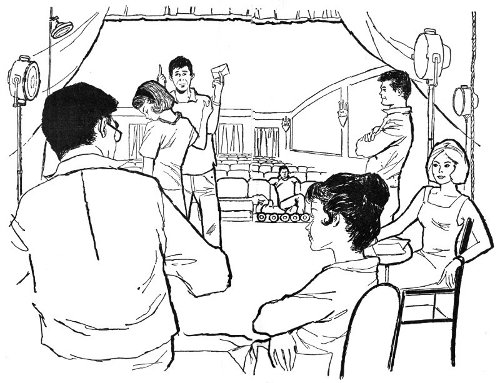
The last few whispers died when Mr. Macaulay
walked to stage center, bowed formally to the right,
the left and the center, and then unexpectedly sat
down on the apron of the stage with his legs dangling.
“The bows were your formal welcome to the Academy,
and I hope they take the place of a speech,”
Mr. Macaulay began. “I hate speeches. From now on,
we’re going to be informal and friendly, because
that’s the only atmosphere in which people can get
any work done. And you have a lot of work to do.
You will have physical work in which you will learn
to walk, to move, to dance a little, to stand up and to
sit down. You may think you already know how to do
these things, but you probably don’t.
80
“You will have mental work,” he went on, “in
which you will learn how to read a play, how to understand
the motivation of a character and his relationship
to the other characters. You will learn
elocution, voice projection, and a dozen other things
that have to do with speaking lines. You will learn
the history of the theater, become familiar with the
classic plays, and learn something about stage design
and construction. In this last area, you will pick
up the practical craft of making flats, painting scenery,
and wiring lighting—a type of pedestrian work
that has occupied the time of nearly every actor before
he was allowed to appear even in a walk-on role.
“And last, and perhaps most important,” Mr. Macaulay
concluded, “you will learn that the informality
and friendliness of the theater must not be mistaken
for lack of discipline; in short, you will learn how to
take direction!”
Still seated on the edge of the stage, Mr. Macaulay
called out his staff of instructors one by one, introduced
each to the students, and gave a short history
of each one’s background and qualifications for his
or her work. All were seasoned professionals, and
were very impressive to the students.
81
Mr. Macaulay also explained that leading performers
from the Broadway stage, movies, and television
would make regular guest appearances at the
Academy, as would outstanding directors, choreographers,
designers, and playwrights. The size of the
staff, in effect, was unlimited.
After this, the individual instructors spoke, each
saying a few words about his specialty and what he
hoped to achieve in his course. Each one, it seemed
to Peggy, opened up whole new areas of knowledge
for her, until at the end she felt that she knew absolutely
nothing at all, and wondered how she could
ever have thought of herself as an actress. This was
going to take a lot of work!
After the meeting, the rest of the morning was
spent in the routine of registration, getting class
cards, finding out where the rooms were, getting
locker assignments and book lists and, bit by bit,
eliminating the first sense of confusion.
Peggy and Amy, happily, were registered in the
same class, and went together through the busy
morning. Before they knew it, it was time for lunch
with Pip Piper and “some of the others.”
The others proved to be Connie Barnes, a cheerful
comedienne who managed to be wonderfully attractive
without being in the least pretty, and a dark,
muscular, tough-looking young man with a face like
either a private detective or a gangster in a grade-B
movie, who was introduced by Pip as Mallory Seton.
82
Much to Peggy’s surprise, when he spoke it was
not at all the tough, New York sound she had expected,
but a quiet, cultured English accent. “Call
me Mal,” he said. “Mallory’s rather a mouthful, isn’t
it? At least, it seems so here. At home, they used to
call me ‘Mallory John’ all the time, so as not to confuse
me with my father, who is named ‘Mallory
Peter,’ but I can’t imagine anyone in America doing
that. If I’d been brought up here, I’d probably have
been called ‘Bud.’”
Following Pip, the students walked around the
corner to stop in front of a narrow delicatessen store.
The sign on the window said, “Tables in the rear,”
but Peggy could see from the crowd that clustered
at the counter that there would be no chance of getting
one. And besides, the place didn’t look wide
enough to hold a table that would seat the five of
them.
“Oh dear,” she said, “I don’t think we’re going to
be able to eat here, there are so many of us. Perhaps
if Amy and I went somewhere else, you three would
have a chance? We don’t want to make it difficult for
you—”
“Don’t be silly,” Pip cut in. “We didn’t expect to
get a table here. You’re lucky if you can get a seat at
the counter for one, much less a table for more than
one. We’re going to buy sandwiches here and take
them to the park.”
Whipping out a notebook, Pip started to take orders
and money, with frequent reference to the
menu pasted to the delicatessen window. Then he
plunged into the place and, in less time than Peggy
thought possible, was back with a giant bag full of
sandwiches and cold, bottled drinks.
83
It was only two blocks to the southern boundary of
Central Park, and once they had crossed Fifty-ninth
Street and stepped into the tree-shaded, winding
footpath, the city seemed to disappear behind them
as if it had never been. At the foot of the first gentle
hill, there was a small lake bordered by a bench-lined
path. There were some empty benches, but
Pip ignored them.
“If you don’t mind walking a little farther,” he
said, “we have a favorite spot on the opposite shore,
where hardly anyone ever comes.”
The path brought them across a small arched footbridge,
through a thick copse, and out alongside a
broad lawn which ran down to the lake’s shore. It
was here that they chose to eat, sitting on the grass.
“Now that we’re comfortably settled,” Mal said, “I
have some great news for you, but first I think we
ought to tell Peggy and Amy what we’re talking
about, so they won’t feel left out of the conversation.
Connie, you tell them about the play.”
“Just a minute, Connie,” Pip interrupted. Then he
turned to the newcomers. “Do you know what the
term ‘Off-Broadway’ means?”
“Why, yes, I think so,” Peggy replied. “It means
you’re not using one of the regular, big theaters, and
you charge less admission, and—”
“More than that,” Pip broke in. “It’s generally an
experimental group—though that doesn’t mean necessarily
that it’s amateur, and one thing you can be
sure of—it never has enough money. Everybody has
to do a little of everything. Now go on, Connie.”
84
“Well, the three of us are in that kind of group,”
Connie started, “and we’re trying to produce a play
off-Broadway. We’ve been working at it for about
six months now, trying to raise the money and get a
theater and do all the rest of the work that goes into
these things. The play is called Lullaby, and it’s
terrific, or it will be if it ever gets produced. Mal’s
going to direct it, and I’m already cast as the comedienne,
and Pip plays opposite me. There are a few
more of us in it too, of course, and there’s Randy
Brewster, who wrote it and is producing it. But I
want to hear the great news before I talk any more.
What is it, Mal?”
“I don’t want it to be a shock,” Mal said, “so I’ll
say it very slowly. Randy has raised almost all the
money we need, and he’ll have the rest in a few days.
It looks as if we’re actually going to get this on the
boards this season—if we can find a theater for it!”
“Wonderful!” Connie breathed.
“Wow!” Pip exploded.
“But where did he get the money? What happened?
Do you know?” Connie asked.
“You remember the reading we did at that Park
Avenue penthouse a couple of months ago?” Mal
asked. “The one where all the people seemed so cold
and hostile, and we felt that we had made a miserable
botch of it?”
“Don’t tell me!” Connie said.
“All right,” Mal said, his tough features composing
themselves into a broad grin, “I won’t.”
85
“It’s only an Americanism, Mal,” Pip said eagerly,
“and it means ‘tell me.’”
“Oh, I would never have guessed,” Mal said innocently.
“Well, that was the reading that did it.
Actually, those penthouse people weren’t hostile at
all. It’s just what they consider good manners or
something. Anyway, several of them came through,
and we have almost all we need to put the play on.
And Randy says that once you have most of the
money, it gives other investors confidence, and they
come along, too.”
“How much do you need?” Peggy asked. “I
shouldn’t think it would take so very much to do an
off-Broadway play.”
“Those were the good old days,” Pip said mournfully.
“Nowadays you need at least ten thousand
dollars, which is still practically nothing compared
to what it costs to put a show on Broadway. You have
to pay high rent for theaters now, if you can find one
at all, and you have to spend money on costumes
and sets, because the public expects more from off-Broadway
than they used to. And you have to pay
your actors, or else Equity, which is the actors’ union,
won’t let you open. And you have to advertise, and
print tickets, and pay for lighting equipment and a
hundred other things. It all adds up to a lot of cash.”
“Will the backers have a chance of making
money?” Amy asked.
86
“Well, it all depends on the type of theater we can
find, and on the critical reviews of the play,” Mal
explained. “If the reviews are good, and if the theater
holds enough people, and if they keep coming
for long enough, there’s a chance. If any one of those
factors is lacking, then there isn’t a chance.”
“What’s the play about?” Peggy asked.
Connie frowned and said, “That’s kind of hard to
answer. It’s a comedy, but at the same time it’s a
serious play. I mean it’s serious in what it talks about,
but funny in the way it says it. It’s mostly about a
boy genius—”
“That’s me!” Pip interrupted.
“—who feels that the only way to get along in the
world is not to let people know how smart he is, because
people are jealous and suspicious of people
who are too smart. He meets a girl genius—that’s me—who
has come to the same conclusion. Both of
them try to act like ordinary people, and to adjust to
the world, because everybody says it’s best to conform
and be just like everybody else—”
“And one of the main problems is that neither one
of them wants to let the other one know that he or
she is any different,” Pip interrupted, “and that leads
to a lot of misunderstanding and—”
“And a lot of serious discussion under the comedy,”
Mal said, “about whether or not conformity
is any good, and what to do with outstanding people,
and how they can be educated, and how to use them
properly in the world. It’s a really first-rate play.”
“It sounds wonderful!” Peggy said. “Has this
Randy Brewster written any other plays? Who is he?”
87
“Randy has written lots of others,” Mal answered,
“but this is the first one that looks as if it’s going to
be produced. He’s a good playwright, and I think
he’s going to be a success. At least I hope so, because
if the play is well received, we all have a chance of
success too.”
“What does he do besides write plays?” asked
Amy.
“He’s a dancer and a singer,” Connie said. “He’s
been working in night clubs and on television, and
he’s good, but he has a real talent as a writer, and
we all agree that he’s wasted as just another song-and-dance
man. If you want to see him, you can
tune in to your television set on Saturday night. He’s
got a spot on the Road Show hour.”
“I haven’t got a television set,” Peggy answered,
“though I guess I could find one to watch, but I’d
like to do more than look in on this via TV. Is there
anything I could do to help with the show?”
“Well....” Mal began doubtfully, “we’re almost
all cast for it now, and the few parts that are open
aren’t exactly your type—”
“Oh, no!” Peggy said. “I didn’t mean to ask for a
part! Why, I’m just beginning here, and I don’t think
I’d be good enough at all! No, I meant that if you
need an extra pair of hands to make costumes, or to
paint flats or to sell space in the theater program,
I’m volunteering. I’ll run errands, or—”
“Me, too!” Amy put in. “Can you use a pair of
maids-of-all-work?”
88
“We sure can!” Connie said eagerly. “That’s the
hardest kind of people to find. I’m certainly glad that
Pip thought to ask you two to lunch!”
Mal looked quite relieved to find that he was not
to be put in the position of having to refuse more
actresses. Since word about the project had first gotten
out around the Academy, he had been besieged
with students who wanted to be in it, and the work
of casting and at the same time not hurting the feelings
of friends had been pretty difficult.
As they strolled back to the Academy, Mal told the
girls that there was to be a meeting of the theater
group that evening at Connie’s apartment, and invited
them to attend. “I know that everybody will
be glad to meet you, and you’ll get a chance to read
the play and to find out what we’re up against in
trying to produce it.”
After leaving their new friends in the school corridor,
Amy and Peggy went off to their first elocution
class, feeling as if they were really a part of the
Academy and the new life around them, and looking
forward eagerly to the meeting at Connie’s that night.
89
IX Theater Party
Connie’s apartment was not the easiest place to find,
but she had given detailed instructions, even to drawing
a little map on a paper napkin, and after only a
few wrong turnings, Peggy and Amy found themselves
that night at a low pink door set in a high brick
wall on a winding street in Greenwich Village. They
pushed the button marked “Barnes-Lewis,” and soon
an answering buzz let them know that the door was
unlocked.
Pushing it open, they entered, not a house, but a
narrow alley between two buildings. Along one wall
was a bed of flowers and green borders, and hidden
among them were small floodlights which gave a
gentle, guiding glow. At its end, the alley opened
into a little courtyard with a small fountain and a
statue of a nymph surrounded by canvas lawn chairs.
Fronting on it was an old, low, white-brick house, its
door opened wide. Connie came out to greet them.
“I see you didn’t have any trouble finding our
hideaway,” she said. “I must be a good map-maker.”
90
Tactfully refraining from telling her about the
wrong turns, Peggy and Amy agreed with her.
“What a wonderful place you have here!” Peggy
said. “However did you find it?”
“I didn’t find it,” Connie said. “I found Linda
Lewis, my roommate, which was a good deal easier.
She was already living here, and when her roommate
got married, she asked me if I’d move in.”
“And how did she find it?” Amy asked.
“Same way,” Connie laughed. “These places get
passed along from friend to friend. You could hunt
for apartments every day for a year and never even
see a place like this. You just have to know somebody,
or be lucky. I’d hate to show you the miserable
place I lived in before I moved in here.”
“Here” proved to be a spacious room with an extraordinarily
high ceiling and a fireplace with a tremendous
copper hood. An open stairway mounted
up one wall to a landing, then turned a corner and
went up again. The only other room downstairs was
a kitchen. Upstairs were two bedrooms and a bath.
“That’s the whole house,” Connie explained. “It
used to be a carriage house for one of the big places
on the street, before all the big places were turned
into apartments. Now come on in and meet everybody.”
91
Linda Lewis, Connie’s roommate, rose from the
piano bench to greet the girls. She had apparently
been playing until the bell had announced their arrival.
Linda was a tall, slim, rather plain girl with a
sweet smile who was a music student at Juilliard,
considered by most people to be the best music
school in the country. She greeted them shyly, and
returned to her place at the keyboard, where she began
playing quietly, as if to herself.
Pip rose from his seat on the raised hearth of the
fireplace to greet them and to introduce them to
his companion, a striking woman in her mid-thirties.
“This is Mona Downs. She’s in the play, too.”
Before they had a chance to do more than say
hello, Connie was introducing them to the last person
in the room, a handsome middle-aged man with
curly dark hair that had turned completely white at
the temples. His name was Thomas Galen, and he,
too, was a member of the cast.
“I suppose it’s terribly tactless of me,” Peggy said,
“but I don’t mean it that way at all. It’s just that I always
thought that these off-Broadway plays were
done entirely by students or—or—very young actors
and actresses. I mean....”
Mona Downs laughed. “Don’t feel embarrassed to
talk about our advanced ages. We aren’t supposed
to look like fresh young things!”
92
Tom Galen smiled in agreement. “We’re here because
Randy needed some actors for the more mature
parts, and we were lucky enough to be picked.
The off-Broadway plays are a good showcase for experienced
actors, too, you know. Take me, for instance—I’ve
been acting for a good many years now,
but I’ve never had any really good vehicles. I’ve
made a living on supporting roles and road shows,
and I’ve even played some good leads in stock, but
somehow I’ve never quite hit it. Maybe I’m not good
enough, but on the other hand, I may just not have
had the breaks. These off-Broadway shows nowadays
are seen by all the top critics in New York, and
if I do a good job, and if they like the play, I have a
chance to go on to a whole new kind of career. That’s
why I’m here, and that’s why Mona is here. Besides,
you can’t do a believable show with just young actors.”
“I see,” Peggy nodded. “And I hope you didn’t
mind my mentioning it....”
But before Tom Galen or Mona Downs had a
chance to reassure her again, the buzzer rang, and
they broke off.
“That must be Randy and Mal,” Connie said. “I’ll
go get them.”
She pushed the button to unlock the gate, and
opened the front door expectantly. A few seconds
later, Mal entered with a tall, grinning, engaging-looking
young man with flaming red hair. For a moment,
everyone seemed to be talking at once. Randy
and Mal were apologizing for being late; Connie was
saying that they weren’t late at all; Pip was trying
to get Randy away to introduce him to Amy and
Peggy; Mona and Tom were asking him about the
financing he had managed to get for the show, and
Linda was playing “Hail the Conquering Hero” in
loud, solid chords.
93
When the initial excitement had died down and
the last resounding notes of the piano had quieted,
Randy Brewster was introduced to Peggy and Amy
by an excited Connie.
“We’re having all the luck today!” she exclaimed.
“You come up with the backing for the play, and Pip
discovers these two wonderful girls who want to be
beasts of burden for the show!”
“The two prettiest beasts in New York, I’m sure,”
Randy said with a smile, and Peggy was positive
that she was blushing, though she tried her hardest
not to. “I’m grateful for your interest,” Randy continued,
“and I only hope that we have a chance to use
your help.”
“Why, now that you’ve raised the money, isn’t it
certain that the play will be produced?” Peggy asked.
“We have a better chance today than we had
yesterday,” Randy explained, “but it’s far from a sure
thing yet. You see, we have the central problem now
of trying to find a theater we can use. And I’m
afraid that’s going to prove to be a harder job than
raising the money, or even than writing the play in
the first place.”
“Mal and Pip and Connie mentioned the problem
of finding a theater a few times today,” Peggy said,
“but I didn’t know it was as serious as all that. Why
should there be such a shortage?”
94
“For a lot of reasons,” Randy answered. “And
there’s a shortage even on Broadway—maybe even a
worse one. Forty years ago, there were more than
twice the number of theaters in New York than there
are now, and every year we lose a few more. One
reason is the fire laws that make it illegal to have a
theater with anything built over it. In other words,
you can’t have a Broadway theater on the lower
floors of an office building; and with real-estate values
as high as they are in Manhattan, it just isn’t profitable
to use up all the space a theater takes without
building high up as well. Off-Broadway rules are a
little easier, but the downtown theater has become
so popular that everybody and his brother wants to
put on a play off-Broadway, and all the available
theaters are booked way in advance. Not only that,
but dramatic groups have rented almost all the
places that can be converted to theaters, and there
don’t seem to be any left for us.” Then, breaking his
serious expression with a sudden grin, he said, “But
don’t let it worry you. I’m trusting to luck that we’ll
find something.”
“I hope luck does it,” Peggy said doubtfully, “but
I’d prefer to trust in something a little more trustworthy!”
“If you have any ideas, I’ll be happy to hear them,”
Randy said, “but right now, we’d better get on with
this evening’s meeting and reading. I’ll talk to you
over sandwiches and coffee afterward, if you like.”
Peggy delightedly accepted, then found herself a
seat with Amy out of the way to watch the proceedings.
95
First, Randy told the assembled group about the
investment in the play, and about his hopes for the
small remaining amount they would need. Then,
having completed his report, he turned the evening
over to Mallory Seton, who immediately began the
readings with an authority and toughness that went
well with his rugged face.
Peggy observed carefully how Mal would interrupt
one or another of the actors, acting out a line
for him or her, or asking for a somewhat different
emphasis. Sometimes a small change in timing or
inflection would turn an ordinary line into an unexpectedly
comic one, and Peggy and Amy laughed
aloud several times.
Randy followed with his master script, every so
often stopping the action to make a change in dialogue.
“Sometimes a thing sounds fine when you
write it, but it just doesn’t read well,” he explained.
“That’s one of the main purposes of these early readings—to
let me have a chance to hear what I’ve
written and see if it plays.”
Other changes were made at the suggestion of one
or another of the cast, who found a line unnatural to
say, or somehow uncomfortable or out of character.
Randy listened to every suggestion, and took most
of them, but on one or two occasions he insisted that
the actors accommodate themselves to what he had
written.
96
Peggy was fascinated by the whole process, and
particularly appreciated the air of good will with
which changes in script, style of reading, and interpretation
of character were made. This was a company
of willing, hard-working friends, and they were
already molding the play in a joint effort. She was
sure that they would be successful.
At last the readings for the evening were completed,
and people started to say good night. Randy
brought Mal with him and said, “Why don’t you come
along for coffee and a sandwich with us? Peggy seems
to have some ideas about the theater problem.”
“Oh, no!” Peggy disclaimed. “Not really! I was
just wondering if—”
“Let’s wonder over coffee,” Mal cut in. “Come on,
Amy. Let them talk about the theater, and we can
talk about you!”
A few blocks’ walk brought the four of them to
a coffee shop where, seated around a tiny marble-topped
table, they studied the menu. To Peggy and
Amy it was a revelation. There were over twenty
kinds of coffee offered, most of which they had
never heard of, plus dozens of exotic pastries and
sandwiches. They finally settled, on Randy’s advice,
on cappuccino, which proved to be coffee flavored
with cinnamon and topped with a froth of milk, and
which was perfectly delicious. With it, they had an
assortment of amaretti—hard, sweet Italian macaroons
that came wrapped in gaily decorated tissues,
and cornetti—pastry horns filled with some creamy
whip.
“Now,” Randy said, when they were all served,
“what did you have in mind about a theater for us?”
97
“Well, nothing at the moment,” Peggy admitted,
“but I’m against the idea of just trusting to luck, the
way you said you were going to do. It seems to me
that some hard looking would get better results.”
“I agree, and I have been looking,” Randy replied.
“We have our names on the waiting lists of every
known off-Broadway theater in the city, and I call
regularly just to remind them that we’re serious
about it.”
“Have you been looking around for a place that
you might convert to a theater, too?” Peggy asked.
“We gave up on that. We found that it would cost
too much to do a decent conversion, and not only
that, but we’d be in the real-estate business as well
as the play-producing business, and we don’t want
that.”
Peggy nodded thoughtfully. “I see. Well, how
about all the theaters that you said used to be in
existence forty years ago? What’s happened to all of
them? Maybe some of them are just sitting around
and not being used.”
“Oh, they’re being used!” Randy laughed.
“They’re being used as movie houses and television
studios and ice-skating rinks and churches and even
supermarkets.”
“Have you looked at them all?” Peggy pursued.
“Well....” Randy said, “maybe not all, but....”
“Then that’s what I’m going to do for you first!”
Peggy announced with determination. “I’ll go look
at them all, and maybe I can find some usable place.
At least, I’m willing to try.”
98
“But, Peggy,” Mal put in, “you don’t know anything
about New York at all! It’s not like Rockport,
Wisconsin. It takes a lot of looking, and you have to
know where to look. How will you start?”
99
“I don’t know just yet,” Peggy answered, “but I’ll
think of a way. I used to help out as a reporter on
my father’s newspaper, and I’m used to digging up
facts. If there’s an empty theater in New York City,
I’ll bet I know about it in a couple of weeks. If
there isn’t one, I’ll know that too, and at least that
will save the rest of you all the trouble of looking.”
100
Randy looked a little doubtful. “I’m sure that you
mean what you say, and I don’t doubt that you can
get things done as well as any of us, Peggy, but as
Mal said, New York isn’t Rockport. And I don’t mean
just that it’s bigger. It’s not a—well, a nice city in
every part. And a search like this can lead you into
some pretty tough parts of town.”
“Oh, pooh!” Peggy said. “In the last two weeks,
I’ll bet Amy and I have walked around more of
New York than either of you has in the last two
years! And that included some pretty tough-looking
neighborhoods, and nobody bothered us, and
everybody was very nice. I think that’s a lot of
nonsense! Besides, we’re big girls, and we can take
care of ourselves by now.”
“We certainly can,” Amy agreed. “And I plan to
go, too, just the way I’ve dragged my aching feet
after Peggy for two weeks now. That girl can cover
more territory in a morning than a Tennessee Walking
Horse can manage in a whole day!”
“Well, if you really want to try, it’s okay with me,”
Randy said. “And I’m grateful to you for wanting to.
If you need any help along the way, be sure to ask
for it.”
“You can start by giving me a list of all the places
you’ve gone to, so I won’t waste my time, and I’ll
take it from there.”
101
Randy promised to bring the list to the Academy
the next day, at which time, if it was okay with
Peggy and Amy, he would like to join them for lunch.
Then their interest turned to other things, including
more coffee for the girls and another huge sandwich
to be split between the boys.
By the time they had finished and walked to the
Gramercy Arms, it was nearly midnight. Peggy and
Amy whispered quiet good nights on the stairs, and
hurried up to bed. Tomorrow was school again, and
they needed all the sleep they could get.
102
X Peggy Produces a Plot
“Peter Piper picked a peck of pickled peppers; a
peck of pickled peppers Peter Piper picked; if Peter
Piper picked a peck of pickled peppers, where’s the
peck of pickled peppers Peter Piper picked?”
“A perfect peck of pickled peppers, Peggy,” said
Miss Linden, the elocution instructor, “except that
you picked them a trifle too quickly. That’s the big
temptation of tongue twisters; you always want to
show that you can rip them out at great speed without
making a mistake. What I want you to do this
time is to say the same thing, but to concentrate on a
normal rate of delivery that will allow your voice to
carry to the rear of a hall without becoming blurred.
Distance, you know, tends to make sounds run together.
Now, Peggy, if you don’t mind....”
More slowly this time, and concentrating on making
her words reach the back of some huge, imaginary
hall, Peggy once more spoke the tongue twister.
103
“Much better. Much better,” Miss Linden approved.
“Now, John, will you please read ‘round
and round the rugged rock the ragged rascals ran,’
and try to read it as if it had a meaning, as if those
ragged rascals were at the end of their endurance,
as if you were one of them, almost. Make the words
clear, project them, and at the same time give me a
note of urgency and a feeling of near-exhaustion.”
John, a handsome boy whom Peggy had already
judged vain and stupid and who, she suspected, had
gone into acting on the strength of his appearance,
struggled with the assignment. Peggy tried to maintain
an interest in what he was doing, but her mind
was on her coming lunch meeting with Randy
Brewster.
What on earth was she going to suggest? Why
had she volunteered to undertake the search for a
theater with such confidence? It had been bothering
her since she had awakened this morning, and the
more she thought about it, the less likely it seemed
that she would come up with an idea worth pursuing.
Still, there must be some angle that Randy and
Mal hadn’t thought of, some idea that would occur
to her, with her reporter’s training, that had escaped
them. That all sounded very good, she commented to
herself, but what was the angle? Miss Linden’s tongue
twisters were child’s play compared to this puzzle.
Before her turn came to read again, it was time for
the elocution class to end and time to go, empty-headed,
to meet Randy. Peggy had never in her life
felt so stupid, nor so embarrassed, for having made
the boast last night that she could find what they
had missed.
104
Amy, sensing the reason for Peggy’s gloomy silence,
didn’t question her about it. Without a word,
the two girls moved through the crowded corridor to
the elevators, rode downstairs, and stationed themselves
at the front door. Finally Peggy spoke.
“Oh, Amy, I hope he doesn’t think I’m a complete
fool! I like him so much, and I’ve made him take this
special trip to bring me his list of theaters, and if I
don’t come up with an idea that makes sense, I won’t
blame him for thinking I’m a dope!”
“Are you trying to find a theater or a boy friend?”
Amy asked with a sly smile.
Blushing, Peggy stammered, “Why, Amy, I ...
I just met him last night ... the same as you ...
and ... Oh dear! Here he comes now, and I look
like an embarrassed lobster!”
“Don’t worry,” Amy said with a laugh, “with his
red hair and your red face, you make a lovely couple!”
Before Peggy could answer, Randy had reached
them and either did not notice, or gallantly pretended
not to notice Peggy’s confusion. He greeted
them with a smile, and gaily waved a large paper
bag.
“I took the liberty of ordering for you, ladies,” he
announced in the manner of a musical-comedy headwaiter.
“The caviar, pâté de foie gras, and pheasant
under glass are not of the best quality today, so I
decided instead to get ham on rye, pickles, and
potato chips. I also have two cartons of milk of a
superior vintage. We dine on the terrace by the lake.”
105
In the laughter, Peggy regained her self-possession,
and the three of them started for the park
where, Randy told them, they would be joined by
Pip and Connie.
At the mention of Pip, Amy said, “I was wondering
how, with a name like Peter Piper, Pip ever got
through that tongue-twister stuff. It must have been
terrible for him!”
“Ask him to do it for you sometime,” Randy replied.
“He’s learned that the best defense is a good
offense, so long before he came to the Academy he
had that one perfected. He can do Peter Piper in
any accent or dialect you ask, and can even do it in a
rapid-fire stutter! It’s funny enough so that nobody
ever kidded him about it. In fact, he’s got it worked
up into part of a first-rate comedy bit.”
On their arrival at the lawn by the lake, they
found that Randy had brought a large paper table-cloth
and some oversized paper napkins for the girls
to sit on. As she helped set out the lunch, Peggy was
impressed by this extra display of thoughtfulness,
and felt that she had been right in thinking Randy
Brewster was a special kind of person. She had just
finished setting the “table” when Connie and Pip
joined them and added their own lunches to the
spread.
106
When they were all settled comfortably, Randy
opened the conversation with the question that
Peggy had been fearing all morning. “Well, Peggy, I
brought the list of theaters we’ve seen, and now will
you tell us what you have in mind?”
Much to her surprise, Peggy found herself answering
as smoothly as if she had known all along
what she was going to do. “The first thing,” she
said, “is to make use of all the city records. Since a
license is required to operate a theater, there must
be a list of all the places in the city that have been
licensed. I’m going to go to City Hall, find the list,
and copy the names and addresses of every theater
that has been opened in the last fifty or sixty years.”
107
“Are you sure the city will let you see the records?”
Connie asked.
“Of course,” Peggy answered. “They have to. Anything
in the city files that doesn’t concern individuals
is a matter of public record. I learned that from my
father. He always said that the city or town archives
of any place were the best reference books a reporter
could want.”
“I think that makes good sense, Peggy,” Randy
commented. “But it’s going to be a long list. What
are you going to do when you’ve got it?”
“I’m not sure,” Peggy admitted, “but I think the
best thing to do would be to cut the list down before
I start to work with it.”
“I see,” Randy said. “That’s why you wanted the
list of theaters we’ve already visited, so you could
eliminate them.”
“Right. The next thing to do, I think,” Peggy went
on, with a dreamlike feeling that she did not know at
all what she was going to say next, “is to look up
theaters in the classified telephone book. All the ones
that are listed, I’ll eliminate from my list, on the
theory that they’re probably being used by somebody
right now.”
“Peggy, you’re a smart girl,” Pip said admiringly.
“You sure are,” Connie echoed.
“I won’t dispute that,” Randy agreed, “but I’m still
a little puzzled. When you’ve eliminated all the theaters
listed in the phone book from the theaters listed
by the license bureau, what will you have?”
108
“What I’ll have,” Peggy said triumphantly, “is a
record of all the places in New York that started out
to be theaters and aren’t theaters now!”
“Wonderful!” Amy said. “Then you and I will go
to visit all the addresses and see if any of the places
aren’t being used, and if they’re for rent!”
“It makes a lot of sense,” Randy admitted. “But
you know, it’s going to take a lot of work and a lot of
walking. And disappointment, too. You won’t be able
to find even a trace of many of those theaters.”
“On the other hand,” Peggy answered, “we may
be able to find a hidden theater that nobody even
knows is there! And wouldn’t that be grand?”
“I can see it all now,” Pip said in a hollow voice.
“A huge, haunted opera house of a theater, its hangings
in tatters, its chandeliers covered with dust and
its stage peopled by the ghosts of players long gone!
There it sits, undiscovered, unknown, hiding behind
a Chinese restaurant just a block east of Broadway!”
“Don’t tease her, Pip,” Randy said. “I think Peggy
has a good idea, and it would be a pity to discourage
her before she gives it a try. Maybe she won’t find a
theater, but at least this is the most sensible way I’ve
heard of yet to start looking for one.”
A little shamefaced, Pip said, “I didn’t mean to
tease. You know me; I always want to turn everything
into a comedy routine. But, seriously, I think
this makes sense and, Peggy, if you need any help
in tracking down places, you can count on me!”
109
All the others chimed in their agreement, and
Peggy thought proudly, and with some surprise, that
she had gotten herself out of a spot quite well. At
least Randy didn’t think she was a fool, and that
was something to be pleased about.
When lunch was finished, and the last crumbs had
been fed to the ducks, it was time to return to the
Academy. Peggy said good-by to Randy and went up
to her afternoon’s work.
Only by dint of the most intense concentration on
the study of Elizabethan drama did Peggy keep her
attention from the theater-hunting problem. But the
minute the class was ended, all other thoughts fled
from her mind. “Come on, Amy!” she said. “I’m heading
for City Hall right now!”
“I’m sorry, Peggy,” Amy said, “but you’ll have to
count me out today. I didn’t know that you’d have
any plans, so I made a date to have a soda with Mallory
Seton. I’ll go with you tomorrow, though.”
“And you accused me of looking for a boy friend
instead of a theater!” Peggy said with a grin. “If
anybody around here should blush, I think it’s you,
Amy Shelby Preston!”
“Why, Ah don’t know what yo’ talkin’ about!”
Amy said, in her best Southern belle manner. “Mistah
Seton asked me to join him, an’ Ah scarcely
thought it would be ladylike to refuse the gentleman!”
Then both girls dissolved into very unladylike giggles,
and Peggy made a dash for the elevator. “See
you tonight,” she called.
110
XI Rehearsals
“So. ’Ow marches the search for the theater, Peggee?”
Gaby asked, bouncing into the living room at
the Gramercy Arms.
“Awful,” Peggy admitted, looking up at Gaby
from her position on the floor. She was surrounded
by scraps of paper, pencils, a classified telephone
directory, and several assorted notebooks, guidebooks,
and city maps. “I think it would be easier to
list all the perfume shops in Paris than all the theaters
built in New York since the nineties.”
“Perfume shops! Pouf!” Gaby shrugged. “We
don’t ’ave so manee. Most of our perfume is export,
to Amérique. But theaters! Oh! You would ’ave the
same trouble in Paree as you ’ave ’ere. So, bonne
chance; mean to ’ave the good luck.” With a wave of
her hand she went upstairs.
“A little bonne chance is what I could use right
now,” Peggy confessed to Greta, Maggie, and Amy,
who were disposed in various chairs with books and
magazines.
“Anything I can help you with?” Maggie asked.
111
“No, thanks, Maggie. I’m through the help stage.
Amy and I have spent every afternoon for the last
three days just trying to get a list of theaters from the
city archives. It’s not that they’re not helpful down
there. Everybody has been just as nice as can be, but
nothing’s easy to find. In the first place, all the records
aren’t kept in one big handy book, or in a list or anything
simple. Oh, no! They’re in dozens and dozens
of volumes marked by year, and we’re trying to go
back about seventy years. Not only that, but the
books aren’t separated by kinds of licenses, so that
you can’t just get a volume of theater licenses. You
have to look at each page to see what’s been licensed.
There are groceries and bakeries and amusement
parks and drugstores and hardware stores and livery
stables and saddlemakers and—”
“Well, at least you’ve gotten into the early years,
I see, if you’re on livery stables and saddlemakers,”
Greta commented.
“You’d think that it would be easier,” Maggie murmured.
“I mean, if you wanted to find out what year
the Ziegfeld Theater was licensed, for instance,
would you have to go through all that?”
“Oh, no,” Peggy answered. “They have an alphabetical
index by name, and you could go right to it.
But we don’t know the names of the places we’re
looking for, and that’s what makes it so difficult.”
112
“Even so ... what if the police needed to know,
for example, and they had to know really fast? Suppose
they wanted the names of all the theaters?
Would they have to do what you’re doing?” Maggie
asked.
“No,” Peggy answered, “and that’s one of the
things that makes this so frustrating. The Police Department
has all its own files, and the clerk who’s
been helping us says that we could find out what we
want to know from them in no time at all.”
“Then why...?” Greta began.
“Police files are for the use of the Police Department
for police business,” Peggy interrupted. “We’ve
been told that very emphatically.”
“And there aren’t any exceptions,” Amy added,
“so poor Peggy and I have had to make our own police
files.”
“And what’s worse,” Peggy went on gloomily, “is
the hours we’ve had to work at it. The bureau closes
at four-thirty sharp, and isn’t open on Saturday, and
we’re busy with school all day long. Amy and I don’t
finish with our last class until three o’clock, and
then we make a mad dash downtown. That gives us
about an hour a day to go through the books.”
“How close are you to finishing?” Greta asked.
“That’s the happy part. We finished 1890 today,
and that’s as far back as we’re going to go, unless
this batch turns up nothing for us. Then, I suppose,
we’ll try another ten years before we quit. My guess
is that anything built before 1880 wouldn’t be worth
looking into anyway. If it were still standing, it would
probably be an old rat’s nest.”
113
Maggie smiled. “Don’t let May Berriman hear you
say anything like that. This beautiful old house that
we’re living in was built in 1878, and it’s hardly a
rat’s nest! And you’ve passed the house that Washington
Irving lived in, just a few blocks south of
here? It’s still a fine-looking house, and I don’t know
how old it is, but Washington Irving died in 1859,
so it’s got to be a lot older than that!”
“Oh, Maggie!” Peggy wailed. “You haven’t made
me feel the least bit better! I thought I had a logical
date to stop looking, and that made things easier
somehow. Now you’ve opened up the whole thing
again!”
“Oh, don’t start to feel sorry for yourself yet,”
Greta put in. “You have a lot of work to do on the
theaters you’ve found since 1890 before you start to
think further back. And you may find just what you
want in that list.”
“I sure hope so,” Peggy agreed, smiling wanly.
“But I’ll never find it by lying here and talking. I’d
better get back to work.”
“Oh, no, you don’t!” Amy said. “What you’d better
do now is go upstairs and take a shower and fix
yourself up! Don’t forget it’s Friday night, we’ve got
a date tonight, and you have a lot to do before the
boys come.”
“But, Amy, it’s still early, isn’t it?” Peggy asked.
Then, with a glance at the grandfather clock in the
corner, she gasped. “Oh! Six o’clock already and
they’re coming at seven! And I haven’t even begun!
Why didn’t you tell me?”
114
Sweeping up all her papers, notebooks, and other
gear in a single gesture, she bounced out of the room
with Amy right behind her, protesting that she
hadn’t realized herself how late it had grown, and
that she too had a lot to do to get ready, and....
But before she could finish her sentence, Peggy
had dropped her papers, grabbed a towel and bathrobe
and raced for the bathroom. With the door held
open the merest crack, Peggy peeped through, grinning
broadly at Amy, who stood in the hall still
apologizing.
“You’re forgiven,” Peggy said impishly, “but your
punishment for loafing and not watching the time
while I was working is that I get the bathroom first!”
Then she quickly shut the door before her friend
could push her way through.
“I don’t care!” Amy called through the door. “I
can always use the other one upstairs!”
“You can,” Peggy answered with a laugh, “if you
can figure a way to get Irene the Beautiful Model
out. She always goes in at six o’clock, and it would
take an atomic bomb to get her out before seven!
You’ll just have to wait for me!”
Any further conversation was made impossible by
the noise of the water running, and Amy resigned
herself with a philosophical sigh, telling herself that
it was probably better for Peggy to go first anyway,
because she always finished quickly, as if that made
a difference, which, of course, it did not.
115
The timing, however, must have made sense in
some mysterious way, because both girls were ready
at precisely the same moment. It was at the exact instant
that the grandfather clock began to chime
softly that Amy and Peggy both stepped from their
rooms into the hall and said, in chorus, “You look
lovely! How do I look?”
Laughing at themselves, each girl whirled around
and showed herself to the other. Peggy’s turn made a
wide sweep of her black taffeta dress with its black
satin cummerbund smartly making the most of her
trim figure. For this special occasion, her first real
date in New York, she had put her hair up and skillfully
used a little eye make-up. Her long, slender
neck was accentuated by a single string of pearls,
which were echoed by her tiny pearl earrings.
Amy had chosen to set off her pale, blond beauty
with a brocaded dress of dark, lustrous green that
seemed to add a green glint to her brown eyes. She
wore a delicate, flat gold necklace, small gold earrings
and a slim, antique gold bracelet set with semiprecious
stones.
As Peggy fastened a hook and eye for Amy (it was
located in that one spot that just cannot be reached),
the last notes of the clock sounded, followed immediately
by the sound of the doorbell.
116
“That’s Randy and Mal now!” Peggy said. “We’re
all so prompt that it’s hardly possible!” She ran down
the stairs to answer the door, Amy at her heels, and
a few minutes later, the four were strolling down the
street arm in arm.
“You sure look beautiful tonight—both of you,”
Randy said. “I’m glad that I decided to wear a tie!”
“If you hadn’t, I’d have sent you right home to get
one,” Peggy said firmly. “And besides, you did say
that we should dress up for dinner and dancing.
That is, if you’ll put up with me. I’ve never danced
with a professional dancer before.”
“Oh, I’m not a dancer, really,” Randy said. “I’m a
hoofer. You know, tap and soft-shoe and a couple of
gestures and turns that make the customers think I
studied ballet. Mostly I dance just enough to carry
off the singing, so that the act will have a little movement.
I hate singers who just stand there and croon.”
“Where did you study singing?” Peggy asked.
“Oh, I’m not really a singer,” Randy said with a
grin. “I just sing enough so the customers won’t notice
that I’m not dancing well!”
“I’d love to see you work and make up my own
mind,” Peggy said. “When can I get a chance?”
With an expression halfway between a smile and
a frown, Randy answered, “I hope that you never
get a chance. I’m not working now, and with any
luck, I won’t have to do night-club work again.
I’ve always wanted to write for the theater, and I
believe in the play we’re doing now, so I’ve turned
down all engagements until we get it produced. It
may be the break I need. I’ve been able to put away
enough to live on for a while, so I don’t need the
night clubs. If the play flops, though, I can always go
back to them, much as I don’t want to.”
117
“In that case, I hope I never get a chance to see
your act, too,” Peggy said.
“A sensible wish!” Mal put in. “I’ve seen it, and I
tell you, as a singer and dancer, Red Brewster—as
he bills himself—is a darn good playwright. I won’t
say it’s the worst night-club act in New York,
but—”
“I know,” Randy interrupted cheerfully, “but it
is.”
“But he makes a living at it,” Amy protested, taking
the lighthearted insults a little too seriously.
“Just proves an old contention of mine,” Mal answered
airily, “that the public has a lot more money
than taste!”
By this time, they had reached Fourteenth Street,
a wide, busy thoroughfare bright with neon lights and
gaudy store windows crammed full of bargain merchandise.
It hardly looked the sort of neighborhood
to come to dressed as they were, and for a moment
Peggy had a feeling that Randy hadn’t been joking
about coming without a tie. “Where are we going?”
she asked cautiously, not wanting to offend the boys.
Randy laughed. “I wondered whether or not you
knew about Fourteenth Street. Since you’re so deep
in the history of the theater, I thought that we’d take
you right into some. This run-down street was once
the heart of the fashionable theater district!” He
waved a hand to indicate the tawdry movie houses,
the corner hot-dog stands, the poolrooms, the pizza
places.
118
“This?” Peggy said.
“This,” Randy answered solemnly. “And the
funny thing is that this is far from being a bad neighborhood.
Especially when you compare it with some
of the places you’ll be visiting in the next few days!”
“You see that movie house?” Mal said, pointing to
a place plastered with signs for a double horror
monster show. “That was once the most famous
musical theater in the city. And the Irving Theater
over there was a great dramatic showcase.”
“But why are we here tonight?” Amy asked in bewilderment.
“To show you that, in the ashes of the past, a
good bit of the past still flourishes with no sign of
decay,” Mal intoned dramatically.
“He means,” Randy interpreted, “that we’re here
to eat dinner at Luchow’s, one of the best restaurants
in the city. It’s German, not Chinese, and you pronounce
it with a German ch that sounds like a
cough, if you can. If you can’t, you settle on ‘Loo-shau’s,’
which most people do. It’s been here since
the theater district was here, and it hasn’t changed
at all through all these years. Diamond Jim Brady
and Lillian Russell and Tony Pastor ate here, and
tonight we’re going to do the same!”
With a bow and a flourish, Mal and Randy opened
the doors and led the girls into, not just a restaurant,
but another century and another world.
119
XII Intermission
Peggy had never seen anything like it! The tremendous,
high-ceilinged rooms paneled in darkly polished
brown wood led in a seemingly endless procession
from one to the other, connected by arch
after arch. In front of them, across the first room,
four steps mounted up to a kind of gallery, itself an
immense chamber that stretched back as far as one
could see. In the front of the gallery, near the steps,
a small, three-piece orchestra played Viennese waltz
music. Peggy noted with amusement that the three
musicians looked as old as the restaurant, almost as
if they had been playing ever since opening night.
To the right, an oversized archway connected the
room they were in with what appeared to be the central
room of the place, even higher and more glittering
than the others. Peggy’s eyes mounted up toward
the ceiling, which appeared to be three or more
stories high, and she saw that it was a kind of old-fashioned
leaded glass skylight.
120
Another arch between the rooms contained the
largest ship model that she had ever seen. It was a
full-rigged ship and stood easily six feet high. Everything
here was on such a large scale! Even the beer
steins that stood all around on shelves high on the
paneled walls were immense. Some would easily hold
two quarts of beer.
Everywhere were waiters scurrying about between
the crowded tables, carrying trays loaded
to improbable heights with dishes, glasses, covered
serving vessels, baskets of bread, rolls, and cheeses.
The whole place glittered with hundreds of lights,
each caught and reflected in the tall mirrors, the
glassware and the polished wood.
And the noise! The many conversations, the clink
of silver on dishes, the rattle of glasses, the waltz
tunes of the small orchestra, all blended into one
happy, congenial roar.
Peggy and Amy stood dazzled by the sights and
sounds of Luchow’s, and tried to get their bearings,
while Randy and Mal checked their reservations
with the headwaiter. Soon they were assigned by this
impressive personage to a lesser headwaiter whom
Peggy thought of as their guide. This gentleman,
beckoning them to follow, plunged into the jungle
of tables and, in a kind of safari fashion, they
tracked him through several rooms, up some steps to
a gallery like the one on which the band was playing,
and to a large round table by the rail.
121
It was not until they were seated that Peggy realized
that there was not an endless number of rooms,
but only about six. The illusion was caused by giant
mirrors on either wall, set in arched frames like the
arches that separated the rooms. Even so, it was the
biggest and busiest restaurant that either she or
Amy had ever seen.
“Well, what do you think of it?” Randy asked.
When Peggy replied with a smile and a bewildered
shake of her head, he continued, “I know. It always
affects me that way, too, but I still love to come here.
This is what New York was really like in the Gay
Nineties, and they haven’t changed a thing that they
didn’t have to change. Even the lighting fixtures,”
he pointed out, “are the original gaslights, except
that they’ve had to wire them for electricity. But the
best thing is—as it should be—the food. That hasn’t
changed either. Let’s order now, then we can talk.”
The menu, Peggy thought, was of a size to match
the restaurant, and it was crammed with dishes she
had never heard of, most with German names, many
with British names. At Randy’s suggestion, she let
him order her dinner, which was sauerbraten, the
house specialty. Amy, less adventurous about food,
settled for roast beef. Randy ordered a lobster for
himself, and Mal asked for roast larded saddle of
hare, which made Amy shudder a little.
“I just don’t like the idea of eating rabbits,” she
explained. “They’re such cute little things!”
Mal grinned. “If you once start to think like that,”
he said, “you’d have a hard time eating at all. Think
about all those cute lambs, and those nice, sweet-tempered
cows. And think about—”
122
“I do my best not to think about them,” Amy interrupted,
“and if you don’t stop, I’m going to order
a vegetable dinner and have an awful time!”
Still, when the food came, she and Peggy consented
to try the hare, and were forced to agree that
it was one of the most delicious things they had ever
tasted. Amy also liked Peggy’s sauerbraten, which
was a kind of sweet-and-sour pot roast of beef, done
in a rich brown gravy and served with potato dumplings
and red cabbage.
“You know, it’s an odd thing the way Americans
eat,” Mal said between bites of the saddle of hare.
“I’ll wager that there are millions of people in this
country who have never eaten anything but beef and
pork and perhaps a bit of fish. And I don’t mean poor
people, either. I found out on my first tours here that
there are many parts of the country where you can’t
even get lamb or veal, and mutton is almost unheard
of.”
“Is it very different in England?” Peggy asked.
Randy answered before Mal had a chance to reply.
“In England they eat things that would make the
average American turn pale with fright.” He laughed.
“They eat suet puddings and kidney pies and
chopped toad....”
“Chopped toad!” Amy almost shrieked.
“It’s not at all what it sounds,” Mal explained in
his most British tones. “It’s actually a sort of a hamburger
thing, and it’s not made of toads or anything
like toads. And, personally, I can’t stand it.”
123
“Is the food the reason why you left England?”
Amy asked teasingly.
“Partly,” Mal said with a smile. “But not because
I didn’t like it. I liked it well enough when I could
get it. The reason I left was that I wasn’t able to
earn enough money to eat with any degree of regularity.
When I got a part with an American movie
company that was filming a picture in England, I
was asked to come back with them, and I jumped
at the chance. I made a few films in Hollywood,
and then I decided to come to New York.”
“Why did you leave pictures?” Peggy asked. “I
mean, if you were working, and if you were starting
to be an established actor, why did you come to the
Academy to study?”
“I didn’t like the roles I was being given,” Mal
answered. “It’s because of my face, you know. I
look like a young thug, so I was given nothing but
young thug parts. But, when you come to think of
it, how many roles are there for young thugs with
English accents? Besides, I didn’t want to spend the
whole of my life in cops-and-robbers films. I decided
that I should try the stage, where I might have a
chance to play a variety of roles. Also, I thought I
might like to direct. The trouble was that I had no
experience with stage technique, so I applied to the
Academy for a year of basic training. It was there
that I met Randy, who has given me my first chance
to direct, and now that I’ve had a taste of it, I know
that’s what I really want to do.”
124
“It’s nice of you to say that I’ve given you a chance
to direct,” Randy put in, “but unless Peggy and
Amy can produce a theater, I’m afraid that the
chance will be a strictly imaginary one. Which reminds
me, how are you girls doing with the search?”
Peggy told him about the troubles they had encountered
in making up a list, and he nodded sympathetically.
“We’re finished with that part of it
now,” she said in tones of relief, “and we only have
to finish checking against the phone book before we
go out to look.”
“And when will you start?” Randy asked.
“Tomorrow afternoon, I think,” she said. “We
ought to be done with the telephone book by noon,
if we don’t sleep the whole morning away as a result
of this heavy dinner. Then we can look in the afternoon.”
“Sounds good,” Randy said. “It looks as if the best
help we can give you is to see to it that you work off
this dinner so that you don’t waste the morning in
sleep! What do you suggest, Mal?”
“Dancing,” Mal said firmly. “Best way to get rid
of the full feeling. But, unfortunately, I can’t dance
on an empty stomach, so we’d best order a sweet,
right?”
The girls and Randy protested with groans, but
somehow managed to eat every scrap of the thin
pancakes with lingonberries that Mal ordered for
them. A final cup of coffee, and then it was time to go.
125
“I feel as if my dress is going to split any minute!”
Peggy whispered to Amy. “I don’t know if I’ll be able
to walk to the door, much less dance!”
Stepping out of Luchow’s, leaving its noise, gaiety,
and glitter behind, was once more like making a
transition between worlds. Fourteenth Street, now
almost deserted, looked even sadder and more run-down
than before. The night lights in the windows
of the closed shops cast baleful gleams on the pavement;
the thin sound of a cheap dance band far off
lent its sad jazz beat to the relatively quiet night.
Peggy shivered a little in the first chill of autumn.
“It’s like two different cities, in there and out
here,” she said. “It’s a shame, isn’t it, that the real
one is out here?”
Catching her mood, Randy put a reassuring arm
about her shoulders. “It’s two hundred different
cities,” he said, “and the real one is wherever you
happen to be at the moment. So let’s leave this one,
to make it unreal, and go uptown. By the time we
turn our backs on this, it will disappear.”
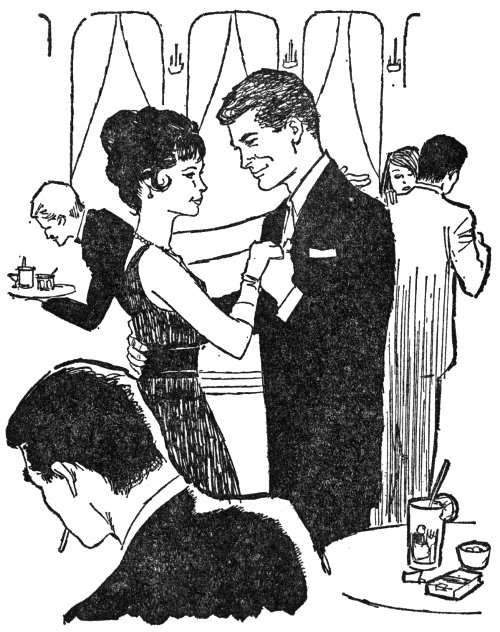
And it did disappear, or nearly, in the sophisticated
decor and subdued harmonies of the St. Regis
Roof. Randy was, as Peggy had suspected, a fine
dancer. His lightness and his certainty helped her,
and she knew that she had never danced so well
before. But even as they floated about the gleaming
floor, the sounds of the elegant music could not
quite drown out the tinny jazz sound of Fourteenth
Street that echoed in her mind.
126
No, she thought, Randy had not been altogether
right. This beautiful room, these handsome, well-dressed
people were not nearly so real as the world
outside. And it was that world, in which she would
start her search tomorrow, that stayed uppermost in
her thoughts through the rest of the dreamlike night
with its dancing, its carriage ride around the park
and (or was this too a dream?) Randy’s gentle
good-night kiss on the steps of the Gramercy Arms.
127
XIII The Hidden City
When the list was completed, Peggy had found
over forty theaters built since 1890 and not currently
listed as theaters in the classified phone book.
Now there was nothing to do except visit each one to
see if it was still there at all, and if there, to see what
it was being used for. Checking the addresses
against her city map and street-number guide, Peggy
listed those that she would visit first.
“I’ve started out with a group I think we can cover
in one afternoon,” she explained to Amy. “And the
district I’ve picked is not too far away from most
of the off-Broadway theaters in Greenwich Village.
I’d like it best if we could find a theater near where
people are used to going, or at least in districts that
are easy to get to by bus or subway.”
“Don’t worry too much about that,” Greta commented
from the depths of an easy chair. “If you
can just find a place to put on the play, and if the
play is good, people will come. Even if they have to
walk, or pay tremendous cab fares. That’s one wonderful
thing about New York. People love the theater,
and they’re willing to go through all kinds of
hardships to see a good play.”
128
“The proof of that is the prices people pay to see a
Broadway show,” Amy agreed. “Six and eight dollars
a seat for some of them!”
“And that’s at box-office prices,” Irene commented.
“They pay twenty-five dollars to a ticket
broker sometimes to see a really popular show. I
think that the thing to be in this business is a broker,
not an actress. That’s where the big money is!”
“We’ll remember that when we get our theater,”
Peggy said, laughing. “I’ll put aside a whole lot of
seats in my name, and if the show’s a hit I’ll make a
fortune on them!”
“No theater, no tickets,” Amy said dryly. “And no
show either. We’d better get going now.”
The area that Peggy had decided to cover first
was a section south of Fourteenth Street, and somewhat
farther east than where they had been. This
was an old part of town, in which the theater had
once been centered even before it had moved “uptown”
to Fourteenth Street. (Fourteenth Street itself
is now very much downtown from the present theater
district in the west Forties and Fifties.)
This old district had seen wave after wave of immigrants
come from various lands. Each nation had
left its mark. There were Russian stores, Rumanian
restaurants, Irish bars, Jewish delicatessens, Italian
grocery stores, and Spanish shops of all sorts.
129
“It’s like looking at a cross section of certain kinds
of rocks,” Peggy said. “You know, the kinds that give
you a million-year history of the earth and the kinds
of life that have come and gone. Finding all these
traces of different languages and peoples is sort of
like geology.”
“Yes,” Amy agreed, “and you can tell pretty well
which groups came to the neighborhood first and
which ones followed, and which are the latest. I’d
say the Irish were first, and then the Rumanians and
the Russians, a lot of whom were Jewish, and finally
the Puerto Ricans. Look at that store!”
She pointed to an old building with store windows
lettered “Carnecería,” which is Spanish for
“butcher shop.” Over the windows was a faded old
signboard which the present tenants had neglected
to remove. Its gilt letters, nearly illegible, read,
“A. Y. Ravotsky, Inc.,” and on either side of the lettering,
carved into the wood, was an Irish shamrock
and harp.
“It’s like a one-stop history of New York!” Peggy
said. “I’ll bet if you dug underneath it you’d find
Dutch shoes and Indian arrowheads!”
A few blocks’ walk brought them to their first address.
There was no sign of a theater at all. In its
place was a large, squat hospital; on its cornerstone
appeared the date it was built—1912.
“Well, that takes care of Hewett’s Theater,” Peggy
said sadly, crossing off the name on her list. “Now
let’s try the Emperor. It’s only two blocks away.”
130
The Emperor Theater was now effectively disguised
as a Greek Orthodox church, complete with a
turnip-shaped steeple and a Russian signboard outside.
The next theater on the list was a large and
gaudy caterer’s hall, used for weddings, parties, lodge
meetings, and dances, according to its poster. The
next two on the list had also totally disappeared, giving
way to a garage and an apartment house.
“This is hardly encouraging,” Amy said. “I somehow
feel already that we’re on a wild-goose chase.”
“Amy, this is no time to get discouraged!” Peggy
said. “Why, we’ve only gone to five places, and we’ve
got nearly forty more on the list! And, after all, it’s
not as if we were looking for a dozen theaters. All
we want is one, so I don’t care if all but one prove to
be shut or converted. And we have to see them all,
just in case it’s the last one that turns out to be for
us!”
“That makes sense,” Amy agreed, “and I certainly
don’t want to quit. It’s just that I wish we
had hit it right the first time!”
“You’re a lazy girl,” Peggy reproached her. “Do
you know the way I feel about it? Even if we had
found a good theater on our first call, I’d still want
to see everything else on the list, just to make sure
that we had the best one!”
131
After some more walking, in which they found
two more missing theaters and one that had been
converted to a funeral parlor, they decided to stop
for lunch in a delicatessen where sausages of every
shape and size hung like decorations from the ceiling.
They sat at a small table near open barrels of
pickles, pickled tomatoes, and sauerkraut and stuffed
themselves with corned-beef sandwiches on fresh,
fragrant rye bread dotted with caraway seeds, homemade
potato salad, cole slaw, and pickles. Afterward,
they felt much better, and more heartened for the
rest of the day’s search.
As they worked their way downtown, the neighborhood
began to change once more, and the girls
were unable to guess what might be the nationality
of the dark, strong-faced people they now saw
about them. The signs on the windows didn’t help
either, being in a language they could not identify.
It might have remained a mystery, had they not
been stopped by a policeman who said, “What are
a couple of nice-looking girls like you doing in the
Gypsy section? This is no place to sight-see, you
know. I’d advise you to take a guided tour.”
“We’re not sight-seeing,” Peggy said. “We’re looking
for an address—actually for an old theater.
Maybe you can help us. We want to find the Burke
Theater, if it still exists.”
The policeman was puzzled until Peggy showed
him the address, and then he smiled broadly. “Well,
you might just as well forget it,” he said. “It might
have been a theater once, but not any longer. The
Settlement House has it now, and it’s the local
boys’ club, complete with a gymnasium equipped
for every sport. It’s done a lot of good in this neighborhood,
I can tell you.”
132
Peggy and Amy thanked him, and then asked him
about the Gypsies. They hadn’t realized there were
any in the city—or at least not enough to make up a
whole district.
“It’s not a large district,” he said. “No more than a
thousand or so, at the most. At least that’s what they
say, but it’s not easy getting them to hold still to be
counted. They’re good people, once you get to know
them. Only they speak a language nobody can understand,
and their ways are different. If I were you,
I wouldn’t hang around here much.”
Thanking him, the girls left, not without casting a
few glances back over their shoulders until they were
sure they were clear of the area.
The remaining theaters on their first day’s list were
to the west of the Gypsy district, and these too
proved to offer nothing. The district they now found
themselves in was on the outskirts of Chinatown, and
was half Chinese and half mixed-New-York. Of the
theaters on the list for this part of town, one had
been at one time a Chinese movie house, and was
now a Rescue Mission. Signboards in rusty black
with large white lettering warned sinners to repent,
and offered soup and bread to anyone who attended
the services. From inside, the girls heard some
wheezy voices and an even wheezier organ sounding
the plaintive notes of a hymn.
133
Peggy realized with a start that this was the Bowery,
the sinister, pathetic district inhabited by the
poorest examples of humanity—those who had almost
resigned from the human race. Looking about
her, she saw tattered men in doorways, sleeping figures
huddled under stairs, groups of tough-looking
tramps standing idly on street corners. She was suddenly
aware that she and Amy were the only women
in sight.
“Amy,” she said in a shaky voice, “I’m afraid we
shouldn’t have come here! This is the Bowery, and
you remember what the guide said about it when
we took that bus trip. He called it the worst district
of the city!”
“Oh dear!” Amy whispered, looking nervously
about her. “What should we do now?”
“I think we’d better go,” Peggy said. “Chinatown
starts right across the street, and I remember what
the guide said about that, too. He said not to believe
all the old mystery stories; Chinatown is just about
the safest place in the city. The Chinese have practically
no criminals among them, and any tourist is
safe there. Let’s go!”
Trying to look as inconspicuous as possible, and
doing all they could to avoid the appearance of
hurrying, Peggy and Amy crossed the street and
turned into a narrow alley between two Chinese
food shops whose windows were filled with things
that neither girl could identify.
134
Once more they were made aware of the sudden
changeability of the city. In no time at all, they were
out of the frightening streets of the Bowery and in
the crowded, noisy, bright-colored center of Chinatown.
The streets, so narrow that in some places the
sidewalks were scarcely a foot wide, were lined with
restaurants, gift shops, importing houses that specialized
in tea and spices, and more of the oddly
stocked Oriental groceries and markets. Somewhat
shaken by their fear on the Bowery, they stopped for
tea and rice cookies in a large Chinese restaurant,
where they sat at a small table on a balcony overhanging
the main street of the district.
“I think we’d better stop looking for theaters today,”
Peggy suggested. “Besides, it’s after five-thirty
now, and almost time for dinner. Why don’t we look
around some of the shops here, and then come back
to this restaurant for dinner? We can look for theaters
again tomorrow.”
Amy agreed, but looked pained at the suggestion
that they do more searching the next day. “I don’t
know how you can stand it,” she said. “My feet are
killing me from today’s walk. Why don’t we wait
awhile?”
“Because tomorrow’s Sunday,” Peggy replied
firmly, “and it’s our last chance to get in a full day’s
looking before next week. After-school hours just
aren’t enough. If we really want to check out this
whole list, we have to work weekends.”
Amy sighed. “My worst habit isn’t laziness,” she
said, “it’s picking the wrong kind of friends. If I had
known, when we first met, how much energy you
have, I would have refused to know you!”
135
XIV The Hidden Theater
Sunday, like Saturday, produced one blank after another.
Peggy and Amy saw theaters that had been turned
into television studios, union halls, social clubs, and
lodges; theaters converted to restaurants and supermarkets;
sites of theaters long vanished and forgotten
now occupied by office buildings, apartment houses
or the blank-faced, featureless warehouses that fill
much of lower Manhattan.
On Monday, when their last class was over at two-thirty,
Peggy once more took up her list and her
bundle of city maps and guides. “Let’s go, Amy,” she
said in tones of mixed determination and resignation.
“We’ve got a couple of hours this afternoon, and we
might as well use them.”
“Why don’t we take the afternoon off?” Amy
asked. “My feet are just killing me, and I’m sure if I
walk for another two hours I’ll come down with an
awful blister. We can look again tomorrow, after a
day’s rest.”
136
Peggy considered the suggestion for a moment. It
would be a relief to take an afternoon off and just
loaf about the house. But then she shook her head.
“No. If we don’t have any luck, we can take tomorrow
off, but I’d like to go out again today. There’s a
meeting of the players tonight at Connie’s, you know,
and I’d love to be able to report that we found
something today. Let’s give it a try.”
“All right, Peggy,” Amy agreed, “if you’re game,
so am I. And it would be nice to have some good
news for the gang tonight. I’m just afraid that we’ll
put a damper on the evening when we show up all
tired out with some more of our usual bad news.”
Peggy half agreed, but knew that if she gave in
and let down her pace, she might never again get
up the kind of drive she had been working on for the
last week. With a deep breath and a determined expression,
she swept Amy off with her.
“The section we’re looking in today,” she explained
as they walked to the subway, “is a little
west and south of Greenwich Village. It’s mostly
warehouses now, but there were once several theaters
there, and since there’s been almost no new construction
in the area in the last fifty years, there’s a
chance that some of the theaters have been left
alone. I’m particularly interested in two of them that
I think have a better chance of being there than the
others we’ve looked for.”
“Why should these two have a better chance?”
Amy asked.
137
“The licenses show that there were several theaters
built in the city at one time in a way that got around
the fire laws. The law said that you couldn’t build a
theater with any other kind of space over it, and with
land so expensive, it kept a lot of people from building
theaters. So a few smart builders put theaters on
the top floors of office buildings, and got more rentable
space on their ground that way. I’ve found permits
for over a dozen of these top-floor theaters.”
“But why should they still be there,” Amy asked,
“any more than any of the other old theaters?”
“Two reasons,” Peggy answered. “In the first
place, nobody would want to convert a top-floor theater
to a restaurant or a garage or anything like that.
And in the second place, the district we’re going to
has practically no apartment buildings in it, and that
means that there aren’t residents in the neighborhood
to want to use a theater for a social club or a church or
a funeral parlor. I have a feeling that we’re going to
find our theater here, if we find it anywhere.”
Amy agreed with Peggy’s logic and further noted
that, if they did find a theater in this district, it
would be a good location. There were two subway
lines that had stops on either side of the area, and
several bus lines as well.
These observations gave them a somewhat more
cheerful outlook, and it was with a renewed sense of
anticipation that they came up from the subway
and started their search in this promising new district.
138
The streets in this part of town were narrow, and
crowded with trucks that were backed up at all angles
to loading platforms that ran like boardwalks
along the fronts of the buildings. Most of the buildings
were produce markets where wholesale food
merchants received the meats, vegetables, fruits, and
packaged goods that fed the city. Wide protective
canopies that overhung their fronts gave the loading
platforms the appearance of old-fashioned porches.
Other buildings were warehouses, obviously designed
for storage. Their blank windowless walls and
heavy steel doors made them look like ancient fortresses.
Here and there, between these and the produce
markets, stood the most familiar kind of New
York business building, the so-called “loft,” used
for light industry or, occasionally, offices. It was in
front of one of these that Peggy stopped.
“Here’s our first address,” she said. “According to
my list, a theater was licensed here by the original
construction permit in 1892.”
Amy looked at the worn, red brick front, unconvinced.
“A theater here? I can’t imagine it! Maybe
this place was built later, after the original building
with the theater was torn down.”
Peggy shook her head. “No, I don’t think so. I’ve
gotten pretty good at architecture in the last few
days, and I think I can guess the date of a New
York building within a couple of years. This wasn’t
built much later than 1892. It must be the original
building with the theater. Let’s see if we can get any
clue to it.”
139
The girls walked across the street in order to get a
better view of the building and, as soon as they
turned to look, Peggy’s eyes lighted. “Look up!” she
said. “There’s a theater up there, all right!”
“How do you know?” Amy asked wonderingly.
“Look at the windows! The first five floors have
windows all the same height—a normal ceiling
height. But the top floor has windows that must
be twenty feet high! That means that the ceiling
height is over twenty feet up there. What else could
it be but the theater?”
“You must be right!” Amy agreed with excitement.
“What do we do now?”
“Let’s see if there’s a janitor or anyone who can
tell us about it; if it’s being used, and what for. Even
if someone’s using it, we might be able to rent it
from him if we can pay him more than he’s paying
now. Let’s go and look!”
They ran across the street and into the vestibule of
the building, but when Peggy tried the door, she
found it locked. A small sign on the door read O & O
TRUCKING Co. And the same name was written over
the bank of mailboxes. Apparently there were no
other tenants in the building, and nobody seemed to
be in the O & O offices.
“We can always write to them,” Amy suggested,
“or we can try them on the phone until we find someone
in.”
140
“I guess we’ll have to,” Peggy agreed. But then
she noticed the doorbell, almost invisible under
many layers of thick green paint. “Wait a minute!
Let’s see if the bell works. Maybe there’s a watchman,
or somebody else.”
A push at the button produced a loud ringing from
deep within the building. Its sound seemed to echo
for seconds after Peggy released the button.
141
“If there’s anybody in there, that’s going to bring
him,” she said. After a few minutes’ wait, she decided
to try again. This time, at the same instant that
she touched the doorbell, the door swung open, revealing
a man in dirty overalls who stood blinking at
the light and regarding them with a scowl.
142
“Whatta ya want?” he grated.
“Are you the superintendent?” Peggy asked politely.
“I’m the janitor. Whatta ya wanta know for?”
“Well, we’re just wondering about the theater upstairs—”
“Theater? Ain’t no theater here, kid,” the man
growled, and started to shut the door.
“Wait!” Peggy said, holding the door open.
“There is a theater upstairs! We know there is! All
I want to know is what it’s used for.”
“It ain’t used for nothin’,” the janitor started
angrily. Then he stopped himself, remembering his
first statement. “Besides, you got the wrong place.
Like I said, no theater here. Now beat it!” With an
extra push, he slammed the door shut, and Peggy
and Amy once more were faced with nothing more
enlightening than the O & O sign.
“Why, I’ve never in my life seen such awful manners!”
Amy said, almost with a stamp of her foot.
“I’m going to write to that company as soon as we
get home and tell them about—”
“Amy,” Peggy interrupted, “I think you’re getting
excited about the wrong thing. Let’s get away from
here and talk this over.”
But before leaving the district, she crossed the
street once more to be sure that she was not mistaken
about the building. Her second look convinced
her that she had been right. Those windows could
only mean a high-ceilinged room of some sort, and
the license clearly stated that it had been a theater.
143
“Amy, there’s just one thing to do now. We’ve got
to check the city records again, this time to see the
plans of this building. Then, once we’re sure it’s a
theater, we’ve got some thinking to do before we
act.”
“But why would that janitor say there was no theater
there if there is one?” Amy said.
“That’s the question,” Peggy agreed darkly. “I
want to know why he said that, and I want to know
what the place is being used for.”
“But, Peggy,” Amy protested, “why should we go
poking into other people’s business? We already
know that they’re not going to rent us this theater,
and that they’re downright unpleasant people. Why
don’t we just cross this one off, and go look at the
others on your list?”
“Amy, you’re not thinking clearly,” Peggy said patiently.
“It seems to me that the only reason anyone
would have for acting the way that janitor did is
that there’s something wrong going on in there—something
that makes it important for them to keep
people out.”
“If that’s the case,” Amy said reasonably, “why
did the janitor act so suspiciously? If he had just
said that the theater’s been converted to some other
use and isn’t for rent, we would have gone away
and not thought a thing about it.”
144
“That’s true,” Peggy agreed, “but I think we
caught him off guard. After all, it’s undoubtedly the
first time anyone’s come around to ask him about
the theater, and he just didn’t know what to say.
Besides, I don’t think he’s very smart. He’s certainly
not the man in charge of whatever crooked
business is going on in there.”
“If you’re sure it’s something crooked, why don’t
we just report it to the police?” Amy asked.
“We can’t go to the police with just our suspicions,”
Peggy replied. “They want some kind of indication
that there’s something illegal before they
can investigate. In fact, I know they can’t even get
a search warrant without evidence. No, I’m afraid
we’ll have to look into this on our own.”
“But, Peggy,” Amy protested, “we’re supposed to
be looking for a theater, not playing cops and robbers!”
“This is looking for a theater,” Peggy said intently.
“If we uncover something crooked going on
in there, and if we can convince the police of it,
that building’s going to be vacant pretty soon. Come
on! Let’s dig up the plans for this place before the
Bureau closes for the night! I want to see what
kind of stage the group is going to have to play on!”
145
XV The Stage Door
This time, knowing the name and address of the theater,
and knowing exactly what they were looking
for, the girls had little trouble finding the file set of
plans for the theater, kept with the Fire Department
as a record of the seating plan, capacity, and exits.
Mason’s Starlight Theater, as the place had originally
been called, had a good working stage plan,
not too wide, but with extraordinarily good depth. It
accommodated four hundred seats, which was a
small auditorium by Broadway standards, but larger
than most of the off-Broadway houses. Wing and fly
space was generous, to allow for easy movement
of scenery off to the sides (or wings) or up on ropes
and pulleys to the flies. The dressing rooms were
small, but they were well located. It seemed to Amy
and Peggy like the perfect jewelbox of a theater that
they had dreamed of since they had started their
search.
146
The entrance to the theater, they found, was not
through the street door of the loft building, but down
an L-shaped alley that ran alongside the building
and, when it turned, opened into a sort of courtyard.
Playgoers had been taken up to the top floor on an
oversized freight elevator which also had served for
bringing in scenery and props, and which was rated
to carry fifty passengers at once. Two additional exits
were provided by fire-escapes outside the building.
There was no way to enter or leave the theater from
the rest of the building, and the elevator stopped only
at the theater level. The loft floors were served by a
regular-sized passenger elevator reached through
the front hall.
“Well, it looks just perfect,” Peggy said triumphantly.
“Now all we have to do is find out what
it’s being used for, expose it, and move in when
the crooks move out!”
“I think you’re jumping to conclusions,” Amy said.
“It seems to me that the janitor might actually not
have known about the theater. After all, it can’t be
reached through the building, and if he’s never
been told about the back elevator, or never been allowed
to use it, he might not know what’s up there.”
“Maybe,” Peggy said doubtfully, “but it seemed
to me that he looked awfully guilty about something.
I’m sure he’s part of whatever’s going on there.”
Amy protested. “That’s just the point! Maybe
there’s nothing going on there! Maybe the janitor
doesn’t know about the theater, and it’s not being
used by crooks, but just sitting up there empty, gathering
dust! Wouldn’t that be wonderful?”
147
“It sure would,” Peggy agreed, “but I don’t think
we’re that lucky. Of course we could look up the
name of the owner of the building and ask him about
the theater, but if it is a crooked game, and if the
owner is in on it.... No. I don’t think that’s the
way to do it.”
“How do you think we should handle it, then?”
Amy asked.
“I think we ought to go back to the place right
now,” Peggy said, “before it gets dark. I want to
look around that back alley and theater entrance
just to see if we can pick up any clues. Then we’ll
talk it over with the boys and listen to their ideas.”
“I can believe that you’ll talk it over with them,”
Amy laughed, “but I have my doubts about your
listening to anybody’s ideas! Still, I said I’d go theater
hunting with you, and I’m not going to back
out now!”
By the time they had turned in their plans and
charts to the file clerk and returned to the loft-theater
building, it was almost six o’clock. Most of the
trucks that had filled the streets were gone now, not
to return until after midnight, when the produce
market would open for one more business “day.” A
few of the offices, small manufacturing businesses
and printing shops that filled the surrounding lofts,
were still open, judging by the lights in their windows,
but for the most part the streets and buildings
were empty in the pearly twilight.
148
Making every effort to be inconspicuous, the girls
ducked down the alley to the rear courtyard entrance
of the Starlight Theater. A miniature marquee
bearing the name “Mason’s” overhung a short flight
of stairs that led up to a loading platform, at the
back of which was a wide, high elevator door
with pillars on either side. Above it, a plaster arch
was decorated with the twin masks of Comus—comedy
and tragedy.
“Do you still think that the janitor didn’t know
there was a theater in the building?” Peggy whispered.
“He’d have had to be blind as well as dumb.”
Walking very quietly, the girls ascended the steps
and approached the huge elevator door. “Look!”
Peggy whispered, pointing to the metal doorsill. Amy
nodded, clearly understanding the meaning of the
bright metal.
“It’s being used regularly,” Peggy said. “You can
see where the sill is dark and rusted toward the sides,
and bright in the center, where people have been
walking over it.”
“And the lock!” Amy said. She and Peggy examined
the heavy padlock that secured the door to the
frame by stout hasps. It was bright and clean, of
modern design and well-oiled. Any further doubts
they might have had were dispelled by examination
of the door hinges, which were coated with a heavy
layer of fresh grease.
“Not only is the theater in use,” Peggy whispered,
“but whoever is using it is being awfully careful that
he doesn’t make any noise opening and shutting
these doors. Are you convinced now?”
149
Amy nodded, wide-eyed. “I surely am. And I’m
convinced that we’d better get out of here before the
man with the keys comes along! I’d hate to be
caught snooping around!”
Feeling not in the least as calm as she hoped she
looked, Peggy motioned Amy to wait while she took
a last look around to be sure that there was nothing
she had missed. Then, her heart beating wildly, she
and Amy left the alley as cautiously as they had entered
it. But neither of them felt really safe until
they were blocks away, and on their way to Connie’s
for the meeting of the players.
“We seem to be practically living in alleys,” Amy
said as they let themselves in through the street gate
and started down the passage to Connie’s little
house.
“Yes, but I feel a lot better in this one than in
the last,” Peggy said. “When we get the theater,
we’ll have to fix up that alley like this one, with
flower borders and lights to make it cheerful. We
can fix up the courtyard, too, with a little fountain
and some garden seats and—”
“You’re awfully confident about getting that theater,”
Amy interrupted. “I hope that you’re not going
to be disappointed.”
“I won’t be,” Peggy said. “I know that it was just
meant for us, and I mean to make sure that we get
it!”
150
Connie let the girls in, and while they were saying
hello to her and the others, the buzzer announced
the arrival of Tom Galen and Mona Downs.
“I’m so glad everyone’s here at once!” Peggy said.
“We’re so full of news that if we had to wait for anyone,
I think we’d burst!”
“Don’t tell us you’ve found a theater!” Randy exclaimed.
“I will tell you,” Peggy answered, “because we
did!”
“What’s wrong with it?” Mal asked.
“Where is it?” Connie said at the same time.
“And how much is it?” Randy put in, in the same
instant.
“Whoa! One at a time!” Peggy protested. “If everybody
will get settled and hold the questions for a
few minutes, I’ll tell you all about it. Now,” she said,
when the players were seated in expectant attitudes,
“now I’ll tell you everything you want to know. It’s
called Mason’s Starlight Theater; it’s on the top floor
of a loft in the market area southwest of Greenwich
Village; we don’t know the rent; it’s a perfect theater,
just the right size, and—.”
“I feel a but coming, rather than an and,” Randy
said.
“Well, only a small but,” Peggy said. “The place
happens to be in use right now.”
“Great,” Mal said sarcastically. “You can now add
your name to the long list of those among us who
have located perfect theaters that happen to be in
use!”
151
“Wait!” Peggy said. “This is different. In the first
place, nobody will admit to using it; in the second
place, we think there’s something crooked going on
there; and if we do a little bit of detective work, I
think we can find out what it is. If I’m right, and if
it’s being used by crooks, we can get the theater for
ourselves by getting the crooks out!”
Their interest aroused by this unusual statement,
the players began to question Peggy and Amy about
their suspicions and about the circumstances that
surrounded their discovery of the Starlight Theater.
When the girls had told them about their interview
with the janitor, and about their later visit to the alley
behind the building, everyone seemed convinced
that there was something peculiar going on at the
place.
“The polished doorsill and the greased hinges and
the new lock prove that it’s being used,” Peggy concluded.
“And the janitor’s attitude seems to indicate
that it’s being used for something illegal.”
“It sounds like an airtight case to me,” Pip said.
“Why don’t we just take the facts to the police and
let them investigate?”
“Because there are no facts yet,” Peggy said. “All
we have are guesses. There must be thousands of
places in use in the city, and thousands of janitors
who don’t want to be friendly and tell what they’re
used for, and I don’t think that the police would be
willing to agree that they’re all run by gangsters.”
152
“Peggy’s right. We can’t go to the police without
more evidence,” Randy said. “Before they’ll swear
out a search warrant, we have to have something
more definite for them.”
“Then let’s get it!” Pip said with enthusiasm. “What
do you suggest, Peggy?”
“I think we ought to set up a lookout post in that
back alley,” she answered decisively. “There’s a place
under the fire stairs on the far side of the building
where two people could hide and see without being
seen, and it shouldn’t take more than a couple of
nights of looking to find out what’s going on.”
“Why nights?” Randy asked. “They might be doing
whatever it is they do in the daytime, too. I’m
afraid we’d have to set up a twenty-four-hour watch
to be sure of finding anything out.”
“I don’t think so, Randy,” Peggy argued. “If they
were using the place by day, they probably wouldn’t
have taken so much care with the hinges. What’s
more, I’m sure the janitor was sleeping when we rang
the bell, which is why he took so long in answering
it. I would guess that he works at night with the rest
of the gang. Besides, that neighborhood would be
perfect for night work. The markets are practically
deserted between six and midnight. Probably after
midnight, when the markets open up, the crooks run
a legitimate trucking business as a cover-up.”
“The girl’s a positive Sherlock,” Mal said fondly.
“Anyway, we can try a few nights, and if nothing
shows up, we can then worry about extending the
watch during the daytime as well.”
“When do we start?” Tom Galen asked.
153
“Tomorrow night,” Peggy said. “It’s too late to start
tonight. We’d want to be in the alley and under the
stairs before it gets really dark. Tomorrow Amy and I
will stand watch, then—”
“Oh, no, you don’t!” Randy said. “You two have
done your part in this. The lookout work will be done
by men!”
“You’re probably right,” Peggy said, outwardly
reluctant to give in, but secretly happy that she
wouldn’t have to spend nights crouching under those
dark stairs and waiting for heaven only knew what.
“I’ll go tomorrow,” Pip said.
“I’ll go with you,” Tom Galen said. “We’d better
go two at a time, at least for the purpose of having
two witnesses to anything we see.”
“Good. Randy and I will go the next night,” Mal
said. “We can alternate from there.”
Everything arranged, Mal tried to turn the group
to the original purpose of the meeting, which was to
work on further readings of the play. He soon
realized that everyone was too keyed up to concentrate,
and canceled work for the night.
“I think, in fact, that we’d better forget about
rehearsals entirely,” he said, “at least until we have
this theater business settled one way or the other.
For one thing, we’re going to need all the sleep we
can get on the nights that we’re not standing watch.”
Everyone agreed, and in varying states of tension
and excitement, said good night and parted, knowing
that the next few days might be very, very busy.
154
XVI Understudies for Danger
School the next day seemed almost unreal to Peggy.
Or was it the dark alley and the night watch to come
that was the unreal thing? Considered carefully,
nothing seemed quite real, even her home and her
parents in the neat, orderly world of Rockport. A ride
on Socks around the autumn fields of Wisconsin would
clear her mind, she thought, or just an hour alone in
her favorite thinking spot in the harness room.
Her thoughts, shuttling restlessly between the
friendly barn and the now-sinister alley, were definitely
not on her work, which was a lecture session on
television acting technique.
At lunch in the park, the discussion centered on
the night’s work that waited for Pip and Tom Galen.
It all seemed very melodramatic.
“I’ve arranged with Tom,” Pip was saying, “to
meet me downtown a little before six. We’re both
going to wear black slacks and sweaters, and we’ll
take black gloves. That way, we ought to melt into
the shadows perfectly.”
155
“How about your faces?” Connie giggled. “Are you
going to go in blackface like a couple of Al Jolsons?”
“We considered it,” Pip said seriously, “but we decided
that it wasn’t necessary. If anyone comes, we’ll
hold our gloved hands over our faces, and look
through our fingers.”
“I must say you’ve thought of everything,” Amy
said in admiration.
“Everything,” Pip echoed gloomily, “except what
to do if we get caught. We even worked out something
about that, but I don’t know how good it is.”
“What have you worked out?” Peggy asked.
“We’re supposed to call Randy at one in the morning
to tell him that we’re going off duty. If we don’t
call by then, he’s supposed to call the police. Tomorrow
night, he and Mal will call me at one.”
“That sounds sensible,” Peggy commented.
“Sure. Sensible. But if they catch us, say, at ten
o’clock, we could be in some pretty bad trouble by
the time the police come around after one.”
Feeling that this line of conversation was doing
them no good at all, Peggy tried, with little success,
to change the subject. By the time lunch was over
and they had returned to the Academy, all four of
them felt thoroughly depressed.
Somehow, Peggy got through the afternoon.
And somehow, she got through the night, but it
was scarcely a restful one. She lay awake until one
o’clock worrying about Pip and Tom, and finally, at
one-fifteen, called Randy. He answered at the first
ring, quite awake.
156
“Did they call?” she asked.
“At one o’clock sharp,” he assured her. “They
haven’t seen anything at all, and they’re perfectly
all right. Now get some sleep. Good night.”
Feeling relieved, Peggy went back to bed, but it
was not easy to sleep. What had seemed such a good
idea yesterday was beginning to seem foolish today.
The boys were engaging in unknown risks, and nobody
knew what dangers they might encounter. Perhaps
they should have gone to the police in the first
place, and tried to convince them that something was
amiss. Perhaps they should still do so....
Finally, she slept, troubled by vague, unpleasant
dreams.
The next day, her doubts grew stronger. Pip appeared
at school late, looking like a molting owl.
He had rings under his eyes and seemed not to have
slept at all.
“We decided to stay on until daylight,” he explained
wanly, “just in case your idea that any action
would take place between six and twelve was wrong.
Nothing happened, and we left at five-thirty in the
morning.”
“But, Pip!” Peggy protested. “That’s a twelve-hour
watch! You shouldn’t be in school today!”
“It’s all right,” he assured her with a weak smile.
“I’m rested. Slept from six until nearly nine.”
He tackled his work gamely, but by noon agreed
with Peggy that the wisest course would be to cut
school for the afternoon and go home to sleep.
157
“Remember,” she cautioned him, “you have to set
your alarm clock for one in the morning, in case you
don’t get a call from Randy and Mal.”
“I’m going to do better than that,” Pip said. “I’m
going to shut off the bell on my telephone so I can
sleep straight through to midnight. Then I’ll have
the alarm wake me, so I can turn the phone on, and
I’ll set the alarm for one o’clock then.”
Pip left, somewhat unsteadily, and Peggy went to
her afternoon class on Elizabethan drama. She forced
herself to concentrate, knowing that she would have
more than enough time that night to worry about the
mystery of the alley, and to speculate on what
troubles the second night watch might bring.
It was five-thirty and teatime at the Gramercy
Arms when the troubles began.
“Your redheaded boy friend’s on the phone for
you, Peggy,” Greta announced from the head of the
stairs. “He sounds worried.”
Hurriedly putting down her teacup, Peggy ran
from the kitchen and up to the phone in the hall.
“Randy,” she said. “Is something wrong?”
“I’m afraid so, Peggy,” he answered. “Nothing serious,
but I’m afraid that Mal and I are going to be
hopelessly late for our watch tonight, and unless you
want to take a chance on missing whatever action
might take place in the alley, Pip and Tom are going
to have to cover it again. At least for the first few
hours.”
158
“What happened?” she asked. “Where are you?”
“It’s my car,” he answered. “I had to go out to my
family’s place on Long Island to get some stuff, and
Mal came along for the ride. We thought we’d have
plenty of time, but on the way back, the car broke
down. We’re in the middle of nowhere, and the
trouble will take at least another hour to fix. That
means that we couldn’t possibly be at the alley until
about seven-thirty, and, to tell the truth, eight or
nine would be more like it. Will you get hold of Pip
and Tom and tell them the sad news?”
Peggy agreed, wished him good luck with the car,
and hung up.
Pip’s phone didn’t answer, and after ringing for several
minutes, Peggy remembered his decision to shut off
the bell until midnight. She next tried the midtown hotel
where Tom Galen lived, but he was not in his room,
and the desk clerk had not seen him for several hours.
Hurrying downstairs to the kitchen and her now
cold cup of tea, she broke the news to Amy.
“Well, maybe nothing will happen before eight or
nine,” Amy said hopefully, but not looking too convinced.
“I’m afraid that if anything is going to happen,
that’s just about the time for it,” Peggy said. “The
neighborhood doesn’t really empty out until after six,
and it starts to get busy again a little before midnight.
If I wanted to do any work in that alley, I
think I’d plan to arrive by eight and leave by ten, if
it could be done.”
159
“Nothing happened last night,” Amy said, “so
maybe nothing will happen tonight either.”
“I’m going to have to disagree again. Just because
nothing happened last night, I think that we stand a
better chance of seeing something tonight. Judging
from the used condition of that doorsill, whoever’s using
the place doesn’t let too much time go by between
visits.”
“But what can we do about it?” Amy said. “With
Randy and Mal out on Long Island, and Pip and
Tom unreachable, that leaves only us.”
“I know,” Peggy said firmly. “And that’s who’s going
to go tonight!”
“Oh, Peggy! Do you think we ought to?” Amy
asked. “I mean, it might be dangerous, and we are
a couple of girls, and....”
“This is no time to play the feminine Southern
belle,” Peggy said. “We have to go. And besides,
there’s no danger. It’s not as if we’ll be seen, or as if
we meant to rush out and stop the crooks if we see
them! We’ll just hide under the stairs and watch.
Anyway, even if you don’t want to go, you can’t stop
me.”
“That settles it,” Amy said with conviction.
“You’re not going to go to that place alone. When do
we start?”
“Right now!” Peggy said eagerly. “It’s almost six
o’clock, and we haven’t got too much time to get
there before it’s dark. Come on! We have to get
dressed for the occasion!”
160
XVII Backstage Fright
Peggy giggled uneasily as she and Amy inspected
themselves in the hall mirror before leaving the
Gramercy Arms. “We look like a couple of character
actors dressed up for a skit on the Beat Generation.”
“Or like a couple of weird vampires from a horror
movie,” Amy replied with a nervous laugh.
Greta surveyed them critically. “At least you don’t
have to worry about anything,” she said acidly.
“Those getups would frighten off any man in the
world. If the crooks do catch sight of you, all it’ll take
is one look before they scream and run!”
Both girls were dressed identically, having taken
their cue from Pip in the matter of appropriate
clothes for playing detective in a dark alley. They
wore black skirts and sweaters, black stockings and
black shoes. They carried black gloves and black
scarves. The scarf was necessary for Amy to cover her
bright, blond hair, and Peggy thought it was a good
idea for her to take one, too, as a face covering. Neither
wore any jewelry at all, so there would be nothing
to rattle or jingle or catch the light.
161
“If we’re not back by morning,” Peggy said wryly,
“send out the bloodhounds for us.”
“I’m waiting up for you,” Greta said. “And if you’re
not back by one-thirty, the first bloodhound to pick
up your trail is going to be me. With an appropriate
police escort,” she added.
“Don’t worry,” Peggy said. “We’ll be all right.
Just wish us luck, and we’ll be on our way.”
“All right, then. Good luck,” Greta said, opening
the door for them. “I just hope the police don’t pick
you up, for looking like suspicious characters.”
Peggy and Amy left, feeling a little foolish about
their costumes, but after walking for a block or two,
they realized that nobody was even looking at them.
“That’s the wonderful thing about New York,”
Peggy said. “You can wear anything, or do anything,
and nobody seems to care as long as you don’t
disturb the peace.”
Amy nodded in agreement. “The other day I noticed
a man with a beard down to his waist. He was
wearing a long Biblical-looking white robe and a pair
of sandals, and nobody on the street was paying the
least bit of attention to him. Just try to picture him
passing unnoticed in Pine Hollow or in Rockport!”
“Just try to picture us passing unnoticed in Pine
Hollow or in Rockport!” Peggy laughed. “We’d probably
have a crowd of people and barking dogs and
small boys throwing stones by now!”
The driver scarcely glanced at them as they
boarded a bus.
162
“I suppose it’s nice to know that nobody bothers
about you in New York,” Peggy said when they were
seated, “but in a way it’s kind of scary. I mean, supposing
something were to happen to us, do you think
that anyone would even notice it if we screamed?”
Amy shivered. “I know what you mean,” she said.
“I suppose a lot of people would notice it, and then
they’d just put it out of their minds and do nothing
about it. They’d just figure it was none of their business,
after all, and go right on doing what they were
doing.”
The thought was not a happy one, and both girls
lapsed into a tense silence as the bus bore them
downtown into the deepening twilight.
They got off in a district of office buildings, shops,
and showrooms, all dark now. The streets were
empty, save for an occasional car or taxi and the taillights
of their bus, receding in the distance. As they
turned to the west, down a narrow side street, the
street lights came on. They seemed to accentuate
the darkness rather than relieve it. The girls hurried
on past closed doors and shuttered windows. Each
block they walked brought them past older and lower
buildings. The smell of the river was brought to them
by an incoming mist. Somewhere in the distance
a foghorn sounded two short, mournful blasts and
then was still.
163
They were in the market and warehouse district
now. Parked trucks stood silently by darkened loading
docks, and shadows crouched behind tall stacks
of crates and boxes. One shadow suddenly detached
itself from the rest and shot by them with a wail!
Peggy’s heart leaped and she clutched Amy’s arm before
she realized it was only an alley cat.
164
“A cat!” she exclaimed, her voice trembling in
mixed fear and relief. “Just a cat! Oh dear, if I let
that sort of thing scare me, I’m not going to be much
good tonight!”
“I ... I was frightened, too,” Amy said. “It was
so sudden! We’ll probably see more of them here,
chasing the rats that must live around these food
markets. We’d better get used to it.”
But the thought of rats did nothing to calm Peggy’s
nerves, or Amy’s either. What if, in the alley behind
the theater, rats should come? What if they
should come at the same time as the crooks? What
if, under the fire stairs, there should come a quiet
scratching...? Peggy wondered if she would be
able to keep her silence then.
But they were near the theater alley now, and
Peggy resolutely put her fear of rats out of her mind.
Let’s just worry about one thing at a time, she told
herself. The street was deserted, as she had hoped it
would be, and they were able to slip into the alley
unobserved.
They walked cautiously, taking care with each
step. If there was any work going on in the alley now,
this would be no time to disturb it. Before turning the
corner into the back court, they paused and listened
for what seemed a very long time. Not a sound disturbed
the night. The immediate silence was so perfect
that they could hear, far in the distance, the
never-ending rumble and stir of the city, the growl
of subways and motors, the far-off drone of airplanes.
165
They turned into the empty courtyard, darted
noiselessly for the fire stairs and crouched in the
shadows, their hearts drumming loudly and the
blood roaring in their ears like the noise of the distant
subways.
It was some time before they felt calm enough to
take stock of their position. The fire stair was, as
Peggy had told the boys, a perfect place to hide.
Most of it mounted out of sight in an airshaft on the
side of the building opposite the entrance alley. Only
the last six steps came out into the court, having
turned the corner of the building at a landing. The
space below the landing made a cramped little lean-to,
protected by the steps themselves on one side and
by a latticework of metal on the other. The space was
open only in the rear, from which direction nobody
could approach them.
The steps themselves were steel, and the risers between
the steps were of the same metal grillwork as
that on the side. It was almost impossible for anyone
to see into the shadowed cubbyhole behind the grill,
but quite an easy matter for the girls to see out.
“I think we’re safe enough here,” Peggy whispered,
tactfully restraining herself from adding, “as long as
no rats come around.”
“It seems safe,” Amy agreed, “but I wouldn’t exactly
call it comfortable. It’s too low to stand in, and
I hate the thought of sitting down on the dirt that’s
collected here. There’s a box out there in the courtyard.
Why don’t we bring it in to sit on?”
166
“Better not,” Peggy answered. “Someone may remember
having seen it there, and if it’s missing, it
might give them the idea that somebody’s been here.
And we don’t want anyone to get ideas like that.”
Amy agreed reluctantly with the sense of Peggy’s
argument, and shifted her position. “No wonder Pip
was so tired,” she whispered. “A whole twelve hours
of crouching like this must be a terrible thing to go
through! We’ve only been here for about fifteen minutes,
and I’m beginning to get pins and needles already.”
The next hour and a half, spent mostly in silence,
and in trying to get used to the cramped position
beneath the stairs, passed by with terrible slowness.
Every so often, the roar of a truck would be heard in
the street, and the girls would grow tense, waiting
for it to turn into the alley. But it always went by,
leaving an even deeper silence behind it.
“It’s almost time for Randy and Mal to come,”
Peggy whispered. “I don’t envy them their night, but
I’ll sure be glad to get out of here!”
“So will—quiet! I hear another truck,” Amy said.
Quietly shifting into new positions of comparative
comfort, the girls held their breath and waited to
hear the sound of the truck passing the alley. But this
one didn’t pass.
A bright beam of headlights swept down the alley
and lighted up the court as the truck turned in off
the street.
167
“Those headlights!” Peggy whispered. “When they
turn the corner into the court, they’re bound to light
up this whole stairway!”
“Just hope the driver doesn’t look this way!” Amy
whispered in return.
But before the truck came into sight, the headlights
were switched off, and the driver came in under
the soft glow of the parking lamps. The truck was
an ordinary-looking, box-body affair, a little shabby,
dented, and in need of both a washing and a paint
job. Faded, once-gold letters high up on its side read
“O & O TRUCKING Co.” The forlorn appearance of the
truck was belied by the soft, powerful sound of
its well-tuned engine as it turned into the alley and
was expertly backed up to the loading platform.
Two men silently leaped out of the cab and carefully
closed the doors. Moving on rubber-soled shoes,
they climbed onto the platform, unlocked the rear
doors of the truck and swung them back. A third
man, holding a rifle in his hand, stepped out of the
truck.
“Okay,” he said quietly. “You get the stuff out, and
I’ll keep watch.”
He jumped lightly down and stationed himself at
the corner by the alley, his rifle held ready, while the
other men unlocked the elevator doors and opened
them.
168
They worked swiftly and quietly in the darkness,
which was relieved only by a very dim work light
mounted in the truck body. By its pale glow, Peggy
and Amy saw only an anonymous series of boxes being
transferred from the truck to the elevator. There
was no way to tell what they held but, Peggy thought,
it couldn’t have been anything legal—not if it had
to be loaded secretly at night and under an armed
guard.
Thinking of the armed guard, she suddenly shivered
with fright as a new thought came to her. The
boys! Randy and Mal! What if they should choose
this moment to make their appearance? The man
with the rifle stood motionless and poised for action.
Peggy was sure he would not hesitate to shoot anyone
who walked into that alley. Biting her lip and
holding tightly to the steel support of the stair, she
prayed that Randy’s engine would give him more
trouble, or that they would run into heavy traffic or
want to stop for dinner or ... or anything! Anything
to keep them from coming here until the truckmen
had finished their business and gone.
At least she was not kept long in suspense. The
men were quick and efficient, and their cargo was
not a very large one. In a very few minutes, the elevator
was loaded and, with a smooth whir not at all
like the Academy elevators, it ascended to the theater.
It returned not long after, emptied of its crates,
and the workmen shut off the mechanism, swung the
doors closed, and clicked the lock on them.
169
The watchman with the rifle nodded his approval,
climbed back into the rear of the truck and once
more allowed himself to be locked in. Without a
word, the truckmen took their places in the cab,
soundlessly shut the doors, and the battered truck
swung smoothly into the courtyard, backed up, and
turned down the alley.
It seemed like the first time in ten minutes that
Peggy had breathed.
“I was frightened to death that the boys would
come!” she said.
“That’s all I could think of, too,” Amy whispered
in a shaky voice.
“Now all I want is for them to come fast!” Peggy
said. “We’ve got all the evidence we need for the
police, I think, and I just want to get out of here!”
“If we do get this theater for our play,” Amy said,
“I wonder if I’ll feel good about it. I’m afraid I’ll
never feel quite right about this place after tonight!”
“Oh, we’ll make it all over,” Peggy said with enthusiasm.
“We’ll put bright lights in the little marquee,
and we’ll put up lighted theater posters on the
walls, and I think we could paint the wall behind the
loading platform white with gilt trim on the pillars
on each side of the elevator. Then, if we can find a
fountain for the court, the way I suggested before,
and maybe a few stone benches, we—Oh!” She
gave a start of fright as a male voice laughed close
to her ear.
“Just like a woman!” Randy said. “Supposed to be
keeping a lookout, and you’re decorating an alley!
But where are Pip and Tom? And what are you doing
here? And—”
170
“We’ll tell you everything over coffee,” Peggy said.
“Oh, Randy! It’s all over! We’ve got our crooks—and
they’re crooks all right—and we’ve got our theater,
I’m sure—and I’m so glad you didn’t come ten minutes
earlier, and.... Oh, let’s get out of here!”
“Let’s,” Mal said. “This is hardly my idea of a
place for a date! Amy, take my arm. I have a feeling
you need it. And Randy, get a firm grip on Peggy, if
you please.”
“Stop directing, Mal,” Randy laughed. “I think
I’ve already written this scene quite nicely, and the
hero has the heroine well in hand!”
171