New original cover art included with this eBook is granted to the public domain.
PEGASUS
TO-DAY AND TO-MORROW
For a full list of this Series see the end
of this Book
GUY ONE-TON LORRY
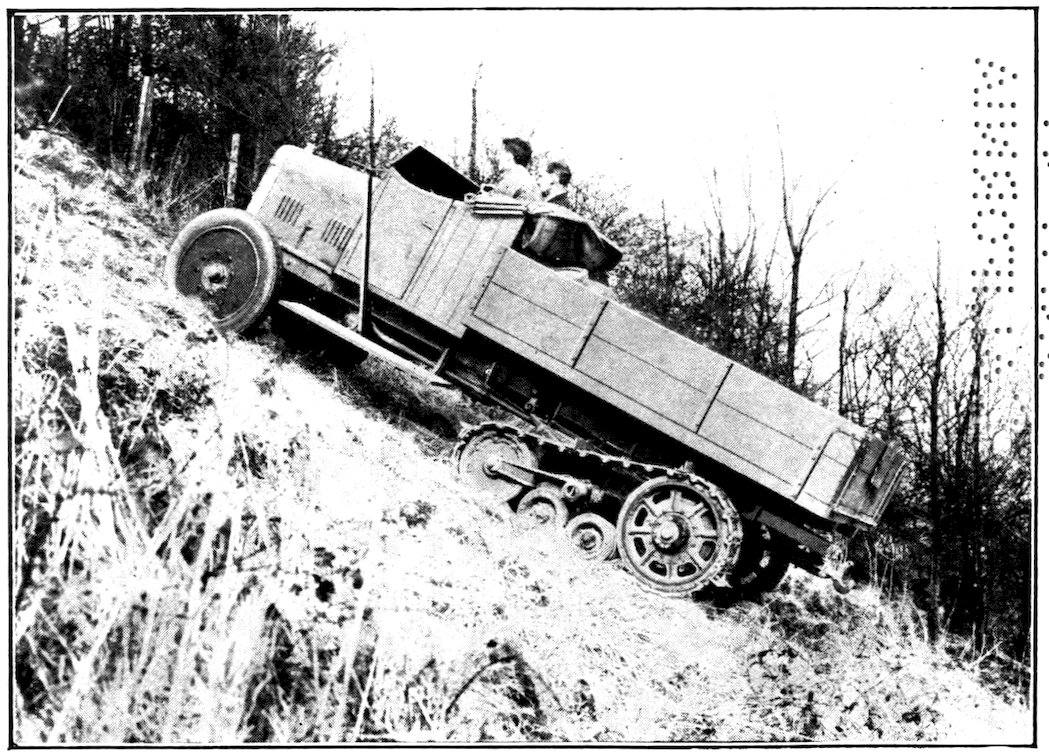
Hauling a full load up a one-in-two gradient (notice the vertical stick hanging from string from lamp bracket)
[Frontispiece
BY
COLONEL J. F. C. FULLER
WITH 8 PLATES
LONDON
KEGAN PAUL, TRENCH, TRUBNER & CO., LTD.
NEW YORK: E. P. DUTTON & CO.
Printed in Great Britain by
MACKAYS LTD., CHATHAM
PREFACE
v
The first part of this little book, namely
“The Battle of the Iron Horse,”
appeared, very much as it stands, in the
September number of The National
Review, 1925, and I have to thank the
editor, Mr. Leo Maxse, for his kindness
in allowing me to republish it.
The second part is based partially on
personal experience and reflection, and
partially on the lectures and papers of
others. In the war, the tank brought me
to realize the enormous possibilities of
cross-country movement, and, in 1921, I
set down my ideas as regards its
commercial future in a pamphlet entitled
Economic Movement, which was
published in 1922.
Of the works of others, I have
borrowed ideas from the following:—
“Improvements in the Efficiency of
Roadless Vehicles.” A paper read before
vithe members of The Institution of
Automobile Engineers, by Colonel P. H.
Johnson, C.B.E., D.S.O., December,
1921.
“Multi-Wheel and Track Motor.” A
paper read before the members of the
above Institution by Major T. G.
Tulloch, March, 1923.
“The Progress of Mechanical
Engineering in the Military Service.” A
lecture delivered before the members of
The Institution of Mechanical Engineers,
by Major G. le Q. Martel, D.S.O., M.C.,
January, 1924.
“Transport in Tropical Africa.” A
paper read before the members of The
Royal Society of Arts, by Mr. R. H.
Brackenbury, February, 1925.
“The Roadless Transport Problem.”
A paper read before the members of The
British Association, by Colonel P. H.
Johnson, C.B.E., D.S.O., August, 1925.
Whatever man does entails movement,
mental or bodily. Movement is, in fact,
the mainspring of his evolution and of
the civilization which this evolution
engenders; consequently, in the economic
growth of movement must be sought the
direction of all progress, both physical
and psychological. As the mind of man
moves, so does the world, in which this
mind works, move round him, delivering
up to his imagination and his hands the
mysteries it so sedulously hides. For it
is through the conquest of mysteries that
man, the mystery of mysteries, strides out
of a dark and unknown past towards
some unknown future.
10It would be both logical and easy, I
think, to start with the soles of man’s
feet and to work upwards to his brain.
To show how, from simple walking, man’s
natural means of progression, he took to
riding, and then thought of the oar, the
wheel and the sail, until to-day he rushes
over the surface of the earth, surges
through the waves and roars through the
air, excelling the horse, the fish and the
bird. But in so small a book as this it
is not my intention to write a history of
transportation. In place, I intend to consider
two things: first, the reaction
against novelty of movement, and
secondly, the possibilities of what to-day
is still a novel form of movement,
namely, the movement of roadless
vehicles, that is of vehicles which do not
require roads for their locomotion. Also,
I intend to show how these vehicles may
help us solve several of our most pressing
problems, and above all that of over-population
at home and under-population
in our Dominions and Colonies.
11If I can do this with any semblance of
success, it may perhaps excuse the
restrictions I am placing on this subject,
for I fully realize the immense future
possibilities of other means of movement.
The railway has not come to the end of
its evolution, far from it to any reader of
Mr. Horniman’s book, “How to Make
the Railways Pay for the War,” in which
Mr. Gattie’s “third-dimensional” railway
system is described, a system which
bids fair, were it introduced, to prove as
revolutionary as George Stephenson’s
locomotive itself. Nor has the steamship,
except perhaps in size, reached its
utmost development, for every day heralds
a further improvement, and, as for
aircraft, they are scarcely out of the
nursery; yet I am of opinion that, until
a radical change in their engines is
introduced, and this change may demand
a new motive force, their utility in peace
will be severely restricted, and, if
restricted in peace, in numbers they are
not likely to be so numerous in war as
12some people imagine. I mention these
things here because of the limit I have
placed on the items I intend to examine
when compared to the subject of economic
movement as a whole.
I have called this little book Pegasus,
not only because this famous steed had
wings, which to me are the wings of
imagination, but because he was born
near the sources of the ocean and sprang
from the blood of Medusa. To me, the
sources of the ocean are symbolic of these
little islands of ours, which produced not
only the first practical steam engine and
the first locomotive, but also the footed
wheel which developed into the caterpillar
track. Further, Medusa, that monster
who turned all who gazed on her to stone,
is surely the incarnation of that
obstructive ignorance which, by impeding
originality of idea and novelty of action,
compels thought and things to grow, and
through struggle with her to prove their
utility and worth.
THE BATTLE OF THE IRON HORSE — THE RAILWAY CENTENARY — THE PROTEAN PROBLEM — THE X-RAY TRANSPORTER — ERICHTHONIUS, WHEELWRIGHT — THE PHILOSOPHER’S STEAM — GEORGE STEPHENSON, ENGINE-WRIGHT — THE NATURE OF THE BEAST — PROTEAN IGNORANCE
13
I must begin somewhere, and since I
refuse to begin at the soles of men’s feet,
which are the beginning of his anatomy,
the earth is our natural datum point, I
will begin just a hundred years ago, when
the world we know to-day was as remote
from the world as it was then, as the
world I hope to point the way to will, in
many ways, be as remote from the world
as it is now.
On the 27th of September, of this very
year in which I write, took place the
centenary of the opening of the Stockton
and Darlington railway, and though it
was not the first line to be constructed in
England (for the Killingworth railway
was built in 1814, and again this was not
the first upon which locomotives ran),
14its claim to priority is nevertheless well
founded, for it was the first railway the
public noticed, and, in democratic
countries, the birth of anything original
must date from the moment the most
ignorant in the land realize its existence.
It flatters ignorance to be always first—such
is democratic pride.
The 27th of September, 1825, was a
very remarkable day in the world’s
history, one of those birthdays which have
no predictable date, but which depend on
the outburst of genius of some great man.
The great man was a humble and self-taught
engine-wright from Killingworth,
one George Stephenson, albeit an honest
and persevering man, a worker, a thinker
and a dreamer; one of those human
thunder clouds which, from time to time,
beat up against the conventional currents
of thought, and out of which flash the
lightnings of unsuspected things—a very
remarkable and creative man.
On the 27th of September, a hundred
years ago, a great concourse of people
15assembled at Brusselton Incline, some
nine miles from Darlington. There, the
travelling engine, as it was called, driven
by George Stephenson, the greatest
genius of his age, moved forward amidst
shrill blasts of its whistle, “with its
immense train of carriages,” thirty-eight
in number; “and such was its velocity,”
writes an eye-witness, “that in some parts
the speed was frequently twelve miles
an hour!” It took sixty-five minutes to
cover the nine miles to Darlington, and
the multitude stood aghast!
But the other day, I travelled in the
“Detroiter” from New York to near by
the front door of Mr. Henry Ford—another
remarkable and self-taught
revolutionary—the distance, if I
remember rightly, some seven hundred
and fifty miles, and the time taken was
fourteen hours. From Brusselton Incline
the iron horse hauled away, amidst wild
excitement, the stupendous load of ninety
tons. At Pittsburg, I have seen
locomotives hauling six and seven
16thousand tons of coal, puffing by all
unobserved. Surely Einstein is right,
the relative is only true, and ninety tons
in 1825 was almost as unbelievable as
to-day would be a centaur galloping
between the taxis of Piccadilly or Fifth
Avenue.
All this must have been remembered
during the centenary celebrations this
year, and broadcast from meeting
room, assembly hall and dinner table, for
centenaries lose their interest without
much feeding. There, little men in tail
coats, morning jackets and lounge suits,
some with trousers creased and others
somewhat baggy at the knee, according to
the political creed of the wearer, in port
and beer, and, in America, I know not
what, toasted the memory of the great
man. Pæans and praise gushed from
their arid heads like the water from the
rock smitten by Moses. These little men,
sitting for a bare few minutes on the
chariot wheel of genius, did say, “What
a dust do we raise!” And in our morning
17papers we read of all this blather and
pomposity, and overlooked an eternal
truth. For we got into our railway
carriages next day and complained of their
unfitness for human habitation, even of
the most temporary nature, and condemned
the line we were travelling on as
impossible, because the train was five
minutes late. Outwardly a very ordinary
picture, all this—the drinking, speechmaking
and travelling troubles of little
men, some strap-hangers to genius, but
most quite normal nonentities; yet behind
it all lurks a somewhat interesting
problem—the protean psychology of the
very ordinary man.
Since that famous Brusselton gathering,
the noise of which has long deafened
the world to the wonder of its sound,
what changes do we see! A whole earth
18rejuvenated, as humanity, like a shuttle,
works the woof of a new civilization
through the warp of an old. Civilization
is built on movement, and the picture of
life to-day is as different from that of
1825, in rough proportion, as a cinema
show differs from a neolithic rock painting.
In this short hundred years, the life
span of a very old man, such a revolution
has been brought about by the locomotive
that the world has been reborn. And, to
our limited intelligence, always that of a
child, we have forgotten the events of
this first birthday; and the changes, which
it conjured out of the depths of ignorance,
are to-day accepted by us all as the
essentials of our surroundings and as
necessitous to our lives.
If some magician could appear to-day,
and, by a wave of his wand, banish all
railroads to limbo, a calamity would fall
upon this world to which no parallel could
be found since Noah entered the Ark.
The greatest plagues, famines and wars
would vanish like wisps of smoke into the
19night, when compared to its all-consuming
horror. It would be like dragging out of
the human body the arterial and venous
systems, and yet leaving the man alive,
an aching mass of bones and fiery nerves.
The picture is indescribable, it is beyond
the grasp of intelligence to grip it, and
yet, in 1825, the ancestors, the grandfathers,
and great grandfathers, and
great grandmothers, too, of all the little
men who in 1925 were dressed in dinner
jackets (or tuxedo, as they call it over the
Atlantic) morning coats and lounge suits,
made to measure and “off the peg,” were
shouting down George Stephenson, even
more boisterously than their grandsons
and great grandsons this year shouted him
up. This, then is the protean problem, that
eternal truth overlooked as we read in
our newspapers that a workman has been
killed in Walworth or a girl has deposited
a baby outside an A.B.C. in the Strand,
and so on, ad infinitum, the long
categories of the normalities of life.
This is the inner problem George
20Stephenson has to teach us, and let us
consider it, for it is a live and moving
problem, and one which will not be
masticated by very ordinary men, as they
gulp down their beer, their port or iced
water. It is the problem of “‘Hail, king
of the Jews,’ one day and ‘Crucify Him’
the next.” It is, as I say, the veritable
protean problem of humanity, and nine
hundred and ninety-nine human beings
out of every thousand are very, very,
ordinary men.
Let us picture to ourselves another
magician descending on this earth of ours,
a man of magic with the prosaic name of
John Smith, yet none the less a man of
genius, for all such are magicians in very
fact. He is a very modern genius, and,
I will suppose that he has discovered how
to transform any and all physical things
21into ether waves moving at 186,000 miles
a second, and that he can precipitate in its
original form any article or being sent to
any given spot; all this arrived at by
tapping a key or pressing a button.
What a traffic problem is here opened
to this world; so immense that it puts to
blush the power of that horrid wizard who
would remove our railways. Its conception
is no more impossible than that of
broadcasting. Even in so remote a
village as Camberley (thirty miles distant
from London, and there I write), where
electrical genius is conspicuously absent,
I can switch on to Paris and listen
to Galli Curci or any other human bird.
And what appears to me far more
marvellous, simultaneously a fisherman in
Trondhjem can do likewise. An immense
audience in fact this Galli Curci can command,
and totally unknown to her, totally
unseen and out of contact even with itself,
a dust of individuals, each speck of which
can travel on or off her song by mere
pressure of the hand, each speck of which
22can travel by ear at infinite speed and to
any civilized point on the globe. If this
is not magic, what is?
If song can be etherealized, why not
then the singer? How much more remarkable
would it not be, in place of
scanning bold headlines of dead workmen
and deposited babies, to read that Melba
will sing in New York, at a quarter past
three next Saturday afternoon, and at the
Opera House in Paris, that very same
day, and but twenty minutes later.
If we can transmit one thing, surely the
day must soon come when we shall be able
to transmit all things, and my genius
John Smith is the man of that day. What
could he not do? He could solve the traffic
problem in Regent Street or Broadway,
for all, astonished reader, you would have
to do would be to sit on a transmitter,
press a button, and in the minutest
fraction of a second, you would find
yourself in Peter Robinson’s, or Mr.
Morgan’s office, or wherever you wanted
to go, all for a penny or a couple of cents!
23He could banish the Communists to the
moon, where there are no capitalists and
where there is plenty of ice to keep their
heads cool. He could replace the League
of Nations by a row of chairs. The
Grenadier Guards would fall in to the
stentorian yells of their Sergeant-Major
to be seated. The button would be
pressed by the Army Council and, in less
than a twinkle of an eye, they would be
doing their famous goose-step down the
Sieges Alle, to the utter consternation of
the terrible Teuton.
Dear and crawling reader, what could
he not do, and what could not you do?
Half-a-crown, or half-a-dollar, would take
you round the world—bag, baggage and
all. And if you do not forget your purse,
you can breakfast in New York at a
cafeteria, lunch with Ongo-Pongo on the
shores of Lake Chad, have tea in
Yoshiwara, at the “Nectarine” for
choice, and sup with Doris in the Bois
de Boulogne at 8.30—this, indeed, is to
live.
24But what would you do—you beefsteak-eating
bull of a Briton, yes, what would
you do? You would don your lounge
suit or your morning coat, or your tuxedo,
as your great grandfathers did right back
in 1825. You would become thoroughly
traditional and would say: “Why, this
man is mad—a raving lunatic! Send me
to Lake Chad?... Good God, man,
what is he thinking about ... Lock
him up!”
Then the storm would burst. The
leading engineers, “eminent” as they
are called by every newspaper, would say
it was contrary to etheric law; Harley
Street would be thoroughly up in arms,
for all their old lady friends might
suddenly betake themselves in a second to
Madeira and get cured of their ailments;
the physicians would say the human frame
cannot stand this rush; the bath-chairmen
would say that their occupation was gone;
the lawyers would say it was illegal and
that it would lead to the Cocos Islands
becoming a refuge for criminals; the
25soldiers would say, how could they be
expected to protect this dash dashed land,
why, it did not fit their strategy, therefore
it must be wrong. And what would the
clergy say? Heaven alone knows, for
whilst antiquity and things antiquated
separate the Churches, any novelty of a
progressive nature is apt to bring them
together with amazing unanimity.
The reader may be beginning to think
that I, the writer, am off my head, but I
am not. So far, all I have done is to
reveal protean possibilities, now I will
turn to actualities of the same
psychological order. I will imagine that
this genius Mr. Smith has, in disgust,
removed himself to Aldebaran, and that
we are about to get back to the Brusselton
Incline.
I must have missed the Incline in my
haste to get back to Brusselton, for I find
26myself in Athens in the Minoan age, or
thereabouts, for the year is 1486 B.C.
Everyone seems very excited; porters
have thrown down their baskets and are
yelling unintelligible words, yet of a pronounced
and universal meaning; shoemakers
are beating at a house door with
their lasts. Whatever is up? A dainty
little creature, some now far away Doris,
approaches me and says: “Do you know
what that old blighter (my Attic is weak)
has done? Why, he has invented a thing
called a chariot, and all these poor people
have lost their jobs.”
Of course, Erichthonius never invented
the chariot; the idea of a pure inventor is
but a piece of proletarian imagery, a
morsel of that ignorance which is the soul
of the crowd. This old man, even if he
ever lived, which seems doubtful, did no
more than Savery did, or Newcomen, or
Watt, or Stephenson, or Marconi did; that
is, he was a link in that great chain we call
progress, each link being the great
thought of a great man. Tutenkhamon
27had his chariot as we well know, and
many another before him, and we read in
the Acts of the Apostles of a eunuch of
great authority, a kind of Maître d’Hôtel
of Candace, queen of the Ethiopians,
journeying to Jerusalem sitting in his
chariot reading Esaias, the prophet,
which is no mean compliment to the
Roman road-makers in Palestine.
I must, however, hasten back to
Brusselton, for there lies my goal; but
stop, what is this? “A whirlicote,” a
“Noah’s Ark,” or, in common language,
an Elizabethan coach; for sure—a direct
descendent of the handicraft of Erichthonius.
The Earl of Rutland, it is
said, first built whirlicotes in this country,
in 1565, and, in spite of the villainous
condition of the roads, my lords and
ladies soon took to them. This,
apparently, was a sure proof, in its day,
that the country was going to the dogs;
for, early in the seventeenth century, a
bill was brought into Parliament “to
prevent the effeminacy of men riding in
28coaches.” Hitherto Englishmen had
ridden or walked, why should they not
continue to do so, why not, indeed?
In the first quarter of the seventeenth
century, the number of coaches in London
was reckoned at six thousand and odd,
and in a curious old book, published in
1636, and recently reprinted, called
“Coach and Sedan,” of these six
thousand and odd whirlicotes we read:—
“I easilie (quoth I) beleeve it, when in
certaine places of the Citie, as I have
often observed, I have never come but I
have there, the way barricado’d up with a
Coach, two, or three, that what hast, or
businesse soever a man hath; hee must
waite my Ladie (I know not whose)
leasure (who is in the next shop, buying
pendants for her eares; or a collar for
her dogge) ere hee can find any passage.”
It is Regent Street or Fifth Avenue over
again, for, according to this author,
when there is a new Masque at Whitehall,
the coaches stand together “like mutton-pies
in a cooke’s oven,” and then he adds:
29and “hardly you can thrust a pole
between them!”
In its turn, the stage coach was opposed
tooth and nail, because it was something
new. In 1671, Sir Henry Herbert, M.P.,
stated that: “If a man were to propose
to convey us regularly to Edinburgh in
seven days, and bring us back in seven
more, should we not vote him to
Bedlam?” Sir Henry Herbert is what I
call a psychological Proteus, a kind of
intellectual amoeba which propagates
itself by simple division, the parts of
which are always with us and alike—they
never die.
The Brusselton Incline is now in sight,
so I will pause and look back whilst I
regain breath. The horse of Troy was a
very wonderful beast, and many strange
things came out of it, for it was the
30strangest thing man had seen since the
Ark. But years after Troy was burnt, a
stranger thing was seen in Alexandria.
It was called an aeolipile, a kind of
rudimentary steam engine, which was
invented by one, Hero, in 130 B.C. He
used it to open and close the doors of a
temple, yet it was eventually destined to
open the portal of a new world, a glimpse
of which would have sent Hero or
Columbus completely out of their minds.
Yet these greater doors remained closed
for seventeen hundred years, when
another, this time Battista della Porta, in
the year 1601, re-discovered the power
of steam.
In 1641, Marion de Lorme, accompanied
by the Marquis of Worcester,
visited the madhouse of the Bicêtre in
Paris, and this is what he writes:—
“We were crossing the court, and I,
more dead than alive with fright, kept
close to my companion’s side, when a
frightful face appeared behind some
immense bars, and a hoarse voice
31exclaimed, ‘I am not mad! I am not
mad! I have made a discovery that would
enrich the country that adopted it.’
‘What has he discovered?’ asked our
guide. ‘Oh!’ answered the keeper,
shrugging his shoulders, ‘Something
trifling enough; you would never guess
it; it is the use of the steam of boiling
water.’”
Who was this maniac? It was
Solomon de Caus, he had a vision whilst
dabbling with steam vessels, and he had
seen carriages and ships propelled by
steam. This was too much for men
dressed in half hose and doublets, or
whatever was the tuxedo of their day.
“Carriages driven by steam ...
lock him up!” So he was locked up.
But the idea lived on, and it grew. There
was Giovanni Branca, Edward Somerset,
Marquis of Worcester, then Thomas
Savery, who, in 1698, obtained a patent
for a water raising engine. There were
others, Jean de Hautefeuille, who, in
1678, suggested the piston; Denis Papin,
321690, of cylinder and piston fame. At
length Thomas Newcomen, 1705, something
near success; others still,
Humphrey Potter, Henry Beighton, but
all waiting for the man. Then the man
came in the form of a poor instrument
maker, and the new Jerusalem of the
steam age was Glasgow, for there did he
work. This man was James Watt, who,
having realized that the cylinder of an
engine should always be as hot as the
steam which entered it, in 1769 threw
open the doors of the most stupendous
epoch in economic history. The transmutation
of heat into mechanical work
had been discovered, it was the true stone
of the philosophers, the “Open Sesame”
to another age.
In the very year James Watt built the
first practical steam engine, namely, the
33year 1769—the year Napoleon was born—fearful
riots were taking place in Russia,
because some enlightened person had
introduced the potato, a useful vegetable
as we all know, yet at this time one in
which the Russian peasant saw the
Satanic thumb, for he was certain that
this humble vegetable was the “devil’s
apple.” Though why this should have
detracted from its nutritive qualities I
cannot say.
Looking back now, and we are nearing
Brusselton, it seems to me that there is
no difference between the spirit of these
deluded peasants and those who, with
shoe lasts, beat vigorously on the door of
Erichthonius’s house. They are one and
all Sir Henry Herberts, though the
particular cut of their clothes may differ.
George Stephenson, having studied steam
engines in general and Mr. Trevithick’s
crude and inefficient locomotive in
particular, determined to build one of his
own, and, with the support of Lord
Ravensworth, he accomplished this feat
34at Killingworth in 1814. There the first
efficient locomotive was made. Had Lord
Eldon been a Russian, he would probably
have objected to potatoes, but being
an Englishman he preferred bigger game.
“I am sorry,” he said, “to find the
intelligent people of the North-country
gone mad on the subject of railways.” A
few miles had only been opened, but this
was quite sufficient to establish madness,
and by some other of his ilk, the adage,
“A fool and his money are soon parted,”
was applied to Lord Ravensworth.
The Killingworth railway was followed
by the Stockton and Darlington line. Mr.
Edward Pease, the Quaker supporter of
Stephenson, had said: “Let the country
but make the railroads, and the railroads
will make the country.” Be it remembered
that locomotives had been working
at Killingworth, and very efficiently, for
ten years; but there were others who,
unlike Mr. Pease, were full of the spirit
of old Herbert. The Duke of Cleveland
opposed the measure in Parliament, as the
35line would pass through his fox covers,
and, due to his influence it was thrown
out. A new survey was made, avoiding
these precious earths, and the railway
was built.
The next line was that between
Manchester and Liverpool. Lord Derby
turned out his farm hands to chase
Stephenson’s surveyors off his estates.
Lord Sefton did likewise, and the Duke
of Bridgewater threatened to shoot them
at sight. Stephenson had his theodolite
so often smashed that he deemed it wise
to hire a prize fighter to carry it. The
“Quarterly Review” supported the
project, and it is curious to read what it
said, for it will give the reader some idea
of the virulence of the opposition. It
says:
“What can be more palpably absurd
and ridiculous than the prospect held out
of locomotives travelling twice as fast as
stage coaches! We should as soon
expect the people of Woolwich to suffer
themselves to be fired off upon one of
36Congreve’s ricochet rockets, as trust
themselves to the mercy of such a
machine going at such a rate....
We trust that Parliament will, in all railways
it may sanction, limit the speed to
eight or nine miles an hour, which we
entirely agree with Mr. Sylvester is as
great as can be ventured on with safety.”
This was praise indeed, and it is amazing
that the British Parliament, which is
always full of ordinary men, did not take
the hint and limit the speed of the
locomotive to that of a trotting horse.
Nevertheless, though this grand opportunity
was missed, the Parliamentary
Committee did all in its power to obstruct
the measure. One of its members asked
George Stephenson: “Suppose a cow
were to stray upon the line?” There
was a hush of horror, then he added:
“Would not that, think you, be a very
awkward circumstance?” “Yes,”
answered Stephenson, “very awkward
indeed—for the coo!”
The leading councils openly declared
37that this “untaught and inarticulate
genius” was mad.... “Every
part of the scheme shows that this man
has applied himself to a subject of which
he has no knowledge, and to which he
has no science to apply.” Not only
would these locomotive engines be a
terrible nuisance, “in consequence of the
fire and smoke vomited forth by them,”
but “the value of land in the neighbourhood
of Manchester alone would be
deteriorated by no less than £20,000!”
“The most absurd scheme that ever
entered into the head of man to conceive,”
shouted Mr. Alderson, the leading counsel.
“No engineer in his senses would go
through Chat Moss,” solemnly declared
Mr. Giles, the most eminent engineer
brought forward by the opposition. He
estimated the cost of such a project at
£270,000. Stephenson did it for
£28,000, but the line was an expensive
one as it had so many fox covers to avoid.
All this was but a preliminary skirmish,
the main battle now began. The beef-eating
38Briton was thoroughly aroused.
George Stephenson was considered to be
an incarnation or certainly an implement
of his Satanic Majesty. The public were
appealed to, and ever ready to hinder
progress, they took off their tuxedo,
smocks, frocks, morning coats or whatever
covered their bodies, and formed
phalanx against the common foe. A
meeting of Manchester ministers of all
denominations was convened. This
meeting declared that the locomotive was
“in direct opposition both to the law of
God and to the most enduring interests of
society.” This set match to powder.
The doctors declared that the air would
be poisoned and birds would die of
suffocation. The landowners, that the
preservation of pheasants and foxes was
no longer possible. Householders, that
their houses would be burnt down and the
air polluted by clouds of smoke. Horse-breeders,
that horses would become
extinct. Farmers, that oats and hay
would be rendered unsaleable. Innkeepers,
39that inns would be ruined.
Passengers, that boilers would burst.
Heaven knows who—“that the locomotive
would prevent cows grazing, hens
laying, and would cause ladies to give
premature birth to children at the sight
of these things moving at four and a half
miles an hour!”
Yet there was this consolation. The
very, very ordinary man, the British
public at large, declared that “the weight
of the locomotive (six tons!) would completely
prevent its moving, and that railways,
even if made, could never be
worked by steam power.” Yet for ten
years now, and more, the Killingworth
engines were running daily!
The Stockton and Darlington line was
a tremendous success; so also was the
railway between Manchester and Liverpool,
yet opposition thickened rather
than lessened. In 1830, the “Rocket”
had attained a speed of thirty-five miles
an hour, yet, in 1832, Colonel Sibthorpe
(the Army now come into the picture and
40oh! how bravely), declared his hatred of
these “infernal railroads,” and that he
“would rather meet a highwayman, or
see a burglar on his premises, than an
engineer!” When the Birmingham
railway bill was before Parliament, Sir
Astley Cooper, that most eminent of
surgeons, declared: “You are entering
upon an enormous undertaking of which
you know nothing. Then look at the
recklessness of your proceedings! You
are proposing to destroy property, cutting
up our estates in all directions! Why,
gentlemen, if this sort of thing be
permitted to go on, you will in a very few
years destroy the noblesse!” And this,
from a man who had been knighted for
cutting a wen out of George IV.’s neck!
All this is not only amusing, but vastly
instructive—these beaters of shoe lasts on
the lintel of genius. Here we have a
41deep and vivid study presented to us of
popular ignorance, that universal
coagulant of truth. In 1824, George
Stephenson had said to his son and a companion:
“Now lads, I will tell you that I
think you will live to see the day when
railways will come to supersede almost
all other methods of conveyance in this
country—when mail coaches will go by
railway, and railroads will become the
Great Highway for the King and all his
subjects. The time is coming when it
will be cheaper for a working man to
travel on a railway than to walk on foot.”
The victory was won in 1825, the year
following this memorable prophecy; yet,
in 1835, the reactionaries were still
fighting a rear guard action, and we find
the landed gentry sending forward their
servants and luggage by rail and condemning
themselves to jog along the
roads in the family coach. On the
Continent it was just the same, and even
in 1862 the Papal Government opposed
the opening of the Rome and Naples
42railway. The rear guard fought on until
June, 1842, when, on a certain Monday,
Her Majesty Queen Victoria made her
first railway trip. It was from Windsor
to London, and her coach had a crown
on its roof. The reactionaries went head
over heels, donned their frock coats or
whatever garment appertained to their
social rank, and declared the railway the
greatest blessing God had ever permitted
man to discover. The Marquis of Bristol,
wildly excited, said that “if necessary,
they might make a tunnel beneath his
very drawing-room,” and the Rev. F.
Litchfield that he did not mind if a railway
ran through his bedroom, “with
the bedposts for a station.” Ever
irrational and unbalanced, very ordinary
men went as mad on railways as they had
been mad against them. The panic of
1844–1846 was the result. In the last-mentioned
year applications were made to
Parliament for powers to raise
£389,000,000 for the construction of new
lines.
43On the 26th of June, 1847, a year before
George Stephenson died, he attended the
opening of the Trent Valley Railway.
Sir Robert Peel was his host and
proclaimed him “the chief of our
practical philosophers.” Seven baronets
and two or three dozen members of
Parliament, all in frock coats and tall
hats, did homage to the great engineer,
whilst the clergy blessed the enterprise
and bid all hail to the new line as
“enabling them to carry on with greater
facility those operations in connection
with religion which were calculated to be
so beneficial to the country.”
I wonder what passed in George
Stephenson’s mind. In 1825 he was
universally proclaimed mad and a danger
to society; in 1847 he is proclaimed “the
chief of our practical philosophers” and
the saviour of society. I wonder which
he objected to most—their abuse or their
praise? Both, I should imagine, were
largely overlooked by him, for he was a
very great man, and surely those who
44abused him and praised him—very, very
small—truly insignificant.
Protean ignorance never dies; this is
the problem which confronts us. George
Stephenson has only been my peg upon
which I have hung this musty old skin,
indeed no golden fleece, but just as
magical, so that I might the better
examine it; and a fine stout peg it is—all
of British oak.
Stephenson was the father of the
locomotive; as to this there can be no
dispute, and equally can there be no doubt
that the locomotive has changed the superstructure
of the civilized world, yet its
foundations remain permanently fixed.
Matter fluctuates as the will of man
unmasks the material world; but the soul
of man remains fixed, abiding in the
solitude of his ignorance.
45Ignorance and stupidity are always with
us, they are the Dioscuri of the temple of
life. To change the material world is
like changing our clothes, to change the
spiritual world is like changing our
intestines. Spiritual, I admit, is not the
exact word, neither is moral nor human.
To me, the spiritual is all-pervading and
uninfluenced by intelligence or reason. A
man who is grossly ignorant is grossly
religious, for he is a worshipper of idols.
To-day we see the multitudes bending
the knee to Baal, and yet we see them
surrounded by misery, woe and suffering.
No disease is incurable, no ill cannot be
conquered. But every would-be saviour,
however humble, must prepare for
crucifixion, because the very multitudes
they would save are in themselves their
worst enemies.
Henry Herbert never dies, he was here
before Adam took form from out the
dust of Eden, and he will be the last man
to leave this earth when the last trumpet
46sounds, and I have not the slightest doubt
that he will then question the wisdom of
the Almighty. He will question the
wisdom of all things new, and yet, to-day,
the world is groaning for novelty, for
material growth means also material
decay. Though very ordinary men can
build middens, it is only the extraordinary
man who can shift these piles of refuse—accumulations
of old traditions, customs
and accepted things. To me the moral
of this centenary is not the power of
steam, but the power of the will of man.
George Stephenson triumphed over all
difficulties, because he was possessed of
a will to win. The stronger opposition
grew the more mighty grew his will.
Protean ignorance has, therefore, its
virtue; it renders progress difficult to
attain; it is the whetstone of genius.
When we realize this, in place of wringing
our hands in lamentation when Henry
Herbert beats his last against our door,
we open it and look at him, and laugh,
47and then close it and go on with our
work—in one word, we persevere.
Laughter and Perseverance, surely these
two are the shield and sword of progress.
THE CONQUEST OF THE ELYSIAN FIELDS — THE EQUATION OF POWER AND MOVEMENT — THE RIDDLE OF THE GORDIAN KNOT — THE PROBLEM OF UNEMPLOYMENT — THE PROBLEM OF POWER — PROBLEMS OF MOVEMENT — TWO-DIMENSIONAL MOVEMENT — THE ELYSIAN FIELDS — THE WINGS OF PEGASUS
48
Power and Movement, these are the
foundations of civilization and the sire and
dam of progress, and before the days of
Watt, Fulton and Stephenson, all Anglo-Saxons,
how shallow were they laid; so
shallow that their social and industrial
superstruction is, to-day, difficult to
visualize, let alone to understand. Here is
a little glimpse, and if not a very dramatic
one, yet one which is apt to make us
wonder at this lost world of little more
than a century ago, a world all but
obscured in clouds of steam.
In 1770, Adam Smith wrote (and be it
remembered that for fifty years after this
date the picture remains true) the
following:—
49“A broad-wheeled wagon attended by
two men, and drawn by eight horses, in
about six weeks’ time carries and brings
back between London and Edinburgh
near four ton weight of goods. Upon
two hundred tons of goods, therefore,
carried by the cheapest land-carriage from
London to Edinburgh, there must be
charged the maintenance of a hundred
men for three weeks, and both the maintenance,
and, what is nearly equal to the
maintenance, the wear and tear of four
hundred horses, as well as of fifty great
wagons.”
To-day, when the trans-Siberian railway
is in working order, a man can travel in
the same time, with four tons of baggage
if he wishes, from London to Tokio and
back. Edinburgh is four hundred miles
from London, and Tokio is some eight
thousand miles from this same city; such
has been the expansion of movement and
the contraction of space, and to-morrow
aircraft may reduce the time taken to a
fortnight.
50The fire of Prometheus is as a rush-light
compared to the volcano of steam which,
like all great world forces, is a mixture of
Pandora and her box; for it has given us
beauty and wealth, and also ugliness and
starvation. It revived the world, bled
white during the Napoleonic wars, and,
in place of conquering the world as the
great Corsican attempted, it recreated it.
When men began to move by steam
power, Titans strode this earth. In peace
time we see science advancing as it had
never advanced before, industry growing
beyond belief or imagination. Cities
spring up in the night, such as Chicago,
for whilst, in 1830, its population
numbered a hundred souls, to-day it holds
nearly three millions. Nations grew and
doubled, trebled and quadrupled their
populations, and the wealth of Crœsus is
to-day but the bank balance of Henry
Ford. Yet out of all this prosperity,
created by steam power, arose the Great
War of 1914–1918, which, in its four years
of frenzy, was to show a surfeited
51civilisation the destructive power of
steam.
What do we see during this last period
of roaring turmoil? A curious picture.
The railway and the steamship, which,
during days of peace, increased movement
out of all belief, during war end by
impeding it. Like great funnels, we see
the railways, pouring forth cataracts of
men, veritable human inundations, and
then we see that, though it is easy to move
masses by rail, once the rail is left behind,
it is next to impossible to supply these
masses by road, or to move them in face
of gun and machine gun. The war
becomes a war of trenches, not a moving
war, but a stationary affair—men look at
each other and sometimes shoot.
As peace begets war, power and movement
are the foundation of the second,
just as they are of the first. On the battlefield
or in the workshop, power is useless
without movement. It is no good setting
up a boot factory, unless you can get the
boots on to the feet of the people, and in
52war it is no good piling up bayonets,
unless you can get them into the intestines
of your enemy. Thus, it happened that,
before the war was three months old,
though each side possessed much power,
power in itself was useless, for it could
not be moved. The remaining four years
of the war were spent in solving the
equation of power and movement.
This problem was partially solved by
the tank, which possessed both power and
movement. And from the armies which
used these machines, and there were never
very many of them, little streamlets of
men trickled forward out of these great
stagnant human pools, and the war was
won.
What is our problem to-day? It is
again the problem of power and movement;
not a new problem, but a very old
53problem, in fact the eternal problem
dressed up in a new frock. Our problem
is to revive our old industries, so far
as they can be revived, and to establish
new ones, for industries, like the human
beings who create them, grow old, come
on the pension list and die. Our problem
is, as it was during the war, to shift the
population, to demobilize our great army
of unemployed, and to cause it to trickle
from our over-populated little island into
our underpopulated Dominions and
Colonies. Lastly, our problem is to
secure ourselves against another war.
To-day, we find ourselves in a veritable
labyrinth of difficulties, but there must be
a way out, possibly several, for otherwise
we could not be standing in its centre.
We have got into it, so we can get out of
it, as we have of many a former maze;
but how?
It is here that I think the spirit of
George Stephenson can help us, and it is
for this reason that I have taken up so
much of this little book with this great
54man’s name and work, and with the
difficulties he faced and, undaunted, conquered.
His motto was “Perseverance”;
let it be ours. He did not talk over much,
but he took his coat off and got to work.
He worked single-handed and was
obstructed at every turn. The whole
country was against him, yet he conquered,
and, more to him than to any
other man a century ago, it seems to me,
were the problems, which then faced
England, solved, and they are the
problems which face England now.
As it may be said, and with some truth,
in fact a great deal of truth, that the
railway made the war, since it made the
peace which preceded the war, so with
equal truth may it be said that the petrol
engine, encased in a tank, by making
peace possible, may now make peace
profitable, even if in doing so it begets
the germs of another war. In other
words, as the war was so largely
won by the tank, so must the
peace which has followed it be largely
55won by the caterpillar tractor, or roadless
vehicle.
Henry Herbert will vote me to Bedlam,
but this is the most encouraging fact of
all, for every new idea must start by being
in a minority of one, such as that of
George Stephenson’s against the world.
The stronger the opposition the better the
idea, may not be a law of Nature, yet it
is a pretty sound rule, and one with few
exceptions. If we persevere and laugh,
the caterpillar tractor will win the peace,
and to paraphrase the words of George
Stephenson, I will, in my turn, make a
prophecy:
“Now lads, I venture to tell you that
I think you will live to see the day when
tracked vehicles will supersede almost all
other methods of conveyance in roadless
countries; when armies will be moved
across country and roadless traction will
become the chief means of commercial
movement in all undeveloped lands. The
time is coming when it will be cheaper
for a farmer or soldier to use a
56tracked machine than to travel by
rail.”
As it took Mahomet three years to
collect thirteen followers, I shall not be
downcast if I collect no greater a number
out of the readers of this book, because
perseverance was the motto of Mahomet
as well as of Stephenson, and as
perseverance won them their battles, may
it win me mine.
Many will consider my prophecy
ridiculous, and a multitude of Henry
Herberts will foam at the mouth.
Protean ignorance is against me—a
resilient Everest of oiled rubber. A
hundred years ago it was boisterously
hostile to novelty, to-day it is somnolently
apathetic, and, in this latter mood, it is
almost more overpowering than in the
former. Nevertheless, let us smile, let us
take off our coats and climb this glutinous
mountain, for the Elysian fields lie
beyond.
A few years ago we were told that,
once the war was won, this little island
57of ours was going to be fit for heroes to
live in, as if any country ever had been or
could be an Eldorado after a great war!
To-day, we have well over a million
unemployed men and women in this
country, and I have no doubt there are
many heroes and heroines amongst them;
certainly the conditions demand an heroic
race to win through.
Our present difficulties all boil down
to one recognizable sediment. Great
Britain is over-populated. Before the
war we were over-populated, and to-day
we are still more so, and to-morrow
matters are likely to be worse.[1] There
are three solutions to this problem.
Either we must stop breeding, or we must
create new home industries and so absorb
our surplus population, or we must
transport it to less thickly populated
areas overseas.
1. In 1913, 700,000 emigrated from this
country; in 1923, only 463,000 left.
Six hundred and odd politicians in
58Westminster, some in black ties and
others in red, chatter like a wilderness of
monkeys, whilst those who were
proclaimed heroes may consider themselves
lucky if they are allowed to stand
in the gutter and sell bootlaces;
and in this chatter the problem is
drowned, only to bob up again, between
each breath.
We are told that the Government’s
determination is “not to tolerate
propaganda for birth control in clinics and
maternity centres supported by public
funds.” This settles the first solution, at
least the Government does not believe in
it. Recently, because the coal mining
industry was unable to pay its way, it is
now subsidized, and many new industries
are left unprotected, so the second
solution joins the first. As regards the
third solution, very little has been done
outside private effort, because the problem
has been tackled from the wrong end.
Attempts are persistently being made to
shift the unemployed; who wants them?
59In place attempts should be made to shift
the employed, but this question I will
examine a little later on.
The point I want the reader, however,
to realize is that, as the riddle of the
Gordian knot was not solved by cutting
it, so the problem of over-population will
not be solved by the dole. Cutting and
doling can be done by any fool with his
coat on, they are too easy; for the problem
which faces us demands that we take our
coats off and get to work, in place of
turning our less fortunate fellow citizens
into unemployable vagrants.
Birth control I rule out of discussion,
and though I am of opinion that it might
well be made compulsory amongst
politicians, my solution demands not a
restriction, but a vast increase in the birth
rate.
60The invention of the locomotive and
steamship upset all birth rate calculations.[2]
During the last century it has
been reckoned that twenty-eight million
people left Europe by sea, four millions
during the first half and twenty-four
millions during the second, the period of
railway and steamship development. Out
of these twenty-eight million emigrants,
twenty-two millions went to the United
States, the population of which was five
and a quarter millions in the year 1800,
seventy-six millions in 1900, and is about
one hundred and ten millions to-day, and
quite possibly, before the present century
is out, this figure will be doubled.
2. In 1750, before the industrial revolution set
in, the population of the United Kingdom was
6,517,000.
In the United Kingdom we see, if not
so great, as startling an increase, considering
the smallness of the country. In
1801, the population numbered about sixteen
millions, and to-day, excluding
Ireland, it numbers about forty-four
61millions, which is probably four or five
millions more than the industry of the
country can economically support, as
unemployment and the low standard of
living, not only now but before the war,
testify to.
Let us remember always what has
created the great civilizations of the past,
empires and kingdoms, prosperous lands
and great cities. It is movement and the
means of movement. First man placed a
bundle on his wife’s head and gave her a
kick, then he tamed the ox and beat it
with a stick, thus civilization became
possible. At length, he invented the
wheel and the sail, and, by means of these
inventions, mankind crept out of primeval
darkness into the dawn of history. In
1809 Fulton invented the steamship, and
in 1814 George Stephenson built his first
locomotive. It is, as I have already said,
these inventions which have created not
only such immense cities as modern
London and New York, but which have
shifted millions of men, women and
62children from one part of the globe to the
other. Why did they shift them, this is
the question? Because the steamship and
the railway enabled them to tap sources of
wealth which did not exist in their own
countries; for without prospects of wealth
there would be little or no movement.
To-day, we possess an Empire of over
fourteen million square miles in area, of
which three-quarters is sparsely inhabited.
In Canada we find nine million two
hundred thousand people; in Australia five
million eight hundred thousand; in South
Africa eight millions, and in New Zealand
only one million two hundred thousand;
yet New Zealand is as big as the British
Isles.
Without considering our immense
Colonial possessions, the potential wealth
of the Dominions alone should eventually
be sufficient to support certainly one if
not two hundred millions of Englishmen.
On the one hand we have room for at
least a hundred millions, and on the other
we have a surplus of some five millions.
63The redistribution of this surplus should
not prove an insuperable problem, and
even if it cost us twenty pounds a head
to arrive at a solution, it would be cheap
when compared to spending forty-six
millions a year on doles and poor rates,
which, far from solving the problem of
unemployment, only accentuate it.[3]
3. “Schemes to the value of approximately
£466,000,000 undertaken in connection with the
relief of unemployment have, or are being
assisted by the Exchequer.”—Whitaker’s
Almanack.
In former times, the danger inherent
in immigrations was the hostility of the
tribes in occupation of the new lands—the
problem was a military one. To-day, the
difficulty is not military, but financial.
To-day, it is no longer bows and arrows
which restrict immigration, but money.
To-day, it is not profitable to tackle a land
owner with a rifle, and nearly all land
worth owning is owned; instead the settler
must buy the land, or be sufficiently
skilled to dispose of his labour at a profit.
Our present-day unemployed have no
64money and little skill. To send such
people to the Dominions is no true
solution of the unemployment problem,
for it only shifts the unemployed from
one place to another, and this does not
solve the problem. In 1914, Germany
attempted to gain the French Colonies,
not because she wanted to shift to them
the vagrants of Berlin and Hamburg;
but, because the possession of these
Colonies would have enabled thousands of
well-to-do Germans, the small capitalists
and skilled workers of the middle classes,
to enrich themselves without loss of
nationality. Incidentally, as these people
emigrated, room would be made in
Germany for the under-dog. Competition
would have decreased with a decrease in
not the unemployed, but in the employed
population. Wages would have increased
in proportion and, by degrees, the greater
percentage of the under-dogs, through
increased wealth, would have raised themselves
into the middle class as small
capitalists.
65To-day, there is no necessity for us to
covet the territories of other nations.
We possess ten million square miles of
sparsely-populated land in which Englishmen
will not be lost to the Empire.
To-day, we see this problem mentioned in
every paper, but writers will persist in
thinking in terms of the unemployed. It
is the employed we must shift, not only
because at home room will thus be made
for the unemployed,[4] but because it is the
skilled man or the small capitalist who
can thrive in the Dominions and Colonies
and the unemployed normally cannot.
4. It may be considered by some that this will
mean that we in England shall be left with the
unworkable dregs of society. Such a view is a
gross libel on the bulk of the unemployed.
Before the War, seventy per cent. of the recruits
for the army enlisted because they were unemployed.
During the War these men were
universally proclaimed heroes, and such they
were. I can personally testify, after twenty-seven
years of service in the army, that less
than five per cent. of the men in any unit of
regular soldiers would make undesirable citizens
if vocational training were fully established. If,
however, men are kept unemployed for years
they will eventually become unemployable.
66
To move we must not only possess the
means of movement, but the will to move;
for, without this will, all the means in
the world are but scrap iron and dead
timber. The men who first tamed the
camel and the horse must have had ideas
in their heads—visions which impelled
them to do what they did. It may have
been sympathy for his wife as she carried
his load which induced men to jump on
a horse’s back, but much more likely was
it her low carrying power and possibly
also to get away from her restless tongue.
In ninety-nine cases out of a hundred,
the will to move is stimulated by material
gain. To possess something easily,
cheaply, and, if possible, for nothing, is
the urge of both commerce and robbery,
twins of Fear and Greed, forces of vice
as well as of virtue, the forces of the
growth of the human world, and forces
not to be set aside lightly.
67The nomadic hordes surged out of Asia
in the search after food. It was the
desire to fill their stomachs which moved
them. They trickled over Europe until
they met the sea, and then, as years
passed by, they conquered the ocean and
swept into the New World. What will
happen when the Americans begin to
swarm, it is difficult to say. Will they
once again set out to pursue the setting
sun? Who knows?
So also with the wars of the world, as
with these slow but steady human inundations,
it has nearly always been a material
goal, however shadowy in form, which
has provided the urge. Security, what is
this? The shield of Prosperity and
Liberty—a desert, a river, a range of
mountains, or a feeble neighbour; in one
word, a secure frontier to shield a
people, so that they may enjoy the fruits
of peace; this has been the urge of war.
Then, from war, which so often is but
robbery on a national scale, to turn to
barter, amicable warfare; and from
68barter to turn to commerce, amicable war
on a national scale, what has been the
urge? A gold field, oil wells, land where
corn will grow or cattle will breed; in one
word, the possibilities of wealth, which is
the loadstone of movement.
The potential wealth of the Empire is
stupendous, and potential wealth is power
asleep, power awaiting to be roused from
its slumbers, the power of coal, of oil,
and water, of the air and the sun’s rays,
of the tides and of the atoms themselves.
The whole world is a gigantic battery of
power, and our Empire covers a quarter
of this world, and all that is needed is to
detonate it, and it can only be detonated
by the will of man.
The Romans conquered by building
roads, the modern world, by building railways.
Yet both are but a one-dimensional
means of movement, and, in
type, so near related, that even to-day the
gauge of our railway lines is the gauge of
the Roman chariots. Suppose now that
these roads and railways could suddenly
69expand laterally, so that from a few
feet broad they could expand to a few
yards in breadth, then to hundreds of
yards, miles, and hundreds of miles, until
it is as easy to move over the surface of
the earth as over the surface of the sea.
A second dimension would be given to
movement; a new world would be born,
since a stupendous sleeping power would
be awakened. Stephenson improved the
chariot. In place of taking three weeks
to go from London to Edinburgh we can
now travel there in eight hours. He
conquered Time rather than Space. The
storming of the Bastions of Space, this is
the problem of the future, and one of our
engines of conquest is the cross-country
machine.
Economic movement may be divided
into five great categories, namely, movement
70by air, by water, by rail, by road and
by pack. Each may be divided into two
sub-categories. Thus, air movement by
transport lighter and heavier than air;
water movement into sea transport and
inland water transport; railway movement
into broad and narrow-gauge lines; road
movement into transport by wagon and
lorry, and pack movement into human
and animal porterage or carriage.
I do not here intend to examine movement
by air and water, and, as regards
the other three categories, I will limit my
examination to their use in undeveloped
countries, more particularly within the
Empire, and I will start with the railway.
The Railway. The country through
which a railway is built may be divided
into three economic areas:—
(i) A belt about eighty miles in width,
through the centre of which the railway
runs.
(ii) Two belts, each about twenty
miles wide, extending on the flanks of the
central belt.
71(iii) The whole of the country concerned,
excluding the above three belts.
Whether the prosperity of the country
is based on minerals, cattle, or cereals,
the first belt is normally prosperous, the
second two less prosperous, and the
remainder of the country unremunerative.
To bring the whole country up to the
prosperity of the first belt demands a
railway every eighty miles.
Obviously, in an undeveloped country,
to build railways every eighty miles is
prohibitively costly, but as nearly every
nation in the world is prepared to spend
millions of pounds on the construction and
maintenance of railways and rolling stock,
and often with little reference to the law
of supply and demand, it is advisable, I
think, briefly to examine the question of
cost.
The cost of a railway decreases as the
load increases; the load must, consequently,
be sufficient to pay for the
capital expenditure entailed in constructing
the line and also its maintenance.
72The cost of the Nigerian railways was
£11,000 per open mile; the estimated
cost of new construction in the Gold Coast
lies between £13,000 and £17,000 per
mile. For railways costing as much as
these, and the figures are not abnormally
high, to pay, the country they traverse
must not only be fertile or rich in
minerals, but thickly inhabited.
I have already examined the question
of population in the Dominions, all of
which are to-day sparsely inhabited, so
I will now turn to another area, namely,
British Tropical Africa, a potentially
immensely rich country covering some
two and a half million square miles and
occupied by forty million inhabitants. To
run railways through this country would
be similar to running railways through
Great Britain less its present elaborate
system of roads[5] and with a population
numbering about two and a quarter
millions. In such conditions railways
73would most certainly not pay, and would
only begin to do so when road feeders
had been built and the country had become
thickly populated.
5. There are 178,000 miles of road in Great
Britain.
The Road. As economically the railway
is length with little breadth, in
undeveloped countries it can only be
looked upon as an artery, depending for
its freight on the roads and tracks which
converge on it. If these roads and tracks
be few in number, generally speaking,
freights will be insignificant, and the railway,
in place of fostering wealth, will
swallow it up or stifle it. The railway
must, therefore, be skirted by a network
of roads.
The cheapest form of road is a rough
cart track, and where the country consists
of grass land and the rainfall is low, as
in South Africa, extensive use can be
made of bullock wagons for purposes of
transportation. The bullock wagon has
reached, however, the zenith of its
evolution, and is by no means suited for
countries where grazing is difficult. If
74fodder has to be carried in bulk, it at once
becomes an uneconomical means of movement.
If the country to be traversed is
unsuited to this means of transport, we
are left with the lorry, and though light
box-cars, such as Ford vans, can use
rough tracks and frequently move across
country, the load carried is so small, that,
unless it is of a particularly valuable
nature, or distance is short, the cost of
carriage becomes prohibitive. We are
left, therefore, with the heavy lorry,
varying from three to six tons burden.
These vehicles obviously demand
macadamized roads, which not only are
extremely expensive to build, but in a
sparsely inhabited country prohibitively
expensive to maintain. Here in England,
we spend yearly £50,000,000 and more
on road repair.[6] In Jamaica, £1,000,000
is spent on the maintenance of lorry
75roads. In both countries this means that
each inhabitant has to pay slightly more
than £1 a year to meet the road repair
bill. In tropical countries, where
torrential rains fall and vegetation
luxuriates, the macadamized road is out
of the question, so also is it in desert land
where the sand is apt to silt over the
roadways.
6. In 1914–1915 the maintenance of roads cost
£19,000,000, in 1921–1922 this sum had risen to
£45,500,000.
If the road will not suit the vehicle, the
vehicle must be made to suit the road.
Here again the difficulty is economically
almost insuperable. Balloon tyres, the
use of light trailers and of multi-wheel
vehicles will partially overcome the
difficulty; but rubber rapidly deteriorates
in tropical countries, and though a
vehicle, such as the Renault six twin-wheel
car, has carried out some wonderful
performances in the Sahara and elsewhere,
the maintenance of twelve balloon
tyres practically rules it out of court in
most undeveloped countries.
If the bullock wagon is restricted to
certain areas, and if the lorry demands a
76road which is prohibitively expensive, the
only remaining sources of transport which
can feed the railway are the pack animal
and the human porter.
The Pack Animal. In examining this
last system of transport, I will begin with
the human pack-animal, the native porter.
Not only is this means of carriage the
most primitive of all, which renders it
somewhat of an anachronism in the
twentieth century, but it is extravagant in
the extreme. Economically it is unsound,
since the human pack-animal stands in
the way of the development of his country.
In the first place his productive work is
lost, and in the second, the load carried
is so small as to offer little encouragement
to the producer. Last, and by no
means least, unlike the railway, as the
amount increases, so does the cost per ton
mile increase with it.
On a large scale the system is
impossible, and the substitution of pack
animals for porters is but little less
uneconomical, except in mountainous
77countries and desert lands, and in the
latter, it would seem that the reign of the
camel is approaching its end, since in
most places where a camel can go a car
can follow.
The above, I admit, is a very brief
summary of an immense and complex
subject, namely, the bridging of the gap
which exists between the producer and the
arterial railway, or the producer and his
market, if it be a distant one. Ruling out
pack and porter as being too uneconomical
to be used on a large scale, we are left
with the wagon, the lorry and the light
railway. All these three means can cover
great distances, but they do not solve the
problem, because the solution does not
only lie in power to traverse distance, but
in ability to cover the largest area in the
shortest time.
78The difficulty so far has been that the
wheel demands a road and destroys a
road, and that, whilst it is easy, though
frequently very costly, to make a road
which will suit a wheel, it is most difficult
to make a wheel which will not damage a
road; for failing a cheap and simple form
of Pedrail wheel, a system of multi-wheels
has to be resorted to, and this system
leads directly to the tracked machine,
which not only can dispense with roads,
but, what is equally important, can make
its own track, just as the feet of a man
form a path by frequently crossing the
same piece of ground.
This is not the place to examine in
detail the technicalities of roadless
vehicles; but to-day there are two main
types of these vehicles; an all-tracked
machine of the tank type, and a half-tracked
machine which has wheels in front
and tracks in rear. The first is more
suitable for heavy loads, and the second
for light.
79In the manufacture of these vehicles
three main problems must be solved:
(1) The vehicle must be able to use
roads without damaging them; nor must
it damage the surface of the ground it
travels over.
(2) It must be able to move across
country without damaging itself.
(3) The cost per ton-mile must be
equal or lower than that of existing
vehicles.
It may seem a paradox to lay down that
the first requirement of a roadless
vehicle is that it can negotiate roads, but,
in fact, it is not so; for it stands to reason
that, when prepared tracks do exist, it is
only wasting time and energy to travel
across country. Further, if the tracks of
the vehicle are so constructed that they
do not damage roads, they will not
damage the surface of the ground, and,
consequently, by continually travelling
over the same ground, they will compact
and consolidate its surface and rapidly
form a road of their own which will
80require no metalling. This advantage is
one of the great secrets of its success.
As movement across country entails
traversing rough ground, the tracks of a
roadless vehicle must permit of the
absorption of obstacles. This absorption
is attained by springing the tracks. In
an unsprung machine, obstacles are either
crushed into the ground or the vehicle has
to lift itself over them. In both cases
the result is injury to the machine, and
loss of power and discomfort.
It stands to reason that the vehicle must
be durable, simple and easy to maintain;
also that the ton-mile cost must be low.
As regards this latter requirement,
experimental machines have so far proved
that this is a possibility. A one-ton
roadless Guy Lorry recently travelled from
London to Aldershot, and its ton mileage
was fifty-two to the gallon. It has also
been worked out that the cost per ton-mile
of the Sentinel tractor, “including overhead
charges, depreciation, interest on
capital and all running charges, and
allowing for a 20-tons net load for a
reasonable number of working days in the
year,” will be slightly under twopence
per ton-mile.
81In the future, the types of roadless
vehicles are likely to be great as the
surface of the ground differs in various
countries; also fuels of all kinds are
likely to be burnt, such as petrol, oil and
coal, and in tropical countries, where
these fuels are scarce or expensive,
producer gas is almost certain to become
the main motive power.
The most remarkable achievement as
yet carried out by roadless vehicles is
undoubtedly the crossing of the Sahara
from Touggourt to Timbuctoo, during the
winter of 1922–1923, by Citroën motorcars
fitted with half tracks invented by
Monsieur Kegresse. The distance
travelled was three thousand six hundred
kilometres, and the time taken was twenty
days, that is on an average one hundred
and twelve miles a day. All machines
returned safely, and the total journey
82there and back was over seven thousand
kilometres.
The nature of the country crossed was
by no means uniform, for it was sandy,
rocky, mountainous and, in the neighbourhood
of the river Niger, covered
with tropical vegetation. To build a railway
from Touggourt to Timbuctoo would
cost, at the lowest reckoning, a thousand
millions of francs—possibly much more;
this alone accentuates the importance of
the achievement and its interest to us, for
the Empire contains thousands of square
miles of roadless country.
I fully realize that, though the roadless
vehicle can replace the motor-car, it cannot
replace the railway, if the railway is
an efficient one. This is, however, not
the problem. The problem is, first to
bridge the gap between the producer and
the railway, and secondly to create in
undeveloped countries sufficient wealth
to enable more railways to be built.
Co-operation with existing railways, this
is what must be aimed at.
83For purposes of illustration, I will take
British East Africa as an example. A
railway runs from Mombasa via Nairobi
to the Great Lakes. Forty miles on each
side of this railway, generally speaking, is
commercially remunerative. This is the
first belt I mentioned above, the second
two belts are productively a gamble for
any but capitalist pioneers, and the
remainder of the country is but the playground
of rich colonists who can afford to
speculate on likely railway extensions in
the future, or else of simple fools.
I will now suppose that a reliable roadless
vehicle exists which can transport
across country five or ten tons of produce.
What do we see? We see the first belt
extending from forty miles on each side
of the railway to a hundred miles, and the
second two belts being pushed out, in
vastly improved circumstances, fifty to
a hundred miles on each side of the new
central belt. In fact, we have more than
doubled the central belt and trebled the
belts adjoining it, and, in doing so, have
84more than doubled the commercial prosperity
of the country.
What now is our next step in the evolution
of economic movement? It is, out
of the wealth resulting, to extend from
our main Mombasa-Nairobi railway,
metre gauge lines in herringbone fashion
up to the confines of the new central belt,
and at the termini of these to build
receiving depôts. In place of metre
gauge lines, huge roadless machines,
carrying and hauling from a hundred tons
upwards, will in the end, I think, prove
more economical. Once these depôts
have been established, the smaller
machines belonging to the farms and
stations can bring produce to them and
dump it. Thus, by degrees, will the
central railway be fed by a prosperous
area some four to five hundred miles in
width.
85To take another example. A transportation
problem which faces every
farmer is that of rapid door-to-door
delivery. To-day, especially in such
countries as Canada, what do we see?
We see chain-tracked machines used for
agricultural work, but we seldom see
movement of the produce grown carried
out save by horse-drawn vehicles, which
can negotiate cultivated land if it be
fairly dry.[7] Two horses cannot pull much
more than a ton over a heavy field to the
farm itself. At the farm, which may be
fifty miles from a railway, the produce
has either to be transported by cart to the
station, which may take three days and
two to return, or loaded into a lorry which,
unless the roads are good, will take one
day each way. The loss of time is considerable,
and the roadless vehicle would
appear to be the only practical solution.
It can be loaded at the extremity of a field
in any weather and condition of ground,
and moved direct to the railway either by
road or across country at a normal lorry
86speed, and carrying from three to ten tons
according to size. Delivery is from door
to door, and the only limitation as to load
would appear to be the factor of safety
of the bridges which may have to be
crossed.
7. In Canada, snow offers a serious difficulty to
movement by wagon or car during the winter
months; there should be no great difficulty in
producing a roadless vehicle which will cross
snow almost as easily as grass land.
In waterless, as well as roadless areas,
such as exist in Australia, wagons and
lorries are frequently useless, and the
roadless vehicle is again the solution, for
it does not require a road to move along,
or a well at which to seek refreshment.
It carries its own roadway and its own
water supply, and, if necessary, water for
man and beast in districts where water is
scarce.
In mining countries, such as Chili and
South Africa, and in oil-producing
countries, such as Mexico and Persia, the
need for a weight-carrying, roadless
vehicle is much felt, and in these
countries, where again roads are few and
bad, and water frequently scarcer, it
would prove as useful as in agricultural
lands.
To conquer the Elysian Fields we must
establish new industries at home, we
must move our surplus population to the
lands which are underpopulated, and we
must be prepared to secure our Empire
against foreign aggression. All these
problems can the roadless vehicle help us
to solve.
First, the vehicle itself is a new type of
machine which will demand an industry of
its own. Twenty-five years ago, as many
of us remember, it was a rarity to see a
motor-car; yet there were men who, even
then, could see them in legions, and one
of these men was Mr. (now Earl) Balfour.
“In the House of Commons on Thursday,
May 17, 1900, Mr. Balfour said he sometimes
dreamed—perhaps it was only a
dream—that in addition to railways and
tramways, we might see great highways
constructed for rapid motor traffic,
and confined to motor traffic, which
88would have the immense advantage, if it
could be practicable, of taking the
workman from door to door, which no
tramcar and no railway could do. Is it
possible for Mr. Balfour’s dream to be
realized?”—Pall Mall Gazette.
To-day, this question is apt to make us
smile, seeing that the motor-car industry
is one of the largest and richest in the
world; that in 1924 there were half a
million cars in this country and nearly
fourteen millions in the United States,[8]
and that hundreds of millions of pounds
have been spent on motor roads.
8. In 1924 there was one car to every eight
people in the U.S.A., and one to every seventy-four
in Great Britain.
Surely then, if I be right as regards the
powers of the roadless vehicle, its future
should be as great as that of the motor-car,
possibly greater, seeing that most of
the world is still in a roadless condition.
Surely, here is employment for many men,
and a source of wealth which can only be
guessed at in thousands of millions of
pounds.
89And this machine will not only create
industrial wealth, but agricultural
prosperity, for it will enable the farmer
to settle in lands which to-day are but
wilderness and waste. The old means
will continue, but will be pushed more and
more into the beyond. The porter will
bring in his small load and so will the pack
animal. These loads will be collected and
loaded on small roadless machines which
will convey them to the depôts from which
the giant machines work backward and
forward to the railway, which will carry
its hundreds of thousands of tons down to
the sea. We shall see less porters, less
pack animals and less wagons, but more
railways and more ships, and these
demand men to work them. The waste
lands will become fertile; townships will
spring up; industries will be created, and
the energy of millions of men and women
will be profitably expended.
Now follows a curious sequent. If,
commercially, we want to expand the
Empire, strategically we want to contract
90it. Our object is not to maintain an
immense army to pursue a course of
foreign wars, but to maintain law and
order throughout the Empire and safeguard
its existence. The fewer men we
employ the less will the army cost, and,
be it remembered, military expenditure
during peace time is unremunerative.
To contract the Empire is not to
abandon large tracts of country, this is
to cut the Gordian knot in place of
unravelling it; but, instead, to move over
it quicker than we can to-day. What we
want to contract is time and not space,
the time taken in moving over ground and
particularly over roadless country. The
roadless vehicle will help us to solve this
problem. A battalion may march a
hundred miles in a week, but if carried in
roadless vehicles this distance can be
multiplied by seven; and what is even
more important, for long periods a line of
communication can be dispensed with,
because the battalion can carry supplies
with it for several weeks.
91The main strategical importance of the
roadless vehicle lies, however, in the fact
that it will, by degrees, fill the Dominions
and Colonies with virile men. Australia
with a population of twenty-five millions
has little to fear from Asiatic races; with
fifty millions—nothing. All these changes
and many others will be discovered in an
Empire recreated by a little iron, a little
thought, and much perseverance.
The wings of Pegasus are the wings of
imagination—that telescope of the mind
which magnifies the glimpses of the
future; and, once we have focussed these
glimpses, we must bring them down to
earth, and chart out their anatomy, so
that we and others can set to work.
Rudyard Kipling mounted Pegasus
when he said: “When a nation is lost,
the underlying cause of the collapse is
always that she cannot handle her transport.
92Everything in life, from marriage
to manslaughter, turns on the speed and
cost at which men, things and thoughts
can be shifted from one place to another.
If you can tie up a nation’s transport, you
can take her off your books.”
Shifting of thought, this is our first
need, for the Great War destroyed an
epoch, yet we still hark back to this epoch.
A new world requires new ideas, and in
the first half of this little book I have
shown how ideas, a hundred years ago,
were throttled by the protean stupidity
and ignorance of man. To-day, these
vices continue, but in their senile forms
of apathy and indolence. Every government
is faced by trade depression,
unemployment and the cost of security,
yet each in turn, whether Liberal, Conservative
or Labour, turns from these
problems and deflates itself on some
patent shibboleth—protection, free trade,
capital levy, etc., etc., until it is pushed
out of office by a blind, but aggravated
country.
F.W.D. THREE-TON LORRY AND TRAILER (Six tons useful load)
93The crucial problem to-day is movement
in all its forms. If to-morrow you can
move twice the speed you can to-day, you
will have twice the time at your disposal
to work in. It is not gold standards and
other such humbug which produce wealth,
it is work; and if, to-morrow, you have
twice as much time to work in as you have
to-day, your existing wealth will be
doubled.
This is the problem which George
Stephenson saw quite clearly, and solved
within the limits of the conditions he
worked in. He gave the world a one-dimensional
movement of a superiority
never dreamt of before his day, and this
superiority recreated the civilized world.
To-day, we can expand this movement to
cover two dimensions and recreate the
world again. One day it will be done,
because the world is a roadless planet, but
for us, as an Empire, it may be done too
late. No government minds spending
millions of pounds on some pet hobby—doles,
pensions, cruisers, naval bases,
94worn-out coal pits, etc., etc., but no
government so far has spent sixpence on
roadless vehicles. A hundred thousand
pounds or so judiciously expended on
research and experiment might well
result in the production of half a dozen
efficient types of cross-country machines.
Has no government the intelligence to
understand this, or the imagination to see
what it may lead to?
Pegasus without his wings is a very
ordinary animal; with them—most extraordinary,
for he flew to Olympus, a land
fit for heroes to live in, and not one in
which no one but a hero can survive.
Why not follow his example, why not look
around us and discover the pivot of our
difficulties, and then, why not from the
mountain top of reason gaze into the
future and conjure up the images of things
to be? Then, let us descend into those
tumultuous and dismal valleys below, and
to Laughter and Perseverance add
Wisdom. With this trinity to lighten our
way, surely will our way grow straight
95and broad, and the clouds which are
gathering around us, disperse; and surely
then shall we discover those Fortunate
Islands which to-day we are so blindly
seeking.
Each, pott 8vo, 2/6 netOccasionally illustrated
TO-DAY AND
TO-MORROW
This series of books, by some of the
most distinguished English thinkers,
scientists, philosophers, doctors, critics,
and artists, was at once recognized
as a noteworthy event. Written from
various points of view, one book frequently
opposing the argument of another, they
provide the reader with a stimulating
survey of the most modern thought in
many departments of life. Several
volumes are devoted to the future trend
of Civilization, conceived as a whole;
while others deal with particular provinces,
and cover the future of Woman,
War, Population, Clothes, Wireless,
Morals, Drama, Poetry, Art, Sex, Law, etc.
It is interesting to see in these neat
little volumes, issued at a low price, the
revival of a form of literature, the
Pamphlet, which has been in disuse for
200 years.
Published by
KEGAN PAUL, TRENCH, TRUBNER & CO., LTD.
Broadway House: 68–74 Carter Lane, London, E.C.4
VOLUMES READY
Daedalus, or Science and the Future.
By J. B. S. Haldane, Reader in
Biochemistry, University of Cambridge.
Sixth impression.
“A fascinating and daring little book.”—Westminster
Gazette. “The essay is brilliant,
sparkling with wit and bristling with
challenges.”—British Medical Journal.
“Predicts the most startling changes.”—Morning
Post.
Callinicus, a Defence of Chemical Warfare.
By J. B. S. Haldane.
Second impression.
“Mr. Haldane’s brilliant study.”—Times
Leading Article. “A book to be read by every
intelligent adult.”—Spectator. “This brilliant
little monograph.”—Daily News.
Icarus, or the Future of Science. By
Bertrand Russell, F.R.S. Fourth
impression.
“Utter pessimism.”—Observer. “Mr.
Russell refuses to believe that the progress of
Science must be a boon to mankind.”—Morning
Post. “A stimulating book, that
leaves one not at all discouraged.”—Daily
Herald.
What I Believe. By Bertrand Russell,
F.R.S.Second impression.
“One of the most brilliant and thought-stimulating
little books I have read—a better
book even than Icarus.”—Nation. “Simply
and brilliantly written.”—Nature. “In
stabbing sentences he punctures the bubble of
cruelty, envy, narrowness, and ill-will which
those in authority call their morals.”—New
Leader.
Tantalus, or the Future of Man. By
F. C. S. Schiller, D.Sc., Fellow of
Corpus Christi College, Oxford. Second
impression.
“They are all (Daedalus, Icarus, and
Tantalus) brilliantly clever, and they supplement
or correct one another.”—Dean Inge, in
Morning Post. “Immensely valuable and
infinitely readable.”—Daily News. “The
book of the week.”—Spectator.
Cassandra, or the Future of the British
Empire. By F. C. S. Schiller, D.Sc.
Just published. The book questions the
power of the British Empire to-day. Naval
supremacy has been abandoned, the labour
situation at home is critical, England is entangled
in European affairs, and (consequently)
the Dominions have more sympathy with the
American rather than the British view-point.
The probable outcome of this situation is
indicated.
Quo Vadimus? Glimpses of the Future.
By E. E. Fournier d’Albe, D.Sc., author
of “Selenium, the Moon Element,” etc.
“A wonderful vision of the future. A book
that will be talked about.”—Daily Graphic.
“A remarkable contribution to a remarkable
series.”—Manchester Dispatch. “Interesting
and singularly plausible.”—Daily Telegraph.
Hephaestus, the Soul of the Machine.
By E. E. Fournier d’Albe, D.Sc.
“A worthy contribution to this interesting
series. A delightful and thought-provoking
essay.”—Birmingham Post. “There is a
special pleasure in meeting with a book like
Hephaestus. The author has the merit of really
understanding what he is talking about.”—Engineering.
Lysistrata, or Woman’s Future and
Future Woman. By Anthony M.
Ludovici, author of “A Defence of
Aristocracy”, etc.
“A stimulating book. Volumes would be
needed to deal, in the fullness his work provokes,
with all the problems raised.”—Sunday
Times. “Pro-feminine, but anti-feministic.”—Scotsman.
“Full of brilliant common-sense.”—Observer.
Hypatia, or Woman and Knowledge. By
Mrs Bertrand Russell. With a
frontispiece. Second impression.
An answer to Lysistrata. “A passionate
vindication of the rights of women.”—Manchester
Guardian. “Says a number of
things that sensible women have been wanting
publicly said for a long time.”—Daily Herald.
“Everyone who cares at all about these things
should read it.”—Weekly Westminster.
Thrasymachus, the Future of Morals.
By C. E. M. Joad, author of “Common-Sense
Ethics,” etc.
“His provocative book.”—Graphic.
“Written in a style of deliberate brilliance.”—Times
Literary Supplement. “As outspoken
and unequivocal a contribution as could well
be imagined. Even those readers who dissent
will be forced to recognize the admirable
clarity with which he states his case. A book
that will startle.”—Daily Chronicle.
The Passing of the Phantoms: a Study
of Evolutionary Psychology and Morals.
By C. J. Patten, Professor of Anatomy,
Sheffield University. With 4 Plates.
“Readers of Daedalus, Icarus and Tantalus,
will be grateful for an excellent presentation
of yet another point of view.”—Yorkshire
Post. “This bright and bracing little book.”—Literary
Guide. “Interesting and original.”—Medical
Times.
The Mongol in our Midst: a Study of
Man and his Three Faces. By F. G.
Crookshank, M.D., F.R.C.P. With 28
Plates. Second Edition, revised.
“A brilliant piece of speculative induction.”—Saturday
Review. “An extremely interesting
and suggestive book, which will reward
careful reading.”—Sunday Times. “The
pictures carry fearful conviction.”—Daily
Herald.
The Conquest of Cancer. By H. W. S.
Wright, M.S., F.R.C.S. Introduction
by F. G. Crookshank, M.D.
“Eminently suitable for general reading.
The problem is fairly and lucidly presented.
One merit of Mr. Wright’s plan is that he tells
people what, in his judgment, they can best
do, here and now.”—From the Introduction.
Pygmalion, or the Doctor of the Future.
By R. McNair Wilson, M.D.
“Dr Wilson has added a brilliant essay
to this series.”—Times Literary Supplement.
“This is a very little book, but there is much
wisdom in it.”—Evening Standard. “No
doctor worth his salt would venture to say that
Dr Wilson was wrong.”—Daily Herald.
Prometheus, or Biology and the Advancement
of Man. By H. S. Jennings,
Professor of Zoology, Johns Hopkins
University.
“This volume is one of the most remarkable
that has yet appeared in this series. Certainly
the information it contains will be due to most
educated laymen. It is essentially a discussion
of ... heredity and environment, and it
clearly establishes the fact that the current
use of these terms has no scientific
justification.”—Times Literary Supplement.
“An exceedingly brilliant book.”—New Leader.
Narcissus: an Anatomy of Clothes. By
Gerald Heard. With 19 illustrations.
“A most suggestive book.”—Nation.
“Irresistible. Reading it is like a switchback
journey. Starting from prehistoric times we
rocket down the ages.”—Daily News.
“Interesting, provocative, and entertaining.”—Queen.
Thamyris, or Is There a Future for
Poetry? By R. C. Trevelyan.
“Learned, sensible, and very well-written.”—Affable
Hawk, in New Statesman.
“Very suggestive.”—J. C. Squire, in Observer.
“A very charming piece of work. I agree
with all, or at any rate, almost all its
conclusions.”—J. St. Loe Strachey, in Spectator.
Proteus, or the Future of Intelligence.
By Vernon Lee, author of “Satan the
Waster,” etc.
“We should like to follow the author’s
suggestions as to the effect of intelligence on
the future of Ethics, Aesthetics, and Manners.
Her book is profoundly stimulating and should
be read by everyone.”—Outlook. “A concise,
suggestive piece of work.”—Saturday Review.
Timotheus, the Future of the Theatre.
By Bonamy Dobrée, author of “Restoration
Drama,” etc.
“A witty, mischievous little book, to be
read with delight.”—Times Literary Supplement.
“This is a delightfully witty book.”—Scotsman.
“In a subtly satirical vein he
visualizes various kinds of theatres in 200 years
time. His gay little book makes delightful
reading.”—Nation.
Paris, or the Future of War. By Captain
B. H. Liddell Hart.
A companion volume to Callinicus.
“A gem of close thinking and deduction.”—Observer.
“A noteworthy contribution to
a problem of concern to every citizen in this
country.”—Daily Chronicle. “There is some
lively thinking about the future of war in
Paris, just added to this set of live-wire
pamphlets on big subjects.”—Manchester
Guardian.
Wireless Possibilities. By Professor
A. M. Low. With 4 diagrams.
“As might be expected from an inventor
who is always so fresh, he has many interesting
things to say.”—Evening Standard.
“The mantle of Blake has fallen upon the
physicists. To them we look for visions, and
we find them in this book.”—New Statesman.
Perseus: of Dragons. By H. F. Scott
Stokes. With 2 illustrations.
“A diverting little book, chock-full of ideas.
Mr. Stokes’ dragon-lore is both quaint and
various.”—Morning Post. “Very amusingly
written, and a mine of curious knowledge for
which the discerning reader will find many
uses.”—Glasgow Herald.
Lycurgus, or the Future of Law. By
E. S. P. Haynes, author of “Concerning
Solicitors,” etc.
“An interesting and concisely written book.”—Yorkshire
Post. “He roundly declares that
English criminal law is a blend of barbaric
violence, medieval prejudices, and modern
fallacies.... A humane and conscientious
investigation.”—T.P.’s Weekly. “A thoughtful
book—deserves careful reading.”—Law
Times.
VOLUMES JUST PUBLISHED.
Euterpe, or the Future of Art. By
Lionel R. McColvin, author of “The
Theory of Book-Selection.”
Shows the considerable influence which
commercial and economic factors exert on all
branches of art—literature, painting, music,
architecture, etc. It analyses the various
factors responsible for the present low standard
of popular taste and suggests methods for
improvement.
Atlantis, or America and the Future.
By Colonel J. F. C. Fuller, author
of “The Reformation of War,” etc.
In the turmoil and materialism of the
United States the author sees the beginning
of a new civilization which, if it can find its
soul, is likely to exceed in grandeur anything
as yet accomplished by the civilizations of the
Old World.
Midas, or the United States and the
Future. By C. H. Bretherton, author
of “The Real Ireland,” etc.
A companion volume to Atlantis. Four
main sections deal with the U.S.A. as a Melting
Pot, the Future of American Government,
the Future of American Character, and the
Intellectual Future of America. The conclusion
deals with Industrial Potentialities.
Nuntius, or the Future of Advertising.
By Gilbert Russell.
Shows that advertising has become, not
merely an economic necessity, but a real benefit
to social life. Examines its present position
as a factor in civilization and outlines its
potentialities, not merely as a commercial,
but as a social and political, influence.
Pegasus, or Problems of Transport.
By Colonel J. F. C. Fuller. With
Plates.
The author, after a brief review of the
history of the railway, shows that roadless
vehicles, which in the form of tanks did so
much to win the recent war, in the form of
commercial machines, may do as much to win
the present peace, by solving the problem of
over-population and, consequently, of
unemployment.
READY SHORTLY
Artifex, or the Future of Craftsmanship.
By John Gloag, author of “Time,
Taste, and Furniture.”
After a suggestive sketch of the history of
craftsmanship, the author examines the
possibilities in the use of machinery to extend
craftsmanship and make beautiful articles of
commerce.
Birth Control and the State: a Plea
and a Forecast. By C. P. Blacker,
M.C., M.A., M.R.C.S., L.R.C.P.
A level-headed examination of the case
for and against birth control, summing up in
its favour.
Sybilla, or the Future of Prophecy. By
C. A. Mace, University of St. Andrew’s.
An examination of the possibilities of
scientific forecasting, with special reference to
certain volumes in this series.
Gallio, or the Tyranny of Science. By
J. W. N. Sullivan, author of “A
History of Mathematics.”
An attack on the values which science is so
successfully imposing upon civilization.
The Future of the English Language.
By Basil de Selincourt, author of
“The English Secret,” etc.
An analysis of the present condition of the
English language and the paths along which
it is progressing.
Mercurius, or the World on Wings. By
C. Thompson Walker.
A brilliant picture of the world as it will be
when inevitable developments in aircraft
take place.
Lars Porsena, or the Future of Swearing.
By Robert Graves, author of “Country
Sentiment,” etc.
An account of the popular decline in swearing,
the possibility that it will regain its lost
prestige, and new influences which are affecting
it.
Plato’s American Republic. By J.
D. Woodruff.
A series of witty dialogues in the Platonic
manner dealing with aspects of American
life and manners.
The Future of Architecture. By
Christian Barman, editor of “The
Architects’ Journal.”
TRANSCRIBER’S NOTES
Typos fixed; non-standard spelling and dialect retained.