These peeps at Wales will take us into a country
busy with its various industries of coal-mining,
slate-quarrying, and wool manufacture, yet one
which, in spite of its modern developments and
trade interests, has never lost the magic and
glamour of an earlier age.
Every country-town, almost every hill and
mound in the district, has its legend, its romance,
which lives in the hearts of an intensely patriotic
and imaginative people, and blends the past and
the present into one.
This is the reason why, in these peeps at various
spots in Wales, we have often chosen those unknown
to the tourist, but interesting to those who care for
the people as well as for the place, because of some
legend or history that paints, as nothing else can
do, their life in the days of old.
Romance broods over all: the spell of the wizard
Merlin has touched vale and hill; Arthur and his
Round Table, though belonging originally to the
sister-country of Brittany, has migrated hither and
left his name and those of his Knights in every part
of the land; Taliesin, the marvellous child-bard,
still sings beyond the mountain-peaks.
The actual history of Wales, too, stained with
blood though it often is, has its romance as well;
for what can be more romantic than the hopeless
struggle for a lost cause as carried on by the last
Llewelyn and by the brave Glendower?
By its many “caers,” or forts, its ruined castles,
its well-made roads, it speaks of a history of
constant struggle and rebellion against superior
forces—the struggle of the Celt against the Saxon,
the rebellion of the freeborn against the conqueror.
Some of this history, some of these traditions, we
shall read in these pages as we visit the places with
which they are connected; and because of these we
shall have to turn our backs upon many a spot, better
known and more frequented than those we have
chosen, but, perhaps, for that very reason, less
interesting, since, owing to the crowds of English
tourists which beset them, they have lost much of
their Celtic character.
And let not those of us who “have no Welsh” be
daunted by the apparent difficulty of pronouncing
the names of these places. A Welshman will tell
you that his language is “phonetic”—that is, pronounced
exactly as it is spelt! Nor is this rule
misleading if we will but bear in mind that dd is
sounded like the English th in breathe, that ff is f,
and f is v. W is sounded like oo; y is u if it comes
early in the word, and i if later; aw is ow; and ll is
best pronounced, on one authority, by pressing the
tongue against the front teeth and breathing hard.
E. M. W.-B.
WALES
CHAPTER I
WILD WALES
Once upon a time, says a famous Welsh legend, a
certain witch named Caridwen set to work to brew a
cauldron of knowledge that might make her youngest
son the wisest man in the world. Now, this cauldron
had to boil for a year and a day, and at the end of
that time it would yield three drops of precious liquid
which would make whoever drank them the wisest of
all men. So she set a passing tramp named Gwion
Bach to stir the cauldron and to keep it on the boil, and
made up her mind to kill him directly the time was
up, lest he should learn the secret of the magic liquid.
But she miscalculated the time, and so it happened
that one day, in her absence, the three magic drops
flew up out of the cauldron and fell upon the finger
of Gwion Bach. Feeling his finger thus scalded, he
put it to his mouth and sucked it, and immediately
he became very wise, and knew what Caridwen
meant to do to him.
So he fled to his own people, and the cauldron, left
unstirred, burst in two, so that the poisonous liquid
that was left, poured out and flowed into a stream
near by, and all the cattle that drank of that stream
went mad and died.
When Caridwen saw this, she made haste to catch
Gwion Bach and put him to death; but he, when he
saw her running after him, changed himself into a
hare, for the magic potion had given him skill of
all kinds. But she immediately turned herself into
a greyhound, and had nearly caught him, when he
sprang into a river and changed himself into a fish.
Then she became an otter, and chased him till,
hard pressed, he took the form of a bird. Caridwen
then became a hawk, and chased him till, dead-beat,
he fell into a granary and changed himself into a
grain of wheat. The witch promptly became a
high-crested black hen, and scratched among the
grains till she found him. She was about to swallow
him, when he, now almost at the end of his resources,
became a beautiful little child. Then
Caridwen, not having the heart to kill him, put him
into a leathern bag and cast him into the sea, not
far from Aberystwith, just below the Weir of
Gwyddno, on April 29.
Now, Gwyddno had a most unlucky son named
Elphin, who was “always needing and never
getting”; and in order that he might gain something
for himself, his father granted him all the
weir should contain on May-day. So the nets
were set, but in the morning they were quite empty
save for a leathern bag which had caught in
one of them. Then said one of his companions:
“Till this day, the weir has been worth a hundred
pounds’ worth of fish every May morning. Now
see how your luck has turned them away, and left
you nothing but a skin.”
“Nay,” said Elphin; “perhaps the skin bag may
have something in it that is worth more than a
hundred pounds.”
So they opened it, and a little lad peeped out.
“See what a bright face!” they cried. And
Elphin, heavy with disappointment, said, “Let
him be called Taliesin, then” (which means Bright
Face), and took him home behind him on his horse.
But as they rode along the boy began to sing to him
so sweet a song of consolation that Elphin marvelled,
and asked where he had learnt a thing so beautiful.
Then Taliesin replied that, though he was but little,
he was, nevertheless, very wise. When they reached
the house, Gwyddno asked his son if he had had a
good haul. “Father,” replied Elphin, “I have
caught a poet-minstrel.”
“Alas! What good will that do thee?” asked his
father; but Taliesin answered for himself: “It will
do him more good than the weir ever did for thee!”
And so it came about; for Taliesin, the magic
child, not only saved Elphin’s life and liberty when
he was in great danger and made him a rich and
fortunate man; he also brought high fame to the
House of Gwyddno by his very name and connection
with it. For Taliesin, the rest of whose wonderful
story must be read elsewhere, became the
minstrel, and bard, and prophet of the Britain of
old days; and this was one of his prophecies made
concerning the people of his land:
“Their Lord they shall praise,
Their language they shall keep,
Their land they shall lose
Except Wild Wales.”
Let us see how the prophecy has been fulfilled.
When the Romans conquered Britain, they found
the hardest part of their task lay in that north-western
part of the island which is now called Wales.
The people were more uncivilized than the Britons
of the south-east, but they knew how to fight to the
death; and the Roman writer paints for us a vivid
picture of the grim lines of warriors, urged on by
the cries of wild women dancing a witch-dance in
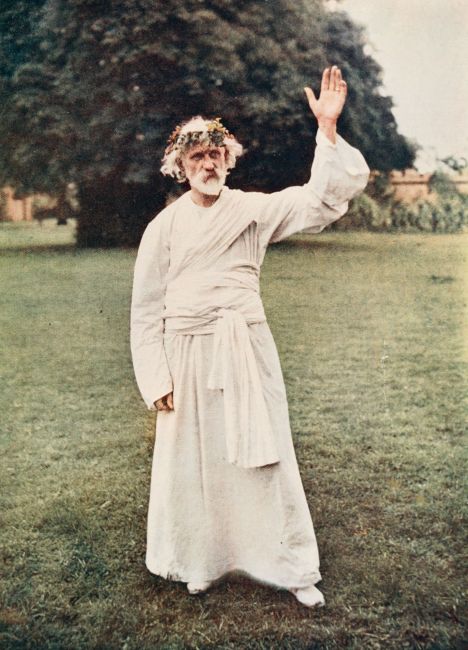
the van, and by the words of the white-robed, ivy-crowned
Druids, who called down the curses of the
sky-god upon the Roman foe.
Even when this part of Britain at length was
subdued, the inhabitants were very little influenced
by their conquerors. They used the fine Roman
roads laid down for the passage of their conquerors’
troops from Caerleon to Chester and along the
coast; they marvelled at the pretty Roman villas
that arose upon their borders; but they kept their
own language and their own customs, and were influenced
scarcely at all by the civilization which was
spreading fast in the south and east of Britain. One
thing, however, they eagerly embraced, and that was
the Christian faith, and that is one reason why many
Welsh words connected with the religious services
of the Church are merely Latin words in disguise.
When the rest of Britain, at the end of the fifth
century, had fallen into the hands of the English
invaders and conquerors, the western part remained
free. High among their mountains, these fierce
tribes bade defiance to Angle, and Saxon, and Jute,
and to them came for protection many of those who
had been forced to flee for their lives from other
parts of Britain. From that time this region came
to be known by the English as Wales, the Land of
Strangers; and thus was part of the prophecy concerning
the whole people of Britain fulfilled:
“Their land they shall lose
Except Wild Wales.”
“Their language they shall keep.” We have seen
how few Latin words had been borrowed from the
Romans, and now that all the rest of the island was
fast forgetting its original tongue and learning the
language of its conquerors, the men of the West
were fulfilling that part of the prophecy also. Up
to this time there had been in the land three distinct
races, and at least three languages. There were
the short, dark-haired Celts, who came originally
from the South of Europe, and who became the
serfs of the next new-comers, the Irish Celts. These
were tall, red-haired people, and very like them were
the next to come, the Brythons, or Welsh Celts.
While the English were making themselves masters
of the rest of Britain, these two latter tribes were at
civil war, and in the end the Brythons, or Britons,
got the upper hand, and their language became the
language of Wales.
It was about this time, too, that the first line of
the bardic prophecy began to be fulfilled. Under
the stirring influence of Dewi, the Water-drinker,
the monk of Dyfed, whom we know as St. David,
Wales became caught up in a wave of religious zeal.
Monasteries were built, missionaries travelled from
end to end of the country, everywhere the Gospel
was preached, and the people received it gladly.
Countless Welsh “saints,” or missionaries, arose,
whose names are now only remembered by the
churches or places dedicated to them; and while
England was sunk in heathen darkness, the light of
the Celtic Church was burning brightly in the West.
From that time down to the present day religious
zeal has been the characteristic of the Welshman.
“Their Lord they shall praise.”
The Norman Conquest, five centuries later,
brought the Lowlands of Wales—the Borderland,
or “Marches,” as it was called—under the rule of
Norman barons, but the wilder part of the country,
though it condescended to borrow something of
Norman civilization, remained independent. At
the end of the reign of Henry III. Wales was a land
of shepherd farmers, who knew well how to use the
bow and the spear. They were divided into many
tribes, but united by their religion and by their
love of music, poetry, oratory, and all those arts
which depend upon a vivid imagination for their
growth. Even to this day the stories that they told
are as fascinating to us as they were to the Welsh
boys and girls who first heard them as they sat by
the rude hearthstone, and heard the wind skirling
down the mountain outside the heavily barred door.
Fortunately for this Celtic spirit of imagination
that turns all it touches to gold, the next attempt
at conquest shook rather than shattered the independence
of Wild Wales. But we shall best
understand and enjoy this part of the story of the
land if we read it in connection with the particular
places at which the more striking events occurred.
CHAPTER II
SNOWDONIA, THE FASTNESS OF LLEWELYN
The story of the great struggle of Wales for freedom
under a Prince of her own is laid, fitly enough, amid
the wild scenery that surrounds the highest point in
Southern Britain. The whole district of Snowdon,
with its grim moorlands and towering heights
forming a bulwark to the western shore, breathes
an air of freedom, and it was here that the last
Llewelyn defied the might of the first English
Edward.
Roused by the bitter lament of those who had
fallen under the yoke of the Anglo-Norman barons,
Llewelyn, Lord of Snowdon, threw off the pretence
of alliance and friendship which Henry III. had
thought well to keep up between them, and claimed
to be ruler of all Wales, as his grandfather had done
in the days of Henry II. During the long Barons’
War in England the “Lord of Snowdon” found no
difficulty in maintaining his right to be “Prince of
Wales”; the real trouble only began when Edward I.,
on his accession, called upon the Prince to do homage
as his vassal. For two years Llewelyn paid no heed,
and when he heard that an English army was advancing
upon him, went out boldly to meet it.
But the chieftains of Central and South Wales
turned traitor, his own brother David deserted him,
and the Prince, driven back to the inmost recesses
of his mountain fastness, was forced to lay down his
arms. Preferring to have him as friend rather than
enemy, Edward behaved generously enough, merely
seizing a large slice of his dominions, confining
him to the Snowdon district, and providing that
the title “Prince of Wales” should cease at his
death.
Four years elapsed of outward peace and inward
commotion. Then came a rumour of a strange
event. Long years before, Merlin, a famous Welsh
bard and prophet, had foretold that “when English
money became round, a Prince of Wales should be
crowned in London.” In 1282 a new copper
coinage had taken the place of the usual breaking of
the silver penny into halves and quarters; and in
that same year the traitor David, who had been
rewarded with an English earldom, threw off his
allegiance to Edward, and appeared with an army
before his brother’s dwelling-place. Gladly did
Llewelyn once more raise the standard of revolt,
and a desperate struggle for freedom began. The
great army of the English King, encircling the
Snowdon range, which was the headquarters of the
Prince, drew in closer and closer; but meantime the
English soldiers were suffering terribly in that hard
winter of 1282, which the hardy Welshmen, living
in the snowbound caves of the mountain, seemed
to pass through unheeding. As long as Llewelyn
was there to inspire and cheer, pain and even death
were to be welcomed; but almost by chance the
men of Wales lost their leader in a quite unimportant
skirmish. Llewelyn had emerged from his
mountain lair, and, hoping to drive the English from
the Brecknock district, had ridden forth to meet
some allies. He was met by a party of English
horsemen and cut down by an almost unknown
knight. With Llewelyn, “our last ruler,” as the
Welsh still call him, the cause of Welsh independence
was lost. At Rhuddlan, in Flintshire, you may still
see a bit of the wall remaining where the Statute
of Wales was passed by the Parliament held there
in 1284; and in that Statute Edward showed the
greatest wisdom; for, instead of forcing English
laws and customs upon them, he allowed the
Welsh to keep their own as far as possible, altering
them only where it was clearly for their own
advantage.
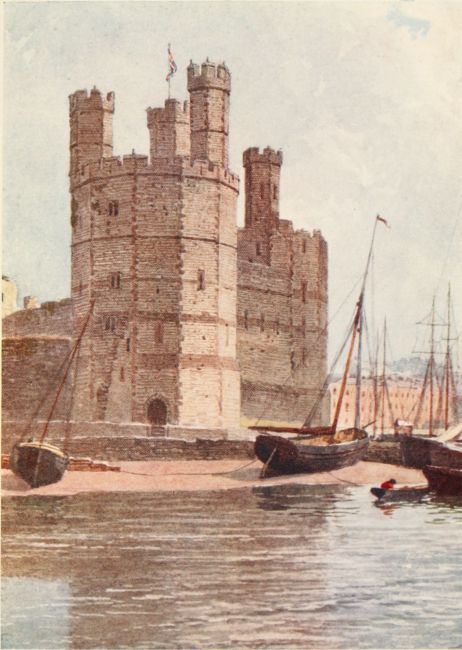
It was at Carnarvon Castle, which guards the
entrance to “Snowdonia,” that the little Prince was
born who was presented by Edward I. to the Welsh
chieftains upon a shield as a “Prince of Wales who
could not speak a word of English.” And nowadays
Carnarvon is, perhaps, the best starting-point from
which to take a glimpse of this wild and mountainous
district.
Behind us, as we look towards the mountains, lie
the Menai Straits, spanned by the fine suspension
bridge, so strong and yet so fairy-like with its arches
of Anglesey marble, that it has been called a “poem
in stone and iron.” This bridge continues the
Holyhead road to the island of Anglesey, the home
of the Llewelyns, where the soil is so fertile that an
old saying declares that it can provide corn enough
for all the people in Wales; and thence, across the
island, we may reach Holyhead, the starting-point
for the Irish mail-boats.
Travelling towards Snowdon by rail to Llanberis,
the scenery changes rapidly from pretty woods and
pastures to that of rugged heights, crags, and rock-bound
lakes. The mountain valley in which the
village lies is commanded by the very ancient Welsh
castle of Dolbadarn, once the prison of Owen, the
brother of the ill-fated Llewelyn, Lord of Snowdon.
Below is the great lake, and beyond the wild Pass
of Llanberis, bounded by a “tumultuous chaos of
rock and crag, as if Titans in some burst of fury had
been rending cliffs and flinging their fragments far
and wide.” If we are lazy, we may climb Snowdon
by the little mountain train, but if not, we set off
up the ascent till, just below the steepest part, we
turn off a little from the path to look at the wonderful
hollow of Cwmglas, high up in the mountain-side,
with its two tiny tarns, surrounded by
“striated” or glacier-marked rocks.
A steep scramble brings us to the top of Snowdon,
and if it is a clear day a glorious view rewards us.
Beyond the line of sea is the blue range of the
Wicklow Mountains in Ireland; below us, half
hidden by the crags and shoulders of the huge mass,
lie lakes and valleys, and the quiet lowlands stretching
to the borders of the Atlantic.
Through one of the loveliest of these valleys we reach
the mountain-girt village of Beddgelert. You all
know the story of Llewelyn and his faithful dog, killed
by his master because he thought he had eaten the
child he had in reality saved from a wolf. Here you
may see the stones which mark his tomb; but you will
probably be told that the story is but a myth, and that
the grave is really that of a Welsh chieftain named
Gelert, and not of a dog at all. You may console
yourselves with knowing that, whether this is true
or not, the picturesque little village was a favourite
hunting-spot for the Llewelyn whose story we
know in history, and that the curious little church
there is part of one of the oldest monasteries in
Wales.
Another beautiful valley leads to the famous pass
and bridge of Aberglaslyn. Here the huge cliffs
on either hand approach so closely to one another
that there is barely room for road and river; and
the wooded slopes, as they near the water, afford
a strong contrast to the wild rocks above.
After this rugged splendour, the prettiness of
the Fairy Glen at Bettws-y-Coed will seem tame
enough. We will not linger there, but will finish
our glimpse of this land of Llewelyn by a visit to
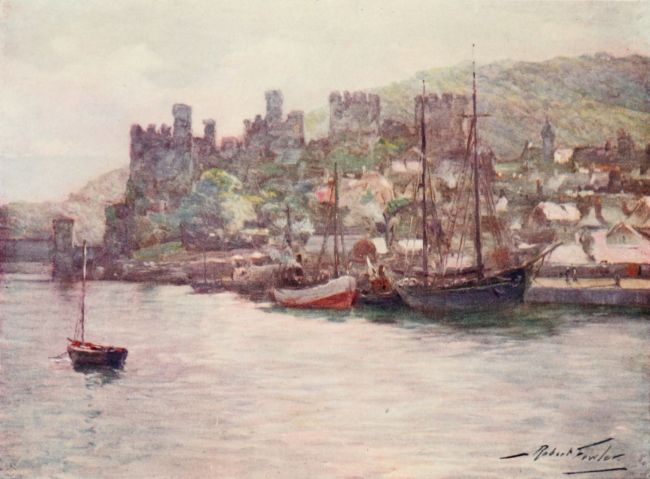
Conway Castle, built by Edward I. in 1283, to
safeguard this part of Wild Wales that he had so
hardly won.
The town of Conway, “rugged without, beautiful
within,” is a fine example of the fortified walled
towns of the Middle Ages. The walls are triangular,
and are said to represent a Welsh harp, and are
entered by crumbling stone gateways.
Above them towers the castle of Edward I., in
which he was himself besieged on one occasion by
the rebel Welsh, and was only saved by the arrival
of his fleet.
The poet Gray makes this neighbourhood the
scene of an event upon which the light of history
throws grave doubt. The English King, believing
that the conquest of Wales would never be completed
while the bards remained to stir up the
patriotic zeal of their fellow-countrymen, is said to
have ordered a general massacre of them on the banks
of the River Conway. It was the prophetic curse pronounced
on the King by one of these bards, standing
“on a rock, whose haughty brow frowns o’er old
Conway’s foaming flood,” which
“Scattered wild dismay
As down the steep of Snowdon’s shaggy side
He wound with toilsome march his long array.”
In spite of “Cambria’s curse and Cambria’s
tears,” the English King must have felt fairly secure
within the massive walls of the castle, whose
banqueting-hall, now open to the sky, and ivy-grown,
is of such noble length and breadth that it
might well have contained a regiment of retainers.
The passionate patriotism of Wales had little chance
against the solid strength of English builders and
English troops.
CHAPTER III
IN GLENDOWER LAND
As the name of Llewelyn is connected with the
Snowdon district, so the name of another Welsh
hero, Owen Glendower, lives still in that valley of
the Dee that lies between Corwen and Llangollen.
The valley itself is one of the most interesting in
Wales. Almost of a horseshoe shape, it is bounded
by ranges of mountains, not very high, but beautiful
in shape and colour. On one side, a blaze of yellow
gorse, Moel Gamelin rears his rounded head; on
the other the heather-clad heights of the Berwyns
invite us to scramble up their slopes and to walk
along the sky-line to the end of the vale. In the
hollow lies the picturesque little market-town of
Llangollen, and above it the steep cone-shaped
hill is crowned by the ruined castle of Dinas
Bran.
In the old days this castle must have been of great
importance, for it guarded the entrance to the
kingdom of Powys, the middle kingdom of Wales.
It was the stronghold of Madoc, Lord of Powys,
and of his son Griffith, who died in Llewelyn’s last
desperate struggle for freedom, both of whom were
the ancestors of Owen Glendower himself.
Nowadays we shall find a relic of olden times in
the harpist who sits upon the summit and plays
Welsh airs, full of mournful sweetness, to those who
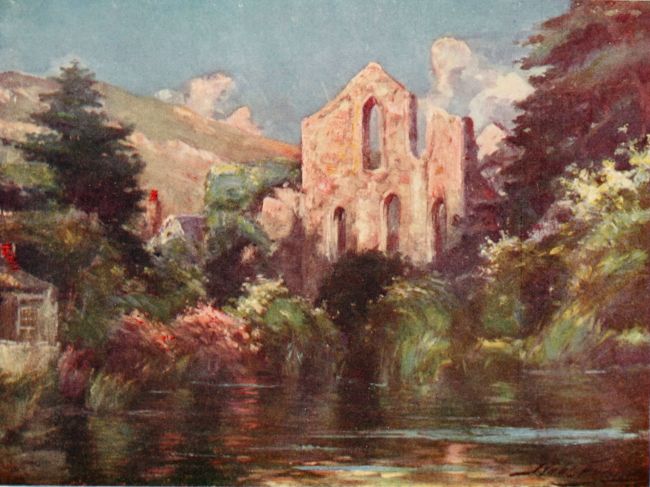
visit the ruins. Below in the half-hidden Valle
Crucis, lies one of the most famous of Welsh abbeys,
which we are going to explore, in order to find the
resting-place of these ancestors of Glendower.
In former days Valle Crucis Abbey, founded by
the Lords of Dinas Bran, was noted for its hospitality—a
virtue of which we are reminded by
the ruins of a large hostel, or guest-house, and
by the fish-ponds which still exist. Here are the
monks’ dormitories; and here, in the chapel, below
the beautiful remains of the east window, lie the
battered tombs of Madoc, the founder, and his son.
Returning to Llangollen, and passing along the
Holyhead road, we presently come to Glyndyfrdwy,
that “glen of the Dee” from which our hero Owen
took his surname.
Like most young Welshmen of noble birth after
the Conquest of Wales, Owen Glendower was
brought up in England. Shakespeare makes him
remind Hotspur that—
“I can speak English, lord, as well as you,
For I was trained up in the English Court,
Where, being but young, I framed to the harp,
Many an English ditty lovely well.”
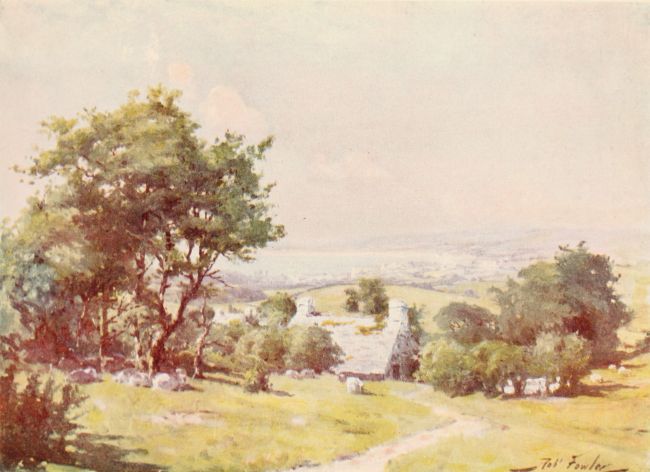
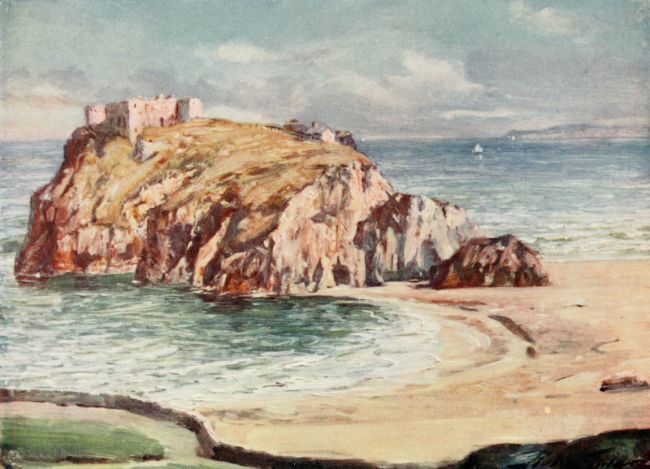
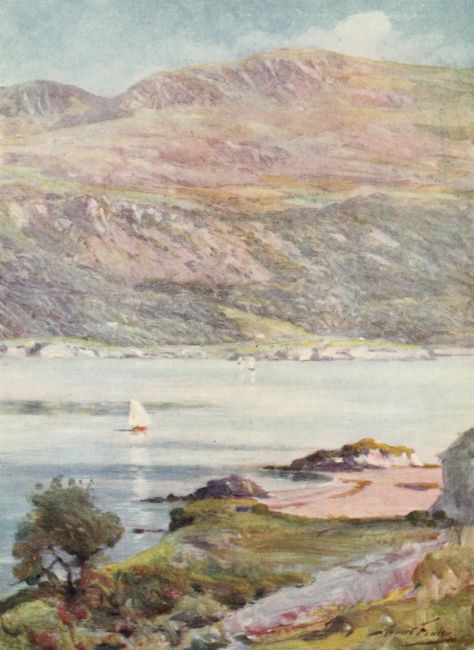
DISTANT VIEW OF CARNARVON BAY
When Henry IV. became King, Owen appealed
to him against Lord Grey of Ruthin, who had
seized a piece of his moorland. The King favoured
Lord Grey, and earned the lifelong hatred of his
rival, who promptly recovered his land by force of
arms. Grey of Ruthin took a mean revenge. When
Henry summoned his Welsh barons, among others,
to aid him in a war with Scotland, he suppressed the
message that summoned Glendower, and then denounced
him to the King as a traitor for not obeying
his call. Glendower’s house was immediately besieged,
and he had only just time to escape to the
woods. Now, Owen was no mean and unknown
Welsh knight. He was as learned in books as he was
skilled in warfare, and his house at Sycherth, ten
miles from his native valley, was famous for its
hospitality. His wife and children were of noble
breed; as a poet of the day sings: “His wife, the
best of wives, beneficent mother of a beautiful
nest of chieftains. Happy am I in her wine and
metheglyn.”
So, after a century of peace, when this descendant
of the last Llewelyn raised the standard of revolt
on the banks of the Dee, the Welshmen of the districts
far and wide flocked to his aid, singing with
the bard, Red Iolo:
“Thy high renown shall never fail;
Owen Glendower, the Great, the Good,
Lord of Glyndyfrdwy’s fertile vale,
High born, princely Owen, hail!”
Ruthin, the stronghold of Lord Grey, now a
quiet country-town, was first attacked and burnt
to the ground. Before Henry’s army, under the
government of Harry Percy, or Hotspur, and the
young Prince Henry, then a boy of fourteen, could
act against them, the revolt had spread all over
Wales, and had declared its aim to be independence
of English rule. The success with which Glendower
met soon earned for him the reputation of a
wizard.
“I can call spirits from the vasty deep,” Shakespeare
makes him boast to Hotspur; who rudely
replies: “Ay, but will they answer?” But let the
rough Northern Earl scoff as he might, Owen certainly
met with almost uncanny success. The
English troops, “bootless and weatherbeaten,” were
driven back across the borders again and again. Not
only North Wales, but the South country also rose
under him. Midway between the two stands
“Pumlumon,” better known as Plynlimmon, a
five-pointed peak that rises, almost solitary, from
the surrounding plain. Upon this top Glendower
planted his standard, and from thence he managed
to capture Mortimer, the powerful English Earl of
royal blood, who became before long his son-in-law.
Owen was now openly acknowledged as Prince of
Wales; castle after castle fell into his hands, and
Parliaments were held by him at Dolgelly, under
the shadow of Cader Idris, and elsewhere. But
meantime Prince Henry, the future Henry V., was
growing up and learning the art of war. It was he
who, while Owen was busy in South Wales, came
to his own valley of Glyndyfrdwy, and burnt his
house down. For seven years the war went on,
until the land was wellnigh ruined and the people
weary of warfare. Pardons were freely offered and
as freely accepted, until at last Owen Glendower
found himself deserted. Still he would not give
in, and when Henry V., soon after he was made
King, sent him an unasked for pardon by the hands
of Glendower’s own son, it came too late; the
hero of Wales’ last bid for independence was
dead.
Nearly eighty years later Wales recovered her
name for loyalty to an English Sovereign when a
certain Henry Tudor, grandson of a Welsh country
gentleman who had married a King’s widow, landed
at Milford Haven, and, with the aid of his fellow-countrymen,
won the Battle of Bosworth, and was
crowned King as Henry VII. And so, when
Henry VIII., his son, wished to bring about the
Union of England and Wales by Act of Parliament,
no voice was lifted against it. But if Henry thought
by this Act, and by forbidding all magistrates in
Wales to use the Welsh language, he was going to
make the country actually a part of England, he
was greatly mistaken. The upper classes might
flock to the English Court and forget their Welsh
homes, but the greater part of the people—the
workers of the nation—kept their own speech, their
own customs, their own traditions. The days of
warfare were over; but still you can tell a Welshman
from an Englishman wherever he is found. He
may talk the purest English, but the fall and rise
of his voice as he talks differs from the more monotonous
tones of his Anglo-Saxon companion. He
is more excitable, more easily moved to wrath, or
tears, or laughter, and he possesses, as a rule, a far
more vivid imagination than is found anywhere outside
the Celtic race of which he forms a part.
CHAPTER IV
A WELSH MARKET-TOWN
We have come to the end of Glendower’s story, but
before we leave his part of the country altogether
let us pay a visit to Corwen, the old market-town
that lies so near his own valley.
Someone has said that Corwen is “relentlessly
tucked away under the dark shoulder” of the
heather-clad Berwyns, for above it lies the height
of Pen-y-Pigyn, which certainly keeps the sun off
very effectually. In the porch of the old church,
indeed, we shall find a great stone, called by a Welsh
name that means “the pointed stone in the icy
nook.” A legend, found in many other parts of
Wales, says that the builders vainly tried to erect
the church, which was built before the town, on a
sunnier position farther down the valley, but every
night the walls were destroyed and the materials
carried down to the sunless spot under the hill.
Just above the vestry door of that same church is a
curious mark, said to have been made by the dagger
of Glendower, flung by him in a fit of rage one day
from the top of Pen-y-Pigyn.
So far away is Corwen from mines or flannel mills
or tourist centres, that it forms in many ways a
good example of a Welsh country-town, as it
might have existed not long after the days of
Glendower himself.
The great interest lies in the monthly fair-day,
when the streets and market-place are full of shaggy
Welsh ponies, black-faced mountain-sheep, and
cattle with immense horns. At every corner stand
groups of farmers, talking eagerly with hands and
shoulders as much as with lips, and with that curious
rise and fall of the voice which, they tell us, is the
secret of Welsh oratory. Of that conversation the
Saxon from over the border understands not a
word; but no sooner does he make a remark than
with the utmost ease the Welshmen respond in
excellent English. The power of expressing themselves
equally well in both languages is a striking
feature of even the most uneducated classes in
Wales. Only here and there in some farm hidden
far away among the hills could one meet with the
experience of one who, weary and thirsty after a
long tramp over the high moors, approached a
tiny farm-house and asked the old woman who
opened the door for a cup of milk. A shake of the
head was the only reply. “But you must have
milk or water in the house!” persisted the visitor.
Another shake and a stream of words in an unknown
tongue followed. Not to be baffled, the Saxon
raised his hand to his mouth and made as if to
drink.
With a cry of delight the old dame rushed away,
and returned with a large bowlful of liquid, of which
the traveller eagerly partook. It was fine thick
butter-milk, but, alas! it was quite sour!
Perhaps, however, the chief regret in the visitor’s
mind was the impossibility of explaining why the
bowl was returned full to the brim, for the old
dame’s puzzled look said plainly enough: “What
more could the stranger want than good Welsh
butter-milk?”
Meantime the market-women have spread out
their goods—poultry, butter, eggs, and flowers—on
the market-stalls in a picturesque fashion enough.
Many of the women themselves are worth the attention
of an artist, with their strong brown faces,
black crisp hair, and very dark blue eyes, “put in
with a smutty finger,” as someone has well described
them.
Fifty years ago you would have seen them dressed
in short red skirts, buckled shoes, crossed bodices,
and tall steeple-crowned hats worn over caps; but
these, unfortunately, have vanished.
The men—farmers or cattle-drovers for the most
part—differ in face more than they do in name. To
English ears everyone seems to be called either
David Mor-r-gan (with a beautiful roll to the “r”)
or Owen Jones. But to the careful eye the difference
between the two original races is clear. The
one is still short, smaller in build, and very dark-haired;
the other is tall, ruddy, with long loose
limbs and fiery red hair.
Borrow, whose amusing description of his walks
in “Wild Wales” you will like some day to read,
thus describes a fair at Llangollen some fifty years
ago, and from what one knows of these country-towns,
one would not expect to find things very
different to-day.
“The fair,” he says, “was held in and near a little
square in the south-east quarter of the town. It
was a little bustling fair, attended by plenty of
people from the country. A dense row of carts
extended from the police-station half across the
space. These carts were filled with pigs, and had
stout cord nettings drawn over them, to prevent
the animals escaping.
“By the sides of these carts the principal business
of the fair appeared to be going on—there stood the
owners, male and female, higgling with Llangollen
men and women who came to buy. The pigs were
all small, and the price given seemed to vary from
eighteen to twenty-five shillings. Those who bought
pigs generally carried them away in their arms, and
then there was no little diversion. Dire was the
screaming of the porkers, yet the purchaser always
knew how to manage his bargain, keeping the left
arm round the body of the swine, and with the right
hand fast gripping the ear. Some few were led
away by strings.
“There were some Welsh cattle, small, of course,
and the purchasers of these seemed to be Englishmen—tall,
burly fellows in general, far exceeding
the Welsh in height and size....
“Now and then a big fellow made an offer, and
held out his hand for a little Celtic grazier to give
it a slap—a cattle bargain being concluded by a
slap of the hand—but the Welshman generally
turned away with a half-resentful exclamation.
“There were a few horses and ponies in a street
leading into the fair—I saw none sold, however....
“Now, if I add there was much gabbling of Welsh
round about, and here and there some slight
sawing of English—that in the street leading from
the north there were some stalls of gingerbread,
and a table at which a queer-looking being, with a
red Greek cap on his head, sold rhubarb, herbs, and
phials containing I know not what—I think I have
said all that is necessary about Llangollen Fair.”
Perhaps, however, we should visit Corwen or
any other Welsh market-town on a Sunday to see
the most striking characteristics of the people.
The streets are nearly deserted, and a strange
stillness broods over the place. At the open door
of some of the cottages an aged woman sits with
a Welsh Bible on her knees, and keeps an eye upon
the toddling baby at her feet. Everyone else has
vanished, and not until a burst of melody sounds
from the plainly-built chapels which occur so frequently
on the highways and within the township,
is their whereabouts revealed. Such singing it is,
too! It has been said that the Welsh people sing
naturally in parts, and certainly it seems as though
nothing but years of training would produce such a
result with English choirs, not to speak of a whole
congregation, as is the case in Wales. In perfect
time and tune the beautiful old Welsh melodies
ring forth, and we begin to realize what a large part
this hymn-singing and fiery enthusiastic preaching
plays in the daily life of this emotional and deeply
religious people.
CHAPTER V
A VISIT TO ANGLESEY AND HOLYHEAD
We took such a brief backward glimpse at Anglesey
and Holy Island when we were visiting Llewelyn’s
country that we may as well now make a longer visit.
Crossing the Menai Straits by the suspension
bridge, we pass through a treeless moorland and
over a causeway into Holy Island, from whence rises
up the great headland known as Holyhead.
“A divine promontory,” Ruskin calls it, “looking
westward—the Holy Headland—still not without
awe when its red light glares first through the
gloom.”
The first thing we shall want to visit here is South
Stack, a precipitous mass of cliff climbed by three
hundred and eighty steps. From thence we look
down on the lighthouse, which, though one hundred
and fifty feet high, looks from this point like a child’s
toy. The cliff scenery is magnificent here, and a
grand sea rolls in to the foot of the rocks.
On our way back we must go to see some most
interesting relics of old days. They are known as
the Irishmen’s Huts, and were first built in those
ancient times when tribes of Irish Celts crossed
over to the island, and thence to the mainland,
threatening, indeed, to displace altogether the
original people of the land, and themselves driven
out in later days by another race. These huts are
grouped together so as to form tiny villages, in
spots where they are guarded either by steep rocks
or by roughly-constructed walls. They are round
in shape, and built of stone, though the remains
of the walls are now not more than two feet high.
All the entrances look towards the south, as though
the inhabitants knew the value of sunshine; and
the doorways are formed of two upright stones, with
another placed across the top. The roofs were
probably thatched or turfed over poles, which
stretched from one wall to the other.
From what was found under the ground on which
they stand when it was examined some years ago, it
seems as though some of these huts were used for
living in, some for bathing, some for working metal,
some for kitchens. Necklaces of jet, stone lamps,
weapons of bronze, and moulds for making bronze
buttons were found in some. In others there are
the remains of an apparatus for working metal; in
others there are tanks, in which water was boiled by
throwing hot stones into the water they contained.
Retracing our way by rail, we pass the village of
Llangadwaladr, the home of the last British Prince
to hold the title of King of All Britain. The son
of this Prince, Cadwaladr, who lived and died in
the seventh century, is buried in the church of
the place that bears his name, the “enclosure, or
church, of Cadwaladr.” But the chief interest lies
in his father, Cadwallon, and his cousin, Brian,
who together won one of the last great battles in
the cause of British freedom against the English
conquerors.
Cadwallon, son of King Cadfan, and Edwin, son
of King Ethelfrid of Northumbria, were both born
about the same year in the island of Anglesey, or
Mona, as the Celts call it; for the Celtic mother of
Edwin had been driven out of the royal palace,
and had returned to her former home. The boys
were brought up together in Brittany, another Celtic
kingdom, and returned together to Anglesey, where
they lived until, on the death of his father, Cadwallon
was chosen King of All Britain. This was,
however, but an empty title, for almost at that very
time Edwin left the island and made his way to
Northumbria, where he seized the kingdom and
with it much of the land of the Britons which lay
upon its borders. But Cadwallon cared not, because
he had been his friend.
Now the heart of Brian, the nephew of the British
King, was very sore because of the sufferings of his
fellow-countrymen at the hands of the English
conquerors. One day, as he hunted the otter with
his uncle on the banks of a river, the King was
overcome with heat and lay down to sleep, putting
his head on the lap of the lad.
But Brian’s heart was so heavy that his tears ran
down upon the face of Cadwallon, who muttered
uneasily: “It rains, it rains!”
Then, opening his eyes, he saw the blue sky above
him, and said to his nephew: “Surely there has
been a shower, and now the sun is shining. But
where is the rainbow?”
And Brian said: “My lord, it shines upon the
head of Edwin!”
Then Cadwallon saw his tearful face, and asked
him what he meant; and Brian told him all his
woe. Whereupon Cadwallon swore to devote the
rest of his life to winning back the land of Britain
for her own people.
But the strong King of Northumbria drove him
back from his borders again and again, and almost
in despair he set sail with Brian to seek help from
Brittany. A great storm arose, however, drove
the ship upon the rocks, and everyone was drowned
save Cadwallon and his nephew, who were cast upon
a desert island.
There, says the tale, King Cadwallon would have
died of hunger and heart-break had not the devoted
Brian secretly cut off a slice of his own flesh,
which he roasted and gave to his uncle, saying it
was venison. The King ate and took courage, and
after a time they were able to pass over the stormy
sea in the wrecked boat to Brittany.
The King of that land promised help, but meantime
Brian heard that his sister had been taken a
captive to Edwin’s Court, and that Edwin himself
was much under the influence of a certain clever
counsellor, who was especially hostile to the Britons.
So Brian, dressed in beggar’s rags, but carrying a
spiked staff, crossed to Wessex, and made the long
journey on foot to York to the palace of Edwin.
Standing outside, among a crowd of outcasts, he
presently saw his sister come forth from the Queen’s
household with a pitcher on her head to draw water
from the well. At once he pretended to ask alms
of her, and meantime told her who he was, and bade
her point out to him the wily counsellor among
Edwin’s followers. At that moment the latter
came out with a bag of money for the beggars,
and Brian, rushing forward, pierced him to the
heart with his pointed staff, and then vanished
among the crowd.
Fleeing from thence to Penda, the strong King
of the Mercians, Brian won him over to his uncle’s
side, and forthwith Cadwallon, Brian, and Penda
marched against Edwin in a great battle, in which
the King of Northumbria, Cadwallon’s foster-father,
was defeated and slain.
Penda took care to secure the northern kingdom
for himself, but until his death Cadwallon earned
his title to some extent by becoming undisputed
ruler over Wales, Devon, Cornwall, and the land
now known as Westmorland and Cumberland.
He married a sister of grim King Penda, and
their son was the peaceful Cadwaladr, in whose
reign much of the land of the Britons was again lost
to them. Never again did Welsh Prince claim to
be King of All Britain, even in name.
CHAPTER VI
AN EISTEDDFOD
No one who knows and loves Wales will have failed
to be present at some time or another at that most
interesting and curious ceremony known as an
Eisteddfod.
The name simply means a “sitting,” and probably
refers, not to the spectators, but to the “chairing”
of the bard, which forms a chief part in the
proceedings.
These gatherings, for the purpose of preserving
the poetry and music of the country, are held all
over the land; but each year a great national
Eisteddfod is held at some convenient centre; and
of this notice is published a year and a day beforehand.
At the appointed time, before crowds of spectators,
the trumpets are sounded, and the candidates
are presented for the “degree” of bard. For this
they have to pass tests of various kinds, poetical
and literary, which are judged then and there.
Then the “bards” present their addresses to the
audience—a poem, a prose composition, a song, as
the case may be. Musical competitions form a
very marked feature of the contest. From far and
near the country choirs flock in, and rival each other
in choral and solo singing, until one is adjudged the
prize.
Other competitors play the harp or violin, and
when the contest is decided, the great ceremony of
“chairing the bard” begins. A “chair subject”
having been previously set for competition, the
winner is solemnly conducted to a chair of carved
oak, a naked sword is held over his head, and he is
greeted with the blare of trumpets as the bard. A
concert, given by well-known singers, closes the
proceedings, which have often lasted for two or
three days.
This ceremony dates from very far-off times. It
may, indeed, be found in some form in the time of
that wonderful King Arthur of whom you have all
heard.
He, as you know, was King of Britain in the
“days before history,” and at his Court it was the
custom to set tests of valour to his knights. Once
he set seven of them to find fair Olwen, daughter of
Thornogre Thistlehair, chief of the Giants, and
they were given a year and a day for their quest.
Of the many wonderful adventures that befell them
you may read in a delightful collection of Welsh
stories called the “Mabinogion,” or “Book for
Girls and Boys.”
At another Yule-tide his nephew, Sir Gawayne,
was put to a more severe test. A Green Knight of
immense stature rode into the dining-hall of the
King, and dared any knight present to give him, who
was armed only with a holly-stick, a blow with an
axe, on the condition that he should receive a blow
in return a year and a day after the event.
Sir Gawayne proved himself the only one who
was not too dismayed at such a condition, and with
one good blow cut off the Green Knight’s head.
The latter, however, merely picked it up, and held
it aloft, upon which the head, opening its eyes and
addressing Sir Gawayne, said:
“Look you, be ready as you have promised, and
seek me till you find me. Get you to Green Chapel
a year and a day from now, there to receive a blow
on New Year’s Eve.”
The adventures of Sir Gawayne must be read
elsewhere. They form the subject of a fine English
poem of the fourteenth century, and were certainly
of the nature of a test of courage and endurance.
By the sixth century the Eisteddfod seems to have
become more of a test of poetical and musical talent
than of knightly skill and prowess. Those who
proved themselves worthy at the yearly gathering
were classed as bards, and were given the right of
entry into the castles of all Welsh barons and
Princes. At one of the earliest of these meetings
Gwynedd, Prince of North Wales, in order to show
how superior vocal music was to that performed on
instruments, offered a prize to the bards who should
swim over the Conway.
Eagerly the test was accepted, but when they
reached the farther bank the unfortunate harpists
found their strings were ruined by the water, while
the singers were merely braced up to even more
successful efforts than before.
In the twelfth century we hear of a very notable
Eisteddfod held at Caerwys, now a little country-town,
hidden away on a high tableland among the
hills, but notable in former days as the favourite
residence of the last Llewelyn. It was his ancestor,
Griffith, who held there a gathering, “to which
there repaired all the men of Wales and also some
from England and Scotland,” says the proud historian
of the event. And another is described as
taking place at Cardigan Castle, where assembled
many bards, harpers, and minstrels, “the best to
be found in all Wales.”
In the last century this interesting old custom,
which had become much neglected, was revived,
and now almost every Welsh town can boast of its
own little Eisteddfod, in which the various choirs
of church and chapel, the plough-boy poet and the
clever school-child, all play their part in keeping
alive that spirit of poetry and music which is
characteristic of the national character of Wild
Wales.
CHAPTER VII
“MEN OF HARLECH”
When Edward I. had completed his so-called conquest
of Wales, he safeguarded the land he had
won by building seven strong castles in seven danger-spots.
Those at Carnarvon and Conway we have
already visited, but most interesting of all is Harlech
Castle, linked as it is with the story of the far-off
past as well as with the more modern history of
Wales.
Built on a crag of rock that juts from a terrace
two hundred feet above the plain, stand the great
stone towers, looking towards the majestic range
of Snowdon to the north, and guarding the wide
stretch of country below; while to the west they
gaze over the Irish Sea. Legend tells us that the
castle stands upon the site of a far more ancient
building, Branwen’s Tower, which stood there a
thousand years before English Edward was heard of.
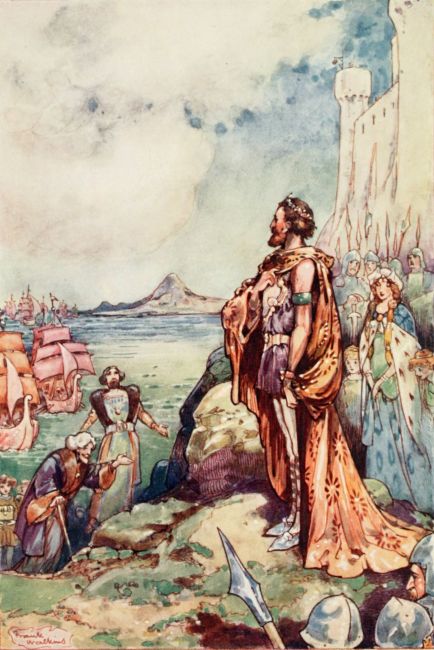
Bran the Blessed was King of Britain in those
days, and with him in his fortress at Harlech lived
his sister, Branwen, the fairest maiden in all the
land.
Now, one day, says the legend, Bran was at Harlech
with his brothers and his followers, and sat
with them upon the great rock overlooking the
sea. And as they sat they saw thirteen ships
coming from Ireland and making straight towards
them. Then Bran the Blessed raised himself and
said: “I see swift ships coming to this land. See
that my officers equip themselves right well and go
to find out their errand.”
So the officers did so, and when the ships drew
near the shore, behold, they saw that they were very
richly furnished, with ropes of silk and flags of satin.
And in the foremost stood one who lifted a shield
high above the bulwarks, and the point of the shield
was held upward in token of peace.
Then the strangers landed, and when they had
saluted the King, Bran from his rock said unto
them: “Heaven prosper you, my friends. To
whom do these ships belong, and who amongst
you is your chief?”
And they said: “Behold, the King of Ireland,
Matholwch, is here as suitor unto thee, and he
will not land unless thou grant him his desire.”
“And what is his desire?” asked the King.
And they said: “He would make alliance with
thee, lord, by taking in marriage Branwen, thy
fair sister; that, if it seem good to thee, the Island
of the Mighty might be joined to the Island of the
Blessed, and so both become more powerful.”
“Let him land,” said King Bran, “and we will
take counsel together upon this matter.”
So the two Kings met in friendly wise, and it
was arranged that Matholwch should marry Branwen,
the fairest damsel in the land, and that the
wedding should take place at Aberffraw, in Anglesey.
There a great feast was held, all in tents, “for
no house could contain Bran the Blessed.” But
when the banquet was at its height, came in the
bride’s half-brother, Evnyssian, and, out of spite,
because he had not been consulted in the matter,
he went to the stables where the horses of the Irish
King had been housed, and “cut off their lips to
the teeth and their ears close to their heads, and
their tails close to their backs, and their eyelids to
the bone.”
In his wrath, when he discovered this, the Irish
King would have broken off the alliance and declared
war there and then, but Bran managed to appease
his anger by giving him “a silver rod as tall as himself
and a plate of gold as wide as his face;” and so
he sailed away to the Isle of Saints with his fair
bride.
But he never forgot the insult that had been
offered him, for his people, jealous of the strange
Queen, were constantly reminding him of it; and
after her little son, Gwern, was born, the King deposed
her from her place at his side, and ordered
her to be cook in his palace.
Sad indeed was Branwen, for she was lonely in
the land; but she reared a starling in the cover of
her kneading-trough, and when she had written
down the story of her wrongs, she tied the letter
under the bird’s wing, and set it free. The bird,
it is said, flew straight to Carnarvon, the abode at
that time of King Bran, perched upon his shoulder,
and flapped his wings till the letter was seen and
taken from him.
Full of anger at the treatment his sister had received,
King Bran called together his fighting-men
and embarked for Ireland. But Matholwch had no
will for warfare, and, having held converse with
him, offered to make up for the wrongs offered to
his wife by giving up his crown at once to his young
son Gwern. To this Bran agreed, and forthwith
the Irish King ordered a great banquet to be prepared,
that the contract might be sealed.
Now, the boy Gwern was present at this banquet,
and showed himself so lovable and so fair that all
admired him. But his wicked uncle, Evnyssian,
who had already wrought so much evil, waited till
he came near, and then of a sudden seized him by
neck and ankles, and threw him into the great fire
that blazed upon the hearth. In vain did Branwen
try to fling herself into the flames that she might
save her son. The deed was done before she could
grasp him, and his fair body had become a heap of
ashes.
Because of this foul deed did bitter warfare break
out between the two countries, and so hard went
the fighting against the British that at length only
seven knights were left alive on the side of Bran,
and he himself was sorely wounded in the head, so
that he was about to die. Then Bran the Blessed
commanded this poor remnant of his followers to
strike off his head and bear it to his native land, and
he bade them keep it at Harlech for seven years, and
then to set it upon the White Mount in the city of
Lud; which place is now called Tower Hill in
London town.
So the seven knights returned to Harlech with
the head of their King, and with them they brought
his sister, the unhappy Branwen. And on their
way they rested in Anglesey, where Branwen, looking
first towards Ireland and then towards Britain,
cried with tears: “Woe is me that I was ever born,
for two islands have been destroyed because of
me!”
Then died poor Branwen of a broken heart, and
they buried her in Anglesey, at a spot known
henceforth as Ynys Branwen, “where a square
grave was made for her on the banks of the Alaw,
and there was she laid.”[1]
[1] From the “Mabinogion,” according to the version in
Rev. S. Baring-Gould’s “Book of North Wales.”
Early in the last century a four-sided hole was
discovered by a farmer in this place, covered over
with coarse flagstones. Within was an urn, placed
with its mouth downwards, and full of ashes and
fragments of bone. The urn was certainly one of
that period known as the Bronze Age, and belonged
to the “days before history,” so we may not unsafely
conclude that the ashes it contained were
really those of the unhappy Branwen, sister of Bran
the Blessed.
And so we come back to Harlech Castle, still
with its Branwen Tower, built by Edward I. as a
bulwark against the “rebel Welsh.”
In later days Owen Glendower besieged and
obtained possession of the castle, and was in his
turn besieged there by Prince Henry. There it
was that his son-in-law, Mortimer, died, and there
the wife and children of the latter took, for the
last time, refuge when the place was once again
captured by the English.
BRAN THE BLESSED AT HARLECH CASTLE WATCHING
MATHOLWCH’S FLEET ARRIVE FROM IRELAND.Page 36.
The Wars of the Roses caused stirring times at
Harlech. The castle was held against Edward IV.
by David ap Sinion, who had offered to receive
there under his protection Margaret, the unfortunate
widow of Henry VI., and her son, young
Edward, after she had lost the Battle of Northampton.
Against this “rebel” marched Lord Herbert,
who called upon David to surrender. But David
had done good work for the Lancastrian cause
abroad, and he now replied that “he had held a
castle so long in France that all the old women
in Wales had talked about it; and now he was
going to hold Harlech so long that he would
set the tongues of all the old women in France
wagging.”
Great was the slaughter in that siege, during
which, it is said, the “March of the Men of Harlech”
was written to stir the neighbouring vassal
chieftains to revolt against the usurping Edward.
“Fierce the beacon light is flaming,
With its tongues of fire proclaiming
‘Chieftains, sundered to your shaming,
Strongly now unite!’
At the cry all Arfon rallies,
War-cries rend her hills and valleys,
Troop on troop, with headlong sallies,
Hurtle to the fight.
“Chiefs lie dead and wounded,
Yet where first ’twas grounded,
Freedom’s flag still holds the crag,
Her trumpet still is sounded;
O, there we’ll keep her banner flying;
While the pale lips of the dying
Echo to our shout defying,
‘Harlech for the right!’”
Even in the English words the chant is inspiring
in the extreme; the Welsh words, joined to the
warlike tune, would stir the veriest coward to play
his part like a hero.
Sad to say, the brave David was forced at length
to surrender, on condition that his life was granted.
To the honour of Lord Herbert be it told that
when Edward wished to put David to death he sought
him out, and demanded of him one of two things:
either he must send David back to his castle and
despatch another officer to besiege it, or he must
take the life of Herbert himself in place of that of
the prisoner. Finally, the King forgave David, and
Harlech, the last to hold out for the Lancastrian
cause, submitted.
CHAPTER VIII
A BURIED VILLAGE
To-day we are going to take a glimpse at two Welsh
lakes, to one of which a most romantic story is
attached.
We start from Lake Bala, or Llyn Tegid, as it was
called in the days of Taliesin. Borrow, that whimsical
traveller, who walked throughout Wales, and
knew the country as few Welshmen do themselves,
thus describes it:
“I wandered to the northern shore of Llyn
Tegid ... the wind was blowing from the south,
and tiny waves were beating against the shore, which
consisted of small brown pebbles. The lake has
not its name, which signifies Lake of Beauty, for
nothing. It is a beautiful sheet of water, and
beautifully situated. It is oblong, and about six
miles in length. On all sides except to the north
it is bounded by hills. Those at the southern end
are very lofty, the tallest of which is Aran, which
lifts its head to the clouds like a huge loaf.” Then
he recalls how a hut by the edge of this lake was
in former days the refuge of Llewarch the Aged,
who lived to the age of 140, and had twenty-four
sons, all of whom were slain by the Saxon invader
in the grim days of old.
In more recent times the town of Bala was
noted for the knitting industry; and a hundred
years ago one might have seen the Tomen
of Bala, a great mound overlooking the valley,
covered with a crowd of knitters—men, women,
and children—all plying their needles with busy
fingers.
And now we turn our backs on the old lake and
its prosperous little market-town, and set off to find
a new lake, which only came into existence in the
year 1881, which yet, in many ways, has a stranger
and more romantic story than any that Llyn Tegid
can boast.
Up and up climbs the steep, rough road to the top
of the wild pass on the ridge of the Berwyns; or, if
we want a yet wilder walk, we may strike off it to
the left across the moorlands, steering our way
through pathless bogs and treacherous swamps, till
we reach a steep precipice guarding a valley through
which rushes a torrent of waterfalls. Along the
side of this sheer rock runs a narrow sheep-path—so
narrow that we creep along on hands and feet across
chasms, where it disappears altogether, and finally
drop down a headlong descent into the valley of
Lake Vyrnwy.
Five miles of peaceful grey water lie below us,
fed by mountain torrents such as that we have
skirted in our perilous descent.
Scarcely a house is to be seen, for the new hotel
and its surroundings lie hidden by the bend of the
shore; it seems a valley of the dead. Yet before
the year 1880, in the Valley of Llanwddyn, as it
was called, a village of 500 inhabitants existed; and
a church and chapels, inn, and village street, farms
and cornfields flourished where now stands that
great expanse of water.
A quiet, secluded folk they were, knowing little
English and even less of the ambitions and needs of
the great industrial cities with one of which they
were to be brought into such close touch. Quietly
they lived and quietly they went to rest under
the shadow of their grey church tower among the
hills.
But meantime that great busy monster, the city
of Liverpool, was crying out for more water. A
huge reservoir must be secured, and since no other
was available, some mountain valley, shut in on all
sides, must be turned into a lake for the purpose.
The news fell like a thunderbolt on the peaceful
valley-dwellers. In vain they were told of compensation,
of new and more comfortable houses
to be built for them on the wooded ridge above
the lake. To the old people the whole thing came
upon them as nothing less than a devastation like
that which overtook Pompeii of old. One old dame,
indeed, is said to have chosen death by drowning
rather than leave the roof of her ancestors, and a
scene of actual violence occurred before she could
be removed.
They tell us that a sailor, a native of Llanwddyn,
returned after a lengthy absence to visit
his home. You can imagine his feelings when, as he
climbed the pass and began the steep descent, he
saw his native valley transformed into an immense
lake. We, too, as we pass along its shores and gaze
into the watery depths, may see, with fancy’s eye,
the smiling cottage, the cheerful little farm, the
sunny gardens, lying buried amid the slimy water-weeds.
There stood the old church, founded in
the sixth century, and rebuilt by the famous
Knights of Jerusalem in the twelfth, whose bell
“jangled for loyalty with such strange noise and
good affection,” when Beaufort made his progress
through Wales in the days of James II.
Now that little belfry lies silent far below the
surface.
These are thoughts that tend to sadness, however,
and we may cheer ourselves with a funny tale told
of the workmen who were building the huge dam
by which the water is pent in. Mr. Baring-Gould
tells it as follows:
“Now, it fell out that when the dam was in
course of construction, there was a stone in the
river called Carreg yr Ysbryd, or the Ghost Rock,
and it had to be removed. This was supposed
to cover an evil spirit that had been laid and
banned beneath it. The Welsh labourers engaged
on the work would have nothing to do with
shifting the block, but the English navvies had
no scruples, and they blasted the rock, and with
crowbars heaved out of place the fragments that
remained.
“Then was revealed a cavity with water in it,
and lo! the surface was agitated, and something
rose out of it. The Taffies took to their heels.
Then an old toad emerged, hopped on to a stone,
yawned, and passed its paws over its eyes, as though
rousing itself after a long sleep.
“‘It’s nobbut a frog,’ said the Yorkshire navvies.
“‘It’s Cynon himself,’ retorted the Welshmen.
(Cynon was a wizard of the ancient days.) ‘Look
how he gapes and rubs his face. You may see by
that he has been in prison.’
“After that, whenever a Taffy was observed to
yawn, ‘Ah ha!’ said his mates; ‘clearly you have
but recently come out of prison.’”
CHAPTER IX
THE SACRED RIVER
In our peeps at North Wales we have more than
once had a glimpse of the River Dee. To-day we
will pretend we have taken a “coracle,” one of the
curious oval boats which were used in the very
earliest days, and which you may sometimes see a
man carrying on his shoulders from one bend of the
river to another. “Carry thou me, and I will carry
thee,” an old Welsh proverb makes the coracle say
to the fisherman; and it shall now carry us down the
course of the river as far as it lies within the land of
Wales. The River Dee, one of the most lovely in
Wales, has always been connected with the mysterious
religion of the Druids. Its very name in
old days, Deva, meant the goddess, or the “divine
one”; and its modern Welsh form, Dwy, means the
same thing. A legend of Druid times says that the
Dee springs from two fountains high up in the
mountains above Bala, called Dwy Fawr and Dwy
Fach, or the Great and Little Dee, whose waters
pass through those of the Lake of Bala without mingling
with them, and come out at its northern extremity.
These fountains had their names from
two individuals, Dwy Fawr and Dwy Fach, who
escaped from the Deluge when all the rest of the
human race were drowned, and the passing of the
waters of the two fountains through the lake without
mingling with its flood is an emblem of the
salvation of the two individuals from the Deluge,
of which the lake is a type.
Probably the river was worshipped as a goddess
in those days, and when Wales learnt the Christian
faith, it would be but fitting that her bank should
be crowded with those who sought baptism in her
waters. Nowadays, too, it is no uncommon sight
to see a little group of people by the waterside
presiding over the baptism of one or more of their
companions.
Soon after leaving the lake the Dee passes through
a district that is closely connected with the youth
of that great Celtic hero, King Arthur. There are
few parts of Wales which—by their names, at least—allow
us to forget that Arthur and his Court played
a famous part in Britain in the days before history.
And here we have Caer Gai, the ancient stronghold
of Sir Kay, the foster-brother of Arthur, who could
make himself as tall as the tallest tree in the forest,
or lie hidden in lake or river for nine days and nights,
if needs be. Such fire was in his nature that when
they needed warmth his companions had but to
kindle the piled wood at his finger; he could walk
through torrents of rain as dry as on a summer’s
day; he could go for nine days and nights without
sleep; and no doctor could heal the wounds made
by his sword.
It was in this district of Penllyn, opposite to the
hill of Yr Aran, which he calls “Rauran,” that
Spenser in his great poem makes King Arthur describe
the way his boyhood was passed in the
“stronghold of Kay,” or Caer Gai:
“Whose dwelling is low in a valley green
Under the fort of Rauran, mossy hoar,
From whence the River Dee, as silver clean,
His tumbling billows rolls with gentle roar;
There all my days he trained me up in virtuous lore.”
But, apart from legend, Caer Gai touches history
itself. From its well-preserved ramparts and
“fosse,” or moat, enclosing what is now a farm-house,
we see that it must have once been a Roman
fortress. Roman urns have been dug up here, and
not very many years ago a ploughman turned up
a stone with an inscription that showed it must
have been placed there by Roman soldiers about
A.D. 105.
Leaving Llyn Tegid, or Bala Lake, behind us, we
set off down our river to Corwen and Llangollen.
These places we have already visited, so we will
only stay to notice the lovely scenery of this part
of the Dee, so dear to fishers. Not far from where
the river bends north-east to Chester and the sea,
stands Chirk Castle, and near by, in order to reach
it from Llangollen, we shall pass the line of Offa’s
Dyke, a bank with a moat below it that ran from
the mouth of the Dee to the mouth of the Wye,
which was erected by a King of Mercia in the
eighth century as a barrier beyond which no Welshman
might pass.
For the rest of its course, therefore, the Dee really
forms part of the boundary-line between England
and Wales, and though we shall be sorely tempted
to linger when we come to the beautiful old city of
Chester, gazing down from its ancient walls upon
the broad river below, we must remind ourselves
that this is English soil, and leave the sacred waters
of the Dee to empty themselves by a very long
estuary into the sea some miles below Flint Castle,
the last refuge of the unhappy Richard II. before
he gave himself into the hands of Bolingbroke.
CHAPTER X
A PEEP AT PEMBROKE
To-day we will leave North Wales and travel south
to take a glimpse at Pembrokeshire, in some ways
one of the most interesting counties in Wales.
Between the northern and southern parts of the
country runs a stream, flowing into St. Bride’s Bay,
which divides the Welsh Pembroke from a district
known as “Little England beyond Wales.”
Here, in this latter region, one hears nothing
but English spoken. The towns, the people, are
typically English, or, at least, very far from being
typically Welsh. This is how a seventeenth-century
writer accounts for the fact:
“This same division was in ancient time inhabited
wholly by Welshmen, but a great part
thereof was won from them by the Englishmen
under the conduct of Earl Strongbow, and divers
others, and the same planted with Englishmen
whose posterity enjoys it to this day, and keep their
language among themselves without receiving the
Welsh speech or learning any part thereof, and
hold themselves so close to the same as to this day
they wonder at a Welshman coming among them,
the one neighbour saying to the other: ‘Look!
there goeth a Welshman!’”
The interesting thing about this is that these
people of South Pembroke were probably not
English at all in origin, but Flemings, who came
over from Flanders many centuries ago, and settled
there with their woollen manufactures—a trade
which perhaps accounts for the superiority of
“Welsh flannel” to-day.
These were, like their Welsh neighbours, a very
religious and emotional people, and more ready,
perhaps, than the former to leave the land of their
adoption for the perils of the Holy War. For a
writer of the time of the early Crusades tells the
story of a certain Archbishop’s journey through
Wales to rouse volunteers for the war in far-off
Palestine; and to him “it appears wonderful and
miraculous that, although he addressed the Pembroke
people both in the Latin and French tongues,
these persons, who understood neither of these
languages, were much affected, and flocked in great
numbers to the cross.... They are,” he goes on
to say, “a brave and robust people, ever most
hostile to the Welsh—a people well versed in commerce
and woollen manufactures, anxious to seek
gain by sea or land, in defiance of fatigue and
danger, a hardy race, equally fitted for the plough
or the sword.”
Suppose we take a steamer from the charming
little seaport town of Tenby, and follow the coast-line
of Pembroke up to Milford Haven. Romantic
cliffs guard the land, and limestone caverns hint at
smuggling expeditions in the good old days. Here
is Caldy Island, where stood one of the oldest of
Benedictine priories; and here, at St. Gowan’s
Head, the cliff, rising to a great height above the
sea, is split up into a narrow cleft by the force of
the waves.
Across this chasm is built a little cell, known as
St. Gowan’s Chapel, from which a doorway leads to
a cave in the cliff, shaped exactly like a human figure.
The legend says that St. Gowan, a holy man of
God, was praying in his cell when his heathen foes
came battering at the door. He called upon the
rock to be his shelter, and immediately it opened
to admit him. When his enemies had gone away
baffled, and the saint had emerged, the impression of
his form was found in the cliff; and nowadays they
say that if you stand in the cavity and wish, and
then turn round without changing your mind, the
wish is sure to come true.
Now we are entering Milford Haven, “the finest
harbour in the United Kingdom,” stretching ten
miles inland, with its many bays, creeks, and roadsteads.
Sailing up the right-hand shore, we presently
reach Pembroke Dock, two miles from the
town of Pembroke, where stand the ruins of one of
the earliest built and strongest of the many castles
of Wales.
From its huge towers and turrets Strongbow
started on that adventurous journey of his with
the aim of conquering Ireland. For many years
after the conquest of Wales its grim keep, with its
conical roof capped by an enormous millstone,
menaced the rebel Welsh. There, in 1456, was
born Henry Tudor, one day to be Henry VII. of
England, and there he spent the first ten years of
his boyhood. There also was his landing-place
when he came to drive the usurping Richard from
the throne.
Its story during the Civil War is strange enough.
Pembroke Castle, under Poyer, the Mayor of Pembroke,
was the only place in Wales that declared for
the Parliament. But it looked as though this was
only done for love of opposition to the majority,
for when the war was over and troops were being
sent back home, Poyer refused to give up his post
as Governor of the Castle, and roused up the whole
of South Wales for the Royalist cause, then practically
dead. Great must have been the surprise
of the Puritans, but before long Cromwell himself
was putting the rebels to flight and battering at the
walls of Pembroke Castle, where so many had taken
refuge.
“A very desperate enemy, very many of them
gentlemen of quality, and thoroughly resolved,” so
Oliver described them. But the well of drinking-water
had been captured by him, and hunger and
thirst compelled them to surrender. Poyer and two
other leaders were sent to the Tower and condemned
to death, but pardon being granted to two of the
three, lots were then drawn. “Life given by
God” was written on two slips; the third was a
blank. Poyer drew the last, and, facing death
with the utmost courage, was shot at Covent
Garden.
It is tempting to take a glimpse at the stately
ruins of Carew Castle, another great stronghold of
old times; but we must hasten on to the head of
the estuary, and thence by land to the ancient town
of Haverfordwest, now a flourishing market-town,
the most important in the county. Again the most
striking feature is the great square-walled castle,
concerning which the old Welsh historian tells an
exciting adventure.
It so happened that a certain robber-chief was
imprisoned in the dungeon of the castle at the time
that the three young sons of the Earl of Pembroke
and two children of the Governor were playing together
within the walls. The game was shooting
with bow and arrows, but the latter were so badly
made that the youngsters began to lament that no
one could make them well enough. Either through
a chink in the wall, or by means of his gaoler, the
prisoner conveyed the information that he was
noted for the work of arrow-making, and the boys
were soon his devoted admirers. One day the too
confiding gaoler went off to his dinner, leaving the
dungeon door with the key in the lock, that the
boys might visit the interesting maker of arrows.
No sooner were some of them inside, however, than
the brigand locked them in with him, and threatened
those who tried to break down the door that he
would kill the children and himself unless the
Governor swore to let him go free. This was done
at length, in sheer despair, and the robber was
allowed to depart to his lair in safety.
ST. CATHERINE’S ROCK, TENBY.
Haverfordwest is the nearest station to St.
David’s, the most famous cathedral in Wales, once
the aim of many a pilgrimage, since “two journeys
to St. David’s shrine counted as one to Rome.”
And well it might, since even now there are “sixteen
miles and seventeen hills” to traverse before
we reach the sacred spot.
St. David’s Cathedral stands remote in a somewhat
desolate country, upon a strip of craggy
seaboard, “the loneliest of British fanes.” “We descend
a narrow street paved with rough stones, we
look through a little gateway on the right, and stand
astonished and delighted. A wonderful prospect
bursts upon us: we behold the whole cathedral
rising before us in its stern majesty, with the ruins
of St. Mary’s College to the right, and the magnificent
remains of the Bishop’s palace to the left,
while the dark rocks of Carn Llidi form the background
to the striking picture.”[2]
The loveliness of the building itself, its massive
pillars and delicate tracery, with the grey, purple,
and red colours of the sandstone from which they
are formed, make it one of the most beautiful of
cathedrals; but the most thrilling memory in connection
with it is that, when most of England was
still plunged in heathen darkness, a cathedral stood
in this place as the Church of West Britain and the
seat of an Archbishop of the Celtic Church.
The shrine of St. David, or Dewi, the Water-drinker,
the patron saint of Wales, is within, and
with him lies the honour of transferring the seat
of the Archbishopric from its more ancient site at
Caerleon in Monmouthshire to this spot. St. David,
said by one legend to have been uncle to King
Arthur, became famous by a miracle that occurred
in the sixth century, when he addressed a great
meeting of the Fathers of the early Christian Church,
and laid low the false doctrines of one Pelagius, or
Morgan, who was leading the Christians of Britain
and other lands astray.
As the saint, then Abbot of St. Patrick’s Monastery,
where now stands the present cathedral,
addressed a crowd composed of “the saints of Anjou,
the saints of England, and of the North, of Man and
Anglesey, of Ireland and Devonshire and Kent,”
and of many other places, a white dove descended
from heaven upon his shoulder. “Upon which the
ground on which he was standing,” says the legend,
“gradually rose under him, till it became a hill,
from which his voice, like a loud-sounding trumpet,
was clearly heard and understood by all, both near
and far off, seven thousand people, on the top of
which hill a church was afterwards built, and stands
till this day.”
This happened farther north at Llandewi-brefi,
but it was this miracle that placed the see
of the Archbishopric to which St. David was at
once raised, in Menevia, as this lonely district was
called, instead of at Caerleon, thus fulfilling the
prophecy of Merlin: “Menevia shall put on the
pall of Caerleon.”
CHAPTER XI
THE VALLEY OF THE WYE
To-day let us take a journey up the course of the
Upper Wye, loveliest of Welsh rivers, from the
point where it crosses the border between England
and Wales.
The course of the Upper Wye begins just below
the ruins of Clifford Castle, one of the many built
upon the “Marches,” or borderland, nominally to
keep the Welshmen within bounds, actually to
shelter the robber-barons who gained their livelihood
by harassing the country on either side. The
grey stones of Clifford, covered now with a wealth
of ivy, speak to us of that “fair Rosamond” with
whom King Henry II. fell so deep in love that he
took the maiden from her father’s house and made
her a bower at Godstow. There, as we all know,
she was forced by Eleanor, his jealous wife, to drink
a cup of poison, and never again saw the sunny
banks of the Wye.
As the river sweeps along its curving course, the
slopes of the Black Mountains rise in a broken mass
of hill and dale and heathery upland. A touch of
wildness distinguishes the country from the tamer
fields of Herefordshire behind us, and rough hills,
whitewashed farms, roofed with brown stone slabs
and heavy beams, take the place of the comfortable
and spacious manors of the English county.
This part of the Wye Valley, divided by the Black
Mountains from that of the Usk, is, indeed, one of
the most complete solitudes to be found in the
country, rivalling that of Menevia itself. “What
a wild little block of mountain it is, this eighty
square miles of complete solitude!” says a traveller
of the hill country between the two rivers. “How
dark, and deep, and sombre the gorges! How silent
the hills, where grouse lie fairly thick in the big
tracts of heather! How striking the blush of the
red sandstone against the greener slope, where
the teeth or tread of hungry sheep and the downward
rush of streams have scarred the mountain-side!”
Presently a spur from these hills stretches out
across our valley, and the river turns north-west
and changes its character from a broad, easy flow to
a rushing torrent, with here and there a deep
salmon pool among the rocks of its course. This
is a very famous part of the river from the fisherman’s
point of view, and few save tramps and fishermen
are to be met with on the lonely valley road
which we are now pursuing.
Here, at Aberedw, stands the castle which was
the last refuge of the ill-fated Llewelyn, Prince of
Wales, whose story we read in a former chapter.
From this spot he set out to join his forces, was surprised
by the English, and killed in a little wood,
henceforth to be known as “the bank of the grave
of Llewelyn.”
The story adds that the men of Builth, close by,
refused the Prince and his handful of followers a
refuge on that occasion, and the curse of the
“Traitors of Builth” is said to have clung for many
a long day to the inhabitants.
Another lovely stretch of the river lies between
Builth and Rhayader, and again the country on
either side is one great solitude; for in old days this
part of Wales offered no attraction to the great
border lords save as a fighting-ground between the
Men of the South and the Men of the North. It
was the home, rather, of outlaws and bandits, who
found good cover in its woods and highlands, and
who doubtless cared as little as the English barons
for the lovely river scenery amidst which they made
their home.
Rhayader, whose name means “the Falls,” is a
typical Welsh market-town, asleep save on market
and fair days, when it becomes one mass of shouting
drovers, frightened cattle, buxom women with their
great baskets, and gaitered farmers eagerly discussing
the latest topic.
Above this town the Wye is no longer a stately
river, but a straggling mountain stream, which
makes its way through a wild and ever-rising
country from its source in a spring on the side of
Plynlimmon.
The little wedge of country, some ten miles
square, which lies on its western bank and stretches
away from Rhayader to the border of Cardigan, is
full of weird tales and strange points of interest.
“At Llancavan a Lord of Builth, wearied with
the chase, and overtaken by darkness, entered the
church with his hounds and spent the night. In
the morning his hounds were mad and he was blind.
In his remorse for his act of sacrilege he had himself
conveyed to Palestine, and there led on horseback
and fully armed in the front of the fighting-line
against the Saracens, who very promptly killed
him.”[3]
[3] Bradley, “Highways and Byways of South Wales.”
Another legend says that once a miracle happened
in Rhayader itself. A farmer had been seized by
the owner of the castle on a charge of sheep-stealing,
and was confined in the dungeon thereof. His poor
wife, knowing that the gaolers were open to bribery,
but having neither money nor goods, stole from the
church the funeral bell, which it was the ancient
custom to ring at the head of the procession to the
grave. She took this to Rhayader, and offered it to
the gaolers on condition that they should release
her husband. But they took the sacred bell and
then refused to let him go. That night, says the
legend, the whole town was destroyed by fire, save
only the wall of the castle on which the bell had
been hung.
From Rhayader the Valley of the Elan, a tributary
of the Wye, runs westward, and becomes a
scene of great importance from one point of view.
The valley is narrow, pent up among the hills,
which fling down into it their numberless mountain
streams. Here a great dam has been built, which
pens up the water into two great lakes, and various
smaller reservoirs, from which the city of Birmingham
draws its water-supply. Fancy 60,000,000
gallons of water a day being carried to Birmingham,
seventy miles away! These Welsh valleys certainly
do their part towards keeping the great dirty
manufacturing towns of England clean and sweet.
CHAPTER XII
THE GREAT PLYNLIMMON
“Cardigan is a country to itself,” says one who
knows Wales well. Except, indeed, for the towns
on the coast, Lampeter, with its college, and a
famous abbey in the south, the whole country has
been described as a “mountain wilderness.” But
since some of us prefer such untrodden wastes to
those parts that have become merely playgrounds
for the English tourist, we will pay it a visit to-day.
At the north-eastern corner of the county stands
Plynlimmon, the home of the Severn, the Wye, and
many a smaller river which ploughs its way through
the wild region we are traversing. And let us note,
by the way, that, since railways and even good roads
are unknown except on the very fringe of this
district, our best method of travelling will be on foot.
Many years ago, when that delightful person,
George Borrow, a native of Norfolk, made a long
tour all over Wales on “Shanks’s mare,” seeing
thereby far more of the country and its people than
the motor-car or railroad travellers of more modern
times, he explored this part of the country very
thoroughly, and this description of his visit to
Plynlimmon is too good not to quote at length:
“The mountain of Plynlimmon, to which I was
bound, is the third in Wales for height, being only
inferior to Snowdon and Cader Idris. Its proper
name is Pum or Pump Lumon, signifying the
‘five points,’ because towards the upper part it is
divided into five hills or points.
“Plynlimmon ... has been the scene of many remarkable
events. In the tenth century a dreadful
battle was fought on one of its spurs between the
Danes and the Welsh, in which the former sustained
a bloody overthrow. In 1401 a conflict took
place in one of its valleys between the Welsh under
Glendower and the ‘Flemings’ of Pembrokeshire,
who, angry at having their homesteads plundered
and burnt by the chieftain, the mortal enemy of
their race, assembled in great numbers and drove
Glendower and his forces before them to Plynlimmon,
where the Welshmen stood at bay, and
with difficulty won a victory....
“... I started about ten o’clock on my expedition,
after making, of course, a very hearty breakfast
... and went duly north till I came to a place
among hills where the road was crossed by an angry-looking
rivulet. I was just going to pull off my
boots and stockings in order to wade through, when
I perceived a pole and a rail laid over the stream at
a little distance above where I was. This rustic
bridge enabled me to cross without running the
danger of getting a regular sousing, for these mountain
streams, even when not reaching so high as the
knee, occasionally sweep the wader off his legs, as
I know by my own experience. From a lad I learnt
that the place where I crossed the water was called
the ‘Foot of the Red Slope.’
“About twenty minutes’ walk brought me ...
near a spur of the Plynlimmon range. Here I
engaged a man to show me the sources of the rivers
and the other wonders of the mountain. He was
a tall, athletic fellow, and had much more the
appearance of an Irishman than the Welshman that
he was....
“After ascending a steep hill and passing over
its top, we went down its western side, and soon
came to a black, frightful bog between two hills.
Beyond the bog, and at some distance to the west
of the two hills, rose a brown mountain, not
abruptly, but gradually, and looking more like
what the Welsh call a slope than a mountain.
“‘That, sir,’ said my guide, ‘is the Great Plynlimmon.’
“‘It does not look much of a hill,’ said I.
“‘We are on very high ground, sir, or it would
look much higher. I question, upon the whole,
whether there is a higher hill in the world. God
bless Plynlimmon Mawr!’ said he, looking with
reverence towards the hill. ‘I am sure I have a
right to say so, for many is the good crown I have
got by showing gentlefolks, like yourself, to the top
of him.’
“‘You talk of Plynlimmon Mawr, or the Great
Plynlimmon,’ said I; ‘where are the smaller
ones?’
“‘Yonder they are,’ said the guide, pointing to
two hills towards the north—‘the Middle and the
Small Plynlimmon.... Those two hills we have
just passed make up the five. That small hill connected
with the big Plynlimmon on the right is
called the Hill of the Calf, or Calf Plynlimmon,
which makes the sixth summit.’
“‘Very good,’ said I, ‘and perfectly satisfactory.
Now let us ascend the big Plynlimmon.’
“In about a quarter of an hour we reached the
summit of the hill, where stood a large cairn, or
heap of stones. I got up on the top and looked
around me.
“A mountainous wilderness extended on every
side, a waste of russet-coloured hills, with here and
there a black, craggy summit. No signs of life or
cultivation were to be discovered, and the eye might
search in vain for a grove, or even a single tree.
The scene would have been cheerless in the extreme
had not a bright sun lighted up the landscape.
“‘This does not seem to be a country of much
society,’ I said to my guide.
“‘It is not, sir. The nearest house is the inn we
came from, which is now three miles behind us.
Straight before you there is not one for at least
ten, and on either side it is a wilderness to a vast
distance. Plynlimmon is not a sociable country,
sir; nothing to be found in it, but here and there a
few sheep or a shepherd.’
“‘Now,’ said I, descending from the cairn, ‘we
will proceed to the sources of the rivers’ (the
Severn, the Wye, and the Rheidol). The source
of the Rheidol is a small, beautiful lake, about a
quarter of a mile in length. It is overhung on the
east and north by frightful crags, from which it is
fed by a number of small rills. The water is of the
deepest blue, and of very considerable depth. The
banks, except to the north and east, slope gently
down, and are clad with soft and beautiful moss.
The river, of which it is the head, emerges at the
south-eastern side, and brawls away in the shape of
a considerable brook amidst moss and rushes down
a wild glen to the south. If few rivers have a more
wild and wondrous channel than the Rheidol, fewer
still have a more beautiful and romantic source.
“After kneeling down and drinking freely of the
lake, I followed my guide over a hill into a valley, at
the farther end of which I saw a brook streaming to
the south.
“‘That brook,’ said the guide, ‘is the young
Severn.’
“The brook came from round the side of a very
lofty rock, singularly variegated, black and white,
the northern summit presenting somewhat the appearance
of the head of a horse. Passing round this
crag, we came to a fountain, surrounded with rushes,
out of which the brook, now exceedingly small,
came murmuring.
“‘The crag above,’ said my guide, ‘is called the
Rock of the Horse, and this spring at its foot is
generally called the Source of the Severn. However,
drink not of it, master, for the source is higher
up. Follow me.’
“I followed him up a steep and very narrow
dingle. Presently we came to some beautiful little
pools of water in the turf, which is here remarkably
green.
“‘These are very pretty pools, aren’t they,
master?’ said my companion. ‘Now, if I was a
false guide I should bid you stoop and drink, saying
that these were the sources of the Severn; but the
true source is higher up. Don’t fret, however, but
follow me, and we shall be there in a minute.’
“So I did as he bade me, following him, without
fretting, higher up.
“Just at the top he halted, and said: ‘Now,
master, I have conducted you to the source of the
Severn. I have considered the matter deeply, and
have come to the conclusion that here, and here
only, is the true source. Therefore stoop down and
drink, in full confidence that you are taking possession
of the Holy Severn.’
“The source of the Severn is a little pool of water
some 20 inches long, 6 wide, and about 3 deep. It
is covered at the bottom with small stones, from
between which the water gushes up. Turf-heaps,
both large and small, are in abundance near by.
“After taking possession of the Severn by drinking
at its source, I said: ‘Now let us go to the
fountain of the Wye.’
“The source of the Wye, which is a little pool,
not much larger than the source of the Severn,
stands near the top of a grassy hill which forms part
of the Great Plynlimmon.
“The stream, after leaving its source, runs down the
hill towards the east, and then takes a line to the south.
“The fountains of the Severn and the Wye are
in close proximity to one another. That of the
Rheidol stands somewhat apart from both, as if,
proud of its own beauty, it disdained the other two
for its homeliness.”
CHAPTER XIII
THE VALE OF TEIFY
Welshmen call the county of Cardigan the Shire
Aber Teivi, or the shire of the River Teify. The
valley of this river forms the boundary between the
shire and those of Pembroke and Carmarthen, and
then turns north-east to the famous monastery of
Strata Florida, which is well worth a visit to those
who love to remember that Wales was the home of
the Christian faith in days when England lay in
heathen darkness.
We saw in the last chapter that Cardigan is a
lonely county, cut off from its neighbours by mountains
and hills all the way from Plynlimmon to
Lampeter, and by steep slopes, forming the Valley of
the Teify, on the Carmarthen side. Hence its position
has made it in bygone days “the last refuge of the
beaten and the first landing-place of returning exiles.”
Its people, because of this fact, are not quite like
the rest of their countrymen, but form something
like a separate tribe, known to their neighbours as
“Cardys.” The men are generally very dark as
to eyes, hair, and complexion, with “round heads,
thick necks, and sturdy frames.”
You remember that Borrow took his guide for
an Irishman at first, and in many ways the “Cardy”
does resemble his Celtic cousin across the Channel
of St. George. But he differs in the fact that he
is very industrious and independent, and always on
the lookout to better himself. So that, though
nearly all the population is composed of small
farmers and their labourers, the county is said to
produce more teachers, parsons, and preachers than
any other in Wales.
We have heard something already of the tremendous
battles that took place in this region—battles
which we can easily account for, since the
loneliness of the district made it a favourite refuge
for all lost causes. The story of one of these battles,
the joy of the Welsh bards in the twelfth century,
tell us how North and South Wales joined in 1135
in an attack upon the town of Cardigan, at the
mouth of the Teify, then held by ruthless English
barons, who advanced beyond the walls upon them.
The advantage falling to the Welsh, the English
retreated to their castle, but the Welshmen cut the
supports of the bridge over the Teify as they crossed
it, so that three thousand perished in the river.
“The green sea-brine of Teife thickened. The
blood of warriors and the waves of ocean swelled its
tide. The red-stained sea-mew screamed with joy
as it floated on a sea of gore.”[4]
[4] The quotation is taken from Bradley’s “Highways and
Byways of South Wales.”
From Cardigan the River Teify winds through a
hilly country to Cenarth, whose castle is the scene
of a story all too common in the days when Henry I.
was King of England.
CARDIGAN BAY
Nest, the daughter of Rhys ap Tudor, the last
Prince of Wales who was actually quite independent
of English rule, was the fairest maiden in all the
land.
When her father died, he left her in the charge
of Henry I., and the King gave her in marriage to
the Norman Gerald, Lord of Pembroke, who had just
built this castle at Cenarth as a protection against
the hostile Welsh on both sides of the river. There
he lived happily with his beautiful wife and children
for some years, until Cadogan, Prince of Cardigan,
took it into his head to give a great banquet at
Cardigan Castle.
Now, at this feast the one topic of conversation
and song was the beauty of Nest, the wife of the
Norman baron, and at length the wild son of
Cadogan, Owen by name, arose and declared that
he would carry her off and bring her back to her
own people.
So one dark night, Owen and his band of followers
forced their way into Pembroke Castle, where the
Earl and his wife were then living, and into the
room where Gerald and Nest lay asleep.
The baron barely saved his life by escaping down
a drain, while his wife and children were carried
off and the castle fired. The unhappy Nest was
hidden, they say, in a romantic old house near
Llangollen, and meantime all Wales was in an
uproar about the ears of the daring robber.
The wrath of Henry of England fell hot upon
Cadogan, who had tried in vain to persuade his
son to restore his prisoner. Most of his land was
taken from him by jealous neighbours as well as
by the English barons of the border, and at length
the turbulent Owen was forced to flee to Ireland,
and Nest returned to her husband.
Many years later, says the tale, Owen returned,
an outlaw, to his native land, and before very long
found himself fighting in a quarrel on the same side
as the injured Gerald. No sooner did the latter
discover this than, mindful of the ancient feud, he
sought out his rival and challenged him to single
conflict, putting him at last to death. And still
they show below that old manor-house at Eglyseg,
the hiding-place and prison of poor Nest, the
path that climbs the steep glen, and claim it to
have been the way by which Owen set out upon
his wild quest and returned with his terrified
captives.
But we must hasten along the deep and rocky
valley of our river, past the little town of Lampeter,
noted for its training college for those who are going
to be clergymen, and through a fair country of
meadows and hills till we turn aside to a very ancient
village, with a still more ancient church. This is
Llan-Dewi-Brefi, or the Church of St. David on
the Brefi. We have heard of it in a former chapter,
for it was the scene of St. David’s triumph over the
heretics in the sixth century, and the church stands
on the site of that which was built in memory of
that triumph on the hill which rose under him as
he stood to give his message to the assembly.
The word “Brefi” means a “bellowing,” and
legend accounts for the name of the little stream
which flows by the hill in this fashion.
Two mighty oxen were dragging stones from the
river-bed wherewith to build the church, when they
came to a very steep hill, up which they found it
most difficult to pull the huge stone. At last, in
his struggle to do so, one of the animals fell down
dead. When this happened, its mate stood and
bellowed nine times with force so terrific that the
valley shook, and the hill fell down flat, so that the
stone could be drawn easily to the site of the church.
Once on a time the traveller would be shown an
immense horn, said to have fallen from the head
of one of these oxen, which gave its name of the
“Bellowing One” to the stream below.
To the left of the Teify Valley, some miles farther
up its course, lies the great Bog of Tregaron, six
miles long and one broad, and far more like an Irish
bog than any other quagmire in this country.
Picture to yourself a vast flat, brownish expanse,
with pools of gleaming black water here and there,
dotted by hillocks formed by stacks of black turf
cut from its surface. It is loneliness itself, in spite
of a brown-smocked turf-cutter here and there at
work; and over it the only sound that echoes is the
cry of the wild-duck, the peewit, or grouse.
Farther up still we find the Teify among the mountains,
flowing in a valley, at the head of which
stand the ruins of Strata Florida. Most solitary is
this, perhaps, of all the lonely spots which those old
Cistercian monks chose out in the wilderness, and
“made to blossom like the rose.”
The monastery was probably founded by Rhys
ap Griffith in 1164—“My Lord Rhys, the head,
and shield, and strength of the south and of all
Wales,” as the chronicler calls him. It became
the darling of the Welsh chieftains, who showered
lands and money upon the monks, until they found
themselves the owners of the mountain-range
above, and of most of the wide valley in which
stand the ruins, and the most noted sheep-farmers
in Wales.
In one of these cells was preserved the parchment,
still in existence, upon which was kept, every day
for one hundred and thirty years, a “chronicle” of
the Welsh history of the time, which only ends
with the death of Llewelyn.
Here, too, lies buried beneath the great yew-trees
of the graveyard a famous Welsh poet of the
fourteenth century, named Dafydd ap Gwilym
(David, son of William).
Welsh literature is full of the love-poems addressed
by this poet to Morfydd, his loved one, “Maid of
the glowing form and lily brow beneath a roof of
golden tresses.”
She was above him in birth, and was sent to a
convent in Anglesey to be out of his way. Ap
Gwilym, disguised as a monk, followed her to a
monastery close by, but only to hear that she had
been married to a husband much older than herself.
In desperation the bard tried to carry her off, but
was seized and thrown into a Glamorgan prison
until he could pay a large fine. But his fellow-poets
would not let the “chief bard of Glamorgan”
languish in a dungeon; they paid his fine, and set
the prisoner free to sing again of Nature and of
love.
Ap Gwilym died in the year of Glendower’s revolt,
still grieving for his lost Morfydd, and, with her
name on his lips, passed away, and was buried under
the walls of the great abbey that had sheltered his
last years.
CHAPTER XIV
THE DEVIL’S BRIDGE
Central Wales is a land of hills and breezy uplands,
enclosed by low mountain-ranges full of romantic
gorges and hidden valleys.
It includes the north of Cardiganshire and part of
the shire of Montgomery, and is famous in history
as the battle-ground upon which many a struggle
between the Men of the South and the Men of the
North was fought out.
The first place of interest on its coast-line is
Aberystwith. Here you will find the moated mound,
which is all that is left of a castle, built by Gilbert
de Clare, one of the barons of Henry I., to guard
his newly acquired province of Cardigan or Ceredigion;
the southern part being guarded by the
castle we have already seen at Cardigan itself, on
the mouth of the Teify.
The much more important ruins of a castle that
stand near the College, and overlook the sea, are
the remains of a later building in the days of
Edward I.
Close by, the fine grey building of the University
College brings us back to the present day, and
reminds one of the fashion in which Wales, so long
supposed to be behind-hand in the march of progress,
led the way by founding her own University, with
noble colleges at Bangor, Aberystwith, and Cardiff,
where her sons and daughters might complete the
education begun in the intermediate and primary
schools throughout the Principality. Not only may
Wales pride herself on her University, but also on
her boldness in first making the experiment of
teaching boys and girls, young men and women
together on precisely equal terms—an experiment in
co-education which England herself has hesitated
to make.
There are many interesting expeditions to be
made round this pretty seaside town. Near by is
Llanbadarn, the Church of St. Paternus, a Breton
monk, who, in the sixth century, brought the
Christian faith to this region. This church developed
into a monastery in later days, and became
a refuge in the twelfth century for an unusually
studious Bishop of those days, who was driven from
St. David’s by the rough Norman barons and their
favourite priests, and who found at Llanbadarn
leisure and peace to write his record of the Welsh
saints in older times, and to keep a valuable
“chronicle,” or history, of his own day.
Along the coast is Borth, and on the beach there,
“between the Dovey and Aberystwith,” may have
been that Weir of Gwyddno, of which we read in
the first chapter. There, you will remember, the
unfortunate youth Elphin found a leathern bag
with a child inside, who told him that he would be
to him “in the days of his distress better than any
three hundred salmon.” And you shall hear now
how, on one occasion alone, Taliesin, the child-bard,
was as good as his word.
Elphin had been made prisoner by the cruel King
Maelgwn, who cast him into a dungeon, barred by
thirteen locked doors. After some attempts had
been made in vain to win his freedom, Taliesin
bade Elphin wager the King that he had a horse
both better and swifter than the King’s horses.
The King accepted the challenge, promised him his
freedom if he should win the race, and fixed day,
and time, and place for the trial of the steeds.
When all was ready, the King went thither with
all his Court and four and twenty of his swiftest
horses; while Elphin could only muster a sorry
nag ridden by a barefoot boy.
The course was marked out and the horses placed
ready, when Taliesin came running with twenty-four
sprigs of holly, burnt black, in his hand, and
he bade the barefoot boy place the twigs in his belt.
Then, as he did so, he whispered and bade him let
all the King’s horses get before him, and as each
overtook him, to strike the horse with a holly-twig
over the crupper, and then let that twig fall, and
then to take another twig and do the same to
every one of the horses as he was overtaken by each.
He also told the boy to watch carefully when his
own horse should stumble, and to throw down his
cap on the spot.
All this was done, and every one of the King’s
horses, when he was struck by the holly-twig, began
to lag behind, so that the horse of Elphin, ridden by
the barelegged boy, won the race with ease.
So the King was forced to release Elphin, and
when this was done, Taliesin took his master to the
spot where his horse had stumbled, and bade workmen
dig a hole there, and when they had dug deep
enough they found a cauldron full of gold. Then
said Taliesin:
“Elphin, take thou this as a reward for having
taken me out of the weir, and reared me from that
time until now.” So Elphin went home a rich man
to his father.
Borth is not the only place in the neighbourhood
which is connected with this wonderful bard of the
sixth century. His grave is said to lie among the
hills above the village of Taliesin, and anyone who
lies in that hollow for a night alone is said to awake
next morning either a poet or a madman.
Exactly the same thing is said of the man who is
bold enough to spend the night on the top of Cader
Idris, the home of a giant bard who is said to have
invented the harp, and which is also known to us
as the second highest mountain in Wales.
If we want to take a long excursion from Aberystwith,
we can visit the famous Devil’s Bridge in the
Plynlimmon district, which is called one of the
wonders of Wales. This, of course, was visited by
the indefatigable Borrow, who thus describes the
spot:
“To the north, and just below the hospice, is a
profound hollow, with all the appearance of the
crater of an extinct volcano. At the bottom of
this hollow the waters of two rivers unite—those of
the Rheidol from the north, and those of the
Afon-y-Mynach, or ‘Monk’s River,’ from the
south-east.
“The Rheidol, falling over a rocky precipice at
the northern side of the hollow, forms a cataract
very pleasant to look upon from the window of the
inn. Those of the Mynach, or Rhyddfant, which
pass under the celebrated Devil’s Bridge, are not
visible, though they generally make themselves
heard. The waters of both, after uniting, flow
away through a romantic glen towards the west.
The sides of the hollow are beautifully clad with
wood.
“Penetrate now into the hollow. You descend by
successive flights of steps, some of which are very
slippery and insecure. On your right is the Monk’s
River, roaring down its dingle in five successive
falls, to join its brother, the Rheidol. Each of the
falls has its own peculiar basin, one or two of which
are said to be of awful depth. The length which
these falls, with their basins, occupy is about five
hundred feet.
“On the side of the basin of the last but one is the
cave, or the site of the cave, said to have been
occupied in old times by the Wicked Children, two
brothers and a sister, robbers and murderers. At
present it is nearly open on every side, having, it is
said, been destroyed to prevent its being the haunt
of other evil people....
“Of all the falls, the fifth or last is the finest.
You view it from a kind of den, to which the last
flight of steps, the ruggedest and most dangerous
of all, has brought you. Your position here is a
wild one. The fall, which is split in two, is thundering
beside you; foam, foam, foam is flying all about
you; the basin or cauldron is boiling frightfully below
you; grim rocks are frowning terribly above you,
and above them forest trees, dank and wet with
spray and mist, are distilling drops in showers from
their boughs.
“But where is the bridge—the celebrated Bridge
of the Evil One?
“From the bottom of the first flight of steps
leading down into the hollow you see a modern-looking
bridge bestriding a deep chasm or cleft to
the south-east, near the top of the dingle of the
Monk’s River. That, however, is not the Devil’s
Bridge, but about twenty feet below that bridge, and
completely overhung by it, don’t you see a shadowy,
spectral object, something like a bow, which likewise
bestrides the chasm? You do? Well, that
shadowy, spectral object is the celebrated Devil’s
Bridge. It is now quite inaccessible except to birds
and the climbing, wicked boys of the neighbourhood....
“To view it properly and the wonders connected
with it you must pass over the bridge above it and
descend a dingle till you come to a small platform
on a crag. Below you now is a frightful cavity, at
the bottom of which the waters of the Monk’s River,
which comes tumbling from a glen to the east, whirl,
boil, and hiss in a horrid pot or cauldron in a manner
truly tremendous.
“On your right is a slit, through which the waters,
after whirling in the cauldron, escape. The slit is
wonderfully narrow, considering its height, which
is considerably over a hundred feet. Nearly above
you, crossing the slit, which is partially wrapped in
darkness, is the far-famed bridge, the Bridge of the
Evil One—a work which, though crumbling and
darkly grey, does much honour to the hand that
built it, whether it was the hand of Satan or of a
monkish architect, for the arch is chaste and
beautiful, far superior in every respect to the one
above it.
“Gaze on these objects—the horrid seething pot
or cauldron, the gloomy slit, and the spectral,
shadowy Devil’s Bridge for about three minutes,
allowing a minute to each, then scramble up the
bank, for you have seen enough.
“And if pleasant recollections do not haunt you
through life of the noble falls and the beautiful
wooded dingles to the west of the Bridge of the
Evil One, and awful and mysterious ones of the
monk’s boiling cauldron, the long, savage, shadowy
cleft, and the grey, crumbling spectral bridge, I say
boldly that you must be a very unpoetical person
indeed!”[5]
Our last peep shall be taken in the busy region of
South Glamorgan, where the hills and valleys present
a very different scene from those amongst
which we have lately wandered. For here is the
home of coal—that powerful material which produces
the force required for most of the machinery
of the world.
Above the vales of Dowlais, Neath, and Taff, over
the Rhondda Valley and the towns of Merthyr
Tydvil and Aberdare, hangs a perpetual smoke-cloud
from the vast furnaces which are always busy
smelting iron and steel from the neighbouring coal-fields,
or, west of Swansea, copper imported from
abroad. Some of these valleys are simply a succession
of mining villages, the home of strenuous toilers
who all day and all night are working their turns, or
“shifts,” some underground in the mines, some at
the furnaces, some sending off the coal, and iron, and
copper to the great port of Cardiff, or the lesser
ones at Swansea or Barry.
There is nothing very picturesque about this
region, although it can boast of the ruins of many
strong castles, some interesting churches, and the
beautiful Vale of Glamorgan—a region of meadows
and grassy slopes, upon which feed fat cows and
oxen to their hearts’ content.
But this is, perhaps, too tame to be attractive;
nor, apart from the almost terrible interest attached
to all coal-mines, is there anything to keep us
lingering in the blackened valleys of the district.
There is one curious feature, however, at which
you will like to take a peep. Borrow, of course,
found it out, and called it the Glowing Mountain.
He was on his way to Merthyr Tydvil when, as
it began to grow dark, he came to the beginning of
a vast moor. In the distance he could see weird
blazes and hear “horrid sounds”; and, as he went
on up hills and down dales, night set in, very black
and still. Having toiled to the top of a steep ascent,
he stopped to take breath, and saw a glow on all
sides in the heavens except in the north-east quarter.
“Turning round a corner at the top of the hill, I
saw blazes here and there, and what appeared to be
a Glowing Mountain in the south-east. I went
towards it down a descent, which continued for a
long, long way. So great was the light cast by
the blazes and that wonderfully glowing object,
that I could distinctly see the little stones upon
the road.
“After walking for about half an hour, always
going downwards, I saw a house on my left hand, and
heard a noise of water opposite to it. I went to the
waterfall, drank greedily, and then hurried on, more
and more blazes and the glowing object looking
more terrible than ever.
“It was now above me at some distance to the
left, and I could see that it was an immense quantity
of heated matter, like lava, occupying the upper and
middle parts of a hill, and descending here and there
almost to the bottom in a zigzag and winding
manner. Between me and the Glowing Mountain
lay a deep ravine. After a time I came to a house,
against the door of which a man was leaning.
“‘What is all that burning stuff above, my
friend?’
“‘Dross from the iron forges, sir.’”
“I now perceived a valley below me, full of lights,
and, descending, reached houses and a tramway. I
had blazes now all around me ... and finally found
myself before the Castle Inn at Merthyr Tydvil.”
In the morning he revisits the scene.
“The mountain of dross which had startled me on
the preceding night with its terrific glare, looked
now nothing more than an immense dark heap of
cinders. It is only when the shades of night have
settled down that the fire within manifests itself,
making the hill appear an immense glowing mass.”
And so, with Borrow, we will turn our backs on
the great Welsh coal-field, and say good-bye for the
present to Wild Wales.
BILLING AND SONS, LTD. PRINTERS GUILDFORD
LIST OF VOLUMES IN THE PEEPS AT MANY LANDS AND CITIES SERIES
EACH CONTAINING 12 FULL-PAGE
ILLUSTRATIONS IN COLOUR
BELGIUM
BURMA
CANADA
CEYLON
CHINA
CORSICA
DENMARK
EDINBURGH
EGYPT
ENGLAND
FINLAND
FRANCE
GERMANY
GREECE
HOLLAND
HOLY LAND
ICELAND
INDIA
IRELAND
ITALY
JAMAICA
JAPAN
KOREA
MOROCCO
NEW ZEALAND
NORWAY
PARIS
PORTUGAL
RUSSIA
SCOTLAND
SIAM
SOUTH AFRICA
SOUTH SEAS
SPAIN
SWITZERLAND
A LARGER VOLUME IN THE SAME STYLE
THE WORLD
Containing 37 full-page illustrations in colour
PUBLISHED BY ADAM AND CHARLES BLACK
SOHO SQUARE, LONDON, W.
AGENTS
AMERICA THE MACMILLAN COMPANY 64 & 66 Fifth Avenue, NEW YORK
AUSTRALASIA OXFORD UNIVERSITY PRESS 205 Flinders Lane, MELBOURNE
CANADA THE MACMILLAN COMPANY OF CANADA, LTD. St. Martin’s House, 70 Bond Street, TORONTO