The religion of the Siamese is Buddhism. It is so called after the
Buddha who was its founder and first missionary. The Buddha lived so
many, many years ago that we know very little about him. For centuries
after his death wonderful stories were told about his power, his
kindness, and his great wisdom. As the stories passed from mouth to
mouth they became more and more marvellous, and at the present time
there are scores of tales about him that are little better than
fairy-stories. In the following account of this great and holy man the
known facts of his life and some of the legends about himself and his
doings are interwoven. It must be remembered that the Buddha was a man
who did actually live upon the earth, and that, though the fables about
him are unbelievable by us, yet these fables are useful as showing us
what other people thought about their wise and saintly teacher.
About five hundred years before the birth of Christ the Buddha was born
at a small village in India, only a few days' journey from Benares, the
sacred city of the Hindus. His father was the Rajah of the tribe of
Sakyas. The boy's family name was Gautama, and under this name we shall
oftenest speak of him in this chapter. But his followers never use the
name Gautama, thinking it too familiar and intimate. They always speak
of him under some title, such as "the Lion of the Tribe of Sakya," "the
Happy One," "the Conqueror," "the Lord of the World," "the King of
Righteousness," and so on. When he was only seven days old his mother
died, and he was brought up by his aunt.
The boy was quiet and thoughtful, and seemed to take no pleasure in
hunting or in practising any of those exercises which would fit him to
lead his tribe in war. His friends and relatives and the great Sakya
nobles were very cross at this, because they feared that, when their
enemies should attack them, the young prince would be found unequal to
lead them in their conflicts. So they went to his father, and complained
that the boy did nothing but follow his own pleasures, and that he
learned nothing useful. When Gautama heard of this, he asked the King,
his father, to fix a day on which he could show his skill and strength
in all the manly arts. On the appointed day thousands of people thronged
to the place that had been chosen to see what the Prince could do. He
surprised every one, for he could ride the fiercest horses and fling the
heaviest spears. He shot arrows with a bow that 1,000 men could not
bend, and the sound of whose twanging was heard 7,000 miles away. After
this the people held their peace and wondered.
When he was nineteen he married his cousin, a girl singularly beautiful
and good. For the next ten years after that we know nothing at all about
him, but we are sure that he lived a quiet, peaceful life, treating all
around him with gentleness and courtesy, and thinking little about
sickness or sorrow. One day, when he was about twenty-nine years old,
he was driving to the pleasure-grounds when he saw a man broken down by
age—weak, poor, and miserable—and he asked the man who was driving his
chariot to explain the sight. To which the charioteer replied that all
men who live to a great age become weak in mind and body, just like the
poor old wreck they had seen in the street. Another day he saw a man
suffering from disease, and again the charioteer explained that all men
have to suffer pain. A few days later he saw a dead body, and learned
for the first time—a fact that had been kept from him through all the
days of his childhood and his manhood even up to that hour—that all
human beings must die.
Gautama was very sad when he thought of the misery that there is in the
world, and he began to wonder if it could not all be done away with. He
made up his mind to go away secretly and become a hermit. He would live
away from towns and crowds, and see if he could not discover a way to
lessen the sorrows of his fellow-men.
Just about this time his son was born. He loved this son very dearly,
but he thought that if he were to find the path to happiness, he would
have to free himself from all earthly ties and relations. One night he
went into the room where his wife lay sleeping. There, in the dim yellow
light of the lamp, he saw the mother and the child. The mother's hand
rested caressingly on the head of the little baby; flowers were strewn
upon the floor and around the bed. He wanted to take the tiny mite in
his arms and kiss it ere he went away; but he was afraid of waking
either of the slumberers, so he took one last, long, loving look at them
both, and then fled into the night, accompanied only by Channa, his
charioteer. Under the full light of the July moon he sped away, having
given up his home, his wealth, and his dear ones to become an outcast
and a wanderer.
Then there appeared to him Mara, the evil one, who tempted him to give
up his plans for a lonely life. Mara promised him, if he would return to
wealth and worldly ease, to make him in seven days the sole ruler of the
world. But Gautama was not to be persuaded, and the evil one was
defeated.
The prince and the charioteer rode on for many miles until they came to
the banks of a certain river. There Gautama stopped. Taking his sword,
he cut off his long flowing locks and gave them to Channa, telling him
to take them, his horse, and his ornaments back to the town of his
birth, in order that his friends and his relatives might know exactly
what had happened to him. Channa was loath to leave his master, but was
obliged to obey him.
When Channa had departed, Gautama sought the caves where the hermits
dwelt. There he stayed a while, fasting and doing penance, in the hope
of finding out in this way the true road to happiness and righteousness.
So long did he go without food, and so severely did he inflict torture
on himself, that one day he fell down exhausted. Every one thought he
was dead, but he recovered after a little while. It seemed to him, when
he once more regained consciousness, that this life of self-denial and
hardship did not lead to that which he was seeking. So he left off
fasting, and took his food again like an ordinary man. This disgusted
the few disciples who had been living with him in retirement, and they
all fled away and left him to himself. When they had gone, he strolled
down to the banks of the neighbouring river. As he went along, the
daughter of one of the villagers offered him some food. He took it, and
sat down under the shade of a large tree. This tree is known to all
Buddhists as the Bo-tree, and is as sacred to them as the cross is to
Christians. While sitting under the tree, Gautama thought seriously
about the past and the future. He felt very disappointed with his
failure and at the loss of his late friends. The evil one came to him
again, and whispered to him of love and power, of wealth and honour, and
urged him to seek his home, his wife, and his child. For forty-nine days
and nights Gautama sat under the Bo-tree, his mind torn with the
conflict as to what was his duty. At the end of that time his doubts
vanished, his mind cleared, the storm was over, and he had become the
"Buddha"—that is, the "Enlightened One." He knew now that it was his
duty to go and preach to people the way to happiness and peace, to show
them how to avoid misery, and how to conquer even death itself. It would
take too long now to tell you what it was that the Buddha preached to
those who would listen to him. Some time when you are older you must
read this for yourself in another book.
Gautama now returned to Benares, and addressed a great crowd of angels,
men, and animals. Each man in the multitude, no matter what his language
might be, understood the words of the speaker, and even the birds of the
air and the beasts of the field knew that the wise man spoke to them,
too. He remained in the neighbourhood of Benares for a long time,
gathering round him a number of men and women, who were determined to do
as he told them. When the rainy season was over, he dismissed them,
sending them away in all directions to carry his gospel to whomsoever
they should meet. He himself went to his native land, his father having
sent to say that he was now old, and would like to see his son again
before he died. His uncles were very angry with him, and when he arrived
at the town where his father lived, they offered him no food. So in the
early morning he took his begging-bowl and went out to beg his daily
meal. When his father heard of this he was very cross, for he thought it
a disgrace that the King's son should walk like a common beggar from
house to house asking alms. The King met the Buddha and reproached him,
but anger soon was lost in love, and the father, taking the son's bowl,
led him to the palace.
The people in the palace crowded to meet them. But Gautama's wife
remained in her own room waiting for him to come to her, in a place
where she could welcome him alone. Presently he asked for her, and,
learning where she was, he went to see her, accompanied by a few
disciples. As soon as his wife saw him, she fell weeping at his feet.
Somehow she knew, almost without looking at him, that he was changed,
that he was wiser and holier than any man she had ever met. After a
time he spoke to her of his message to men, and she listened earnestly
to his words. She accepted his teaching, and asked to be allowed to
become a nun. The Buddha was not at first inclined to permit this, but
at last he yielded to her entreaties, and his wife became one of the
first of the Buddhist nuns.
For forty-five years the Buddha worked as a missionary in the valley of
the Ganges, till the time of his end came, and he passed away from
earth. As he lay dying, he said to his cousin Ananda, who had been a
loving and faithful disciple, "O Ananda, do not let yourself be
troubled; do not weep. Have I not told you that we must part from all we
hold most dear and pleasant? For a long time, Ananda, you have been very
near to me by kindness in act, and word, and thoughtfulness. You have
always done well." And again speaking to the same disciple, he
exclaimed, "You may perhaps begin to think that the word is ended now
that your teacher is gone; but you must not think so. After I am dead
let the law and the rules of the Order which I have taught you be a
teacher to you."
He passed away leaving behind him many who sorrowed for his death. And
after all these years temples are still built in his honour; monks still
follow the rules that he laid down; and men and women lay flowers upon
his altars, bend before his images, and carry his teachings in their hearts.
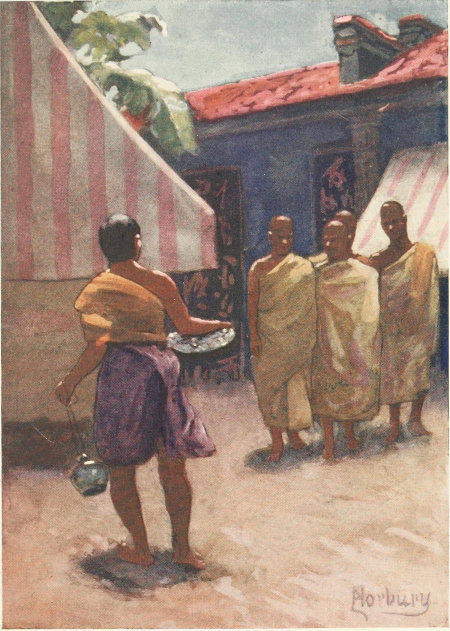
A GROUP OF BUDDHIST MONKS. Chapter VIII.