DUBLIN is a city of magnificences and squalors. It has the widest street
in Europe, they say, in Sackville Street, which, after the manner of the
policeman and the muzzling order, half the population calls O’Connell
Street. The public buildings are very magnificent. These are due, for
the greater part, to the man who found Dublin brick and left it
marble—that great city-builder, John Claudius Beresford, of the latter
half of the eighteenth century, whose name is at once famous and
infamous to the Irish ear, because when he had made a new Dublin he
flogged rebels in Beresford’s Riding-School in Marlborough Street with a
thoroughness which left nothing to be desired except a little mercy.
Beresford, who was one of the Waterford Beresfords, was First
Commissioner of Revenue, as well as an Alderman of the City of Dublin.
Before he went city-building, Dublin was a small place enough. For
centuries it consisted chiefly of Dublin Castle, the two
cathedrals—Patrick’s and Christ’s Church; Dublin is alone in Northern
Europe in possessing two cathedrals—and the narrow streets that
clustered about them. Somewhere about the middle of the eighteenth
century St. Stephen’s Green was built—the finest square in Europe, we
say; I do not know if the claim be well founded. A little later
Sackville Street began to take shape, communicating with the other bank
of the river by ferry-boats. Essex Bridge was at that time the most
easterly of the bridges, and the banks of the river were merely
mud-flats, especially so where James Gandon’s masterpiece, the
Custom-House, was presently to rear its stately façade. The latter part
of the eighteenth century was the great age of Dublin. Ireland still had
its Lords and Commons, who had declared their legislative independence
of England in 1782. Society was as brilliant as London, and far gayer.
It was certainly a time in which to go city-building, for these
splendours needed housing. Before Beresford began his plans, calling in
the genius of James Gandon, with many lesser lights, to assist him,
Sackville Street and Dublin generally were as insanitary as any town of
the Middle Ages. Open sewers ran down the middle of the streets. There
was no pretence at paving. The streets were ill-lit by smelly oil-lamps.
The Dublin watchmen found plenty to do, as did their brethren in London,
in protecting peaceful citizens from the pranks of the Dublin brethren
of the London Mohocks in the tortuous and ill-lit streets. Dublin, the
city of the English pale, remained and remains an English city—with a
difference. The Anglo-Irish did the things their London brethren were
doing—with a difference. If there were unholy revels at Medmenham Abbey
on the Thames, they were imitated or excelled by their Irish prototypes,
whose clubhouse you will still see standing up before you a ruin on top
of the Dublin mountains. In many ways the society of Dublin models
itself on London to this day.
The Lords and Commons of Ireland were already living about the Rotunda
in Sackville Street, Rutland Square, Gardiner’s Row, Great Denmark
Street, Marlborough Street, and North Great George’s Street, when John
Claudius Beresford began his work. He bridged the river with
Carlisle—now O’Connell—Bridge. He constructed Westmoreland Street
right down to the Houses of Parliament.

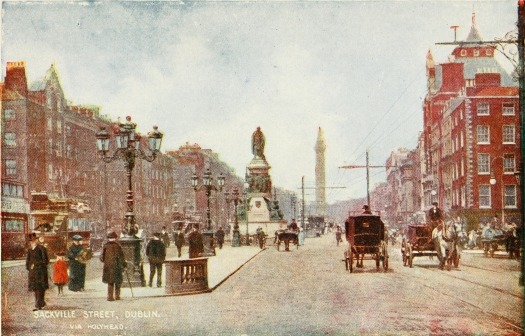
SACKVILLE STREET, DUBLIN.
He built the Custom-House, now a rabbit-warren of Government offices, on
a scale proportioned to the needs of the greatest trading city in
Europe, oblivious of the fact that Irish trade was going or gone; or,
perhaps—who knows?—building for the future. All that part of the city
lying between the new bridge and the Custom-House was laid out in
streets. Meanwhile the nobility and gentry who had town-houses were
seized with the passion for beautifying them. The old Dublin houses were
of an extraordinary stateliness and beauty. Money was poured out like
water on their beautification. The floral decoration in stucco-work on
walls and ceilings still makes a dirty glory in some of the old houses.
Famous artists, like Cipriani and Angelica Kauffmann, painted the
wall-panels and ceilings with pseudo-classical goddesses and nymphs. A
certain Italian named Bossi executed that inlaying in coloured marbles
which made so many of the old mantelpieces things of beauty. The old
Dublin houses still retain their stately proportions, although some of
them have been dismantled and others come down to be tenement-houses.
But there is yet plenty to remind us that Dublin had once its Augustan
Age.
If you have the tastes of the antiquary, the old Dublin houses and
buildings will afford you matter of great interest.
In the first place, there is Dublin Castle, which was built by King
John. Of the four original towers, only one now remains. The castle has
been the town residence of the Lord-Lieutenant of Ireland since Sidney
established himself there in the reign of Queen Elizabeth. For the rest,
it is a congerie of Government offices of one sort or another.
The castle was built over the Poddle River, which now creeps in
darkness, degraded to a common sewer, under the dark and dismal houses,
and empties itself in an unclean cascade through a grating in the Quay
walls, whence it flows away with the Liffey to the sea. You can visit
the Chapel Royal, if you will, and the viceregal apartments are
sometimes open to inspection if the Viceroy is not in residence. I lived
many years in Dublin without desiring to inspect what may be seen of
Dublin Castle, though I have often stood in the castle yard under the
Bermingham Tower, and, looking up at that great keep, have remembered
how Hugh O’Donnell and his companions escaped by way of the Poddle one
Christmas Eve in the spacious days of great Elizabeth, and how the young
chieftain of Tyrconnel narrowly escaped the frozen death which befell
his companions as they climbed those Dublin mountains over yonder to
find refuge with the O’Tooles and O’Byrnes of the Wicklow Hills.
Those were the Irish clans that used to make the English burghers of
Dublin shake in their shoes. While they sold their silks or woollens, or
sat at meals or exchange, or said their prayers in their churches, they
never could be sure that the wild Irish cry would not come ringing at
their gates. The O’Byrnes and O’Tooles would swoop down at intervals,
and raid the cattle from the fat pastures of the pale, sweeping back
again with their spoil to their impregnable fastnesses. Some years ago a
Father O’Toole published a book on the Clan of O’Toole, which contained
the genealogical tree of the O’Tooles, tracing their descent without a
break from Noah. This is a matter of interest to me, as I myself am an
O’Toole.
The history of nations is, after all, the history of men—of men and of
movements—and it is individual and outstanding men who make for us the
milestones of history. Ireland has produced, in proportion to her
population, a more than usual number of outstanding men; and, thinking
of Dublin houses and monuments of one kind or another, we find it is of
men we are thinking, after all.
Thinking of Christ Church, that beautiful Gothic cathedral, I think of
St. Patrick, because his staff was preserved there, and was an object of
great reverence till it was burnt by a too-zealous reforming Bishop in
the days of Elizabeth. St. Patrick was a very delightful saint. One
loves the legends that gather about him. I like especially how he
wrestled with the angel on Croagh-Patrick, and would not come down from
the mountain till he had been granted his several prayers. There were
three in particular. The first one was that Ireland should never depart
from the Christian faith. “Very well, then,” said the angel, “God grants
you that.” “Next,” said Patrick, “I ask that on the Judgment Day I may
sit on God’s right hand and judge the Irish people.” “That you can’t
have,” said the angel. “Be quiet now, and go down from the mountain.”
“What!” said Patrick, “is it for this that I have fasted so many days on
the mountain, wrested with evil ones, been exposed to the rain and
tempest, prayed hard, fought temptations—only for this?” “Very well,
you shall have this,” replied the angel. “And now that you have your
wish satisfied, go down from the mountain.” “Not till my third prayer be
granted.” “What! a third prayer?” cried the angel. “You ask too much, O
Patrick, and you shall not have it. You are too covetous.” “Was it for
this?” began Patrick again, with a recital of all he had done and
suffered. “Very well, then,” said the angel, tired out; “have your third
prayer, but ask no more, for it will not be given to you.” “I ask that
all who recite my prayer” (i.e., the prayer known as St. Patrick’s
Breastplate) “shall not be lost at the Last Day.” “Very well, then,”
said the angel, “you shall have that; but now go down.” “I am content
now,” said Patrick; “I will go down.”
He was a fighting saint, despite his many gentlenesses. At Downpatrick,
where he built his cathedral, he took a little fawn which his men would
have killed, and carried it in his breast. I like the description of him
by his friend St. Evan of Monasterevan, which tells us how he was sweet
to his friends, but terrible to his enemies.
I think of St. Patrick at Christ Church rather than of St. Lawrence
O’Toole, Archbishop of Dublin, who, with Strongbow, that fierce Norman
who seized Ireland for Henry II. of England, built Christ Church. St.
Lawrence O’Toole’s heart lies here in a reliquary. Here also Lambert
Simnel was crowned; but who thinks of that ignoble impostor now?
Christ Church presents an effect of lightness and brightness very
different from St. Patrick’s, in which it seems to me it is always
afternoon, and winter afternoon. Patrick is in a particularly
picturesque slum of the city, in the Earl of Meath’s liberty, hard by
the Coombe, which was once a pleasant dell, no doubt, but is now the
raggedest of slums. To the Earl of Meath’s liberty came the French
silk-weavers expelled from France after the revocation of the Edict of
Nantes, and established the industry of poplin-weaving there.
The man with whom St. Patrick’s Cathedral is associated is Jonathan
Swift, and for his sake it is perpetually dark. It is haunted by the
tragedy of his life and death. Here Esther Johnson is buried; and over
yonder, in the Deanery House, Swift, a sick man, lay in bed and watched
the torches in the great church when they were making ready her grave.
The strange bitterness of the terrible inscription which commemorates
that most unhappy great man seems to colour the atmosphere of St.
Patrick’s. “Where fierce indignation can no more lacerate his heart,” he
rests by the side of the woman who was faithful to him with a long
patience, whose death left him to loneliness and madness.
The whole place is haunted by him, as is the deanery close by and the
old library of Dr. Marsh, which is said to have a ghost that flings the
books about at night.
What ghosts meet one in the Dublin streets! There is Wesley. He was
visiting the Countess of Moira at Moira House, which now, docked of its
upper story, is the Mendicity, or, as the Irish put it, the “Mendacity”
Institution. It was a splendid mansion when Wesley was there. One room
with a bay-window was lined with mother-o’-pearl. “Alas,” said Wesley
prophetically, “that all this must vanish like a dream!” The Moiras were
not only religious: they were cultivated, refined, patriotic in the
truest sense—altogether noble and generous. They received poor Pamela,
Lady Edward Fitzgerald, with kindly open arms when that romantic hero,
Lord Edward, lay dying of his wounds.
You shall see, if you will, the old House of Lords, preserved in its old
state by the Governors of the Bank of Ireland, who have made it their
board-room. The House of Commons has become the Bank’s counting-house,
and there is no trace of its former state. What ghosts you might meet
there at night!—Grattan, Flood, Curran, Hussey Burgh, Plunket, to say
nothing of lesser worthies. Over against the Parliament Houses was
Daly’s Club-House, where forgathered the wits, the bucks, the
duellists. There was Buck Whaley, who walked to Jerusalem for a wager,
and for the same reason once sprang out of the window of his house on
Stephen’s Green into a carriage full of ladies. That house is now
University College, and has its associations with Newman; and you might
see there some of the most beautiful specimens of the eighteenth-century
decoration still remaining—the Bossi mantelpieces, the stucco-work, the
beautiful old doors of wine-red mahogany, and all the rest of it. Buck
Whaley had a friend, Buck Jones, who is commemorated in Jones’s Road.
When I was a little girl—and how long ago that is I shall not tell
you—Buck Jones’s ghost still walked the road which is named after him.
You see, Dublin still ranged itself alongside London; and we had our
Buck Whaley and our Buck Jones if London and Bath had their Beau Brummel
and their Beau Nash.
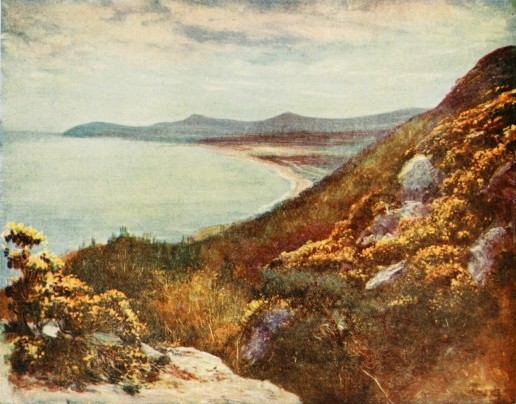
DUBLIN BAY FROM VICTORIA HILL.
Cheek by jowl with the Houses of Parliament is the ancient college of
Queen Elizabeth—the College of the Holy and Undivided Trinity. That,
too, has memories and ghosts. The University has had illustrious sons.
Swift, Goldsmith, Bishop Berkeley, Edmund Burke, were among them. Swift
was “stopped of his degree for dulness,” and had no love for his
alma mater. She had other sons, such as Robert Emmet and Theobald
Wolfe Tone and Thomas Davis, among her brightest jewels, though she
would not have it so. She spreads a quiet place of grey quadrangles and
green park and gardens midmost of the city, and she helps to give
dignity to Dublin, already by her Viceregal Court marked as no
provincial town.
If I were to talk to you of the ancient history of Dublin, this book
would become, not “A Peep at Ireland,” but “A Peep at Dublin.” You will
see for yourself the ancient houses of the nobility, the Lords and
Commons of Ireland. Some of them have come to strange uses. Aldborough
House is a barracks; Powerscourt House was in my day a wholesale
draper’s; Marino, the splendid residence of the Earls of Charlemont at
Clontarf, is in the hands of the Christian Brothers. Many of these old
houses are turned into Government offices.
“Alas, that all this must vanish like a dream!” said John Wesley. And
how quickly he was justified! In the latter part of the eighteenth
century Dublin prided itself on being the gayest capital in Europe.
Perhaps Dublin had always too many pretensions. However, it was
sufficiently gay and extraordinarily picturesque. The Rutland
viceroyalty marked, perhaps, its highest water-mark of gaiety. It was
said that the Rutlands were sent over “to drink the Irish into
good-humour”—that is, to distract them from serious matters, such as
legislative independence and the like. However that may be, they did set
the capital to dancing. After all, it was always the Anglo-Irish who
counted in the rebellious movements. One has to go as far back as Owen
Roe O’Neill to find a Celtic leader. For the time, at all events, Dublin
gave itself up to the fascinations of the gallant and gay young Duke and
his wonderful Duchess. The Irish allowed that the Duchess was one of the
handsomest women in Ireland. Elsewhere she was reputed among the
loveliest in Europe. We hear of her dancing at a ball attired in light
pink silk, with diamond stomacher and sleeve-knots, and wearing a large
brown hat profusely adorned with jewels. Every night there were balls at
the castle or the Rotunda. The Duchess was dancing Dublin into
good-humour. There were all manner of other social festivities. Every
Sunday the Duchess drove on the North Circular Road, with six
cream-coloured ponies to her phaeton, all the rank and fashion of Dublin
following in coaches-and-six, coaches-and-four, and less pretentious
equipages. There was card-playing; there was hard drinking; there were
all manner of distractions, disedifying and edifying. For then, as now,
the representatives of the King and Queen took the charities under their
wing; and dancing at the Rotunda supported the Rotunda Hospital, to say
nothing of the tax on the waiting sedan-chairs, which put a few hundred
pounds more into the hospital’s coffers.
“Alas, that all this must vanish like a dream!” To be sure, many of the
most illustrious of the Anglo-Irish, more Irish than the Irish, refused
to be either danced or drunk into good-humour. The brilliant viceroyalty
lasted not quite four years, and the gay and handsome Duke left Ireland
in the saddest way, carried high on men’s shoulders.
Afterwards there were other things than dancing. There was the Rebellion
of 1798. There was the Legislative Union with Great Britain, which meant
for Ireland the absence of her Lords and gentry, and the spending in
London of revenues derived from Ireland.
In the early years of the nineteenth century grass grew in the streets
of Dublin. Famine and pestilence followed each other in monotonous
succession. Emmet’s Rebellion broke out in 1804. If you were interested
in such things, you would penetrate the slummy parts of Dublin as far
as Thomas Street to see where, in front of St. Catharine’s Church, Emmet
died, and the house where Lord Edward Fitzgerald was arrested.
Dublin is full of memories, of associations, of ghosts: no city in
Europe is richer in such. There is hardly a stone of her streets which
is not storied.


