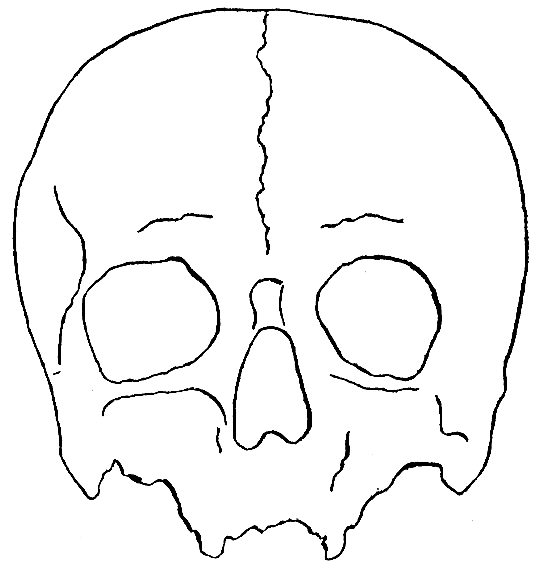
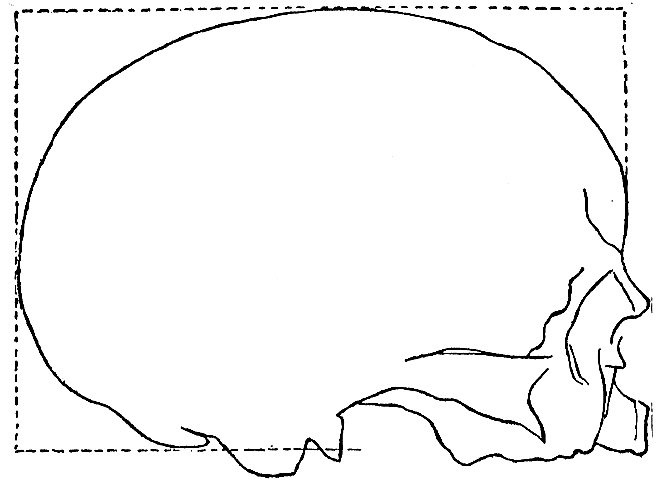
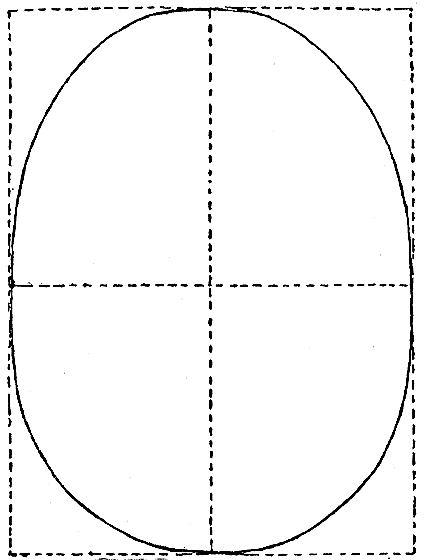
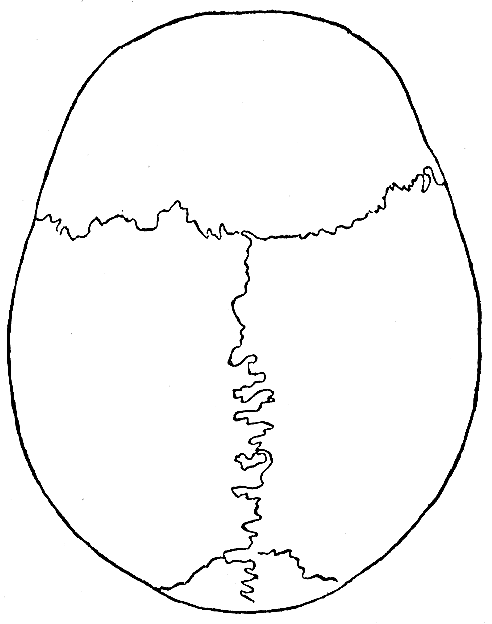
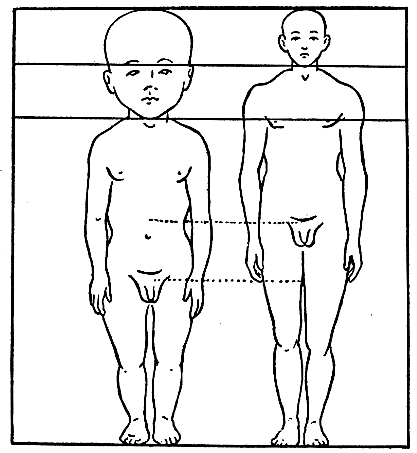
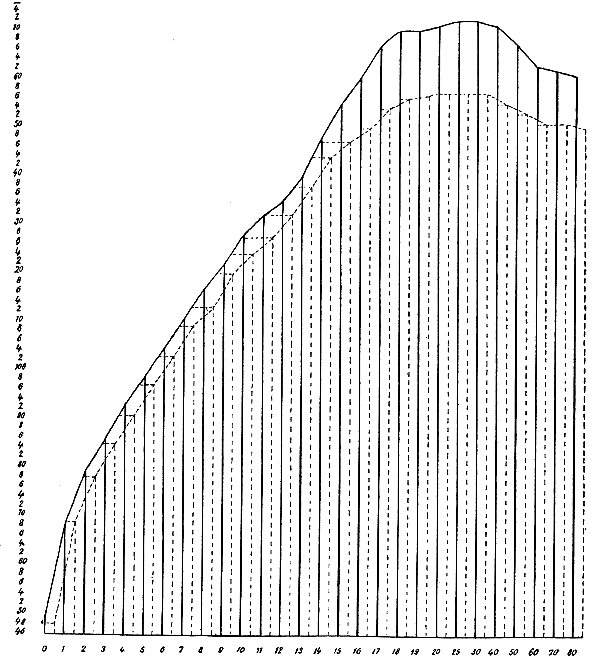
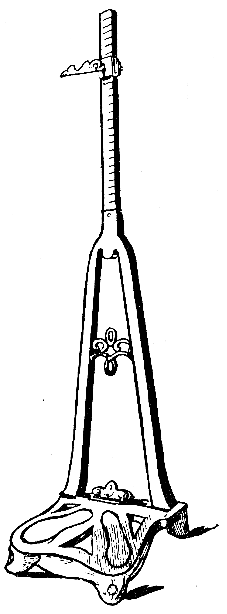
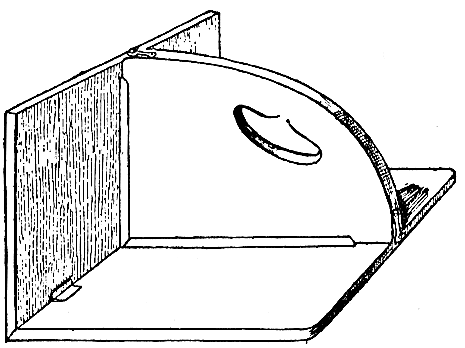
In order to understand the practical researches that must be
conducted for anthropological purposes, it is necessary to have
an adequate preparation in the science of biology. The interpretation
of the data that have to be gathered according to technical
procedure, demands a training; and this training will form our
subject in the theoretic part of the present volume. The limits,
however, not only of the book itself, but of pedagogic anthropology
as well, preclude anything more than a simple general outline;
but this can be supplemented by those other branches of study
which are either collateral to it or constitute its necessary basis
(i.e., general biology, human anatomy and physiology, hygiene of
environment, general anthropology, etc.).
According to the materialistic theories of life, of which Haeckel
is the most noted supporter, life was derived from a form of matter,
protoplasm, which not only has a special chemical composition,
but possesses further the property of a constant molecular movement
of scission and redintegration; vital metabolism or interchange
of matter, by which the molecules are constantly renewed
at the expense of the environment.
It was Huxley who defined protoplasm as the physical basis of
life; and, as a matter of fact, life does not exist without protoplasm.
But Schultze and Haeckel carried this doctrine further, to the
point of maintaining that a minute particle of protoplasm was all
that was needed to constitute life; and that such a particle could
be formed naturally, whenever the surrounding conditions were
favorable, like any other inorganic chemical substance; and in
this way the materialists endeavoured, with great ingenuousness,
to maintain the spontaneous origin of life. And when Haeckel
thought that he had discovered the moneræ or living cells composed
of a single particle of protoplasm, he held that these were the first
species to have appeared on earth.
But the further researches of physiologists and the improvements
in the technique of the microscope proved that protoplasm
does not exist independently in nature; because living cells are
always a combination of protoplasm and a nucleus. If the nucleus
is extracted from a radiolarium, the latter mortifies, and the protoplasm
also dies; if an amœba is severed in such a manner that one
part contains nucleus and protoplasm and the other protoplasm
alone, it will be found that the latter part mortifies and dies,
while the first part continues to live. If an infusorium is divided
in such a way that each of the separate sections contains a part of
the nucleus and a part of the protoplasm, two living infusoria are
developed similar to the original one. Experiments of this kind,
to which Verworn has given high authority, serve to prove that
life does not exist except in cells divisible into protoplasm and
nucleus. Further discoveries confirm this theory, as for instance
the presence of a nucleus in hemocytes or red blood corpuscles,
which were formerly believed to be instances of anuclear cells;
and the discovery of protoplasm in microbes, which had formerly
been considered free nuclei.
Now, when we have an independent living cell, it represents an
individual, which not only has, as a general feature, this primitive
complexity of parts, but also certain special characteristics of
form, of reaction to environment, etc., that mark the species to
which this particular living creature belongs.
Accordingly, we cannot assert, without committing the error
of confining ourselves to a generic detail, that life originates in protoplasm
or in a combination divisible into protoplasm and nucleus;
we should say that life originates in living individuals; since, aside
from abstract speculation, there can be no other material substratum
of life.
Such a doctrine is eminently synthetic, and opens the mind to
new conceptions regarding the properties that characterise life.
Formerly when life was defined as a form of matter (protoplasm)
subject to constant movement (metabolism), only a single
general property had been stated; for that matter, even the stars
consist of matter and movement; and, according to the modern
theory of electrons, atoms are composed of little particles strongly
charged with electricity and endowed with perennial motion.
Accordingly, these are universal characteristics, and not peculiar
to life; and metabolism may be regarded as a variation of such
a property, which is provoked by, or at least associated with the
phenomenon of life.
The properties which are really characteristic of life have been
summed up by Laloy in two essential groups; final causes and
limitations of mass, or, to use a term more appropriate to living
organisms, limitations of form and size.
The term final causes refers to a series of phenomena that are
met with only where there is life, and that tend toward a definite
purpose or end. Living organisms take nutriment from their
environment, to the end of assimilating it, that is, transforming it
from an inert, indifferent substance into a substance that is a
living part of themselves.
This phenomenon is undoubtedly one of the most characteristic.
But there are still other forms of final cause, such for example as
the transformation of the fertilised ovum into the fully developed
individual, predetermined in its essential characteristics, such as
form, dimensions, colour, activities, etc. There are ova that to all
appearances are exactly alike; the human ovum itself is nothing
more than a simple cell composed of protoplasm and nucleus,
measuring only a tenth of a millimeter (= 1/250 inch); yet all
these ovum cells produce living organisms of the utmost diversity;
yet so definitely predetermined that, if we know to what species
the ovum belongs, we are able to predict how many bones will
compose the skeleton of the animal destined to develop from it,
and whether this animal will fly or creep upon the ground, or rise
to take a place among those who have made themselves the lords
of the earth. Furthermore, knowing the phases of development,
we may predetermine at what periods the successive transformations
that lead step by step to the complete development of the
individual will take place.
Another form of final cause is seen in the actions of living
creatures, which reveal a self-consciousness; a consciousness that
even in its most obscure forms guides them toward a destined end.
Thus, for example, even the infusoria that may be seen through
a microscope in a drop of water, chasing hither and thither in
great numbers, avoiding collision with one another, or contending
over some particle of food, or rushing in a mass toward an unexpected
ray of light, give us a keen impression of their possession
of consciousness, a dim glimmering of self-will, which is the most
elementary form of that phenomenon that manifests itself more
and more clearly, from the metazoa upward, through the whole
zoologic scale: the final cause of psychic action.
Again, in multicellular organisms there are certain continuous
and so-called vital phenomena, which some physiologists attribute
to cellular consciousness: for example, the leucocytes in the blood
seem to obey a sort of glimmering consciousness when they rush
to the encounter of any danger threatening the organism, and
ingest microbes or other substances foreign to the blood; and it is
also due to a phenomenon that cannot be explained by the physical
laws of osmosis, that the erythrocytes or red blood corpuscles
and the plasma in the blood never interchange sodium salts for
those of potassium; and lastly the cells of each separate gland seem
to select from the blood the special substances that are needed for
the formation of their specific products: saliva, milk, the pancreatic
juice, etc.
Still another manifestation of final cause is the tendency exhibited
by each living individual to make a constant struggle for
life, a struggle that depends upon a minimum expenditure of force
for a maximum realisation of life, thanks to which life multiplies,
invades its environment, adapts itself to it, and is transformed.
Another fundamental synthetic characteristic of life is the
limitation of form and size that is a fixed and constant factor in
the characteristics of each species; the body of the living individual
cannot grow indefinitely.
Living creatures do not increase in quantity by the successive
accumulation of matter, as is the case with inorganic bodies, but
by reproduction, that is, the multiplication of individuals.
Through the phenomenon of reproduction, life has a share in
the eternity of matter and of force, that is, in a universal phenomenon.
But what distinguishes it is that the individual creatures
produced by other living individuals form, each one of them, an
indivisible element in which life manifests itself; and this element
is morphologically fixed in the limits of its form and size.
The peculiarities which are attributed to the chemical action
of protoplasm are of an analytic character, so far as they concern
the fundamental characteristics of life. The constant interchange
of matter, namely, metabolism, constitutes undoubtedly a
phenomenon peculiar to living matter, protoplasm; but protoplasm
does not exist apart from living organisms. And what constitutes
its chief characteristic is that, when brought into contact with it,
inert substances are assimilated, i.e., they become like it, or
rather, are transformed into protoplasm; mineral salts such as the
nitrates or nitrites of sodium and potassium are transformed in the
case of plants into living plasma capable of germinating either into
a rose bush or a plane tree or a palm, and inert organic substances
such as bread or wine are transformed into human flesh and blood.
So that the phenomenon of assimilation outweighs, as a characteristic
of life, the molecular chemical action through which it is
accomplished. Since metabolism does not occur in nature as a
chemical phenomenon, and cannot be produced artificially, but
is found only in the matter composing living organisms, it follows
that life is the cause of this form of dynamic action, and not that
this dynamic action is the cause of life.[4]
Even the latest theory, developed especially by Ludwig in
Germany—that protoplasm contains a separate enzyme for each
separate function appointed to a particular task—amounts to
nothing more than an analysis of the living organism.
We cannot say that the cell is the element of life, because, in
an absolute sense, it is not alive; it lives only when it constitutes
an individual. Even the brain cells, the muscular fibres, the leucocytes,
etc., are cells; but they do not live independently; their life
depends upon the living individual that contains them. We may,
however, define the cell as the means, the morphological material,
out of which all living organisms are formed: because, from the
algæ to the orchids, from the cœlenterata up to man, all complex
organisms are composed of an accumulation of those microscopic
little bodies that we call cells.
The manner of union between the cells in the most primitive
living colonies, whether vegetable or animal, is analogous to that
followed in the segmentation of the ovum in its ontogenetic (i.e.,
individual) development.
But the manner of construction differs notably, as between
animal and vegetable cells.
Vegetable cells, on the one hand, have a resistant and strongly
protective membrane; animal cells, on the contrary, have either
a very thin membrane or none at all. Vegetable cells, as though
made venturesome by their natural protection, proceed to invade
their environment in colonies—in other words, the cells dispose
themselves in series of linear ramifications—witness the formation
of primitive algæ; and analogously the expansion of the higher
types of vegetation into their environment, with branches, leaves,
etc. And just as though the vegetable cell acquired self-confidence
because it is so well protected, it becomes stationary and
strikes its roots into the soil.
To this same fact of cellular protection must be attributed the
inferior sensibility and hence the permanent state of obscured
consciousness in vegetable life.
This protection against the assaults of environment, and the consequent
lack of sensibility, constitute from the outset an inferior
stage of evolution.
Animal cells have an entirely different manner of forming
themselves into colonies; acting as though they were afraid, they
group themselves in the form of a little sphere, enclosing their
environment within themselves, instead of reaching out to invade
it; and subsequent developments of the animal cell consist in successive
and complex invaginations, or formations of layers, one
within another—instead of ramifications, after the manner of
vegetable cells.
Accordingly, if we advance from that primitive animal type, the
volvox, consisting of a simple group of cells arranged spherically,
like an elastic rubber ball, to the cœlenterata, we meet with the
phenomenon of the first invagination, producing an animal body
consisting of two layers of cells and an internal cavity, communicating
with the exterior by means of a pore or mouth. The two layers
of cells promptly divide their task, the outer layer becoming protective
and the inner nutritive; and in consequence of their different
functions, the cells themselves alter, the outer layer acquiring a
tougher consistency, while the inner remains soft in order to absorb
whatever nutriment is brought by the water as it passes through
the mouth. In this way, there is a division of labor, such that all
the external cells protect not only themselves, but the whole
organism; while the internal cells absorb nutriment not only for
themselves but for the others. This is the simplest example of a
process that becomes more and more complex in the formation of
higher organisms; in adapting themselves to their work, the cells
become greatly modified (formation of tissues) and perform
services that are useful to the entire organism. And at the same
time, because of the very fact that they have been differentiated,
they become dependent upon the labors of others, for obtaining
the means of subsistence. Similar laws seem to
persist even at the present day in the formation
of social organisms, in human society.
During the development of the embryo, all
animals pass through similar phases; and to this
man is no exception.
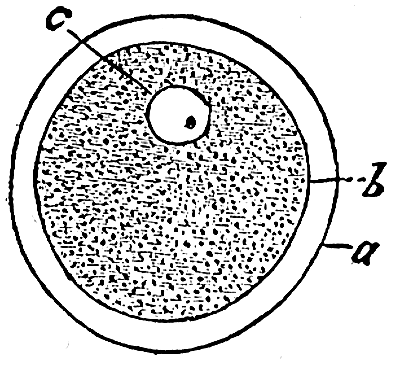
Fig. 1.—Human
Ovum, Magnified.
a. Vitelline membrane;
b. Vitellus; c.
Germinal Vesicle.
He traces his origin to an ovum-cell formed
of protoplasm, nucleus and membrane, measuring
only a tenth of a millimetre, yet vastly large
in comparison with the spermatic cell destined
to fertilise it by passing through one of the innumerable pores
that render the dense membrane penetrable.
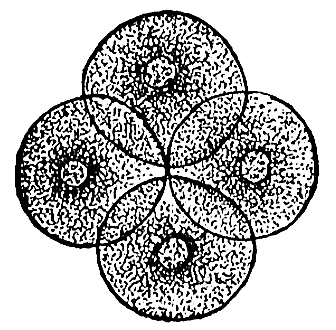
Fig. 2.—First
Segmentation of a
Fertilised Ovum.
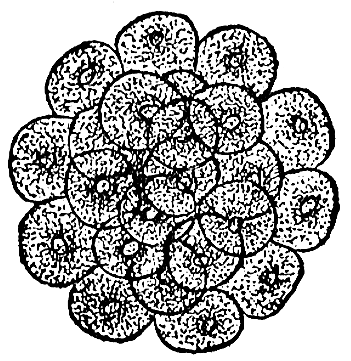
Fig. 3.—A Morula
as seen from the
Outside.
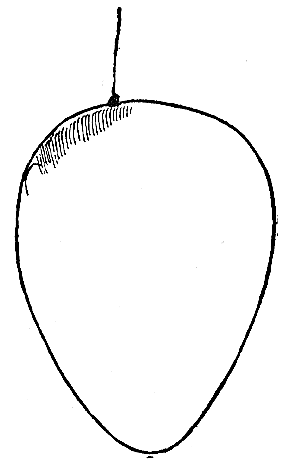
Fig. 4.—An Egg and
Spermatozoon of the
same Species, about to
Fertilise It. Note the
difference in the proportional
size of the
two cells.
After the ovum-cell is fertilised, it constitutes
the first cell of the new being; that is, it
contains potentially a man. But as seen through
the microscope, it is really not materially anything
more than a microscopic cell, undifferentiated, and in all
things similar to other independent cells or to fertilised ovarian
cells belonging to other animals. That which it contains, namely,
man, often already predetermined not only in species, but in
individual characteristics—as, for instance, in degenerative inferiority—is
certainly not there in material form.
At an early stage of the embryo's development, it exhibits a
form analogous to that of the volvox; namely, a hollow sphere,
called the morula; and subsequently, by the process of invagination,
two layers of cells, an inner and an outer, are formed,
together with the first body cavity, destined to become the
digestive cavity, and also a pore corresponding to the mouth.
This formation has received the name of gastrula (Fig. 10, facing
page (72)), and the two layers of cells are known as the primary
layers, otherwise called the ectoderm and the entoderm. To these a
third intermediate layer is soon added, the mesoderm. These three
layers consist of cells that are not perceptibly differentiated from
one another; but potentially each and every one contains its own
special final cause. In each of the three layers, invaginations take
place, furrows destined to develop into the nervous system, the
lungs, the liver, the various different glands, the generative organs;
and during the progress of such modifications, corresponding
changes take place in the elementary cells, which become differentiated
into tissues. From the ectoderm are developed the nervous
system and the skin tissues; from the entoderm, the digestive
system with its associate glands (the liver, pancreas, etc.); from
the mesoderm, the supporting tissues (bones and cartilage) and
the muscles. But all these cells, even the most complex and specialised,
as for example those of the cerebral cortex, the fibres of
the striped muscles, the hepatic cells, etc., were originally embryonic
cells—in other words, simple, undifferentiated, all starting
on an equal footing. Yet every one of them had within it a
predestined end that led it to occupy, as it multiplied in number,
a certain appointed portion of the body, in order to perform
the work, to which the profound alterations in its cellular tissues
should ultimately adapt it.
Like children in the same school, these embryonic cells, all
apparently just alike, contain certain dormant activities and destinies
that are profoundly different. This unquestionably constitutes
one of the properties of life, namely, the final cause; it
is certainly associated intimately with metabolism and nutrition,
considered as a means of development and not as a cause. Upon
metabolism, however, depends the more or less complete attainment
of the final cause of life. In man, for example, strength,
health, beauty, on the one hand, degeneration on the other, stand
in intimate relations with the nutrition of the embryo.[5]
The Theories of Evolution.—At the present day, there is a
general popular understanding of the fundamental principles
involved in the mechanical or materialistic theories of evolution
which bear the names of Lamarck, Geffroy-Saint-Hilaire, and
more especially the glorious name of Charles Darwin.
According to these theories, the environment is regarded as
the chief cause of the evolution of organic forms. Charles Darwin,
who formulated the best and most detailed theory of evolution,
based it on the two principles of the variability of living organisms,
and heredity, which transmits their characteristics from generation
to generation. And in explanation of the underlying cause of
evolution, he expounded the doctrines of the struggle for existence
and the natural selection of such organic forms as succeeded to a
sufficient degree in adapting themselves to their environment.
Whatever the explanation may be, the substantial fact remains
of the variability of species and the successive and gradual
transition from lower to higher forms. In this way, the higher
animals and plants must have had as antecedents other forms of
inferior species, of which they still bear more or less evident traces;
and in applying these theories to the interpretation of the personalities
of human degenerates, he frequently invoked the so-called
principle of atavism, in order to explain the reappearance of atavistic
traits that have been outgrown in the normal human being,
certain anomalies of form more or less analogous to parallel forms
in lower species of animals.
There are other theories of evolution less familiar than that of
Darwin. Naegeli, for instance, attributes the variability of
species to internal, rather than external causes—namely, to a
spontaneous activity, implanted in life itself, and analogous to
that which is witnessed in the development of an individual organism,
from the primitive cell up to the final complete development;
without, however, attributing to the progressive alterations in
species that predestined final goal which heredity determines in
the development of individual organisms.
The internal factor, namely life, is the primary cause of progress
and the perfectionment of living creatures—while environment
assumes a secondary importance, such as that of directing evolution,
acting at one time as a stimulus toward certain determined
directions of development; at another, permanently establishing
certain useful characteristics; and still again, effacing such forms
as are unfit.
In this way the external causes are associated with evolution,
but with very different effects from those attributed to them by
Darwin, who endowed them with the creative power to produce
new organs and new forms of life.
Naegeli compared the internal forces to invested capital; it
will draw a higher or lower rate of interest, according as its environment
proves to be more or less favourable to earning a profit.
The most modern theory of evolution is that of De Vries, who,
after having witnessed the spontaneous and unforeseen transformations
of a certain plant, the Œnohtera Lamarckiana, without
the intervention of any external phenomenon, admitted the possibility
of the unexpected occurrence of other new forms, from a
preexistent parent form—and to such phenomena he gave the
name of mutations.
It is these mutations that create new species; the latter, although
apparently unheralded, were already latent in the germ before they
definitely burst into life. Consequently, new species are formed
potentially in the germinating cells, through spontaneous activity.
The characteristics established by mutations are hereditary,
and the species which result from them persist, provided their
environment affords favourable conditions, better suited to them
than to the preexisting parent form.
Accordingly new species are created unexpectedly. De Vries
draws a distinction between mutations and variations, holding
that the latter are dependent upon environment, and that in any
case they constitute simple oscillations of form around the normal
type determined in each species by mutation.
Species, therefore, cannot be transformed by external causes or
environments, and the mechanism of transformation is not that
of a succession of very gradual variations, which have given rise
to the familiar saying: natura non facit saltus. On the contrary,
what produces stable characteristics is a revolution prepared in
a latent state, but unannounced in its final disclosure. A parallel
to this is to be found, for example, in the phenomena of puberty
in its relation to the evolution of the individual.
Now, when a species has once reached a fixed stability as
regards its characteristics, it is immutable, after the analogy of an
individual organism that has completed its development; henceforth
its further evolution is ended. In such a case, the oscillations
of variability are exceedingly limited, and adaptation to
new environments is difficult; and while a species may offer the
appearance of great strength (e.g., certain species of gigantic
extinct animals), it runs the risk of dying out, because of a lower
potentiality of adaptability; or, according to the theory of Rosa,
it may even become extinct spontaneously.
Accordingly it is not the fixed species that continue the process
of evolution. If we compare the tree of life to a plant, we may
imagine evolution as soaring upward, sustained by roots far below;
the new branches are not put forth by the old branches, but draw
their sustenance from the original sources, from which the whole
tree draws its life. When a branch matures and flowers, it may
survive or it may wither but it cannot extend the growth of the
tree.
Furthermore, the new branches are always higher up than the
old ones; that which comes last is the highest of all.
Thus, the species which are the latest in acquiring a stable form
are the highest up in the biological scale, because the privilege
of carrying forward the process of evolution belongs to those
species which have not yet become fixed. An apparent weakness,
instability, an active capacity for adaptation, are consequently
so many signs of superiority, as regards a potential power of evolution—just
as the nudity and sensibility of animal cells, for example,
are signs of superiority, as compared with vegetable cells—and of
man, as compared with the lower animals.
In order to show that the inferiority of a species is in proportion
to its precocity in attaining fixed characteristics, Rosa conceived
the following striking comparison. Two animals are
fleeing, along the same road, before an advancing flood. One of
the two climbs to the top of a neighboring tree, the other continues
in its flight toward a mountain. As the level of the water rises,
it threatens to isolate and engulf the animal now stalled upon the
tree; the other animal, still fleeing toward the heights, reaches, on
the contrary, a higher and more secure position.
The animal on the tree stands for an inferior species that has
earlier attained a fixed form; the other represents a higher species
that has continued to evolve; but the animal upon the mountain
never was on the tree at all, because, if he had mounted it and
become caught there, he would have lost his chance of continuing
on his way. In other words, the higher species never was the lower
species, since the characteristics of the latter are already fixed.
Some eloquent comparisons might be drawn from the social
life of to-day. We are all of us spurred on to choose as early as
possible some form of employment that will place us in a secure
and definite place at the great banquet of existence. The idea of
continuing to follow an indefinite and uncertain path, leading
upward toward the heights is far less attractive than the safe and
comfortable shelter of the shady tree that rises by the wayside.
The same law of inertia applies to every form of life. Biological
evolution bears witness to it, in the forms of the different species;
social evolution, in the forms of the professions and trades; the
evolution of thought, in the forms of the different faiths. And
whoever first halts in any path of life, the path of study, for
instance, occupies a lower place than he who continues on his road.
The salaried clerk, armed only with his high-school certificate,
has an assured income and the pleasures of family life, at a time
when the physician, with an independent profession, is still struggling
to establish a practice. But the obscure clerk will eventually
hold a social position below that of the physician; his income
will always be limited, while the physician may acquire a fortune.
Now, the clerk, by adapting himself to his bureaucratic environment,
has acquired certain well-defined characteristics; we might
even say that he has become a representative type of the species,
clerk. And the same will be true of the physician in his independent
and brilliant life as high priest of humanity, scientist and man
of wealth. Both men were high-school students, and now they
are two widely different social types; but the physician never
represented the type of clerk; or, in other words, he did not have
to be a clerk before he could be a physician; on the contrary, if he
had been a clerk, he never could have become a physician. It is
somewhat after this fashion that we must conceive of the sequence
of species in evolution. It follows that man never was an anthropoid
ape, nor any other animal now living around us. Nor was
the man of the white race ever at any time a negroid or a mongolian.
Consequently, the theory is untenable which tries to explain
certain morphological or psychic malformations of man, on
the principle of atavism—because no one can inherit if he is not a
descendant.
So, for example, reverting to our previous comparisons, if the
animal on the mountain should climb a tree, or if the physician
should become pedantic, this would not prove that the animal
from the mountain was once upon a time the animal in the tree,
nor that the physician recalled, by his eventual pedantry, certain
bygone days when he was a clerk.
The theories of evolution seemed for a time to illumine and
definitely indicate the origin of man. But this illusion has so far
resulted only in relegating to still deeper darkness the truth that
the biologists are seeking. We do not know of whom man is the
son.
Even the earlier conceptions regarding the mechanics of evolution
are essentially altered. The mystery of the origin of species,
like that of the mutability of forms, has withdrawn from the forms
that are already developed, and taken refuge in the germinal cells;
these cells in which no differentiation is revealed, yet in which the
future organism, in all its details, exists in a potential state; in
which, we may even say, life exists independent of matter, are the
real laboratorium vitæ. The individual, in developing, does nothing
more than obey, by fulfilling the potentiality of the germs.
The direction of research has shifted from the individual to its
germs. And just as the early Darwinian theories evolved a
social ethics, seemingly based upon the facts of life, to serve as a
guide in the struggle for existence, so in the same way, to-day,
there has arisen from the modern theories a new sexual ethics,
founded upon a biologic basis.
The Phenomena of Heredity.—The most interesting biological
researches of to-day are in regard to the hereditary transmission
of characteristics.
To-day the phenomena of heredity are no longer absolutely
obscure, thanks to the studies of Mendel, who discovered some
of its laws, which seemed to open up new lines of research prolific
in results. Yet even now, although this field has been invaded
by the most illustrious biologists of our time, among others,
De Vries, Correns, Tschermack, Hurst, Russell, it is still in the
state of investigation. Nevertheless, the general trend of researches
relative to Mendel's laws is too important to permit of their
enlightening first steps being neglected by Anthropology.
The first phenomena observed by Mendel, and the ones which
led him to the discovery of the laws of heredity which bear his
name, were revealed by a series of experiments conducted with
peas.
Exposition of the Phenomena of Hybridism.—If two strains of
peas are crossed, one of them having red flowers and the other
white flowers, the result in the first generation is, that all the
plants will have red flowers, precisely similar to those of one of
the parent plants.
Accordingly, in hybridism, the characteristic of one of the
parents completely hides that which is antagonistic to it in the
other parent. We call this characteristic (in the case cited, the
red flowers), dominant; in distinction to the other characteristic
which is antagonistic to the first and overcome by it; namely, the
recessive characteristic (in the present case, the white flowers).
This is the law of prevalence, and constitutes Mendel's first law,
which is stated as follows:
Mendel's First Law: "When antagonistic varieties or characteristics
are crossed with each other, the products of the first
generation are all uniform and equal to one of the two parents."
This result has been repeatedly reached in a host of researches,
which have experimentally established this phenomenon as a law.
Thus, for example, if we cross a nettle having leaves with an
indented margin, with a nettle having leaves with a smooth margin,
the product of the first generation will all have leaves with indented
margins, and apparently identical with the parent plant
having indented margins, in other words, having the characteristic
that has proved itself the dominant one (Russell).
These phenomena discovered by Mendel have been observed
in many different species of plants, such as wheat, Indian corn,
barley and beans.
They have also been verified in certain animals, such as mice,
rats, rabbits, caveys, poultry, snails, silk-worms, etc. One of the
most typical experiments was that of Cuénot, who, by crossing
ordinary mice with jumping mice, obtained as a result a first
generation composed wholly of normal mice; the characteristic of
jumping was thus shown to be recessive.
Notwithstanding that the first generation is apparently in
every way similar to the parent with the dominant character,
there is in reality a difference.
Because, if we cross these hybrids together, we meet, in the
second generation, with the following phenomenon: to every three
individuals possessing the dominant character, one is born having
the recessive character. To go back to Mendel's first example,
that of the peas with red flowers (dominant) and with white
flowers (recessive), we find, by crossing together the hybrids of
the first generation, that for every three plants with red flowers,
there is one plant with white flowers.
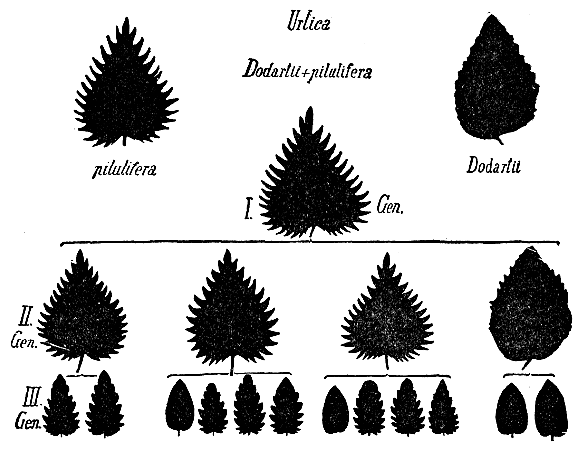
And similarly, the crossing of hybrid nettles with indented
leaves will result in a second generation composed of three plants
with indented leaves to every one with smooth-edged leaves (see
Fig. 5).
That is, the characteristics which belonged to the first two
parents all survive, even though in a latent form, in the descendants;
and they continue to differentiate themselves in well
established proportions. In one offspring out of four, the characteristics
of the grandfather, which have remained dormant in the
father, once more reappear. This intermittent heredity of
characteristics, that are passed from grandfather to grandson,
overleaping the father, is one of the best-known laws of pathological
heredity in man; and it is called atavistic heredity, to distinguish
it from direct heredity, which denotes the transmission
from parent to offspring. But no explanation had ever been
found for this sort of phenomenon. Undoubtedly, it must be
connected with the phenomena of Mendelism.
Accordingly, in the second generation Mendel's second law has
been established, the law of disjunction, which is stated as follows:
Mendel's Second Law: "In the second generation obtained by
reciprocal fertilisation of the first hybrids, three quarters of the
offspring will exhibit the dominant character, and one quarter the
recessive."
Mendel's Hypothesis, Designed to Explain the Phenomena of
Heredity.—Mendel's great service is to have conceived a hypothesis
that seems to have disclosed the key adapted to unlock all
the secrets of heredity.
While the body of an individual is the resultant of forces so
mutually exclusive that the appearance of one characteristic
means the disappearance of its antagonist; in the development of
the sexual cells the two antagonistic characters are distributed in equal
proportion. That is to say, one-half of the male cells contain the
dominant character, and one-half the recessive; and the same
holds true for the female cells. The characters of the two parents,
in other words, never merge in the reproductive cells, but are
distributed in equal measure, independently of the question
whether they are dominant or recessive. Thus for example: in
the case already cited of the first hybrid generation of the peas
with red flowers, in every one of the plants, without distinction,
half the pollen has potentially the red character and half has the
white; and in the same way the female cells have, half of them a
red potentiality and half of them a white. Such hybrids of the
first generation, therefore, although apparently similar to the
parent with red flowers, differ in their germinative powers, which
are not made apparent in the individual. And the same may
be said of hybrid nettles with indented leaves, etc.
Granting Mendel's hypothesis, we have on the one hand pollen
and on the other seed ready to come together in every manner included
within the range of possible combinations; the individual
is, in its characteristics, nothing else than the product of a combination
which must necessarily manifest itself in accordance with
the well-known mathematical laws of probability.
For instance, let us proceed to diagram the possible disposition
of the sexual cells of the hybrids of peas, all of them having red
flowers. In terms of percentage, they will give, out of every
hundred, fifty red and fifty white.
P = pollen; O = ova; R = red, dominant; w = white, recessive:
The possible number of combinations between the pollen
grains and the ova are four; namely, RR, Rw, wR, ww. But where
a dominant characteristic encounters a recessive (Rw, wR), the
recessive disappears, to make way in the individual for the dominant
characteristic alone. The definitive result is three individuals
of dominant character, to one of recessive character.
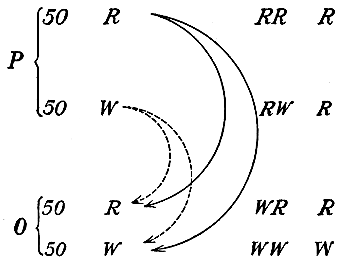
Nevertheless, the hybrids of dominant character are not all
equal among themselves. Those belonging to the combination
RR, indeed, are permanent in character and in all respects alike,
and they reproduce the original red-flower progenitor. The
other red-flower hybrids, belonging to the groups Rw and wR are,
on the contrary, similar to the hybrids of the first generation and
contain reproductive cells differentiated in character; such hybrids,
if reciprocally fertilised, will again give three dominant offspring
to every one recessive; that is, they will obey the law of disjunction.
The hybrids belonging to the fourth group, on the contrary, are
constant, like those of the first group, and are permanently of
recessive character; and they will reproduce the original progenitor
with white flowers.
The same results may be attained with nettles with smooth
and indented leaves, and with all other types of plant and animal
life that obey the laws of Mendelism.
The figure given actually represents the third generation of
nettles; from a combination corresponding to RR, there result
only indented leaves, and from another combination corresponding
to our ww there result only smooth-edged leaves, and from the two
mixed groups there come three offspring with indented leaves to
every one with smooth leaves.
It is possible to represent, by means of a general diagram, the
mathematical succession of characteristics in hybrids, after the
following manner; denoting the dominant character by D, and the
recessive by r.
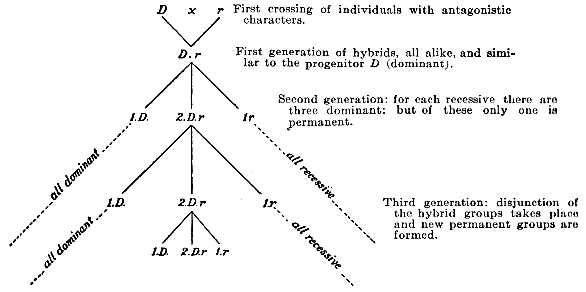
First crossing of individuals with antagonistic
characters.
First generation of hybrids, all alike, and similar
to the progenitor D (dominant).
Second generation: for each recessive there are
three dominant: but of these only one is
permanent.
Third generation: disjunction of
the hybrid groups takes place
and new permanent groups are
formed.
Fig. 7.
In each successive generation, provided the fertilisation takes
place only between uniform individuals, as indicated in the
diagram, and as may be effected by actual experiment with plants,
groups identical with the original progenitors will continue to be
formed, through successive disjunction of the hybrids; the sexual
phenomenon operating in obedience to the laws of probability.
An effective experiment, that anyone may repeat for himself,
is the one originated by Darbishire. He took two boxes, typifying
respectively the male and female organ, and placed in them black
and white disks of equal size, so distributed that each box contained
fifty disks of each colour. After mixing these disks very carefully,
he proceeded to take at random one disk at a time alternately
from each box; and he piled up each pair of disks in such a manner
that the black ones should be on top and the white underneath.
The result was that for every three black disks on top of the piles
there was one white disk; but of the black groups one consisted of
two black disks, while in the other two the lower disk was white.
This is simply one of the many games dependent on the laws of
probability.
Now, supposing that instead of one, there are two characteristics
that are in antagonism; in that case, we have the occurrence
of double hybridism (dihybridism).
Let us take the strains of peas already considered, but let us
choose for observation the character of their seed. One of the
plants has round seed and yellow cotyledons; and the other
angular seed and green cotyledons. These two characteristics,
therefore, are both inherent in the seed; condition of surface
(rough, smooth), and colour (green, and yellow).
After fertilisation, Mendel's first law, that of the prevalence
of the dominant character, will operate, and all the plants of the
first generation will have round seed and yellow cotyledons.
Hence these are the dominant characteristics, which we will
represent by capital letters: R (round), Y (yellow), to distinguish
them from the recessive characteristics, which we will designate
with small letters: a (angular), and g (green).
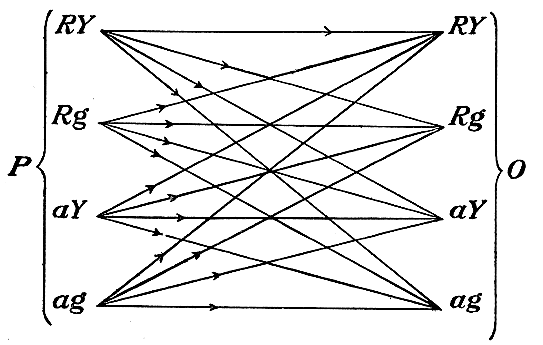
According to Mendel's hypothesis, all these hybrids with round
seed and yellow cotyledons, contain sexual cells of opposite potentialities,
numerically equal and corresponding to the antagonistic
characters of the parent plants. That is, they must have in their
pollen grains and their ovarian cells all the possible combinations
of their different potentialities.
They should produce in equal quantities:
| pollen grains (P) with |
round |
seed and |
yellow |
cotyledons: |
R Y |
|
" |
" |
green |
" |
R g |
|
angular |
" |
yellow |
" |
a Y |
|
" |
" |
green |
" |
a g |
| ovarian cells (O) with |
round |
" |
yellow |
" |
R Y |
|
" |
" |
green |
" |
R g |
|
angular |
" |
yellow |
" |
a Y |
|
" |
" |
green |
" |
a g |
The total number of combinations that may result is sixteen;
that is, each one of the four combinations of pollen may unite
with any one of the ovarian cells; thus constituting four groups
of four. And these groups represent the combinations (of pollen
and ova) capable of producing individuals:
| R Y - R Y = R Y |
a Y - R Y = R Y |
| R Y - R g = R Y |
a Y - R g = R Y |
| R Y - a Y = R Y |
a Y - a Y = a Y |
| R Y - a g = R Y |
a Y - a g = a Y |
| R g - R Y = R Y |
a g - R Y = R Y |
| R g - R g = R g |
a g - R g = R g |
| R g - a Y = R Y |
a g - a Y = a Y |
| R g - a g = R g |
a g - a g = a g |
Every time that a dominant characteristic encounters a recessive
one (R with a or Y with g), it overpowers and hides it: consequently
the results of the different combinations are quite definitely
limited as determining forms of different individuals. In fact,
the results of the sixteen combinations are as follows:
| R Y |
R Y |
| R Y |
R Y |
| R Y |
a Y |
| R Y |
a Y |
| R Y |
R Y |
| R g |
R g |
| R Y |
a Y |
| R g |
a g |
That is to say, the only forms which occur are the following:
R Y, R g
a Y, a g
whose relative probability of occurrence is:
| R Y |
9 |
times in 16 = |
56.25% |
| R g |
3 |
times in 16 = |
18.75% |
| a Y |
3 |
times in 16 = |
18.75% |
| a g |
1 |
time in 16 = |
6.25% |
Now, as a result of actual experiment, the forms obtained show
the following relative percentage:
| Results of experiments with plants |
according to the combinations and laws of probability |
| R Y |
56.5% |
56.25% |
| R g |
19.75% |
18.75% |
| a Y |
18.2% |
18.75% |
| a g |
5.8% |
6.25% |
The correspondence between these figures is close enough to
warrant the acceptance of Mendel's hypothesis as the true interpretation
of the phenomena that are shown to take place within the
sexual cells; the germinal cells of the hybrid contain potentialities
belonging to one or the other only of the parents, and not to both;
one-half of the cells contain one of these potentialities, and the
other half the other potentiality.
But in the phenomena of hybridism, we have seen the results
of another fact which determines Mendel's third law; the Law of
the Independence of Characteristics.
That is, that while the original progenitors had angular seed
and green cotyledons, and round seed and yellow cotyledons,
certain hybrid plants inherited the round seed of the one and the
green colour of the other; or the angular seed of the one and the
yellow colour of the other. In the same way, it may happen, for
example, that the colour of one plant may combine with the height
of another, etc. That is, that each separate characteristic of the
progenitor is independent and may combine with the characteristics
of the other progenitor—even to the point of separating the
colour from the form, as in the case cited.
What we find in hybrids, then, is not a separation into two
types of generative cells, considered as united and complex entities;
but every separate germ cell may break up into as many different
potentialities as there are separate characteristics in the individual;
and that, too, not only as regards the separate minute parts of the
individual body, but, within the same organ, as regards the shape,
colour, character of the surface, etc.
Such phenomena of Mendelism cannot as yet be generalised;
yet it has already been established by a host of experiments that
a great number of characteristics obey the laws of Mendel, such,
for example, as the character of the hair or plumage; the gradations
of colour, the abundance or absence of hair; physical
malformations, such as cerebral hernia in poultry; the character
of locomotion, as in the jumping mice: and even normal physiological
attributes connected with the epoch of maturity in certain
plants.
But the manner in which the dominant character asserts itself
is not always uniform. There are times when a fusion of antagonistic
characters takes place. Thus, for example, when two varieties
of the mirabilis jalapa are crossed, one having red flowers and
the other white, a fusion of the colours takes place in the first
generation, and all the plants have pink flowers. In the second
generation we get, for every plant with red flowers, two with pink
flowers and one with white. That is, the law of disjunction has
again asserted itself, but the individual hybrids merge their antagonistic
attributes, which remain, nevertheless (as their differentiation
proves), separate one from the other in the sexual cells.
Another phenomenon observed in individual hybrids is the intermingling
of characteristics. For instance, there are cases where
the flowers of a hybrid produced by a plant with red flowers and
another with white are variegated with red and white stripes.
Accordingly, the transmission of antagonistic attributes through
the individual may be divided into three different methods:
| Transmission |
Exclusive. |
| By fusion. |
| By intermingling. |
In the first case, the character of one of the parents is transmitted
intact; in the second, the formation of a new characteristic
results, constituting a form more or less nearly midway between
those from which it comes and whose fusion it represents; in the
third case (which is very rare and seems to obey Mendel's laws in
quite an uncertain way), the result is a mosaic of the fundamental
attributes.
Of special interest to us are the two first methods of hereditary
transmission of characteristics. Even before Mendel's discoveries,
anthropologists had observed that in the intermixture of races
certain human attributes remained distinct while others merged.
In the first case they called the individuals hybrids, and in the
second case they called them metics. Take, for example, the colour
of the skin when black and white merge in the so-called mulatto.
Other characteristics, instead of merging, intermingle, as for
instance those that are internal or related to the skeleton, and those
that are external or related to the soft tissues and the skin. It
may happen, for example, that where one race has an elongated
head and black hair and another has a round head and blond
hair, the result of their union will be hybrids with elongated heads
and blond hair or vice versa. Similarly, if one of the parents is
tall of stature and fair complexioned, and the other of short stature
with a dark skin, these characteristics may be interchanged in the
hybrids. A very common occurrence, as regards the colour of the
hair, is the fusion of blond and brunette into chestnut; while
parents with chestnut hair may have either fair-haired or dark-haired
children. In his book entitled Human Races and Varieties,
Sergi says in regard to hybridism: "It is impossible to ignore
human hybridism, which, for that matter, has been demonstrated
under various forms by all the anthropologists; America, in itself
alone, offers us a true example of experimental anthropology in
regard to this phenomenon. Already the result of investigations
shows that human hybridism is multiform among all the peoples
of the earth; but what is best known of all is the exchange of
external characteristics and their intermingling with the internal;
that is, the combination of external characteristics of one type
with internal characteristics of another type. It is easy, for instance,
to find cases in which a certain colour of skin and hair, with
the special qualities proper to them, are found combined with peculiarities
of the skeleton that do not rightfully belong to types of
that particular colouring, and vice versa; and this same phenomenon
may be observed regarding certain separate attributes, and
not all of them—such as the stature, or the face with its outer
covering of soft tissues, or the shape of the skull alone.
"If we observe our European populations, that call themselves
a white-skinned race, but whose whiteness has many different gradations,
we are convinced of the great intermixture of characters,
and, what is more, a varied mixture resulting in a great variety of
individual types, consisting of characters differing widely from
one another. It requires a very accurate and very minute analysis
to distinguish the different elements that are found in the composition
of ethnic characters in individuals and peoples. Undoubtedly
these intermixtures and combinations of character differ in
their constituent elements and in the number of such elements in
the different nations, according to whether we study those of the
south, or the centre, or the north of Europe; and this results from
different degrees of association with mongrel races.
"But a more important fact, and one that seems to have
escaped the attention of anthropologists, is the absence of fusion
of internal and external characteristics in the product of such intermixture.
We find only a positional relationship between the different
ethnic elements, a syncretism or superposition of characteristics,
and a consequent readiness to disunite and form other unions.
This phenomenon has already been demonstrated in America, on
a mass of evidence; but it is apparent also in Europe, among the
peoples that are seemingly most homogeneous, if by careful observation
we separate the characteristics that constitute the ethnic
types; and not only the types, but the individuals belonging to
the different peoples."
And in the following passage, Sergi expresses himself still more
clearly:
"From my many observations, it follows, further, that human
hybridism, or meticism, as others choose to call it, is a syncretism
of distinct characteristics of great variety, and that these do not
modify the skeletal structure or the internal characteristics, excepting
by way of individual variation; it may happen that separate
parts of the skeleton itself acquire characteristics peculiar to
themselves. The stature, the chest formation, the proportion of
the limbs, may all be in perfect correlation and be united with
external characteristics of diverse forms, as for instance with different
forms of cranium, or the cranium may be associated with different
facial forms, and conversely. Furthermore, the forms adapted
separately and in part in hybrid composition remain unvaried in
their typical formation. The face retains its typical characteristics
in spite of its union with different forms of cranium; and similarly
the cranium preserves its architectural structure when combined
with different types of face. The stature maintains its proportions
in spite of combinations with diverse cranial and facial types,
and in spite of varied colours of skin and hair."
The foregoing page, that I have borrowed from this masterly
investigator, is most eloquent testimony that, in regard to the
phenomena of hybridism, man also comes within the scope of
Mendel's laws. There is something wonderful in the power of
observation and intuition shown by Sergi, who, running counter
to the convictions of the majority of anthropologists, arrived
through these conclusions at a truth the key to which was destined
to be discovered later on through studies, very far removed from
anthropology, such as were pursued by the botanists Mendel and
De Vries. While Mendel was led by his experiments to the discovery
of the laws based upon his ingenious hypothesis, Sergi was
drawn simply by observation to conclusions that to-day are confirmed
by experience. And from difficult observations of single
characteristics taken separately, Sergi demonstrated, in his ingenious
studies, their persistence through innumerable generations; while,
through the identification of separate characteristics, he achieved
that brilliant analysis of the races which revealed to his anthropological
insight that the European varieties of man originated
among the peoples of Africa and Asia. Unquestionably, the laws
of Mendel confirm what hitherto were considered, in the scientific
world of Europe, simply as the individual hypotheses of Sergi,
but which American anthropologists recognise and welcome as a
scientific truth, brilliantly observed and expounded by the Italian
anthropologist.
Thus, through single characteristics, through particularities,
we may read the origins of races; and recognise which are the constant
characteristics and which the transitory ones.
Accordingly, let us keep these principles in mind, as we proceed
further in our investigation of the phenomena of heredity.
Mendel's laws, however much they may be discredited or illuminated
by further experience, serve in the meanwhile to give an
absolutely new conception of the individual and to shed light upon
many obscure problems relating to heredity.
The individual is the product of a combination of germ potentialities,
which, in the case of hybrids (and consequently always in
the case of man, who is the product of racial intermixture), meet
in accordance with the mathematical laws of probability. One
might almost conceive of a formula, or, better yet, a calculation,
in accordance with which the individual resulting from any given
germs might be predetermined; if it were not for the fact that
the calculations would become infinitely complicated through
the multiplication of characteristics. With only ten pairs
of characteristics it is already possible to form upward of 1024
kinds of germinal cells and these give rise to 1,000,000 different
combinations.
Furthermore, through the law of dominant characteristics, the
combinations of germs would produce in the descendants 1000
varieties distinguishable by their external appearance, and 60,000
differing only internally, that is, in their germinal cells.
There remains, however, one general principle: the individual
contains not only his personal attributes, but also other attributes
which belonged to his ancestors, and which are latent in him, and
may reappear in his descendants. Consequently, if the individual
is a hybrid, he must be interpreted not only through himself alone,
but through the history of his family; and the characteristics which
he may transmit are not those of his own body, but those of his
origin.
The individual body is nothing more than a "temporary expression"
of those germinal characteristics which have united to
give it consistency; but the complex transmission of characteristics
rests wholly with the germinal cells. The problem of heredity
is transferred from the individual and from the series of individuals,
who are simple and transitory products of combinations, to
the sexual cells and their potentialities. And this is unquestionably
an absolutely new scientific concept, and a revolutionary one as well,
capable of drawing in its wake a lengthy evolution of thought.
Since the germinal potentialities determine the single characteristics,
they may be considered as the atoms of the biologist. "The
field of investigation," says Bateson, "does not appear to differ
greatly from that which was opened to the students of chemistry
at the beginning of the discovery that chemical combinations are
governed by definite laws.... In the same way that the
chemist studies the properties of every chemical substance, the
characteristics of organisms ought to be studied, and their composition
determined." (First Report, p. 159.)
This brings us to two widely diverse facts that demand consideration:
first, the subdivision of antagonistic characteristics in
the germinal cells that form, so to speak, the atomic and chaotic
substratum of characteristics—characteristics that combine according
to the mathematical laws of probability; and, secondly, the
dominance of characteristics, or else their fusion, which, independently
of anything that may happen in the germinal cells, serves to
determine and define the individual.
What sort of characteristics are the dominant ones?
According to the latest researches of Mendelism, the dominant
characteristics are those acquired latest in the course of evolution,
in other words, the youngest, or, if you prefer, the most highly
evolved. Accordingly, in hybrids, the most perfected characteristics
and forms are the ones that triumph in the end.
This is quite a new principle. Hitherto it was held that the
pure species or race was the most perfect; and the hybrid or bastard
was under a cloud of contempt. And, as a matter of fact, the first
crossings of different races may result in some combinations lacking
in harmony, and calculated to sanction the old-time conception
of the æsthetic inferiority of the bastard.
But it is necessary to leave time for new generations and further
crossings, in order that all of the more highly evolved characteristics
may unite and end by triumphing in reciprocal harmony. This
the followers of Mendel cannot yet give us, because it would require
decades or centuries, according to the species, to produce experimentally
such æsthetic forms of hybridism.
But in the human race we have an experiment already accomplished,
which actually shows us the æsthetic triumph achieved
in the region where the races have for the greatest length of time
been crossed and recrossed, through the agency of the most ancient
civilisation: the Europeans surpass in physical beauty the
people of any other continent; and the Neo-Latin races, the most
ancient hybrids of all, seem to be nearing the attainment of the
greatest æsthetic perfection. In fact, when I was engaged in
compiling an anthropological study of the population of Latium,
in accordance with Sergi's principles, and was making a most
minute examination of all the different characteristics and their
prevalence, as a possible basis for a delineation of the fundamental
racial types, I found that complete beauty is never granted to
any one race, but distributed among different races: "as a result
of my labours, I find perfect artistic proportion as to certain facial
features, in a race having inferior hands and feet; and, vice versa,
I find facial irregularities in the race having the smallest extremities,
and the most artistically proportioned hands. What we
now consider as standards of human beauty, and delight in
bringing together artificially in a single figure in a work of art,
are found in nature scattered and distributed among different
races." (See Physical Characteristics of Young Women of Latium,
p. 69.)
Upon the combination of all the different points of beauty in
a single individual depend Quétélet's biological theories of the
medial man (l'homme moyen), lately revived and extensively
developed by Viola. The new importance acquired by the reconstruction
of the medial man is due precisely to the fact that the
new method of reconstructing him is by bringing together all the
single characteristics taken separately and worked out mathematically
according to the laws of individual variations that behave
precisely like those of probability. (See Biometry and the Theory
of the Medial Man.)
Viola considers, in its relation to the physiological laws of
health, the combination in a single individual of the maximum
number of average characteristics, which at the same time are the
characteristics numerically prevalent in individuals (dominant
characteristics?). The man who accumulates the greater number
of average characteristics, escapes diseases and predisposition to
disease; he is consequently sounder and more robust and handsomer.
De Giovanni, on the contrary, through an ingenious
conceit, bestows the name of morphological combination upon the
union in a single individual, of parts that are mutually inharmonic
and incapable of performing their normal functions together, in
consequence of which such an individual's morphological personality
is predisposed to special maladies.
Accordingly the meeting and union of germinative potentialities
may be either more or less propitious; as for instance the
result sometimes produced by the combination of a platyopic
(broad) face and an aquiline and extremely leptorrhine (narrow)
nose; in other words, combinations that are discordant from the
æsthetic standpoint, but harmless as regards health; or again, there
may be a lack of harmony between the internal organs, incompatible
with a healthy constitution. There may even exist malformations
due to the meeting of forms that clash violently; each
of which parts may be quite normal, when considered by itself,
but cannot adapt itself to the other parts with which it is united.
It is as though the dominant characteristic in respect to an
organ had been overpowered by another, which ought on the
contrary, in this special case, to have been recessive.
It is precisely on this question of the dominance of characteristics
that the researches of the Mendelists are at present being
expended. It has been observed in the course of experiments
that there exist certain special correlations between potentialities,
in consequence of which certain characteristics must always go
together; as, for example, when two characteristics, having once
been united, must continue to recur together, although they each
exist separately. These laws, which are not yet clearly determined,
may serve to explain the final harmony of the sum total
of individual attributes.
But in general the dominance of characteristics is not absolute,
but subject to many causes of variation, associated with environment.
Thus, for example, just as a change in nutrition of a
young plant will result in a different height, it is also possible in
the mechanics of reproduction that the original relations of germs
may be altered by external causes, and the dominant characteristics
be made recessive.[6] Many deviations are attributable to the
influences that act upon the germinative cells of hybrids, after
the latter have already been determined in their potentiality;
thus for example when certain germinal cells are less resistant
during maturation; or again when combinations between potentialities
are difficult to achieve. That is to say, there may exist
certain phenomena associated with environment, thanks to which
Mendel's natural laws concerning the dominance of characteristics
may become inverted.
Another fact of great significance is this: that, in the course of
extensive experimental plantings, for the purpose of verifying the
laws of Mendel, a widespread sickliness and mortality occurred
among cryptograms, at the expense of the plants of recessive
character; which would go to prove that a lower power of resistance
accompanies the appearance of recessive characteristics.
The dominant characteristics accordingly are not only the most
highly evolved, but they also possess a greater power of resistance.
So that, to-day, the dominance of the strong tends through
the workings of the phenomena of Mendelism, to do away, little
by little, in the course of generations, with characteristics that are
weak or antiquated. This has an important bearing upon human
pathology, because it opens the way to hope for a possible regeneration
in families branded with hereditary disease.
The germinal potentialities that contain beauty and strength
seem predestined to that predominance which will achieve the
triumph of life in the individual. To learn the laws of the union,
in one individual and definitive unity, of the infinite dominant
and recessive potentialities that must encounter one another in
the mysterious labyrinth in which life is prepared—therein lies
the greatest problem of the present day.
It is that which should constitute our guiding purpose.
The Form.—Fundamental Cannons regarding the Form.—Types of Stature, Macroscelia
and Brachyscelia; their physiological Significance.—Types of Stature in relation to
Race, Sex, and Age.
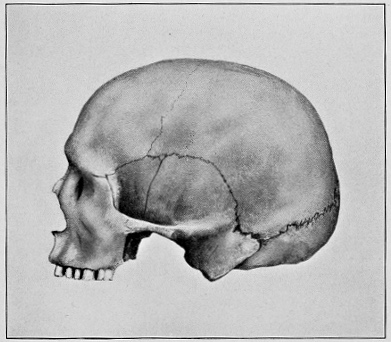
A few years ago, when anthropology first began to be studied,
the skull was taken as the point of departure; because in the analytical
study of the human body it represents the principal part.
Indeed, the same thing was done by Lombroso, when he applied
anthropology to the practice of psychiatry and later to the study
of criminals. It is a matter of fact that degenerative stigmata of
the gravest significance are to be found associated with the skull;
and this he could not fail to take into account, because of its bearings
upon criminal anthropology.
But to-day anthropology is reaching out into vaster fields of
science and striving to develop in diverse directions, such as those
of physiology and pathology; and revolting from the collection of
degenerative details, it undertakes to study normal man in regard
to his external form as related to his functional capacity, or else
the man of abnormal constitution, who in his outward form
reveals certain predispositions to illness; and starting on these
lines, it proposes to investigate principally the metamorphoses of
growth, through the successive periods of life.
From this new point of view, it is not any single malformation,
but the individual as a whole in the exercise of his functions, who
assumes first importance. The study of the cranium (formerly
so important as to be the basis of a special science, craniology),
becomes only one detail of the whole. As a matter of fact, the
brain, which is what gives the cranium its importance, is not only
the immediate organ of intelligence, but it is also the psychomotor
organ; and as such exercises control over all the striped muscles,
and is morphologically associated with the development and the
functional powers of the whole body.
It follows that, the larger the body, the bigger brain it needs to
control it, independently of the question of intelligence. Therefore
the first point of departure should be eminently synthetic,
and should include the morphological personality considered as a
whole.
One of the properties of living bodies is that of attaining a
determinate development, whose limits, both in regard to the
quantity of its mass and the harmony of its form, are defined by
that biological final cause which is implanted in the race and transmitted
by heredity. Consequently every living creature has
determinate limits: and these constitute a fundamental biological
property.
The causality of such limits has not yet been determined by
scientific research; nevertheless it is a phenomenon over which we
must pause to meditate. If the philosopher pauses to contemplate
the immensity of the ocean from the sea shore, marvelling
that the interminable and impetuous movement of the waves
should have such exact and definite limits that it cannot overpass
by so much as a metre the extreme high-water line upon the
beach, we may similarly pause to meditate upon the material
limits that life assumes in its infinitely varied manifestations.
From the microbe to the mammal, from the lichen to the palm,
all living creatures have inherited these limits, which permit the
zoologist and the botanist to assign to each a measure as one of its
descriptive attributes.
This is the first attribute which we must take into consideration
in the study of anthropology: namely, the mass of the body, and
together with the mass, its morphological entirety. The Italian
vocabulary lacks any one word which quite expresses this idea,
[and in this respect English is scarcely more fortunate[7]]. The
stature which represents to us the most synthetic measure of the
body in its entirety (a measure determined by the vertical linear
distance between the level on which the individual's feet are
placed, up to the top of his head as he stands erect), does not
represent the entire body in the sense above indicated. It may
rather be considered as a linear index of this entirety. The French
language, on the contrary, possesses the word taille, which may be
rendered in Italian by the word taglia [and in English by the word
form[8]], provided that we understand it to signify the conception of
the whole morphological personality.
No single measurement can express the form; the weight of
the body, indeed, may give us a conception of the mass but not
of the shape; and the latter, if it needs to be determined in all its
limits, requires a series of measurements, mutually related, and
signifying the reciprocal connection and harmony of the parts
with the whole; in other words, a law. We may establish the
following measurements as adapted to determine the form, in
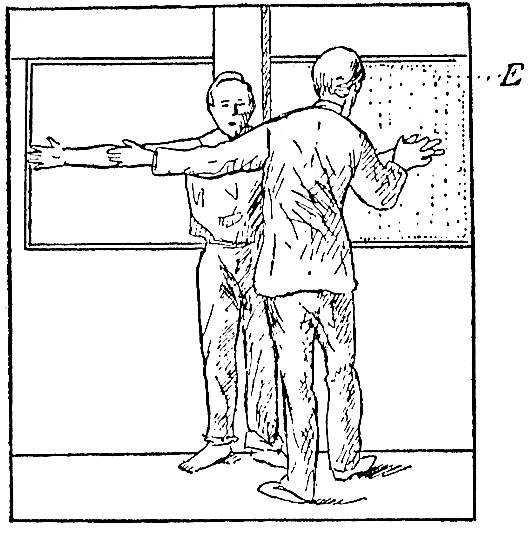
other words, as fundamental laws: the total stature, the sitting
stature, the total spread of the arms, the circumference of the thorax,
and the weight. Of these measures, the two of chief importance
are the stature and the weight, because they express the linear
index and the volumetric measure of the entire body. The other
measurements, on the contrary, analyse this entirety in a sweeping
way: thus, the sitting stature, in its relation to the total stature,
indicates the reciprocal proportions between the bust and the
lower limbs; the perimeter of the chest records the transverse and
volumetric development of the bust; and the total spread of the
arms denotes a detail that is highly characteristic in the case of
man: the development of the upper limbs, which, while they
correspond to organs of locomotion in the lower animals, assume
in the case of man higher functions, as organs of labour and of
mimic speech.
Such measurements constitute a law, because they are in constant
mutual relationship, when the normal human organism has
reached complete development. The stature, in fact, is equal to
the total spread of the arms; the circumference of the thorax is
equal to one-half the stature, and the sitting stature is slightly
greater than the perimeter of the chest. As regards the weight,
it cannot be in direct proportion to any linear measure; nevertheless,
an empirical correspondence in figures has been noted that
may be recorded solely for the purpose of aiding the memory:
the normal adult man usually weighs as many kilograms as there
are centimetres in his stature, over and above one metre (for
instance, a man whose height is 1.60 metres will weigh 60 kilograms,
etc.).
To make these laws easier to understand, we may resort to
signs and formulæ. Thus, if we denote the stature by St, the total
spread of the arms by Ts, the circumference of the thorax by Ct,
the essential or sitting stature by Ss, and the weight by W, we
may set down the following formulæ, which will result in practice
in more or less obvious approximations:
St = Ts; Ct = St/2; Ct = Ss
And for the weight, the following wholly empirical formula:
W = Kg(St-1 m.).
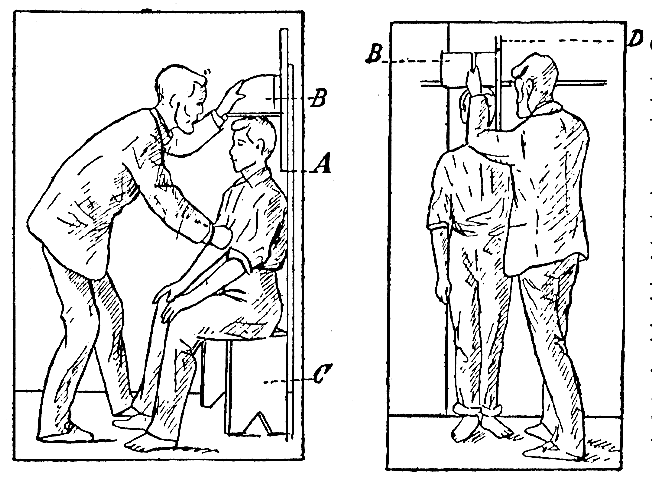
Stature.—Among all the measurements relating to the form,
the principal one is the stature. It has certain characteristics that
are essentially human. What we understand by stature is the
height of a living animal, when standing on its feet. Let us compare
the stature of one of the higher mammals, a dog for instance,
with that of man. The stature of the dog is determined essentially
by the length of its legs, while the spinal column is supported
in a horizontal position by the legs themselves. Such is the attitude
of all the higher mammals, including the greater number of
monkeys, notwithstanding that these latter are steadily tending
to raise their spinal column in an oblique direction, in proportion
to the lengthening of their forelimbs, which serve them as a
support in walking—a form of locomotion half way between that
of quadrupeds and of man. Man alone has permanently acquired
an erect position, that renders the bust ( = sum of head and trunk)
vertical, and leaves the upper limbs definitely free from any
duty connected with locomotion, thus attaining the full measure
of the human stature, which is the sum of the bust and the lower
limbs. Thus, we may assert that one fundamental difference
between man and animals consists in this: that in animals the spinal
column does not enter into the computation of stature; while in
man, on the contrary, it is included in its entirety. Consequently,
in man the stature assumes a characteristic and fundamental importance,
because part of it (that part relating to the bust) represents,
as a linear index, all the organs of vegetative life and of
life in its external relations.
If we examine the human skeleton in an erect position (Fig. 9),
it shows us the varying importance of the different parts of its
structure, according as they are destined to protect, or simply to
sustain. At the top is the skull, an enclosed bony cavity; and this
arrangement indicates that it is designed to contain and protect
an organ of the highest
importance. By means
of the occipital foramen,
this cavity communicates
with the vertebral canal,
also rigorously closed,
that is formed by the
successive juxtaposition
of the vertebræ. Such
protective formation is
in accord with the high
physiological significance
and the delicate structure
of the organs of the central
nervous system,
which represent the supreme
control over physiological
life and over the
psychic activities of life
in its external relations.
Below the skull, the structure
of the skeleton is
profoundly altered; in
fact, the framework of
the thorax is a sort of
bony cage open at the
bottom; still, the external
arrangement of the bones
renders them highly protective to the organs they enclose, namely,
the lungs and the heart—physiological centres, whose perpetual
motion seems to symbolise the rhythm and consequently the continuity
of life.
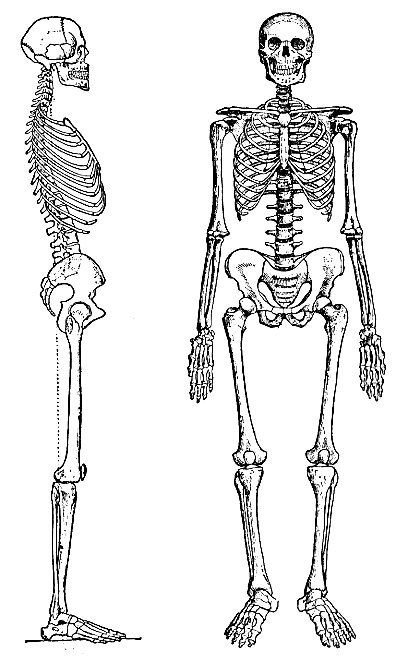
Continuing to descend, we come to a sort of hollow basin, the
pelvis, which seems merely to contain, rather than protect, the
abdominal organs: the intestines, kidneys, etc. Such a structure
seems to be in accord with the minor physiological importance
of these organs, whose function (digestion) is periodic and may be
temporarily suspended, in defiance of physiological stimuli,
without suspension of life. In the lower part of the skeleton, on
the contrary, the arrangement between the soft and bony tissues
is inverted: the long bones of the limbs constitute the inner part;
and they are covered over with thick, striped muscles, organs of
mechanical movement for the purpose of locomotion. Here the
function of the skeleton is exclusively that of support, and in its
mechanism it represents a series of levers.
Accordingly, the structure of the skeleton also shows us how
the stature is composed of parts that differ profoundly in their
physiological significance; life as a complete whole, the living man,
is contained within the bust, which holds the organs of the individual,
vegetative life; those of life in relation to its environment,
and those of life in relation to the race, namely, the organs of
reproduction.
Deprived of arms and legs, man could still live; the limbs are
nothing more than appendages at the service of the bust, in all
animals; they serve to transport the bust, that is, the part which
constitutes the real living animal, which without the limbs would
be as motionless as a vegetable, unable to go in pursuit of nourishment
or to exercise sexual selection.
The embryos of different animals, of a dog, a bat, a rabbit and
of man (as may be seen in Fig. 11) show that the fundamental
part of the body is the spinal column, which limits and includes
the whole animal in the process of formation.
If we next examine the embryonic development of man, as
shown in Fig. 13, we may easily see how the limbs develop, at first
as almost insignificant appendages of the trunk, remaining hidden
within the curve of the spinal column; and even in an advanced
stage of development (15th week), they still remain quite accessory
parts in their relation to the whole.
Having established these very obvious principles, we may ask
ourselves: of two men of equal stature, which is physiologically the
more efficient? Evidently, that one of the two who has the
shorter legs.
In other words, it is of fundamental importance to determine
the reciprocal relation, in the stature, between the bust and the
lower limbs, that is, between the height of the bust and the total
height of the body.
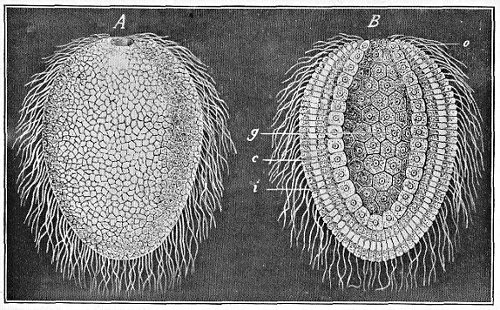
Fig. 10.—Gastrula of a sponge.
External surface. Internal section.
(Showing the inner and outer primary
layers, and the mouth orifice.)
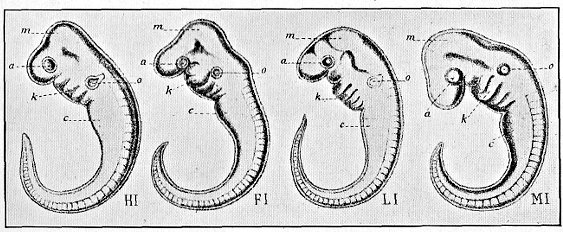
Fig. 11.
Dog. Bat. Rabbit. Man.
(From the work by E. Haeckel: Anthropogeny.)
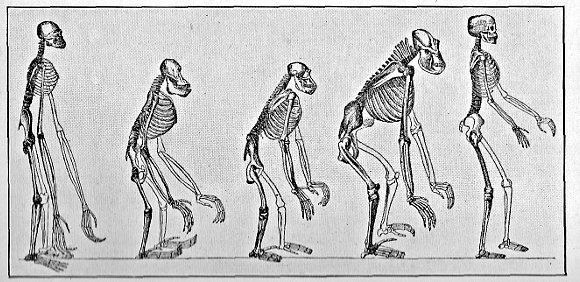
Fig. 12.
Four skeletons of anthropoid apes. Man.
The height of the bust was called by Collignon the essential
stature, a name that indicates the biological significance of this
measurement. It may, however, also be called the sitting stature,
from the method of taking the measure, which equals the vertical
distance from the level on which the individual is seated to the top
of his head. The other is the total stature.
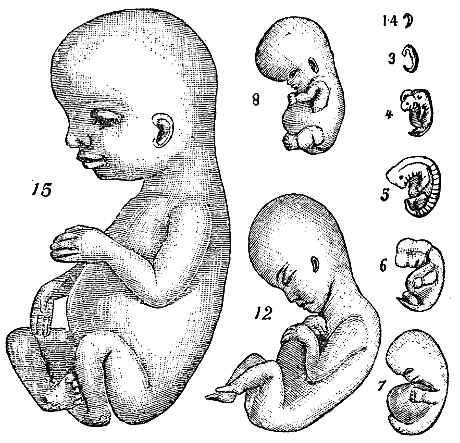
Fig. 13.
14 days, 3 weeks, 4 weeks, etc. (natural size).
Accordingly, in anthropology we may define the physiological
efficiency of a man by the relation existing between his two statures,
the total and the essential. If we reduce the total stature (which
for the sake of brevity we will call simply the stature) to a scale
of 100, we find that the essential stature very slightly exceeds 50,
oscillating between 53-54; yet it may fall to 47 and even lower, or
it may rise above 56. In such cases we have individuals of profoundly
diverse types, whose diversity is essentially connected with
the proportional differences between the several parts of their
stature.
Hence, we may distinguish the type of stature; understanding
by this, not a measure, but a ratio between measures, expressed by
a number; that is, "the type of stature is the name given to the ratio
between the essential stature and the total stature reduced to a scale
of 100." The number resulting from this ratio, since it indicates
the ratio itself, is called the index of stature (See "Technical Lessons:
on the Manner of Obtaining and Calculating the Indexes").
Manouvrier has distinguished the type with short limbs and preponderant
trunk, by the name of brachyscelous; and those of the
opposite type, that is, with long legs, by the name of macroscelous;
reserving the term mesatiscelous to designate the intermediate type.
These types differ not only in the reciprocal relation between
the two statures, but in all the recognised laws of the form. The
brachyscelous type has a circumference of chest in excess of half
the stature, because the trunk is more greatly developed in all its
dimensions; and the total weight of the body exceeds the normal
proportion in relation to the stature. The contrary holds true of
the macroscelous type; their trunk, being shorter, is also narrower,
and the circumference of the chest can never equal one-half the
stature, while the total weight of the body is below the normal.
Passing next to a consideration of the total spread of the arms,
since there is an evident correspondence between the upper and
lower limbs, it follows that in the brachyscelous type the total
spread is less than the stature, while in the macroscelous it surpasses
it to a greater or less degree, according to the grade of
type; the two types consequently differ in the level reached by
the wrist, when the arms are allowed to hang along the sides of
the body.
This is a very interesting fact to establish, since at one time
it was held that excessive length of arm was an atavistic feature,
in other words, an anthropoid reminder. To-day, since the old
interpretation of the direct descent from species to species has
been abandoned in the light of modern theories of biological evolution,
we can no longer speak of atavistic revivals. It is true that
the anthropoid apes, as may be seen in Fig. 13, have extremely
long forelimbs, and that man is characterised by the shortness
of his arms, free to perform work and obedient instruments of
his brain. But if it happens that certain individual men have
excessively long arms, even if they should coincide with an inferior
capacity for work and social adaptation, such a simple coincidence
must not be interpreted by the laws of cause and effect. The
modern theories of evolution tend to admit between the anthropoid
apes and man, only a common origin from lower animals not
yet fixed in a determined species. So that in phylogenesis men
are not considered as the children or grandchildren of apes, but
rather their brothers or cousins of a more or less distant degree;
and their resemblance must be attributed to a parallel evolution.
Consequently, it is not possible to speak of direct transmission
of characters.
Therefore, we must interpret an excessive length of arm, or
an excessive shortness, after the same fashion, namely, in its relation
to the type of stature, or to the established canons of the form—in
other words, as a detail of individual human types.
Let us sum up the three canons in the following table:
| Mesatisceles |
Brachysceles |
Macrosceles |
| St = Ts |
St > Ts |
St < Ts |
| Ss = St/2 |
Ss > St/2 |
Ss < St/2 |
| Ct = St/2 |
Ct > St/2 |
Ct < St/2 |
| W = K(St-1 m.) |
W > K(St-1 m.) |
W < K(St-1 m.) |
From these measurements are derived certain types of individuality
which we may now describe in detail.
The brachyscelous type has an excess of bust, consequently a
preponderance of vegetative life; the great development of the
abdominal organs tends to make a person of this type a hearty
eater, a man addicted to all the pleasures of the table; his big heart,
abundantly irrigating the body, keeps his complexion constantly
highly coloured, if not plethoric. We can almost see this man of
big paunch, corpulent, with an ample chest, fat, ruddy, coarse,
and jolly; an excess of nutriment and of blood-supply are favourable
to the ready accumulation of adipose tissue, and as the body
constantly grows heavier it steadily becomes more difficult for the
undersized legs to support it; so that inevitably this man will tend
to become sedentary, and he will select a well-spread table as his
favourite spot for lingering. Whatever elements of the ideal the
world contains, will escape the attention of this type of man, who is
far more ready to understand and engage in commerce, which leads
by a practical way to the solution of the material problems of life.
In the other type, on the contrary, the macroscelous, the organs
of vegetative life are insufficient and the central nervous system
is defective. Such a man feels, even though unconsciously, that
the abdominal organs are incapable of assimilating sufficient
nutriment, and that his lungs, unable to take in the needed quantity
of oxygen, render his breathing labourious. His small heart
is inadequate for circulating the blood through the whole body,
which consequently retains an habitual pallor; while the nervous
system is in a constant state of excitation. We can almost see
this man, so tall and thin that he seems to be walking on stilts,
with pallid, hollow cheeks and narrow chest, suffering from lack
of appetite and from melancholia; nervous, incapable of steady
productive work and prone to dream over empty visions of poetry
and art. The man of this type is quite likely to devote his entire
life to a platonic love, or to conceive the idea of crowning an ideal
love by committing suicide; and so long as he lives he will never
succeed in escaping from the anxieties of a life that has been an
economic failure.
It is interesting to examine the types of stature from different
points of view: such, for example, as the height of stature, the race,
the sex, the age, the social conditions, the pathological deviations, etc.
The Types of Stature According to the Height of the Total Stature.—There
exists between the bust and the limbs a primary relation
of a mechanical nature, already well known, even before Manouvrier
directed the attention of anthropologists to the types of stature.
When one individual is very tall and another is very short, the
consequence of this fact alone is that the taller of the two has much
longer limbs as compared with the shorter. This is because,
according to the general laws of mechanics, the bust grows less
than the limbs and is subject to less variation.
But notwithstanding this general fact, other conditions intervene
to determine the comparative relations between the two portions of
the stature. Indeed, Manouvrier exhibits, within his own school,
specimens of equal stature but of different types; and furthermore,
he notes that the inhabitants of Polynesia are of tall stature
and have a long bust, while negroes, who are also of tall stature,
have a short bust.
Types of Stature According to Race.—Among the characteristics
of racial types, present-day anthropology has included the
reciprocal proportions between the two statures. This means
that the medium type in the different races is not always contained
within the same limits of fluctuation in regard to stature: but some
races are brachyscelous, others are macroscelous, and still again
others are mesatiscelous. The most brachyscelous race is the Mongolian,
prevalent in the population of China; the most macroscelous
is the Australian type that once peopled Tasmania. Other
races, as for example the negroid, while in a measure macroscelous,
approach nearer to the mesatiscelous type, characteristic of the
population of Europe. Let us examine the psycho-ethnic characters
of these various peoples. The Chinese are the founders of
the most ancient of all oriental civilisations, and have established
themselves in a vast empire, solid and stable in its proportions,
as well as in the level of its civilisation. It would seem as though
the Chinese people, having accomplished the enormous effort of
raising themselves to a determined civic level, were no longer
capable of advancement. Individually, they have a singularly
developed spirit of discipline, and are the most enduring and
faithful workers; it is well known that in America the Chinese
Mongolian does not fear the competition of labourers of any other
race, because no others can compete with him in parsimony, in
simple living, and in unremitting toil.
The Tasmanians constituted a people that was considered as
having the lowest grade of civilisation among all the races on earth.
Even English domination failed to adapt them to a more advanced
environment, and their race was consequently scattered and
destroyed.
Accordingly, we find associated with extreme macroscelia
(Tasmanians) an incapacity for civic evolution; and with the
corresponding extreme of brachyscelia an insuperable limitation
to civic progress. Consequently, the triumph of man upon
earth cannot bear a direct relation to the volume of the bust,
or in other words, we cannot assume that the man most favourably
endowed on the physiological side is the one who has the
largest proportion of viscera. As a matter of fact, the conquering
race, the race which has set no limit to the territory of
its empire nor to the progress of its civilisation, is composed of
white men, whose type of stature is mesatiscelous, that is to say,
representative of harmony between its parts. This conception
will serve us in establishing a fundamental principle in morphological
biology: namely, that perfectibility revolves around a
centre, which represents a perfect equilibrium between the various
parts constituting an organism. Hence, in order to determine the
deviations of the individual type, we must always start from
those central data, which represent, as the case may be, normality
or perfection.
Even among the populations of Europe, and within the Italian
people themselves, fluctuations occur in the degree of mesatiscelia,
approaching to a greater or less degree the eccentric forms of
brachyscelia or macroscelia; and such fluctuations are an attribute
of race.
We should draw a distinction between a people and a race.
The term race refers exclusively to a biological classification, and
corresponds to the zoological species. On the other hand, we mean
by a people a group of human individuals bound together by
political ties. Peoples are always made up of a more or less profound
intermixture of races. It is well known that one of the most
interesting and difficult problems of ethnology is that of tracing
out the original types of races in peoples that represent an intermixture
centuries old. Without entering too deeply into this
question, which lies outside of our present purpose, it will suffice to
point out that in the people of Italy it is possible to trace types of
races differing from one another, yet so closely related as to render
them apparently so similar that they might almost be regarded
as a single race.
Now, in an anthropological study of mine on the young women
of Latium, I succeeded in tracing, within the confines of that
region, different racial types that show corresponding differences
in degrees of mesatiscelia. Thus, for example, in Castelli Romani
there exists in an almost pure state a dark-haired race, short of
stature, slender, elegantly modelled in figure and in profile, and
showing within the limits of mesatiscelia a brachyscelous tendency,
in contrast with another race, tall, fair, massive, of coarse build,
which within the limits of mesatiscelia shows a macroscelous
tendency, and which is found in almost pure groups around the
locality of Orte, that is, on the boundaries of Umbria. It is
interesting to note the importance of researches in ethnological
anthropology conducted in small centres of habitation. If it is
still possible to trace out groups even approaching racial purity,
they will be found only in localities offering little facility to emigration
and to the consequent intermixture of races. The fact that
we still find in Castelli Romani types so nearly pure, is due to the
isolation of this region, which up to yesterday was still in such primitive
and rare communication with the capital as to permit of the
survival of brigandage. On the contrary, in localities that have
attained a higher civic advancement, and in which the inhabitants
are placed in favourable economic and intellectual conditions, the
facilities of travel and emigration will very soon effect an alteration
in the anthropological characters of the race. Hence it
would be impossible, in a cosmopolitan city like Rome, to accomplish
any useful studies of the sort that I accomplished in the
district of Latium, and which led me to conclude that in the small
and slender race of Castelli Romani we may trace the descendants
of the ancient conquerors of the world: descendants that belong
to one variety of the great Mediterranean race, to whom we owe
the historic civilisations of Egypt, Greece and Rome.
It would seem that this race, disembarking on the coast of
Latium, must have driven back, among the Apennines, the other
race, blond and massive, whose pure-blooded descendants are still
found in numerical prevalence at Orte, an ancient mediæval town
and a natural fortress from the remotest times, through its fortunate
situation on the crown of a rocky height, that easily isolates
it from the surrounding country (see the ancient history of the
town of Orte).
Accordingly, within the limits of mesatiscelia, it appears that
the race which in early times won the victory was the more brachyscelous,
i.e., the one which had the larger bust, and consequently
the larger brain and vital organs. In other words, within the
limits of normality, brachyscelia is a physiologically favourable
condition.
Variations of Type of Stature According to Social Conditions.—Independently
of race, and from such a radically different point of
view as that of the social condition, or adaptation to environment,
we may still distinguish brachyscelous and macroscelous types.
Brachysceles may readily be met with among the labouring classes,
habituated from childhood to hard toil in a standing position,
thus interfering with a free development of the long bones of the
lower limbs; while the macroscelous type will be found among the
aristocratic classes, whose members, spending much time sitting
or reclining, give the long bones an opportunity to attain their
growth (mechanical theories of stature). Without stopping to
discuss the suggested causes of such differentiation in types, we
may nevertheless point out that the brachyscelous type is eminently
useful to society, constituting, one may say, the principal
source of economic production, while the macroscelous and unproductive
type settles comfortably down upon the other like a
parasite. But the progress of the world is not due to the labouring
class, but to the men of intellect, among whom the prevailing
type is the medium, harmonic type, with mesatiscelous stature.
Types of Stature in Art.—The existence of these different
individual types, which combine a definite relationship of the
parts of stature with the complete image of a well-defined individuality,
was long ago perceived by the eye, or rather by the
delicate intuition of certain eminent artists. These immortalised
their several ideals, investing now the one type and
now the other with the genius of their art. Thus, for example,
Rubens embodies in his Flemish canvases the brachyscelous type,
robust and jovial, and usually represents him as a man of mighty
appetite revelling in the pleasures of the table.
Botticelli, on the contrary, has idealised the macroscelous
type, in frail, diaphanous, almost superhuman forms, that seem,
as they approach, to walk, shadow-like, upon the heads of flowers,
without bending them beneath their feet and without leaving any
trace of their passage. Accordingly, these two great artists have
admirably realised, not only the two opposite types of stature,
but also the psychic and moral attributes that respectively belong
to them. But it was not granted to these artists to achieve the
supreme glory of representing perfect human beauty in unsurpassed
and classic masterpieces. The art of Greece alone succeeded
in embodying in statues which posterity must admire but cannot
duplicate, the medial, normal type of the perfect man.
Variations of Stature According to Sex.—It is not always necessary
to interpret the type of stature in the same sense. Even
from an exclusively biological standpoint, it may lend itself to
profoundly different interpretations.
Thus, for example, the type of stature varies normally
according to the sex. Woman is more brachyscelous than man;
but the degree of brachyscelia corresponds to a larger development
of the lumbar segment of the spinal column, which corresponds
to the functions of maternity.
In fact all the various segments of the spinal column show different proportions
in the two sexes.
As we know, the spinal column consists of three parts; the cervical (corresponding
to the neck), the thoracic (corresponding to the ribs), and the abdominal,
including the os sacrum and the coccyx.
Now, Manouvrier, reducing the height of the spinal column to a scale of 100,
expresses the relations of these different parts in the two sexes as follows:
| Segments |
Men |
Women |
| Cervical |
22.1 |
23.9 |
| Thoracic |
58.5 |
55.4 |
| Lumbar |
11.4 |
23.7 |
| Sacro-coccygeal |
7.9 |
6.7 |
In woman the thoracic segment is shorter and the abdominal is longer than in
man; but the total sum in woman is relatively greater in proportion to the whole
stature.
In a case like this we have no right to speak of a morphological
or psychosocial superiority of type; nor would a fact of this sort
have any weight, for example, in establishing the anthropological
superiority of woman. Nevertheless, it may be asserted that, if
the day comes when woman, having entered the ranks of social
workers, shall prove that she is socially as useful as man, she will
still be, in addition, the mother of the species, and for that reason
preeminently the greater producer.
Now, it is beyond question that this indisputable superiority
is in direct relation with the type of stature. But without insisting
unduly on a point like this, we should note the connection
between the brachyscelous type and the tendency shown by
women to accumulate nutritive substances, adipose tissue; consequently,
as compared with man, she is the more corpulent—as
are all brachysceles as compared with macrosceles.
Types of Stature at Different Ages.—Another factor that influences
the types of stature is the age; or rather, that biological
force which we call growth.
Growth is not an augmentation of volume, but an alteration
in form; it constitutes the ontogenetic evolution, the development
of the individual. The child, as it grows, is transformed. If we
compare the skeleton of a new-born child with that of an adult,
we discover profound differences between the relative proportions
of the different parts. The child's head is enormously larger
than that of the adult in proportion to its stature; and similarly,
the chest measure is notably greater in the child. If we wish to
compare the fundamental measurements of the new-born infant
with those of the adult, we get the following figures, on a basis of
100 for the total stature:
|
|
Adult |
Child at birth |
| Total stature = 100 |
Essential stature |
52 |
68 |
| Perimeter of thorax |
50 |
70 |
| Height of head |
10 |
20 |
Accordingly, the
child has to acquire,
in the course of its
growth, not only the
dimensions of the
adult, but the harmony
of his forms;
that is, it must reach
not only certain determined
limits of
dimension, but also a
certain type of beauty.
Among the fundamental
differences between
the new-born
child and the adult
one of the first to be
noted is the reciprocal
difference of proportion
between the two
statures. The child
is ultra-brachyscelous,
that is, he presents a
type of exaggerated brachyscelia, calling to mind the form of the
human fœtus, in which the limbs appear as little appendages of
the trunk. In the course of growth, a successive alteration takes
place between the reciprocal proportions of the two parts, so
that the lower limbs, growing faster than the bust, tend to approach
the total length of the latter. Godin has noted that
during the years before puberty the lower limbs acquire greater
dimensions, as compared with the bust, than are found in the
fully developed individual; in other words, at this period a rapid
growth takes place in the long bones of the lower limbs, and
accordingly at this period of his life the individual passes through
a stage of the macroscelous type. Immediately after puberty,
there begins, in turn, an increase in the size of the bust, which
regains its normal excess over the lower limbs, thus attaining the
definite normal type of the adult individual. After the age of
17 years, by which time these metamorphoses have been completed,
the individual may increase in stature, but the proportions
between the parts will remain unaltered. In Fig. 14 we
have a graphic representation of the relative proportions between
the height of the bust and the length of limbs at different ages,
the total stature being in every case reduced to 100. The upper
portion of the lines represents the bust, and the lower portion
the limbs, while the transverse line corresponding to the number
50 indicates one-half of the total stature. From such a table, it
is easy to see how the bust, enormously in excess of the limbs at
birth, gradually loses its preponderance.
It was drawn up from the following figures calculated by me:
TYPES OF STATURE ACCORDING TO AGE IN YEARS
| At birth |
1 |
2 |
3 |
4 |
5 |
6 |
7 |
8 |
9 |
10 |
11 |
12 |
13 |
14 |
15 |
16 |
17 |
| 68 |
65 |
63 |
62 |
60 |
59 |
57 |
56 |
55 |
55 |
54 |
53 |
53 |
52 |
52 |
51 |
51 |
52 |
Godin furnishes the following figures, relating to the type of
stature at the period preceding and following puberty:
RATIO OF SITTING STATURE TO TOTAL STATURE REDUCED TO SCALE
OF 100 (GODIN)
| Age |
13½ |
14 |
14½ |
15 |
15½ |
16 |
16½ |
17 |
17½ |
| Ratio |
52 |
52 |
51 |
51 |
51 |
52 |
52 |
52 |
52 |
Hrdlicka has calculated the index of stature for a thousand white
American children and a hundred coloured, of both sexes, and
has obtained the following figures, some of which, based upon an
adequate number of subjects, (10-13 years) are what were to be
expected, while others, owing to the scarcity of subjects (under
6 and above 15 years) are far less satisfactory:
PROPORTION BETWEEN THE SITTING STATURE AND THE TOTAL
STATURE
(American Children)
| Age in years |
Number of subjects of each age |
Males, white |
Females, white |
Number of subjects of each age |
Males, coloured |
Females, coloured |
| 3 |
— |
— |
— |
1 |
60.8 |
59.5 |
| 4 |
— |
— |
— |
1 |
— |
58.9 |
| 5 |
2 |
57.4 |
57.3 |
3 |
57.3 |
57.9 |
| 6 |
15 |
56.6 |
57.4 |
5 |
55.9 |
55.6 |
| 7 |
38 |
56.3 |
57.2 |
5 |
54.9 |
55.4 |
| 8 |
56 |
55.9 |
56.2 |
13 |
55.1 |
53.3 |
| 9 |
62 |
55.2 |
55.9 |
25 |
54.2 |
54.1 |
| 10 |
98 |
54.6 |
54.2 |
12 |
54.9 |
53.7 |
| 11 |
99 |
54.0 |
55.0 |
12 |
52.8 |
53.8 |
| 12 |
93 |
53.5 |
54.1 |
10 |
57.7 |
54.0 |
| 13 |
86 |
52.9 |
53.8 |
13 |
52.9 |
51.9 |
| 14 |
53 |
52.7 |
54.1 |
7 |
52.3 |
51.8 |
| 15 |
20 |
53.1 |
53.7 |
6 |
51.7 |
53.0 |
| 16 |
9 |
52.0 |
55.0 |
2 |
53.0 |
— |
| 17 |
3 |
52.2 |
54.7 |
— |
— |
— |
Which goes to prove (in spite of the inaccuracies due to the
numerical scarcity of coloured subjects of any age) that the females
are more brachyscelous than the males; and that the blacks are
more macroscelous than the whites.
The above table of indices of stature was worked out by
Hrdlicka from the following measurements:
SITTING STATURE
| Age in years |
Males, white |
Females, white |
Males, coloured |
Females, coloured |
| 3 |
— |
— |
476 |
476 |
| 4 |
— |
— |
— |
534 |
| 5 |
551 |
576 |
597 |
571 |
| 6 |
595 |
608 |
616 |
607 |
| 7 |
631 |
621 |
630 |
625 |
| 8 |
644 |
635 |
659 |
671 |
| 9 |
672 |
663 |
679 |
680 |
| 10 |
684 |
687 |
697 |
695 |
| 11 |
711 |
718 |
718 |
703 |
| 12 |
728 |
734 |
797 |
792 |
| 13 |
751 |
770 |
737 |
767 |
| 14 |
764 |
809 |
787 |
808 |
| 15 |
777 |
825 |
753 |
819 |
| 16 |
839 |
824 |
795 |
— |
| 17 |
864 |
850 |
— |
— |
TOTAL STATURE
| Age in years |
Males, white |
Females, white |
Males, coloured |
Females, coloured |
| 3 |
— |
— |
783 |
839 |
| 4 |
— |
— |
— |
906 |
| 5 |
961 |
1004 |
1044 |
985 |
| 6 |
1051 |
1060 |
1101 |
1091 |
| 7 |
1120 |
1086 |
1147 |
1127 |
| 8 |
1152 |
1130 |
1196 |
1260 |
| 9 |
1212 |
1187 |
1251 |
1257 |
| 10 |
1248 |
1267 |
1271 |
1295 |
| 11 |
1315 |
1304 |
1360 |
1307 |
| 12 |
1362 |
1357 |
1381 |
1467 |
| 13 |
1420 |
1431 |
1392 |
1477 |
| 14 |
1449 |
1495 |
1505 |
1559 |
| 15 |
1462 |
1535 |
1455 |
1545 |
| 16 |
1615 |
1498 |
1500 |
— |
| 17 |
1654 |
— |
— |
— |
| 18 |
— |
1554 |
— |
— |
The following chart, prepared by MacDonald, on the growth
of the total stature and the sitting stature of male white children,
born in America, gives a very clear idea of the rhythm of each of
the two statures. The sitting stature increases quite slowly,
and its greatest rate of growth is immediately after puberty
(from 15 to 17 years) (Fig. 15)
Mac Donald.
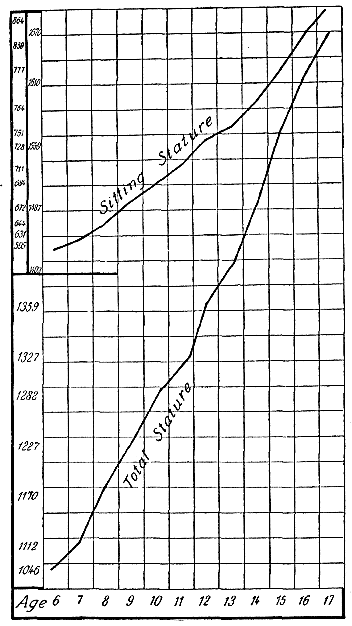
Fig. 15.
Lastly, in order to make this phenomenon still more clear, I
have reproduced an illustration given by Stratz, consisting of a
series of outlined bodies of children representing the proportions
of the body at different stages of growth; and not only the proportions
between the bust and the lower limbs, but also between
the various component parts of the bust, as for instance the head
and trunk. The transverse lines indicate the changes in the principal
levels: the head, the mammary glands, and the bust
(Fig. 16).
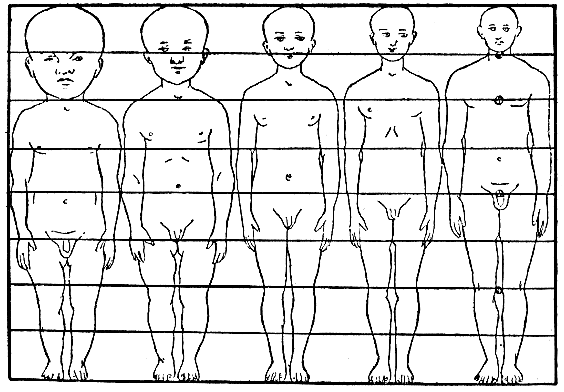
The different types of stature at different ages deserve our
most careful consideration, yet not from the point of view already
set forth regarding the different types in the fully developed
individual. In the present case for instance, we cannot say of a
youth of sixteen that, because he is macroscelous he is a weakling
as compared with a boy of ten who is brachyscelous; nor that a
new-born child represents the maximum physical potentiality,
because he is ultra-brachyscelous. Our standards must be completely
altered, when we come to consider the various types as
stages of transition between two normal forms, representing the
evolution from one to the other. At each age we observe not
only different proportions between the two fundamental parts of
the stature, but physiological characteristics as well, biological
signs of predispositions to certain determined maladies, and
psychological characteristics differing from one another, and each
typical of a particular age. From the purely physical and morphological
point of view, for example, a child from its birth up to
its second year, the period of maximum brachyscelia and consequent
visceral predominance, is essentially a feeding animal.
After this begins the development of psychic life, until finally,
just before the attainment of full normal proportions, the function
of reproduction is established, entailing certain definite characteristics
upon the adult man or woman. In accordance with its
type of stature, we see that the child from its birth to the end of
the first year shows a maximum development of the adipose system
together with a preponderance of the digestive organs; while the
adolescent, in the period preceding puberty, shows in accordance
with his macroscelous type of stature, and reduction in the
relative proportion of his visceral organs, a characteristic loss of
flesh.
These evolutionary changes in the course of growth having
been once established, it remains for us to consider the individual
variations. The alterations observed at the various ages, or
rather, the notable characteristics of each age, serve as so many
fundamental charts of the normal average child; and we may consider
each successive type of stature, from the new-born infant to the
adult man, in the same light as we do the average type of the
mature mesatiscelous type. In the case of the latter, we found
that both above and below the medium stature, there were a
host of individual types departing more or less widely from it,
and tending toward brachyscelia on the one hand and toward
macroscelia on the other, thus constituting the oscillations of
type in the individual varieties. Similarly, in the case of the
medium type of each successive age we may find brachyscelous
or macroscelous individuals whose complex personal characteristics
may be compared to those already observed in the adult,
and may be summed up as follows: that the macroscele is a weakling;
and that the brachyscele may be, according to the
degree of variation, either a robust individual or an individual that
has been arrested in his morphological development, and retained
the type of a younger age.
Pedagogic Considerations.—From the above conclusion, we
may deduce certain principles that can be profitably applied to
pedagogy, especially in regard to some of the methods suited to
our guidance in the physical education of children. Let us begin
with the happy comparison drawn by Manouvrier, who describes
an imaginary duel with swords between a macroscelous and a
brachyscelous type. The duel, according to social conventions,
must take place under equal conditions: hence the seconds take
rigorous care in measuring the ground, the length of the swords,
and determine the number of paces permitted to the duelists.
But since they have forgotten the anthropologic side, the conditions
are not entirely equal: by having a longer arm, the macroscele
is in the same position as though he had a longer sword; and
because he has a greater development of the lower limbs, the
established number of strides will take him over a greater space
of ground than his adversary. Consequently, the conditions as a
matter of fact are so favourable to the macroscele, that is, to the
weaker individual, that the latter has a greater chance of victory.
The brachyscele might, to be sure, offset this by a different
manœuvre depending on his superior agility; but both he and the
macroscele were trained in the same identical method, which
takes into consideration only the external factor, the arms of
defence, and the immutable laws of chivalry.
Well, something quite similar happens in the duel of life,
which is waged in school and in the outside social environment.
We ignore individual differences, and concern ourselves solely
with the means of education, considering that they are just,
so long as they are equal for all. The fencing-master, if he had
been an anthropologist, might have counteracted the probability
that the stronger pupil would be beaten by the weaker, by advising
the brachyscele always to choose a pistol in place of a sword, or
by teaching him some manoeuvre entirely different from that
which affords the macroscele a favourable preparation for fencing.
And in the same way, it is the duty of the school-teacher to select
the arms best adapted to lead his pupil on to victory.
That is, the teacher ought to make the anthropological study
of the pupil precede his education; he should prepare him for
whatever he is best adapted for, and should indicate to him
the paths that are best for him to follow, in the struggle for
existence.
But, aside from general considerations, we may point out that
something very similar to the above-mentioned duel takes place
in school when, in the course of gymnastic exercises, we make the
children march, arranging them according to their total height.
We expect them to march evenly and walk, not run, yet we do
not trouble to ask whether their legs are of equal length. When we
wish to know which of our pupils is the swiftest runner, we start
them all together, macrosceles and brachysceles alike, neglecting
to measure their lower limbs, the weight of their bodies, the
circumference of their chests. Then we say "bravo!" to the
macroscele, that is, the pupil who is most agile but at the same time
the weakest, and we encourage him in a pride based upon a physiological
inferiority. When we practise exercises of endurance,
we find that certain children weary sooner, suffer from shortness
of breath, and frequently drop out of the contest, in which the
victory is reserved for others. The latter are the brachysceles,
who have big lungs and a robust heart at their disposal. In this
case we say "bravo!" to the brachysceles. Then we try to arouse
a noble rivalry between the two types, encouraging emulation,
and holding up before the brachyscele the example of the macroscele's
agility, and before the macroscele the example of the
brachyscele's endurance—and perhaps we reward the two types
with different medals. Such decisions by the teacher evidently
have no such foundation in justice as he supposes; the diverse
abilities of the two types of children are associated with the constitution
of their organisms. A modern teacher ought instead to
subject the brachyscelous child to exercises adapted to develop
his length of limb, and the macroscelous to gymnastics that will
increase the development of his chest; and he will abstain from all
praise, reward, exhortation and emulation, that have for their sole
basis the pupil's complete anthropological inefficiency.
"The judgment passed by the teacher in assigning rewards and
punishments is often an unconscious diagnosis of the child's
anthropological personality."
Similar unconscious judgments are exceedingly widespread.
Manouvrier gives a brilliant exposition of them in the course of
his general considerations regarding the macroscelous and brachyscelous
types. A brachyscelous ballet-dancer, all grace and endurance
in her dancing, thanks to the strength of her lungs, can never
be imitated in her movements by a macroscelous, angular woman,
with legs ungracefully long. The latter, on the contrary, wrapped
in a mantle, may become the incarnation of a stately matron, extending
her long arms in majestic gestures. Yet it often happens
that the stately actress envies and seeks to imitate the grace of
the dancer, while the latter envies and emulates the grave dignity
of the actress.
In any private drawing-room the same thing occurs, in the
shape of different advantages distributed among persons of different
types. There are some gestures that are inimitable because they
are associated with a certain anthropologic personality. Every one
in the world ought to do the things for which he is specially
adapted. It is the part of wisdom to recognise what each one of us
is best fitted for, and it is the part of education to perfect and utilise
such predispositions. Because education can direct and aid nature,
but can never transform her.
Manouvrier is constantly observing how the macroscelous and
brachyscelous types are adapted to different kinds of social labour;
thus, for example, the macroscele will make an excellent reaper,
because of the wide sweep of his arms, and he is well adapted to be
a tiller of the soil; while the brachyscele, on the contrary, will
succeed admirably in employment that requires continuous and
energetic effort, such as lifting weights, hammering on an anvil,
or tending the work of a machine.
In the social evolution now taking place, the services of the
macrosceles are steadily becoming less necessary; intensive modern
labour requires the short, robust arm of the brachyscele. Such
considerations ought not to escape the notice of the teacher, who
sees in the boy the future man. He has the high mission of preparing
the duelists of life for victory, by now correcting and again
aiding the nature of each. And the first point of departure is
undoubtedly to learn to know, in each case le physique du role.
Abnormal types of stature in their relation to moral training.—Macroscelia and brachyscelia
in pathologic individuals (De Giovanni's hyposthenic and hypersthenic types).—Types
of stature in emotional criminals and in parasites.—Extreme types of stature
among the extra-social classes: Nanism and gigantism.
Let us start from a picture traced in the course of the preceding
lessons; the types of stature as related to race. The Chinese,
being brachyscelous, ought to be hearty eaters; instead, they are
the most sparing people on earth. Such parsimony, equally with
religion and social morality, may be considered as a racial obligation.
The whole life of the Chinese is founded upon duty:
fidelity to religion, to the laws, to the spirit of discipline, to the
spirit of sacrifice, which always finds the Chinese citizen ready to
die for his ethics and for his country, are strong characteristics
of these invincible men. Their whole education rests solely upon
a mnemonic basis; and their laws, which are highly democratic,
make it possible for anyone to rise to the highest circles, provided
he can pass the competitive examinations. In other words,
the laws aid in the natural selection of the really strong, and regard
favouritism as a crime against the State. On such individual and
national virtues is founded the survival of the race and of the
massive empire. If to-morrow the Chinese should renounce his
creed, become a glutton, a pleasure-seeker, and follow the instincts
of nature, he would be advancing in mighty strides on the path
that leads to death. Accordingly, what we call virtue may have a
biologic basis, and represent the active force that tends to correct
the defects of nature.
We can conceive of a type of man, whose life is associated with
sacrifice; and whose path of evolution is necessarily limited, first
because his personality is imperfect, secondly because a part of his
individual energy is necessarily expended in conquering, or if you
prefer, in correcting his own nature. Evolution ought to be free;
but instead, such a type is necessarily in bondage to duty, which
stops its progress. Accordingly, the civilisation of China remains
the civilisation of China; it cannot invade the world.
The European on the contrary has no such racial virtues; whatever
virtues he has are associated with transitory forms of civilisation,
and are ready to succeed one another on the pathway of
unlimited progress. The race can permit itself the luxury of not
being virtuous on its own account; its biological conditions are
so perfect, that they have reached the fullness of life. If virtue is
the goal of the Chinese, happiness is the goal of the European.
The race may indulge freely in the joys of living; and dedicate its
efforts solely to the unlimited progress of social civilisation, and to
the conquest of the entire earth.
The Tasmanian, on the other hand, sparing by nature, lacking
sufficient development of the organs of vegetative life, avoids every
form of civilisation, and precipitates himself, an unconscious
victim, upon the road to death. His natural parsimony, the
scantiness of his needs, have prevented him from ever feeling
that spur toward struggle and conquest which has its basis in
the necessities of life. Neither virtue, nor felicity, nor civilisation,
nor survival were possible to that race, whose extermination began
with the first contact with European civilisation. Hence we may
draw up a table that will serve to make clear certain fundamental
ideas that may prove useful guides along our pedagogic path:
| Biological types |
Brachysceles |
Mesatisceles |
Macrosceles |
| Races and peoples |
Chinese. |
Europeans. |
Tasmanians. |
| Civilisation |
Stable civilisation, but limited. |
Changeable civilisation, with unlimited powers of evolution. |
Outside the pale of civilisation. |
| Psycho-moral types |
High ideal of virtue and sacrifice. |
Happiness. |
Insensibility. |
We ought to strive for the supreme result of producing men who
will be happy; always keeping clearly before us the idea that the
happy man is the one who may be spared the effort of thinking
of himself, and dedicate all his energies to the unlimited progress
of human society. The preoccupation of virtue, the voluntary
sacrifice are in any case forces turned back upon themselves,
that expend upon the individual energies that are lost to the
world at large; nevertheless, such standards of virtue are necessary
for certain inferior types. There exist, besides, certain individuals
in rebellion against society, outcasts whose lives depend upon the
succor of the strong, or may be destroyed by their adverse intervention,
but in any case have ceased to depend upon the will of
the individuals themselves.
Between two inferior types the one with the better chances is
the one with the larger chest development; apparently, in the case
of biological deviations, melius est abundare quam deficere.
Accordingly, let us draw up a chart. Human perfectionment
tends toward harmony. If we wish to represent this by some
symbolic or intuitive sign, we could not do so by a mere line;
because perfection is not reached by the quantitative increase of
favourable parts; robustness, for instance, cannot be indefinitely
increased by augmenting the degree of brachyscelia; nor can intelligence
be increased by augmenting the volume of the head; but
perfection is approached, in the race and in the individual, through
a central harmony. It is accordingly in the direction of this centre
that progress is made; and whoever departs furthest from this
centre, departs furthest from perfection, becomes more eccentric,
more untypical, and at the same time also loses the psycho-moral
potentiality to attain the highest civic perfection.
In Fig. 17, we have a graphic representation in three concentric
circles.
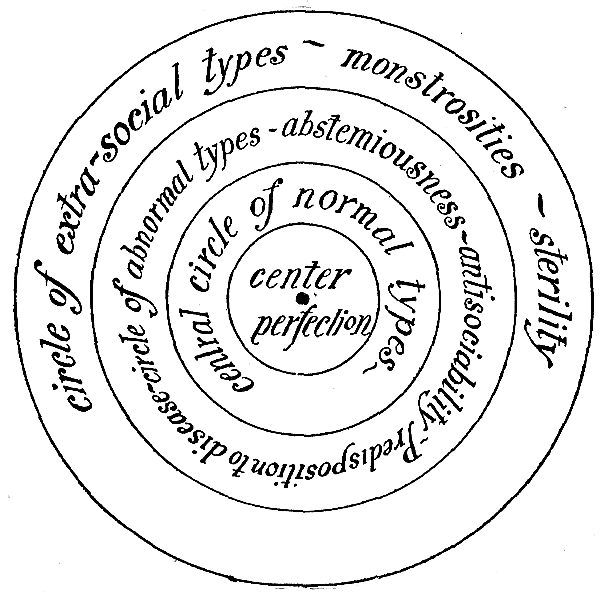
Let us begin by considering the middle circle, that of the
abnormals. Here we have inscribed, as psycho-moral and physio-pathological
traits, abstemiousness,
anti-social tendency,
predisposition to disease.
Abstemiousness represents a
corrective, without which the
individual tends toward an
anti-social line of action and
contracts diseases. Abstemiousness
is present within
the circle of abnormal human
beings, as a more or less attainable
ideal; but it must be
regarded as the pedagogic
goal, when the problem arises
of educating an untypical
class of individuals. In
other words, there are certain abnormal individuals who, if they
are not to turn out criminals, must exercise a violent corrective
influence over their psycho-physical personality, and they must be
trained to do so; for it is an influence unknown to the normal
man, who not only has no inclination to commit a crime, but
recoils from doing so, and on the contrary may arise to degrees
of moral perfection that are inconceivable to the abnormal man.
Consequently, in order to maintain a relatively healthy condition,
certain abnormal individuals are constrained to submit themselves
to a severe hygienic régime throughout their entire life; a régime useless
to the normal man, who indulges naturally in all the pleasures
which are consistent with the full measure of physical health,
and which remain forever unknown, and unattainable, to the abnormal
individual organically predisposed to disease.
Such self-restraint we may call the culte of virtue, a necessity
only to certain categories of men; and we may also call it the
virtue of inferior individuals. It applies and is limited almost
wholly to the individual.
Meanwhile, there is the normal man's high standard of virtue,
which is an indefinite progress toward moral perfection; but the
path it follows lies wholly in the direction of society collectively,
or toward the biological perfectionment of the species. In life's
attainment of such a triumph, man both feels and is happy rather
than virtuous.
The separation between the circles, or rather between the different
categories of individuals, the normal and the abnormal, is not
clear-cut. There always exist certain imperceptibly transitional
forms, between normality and abnormality; and furthermore,
since no one of us is ideally normal, no one who is not abnormal
in some one thing, it follows that this "some one thing" must be
corrected by the humbling practice of self-discipline. At the same
time it is rare for a man to be abnormal in all parts of his personality;
in such a case he would be outside the social pale, a monstrosity;
the high, collective virtues can, therefore, even if in a limited
degree, illuminate the moral life of the abnormals. St. Paul felt
that it "is hard to kick against the pricks"; and the picciotto of
the Camorra feels that he is obeying a society that protects the
weak.
It is a question of degree. But such a conception must lead to
a separation in school and in method of education, for the two
categories of individuals.
Certain very important pathological types have been distinguished
and established in Italy by De Giovanni, the Paduan
clinical professor who introduced the anthropological method into
clinical practice. Through his interesting studies, he has to-day
fortunately revived the ancient theory of temperaments, explaining
them on a basis of physio-pathological anthropology.
De Giovanni distinguishes two fundamental types; the one
hyposthenic (weak), the other hypersthenic (over-excitable); these
two types obey the following rules: morphologically considered,
the hyposthenic type has a total spread of arms greater than the
total stature and a chest circumference of less than half the stature:
these data alone are enough to tell us that the type in question is
macroscelous; as a matter of fact, the chest is narrow and the abdomen
narrower still. De Giovanni says that, owing to the scant
pulmonary and abdominal capacity the organs of vegetative life
are inadequate; the heart is too small and unequal to its function
of general irrigator of the organism; the circulation is consequently
sluggish, as shown by the bluish network of veins, indicating
some obstacle to the flow of blood.
The type is predominantly lymphatic, the muscles flaccid,
with a tendency to develop fatty tissues, but very little muscular
fibre; there is a predisposition to bronchial catarrh, but above all
to pulmonary tuberculosis. This hyposthenic type, which corresponds
to the lymphatic temperament of Greek medicine, is in reality
a macroscelous type somewhat exceeding normal limits and therefore
physiologically inefficient and feeble.
The following is De Giovanni's description:
Morphologically.—Deficient chest capacity, deficient abdominal
capacity, disproportionate and excessive development of the limbs;
insufficient muscularity.
Physiologically.—Insufficient respiration, and consequent scanty
supply of oxygen (a form of chronic asphyxia of internal origin),
insufficient circulation, because the small heart sends the blood
through the arteries at too low a pressure; and this blood, insufficiently
oxygenated, fails to furnish the tissues with their normal
interchange of matter, and therefore the assimilative functions in
general all suffer; finally, the venous blood is under an excessive
pressure in the veins, the return flow to the heart is rendered
difficult and there results a tendency to venous hyperemia (congestion
of the veins), even in the internal organs. This is accompanied
by what De Giovanni calls nervous erethism (in contradistinction
to torpor), which amounts to an abnormal state of the
central nervous system, causing predisposition to insanity and to
various forms of neurasthenia (rapid exhaustion, irritability).
This type is especially predisposed to maladies of the respiratory
system, subject to bronchial catarrh recurring annually, liable
to attacks of bronchitis, pleurisy, and pneumonia, and easily falls
victim to pulmonary tuberculosis.
Here are a few cases recorded by De Giovanni.[9] (It must be
borne in mind that the total spread of the arms, Ts, ought to equal
the total stature, St. The measurements are given in centimetres.)
F. M.—St 147; Ts 151.—Extremely frail; frequent attacks of
hemorrhage of the nose; habitually pale and thin. Certain
disproportions of the skeleton, hands and feet greatly enlarged;
extreme development of the subcutaneous veins.
Pulmonary tuberculosis.
A. M.—St 161; Ts 193.—Nervous erethism; from the age of
twelve subject to laryngo-bronchial catarrh; every slight illness
accompanied by fever; habitually thin. Pulmonary
tuberculosis.
F. M.—St 150; Ts 150; Ct 67.—Lymphatic, torpid, almost chronic
bloating of the abdomen. Enlargement of the glands; scars
from chilblains on hands and feet. Primary tuberculosis of
the glands, secondary tuberculosis of the lungs.
A. M.—St 172; Ts 179.—Extreme emaciation, heart singularly
small. Chronic bronchial catarrh.
If it is important for us, as educators, to be acquainted with
this type in the adult state, it ought to interest us far more
during its ontogenesis, that is, during the course of its individual
evolution.
Since, in the process of growth, man passes through different
stages, due to alteration in the relative proportions of the different
organs and parts, it follows that this hyposthenic type correspondingly
alters its predisposition to disease. Its final state,
manifested by various defects of development, gave unmistakable
forewarnings at every period of growth.
In early infancy symptoms of rickets presented themselves,
and then disappeared, like an unfulfilled threat: dentition was
tardy or irregular; the head was large and with persistent nodules.
This class, as a type, is weak, sickly, easily attacked by infectious
diseases, tracoma, purulent otitis.
When the first period of growth is passed, glandular symptoms
begin, with liability to sluggishness of the lymphatic glands (scrofula)
or persistent swelling of the lymphatic ganglia of the neck.
This is supplemented by bronchial catarrh, recurring year after
year; finally intestinal catarrh follows, accompanied in most cases
by loss of appetite.
Such conditions are influenced very slightly or not at all by
medical treatment.
During the period of puberty, cardiopalmus (palpitation of the
heart) is very likely to occur, often accompanied by frequent and
abundant epistasis, or by the occurrence of slight fever in the
evening, and by blood-stained expectorations, suggestive of tuberculosis.
The patient is pale (oligohæmic), very thin, and shoots
up rapidly (preponderant growth of the limbs); he is subject to
muscular asthenia (weakness, exhaustibility of the muscles) and to
various forms of nervous excitability.
These symptoms also (some of them so serious as to arouse
fears, at one time of rickets and at another of tuberculosis), are all
of them quite beyond the reach of medical treatment (tonics, etc.).
Now, a fact of the highest importance, discovered by De
Giovanni, is that of spontaneous corrections, that is, the development
of compensations within the organism, suited to mitigate
the anomalous conditions of this type, and hence the possibility of
an artificial intervention capable of calling forth such compensations.
Such intervention cannot be other then pedagogic; and it should
consist in a rational system of gymnastics, designed in one case
to develop the heart, in another the chest, in another to modify
the intestinal functions or to stimulate the material renewal of
the body; while every form of overexertion must be rigorously
avoided.
"I think that we should regard as an error not without consequences
what may be seen any day in the gymnasiums of the public
schools, where pupils differing in bodily aptitude, and with different
gymnastic capacity and different needs are with little discernment
subjected to the same identical exercises, for the same
length of time.
"And day by day we see the results: there are some children who
rebel outright against the required exercise which they fear and
from which they cannot hope to profit, because it demands an
effort beyond their strength. Some have even been greatly
harmed; so that one after another they abandon these bodily exercises,
which if they had been more wisely directed would assuredly
have bettered their lot.
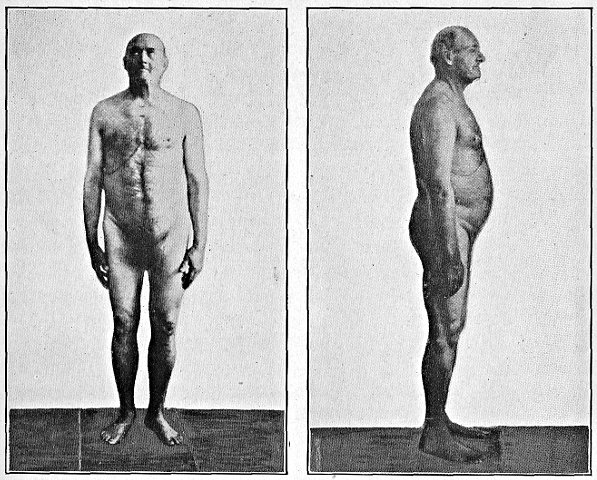
Fig. 18. Fig. 19.
Brachyscelous type (from Viola).
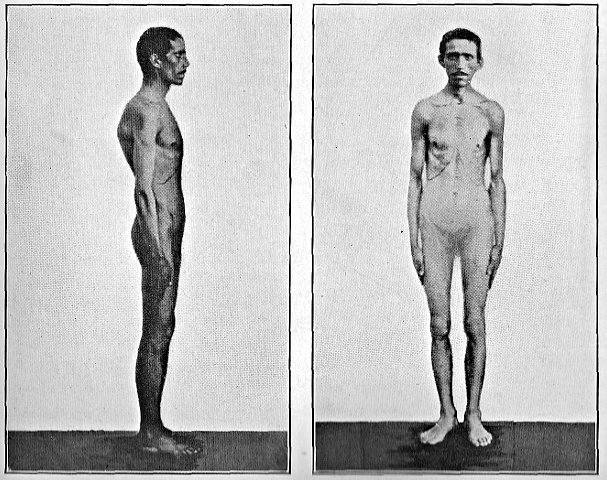
Fig. 20. Fig. 21.
Macroscelous type (from Viola).
"Experience also teaches that one pupil may be adapted to
one kind of exercise and another to another kind. Accordingly
a really physiological system of gymnastics requires that those
movements and those exercises which are least easily performed should
be practised according to special methods, until they have strengthened
the less developed functions, without ever causing illness or
producing harmful reactions.[10]"
So that the final results are an improvement in the morphological
proportions of the organism, and consequently a correction
and improvement in the relative liability to disease.
The other fundamental pathological type described by De
Giovanni is the hypersthenic (second morphological combination),
corresponding in part to the sanguine temperament of Greek
medicine, and in part to the bilious temperament. In this type
the total spread of the arms is generally less than the stature, and
the perimeter of the chest notably exceeds one-half the stature.
Consequently we are dealing with the brachyscelous type.
This type has a greatly developed thorax, a large heart, an
excessive development of the intestines; hence he is a hearty eater,
subject to an over-abundance of blood; he is over-nourished, the
ruddy skin reveals an abundant circulation, there is an excess of
adipose tissue and a good development of the striped muscles.
Such a constitution accompanies an excitable, impulsive, violent
disposition, and conduces to diseases of the heart. "This type is
characterised in general by robustness and a liability to disorders
of the central circulatory system."[11]
But there are still other forms of disease that await the individuals
of this class, such for example as disorders affecting
the interchange of organic matter (diabetes, gout, polysarcia =
obesity) and attacks of an apoplectic nature. In the case of acute
illness individuals of this class suffer from excess of blood and may
be relieved by being bled. They are readily liable to bloody
excretions.
Here are a few cases illustrating this morphological combination,
which is characterised by an exorbitant chest development (it
must be borne in mind that the circumference of the thorax, Ct,
should equal one-half the stature, St).
P. A.—St 156; Ct 93.—Endocarditis; insufficient heart-action.
Z. C.—St 168; Ct 95.—Cerebral hyperemia of an apoplectic nature.
Hypertrophy of the left ventricle of the heart. Polysarcous
(gluttonous) eater.
B. G—St 166; Ct 104.—Diabetic, obese, subject to diabetic
ischialgia (neuralgia), frequent recurrence of gravel in the
urine. Tendency to excesses of the table.
D. G.—St 160; Ct 96.—Polysarcia, the first symptoms of which
appeared in early youth. At the age of sixteen, suffered from
all the discomforts of obesity. Shows atheroma (fatty degeneration)
of the aorta, irregular heart-action, hypertrophy
and enlargement of the heart.
In this brachyscelous type it may happen either that the whole
trunk (that is, both the thoracic and abdominal cavities) is in
excess, or else that the excessive development is confined to the
abdomen. This latter case is very frequent, and may easily be
found even in early childhood. Such children are hearty eaters,
are very active and, for this reason, the pride and joy of their
parents. Nevertheless, there are many signs that should give
warning of constitutional defects; constant digestive disturbances
(diarrhœa), frequent headaches, pains in the joints, apparently
of a rheumatic character, tendency to pains in the liver which is
excessively enlarged; excess of adipose tissue; a tendency to fall
ill very easily, of maladies that are almost always happily overcome
(but the truly robust person is not the one who recovers from illness,
but the one who does not become ill), and finally an excessively
lively disposition, irritability and above all, impulsiveness.
Such individuals ought, like the macrosceles, to live under the
necessary and perpetual tyranny of a hygienic régime, adapted to
correct or to diminish the morbid predispositions associated with
the organism. A special dietetic, a regular hydrotherapic treatment,
a moderate gymnastic exercise designed to direct the child's
motive powers, and thus to prepare the man for that form of
existence to which it is necessary for him to subject himself, if he
does not wish to shorten his own life, or at least his period of
activity—all these things are so many duties which the school
ought in great part to assume.
In this way we have briefly considered the abnormal types of
brachyscelia and macroscelia, which by their very constitution
are predisposed to incur special and characteristic forms of disease,
which may be avoided only by subjecting the organism to a special
hygienic regimen. Men cannot all live according to the same rules.
In these latter times, some very recent researches have been
made by applying De Giovanni's method to the anthropological
study of criminals, especially through the labours of Dr. Boxich.
He has found that the great majority of parasitic criminals,
thieves for example, are macrosceles. They exhibit the stigmata
already revealed by Lombroso: great length of the upper limbs,
with elongated hands; furthermore, a narrow chest and a small
heart, insufficient for its vital function; such individuals are
singularly predisposed to pulmonary tuberculosis, and hence in
their physical constitution they are already stamped as organisms
of inferior biological value—having little endurance and almost no
ability as producers—consequently they are forced to live as they
can, that is like parasites, profiting by the work of others. On
the contrary, the great majority of criminals of a violent character
present the brachyscelous type: the thorax is greatly developed,
the heart hypertrophic, the arterial circulation superabundant.
This class of criminals, including a large proportion of murderers,
have a special tendency to act from impulse, corresponding to
their large heart which sends an excess of blood pulsing violently
to the brain, obscuring the psychic functions; or, in the speech
of the people, such a man has "lost his reason," "the light goes
from the eyes when the blood goes to the brain."
Here are some notes regarding these two different types: we
will select as measures of comparison the stature and the weight,
bearing in mind that in the macrosceles the weight is scanty and
that the opposite is true of the brachysceles, while normally there
ought to be a pretty close correspondence between the weight in
kilograms and the centimetres of stature over and above one
metre.
Case No. 24.—St. 168; Wt. 56. Farm steward, three years'
sentence for theft. Pallid complexion, visible veins, scant
muscles. Heart small and weak, pulse feeble and slow.
Case No. 34.—St. 175; Wt. 61. Baker, comfortable financial
circumstances, has received a number of sentences for theft,
amounting altogether to ten years. Is twenty-four years of
age. Cyanosis of the extremities (bluish tinge, due to
excessive venous circulation). Cardiac action feeble. Scant
muscles.
Case No. 43.—St. 156; Wt. 51. Peasant. Straitened circumstances.
Four years' sentence for theft. Rejected by the
army board for defective chest measurement. Dark complexion.
Extensive acne. Scant muscles. Bronchial catarrh.
Has had hemoptysis (spitting of blood). Cardiac action
weak. Pulse very feeble.
Case No. 52.—St. 173; Wt. 66. Book-binder. Prosperous circumstances.
Four years' sentence or thereabouts, for theft;
age, twenty-four. Conjunctivitis and blepharitis from early
childhood. Frontal and parietal nodules prominent. Muscles
scant; cardiac action weak; lymphatic glands of the neck
enlarged.
The following is an example of the typical thief:[12]
St. 162; Wt. 46.—Exceedingly small heart, feeble cardiac action.
Suffers from chronic bronchial catarrh. Cranial nodules
very prominent. Began as a small child to steal in his own
home, and since then has received sentence after sentence
for theft, up to his present age of twenty-nine.
Case No. 54.—St. 157; Wt. 62. Peasant. Good financial circumstances.
Condemned to thirty years in prison for homicide.
Well-developed muscles. Blood vessels congested. Strong
heart action; the pulsation extends as far down as the epigastrium.
Ample pulse.
Case No. 60.—St. 156; Wt. 70. Shoemaker. Bad financial circumstances.
Condemned to fifteen years' imprisonment for
homicide, after having been previously convicted three times
for theft. The chest circumference exceeds one-half the
stature by 11 centimetres. Subject to frequent pains in the
head. Good muscles. Corpulent. Full pulse. (It should
be noticed that the florid complexion, accompanying this
type of stature, persists in spite of straitened circumstances!)
Case No. 85.—St. 168; Wt. 70. Turner in iron. Comfortable
circumstances. Sentenced to thirty years in prison after one
previous conviction for criminal assault. Ruddy complexion.
Veins not visible. Abdomen very prominent. Gastrectasia
(dilation of the stomach). Entire cardiac region protuberant.
Laboured breathing. Cardiac action abundant.
Hence we perceive, in the etiology of crime, the importance
of the organic factor, connected directly with the lack of harmony
in the viscera and their functions, and consequently accompanied
by special morbid predispositions.
As a result of this line of research, criminality and pathology
are coming to be studied more and more in conjunction. For
that matter, it was already observed by Lombroso that in addition
to the various external malformations found in criminals, there
were also certain anomalies of the internal organs, and a widespread
and varied predisposition to disease. In short, his statistics
reveal a prevalence of cardiac maladies and of tuberculosis
in criminals, as well as a great frequency of diseases of the liver
and the intestines.
Whenever the disproportion between the bust and the limbs
surpasses the extreme normal limits, the whole individual reveals
a complex departure from type. Thus, for example, in connection
with extreme brachyscelia, there exists a characteristic form of
nanism (dwarfishness), called achondroplastic nanism, in which,
although the bust is developed very nearly within normal limits,
the limbs on the contrary are arrested in their growth so as to
remain permanently nothing more than little appendages of the
trunk. This calls to mind the fœtal form of the new-born child,
and the resulting type, because of this morphological coincidence,
is classed among the infantile types.
Achondroplastic nanism is associated with a pathological
deformity due to fœtal rickets. It is not only the child after
birth, but the fœtus also which, during its intrauterine life, may
be subject to diseases. Rickets (always a localised disease,
usually attacking some part of the skeleton) in this case fastens
upon the enchondral cartilages of the long bones. As we know, the
long bones are composed of a body or diaphysis and of extremities
or articular heads, the epiphyses. Now, these different parts,
which form in the adult a continuous whole, remain separate
throughout the fœtal and the immediate post-natal period: so that
the heads of the humerus and the femur, for example, in the case
of the new-born child, are found to be joined to the diaphysis by
cartilages (destined to ossify later on), which are the chief seat of
growth of the bones in the direction of length. Well, in these
cases of pre-natal rickets, the union of the bony segments takes
place prematurely, and since the bones can hardly grow at all
in length, they develop in thickness, and the result is that the
limbs remain very short and stocky. Meanwhile the bust,
the bones of which have in no way lost their power of growth,
develops normally.
Now, these dwarfs, who have abundant intelligence, because
they have the essential parts of stature in their favour, constituted
the famous jesters of the mediæval courts, whose misfortune served
to solace the leisure hours of royalty. Paolo Veronese went so
far as to introduce a dwarf buffoon, of the achondroplastic type,
into his famous painting, The Wedding at Cana.
Conversely, in connection with an exaggerated macroscelia, we
have gigantism.
Ordinarily, a giant has a bust that is not greatly in excess of
normal dimensions. The limbs, on the contrary, depart extremely
from the normal limits, in an exaggerated growth in the
direction of length: so much so that the bodies of giants present
the appearance of small busts moving around on stilts.
Nevertheless, many different forms of gigantism occur. The
pathology of this phenomenon is quite complex; but we can
not concern ourselves with it here. It is a scientific problem
of no immediate utility to our pedagogic problems. Dwarfs
and giants, whatever their type and their pathological etiology,
constitute extra-social individuals, who have been at all times
excluded from any possibility of adaptation to useful labour,
and employed, whether in the middle ages or in the twentieth
century, to a greater or less extent as a source of amusement to
normal beings, because of their grotesque appearance, either at
court or in the theatres, or in moving pictures, or (in the case of
giants) as figures suited to adorn princely or imperial gateways.
These individuals are as completely independent of the social
conditions of the environment in which they were born as if they
were extraneous to humanity. In relation to the species, they are
sterile.
From the biological side, a consideration of these types serves
merely as an illustration of an important law: the essential part
of the organism (the vertebral column) is less variable than the
accessory parts (the limbs).
According to the relative development of bust and limbs we
have distinguished three types, the macrosceles, the brachysceles
and the mesatisceles, within their respective limits of oscillation.
Since the type of stature gives us a proportion between the
different parts of an individual, it constitutes a fundamental criterion
for a morphological judgment of the personality. That is, it
leads to a diagnosis of the individual constitution, with which are
associated not only the "character" but also certain predispositions
to disease.
A knowledge of these types shows us the necessity we educators
are under of taking into consideration the individual pupils, each
of whom may have separate needs, tendencies and forms of development;
and of demanding separate schools, in which even the methods
of moral education must differ. Because men are not only not all
adapted to the same forms of work, but they are not even all
adapted to the same standards of morality. And since it is our
duty to assume the task of aiding the biological development and
the social adaptation of the new generations, it will also be part of
our task to correct defective organisms, and at the same time to
correct the types of mental and moral inferiority.
In the following chart we may summarise the points of view
from which we have studied the types of stature:
SYNOPTIC CHART
| Types of stature |
Macrosceles |
long legs, short bust. |
| Brachysceles |
short legs, long bust. |
| Variations in types of stature |
Normal |
Race |
Mongols (brachysceles). |
| Tasmanians (macrosceles). |
| Dark Mediterranean race (mesatisceles tending toward brachyscelia). |
| Blond race (mesatisceles tending toward macroscelia). |
| Sex |
Woman more brachyscelous. |
| Man more macroscelous. |
| Age |
Childhood brachyscelous. |
| Old age macroscelous. |
| Pathologically abnormal. |
De Giovanni's hyposthenic types |
Macrosceles predisposed to tuberculosis. |
| De Giovanni's hypersthenic types. |
Brachysceles predisposed predisposed to diseases of the heart. |
| Criminals. |
Macrosceles |
parasites. |
| Brachysceles |
violent. |
| Infantile types |
Achondroplastic nanism. |
| Gigantism. |
Biological Laws.—a. Growth is not only an augmentation in
volume, but also an evolution in form.
b. The more essential parts vary less than the accessory parts
in the course of their transformations.
The Index.—The index is the mathematical relation between the
measurements belonging to the same individual, and as such it
gives us an idea of the form; since the form is determined by the
relations between the various parts constituting the whole.
While the figure and the type of stature tend to delineate the
individual considered by himself, the different measurements considered
separately may guide us in our study of individuals in their
relation to the race and the environment.
Among the measurements of the form, we will limit ourselves
to a study of the stature and the weight, which serve to give us
respectively the linear index of development and the volumetric
estimate of the body taken as a whole. We shall reserve the study
of the other measurements, such as the total spread of the arms
and the perimeter of the thorax, until we come to the analytical
investigation of the separate parts of the body (limbs, thorax).
The stature is expressed by a linear measure determined by the
distance intervening in a vertical direction between the plane on
which the individual is standing in an erect position and the top
of his head.
It follows that the stature is a measurement determined by the
erect position; on the other hand, when a man is in a recumbent
position, what we could determine would be the length of body,
which is not identical with the stature.
In fact, a man on foot, resting his weight upon articulations
that are elastic, and therefore compressible, is a little shorter than
when he is recumbent.
If we examine the skeleton (see Fig. 9), we discover that the
single synthetic measure that constitutes the stature results from
a sum of parts that differ greatly from one another. To be specific,
it is composed of the long and short bones of the lower limbs;
of flat bones, such as the pelvis and the skull; of little spongy
bones, such as the vertebræ; all of which bones and parts obey
different laws in the course of their growth. Furthermore, intervening
between these various bones are soft, elastic parts, known
as the articulations, which, starting from below, succeed each other
in the following order:
- Calcaneo-astragaloid, between the calcaneus and the superimposed astragalus.
- Tibio-astragaloid, between the astragalus and the superimposed tibia.
- Of the knee, between the tibia and the femur.
- Of the hip, between the femur and the os innominatum.
- Sacro-iliac, between the os iliacum and the sacrum.
- Sacro-vertebral, between the sacrum and the last lumbar vertebra.
- Of the vertebræ, consisting of 23 intervertebral disks, that is to say interposed between the vertebræ, which include the following: 5 lumbar, 12 thoracic, 7 cervical.
- Occipito-atloid, between the first cervical vertebra, called the atlas and the os occipitale of the cranium.
Accordingly, there are thirty articulations in all; and of these,
23 are the intervertebral disks, which constitute, taken together, a
fourth part of the complex height of the vertebral column.
Furthermore, the height of the body cannot be considered simply
the sum of the component parts, since these are not superimposed
in a straight line. As a matter of fact, if we examine the
vertebral column, we see that it is not straight as in the case of
animals, but exhibits certain curves that are characteristic of the
human species, and must be taken into consideration in their relation
to the erect position. In fact, the vertebral column presents
two curvatures, the one lumbar, and the other cervical, which
together give it the form of an S. These curvatures are acquired
along with the erect position, and are not innate; one of the points
of difference between the skeleton of the new-born child and that
of the adult is precisely this, that the former has a straight vertebral
column.
A fact of no small importance to note, since in the course of
growth a certain determined form of normal curve, and no other,
ought to establish itself; otherwise, abnormal deviations in the
vertebral column will become established. And for the very
reason that it is plastic and destined to assume a curve, the vertebral
column may very easily be forced into exaggerating or departing
from its morphological destiny. In such a case, the resulting
stature would be inferior to what it should normally have been.
Accordingly, the stature is the resultant of the sum of anatomical
parts and of morphological conditions.
Hence it is a linear index not only of biological man, that is, of
man considered in relation to his racial limitations; but also of
social man, that is, of man as he has developed in the struggle for
adaptation to his environment.
The limits of stature, according to race. Stature is an anthropological
datum of great biological value, since it is a definite racial
characteristic and is preserved from generation to generation by
heredity. The first distinguishing trait of a race is the height of
the body in its natural erect position. It is also the first characteristic
that strikes us when a stranger comes toward us for the
first time. And that is why we make it the leading descriptive
trait: a person of tall, or of low stature. If, for a moment, we
should picture to ourselves the legend of Noah's Ark—quite incredible,
because emigration and embarkation of all the known species
would have required more than a century of time (it is enough
merely to think of the embarkation of the tortoises and the
sloths!), and the necessity of an ark as big as a nation, what must
inevitably have struck Noah and his sons would have been the
stature of the individuals belonging to each separate species.
The stature is the linear index of the limit of mass.
Among the human races the variations in stature are included
between fairly wide oscillations: coming down to facts, the
average stature of the Akkas is 1.387 m. (4 ft. 6½ in.) for the
males; and that of the Scotchmen of Galloway is 1.792 m. (5 ft.
10½ in.). Accordingly between the average heights of the two
races that are considered as the extremes, there is a difference of
40 cm. (15¾ in.); but since the averages are obtained from a complex
mass of normal measurements, some of which are above and
others necessarily below the average itself, we may assert that the
"normal human individuals" may differ in stature to an extent of
more than half a metre; the oscillations of normal individuals on
each side of the racial average being estimated at about 10 cm.
(3.937 in.).
If we should see a little Akka 4 ft. 4 in. (1.33 m.) in height
alongside of a Scotchman 6 ft. (1.83 m.) high we should say "a
dwarf beside a giant." But such terms are pathological and should
never be employed to indicate normal individualities. As a matter
of fact dwarfs and giants are as a class extra-social and sterile;
normal individuals, on the contrary, represent the physiopsychic
characteristics of their respective races. Consequently we may say
that normal people have a low stature, or a high stature; or if it is
a question of extremely low stature (such as that of the Akkas)
we may make use of the term pigmies or of the pigmy race, in speaking
of such individuals. Sergi has proved the existence, among
the prehistoric inhabitants of Europe, of various pigmy races.
In the field of anthropology the scientific terminology ought
always to be based upon certain determined limits. The authorities
indicate the normal extremes of individual stature, beyond
which we pass over the into realm of pathology, incompatible with
the survival of the species; and even in the pathological cases they
determine the extreme limits, obtained from the individual monstrosities
that have actually existed in the course of the centuries,
and that seem to indicate the furthest limits attained by the human
race.
Deniker, in summing up the principal authorities, assigns the
following limits:
| Statures less than 1.25 m. |
Normal statures, range of oscillations among the races |
Statures from 2 m. upward |
| Lowest individual extreme |
Exceptionally low individual stature |
Extreme low racial average |
Extreme high racial average |
Exceptionally high individual stature |
Highest individual extreme |
| Nanism |
1.25 m. |
1.35 m. |
Akkas 1.387 m. |
Scotchmen of Galloway 1.792 m. |
1.90 m. |
1.99 m. |
Gigantism |
The pathological extremes that would seem to indicate the
limits of stature compatible with human life would seem to be on
the one hand the little female dwarf, Hilany Agyba of Sinai,
described by Jaest and cited by Deniker,[13] 15 inches high (0.38 m.—the
average length of the Italian child at birth is 0.50 m. = 19½
in.), and on the other, the giant Finlander, Caianus, cited by
Topinard[14], 9 ft. 3½ in. in height (2.83); the two extremes of
human stature would accordingly bear a ratio of 1:7. On the
other hand, Quétélet[15] gives the two extremes as being relatively
1:6—namely, the Swedish giant who was one of the guardsmen
of Frederick the Great, and was 2.523 m. tall (8 ft. 3 in.); and
the dwarf cited by Buffon, 0.43 m. in height (16¾ in.).
When there is occasion for applying the terms tall or low
stature to individuals of our own race, it is necessary at the
same time to establish limits that will determine the precise
meaning of such terms. Livi[16] gives as the average stature for
Italians 1.65 m. (5 ft. 5 in.), and speaking authoritatively as
the leading statistician in Anthropology, establishes the following
limits:
STATURE OF ITALIANS (LIVI)
Averages Determining The Terminology of Stature
| 1.60 m. and below, low statures. |
1.65 m. and all between 1.60-1.70, mean statures |
1.70 m. and above, tall statures. |
The individual extremes among the low statures tend to approach
the average stature of the Japanese race (1.55 m.), and those
among the high statures approach the Anglo-Saxon average (the
Scotch = 1.79 m.)
There is much to interest us in studying the distribution of
statures in Italy.
In Livi's great charts, he has marked in blue those regions
where the prevailing percentage of stature is high (1.70 m. and
upward), and in red those where the low statures prevail (1.60 m.
and below); and the varying intensity of colouration indicates
the greater or lesser prevalence of the high or low statures.
Thus it becomes evident in one glance of the eye that tall statures
prevail in northern Italy and low statures in the south; while
the maximum of low stature (indicated by the most intense red)
is found in the islands, and especially in Sardinia.
In the vicinity of the central districts of Italy (the Marches,
Umbria, Latium) the two colours fade out; this indicates that here
all notable prevalence of stature, either tall or low, ceases; consequently
we have here, as the prevailing norm, the mean stature
(1.65 m.).
Anyone wishing to analyse the natural distribution of stature,
has only to study these charts by Livi, which are worked out with
great minuteness. If a study of this sort, extending over the entire
peninsula, seems too great an undertaking, it is at least advisable
for a teacher to acquaint himself with the local distribution of
stature; in order that when it becomes his duty to judge of the
stature of pupils in his school he will have the necessary idea
regarding the biological (racial) basis on which so important an
anthropological datum can oscillate.
Livi's charts, based upon the male stature, correspond almost
perfectly with my own regional charts based upon the average
statures of the women of Latium. Both Livi and I find that in
the region of Latium the tall statures prevail north of the Tiber,
especially toward the confines of Umbria; while the lowest statures
are found in the neighbourhood of the valley of the Tiber, toward
the sea (Castelli Romani). That is to say, the stature becomes
lower from north to south, and from the mountains toward the
sea. Furthermore, there exist certain nuclei of pure race, such as
at Orte and in Castelli Romani, where we may find the extremes
of average stature, which for women are found to be 1.61 m. at
Orte, and 1.47 m. at Castelli Romani; while the extreme individual
statures, according to my figures, oscillate between 1.42 m. (Castelli)
and 1.70 m. (Orte). It would be helpful to the teachers of Rome and
Latium, if they would acquire some idea regarding the racial types
of the district, by studying my work on the Physical Characteristics
of the young Women of Latium, which is the only work on regional
anthropology taken directly from life that so far exists in anthropologic
literature.[17]
The Stature in Relation to Sex.—It is sufficient to point out that
the stature varies normally between the sexes, so that the average
figures differ by about 10 centimetres (nearly 4 in.) in the direction
of a lower stature for woman.
Notwithstanding that growth is an evolution, it manifests
itself also by an absolute augmentation of mass; and the linear index
of such augmentation is given by the growth in stature, or by its
variations at different ages.
This exceedingly important measurement ought to be taken
in the case of all pupils; and undoubtedly in the course of time
anthropometry will form a part of our school equipment; because,
by following the increase of stature in a child, we follow his physical
development.
In Chapter VII, in which the technique of the stature is discussed,
there is a graphic representation of the annual increase of
stature in the two sexes; the upper parabolic line refers to the
male sex, and the lower one to the female. On the vertical line
are marked the measures of growth, from the base upward, and
on the horizontal line the ages. All the dotted vertical lines
which rise from the horizontal, each corresponding to a successive
year of life, and stop at the parabolic line, represent the relative
proportion of stature from year to year; while the parabola
which unites the extremities of such lines may be regarded as a line
drawn tangent to the top of the head of an individual through the
successive periods of his life.
If we analyse this table, we find that the greatest increase in
stature takes place during the first year; in fact, a child which at
birth has an average length of body of 0.50 m. for males, and
0.48 m. for females (the new-born child does not have stature,
but only length of body, since it has not yet acquired an erect
position) has by the end of the first year augmented the length
of body by 20 centimetres, which gives an average length of 0.70 m.
In no other year of life will the stature acquire so notable an
increase; it is very important for mothers to watch the growth
of the child during this first year of its life; and the following
figures may be useful for comparison:
It will be seen that the maximum increase takes place during
the first four months—especially in the first month (4 cm. =
1.57 in.) the rate diminishing from this point up to the fourth
month (2 cm. = 0.78 in.), after which the monthly increase remains
steadily at one centimetre (0.39 in.).
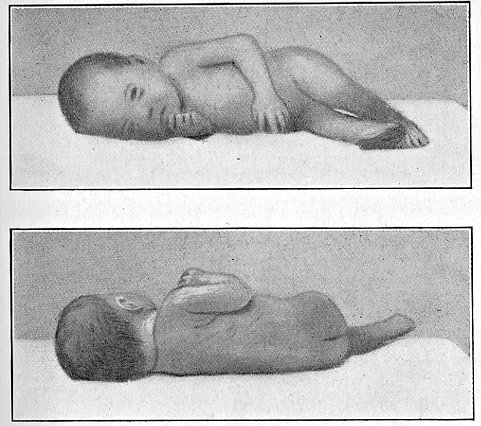
Fig. 22.—New-born child, seen from in front and from behind. (Stratz.)
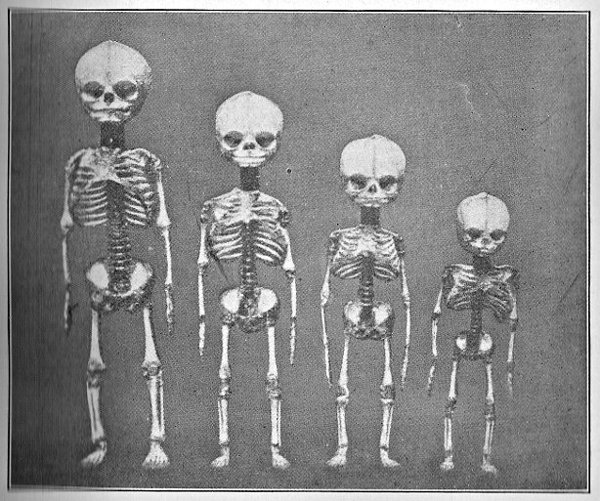
1 year. 8 months. 4 months. at birth.
Fig. 23—Skeleton of a child from birth to the age of one year.
GROWTH IN LENGTH OF BODY DURING THE FIRST YEAR OF LIFE
(From Figueira)
| Age in months |
Length of body in metres |
Monthly increase |
| 0 |
0.50 |
0 |
| 1 |
0.54 |
4 |
| 2 |
0.57 |
3 |
| 3 |
0.60 |
3 |
| 4 |
0.62 |
2 |
| 5 |
0.63 |
1 |
| 6 |
0.64 |
1 |
| 7 |
0.65 |
1 |
| 8 |
0.66 |
1 |
| 9 |
0.67 |
1 |
| 10 |
0.68 |
1 |
| 11 |
0.69 |
1 |
| 12 |
0.70 |
1 |
The same facts appear from the combination picture given
by Stratz, showing an infant's skeleton at four-month intervals
from birth to the end of the first year.
During the second year of life, the increase in stature is about
one-half that of the preceding year, that is, about 10 cm. (4 in.),
so that at the end of the second year the child attains a height of
about 80 cm. (31½ in.). After this, the annual increase diminishes
in intensity (see "Figures of the increase of stature according
to Quétélet and other authors," in the technical part, Chapter VII),
as is shown by the horizontal dotted lines, which, starting from a
vertical line at points corresponding to the height of various
statures, represent by the intervals of space between them the
successive growth from year to year.
This increase is not regular, but proceeds by periodic impulses
that in early childhood seem to recur at intervals of three years.
Thus for example the increase
- between 0- 3 years of age is successively 20, 10, 6 cm.
- between 3- 6 years of age is successively 7, 6, 5 cm.
- between 6- 9 years of age is successively 7, 6, 5 cm.
- between 9-12 years of age is successively 6, 4, 3 cm.
Accordingly we have a triennial rhythm, decreasing throughout
the whole period of childhood; the maximum increase is in the
first triennium, the second and third periods of three years correspond
exactly, while the last period shows a lowered rate of
increase.
At this point the period of approaching puberty begins (13
years for boys), after which the rate of increase becomes more
rapid than it had been during the second or third period, attaining
its maximum during the years 13-15; to be specific, the rate from
13 to 18 is successively 4, 8, 7, 5, 6, 3 cm.
When the period of puberty is ended (18 years), the rate of
growth is much slower; in fact, during the two following years
(18 to 20) it hardly attains one centimetre.
Nevertheless, the stature continues to increase up to the
twenty-fifth year; according to Quétélet's figures, the average
male stature at the age of eighteen is 1.70 m. (in Belgium) and at
twenty-one it is 1.72 m.
From twenty-five to thirty-five the stature remains stable;
this is the adult age, the full attainment of maturity; at the age of
forty the period of involution insensibly begins, and after fifty
in the case of women, and sixty in the case of men, the stature
begins insensibly to decrease; a decrease which becomes more
marked with the advance of age, corresponding to an anatomical
diminution of the soft parts interposed between the bones in the
sum of parts that make up the stature; more especially the intervertebral
disks; and in connection with this phenomenon the
vertebral column tends to become more curved.
According to Quétélet's figures, at the age of eighty the average
male stature is 1.61 m. (5 ft. 3-2/5 in.), a stature corresponding to
that of the age of sixteen.
Accordingly, the variations in stature throughout the different
periods of life are neither a growth nor an evolution, but a parabolic
curve, including evolution and involution. This curve represents
the true human stature; the measurements taken successively
from year to year representing nothing more than transitory
episodes in the individual life.
Man, as he really is, we may represent by portraits taken
successively from time to time, from his birth until his death;
the occasional photograph which it is the custom to have taken
represents nothing; following no rule, it seizes a fugitive instant
in the life of an individual, who is never a fixed quantity but is
constantly in transition during the whole course of his existence.
So that the habit of taking a picture annually on a child's birthday
is an excellent one if we wish to preserve a true likeness; and this
practice is recommended in pedagogic anthropology, when it is
desired to preserve the biographic history of the pupil.
It is interesting to study, side by side with the growth of
stature and the marked rhythms and periods that constitute its
laws, the phenomenon of general mortality in its relation to age.
Lexis gives the following curve of general mortality: the horizontal
line marks the years and the vertical line the corresponding
number of deaths, while the curved line shows the progress of mortality,
and the highest points in the curve indicate the maximum
mortality. It is highest of all during the first year and in general
during early childhood, and is steadily lowered to a point corresponding
to the ages from ten to thirteen, after which it rises again.
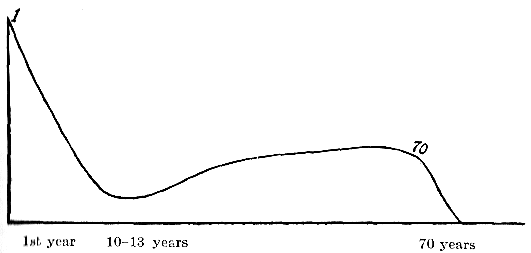
Fig. 24.—Curve of general mortality (Lexis).
Let us examine the curve up to this point, since it has a bearing
upon our school work. We can prove that the maximum mortality
corresponds to the maximum individual growth; in other words,
an organism in rapid evolution is exposed to death, its powers of
immunity to infective diseases are weakened; it constitutes what
in medical parlance is known as a locus minoris resistentiæ.
In that period of calm in growth, which would seem to be a
repose preceding the evolution of puberty, mortality is at the
lowest; only to rise again rapidly during the period of puberty;
while the rise becomes less rapid after the eighteenth year, notwithstanding
that after that age mankind in general are exposed,
in their struggle for existence, to many causes of death that did
not exist during the preceding years. Toward the age of seventy
the line of mortality attains another apex, because the age of
normal death is reached; after which it drops precipitously because
of the lack of survivors.
From these facts we may deduce certain very important principles
that throw useful light upon pedagogy: there are certain
ages at which even the strong are weak; and their weakness is of such
a nature that it exposes the individual to death.
Now, whenever the phenomenon of mortality occurs it is always
an indication of impoverishment in the survivors. For example, of
every one person that dies, many persons have been ill who have
recovered from their illness; but there are still many others who,
although they did not actually fall ill, were weakened even though
they passed through the peril unharmed.
In short, for each death, which represents a final disaster, there
are many victims. And whenever there is a rise in the phenomenon
of mortality in connection with any one age, it is our duty to give
special attention to those individuals who are not only weak in
themselves, but whom the social causes affecting them tend to
weaken still more and push onward toward illness and death.
Whenever there are many deaths, there are undoubtedly also
many sufferers.
Now, in pedagogy we have no criterion to guide us in this
matter of respecting the weaknesses characteristic of the various ages,
as, for example, that of early infancy and of the age of puberty.
With the most cruel blindness we punish and discourage the
lad who, having reached the age of puberty, no longer makes the
progress in his studies that rendered him the brilliant champion
during the period of physiological repose in his growth; and instead
of regarding this as a psychic indication of a great physiological
transformation that it is necessary to protect, we urge on the
organism to enforced effort, without even suspecting that, in proportion
to the degree of resistance of our pupil, we may be doing
our share to induce in him a permanent weakness, or an arrest of
development, or disease and death.
Our responsibility as educators is great, because we have the
threads of life entrusted to our care; man represents a continuous
transition through successive forms, and each following period has
been prepared for by the one preceding.
Whenever we have the misfortune to concur in weakening a
child, we touch that parabolic line traced in the graphic chart of
stature, and standing as an index of the life of the body, and we
give it a shock throughout its whole length; it may either be shattered
or be brought down to a lower grade.
But the life of an individual does not contain merely that
individual alone; the cycle of the stature with its violent period of
puberty and the perfect physiological repose corresponding to the
years from 25 to 36, or even 45, indicates the eternity of the individual
in the species: his maturity for reproduction. Man in his
progress through the different levels of height, as indicated on the
graphic chart of stature, does not pass through them without reproducing
himself, save in exceptional cases; he commences the
ascent alone, but in his descent he attains the majesty of a creator
who leaves behind him the immortal works of his own creation.
Well, even the capacity of normal reproduction, and of begetting
a strong species, is related to the normal cycle of life: whoever
weakens a child and puts a strain upon the threads of its existence,
starts a vibration that will be felt throughout posterity.
The parabolic cycle of stature shows us which is the most
favourable period for the reproduction of the species; it is undoubtedly
that period that stands at the highest apex of the curve, and
at which the organism has reached an almost absolute peace, as if
forgetful of itself, in order to provide for its eternity. When it
has completed its period of evolution, during which the organism
shows that it has not yet matured; and before the commencement
of involution, in which period the organism is slowly preparing for
departure—that is the moment when man may or rather ought to
procreate his species.
Careful forethought not to produce immature or feeble fruit,
will form part of the coming man's regard for his posterity. A
new moral era is maturing, that is giving birth to a solidarity,
not only between all living beings, but including also those future
beings who are as yet unborn; but for whose existence the living
man of to-day is preparing through his care of his own strength and
his own virtue. To have intentionally begotten a son better than
himself will be a proud victory for the man who has attained the
higher sexual morality; and such pride will be no less keen than
that of the artist, who by perfecting his marvelous talents has
created a masterpiece.
The statistics collected by Quétélet demonstrate that "too precocious
marriages either occasion sterility or produce children that
have a smaller probability of living."
They prove furthermore that the number of children who die
is largest in marriages contracted at the age of sixteen or earlier,
and becomes lowest among the children born of marriages contracted
between the years of 29 and 32. During these years
also the parents are most fertile: as is shown by the following
tables:
SANDLER'S FIGURES BASED ON THE FAMILIES OF ENGLISH PEERS
| Age of parents at marriage |
Percentage of deaths of children before attaining marriageable age |
Average births to each marriage |
Percentage of births to each death |
| 15 years |
35 |
4.40 |
0.283 |
| 16-19 years |
20 |
4.63 |
0.208 |
| 20-23 years |
19 |
5.21 |
0.188 |
| 24-27 years |
12 |
5.43 |
1.171 |
| Age at the time of child's birth |
Percentage of deaths to each birth |
Average number of births in one year of marriage |
| 16 years |
0.44 |
0.46 |
| 17-20 years |
0.43 |
0.50 |
| 21-24 years |
0.42 |
0.52 |
| 25-28 years |
0.41 |
0.55 |
| 29-32 years |
0.40 |
0.59 |
The results of a recent research show that famous men have
hardly ever been the first-born, and that the great majority were
begotten of parents who were at the time between the ages of 25
and 36 years.
Variations of Stature with Age, According to the Sexes.—The
general laws of the growth and involution of stature are pretty
nearly the same for the two sexes. The female stature, beginning
at birth, averages throughout life somewhat less than the male.
But since the development of puberty takes place earlier in
woman than in man, the female child manifests the characteristic
increase in stature at an earlier age than the male; consequently
at that age (about eleven) she overtakes him, and for the time
being both boy and girl are equal in stature. But as soon as the
boy enters upon the period of puberty, he rapidly surpasses the
girl, and his stature henceforth steadily maintains a superiority of
about ten centimetres (nearly four inches), as is shown by the
deviations between the two parabolic curves, representing the
variations of stature in the two sexes. Even the involution of
stature occurs precociously in women, as compared with man.
Variations due to Mechanical Causes. Transitory and Permanent
Variations. Deformations.—The individual stature is not a fixed
quantity at all hours of the day; but it varies by several millimetres
under the influence of mechanical causes connected with the habits
of daily life. In the morning we are slightly taller than at night
(by a fraction of a centimetre): in consequence of remaining on
foot a good deal of the time during the day, our stature is gradually
lowered. This is contrary to the popular belief that "while we
stand up our stature grows."
As a matter of fact, in the erect position the soft tissues that
form part of the total stature are under constant pressure; but
being elastic, they resume their previous proportions after prolonged
rest in a horizontal position.
Consequently at night, especially if we have taken a long walk,
or danced, we are shorter than in the morning after a long sleep;
the act of stretching the limbs in the morning completes the work
of restoring the articular cartilages to their proper limits of elasticity.
Nevertheless, according to the mechanical theory accepted
by Manouvrier, persons who are habituated from childhood to
stand on foot much of the time (labourers) interfere with the free
growth of the long bones in the direction of length and at the same
time augment the growth in thickness; hence the skeleton is
rendered definitely shorter in its segments as well as in its bones
(i.e., a shallower pelvis, shorter limbs, etc.). The result is a stocky
type with robust muscles: the europlastic type, which is found
among labourers. On the contrary, a person who spends much time
reclining on sofas among cushions, and taking abundant nutriment,
is likely to tend toward the opposite extreme; bones long and slender,
the skeleton tall in all its segments, the muscular system
delicate; this is the macroplastic or aristocratic type. According
to Manouvrier, when a person has a long, slow convalescence after
a protracted infectious malady such as typhoid, recumbent much
of the time and subjected to a highly nutritive diet, it may happen,
especially if he has reached the period of puberty at which a rapid
osteogenesis naturally takes place in the cartilages of the long
bones, that he will not only become notably taller, but will even
acquire the macroplastic type.
The macroplastic type is artistically more beautiful, but the
europlastic type is physiologically more useful.
It is not only the erect position that tends to reduce the stature,
but the sitting posture as well. In fact, whether the pelvis is supported
by the lower limbs or by a chair, the intervertebral disks
are in either case compressed by the weight of the bust as a whole.
If, for example, children are obliged, during the period of growth,
to remain long at a time in a sitting posture, the limbs may freely
lengthen, while the bust is impeded in its free growth, and the
result may be an artificial tendency toward macroscelia. This is
why children are more inclined than adults to throw themselves
upon the ground, to lie down, to cut capers, in other words to
restore the elasticity of their joints, and overcome the compression
of bones and cartilages. Accordingly, such variations of stature
recur habitually and are transitory, and since they are associated
with the customary attitudes of daily life, they are physiological.
But if special causes should aggravate such physiological conditions,
and should recur so often as not to permit the cartilages to
return completely to their original condition, in such a case permanent
variations of stature might result, and even morphological
deviations of the skeleton. For example, a porter who habitually
carries heavy weights on his head, may definitely lower his stature;
and in the case of a young boy, the interference with the growth of
the long bones through compression exerted from above downward,
may produce an actual arrest of development of the limbs
and spinal column, presenting all the symptoms of rickets. Witness
certain consequences of "child-labour" chief among which must
be mentioned the deformities of the carusi [victims of child-labour,
who from an early age toil up the succession of ladders, bearing
heavy burdens of sulphur from the mines below.[18]] in the Sicilian
sulphur mines.[19] As a general rule, all cramped positions that
are a necessary condition of labour, if they surpass the limits of resistance
and elasticity of the human frame, and especially if they operate
during periods of life when the skeleton is in process of formation,
result in deformities, and when the skeleton is deformed, the
internal organs and hence the general functional powers of the
whole organism, suffer even greater alteration.
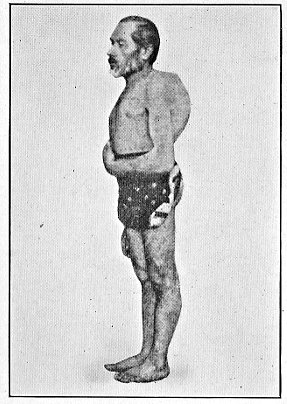
Fig. 25.—Vincenzo Militella of Lereata, a
Sicilian caruso.
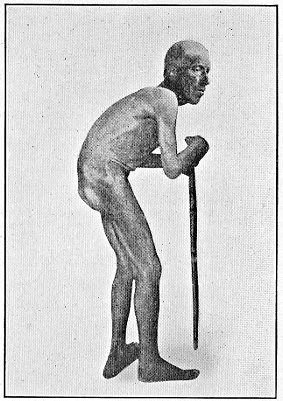
Fig. 26.—Aged field labourer.
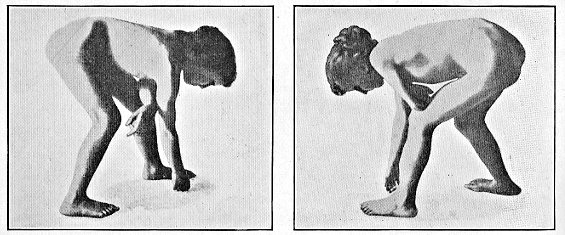
Fig. 27. Fig. 28.
Attitude of woman working in the rice fields as seen from the right and left sides.
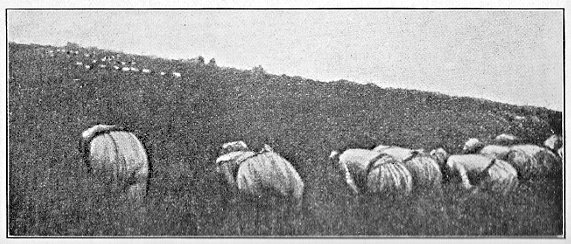
Fig. 29.—A gang of eight workers in the rice fields.
Consider the postures that miners must endure, or as Pieraccini
phrases it, their "disastrous attitudes."
The transport galleries are ordinarily too low to permit a man
of average height to walk erect; along these galleries little transport-wagons
are run by hand, excepting where the carrying is
done on the backs of the men themselves.
"Even in the front of the advance tunnels and in the galleries
that are being worked, miners are to be seen in the most incongruous
attitudes. These anomalous positions of the body maintained
throughout long hours of toil react upon the functional action
of the heart and lungs, upon the stomach and intestines in
the proper performance of their tasks, and result in producing
hernia, varicose veins and eventually deformities of the skeleton
(vertebral column, thorax)."[20]
Field labourers also (Fig. 26) become permanently deformed,
with diminution of stature, from remaining too long bent over in
the act of hoeing or reaping. But a still more painful labour is that
of the women in the rice fields during the period when the weeding
is done.
The position necessitated by this work requires a strained and
prolonged dorsal flexion of the vertebral column, accompanied by
a strain on the lower dorsal nerves; great elasticity is required to
endure a position so painful and so apt to induce lumbago; only
young women can endure it, and even they become deformed, and
suffer seriously from anemia, intestinal maladies and diseases of
the uterus, which predispose them to abortion or sterility (Figs.
27, 28, 29).
Stone breakers also contract painful diseases and deformities
from their work. They are constantly bowed over their task,
performing a rhythmic, alternating movement of flexion, extension
and torsion of the trunk upon itself, while at the same
time there is a slight undulation in a backward and forward direction,
accompanying the rising and falling of the arm holding the
hammer. These movements of extension and flexion of the trunk
involve the whole vertebral column, while the pelvis remains practically
motionless. "At the end of the day they rise from their
task bowed over and they walk home bowed over, holding the vertebral
column rigid; any attempt to force the trunk into an erect
position is extremely painful. In the morning they return to
their work with their loins still aching." And among these stone
breakers there are young men, some of them mere boys! And when
we think that these injurious attitudes are coupled with malnutrition,
we must realise the extent of the organic disaster that accompanies
diminution of stature as a result of adaptation to labour.
We are naturally horrified at such conditions enforced upon a
certain portion of humanity; and we pray for a time to come when
machinery will have universally replaced human labour, in transportation,
in stone-breaking, and in reaping, and when children
will be spared from hard and deforming toil.
But how is it that while we are so sympathetic regarding conditions
at a distance from us, we remain unconscious of similar
conditions, that are close beside us, and of which we are the directors,
the cruel enforcers, the masters?
In the near future, I hope that people will tell with amazement,
as if citing a condition of inferior civilisation, how the
school children, up to the opening of the twentieth century represented
one category of those "deformed by prolonged and enforced
labour in injurious positions!"
Such studies in school hygiene as deal with the type of school
benches, designed to minimise the danger of deformities of the
vertebral column in children—will, I hope, be regarded by the
coming generations with the most utter amazement! And the
school benches of to-day will find their place in museums, and
people will go to look at them as if they were relics of bygone
barbarism, just as we now visit the collections from old-time
insane asylums, of series of complicated instruments of wood and
iron that in bygone centuries were considered necessary for maintaining
discipline among the insane.
What in the world would we say, if somebody should propose,
in order to obviate the deformities and physiological injuries of
labourers, that certain mechanisms should be applied to them individually
for the purpose of diminishing the harm? Imagine a
law being proposed, to the effect that all miners should be obliged
to wear trusses, to keep their viscera from breaking loose, as a
result of prolonged compression! What would we think of such
reforms and such a path toward an orthopedic state of society?
Our way toward progress and higher civilisation is a very
different one. To remove man from torturing toil that twists
the bones and undermines the health—such is the goal that it is
our duty to set before us!
For the deformed vertebral column is the extreme sign of a
great accumulation of evils; the internal organs are correspondingly
affected with disorders fatal to the entire organism; but
even greater is the corresponding harm done to the human soul!
What we want is not only that the bones shall not be thrown out
of their eurhythmic harmony, but that the souls of the labourers
shall be freed from the inhuman yoke of slavery (progress can consist
solely in a radical alteration of the form of labour).
So far as concerns the school, which is not limited to a few
categories of human beings, but is extended to all, by requirements
of law, is it not possible for us to adopt a different attitude of mind?
The established fact that the pupils may even deform their
skeletons in the course of their work, goes to prove that this work
contains some error in principle that is fatal to successive generations;
and so long as this principle is maintained, we may assert
a priori that even if, with the help of school benches as complicated
and as costly as orthopedic machines, we should succeed
in checking the deformation of the vertebral column, we should
fail to check the deformation of the soul. Because whoever is
condemned to labour that deforms is a slave.
And as a matter of fact we employ coercive means, "rewards
and punishments," to enforce upon children a condition that in
their eyes amounts to serving their first sentence.
It is not the school bench, but the method that needs reforming;
it is not the ligaments of the spinal column, but human life in
evolution that we ought to respect, and lead toward the attainment
of perfection! Amid the many banners of liberty that have been
raised in these latter times, one is still missing—one which we
ought to seize upon as the standard of our cause: the liberty of
the new generation, which is groaning in the slavery of compulsory
education, upon iron-bound benches, emblematic of chains!
I foresee, in a radical reform of pedagogic methods, the practical
possibility of taking as guiding principles the individual liberty
of the pupil and a reverential regard for life. And I affirm this all
the more loudly, because I have applied such a method with indisputable
success in the "Children's Houses," obtaining prodigious
results in the health and happiness of the children, perfect discipline
in the classes, marvelously rapid progress in studies, and
a surprising awakening of souls, a passionate love for the work.
Physiology and Social Conditions.—Nutrition.—One of the
effects of environment, of the highest importance in its relation
to the development of stature, is nutrition. In order to attain
the maximum development as biologically determined by heredity
in a race, sufficient nutriment is the first necessity. It is
a familiar fact that material or physiological life consists essentially
in the exchange and renewal of matter, or in metabolism,
which is also a renewal of vital force.
The living molecules are continually breaking up, thus expressing
in an active form forces that had accumulated in a potential
form, and eliminating the rejected matter; only to form again by
means of new matter, containing potential forces. This breaking
up and renewal constitutes the material of life, that never
pauses in its molecular movement; the cessation of renewal of
matter is death, that is, scission without reparation; consumption
without renewal; and consequently a rapid disintegration of the
body. Living matter consists in metabolism, and is consequently
directly related to the nutritive substances which renew the elements
necessary for continual redintegration.
We may disregard certain individual potentialities, of a purely
biological nature, and that are capable of manifesting vital forces
of varying degrees of intensity: but it may be asserted as beyond
question that every living being, if he is to live according to his
biological destiny, has need of sufficient nutrition. This is not
the same as saving that the food determines the life of an individual
in its final development, in the sense that by eating in excess one
may attain the stature of a giant, or an imbecile become intelligent
or a man of talent become a genius. We all bear within us, in
that fertilised germ that constituted the first cell of our organism,
predetermined biological conditions, on which depend the physical
limits of our body, as well as those of our psychic individuality.
But in order that this germ may develop in accordance
with its potentiality, it is necessary that it shall obtain the requisite
material from its environment. Because otherwise—and here
the relation is direct—neither the volumetric development nor
the morphological development can be accomplished, nor the
psychic potentiality express itself; in other words, the stature
will be undersized, in a body defrauded of the degree of beauty
potential in the germ, and the muscular forces, in common with
those of the brain, will remain at a level of development below
that which nature had intended. Consequently, to deprive
children of their requisite nutriment is stealing from life, it is a
biological crime.
While we live, we must eat; and while we labour, that is, while
we expend the vital forces, it is necessary to repair them. The
schools should establish a system of luncheons for the pupils;
this is a principle that has already been generally recognised and
is already bearing fruit.
There was a time when a good appetite was regarded as a low
material instinct; it was also the time when people sang the praises
of spirituality, but actually indulged in banquets of Lucullian
lavishness. The vice of the palate and the physiological need of
nourishment were included under one and the same disdain.
To-day science has shed its light upon the true conception of
nutrition and holds it to be the first necessity of life, and consequently
the first social problem to be solved.
From this point of view, food is not a vulgar material thing,
nor the dinner-table a place of debauchery. Indeed, there is
nothing which affords better proof of immateriality than the act
of eating. In fact, the necessity of eating is itself a proof that
the matter of which our body is composed does not endure but
passes like the fleeting moment. And if the substance of our
bodies passes in this manner, if life itself is only a continual passing
away of matter, what greater symbol of its immateriality and its
spirituality is there than the dinner-table?
"... the bread is my flesh and the wine is my blood; do
this in remembrance of what life really is."
Something similar to this is being accomplished to-day by science
in regard to the sexual relations. We are accustomed to consider
the sexual instincts as something contemptible, material and low,
praising abstinence, and leaving these instincts wholly out of consideration
in the course of education, as though they were something
degrading, or even shameful. And undoubtedly our sexual
abuses are shameful, and shameful also is the barbaric tolerance of
the masses regarding prostitution, seduction, illegitimacy and the
abandonment of new-born children. It is criminal abuse that
makes us despise sexual relations, just as at one time excesses of
the table made us despise nutrition. But the day will come when
science will raise to the dignity of a new sexual morality the
physiological function which to-day is considered material and
shameful—and that comprehends the most sublime of human
conceptions. In it are to be found the words which ancient races
deposited in their religious tabernacles: creation, eternity, mystery.
And in it are also to be found the most sublime conceptions of
modern races: the destiny of humanity, the perfectionment of the
human species.
Accordingly, we must to-day regard the serving of food in the
schools as a necessity of the first order; but it is well, in introducing
it into the schools, to surround it with that halo of gladness and
of high moral significance that ought to accompany all manifestations
of life. The hymn to bread, which is a human creation and
a means of preserving the substance of the human body, ought to
accompany the meals of our new generations of children. The
child develops because the substance of his body passes away, and
the meals that he eats symbolise all this: furthermore, they teach
him to think of the vast labour accomplished by men who, unknown
as individuals, cultivate the earth, reap the grain, grind the
flour, and provide for all men and for all children. Where they
are and who they are, we do not know; the bread bears neither
their name nor their picture. Like an impersonal entity, like a
god, humanity provides for all the needs of humanity: and this
god is labour. If the child is destined some day to become himself
a labourer, who produces and casts his products to humanity
without knowing who is to receive his contribution toward providing
for humanity, it is well that as he lifts his food to his lips
he should realise that he is contracting a debt toward society at
large, and that he must give because he takes; he must "forgive
debts as his have been forgiven"; and since life is gladness, let
him send forth a salutation to the universal producing power:
"Our Father, give us our daily bread!"
The Providence of human labour rules over our entire life; it
gives us everything that is necessary. The God of the Universe,
in whose train come cataclysms, is not more terrible than the god,
Humanity, that can give us War and Famine. While we give
bread to the child, let us remember that man does not live by bread
alone: because bread is only the material of his fleeting substance.
The system of furnishing meals in school constitutes a chapter
of School Hygiene that cannot directly concern us. Nevertheless,
there are three rules of this hygiene which should be borne in
mind: Children should never, in any case, drink wine, alcoholic
liquors, tea or coffee—in other words, stimulants, which are
poisons to their childish organisms. On the other hand, children
need sugar, because sugar has a great formative and plastic power;
all young animals have sweetish flesh because their muscles, in
the course of development, are extremely rich in sugar. The
method of giving sugar to children should be as simple as possible,
such, for instance, as is endorsed by the very successful English
system of hygiene for children, which recommends freshly cooked
fruits, sprinkled with sugar or served with a little syrup. But the
substantial nourishment for young children should consist of soup
or broth served hot, since heat is as essential as sugar for organisms
in the course of evolution.
The English recommend soups made of cereals and gluten, in
which it is never necessary to use soup stock, just as it is never
necessary to use meat in children's diet.
That nutrition has a noteworthy influence upon growth, and
therefore upon the definitive limits of stature, is exhaustively
proved by statistics.
In his brilliant studies of the poorer classes, Niceforo has collected
the following average statures:[21]
| Age |
Stature (in centimetres) |
| Children |
| Rich |
Poor |
| 7 years |
120 |
116 |
| 8 years |
126 |
122 |
| 9 years |
129 |
123 |
| 10 years |
134 |
128 |
| 11 years |
135 |
134 |
| 12 years |
140 |
138 |
| 13 years |
144 |
140 |
| 14 years |
150 |
146 |
from which it appears that, in spite of the strong biological impulse
given by the attainment of puberty, the children of the poor
continue to show a stature lower than that of the well-to-do.
Alĕs Hrdlĭcka has compiled the following comparative table of
the poor or orphaned children received into the asylums, and the
pupils of the public schools in Boston:
| Stature of American children |
| Boys |
| Age in years |
5 |
6 |
7 |
8 |
9 |
10 |
11 |
12 |
13 |
14 |
15 |
16 |
| In asylums |
971 |
1088 |
1172 |
1163 |
1234 |
1261 |
1315 |
1367 |
1424 |
1452 |
1518 |
— |
| in Boston public schools |
1060 |
1120 |
1176 |
1223 |
1272 |
1326 |
1372 |
1417 |
1477 |
1551 |
1599 |
1665 |
| Girls |
| In asylums |
— |
— |
1101 |
1158 |
1204 |
1289 |
1290 |
— |
— |
1398 |
— |
— |
| in Boston public schools |
1052 |
1109 |
1167 |
1221 |
1260 |
1315 |
1366 |
1452 |
1492 |
1532 |
1559 |
1567 |
Even after reaching the adult age these differences are maintained,
as may be shown by the following statistics taken from
various authorities:
| Average statures obtained from soldiers (in centimetres) |
| Italians |
English |
French |
| Students and professional men |
167 |
Professional men |
175 |
Students |
169 |
| Tradesmen |
165 |
Merchants |
172 |
Domestics |
166 |
| Peasants |
164 |
Peasants |
171 |
Day labourers |
165 |
|
|
City employees |
169 |
|
|
from which it appears that while in Italy the class of labourers
having the lowest stature is the peasant class, which lives under
the most deplorable economic conditions, in England on the
contrary it is the workers in the cities who live under worse economic
conditions than the peasantry, it being well known that the
English peasant is the most prosperous in the agricultural world.
According to Livi, it is nutrition which causes the differences
of average stature that are usually to be found between different
social classes, and those between the inhabitants of mountains
and of plains, or between the dwellers on the mainland and on the
islands. In general the mountain-bred peasants have a lower
stature than those of the plains; and this is because the means of
procuring food are fewer and harder in mountainous regions.
Similarly, the islanders, because of less ready means of communication,
have less likelihood than those on the mainland of
obtaining adequate nutrition.
The same may be said regarding the differences found between
the statures of cultured persons and of the illiterate, to the disadvantage
of the latter (the poorer classes).
Students show the tallest stature of all, because they have in
their favour the joint effect of the two chief factors of environment
that influence this anthropological datum: mechanical causes and
nutrition. A sedentary life, and above all a hearty diet both
contribute to the tall stature of students, doctors, and members
of the liberal professions. In this respect, the average figures of
all the authorities agree, as appears from the following tables:[22]
LIVI: 256,166 ITALIAN SOLDIERS
| Professions and callings |
Average stature in centimetres |
| Students and professional men |
166.9 |
| Small shopkeepers and the like |
165.0 |
| Peasants |
164.3 |
| Blacksmiths |
165.0 |
| Carpenters |
165.1 |
| Masons |
164.8 |
| Tailors and shoemakers |
164.5 |
| Barbers |
164.3 |
| Butchers |
165.7 |
| Carters |
164.4 |
| Bakers |
164.7 |
| Day labourers in general |
164.4 |
ROBERT AND RAWSON: 1935 ADULT ENGLISHMEN
| Professions and employments |
Average stature in centimetres |
| Professional men |
175.6 |
| Merchants and tradesmen |
172.6 |
| Peasants and miners |
171.5 |
| City labourers |
169.2 |
| Sedentary workmen |
167.4 |
| Prisoners |
168.0 |
| Insane |
166.8 |
OLORIZ: 1798 CONSCRIPTS FROM THE CITY OF MADRID
| Professions and employments |
Average stature in centimetres |
| Liberal professions |
163.9 |
| Including: |
| Students |
164.0 |
| Other professions |
161.1 |
| Workmen employed in the open air |
160.7 |
| Workmen employed in closed rooms |
159.8 |
| Including: |
| Tailors, hatters and the like |
159.0 |
| Shoemakers |
158.9 |
Conditions of nutrition, which are always accompanied by a
combination of other hygienic conditions all tending toward the
same effects, have also an influence upon the development of
puberty.
Puberty is retarded by malnutrition. As a result of an inquiry
made among the inmates of the Pia Barolo Society, which offers an
asylum to reformed prostitutes, Marro[23] records that out of ninety
rescued girls only those above the age of fourteen had begun to
menstruate: notwithstanding that the normal period for the development
of puberty in Italian women is between the years of
twelve and thirteen. Furthermore, among the girls above the
age of fourteen, menstruation had not yet begun in all cases; on
the contrary, a large proportion of them still failed to show the
phenomena of puberty:
| Age in years |
Whole number |
Number menstruating |
| 14-15 |
11 |
4 |
| 15-16 |
11 |
7 |
| 16-17 |
11 |
8 |
| 17-18 |
8 |
7 |
All the rest (thirty in number) menstruated for the first time
after the age of eighteen.
Among those in whom menstruation had appeared earlier,
the order of appearance was as follows:
| Years |
10 |
11 |
12 |
13 |
14 |
15 |
16 |
17 |
| Number |
1 |
3 |
4 |
5 |
12 |
17 |
9 |
5 |
When we consider that we are dealing with rescued girls, we may
conclude that direct sexual stimulus does not facilitate the normal
development of puberty, but on the contrary, in conjunction with
other causes, retards it. Accordingly, we must not confound
the normal development of the organism with its disorders: whatever
aids the natural development of life is useful and healthy. There
may be conditions unfavourable to the development of puberty,
which are favourable to the development of sexual vices (see,
further on, the other causes influencing puberty, and moral conditions
in colleges).
In his work above cited, Marro compares his figures obtained
from the Pia Barolo Society with those of Dr. Bianco[24] taken from
78 young girls in city institutes representing young women in
easy circumstances:
| Date of first menstruation. |
Girls in the Pia Barolo Society.
Percentage |
Girls in city institutes for the wealthy classes.
Percentage |
| 10 years |
1.7 |
—— |
| 11 years |
5.3 |
1.3 |
| 12 years |
7.1 |
13.3 |
| 13 years |
8.9 |
18.7 |
| 14 years |
21.4 |
29.3 |
| 15 years |
30.3 |
20.0 |
| 16 years |
16.0 |
8.0 |
| 17 years |
8.9 |
4.0 |
It should be noted that the cold climate of Turin retards
puberty (see below): but the above table clearly shows the precocious
puberty of young women in easy circumstances; in the great
majority, in fact, it occurs between the ages of twelve and fourteen,
with thirteen for the average; on the other hand, the majority for
reformed prostitutes is between fourteen and sixteen, with fifteen
for the average.
Besides labour and nutrition, there are other factors that contribute
to the development of stature (which we regard as an
index to the entire mass of the body). Such factors are:
Thermic Conditions.—Among the physical conditions which
may have an influence upon the stature, the thermic conditions
ought to receive first consideration.
It is a principle demonstrated by nature that organisms in
the course of evolution have need of heat. Even the invertebrates,
as for example the insects, develop during the heat of summer; and
the eggs of the higher vertebrates such as the birds, develop their
embryo by means of the maternal warmth. In placental animals
the development throughout the whole embryonic period takes
place within the maternal womb, in the full tide of animal heat.
In order to preserve life in premature babies, that is, in those
born before the expiration of the physiological term of nine months,
incubators have been constructed, an oven-like arrangement in
which the child may be maintained at a temperature considerably
higher than would be possible in the outside air; the term is also
specifically used of the structures in which fertilised hens' eggs are
kept during the required period of time until the chickens are
hatched.
Accordingly it is a principle taught us by nature that organisms
in the course of evolution have need of heat. The most luxuriant
vegetation, the most gigantic animals, the most variegated birds
belong to the fauna and flora of the tropics.
How is this physiological law, which nature expresses in such
broad, general lines, to be interpreted by us in the environment of
the school? It is well known that in this regard there are two
conflicting opinions. There are some who would go to excessive
lengths in protecting small children from the cold, by dressing
them entirely in woolen garments and keeping their apartments
well heated; others on the contrary assert that the physiological
struggle of adaptation to the cold invigorates the infant organism,
and they advise that the child's body should never be completely
protected, as for example that the legs should always be left bare,
that the child should be lightly clad, that his apartments should
not be heated, etc.
Furthermore, it used to be held in the pietistic schools, and still
is to some extent, that warmth had a demoralising influence, inasmuch
as it tended to enervate both mind and body.
We educators cannot fail to be interested in such a discussion.
As often happens in physiological arguments, the two opposite
contentions each contain a part of the truth. In order to get at
the truth of the matter, it is necessary to distinguish two widely
separated facts: on the one hand, physiological exercise in the form
of thermal gymnastics, and on the other, the development of organisms
in a constantly cold environment.
To live constantly warm, protected either by clothes or by artificial
heat, so that the organism remains always at a constant
temperature, is not favourable to growth, because it deprives the
organism of the physiological exercise of adapting itself to variations
in external temperature, an exercise which stimulates useful
functions. By perspiring in summer, we cleanse our system of
poisonous secretions, and by shivering in winter we give tone to our
striped muscles and to our internal organs, as is proved by our gain
in appetite. Anyone who wishes to be kept on ice in summer and
to transform his apartment into a hot-house in winter, robs himself
of these advantages and enfeebles his system.
The apparent comfort is not in this case a real physiological
enjoyment but a weakness of habit that is accompanied by a loss
of physiological energy. What makes us robust is a rational
exercise of all our energies. Thermal gymnastics is consequently
useful. It consists in exposing a healthy, resistant organism to
changes in temperature, trusting to our physiological resources
for the means of defense. Thus, for example, a child who is well
fed and well protected from the cold for many hours of the day in
the well-heated family apartment, can go out with bare legs into
the snow; and doing so will make him more robust. In the same
way, the ancient Romans exposed themselves in their hot baths
to the steadily increasing temperature of the calidarium, up to
the point of 60 degrees (140 Fahrenheit), and then still perspiring
flung themselves into a cold plunge. And it is a familiar fact that
afterward they held lavish banquets in these same baths. Such
exercise which in classic times gave vigour to the race that made
itself master of the world may be summed up as follows: "Thermic
gymnastics" of organisms "well nourished and strong."
Our own boatmen also throw themselves into the river in midwinter,
half nude, and half nude they ply their long poles. They
expose themselves to the cold, in the same way that they might
raise a weight of many pounds with their robust arms, for gymnastic
exercise.
But all this differs radically from living continually in a cold
temperature. It is a very different thing from the life of a child
of the lower classes, who goes bare-foot in winter, clad in a few
scant rags, half frozen in his wretched tenement, and unable to
obtain sufficient nourishment to develop the needed heat-units.
He is already deficient in bodily heat because of malnutrition, and
the effects of cold are cumulative. In this case it is not a question
of thermic exercise but of a permanent deprivation of heat, in individuals
who are already suffering from an insufficient development
of heat-units. Consequently the organism is enfeebled—it grows
under unfavorable conditions—and the result is a permanent
diminution of development. Whoever grows up, exposed to cold
after this fashion, has, in the average case, a lower stature than
those who grow up in the midst of warmth, or in the practice of
that healthful exercise which constitutes the ideal: thermic
gymnastics.
The contradictory ideas that are held as to the efficacy of heat
in regard to growth, are due to a large extent to a prejudice which
amounts to this: heat is effective in promoting the evolution of
life as a whole, and consequently the development of that part
of life that is centred in the organs of reproduction; from which
comes the wellnigh antiquated theory that artificial heat should
be banished from the schools, as one of the factors leading to
immorality! It is true that warmth accelerates the development
of puberty; but who is there in this twentieth century who can
still conceive the idea that it is a moral act to silence the forces of
nature? Good nourishment also leads to a more precocious
puberty; and the same is true of the repeated psychic stimulus
produced by various forms of intellectual enjoyment, by conversation,
and by social intercourse with individuals of the opposite
sex. Accordingly, if it were a moral act to retard the development
of puberty and to produce a general impoverishment of sexual
life, the moral measures to be taken in education would be cold,
malnutrition, and the isolation of the sexes in the schools, which, as
a matter of fact, form the stumbling-block of environment in our
colleges. But it is well known that all this leads on the contrary
to moral and physical degeneration! As has already been said,
the normal physiological development stands in counterdistinction
to immoral habits; consequently, whatever is an aid to
physiological development is in its very nature moral.
In warm climates the first manifestations of puberty occur
precociously in man as well as in woman; and with them come all
the transformations that are associated with puberty, among
others the rapid increase of stature. In cold climates, on the
contrary, such manifestations are more tardy. The women of
Lapland are latest of all to develop. With them, menstruation
begins only at eighteen, and they are incapable of conceiving
under the age of twenty, while the period of the menopause (involution
of sexual life) is correspondingly early; in other words,
the entire period of sexual life is shortened. Furthermore, the
fertility of the women of Lapland is low; they cannot conceive
more than three children. But if these same women leave Lapland
and make their home in civilised countries, as for example
in Sweden, they have a more precocious sexual life, as well as
longer and more fertile, and altogether quite similar to that of the
Swedish women.[25]
Cabanis[26] notes that even in cold climates, when young girls
spend much of their time in the vicinity of stoves, menstruation
begins at about the same age as in women who live on the banks
of the Ganges—as is the case with the daughters of wealthy
Russians, whose development is quite precocious. In Arabia,
in Egypt, and in Abyssinia the women are frequently mothers at
the age of ten, menstruation having begun at the eighth year.
It is even said that Mahomed married Radeejah when she was only
five and that he took her to his bed at the age of eight. The
religious laws of India permit the marriage of girls when they are
eight years old.
Consequently it is true that heat has an influence upon the
development of the organism independently of other influences;
in fact, heat acts both in the form of climate, that is, in a natural
state, and also in an artificially warmed environment. It is also
one of the causes of the different degrees of growth in stature
through the successive seasons (see below).
In conclusion: it is enjoined upon us, as a hygienic necessity,
to heat the schools in winter, especially the schools for the poorer
classes; it means more than increased vigour, it may even mean
giving life to some who otherwise would pine away from deprivation
of heat-units, a condition most unfavourable to organisms in
the course of evolution.
Photogenic Conditions.—Light also has a perceptible influence
upon growth: it is a great physiological stimulant. At the present
day, physical therapy employs light baths for certain forms of
neurasthenia and partial enfeeblement of certain organs; and some
biological manifestations, such as the pigments—and similarly
the chlorophyl in plants and the variegated colouring of birds—receive
a creative stimulus from light.
Light contains in its spectrum many different colours, which
act quite differently upon living tissues; the ultra-violet rays, for
instance, kill the bacilli of tuberculosis and sometimes effect cures
in cases of cancer. Psychiatrists and neuropaths have demonstrated
that many colours of light have an exciting effect, while
others, on the contrary, are sedative.
Hence there has arisen in medicine a vast and most interesting
chapter of phototherapy.
In regard to the phenomena of growth, it has been noted that
certain coloured lights are favourable to it, while certain others,
on the contrary, diminish or arrest it, as the red and the green.
Phototherapy ought to concern us as educators, especially
in regard to schools for the benefit of nervous children: a periodic
sojourn in a room lit by calming colours might have a beneficent
effect upon epileptic, irritable, nervous children, in place of the
debilitating hot bath, or, worse yet, the administration of bromides;
while light-baths would be efficacious for weak and torpid
children.
But for normal children we must consider the light of the sun
as the best stimulant for their growth. A sojourn at the sea-shore,
so favourable to the development of children, is now believed to owe
its beneficial effects to the fact that the child, playing half naked
on the sea-shore, bathes more in the sunlight than he does in the
salt water. Gymnastics in the sun, while the body is still only
half dry, is what the younger generations should practise on a
large scale, if they would bring about the triumph of physiological
life.
We must not forget this great principle when, by planning
home work for the pupils, we practically keep them housed during
the entire day, keeping them for the most part employed in writing
or reading; in other words, using their sense of sight, which,
if it is to be preserved unharmed, demands a moderate light. The
eye ought to rest its muscles of accommodation, and the whole
body be exposed to the full light of the sun during the greater part
of the day. Let us remember that often the children of the poor
live in a home so dark that even in full mid-day they are obliged
to light a lamp! Let us at least leave them the light of the
street, as a recompense for wretchedness that is a disgrace to
civilisation!
According to certain experiments conducted in Rome by
Professor Gosio, the light of the sun has an intensive effect upon
life. Living creatures reared in the solar light grow and mature
earlier, but at the same time their life is shortened; that is, the
cycle of life is more intense and more precocious; conversely, in
the shade the cycle of life is slower, but of longer duration. A
plant matures more quickly in the sun, but its stature is lower
than that of a plant in the dark, which has grown far
more slowly, but has become very tall and slender and lacking in
chlorophyl. Similarly, as is well known, the women in tropical
countries attain a precocious puberty, while conversely those of
the North attain it tardily; and this fact must be considered in
relation to the influence of the sun. A life passed wholly in the
sunlight would be too intense; an organism that is exposed a few
hours each day to the rays of the sun is invigorated; the interchange
of matter (metabolism) is augmented; all the tissues are
beneficially stimulated. For this reason sun baths are employed for
paralytic and idiot children, and consist in exposing the body of
the child, reclining upon its bed and with its head well protected,
to the direct rays of the sun for several hours a day; this treatment
is found to be most efficacious in giving tone to the tissues and
improving the general condition of the system.
Variations in the Growth of Stature According to the Seasons.—One
proof of the beneficent influence of heat and sunlight upon
the growth of the organism, is afforded by the variations in the
rate of growth according to the seasons. Every individual grows
more in summer than in winter. Daffner gives the following
figures relative to the increase in stature according to the seasons:
| Number of subjects |
Age in years |
Stature in centimetres |
Increase in centimetres |
| October |
April |
October |
Winter |
Summer |
Entire year |
| 12 |
11-12 |
139.4 |
141.0 |
143.3 |
1.6 |
2.3 |
3.9 |
| 80 |
12-13 |
143.0 |
144.5 |
147.4 |
1.5 |
2.9 |
4.4 |
| 146 |
13-14 |
147.5 |
149.5 |
152.5 |
2.0 |
3.0 |
5.0 |
| 162 |
14-15 |
152.5 |
155.0 |
158.5 |
2.5 |
3.5 |
6.0 |
| 162 |
15-16 |
158.5 |
160.8 |
163.8 |
2.3 |
3.0 |
5.3 |
| 150 |
16-17 |
163.5 |
165.4 |
167.7 |
1.9 |
2.3 |
4.2 |
| 82 |
17-18 |
167.7 |
168.9 |
170.4 |
1.2 |
1.5 |
2.7 |
| 22 |
18-19 |
169.8 |
170.6 |
171.5 |
0.8 |
0.9 |
1.7 |
| 6 |
19-20 |
170.7 |
171.1 |
171.5 |
0.4 |
0.4 |
0.8 |
In the "Children's Houses," I require a record of stature to be
made month by month in the case of every child, the measurement
being taken on the day corresponding to the day on which he was
born in the month of his birth; in addition to which I keep a
record of the total annual increase.
The ages of these children vary between three and four years,
and they all belong to the poorer social classes.
MONTHLY AVERAGE INCREASE IN STATURE
In the "Children's Houses"
(In millimetres)
| Cold months |
Warm months |
| December |
January |
February |
May |
June |
July |
| 4 |
3 |
4 |
7 |
8 |
8 |
Another factor of growth is
Electricity.—One of the most interesting discoveries of recent
date is that of the influence of terrestrial electricity upon the
growth of living organisms.
A series of experiments were made, by isolating cavies (a
species of small Indian pig) from terrestrial electricity, and
as a result they were found to be retarded in growth and to
develop very imperfectly, much as though they had been suffering
from rickets. In short, they manifested an arrest of organic
development.
If, in electro-therapy, an electric current is applied to the
cartilages of the long bones in children whose limbs have apparently
been arrested in development, the result is a rapid increase
in length, amounting to a luxuriant osteogenesis.
Since we know that the electric current can stimulate the
nerve filaments and the fibres of the striped muscles when they
have been rendered inactive from the effects of paresis or even of
paralysis, we realise that electricity can exert an influence over the
entire physiological life of an organism. We live not only upon
nutriment, air, heat, and light, but also upon a mysterious, imperceptible
force, that comes to us from the mother earth.
In addition to the biological potentialities which control the
development of every individual, all living creatures owe something
of themselves to their environment.
Space.—An empirical contention, without scientific value,
but nevertheless of some interest, is that there is an ultimate
relationship between the dimensions of living bodies and the
territorial space, that is, the environment in which they are destined
to live. In view of the innumerable varieties of living creatures,
such an assertion would seem to be utterly unfounded. But
as a matter of fact we see that while inorganic bodies can increase
indefinitely in dimension, living creatures are limited in form and
size. This fact undoubtedly has some primal connection with
properties innate in corporeal life itself; in fact, in order to attain
its appointed end, life requires the services of certain very small
microscopic particles called cells. But the aggregations and
combinations of cells in living organisms are also limited in their
turn, and no matter how willingly we would attribute the greatest
share of causation to biological facts, nevertheless, as always
happens in life, we cannot wholly exclude environment.
Both animals and men that are bred on vast continents (Chinese,
Russians) have tended to produce races of powerful and
giant build: in islands, on the contrary, the men and the animals
are of small size; it is sufficient merely to cite the men and the
little donkeys of Sardinia, the small Irishmen who furnish jockeys
for the race-track, and the small Irish horses or ponies that serve
as saddle-horses for the children of the aristocracy the world over.
There is a harmony of associations, as between the container and
the contained, between environment and life, notwithstanding that
as yet science has not made serious investigations in regard to it.
Voltaire, in his Micromega, avails himself of this intuitive conception
to create the material needed for his satire; he talks amusingly
of the inhabitant of the planet Sirius, who was eight leagues
in height and at four hundred years of age was still in school,
while the inhabitant of Saturn was a mere pigmy in comparison,
being scarcely a thousand rods tall—in fact, the inhabitants of
Saturn could not be otherwise than pigmies in comparison, since
Saturn is barely nine hundred times larger than the earth.
Gulliver makes use of similar standards in his Travels, which
are read with so much delight by children.
Psychic Conditions.—Psychic Stimuli.—Accordingly many
chemical and physical factors associated with the environment
concur in aiding life in its development. From the light of the
sun to the electricity of the earth, the whole environment offers
its tribute to life, in order to cooperate in life's triumph. But, in
the case of man, in addition to these widely different factors, there
is still another distinctly human factor that we must take into
consideration and that we may call the psychic stimulus of life:
We may scientifically affirm the Bible statement that "man does
not live by bread alone."
Without reverting to the basic physiological explanations of
the emotions, as given by Lange and James, we may nevertheless
assert that sensations of pleasure stimulate the renewal of bodily
tissues and consequently promote health, happiness, and strength;
while, on the contrary, painful events produce physiological effects
depressing to the tone of the nervous system and to the metabolic
activity of the tissues.
But it is precisely these metabolic phenomena that hold the
key of life, and an organism in the course of evolution depends
directly upon them. This problem concerns pedagogy in a very
special way: when we have given food to the children in our schools,
we have not yet completed our task of nourishing these children;
for the phenomena of nutrition which take place in the hidden
recesses of their tissues are very different from a simple intestinal
transformation of aliments, and are influenced by the psychic
conditions of the individual pupil.
Great workers not only need abundant nutriment, but they
require at the same time a series of stimuli designed to produce
"pleasure." The pleasures of life, necessary to human existence,
include more than bread. In the history of social evolution there
exist, side by side with the productions of labour, an entire series of
enjoyments, more or less elevated, that constitute the stimului to
production, and hence to evolution, and more profoundly still, to
life itself.
The further man evolves and the more he produces, the more
he ought to multiply and perfect his means of enjoyment.
Without stimuli, nutrition would grow less and less till it ended
in death. Every-day experience in the punishment of criminals
gives us proof of this. Confinement to a solitary cell is nothing
else than a complete deprivation of psychic stimuli. The prisoner
does not lack bread, nor air, nor shelter from the elements, nor
sleep; his whole physiological life is provided for, in the strict
material sense of the word. But the bare walls, the silence, the
isolation from his fellow men in utter solitude, deprive the prisoner
of every stimulus, visual, oral and moral.
The consequences are not merely a state of hopelessness, but
a real and actual malnutrition leading to tuberculosis, to anemia,
to death from atrophy. We may affirm that such a prisoner dies
slowly of hunger due to defective assimilation; the solitary cell is the
modern donjon, and far more cruel than the one in which Ugolino
died within a few days, so much so that solitary confinement,
being incompatible with life, is only of short duration.
Labour, love, and sensations apt to stimulate ideas, that is, to
nourish the intelligence, are necessities of human life.
This is further proved by observations made regarding the
development of puberty. Psychic stimuli may render such development
precocious, and, on the contrary, their absence may
retard it. Jean Jacques Rousseau relates in Émile that at Friuli
he encountered young people of both sexes who were still undeveloped,
although they were past the usual age and were strong
and robust, and this he attributed to the fact that "owing to the
simplicity of their customs, their imagination remained calm and
tranquil for a longer time, causing the ferment in their blood to
occur later, and consequently rendering their temperament less
precocious."[27]
Recent statistical research confirms the intuitive observation
of that great pedagogist; the women in the environs of Paris
attain puberty nearly a year later than those who live in the city;
and the same difference is observed between the country districts
around Turin and those of the city itself.
All this goes to prove the fact of psychic influence upon
physiological life: psychic excitation, experienced with pleasure,
by developing healthy activities, aids the development of physical
life.[28]
These principles must be taken under deep consideration when
it comes to a question of directing the physiological growth of children.
Fenelon relates a fable about a female bear who, having
brought into the world an exceedingly ugly son, took the advice
of a crow and licked and smoothed her cub so constantly that he
finally became attractive and good-looking. This fable embodies
the idea that maternal love may modify the body of the child, aiding
its evolution toward a harmony of form by means of the first
psychic stimuli of caresses and counsel.
Nature has implanted in the mother not only her milk, the
material nourishment of her child, but also that absolutely altruistic
love which transforms the soul of a woman, and creates in
it moral forces hitherto unknown and unsuspected by the woman
herself—just as the sweet and nourishing corpuscles of the milk
were unknown to the red corpuscles of her blood. Accordingly,
the nature of the human kind protects the species through the
mother in two ways, which together form the complete nutrition
of man: aliment and love. After a child is weaned, it obtains its
aliment from its environment in more varied forms; and it also
obtains from its environment a great variety of psychic stimuli,
calculated not only to mould its psychic personality, but also to
bring its physiological personality to its full development.
I have had most eloquent experience of this in the "Children's Houses" in
the San Lorenzo quarter of Rome. This is the poorest quarter in the city, and
the children are the sons and daughters of day labourers, who consequently are
often out of work; illiteracy is even yet incredibly frequent among the adults,
so much so that in a very high percentage of cases at least one of the parents is
unable to read. In these "Children's Houses" we receive little children between
the ages of three and seven, on a time schedule that varies between summer, from
nine to five, and winter, from nine to four.
We have never served food in the school; the little ones, all of whom live in
their own homes, with their parents, have a half hour's recess in which to go home
to luncheon. Consequently we have not in any way influenced their diet.
The pedagogic methods employed, however, are of such sort as to constitute
a gradual series of psychic stimuli perfectly adapted to the needs of childhood;
the environment stimulates each pupil individually to his rightful psychic
development according to his subjective potentiality. The children are free in all
their manifestations and are treated with much cordial affection. I believe that
this is the first time that this extremely interesting pedagogic experiment has ever
been made: namely, to sow the seed in the consciousness of the child, leaving free
opportunity, in the most rigorous sense, for the spontaneous expansion of
its personality, in an environment that is calm, and warm with a sentiment of
affection and peace.
The results achieved were surprising: we were obliged to remodel our ideas
regarding child psychology, because many of the so-called instincts of childhood
did not develop at all, while in place of them unforeseen sentiments and intellectual
passions made their appearance in the primordial consciousness of these children;
true revelations of the sublime greatness of the human soul! The intellectual
activity of these little children was like a spring of water gushing from beneath
the rocks that had been erroneously piled upon their budding souls; we saw them
accomplishing the incredible feat of despising playthings, through their insatiable
thirst for knowledge; carefully preserving the most fragile objects of the lesson,
the tenderest plants sprouting from the earth—these children that are reputed
to be vandals by instinct! In short, they seemed to us to represent the childhood
of a human race more highly evolved than our own; and yet they are really the
same humanity, marvelously guided and stimulated through its own natural and
free development!
But what is still more marvelous is the astonishing fact that all these children
are so much improved in their general nutrition as to present a notably different
appearance from their former state, and from the condition in which their brothers
still remain. Many weakly ones have been organically strengthened; a great
many who were lymphatic have been cured; and in general the children have
gained flesh and become ruddy to such an extent that they look like the children
of wealthy parents living in the country. No one seeing them would believe that
these were the offspring of the illiterate lower classes!
Well, let us glance over the notes taken upon these children at the time when
they first entered the school; for the great majority, the same note was made:
need of tonics. Yet not one of them took medicine, not one of them had a change
of diet; the renewed vigour of these children was due solely to the complete satisfaction
of their psychic life. And yet they remain in school continually from nine
till five through eleven months out of the year! One would say that this was an
excessively long schedule; yet what is still more surprising is that during all this
period the children are continually busy; and even more remarkable is the report
made by many of the mothers to the effect that after their little ones have
returned home they continue to busy themselves up to the hour of going to bed;
and lastly—and this seems almost incredible—many of the little ones are back
again at school by half past eight in the morning, tranquil, smiling, as though
blissfully anticipating the enjoyment that awaits them during the long day!
We have seen small boys become profoundly observant of their environment,
finding a spontaneous delight in new sensations. Their stature, which we
measure month by month, shows how vigorous the physiological growth is in
every one of them, but particularly in certain ones, whose blood-supply has
become excellent.
Such results of our experiments have amazed us as an unexpected revelation
of nature, or, to phrase it differently, as a scientific discovery. Yet we might have
foreseen some part of all this had we stopped to think how our own physical
health depends far more upon happiness and a peaceful conscience than upon
that material substance, bread!
Let us learn to know man, sublime in his true reality! let us learn to know him
in the tenderest little child; we have shown by experiment that he develops
through work, through liberty, and through love; hitherto, in place of these, we have
stifled the splendid possibilities of his nature with irrational toys, with the slavery
of discipline, with contempt for his spontaneous manifestations. Man lives for
the purpose of learning, loving and producing, from his earliest years upward;
it is from this that even his bones get their growth and from this that his blood
draws its vitality!
Now, all such factors of physiological development are suffocated by our
antiquated pedagogic methods. We prevent, more or less completely, the development
of the separate personalities, in order to keep all the pupils within the
selfsame limits. The perfectionment of each is impeded by the common level
which it is expected that all shall attain and make their limit, while the pupils
are forced to receive from us, instead of producing of their own accord; and they
are obliged to sit motionless with their minds in bondage to an iron programme,
as their bodies are to the iron benches.
We wish to look upon them as machines, to be driven and guided by us, when
in reality they are the most sensitive and the most superb creation of nature.
We destroy divine forces by slavery. Rewards and punishments furnish us
with the needed scourge to enforce submission from these marvelously active
minds; we encourage them with rewards! to what end? to winning the prize!
Well, by doing so we make the child lose sight of his real goal, which is knowledge,
liberty and work, in order to dazzle him with a prize which, considered morally,
is vanity, and considered materially is a few grains of metal. We inflict punishments
in order to conquer nature, which is in rebellion, not against what is good
and beautiful, not against the purpose of life, but against us, because we are
tyrants instead of guides.
If only we did not also punish sickness, misfortune and poverty!
We are breakers-in of free human beings, not educators of men.
Our faith in rewards and punishments as a necessary means to the progress of
the children and to the maintenance of discipline, is a fallacy already exploded
by experiment. It is not the material and vain reward, bestowed upon a few
individual children, that constitutes the psychic stimulus which spurs on the
multifold expansions of human life to greater heights; rewards degrade the grandeur
of human consciousness into vanity and confine it within the limits of egotism,
which means perdition. The stimulus worthy of man is the joy which he feels
in the consciousness of his own growth; and he grows only through the conquest
of his own spirit and the spread of universal brotherhood. It is not true that the
child is incapable of feeling a spiritual stimulus far greater than the wretched
prize that gives him an egotistical and illusory superiority over his companions;
it is rather that we ourselves, because already degraded by egotism, judge these
new forces of nascent human life after our own low standards.
The small boys and girls in our "Children's Houses" are of their own accord
distrustful of rewards; they despise the little medals, intended to be pinned upon
the breast as marks of distinction, and instead they actively search for objects
of study through which, without any guidance from the teacher, they may model
and judge and correct themselves, and thus work toward perfection.
As to punishments, they are depressing in effect, and they are inflicted upon
children who are already depressed!
Even in the case of those who are adult and strong, we know that it is necessary
to encourage those who have fallen, to aid the weak, to comfort those who
are discouraged. And if this method serves for the strong, how much more
necessary it is for lives in the course of evolution!
This is a great reform which the world awaits at our hands: we must shatter
the iron chains with which we have kept the intelligence of the new generations
in bondage![29]
Pathological Variations.—Among the factors that may have a
notable influence upon the stature are the pathological causes.
Aside from those very rare occurrences that produce gigantism,
it may be affirmed that pathological variations result in general
in an arrest of development. In such a case it may follow that
an individual of a given age will show the various characteristics
of an individual of a younger age; that is, he will seem younger
or more childish.
In such a case the stature has remained on a lower level than
that which is normal for the given age; and this in general is the
most obvious characteristic, because it is the index of the whole
inclusive arrest of the physical personality. But together with
the diminution of stature, various other characteristics may exist
that also suggest a younger age; that is, the entire personality
has been arrested in its development.
It follows, in school for example, that such pathological cases
may escape the master's attention; he sees among his scholars
a type that is apparently not abnormal, because it does not deviate
from the common type, in fact is quite like other children; but
when we inquire into its age, then the anomaly becomes evident,
because the actual age of this small child is greater than his apparent
age.
A principle of this sort announced in these terms is perhaps
too schematic; but it will serve to establish a clear general rule
that will guide us in our separate observations of a great variety
of individual cases.
This form of arrested development was for the first time
explained by Lasegue, who introduced into the literature of
medicine or rather into nosographism, the comparative term of
infantilism.
Infantilism has been extensively studied in Italy by Professor
Sante de Sanctis, who has written notable treatises upon it. I
have taken from his work Gli Infantilismi, the following table of
fundamental characteristics necessary to constitute the infantile
type.
- Stature and physical development in general below that
required by the age of the patient.
- Retarded development or incomplete development of the
sexual organs and of their functions.
- Incomplete development of intelligence and character.
In order to recognise infantilism, it is necessary to know the
dimensions and morphology of the body in their relation to the
various ages, and to bear in mind that in young children sexual
development either has not begun or is still incomplete.
Dimensions and Morphology of the Body at the Various Ages.—What
we have already learned regarding stature will give us one
test in our diagnosis of infantilism: the increase of stature and the
transformations of type of stature concur in establishing the dimensions
and the morphology of the body (See Stature, Types of
Stature, Diagrams).
A sufferer from infantilism will have, for example at the age
of eleven, a stature of 113 centimetres and a statural index of 56,
while the average figures give:
| Age |
Stature |
Index |
| 7 years |
111 |
56 |
| 8 years |
117 |
55 |
| 9 years |
122 |
55 |
| 10 years |
128 |
54 |
| 11 years |
132 |
53 |
Consequently, in such a case the eleven-year-old patient would
have the appearance of a child of seven, not only in stature but
also in the relative proportions of his body. (And if we examined
him psychically, we should probably find his speech was not yet
perfected, that he showed a tendency toward childish games, a
mental level corresponding to the age of seven or thereabouts;
in school the child would be placed in the first or second elementary
grade.)
Accordingly the anthropological verdict of infantilism must
not be based upon limits of measurement alone, but also upon
the proportions of the body. Every age has its own morphology.
Now, such changes are found not only in the reciprocal relations
between the bust and the limbs, but also between the various
parts of the bust, as we shall see when we come to an analytical
study of the morphology of the head, the thorax and the abdomen;
the detailed anthropological examination of the individual patient
will furnish us with further accompanying symptoms helpful in
establishing a diagnosis. Further on we shall give a summarised
table of the morphology of the body from year to year (laws of
growth); and of the most notable and fundamental psychological
characteristics of the different years of childhood; so that a teacher
may easily derive from it at a glance a comprehensive picture
that will aid in a diagnosis of the age, and hence of the arrest of
development, in subjects suffering from infantilism.
Before entering upon the important question of pathogenesis
in its relation to infantilism, I will reproduce a few biographic
notes of infantile types, taken from various authorities:
Giulio B. was brought to the clinic because of his continued
love for toys, notwithstanding his age. At seventeen and a half he
retained the manners, the games and the language of a child of
between ten and twelve. In appearance, he gave the impression
of being between thirteen and fourteen, and was as well proportioned
as a lad of that age. His stature was 1.45 meters
(at thirteen the average stature is 1.40 m. and at fourteen it is
1.48 m.; while at seventeen it ought to be 1.67 m.) and his weight
was 39 kilograms (at fourteen the weight is 40 k. and at seventeen
it is 57 k.). His appearance was lively, intelligent, but on the whole
childish. His genital organs were like those of a boy of twelve
(Fig. 30). The patient understood all that was said to him, he
could read, write and sing, but could not apply himself to any
serious occupation; he did not read the papers, but would amuse
himself by looking at pictures in illustrated books; he could play
draughts, but was equally pleased when playing with children's
toys. During his stay at the clinic he was several times punished
for childish pranks: he filled his neighbour's chamber vessel with
stones, and amused himself by making little paper boats and sailing
them in the urine, etc. He was employed as a page at an all-night
café; his age permitted him to perform this work forbidden
to children, while his appearance rendered him fitted for the task.
When questioned discreetly regarding his sexual functions, or
rather his sexual incapacity, he understood at once, and expressed
in a childish way his deep regret, because he had heard it said that
"that was why they wouldn't let him serve in the army."
Vittorio Ch. Is twenty-two years old and looks about eight
or ten. Stature 1.15 metres (average stature for the age of seven
being 1.11 m.; for eight, 1.17 m.). Has no beard, nor any signs of
virility; genital organs like those of a child. His intelligence is
alert, but does not surpass that of a boy of ten. He speaks
correctly, can read, write and sing; plays draughts, but does not
disdain children's toys, and prefers looking at pictures in illustrated
books to reading the daily papers. After the death of the
patient, it was found, as a result of the autopsy, that the epiphyses
of the long bones had not yet united with the diaphyses, and that
the bones of the skull were still as soft as those of a child (Fig. 31).
Here is another case, taken from Moige:[30]
It is the case of a young working girl, presenting all the appearance
of a child of twelve or fourteen; she had not yet attained
puberty, although she was thirty years of age. No external sign
gave evidence that she was undergoing the sexual transition that
should give her womanhood. Her breasts were reduced to the
mere nipple, as in infancy. Her voice was weak. This woman
was hysterical and subject to frequent attacks of convulsions.
Her mental condition remained infantile. She was gentle, docile,
timid and apprehensive; she was destitute of coquetry or sense of
shame.
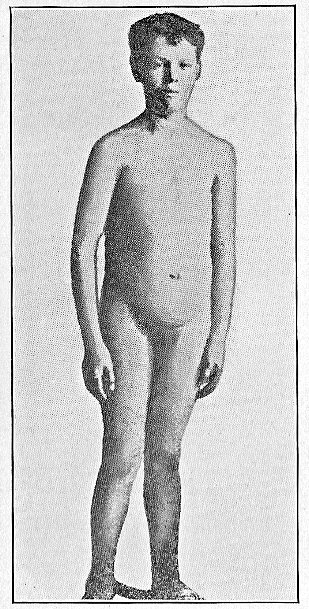
Fig. 30.—Boy, seventeen and
one-half years old.
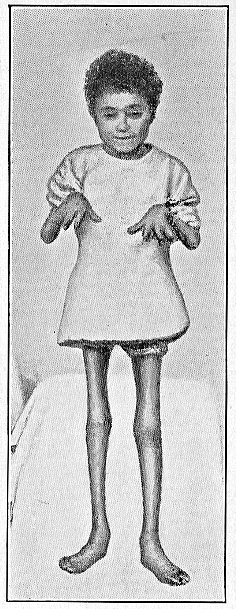
Fig. 31.—Young man,
twenty-two years old.
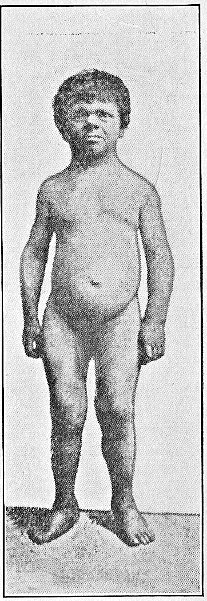
Fig. 32.—Idiotic cretin,
age 20 years, stature
1.095 m.
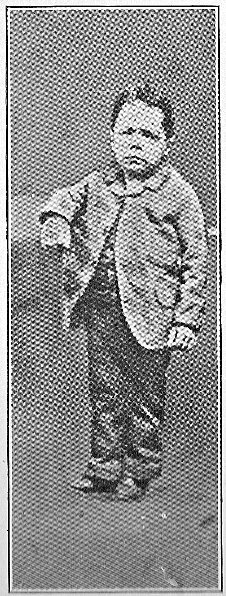
Fig. 33.—An example of
myxedematous infantilism.
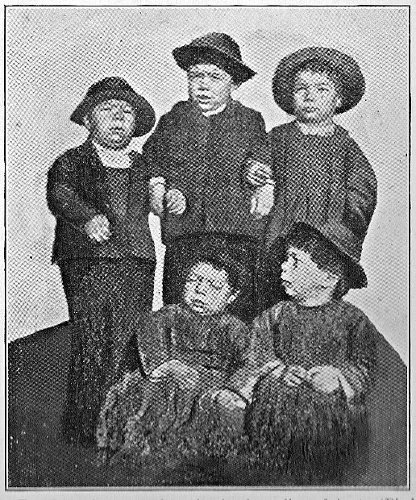
Fig. 34.—A group of cretins in the valley of Aosta (Piedmont).
The alteration of the thyroid gland is of endemic
origin.
Renato L.,[31] age twenty-nine; stature 1.30 m. (average stature
at the age of ten, 1.28 m.; at eleven, 1.32 m.) weight, 32 kilograms
(average weight, age of twelve, 31 k.). It appears from his history
that he developed normally up to the age of nine, after which
period an arrest of development occurred, both physical and psychic.
An arrest of the genital organs dates back also to early
childhood. His intelligence is that of a backward child; he has
never been able to read or write, but can count up to 1000. He
has never been able to learn a trade, but shows some talent for
drawing.
His criminal instincts seem to be especially developed. He
spends whole hours, turning over the leaves of popular illustrated
novels, and whenever he comes across a picture representing a
homicide or an assassination, he utters loud exclamations of
delight. He has only one passion, tobacco, and only one object
of adoration, Ravachol. Very violent, extremely irritable; when
he is angry, he would kill someone, if, as he says, "he had the
strength for it." Although, as a rule, he docilely obeys the
orders given him, it is because he is "afraid of being scolded."
His ideal is to be able some time to obtain refuge in the Hospice
de Bicêtre.
From De Sanctis's work, Gli Infantilismi, I obtain the following
data, that are very suggestive on the anthropological side, regarding
a case of infantilism observed by the professor in his asylum-school
for defective children, in Rome.
Vincenzo P., seven years of age. Father in good health and
of good character. Mother small, thin, weak, underfed; has had
nine children, of which five are living, all feeble. Vincenzo was
born in due time, birth regular; had five wet-nurses; cut his teeth
at the normal intervals; began to walk at the end of the second
year and to speak at the end of the first. According to his mother,
all went well until the fourth year. At this period, Vincenzo
became very troublesome and ceased to "grow taller." Later on
he was sent to the communal school, but the director of the school
in the Via Ricasoli, seeing how undersized and backward he was,
sent him to the Asylum-School for defective children.
In appearance the child is eurhythmic, excepting that the head
appears a little too big in proportion to the rest of his body; but it
is not of the hydrocephalic type (an infantile characteristic). He
is slightly asymmetric, the postero-inferior portion of the right
parietal bone being more depressed than that of the left (infantile
plagiocephaly).
| Measurements |
Age at which the Vincenzo would be normal |
| Of the child |
Normal measurements at the age of seven |
| Stature, 0.870 m. |
1.10 m. |
Three years, stature, 0.864 m. |
| Weight, 12.400 kg. |
20.16 kg. |
Two years, weight, 12 kg. |
| Circumference of chest, 0.507 m. |
0.55 m. |
Four years, circumference of chest, 0.505 m. |
| Vital index, 59 |
Vital index, 54 |
Two years, vital index, 59. |
The bust is greatly developed in comparison with the lower
limbs, which are unquestionably short. (The sitting stature was
not taken, but this note, recorded from simple observation, reminds
us of the enormous difference between the indices of stature at the
age of two or three and at the age of seven: Index at two years=63;
at three=62; at seven=56.)
But although we lack the index of stature, we may make use
of the vital index, which is given by the proportion between the
circumference of the chest and the stature, and consequently gives
us an index of the morphology of the bust in its relation to the
whole personality; thus we find that the vital index corresponds
in the present case to that of a child of two, as is also true of the
weight, so that we may deduce that the index of stature was
probably about 62-63.
He shows no impairment as to external sensations; on the other
hand, internal sensations, such as satiety, illness, etc., are blunted.
His power of attention seems sufficient, both at play and in school
and when questioned. Neither does his memory show anything
abnormal. Emotionally, he is below the normal level; he says
that he is afraid of thunder; occasionally he shows annoyance
when disturbed; but it is equally certain that he never becomes
angry, never turns pale and never blushes, as the result of any
excitement. He is of an indifferent disposition and is passive in
manner; he is good natured, or rather, a certain degree of apathy
makes him appear so.
All things considered, his mental development may be described
as that of a three-year-old child; only that he differs from
children of that age in his lack of vivacity and in his complete
development of articulate speech (it should be noted, in regard to
the diagnosis of age made by so distinguished a psychologist as
De Sanctis, that he judged the child to have a psychic development
corresponding to the age of three years); while we, studying the
general measurements of the body, determined that they correspond
to three different ages, namely, two, three and four the average
of which is precisely three; while the stature, which is the index
of development of the body as a whole, corresponds almost exactly
to that average of three years (0.870 m., 0.864 m.).
Pathogenesis of Infantilism.—At this point it might be asked:
Why do we grow? We hide the mechanism of growth under very
vague expressions: biological final causes, ontogenetic evolution,
heredity. But, if we stop to think, such expressions are not
greatly different from those which they have replaced: the divine
purpose, creation.
In other words, a causal explanation is lacking. But positive
science refuses to lose itself in the search after final causes, in which
case it would become metaphysical philosophy. Nevertheless, it
may pursue its investigations into the genesis of phenomena,
whenever the results of experiments permit it to advance.
So it is in the case of growth; certain relatively recent discoveries
in physiology have made it possible to establish relations
between the development of the individual and the functions of
certain little glands of "internal secretion." Now, the discovery
of these relations is certainly not a causal explanation of the
phenomenon of growth, but only a profounder analysis of it.
Hitherto, we have considered the organism in regard to its
chief visceral functions: in speaking of macroscelia and of brachyscelia,
we considered the different types in relation to the development
of the organs of vegetative life and the organs of external
relations: the central nervous system, the lungs, the heart, the
digestive system. Our next step is to enter upon the study of
certain little organs, which were still almost ignored by the anatomy
and physiology of yesterday. These organs are glands
which, unlike other glands (the salivary glands, the pancreas, the
sudoriferous glands, etc.), are lacking in an excretory duct, through
which the juices prepared for an immediate physiological purpose
might be given forth; and in the absence of such excretory tubes,
their product must be distributed through the lymphatic system,
and hence imperceptibly conveyed throughout the whole organism.
One of these glands, the one best known, is the thyroid; but
there are others, such, for example, as the thymus, situated
beneath the sternum, or breast-bone, and much reduced in size
in the adult; the pineal gland or hypophysis cerebri, situated at
the base of the encephalon; the suprarenal capsules, little ear-shaped
organs located above the kidneys. Up to a short time
ago, it was not known what the functions of such glands were;
some of them were regarded as atavistic survivals, because they
are more developed in the lower animals than in man, and consequently
were classed with the vermiform appendix as relics of
organs which had served their functions in a bygone phylogenetic
epoch and remain in man without any function, but on the contrary
represent a danger through the local diseases that they may
develop. The cerebral hypophysis was in ancient times regarded
as the seat of the soul.
These glands are very small; the largest is the thyroid, which
weighs between thirty and forty grams (1 to 1-3/5 oz.); the suprarenal
glands weigh four grams each (about 60 grains); the hypophysis
hardly attains the weight of one gram.
The importance of these glands began to be revealed when
antiseptic methods rendered surgery venturesome, and the attempt
was made (in 1882) to remove the thyroid gland. After a few
weeks the patient operated on began to feel the effects of the
absence of an organ necessary to normal life: effects that may be
summed up as, extreme general debility; pains in the bones and
in the head; an elastic swelling of the entire skin; enfeebled heart
action, and anemia; and on the psychic side, loss of memory,
taciturnity, melancholy. After the lapse of some time the patient
showed such further symptoms as the shedding of the cuticle of
the skin, whitening of the hair and facies cretinica.
But when Sick undertook to operate upon the thyroid of a
child of ten, the deleterious effects of interrupting the above-mentioned
function of the gland manifested itself in an arrest of
development; at the age of twenty-eight the patient operated on by
Sick was a cretin (idiotic dwarf) 1.27 metres tall (average stature at
age of ten=1.28 m.). Since that time certain diseases have been
recognised that call to mind the condition of patients who have
undergone an operation for removal of the thyroid glands, and
in which the subjects have suffered from hypothyroidea, or insufficient
development of the thyroid.
Such individuals were characterised by nanism, solid edema
of the skin, arrest of psychic development, and absence of development
of puberty; this malady has taken its place in medical
treatises under the name of myxedema; and, when serious, is accompanied
by nanism and myxedematous idiocy. But in mild
cases it may result in a simple myxedematous infantilism.
The other glands of internal secretion are also associated with
the phenomena of growth. First in importance is the thymus
which is found highly developed in the embryo and in the child
at birth, and thereafter diminishes in volume, until it almost
disappears after the attainment of puberty. In the psychological
laboratories of Luciani, at Rome, the first experiments were conducted
upon dogs, for the purpose of determining what alterations
in growth would result as a consequence of the removal of the
thymus. The dogs thus operated on were weak; furthermore
they became atrophied, accompanied by roughness of the skin
and changes in pigmentation. After this, experiments were
made in the Pediatric Clinic at Padua, under the direction of
Professor Cervesato, in the application of thymic organotherapy
(that is, the use of animal thymus as medicine) with notable
success in the case of atrophic children (infantile atrophy occurs
in early infancy; this form is known popularly in Italy as the
"monkey sickness." Nursing children become extremely thin,
cease to grow in length, the little face becomes elongated and
skeleton-like, and is frequently covered with a thick down).
Stoppato also obtained analogous results in infantile atrophy
and anemia. Hence it is evident that the very rapid growth in
the embryo is associated with the functional action of the thymus.
And this is also true of the very rapid growth during the first
years of a child's life.
The pituitary gland, or cerebral hypophysis, has also functions
associated with the general nervous tone and trophism (or nourishment)
of the tissues, and especially of the osseous system. There
is a disease known as acromegalia (Marie's disease) which is
characterised by an abnormal and inharmonic growth of the
skeleton, especially in the limbs and the jaw; the hands and feet
become enormously enlarged, while the jaw lengthens and thickens
(an unhealthy formation on which the common people of Italy
have bestowed the name of "horse sickness," because of the
appearance assumed by the face). Such patients complain of
general and progressive debility of their psychic activities. In
such cases, an autopsy shows an alteration of the pituitary gland,
often due to malignant tumors (sarcoma).
The suprarenal capsules also bear a relation to general trophism
and particularly to the pigmentation of the skin. It was already
noted by Cassan and Meckel that the negro races show a greater
volumetric development of the suprarenal capsules; when in 1885
Addison for the first time discovered a form of disease associated
with alterations of the suprarenal capsules, characterised by an
intensely brown colouration of the skin (bronzed-skin disease),
general debility of the nervous and muscular systems, progressive
anemia and mental torpor; the malady ends in death. In the
case of animals operated on for physiological experiments, not
one of them has been able to survive.
Some interesting observations have been made by Zander
on the connection between the development of the nervous system
and the suprarenal glands. He found that there was an insufficient
development of these glands in individuals having teratological
(monstrous) mis-shapements of the brain, as in the case of
hemicephalus (absence of one-half the brain), cyclops, etc.
There exists between all the ductless glands, or those of
internal secretion, an organic sympathy: in other words, if one
of them is injured the others react, frequently to the extent of
assuming a vicarious (compensating) functional action.
What their functional mechanism is, that is, whether the
secretions act as formative stimulants or enzymes, ferments of
growth, or whether as antitoxins to the toxins elaborated by
various organs in the process of regression, is a question still
controverted and in any case cannot enter within the limits of our
field.
It is enough for us to know that the general growth of the
organism and its morphological harmony, depend not only as
regards the skeleton, but equally in relation to the cutaneous
system and its pigmentation, the development of the muscles,
the heart, the blood, the brain, and the trophic functions of the
nervous system, upon some formative and protective action of
all these little glands of "internal secretion," with which are
associated the psychic activities and even the life itself of each
individual, as though within the embryonic crucible there must
have been certain substances that acted by stimulating the
genetic forces and directing the trophism of the tissues toward a
predetermined morphology.
To-day it is held that even the mother's milk contains these formative
principles, or enzymes, suited to stimulate the tissues of her
own child in the course of their formation; consequently, it produces
results which no other milk in all nature can replace.
Alterations in these glands of "internal secretion" may therefore
produce an arrest of development—and, in mild cases, forms
of infantilism. But the gland which in this connection is of first
importance is the thyroid.
Now there is one form of arrest of the trophic rhythm of growth
which may be due to hereditary causes effecting the formative
glands (myxedematous infantilism), or to exceptional causes occurring
in the individual himself in the course of formation, either at
the moment of conception, or at some later moment, as may happen
even during the period of infancy (dystrophic infantilism of
various origin).
In all these cases, however, according to Hertoghe, the exceptional
causes, deleterious to growth, would first of all exercise their
influence upon the glands of internal secretion and especially upon
the thyroid.
In order to make clear, in connection with such complex pathological
problems, the cases which are important from the point of
view of pedagogy and the school, let us divide them into:
Myxedematous infantilism, due to congenital insufficiency of
the thyroid gland from hereditary causes, and
Dystrophic infantilism, associated with various causes deleterious
to individual development—and acting secondarily upon
the glands of internal secretion (syphilis, tuberculosis, alcoholism,
malaria, pellagra, etc.).
Myxedematous infantilism is characterised by short stature, by
excessive development of the adipose system, and by arrest of
mental development (including speech). Such infantiles very
frequently have a special morphology of the face, that suggests the
mongol type, and characteristic malformations of the hands (little
fingers atrophied). When treated with extracts of the thyroid
glands of animals, they improve notably; they become thinner,
they gain in stature, their mentality develops to the extent of
permitting them to study and to work. Certain mongoloids
treated by De Sanctis in the Asylum-School at Rome were improved
to the point of being able to attend the high-school and
therefore were restored to their family and to society as useful
individuals—all of which are facts that are of singular importance
to us as educators! Medical care working hand in hand with pedagogy
may save from parasitism individual human beings who
otherwise would be lost. We ought to be convinced from such
evidence of the necessity of special schools for deficients, wholly
separated from the elementary schools, and where medical care
combined with a specially adapted pedagogic treatment may transform
the school into a true "home of health and education."
The plan of a "school with a prolonged schedule of hours," including
two meals and a medical office, as was conceived and organised
by Prof. Sante de Sanctis in Rome, has been proved to answer
admirably to this social need; because without wholly removing
the children from their families, and therefore without exposing
them to the disadvantages of a boarding school, it provides them
with all the assistance necessary to their special needs.
Dystrophic Infantilism.—Given a case of infantilism, discoverable
by the teacher through the general measurements of the body
and psychic examination, it is interesting to investigate the deleterious
causes.
It may be the result of poisoning, as for example from alcohol.
Alcohol has such a direct influence upon the arrest of development
that in England jockeys are produced by making the lads drink
a great deal of alcohol. Children who drink alcohol do not grow in
stature, and similarly the embryo grows in a less degree when the
mother indulges in alcohol during pregnancy; some Swiss women
deliberately resort to this means, in order that a smaller child may
lessen the pain of childbirth. But alcohol not only diminishes
the stature, but destroys the harmony of the different parts; that
is, in the development of the body it arrests both the volumetric
and the morphological growth. Furthermore, alcohol produces in
children an arrest of mental development. An acquaintance
with this principle of hygiene should be looked upon by the teacher
less as a piece of special knowledge than as a social duty. From
the point of view of the educator, the fight against alcoholism
should have no assignable limits! It would be vain for him to
perfect his didactic methods in order to educate a child that drank
wine or other still worse alcoholic liquors. It would be better if
the efforts which he meant to dedicate to such educative work
could be all turned to a propaganda directed toward the parents
of such children, or toward the children themselves, to induce them
to abstain from so pernicious a habit!
We may also consider in the category of poisonings certain
chronic maladies which act upon the organism with special toxic
(poisonous) effects. In the foremost rank of such maladies
belongs
Syphilis.—This disease is ranked among the principal causes
of abortion; in other words, the fœtus which results from a syphilitic
conception lacks vitality, and often fails to complete the cycle of
intrauterine life. But even granting that the fœtus survives and
attains its complete development, the child after birth grows
tardily, and very often remains an infantile. It is well known that
syphilis has been transmitted to new-born infants at the time of
birth, in consequence of which these infants may in turn transmit
syphilis to their wet-nurses. In such cases they are really sick
and need medical treatment from the hour of their birth. Just
as in the adult patient, syphilis has several successive stages, an
acute primary stage, with plain manifestations of hard ulcers,
erythema diffused over the skin of the entire body, glandular
infiltrations, etc., and then secondary and tertiary manifestations
that eventually become chronic and exhibit almost imperceptible
symptoms; so in the case of children, syphilis may be transmitted
in various degrees of virulence. In the acute stage the result will
be abortion or the child will be still-born, or else the new-born
child will plainly exhibit ulcerations and erythema, but at other
periods of the disease, the child may bear far less evident signs
of its affliction, as for instance a special form of corrosion in the
enamel of its teeth; the cervical pleiades or enlargement of certain
little lymphatic glands like the beads of a rosary, distinguishable
by touch in the posterior region of the neck; certain cranial malformations
(prominent nodules on the parietal bones, Parrot's
nodes); and in the child's whole personality an under-development
in respect to its age. In cases like these the teacher's observations
may be of real social value, because the child has shown no symptoms
of such a nature as to cause the parents to have recourse to a
physician, and it is the child's scholarship (using the word in the
broad sense of the way in which the child reacts in the environment
of school, the profit he derives from study, etc.) that may reveal
an abnormal development to an intelligent teacher.
The first indication is a stature below what is normal at a given
age. Such observations ought to be obligatory upon teachers
who are in sympathy with the new ideas, for they alone can be the
arbiters of the rising generations. It is being said on all sides, to
be sure, with optimistic assurance that argues a deficiency of
critical insight and common sense, that an adequate education of
the mothers ought to enlighten all women in regard to the laws of
growth in children and the abnormalities that are remediable.
But of what class of mothers are we supposed to be speaking?
Certainly not of the great mass of working women and illiterates!
certainly not of the women who have been constrained to hard
toil from childhood up, and later on condemned to abortion because
of such unjust labor, while their spirit is brutalized and their
memory loses even the last lingering notion of an alphabet! It
will always be easier and more practical, in every way, to enlighten
twenty-five thousand teachers regarding these principles than to
enlighten many millions of mothers; not to mention that if we
wished to enlighten these mothers in a practical way regarding the
principles of the hygiene of generation, we should still have to invoke
the services of that very class whose assigned task in society
is precisely that of educating the masses!
The teacher can and should learn at least how to suspect the
presence of hereditary syphilis in his pupils, in order to be able to
invoke the aid of the physician, leaving to the latter the completion
of the task, namely, the eventual cure. It is well known that iodide
of potassium and its substitutes, especially if used at an early stage,
can cure syphilitic children and therefore save innocent boys and
girls from eventual definite arrest of development and from all
the resultant human and social misery.
Another cause that is deleterious to development is
Tuberculosis.—Although it has now been demonstrated that
tuberculosis is not hereditary, as an active disease—that is, we
cannot inherit in our organism localised colonies of the tuberculosis
bacillus, because the bacilli cannot pass through the placenta
into the fœtus during the period of gestation—nevertheless a predisposition
to infection from the bacillus can be inherited.
A predisposition which consists in a special form of weakened
resistance of the tissues, rendering them incapable of immunity, and
a skeletal formation which is distinguished by a narrowness of
the chest, and a consequent smallness of lungs, which, being unable
to take in sufficient air, constitute a locus minoris resistentiæ
(locality of less resistance) to localisation of the bacilli. Now,
since our environment is highly infected by the bacilli of tuberculosis,
we must all necessarily meet with it, we must all have repeatedly
received into our mouths and air passages Koch's bacilli, alive
and virulent; and yet the strong organism remains immune, while
the weak succumbs. Consequently those who are predisposed by
heredity are almost fated to become tuberculous, and in this sense
the malady presents the appearance of being truly hereditary.
But such organic weakness in a child predisposed to tuberculosis
is manifested not only by possible attacks of various forms of the
disease localised in the glands (scrofula) or the bones, but also
by a delayed development of the whole personality.
Now, the environment of school and the educative methods
still in vogue in our schools, not only are not adapted to correct
such a predisposition, but what is more, the school itself creates
this predisposition! In fact, the sitting posture—or rather, that
of stooping over the desk, to write—and the prolonged confinement
in a closed environment, impede the normal development of
the thorax and of all the physical powers in general. Many a
work on pedagogic anthropology has already shown that the most
studious scholars, the prize-winners, etc., have a wretched chest
measure, and a muscular force so low as to threaten ruin to their
constitutions.
Consequently, children who are predisposed to tuberculosis
ought unquestionably to be removed from our schools and cared
for and educated in favourable environments. While we are still
impotent in the face of fatalities due to this deplorable disease,
we are not ignorant of the means needed to save a predisposed
child and transform him into a robust and resistant lad. Such
knowledge, to be sure, was applied to mankind only as a second
thought; for the first men to apply and then to teach such means
of defence were the owners of cattle and the veterinaries. The
owners of cattle discovered that if a calf was born of a tuberculous
cow, it could be saved and become an excellent head of
cattle, if only it was subjected to a very simple procedure; the
calf must be removed from its mother and given over to be nursed
by another cow in the open country; and it must remain in the
open pastures for some time after it its weaned.
By taking similar precautions in the case of children, it has
been shown that the son of a tuberculous woman, if entrusted to
a wet-nurse in the open country, and brought up on an abundance
of nourishing food until his sixth year in the freedom of the fields,
can be made as robust as any naturally sound child. From this we
get the principle of schools in the open air, or of schools in the woods,
or on the sea-shore, for the benefit of weak, anemic children, predisposed
to tuberculosis. Such a sojourn constitutes the "School-Sanatorium,"
the lack of which is so grievously felt by the parents
of feeble children, and that might so easily be instituted in our mild
and luxuriant peninsula, so rich in hillsides and sea-coast!
Malaria.—One of the chief causes of mortality and of biological
pauperism in many regions of Italy is malaria. This scourge
rages even to the very gates of Rome. The country folk of these
abandoned tracts pine away in misery and at the same time in
illiteracy, while their blood is impoverished by disease, and a
notable percentage of the children are victims of arrested development.
These unfortunates, forgotten by civilisation, are destined to
roam the fields, bearing with them, till the day of their death, a
deceptive appearance of youth, and an infantile incapacity for
work, an object-lesson of misery and barbarity! Among the
means of fighting malaria, the spread of civilisation and the school
ought to find a place. Even the quinine given freely by the government
is distributed with difficulty among these unhappy people,
brutalised by hunger and fever; and some message from civilisation
ought to precede the remedy for the material ill. A far-sighted
institution is that of Sunday classes founded by Signor
Celli and his wife in the abandoned malarial districts. In these
classes, the teachers from elementary schools give lessons every
Sunday, spreading the principles of civic life, at the same time that
they distribute quinine to the children.
If we stop to think that wherever malaria is beaten back, it
means a direct conquest of fertile lands and of robust men, and
hence of wealth, we must realise at once the immense importance
of this sort of school and this sort of struggle, which may be compared
to the ancient wars of conquest, when new territories and
strong men constituted the prize of battles won, and the grandeur
of the victorious nations.
Pellagra.—Pellagra is still another scourge diffused over many
regions of Italy. It is well known that this disease, whose pathological
etiology is still obscure, has some connection with a diet
of mouldy grain. Pellagra runs a slow course, beginning almost
unnoticed in the first year, with a simple cutaneous eruption,
which the peasants sometimes attribute to the sun. The second
year disturbances of the stomach and intestines begin, aggravated
by a diet of spoiled corn; but it is usually not until the third
year that pellagra reveals itself through its symptoms of great
nervous derangements, with depression of muscular, psychic and
sexual powers, together with melancholia, amounting to a true
and special form of psychosis (insanity) leading to homicide, even
of those nearest and dearest (mothers murdering their children)
and to suicide.
This established cycle of the disease is not invariable. Instead
of representing successive stages, these symptoms may often be
regarded merely as representing the prevailing phenomena in various
forms of pellagra; in any case, it constitutes a malady that runs a
slow course during which the same patient is liable to many relapses.
While the malady is running its course, the patients may continue
their usual physiological and social life, and even reproduce themselves.
So that it is not an infrequent case when we find mothers,
suffering from pellagra, nursing an offspring generated in sickness
and condemned to manifold forms of arrested development, both
physical and mental.
Against a disease so terrible that it strikes the individual and
the species, it is now a matter of common knowledge that there
is an exceedingly simple remedy: it consists in a strongly nitrogenous
diet (i.e. meat) and that, too, only temporarily. In fact,
in the districts where the pellagra rages, various charitable organisations
have been established, among others the economic kitchens
for mothers, which by distributing big rations of meat effect a cure,
within a few months, not only of the sick mothers but of their children
as well.
The real battle against pellagra must be won through agrarian
reforms: but in the meantime the local authorities could in no
small degree aid the unhappy population with their counsel, by
enlightening the peasants regarding the risks they run, as well as
by informing them of the various forms of organised aid actually
established in the neighbourhood and often unknown to the public
or feared by them, because of the ignorance and prejudice with
which they are profoundly imbued!
Pauperism, Denutrition, Hypertrophy.—We may define all the
causes hitherto considered that are deleterious to growth, as toxical
dystrophies, since not only alcohol, but the several diseases
above discussed—syphilis, tuberculosis, malaria, pellagra—produce
forms of chronic intoxication. But besides all these various forms
of dystrophies, we may also cite cases of infantilism due purely
to defective nutrition, and family poverty. Physiological misery
may produce an arrest of growth in children.
But just as denutrition associated with pauperism (social
misery, economic poverty, lack of nourishment) may cause an
organism in course of development to arrest its processes of evolution
through lack of material, the same result is equally apt to
be produced by any one of a great variety of causes liable to
produce organic denutrition, physiological poverty.
For example, too frequent pregnancies of the child's mother,
which have resulted in impoverishing the maternal organism,
causing deficiency of milk, etc.
Infant Illnesses.—In the same way, organic impoverishment
is caused by certain maladies of the digestive system which impede
the normal assimilation of nutritive matter: dysentery, for instance;
and the effects may be still more disastrous if symptoms
of this kind are accompanied by feverish conditions, as in typhus.
There are cases, however, in which the arrest of development is
not to be attributed to some wasting disease, or to the denutrition
resulting from it; but rather to some acute illness occurring in early
childhood (pneumonia, etc.), after which the child ceased to progress
in accordance with his former obviously normal development.
Anangioplastic Infantilism.—Another form of infantilism is
associated with a malformation of the heart and blood-vessels,
that is to say, the heart and aorta together with the entire circulatory
system are of small dimensions; the calibre of the arteries
is less than normal. In such a case the restriction of the entire
vascular system and the scantiness of circulation of the blood
constitute an impediment to the normal growth of the organism.
Although in such cases the explanation of the cause of the phenomenon
is purely mechanical, nevertheless such abnormality of the
heart and veins is to be classed as a teratological (monstrous)
malformation, determined by original anomalies of the ductless
glands, similar to what is found in cases of cephalic and cerebral
monstrosities.
In this form of infantilism the patient shows not only the usual
fundamental characteristics already noted, but also symptoms of
anemia as obstinate to all methods of treatment as chlorosis is;
in addition to which they often show congenital malformations
of the heart, in every way similar in their effects to valvular
affections such as may result from pathological causes (chief of
which are mitral and aortic stenosis, which consist of a stricture
of the valves connected with the left ventricle of the heart).
Accordingly, children who show forms of mitral infantilism are
inferior to their actual age not only in their whole psychosomatic
appearance, but they are noticeably weak, pale and suffering from
shortness of breath and disturbances of the circulation. In such
cases, neither pedagogy nor hygiene can counteract the arrest of
development; but it is well that the attention of teachers should be
called to such cases, in order that cruel errors may be prevented,
which would unconsciously do additional harm to individuals already
burdened by nature with physiological wretchedness.
In conclusion: The normal growth of the organism is associated
with the functional action of certain glands known as glands
"of internal secretion," such as the thymus and thyroid, first of all,
as well as the suprarenal capsules and the cerebral hypophysis.
This group of formative glands presides not only over the entire
growth of the body, but also over the intimate modeling of its
structure; so that a lesion or deficiency in any of them results not
only in nanism and an arrest of mental development, but in various
forms of general dystrophy.
That the organism is associated in the course of its transformations
with the functional action of specific glands is shown
by the development of puberty, which consists in a series of transformations
of the entire organism, but is associated with the establishment
of functional activity of glands that were hitherto
immature: the genital glands (ovaries, testicles). These glands
also are functionally in close sympathy with the entire group
of formative glands: so much so that, if the glands of internal
secretion are injured, the genital glands usually fail to
attain normal development (infantilism). Now, the transformations
which take place in the organism at the period of puberty
might be produced at other periods if the functional action of the
generative glands should show itself at a different epoch. That
is, these transformations are not associated with the age of the
organism, but with the development of specific glands. There are
cases of the genital glands maturing at abnormal ages; or of local
maladies that have hastened the appearance of the phenomena of
puberty in children of tender years. A notable case is that described
by Dr. Sacchi,[32] of a nine-year old boy, who had grown
normally up to the age of five and a half, both in his physiological
organism and in his psychic personality. At the age of five and a
half, the child's father noticed a physical and moral alteration;
the child's voice grew deeper, his character more serious, and the
skeletal and muscular systems grew rapidly, while on certain
portions of the body, as for example on the face, a fine down
appeared. At the age of seven the child had attained a stature
that was gigantic for his age; he was very diligent and studious
and did not care to play with his comrades. At nine, he had a
stature of 1.45 metres (the normal stature being 1.22), a
weight of 44 kilograms (normal = 24); his muscles were highly
developed, his powers of traction and compression being equal to
those of a man; his chin was covered with a thick beard five centimetres
long. When he was examined by a physician, the latter
discovered a tumor in the left testicle. After an operation, the
child lost his beard and regained his childish voice; his character
became more timid and sensitive; he began once more to enjoy his
comrades and take part in boyish games. His muscular force
underwent a notable diminution.
Rickets.—It is important not to confound any of the various
forms of infantilism with rickets. Rickets is a well-defined malady
whose special point of attack is the osseous system in course of
formation; but it leaves the nervous system and the genital system
unimpaired. The sufferer from rickets may be a person of intelligence,
capable of attaining the highest distinctions in art or in
politics; he is normal in his genital powers, so that he is capable of
normal reproduction, without, in many cases, transmitting any
taint of rickets to his descendants.
Nevertheless this disease, like all constitutional maladies, occurs
only in individuals who are weakly.
Among the characteristics of rickets, the one which assumes
first importance is inferiority of stature in comparison with the
normal man. In this connection I quote the following figures
from Bonnifay:[33]
| Age |
Stature in centimetres |
| Rachitic children |
Normal children |
| 11 months |
66.5 |
69.4 |
| 2 years |
70.7 |
74.8 |
| 2-3 years |
75.8 |
83.0 |
| 3-4 years |
76.8 |
91.9 |
| 5-6 years |
91-93 |
101.25 |
| 6-7 years |
105.0 |
106.8 |
| 7-8 years |
110.6 |
115.3 |
| 8-9 years |
118.4 |
119.0 |
| 9-10 years |
121.6 |
124.4 |
But together with diminution of stature there exist in rickets
various deformities of the skeleton, especially in the bones of the
cranium, in the vertebral column and in the frame of the thorax;
although even the pelvis and the limbs have been known to show
the characteristic deformities.
An objective knowledge of the first symptoms of rickets ought
to be regarded as indispensable on the part of mistresses in children's
asylums, and in any case to form an important chapter in
pedagogic anthropology. For it is well known that in the early
stages of rickets the child may be so guided in its growth as to save
it from deformities of the skeleton, even though a definite limitation
of the stature may not be prevented.
That is to say, that through the intervention of hygiene and
pedagogy the rachitic child may be saved from becoming a cripple
or a hunchback, and will simply remain an individual of low stature;
with certain signs and proportions of the skeleton indicative of the
attack through which he has passed. Even in very severe cases
it is at least possible to minimize the deformity of the thorax and
the curvature of the vertebral column.
The precursory signs of rickets in a child are: a characteristic
muscular weakness, frequently accompanied by excessive development
of adipose tissue, giving an illusory impression of abundant
nutrition; delay in the development of the teeth and in locomotion,
which from the very beginning may be accompanied by curvature
of the long bones of the legs. The bregmatic fontanelle of the
cranium closes later than at the normal period, and is larger than
in normal cases, just as the entire cerebral cranium is abnormally
developed in volume, while the facial portion remains small,
especially in regard to the jaw bones.
One of the most salient characteristics, however, is the peculiar
enlargement of the articular heads of the long bones, easily recognizable
in the size of the wrists; the enlargement is also found in the
extremities of the ribs, which at their points of union on each side
of the sternum form a succession of little lumps, like the beads of a
rosary. In conjunction with these characteristics, it is to be noted,
at all ages, as appears from the figures given by Bonnifay, that
there is a notable diminution of stature.
The treatment of rickets is medical and pedagogical combined.
Children of this type should be removed from the public school,
where the school routine might have a fatally aggravating effect
upon the pathological condition of such children. In fact, gymnastics
based upon marching and exercising in an erect position,
together with a prolonged sitting posture, are likely to produce
weaknesses of the skeleton and deformities, even where there are
no symptoms of rickets!
The establishment of infant asylums for rachitic children is
one of the most enlightened movements of the modern school.
We Italians are certainly not the last to found such institutions,
and Padua possesses one of the oldest and most perfect asylums
of this sort of which Europe can boast. Asylums for rachitic children
ought to have a special school equipment, so far as concerns
the benches and the apparatus for medical and orthopedic gymnastics;
furthermore they should be provided with a pharmaceutical stock
of remedies suited to building up the osseous system and the organism
in general; and a school refectory should be provided, adapted
to the condition of the children. The methods of instruction
should rigorously avoid any form of fatigue, and instead provide
the child with psychic stimuli designed to overcome a sluggishness
due to the mental prostration to which he is for the most part
subject. As regards their situation, these asylums for rachitic
children may be advantageously located upon the sea-coast.
The Stature of Abnormals.—The name of abnormals is applied
to the entire series of individuals who are not normal: hence the
categories already considered (infantilism, gigantism, rachitis) are
included by implication. The group of abnormals, however, includes
besides a long series of other classes, neuropathics, epileptics,
and degenerates.
Under the head of abnormals may also be included those who
are abnormal in character, such as criminals, etc. It is not irrational
to group together the different types of abnormals, for the
purpose of anthropological research, in contrast with those who are
normal. In America, for instance, such studies are conducted on
a large scale, precisely for the purpose of showing the deviation of
abnormal dimensions of the body from normal dimensions, not
only in the definitive development of the body, but also during
growth. The abnormals depart from the mean measurements,
now rising above and again falling below, as though they were
intermittently impelled by the biological impulse of their organism,
which at one time manifests a hypergenesis and at another a
hypogenesis. A clear illustration of these facts is afforded by
MacDonald's diagram (see page (168)): the solid line which rises
regularly represents the growth in stature of normal individuals;
the dotted line which forms a zig-zag, now rising rapidly above the
normal line and then falling very much below it, represents the
growth in stature of the abnormals. Naturally such a chart
must be interpreted by comparison with the standards of mean
measurements gathered at successive ages from a large number
of different children. It shows that normal children are nearly
uniform among themselves, and in relation to the years of
their growth: while abnormal children differ greatly one from
another and do not accord with the mean stature of the age they
represent.
Regarding the stature of criminals there can be nothing special
to say: criminals do not represent an anthropological entity. They
belong to a large extent, whenever the criminal act has a psychophysiological
basis, to various categories of abnormals. From the
victim of rickets to the infantile, to the submicrocephalic, to the
ultra-macroscele or ultra-brachyscele, all abnormal organisms may
contribute to the number of those predisposed to the social phenomenon
of criminality. And it is for this reason that we may say
in general that the stature of abnormals is sometimes above and
sometimes below the normal, but with a prevailing tendency to
fall below.
Moral and Pedagogic Considerations.—The objection may be
raised that a medico-pedagogic system of treatment, designed to
prevent a threatened arrest of development or to minimise its
progressive symptoms, demands on the part of society an excessive
effort, out of proportion to the end
in view. To cure or ameliorate
the condition of the weak may
even be regarded as a principle of
social ethics that is contrary to
nature, whose laws lead inexorably
to the selection of the strong and
to the elimination of all those who
are unfitted for the struggle for
life. Sparta has furnished us with
a practical example that is very
far from the principles which
scientific pedagogy is to-day seeking
to formulate as a new necessity
of social progress.
Mac Donald.
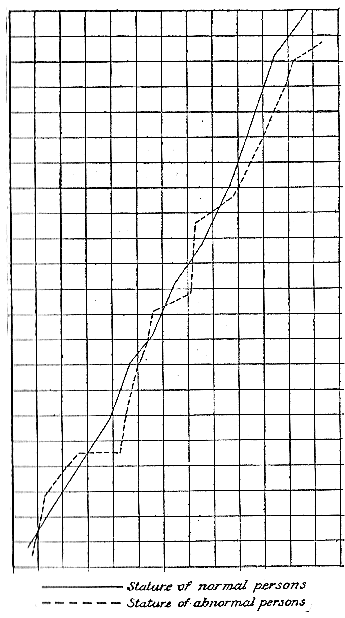
Stature of normal persons
Stature of abnormal persons
Fig. 35.
But we are too far removed
from the triumphant civilisation
of Greece, to recur to the authority
of her example: the principle
sanctioned to-day by modern
civilisation, that of "respect for
human life," forbids the violent
elimination of the weak: Mount
Taygetus is no longer a possible fate for innocent babes in a social
environment the civic spirit of which has abolished the death
penalty for criminals. Consequently, since the weak have a right
to live, as many of them as naturally survive are destined to become
a burden, as parasites, upon the social body of normal
citizens; and they furnish a living picture of physiological wretchedness,
a spectacle of admonitory misery, inasmuch as it represents
an effect of social causes constituting the collective errors of
human ethics. Ignorance of the hygiene of generation, maladies
due to the vices and the ignorance of men, such as syphilis, other
maladies such as tuberculosis, malaria and pellagra, representing
so many scourges raging unchecked among the people, are the
actual causes that are undermining the social structure, and manifesting
themselves visibly through their pernicious fruit: the birth
of weaklings. To forget the innocent results of such causes, as
we forget the causes themselves, would be to run the risk of plunging
precipitously into an abyss of perdition. It is precisely these
disastrous effects upon posterity that ought to warn us and shed
light upon the errors through which we are passing lightly and
unconsciously. Accordingly, to gather in all the weaklings is
equivalent to erecting a barrier against the social causes which
are enfeebling posterity: since it is impossible to conceive that if
the existence of such a danger were once demonstrated, society
would rest until every effort had been made to guard against the
possibility of its recurrence.
In addition to such motives for human prophylaxis, a more
immediate interest should lead us to the pedagogic protection of
weak children. The establishment of special schools for defective
children, sanatarium-schools for tuberculous children, rural schools
for those afflicted with malaria and pellagra, infant asylums for
rachitic children, is a work of many-sided utility. They constitute
a fundamental and radical purification of the schools for normal
children: in fact, so long as intellectual and moral defectives and
children suffering from infantilism and rachitis intermingle with
healthy pupils, we cannot say that there really exist any schools
for normal children, in which pedagogy may be allowed a free
progress in the art of developing the best forces in the human
race.
Still another useful side to the question is that of putting a stop
to the physiological ruin of individual weaklings. Very small
would be the cost of schools for defective children, asylums for the
rachitic, tonics, quinine, the iodide treatment, school refectories for
little children afflicted with hereditary taints and organic disease:
very small indeed, in comparison to the disastrous losses that society
must one day suffer at the hands of these future criminals and
parasites gathered into prisons, insane asylums and hospitals, in
comparison to the harm that may be done by one single victim
of tuberculosis by spreading the homicidal bacilli around him. It
is a principal of humanity as well as of economy to utilise all human
forces, even when they are represented by beings who are apparently
negligible. To every man, no matter how physiologically
wretched, society should stretch a helping hand, to raise him.
In North America the following principle has the sanction
of social custom: that the task of improving physiological conditions
and at the same time of instilling hope and developing
inferior mentalities to the highest possible limit constitutes an
inevitable human duty.
Accordingly it remains for the science of pedagogy to accomplish
the high task of human redemption, which must take its
start from those miracles that the twentieth century has already
initiated in almost every civilised country: straightening the
crippled, giving health to the sick, awakening the intelligence in
the weak-minded—much as hearing is restored to the deaf and
speech to the mutes—such is the work which modern progress
demands of the teacher. Because such straightening of mind and
body naturally lies within the province of those who have the
opportunity to give succor to the human being still in the
course of development; while after a defect has reached its
complete development in an individual, no manner of help can
ever modify the harm that has resulted from lack of intelligent
treatment.
The prevention of the irremediable constitutes a large part of
the work which is incumbent upon us as educators.
We have been considering stature as the linear index of the
whole complex development of the body, taking it in relation
to two other factors, the one internal or biological, and the
other external or social. These two factors, indeed, unite in
forming the character of the individual in his final development;
and in each of them education may exert its influence,
both in connection with the hygiene of generation and through
reforms instituted in the school.
In the following table are summed up the different points of
view from which we have studied stature in its biological characteristics
and in its variations:
| Varieties of stature |
Ethnic varieties and limits of oscillation |
Stature in different races; extreme limits. |
| Stature of the Italian people; and its geographical distribution. |
| Limits of stature: medium, tall, low. |
| Biological varieties |
Difference of stature in the sexes. |
| Stature at different ages (growth). |
| Variations in stature |
Variations due to adaptation |
Mechanical |
Transitory or physiological. |
| Permanent, often caused by deformities (Causes: the attitudes required by the work.) |
| Physiological |
Nutrition. |
| Physical |
Heat. |
| Light. |
| Electricity. |
| Psychic |
Psychic stimuli. |
| Pathological variations |
Infantilism |
Myxedematous. |
| Dystrophic |
from alcohol. |
| from syphilis. |
| from tuberculosis. |
| from malaria. |
| from pellagra. |
| Hypotrophic |
Denutrition. |
| Anangioplastic |
| Rachitis |
When an anthropological datum is of such fundamental importance
as the stature, its limits of oscillation must be established,
and its terminology must be founded upon such limits expressed
in figures that have been measured and established by scientists
(medium, tall, low).
The stature is the most important datum in pedagogic anthropology,
because it represents the linear index of the development of
the body, and for us educators is also the index of the child's
normal growth.
Biopathological Laws.—In cases of total arrest of development
of the personality (infantilism) the first characteristic symptom
usually consists in a diminution of stature in relation to age; the
morphological evolution, as well as the psychic, fails to progress in
proportion to the age of the subject; but it corresponds to the mean
bodily proportions belonging to the age which would be normal
for the actual stature of the subject.
The weight is a measure which should be taken in conjunction
with the stature; because, while the stature is a linear index of the
development of the body, the weight represents a total measure
of its mass; and the two taken together give the most complete
expression of the bio-physiological development of the organism.
Furthermore the weight permits us to follow the oscillations of
development; it provides educators with an index, a level of
excellence, or the reverse, of their methods as educators, and of the
hygienic conditions of the school or of the pedagogic methods in
use.
The fact is, that if a child is ill, or languid, etc., his stature
remains unchanged; it may grow more slowly, or be arrested in
growth; but it can never diminish. The weight, on the contrary,
can be lost and regained in a short time, in response to the most
varied conditions of fatigue, of malnutrition, of illness, of mental
anxiety. We might even call it the experimental datum of the
excellence of the child's development.
Another advantage which the measure of weight has over that
of stature is that it may serve as an exponent of health from the very
hour of the child's birth; while stature does not exist in the new-born
child, and begins to be formed (according to the definition
given) only after the first year of its life, that is, when the child
has acquired an erect position and the ability to walk steadily.
Variations.—Weight is one of the measures that have been
most thoroughly studied, because it is not a fruit of the recently
founded science of pedagogic anthropology; but it enters into the
practice of pediatricians (specialists in children's diseases) and of
obstetricians (specialists in childbirth), while even the general
practitioner can offer precious contributions from his experience.
According to Winckel, and practically all pediatricians agree
with him, "the weight of a child, if taken regularly, is the best
thermometer of its health; it easily expresses in terms of figures
what the nursing child cannot express in words."[34]
The new-born child weighs from three to four kilograms; but
oscillations in weight from 2,500 to 5,000 grams are considered
normal. Some obstetricians have noted weights in new-born children
that are enormous, true gigantism, which, however, while possible,
are altogether exceptional; nine and even eleven kilograms.
The oscillations in weight of the child at birth, within normal
limits, may have been determined by general biological factors, as
for example the sex (the female child weighing less than the male),
and the race (especially in regard to the stature of the parents):
but the factors which influence the weight of the new-born child
in a decisive manner are those regarding the hygiene of generation.
1. "The children which have the greater weight are those born
of mothers between the ages of twenty-five and thirty." (Mathews
Duncan.) Let us recall what we have said regarding stature; at
the end of the twenty-fifth year, that is, at the end of the period
of growth, man is admirably ripe for the function of reproduction;
and we ought further to recall the views cited regarding the mortality
of children conceived at this age which is so favourable to
parenthood; and finally the note in regard to celebrated men,
almost always begotten at this age.
2. "First-born children have in general a weight inferior to that
of those born later (1,729 first-born children gave an average of
3,254 grams: while 1,727 born of the second or subsequent
conceptions gave an average of 3,412 gr.)" (Ingerslevs). Let us
remember that celebrated men are scarcely ever the first-born.
3. "Very short intervals between successive pregnancies
interfere with this progression in weight; long intervals on the
contrary do not interfere with it" (Wernicke). In other words,
too frequent pregnancy is unfavourable to the result of the
conception.
4. "Mothers who, at the birth of their first child weigh less
than fifty-five kilograms and are under twenty years of age, have
children of inferior weight, who are less predisposed to normal
growth" (Schafer).
Let us recall what we have said regarding the form and the
scanty weight in the case of macrosceles; and also in regard to the
age of procreation in its relation to stature.
5. "Women who toil at wearisome work up to the final hour
give birth to children inferior in weight to those born of mothers
who have given themselves up to rest and quiet for some time
before the expected birth" (Pinard).
All these considerations which refer to normal individuals,
represent a series of hygienic laws regarding maternity, which may
be summed up as follows: excellence in procreation belongs to
those mothers who have already attained the age at which the
individual organism has completed its development, and before it
has entered upon its involutive period; the mother must herself
have a normal weight; the pregnancies must be separated by long
intervals; and during the last weeks of pregnancy it is necessary
that the mother should have the opportunity of complete rest.
The increase in weight of the new-born child during the first
days of its life, may constitute a valuable prognostic of the child's
life. That is to say, through its successive gains it reveals the
vitality, the state of health of this new human being.
Here also the pediatrists can furnish us with valuable experimental
data, which serve to formulate the "laws of growth."
These are:
1. From the moment of a child's birth, throughout the first
two days, it suffers a loss in weight of about 200 grams, due to
various causes, such as the emission of substances accumulated
in the intestines during the intrauterine life (meconium), and the
difficulties of adaptation to a new environment and to nutrition.
But by the end of the first week a normal child should have regained
its original weight; so that after the seventh day the normal
child weighs the same as at the moment of birth.
On the contrary, children born prematurely, or those having
at the time of birth a weight below the average, or those that are
affected with latent syphilis, or are weak from any other cause
whatever, regain their original weight only by the end of the second
week.
Accordingly, in one or two weeks the family may form a prognosis
regarding future life of the new-born child: a matter of fundamental
and evident importance.
Furthermore, an antecedent detail of this sort may be valuable
in the progressive history of subjects who, having attained the age
for attendance at school, come to be passed upon by the teachers.
To this end, in the more progressive countries, the carnet
maternel, or mother's note-book, has begun to come into fashion,
for the use of mothers belonging to the upper social classes (as, for
instance, in England): it consists of a book of suitable design, in
the form of an album, and more or less de luxe in quality, in which
the most minute notes are to be registered regarding the lives of
the children from the moment of their birth onward. Various
authors, especially in France, now give models for the maternal
registration of the child's physiological progress; true biographic
volumes that would form a precious supplement to the biographic
charts of the schools: and the efforts of the family would round out
and complete those of the school for the protection of the lives of
the new generations. Such assistance, however, is only an ideal,
because nothing short of a great and far distant social progress
could place all mothers (the working women, and the illiterate of
Italy) in a position to compile
their carnet maternel. Auvard
advocates, for registering the
weight of the child during the
first days of its life, a table in
which the successive days from
the first to the forty-fifth are
marked along a horizontal line,
while a vertical column gives a
series of weights, with 25-gram
intervals, covering a range of
700 grams, the multiples of a
hundred being left blank, to be
determined by the actual weight
of the child and filled in by the
mother or whoever takes her
place.
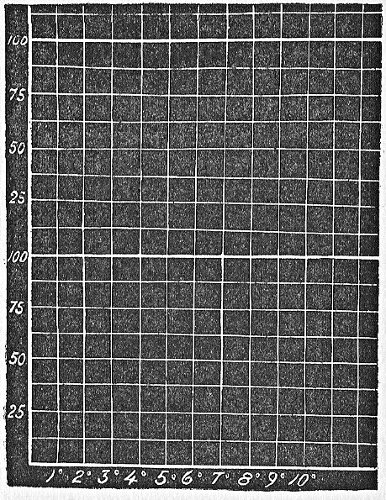
In such a table, the graphic
sign indicating the changes in
weight ought to fall rapidly and rise again to the point of departure
by the seventh day, if the child is robust.
Another law of growth which may serve as a prognostic document
in the child's physiological history is the following:
2. "Children nourished at their mother's breast double their
weight at the fifth month and triple it at the twelfth." In other
words, before the middle of its first year a healthy child, normally
nourished, will have doubled its weight.
On the contrary, "Artificial feeding retards this doubling of
weight in children, which is attained only by the end of the first
year; so that the weight is not tripled until some time in the course
of the second year."
And this gives us pretty safe principles on which to judge of the
personality in the course of formation, at an epoch when stature
does not yet exist.
Undoubtedly a great moral and social progress would be accomplished
through a wide dissemination of very simple and economical
carnets maternels; which should contain not only tables designed
to facilitate the keeping of the required records, but also a statement
of the laws of infant hygiene; or at least, simple and clear
explanations of the significance of such phenomena, in relation to
the life and health of the child; and also as to the causes which
produce weakness in new-born children; or in other words, advice
regarding the fundamental laws of the hygiene of generation.
All that would be needed, in such case, would be a progressive
exposition by means of the carnets, through lessons made as
simple and as objective as possible, such as the weighing of small
babies, to make the much desired "education of the mothers"
both possible and practical.
But without this practical means; without this new sort of
syllabarium on hand, to serve as a constant and luminous guide
for married women, I do not believe that we shall have much
success with the scattered lectures, obscure and soon forgotten,
that at present are being multiplied in an attempt to reach the
mothers of the lower classes.
In conclusion, I note this last contribution that comes to us
from the pediatrists:
3. "There are certain maladies that cause a daily and very
notable loss in weight"; they are the intestinal maladies; there
may be an average loss of from 180 to 200 grams a day; but even
in cases of simple loss of appetite (dyspepsia) the weight may
decrease by about 35 grams a day. But when a child suffering
from acute febrile intestinal trouble (cholera infantum), loses a
tenth of his weight in twenty-four hours, the illness is mortal.
Now from the point of view of the educator this fact ought to
be of serious interest, because we very frequently find among the
recorded details of sickly children, or those suffering from arrested
or retarded development, a mention of some intestinal malady
incurred in early infancy.
Still one further observation: Meunier has noted a fact of
extreme importance: that while children are passing through the
period of incubation of an infectious disease, and before they show
any symptoms likely to cause a suspicion of the latent illness, they
sustain a daily loss in weight, from the fourth or fifth day after
exposure to contagion until the appearance of decisive symptoms.
In children between one and four years old, the daily loss is about
fifty grams, and the total about 300; but such a loss may rise as
high as 700 gr. The most numerous observations were taken in
cases of measles.
Now, there is no need of explaining the prophylactic importance
of observations such as these! A child who for a period of
twenty days is in a state of incubation, is called upon to struggle,
with all the forces of immunity that his organism possesses, against
a cause of disease which has already invaded him; yet no external
sign betrays this state of physical conflict. Consequently, the
child's organism continues to sustain the customary loss of energy
due to the activities of its daily life, and by doing so lessens its
own powers of immunity. To prescribe rest, if nothing more,
for a child suspected of passing through the period of incubation
would in many cases mean the saving of a life, and at the same
time would protect his companions from infection, which is communicable
even during the period of incubation.
In our biographic records of defective children, which include
the great majority of the weakly ones, we find in many cases a
characteristic tendency to relapses in all kinds of infective diseases,
from which they regularly recovered. Such organisms, feeble
by predisposition, yet sufficiently strong to recover from a long
series of illnesses, were exhausted in respect to those biological forces
on which the normal growth of the individual depends, by this sort
of internal struggle between the organic tissues and the invading
microbes. No scheme of special hygiene for children of this type
can help us, either in the home or at school; the daily variations
in weight, on the contrary, might constitute a valuable guide for
the protection of such feeble organisms; at the first signs of a diminution
in weight, such children ought to be subjected to absolute
repose.
The use of the weighing-machine, both at home and in school
cannot be too strongly recommended. In America the pedagogic
custom has already been established of recording the weight of
the pupils regularly once a month; but instead of once a month,
the weight ought to be taken every day. The children might be
taught to take their own weight by means of self-registering scales,
and to compare it with that of the preceding day, thus learning
to keep watch of themselves: and this would constitute both a
physical exercise and an exercise in practical living.
The weight may be considered by itself, as a measurement of
the body; and it may be considered in its relation to comparative
mean measurements given by the authorities; just as it may also
be considered, in the case of the individual, in its relation to the
stature.
a. The weight, taken by itself, is not a homogeneous or rigorously
scientific measurement. In the same manner as the stature,
it represents a sum of parts differing from one another, the difference
in this instance being that of specific gravity. As a matter
of fact, it makes a great difference whether a large proportion of
the weight of an individual is adipose tissue, or brain, or striped
muscles. Each of the various organs has its own special specific
gravity, as appears from the following table:
| Specific Gravity |
| Tubular bones |
1.93 |
| Spongy bones |
1.24 |
| Cartilage |
1.10 |
| Muscles |
from |
1.10 |
| to |
1.30 |
| Tendons |
1.16 |
| Epidermis |
from |
1.10 |
| to |
1.19 |
| Hair |
from |
1.28 |
| to |
1.34 |
| Liver |
1.07 |
| Kidneys |
1.04 |
| Brain |
1.039 |
| Cerebrum |
1.036 |
| Cerebellum |
1.032 |
| Adipose tissue |
0.97 |
All these specific gravities are low; we weigh but little more
than water; and for that reason it is easy for us to swim. But
because of the difference in their composition, the total weight of
the body gives us no idea of its constituent parts.
Take for example the question of increase in weight. We can
compare the mean figures given by the authorities with the ascertained
weight of some particular child of a given age, so as to keep
an empirical check upon the normality of its growth. But since
we know that an individual in the course of evolution undergoes
profound alterations in the volumetric proportions of the different
organs in respect to one another, we cannot obtain from the total
weight any light upon this extremely important alteration in proportions.
Thus, for example, Quétélet gives the following figures
of increase in weight for the two sexes:
| Weight |
Weight |
| Age |
Males |
Females |
Age |
Males |
Females |
| 0 |
3.20 |
2.91 |
15 |
46.41 |
41.30 |
| 1 |
10.0 |
9.30 |
16 |
53.39 |
44.44 |
| 2 |
12.0 |
11.40 |
17 |
57.40 |
49.08 |
| 3 |
13.21 |
12.45 |
18 |
61.26 |
53.10 |
| 4 |
15.07 |
14.18 |
19 |
63.32 |
— |
| 5 |
16.70 |
15.50 |
20 |
65.0 |
54.46 |
| 6 |
18.04 |
16.74 |
— |
— |
— |
| 7 |
20.16 |
18.45 |
25 |
68.29 |
55.08 |
| 8 |
22.26 |
19.82 |
30 |
68.90 |
55.14 |
| 9 |
24.09 |
22.44 |
40 |
68.81 |
56.65 |
| 10 |
26.12 |
24.24 |
50 |
67.45 |
58.45 |
| 11 |
27.85 |
26.25 |
60 |
65.50 |
56.73 |
| 12 |
31.0 |
30.54 |
70 |
63.03 |
53.72 |
| 13 |
35.32 |
34.65 |
80 |
61.22 |
51.52 |
| 14 |
40.50 |
38.10 |
— |
— |
— |
INCREASE IN WEIGHT OF BODY
According To Sutils
| Age |
Weight of body in grams |
Increase |
| At birth |
3000 |
— |
| 1 month |
3750 |
750 |
| 2 months |
4450 |
700 |
| 3 months |
5100 |
650 |
| 4 months |
5700 |
600 |
| 5 months |
6250 |
550 |
| 6 months |
6750 |
500 |
| 7 months |
7200 |
450 |
| 8 months |
7600 |
400 |
| 9 months |
8000 |
400 |
| 10 months |
8350 |
350 |
| 11 months |
8700 |
350 |
| 12 months |
9000 |
300 |
But these figures give no idea of the laws of growth that govern
each separate organ, and that have been studied by Vierordt. According
to this authority, the total weight of the body increases
nineteen-fold from birth to complete development. Certain ductless
glands, on the contrary, diminish in weight in the course of
growth; the thymus, for instance, is reduced to half what it weighed
originally.
Furthermore, the various organs all differ in such varying degrees,
as compared with their respective weights at birth, that it
facilitates comparison to reduce the weight of each separate organ
to a scale of 1. On this basis we find that when complete development
is attained, the eyes weigh 1.7; the brain 3.7; the medulla
oblongata (spinal marrow) 7; the liver 13; the heart 15; the spleen
18; the intestines, stomach and lungs 20; the skeleton 26; the
system of striped muscles 48.
And these widely different augmentations are not uniform in
their progress, nor is the complete development of each organ attained
at the same epoch. As a matter of fact, the brain acquires
one-half its final weight at the end of the first year of age; the
organs of vegetative life attain half their weight at the beginning
of the period preceding puberty (eleventh year). To offset the
lack of indications regarding such increases in weight, we have a
guide in the morphology of growth, which reveals how differently
the various parts of the body develop.
However empirical it may be from an analytical point of view,
the datum of weight is a valuable index, and represents, taken by
itself, a synthetic anthropological measure of prime importance.
It obeys certain laws of growth which are themselves of great
interest; namely, there exist two periods of rapid growth: at birth
and during puberty; while at various periods in childhood, between
the ages of three and nine, there are alternations of greater and
lesser growth analogous to those already noted in relation to
stature.
Accordingly, the weight confirms the fact that the organism does
not proceed uniformly in its evolution, but passes through crises
of development during which the forces of the organism are all devoted
to its rapid transformation; such periods represent epochs
at which the organism is more predisposed to maladies, more subject
to mortality and less capable of performing work (compare
the observations already made in relation to stature).
Index of Weight.—Accordingly, weight and stature stand in a
certain mutual relationship, but the correspondence between
them is not perfect. In the study of individual physiological development
it is necessary to know the anthropological relation between
weight and stature; in other words, the ponderal index.
Without this, we cannot get a true idea of the weight of an individual.
For instance, if two persons have the same weight, 65
kilograms for example, and one of them has a stature of 1.85 metres
and the other of 1.55 m.; it is evident that the first of these two
will be very thin, because his weight is insufficient, while the second,
on the contrary, will have an excessive weight.
A stout, robust child will weigh less, in an absolute sense, than
an adult man who is extremely thin and emaciated; but relatively
to the mass of his body, he will weigh more. Now this relative
weight or index of weight, the ponderal index, gives us precisely
this idea of relative embonpoint, of the more or less flourishing
state of nutrition that any given individual is enjoying. Hence it
is a relation of great physiological importance, especially when we
are dealing with children.
The calculation of the ponderal index ought to be analogous to
that of other indexes; what has to be found is its relation to the
stature reduced to a scale of 100. In this case, however, we find
ourselves facing a mathematical difficulty, because volumetric measurements
are not comparable to linear measurements. Consequently
it is necessary to reduce the measurement of weight by
extracting its cube root, and to establish the following equation:
St:∛(W) = 100:X
whence
Pi = 100(∛(W))/S
The application of this formula necessitates a troublesomely
complicated calculation, which it would be impracticable to work
out in the case of a large number of subjects. But as it happens,
tables of calculations in relation to the ponderal index already exist,
thanks to the labours of Livi[35] and it remains only to consult
them, as one would a table of logarithms, by finding the figure corresponding
to the required stature, as indicated above in the horizontal
line, and the weight as indicated in the vertical column.
Some authors have thought that they were greatly simplifying
the relation between weight and stature by calculating the proportional
weight of a single centimetre of stature and assuming
that they had thus reduced the relation itself to a ratio based
upon a single linear measurement (one centimetre), analogous to
the ratio established by the reduction of the total stature to a scale
of 100. But evidently such a calculation is based upon two fundamental
errors, namely: first, no comparison is ever possible between
a linear measure and a measure of volume; and secondly, the
relation which we are trying to determine is that between synthetic
measurements, i.e., measurements of the whole, and not of parts.
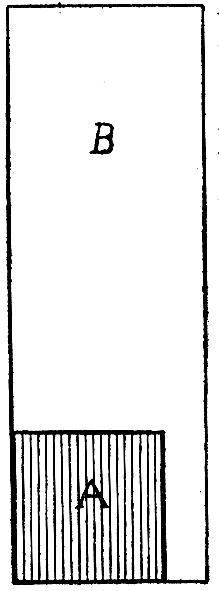
In the aforesaid method of computing (which is accepted by
such weighty authorities as Godin and Niceforo), the number
expressing the weight in grams is divided by the stature
expressed in centimetres, and the quotient gives the
average weight of one centimetre of stature
expressed in grams. This method, which sounds
plausible, may easily be proved to be fallacious, by
the following illustration, given by Livi in his
treatise already cited (Fig. 37). The two rectangles
A and B represent longitudinal sections of two cylinders,
which are supposed to represent respectively
(in A) the body of a child so fat that he is as broad
as he is long (the rectangle A is very nearly square),
and (in B) that of a man of tall stature and so extremely
thin that he very slightly surpasses the child
in the dimensions of width and thickness (note the
length and narrowness of rectangle B). Evidently
the ponderal index of A is very high and that of B is very low.
But if we calculate the proportional weight of one centimetre of
stature, it will always be greater in the man than in the child,
and consequently we obtain a relation contrary to that of the
ponderal index.
Let us make still another counterproof by means of figures; let
us take an adult with a stature of 1.70 metres and a weight of 19
kilograms; and a three-year-old child 0.90 m. tall and weighing 55
kg. (the normal weight of a child of four). In the case of the adult
one centimetre of stature will weigh 65000/170 grams = 382 grams;
while one centimetre of the child's height will weigh 15000/90 = 166
grams. In other words, one average centimetre of the child's stature
weighs less than one centimetre of the adult, as it naturally
should, while the ponderal index on the contrary is 23.6 in the case
of the adult, and 27.4 in that of the child.
The reciprocal relations between stature and weight vary from
year to year. In babyhood, the child is so plump that the fat forms
the familiar dimpled "chubbiness," and Bichat's adipose "fat-pads"
give the characteristic rotundity to the childish face; while the adult
is much more slender. A new-born syphilitic child which, with a
normal length of 50 centimetres, weighed only two kg.—and
consequently would be extremely thin—would have the same
identical ponderal index as an adult who, with a stature of 1.65
m., weighed 100 kg.
The evolution of the ponderal index forms a very essential part
in the transformations of growth; and it shows interesting characteristics
in relation to the different epochs in the life of the individual.
In this connection, Livi gives the following figures, for males
and for females; from which it appears that at some periods of
life we are stouter, and at others more slender; and that men and
women do not have the same proportional relation between mass
and stature.
| Indices |
Indices |
| Age in years |
Males |
Females |
Age in years |
Males |
Females |
| 0 |
29.7 |
29.6 |
15 |
23.1 |
23.4 |
| 1 |
30.9 |
30.5 |
16 |
23.4 |
23.6 |
| 2 |
28.7 |
28.9 |
17 |
23.1 |
23.7 |
| 3 |
27.5 |
27.3 |
18 |
23.2 |
24.1 |
| 4 |
26.5 |
26.6 |
19 |
23.4 |
24.1 |
| 5 |
25.8 |
25.6 |
20 |
23.5 |
24.1 |
| 6 |
25.1 |
24.8 |
— |
— |
— |
| 7 |
24.4 |
24.1 |
25 |
23.7 |
24.1 |
| 8 |
24.0 |
23.8 |
30 |
23.8 |
24.1 |
| 9 |
23.5 |
23.5 |
40 |
23.9 |
24.7 |
| 10 |
23.1 |
23.2 |
50 |
24.3 |
25.3 |
| 11 |
22.8 |
23.3 |
60 |
24.6 |
25.3 |
| 12 |
23.1 |
23.6 |
70 |
24.5 |
24.9 |
| 13 |
23.4 |
23.5 |
80 |
24.4 |
24.7 |
| 14 |
23.1 |
23.3 |
— |
— |
— |
It may be said in general, so far as regards the age, that the
following is the established law of individual evolution: during the
first year the ponderal index increases, after which it diminishes
up to the period immediately preceding puberty (eleventh year
for males, tenth year for females), the period at which boys and
girls are exceedingly slender. After this, throughout the entire
period of puberty, the ponderal index seems to remain remarkably
constant, oscillating around a fixed figure. At the close of this period
(seventeenth year for males, fourteenth for females), the ponderal
index resumes its upward course (corresponding to the period
in which the transverse dimensions of the skeleton increase, and
in which the individual, as the phrase goes, fills out), and it continues
to rise well into mature life (the individual takes on flesh);
until in old age, the ponderal index begins to fall again (the soft
tissues shrink, the cartilages ossify, the whole person is shrunken
and wasted.)
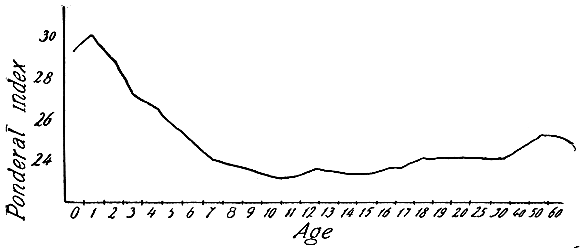
Women, during their younger years are on a par with men in
respect to the ponderal index, but in later life surpass them, because
of woman's greater tendency toward embonpoint, since she
is naturally stouter and plumper than man, who is correspondingly
leaner and more wiry.
The following diagram indicates the progressive evolution and
involution of the ponderal index throughout the successive stages
of life:
The ponderal index has revealed certain physiological conditions
in pupils that are extremely interesting. Some authors had
already noted that the ponderal index was higher in well-nourished
children (Binet, Niceforo, Montessori); but last year one of my
own students, Signorina Massa, in a noteworthy study of children,
all taken from the same social class and quite poor, and who did
not attend the school refectory or have the advantage of any other
physiological assistance, established the fact that the more studious
children, the prize winners, have a lower ponderal index and a muscular
force inferior to that of the non-studious (negligent) pupils.
That the development of the ponderal index stands in some relation
to the muscular force, might already have been deduced
from the fact that the greatest increase of weight is due, in the evolution
of the individual, to the system of striped muscles. Studious
children, accordingly, are sufferers from denutrition through
cerebral consumption; furthermore, they are weakened throughout
their whole organism; in fact, I discovered, in the course of researches
made among the pupils in the elementary schools of
Rome, that the studious children, those who received prizes, had a
scantier chest measurement than the non-studious. This goes to
prove that school prizes are given at the cost of a useless holocaust
of the physiological forces of the younger generations!
That the ponderal index has an eminently physiological significance,
is further shown by the following comparative figures
between normal and weak-minded children. The stature, which is
biologically significant, is lower in the weak-minded; but their ponderal
index is greater when they are well fed, as in the asylums in
Paris.
Accordingly, the sole cause of the physical inferiority of studious
children is study, cerebral fatigue.
BIO-PHYSIOLOGICAL DIFFERENCES BETWEEN NORMAL AND
WEAK-MINDED CHILDREN
(Simon and Montessori: Based on Children from 9 to 11)
| Age |
Weight in kilograms |
Average stature |
Ponderal index |
| Weak-minded |
Normal |
Weak-minded |
Normal |
Weak-minded |
Normal |
| 9 |
21.0 |
25.5 |
1.15 |
1.24 |
24 |
23.9 |
| 10 |
26.5 |
28.5 |
1.25 |
1.30 |
24 |
23.6 |
| 11 |
27.0 |
30.5 |
1.25 |
1.33 |
24 |
23.6 |
It should be noted that in the foregoing table the normal children
include both the studious and the non-studious.