211]
The notes on the origin, customs and character
of the Pawnees, which follow, have been gathered
during twenty years’ acquaintance with this
people. They are what they profess to be; not
a history of the people, but a series of notes
bearing on their mode of life in the old wild days,
an attempt to give some clues to their habits of
thought, and thus to indicate the character of the
people. Such notes may be of use to some future
historian who shall have the time and the inclination
to trace out more fully the history of the Pawnees,
and to tell, as it ought to be told, the story of a
people who once were great. I could wish that it
might be my privilege to undertake this congenial
task, but the constantly increasing pressure of other
duties forbids me to hope that I shall be able to do
212]
so. I feel satisfaction, however, in being able to
record the observations here set down.
In the collection of this material I had for years
the assistance and coöperation of the late Major
Frank North, who always placed at my disposal
his great store of Pawnee lore. Luther H. North,
his brother, has given me a vast deal of assistance,
and last spring accompanied me to the Pawnee
reservation. Without his aid this book would
never have been written. Mr. John B. Dunbar
has been most kind in reading over the chapter
on the Pawnees, and has aided me with many suggestions,
besides giving me help on certain linguistic
points.
Nothing is said in this volume about the Pawnee
language—a subject which is sufficiently important
to deserve a volume by itself.
To every intelligent student of North American
aborigines it must be a matter of keen regret that
nothing is known of the language of this people.
That a distinct linguistic stock like the Pawnee
should pass away unrecorded would be a serious
misfortune, and the Bureau of Ethnology of the
Smithsonian Institution ought certainly to take some
steps to preserve a record of the Pawnee language.
213]
Major Frank North was undoubtedly more conversant
with the spoken Pawnee tongue than any
other white man has ever been. Since his death,
there is no one who is so familiar with the language
as Mr. John B. Dunbar, who has devoted much time
to its study, and has made himself acquainted not
only with its vocabulary, but also with its grammar.
Born and reared among the Pawnees, familiar with
them until early manhood, a frequent visitor to
the tribe in later years, he is well fitted by interest
and association to undertake the task of recording in
permanent form the unwritten speech of this people.
Add to this a long training as a student of language
and history and a keen logical mind, and we have
in Mr. Dunbar the man more than all others best
fitted to undertake this difficult but most delightful
task. The Director of the Bureau of Ethnology
could not easily perform a greater service to aboriginal
linguistics than to intrust to Mr. Dunbar the
labor of preparing an extended work on the Pawnee
language.
215]
UNTIL within a few years the home of the
Pawnees was in southern Nebraska and
northern Kansas. This group of tribes may be
called the main stock of the family; from them it
took its name; they are its best and longest known
members. In the earlier accounts of this people,
the Pawnee Picts or Wichitas are often confounded
with their more northern relatives.
The Pawnees proper consisted at one time of three
bands or tribes, federated under a single head chief.
These bands, in the order of their importance, were:
The Chau-i, the Kit-ke-hahk´-i and the Pita-hau-erat.
To these three was subsequently added—after the
northern migration of the tribes, and their settlement
in northern Kansas and Nebraska, but probably
216]
long anterior to the advent of the whites, and by
conquest—the large, powerful and intelligent allied
tribe, known as the Skidi or Pawnee Loups. These
four have always been known in the writings of the
earlier explorers in the West as respectively the
Grand, the Republican, the Tapage and the Wolf
Pawnees, and they constituted the Pawnee Nation.
The three tribes first named have always been
together, and their Pawnee names, according to
Major North, denoted the relative situations of the
three villages. Thus Kit-ke-hahk´-i means “on a
hill;” Chau-i, “in the middle;” Pita-hau-erat, “down
the stream,” or east; and in the olden times these
were the relative positions of the different villages
when the three bands were camping together. The
Kit-ke-hahk´-i village was always the westernmost of
the three, the Chau-i were next to them, and the
Pita-hau-erat were furthest east. After the incorporation
of the Skidi with the Pawnees, the village
of that tribe was always placed furthest to the west,
and it was spoken of as the Upper Village, while
the other bands were termed the Lower Village
Tribes.
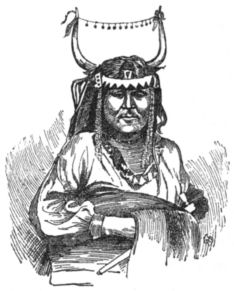
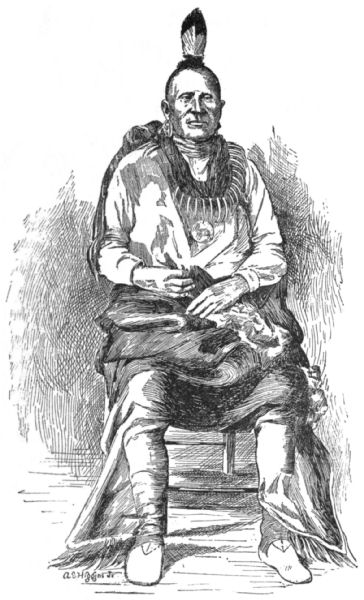
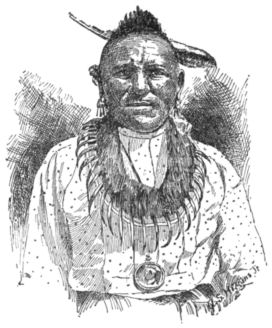
GOOD CHIEF—KIT-KE-HAHK´-I.
Of the three original bands, the Chau-i has always
been first in importance, and the head chief has been
218]
chosen from it. The Kit-ke-hahk´-i band in numbers,
importance and intelligence appear to rank
about with the Chau-i, while, on the other hand, the
Pita-hau-erat are regarded as less intelligent, responsible
and worthy than the other bands.
The Skidi are usually looked upon as more intelligent
than the Pawnees, and also as fiercer in their
nature, and as making better soldiers. The Skidi
traditions, though such testimony, of course, is not
of much value, speak rather contemptuously of the
prowess of the other bands in war, and the superiority
of the Skidi is grudgingly acknowledged by the
others. This is contrary to the view held by Mr. J. B.
Dunbar, who speaks of the Skidi as more intelligent
than the other bands, but as not being so good
as warriors.
Besides this main group of tribes, the members of
the Pawnee family, as given by Mr. Dunbar, are the
Arickaras, known also as the Arickarees, Ricarees or
Rees, the Caddos, the Huecos or Wacos, the
Keechies, the Tawaconies, and the Wichitas or Pawnee
Picts. To these may be added with some confidence
the Tonkaways and the Lipans. The Caddos,
Huecos, Keechies and Tawaconies are regarded
by the Pawnees as closely connected with the
219]
Wichitas. They had but one name, Kiri-ku´ruks, for
all these tribes, and knew no distinction between
them. There is no doubt that the Arickaras were
recently—perhaps within a century—either a band
of the Skidi tribe, or at least allied to them as
closely as the Chau-i have always been to the Kit-ke-hahk´-i
and the Pita-hau-erat. The relationship of
the Tonkaways and the Lipans has only recently
been discovered, and has come to light through the
removal of the Pawnees from their home in Nebraska
to their present reservation in the Indian Territory.
In a note appended to his article on the Pawnees,
published in the Magazine of American History for
November, 1880, Mr. Dunbar says, “A friend, who
has had much experience with the Indians of the
Southwest, informs me that he is inclined to believe
that the Lipans of Mexico are of Pawnee stock.
They have, in times past, exchanged frequent hospitalities
with the Wichitas, or Pawnee Picts, and the
two understand each other’s dialects readily. The
name Lipans he explains as li’panis, that is, the
Pawnees.” While this suggestion is very interesting,
so far as it goes, it scarcely furnishes sufficient
ground on which to base a genetic connection of the
Lipans with the Pawnee family. I have recently
220]
secured additional and more satisfactory evidence of
such a connection.
It is generally believed by the Pawnees, especially
by those who are most intelligent, and have had
most intercourse with the southern tribes, that the
Lipans are allied to them, and that this relationship
is traceable through the Wichitas and the Tonkaways.
The evidence consists of (1) statements by the
Wichitas and Tonkaways, (2) an alleged similarity of
language and personal names, and (3) a similarity in
the songs of the tribes. A Pawnee Indian, who has
lived for seven seasons with the Wichitas, gave me
the following story which he had gathered from that
people. They say that long ago they did not know
the Tonkaways, but that when the tribes met they
found that they could understand each other’s speech.
Their languages were not the same, but they were
not more unlike than were the tongues spoken by the
Skidi and the three other Pawnee bands long ago;
in other words, they were dialects of the same
language. After that meeting, the Tonkaways and
the Wichitas lived together for a time. But the
Tonkaways had bad ways. They would eat human
flesh. When they could find a Wichita boy out away
from the camp, they would capture him, and strangle
221]
and eat him. Sometimes they would kill a man of
the Wichitas, if they could catch him away off on the
prairie. Therefore the Wichitas drove the Tonkaways
off south, and soon afterward moved up across
the Arkansas River, and into southern Kansas.
Since then the Wichitas and the Tonkaways have
never lived together. A Tonkaway chief named
Charlie told Ralph J. Weeks, an educated Pawnee,
“I have heard that my people are Pawnees, but that
we separated long ago.” I am informed that the
personal names of the Tonkaways are the same as
those of the Pawnees, and are readily comprehended
by the latter. Ralph Weeks, while in a Tonkaway
lodge, heard a man call out to a girl, addressing her
as Tsi-sah-ru-rah-ka´-ri-ku, which means “Woman
Chief’s House.” Ralph inquired about this name,
and found that it was the same in sound as Pawnee,
and had the same meaning. The Tonkaways say
that some of the Pawnee words are the same as
those used by their relations to the south, the Lipans
and others. The songs of the Tonkaways are the
same as those of the Pawnees, and the latter at once
recognize them. The old songs of the Lipans are
the same as those of the Pawnees, according to both
Pawnee and Tonkaway testimony. Finally, the
222]
Tonkaways and Lipans claim close relationship.
They speak different dialects of the same language.
The Pawnees, however, say that they never knew
of the existence of the Tonkaways until they came
down into the Indian Territory, and, of course, never
met them until after that time. Neither did they
know the Caddos. As the Pawnees knew nothing of
the Caddos and Tonkaways, so the Wichitas knew
nothing of the Arickaras until recently, and were
greatly surprised to learn that far to the north there
was another tribe which spoke their language.
The Wichitas claim that they and the Caddos are
one people. Their languages are said to differ
somewhat, but only dialectically.
The southern members of the Pawnee family
appear always to have lived on excellent terms with
the other wild tribes which inhabited their country.
They were allies of the Kiowas, Comanches, and
Cheyennes, tribes with which the northern Pawnees
were long at war.
223]
The Pawnees came from the south. All the information
bearing on their origin, which has as yet
been secured, points to the conclusion that the
primitive home of this family was in the south.
Although Mr. Dunbar has carefully traced out the
later history of several of the members of this group,
his researches carry us back scarcely further than the
beginning of the present century, and we have no
actual knowledge of the origin and early history of
the Pawnees. Except the Arickaras, none of the
tribes belonging to this family have ever dwelt much
north of the Platte River, and in this we have an
indication of their southern origin. The traditions
of the tribe confirm this suggestion, and Mr. Dunbar
has given other reasons, derived from his study of
this people, which abundantly justify us in regarding
them as migrants from the south.
There are still current among the Pawnees two
traditions as to the region from which they came, but
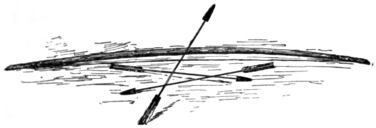
both of these are vague, and so lacking in detail as
to be of little value except as suggestions which
need confirmation before being accepted as having
any solid basis of fact. The first of these traditions,
224]
now half forgotten, is known only to the very oldest
men. It is to the effect that long ago they came
from the far southwest, where they used to live in
stone houses. This might point to an original home
for the Pawnees in Old Mexico, and even suggests a
possible connection with the so-called Pueblo tribes,
who still live in houses made of stone, and entered
from above.
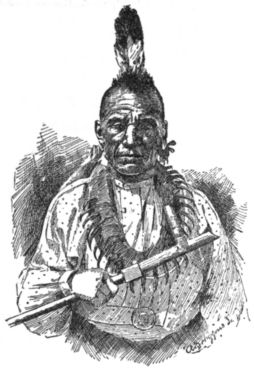
Secret Pipe Chief, a very old Chau-i, the High
Priest of the tribe, gave me the history of their wanderings
in these words: “Long ago,” he said, “very
far back, all of one color were together, but something
mysterious happened so that they came to
speak different languages. They were all together,
and determined that they would separate into different
parties to go and get sinew. They could not
all go in company, there were too many of them.
They were so numerous that when they traveled, the
rocks where their lodge poles dragged were worn
into deep grooves. Then they were far off in the
southwest, and came from beyond two ranges of
mountains. When they scattered out, each party
became a tribe. At that time the Pawnees and the
Wichitas were together. We made that journey, and
went so far east that at last we came to the Missouri
225]
River, and stopped there for a time. When the
season came round, we made out of the shoulder
blade of a buffalo an implement to cultivate the
ground. There we made our fields.”
Another very old man, Bear Chief, a Skidi, said,
“Long ago we were far in the southwest, away
beyond the Rio Grande. We came north, and
settled near the Wichita Mountains. One summer
there we planted our corn. So we came from the
south. After we left the Wichita Mountains, that
summer we came north as far as the Arkansas River,
and made our fields, and raised corn. Afterward we
went to the Mississippi River where the Missouri
runs into it. My father was born while we lived on
the Mississippi.” As Bear Chief must be nearly or
quite eighty years old, it would seem likely that the
Skidi, or some village of that tribe, may have been
established on the Mississippi one hundred years
ago, but this was not a permanent location.
The second of these traditions tells of a migration
from the southeast. It states that the tribe originally
came from somewhere in the southeast, that is
from what is now Missouri or Arkansas. They
started north after sinew—to hunt buffalo—and followed
up the game, until they reached the northern
226]
country—the region of the Republican and the
Platte rivers. They found this a pleasant country,
abounding in game, and they liked it, and remained
there. The Wichitas accompanied them part way on
their journey, but turned aside when they had
reached southern Kansas, and went south again.
All the traditions agree that up to the time of the
journey which brought the Pawnees to their homes
on the Solomon, Republican, Platte and Loup rivers,
the Wichitas were considered a part of the Pawnee
tribe. They agree also that after this separation,
the two divisions of the tribe lost sight of each other
for a very long time, and that each was entirely
ignorant as to what had become of the other. We
know that for a long time they were at war, and the
difference of the dialects spoken by these two
divisions of the family shows that the period of
separation was a long one.
The tradition of the migration of the Pawnees
from the southwest is evidently much older than the
one which tells of their coming from the southeast.
Most of the younger men know the latter; but for
the account of the journey over the mountains from
the southwest and across the Rio Grande, it is necessary
to go to the very old men. It is quite
227]
possible that both stories are founded on fact; and, if
this is the case, the migration from the southeast
may have taken place only a few generations ago.
Such a supposition would in part explain its general
currency at the present time.
In the existing state of our knowledge of this
people, we have no facts to go on, nothing in the
nature of evidence as to their early history, and we
can only speculate as to the probabilities in regard
to their wanderings. It may be conjectured that
the Pawnees came from somewhere in Old Mexico,
and, either as a number of related tribes, or as a
single tribe made up of different bands, they crossed
the mountains and the Rio Grande in a body, and
wandered eastward across what is now Texas. From
this body it seems probable that the ancestors of the
Lipans and the Tonkaways were the first to separate
themselves. The main tribe perhaps gradually drifted
further and further to the east until it had crossed
Texas and reached northwestern Louisiana, and perhaps
even the neighborhood of the Mississippi River.
During this long journey, which must have occupied
many years—perhaps many generations—we may
imagine that the Huecos and possibly the Keechies
dropped behind, and remained on the plains.
228]
How long the Pawnees sojourned in Louisiana
no one can say. They now found themselves in a
country, which in climate, productions, and topography,
differed widely from anything they had before
known. Up to this time, these people had always
inhabited the high, dry tablelands of Mexico, or the
almost equally arid plains of Texas, and now they
had come to a country having a heavy rainfall,
abounding in swamps, and overgrown with deciduous
timber. The traditions of both Skidi and Pawnees
speak of a time when they lived in a country
where grows the cane which the white men use for
fishing poles. We may imagine that this forest country
was a barrier to their further progress eastward,
and that it turned their steps in a new direction.
When the Pawnees left Louisiana, the Caddos certainly,
and perhaps the Keechies and the Tawaconies,
were left behind, and for a very long time lived in
and near what is now Caddo Parish, Louisiana, where
they were at the time of the Louisiana Purchase.
Geographical names in this region indicate that their
residence there was a long one, and Caddo Lake,
Caddo Fork, Caddo Gap and a town named Keatchie,
still bear testimony of the former occupants of
the soil. From there the Caddos moved up to the
229]
Brazos River in Texas. They have always kept up
a close intimacy with the Wichitas.
Perhaps it was during the sojourn of the Pawnees
on the western borders of Louisiana and Arkansas,
though it may have been much earlier, that the
Skidi and the Arickaras, either as a single tribe, or
as already divided into two separate bands, left the
Pawnees and moved north and northwest. There
appears to be reason for supposing that for a while
this section of the tribe lived on the Red River, the
Canadian and the Arkansas, and it is quite certain
that sometimes they went as far east as the banks of
the Mississippi near where St. Louis now is; but
their permanent home, since they have been known
to the whites, was on the Platte and the Loup rivers
in Nebraska.
The Pawnees with the Wichitas moved northwest
into what is now the Indian Territory and southern
Kansas, where they separated, the latter turning off
to the south, and living at various times on the Canadian
and Red rivers and near the Wichita Mountains,
while the Pawnees proper slowly continued
their march northward and westward, residing for a
time on the Arkansas and Solomon, the Republican
and Platte rivers. Here they again met the Skidi.
230]
It is impossible to conjecture when this settlement
in the northern country took place, but it was certainly
long ago. Mr. Dunbar has pointed out that
“O-kŭt-ut and oku´-kat´ signify strictly above and
below (of a stream) respectively. Now their villages
have usually been situated upon the banks of the
Platte, the general course of which is from west to
east. Hence each of these words has acquired a
new meaning, i. e., west and east.” In the same way
Pŭk-tĭs´-tu—toward the Omahas, has come to mean
north; and Ki´ri-ku´ruks-tu—toward the Wichitas, to
mean south. The coining of such words points to a
long sojourn by the Pawnees in the region of the
Platte. It is interesting to note that the Omahas
have never in historic times lived north of the Pawnees,
but always east of them, though we know that
long ago they did live to the north.
These remarks on the movements of the Pawnees
are, to be sure, very largely speculative, but speculation
guided by the hints gathered from conversations
with the older men. It is a surmise as to what
may have been the wanderings of these people. If
it were possible to talk with all the different tribes
of the family, something more definite might be
reached, but at this late day this seems hopeless. A
231]
study of the Lipans, and an investigation of their
relationships with other southwestern tribes, might
furnish us clues of the utmost importance in tracing
the origin of the Pawnee family.
Ranking high among the Pawnee bands, for their
intelligence, energy and courage, stand the Skidi.
Their past history is obscure, and we know little
about it beyond the fact that it was different from
that of the other bands. Although the relationship
between them is perfectly well established, still both
Pawnee and Skidi traditions agree that the two
tribes were originally distinct, and that their first
meeting took place long ago, but after the migration
of the Pawnees to the northern country. We know,
too, that the Arickaras were close neighbors and near
relatives of the Skidi, and it is probable that they
constituted a band, village, or division of that tribe.
It is believed by those who should be well informed,
that the northward migration of the Rees
took place not more than a century ago. One tradition
of the separation runs in this way: The Skidi
started out on a hunt, a part going ahead and the
232]
others following later. The first party were killing
buffalo, when they were attacked by a large war
party of Sioux. These got between the two parties
of the Skidi, driving one of them back to the village,
while the other retreated northward. This retreat
continued until they had been driven some distance
up the Missouri River, where their enemies left them.
They remained there through the winter, and planted
their corn in the spring, nor did they apparently for
some time make any attempt to rejoin their tribe.
After some years, however, the two bands came
together on the Loup, and for a time lived together.
The Rees even went further south, to the neighborhood
of the Wichita Mountains, where the Pawnees
at that time were living, but soon afterward they
went north again, and rejoined the Skidi on the
Loup, and lived near them there, and on the Platte
near Scott’s Bluffs. It was not long, however, before
a disagreement arose between the Rees and the
Skidi, and the Rees again moved off north. It is
probable that this quarrel may have originated in
the fact that the Rees wished to make war on the
whites, but there is some reason to believe that there
was also jealousy about the head chieftainship of the
two bands.
233]
The testimony of men still living indicates that
about one hundred years ago some of the Skidi lived
on the Mississippi River, near the present site of St.
Louis, and it is said that it was only the coming in
of the white settlers in considerable numbers that
caused them to move further westward. I am inclined
to regard this location as only a temporary
one, and to believe that their real home, prior to this,
had been to the west, on the Platte and Loup rivers.
It is, of course, impossible to fix, even approximately,
the time when the Pawnees and the Skidi
came together, but it probably was soon after the
Pawnees had settled on the Republican in their
northward migration. It is said that their first
meeting was friendly, and that they made a treaty,
and smoked together. But no peace between two
such warlike tribes could last very long, and there
were frequent collisions and disagreements. There
was a sharp rivalry between the Chau-i and the
Skidi, and their disputes finally culminated in an unprovoked
attack by the Skidi upon some Pawnees,
while they were hunting buffalo, in which about one
hundred of the latter were killed. The Pawnees
made ready to avenge this injury, and marshaled all
their forces. They made a night march to the
234]
vicinity of the Skidi village, which is said to have
been on the north side of the Loup, distant from
their own only about twenty miles, and just at daylight
sent out about one hundred warriors, all
mounted on dark colored horses, to decoy the Skidi
from the village. These men, lying down on their
horses, and covering themselves with their robes,
represented buffalo, and rode over the hill in sight
of the Skidi village. The ruse was successful. The
Skidi at once started out to kill the buffalo, leaving
their village unprotected. The disguised warriors
fled, leading the Skidi further away, while the Pawnees
who were in reserve rushed into the defenseless
village, and captured it, almost without striking a
blow. They took all the inhabitants back with them
to their own village. The Skidi were forced to sue
for peace; and for their breach of faith were heavily
fined by the victorious Pawnees. They were incorporated
into the tribe, and since that time have lived
as a part of the Pawnee nation. This event was
probably the culminating point of a series of petty
fights and skirmishes, which must have been annoying
to the Pawnees. This fighting went on within
the memory of men now living, though there are but
few who are old enough to remember it.
235]
Curly Chief, who is about 65 years old, can
remember a man who took part in these wars, and
whose name was “The-Skidi-wounded-him-in-the-leg.”
Bear Chief, a very old and decrepit Skidi,
and Secret Pipe Chief, an old Chau-i, have both
told me that they can remember one or more fights
between the Skidi and the other bands.
A rather interesting evidence of the feeling once
existing between the Skidi and the other bands,
and even now surviving among some of the oldest
men, is the statement by Bear Chief that the three
other bands were known as “Big Shields,” the implication
being that as they hid themselves behind
these big shields they were not so brave as those
who used smaller ones. The existence of such a
feeling at the present day indicates that the final
conquest of the Skidi and their incorporation into
the Pawnee tribe took place not very long ago.
Mr. Dunbar sums up the traditions of the meeting
of the tribes, their wars and subsequent union, in
the following language: “The historic basis of this
may be somewhat as follows: In the migration of
the Pawnees from the south, the Skidi preceded the
other bands perhaps by nearly a century. With
them were the Arickaras. These two bands
236]
together possessed themselves of the region of the
Loup. When the other bands arrived they were
regarded as intruders, and hence arose open hostilities.
The result of the struggle was that the two
bands were forced to admit the new comers, and aid
in reducing the surrounding territory. Subsequently
the Arickaras seem to have wandered, or more probably,
to have been driven from the confederacy, and
to have passed up the Missouri. Later the Skidi, in
consequence of some real or fancied provocation,
attempted to retrieve their losses, but were sorely
punished, and henceforth obliged to content themselves
with a subordinate position in the tribe.”
It is said that in the olden time the Skidi were
very powerful. The tribe was made up of four
bands or villages, each of which numbered 5,000
people, or 20,000 for the whole tribe. This estimate,
which is founded merely on the statements of old
men now living, is probably excessive. There is no
doubt, however, that they were a large and powerful
tribe, while their warlike habits and fierce natures
caused them to be feared and hated by all their
neighbors.
The four divisions of the Skidi tribe exist now
only in name, and the origin of these names is
237]
almost forgotten. As the result of much effort and
inquiry, I have secured the following list:
Names of the Skidi Bands.
1. Tuhk-pah-huks-taht—Pumpkin vine village.
This name is said to have come from the fact that
once, after planting time, this band went off on the
summer hunt, and while they were away, the pumpkin
vines grew so luxuriantly that they climbed up
over the lodges, covering and hiding them.
2. Skidi rah´ru—Wolves in the pools (of water).
The name originated in this way: Long ago one
band of the Skidi were camped on the Loup River.
It was winter, and the buffalo came to them in great
numbers. They killed many and prepared great
quantities of dried meat. The buffalo kept coming,
and at length they had so much meat that they had
room for no more. When they could no longer
store dried meat, they stopped taking the flesh of
the buffalo and took only the hides. The buffalo
continued to come and to cross the river just below
the camp, and the men on foot would chase the
buffalo on the ice, where the great animals would
slip and sprawl, so that the Skidi could run up
238]
close, and stab them. They would skin them there
and leave the carcasses on the ice. From far and
near great numbers of wolves gathered to feed on
the carcasses, and as it was toward spring, and the
weather was growing milder, the ice began to melt
on top, and little pools of water stood on it. About
this time, there came to this village a Skidi from
another band who were half starving, for they could
find no buffalo at all. When the man saw that this
village had so much meat, he wondered at the
plenty, and asked how it was. They took him out
from the village down to where the dead buffalo lay
on the ice, and pointed them out to him, and he saw
the wolves standing in the water and feeding on the
carcasses. Then they took him back to the village,
gave him all the dried meat he could carry, and sent
him away to his home, heavily loaded. When he
reached his own village he told the people there
how those in the other camp had plenty, and when
they asked him where it was, he told them, and said
that it was Skidi rah´ru—where the wolves stand in
the pools of water.
3. Tuh-wa-hok´-a-sha—Village on a ridge. Tuh—village,
wa—the central roach on the head of a
man whose hair has been shaved on both sides,
239]
hok´-a-sha—curving over. This village was on a ridge,
reaching over on both sides of it.
4. Tu-hi´ts-pi-yet—Village on a point or peninsula.
Tuh—village, camp, or band; hits-pi-yu—a point.
There are yet to be seen on the Loup Fork, in
Nebraska, innumerable remains of Skidi villages,
some of which are very ancient.
It is probable that the name Pawnee, as Mr. Dunbar
has remarked, is an abbreviated form of the
word pa-ri´-ki, which means a horn, and referred to
the peculiar erect scalp lock which may once have
been worn by this tribe. As Mr. Dunbar says, the
name probably once embraced the Pawnee Picts or
Wichitas, among whom this fashion of wearing the
hair seems to have persisted long after it had been
abandoned by the Pawnees. The same writer gives
the name Arickara as from “ŭr´-ik-i, a horn; with a
verbal or plural suffix, being thus simply a later and
exact equivalent of Pa´-ni itself.”
The name Pawnee Picts, so commonly applied to
the Wichitas, appears to mean Pawnee Picked, or
tattooed Pawnees; and refers to the markings upon
240]
the faces and breasts of these people, which are
picked in with a sharp instrument. The northern
Indians speak of the Pawnees as Pa-na´-na, while
the southern tribes call them Pi-ta´-da, and the Dakotas
call the Arickaras Pa-da´-ni. All these appear
to be merely attempts to reproduce the name by
which the Pawnees call themselves, Pa´-ni.
The English names of the four bands of the Pawnees
are, as has been already stated, for the Skidi,
the Wolf; for the Chau-i, the Grand; for the Kit-ke-hahk´-i,
the Republican, and for the Pita-hau-erat, the
Tapaje, Pawnees.
An old French trader, who has known these
people for many years, states that the Skidi are
called Wolf Pawnees from the river Loup, on which
they lived; that Grand is an abbreviation for Grand-pas,
because the Chau-i were mostly tall men and
took long steps; that the Kit-ke-hahk´-i were called
Republican from the river of that name, and the
Pita-hau-erat Tapaje (Fr. noisy), because they are
noisy and restless, and are continually moving about
from place to place. This explanation of these English
names is not altogether satisfactory. Mr. Dunbar
informs me that he believes that the Chau-i were
called Grand from the appellation given them by the
241]
Spaniards, who called them Los Grandes, referring
to their physical stature.
In the chapter on the Skidi the names of the four
bands of that tribe have been given, and their origin
and derivation. The other tribes were divided into
bands, or gentes, but these divisions have almost
been forgotten. Of the Chau-i there is now said to
be only one band; of the Kit-ke-hahk´-i three; the
Great Kit-ke-hahk´-i, Little Kit-ke-hahk´-i, and Blackhead
Kit-ke-hahk´-i; while of the Pita-hau-erat there
were two bands, the Pita-hau-erat proper and the
Ka-wa-ra´-kish. This last-named division appears to
have had some customs peculiar to itself, and quite
different from anything known to the other Pawnees.
The Pawnees call the Wichitas and the other related
southern tribes Kiri-kur´uks—Bear’s-eyes. The
reason for this appellation is obscure. The only explanation
of it that I have been able to obtain, is that
when the Pawnees first saw the Wichitas they
thought they had eyes like a bear. As Mr. Dunbar
has suggested to me, the allusion may have been to
the ring sometimes painted or tattooed about the
eyes of the Wichitas.
It is generally supposed that an Indian receives
his personal name from some peculiarly memorable
242]
act that he has performed, or from some incident
that has happened to him. This is not now commonly
the case in the tribes with which I am best
acquainted. Personal names formerly originated in
this way among the Indians, but at the present day
I question much if they are often given for such
reasons. Most of the names borne by the warriors
have been long known in the tribe, and I believe the
coining of new names to fit a special set of circumstances
to be now quite unusual. Children were
named soon after they were born, and retained their
childish names until well grown. Ta´-ka—white,
was a common boy’s name, as was Ka-tit—black;
Ki-ri´ki—bright eyes, was often given to little girls.
Nicknames referring to personal peculiarities were
common.
Here is a list which will give some notion of the
general character of the Pawnee names: Lucky
Hawk, Good Fox, Turn-your-robe-hair-out, Chief of
Men, Pipe Chief, Lone Chief, Leader, Brave Chief,
Leading Fox, Still Hawk, Hunting Chief, Yellow
Fox, Charging-the-camp, Angry Chief, Little Warrior,
Good Bear, Eagle Chief, Sun Chief, White
Horse, He-gives-away-many-horses-and-others-ride-them,
Riding-up, Good Sky, Walking Bear, Proud
243]
Eagle, Seven Stars, Sitting Bull, Big Mountain,
Fancy Horse, Fox Chief, Good Sun, Curly Hair,
Blue Hawk, Mad Wolf, White Elk, Young Hawk,
War Chief, Good Chief, Curly Chief, Sitting Eagle,
Running Eagle, Mad Bear, Walking Sun, See-the-eagle-flying,
etc.
Mr. Dunbar states that “the tribal mark of the
Pawnees in their pictographic or historic painting
was the scalp lock dressed to stand nearly erect, or
curving slightly backward something like a horn.” I
have never met a Pawnee who knew of this manner
of dressing the hair in his own tribe, but all unite in
stating that the Wichitas used to wear the lock in
this manner. If this is the case, no doubt in ancient
times it was common to the Pawnees as well, but
with them it has become obsolete, and is now
forgotten.
In books the sign for “Pawnee” is sometimes
given as the forefinger of the right hand held at the
back of the crown of the head, and pointing upward
to represent this erect scalp lock, but I conceive
that this sign is really that of the Pawnee Picts or
Wichitas, who have been so constantly confused
with the true or northern Pawnees.
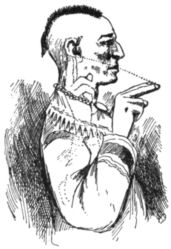
SIGN FOR PAWNEE.
The only sign for “Pawnee” that I have ever seen
244]
employed among Indians in the West is that for
“wolf,” which is the name under which the Pawnees
are, or at least were formerly, known to most other
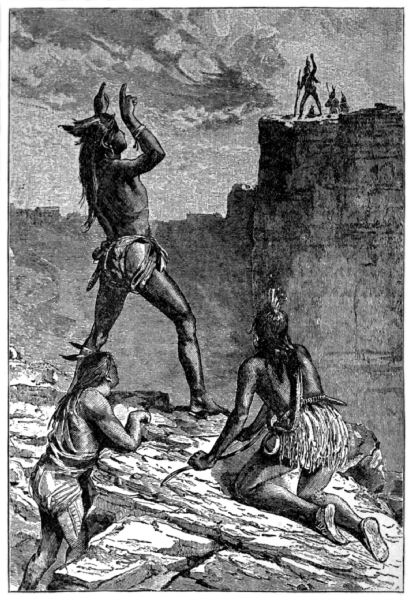
tribes. This sign is made in two ways, (1) by holding
the two hands, palm forward, the first and middle
fingers extended close together upward and a little
forward, thumb and other fingers closed, close to
the head, about opposite the temple; (2) the right
hand alone may be held palm forward at the height
of, and just in front of, the shoulder, the first and
middle fingers extended, separated and pointing
upward, the thumb and others closed; the hand is
then moved forward and downward from the wrist,
245]
so that the extended fingers point almost to the
front. Both these signs represent the pricked ears
of a wolf, and, so far as my experience goes, are
universally understood to mean “Pawnee.” The
one last described is now much the more common of
the two. The first of these signs is shown in the
frontispiece, which is copied from an engraving in
the First Annual Report of the Bureau of Ethnology.
The Pawnees have always been called by their
neighbors to the south “Wolves.” It has been suggested
that this term was applied to them by their
enemies in contempt, but there seems no reason for
believing this to have been the case, since it may be
doubted that an Indian feels contempt for a wolf
any more than he does for a fox, a rabbit, or an elk.
An Indian going into an enemy’s country is often
called a wolf, and the sign for “a scout” is made up
of the signs “wolf” and “look.” The Pawnees
were most adroit scouts, warriors and stealers of
horses; and it seems perfectly natural that they
should have received from the neighboring tribes,
who had such frequent evidences of their skill as
scouts and horse takers, the appellation Wolf. The
Pawnees themselves believe that the term was
applied to them because of their great endurance,
246]
as well as of their skill in imitating wolves so as to
escape detection by the enemy either by day or
night. The Cheyennes, Wichitas and Comanches all
testify that they call the Pawnees Wolves because
they prowl like wolves; because, too, they have the
endurance of wolves, and can travel all day, and
dance all night, and can make long journeys, living
on the carcasses they find on their way, or on no
food at all.
The Pawnees, when they went on the warpath,
were always prepared to simulate wolves. This was
one of their regular practices, and this no doubt was
one reason for their remarkable success in taking
horses, for it enabled them to escape observation
and to reconnoitre at close quarters without danger
of discovery. Wolves on the prairie were too common
to excite remark, and at night they would approach
close to the Indian camps, and often venture
into them. The Pawnee who was disguised as a
wolf could trot up close to the village of his enemy,
see where the horses were tied, and perhaps even
hear what was being said, and lay his plans accordingly.
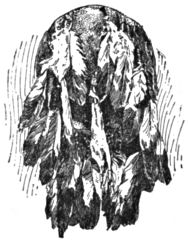
The Pawnee starting off on the warpath
usually carried a robe made of wolf skins, or in
later times a white blanket or a white sheet; and, at
247]
night, wrapping himself in this, and getting down on
his hands and knees, he walked or trotted here and
there like a wolf, having thus transformed himself
into a common object of the landscape. This disguise
was employed by day as well. To escape observation
when traveling in daylight, the Pawnee
war party always chose the ravines and lower ground
to march in. Sometimes, especially in a country
where there was danger of coming unexpectedly on
the enemy, it was important that a reconnoissance
should be made from some commanding point. A
man walking up to the top of a hill might be seen,
and recognized as a suspicious object, a long way
off, but no one would look a second time at a wolf.
While the party remained hidden in some ravine or
hollow, therefore, the man who was to ascend the
hill would put his white robe over him and gallop
to the top on all fours, and would sit there on his
haunches looking all over the country, and any one
at a distance who saw him, would take him for a
wolf. It was acknowledged on all hands that the
Pawnees could imitate wolves best. In one of the
stories already given, an instance is mentioned in
which two Pawnees in the United States service
made use of this device to recover captured animals.
248]
The name “Wolf,” as given to the Pawnees, is
probably merely a translation of the word Skiri´ki,
meaning wolf, from which the name of the Skidi
band may be supposed to be derived. Mr. Dunbar
says: “The emblem probably originated from the
Skidi band. They being in advance of the other
bands in the northern migration, became known to
the tribes about them as wolves; and as the other
bands arrived the sign was naturally made to include
them also, and in this enlarged use was at length accepted
by the Pawnees themselves.”
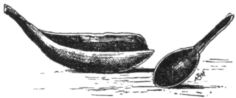
BUFFALO HORN LADLE AND SPOON.
249]
PAWNEE history goes back to a time when the
tribe knew nothing of horses. In those early
days they went on foot, and depended for animal
food on their bows and arrows. At that time their
bows did not differ from those recently in use, but
the heads of their arrows were made of stone, and
their knives were of flint. With this simple equipment
they set out on the hunt.
Choosing a still day, they would surround a small
bunch of buffalo, stretching out in a long line whose
extremities would gradually draw together, as the
hunters, perhaps disguised as wolves, stole from hill
to hill, around the unconscious prey. When the
circle was complete, some one man would shout and
startle the buffalo, and then as they turned to run,
250]
another man would show himself before them, and
call out, and turn them, and whichever way they ran,
some one would appear before them, and turn them
back. The buffalo, becoming each moment more
frightened, would run now this way, now that, and
gradually the Pawnees would close in on them, but
would still keep the buffalo from breaking through
the line by yelling, and by tossing their robes in the
air. As the prey became more and more terror-stricken
and confused, they would run here and
there, and round and round within the ring of men;
and as they grew more tired, the men would close in
on them still more, and first one, and then another,
would shoot an arrow, until at last the arrows were
flying fast, and some of the great beasts were down,
and others were staggering along with the blood
pouring from their mouths; and soon the buffalo
were so worn out that they could run no longer, and
it was an easy matter for the Indians to dispatch
them. Even those which were only slightly wounded
were secured, for it is said that when the animals
were hit by the arrows, even if it were only in the
leg, they would soon swell up and die. This statement
refers to a belief, which I find quite widespread
among plains Indians, that the ancient stone arrow
251]
heads were peculiarly deadly, and possessed this
property, that even a slight touch with them made a
wound which was likely to be fatal. The Blackfeet
Indians have often told me the same thing about the
stone arrow heads which they used in early times.
Game, which inhabited the underbrush or the
forest, was captured by a method similar to that
employed to secure the buffalo. If the Pawnees
discovered that deer or elk were in a piece of timber,
they would surround it, and then alarm the game,
and keep them from breaking through the line of
men. The animals, frightened and confused, would
run round and round in a circle until exhausted,
when the Pawnees would close in, and kill them with
their arrows.
It must be remembered in this connection, that in
those days game animals were enormously abundant
and comparatively tame, and also, that the Pawnees,
from the necessities of their lives, were tremendously
active, very swift runners, and as tireless as the
wolves from which they took their name. Their
endurance was something astonishing. In their long
journeys on the warpath they often traversed on foot
six or eight hundred miles of country, carrying, during
a part of the time, very heavy loads. Instances
252]
are not uncommon where runners have traveled one
hundred miles in twenty-four hours. I myself know
of a case where two men ran over seventy miles in
eleven hours. We may imagine that in the old days
when the Pawnees made all their journeys on foot,
and were thus constantly exercising, their speed and
activity were greater, and their powers of endurance
still more remarkable.
Although their ancient arrows were usually headed
with flint, they sometimes used bone or the sharpened
tine of a deer’s horn. No one now alive can remember
when these were in common use, but there are
men who have heard their fathers and their grandfathers
tell of them, and who say that these arrows
were good for war and for the chase. “You could
drive them through a thick shield,” said Bear Chief.
As soon as they began to trade with the whites,
arrow heads of sheet-iron came into use. They say
that, so long as the Pawnees used flint for making
arrow heads, they used to find plenty of these stones
lying on the prairie, but that when the whites brought
them iron, Ti-ra´-wa said to himself, “The Pawnees
no longer need these flint stones; I will make no
more of them.” This shows an odd confusion of
ideas, for, of course, the reason that they did not
253]
find the stones was that they no longer looked for
them, their use having been abandoned.
Although these stone arrow heads must have
passed out of general use toward the end of the last
century, yet some of them were preserved much
later, and it is possible that there may even now be
some among the Pawnees, hidden away in the sacred
bundles. After they ceased to be used for general
purposes, they took on a sacred character and were
employed to slay the sacrifices; among the Skidi to
kill the captive, and in the Lower Village tribes the
buffalo and deer, for sacrifice. There was a time
when it was deemed essential that the animals to be
sacrificed to Ti-ra´-wa, should be killed by one of
these ancient—and so sacred—arrows.
In the early days the Pawnees did not depend for
food wholly—perhaps not even largely—on the flesh
of the animals which they killed by hunting. They
have always been an agricultural people, cultivating
the ground, and raising corn, beans, pumpkins, and
squashes. They also dug up many edible roots, and
collected and dried various berries and other fruits.
Besides this, they captured birds and smaller mammals
by means of snares and traps. It is said that
before they obtained horses, they killed but few
254]
buffalo, only enough to provide themselves with
clothing and with sinew for sewing, backing bows,
and other uses.
The Pawnees aver that they have cultivated the
corn as far back as they can remember. They say
also that this is their corn, that it is not the corn of
the whites, but is different from it—which is true—and
that they did not get it from the whites. It is their
own. On this they insist strenuously. I have found
it impossible to obtain any clue as to where the corn
came from or how they obtained it. To all inquiries
on this point, they reply that it must have been
“handed down from above;” that it was given them
by “the Ruler.” Various stories are told about it,
but none of them are very pointed or satisfactory.
They call the corn a-ti´ra, “mother.” It has a
sacred character, and plays an important part in many
of their religious ceremonies. This name which they
give it, the mother corn, no doubt refers to the fact
that it nourishes and supports them; that by it they
are made strong. I have also heard it said that it
is called mother because it produces others; it has
young ones like a woman; “you put it in the ground
and it brings forth others.”
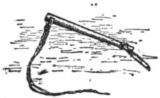
The Pawnees cultivated their fields with hoes
255]
made from the shoulder blade of the buffalo. Taking
the ligament from the back of a buffalo’s neck,
they lashed a stick firmly to the articulation of the
shoulder blade, nearly at right angles to the plane
of the bone and to its length. Then, dipping the
joint into hot water, the ligament would shrink, and
bind the bone and the handle together as firmly as
iron.
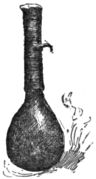
Years ago, on the sites of abandoned Pawnee villages,
on the Loup Fork and on the Platte, fragments
of pottery used to be found among the débris
of the fallen lodges. The manufacture of this pottery
was no doubt abandoned long ago, and has
probably not been practiced to any considerable
extent since they met the whites. A man about fifty
years of age stated to me that he had never seen
these pots in use, but that his grandmother had told
him that in her days they made and used them. He
said that they were accustomed to smooth off the
end of a tree for a mould. A hot fire was then built,
in which stones were roasted, which were afterward
pounded into fine powder or sand. This pounded
stone they mixed with fine clay, and when the material
was of the proper consistency, they smeared
it over the rounded mould, which was perhaps first
256]
well greased with buffalo tallow. After the clay had
been made of even thickness throughout, and smooth
on the outside, they took a small, sharp stone, and
made marks on the outside to ornament it. When
the material was sufficiently dry, they lifted it from
the mould and burned it in the fire, and while it was
baking, “put corn in the pot and stirred it about, and
this made it hard as iron.” This may mean that it
gave the pot a glaze on the inside. In these pots
they boiled food of all kinds. Mr. Dunbar informs
me that these pots were also made in later times
within a frame-work of willow twigs. The clay,
made very stiff, was smeared on this frame, the inside
being repeatedly smoothed with the moistened hand,
and but little attention being given to the appearance
of the outside. After they had been sun-dried, such
pots were baked without removing the frame, which
burned away in the fire, leaving the marks of the
twigs visible on the outside of the pot.
Corn was, and is still, crushed in wooden mortars,
hollowed out by fire, and the pestle is also of wood,
about four feet long, with an enlargement at the
upper end to give added weight.
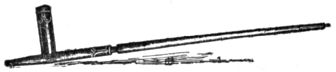
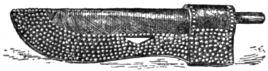
Dishes and bowls were made of wood, or of large
gourds; spoons and ladles were fashioned from the
257]
horns of the buffalo; mats were woven of rushes,
ropes of buffalo hair, and lariats of rawhide.
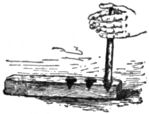
Fire in the early days was obtained by means of
fire sticks, the point of one being twirled on a hollow
in the other, until the charred dust at first smoked
and then ignited. It is said that sometimes it would
take four men to make a fire, one relieving another
as they grew tired. It was hard, slow work, but
sometimes one man, if he was stout, could make a
fire alone. The use of fire sticks on war parties has
continued till within a short time, perhaps within
twenty years.
As their clothing was manufactured wholly from
skins, sewing occupied a considerable part of the
time of the women. This was done by means of a
bone needle—often the metacarpal or metatarsal
bone supporting the accessory hooflets on the deer—and
a thread twisted of sinews. Such sewing was
extremely durable.
The other implements and utensils of the Pawnees
did not differ materially from those of other plains
Indians.
It is a long time since they first began to use
articles and implements manufactured by the whites.
Curly Chief related to me the story of what was
258]
perhaps the first official visits from the whites ever received
by the Pawnees. He said:
“I heard that long ago there was a time when
there were no people in this country except Indians.
After that the people began to hear of men that had
white skins; they had been seen far to the east.
Before I was born they came out to our country and
visited us. The man who came was from the Government.
He wanted to make a treaty with us, and
to give us presents, blankets and guns, and flint and
steel, and knives.
“The Head Chief told him that we needed none
of these things. He said, ‘We have our buffalo
and our corn. These things the Ruler gave to us,
and they are all that we need. See this robe. This
keeps me warm in winter. I need no blanket.’
“The white men had with them some cattle, and
the Pawnee Chief said, ‘Lead out a heifer here on
the prairie.’ They led her out, and the Chief, stepping
up to her, shot her through behind the shoulder
with his arrow, and she fell down and died. Then
the Chief said, ‘Will not my arrow kill? I do not
need your guns.’ Then he took his stone knife and
skinned the heifer, and cut off a piece of fat meat.
When he had done this he said, ‘Why should I take
259]
your knives? The Ruler has given me something to
cut with.’
“Then taking the fire sticks, he kindled a fire to
roast the meat, and while it was cooking, he spoke
again and said, ‘You see, my brother, that the
Ruler has given us all that we need; the buffalo for
food and clothing; the corn to eat with our dried
meat; bows, arrows, knives and hoes; all the implements
which we need for killing meat, or for cultivating
the ground. Now go back to the country
from whence you came. We do not want your presents,
and we do not want you to come into our
country.’
“Afterward, however, a treaty was made. The
first treaties were not to purchase land. The Government
made presents, and bought the right to pass
through the country. Roads were made up the
Republican, the Platte and the Solomon rivers.”
In these hasty remarks upon the ways of the Pawnees,
which are in fact no more than a series of
rough notes supplementary to Mr. Dunbar’s fuller
history of this people, I shall not attempt to give
260]
any general account of their habits. These can be
learned by reference to the papers, so often quoted.
My object is to give a picture of the Pawnee ways
of thought rather than of their material life.
Their government was semi-republican. They
were ruled by a head chief, in later times always the
head chief of the Chau-i band; and this title was
hereditary, but the chief, if he had not the requisite
strength of character, might lose all his influence,
and his position be practically, though not in name,
held by a sub-chief or even warrior of his own or
another band. As has been well said, “The office
itself was hereditary, but authority could be gained
only by acknowledged personal accomplishments.”
Each band was ruled as to its own affairs by four
chiefs—a head chief, second chief, third and fourth
chiefs—but often some warrior who held no office,
and bore no title, might wield more power and influence
than any of these. In minor matters, the chief
gave his orders without consultation with any one,
but more important affairs were usually discussed in
council by chiefs, head men and warriors, and the
opinion of the assemblage prevailed, even if it were
opposed to the opinion of the chief. Among the
Pawnees, as elsewhere, a man’s personal character
261]
determined the position he should occupy and the
influence he should wield. Bravery, wisdom, and
personal popularity were the important factors in
acquiring and retaining influence and authority.
Mr. Dunbar alludes to one matter which is little
understood in general; that is the existence among
the Pawnees of a class of servants. These were for
the most part young men, or boys growing up, who
had not yet acquired any special standing. They
lived in the family of men of position and influence,
from whom they received support, and for whom
they performed many offices, which were almost
menial. The relation which they held to the head
of the family was not altogether unlike that of a
page or a squire to his knight in mediæval times.
These young men drove in and saddled the horses,
made the fires, ran errands, and carried messages
for the leaders whom they followed. The same
menial offices were often performed by other, older
men, who were too lazy and too worthless to make
positions for themselves, and who were willing to
continue to serve for their support. This relation
of servant persisted even among the Pawnee Scouts
after their enlistment, and, while among the privates
in this body all were of course equal in name, it was
262]
yet common, as the camp prepared to start in the
morning, to see the younger men saddling up the
horses, and performing other duties for the chiefs
and the proved warriors, whose military standing
was no higher than those who were serving them.
The dress of the old-time Pawnee male consisted
of a breech clout, leggings, fringed at the side, and
reaching from ankle to thigh, and moccasins. Over
all this, when the weather demanded it, was worn
the buffalo robe, the hair side being turned in. The
dress of the women consisted of a sort of sleeveless
shirt, and a skirt of dressed buffalo cow skin, reaching
to below the knee, with leggings of cloth or
buckskin, laced above the knee, and moccasins.
They also wore the robe or blanket. No head covering
was used, though in war and on great occasions
the men wore bonnets or chaplets of eagle
feathers, and sometimes both men and women wove
wreaths out of cottonwood or willow twigs, with the
green leaves left on, to shade their eyes from the
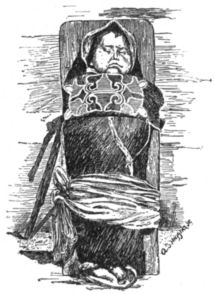
fierce rays of the sun. The children were at first
scantily clad. The boy, after he was released from
his board, went naked, except perhaps for a string
of beads around his neck, until he was ten or twelve
years old, though usually he assumed the breech
263]
clout before that age. Girls were clad in a shirt or
smock almost as soon as they could walk.
At the present time but few of the Pawnees wear
their hair cut in the ancient fashion, but twenty
years ago a large proportion of the older men had
the whole head shaved, except a narrow roach
which ran from the forehead to the back of the
head. This roach, on which the hair was usually
left less than an inch long, was sometimes stiffened
at the sides with grease and paint to make it stand
up well. From this roach the scalp lock fell back in
its natural position. At the present day many of the
men cut their hair short, like the whites. The women
usually wore their hair in two braids, one on each
side, falling behind the ears, and the younger ones
were careful in tending it.
All hair upon the face and on other parts of the
body was usually plucked out, but I have seen a
Pawnee with a heavy beard under his chin.
Paint was freely used in ornamentation, especially
on the face and breast. Black, as is the case with
most tribes, was the color for war. Red, white and
yellow, were used merely for ornament.
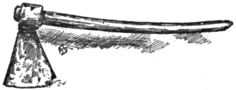
As already indicated, the arms of the Pawnees
were the bow and arrow, the lance, the club, and the
264]
hatchet. The bow was almost invariably made of
the bois d’arc, and was backed with sinew, and had a
string of the same material. The arrows were made
with the greatest labor, care and exactness, and those
manufactured by each individual were so marked
that they could at once be distinguished from those
of every other maker. It is well known that the
arrows of each Indian tribe differed from those of
every other tribe, but besides this, each man’s arrows
bore his private mark. The manufacture of the bow
and arrows was a long, slow process, and after they
had been completed they were carefully guarded and
protected from injury. Although the Pawnees have
long been accustomed to use firearms in war, yet the
use of the bow and arrow in hunting persisted up to
quite recent times, in fact up to the date of the disappearance
of the buffalo. A reason for this is
readily found in the fact that an arrow cost only
time to manufacture, and the Indian has an abundance
of time. For cartridges, or for powder and
lead, he must pay money, or trade some of his possessions.
An arrow, too, may be used over and over
again, and may thus account for many head of game,
whereas a cartridge can be used but once. In their
secret war expeditions, too, the bow was a favorite
265]
weapon, because it was noiseless. An enemy found
at a little distance from his camp, could be stealthily
approached and silently shot down, without necessarily
alarming persons in the neighborhood, when
a rifle shot, ringing over the prairie and echoing
among the bluffs, would call out every warrior in
the village, to learn whence it came. I have been
told, by warriors, that on their war parties, they left
their rifles at home and carried only their bows, so
that they might not be tempted by the sight of an
enemy to fire a shot, which might bring themselves
and their companions into danger.
The Pawnees were superb horsemen and owned
many ponies. I can learn nothing definite as to
when they first obtained these animals, nor from
what source. A tradition exists, that up to the time
of the tribe’s advent into the northern country, their
only beast of burden was the dog, which then carried
their packs and hauled their travois. The story goes
that the Pawnees obtained their first horses soon
after their separation from the Wichitas. The three
bands were traveling north together, when the scouts
who had been sent ahead to overlook the country,
hastened back and announced to the chiefs that they
had discovered a camp of Indians. A council was
266]
at once held to determine whether they should attack
this unknown village as enemies, or should approach
them as friends. The majority declared for
an attack, and it was so decided. Approaching
under cover as near as possible, the horde of dusky
footmen poured over the hills and down into the
valley where stood the doomed village. The attack
was sudden, fierce, and successful. They killed and
captured many of the enemy, and took the camp,
while the survivors fled in hopeless confusion.
Among the plunder taken were a lot of horses;
strange beasts then to the rude Pawnees, and at
which they wondered greatly. A captive woman
explained to the conquerors that these creatures
were good to ride, and useful to pack on. Old men
still tell, with a smile, of the ludicrous first attempts
of the warriors to ride the horses. This occurrence
is said to have taken place on the Smoky Hill River,
in what is now Kansas, and the Indians from whom
the horses were captured, are understood to have
been Cheyennes.
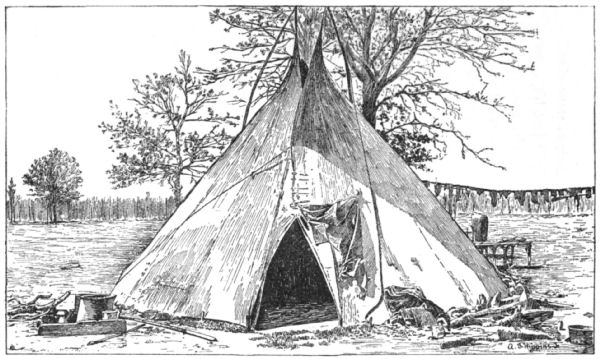
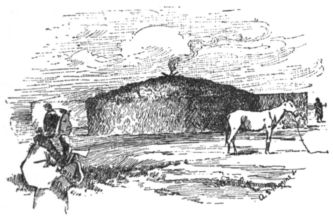
COW SKIN LODGE.
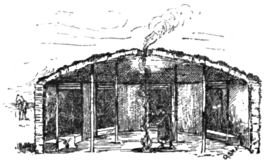
The permanent habitations of the Pawnees were
dirt or sod houses, often of very considerable size.
The remains of the old medicine lodge of the Skidi,
on the Loup, show it to have been two hundred and
268]
ten feet in diameter. The lodges were circular in
form, with walls seven or eight feet high, and the
roof rose from these walls to the apex above the
center of the lodge, where was the hole for the
escape of smoke from the fire, which burned on the
floor below. A covered passageway led to the entrance.
Around the walls the inmates slept, the
beds being partitioned off, and protected in front
as well, by a curtain which might be a skin, or a mat
woven of reeds or coarse grass. The cooking was
all done over the fire in the middle of the lodge.
Possessions were stowed away behind the beds, or
hung up on the posts which supported the roof.
On their hunts or when traveling, the Pawnees
used the ordinary cow skin lodge of the plains
Indians. This was composed of neatly dressed
buffalo hides, from which the hair had been removed,
set up over a frame-work, made up, usually, of sixteen
long slender poles. An opening at the top gave
exit to the smoke; and wings, projecting at either
side of the smoke hole, and so arranged that their
positions could be changed by moving two additional
poles on the outside of the lodge, served to
regulate the draft, and keep the lodge free from
smoke. The inmates slept close to the walls, and
269]
the fire, with the inevitable pot hanging over it,
burned in the middle. These lodges were warm, and
usually dry, and made good shelters. They were
occupied for the greater part of the year, for the
Pawnees, after the spring planting was fairly over,
usually started at once on their summer hunt, from
which they only returned in time to harvest their
crops. At the beginning of winter, when the robes
were at their best, they made the winter hunt, from
which they did not return until toward spring. The
planting over, they set out again on the hunt.
In their personal intercourse with each other, and
with strangers, the Pawnees were kindly and
accommodating. I have had little kindnesses unostentatiously
done me by Pawnee men, such as I
should never expect to receive from white persons
not connected with me by ties of blood. In the village,
the well-to-do gave freely to those who were
poor, and all were very hospitable. They were a
light-hearted, merry race, keenly alive to the ridiculous,
and very fond of a joke. They were great
chatterers, and had about them nothing of the supposed
taciturnity of the Indian. Of modesty or
delicacy in conversation, as we know it, they had
none. Both sexes spoke freely to each other of
270]
matters which are never mentioned in civilized
society, and much of their conversation, as well as
many of their stories, could not well be printed.
It was in the month of July, 1872. The Pawnees
were preparing to start on their semi-annual buffalo
hunt, and only the last religious rites remained to be
performed before the nation should leave the village
for the buffalo range.
“Eh, idadi, whoop,” came from without the lodge;
and as I replied, “Ehya, whoop,” the sturdy figure of
Le-ta-kats-ta´-ka appeared in the doorway.
“Lau, idad, tŭt-tū-ta-rik ti-rah-rēk—Come, brother,
they are going to dance,” he said, and then he turned
and went out.
I rose from the pile of robes on which I had been
dozing, and, after rolling them up, strolled out after
him. The village seemed deserted, but off toward
the medicine lodge, which stood upon its outskirts,
I could see a throng of Indians; and a low murmur
of voices and of footsteps, the hum which always
accompanies any large assemblage, was borne to my
ears on the evening breeze. The ceremonies, which
271]
comprised the consecration of the buffalo staves and
the buffalo dance, were about to begin. The great
dirt lodge was crowded. I pushed my way through
the throng of women and boys, who made up the
outer circle of spectators, and soon found myself
among the men, who made way for me, until I
reached a position from which I could see all that
was going on within the circle about which they
stood.
For several days the priests and the doctors had
been preparing for this solemn religious ceremonial.
They had fasted long; earnest prayers had been
made to Ti-ra´-wa, and sacrifices had been offered.
Now the twelve buffalo skulls had been arranged on
the ground in a half-circle, and near them stood the
chiefs and doctors, reverently holding in their hands
the buffalo staves and sacred bows and arrows, and
other implements of the chase. For a little while
they stood silent, with bowed heads, but presently
one and then another began to murmur their petitions
to A-ti-us Ti-ra´-wa, the Spirit Father. At
first their voices were low and mumbling, but gradually
they became more earnest and lifted their eyes
toward heaven. It was impossible to distinguish
what each one said, but now and then disjointed
272]
sentences reached me. “Father, you are the Ruler—We
are poor—Take pity on us—Send us plenty of
buffalo, plenty of fat cows—Father, we are your
children—help the people—send us plenty of meat,
so that we may be strong, and our bodies may increase
and our flesh grow hard—Father, you see us,
listen.” As they prayed they moved their hands
backward and forward over the implements which
they held, and at length reverently deposited them
on the ground within the line of buffalo skulls, and
then stepped back, still continuing their prayers.
It was a touching sight to witness these men calling
upon their God for help. All of them had passed
middle life, and some were gray-haired, blind and
tottering; but they prayed with a fervor and earnestness
that compelled respect. They threw their souls
into their prayers, and as a son might entreat his
earthly father for some great gift, so they plead with
Ti-ra´-wa. Their bodies quivered with emotion, and
great drops of sweat stood upon their brows. They
were thoroughly sincere.
After the last of the articles had been placed upon
the ground, their voices grew lower and at length
died away. A moment later a drum sounded, and a
dozen or twenty young warriors sprang into the circle
273]
and began the buffalo dance. This was kept up
without intermission for three days, and as soon as
it was over, the tribe moved out of the village on the
hunt.
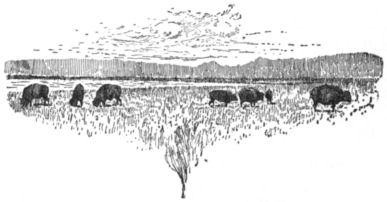
From the village on the Loup, we traveled southward;
for in those days the region between the
Platte and the Smoky rivers swarmed with buffalo.
With the Pawnees were a few Poncas, Omahas and
Otoes, so that there were about four thousand
Indians in the camp. It was the summer hunt of
the tribe. Twice each year the agent permitted
them to visit the buffalo range. The meat which
they killed and dried on these hunts, the corn and
squashes which they grew on their farms, and the small
annuities received from the Government, were all
they had to subsist on from season to season. Thus
the occasion was one of importance to the Indians.
Perhaps only the older heads among them fully
appreciated its economic interest; but for all it was
a holiday time; a temporary escape from confinement.
Life on the reservation was monotonous.
There was nothing to do except to sit in the sun and
smoke, and tell stories of the former glories of the
nation; of successful fights with the Sioux and
Cheyennes, and of horse stealing expeditions, from
274]
which the heroes had returned with great herds of
ponies and much glory. Now, for a little while,
they returned to the old free life of earlier years,
when the land had been all their own, and they had
wandered at will over the broad expanse of the rolling
prairie. Now, for a time, it was as it had been
before the cornfields of the white man had begun to
dot their river bottoms, before the sound of his rifle
had made wild their game, before the locomotive’s
whistle had shrieked through the still, hot summer
air. Half a year’s provision was now to be secured.
The comfort—almost the existence—of the tribe for
the next six months depended on the accumulation
of an abundant supply of dried buffalo meat, and no
precaution was omitted to make the hunt successful.
It would not do to permit each individual to hunt
independently. Indiscriminate buffalo running by
six or eight hundred men scattered over the prairie,
each one working for himself alone, would result in
the killing of some few buffalo, but would terrify and
drive away all the others in the neighborhood. This
matter was too important to be trusted to chance.
The hunting was systematized.
The government of the hunt was intrusted to the
Pawnee soldiers. These were twenty-four warriors
275]
of mature age, not so old as to be unfitted for active
work, yet with the fires of early youth somewhat
tempered by years of experience; men whose judgment
and discretion could at all times be relied on.
These soldiers acted under the chiefs, but the practical
guidance of the hunt was wholly in their hands.
They determined the direction and length of each
day’s march, and the spot for camping. They
selected the young men who should act as scouts,
and arranged all the details of the approach and the
charge when a herd of buffalo was discovered large
enough to call for a general surround. All the men
were under their control, and amenable to their discipline.
They did not hesitate to exercise their
authority, nor to severely punish any one who committed
an act by which the success of the hunt might
be imperilled.
The scouts sent out by the soldiers were chosen
from among the younger men. They acted merely
as spies, their office was to find the buffalo. They
moved rapidly along, far in advance of the marching
column, and from the tops of the highest hills carefully
scanned the country before them in search of
buffalo. If a herd was discerned, they were not to
show themselves, nor in any way to alarm it. Having
276]
found the game, their duty was to observe its movement,
learn where it was likely to be for the next few
hours, and then to report as quickly as possible to
the camp. The soldiers then determined what
action should be taken. If the news was received
late in the day, and the buffalo were at some distance,
the camp would probably be moved as near as
practicable to where the herd was feeding, and the
chase would take place in the early morning. If, on
the other hand, the scouts found the herd in the
morning, the men would start off at once for the
surround, leaving the women to follow, and make
camp as near as possible to where the dead buffalo
lay.
Day after day we traveled southward, crossing the
Platte River, and then the Republican about due
south of the present flourishing town of Kearney.
South of the Platte a few scattering buffalo were
found, but no large herds had been met with—nothing
that called for a surround. At length we
camped one night on the Beaver, a small affluent of
the Republican, emptying into it from the south.
With the gray dawn of morning, the camp, as usual,
is astir. By the time our little party have turned
out of our blankets, some of the Indians have already
277]
finished eating, and are catching up their horses and
preparing to ride off over the bluffs, leaving the
squaws to take down the lodges, pack the ponies,
and pursue the designated line of march. Before
we are ready to “pull out,” most of the ponies have
been packed, and a long, irregular line of Indians is
creeping across the level valley, and beginning to
wind up the face of the bluffs. The procession
moves slowly, proceeding at a walk. Most of those
who remain with the column are on foot, the squaws
leading the ponies, and many of the men, wrapped
in their blankets, and with only their bows and
arrows on their backs, walking briskly over the prairie,
a little to one side. These last are the poorer Indians—those
who have but few horses. They travel
on foot, letting their horses run without burdens, so
that they may be fresh and strong, whenever they
shall be needed for running the buffalo.
Side by side, at the head of the column, walk
eight men who carry the buffalo staves. These are
slender spruce poles, like a short lodge-pole, wrapped
with blue and red cloth, and elaborately ornamented
with bead work, and with the feathers of hawks, and
of the war eagle. These sticks are carried by men
selected by the chiefs and doctors in private council,
278]
and are religiously guarded. Upon the care of these
emblems, and the respect paid to them, depends, in
a great measure, the success of the hunt. While
borne before the moving column, no one is permitted
to cross the line of march in front of them.
Close behind the staff bearers follow a number of
the principal men of the tribe; the head chief, old
Pi´ta Le-shar, and a dozen or fifteen sub-chiefs or
head men, all mounted on superb horses. Behind
them comes the camp at large, a fantastically
mingled multitude, marching without any appearance
of order. Here most of the individuals are
women, young girls and children, for the men who
accompany the camp usually march singly, or by
twos and threes, a little apart from the mob. Most
of those rich enough in horses to be able to ride at
all times, are scattered over the prairie for miles in
every direction, picking up the small bands of buffalo,
which have been passed by the scouts as not
large enough to call for a general surround. The
hunters are careful, however, not to follow too close
upon the advance line, whose movements they can
readily observe upon the bare bluffs far ahead of
them.
At the time of which I am writing, the Pawnees
279]
had no wagons, all their possessions being transported
on pack horses. The Indian pack pony is
apt to be old and sedate, requiring no special
guidance nor control. A strip of rawhide, knotted
about the lower jaw, serves as a bridle, and is either
tied up to the saddle or held in the rider’s hand. In
packing the animals a bundle of lodge-poles is tied
on either side of the saddle, one end projecting forward
toward the horse’s head, the other dragging on
the ground behind. This is the travois. Cross poles
are often tied between these two dragging bundles,
and on these are carried packages of meat and robes.
Often, too, on a robe stretched between them, a sick
or wounded Indian, unable to ride, is transported.
The lodge-poles having been fastened to the saddle,
the lodge is folded up and placed on it between
them, and blankets, robes, and other articles are
piled on top of this, until the horse has on its back
what appears to be about as much as it can carry.
The pack is then lashed firmly in position, and pots,
buckets and other utensils are tied about it wherever
there is room.
On top of the load so arranged one or two women,
or three or four children, clamber and settle themselves
comfortably there, and the old horse is turned
280]
loose. Each rider carries in her hand a whip, with
which she strikes the horse at every step, not cruelly
at all, but just from force of habit. If the pack is
low, so that her feet reach down to the animal’s sides,
she keeps up also a constant drumming on his ribs
with her heels. The old horse pays not the slightest
attention to any of these demonstrations of impatience,
but plods steadily along at a quiet walk, his
eyes half closed and his ears nodding at each step.
If the riders are women, each one holds a child or
two in her arms, or on her back, or perhaps the baby
board is hung over the end of a lodge-pole, and
swings free. If the living load consists of children,
they have in their arms a lot of puppies; for puppies
occupy with relation to the small Indian girls
the place which dolls hold among the white children.
Many of the pack animals are mares with young
colts, and these last, instead of following quietly at
their mothers’ heels, range here and there, sometimes
before and sometimes behind, their dams.
They are thus constantly getting lost in the crowd,
and then they charge backward and forward in wild
affright, neighing shrilly, until they have again found
their proper place in the line of march. Many of
the yearling colts have very small and light packs
281]
tied on their backs, while the two-year-olds are often
ridden by the tiniest of Indian boys, who are now
giving them their first lesson in weight-carrying.
Loose horses of all ages roam about at will, and their
continual cries mingle with the barking of dogs, the
calls of women and the yells of boys, and make an
unceasing noise.
The boys are boiling over with animal spirits, and,
like their civilized brothers of the same age, are continually
running about, chasing each other, wrestling,
shooting arrows and playing games, of which the
familiar stick game seems the favorite.
Whenever the column draws near any cover,
which may shelter game, such as a few bushes in a
ravine, or the fringe of low willows along some little
watercourse, the younger men and boys scatter out
and surround it. They beat it in the most thorough
manner, and any game which it contains is driven
out on the prairie, surrounded and killed. The appearance
even of a jackass rabbit throws the boys
into a fever of excitement, and causes them to shriek
and yell as if in a frenzy.
All the morning I rode with the Indians, either at
the head of the column, chatting as best I could with
Pi´ta Le-shar and other chiefs, or falling back and
282]
riding among the women and children, whom I never
tired of watching. Frequently during the day I saw
at a distance, on the prairie, small bunches of buffalo
in full flight, hotly pursued by dark-skinned riders,
and occasionally two or three men would ride up to
the marching columns with heavy loads of freshly-killed
meat. The quick-heaving, wet flanks of the
ponies told a story of sharp, rapid chases, and their
tossing heads and eager, excited looks showed how
much interest they took in the hunt.
The report of firearms was seldom heard. Most
of the Indians hunted with the primitive weapon of
their forefathers—the bow and arrow. For buffalo
running an arrow is nearly as effective as lead. The
power of the bow in expert hands is tremendous.
Riding within half a dozen yards of the victim’s side,
the practiced bowman will drive the dart so far
through the body of the buffalo that its shaft
may project a foot or more from the opposite side—sometimes
indeed may pass quite through. Besides,
the bow can be used very rapidly and accurately. I
have seen an Indian take a sheaf of six arrows in his
hand, and discharge them at a mark more rapidly
and with more certainty of hitting his target than I
could fire the six barrels of a revolver.
283]
It was nearly noon, and I was riding along at the
head of the column. I had but one horse, and did
not care to wear him out by chasing around over the
prairie, preferring to save him for some great
effort. We were traveling along a smooth divide between
two sets of ravines, which ran off, one to the
east and the other to the west. Pi´ta Le-shar had
just informed me by signs that we should make camp
about two miles further on, by a stream whose course
we could trace from where we then were. Suddenly,
without the slightest warning, the huge dark bodies
of half a dozen buffalo sprang into view, rising out
of a ravine on our left not a hundred yards distant.
When they saw the multitude before them, they
stopped and stared at us.
They were too close for me to resist the temptation
to pursue. As I lifted the reins from my pony’s
neck and bent forward, the little animal sprang into
a sharp gallop toward the game, and as he did so I
saw half a dozen Indians shoot out from the column
and follow me. The buffalo wheeled, and in an instant
were out of sight, but when I reached the edge
of the bank down which they had plunged, I could
see through the cloud of dust, which they left behind
them, their uncouth forms dashing down the ravine.
284]
My nimble pony, as eager for the race as his rider,
hurled himself down the steep pitch, and sped along
the narrow broken bed of the gully. I could feel
that sometimes he would lengthen his stride to leap
wide ditches, where the water from some side ravine
had cut away the ground, but I never knew of these
until they were passed. My eyes were fixed on the
fleeing herd; my ears were intent on the pursuing
horsemen. Close behind me I could hear the quick
pounding of many hoofs, and could feel that one of
the horses, nearer than the rest, was steadily drawing
up to me—but I was gaining on the buffalo. Already
the confused rumble of their hoof-beats almost
drowned those of the horses behind me, and the air
was full of the dust and small pebbles thrown up by
their hurrying feet. But they were still ahead of me,
and the gulch was so narrow that I could not shoot.
The leading horseman drew nearer and nearer, and
was now almost at my side. I could see the lean
head and long, slim neck of his pony under my right
arm, and could hear the rider speak to his horse and
urge him forward in the race. My horse did his best,
but the other had the most speed. He shot by me,
and a moment later was alongside the last buffalo.
As he passed me the young Indian made a laughing
285]
gesture of triumph, slipped an arrow on his bowstring,
and drew it to its head; but just as he was
about to let it fly, his horse, which was but a colt,
took fright at the huge animal which it had overtaken,
and shied violently to the right, almost unseating
its rider. At the same moment the buffalo
swerved a little to the left, and thus lost a few feet.
Truly, the race is not always to the swift. As I
passed the Indian, I could not restrain a little whoop
of satisfaction, and then swinging my rifle around,
I fired. The buffalo fell in its stride, tossing up a
mighty cloud of the soft yellow earth, and my pony
ran by him fifty yards before he could be checked.
Then I turned and rode back to look at the game.
The other Indians had passed me like a whirlwind,
and, close at the heels of the herd, had swept around
a point of bluff and out of sight. Only my rival
remained, and he was excitedly arguing with his
horse. The logic of a whip-handle, applied with
vigor about the creature’s ears, convinced it that it
must approach the dead buffalo; and then the rider
dismounting, and passing his lariat about the animal’s
horns, drew the pony’s head to within a few feet of
the terrifying mass, and fastened the rope. When
he had accomplished this, he grinned pleasantly at
286]
me, and I responded in kind, and in dumb show
transferred to him all my right and title in the dead
buffalo. At this he smiled still more cheerfully, and
set to work “butchering.”
The animal was a superb specimen, just entering
his prime, and was fat, round and sleek. His horns
were symmetrically curved and beautifully polished.
Not a scratch marred their shining surfaces, nor a
splinter was frayed from their sharp points. The
sweeping black beard was long and full, and the
thick curls upon his hump and massive shoulders
were soft and deep, while the short hair of his sides
and hips was smooth as the coat of a horse. His
size was enormous. It seemed that he would have
turned the scale at quite two thousand pounds. Certainly
his weight exceeded that of both the fifteen-hand
ponies that stood beside him.
A few moments later, I was again in the saddle,
and riding on along the course taken by the remaining
buffalo, for I was anxious to see what had
become of them. On rounding the point of the
bluff, where I had last seen them, my curiosity was
satisfied. The valley here widened out until it was
perhaps sixty yards across, and on either side rose
vertical bluffs of yellow chalk to a height of forty
287]
feet. Scattered about over the little plain, lay half a
dozen buffalo, over each of which bent one or two
Indians busily plying the knife. At the foot of the
bluff at one side of the valley stood four or five
others, looking at a cow, perched on a narrow shelf
ten feet below the top. I shall never understand how
that animal reached the position it occupied. There
was evidently no way of getting to it except by jumping
up from below, which was obviously impossible—or
down from above, which seemed out of the question.
The shelf was so short that the animal could
move neither backward nor forward, and was just wide
enough for it to stand on. As I rode up and joined
the little group below it, the head and shoulders of a
middle-aged Indian appeared over the top of the
bluff, above the cow. He lay down flat on his breast,
and holding in both hands an old-fashioned muzzle-loading
pistol, attempted to shoot the cow from
above, but his old arm would not go off. He
snapped it half a dozen times, and then, discouraged,
called out something to us below. One of the boys
turned to me, and said very slowly and distinctly,
“He say, you shoot.” I therefore dismounted, and
fired at the cow, which responded by shaking her
head angrily, and whisking her short tail. Another
288]
call came from the old fellow on top of the bluff, and
the young man said to me, “He say, you hit her;
right spot.” A moment later, the cow bent forward
and fell on her knees, and the Indian above dropped
down on her back.
Turning my horse’s head in the direction from
which I had come, I rode up through a side ravine
on to the high prairie. A mile away I could see the
column of marching Indians, plodding along at their
old slow pace. Here and there, over the rolling
hills, dark forms were visible, some of them in rapid
motion, others apparently stationary. Often it was
impossible to determine whether these figures
were horsemen or buffalo, but sometimes, far away,
I could see a mimic chase in which pursuer and pursued
appeared no larger than ants.
As I came up with the Indians, they were just descending
into the stream bottom, where camp was to
be made. The small boys had, as usual, dispersed
themselves over the valley and among the underbrush.
Many of the squaws, leaving the ponies and
packs to their sister-wives or children, were hurrying
up or down the stream to gather wood. Already
the leading ponies were being relieved of their loads.
Suddenly, from the mouth of a little ravine coming
289]
down into the stream bottom, rose a chorus of shrill
yelps and shrieks from childish throats, and a gang
of wild turkeys were seen, running rapidly through
the high grass toward the hills. A moment later,
with a loud quit-quit of alarm, they took wing, but not
before several of their number had fallen before the
missiles of the boys. Most of them went up or down
the creek, but one inexperienced bird took its course
directly over our heads.
Those who have seen the Indian only on dress
parade, talk of his stolidity, impassiveness, and his
marvelous control over his countenance and his
emotions. This demeanor he can and does assume,
and when he is with white men, or among strangers,
he is usually all that he has been pictured; but take
him by himself, and he expresses his feelings with as
little restraint as a child. So it was now. No grave
chief, nor battle-scarred warrior, nor mighty worker of
ti-war´-uks-ti (magic) was too dignified to express
his interest at the appearance of this great bird sailing
laboriously along, thirty or forty feet above him.
It was as if the turkey had flown over a great company
of schoolboys, and the utter abandonment of
the excited multitude, the entire absence of restraint,
the perfect naturalness of the expression of feeling,
290]
had in them something very delightful and infectious.
Every Indian, who held in his hand anything
that was light enough to throw, hurled it at the bird,
and a cloud of whips, sticks, hatchets, fleshers, and
arrows, rose to meet it as it passed along. One
missile knocked from its tail a few long feathers,
which drifted slowly down on the heads of the
people. It kept on, but before it had passed beyond
the long line of Indians extending back over the
plain, its strength became exhausted, it came to the
ground, and was at once dispatched by those nearest
to it.
Almost before the turkey’s fate had been decided,
many of the lodges had been pitched, and now the
slender gray columns from a hundred camp-fires
began to climb up through the still air toward the
blue above. The women were hard at work cooking,
or spreading out freshly killed robes, or putting
up drying scaffolds, while the men lounged in the
shade and smoked or chatted. Our wagon was
halted at one side of the camp, and the tired horses
and mules stripped of saddles and harness, and
picketed near at hand. The Indian pack ponies
were collected and driven off on the upland in
charge of several boys.
291]
We had invitations to eat meat at several lodges
that day. Usually we did not accept these freely
proffered hospitalities, because we had no means of
returning them, but one of these invitations came
from a particular friend, and to-day we broke
through our rule. We feasted on roast ribs, ka´wis,
and dried meat, and really had a delightful time.
It was about three o’clock when we finished the
meal, and we were lounging about the lodge, smoking
and chatting, in lazy after-dinner fashion, when
we were startled by a series of yells and shouts,
among which I distinguished the words “Cha´-ra-rat
wa-ta´—The Sioux are coming.” Our Indian
companions snatched up their arms, and rushed out
of the lodge, and we were not slow in following.
“Sūks-e-kitta-wit wĭs-kūts—Get on your horses
quick,” shouted our host. The camp was in a state
of wild excitement. Naked men were running to
their horses, and jerking their lariats from the picket
pins, sprang on their backs and rode hard for the
hills; while women and boys rushed about, catching
horses, and bringing them in among the lodges,
where they were securely fastened. Less than a
mile away, we saw the horse herd dashing along at
top speed, and a little to one side of it a horseman
292]
riding in circles, and waving his blanket before him.
It was evident that the Sioux were trying to run off
the herd. We ran as hard as we could to the wagon,
caught up rifles and cartridge belts, and buckling
on the latter as we ran, kept on to the horses. There
was no time to saddle up. We looped the ropes
around their jaws, sprang on their naked backs, and
were off. As we rode up on the prairie, the herd of
ponies thundered by, and swept down the bluffs to
the camp. The rolling expanse before us was dotted
with Indians, each one urging forward his horse to
its utmost speed. Many of them were already a
long way in advance, and were passing over the
furthest high bluff, which seemed to rise up and
meet the sky. Hard as we might push our ponies,
there was little hope that we would be in time to
have any hand in the encounter—if one took place—between
the Pawnees and their hereditary foes.
We kept on until we reached the crest of the high
bluff. From here we could see far off over the plain,
dozens of black dots strung out after one another.
Nearer at hand, other Indians, whose steeds, like
ours, had proved too slow for the swift pursuit, were
riding back toward us, showing in their faces the
disappointment which they felt at being left behind.
293]
With these we turned about, and rode toward the
camp. Among them was one of the herd boys, for
the moment a hero, who had to repeat his story
again and again. He had been sitting on top of a
hill, not far from the horses, when he discovered
several Sioux stealing toward them through a ravine.
Signaling his comrades, they succeeded in getting
the herd in motion before the robbers had approached
very close to them. Eight of the slowest
horses had dropped behind during the flight, and
had no doubt fallen into the hands of the enemy.
One by one, the Indians came straggling back to
camp during the afternoon and evening, but it was
not until late that night that the main body of the
pursuers came in. They had ten extra horses, two
of which they had taken in turn from the Sioux.
They had no scalps, however, for they had been unable
to overtake the enemy.
Long we sat that night by the fire in Pi´ta Le-shar’s
lodge, talking over the exciting event of the afternoon;
and as we rose to go to our wagons, and said
good night, the old man, who had been silently gazing
into the coals for some time, looked up at me
and smiled, saying, “Wa-ti-hes ti-kōt-it ti-ra-hah—To-morrow
we will kill buffalo.”
294]
When we turned out of our blankets the next
morning, a heavy mist hung over the prairie. This
was unfortunate, for so long as the fog lasted it
would be impossible for the scouts to see far enough
to discover the buffalo. The first few hours of the
march were uneventful. Once or twice the huge
bodies of a small band of buffalo loomed up through
the white mist about us, their size and shape greatly
exaggerated and distorted by its deceptive effect.
As the sun climbed toward the zenith, the air grew
brighter, and by mid-day the fog had risen from the
ground, and though still clinging in white cottony
wreaths about the tops of the higher bluffs near us,
we now could see for quite a long distance over the
prairie. A little later the sun burst forth, and the
sky became clear. Soon after noon we went into
camp.
We had but just begun our dinner, when a runner
was seen coming at full gallop down the bluffs. It
was one of the scouts. He dashed through the village,
and did not check his pony’s speed until he
had reached old Pi´ta Le-shar’s lodge. Here he
stopped, and bending from his horse spoke a few
words very earnestly, gesticulating and pointing
back over the prairie in the direction whence he had
295]
come. As he rode on and past us, he called out,
“Te-co´di tŭt-tu-ta-rik ti-ra-hah—I saw many buffalo,”
and we shouted back to him, “Tū-ra-heh—It is good.”
At once the women began to take down the lodges
and pack the ponies. Buffalo had been discovered
about fifteen miles to the southwest, and orders had
been issued to move the village to the creek on
which they were feeding, while the men should go on
at once and make the surround. Our teamster, to
whom the Indians had already, from his occupation,
given the name “Jackass Chief,” was directed to
move with the camp; and leaving everything save
guns and ammunition belts in the wagons, we joined
the crowd of men who were riding out of the village.
The scene that we now beheld was such as might
have been witnessed here a hundred years ago. It
is one that can never be seen again. Here were
eight hundred warriors, stark naked, and mounted
on naked animals. A strip of rawhide, or a
lariat, knotted about the lower jaw, was all their
horses’ furniture. Among all these men there was
not a gun nor a pistol, nor any indication that they
had ever met with the white men. For the moment
they had put aside whatever they had learned of
civilization. Their bows and arrows they held in
296]
their hands. Armed with these ancestral weapons,
they had become once more the simple children of
the plains, about to slay the wild cattle that Ti-ra´-wa
had given them for food. Here was barbarism pure
and simple. Here was nature.
A brief halt was made on the upper prairie, until
all the riders had come up, and then, at a moderate
gallop, we set off. A few yards in advance rode the
twenty-four soldiers, at first curbing in their spirited
little steeds, till the horses’ chins almost touched
their chests, and occasionally, by a simple motion of
the hand, waving back some impetuous boy, who
pressed too close upon them. Many of the Indians
led a spare horse, still riding the one that had carried
them through the day. Often two men would
be seen mounted on the same animal, the one behind
having the lariats of two led horses wound about his
arm. Here and there a man, with his arm over the
horse’s neck, would run along on foot by the side of
the animal which was to serve him in the charge.
As we proceeded, the pace became gradually a
little more rapid. The horses went along easily and
without effort. Each naked Indian seemed a part of
his steed, and rose and fell with it in the rhythmic
swing of its stride. The plain was peopled with
297]
Centaurs. Out over each horse’s croup floated the long
black hair of his rider, spread out on the wings of
the breeze. Gradually the slow gallop became a fast
one. The flanks of the horses showed here and there
patches of wet, which glistened in the slanting rays
of the westering sun. Eight, ten, a dozen miles had
been left behind us, and we were approaching the
top of a high bluff, when the signal was given to halt.
In a moment every man was off his horse, but not a
pony of them all showed any sign of distress, nor
gave any evidence of the work he had done, except
by his wet flanks and his slightly accelerated breathing.
Two or three of the soldiers rode up nearly to
the top of the hill, dismounted and then peered over,
and a moment later, at another signal, all mounted
and the swift gallop began again. Over the ridge
we passed, down the smooth slope, and across a wide
level plain, where the prairie dogs and the owls and
the rattlesnakes had their home. Through the dog
town we hurried on thundering hoofs, no doubt amazing
the dogs, and perhaps even arousing some slight
interest in the sluggish, stupid snakes. Bad places
these to ride through at such a pace, for a little carelessness
on your horse’s part might cost him a broken
leg and you an ugly tumble. But no one took much
298]
thought of dog town or horse or possible accident,
for the minds of all were upon the next high ridge,
behind which we felt sure that the buffalo would be
found.
And so it proved. Just before reaching it we were
again halted. Two of the soldiers reconnoitered,
and then signaled that the buffalo were in sight. The
tired horses were now turned loose and the extra
ones mounted. As we rode slowly up over the ridge,
we saw spread out before us a wide valley black with
buffalo. Two miles away, on the other side, rose
steep ragged bluffs, up which the clumsy buffalo
would make but slow progress, while the ponies
could run there nearly as fast as on level ground. It
was the very place that would have been chosen for
a surround.
At least a thousand buffalo were lying down in the
midst of this amphitheater. Here and there, away
from the main herd on the lower hills, were old bulls,
singly and by twos and threes, some of them quietly
chewing the cud, others sullenly pawing up the dust,
or grinding their battered horns into the yellow dirt
of the hillsides. Not the slightest notice was taken
of us as we rode down the slope at a pace that was
almost a run, but still held in check by the soldiers.
299]
The orders for the charge had not yet been given.
Our line was now much more extended than it had
been; each man pressing as far forward as he dared,
and those on either flank being so far ahead of the
center that they were almost on a line with the soldiers.
We had covered perhaps half the distance
between the hilltop and the buffalo, when some of
the outlying bulls seemed to observe us, and after
looking for a moment or two, these started in rapid
flight. This attracted the attention of the herd, and
when we were yet half a mile from them, they took
the alarm. At once all were on their feet. For a
moment they gazed bewildered at the dark line that
was sweeping toward them, and then, down went
every huge head and up flew every little tail, and the
herd was off in a headlong stampede for the opposite
hills. As they sprang to their feet, the oldest man
of the soldiers, who was riding in the center of the
line, turned back toward us, and uttered a shrill
Loo´-ah! It was the word we had waited for.
Like an arrow from a bow each horse darted forward.
Now all restraint was removed, and each man
might do his best. What had been only a wild
gallop became a mad race. Each rider hoped to be
the first to reach the top of the opposite ridge, and
300]
to turn the buffalo back into the valley, so that the
surround might be completely successful. How
swift those little ponies were, and how admirably
the Indians managed to get out of them all their
speed! I had not gone much more than half-way
across the valley when I saw the leading Indians pass
the head of the herd, and begin to turn the buffalo.
This was the first object of the chase, for in a stampede,
the cows and young are always in the lead, the
bulls bringing up the rear. This position is not
taken from chivalric motives on the part of the males,
but simply because they cannot run so fast as their
wives and children. Bulls are never killed when
cows and heifers can be had.
Back came the herd, and I soon found myself in
the midst of a throng of buffalo, horses and Indians.
There was no yelling nor shouting on the part of the
men, but their stern set faces, and the fierce gleam of
their eyes, told of the fires of excitement that were
burning within them. Three or four times my rifle
spoke out, and to some purpose; and one shot,
placed too far back, drew on me a quick savage
charge from a vicious young cow. My pony, while
a good cattle horse, was new at buffalo running, and
his deliberation in the matter of dodging caused me
301]
an anxious second or two, as I saw the cow’s head
sweep close to his flank. It was far more interesting
to watch the scene than to take part in it, and I
soon rode to a little knoll from which I could
overlook the whole plain. Many brown bodies lay
stretched upon the ground, and many more were
dashing here and there, closely attended by relentless
pursuers. It was sad to see so much death, but
the people must have food, and none of this meat
would be wasted.
Before I turned my horse’s head toward the camp,
the broad disk of the setting sun had rested on the
tops of the western bluffs, and tipped their crests
with fire. His horizontal beams lit up with a picturesque
redness the dusky forms which moved
about over the valley. Up the ravines and over the
hills were stringing long lines of squaws, leading
patient ponies, whose backs were piled high with
dark dripping meat, and with soft shaggy skins.
Late into the night the work continued and the
loads kept coming into the camp. About the flickering
fires in and before the lodges there was feasting
and merriment. Marrow bones were tossed among
the red embers, calf’s head was baked in the hot
earth, fat ribs were roasted, ka´wis boiled, and
302]
boudins eaten raw. With laughter and singing and
story telling and dance the night wore away.
Over the plain where the buffalo had fallen, the
gray wolf was prowling, and, with the coyote, the
fox and the badger, tore at the bones of the slain.
When day came, the golden eagle and the buzzard
perched upon the naked red skeletons, and took their
toll. And far away to the southward, a few frightened
buffalo, some of which had arrows sticking in
their sore sides, were cropping the short grass of the
prairie.
303]
THE Pawnees were a race of warriors. War
was their pleasure and their business. By
war they gained credit, respect, fame. By war they
acquired wealth.
On their long journey from their primitive home
in the far southwest, they must have met, fought
with and conquered many tribes. By conquest—so
says tradition—they obtained their first horses, captured
no one knows how long ago, in an attack on a
Cheyenne village.
They were brave men, but brave after their own
peculiar fashion. Their courage was not displayed
in the same way as that of the white man. They
thought it folly to expose themselves unnecessarily.
An enemy was to be surprised, and killed, while
304]
asleep if possible, or shot through by an arrow from
behind. To meet him in what we call fair fight,
when there was a chance to kill him from an ambush,
would have seemed an insane or desperate
proceeding. And yet, as has been shown by some
of the stories already narrated, they often faced
death with a calmness and an indifference which indicated
the highest physical courage.
It has been very well said that the purpose of the
Indian in his warfare was to inflict the greatest
amount of injury on his enemy with the least possible
risk to himself.
In the old time wars, the participants exercised
the greatest prudence and caution. They took no
risks, where risks could be avoided. It was more
glorious for a war party to kill a single enemy without
receiving a wound, than to kill a dozen, if thereby
they lost a man. The warrior, who led out a war
party, and brought it back without loss, received
credit. His skill as a leader was praised, and his
influence grew. A leader, who lost men, lost also
prestige; the chiefs withdrew their confidence from
him, the young men might decline after that to join
his party.
When the Pawnees came into the northern
305]
country they found it occupied by the Poncas, the
Omahas and the Otoes. According to their custom,
they attacked these tribes, and, after a resistance
more or less prolonged, conquered them. The Poncas
appear to have made the most stubborn fight
against the invaders, and it is related that they made
an alliance with the Sioux against their common
enemy. From time to time there would be a cessation
of hostilities, and peace would be made, but this
never endured long.
There still exists among the Pawnees a triumph
song, composed after a treacherous attack on the
Pawnees by the Poncas during a time of peace. Mr.
Dunbar’s remarks on this song are so interesting
that I quote them in full. He says, “The Pawnee
has a song, constituting the finest satirical production
in the language, relating to an attempt that the
Poncas are said to have once made to recover their
independence. Their warriors in a body, so the
account states, made a pretended visit of peace to
the village of Chau-i, at that time the head band
of the Pawnees. After lulling to rest, as they supposed,
the suspicions of the Chau-i, according to a
preconcerted plan, they made an attack on them, but
were signally discomfited. In commemoration of
306]
the victory then achieved, the Pawnees composed
this song, and the presumption is that such a remarkable
production would not have originated and
maintained its position permanently in their minds
without a good historic basis.” This is the song:
A, Li-hit! Ku´s-ke-har-u, Kŭr-ŭ-u-ras,
Aha, you Ponca! It was (pretended) peace. Did you find
id-i, tŭs-ku-ra-wŭsk-u? Laŭ-i-lŭk-u-ru-tŭs.
What you were laughing at me about? You meant fight.
“The keen satire of the interrogation is exquisite.
It conceives of the Poncas as quietly laughing in
their sleeves, during their ostensibly amicable visit,
in anticipation of the summary retribution that they
expected to inflict upon their oppressors.”
At last the Poncas, Omahas and Otoes were
effectively subjugated, and were permitted to live on
the borders of the Pawnee territory, and under the
quasi-protection of that tribe.
In the old days before the coming of the whites the
Pawnees had no enemies near at hand. They had
conquered all surrounding nations, and claimed and
held the country from the Missouri River to the
Rocky Mountains, and from the Niobrara, south to
the Arkansas River or to the Canadian. Then, when
they wished to go to war, they were forced to journey
307]
either to the Rocky Mountains to fight the Utes, or
up the Missouri to attack the Crows, or down into
Mexico to plunder the Spaniards, or into Texas to
steal horses from the Comanches, the Wichitas and
other southern tribes. Then the war parties were
great bodies—sometimes one thousand men—and all
on foot. Afterward, as settlements approached them
and other tribes were driven into their country, and
the different Pawnee bands were crowded together,
their campaigns diminished in importance, the war
parties became smaller and smaller, until at last only
half a dozen men would start out, and sometimes a
single individual would go off by himself to steal
horses.
The Pawnees were true Ishmaelites. They had no
friends upon the prairies save those whom they had
conquered and held by fear. Foes swarmed about
them. To the north were the different bands of the
Dakotas and the Crows; to the west the Utes, with
the Arapahoes, the Kiowas and the Cheyennes; and
to the south the Comanches, Cheyennes, Kiowas,
Kansas, Osages, and their relations the Wichitas.
With these last they were long at war; for the Pawnees
and Wichitas had forgotten each other’s existence,
or rather each tribe was wholly ignorant as to
308]
what had become of the other. Only a tradition of
the old relationship still remained. The kinship was
rediscovered within the last thirty years, when some
Kaws came north on a visit to the Pawnee village,
and brought with them a Wichita, who had been
visiting at the Kaw agency. The Pawnees found
that this man spoke a language nearly like their own,
and at length discovered that the Wichitas were a
part of their own people. Attempts were made to
establish a peace, and to renew their old friendly relations,
but the fact that the Wichitas were so closely
allied to the Comanches, Kiowas and Cheyennes
made it very difficult for the tribes to come together
on a friendly footing. Hostilities still continued
therefore, nor was a lasting peace made until the
visit of Wi-ti-ti le-shar´-uspi, already described.
As a result of this well nigh universal hostility, the
Pawnees were constantly being attacked, and were
constantly losing men, women and children. Mr.
Dunbar, who has taken pains to collect some facts
bearing on this point, says:
“Probably, not a year in this century has been
without losses from this source (warfare), though
only occasionally have they been marked with considerable
disasters. In 1832 the Skidi band suffered
309]
a severe defeat on the Arkansas from the Comanches.
In 1847 a Dakota war party, numbering over
seven hundred, attacked a village occupied by two
hundred and sixteen Pawnees, and succeeded in
killing eighty-three. In 1854 a party of one hundred
and thirteen were cut off by an overwhelming body
of Cheyennes and Kiowas, and killed almost to a
man. In 1873 a hunting party of about four hundred,
two hundred and thirteen of whom were men,
on the Republican, while in the act of killing a herd
of buffalo, were attacked by nearly six hundred
Dakota warriors, and eighty-six were killed. But
the usual policy of their enemies has been to cut off
individual or small scattered parties, while engaged
in the chase or in tilling isolated corn patches.
Losses of this kind, trifling when taken singly, have
in the aggregate borne heavily on the tribe. It
would seem that such losses, annually recurring,
should have taught them to be more on their guard.
But let it be remembered that the struggle has not
been in one direction against one enemy. The
Dakotas, Crows, Kiowas, Cheyennes, Arapahoes,
Comanches, Osages and Kansas have faithfully
aided each other, though undesignedly in the main,
in this crusade of extermination against the Pawnee.
310]
It has been in the most emphatic sense, a struggle
of the one against the many. With the possible exception
of the Dakotas, there is much reason to
believe that the animosity of these tribes has been
exacerbated by the galling tradition of disastrous
defeats which Pawnee prowess had inflicted upon
themselves in past generations. To them the last
seventy years have been a carnival of revenge.”
Mr. Dunbar regards the constant warfare against
their many enemies as one principal cause of the
rapid diminution in numbers of the Pawnees, and,
no doubt, it was a cause; but a far more important
one was the sapping of the tribe’s vitality by contact
with the whites. Their villages lay almost directly
in the path of trans-continental emigration, and it
was the introduction of spirits and the special
diseases contracted from the whites which weakened
the tribe, and made the tough and sinewy Pawnee a
ready prey to sickness and death.
Although so ferocious to people of their own color,
the Pawnees have ever been at peace with the whites.
Bad men among them have, no doubt, sometimes
stolen horses, but the tribe has never carried on
an organized war against the Government. While
they have often been provoked by wanton outrages
311]
inflicted on them, yet they have always borne themselves
peaceably and mildly, and sought redress by
legal or persuasive, rather than by hostile measures.
There is one instance on record which, while it
shows their ferocity, exemplifies also their natural
justice, and deserves to be repeated. This is the
story of the Rawhide.
In the year 1852, among a small party of emigrants,
who were crossing the plains on their way to California,
was a man who had frequently asserted that
he would kill the first Indian he saw. While the
train was camped on a small creek flowing into the
Elkhorn, a young squaw was seen, who belonged to
the neighboring Pita-hau-erat village. Some accounts
say that she came to the camp to beg, others,
that she was going to the stream for a bucket of
water. At all events, she was seen by the emigrants,
who bantered the young man to carry out his boast
that he would kill the first Indian he saw. He shot
and killed the woman. The train moved on during
the night. On the following day the tribe learned
of this wanton butchery. They pursued the train,
and surrounding it, demanded the murderer. He
was at once given up, and a council was held, at
which his fate was decided. The train was ordered
312]
back to the scene of the murder, and there, in the
presence of his horrified companions, the Pawnees
proceeded to flay the murderer alive. After this had
been done, the emigrants were permitted to proceed
on their journey. The stream on whose banks this
act of grim justice took place is still known as Rawhide
Creek.
Not only have the Pawnees never been at war
with the whites, but, for the past twenty-five years,
they have been their allies in every serious Indian
war which has taken place east of the Rocky Mountains.
The Pawnee was taught to deal in ambuscades and
surprises, yet he could fight in the open, too, if necessity
demanded. Sometimes they had pitched battles
with their foes, but their weapons were very primitive,
and such combats were—in view of the numbers
engaged on either side—comparatively bloodless.
Between the years 1860 and 1870 such battles frequently
took place near the Pawnee village, when the
Sioux, who were far more numerous than the Pawnees,
would come down from the north to try to
destroy the village. Many a time I have heard from
the lips of grizzled warriors the stories of these battles.
Sometimes the enemy would come down in
313]
small parties, and steal horses, or kill squaws who
were working in the corn patches, but at other times
large bodies of warriors would approach the village
without any attempt at concealment.
About sunrise the Sioux would ride up over the
hills in a line fronting toward the village. They
appeared mounted on their best ponies, clad in their
most elaborate war costume, and wearing long war
bonnets of the feathers of the war eagle, which
almost swept the ground as their horses curveted
along to the music of the monotonous but thrilling
war chant. At the instant of their appearance the
Pawnee village would begin to stir like a disturbed
ant hill. The shouts of command by the men, the
piercing calls from women, the alarmed and excited
shrieks of the children, the neighing and heavy hoof-beats
of the horses, the barking and howling of the
dogs, as they were kicked out of the way, made a
very Babel of sounds. The men snatched their arms,
and springing on their horses rode out on to the
plain to meet the enemy, while the women and children,
after the horses had been secured, mounted to
the tops of the dirt lodges to watch the fight. The
Sioux, when they had come into full view, stopped,
and sat there on their horses, proud of their brave
314]
attire, and courting admiration. The Pawnees, too,
if time permitted, would don their finest war dresses,
though often they fought naked, and elaborately paint
themselves and their horses. As the Pawnees rode
toward their enemy, the Sioux slowly advanced
toward them, both with extended front. Each party
chanted its songs of war, and uttered yells of defiance.
While they were still six or seven hundred
yards apart they halted, and stood facing each other.
After a short wait, a warrior from one side or the
other rode out before the line and addressed his
party. He opened his speech with some remarks
derogatory to the foe, and in praise of his own people.
From these generalities, he passed to a consideration
of his own excellent qualities, told of what
he had done in the past, and what he now intended
doing, and when he had finished speaking, he bent
low over his horse’s neck, and rode furiously toward
one end of the enemy’s line. When he had come
within easy bowshot, he usually turned his horse’s
head, and rode as hard as he could down along the
line, leaning down, half hidden by his horse, and discharging
arrow after arrow at the enemy. They also
shot at him, as he flew by, and as he rode along,
those whom he had passed dashed out in pursuit,
315]
until the whole party were riding after him as hard
as they could go. If he passed along the line without
injury, he turned his horse toward his own party,
and rode back, his pursuers following him but a
short distance. If, however, he was wounded by the
arrows shot at him, and fell from his horse, or if his
horse was hit and disabled, or if, on account of the
greater speed of their ponies, it seemed likely that
the enemy would overtake him, the whole body of
his tribe made a headlong charge to rescue and
bring him off. The enemy were as eager to take his
scalp as his own people were to save it, and the
opposing warriors came together in a hot melee.
There was little twanging of bow strings, and not
much thrusting of lances; for the most part the
fighting was at quarters too close for this, and the
combatants pounded at each other’s heads with
hatchets, war clubs, whip handles, bows and coup
sticks. Bruises were given and received, sometimes
a few men were gashed with hatchets and lances,
and occasionally a man was killed. If the man about
whom the struggle was taking place was scalped, his
party at once drew off, leaving his body, which had
now ceased to have any interest for them, in the
hands of the enemy. If, however, he escaped scalping,
316]
his friends and foes soon separated and withdrew
to their former positions. Then, after a
breathing spell, a man of the other party rode forward,
and made his speech, and the charge and
general attack might be repeated.
Occasionally a very daring or desperate man, instead
of riding down the opposing line, would charge
through it, and as he reached it would let fly an
arrow at some particular man, and count coup on, and
scalp him as he dashed by. He would at once be
surrounded by foes, who did their best to kill him,
while his own tribesmen would charge upon them,
and for a short time the struggle would be very
fierce. A brave man, killed and scalped, was mutilated
in all conceivable ways by the enemy, and was
often cut up into small pieces.
In this way the battle might go on for the greater
part of a day with varying fortunes, but without the
loss on either side of more than a man or two, until
at last one party or the other would become discouraged,
and would break and run.
The Sioux in their attacks on the Pawnee village
were never the victors. They were always defeated
and driven back, and often, in the pursuit, two or
three times as many men were killed as in the actual
317]
battle. It was but natural that the Pawnees should
have been successful in this defense of their village,
for in such fights they felt that they must conquer.
Defeat to them there meant the loss of all that they
possessed, the slaughter of their women and children,
and the destruction of their village. Besides, if
defeated, they had no place to retreat to. They
would fight to the death.
Their fierce courage and their fighting qualities
were well shown on one famous occasion. The
tribe had gone off south on the buffalo hunt, and
there were left in the village only some of the sick,
the old men, and a few boys, women and children.
Among the sick who remained was Ska-di´ks (Crooked
Hand), a Skidi brave, recognized as a leader in battle,
and one of the bravest warriors in the tribe. The
Sioux had learned of the departure of the Pawnees
with all the fighting men, and had planned to come
down, kill all the people left at home, and destroy
the village.
One morning, to the dismay of those who had
been left behind, six hundred of the very best of the
Sioux warriors rode slowly into view over the hills,
and down on to the plain above the village. They
made no charge, for it was unnecessary to hurry
318]
about killing the few women, the old men and the
sick who were to be their unresisting victims. They
wished to prolong the agony of these wretched Pawnees,
whose scalps were already theirs, and whose
village would soon be only a few heaps of smoking
ruins. As they rode slowly down the hill there was
no clink of steel nor rattle of harness, only the soft
rustling of the prairie grass under the unshod hoofs
of their spirited war ponies, but this sound was
drowned by the ominous music of their triumphant
war song, which, now loud, now low, was faintly
borne on the breeze to the fated village. Very
deliberately they came on, singing as they marched,
proudly, like conquerors, while the sun glittered on
polished lance-head and gleaming hair plate, and the
wind blew out the fringes of their white war shirts,
or gaily tossed the streaming plumes of their superb
war bonnets.
The news of their appearance was brought to
Crooked Hand, where he lay sick in his lodge. At
once he threw aside the robe in which he was
wrapped, and as he rose to his feet, he cast away
from him by the same motion his sickness. His
orders were quickly issued, and as promptly obeyed.
The village must fight. Tottering old men, whose
319]
sinews were now too feeble to bend the bow, seized
their long disused arms and clambered on their
horses. Boys too young to hunt, whose bodies had
never been toughened by the long journeys of the
warpath, whose hearts had not been made strong by
the first fast, grasped the weapons that they had as
yet used only on rabbits and ground squirrels, flung
themselves on their ponies, and rode with the old
men. Even squaws, taking what weapons they could—axes,
hoes, mauls, pestles—mounted horses, and
marshaled themselves for battle.
The force for the defense numbered two hundred;
superannuated old men, boys and women. Among
them all were not, perhaps, ten active warriors, and
these had just risen from sick beds to take their
place in the line of battle. But then this little
force had a leader. Crooked Hand, mounted on a
superb war pony, was as cool and unconcerned as if
he were about to ride out to a band of buffalo,
instead of leading a force of old men and children
against six hundred of the best warriors that the
Sioux could muster.
At that time the Pawnee village was encompassed
by a high sod wall, and some of Crooked Hand’s
people wished to await the charge of the Sioux
320]
behind this shelter, but their leader would not permit
this. He said to them, “We can conquer the
Sioux anywhere.” So Ska-di´ks led his forces out to
meet the attack in fair open combat on the plain, on
the same ground where so many times the Pawnees
had routed their enemies. As the Pawnees passed
out of the village on to the plain, the Sioux saw for
the first time the force they had to meet. They
laughed in derision, calling out bitter jibes, and telling
what they would do when they had made the
charge; and, as Crooked Hand heard their laughter,
he smiled, too, but not mirthfully. He knew what
perhaps the Sioux had forgotten, that his people
were single-minded, and that they would fight until
they died. Their strokes would be for their homes
and lives.
The battle began. It seemed like an unequal
fight. Surely one charge would be enough to overthrow
this motley Pawnee throng, who had ventured
out to try to oppose the triumphal march of the
Sioux. But it was not ended so quickly. The fight
began about the middle of the morning, and, to the
amazement of the Sioux, these old men with shrunken
shanks and piping voices, these children with their
small white teeth and soft round limbs, these women
321]
clad in skirts, and armed with hoes, held the invaders
where they were; they could make no advance. A
little latter it became evident that the Pawnees were
driving the Sioux back. Presently this backward
movement became a retreat, the retreat a rout, the
rout a wild panic. Then, indeed, the Pawnees made
a great killing of their enemies. Many an old man,
whose feeble legs had long refused to bear him on
the warpath, again quavered his war cry, again
counted coup upon his enemy. Many a boy, who had
never shed the blood of any creature larger than a
prairie chicken, that day struck his enemy, and with
shrill childish voice shouted his whoop of triumph,
as he tore away the reeking scalp. More than one
woman, used only to pounding corn and dressing
robes, that day counted her coup, and when the tribe
returned, told what she had done, and changed her
name like a warrior.
To the Pawnees that day was like the day of
Thermopylæ to the Greeks.
Crooked Hand, preëminent among the heroes of
that fight, with his own hand killed six of the Sioux,
and had three horses shot under him. His wounds
were many, but he laughed at them. He was content;
he had saved the village.
322]
The same indomitable spirit here shown has characterized
the Pawnees always. For generations
they fought as their fathers had fought, in their own
way, with their native enemies, but when they were
enlisted in the Government service, and trained in
the white man’s ways of war, they adapted themselves
readily to their new conditions.
A body of men braver than the Pawnee Scouts,
under Major Frank North and his brother Luther,
never rode on horses. They were far better than
any white soldiers that ever fought on the plains; for,
besides their natural courage, they had at their
finger ends all the wonderful wisdom of the savage.
They could tell, as it seemed by instinct, where a
trail would lead, where the enemy that they were
pursuing would camp, what were his plans. They
had the endurance of their prototype, the wolf. No
labor was too severe, no journey too long, if its end
was a battle with their foes. Their courage, their
discipline, their knowledge of the plains, their acquaintance
with the habits of their enemies, their
endurance, made them superb soldiers; but, perhaps,
more than all this, and yet a part of all this, was the
absorbing devotion and trust which they felt for
Pa´-ni Le-shar, their white leader. Through all the
323]
years that they followed him, he never led them but
to victory; through all these years he never lost a
man in battle, and the belief of the Pawnees in his
ability and his success was like the devotion felt by
the Grande Armée for Napoleon.
No account of the Pawnees’ warfare would give
any just impression of their prowess if it omitted
to mention Pa´-ni Le-shar and the forces which he
commanded. The Pawnee Scouts, under the gallant
and able leadership of Frank North, did splendid
service against hostile Indians. They saved
hundreds of lives and millions of dollars’ worth of
property, and in their campaigns wiped out in blood
the memory of many an injury done to their race by
the Sioux, the Cheyennes, the Arapahoes and the
Kiowas.
Frank North was born in Ohio, March 10, 1840.
When about fifteen years of age he accompanied his
family westward to Council Bluffs, and a little later
across the Missouri River into Nebraska. At about
this time, his father, who was a surveyor, was lost in
a snow storm, and the responsibility of caring for his
324]
family fell in large measure on the boy. Soon after
this he obtained employment as clerk in the trader’s
store at the Pawnee agency, and thus made the acquaintance
of the tribe. His strong character early
brought him to the notice of their principal men, and
almost before attaining manhood he had become a
person of influence in the councils of the Pawnee
Nation.
In the year 1864 Frank North was authorized to
enlist a company of Pawnee scouts to be employed
against the bands of hostile Indians, whose depredations
were at that time becoming very troublesome.
The command was organized that autumn, and did
some service along the old emigrant trail. It was not
until the summer of 1865, however, that it saw any
serious fighting. In that year General Connor of
California commanded a large expedition to the
Powder River country, and the Pawnee scouts accompanied
him and rendered brilliant service.
Later, during the building of the Union Pacific
Railway, the depredations of the hostile Sioux, Cheyennes
and Arapahoes became so serious along the
line of the road that the Government authorized
Mr. North to enlist a battalion of scouts from the
Pawnee Nation, and offered him the command with
325]
the rank of major. Several companies of these
scouts were so enlisted, and for years the battalion
did good service on the plains and in the mountains
in Nebraska, Kansas and Wyoming, serving under
Generals Auger, Emory, Carr, Royal, Mackenzie and
Crook, some of the most successful Indian fighters in
that Department. The Pawnee scouts were everywhere,
and at all times brave men, good soldiers and
victorious warriors. The amount of property saved
to the Government, the settlers and the railroad
through the efforts of Major North’s command can
scarcely be computed. In all his service of almost
constant fighting, extending over a period of more
than ten years, he never lost a man on the battle
field, and this caused him to be regarded by the
Pawnees as divinely favored.
It is impossible within the limits of a few pages to
give even a sketch of the services performed by
Frank North and his scouts. Two or three isolated
episodes in his career will show something of the
constant danger and hardship of the life he led, and
of the courage, coolness and determination of the
leader and his men.
Such an episode, memorable alike for its danger,
the completeness of the victory gained, and the fact
326]
that it won for him the title by which he was ever
after known among the Pawnees, marked his first
campaign. It was in the Powder River country, and
Captain North had started with a detachment of his
scouts in pursuit of a party of Indians, whose trail he
had found. For some weeks his men had been hard
worked; and at this time their horses were so jaded
that although they had come within sight of the
Cheyennes, they were unable to overtake them and
force them to a fight. Captain North, who was
mounted on a fresh horse, rode far ahead of his men,
who were constantly falling further and further
behind. At length, realizing the futility of continuing
the pursuit, North dismounted, fired a parting
shot at the Indians, and was about to ride back
toward camp, when the fleeing Cheyennes, about
twenty-five in number, turned and charged him. He
then discovered that he had outridden all his men.
Not one of them was in sight. Hastily dismounting,
he prepared to receive the enemy, and firing as they
advanced killed one. The rest sheered off, and rode
out of rifle shot, and then formed again for another
charge. Feeling for a cartridge to reload his rifle,
North made the startling discovery that he had but
three left, all the others having been lost during his
327]
rapid ride. He found, too, that his horse had been
wounded by a ball from the Cheyennes, and was
in no condition for running; indeed, it could not be
ridden. His situation seemed well nigh hopeless,
but he prepared to make the best of it, by retreating on
foot, leading his wounded horse as a shelter, from
behind which to fight. When the Cheyennes charged
him he would face about, raise his gun to his shoulder,
as if about to fire, and the Indians, who had
already tasted the quality of his lead, would drop
down behind their horses, and sheer off, never coming
so close to him as to make it necessary for him
to use one of his precious cartridges. After a long
weary walk of twelve or fifteen miles, during which
his moccasin-shod feet were cruelly lacerated by the
thorns of the cactus, over which he walked, his pursuers
left him, and he reached his command in
safety. No sooner had he arrived at the camp than,
taking a fresh horse and ordering out a well-mounted
detachment of his men, he set out in pursuit of the
enemy. All that afternoon they rode hard, and
when night fell, dismounting a couple of Pawnees to
follow the trail on foot, the pursuit was still kept up.
Just after daylight, as they rode out into a little
park in the mountains, a tiny column of blue smoke
328]
rising from a clump of cottonwood trees showed
where the hostiles were camped. The Pawnees rode
steadily forward in double file in military fashion;
and the Cheyennes, supposing that they were white
soldiers, jumped on their horses and rode out on to
the open hillside where they formed a line of battle
to meet the enemy. The Pawnees rode quietly onward
until they were quite near the Cheyennes, and
then loud and clear their ringing war whoop broke
out upon the morning air. When the Cheyennes
heard this war-cry, which told them that the attacking
party were Pawnees, their hearts became like
water, and they turned and fled. Already, however,
seven of their number had fallen before the Pawnee
bullets, and the fresher horses of the Pawnees easily
overtook the tired ones ridden by the pursued. Of
that party of Cheyennes not one escaped, and with
twenty-seven scalps, and all the plunder, the victorious
Pawnees returned that afternoon to their
command.
Among the captured property were thirty-five
horses and mules, some of which had been taken
from a party of fifteen soldiers, killed to a man by
these Cheyennes but a few days before; there were
also the scalps of these soldiers, and wearing apparel
329]
belonging to white women and children, which justified
the belief that they had recently massacred a
party of emigrants.
It was on the occasion of the scalp dance which
followed this victory, and when the Scouts were
changing their names, as was the custom after a
successful encounter with the enemy, that the Pawnees
gave to Major North the title Pa´-ni Le-shar
(Chief of the Pawnees), a name which has been
borne by only one other white man, General John C.
Fremont, the Pathfinder.
The story of the killing of Tall Bull, and the fight
with Turkey Leg’s band of Sioux, illustrate the
readiness and the daring of Major North in battle.
Tall Bull was a chief who commanded a large village
of renegade Sioux and Cheyennes, who had given
great trouble by their depredations. Major North,
with his Pawnees and some white United States
troops, had been looking for this village for some
time, and at length succeeded in surprising it near
Summit Springs. The village was captured in the
charge and many of the hostiles killed. Others fled
or concealed themselves in the ravines and washouts,
which seamed the prairie, and made a desperate
fight. The Pawnees were scattered about in little
330]
parties, killing the Indians thus concealed, when
Major North and his brother came riding rapidly
along, side by side, over the open prairie. They had
approached within fifty or sixty yards of a narrow
steep-walled ravine, of the existence of which they
were ignorant, when an Indian raised his head above
its side and fired. The ball whistled between the
heads of the two riders; Major North threw up his
hands and reeled in the saddle as if about to fall,
and the Indian’s head disappeared from sight.
Springing from his horse, the Major handed his
bridle rein to his brother and directed him to ride
away at a gallop. The tramp of the two horses
sounded more and more faintly on the hard ground,
and the Indian, thinking that the whites were riding
off, raised his head to note the effect of his shot.
North’s rifle was already leveled at the spot where
the head had disappeared, and as the black hair came
into view the finger pressed the trigger more and
more closely, and as the eyes appeared above the
ground, a ball pierced the brain of Tall Bull. A hundred
yards up the ravine was found his war pony,
stabbed to the heart, and by it sat his squaw, awaiting
with Indian patience whatever fate might come to
her.
331]
During one of the summer hunts, on which Major
North accompanied the Pawnees, they were one day
scattered out over the prairie running buffalo, when
all at once North heard the whistle of rifle balls and
saw the dirt thrown up about his horse by the bullets.
He called to a Pawnee near him to tell those
boys to be more careful about shooting. The Pawnee
looked in the direction from which the balls
were coming, and after an instant called back, “They
are Sioux, you had better run.” It was a large party
of Sioux under the Chief Turkey Leg.
North and the Pawnee rode for the bluffs near at
hand, and before reaching them were joined by C. D.
Morse, his brother-in-law, and half a dozen Pawnees.
The little party was surrounded by the Sioux
and took refuge in a shallow washout at the head of
a ravine, where they were somewhat sheltered from
the enemy’s fire by the sunflower stalks and the low
edges of the bank. Their horses were at once killed,
and the Sioux, who were numerous, became very
bold, charging up to the edge of the washout, and
shooting down into it.
They were led by an Indian, apparently of some
importance, who was conspicuous by a large American
flag which he carried. This man was constantly
332]
exhorting his men, and would lead them part way on
the charge, turning off, however, before coming within
range of the washout, where North and his brother-in-law,
with the seven Pawnees, were lying concealed.
After each charge he would ride to the top
of a hill near at hand, and make a speech to his warriors.
It occurred to Major North that if he could
kill the man who carried the flag the other Sioux
might lose some of their courage. As they were retiring
from a charge, therefore, he crept cautiously
down the ravine, concealed by the long grass which
grew in its bed, until he had come within rifle range
of the hill from which the leader was making his
speech, and by a careful shot killed him and regained
the shelter of the washout without injury.
Disheartened by the fall of their leader, the Sioux
made no further attempt to kill the besieged company,
but after a little desultory long-range firing drew off,
so that North and his little party regained the main
village in safety.
The Pawnee Scouts were last called out in 1876,
when General Mackenzie fought the hostile Cheyennes
in the Powder River country; and, led by Major
North and his brother, they made that famous charge
on the village which inflicted on the hostiles the
333]
crushing blow from which they never recovered.
How Pa´-ni Le-shar held his men under fire that
day, when the bullets were raining on them from the
hillsides, was told in a letter written to me by a participant
in the fight. “For cool bravery,” it ran, “he
beats anything that you ever saw. Why, at one time we
were under such hot fire that even our scouts wanted
to run, and to tell you the truth, I felt sort of that
way myself; but Frank just straightened himself up
on the old black horse and said, very quietly, ‘The
first one of my men that runs I will kill.’ They
didn’t run.”
If the full story of Major North’s life were written
it would constitute a history of the Indian wars in
Nebraska and Wyoming from 1860 to 1876—a history
so complete that there would be little left to
add to it. Wherever the hostile Indians were worst
there Frank North was to be found at the head of
his Pawnee Scouts, doing the hardest of the fighting,
and accomplishing work that could have been done
by no other body of men.
From his long service in the army Major North
was known to all officers who have ever been
stationed in the field where his operations were conducted,
and by all of them he was admired and
334]
respected. He was closely connected with the growth
of the State of Nebraska. Several times he represented
Platte county in the Legislature, and the
strength and uprightness of his character won the
confidence of all who knew him. He died at his
home in Columbus, Nebraska, March 14, 1885, aged
forty-five years.
His was a singularly lovable nature. If the
stronger manly points of his character inspired
respect and admiration, not less did his gentleness
and consideration for others win the deepest affection.
He was modest almost to diffidence, and it
was with difficulty that he could be induced to speak
of his own heroic achievements. And yet his face
told the story of the power within the man.
The secret of Major North’s success in commanding
the Pawnees, who loved him as much as they
respected him, lay in the unvarying firmness, justice,
patience and kindness with which he treated them.
He never demanded anything unreasonable of them,
but when he gave an order, even though obedience
involved great peril, or appeared to mean certain
death, it was a command that must be carried
out. He was their commander, but at the same
time their brother and friend. Above all, he was
335]
their leader. In going into battle he never said to
them, “Go,” but always “Come on.” It is little
wonder, then, that the devotion felt for him by all
the Pawnee Nation, and especially by the men who
had served under him in battle, was as steadfast as it
was touching.
It has already been said that the highest ambition
of the Pawnee young man was to be successful in
war. His whole training, all his surroundings, caused
him to believe that this success was the only thing
worth living for. Life at best he regarded as hard
enough, and only the fame to be acquired by the
performance of brave deeds could sweeten it so as
to make it endurable. To convey a notion of the
way in which these war parties were originated, and
of the manner in which they were led, I give here
stories told me by three brave men who in the old
days led out many war parties. The three stories
were taken down from the lips of the narrators.
Only one who is familiar with scenes in an Indian
camp can conceive how much these stories lose by
being put into cold type. As heard from the lips of
the Indian, they have accessories of surroundings,
336]
voice and gesticulation, which add tremendously to
their vividness and their interest. Your Indian is a
real actor, and in telling a story he throws himself
into his tale, and helps out his vocal speech with a
sign vocabulary which almost tells the whole story
to one who is ignorant of the language.
In the middle of the lodge the fire is burning, and
over it hangs the pot which is ever bubbling. At
the back of the lodge, opposite the doorway, sits the
host, and above him to the lodge poles are tied the
sacred bundles, their buckskin coverings black with
the smoke and wear of years, perhaps of centuries.
To the left of the host are the most important guests,
and the other inmates of the lodge are scattered
about here and there, the women being nearest the
door. The host hands the pipe to some young man,
who carefully fills it, and soon it is passing around
the circle. Then a few remarks are made by the
older men, and some question is asked which starts
discussion. After that comes a pause, and then a
middle-aged warrior begins a story. He is They-know-that-Leader,
and he tells how he took the
horses:
“They tell me that my father was a warrior, and
in his time led out many war parties. In my young
337]
days I went out with war parties as a volunteer many
times.
“In my trips with warriors I had closely watched
their ways and movements. I had learned from them
how to shoot and how to travel so as to escape discovery.
I made three trips as leader. I resolved
one time, just as we were setting out on the summer
hunt, that during the hunt I would lead a party off
on the warpath. I made my plans, but I waited first
to make the sacrifice. At that time we did not go
far; we came back to the village because the Sioux
were about us on the hunt.
“On a certain day I played all day the stick game
(Satsa-wi-kah-tūsh). In the afternoon I had lost
everything I had. Late in the afternoon I called
a few of the young men to sit down with me. When
they had come and sat down with me, there were
only a few. I said to them, ‘I have called you together
to let you know that I am poor in mind. I
want to find out if Ti-ra´-wa will take pity on me
and help me. I intend that you and I shall go off
somewhere on the warpath. Make your preparations
to start in two days. Get your moccasins filled
with food, get your awls and sinews, your arrows
and your bows.’
338]
“On the day I had set, in the night, we went out
from the village, having with us the old man who
had performed the ceremonies of the sacred things
that I was to have with me. On the outskirts of the
village, we stood in a row, and the old man prayed
for our success. Then we were ready to start.
“Different war parties had gone out before I
started, but I considered to see if there was not
some way in which I could beat them. I made a
plan by which I got ahead of them. We traveled
fast, and went up to Grand Island to get some arrows—for
my young men had but few arrows—and
also to get some provisions. The next morning we
again started, and went as far as we could that day.
At night I performed ceremonies, as I had been
directed. I filled a pipe and smoked to Ti-ra´-wa,
as we have always done. That is the first thing we
have to do. Then I told some of my young men to
build a fire, and others to go off to a distance to
watch.
“On a war party some one was always taken along
who could shoot well. This time we had no one
except myself. The next day I killed an antelope,
but I did not sacrifice then, because those are not
animals which we sacrifice. We had been gone three
339]
nights more before I killed anything more. The
fourth day I killed a buck deer, and I sacrificed it.
From that day on I never killed anything.
“After I had been out nine days I stole the horses.
It was not always the same about stealing horses. It
was not always done in the same way. It was daytime
when my scouts discovered that there were
people about; they saw signs of a village. They
told me afterward that they had heard reports of
guns during the day. They had not come back to
tell me of this, but had gone by. I was coming on
behind with the young men, when all at once I heard
the report of a gun. As soon as I heard it I stopped,
and sent two spies out to see what it was, and whether
a camp was near. They wandered about in the timber,
and came back and said that they saw nothing.
I told my men that we would go off to a distance
and wait there during the night. We waited there
until morning, and when the sun got up we heard
the report of guns in different directions, and sometimes
coming toward us. We went to a cañon, and
hid in the plum brush, and ate plums. Of course we
were afraid, but we ate the plums. We thought that
this might be the last time we would ever have any
plums. They were shooting all about us, and seemed
340]
to be coming closer. In the afternoon, the shots
stopped, and they went on to their camp.
“While we were hiding here, many of the party
feared that we had been seen. They wanted to start
back as soon as it grew dark, but I deceived them.
I told them that I was very thirsty, and that we
would have to go down to a certain place near the
river, and get a drink of water. After night we
started, and as we were going along, we heard a dog
bark. We stopped and sat down, and I told my
companions that two men, whom I called by name,
were to go and steal horses. ‘But,’ I said, ‘I am
going with them to look after them.’ I told them to
pull off their leggings and moccasins, because the
brush was dry and caught on them, making a noise.
We went together to a certain place near the village,
and then these young men told me that they had
been there the day before and had been discovered.
Then they turned around and went back to where
the party were hiding, but I went on to the village.
“When I came close to the village everything was
still; the people were asleep. Where I entered the
camp, there was a little timber growing, and here I
stopped. While I was considering what I should do,
a girl came out of a lodge, but she went away from
341]
me. If she had come toward me I should have
killed her, for she would have discovered me. After
the girl had entered a lodge, I went into the camp
to where there were some horses. I drove them out
of the camp. Six went back, and I drove nine to
where I had left my party. The two that I had
ordered to steal horses for me were there. When I
came to the place, and found all my men there, I
said to them, ‘This is very good. I have stolen
some horses for you. Now I will go back and get
the rest of them for you.’ One of the other men
persuaded me not to go again, but to let him go.
He did so, and brought the six other horses.
“It was the custom, if it was very difficult or dangerous
to go to a place to steal horses, for the leader
himself to go and do the work.
“After two nights on the return journey I divided
the horses among the men. It used to be the custom
after a party had been successful and brought back
the horses for them to change their names. After
this trip my name was changed to ‘They-know-that-Leader.’
It was the custom among the Pawnees if
they brought in horses to make an offering. We felt
that we owed something to Ti-ra´-wa, and we gave
a horse to the priest, the old man who had performed
342]
the ceremonies. I was gone but thirteen days, and
returned to my tribe.”
After him follows A-ka-pa-kish—Pities-the-Poor.
He, too, tells his story, and explains why one of his
war parties was unsuccessful:
“My father told me, if I should ever want to go
off on a war party, to humble myself, and not to let
a day pass without praying to Ti-ra´-wa by my smokes.
I must always remember to pray to Ti-ra´-wa to give
me a strong will, and to encourage and bless me in
my worship to him. Even when I was eating I
must always remember to pray to him. This I must
do for some time before starting out.
“At one time I felt that I was poor, and I resolved
to go off on the warpath. A warrior, whom I knew,
went out and took a lot of horses. He had been as
poor as I. I believed that this man had got his
horses because he had prayed to Ti-ra´-wa, and I
thought, ‘If I pray to Ti-ra´-wa, why may I not do
the same.’ So I prayed. No one else knew what
I intended. After I had made up my mind, I
selected another man, one whom I could trust, and
called him to tell him of my resolve. I made him
sit by me in the lodge, and said to him, ‘I want you
343]
to sit by me to-day, and smoke, and learn my intention.’
After we had smoked, I said to him, ‘My
friend, I want you to know that we are on the warpath.
We are going out to look for some horses.’
After he had smoked, the other man replied, saying,
‘Brother, it is well. Let us ask Ti-ra´-wa to take
pity on us, to help us on our war trip, and to let
us bring home many horses.’ We two were the
leaders.
“Some time after we had talked together, and
made up our minds what we would do, we selected
certain young men that we could depend on, and
told them that we were on the warpath. This was
done in this way. We selected a pipe with which to
have a sacred smoke, filled it and smoked. Then
we called together into the lodge the others, who did
not know our purpose. After they had assembled, I
filled the pipe, and said, ‘We are going on a war
party. We have filled this pipe, and must decide
what is to be done.’ Then I passed the pipe to the
man who sat next to me. If he wished to join us he
smoked, and passed it to the next man. It was not
allowed for any one to smoke unless he would go
with this party. Some might refuse the pipe, saying,
‘I have decided to go with another party.’ The
344]
smoking of the pipe was a promise that the leader
could depend on the man who smoked.
“They used to have a certain ceremony to follow
before starting out on the warpath. It was something
handed down, a special manner of praying to
Ti-ra´-wa that he would bless them in their warfare.
“At last everything was ready for the start. The
young men had their packs made up. They carried
cooked pounded corn, and pounded buffalo meat
mixed with tallow; and sometimes the loads were
heavy. Some would carry ten pairs of moccasins,
each one stuffed full of corn, or pounded buffalo
meat. They were well fed. The loads were so
heavy that at first we would only make short marches.
The leaders had to see that the young men were not
overworked.
“When all was ready, the priest who performed
the ceremonies met us. He brought with him the
sacred bundle which we were to take with us. At
night when it was all still, after every one was asleep,
the ceremonies were performed. We smoked and worshiped
to the east and west, and to the north and
south, and prayed for success.
“On that night we started, and went as far as we
could; and the next day, toward evening, when we
345]
stopped, we dug out a fire-place, like the one in a
lodge, and we two leaders sat by it, facing the east,
while before us were the sacred things. The leader
has to be a good orator, he has to speak to his young
men, and advise them well, encouraging them to be
strong-hearted. He would speak to them and say,
‘We have but a short time to live, so while we are
on this trip let us determine to be single-minded.
Let us all look to Ti-ra´-wa, who is the ruler over
all things, and ask him to take pity on us, and bless
our warpath. We must respect the animals that the
ruler has made and not kill any of them; no birds,
nor wolves, nor any creeping things.’ Not a night
passed but that, after we were seated in a circle,
I would talk to the party, and pray, and hope that
Ti-ra´-wa would bless us and take pity on us, and
that we might be the party that would have good
success. On my war parties I had to watch at all
times, even when I was resting, to see that my young
men should, before they slept, pray to Ti-ra´-wa
that they might dream something good, and that it
might come to pass.
“The old priest who had performed the ceremonies,
and had let me take the sacred things, had told
me to kill a particular kind of animal, a deer, and
346]
sacrifice it. I sent some spies ahead to look over
the country, and a messenger came back from them,
saying that they had seen some animals. He did
not describe them, and I ordered the messenger to
have the hunter kill them. I heard the report of a
gun. The hunter with two shots killed three. They
were antelope. When the hunter came to me he
told me what he had done, and described the animals
which he had killed. They were not the animals
I had been directed to kill for the sacrifice. I hesitated,
for I did not know what to do. I did not
wish to eat these animals before the sacrifice had
been made. To do this is bad. It troubled me. I
was troubled, because if we ate them it would look
as if we cared nothing for Ti-ra´-wa. Finally we
ate what had been killed, and made no sacrifice.
Afterward we killed two more and ate them, and
still made no sacrifice.
“One night I dreamed that the hunter had shot a
buffalo. It fell, but as we went up to it, it got up
and ran off. We went on for eight days, and had
made no sacrifice to Ti-ra´-wa. One day my scouts
saw a man sitting on a hill. Some of them wanted
to shoot at him, but the others said ‘no.’ They
came back to tell me about it, and when they had
347]
returned to the place where they had seen him, the
man was gone. The man had seen my spies. Not
far off was a village, and the warriors in it came to
look for us, but we ran away. They hunted for us,
but we had got out of their sight. After this we
came back home.”
Curly Chief, second chief of the Kit-ke-hahk´-i
band, is the last, and he tells how he sacrificed a
scalp:
“It was in the fall, before the winter buffalo hunt
was made, that I thought I would go on the warpath.
Every little while I would call a few men to
sit down with me, and would tell them that I had it
in mind to go on the warpath.
“The people went out on the winter hunt and killed
buffalo, and while they were on their way back to
the village, I started on the warpath with a number
of young men. From the camp we went south to
the Arkansas River. When we reached that river, it
began to snow, and the snow fell six feet deep. We
stopped in one place eleven days, till the snow got
less deep. From there we went on to the sandhills
by the North Canadian. One day as we were going
along, we saw far off three Indians on foot. They
348]
were Kiowas. Probably they had been on the warpath
and had lost their horses. We attacked and
killed them. They did not fight. We killed them
like women. Then, indeed, we divided the scalps,
and made many of them. From there we started
home, and found the tribe camped on the Solomon
River. When we reached home there was great joy,
and we danced the scalp dance.
CURLY CHIEF—KIT-KE-HAHK´-I.
“I sacrificed a scalp to Ti-ra´-wa. I felt that he
349]
had given me the victory over my enemies, and for
this reason I wanted to give him something, I wanted
to make an acknowledgment of his goodness to me.
He had taken pity on me and helped me. It was a
sacrifice greater than the sacrifice of the buffalo
meat. Not many men have made it, but once in a
while you see some one who has been noticed by the
Ruler. It is our aim, after we have been helped, to
give thanks.”
PAWNEE DIRT LODGE.
350]
IT is generally believed that, among the Indians of
North America, the priests and the shamans,
“medicine men,” or doctors, are the same. This is
not the case with the Pawnees. Among them the
priestly office was entirely distinct from that of the
doctor, and had nothing in common with it. The
priest was in a sense the medium of communication
with Ti-ra´-wa; he prayed to the deity more efficaciously
than could a common person, acted, in fact,
as an intercessor; he knew the secrets of the sacred
bundles, and when he asked anything good for the
tribe, or for an individual, it was likely to be granted.
His education and the power given him from above
brought him into specially close relations with
Ti-ra´-wa, who seemed to watch over him and to
351]
listen to him when he interceded for the tribe. He
was an intermediary between Ti-ra´-wa and the
people, and held a relation to the Pawnees and their
deity not unlike that occupied by Moses to Jehovah
and the Israelites.
The office of the “medicine man,” shaman or doctor,
had to do only with sickness or injury. He was
the healer. Disease was caused by bad spirits, and
it was the doctor’s part to drive off these evil influences.
In the lodge or house of every Pawnee of influence,
hanging on the west side, and so opposite the
door, is the sacred bundle neatly wrapped in buckskin,
and black with smoke and age. What these
bundles contain we do not know. Sometimes, from
the ends, protrude bits of scalps, and the tips of
pipe stems and slender sticks, but the whole contents
of the bundle are known only to the priests and to
its owner—perhaps, not always even to him. The
sacred bundles are kept on the west side of the
lodge, because, being thus furthest from the door,
fewer people will pass by them than if they were
hung in any other part of the lodge. Various superstitions
attach to these bundles. In the lodges where
certain of them are kept it is forbidden to put a
352]
knife in the fire; in others, a knife may not be thrown;
in others, it is not permitted to enter the lodge with
the face painted; or again, a man cannot go in if he
has feathers tied in his head.
On certain sacred occasions the bundles are
opened, and their contents form part of the ceremonial
of worship.
No one knows whence the bundles came. Many
of them are very old; too old even to have a history.
Their origin is lost in the haze of the long ago.
They say, “The sacred bundles were given us long
ago. No one knows when they came to us.”
Secret Pipe Chief, one of the very oldest men in the
tribe, and its High Priest, said to me:
“All the sacred bundles are from the far off country
in the southwest, from which we came long ago.
They were handed down to the people before they
started on their journey. Then they had never seen
anything like iron, but they had discovered how to
make the flint knives and arrow points. There was
nothing that came to us through the whites. It all
came to us through the power of Ti-ra´-wa.
Through his power we were taught how to make
bows and stone knives and arrow heads.
“It was through the Ruler of the universe that the
353]
sacred bundles were given to us. We look to them,
because, through them and the buffalo and the corn,
we worship Ti-ra´-wa. We all, even the chiefs,
respect the sacred bundles. When a man goes on
the warpath, and has led many scouts and brought
the scalps, he has done it through the sacred bundles.
There were many different ceremonies that
they used to go through. The high priest performs
these ceremonies.
“The high priestship was founded in this way:
The black eagle spoke to a person, and said to him,
‘I am one of those nearest to Ti-ra´-wa, and you
must look to me to be helped; to the birds and the
animals—look to me, the black eagle, to the white-headed
eagle, to the otter and the buffalo.’
“The black eagle sent the buzzard as a messenger
to this person, and he gave him the corn. The
secrets of the high priestship and the other secrets
were handed down at the same time. The buzzard,
because he is bald, stands for the old men who have
little hair. The white-headed eagle also represents
the old men, those whose hair is white. These are
the messengers through whom Ti-ra´-wa sends his
words to the people. The Wichitas also had these
secrets, and so have the Rees.”
354]
The Pawnees believe that they were created by Ti-ra´-wa,
but that there had been people on the earth
before them. They say, “The first men who lived
on the earth were very large Indians. They were
giants; very big and very strong. The animals that
lived then were the same that we know now, and of
the same size. These giants used to hunt the buffalo
on foot. They were so swift and strong that a man
could run down a buffalo, and kill it with a great
stone, or a club, or even with his flint knife. Then,
when he had killed it, if it was a big buffalo bull, he
would tie it up, throw it over his back, and carry it
into camp, just as a man to-day would carry in an
antelope. When one killed a yearling, he would
push its head up under his belt, and let its body
swing by his side, just as we would carry a rabbit.
“These people did not believe in Ti-ra´-wa. When
it would thunder and rain, they would shake their
fists at the sky and call out bad words. In these
days all people, wherever they live—all Indians, all
white men, all Mexicans and all black men—when
they smoke up, speak to A-ti´-us Ti-ra´-wa, and ask
that he will give them the right kind of a mind,
and that he will bless them, so that they may
have plenty to eat, and may be successful in war,
355]
and may be made chiefs and head men. When
we smoke toward the earth we say, ‘Father of
the dead, you see us.’ This means that this is
Ti-ra´-wa’s ground. It belongs to him, and we ask
him that he will let us walk on it, and will let us
be buried in it. We believe that after we are dead
we will live again with Ti-ra´-wa up in the sky.
We fear nothing after death worse than we know
now. All will live again with Ti-ra´-wa and be
happy. A thief, one who steals from others in the
camp, one who is bad, dies, and that is the end of
him. He goes into the ground, and does not live
again. One reason why we believe that there is a
life after death is that sometimes, when asleep, we
dream and see these things. We see ourselves living
with Ti-ra´-wa. Then, too, we often dream of our
people whom we have known, and who have died.
We dream of being dead ourselves, and of meeting
these people and talking with them, and going to
war with them.
“Now, these giants did not believe in any of these
things. They did not pray to Ti-ra´-wa, and they
thought that they were very strong, and that nothing
could overcome them. They grew worse and
worse. At last Ti-ra´-wa got angry, and he made
356]
the water rise up level with the land, and all the
ground became soft, and these great people sank
down into the mud and were drowned. The great
bones found on the prairie are the bones of these
people, and we have been in deep cañons, and have
seen big bones under ground, which convinces us
that these people did sink into the soft ground.
“After the destruction of the race of giants, Ti-ra´-wa
created a new race of men, small, like those of
to-day. He made first a man and a woman. They
lived on the earth and were good. To them was
given the corn. From this man and this woman the
Pawnees sprung, and they have always cultivated
the corn from the earliest times.”
There can be no doubt as to the belief of the
Pawnees in a future life. The spirits of the dead
live after their bodies have become dust. The
stories of the Ghost Bride and the Ghost Wife,
already given, are examples of this belief. Secret
Pipe Chief told me of himself:
“I was dead once. Just as I died, I found my
way leading to an Indian village. I entered it, and
went straight to the lodge of my friends and my
relations. I saw them, and when I saw them I
knew them again. I even knew my old relations,
357]
whom I had never looked on when I was alive. I
went into a lodge, but I was not offered a seat, and
I thought that I was not welcome. I came out of
the lodge, and went out of the village toward the
west. Then I came back to life again. In the
morning I had died, and I came to life in the afternoon.
That must be the reason that I still live, and
am getting old. I was not welcome yet. They did
not receive me. From this I am convinced that
there is a life after we are dead.”
Sometimes ghosts appear to them, but more often
they merely speak to them; only a voice is heard.
They believe that the little whirlwinds often seen in
summer are ghosts. The reason for this is that
once a person shot at a whirlwind with his arrow.
The arrow passed through it, and it all disappeared
and came to nothing. Then the man was convinced
that it was a ghost, and that he had killed it.
The different bands of the Pawnees had not all
the same beliefs. Thus the Skidi band offered up
the human sacrifice—a captive taken in war—to the
morning star. This is thought to have been a propitiatory
offering to avert the evil influences exerted
by that planet. At the present day the Indians
speak of the sacrifice as having been made to
358]
Ti-ra´-wa. None of the other tribes had this form
of worship, and in this fact we have another indication
that the separation of the Skidi from the Pawnees
had been a long one. The Ka-wa-ra-kish
band of the Pita-hau-erat, are said to have been
“the only ones of the Pawnees who did not worship
Ti-ra´-wa. They worshiped toward the west.”
Mention has been made of the Nahu´rac, or animals,
which possess miraculous attributes given
them by Ti-ra´-wa. The Pawnees know of five
places where these animals meet to hold council—five
of these Nahu´rac lodges. One of these is at
Pa-hŭk´, on the south side of the Platte River, opposite
the town of Fremont, in Nebraska. The
word Pa-hŭk´ means “hill island.” Another animal
home is under an island in the Platte River, near
the town of Central City. It is called by the Pawnees
La-la-wa-koh-ti-to, meaning “dark island.”
The third of these sacred places is on the Loup
Fork, opposite the mouth of the Cedar River, and
under a high, white cut bank. It is called Ah-ka-wit-akol,
“white bank.” Another is on the Solomon
River, Kitz-a-witz-ŭk, “water on a bank;” it is called
Pa´howa sometimes. This is a mound, shaped like
a dirt lodge. At the top of the mound, in the
359]
middle, is a round hole, in which, down below, can be
seen water. At certain times, the people gather
there, and throw into this hole their offerings to
Ti-ra´-wa, blankets and robes, blue beads, tobacco,
eagle feathers and moccasins. Sometimes, when
they are gathered there, the water rises to the top of
the hole, and flows out, running down the side of
the mound into the river. Then the mothers take
their little children and sprinkle the water over
them, and pray to Ti-ra´-wa to bless them. The
water running out of the hole often carries with it
the offerings, and the ground is covered with the
old rotten things that have been thrown in. The
fifth place is a hard, smooth, flinty rock, sticking up
out of the ground. They call it Pa-hūr´, “hill that
points the way.” In the side of the hill there is a
great hole, where the Nahu´rac hold councils.
This hill is in Kansas, and can be seen from the
Burlington & Missouri River Railroad. It is known
to the whites as Guide Rock.
360]
To describe satisfactorily any considerable proportion
of the religious ceremonials of the Pawnees,
would require a more extended space than is here at
my command. Several of the special ceremonies,
however, may be mentioned in general terms.
Like some other tribes of the plains Indians, the
Pawnees had a certain special worship at the time of
the first thunder in the spring. This first thunder
warned them that winter was at an end and that the
time of the planting was drawing near.
Of this worship a Chau-i said to me: “We all believe
in Ti-ra´-wa. We know that there is a power
above that moves the universe, and that he controls
all things. In the old days when they had buffalo
meat, they used to make a sacrifice at the time of
the first thunder in the spring. The next day after
it had thundered, all the people would go into the
sacred lodge, where the sacred bundles were kept at
that time. When they had all come together, the
priest would open the bundles and take out the
sacred things, among which were Indian tobacco and
some little pieces of scalp tied to a stick. Through
these sacred things we worshiped, and the sacrifices
361]
were made to the Ruler above. This seemed to be
a help to us, and we used to live, increase and grow
strong. Up north, when we worshiped at the time
of the first thunder, we never had cyclones. Down
here, now that this worship has been given up, we
have them.”
There is no doubt that the most important of the
religious ceremonials of the Pawnees were the burnt
offering of the animal and of the scalp. These two,
though different, had yet the same meaning. In
each the sacrifice was an offering to Ti-ra´-wa. Perhaps
next in importance to these were the buffalo
dance and the corn dance, which were special ceremonies
to implore a blessing on the hunt and on the
harvest.
The first animal killed on the hunt was sacrificed.
It was necessary that this animal should be either a
deer or a buffalo; the first one killed on the hunt of
these two kinds. They were not permitted to kill
any other sort of an animal, save only these two,
until after the sacrifice had been made.
When this first animal had been killed, it was
brought into the camp, and taken to the sacred
lodge, and there the priests themselves went through
the secret ceremonies. Then they divided the meat,
362]
and took a part of it to the southeast end of the village.
There they built a fire of sticks, and placed
the meat on it. As the fire burned the flesh, the
whole tribe marched slowly and reverently by the
fire, and grasped handfuls of the smoke, and rubbed
it over their bodies and arms, and prayed, saying,
“Now, you, Ti-ra´-wa, the Ruler, look at your children,
and bless them; keep them and have mercy
upon them, and care for them.” If any could not
understand, such as little children, their elders, who
did understand—their relations—prayed for them.
The sick were carried out to the place, and prayed,
and the smoke was rubbed over them. The young
men would run races, starting from a certain place,
and going around the village until they came to the
place where the smoke of the sacrifice rose.
The sacrifice, by burning of the scalp, was a very
elaborate performance, and occupied a whole day.
The high priest faced the east and prayed, and sang
twelve times. Descriptions of it given me in general
terms indicate that this ceremony was extremely interesting.
It was rather unusual, but was performed
once in 1877.
The sacrifice of the captive has not been practiced
by the Skidi for a long time, perhaps forty or fifty
363]
years. Bear Chief told me that he had witnessed it
six times; Eagle Chief, who is, perhaps, between
fifty and sixty years old, says he has seen it once.
The old Skidi described the ceremony as follows:
“The Skidi alone of the Pawnees sacrificed human
beings to Ti-ra´-wa. When they had returned home
from war successful, bringing captives with them,
they selected one of these for the sacrifice. The
others were adopted into the tribe, but this one, who
must be young and stout, one who would fatten
easily, was kept apart, eating by himself, fed on the
best of food and treated with the greatest kindness.
No hint of the fate in store for him was given until
the day of the sacrifice. For four nights before
that day the people danced; and for four days they
feasted. Each day after they had got through
feasting, the dishes were taken to their especial
place. Each woman, after she got through eating,
rose, and said to the prisoner, ‘I have finished eating,
and I hope that I may be blessed from Ti-ra´-wa;
that he may take pity on me; that when I put my
seed in the ground they may grow, and that I may
have plenty of everything.’
“At the end of the four days two old men went,
one to each end of the village, and called aloud,
364]
directing every male person in the village to make a
bow and an arrow, and to be ready for the sacrifice.
For every male child that had been born a bow and
an arrow was made; for the little boys small bows
that they could bend and small arrows. The arrows
must be feathered with the feathers of the eagle, or
of some bird of prey, a hawk, an owl or an eagle.
They must not cut the feathers nor burn them to
make them low.
“The next day, before daybreak, every one was
ready. All of the warriors, who had led parties on
the warpath, took from their sacred bundles their
collars, made from the feathers of the bird they
wore,[12] and put them on their backs and tied them
about their necks. They held their pipes in their
left hands, to signify that they were warriors. Every
male carried his bow and arrow. Every woman had
a lance or a stick. Just before daylight they all
went out to the west end of the village, and stood
there looking for the prisoner to be brought. Here
two stout posts had been set up, one of ash and the
other of hackberry, and between these had been tied
four cross-poles, the three lower ones to aid in climbing
up to the highest of the four.
365]
“As day broke, the people, looking back toward
the village, could see the captive being led toward
them, bound hand and foot. Behind him, as he
was led along, followed a warrior carrying the heart
and tongue of a buffalo; after him came another,
carrying a blazing stick, then one with a bow and
arrow, and last a warrior with the stuffed skin of an
owl.
“They led the naked captive to the posts, and
lifting him up, tied first the left hand and then the
right to the top cross-pole, and afterward tied the
feet below. Every one stood there silent, looking,
waiting; the men holding their weapons and the
women their sticks and lances. On the ground
under the sacrifice was laid the wood for a great
fire, which was now lighted. Then the man with
the blazing stick stepped forward, but before he
reached the captive, the warrior with the bow and
arrow, he who had taken the captive, ran up close to
the victim and shot him through from side to side,
beneath the arms, with the sacred arrow, whose
point was of flint, such as they used in the olden
time. After the blood had run down upon the fire
below, the warrior who carried the buffalo tongue
and the heart, placed them on the fire beneath the
366]
body. When this had been done the man who
carried the owl ran up, and seized the burning stick
and burned the body, once under each arm, and
once in each groin, in all four times. Then, at a
given signal, the males all ran up, and shot their
arrows into the body. If any male children were
not large enough to shoot, some one shot for them.
There were so many arrows that the body was stuck
full of them; it bristled with them.
“A man chosen for this purpose now climbed up,
and pulled out all the arrows from the body, except
the one which was first shot through the side of the
sacrifice, and placed them together in a pile on the
ground, where they were left. After pulling out the
arrows, this man took his knife and cut open the
breast of the captive, and putting his hand in the
opening, took out a handful of blood, and smeared
it over his face, and then jumped to the ground, and
ran away as fast as he could. Each of the four men,
after he had done his part, ran away very fast, and
went down to the river and washed himself. When
this had been done the women came with their sticks
and spears and struck the body and counted coup
on it. Even the little children struck it. After they
had done this, they put their sticks together on the
367]
ground in a pile, and left them there. By this time
the fire was burning up high and scorching the
body, and it was kept up until the whole body was
consumed. And while the smoke of the blood and
the buffalo meat, and of the burning body, ascended
to the sky, all the people prayed to Ti-ra´-wa, and
walked by the fire and grasped handfuls of the
smoke, and passed it over their bodies and over
those of their children, and prayed Ti-ra´-wa to
take pity on them, and to give them health, and
success in war, and plenteous crops. The man who
had killed the captive fasted and mourned for four
days, and asked Ti-ra´-wa to take pity on him, for
he knew that he had taken the life of a human being.
“This sacrifice always seemed acceptable to Ti-ra´-wa,
and when the Skidi made it they always
seemed to have good fortune in war, and good crops,
and they were always well.
“After the sacrifice was over, then came the old
women to rejoice over what had been done. They
would act as the warriors used to do, when coming
back from a war party. They carried the mother
corn. They went to the body and counted coup on
it, and then went back to the village. Some of them
would take the large hollow stalks of the sunflower,
368]
and put dust in them, and then blow it out, pretending
to shoot, the puff of dust standing for the smoke
of a shot. They would go up to the secret lodge,
and standing outside of it, would tell the story of
how they came to go on their pretended war party,
and what they did while they were gone, and what
enemies they struck—the whole long story. The
people meanwhile would stand about and laugh at
them as they did these things. Imitating the warriors,
the old women changed their names also.
One of the leading old women once took the name
‘Mud on the Meat,’ another, ‘Skunk Skin Tobacco
Pouch,’ another ‘Sitting Fish Old Man,’ another
‘Old Man Stepping on the Heart.’ The old men
standing about would joke with the old women, and
these would joke and make fun of each other.”
The different acts of this sacrifice appear to have
been typical of the deeds and necessities of warfare.
Thus the feathers of the eagle used on the
arrows shot into the captive represented success in
war. Their use was a prayer to Ti-ra´-wa that, as
these birds were fierce and successful when making
an attack, so those who shot might be fierce in war
and always conquerors. The burning of the body of
the captive with the blazing stick, perhaps, typified
369]
the lighting of the sacred pipe, which could only be
done by one who had sacrificed a scalp. The shooting
arrows into the body by the males and the
striking it by the women typified the killing of and
counting coup on the enemy. The cutting open the
belly was the first act in the sacrifice of the animal,
the burnt offering.
It will be noted that this account differs in many
particulars from that given by Mr. Dunbar in his
papers on this people, but I think it worth recording,
as being an independent relation by a very old man,
who, I have no doubt, has been an eye-witness of
more than one of these remarkable sacrifices.
I know of no satisfactory and detailed account of
any of the sacred dances of the Pawnees. There
were many of these, among them the corn dance, the
buffalo dance, the wild horse dance, the deer, bear,
dog dances and so on. I give below an account of
the corn dance, as detailed to me by Curly Chief,
who said:
“The windy month [March] was the one in which
Ti-ra´-wa gave us the seed to cultivate. The first
moon of April is the one during which they had a
special worship about the corn. Until these ceremonies
had been performed no one would clear out
370]
the patch where they intended to plant the crop.
Everybody waited for this time.
“The Kit-ke-hahk´-i was the only tribe in which this
special ceremony was handed down. The Chau-i
and Pita-hau-erat worshiped with them. The preparations
for this dance are always made by a woman.
She has to think about it a long time before she can
make up her mind to undertake it. In making ready
for the dance, she must furnish the dried meat made
from the whole of a buffalo, fat and lean, every part
of it. The sack which holds the heart she dries, and
fills it with all the kinds of corn—the five colors, the
blue corn, which represents the blue sky, the red
corn, which stands for the evening sunset, the yellow
corn, which typifies the morning sunrise, the white
corn, which stands for a white cloud, and the spotted
corn, which represents the sky dotted with clouds.
All these she puts in the bag, placing in the sack
three grains of each at a time. On the special day
which has been fixed for the dance, she must offer
these things to Ti-ra´-wa. The people are all
gathered together, the women standing on the outside
of the circle behind, and the men on the inner
side of the circle in front. This is a woman’s dance,
and yet the men are there in front of the women.
371]
These men are the leading warriors of the tribe.
They have been off on the warpath, and in time of
corn have gone to the enemy. They have been successful
in war, and therefore they are with the women.
They stand about the circle holding their pipes in
their left hands, showing that they are leaders of
war parties, and each with the skin of a particular
bird[13] tied on top of the head, showing that they are
warriors.
“The floor of the lodge must be hard, and swept
as clean as it can be. On the left hand side as you
look toward the door is a buffalo skull.
“When the day has come all the people are gathered
together and are standing about the lodge. The
high priest stands at the back of the lodge with the
sacred bundles of the three bands before him. Then
this leading woman comes forward, and presents to
the high priest the dried meat and the sack of corn,
and two ancient, sacred hoes, made from the shoulder-blade
of a buffalo, bound to a handle by the
neck ligament. She places them on the ground before
the sacred bundles, the corn in the middle, and
the two hoes on either side. With these things she
also presents a sacred pipe, filled and ready for lighting,
372]
taken from a sacred bundle. Then she steps
back.
“The old high priest must well know the ceremonies
to be performed. He prays to Ti-ra´-wa and lights
the sacred pipe, blowing smoke to heaven, to the
earth, and to the four points of the compass. While
the ceremonies are going on, the buffalo skull is
taken to the sacred place in this lodge, and put in a
particular position. Then the leading woman steps
forward again, followed by two others. She takes
the bag of corn, and the other two women take the
hoes, and they stand in front of the high priest. He
sings and prays. The leading woman stands in a
particular position, as directed by the high priest,
holding the bag of corn up to the sky in both her
hands; and as he sings, she raises and lowers it in
time to the music of the song.
“After these ceremonies the women come forward,
holding their hoes in their hands, and dance about
the lodge one after another in single file, following
the leading woman. Four times they dance about
the lodge. She cannot pass the priest the fifth time.
These ceremonies and the songs and prayers were to
ask for a blessing on the hunt and on the corn, and
to learn whether they would be blessed in both.
373]
After the women had danced and gone back to their
places, everybody looked on the floor of the lodge
to see whether there were any buffalo hairs there. If
they saw them, they all said, ‘Now we are going to
be successful in our hunt and in our corn.’ Everybody
said, ‘We are blessed.’
“Then when they would go out on the hunt they
would find plenty of buffalo, and the messenger sent
back to the village from the hunt would return to the
camp and say, ‘We have plenty of corn.’ If they
saw a great many buffalo hairs they would get many
buffalo; if but few they would get some buffalo.
“The next day after these ceremonies every one
would begin to clear up their patches and get ready
to plant corn. The leading woman who prepared
the dance is respected and highly thought of. After
that she is like a chief.
“This ceremony is the next principal thing we
have after the burnt offering of the animal and of
the scalp. We did not invent this. It came to us
from the Ruler, and we worship him through it. He
gave us the corn and blessed us through it. By it
we are made strong.
“We are like seed and we worship through the
corn.”
374]
It has been said that the “medicine men” or doctors
among the Pawnees occupied a position by themselves.
Their guild was entirely distinct from that
of the priests. A priest might be a doctor as well,
but not because he was a priest.
The doctors were primarily healers. Their function
was to fight disease. Like many other savage
nations, the Pawnees believed that sickness was
caused by evil spirits, which had entered into the
patient and must be driven out if he was to recover.
In their treatment of injuries the doctors were often
singularly successful. Major North has cited for me
a number of instances, in which men, whose hurts
had refused to yield to the treatment of the United
States Army surgeons, had been cured by Pawnee
doctors. Some of these have been detailed elsewhere.
As might be imagined, however, the Pawnee
treatment of disease was less efficacious. Simple
ailments were often treated with success by means
of the familiar sudatory, or “sweat house;” but in
the case of more serious complaints, the dancing and
rattling, which constitute so large a part of the doctor’s
treatment, tend to aggravate rather than to
375]
check the disease. I have not space to discuss the
very interesting subject of the system of therapeutics
practiced by the Pawnee doctors. Mr. Dunbar has
gone into this matter quite fully, and the reader is
referred to his papers for an account of their practice.
As the doctors had to fight evil spirits, it is not
surprising that they should have summoned magic
to their aid; but this magic probably served its more
important purpose in impressing the other Indians
with a belief in the doctors’ powers. Some of the
performances which took place at the doctors’ dances
were very marvellous, and most of them were quite
inexplicable to those who saw what was done. That
they should have imposed on the Indian spectator is
perhaps not surprising; but it is further to be noted
that clear-headed, intelligent white men, whose powers
of observation have been highly trained, have
confessed themselves wholly unable to explain these
startling performances, or to hazard a guess as to
the means by which they were accomplished. That
these things happened as detailed is well authenticated
by the testimony of many perfectly credible
witnesses.
Other masters of mystery are provided with mechanical
aids of one kind or another—some apparatus
376]
which assists them in imposing on their audiences,
by concealing certain objects, or certain acts, by
means of which they cause things to appear different
from what they really are. The Pawnee doctors had
nothing of this. Their dances were conducted by
naked men in a ring surrounded by spectators. The
floor of bare earth, packed hard and worn smooth
by the tread of many feet, afforded no apparent opportunity
for concealment or trickery. Under such
conditions were performed their mysteries, a few of
which I will mention as they appeared to watchful
spectators, distant not more than twenty-five or thirty
feet, and often much nearer.
The simplest performances were the swallowing of
spears and arrows. These feats were merely mechanical,
and were no doubt really as they appeared, the
arrows and the spears being driven down the gullet
to the distance of a foot or eighteen inches. Instances
occurred where men who had swallowed
arrows died from the injuries received in the operation.
Bear Chief, himself a doctor, and tattooed
with a bear on the right side, told me that it was
much harder and more painful to swallow an arrow
than a spear.
Among the more remarkable performances
377]
witnessed and vouched for by my friend, Captain L. H.
North, are the following:
Several men, representing elk, came into the ring,
and trotted about, so as to be seen by every one,
imitating the movements of those animals. To their
heads were tied branches to represent horns, and
each wore an elk skin thrown over his back. A doctor
came into the ring, and handed to the spectators
his arrows, which they examined, and found to be
ordinary arrows with the usual sheet-iron points.
On receiving back the arrows from those who had
examined them, the doctor pretended to hunt the
elk, and at length shot at them, striking them in the
sides or on the legs. The arrows, instead of penetrating
the flesh, bounded back, some of them flying
fifteen or twenty feet in the air. They appeared to
be shot with the full force of the bow, and when
picked up and handed to the onlookers, the sheet-iron
points were found to be doubled back as if they
had been shot against a plate of iron, and the shafts
of some of them were split. The elk trotted away
and out of the ring without injury.
A man, representing an enemy, came into the ring
on foot. A doctor followed, armed with a hatchet,
which he passed to the spectators for examination.
378]
It was an ordinary hatchet of the tomahawk form.
On receiving back the hatchet, the doctor started in
pursuit of the enemy, who fled. The doctor overtook
him, and with a vigorous blow, sunk the hatchet
up to the handle in the enemy’s skull, leaving it there.
The wounded man staggered on, passing within five
or six feet of the ring of spectators, who plainly saw
the blood from the wound running down the man’s
face, and dripping from his hair behind. They saw
also the gray brain-matter oozing from the wound.
The wounded man was taken from the ring into the
doctor’s lodge. A few days later he was seen about,
and in his usual health.
A small boy, six or eight years of age, was led
into the ring quite naked. He was placed upon the
ground, and two men sat upon him, one on his chest,
the other on his legs. With a knife an incision was
made in his belly; one of the doctors inserted his
fingers; and, after feeling about, pulled out of the
cut what looked like a portion of the child’s liver.
This he cut off and gave to the other man, who ate
it. The remainder of the liver was crowded back
into the hole, and the boy was carried off. Subsequently
he was seen about, apparently in good health.
A man representing a bear came into the ring and
379]
was pursued by a number of Indians, who shot arrows
at him for some time, without appearing to injure
him. At length, however, an arrow pierced him
through the bowels, and the wound was plainly seen
on each side. The man fell, and appeared to be
dying. He was removed to the lodge, and in a
short time was entirely recovered.
Major North saw one of these bear performances,
in which, the pretended bear having attacked one of
his pursuers, the latter slashed him across the abdomen
with a large knife, inflicting a cut from which
the bowels hung down so that they dragged on the
ground. The bear was carried off, and in a short
time was healed, and went about as usual.
Major North told me that he saw with his own
eyes the doctors make the corn grow. This was in
the medicine lodge. In the middle of the lodge, the
doctor dug up a piece of the hard trodden floor of
the lodge, about as large as a dinner plate, and
broke up between his fingers the hard pieces of soil,
until the dirt was soft and friable. The ground
having thus been prepared, and having been moistened
with water, a few kernels of corn were buried
in the loose earth. Then the doctor retired a little
from the spot and sang, and as the place where the
380]
corn was buried was watched, the soil was seen to
move, and a tiny green blade came slowly into view.
This continued to increase in height and size, until
in the course of twenty minutes or half an hour from
the time of planting, the stalk of corn was a foot or
fifteen inches in height. At this point Major North
was obliged to leave the lodge, to take out a white
woman who was fainting from the heat, and so did
not see the maturing of the corn. All the Indians
and white men who remained assured him that the
stalks continued to grow until they were of full
height, and that they then tasseled out and put
forth one or more ears of corn, which grew to full
size, and that then the doctor approached the plant,
plucked an ear, and passed it to the spectators.
Similar to this was a feat performed with a cedar
berry. The berry was passed around among the
spectators for examination, and was then planted as
the corn had been. Then after a few moments the
doctor approached the spot, put his thumb and forefinger
down into the soft dirt, and seemed to lay
hold of something. Very slowly he raised his hand
and was seen to hold on the tips of his fingers the
end of a cedar twig. Slowly his hand was moved
from the ground, the twig growing longer and
381]
longer. When nine or ten inches high it began to
have side branches. The doctor still holding the
topmost twig of what was by this time a cedar bush,
continued to lift his hand very slowly, until it was
about three feet from the ground, and then let go of
the bush. Then presently he took hold of the stem
close to the ground, and, seeming to exert a good
deal of force, pulled up the bush by the roots; and
all the people saw the bush and its bunch of fresh
and growing roots.
Enough has been said of these mystery ceremonies
to indicate that they were very remarkable. The
circumstances under which they were performed
would seem to remove them from the more commonplace
tricks of professional jugglers. And I have
never found any one who could even suggest an
explanation of them.
As might be inferred, these mysterious doings
greatly impressed the Pawnees; and the older men
among them have a vast store of reminiscences of
past dances, which they delight in repeating. In
the course of a long talk with Bear Chief one
evening, he recounted a number of instances which
he had seen. He said:
“A man in our tribe was blind; he could not see.
382]
He could travel in the night as well as we can in
the day, but when daylight came he could see nothing.
At one time he called together his relations,
and told them that, though blind, he wished to lead
out a war party. He said, ‘I know that I, with my
party, will kill an enemy.’ They started out, a
young man leading him by the hand all day long.
After they had been out several days, he told the
young men to be ready, that the next morning he
was going to kill an enemy. The next morning,
while they were traveling along, they saw an enemy,
and surrounded and killed him. They took the
scalp and brought it home, and he had great credit,
because, being blind, he had killed an enemy. They
were all surprised that a blind man should have
killed an enemy. He sacrificed the scalp to Ti-ra´-wa,
and was made a warrior, and went to the
sacred lodge and told the story of his campaign, and
was made a warrior—a blind warrior.
“It was a wonderful thing for a blind person to be
able to travel in the night. This must have come
from Ti-ra´-wa.
“One of the wonderful things done by this man
was at a medicine dance. Everybody was there.
He stood up with his bearskin over him, and was
383]
led out before the people. A cedar branch was
given him, and he sharpened the end where it had
been cut off, and stuck it in the ground. Everybody
was now asked to pull up this branch, and many
tried to do so, but the strongest men in the tribe
could not move it. He could pull it up, as if it were
stuck in the mud. He thrust the pointed end in the
ground again, and asked the doctors to pull up the
cedar branch. They tried to do so, but could not stir
it. The chiefs also were asked to try to do this.
They tried, but could not move it. Something
seemed to hold it in the ground. After everybody
had tried to pull it up, and failed, this blind man
went to it, and taking hold of it, pulled with all his
strength, and pulled up with it about six feet of
roots. There lay the tree with all it roots fresh and
growing.
“There was, in my young days, a certain brave
man in the tribe. His name was Elk Left Behind.
He was so brave that, when the Sioux surrounded him,
he would kill so many that he would scare the rest
away. In one of the doctors’ dances he had the skin
of a fawn in his hands. He called out to the people,
‘Now, you people, watch me; look close and see
what I shall do, and you will find out what my
384]
bravery is, and that it all comes from this that you
see.’ In our presence he shook this fawn skin, and
the fawn slipped out of his hands and then stood
before him, a living fawn looking at him. ‘That is
what I mean,’ said he. ‘If the enemies surround
me, that is the way I come out of it. The fawn can
run so fast that it can never be caught, nor can it
ever be shot.’
“This man was wonderful. He used to imitate
the deer and the elk. He could never be driven into
timber or brush, or where there were thickets. He
said, ‘If I am ever wounded, it will be when I go
into timber or brush.’ He always wanted to be in
the open plain where he could be surrounded. He
never ran to the timber for shelter.
“If they suspected that the Sioux were coming to
attack the village, he would load a gun and shoot it
off. If the ball came back to him, there were no
Sioux coming. If it did not, then they would be
coming. When I was present it always came back
to him. There were no Sioux coming.
“At one time in the doctors’ dance I saw him driving
ten young men, who pretended that they were
deer. He had a gun and loaded it, and shot the ten
men, one after another, through the side. They fell
385]
down wounded, and then got up and limped off half
dying. He drove them around the ring so that the
people might see their wounds. After they had
looked at them, he went up to the first and slapped
him on the back, and the ball dropped out of him on
to the ground, and the man straightened up, healed.
So he did to all, up to the tenth man, and they were
all healed. This was wonderful.
SUN CHIEF—KIT-KE-HAHK´-I.
386]
“At one time he wanted to show the people that
he could stand anything. He and two others were
attacked by Sioux. He said, ‘I want to be wounded;
let us go to the thickets.’ They did so, and a Sioux
shot him through the back, and the other two were
wounded, but he healed them all after they had got
away from the Sioux.
“Another man in the doctors’ dance had four
young men pretend that they were horses. All had
manes and tails, and were painted to imitate horses.
He had a gun, to which was tied a scalp. He loaded
the gun, and while he was doing this the horses
ran off, and stood looking back at the man. He
cocked the gun and laid it on the ground pointing
toward the horses, and placed the scalp near the
trigger, and walked some steps away. Then he
motioned to the scalp and the gun went off, and one
of the horses went down wounded. It seems that
the ghost of the scalp obeyed his motion, and shot
off the gun. He loaded the gun again, and placed
it on the ground as before. The second time he
went way off, and as soon as he waved his hand and
said, ‘wooh,’ the gun went off and another horse
went down. This was repeated until all the horses
were down. The people examined them and saw
387]
that they were really wounded in the breast. The
man went up to them and they seemed to be dying
and vomited blood, and the young man slapped them,
and the balls came out of their mouths, and as soon
as the balls came away from them they were healed.
“There were two people, a brother and sister,
children of a man who had been helped by a bear.
One time when we were having a doctors’ dance,
the sister and brother came forward, each carrying
five cedar branches about three feet long. They
rolled a big rock into the middle of the lodge, so
that all might see what they were going to do.
Then they called ten private men who were not
doctors, and told them to thrust the ends of the
branches into the stone as if they had grown there,
and they sang:
“‘See the trees growing in the rock;
The cedar tree grows in the rock.’
“These cedar branches were cut square off at the
butt, and were set on the stone. They were not big
enough to be even and balance, but still they stood
upright, as if grown from the rock. The doctors
tried to blow them down with their fans made of
eagle feathers, but they could not do it. You could
not blow them off nor pull them off. At length the
388]
men who put them there were told to take them off.
They had hard work to do it, but at last they succeeded.
“The sister (I saw her do it) put her hands up to
the sun, and then putting them on the ground and
scratching and throwing up dust, she would take up
her hands, and have hands like a bear, with hair and
long claws.
“She used to understand how to make plums and
other fruits grow on trees. She supplied the doctors
with choke cherries and plums. The doctors had
trees brought in that had no fruit on them. She
would make the plums grow, and shaking the tree,
they would fall down, and everybody would have a
taste of them. This was at a doctors’ dance.”
A PARFLECHE.
389]
THE project of removing the Pawnees from
their reservation on the Loup River in
Nebraska appears to have been first heard of in
the year 1872. The Pawnee reservation was close
to civilization, and the settlers moving west into
Nebraska coveted the Indians’ lands. It was the
old story, the same one that has been heard ever
since the rapacious whites first set foot on the shores
of this continent.
The Pawnees were strongly attached to their
home in Nebraska. They had always lived there,
and were used to it. Their forefathers were buried
there. Up to the winter of 1873-74 they had no
idea of moving. But they were constantly being
subjected to annoyances.
Settlers crowded in close to the Pawnee agency,
390]
and even located on it on the south and east, and in
the most matter of fact way drove their teams into
the Pawnee timber, and cut and carried off the Pawnee
wood, on which the tribe depended for fuel and
for building materials. This open robbery gave
rise to constant disputes and bickerings between the
Indians and the whites, in which the former were invariably
worsted. On the south and east side of the
reservation the crowding and the depredations were
continuous. On the north and west the reservation
was exposed to frequent incursions from the different
bands of Sioux. War parties came down from their
reservations, stole the Pawnees’ horses, killed their
women while at work in the fields, and sometimes
even attacked the village. These attacks, though
always successfully repelled by the Pawnees, were a
continual source of annoyance and irritation to them,
while their consistent desire to obey the rules laid
down for their guidance by the Government prevented
them from retaliating in kind upon their
enemies.
The first proposition to remove the Pawnees to
the Indian Territory originated with the whites, but
there is some reason to think that an independent
movement with the same object in view was made by
391]
members of the Pawnee tribe. As nearly as I can
learn from conversation with Indians who took a
leading part in the movement, this project for a removal
of a part of the tribe to the south originated
with Lone Chief, the Kit-ke-hahk´-i; and was taken
up and supported by Left Hand, known also as Spotted
Horse, a turbulent spirit, who was killed a few
years ago by an United States marshal; and by Frank
White, an intelligent soldier of the Chau-i band.
In the summer of 1870, Lone Chief led a visiting
party, which is said to have numbered three hundred
men, south to the Wichitas. When this party turned
back to go north in the fall, many of them were sick
with chills and fever—a disease unknown to them
until that time—and some died on the way. At this
time the notion of the removal had not been suggested,
but it is probable that even then Lone Chief
was considering the advisability of moving south with
his own immediate family, and taking up his residence
with the Wichitas. He had not yet spoken of
this project, however, but in the winter of 1871-72
he announced his intention of doing this, and even
started on his journey, but for some reason turned
back.
The next winter—1872-73—while the tribe was
392]
absent on the buffalo hunt, the northern Sioux came
down and stole from the Pawnees a number of
horses. This made the Pawnees uneasy, and some
war parties started out. It was at this time that Lone
Chief conceived the idea of increasing the company
which should proceed south with him. After some
consideration and consultation, Lone Chief, Spotted
Horse and Frank White planned that a small party
should go south, and visit the different tribes in the
Indian Territory, for the purpose of learning how
these tribes would regard a general movement of
the Pawnees down into their country. The plan was
not fully developed until this small party, of which
Spotted Horse and Frank White were the leaders,
was on its way.
The party visited first the Otoes and Kaws, and
then going south came to the Wichitas, Comanches,
Kiowas and Apaches, and were everywhere hospitably
entertained, and given presents of horses. They
asked the chiefs and headmen of the various tribes
which they visited to come together at a certain
specified time at the Wichita camp, telling them that
they had something that they wished to say to them
there. The Pawnees then returned to the Wichita
village, and awaited the appointed time.
393]
Soon the representatives of the different tribes
began to arrive. Day after day they kept coming in,
until all were present. When they had assembled in
council, Spotted Horse rose to speak. He said, “My
brothers, I want you to know one thing—We, the
Pawnees, want to be brothers, and to be at peace. I
have made up my mind to come down here with my
party of Pawnees to live with you.”
The chiefs representing the different tribes all expressed
their satisfaction at this announcement, and
urged him to come as he had intended. They said,
“We have good land here, and lots of buffalo. We
shall be glad if you decide to come.” After all had
spoken, Spotted Horse again stood up and said,
“Brothers, there is here with me one leading man
among the Pawnees. He, also, will tell you what he
thinks about this.” Frank White then spoke and
said that he intended to accompany Spotted Horse
when he should move south. The chiefs of the different
tribes again expressed the hope that they
would carry out their intentions, and arrangements
were made with the tribes that they should come
down and live with them.
It is stated that just before this visiting party
started north toward their home, news came from the
394]
Pawnee agency that the tribe had been attacked and
massacred on the Republican River by Sioux, and as
they journeyed north they learned the details of the
occurrence. On reaching the village, Spotted Horse
and Frank White reported to Lone Chief and to
their families what they had done, and their action
was confirmed. The chiefs of the tribe and the
agent were then notified. Soon afterward a general
council was held, at which public announcement of
their intention was made by these three men. To
most of those present the project was wholly new,
and there was a good deal of confusion in the council,
the people exclaiming at the news and discussing
it.
Efforts were made by the chiefs of the bands to
dissuade those who proposed to move. The Head
Chief, Pi´ta Le-shar, tried to persuade Frank White
not to leave the tribe, but he said that he had promised,
and he should go.
In the autumn of 1873, Lone Chief, Spotted Horse
and Frank White, accompanied by their personal following,
started south. With them went about two-thirds
of the tribe. The three leaders had a pass
from the Superintendent of Indian Affairs at the
Pawnee agency. The chiefs of the tribe were still
395]
bitterly opposed to the notion of the removal, and
Pi´ta Le-shar, the Head Chief, exerted all his influence
to prevent the movement. After the migrating party
had gone about fifty miles, messengers from the
chiefs overtook them, directing them to return to the
village. The march was stopped, and the three
leaders, as delegates, returned to the agency to learn
the cause of the order. They reached there in the
evening, and spent the whole night conferring with
the agent (Burgess), to whom they gave presents to
persuade him to accede to their request to continue
their journey. Lone Chief was the most determined,
and insisted that they should be permitted to go on
without interference.
At length the authorities yielded, and a new pass
having been given them, they returned to the camp.
The responsibility of taking away so large a part of
the tribe was weighing heavily on these three men,
however, and they determined to send back all except
their own families. On reaching the camp, therefore,
they told the Indians that they all were to go back,
but hid their own horses, pretending that they had
strayed off, so that the main body would start back
without them. After the others had moved out of
camp on their return march to the agency, the lost
396]
horses were at once found, and the three men with
their families went on south.
The following year all the tribe followed, except
the Skidi, Lone Chief, and a few personal friends,
who still refused to leave the old reservation. This
small company remained in their old home one year
longer, and then they, too, went south to their
present reservation.
Shortly before the removal of the tribe to the
Indian Territory in 1874, Pi´ta Le-shar, the Head
Chief, was shot, and died from his wound. It has
been stated, and generally believed, that his death
resulted from the accidental discharge of his own
pistol, but there are well-informed persons who
believe that he was murdered. There is reason to
believe that the shot did not come from his own
weapon, but that he was shot by a white man in order
to get rid of his influence, which was consistently
exerted to keep the Pawnees in their northern home.
The Chief’s wound was not a serious one, and he
was doing well under the charge of a white surgeon,
when he was induced to put himself in the care of a
Pawnee doctor, under whose treatment he died.
Ti-ra´-wa Le-shar, another bitter opponent of removal,
had been killed in 1873; and the death of
397]
Pi´ta Le-shar left Lone Chief, Skidi, the only man of
strong character to oppose the movement.
The full history of the plot to eject the Pawnees
from their northern home may never be recorded, for
there are few men alive who know the facts. If it
should be written there would be disclosed a carefully
planned and successfully carried out conspiracy
to rob this people of their lands. This outrage has
cost hundreds of lives, and an inconceivable amount
of suffering, and is another damning and ineffaceable
blot on the record of the American people,
and one which ought surely to have had a place in
Mrs. Jackson’s “Century of Dishonor.”
During the first four years of their sojourn in the
Indian Territory the condition of the Pawnees was
most miserable.
They had left the high, dry, sandy country of the
Loup, and come south into the more fertile, but also
more humid country of the Indian Territory, where
they found a region entirely different from that to
which they had been accustomed. Soon after their
settlement on their new reservation, they were
398]
attacked by fever and ague, a disease which had been
unknown to them in their northern home, and many
of them died, while all were so weakened by disease
and so discouraged by homesickness that their nature
seemed wholly changed. They lost their old spirit
and their energy, and were possessed only by a
desire to return to their northern home. This was,
of course, impossible, since their old reservation had
been thrown open to settlement, and in part occupied
by the whites. During the first ten years of their
sojourn in the Territory more than one of the agents
appointed to look after the Pawnees were either incompetent
or dishonest, so that the people suffered
from lack of food, and some of them even starved to
death. They were miserably poor, for they did not
know how to work, and no one tried to encourage
or help them to do so. The few horses which they
had were stolen from them by white horse thieves,
and they were now in a country and under conditions
where they could not practice their old war methods.
The tribes against which their expeditions had once
been made were now their neighbors and their
friends.
When Major North and his brother Luther visited
the agency in 1876, to enlist scouts for General
399]
Crook’s northern campaign, they found the Pawnees
in a pitiable condition. They were without food,
without clothing, without arms and without horses.
Their sole covering consisted of cotton sheets, which
afforded no protection against cold and wet. It is
not strange that under such circumstances the people
died off fast. At this time Major North had
orders to enlist only one hundred scouts, but he was
greatly perplexed in selecting his men, for four hundred
wanted to go with him. Every able-bodied
man in the tribe, and many who were not able-bodied,
tried to get their names on the muster roll. Each
man, at any cost, sought to get away from the suffering
of his present life; from the fever that made him
quake, the chill that caused him to shiver, and above
all from the deadly monotony of the reservation life.
After Major North had enlisted his quota of men
and started with them on his way north, more than
a hundred others followed him on foot to Arkansas
City, in the hope that he could be persuaded to increase
his force, or else that some of those enlisted
would drop out through sickness, and there might be
room for others.
The wretched condition of the Pawnees continued
up to about 1884 or 1885. Before this time the people
400]
had become in a measure acclimated in their
new home, and had come to realize that it was absolutely
necessary for them to go to work if the tribe
was to continue to exist. They began to work; at
first only a few, but gradually many, of the Skidi,
and then the Chau-i and the Kit-ke-hahk´-i. Presently
a point was reached where it was no longer necessary
to issue them Government rations. They raised
enough on their farms to support themselves. Each
year of late they have done better and better. A
drought one season, and a cyclone another, destroyed
their crops, but, undiscouraged and undaunted, they
push ahead, striving earnestly to become like white
men. The Pita-hau-erats are the least progressive of
the four bands, and many of them still live in dirt
lodges, and cultivate patches of corn scarcely larger
than those tilled in their old villages; but as the
other bands advance, and as the results of manual
labor are seen and understood by those who are
more idle, they, too, will catch the spirit of progress,
and will lay hold of the plow.
Last March, as I drove along toward the agency,
and as we came in sight of Black Bear Creek, I
was surprised to see what looked like good farm
houses dotting the distant bottom. A nearer view
401]
and a closer investigation showed me that the most
well-to-do of the Pawnees live in houses as good as
those of many a New England land owner, and very
much better than those inhabited by new settlers in
the farther West. Many of them have considerable
farms under fence, a barn, a garden in which vegetables
are raised, and a peach orchard. They
realize that as yet they are only beginning, but to
me, who knew them in their old barbaric condition,
their progress seems a marvel. Nowadays by far
the greater number of the Pawnees wear civilized
clothing, ride in wagons, and send their children to
the agency school. They are making rapid strides
toward civilization, just such progress as might be
expected from the intelligent and courageous people
that they are and always have been.
The Pawnees receive from the Government a perpetual
annuity of thirty thousand dollars, of which
one-half is paid in money, and one-half in goods.
Besides this they have a credit with the Government
of about two hundred and eighty thousand dollars
(the proceeds of the sale of their old reservation in
Nebraska), on which they receive interest; and for
some years past they have leased to cattlemen about
one hundred and twenty-five thousand acres of their
402]
reservation, for which they receive about three
thousand eight hundred dollars per annum. It will
thus be seen that in addition to the crops which they
raise, the tribe is fairly well provided with money.
While a considerable part of this is, of course, wasted,
being spent for trifles and for luxuries, it is nevertheless
the fact that a certain proportion of it is invested
by the Indians in tools, farming implements, and in
furniture. Three years ago the Indians merely
dropped their corn into the furrow, while some
planted with a hoe. There was then only one corn-planter
on the reservation. Now there are thirteen
of these implements of improved pattern, bought by
the Indians, and paid for with their own money.
Reapers and mowers belong to the Indian Department,
and are loaned, not issued, and these pass
round from one family to another. Within the last
four years one hundred breaking and stirring plows
have been issued, and one hundred and five double
shovel cultivators. Eighty wagons and one hundred
and fifty sets of harness have been issued in the same
length of time. Besides these, eight two-horse cultivators
are loaned them by the Government.
The Pawnees seem to be saving up their money to
put into farming implements, and they are looking
403]
ahead. Two-thirds of the houses built in the last
three years have been built by the Chau-i, who are
pushing the Skidi hard in their advance toward
civilization.
The following table, taken from the official papers
of the Indian Bureau, gives some statistics as to the
progress made by the Pawnees during the last three
years:
| |
1885. |
1886. |
1887. |
1888. |
| Number of Indians |
1,045 |
998 |
918 |
869 |
| Number of male Indians |
.... |
483 |
414 |
.... |
| Number of female Indians |
.... |
515 |
504 |
.... |
| Number speaking English |
.... |
289 |
.... |
225 |
| Number can read (youths) |
.... |
100 |
90 |
100 |
| Number can read (adults) |
.... |
58 |
60 |
75 |
| Number wearing citizen’s dress wholly |
.... |
300 |
350 |
200 |
| Number wearing citizen’s dress in part |
.... |
400 |
450 |
600 |
| Number doing some farming |
.... |
324 |
400 |
*125 |
| Number having other civilized work |
.... |
5 |
6 |
*7 |
| Number of births |
.... |
28 |
45 |
54 |
| Number of deaths |
.... |
77 |
125 |
106 |
| Houses occupied by Indians |
.... |
61 |
82 |
98 |
| Proportion of Indians self-supporting |
.... |
⅔ |
½ |
⅔ |
| Farming operations— |
| Number of acres cultivated by Indians |
971 |
1,360 |
2,094 |
2,560 |
| Number of acres broken by Indians |
.... |
67 |
310 |
340 |
| 404]Number of acres under fence |
400 |
1,597 |
2,597 |
5,200 |
| Number of rods fencing put up during year |
200 |
4,435 |
2,181 |
2,975 |
| Produce raised by Indians— |
| Number bushels of wheat |
1,177 |
1,273 |
5,000 |
2,500 |
| Number bushels of corn, estimated |
35,000 |
26,120 |
30,000 |
60,000 |
| Number bushels of oats |
969 |
.... |
640 |
2,300 |
| Number bushels of potatoes |
100 |
100 |
Est. 2,500 |
.... |
| Number bushels of onions |
10 |
50 |
100 |
150 |
| Number bushels of beans |
300 |
.... |
500 |
750 |
| Number of melons |
5,225 |
50,000 |
50,000 |
.... |
| Number of pumpkins |
3,000 |
5,000 |
.... |
.... |
| Number tons of hay |
500 |
.... |
600 |
800 |
| Live stock owned by Indians— |
| Horses, estimated |
.... |
1,200 |
1,400 |
1,500 |
| Mules, estimated |
15 |
20 |
20 |
25 |
| Cattle, estimated |
300 |
380 |
575 |
500 |
| Hogs, estimated |
100 |
.... |
200 |
.... |
| Fowls, estimated |
200 |
2,500 |
2,500 |
3,000 |
| * Families. |
Twelve allotments of land made 1888. Whole number allotments
to date (1888), 175. In 1885 Indians sawed 50,050 feet
of lumber, and cut 126 cords of wood.
In 1886 the Indians hauled 83,814 pounds of freight, for
which they were paid $541.54.
During the year 1888 three Indian apprentices learned a
trade.
Besides the crops raised, the Indians during 1888 sawed
50,000 feet of lumber, and cut 300 cords of wood.
In 1886 a severe cyclone and hail storm destroyed the
growing crops, and in 1887 a prolonged drought again ruined
them. During these two years it was necessary to issue to the
Indians half rations and one-third rations respectively. This
year (1888-89) no rations have been issued.
405]
As will be seen by these figures, corn is the principal
crop raised by the Pawnees, and a large part of
the surplus beyond their own wants is sold at from
twenty-five to fifty cents a bushel to the dealers in
Arkansas City, or to the cattlemen in the neighborhood.
The Pawnees have as yet few cattle, their old
meat-eating habits have not yet been overcome, and
there is a tendency among them to eat any cattle they
may obtain rather than to use them for breeding purposes.
They ought to be encouraged to keep cattle,
to which they could feed their corn, and in this way
obtain a better return for their labor than is yielded
by the direct sale of the grain. They are fairly well
provided with horses, but most of these are small,
and of the old-fashioned Indian pony type. They
should be encouraged to raise a better class of
horses, and at least two well bred heavy stallions
should be kept by the Government at Pawnee for
Indian use. There is one now at Ponca, thirty-five
miles away, but the Pawnees will not take their mares
so far.
Much of the improvement in the condition of the
Pawnees has taken place within the last three years,
and much of it has been due, as I believe, to the
wisdom and judgment of Major Osborne, their agent,
406]
and to the Messrs. McKenzie, who have for three
years or more been the clerks directly in charge of
these people. These gentlemen appear to have been
honest and firm, and yet helpful in their treatment of
the people under their charge, and the results of their
administration show for themselves, and are something
in which these officials may feel a just pride.
Few and rapidly diminishing in numbers as are the
Pawnee people, I have yet confidence that by the
innate strength of their character their decline may
be checked, and their race may rise again. It can
never do so in its old purity. It must take to itself
fresh blood from other stocks, and thus renew its
vitality. What I hope for the Pawnee, to-day and in
the future, is that the native vigor of the race, the
strong heart and singleness of purpose, which in
ancient times led the wild brave to success on his
warpath, and gave his tribe so high a place among
the savage warriors of the plains, may now be exercised
in the pursuits of peace; and that the same
qualities may give to these earnest toilers, as they
tread new paths, strength, courage and endurance to
hold a front rank among those Indians, who, to-day
so far behind, are nevertheless resolutely setting
their steps toward a place with civilized people.
407]
But whatever the fate of the Pawnee people—whether,
like so many other native stocks, it shall
dwindle away and disappear, leaving behind it no
reminder of its existence, or whether its native force
shall enable it under its new conditions to survive and
make some mark—we may remember it always as a
race of strong, brave people, whose good qualities
are deserving of more than a passing tribute.
* * *
It was the last day of my stay at the Pawnee
agency. I had seen many an old friend; had laughed
and joked with some over incidents of former years,
and with others had mourned over brave warriors or
wise old men who were no longer with us. My visit
had been full of pleasure, and yet full of pain.
When I had first known the tribe it numbered more
than three thousand people, now there are only a
little more than eight hundred of them. The
evidences of their progress toward civilization are
cheering. They are now self-supporting. They no
longer die of hunger. But the character of the
people has changed. In the old barbaric days they
408]
were light-hearted, merry, makers of jokes, keenly
alive to the humorous side of life. Now they are
serious, grave, little disposed to laugh. Then they
were like children without a care. Now they are
like men, on whom the anxieties of life weigh heavily.
Civilization, bringing with it some measure of material
prosperity, has also brought to these people care, responsibility,
repression. No doubt it is best, and it
is inevitable, but it is sad, too.
It was my last day, and I was again sitting with
Eagle Chief, telling him that the time had come for
me to go. He said, “Ah, my son, I like to see you
here. I like to sit with you, and to talk over the old
times. My heart is sick when I think that you are
going away, and that we may never see each other
any more. But,” he added, solemnly, “it may be
that Ti-ra´-wa will be good to us, and will let us live
a long time until we are very old, and then some day
we may meet again.”
409]