“ALL
out for Hometown.” There is an epidemic of eagerness, a general
bustle for satchels and bundles, and the car is soon almost without a
passenger; and, indeed, it would really seem as though the whole train
had landed its entire human burden upon this platform; for Hometown is a
popular place, and every Saturday evening brings just such an exodus as
this: Husbands and fathers who fly from the hot and crowded city for a
Sunday of quiet and content with their families, who year after year
have found a refuge of peace and comfort in this charming New England
town. Where is it? Talk with almost any one familiar with the
picturesque boroughs of the Housatonic, and your curiosity will be
gratified, for this village will be among the first to be described.
From the platform of the car we step into the midst of a motley
assemblage, rustic peasantry and fashionable aristocracy intermingled.
Anxious and eager faces meet you at every turn. For a few minutes the
air fairly rings with kisses, as children welcome fathers, and fathers
children. Strange vehicles crowd the depot—vehicles of all sizes and
descriptions, from the veritable “one-hoss shay” to the dainty
basket-phaeton of fashion. One by one the merry loads depart, while I, a
pilgrim to my old home, stand almost unrecognized by the familiar faces
around me. Leaning up against the porch near by, stands a character
which, once seen, could never be forgotten. His face is turned from me,
but the old straw hat I recognize as the hat of ten years ago, with brim
pulled down to a slope in front, and pushed up vertically behind, and
the identical hole in the side with the long hair sticking through. Yes,
there he stands—Amos Shoopegg. I step up to him and lay my hand upon
his shoulder. With creditable skill he unwinds the twist of his
intricate legs, and with an inquiring gaze turns his good-natured face
toward me.
“Is it possible that you don’t remember me, Shoop?”
With an expression of surprise he raises both his arms. “Wa’al, thar! I
swaiou! I didn’t cal’late on runnin’ agin yeu. I was jes drivin’ hum
from taown-meetin’, an’ thought as haow I’d take a turn in, jest out o’
cur’osity. Wa’al, naow, it’s pesky good to see yeu agin arter sech a
long spell. I didn’t recognize ye at fust, but I swan when ye began
a-talkin’, that was enuf fer me. Hello! fetched yer woman ’long tew,
hey? Haow air yeu, ma’am? hope ye’er perty tol’ble. Don’t see but what
yeu look’s nateral’s ever; but yer man here, I declar for’t, he got the
best on me at fust;” and after having thus delivered himself, he
swallowed up our hands in his ample fists.
“Yes, Shoop, I thought I’d just run up to the old home for a few days.”
“Wa’al, I swar! I’m tarnal glad to see ye, and that’s a fact. Anybody
cum up arter ye? No? Well, then, s’posin’ ye jest highst into my team.”
So saying, he unhitched a corrugated shackle-jointed steed, and backed
around his indescribable impromptu covered wagon—a sort of a hybrid
between a “one-hoss shay” and a truck.
“’Tain’t much of a kerridge fer city folks to ride in, that’s a fact,”
he continued, “but I cal’late it’s a little better’n shinnin’ it.” After
some little manœuvring in the way of climbing over the front seat, we
were soon wedged in the narrow compass, and, with an old horse-blanket
over our knees, we went rattling down the hill toward the village and
home of my boyhood.
Years have passed since those days when, as a united family, we dwelt
under that old roof; but those who once were children are now men and
women, with divided interests and individual homes. The old New England
mansion is now a homestead only in name, known so only in recollections
of the past and the possibilities of the future.
“Wa’al, thar’s the old house,” presently exclaimed Amos, as we neared
the brow of a declivity looking down into the valley below. “Don’t look
quite so spruce as’t did in the old times, but Warner’s a good keerful
tenant, ’tain’t no use talkin’. I cal’late yeu might dig a pleggy long
spell afore yeu could git another feller like him in this ’ere patch.”
In the vale below, in its nest of old maples and elms, almost screened
from view by the foliage, we look upon the familiar outlines of the old
mansion, its diamond window in the gable peering through the branches at
us. “Skedup!” cried Amos, as he urged his pet nag into a jog-trot down
the hill, through the main street of the town. The long fence in front
of the homestead is soon reached, a sharp turn into the drive, a “Whoa,
January!” and we are extricated from the wagon.
“Wa’al, I’ll leave ye naow. I guess ye kin find yer way around,” said
Shoop, as with one outlandish geometrical stride he lifted himself into
the wagon. Cordially greeted by our hostess, with repeated urgings to
“make ourselves at home,” we were shown to our room. The house, though
clad in a new dress, still retained the same hospitable and cosy look as
of old.
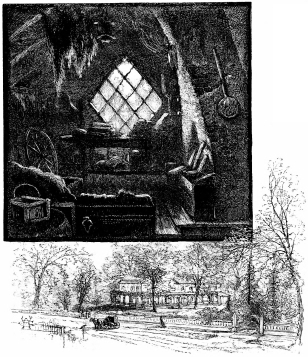
OLD HOMESTEAD AND GARRET.
Hometown, owing to some early local faction, is divided into two
sections, forming two distinct towns. One, Newborough, a hill-top
hamlet, with its picturesque long street, a hundred feet in width, and
shaded with great weeping elms that almost meet overhead; and the other,
Hometown proper, a picturesque little village in the valley, cuddling
close around the foot of a precipitous bluff, known as Mount Pisgah. A
mile’s distance separates the two centres. The old homestead is
situated in the heart of Hometown, fronting on the main street. The
house itself is a series of after-thoughts, wing after wing and gable
after gable having clustered around the old nucleus, as the growth of
new generations necessitated increased accommodation. Its outward aspect
is rather modern, but the interior, with its broad open fireplaces, and
accessaries in the shape of cranes and fire-dogs, is rich with all the
features of typical New England; and the two gables of the main roof
enclose the dearest old garret imaginable—at present an asylum for the
quaint possessions of antique furniture and bric-à-brac, removed from
their accustomed quarters on the advent of the new host. It is to this
sanctuary that my footsteps first lead me, and, with a longing that will
not be withstood, I find myself in front of the great white door. I lift
the latch; a cool pungent odor of oak wood greets me as I ascend the
steep stairs—an odor that awakens, like magic, a hundred fancies, and
recalls a host of memories long forgotten. Every stair seems to creak a
welcome, as when, on the rainy days of long ago, we sought the cosy
refuge to hear the patter on the roof, or to nestle in the dark, obscure
corners in our childish games. At the head of the stairs rises the
ancient chimney, cleft in twain at the foot, with the quaint little
cuddy between. Above me stretch the great beams of oak, like iron in
their hardness. Yonder is the queer old diamond window looking out upon
the village church, its panes half obscured by the dusty maze of webs.
To the left, in a shadowy corner, stands the antiquated wheel—a relic
of past generations. Long gray cobwebs festoon the rafters overhead, and
the low buzzing of a wasp betrays its mud nest in the gable above. A
sense of sadness steals over me as I sit gazing into this still chamber.
On every side are mementos of a happy past, and all, though mute,
speaking to me in a language whose power stirs the depths of my soul.
Wherever the eye may turn, it meets with a silent greeting from an old
friend, and the whole shrouded in a weird gloom that lends to the most
common object an air of melancholy mystery. And yet it is only a garret.
There are some, no doubt, for whom this word finds its fitting synonyme
in the dictionary, but there are others to whom it sings a poem of
infinite sweetness.
Looking through the dingy window between the maple boughs, my eye
extends over lawn and shrubberies, three acres in extent—a little park,
overrun with paths in every direction, through ancient orchard and
embowered dells, while far beyond are glimpses of the wooded knolls, the
winding brook, and meadows dotted with waving willows, and farther still
the ample undulating farm.
It is in such a place as this that I have sought recreation and change
of scene. My wife and I have run away from the city for a month or so. A
vacation we call it; but to an artist such a thing is rarely known in
its ordinary sense, and often, indeed, it means an increase of labor
rather than a respite. My first week, however, I had consecrated to
luxurious idleness. Together we wandered through the old familiar
rambles where as boy and girl in earlier days we had been so oft
together. Day after day found us in some new retreat. There were dark
cool nooks by sheltered
AMONG THE GRASSES.
mist all through the blossoming maze. We heard the music of the scythe,
and, sitting in the deep cool grass beneath the maple shade, we watched
the circling motion of the mowers in the field—saw the forkfuls of the
hay tossed in the drying sun, and breathed the perfumed air that floated
from the windrows. We sauntered by the meadow brook where willows
gleamed along the bank, and overhanging alders threw their sombre
shadows in the quiet pools: where the ground-nut, and the meadow-rue,
and the creeping madder fringed the tangled brink, and every footstep
started up some agile frog that plunged into the unseen water. We stood
where rippling shallows gurgled under festooned canopies of fox-grape,
and the leaning linden-trees shut out the sky o’erhead and intertwined
their drooping branches above the gliding current. Here, too, the
weather-beaten crossing-pole makes its tottering span across the stream,
and deep down beneath the bank the rainbow-tinted sunfish floats on
filmy fins above his yellow bed of gravel, and we catch a flashing gleam
of a silvery dace or shiner turning in the water.
Now we confront a rude slab fence, an ancient landmark, that terminates
its length at the edge of the stream, where its gray and crumbling
boards are secured with rusty nails against the trunk of a tall
buttonwood-tree. A loosened slab is easily found, and we are soon upon
the other side; and after picking our way through a forest of
bush-elders, we emerge upon an open lot of low flat pasture-land, known
always as the “old swamp meadow.” No other five acres on the face of the
earth are so dear to me as this neglected field. I know its every rise
and fall of ground, its every bog, and its lush greenness is refreshing
even to the thought.
It is a luxuriant garden of all manner of succulent and juicy
vegetation; an outbursting extravagance of plant life of almost tropical
exuberance. All New England’s most majestic and ornamental flora seem
congregated in its congenial soil; and even when a boy I learned to know
and love them all, and even call them by their names.
Here are towering stems of iron-weed lifting high their scattered purple
crowns, and in their midst the woolly clumps of boneset, its white
flowered cushions intermingling with the dense pink tufts of
thorough-wort.
On every side we overlook whole patches of these splendid blossoms, with
their crests closely crowded in a mosaic of pink and white. And here’s a
bed of peppermint and spearmint, interspersed with flaming spikes of
cardinal lobelia; and here a lusty plant of Indian mallow, entangled in
a maze of gold-thread and smart-weed. Here are massive burdocks six feet
high, and great trees of jimson-weed, with their large spiral flowers
and thorny pods.
High fronds of chain-fern rise up on every side from a jungle of
bur-marigolds and clotburs, and tear-thumbs, with their saw-toothed
stems and tiny bunches of pink blossoms.
No inch of ground in the old swamp lot but which does its tenfold duty;
and what it lacks in quality of produce it amply makes up in quantity.
Even a neighboring bed of clean-washed gravel is overrun with creeping
mallow, with its rounded leaves and little “cheeses” down among their
shadows.
EVEN-TIDE.
Farther on we see the lily-pond, with its surrounding swamp and its
legion of crowded water-plants. Here are rank, massive beds of
swamp-cabbage, and lofty cat-tails by the thousand among the bristling
bogs of tussock-sedge and bulrush. Here are calamus patches, and alder
thickets, and sedges without number; and the prickly carex and blue-flag
abound on every side. There are galingales and reeds, and tall and
graceful rushes, turtle-head and jointed scouring grass, and horse-tail,
besides a host of other old acquaintances, whose faces are familiar, but
whose names I never knew. But they were all my friends in boyhood. I
knew them in the bud and in the blossom, and even in their winter
skeletons, brown and broken in the snow. Near by there is a ditch: you
never would know it, for it is completely hidden from view beneath an
interlacing growth of jewel-weed. But see that gorgeous mass of deep
scarlet that floods the farther bank! Nowhere within a circuit of miles
around is there such a regal display of cardinal flowers as this:
skirting the borders of the ditch for rods and rods, clustering about a
ruined, tumbling fence, whose moss-grown pickets are almost hidden in
the dense profusion of bloom.
Then there is its airy companion, the “touch-me-not,” with its
translucent, juicy stem, and its queer little golden flowers with
spotted throats—the “jewel-weed” we used to call it. I know not why,
unless from the magic of its leaf, which, when held beneath the water,
was transformed to iridescent frosted silver. We all remember its
sensitive, jumping seed-pods, that burst even at our approach for fear
that we should touch them; but no one can fully appreciate the beauty of
the plant who has not seen its silvery leaf beneath the water. Here it
justifies its name, for it is indeed a jewel.
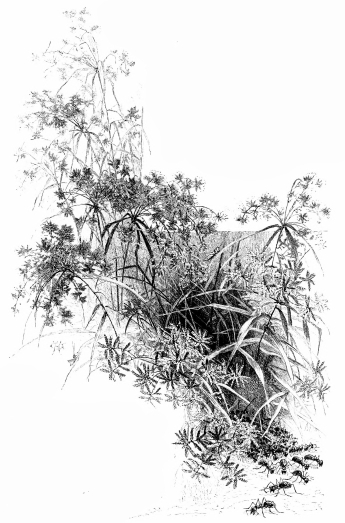
How often in those olden times have I lain down among these bulrushes
and sedges near the lily pond, and listened to the buzzing songs of the
crickets and the tiny katydids that swarmed the growth about me, and
filled the air with their incessant din. I remember the little colony of
ants that picked their way among the rushes; that gauzy dragon-fly too,
that circled and dodged about the water’s edge, now skimming close upon
the surface, now darting out of sight, or perhaps alighting on an
overhanging sedge, as motionless as a mounted specimen, with wings
aslant and fully spread. “Devil’s darning-needles” they were called. The
devil may well be proud of them; for darning-needles of such precious
metals and such exquisite design are rare indeed. They were of several
sizes too. Some were large, and flashed the azure of the sapphire;
others fluttered by with smoky, pearly wings, and slender bodies
glittering in the light like animated emeralds: and another I well
remember, a little airy thing, with a glistening sunbeam for a body, and
wings of tiny rainbows.
I remember how I watched the disturbed motion of the arrow-heads out in
the water, as the cautious turtles worked their way among them, and
crawled out upon the stump close by.
Here they huddled together, a dozen or more, with heads erect, and
turning from side to side as they surveyed the surrounding carpet of
lily-pads, or listened to the bass-drum chorus of the great green
bull-frogs among the pickerel-weed; and when I jumped and yelled at
them, what a rolling, sprawling, splashing in the mud! It fairly makes
me laugh to think of it. But there is hardly a leaf or wisp of grass in
this old swamp lot but what brings back some old association or pleasant
reminiscence.
For a week thus we idled, now on the mountain, now in the meadow, while
I, with my sketch-book and collecting-box, either whiled away the hours
with my pencil, or left the unfinished work to pursue the tantalizing
butterfly, or search for unsuspecting caterpillars among the weeds and
bushes.
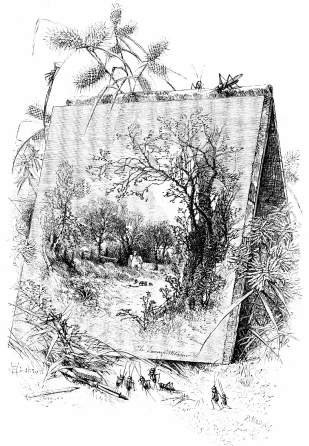
SOME ART CONNOISSEURS.
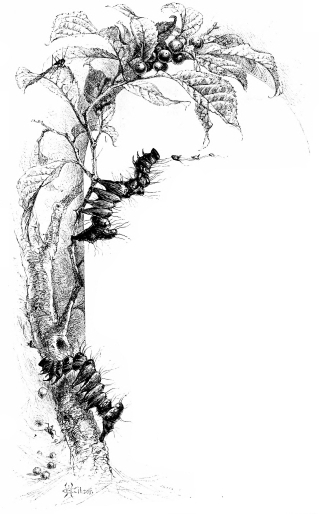 PROFESSOR WIGGLER.
On a sprig of black alder I found one—the same little fellow as of old,
afflicted with the peculiarities of all his progenitors. We used to call
him “Professor Wiggler,” owing to an hereditary nervous habit of
wiggling his head from side to side when not otherwise employed. To
this little humpbacked creature I am indebted for a great deal of past
amusement. Distinctly I remember the whack-whack-whack on the inside of
the old pasteboard box as the captive pets threatened to dash out their
brains in their demonstrations at my approach. Professor Wiggler is
really a most remarkable insect, as one might readily imagine from his
scientific name, for in learned circles this individual is known as Mr.
Gramatophora Trisignata. He has many strange eccentricities. At each
moult of the skin he retains the shell of his former head on a long
vertical filament. Two or three thus accumulate, and, as a consequence,
in his maturer years he looks up to the head he wore when he was a
youngster, and ponders on the flight of time and the hollowness of
earthly things, or perhaps congratulates himself on the increased
contents of his present shell. When fully grown, he stops eating, and
goes into a new business. Selecting a suitable twig, he gnaws a
cylindrical hole to its centre and follows the pith, now and then
backing out of the tunnel, and dropping the excavated material in the
form of little balls of sawdust. At length he emerges from the hollow,
and again drawing himself in backward, spins a silken disk across the
opening, and tints it with the color of the surrounding bark. Here he
spends the winter, and comes out in a new spring suit in the following
May. Only recently I had in my possession several of these twigs with
their enclosed caterpillars, and in every one the color of the silken
lid so closely matched the tint of the adjacent bark, although
different in each, that several of my friends, even with the most
careful scrutiny, failed to detect the deceptive spot. Whether the
result of chance or of the instincts of the insect, I do not know; but
certain it is that he paints with different colors under varying
circumstances.
Insect-hunting had always been a passion with me. Large collections of
moths and butterflies had many times accumulated under my hands, only to
meet destruction through boyish inexperience; and even in childhood the
love for the insect and the passion for the pencil strove hard for the
ascendency, and were only reconciled by a combination which filled my
sketch-book with studies of insect life.
There was one inhabitant of our fields which had always been to me a
never-failing source of entertainment. There he is, the gilded tyrant. I
see him now swinging to and fro on his glistening nest of silken
threads, his golden yellow form glowing in bold relief against the dark
recess in the brambles. My sketch is left in the grass, and I am soon
seated in front of the gossamer maze. A festive grasshopper jumps up
into my face, and makes a carom on the web. With a spasmodic snap of one
hind leg he extricates it from its entanglement, and in another instant
would fall from the meshes; but the agile spider is too quick for him.
With a movement so swift as almost to elude the eye, he draws from his
body a silver cloud of floss, and with his long hind legs throws it over
his captive. The head and tail of the grasshopper are now further
secured, after which the spider carefully straddles around the
struggling insect, and bites off the other radiating webs in close
proximity. The unlucky prey now hangs suspended across the opening. With
business-like coolness his tormentor dangles himself from the edge of
the torn web, and another cataract of glistening floss is thrown up and
attached to the under side of the prisoner, after which he is turned
round and round, as if on a spit. The stream of floss is carried from
head to foot, and in less time than it takes to describe it the victim
is wrapped in a silken winding-sheet, and soon meets his death from the
poisoned fangs of his captor. Here is but one of the thousands of
tragedies that are taking place every hour of the day in our fields.
While deeply interested in the closing scenes of this one, I suddenly
become aware of a shadow passing over the bushes. I turn my head, and
meet the puzzled and pleasant gaze of Amos Shoopegg, as he stands there,
hands in pockets, and milk-pail swinging from his wrist.
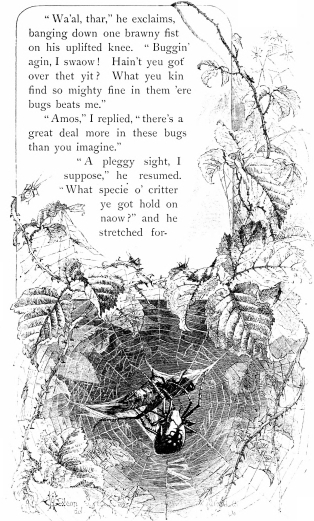
THE TYRANT OF THE FIELDS.
ward his fringed and weather-beaten
neck, and peered over the brambles. “What is’t ye got
thar—straddle-bug?” He came still nearer, and looked at the spider.
“Wa’al, darn my pictur ef ’tain’t an old yeller-belly! P’r’aps you don’t
know that them critters is pizen. Why, Eben Sanford’s gal got all chawed
up by one on ’em. Great Sneezer!” he exclaimed, taking three or four
strides backward, with both hands uplifted. I had merely raised my hand
and gently smoothed the spider.
“Wa’al,” he continued, “yen kin rub ’em daown ef yeu pleze; but fer my
part, I’d ruther keep off abaout a good spittin’ distance”—which was
the Shoopegg way of expressing a length of about fifteen feet. Amos was
crossing lots for his “caow,” he said; but in spite of his plea that the
“old heiffer” was “bellerin’” like “Sam Hill,” and was “gittin’ ’tarnal
on-easy,” I made him tarry sufficiently long to enable me to send him
off a wiser man.
Amos Shoopegg is a type of a large class of the native element of
Hometown. Of course, “Shoopegg” is not his actual name. In the long line
of his prided Puritan ancestry no one ever bore it before him. This is
only an affectionate epithet given him by the village boys full twenty
years ago, and it has stuck to him closer than a brother ever since, as
those festive surnames always do. Nominally, Amos was a farmer. In
summer he was one in fact, and could swing off as pretty a swath in
haying as any man in town. But in the winter he changed his vocation,
and became a disciple of the “waxed-end.” All day long he could be seen,
closeted with a little red-hot stove, plying his trade in his small,
square shop, up near the old red school-house. Here he pounded on the
big lapstone on his knees, or, with strap and foot-stick in position,
punched and tugged around the edge of those marvellous brogans. He made
slings and leather “suckers” for the boys, and furnished them with all
the black-wax they could chew—or stow-away, to stick between the lining
of their pockets. And the huge wooden shoe-pegs that he drove beneath
his hammer were a sight to behold. The man who used his “cheap line of
goods” might verily say he walked upon a wood-pile.
So they dubbed him “Shoe-peg,” or “Shoop” for brevity. There are others
among his neighbors who would furnish an inexhaustible source of study
to the student of character. There’s old Rufus Fairchild, known as
“Roof,” a rotund specimen of rural jollity, his round face set in
dishevelled locks of gray, with a twinkle in his eye and a good word for
everybody. And there’s Father Tomlinson, who keeps the post-office down
by the dam, as genial an old fellow as ever wrapped up his throat in a
white stock. And I might almost continue the list indefinitely. But
there is one I must especially mention; and, now that I think of it, he
really should have headed the list, for he stands alone—or at least he
does sometimes. If you are in search of the embodiment of typical
Erin, you need go no farther; here he is. This individual represents
another nationality which swells the population of Hometown—the
hard-working laborers who toil in the great factory down in the glen,
called “Satan’s Misery.” The above personage is one of the best-hearted
creatures in the town; but it is the old story, and the world to him is
enclosed in the compass of a barrel-hoop. When last I saw him he was in
an evident decline, but as I put my finger on his wrist I could still
feel the pulsations of the whiskey coursing through his veins.
“Look here, my good fellow,” I said to him one day, “why don’t you taper
off a little? If you keep on in this way, you’ll be in your grave in
less than a month. How would you like that?”
“Arrah, begorra,” he replied, with a look of hopeful resignation, “if I
cud awnly be shure o’ me gude skvare dthrink in the other wurrld, oi
wudn’t moind.”
The record of a single evening spent in the village store, with its
rural jargon and homespun yarns, its odd vernacular and rustic gossip,
would make a volume as rare and unique as the characters it would
depict.
The store itself is a matchless picture in its way, and for variety in
accessory is as rich as could be wished for. The low, murky ceiling,
hung with all manner of earthly goods—scythes and rakes, boots and
pails, in pendulous array; bottles and boxes, brooms and breast-pins,
are here—in short, everything that heart could wish or thought suggest,
from speckled calicoes to seven-cent sugar, or from a three-tined fork
to a goose-yoke. Evening after evening, for an hour or so, I was tempted
thither, until I found the week had gone. Sunday came again—Sunday in
New England. The old bell swung on its wheel in the belfry, ringing out
its call to devotion, and ere the echo had died in the recesses of the
mountain beyond the still atmosphere reverberated with an answering peal
from the little sister church in the valley below, as the scattered
groups with strolling steps wend their way to “meeting,” and the gay
loads from Newborough go flitting by on the accustomed Sunday drive.
Monday dawned on Hometown. It found me up and doing. I had enjoyed one
week of glorious loafing, but work was the programme for the next. I
went to Draper’s Inn and engaged a horse and buggy “until further
notice.” “A spang-up team” he called it, and it would be up “in half a
jiffy.” We were waiting for it when it came, and what with our variety
of luggage in the shape of canvases, color-boxes, hammocks, camp-seats,
and easels, every bit of available space in that buggy was well
utilized. Before the clock has struck nine, we are spinning along down
through the village, now past the store, now over the bridge, and
turning to the right, we glide by the little post-office, as the kind
face of Father Tomlinson nods a “good-bye” from the door-way.
A little farther, and we have left the little slope-roofed school-house
in our path, and are soon ascending the long hill of Zoar, from which we
look back four miles to the cliff and nestling town. In ten minutes more
we approach the brow of a steep declivity, and the broad Housatonic
opens up to view, winding off into the misty mountains in the distance.
There is now a drive of half a mile along the side of a wild
mountain-slope, where mountain-laurels grow in wild profusion, and the
rooty, overhanging banks are tufted with rich green moss, overgrown with
checker-berries and arbutus. The river roars far down below us, and for
a few minutes our eyes feast on as lovely an extent of varied New
England landscape as is easily found. And yet this is only a short
section of one of the many matchless drives that follow the course of
this beautiful river around the borders of Hometown.
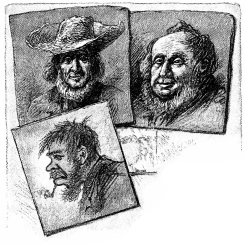 FAMILIAR FACES AT THE VILLAGE STORE.
Suddenly we leave the stream as it glides away on an abrupt turn beneath
the crescent of a rocky precipice, and before we have fairly lost the
sound of the ripples we have arrived at our journey’s end. A pair of
bars under an old butternut-tree mark the place. The carriage is backed
to the side of the road, and the horse turned loose in the rocky meadow.
This is Joab Nichols’s “pasture lot,” with fodder consisting principally
of huge boulders, hardhack, and spleenwort; to be sure, with a stray
relish of “butter-and-eggs” here and there, and a thousand white saucers
of wild carrot handy to go with them. One or two trips across the field
bring all our luggage, and we are soon enjoying cool comfort in the
hemlock shade of a fairy grotto. Above us the babbling brook bounds and
splashes over mossy rocks, disappearing in a mass of creamy foam, from
under which it eddies toward us only to plunge twenty feet into a
miniature cañon below. Again, yonder it bubbles into a whirling pool,
where the bordering ferns bend and nod above its buoyant surface; and
now gliding from view beneath the tangle of drooping boughs, it
disappears only to burst forth once more in its merry song as it rushes
over the rapids.
“I chatter, chatter as I go,
To join the brimming river;
For men may come and men may go,
But I go on forever.”
Here in this wild retreat I have found my sylvan studio—shut in by
fringed and fragrant evergreens, enlivened by the undergrowth of
feathery fronds, and the shimmer of the beech, as the tracery of
overhanging boughs trembles in the gentle breeze. Day after day finds us
in this little paradise, and as one in luxurious hammock swings away the
hours, now lost in fiction, now in short repose, or perhaps with busy
needle fashions graceful figures in Kensington design, the canvas on the
easel shows a fortnight’s constant care, and the palette changes to a
keepsake of a sunny memory—a tinted souvenir.
For two weeks the gurgling brook sang to us in this wild retreat. As
evening after evening closed in upon us, the unfinished pictures were
stowed away in horizontal crevices between the rocks, and, with hammock
still swinging in the trees, we left the gloom to the hooting owl, that
evening after evening, with tremulous cry, proclaimed the twilight hour
from the tall hemlock overhead. Ere long the murmuring Housatonic
shimmers below us in the moonlight as we hurry on our homeward way, and
the distant lights of Hometown are soon seen glimmering; through the
evening mist. The old bridge now rumbles through the darkness its signal
of our return, and the host of Draper’s Inn is seen awaiting us at the
illumined door-way. A quiet, cosy supper, and in the rays of a gleaming
lantern, held aloft to light our path, we follow our lengthening shadows
to the old front gate. Repeat this day’s record fourteen times, and you
have the sum of a happy experience, with but one drawback: it had an
end—an end that would have left its reaction, were it not for the store
of increased pleasure that awaited us for the few closing days of our
pilgrimage—for me, at least, although in other scenes, its climax.
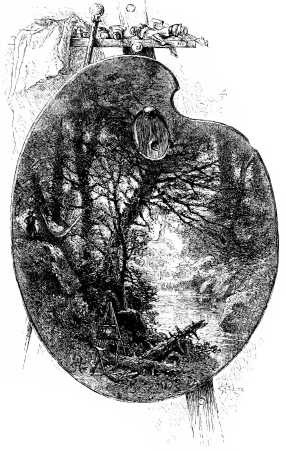
A SOUVENIR.
Many like me are happy in the possession of a dear old homestead; but
there are few, I ween, who enjoy the blessing of a double inheritance
such as has been my lot—two homes which share my equal devotion, two
homes without a choice; the one this beloved heirloom in Hometown, and
the other—But you shall see. We shall be there soon, for the little
satchel is packed, and the carriage awaits us at the gate. A drive of
eighteen miles is before us—a beautiful series of pictures. Down
through the village, past the old red mill and smithy, with its ringing
anvil, and we are soon winding our way through a sombre glen. Presently
we catch glimpses of the great rumbling factory, with its clouds of
smoke and steam melting into the wooded mountain above. The old yellow
bridge now creaks under our approach, and ere we are aware a sudden turn
leads us out of a wilderness on to the shore of the beautiful
Housatonic. For a few minutes the rushing water trickles through the
wheels as over jolting stones our pony leads us through the ford, and,
refreshed by the cool bath, makes a lively sally up the eastern bank.
For ten miles the Housatonic guides us around its winding curves through
a path of ever-changing beauty, now shut in by the dense, dark
evergreens, and again emerging into a bower of silvery beeches, where
the roadway is carpeted with mottled shadows, and the dappled trunks
flicker with the softened glints of sunlight. Here we come upon a sandy
stretch where the road is sunken between two sloping banks thick-set
with mulleins and sweet-fern, and overrun with creeping brambles. The
stone-wall above is wreathed in trailing woodbine, and along its crest
we see the swaying tips of wheat from the edge of the field just beyond;
and here we pass a border of whortleberry bushes, laden with their
fruit. Now it is a hazel thicket crowding close upon our wheels, and
among the leaves we see the brown, tanned husks of the ripening nuts,
almost ready for that troop of boys and girls that you may be sure are
watching and waiting for them.
The old gray toll-bridge soon nears to view, with its two long spans and
fantastic beams. Farther on, peering from its willows, stands the ruined
cider-mill, with its long moss-grown lever jutting through the trees—an
old-time haunt, now crumbling in decay. But we only catch a glimpse of
it, for in a moment more we are shut in beneath another bower of beeches
and white birches, where the road takes a steep ascent, and the rippling
river sends up its sunny reflections among the leaves and tree-trunks.
When once more upon a level, it is to look ahead through a long avenue
of shade—a leafy canopy two miles in length—with only an occasional
break to open up some charming bit of landscape across the water. In
these two miles of umbrage you may see types of almost every tree that
grows within the boundaries of New England. Old veteran beeches are
here, their trunks disfigured with scars that once were names cut in the
bark. Here are spots that look like half obliterated figures; and here
are spreading hieroglyphs that tell, perhaps, of old-time vows plighted
at the trysting-tree; and here’s a semblance of a heart, a broken heart
indeed, if its present form be taken as a prophetic symbol.
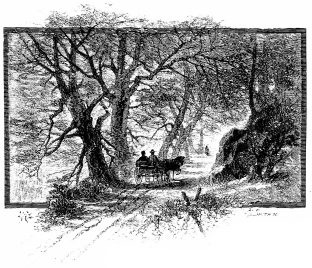
ALONG THE HOUSATONIC.
There are magnificent rock-maples too, and silver-maples that shake down
their little swarms of winged seeds. Tulip-trees and spotted buttonwoods
grow side by side, and quivering aspens and white poplars are seen at
every clearing. There are yellow birch-trunks frayed out with the wind,
and great snake-like stems of grape-vine, that twist and writhe among
the branches of the trees. There are hop hornbeams, and chestnuts,
and—But there is no need to enumerate them all. Just think of every New
England tree you ever knew, and add a score besides, and you will form a
slight idea of the varied verdure that hems in this charming Housatonic
drive, with its rocky roadside embroidered in trickling moss and
fumitory; and rose-flowered mountain-raspberry growing so close upon the
road that your pony takes a wayward nip, and plucks its blossomed tip as
he passes.
Now comes an open level, with wide, expansive views, where every turn
upon the road brings its fresh surprise, as some new combination of hazy
mountain landscape towers above the distant river bend; and the flitting
cloud shadows lead their capricious, undulating chase across the wooded
slopes. The roadsides here are full of everchanging beauties too, with
their trimmings of ornamental sunflowers, their picturesque old fences,
and their clumps of purple-berried poke-weed, with here and there a
yellow patch of toad-flax, and aromatic tufts of tansy hugging close
against the fence. Even that clambering screen of clematis that trails
over the shrubbery yonder cannot hide the scattered tips of crimson that
already have appeared among the sumach leaves.
There are a thousand things one meets upon a country ride or ramble
which at the time are allowed to pass with but a glance. The eye is
surfeited and the mind confused with the continual pageantry. But months
afterward, in the reveries about our winter fires, they all come back to
us, with the added charm of reminiscence; and whether it be a crystal
spring among a bank of ferns, or a thistle-top with its fluttering
butterfly and inevitable bumblebee rolling in the tufted blossom, or a
squirrel running along a rail, or perhaps a rattling grasshopper
hovering in mid-air above the dusty road—no matter what, they all are
welcome memories at our fireside, and draw our hearts still closer to
the loveliness of nature.
This Housatonic road is rich in just such pastoral pictures. Two hours
on such a course soon pass, when our pony whinnies at the welcome sight
of the old log water-trough beyond—a landmark old and green when I was
yet a boy, still nestling in its rocky bed, shadowed by the drooping
hemlocks, still lavish with its overflowing bounty.
This benefactor by the way-side marks a turning-point in our journey, as
we leave the grandeur of the Housatonic to pursue our way by the nooks
and dingles of the wild Shepaug—a bubbling tributary whose happy waters
sing of a varied experience. Now placid through the blossoming fields,
now plunging down the precipice to ripple through a verdant valley,
where, hemmed in at every turn, it seeks its only liberty beneath the
rumbling of the old mill-wheels; and at last, ere it loses its identity
in the swelling tide, leaving a mischievous and tumultuous record as it
pours through the rocky cañon, and with surging, whirling volume carves
huge caverns and fantastic statues in its massive bed of stone. Even now
through the dark forest beyond we can hear the muffled roar, and for
nearly a league farther as we ascend the long hill it comes to us in
fitful whispers wafted on the changing breeze. Reaching the summit of
this incline, we find ourselves on a hill-top wide and far-reaching, on
right and left losing itself in wooded wold, while in front the level
road diminishes to a point, surmounted by blue hills in the distance.
Two miles on a pastoral hill-top, where golden-rod and tall spiræas
cluster along the lichen-covered walls, where orange-lilies gleam among
the alders, with now and then a blazing group of butterfly-plant or a
dusty clump of milk-weed. The air is laden with the nut-like odor of the
everlasting flowers all around us. The buzzing drum of the harvest-fly
vibrates from every tree, and we hear the tinkling bell and lowing of
the cattle in some neighboring field. Farther on, we look down from the
edge of the plateau through the length of Happy Valley, with its winding
stream, its barns and busy mills, its sunny homes glinting through the
summer haze. On the left the lofty shadowed cliff known as “Steep-rock”
towers against the evening sky, and again we catch the murmuring whiffs
of the rushing stream in its sweeping bend beneath the overhanging
precipice. A sharp turn round a jutting hill-side, and I meet a prospect
that quickens the heart and makes the eye grow dim. There beyond, three
miles “as flies the laden bee,” I linger on the welcome sight, as on its
hill-top fair two steeples side by side betray the hidden town, my
second home.
How lightly did I appreciate the fortunate journey when, twenty summers
ago, I followed this road for the first time, when a boy of ten years,
on my way to an unknown village, I looked across the landscape to the
little spires on that distant hill! Little did I dream of the six years
of unmixed happiness and precious experience that awaited me in that
little Judea! I only knew that I was sadly quitting a happy home on my
way to “boarding-school”—a school called the Snuggery, taught by a Mr.
Snug, in a little village named Snug Hamlet, about twenty miles from
Hometown.
There are some experiences in the life of every one which, however
truthful, cannot be told but to elicit the doubtful nod or the warning
finger of incredulity. They were such experiences as these, however,
that made up the sum of my early life in that happy refuge called in
modern parlance a “boarding-school”—a name as empty, a word as weak and
tame in its significance, as poverty itself; no doubt abundantly
expressive in its ordinary application, but here it is a mockery and a
satire. This is not a “boarding-school;” it is a household, whose
memories moisten the eye and stir the soul; to which its scattered
members through the fleeting years look back as to a neglected home,
with father and mother dear, whom they long once more to meet as in the
tenderness of boyhood days; a cherished remembrance which, like the
“house upon a hill, cannot be hid,” but sends abroad its light unto many
hearts who in those early days sought the loving shelter; a bright star
in the horizon of the past, a glow that ne’er grows dim, but only
kindles and brightens with the flood of years. Yes, yes; I know it
sounds like a dash of sentiment, but words of mine are feeble and
impotent indeed when sought for the expression of an attachment so fond,
of a love so deep.
Fifteen years ago, with a parting full of sorrow, I rode away from Snug
Hamlet yonder in the village stage—a day that brought a depression that
lingered long, and lingers still. Glowing, sunset-tinted fields glide by
unnoticed now, as, with eyes intent on the distant hill, I look back
through the lapse of time. A mile has gone without my knowing it, when a
joyous laugh awakens me from my day-dreams. Two boys approach us on the
road ahead, and, what might seem very strange to you, one wears a wooden
boot-jack strung around his neck and dangling on his breast; but he
carries his burden lightly and cheerfully. As they near the carriage I
draw the rein, and they both pause by the roadside.
“Well, boys,” I ask, “where do you hail from?”
“We’re from the Snuggery, sir.”
“I thought so,” said I, with a laugh, in which they both joined. “But
what are you doing with that boot-jack?”
“Oh, you see,” said one, with a roguish smile, “Charlie and I were
having a little tussle in the sitting-room, and he picked up Mr. Snug’s
boot-jack in the corner and began to pummel me with it; and jest as we
were having it the worst, and were rollin’ on the floor, Mr. Snug came
in and caught us in the job, and now we’re payin’ for it.”
“How so?” I inquired, well knowing what would be the response.
“Oh, you see, Mr. Snug held a diagnosis over our remains, and said he
thought we were suffering, for the want of a little exercise, and
ordered us on a trip to Judd’s Bridge.”
“And the boot-jack?”
“Oh, he said that Charlie might want to play with that some more on the
way, and that he’d better fetch it along;” and with a mischievous
snicker at his encumbered companion, he led him along the road in an
hilarious race, while we enjoyed a hearty laugh at their expense.
And this a punishment! Yes, here is an introduction to one phase of a
system of correction as unique as the matchless institution in which it
had its birth—a system without a parallel in the annals of chastisement
or school government, and which for thirty years has proved its wisdom
in the household management of the Snuggery.
“To Judd’s Bridge!” How natural the sound of those words! How many
times have I myself been on that same pilgrimage of penance! The
destination of these boys is a rickety but picturesque structure which
spans the Shepaug five miles below Snug Hamlet. Through three decades it
looks back to its host of acquaintances of those romping lads who, in
the superfluity of exuberant spirits, made havoc and din in the
household. The dose is administered with wise discrimination both as to
the symptoms and the needs and strength of the patient. It always proves
a sterling remedy, and sometimes, indeed, a sugar-coated one, as in the
case of these two ruddy, rollicking examples.
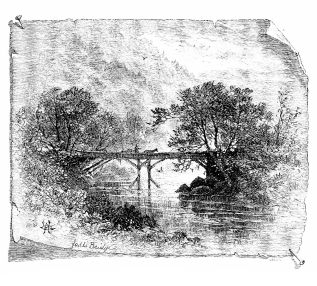
Judd’s Bridge is but one of a score of places which serve in the
administration of Snuggery discipline. It is, however, the one most
remote, and its ten-mile journey is reserved as an heroic dose for
extraordinary cases, after other prescriptions have been tried without
avail. Next on the list comes Moody Barn, with “open doors” every day in
the week to its frequent callers. This old settler, gray and
weather-beaten, marks a point one mile from the Snuggery, where the
still waters of the Shepaug run slow and deep—the favorite
“swimming-hole” of the Snuggery.
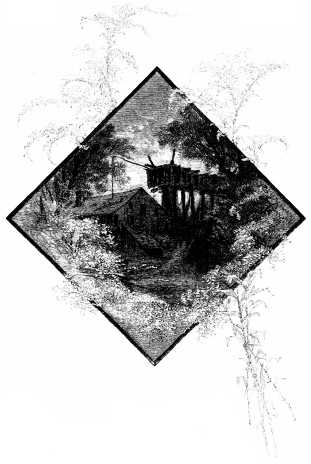
THE HAUNTED MILL.
And then there’s Kirby Corners, a mere stroll of a few minutes round the
square of a rock-bound pasture—just enough to give yourself time to
think a bit and congratulate yourself on what you have escaped. All
these, and several more, are vivid in my memory; friends, old and
intimate. And here’s another, right before us by the roadside. For
several minutes through the tantalizing trees we have heard its rumbling
wheel, its reiterating clank, and busy saw; and now, as its familiar
outline looms up against the evening sky, the vision seems to darken, as
on that night of long ago, when through the shadowy mystery of the
moonlit gloom I stole my way among the sheltering golden-rod; when the
lofty flume, like a huge horned creature, seemed to stride athwart me in
the darkness, and the fitful boyish fancy saw strange phantoms in the
floating, melting mist. This ancient structure reposes in a verdant dell
at the foot of Snug Hamlet Hill. A choice of two roads lies before
us—one short and direct, the other a roundabout approach. A sudden
impulse leads me into the latter. On right and left I see the same old
rocks and trees. There stands the aged beech to whose gnarled and hollow
trunk I traced the agile flying-squirrel, and with suffocating flame and
smoke drove him from his hiding-place. Here between large rocks and
stones the trout-stream runs its course, now pouring in small cataracts,
now eddying into still, dark nooks, where in those by-gone times I
dropped the line of expectancy, but showed the clumsiness of adversity.
A few minutes later, and we are gliding again by the dark Shepaug, now
flowing calm and silent beneath a rugged bank, wild and umbrageous,
where the swarm of katydids, with grating discord, maintain their old
dispute, that never-ending feud. The wheels turn noiselessly in the
shifting sand as we pursue our way. The low gray fog steals lightly over
the lily-pads, floating into seclusion beneath the sheltering boughs,
or, like an evanescent spirit, borne upon the evening breath, is lifted
from the gloom, and slowly melts into the twilight sky. The solitary
whippoorwill from his mysterious haunt, perhaps in yonder tree, perhaps
in the mountain loneliness beyond, proclaims with dismal cry his
oft-repeated wail. And as we ascend the darkening path, through the
still night air, in measured cadence long and sad, we hear the toll of
the distant knell. Threescore-and-ten its numbers tell of the earthly
years—a curfew requiem for the dead. Even as we pass the little chapel
at the summit of the hill, and the bell has scarcely ceased its
melancholy tidings, we hear the shouts and merry laughs of the boys on
the village green. Presently its broad expanse, shut in by twinkling
windows and massive trees, spreads out before us, as a clear and ringing
voice, like that of old, echoes through the growing darkness, “One
hundred! Nothing said, coming ahead!” and a dim figure steals cautiously
from the steps of the old white church to seek in the sequestered
hiding-places. With a heart that fairly thumps, I urge my pony onward
across the green, and ere he slackens his pace I am at my journey’s end.
The dear old Snuggery, with its gables manifold and quaint, its
fantastic wings and towers, stands there before me, the glowing windows
beaming through the maples. Leaving our pony in willing hands, we enter
the gate, and are soon upon the wide porch.
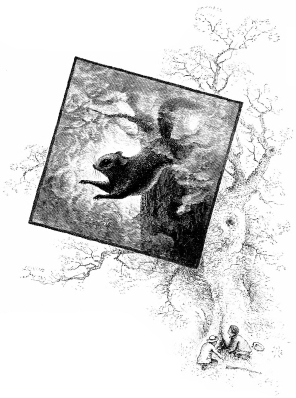
PURSUERS AND PURSUED.
It is eight o’clock, and the Snuggery is hushed in the quiet of the
study hour, and as we look through the windows we see the little groups
of studious lads bending over their books. Turning a corner on the
piazza, we are confronted with a tall hexagonal structure at its farther
end. This is the Tower, the lower room of which is consecrated to the
cosy retirement of Mr. and Mrs. Snug. The door leading to the porch is
open, and, as if awakening from a nap in which the past fifteen years
have been a dream, I listen to the same dear voice. I approach nearer.
Under the glow of a student’s lamp I look upon the beloved face, the
flowing hair and beard now silvered with the lapse of years—a face of
unusual firmness, but whose every line marks the expression of a tender,
loving nature, and of a large and noble heart. Near him another sits—a
helpmeet kind and true, cherished companion in a happy, useful life.
Into her lap a nestling lad has climbed; and as she strokes the curly
head and looks into the chubby face, I see the same expression as of
old, the same motherly tenderness and love beaming from the large gray
eyes.
Mr. Snug is leaning back in his easy-chair, and two boys are standing up
before him; one of them is speaking, evidently in answer to a question.
“I called him a galoot, sir.”
“You called George a galoot, and then he threw the base-ball club at
you—is that it?”
“Yes, sir,” interrupted George; “but I was only playing, sir.”
“Yes,” resumed the voice of Mr. Snug, “but that club went with
considerable force, and landed over the fence, and made havoc in Deacon
Farish’s onion-bed; and that reminds me that the deacon’s onion-bed is
overrun with weeds. Now, Willie,” continued Mr. Snug, after a moment’s
hesitation, with eyes closed, and head thrown back against the chair,
“Saturday morning—to-morrow, that is—directly after breakfast, you go
out into the grove and call names to the big rock for half an hour.
Don’t stop to take breath; and don’t call the same name twice. Your
vocabulary will easily stand the drain. You understand?”
“Yes, sir.”
“And, George,” continued Mr. Snug, with deliberate, easy intonation,
“to-morrow morning, at the same time, you present yourself politely to
Deacon Farish, tell him that I sent you, and ask him to escort you to
his onion-bed. After which you will go carefully to work and pull out
all the weeds. You understand, sir?”
“Yes, sir.”
“And then you will both report to me as usual.” And with a pleasant
smile, which was reflected in both their faces, the erring youngsters
were dismissed. Before the door has closed behind them we are standing
in the door-way. Here I draw the curtain; for who but one of its own
household could understand a welcome at the Snuggery?
Those of my old school-mates who read this meagre sketch will know the
happiness of such a meeting; but others less fortunate in the
recollections of school-life can only look for its counterpart in an
affectionate welcome in their own homes, for the Snuggery is a home to
all who ever dwelt within its gates. Seated in the familiar cosiness,
and surrounded by the friends of my school-days, the hours fly fast and
pleasantly. There is plenty to talk about. Here is a village full of
good people of whom I wish to learn, and there are many far-off chums of
whom I carry tidings. A bell rings in the cupola as one by one, from the
buzz in the outer rooms, boys large and small seek our seclusion for the
accustomed good-night adieu; and ere another hour has passed forty
sleepy urchins are packed away in their snug quarters. The evening runs
on into midnight, as with stories of the past, its pains and penalties,
its remembrances, now humorous now sad by turns, we recall the good old
times; and the “wee sma’ hours” are already upon us as we reluctantly
retire from the goodly company to our rooms across the way.
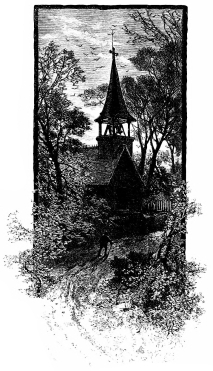 TOLLING FOR THE DEAD.
The next morning finds us in the midst of a merry load, with Mr. Snug as
a driver; and many and varied were the beauties that opened up before us
on that charming ride! Snug Hamlet, once called Judea, in the qualities
of its landscape as well as in everything else, is unique. Stripped of
all its old associations, it presents to the artistic eye a combination
of attractions scarcely to be equalled in the boundaries of New England.
Situated itself on the brow of an abrupt hill, where its picturesque
homes cluster about a broad open green, a few minutes’ drive in any
direction reveals a surrounding panorama of the rarest loveliness. Five
hundred feet below us, winding in and out, now beneath leafy tangles,
now under quaint little bridges, and again reposing placidly in broad
mill-ponds, the happy Shepaug lends to a lovely valley its usefulness
and beauty. Turning in another direction, we pass the Snuggery
ball-ground, animated with the shouts of victory; and descending into a
vale of almost primeval wildness, we continue our way up the ascent of
“Artist’s Hill,” from whose summit on every side, as far as the eye can
reach, the landscape softens into the hazy horizon. Returning, we pass
through a ruined waste, where, three months before, the fierce tornado
swooped down in its fiendish fury. On every side we see its awful
evidences. Huge oaks, like brittle pipe-stems, snapped from their
moorings; sturdy hickories, mere play-things in the gale, twisted into
shreds.
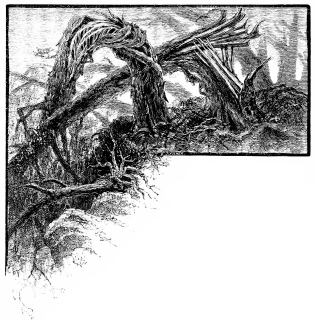 WRECKS OF THE TORNADO.
Every morning saw me on some new drive, either with a wagon full of
merry company, or as alone with Mr. Snug we held our quiet tête-à-tête
on wheels, living over the olden times. In the afternoon I strolled by
myself through the old and eloquent scenes. A volume could not hold the
memories they revived—no, not even those of yonder barn alone. Even as
I sit making my pencil-sketch, its reminiscences seem to float across
the vision. Distinctly it recalls the events of one evening years ago.
It was at about the sunset hour one Friday. I was quietly sitting on a
lounge in the parlor talking to Cuthbert Harding, who was standing in
front of me. Presently the door opens, and the tall figure of Dick Shin
enters. Dick and I were antipodes in every sense of the word. Physically
we were as a match and a billiard ball, he being the lucifer. He was
also my bête noire, and he never missed an opportunity to vent his
spite. Accordingly he stalked toward us, and with a violent push sent
Cuthbert pell-mell on to me. In falling, he stepped heavily on my foot,
and hurt me severely, which accounted for my excited expression as I
threw him from me.
Of course Mr. Snug had to come in just at this time, and seeing us in
what looked to him very like a fight, he took us firmly by the ears and
stood us side by side, while I ventured to explain.
“Not a word!” exclaimed he, in a tone there was no mistaking. “You two
boys may cool off on a trip to Moody Barn, after which you will report
to me in the Tower. Now go.”
Whatever may have been the state of my mind a few moments before, I was
now mad in earnest, and with every bit of my latent obstinacy aroused, I
sauntered out on to the porch.
“Cool off, old boy,” whispered a grating voice at my side, as I turned
and met the gaze of Dick Shin, motioning with his thumb in the direction
of Moody Barn—“cool off; you need it;” and his ample mouth stretched
into a sneering grin.
I had already formed an intention, but now it was a resolve.
“Cuthbert,” said I to my quiet and less choleric companion, when some
distance down the road, “I am not going on that trip.”
“Not going!” replied he, with surprise; “why, you’ll have to go.”
“But I won’t go, and that settles it. It’s confounded unjust that
we’re sent, anyhow, and I don’t propose to stand it.”
“I think so too,” answered Cuthbert, with hesitating emphasis; “but
what’ll we do? We’ll have to report to Mr. Snug, you know; that’s the
worst of it.”
“Well, I’ll be spokesman, and I’ll lie before I’ll go on that trip.”
I was boiling over with righteous wrath, but Cuthbert never was known to
boil; he only simmered a little, but readily seconded my plan. We
stopped at Kirby Corners, and there, secluded from view in the bushes,
we spent the interval. Cuthbert had a watch, and by the light of the
rising moon we were enabled to fix the full period for the trip. One
hour and a half we allowed—an abundant limit. During this time I had
completely “cooled off,” and had schooled myself to that point where I
could tell a lie with a smooth face and a clear conscience.
Accordingly, when the time came, we appeared at the door of the Tower.
Mr. Snug was sitting in his accustomed place, and we entered and stood
before him.
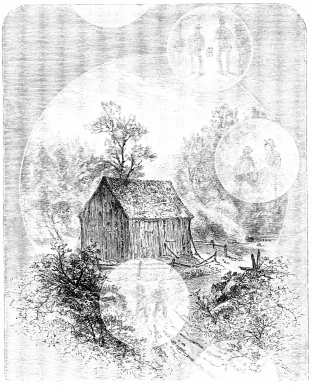
PASSING THOUGHTS.
“Well, sir,” said he, with a polite bow of the head, dropping his paper
and looking up at us.
“Mr. Snug, we have come to report,” said I, fearlessly. “We have been to
Moody Barn.”
Instantly Mr. Snug straightened himself up in his chair, pushed back
the gray locks from his high forehead, and, with an expression that I
never shall forget, glared at me from under the frowning eyebrows.
“You lie, sir!” he exclaimed, in thundering tones that fairly made my
hair stand on end, while Cuthbert trembled from head to foot; then
followed a brief moment of consternation that seemed an age. “Now go!”
continued he, as with an emphatic nod of the head he motioned toward the
door. Sheepish and crest-fallen, we slunk away from the room. It is
needless to say that we went this time. Through the darkness, by the aid
of a lantern, we picked our way, as with theories numerous and ingenious
we strove to account for that vociferous reception.
Late that night we held an experience meeting with Mr. and Mrs. Snug in
the Tower, and if I remember right there were a few tears that fell, and
many apologies and good resolves, and as the true state of the case
dawned on Mr. Snug there was an evident twinge of regret on his kind
face.
On the following morning (Saturday) there was a jolly party of youths
leaving the Snuggery for a day’s boating at the lake. Dick Shin was
among them; and just as he was passing out the gate, a youngster
approaches him and taps him on the shoulder. “You are hereby arrested,
sir, on the orders of Mr. Snug.”
With an anxious and innocent expression Dick follows his juvenile
constable into the Tower, and his companions stroll along after to
ascertain the cause of the detention. We pass over the brief but amusing
trial, in which the prisoner, with the innocence of a little lamb,
pleaded his cause.
“You stumbled, did you?” said Mr. Snug. “Well, you ought to know, sir,
by this time that I don’t allow young men to stumble in that way in my
house. These two boys have suffered through your admitted clumsiness.”
Here Mr. Snug paused in a moment’s thought. “Dick Shin,” he continued,
“I sent these innocent young gentlemen on two trips to Moody Barn—that
makes four miles for Bigson and four miles for Harding, together making
eight that they walked on your account. Now you may put down your
fishing-pole, and ‘stumble’ along on the road to Judd’s Bridge, which
will give you two extra miles in which to think over your sins. And to
make sure”—here Mr. Snug arose and went to the closet—“you may take
this hatchet along with you, and bring me back a good big chip from the
end of the long bridge beam. I shall ride over that way to-morrow and
see whether it fits. You understand?”
“Yes, sir,” replied the injured voice of Dick Shin. “But, Mr. Snug,
can’t I put off that penance until Monday?”
“No, sir,” replied Mr. Snug, with a beaming smile and a bow of the head.
“This is a lovely morning for contrite meditation. Go—instantly.”
Two hours later saw a demonstrative individual threatening to chop down
the whole side of a bridge, while ten miles to the northward the placid
surface of Waramaug rippled to the oars, and the lofty mountain-sides
echoed with the shouts of a merry holiday.
But all things must have an end. The school-days ended, and so did this
memorable vacation. A letter breaks the charm: insatiate publisher! Once
more through the winding paths of the Housatonic, and I leave the
loveliness of Hometown for the metropolis of brick and stone, there to
resume the old routine.