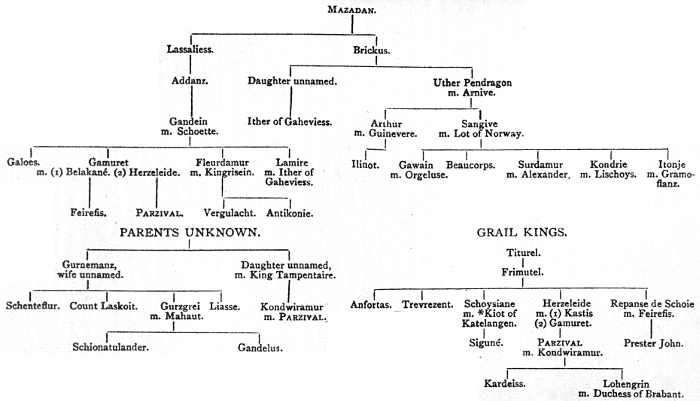
NOTES
(A few Notes signed A. N. are due to Mr. Alfred Nutt.)
Introduction, lines 1-66. This introduction, which is confessedly obscure, both in
style and thought, appears to have been written after the completion of the poem, and to
have been intended by the writer to serve both as a key to the meaning of the poem, and
as a defence of his method of treatment. That Wolfram was blamed by his contemporaries,
notably by Gottfried von Strassbourg, for his lack of a polished style, and
obscurity of thought, we know; and in Willehalm he speaks, in the following words, of the
varying judgment passed upon his Parzival:—
'Swaz ich von Parzivâl gesprach,
des sîn aventiur mich wîste,
etzlich man daz prîste:
ir was ouch vil, diez smœthen
Und baz ir rede wæhten.
and it is evidently to these critics that the first part of the Introduction is addressed.
Lines 1-8 give the key to the whole poem: the contrast between doubt or unsteadfastness,
and steadfast faith and truth, as imaged in the contrast between darkness and light,
black and white. This idea runs throughout the poem, is worked out symbolically in the
character and experiences of the hero, and is shown in a concrete form in the person of his
brother Feirefis. The poet notes that many readers have failed, through lack of intelligence,
to grasp the meaning of this parable, which is too swift and subtle for their comprehension.
A parallel passage will be found in Book V. pp. 137, 138, where the figure
employed is different.
The curious lines 15, 16 are explained by Bötticher as allusions to personal assaults
made on the poet, which, by reason of the folly of the assailants, missed their mark, and
are therefore to be treated with contempt.
Lines 29, 30 contain one of the quaint and homely similes which abound throughout
the poem, and refer to the faithless man, valsch geselleclîcher muot, whose honour and
steadfastness are not sufficiently strong to meet the demands made upon them.
There are three distinct divisions of the Introduction: the first, lines 1-30, is addressed
to men only, and draws the contrast between the false and true knight; 31-49 does the
same for women; while from 49 onwards the poet shows how the tale he is about to tell
affects both sexes alike, and gives a slight sketch of the character of the hero. For the
rightful understanding of this the lines 61, 62 are of great importance: 'a brave man, yet
slowly wise Is he whom I hail my hero' (er küene, trâctîche wîs, den helt ich alsus grüene),
and should be borne in mind by the student of the poem.
A full and minute discussion of this discussion of this Introduction will be found in Dr. Bötticher's Das
Hohelied von Rittertum.
Page 5, line 67—'Now they do to-day as of old-time.' The word employed here wälsch
simply means 'foreign,' but it is evident from the context that France is the country referred
to. The fact was probably in the French source, the remarks upon it due to the German poet.
Page 5. line 80—'Gamuret.' The origin of this name is doubtful; in Chrêtien we find
a King Ban de Gomeret mentioned, and Wolfram may have derived the name from a
French source, Heinmel suggests that it comes from Gamor, the son of Anguis, a Saracen
prince ruling in Denmark, according to 'Arthur and Merlin;' and that the fact of his
being of the race of Anguis suggested to Kiot the possibility of making him an Angevin.
In the absence of any definite knowledge as to Wolfram's source it is not possible to
do more than suggest possible derivations.
Page 7, lines 136, 137—'Gylstram and Rankulat.' With regard to the first-named
place, Simrock says it has been identified with 'Gustrate' in the Gudrun, and, according
to Grimm, this latter is to be coupled with Gailate, 'where the sun hath its setting.' i.e. the
West. In Book XI. the patriarch of Rankulat is referred to, in company with the Baruch
of Bagdad and the Emperor of Constantinople, and in all probability Armenia is meant.
The king's speech therefore implies, 'Didst thou come from the furthest bounds of the
earth, East or West.'
Page 8, line 154—'King Gandein's son.' Cf. Book IX. p. 285, where the origin of the
name Gandein is given.
Page 8, lines 159, 160.—'Then the tale it hath told a lie.' Cf. Book IX. p. 259.
Page 8, lines 169, 170—'Rich silk of Orient' Eastern materials are referred to frequently
throughout the poem; the principal seem to have been, Samite, Sendal, Achmardi, Pfellel,
Plialt, and Saranthasme. Of these, some were of silk only, others, notably Saranthasme
of silk inwoven with gold, Achmardi, in this poem, is always green. Samite and Sendal
are the two generally named in our English romances.
Page 9, line 209—'Two brothers of Babylon.' This is Babylon in Egypt, now Cairo,
as is evident from its close connection with Alexandria, cf. p. 12, line 277, and Book II.
p. 57, line 684, and p. 59, line 754. Though, from the passage on p. 57, it seems as if the
poet confused it with Babylon in Assyria; it is possible that he was unaware of the fact
that there were two cities of the name.
Page 15, line 384—'Friedebrand.' The introduction of names of distinctly northern
origin such as Friedebrand, Hernant, and Herlindè, Heuteger, and Eisenhart, has been
already noted in Appendix B as one of the problems of the Parzival. Two solutions
have been suggested, either that they were introduced by Wolfram, or that they reached
the French source through the medium of Normandy. The form in which the names
occur in the Gudrun cycle seems to indicate quotation from a source known also to
the writer of the Parzival, but they are not derived directly from the North Sea saga in
its present form.
Page 16, line 403—'Wouldst thou know?' etc. It may be interesting to note here that
beyond the colour, which the poet insists on, he apparently recognises no difference
between the heathen and Christian knights and ladies. Both acknowledge the same
chivalrous ideals; both are equally familiar with the eccentricities of 'Minne-dienst' (cf.
line 423); and the speeches put into the mouth of Belakané, or of Rassalig, would be
quite as suitable if spoken by Orgeluse, or by one of King Arthur's knights. This incident
of a Christian knight marrying a Moorish princess is of frequent occurrence in
Mediæval romance.
Page 16, lines 423, 424—'That which like to a hall doth stand.' The tents of the Mediæval
period were constructed of far more costly fabrics than is usual now, cf. Book III. p. 74.
and Book XI., and their size was very great, this special tent we find, from Book II. p. 36,
was 'thirty pack-steeds' burden.' San Marte quotes the description of a tent captured by
the Crusaders at Antioch which was adorned with walls, towers, and ramparts, contained
halls and galleries, and could lodge as many as 2000 men.
Page 22, line 620—'The chiming of sweet bells.' Bells were at one time freely used
not only as ornaments to the trappings of the horses but also on the armour of the knights,
cf. Book III. p. 70, and Book VI. p. 163. Gradually they disappeared from use, and the
bells on the Fool's dress are the last trace left of the practice, which from this poem was
evidently very general at the beginning of the thirteenth century.
Page 23, line 623—'Brave Beaucorps.' This brother of Gawain appears in Book VI.
p. 183, he is the only one of Gawain's brothers mentioned in this poem. In Malory, we
find Gareth called 'Beau-mains,' and it is possible that the two are identical. Beaucorps
is evidently much younger than Gawain, and Gareth was the youngest of King Lot's sons.
Page 24, line 679—'Lahfilirost.' This seems to be a misunderstanding for 'Le fils du
Rost,' and may be classed with the misinterpretations of a French source.
Page 25, line 700—'Frau Minne.' The word Minne is etymologically derivable
from a root 'man,' and is connected with the Latin mens, English 'mind' (cf. 'to have
a mind to.') The original signification was that of tender care, or thought for; in Old
High German it has already taken the meaning of love in its passionate aspects; finally,
in Middle High German (the original language of the Parzival), it has become the standing
expression for love betwixt man and woman. We have it in various forms as a verb,
Minnen; as an adjective, Minniglich. The personification of the passion of Love as
'Frau Minne' is the work of the courtly poets of the twelfth century, and seems rather
to have been derived from classical analogy than to be due to a reminiscence of an early
German goddess of Love. Also, with Wolfram and his contemporaries, 'Frau Minne'
must be regarded less as the personification of Love in the abstract than as the embodiment
of the special love-ideal of the day. This new ideal had its rise, and assumed
definite shape in twelfth century France, from whence it spread throughout the knightly
society of Christendom, finding its fullest literary expression in the Arthurian romances.
The historic causes which led to what was at the time an entirely novel mode of considering
the relations between the sexes, and the true nature and ethical import of the chivalric
conception of that relation will be briefly discussed in an Appendix to vol. II. The
significance of the term is fully apparent from such passages as the present, also cf.
Book VI. pp. 161, 163, 165, 171; VII. 208, 224; XII. etc.—[A. N.]
Page 27, line 768.—'Morhold,' also in Book II. p. 39. This is, of course, the well-known
hero in Tristan. The allusion may have been in the original French source, or
introduced by Wolfram, who would know Morhold from the Tristan of Eilhart von
Oberge, composed before 1180. The most famous German poem on the subject, the Tristan
of Gottfried von Strassbourg, was somewhat later in date.
Page 31, lines 886, 887—Cf. Book VIII. p. 230 and note.
Page 31, line 904—'Feirefis.' Bartsch interprets the name as vair fils, 'parti-coloured
son.' Other critics have suggested 'Fairy's son.' The name distinctly indicates a French
origin.
Page 31, line 905—'A woodland-waster,' 'wald-verschwender,' a hyperbolical term
constantly employed throughout this poem to denote one who shatters many spears in
fight.
Page 35, line 16, and page 57, line 705—'Waleis and Norgals.' These, the two kingdoms
of Queen Herzeleide, are located by Wolfram in Spain, but they are undoubtedly
Wales and North Wales (the North galis of Malory), the Northern border-land. Parzival's
title throughout the poem is der Waleis, in French versions le Gallois, an evident indication
of the Celtic origin of the story.
Page 39, lines 117-160. Of the heroes taking part in the Tourney, Uther Pendragon
has been mentioned, in Book I. p. 31, in the genealogy of Gamuret. The poet carefully
connects his hero with the traditional royal race of Briton as well as with the princely
House of Anjou. Arthur's mother, Arnivè (not Igraine as in most versions), plays a somewhat
important rôle in the later part of the poem, her imprisonment in the castle of the
Magician Klingsor is fully treated of, cf. from Book XI. onwards. King Lot of Norway
(not of Orkney as in the English legend) is frequently alluded to as Gawain's father, but both
he and Uther Pendragon are dead before the real action of the poem commences. This
is the first appearance of Gawain, who, from Book VI. onward, plays a part in the poem
scarcely inferior to that of the hero, Parzival. The Kings of Arragon and Gascony do not
appear again, nor are they alluded to, but Brandelidelein of Punturtois we meet with in
Book XV. as the uncle of King Gramoflanz. The King of Askalon must not be confused
with Vergulacht, in Book VIII., this is evidently one of his predecessors. Eidegast of
Logrois is frequently alluded to later on, his murder by Gramoflanz and the desire of his
lady-love, Orgeluse, to avenge him, form the motif of the later Gawain episodes. This is the
only occasion on which Lähelein appears personally in the poem, but he is constantly
alluded to throughout the course of the story (some remarks on the manner in which he is
introduced will be found in Appendix A, p. 293). Morhold, cf. note to Book I. Lambekein,
cf. Book V. p. 152. Gurnemanz of Graharz plays an important rôle in the Parzival legend,
he is here introduced for the first time, cf. Book III.
The Tourney. In this poem we find knightly skill in horsemanship and the use
of arms displayed under three distinct forms: the Buhurd, Books XII. and XV., The
Tourney, Book II., and serious Warfare as in the siege of Pelrapär, Book IV., and of
Beaurosch, Book VII. The two first were simply intended as displays of knightly skill,
and took their rise in the knightly sports of the ninth century. The Buhurd seems to
have been the original German form, and at first was of a somewhat rough and uncivilised
character, the knights riding in bodies at full gallop against each other, and the
whole being a display of force rather than of skill.
The Tourney, or Tournament, took its rise in France, and here we find the knights, in
full armour, singly displaying their prowess. Gradually the Buhurd changed its character,
and throughout this poem we find Wolfram treating it as a formal display of skill in horsemanship,
generally to do honour to some favoured guest, as in the reception of Gawain
and Orgeluse by the knights of the Château Merveil, Book XII.; in honour of Feirefis,
Book XV. Still the idea of force was not entirely eliminated, and we find Gawain, in Book
VII. when he promises the child Obilot that he will fight for her father, telling her that
she must ride the Buhurd for him, and, as noted above, the fighting here is in earnest.
In the later form of Buhurd the knights wear no armour, and it is thus distinguished
from the Tourney, where they were always fully armed.
The Tourney was much more complicated in its rules, and is not always easy to distinguish
from the real warfare into which it not unfrequently passed. Feirefis, in Book
XV., mentions five modes of attack which seem to have answered to the regular stages of a
Tourney. Niedner explains them as follows: (1) An attack by one troop on another, with
lance in rest; (2) An attack from the side, also with lance; (3) The onslaught of one rider
on a troop of horsemen, in which the aim was to strike the one selected opponent while
avoiding the blows of the others; (4) The joust proper, or single combat; (5) The Damenstick,
a stroke for the honour of the knight's chosen lady, which followed on the joust, and
was specially challenged by knights of exceptional valour. In the Tourney at Kanvoleis
(the only Tourney proper in the poem), it is the two first stages in which Gamuret takes no
part, he only mingles in the fray when the time arrives to display the valour of the single
champions. The joust, or single combat, was a feature of earnest, as of mimic, warfare,
and it is not always easy to distinguish between the two.
In each case the great point was the display of skill in horsemanship, and the use of
the lance or spear. The knights rode at full speed towards each other, and the aim of
each was to strike his opponent in the centre of the shield, 'The four nails,' Book III.
p. 98, or at the fastening of the helmet, Book IX. p. 257, and Book XII. In either event if
the blow was well aimed, and delivered with sufficient force, the knight was thrown backward
off his steed. It might happen that both knights were struck, and succeeded in keeping
their seat, while their spears were shivered, then a second joust must be ridden. If either
knight were thrown from his saddle, or his steed fell with him, then he was held to be
vanquished, but if, as not unfrequently happened, the girth of the saddle broke, and the
rider were thrown, then the joust was held to be undecided, and, in the case of real warfare,
the issue was fought out with swords on foot. Cf. the combat between Parzival and
Klamidé, Book IV. pp. 119, 120. In Book V. we find Parzival and Orilus fighting with
swords on horseback: this is unusual. In real warfare the knights would fight till one was
slain, or till the issue was indisputably decided by one being felled to the ground. We
occasionally find the combat decided by sheer strength of arm, one knight clasping the
other and throwing him to the ground; so Parzival conquers Orilus, Book V. p. 149, and
Gawain, Lischois, Book X. Both in Tourney and real warfare the fight was generally
closed by the vanquished giving his pledge or surety to the victor, who not unfrequently
sent him to yield himself prisoner to some favoured lady, so Parzival sends Kingron,
Klamidé, and Orilus to Kunnewaaré. If the vanquished knight refused to yield he
would be slain, but this did not often happen. The death of Ither of Gaheviess is due to
a mischance. Armour and horse were the prize of the victor, though in the case of the foe
being slain it seems to have been thought an unknightly deed to take them, such 'robbery
of the dead' was termed rêroup, and Trevrezent, Book IX. p. 273, strongly blames both
Lähelein and Parzival for such action.
The Tourney would often be held simply for honour, the prize being something comparatively
trifling, such as a hawk, cf. Tourney at Kanedig, alluded to in Book III. p. 77,
and again in Book V. p. 155, but occasionally the guerdon was far higher, as at Kanvoleis
where the band and kingdoms of Queen Herzeleide were the prize of the victor. Any
disputes would be referred to a court of judges from whose verdict there was no appeal.
In such Tourneys it was customary not to retain the horse and armour, but to accept a
ransom fixed by the owner. This is evidently alluded to in Book II. 45, where we find
these rules disregarded in the heat of conflict.
Opposed to this Tourney 'for honour' was the Tourney 'for booty,' when the aim of the
knights was to capture as many steeds and make as many prisoners as possible, the ransom
being fixed by the captor. Wolfram does not mention such a Tourney, but with the decay
of knighthood such conflicts appear to have almost entirely displaced the nobler strife.
It will be understood, of course, that though a joust or single combat might either be
settled beforehand, as in the case of Kingrimursel's and Gramoflanz' challenge to Gawain,
or be brought about by a chance meeting, as when Vergulacht and the knight of Monsalväsch
fight with Parzival, a Tourney was carefully arranged beforehand, and the knights
summoned by invitation. The knights generally assembled on the Saturday, and the
Tourney would be held on the Monday, the interval being employed in careful inquiry as
to the claim of those present to take a part in such knightly sport. The knights were
divided into two bodies of equal strength, headed by the most experienced warriors present,
and single champions would not unfrequently try their skill against each other on the eve
of the Tourney proper. Not unfrequently the passions of the knights were roused to such
a pitch that this Vesper-spiel became a serious encounter, and the combatants were so
exhausted that the Tourney could not be held, as was the case at Kanvoleis. From the
abuses connected with these meetings, which not unfrequently lapsed into serious warfare,
and caused wanton loss of life, they were looked upon with disfavour by the Church,
and in some cases were positively forbidden.
Page 42, line 236—'Rivalein,' according to Eilhart, the father of Tristan.
Page 44, line 279—'I have named unto ye a lady.' This is the queen of France, Anflisé,
whose connection with Gamuret is alluded to in Book I. p. 9. This episode was probably
suggested by facts in Angevin history, cf. Appendix. A reference to their connection will
be found in Book VIII. p. 233.
Page 46, lines 351-60. Galoes the king of Anjou has not been named before. The
name occurs in Hartmann's Erec, and may have been borrowed from there. The
name of his lady-love is given in Book VII. p. 199. The slayer of Galoes was Orilus,
Book III. p. 77.
Page 48, line 406—'No wife was she but a maiden.' Book IX. p. 283, where a full
account of Herzeleide's marriage will be found, 'Herzeleide.' The modern German
rendering of this name carries with it its own interpretation in the play of words
familiar through Wagner's Parsifal, 'Ihr brach das Leid das Herz und Herzeleide
starb.' But the original form, Herzeloyde, indicates, in Bartsch's opinion, a Southern
French modification, loyde being a variant of hildis, oildis. The name Rischoydè,
we know in its form of Richilda, and Herzeloyde seems to come from the same
root. Professor Rhys (Arthurian Romance, p. 180) has suggested derivation from the
Welsh argelwythes = 'the lady,' but the suggestion has not won general acceptance.
Page 54, line 614—'The maid and her lands he won.' Readers will doubtless remark
the fact that though we meet with numerous allusions to marriages and marriage festivities
throughout the poem, yet in no single instance is the marriage attended by a religious
ceremony. This is an indication of the original date of the story, which testifies to a very
early stage of social development. The original idea of marriage was that of a contract
made by mutual consent publicly before witnesses, as we find here in the marriages of
Gamuret with Belakané and Herzeleide, or later on in Book IV., the marriage of Parzival
and Kondwiramur. The mutual promise being given and witnessed, the contract was
complete, and the marriage might be consummated at once. The office of the Church
seems at first to have been confined to conferring a benediction on a union already completed,
and therefore we find that, even so late as the thirteenth century, the religious ceremony
followed, and did not precede, the marriage night. San Marte, in his note on the subject,
quotes more than one romance of this date where this is the case, and it was not till the
idea of marriage as a sacrament had displaced that of marriage as a civil contract that the
religious ceremony became essential to a valid union. The fact that Wolfram, with his high
ideas of the binding nature of the marriage-vow, never once mentions the religious ceremony
is a strong argument in favour of the presumption that the subject-matter of the Parzival
is considerably older than his treatment of it. Marriage between a Christian and a
heathen was held to be null and void, and, according to the ideas of the age, Herzeleide
was fully within her rights in claiming Gamuret as her husband and in regarding his
previous marriage as non-existent. The costly presents made by the bridegroom, as for
instance the gift of Waleis and Norgals to Herzeleide by her first husband, seem to have
been a survival of the idea that the woman was property, to be bought by the intending
husband. The bride, on her part, gave equally rich gifts, so we find Kondwiramur
bestowing castles and lands on Parzival, and the mutual interchange of these gifts was an
essential part of the marriage contract.
Page 56, line 674—'The panther.' The badge of the House of Anjou was a leopard.
Page 59, lines 744, 745. The idea that a diamond might be softened by the application
of a he-goat's blood is very old. San Marte says it is mentioned by Pliny. Hartmann
refers to it in his Erec, and it seems to have been a general belief in the Middle Ages.
The first two books of this poem are peculiar to Wolfram. Among the different
versions of the Perceval legend which we possess there is a curious diversity of statement
as to the parentage of the hero; though, as a rule, they agree in the main facts of the death
of his father, either before, or shortly after, Perceval's birth, and his being brought up in
the desert by his widowed mother.
With the Third Book we find ourselves on ground common to most transcribers of the
legend; and in this and the following books a table of the traditional events contained in
the book, with the other versions of the story in which they occur, will be given. The
following are the Romances of the Grail-cycle which deal more particularly with the
Perceval legend.—
Li Conte del Graal, poem by Chrêtien de Troyes; left unfinished at Chrêtien's death;
it was continued by three other writers; the poem as we have it, is the work of at least four
different hands.
Peredur: Welsh tale found in the Red Book of Hergest.
Perceval: A French prose romance, ascribed by many critics to Robert de Borron.
Sir Percyvelle of Galles: English metrical romance—author unknown.
Perceval li Gallois: French prose romance, also by an unknown writer.
The son of a widowed mother;
Brought up in the desert;
Meeting with knights and departure for
Arthur's court. |
Chrêtien: Peredur; Sir Percyvelle. |
| Meeting with Jeschuté. 'The Lady of the
Tent.' |
Ibid. |
| Meeting with Siguné. |
In this place only in Perceval, later
meeting in the other versions. |
| Arrives at Arthur's court and demands
knighthood. |
All the versions. |
| Meeting with the Red Knight; slays him;
and takes his armour. |
Chrêtien: Peredur, and Sir Percyvelle
closely agree as to the meeting. All agree
as to the wearing of the red armour. In
Perceval, alone, hero does not kill the knight
who originally owns it. |
| Laughter of Kunnewaaré; speech of
Antanor and their smiting by Kay. |
Chrêtien: maiden and fool; Peredur;
dwarf and companion. |
| Arrival at castle of old knight, who counsels
hero. |
Chrêtien: Sir Percyvelle. |
(It will be found that, from Books III. to XIII. inclusive, there is a very close parallelism
between Wolfram's poem and Chrêtien's share of Li Conte del Graal.)
Introduction, lines 1-45. This introduction, like that to Book I., appears to have
been written after the completion of the poem, and to have been intended by the poet as
a defence of his attitude towards women; certainly the lines 12-15 presuppose certain
statements which had aroused the wrath of the lady hearers of the poet. The whole
passage is interesting on account of its strongly personal character. In Book VI. Wolfram
refers more than once to the lady who has wronged him (pp. 163, 166, 191), and in terms
that show, as here, that he bitterly resented her treatment. The line 'Born was I unto
the bearing of knightly shield and spear,' is the only definite statement as to the poet's
rank in life which we possess, and in the light of his lasting fame as a poet it is curious
to find him holding his gift of song as of less account than his knightly deeds, which do
not seem to have been more remarkable than those of his fellows.
From Book IV. p. 122, we learn that Wolfram was married, and, from the concluding
lines of Books VI. and XVI., it is clear that the Parzival was composed with a view to
winning, or retaining, the favour of a lady, but the only direct personal allusion throughout
the entire poem is that to the Margravine of Heitstein in Book VIII. p. 232, and the
passage is too vague to allow of our identifying the lady named either with Wolfram's
faithless love, or with her for whose sake he composed his poem; certainly the Margravine
was not his wife.
Page 67, line 61—'Soltanè's strand.' This is one of the many instances in the poem
in which an adjective has been taken as a proper name. In the French source it was
undoubtedly an adjective meaning 'solitary,' 'waste.' In Chrêtien we find la gaste forest
soltaine; other versions speak of the woods, or the desert, none but this gives a proper
name.
Page 69, line 158—'Ulterleg's Count.' Oultre-lac, 'beyond the lake,' cf. Louis
D'outremer. This is again an instance of a qualifying term used as a proper name.
Page 72, line 220—'Meljakanz.' This exploit is quite in keeping with the character of
the knight, cf. Book VII. p. 198. In Malory we meet with the same character, as Sir
Meliagraunce; and the story of his abduction of Guinevere, and her rescue by Launcelot
is there given in full.
Page 72, line 240—'For some cunning wile of woman.' It is curious to note that
nothing comes of these elaborate precautions on the part of Herzeleide. Parzival's fool's
dress seems to excite very little attention, nothing is said of it on his appearance at
Arthur's court, nor do we hear of any one mocking him for it. The effect produced by
his personal beauty is much more strongly insisted upon. There is also a decided discrepancy
between the mother's anxiety to keep her son from danger and her suggestions
to him to avenge the wrong Lähelein has done him.
Page 73, line 267—'Lähelein,' Cf. Appendix A, and remarks on this character.
Heinzel suggests that Lähelein=Llewellwyn, a prince of South Wales who conquered
North Wales in 1015. But if a parallel between the boyhood of Parzival and that of
Henry Fitz-Empress be intended, as seems probable, the Welsh connection is of too early
a date. The remarks in Heinzel's pamphlet, 'Ueber Wolfram von Eschenbach's Parzival,'
as to Lähelein being undoubtedly an historical personage, are worthy of note. It is
remarkable that we find no equivalent to this character in other versions of the story.
Page 74, line 287—'Briziljan's wood.' Most probably Broceliande, where so many
of the adventures of King Arthur and his knights take place. Undoubtedly this wood was
in Brittany, but the localities in the poem are much confused.
Page 74, line 297—'Duke Orilus of Lalande.' This name is again a misconception of
a French original, 'Li Orgueillous de-la-lande,' which Wolfram has taken as a proper
name. In other versions the lady is unnamed. (It may be noted that Wolfram almost
invariably names his characters; and often goes to some trouble to connect them with
each other, and the main thread of his story. This tendency to account for everything,
sum motiviren, is a marked feature in Wolfram's writings.)
Page 76, line 365—'Thy brother, King Lac's son Erec.' An allusion to the Erec of
Hartmann von Aue (founded upon Chrêtien's Erec and dealing with the same subject as
found in the Welsh tale of Geraint and the late Laureate's Enid) where the tournament at
Prurein is described.
Page 77, line 374—'Proud Galoes.' The slaying alike of Parzival's uncle Galoes, and
of his kinsman Schionatulander (p. 80) by Orilus, Lähelein's brother, is also peculiar to
Wolfram, but it is curious that the Rache-motif thus introduced is not followed up, and
when Parzival overthrows Orilus it is to avenge the shaming of Jeschuté, nor, though
Orilus mentions his brother as having won two kingdoms, Book V. p. 150, does Parzival
connect the mention with the loss of his own heritage. This seems to indicate that the
special rôle assigned in this poem to the two brothers was not a part of the original story,
and has not been perfectly fitted into the framework.
The name of Orilus' wife, Jeschuté, is supposed to be derived from a misunderstanding,
Wolfram having interpreted the verb gisoit, lay, as a proper name.
Page 77, line 375—'The knight Plihopleheri.' A knight of the Round Table mentioned
in Hartmann's Iwein (founded on Chrêtien's Chevalier au Lyon, the subject-matter
of which is the same as that of the Welsh Lady of the Fountain).
Page 78, line 409—This shaming of Jeschuté will strongly recall to English readers the
story of Enid and Geraint.
Page 79, line 437—'Siguné and Schionatulander.' The loves of these two are related
in Wolfram's unfinished poem of Titurel, where the full account of Schionatulander's fatal
chase of the hound, or brachet, is given. The adventure with the weeping damsel occurs
in other versions of the Perceval legend, but in none does she play so important a part as
in the Parzival, vide Book V. p. 141; Book IX. p. 252; and Book XVI. Her parentage
is given in Book IX. p. 274.
Page 79, line 466—'Thou art Parzival.' The interpretation here given of the hero's
name betrays clearly its French origin, Perce-val. In the Krône of Heinrich von Türlin
the writer explains Val as Thal=valley, or Furch=furrow. Wolfram seems to have understood
it in this second sense, and has given the name a symbolic meaning peculiar to himself.
In Chrêtien's poem no derivation or interpretation of the name is given, and the
hero himself guesses his name; nor do the special terms of endearment, evidently quoted
by Wolfram from a French source, occur in Chrêtien's version of the story.
Page 80, line 497—''Twas a churl.' Wolfram's aristocratic contempt for peasants
may be noted in other passages, cf. Book II. p. 43, and VII. p. 219.
Page 81, line 517—'Herr Hartmann von Aue.' Hartmann von Aue was a famous
German poet of the twelfth century. If not absolutely the first to introduce the Arthurian
legends into Germany (Eilhart's Tristan is earlier than Hartmann's works), he was the
writer who first rendered them popular in that country. His principal poems are Erec,
written about 1191; and Iwein 1202, both of which are frequently referred to by
Wolfram. They were founded on two poems by Chrêtien de Troyes, Erec and Le
Chevalier au Lyon, but Hartmann was not a mere translator; he handled his materials
with considerable skill, and with an insight into the characters and motives of his
dramatis personæ which is distinctly a feature of the German presentment of these legends.
Enid and her mother Karnafite are characters in the Erec. The story of another of
Hartmann's poems, Der arme Heinrich, is well known to English readers through
Longfellow's version of it in The Golden Legend.
Page 82, line 534—'No Kurwenal was his teacher.' Kurwenal is the friend and tutor
of Tristan. In Malory we find the name 'Gouvernail,' and it seems probable that here
again we have a term denoting an office converted into a proper name.
Page 82, line 549—'Ither of Gaheviess.' Ither = Welsh Idêr; Gaheviess = gas-vies, old
wood. Chrêtien calls him 'de la forêt de Kinkerloi.'
Page 82, line 544—'The Red Knight.' This character is evidently one of the traditional
features of the story; though the circumstances of the meeting differ, there is no
version without its 'Red Knight.' In those romances of the Grail-cycle in which Perceval
has been deposed from his original position as hero in favour of Galahad, we find the
latter wearing the armour, and bearing the title, of the Red Knight. Here again Wolfram
is the only writer who names him, but it is somewhat startling to find the king of
Cumberland claiming Brittany. From Book IX. pp. 273 and 285, we learn that he was
Parzival's kinsman. It may be interesting here, and may help to the better understanding
of the poem, if we describe the armour of a knight at the end of the twelfth century. The
principal piece of defensive armour was the Hauberk (Halsberg), a coat formed of rings of
steel which reached to the knee, and had sleeves ending in iron gauntlets. Attached to
this, and forming one piece with the Halsberg, was the Härsenier, a cap of chain mail
which was drawn over the head below the helmet. The upper part of the face was protected
by the 'Nasen-band,' a band of iron provided with eye-holes; and the lower part
by the 'Fintäle,' a part of the 'Härsenier' which passed round and over the chin; above
this the helmet was fastened. (The use of the word 'visor' in the translation is an
anachronism, as the visor proper was not introduced till later, but there was no other word
which would express what was meant with equal brevity and clearness.) Foot and leg
were clad in hose of iron, and the knee and elbow were specially protected by plates of iron
or schinnelier. Over this harness many knights wore the Waffen-rock, a long sleeveless
garment of silk on which the badge of the knight was embroidered in gold and jewels.
The sword was girt above this garment. The knight would also bear his distinguishing
badge on helmet, shield, and the truncheon of his spear. The shield was of wood,
strengthened with bands of metal, and often decorated with precious stones, cf. the description
of Feirefis' shield in Book XV. The shield was long-shaped, three-cornered, and was
held in the left hand close to the body, the spear was carried in the right, so that the horse
was guided by the knee, not by the hand, of the rider. The spear was a blade of steel, set
into a long heft of wood, or reed, Röhr, probably Bamboo, sometimes even the rough
trunk of a young tree, as in Book IV. p. 519. Shield and spear were alike painted in the
same colours as the robe of the knight, and the horse had a like covering of silk beneath
the saddle and over the coat of mail with which it was protected. The description
given by Wolfram of the arms and accoutrement of the Red Knight of Parzival, Book IV.
p. 19, and Orilus, Book V. pp. 147-148, seq., will give a very clear idea of the appearance
of a knight in full battle-array.
Page 83, line 570—'To the Table Round I came.' Here we find an allusion to two
methods of laying claim to a property. There seems a difference of opinion as to the
first; Simrock holds that the pouring out of the wine constituted the claim; Bartsch,
that the point of the action lay in carrying off some part of the property claimed. This
seems the more probable interpretation, the pouring out of the wine then, as well as the
sprinkling the queen, would be accidental. In Chrêtien the indignation of king and queen
at the insult is far more strongly emphasised. The burning of a wisp of straw, as a
declaration of rights claimed, is mentioned by Grimm in his Deutsche Rechtsalterthümer.
Page 83, line 586—'Iwanet.' The diminutive of Iwein, the well-known hero of
Hartmann's poem (the Owain, son of Urien of Rheged, of Welsh tradition).
Page 83—'Parzival at the court of King Arthur.' There are some distinctive
features in Wolfram's version of this incident. Parzival's behaviour towards the
King, though unconventional, is far less discourteous than that ascribed to him either
by Chrêtien or by the English 'Sir Percyvelle.' In Chrêtien's poem, Perceval rides into
the hall, where he finds the king and courtiers plunged in grief at the insult offered to them
by the Red Knight. The king does not reply to Perceval's greeting, and the lad rides so
close to him that his horse's head knocks off the king's cap. A reason for the failure of
the Knights of the Round Table to avenge the insult offered by the Red Knight is suggested
in the fact that they are already wounded in battle. [The student of Irish heroic
saga cannot fail to recall the strange disability under which the knights of Conchobor's court
suffered at times and which completely prostrated them. The province of Ulster would
have lain defenceless were it not that the Cuchulainn alone was free from the disability, and
single-handed defied the men of the rest of Ireland. There are many points of contrast
between the enfances of Cuchulainn and those of Perceval—A.N.] The kindly feeling
shown both by Arthur and Guinevere towards Ither is not paralleled in Chrêtien,
where the Red Knight is represented as Arthur's deadliest foe, and Guinevere is like to
die of shame and wrath at the insult offered to her. Chrêtien also places Perceval's
refusal to dismount here, whereas Wolfram places it on his arrival at Gurnemanz' castle.
In Chrêtien the hero tells the Red Knight of his intention to demand his armour from
Arthur, and there is no trace of the courteous and poetical greeting which Ither here
addresses to Parzival. The confusion of the Red Knight with the hero's own personal
foe is of course due to the introduction of the Lähelein episode which is peculiar to
Wolfram; but Chrêtien has a most curious passage connected with Perceval's inability to
disarm his dead antagonist:
'Ains auroie par carbonées
Trestout escarbelliè le mort,
Que nule des armes enport;'
which as it stands is decidedly difficult of interpretation; while in the English Sir Percyvelle
we find the hero saying:
'My moder bad me,
Whenne my dart solde brokene be
Owte of the irene brenne the tree,'
which evidently indicates the source of Chrêtien's curious remark. An examination of the
different versions seems to show that, while the German is the fuller and more poetical, the
French is here closer to the original form of the story.
Pages 85 and 86, lines 635, 658—'Kay the Seneschal.' The character of Kay is one of
the problems of the Arthurian legends. In all the tales he is represented as filling the
office of Seneschal, and in all he is represented as a man of rough manners, violent temper,
and bitter tongue. The Seneschal (Senes-schalh), the oldest servant, was master of the
ceremonies, one of the chief personages of a royal household, and not unfrequently the
trusted confidant of the king; but such a chastisement as Kay here, and in other versions,
inflicts upon Kunnewaaré, was distinctly outside his office, and, taking into consideration
the standing of Kunnewaaré and Antanor, quite inconceivable. Here, as in other
instances, we have traces of an original tradition dating from a time when a far rougher
code of manners and customs obtained. Wolfram, while adhering closely to his source,
and to the traditional representation of Kay's character, was evidently extremely puzzled
by the undignified and discourteous part allotted to him, and in Book VI. (p. 169) he
diverges from the story in order to explain what he feels to be a difficulty, and to defend
Kay at some length. The Northern French poets apparently felt the same, and as Kay
is generally represented as Arthur's foster-brother they invented the fable that the
unknightly traits in his character were due to his having been committed to the care of
a peasant nurse when his mother took charge of the infant Arthur.
Page 85, line 652—'The maiden Kunnewaaré.' The 'laughing damsel' seems to be
an archaic and misunderstood element in the Grail romances. A common incident of
folk-tales is for the hero, fool, lout, or tatterdemalion, to win to wife a princess who has
not laughed or spoken for years by inducing her to do either of these things. Some such
incident has apparently been woven into an heroic romance, the main outlines of which
were already fixed, so that the actual conclusion, marriage of the hero with the laughing
damsel, has been disturbed. Note, however, the homage paid by Parzival to Kunnewaaré,
and her evident affection for him (Book VI. pp. 181-185). Her name too is suggestive,
it has been derived from la pucele a la gonne vaire (the maiden with the coloured
robe), but in its present form it is suspiciously like Kondwiramur, and it should be noted
that it is the rejected lover of this queen whom Kunnewaaré eventually marries. Is it
possible that the Perceval romance from which both Chrêtien and 'Kiot' drew contained
doublets of this personage? In the one case in her original, in the other in a modified
form. An instructive parallel may be adduced from the saga of Cuchulainn. He is the
hero of an Andromeda episode and should by rights wed the delivered heroine, but the
story being already fixed before the episode was assimilated, the heroine is passed on to a
companion of the hero.—[A. N.]
Page 89, line 766—'Maestricht, or e'en Cologne.' German art, in the early Middle Ages,
reached its highest level in the Rhenish provinces, especially at Cologne.
Page 91, line 828—'Gurnemanz of Graharz.' The old knight who instructs the hero
in knightly duties is a traditional part of the story, and belongs to most of the versions.
In Peredur, he is identified with the Fisher King, Perceval's uncle. In Chrêtien
his name is given as Gonemans of Gelbort; in Gerbert, Chrêtien's continuator, he is,
Gornemant (one of several points of contact between Gerbert and Wolfram's source).
Page 91, line 847—'He bade them lead the guest in.' This is one of the many passages
which afford an interesting glimpse of the manners and customs of a bygone age. It
may be well to summarise here what we know of the reception and treatment of a guest in
the Middle Ages. If a strange knight rode into the courtyard of a castle he was received
by squires and pages, who held his bridle and assisted him to dismount. The guest was
then conducted to a chamber where he was disarmed and provided with suitable robes.
In every important household there was a Kleider-kammer, or wardrobe, presided over
by a chamberlain, whose office it was to see that all guests were provided with garments
fitted to their station. The preparation of these dresses was the work of the women of the
household, and it can have been no light task, as even if a whole company arrived they
would all expect to be provided with the requisite dress. The guest, being robed, was
then conducted to the great Hall, which was in the upper story of the castle. Half-way
on the staircase leading to it, he would be met, and welcomed with the kiss of greeting, by
both host and hostess (cf. Book IV. p. 107), and led by them into the Hall where he
would receive the greeting of the assembled company. When all were seated the guest
would say who he was, and whence he came, but, if he kept silence on this point, it was not
etiquette to ask him till the next morning (cf. Book III. p. 95). The evening meal then
followed, after which, on occasions of great festivity, such as that recounted in Book XIII.
(marriage feast of Gawain and Orgeluse) there would be dancing, otherwise the time seems
to have been spent in conversation till the appearance of the wine-cup, Nacht Trunk,
gave the signal for separation. Then knights conducted the guest to his chamber, where
pages disrobed him, and apparently waited with lighted tapers till he fell asleep. The
account given here of Parzival's visit to Gurnemanz gives a very good idea of how the
following day would be spent, indeed Wolfram's love for detailed description, and accuracy
of statement render this poem peculiarly valuable to a student of the manners and customs
of the Middle Ages.
From various hints in the Gawain episodes, notably Books X. and XI., it seems as if the
privilege extended to a guest might on occasion be construed with a freedom decidedly
repellent to modern ideas.
Page 96, lines 984, 985—'Full five shall thy senses be.' Cf. Book IX. p. 200.
Page 98, line 1055—'The prince bade his daughter hither.' The introduction of
Gurnemanz' daughter, and her incipient love affair with Parzival is peculiar to this
version. There is a curious discrepancy to be noted between the apparent susceptibility
of the hero here and in Book IX. pp. 260, 261, and his indifference to feminine charms
displayed elsewhere, notably in his rejection of Orgeluse's advances and neglect of the
Château Merveil adventure. The latter presentment seems most in accordance with
Parzival's character; is the susceptibility to be ascribed to the poet?
Page 99, line 1080—'I lose once more a son.' The sons of the old knight are mentioned
in other versions, but Wolfram alone names them. The circumstances of Schenteflur's
death are recounted in Book IV. p. 121; the account given of the other two sons is largely
borrowed from Hartmann's Erec, where the strife for the hawk at Kanedig, and the
venture, Schoie-de-la-kurt (which is not a person, but an expedition), is fully recounted.
Brandigan is Klamidé's kingdom, cf. Book IV.; Mabonagrein, his cousin, Book IV. p. 123.
Mahaut is another form of the name Matilda. From Titurel we learn that Gurzgrei and
Mahaut were the parents of Schionatulander, Siguné's lover, cf. also Book VIII. p. 245
and note.
| Arrival at besieged city; maiden of the
castle beseeches the hero's aid; overthrowal
of her enemies and final marriage
with maiden. |
Chrêtien and his continuator Gerbert; Peredur;
Sir Percyvelle. |
Name of the maiden; Chrêtien, Blanche-fleur; Sir Percyvelle Lufamour; Peredur
unnamed.
Page 103, line 17—'Who rideth astray, etc.' According to Simrock this passage in
the original contains a play upon words which cannot be reproduced in translation:
Slegel—schlegel, the word employed for axe here, signifying, in some parts of Germany,
'a fallen tree.'
Page 104, line 26—'The city of Pelrapär.' In Chrêtien the name of the city is 'Beau-repaire,'
of which this is evidently the German rendering. The substitution of p for b is
still a distinguishing mark of German pronunciation of French. In Sir Percyvelle it is
'the maiden land.'
Page 104, line 38—'The King Klamidé.' This character is named by Wolfram and
Chrêtien only; in Peredur he is the Earl; in Sir Percyvelle, 'Sowdane.' Chrêtien
calls him 'Clamadex,' and it is worthy of note that in Perceval li Gallois the son of
the Red Knight slain by Perceval is called 'Clamadas,' evidently a variant of the same
name.
Page 105, line 78—'My lord the Count of Wertheim.' Wertheim is in Lower
Franconia. Bartsch thinks either Poppo I. or his son Poppo II. is referred to here.
From the expression used, 'my lord,' it seems as if Wolfram had at one time been in his
service.
Page 106, line 89—'Trühending.' There are three places of this name in the neighbourhood
of Eschenbach: Hohen, Alten, and Wasser-Trühending. The latter is still
famous for its krapfen, a kind of pancake.
Page 107, line 119—'Kiot of Katelangen (i.e. Catalonia) and Manfilot.' Kiot is the
father of Siguné, and appears again in Book XVI. The account of his marriage with
Schoisianè, her death, and his subsequent adoption of the life of a hermit will be found
in Book IX. p. 274. From Wolfram's unfinished poem of Titurel we learn that Manfilot
was his companion.
Page 107, line 133—'The twain Isoldé.' An allusion to Isoldé la Belle, the wife of
King Mark of Cornwall, and mistress of Sir Tristan; and Isoldé of the white hand,
Tristan's wife.
Page 109, line 208, seq.—'Till the cry of heart-sorrow woke him.' This nocturnal
visit of the Lady of the castle to the hero's chamber seems to be part of the original tradition,
and it is evident by the apologetic manner in which Wolfram tells the story that he
is somewhat puzzled by Kondwiramur's conduct. From the Introduction to Book VII.,
and also from the blame he bestows on Chrêtien for having done a wrong to the story,
Diese Märe unrecht gethan, we gather that Wolfram set a high value on fidelity to his
source, and these and similar apologetic passages must be explained by the unwillingness
of the poet to depart from the traditional form of the legend, while, at the same time, the
story, representing as it did the manners and customs of an earlier and ruder period, was
somewhat distasteful to him.
Page 110, line 243—'Kingron the Seneschal.' This character is Aguigrenons in
Chrêtien, elsewhere he is unnamed. Mr. York Powell points out that Wolfram's form
presupposes an Aguigrenons, which would either indicate that the existing MSS. of Chrêtien,
or Chrêtien himself, misread u for n, or that Wolfram did not get his version by ear
as he maintains (or that Wolfram was following a source other than Chrêtien).
Page 114, line 365, seq.—'The marriage night.' A similar account is given by Gerbert,
one of the continuators of Chrêtien. (Chrêtien himself does not record the marriage,
which takes place on a later visit of the hero to Beau-repaire.) In Gerbert's version we
have an indication of later influence, as the motive-power is the recognition by both
Perceval and his bride of the superiority of virginity to the married state. Wolfram's
version seems far more in accordance with the character of the hero, and is probably closer
to the original form of the story.
Page 116, line 420—'Galogandres, Duke of Gippones.' This character and Count
Narant only appear here. Uckerland is probably a corruption of Oultreland, as noted in
Book III.
Page 118, line 505—'Gringorz.' The French Gringoire—Gregory. All this account of
Klamidé's arms, charger, etc., is peculiar to Wolfram; whose fondness for minute and
descriptive detail is a noticeable characteristic.
Page 121, line 598—'Dianasdron.' Dinaderon en Gales in Chrêtien, who does not
mention Karminöl. In the roll of King Arthur's knights we find such names as Sir
Dinas, Sir Dinant, Sir Dinadan; all of which seem to come from the same root. The
name is probably Keltic, and belongs to the original version of the story.
Page 123, line 660—'Mabonagrein.' Cf. Book III. p. 108 and note.
| Hero meets with the Fisher King; visits the
Grail Castle, sees the Grail, lance, etc., but
asks no question, and is therefore reproached
by maiden with dead knight. |
Chrêtien and continuators: Peredur; Perceval;
Perceval li Gallois. (Sir Percyvelle
omits everything connected with the Grail.) |
(The reader will find all this part of the legend, the varying forms of the visit to the
Grail Castle, the Fisher King, the Grail, etc., fully discussed in Mr. Alfred Nutt's Studies
on the Legend of the Holy Grail.)
Page 131, line 58—'Abenberg's field.' Castle and town of Abenberg, in the neighbourhood
of Eschenbach.
Page 131, line 75—'Repanse de Schoie.' This name appears to signify 'Thought of
joy.' The Grail maidens are not named in other versions.
Page 132, line 87—'Then one to the host would call him.' This was evidently the
Court Jester, always a privileged person.
Page 132, lines 109, 110—'Lignum Aloe.' Bartsch holds this to be a mistake of the
poet, who has misunderstood the old French word Aloer. Chrêtien has simply seces
boises. 'Wildberg' was the home of the poet, who is here making allusion to his poverty,
as in Book IV. p. 106.
Page 132, line 111—'And the host had bid them lay him.' 'The Maimed King'
invariably figures in the Grail Romances, whether they deal only with the Quest, as here,
or with the early history of the Grail. He is generally wounded through the thighs, either
with a lance, or with a sword, but the circumstances under which he receives the wound
vary greatly. In most of the versions he is met with while engaged in fishing, and is
known as the Fisher King, or the 'Rich Fisher.'
Page 132, line 125—'The bleeding lance.' This is a feature in most of the Grail
Romances, and seems to have been an original feature of the story, though it had not the
close connection with the Grail, which the fully developed Christian legend has given to
it. In the earlier versions of the story it is the weapon with which the Maimed King was
wounded; finally, it became the spear with which our Lord's side was pierced on the cross.
Wolfram, who never appears to connect the Grail with the Passion, gives it the first meaning.
The visit to the Grail Castle is told in varying forms, but the King, the Grail, Sword,
and Lance almost invariably appear, and the hero is either Perceval or his companion
Gawain, but Perceval is, undoubtedly, the original hero of the Quest.
Page 133, line 137 and seq.—'The Grail Procession.' In Chrêtien this is much more
simply treated. There are two squires bearing candlesticks, and two maidens, one of
whom carries the Grail, the other a silver dish, tailleor. Wolfram has evidently seized
the opportunity to give play to his love of detailed description, and his account of the
Grail Feast and the Grail Maidens is far more elaborate than any given elsewhere.
Page 136, line 223—'The food-supplying powers of the Grail.' In other romances of
the cycle we find similar powers attributed to the Grail. Malory, who borrowed largely
from the Queste and Grand S. Graal, gives a like account. There is evidently a connection
between this feature of the Grail, and the food-supplying talismans which figure
largely in the legendary lore of most countries.
Page 137, line 247—'A squire who a sword did bear.' Cf. p. 144, lines 472 and seq.
This incident also occurs in Chrêtien, and in varying form in most of the versions. In this
poem the meaning and use of the sword are somewhat inexplicable. In Chrêtien that
sword
will break in one peril, known only to its maker, and then can be made whole by
dipping it in a lake. Wolfram's account seems to be based on a misunderstanding of a
French original. In some of the other versions the sword is already broken, and can only
be made whole by the achiever of the Quest. In Wolfram the sword is a very puzzling
feature of the story, with which indeed it seems to have little or no connection. The sword,
which breaks in Parzival's deadly combat with his unknown brother, is not this sword, but
the one taken from Ither of Gaheviess.
Page 137, line 267—'The fairest of old men ancient.' Titurel, cf. Book IX. p. 287.
Page 137, line 273—''Tis a symbol good, the bowstring.' Introduction to Book I., line
9, and note.
Page 139, line 325—'The garden of Paradise.' This is one of the allusions which
seem to connect the Grail in Wolfram's version with an Oriental source, cf. p. 135.
Page 141, line 371—'A hidden hand drew the rope taut.' Chrêtien has the incident
of the drawbridge rising, but in no other version are the reproaches addressed to the hero
immediately on his leaving the castle, they are invariably put into the mouth of the maiden
with the dead knight. In the Perceval the maiden's words, 'The Lord hates thee,' recall
Wolfram's Ihr sult varen der sunnen has, which Bartsch says is an ancient formula of
declaring a person accurst, and unworthy of the light of day.
Page 141, line 381—'Doubled the throw of sorrow.' Cf. Book III. p. 100; Book II.
p. 47. Similes borrowed from games of chance are not unusual in this poem.
Page 141, line 397—'A woman's voice make moan.' This meeting with the maiden
after the visit to the Grail Castle is in most versions the only one. In Chrêtien she now
tells the hero his name which he learns or guesses for the first time. It was not improbably
this incident which led either Wolfram, or his source, to place a first meeting
earlier in the story while still retaining one in the original position. Wolfram, with
characteristic love for detail, follows up the history of Siguné far more fully than other
writers of the cycle.
Page 142, line 427—'Monsalväsch.' Probably 'Mont Sauvage,' in allusion to its wild
and lonely position. A full account of the Grail and its keepers is given in Book IX.
pp. 270, 271.
Page 143, line 463—'Lunete.' A character in Hartmann's Iwein, from which the
episode is quoted. Cf. Book IX. p. 252, and opening of Book XII.
Page 144, line 475—'Trebuchet.' This name is also given in Chrêtien; he is alluded
to again p. 147, and in Book IX. p. 281, in connection with the knives of silver mentioned
in line 498 of this book.
Page 147, line 595—'Tenabroc.' Also p. 133, line 146. This name is borrowed from
Hartmann's Erec. Chrêtien has 'Danebroc.'
Page 147, line 601—'Beàlzenan.' According to Bartsch this name is combined from
Provençal, beal, fair; enan, height='the fair height,' which would suit very well with the
position of Angers, the capital of Anjou.
Page 152, line 760—'Wild Taurian, Dodine's brother.' Cf. Book IX. p. 265. Taurian
does not seem to have been identified, but Dodine appears, in many of the Arthurian
romances, always with the title of 'Le Sauvage.' So we find him named in Malory.
Wolfram seemed to have transferred the characteristic from one brother to the
other.
Page 155, line 849—'Iofreit the son of Idöl.' This is the French name Geoffrey.
Mentioned again in Book VI. line 168. Most critics identify this character with Chrêtien's
Giflès li feus Do.
| Blood drops on the snow and love-trance
of hero. |
Chrêtien: Peredur. |
| Overthrows Kay and Segramor. |
(Perceval Li Gallois relates a similar incident
of Gawain.) |
| Hero is cursed by Grail messenger for his
failure to ask the question. |
Chrêtien: Peredur.
(In Perceval there is a cursing by Merlin.) |
Page 159, line 2—'From Karidöl and his kingdom.' Karidöl=Carduel or Cardoile,
the Anglo-Norman form of Carlisle. This is undoubtedly Arthur's original capital, but
throughout this poem Nantes seems to be regarded as the royal city. Curiously enough
we find the two names combined in Gautier de Doulens, one of the continuators of Li
Conte del Graal, who introduces, as one of his dramatis personæ, Carduel of Nantes.
Page 160, line 29—'Whitsuntide.' An examination of the Romances will show this
statement to be correct; Pentecost and Christmas seem to have been the two feasts held
in especial honour at King Arthur's court.
Page 160, line 49—'Blood-drops on the snow.' Both Wolfram and Chrêtien insist only
on the two colours, red and white, and the fact that they are puzzled by, and think it
necessary to explain, the presence of snow at Whitsuntide shows that they are taking
over the incident from an older source. As a matter of fact it is to be found in tales
unconnected with the Arthurian cycle, and of varying nationality. In Peredur (Welsh) a
raven has settled upon the body of a wild goose killed by a falcon, and the hero thinks of
three colours (black, for hair; white, for skin; red, for cheeks); in the Fate of the Sons
of Usnech, an Irish tale written down before the middle of the twelfth century, and
probably centuries older, these three colours are likewise present, but it is a calf instead
of a wild goose that is slain, and it is the heroine, not the hero, who is fascinated by the
colours. The incident has always been a favourite one with Celtic story-tellers (cf. Argyll
Tales, M'Innes and Nutt, pp. 431-34), and curiously it is the slain-bird, instead of the
slain-calf version which predominates, although the Fate of the Sons of Usnech is
probably the most famous of all Irish stories, and no traceable literary influence of the
Welsh tale upon Irish romance is known. Those familiar with Grimm's fairy tales will
remember a similar incident in the story of Snowdrop, where the queen pricks her
finger, and wishes for a daughter with hair as black as the ebony window-frame, skin as
white as the snow, and cheeks as red as the blood; but here, of course, the 'fascination'
element is absent. I have attempted to show ('the lai of Eliduc and the mürchen of
Schneewittchen,'Folk Lore. iii. I), that the Gaelic version of the Schneewittchen type of
story represents the earliest attainable form of the story.—[A. N.]
Page 162, line 87—'Segramor,' or Saigremors. This knight is a familiar figure in the
Arthurian Romances, and the episode is quite in accordance with his general character.
Chrêtien calls him 'Le Desreè' (uncurbed, impetuous). In Malory he is 'Le Desirous.'
Cf. also Book VIII. p. 241.
Page 163, line 121—'To seek for the magic pheasant.' Simrock thinks this an allusion
to a popular folk-tale, in which a magician, condemned to death, contrives to escape by
setting his judges and executioner to seek for the fallen bird, by the irresistible strains of
his magic pipe.
Page 166, line 235—'Heinrich of Veldeck.' A German poet who lived towards the end
of the twelfth century. His translation of the Æneid, founded on a French version of the
poem, was extremely popular, and Wolfram frequently refers to it in his Parzival.
Page 169, line 321—'Herman of Thuringia.' This Landgrave of Thuringia is well
known to history as a generous patron of the literature of his day. His court at the Wartburg
was the resort of all the leading poets, and it filled a place in the literary life of the
twelfth century only comparable to that taken by the neighbouring court of Weimar six
hundred years later. The terms in which Wolfram speaks of the guests at the Wartburg
is quite in keeping with what is known of the Landgrave's lavish hospitality.
Simrock renders a passage from Walther von der Vogelweide which describes the
tumultuous life of the court as follows:
'Wer in den Ohren siech ist oder krank im Haupt,
Der meide ja Thuringen's Hof, wenn er mir glaubt.
Käm er dahin, er würde ganz bethöret;
Ich drang so lange zu, dass ich nicht mehr vermag,
Ein Zug fährt ein, ein andrer aus, so Nacht als Tag,
Ein wunder ists, dass da noch Jemand höret.'
The Wartburg-krieg, a poem of the end of the thirteenth century, in which the principal
poets of the age are represented as competing in song before the Landgrave,
supposes this contest to take place in 1207, and is doubtless an echo of what was no
unusual incident at that date. Wolfram's poem of Willehalm was composed at the
wish of the Landgrave, and in it he speaks of the death of his patron. Herman died in
1216, and the brilliant life at the Wartburg came to an end; his successor Ludwig, the
husband of S. Elizabeth, having little taste for literature.
Page 169, line 325—'And so Knight Walter singeth.' Walther von der Vogelweide,
one of the most famous of German lyric poets, was of knightly birth but small means; he
seems to have supported himself by his art, leading a wandering life at the principal
courts of his day. Of his connection with Wolfram nothing is known, save the fact of their
being together at the court of the Landgrave Herman in the early years of the thirteenth
century. The line here quoted does not occur in any of Walther's extant poems.
Page 169, line 328—'Heinrich of Rispach.' Nothing seems to be known of the
character here referred to. From the fact that there is a Rispach in the neighbourhood
of Eschenbach, Bartsch conjectures that it was some one personally known to Wolfram.
Page 171, line 385—'The time when the knife's sharp blade.' Wolfram is here quoting
from an unknown source. No such adventures are recorded in any Romance that has
come down to us; but they are quite in keeping with Gawain's character.
Page 176, line 529—'The right of the Round Table.' This custom is alluded to in
other Arthurian Romances, and we meet with it again in Book XIII. Here Wolfram seems
to imply merely that the king did not eat in public with his knights, i.e. at the Round
Table, before they had heard of some knightly venture; in Book XIII. he speaks as if
no meal might be partaken of by any of the courtiers till this came to pass. The first
rendering seems to be the correct one. [The whole incident is thoroughly in keeping
with the conventions of early Irish romance, in which the personages are invariably
subject to strict rules and obligations, geasa, to use the Irish word.—A.N.]
Page 177, line 585—'The Grail Messenger.' This incident occurs in both Chrêtien and
Peredur, but the messenger is unnamed, or simply termed 'The Loathly Damsel.' Such
a damsel is met with in the Perceval, but when she reaches King Arthur's Court she is
transformed into a maiden of surpassing beauty. It will be noted that one of the queens
imprisoned in Château Merveil also bears the name of Kondrie (p. 189). Mr. Nutt, in
his Studies on the Legend of the Holy Grail, suggests this was originally the Loathly
Damsel released from the transforming spell. (It may be noted that Wagner has kept
this idea, and in the first act his Kundrie is the Loathly Messenger; in the second,
'Kondrie la Belle.') Chrêtien's description of Kondrie's appearance is even more repulsive
than Wolfram's. In Book X. we have a curious account of the origin of these strange
people.
[The 'Loathly Damsel' is one of those personages that most clearly testify to the
reliance of the romance-writers upon a traditional popular basis, and also in this instance
to the specific Celtic origin of that popular basis. A commonplace of folk-tales of the
'task' class is that the hero is helped by a personage having private ends of his or her own
to serve, as, until the hero achieves the Quest (which he never does unaided), the helper
cannot be released from a spell, generally of transformation into an animal, but sometimes
into a shape of surpassingly hideous ugliness. The oldest European variant of this latter
type with which I am acquainted is to be found in an Irish folk-tale imbedded in the
so-called Cormac's Glossary, a compilation of the tenth century. I have given this in full
(Argyllshire Tales, M'Innes and Nutt, pp. 467, 468). In its outré horror the description of
the bespelled king's son strikingly recalls that of Kundrie. Such a task story, in which
the hero is helped by a transformed personage, who cannot be delivered until the Quest is
achieved, is one of the main staples of the Perceval cycle, but it is only in the Welsh tale
of Peredur that the incident appears in a straightforward and intelligible form. The
sudden transformation from foulness to radiant beauty is met with in another connection
earlier in Ireland than elsewhere in Europe: the incident of the Perilous Kiss, in which the
embrace of a courteous knight frees a bespelled damsel from loathly disguise, an incident
frequently associated with Gawain, is, as I have shown (Academy, April 30, 1892), of early
occurrence in Ireland. Another element which goes to the complex individuality of
Kundrie can be paralleled from early Irish romance. As the female messenger of the fairy
dynasty of Mazadan, she corresponds to Leborcham, the female messenger of the semi-mythic
King Conchobor, the head and centre of the oldest Irish cycle of heroic romance.
Like Kundrie, Leborcham was of startling and unnatural hideousness, and she is brought
into special connection with Cuchulainn the chief hero of the Ulster cycle, as Kundrie is
with Perceval the chief hero of one group of the Arthur romances.—A.N.]
Page 181, line 697—'Château Merveil.' The adventure of this magic castle, achieved
by Gawain, is related at length in Book XI.
Page 184, line 806—'Kingrimursel.' The name of this character in Chrêtien is
Guigambresil, of which this is evidently the German rendering. Here, again, Wolfram
either heard or read Gingambresil.
Page 185, line 839—'Tribalibot.' This is India.
Page 186, line 859—'The heathen queen of Ianfus.' The name of this queen, we find
from line 1009, was Ekuba; one of the few classical names we find in this poem.
Page 189, line 977—'The Greek, Sir Klias.' This is Cligès, the hero of Chrêtien's
poem of that name, son of the Greek Emperor Alexander and Surdamour, sister to
Gawain, cf. Book XII. Malory has Sir Clegis, probably the same name.
Page 190, line 1002—'Twelve spears of Angram.' Angram was probably in India, and
noted for its steel. Oraste-Gentesein seems to be the name of the country from which the
reed, or bamboo, was brought. Cf. Book VII. pp. 218, 219.
| Meeting with army of Meljanz of Lys;
Gawain takes part in the tournament, and
overthrows Meljanz. |
Chrêtien: Perceval relates the same
incident, with the difference that Perceval
overcomes both Gawain and Melians. |
Introduction, line 1-16—This passage is somewhat obscure, but the meaning appears
to be that the poet thinks he may possibly be blamed for leaving the history of Parzival,
his chief hero, to follow the fortunes of Gawain; and would excuse himself for so doing by
the plea of fidelity to his source. Very few of the romances of this date can be considered
original works in the sense in which we would now employ that term; they were mostly a
re-statement, or re-combining of traditional material, and it was a point of honour to
adhere closely, in the march of incident, to the original form, though the poet was free to
do as Wolfram has done, and introduce personal and contemporary allusions, or give his
own interpretation of the meaning of the tale. The fact that Wolfram here so strongly
blames those who depart from the traditional form of the story, and at the end of his
poem specially accuses Chrêtien of having sinned in this way, seems a strong argument
against the theory that Chrêtien, and Chrêtien alone, was Wolfram's source of information.
Page 195, line 2—'Gawain.' Gauvain (French), Gwchlmai (Welsh). In all the earlier versions
of the Grail story this knight plays a part only secondary to that of the chief hero
Perceval. Certain episodes of which he is sole hero, in Chrêtien as in Wolfram, break the
course of the Perceval story, though Wolfram, with considerable skill, has brought them into
close connection with the main thread of the legend. With Chrêtien's continuators, too,
Gawain is an important character, he also visits the Grail Castle and fails to ask the question;
and a German version of the Grail legend, Diu Krône, by Heinrich von Türlin, makes him
the chief hero, it is he who achieves the Quest and heals Anfortas. It is noticeable that
none of the earlier versions know anything of either Lancelot or Galahad as Grail-seekers;
Wolfram does mention the former, but only incidentally, and throughout his poem he
evidently looks upon Gawain as the typical Arthurian knight, the pride and glory of the
Round Table. It is curious that, though he feels himself compelled to apologise for some of
the characters, to make an elaborate defence for Kay, and find excuses for Kondwiramur,
Wolfram never has a word of blame for Gawain, and strong as the contrast is between his
morality and that of Parzival, he certainly never draws a comparison to the disadvantage
of the former; as husband of Orgeluse and lord of the Château Merveil, Gawain's lot in
life is brilliant enough to awaken the envy of Kay who is jealous for King Arthur's honour.
The whole presentment of Gawain in the poem is an eloquent commentary on the moral
teaching of the original Arthurian legend, of which he is the oldest representative.
Later compilers seem to have felt this, and as the legend gradually became ecclesiasticised,
and assumed the form of a religious romance, so the original heroes of the story were
gradually supplanted by others, whose characters, in the opinion of monkish compilers lent
themselves more to purposes of moral edification. Thus Perceval the married man was
forced to yield to Galahad the celibate, and, though he was never driven out of the story,
was relegated to a secondary position; and Gawain, whose character in the early
romances defied any attempt at converting him into a moral example, became merely a foil
to the superior virtue of his companions, while the adventures originally ascribed to him
were passed over to the repentant sinner Lancelot. The order of Grail heroes seems to
have been as follows: Perceval, Gawain; Perceval, Gawain, Lancelot; Galahad, Perceval,
and Lancelot. It is in this last order that they have come down to us through Malory's
redaction of the legends.
Page 196, line 34—'The steed from Monsalväsch came.' Cf. Book IX. p. 273, where
Parzival's possession of a Grail-steed leads to his being mistaken for Lähelein.
Page 198, line 96—'Meljakanz.' Cf. Book III. p. 72 and note.
Page 198, line 105—'Meljanz of Lys.' It will be seen, from the list of traditional events
given above, that this character appears in other versions of the Perceval legends. Though
the context is different, the name with but little variation appears in other of the Grail
romances, Malory has Melias de Lile, in every instance the name indicates a French origin.
Page 198, line 119—'Lippaut.' The name of this character in Chrêtien is Tiebaut of
Tintaguel, the German is evidently a rendering of this French name. Tintaguel seems to
point to a Keltic original.
Page 199, line 124—'Obie and Obilot.' Bartsch considers that both these names are
derived from a French source, Obie, from the verb obier, signifying excitable, passionate;
Obilot, from the French belot, a fair child. In Chrêtien the sisters are unnamed, but the
younger is called La pucièle as mances petites.
Page 199, line 136—'Galoes and Annora.' Here we learn, for the first time, the name
of Galoes' love, cf. Book II. p. 46 and note. Annora is the same name as Eleanor.
Page 200, line 168—'Lisavander.' The French has several variations of this name,
Teudaves, Travezdates, Trahedavet.
Page 205, line 318, and p. 219, line 781—'A charger the king bestrode.' This is an
allusion to the captivity of Queen Guinevere and her rescue by Lancelot. Kay was
among her would-be liberators, and was smitten by Meljakanz: 'enbor ûs dem satele hin,
daz in ein ast der helm gevienc, und bi der gurgelen hienc.' This incident is related in Hartmann's
Iwein; but the subsequent freeing of the queen by Lancelot, referred to on p.
219, is taken from Chrêtien's Chevalier de la Charrette. The adventure is again alluded
to in Book XII.
Page 210, line 493—'Gawain and Obilot.' Though Chrêtien and Wolfram agree here
in the main outline of the story, yet the details differ completely, and the episode as
related by the German poet is far more graceful and poetical in treatment. In Chrêtien
the elder sister strikes the younger in the face, and it is in order to avenge this insult that
the child begs Gawain to fight for her. It is the father, and not the child herself, who
suggests presenting the knight with a token; he bids Gawain at first pay no attention to
her request, and there is no trace of the pride and affection with which Lippaut evidently
regards both his daughters, or of the confidence between father and child which is so
charming a feature in Wolfram's poem. Gawain, according to Chrêtien, does not present
his little lady with the captured monarch, but only with his steed, a compliment she shares
too with his hostess and her daughters. In the French poet we have nothing of the
amusing assumption of maiden dignity by the child Obilot, or of the graceful courtesy,
half serious, half laughing, with which Gawain falls in with her whim, and sustains his
part in the pretty play. Critics have bestowed much praise on this book, and on the
character of the child Obilot, and some have thought that, in the picture of father and
child, and in the words put into Lippaut's mouth, we have a glimpse of the home life of
the poet, and an expression of personal feeling. In Willehalm, Wolfram refers to his
daughter's dolls, and throughout his poems he frequently alludes to children, their ways,
and their amusements. However that may be, nowhere else in the poem does Gawain
appear to so much advantage as in this episode.
Page 211, line 522—'Parzival.' Cf. Book VI. p. 188, line 941.
Page 216, line 668—'Even now shall the Erfurt vineyards.' etc. An allusion to the siege
of Erfurt by the Landgrave Herman in 1203. As the poet speaks of the traces of strife as
being yet visible, this book of the Parzival must have been written not long after that date.
Page 217, line 715, and seq.—'The captive Breton knights.' It is doubtful to what
romance Wolfram here makes allusion. Chrêtien, in his Chevalier la Charrette, relates
the capture of some of Arthur's knights by King Bagdemagus-Poidikonjonz, when
Meljakanz carried off Guinevere, but they were released by Lancelot. Wolfram seems to
have known another version of the story, as he evidently did know a romance dealing with
the fate of Arthur's son, Ilinot, of whom we know nothing. He refers to this at length
in Book XII. Cluse seems to betoken an enclosed space, a ravine, Chrêtien calls it
Le passage des pierres—The Gampilon was a fabulous beast of the dragon type, also
mentioned in the Gudrun.
Page 218, line 733—'The Red Knight.' It is worth noticing that, throughout the Gawain
episodes, Wolfram never loses sight of his principal hero; if Parzival does not appear
personally, as he does in this book, he is always alluded to in direct connection with the
development of the story, e.g., Book VIII. pp. 242, 243. This is not the case in Chrêtien,
where the Gawain episodes are entirely independent. Some critics have evolved an
elaborate theory to account for the importance assigned to Gawain in this and following
books, and maintain that Wolfram felt that while Parzival was a prey to spiritual doubt
and despair, it was more artistic to keep him in the background than to make him the
hero of a series of chivalrous adventures. The more probable solution seems to be exactly
the opposite, viz., that the Gawain episodes were already introduced into the legend,
that Wolfram, or his source, felt it a flaw that they should have so little connection with
the main thread of the story, and therefore conceived the idea of introducing the principal
hero, and, by keeping him always more or less en évidence, making it possible to weave
the Gawain adventures into the fabric of the legend, instead of leaving them an excrescence
on its surface—a conception which was finally perfected by the connection of
Orgeluse, Gawain's lady-love, with both Parzival and Anfortas, thereby bringing all the
different elements of the tale into touch each with the other.
| Arrival of Gawain at castle; committed to
care of lady to whom he makes love; is
attacked by her people and defends himself
with a chess-board. |
Chrêtien: Peredur. |
The Perceval gives an account of an adventure with a lady and a chess-board of which
Perceval is the hero, but the circumstances differ entirely, being similar to those of an
episode found in Gautier de Doulens and also in Peredur.
Page 229, line 14—'Askalon.' The name of this city in Chrêtien is Escavalon,
apparently a variant of Avalon. The name in Wolfram may be either a misunderstanding
of the French original, or it is not impossible that Askalon, being well known to the
Crusaders of that time, was purposely substituted for a similar sounding-title.
Page 230, line 26—'Æneas and Dido.' An allusion to the Æneid of Heinrich von
Veldeck, to which Wolfram often refers. We learn from line 121 that the writer was
already dead. Cf. note, Book VI.
Page 230, line 41—'Where Mazadan reigned as Monarch.' Cf. Book I. p. 31, and
Book IX. p. 263. There is evidently a confusion here between the fairy and her kingdom.
Fay-Morgan is, of course, the fairy-queen, and the name seems later to have been transferred
to Arthur's sister, who is called Morgan le Fay in Malory. Terre-de-la-schoie, given
in Book I. as the name of the lady, is her kingdom; the confusion probably arises from a
misunderstanding of the French source. We find, on p. 240, that the mother of King
Vergulacht, Fleurdamur, was sister to Gamuret, consequently Parzival and Vergulacht
are first cousins, and we are meant to understand that Gawain, who, as a lad, had seen
Gamuret at Kanvoleis (Book II. p. 39), was struck by the king's likeness to his uncle and
cousin, though he evidently knows nothing of the relationship; cf. Appendix A for notes
on the supposed origin of the Angevin race.
Page 231, line 58—'Not such as in Karidöl.' This is the longest of the many
allusions to the Erec of Hartmann von Aue, and refers to the same incident as Book III.
p. 81, cf. note on passage.
Page 232, line 106—'The Margravine of Heitstein.' This name varies greatly in the
MSS., but both Lachmann and Bartsch give the reading in the text. The Margravine
mentioned is identified with the wife of Berchtold von Chamm and Vohburg, who died in
1204.
Page 233, line 146—'Of my father's sister,' etc. This line is curious as giving a very
early instance of a play upon words familiar to us in modern puzzles. Gawain, of course,
simply states that he is 'his father's son,' and gives the queen no information whatever
as to his birth.
Page 234, line 181, and seq.—'At length did she chance on some chess-men,' etc. It should
be noted that chess-men, in the Middle Ages, were often of a very large size, and would
form no despicable weapons. In Chrêtien's version of the incident he specially speaks of
these as ten times larger than other chess-men, and of very hard ivory. Adventures in
which a chess-board plays a part are of not infrequent occurrence in the Grail romances.
Page 234, line 190—'The Burger maids of Tollenstein.' Tollenstein is a town in the
neighbourhood of Eschenbach; the allusion is evidently to some kind of Carnival sports
held there. Mock Tournaments, in which women took part, are often alluded to in old
French and German poems. The point of the allusion evidently is that they fought for
mere sport, while Antikonie fought in defence of her guest, and her action is therefore held
the more praiseworthy.
Page 235, line 221—'The knight who to battle bade him.' Cf. Book VI. p. 184 and
note.
Page 236, line 257—'With a lance-thrust by Ekunât.' Ekunât has been already
named in Book III. p. 99. It seems doubtful whence Wolfram derived this incident.
Page 238, line 316—'As Kiot himself hath told us.' This is the first time Wolfram
names the source whence he drew his poem. It has already been noted in the Introduction
that the existence of this Kiot is a matter of debate, as no poem of his has come down to
us, and apparently no other writer mentions his name. This passage should be compared
with Book IX. p. 262, where the nature of the MS. in which Kiot found the story of
Parzival and the Grail is stated. It certainly seems clear that Wolfram had a source of
information other than the poem of Chrêtien de Troyes; his other statements as to contemporary
events and contemporary literature are perfectly accurate, and we do not find
him inventing feigned names for other writers of the day; it therefore seems somewhat
unreasonable to conclude, simply because we know nothing of Kiot's work, that Wolfram
here, and in other passages, is, to put it mildly, inventing an elaborate fiction. The fact
of the great popularity obtained by Chrêtien's version of the Grail legend is quite enough
to account for the disappearance of a version which, for some reason or other (very
probably its curious account of the Grail), had failed to attract the popular fancy.
Page 240, line 363—'If Turnus thou fain wouldst be.' An allusion to the Æneid of
Heinrich von Veldeck, where Turnus reproaches Tranzes for cowardice, and is answered
in much the same strain as Liddamus answers Kingrimursel.
Page 240, line 387—'Nay, why should I be a Wolfhart?' This passage to line 398 is
an allusion to the great German epic, the Niebelungenlied, the various lays composing
which seem to have been brought into order and welded into a literary whole about this
time. Wolfram's version of the cook's appeal to Gunther varies slightly from the received
text and probably represents an older form.
Page 241, line 407—'Sibech ne'er drew a sword.' This is an allusion to the story of
Dietrich von Berne, parts of which were incorporated in the Niebelungenlied, where,
however, this special incident is not to be found. Ermenrich was uncle to Dietrich and
Emperor of Rome; Sibech, who seems to have been as faithless as he was cowardly, to
avenge a personal injury, counselled the Emperor to a course which brought about the
ruin of himself and his people.
Page 242, line 452—'The wood Læhtamreis.' Tamreis, as we find from Book XII., is
the name of a tree, this proper name seems to be combined from Læh, old French les = near,
and tamreis (tamarisk?). The knight is, of course, Parzival. Chrêtien has not this
incident; which is a proof of Wolfram's superior skill in controlling the thread of his
story.
Page 245, line 541—'At Schoie-de-la-Kurt.' Cf. note to Book III., where we find
the account of this venture, and of the death of Gurzgrei, son of Gurnemanz. Gandelus
is the brother of Schionatulander, Siguné's love.
Page 247, line 597—'To the Grail must his pathway wend.' It is a very curious
feature, both in this poem and in that of Chrêtien, that the Grail Quest, undertaken by
Gawain, is allowed to drop into oblivion. Wolfram only makes one more allusion to it,
Book XI., and Chrêtien apparently ignores it altogether. In other versions of the story,
and notably in Chrêtien's continuators, the achievement of the Grail Quest by Gawain is
an important feature. It is true that Chrêtien's portion of the Conte breaks off short
before the end of the Gawain episode, and that those who maintain that Wolfram had no
other source than Chrêtien point to this as a proof of their theory, urging that had
Chrêtien finished the poem he would undoubtedly have brought Gawain to Monsalväsch,
and that Wolfram, deserted by his source at this point, carried the Gawain Quest no
further. But it must be noted that Wolfram, who, according to this theory, has hitherto
followed Chrêtien with remarkable fidelity, shows no embarrassment at the loss of his
guide, but, by bringing Gawain promptly into touch with Parzival, finishes his poem in a
thoroughly coherent and harmonious manner, his conclusion agreeing, in certain peculiar
features, with his Introduction, which, also, is unknown to Chrêtien. The simplest
solution appears to be that both Chrêtien and Wolfram were in possession of a common
source, wherein the Gawain episodes were presented in an incomplete and abbreviated
form. Mr. Nutt points out that the Gawain Quest, as related by Chrêtien's continuators,
not only fails to agree with Chrêtien's commencement, but also presents features more
archaic than those of the Perceval Quest.
| Hero meets with pilgrims who reproach
him for bearing arms on Good Friday, and
direct him to a hermit, who points out his
sins and gives him absolution. |
Chrêtien: Peredur: Perceval |
Introduction to line 25. This spirited opening, with its invocation of the embodied
'Frau Aventiure,' is peculiar to Wolfram. The entire episode is much more briefly treated
by Chrêtien, who brings his hero at once in contact with the pilgrims, and has neither the
meeting with Siguné nor the combat with the Grail knight.
Page 251, line 5—'Frau Aventiure.' This is a personification of the 'story' and of the
spirit of romantic story-telling. Grimm (Kl. Sr. i. 83-112) claims that we have here a
survival of the personifying instinct which led the northern poets to make 'Saga' a
daughter of Odin. The word itself is simply taken over from French romance where
or dist l'Aventure is a standing initial formula, in which Aventure exactly renders the
maere of the opening quatrain of the Niebelungenlied.—[A. N.]
Page 251, line 6—'Whom Kondrie, to find the Grail.' Cf. Book VI. p. 187.
Page 252, line 34—'The sword that Anfortas gave him.' Cf. Book V. pp. 137 and 144,
and note.
Page 252, line 47—'Schionatulander and Siguné.' This is Parzival's third interview
with his cousin, who has a much more important rôle assigned to her in this poem than in
the other romances. The hero meets her at every important crisis in his life; on his first
entrance into the world, Book III. p. 79; after his visit to the Grail Castle, Book V. p. 141;
now, previous to his interview with the hermit; and finally, in Book XVI. after he has won
the Grail kingdom and been reunited to his wife, he finds her dead, and buries her with her
lover. Siguné's parentage is fully given on p. 274 of this book.
Page 257, line 204—'The Templar bold.' This identification of the knights of the
Grail with the Templars (Templeisen) is a marked peculiarity of Wolfram's poem.
Nothing at all answering to the Grail kingdom and its organisation, as described in the
Parzival, is to be found elsewhere. The introduction of this spiritual knighthood, chosen
by Heaven, and, with special exceptions, vowed to celibacy, seems intended as a contrast
with, and protest against, the ideal of worldly chivalry and lax morality portrayed in
Arthur's court. Are we to attribute this feature of the poem to Wolfram himself or to his
source? Judging from the value Wolfram placed upon fidelity to tradition it seems
scarcely probable that he would have departed so far from his model as to introduce such
an entirely new and striking element into the story; nor have we any trace of the poet-knight's
connection with the order of Templars; but if the writer of the admitted French
source was an Angevin, who had been in the East during the Angevin rule in Jerusalem,
the connection is easily explained. Certainly, to judge from the freedom with which the
introduction to the story has been handled, 'Kiot' does not seem to have been hampered
with an undue respect for the traditional form of the legend.
Page 258, line 223—'Nor Lähelein, nor Kingrisein, etc.' Kingrisein is the father of
Vergulacht, supposed to have been slain by Gawain, cf. Book VIII. p. 240. King Gramoflanz
plays an important part in the poem from Book XII. onward. Count Laskoit, cf.
Book III. p. 99.
Page 258, line 230, and seq.—'One turning the ground was snow-clad.' Cf. reference
to spring snow in Book VI. p. 160. The pilgrim train met by Parzival differs in the
versions. The Montpellier MS. of Chrêtien has three knights and ten ladies; other MSS.
one knight and twenty ladies. Wolfram's account is more natural and more poetical.
Page 259, line 263—'Dost thou mean Him, etc.' The address of the knight in Chrêtien
is longer and conceived in quite a different spirit. It contains one remarkable passage;
speaking of the Crucifixion the knight says: 'Li fol Juis—c'on devroit tuer comme ciens,' a
speech entirely out of keeping with the spirit of love and charity characterising Wolfram's
Old Knight, and Hermit. The German poem is, throughout, remarkable for the wide
spirit of tolerance displayed towards those outside the Christian pale; note, e.g., Book I.
and especially the character of Feirefis as depicted in the two closing books of the work.
The religious teaching in this ninth book is not only fuller than in Chrêtien, but seems
based on a much clearer realisation of the position of the individual soul towards its
Creator. The elementary truths of Christianity are much more fully stated, and display a
familiarity with the theological speculations of the day which renders them peculiarly
interesting. There is no parallel, either, in Chrêtien to the fine speeches which Wolfram
puts into the mouth of his hero. The whole episode in the French poem lacks the dignity
and impressiveness which stamp it in the German version; it is in this book, and in the
account of Parzival's boyhood, that Wolfram's poetical genius touches its highest point,
and his superiority to Chrêtien is most clearly seen.
Page 261, line 337—'Towards Fontaine Sauvage,' etc. Cf. Book V. p. 151.
Page 261, line 348—'Kiot.' Cf. note to Book VIII. It is noticeable that there is no
corresponding passage to this in Chrêtien; the explanation of the Grail mystery given in
the Conte du Graal is due to Chrêtien's continuators, and occurs in the later part of
the poem.
Page 262, line 359—'Flegetanis.' A curious contradiction will be noted here. A few
lines above we read that no heathen skill could have revealed the mysteries of the Grail,
and yet apparently it was a heathen who first wrote of them. The whole account of the
Grail reads like a not-too-successful attempt to Christianise a purely pagan legend.
Page 263, line 383—'And in Britain, France, and Ireland, etc.' Cf. Appendix A and
note on Mazadan, Book VIII. Nevertheless, the connection of the Grail race with the
House of Anjou, save through Herzeleide's marriage with Gamuret, is nowhere stated, nor
how Titurel was descended from Mazadan, the ancestor alike of Arthur and of Gamuret.
Page 265, line 465—'The altar and shrine.' Wolfram appears to be absolutely correct
here; during the Middle Ages, a shrine, or reliquary, was generally placed on the altar, the
use of a cross was of comparatively late date. It is curious that Chrêtien, otherwise more
ecclesiastical in his details than Wolfram, has missed the characteristic feature of the
stripped altar; on the other hand, he notes that Perceval spends Easter with the
Hermit, and receives the Sacrament, while Wolfram passes Easter over without mention.
(It is rather odd to find Chrêtien's Hermit saying Mass on Good Friday!)
Page 267, line 531—'Ashtaroth.' Bartsch says that these names are derived from
Talmudic tradition; Belcimon being Baal-Schemen, a god of the Syrians; Belat, the
Baal of the Chaldeans. Rhadamant is, of course, the Greek ruler of the under-world.
Page 267, line 533, and seq.—'When Lucifer and his angels.' The belief that the
creation of man was directly connected with the fall of the rebel angels was very widespread,
though the relation of the two as cause and effect was sometimes the reverse of
that stated here. None of the editions of the Parzival give a direct reference to the source
of the curious 'riddling' passage which follows, but the theory of the maidenhood of the
earth was a favourite one with Mediæval writers.
Page 268, line 572—'Plato and the Sibyls.' A curious proof of the belief of the Mediæval
Church in the Christian nature of the Sibylline prophecies is found in the first line of
the Dies Iræ:
'Dies Iræ, Dies Illa,
Solvet sæclum in favilla
Teste David cum Sibylla.'
Page 270, line 615, and seq.—'The Grail.' The account of the Grail given by Wolfram
is most startling, differing as it does from every other account which has come down to
us. Wolfram evidently knows nothing whatever of the traditional 'vessel of the Last
Supper,' though the fact that the virtue of the stone is renewed every Good Friday by a
Host brought from Heaven seems to indicate that he had some idea of a connection
between the Grail and the Passion of our Lord. Various theories have been suggested
to account for the choice of a precious stone as the sacred talisman; Birch Hirschfeld
maintains that it arose entirely from a misunderstanding of Chrêtien's text, the French poet
describing the Grail as follows:
'De fin or esmeree estoit;
Pieres pressieuses avoit
El graal, de maintes manieres,
Des plus rices et des plus cieres
Qui el mont u en tiere soient.'
But how Wolfram, who, in other instances appears to have understood his French source
correctly, here came to represent an object of gold, adorned with many precious stones, as
a precious stone, does not appear. And it must be noted that this importance assigned to
a jewel is not out of keeping with the rest of the poem. From the jewel of Anflisé, the
ruby crown of Belakané, and the diamond helmet of Eisenhart in the first book, to the long
list of precious stones adorning the couch of Anfortas in the last, the constant mention of
jewels is a distinct feature of Wolfram's version, and cannot be paralleled by anything in
Chrêtien. Moreover, in two other instances, viz. the armour of Feirefis in Book XV., and
the couch of Anfortas already mentioned, mystical and strengthening powers are attributed
to them. The MSS. vary in their spelling of the stone, giving Lapis, Lapsit,
Jaspis, exillis, exilix or erillis; and it is impossible to identify the stone of the Grail with
any known jewel. The fact that Wolfram alone of all the writers of this cycle gives this
version of the legend, seems to point rather to a peculiarity in his source than to a genuine
tradition of the origin of the Grail-myth. In any case it is most probable that the responsibility
for the statement rests with the author of Wolfram's French source rather than with
Wolfram himself.
Page 271, line 665—'They who took no part in the conflict.' This account of the
neutral angels is partially contradicted by Trevrezent in Book XVI. during his last interview
with Parzival, when he openly admits that he had spoken untruly in order to induce
Parzival to give up his Quest for the Grail. This contradiction introduces a good deal of
uncertainty as to what really is the moral aim of the poem.
Page 273, line 711—'The white dove I see on its housing.' This, the badge of the
Grail knights, is peculiar to the German poem. Those familiar with Wagner's Parsifal
will not need to be reminded that the dove and the swan are represented by him as the
sacred birds of the Grail. The connection with the swan will be found in Book XVI.
Page 273, line 737—'O thou son of my sister.' The relationship of uncle and nephew
between the hermit and the hero of the Quest obtains in most of the versions. The relationship
with the wounded king varies, sometimes he is the hero's grandfather.
Page 274, line 759—'Thou wast the beast that hung,' etc. Cf. Book II. p. 58. This
incident of the mother's dream is peculiar to Wolfram.
Page 274, line 771—'Repanse de Schoie.' Cf. Book V. p. 135 and Book XVI. She
finally marries Feirefis, Parzival's half-brother.
Page 375, line 785—'But if love the Grail King seeketh.' This explanation of the
wound of Anfortas as the punishment of unlawful love is peculiar to Wolfram, and is in
accordance with the superior depth and spirituality of his treatment of the legend. In the
other versions the king is wounded in battle or accidentally. The various remedies tried
for the wound, related on pp. 276, 277, give a curious idea of the surgical skill of the Middle
Ages, and seem drawn from a mixture of Oriental and classical sources. The names in
line 830 are derived from the Greek, and signify various serpents, with the exception of
Ecidemon, which we learn in Book XV. was an animal greatly feared by snakes, perhaps
the Ichneumon. The reference to Æneas and the Sibyl is from the Æneid of Heinrich
von Veldeck.
The legend of the pelican is well known, and the first part of the passage referring to
the unicorn, its love for a spotless maiden, was a widespread fiction of the Mediæval
times, but the assertion that the carbuncle is found under the unicorn's horn seems peculiar
to Wolfram, and illustrates what has been said above as to his employment of precious
stones.
On p. 281 we find a full account of the influence of the planets upon the wound.
Page 278, line 867—'A knight should come to the castle.' This promised healing of
the king by means of a question put by the hero is a marked 'folklore' feature of the
tale. Mr. Nutt points out in his Studies that in the Grail legend we have a version of
the well-known visit to a magic castle influenced by two distinct formulas familiar to folklore
students, (a) where the object of the hero is to avenge the death, or wounding, of a
relative—the Feud-quest; (b) to release the inhabitants of the castle from an enchantment—the
un-spelling quest. The bleeding lance seems to be connected with the first (perhaps
also the sword, but its employment both in Wolfram and Chrêtien is so enigmatic that it
is difficult to know what import to attach to it), the question with the second. The form
of the question differs here; in all the other versions it is connected with the Grail: 'Whom
serve they with the Grail?' Here, directly with the wounded king, 'What aileth thee, mine
uncle?' Birch Hirschfeld maintains, first, that the question was a 'harmless invention'
of a predecessor of Chrêtien's (thus ignoring the archaic character of the incident);
secondly, that Wolfram, having misunderstood Chrêtien's account of the Grail, was naturally
compelled to invent a fresh question. Of the two, Wolfram's question seems distinctly
the more natural, and the more likely to occur to the mind of a simple youth like
Parzival; and he has also made much better use of the incident. It is Parzival's failure in
the spirit of charity, in the love due 'as a man to men,' that constitutes the sin of the omitted
question. Mr. Nutt well remarks that 'It is the insistence upon charity as the herald and
token of spiritual perfection that makes the grandeur of Wolfram's poem.'
Page 283, line 1038—'If a land be without a ruler.' Here we have the germ of the
well-known story of Lohengrin, related in Book XVI. We learn from this passage that
Lohengrin's mission was no isolated instance, but a part of the office of the Grail knights.
Wolfram's whole presentment of the Grail kingdom, as won by an act of love to a fellow-man,
and used for the benefit of others, offers an ideal, not only curiously modern in tone,
but in striking contrast to the glorification of spiritual selfishness which we find in other
Grail romances. Elsewhere, the aim of the achiever of the Quest is purely to save his own
soul, and, the task accomplished, he passes away leaving the world none the better for
his work. If we look at the concluding lines of the poem, Book XVI., we shall find that
Wolfram had quite a different idea of a man's duty to the world of his day.
Page 283, line 1045—'King Kastis wooed Herzeleide.' Cf. Book II. p. 48.
Page 284, line 1070—The account of Trevrezent's wanderings is curious, as it mixes up
fabulous places such as Agremontin, the home of the Salamanders, and Fay-Morgan,
with such well-known names as Seville, Sicily, and Aquilea. Rohas has been identified
with a range of mountains in Styria; Celli is also in Styria. The derivation of 'Gandein'
from a Styrian town is very curious. Whether the name was in Wolfram's source or not,
we cannot decide, but the connection can only have been introduced by the German poet.
Page 286, line 1127—'Two mortal sins.' It is curious that in no other version of the
story is the slaying of the Red Knight regarded as a sin. Here, however, it is quite in
keeping with the pronounced knightly character of the poem. Ither is Parzival's near
kinsman, apparently both cousin, and uncle by marriage (lines 1108 and 1119), and to fight
with one connected either by the tie of blood or of friendship is regarded throughout as a
breach of knightly faith, cf Books XIV. and XV. where Parzival fights, unwittingly, with
Gawain and Feirefis. In Chrêtien the hermit tells Perceval that it is his sin in causing
the death of his mother which has sealed his lips before the Grail; Wolfram seems to
regard his silence independently, and, as noted above, the sin, there, seems to be failure in
charity and in recognising the bond of universal brotherhood; which failure, indeed, is at
the root of the 'two mortal sins.'
Page 287, line 1159—'Titurel.' The father of the Fisher King is not named in
Chrêtien, and indeed is only alluded to in an obscure and enigmatical passage as being
nourished by the Grail. This statement is peculiar to these two writers, and seems to
indicate that they were in possession of a common source.
Page 287, line 1169—'An thou wouldst that thy life be adornèd.' The passage which
follows here to line 1180 should be noted, as it seems to be an interpolation; it has no
connection whatever with the context, and is in quite a different tone from the knightly and
unecclesiastical character of the rest of Trevrezent's teaching.
Printed by T. and A. Constable, Printers to Her Majesty
at the Edinburgh University Press
Works on Celtic Philology and Antiquities
PUBLISHED OR SOLD BY
DAVID NUTT, 270 STRAND.
WAIFS AND STRAYS OF CELTIC TRADITION.
Series initiated and directed by Lord Archibald Campbell.
Demy 8vo, cloth.
ARGYLLSHIRE SERIES. VOLUME I.
CRAIGNISH TALES.
Collected by the Rev. J. Macdougall; and Notes on the War Dress of the
Celts by Lord Archibald Campbell. xvi, 98 pages. 20 plates. 1889. 5s.
VOLUME II.
FOLK AND HERO TALES.
Collected, Edited (in Gaelic), and Translated by the Rev. D. MacInnes: with a
Study on the Development of the Ossianic Saga, and copious Notes by Alfred
Nutt. xxiv, 497 pages. Portrait of Campbell of Islay, and Two Illustrations by
E. Griset. 1890. 15s.
VOLUME III.
FOLK AND HERO TALES.
Collected, Edited (in Gaelic), Translated, and Annotated by the Rev. J.
Macdougall; with an Introduction by Alfred Nutt, and Three Illustrations
by E. Griset. 330 pages. Cloth. 10s. 6d.
VOLUME IV.
THE FIANS:
West Highland Traditions of Fionn MacCumhail and the Fians.
Collected during the past forty years. Edited (in Gaelic) and Translated by the
Rev. J. G. Campbell of Tiree; with Introduction and Bibliographical Notes by
Alfred Nutt. 8vo. 300 pages. Cloth. 10s. 6d.
BESIDE THE FIRE.
IRISH GAELIC FOLK STORIES.
Collected, Edited, Translated, and Annotated by Douglas Hyde, M.A.; with
Additional Notes by Alfred Nutt. 8vo. lviii, 203 pages. Cloth. 7s. 6d.
THE IRISH PRINTED IN IRISH CHARACTER.
ON THE CALENDAR OF OENGUS. Comprising Text, Translation, Glossarial Index,
Notes. 4to. 1880. xxxi, 552 pp. 18s.
SALTAIR NA RANN (Psalter of the Staves or Quatrains). A Collection of early
Middle-Irish Poems. With Glossary. 4to. 1883. vi, 153 pp. 7s. 6d.
THE BODLEY DINNSHENCHAS. Edited, Translated, and Annotated. 8vo 1892.
2s. 6d.
THE EDINBURGH DINNSHENCHAS. Edited, Translated, and Annotated. 8vo
1893. 2s. 6d.
⁂ The Dinnshenchas is an eleventh-century collection of topographical legends, and one of the
most valuable and authentic memorials of Irish mythology and legend. These two publications give
nearly three-fourths of the collection as preserved in Irish MSS. The bulk of the Dinnshenchas has
never been published before, either in Irish or in English.
CATH FINNTRAGA. Edited, with English Translation. Small 4to. 1885. xxii,
115 pp. 6s.
MERUGUD UILIX MAICC LEIRTIN. The Irish Odyssey. Edited, with Notes,
Translation, and a Glossary. 8vo. 1886. xii, 36 pp. Cloth. Printed on
handmade paper, with wide margins. 3s.
THE VISION OF MAC CONGLINNE. Irish Text, English Translation (revision of
Hennessy's), Notes and Literary Introduction. Crown 8vo. 1892. liv, 212 pp.
Cloth, 10s. 6d.
⁂ One of the curious and interesting remains of mediæval Irish story-telling. A most vigorous
and spirited Rabelaisian tale, of equal value to the student of literature or Irish legend.
STUDIES ON THE LEGEND OF THE HOLY GRAIL, with Especial Reference to the
Hypothesis of its Celtic Origin. Demy 8vo. xv, 281pp. Cloth. 10s. 6d. net.
'Une des contributions les plus précieuses et les plus méritoires qu'on ait encore apportées à
l'éclaircissement de ces questions difficiles et compliquées.'—Mons. Gaston Paris in Romania.
'These charming studies of the Grail legend.'—The Athenæum.
'An achievement of profound erudition and masterly argument, and may be hailed as redeeming
English scholarship from a long-standing reproach.'—The Scots Observer.
CELTIC MYTH AND SAGA. Report upon the Literature connected with this subject
1887-1888. (Archæological Review, October 1888.) 2s. 6d.
THE BUDDHA'S ALMS-DISH AND THE LEGEND OF THE HOLY GRAIL.
(Archæological Review, June 1889.) 2s. 6d.
CELTIC MYTH AND SAGA. Report upon the Literature connected with these
subjects, 1888-1890. (Extract from Folk-Lore, June 1890.) 1s. 6d.
REPORT UPON THE CAMPBELL OF ISLAY MSS. in the Advocates' library at
Edinburgh. (Extract from Folk-Lore, September 1890) 1s.
REVIEW OF HENNESSY'S EDITION OF MESCA ULAD. (Archæological Review,
May 1889.) 1s. 6d.
CRITICAL NOTES ON THE FOLK AND HERO TALES OF THE CELTS. (Celtic
Magazine, August to October, 1887.) 5s.