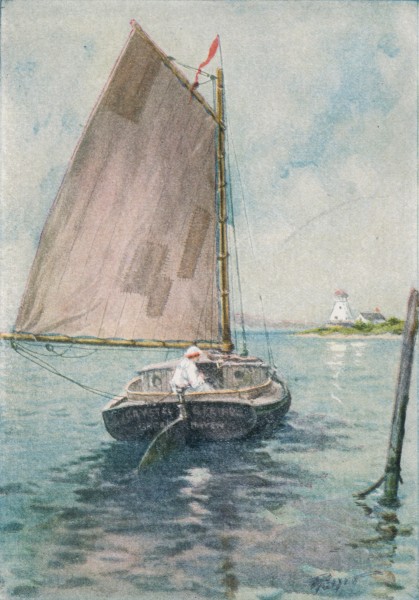
The Crystal Spring nosed her way out of
Herrick’s Cove, caught the southeasterly breeze
on her big sail and moved lazily along past the
end of Greenhaven Neck. The Crystal Spring
was not built for speed. She was snub-nosed
and square-sterned and wide in the beam. The
mast was stepped well forward and a short bowsprit
made room for a jibsail that was seldom
used. Abaft the mast was a small hatch nearly
flush with the deck. Amidship was a second
hatch, larger than the first. Coiled over it,
like a gray snake, was a length of two-inch hose
attached at one end to a rusty pump set into
the deck. The Crystal Spring was not a beauty,
no matter how you looked at her. She was
painted black, as to hull, and gray as to deck
and hatches. Her mast needed scraping and her
patched mainsail was grayer than her deck. On
the stern was the inscription “Crystal Spring,
Greenhaven.” She sat low in the water and
moved sluggishly. To be sure a three-mile
breeze isn’t conducive to speed, but even in a
gale the Crystal Spring wouldn’t have shown
her heels to anything that sailed out of Greenhaven.
With his feet in the shallow cockpit sat the
skipper and crew of the Crystal Spring, one arm
draped over the long tiller. The skipper and
crew was sixteen years of age, had a good-looking
weather-tanned face, a sturdy body and was
named John Herrick—and called Jack. He had
a pair of nice brown eyes, a straight nose well
freckled, a fairly wide mouth and a square and
rather aggressive chin. Just at present his
mouth was puckered up, for Jack was whistling—I
almost said a tune. Let’s simply remark that
he was whistling and let it go at that, for the
fact is that Jack could no more whistle a tune
than he could sing one; and if you ever heard
him try to sing you’d understand. As he
whistled, his gaze roamed from the sail to the
shore and thence out to sea. Seaward there
was little to look at—only a smudge of smoke
like a narrow cloud trailing above the horizon.
Shoreward was the end of the Neck and the squat
white lighthouse agleam in the sunlight of a late
June morning. Behind the lighthouse was the
keeper’s little cottage with its weathered roof
and green blinds, and its tiny garden of sweet
peas and nasturtiums, making a spot of bright
color against the yellow-green of beach-grass
and the gray of boulders. The tiller moved a
little, the sail flapped for an instant and then
filled again and the sloop slowly turned to pass
Popple Head and run along close to the granite
breakwater, seeking the harbor entrance.
With the breeze behind him Jack found the
canvas cap he wore uncomfortable and dropped
it into the cockpit, revealing a somewhat
touselled head of brown hair. I call Jack’s
hair brown for want of a better word. As a
matter of fact it was of some indescribable shade
between brown and the color of oakum, and,
at that, it had lighter streaks in it. I think
that nature had intended him to have quite
respectable and commonplace brown hair, but
as his cap was usually just where it was now—that
is, off his head—the sun and the winds and
salt spray and the fogs had worked their wills.
On the whole, the result, especially when the
sun was on it, was rather pleasing. The rest
of Jack’s attire was quite simple. A white
canvas blouse, clean if not altogether guiltless
of stains, covered the upper part of his body
and a pair of old gray trousers did for the rest.
He wore no shoes, although two brown canvas
“sneakers,” in each of which a brown cotton
stocking was tucked, reposed in the cockpit.
A man in khaki overalls and a red flannel
shirt emerged from the door of the lighthouse
and waved a hand. Jack waved back. The
man was Captain Horace Tucker, the lighthouse
keeper. Captain Horace was a distant relation
of Jack’s on his mother’s side, and Jack called
him uncle, although the relationship was not
really as close as that term implied. The lighthouse
fell astern and the long, gray wall of the
breakwater stretched away beside him. Jack
scrambled to his feet, placed one bare foot on
the tiller and craned his head. As the tide was
almost at flood he could just see over the top
of the breakwater. For a minute he scanned
the harbor. Then, with a shake of his head, he
jumped back into the cockpit.
“Not much doing today, I guess,” he muttered.
Half-way along the breakwater a man was
fishing for perch. Jack headed the sloop further
away so as not to interfere with him. As the
Crystal Spring drew abreast, however, the
fisherman called across.
“Much obliged, but there wa’n’t no call to do
it. I ain’t had nary nibble so far. I cal’ate
Friday’s storm’s driv all the fish out to sea.”
“Try down by the beacon,” called Jack.
“The water’s deeper there.”
He pointed ahead of him and the fisherman
nodded and pulled up his pole and line. Down
the shore, beyond the little rocky island called
The Lump, a hand-liner was coming in with all
sails set.
“That’s Desco Benton,” murmured Jack.
“I guess I can sell to him if that plaguey chug-boat
don’t get to him first.” He eyed his sail
anxiously, eased the sheet a bit and watched
for the end of the breakwater with its red
beacon light set up on a tripod of timbers, for
all the world like a little fat man with three legs.
The sunlight shone dazzlingly on the ruby glass
as Jack swung the sloop around the end of the
granite barrier and across the bar. Before him
lay the big round harbor, with Gull Island
almost in the center, and innumerable boats
lining the fish wharves or anchored in the
channels. At the left the old town of Greenhaven
ambled away up the hill, its white houses
and crooked streets elbowing and jostling each
other at every turn. Straight ahead, at the end
of the mile-long basin, across what is known as
the Neck Marsh, a second cluster of roofs showed
where Cove Village lay along the edge of Lobster
Cove.
It was a busy scene even at nine o’clock in
the morning. Over at the Eastern Halibut
Company’s wharves two schooners were unloading;
Jack could see the sunlight glinting on the
white bellies of the big fish as they were pitched
from deck to wharf; on Gull Island, a short
distance ahead, Abner Lacy’s Esmeralda, which
had been in collision with a steamer trawler off
White Face Bar a few days before, was being
winched up the railway for repairs; the ring of
the mallets on the blocks and the clicking of
the windlass came loudly across the quiet
water. Half-way between island and Neck
the ferryboat was churning its way; Jack could
see Captain Trufitt edging along the narrow
deck taking fares. On the town side of the
harbor a whale-back was unloading coal and
the rattle and hum of the hoisting engine beat
incessantly across. An Italian salt bark, her
battered red hull deep in the water, had berthed
in the broad channel and a lighter was sidling
up to her. They would unload until she drew
less water and then take her over to one of the
wharves. At the Folsom Company’s docks a
dozen schooners were fitting for their summer
trips to the Banks. Small sailboats and rowboats
dotted the blue expanse and just beyond
the inner end of Gull Island a neat steam-yacht,
resplendent in white paint and mahogany
and brass, awaited her turn on the marine railway.
Over on the Neck side they were launching a
sloop at Davis’s boat-yard where, hauled up
on the shore and covered from the weather with
canvas or boards, half a dozen sailing craft of
various descriptions awaited their owners’
orders. There was a distinct odor of drying fish
in the air—in almost any direction you could
catch a glimpse of the “flakes” behind the fish
houses—which, mingling with the odors of
lumber and pitch and paint from the yards, of
seaweed from the shallow beach and of the soft,
salty breeze from the ocean, constituted a
fragrance that was as much a part of Greenhaven
as the granite hill on which it was built.
Jack knew that odor well and loved it. He
breathed it gratefully now as, guiding the
Crystal Spring toward the broad channel, he
saw Desco Benton’s Hetty and Grace rush past
him near shore, shortening sail as she went.
Jack cast an anxious gaze up the harbor.
“I guess that chug-boat will beat me again,”
he muttered, “though I don’t see her anywhere
yet. Likely she’s at the landing. Get on, you
old sea-crab!”
The latter command was addressed to the
Crystal Spring, which, now in the lee of the
breakwater, was moving more leisurely than
ever. Down the harbor the Hetty and Grace
came about into the wind and Jack saw the
anchor splash. It would take him ten minutes,
maybe, to reach her, for he would have to
tack in a moment and stand over toward the
shore. And then what he feared and expected
happened. Out of the press of boats around the
town landing a cat-rigged boat driven by a
gasoline motor chugged its way. It was painted
buff, with a black strip, and to the bare mast
was fixed a white placard with the word “Water”
on it in black letters. Straight across to the
Hetty and Grace it went and Jack sighed and
shrugged his shoulders.
“Either I’ll have to rig up an engine or go out
of business,” he muttered. “Well, I’ll try the
steam-yacht.”
But when, five minutes later, the sloop
wallowed up to within hailing distance of the
handsome Sea Mist, a man in blue coat and
brass buttons informed him shortly that her
tanks were full.
“I’ve got the best water around these parts,”
persisted Jack, as the Crystal Spring drifted by.
“It’s spring water right out of the ground this
morning.”
The man grinned. “That’s what they all
say,” he jeered. “And it all tastes like bilge,
too.”
“Mine don’t. Better try some. Let me fill
up a tank for you, sir.”
“All full, I tell you.” The man turned away,
Jack swung the helm over and the Crystal
Spring began her day’s cruise in and out of
the shipping. It was almost eleven before Jack
made his first sale. A Portuguese fisherman
bargained a good ten minutes. Then the Crystal
Spring was made fast, the hose was lifted to
the schooner’s deck and pulled down a forward
hatchway and Jack, attaching the long handle
to the pump, began his labor. It wasn’t easy
work, but Jack’s muscles were used to it, and, as
the fisherman had only one butt to fill, it was
soon done. Then Jack took his pay, recoiled
his hose, cast loose and went on again. What
breeze there had been earlier in the day had
almost died away and the sloop’s progress was
slower than ever. Now and then Jack caught
sight of the Morning Star, as the rival water
boat was poetically named, chugging its way
about the harbor. But even the Morning Star
wasn’t doing much business today. At noon
Jack made fast to the stern of a lumber schooner
near the coal wharf and ate his lunch. It was
pleasant enough there in the sun with so much
to watch, and the lunch that Aunt Mercy had
put up tasted awfully nice, just as it always did,
but Jack wished that trade was brisker in his
line of business. And just when he was thinking
that there was a hail across the basin.
“Water boat, ahoy!” came a voice.
CHAPTER II A Rescue
Jack jumped to his feet, dropping two of
Aunt Mercy’s best doughnuts, and looked about
him. The hail came again and Jack saw Desco
Benton waving from the Hetty and Grace.
“Right-o!” he called, and quickly cast loose.
It took the Crystal Spring almost five minutes
to half drift and half sail across to the hand-liner,
and all the way Jack wondered what
Desco wanted of him. When he was alongside
the master of the Hetty and Grace appeared at
the rail again.
“Where you been, Jack?” he growled. “I
been waitin’ all the mornin’ for you.”
“I’m sorry, Desco. I saw the other boat putting
out to you and I thought you’d got water.”
“Them Portuguese? Oh, I sent ’em off in a
hurry. That stuff they pump ain’t water, it’s
pizen. One of ’em says to me awhile back, he
says, ‘Cap’n, this water’s the finest spring
water in Greenhaven.’ ‘Spring water’ says I.
‘Spring water! If it is it’s last Spring water!’”
And Desco leaned on the rail and laughed
hoarsely at his joke. “Where’d they get that
stuff, Jack?”
“Right out of the hydrant at the landing,”
replied Jack with a smile. “I guess it’s all
right when there isn’t a break in the main, but
there usually is. Then it’s about the color of
pea soup. Have a good trip, Desco?”
“Fair to middlin’! I landed ’em down to
Boston. Here, give me hold o’ that pipe.
How you gettin’ on, Jack?”
“About the same way—fair to middling,”
answered Jack as he uncoiled the hose. “There
isn’t much doing just now. Folsom’s boats get
their water at the wharves these days. They
had a pipe put in. I suppose it’s cheaper for
them that way.”
“Huh, I cal’ate it is. An’ Folsom never was
a man to waste money. Cal’ate that’s how he’s
come by so much on it. I got two butts ’most
empty, Jack, and the deck cask, too. Here,
Manuel, lug this down to the butts and sing out
when you’re ready.”
While Jack pumped the master of the Hetty
and Grace leaned across the rail and talked. He
was a big, broad-shouldered, yellow-bearded
Nova Scotian, of thirty-five or thirty-six years,
a good sailor and a lucky master. Desco
Benton’s luck was proverbial around Greenhaven
and it had stood him in good stead many
times. “As lucky as Desco Benton” was a
common saying among the fishermen. The
Hetty and Grace was a small but staunch little
knockabout schooner, Essex built, with the lines
of a pleasure yacht. Desco owned every plank
and nail in her and was immensely proud of her.
She could sail, too. That fact had been demonstrated
two years before when Desco had beaten
every schooner in the fisherman’s race to Boston
Light and back, having his anchor down and
all sails snug when his nearest competitor came
racing around the breakwater.
“How’s your folks?” he asked presently.
“I cal’ate that sister o’ yours is quite grown up
by now.”
“Faith’s thirteen, I guess,” Jack replied as he
worked at the long pump handle. “She’s
going to high school.”
“I want to know! An’ how about you, Jack?
Wasn’t you in high school, too?”
“Last year. I had to quit when father died.
Someone had to make some money and it looked
like it was up to me.”
“Of course. Well, edication’s a good thing,
I cal’ate, though I never had much time for it,
but it don’t butter no parsnips, Jack.”
“I’m going back some day, I expect. I want
to, anyway. I want to go to college if I can, too.
Looks now, though, as if I might be pretty old
before that happens.”
“College, eh? H’m; I had a feller sailin’ with
me a couple o’ years back that was a college
grad-oo-ate; name o’ Jasper Fitzwilliam. He
wan’t no good at all. But I cal’ate there’s a
difference in ’em. I cal’ate that young Folsom’ll
have a college edication. I passed him comin’
in, him an’ another boy. They was in a motor-boat
about half a mile off The Lump. Seemed
to be hove to off there an’ I cal’ate they was
fishin’. He’ll be a rich man some day, when
his dad dies, eh?”
“I suppose so. He seems a nice chap. He
was in my class at high school last year, though
I didn’t know him very well. Funny place to
fish, off The Lump, Desco. I never heard of
anyone catching anything there, did you?”
Desco shook his head as the signal came to
stop pumping. The sailor crawled up through
the hatch with the hose and Desco bade him
lug it forward to the small butt lashed by the
deck-house. Jack began his labors again.
Desco, his gaze fixed on the western sky, where
a few white clouds like great bunches of cotton
batting were creeping up, pointed with the stem
of his pipe.
“There’s goin’ to be a thunder squall before
long, Jack,” he said. “Better get your slicker
out.”
Jack looked and nodded. “It feels like it
too,” he answered. “I’d just as lief it didn’t
come till I get this old lugger back to the Cove.”
There was a yell from the sailor at the hose
and Jack stopped pumping. A few minutes
later Desco dropped Jack’s line to the deck of
the water boat and Jack, pushing the boom out,
took the tiller again and waved good-bye to the
master of the Hetty and Grace.
For two hours or more he cruised slowly about
the harbor without doing any business. It was
almost four o’clock, and the Crystal Spring was
ambling along just inside Gull Island, when
Jack saw the lighthouse tender push her snub
nose around the breakwater and turn sharp
into the narrow channel. The tender usually
bought water when she visited Greenhaven, and
Jack, casting an anxious backward glance in
search of the Morning Star, hustled the Crystal
Spring all he knew how. The lighthouse tender
was already out of sight behind the island,
although Jack could see the tips of her masts
above the buildings. His first tack took him
to the end of the breakwater. Then, as the
water boat came around, he saw that the tender
already had her mud-hook down. The Morning
Star, it seemed, had for once been caught
napping, and Jack smiled as he pushed the sloop
along. But the smile faded a moment later, for
around the farther end of the island sped the
Morning Star, her eight horsepower engine
puffing away at full speed. Had the Crystal
Spring been similarly equipped it might have
proved a very pretty race, but as it was the
Morning Star had everything her own way.
Before Jack had covered half the distance
between him and the tender, the Morning Star
was alongside the government boat. A moment
later lines were passed aboard and the two
Lampron brothers were manning the pump.
As the Crystal Spring sailed by Tony Lampron
grinned across at Jack and shouted, “Where
you been some time, eh, Mister?” and his
brother Frank waved a hand and laughed.
Jack made no sign, but he was angry and disappointed,
and at the end of the island he
swung the Crystal Spring around and headed up
the channel for home. It wasn’t likely that
there would be any more business today. And
he didn’t much care, anyhow. Besides, the
thunder storm that Desco had predicted was
almost at hand, and Jack could see by the angry
streaky look of the clouds that there would be
wind as well as rain. He didn’t care to be
caught outside in a blow. The Crystal Spring
was staunch enough but she was anything but
dry in dirty weather. Jack resolved to get
around Popple Head and at least under the lee
of the Neck before the storm burst.
To be on the safe side, however, for already
the thunder was rumbling, he kicked down the
latch of a little locker under the poop and pulled
out a yellow oilskin coat and hat. He substituted
his shoes and stockings for the oilskins and
slammed the locker door shut again just as the
sharp detonations of an engine exhaust reached
him. A stone-throw to leeward Charley Paige,
leaning against the tiller of his little power boat,
waved to him and pointed westward. Jack
waved back and, nodding his head, luffed the
Crystal Spring around through the swell of the
fisherman and headed along the breakwater.
The breeze had grown flukey and of a sudden a
great gray cloud passed over the sun and the
ocean darkened to steel color. A clap of thunder
broke overhead. A puff of wind came out of the
west and the boom went down as the first puff
of the squall caught the big sail. Then came a
drop of rain and Jack, straddling the tiller,
donned his oilskins, buttoning the long coat
closely about him, and pulled the sou’easter
down over his head. It was evident that he
was in for a wetting after all.
The Crystal Spring began to roll as the wind
increased, behaving in a most frolicsome, undignified
manner. Half-way between the beacon
and the lighthouse point the rain began in
earnest, slanting out of the west and pelting at
Jack’s back vindictively. There was quite a
sea by now, although the rain flattened the surface
somewhat and the squall blew the tops of
the waves into spume. Jack, finding himself
in for it, began to whistle tunelessly, leaning
against the tiller and peering out from under the
brim of his sou’easter. It was too thick to see
very far ahead and it behooved him to be watchful,
since a fisherman might be beating his way
in around Popple Head. But he sighted nothing
and the lighthouse was abeam and he brought
the sloop’s blunt nose around. In another
minute he would be in the lee of the shore and
well out of some nasty weather. The thunder
still crashed at intervals and now and then the
dun clouds were rent asunder by the livid flashes
of lightning. The lighthouse dropped astern
and the Crystal Spring, with a final impatient
roll, settled back on an evener keel. And at
that moment, following a crash of thunder, Jack
heard a faint hail.
He shaded his eyes with his hand and peered
shoreward. But as far as he could see there
was no one in sight. He had about reached the
conclusion that he had been mistaken when the
hail came again, a mere atom of sound above
the rush of rain and sea and the creaking complaint
of the sloop’s timbers. Jack turned seaward
and strained his eyes through the murk.
At first only a blank gray wall of mist rewarded
him, but as his gaze accustomed itself to the
task, suddenly a darker blur, something neither
rain nor sea, came to his vision for a moment
and then was lost again. Half doubting, Jack
hauled on the sheet and jammed the helm to
starboard. The Crystal Spring came about with
a resentful lunge that sent the water in her big
tank swashing noisily from side to side. With
his eyes fixed ahead Jack gave the sloop all she
could carry and in a moment the squall caught
her again as she passed out of the lee of the land
and dipped the end of the long boom in the racing
sea. Again came the hail, clearer this time,
and seemingly from off the port bow.
Jack moved the tiller a little, peering out from
under the sail. And then, almost ahead, a
small boat jumped into view, a tiny craft with
two figures huddled in her. Jack shouted a
response and kept on, and as the Crystal Spring
staggered past the smaller craft he saw that the
latter was a motor boat, perhaps not over
eighteen feet long, apparently broken down.
In another moment she was lost to sight. It
was no easy matter to bring the water boat’s
head into the wind and fully five minutes passed
before Jack, allowing for the drift, sighted the
launch again. Then, steadying the Crystal
Spring as best he could, he bore up to the disabled
boat and made a trumpet of his hands.
“Stand by to catch a rope!” he shouted.
There was a faint response from the launch and
Jack, seizing a coil of half-inch rope from the
locker, snagged the tiller with his knee and got
ready to throw. The sloop wallowed up to
within a dozen feet of the launch and with a
sweep of his arm sent the coil hurtling across
the water. It was a lucky throw and as the
Crystal Spring went by Jack saw one of the
occupants seize the rope.
“Make fast to the bow cleat,” he shouted
back, “and haul in!”
A figure moved cautiously along the pit of
the tossing launch, crawled to the deck and with
fumbling fingers tied the line to the cleat. The
launch had been drifting stern foremost and now
Jack brought the Crystal Spring around so that
the launch might come up under her lee. Aboard
the latter they were hauling valiantly and in a
minute the little motor boat was alongside and
the occupants were climbing aboard the sloop.
They were sorry-looking mariners. Both appeared
to be boys of about Jack’s age. Neither
wore oilskins and their blue serge suits were
soaked through and through. One of the boys
had lost his cap and his hair was plastered
tightly to his head.
“Bring that slack with you,” Jack directed,
“and make the line fast to that cleat there.
That’s the ticket. Now then, I’ll have you
ashore in a minute or two, but you’ll find a couple
of blankets in the bunk for’ard if you want them.
Open that for’ard hatch and you’ll see them.”
But the boys shook their heads as they sank
to the cockpit. “We can’t get—any wetter,”
said one. “We’re terribly much obliged—to
you for—” He paused, and then, “Why, it’s
Jack Herrick, isn’t it?” he exclaimed.
Jack nodded as he gazed ahead in search of
the Cove.
“That’s me. And you’re Harry Folsom.
Catch any fish?”
CHAPTER III A Pair of Amateur Salts
A quarter of an hour later the three boys were
sitting about the “air-tight” stove in the front
room of the little, white, clap-boarded, green-shuttered
house that was Jack’s home. They
had left the Crystal Spring safely moored in the
Cove, with the motor boat swinging astern,
dropped into the little dory and paddled ashore.
From the little beach up to the Herrick house
was but a few yards, and in a trice they were
inside, listening to the surprised ejaculations of
Aunt Mercy and dripping water onto the immaculate
waxed floor of the “passage.” Aunt
Mercy Fuller was Jack’s mother’s sister, and
ever since Mrs. Herrick had died, when Jack
was only four years old, the sharp-voiced, kind-hearted
little woman had kept house at the
Cove. After the death of Jack’s father, only a
year ago, Aunt Mercy’s presence was more
indispensable than ever, for Jack’s sister, Faith,
was only thirteen, and so, still in school. All
of Jack’s dry clothing had been requisitioned and
the drafts in the stove opened wide, and now,
none the worse for their wetting, the two visitors
were recounting their adventures to the household.
Harry Folsom was nearly Jack’s age, being
some three months younger. He was like Jack
in many ways, for which the fact that each
came of an old Greenhaven family was perhaps
accountable. Harry’s hair was of quite an
ordinary shade of dark brown and his face was
not tanned and seasoned by sun and weather.
And his eyes were gray instead of brown. But
dissimilarity seemed to end there. He was
much like Jack in build and weight and he had
the same easy, careless swing from the hips when
he walked, and the same way of looking straightly
and unwinkingly when he talked. Harry’s
father was Josiah Folsom, the head of the big
fish company of Greenhaven, and a man of much
wealth. He and Jack had been together at high
school the year before, but last fall Jack had left
school to sail the Crystal Spring and Harry, or
Hal, as he was called, had entered Norwalk
Hall, the big preparatory school some thirty
miles distant and just over the line into New
Hampshire.
His companion Hal had introduced as Beaman
Mansfield. Harry called him Bee and so we
might as well do the same. Bee was visiting
Harry, it seemed, having arrived with him in
Greenhaven only the evening before. They
were roommates at school and evidently great
chums. Beaman Mansfield was fifteen years
of age, slight, tall, black of hair and eye, and
almost sallow as to complexion. As Harry
narrated their exploits Bee interpolated remarks
which, if they were not especially informative,
seldom failed to amuse.
“You see,” said Harry, “that launch is a new
one. Dad got it for me a week ago and I never
saw it until yesterday. This morning we
thought it would be a good plan to go for a sail
in her. So we filled her tank with gasoline and
started out. I’d never run a motor boat before,
but Bee said he knew something about the
things—”
“I know a heap more now,” observed Bee,
gravely.
“So we started. She went finely for about
ten minutes and we were down off The Lump.
Then she stopped. I told Bee to get busy and
find out what the trouble was and he monkeyed
around with a wrench and a screw-driver for
almost half an hour.”
“I deny it!” exclaimed Bee. “I knew at
once where the trouble lay!”
“Yes, you did!”
“I certainly did! It was in the engine.”
“Oh! Well, it took you long enough to dig
it out. Anyhow, we got her started again and
she went like a breeze; must have made at least
twelve miles an hour, Jack, and we were about
two miles down the shore when—bing, stopped
again!”
“And she’s been ‘binging’ ever since,” murmured
Bee.
“By then it was time for lunch. So we rowed
ashore near the life saving station and walked
up to that little store where the old toll-gate
used to be. It’s quite a ways up there.”
“About ten miles,” said Bee thoughtfully.
Jack laughed. “I dare say it seemed that far
if you were hungry. It’s about three-quarters
of a mile, I guess.”
“Well, we were hungry,” replied Bee. “I
was, at any rate. I’d had nothing since breakfast
but that nasty yellow cup-grease and gasoline.”
“We bought some crackers and some sardines
and two oranges. I’ll bet old man Doonin had
had them all for at least six months.”
“I think they were some of his Christmas
stock left over,” remarked Bee reflectively.
“They were pretty fierce, anyway, and we
decided the best thing to do was to hike home
and get a real feed. So we went back to the
launch and tried to start her again. But she
wouldn’t start—”
“It was another case of ‘bing!’” said Bee.
“And it took us all of an hour to get going.
Bee and I took turns at the fly wheel—”
“I beg your pardon?” remarked Bee, sitting
up quickly. “Did I understand you to say that
we took turns? Allow me to correct you, Hal,
I took turns!”
“Well, I like your cheek! My arm’s as stiff
as—as—as a board! And it aches every time I
move it! I’ll bet I turned that old wheel over
two thousand times today; and it weighs a ton,
too!”
“What sort of an engine has she got?” asked
Jack.
“An eight-horsepower Philbert.”
“I think myself it’s a chestnut,” observed
Bee. “And if you think your arm aches, why,
I just wish you had mine!”
“Did—did you get the boat started finally?”
asked Faith anxiously. The boys laughed, and
Faith, a pretty, dark-haired young lady, inclined
to be shy, blushed.
“Yes, finally,” answered Hal. “That was
about—what time, Bee?”
“About two hours after lunch time,” replied
Bee, gloomily.
“Yes, about half-past two, I guess. Then she
went pretty well for awhile, although she choked
and coughed a good deal—”
“She has consumption,” said Bee, with a
shake of his head. “She won’t last long.”
“She stopped once near the outer buoy and
again just off the light. And that time Bee said
he was going to fix her right and began to take
the engine to pieces.”
“It was the only thing to do,” explained Bee
gravely to Jack. “Take her to pieces and put
her together again.”
“You got her to pieces all right,” continued
Hal, “but you couldn’t get her together again.”
“Well, there were two or three small thing-mabobs
I couldn’t find places for. I still think
she’s just as well without them.”
“All that time we were drifting along the
breakwater. We haven’t any anchor yet, you
see, and there was no place to tie up to. Then
the squall came up while we were trying to get
her to start and the first thing we knew we were
going out to sea at about a mile a minute.”
“She went faster than she did at any other
time all day,” said Bee. “It just showed what
fixing the engine did for her.”
“Yes, you ‘fixed’ it all right,” said Hal, sarcastically.
“If it hadn’t been for Jack we’d be
half-way to Africa by now.”
“I’ve always wanted to see Africa,” replied
his chum, calmly. “It must be a very interesting
place.”
“Maybe,” laughed Hal, “but I don’t care to
go there in an eighteen-foot motor boat. Of
course we couldn’t do much when the blow came.
We tried to keep her bow into the waves, after
we’d found we couldn’t row her, but that was
pretty hard work. And after awhile, when we
got around Popple Head, we gave that up and
put all our strength into shouting. I don’t
mind telling you that we were getting sort of
scared when you came, Jack.”
“You had a right to be,” said Jack, dryly.
“If I hadn’t heard you you’d have had a pretty
wet night of it. That wind would have taken
you across toward the Isle of Shoals, I guess,
if you’d floated long enough. Did you have
anything to bail with?”
“Only my cap,” said Bee. “And it wasn’t
satisfactory. I told Hal I thought his would
have been better.”
“Dear, dear,” murmured Aunt Mercy. “You
boys certainly had a narrow escape from death.
I hope you won’t ever try anything so silly
again.”
“No’m, we won’t,” Hal assured her. “We’re
not going out in her again until we have an anchor
along.”
“And a tomato can,” suggested Bee.
“A tomato can?” Hal questioned. “What’s
that for?”
“To bail with.”
“Why not have a bailer?” laughed Jack.
“All the boats I’ve ever been in,” replied
Bee, soberly, “carried empty tomato cans for
bailing purposes. I wouldn’t know how to use
anything else.”
“And I guess,” said Jack, “you’d better get
your engine put together again before you take
another trip. It might be that the things your
friend couldn’t get back were sort of necessary,
Hal.”
“I don’t think so,” said Bee. “Maybe,
though. I’m not sure that I know where they
are. Did I give them to you, Hal?”
“You did not!” replied Hal indignantly.
“And if you’ve gone and lost them—”
“Well, they may be kicking around under the
grating somewhere. After we get the water
out of her we’ll have a look. I don’t believe,
though, we’ll ever find them; they were little
trifling things.”
The others laughed and Jack arose and went
to a window. It was still raining hard, but the
thunder and lightning had passed over and the
wind had diminished considerably. The old
iron-case clock on the mantel behind the glowing
stove said a quarter past five.
“You fellows had better stay and have some
supper,” he said. “There’s no use trying to get
back in this rain.”
“Oh, much obliged,” said Hal, “but we can
get across to the ferry all right. It’s just a little
way, isn’t it?”
“About a quarter of a mile. But your
clothes aren’t dry, I’m afraid. You’re welcome
to wear what you have on, but they don’t fit
very well. The best thing to do is to telephone
over to your folks that you’re all right and then
stay here until your things get dried.”
“We—ll, it’s awfully good of you.” Hal
looked inquiringly at his friend. Bee appeared
not to see the question. He only sighed comfortably
and stretched his long legs farther
toward the stove. “If we won’t be too much
bother, Miss—Miss Fuller, I guess we’ll stay.”
“You won’t be any bother at all,” Aunt Mercy
assured him. “I’ll just tell Susan to cook a
little more supper.”
“Let me go, Auntie,” said Faith.
“No, I’ll go. I cal’ate I’d better get down a
pot of that barberry preserve.”
“Gee,” laughed Jack, “I wish we had shipwrecked
folks to supper every night, don’t you,
sis?” and Faith shyly owned that she did.
Aunt Mercy pretended to be insulted.
“I cal’ate, Jack Herrick, that you don’t ever
suffer for preserves in this house!” she declared.
“No, ma’am, not exactly for preserves. But
that barberry preserve—say, sis, we ain’t had
any of that since about Christmas, have we?”
“You had some last Sunday night,” returned
Aunt Mercy with asperity. “And I’ve a good
mind not to give you any, if you can’t remember
when you do have it!”
“Quite right, ma’am,” said Bee approvingly.
“I think it would be good punishment if you
just gave it to the rest of us. I’m sure I shan’t
forget it, ma’am!”
Aunt Mercy regarded him severely.
“Humph!” she said. “I cal’ate, young man,
you don’t miss much in this world for want of a
tongue in your head!” Whereupon, with a
grim smile, she sailed out of the room.
Hal chuckled. “I guess that will hold you for
awhile, old Bee!” Then, turning to Jack,
“Did you say you had a telephone here?” he
asked.
Jack shook his head. “No, but there’s one
at Cottrell’s store, just over the hill. I’ll run
over there, if you like, and tell your folks you’ll
be home after supper.”
“What’s the matter with my going?” asked
Hal. “Let me have your oilskin coat, Jack,
and point out the way. I guess I ought to let
father know I’m all right. He may be getting
worried.”
The two boys went out, leaving Bee and Faith
together in the quaint little low-ceilinged room.
Bee looked about him with interest. “You’ve
got an awfully comfortable home here, Miss
Faith,” he said. “It’s so sort of old-fashioned
and nice.”
“It’s quite an old house,” said Faith embarrassedly.
“Father’s grandfather built it almost
a hundred years ago. There wasn’t much of
anything on the Neck in those days, they say,
except the lighthouse. Do you live around
here?”
“No, my home’s in Pennsylvania. I wish I
did live around here, though, for I’m crazy
about the water and boating and fishing and—”
“And being shipwrecked?” suggested Faith
with a laugh.
“N—no,” Bee acknowledged, echoing her
laughter, “I guess I can do without that for
awhile. I was in a blue funk out there. And—and
I’d have been seasick in about another
minute, I guess.”
“You were both very foolish to go out in a
boat you didn’t understand,” said Faith gravely.
“Besides, I never think a motor boat is really
safe, anyway, do you?”
“I don’t know. I never was in one until this
morning.”
“Why—but I thought you said—you understood
them!”
“Oh,” responded Bee carelessly, “I had to say
that to get Hal to go out. He wanted to wait
and find someone to show him how to run the
thing. We’d have lost a lot of valuable time,
you see.”
“Oh! You mean that—you aren’t going to
be here long and you didn’t want to waste a
day?”
“Oh, I shall be around here for a month,
probably. My folks have gone abroad and Hal’s
going to put me up for as long as I want. I had
a chance of going across with the folks, but Hal
talked so much about Greenhaven all winter
that I thought I’d rather come here. And I’m
glad I did, too. I’m going to have a dandy time.
Hal’s people are as nice as pie to me. I suppose
you know them, Miss Faith?”
“N—no, I don’t. You see—” She paused
and Bee waited politely for her to continue.
“What I mean,” she went on at last, “is that
the Folsoms are very rich people and we’re—we’re
not. So, of course, we don’t know them
very well.”
“Oh!” Bee considered that a moment.
“Well, I like them very much. Hal’s a dandy,
too. I didn’t care much for him at first, though.
They put us to room together at school and we
had a scrap the first night. Then we didn’t
speak for two or three days. Then we had
another scrap and Hal licked me and after that
we were pretty good chums.”
Faith looked puzzled, but she only said, “Oh!”
in a doubtful tone, and Bee went on:
“I suppose you and your brother go to school
here?” he inquired. “Hal showed me the high
school this morning when we came down to the
wharf.”
“I go,” replied Faith, “but Jack had to give
it up this year. Poor Jack! He hated to do it.”
“Er—you don’t mean—he wasn’t expelled,
was he?”
“Jack? Oh, no indeed. But father died a
little over a year ago and so Jack thought he
ought to go on with father’s business and make
money. Father used to be a fisherman and
owned his own schooner. Then, when I was
about five, he had an accident. He fell and
broke one of his legs when he was ’way up off
Newfoundland and it wasn’t set right for two
weeks because the schooner was in the ice and
there wasn’t any doctor around. And then
when they finally got him to a doctor it was too
late and his leg was never much good afterwards.
So he sold his schooner and bought the
Crystal Spring and made her into a water boat.
You see there’s always been a spring up on the
hill just back of our house and father only had
to run a line of pipe to the Cove and then fill
up the tank and sail around to the harbor and
sell the water. He used to sell lots and lots of
water a few years ago, but now the fish companies
generally supply the water for their boats
themselves. And lately two Portuguese men
have started a water boat, too, and as their
boat has a gasoline engine poor Jack isn’t doing
very well. He said the other day he guessed
he’d either have to have an engine put in the
Crystal Spring or go out of business.” And
Faith, a little breathless and more than a little
surprised at her unusual loquacity, came to an
embarrassed pause.
“That’s too bad,” said Bee sympathetically.
“I wouldn’t think there’d be enough business
for two water boats here. If I were he I’d
certainly put in an engine and see that it was big
enough to beat the other fellows!”
“He wants to, but—I guess it costs a good
deal,” replied Faith.
“What costs a good deal, sis?” asked Jack as
he and Hal returned to the sitting-room.
“An engine for the Crystal Spring,” explained
his sister.
“Oh! Yes, it would cost a lot more than I
could afford, I guess,” he said gloomily. “But
I’ll either have to have one put in or give up.
Those Lamprons can beat me every time.
Isn’t supper ready yet? I’m starved to death!”
When, a few minutes later, Aunt Mercy summoned
them to the little dining room, that
supper proved worth waiting for. The visitors
declared that they had never been so hungry and
had never tasted things half so good, and Aunt
Mercy was so pleased that she was positively
wasteful with the barberry preserve!
“May I leave the launch here until I can get
someone to come over and fix her up?” asked
Hal.
“Yes,” Jack answered, “I’ll look after her.
She’ll be all right. If I can find time in the
morning I’ll get the water out of her. For that
matter, maybe I can fix her up for you myself.
I know a little about gas engines. I’ll have a
look at her if you want me to.”
“I wish you would,” replied Hal gratefully.
“I’ll come over and help you,” said Bee.
“You’ll stay away from her!” exclaimed his
chum with energy. “If it hadn’t been for you
she’d have been all right.”
“Hear him!” Bee scoffed, appealing to Aunt
Mercy. “Why, that silly chug-chug didn’t
know the first thing about going until I worked
and toiled over her! Of all ungrateful brutes,
Hal, you’re the—the limit!”
“I’d have learned how to run her myself,”
said Hal amidst the laughter of the rest, “if
you hadn’t been so keen on starting out. I
wanted to have someone show me about the
thing, Jack, but this idiot couldn’t wait. Say,
what do you think he wants to do?”
Jack shook his head. “Drown himself, I
guess.”
“He wants to go out to Hog Island and hunt
for buried treasure!”
Jack laughed, and even Aunt Mercy smiled at
the idea, but Faith came to Bee’s defence. “I
think that would be lovely,” she approved. “I
read a book once—”
“There isn’t anything on Hog Island, I guess,”
said Jack, “but rocks and seagulls. You’d
better try somewhere else, Mansfield.”
Bee shrugged his shoulders, undisturbed.
“I’m not particular about where it is, Herrick.
But I certainly don’t intend to spend a month
on the coast and not have one good hunt for
buried treasure. I’ve always wanted to hunt
for buried treasure and now’s the time. I dare
say there’s plenty of it around here. There
always is. Captain Kidd probably left a few
chests of gold and diamonds somewhere about.
He was awfully careless, Kidd was, with his
treasure. Why, everyone knows that he buried
chests of gold all up and down the Atlantic coast!”
“I’ll bet he didn’t bury any on Hog Island,”
Jack laughed. “You can’t dig six inches anywhere
there without striking solid ledge. I’ve
been out there three or four times.”
“Then we won’t go to Hog Island, Hal,”
said Bee calmly. “I merely suggested that
particular place because it was the first island
I saw. We’ll find another one. How about the
thing you call The Lump?”
“Just a ledge sticking out of the water,” said
Jack. “If you really want to hunt for buried
treasure, though, Mansfield, you might have a
go at Nobody’s Island.” He smiled across at
Hal. “’Most everyone has around here!”
CHAPTER IV Buried Treasure
“That’s the ticket!” Bee snapped his fingers
gleefully. “That’s the very place I’m looking
for. Nobody’s Island, eh? There must be
buried treasure on an island with a name like
that. Where is it?”
“About three miles up the shore,” replied
Jack, smiling. “It isn’t much of an island any
more, though. Some years ago the sea ran in
back of it and then, I suppose, it was a real
island. Nowadays it isn’t an island at all,
except once or twice a year when there’s an
uncommonly high tide. Come on into the sitting-room
and I’ll show it to you on the chart.”
“Father always said there was money buried
somewhere there,” said Faith as she followed the
boys into the front room.
“I don’t doubt but that there is,” responded
Jack as he spread a chart across the center table,
“but I don’t believe anyone’s going to find it.
I’ll bet a hundred people have dug on Nobody’s
Island since I can remember. Years ago, when
a man didn’t have anything particular to do,
Mansfield, he took a shovel and went over to
Nobody’s Island and dug for gold. Here it is;
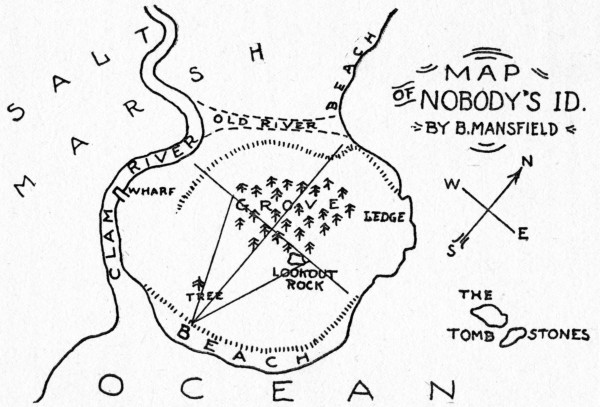
see? The chart doesn’t call it an island,
though; it just says, ‘Salvage Head,’ and
lets it go at that. These two little rocks out
here, just off the beach, are The Tombstones.
Boats used to pile up there every little while
trying to get around the Head. But in those
days Clam River—this is it here—had two
mouths, one on each side of the island. You
could go in here to the north of Salvage Head
and sail clean around and come out here on the
east. Then a storm or something filled up the
northern inlet and now it’s just sand there and
you can walk right across. Father always said
that some day that inlet would open up again,
but it hasn’t yet.”
“Do you mean that there used to be real
wreckers there?” asked Bee eagerly.
“Real as anything! There was a sort of
family of them named—what was the name,
Auntie?”
“Well, folks used to call them Verny,” replied
Aunt Mercy, who had settled herself with her
crochet, “but I believe the real name was
Verginaud.”
“That was the name, Verny,” said Jack.
“There were three of them, old man Verny and
two sons. They used to carry a lantern along
the shore of the island and the sailors would
think it was a boat’s light and go plump into
The Tombstones or on the beach. Then the
Vernys would flock down and get the pickings.
Sometimes they’d go over here on Toller’s
Beach—Toller’s Sands it was called then—and
decoy ships onto Toller’s Rock or The Clinker.
That’s The Clinker, that little rock just off the
point. So, you see, they got them coming and
going.”
“Gee, that sounds like the real thing!”
exclaimed Hal. “What did they do with the
stuff they got from the ships?”
“I don’t know; sold it, maybe; kept it, more
likely. I guess they didn’t get very big hauls for
the ships were mostly coasting schooners or
fishermen. They didn’t have to do any work,
anyhow, although father said they planted corn
and potatoes over here at the back of the island.”
“What became of them?” asked Bee.
“Well, about forty years ago things got so bad
that the sheriff took a posse over there and
cleaned them out; arrested old Verny and one
son; shot him when he tried to get away so that
he died afterwards; and burned their cabin
down. That was the last of them around here.”
“And what about the buried treasure?” asked
Bee eagerly.
Jack shrugged his shoulders. “Well, there’s
always been a belief that Big Verny, as he was
called, when he saw the posse coming buried
a chest of money and other valuables. I don’t
know how much truth there is in it. Father
used to say it was so, though.”
“Besides,” said Hal, “folks have picked up
money in the sand over there, Jack.”
“I guess that only happened once, Hal.
If you really want to hunt for treasure, Mansfield,
I guess Nobody’s Island is the most
promising place we can offer you.”
“You bet I’m going to hunt! How soon will
that chug-chug of yours be ready again, Hal?”
“Oh, maybe in a couple of days. Can you
wait that long? I don’t believe anyone will get
ahead of you and find the treasure.”
“You can’t tell,” replied Bee with a grin.
“Someone might. We’d better not lose much
time. Perhaps we’d better hire a boat, eh?
How much will you rent yours for, Herrick?”
“I’ll rent her cheap,” replied Jack grimly,
“and then make more than I’m making now.
Only thing, though, it would take all day to get
there in the Crystal Spring; she’s about as fast as
a crab.”
Bee was studying the chart again. “Say,
can I buy one of these things around here?” he
asked suddenly.
“Plenty of them,” laughed Hal.
“You may borrow that if you like,” said
Jack. “I don’t use it. Only take care of it,
please, because it was my father’s.”
“Sure you don’t mind? I’ll take care of it.
Thanks. I want to study this thing right.
There’s nothing like knowing the lay of the land
when you go after buried treasure. You see,”
he went on as he folded the chart up and tucked
it safely in his pocket, “I’m a bit of an authority
on hunting for buried treasure. I’ve read all
the best books on the subject, from Stevenson
down to the five-cent variety, and there isn’t
much I don’t know. What about getting home,
Hal?”
“I guess we’d better start along. It must be—gee!
it’s after eight! I didn’t think it was so
late. Let’s get back into our rags, Bee, and
hike.”
“Jack, if it’s after eight,” said Faith, “they
can’t go on the ferry. You know it stops at
seven-thirty.”
“That’s so; and I’m sorry, fellows. I tell
you what, though. You get your clothes
changed and I’ll row you across. All we’ll have
to do is walk over to Johnson’s and I’ll borrow
one of his dories.”
“But isn’t it raining?” objected Hal.
“Not a bit. Hasn’t been for an hour or more.
In fact—” Jack pushed a shade aside and peered
out—“the stars are out bright.”
“But isn’t it a longish way across to town?”
asked Bee.
“About a mile, but that isn’t far. Want to
come along, Faith?”
“May I, Auntie?”
“Why, yes, I suppose it won’t do you any
harm. But you see that the seats are dry,
Jack.”
And so ten minutes later the quartette set out
very merrily across the Neck, which was quite
narrow between Herrick’s Cove and the harbor.
They climbed the hill back of the cottage, past
the spring from which Jack piped his water to
the sloop, across the winding road, through
somebody’s back yard and so came to the harbor
side, where in front of them numberless lights
pricked out the dark water and the town beyond.
Westward the red gleam of the breakwater
beacon shone dully. Jack led the way down the
lane toward the float. As they passed the house
a door opened and a man’s voice asked: “What’s
up?”
“It’s I, Mr. Johnson—Jack Herrick. I want
to borrow one of your dories,” explained Jack.
“Help yourself,” was the hearty response.
“And get a good pair o’ oars. There’s some of
’em sort o’ mean, Jack.”
Soon they were seated in a dory, Hal in the
bow, Jack at the oars and Faith and Bee
together facing him. A few strokes sent them
into deep water and Jack settled down to the
long pull ahead.
“If you see anything, Faith, just sing out,”
he instructed. “I’ll make for the town landing,
Hal. It’s easier to find than some of the other
wharves. Will that be all right?”
“Dandy,” replied Hal from the bow. “If
you don’t hear from me again, wake me up
when we get there, Jack.”
“This,” remarked Bee, stretching himself
comfortably and colliding with Jack’s feet, “is
what I call fine. A sailor’s life for me every
time! ‘Yo ho ho, and a bottle of rum!’ O, you
Hal!”
“What?” asked Hal sleepily from the other
end of the boat.
“Wake up, you lazy beggar, and hear the
birdies sing! This is no time for slumber.
Look at all the pretty little stars, and the pretty
little lights! Smell the—the—what-do-you-call
it—the ozone!”
“That’s the fish wharves you smell,” laughed
Jack.
“Can’t help it; I like it; and I prefer to call
it ozone. Get the ozone effect, Hal?”
“Shut up, you,” mumbled Hal.
“Sleep then,” said Bee disgustedly. “But
when we collide with a—a lighthouse or a sunken
wreck or—or something you’ll wish you’d kept
awake, old Hal. You won’t have a ghost of a
show at being rescued. You’ll be trampled
under foot in the mad rush; and serve you right
for sleeping on—er—on occasion like this. I
think—mind you, I say I think—that we are
e’en now about to collision with something.”
“Yes, Jack, there’s a boat straight ahead.
Pull on your right oar.”
“Well,” said Bee admiringly, “you must be
able to see in the dark, Miss Faith. I couldn’t
have told whether that was a boat or a trolley
car.”
“Oh, it isn’t really dark tonight,” said Faith.
“The stars give a lot of light. Jack and I
rowed across one night when—well, it was pretty
dark, wasn’t it, Jack?”
“Black as your pocket. It was late in the
Fall and there weren’t many lights showing.
I thought the light on the pier on Gull Island
was the light on Curtis’s coal wharf and ran
plump into a bunch of spiles. We had quite a
lot of fun getting across that time. The old
dory leaked like a sieve and when she bumped
she sprung a few new leaks and the first thing
we knew our feet were in water up to our ankles.
Sis had to bail all the way across.”
“Fun!” ejaculated Bee. “Is that your idea
of a real good time? I suppose, then, if we
ran into a rock and the boat sunk you and Miss
Faith would laugh yourselves to death!”
“There’s the place we bumped,” said Jack,
nodding toward the dark bulk of Gull Island.
“We’re more than half-way over now.”
“Aren’t you tired?” asked Bee curiously.
“How far can you row?”
“Oh, four or five miles,” replied Jack carelessly.
“More than that, I suppose, if I had to.
But after three miles your arms begin to get
pretty stiff.”
“I guess mine would!” laughed Bee. “I’m
going to try that short stroke of yours some day.
Will you show it to me? I’ve never seen anyone
row just like that before.”
“Doryman’s stroke,” replied Jack. “It
doesn’t tire you like a long stroke. Many
schooners ahead, Faith?”
“No, Jack, none, if you keep the way you’re
headed. I can see the lantern on the landing
now.”
On one of the fishing boats a sailor was playing
on a concertina and singing. Jack stopped
rowing a minute and they listened.
“That fellow can sing, can’t he?” said Bee.
“It’s Desco Benton, sis,” said Jack. “I’d
know his voice if I heard it in a fog at sea.”
He plied his oars again and soon the dory was
in the shadows of the wharves and shipping.
Cautiously Jack sent the boat toward the landing,
worming in and out of the launches and
sail-boats moored in the basin. Then they
awoke Hal—he declared he hadn’t been asleep,
but Bee told him he had snored all the way
across—and presently the dory sidled up to the
float, under the glow of the big lantern, and they
said good-night.
It was arranged that Jack was to look over the
launch in the morning and if possible fix it up
so it could be brought back to town. If the
task was beyond him he was to tow it over
behind the Crystal Spring. “Anyhow,” he
said, “I’ll be here at nine o’clock with her,
Hal. You’d better be around then. Good-night!”
“Good-night, and thank you very much for
everything, Jack.”
“Not forgetting the supper,” added Bee.
“Nor the chart. Will you go with me, Herrick,
and look for buried treasure?”
“I will if I can find the time,” laughed Jack.
“Good-night!”
Faith added her farewell to his and the dory
backed out, leaving the two boys on the landing.
“Port your helm!” bawled Bee.
“Port it is, sir,” called Jack.
“Steady as you are!”
“Steady it is, sir!”
“Good-night!”
“Good-night!”
CHAPTER V Bee Composes an “Ode to The Sea”
Jack was promptly on time the next morning,
the Crystal Spring crowding her nose into the
basin just as the clock in the white tower of the
City Hall struck nine. Behind the water boat
came the launch. By the time Jack had made
a landing Hal and Bee came down the gangway
to the float.
“I got the engine together all right,” explained
Jack as the boys viewed the launch from the
stern of the sloop, “but I couldn’t make her
start. I’m pretty sure the trouble’s in the
wiring. I didn’t have time to go over it thoroughly,
Hal. If I were you I’d start at the
battery and follow it right up.”
“But I couldn’t tell whether it was right or
wrong,” Hal objected. “I guess I’d better get
a man to come and fix her up, Jack.”
“Well—but he will charge you three or four
dollars, Hal.” Jack frowned thoughtfully.
Then, “I tell you what I’ll do. You leave her
here until noon, and I’ll come back and look her
over, Hal. I’d do it now but there are two or
three schooners coming in and they may want
water. I’ll come back about twelve. Will you
be here?”
“I guess so.” He looked enquiringly at
Bee. “There’s nothing especial to do, I suppose.”
“Let’s loaf around the wharves,” said Bee,
“and come back here at noon. There’s lots I
want to see, Hal. I want to know how they
dry the fish, and what the difference is between
a haddock and a pollock, and why is a codfish
and—oh, lots of things! I think it’s dandy of
Herrick to take so much trouble with your old
chug-chug and the least we can do is to be
on hand and encourage him with our cheerful
presence. Besides, it’s quite necessary, if we’re
to find that buried treasure, to have this thing
fixed up so she’ll take us over to the island.”
“Well, I’ll try to get here by twelve,” said
Jack, as he pushed the nose of the sloop away
from the landing and swung himself aboard.
“And if you can be here you’d better. We may
have to have some new wiring or connections or
something. And, by the way, Hal, why don’t
you stop at Whiting’s and buy a folding anchor
and some rope? You oughtn’t to go out again
without it, you know.”
“I will. And some other stuff, too. She’s
got to have lanterns and a fog-horn, I suppose.
And a compass, and—”
“A tomato can,” said Bee gravely. “I
refuse to trust my young and valuable life to her
again without a tomato can.”
“If I put all the things in her that the law
requires,” said Hal gloomily, “I’d be broke.
Besides, there wouldn’t be any room for me!”
“Did you find those things I couldn’t get
back, Herrick?” Bee asked.
“Yes, they were kicking around in a foot or
so of rain water. They weren’t important, anyhow,”
he continued with a smile. “Just two
or three nuts from the cylinder heads and the
commutator. Well, see you later, fellows.”
The Crystal Spring swung her long boom outboard
and crept away from the landing, leaving
Hal and Bee looking after her.
“I like that chap,” said Bee with conviction.
“I think I’ll have to have him along when I look
for that buried treasure.”
“If you don’t keep still about your old buried
treasure,” laughed Hal, “I’ll dump you into the
harbor.”
“You will, eh? In the first place, my young
friend, you wouldn’t dare to, and in the second
place you couldn’t do it. Now lead me to the
codfish.”
When they returned to the Town Landing
at twelve the Crystal Spring and her skipper
were before them. Jack waved his hand in
triumph as they came down the gangway. “I
found the trouble,” he announced. “It was
just a loose connection here at this binding post,
where the wire grounds on the engine. I’ve
been all over the wiring and tightened everything
up and she will run like a breeze now.
Want to try her?”
They piled in, Jack put the switch on, threw
the fly-wheel over once and the engine started.
Then he threw the clutch in and took the wheel.
The launch moved briskly out of the basin,
swung around the corner of the sea-wall and,
Jack advancing the throttle, began to chug
down the harbor at a good ten miles. Bee
looked on in awe.
“You certainly understand these things, Herrick,”
he said admiringly.
“I used to have a little one-cylinder motor
boat when I was about twelve,” replied Jack.
“She wasn’t anything like this, but the principal
is the same with all of them. Hal, you’ll find
that she’ll do best with your throttle about there;
see? If you advance it any farther she’ll begin
to miss a little. If you want more speed open
the cut-out, although that really doesn’t make
very much difference, I guess. She steers
nicely, doesn’t she?”
“Yes, and she’ll turn almost in her length,”
said Hal. “Suppose that carbureter gets out
of order, Jack, what do I do?”
“Take my advice and don’t do anything,”
replied Jack with a smile. “It’s dollars to
doughnuts the trouble’s somewhere else and if
you monkey with the carbureter you’ll never
get it back again where it was. Sometimes on a
cold morning you’ll have trouble getting the
right mixture. Hold your hand over the air
intake in that case; flood the carbureter first,
though. You may have to turn her over a good
many times, but she’ll start finally. I wouldn’t
fuss with the carbureter ever, Hal.”
“Of course not,” said Bee. “Why, even I
had sense enough not to touch that yesterday!”
“Then I’ll bet you didn’t see it,” said Hal.
“You took everything else to pieces!”
“I know I did. And look how she went afterwards!
I guess you never saw a launch drift
any faster than she did out there!”
Jack brought the boat around in a long turn
and headed back toward the basin. “Well,
I guess you’ll find now that she’ll do something
else beside drift. She can make a good twelve
miles with the tide, Hal.”
At the landing Jack turned the launch over
to her owner and scrambled back to the Crystal
Spring. “I haven’t had any lunch yet,” he
said, “so I’ll have to get busy. You and your
friend come over in the launch some time and
see me, Hal. I’m usually around after four,
and most all day on Sunday.”
“We will,” Hal replied, “and I’m awfully
much obliged for everything you’ve done, Jack.
Hope I’ll be able to pay you back some day.”
“Oh, that’s nothing; glad I could do it,”
answered Jack as he hauled in the sheet. “Hope
she’ll go all right, Hal. So long.”
The others waved to him from the float as
the Crystal Spring poked her blunt nose harborward
and then turned to climb the hill to Hal’s
home and luncheon. In the afternoon they
installed the anchor in the locker forward under
the gasoline tank, fixed the new lanterns where
they belonged, stowed a patent fog-horn and a
box compass under one of the seats and then
went out for a spin. Bee wanted to learn how
to steer and Hal gave him the wheel, but not
until they were out of the press of boats in the
harbor. Bee had one or two narrow escapes
from running into the sea-wall, but by the time
they were over the bar he had learned the knack
of it. Meanwhile Hal sought to acquaint himself
with the mechanism of his engine, slowing it
down, stopping it and starting again until Bee
protested that the engine would get peeved and
refuse to go at all. But fortunately nothing
like that happened and they went down the
shore beyond The Lump, turned seaward there
and headed toward Popple Head and the lighthouse.
It was a fine day, with plenty of bright
sunlight and a brisk southwesterly breeze that
kicked up enough of a swell to send the spray
flying aboard now and then. Bee was in his
element and insisted on singing all the nautical
songs he knew, which, however, were not many.
After that he amused himself by turning the
bow of the boat so that she got the waves on the
quarter and wasn’t detected by Hal until that
young gentleman had been thrice drenched to
the skin by the clouds of spray that swept over
him. Bee, crouching low, escaped the worst
of them. Hal made him head the boat around
again and Bee had to find a new amusement.
He finally solved the problem by composing
what he called “An Ode to the Sea” and singing
it to an improvised tune that, to Hal at least,
lacked harmony.
“O Sea! O Sea! O beautiful Sea!
O Sea! O Sea! O Sea! O Sea!
You’re full of salt and wet, I know,
And you kick up a fuss when the wind do blow!
Some say you’re blue; I think you’re green,
But you’re the nicest Sea I’ve ever seen.
You’re full of waves and fishes, too,
And if I had a line I know what I’d do.
O Sea! O Sea! O beautiful Sea!
You make an awful hit with me.
O Sea! O Sea! O——”
Just then Hal threatened him with an oil-can
and his muse deserted him. Off the light
they turned back toward the harbor, running
alongside the gray granite breakwater, and Bee
found much to interest him. The tide was low
and along the wall the seaweed hung in swaying
fringes. Now and then he saw a star-fish or a
crab, and once the launch almost bumped into
the breakwater when he caught sight of a rock-cod
and nearly fell overboard in his excitement.
“Hal, do you realize,” he asked a minute
later, “that this noble craft has no name?”
“Yes, what shall we call her?”
That led to a long discussion that lasted until
they were around the beacon and chugging past
Gull Island, Hal thoughtfully reducing the boat’s
speed to something like four miles an hour for
fear that Bee might see another rock-cod! All
sorts of names were suggested, but none seemed
just right, and finally Bee said; “It’s no use.
All the perfectly good names I suggest you don’t
like. And you can’t think of any good ones
yourself. We’ll leave it to Jack Herrick!”
“The dickens we will! I intend to name my
own boat!”
“You’re not a good namer,” replied Bee
firmly. “Jack Herrick can mend an engine and
run it. Any fellow who can do that can find a
right name, Hal. We will go after the Crystal
Spring and demand a name for your launch.”
But the Crystal Spring wasn’t to be found,
although the launch went up the harbor and
back again. Then, as it was getting toward
five o’clock they decided to give up the search
and seek the landing.
“Tomorrow,” said Bee, “is Sunday. We will
go over in the morning and call on Jack Herrick.
Meanwhile the launch must wait for a name.”
“I like Sea Spray,” said Hal.
“I’m glad you do,” laughed Bee. “You got
quite a lot of it!”
“Or, maybe, Mermaid,” added Hal.
“Mermaid! That’s a punk name! You might
as well call it—call it—” Bee searched wildly
for a simile—“call it Annabel Lee!”
“Who’s Annabel Lee?” asked Hal.
“I don’t know. It’s just a—a name, I guess;
I mean, I cal’ate; nothing like speaking the
language of the people you’re with.”
“We don’t say ‘cal’ate’,” protested Hal.
“We talk just as good English as you Pennsylvania
Dutch do!”
“Well, don’t get waxy about it. I like
‘cal’ate’; it—it’s expressive. Say, what do I
do when I get to the landing? Run the bow up
on the float, or what?”
“No, you don’t, you idiot! Here, let me have
the wheel. You climb out there and take the
boat-hook—Gee, we haven’t got any boat-hook,
have we? Well, take an oar.”
“The oars are in the locker and you’re sitting
on it,” said Bee. “I’ll use my feet.”
So he climbed to the bow and sat there until
the launch approached the float and then fended
her off with his feet, finally jumping ashore with
the painter and making it fast quite knowingly.
Then, after seeing the launch safe for the night,
the two boys went home to dinner, very proud
of their seamanship and very hungry by reason
of it.
CHAPTER VI Bee Plans An Expedition
Jack was sitting on the side steps with a shoe
in one hand and a blacking-brush in the other.
It was nine o’clock Sunday morning and the
late breakfast had been over for some time.
From the open window of the kitchen, just over
his right shoulder, the voices of Aunt Mercy
and Susan, the maid, issued cheerfully. Somewhere
upstairs Faith was moving about at her
morning duties, singing like a thrush. It was
a wonderful day. It gave promise of being
seasonably warm later on, but just now the sunlight
was but comfortably ardent and a little
westerly breeze stole across the Neck and the
harbor beyond, salty and cool. The house
stood some thirty yards from the water, half-way
up a little hill green with wild grass and the
anemone and sheep-laurel. Herrick’s Cove was
a tiny indentation in The Front, as the natives
called the ocean side of the Neck, sufficiently
protected by jutting ledges at the mouth to make
a safe anchorage, with the hill at the back shielding
it from the northerly and westerly storms.
Between high water and the commencement of
the slope a small, steep crescent of beach lay.
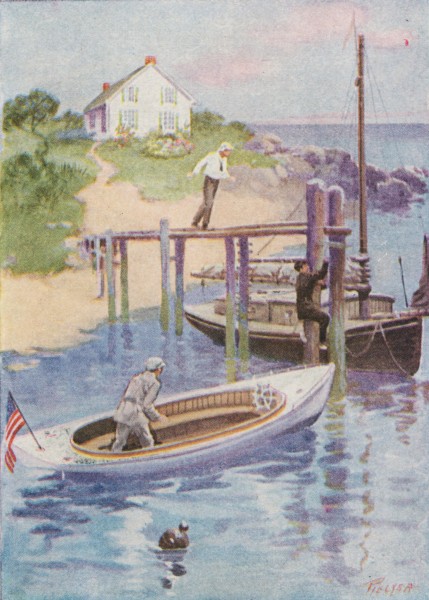
Into the cove at one side ran a line of spiles
supporting both a narrow plank, upon which an
agile person could walk to the end, and a four-inch
iron pipe. Against the farther spiles the
Crystal Spring was moored. The pipe led up hill
to the spring and when Jack wanted to fill the
tank in the water boat he had only to lift the
hatch, drop in the end of a length of cotton hose
connecting with the pipe and turn a cock. The
cove this morning was as blue as the sky above
and as untroubled. The sloop, the tall spiles,
and the jutting rocks were reflected as though in
a mirror.
The house was a low two-story structure,
painted white, with blinds which, originally
green, had been wrought upon by the salt winds
until they were now of a hue more blue than
green. Along the south side of the house a
flower bed was already in bloom with old-fashioned
spring posies. (Aunt Mercy’s flowers
always bloomed a week earlier than any on the
Neck.) There was no fence about the house.
The front door faced the road that ambled westward
to the lighthouse and northward followed
the harbor side, ever curving, until it reached
the town. Across the road were other houses
perched here and there between it and the
harbor shore. The settlement was known as
Herrick’s Cove, just as the cluster of houses at
the other end of Neck was known as The Fort
and the residences on the harbor edge half way
to the canal, which divided Neck from town,
was called The Center. Aside from these settlements
Greenhaven Neck was a bare expanse of
moorland with here and there a granite ledge
lifting its head from the tangle of stunted trees
and pepper-bush, sweet-fern, wax-berry and
laurel and here and there a bog filled with sphagnum
moss and cranberry. One or two summer
cottages had gone up on The Front, but in the
main, Nature still held full sway.
From where Jack sat on the side steps industriously
shining his Sunday shoes he could look
straight ahead along the dusty road to where
the squatty stone lighthouse, dazzlingly white in
the sunlight, stood firmly on its granite ledge.
Beyond it, against the blue summer sky, a flock
of gulls were circling and dipping, their plaintive,
discordant cries coming to him on the breeze.
Suddenly, above the hungry notes of the seagulls
and the lisp of the west wind and the sounds
from the house, came the steady chug, chug,
chug of a motor boat. Idly, Jack wondered
whose it was and arose to his feet to look. But
the boat was hidden by the shore and he subsided
again and gave a final brush to the shoe he
held. Then he set it down beside its fellow,
already polished, and began to whistle one of his
tuneless airs, tapping time against the edge of
the step below with the blacking brush. At that
moment the chug of the motor boat grew suddenly
louder and Jack looked down to the cove
just as a white launch came around the corner.
The boy in the bow at the wheel waved a greeting.
Jack waved back and descended the slope.
The engine stopped its chatter and the launch
sidled up to a spile near the beach. Hal shouted
a direction and Bee, leaving the wheel, clambered
to the deck in front and picked up the painter.
Then leaning toward the spile he sought to pass
the end of the rope about it. The natural
result was that he pushed the bow of the launch
away and in a moment he was clutching the
slippery post with his arms and striving to pull
back the launch with his feet.
“Whoa!” he shouted. “Come back here!
Hey, Hal, push her back!”
But Hal, having no boat-hook nor oar at hand,
was helpless, and a moment later the launch had
abandoned Bee to his fate and he was clinging to
the spile with arms and legs. Jack, on the
beach, shouted with laughter. Hal, pulling at
an obdurate locker lid to get an oar, sputtered
directions and advice.
“Hold tight, Bee! Just a minute! I’ll get
an oar! Hang this thing! I can’t get it open!
Reach up and grab the plank, Bee!”
But when Bee tried to adopt the latter suggestion
he began to slip down the spile and so,
with a yell of dismay, returned to his close
embrace. By that time Jack had recovered
from his amusement and went to the rescue.
Climbing onto the plank, he hurried out and
reached down a hand to Bee.
“Here, take hold and I’ll pull you up,” he said
with a chuckle.
“If I do I’ll drop,” panted Bee. “Take
hold yourself!”
So Jack got a grip around one of his wrists
and finally Bee managed to wriggle up to the
plank. Then he sat down, with his feet hanging
over the water, and laughed until the tears
came. And Hal, bobbing helplessly about in
the middle of the cove, and Jack, clinging to the
pipe, laughed with him.
“Did—did you see that launch trip me up?”
gasped Bee finally. “And—and look at my
Sunday-go-to-meeting suit! It’s all over green
slime and crushed oysters! It’s completely
spiled!”
“Oh, what a pun!” cried Hal. “Push him
overboard, Jack!”
But Jack, viewing Bee’s clothes, had mercy.
“You are in a mess, aren’t you?” he asked solicitously.
“The crushed oysters, as you call
them, will brush off, but that green stain will
stick like anything. I’m awfully sorry, Mansfield.”
Bee viewed the front of his attire philosophically.
“Well, anyway,” he said, “I won’t have
to go to church today, will I? There’s nothing
like looking on the bright side of misfortune.
Throw us the line, Hal, and we’ll pull you in.”
“You run away and play,” replied Hal, working
vigorously with an oar and making little
headway. “The line won’t reach half-way
there.”
“Well, keep on rowing, old chap. Only be
sure and have the launch here by the time I want
to go back. Come on, Herrick, let’s go ashore.”
“If you’d kept hold of the line when you had
it,” muttered Hal.
“Get up in the bow,” Jack advised. “Then
you can put your oar over either side.”
Following that direction, Hal made better
progress and at last the launch was tied up to
the spiling and Hal had clambered up beside
the others. Then they filed ashore and walked
up to the house. Bee said he “cal’ated” he
wouldn’t go inside as he wasn’t very presentable
and so they sat down on the steps.
“How does she run?” asked Jack.
“Like a breeze,” replied Hal enthusiastically.
“She’ll be all right now, I guess, if I can keep
Bee from meddling with the engine.”
“Humph!” said Bee. “The next time you
break down out of sight of land you can do your
own repairing.”
“I intend to; don’t you worry! Gee, but it’s
swell over here, isn’t it, Bee?”
“Fine and dandy,” replied Bee. “Wish I
lived here. Are those chicken-coops yours,
Herrick?”
“Yes, but they’re lobster-pots,” laughed Jack.
“Oh!” said Bee blankly. Then, recovering
quickly; “I meant chicken-lobster coops,” he
explained. “Do you catch many?”
“No, not many nowadays. There used to be
plenty of them, but they’re dying out. I’ve
got a couple of pots out there now; see where
those little red floats are, just beyond the cove?
I haven’t looked at them this morning, but I
guess there’s nothing in them.”
“Think of catching your own lobsters!”
exclaimed Bee wonderingly. “Bet you I know
one thing about lobsters you don’t think I do.”
“All right,” said Hal. “Go ahead, professor.”
“They aren’t red when you catch ’em. I
forget who told me that. It’s cooking that
makes them red. Clever, what?”
“Awfully,” laughed Jack. “And do you
know what to use to open an oyster?”
“An ax, I suppose.”
“No, an oyster cracker.”
Bee looked dejectedly at Hal. “Isn’t he a
cute little rascal?” he asked mournfully.
“‘How do you open a clam? Answer: Use an
oyster cracker.’ Isn’t that funny?”
“You’re a clam,” said Hal. “And, say,
instead of wasting the golden moments asking
conundrums, Bee, we’d better get down to
business.”
“Right-o! Jack we have come to consult you
on two subjects. In the first place, what are
you going to do this afternoon?”
“Oh, forget about this afternoon,” exclaimed
Hal, “and let’s get the name fixed up.”
“Everything in turn, old Hal,” replied Bee
soothingly. “Let us dispose of the more important
affairs first.” He looked enquiringly at
Jack.
“Well, can you come with us and show us
Nobody’s Island? Hal says he knows where it
is and can go right to it, but I don’t trust him.
Will you come along?”
“Yes, if you want me to. How are you
going?”
Bee nodded toward the cove. “In that,” he
said sadly. “Are you brave enough?”
“I’ll risk it if you fellows will,” Jack laughed.
“We can keep close to shore, you know. What
time?”
“What time do we have dinner, Hal?”
“Two, on Sundays.”
“My, that’s a long way off! Well, we will say
at three, Mr. Herrick. How is that?”
“Any time’s all right for me. I’ll look for
you about three or a little later. Are you still
thinking of digging for old Verny’s treasure?”
“I certainly am! And if it’s there I’m going
to find it! I’ve purchased a book entitled
‘Historical Greenhaven’ and have read all it has
to say on the subject of Nobody’s Island and
your old friend Verny. The book says that
several times silver dollars and pieces of jewelry
have been picked up on the beach there. That
looks promising, doesn’t it?”
“Yes, but I never really heard of but one silver
dollar being found, and that was so worn that
you couldn’t be certain it had ever been a
dollar.”
“But the book says!”
“Oh, don’t be a mule, Bee! Don’t you suppose
Jack knows what he’s talking about? Books
tell all sorts of lies.”
“All right. But if there’s been one dollar
picked up it shows that there are more there.”
“Just how do you figure that out?” asked
Hal.
“Logic, my son, logic. That’s something you
aren’t acquainted with. But never mind that
now. I wrote a letter to my father last night,
Herrick—Say, I’m going to call you Jack, if you
don’t mind?—And I told him that I was organizing
an expedition to search for buried treasure
and that he was to send me fifty dollars immediately
to outfit the expedition.”
Jack smiled. “Think you’ll get the fifty?”
he asked.
“No, not more than twenty-five. But I’ve
got twenty dollars now and so I’ll have enough.
This thing is going to be done right, fellows; it’s
going to be done scientifically. This afternoon
we will look over the ground, do you see? Then
I’ll know just what is necessary. In two or
three days I’ll be ready to begin operations.”
“You’re a silly chump,” laughed Hal. “He
won’t talk of anything but Nobody’s Island and
hidden treasure, Jack! And he wants to go and
camp out there and dig the whole place up!”
“Why not?” asked Bee. “Wouldn’t it be
fun camping out, even if we didn’t find anything?
Think of the good time we could have!”
“What would we eat?” asked Hal dubiously.
“Fish, which I would catch when I wasn’t
digging, and all sorts of things in cans. We
could take fresh meat with us, too, I guess. I
wish you wouldn’t think so much about your old
stomach, Hal.”
“Well, it’s the only one I have and it’s got to
last me,” replied Hal untroubledly. “How
about you, Jack? Want to join the party?”
“I’d like to awfully, but I don’t suppose I
could. I have to stay with the ship down there.
I haven’t camped out since I was a little bit of
a chap. Maybe I could manage for a couple of
days, say Saturday and Sunday.”
“How much,” asked Bee, “will you rent the
Crystal Spring and your own personal services
for by the week, Jack?”
Jack smiled. “I guess we aren’t for rent,”
he said.
“Why not? I’m in earnest. I want you to
go along and I’d feel a heap more safe if we had
the sloop to depend on. Not that I don’t love
that dear little launch down there, but just look
what it did to me today! Now come on, like
a good chap! What’s your figure?”
“Why—why, if you really mean it,” said
Jack, “I guess you can have the Crystal Spring
and her skipper for—well, about fifteen a week.
That’s pretty near as much as I’ve been making
lately.”
“Pretty near as much won’t do,” replied Bee
emphatically. “I shall pay you twenty.”
“No, fifteen’s enough.”
“Twenty!”
“Compromise on seventeen-fifty,” advised
Hal.
“All right! It’s a bargain, Jack. You’ll get
your sailing orders in a day or two; say about
Wednesday. We’ll go up or down or over
or whatever it is in the sloop and haul the launch
with us. We can use the launch for pleasure
and the sloop for business.”
“I don’t see any need of having a whole blooming
navy on hand,” objected Hal. “If we have
the sloop we won’t need the launch, and if we
have the launch—”
“Don’t mumble, Hal; talk right out if you
have anything to say,” advised Bee. “Now,
what time might it be? Great Scott, Hal,
we’ll have to scoot!”
“Well, but—”
“Now never mind your ‘buts’; come along!”
and Bee seized him by the arm and proceeded to
drag him down to the cove. “You might as well
learn discipline right now, old Hal. We’ll
be back about three, Jack.”
“But we didn’t do anything about that name
for the launch,” Hal objected. “I thought we
were going to ask Jack—”
“We were, but more important affairs prevented.
We’ll attend to that this afternoon.
So long, Jack! Turn her over, Hal! That’s the
ticket! Once more! There she blows! Reverse
her, Hal; we’ll have to back out or sink the water
boat. All right; slow ahead! Great work! We
didn’t bump a thing! Three o’clock, Jack!
Bye, bye!”
CHAPTER VII On Nobody’s Island
It was nearer half-past three than three, however,
when the launch, heralded by a dismal
solo on the patent fog-horn by Bee, came into
Herrick’s Cove. Jack was all ready, sitting
perched on the bow of the sloop. He had taken
off his Sunday clothes and felt more comfortable;
especially since he had changed those
highly-polished shoes for a pair of brown canvas
“sneakers.” He tumbled into the launch
as Hal ran her alongside and a moment or two
later they were chugging down the coast, the
rocky shore of The Front only a good stone-throw
away. (Bee declared he felt safer near
land). Soon Fort Point was reached and Hal
and Jack showed Bee the old fortifications thrown
up by the citizens of Greenhaven in the War of
1812. A cluster of neat little white houses
surrounded the embankments and a few seats
dotted the green slopes. Then the Neck was
left behind and the launch headed across Eight-Fathom
Cove, with Cove Village hugging the
yellow beach a half-mile away. Beyond the
village Toller’s Sands began, a two-mile stretch
of slightly-curving beach backed by white sand-dunes
bare of vegetation save for a few patches
of sedge and here and there a stunted, grotesque
tree.
“There used to be a farm there,” remarked
Jack, who was steering. “But the sand finally
buried it up. They say that if you dig into that
long dune you’ll find the old house. A few
years ago some of the fence posts were still
sticking up out of the sand, but they’ve gone, too,
now.”
“Do you mean,” asked Bee with wide eyes,
“that the sand covered up the farm and the
house and everything?”
“Yes, but I guess the farm wasn’t a very big
one.”
“But—but how long did it take? Why didn’t
they stop it?”
“You can’t stop that sand when it starts
going. I don’t know how long it took; probably
two or three years, though. One day when I
was over there with my father he took a piece
of wood we found on the beach and laid it on the
sand back there and watched. In twenty
minutes it was covered up and when we came
back a couple of hours later there was a regular
mound there. That’s the way those dunes
start. A bunch of grass or something gets in
the way and the sand blows into and makes a
little lump as big as your two hands, perhaps.
Then the sand blows and blows—it’s always
moving, even on still days—and more of it
lodges there, and more and more, and finally
there’s a hill as big as those you see. They’re
always changing, too. The sand blows from one
to another, and sometimes in the Fall or the
Winter a big tide sweeps over the beach and
eats into them. You get a dandy view from
that biggest one. Ever been up there, Hal?”
“No, I guess not. I haven’t been over to the
Dunes for years. It would be fun to go some
time, wouldn’t it?”
“I’d love to,” agreed Bee. “And we might
take shovels and dig out that house!”
“Yes, that would be a nice way to spend a
month or two,” replied Hal sarcastically. “Any
time you want to amuse yourself that way, Bee,
I’ll furnish the shovel.”
“Is that Nobody’s Island there ahead?”
asked Bee.
“No, that’s Toller’s Rock,” Jack explained.
“The island is beyond it, around the corner.
That black reef dead ahead is The Clinker.
We’ll keep outside it today, although when the
tide is full you can get in between it and the
shore.”
The dunes gave place to low grassy hills and
Toller’s Rock sprang from the latter, a great
mass of weather-beaten granite, and jutted
boldly into the sea. Once around The Clinker
their destination was in plain sight. The shore
receded for several hundred yards to the mouth
of a little river which wound its way inland
through miles of salt marsh. Beyond the
river’s mouth a rounded hill arose from the
marsh level. It was well grassed on the landward
side and a considerable grove of small
trees clothed the summit which was perhaps
forty or fifty feet above the beach. Here and
there a ledge cropped out, suggesting that at one
time Nobody’s Island had been just what Toller’s
Rock was now, a bare mass of granite. But
why Nature had clothed the one rock and left
the other bare was not evident. Bee looked
somewhat disappointed as he gazed at it.
“It isn’t very—very romantic looking, is it?”
he asked. “It ought to be more rugged and—and
forbidding.”
“You’re hard to suit,” laughed Jack. “We’ll
anchor in the river, Hal; there used to be an old
pier there.”
The pier hardly deserved the name any
longer, for all that remained of it were a few
rotting spiles. But after the launch had negotiated
the sand-bar at the entrance to the little
stream Jack worked it in between the spiles and
passed the line around one of them and over a
rusty spike. Then they pushed the stern of the
launch to within a few feet of the shore and
managed to jump ashore. The place of disembarkation
was some fifty yards up the river
and on the southwestern side of the island.
Bee declared, though, that it was poppycock to
call the place an island, since it was surrounded
by water on but three sides. What it really
amounted to was a hill rising from a sandy floor
that was some six feet above high tide, with the
ocean on two sides of it and Clam River on the
third. On the fourth side, inland, nothing
remained to show that at one time the river had
flowed there too, although, as Jack pointed out,
only some two hundred feet of sand, sprinkled
with beach-grass, separated ocean and stream.
“Some day when there’s a good big northeaster
and a high tide the ocean will eat through
there again, as like as not, and then it will be a
real island once more.”
“Let’s go to the top,” suggested Bee. “One
of the first things to do is to make a map of it.”
“What do you want a map for?” asked Hal.
“What for?” Bee viewed him with disgust.
“Don’t you know you always have to have a
map of a place where you’re going to search for
buried treasure? Honestly, Hal, sometimes I
look at you in wonder! Don’t you know
nothing, scarcely?”
They climbed the hill and reached the grove
on top. The trees—oak, maple, wild cherry
and hemlock—were small, but vigorous. Bee
pointed to one disgustedly.
“That’s a nice thing to find on a treasure
island,” he said. “A lot of names and initials
cut in a tree trunk! It’s almost enough to discourage
a fellow right at the start! I dare say
as soon as we get nicely settled and begin to dig
for that gold a lot of folks will come here and
have a picnic!”
“Well, you needn’t be surprised if someone
comes here to camp,” said Jack. “There’s
usually a camp or so here every summer,
although since the bridge across the river up
there fell down it isn’t quite so handy to get to.”
“Oh, they’ll probably build a new bridge or
start a ferry,” replied Bee pessimistically. “Let’s
sit down here and meditate.”
A flat rock, sprinkled with half-rotted needles
from a hemlock tree that grew beside it, afforded
an excellent seat. Behind them was the grove;
in front the slope of the hill, more abrupt here
than elsewhere and covered with coarse grass
and bay-berry bushes. Wherever a rock cropped
out a little colony of Christmas ferns grew precariously.
Just above the beach ran a tangle
of sedge and low bushes; wild cherry, sweet fern,
sheep laurel; interspersed with weeds and
blackberry briars. To the left, half-way down
the slope, one lone tree, dwarfed and misshapen,
rustled a few leaves in the soft breeze.
“We’ll name this Lookout Rock,” said Bee.
“You get a dandy view from here, don’t you?”
Before them lay mile on mile of blue ocean,
asparkle in the afternoon sunlight, dotted here
and there with a white sail or a trail of smoke.
“Old Verny picked out a pretty good place to
build his house, didn’t he?” asked Hal. “Do
you know where it stood, Jack?”
“No, I don’t. Somewhere on the ocean side,
probably. Perhaps right below where we’re
sitting.”
“Was it pulled down or what happened to it?”
“They say the sheriffs or revenue men or
whoever they were burned it down when they
arrested the old chap. I suppose that explains
why there isn’t any of it left. I’ve never seen
even a timber of it.”
“I suppose those rocks out there,” said Bee,
pointing to the right, “are The Tombstones.”
“Yes, and many a schooner has piled up there,
too,” answered Jack. “Father used to say that
on a very calm day you could look down between
Big Tombstone and Little Tombstone and see
the ribs of a ship. I never saw them, though.
Usually it’s too rough.”
“You say they used to carry a lantern to
attract the boats,” mused Bee. “Where did
they do it?”
“Why, right along the beach down there, I
guess. On the other side, too, probably; that
would catch the boats coming down the shore.
They’d think the lantern was a light on another
ship and first thing they’d know they were piled
up on the rocks or the sands. I never heard
what happened to Old Verny. Some say they
put him in prison for life, though. They should
have hung him!”
“Maybe they did,” said Bee. “Maybe his
ghost haunts the island on dark and stormy
nights. Wouldn’t that be corking?”
Hal shivered. “If I ever see his ghost around
here I’ll take the shortest and quickest route
home!”
“Well, I’m going to walk around and make a
map of the place,” said Bee, arising energetically.
“Want to come?”
Both Jack and Hal, however, declared that
they were quite comfortable and that they would
wait for him where they were.
“Don’t get lost,” laughed Hal. “And if you
come across Old Verny ask him where he buried
his treasure.”
Bee produced a pencil and a small tablet of
paper and strode off. Jack and Hal exchanged
amused glances.
“He’s daffy on the subject,” said Hal.
“Doesn’t talk about anything else.”
“Does he really mean to come here and dig?”
asked Jack.
“Oh, yes, he’s absolutely serious about it.
We’re to bring a tent here and camp out. I
don’t mind. I rather like camping out, don’t
you? And he insists that you must come with
us. He thinks you’re pretty fine, Jack, and
says we can’t get along without you. I hope
you’ll come.”
“Why, I’d like to. I don’t want to make him
pay me for it, Hal, but—I don’t think I could
afford to do it unless he did. Has he a lot of
money?”
“Bee? Oh, yes; his father’s terribly rich, I
believe; he’s a coal operator, whatever that is;
owns mines, I guess. Bee gets money whenever
he asks for it, pretty near. Still, he doesn’t
usually waste it like this. I don’t mean that
he’s mean, because he isn’t; he gives a lot to the
school funds, like football and baseball and such;
but he’s always careful to get his money’s worth.”
“Well, it would be rather good fun to have a
camp here for a week or so; especially if we
struck good weather, and we’re likely to at this
time of year. There’s good fishing all around
here, and good shooting, too, in season; lots of
ducks on the marsh back there in the Fall. I
don’t quite see why he wants the Crystal Spring
here, though.”
Hal laughed. “Oh, he just wants to do the
thing right, I guess. Thinks it would look more
like the stories he’s read. He’s always getting
hold of some book about buried treasure; doesn’t
read any other kind if he can help it. We might
as well humor him. Of course, the hunting for
the treasure part of it is just nonsense, but he
likes to make believe that he’s going to find it.”
“There’s a whole lot of ground to dig up,”
said Jack with a smile. “Of course, if we knew
just where Old Verny had his house we might
have a go at it, but as we don’t it would be pretty
hopeless.”
“Seems as though some of the old fellows in
town ought to know where the cabin stood,”
reflected Hal. “It wasn’t much more than
thirty or forty years ago, was it, that it was
burned?”
“About forty-one or two, I suppose.”
“Bee talks to every old chap he runs across
on the water-front,” said Hal, “and maybe he’s
got a clue. Hello!”
Hal had been digging with his heel in the
brown loam at the foot of the rock and now he
leaned over and picked something up.
“What do you suppose this is?” he asked, as
he bent over it.
“Looks like a buckle,” said Jack. “It’s a
funny one, though. Is it iron?”
“No, I don’t think so.” Hal scraped a corner
of it on the rock. “By jove, it’s gold, Jack!”
CHAPTER VIII Hal Names the Launch
“Let’s see.” Jack took the buckle and
examined it. It was nearly three inches long
and almost as wide and was a heavy, clumsy
contraption. Opening his knife, he scraped it
a little. Then he shook his head. “Brass,”
he said.
“Is it?” Hal was disappointed and his face
fell. “Well, I never saw a brass buckle like
that before. What do you suppose it was for?”
“It might have come off a harness,” mused
Jack. “Only—no I don’t believe it did. Looks
more like a buckle you’d wear. I guess it’s
pretty old. Let’s take it home and clean it up
and see what it looks like. Maybe it was Old
Verny’s.”
Just then Bee came climbing up the slope
and they showed it to him.
“Great!” he exclaimed as he took it and
looked at it. “An old buckle, unmistakably
Spanish!”
“Unmistakably your grandmother!” jeered
Hal. “How do you know it’s Spanish?”
“It must be. It isn’t American, is it?”
“No, I suppose not. But it might be Chinese
or Egyptian or Italian or—”
“Well, it looks Spanish to me,” persisted
Bee. “I shall keep it and polish it up.”
“You’ll keep it! Say, who found that thing,
I’d like to know?”
“Whatever is found,” replied Bee, dropping
the trophy in his pocket, “belongs to the Company,
my young friend.”
“What Company?”
“The Treasure Hunters’ Company, Limited,”
replied Bee. “That’s us. When we get through
we will make an even distribution of everything
we have found—”
“Gee, we’ll be rich!” Hal jeered. “What are
you going to do with your share, Jack?”
“I guess I’ll put an addition on the house,”
replied Jack gravely, “or—no, I know what I’ll
do; I’ll put a gasoline engine into the Crystal
Spring!”
“I shall invest my share in United States
bonds,” said Hal importantly. “Nothing like
owning a few bonds. Then, when you’re old
and decrepit—”
“Shut up,” said Bee good-naturedly, pushing
his way between them and seating himself on
the rock. “Now look here, fellow members of
the Company. I’ve been over the place and
here’s a rough map of it. Of course I haven’t
got distances absolutely correct, but they’re
near enough. They are—er—relatively correct.”
“Think of that!” murmured Hal.
“Now,” continued Bee, “it’s evident that
when it comes to digging for the treasure we
may—er—eliminate practically three-fourths of
the island.”
“Why?” asked Jack, studying the rough map
that Bee held.
“Because at that time there was a branch of
the river running along somewhere about here.
I’ve indicated it with broken lines, you see.
Old Verny wouldn’t have been likely to have
built his house right on the river, would he?”
“N—no, probably not. It’s pretty certain
he built it somewhere around the south side of
the hill, Bee. Around here we usually try to get
protection from the north winds, you see.”
“My own idea exactly, Jack,” agreed Bee.
“He certainly didn’t build it here at the northeast
side because that’s all ledge there and he’d
have blown away, I guess. He wouldn’t have
put it at the back of the hill because he wouldn’t
have had any view of the sea except over
toward the north. He’d have kept away from
the east side because, as Jack says, he’d have got
the north winds more or less. That accounts
for three sides, doesn’t it? Well, and it leaves
us the south side. He would have been sheltered
there and he would have been near the river
where he must have kept his boat and where he
probably had a landing. Do you think those
posts down there are part of his pier, Jack?”
“I think so. It isn’t likely that anyone would
have built a wharf here.”
“All right. We’re agreed then that the house
or the cabin or whatever he lived in was on the
south side of the island. Then the question
arises: just where was it on the south side?”
“He’s a wonderful arguer, isn’t he, Jack?
And, professor, what is the answer to the question
which has arisen?”
“It isn’t answered definitely yet,” replied
Bee, digging Hal with his elbow, “but if we bear
in mind that the old rascal wanted shelter from
the north, as he undoubtedly did, we can—er—reduce
the probable territory to a small tract.
He wouldn’t build very near the beach for fear
of high tides, and he couldn’t have built up here
on top because the trees are too close together.
I’ve looked through this grove and there’s no
evidence of any clearing. So, then—”
“Hold on a minute,” interrupted Jack.
“You’re forgetting that these trees may have
grown since Old Verny left. I dare say lots of
them aren’t more than twenty or thirty years
old.”
Bee frowned. “That’s so,” he acknowledged.
“But wait a bit, Jack. If the trees weren’t
here when Verny was he certainly wouldn’t
have built on such a bleak spot as the top of the
hill, would he?”
“No, I don’t think he would have. I guess
it’s safe to say his cabin was somewhere on the
slope of the hill, and probably on the south or
southwesterly side.”
“Oh, who cares where it was?” demanded
Hal, with a yawn. “It isn’t there now and
nobody knows that he ever buried any treasure.”
“Now, suppose, then,” continued Bee, undisturbed,
“that we divide the island longitudinally
and latitudinally with lines in this fashion.
The lines, you see, intersect pretty nearly in the
middle of this bunch of trees. That has no
importance. I merely mention it.”
“For the love of Mike, Bee, get to something
that has got importance!” implored Hal. “My
brain is reeling already!”
“Your what?” asked Bee unkindly. “Now
then, Jack, if we draw a line from where the
latitudinal line and the edge of the grove meet
on this side to where the longitudinal line meets
the beach, and if we repeat the—er—operation
on the other side, we have an isosceles triangle—”
“Help!” murmured Hal.
“Enclosing the territory within which it is
probable that our old friend the wrecker had his
cabin,” continued Bee, warming to his lecture.
“It stands to reason, though, that he wouldn’t
build very near the apex of the triangle—that is,
near the beach—because he would be less protected
there than farther up the slope. And we
have already decided that he didn’t build on top
of the hill. So, then, we have a very small
territory left, hardly more than a hundred by,
say, fifty. Get that, Hal?”
“I do not! What’s more, I refuse to listen
to your ravings any longer. I’m sorry I brought
you here. I—”
“Well, you see what I mean, don’t you, Jack?”
“Yes, and I guess your reasoning is all right,
Bee. Only—”
“Only what?”
“Only it’s a fair guess that if we ever do find
out where Old Verny had his cabin it’ll be somewhere
we never thought of.”
“It can’t be,” replied Bee, “because I’ve
thought of every place there is! Now come over
here and let’s look about. If we know that he
had his place somewhere within the territory—er—specified—”
“We don’t know it,” said Hal. “We’ve only
got your word for it. And you talk so many
words that no one knows what you’re saying.
You fellows go and look, if you want to. I’m
going to sleep.” And Hal slid down to the
ground, put his shoulders against the rock,
pulled his hat over his face and evinced every
intention of carrying out his threat.
Bee observed him in pained disgust. “Honest,
Hal, I’ve a good mind to leave you out of the
Company. You don’t take any interest at all
in things! Come on, Jack.”
They walked around nearer the river side of
the hill and studied the slope there. There was
nothing to indicate that at one time a house
had stood on it. A few small boulders lay about,
to be sure, but they had evidently never been
used in building. To the left of Bee’s supposititious
territory and just above the beach the
small tree stood, misshapen and solitary. Aside
from that the vegetation consisted of wild grass
and briars and an occasional low bush of bay-berry
or laurel. Bee frowned intently as he
descended the hill, Jack following.
“What do you suppose his cabin was built
of, Jack?”
“Wood, I suppose, since they burned it down.
Probably of planks and stuff that he gathered
along the shore. Perhaps he used timbers from
the wrecks.”
“Wouldn’t he have had a foundation,
though?”
“I don’t believe so. Anyway, there aren’t
any stones in sight that look as though they’d
been used that way. And, of course, burning
the house wouldn’t have affected the foundation.
Maybe they’ve got covered up, though.”
Bee shook his head silently as though disagreeing
with that theory. Finally—
“What gets me, though,” he said, “is that
there isn’t even a level place here. It doesn’t
seem likely he’d have built on the slope without
levelling off a bit.”
“I don’t know. The slope isn’t steep. He
might have.”
“He must have. I’m certain the cabin stood
somewhere around here. If I was going to dig
I’d start pretty near where we’re standing.”
“But look here, Bee, we don’t know that;
supposing, of course, he really did bury some
money or something, he buried it near the
house. He might have buried under a tree or—well,
almost anywhere.”
“That’s true, but the story goes that the old
chap saw the constables coming and hurriedly
dug a hole and hid his wealth. Well, if that is so
he wouldn’t have climbed to the top of the hill
in plain sight of the officers; now would he?
He’d probably have dug a hole behind the
house or—That’s it!”
“What’s it?”
“Why, very likely he didn’t have any floor to
his cabin and he just dug a hole in the dirt inside!
How’s that?”
“Sounds likely enough,” Jack agreed. “But
you don’t want to lose sight of the fact, Bee, that
maybe there wasn’t anything buried, after all.
If they didn’t see him do it, how did they know?
And if they did see him do it they’d have dug it
up. I wouldn’t bank too much on that yarn.”
“I know,” answered Bee untroubledly. “Still,
it’s just as likely that there was treasure of some
sort as that there wasn’t. If the old villain was
piling ships up on the rocks here for twenty
years or so, as the book I read said he did, he
must have got something from them.”
“Well, if they were all schooners, and I guess
they were, he wouldn’t find very rich pickings
aside from the cargoes. Skippers don’t carry
diamonds and gold around with them much.”
“They don’t now, maybe, but perhaps they
used to. They traded around at different ports,
didn’t they? Well, didn’t they have to have
money with them to pay for things? Jack, I’m
plumb sure there’s something buried on this
island, and if I can find it I mean to. And,
look here, you said awhile ago that he might have
buried the stuff under a tree. Didn’t we decide
that the trees weren’t there then?”
“I believe we did,” laughed Jack. “We
don’t know that for certain, though. Maybe
he buried it alongside a rock, Bee.”
Bee pondered that, his gaze sweeping the slope
for likely boulders. “It wouldn’t be hard to dig
beside the few rocks here,” he muttered, “and
if everything else fails we’ll try that. Well,
I suppose we’d better be getting back home.
We can’t do any more here today, I guess!”
When they announced that intention to Hal
he declared that it was the first sensible thing he
had heard Bee say all the afternoon. After
they were back in the launch and were moving
slowly down the little river, dodging the sand-bars
that infested it, Bee was strangely silent. But
as he kept his eyes on Nobody’s Island as long
as it was in sight it wasn’t hard to guess the
reason. He was still pondering the problem of
Old Verny’s treasure. Hal, catching Jack’s
eyes, nodded at Bee and tapped his own head
significantly. Jack smiled. Once around The
Clinker, with Nobody’s Island lost behind
Toller’s Rock, Bee came back to earth, however.
“We’ll start Tuesday, fellows,” he announced
suddenly.
“Start where?” asked Hal, above the thumping
of the engine.
“Start for the island; start our search for the
treasure.”
“Tuesday? Why Tuesday?”
“Because it’s the day after tomorrow,” replied
Bee. “Can you be ready then, Jack?”
“I guess so. You really mean to do it, then?”
“I surely do. We can get everything we want
tomorrow, I think; we’ll get up a list tonight,
Hal; and we can load the stuff onto the Crystal
Spring Tuesday forenoon and go over to the
island right after lunch. Can you have the
sloop at the town landing about ten o’clock
Tuesday forenoon, Jack?”
“Aye, aye, sir!”
“All right. That’s settled. Now, Hal, let’s
settle on a name for the launch, eh?”
“Oh! And again oh! Corsair, eh? Well, that
might do. What do you think, Jack?”
“Sounds all right to me,” replied Jack when
the name had been relayed to him.
“Still, I think we might find a better one,”
said Bee. “Now, let’s see—”
“Look here,” exclaimed Hal warmly, “she’s
my boat and if I want to name her Corsair I
guess I can. And I do. And so she is!”
“Grammatically, Hal, your construction is
weak. ‘I do and so she is’ lacks—er—clarity.
If I were you—”
“She’s named Corsair!” insisted Hal doggedly.
“All right; don’t get peevish about it; only it
seems to Jack and me—”
“I don’t care what it seems to you,” replied
Hal, slathering oil on the engine with a lavish
hand. “It’s settled. I’ve named her Corsair—”
“So you remarked before. I think it’s a
perfectly lovely name, don’t you, Jack? So—so
original, too! By the way, what is a corsair,
Hal?”
“Look it up in a dictionary,” growled Hal.
“You make me tired. Always butting in—”
The rest was lost in the noise of the engine.
Bee smiled sweetly. “No offence, old Hal.
Say, all joking aside, what is a corsair?”
“A corsair is a pirate,” replied Hal suspiciously.
“It is also a pirate’s ship.”
“Oh, then we’re pirates, are we? That is,
you are?”
“The name is Corsair,” averred Hal determinedly.
“All right, Mr. Pirate. And now, if you’ll
just slather a few pints of that cylinder oil
around the propeller casing you’ll have been
pretty well over the boat with it. From the
way you’re wasting it you must be some close
relation to John D. Rockefeller.”
Hal set down the oil can with a grin. “You’re
an awful idiot, Bee.”
“I are indeed. Hello, here we are at Mr.
Herrick’s own private little cove! Jack, it’s
you who should be the pirate instead of Hal.
With a harbor of your own like this you could
have a dandy time. You could sit on your doorsteps
up there with a spy-glass and when you
saw a likely looking merchantman approaching
you could sally—no, dash forth and attack her.
Then, after you’d swiped—I mean captured all
the treasure and made the captain and crew walk
the plank you could dash back again. Honestly,
Jack, I think you made a big mistake in your
choice of professions. Instead of being the
driver of a nautical waterwagon you should be
flying the Jolly Roger and slicing off people’s
heads with a cutlass!”
“You’d have an easy time of it if you were a
pirate,” said Hal with elaborate sarcasm.
“You wouldn’t need to carry a cutlass. You
could just board a ship and talk them to death!”
“Right you are, old Hal! If I was a pirate I’d
lay about me with my trusty tongue and the
scuppers would be filled with words! Ready
with the bow line, there!”
“Half-speed, Hal!” called Jack from the bow.
“Stop her!”
The Corsair floated into the cove and alongside
the sloop. Jack climbed out and Bee took
his place at the wheel.
“Tuesday at ten, Jack,” said Bee. “Don’t
forget. If you have anything you think we’ll
need put it aboard, like a good fellow. We may
see you tomorrow, though. All right, Hal; back
her up easy.”
When the launch had made the turn and was
pointing her slim bow toward the mouth of the
cove Bee made a trumpet of his hands and
shouted back:
“O Jack!”
“Hello?”
“Her name is Coarse Hair! Hal says so!”
Jack laughed and waved his hand as the
launch disappeared around the point.
CHAPTER IX The Expedition Lands
At a little before three on Tuesday afternoon
a regular flotilla of boats might have been seen
to swing around Toller’s Rock. I doubt if it
was seen, for the Rock and the shore beyond all
the way to the farther side of Nobody’s Island
was apparently empty of life, if one excepts the
gulls and the land birds. Perhaps the word
procession would be better than flotilla, for first
came the Crystal Spring, wobbling along under
her big gray mainsail, then the Corsair, floating
gracefully at the end of a towline, and finally
the Faith, dipping and rolling a little in the manner
of young and playful dories. The Faith was
Jack’s boat, a small, pea-green lapstreak dory
that had spent most of its life in Herrick’s Cove
and was now palpably excited by its tremendous
adventure. The sloop was brought around into
the wind near the mouth of Clam River and as
close to the shore as Jack dared take her on a
falling tide and the anchor was dropped. Then
Hal and Bee tumbled into the launch and, with
the dory still in tow, ran up the river to the old
pier. Here they made fast the Corsair and
rowed back in the dory to the Crystal Spring.
Then began the unloading of the supplies. Bee
remained in the dory and Jack and Hal passed
the things down to him to stow away. As fast
as the dory was loaded Jack jumped in and took
the oars and rowed to the shore. There, with
bare legs, the boys removed the cargo from boat
to beach. Four trips were necessary before
everything had been landed. Bee declared
proudly that he had forgotten nothing, and the
others, viewing the sands, enthusiastically
agreed.
“I guess you’ve got everything but a sewing
machine and an automobile there,” said Hal.
The anchor was pulled up and the sloop half-drifted
and half-sailed into the mouth of the
river. The anchor went down again and the big
sail was lowered and furled, Hal and Bee lending
willing if inexperienced assistance. There was
just room for the Crystal Spring to swing around
with the tide in the new anchorage and in case of
a blow she was fairly well protected. Even if
she did settle her stern on the sand, Jack
explained, it wouldn’t matter, since she would
float clear again the next tide. Then the three
boys tumbled once more into the dory and rowed
to the old pier where the Corsair was snuggled.
The launch, too, bore her share of the supplies,
being laden with six long inch-and-a-half planks,
five pounds of spikes and a hatchet. Working
with a will, the boys soon had a three-foot platform
laid on the old spiles. Hal declared that he
didn’t see any use in having a wharf when the
things were already landed, but Bee reminded
him that there was the treasure to think about.
“It will be a heap easier to bring that chest
of gold down here and lower it into the boat
than it would be to get it into the dory and out
again. You have to think of all those things,
Hal. There’s nothing like looking ahead and
being prepared.”
Hal laughed. “When you find that treasure,
Bee,” he replied, “I’ll swim out to the sloop with
it.”
Then they went around to where their goods
littered the beach and considered the question
of a location for the tent. The tent, a good-sized
A of waterproof duck, had been loaned
by Hal’s father. In fact, Bee had been very
fortunate in not having had to purchase much of
anything besides provisions. A pick, a shovel,
a crowbar and a hatchet had also been loaned
by Mr. Folsom; Mrs. Folsom had supplied
blankets, pillows and cooking utensils;
Jack had brought fishing lines, hooks and
sinkers and Hal had added whatever of his
possessions, including a shot-gun and a revolver,
that Bee had seen fit to requisition. Even the
planks had been obtained gratis, being some
that had been left when repairs had been made
to the Folsom wharves. Provisions Bee had
had to pay for, but as he had obtained a liberal
discount through Hal’s father, his capital had
not been much depleted.
It was finally decided that the tent should be
pitched on the southwest side of the hill at the
edge of the grove. Jack pointed out that they
would be shielded from the sun during the
warmest part of the day and sheltered from rain
storms as well by the crest of the hill and the
trees. “There may not be any rain storms,” he
said, “but if there are they’re likely to come from
seaward. We’d better ditch around the upper
side of the tent, too.”
It wasn’t easy to get the tent up on the place
they had selected for it seemed that wherever
they tried to drive a peg they struck ledge. But
they finally succeeded and drew aside to admire
their handiwork.
“That’s a corking tent,” said Bee. “And I’m
glad it’s rain-proof, aren’t you?”
Jack agreed, but wondered whether it would
not have been wiser to have had the opening face
the west instead of the east. “If we have any
very hot weather it’s going to be stifling in
there.”
“That’s easy,” said Hal. “We can raise the
sides of the tent around the bottom. Let’s
get the stuff up here and think about supper.
I’m getting starved. Bee was in such a rush to
get away that I didn’t have time to eat a decent
luncheon.”
“Eat!” Bee groaned. “I thought you’d never
get through. That’s one thing that scares me a
bit,” he confided to Jack as they descended to the
beach. “We’ll have to go to town every day to
buy food for that chap, I’m afraid.”
For the next twenty minutes they were busy
toiling up the slope with boxes and bundles and
trotting down again for more. The only pause
came when Bee dropped a bag of lemons from
the summit of his load and the elusive things
rolled in every direction down-hill. Jack and
Hal, glad to rest a minute, sat down and laughed
while Bee, depositing the rest of his load on the
ground, tried to round them up.
“I can only find eight of the pesky things,”
he said at last, raising a perspiring face to his
grinning companions. “Come on and help me
you pair of gargoyles.”
“We’re tired,” said Hal. “We refuse to lend
you any lemon aid.”
“Ow!” Bee collapsed to the ground and gave
a spirited imitation of a boy having a fit. In
the course of the performance he inadvertently
upset the bag again and once more the lemons
rolled away. Finally, Jack going to his assistance,
all but two of the lemons were found and
the routine began again.
“Some day,” panted Bee, as he trudged on up
the hill with his bundles, “folks will find this
island covered with a lemon grove and they’ll
wonder, won’t they?”
When all the belongings were within the tent
Hal raised the question of cooking arrangements.
Hal had tried all day to confront Bee with some
contingency not already provided for by that
foresighted youth and so far had failed. He
failed again in the present instance, too, for Bee
answered promptly.
“Jack’s going to build a stone fire-place near
the door here,” he said.
“Oh, am I?” laughed Jack. “How do you
know I can?”
“You look like a mason,” replied Bee calmly.
“Besides, if you don’t know how I’ll show you.”
“Then why don’t you do it yourself?” challenged
Hal. “It seems to me you’re doing more
bossing than work.”
“Somebody has to supply the brains, old Hal,”
answered Bee cheerfully. “Come on and we’ll
lug some stones for the mason.”
There were plenty of them but those that were
of the proper size were mostly at the foot of the
slope, and long before they had enough at the
tent Hal was heard to murmur that for his part
he thought it would have been a heap more
sensible to have brought a cook-stove along!
But when the fire-place was finished even Hal
had to own that it looked a lot jollier than a
stove. “And a good deal more appropriate,”
added Bee. “Whoever heard of hunting buried
treasure on a desert island and cooking meals on
a real stove? That would be a—a—one of those
things.”
“One of what things?” asked Jack, pausing
to view his work.
“Why, one of those an—anach—”
“Anachronism, he means,” explained Hal.
“He doesn’t know much English, Jack. You’ll
have to excuse him. His education has been
sadly neglected.”
“There’s something in that,” replied Bee.
“When he put me in to room with Hal, the
Principal told me I was next to the stupidest
boy in school. Of course, I don’t know what he
meant by that.” Bee added the latter part of
his remark rather hurriedly, as Hal was poising
a nice large stone in his hand and had his gaze
fixed disapprovingly on the speaker. “Folks
do say such funny things sometimes.” Whereupon
Bee by the simple expedient of rolling over
backward, got behind Jack and out of range.
“Now, we’ll have to hustle around and find
some wood,” said Jack. “We can get some
small stuff under the trees, I guess. Dead
branches do pretty well. And there’s plenty
of stuff on the beach, only it won’t be very dry
probably. You fellows scurry around in the
grove and I’ll go down to the beach.”
Afterwards they took the hatchet and cut
sweet-fern, which Hal discovered quite a patch of
at the back of the island, and sheep-laurel and
spread it on the ground in the tent. On this
they put their blankets, and, although now and
then a sharp twig promised some discomfort,
they decided that it would prove better than
sleeping next to the ground. “And, anyway,”
said Bee, who had never run across sweet-fern
before, “it smells dandy; even better than sweet-grass.”
After arranging the provisions near the door
of the tent there seemed nothing left to do save
wait for supper. It was only a few minutes past
five and even Hal had to acknowledge that it
was still too early to start the fire. Jack suggested
that they might collect more wood and
save themselves trouble another day, but that
idea didn’t seem to appeal to the others. Hal
asked Bee why he didn’t do a little digging for
the treasure and get up an appetite. He even
offered to accompany Bee and look on. But
Bee said there was no use digging until he had
decided where to dig. So they concluded to
take a walk over the island instead.
“Keep your eyes open, fellows,” advised Bee.
“We might find the place where Old Verny had
his cabin.”
But although they made a complete circuit of
the island they discovered nothing more exciting
or useful than a horseshoe crab which Bee marvelled
at and treasured. From the northwest
side of the hill they could follow the winding of
Clam River for nearly two miles and Jack pointed
out where, far up the little tidal stream, the old
bridge used to stand. Far off, backed by a low
wall of trees, ran the railway embankment.
Farther southward Greenhaven was visible, the
sun dyeing the white houses on the hill with rosy
light as it sank into the west. Between the
town and the island was a well-nigh untenanted
expanse of marsh and meadow which, near the
shore, merged into the gleaming sand dunes.
One or two weather-beaten cabins dotted the
area, but they were a good way off and served
only to accentuate the loneliness that, with the
approach of evening, seemed to envelop Nobody’s
Island. Hal gave a little shiver as he turned
away.
“Come on and let’s light the fire and have
some supper,” he said. “This place will get
on my nerves in a minute.”
“It does seem a long way off from everything,
doesn’t it?” agreed Bee. “That sunset is
wonderful, though.”
“I’d rather see a sirloin steak,” muttered Hal.
“Well, that’s just what you will see in about
half an hour,” Bee responded cheerfully. “And
I’ll bet Jack can cook one to the King’s taste,
too!”
“Oh,” said Jack, “so I’m to do the cooking,
am I?”
“Of course. You surely couldn’t expect Hal
to do it, and the only thing I ever tried to cook
was a fried egg; and I didn’t know enough to
take the shell off first!”
They sought the tent and Jack set about
getting a fire. “What are we going to have?”
he asked.
“We’ve got ten pounds of steak and chops,
a bag of potatoes, six loaves of bread, lots of
butter, tea and coffee,” enumerated Bee. “And
other things besides; bacon, flour, lard, sugar—er—oh,
everything the heart of man could
desire.”
“Well, we’ll have a slice of steak, then, and
some boiled potatoes. I’ll boil enough so there’ll
be some left for frying in the morning. How
about coffee? Want that or tea?”
“Tea,” answered Hal.
“Coffee,” said Bee.
“Then I’ll have to cast the deciding vote.
We’ll have tea. Coffee in the morning and tea
the rest of the time. And—Great Scott!”
“What?” the others demanded in a breath.
Jack smiled. “Nothing,” he answered, applying
a match to the little heap of twigs in the fire-place.
“Somebody might find a skillet and a
sauce-pan. A kettle, too, for the tea. Got one,
Bee?”
“Surest thing you know.”
“Fine! Just fill it half-full of water for me,
will you?”
“Water?” Bee, the tea-kettle in hand, gazed
blankly at Jack.
“Of course! We can’t have tea without water,
can we?”
Hal, solving the situation, let out a whoop of
delight. At last Bee had been caught napping!
Bee grinned in a rather sickly fashion.
“Is—is there a spring here, Jack?” he
inquired.
“Not that I know of. Why? You brought
water along, didn’t you?”
Bee shook his head. “I—I never thought
of it.”
Hal kicked his heels with joy. “Get some
water for him, Bee; don’t stand there like a
dummy! Go on, get some water!”
“But—but Old Verny must have had water!
Where’d he get it, Jack? There must be a
spring or a well or—or—”
“He probably used bottled water,” said Hal.
“I dare say the grocer brought it to him.”
“Well, I never heard of a spring on Nobody’s,”
replied Jack, “and I never saw any signs of one.
Perhaps Verny had a well.”
“He must have! I’ll look for it,” and Bee
started off with the tea-kettle in hand.
“Don’t be an idiot!” cried Hal. “If there
ever was a well it’s filled up long ago. You
ought to have thought and brought water along.
There’s nothing like looking ahead and being
prepared, Bee!”
Bee tried to smile at that gibe, but made
dismal work of it. “Then—then what can we
do? We couldn’t use salt water, could we,
Jack?”
“There’s just one thing we can do,” said Hal
eagerly, “and that’s go home sensibly. We
can’t stay here all night without any water to
drink.”
“Go home!” exclaimed Bee blankly.
“Of course. Unless you want to row back to
town and get a bucket of water.”
“Speaking of buckets,” said Jack as, the fire
burning briskly, he arose to his feet, “have we
got one?”
“Two,” said Bee. “They’re in there. Why?”
“Well, you watch this fire and keep it going
and I’ll take the bucket and get the water.”
“I refuse to drink salt water!” exclaimed Hal.
“Who said anything about salt water?”
laughed Jack. “I’m going to bring you some of
the best water there is.”
“Wh—where are you going to get it?”
demanded Hal and Bee in chorus.
“Out of the Crystal Spring,” answered Jack
as he swung off down the hill to the wharf.
“She’s half-full of it!”
“Gee, I never thought of that!” ejaculated
Bee, subsiding on the ground with his tea-kettle
still tightly clutched.
“It seems to me,” said Hal sternly, “that
there’s a whole lot you never thought of.”
Bee had nothing to say. He only added more
wood to the fire and in silence watched Jack
jump into the dory and pull out to the sloop.
For the rest of the evening he was chastened in
spirit.
That supper tasted wonderfully good. Jack
was a clever camp cook and the way that two-pound
piece of steak was cooked and the way
the potatoes almost fell to pieces at the touch of
a fork showed it. Perhaps the tea was a little
bitter; anyhow, condensed milk doesn’t seem to
go with tea as well as with coffee; and Hal said
uncomplimentary things about the butter, but
no one could find fault with the rest of the
repast. They sat on the ground between the
front of the tent and the fire and ate to repletion.
And afterward they heaped more fuel on
the dying blaze and snuggled back contentedly
while the afterglow dimmed and a half moon
grew from frosty silver to mellow gold and threw
a broad pathway across the quiet water. They
talked for an hour or more, but the fresh air and
the exertions of the day soon began to tell and
long before nine Hal was snoring frankly, his
head propped up on Bee’s shoulder and Bee and
Jack were nodding. Finally the lanterns were
found and Jack managed to fill them from the
gallon oil-can, spilling a good share of the oil
on the ground in the darkness, and then lighted
them and hung them from the tent poles. Hal
was somehow awakened and, yawning and
stumbling, got his clothes off and tumbled
between his blankets. Bee and Jack speedily
followed and soon all was still on Nobody’s
save for the lapping of the waves on the beach
and the healthy snoring of the members of the
Treasure Hunters’ Company, Limited.
CHAPTER X Bee Digs For Treasure
The next morning dawned fair, with a little
southeast breeze blowing from where, afar off on
the horizon, lay a bank of haze. The adventurers
were up early. The sunlight beat on the
wall of the tent and made sleep almost impossible
after seven o’clock. There was a chill in the air
though, as the three, with towels flying from
their hands, scrambled down to the beach and
plunged, shouting and laughing, into the water.
The sea was several degrees warmer than the air
outside and Hal was for remaining there and having
his breakfast brought to him on a life-belt.
But he got little encouragement from the others
and so followed them out and rubbed his body
to a glow with a towel in the faint warmth of the
early sunlight. After that, although Jack
worked as quickly as he knew how, it seemed
hours and hours before the bacon and fried
potatoes and fragrant coffee were ready. Hal
occasioned merriment by trying to toast a slice
of bread on the end of a stick and having to
rescue it from the fire a half-dozen times
before it was ready for eating. Bee regretted
the lack of eggs and explained innocently that
the reason he had not brought any was because
they could find sea-gulls’ eggs on the rocks.
“They always do that on desert islands,” he
added. He was visibly disappointed when Jack
informed him that the gulls didn’t nest on
Nobody’s and that, anyhow, he didn’t think
Bee would care much for gulls’ eggs if he tried
them.
They cleaned the dishes by the simple expedient
of carrying them to the beach and rubbing
sand on them, afterwards rinsing them off with
salt water. Then Bee was, he declared, ready
for business.
“You fellows can do what you like for awhile.
I’m going to look around and decide where to
begin operations.”
Hal groaned. “Look here, Bee,” he protested,
“you aren’t really going to waste time
and break your back digging are you?”
“Waste time! What did we come here for,
I’d like to know? I’m going to find the likeliest
spot and then we’re going to dig for that
treasure chest. Meanwhile, why don’t you
fellows see if you can catch some fish for dinner?”
Hal sighed and shrugged his shoulders. “All
right. Come on, Jack. We’ll go fishing. If
you find anything, Bee, fire a cannon and we’ll
come back.”
They left him, crow-bar in hand, surveying
with a thoughtful frown the southwest slope of
the hill. They took the launch and went out
beyond The Tombstones. There Jack dropped
the anchor and they put their lines over. From
time to time they looked back toward the island,
but Bee was not in sight from where they lay,
and Hal unkindly said he was willing to bet
that Bee was fast asleep in the tent. By ten
o’clock the sun had grown pretty warm and, as
they had three small rock-cod and seven perch
flopping around in the bottom of the launch,
they decided to return to the island. “Although
maybe we’re better off out here,” said Hal, “for
Bee may put us to work with a pick or a shovel!”
When they came within sight of the tent they
saw Bee hard at it. Evidently he had reached a
decision as to the locality of the cabin, for he was
knee-deep in the earth and his shovel was
appearing and disappearing with fine regularity.
“Just look at the silly chump,” said Hal
affectionately. “Isn’t he a wonder? I suppose
we’ll have to humor him, Jack, and take
our turns with the shovel. But I must say that
that isn’t my idea of a good time!”
Bee was red and perspiring when they reached
him. He had started to dig within some ten
or twelve yards of the tent and a little to the
west of it and had made quite a good-sized hole
in the ground. He leaned on the handle of his
shovel and looked up at them triumphantly
while beads of perspiration ran down his face.
“This is the place, all right!” he proclaimed.
“Just look there.” He pointed to where a
rusted nail, about four inches long, lay beside
the excavation. “I found that in the first
shovelful I turned out, Jack!”
“H’m; found any more?”
“Not yet, but it shows pretty conclusively,
doesn’t it, that the cabin stood here or pretty
near? Now my idea is to dig trenches about
eighteen inches wide right along the slope here;
see? If I dig them, say, two feet apart I’m
pretty sure to run across the chest or the box or
whatever he put his treasure in.”
“Great Scott!” said Hal. “How long do you
think it will take you to do that, Bee? Why,
you wouldn’t get it done in a month!”
“Get out! Why, see what I’ve dug already,
and I’ve only been at it—What time is it, anyway?”
“Almost half-past ten,” replied Jack. Bee’s
face fell.
“Really? Well, it took me longer than I
thought then.” He sat down on the side of the
bank and reflectively examined four big purple
blisters that decorated the palms of his hands.
“They’ll break pretty soon,” said Hal cheerfully.
“Then you won’t be able to shovel.
How long have you been at it?”
“An hour, or a little more.”
“And that’s all you’ve done!”
“It’s hard in places. Look at the rocks.”
“There’s no use digging where the ground has
never been disturbed before,” said Jack, who was
examining the rusty nail, “and that ground
never has. See the way those stones fit against
each other. You’re at the foot of a ledge, I
guess; that stuff looks like rotten granite.”
He tossed the nail aside and Bee quickly rescued
it and dropped it into his pocket.
“I’ll try farther down,” he murmured. He
climbed out of the hole, measured off two feet on
the slope and began again with the pick. But
it was evident that Bee’s enthusiasm was suffering
a temporary eclipse. The half-dozen blows
he struck were weak and uncertain. Suddenly
he put the pick down and looked at the palm of
his right hand.
“Has it broken?” asked Hal eagerly. Bee
nodded and reached for his handkerchief to tie
around it. But Jack interposed.
“Here,” he said, “give me that pick. I’ll
dig for awhile. You rest. And you’d better
wash that blister and keep the dirt out of it.
Haven’t an old pair of gloves with you, have
you?”
“No.” Bee opened and closed his hand
experimentally. “That’s funny, isn’t it? I
suppose my hands are pretty soft.”
“Probably,” said Jack. “Where do you want
to dig this?”
“I thought we’d dig a trench about two and a
half feet deep right along here. I’ll just tie a
handkerchief around this and help you in a
minute.”
“You sit down and tend your wounds,” said
Hal. “I’ll take the shovel a while. I guess
my hands are as soft as yours, though.”
“I’ve heard rosin was good for them,” said
Bee.
“If you hold the shovel loosely, Hal, and stop
when you feel the blisters coming you’ll be all
right. As soon as I get out of the way you can
come along behind with your shovel.”
“Just like a couple of Italians digging a
trench for gas pipes,” murmured Hal. “I
never thought I’d live to see this day!”
Bee washed his sore hand with sea water and
wrapped a handkerchief about it. Hal fell in
behind Jack and shoveled aside the sod and dirt
loosened by the pick. With coats off and sleeves
rolled up the two boys labored valiantly and at
the end of half an hour had a trench some eight
feet long and a foot deep. The soil was a thin,
dusty brown loam, with streaks of coarse gray
sand which Jack said was disintegrated granite.
Hal, wiping his forehead, said he was quite
ready to believe it, and didn’t Jack want to
swap implements awhile? Bee said they were
getting on finely and thought there were fewer
stones than higher up.
“Maybe there won’t be any in the next
trench,” he said hopefully.
Hal leaned on the pick and viewed him
reproachfully. “Bee, you don’t really mean that
you’re going to dig another one of these ditches?”
he asked.
“Of course; probably three more—unless we
find the treasure first.”
“Find the treasure!” growled Hal. “I’ll bet
you anything there isn’t any treasure here and
never was! And if you think that I’m going to
waste my young life swinging a silly old pick and
having sunstroke you’ve got another guess!
Besides, I can feel the blisters coming.”
“You knock off,” said Jack. “I’ll get this a
little deeper and then maybe the boss will let
us quit until it’s cooler.”
“It is pretty hot,” acknowledged Bee. “We
might wait until after dinner.”
Hal stuck the end of the pick into the sod with
a vicious blow and climbed out of the trench.
“I’ve quit,” he announced disgustedly. “Come
on, Jack.”
“Has the whistle blown?” laughed Jack.
“You go ahead and get cooled off. I’m not
tired. I’ll get this a little deeper and be with
you in a few minutes.”
Hal went off grumbling to the tent and Bee
seized the pick and tried to wield it. But the
bandage on his hand interfered sadly. He kept
going, however, until Jack decided to quit.
“There, that’s down pretty near two feet,”
said Jack. “Now we’ll take a rest and then get
some dinner. Come on. If you insist on using
that hand, Bee, you’ll have it so sore you won’t
be able to move it. You leave the digging to
Hal and me today. After all, we’ve got plenty
of time, I guess. No use trying to do it all
today.”
They found Hal stretched out on his blankets
in the tent.
“It’s no use your coming in here if you want to
get cool,” he announced peevishly. “It’s as hot
as Tophet in this place.”
“Let’s get up under the trees where there’s a
breeze,” Jack suggested. The breeze, however,
was hard to find. Still, it was cooler than
in the tent, and the three boys stretched themselves
out on a thin carpet of pine needles and
leaves.
“Just see how smooth it is today,” said Bee,
nodding at the water. “Let’s go out after dinner
and see if we can see that wreck you told
about, Jack.”
“All right. We can try. I guess we won’t
find the water much smoother while we’re here.
We ought to have one of those glass bottomed
boats they use out in California. I was reading
about them once. They say you can look right
down into the water for fathoms and see the
fishes and the seaweed and coral.”
“What’s a fathom?” asked Bee.
“Six feet. Father used to tell about a couple
of men who used to sail out of here. They were
brothers. One of them was six feet and four
inches and the other was six feet and two inches
tall. They used to call the taller one Long
Fathom and the other Short Fathom.”
“I thought a fathom was a long way; four or
five hundred feet,” said Bee.
“Maybe you were thinking of a cable. A
cable’s six hundred feet, and ten cables make a
knot.”
“And a knot is more than a mile, isn’t it?”
“Eight hundred and two feet more. Twenty
knots equal just about twenty-three miles.”
“I don’t see why they don’t measure distance
on the water by miles,” said Hal. “It’s beastly
confusing.”
“If you come to that,” replied Jack, “the
knot is the more sensible measurement. Every
degree of the earth’s circumference is divided into
sixty knots, making twenty-one thousand and six
hundred knots. There are three hundred and
sixty degrees, you know.”
“Oh, yes, I knew, of course,” laughed Bee.
“Only I guess I’d forgotten. Now let’s see.
A fathom is six feet, a cable is six hundred feet
and ten cables make a knot. And a knot is—is
eight hundred and sixty feet longer than a mile.”
“Eight hundred and two feet,” corrected
Jack. “And now, as the lesson is over, say we
go down and see what the neighbors have
brought in for dinner.”
“Fine idea!” agreed Hal. “I’ve got just one
question to ask, though, before the class is dismissed.
Professor, how many knots are there
in a knotical mile?”
“Why, he’s just told you,” began Bee. Then
the pun dawned on him and he chased Hal down
the hill with wild threats. They had some of the
chops for dinner, with potatoes baked in a bed
of ashes, bread and tea. And afterwards Jack
made a batter of prepared flour and fried griddle
cakes in the skillet. Unfortunately Bee had
neglected to provide syrup, but sugar did pretty
nearly as well, and by the time the last cake had
disappeared the trio had no ambition beyond
lying on their backs and staring sleepily into
space.
“I wouldn’t look at a shovel for a million
dollars,” muttered Hal. “And if any one
mentions food to me I’ll die!”
“Those were some cakes,” groaned Bee.
“Did you—did you put lead in them, Jack?”
“Lead? Get out! They were as light as
feathers!”
“Were they? Then I guess I know how a
feather mattress feels!” He rolled over in
search of a more comfortable position and gave
an exclamation of surprise. “There’s a man in
a rowboat down there, fellows, and he’s coming
ashore!”
CHAPTER XI The Man With The Glass Eye
By the time Jack and Hal had painfully
assumed sitting positions the arrival had beached
his dory and was stepping ashore.
“Who is it?” asked Hal.
Jack shook his head. “I don’t know. Maybe
a clammer. Which way did he come, Bee?”
“Search me. I only saw him when he was
shoving his boat onto the sand. What’s a
clammer?”
“A man who digs clams,” laughed Jack. “I
guess he’s coming up to look us over.”
The man had pulled up his dory—a rather
disreputable looking craft sadly in need of
paint—just inside the mouth of the river and
was slowly climbing the slope. When he reached
the place where the boys had been digging he
stopped and examined the excavations for fully
a minute. Then he came on and the campers
had their first good look at him.
“My word!” ejaculated Hal sotto voce.
“Isn’t he a fine old cutthroat!”
Which uncomplimentary description seemed
very appropriate to the rest. The man was
short, stocky and wide of shoulder. A pair of
rusty black trousers, a faded blue pea-jacket and
a cheap gingham shirt comprised the bulk of his
attire. But it was the countenance that had
prompted Hal’s simile. The face was wrinkled
and seamed and of the hue of leather, and a
straggling brown beard covered the lower half
of it. The nose was hooked and crooked and a
pair of light colored eyes, which might have been
gray or green, gleamed brightly at the group by
the tent. The eyebrows were heavy and came
together over the nose. On his head was an old
felt hat, the front brim pulled down. A ragged
mustache met the beard and hid the mouth, but
the man seemed to be smiling as he greeted the
boys.
“Howdy do, mates,” he said in a gruff voice
that seemed to come from his scuffed boots.
“Fine weather we’re having.”
“You can’t beat it,” replied Hal flippantly.
The stranger paused in front of the group and
thrust his big, gnarled hands into the pockets
of his jacket. The boys were gazing fascinatedly
now at the man’s right eye which, no matter
how its companion roamed, remained fixed upon
them with a baleful gleam.
“Campin’ out, I see,” said the man. “Havin’
a fine time, too, I bet ye.”
“Great,” agreed Hal. “Anything we can do
for you?”
“Thank ye, my boy. I might take a bit to
eat if it’s right handy. Not wishin’ to put ye
to no trouble, however.”
“That’s all right,” said Jack. “We haven’t
anything cooked, though. Maybe there’s some
tea left, and we’ve got plenty of bread and
butter.”
“The butter’s not very good,” warned Hal.
“I ain’t partic’lar,” was the response. The
left eye followed Jack as he disappeared into the
tent, while the right eye continued to regard
Hal and Bee unblinkingly. Jack returned with
several big slabs of bread and a generous square
of butter. The teapot proved good for another
cup of tea and soon the stranger, seated on an
inverted bucket, was lunching. He ate slowly,
consuming the bread in huge bites and washing
it down with draughts of the luke-warm tea.
If he was really as hungry as he had led them
to suppose he disguised the fact well. “I
cal’ate you’re going to build,” he observed
between mouthfuls of the bread and butter.
“Build?” echoed Jack. “No, I guess not.”
“Oh? Well, I see you’d been a-diggin’ of a
hole down there.”
“Yes,” replied Hal, who had taken a violent
dislike to the visitor, “we were digging for
clams.”
Both eyes turned toward Hal and the ends of
the ragged mustache quivered in what was
apparently a smile. “Fond of a joke, you be,
ain’t ye?” he inquired with a rumble that might
have been a laugh.
“Yes, I be,” answered Hal, in spite of a warning
look from Jack. “Be n’t you?”
“Oh, yes, son, oh, yes!” rumbled the man.
“I be mighty fond of a good joke—on t’other
fellow! I cal’ate what you’re diggin’ for is
yellow clams, eh?”
“Yellow clams?” repeated Jack questioningly.
The left eye closed in a portentous wink.
“Aye, gold clams, mate. Ho, they all try it.
Man an’ boy, I been around this place fifty year
or more, on an’ off, an’ I’ve seen ’em diggin’ an’
diggin’ an’ diggin’, but I never seen nothin’ come
up, mates. Big Verny hid it well.”
“Did you ever see him?” asked Bee eagerly.
“Often, when I was a youngster. I’ve spoke
to him, too. A big man he was, might be six
foot an’ more, an’ as strong as a bull.”
“He lived here, didn’t he?” pursued Bee.
“Do you remember where his cabin was?”
The visitor’s active eye swept over the slope.
“Not exactly,” he answered. “It might have
been pretty near where you been diggin—”
(An exclamation of satisfaction from Bee.) “Or,
again, it might have been more to the land’ard
side. I recollect it was between the trees an’
the beach.”
“Then the trees were here then?” asked Jack.
“Them trees has always been here long as I
can remember, mate. An’ Big Verny’s cabin
was here long before I first seen the island.
A funny sort o’ hutch it was, too; built of
wreckage an’ pieces o’ tin for a roof. There was
a sort o’ shed farther along. He kept a cow an’
a pony in it.”
“Did he live here all alone?” Hal asked.
“No, there was two sons with him some o’ the
time. An’ he had a wife once, but she died.”
“Is it true that he used to show lanterns and
make ships run on the rocks?” Bee inquired.
“Well, I can’t say as to that, son. There was
them as said he did an’ them as said he didn’t.
Anyway, there was a sight o’ wrecks around here
them days. An’ finally the revenue officers came
over here one night—just about sundown it was—and
cleaned up the nest. Big Verny they
caught, but Jule got away. He was the youngest
of the boys. He weren’t so very young
neither. Folks say he ran plumb into the sea
and swum down the shore to the beach.”
“What became of the other son?”
“He put up a fight an’ they shot him. Died
in the jail, I heard. Big Verny was tried and sent
to prison. He died too, after.”
“Do you really think he buried anything on
the island?” asked Bee.
“Big Verny? Sure he did, mate, an’ some
day it’ll be found. It’s here somewhere.” He
looked about him speculatively. “Maybe you’ll
strike it yourself. Nobody knows where he put
it. Some says he buried it near the cabin an’
some says he buried it in the sand. There’s no
way o’ knowin’. I used to dig myself years ago
when I was younger; blistered my hands many’s
the time. Why, I’ve stuck a shovel, one time or
another, in most every foot o’ this old hill!
Never found any gold, though; ’ceptin’ this, and
it be silver.”
He dug a gnarled hand into a pocket of his
trousers and brought up a few coins from
amongst which he selected a worn one. He
flipped it across to Jack.
“What is it?” asked Jack as he examined it.
“A English shillin’. I dug it up somewhere
near here; I forget just where, now.”
Bee and Hal examined the coin in turn. It
was worn almost smooth, but sharp eyes could
still detect the stamping. Bee was eager and
excited.
“What have I told you fellows?” he demanded.
“If this—gentleman found this here, why, there
must be more of them!”
“That’s only silver,” said the man. “There’s
gold here too; doubloons, likely, and solid bars of
it. An’ jewels, too, most likely. Big Verny
caught a lot o’ things in his nets!”
“I wish you could remember where the cabin
stood,” said Bee as he returned the coin. The
man chuckled hoarsely.
“I’ve often wished the same myself. Likely
there’s where he hid his money, mate. Well,
I’ll be goin’. Good luck to you, mates; I’m
hoping you find them yellow clams. Be you
goin’ to stay here long on the island?”
“Until we find that treasure,” replied Bee
determinedly.
The man chuckled. “Ho, bully boy! Keep
at it, mate, keep at it. You can’t never tell
when your shovel’ll strike wood. Then you’ll
all be rich, eh? Think o’ them red fellows
a-glitterin’ at you, and jewels, red an’ white an’
green an’ blue, a-tricklin’ through your fingers,
eh? Aye, aye, good luck to you, mates!”
“Do you live around here?” asked Jack.
The visitor waved a hand vaguely in the
direction of the winding river. “Up there when
I’m to home. Bill Glass is my name, mate.
Lots o’ folks knows Honest Bill Glass. Poor
I be, but honest; which is due to my attendin’
Sunday school reg’lar, mates.”
“Fishing, are you?” Jack nodded at the dory
pulled up on the beach.
“I do a bit at times. Clammin’, too. Maybe
you’d want some clams, mates? I sell ’em cheap.
I’ll bring some around to you some day soon.
Don’t buy if you don’t want ’em. Honest Bill
Glass don’t take money without givin’ complete
satisfaction. Poor I be, but honest, mates.
Good day to you.”
He went off down the slope, slowly, with an
odd drag to his feet, and again stopped at the
trench. After a moment he looked up and back
and waved a hand. Then he went on. They
watched him push off his dory and scramble
aboard with an agility surprising in one who
looked to be fully fifty-five or -six years old, and
settle at the oars. He rowed with short, slow
strokes up the river. For several minutes they
could follow the course of the old dory, and then
it was lost to sight behind the bank at a turn.
“Well, he’s a character,” said Jack. “‘Honest
Bill Glass,’ eh? I’ll bet he would steal the shoes
off your feet if he had a chance!”
“A regular old pirate is what he looks like,”
said Hal. “He might have stepped right out of
one of those silly stories you’re forever reading,
Bee.”
“Mightn’t he?” agreed Bee with enthusiasm.
“But what was the matter with his eyes? Did
you notice them?”
“Sure; one of them is glass,” replied Hal.
“Gee, I’d hate to meet him on a dark corner at
night! I’m not sure I won’t dream of him as it
is. I hope he doesn’t come butting in here
again.”
“He said he was going to bring us clams,”
replied Bee. “I wonder where he lives.”
“Probably up there at the end of the river,”
said Jack. “There are two or three shanties
near the railroad. I guess, though, we can dig
all the clams we need ourselves. I don’t like
his looks, fellows.”
“But I’m glad he came,” said Bee. “I was
beginning to get a bit discouraged. Now,
though, we know that the treasure must be here.”
“Oh, I wouldn’t believe him on oath,” scoffed
Hal. “Did you notice that shilling he passed
around?”
“Yes, and if he found that here on the island—”
“He didn’t.”
“How do you know he didn’t?” demanded
Bee anxiously.
“Because I could read the date on it, even if it
was worn almost off. It was 1884. That’s less
than thirty years ago, and Old Verny hid his
treasure—if he did hide any—more than ten
years before that.”
“Are you sure about the date?” asked Bee,
crestfallen.
“Ab-so-lutely, old Bee. It was plain as the
nose on your face if you held the coin right. I
don’t see what he wanted to lie for, though.”
“Then you don’t think he ever saw Old Verny
or ever dug here?”
“He may have,” said Jack. “I didn’t see
the date on the shilling, but he probably thought
he’d have a joke on us. Anyhow, he didn’t
seem to remember where the cabin stood, and if
he knew Old Verny—Big Verny, he called him—you’d
think he’d remember where the old pirate
lived.”
“He’s a fakir,” said Hal with decision. “And
I’m going to sleep with my revolver under my
head tonight. Gee, he may come around here
and murder us for our clothes! He wouldn’t
get much else, I guess.”
“Oh, I guess he’s a harmless old duffer,”
rejoined Jack carelessly. “And I dare say we
shan’t see him again. Now, what about going
out to The Tombstones? Recovered from those
flap-jacks yet?”
“Sure,” said Hal. “Let’s go. Want to,
Bee?”
Bee looked undecidedly at the excavations
and then at his hand. Finally he nodded.
“Yes, I guess so. When we get back I’ll have
another spell with the shovel, I think. It’ll be
cooler then.”
CHAPTER XII The Sunken Wreck
The surface of the water was almost like a
mirror as they chugged out of the river in the
Corsair, Jack at the wheel and Hal industriously
slopping oil over the engine. But once around
the end of the island they began to meet cat’s-paws.
Jack guided the launch in between the
two black rocks which shoved their heads,
draped with seaweed, a few feet above the surface.
The anchor was dropped and the line
payed out for nearly sixty feet before a hold was
found. By that time the launch was just to the
north of the channel between the two ledges.
The surface was ripply, but Bee, who was given
the first chance, reported that he could see quite
a ways down. He lay sprawled out on the stern
deck, with Jack and Hal holding his legs and his
face a few inches above the water.
“See any timbers?” asked Jack.
“No, I don’t think so. I’m not sure. Now
and then—Hi, yes, I do, fellows! There’s a
long curving thing down there. I thought at
first it was a rock, but it can’t be.”
“Get up and let someone else have a look,”
said Hal.
“Just a minute,” replied Bee in a smothered
voice. “There’s something further down—Gee,
if the water would only keep still a minute!”
Finally he consented to being pulled back on
deck and Hal took his place. Hal couldn’t see
a thing, he declared, and scoffed at Bee when he
was pulled back. But Jack verified Bee’s
story. He got them to lower him until he could
put his face under the water. At intervals he
lifted his head for a breath and then put it under
again. When he finally told them to pull him
back he was drenched to his shoulders.
“Bee was right, though,” he said. “You can
see three or four ribs and something square
that might be a deck-house; only I don’t see
why a deck-house wouldn’t have floated away.
The ribs are covered with barnacles and mussels
and seaweed. It looks as though the boat had
gone clean over the ledge and broken her back.
Probably she was trying to round the island
and thought she had lots of room. I wonder
who she was.”
“Has she been there a long time?” asked Bee
awedly.
“Years and years. My father used to tell
about seeing her when I was just a tiny tot. I
wouldn’t be surprised if she’d been there fifty
years or even more!”
“Why couldn’t I see anything?” grumbled
Hal. “I’m coming back here some day when
it’s calmer.”
“You won’t ever find it much calmer,” said
Jack. “And, anyway, there’s a sort of current
between the rocks here that keeps the surface
blurred. Better have another look now, Hal.”
So Hal tried again, with Jack telling him where
to look and what to look for, and had better luck.
“She must have been a big old ship,” he said as
he wiped the water from his face. “Why, those
rib things seem to go down for twenty or thirty
feet!”
“Wish I were a diver,” said Bee. “I’d go
down and see what’s there. Maybe I’d find a
treasure chest or a skeleton or something.”
“What I like about you, Bee,” Jack laughed,
“is that you aren’t at all hard to please. Most
anything suits you. If you can’t find a lot of
gold and jewels you’ll take a skeleton and be
satisfied. Say we go for a little trip up the
shore, fellows?”
Bee, still fascinated by his glimpses of the
sunken ship, readily agreed, to the surprise of
the others, and Jack pulled up the anchor and
headed the Corsair’s nose straight up the coast.
Bee demanded the wheel presently and Jack
relinquished it to him, and he and Hal settled
themselves comfortably on the seats abaft the
engine and proceeded to enjoy the cruise.
There was enough air stirring to mitigate the
heat of the sun and the radiation from the engine
and it was very pleasant there in the launch.
Hal, keeping one ear open, so to speak, for sounds
of trouble from the engine, closed his eyes and
relapsed into condition of half-slumber in which
he was vaguely conscious of the rhythmic rise
and fall of the boat, the steady jar and click of
the engine and the pop, pop, pop of the exhaust.
Also he was vaguely conscious of some disturbing
factor which eventually resolved itself into
a monotonous chant from the bow. It was Bee,
again pouring out his soul to the ocean.
“O Sea! O Sea! O Sea!
O beautiful, beautiful Sea!
You’re calm enough just now, all right,
You’re blue and tum-ti-tum—ti bright,
But you can’t fool me, O Sea, O Sea;
You can be just as mean as mean can be
And toss little boats all over the shop,
And no one knows when you’re going to stop.
O cruel Sea! O cruel Sea!
Don’t you ever go and get fresh with me.
I think you’re fine when you don’t act funny,
But I hate you, Sea, when I’m sick in my tummy——”
“That’s a punk rhyme,” laughed Jack.
“Hello! I thought you were asleep,” replied
Bee, looking around. “That’s my ‘Ode to the
Sea.’ There are seventeen other verses, but I
haven’t composed them yet. Some ode, isn’t
it? Is old Hal asleep?”
“Not quite, I guess. He’s trying to make
himself think he is.”
“How can anyone sleep when you’re making a
disturbance like that?” growled Hal. “If he
starts again, Jack, heave him overboard, will
you?”
“Aye, aye, sir! I’ll keel-haul him if you say
so.”
“No, string him to the yard-arm,” murmured
Hal.
“Someone’s stolen the yard-arm,” said Bee.
“I shall now compose an ‘Ode to the Coarse
Hair.’”
“Oh, brave Coarse Hair! O, gallant craft
As graceful as a lumber raft!
How blithely doth thou skim along!
How—how like—how like——”
“Oh, shut up!” yelled Hal. “For the love of
mud, Jack, throw something at him!”
“Ah! Ingratitude! I shall now chant an
‘Ode on Ingratitude.’”
“You do and I’ll come up there and kill you,”
said Hal earnestly. “Where are we, Jack?”
“About four miles from the island and a mile
or so off Tuckersville. That’s Brig Reef off
there. I guess we’d better swing around, Bee,
and head her back. Want me to take her?”
“I do not. I am quite capable of swinging
her around. In fact, shipmates, I think I’m
getting to be something of a navigator. Hereafter
I shall sign my name ‘Beaman Mansfield,
A. B.,’ meaning able seaman.”
“You’d better sign it ‘B. A.,’ meaning blooming
ass,” replied Hal. “Here! What are you
doing? Trying to upset us?”
“No, sir, I was swinging her around. She—er—swung
a trifle abruptly, so to speak.”
“She certainly did,” grumbled Hal. “That
wave went all the way down my back. Ugh!”
“I’m sorry, old Hal, but the Coarse Hair is
inclined to be a bit kittenish today. She’s
feeling her oats—I mean her gasoline.”
“By Jove!” exclaimed Hal. “I wonder—”
“What?” asked Jack as the other paused.
“How much she’s got.”
“How much what? Gasoline?”
“Yes. She didn’t have very much yesterday.
I—I guess I’d better look and see.”
He made for the bow, but Bee was already
unscrewing the cap in the deck. “Find the
stick underneath there, Hal.”
Hal got the measuring stick out of the locker
and Bee dropped one end of it through the opening.
It produced a very empty sound as it
struck the bottom of the tank and when Bee
pulled it out only a quarter of an inch was wet.
The boys looked at each other in dismay.
Then Bee laughed.
“Aren’t we a nice little bunch of launchers?”
he asked. “How far will that take us, Jack?”
Jack shook his head. “Hard to tell. It may
take us all the way back and it may not. Haven’t
any more aboard, have you?”
“Gasoline? Not a bit,” replied Hal.
“Couldn’t use oil, could we?” Bee questioned.
“We’ve got quite a supply of that, unless Hal’s
slopped it all on the engine.”
“Well, we’ll keep her going,” said Jack.
“After the gas gives out we’ll use the oars.
Luckily it’s nice and smooth.”
“And I just love to row,” murmured Bee.
“It—it’s so poetic. ‘Merrily we row along,
row along, row along!’ Say, how would it do
to imitate the Irishman who was painting the
fence? You know he hurried to get through
before the paint gave out. Maybe if we put
her at full speed we can get home before the
gasoline’s all gone!”
“She’s sputtering now,” said Hal sadly.
They listened. Yes, she was already “missing.”
“She’ll go a long time yet, though,” said
Jack. “Probably we won’t have to row more
than a couple of miles.”
“Oh, I’m so disappointed,” said Bee. “I
hoped we’d have the pleasure of rowing all the
way! ‘Gasoline! Gasoline! First you put it
in the tank; then you turn—’”
“Oh, cut out the funny-business!” begged
Hal. “It’s a wonder you wouldn’t have
reminded me that the tank was low.”
“It’s a wonder you wouldn’t have reminded
me to remind you,” replied Bee imperturbably.
“Anyhow, why be tragic? Rather let us eat,
drink and be merry, for presently we row!
And speaking of drinking, fellows, a nice cold
glass of lemonade wouldn’t go badly. Or even
a chocolate ice-cream soda.”
Hal had walked disgustedly back to the engine
and now, with oil-can in hand, was anxiously
watching its dying efforts. Whenever the carbureter
gasped he slathered oil right and left.
The Corsair’s speed diminished little by little
until finally Jack was called on to decide whether
she was actually progressing at all. She was
still pushing forward, however, and Nobody’s
Island looked very near, although Jack dashed
Bee’s elation by declaring that distances across
water were deceptive and that a good mile and
a half still separated them from home.
“We can make it before supper time, though,”
he added.
“Before supper time!” ejaculated Hal.
“What time is it now, then?”
“Ten minutes to four. Rowing a launch is
mighty slow work, and we’ll have the tide
against us, too. What locker are the oars in?”
“Over here. I’ll get them.” Hal pulled up
the lid after some exertion. “No, they must be
on the other side. Look here, I thought we
put—yank that lid off, Jack!”
“No oars here,” said Jack quietly as he
looked in.
“And no boat-hook! And no—no nothing!
Somebody’s swiped them! Bee, do you hear?
Somebody’s stolen the oars and the boat-hook
and that new rope and—”
“Yes, and the compass and the lanterns, and
the fog-horn,” replied Bee, who had hurriedly
peered into a forward locker. “That’s a fine
note!”
“I’ll bet you anything it was that glass-eyed
pirate!” exclaimed Hal wildly. “Honest Bill
Glass! I hope—I hope he drowns!”
“You’re sure you had them when we came to
the island?” asked Jack thoughtfully.
“Positive! It’s a wonder he left the anchor,
the old scoundrel!”
“Maybe he’s coming back for that tonight,”
suggested Bee.
“If he does I’ll be waiting for him,” answered
Hal grimly. “What shall we do, Jack?”
And, as though echoing the question, at that
moment the engine came to a final stop.
CHAPTER XIII Marooned!
Bee, leaning against the wheel, whistled
softly. Hal looked from the idle engine to the
green slopes of the island in deep disgust.
Jack swept his gaze up and down the shore.
An hour ago there had been a half-dozen sails
in sight; now, save for a tug and a line of barges
afar out, and a four-masted schooner some five
miles southward, not a craft was in sight. Hal
broke the silence first.
“This is a nice mess!” he exclaimed. “What
shall we do?”
“I don’t believe there’s much we can do,”
responded Jack. “I guess if we wait long enough
somebody’ll come along and give us a tow, but
until then about the only thing is sit down and
be comfortable.” He acted on his own suggestion.
Hal looked for rescuers and found
none.
“Who do you suppose stole our oars?” he
growled.
“I’m inclined to suspect Honest Bill Glass,”
replied Jack, with a smile. “When a man
begins by assuring you he’s honest it’s a good
plan to look out for him. I suppose we ought
to have been more careful, but nobody ever
steals things around here—except some of the
Portuguese now and then. I wonder if Bill
went aboard the sloop. If he did he didn’t
find much. He might take my slicker and the
bedding in the cabin and a few cooking things,
though.”
“When we get back I mean to take a trip up
the river and pay Bill Glass a visit,” declared
Hal. “Even if we don’t find the things I’ll
have the satisfaction of telling him what I
think of him, the old pirate!”
“We might find out when he’s away and then
go up there and make a search,” suggested Bee.
“Bill looks like a bad man to tackle.”
“I’m not afraid of him,” declared Hal. “We—we’ve
got the law on our side, too.”
“Well, we ought to have some proof first,”
said Jack. “Guess we’d better snoop around a
bit before we say too much.”
After that silence fell over the Corsair for a
while. Then Bee hazarded the theory that the
Corsair was drifting away from shore and Jack
untroubledly confirmed it. “Breeze and tide
both against us,” he said. “But somebody’s
bound to be along pretty soon.”
“I hope so,” said Hal. “I’m getting hungry.”
Bee looked at his watch. “Most time for
afternoon tea,” he agreed. “Look here, Jack,
how would it do if we took turns swimming and
pulling the launch after us?”
“We might do that if we had a quarter of a
mile or so, to go,” answered Jack, “but we’re a
good two miles off shore now. We couldn’t do it,
Bee. If she keeps on in the direction she’s
going she may go aground on Hog Island after
awhile.”
“Hog Island!” exclaimed Hal, glancing across
the blue waters to where a long, low stretch of
brown rocks scantily crested with green showed to
the south. “Why, that’s three miles from here,
isn’t it?”
“About that. But we’re drifting pretty fast.
We ought to do it in a couple of hours, unless
someone gives us a tow first.”
“I don’t see that we’d be much better off
there,” said Bee. “There’s nothing to eat
on Hog Island, is there?”
“Well, you might find some of those gull eggs
you wanted to sample,” replied Jack with a
smile. “Anyhow, it would be better than
drifting around all night in this craft.”
Hal shuddered. “It’s getting rougher, too,”
he said.
“Yes, the breeze is freshening a little.
Maybe, though, it’ll work around to the eastward
toward sunset. If it does we stand a show
to drift on shore farther down the coast. Kind
of funny there are no boats around today.”
“I suppose if we didn’t want one the place
would be full of them,” said Hal disgustedly.
“We’re opposite the island now, Jack.”
“Yes, this breeze is sending us along fairly
well. Ever think of having a small mast, Hal,
so you could sail her if you had to?”
“No, but I believe I will—if I ever get back.
I’ve seen them on launches.”
“They’re handy at times,” agreed Jack.
The conversation dwindled again. Presently
Jack went to the wheel and turned the rudder
hard aport, as he did so looking ahead at Hog
Island, which was already perceptibly nearer.
“If we had that boat-hook,” he remarked,
“we might set up a distress signal. As it is,
I don’t see how we can. I guess the best thing
is to try and make Hog Island. That’s land,
anyway. And there used to be a little stone hut
there, although I believe the roof was gone when
I saw it last. Years ago they used to go out to
the island and gather kelp and some of the men
built a hut to sleep in in case a blow came up.”
“You don’t happen to know of an island
around here that has a hotel on it, do you?”
asked Bee plaintively. “I’d just dearly love a
thick steak and a baked potato and—”
“Cut it out!” groaned Hal. “If you can’t
talk sense, Bee, keep still. You evidently think
this is a joke!”
“There’s a schooner,” exclaimed Jack, “but
I guess she’s headed down the coast. See her?
She’s just come around the Head.”
The others looked in the direction of Jack’s
finger and saw her. But when she had caught
the breeze she pointed her nose to the southwest
and grew smaller. The sun was nearing
the hills to the west and the long beams fell
across the water dazzlingly. The breeze
strengthened and the surface became more
choppy, the Corsair dipping and tossing as she
drifted seaward.
“Do you think we’ll make Hog Island?”
asked Hal anxiously after awhile.
“Looks now as though we’d either bump into
it or go by just inside,” answered Jack. “If we
get within a hundred yards or so I guess we
can make it. How are you at swimming,
Hal?”
“I once swam sixty strokes,” replied Hal with
a smile, “but it nearly did me up!”
“And lived right on the ocean all your life!”
marvelled Bee. “Thunder! Why, I never saw
anything bigger than a mill-pond when I was a
kid and I’ve swam—swum—swimmed—say,
which is it, anyway?—swammed a half a mile
lots of times.”
“Then,” said Jack, “as it looks now as if we’d
pass the island if the Corsair’s let alone, you and
I may have to go overboard and try towing,
suppose we get our clothes off, Bee.”
Twenty minutes later it was certain that the
launch, left to her own devices, would pass
inside Hog Island and continue out to sea.
Jack watched the end of the rock draw abreast
some seventy or eighty yards away. About
midway of its length a small promontory
jutted out on the shoreward side, and just before
the Corsair drew even with this Jack gave the
word and plunged overboard, slicing down into
the green water in a beautiful dive and reappearing
at the nose of the launch, shaking the drops
from his eyes. Bee tried to emulate that dive,
but his disappearance was more of a splash,
and when he came up he was sputtering wildly.
However, Bee could swim if he wasn’t a master
of the art of diving, and when he laid hold of one
side of the rope and Jack took a grip farther
ahead and they struck out the Corsair, obediently,
if slowly, swung her nose toward the island.
Once started she seemed glad to seek port, and in
a few minutes Jack was carefully seeking foothold
on the ledge.
“You’d better stay in the water, Bee, until I
find a place to land. These rocks are terribly
sharp. Pull on the line some more. That’s
enough. Heave your anchor over, Hal. Does
she hold? Good enough. Now, Bee, we’ll pull
her in over this way so Hal can step ashore.”
Five minutes later the Corsair was anchored
in the protection of the little promontory, with
the line from the bow tied to a rock on shore,
and Bee and Jack, dried by the breeze, were
getting into their clothes again. Hal waited
for them, gazing the while disconsolately across
two miles of water to where Greenhaven Neck
stretched itself against the coppery glow of the
sunset. As he looked, the light on Popple Head
began its vigil and a weak white gleam reached
him as the revolving rays pointed eastward.
Hal heartily wished himself on the mainland just
then.
“Now,” said Jack, buttoning his jacket
across his chest and shivering a little, “we’ll
see if that hut is still here.”
Hog Island was only a long and narrow reef,
the highest point of which lay at high tide
scarcely ten or twelve feet above the water.
The broadest place was at the northern end, and
here, under the lee of a ledge, the boys found
the stone hut. It was a rough structure at the
best, the builders having possessed, it seemed,
but little skill in masonry, but the walls were
rain-proof and, perhaps, wind-proof, and had
there been a roof overhead it would have made a
very acceptable shelter. A few loose planks,
heavy enough to have withstood the gales, still
rested across the top of the four walls, and these
the boys shifted until they were side by side at
the back. Other planks, of oak and apparently
at one time parts of a ship’s hull, were scattered
nearby, and it took the three but a few minutes
to lift them back to their places. Smaller
pieces of driftwood, gathered from between the
ledges, were laid over the interstices and the
shipwrecked mariners viewed the result with
elation.
“Now it may rain if it wants to,” said Hal.
“It won’t rain,” said Jack, “but it’s going to
blow some harder before morning.” He held
his hand up and wriggled his fingers, finally
rubbing them together.
“Blessed if he isn’t feeling of the weather,
Hal!” laughed Bee. “Can you tell what it’s
going to do that way, Jack?”
Jack smiled. “I don’t suppose I can,” he
replied. “Not really, that is. But sometimes
I think I can. It’s a trick I caught from my
father. He could tell what the weather was
going to be two days ahead. Now we’d better
hustle around and build a fire; two fires, in
fact. We’ll build one about the middle of the
island, on the highest point, as a signal, and we’ll
have one here near the door of our castle to keep
us warm. I hope there’s plenty of driftwood.
If there isn’t we may have to burn our roof up.”
By this time it was twilight and Popple Head
Light glared across at them at intervals as though
trying to make out what they were up to. There
was plenty of small wood above high-water line,
left there by the winter gales, and soon a good-sized
beacon was blazing.
“I don’t know whether anyone will see that or
know what it means if they do see it,” said
Jack, “but it’s worth trying. Now we’ll pile
some more wood here so we can keep it going
until bedtime and then we’ll carry some back to
the hut.”
By the time the second fire was lighted the boys
were ready to sit down and rest. The flames
threw a ruddy light into the little hut and the
three seated themselves just inside the doorway,
out of the wind, which was now blowing
sharply from the northeast, and discussed their
chances of being rescued.
“If Captain Horace sees that,” said Jack,
“he may send out to see what’s up. The
trouble is, though, that in the summer campers
come out here sometimes, and he might think
we were campers.”
“Who’s Captain Horace?” asked Hal.
“Captain Horace Tucker. He keeps the
light. He’s a sort of uncle of mine.”
“I wouldn’t care a bit if I only had something
to eat,” sighed Bee. “I think it’s rather
jolly out here; this hut and the fire and—and
all; but I surely would like to see a large, juicy
sirloin steak walk around the corner!”
“How about gull eggs, Jack?” asked Hal.
“Would they be any good?”
“Well, maybe they’d taste better than nothing
in the morning, but I don’t believe we’re hungry
enough to eat them yet. They’re pretty strong,
Hal. Besides, I didn’t see any nests, did you?”
“No, but I wasn’t looking for them.”
“Well, I was, and I didn’t see one. Maybe
in the morning, when it’s lighter, we can come
across some. I have an idea, though, that
gulls lay their eggs a good deal earlier than
this.”
“Couldn’t eat a gull, could we?” asked Bee
hopefully.
“No, not unless we were actually starving,”
laughed Jack. “Then we’d get about the same
effect by soaking our belts in salt water and
eating those. By the way, Hal, have you any
fishing tackle on the launch?”
“Not a thing—” began Hal. But Bee interrupted.
“Sure we have, Hal! We stowed our lines
and hooks in the stern closet this morning, don’t
you remember?”
“The ‘stern closet’ is good, Bee,” Jack
laughed. “Well, that means we may have some
breakfast if someone doesn’t take us off before.”
“Maybe old Honest Bill Glass swiped those
things too,” said Hal.
“How could he when we used them this
morning?” demanded Bee. “Don’t be a chump,
old Hal! But say, Jack, we haven’t any bait.
There was just a little left and I threw it away.”
“Mussels will do,” replied Jack. “Of course
I don’t promise we’ll catch anything; sometimes
you just simply can’t when you need to very
badly; but we’ll have a try. And you don’t
feel quite so hungry now if you know there’s
a breakfast coming later.”
Bee sighed dolefully. “I’d swap that breakfast
gladly for a light supper,” he said. “Let’s
go to sleep, fellows. Maybe we can forget we’re
starving to death.”
But they didn’t retire quite yet. The signal
fire had to be replenished first and they all
stumbled back to it over the rocks and threw
more wood on, sending the crimson sparks flying
far on the wind. Across the dark water the
lights on Greenhaven Neck gleamed faintly and
the white eye of the lighthouse seemed to follow
them as they retraced their steps to the hut.
They built up the fire at the doorway and then
settled down for the night, lying side by side
for warmth, against the more sheltered wall of
the hut. For a while they talked, more and more
drowsily every minute, with the sound of the
waves and the whistle of the wind in their ears.
But the day had been a busy one and all were
thoroughly tired and presently one by one they
dropped off to slumber.
CHAPTER XIV Bill Glass To The Rescue
Hal rolled over, yawning, and then opened his
eyes and looked about him blankly. Through
a doorway a glare of blue sea and golden sunlight
smote his eyes. Where was he? He sat
up and stared. Then recollection returned and
he reached over and stirred Bee into wakefulness.
“Where’s Jack?” he asked. “Wake up, you
old lazy-bones! Where’s Jack got to?”
In turn Bee gazed uncomprehendingly at the
rough walls and ceiling of this strange bedchamber
and then turned sleepy eyes toward
Hal. “Hello,” he muttered. “Is it breakfast
time? Where are we?”
“We’re on Hog Island,” replied Hal, “and
you can bet it’s breakfast time all right, only I’m
not sure about the breakfast. I wonder if that’s
where Jack’s gone.”
“To breakfast?” Bee sat up suddenly, blinking.
“Where is it?”
“It’s in the ocean, I guess. Maybe Jack’s
gone fishing.”
Hal got up stiffly and went outside. Bee,
still blinking in the glare, presently followed him.
Sure enough, there was Jack in the stern of the
Corsair with two lines over the side. Hal sent
a hail and Jack looked up and waved.
“I’ve got four perch,” he shouted. “I’ll be
back in a few minutes. Get the fire started.”
This they did, and then went down to the
water and dabbed some on their faces. Somehow
the thought of breakfast, now that
they were up, didn’t appeal to them. It was
Bee who found the reason.
“Gee,” he said, “I wish I could drink this
stuff. I’m as thirsty as—as a sponge!”
“That’s so,” said Hal. “I was wondering
what the matter with me was. You don’t suppose
there’s any rain water anywhere, do you?”
“I don’t know. There are some pools up
there. Let’s try them.” They did, but with
disappointing results. All the water they
tasted was too brackish to drink. They walked
over to meet Jack, who was pulling the launch
in toward the ledge. It was a wonderful summer
morning and the Neck lay green and beautiful
across the blue sea. Afar off, a tiny speck
beyond Popple Head and the white lighthouse,
a lobsterman in a dory was visiting his traps.
Seaward a schooner lay hull-down against the
clear horizon. Aside from these the ocean was
empty. Overhead a flock of gulls wheeled and
mewed. Jack bore five small blue-perch when
he reached them. He was immensely proud of
them, but Hal and Bee viewed them with scant
enthusiasm.
“I’d a heap rather have a drink of water,”
muttered Bee.
“I know,” Jack agreed. “I’m a bit thirsty
too. However, we won’t have to stay here
much longer. There’ll be schooners coming out
of the harbor before long; power boats, too.
One went by just as I got out of the hut, but I
couldn’t make him hear or see. It wasn’t very
light then. Did you start a fire?”
“Yes,” Hal answered.
“Then I’ll clean these and we’ll have breakfast.
You won’t feel so thirsty after you’ve
eaten something.” He looked toward the harbor
entrance and saw the lobsterman. “I wonder
if we can make him see,” he muttered.
“I’ll have a try, I guess.” He passed the fish
to Bee and climbed back to where the remains of
the beacon smouldered, but, although for the
better part of ten minutes he waved his cap and,
finally, his jacket, the lobsterman paid no heed.
“The sun’s back of us,” explained Jack, giving
up at last, “and I guess he can’t see me. Well,
let’s cook breakfast.”
The fish, although pretty bony, tasted good,
after all, and Jack’s prophecy that they would
feel less thirsty was verified. Afterwards they
went to the top of the ledge and, seating themselves
comfortably, began the watch for a
rescuer.
But folks seemed unbelievably stupid today.
One small schooner which came beating around
Popple Head in the faint, flukey breeze from
south, actually passed less than a half-mile
away from them and the three castaways almost
waved their arms off and shouted their lungs out
in the endeavor to attract the attention of the
four men visible on the schooner’s deck. They
could see the man at the wheel plainly as he
finally raised his hand and pointed toward the
island, and they could see another man walk to
the rail amidship and look across. But that
was all that happened. Fifteen minutes later
the schooner was making good headway toward
Fort Point.
“She’s probably going hand-lining off Peterboro’
Shoal,” mused Jack.
“I hope they don’t catch a thing,” murmured
Hal disgustedly.
“I hope they all fall overboard and are eaten
by a shark,” declared Bee.
Jack laughed. “That shark wouldn’t have
to have another meal for a month, would he?”
he asked. “Here’s a motor boat coming down
the shore, fellows. Let’s see if we can make
him understand that we want to be rescued.”
But they couldn’t. The motor boat, one of
the stub-nosed, wide-beamed half-cabin crafts
used by the Portuguese fisherman, was well over
toward the shore, and, although once they
thought one of the two occupants waved back
at them, the boat never changed its course.
Several schooners slipped out of the harbor and
sailed southward, and once a big red-hulled salt
bark appeared in convoy of a tug and dropped
anchor off The Lump. But at ten o’clock the
boys still adorned the grassy plateau on the ridge
of Hog Island and still gazed shoreward with
diminishing hope. The sun was beating down
all too ardently now and they were actually
suffering for want of water. Finally Jack,
with a despairing shake of his head, arose and
took a long look around him. There were many
sails in sight, but all far away.
“I guess, fellows, unless we can attract the
attention of some boat on the outer side of the
island it’s no good.” Jack nodded at the Corsair,
swaying daintily about off the ledge below
them, her neat varnished sides reflected waveringly
in the water. “That’s what’s making the
trouble. Folks see us waving and then catch
sight of the launch and conclude that we’re a
bunch of those idiotic campers amusing ourselves.
If we could only hide the launch some
way perhaps someone might come out to us.
Anyway, it’s getting too hot here. Let’s get
back to the shady side of the hut. We can see
pretty nearly as much from there, I guess.”
“I’d give everything I’ve got for a bucket of
water,” said Bee sadly. “Even my third interest
in the treasure.”
“Hang that old treasure, anyhow,” exclaimed
Hal. “If it wasn’t for that we wouldn’t be out
here parching up with thirst. If I ever do get
off this place I’m going home and stay there!”
They made their way back to the hut and
sank gratefully into the shade it afforded. Now
and then Jack arose and climbed to a place
where he could see the ocean on all sides, and it
was on his return from one of these expeditions
that he announced a scheme to rig up a signal
of distress. “We’ll take the longest plank on
the roof and set it up on top of the hut and tie
something to it. I guess it will have to be your
shirt, Hal; it’s nearer white than Bee’s or mine
and can be seen plainer.”
Hal made no objection to providing the signal
and they set to work. The longest plank
proved to be a heavy, worm-eaten piece of oak
not over seven feet in length. They collected
small rocks from nearby and tossed them to the
roof of the hut. Then Hal gave up his negligee
shirt, a white flannel one with a pin-stripe of pink,
and Jack secured it to the plank by the simple
expedient of knotting the sleeves about it.
After which Jack climbed to the roof, the signal
was passed up to him and he set the plank on end
and piled the stones around it. When they drew
off to view it, however, it did not seem especially
successful, since the breeze was too light to much
more than stir the shirt. Now and then it
fluttered away from the plank in the semblance
of a flag, but for the most part it hung quite
limp and it seemed very doubtful that it would
be noticed.
“Well,” said Jack, wiping the perspiration
from his face, “it’s the best we can do. If the
breeze would draw around into the east a little
more I’d advise taking to the launch and trusting
to being blown ashore. The tide’s setting
in now, you see.”
“Why not try it?” asked Hal.
“Because with the wind as it is now we’d
miss the island by a half-mile and keep on going
all day, I guess. And we’d be pretty hot and
miserable in that open launch with the sun beating
down on us for six or eight hours. We’re
better off here in the shade.”
There wasn’t much said for the next half-hour
or so. Jack kept up his look-out, but
nothing approached the island. Hal went to
sleep and Bee closed his eyes and tried to follow
suit. He had almost succeeded when Jack’s
voice roused him.
“There’s a fellow in a dory making across from
Eight-Fathom Cove,” said Jack eagerly. “He
was going along shore at first, but now he’s
turned and is headed straight this way. It
looks as though he had seen our signal.”
Bee had to have the dory pointed out to him,
since the sunlight on the water dazzled his eyes.
Then for a long time they watched the approach
of the boat, without awakening Hal, each
moment fearing to see the rower change his
course. “He must be coming here, though,”
Jack murmured half aloud. “There aren’t any
traps out that far, and no nets. Maybe he’s
coming out this way to fish. Let’s get up on the
roof and wave, Bee. We’ll take turns, though.
I’ll go first.”
So Bee gave him a leg-up and he scrambled to
the top of the hut and became a human semaphore.
Finally, just when his arms were getting
thoroughly tired out, the single occupant of
the dory, which was not a half-mile or so distant,
took off his hat and waved back.
“He sees us!” cried Jack. “It’s all right,
Bee. Here, I’ll take Hal’s shirt down. Wake
him up and tell him to put it on. That chap
will be here pretty soon.”
“What are you going to do when he gets here?”
asked Hal, who, having been awakened and had
the situation explained to him, was now sleepily
struggling into his shirt. “I don’t suppose he’s
got any gasoline with him.”
“Maybe he’s got some water, though,” said
Bee, longingly.
“We can do either of two things,” replied
Jack. “We can get into the dory, go ashore,
get gasoline and come back here for the launch,
or we can make a dicker with him to tow the
launch across to the cove. I guess he will do
it if we offer him some money.”
By this time the dory was only a little way
off. It had been green at one time, but most
of the paint had departed. The man at the
oars presented to view a broad back clad in a
blue gingham shirt. On his head, in spite of the
heat, was a felt hat. Jack gazed puzzledly for
a moment. Then,
“Well, I’ll be blowed!” he exclaimed. “Who
do you suppose it is, fellows?”
“Not that old thieving pirate?” cried Hal.
“That’s what! Honest Bill Glass!”
Hal bristled up immediately. “The old robber!
Wait till I talk to him!”
“Don’t do it!” begged Bee in alarm. “Don’t
get him mad, Hal, or he may turn back and
leave us here. Wait until we get on shore.
After that I don’t care what you say to him.”
“That’s good advice, Hal,” said Jack, with a
smile. “Better not get him peevish, I guess.
Let’s go down there and talk to him.”
Honest Bill Glass rowed his dory up to the
side of the Corsair and looked her over. Then
he turned to the boys on the edge of the rocks.
“Mornin’, shipmates!” he boomed across.
“Changed your camp, I see. I never heard
tell, though, of any treasure on Hog Island.”
“Our gasoline gave out yesterday afternoon,”
replied Jack, “and the best we could do was
make this island. We’ve been signalling ever
since we got here and you’re the first to see us.
Have you got any water aboard?”
“Not a drop,” replied the man. “Thirsty,
be ye?”
“Just about dead,” said Jack. “Suppose
you tow us across to Herrick’s Cove. We’ll
all take a hand at the oars.”
Bill Glass tipped his hat back and scratched
his head reflectively, looking across at the
mainland. Finally, “Seems to me you could
have rowed that launch across there before
this,” he said. “Got oars, I cal’ate, ain’t ye?”
“The old scoundrel!” fumed Hal, none too
quietly. “The old hypocrite!”
“No, we lost our oars,” answered Jack
patiently. “Someone took them out of the
launch, we think, night before last. So I guess
unless you’ll give us a tow we’ll have to stay
here.”
“Lost your oars, eh? I want to know!
Well, mates, I’d like to take ye across, but it’s
a long way over there and I be out fishin’.
Tell ye what I’ll do, though. After I get through
fishin’ I’ll come back here for ye. Time’s
money to a poor man like I be, mates.”
“We’ll pay you for your time and trouble,”
said Jack. “We’ll give you two dollars to tow
the launch across, and we’ll help row. How’s
that?”
“I’d like mighty well to oblige ye,” replied
Bill Glass in his rumbling voice, “but two
dollars won’t pay me for a day’s fishin’ lost, now
will it? I leave it to you, mates.” He dipped
his oars in the water. “Just ye wait till I be
through fishin’ an’ I’ll come and fetch ye, sure
as sure.”
“Why, you old—” began Hal. But Bee
kicked him into silence.
“Well, we’ll call it three dollars, then,”
returned Jack easily. “That’s more than you’ll
make fishing, I guess.”
Bill had to consider that a long time. Finally,
though, he replied. “It ain’t only time, mate;
it’s the trouble too, ye see; an’ I be gettin’ oldish
an’ ain’t so spry as I was. But Honest Bill
Glass ain’t the kind to leave a shipmate in
trouble. I always been one o’ the self-sacrificin’
kind, I have. So I’ll take ye across, shipmates,
for a dollar a head.”
“All right,” said Jack.
“An’ a dollar for the launch,” added Bill
Glass.
“Well—” began Jack.
“Cash in hand, mate. Mind ye, I ain’t
doubtin’ your word, but business be business
and it’s human natur to forget. Cash in hand,
mates! a dollar a head an’ a dollar for the
launch. All I’m seekin’ is just to square myself
for a day’s catch, mates.”
“I’d rather stay here and starve!” exclaimed
Hal, passionately. “Four dollars when he’s
stolen our oars and—and—”
“S-sh, he’ll hear you!” warned Bee. “Don’t
be an idiot, Hal. What’s four dollars? I’d
give twenty for a glass of water this minute!
Tell him yes, Jack.”
“But have we got the money? He says he’s
got to have cash.”
“I’ve got it. But tell him we’ll give him two
dollars now and two dollars when he lands us
in the cove. I don’t trust the old reprobate,
Jack.”
Bill agreed to those terms and in five minutes
the boys were seated in the old dory and the
Corsair was made fast behind it. Bill took up
the oars and the journey began. “A gasoline
boat,” observed Bill presently, “is a mighty
uncertain thing, I cal’ate. There was a fellow
by name of Sam Purley used to have one around
here about ten years ago. ’Twant as handsome
to look at as that one be, but it was a pretty good
just the same. Well, one day Sam was out in
her over by Tinker Ledge fishin’. Just such
another day as this, it was, mates. An’ all of a
twinkle—poof!—that there boat just bust into
flames, Sam said. First thing he knowed she
was scatterin’ gasoline all over the place an’
Sam he got his share. Only thing he could do
was jump overboard, which he did. No one
ever seed anything of the boat afterwards, but
Sam he was picked up by a coal-barge and taken
down to Portsmouth. Pretty badly burned he
was, too.” Bill turned and looked speculatively
at the Corsair, bobbing along behind.
“All of ’em’s likely to act the same way, I cal’ate.
Uncertain, they be.”
Later Bill reverted to the subject of the oars.
“Did I understand ye to say that your oars had
been stolen?” he asked.
“They certainly were,” replied Hal belligerently.
“Sho!” Bill’s countenance expressed concern
and innocence. The boys afterward
agreed that an angel could have looked no more
guileless than Bill Glass at that time. “Left
’em in the boat, did ye?”
“Yes, they were in one of the long lockers,”
replied Jack. “We think someone took them
night before last.”
“Also a boat-hook and a compass and a fog-horn
and two lanterns and sixty feet of new
rope!” added Hal angrily. “And I guess I
know who got them, too,” he added meaningly.
Bill met his gaze unflinchingly. “I want to
know! Compass an’ fog-horn an’ boat-hook,
too! Well, well! I’m surprised, I be. ’Tain’t
often anything’s stolen around these parts.
We be pretty honest, we Greenhaven folks.
But them Portigees, you can’t trust ’em,
mates. They’d steal the wig off a bald-headed
schoolmar’m. They’ll take most anything, they
will. If I was you I’d keep things locked up.
It’s pretty lonesome around Nobody’s an’ them
Portigee fellows is forever sneakin’ around
lookin’ for something to steal.”
“We’re going to keep things locked after
this,” said Jack, “but that doesn’t help bring
the other things back.”
“Well, you said you knowed who’d taken ’em.
Cal’ate you might get ’em back, mate. If I
was you I’d go straight up to ’em and say I
knowed they had ’em. Like as not they’d
give up.”
“We’re going to the police,” said Hal explosively.
“That’s what we’re going to do.
And we mean to get those things back.”
Bill nodded reflectively. “Well, that’s one
way, and I ain’t saying it’s a bad way. Only
thing is, mates, by the time them police officers
gets started the fellow that’s got your gear may
have hid it or sold it. Things like compasses
an’ such sell like hot cakes. Well, I surely
hope you get ’em back, mates. An’ here we
be at our destination an’ all flags flyin’. I cal’ate
you’ll be goin’ back to the island tonight,
mates.”
“I think so,” replied Jack. “In fact, I know
we shall.”
“Ain’t found that treasure yet, I cal’ate?”
“Not yet. Just row up to the spiling, please.
That’s it. Much obliged. And here’s the rest
of the money we owe you.”
“Much obliged to you, mates. Any time you
want a service done just you call on Honest Bill
Glass. Always glad to oblige, I be. Wish you
luck, mates!”
From the Corsair, made fast to one of the spiles
in Herrick’s Cove, the three boys watched Bill
Glass row off around the point. Jack grinned.
“He’s a jolly old villain, isn’t he?” he asked.
“Yes,” replied Bee. “And I wonder if he
really did swipe those things. He looked so
confounded innocent all the time!”
“Swipe them! Of course he swiped them!”
exploded Hal. “I’ll bet you anything we’ve
only got to go up to his cabin to find them. And
I mean to do it, too! And if you fellows won’t
come along I’ll go alone!”
CHAPTER XV A Voyage of Discovery
Aunt Mercy and Faith were surprised to see
them, surprised and pleased, too. And when,
after they had drank all the water they wanted—which,
by the way, took some time—she heard
their account of the recent adventure. Aunt Mercy
had quite a few remarks to make regarding foolhardiness.
The boys listened very meekly,
for, although the scolding was addressed to
Jack, the others understood quite well that they
were included in the audience, and waited for
the squall to blow over.
“Hmph!” said Aunt Mercy finally. “Hmph!
Now I suppose you’re ’most starved to death,
ain’t you?”
“A—little hungry,” replied Hal. “But it
doesn’t matter.”
“Of course it matters!” snapped Aunt Mercy.
“Gracious goodness, how the boy talks! No
victuals since yesterday noon—”
“We had a fish and a third apiece this morning,”
ventured Bee.
Aunt Mercy sniffed her contempt. “No victuals
since yesterday noon,” she repeated, “and
now he says it doesn’t matter! Faith, why don’t
you tell Susan to hurry dinner instead of sitting
there with your mouth open and your eyes like
saucers? And you’d better tell her to cook two
or three slices of ham—”
There was an involuntary groan from Bee.
“What’s the matter?” asked Aunt Mercy.
“N-nothing, ma’am. Could I have another
drink of water?”
“Hm; maybe she’d better not cook the ham,”
said Aunt Mercy as she watched Bee hurry toward
the big silver pitcher. “Tell her to cut
some of the cold beef.” And when Faith had
hurried out to the kitchen, “Now, I hope, you’ve
all had enough of camping out,” she continued.
“If you all insist on getting yourselves drowned,
why, you can do it right here in the cove. I
guess the water’s deep enough there.”
Hal looked doubtful, but Bee declared stoutly
that they were having a dandy time and weren’t
thinking yet of leaving the island. When Aunt
Mercy appealed to Jack the latter disclaimed
all responsibility. “You see, Aunt Mercy,” he
said with a smile, “I’m hired out to Bee for a
week, and I have to do just as he says.”
Aunt Mercy said “Hmph!” again and declared
that she washed her hands of the “whole
kit and kaboodle” of them. Whereupon she
too departed for the kitchen to see about dinner.
“What’s a ‘kit and kaboodle’?” asked Bee
anxiously.
“I don’t know,” answered Jack, “but it’s
something Aunt Mercy’s acquainted with. Don’t
worry, though; she isn’t really angry; that’s
just her way. Wait until you see the dinner
she’ll give us!”
They waited and they saw. It was a wonderful
repast. Bee and Hal still talk of that
dinner with enthusiasm. They each declare that
it was the best they ever ate. There was picked-up
codfish and cold roast-beef and baked
potatoes and string beans and crab-apple jelly
and much home-made bread, still warm from the
oven, and big bowls of blueberries and many,
many slices of spice cake. And they ate it all
and finished up with a pan of chocolate fudge
that Faith had made the evening before. It
was really worth while being nearly starved to
have such appetites as they had and be able to
satisfy them!
At two Jack took a wheelbarrow and went to
the store and brought back a five-gallon can of
gasoline. Then they embarked again in the
Corsair and chugged across the harbor to the
town landing. Jack saw to the purchase of
more gasoline, Hal made a hurried visit to his
home and Bee wandered off to buy oars, boat-hook
and provisions. At a little after four
they cast off again and began their return to
Nobody’s Island. Bee proudly displayed a
brand new spade and Hal observed it without
much favor.
“What’s that for?” he asked. “Haven’t we
got a shovel already?”
“Yes, but now we can all work at the same
time,” replied Bee. “One of us can use the pick
and the others can shovel.”
“Gee, you think of the foolest schemes!”
grunted Hal. “Don’t you ever have any pleasant
thoughts?”
The return voyage was quite uneventful.
The Corsair dipped and rolled along as though she
had never caused a moment’s uneasiness to anyone.
Everything about the camp seemed the same as
when they had left but Jack rowed out to the
Crystal Spring to make certain that thieves had
not visited her too. When he came back he
reported all correct on board. “They wouldn’t
have found much, anyway,” he said, “but I’d
rather they let things alone.”
Bee went down to look at the excavations and,
had he received the least encouragement, would
have started work again. But Jack and Hal
were satisfied to lie in the sun and wait for it to
come time to start supper. “It’s funny,” said
Hal, “but in spite of all that dinner I ate I’m
pretty nearly starved again!”
When Bee joined them he was again full of
the subject of treasure hunting and tried to explain
just what they were to do the next morning.
But the others were decidedly unsympathetic.
“Don’t talk digging tonight, Bee,”
begged Hal. “After what we’ve been through
we deserve perfect rest for at least twelve hours.
It’s terribly wearing to be cast away on a desert
island. Say, do you fellows smell anything?”
They sniffed and decided that they did.
“Smells like something gone dead,” said Bee.
“I think it’s in the tent.”
Hal disappeared to investigate and presently
returned with the fish they had caught the morning
before held at arm’s length in front of him.
“Something has gone dead,” he announced with
averted head. “I think I’ll bury them in the
trench.”
“You’ll do nothing of the sort,” exclaimed
Bee. “Take ’em down and throw them in the
ocean.”
So Hal, with a groan, descended the hill and
obeyed instructions. Jack asserted that he was
too tired to cook much that evening and so they
contented themselves with a can of tongue,
bread and butter and tea and turned in early
thoroughly wearied out.
The next morning, a cloudy, muggy morning
it was, Bee went back to his digging as soon as
breakfast was over, and the others felt that they
could do no less than help him. It was warm,
back-breaking work and the only thing that rewarded
their labors after the third trench had
been completed was a blue-gray stone, in shape
like an elongated egg, with a groove running
around the middle of it. Bee declared that it
was the head of an indian war club, but Jack
said it was only a stone that had been worn by
the water. Anyhow Bee added it to his collection.
By that time it was nearly noon and
Jack’s suggestion that they knock off work and
take a swim met with instant agreement. The
sea was smooth and oily and a cloud bank lay
along the horizon. But the water was of just
the proper temperature and they swam over to
the Crystal Spring and dived off the deck and
lazed around in the water and out until long
after it was time to cook dinner. When, at
last, a thick slice of steak was lifted from the
frying-pan and apportioned amongst them they
were so famished that Jack opened a can of baked
beans and added that delicacy to the menu.
Afterwards, Bee I think, wanted to dig again,
but the repast had had its effect on even his
enthusiasm and he joined Jack and Hal in their
lazy efforts to hit the handle of the spade with
stones from a distance of forty feet. It was
while they were engaged in this amusement that
Jack called their attention to a dory which had
just come into sight around a bend of the river.
“The pirate,” said Bee. “Do you suppose
he’s coming here?”
“If he does,” said Hal grimly, “I’m going to
hide everything we’ve got! I’m glad we had
the sense to bring the oars and boat-hook up
here with us yesterday.”
“We didn’t go down to see whether the anchor
had been taken, though,” said Bee. “Look, the
old rascal is waving at us.”
Bill Glass was just rowing by the little wharf.
Jack waved back to him. “He’s not going to
honor us with a call, I guess. He’s got two lobster-pots
in the stern and I suppose he’s going
out to drop them somewhere.”
“I wonder where he stole them,” murmured
Hal. “Have you missed a lobster-pot, Bee?”
Bee patted his pockets gravely and shook
his head. “No, I’ve got all mine,” he replied.
They watched the man in the dory row out of
the river and finally disappear around the Clinker.
“He’s probably going over to Eight-Fathom
Cove,” said Jack. “That’s a great place for
lobsters, or used to be.”
“Look here,” exclaimed Hal, “now’s our
time!”
“What for?” Bee queried.
“To get our oars back, and the rest of the
things. If we go up to the old pirate’s place
and look around maybe we’ll find them. Let’s
do it!”
“Pshaw, if he took them he’s got them hidden
away by this time where we’d never find them,”
replied Bee. “Maybe he’s sold them. Besides,
how about our digging?”
“Digging!” cried Hal. “I want my oars and
my compass and—”
“If we do go we’d better start pretty soon,”
advised Jack. “We don’t want him to come
back and find us snooping around, I guess.”
“All right,” agreed Bee. “Can we go in the
launch?”
“I think so. How much does she draw, Hal?”
“Less than a foot, I think. I’ll get the oars.
Even if we don’t find anything it’ll be fun. I’ve
always wanted to explore the river.”
Five minutes later they were off, Jack at the
wheel piloting the launch carefully over the
sandbars that in places came nearly to the surface.
Once or twice the Corsair scraped her
keel and once they had to make their way through
a patch of eel-grass and Jack told Hal to throw
the clutch into neutral so the long green strands
would not bind the propeller. They poled through
the grass with an oar and went on again, the
river narrowing every minute but growing no
shallower. By the time they had followed the
winding stream for a mile or so the banks on
either side had become so high that it was only
by craning their necks that they could see over
them. The sun, although not actually visible,
was filling the afternoon world with a golden
haze and making itself felt if not seen. Here in
the river, cut off from the breezes that slightly
swayed the grasses on the edges of the banks,
the heat was almost intolerable, while the mosquitoes,
which hovered about the launch like a
cloud, were, to use Bee’s phrase, blood-thirsty
and ferocious. The Corsair had to proceed slowly
and cautiously both because of the shallows
and of the abrupt turns and the boys were beginning
to despair of ever reaching their destination
when Jack, pointing ahead, called their
attention to some rotting spiles standing on
either side of the stream.
“There’s the old bridge,” he explained, “or
what’s left of it. There used to be a sort of a
cart-road through here. Anybody that wanted
to could cut the marsh hay in those days and
there used to be lots of teams over here. Bill
Glass’s place can’t be much further, for we’re
almost up to the railroad, I think. Climb up
there, Bee, and see what you can see, will you?”
Bee balanced himself on the forward decking,
fighting mosquitoes, and gazed about him. “A
house about a half-mile over that way,” he reported.
“At least, it’s sort of a house. And
one to our right, a small cabin; two of them; or
maybe one’s a shed.”
“They can’t both be on the river,” objected
Jack.
“No, the first one’s away back, near the railroad.
The other one’s on the river, I think.
I guess we’ll fetch it in a few minutes. It looks
as if it might be the pirate’s castle—or a pig-stye!”
“The other one is probably a Portugee shack,”
said Jack. “There are several of them along the
railroad. Any other cabin near Bill Glass’s?”
“Don’t see any. No, it’s the only one around.
There’s a cluster of huts away down the track,
but they’re a mile or more away. I guess we’ll
get to Bill’s just around this turn, Jack. I
don’t see how he lives here with all these mosquitoes,
tough as he is!”
“If a mosquito bit Bill Glass,” growled Hal,
“good-bye, mosquito.”
The river—although it was absurd to call it
a river any longer since, as the Irishman put
it, you could jump it in two jumps—broadened
a little and the banks were lower; one could see
across the broad expanse of salt-marsh and flats
without straining one’s neck out of place. The
Corsair chugged quietly and slowly around a
long bend and suddenly two things happened;
a heron—at least, Jack said it was a heron—took
flight from the ledges with a startling beating
of wings, and a little wharf jutted out from
the bank just ahead.
CHAPTER XVI The House of Many Clocks
It hardly deserved the name of wharf, for it
was merely two planks supported on poles sunk
in the sand, with a home-made ladder descending
to the water. A rusty chain and padlock
hung from one of the poles. The Corsair stopped
its sober chugging and Jack guided it up to
the ladder. The wharf jutted out some six
feet from the bank into what was practically
a tiny basin. Beyond it the stream narrowed
again and went twisting off out of sight behind
low banks covered with grasses and rushes.
Just at the turn a few cattails showed that the
little basin was probably the limit of tide-water
and that beyond the stream was fresh. The
boys made fast the launch and quietly climbed
the ladder to the rickety landing. There was
an old anchor up there and a battered tin can
showing the remains of one or two defunct clams.
A dozen feet from the bank stood the cabin, a
small affair of drift-wood and old lumber, with
a sagging door half open on its leather hinges,
one small window and a roof variously covered
with pieces of tin, sheet iron and tarred paper,
from which a foot or so of stove pipe protruded.
A few feet distant at the left was a still smaller
structure, half hen-house and half shed. A
few thin, wiry looking hens and a ridiculously
long-legged rooster scratched about in the dirt
outside. The shed open in front, held a motley
collection of broken lobster-pots, spars, rigging
and canvas. There was a chopping block there,
with a hatchet sticking into it, and a pile of
wood broken into stove lengths was stored in
a corner. Between wharf and house lay a litter
of planks, a lobster-pot, a rotting fish-net draped
over a carpenter’s horse, a number of cork floats,
some empty tin cans, a pot of blue paint and a
paint brush and, supported between the lobster-pot
and the carpenter’s horse, a pair of oars,
painted blue and still sticky to the touch.
“There they are!” exclaimed Hal triumphantly.
“What did I tell you? He’s gone and painted
them blue!”
“Hm,” said Jack, “It would be pretty hard
to identify them, wouldn’t it?”
“They’re just the same length and everything,”
asserted Hal stoutly. “Of course they’re mine!”
“They’re yours if you say so and they’re
his if he says so,” said Bee judicially. “I guess
he’s got ahead of us here, Hal. I don’t believe
we’d have any right to take them. We never
could prove they were the oars that were stolen
from us.”
“But—but—” began Hal excitedly.
“Let’s just look around a bit,” said Jack,
“and see if we can find anything else that belongs
to you. We’d better not waste too much
time, either. It’s probable, Honest William is
off for the day, but there’s no telling.” He
pushed open the door and stepped inside the
cabin and the others followed. It was so dark
in there that for a moment they could see nothing
clearly and while they waited to accustom their
eyes to the gloom there was a sudden clamor
that sent their hearts into their throats and sent
them tumbling over each other’s back through the
doorway.
“Ship’s-clocks,” laughed Jack, “and dozens of
them, from the noise! I guess they won’t hurt us.
Come on.”
They stepped inside again just as the last
clang died away, and Jack opened the door as
far as it would go to afford more light. When
they could finally see each of the boys gave expression
to his astonishment.
“Gee!” exclaimed Bee.
“Well!” cried Jack.
Hal grunted. “It’s a regular robber’s den,”
he said.
The cabin was perhaps fourteen feet one way
by twelve the other. Under the window was a
small table with the remains of a meal on it.
In one corner was a cook-stove, with a cupboard
above it in which stood cooking utensils and a
few groceries. In another corner was a bed.
Perhaps bunk would describe it better, for it
was built against the two walls for all the world
like a ship’s berth. There was a seaman’s
chest near the stove, a rocking chair near the
door and a stool by the table. The floor was
partly hidden by pieces of oilcloth and scraps of
carpets. The walls had been at some time covered
with paper, wrapping paper, newspaper, colored
pictures, but over the paper hung as remarkable
a collection of objects as one is likely
to find outside a museum. Ship’s-clocks—Bee
counted fourteen of them later—and sextants,
quadrants, spy-glasses, lanterns, barometers,
log-lines, rusty cutlasses and swords, a carbine
or two and a flint lock musket, pictures of sailing
vessels, flags and signals, brass rowlocks in
bunches, a ship’s name-board bearing in faded
gilt letters the inscription Susan T. Moody, the
model of a full-rigged five-master in a glass case
and, last of all, a parrot in a cage. It was Bee
who first spied the parrot and tiptoed up to it.
“Hello, Polly,” he said softly. But Polly refused
to even wink. “Pretty Poll! Polly want
a cracker?” The parrot regarded him fixedly
with glassy eyes.
“What’s the matter with you? Can’t you
talk?” asked Jack. “You look—Oh, shucks,
fellows, it’s only a stuffed parrot!”
“Wonder where he stole it,” said Hal, prodding
it through the bars of the cage to make certain
that it was really not alive. Just then there
was a noise behind them and the three turned
startledly to see a big yellow cat emerge from
beneath the stove, arching his back and blinking
gravely across at them.
“Gee, you scared me, pussy,” said Bee.
“What’s your name? Come over here and have
your back rubbed, you old rascal.” The cat
accepted the invitation, crossing the room to
rub against their legs and purr ecstatically.
“Nice old kitty,” murmured Bee, scratching
the cat’s neck. “Isn’t he a dandy, Hal?”
“Yes, I wonder where he stole him,” replied
Hal darkly. Jack laughed.
“Hal, you haven’t a very good opinion of our
friend Bill, have you? Well, there’s plenty of
truck here, fellows, but I don’t see any compasses
or fog-horns, although there’s a brass trumpet
up there. If those are your oars out there, Hal,
what do you suppose he did with the boat-hook?”
“And that new rope,” added Bee.
“They’re here somewhere, I guess,” answered
Hal, surveying the room again. “Maybe the
rope’s in the shed. There was a lot there.”
The cat leaped to the table and began to lick
one of the dishes. “That’s the way Bill gets
his things washed up, I suppose,” said Bee. “I
wonder if we couldn’t get a cat, fellows. It
would save us a lot of bother!”
“I’ll bet anything my compass and fog-horn
are in that chest,” said Hal, eyeing it suspiciously.
“I guess I’ll have a look.”
“I wouldn’t,” said Jack. “We haven’t any
right in here really, and it wouldn’t be a very
nice thing to do, Hal.”
“But he stole my things!” Hal objected.
“Maybe he did; I think so too; but I don’t
like the idea of sneaking into a man’s house while
he’s away and prying into his chest. We’ll have
a look in the shed. Just hear those clocks tick.
Funny we didn’t notice them at first. He’s got
some dandies here, too. Look at this one, Hal.
That must have cost sixty or seventy dollars.”
“Wonder where he—”
“If you say that again,” warned Bee, “I’ll
beat you. You’re worse than a parrot! Come
on out to the shed and let’s see if we can’t find
the boat-hook.”
“All right,” said Jack. “Old Bill may be
back soon and we might as well get away before
he comes.”
“Wait a minute,” exclaimed Hal. “Look
up there, fellows!”
They followed the direction of Hal’s finger
and saw a trap door that evidently opened into
a space between the ceiling and the roof.
“I’ll bet you anything,” said Hal eagerly,
“that that’s where he hides his loot.”
“What makes you think he plays a lute?”
asked Bee flippantly.
“I’m going up there,” asserted Hal resolutely.
“Better not,” counselled Jack. “Anyway,
I don’t see how you can. There’s no ladder
in sight.”
“I don’t need any ladder. You fellows lift
me up and I can push off that hatch and get
through. I don’t believe it’s locked.”
“I don’t like it,” said Jack. “After all, the
things didn’t cost very much, and you’ve bought
new oars and—”
“I don’t care if they only cost ten cents,”
replied Hal doggedly. “They’re mine and I
mean to have them if they’re there. If you
fellows won’t help me I’ll go out and find a
ladder; or I’ll move the table under here and—”
“Don’t be a silly goat,” pleaded Bee. “If
your things are up there the hatch is sure to be
locked. Come on and be sensible.”
“It can’t be locked. There’s no lock there.
Look for yourself.” Hal measured the distance
from floor to ceiling with his eye and looked
speculatively at the table on which the yellow
cat had curled himself up and was washing his
face. “Anyhow, I mean to have a try at it and
I think you fellows might give me a lift. If
they were your things that were stolen I’d try
to help you get them instead of siding with the
thief!”
“Well—” began Bee irresolutely.
But just then a shadow darkened the doorway
and,
“Ho, mates,” said a deep gruff voice, “makin’
yourselves to home I see!”
CHAPTER XVII The Invader’s Retreat
The three boys started guiltily and stared in
consternation at the figure in the doorway,
whose wide shoulders stretched almost from
lintel to lintel. With the light behind him, it was
impossible to see the face distinctly, but there
was no mistaking that voice nor that figure. It
was Bill Glass himself. Hal, courageous in the
conviction of his wrongs, recovered first.
“We were looking around,” he said with a
suspicion of insolence that made Bee glance uneasily
at the window. “You have so many interesting
things here, Mr. Glass, and I’ve been
wondering where you—” Bee made up his
mind to sell his life dearly—“got them all.”
Bee in his relief subsided in the rocking chair.
Bill Glass entered the cabin with a rumbling
chuckle that seemed to start at his shabby boots
and grow in volume all the way up.
“Interestin’s just the word, shipmate. Some
o’ them things could tell stories what would
make them eyes o’ yours stick plumb out o’ your
head if they could talk. Sit ye down, mates,
sit ye down. Nice kind o’ weather for the time
o’ year.”
“I guess we’ll be going,” said Jack carelessly.
“We just thought we’d drop in. Not finding
you at home, we took the liberty of looking
around.”
Bill nodded soberly. “Right you be, right
you be. I thought maybe, though, you seen
me goin’ out that time you waved to me.”
“Oh, was that you in the dory?” asked Bee
innocently.
“That was me, mate, but I cal’ate you couldn’t
tell at that distance.”
“Oh, we knew you,” said Hal rashly and rudely.
“What’s more, we’re getting to know you
better all the time.”
Bill Glass blinked untroubledly. “That’s
right, mate. We be neighbors in a way o’
speakin’ an’ neighbors ought for to be friendly.
I take it kind o’ ye to call, mates.”
Jack couldn’t make up his mind whether the
man was speaking sarcastically or not. “You—you’ve
got a real cosy place here,” he
murmured.
“It does well enough for a chap like I be,”
agreed Bill. “Not much in the way o’ luxury,
you see, but comfortable, comfortable. I ain’t
a-sayin’ that I wouldn’t like a fine house on
Church Hill, mates, an’ a carriage to drive about
in an’ servants to wait on me, but I be contented,
I be contented. There’s many that
lives in fine state an’ ain’t no happier’n I be;
not so happy, likely. It’s a clean conscience,
mates, as brings joy and happiness. Poor I be,
but honest. That’s me, shipmates all, Honest
Bill Glass.”
“That’s a nice pair of oars you have out
there,” said Hal with apparent irrelevancy.
“Eh? Oh, them oars. Yes, they be a good
pair.”
“I see you’ve just painted them,” Hal pursued
in spite of the appealing glances of Bee
and Jack.
“Yes, I have to do that mates, so’s they won’t
be taken by mistake. Them Portigees ain’t
particular whose oars they row with. That’s
why I likes to have ’em a distinguishin’ color,
so to speak. Now if you had had your oars
painted mates, I guess maybe you wouldn’t have
lost ’em.”
“We didn’t lose them; they were stolen from
us,” replied Hal sharply.
“But what,” interposed Jack hurriedly,
“is to keep anyone from painting them over
another color?”
“Well, they might, an’ that’s a fact, but
they ain’t so likely to. Haven’t found your
oars yet, have ye?”
“No, not yet,” Jack replied. “We haven’t
had time to look around much.”
“We know where they are, though,” said
Hal meaningly. “I guess we won’t have to
look very far for them.”
“I want to know! Well, I was thinkin’ as
how maybe you’d like to buy a good pair. That
pair there might suit ye an’ I’d let ’em go right
down cheap; say two dollars to you, mates.”
Hal grew so red in the face that Bee feared
results and so jumped to his feet. “Let’s—let’s
go out and look at them,” he stammered
nervously.
“We’ve got a new pair,” exploded Hal,
“and I wouldn’t buy those from you, anyway,
you—you—”
“That’s so,” cried Jack hurriedly. “We
bought a pair yesterday. You see, we went to
town after you left us. We bought a boat-hook
too, and—and other things.”
“Did ye now?” asked Bill regretfully. “I
wish I’d known ye was intendin’ to buy. I
could have sold you oars cheap. An’ I’ve got
a boat-hook ye might have had too.” He blinked
benevolently as he followed them outside. The
sun had appeared at last and the mist was rolling
inland across the marsh. Hal, almost choking
with repressed emotion, was dragged aside
by Jack.
“Don’t be silly,” begged the latter. “There’s
no use in getting the old chap down on us.
There’s no telling what he might do; set fire
to the sloop, perhaps, or steal the launch. It
doesn’t do any good, Hal.”
“Oh, all right,” muttered Hal, “but those are
my oars, and he knows it! And you heard
what he just said about the boat-hook!”
“Yes, but it may not be yours, and—”
“It is mine!” He turned suddenly toward
Bill Glass. “Say, I might buy that boat-hook
if you don’t want too much for it. May I
have a look at it?”
“Cert’nly! Cert’nly!” Bill walked over to
the shed and fumbled for a moment amongst a
pile of stuff on the rafters.
“I’ll know it in a minute if it’s mine,” whispered
Hal. “It was brand new and—”
“Here ye be, mate.” Bill Glass came back
with the article in his hands. “Pretty nigh as
good as new it be, too.”
Jack and Bee grinned at the expression of surprise
and disappointment that overspread Hal’s
countenance as he looked at the boat-hook.
It was weather-stained to the hue of an old fence-post
and the brass hook on the end was covered
deep with verdigris. Jack thought that Bill
Glass had a mocking twinkle in his good eye as
he offered the implement for inspection. Hal,
however, took one disgusted look at it and waved
it away.
“I don’t want it,” he said ungraciously. “It
isn’t the one—I mean it’s too old. Come on
fellows!”
“Fifty cents takes it,” urged Bill. “It’s a
bargain, mate.”
But Hal was marching straight for the wharf
and Bee and Jack followed perforce. Bill Glass
ambled along behind, boat-hook in hand. He
watched silently while Jack unfastened the painter
and Hal kicked the switch on angrily and
twirled the fly-wheel over. Then, with the engine
running, he remarked:
“Cute things, they be, them motor-boats.
Times I think I’ll have to get me one, mates.”
“Great Scott!” exclaimed Bee involuntarily.
Luckily the humming of the engine partially
drowned his voice. Hal threw the lever forward
and the Corsair made a rush across the little
basin as though determined to climb the further
bank.
“Hey!” bawled Jack at the wheel. “Whoa,
for the love of mud!”
Hal made a clutch at the throttle with one
hand and pulled back the lever with the other
just in time. Jack, scampering across the little
decking forward, tried to fend the boat off the
bank with his feet, but the momentum buried
her nose a foot deep in the mud and sand.
“Reverse her slowly, Hal!” he called. Hal,
completely flustered by this time, threw the
lever forward again. The propeller churned
wildly and the Corsair dug further into the bank.
“Don’t cal’ate,” observed Bill Glass mildly
from the wharf, “you can go much further in
that direction, mates.”
Hal finally got the lever at reverse and, after
a moment’s struggle, the Corsair backed out
into the pool. Jack spun the wheel, Bee fended
the launch away from the wharf and at last she
was straightened out. “All right,” called Jack.
“Let her go!”
The launch poked her nose down-stream and
Bill Glass waved politely with a big brown hand.
“Come again, mates,” he rumbled, “come again.
If I ain’t here, just make yourselves to home!”
CHAPTER XVIII Bee Finds A New Clue
For a quarter of a mile there was little conversation
aboard the Corsair. Hal, very red
in the face, slathered oil right and left, a certain
sign nowadays of mental unrest, while Jack
piloted the launch and Bee, able seaman that
he was, sat in the waist, hands in pockets, and
whistled softly. At last, however, Hal burst
forth.
“That wasn’t my boat-hook,” he declared
angrily, “but he’s got mine, all right, the old
robber!”
Bee smiled. “Do you know, fellows, I’m
sort of getting to like Bill. He’s got a sense of
humor, hasn’t he? That was a nice delicate
touch of his when he brought out the wrong boat-hook!”
“Huh!” grunted Hal disgustedly.
When they reached Nobody’s Island Hal
insisted on carrying away from the launch and
the dory everything removable and would have
taken the rudder-wheel off had not Jack pointed
out the difficulty of re-attaching the wire rope.
When they reached the tent Hal gave an
exclamation of triumph.
“There!” he proclaimed. “I guess I’m not
such an idiot as you fellows think! Somebody’s
been here since we left. Look at those boxes.
We didn’t leave them that way.”
“That’s so,” acknowledged Jack.
“Here’s a footmark that doesn’t belong to
any of us, either,” announced Bee, pointing to
the imprint at the opening of the tent of a broad-soled
shoe. “Dollars to doughnuts, fellows, it
was Honest Bill again.”
Jack began to laugh. “Well, that’s rather a
good one on us, isn’t it?” he asked. “While we
were ransacking Bill’s castle he came and paid
us the same compliment!”
Bee grinned delightedly. “That’s what! Isn’t
he the funny old cut-up?”
“I don’t see any fun in it,” grumbled Hal.
“Instead of laughing your fool heads off you’d
better see what he’s stolen!”
But after an examination of their belongings
it was not apparent that anything was missing.
Hal refused to believe such a thing possible for
awhile, and when convinced declared that their
visitor couldn’t have been Bill Glass. “He’d
never have come here and not swiped something,”
insisted Hal with deep conviction. “It wouldn’t
be like him.”
“I wouldn’t be surprised,” said Jack, “if he
laid a trap for us, fellows. I dare say he wanted
to see what we had here and thought that if we
saw him going away we’d go up there to find Hal’s
things. Then as soon as we’d gone he came
back here, and overhauled our truck. If he
didn’t take anything it was probably because
he didn’t find anything he wanted.”
“Still,” objected Bee, “he did have some
lobster-pots in his dory when we saw him and
they weren’t there when he got back.”
“That’s easy. He might have left them
most anywhere. Maybe, for that matter, he
really did put them down somewhere nearby.
Anyhow, I’m pretty sure he meant us to leave
camp awhile so that he could look about.”
“He’s a regular old pirate, that’s what he
is,” said Hal. “He must have robbed a ship-chandler’s
to have got all that stuff he had up
there.”
“More likely to have picked the things up one
at a time, just as he picked up your things,”
said Jack. “Well, the only thing to do is to
see that he doesn’t add any more of our property
to his museum of antiquities. What I don’t
understand is why he keeps all that truck.
What does he want of fourteen or fifteen clocks
and all those sextants? Why doesn’t he sell
them and get money?”
“Perhaps,” suggested Bee, “he is a collector.
That might explain a lot, for they say that when
a man has the collecting bee in his bonnet he
isn’t always too particular how he gets things.
Maybe Honest Bill really is honest—according
to his ideas!”
“Well, they’re not mine,” grumbled Hal.
“I don’t care about the value of the things he
stole, but it makes me mad to have him get
away with it! And to think of his having the
cheek to offer to sell me my own oars!”
“That was another delicate touch of humor,”
laughed Bee. “I thought you were going to
burst right up, Hal, when he said that!”
“I’d like to punch his head,” said Hal.
“Maybe, but I wouldn’t advise you to try it,”
replied Jack grimly. “He could take the three
of us and bump our heads together, I guess.
He looks as strong as an ox. What are we
going to have for supper, fellows? I’m getting
hungry.”
The next day began uneventfully. Bee
insisted on digging, and after breakfast they
started operations again. By eleven o’clock
there were two more trenches along the hillside
and the three boys were about tired out. They
went in swimming before dinner, however, and
discovered that they were not too weary to eat.
It was a frightfully hot day and even Bee hadn’t
the heart to suggest more labor after the mid-day
meal. Instead, he wandered off by himself
on a round of the island. He had begun to
lose faith in the locality he had selected to dig
in and was quite ready to start operations elsewhere
if he could only decide on a new place.
But one spot looked as likely to yield buried
treasure as another. He strove to picture the
island in Old Verny’s day, but try as he might
he could not convince himself that the cabin
had been located anywhere but on the side of
the hill where they had dug. And yet they had
already very thoroughly explored a territory
some thirty feet by fifty without result and
two more trenches would bring them as close
to the beach as it seemed advisable to go.
After that, then, the next step appeared to be
to lengthen the trenches. But searching for buried
treasure was beginning to lose its lure even for
Bee, while as for the others, they were already
exhibiting indications of mutiny. He sighed
as he came back within sight of the camp. If
only there was a little more certainty as to the
existence of the treasure!
Jack and Hal were fast asleep, stretched out
on their beds, Jack snoring frankly and vigorously.
Bee took a seat outside in the shade
where a mere suggestion of breeze crept past
him. From there he looked straight down-hill
at the trenches which, with their mounds
of upthrown earth between, looked unpleasantly
like a row of graves on a battle-field! One
consolation, he reflected, was that the farther
down the hill they went the easier the digging
became, and the next two trenches would be
excavated in sand. His gaze wandered to the
left and fell on the small, grotesquely-shaped
tree that stood alone just above the beach at
the beginning of the slope. The few leaves it
bore hung dejectedly in the scorching heat. Bee
experienced a feeling very much like sympathy
for the tree when he thought of the winter
storms it had stood up against all these years.
“Plucky little thing,” he reflected. “I wonder
what sort of a tree it is.” His vagrant curiosity
got the better of his disinclination to move
and he arose and loitered down the slope through
the blazing sunlight. The tree was scarcely four
inches thick at the base of the trunk and its
gnarled branches, the highest of which hardly
topped Bee’s head, grew out at all sorts of
impossible angles. The leaves were short and
ovate and looked—Bee frowned—yes, they
really did look like apple-tree leaves! He
wished he knew more botany. Of course the
tree couldn’t be an apple-tree, for what would
an apple-tree be doing here? Perhaps, though,
a bird might have dropped a seed or—yes, that
was it! Jack had said that picnickers sometimes
came to the island. Probably years ago
someone had thrown an apple core away. Bee
studied the tree again. Somehow, it looked
older than its size would indicate. Then he
kicked away the sand and earth at the foot and
found the remains of a larger trunk, so rotten
that it crumbled into brown fragments under
his shoe. So, then, there had been a bigger
tree there at one time, he reflected. Perhaps
a gale had blown it down. At all events, the
present tree had grown from the trunk of the
former. But was it really an apple-tree? If
so the original tree might have been standing
when Old Verny lived on the island. Perhaps
he had planted it! And in that case—Bee felt
a thrill of excitement!—why, in that case maybe
the cabin had stood near the tree! What more
likely than that Old Verny had planted the tree
beside his house? Only—was it an apple-tree?
Perhaps Jack or Hal would know. He hurried
up the hill and awakened the astonished and
protesting boys in the tent.
“Wha—what’s the row?” asked Hal sleepily.
“Do you know an apple-tree when you see
one?” demanded Bee eagerly.
“Do I know—Say, what sort of a joke is this?
Why don’t you let a fellow alone?”
“It isn’t a joke at all,” replied Bee earnestly.
“Come on, you fellows, and look at the tree
down there. I want to know if it’s an apple-tree.”
“What if it is?” demanded Hal. “Aren’t
any apples on it, are there?”
“No, but if it’s really an apple tree it means
that we’ve got a clue at last!”
“A clue? What sort of a clue?” asked Jack.
“And suppose it’s a pear tree?”
“A clue to the location of the treasure. Come
on, please!”
They went, Hal mumbling that for his part
he couldn’t tell an apple-tree from a hat-tree.
But Jack had more acquaintance with the subject
and only had to look once at the tree to
reach a decision.
“It’s an apple-tree,” he declared.
“Hurrah!” said Bee.
“Tiger!” added Hal. “But what difference
does it make whether it’s an apple tree or a
pear tree or a—or a cauliflower?”
“None.”
“Then what’s all the shouting about? Why
do we have to leave our perfectly good beds and
streak down here in the sun with the thermometer
at a thousand and twenty and look at
a silly old tree? Hey?”
“Come back into the shade and I’ll tell you,”
replied Bee with a laugh at his chum’s disgust.
“It’s like this,” he continued when they were
in the lee of the tent. “If that’s an apple-tree
it’s pretty certain that it didn’t grow there by
accident; I mean without—er—human agency.
Either it was planted or an apple core was tossed
there or a seed was dropped. How old should
you say that tree was, Jack?”
“Oh, I don’t know; six years, ten years.
It’s hard to say, Bee, because a tree in an
exposed place like this grows very slowly.
There’s a cedar near the old fort that they say
is eighty-odd years old and it’s only about
twelve feet high and the trunk is twisted around
and around like a huge big rope.”
“Well, say eight years?”
“That’s safe, I think.”
“All right. But that tree didn’t grow from
a seed, fellows; it sprang up from the trunk of an
older tree that was broken off or died down to
the ground. The old tree looks to have been
about a foot across. If you look you’ll find the
stump of it yet. Now what I claim is that the
old tree was either planted by Verny or else
sprang up from a seed he dropped there.”
“But why Verny?” asked Hal skeptically.
“Why not anyone else? Lots of people have
camped out here before us, Bee.”
“Because the older tree must have been at
least thirty years old before it died, and I don’t
believe many people came to this island that
long ago. What do you say, Jack?”
“I don’t believe they did. You think, then,
that Old Verny—”
“Planted that tree, or the seed of it, forty
years or more ago, and that he planted it near
his cabin! And just as soon as it gets a little
cooler, fellows, that’s where we’re going to dig!”
CHAPTER XIX Bill Returns The Call
They weighed the pros and cons of Bee’s
theory for the better part of an hour. Hal
advanced all the arguments he could think of
against it, but Jack sided with Bee almost from
the first. “I don’t say you’re right, Bee,” he
stated, “but I do think it’s a pretty good theory.
And as we haven’t anything better to go by we
might as well grab the theory. If that tree was
there when Old Verny lived here it’s fair to
suppose that it was near the cabin; perhaps
right alongside of it. And maybe when he
buried his chest of treasure he buried it under
the tree. I guess we’d all be mightily surprised
if we found it there, though!”
“It’s somewhere near the tree, anyway,”
declared Bee with enthusiastic conviction.
“Then,” asked Hal, “what about your theory
that the cabin stood inside of the triangle you
figured out?”
“Well, the tree is only about twenty feet out
of the triangle, and if the cabin stood to the left
of the tree it would be practically inside it, you
see. I wonder, now, which side of the cabin
Old Verny would have planted a tree. That
would have been on the west side.”
“He’d have planted it on the south or east
side, I would think,” said Jack. “But maybe
he didn’t know much about such things. Then,
too, the tree may have sprung up from a seed
dropped by accident.”
“I guess,” decided Bee, “we’d better assume
that the tree was in front of the cabin, perhaps
near the door. That would be the south side,
where it would be sheltered pretty well from
winds and would get lots of sunlight.” He
looked down the slope and examined the ground.
“It isn’t very steep right there, either.”
“It’s pretty near high-water, though,” Hal
objected. “In winter a storm would drive
the waves almost into the cabin, wouldn’t they,
Jack?”
“N-no, I don’t believe the water ever gets
up that high because, you see, Toller’s Rock
jutting out there like that is a good deal of a
protection. Still, it seems to me more likely
that the cabin stood higher up.”
“Well, we’ll dig at the tree first,” said Bee,
“and then we’ll—er—radiate out from it.”
“I’m no silly radiator,” grumbled Hal.
“Besides, I have blisters on my poor little
paws.”
“Any more excuses?” laughed Bee.
“Well, I think we should have some fish for
supper. Tell you what, you two; I’ll catch fish
while you dig up the treasure. If I’m not here
when you find it you won’t have to divide up
with me; see? I’ll what-do-you-call-it-em-relinquish
all claim to it, Bee. Do it for you
in writing, if you like.”
“No one can read your writing,” responded
Bee unkindly. “And, anyhow, you’re going to
stay right here and swing a pick.”
When, finally, Bee’s impatience would brook
no further delay and he gave the word to start
work, the three descended to the scene of
operations, shovels and pick in hand. Even
Hal was slightly excited and plied his pick with
a good will. The trunk of the old tree was
uncovered and they found themselves digging
through a veritable network of roots. It seemed
as though the tree, unable to make its normal
growth above ground, had determined to work
off its natural energies below, for such a root-system
as they encountered appeared quite out
of proportion to the size of the tree. Bee ruled
that the tree was not to be injured and was very
indignant when Hal carelessly sent his pick
squarely through a big root. Whereupon Hal
declared that he didn’t pretend to be a fancy
picker and that if Bee wasn’t satisfied with the
way he was doing it he (Bee) could plaguey well
do it himself!
It took them over an hour to prove to their
satisfaction—and disappointment—that the
treasure was not concealed within three feet in
any direction from the tree. Then, their enthusiasm
somewhat abated, they rested on their
tools and considered what to do next. It was
finally decided that they should dig a series of
trenches up the slope, starting at the tree.
Luckily there were few rocks thereabouts and
the soil provided easier labor. They had just
started on the first trench when Hal said:
“There’s Bill the Pirate down there, fellows.”
He was just swinging his dory up to the little
wharf when they looked, and presently he
appeared over the bank of the river with a
bucket on his arm and headed toward them.
“Now what do you suppose he wants?”
growled Hal. “And what’s he got in the pail?”
“He’s probably returning your compass and
fog-horn,” said Bee. “His conscience has
troubled him.”
But when Bill Glass drew near it became
evident that the pail held not a compass and
a fog-horn, but clams!
“Howdy do, mates?” he greeted, coming to a
stand and setting the pail down. “Thought
maybe you’d like a few clams. I been diggin’
an’ got ’bout a bushel of ’em. Fond o’ clams,
be ye?”
“Very,” responded Jack politely. “How
much are they?”
“Oh, well, I won’t make no charge today.
If you like ’em you just let me know an’ I’ll
fetch some more some day an’ you can pay me
for ’em. I usually gets thirty cents for that
many.”
“We’d rather pay for them, thank you,”
said Hal stiffly.
“You can’t,” replied Bill with a smile.
“They ain’t for sale today. They be a present
from a neighbor, mates. I’ll take ’em up and
dump ’em somewheres so’s I can have the
bucket.” But he didn’t start at once, after
Bee and Jack had somewhat embarrassedly
thanked him, but stood looking at the excavations
they had dug around the tree. That is,
his good eye looked at the hole in the ground
and his glass eye gazed dreamily out to sea.
“I knowed you’d do that afore long,” he
observed presently.
“Do what?” demanded Hal truculently.
“Dig by the tree. They most of ’em does.
I did myself, mates. Just the same, I wouldn’t
been surprised if you’d missed it, cause the old
tree blowed down ’bout ten years ago an’ this
one ain’t never made much of a showin’.”
“Oh!” said Bee. “Then—then this has been
dug up before?”
“Lots o’ times, mate. It’s what you might
call a fav’rite spot. Ain’t found much, I cal’ate.”
“Nothing yet,” responded Bee, with a
sigh. “We thought that probably the old tree
stood near the cabin.”
“Maybe, maybe; I don’t seem to remember
it.”
“Seems to me it’s mighty funny,” observed
Hal, “that you don’t remember where the cabin
stood if you were around here then.”
“I was a youngster then,” replied Bill, “an’
forty year’s a long time, mate. Then, too,
my memory ain’t what it used to be.”
“But don’t you recall whether the cabin was
on this side of the island?” asked Bee.
“Well, I’m nigh on to certain it wa’n’t on any
other side,” replied Bill Glass reflectively.
“Then it must have been on this side,” concluded
Bee eagerly.
“’Tain’t unlikely, ’tain’t unlikely, mate.
Have you found your oars an’ things yet what
was stolen from ye?”
“Not yet,” answered Jack, with an apprehensive
glance at Hal, who, leaning on the
handle of the pick, was viewing Bill Glass with
frank dislike. “We—we haven’t taken any
steps in the matter yet.”
Bill shook his head. “Wouldn’t leave it too
long, mates,” he said. “Them Portigees be
slippery critters. Like as not the feller as took
them things has sold ’em by now over to Tuckersville.
Would you know ’em again if you seen
’em?”
“Yes, even if they’d been painted!” snapped
Hal.
“That’s fortunate, then, for you might look
in the junk shops an’ get ’em back. Well, I’ll
take these clams along up. Wish you good
luck, mates.”
“I’ll go with you and find a pan or something
to put them in,” said Jack. Bill was
silent until they reached the tent and had
emptied the clams out into the receptacle Jack
provided. Then, with a jerk of a big, stubby
thumb over his shoulder:
“He don’t like me, that young feller. I
know his father. Used to sail on his boats.
Fine man, but pig-headed as all get-out, he be.
Well, so long, mate. Hope you like them
clams.”
“Thank you,” answered Jack. “We’re very
much obliged to you. I wish, though, you’d
let us pay you for them.”
Bill shook his head as he swung his pail to his
arm and thrust his big hands into the pockets of
his trousers, which, today, were tucked into a
pair of rubber boots. “I don’t want no money
for ’em, mate,” he growled. “I be in debt to
ye, in a way o’ speakin’, an’ Honest Bill Glass
always pays his debts, mate. Cal’ate we be
in for a storm afore long.” And Bill tramped
off slowly down the hill to the wharf, leaving
Jack to wonder what he had meant.
“In debt to us,” muttered Jack. “Now
awhat did he mean by that?”
“He meant,” said Hal, when Jack repeated
the remark, “that he owed me for the things
he stole out of my boat. What else could he
mean?”
“He might have meant,” replied Bee thoughtfully,
“that he had a grudge against us. If he
has I hope he’ll forget to pay us back.”
“I don’t believe it was that,” Jack doubted.
“He seemed quite friendly. He wouldn’t have
brought the clams unless he meant well, I
guess.”
“They’re probably poisoned,” said Hal
promptly. “You don’t catch me eating any
of them!”
“Oh, don’t be a silly goat,” begged Bee.
“What would he want to poison us for? Besides
how the dickens could anyone put poison in a
clam? Look at them; they’re closed as tight as
a—a drum.”
“I wouldn’t trust him, though,” responded
Hal, unconvinced. “A man who will steal will
do anything.”
“Poppycock! You’ve got an overwrought
imagination, whatever that is. You ought to
write detective stories, Hal. ‘The Poisoned
Clams, or the Pirate’s Revenge!’ How’s that
for a corking title?”
CHAPTER XX Trained Clams
There was no more digging done that afternoon,
although Bee returned to the scene of
operations and, seating himself with his feet
in a trench, spent a full half-hour ruminating
amongst the ruins, as Jack put it. Bill Glass
had somewhat tarnished their enthusiasm. If
the locality had already been dug up at least
once what was the use of doing it again. Bee
came back to the tent finally to lend a hand at
the supper preparations, acknowledging himself
“quite discouraged.”
The sun had worked down behind a mass of
sullen, coppery-gray clouds by the time the fire
was started and Jack, feeling of the air, as Bee
called it, shook his head and predicted bad
weather on the morrow. “I don’t believe we
will be able to do any work, fellows,” he said.
“Looks to me like a good big gale coming.
Perhaps, if it isn’t bad in the morning, we
might go home and wait for it to pass.”
“I’d like to be here in a gale,” said Bee. “I
should think it would be stunning.”
“Ye-es, but a tent, even a rain-proof one,
isn’t exactly the place to stay in a nor’easter,
especially if it hangs on for a couple of days,
as it’s quite likely to.”
“Me for home and mother,” declared Hal.
“Why not make it tonight?”
“Oh, shucks, there isn’t going to be any
storm!” Bee scoffed. “Look at that sunset!
Besides, there isn’t a cloud in the sky, except
a few over there in the west. If it looks bad in
the morning we’ll go back, but don’t let’s spoil
a jolly evening. How are you going to cook
those clams, Jack?”
“In wet seaweed, and you’re going to get the
seaweed,” replied the chef. Jack put the water
on to boil and then took the clams down to the
beach. Under his direction Bee and Hal set
about gathering seaweed and driftwood, while
Jack scooped a shallow bowl in the sand and
set a few stones about the edge. In this a fire
was started, and, leaving the others to keep it
going, Jack returned to his “stove” at the tent.
Up there he boiled the tea, emptied the contents
of a can of baked beans into a frying pan
and cut the bread. When he got back to the
fire on the beach it was a roaring pit of flames,
and Hal and Bee, panting and perspiring, were
lying at a respectful distance, resting from their
exertions. Jack searched until he found a
pole and with it poked at the fire until Bee
protested.
“We’ve nearly killed ourselves building that,”
he said, “and now you’re simply ruining it.
First thing you know it will get peevish and bite
you, Jack.”
“I want to hurry it along. We’ve got to have
a nice big bed of coals before we can do anything.
Run up and see about those beans, Bee,
like a good fellow. I don’t want them to burn.
And you might put one or two small pieces of
wood on the fire up there.”
Bee arose with a groan. “Gee, this thing
of cooking supper all over the island is no
cinch,” he murmured. “I wonder why we
didn’t do it right and have two or three more
fires scattered around.”
Presently Jack threw off the burning wood
and laid a layer of wet seaweed over the glowing
bed of embers. On the seaweed he placed the
clams, covering them with another layer of seaweed.
Then he heaped more wood on top and
sat down to wait. Bee returned with the news
that the water was coming to a boil in the kettle
and that he thought the beans were pretty
nearly hot enough because they had burned his
finger when he tried them! Jack’s pole was
again put to work, the fire was scattered and the
top layer of seaweed removed.
“Look at the poor little things!” exclaimed
Bee, as the clams were revealed. “They’re
gasping for breath!”
“They certainly smell mighty good,” said
Hal as Jack gathered them into the tin. “Do
you think they’re done, Jack?”
“To a turn. Hurry up and let’s get at them
while they’re hot.” At the tent Jack quickly
melted some butter and the three boys, by this
time almost hungry enough to eat shells and all,
set to work. Hal forgot his fears and went at
those baked clams as though his life depended
on eating his share. Each filled a dish with them,
took it into his lap and said nothing for several
minutes. At last Bee, disposing of his shells
by the simple expedient of tossing them over
his head, held out his tin plate.
“More,” he said.
“I don’t see why we haven’t had clams
before,” remarked Hal, filling his own plate
again. “Shove the butter this way a bit, Jack,
will you?”
“I shall be up before sunrise tomorrow,” said
Bee, “clamming. How do you catch them,
anyway?”
“Take a shovel,” replied Jack gravely, “and
walk quietly along the flats until you see one.
Then you chase it. If it gets to its nest before
you can grab it you have to dig it out.”
Bee eyed him suspiciously. “Nest? What
are you talking about? Clams burrow in the
sand. Think I’m a fool?”
“Can’t a burrow be a nest?” asked Hal.
“They’re always called clam nests. Haven’t
you ever heard the saying ‘As cozy as a clam
in its nest?’”
“No, I haven’t. And I don’t believe you
have to chase clams. How the dickens could
they run?” He held one up for inspection.
“They haven’t any legs!”
“They don’t have to have legs,” replied Jack,
“and they don’t run. I didn’t say they ran.
What they do is put their heads out and pull
themselves along with their teeth. And maybe
they can’t go!”
“It’s wonderful,” agreed Hal seriously.
“Marvellous!”
Bee observed them and grunted skeptically.
“I remember a fellow who used to live on the
Neck,” said Jack, “who had a pair of trained
clams. Ever hear of him, Hal?”
“Seems to me I have. Wasn’t his name
Simpkins or something like that?”
“Hopkins, George Hopkins. He trained those
clams to race and used to take them around to
the state fairs and things like that. Made quite
a lot of money, I believe.”
“I remember now,” said Hal. “He used to
put a dish of melted butter down and the clams
would see which could get to it first. You
wouldn’t think a thing like a clam would have
so much—so much intelligence, would you?”
“Pity you aren’t a clam,” scoffed Bee. “You
fellows must think I’m pretty easy to believe a
yarn like that. Trained clams! Did this fellow
Jenkins—”
“Hopkins,” corrected Jack, soberly.
“Did he ever think to have some hurdles and
let the clams jump over them?”
“I don’t believe so. I remember, though,
that he taught one of them to climb trees. I
think that was Hortense. I believe Percy
never would learn that trick.”
“Hortense! I suppose those clams came
when you called them?”
“Oh, yes; that is, usually. Once, though,
Hortense got up into a tree and refused to come
down. And when, finally, Hopkins climbed up
there for her he found she was making a nest in
the branches! I’ve often wondered what became
of those clams.”
“Don’t you know?” asked Bee. “I read
about it in the paper a couple of years ago.
They were walking along the beach one day,
hand in hand, when a big wave came up and
drowned them. It was indeed a clammy death.”
“I’ll have a clammy death,” laughed Jack,
“if I don’t stop eating these. Want some more,
Hal? Lots of them here. No? Well, how do
you fellows feel about baked beans?”
“Are they trained beans?” asked Bee suspiciously.
“No, just baked. Have some?”
“About seven, thanks. I’m not as hungry
as I was. I’ll bet I’ve eaten twelve dozen of
those bivalves. A clam is a bivalve, isn’t it?”
“Always, unless it has three shells.”
“What is it then?” asked Hal, reaching for the
teapot.
“A curiosity. Who’s seen the canned cow?”
By bedtime a little breeze had sprung up
from the east and the temperature made a sudden
drop. The boys were glad to get into the
shelter of the tent. Hal had been very quiet
for some time and was the first under the
blankets. It was perhaps an hour later when
Jack was awakened by hearing his name called.
“Hello!” he cried. “What is it?”
“It’s me,” answered Hal’s voice from the
darkness. “I’m dying! I knew he’d poisoned
them!”
“Dying? What for?” Jack, half awake,
crawled shivering out of bed and groped for
the lantern. “Who poisoned what?”
“The clams. Bill Glass poisoned them,”
groaned Hal. “I told you he had. O—oh!
Can’t you do anything, Jack?”
“Yes, I can light the lantern if I ever find it,”
muttered Jack. “Hi, Bee!”
“What?” asked Bee sleepily.
“Wake up. Hal’s got a tummy-ache.”
“So have I,” grumbled Bee. “Let me alone.”
When the lantern was finally lighted Hal
was discovered as nearly tied in a knot as he
could be, groaning pathetically. “It’s the clams,
Jack. They were poisoned. I—I think I’m
going to die!”
“I think you’re going to drink a pint of hot
water if I can get a fire started,” muttered Jack,
struggling into his trousers. “Get up, Bee,
and lend a hand.”
“All right,” yawned Bee. “What’ll I do?
Want your tummy rubbed, Hal?”
“No! Don’t touch it! Haven’t you got any
medicine, Jack?”
“Plenty. I’m getting it as fast as I can.
Find a match, Bee.”
The wind was blowing hard and the tent was
tugging at its ropes, and starting a fire wasn’t
an easy matter. Luckily, however, a few embers
still remained and there was wood handy and at
last Jack had the fire going and the kettle on.
But the wind blew the flames around, driving
sparks into the air, and the water heated slowly.
Meanwhile Hal groaned on, protesting between
groans that he was poisoned and would surely
die.
“All the matter with you is that you ate too
many clams,” replied Jack. “I’ll have you
fixed up in five minutes, Hal.”
“I shan’t—be alive—in five minutes,” groaned
Hal. “Why did we come away without any
medicine? Ow! O-o-oh! Can’t you do anything
for a fellow, Jack?”
“Just a minute now,” comforted Jack. “Feel
a little better, do you?”
“No, it’s getting—worse! It—it’s ptomaine
poisoning, and folks die of that, don’t they?”
“Not generally, I guess. Turn over and let
Bee rub you, Hal.”
“No-o-o! I don’t want—to be rubbed! Isn’t
that—water hot yet?”
It was, and Bee supported Hal’s head while
Jack poured cupful after cupful of scalding
water down his throat, Hal protesting whenever
they allowed him a chance that they were
burning his insides.
“Never mind that, have some more,” replied
Jack. “Feel better now?”
“I don’t know,” moaned Hal, as Bee laid his
head down again. “You’ve scalded—my throat
horribly.”
Hal had rather a hard time of it for another
quarter of an hour, during which the others sat
beside him and shivered in the cold blasts that
crept under the tent. Jack piled all the clothing
he could find on Hal’s bed and at last the
latter fell off to sleep.
Jack stretched his arms, yawning and shivering.
“There, he’s all right, I guess. Let’s
get to bed. My, but it’s cold!”
“Isn’t it? My feet are like chunks of ice.
I had a stomach ache myself when you woke me
up, but I guess I worked it off. No more trained
clams for me, Jack!”
CHAPTER XXI “Schooner Ashore!”
They awoke the next morning with the crash
of the surf in their ears, a northeasterly gale
blowing around the side of the hill and a leaden,
cloudy sky overhead. The Crystal Spring was
rocking to and fro at the mouth of the river
and Jack viewed her anxiously as he dressed
shiveringly in the tent. Hal arose rather pale
and heavy-eyed, but not much the worse for his
over-indulgence in baked clams, and viewed the
depressing outlook distastefully. But after a
hearty breakfast, which they had to eat inside
the tent because of the wind, they all felt more
cheerful. Hal was for going back to Greenhaven,
but Jack refused to make the trip.
“Look at that sea, Hal,” he said. “The
launch wouldn’t do a thing but fill up with water
by the time we’d made the point there. And
as for the Crystal Spring, well, I guess she’d
make harbor finally, but she’s no heavy weather
boat and I don’t fancy trying to sail her today.
Maybe it’ll clear up by afternoon.”
“What can we do here, though?” asked Hal
dismally.
“Dig,” replied Bee. “It’s a dandy day for
digging; cool and without any glare to hurt your
eyes. We can get a lot done today.”
“We can, can we? Well, I don’t intend to
freeze to death out there,” replied Hal rebelliously.
“I’m sick of digging, anyway.”
“You’ll be lot warmer digging than you will
sitting here,” laughed Jack. “Come on and
get up an appetite for dinner, Hal.”
But Hal refused and they left him hugging
the fire, with a blanket over his shoulders.
Jack took the pick and Bee seized a shovel and
they made the dirt fly. It was really the only
way to keep warm, as Jack had said. They
were just finishing the first trench when Hal
joined them.
“A fellow could freeze to death up there,” he
muttered, picking up the second shovel.
“What’ll I do, Bee?”
After that the work went merrily and Hal
soon forgot his ill-temper. They finished the
second trench by noon and then Bee suggested
having a swim. And a glorious battle with the
breakers they had! To dive through a six-foot
comber and ride back to the beach on the crest
of another is rare sport and splendidly conducive
to the cultivation of appetites. At dinner even
Hal agreed that so far they had had a bully
time and he said no more about returning to
Greenhaven that day. They went back to
digging about two and managed to excavate
most of the third trench before the wind, which
was growing harder and harder every hour,
drove them back to shelter. They saw to the
guy-ropes and pegs, as Jack pointed out that it
wasn’t pleasant to have your tent blown down on
top of you; gathered a new store of wood and
retired to their inside, watching the cloud-wrack
go sailing overhead and the waves dashing into
spray against Toller’s Rock. A sea-going tug
passed a mile out, making hard weather and
shipping water at every plunge. They watched
her until she had rolled herself out of sight
behind the spray-drenched headland. By four
o’clock the wind was little short of a young
hurricane, as Jack expressed it, and the tent was
rocking and swaying. The wind rushed under
the flaps and inflated the canvas until it
threatened to sail into the air like a balloon.
Jack began to look anxious.
“I think I’ll go down and see how the sloop’s
getting along,” he announced. “It looks to me
as though she was a little farther up than she
was. I’ve got another anchor aboard and I
guess I’d better drop it.”
The others volunteered to accompany him
and they went staggering down the slope to
the wharf, clutching at their caps and stumbling
over bushes under the rude buffets of the wind.
The river was running high, with masses of
driftwood and froth piled along the margin.
The Corsair had swung in amongst the spiles
and was apparently trying to rub her varnish
off, while the dory—
The boys looked at each other in dismay.
Where was the dory? There was not a vestige
of it. It had been securely tied to one of the
spiles; Jack had attended to it himself; and that
it could have tugged loose seemed impossible.
“Bill Glass,” breathed Hal with a kind of
“I-told-you-so” inflection.
“I don’t believe it,” replied Bee stoutly.
“You’re getting so you blame Bill Glass if you
bite your tongue, Hal. Besides, I saw him
when he went off and he certainly didn’t have
Jack’s dory.”
“He could have come back last night and
taken it, couldn’t he?” asked Hal scathingly.
“Oh, he’s got it all right enough!”
“But he wouldn’t dare to,” persisted Bee.
“Why, he couldn’t hide a dory, could he?”
“He doesn’t have to hide it. He’s painted it
blue by this time!”
“Well, somebody must have taken it,” said
Jack troubledly, “for I don’t believe any amount
of wind would have untied those hitches of
mine. Still, I suppose I’d better go up the river
a ways and look. May I take the launch, Hal?”
“Of course, and we’ll go along.”
But although they chugged up the stream for
a half-mile or more they saw no trace of the
Faith and finally Jack declared that it was useless
to look farther unless they meant to go all
the way to Bill Glass’s. “That dory never got
around three bends in the river,” said Jack,
“without being towed. She’d have gone ashore
long before this.”
So they turned the launch and went back in
the teeth of the gale. Fortunately, although
the tide was unusually high, the banks of the
stream still afforded some protection from the
wind. Otherwise the Corsair would have blown
on the sand-bars time and again. Back at the
island, they kept on to the Crystal Spring.
The sloop had worked pretty well over to the
south side of the river entrance and was rolling
and plunging most undignifiedly. Jack
scrambled aboard as soon as the launch was
under her lee and presently returned with his
second anchor. They ran around the stern of
the sloop and almost across to the opposite
beach. There Jack tossed the anchor over.
Then, paying the cable out, the launch pitched
her way back to the sloop and Jack made the
rope fast on the bow. They were all pretty
well drenched by the time they got back into
the quieter water of the river, and as soon as
they had made the launch secure where she
could not rub against the spiles they got back
to the tent as quickly as their legs would carry
them.
They heaped wood on the dying fire and tried
to dry their garments, but it was not so easy.
If they got in the lee of the fire they were
choked with smoke and deluged with sparks,
while if they moved elsewhere they got little
heat and the wind went through their wet
clothing until their teeth chattered. Jack finally
announced that there was but one thing to do,
and that was to get their clothes off, rub themselves
dry and warm with towels and dry the
garments at the fire. This proved a good idea,
for by the time they had applied the rough bath
towels vigorously to their bodies they were in a
comfortable glow. Draping themselves in
blankets, they threw more fuel on the fire and
held their clothes in the warmth until they were
at least fairly dry. By that time it was long
after five o’clock and supper was to be thought
of. They decided that hot coffee would be appropriate
and that it would be useless to try and do
any cooking. So half an hour later they huddled
in the tent and ate cold canned tongue, bread
and butter, cheese and vanilla cookies and drank
plenty of steaming hot coffee.
“That coffee is certainly what I needed,”
sighed Hal, “but I won’t be able to sleep a wink
before ten o’clock.”
“Perhaps you wouldn’t anyhow,” replied
Jack, “with this wind howling so. I wish I
was sure this old tent wouldn’t leave us in the
middle of the night.”
They lighted the lanterns and heaped up the
fire again and strove to be cheerful. But the
lanterns flared and guttered and the boom
of the sea and the roar of the wind were depressing.
Even Bee began to look glum, and long
before it was nearly their usual bed-time, conversation
had entirely died out and the three
boys were huddled under their blankets silently
watching the lanterns swaying from the roof-pole.
They had decided that they would not
take their clothes off, since, as Jack pointed out,
it might be necessary for them to get up and
chase the tent across the island before morning.
“I’d give something to be at home just now,”
observed Hal once, “with my back to the library
fire. This camping-out isn’t all it’s cracked
up to be, fellows.”
“And this is certainly camping out,” agreed
Bee. “I suppose it was on nights like this that
Old Verny used to light his trusty lantern and
take a stroll along the beach, eh, Jack?”
“I dare say. I guess there’s more than one
boat in trouble tonight. The wind must be
blowing a good forty miles.”
There was not much pleasure in talking, however,
even if they had had anything to say, for
the noise of the elements was so great that they
had almost to shout to make themselves heard
across the tent, and so they relapsed into silence
again and regretted having drank that coffee.
About nine o’clock a flurry of rain set in and
the drops dashed against the tent like hailstones.
Several crashes of thunder followed,
and once the lightning flared so brightly that
the glow of the swaying lanterns was dimmed
in the tent. Then the rain blew over, the
thunder died away as quickly as it had come and
only the dry gale remained. But its fury continued
unabated and by ten o’clock had even
perceptibly increased. The only thing that
saved the tent was the fact that it was protected
from the direction of the storm by the shoulder
of the hill and the grove. Even as it was, it
seemed every moment that at the next onslaught
the canvas would be ripped into ribbons or torn
from its ropes. The boys huddled under their
blankets with taut nerves and staring eyes,
watching the canvas above them bulge and
flap and the lanterns rock and flare, with sleep
a long way off. And yet it is probable that, an
hour or so later, each was drowsing a little, for
when the first sudden boom of the cannon came
Jack heard it as though in a dream, while Bee
and Hal, being questioned, declared they had
heard nothing. They waited. The minutes
passed and only the howling and screeching of
the tempest was audible. Jack had about
reached the conclusion that he had imagined
the sound when it came again:
Boom-m-m-m!
The boys started, and Jack, tossing aside his
blankets, jumped to his feet.
“What is it?” shouted Bee anxiously.
“A ship ashore,” answered Jack, buttoning
his jacket and pulling his cap down on his head.
“Come on!”
CHAPTER XXII In The Teeth of The Gale
He seized the lantern and in a moment they
were out of the tent, staggering along in the
wake of the flickering light, the wind beating
and buffeting them at every step. The world
was a wild confusion of darkness and turmoil.
Jack led the way around the side of the hill and
presently the full force of the gale found them
and they reeled under the shock of it. After
that it was only by bending forward and digging
their feet into the ground that they could get
ahead. The air was wet with salt spume from
the waves below. They fought onward a step
at a time, their eyes half-closed, gasping for
breath. And suddenly ahead of them in the
blackness a trail of light flared skyward and a
rocket burst into flying sparks.
Jack pulled the others down beside him on the
ground. “She’s on The Tombstones,” he
shouted. He hid the lantern under his jacket
and peered for a minute through the darkness.
“Two-masted schooner,” he announced. “Fisherman,
I guess. I can just see her.” But the
others, strain their eyes as they might, could
make out nothing.
“What can we do?” cried Bee.
Jack arose. “Come on,” he shouted. They
staggered ahead again, Jack leading the way
upward until they were at the edge of the grove.
There, while Hal and Bee crouched beside him,
Jack braced himself against a tree and waved
the lantern back and forth in long sweeps of his
arm. Again the cannon boomed and again a
rocket trailed into the night. Bee thought once
he heard a hail from the schooner, but he could
not be certain for the wind was full of strange
sounds and voices. For several minutes Jack
waved. Then, summoning the others, he led
them back around the hill. They went almost
at a run, stumbling over rocks, tripping over
bushes, the wind behind them seemingly bent
on blowing them off the island. Hal wondered
how they could ever find the tent again, but
Jack led them to it unerringly and they staggered
in, breathless and white-faced. Jack
placed the lantern down and sank to his bed.
No one spoke for a moment. Then—
“Isn’t there anything we can do, Jack?”
faltered Hal huskily. “Could we get to them
in the launch?”
Jack shook his head. “Let me think a
minute,” he said. He placed his elbows on his
knees and sank his chin in his hands, gazing
at the ground. Bee, nervously buttoning and
unbuttoning his jacket, watched impatiently.
Finally Jack beckoned and they gathered close
to him.
“I guess,” he said, “the only thing we can
do is get word to the life savers. Maybe they’ve
seen the rockets already and are on the way, but
there’s no way of being sure about that. There’s
no patrol in summer and I guess the only place
they’d see the signals from is the Fort.”
“Where’s the nearest station?” asked Hal.
“Greenhaven; Harbor Beach,” said Jack.
“But that’s miles away! They’d never get
here!”
“They could do it in an hour, I think. They’d
come straight down the harbor and through the
canal into Eight-Fathom Cove. They have a
motor boat and it can go pretty fast. They’ll
have an awful time off Toller’s Sands, though,
and maybe they won’t dare to try it. But I
guess it’s up to us to get word to them. There’s
nothing else we can do, is there?”
Hal and Bee shook their heads. Through the
storm came the boom of the cannon again. Bee
moved impatiently.
“Whatever we do, let’s get at it!” he
exclaimed. “How long will that boat last out
there?”
Jack shook his head. “There’s no knowing.”
“But how can we get to Greenhaven?”
demanded Hal wildly. “You don’t mean the—the
launch?”
“Up the river to the railroad,” answered
Jack. “The river’s full and I guess we can
make it without running aground. There’s a
switch tower back of Cove Village and we can
telephone from there. Will you fellows try
it?”
“Of course,” answered Hal. “You take the
lantern and Bee and I will bring the oars. Is
there anything else we’ll need?”
“No. All ready? Come on, then!”
Down the hill they plunged. Near the last
trenches they had dug they passed out of the
protection of the hill and the wind had a clean
sweep at them. They had to cling together
there. Then they were on the sands. Dimly
they could see the swaying mast of the sloop
a few rods away. Finally the dim, flaring light
of the lantern fell on the wharf and the Corsair.
Jack handed the light to Hal and scrambled
down the bank. The river was high and
running with waves. Clinging to a spile, Jack
reached the painter and pulled the bow of the
launch in. One by one they scrambled aboard.
Hal started the engine; it took several minutes
to do it; then Jack cast off and seized the
wheel. The lantern was hidden in the stern
locker and Corsair chugged slowly forward into
the darkness. Jack strained his eyes, but as
yet he could see nothing. Luckily he knew the
direction the stream took and for the first few
minutes the launch was steered by guess work.
Then the banks began to be distinguishable
from the water as his eyes became accustomed
to the darkness and he called for more speed.
Hal, crouching in the back of the launch, opened
the throttle further and the Corsair began to
dip and roll. Bee staggered forward and stood
beside Jack.
“Can you see where we’re going?” he shouted.
“I can see enough,” Jack answered. “Lots
of depth tonight. We’ll get there, I guess.
Faster, Hal!”
The roar of the surf lessened behind them as
the launch sped inland along the narrow stream.
The banks protected them somewhat from the
wind, but its voice was in their ears all the time
and the Corsair shivered and rocked as the gusts
found her. At such times Jack had all he could
do to keep her off the bank. The minutes
passed. One turn after another was passed in
safety, the launch reeling off a good six miles
an hour. Then there was a sudden shock, a
moment of hesitancy and again the Corsair was
plunging forward.
“Sand-bar,” shouted Jack in Bee’s ear. “Got
over it!”
Seaward the rockets still flared in the darkness.
It already seemed hours since they had started,
although it is probable that they had been going
but a scant fifteen minutes. Jack shouted to
Bee and Bee scrambled back to inform Hal
that they had passed the old bridge.
“He says it’s only about three-quarters of a
mile further to the track,” cried Bee. “We’re
near Bill Glass’s place now. How’s she
running?”
“Fine.” Hal squirted some oil in the general
direction of the engine. Then the oil-can flew
out of his hand and he sat down forcibly on the
grating, with Bee on top of him. The Corsair
had brought up with a jolt!
“Stop her!” came Jack’s voice faintly. “Reverse!
Quick!”
Hal, gathering himself up, grabbed at the
lever. The propeller churned and the Corsair
shivered. Jack hurried back.
“She’s hard aground,” he shouted. “Have
you reversed her?”
“Yes.”
“Where are the oars?”
Seizing one, he hurried back to the bow. Bee
took the other and joined him. The propeller
lashed and the boys pushed, but the launch,
her nose deep in a bank of clay, refused to budge.
Gradually her stern, under the force of the wind,
swung around until it struck against the opposite
bank with a jar.
“Stop your engine, Hal!” cried Jack. “It’s
no good. Get the lantern out, Bee. We’ll
have to foot it.”
They scrambled up the bank from the bow,
slipping on the mud and slime, and with the
wind howling about them and trying to blow
them into the water struggled on over the marsh,
tripping on tufts of grass, fighting for every
inch. Once Bee lost his footing and would have
gone headlong into the river had not Hal seized
him. Then there was an exclamation from Jack.
The lantern light fell on a tiny wharf jutting into
the stream. Turning, Jack led them away
from the river. “It’s Bill Glass’s!” he cried.
“We’ll stop here a minute.”
The cabin suddenly loomed before them and
they staggered into its shelter. Jack raised his
hand and hammered at the door. There was
no response from within and he pushed against
the crazy old portal. It swung readily on its
leather hinges, scraping across the floor.
“Hello! Bill Glass!” cried Jack.
“Hi! Who be ye?” came a muffled voice
from the cabin.
“Jack Herrick. There’s a schooner on The
Tombstones. We’re trying to get word to the
life savers.”
“Come in, mates.” They obeyed, the lantern
light throwing fantastic shadows over the
strange room. On the edge of the bunk sat
Bill Glass, already struggling with his trousers.
“Sit ye down an’ rest, mates,” he said. “So
there be a schooner ashore, eh? Aye, there’ll
be plenty o’ them in trouble this night. Could
ye see her, mates?”
“Faintly,” answered Jack, fighting for breath.
“We heard her gun and then saw the rockets.
She’s hard on The Tombstones, I think. We
thought if we could get to the switch tower down
the track we could telephone from there.”
“Aye, so ye could, so ye could. What time
might it be?” Bill peered at the nearest clock.
“Nigh one bell, is it? Then there be time to
get to the railroad afore the night freight comes
by. Where be my jacket?”
The cat appeared from under the stove and
eyed them blinkingly. Bill Glass buttoned his
old pea-jacket about him, found his hat and
reached down a lantern.
“No call for us all to go, I cal’ate,” he said
as he lighted it. “Leave your lantern here for
them, Jack Herrick, an’ you come along o’ me.”
“That’s so, fellows,” said Jack. “We’ll get
there quicker if there’s fewer of us. You wait
here.”
“Aye, an’ build ye a fire in the stove, mates,
an’ get warm. There be coffee there, an’ tea,
likely, if you’ll look a bit. Come on, mate!”
CHAPTER XXIII The Life-Boat Wins
Bill Glass, lantern in hand, plunged into the
darkness and the storm, Jack following at his
heels. Their way led them away from the winding
river and under the radiance of the lantern
Jack saw that they were treading a well-defined
path through the marsh-grass. It was as much
as he could do to keep up with his guide, whose
shuffling gait, while it might look slow, covered
ground with remarkable rapidity. And while
Jack was forced to stagger under the force of
the gale, Bill Glass, his head erect, never faltered.
Five minutes of tramping brought them
to the railroad trestle which was here raised
some eight feet above the marsh, and even as
they reached it the rails began to hum and afar
to the northward a white light came into view.
“There she be,” said Bill. “Best give me a
boost, mate; I be n’t as spry as I was.” Jack
aided and Bill scrambled to the trestle. Then
the lantern was handed up and Jack followed.
If it had been hard to keep one’s footing below
it was infinitely harder here and Jack was disconcerted
to find that Bill meant to walk along
the track. How he managed to step safely from
one timber to another with that gale lashing
and buffeting him Jack couldn’t understand,
for it was all the boy could do to keep his feet.
But fortunately a dozen yards brought them to
a place where the cross timbers had been carried
several feet out at the side of the trestle to accommodate
a barrel of water for use in case of
fire. Here there was room to stand out of the
way of the train, and, better still, something to
hold on to. Bill set the lantern on the track
and waited.
“She be heavy tonight,” he muttered, “or
maybe the wind be rocking them cars.”
The humming of the rails was not audible
up there but the white light grew and grew and
soon Bill was out on the track waving his lantern.
And then, above the roaring of the wind,
sounded the shrill, imperative blasts of the locomotive
whistle, followed more faintly by the
jangle and bumping of the freight cars as the
brakes were set, and the long train came to a
stop some distance down the track. Bill Glass
seized his lantern and started off toward it and
Jack, his knees quaking, followed as best he
could. But when he too reached the engine the
engineer was already making ready to go on and
he had to seek another barrel platform with
Bill Glass and wait while car after car went
clattering, jarring by. When the rear light had
passed Bill piloted the way back. By this time
Jack had become fairly adept at walking a trestle
in a fifty mile gale, although he was heartily
glad when Bill stopped and climbed down to
the ground again. Once more on the path it
was possible to talk and be heard, and Jack
asked anxiously;
“Will they tell the life savers?”
“Jim said he’d stop at the section house a
mile below here and telephone to town. Jim’s
got two sons at sea himself and he won’t forget,
mate.”
There was no more said until they reached
the cabin again, which was no slight task, since
the wind was more in their faces going back.
But finally the welcome gleam of the light met
them and they staggered into the shelter of the
building and pushed open the door. Hal was
fast asleep in a chair and Bee, the yellow cat in
his lap, was only half awake.
“I thought you’d walked into the river or
lost your way,” he said with relief. “Old Hal’s
asleep, isn’t he? Wake up, Hal!”
Bill Glass said it might be two hours before
life savers would reach the wreck and set about
making some coffee. He soon had the fire
started and the kettle filled with water. The
boys could not but admire the deft way in which
he accomplished things, even Hal acknowledging
grudgingly afterwards that “the old pirate
was no fool.” As Bill busied himself about the
stove Jack told how they had been awakened
by the sound of the cannon and how they had
gone out to locate the wreck, afterwards speeding
up the river in the launch until a sudden
gust had rammed her bow into the bank.
“We’ll have a sip o’ coffee,” said Bill, “an’
then we’ll take the dory an’ go back there to your
boat. Likely we can pull her off.”
When the coffee was ready they each drank a
cupful of it and, although their host offered them
no milk for it, it warmed and invigorated them.
Afterwards they got into the dory under the
little wharf and, Bill at the oars, and two lanterns
to light them, went slowly down the narrow
stream. They reached the launch in almost no
time at all and Bill again took command of the
situation. Hal was directed to start the engine
and keep her at neutral. Then the stern was
pushed off and the propeller was started slowly
at reverse. Bill clambered to the bank, braced
himself and pushed, while Bee and Jack shoved
on the oars, and in a moment the Corsair was
free again. Bill hitched his dory astern and,
since there was not room there to turn the launch
about in, directed Jack to go on up the stream
for a ways. How in that blackness, Bill Glass
could tell one place from another, was a mystery,
but in a minute he ordered the engine stopped
and, taking an oar, soon had the launch headed
down stream. Then they set off for the island
once more. Bill spoke only once on the journey.
Then making a trumpet of his hands, he shouted
across to Hal at the engine;
“That be likely one o’ your father’s boats out
there. Ain’t no others I knows of carries signal
guns.”
The wind was almost dead ahead for most of
the way and the Corsair tossed and careened
like a sloop in a squall. Long before they found
the wharf they began to encounter waves, and
they were all pretty well sprinkled by the time
the landing was made. All the way back they
had watched for rockets beyond the island but
had seen none. Jack said they had probably
used them all up. Bee suggested that perhaps
help had already reached them. But when,
after making fast the launch, they battled around
the beach in the teeth of the gale a dim light
showed in the locality of The Tombstones and
Bill Glass, peering under his hands through the
darkness, announced that the schooner was
still there.
There was nothing they could do but watch
and wait, and after Bill had signalled for some
minutes with his lantern and received finally an
answering wave from the schooner they crept
back to the tent for shelter. At intervals Bill
went to the flap and viewed the sea in the direction
of Toller’s Rock. There wasn’t much conversation.
There was little to say and the
noise of the waves and wind made talking difficult.
The tent still threatened to go at every
blast and still held. An hour passed and the
hands of Bee’s watch pointed to ten minutes
past two when there came an exclamation of
satisfaction from Bill Glass, who had gone to the
tent door for perhaps the twentieth time.
“There she be!” he called. “Roundin’ the
Rock this minute. I see her light.”
The boys clustered behind him and looked.
Afar out was a tiny flicker that came and went
as the waves tossed the boat up and down.
Then suddenly a strong beam of white light shot
across the water, moved right and left and disappeared
again.
“They be a-lookin’,” said Bill. “That be
her search-light.”
From the front of the tent they watched the
tiny speck of light draw nearer and nearer until,
at length, it was abreast of the island. Then it
disappeared suddenly and there was a gasp from
Bee.
“She’s sunk!” he cried.
“Not she,” answered Bill Glass. “She be all
water-tight compartments. Upset she can,
mate, but never sink. That light be in the bow
an’ she’s passed us. There be her search-light
again.”
There came a chorus of cries from the boys
as suddenly, out of the blackness, the wrecked
schooner appeared bathed in light. For a moment
only the search-light played upon her and
then darkness shut down again.
“Square between the ledges she be,” exclaimed
Bill. “Mainmast broke short off and
fore-top-mast hangin’. Crew’s in the riggin’ and
the sea’s breakin’ over her deck hard, mates.
But her hull be all right yet, I cal’ate.” They
hurried around the hill again, fighting the gale,
until they were opposite the scene.
“I saw three or four men clinging to ropes,”
said Bee to Jack in an awed voice. “Will they
get them off, Jack?”
“Surely,” Jack answered. “I wonder if the
life-boat can get alongside of her.”
“Aye, that she will,” replied Bill Glass.
“Come around lee side o’ her, likely. She be one
o’ Folsom’s boats, I cal’ate. A mighty long
overhang for’ard, she has, an’ she might be the
Jupiter.”
For what seemed many minutes there was no
sign of the life-boat’s lights. Then the bow lantern
glinted again near shore and was gone.
“Crawlin’ around to looard, she be,” said Bill
Glass admiringly. “Eh, I’d like mighty well,
mates, to be havin’ a hand down there myself!”
The search-light flooded the scene again, but
this time its radiance disclosed only a part of the
dark hull and the deck-house and a smother of
water that seemed rushing in all directions.
The disk of light again disappeared, and in its
place shone, startlingly brighter and nearer at
hand, the bow light of the rescuer. After that
the watchers on land could only surmise what
was taking place down there in that cauldron of
seething waves and frantic winds, for the search-light
did not show again. It was Bill Glass who
pictured the scene for them, shouting to them as
they clustered close about him.
“She be alongside now, mates, under the
quarter likely. All hands leave ship! Aye, aye,
twice I’ve heard that word, mates; once off
Sable Island an’ once ’most in sight o’ port.
They be climbin’ down in the life-boat now, I
cal’ate, an’ the skipper’s got his log-book an’ his
gold watch an’ maybe a trinket or two. All
hands to the life-boat! Eh, they won’t need
much tellin’! Thankful to go, they be, I cal’ate.”
A light moved, swaying along the deck, and
then went down out of sight.
“That’ll be the last, I cal’ate,” said Bill.
“Skipper, likely. Now she be castin’ off. Can
you see her light, mates?”
They couldn’t for a moment, but presently
it appeared and moved, rising and falling, and
once they thought they heard the beat of the
engine as the life-boat fought her way off the
shore and headed seaward.
“Aye, a good job, shipmates!” shouted Bill
Glass as the bow light was lost to them. “God
bless ye for brave boys!” He turned and led
the way back toward the tent. Eastward there
was a lightening of the horizon that told of the
coming day. Back in the tent Bill blew out
his lantern.
“If I be n’t in the way, mates,” he said,
“I’ll just stop here for a bit. It’ll soon be mornin’
an’ I be anxious to see what kind o’ a fix
that boat be in.”
“Make yourself at home,” said Jack heartily.
“Take this blanket and put it around you.
Want to lie down here and have a nap?”
“No, no, I’ll just sit her an’ smoke a pipe,
thank ye. But you best be havin’ a sleep.”
“I don’t know about sleeping,” said Bee
tiredly, “but I guess I’ll lie down awhile. Will
you wake me, if I should go to sleep, Jack?”
Jack promised, being certain that he would not
sleep himself. But ten minutes later each of the
three boys was slumbering, and Bill Glass, the
acrid smoke from his pipe trailing out of the
tent, sat open-eyed awaiting the dawn.
CHAPTER XXIV Old Verny’s Wharf
The sun came up over a heaving sea and the
gale diminished. By five o’clock, although the
wind still blew hard, it had shifted a point or
two and Bill Glass predicted that by forenoon
it would be gone. Sleepy-eyed the boys tumbled
out of the tent and followed Bill around the
side of the hill. There is always something depressing
in the sight of a wrecked ship and none
of them spoke for several minutes.
The schooner lay gripped between the two
ledges, her bow high out of the water and the
seas rushing across her abaft of the foremast. Her
deck had been swept clean and not a boat was
in sight. She had settled on a nearly even keel.
The mainmast was broken short off some eight
feet above the deck and although it had been
cut away it still wallowed alongside, held by a
rope or two. The foremast stood, but the topmast
hung in splinters. As far as could be seen,
however, the hull had not broken and Bill
thought she was not leaking much.
“She be an old-timer,” said Bill. “The
Jupiter, just as I told ye last night. They made
’em staunch and able twenty years ago, mates.
She be one o’ your father’s boats, mate, an’ likely
she be well filled with fish. Maybe they’ll
get her off, but she’s lyin’ ugly, she’s lyin’ ugly.”
And Bill shook his head.
“They’ll send tugs around pretty soon, I
guess,” said Jack. “But they’ll have to wait
for high tide, won’t they?”
“Aye, along toward two o’clock, I cal’ate.
They’ll lighten her first, though. Maybe if the
sea goes down they can save the cargo. I don’t
know though.”
“There’s one ship right under her now,” said
Bee. “We saw her the other day.”
“Aye, the State o’ Maine,” agreed Bill. “She
went to pieces there forty-odd years ago, I
cal’ate. A brig, she was. Seven men went
down with her, they tell.”
Bee shivered. “I’m glad I didn’t see any of
them,” he murmured.
“Gone long afore this, they be,” answered
Bill. “Well, I must be gettin’ home. Cal’ate,
though, I’ll be back again later.”
“Won’t you have some breakfast with us?”
asked Bee.
“Thank ye, mate, but I’ll be goin’ back.
There’s Benjamin Franklin to feed an’—”
“Benjamin Franklin!” exclaimed Bee.
“The cat,” replied Bill with one of his hidden
smiles. “He an’ me be old friends an’ Ben
don’t take kindly to waitin’ for his breakfast.”
They watched Bill go down the hill and across
the sandy stretch to the wharf and then set about
preparing breakfast, everyone taking a hand
since all were hungry. The wind had sensibly
diminished and it was possible to build a
fire outside. Jack was just touching a match to
the kindlings when a faint shout reached them
and they saw Bill Glass a hundred yards or so
up the river waving his hand and pointing across
the flat between the river and the sea.
“Now, what’s he mean?” muttered Jack as
they moved around the shoulder of the hill.
Then three ejaculations of astonishment burst
from as many throats. Across what yesterday
had been a level stretch of dry sand and beach-grass
flowed a twenty-foot inlet! The sea had
claimed its right of way once more and once
more Nobody’s Island had become an island in
fact as well as in name! At the ocean end the
waves had eaten a wide indentation in the shore,
from which the new stream curved westward
until it joined the river. Even as they looked a
long section of the bank crumbled and splashed
into the water and the little cove widened.
“Well, what do you think of that!” exclaimed
Bee.
“Father always said that inlet would come
back some day,” said Jack, “and last night’s
storm was just the kind to do it, for it was blowing
straight across that sand. It’s a good thing
it wasn’t there when we came back from Bill
Glass’s or we might have turned into it and
found ourselves in the surf. Look at the wreckage
over there, fellows. There’s wood enough to
last us all winter.”
“There’s a whaling big boat down there,”
announced Hal. “See it! Lying on its side
where all that seaweed is piled up.”
“That’s right. It’s probably one of the
Jupiter’s. We’ll have to go down there after
breakfast and look at it.”
“Now,” said Bee, as they ate, “we can go
ahead. There’s no use trying to find buried
treasure on an island that isn’t an island at all.
That’s what has been queering us, fellows. Now
that it is really an island again, though, we
can’t miss it!”
“You don’t mean that you’re going to start
that business again?” groaned Hal.
“Right away,” answered Bee cheerfully.
“That storm has removed the hoodoo from—from
our undertaking, Hal.”
“Well, it certainly removed a lot of other
things,” laughed Jack, “and why not a hoodoo?”
“I’m hoping it removed our shovels,” said
Hal. “We left them down there where we were
digging and I don’t see them now!”
“They’re in the trenches,” answered Bee.
“I looked. And the trenches are pretty nearly
filled up again.”
After breakfast they went down to the new
cove. The dory lay on the opposite side of the
inlet, however, and although Bee suggested
wading across, investigation proved that the
water was at least four feet deep in the shallowest
place. So they removed their clothes,
plunged in and swam to the opposite side, Bee
remarking that it was quite a thing to be the
first bathers there. When they reached the
dory, however, they found that it was half full
of sand and that their united efforts failed to
even budge it.
“Well,” said Jack, “it won’t get away in a
hurry. We’ll leave it for someone else to rescue,
I guess. There are probably more dories
along shore.”
They returned across the inlet and ran up and
down in the wind to get dry. It didn’t take
long, but it was cold work and they were glad
to pull their clothes on again. Afterwards they
set out along the edge of the stream. The tide
had begun to rise and the water was running in
fast. Now and then the edge of the sandy
bank on their side would break away and topple
down, dissolving like sugar in a tea cup. Bee,
who had loitered a few steps behind the others,
stopped and said “Hello!” in a surprised voice
and the others turned back.
“What have you found?” asked Jack.
Bee was kicking the sand with his foot and
by the time Jack and Hal reached him he had
laid bare the top of a roughly-laid stone wall or
pavement. “It’s a cabin,” he exclaimed eagerly.
“I mean it’s the foundation of it. I’m
going to get a shovel.”
“Bring them both!” called Jack as Bee sped
off around the island.
Five minutes of digging, however, showed
them that instead of finding the foundations
of the wrecker’s cabin they had unearthed the
end of a little stone wharf, and Bee was greatly
disappointed. “Still,” he said presently, “if the
wharf was here it’s possible the cabin was nearby.”
He looked about for a probable site, but
the sand continued for nearly a hundred feet
before the hill began and he finally agreed with
the others that Verny would not have been
likely to build his house thereabouts. “Just
the same, I don’t see why he needed two
wharves,” he objected.
“I guess that other one must have been put up
by someone else,” pondered Jack. “When you
come to think of it, those wooden spiles wouldn’t
have lasted for over forty years, would they?
This was probably Old Verny’s wharf and he
put it here so he could get to it from either side
of the point.”
“Well, we’ve found something,” said Hal,
“even if we haven’t discovered the treasure.
What’s that?”
The sound he had heard proved on investigation
to be the whistle of a tug and by the time
they had reached the seaward side of the island
it was evident that the task of getting the
Jupiter off was about to begin. Two tugs and
a small lighter were lying off The Tombstones
and already a boat was putting off from one of
the tugs. In the stern of it sat two men whom
Hal recognized even at that distance.
“That’s dad and Tom Dickenson,” he said.
“They’re going to look things over, I guess.”
Hal waved his cap and after awhile the men saw
and waved back. “Look here, why can’t we
go out there?” asked Hal eagerly.
“Not in the launch,” replied Jack. “We’d
be on the rocks in five minutes with that wind
and tide. Let’s wait awhile. Maybe by noon
the wind will be gone. It’s holding up every
minute now.”
So they perched themselves in a partly
sheltered corner of the big ledge overlooking
The Tombstones and watched operations. The
row boat, with four men at the oars, circled
around the Jupiter, tossing and rocking on the
waves. The two tugs, one having the lighter
in tow, wallowed and pitched at a safe distance,
drifting in toward shore and then steaming
back again, until the row boat returned. Then
activity began in earnest. The tugs drifted
down to within a rope’s throw of the ledges and
dropped anchors. Cables were payed out into
rowboats and in a few minutes the bow of the
Jupiter was alive with men. The lighter was
hauled alongside, cables were made fast, hatches
thrown off, wreckage was cleared away and the
work of unloading the schooner was begun.
The work went merrily in spite of the high seas
that still swept now and then across the after
deck. The men disappeared under clouds of
spray at times, but the baskets were lowered
and filled with fish and hauled up again by block
and tackle and swung over the side to the
lighter, which lay under the bow, with remarkable
regularity. The mainmast, floating alongside,
was hauled away by two men in a cockleshell
of a dory and made fast to one of the
tugs. At the end of an hour the wind, always
drawing further into the north, was scarcely
more than a good blow and the surface of the
sea perceptibly calmed.
Bill Glass reappeared just before noon and
joined the boys on the hill. The last of the
unloading was finished shortly after and it was
evident that all was in readiness for an attempt
to haul the Jupiter off the ledges; all, that is,
save the tide. That would not be at its height
until 1:56, Bill Glass announced. The lighter
was pulled safely away from the schooner meanwhile
and taken around the point and anchored.
Then the tug which had towed her lowered a
boat and Hal, watching, jumped to his feet.
“That’s dad,” he said. “He’s coming ashore.
Come on, fellows.”
Hal hurried around the hill and down to the
beach toward which the boat was making, and
the others, including Bill Glass, followed more
slowly. The boat ran up on to the sand on the
crest of a breaker, a tall sailor in rubber boots
leaped over the bow and pulled and tugged,
another wave helped and Mr. Folsom jumped
nimbly ashore. When the others arrived father
and son were already walking up the hill toward
the tent. Mr. Folsom was a man of medium
size, with sharp black eyes, a dark beard and a
seamed and weather-tanned face that told of
the days when he had been a sailing captain
instead of the head of a great business. He
wore glasses, had a voice at least one size larger
than his frame led you to expect and talked
quickly and incisively.
“How are you, Bee?” he greeted, nodding
briefly. “Having a good time here? Who’s
this, Harry?”
“This is Jack Herrick, dad. Jack, this is—”
“Glad to know you, Jack.” Mr. Folsom
shook hands quickly. “I knew your father
very well. Hello, Bill Glass? What are you
doing here? Keeping an eye on these young
Crusoes? How’s your health?”
“Ain’t complainin’, sir, ain’t complainin’.
Sorry to see the old Jupiter gone, Mr. Folsom.”
“Gone? Not a bit of it! There isn’t hole
or a crack in her, Bill. She’s good for another
ten years. We’ll have her on the railway by
sunset. A couple of dollars worth of pitch and
oakum’s all she needs.”
“Glad to hear it, sir, glad to hear it. How
about the crew, Mr. Folsom? All safe be they?”
“Every mother’s son of them. Jasper White
has a broken arm and a Portugese named Paletto
or something like that got a couple of ribs
busted. That’s all. I’ve got them in the hospital.
Where’s this camp of yours, Harry?”
Hal led the way up and Mr. Folsom viewed
it with interest.
“Good thing you pitched it on this side the
island,” he observed. “You’d have blown away
otherwise. What time do you serve dinner?”
“It’s time now,” answered Hal. “Will you
stay, dad?”
“If I get an invitation,” replied Mr. Folsom
dryly.
“We’ll have to have canned things, I guess,”
said Jack. “We are all out of fresh meat.”
“Anything is good when you’re hungry,
Herrick. By the way, I want to tell you youngsters
right now that the next time a storm like
that comes up you’re to put out for home.
Understand? Your mother had conniption fits
all night, Harry. And I guess your folks must
have been worried about you, Herrick. You
ought to have known enough about weather to
have seen what was coming, eh?”
“Yes, sir, but by that time it was too stormy
to get back,” replied Jack. “Hal wanted to
go but I was afraid to risk it.”
“I see. Well, you might have reached the
railroad and picked up a train. Don’t try it
again. Found that treasure yet, Bee?”
“No, sir, not yet. We’re still hunting. We
found Verny’s wharf this morning, though.”
Mr. Folsom had to hear about that and Bill
Glass asked no end of questions and presently
they all trooped down to see it.
“You remember this, Bill?” asked Mr. Folsom
when they had looked it over.
“Seems like I do, sort of,” responded Bill,
scratching his head to aid memory. “Seems,
too, like there was a way alongside where the
old man used to pull his boat up. That would
be gone now, though, I cal’ate.”
“Yes, there’s been many a sea through here
since Old Verny left,” agreed Mr. Folsom.
“Well, that’s interesting, but not vastly important,
boys.”
Hal pointed out the dory to him and he said
he would send someone for it. Then they retraced
their steps to the tent. Bill Glass, disclaiming
any desire for food, nevertheless accepted
an invitation to dinner and Jack set
about opening the choicest of their canned delicacies.
“I suppose you boys slept right through the
trouble last night,” observed Mr. Folsom presently.
“Or did you know about the Jupiter?”
The boys looked at each other and Hal began
to laugh. Mr. Folsom frowned. “Well, what’s
the joke, Harry?” he asked.
“Why—why, dad, I thought you knew!”
“Knew what? What tomfoolery have you
been up to now, eh?”
“I like that!” laughed Hal. “If it hadn’t
been for us, especially Jack and—Mr. Glass—things
would have been a heap worse, I guess!
It was we who sent word to the life savers, dad.”
CHAPTER XXV Mr. Folsom Makes An Offer
“What?” exclaimed Mr. Folsom. “How?
When was this? Come, come, let’s have it,
Harry!”
So Hal, Bee assisting and Jack corroborating
when called on, told the story from the time
they had been awakened by the cannon until
they reached Bill Glass’s cabin. After that Bill
himself took up the tale. “Plucky they was,
Mr. Folsom,” he said in concluding. “Why
bless ye, sir, ’twan’t no night for a dog to be
out! Most blowed away many’s the time we
did, sir. One thing, sir, be plumb certain, an’
that be that them boys saved more’n one life
aboard the schooner last night! Take my word
for it, sir! An’ Honest Bill Glass don’t lie!”
Hal frowned. He had grown to like Bill Glass
much better since yesterday, but he didn’t
think it good taste on Bill’s part to insist on
his honesty when they all knew that he had
helped himself liberally to their belongings!
But Hal’s father only nodded.
“I believe you, Bill,” he said. “Boys, this
is a big surprise to me. I didn’t know how the
life saving crew learned of the wreck, but it
hadn’t occurred to me that it might have been
through you. I don’t see but what you’re a
parcel of young heroes! Well, I am certainly
grateful, and I think the men will be when they
learn of it. It appears to me, Herrick, that
you’re the prime hero of all, eh?”
“Oh, no, sir.” Jack shook his head. “We
all had a hand in it.”
“It was Jack’s idea, though,” said Hal.
“We’d never have thought of getting to the
railroad, would we, Bee?”
“Speak for yourself,” replied Bee with dignity.
“I’d have thought of it—ultimately; perhaps
this morning!”
“And I haven’t forgotten, Herrick, that you
saved these two simpletons from an unpleasant
experience, at least, and perhaps worse,” continued
Mr. Folsom. He was looking at Jack
very hard with his sharp eyes, and Jack, embarrassed,
bent over his cooking. “You don’t look
very much like your father, but I guess you
must be—a whole lot.”
“He be more like his grandfather,” agreed
Bill Glass with conviction. “I mind a story
they used to tell about the old Cap’n, sir.
Likely you’ve hearn it. ’Twere in the old days
afore the railroad came to Greenhaven an’ we
had to go to Shepard’s Falls to get the cars.
’Twas a three mile drive an’ like as not when
you’d get there the train would be gone an’
there’d be no other till afternoon. Seems old
Cap’n Herrick driv over one day an’ afore he
could get his horse put up an’ leg it to the station,
the train was a-pullin’ out. The Cap’n
he waved an’ he shouted, but they didn’t see
him an’ kep’ on a-goin’. So the Cap’n he lit
out after the train. He had pretty long legs, the
Cap’n did, an’ they say as long as they could
see him from the station he was gainin’ on the
train every leap! He cal’ated to catch up with
it at Saunder’s Mill, which be only half a mile
away, for in them days the train used to stop
maybe three or four minutes at a station.
Well, when the Cap’n got to Saunder’s there
wa’n’t any train in sight. The agent there
was on the platform, though, an’ the Cap’n
he asks: ‘Young feller, have you seen a train go
by here?’ Well, the agent he stared an’ he
says, ‘Yes, sir, the Newb’ryport train just went
out.’ ‘How far ahead be she?’ asks the Cap’n.
‘Maybe a half-mile by this time,’ says the
agent. ‘Sho!’ says the Cap’n. ‘Blessed if she
ain’t gainin’ on me!’ An’ off he set again down
the track. Well, sir, he hadn’t gone more’n
a half-mile farther, likely, when he sees the
train. Seems they’d got a hot bearin’ or lost a
spar or somethin’, an’ the Cap’n he walks up
and climbs aboard. An’ just then the conductor
comes along an’ sees him an’ says, ‘Why
Cap’n Herrick, where’d you come from?’ An’
the Cap’n, bein’ a little angry, says, ‘I come
from Shepard’s an’ I’d be in Newb’ryport now
if your fool train hadn’t been in my way!’”
Jack laughed with the others and announced
that dinner was ready. There weren’t plates
enough to go around, nor cups either, but they
got along somehow and everyone ate hungrily
save Bill Glass. Bill explained apologetically
that he’d had his breakfast pretty late—most
eight o’clock—and wasn’t hungry yet! Mr.
Folsom praised the dinner and the cook and
then announced that he would have to get back
to the tug.
“I guess we can start to haul her off pretty
soon now. Want to come along, Bill?”
Bill accepted the invitation eagerly. Hal
asked if they couldn’t go too, but Mr. Folsom
said they might be in the way. “You can see
everything from here, boys. One thing you
had better do, though, Hal, and that’s take a
trip home this afternoon and let your mother
see that you’re all right. You can spend the
night and come back here tomorrow if you
haven’t had enough of it. Herrick, you come
along too and have some dinner with me this
evening. I can’t promise as good as you gave,
but you won’t go hungry. Harry, come and
walk down to the beach with me.”
By half-past two the Jupiter was safely off
the ledge and by three the whole flotilla of
boats had disappeared around Toller’s Rock.
The boys had meanwhile decided to follow
Mr. Folsom’s advice and return to town for
the night. Hal was loath to leave their property
unprotected, prophesying that they’d find
even the tent stolen in the morning. But after
he had removed almost everything movable
except the tent to the Crystal Spring he felt
easier in his mind. They were to take the sloop.
The Crystal Spring had stood the gale well, but
she had managed to swing her stern onto a sand
bank and it took quick work to get her off
before the tide fell. As they moved out of the
river mouth Hal waved a fond farewell to the
Corsair.
“I shall never see you again,” he mourned.
“Bill Glass said the other day that he guessed
he’d have to have a motor boat, fellows, and
here’s his chance.”
“Look here,” said Bee, “I’m beginning to
think we were all wrong about the pirate. I
don’t believe he stole those things, after all.”
“Well, who did then?” asked Hal.
“I don’t know, but I’ll bet it wasn’t Bill
Glass. I like Bill!”
The wind had died down to a fresh breeze out
of the north, but there was enough of it to send
even the Crystal Spring along at a good pace and
it was only a little after five when she sidled
into Herrick’s Cove. Jack had tried to refuse
Mr. Folsom’s invitation to dinner, but the
others would not hear of it.
“Besides,” said Hal, “he particularly wanted
me to bring you. He—there’s something he
wants to see you about.”
So after a brief visit with Aunt Mercy and
Faith the boys crossed the Neck and took the
ferry to town. Jack had changed into his best
clothes, and Hal and Bee, still in camp attire,
pretended that he was ashamed to be seen with
them and walked behind him all the way up the
hill to the house. Mrs. Folsom proved to be a
rather plump, pleasant-faced, placid lady and
Jack concluded that Mr. Folsom had stretched
it a little when he had told about the “conniption
fits.” She welcomed Jack warmly and
rather embarrassed him with her praise of his
conduct. Mr. Folsom reached home late and
dinner wasn’t served until long after seven, by
which time there were three very hungry boys
waiting. The dinner itself was more elaborate
than any Jack had ever partaken of and he had
to watch Hal closely to see which knife or fork
to use. After dinner they went out to a wide
screened porch that was furnished just like a
room, with electric lights and deep chairs and
tables and rugs and books, and Mrs. Folsom
made coffee in a funny copper contrivance and
Mr. Folsom, stretching himself in a long wicker
chair, lighted a cigar and turned to Jack.
“Herrick, Harry tells me you’re still running
that water boat your father had. Doing pretty
well, are you?”
“Pretty well, sir.”
“Could do better, though, if you had power,
Harry says.”
“Yes, sir, it’s hard to get around. And when
there’s a calm I have to use the oars. There’s
another boat selling water now—”
“So I hear. Ever think of putting an engine
in yours?”
“Yes, sir, I’ve thought of it. I guess I’ll
have to pretty soon.”
“I would. Now look here, Jack, here’s a
proposition. Last year we piped water down
to the wharves so our boats could fill their tanks
right at their berths. But the town water isn’t
fit to drink half the time and our skipper tells
us it gets rotten after it’s been in the butts a
week or two. I don’t drink it myself; we buy
spring water; and I don’t believe it’s fair to ask
the men to. So much for that. Now I’ve got
a twenty horsepower Albany engine stored away
that came out of the Bessie and May a couple of
years ago. It’s in good shape; never was used
much; and it isn’t doing any good where it is.
Here’s my offer, Jack. You take your boat up
to Collins and Haggins’ railway and I’ll have
them put that engine in her and fix her up in
good shape. If she needs overhauling they
might as well do it. I’ll have them make a good
all-around job of her; new timbers or planks
where they’re needed; new stick, too, if you
want. And a couple of coats of paint.”
“Why—why—” stammered Jack. “Thank
you very much, Mr. Folsom, but—”
Mr. Folsom raised a protesting hand. “Wait
a minute; I’m not through. Now I might do
this for you and still be in your debt, my boy,
but I think you’re enough like your father to
refuse to let me. So I’m going to make a trade
with you. That spring water of yours doesn’t
cost you anything and it’s mighty fine water.
Now if I do what I’ve offered to, Jack, will you
serve Folsom and Company’s boats with water
for a year without charge?”
“But—but that wouldn’t be fair, sir! If
you said three years—or four—”
“Hold on! We use a lot of water, my boy,
nowadays. We have sixteen vessels in our
fleet. Don’t lose sight of that. It will keep
you pretty busy attending to us at times. No,
a year is enough. After that we’ll make a new
dicker with you, and I guess I can trust you to
give us fair terms. Now, what do you say?
Yes or no?”
“I say yes, of course, sir, and I—I can’t
begin to tell you how much I—how grateful—”
“I understand. And I’m grateful to you for
what you did last night, and what you did the
other day when you rescued my boy and Bee off
the Head. And now there’s one more thing.
Have you ever thought of putting that water up
in bottles and selling it that way?”
“No, sir.”
“Think it over. In this town I suppose more
than half of us buy spring water in bottles or
carboys for drinking purposes. And I guess
most of us would as lief drink Crystal Spring
water as any other kind. You could sell it
cheaper, too, for you wouldn’t have to ship it.
Better think that over, Jack.”
“Say, that’s a dandy scheme, dad!” exclaimed
Hal. “How did you happen to think of it?”
“That doesn’t sound flattering, Harry,”
laughed Mr. Folsom. “As a matter of fact,
however, I hadn’t thought of it until I began to
talk. Then it occurred to me that if Jack here
could deliver that water to me I’d just as lief
have it as the kind the grocer sells me. Jack,
you stop at the office some day and we’ll talk
it over. You’ll need a little money, probably,
to get the thing started. Perhaps I can help
you there. Coffee ready, Lucy?”
Later a date was agreed on when the Crystal
Spring was to be at the marine railway and Mr.
Folsom promised to see that the gasoline engine
was delivered in time. The boys were greatly
excited about it and Bee expressed regret that
he could not remain in Greenhaven and help
Jack run the boat. “And between times,”
he said, “I could buzz around town in an auto
truck and deliver bottles of spring water, Jack.
Honest, you’d better make me an offer. I’m
a dandy chauffeur—marine or—or terrestrial!”
“That’s a fine old word!” applauded Hal.
“But if you can’t chauffeur an auto truck any
better than you can a launch—Say, Jack, I
wonder if the Corsair’s gone yet! Dad, who is
this Bill Glass?”
“Who is Bill Glass?” Mr. Folsom set down
his coffee cup.
“Why do you ask, Harry?”
“Why, because you seem to know him
pretty well and we think he’s a bit of a robber.”
And Hal told of the disappearance of
the articles from the launch and of Jack’s dory.
When he had concluded Mr. Folsom shook his
head.
“Harry, it’s a bad plan to judge folks by their
looks. I’ve been fooled too often myself not to
have learned that. There’s your mother. When
I first saw her I thought she was a quiet, easy-going
little woman who wouldn’t say ‘boo!’
to a fly. Well, you see how she’s turned out.
Tyrannizes over me all the time; beats me;
starves me to death!”
Mrs. Folsom smiled placidly as the boys
laughed.
“But you’re all wrong about Bill Glass, Harry.
Bill never stole in his life, and I doubt if he ever
told a lie. Whoever took your things, it wasn’t
Honest Bill Glass. Ever hear how he came by
that name? Bill years ago sailed for Townsend;
was mate and then captain. He had the
Ellen T. for a couple of years and then they gave
him the Massachusetts the first year she was
built. Well, Bill had her off New Foundland
and he got caught inside the three-mile limit
by a revenue boat. Bill didn’t know he was
inside the line until they nabbed him and took
him to port. They libelled the boat and the
case went to court. There wasn’t much of a
case against him because it was pretty doubtful
just where the Massachusetts had really been,
owing to the fog. I guess if Bill had been willing
to lie about it they’d had to release him. But
when they asked Bill he told the truth. ‘Quarter
of a mile inside the limit,’ said Bill. And
they put on the fine and Townsend had to pay
it. But that lost Bill his job. Townsend said
he was a fool. Bill sailed for me as mate several
years and then built himself a cabin over
on the hay meadows and went to fishing. I
guess he’d managed to save a little money, for
I don’t think he makes much fishing, although
I’ve seen him come in with a catch now and
then. No, it wasn’t Honest Bill Glass who took
that dory, boys.”
“I didn’t think he did, anyway,” said Bee
stoutly. “At least, not lately.”
“Still, he certainly held us up good and hard
for bringing us off Hog Island,” said Hal.
“Oh,” laughed Mr. Folsom when he had
heard about that, “Bill probably saw you
suspected him and thought he’d make you pay
for it. And besides I don’t see but what four
dollars was a fair enough price. When you
first asked me about Bill I thought maybe
you’d heard something.”
“Heard what, sir?” asked Harry.
“Well,” hesitated Mr. Folsom, “maybe I
oughtn’t to speak of it. You boys will have to
promise not to let it go any further. It’s pretty
well known, I suppose, but nobody ever mentions
it.”
“We promise,” said Hal eagerly. “What is
it, dad?”
Mr. Folsom laughed. “You’re as eager for
gossip as a woman, Harry. It’s just this; if
you boys ever found any treasure on Nobody’s
Island it wouldn’t belong to you after all.”
“It wouldn’t? Why, sir?” asked Bee.
“Because it would belong of right to Bill
Glass.”
“Bill Glass! Why—why, does he own the
island, sir?”
“No, although maybe he’s got as good a title
to it as anyone. But that’s not the reason.
The real reason is that anything Old Verny
buried belongs to his heirs, and Bill Glass is
Old Verny’s son!”
CHAPTER XXVI The Letter In The Dory
“Yes,” continued Mr. Folsom when the
expressions of surprise had died out, “Bill’s
real name is Jule Verny, or Verginaud. He
was just a young chap when they took the old
man prisoner and shot his elder brother, but he
must have been a good swimmer, for they say
he swam all the way from the island to Fort
Point. Anyhow, he got away. And he stayed
away for years, although there wasn’t any
reason why he should have, for he was just a
boy and didn’t have anything to do with his
father’s misdeeds, I guess. He showed up in
Greenhaven years afterwards, when he was
about thirty, I suppose, and no one would ever
have known who he was if old Mother Chilten,
who was about a hundred and never forgot a
face, hadn’t called him by his name on the
wharf one day. And Bill wouldn’t lie about it.
But he always clung to the name of Glass,
which I’ve suspected was a nickname given
him on account of his glass eye. So now you
know who Bill Glass is.”
“But I don’t see,” said Bee presently, “why
Bill seemed so anxious to have us dig for the
treasure. He always insisted that it was there
somewhere and that we might find it. If it is
his—”
“Perhaps that is the reason,” replied Mr.
Folsom with a smile. “I guess Bill has hunted
pretty well for it and now he’s willing to have
someone else do the work for him. I guess if
you had found it you’d have discovered Bill not
very far away, Bee! I suppose now you’ll give
up your treasure hunting. I didn’t tell you this
before because I thought there wasn’t much
danger of your running across it and I didn’t
want to spoil your fun.”
“I’m not ready to give up yet,” replied Bee
stoutly. “After all, it isn’t the money we
want; it—it’s just the finding it! And unless
the others are tired of it I’d like to keep on
awhile longer. Anyway, it’s lots of fun on Nobody’s,
Mr. Folsom, and I’m getting so I’d
rather sleep in a tent than indoors!”
“We’ll give you until Monday, Bee,” laughed
Hal. “If you haven’t found the treasure by
that time we’ll quit. That’s fair, isn’t it?”
Bee agreed that it was, and shortly afterwards
Jack, thanking Mr. Folsom again for his
kindness, took his departure for the Neck. He
didn’t go to sleep very soon after he was in bed,
in spite of the fact that the hour was late.
He had far too much to think about and was far
too happy!
The next forenoon the Crystal Spring returned
to the island, but owing to the fact that there
was almost no breeze—the day had turned out
hot and sultry—it was nearly dinner time when
she reached her anchorage. As the anchor
splashed, Hal, who had laid hold of the Corsair,
which was to bear them ashore, glanced toward
the wharf. Instantly—
“Jack!” he cried. “Bee! The dory’s
back!”
And sure enough, there was the Faith tugging
gently at the painter. Conjecture was rife
and the mystery was not explained until the
Corsair was alongside the dory. In the bottom
of the boat, lying on an old net, were the things
stolen from the launch!
“There’s the compass!” exclaimed Bee.
“And the fog-horn!” said Hal.
“And the lanterns!” added Jack.
In fact, everything had been returned except
the boat-hook, and why that was not there was
explained a moment later when Hal descried
an envelope tucked amongst the articles. It
was addressed to “Mister H. Folsom, Esq.”
and Hal broke the flap and drew forth a sheet of
blue-lined, gilt-edged paper.
“It’s from Bill Glass,” he exclaimed. “Listen,
fellows.” And, with pauses where Bill’s pencil
had run away from him or failed to work
smoothly, Hal read:
“Dear sir, here be your dory. I seen you
wan’t going to look for it so i done it for you.
Them portigees had it like i knewed they had
and told you so. I had to pay them 2 dollars
and ½ before they let go of them but thats
alright because you paid me 4 dollars for bringing
you off Hog Island and that was more than
the job was warth but i was cross because you
thot i had stolen your belongings. Wishing
you luck i remane resp’t’y yours H. B. Glass.
“P. S. The boathook want there but i got
one you can have cheap the one i showed you.
“P. P. S. Regards to the others from
H. B. G.”
“What’s the H. stand for?” asked Bee when
they had read the note the second time.
“Why, Honest,” replied Jack. “Honest Bill
Glass. See?”
“Well, he’s certainly proud of that first
name, isn’t he?” Bee laughed.
“I guess he has a right to be,” returned
Jack. “It isn’t such a bad first name, Bee.”
“No, that’s true. Well, he is certainly a
brick, fellows. And we’ll have to look him up
and thank him.”
“Maybe he will look us up,” replied Jack.
“He probably left the dory here on his way out.
I wonder who the ‘Portigees’ are who took the
things. Probably some of those who live up
by the track. It wouldn’t be difficult for them
to sneak down the river at night and not be
seen. Anyhow, I guess it doesn’t matter, now
that we’ve got everything back—everything
except the boat-hook. And as Bill says he has
one we can have cheap.”
“I guess the least we can do is buy it,” laughed
Hal. “Let’s go up and see if things are all right
in the tent.”
Their way led them by the scene of their
recent excavations and suddenly Bee gave a cry
of surprise and regret.
“Fellows, the tree’s blown down! Gee, but
I’m sorry. I liked that tree; it was such a
plucky little old chap. And I suppose it was
our fault, too. We dug around the roots and
weakened it.”
Bee walked across to where the apple tree
lay on its side on the sand, uprooted, its leaves
already limp and withered. He viewed it
sorrowfully for a moment and then turned away
to overtake the others. As he did so his gaze
encountered something which protruded from
the soil in the hole left by the uptorn tree.
For a moment he stared unbelievingly. Then,
with a shout of triumph, he jumped into the
depression and when the others looked around
he was half out of sight and a perfect stream of
sand was flying through the air! When Hal
and Jack, hurrying back, reached the scene Bee
already uncovered one end of an iron chest.
“Quick!” he panted. “Get the shovels! I’ve
found the treasure!”
CHAPTER XXVII Treasure Trove!
Jack ran for the shovels and in a moment,
breathless and excited, the three boys were
laboring mightily, getting in each other’s way
and taking a quarter of an hour at least to do
what might have been accomplished calmly by
one worker in ten minutes! But at last the
chest lay exposed. It was over two feet in
length by some eighteen inches wide and of
about the same depth. It appeared to be made
of sheet iron and was reinforced on the edges.
There was a handle at one end and traces of one
at the other. It was covered with red rust and
as they lifted it from the hole it threatened to
fall to pieces in their hands. There were two
simple hasp locks in front, one near each end.
The boys laid the chest on the ground and
looked at each other in triumph.
“I told you we’d find it!” exulted Bee, his
eyes sparkling. “And we have!”
“And it isn’t ours,” mourned Hal. “What
do you suppose is in it? It feels heavy enough!”
“I mean to find out,” responded Bee. “Let’s
take it up to the tent, fellows.”
“What’s the use?” asked Jack. “It isn’t
ours. It belongs to Bill Glass and we might
as well dump it into the launch and take it to
him.”
“That’s all right,” replied Bee doggedly,
“but when I find hidden treasure I have a look
at it, no matter whose it is! And I mean to
open that chest and see what’s inside! It’s
Bill Glass’s, but we found it and we ought at
least to have a look at it.”
Jack perhaps felt that Bee’s reasoning was
faulty, but his own curiosity was too strong to
allow of much conviction in his tones when he
replied, “Well, we haven’t any business to open
it, Bee, but—”
“Never mind the ‘buts’,” said Bee.
“Where’s that pick? We’ll open it right here
and have a look. Then we’ll put it in the
launch and hand it over to Bill. Do you suppose
there are jewels there, Jack? There must
be gold, because it’s so heavy!”
The point of the pick solved the locks in a
twinkling. Hal and Jack bent forward and Bee,
after a moment of breathless hesitation, raised
the lid.
The first thing that met their eyes was a layer
or covering of yellow-brown material that turned
out to be canvas, stained and rotted. It fell to
pieces as Bee tried to lift it aside, revealing a
strange hodge-podge of silver and silver-plate;
oldfashioned butter-dishes, castors, spoon-holders,
sugar-bowls, knives, forks, spoons!
“What do you think of that!” gasped Hal.
Bee delved into the mass, scattering the things
to the ground. A watch-case minus the works—it
might have been gold or only gold-plate—rewarded
his search, as did a gold brooch set
with coral. Then a small leather pouch, white
with mold, secured with a leather thong that
broke when Bee strove to loosen it, tumbled
out of a sugar-bowl. Bee peered into the pouch
and then inverted it. A number of coins fell
out.
“That’s more like it!” Bee muttered.
They were all of silver, dollars and fifty-cent
pieces, and when they were counted summed up
to exactly twenty dollars. Bee tossed them
back into the pouch disappointedly and proceeded
to empty the chest. A ship’s clock was
near the bottom, its brass green with verdigris,
its dial chipped and cracked, its old hands
pointing to fourteen minutes after seven.
“Now,” exclaimed Jack, “I’ll bet I know
where Bill Glass got all those things he has on
his walls! He dug them up here on the island!”
“That’s just about it,” agreed Hal. “Whenever
Old Verny found a chest on a boat he just
loaded it with this sort of truck and sunk it in
the ground somewhere and I suppose Bill has
been digging them up for years! It’s a bit of a
sell on us, isn’t it?”
“No,” answered Bee, who, having reached
the bottom of the chest without discovering
anything more valuable than the gold knob
from a cane, was now returning the articles.
“We set out to look for a treasure chest and we
found it. I’m satisfied. Of course, it would
have been more interesting to have found
diamonds and gold, but we did what we set
out to do. And Bill’s richer by twenty dollars—to
say nothing of more spoons and sugar
bowls and such things than he will ever be able
to use!”
“He has probably been doing that for years,”
mused Jack. “Maybe that’s the way he’s
lived. Whenever he got hard-up he took a
shovel, dug up a treasure chest and sold the
contents! If that watch-case and the cane
head and the other thing are really gold Bill
ought to make about—about fifty or sixty
dollars out of this lot. And that isn’t so bad!”
“It must have kept Old Verny pretty busy
burying things here,” said Bee. “I wonder—”
He paused and his eyes narrowed thoughtfully—“I
wonder, fellows, if this is the treasure
chest, the one he buried when the officers came
after him. I don’t believe it is! I believe
that chest is still here!”
Hal groaned. “For the love of mud, Bee,
don’t tell me you’re going to start all over
again!”
Bee shook his head with a smile. “Not this
summer, anyway, old Hal. But—next year—perhaps!
It’s pretty good sport, this treasure
hunting, but I’ve had enough for now and I’m
ready to return to town and read about it in
stories for awhile. Come on; let’s get this
down to the launch and take it to Bill.”
When, twenty minutes later, they laid their
find in front of the half-open door of Bill Glass’s
cabin and knocked, there was no response. Jack
pushed the door wide and they looked in. The
cabin was empty save for Benjamin Franklin.
Benjamin sat amidst the dinner dishes, blinking
benignly in the sunlight. On the walls the
fourteen clocks tick-ticked noisily and the
stuffed parrot studied them with beady eyes.
They laid the chest on a chair and Bee found a
piece of paper and wrote on it: “For Honest
Bill Glass, with best wishes from The Treasure
Hunters Company, Ltd.” This he placed on
the old chest and they started out. Then—
“Ding, dong!” said a ship’s clock with a
tenor voice.
“Ting, tang,” piped a clock with a soprano
voice.
And then came all the others in a weird jumble
of sound, and the boys hurried out laughing,
Bee with his hands over his ears.
“Two bells,” exclaimed Hal. “Why, it’s
long after dinner time! Come on, fellows;
something calls me!”
So they tumbled back into the Corsair and
returned to the island for their last dinner
there. By three o’clock everything was
bundled aboard the sloop or the launch and they
said good-bye to Nobody’s Island.
“We had a mighty good time there,” reflected
Bee. “It wasn’t what you’d call a fancy treasure
island, but it was a good plain treasure
island. Something sort of tells me I’ll be back
there some day, fellows.”
“If you are I’ll see that you don’t have a
shovel with you!” muttered Hal as he emptied
the last drop of oil in the oil-can where it would
do the least possible good. Then the breeze
caught the patched, gray mainsail of the Crystal
Spring and the three boats rounded The Clinker
and Nobody’s Island was lost to sight.
Three weeks later, almost to an hour, the
boys again sat in the cockpit of the Crystal
Spring. But what a different Crystal Spring
it was! Amidship, an engine, gay in black
enamel and brass, hummed and purred and
clicked. The mast had been freshly scraped
and varnished, the deck looked like new, the
hull glistened like a raven’s wing and an immaculate
white mainsail lay furled along the boom
under a creamy canvas cover. No, you’d
hardly have recognized the old sloop. There
was even a new pump, and instead of having
to operate it by hand Jack need merely uncouple
the propeller shaft by the move of a lever, start
the engine and the pump would throw such a
stream as would fill a tank in almost no time!
Bee was returning home on the morrow and
this meeting was in the nature of a farewell
gathering, although Jack was to accompany the
boys back to dinner later. The Crystal Spring,
lazing along at three or four miles an hour, was
passing the entrance of the canal at the end of
the harbor when Jack suddenly moved the helm
over and, reaching forward, pulled the throttle
wider.
“What is it?” asked Hal.
Jack pointed to where, a mile away, the snub-nosed
lighthouse tender was just moving into
sight around the end of the breakwater.
“Hurrah!” cried Bee. “Hit her up, Jack!”
The Crystal Spring dug her nose and pushed
the water aside while the engine hummed louder
and faster. No one could liken the sloop’s
progress to the flight of an arrow, but what she
lacked in grace she made up for in power, and
by the time she was half-way to Gull Island
she was slapping off a good seven miles! And
just as they reached the inner end of the island
a buff cat-rigged boat under power hurried
forth from the basin.
“There she is!” whispered Hal. “Can you
beat her, Jack?”
“Watch me,” answered Jack with a grim
smile.
The Morning Star had something of a start
and her engine was buzzing and her exhaust
popping for all they were worth. But foot by
foot the old Crystal Spring gained as they
swept by the wharves. Along the string-pieces
idlers, sunning themselves, saw the race and
shouted them on. The government boat was
slowing down to drop her anchor now.
“Open her up just a tiny bit more, Hal,”
directed Jack softly. Hal touched the throttle
lever gently and the engine purred more quickly.
Then the bow of the sloop was even with the
stern of her rival and the Lampron brothers,
gazing across, scowled angrily. Faster now
the Crystal Spring swept through the water.
The Morning Star no longer led; the sloop was
even with her. And now the Crystal Spring
was actually drawing away; there was clear
water between them!
A little farther the Morning Star held on,
then the helm went over and the rival water
boat swung off her course, accepting defeat.
In the bow, at the wheel, Tony Lampron gazed
after the Crystal Spring and shook his fist.
Jack, seeing, smiled and seized a small megaphone
from its rack. As the Morning Star
headed back toward the basin Jack put the
megaphone to his mouth.
“Where you been some time, Mister?” he
shouted.
THE END.
Transcriber’s Notes:
A List of Illustrations has been provided for the convenience of
the reader.
Obvious printer's, punctuation and spelling inaccuracies were
silently corrected.
Archaic and variable spelling has been preserved.
Variations in hyphenation and compound words have been preserved.