The varieties of a plant are, by Botanists, designated
by names intended to convey an idea of certain characteristics,—the
form and consistency of the leaves, the arrangement,
number, size, and color of the flowers, seed-vessels,
etc. The varieties of roses, however, have so few
distinct characteristics, that florists find it difficult to
give any name expressive of the very slight shades of difference
in the color or form of the flower. Fanciful names
have therefore been chosen, indiscriminately, according to
the taste of the grower; and we thus find classed, in
brotherly nearness, Napoleon and Wellington, Queen
Victoria and Louis Philippe, Othello and Wilberforce,
with many others. Any half-dozen English or French
rose growers may give the name of their favorite Wellington
or Napoleon to a rose raised by each of them, and entirely
different in form and color from the other five
bearing the same name. Thus has arisen the great confusion
in rose nomenclature.
A still greater difficulty and confusion, however, exists
in the classification adopted by the various English and
French rose growers. By these, classes are multiplied
and roses placed in them without sufficient attention to
their distinctive characters; these are subsequently
changed to other classes, to the utter confusion of those
who are really desirous of obtaining some knowledge of
the respective varieties. Even Rivers, the most correct
of them all, has in several catalogues the same rose in as
many different classes, and his book may perhaps place
it in another. He thus comments upon this constant
change:
“Within the last ten years, how many plants have been
named and unnamed, classed and re-classed!—Professor
A. placing it here, and Dr. B. placing it there! I can
almost imagine Dame Nature laughing in her sleeve, when
our philosophers are thus puzzled. Well, so it is, in a
measure, with roses; a variety has often equal claims to
two classes. First impressions have perhaps placed it in
one, and there rival amateurs should let it remain.”
If there exists, then, this doubt of the proper class to
which many roses belong, we think it would be better to
drop entirely this sub-classification, and adopt some more
general heads, under one of which every rose can be
classed. It may often be difficult to ascertain whether a
rose is a Damask, a Provence, or a Hybrid China; but
there can be no difficulty in ascertaining whether it is
dwarf or climbing, whether it blooms once or more in the
year, and whether the leaves are rough as in the Remontants,
or smooth as in the Bengals. We have therefore
endeavored to simplify the old classification, and have
placed all roses under three principal heads, viz:
I. Those that make distinct and separate periods of
bloom throughout the season, as the Remontant Roses.
II. Those that bloom continually, without any temporary
cessation, as the Bourbon, China, etc.
III. Those that bloom only once in the season, as the
French and others.
Remontants.—The first of these divisions includes only
the present Damask and Hybrid Perpetuals, and for these
we know no term so expressive as the French Remontant.
“Perpetual” does not express their true character.
Everblooming Roses is the name we give to those included
under the second general head. This is divided
into five classes:
1. The Bourbon, the varieties of which are easily known
by their luxuriant growth, and thick, large, leathery
leaves. These are, moreover, reasonably hardy.
2. The China.—This includes the present China, Tea,
and Noisette Roses, which are now much confused, as
there are many among the Teas which are not tea-scented,
and among the Noisettes are those which do not bloom in
clusters; they are, moreover, so much alike in their
growth and habit, that it is better each should stand upon
its own merits, and not on the characteristics of an imaginary
class.
3. Musk.—Roses of this class are known by their rather
rougher foliage.
4. Macartney.—The varieties of this are distinguished
by their very rich, glossy, almost evergreen foliage.
5. Microphylla.—A class easily distinguished by their
peculiar foliage and straggling habit.
The third general head we divide again into five classes:
1. Garden Roses.—This includes all the present French,
Provence, Hybrid Provence, Hybrid China, Hybrid
Bourbon, White, and Damask Roses, many of which, under
the old arrangement, differ more from others in their
own class than from many in another class.
2. Moss Roses, all of which are easily distinguished.
3. Brier Roses, which will include the Sweet-Brier,
Hybrid Sweet-Brier, and Austrian Brier.
4. Scotch Roses.
5. Climbing Roses; which are again divided into all the
distinctive subdivisions.
In describing colors, we have given those which prevail.
It is well known that many roses are very variable
in this respect, and that the same flower will frequently
be white or yellow, crimson or blush, at different periods
of its bloom. We have seen a plant produce several
flowers totally unlike each other; one being dark crimson,
and the other pale blush. We therefore describe the prevailing color, and the cultivator should not be disappointed
if his rose, the first season, should not correspond with the description; neither should he be disappointed
if a rose which we describe as very double should with
him prove very single. Transplanting will often temporarily
change the character of roses, and they often refuse
to develop themselves perfectly under our hot sun, or in a
poor soil. A second season is thus often required to test
them fairly. We have seen the fine rose, La Reine,
semi-double, and worthless at midsummer, while at other
seasons, and perhaps in a different location, it is fully
equal to its reputation. It is frequently the case, that
roses imported from Europe, under glowing descriptions,
prove worthless the first season, but fully sustain their
character the second. We mention these things here, in
order that the amateur may be prepared for any temporary
disappointment that may occur. In describing over
two hundred choice varieties, we have endeavored to select
those whose character is well established for superior
and distinct qualities, and above all, for vigorous growth.
Any variety whose growth is uniformly weak has been
at once rejected, notwithstanding its great beauty of
flower. Thus many fine roses, like Gloire de Santenay, are
thrown aside. There are many equally good that have
been necessarily omitted, and there are also new varieties
we have recently received from Europe, which may prove
superior to many we have named.
From this list, the rose amateur may feel safe in selecting,
without incurring the risk of obtaining inferior varieties.
ROSES THAT BLOOM DURING THE WHOLE SEASON.
REMONTANT ROSES.
The term Remontant—signifying, literally, to grow
again—we have chosen to designate this class of roses,
there being no word in our own language equally expressive.
They were formerly called Damask and Hybrid Perpetuals, but are distinguished from the true Perpetual
or Everblooming Roses by their peculiarity of distinct
and separate periods of bloom. They bloom with the
other roses in early summer, then cease for a while, then
make a fresh season of bloom, and thus through the summer
and autumn, differing entirely from the Bourbon and
Bengal Roses, which grow and bloom continually through
the summer. In order, therefore, to avoid confusion, we
have deemed it best to adopt the French term, Remontant.
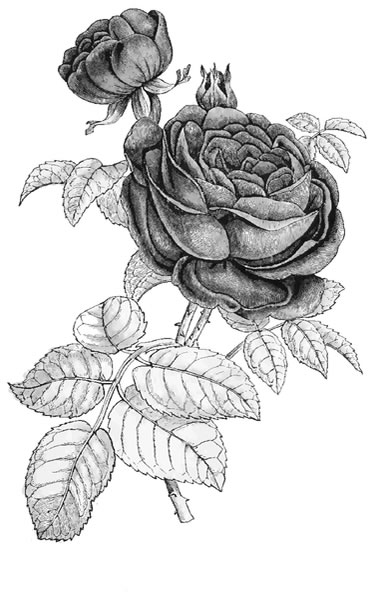
Fig. 1.—REMONTANT ROSE.
These roses have generally been obtained by hybridization
between the Hybrid China and Damask, and the
Bourbon and China Roses, uniting the luxuriant growth
and hardy character of the former two with the ever-blooming
qualities of the latter. They are generally
large, double, very fragrant, and bloom, some of them,
freely throughout the season. They are also perfectly
hardy, and grow well in any climate without protection.
These qualities render them very desirable, and they are
fast driving out of cultivation the Garden Roses, which
bloom but once, and during the rest of the season cumber
the ground. There are, it is true, among the latter, some
varieties, like Madame Plantier, Chénédole, Persian Yellow,
and others, that are not equaled by any varieties existing
among the Remontants. Such, however, is the skill now
exerted by rose growers, that this will not long be the
case, and we may hope soon to have among the Remontants,
roses of every shade of color, with the snow-like
whiteness of Madame Plantier, the golden richness of
Persian Yellow, or the peculiar brilliancy of Chénédole.
Abel Grand.—Rosy blush, fragrant, large and full,
fresh and glossy.
American Beauty.—Rose pink; very large and fragrant;
very free in blooming, and exceedingly valuable
for forcing; free bloomer in autumn.
Alfred Colomb.—Not new, but little known at the
time of the former list. Large; brilliant crimson; fine form, and very fragrant. A seedling of the popular Gen.
Jacqueminot, and one of the best.
Anne de Diesbach.—Has been several years in cultivation
and found to be desirable. Large, full, fine shape;
clear, bright carmine; fragrant, and very hardy.
Annie Wood.—Clear red; large and full, excellent
form; a good bloomer in autumn.
Antoine Mouton.—Medium size, full; lively rose,
tinged with lilac; very fragrant; plant vigorous.
Auguste Mie.—A seedling of the well-known La Reine.
A vigorous grower. Its color is a light pink, not so dark
as La Reine, which it resembles in form.
Baron de Bonstettin.—Red and dark crimson; large,
full and of vigorous growth.
Baroness Rothschild (also Madame de Rothschild).—One
of the largest roses; fine form; pink, shaded with
rose; exceedingly hardy, and a free bloomer.
Baronne Prevost.—One of the very best of its class,
blooming freely in autumn, and producing fragrant flowers
of a bright rose color. It is also of luxuriant growth,
and large, rich foliage.
Beauty of Waltham.—Large, full, of fine form; light
rosy crimson; free bloomer.
Boieldieu.—Very large and full; fine cherry red, of
the style of Baronne Prevost; plant vigorous.
Boule de Neige.—Pure white; moderate size, fine
form, and free bloomer.
Captain Christy.—Delicate flesh color, deeper in the
center; large, full, and with fine foliage.
Caroline de Sansal.—A vigorous plant, with a large
and full flower, the color of which is clear flesh, with
blush edges. It is one of the best of its color.
Charles Lefebvre.—A strong grower, and one of the
finest of its class. Its color is a bright, changeable crimson,
inclining to a purple shade in the center. Its form
is cupped and regular.
Comtesse de Serenye.—Flowers flesh color, inclining
to salmon in the bud; large, full, and globular; of
greatest beauty when grown under glass.
Coquette des Alpes.—White, tinged with rose; free
bloomer; size, medium to large; a valuable sort.
Elise Boelle.—White, slightly tinged with rose,
changing to pure white; medium size, fine form, and full.
Eugene Verdier.—Large; silvery-pink, tinged with
fawn color; bud very fine; dwarfish habit; seedling of Victor Verdier.
E. Y. Teas.—Large, fine globular form; carmine-crimson;
highly fragrant; excellent.
Fisher Holmes.—Large and full; magnificent scarlet
shaded with crimson; free grower and bloomer. It has
been described as an improved Gen. Jacqueminot.
Francois Michelon.—Deep rose, the reverse of the
petals silvery; large, full, and of globular form; one of
the best.
General Jacqueminot.—A strong grower, and when
in bud, one of the most beautiful of roses. Its open
flower, not being perfectly double, is surpassed by others.
Its color is a scarlet crimson, with a soft velvety sheen,
and a few thousand of them in full bloom is a sight to be
remembered. A basket of buds freshly cut in the morning
is sure to be appreciated.
General Washington.—One of the finest of its class.
It is a good grower, very full bloomer, and a general
favorite. Its color is a bright red.
John Hopper.—Large, and finely shaped. Its color is
rosy crimson.
Jules Margottin.—One of the finest Remontant Roses.
Its growth is vigorous, its bloom is abundant, and its color
is a clear pink crimson. It is particularly fine when in bud.
La France.—An invaluable rose for its hardiness, and
its constant blooming qualities. Its color is pale peach,
with rosy center; its form is globular, full, and very large.
La Reine.—When our first edition was issued, this
variety was unequalled. Others have now surpassed it.
It is, however, still valuable for its glossy rose color, and
its large, full, semi-globular form.
Louis Van Houtte.—Has a large and double globular
flower. Its color is bright shaded rosy carmine.
Louise Carique.—One of the most valuable Remontants.
Its color is a fine rosy carmine, its form is full,
and it grows well and blooms abundantly through the
summer. For general purposes, it has scarcely a superior.
Magna Charta.—Bright pink, suffused with carmine;
very large, full, of good form; habit erect; flowers produced
in abundance.
Mabel Morrison.—A sport of Baroness Rothschild,
and like it in nearly all respects, save color, which is a
pure dead white, but in autumn flushed with delicate pink.
Madame Gabriel Luizet.—Pale pink, a very delicate
and beautiful tint of color; large and full, cupped; very
sweet.
Madame Victor Verdier.—Large, full, globular; carmine-rose;
fragrant; free bloomer, and though not new,
excellent.
Marguerite de St. Amande.—Medium growth; beautiful
in the bud; bright rose; free, especially in autumn.
Much used by those who force roses.
Marie Baumann.—Large and full, excellent form;
deep carmine; very fragrant; remarkably free, and
classed by all among the best.
Marquise de Castellano.—Beautiful bright rose; very
large and full, form perfect; blooms freely; one of the
best.
Marquise de Mortemarte.—A seedling of Jules Margottin;
blush color, and well formed.
Marshall P. Wilder.—Cherry carmine; large, semi-globular,
full, and well formed. An American variety,
with vigor, hardiness, and freedom in blooming.
Maurice Bernardin.—A good grower, with full, fine
form, and bright cherry crimson color. One of the best.
Merveille de Lyon.—Pure white, sometimes washed
with satin-rose; very large, full, and cupped. A very
fine new white Rose.
Paul Neyron.—Very large, and perhaps the largest yet
produced; deep rose; somewhat fragrant; very free
bloomer.
Pierre Notting.—Very large, fine globular form; very
deep crimson, with a violet shade; highly fragrant; free
and one of the most valued among the dark roses.
Pæonia.—Large to very large, full; red; fragrant;
old, but valued for its fine foliage, and free flowering.
Pride of Waltham.—A delicate flesh color, richly
shaded with bright rose, very clear and distinct.
Prince Camille de Rohan.—Large and full. Its color
is a velvety deep crimson maroon, clouded with red. One
of the finest.
Queen of Queens.—Pink, with blush edges; large and
full, of perfect form; and a true perpetual flowering rose,
every shoot being crowned with a flower bud.
Rev. J. B. M. Camm.—Carmine rose; large, semi-globular;
fragrant, and free blooming; superb.
Paul’s Single Crimson and Single White.—Most
charming roses, and worthy of attention.
Thomas Mills.—Very bright rosy carmine; large and
full.
Victor Verdier.—Rosy carmine; a large, showy, free
growing rose; good quality, and very effective.
White Baroness.—A white sport from Baroness Rothschild;
flowers large and full.
REMONTANT SCOTCH.
Stanwell.—Of Scotch parentage, and has the peculiar
foliage and habit of the Scotch roses. Its flowers are
large, blush colored, and rather flat. It is an abundant and constant bloomer throughout the season, and its peculiar,
delightful fragrance renders it very desirable.
REMONTANT MOSS.
Blanche Moreau.—Large, full, perfect form; pure
white; buds and flowers produced in clusters and freely
furnished with deep green moss.
Eugene de Savoie.—Of vigorous growth, with a large
and full flower. It is an abundant bloomer, and very
fragrant. Its color is a bright red.
Madame Edouard Ory.—A good autumn bloomer. It
is globular, finely formed, and of a rich rose color.
Madame William Paul.—Very bright rose; large, full,
and of finely cupped form; flowers freely. One of the
best perpetual moss roses yet introduced.
Mousseline.—White, lightly tinted with rose at opening,
but changing to pure white; large and full; very
free and a continuous bloomer.
Perpetual White.—A vigorous grower, double, and
blooms in clusters.
Salet.—A good autumnal bloomer, and a good grower.
Its color is bright pink, changing to rose.
Soupert and Notting.—Very large, full, and globular;
bright rose color; while not so “mossy” as some others,
its ever-blooming character and most exquisite fragrance
give it a place in the first rank of its class.
BOURBON ROSES.
This class does not possess the hardiness of the Remontants,
nor the free blooming properties of the Bengals,
Teas, and Noisettes, and therefore can never compete
with the former for the North, nor with the latter for the
South. In it, however, are varieties like Hermosa, Souvenir
de Malmaison, and others, which are scarcely surpassed
in any class. The Bourbon Rose has also qualities
which make many varieties favorites. These qualities are
its greater hardiness than the Tea Rose, its very thick, leathery foliage, its luxuriant growth, its more constant
bloom than the Remontants, and its thick, velvety petals,
of a consistency to endure the summer’s sun.
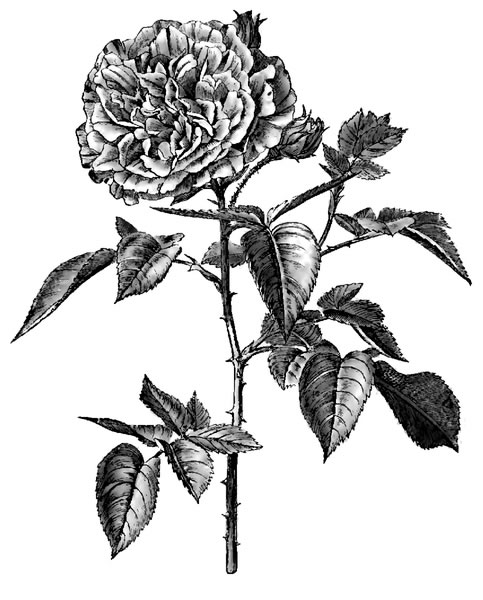
Fig. 2.—BOURBON ROSE.
It was introduced into France by Jacques, head gardener
of the Duke of Orleans, at Neuilly, who received it in
1819 from Bréon, director of the Royal gardens in the Isle
of Bourbon. The following account of its origin is given
by Bréon, and is also mentioned by Rivers:
“At the Isle of Bourbon, the inhabitants generally inclose
their land with hedges made of two rows of roses;
one row of the common China Rose, the other of the Red
Four Seasons. M. Perichon, a planter in the island, found
in one of these hedges a young plant, differing very much
from the others in its shoots and foliage. This he transplanted
into his garden. It flowered the following year,
and proved to be of a new race, and very different from
the above two roses, which at that time were the only
varieties known in the island.”
Its resemblance to the Bengal Rose was, however, so
strong, that it was soon considered a variety of that species.
Its characteristics are, however, so entirely different
from the Bengal, that we give it a separate place in our
garden classification. To the French we owe nearly all
the varieties of this class which have been produced from
the original semi-double rose, or Bourbon Jacques, as it
was called. Of these varieties, the following are distinct,
and possess many charming qualities that cannot fail to
gratify the amateur.
Acidalie.—One of the best light roses, being sometimes
light blush, and at others white. Its autumnal bloom is
its best.
Appoline.—A vigorous grower; its color is rose and
pink.
Dr. Berthet.—Brilliant cherry red; large, full, and
good.
George Peabody.—Medium, full, well formed; purplish
crimson; fragrant; a moderate grower, but one of
the best of its class.
Hermosa.—An old variety, but still one of the very
best of this group. Its form is cupped, very double and
perfect, and no rose blooms more abundantly, either
forced or in the open ground. Its color is delicate rose. The plant is of medium growth, and well adapted for
grouping or for planting in beds with Mrs. Bosanquet
and Agrippina.
Marquise Balbiano.—Rose, tinged with silver; full,
fine form.
Perle d’Angers.—Very pale rose, almost white; large
and full, imbricated.
Queen of the Bourbons.—A very beautiful and delicate
rose-colored variety, slightly tinged with buff. It is
cupped, very fragrant, large, and double, and its petals
are arranged with a beautiful regularity.
Queen of Bedders.—Medium, very full; rich crimson.
Few recent roses have been so highly praised as this; evidently
a useful free-blooming sort.
Souvenir de la Malmaison.—Altogether the most
perfect and superb rose of this or any other class. It was
originated by Béluze, a Frenchman. Its flowers are cupped,
and of very perfect form, very double, with thick,
velvety petals; they are of the largest size, often four to
five inches in diameter, and their color delicate blush,
with a rich tint of cream. Its large and very luxuriant
foliage, compact habit, and flowers of exceeding beauty,
render this one of the very finest roses known.
CHINA.
Agrippina.—Though an old rose, this is still one of
the best and most popular of its class. As a forcing rose,
and for an abundance of bloom, it is largely cultivated by
bouquet venders. It is cupped, beautifully formed, and
of a rich, brilliant crimson, with a delicate white stripe
in the center of each petal. It is one of the most hardy
and desirable of the old China Roses.
Cels multiflora.—An abundant bloomer; its color is
white, shaded with pink.
Daily Blush.—One of the oldest China Roses, but one of the very best. There can be nothing more perfect than
its half-expanded bud, of a light crimson, inclining to
blush. It commences blooming among the earliest, and,
if the old seed-vessels are picked off, will continue to bloom
abundantly through the summer and autumn, even after
severe frosts. It is one of the hardiest of the class.
Daily White.—Very similar to the preceding, in everything
but the color of its flowers, which are pure white.
Douglass.—Crimson; medium size; double, fine in
bud, and one of the best forcing sorts.
Ducher.—White; medium size, fine form, full; free
flowering; promising as a free and continuous white bedding
rose.
Little Pet.—White; small and double; a pretty miniature
rose, and exceedingly free in blooming.
Madame Bréon.—One of the very best. Its flowers
are very large and double, beautifully cupped, and of a
brilliant rose color. Few of the old China Roses can surpass
it.
Mrs. Bosanquet.—One of the most desirable of the old
China Roses, and there are few in any other class that are
superior to it. Its growth is luxuriant, and its superb
cupped, wax-like flowers are of a delicate flesh-color, and
are produced in the greatest abundance.
Viridiflora.—Green; curious.
NOISETTE.
Aimée Vibert.—One of the most beautiful of the Noisette
or cluster-flowering roses. It blooms freely through
the season, is tolerably hardy, and produces an abundance
of small, snow-white flowers, in fine clusters.
Beauté de l’Europe.—Deep yellow, reverse of petals
coppery; large, full, and of perfect shape.
Caroline de Marniesse.—One of the hardiest. Its
color is white, with a tinge of pink in the center.
Celine Forestier.—A vigorous growing rose. One of
the hardiest, and with a large, full flower. Its color is
rich yellow.
Elise Boelle.—A delicate pink shading; moderate
grower; much esteemed.
Lamarque.—A well-known and superb variety, whose
very vigorous growth adapts it well for a pillar, or even
for a climber, as in rich soils and favorable locations it
will make shoots of fifteen feet in a season. When budded
on a strong stock, few roses can surpass its large
cupped and nearly white flowers, weighing down the
branches.
Maréchal Niel.—A vigorous growing rose, more free
blooming than Chromatella. Its color is yellow, deepening
at the center to a rich, golden yellow. It is, perhaps,
the largest and most beautiful yellow rose known, and
very fragrant.
Ophire.—A medium-sized rose, of a very singular color,
entirely different from any other rose known, being a bright
salmon, almost saffron. It blooms in clusters, and its luxuriant
habit would make it a good pillar rose.
Solfaterre.—Another superb rose, of very much the
same character. Its flowers are large and globular, inclining
to flat, and their color bright lemon. When half
opened, the buds are superb. Like Chromatella (and
Lamarque, the parent of both), its growth is very luxuriant.
Rivers mentions a plant which threw out a shoot
from a single bud eighteen feet in one season, and the
next season was covered with flower buds.
Triomphe de Rennes.—A fine rose, of large, full form,
and canary color.
TEA ROSES.
Adam.—One of the finest tea-scented roses. Its flowers
are cupped, very double and large, and of perfect
form.
Andre Schwartz.—Crimson-scarlet, with an occasional
white streak on the inner petal; of tea fragrance, and
very free flowering.
Antoine Mermet.—Deep rosy-carmine; large, full, and
cupped.
Bon Silene.—A very beautiful tea-scented rose, cupped,
very double, and fragrant. Its color is rose, shaded
with crimson, and the plant is hardy and of luxuriant
growth.
Bougere.—A very large, superb rose, one of the very
best of the tea-scented varieties. Its form is cupped, and
its color a rich, glossy, bronzed rose.
Caroline.—A fine variety, with very double and perfect
flowers, of a bright rose color.
Capucine.—A very distinct sort, with beautiful saffron
yellow buds. Of delicate habit.
Catharine Mermet.—Large, pointed buds, full, and of
good form; rosy flesh color; fine fragrance; moderate
grower. Esteemed by those who force roses for the market,
as one of the most valuable.
Clara Sylvain.—One of the best white roses. It grows
very freely, and gives its globular, pure white, and fragrant
flowers in the greatest abundance.
Comtesse de Frigueuse.—Canary yellow; fine and
striking, large and full; free.
Cornélie Koch.—White, sometimes faintly tinged with
pale straw color. A grand rose, and a great favorite for
forcing.
Devoniensis.—A very beautiful rose, of immense size.
Like Chromatella, it is sometimes a shy bloomer when
young, but is well adapted for forcing. Its form is cupped,
and its color a fine creamy white, tinted with rose.
Duc de Magenta.—Has a large and fine form. Its
color is rosy salmon, shading to pink.
Etendard de Jeanne d’Arc.—Creamy white, changing to pure white; very large and full, opening well; a seedling
from Gloire de Dijon; very free.
General Tartas.—This is of a dark rose color, and has
a large and full form.
Gloire de Dijon.—One of the finest and hardiest of the
whole group. It is a strong grower, and makes a good
climber. Its foliage is luxuriant, and its flowers are large
and double; their color is pale salmon, buff, and yellow.
This variety will always give satisfaction.
Her Majesty.—Clear and bright satiny rose color;
flowers very large and full.
Homer.—A peculiar and beautiful rose when in bud.
Its color is rose, tipped with red, and with a salmon
center.
Isabella Sprunt.—A new, yellow rose, of great merit.
Its remarkably free blooming qualities make it a valuable
acquisition for forcing and for cut flowers.
Jaune d’Or.—A golden yellow rose, of good form.
Julie Mansais.—A large and superb tea-scented rose,
globular, and very fragrant. Its color is white, with
lemon.
Madame Bravy.—Finely formed, and of a creamy white
color.
Madame Chedayne Guénoisseau.—Canary yellow; very
beautiful in bud; large, full, of fine form, and very free.
Madame Cusin.—Purplish rose, center slightly tinted
with yellowish white; medium size; full and distinct.
Madame de Tartas.—Large, and free blooming; of a
bright rose color.
Madame Falcot.—Buff yellow, something deeper than
Safrano, and more double in form. One of the best.
Mademoiselle Cécile Berthod.—Large, full, fine form;
bright sulphur yellow; moderate.
Marie Berton.—(Climbing.) Very large; straw color, rather fragrant; vigorous, with fine foliage; regarded as
the most free bloomer of all the seedlings of Gloire de
Dijon.
Marie Guillot.—Large, beautiful in bud, nearly perfect
in form; white, with a faint tinge of yellow; free, and
one of the best of the newer light-colored varieties.
Marie Van Houtte.—Excellent form; the pale-yellow
petals, often suffused with rose; free, and highly esteemed,
especially for cultivation in the open air.
May Paul.—Red, shaded and veined with lilac; large
and full.
Niphetos.—Color almost white. When grown under
glass, it is one of the most popular and beautiful roses.
Papa Gontier.—A new red rose, of great value; fragrant;
free blooming, and of vigorous growth.
Perle de Lyon.—Large, very double, and fragrant;
deep yellow, with a tinge of saffron at center; excellent
fragrance; very vigorous grower, and is much used to
train up the pillars of green-houses, where it flowers freely;
mildews in the open air.
Perle des Jardins.—Large to very large, excellent
form, with stiff stem; deep canary yellow; exquisite tea-fragrance;
a free grower and bloomer; the foliage is very
dark and glaucous, and the five to seven leaflets are
strongly serrated. This variety, both in this country and
in Europe, proves to be a formidable rival to Maréchal
Neil. It is largely forced for the New York market, and
it is also excellent in the open ground.
Pierre Guillot.—(Hybrid.)—Large, erect, well formed;
bright red; fragrant; moderate to vigorous; free bloomer.
Puritan.—A new white rose of great beauty; very
large flower; blooming freely; good grower, and free
bloomer; fragrant.
Reine Marie Henriette.—(Climber.)—Large, good form, double; cerise red; rather fragrant; very vigorous;
this is also a cross from Gen. Jacqueminot.
Rubens.—Color rose and white, with yellow center;
form large and double.
Safrano.—This is scarcely excelled by any rose. Its
half-opened bud is very beautiful, and of a rich, deep
fawn color. When open, its form is poor, and its color a
much lighter fawn. These fawn-colored roses have peculiar
charms for us; and of them all, there are none more
beautiful or richer than Safrano.
Sombreuil.—A strong grower, with flowers of a pale
straw color.
Souvenir d’un Ami.—The queen of the tea-scented
roses, and will rank the very first among them. Its habit
is good, it blooms freely, and its large and beautifully
imbricated flowers, when open, much resemble in form
those of Souvenir de Malmaison. Its color is a delicate
salmon, shaded with rose, and its general character highly
recommends it as first-rate in every respect. Hibberd
claims to have produced flowers from this variety eleven
to twelve inches in circumference when fully expanded.
Sunset.—A sport from Perle des Jardins, bearing flowers
similar to that variety in form and substance but of a
deep apricot color; beautiful in bud, and a fine forcing
variety.
The Bride.—A very fine white tea rose; a sport from Catherine Mermet. The flowers are large, full, and of
great substance, produced in extraordinary profusion and
carried on long stalks well above the foliage.
Triomphe de Guillot fils.—A white rose, clouded with
flesh color, and shaded with yellowish salmon.
Vallée de Chamouny.—Coppery rose color; medium
size.
Vicomtesse de Cazes.—A fine yellow, and free blooming
rose.
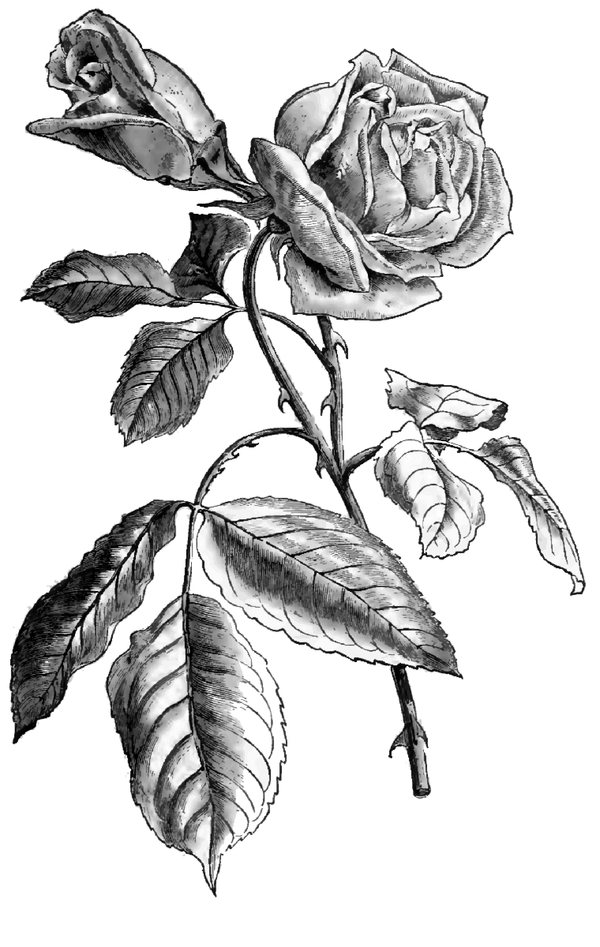
Fig. 3.—MARÉCHAL NIEL.
W. F. Bennett.—Crimson; large and double; very
fragrant. A most valuable variety for forcing for winter
blooming.
Waltham Climbers, Nos. 1, 2 and 3.—Very fine new
summer and autumn-flowering climbing roses of different
shades of crimson. No. 1 being the brightest, and
No. 3 the darkest. No. 2 is one of the sweetest roses
in existence, and No. 3 is a fine show rose.
In the preceding list, we have given some of the best
varieties of the Tea Rose, and trust the amateur will find
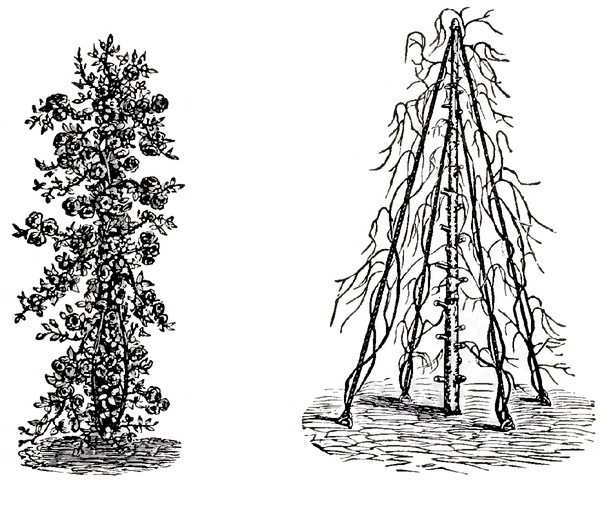
no difficulty in making a selection. Many are pillar roses;
and these, so trained, would be beautiful objects on a lawn,
either singly, or in groups from three to a dozen. Where
the height of the pillars can be gently graduated to the
highest in the center, the effect will be very fine. Many
of the luxuriant growing varieties can be trained upon a
common pale fence, and will cover it with flowers and
foliage the whole season. Straw can be easily thatched
over to protect them from the severity of winter, or bass
mats would be still better.
THE POLYANTHA ROSES.
A distinct species of Rose (Rosa polyantha) was introduced
from Japan several years ago. This is distinguished
by having numerous very small flowers, borne in
panicled clusters. In the hands of the French cultivators,
it has produced what promises to be a distinct and
popular class, of which the following are regarded as the
best. They are probably hybrids, as they remontant,
while the original species blooms but once. The English
often call them “Daisy Roses.”
Anne Marie de Montravel.—Small, an inch and a
half in diameter, very double; pure white; lasts a long
while in perfection; moderately fragrant. Jean Sisley
writes: “Each truss will make in itself a splendid bouquet.”
Dwarf, but vigorous.
M’lle. Cécile Brünner.—Very small, full; fine salmon-pink;
highly fragrant; moderate or dwarf; flowers freely.
Obtained by crossing with a Tea.
Mignonette.—Very small, double; in clusters of thirty
or forty; rose-color, changing to blush.
Paquerette.—Fine form, full, only an inch in diameter;
pure white; growth moderate.
Perle d’Or.—Nankeen yellow, with orange centres;
small and full, very beautiful; flowers very numerous
and of good shape.
Princesse Wilhelmine des Pays Bas.—Pure white, imbricated,
very sweet.
THE RAMANAS ROSE (Rosa rugosa).
Since the last edition was published this Rose has been
introduced into cultivation and has become deservedly popular.
The plant is very vigorous, growing large clumps five
or six feet in height with exceedingly thorny stems. The
foliage is remarkably robust, very dark-green, strongly-veined,
and of great substance; it is rarely attacked by
insects. The rose-colored, or white single flowers, about
three inches across, are borne in large clusters, and have
a most delightful fragrance. They continue in bloom
for a long time, and are succeeded by large fruits (heps)
of a bright-red color, which make the bush very showy
in autumn. There are in cultivation a white and a
rose-colored variety. A double variety has been introduced,
but it is only partially double, and not preferable
to the single. These are most valuable roses for the
shrubbery, suckering somewhat, but not to an annoying
extent.
This species was sent to this country from Japan by
Mr. Thomas Hogg, about fifteen years ago; it was also
introduced into Europe by others. It has been described
in French and other journals as Rosa Regeliana and R. Fortunei, but the much older name R. rugosa must
supersede these. The adoption of the Japanese “Ramanas”
will avoid any confusion as to botanical names.
Whether a species so very distinct as this will yield itself
to the efforts of the hybridizer remains to be seen, but it
offers a most tempting subject. Could the vigorous, almost
leathery foliage, thorough hardiness and powerful
fragrance of this be combined with the handsome form
and varied tints of roses of the popular classes, it would
be a great horticultural achievement. The European
journals mention that a new variety of this species was
exhibited at Lyons this year, but no description is given.
It is however interesting to know that the skilled rose
growers of the south of France have taken it in hand.
The Japanese have long held the Ramanas Rose in high
favor. It is recorded that as early as the year 1100, of
our era, the court-ladies prepared a favorite perfume
from its petals; but it is also stated that they had the
bad taste to add to it both camphor and musk.
MACARTNEY ROSES.
The Macartney rose was brought from China to England
by Lord Macartney, in 1793. Its habit is luxuriant,
and its foliage is more beautiful than that of any other
rose, its leaves being thick, and of a rich, glossy green.
It commences blooming about midsummer, and its flowers,
with a fragrance like the perfume of an apricot, succeed
each other without interruption till the first frosts,
while the leaves remain till the very latest. Although as
hardy as the hardiest of the China Roses, it would be better
in this latitude to give it the same protection as recommended
for the China. It is one of the most desirable
roses for beds or borders. When covering the whole
ground, and kept well pegged down, its rich, glossy foliage,
gemmed with fragrant flowers, produces a beautiful effect. The varieties of this rose are very few, but the
best two are the following:
Alba odorata.—A vigorous growing rose, with very
rich and beautiful foliage. Its fragrant flowers are cream-colored,
and, when in bud, are very beautiful. It has
stood the last three winters uninjured in our grounds,
without protection, and is a very beautiful and desirable
variety. It is classed by Rivers as a Microphylla, but it
so little resembles that rose, and is so decidedly Macartney
in its character, that we place it with the latter.
Maria Leonida.—A very beautiful, but not entirely
double variety, as its stamens can sometimes be seen,
which, however, give a graceful appearance. Its flowers
are finely cupped, and pure white, with a tinge of blush
at the base of the petals.
MICROPHYLLA ROSES.
This species, originally from the Himalayan Mountains,
was first brought to Europe in 1823. Its foliage is small
and singular, and its growth is very robust. Its flowers
bloom from midsummer till frost, and have a striking appearance;
they are very double, with a calyx of which
the small, bristling sepals give the opening bud the appearance
of a small chestnut. The plant is hardy, and
has endured the winter in our grounds for the past twenty
years without protection, losing only a portion of the tops
of its shoots. Of the several varieties, one of the best is
Rubra, which has very double and cupped flowers, of
a blush and often rose color, with a deep red centre.
MUSK ROSES.
The Musk Rose grows naturally in Persia and other
Eastern countries, where it attains the height of a small
tree, and is doubtless the rose which has been celebrated by Eastern poets. It is also found in India, where it is
probably the species used for making attar. In this latitude
it is quite hardy, and we have a plant of the old
White Musk in our grounds, that has braved the severity
of more than twenty winters. It has made in one season
shoots more than six feet long, and in our Southern
States, more than double the growth would probably be
obtained. The blossoms appear in clusters, and commencing
later than any other rose, continue abundant throughout
the season. The Old White Cluster has been widely
distributed throughout the country, and is deservedly a
favorite. The best two varieties, however, are the following:
Eponine.—A cupped and very double variety, with the
peculiar musk fragrance. It is pure white, and a very
pretty rose.
Princess of Nassau.—A luxuriant growing and very
fragrant variety, and would make a good pillar rose. It
blooms in large clusters of cupped flowers, changing from
yellow to cream color as they open.
ROSES THAT BLOOM ONLY ONCE IN THE SEASON.
GARDEN ROSES.
For want of a better, we use this term to designate all
those roses that bloom only once in the season, and that
strongly resemble each other in habit and flower. It includes
those classes called, by rose-growers, French, Provence,
Hybrid Provence, Hybrid China, Hybrid Bourbon,
White and Damask Roses.
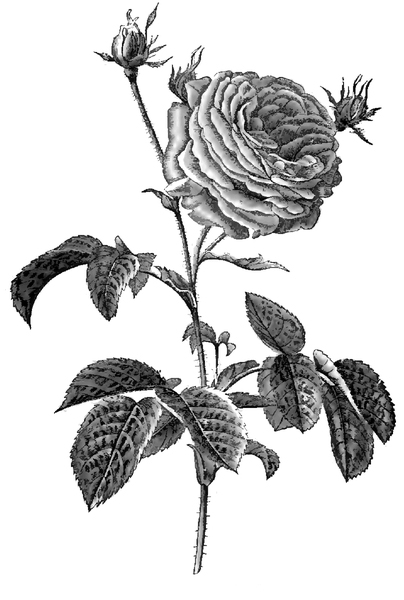
Fig. 4.—GARDEN ROSE.
On a preceding page, we have given our opinion respecting
classification, but we wish it to be fully understood,
that we do not deny the existence of clearly distinctive
characters in the true French, Provence, Damask,
etc., but simply assert that the lines of difference between these so run into each other, and are so blended together,
that it is almost impossible to know where to place a new
rose, which may partake of the qualities of all. We have mentioned Rivers as the most skillful and correct of rose-growers;
and yet, in classing Lady Fitzgerald and Madame
Hardy among the Damasks, he says that neither of
them are pure Damask; and the Duke of Cambridge,
which at first he thought a Hybrid China, he now places
as a Damask; other similar instances are frequent. Many
roses, moreover, are classed as hybrids which are not truly
such. We are quite inclined to think that a large number
of the varieties supposed to have been produced by hybridizing
are nothing more than the natural produce, and
that the pollen, in many cases, has not impregnated the
pistil to which it was applied. With this uncertainty,
therefore, as evinced by Rivers in his work, and with
doubts of the hybridity of supposed hybrids, we deem it
better to class them all together; and, for the benefit of
those who may prefer the old classification, to attach to
each name the class by which it has been hitherto known.
We write principally for the amateur, and we think he
will find it less embarrassing to make a selection from this
classification than from the old one.
A great number of Garden Roses exist, but we describe
here only a few distinct varieties, with colors which are
seldom found among the Remontants.
All the others have either their equals or their superiors
among the Remontants, and being certain to bloom only
once in the season, are scarcely worthy of cultivation,
compared with the Remontants.
Chénédole, H. C.—One of the most splendid varieties,
and is truly beautiful. Its foliage and habit are very
good, and its very luxuriant growth makes it a good pillar
rose. Its flower is cupped, large, double, and fragrant,
and its color is a rich, glowing crimson, of almost dazzling
brilliancy. It is altogether the most desirable rose of this
class.
Charles Lawson, H. B.—This has handsome foliage, and vigorous habit of growth, with large, symmetrical,
and bright rose-colored flowers.
Coupe d’Hébé, H. B.—A gem of the family. It is large,
double, symmetrical, and finely cupped. Its color a delicate,
wax-like, rosy pink. Its growth is luxuriant, and
adapted for pillars.
Emerance, H. P.—A beautiful cupped rose, of a color
unusual in this class, being of a pale lemon or straw
color. Its form is very regular, and the habit of the plant
good.
George the Fourth, H. C.—An old rose, produced by
T. Rivers, but is still one of the most desirable of this
class. Its flowers are of a dark crimson, and its young
shoots have a purple tinge. Its very luxuriant habit
makes it suitable for a pillar.
Julie d’Etranges, F.—This has a large cupped flower,
of a delicate rose color.
Madame Hardy, F.—A vigorous habit, and finely shaped
flower. Its color is pure white, sometimes with a green
centre.
Madame Plantier, H. C.—A cupped and double pure
white rose. It is a luxuriant grower, a most abundant
bloomer, and one of the very best of the white summer
roses. Its foliage is so marked in its richness and beauty
that any one can readily distinguish it by that alone.
Were it Remontant, it would possess all the requisites of
a perfect white rose.
Obscurité, F.—One of the darkest roses known.
Œillet Parfait, F.—A beautiful striped rose, resembling
a carnation. Its form is compact, and its color a very
light blush, nearly white, beautifully and distinctly striped
with rose and bright crimson.
Tricolor de Flandre, F.—A very double, distinct, and
compact flower. Its color is lilac, striped with red and
crimson.
MOSS ROSES.
The Moss Rose was introduced into England from Holland
in the sixteenth century, and is first mentioned by
Miller, in 1727, by whom it was supposed to be a sport of
the Provence Rose, which opinion has been confirmed by
modern botanists. Its peculiarities are the delicate prickles
which crowd its stem, and the beautiful mossy covering
of its calyx. This mossy appearance has been deemed
by some a mere lusus naturæ, and by others the work of
an insect similar to that which produces the bédéguar, or
rose-gall. The former opinion, however, prevails; and
this freak of nature cultivators have succeeded in fixing
and perpetuating in a great number of varieties. The
first Moss Rose known in France was said to have been
introduced there by Madame de Genlis, who brought it
with her on her return from England. In 1810, scarcely
more than one variety was known, and now there exist
more than a hundred. Of these, the best and most distinct
are the following:
Alice Leroy.—Light rosy-pink, free blooming, and of
good habit.
Baronne de Wassenaer.—This has a good form, bright
red color, and flowers in clusters.
Captain Ingram.—Flowers of a dark, velvety purple.
Comtesse de Murinais.—A vigorous habit. Its color is
pale flesh, changing to pure white, and it is one of the
best of the white Mosses.
Common.—This is the old rose-colored Moss, which
has been generally cultivated in gardens. It grows well,
blooms freely, is well covered with moss, and is one of
the best of the old varieties.
Cristata.—A very singular and beautiful variety, said
to have been discovered in the crevice of a wall at Friburg,
in Switzerland. Rivers classes it with the Provence Roses, and when open, it is merely a variety of that rose;
but when in bud, it is more properly a Moss, although its
calyx is not covered with a fine moss, but has more of a
crested appearance. In a rich soil this fringe-like crest
most beautifully clasps and surmounts the bud, and gives
the rich clusters a truly elegant appearance. Its form is
globular, and its color rose. It is one of the few that do
not grow well on their own roots, but require to be budded
on some strong-growing stock.
Etna.—Brilliant crimson, tinted with purple.
Eugene Verdier.—Light red, deeper in the center,
large, full, and of fine form.
Gloire des Mousseuses.—A large and handsome flower,
with a clear, pale rose color.
John Cranston.—Crimson and purple shaded, of medium
size, full.
Louis Gimard.—Bright red, large and full, vigorous.
Little Gem.—A miniature Moss Rose, forming compact
bushes densely covered with small double crimson
flowers, beautifully mossed. It is of charming effect in
the garden and most valuable for bouquets or vases.
Laneii.—A vigorous grower, and has large and thrifty
foliage. The buds are large and well mossed, and it is
beautiful both in bud and expanded. Its color is bright
rose.
Luxembourg.—Like the last, of vigorous growth. Its
flowers are a purplish crimson.
Madame de Rochelambert.—This has large and full
flowers, of an amaranth color.
Madame Edouard Ory.—This was described among
the Remontant Mosses.
Nuits de Young.—Plant of a dwarf habit. Its flowers
are small, with a deep, velvety purple color.
Princesse Adelaide.—A remarkably vigorous-growing variety, with large and handsome foliage, and would
make a good pillar rose. Its regularly formed flowers,
of a bright pink or rose, are produced in clusters, and
open well. It does not bear close pruning. This is one
of the most desirable of its class, and owes its origin to
Laffay.
Princess Royal.—A very robust rose, almost equal to
the preceding in vigor. Its young leaves and branches
have a red tinge, and its cupped flowers are of a deep
crimson purple, marbled and spotted with red. Although
not quite double when fully open, they are very beautiful
when in bud. A moss rose, however double, is peculiar
only in bud, for, when fully expanded, the mossy calyx
must inevitably be hidden.
Perpetual White.—This was described among the Remontant
Mosses, as also were
Reine Blanche.—Pure white, large and full.
Salet.
White Bath.—Paper-white, beautiful, large and full,
one of the best.
Like all other roses, and even in a greater degree, the
Moss Rose requires a light and very rich soil, with a dry
bottom. Many of them make very beautiful beds and
patches, when planted in rich soil, and kept well pegged
down. A good supply of stable manure should be given
them in the autumn, to be washed down about their roots
by the winter rains. They do not generally require or
bear so much pruning as other roses, but their bloom
may sometimes be prolonged by shortening part of the
shoots close, and only the tips of the remainder. When
properly cultivated, few objects can be more beautiful
than these roses, either singly or in masses. Without
making so brilliant a show as some other classes, the moss
which envelops them imparts a touch of graceful beauty
belonging to no other flower.
SCOTCH ROSES.
These roses are all derived from a dwarf rose found
growing wild in Scotland and in the north of England.
They are distinguished by their small leaves, abundant
bloom, and delicate habit. Being perfectly hardy, they
are desirable for beds or borders, in which, with proper
arrangement of colors, they show beautifully, sometimes
two weeks before other roses open, producing flowers
all along the stem. Rose growers describe, in their catalogues,
two or three hundred varieties, but of them all,
scarcely forty or fifty are distinct; of these the best three
are the following:
Countess of Glasgow.—A very pretty and brilliant dark
rose, blooming abundantly.
Queen Of May.—A fine and distinct variety, of a bright
pink color.
William the Fourth.—An excellent variety, of luxuriant
growth. Its flowers are pure white, and among the
largest of the class.
BRIER ROSES.
These roses are distinguished by their small, rough foliage
and brier habit. They include the Sweet-Brier, the
Hybrid Sweet-Brier, and the Austrian Brier. The Sweet-Brier
is found in various parts of this country and in Europe,
and is distinguished by the peculiar delightful fragrance
of its leaves. Its simple little flower, found among
the hedges, has been long a favorite, and, under the name
of Eglantine, has been often the theme of poets.
The Hybrid Sweet-Brier is allied to the preceding, but
has larger foliage, and is of more robust growth. Many
roses have been placed in this class and among the Sweet-Briers
that have none of the peculiar scent of the Sweet-Briers;
and hence, again, the necessity of classing together these and the Austrian Briers, respecting which there
is much confusion. The true Austrian Rose is a native
of the South of Europe, and is a clearly distinct rose; but
some have been called Austrian which have scarcely any
of the characters of the original rose. All three, however,
are Briers, that is, they produce their flowers on
short joints all along the stem, and have the peculiar rough,
briery leaves. We therefore place them all together, attaching
as before the name of the old class. The best are
the following:
Celestial, S. B.—A small cupped rose, very double and
fragrant, of a pale flesh-color and very pretty.
Copper Austrian, A. B.—A very singular looking rose,
blooming well in this climate. The inside of the flower
is of a coppery-red, and the outside inclining to pale yellow
or sulphur. It is desirable for its peculiar color.
Double Margined Hip, H. S. B.—Of luxuriant growth,
almost adapted for a pillar. Its form is cupped, and its
color creamy-white, shaded with pink.
Double Yellow Provence is the best of the two varieties
which compose the species called Sulphurea. We
have never seen its flowers, and English writers all speak
of the great difficulty of making it bloom. Rivers recommends
to bud it on strong stocks, and says that it
blooms most profusely in the warm, dry climate of Florence
and Genoa. The plant grows with luxuriance and
produces plenty of flower-buds, which, with proper culture,
would probably open in our warm climate, which is very
similar to that of Florence and Genoa. Its small foliage
and slender, thorny wood, place it fairly among the Briers.
Its flower is so fine that it is well worth the trouble
of repeated experiment to obtain a good bloom. It has
long been admired and exercised the skill of rose growers,
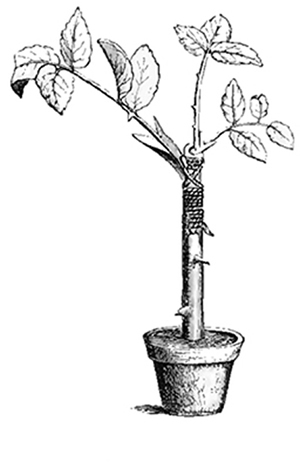
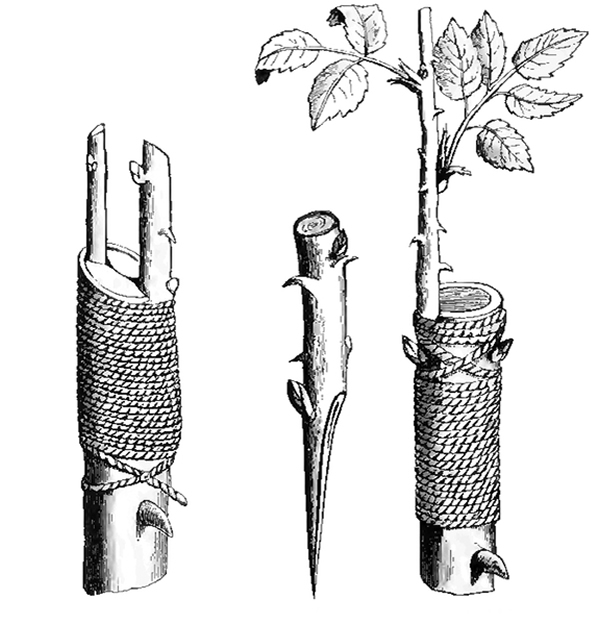
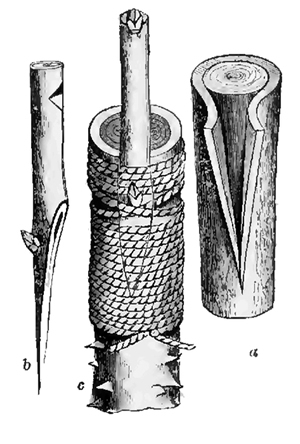
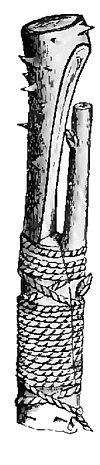
as is proved by the following passages from some old
works, which give instructions for proper culture:
“Whereas all other roses are best natural, this is best
inoculated upon another stock. Others thrive and bear
best in the sun; this, in the shade: therefore the best way
that I know to cause this rose to bring forth fair and
kindly flowers, is performed after this manner. First in
the stock of a Francfort Rose, near the ground, put in the
bud of the single yellow rose, which will quickly shoot to
a good length; then, half a yard higher than the place
where the same was budded, put into it a bud of the
double yellow rose, which growing, the suckers must be
kept from the root, and all the buds rubbed off, except
those of the kind desired, which, being grown big enough
to bear (which will be in two years), it must in winter be
pruned very near, cutting off all the small shoots, and
only leaving the biggest, cutting off the tops of them
also, as far as they are small. Then in the spring, when
the buds for leaves come forth, rub off the smallest of
them, leaving only some few of the biggest, which, by
reason of the strength of the stock, affordeth more nourishment
than any other, and the agreeable nature of the
single yellow rose, from whence it is immediately nourished,
the shoots will be strong and able to bear out the
flowers, if they be not too many, which may be prevented
by nipping off the smallest buds for flowers. The tree
should stand something shadowed, and not too much in
the heat of the sun, and in a standard by itself, rather
than under a wall.” That which follows is from a book
called Systema Horticulturæ, dated 1688:—“There is no
flower-bearing tree that yields blossom so beautiful as the
rose, whereof the yellow Provence Rose is the most beautiful
where it brings forth fair and kindly flowers, which
hath been obtained by budding a single yellow rose on the
stock of a flourishing Francfort Rose near the ground:
when that single yellow is well grown, in that branch inoculate
your double yellow rose; then cut off all suckers and
shoots from the first and second, leaving only your last, which must be pruned very near, leaving but few buds,
which will have the more nourishment, and yield the
fairer and more entire blossoms. This tree, or a layer
from a rose of the same kind, delights most, and blows
fairest, in a cold, moist, and shady place, and not against
a hot wall.”
Harrisonii.—A fine yellow Brier of American origin,
and is perhaps the best hardy yellow rose for general cultivation.
Persian Yellow, A. B.—This is the deepest yellow rose
known, and is a highly improved edition of the Harrison.
Its flowers are more double, and of a deeper yellow
than that rose. It grows freely, blooms abundantly, and
its small double flowers possess a richness of color unequalled
by any other rose. No garden should be without
it. It should be added, however, that it is exceedingly
difficult to strike from cuttings, and is one of those few
varieties for which budding upon another stock is preferable.
Rose Angle, S. B.—An excellent variety, with very
fragrant foliage, and large double flowers of a bright rose
color. It is one of the best of the true Eglantines.
Like the Moss Roses, the Briers will not bear much
pruning, and require merely the tips of the shoots to be
cut off.
AYRSHIRE ROSES.
This class is very valuable for covering unsightly places,
old buildings, and decayed trees. They bloom some two
weeks earlier than other roses, and will grow in soil where
others would scarcely vegetate. Hence they are valuable
for covering naked sand-banks, or bare spots of earth, and
their roots would be of material assistance in keeping up
the soil of loose banks. Rivers gives an extract from the
Dundee Courier, showing the effect produced by some of
these roses.
“Some years ago, a sand pit at Ellangowan was filled
up with rubbish found in digging a well. Over this a
piece of rock was formed for the growth of plants which
prefer such situations, and among them were planted some
half dozen plants of the Double Ayrshire Rose, raised in this
neighborhood about ten years ago. These roses now most
completely cover the whole ground, a space of thirty feet
by twenty. At present they are in full bloom, showing
probably not less than ten thousand roses in this small
space.”
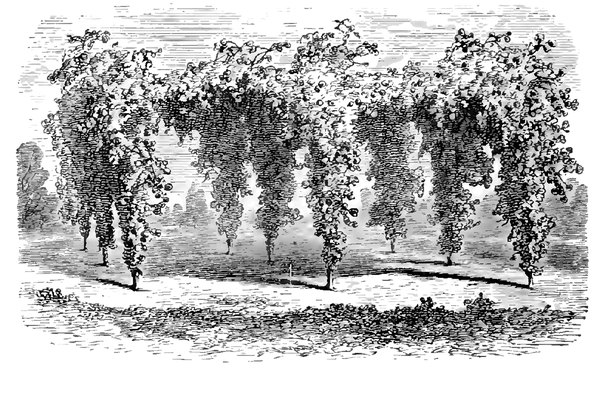
The Ayrshire Roses are also valuable for weeping trees;
when budded on a stock some ten or twelve feet high, the
branches quickly reach the ground, and protecting the
stem from the sun by their close foliage, present a weeping
tree of great beauty, loaded with flowers.
Dundee Rambler.—One of the best and most double
of the Ayrshire Roses. Its color is white, often edged
with pink, and blooming in large clusters. It is a very
desirable variety.
Double Blush Ayrshire.—A most vigorous climber,
with a pretty flower, and will grow in the poorest soil.
BANKSIAN ROSES.
Roses of this class have a very small flower closely resembling
that of the double Spiræa prunifolia, and
blooming in clusters of about the same size. In this
climate they require the protection of a green-house, and
are very striking for the great profusion of their corymbs
of pure white or deep yellow flowers. We recollect seeing,
at the Botanic Garden at Naples, a very large plant
of the Banksian Rose, the main stem being six inches in
diameter, and branching off into a dozen others, fifty feet
or more long. In the Southern States they would grow
well in the open air, and being most vigorous climbers,
would soon cover a house or trellis, and, with their small but most abundant flowers interspersed among the smooth
glossy-green foliage, would form an object of great beauty.
Double White.—Introduced into England from China
in 1807, and named in honor of Lady Banks. It is a
beautiful little rose about half an inch in diameter, blooming
abundantly in small and pure white clusters with a
slight perfume like that of the violet.
Double Yellow.—Introduced in 1827. It has bright
buff-yellow flowers; these are produced in great abundance,
and give a pleasant perfume before the dew is off
early in the morning, or just at evening.
Fortuniana.—Introduced by Fortune in 1850. It has
white fragrant flowers of much larger size than the preceding
varieties. Its want of the petite character of the
others makes it less beautiful and striking.
Jaune Serin.—A luxuriant growing variety, with yellow
flowers of larger size than those of the old Yellow
Banksia.
The Banksian Roses do not bear much pruning. It
should be done immediately after the bloom is over, and
then only the heavier branches cut out, leaving those
which are full flower-bearing twigs, which should not
be shortened. If the branches are all shortened, the
plants will produce an abundance of strong, new wood,
but no flowers.
BOURSAULT ROSES.
This class is marked by its long, flexible, reddish shoots,
which grow rapidly, and are perfectly hardy. Their
smooth bark renders them desirable for stocks to bud upon,
and a fine rose of this class, covering a trellis and budded
with roses of various colors, would present a beautiful
appearance. These, also, are impatient of much
pruning.
Amadis.—One of the best, with its pendulous clusters
of large purplish-crimson flowers.
Blush.—This has large, double, blush flowers.
EVERGREEN ROSES.
The original of this class is the Rosa sempervirens, a
wild rose of Italy. They are very beautiful and desirable,
and although not entirely evergreen in this climate, retain
their foliage very late in the season. They are very easy
of cultivation, and most luxuriant climbers over naked
trees, old houses, fences, and walls, or along the surface of
the ground, which they will soon cover to the exclusion
of all weeds, and present a large mass of rich, glossy foliage,
and abundant bloom. When thus planted, the large
weeds should be pulled up until the plant fairly covers
the ground, when no more attention will be needed. They
are well adapted for training up columns, and we know
of few things more beautiful than a temple formed of
numerous columns, with Evergreen Roses growing luxuriantly
upon them and festooned gracefully between.
Nothing, indeed, can be more gracefully beautiful than
festoons, wherever they can be made. They constitute
the chief beauty of the vine-clad fields of Italy, and there
would be no less beauty in occasional festooning of roses
trained between pillars or the trees of a lawn. They are
also very beautiful when budded on high standards, their
dark-green glossy foliage weeping to the ground, and
forming a fine dome or pyramid of leaf and bloom. When
pruned in the winter, the branches may be thinned out,
but not shortened; for if pruned close, they will make a
luxuriant growth the next season, but will produce no
flowers.
Félicité Perpetuelle.—A most beautiful rose, and one
of the very best of the class; when properly cultivated, it produces an abundance of very double creamy-white
flowers, shaped like a double ranunculus.
Melanie de Montjoie.—A variety of much beauty. Its
abundant and glossy dark-green foliage contrasts beautifully
with its large, pure white flowers.
Myrianthes.—One of the best of this class. Its flowers
are perfectly shaped, and of a very delicate rose color.
Triomphe de Bollwiller.—A very fine hybrid between
the Evergreen and Tea Roses. It is rather tender in this
climate, but valuable for its tendency to bloom in the autumn.
Its flowers are very large, double, fragrant, and
globular, and their color is a blush or creamy white. At
the South, where it would not be killed by the cold weather,
this would be one of the most desirable climbing roses.
HYBRID CLIMBING ROSES.
We include here some which do not belong to any of the
distinct classes.
Indica Major.—A hybrid climbing rose, of most luxuriant
growth and nearly evergreen foliage. Its flowers
are very large, double, and of a delicate rose color. The
very rapid growth of this rose makes it excellent for covering
old buildings. We recollect being shown, at the
Bartram garden of Philadelphia, a fine old plant which
had covered the whole side of the house, and presented a
beautiful appearance. Buist states it to be this variety.
Madame d’Arblay is a truly gigantic hybrid climber,
perfectly hardy, and with strong, Bourbon-like foliage. It
blooms in large clusters of pure white flowers, and is a
truly excellent variety.
Menoux.—This variety has crimson flowers, a color
which is not common among climbing roses.
Sir John Sebright.—A hybrid Musk rose, grown by Rivers. Its flowers are produced in large clusters, are
very fragrant, and their color is a bright crimson-scarlet.
The Garland.—A most vigorous hybrid climber, blooming
in immense clusters of fragrant, creamy-white flowers,
changing to blush after expansion. When in full bloom,
the contrast of the large white clusters with the bright
green foliage is very beautiful.
MULTIFLORA ROSES.
The parent of this class is a native of China and Japan.
They are unfortunately somewhat tender in this climate.
We have known them to endure safely several winters
when unprotected, but they are unreliable in this respect.
One of the best is
Grevillei or Seven Sisters.—It has a remarkably vigorous
growth, and blooms with unusual profusion. A
large plant will not unfrequently show more than a thousand
flowers, all blooming in clusters and of several shades
of color. This variety is impatient of much pruning.
De la Grifferaie.—This bears the knife better than the
preceding, and may be grown as a bush with proper
pruning. It is hardier than others of the class, and bears
a profusion of blush and rose-colored flowers.
Laure Davoust.—One of the most beautiful of the
Multiflora Roses, and of most luxuriant growth. It has
larger flowers and handsomer foliage than any of the other
Multiflora Roses, and blooms in immense clusters of perfect
flowers, changing from white to pink. For covering
houses or trellises it is very desirable.
Russelliana.—This is very vigorous, and yet bears
pruning so well that it may be grown as a bush. Its
clusters are large, and the flowers change as they open
from dark to light red lilac, giving it a singular appearance.
THE PRAIRIE ROSE.
The double varieties of the original Michigan Rose, or Rosa rubifolia, have nearly all been produced by Samuel
Feast, of Baltimore, while a few new varieties owe their
origin to Joshua Pierce, of Washington. They are remarkable
for their perfectly hardy nature, braving equally
well the frosts of Canada or the heat of Louisiana. The
leaves are large, rather rough, and of a rich dark-green.
They grow with unexampled rapidity, exceeding in this
respect any of the climbing roses, and would cover old
buildings or naked ground in a very short space of time.
They bloom after the other summer roses are mostly gone,
and produce their flowers abundantly in large clusters of
different shades, from the shaded white of Baltimore
Belle to the rich deep rose of
Queen of the Prairies.—This is the best, and of the
most luxuriant growth. Its large flowers are of a peculiar
cupped form, almost globular, when in bud, and altogether
of very perfect shape. They are of a deep rose color, with
a white stripe in the centre of each petal. This rose is
truly superb, and, for our cold winters and hot sun, an
unequalled climber. It would be a fine rose to cover a
trellis or building, and then bud into its branches a dozen
different Remontant or Bourbon Roses of various colors.
The tout ensemble would be superb.
Baltimore Belle.—This variety is thought by some to
have a strain of Noisette sap in it from the delicacy and
beauty of its flower and its tendency to bloom in the autumn.
It produces abundant clusters of white flowers
shaded with a slight cloud of pink. It is one of the finest
climbing roses known.
Gem of the Prairie. (Burgess’.)—A hybrid between
the Queen of the Prairies and the Remontant, Madame
Laffay. It is said to combine the vigorous growth of the
one with the rich color and delicate fragrance of the other. We do not, however, think that it equals its
early promise.
Jane.—Very double, of a deep rosy lilac.
Mrs. Hovey.—This has large white flowers, and all the
vigor of its class.
Pride of Washington.—A rosy lilac, and double.
There are several other varieties in this class, but the
preceding are the best.