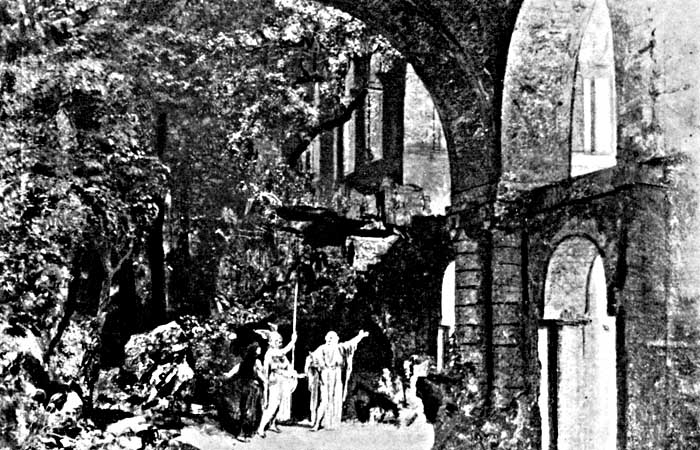
The waves of sound rise from the
shadowy gulf sunken between
the audience and the footlights.
Upon the sound ocean of "wind" the
"Take, eat," or "Love-feast" motive
floats. Presently the strings pierce
through it, the Spear motive follows, and
then, full of heavy pain, "Drink ye all of
this," followed by the famous Grail motive—an
old chorale also used by Mendelssohn
in the Reformation Symphony. Then
comes the noble Faith and Love theme.
As I sit in the low light, amid the silent
throng, and listen, I need no interpreter—I
am being placed in possession of the
emotional key-notes of the drama. Every
subject is first distinctly enunciated, and
then all are wondrously blended together.
There is the pain of sacrifice—the mental
agony, the bodily torture; there are the
alternate pauses of Sorrow and respite
from sorrow long drawn out, the sharp
ache of Sin, the glimpses of unhallowed
Joy, the strain of upward Endeavor, the
serene peace of Faith and Love, crowned
by the blessed Vision of the Grail. 'Tis
past. The prelude melts into the opening
recitative.
The eyes have now to play their part.
The curtain rises, the story begins. The
morning breaks slowly, the gray streaks
redden, a lovely summer landscape lies
bathed in primrose light. Under the
shadow of a noble tree, the aged knight.
Gurnemanz, has been resting with two
young attendants. From the neighboring
halls of Montsalvat the solemn reveillé—the
Grail motive—rings out, and all three
sink on their knees in prayer. The sun
bursts forth in splendor as the hymn rises
to mingle with the voices of universal
nature. The waves of sound well up and
fill the soul with unspeakable thankfulness
and praise.
The talk is of Amfortas, the king, and
of his incurable wound. A wild gallop,
a rush of sound—and a weird woman, with
streaming hair, springs toward the startled
group. She bears a phial with rare
balsam from the Arabian shores. It is
for the king's wound. Who is the wild
horsewoman? Kundry—strange creation—a
being doomed to wander, like
the Wandering Jew, the wild Huntsman,
or Flying Dutchman, always seeking a
deliverance she can not find—Kundry,
who, in ages gone by, met the Savior on
the road to Calvary and derided him.
Some say she was Herodias's daughter.
Now filled with remorse, yet weighted
with sinful longings, she serves by turns
the Knights of the Grail, then falls under
the spell of Klingsor, the evil knight
sorcerer, and, in the guise of an enchantress,
is compelled by him to seduce, if
possible, the Knights of the Grail.
Eternal symbol of the divided allegiance
of a woman's soul! She it was
who, under the sensual spell, as an incarnation
of loveliness, overcame Amfortas,
and she it is now who, in her
ardent quest for salvation, changed and
squalid in appearance, serves the Knights
of the Grail, and seeks to heal Amfortas's
wound!
No sooner has she delivered her balsam
to the faithful Gurnemanz, and thrown
herself exhausted upon the grass—where
she lies gnawing her hair morosely—than
a change in the sound atmosphere,
which never ceases to be generated
in the mystic orchestral gulf, presages
the approach of Amfortas.
He comes, borne on a litter, to his
morning bath in the shining lake hard
by. Sharp is the pain of the wound—weary
and hopeless is the king. Through
the Wound-motive comes the sweet woodland
music and the breath of the blessed
morning, fragrant with flowers and fresh
with dew. It is one of those incomparable
bursts of woodland notes, full of
bird-song and the happy hum of insect
life and rustling of netted branches and
waving of long tasseled grass. I know
of nothing like it save the forest music in
Siegfried.
The sick king listens, and remembers
words of hope and comfort that fell from
a heavenly voice, what time the glory of
the Grail passed:
"Durch Mitleid wissend
Der reine Thor,
Harre sein
Den ich erkor."
[Wait for my chosen one,
Guileless and innocent,
Pity-enlightened.]
They hand him the phial of balsam;
and presently, while the lovely forest
music again breaks forth, the king is
carried on to his bath, and Kundry,
Gurnemanz, and the two esquires hold
the stage.
As the old knight, who is a complete
repertory of facts connected with the
Grail tradition, unfolds to the esquires
the nature of the king's wound, the sorceries
of Klingsor, the hope of deliverance
from some unknown "guileless
one," a sudden cry breaks up the situation.
A white swan, pierced by an arrow,
flutters dying to the ground. It is the
swan beloved of the Grail brotherhood,
bird of fair omen, symbol of spotless
purity. The slayer is brought in between
two knights—a stalwart youth, fearless,
unabashed, while the death-music of the
swan, the slow distilling and stiffening of
its life-blood, is marvelously rendered by
the orchestra. Conviction of his fault
comes over the youth as he listens to the
reproaches of Gurnemanz. He hangs
his head ashamed and penitent, and at
last, with a sudden passion of remorse,
snaps his bow and flings it aside. The
swan is borne off, and Parsifal, the
"guileless one" (for he it is), with
Gurnemanz and Kundry—who rouses
herself and surveys Parsifal with strange,
almost savage curiosity—hold the stage.
In this scene Kundry tells the youth
more than he cares to hear about himself:
how his father, Gamuret, was a
great knight killed in battle; how his
mother, Herzeleide (Heart's Affliction),
fearing a like fate for her son, brought
him up in the lonely forest; how he left
her to follow a troop of knights that he
met one day winding through the forest
glade, and being led on and on in pursuit
of them, never overtook them and never
returned to his mother, Heart's Affliction,
who died of grief. At this point the
frantic youth seizes Kundry by the throat
in an agony of rage and grief, but is held
back by Gurnemanz, till, worn out by
the violence of his emotion, he faints
away, and is gradually revived by
Kundry and Gurnemanz.
Suddenly, Kundry rises with a wild
look, like one under a spell. Her mood
of service is over. She staggers across
the stage—she can hardly keep awake.
"Sleep," she mutters, "I must sleep—sleep!"
and falls down in one of those
long trances which apparently last for
months, or years, and form the transition
periods between her mood of Grail
service and the Klingsor slavery into
which she must next relapse in spite of
herself.
And is this the guileless one? This
wild youth who slays the fair swan—who
knows not his own name nor whence he
comes, nor whither he goes, nor what are
his destinies? The old knight eyes him
curiously—he will put him to the test.
This youth had seen the king pass once—he
had marked his pain. Was he
"enlightened by pity"? Is he the
appointed deliverer? The old knight
now invites him to the shrine of the
Grail. "What is the Grail?" asks the
youth. Truly a guileless, innocent
one! yet a brave and pure knight,
since he has known no evil, and so
readily repents of a fault committed in
ignorance.
Gurnemanz is strangely drawn to him.
He shall see the Grail, and in the Holy
Palace, what time the mystic light
streams forth and the assembled knights
bow themselves in prayer, the voice which
comforted Amfortas shall speak to his
deliverer and bid him arise and heal the
king.
Gurnemanz and Parsifal have ceased
to speak. They stand in the glowing
light of the summer-land. The tide of
music rolls on continuously, but sounds
more strange and dreamy.
Is it a cloud passing over the sky?
There seems to be a shuddering in the
branches—the light fades upon yonder
sunny woodlands—the foreground darkens
apace. The whole scene is moving,
but so slowly that it seems to change like
a dissolving view. I see the two figures
of Gurnemanz and Parsifal moving
through the trees—they are lost behind
yonder rock. They emerge farther off—higher
up. The air grows very dim;
the orchestra peals louder and louder. I
lose the two in the deepening twilight.
The forest is changing, the land is wild
and mountainous. Huge galleries and
arcades, rock-hewn, loom through the
dim forest; but all is growing dark. I
listen to the murmurs of the "Grail,"
the "Spear," the "Pain," the "Love
and Faith" motives—hollow murmurs,
confused, floating out of the depths of
lonely caves. Then I have a feeling of
void and darkness, and there comes a
sighing as of a soul swooning away in a
trance, and a vision of waste places and
wild caverns; and then through the confused
dream I hear the solemn boom of
mighty bells, only muffled. They keep
time as to some ghastly march. I strain
my eyes into the thick gloom before me.
Is it a rock, or forest, or palace?
As the light returns slowly, a hall of
more than Alhambralike splendor opens
before me. My eyes are riveted on the
shining pillars of variegated marble, the
tessellated pavements, the vaulted roof
glowing with gold and color; beyond,
arcades of agate columns, bathed in a
misty moonlight air, and lost in a bewildering
perspective of halls and corridors.
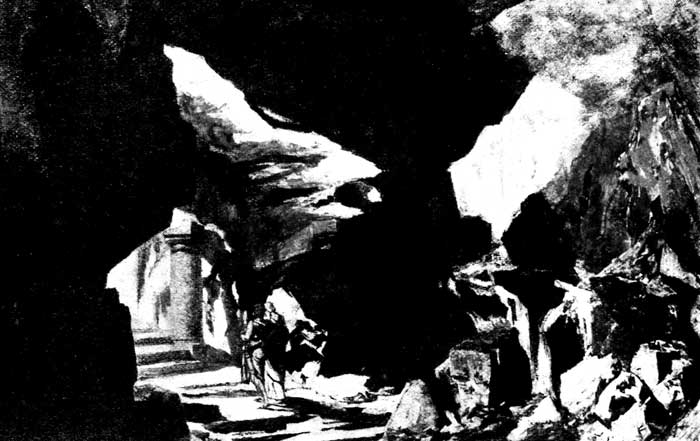
Copyright, 1903, by Pach Bros., N. Y.
PARSIFAL AND GURNEMANZ PASSING THROUGH THE RAVINE
I hear the falling of distant water in
marble fonts; the large bells of Montsalvat
peal louder and louder, and to music
of unimaginable stateliness the knights,
clad in the blue and red robes of the Grail,
enter in solemn procession, and take their
seats at two semicircular tables which
start like arms to the right and left of
the holy shrine. Beneath it lies Titurel
entranced, and upon it is presently deposited
the sacred treasure of the Grail
itself.
As the wounded King Amfortas is
borne in, the assembled knights, each
standing in his place, a golden cup before
him, intone the Grail motive, which is
taken up by the entering choruses of
servitors and esquires bearing the holy
relics.
Gurnemanz is seated among knights;
Parsifal stands aside and looks on in mute
astonishment, "a guileless one."
As the Holy Grail is set down on the
altar before the wounded king, a burst of
heavenly music streams from the high
dome—voices of angels intone the celestial
phrases, "Take, eat" and "This is
my blood!" and blend them with the
"faith and love" motives. As the choruses
die away, the voice of the entranced
Titurel is heard from beneath the altar
calling upon Amfortas, his son, to uncover
the Grail, that he may find refreshment
and life in the blessed vision.
Then follows a terrible struggle in the
breast of Amfortas. He, sore stricken in
sin, yet Guardian of the Grail, guilty
among the guiltless, oppressed with pain,
bowed down with shame, craving for
restoration, overwhelmed with unworthiness,
yet chosen to stand and minister
before the Lord on behalf of His saints!
Pathetic situation, which must in all times
repeat itself in the history of the Church.
The unworthiness of the minister affects
not the validity of his consecrated acts.
Yet what agony of mind must many a
priest have suffered, himself oppressed
with sin and doubt, while dispensing the
means of grace, and acting as a minister
and steward of the mysteries!
The marvelous piece of self-analysis in
which the conscience-stricken king bewails
his lot as little admits of description
here as the music which embodies his
emotion.
At the close of it angel voices seem
floating in midair, sighing the mystic
words:
"Durch Mitleid wissend
Der reine Thor,
Harre sein
Den ich erkor."
[Wait for my chosen one,
Guileless and innocent,
Pity-enlightened.]
And immediately afterward the voice of
Titurel, like one turning restlessly in his
sleep, comes up from his living tomb beneath
the altar: "Uncover the Grail!"
With trembling hands the sick king
raises himself, and with a great effort
staggers toward the shrine—the covering
is removed—he takes the crystal cup—he
raises it on high—the blood is dark—the
light begins to fade in the hall—a mist
and dimness come over the scene—we
seem to be assisting at a shadowy ceremony
in a dream—the big bells are tolling—the
heavenly choirs from above the
dome, which is now bathed in twilight,
are heard: "Drink ye all of this!"
Amfortas raises on high the crystal vase—the
knights fall on their knees in prayer.
Suddenly a faint tremor of light quivers
in the crystal cup—then the blood grows
ruby red for a moment. Amfortas waves
it to and fro—the knights gaze in ecstatic
adoration. Titurel's voice gathers
strength in his tomb:
"Celestial rapture:
How streams the light upon the face of God!"
The light fades slowly out of the crystal
cup—the miracle is accomplished. The
blood again grows dark—the light of
common day returns to the halls of Montsalvat,
and the knights resume their seats,
to find each one his golden goblet filled
with wine.
During the sacred repast which follows,
the brotherhood join hands and embrace,
singing:
"Blessed are they that believe;
Blessed are they that love!"
and the refrain is heard again far up in
the heights, reechoed by the angelic
hosts.
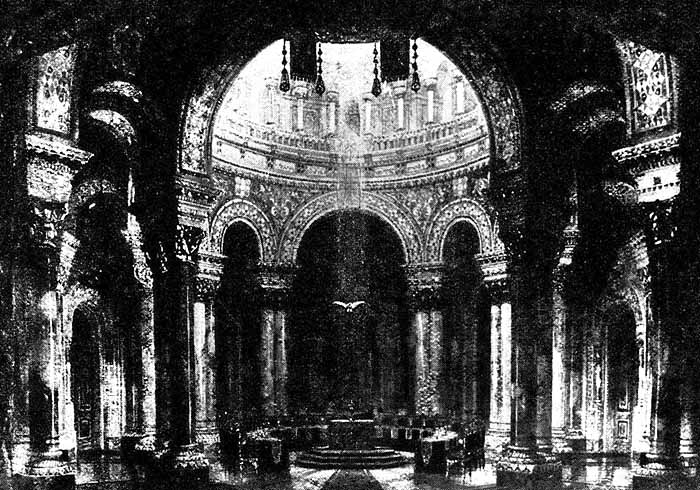
Copyright, 1903, by Pach Bros., N. Y.
THE GREAT HALL OF THE HOLY GRAIL
I looked round upon the silent audience
while these astonishing scenes were passing
before me; the whole assembly was
motionless—all seemed to be awed by
the august spectacle—seemed almost to
share in the devout contemplation and
trancelike worship of the holy knights.
Every thought of the stage had vanished—nothing
was further from my own
thoughts than play-acting. I was sitting
as I should sit at an oratorio, in devout
and rapt contemplation. Before my eyes
had passed a symbolic vision of prayer
and ecstasy, flooding the soul with overpowering
thoughts of the divine sacrifice
and the mystery of unfathomable love.
The hall of Montsalvat empties. Gurnemanz
strides excitedly up to Parsifal,
who stands stupefied with what he has
seen—
"Why standest thou silent?
Knowest thou what thine eyes have seen?"
The "guileless one" shakes his head.
"Nothing but a fool!" exclaims Gurnemanz,
angrily; and, seizing Parsifal by
the shoulder, he pushes him roughly out
of the hall, with:
"Be off! look after thy geese,
And henceforth leave our swans in peace."
The Grail vision had, then, taught the
"guileless one" nothing. He could not
see his mission—he was as yet unawakened
to the deeper life of the spirit; tho
blameless and unsullied, he was still the
"natural man." Profound truth! that
was not first which was spiritual, but that
which was natural; before Parsifal wins
a spiritual triumph, he must be spiritually
tried; his inner life must be deepened and
developed, else he can never read aright
the messege of the Grail.
The life of God in the spirit comes
only when the battle for God in the heart
has been fought and won.
Fare forth, thou guileless one! thou
shalt yet add to the simplicity of the
dove the wisdom of the serpent. Thou
art innocent because ignorant; but thou
shalt be weighed anon in the balance
and not be found wanting; and then
shalt thou reconquer the holy spear lost
in Sin, rewon in Purity and Sacrifice, and
be to the frail Amfortas the chosen savior
for whom he waits.
The foregoing events occupied about an
hour and a quarter. When the curtain
fell the vast audience broke up in silence.
The air outside was cool and balmy.
In the distance lay the city of Bayreuth,
with the tower of the Alte Schloss and
the old church standing up gray against
the distant Bavarian hills. All around
us lay the pine woods, broken by the
lawns and avenues that encircle the theater
and embower it in a secluded world
of its own—even as the Palace of the
Grail was shut off from the profane
world. Here, indeed, is truly the Montsalvat
of the modern drama—a spot purified
and sacred to the highest aims and
noblest manifestations of Art.
In about an hour the Spear motive was
the signal blown on the wind instruments
outside, and I took my seat for the second
act.