"IT was alcohol! He was right, that old buck. It was alcohol!"
We were sitting in the restaurant of the Hotel Terminus in Marseilles.
Our month-old baby was lying on the cushioned seat between us. The
maître d'hôtel told us she was the youngest lady that had ever come to
his establishment. Bowls of coffee were before us on the table, and we
were enjoying our French breakfast when Herbert burst out with the
remark I have just recorded.
"What is the matter with you?" I asked.
Shaking with laughter, he told me the story.
"You know the basket with breakables in it? And those two champagne
bottles Major Doughty-Wylie gave us?"
"One of them had boracic acid in it. Well?"
"Yes, yes, that is just it. The customshouse officer spied the bottles
and it did not take him long to uncork one and smell it. He wanted to
stick me for duty."
"What did you do?"
"Protested against paying duty on boracic acid solution. I pointed you
out to him sitting over there with the baby. He yielded
finally—observing that Americans are queer, tough customers, and that
their babies must be husky if their eyes can stand such stuff. But he
got the wrong bottle. Don't you remember that in the second one is pure
grape alcohol, and that is what he sniffed."
Traveling with a baby, when tickets do not allow one to take the
rapide sleeping-cars, has its good points. People do not care to spend
the night in a compartment with a baby. We got to the train early—very
early. We put Christine's wicker basket (her bed) by the door, and found
it to be the best kind of a "reserved" sign. Half a hundred travelers
poked their heads in—and passed on. The sight of Christine acted like
magic to our advantage. The baby started to cry. "Don't feed her yet,"
ordered her dad. "Until this train starts, the louder she cries the
better for her later comfort." As the wheels began to move, a man came
in, put his bag on the rack and sat down. Laughing, he closed the door
and pulled down the curtain.
"I have been watching you," said he. "Yours is a clever game. I have
three little cabbages myself, and I know babies don't disturb people as
much as those who have none think. No," he added, "I must correct
myself, thinking of my mother and my mother-in-law. Even those who have
had many babies forget in the course of time how they were once used to
them. We'll have a comfortable night. Have a cigar, monsieur!"
We did have a splendid sleep. Christine has always been one of those
wonder babies. So we were ready to see Paris cheerfully. Heaven knows we
needed every possible help to being cheerful! For we were embarked upon
a venture that looked more serious than it had the year before. A pair
of youngsters can knock around happily without worrying about
uncertainties. A baby means a home—and certain unavoidable expenses.
Where your progeny is concerned, you can't just do without. We had two
hundred and fifty francs in cash, and the prospect of a six hundred
dollar fellowship, payable in quarterly installments. That was all we
could count upon. Our only other asset was some correspondence sent to
the New York Herald that had not been ordered, but for which we hoped
to be paid.
The Marseilles express used to arrive at Paris at an outlandish hour. It
was not yet six when we were ready to leave the Gare de Lyon. Two
porters, laden down with hand-luggage, asked where we wanted to go. We
did not know. The Paris hotels that had been our habitats in days past
were no longer possible, even temporarily. There was no mother to foot
my bills, and Herbert wasn't a bachelor with only his own room and food
to pay for. I suggested the possibility of a small hotel by the station.
The porters took us out on the Boulevard Diderot. Across the street was
a hotel (whose gilt letters, however, did not omit the invariable
adjective "grand") that looked within our means.
Once settled and breakfasted, the family council tackled the first
problem—Scrappie, gurgling on the big bed. Ever since she was born we
had been traveling, and she naturally had to be with us all the time.
Only now, after five weeks of parenthood, did the novel and amazing fact
dawn upon us that no longer could we "just go out." Scrappie was to be
considered. Without Scrappie, we could have set forth immediately upon
our search for a place to live. With Scrappie—?
There always is a deus ex machina. In our case it was a dea. Marie
still lived in Paris. The contact had never been lost, and when we went
through Paris on our honeymoon the year before, I had taken my husband
to show him off to Marie. It was decided that I should go out
immediately and find her. A month before we had written that we were
coming to Paris in June, and she would be expecting us. Marie, and Marie
alone, meant freedom of movement. I could not think of trusting my baby
to anyone else.
The address was at the tip of my tongue—22 Rue de Wattignies. A few
people know vaguely of the battle, but how many life-long Parisians know
the street? Not the boulevardiers or the faubouriens of
Saint-Germain, or the Americans, North and South, of the Etoile Quarter.
And yet the Rue de Wattignies is an artery of importance, copiously
inhabited. We had gone in a cab last year, and remembered that it was
somewhere beyond the Bastille. At the corner of the street beyond our
hotel, just opposite the great clock tower of the Gare de Lyon, I saw
the Bastille column not far away. Why waste money on cabs? To the right
of the Bastille lay the Rue de Wattignies, and not very far to the
right. I remembered perfectly, and started out unhesitatingly.
Oh, the Paris vistas! No other city in the world has every hill top,
every great open space, marked by a building or monument that beckons to
you at the end of boulevard or avenue. No other city in the world has
familiar dome or tower or steeple popping up over housetops in the
distance to reassure you wherever you may have wandered, that you are
not far from, and that you can always find your way to, a familiar spot.
The Eiffel Tower, the Great Wheel, the Arc de Triomphe, Sacré Coeur, the
Panthéon, Val-de-Grâce, the Invalides, the Tour St. Jacques, give you
your direction. But when you dip into Paris streets, on your way to the
goal, you are lost. Even constant reference to a map and long experience
do not save you from the deceptive encouragement of Paris vistas. You
can walk in circles almost interminably.
I had done this so often in the old days when I escaped from my
governess. I did so again when I tried to find the Rue de Wattignies.
Perhaps I did not try very hard: for one never minds wandering in
Paris. The life of the streets is a witchery that makes one forgot time
and distance and goal. When I lost sight of the Bastille column, the
labyrinth of St. Antoine streets led me on until I had crossed the canal
and found myself by the Hôpital St. Louis. After the year in the East,
and years before that in America, old houses and street markets held me
in a new world. It was a glorious June day to boot, and after steamer
and train, walking was a keen pleasure. Marital and parental
responsibilities were forgotten. The Hôpital St. Louis brought me back
to the realities of life. I knew that it was north of the Bastille, and
not in the direction of the Rue de Wattignies. Suddenly there came
uneasily into my mind the picture of a husband, a prisoner, patiently
waiting in a very small room in a very small hotel, and a baby demanding
lunch. Conscience insisted upon a cab: for nearly two hours had passed
since I started forth to find Marie. I had left the hotel early enough
to catch her before she might have gone out. What if Marie should not be
at home? "Hurry, cocher!"
My panic was unjustified. Marie was at home. Delighted to hear of our
arrival, and eager to see her petite Hélène's baby, she put on her funny
little black hat, and went right down to the waiting cab.
When we got to the hotel, Herbert was eating a second mid-morning petit
déjeuner. He had a copy of the Paris edition of the New York Herald,
and showed me, well played up in a prominent place, the last of the
Adana massacre stories he had forwarded by mail from Turkey. This was
the first time he realized that his "stuff" had been exclusive. There
was a pleasant prospect of drawing a little money. So my long absence
brought forth no remark, specially as Scrappie had slept like an angel.
"We played a wise game," said Herbert, "when we sent the stories
smuggled through Cyprus to the Herald. We shall not have to correspond
with New York on a slim chance of a newspaper's gratitude. We can get at
James Gordon Bennet right here in Paris." Then he showed me some
advertisements picked out in the column of pensions as promising and
within our means. We had decided to consider nothing outside of the
Latin Quarter.
Marie had not changed a bit. She could not say the same for me although
she fussed over me as if I were five going on six. She forgot that
twenty years had gone since the last time she combed my hair. She
communicated to me the old sense of security. She bathed the baby. She
brought me food and sat beside me, observing that long ago she had to
coax me to take one more mouthful to please her.
"You always were fussy about your food. Ma chère petite Hélène, you
don't eat enough to keep a sparrow alive. You are a naughty one."
She insisted upon my drinking a cup of camomile tea, and took me
straight back to my sixth year by calling it pipi du chat. Knowing
that name for camomile tea is one of the tests of whether one really
knows French.
"Marie," I begged, "show me how English people speak French—the way you
used to do!"
But Herbert, who had gone out to get the Daily Mail for its pension
list, was coming in the door, and Marie would not show off before
Monsieur. Never did she call me chère petite Hélène when he or any
other person was present. It was always Madame before company. The
Mail had many advertisements of pensions in streets near the
Luxembourg. Marie helped us pick them out. The Luxembourg Garden was an
integral part of the Latin Quarter, and we had to think of Scrappie's
outing.
After lunch we turned Christine over thankfully to Marie and went out
pension-hunting together.
"You were lucky in finding Marie," was all Herbert said.
"Yes," I answered, "I really couldn't have left the baby with anyone
else."
"But is Marie the only person in the world? Without her, would you be a
slave for ever and ever? There must be plenty of people that we could
get to look after Scrappie."
"You don't know what it means to have a child!" said Scrappie's mother.
"I guess I look pretty healthy for a fellow who has just landed in Paris
with a wife and a baby and 250 francs!" said my husband.
"Can't make us mad," said I; "we're in Paris."
You pile up on one side of the scale heaps of things that ought to worry
you, but if you put on the other side the fact that you are in Paris,
down goes the Paris side with a sure and cheerful bang, up goes the
other side, and the worries tumble off every which way into nowhere.
The main threads of the world's spider web start very far from Paris in
all directions and the heaviest urge of traffic is towards the centre.
Paris was the centre of the spider web long before Peace Delegates came
here to discover the fact. Students, diplomats, travel-agencies,
theatrical troupes knew it and whole shelves of books have been written,
down the years, to prove it. If Paris is your birth-place, you learn
that you are in the capital of the world long before you know how to
read the books. If you are an expert on ancient coins, if you are a
wood-carver, if you are a singer wanting a voice that will make your
fortune because it was trained in France, if you are a baker, if you are
a burglar, if you are a silk merchant, if you are a professor from
Aberdeen hunting for manuscripts that will prove your thesis concerning
Pelagius, if you are an apache, if you are an English
nursemaid,—you'll never be lonely in Paris. No matter how isolated or
queer or misunderstood you were where you came from, in Paris you'll
find inspiration, competition, companionship, opportunity and pals. The
papers tell us every week that the birth rate is going down. But the
population of Paris is increasing. So in peace, in war and in peace
again, there was one constant quantity underpinning existence—Paris,
the centre of the spider web. The spider that lures is liberty to work
out one's ideas in one's own way in a friendly country. It is a wonder
the men who make maps in France can draw lines latitudinally and
longitudinally. What difference did it make then if we had only two
hundred and fifty francs?
WE started our search for a temporary home at the Observatoire, and good
fortune took our footsteps down the Rue d'Assas rather than down the
Boulevard Saint-Michel. Had we turned to the right instead of to the
left, we should probably have found a pension that satisfied our
requirements on the Rue Gay-Lussac, the Rue Claude Bernard, the Rue
Soufflot, or behind the Panthéon. But a short distance down the Rue
d'Assas, we turned into the Rue Madame, which held two possibilities on
our list. The first place advertised proved to be a private apartment,
whose mistress was looking for boarders for one room who would not only
pay her rent but her food and her old father's as well. We got out
quickly, and kept our hopes up for the second place. It was a small
private hotel just below the Rue de Vaugirard, with a modest sign:
Pension de Famille.
A beaming young woman, who told us that she was Mademoiselle Guyénot,
propriétaire et directrice de la maison, answered our first question
in a way that won our hearts forever. "Do I mind a baby!" she exclaimed.
"I love them. No trouble in the world. Wish the bon dieu would allow
me to have one myself. If any boarder complains about babies crying in
my house, I ask them how they expect the world to keep on going.
Parfait! Bring the little rabbit right along. Of course there is no
charge. Is it I who will feed her? Think of it, then!" And Mademoiselle
Guyénot opened wide her arms and lifted them Heavenward. Her eyes shone,
and she laughed.
We engaged a room on the court, two flights up, for seventy francs a
week tout compris, lodging, food, boots, wine. Lights would not amount
to more than a franc a week. We could give what we wanted for
attendance. The arrangement with Marie was perfect. She would stay at
home and come for the days we wanted her. That meant only her noonday
meal on our pension bill—one franc-fifty.
We got out of the Boulevard Diderot hotel none too soon. The charges
were fully as much as at a first-class hotel (I have frequently since
found this to be the case in trying to economize in travel) and made a
serious dent in our nest-egg. When we reached the pension with our
baby and baggage, we felt that it was only the square thing to acquaint
the new friend who loved babies with our financial situation.
"Oh! la, la," cried Mademoiselle Guyénot, "you may pay me when you
like!"
"You must understand," said my husband, "that we have just come out of
Turkey and have very little money. Of course, as soon as we get
settled, things will be all right again."
Mademoiselle received us in the bureau of her pension with open arms
and lightning French. I could not get it all, but we knew she was glad
to see us. She turned around on her chair and faced us as we sat on an
old stuffed sofa surrounded by our suitcases.
"You must not worry," she exclaimed, "you must not worry du tout, du
tout, du tout, du tout.... If you don't pay me I'll keep the baby,
pauvre chou."
Mademoiselle's voice went up the scale and down again, dying away only
when she opened her mouth wider to laugh.
Mademoiselle ran the pension single-handed in those days. Now she is
Madame and the mother of two little girls. Monsieur is a mechanical
genius and has himself installed many conveniences. He can paper a room,
rig up a table lamp at the head of a bed, carry in the coal, forage for
provisions with a hand-cart and a cheerful jusqu'au boutisme that
stops at nothing. He is also able to make a quick change in clothes and
bobs up serenely within fifteen minutes after unloading the potatoes,
quite ready to make you a cocktail.
Mademoiselle handled her clients with cheerful firmness. She used to
marshal the forces of her house with a strong and capable hand. You
could not put one over on her then any more than you can now, as some
transients discovered to their confusion. The regulars knew better than
to try. On the other hand if your case was good and your complaint
justified, she defended you with energy. Liberté, égalité,
fraternité were realities in the Rue Madame.
The clientele was French for the most part: elderly people who had got
tired of keeping house. Folks from the provinces who had come to town to
spend the winter after Monsieur retired from business. Young people,
mostly men, some of them long haired who were studying at the Sorbonne
or elsewhere. And a sprinkling of transients whose chief effect upon the
regulars was allowing them to shift about until they had possession of
the rooms they wanted to keep at a monthly rate. When we went to the
pension we were the only Americans. We paid five francs a day for room
and board like everybody else excepting the old lady who had come to the
house years ago when the rate was four francs fifty. German Hausfraus
may be marvels in management, but I defy any lady Boche to beat
Mademoiselle's efficiency. She got all the work of kitchen and
dining-room done, and well done too, by Victorine the tireless, Louis
the juggler and François the obsequious. Guillaume and Yvonne, a working
menage, looked after the rooms until they got a swell job at the Ritz
Hotel, where tips would count. The other three were fixtures.
In spirit the Rue Madame pension has not changed. The atmosphere
to-day is as it was in nineteen hundred and nine. The table is good,
plentiful, appetizing—and, oh, what a variety of meats and vegetables!
The potatoes are never served in the same way twice in a week, and
Madame Primel, as Mademoiselle is now called, cooks as many different
plats de jour as her number in the street, which is forty-four. There
the reader has my secret! But five francs a day no longer holds. In
nineteen hundred and nineteen five francs will barely pay for a single
meal. Not only has the price of food more than doubled, but the traveler
is beginning to demand comforts that cost. We used to have buckets of
coal brought up, and make a cheerful fire. We used to grope in the dark
when we came home, strike a match, and look for our candle on the hall
table. We used to have a lamp—the best light in the world—in our room.
But now the pension in the Rue Madame has yielded to the demands of a
discontented world. Steam heat, electric lights—these have had their
part in making five francs a day disappear forever. The five franc
pension exists only in the memory of Paris lovers, or in story books
like mine.
At our table were Mrs. Reilly, a sprightly Irish woman called by the
pensionnaires Madame Reely; Monsieur Mazeron, a law student with an
ascetic blond face and hair like a duckling; an elderly couple from
Normandy who had adopted Madame Reely, swallowed her at one gulp of
perfection, only to discover afterwards that they did not understand
her; a Polish doctor and his wife from Warsaw; and others. Madame Reely
made a pretty speech the first night at dinner, proposing that our table
volunteer to help us take care of the baby.
"To-morrow is the Fête Dieu," said she. "I'll go to the early mass so
that I can come back and stay with the baby while you two go to the
later mass. You will see the priests in their robes of ceremony, the
Holy Relics, and a thousand children in the procession. It is too
lovely,—all those little things with their baskets of flowers, throwing
petals in the path of the priests. Who can tell," she went on in a
whispered aside to her neighbor, "it may impress them. One never knows
when new converts are to be added to the blessed Church!"
"And I shall look at the baby," said the Doctor from Warsaw. "Children
are my specialty. That is why I am here, observing in the clinics of
Paris, you see. I shall come to your room to-morrow after breakfast.
Being an American mother, I suppose you give your baby orange juice?"
"Certainly I give her orange juice," said I; "it is good for her."
"Au contraire! au contraire!" cried the Doctor, waving his hands. The
Doctor was always "au contraire" no matter what was said and who said
it. Polish character.
In a corner was a tiny table for one. It was for the starboarder, a
young Roumanian, who wore a purple tie held together by a large amethyst
ring. Possibly he wore it because he believed in the ancient legend
about amethysts being good to prevent intoxication. When we entered upon
the scene he was still in high favor. His downfall came later and had to
do with a wide-awake concierge and a luckless kiss at the front door.
The food we had was the kind we used to have in Paris when many visitors
came here with no better excuse than to enjoy the cuisine.
Mademoiselle gave us two meat dishes for each meal. If you did not like
calves' liver, Louis would do a trick that landed a steaming plate of
crisp fried eggs (fried in butter, you remember) before you. And that
without being told. Behind the scenes was Victorine.
Victorine invited me into her kitchen to learn how to make sauce
piquante.
"Are you married, Victorine?" I queried.
"My cookstove is my husband," she laughed; "his heart is good and warm
and he never leaves me."
During meals Mademoiselle was to be found in the kitchen. She did the
carving herself and tasted everything before it was passed through a
window to Louis.
There was no felt covering under the table-cloth. The serving of the
meal competed with piping, high-pitched, excited voices. Perhaps I
oughtn't to say excited, but the Frenchman in his most ordinary matter
of fact conversation sounds excited to the Anglo-Saxon. He asks you to
pass the bread in the same tone you would use in announcing an event of
moment. At each place was a glass knife-and-fork rest. In France, unless
the first dish happens to be fish, you keep the same knife and fork.
This is the custom in the best of homes. We are prodigal of cutlery
where the French are prodigal of plates. The same knife and fork didn't
matter, because the food was so good. Nor does it matter to-day, because
now there is only one meat dish. Times have changed.
If fruit or pudding ran out, Mademoiselle opened a section of the wall,
finding the key on a bunch that was suspended from her belt on a piece
of faded black tape. From the cupboard she took tiny glasses filled with
confiture or perhaps a paste made of mashed chestnuts and flour slightly
sweetened. The glasses, to the touch, were cylindrical, but when you had
broken the paper pasted across the top and had eaten half way down, the
space was no wider than the fat part of your tea spoon. If your glass
was a cylinder outside, on the inside it was an inverted cone.
The quantities of bread consumed in that house would be appalling to
anybody but a Frenchman. A Turk can live on bread and olives. But a
Frenchman can live on bread alone. If he had to choose between bread and
wine he would forget the wine. When the basket was passed around, the
pensionnaires, with a delightful absence of self-consciousness, would
cast their eye over it in order to select the biggest piece. There was
always one person who would look around the room furtively, take the
biggest piece on the plate, slip the second biggest piece into the lap
under the serviette, and then, gazing far away in ostrich fashion, glide
the bread into pocket or reticule. If the dessert happened to be fruit,
an orange or an apple would follow the bread for private consumption
later in the day. Perhaps these people came in for luncheon only and the
bread and fruit was devoured at twilight at some little café where it is
permitted to customers to bring their own supplies, if they buy a drink.
This stretching of luncheon procured the evening meal. If necessity is
the mother of invention, the students of Paris are necessity's
grandmother.
Louis, the arch-juggler, was forced by public opinion to alternate day
by day his point of departure when passing the steaming plat du jour.
Egalité, you remember, is one-third of French philosophy. It would
never do for the same end of the dining-room to enjoy for two days
running the little privilege of having the first pick at the best piece
of meat in the plate.
François helped in the dining-room. But he was everywhere else too. He
was useful for Louis to swear at and to blame. He was bell-hop,
scullery-boy, errand-man, who needed all of his amazing reserves of
cheerfulness. I wondered when François slept. He was on hand with his
grin and his oui, madame, early and late. Once when we slid out of the
house at five in the morning to go on an excursion, we found him in the
lower hall surrounded by the boots of the house. Back of his ear was a
piece of chalk used for marking the number of the room on the soles of
the boots. He was polishing away, moving his arm back and forth with a
diminutive imitation of the swing his legs had to accomplish when his
brush-clad feet were polishing the waxed floors. As a concession to the
early hour, he was whistling softly instead of singing. The whistling of
François fascinated everyone because it came through a tongue folded
funnel-wise and placed in the aperture where a front tooth was missing.
And we would often find him up and about when we came home late at
night. It was a pleasant surprise, when, after calling out your name,
you made ready to walk back to the candlestick table, hands stretched
out before you, to have François suddenly appear with a light. He would
hold out over the table his little hand lamp with the flourish a Gascon
alone can make. You picked out your candlestick by the number of your
room cut in its shining surface. The number had an old-fashioned swing
to its curve, suggesting that the solid bit of brass might have been dug
up from the garden of some moss-grown hostelry after a passage of the
Huns.
Mademoiselle Guyénot insisted that the flagged pavement be washed every
day. François used to fill with water a tin can in the bottom of which
he had punched half a dozen holes. He swung it about the court until
figure eight shaped sprinkle-tracks lay all over the twelve-by-twenty
garden. Afterwards he would take a short-handled broom, bend himself
over like a hairpin, and sweep up the flag-stones. The dirt he
accumulated was made into a neat newspaper package and set aside to wait
until early to-morrow morning when it was put out on the street in the
garbage-pail. François' thin high voice sang incessantly and sounded for
all the world like the piping of a Kurdish shepherd above the timber
line in the Taurus Mountains. In those days woe betide you if you put
trash or garbage on a Paris street later than 8 A. M. It was as unseemly
an act as shaking carpets out of your window after the regulation hour.
Now, even if you are a late and leisurely bank clerk or fashionable
milliner and you don't have to show up at work before 10 o'clock, you
will see garbage-pails along curb-stones and likely as not get a dust
shower furious enough to make you wish you hadn't left your umbrella at
home. The old days—will they come back?
When the band plays soft Eliza-crossing-the-ice music, my mind flies to
several Home-Sweet-Homes. I think of Tarsus, Constantinople, Oxford and
Princeton. But there is no twinge of homesickness. Paris and my present
home there satisfy every want and longing. Among the homes of the past,
however, I think of others in Paris as well as of those of other places.
I never forget the pension in the Rue Madame. Thankfully it is still a
reality. During the past decade it has housed our mothers and sisters
and cousins and friends. We have gone there to see them. And we go there
to see our first warm friend in Paris and her husband and children. From
time to time we have a meal in the old dining-room. We hope the
pension will not disappear or will not be converted into too grand a
hotel. For us it is a Paris landmark.
WE spent the first anniversary of our wedding in Egypt. A week later we
arrived in Paris. For prospective residents as well as for tourists,
June is the best time of the year to reach Paris. You have good weather
and long days, both essentials of successful home-hunting. It is an
invariable rule in Paris to divide the year in quarters, beginning with
the fifteenth of January, April, July and October. Whether you are
looking for a modest logement on a three months' lease or a grand
appartement-confort moderne—on a three years' lease, the dates of
entry are the same. One rarely breaks in between terms. If you have
passed one period, you must wait for the next trimestre. The person
who is leaving the apartment you rent might be perfectly willing to
accommodate you, but he has to wait to get into his new place. So when
we went to the pension, we had before us the best home-hunting weeks
of the year, with the expectation of being able to get settled somewhere
on July 15th.
At the pension, our room faced on the court, and the personnel, from
Mademoiselle Guyénot down to Victorine and François, assured us that we
need not feel bound to stay at home on the days Marie could not come to
us. Marie for years had been sewing four different days of the week for
old patrons, and we did not feel certain enough of our own plans and
purse to accept the responsibility of her giving up a sure thing.
"Go out all you want to," urged our friends. "You only have to think
about meal times for the baby. Someone is always in the court sewing or
sorting the laundry or preparing vegetables. Your window is open. We
cannot fail to hear the baby."
But a chorus of bien sûr and parfaitement and soyez tranquille did
not reassure what was as new born as Christine herself—the maternal
instinct. A letter from Herbert's father solved the problem. He inclosed
the money for a baby carriage. We carried Scrappie down the Boulevard
Raspail to the little square in front of the Bon Marché. I kept her on a
bench while Herbert went in to follow my directions as well as he could.
In a few minutes he came out and said he would rather take care of the
baby. It was the first time I had seen him stumped. So I had the joy I
had hoped would be mine all along but of which I did not want to deprive
my husband, seeing that we could not share it. The reader may ask why we
didn't take the baby inside. But it will not be a young mother who puts
that question! With one's firstborn, one sees contagion stalking in
every place where crowds gather indoors.[B]
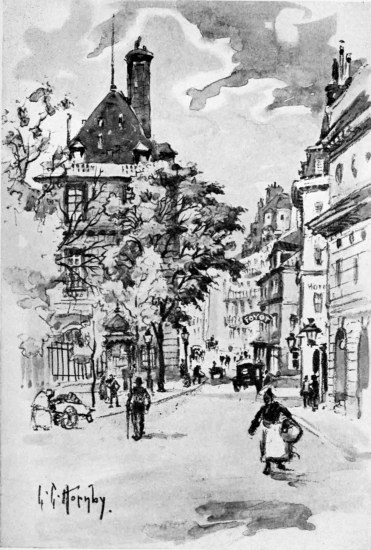
The Rue de Vaugirard by the Luxembourg
We did not intend to consider a home that was not within baby-carriage
distance of the Rue Madame. In fact, after a few days in the Luxembourg
Quarter, we were determined to live as near the Garden as possible.
There we were within walking distance of the Bibliothèque Nationale and
the Sorbonne and the Ecole Libre des Sciences Politiques. Marie, whom
the fact that I was my Mother's daughter did not blind to the extent of
the Gibbons family resources, urged the Bois de Vincennes. But we would
not hear of it.
It is strange how rich and poor rub elbows with each other in their
homes. Paris is no different from American cities in this respect. The
kind of an apartment we wanted would cost more than our total income,
as rents around the Luxembourg for places equipped with electric lights
and bathtubs and central heating seemed to be as expensive as around the
Etoile. Then in the same street—sometimes next door—you had the other
extreme. Our finances pointed to a logement in a workingmen's
tenement. Care for Scrappie's health made our hearts sink every time we
were shown a place that seemed within our means.
Of course there were reasonable places: for many others who demanded
cleanliness had no more money than we. But the Latin and Montparnasse
Quarters are the Mecca of slim-pursed foreigners. People foolish enough
to study or sing or paint are almost invariably poor. Perhaps that is
the reason! We had lots of exercise, and came to know every street
between the Luxembourg and the Seine. Our good fortune arrived
unexpectedly as good fortune always arrives to those who will not be
side-tracked.
Between the Rue Vaugirard and Saint-Sulpice are three tiny streets, the
houses on the opposite sides of which almost rub cornices. The Rue Férou
is opposite the Musée de Luxembourg. On the Rue de Vaugirard is the home
of Massenet. We used to get a glimpse of him occasionally on his
terrasse—a sort of roof-garden with a vine-covered lattice on top of
the low Rue Férou wing of his house. The other two streets paralleling
the Rue Férou from the Palais du Luxembourg to the Eglise Saint-Sulpice
are the Rue Servandoni and the Rue Garancière.
On the morning of the Fourth of July we had been diving in and out the
side streets of the Rue Bonaparte and the Boulevard Saint-Germain. At
Scrappie's meal time, we came to a bench in the Square in front of
Saint-Sulpice. It wasn't a bit like a holiday. It was sultry and looked
like rain. We were wondering whether we had better not hurry back to the
pension for fear of getting the baby wet. Just then people began to
stop and look up. A huge balloon was above us. And it carried the
American flag.
"You can't beat it," said my husband. "And we are Americans. Ergo, you
can't beat us!"
Did the sight of the flag do the trick? Anyway, it was our Japanese
"last quarter of an hour." We had come down through the Rue Férou. We
went back for the twentieth time in twenty days through the Rue
Servandoni. Grey houses, topped with beehive chimneys, leaned amicably
against each other and broke the sky line as well as the municipal
réglement (made long after they were) concerning the distance between
houses on opposite sides of streets. Our hearts nearly stopped beating
when we reached Number 21. There was the magic sign (it had not been
there yesterday): Appartement à Louer. We stopped short in the middle
of the street. The side-walks are not wide enough to walk on, much less
wheel a baby-carriage along. The grocer on the ground floor saw us take
the bait. Out he came. Did Monsieur and Madame care to see the
appartement? If so, he was concierge as well as grocer. He would show
us the place. We drew the new baby-carriage into the dark vestibule and
went up one easy flight of oak balustraded stairs. The grocer pulled a
red-braided bell rope.
A man in shirt-sleeves opened the door. We stepped into a tiny
dining-room where the gas was lit although it was noon. The wall-paper
was yellow, and had sprawling brown figures like beetles. A dark passage
led into an immense room with a generous fireplace. Two windows opened
on the Rue Servandoni. It was a paper-hanger's shop with ladders,
brushes, buckets, rolls and rolls of paper and barrels of flour-paste
around. But the fellow in shirt-sleeves assured us that when his
fittings were out, we would realize what a handsome room it was. "The
dining-room is dark," he admitted, "but you can't match this room for
light and size in any two-room apartment in the Quarter. I know them
all. I am leaving because I have found a ground floor shop. I'll put new
paper on here very cheap."
The locataire assumed that we would take it. So did the
grocer-concierge. Without our asking, Monsieur Sempé told us that the
rent would be one hundred and fifty francs a quarter. We did not have to
make a troublesome lease, just a little agreement involving three
months' notification on either side.
"Don't forget," said Sempé, "that this old house sits between two modern
apartment buildings. The walls are warm. Your neighbors have steam
heat."
"True," confirmed the paper-hanger. But he did not want us to think that
we could be altogether vicariously heated. "Possibly you may not have
noticed," he added, "the fireplace in the dining-room. It heats almost
as well as this one. I'll sell you my grates. Boulets make the best
fire."
The thrill of admiration I had for my husband's magnificent courage when
he signed the paper, and paid out fifty of his last hundred francs "on
account" is with me still.
"We are sure to be able to pay our rent," said he, as we went back to
the pension. "We couldn't expect to get anything for less than ten
dollars a month. The first installment of the fellowship money will come
next week, and before then I shall certainly get something out of the
Herald. It will have to be enough to buy our furniture."
It never rains but it pours. At the pension we found a letter from Mr.
James Gordon Bennett, asking Herbert to call that afternoon at three
o'clock at 104 Avenue des Champs-Elysées. It was in a blue envelope with
a little owl embossed on the flap, and was signed "J. G. BENNETT" in
blue pencil almost the color of the paper. How often we were to see this
envelope and this signature, and what luck it was going to bring us! We
thought the occasion demanded a celebration. I did Scrappie and myself
up in our best, and we set forth for the Champs-Elysées in an open
fiacre—our first ride since we came from the Boulevard Diderot to the
Rue Madame. We waited in the carriage while Herbert went in to collect
his money for the Adana massacre stories.
I watched the door of the big apartment house anxiously. Our furniture
and the rest of the rent for the apartment depended upon the success of
the visit. Half an hour later Herbert's face told me that all was well.
He had sent in a bill of four hundred dollars, and fifty dollars
expenses. Mr. Bennett, he told me, began by scolding him for not making
it in francs, and then gave him a check for twenty-five hundred francs,
which more than covered what Herbert asked for. The Commodore then
offered Herbert a position at five hundred francs a week, and was
surprised when it was declined. He seemed much amused when Herbert
explained that he had come to Paris to study. "But you will go on
special trips in an emergency," said Mr. Bennett. It is enough to say
that the "emergencies" occurred often enough to tide over many a
financial difficulty during years that followed.
Provided with funds after passing by the bank, we took Christine to
Rumpelmayer's to tea, and then drove back the Rue Servandoni to pay the
rest of our rent. When Monsieur Sempé gave us the quittance, he
admonished us that we must put enough furniture in the apartment to
cover six months' rent, that is to say, we must be prepared to spend at
least sixty dollars to set up our Lares and Penates. Bubbling over with
good will, Monsieur Sempé and Madame Sempé (who appeared on the scene
the moment it was a question of a receipt for our money) gave us
splendid advice about furniture-buying. They urged us to go to the Rue
de Rennes to some good-sized place where we would see second-hand
furniture on the side-walk, and not to a small brocanteur or dealer in
antiques.
The amount ticked up on the fiacre's taximetre was larger than we had
dreamed we should ever spend gadding about Paris. A few hours before it
would have worried us. We knew this could not keep up—in spite of the
crisp hundred franc notes. Wealth brings a strange sense of prudence. We
drove back to the pension, dismissed our cocher, and pushed the
baby-carriage around to the Rue de Rennes.
MOBILIERS COMPLETS PAR MILLIERS. "Household furniture sets by the
thousand." That sign read promisingly. We entered, and found a
salesman—excuse me, the proprietor and salesman and cashier—who took
in my clothes and hat, and then assured us that he did not mind the baby
crying and could fit us up in anything from Louis Quatorze to the First
Empire, real or (this as a feeler) imitation. Salle à manger from
eight hundred francs to four thousand; chambre à coucher from four
hundred francs to two thousand six hundred; salon from one thousand
francs to six thousand; splendid garnitures (which means clocks and
candlesticks or vases) of all epochs for our cheminées; hatracks for
the hall; kitchen and servants' furniture—all, everything, anything we
needed.
I knew what was in Herbert's reproachful look. He always did
ungraciously blame my mother for the fact that he had so frequently to
counteract my trousseau by embarrassed words. Mostly I let him stumble
along. But as this was his day and as I hadn't taken off the pretty
things worn in honor of the visit to the Champs-Elysées, which was a
break on my part, I thought it was up to me to let the furniture man see
how things stood.
"We have a little apartment," I said, "bedroom and living-room combined,
a very small dining-room and a kitchen. I expect to buy the baby's crib
and mattress aside, but the rest must come out of five hundred francs—I
mean all of it. What can you give us for that?"
I often think the French are essentially poor salesmen. They do not know
how to show their goods and they are too indifferent or too anxious. But
the blessed virtue of chivalry! The blessed sense of proportion! The
blessed instinct of moderation! Our furniture man rose to the occasion
with a grace that made me want to hug him. He kept his smile and bow and
changed with perfect ease from Louis and Napoleons to pitchpine. It
would require figuring. But it could be done. Yes, of course it could be
done. Down into the cellar he took us, and in half an hour he had
arranged to give us all we needed for Francs 532.70. I remember those
figures. And he agreed to take the whole lot back at half-price at the
end of a year!
The furniture man bore a striking resemblance to some one I knew. I
watched him, and tried to place him, as he made out our bill in the
office—seven square feet of glassed-in suffocation surrounded by
armoires and buffets. Dust clung to pages and blotters and yellowing
files; no air ever came in here to blow it away. Where had I seen the
double of our friend? Full forehead, closely-trimmed, pointed beard,
soft black tie—and the eyes. Where had I seen him before? Writing
with flourishes in purple ink, slightly bending over the high desk, he
certainly fitted into some memory picture. Then it came to me! His pen
ought to be a quill. It was William Shakespeare.
"Will-yum Shakespeare!" I cried.
My husband did not think I was crazy. For he was looking at the
furniture man when I made my involuntary exclamation.
"What does Madame say? Is she not content?" asked William Shakespeare.
Herbert's hand shot out behind his back and grasped mine. "Shades of
Stratford-on-Avon," he murmured. We had passed a honeymoon day there
just a year ago.
It was hard to wait until July 15, and then two days longer for the
necessary cleaning by a femme de ménage hired for us by the Sempés.
July 17th was the magical day of our first housekeeping. Never before
had we been together in a place where everything was ours. Tables and
chairs and beds and mattresses, and even the piano rented at ten francs
a month, arrived at Twenty-One on hand-carts drawn by men who pulled
only a little harder against the greasy harness that bound them to their
job than did the dogs under the carts.
Turkish women say that if you must move, abandon the furniture and
dishes; they can be had anywhere. But take with you the rugs and brass
that you love, and you have your home. During the previous winter in
Tarsus, we managed to buy several good rugs, a cradle-shawl, some
candlesticks and Damascus beaten-brass trays out of our eight-hundred
dollar salary. Don't ask me now how we did it. In retrospect it is a
mystery. But we had these things in two big boxes. They were as butter
is to bread with our pitch-pine. No, I'm not going to belittle that
pitch-pine. Years of usage had modified its yellowness, and it took to
our rubbing with a marvelous furniture polish. The floors could have
been better. The wood was hard, however, and we got some sort of a wax
shine on them. The Shakespeare furniture plus rugs and brasses—and
candle light—made a home than which we have never since had better.
Never mind if the dining-room was dark. Never mind if we had to sleep in
our study, and study in our bedroom. Never mind if Scrappie's nursery
was the salon, cabinet de travail and chambre à coucher combined.
Never mind if we were compelled to take our baths at the foot of our bed
in a tin basin. It was Paris, our dream city.
We were fully installed by six o'clock. The femme de ménage
volunteered to stay with Christine while we went out for supper. Before
finding a restaurant, we climbed the north tower of Saint-Sulpice.
Between us and the mass of verdure that marked the Jardin du Luxembourg
was our home. Up there near heaven, with the city at our feet, we danced
the Merry Widow Waltz, for sheer joy that we had a home of our own in
Paris.
HOW can two young people, with a baby and three hundred dollars in cash,
able to count upon a one-year fellowship yielding six hundred dollars,
live a year in Paris? The answer to that question is that it cannot be
done. But we were not in the position to answer it that way. We were in
Paris, and we had the baby. Pride and ambition are factors that refuse
to be overruled by the remorseless logic of figures. If you put a
proposition down on paper, you can prove that almost anything you want
to do is impossible. Successful undertakings are never the result of
logical thinking. Herbert and I would not have had a wedding at all if
we had thought the matter out and had considered the financial side of
life.
Herbert was keeping, however, some prejudices and some prudent reserves,
remembering his father's caution that life has a financial basis.
Sitting there on the packing-case we had picked out for a coal-box in
our study-bedroom, he hauled out an account-book and was fussing over a
missing franc. Our first year was one of constant change of scene, and
we had not "kept house." Now, declared my husband, was the time to turn
over a new leaf. If we knew where and how our money went, financing the
proposition would be easier. With tears in my eyes and biting a pencil
with trembling lips, I rebelled. I could not get interested in that
missing franc.
"I want you to realize now, once for all, that I'm not going to keep
this old cash account. I don't believe in worrying about money. I'm not
going to worry about money and neither are you. There are only three
financial questions: (1) how much money is there? (2) how long is it
going to last? (3) what are we going to do when it's all gone? Two
follows one, and three follows two—one, two, three—just like that!"
I was laughing now, and raised three fingers successively under my
boss's nose.
"As long as we are in one, we are not in two; and when we are in two, we
have not reached three. Let us wait for three until we are in three, or
at least until we know we are about to leave two."
After paying a quarter's rent, the bill for the furniture and cleaning
up sundry little expenses, we had left fifteen hundred francs of the
Gordon Bennett capital. A thousand francs was deposited with Morgan,
Harjes and Company. The other five hundred, in twenty-franc gold-pieces,
the bank gave us in a shiny little pink pasteboard box. Our chimney had
a big hole in the plaster. The wall paper was torn but intact. An ideal
hiding-place. I put the box in the hole and smoothed down the paper.
"This hole is our bank," I announced. "We shall keep no account, and you
and I will take the gold boys when we need them."
Herbert saw a great light. From that moment to this day we have been
free from a useless drudgery and have been able to conserve our energy
for our work. Herbert said, "Agreed! And when the pile gets low, I'll be
like the little boy the old man saw digging."
"What was the little boy digging for?" I chuckled.
"Ground-hogs," answered my husband. "An old man came along and told him
he would never catch a gopher like that, for they could dig quicker than
folks. 'Can't get him?' said the boy. 'Got to get him, the family's out
of meat.'"
Now that the financial credo of the home-makers in the Rue Servandoni is
set forth, I shall not have to talk any more about how we got our money
and how much there was of it. But I had to take my readers into my
confidence, for I did not want them to labor under the misapprehension
that persisted among our neighbors of the Rue Servandoni throughout our
year there. They took it for granted that les petits américains were
living at Twenty-One because that sort of fun appealed to us. We were
just queer. Of course we had plenty of money, and could have lived at
Nineteen or Twenty-Three if we had wanted to! The Parisian, the
Frenchman, the European, of whatever social class, believes that America
is El Dorado and that every American is able to draw at will from
inexhaustible transatlantic gold-mines. During the war the Red Cross,
the Y.M.C.A., and the officers and men of the A.E.F. confirmed and
strengthened this traditional belief. I do not blame my compatriots for
what is a universal attitude among us towards money. On the contrary, my
long years of residence abroad have made me feel that we get more out of
life by looking upon money as our servant than Europeans do, who look
upon it as their master.
The first thing—the practical and imperative thing—when you set up a
home in Paris is to make friends with the concierge. Without his
approval and cooperation, your money, your position, your brains will
not help you in making living conditions easy. The concierge stands
between you and servants, tradespeople, visitors. You are at his mercy.
Traveling in Russia, they used to say to us: lose your pocket-book or
your head, but hold on to your passport. In Paris, dismiss your prize
servant or fall out with your best friend, but hold on to the good-will
of the concierge.
Our first skirmish with the Sempés was an easy victory. We could not
keep the baby-carriage in our apartment, even if we had been willing to
haul it up and down a flight of stairs. Boldly we announced that we
wanted to leave it in the lower hall. "Of course," agreed Monsieur
Sempé. "I was just going to suggest that and to tell you that in my shop
I carry everything, fruits and vegetables as well as dry-groceries."
We took the hint, and seldom went farther afield to do our marketing.
Madame Sempé was the first to call us les petits américains. She was
capable and kindly, and our friendship became firmly rooted when she
discovered that we intended to patronize her shop. The Sempé commodities
were good. This was lucky in more ways than one. For the mice knew it
too, and never came upstairs to bother us.
Sempé himself was a genial soul, partly because he always kept a bottle
uncorked. Hard work and temperament, he explained, made him require a
stimulant. He took just enough, you understand, to affect his
disposition pleasantly. If you had a little complaint to make or a favor
to ask, much as you deplored his thirst, you found yourself casting an
eye over the man to make sure of his mood before you spoke. If you
caught him when the bottle was not too full or too empty, he could fix a
lock or put a new mantle on the dining-room gas-jet most graciously.
Our friendship became undying when Monsieur found out that we were the
solution of his financial pinches. He came up one night, and, hooking
his thumbs in his purple suspenders, asked for a loan of "shong
shanquante francs shusqua sheudi." Jeudi never came. To Sempé's
intense relief, we agreed to take out the debt in groceries. This was
the beginning of a sort of gentlemen's agreement. A paper, thumb-tacked
to a shelf in the shop, kept the record of our transactions. When I came
to make purchases in the morning or when Herbert dropped in of an
evening to buy a supplement to our dinner for unexpected guests or our
own good appetites, we could see at a glance whether to pay cash for
what we bought or whether we should do a sum in subtraction. It was
generally subtraction, and Sempé, wagging his head, would say, "This
goes well—soon I shall be square with you." But the satisfaction of
being square with the world was never Sempé's for long. The arrival of a
barrel of wine or a load of potatoes would send him running up the
stairs for the money to help finance his business. In spite of our
slender resources we did not feel this to be a hardship. Not
infrequently it was an advantage. First of all things one has to eat. We
always began to get our money back immediately in the necessities of
life. Instead of having our money out in an uncertain loan we took the
attitude that our board was paid for two or three weeks in advance.
In another connection, we had the benefit of the advantageous side of
the Golden Rule.
In our study of Turkish history we had constant use of Von Hammer's
Histoire de l'Empire Ottoman. This meant much transcribing by
long-hand at the Bibliothèque Nationale where the typewriter could not
be used. If only we had Von Hammer at home! But it was a rare
book—eighteen volumes and an atlas—far beyond our means. One day we
were browsing at Welter's, the most wonderful bookshop in Paris, on the
Rue Bernard-Palissy off the Rue de Rennes near Saint-Germain-des-Près.
Monsieur Welter, who took pains to become acquainted with and discover
the specialty of every passing client, told us that he had a set of
Von Hammer, recently purchased at a London auction. He sent a boy to
bring it out. Oh how tempting it looked, beautifully bound in calf! We
handled it fondly, but turned regretfully away when he said that the
price was two hundred francs.
"Do you not want it?" asked Monsieur Welter, astonished. "It is
indispensable for your work and you do not get a chance often to
purchase a set of Von Hammer. Never will you find it cheaper than this."
"I do want it, and it isn't the price. I'll come back later, hoping you
will not have sold it."
We each had a volume in our hands. I poked my nose between the pages of
mine to sniff the delightful odor to be found only in old books.
Monsieur looked at us, smiled, and said, "You mean that you haven't the
money. You will have it some day. No hurry. Give me your address and the
books will be sent around this afternoon."
The delightful relationship thus began lasted until August, 1914, when
Welter (who never became naturalized although his sons were in the
French army) had to flee to escape internment. His business was
sequestrated. German though he was, we never cease to mourn the only
expert bookman in Paris. We have tried a dozen since, some of them
charming men, but none with the slightest idea of how to sell books.
Welter had book-buyers all over the world. Whenever he came across rare
books in your line, he mailed them to you with the bill. If you did not
want them, you sent them back. Every three months, a statement of the
quarter's purchases came, and you sent a check when you had the money.
One's attention was brought to many valuable sources, and one was able
to buy books of immense value, the possibility of whose acquisition one
had never dreamed of.
Monsieur Welter told me years later, when I recalled the Von Hammer
incident, that he didn't lose five hundred francs a year in bad bills.
"The dealer in old books who does not give all the credit the buyers
need is crazy," he said. "What man interested in the things I deal in
would think of cheating me? Your husband wanted Von Hammer. I saw that.
Any man who wanted Von Hammer would pay for it in time."
We had never had a French book-seller offer us credit, much less send
books on approval when we had not ordered them.
When I think of the hundreds and hundreds of books we bought from
Welter, I realize one of the secrets of the inferiority of the French to
the Germans in business. The French cannot bring themselves to give
credit: they have an innate fear of being cheated, and understand
commercial transactions only in terms of cash. For years I have made a
point of watching French shopkeepers. Invariably they arrange that the
money is in their hands before they give you your package.
The other night I went to the Champs-Elysées theatre to see a show given
by American soldiers of the 88th Division. One act opens with Hiram
Scarum bringing a military trunk into his hotel. Staggering under the
weight, Hiram hobbles across the stage, plants his trunk on the floor,
and sits down on it to mop his brow. He spies a paper across the room,
and investigates to find it is the tag belonging to the trunk. Pulling
himself together, Hiram spits on his hands, wearily shoulders the burden
again, and carries it across the room where he ties the tag to the
handle of the trunk. Then he picks up the trunk and carries it back
where he had first put it down. Hiram is like French commerce. The
Frenchman, with a sense of self-congratulation on his own industry,
carries the trunk to the tag. He is surprised to discover that while he
has been carrying the trunk to the tag, his German competitor has
carried a great many tags and has tied them to a great many trunks. We
hear much in these days about the war after the war. We are told by
Paris newspapers how the French business men are going to capture trade
from Germany. How can the French win in the commercial game? I'm sure I
don't know. One is concerned lest the inability to take the large view
end in disappointment and disaster for the Frenchmen we love. We are
just as sure that our French friends will continue to carry the trunk to
the tag as we are that they ought to get a hustle on, give up their old
ways, and win the game.
THERE are many libraries in Paris. Some of them are so famous that I
ought to hesitate to call the Bibliothèque Nationale simply "the
library." But I do call it that, not because it is the largest in the
world (a fact that calls forth instinctively admiration and respect from
Americans), but because we love the Bibliothèque from long and habitual
association. It is a part of our life like our home.
In the beginning of the fellowship year, Herbert came to realize that
books could do more for him than lecturers. A magnetic and enthusiastic
lecturer communicates his inspiration: but most professors are decidedly
non-conductors. And then, with rare exceptions, university professors
are not sources themselves. What they do is to stand between you and the
sources. When they have something original and suggestive to say, why
not let them speak to you from the covers of a book? If a book does not
hold you, you can throw it aside and take up another: the lecturer has
you fast for an hour, and you often suffer because his baby did not
sleep well the night before. But when the professor speaks from the
printed page, he has had a chance to eliminate in his final revision
whatever effects of insomnia there may have been in the first draft. If
he hasn't done so, you do not need to read him.
When students become full fledged post-graduates, they are at the
parting of the ways. Either they go directly to the sources, form
independent judgments, and produce original work as a result of
constructive thinking, or they continue to remain in intellectual
dependence upon their teachers. The latter alternative is the more
pleasant course. It requires less effort, and does not make one restless
and unhappy. The pleasant days of taking in are prolonged and the
agonizing days of giving out are postponed. But if a youngster is face
to face with books all day long every day, he either stops studying or
commences to produce for himself. Then, too, he is constantly under the
salutory influence of being confronted with his own appalling ignorance.
Whatever effort he makes, the volumes he summons from the shelves to his
desk keep reminding him that others have given years to what he hopes to
compass in days. The Bibliothèque teaches two lessons, and teaches them
with every tick of the clock from nine a. m. to four p. m.—humility and
industry.
There was, of course, much to be learned at the Sorbonne. But my husband
had already passed through three years of post-graduate work, and was
tired of chasing around from one lecture to another. There were hours
between courses that could not be utilized, and the habit of loafing is
the easiest formed in the world. It was because we were jealous of every
hour in the Golden Year that Herbert and I first turned from the
Sorbonne to the Bibliothèque. Later we came to realize that the only
thing in common between Salles de Conférences of the Sorbonne and the
Salle de Lecture of the Bibliothèque was the lack of fresh air—the
universal and unavoidable torture of indoors everywhere in France.
Nine to four, five days in the week, Herbert lived in the Bibliothèque,
and I went there mornings—when Scrappie was not on my conscience! One
did not have to go out to lunch, as the fare of the buvette was quite
acceptable to those interested in books and manuscripts. The old law of
the time of Louis XIV holds good in this day. No light but that of
heaven has ever been introduced into the Bibliothèque. After gas was
discovered, the law was not changed. Even when electricity came,
presenting an infinitesimal risk of fire, the Government refused to have
the vast building wired. The prohibition of lights extends, of course,
to smoking. You cannot strike a match in the sacred precincts. So, after
lunch we used to go across the street and sit for half an hour in the
Square Louvois.
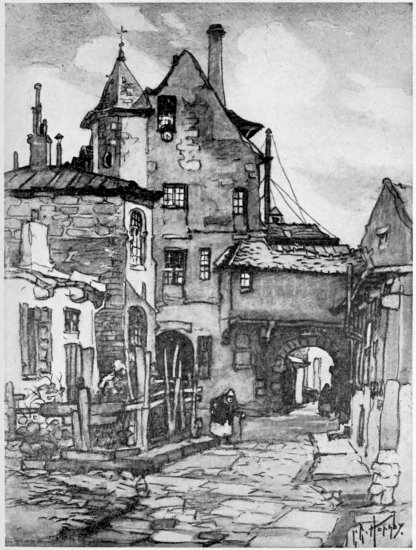
Château de la Reine Blanche: Rue des Gobelins
Do you know the Square Louvois? I'll wager you do not. For when one
passes afoot up the Rue Richelieu, he is generally in a hurry to get to
the Bourse or the Grands Boulevards. If you go on the Clichy-Odéon
bus, you whizz by one of the most delightful little green spots in the
city of green spots without noticing it. The Square Louvois has on the
side opposite the Bibliothèque Nationale a good-sized hotel, which was
named after the square. The boundary streets on the north and south are
lined with modest restaurants and coffee bars, within the purse of
petits commis and midinettes. In Europe there is not the hurry over
the mid-day meal that seems universal in America. Dyspepsia is unknown.
The humblest employee or laborer has from one hour and a half to two
hours off at noon. There is competition for benches and chairs in the
Square Louvois between twelve-thirty and two. Mothers who are their own
nursemaids have to resist the temporary encroachment of the Quarter's
business world. We from the Bibliothèque make an additional demand. We
must have our smoke and fresh air. And we never tire of the noble
monument to the rivers of France that is the fountain in the center of
the Square.
"Funny, isn't it," said I, "how things turn out to be different from
what you expected—your thesis for instance. Gallicanism is simply a
closed door for the present."
"I tackled too big a subject," admitted Herbert.
We were smoking in the Square after lunching in the buffet of the
Bibliothèque Nationale with the Scholar from Oxford.
"I'll wager," said Herbert, "that those greasy fellows in the salle de
travail discovered long ago what I have just learned. You start with a
general subject and a century. You narrow down until you have a phase
and a decade. If I ever do Gallicanism, it'll be limited to the
influence of the conversion of Henry of Navarre upon the movement. I
could work till my hair was grey developing that. But I should be
narrow-minded and dry as bones when I finished."
"Ah! You must not quarrel with the greasy fellows," put in the Scholar
from Oxford. "That is research. They are not narrow: they are
specialists." The Scholar is a canny Scotchman who gives his r's their
full value, and then some.
Allowing the letter r to be heard for sure is another point of contact
and sympathy between Scott and Frank. Just as the cooler Teutonic
temperament seeks the sun, and has been seeking the sun right down
through history, in trying to reach the Mediterranean, the cooler Scotch
temperament seeks the sun where it is nearest to be found—in France. It
is the attraction of opposites.
"You Americans," said the Scholar, "with your Rocky Mountains and your
Niagaras naturally approach research from the general to the particular.
It is far easier for men born in an older civilization to begin with a
specialist's point of view."
"I know, I know," said Herbert, "I had to work that out and I had to
change my whole subject, too. I wobbled from Gallicanism to Ottoman
history."
"That's no sin," declared Alick. "A man engrossed in research is human.
Going to Turkey was bound to influence your thinking. The traditions of
France still hold you, but the memory of Turkey is strong enough to
change the trend of your work. Go on with your origins of the Ottoman
Empire and be thankful you have discovered a line off the beaten track."
"Yes," I cried, "and for goodness' sake stick to constructive ideas. You
research-fiends waste too much time trying to prove that the other
fellow is wrong. Instead of remaining scientists you get to be
quibblers. But I must leave you now. I cannot put my whole day into the
Bibliothèque. I have to mix up tea-kettles and dusting with pamphlets
and cards for the file."
As Herbert and the Scholar from Oxford passed by the solemn guard at the
door of the salle de travail, I lingered in the lobby musing about
what we had been saying. I leaned for a minute against the pedestal of
the Sèvres vase and watched Herbert and Alick take their places side by
side at the old inked desks. I looked through the great polished plate
glass that makes the salle de travail and the travailleurs seem like
a picture in its frame. I knew from experience that once the two men had
got their noses in their books they would not look up. There was no use
in waiting for a smile.
"Boc ou demi?" asked the waiter.
Herbert and I and the Scholar from Oxford were lunching together in the
Quarter. The Bibliothèque was closed for cleaning, so it was an off day.
Herbert and the Scholar asked for bocs, and I thinking to be modest
chose a demi. My eyes nearly dropped out of my head when the men got
glasses of beer and before me stood a formidable mug that held a pint.
Emilie told me afterwards that if I wanted that much beer again the
waiter would understand better if I ordered "un sérieux."
The Scholar from Oxford had the habit of living in our apartment when he
came to Paris. Memories of hospitality on the part of himself and his
wife when we were on our honeymoon in Oxford were fresh, and when the
time came for the Scholar's next look at manuscripts in the Bibliothèque
Nationale, there was no question in our mind—nor in his, for that
matter—as to where he should stay. We set up a folding-bed in the
dining-room and tucked him in. No matter if we did not come back to the
Rue Servandoni at meal time. If we did not want to bother getting up a
meal, we put the apartment key into our pocket and sallied forth on what
we called a baby-carriage promenade. There was always some little place
where we could eat when we got hungry. Once we dined in a crémerie
chaude for no better reason than the attraction of a diverting sign on
the window—Five o'clock à toute heure.
To-day we had decided against Brogart's, our usual haunt, on the rue de
Rivoli. At Brogart's you could lunch for Fr. 1.25 with the plat du
jour and a satisfying range of choice in the fixings that went with it.
It was 1.20 if you invested in tickets. Then you were given a
napkin-ring to mark your serviette, and a numbered hole in the open-face
cupboard screwed to the wall beside the high desk where Madame sat while
she raked in the money and kept a sharp eye on her clients. There was a
division of opinion between Mother and me during a flying visit she made
us just before Christmas. We took her to Brogart's. She saw a fellow,
some kind of a wop with a greasy face and long hair, pick his teeth with
a fork. She never went back to Brogart's again. They don't do that in
Philadelphia. At least if they do, Mother had never happened to see
them. Herbert and Alick and I were less difficult to please. To-day it
was only because we had wandered far afield that Brogart's did not see
us. We had found a table that pleased us in a restaurant that bore the
sign "Au rendez-vous des cochers." We were not looking for a novel
experience. We were not tourists, you understand. It was on account of
the budget.
Everybody knows that the cochers of Paris are no fools. They can drive a
horse, but they can drive a bargain too and afterwards settle down on
their high box and fling you shrewd observations about art or politics
or what not. But there is more to it than that. When you have lived a
while in the Latin quarter you know who are the expert judges of
cooking. In the old days, the meal you could buy in a tiny dark
rendez-vous des cochers was as tasty as anything you could enjoy on a
Grand Boulevard at ten times the price. Minor details like a table-cloth
and clean forks and knives with each new plate are not missed when the
gigot is done to a turn and the sauce piquante is just right. The
rendez-vous des cochers restaurant has one distinct advantage over the
swell place on the Boulevards. If you are in a hurry to go to the
Concert Rouge and have had no dinner, you can stop for a second at a cab
driver's restaurant while you buy a portion of frites. The luscious
golden potatoes, sprinkled with salt, are wrapped in a paper, and you
consume them as you walk up the Rue de Tournon. They don't mind babies
there. Scrappie was asleep in her carriage. Monsier le Patron came out
and rolled the carriage ever so gently under the awning beside the glass
screen by the restaurant door. He beamed at us benevolently, then
stepped over to explain that he was a père de famille and that
courants d'air inflame babies' eyes.
The Scholar from Oxford is a Scotchman with the Scotch affection for
France. Before the war he came to France and Italy every year to make
enigmatical notes in his own handwriting reduced to cramped proportions.
The notes were placed within columns that were inked out years ago when
he began the monumental work. The columns are drawn across the short
dimension of the paper, so that you have to turn the thing sidewise to
read it.
There is a variety of ink. The row of notes at the top is all in the
same color. Three quarters of an inch in black mark the first year's
hours spent in the Bibliothèque. Run your eye down a space the width of
your thumb and the ink changes. Count how many ink colors you see, and
you'll know how many times the Scholar from Oxford has come abroad on
his grant. He carries his papers in a shiny black oil cloth serviette.
He was modestly imperturbable when with my usual vehemence I gave him a
good scolding because he confessed he had no copy of the precious
sheets.
"So worked the old monks in the days of the Reformation," said I, "when
a fellow spent his life time laboriously copying the Bible with his own
hand."
"Ah," mused the Scotchman with his eyes far away, "they were great
scholars, the monks."
"But it was slow," I protested, "often a man did not live long enough to
illuminate the device at the end of his chapter. Only a great enthusiasm
carried his successors to the end."
"Without them, think what we should have lost!"
"But they worked like that, you stubborn one, because there were no
typewriters or secretaries. You cannot persuade me, Alick, that there is
any extra virtue in using their methods today. You should adopt modern
methods so that you could accomplish more. You don't seem to realize
that thirty years from now the world will call you what you are,
Britain's greatest Latin scholar."
Unconvinced that mediaeval methods belong to mediaeval times, the
Scholar from Oxford lit another cigarette. He still persists in carrying
around Europe, in spite of wars, his priceless record of years of labor.
But he has since become Professor of Humanity at a great University. The
chair that he holds dates back to the day of the methods to which he
remains faithful.
Home again, I was making the coffee. But I was not out of the
conversation. Our kitchenette was six feet from the dining-room table.
Herbert started to light his cigar.
"Ah, my lad," said the Scholar from Oxford, staying Herbert's hand, "you
haven't asked the lady's permission!"
"I guess I can smoke in my dining-room," answered Herbert.
"You have to ask my permission then," laughed Alick, "before you smoke
in my bedroom."
Thank heaven, the Bibliothèque Nationale does not make my husband and my
guest stupid. If I could not look forward to jolly evenings, I should
make war upon research work, much as I like Bibliothèque Nationale.
"CARROTS cost money!"
"Yes, Emilie?"
"I had to throw several sous' worth at your window before you got awake
this morning, and when they rolled back some of them fell in the gutter.
Old Sempé saw me take them, and I'm sure he'll ask you to pay for them,"
said Emilie, nodding her round head with its well-oiled straight black
hair. Emilie was no more gifted hirsutely than in other feminine
adornments. Since the day we found her cleaning our apartment, at the
request of the Sempés, I had been studying her carefully to decide
whether new clothes and soap would help her appearance. Clean and togged
out in some of my things, she was not radically changed. But her heart
of gold shone in her eyes, and I was not long in learning to love her.
"You never hear that bell," continued Emilie. "What a conscience you
must have to sleep that way. The carrots are cheaper than paying me from
eight o'clock when you sleep on."
"Never mind about the carrots," I laughed. "We need you for an alarm
clock, and we did not wake up until one fell on the bed."
Emilie was my first servant, and I did not have her all the time. All my
life I had been demanding things from servants, but I had never bossed
one in her housework. I dreaded tackling the problem. Emilie was the
easy solution. The femme de ménage system is one of the advantages of
life in Paris. You do not have to house your servant, and she is not in
the way in a small apartment when you do not want her there. You can
have as much or as little of the femme de ménage as you like, or (as
was more often the case in my first year of Paris housekeeping) as you
can afford to pay for. I put Emilie out of the house when the clock
showed the number of times forty centimes per hour that I could spare.
Forty centimes per hour, did I say? Yes, and that was ten centimes more
than others paid in our street. Now it is a franc per hour, and the
femmes de ménage of 1919 growl most of the time and stop work when
they want to whether your house-cleaning or laundry is finished or not.
Emilie set in deliberately to attach herself to me and accepted all my
vagaries. I flatter myself that it was not so much for the extra two
sous per hour as for the fact that she liked me. My queer ways
interested her. She could never understand why I washed Scrappie's
silk-and-wool undershirts myself, but was willing to pay her several
francs for sitting on the coal-box reading a newspaper or dozing for
hours while I went to the opera.
Emilie was a vaudeville singer and dancer who had lost her figure and
most of her teeth before the bi-decennial of her stage career.
"To think, Madame, that a few years ago the posters on the Kiosque at
the corner of this street used to announce my number at the music-halls,
and to-day I'm down on the floor washing your tiles!"
I was pulling the baby's wool stockings on drying-boards.
"You say you used to be on the stage?" I led on sociably.
"Yes, Madame, comique excentrique. That is why I cannot cook. My
profession required me always to eat in restaurants, but I can wash
dishes, clean rooms and build fires. Thanks to God, for the service you
need, I know how to mind babies. I never had anyone to help me with
Marcelle."
Marcelle was a fifteen year old girl, hare-lipped and cross-eyed, but
her mother loved her dearly. Emilie did not say who Marcelle's father
was. But she was not as reticent as the woman of Samaria, and would have
scorned to come to me under false pretenses. Tout savoir est tout
pardonner. If you cannot live up to the spirit of that motto, do not
plan a life without worry for yourself in Paris.
"Last year, before I found you, Madame, Marcelle and I were out of
work. When you came in here in July we had earned only fifty francs in
two months. Marcelle did not get her job as laundry apprentice until
October. Oh no, we didn't exactly starve. You can get cold-boiled
potatoes and they sell bits of bread and left over coffee very cheap at
night when the restaurants close."
Here she sat up to wring her floor-rag into the brown water of the pail.
"I hope you'll not regret spoiling me the way you do. You let me talk,
but you can trust me not to forget myself. Take this afternoon when
those ladies are coming for tea. You know how I wait on the table. That
is a rôle. I get my happiness in considering everything a rôle. I play
at being femme de ménage. These dirty old clothes are my costume: the
bucket and mop are stage properties."
"Do you like having company at tea?" I broke in.
"That depends."
"On what?"
"On who they are." Here Emilie made up her mind to speak with firmness.
"Now, without indiscretion, Madame, the ladies you asked for this
afternoon are not interesting. I was here when two of them called and
you told them to come to tea."
"Why not?"
"The Latin Quarter is full of women like that. I know. I have worked for
them. I have been cleaning at studios and apartments like yours in this
neighborhood ever since I left the stage. I have seen what these women
paint. Oh la! la! Sometimes you cannot tell the canvas from the palette,
Cubism they call it, to hide the fact that they cannot draw and could
not reproduce a figure or any recognizable object to save their lives.
No, I'm not talking of beginners. I'm talking about the old ones, the
women, Americans and English, who do not know how to paint kitchen
chairs or carry a tune, and yet art schools and music academies flourish
on their fees. They were misfits where they came from. It pays their
relatives to send them money every month so they won't come home. But
why should Paris—that is, our part of Paris—be the dumping ground? You
say that there are more men of that kind than women? Yes, oh yes, many
more. But then, after a certain time men give up posing. They do not
mind being taken at their real value. When they are failures, they admit
it. The women keep on pretending."
Emilie was as good as her word. With a shining face and hair well
slicked back from her ears she appeared at tea time. The ample front was
covered by a clean white apron. She stood at my elbow, her black beady
eyes keen to see what I needed before I asked for it. Oui, Madame and
voilà, Madame came as softly as though, born in a pantry, she had
always served tea. But she could not keep up the play without the
relief of an occasional entr'acte. When she brought me a pot of fresh
tea and guests happened to be looking the other way, she would give a
broad wink and bolt from the room. When the guests left, the kitchen
door was closed.
"I ought to have made one more appearance, Madame," said Emilie a few
moments later as she settled herself comfortably in the steamer-chair
and took a pinch of snuff. "The model servant would have helped them on
with their coats. But I had all I could stand."
"But you did very well, Emilie."
"I got more fun out of it than you did. I said that you were wasting
your time on those people. What did they do? Told you you looked badly.
Asked why you were so tired. Advised you to get a doctor for the baby's
cough. And you think they meant well? That it was solicitude?"
Here Emilie laughed heartily and wiped the snuff off her hands with the
greasy blue apron that now replaced the white one.
"You are naïve, dear Madame. Women love to tease each other that way,
especially those who are not well or strong themselves. They hate you
for not having ills. If you told them that you had a physical
examination last week and the doctor said you were in perfect condition,
they would shake their heads gravely and warn you that you are
underweight for your height."
"They did make me mad, I confess, when they volunteered advice about
Scrappie. They used to scold me for nursing my baby and they scolded me
to-day when they heard I had stopped nursing her."
"That's it! That's it!" cried Emilie. "Next time they talk like that,
show them the little thing, beautiful rose de mai that she is, and ask
them in what way she looks badly."
Throughout the year at Twenty-One, Emilie was a tower of strength to me.
When we sent our pitchpine back to William Shakespeare and packed our
rugs and brasses, she was on hand as she had been the day we set up our
Lares and Penates in the Rue Servandoni. She urged that we take her to
Constantinople with us. We did, and never regretted it—if only for her
comments on the Turks and Greeks and Armenians. When she realized that
we needed other care than she could give us, Emilie quietly dismissed
herself and went back to France to live in Bordeaux. We see her there
occasionally. She still wears my old hats and blouses. She is still a
femme de ménage. And Marcelle has continued to wield the flat-iron.
I WAS bathing Christine before the fire. Gabry and Esther came in. The
two girls settled themselves in steamer chairs.
"We want to know if you will let us come and sleep in your dining-room
to-night," asked Esther.
"Sure," I answered, "but, mercy me, the bed in there is a little bit of
a narrow one...."
"That doesn't matter," said Gabry.
"No, indeed," agreed Esther. "We can cuddle up close and we shan't be in
it very long."
The baby began to howl. I had been listening to the girls and the side
of the tub had got hot.
"Poor little dear," said Esther. "Her mother forgot her and she began to
parboil."
I had the baby safely on my lap now wrapped in towels. Emilie carried
away the bath tub.
"What's going on to-night?" I asked.
"Well, it's a fling," said Esther. "You know how it is up at the Hostel.
They are so fussy—you would think it was an old ladies' home. Two boys
that came over in our ship have been studying forestry in some German
school. They are here for the holidays. We got them to promise to take
us with them to-night to see the town—café stuff, you know."
"Where are you going?" I asked.
"To a cellar where they do the Apache dance."
"You don't want to see that," I suggested. "It isn't real. Just a plant
to catch parties like you. Why Herbert and I saw that stunt done in a
cinema the other night. There was a French couple back of us. They
giggled over it. The man said, 'Wait a minute. The police are sure to
come in after that party of Americans are comfortably settled with some
drinks.'"
"You don't mean it," said Esther. "Don't take the edge off our spree."
"I'm not taking off edges. Only in the cinema the other night it was
instructive the way the policemen came in. After they had driven out the
most murderous dancing Apaches, the Americans thought it was too hot and
fled. You ought to have seen the way fake Apaches and barmaids laughed
at them afterwards. What is your plan for the night?"
"First to dinner in some spicy café, then the theatre. We're going to
see Chantecler. Everybody's crazy about it."
"Excepting people who think it is silly," put in Gabry.
"Well, if it's silly to see actors dressed up in peacock feathers,"
cried Esther, "we'll have a good time. And there'll be supper somewhere
afterwards."
"Going to make a regular night of it, aren't you?"
"That's just the point. Helen, you're a dear to be so sympathetic. Up at
the student Hostel...."
"Did they object there to your going?"
"They don't know a thing about it. It would never do to tell them."
"Why?"
"They'd begin to preach," protested Esther. "A pack of school teachers
anyway. That's why we want to spend the night here. We'll just explain,
you understand, that we're going to spend the night with their dear
lovely Mrs. Gibbons. And they'll never know a thing about the fun."
The girls were moving towards the door.
"The boys will come here to get us," called Esther. "We'll come down
about half-past six. Herbert won't mind, will he?"
"We must move along now," said Gabry. "I have a singing lesson."
"And I have a fitting at the dressmaker's," added Esther. "Ta, ta,
Helen."
I felt in my bones that I didn't quite know what to do about it and
would wait until Herbert came home.
When Herbert returned from the Bibliothèque Nationale at noon, I told
him about my visitors.
"Why on earth—" he began to comment.
"Oh, they are going to do the Grand Boulevards with a couple of young
American fellows who are in Paris for a vacation," I said.
"What's the matter with those girls," exclaimed Herbert. "What's gotten
into their heads? Do they think they can come here and start off on an
expedition like that? If they were older, it would be different. If
they're afraid to tell the Hostel people, it shows they know well enough
it isn't just the thing for them to do."
"I thought so myself."
"Well, why didn't you right up and say it from the beginning?"
"Girls wouldn't take it from me. My game was to be absorbent and get the
whole story. They're nearly as old as I am. I couldn't dictate to them.
I don't know how to get out of it."
"I see," mused Herbert.
The girls came in about six o'clock to dress for dinner. They had their
suitcases and some flowers, and Esther brought her light blue hat in a
paper bundle. I had told them to telephone their boys to come to dinner
with us before starting out for the theater. This was the only way I
could think of to manage things so that Herbert could see them before
they started away.
Esther put on the pretty bright blue dress she had bought at the model
shop to go with the light blue hat. She placed the hat, still in its
paper cover, on the top of the wardrobe in the dining-room. Gabry
played with Scrappie, sitting on the floor beside her, where she was
tied in her papa's steamer chair. Esther perched herself on the stool in
the kitchen and watched me frying sausages. Herbert came in after a bit
and wheeled right around from the front door into the kitchen. He didn't
have to walk. It wasn't far enough.
"Hello, Esther, what are you up to?" said Herbert.
"Hello, Herb."
"Come on in the other room. I want to talk to you," said Herbert.
He closed the door and I heard them talking hard.
"Gee!" said Gabry. "Esther sounds mad, doesn't she?"
"Herbert's telling her what he thinks of the party," I said.
"He doesn't want us to go, does he?" said Gabry.
"Oh, he's not breaking up the party. Not a bit of it. He only says that
seeing nobody of your crowd knows French and seeing that your mother
made us promise to look after you, he wants to know what café and
theatre you're going to."
Just as a rather mad-looking Esther and a smiling Herbert appeared,
there was a ring at the bell, and in came the boys, two rosy-cheeked
American youngsters. They came into the kitchen to talk to me a moment,
and then Herbert took them into the dining-room to explain things. I
heard him talking with them, nice American chaps they were, not looking
for trouble a bit. Not the type out for the booze, just bright
youngsters who were going on the boulevards out of curiosity.
We lighted up the candles in the bedroom-study. Herbert put some new
ones in the candlesticks on the piano and we soon got things going. One
of the boys was taken into the bedroom-study to play a tune on the
piano, and soon Esther cheered up with a face more or less of an April
one.
"Hello, boys," said Herbert. "The girls have been telling us—Mrs.
Gibbons and I want you to have dinner with us here first so we can talk
over the party."
"Sure," said John. "We have tickets for Chantecler."
We sat down and tackled coquilles Saint-Jacques.
"You don't want to get in any trouble over this game," Herbert went on.
"Not speaking French and all that...."
"That's so, too," said Joe.
"Chantecler is fine and dandy," said Herbert. "If you want supper
afterwards, here's the address of a nice little café."
"Sunday school picnic," moaned Esther.
"Esther's inconsolable. She thinks I'm spoiling the fun. But these boys
don't want to get into a doubtful little hole. You don't know what
you're doing, Esther," said Herbert.
"I'm as old as your wife, so there."
"You fellows do not want to spend a terrible lot of money. I know you
don't. Esther is mad as a hornet at me because I am going to squelch her
idea of going to Montmartre or Les Halles for a hot old time. I don't
want to seem a poor sport, but you know some of those cafés are fakes,
others are what I shall not mention, and there is a third category of
really dangerous ones. The entire business is carried on to catch and
mulct tourists. If you happen to drift into the fake places, nothing
more serious would happen than getting stuck good and hard. You would
simply have to pay the waiter whatever was on the bill. If you were
considerably older and knew how to speak French, the slumming might
prove interesting—for one evening. But for you the game is not worth
the candle. I don't mind your going for a jaunt along the boulevards,
and I can tell you some of the cafés that are all right. But as for Les
Halles—that doesn't go."
The boys were sensible. They fell in with our suggestions without
discussion. After dinner the four went off to their show. Next morning I
heard Esther telling Scrappie all about it.
"The W.C.T.U. wasn't in it, baby. Chantecler was written to please
kids of your age. There was nobody in that Y.M.C.A. café your daddy sent
us to. My blue hat was the most conspicuous object in the place. We
didn't see a thing. No types, no wickedness, no models, more than we
ordinarily see around the Quarter."
Gabry's eyeglasses were shaking on her nose.
"Tell her what Monsieur Sempé said," urged Gabry.
"Yes, baby," said Esther, who was laughing in spite of herself now. "Our
mama boys wanted to be polite in the American way last night. They
brought us here and didn't want to leave us until they saw us inside
your saintly doors. But Monsieur Sempé stopped them down at the street
door. He simply yelled at the boys, 'Ça ne se fait pas à Paris,
Messieurs.'
"No," concluded Esther, "from start to finish, baby, there was nothing
about our party that would have hurt your lily-white soul."
I WAS nursing Scrappie. Herbert came into the bedroom and started to
speak slowly as if he wasn't sure how I would take what he was going to
say.
"Fellow out here who is hungry. What shall I do?"
"Feed him," said I. Herbert did not have to tell me that he had no money
to give the man to buy a meal. "Couldn't you ask him to dinner if he is
all right?"
"Well, he is sort of an old chap," said Herbert doubtfully.
I lighted a candle and put it on the end of the mantel-piece nearest to
the baby's bed. She was perfectly contented to go to sleep alone if she
could watch a candle flicker.
When I had settled Scrappie and opened the window and closed the door
gently, I went into the dining-room and found Mr. Thompson. Sparse grey
hair, watery blue eyes, a talkative individual who hoped he was not
bothering us too much. He wore a frock coat with shiny revers. His cuffs
were unstarched and frayed, but they were clean. Herbert had brought in
some cold boiled potatoes. In those days you bought them cooked at the
charcuterie for the same price that you got them raw at the
greengrocer's. It was a good scheme. You could peel them and slice them
in a jiffy,—then warm them with eggs broken up and scrambled in the pan
beside them. This with cheese and nuts and liqueurs made a meal without
using too much gas. You did it yourself, using no more energy than would
be taken out of you if it had been done by a cook.
Mr. Thompson did not lie when he told Herbert he was hungry. He had
three helpings of everything. He said little during the meal, but he did
not eat with his knife. When it came to cigars, he pushed back his chair
and spread out his hands to the boulet fire. Casting his eye from the
molding to the floor, he included the dining-room and all the rest of
the apartment with a sweeping gesture and a couple of "Ha-Has."
"From the looks of this joint, you two youngsters haven't any more money
than you need. This is a good joke on me, too good a joke to keep to
myself. You have given me a square deal along with a square meal, and I
appreciate it. I have lived for years in this Quarter and have earned
precious little money. Sort of a down-and-outer. I am, I suppose, one of
the Quarter's charity patients. Don't worry. I am not going to beg of
you. First time I came to Paris, it was by way of England. I stayed a
long time in Oxford and made friends with the Cowley Fathers. Then I
buried myself in the Bibliothèque Nationale, for I was starting a thesis
in church history."
"Indeed," cried Herbert. "I have a fellowship in Church History myself.
What is your subject?"
"Religious orders after the Reformation," said Mr. Thompson.
"Have you published anything?" asked my husband.
"No," said Mr. Thompson. "Queer thing life is. We get loose from our
moorings when we least expect it. You won't believe me, but American
generosity was my undoing!"
"How could that be?" I put in.
"Don't you know," said Mr. Thompson, "that we are not as much the
captain of our souls as we like to think?"
He was in a steamer chair now, and lying back, he blew smoke at the
ceiling.
"But you were saying, Mr. Thompson," said I.
"I was saying more than I ought to," he mused.
He had forgotten his cigar. Herbert twisted a bit of newspaper, touched
it to the glowing boulets and held it out to Mr. Thompson. Matches are
expensive in France.
"Oh!" he started. "I was away back years ago. Thank you. I was wrong a
minute ago when I told you I had said too much. I have said too little.
You have made me feel at home, and I shall be frank with you. It
sometimes wrecks a fellow's career if he receives just a little too
much help. What I am talking about is quite a different thing from what
I may have suggested just now. Not a person spoiled with too much money.
But I was spoiled by the fact that at a certain time, I was able to put
my hands on ever so little money when it was not good for me. Not the
money itself, you understand, but the fact that the game is so easy."
"But I don't understand," I protested.
"Of course you don't," said Mr. Thompson.
He threw the butt of his cigar on the floor, put his foot on it, and
took another from Herbert's box.
"Sorry I haven't better cigars to give you," said my husband. "These
carrés à deux sous just suit my speed."
Alas for the carrés à deux sous! Of them as of many of our joys we
must say Ichabod.
"The time came when I ran out of money—but altogether out of money, you
understand. I waited until I was pretty hungry before I told anybody.
Then the American Consul did something for me. Somebody gave me a pair
of shoes. Other persons gave me money, and the day was saved. Again I
became absorbed in my work, to be interrupted by poverty. This time I
went to the pastor of the American Church. He looked me over. Must have
thought I was a good case, as he saw to it that several people did
something for me. After all, it comes easily, and I have lived like
that for years. Sometimes my clothes don't fit very well, but what is
the difference. It has grown upon me until I am utterly unfit to earn my
living. You get nothing twice from the Consulate, and churches are not
good for much. Besides, the churches keep a list of dead-beats. It is
the individual Americans one meets that give away their money
carelessly. I found somebody who listened sympathetically to my
hard-luck story. The story itself was no lie the first time. But it was
so easy—there was the temptation. I tell you frankly that I fell. I
discovered that I could do it again when the hard-luck story was not
true."
"I hunted you up," continued Mr. Thompson, "with the idea of getting
something out of you. I suppose if I put as much energy into holding
down a job as I do this, I could earn my living. But the habit of living
on the kindness of other people has me in its grip, and I do not stick
to work when it is given to me. I have been pretty faithful to the
Bibliothèque all these years, for it is heated there. I can read my
paper, write some letters and study a little on my church history. The
thesis is growing slowly, but that is all I can say I have done these
twelve years.
"There are other people who do the same thing, you know. You have met
them without knowing it. Artist fellows, youngsters as well as old ones,
understand the game. Do you know how they work it? It is known now, for
instance, that you receive informally every Wednesday. There are other
days and hosts of women. So it goes. A fellow can get along very cheaply
like that. Pay thirty or forty francs a month for a place to live and
work, two sous each morning for café au lait passed across the
zinc—good coffee too, as you perhaps know. They let you bring your roll
with you if you like. It will cost a sou. One roll and a cup of coffee
is enough after you get used to it. Your only large expense is the noon
meal.
"Generally the evening meal you can pick up. You find in the social
register the names of all the ladies, kind and unobservant, who have
days at home. You stick a big paper on your wall and mark it off in
seven columns, one for each day of the week. You make a list of the
women who have receiving days, and you drop in somewhere every afternoon
about five-thirty. The tea party is pretty well finished, but there is
usually plenty of food left. The ladies have to provide for more than
really come. You do that yourself, Mrs. Gibbons. The ladies do not
notice that you eat more than one or two sandwiches and plenty of cake.
If they do notice it, it makes them feel happy, and there is your
supper. If you do it systematically with a list like mine, you do not
have to go to Mrs. X's house more than twice in the winter. A lot of
people in the American colony have receiving days. It is easy enough to
know them. All of the boys know a few, and we take each other around.
The artist fellows have a cinch. All they have to do, if they have a
conscience, is to present the hostesses to whom they are the most
indebted, with a couple of worthless sketches. Nobody ever suspects
anything.
"You can slide in and out in the Latin Quarter and meet any number of
charming people. They never stay too long and there are always new ones
coming in. No hostess is superior to the flattery implied when her tea
is appreciated. I have learned to praise sandwiches so that I can get a
fair supply. I write an article occasionally, and that covers my rent.
Clothes are an easy matter. Any number of people in Paris will give away
clothes. You see I am a deadbeat. I was a deadbeat to-day when I saw in
the Herald that Mrs. Gibbons was going to be at home this afternoon."
Mr. Thompson got up to go.
"Where did you put your overcoat?" asked Herbert.
"I have none," said my guest.
Herbert's eyes met mine. I telegraphed "Yes."
Certainly we gave Herbert's old overcoat to Mr. Thompson. As we talked
about it afterwards, Herbert observed,
"We could not help giving him the coat, could we?"
"No, of course not."
We never saw Mr. Thompson again. It isn't in the picture. Driftwood!
THE best fun of having a home is sharing it with your friends. But you
deprive yourself of this fun—in a very large measure, at least—if you
make entertaining a burden or a great expense. In the Rue Servandoni we
tried out theories about hospitality that have become firmly rooted
family principles. Guests are always welcome, and we never feed them
better than we feed ourselves. Company is the rule: not the exception. I
suppose my Irish temperament made this possible in the beginning. Now we
would not give up our way of living for anything in the world. By the
standards of my own family I am not regarded as a good housekeeper. I am
finicky only about cleanliness and the quality and quantity of food. The
rest doesn't matter. That is, I have no almanac to show me when to put
away the winter clothes and when to do Spring house-cleaning. I do not
get "all out of kelter" if the wash is done on Thursday instead of
Monday: and I never "put up" fruit or bake. I buy my preserves from the
grocer and my bread and cake from the baker.
When I look back on Rue Servandoni days and try to analyze my attitude
towards housekeeping, I think first that I may have been demoralized by
living through the Armenian massacres just before going to Paris. It was
enough to make me happy in the morning to realize that my husband and
baby were alive. Did I have a new sense of values, born of suffering? Or
perhaps it wasn't anything as high-brow or pious as that. Perhaps it was
the inheritance of shiftlessness that came down to me from the ancient
Irish kings. This curious form of original sin persists and makes me
able to agree with one who sang when things all got messed up,
"The cow's in the hammock,
The baby's in the lake,
The cat's in the garbage:
WHAT difference does it make?"
Now I do not claim that my way is altogether right and that my maternal
Pennsylvania Dutch strain does not occasionally assert itself, though
feebly. I enjoy formal and well-ordered entertaining when it is not a
pretense—when I do not have the uncomfortable feeling that my hostess
has worn herself out getting the meal ready or is offering a meal beyond
her income.
The alternative in the Rue Servandoni was to have friends take us as we
were or to make an occasional splurge. The latter was thoroughly
distasteful to us both. We held that what was good enough for ourselves
was good enough for our friends, and that they would rather come to our
simple meals than not come at all. How could we hope to compete with
the Café de Paris or Arménonville? And we knew that many who came to us
paid their cook more than our total income.
Where stood the walls of old Lutetia
Is not the question of entertaining a good deal like the question of
other people's wealth? If you are continually striving to keep up with
friends richer than you, you are bound to feel poor. We could put our
heads out of our window, and pity ourselves because we were not living
in steam-heated, electric-lighted Number Nineteen or Number
Twenty-Three. But then, across the street, Number Twenty and Number
Eighteen had logements beside which our apartment was a palace.
Shortly after setting up our Lares and Penates in Number Twenty-One, a
friend from Denver dropped in just before supper. He was a judge and
silver-mine owner, the father of one of my Bryn Mawr college-mates. I
urged him to stay. He was excusing himself, when I volunteered the
information that our supper consisted of cornmeal mush with milk, and
that was all. He stayed, and told us that it was the best meal he had
eaten in Paris. "I just love cornmeal mush, and I cannot get it at my
hotel," he said. We believed him. He spoke the truth.
There was always room at our table for friends. An extra plate, and a
little more of what we were having for ourselves—that was all there was
to it. In a big city, especially a city like Paris where shops are in
every street, getting more food quickly is no problem. Herbert would
just slip downstairs to Sempé's for eggs, another chop, another can of
peas, an additional bottle of wine. Next door was the bakery.
The best friends of our married life have come to us through
unpretentious entertaining. The contact of the home is different from
the contact of the office or club or formal gathering, and it has
enabled me to take every step forward with my husband. Our broadened
vision, our intimate sources of information, the steps upward in our
profession are largely the result of the dinner-table and the
after-dinner smoke before the fire. One illustration shows how chance
influences the whole life.
Early in the autumn of 1909, we received a letter from a Paris lawyer
who had just returned from settling insurance claims in
massacre-stricken Cilicia. He had been in Tarsus just after we left, and
wanted to meet us. I wrote back to him, as I would have done to anyone
with an introduction like his, "Come to dinner, and if there is a Mrs.
K. bring her with you." He sought us out in our little street. There was
no Mrs. K., but the spontaneity of the invitation and its inclusiveness
had prompted him to break his rule of not accepting dinner invitations.
He was a charming man, full of information and inspiration. When I
brought on the asparagus, he said that in Poland they put burnt bread
crumbs into drawn-butter sauce. I jumped right up, and exclaimed,
"Nothing easier! We shall have asperges à la polonaise right away." In
three minutes the asparagus was to his taste. The lawyer thought out,
and made a suggestion that would certainly never have occurred to him
had I arranged a formal meeting in response to his letter. He told us
that the experience we had in Turkey we should not regard as accidental.
"Why did the massacres occur? You must have asked yourselves that. Now
drop your research into Gallicanism and French ecclesiastical history. A
thousand men are as well equipped for that as you. Turn your attention
to the Turks and the Eastern Question, and from that go into the study
of the contemporary diplomacy of Europe. The Russian and Hapsburg
Empires are built upon the Ottoman Empire. Study the relation of Turkey
to Poland. This is the field for you!"
In the last few years I have often thought of that evening. We followed
the lawyer's advice. He helped us. He encouraged us. He used to come to
dinner every Tuesday night. We went back to Turkey and came again to
Paris before the Great War. During the years of absence, there had been
frequent correspondence. When we returned, the Tuesday evenings were
resumed. If my husband was ready for the work that came to him with the
war, it is thanks to the Paris lawyer. The Foundation of the Ottoman
Empire, The New Map of Europe, The Reconstruction of Poland and the
Near East, are the outcome of table-talks with the lawyer that began in
the Rue Servandoni.
In the pension of the Rue Madame we met people whom we invited to come
to see us in the Rue Servandoni. We asked them to our table. They came.
And they have been dinner guests in our different Paris homes during the
past decade.
There was the Catholic Archbishop of Cairo, an Arab who had the
story-telling gift of his race. You do not know what it is to hear a
story told until you have listened to an Arab. The Archbishop unfolded
to us the lore of the East. There must have been something about les
petits américains that interested him, for our meals could not compete
with Mademoiselle Guyenot's. He used to sit in the steamer-chair, with
his arms folded over his gold crucifix, his cape thrown back on both
shoulders (which gave a dash of red), the end of a long white beard
rubbing the most prominent buttons of his cassock front, and eyes
twinkling in unpriestly fashion. He was the reincarnation of Nasreddin
Hodja, prince of Anatolian story-tellers. Herbert pokes in his bath. One
night, when Scrappie went to sleep earlier than usual, Herbert started
to make his ablutions before the dining-room fire while I was busy in
the kitchen. The door-bell rang. In came the archbishop. There was a
swift change of persons and rooms. Herbert finished his bath in the
kitchen in an incredibly short time. He did not want to miss a moment
of the archbishop.
Michi Kawai was with me in school as well as in college. Imagine my
delight at finding her one day looking at old furniture in the Rue des
Saints-Pères. If I ever thought of Michi, it was in Tokio. And I never
would have thought of Michi in connection with French antique furniture.
But that is Paris for you. Sooner or later all your friends come to
Paris. You run across them accidentally and invariably they are doing
something you would never have dreamed of associating them with. During
her months in Paris Michi was a frequent visitor in the Rue Servandoni.
She was one of those delightful combinations of Occident and Orient that
Japan produces better than any other nation. She was equally at home
with French and American friends, and, when Emilie was not there, knew
how to juggle my eight cups and saucers and spoons back and forth
between the tea-table and the kitchen, without guests catching on, more
dexterously than any of my American girl friends.
We started our married life among the peoples of the Near East, and we
found them out there just like other folks, when we took the trouble to
come into intimate contact with them. Racially of course they are
different from us as they are different from each other. Greeks,
Bulgarians, Turks, Armenians, Syrians, Egyptians, Persians—each one of
these names calls up faces of people I love. I have known them in their
homes and in my home. A strong tie binds us to the Armenians. When you
have shared the sufferings, dangers and hardships of a people, they
belong to you and you belong to them in a peculiar way. Armenians came
to the Rue Servandoni, poor boys with no money and no home who had
escaped from Turkey, struggling students, successful painters, brilliant
musicians, wealthy merchants. Every collector of Egyptian curios, of
Turkish and Persian rugs, of Oriental pottery, knows Kelekian of the
Place Vendôme. His small shop is wedged in between a florist and a
ticket-scalper. In the window you never see more than half a dozen
objects. There is always a bowl as a pièce de résistance, a bowl that
only a Morgan could afford to own. Pause and look over the curtain, the
chances are that you will see Monsieur Kelekian sitting by a glass case
of Egyptian scarabs. He will be smoking, and his right hand will be on
the case. To know Monsieur Kelekian is to have faith in the resurrection
of Armenia and in the future of one of the oldest races of history. We
came to know him through his interest in the Adana massacres. He had
never heard of the Rue Servandoni, and the street was hardly wide enough
for his automobile. But he came to dinner with his wife—in spite of a
disapproving chauffeur, who thought there must be some mistake and who
insisted on inquiring for us first at Number Twenty-Three and then at
Number Nineteen. Although his nose never turned down, he became
accustomed to stopping in front of the grocery!
Other chauffeurs and cochers learned during that winter a new street
in Paris, and the first time they, too, made the mistake of stopping
next door. Mrs. Evans, sister-in-law of the famous dentist, had a pair
of black horses that shone like the varnish of her victoria. "Dear Mrs.
Evans," as all the women called her, was interested in every good work.
She approved of my husband, because he was a parson, and of me because I
had lived in a missionary college. She knew we had no money and did not
expect us to have any. Her carriage was ours for afternoon rides in the
Bois de Bologne. Scrappie, "that darling missionary baby," must have her
weekly outing. Mrs. Evans, I am sure, believed that the air was not what
it ought to be in our quarter of Paris and that God had intrusted her
with the responsibility of seeing that we were occasionally transported
elsewhere. During that year we made other friends in the American
Colony, who, like Mrs. Evans, cared for us for what we were. They made
Paris home to us in the old-fashioned sense of the word, and the
intimacies then formed have never been broken.
Gypsy Smith was an English evangelist who came to Paris that winter for
a series of revival meetings in the English-speaking community. He had
been traveling all over the world for twenty years. His wife had had to
stay at home to look after the children. Now, for the first time, she
was free to accompany him, and came to Paris with him. We showed the
Smiths some of the principal tourist points of interest one morning, and
they came home to lunch with us. In the way of entertaining, they had
been "touching the high spots" in Paris, as Gypsy Smith was sought after
by the substantial people of the British and American communities. Our
little home was a revelation to them of the fact that there were other
foreigners living in Paris than the rich. Mrs. Gypsy was greatly pleased
with the novelty of finding "just folks" in Paris. "A cozy little nest
you have here," she said, giving me a nudge with her elbow.
There were so many people to see in Paris, old friends from home as well
as new friends, that I soon began to have my afternoon. On Wednesdays I
received in that tiny dining-room, with my eight cups and saucers and
spoons, just as if I were mistress of a large establishment. At first,
our neighbors thought it was a christening or funeral. When they
realized that les petits américains over the épicerie were having a
weekly "at home," they were confirmed in their impression of our wealth.
I confess that it was crowded at times and that the party had to
overflow into the bedroom. But it was fun, especially when one of my
girlhood friends, who had known me in Germantown days in my mother's
home, would bring her whole family along to see me, and exclaim, "Why,
Helen Brown—!" But I would get them all in.
Two days after Christmas, my husband urged me to go walking with him. He
pointed out that no one would come. But I refused. I had more conscience
when I was young than I have now. Being "at home" meant sticking by the
game. I had cheered up the boulet fire in the dining-room. The cups
were on the table. My china platter held a gâteau mocha of dear
memory. Shall we ever again be able to buy layer-cakes with coffee icing
an inch thick done in the delectable ups and downs like a wedding cake?
And that at one franc-twenty-five?
"Run down, dear, and get me some hot crescents. It's after four o'clock,
so they'll be ready."
"Now, look here. You've got to be sensible. Everyone has hosts of things
to do Christmas week. Nobody will come. We'll eat the cakes for supper.
Let's go over the river."
"No, that wouldn't be fair. Somebody might come."
Herbert got the crescents, put more boulets where I could get them
easily, and was gone.
I settled myself in the steamer-chair. No sound except the ticking of
our little traveling-clock, and the dropping of a boulet on the
hearth. An hour slipped by, and I began to realize that I might just as
well have gone out. A ring at the bell. When I opened the door, there
was my husband holding a bouquet of roses big enough for a bridesmaid.
"Good afternoon," said he, bowing low; "do Mr. and Mrs. Gibbons live
here?"
"To be sure," said I, stifling a giggle. "I am Mrs. Gibbons."
"Indeed." My visitor shook hands with me and explained, "Mrs. Gibbons, I
am delighted to meet you. I knew your husband years and years
ago—before he was married, in fact. The first pleasure I have allowed
myself in Paris is to look up my friend Gibbons and his wife."
He hung hat and overcoat in the hall, and handed me the flowers. "What a
charming dining-room. Dear me, have I intruded? You were having a
party?"
"Just my day at home."
We chatted for a full hour, discussing the fate of the House of Lords,
about which my new friend confided that he was writing an article. He
hoped some editor would publish it. We talked of the possibilities of
next year's Salons and disagreed on the subject of futurist painting. I
told my visitor about the many American friends that were turning up,
and how the Gibbonses realized that if they wanted to get any work done
in Paris they would have to stop acting as guides. What did he think
about adopting a policy of telling people that Thomas Cook had mighty
good guides at ten francs a day? Perhaps, however, we should make the
last exception with him, and show him the town.
We talked of Christmas, and then I was asked if I had a baby. I replied
that of course I did. She was over in the Luxembourg Garden with Marie,
who kept her out late on my at-home day, but who would soon bring her
in.
"People that see resemblance in coloring say she looks like me, but
those that see resemblance in contour say she's the image of her daddy."
"So!" said my visitor.
I put my arms around the contour.
THE Prince whom Tartarin met in Africa had lived a long time in
Tarascon, and knew remarkably well one side of the town. He knew nothing
of the other side. This puzzled Tartarin until he found out that his
noble friend's residence in Tartarin's native town was a compulsory one.
The Prince had ample time to study a certain aspect of Tarascon in
detail from the little window of his penitentiary cell. We do not all
have the privilege of devoting ourselves, as the Prince did, to a minute
study of just one view from just one vantage-point. And yet, in certain
things we share the Prince's experience. We become accustomed to a
definite aspect of the things we see to the exclusion of other aspects.
Thus it is that I know many parts of Paris familiarly as they appear at
nightfall. I could go to these quarters at other times, but I never
have. I fear the breaking of the spell. I fear disillusion. And if you
want to follow me in Paris walks through this chapter, plan your strolls
from five to seven during the winter months.
It began this way. In the Bibliothèque Nationale, as in the Paris of
parks and gardens, the closing hour follows the sun. The Bibliothèque
has no lights. It turns you out at four, half-past four, five or six
according to the season. During the months of longer days, we stayed
until the last bell. In the winter we were put out before the afternoon
was over. One did not feel like making for home immediately. It was too
late to go far afield. We started in to explore Paris in a widening
circle from the Rue de Richelieu. My husband had covered much of this
ground in summer months with the Scholar from Oxford. When the light
held out until late, they had time to visit old Paris with the books of
Georges Cain for guides. In the winter months Herbert took me over this
ground again. But I saw it all at nightfall or after dark.
It was a wonderful discovery, to combine exercise with interesting
sight-seeing at the end of the day. The habit of walks through city
streets, thus formed, has been persisted in through many busy years. I
recommend it, even to tourists. Use your precious days for churches and
museums and palaces. After they are closed, walk for an hour or two each
night. You will find diversity, and, like Horatio, things you never
dreamed of. And no matter how long you live in Paris, there is always
something new to explore and something equally new when you follow
beaten tracks.
You have to be—or grow—catholic in your tastes if you want to enjoy
what Paris at nightfall offers. Of course in the beginning you look for
certain things. You have a goal: tracing the city walls from old
Lutetia to Henri IV; seeking traces of mediaeval days; spotting
Renaissance architecture; visiting historic spots or buildings
associated with famous names or events; reconstructing Paris of the
Revolution; or following the characters of Victor Hugo through Les
Misérables. Before long you join all these goals, and jump from
architecture to history, from history to literature. In the end, every
walk you take is the observation of living people inseparable from an
incomparably picturesque setting. It may take a long time to realize
that your primary interest is humankind. But when you do the world is a
kaleidoscope presenting new pictures, wherever you may be, each more
fascinating than the one that preceded it.
"Seek and ye shall find" is a promise with a condition attached to it.
You have to look before you see. An effort of the will is required.
Without that effort, impressions are false or transitory or give no
reaction that sinks deep. We passed close to Messina just after the
earthquake. The captain of our ship obligingly slowed down to
quarter-speed. Passengers crowded against the rail on the Sicilian side
of the straits.
"Why, Messina is all right!" someone cried. "The newspapers have been
exaggerating again."
"Wait," suggested a lawyer. He got out his opera glasses. Others did the
same. As we studied Messina from the sea, and looked for the deep
fissures, the crumbling walls, we found them all along the coast. The
American soldier who told me, "Since I been in France I ain't seen
nothing but kilometres and rain," was not looking for anything else.
Strolling after dark helps to bring into the foreground the human
element in the picture of Paris streets. Your field of vision is
limited. You do not see too many things at once. And you have to keep
your eyes open. Many a quaint corner, many a building, is less often
missed at nightfall than during the day.
Paris is divided into arrondissements, each one with its local
administration, its maire, its mairie, its postal service, and its
police. The postal authorities have tried in vain to insist upon the
placing of the arrondissement indication upon the letters. But they have
never had much success. It is enough to remember where your friends live
without having to keep in mind twenty different arrondissements! Before
the war your arrondissement meant little to you, and you often did not
know its number if you wanted to be married, to register the birth of a
new baby, or got into difficulties with the police. Since the war,
residents in Paris came to know their own arrondissements because of
bread tickets, passports, income-tax declarations and other annoyances.
But in planning your walks at nightfall, it is helpful to take a map of
Paris and know something about the divisions of the city. We started our
explorations by hazard, and then found to our astonishment that we had
been going from one arrondissement to another, practically following the
numerical order.
The Bibliothèque Nationale is just on the border between the First and
Second Arrondissements. Arrondissements One to Four are the old city on
the Rive Droite between the Grands Boulevards and the Seine.
Arrondissements Five to Seven include similar quarters on the Rive
Gauche. Some of the most interesting strolls are in the outer
arrondissements. But the seven inner arrondissements provide enough for
years without ever having to take the subway or tram.
The four Rive Droite arrondissements stretch from the Place de la
Concorde to the Place de la Bastille, and include the Ile de la Cité and
the Ile Saint-Louis. The three Rive Gauche arrondissements stretch from
the Eiffel Tower to the Jardin des Plantes. On the Rive Droite the Place
de l'Opéra and the Place de la République, and on the Rive Gauche the
Place de Breteuil and the Place de l'Observatoire, are the outer corners
of the inner arrondissements. The Boulevard de Sébastopol on the Rive
Droite and the Boulevard Saint-Michel on the Rive Gauche form the only
straight route, cutting through the mass of tangled streets of
succeeding centuries. Running north and south, this central line divides
the arrondissements as the Seine does, running east and west.
I have a horror of guide-books, partly because I do not know how to use
them (I never have learned!) and partly because I love to find my way
without pre-meditation and by accident. But many of my readers will
never have the same opportunity I have enjoyed of discovering
fascinating spots at nightfall. Why should I resist the temptation of
indicating some of the strolls that make the late winter afternoons
delectable?
Everyone knows the Rue de Rivoli as far as the Oratoire or perhaps to
the Tour Saint-Jacques. At the crossing of the Boulevard Sébastopol, the
Rue de Rivoli leaves the familiar heart of Paris and enters the Fourth
Arrondissement. It becomes the Rue Saint-Antoine a couple of blocks
before the Eglise Saint-Paul. There the first break in the straight line
from the Place de la Concorde occurs. You deflect a little bit to the
right, and before you is the Bastille column. The Rue de Rivoli and the
Rue Saint-Antoine are the main artery of the Fourth Arrondissement. No
quarter of Paris affords more variety in walks at nightfall. Starting
from the Boulevard de Sébastopol, the streets on the left, at angles and
parallel to the main artery, are a labyrinth. Here is the Ghetto in a
setting incomparably more picturesque than the Ghettos of London and New
York. I doubt if even the oldest Paris cocher finds his way here
unerringly. Through some of the streets no carriage can pass. The
narrowest street in Paris, the Rue de Venise, is here. Beginning
opposite the Hôtel de Ville, the Rue du Temple cuts through the Ghetto
all the way to the Place de la République. Then come the equally
interesting right-angle streets, the Rue des Archives and the Rue
Vieille du Temple. On the latter faces the Imprimerie Nationale. And do
not miss the parallel streets, Rue de la Verrerie, Rue du Roi de Sicile,
Rue Sainte-Croix de la Bretonne, Rue des Rosiers. Further along (now we
are in the Rue Saint-Antoine) the Rue de Birague leads one short block
into the Place des Vosges, one of the rare bits remaining of Paris of
Henri IV.
On the right hand side we have the Hôtel de Ville, the old buildings
behind the Lycée Charlemagne and the Quai des Célestins. Several bridges
cross to the Ile de la Cité and the Ile Saint-Louis. The Pont
Saint-Louis connects the two islands. There is nothing more wonderful in
Paris than to cross the Pont Sully from the eastern end of the Quai des
Célestins, walk through the Rue Saint-Louis-en-l'Ile, and come suddenly
upon the apse of Notre Dame, protected by its flying buttresses.
In the Second Arrondissement, start from the Place des Victoires at the
end of the Rue des Petits-Champs, and find your way through the various
tortuous routes that bring you out on the Grands Boulevards to the
Boulevard Poissonnière, the Boulevard Bonne-Nouvelle and the Boulevard
Saint-Denis. A few hundred feet from the Grands Boulevards, to the right
of the Rue Saint-Denis, as you go toward the river, Paris of the
Revolution remains in almost as full measure as in the Sixth
Arrondissement.
We must not leave the Rive Droite without mentioning two walks at
nightfall in the outer arrondissement. From the Place de la République,
the most interesting glimpse of a crowded workingmen's quarter can be
gained in an hour by walking up the Rue du Faubourg du Temple, which
becomes the Rue de Belleville. There is a steep climb until you reach
the Eglise Saint-Jean-Baptiste. To the right is Ménilmontant, dominating
the famous Père-Lachaise cemetery, and to the left you can climb still
farther to Buttes-Chaumont. The second walk is along the Quai de
Jemmapes, which you reach by turning to the left from the Rue du
Faubourg du Temple just after crossing the canal. A few blocks up, on
the right, through the Rue Grange aux Belles you pass the Hôpital
Saint-Louis, a group of seventeenth-century buildings which continue to
do blessed work in the twentieth century.
Dear me! I have forgotten Montmartre, where you climb endless flights of
stone steps and find—despite the tourist réclame—probably more of
old Paris than in any other part of the city.
On the Rive Gauche, the walks at nightfall are more difficult to
indicate. You can go anywhere in the three inner arrondissements, and
you will not be disappointed. Walk year after year and you will begin to
wonder whether you ever will follow out the oftformed resolution of
returning to America to live. In the Seventh Arrondissement the region
between the Quai d'Orsay and the Rue de Sèvres, the Rue des Saints-Pères
and the Invalides is the Faubourg Saint-Germain, where are to be found
the finest residences in Paris, far ahead of anything in the Etoile
Quarter. But unless you are lucky enough to have the entrée to
aristocratic and diplomatic Paris, you can only guess at the beauty of
the gardens whose trees thrust alluring limbs over high walls and at
what is behind the stately portals of the hôtels.
In the Sixth Arrondissement the Boulevard Saint-Germain and the Rue de
Vaugirard are the best streets to take as guides in your wanderings.
Between the boulevard and the river, and between the boulevard and the
Rue de Vaugirard, most of the streets are thoroughfares, a swarming mass
of autos and wagons and push-carts, between five and seven.
What shall I say of the Fifth Arrondissement, most fascinating of all to
me because I know it best at nightfall, I suppose? My favorite nightfall
walk in Paris is behind the Panthéon. Start at the Place Maubert, on the
Boulevard Saint-Germain, climb the Rue de la Mont Sainte-Geneviève. Turn
to the left through the Rue Descartes, and you will find yourself in the
Rue Mouffetard. Here you are as far from modern Paris as you will ever
get. You walk for nearly a mile with no interruption of trams and
omnibuses. No taxi cab or truck would dream of using the Rue Mouffetard
as a thoroughfare. And yet, on the Rue Mouffetard, to eat and drink and
dress yourself and furnish your house, you can buy all you need. You do
not have to hunt for it: it is displayed before your eyes. The Rue
Mouffetard. Here you are as far from modern Paris time, and I might
shrink from some of the foodstuffs, if not all, it offers, were I to buy
by sunlight. But by flickering torch-light the Rue Mouffetard is Araby
to me. And I never come out at the Avenue des Gobelins without a sigh.
Why isn't the Rue Mouffetard just a bit longer?
A VISITOR once asked me how it was possible for Paris to maintain so
many cafés, and said how distressing it was to see so many women in them
and there was more drinking than in New York or London—question and
inferences all in one breath, just like my sentence. My friend was
bewildered because he did not understand the raison d'être of the café
in French life. He thought that a café was a place to drink according to
the American notion of drinking. The women were bad women in his eyes
and the men on the downward path. To one who holds this curious notion
the number of cafés in Paris and the crowds in them and at the little
tables in front of them are inexplicable and alarming. Cafés,
restaurants, brasseries and zincs line the boulevards, and there are
at least two or three to a block in every street. Owing to the intensive
apartment house life shops of all kinds are more frequent in Paris than
elsewhere, but you may have to walk to get anything you want. To drink
or eat, no. The place is right under your nose.
All restaurants serve drinks. I know of only one non-alcoholic
restaurant in Paris: that is the vegetarian place on the Rue
Notre-Dame-des-Champs! If you did not eat in a "drinking-place," you'd
pretty soon starve. Many of the big cafés do not serve food. Some have
one dish, called the plat du jour, with cheese and fruit afterwards.
Others have oysters and snails and their own specialités. Others,
while not advertising meals, serve a table d'hôte or a very limited à
la carte. In all, however, hot coffee is to be had at all hours and
every kind of a drink is on tap. The zincs are little bits of places
where you get hot coffee, beer or a petit verre. Coal and wood
merchants also serve alcohol. In the more humble streets (which are to
be found in every quarter), cafés are dirty stuffy places, known as
débits. Rare is the "drinking-place" that has not its terrasse. This
may be only a chair or two and a single table on the side-walk.
The terrasses of restaurants as well as of cafés are maintained
throughout the winter. It is a familiar sight to see a table-cloth
flapping in the wind, held down by a salt-cellar and a mustard-pot. The
days are few that you cannot sit out. It does not get very cold in Paris
and an awning protects you from the rain. In some of the boulevard cafés
the terrasses are actually heated by stoves!
The Paris café is wholly different from the American saloon. None thinks
it is wrong to drink in France. Total abstinence is a funny American
idea to our friends overseas. Taking a drink in public is as natural as
putting your arm around your girl in public. Everybody does it. You
rarely see a drunken man or woman just as you rarely see poverty.
Alcoholism (by which is meant poisoning the system and breaking down the
health by excessive use of alcohol) is an evil France has to combat as
much as any other country. But the French have never had it preached to
them that the evil can be overcome by prohibiting the use of wines and
liquors or by the example of a part of the community voluntarily
abstaining for the sake of weaker brothers. The anti-alcohol movement in
France does exist. As the maintenance of war legislation against
absinthe and kindred spirits proves, it has public opinion behind it.
But the connotation of alcoholic is limited in France. The Gallic
sense of proportion prevents the French from extremes in anything. Since
they do not drink to excess, they have no reason for regarding beer and
wines as alcohol. Often your French friends tell you that they never
touch alcohol. In the same breath they offer you delicious wine.
Scruples understood and appreciated in America are often meaningless
when you live in another country. Stick to your white ribbon principles
if you will, but do not persist in your notion that cafés are places
where it is not respectable to be seen. Why cut yourself off from an
indispensable feature of Paris life?
The Panthéon from the Rue Soufflot
The hour of the apéritif finds the terrasses of the cafés crowded.
You may have difficulty in getting a place outside. Having worked all
day and perhaps having walked home, the Parisian saves a half hour
before dinner for his appetizer. He sits at the little table in front of
his favorite café and watches the passing crowd. It is no hastily
swallowed cocktail, leaning against a bar and shut off from eyes like
mine by a swinging screen door. It is no prerogative of man. Sometimes
on week days and always on Sundays, his wife and children are with him.
When we were living in the Rue Servandoni, we got into the habit of
going out for our after-dinner coffee. The reason was probably the same
as that of most Parisians. Living quarters were small. The baby was
asleep in the front room. Toward the end of the month especially we were
not always in a position to keep the tiny dining-room fire replenished
all evening. We thought of the gas bill. We liked to get a little air.
We were fond of music. Arm in arm we would walk along the Rue Vaugirard
to the Boul' Miche. From the Closerie des Lilas near the Observatoire to
the river you had plenty of choice for your after-dinner coffee. At the
foot of the Rue Soufflot is the Café du Panthéon. On the corner of the
Rue de la Sorbonne is the Café d'Harcourt. Just off the boulevard, on
the Rue de l'Ecole de Medecine, is the Taverne Pascal. These were our
favorites. Pascal has no terrasse. We went there when it rained or
when we thought of Munich beer. Harcourt used to have a red-coated
orchestra, and was the gayest place on the Boulevard Saint-Michel. At
the Panthéon you paid two sous more, but the coffee was better. We never
had to spend more than a franc for the two of us. A checker-board or
cards could be had of the waiter. If you wanted to write letters, you
asked for a blotter and pen and ink.
Just around the corner from us, on the Rue de Tournon, was the
Concerts-Rouges, the blessed institution to make unnecessary the tragedy
of would-be musician and singer failing to get a hearing. Pianists,
violinists, cellists and future opera stars had a place to put on their
own concerts at little cost. We were the audience. Of course it was not
all amateurs: the management had to promise an audience. A good
orchestra gathered around the stove in the middle of the room. You sat
in a chair such as they have in school rooms, whose right arm spread out
generously to give space for your notebook. There was room, too, for
coffee-cup or stein. The only rule of the Concerts-Rouges was silence.
You could move your chair away from the music. When you were not
interested in the number, you read or wrote. Many theses and dramas and
poems have been worked out in the Concerts-Rouges.
The Boulevard du Montparnasse, which has since become our home, was not
too far from the Rue Servandoni to be frequented for after-dinner
coffee. The Dôme, on the corner of the Boulevard Raspail, and
Versailles and Lavenue, opposite the Gare Montparnasse, were
after-dinner coffee haunts where friendships that have lasted through
the years were formed. We still sit there. Lavenue, after five years of
silence, again offers music. But we miss Schumacker, beloved of the
Quarter, who fell, they say, in the ranks of the enemy. His face is one
of those I cannot forget. I see him now, blue eyes and bright smile and
bushy hair, bending over his violin on the little platform by the piano.
He seemed to play his heart out and never tired. I always like to write
my letters at Lavenue. When I called for "de quoi écrire," the waiter
brought a tiny bottle of ink, spillable and square, sheets of ruled
writing paper and the cheapest quality of manila envelopes in a black
oilcloth folder, whose blotter never blotted. But you did not care. You
listened to the music after each page until it dried.
IN Philadelphia you still find shutters with the rings at the middle of
their closing edge. To one of the rings is tied a piece of tape. In my
grandfather's house of a Sunday the shutters were together almost to the
touching point and held that way by the tape tied to the other ring. A
vertical bar of sunshine filtered through the slit. The parlor was cool
and quiet. Nothing moved. My father told me that when he was a little
boy he had to sit at one of those windows all Sunday afternoon
memorizing passages from the Bible. I wonder if in America there are
still many families who install in their children a repugnance for the
Scriptures by this sort of torture, whose observance of Sunday is
reached by a process of elimination of everything a normal person would
instinctively choose to do on a day of rest, and where there are more
don'ts for the children on Sunday than on Monday. Sunday seems to me a
happier day in America now than it was twenty-five years ago. But for
all that we do not enjoy it the way the French do. Until I lived in
France I never knew the full meaning of what I was singing in the hymn,
"O day of rest and gladness."
The French dress up for Sunday as we do. I suppose as large a proportion
of the Parisians go to church as of Americans in any large city. But
once mass is over the day is given to recreation—and recreation out of
doors. What is more depressing than an English or American city on
Sunday? Sunday in Paris is the most animated day of the week. The French
word endimanché is translated in dictionaries "in Sunday best." It has
a wider connotation. A place as well as a person can be endimanché.
The word brings up to the mind of one who has lived in Paris crowds,
laughter, fun, open air. How different from sitting on a chair in a room
with bowed shutters when common sense would dictate getting your lungs
filled with fresh air and worshipping God in communion with nature!
In the Rue Servandoni days we came to know the joy and benefit of the
Continental Sunday. And ever since we have brought up our children to
look forward to Sunday as the best day of the week, the out-of-doors
day, when the family could be together from morning to night.
The great thing about Sunday in Paris is that fathers and mothers and
children go out together, all bound for the same place, and stick
together. The family includes grandfathers and grandmothers, who are
always given the best places in the train, the choicest morsels to eat
and who to the day of their death are the adored center of the family
party. Mother carries the filet, a big net with handles filled with
good things to eat, and the baby too small to navigate alone is held in
father's strong arms. You can tell little sisters—and even big
ones—for they are dressed alike. Trams and trains for Versailles, the
Bois de Bologne, Saint-Germain-en-Laye and a dozen other equally
attractive suburbs are not taken by assault. The family waits in line at
the tram station, young and old clutching the precious little tickets
that tell them when it is their turn to get places. Everybody has his
chance, and there is no need to worry about grandmother or the baby.
Trams are not overcrowded: there are seats for all. If there is not the
money to go far from home, or if the weather is too threatening, each
quarter has its park, the Luxembourg, Montsouris, Monceau,
Buttes-Chaumont, Jardin des Plants, Vincennes, or the simple squares.
For two cents you have the right to sit on chairs near the band-stand.
First come, first served. The only restriction here is that
baby-carriages must stay outside of the enclosure for music-lovers. In
the baby-carriage zone, nobody minds if a baby howls: you may be in the
same condition at the next minute.
Merry-go-rounds, Punch and Judy, swings and donkey-carts are everywhere
to be found for the children. At four o'clock the woman with fresh rolls
goes by. Hot gauffrette and hokey-pokey venders are always near at
hand. If you do not want hokey-pokey, there is coco to drink. The
innocent Sunday fun is not "the kind of thing no-one would think of
doing." Once I was waiting for the wife of a professor of the Ecole de
Guerre, who was later a brilliant general on the Marne. It was Sunday
afternoon. She excused herself for being late. "I stopped in the square
to listen to the band, and I had to have some coco. I never can pass a
coco cart," she explained. More than once have I seen a mother,
elegantly dressed, come hurrying to the garden, sit down on a bench, and
nurse a baby handed to her by a nurse in cap and ribbons. I have done
that myself. Is there anything shocking about this? It is the natural
out-of-doors instinct. Distinguished looking gentlemen wearing rosettes
of the Legion of Honor head family excursions. They do not mind pushing
baby-carriages, either.
On a good day the Seine boats are crowded. From Charenton to
Saint-Cloud, there is an endless procession of boats on a Sunday.
Parisians never tire of the spectacle of their city from the river. They
name the bridges as they pass under them and tell their stories to the
children. River clubs abound, and all Paris seems afloat in row-boats
and canoes. From one end of the city to the other the banks of the Seine
are lined with fishermen who seem never to become discouraged. Seine
boating is not without its dangers. But in the Bois de Boulogne the most
inexperienced learn to row and paddle in the shallow water of the lakes.
A miniature railway crosses a corner of the Bois from the Porte Maillot
to the Jardin d'Acclimatation, where kiddies can ride on elephants and
camels or be drawn by ostriches and zebras.
No park is too small to have its ducks and swans with unlimited capacity
for bread-crumbs, its band-stand, its open-air restaurant where drinks
are served and you bring your own food, and its place without grass
where you can stretch your own tennis-net between trees.
The Seine boats, the subway, and many tram lines land you at the foot of
the Eiffel Tower. An elevator quickly takes you above Paris for a view
that was unique before the days of aeroplanes. Near by is the Great
Wheel, always revolving from morning to night on Sundays. Parisians do
not feel the lack of the roofs of skyscrapers when they want to look
down on their city.
For several hundred yards around the fortifications of Paris the law
forbids the erection of permanent buildings: at least, if you do build
in stone and mortar, you risk having your house destroyed, as many found
to their cost in 1914. This enormous land surface, between the city and
suburbs is covered with wooden shacks of rag-pickers and junk-dealers.
Everyone seems to have a very small holding, as the ground is of little
value either for residential or manufacturing purposes. Here thousands
of Parisians own cabins and have miniature vegetable gardens, which they
cultivate on Sunday, dreaming of the day when there will be enough
money in the bank to retire permanently to some quiet country spot. They
come home with arms filled with vegetables and flowers.
In the year at the Rue Servandoni Herbert and I started to explore on
Sundays the banlieue of Paris. Despite increasing "encumbrances" of
different ages, we have managed to keep up our delightful excursions
from early spring to chestnut time, and often on winter Sundays. But we
do not pretend to have exhausted in ten years the possibilities of
Sunday afternoons. We are always discovering new excursions for the
repos hebdomadaire.
HIGHER than 1883; higher than 1879; higher than 1876; higher than 1802;
higher than 1740; higher than 1699; equalling the flood of 1658, the
worst in the history of Paris; finally breaking all records, both as to
height attained and as to damage done, such was the daily crescendo of
the press in recording the progress of la Grande Crue during the last
week of January, 1910. No investing army, no Commune, no revolution,
threatened Paris this time. The best friend of Paris had turned against
her. For several days the older generation, who passed through the
trials of 1871, recalled painful memories and feared a worse peril from
the Seine than from the German invaders or the Internationalists.
In the third week of January, from Tuesday to Friday, we were concerned
over the news of devastation wrought by floods in different parts of
France. There was much damage and suffering in our own suburbs.
Sympathetic editorials appeared in the newspapers: relief funds were
opened. On Friday afternoon, when we were taking a walk along the
quais of the Rive Gauche, we had no suspicion what was going to
happen.
Only on Saturday did Paris begin to worry for herself. Neuilly and
Courbevoie were flooded. Loroy reported ten drowned. The Seine, within
the city limits, suddenly rose ten feet. The first subway tunnel, that
of the "Métro" from the Chatelet under the Cité to the Place
Saint-Michel, was filled with water. The river spread into the original
"Métro" line under the Rue de Rivoli. The second tunnel, that of the
"Nord-Sud," was an easy prey because it was still in the course of
construction. The Gare d'Orléans was invaded. Its tracks, which parallel
the left bank of the river under the quais, disappeared. The Gare
d'Invalides, whose line runs the opposite direction along the Seine, was
also flooded.
On Sunday morning we heard that in the Rue Félicien-David people were
rowing around in boats. We thought this interesting enough to invest in
a fiacre, and took Scrappie in the afternoon to Auteuil. On the way,
we got out and wormed ourselves through the crowd to hear the waters
swishing around the stair-cases down to the train levels at the two
flooded stations. When we reached the Rue Félicien-David and actually
saw people in boats, we bought photographs from an enterprising hawker,
wanting to preserve this souvenir of Paris. Little did most of the crowd
dream that within a few days they would not have to go farther than
their own front windows to see such a sight!
On Monday evening everyone realized that the flood was not a curious
spectacle but a disaster. The river had been rising at the steady rate
of an inch an hour, and by nightfall was sixteen feet above its normal
height. Herbert decided to report the flood. This justified a taxi-cab
by the day. As this was an unheard-of luxury for the Gibbons family,
which had few chances to ride in automobiles at that stage of its
evolution, of course the baby and I decided to profit by the
opportunity, even though it was winter and not the best time of the year
for joy-rides. Anyway, I was interested in the great drama that was
being enacted, and we could tell Scrappie about it later. From notes
taken at the time, I am able to reconstruct the story of days as
stirring as any of those during the Great War.
On Monday afternoon we went up and down the quais. All the river
industries, with their wooden buildings squatting on the river bank
under the shelter of the solid ramparts of the quais, were swept away.
Freight and customs stations and depots came within the grasp of the
river. At the Entrepôt de Bercy and the Halle aux Vins, barrels of the
spirits and wine were first gently floated and then drawn out into the
angry stream. The water in the Nord-Sud tunnel was threatening the Gare
Saint-Lazare. The Eiffel Tower moved slightly.[C] The cellars of the
public buildings along the river front—Palais de Justice, Chambre de
Deputés, Hôtel de Ville, Monnaie, Institut, Chancellerie de la Légion
d'Honneur, Grand Palais, Louvre—were gradually flooded until their
furnishings were extinguished. At Billancourt we saw the inundation of
the Renault automobile works and the Voisin aeroplane factory. The
effect of the latter disaster reached as far as Heliopolis in Egypt,
where an Aviation Week was scheduled. In those days aeroplanes were in
their infancy and depended upon a single factory for their motors.
Tuesday morning a heavy snow was falling. Awakened early by an
explosion, we thought that the Pont de l'Alma was being blown up. This
heroic measure had in fact been contemplated by the city engineers in
order to prevent the backing up of the water into the Champs-Elysées
district. The flood was rapidly gaining street after street in Auteuil
and Charenton. A rumor was afloat that we would soon be cut off from the
outside world. This meant a run on provisions and profiteering by
shopkeepers. We yielded to the common impulse and laid in kerosene and
potatoes for ourselves and condensed milk for Scrappie, paying double
prices and thinking we were lucky in having a chance to buy.
On Wednesday morning commenced what we regarded at the time as a real
reign of terror. Underground communication ceased. Owing to the
inundation of their power houses, electric-trams stopped running. The
subway station at Bercy collapsed. Sewers began to burst in all quarters
of the city. A subterranean lake formed under the Rue Royal from the
Place de la Concorde to the Madeleine, and the street was closed to
traffic. In front of the Louvre and at the Pont de la Concorde soldiers
worked night and day raising the parapets higher and building barricades
with paving-stones and bags of cement. By evening the water had reached
a height of thirty feet, breaking all records since 1799. Refugees began
to pour into the city by the thousands and were lodged in the old
Seminary of Saint-Sulpice near us, the Panthéon and other public
buildings. The Red Cross began to be displayed throughout the city.
Boats and sailors arrived from seaports. The markets required
substantial police protection to prevent mobs from taking them by storm.
On Thursday and Friday the fight against the ever-rising waters was
continued with desperate energy. In spite of all that human skill and
labor could accomplish, the Seine pushed its way over parapets and
through barricades, flooding rapidly the quais and adjoining
quarters. By means of subways and sewers (channels opened to the river
by man's hand and that had not existed in the
seventeenth-and-eighteenth-century floods), districts far from the river
suffered equally. Auteuil, Grenelle, Charenton, Bercy were submerged. On
either side of the Trocadéro the palatial private homes of the quais
were in the Seine up to the second story. The river appropriated to
itself the entire length of Cours-la-Reine from the Pont de l'Alma to
the Pont de la Concorde, reached the fashionable restaurants at the foot
of the Avenue des Champs-Elysées, and partly surrounded the two palaces
of Fine Arts, souvenirs of the Exposition of 1900. The streets between
the Avenue des Champs-Elysées and the river formed a transplanted
Venice.
Hotels and stores on the Rue de Rivoli, the Théâtre Français—and even
the Opéra—found their heat and light cut off by the attack of the
Seine. Far away from the quais, in the neighborhood of the Gare
Saint-Lazare, the Seine, following the subway tunnel, burst forth into
the Place du Havre and the Cour de Rome. Hasty barricades were of no
avail. One could hardly trust his eyes when he looked up the Boulevard
Haussmann from the Opéra and saw boats flitting back and forth as far as
Saint-Augustin and the Boulevard Malesherbes. On the Rive Gauche the
aspect of Paris grew even more alarming. The Esplanade des Invalides and
the Quai d'Orsay joined the Seine. Soldiers threw a pontoon bridge
across the Esplanade for pedestrians. But taxi-cabs and buses were
compelled to plunge into the water hub-high. We saw motor-drawn vehicles
stalled because the water had reached their engines, while the
old-fashioned cochers went merrily by, proud of their superiority. All
the people in fiacres had to do was to put their feet up on the
cocher's box. The Chamber of Deputies and the Ministery of Foreign
Affairs were approachable by boat. The angle formed by the Boulevard
Saint-Germain, the Quai d'Orsay and the Rue du Bac was all under water.
In this angle the Rue d'Université and the Rue de Lille were practically
inaccessible. We who lived in the Latin, Luxembourg and Montparnasse
Quarters could reach the Seine only by the Rue Dauphine or the Boulevard
Saint-Michel. For increasing torrents soon covered the Rue des
Saints-Pères, the Rue Bonaparte and the Rue de Seine. We had never
realized before how the early builders of Paris, in their determination
to stick to the river for purposes of defence, had reclaimed ground much
lower than the flood level of the Seine, relying upon the masonry of the
quais to keep back the river. In modern times we have undermined the
natural defences of the Rive Gauche by bringing our railways to the
center of the city, by our sewers and by the subways. When you are on a
Seine river-boat, you can see all along the river how we have opened up
the city to floods. Paris, honeycombed underground, fell an easy prey
to the fury of the river. The very skill that added to the material
comfort and well-being of the city made Paris vulnerable when the
unexpected and unprecedented happened.
The Jardin des Plantes, set apart originally for botanical purposes as
its name indicates, has gradually become the Paris "Zoo." Many American
tourists go there because it is the place where Cuvier worked and do not
realize that it is the home of wild animals also. The Jardin
d'Acclimatation in the Bois de Boulogne is more visited, and I have
often heard my compatriots express surprise at the paucity of what they
think is the Paris "Zoo." The Jardin des Plantes is less fashionable but
much richer in its variety of animals. As it is on the river, it was
invaded by the flood. In the first days, before we realized the calamity
of the rising waters, the Jardin des Plantes was thronged with visitors.
Interest centered around the bear-pits. The polar bears alone seemed to
enjoy splashing in the icy waters. The climbers were soon treed. It was
an engineering feat to rescue them with planks and prod them into
portable cages. The non-climbers narrowly escaped drowning. We watched
them lifted out by cranes, caught in sturdy nets. This was the only
means of rescue as they tore with their claws the bands that were first
placed around them by men whose only experience had been lifting horses
and cows from pits.
When the river broke all records, the whole garden was flooded. Many
keepers were prevented from reaching their posts. The police took
charge. Food supplies were lacking, and the few keepers on hand did not
dare to let their dangerous charges loose. The furnaces were flooded and
there was no heat. In the monkey-houses the shivering animals, perched
high, scolded and growled with chattering teeth. We saw them form a
swinging bridge to lift out of the water's reach one of their number who
seemed unable to climb. Lions and tigers, cold and hungry, roared and
dashed themselves against their bars until the belated order arrived to
shoot them. The hippopotamus, contrary to tradition, drowned. Only the
birds, proud possessors of the secret of aviation, were superior to the
calamity. Here was the occasion for a new Noah. But alas, not even an
ark arrived, and it took Paris many years to restock the garden. Even
now there are no giraffes like those that used to look at us from their
sublime heights.
On the River Droite, the Gare de Lyon was an island. Nearer the flood
took possession of the Quai des Grands Augustins with its famous book
shop, and, on the other side of the Place Saint-Michel, the quaint old
streets up to the Place Maubert. A depression there, where the walls of
old Paris once stood, brought the flood up to the roofs of some little
houses.
In the Rue Servandoni we escaped the flood: for the ground rises
steadily from the Boulevard Saint-Germain to Montparnasse. This put us
considerably above the reach of the river. On Friday afternoon, when we
were facing a danger that stupified all, the flood was at its height. We
conceived the idea of viewing it from the top of Notre-Dame. It was a
long process for us, as hundreds of others thought of the same thing,
and we could not both go up together. I waited with the baby in the taxi
while Herbert faisait la queue (if you do not know what this
expression means it would be well to learn it before visiting Paris!)
After he came down I had my turn. I was cold enough to enjoy the climb.
The view from the top of the tower was unique. The next day would have
been too late. We caught the flood at its flood. Paris was swimming. On
both sides the cathedral had become an angry, menacing rush of water.
Debris and wreckage was choked against the bridge piers. One realized
that habit had given us a sense of proportion to the cityscape. The
effect of diminished ground-floors and abbreviated lamp-posts and trees
was sinister. It was as if elemental forces, subdued and imprisoned when
the earth's surface cooled, had escaped. As I looked down on the scene,
I felt that abysmal water was breaking forth. Where would it end?
After leaving Notre-Dame we rode up one side of the river to Auteuil and
down the other, frequently forced to make long detours. Our remorseless
enemy was making sad inroads upon the Ile-Saint Louis, and it seemed as
if it would soon sweep away the Cité. The Sainte-Chapelle was almost
afloat, as were the Conciergerie and the Tour de l'Horloge. The river
surpassed the parapets. The arches of most of the bridges had vanished.
The colossal statues of the Pont de l'Alma were submerged to their
chins. At the Pont d'Auteuil the water reached the wreath around the
letter N. Although the newspapers warned us that they might be swept
away, the bridges were crowded with sightseers. Curiosity is stronger
than fear. The current carried every conceivable object. At the Pont
d'Arcole the calamity was forgotten in the sport of watching huge
barrels sucked one by one under an arch and jumping high in the air as
they came out on the other side.
Returning from Auteuil as darkness was falling, we had to pass above the
Trocadéro, the Rue de Bassano and the Champs-Elysées. Newsboys were
crying extras: "The river still rises!" We were in darkness. No lights
on the Avenue des Champs-Elysées. An engineer regiment was fighting the
water in the Place de la Concorde by the light of acetylene lamps. The
wheezing of an old pump taking water out of the cellar of Maxim's was
the only sign of life on the gay Rue Royale. To return to the Rive
Gauche we had to go down to the Pont-Neuf. The other bridges were now
barred. Does it not speak eloquently for the genius of our ancestors
that, with bridges every few hundred feet, the only one that could be
trusted—the sole link between Rive Droite and Rive Gauche—was the work
of Henri IV at the end of the sixteenth century?
Our chauffeur, keeping up a running comment in which the hint as to
his expectation of a substantial pourboire was uppermost, picked his
way as best he could back to the Rue Servandoni. We saw strange sights
that night, wooden paving-blocks floating in a messy jumble; a few
restaurants endeavoring to dispel the gloom with candles; soldiers with
fixed bayonets guarding the inundated quarters. It was bitter cold and
the glare of their fires was weirdly silhouetted in the rising waters,
mingled with the shadows of deserted houses.
The river reached thirty-one feet seven inches at midnight Friday.
During the rest of the night and Saturday it remained stationary.
Saturday evening it began to fall slightly, and on Sunday all Paris was
out in gay holiday attire to view the damage and to celebrate the
retreat of the enemy. Lightheartedness returned immediately. Why worry
about what was over? This is the credo of Paris. But we had seen during
the dark week of flood-fighting a prophetic revelation of the real
character of the people among whom we lived. Little did we dream that
the precious qualities shown in the flood crisis were to be brought out
more than once again in future years. In 1914 we were not surprised at
the courage, persistence, unflagging energy and solidarity with
suffering of the Parisians. The flood, as I look back on it, did more
damage to Paris than was done during the war by German bombs. It was a
more formidable enemy than the Germans. I remember the comment of my old
Emilie: "Mon Dieu, this thing is worse than fire. You can fight fire
with water, but with what can you fight water?"
When the newspapers Sunday morning assured us that the danger was over,
I realized how wonderful had been the struggle of civilians and soldiers
against the elemental. It was a manifestation of their love for their
city. And in the quick and generous relief given on all sides—and
unostentatiously—to those who were driven from their homes was the
proof that hearts beat fast and firm to help fellow-citizens as well as
to save the historic monuments that line the banks of the Seine. That is
why, when Herbert went out to preach in the Rue Roquépine church, I gave
him his text from the Hebrew songster: "Many waters cannot quench love;
neither can the floods drown it."
FOR many years the old expression that we can't get rid of, "the Salon,"
has been a misnomer. There are five Salons, and, as going to see the
season's pictures and statues is a form of amusement and distraction in
Paris on a par with theatrical productions, all five are equally
important. Even if one desires to judge by the standard of art,
establishing categories of excellence and importance is impossible. The
longer one lives in Paris, the more one realizes the absolute lack of
criteria in judging artistic achievement. Painters and sculptors, poets
and playwrights and authors, singers and actors do not acknowledge the
existence of the jury of public opinion, much less newspaper critics,
art juries, premiers prix, medals, and organizations. Schools are
legion: standards are the taste and liking of the individual. So we let
those who claim temperament and genius have their chance, and we go to
the five Salons with equal zest, just as we look constantly for lights
under a bushel to please us far from the Académie Française and other
bodies of the Institut. In June the two "regular" Salons exhibit
separately, although simultaneously, in the Grand Palais. There is an
autumn Salon of the progressives. The humorists and cartoonists have
their own Salon. Last, but not least (in numbers!) the independents
exhibit what they please in wooden buildings erected on Cours-la-Reine.
On a late June afternoon in 1914, I stood on the steps of the Grand
Palais, after an afternoon in the two big Salons—I mean to say
principal Salons—no, in order to escape criticism let me put it "most
universally accepted as important" Salons. It was raining hard. I never
saw the water come down in sheets the way it did that afternoon. Cabs
were of course unobtainable. The wind made umbrellas no protection. And
I was wearing my best frock. What a bother! Hundreds waited as I did,
preferring the additional fatigue of standing herded almost to
suffocation to spoiling their clothes. Suddenly, the rumor spread of a
flood, a flood as disastrous as 1910. Only this time the water came from
above. So heavy was the rainfall that sewers were bursting and new
excavations for subway extension were caving in. Enterprising newsboys
brought us the evening papers with scare headlines. Not far from where
we were an hour earlier choirboys, going home from practice, were
swallowed up in the earth in front of Saint-Philippe-de-Roule. A
taxi-cab hurrying along the Rue du Faubourg-Saint-Honoré disappeared.
The earth opened up under a newspaper kiosque and a shoe store at the
corner of the Boulevard Haussmann and the Rue du Havre. Eboulements
everywhere. The Place de l'Alma was a gaping hole, tramway tracks and
pavements falling into the new subway station.
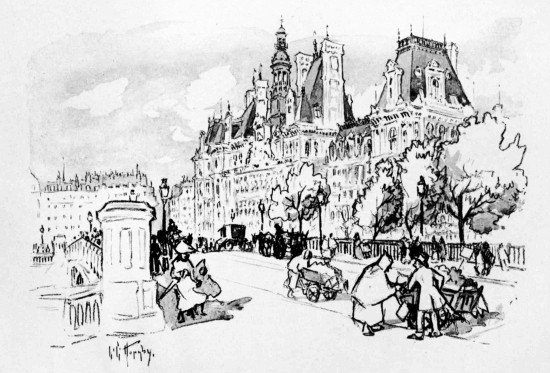
Hôtel de Ville from the Pont d'Arcole
My mind went back to the dark week of 1910, which I have just described.
Comments of the Salon crowd were identical in reaction to those we heard
after the flood. "Outrageous, the incurie of the municipal
authorities! Something should be done to protect us against this
constant digging. Why, it won't be safe to stick your nose out of doors.
These awful accidents—in Paris, mind you! Something must be done!"
For an hour it went on like that. Then the storm stopped. The sun, still
high at six in June, broke through the clouds. The wind died down. I
started up to the Champs-Elysées with the crowd. More newsboys! This
time the principal headline announced the trial of Madame Caillaux. The
Parisians—and I with them—went down into the Métro. An hour ago such a
risky undertaking would have caused us to shudder with horror. No more
underground for us! As I waited in line for my ticket, the man in front
of me said to his wife, "Now do you really think that Madame Caillaux—"
I laughed to myself. The Medes and Persians boasted of not changing
their laws. The Parisians could boast of not changing their mentality. A
danger over is a danger forgotten. Hurrah for the new sensation! My
readers may think me guilty of skipping suddenly backwards and forwards
in this book from one thing to something entirely different. But
remember that I am writing in Paris and about Paris. Paris is like that.
I went forward to 1914 to get an illustration for 1910. The very day
after we were sure the flood was going down, we lost interest in the
Seine. Our great project of an emergency channel for turning the Seine
at flood-time died in twenty-four hours and will not be revived until
Paris is actually being once more submerged. Actualité is a word for
which we Anglo-Saxons have no equivalent. It means the
thing-of-the-moment-which-is-of-prime-interest. And the press can create
a new actualité overnight.
The Government did this several times during the war in order to relieve
a tense internal political situation. During the last German drive we
had the affair of the false Rodins, and we turned to read about the new
statue exposed as a fake each day before we looked for the new German
advance. When the Clemenceau Cabinet was threatened, a twentieth-century
Bluebeard, with the police daily discovering new wives, was dished up to
us every morning in all the papers.
Back in 1910 we turned from the flood to Chantecler. After seven years
of heralding and "puffing," after many mysterious delays that whetted
the appetite, the management of the Théâtre de la Porte Saint-Martin
announced that the curiosity of Paris would be rewarded at the end of
January. The flood was the last postponement. The waters had hardly
begun to recede before public interest was again centred upon
Chantecler. When the répetition générale was given on February
sixth, oldest inhabitants and historians of the French theatre were
agreed that not even Hernani nor yet Le Mariage de Figaro had created
so universal an anticipatory interest. Was Chantecler merely an
eccentric literary endeavor or was it to prove a practical theatrical
venture? More than any living writer Rostand had been able to win for
his plays recognition as literature and recognition as "money-winners"
in the theatres of foreign countries as well as his own.
Looking back over a decade I may be wrong in comparing a past with a
present event. But I honestly believe that there was far more interest
in Paris in what was going on at the Porte-Saint-Martin on the evening
of February 6, 1910, than in what took place at Versailles on the
afternoon of June 28, 1919. Interest was lost in the Treaty of
Versailles before it was signed. Chantecler had a fighting chance to
succeed. Just as the curtain started to rise before the cream of French
literary and theatrical circles there was a cry of "Pas encore!" M.
Jean Coquelin sprang up from the prompter's box in conventional evening
dress. Was there to be another postponement—a fiasco in the presence of
the invited guests? No: for M. Coquelin began to recite a prologue,
inimitably phrased. He told the audience that they were to be introduced
to a barnyard as soon as the farmer's family had gone. It was Sunday
afternoon, and when the chores were finished, the animals would be left
to themselves. As he spoke, numerous illustrative sounds came from the
stage. We heard the young girls going off with a song on their lips, the
wheels of a receding carriage, the bells of the village church, and
shots of hunters out for their Sunday sport. Then M. Coquelin
disappeared, and the curtain went up.
The first two acts were wildly received. The third act was too long and
modernisms marred the beauty of the verse. The lyrical continuity of the
play was broken by the introduction of a purely satirical effect. The
real reason for lack of sustained interest was the mental confusion and
weariness of having to imagine the actors as animals. The human mind is
incapable of receiving through the sense of vision a representation of
the unreal, where the real is at the same time glaringly evident, and
keep clear, harmonious, concordant images. No ingenuity could make an
actor's figure like a bird's. And then humans do not differ in size like
birds. There was no way of approximating widely different proportions of
the rooster, the black-bird, the pheasant and the nightingale.
In watching Chantecler I had the same painful impression of how we are
handicapped by the multiplicity of necessities we have created for
ourselves in modern days as I had in watching the flood. Our evolution
has bound us fast with chains of our own forging. Physically and
mentally, we have manufactured so many props to lean upon that we can no
longer stand on our own feet. Chantecler cannot be compared with the
animal plays of Aristophanes for in Greek drama there was no attempt to
present to the spectators a visual image in harmony with the audile
image. Nor even in Shakespeare's time was the dramatist limited by the
difficulties of a mise en scène. A Midsummer Night's Dream was an
easier proposition for the Elizabethan actor than for Sir Herbert
Beerbohm Tree, despite the properties of Her Majesty's Theatre, the
hidden orchestra playing Mendelssohn's music, and the magic aerial
ballets.
Our next "real show" was the political campaign for the new Chamber of
Deputies that was to inaugurate the fifth decade of the Third Republic
on June first. Herbert spent an inordinate amount of time, I thought, in
puzzling out the voting strength of the Ministerialist and Opposition
groups, and patiently wrote articles for American magazines about
Radical Socialists, Clemenceau and Caillaux, to vary his Turkish
articles. But whether he treated of French leaders and politics or of
Venizelos or of the Young Turks, his articles invariably came back with
a polite rejection slip. We put them away and sold them later, when they
were out of date, for more than we would have gotten then. Our money for
writing came from the Herald, and we realized that if you want to
make your living by writing the anchor to a newspaper is not lightly to
be weighed.
But though I was not even mildly interested in Radical Socialists,
Republicans of the Left, Independent Socialists, Progressists and what
not, I did like to go to political meetings. They were good for your
French and good for the opportunity of studying the influence of
politics upon the Latin character. How the French love meetings! They
use our English word instead of réunion, just as they always speak of
self-government. But they are not at all like us in politics. There are
as many parties as there are leaders, and their campaigns center around
personalities, not principles.
In 1910, the first round of the election was on April 24, and the final
round on May 8. It just happened that May first was a Sunday, and fell
between the two election Sundays. Throughout the Third Republic, Labor
Day has been a time of fear and trembling for the Paris bourgeoisie.
The Cabinet is always anxious on May first. You never can tell what is
going to happen when crowds gather in Paris: so the wise Government does
not allow trouble to be started. Encouraged by the success of their
Ferrer demonstration on the Boulevard de Clichy a few months before, the
revolutionary elements decided to make May Day a big event with the hope
of influencing the second round of the elections. Premier Briand decided
there would be no May Day parade. Believing that the Government would
not dare to come into conflict with them in the midst of their election
struggle, workingmen's unions plastered Paris with boastful posters
announcing a monster demonstration in the Bois de Bologne, followed by a
parade to the Place de la Concorde. This was in open defiance to the
law, which requires a permit for gatherings in the open air and for
parades. But M. Briand was equal to the occasion. Saturday night he
threw twenty thousand troops into Paris. They bivouacked in the Place de
la Concorde, the Place de l'Etoile, and in the Bois. I took Christine to
church. After the service, we went to the Bois for lunch. There were
troops on every road in the part of the Bois indicated in the posters as
the workingmen's rendez-vous. Here and there little tents with the Red
Cross flag were pitched, and to make the picture more impressive doctors
in white coats stood before the door. This scared the workingmen more
than the soldiers did. We saw many of them in their blue blouses. But
they took care not to stop or to walk in numbers.
The bourgeoisie were able to rest easy. Assured that order would be
kept, fashionable Paris flocked in great numbers to the Longchamp races.
Of course we went, too. As Herbert had a story, he bought the best
seats. We were not far from President Fallières, and we saw the spring
fashions. Scrappie created as much of a sensation as some of the gowns.
People who frequent Longchamp are not in the habit of bringing babies
with them. But with me it is always, "love me, love my child."
The unions did not have good luck in the spring of 1910. But no more did
the clericals and monarchists. Hopes of a clerical reaction were
dissipated. Briand was as bitter against the orders as against the
unions. The royalists no longer count. We had many royalist friends.
Some we knew well enough to ask, "How goes the propaganda?" And they
knew us well enough to answer, "Pas de blague! C'est à rire!" "Stop
teasing me: it's a joke!" The Duke of Orleans has about as much chance
of being King of France as he has of being President of the United
States. In our estimates of political conditions are we not too apt to
judge France by her checkered past? There is no government in Europe
more assured of stability than the French Republic: and this was as true
in 1910 as it is in 1919.
Public lectures are a source of diversion to Parisians. We Americans
think that we are great on listening to ourselves and others talk. But
crowds in France do not need a political campaign, a religious revival
or a return from near the North Pole to come together for a lecture. The
most surprising topics, treated by men who are not in the public eye,
draw attentive and assiduous audiences. Every day you have a wealth of
choice in free lectures in Paris. Some newspapers publish the lecture
program of the day just as naturally as they publish the theatrical
offerings. At the Sorbonne, the Collège de France, the Ecole des
Hautes-Etudes, the Ecole des Sciences Politiques, the Ecole des Chartes,
the various Musées, and a host of other organizations offer single
lectures and courses of lectures, week days and Sundays, either free or
for a very slight fee. Many of the best courses in the various Facultés
of the University of Paris are open to the public. Just to give one
instance of popular interest in a rather technical subject, we used to
attend the courses in physical geography of Professor Brunhes at the
Collége de France. That year he was treating the formation of the
mountainous center of France. If you did not go early, your chances of a
seat were slim. There were always people standing thronged at the doors
way out into the hall. This was not unusual. Any man who knew his
subject and who could treat it with vigor and wit was sure of a salle
comble. His subject did not matter. One did not have to spend money:
free courses were as attractive as those for which a fee was charged. We
discovered that Parisians never cease going to school. One is accustomed
to see only young faces in the class-rooms of American universities. In
the Sorbonne and the Collège de France there are students from sixteen
to seventy.
If music is your passion, you can indulge it to the full in Paris. With
the Opéra and Opéra Comique and Opéra Municipal, there is something
that you really want to see every day, and when the music does not
particularly attract you, you can be sure of an excellent
divertissement, as the ballet spectacle is called. Parisians love
choregraphy. And there is choregraphy for all tastes and all moods.
Paris is the mother of the spectacle called revue. We have borrowed
the name but not the thing. No revue can be successful in Paris unless
it possesses distinct quality in dances, costumes, mise en scène, and
especially in the dialogue. The revue must reflect what Parisians are
thinking about, take into account actualités, and interpret the events
of the day. This means constant change in the dialogue, suppression of
old and introduction of new scenes, to the point where you can go to the
same revue in the third month of its run and find something entirely
different as far as the lines go. For six months of the year the bands
of the Garde Républicaine and of the regiments stationed in Paris play
in the gardens and squares on Thursdays and Sundays. The Tuileries
offers from April to October open-air opera and concerts in the heart of
the city. You pay only for your chair.
The foreigner resident in Paris soon becomes aware that he does not have
to leave his own quarter to find a good evening's entertainment. Real
Paris shows are perhaps best to be found far from the Grands Boulevards,
Clichy and Montmartre. From the heights of superior opportunity one
does not want to look down upon the tourist and tell him that he doesn't
really see Paris. But the fact remains that when theatres and
music-halls and restaurants become rendezvous for foreigners they
insensibly lose their distinctive local atmosphere. They begin to cater
to the tourist trade and give their audiences what they come to see.
This is so true of the Folies-Bergère, the Casino de Paris and other
large music-halls that the program has become half English and the
actresses and choruses and clowns are as often of London as of Paris
origin. The same foreign invasion on the stage, following the invasion
in the audience, is to be found at the Ambassadeurs and Marigny on the
Champs-Elysées. Alas! even the Concert Mayol type of music-hall has
succumbed to the temptation of catering to the big world. English and
American "turns" are dragged in by the ears to enliven revues for
those who do not understand French, and the spectacle has become a
totally un-Parisian jumble of vaudeville. But in the little music-halls
of the quarters one still finds the atmosphere that Parisians love and a
program offered to their taste. Herbert and I used to go to a theatre on
the Boulevard Saint-Germain, just off the Boulevard Saint-Michel, where
plays were typically Parisian. Another such theatre exists in the Rue de
la Gaité. In the same street are three music-halls that put on songs and
stage revues for Parisians. There are probably a hundred theatres and
music-halls of this kind whose names do not appear in Baedeker, and
which have resisted successfully the first decade of cinema competition.
Last of all among real Paris shows the foires must not be forgotten.
But I speak of these in another chapter because visiting them is a goal
for a promenade and not the deliberate seeking of an evening's
entertainment. You take in a foire as incidental to a walk, just as
your apéritif or your after-dinner coffee is most often the price you
pay for a seat to watch the passing crowd, which, when all is said and
done, is the real Paris show.
MY critic points out that after having been so enthusiastic about walks
at nightfall and having put myself on record as to the exceptional
advantages of seeing Paris in the dark on winter afternoons, rain or
shine, I shall be inconsistent in extolling daylight Paris. Why the
spell of June, when your walks are wholly in daylight? If it were
inconsistency, being a woman I should be within my rights to ask the
critic what he expected. But is it inconsistent? I think not. If I love
to go out in the rain, if I enjoy city streets at night time, it does
not follow that I do not enjoy good weather and the long days of June.
It is another aspect of Paris that we get in our walks. We have time to
go on longer excursions. We "do" the river and open spaces more than old
quarters. And, best of all, in the two Junes of our early married life,
we took the baby with us on our strolls. I felt the spell of June when
we returned to Paris from Turkey in 1909. I felt it more when we were
going back to Turkey in 1910. And ever since, the Paris June has had a
charm all its own, deepening with the years. However I may like autumn
and winter and spring, June is the best month. The spell is partly due
to the knowledge that one is soon going off to the shore or mountains
for the summer, and partly to the thought that it might be the last
June. Each year we have felt that we ought to return to America in the
autumn.
In the Rue Servandoni year, April and May were cold, wet months. Spring
fever did not get us until June. Then we decided that all the wisdom and
profit of our Paris year was not to be found in the Bibliothèque
Nationale. We began to divorce ourselves from daily study by the excuse
that we ought to get together a small library on Turkish history. Where
could the books be bought more advantageously than on the quais? From
the Pont des Saints-Pères to beyond Notre-Dame the parapets of the Rive
Gauche are used by second-hand booksellers for the display of their
wares. The bouquinistes clamp wooden cases on the stone parapets. You
can go for more than a mile with the certainty of finding something
interesting at an astonishingly low price. There is no more delightful
form of loafing in the open air. The books are an excuse. They become a
habit. In order to prevent the habit from growing costly, you must make
out a budget. Some days you are only "finding out what is there"; other
days, before leaving home, you divest yourself of all the money in your
pocketbooks and wallet except what you feel you can afford to spend.
Then only are you safe! I do not know of a more insidious temptation to
buy what you do not need than loitering along the quais of the Rive
Gauche. In a few days we spent all we could afford for Turkish history.
But the afternoon walk started earlier and ended later. We never tired
of the quais and the river. We watched fishermen and the barges. We
were amused by the men who bathe and clip dogs. We explored the streets
between the Seine and the Boulevard Saint-Germain. We stood on the Pont
des Arts and watched the people coming home from work. We went often
into Notre-Dame. We glued our noses to the window-glass of the art print
shops around the Ecole des Beaux-Arts. We selected furniture (from the
side-walk!) displayed in the numerous antique shops of the Rue des
Saints-Pères, the Rue Bonaparte and the Rue de Seine. We always came
back at sunset, with the westward glow before us. That was when our
oldest daughter got the taste of going to bed late.
The narrowest street in Paris is the Rue de Venise, which runs from the
Rue Beaubourg across the Rue Saint-Martin to the Rue Quicampoix. But
neither in itself nor in its location is it as picturesque as the Rue de
Nevers, luring you from the Pont Neuf as you cross to the Rive Gauche.
Nowhere else in Paris is one so completely held by the past as in the
Rue de Nevers. Here stood the Tour de Nesle. The Mint now comes up to
one side of this street for a few hundred feet, but elsewhere it is on
both sides as it was in the time of Henri IV. Massive doorways, with
bars of iron and peep-holes covered with grating, tell the story of a
time when one relied upon himself for protection. No agents in the
Paris of the fifteenth century! Going down to the river from the Rue
Servandoni, we always took the Rue de Nevers. In it Scrappie's carriage
seemed like a full-grown vehicle. There was always the nervous fear that
something would be thrown out on us from upper windows, not unjustified,
as more than one narrow escape proved. We used to say that when the baby
was grown up, we should enjoy taking her on one of the promenades of her
infancy, and especially through the Rue de Nevers. We have shown
Christine the street, and hope that she will remember it. But she will
never show it to her children. Some sanitary engineer, successor of
Baron Haussmann, has conceived a project of widening the Rue Dauphine.
The Rue de Nevers will soon disappear. Our only hope is that the war
will have delayed a long time the fulfillment of projects that mean the
disappearance of what remains of mediaeval Paris.
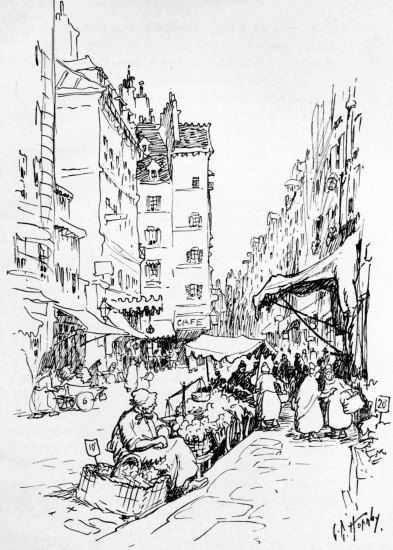
Market day in the Rue de Seine
The Parisian who goes to New York marvels at our skyscrapers. He is
properly impressed with the hustle and bustle of the New World. But it
does not take him long to note the absence of wide boulevards and the
lack of ensemble in the cityscape. Then he will invariably make two
comments: "There are no trees," and "There is no place to sit down."
Except the Eiffel Tower, Paris does not boast of a "biggest in the
world." It will take Americans centuries to acquire a sense of harmony
and proportion in city building. But shall we ever learn to bring the
out-of-doors into city life? Until we do learn the big American city
will be intolerable in the summer months. Paris, built on ancient
foundations, has increased to a city of millions, and one still feels
that an outing does not mean going to the country. Boulevards and
quais are lined with trees. Every open spot has grass and flowers.
Best of all, when you want to sit down to read your paper or look at the
crowd, there is always a bench. You do not have to go home or indoors to
rest, and wherever you live, a park or boulevard is near at hand.
Parisians are as closely huddled together as New Yorkers. But they can
spend all their leisure time in the open. The privilege of sitting down
on a bench is a blessing. All the year round you can eat or drink out of
doors. I have often marveled at the criticism that the French dislike
open air, simply because they, like other Europeans, do not keep their
windows open at night. The Parisian lives far more in the open air than
the American does. To be out of doors day and night is a natural
instinct from the cradle to the grave. Trees and benches are a large
part of the spell of June in Paris.
Then there were the omnibuses with their impériales. When we did not
have the price of a cab, we could get on top of the Montsouris-Opéra or
Odéon-Clichy bus, and go for a few sous from south to north across the
river through the heart of Paris. We climbed to the impériale of the
tram at Saint-Sulpice and rode to Auteuil, on the horse-drawn omnibus
from the Madeleine to the Bastille, from the Place Saint-Michel to the
Gare Saint-Lazare, from the Gare Montparnasse to La Villette, from the
Bourse to Passy, from the Panthéon to Courcelles. Alas! horses and
impériales disappeared before the war. The last omnibus with three
horses abreast was the Panthéon-Courcelles line. It was replaced by
closed motor-bus in 1913. Each year, when June comes round, I long for
these rides. Horses, I suppose, are gone forever. But we still hope for
the revival of an upper story on our motor-buses. There never was—or
will be—a better way of having Paris vistas become a part of your very
being.
Foire means fair. But the term is used for a much more intimate and
vital sort of a fair than we have. The French have big formal fairs in
buildings and grounds, where a little fun is mixed in with a lot of
business. But they have also small street fairs, solely for amusement,
and selling street fairs, where amusements have their full share. The
Paris foires are a distinct institution. There is a regular schedule
for them, as for Brittany pardons. From the end of March to the
beginning of November you can always find a foire in the city or the
suburbs. They are held out of doors, generally in the center of a
boulevard. Some of them are important institutions. In the business
foires you range from scrap-iron, old clothes and nicked china and
disreputable furniture at the Porte Saint-Ouen and on the Boulevard
Richard Lenoir to the costliest Paris has to offer on the Esplanade des
Invalides and building materials and engines in the Tuileries. The
purely amusement foires on the Quai d'Orsay, the Boulevard de Clichy,
and at Saint-Cloud stretch for blocks and are attended by all Paris. To
go to them is the thing to do.
But each quarter has its foire, underwritten by the shop-keepers and
café proprietors of the neighborhood. They are never widely heralded,
you stumble upon them by chance. And if you want to see real Paris the
little foires give you the closest glimpse it is possible to get of
Paris at play. At the foires de quartier there are no onlookers.
Everybody is taking part. If you do not feel the impulse to get on the
merry-go-round, the dipping boats, the scenic-railway; if you are averse
to having your fortune told; if you feel doubtful of your ability to
throw a wooden ring around the neck of a bottle of champagne; if you are
indifferent to the mysteries of the two-headed calf and the dancing
cobra; if your stomach does not digest pain d'épice and candy made of
coal-tar; if you think your baby ought not to have a rubber-doll or a
woolly lamb or a jumping rabbit made of cat's fur—for heaven's sake
stay away from the foires!
Most of the neighborhood foires are held in June. Whatever direction
you take for your evening walk, your ears will give you a goal towards
which to work. The merry-go-rounds have the same class of music as in
America, and the tricks of the barkers—their figures of speech
even—are the same. But the difference between our amusement parks and
the Paris foires is the spontaneous atmosphere of the foires, their
setting improvised in the midst of the city, and the amazing childlike
quality of the fun. Seven or seventy, you enjoy the wooden horses just
as much. And there is no dignity to lose. You do not care a bit if your
cook sees you wildly pushing a fake bicycle or standing engrossed in the
front row of the crowd watching a juggler.
The glorious days of June, when we put work deliberately out of our
scheme of things, furnish opportunities for excursions of a different
character than those of Sunday. At the risk of being ridiculed again by
my critic, who has read my praise of repos hebdomadaire, I must
confess that Sunday has its drawbacks. The whole city is out on Sunday,
and every place is crowded. Your good time is somewhat marred all day
long by the anticipation of the crowded trains and trams, for a place in
which you wait with much less equanimity than when you left home in the
morning. On week days there are no waits and plenty of room. I can
entice my husband from his work—if it is June!
It is surprising how far afield it is possible to go at little drain on
your strength and pocket-book on a June week-day. We wanted just the
country sometimes. Then it was the valley of Chevreuse,
Villers-Cotteret, luncheon in a tree at Robinson, or the Marne between
Meaux and Château-Thierry. On a very bright day one could choose the
shade of Compiègne, Chantilly, Rambouillet, Versailles, Marly,
Saint-Germain-en-Laye, Saint-Cloud, Fountainebleau, forests and parks
incomparable. Cathedral-hungry or in a mood for the past, Amiens,
Beauvais, Evreux, Dreux, Orléans, Mantes, Chartres, Sens, Troyes,
Rheims, Laon, Soissons, Noyon, and Senlis are from one to three hours by
train. A good luncheon at little cost is always easily found. And after
lunch you have no difficulty in getting a cocher to take you to the
ruins of a castle or abbey for a few francs.
Inexhaustible as is the banlieue of Paris you are always glad to get
back. From whatever direction you return, the first you see of the great
city is the Eiffel Tower. It beckons you back to the spell of June—in
Paris.