Soirée dansante.—Young Ladies.—Old Ladies.—Anecdote.—The
Consolations of Chaperones.—Flirtations.—Discussion
upon the variations between young Married Women
in France and in England.—Making love by deputy.—Not
likely to answer in England.
Last night we were at a ball,—or rather, I
should say, a "soirée dansante;" for at this season,
though people may dance from night to morning,
there are no balls. But let it be called by what
name it may, it could not have been more gay
and agreeable were this the month of January
instead of May.
There were several English gentlemen present,
who, to the great amusement of some of the
company, uniformly selected their partners from
among the young ladies. This may appear very
natural to you; but here it is thought the most
unnatural proceeding possible.
To a novice in French society, there is certainly
no circumstance so remarkable as the different
position which the unmarried hold in the
drawing-rooms of England and les salons of
France. With us, the prettiest things to look at,
and the partners first sought for the dance, are
the young girls. Brilliant in the perfection of
their youthful bloom, graceful and gay as young
fawns in every movement of the most essentially
juvenile of all exercises, and eclipsing the light
elegance of their own toilet by loveliness that
leaves no eyes to study its decoration,—it is
they who, in spite of diamonds and of blonde, of
wedded beauty or of titled grace, ever appear
to be the principal actors in a ball-room. But
"they manage these matters" quite otherwise
"in France."
Unfortunately, it may sometimes happen among
us, that a coquettish matron may be seen to lead
the giddy waltz with more sprightliness than
wisdom; but she always does it at the risk of
being mal notée in some way or other, more or
less gravely, by almost every person present;—nay,
I would by no means encourage her to be
very certain that her tonish partner himself would
not be better pleased to whirl round the mazy
circle with one of the slight, light, sylph-like
creatures he sees flying past him, than with the
most fashionable married woman in London.
But in Paris all this is totally reversed; and,
what is strange enough, you will find in both
countries that the reason assigned for the difference
between them arises from national attention
to good morals.
On entering a French ball-room, instead of seeing
the youngest and loveliest part of the company
occupying the most conspicuous places, surrounded
by the gayest men, and dressed with the
most studied and becoming elegance, you must
look for the young things quite in the background,
soberly and quietly attired, and almost
wholly eclipsed behind the more fully-blown beauties
of their married friends.
It is really marvellous, considering how very
much prettier a girl is at eighteen than she can
possibly be some dozen years afterwards, to see
how completely fashion will nevertheless have its
own way, making the worse positively appear the
better beauty.
All that exceeding charm and fascination which
is for ever and always attributed to an elegant
Frenchwoman, belongs wholly, solely, and altogether
to her after she becomes a wife. A young
French girl, "parfaitement bien élevée," looks ...
"parfaitement bien élevée;" but it must be confessed,
also, that she looks at the same time as
if her governess (and a sharp one) were looking
over her shoulder. She will be dressed, of course,
with the nicest precision and most exact propriety;
her corsets will forbid a wrinkle to appear
in her robe, and her friseur deny permission to
any single hair that might wish to deviate from
the station appointed for it by his stiff control.
But if you would see that graceful perfection of
the toilet, that unrivalled agacerie of costume
which distinguishes a French woman from all
others in the world, you must turn from mademoiselle
to madame. The very sound of the
voice, too, is different. It should seem as if the
heart and soul of a French girl were asleep, or
at least dozing, till the ceremony of marriage
awakened them. As long as it is mademoiselle
who speaks, there is something monotonous, dull,
and uninteresting in the tone, or rather in the
tune, of her voice; but when madame addresses
you, all the charm that manner, cadence, accent
can bestow, is sure to greet you.
In England, on the contrary, of all the charms
peculiar to youthful loveliness, I know none so
remarkable as the unconstrained, fresh, natural,
sweet, and joyous sound of a young girl's voice.
It is as delicious as the note of the lark, when
rising in the first freshness of morning to meet
the sun. It is not restrained, held in, and checked
into tameness by any fear lest it should too
early show its syren power.
Even in the dance itself, the very arena for
the display of youthful gracefulness, the young
French girl fails, when her well-taught steps are
compared with the easy, careless, fascinating
movements of the married woman.
In the simple kindness of manner too, which,
if there were no other attraction, would ever
suffice to render an unaffected, good-natured
young girl charming, there must be here a cautious
restraint. A demoiselle Française would be
prevented by bienséance from showing it, were she
the gentlest-hearted creature breathing.
A young Englishman of my acquaintance, who,
though he had been a good deal in French society,
was not initiated into the mysteries of female
education, recounted to me the other day an adventure
of his, which is german to the matter,
though not having much to do with our last
night's ball. This young man had for a long
time been very kindly received in a French family,
had repeatedly dined with them, and, in
fact, considered himself as admitted to their house
on the footing of an intimate friend.
The only child of this family was a daughter,
rather pretty, but cold, silent, and repulsive in
manner—almost awkward, and utterly uninteresting.
Every attempt to draw her into conversation
had ever proved abortive; and though often
in her company, the Englishman hardly thought
she could consider him as an acquaintance.
The young man returned to England; but, after
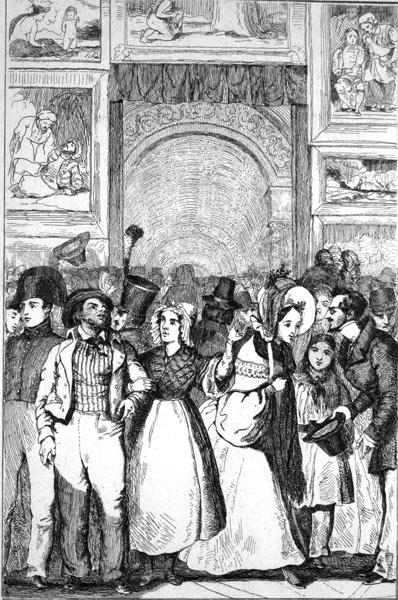
some months, again revisited Paris. While standing
one day in earnest contemplation of a picture
at the Louvre, he was startled at being suddenly
addressed by an extremely beautiful woman, who
in the kindest and most friendly manner imaginable
asked him a multitude of questions—made a
thousand inquiries after his health—invited him
earnestly to come and see her, and concluded by
exclaiming—"Mais c'est un siècle depuis que je
vous ai vu."
My friend stood gazing at her with equal admiration
and surprise. He began to remember
that he had seen her before, but when or where
he knew not. She saw his embarrassment and
smiled. "Vous m'avez oublié donc?" said she.
"Je m'appelle Eglé de P——.... Mais je suis
mariée...."
But to return to our ball.
As I saw the married women taken out to
dance one after the another, till at last there was
not a single dancing-looking man left, I felt myself
getting positively angry; for, notwithstanding
the assistance given by my ignorant countrymen,
there were still at least half a dozen French girls
unprovided with chevaliers.
They did not, however, look by many degrees
so sadly disappointed as English girls would do
did the same misfortune betide them. They, like
the poor eels, were used to it; and the gentlemen,
too, were cruelly used to the task of torture,—making
their pretty little feet beat time upon the
floor, while they watched the happy wedded in
pairs—not wedded pairs—swim before their eyes
in mazes which they would most gladly have
threaded after them.
When at length all the married ladies, young
and old, were duly provided for, several staid
and very respectable-looking gentlemen emerged
from corners and sofas, and presenting themselves
to the young expectants, were accepted with quiet,
grateful smiles, and permitted to lead them to the
dance.
Old ladies like myself, whose fate attaches
them to the walls of a ball-room, are accustomed
to find their consolation and amusement from
various sources. First, they enjoy such conversation
as they can catch; or, if they will sit tolerably
silent, they may often hear the prettiest airs
of the season exceedingly well played. Then the
whole arena of twinkling feet is open to their
criticism and admiration. Another consolation,
and frequently a very substantial one, is found in
the supper;—nay, sometimes a passing ice will be
caught to cheer the weary watcher. But there is
another species of amusement, the general avowal
of which might lead the younger part of the civilized
world to wish that old ladies wore blinkers:
I allude to the quiet contemplation of half a dozen
sly flirtations that may be going on around them,—some
so well managed! ... some so clumsily!
But upon all these occasions, in England, though
well-behaved old ladies will always take especial
care not so to see that their seeing shall be seen,
they still look about them with no feeling of restraint—no
consciousness that they would rather
be anywhere else than spectators of what is
going forward near them. They feel, at least
I am sure I do, a very comfortable assurance
that the fair one is engaged, not in marring, but
in making her fortune. Here again I may quote
the often-quoted, and say, "They manage all
these matters differently at least, if not better, in
France."
In England, if a woman is seen going through
all the manœuvres of the flirting exercise, from
the first animating reception of the "How d'ye
do?" to the last soft consciousness which fixes
the eyes immovably on the floor, while the head,
gently inclined, seems willing to indulge the happy
ear in receiving intoxicating draughts of parfait
amour,—when this is seen in England, even
should the lady be past eighteen, one feels assured
that she is not married; but here, without
scandal or the shadow of scandal be it spoken,
one feels equally well assured that she is. She
may be a widow—or she may flirt in the innocence
of her heart, because it is the fashion; but she
cannot do it, because she is a young lady intending
to be married.
I was deeply engaged in these speculations last
night, when an elderly lady—who for some reason
or other, not very easy to divine, actually never
waltzes—came across the room and placed herself
by my side. Though she does not waltz, she
is a very charming person; and as I had often
conversed with her before, I now welcomed her
approach with great pleasure.
"A quoi pensez-vous, Madame Trollope?" said
she: "vous avez l'air de méditer."
I deliberated for a moment whether I should
venture to tell her exactly what was passing in
my mind; but as I deliberated, I looked at her,
and there was that in her countenance which
assured me I should have no severity to fear if I
put her wholly in my confidence: I therefore replied
very frankly,—
"I am meditating; and it is on the position
which unmarried women hold in France."
"Unmarried women?... You will scarcely
find any such in France," said she.
"Are not those young ladies who have just
finished their quadrille unmarried?"
"Ah!... But you cannot call them unmarried
women. Elles sont des demoiselles."
"Well, then, my meditations were concerning
them."
"Eh bien...."
"Eh bien.... It appears to me that the ball is
not given—that the music does not play—that the
gentlemen are not empressé, for them."
"No, certainly. It would be quite contrary
to our ideas of what is right if it were so."
"With us it is so different!... It is always
the young ladies who are, at least, the ostensible
heroines of every ball-room."
"The ostensible heroines?"... She dwelt
rather strongly upon the adjective, adding with a
smile,—"Our ostensible, are our real heroines
upon these occasions."
I explained. "The real heroines," said I,
"will, I confess, in cases of ostentation and display,
be sometimes the ladies who give balls in return."
"Well explained," said she, laughing: "I certainly
thought you had another meaning. You
think, then," she continued, "that our young
married women are made of too much importance
among us?"
"Oh no!" I replied eagerly: "it is, in my
opinion, almost impossible to make them of too
much importance; for I believe that it is entirely
upon their influence that the tone of society depends."
"You are quite right. It is impossible for those
who have lived as long as we have in the world
to doubt it: but how can this be, if, upon the
occasions which bring people together, they are to
be overlooked, while young girls who have as yet
no position fixed are brought forward instead?"
"But surely, being brought forward to dance in
a waltz or quadrille, is not the sort of consequence
which we either of us mean?"
"Perhaps not; but it is one of its necessary
results. Our women marry young,—as soon, in
fact, as their education is finished, and before
they have been permitted to enter the world, or
share in the pleasures of it. Their destiny, therefore,
instead of being the brightest that any women
enjoy, would be the most triste, were they
forbidden to enter into the amusements so natural
to their age and national character, because they
were married."
"But may there not be danger in the custom
which throws young females, thus early and irrevocably
engaged, for the first time into the society,
and, as it were, upon the attentions of men whom
it has already become their duty not to consider
as too amiable?"
"Oh no!... If a young woman be well-disposed,
it is not a quadrille, or a waltz either, that
will lead her astray. If it could, it would surely
be the duty of all the legislators of the earth to
forbid the exercise for ever."
"No, no, no!" said I earnestly; "I mean nothing
of the kind, I assure you: on the contrary,
I am so convinced, from the recollections of my
own feelings, and my observations on those of
others, that dancing is not a fictitious, but a
real, natural source of enjoyment, the inclination
for which is inherent in us, that, instead of wishing
it to be forbidden, I would, had I the power,
make it infinitely more general and of more frequent
occurrence than it is: young people should
never meet each other without the power of
dancing if they wished it."
"And from this animating pleasure, for which
you confess that there is a sort of besoin within
us, you would exclude all the young women
above seventeen—because they are married?...
Poor things!... Instead of finding them so willing
as they generally are to enter on the busy
scenes of life, I think we should have great difficulty
in getting their permission to monter un
ménage for them. Marriage would be soon held
in abhorrence if such were its laws."
"I would not have them such, I assure you,"
replied I, rather at a loss how to explain myself
fully without saying something that might either
be construed into coarseness of thinking and a
cruel misdoubting of innocence, or else into a
very uncivil attack upon the national manners:
I was therefore silent.
My companion seemed to expect that I should
proceed, but after a short interval resumed the
conversation by saying,—"Then what arrangement
would you propose, to reconcile the necessity
of dancing with the propriety of keeping married
women out of the danger which you seem to imagine
might arise from it?"
"It would be too national were I to reply, that
I think our mode of proceeding in this case is
exactly what it ought to be."
"But such is your opinion?"
"To speak sincerely, I believe it is."
"Will you then have the kindness to explain
to me the difference in this respect between
France and England?"
"The only difference between us which I
mean to advocate is, that with us the amusement
which throws young people together under
circumstances the most likely, perhaps, to elicit
expressions of gallantry and admiration from the
men, and a gracious reception of them from the
women, is considered as befitting the single rather
than the married part of the community."
"With us, indeed, it is exactly the reverse," replied
she,—"at least as respects the young ladies.
By addressing the idle, unmeaning gallantry inspired
by the dance to a young girl, we should
deem the cautious delicacy of restraint in which
she is enshrined transgressed and broken in
upon. A young girl should be given to her
husband before her passions have been awakened
or her imagination excited by the voice of
gallantry."
"But when she is given to him, do you think
this process more desirable than before?"
"Certainly it is not desirable; but it is infinitely
less dangerous. When a girl is first
married, her feelings, her thoughts, her imagination
are wholly occupied by her husband.
Her mode of education has ensured this; and
afterwards, it is at the choice of her husband
whether he will secure and retain her young
heart for himself. If he does this, it is not a
waltz or quadrille that will rob him of it. In
no country have husbands so little reason to
complain of their wives as in France; for in no
country does the manner in which they live with
them depend so wholly on themselves. With
you, if your novels, and even the strange trials
made public to all the world by your newspapers,
may be trusted, the very reverse is the case.
Previous attachments—early affection broken off
before the marriage, to be renewed after it—these
are the histories we hear and read; and
most assuredly they do not tempt us to adopt
your system as an amendment upon our own."
"The very notoriety of the cases to which
you allude proves their rare occurrence," replied I.
"Such sad histories would have but little interest
for the public, either as tales or trials, if they
did not relate circumstances marked and apart
from ordinary life."
"Assuredly. But you will allow also that,
however rare they may be in England, such
records of scandal and of shame are rarer still
in France?"
"Occurrences of the kind do not perhaps produce
so much sensation here," said I.
"Because they are more common, you would
say. Is not that your meaning?" and she smiled
reproachfully.
"It certainly was not my meaning to say so,"
I replied; "and, in truth, it is neither a useful
nor a gracious occupation to examine on which
side the Channel the greater proportion of virtue
may be found; though it is possible some good
might be done on both, were the education in
each country to be modified by the introduction
of what is best in the other."
"I have no doubt of it," said she; "and as we
go on exchanging fashions so amicably, who knows
but we may live to see your young ladies shut up
a little more, while their mothers and fathers look
out for a suitable marriage for them, instead of
inflicting the awkward task upon themselves?
And in return, perhaps, our young wives may lay
aside their little coquetries and become mères respectables
somewhat earlier than they do now.
But, in truth, they all come to it at last."
As she finished speaking these words, a new
waltz sounded, and again a dozen couples, some
ill, some well matched, swam past us. One of
the pairs was composed of a very fine-looking
young man, with blue-black favoris and moustaches,
tall as a tower, and seeming, if air and
expression may be trusted, very tolerably well
pleased with himself. His danseuse might unquestionably
have addressed her husband, who
sat at no great distance from us, drawing up
his gouty feet under his chair to let her pass,
in these touching words:—
"Full thirty times hath Phœbus' cart gone round
Neptune's salt wash and Tellus' orbed ground,
And thirty dozen moons, with borrow'd sheen,
About the world have times twelve thirties been,
Since Love our hearts and Hymen did our hands
Unite commutual in most sacred bands."
My neighbour and I looked up and exchanged
glances as they went by. We both laughed.
"At least you will allow," said she, "that this
is one of the cases in which a married lady may
indulge her passion for the dance without danger
of consequences?"
"I am not quite sure of that," replied I. "If
she be not found guilty of sin, she will scarcely
obtain a verdict that shall acquit her of folly.
But what can induce that magnificent personage,
who looks down upon her as if engaged in measuring
the distance between them—what could
induce him to request the honour of enclosing her
venerable waist in his arm?"
"Nothing more easily explained. That little
fair girl sitting in yonder corner, with her hair
so tightly drawn off her forehead, is her daughter—her
only daughter, and will have a noble dot.
Now you understand it?... And tell me, in case
his speculation should not succeed, is it not better
that this excellent lady, who waltzes so very
like a duck, should receive all the eloquence with
which he will seek to render himself amiable,
upon her time-steeled heart, than that the delicate
little girl herself should have to listen
to it?"
"And you really would recommend us to adopt
this mode of love-making by deputy, letting the
mamma be the substitute, till the young lady has
obtained a brevet to listen to the language of love
in her own person? However excellent the scheme
may be, dear lady, it is vain to hope that we shall
ever be able to introduce it among us. The young
ladies, I suspect, would exclaim, as you do here,
when explaining why you cannot permit any
English innovations among you, "Ce n'est pas
dans nos mœurs."
I assure you, my friend, that I have not composed
this conversation à loisir for your amusement,
for I have set down as nearly as possible
what was said to me, though I have not quite
given it all to you; but my letter is already long
enough.