THE ARGUMENT FROM DESIGN
“The wisdom of the divine rule is apparent not in the perfection
but in the improvement of the world.”—Lord Acton.
PALEY’S Natural Theology though not by any
means an epoch-making may perhaps be called
an epoch-marking book. It was the crown of
the endeavour of eighteenth-century religious philosophy
to found a theology on the evidences of
external nature. According to such exact knowledge
of Nature’s operations as was then generally available,
Paley’s attempt might well be thought to have
succeeded. He opens his argument with a striking
and effective illustration. He imagines a wayfarer
crossing a heath who strikes his foot against a stone,
and who asks himself how it came into being.
Paley thinks he might be content with vaguely
supposing that it was there ‘always.’ But suppose
that what he had found at his foot was not a stone
but a watch and that he now saw such an instrument
for the first time. He would then certainly have not
been so easily contented with an answer to the riddle
of its existence. He would, if he examined it
minutely, have observed that it was a structure
intended for a certain purpose, and having all its
parts arranged for that object, and mutually interdependent
The different substances of which it was
composed would be discovered to have each its special
appropriateness for the fulfilling of some particular
function in the economy of the whole. Though
unacquainted with watches he would, if he was a man
of sense and cultivation, infallibly conclude that he
had before him an instrument intelligently constructed
with a certain object in view—the object of
measuring the flight of time. He would feel assured
of this, even though he should find that the object
of the mechanism were not attained with absolute
accuracy, and even though there were some parts of
it whose functions were not clear to him. The watch
would be rightly regarded as a work of design; and
the observer would be justified in arguing from it to
the existence of a designer, endowed with the faculties
of intelligence and conscious purpose, by whom
the watch must have been put together.
The rest of Paley’s Natural Theology is an
application of this analogy to the question of the
origin of the universe. Ranging over the whole
field of animate and inanimate nature he points to
instance after instance of what appears to be the
minute and thoughtful adaptation of means to ends,
the co-ordination of part with part in the interest
of the whole, and he has no difficulty, from this point
of view, in showing the world of nature to be a piece
of mechanism far more wonderfully and ingeniously
constructed than any watch, and bearing prima facie
evidence of the most convincing kind of its construction
by a Being possessed of intelligence,
purpose and foresight precisely resembling those
attributes as displayed by man, but vastly heightened
and enlarged. As the watch must have been made
by man, so a manlike being, endowed with the necessary
powers and faculties, must be postulated as the
maker of the material universe. And thus the existence
of a God made in the image of man appeared
to have been demonstrated to the satisfaction of
eighteenth-century theology.
But minds of real philosophic depth have always
shrunk from pressing home deductions of this sort.
They have felt that the matter is probably not
quite so simple as it might appear on the surface, and
they have recognised that if one is allowed to argue
from the phenomena of nature to the qualities of the
author of nature one cannot draw an arbitrary line
including only those facts which testify to wisdom,
power and goodness, and excluding from view all
those which reveal imperfection of design and execution,
or which would convict a man, if he were their
author, of inhumanity and injustice. If the universe
is really analogous to a watch one is entitled to
examine it throughout as one would examine a watch.
All watches testify to intelligence and design, but
besides good watches there are bad ones, there are
those which are made of cheap materials, rudely put
together, with showy exteriors and unreliable works.
Every watch, if examined by experts in mechanism,
in art, and so forth, would reveal the characteristics
of its designer and maker, and these characteristics
would not always be admirable. They would rarely,
in fact, be altogether admirable. If we apply these
methods of inquiry to a universe which contains
malarial mosquitoes, slave-making ants, snakes, earthquakes,
and all the pests which blight and deform
life without calling forth any strong or noble qualities
to carry on the contest with them, we shall go
where Paley certainly never intended to lead us, but
we shall go there by Paley’s road. The fact is that
these methods are altogether fantastic and inapplicable.
The universe is not made like a watch. When
we observe a human being or one of the higher
animals we say, ‘He has such and such qualities; he
is faithful, false, brave, cowardly, diligent, indolent,
strong, weak, beautiful or ugly,’ but we do not think
of referring his qualities back to certain attributes
of an unknown maker of his physical and mental
organism. A philosophy worthy of the name has
always tended to regard the world as in some sense
a vital organism, and has asked ‘What is it?’ rather
than ‘What does it prove about some other being?’
“How green must be the maker of all grass” was
quite a legitimate satire on all such attempts to deduce
the qualities of a hypothetical creator from the
phenomena of the universe. Thus the mistake of
Paley and his school was fundamental. It was the
mistake of seeking God in fragmentary phenomena—the
same mistake, essentially, as that rebuked by
Christ, by which every calamity or material blessing
is regarded as a ‘judgment’ or a reward. His method,
if applied with thorough-going consistency, destroys
its own basis, for the One and the Many, the Whole
and the Parts, cannot be apprehended at one and the
same time by one and the same faculty of any
human mind. Looking at phenomena alone, and
thinking in that sphere, we cannot say that God
made the world but rather that the world is becoming
divine. Philosophically and religiously, God is
all in all—historically, He is not the beginning, He
is rather the end, the end in which the whole history
is resumed.
Paley’s elaborate argument was felt by the orthodox
of his time to be called for, even though at this
period his way of thinking was popular. The conception
of the world as a vital organism was as yet,
indeed, very vague, and unsupported by any detailed,
scientific scrutiny of the facts of nature, but it was in
the air—it had always been in the air; it always held
the minds of cautious students back from a complete
surrender to the facile but illusory way of thinking
typified by Paley’s famous analogy of the universe
and the watch. Bacon knew that species could be
transformed by the action of a new environment.4
Goethe had a clear conception of the evolution theory,
based on a study of organic structure. Erasmus
Darwin, in 1794, had uttered the great and final
word: “The world has been generated rather than
created.”5 Lamarck’s Philosophie Zoologique was
not published till 1809, nine years after Paley’s
Natural Theology, but his conception of the development
of special characteristics by habitual exercise
and their transmission by inheritance had been
freely mooted in Paley’s day, for Paley frequently
takes occasion to combat it. Even the conception
of natural selection as an agency in the formation of
types of being may be traced in a fantastic form as
far back as to Empedocles,6 while Plato, or whoever
composed a striking couplet attributed to him in
the Greek Anthology, had divined the plasticity of
natural forms. “Time,” he wrote, “sways the whole
world; time has power in its prolonged lapse to
change the names and shapes, the nature and the
destiny of things.”7
Fifty years after the appearance of Paley’s work,
the grandson of Erasmus Darwin wrote ‘No thoroughfare’
on the entrance to Paley’s line of speculation,
and closed it to mankind for ever. He did this in
two ways—first by marshalling from his studies of
comparative anatomy and of embryology an extraordinary
volume of convincing evidence for the fact
of the mutability of natural forms, and secondly by
his attempt to establish a plausible method by which
the change and development of organs and types
might actually have taken place. The method,
summed up in the phrases ‘natural selection’ and
‘survival of the fittest,’ was what really caught the
attention of the world, and gave his doctrine the
wings which carried it into almost every sphere of
human thought. However we take it, it was certainly
an immense contribution to the organization
of knowledge, but whether it is really what it first
seemed to be, the basic fact at the bottom of all
the phenomena of evolution, is coming to look more
and more doubtful in the light of later researches.8
This question will have to be considered later on
in the course of this study, and in relation to its
main inquiry, which is this: What precisely was the
change in philosophic and religious outlook brought
about by the full and final establishment of the
doctrine of evolution? Where has evolution left
the argument from design? Must we study nature
as a mass of unrelated phenomena, or can we discern,
through these, any fundamental unity to which
they stand in organic relation; and if we can, what
is the nature of this unity?
It will be useful in the first place to have before
us a typical specimen of Paley’s method. I shall
choose as an example the case which he considered
so striking that he deemed it almost sufficient
in itself to bear the whole weight of his argument
In his ninth chapter, ‘On the Muscles,’ he
writes:—
“The next circumstance which I shall mention under
this head of muscular arrangement is so decisive a mark of
intention, that it always appeared to me to supersede, in
some measure, the necessity of seeking for any other observation
upon the subject; and that circumstance is, the
tendons which pass from the leg to the foot being bound
down by a ligament to the ankle. The foot is placed at a
considerable angle with the leg. It is manifest, therefore,
that flexible strings, passing along the interior of the angle,
if left to themselves, would, when stretched, start from it.
The obvious preventive is to tie them down. And this is
done, in fact. Across the instep, or rather just above it,
the anatomist finds a strong ligament, under which the
tendons pass to the foot. The effect of the ligament as a
bandage can be made evident to the senses; for if it be
cut, the tendons start up. The simplicity, yet the clearness
of this contrivance, its exact resemblance to established
resources of art, place it amongst the most indubitable
manifestations of design with which we are acquainted.
“There is also a further use to be made of the present
example, and that is, as it precisely contradicts the opinion
that the parts of animals may have been formed by what is
called appetency, i.e. endeavour perpetuated and imperceptibly
working its effect through an incalculable series of
generations. We have here no endeavour but the reverse of
it—a constant renitency and reluctance. The endeavour is
all the other way. The pressure of the ligament constrains
the tendons; the tendons react upon the pressure of the
ligament. It is impossible that the ligament should ever
have been generated by the exercise of the tendon, or in the
course of that exercise, forasmuch as the force of the
tendon perpendicularly resists the fibre, which confines it,
and is constantly endeavouring not to form, but to rupture
and displace, the threads of which the ligament is composed.”
Paley’s account of the function of the annular
ligament at the ankle is correct, and strikingly put.
A similar ligament occurs at the wrist, and navvies
who have hard muscular work to do in digging and
shovelling are wont to reinforce this ligament and
to keep it from rupture by a leather strap round the
wrist. The strap performs exactly the same function
as the ligament, and from Paley’s point of view one
is as artificial, as much a ‘contrivance,’ as the other.
But his point of view is wrong. He conceives the
Creator as having at his disposal fully formed elements
or materials—sinews, bones, ligaments, and the
like—and assembling them into a working mechanism.
In fact, however, none of these things is now
what it was originally—time, as Plato says, has
changed its “name and shape.” The annular ligaments
are recognized by modern anatomists as
having originated in special thickenings of the
fascial sheaths of the adjoining muscles of the wrist
and ankle. They had a function which was not
originally connected with keeping down the long
tendons that run along the interior angle of
the leg and foot. Contractility, as biologists tell
us, is a fundamental property of living protoplasm;
and it is easy to imagine that, at the very
beginning of the formation of muscular structure
and bone articulation, two lines of contractile force
might cross each other and thus permit the gradual
evolution of the present arrangement, nature continually
visiting with disability and extinction those
individuals in whom the resisting power of the
muscles which were eventually to form the annular
ligament was unduly feeble, and giving a better
chance of life, and of the propagation of their kind,
to those in whom it was strong. The instance, in
fact, is one of those in which the explanation of
development by natural selection is most obvious
and plausible.
In his second paragraph Paley touches on the
theory of “appetency,” the supposed tendency of
natural structure to alter and adapt itself on the
lines indicated by the actual exercise of function,
and in consequence of that exercise. This is practically
the theory since identified with the name of
Lamarck. Paley scarcely does it justice, for no
Lamarckian would suggest that a muscle could, in
the course of its exercise, develop the ligament
whose function is to restrain it. The ligament
would be developed by its own exercise. But as
Lamarckism will be discussed later on, the issue as
between these rival theories need not be debated
here.
Let us set beside Paley’s argument on the annular
ligament of the ankle a passage from a modern
scientific work, Strasburger’s Text Book of Botany.
It will introduce us, from the side of the strictest
scientific observation and of the fullest acceptance
of the evolution theory, to the same kind of problems
as those discussed in Paley’s Natural
Theology, and it will raise in a very distinct and
unevadable fashion the question, what we are to think
of the power manifested in the operations of Nature.
In the introduction to his work, in which Dr. Strasburger
had associated with him three other eminent
German botanists, we find the following remarkable
passage dealing with circumstances observed to exist
in the ‘phylogenetic’ or tribal (as opposed to the
‘ontogenetic’ or individual) history of plant species:—
“Although the great importance of natural selection
in the development of the organic world has been fully
recognised by most naturalists, the objection has been
raised that it alone is not a sufficient explanation of all
the different processes in the phylogeny of an organism.
Attention has been called to such organs as would be
incapable of exercising their function until in an advanced
stage of development, and so could not originally have
been of any advantage in a struggle for existence. How
could natural selection tend to develop an organ which
would be useless so long as it was still in a rudimentary
condition? This objection has led to the supposition
of an internal force residing in the substance of the
organisms themselves and controlling their development
in certain definite directions. Many naturalists indeed
have gone so far as to affirm that only the less advantageous
qualities have been affected by the struggle for
existence, while the more advantageous have been uninfluenced
by it”9
One can easily imagine what a modern Paley bent
on reconciling orthodoxy and evolution would say to
this. He would cry, Design, forethought, intelligence—here
is the clearest evidence of it! And indeed
there are many modern biologists who do not shrink
from the admission that the processes of nature must
ultimately be interpreted in terms of will or intention,
not in terms of chance or blind mechanism.
Thus, to the Darwinian argument that organs can
be and are, demonstrably, formed by gradual adaptation
to surrounding conditions without assuming the
necessity of purposeful design, it is often replied that
the very fact of adaptability is itself one of the
strongest evidences if not of design at least of purpose.
And J. v. Uexküll, who describes life as consisting
essentially in the fact that it proceeds according
to design (planmässig), has the following remarkable
passage in his Experimental Biology10:—
“When we look backwards, every phase in the process
of development seems to us to have proceeded in a strictly
causal manner from physico-chemical processes. But when
we turn to look forward, it is certain that the physico-chemical
processes if left to their own causality must
immediately bring about the destruction of the organism.
In fact, the clearest definition we can give of dying is to
say of an organism that its processes now go on no longer
teleologically (zweckmässig) but only causally.”11
Yet the modern Paley would be rash in arguing
from facts like these (supposing them fully established)
to the conscious, intelligent contrivance of
a single foreseeing Mind. For very few things in
this universe appear to be done as a presiding,
conscious intelligence would do them. Conscious
intelligence would not have evolved the giant armadillo
only that the whole species might be destroyed
by the sabre-toothed tiger, and would not have
armed the sabre-toothed tiger for the attack on the
armadillo in such a way that when he had exterminated
the victim-species the formation of
his teeth rendered it impossible for him to prey on
any other animal.12 Conscious intelligence would
not have allowed the relic of a disused organ, in
the shape of the vermiform appendix, to be a constant
source of danger and suffering to countless
generations of men—danger against which no exercise
of prudence or energy can secure them.
Let us examine a couple of other crucial cases.
The embryo of every mammalian animal is prepared
in the womb for the life it is to live under
wholly different conditions. Lungs are formed when
there is no air for them to breathe, eyes when there
is no light, a digestive system when nourishment is
derived as yet direct from the mother’s blood. This
capacity for anticipatory development during a period
of gestation or incubation becomes absolutely necessary
for the maintenance of life as soon as animals,
ceasing to multiply by merely dividing in two, become
more highly organized and have to devote special
germ-cells to reproductive purposes. Here is certainly
purpose, or, as I should prefer to call it, directivity—here
we recognize what Reinke calls the
X-factor in nature. But conscious, intelligent contrivance?
We must recollect how many of these
embryos are destined to perish at birth or before
attaining any appreciable degree of independent life.
Would not intelligence foresee that, and bring to
birth only what was destined to endure?
Again, there are certain species of butterflies which
have put on a coloration and a form the effect of
which is to aid them in evading the attacks of birds.
They were not created so; they have become so;
and the precise manner of the becoming will be fully
discussed in a later chapter. Let us assume for the
moment that this adaptation did not occur by a
series of lucky accidents or by any merely mechanical
process. Are we, then, bound to attribute it to
intelligent contrivance? The question will be best
answered by simply putting a case which admits
of no doubt. Suppose there were an island in
which there were no birds, except such as prey on
fishes or on each other, but never on insects. The
butterflies on this island, if there were any, would
certainly show no trace of protective form or coloration.
But at some time or other insect-eating birds
might be introduced to the island, as the English
sparrow has been introduced in Australia. Then,
if the extermination of the butterflies did not proceed
too rapidly, we might expect, in the course of
generations, to see protective adaptations assumed.
But could we expect to see them assumed in anticipation
of the advent of the destroyers? We could not.
Naturalists, however much they may differ, as they
do differ, upon the question as to how protective
adaptations actually take place, would all agree that
they could not possibly take place in anticipation of
needs not yet present. If they did, we should have
a miracle, and where miracle comes in knowledge
goes out. The cases where conscious, intelligent contrivance
would be unmistakably recognizable are just
the cases which never occur. The signal service
rendered by the champions of the evolution theory,
Quos nec fama Deûm, nec fulmina, nec minitanti
Murmure compressit Cœlum,
is that they conquered the realm of organic nature
for true knowledge, and gave the drama of its development
a new and profound interest, by showing
with an uncompromising courage only equalled by
the extraordinarily minute and patient research which
justified it, that the apparent instances of divine
contrivance with which nature teems must be explained
by the responsiveness, the adaptability, of
living protoplasm. Needless to say, this demonstration
does not in the least disprove the existence of God as
a supreme, conscious, personal Intelligence.13 But it
does forbid us to deduce the existence of such a
Being from the observation of natural phenomena.
A living, developing universe has been set in the
place of a Divine Mechanician operating on dead
matter.
The question, what conception we are to form of
the forces of evolution, will be more fully discussed
in the succeeding chapters on Biology, as a foundation
for views which will afterwards be put forward
in relation to Ethics and to Art.
But first we must clear the ground a little by considering
what it really is that we are to study, and if
it be possible to study it at all. Nature-study if it
is to be possible must begin, and if it is to be fruitful
must end, in something which is not strictly the
study of nature, but which we call Philosophy.
One of the most brilliant examples of that union
of philosophic speculation with nature-study which
is so marked a feature of the German thought of
our day is H. von Keyserling’s work, The Structure
of the World.14 Keyserling begins by laying it
down as a postulate of thinking that “The Universe
is a rounded, inwardly coherent Whole.”
A postulate of thinking this is indeed, and more
than that—it is a postulate of living. If under all the
variety and apparent discontinuity of the universe
there does not lie One all-pervading and unifying
Power, then meditation and action are alike vain, for
none can tell the hour when some incursion of the
unknown may not shatter our cosmos into chaos, or
leave us in a new universe with the edifice of our
past experience, the familiar home of the spirit, lying
in ruins around us. Every one assumes, consciously
or unconsciously, that there is such a Power, that the
universe is One, that however mysterious, however
little known or understood it may be, it is not essentially
deceptive or incalculable. The savage and the
philosopher alike assume this, and act upon the
assumption. It is perhaps possible not merely to
assume but to prove it. For let us try to imagine
what would be the case if it were not true. If the
Principle, the ultimate Reality of the universe, be not
one it must be at least dual. There must be not less
than two principles. Now there are only three ways
in which these two principles—and what we say will
hold good for any greater number—can be related to
each other. They must either (1) be identical, or
(2) they must be complementary, each possessing
something which the other is lacking in, or (3) they
must negate each other and be mutually contradictory
and exclusive. But two absolutely identical
principles, if we can conceive such a thing, are indistinguishable
from one. Two or more complementary
principles, again, make up, when taken together,
but a single whole, as in the Christian Trinity. Therefore
if the universe be really dual, its two principles
must negate and contradict each other. Now these
two hostile principles must either be equal in force or
one must be more powerful than the other. In the
latter event, seeing that they divide between them
the sum total of existence and thus stand in naked
and essential antagonism, with no place for evasion,
and no auxiliary or modifying forces to call in, it
follows of necessity that if one surpassed the other
by even the smallest conceivable excess, it must, in
eternity, master it and reduce it to impotence. So by
this road we come back to unity again. If, however,
we suppose our two forces to be co-equal and co-eternal,
we have to ask ourselves what we mean by
supposing them to be antagonistic. Antagonism can
only arise when there is action. But two equal forces
acting in direct contradiction to each other must
mutually cancel each other, and the result is zero.
On such an hypothesis the universe could never have
come into being. It may also be pointed out that the
hypothesis itself seems to be irrational. For action
means the production of a change of some kind,
change in the nature or situation of objects. But if
one of our forces is producing changes of a certain
kind and the other producing changes of another
kind, then they are not contradictory but complementary.
The only real antagonism between two
ultimate principles must consist in one of them
being identified with action, change, life, the other
with immobility and death. But a principle of immobility
and death, if there could be such a thing,
could not also be a principle of action, not even of
destructive action, for to act at all would be a contradiction
of its own nature. It would begin and
end in total inaction, and the field would be clear for
the other Power, just as if nothing else existed. It
follows that, in the living and moving universe around
us, there cannot be any such thing as an active
principle of destruction and death. We are obliged
to perceive Being under the guise of Becoming and
Becoming under the guise of Change and Progression.
This is a process taking place in the visible and
temporal order of things and capable, under certain
conditions, of partial arrest or retrogression. But the
Whole, regarded as a whole, can be and can contain
nothing but life, and must under all its diversity
(which is an aspect of life) be One. It is this unity
which alone can make intelligible and rational the
diversity of which every study of life must treat. It
is my endeavour in the present work to bring into
clear light some important aspects of this unity, as
revealed in the inter-relations of the parts of which,
to our eyes, it seems to be composed.15
THE WHEEL OF LIFE
I heard them in their sadness say
The earth rebukes the thought of God;
We are but embers wrapped in clay,
A little nobler than the sod.
But I have touched the lips of clay;
Mother, thy rudest sod to me
Is thrilled with fire of hidden day,
And haunted by all mystery.—A.E.
IT has long been known that no definite line of
demarcation can be drawn between the animal
and the vegetable worlds. There are lowly organisms
which cannot be decisively referred either to the
one or to the other. It has been more recently shown
that the apparently more strongly marked line
between the living and the non-living also grows
wavering and indistinct in places. Metals are known
to respond to stimuli and to show ‘fatigue’ in a
manner commonly attributed only to the nervous
system of animals,16 while some of the phenomena of
crystallization strongly resemble those of vitality.17
Le Dantec has uttered the latest word of physics on
this subject, where he insists on the “absence of all
essential difference and all absolute discontinuity between
living and non-living matter.”18 Indeed, one
may say of nature-study in general, that if, as Plato
said, the beginning of knowledge is in definitions and
classification, the end of it lies in getting rid of them.
There is probably no such thing as a universally applicable
definition of any group of natural phenomena.
There is certainly no condition of matter of which we are
entitled to say that Life is impossible without it. Still,
natural groups have well-marked central features,
even if at their margins they melt into something
else. Now the things which in the ordinary sense
of the word we call Living are marked by these
characters: Their chemical constituents are always
compounds of carbon. These compounds are what
is called ‘unstable’—they ‘consume’ or disintegrate
by combining with oxygen in air or water. In this
process organisms obtain the energy necessary for
assimilation and growth. The above characters
(carbon-compounds, chemical instability, and faculty
of assimilation) apply to plants and animals alike.
But we find, in general, that plants are able, from
inorganic mineral constituents such as carbonic
acid, water, nitrates, sulphates, etc.,19 to build up
the organic compounds like proteid, albumin, the
carbohydrates, alcohol, fat; while animals use for
their nourishment not the inorganic substances but
only organic compounds already formed by plants or
by other animals. A well-developed vegetable world
must therefore, it would seem, have preceded the
appearance of animal life on the globe.20 It was long
believed that these organic compounds of carbon
could only be formed by the vital action of living
vegetation. One of the epochs in the history of
modern chemistry has been the demonstration
(first by Wöhler, in 1828,) that many of them
can be produced in the laboratory from inorganic
chemical constituents. But this is only effected by
circuitous and difficult ways, and—a circumstance
often overlooked—it only resembles what is accomplished
in nature if we include under nature
the directive agency represented by the chemist
himself, as well as the materials with which he
deals.
The characteristic colour of living vegetation is
green. This is also the rarest of colours among the
higher animals.21 It is due in vegetables to the
presence in their cells of grains of the substance
known as chlorophyll, which very few animals
possess or have need of. It is developed normally
under the action of sunlight, and plays a most
important part in the economy of the plant. The
usual method by which any organism obtains the
energy necessary for its vital functions is through the
oxidization, i.e. the slow burning, of its substance, by
combination with the oxygen of the air. The process
is to all intents the same as the more rapid oxidization,
under great heat, of coal in a steam-engine.
If a plant can obtain sugar, which oxidizes easily in
contact with atmospheric oxygen, it has thus a fund
of energy to draw on for all the processes of its life.
Now sugar is composed of carbon and water. Carbon
exists in the air, in combination with oxygen, in
the form known as carbonic acid. Chlorophyll, in
some way as yet unexplained, enables plants, when
acted upon by light, to take in carbonic acid from
the air and to disintegrate it into its constituents,
carbon and oxygen. The oxygen disappears again
in the air, and the released carbon combines with
water in the plant to form sugar,22 thus giving the
plant its needed store of potential energy. All it
does with this energy is to live, grow, and reproduce
its kind; till at length a time comes when the
assimilative energy weakens relatively to the forces of
decay, and the plant dies; it is again resolved into
the chemical constituents from which it was built
up; but not without having passed on the flame of
life to burn afresh in its descendants.
Plants which have no chlorophyll, like certain
bacteria and moulds, and which, therefore, cannot decompose
the carbonic acid in the air for their nourishment,
offer an interesting example of the manner in
which Nature contrives to get her way, if not by the
normal instruments, then by the utilization of others.
They acquire their first store of energy sometimes
like animals, from other organic compounds, or they
take carbon from acetates and tartrates. The nitro-bacteria
appear to depend on ammonia derived from
decaying animal matter, and the moulds draw their
energy from sugar, which (as in our jams, etc.) they
find already formed.
There are other plants, such as the fly-eating
Drosera, which feed upon organic substances with
the aid of digestive juices, exactly as animals do;
and there are animals, such as Hydra and others,
of very primitive form,23 which produce chlorophyll
and are thereby enabled, like plants, to feed upon
carbonic acid. The distinction therefore which has
been drawn between the two kingdoms as regards
their modes of nourishment must, like other definitions
of natural groups, be taken to apply to
central and typical forms and not to constitute a
distinct boundary line. Allowing for these exceptional
cases, we may say broadly that the wheel of
life makes its full circle in passing from inorganic
matter through plants to animals and thence back to
gases and minerals again. The process of taking in
fresh matter, transforming it chemically into living
tissue, and thus repairing the waste occasioned by
the decomposition of the carbon-compounds of that
tissue, is technically known as Metabolism. This
is the typical and characteristic function of organic
life.
Now this function of living matter, or Protoplasm,
depends upon two elements: first, its Substance;
secondly, its Structure. As regards the former, we
are in this serious difficulty, that living matter can
never be chemically investigated by any means at
present known, for it dies immediately in presence of
any of the reagents which are used to ascertain its
chemical composition. It is known that there are
no elementary substances in living matter which are
not also found in the world of inorganic matter, but
it is also known that their synthetic combination in
living is different from that which obtains in dead
tissue,24 and it is precisely through this factor—that
of the grouping or synthesis of elements—that the
most remarkable forms of energy are developed.
The secret of life, therefore, cannot be stated in
terms of chemistry, because we cannot surprise the
secret of its chemical synthesis. Even if we could
do this we should still be unable to say why certain
syntheses should appear in living matter and resolve
themselves into others at death.
We find, however, in the investigation of organic
tissue (plant or animal) by such means as are available,
that one substance is common to all the organic
and is never found (as such) in the inorganic world.
This is called Proteid. It is composed of five elements—Carbon,
Hydrogen, Sulphur, Nitrogen, and
Oxygen, which are combined in proportions not at
present ascertained. Subject to the limitations just
set forth we may say that proteid is the essential
stuff of organic tissue. The two other usual (though
not, like proteid, universal) constituents of this tissue—the
Carbohydrates (sugar, starch, etc.) and the
Fats—are, it is believed, formed partly from the products
of the metabolism of proteid.
When we come to deal with the essential Structure
of life we are in much the same difficulty as that
in which we found ourselves in investigating its
chemical Substance. We can observe living cells
under the microscope, but the most powerful microscope
has never reached the limits beyond which we
can say that there is no structure. There is another
limitation too. The microscope has revealed the
fact that all living tissue is made up of cells, but the
internal structure of the cell, beyond the fact that
it is composed of a fluid substance within which a
darker coloured nucleus is usually embedded, could
not be ascertained until the recent device of staining
the object with aniline dyes had been thought of.
Different substances in the cell are found to take
these dyes differently, and thus a world of structure
of the most singular kind has been revealed in
what formerly seemed a simple, semi-transparent
fluid. Some parts of this structure hover, as it were,
upon the very edge of perceptibility, the most suitable
dyes for bringing them under observation not
having been as yet discovered. There may be
others which no dye can reveal, but which are yet
active and necessary parts of the organism. Moreover,
here too the cell is killed by the means taken
to observe it, and the processes in which its structure
is engaged can only as a rule be deduced from
the observation of a great number of cells in which
their internal movements are arrested at different
stages of completion.
It has been practically demonstrated that all
organic life must be at least duplex if not multiplex
in its constituent elements. In its simplest known
form it consists of Protoplasm and Nucleus. We
know that the carrying-on of all vital functions
depends on peculiar relations existing between these
two elements, but what these relations exactly are
is still quite obscure. Both protoplasm and nucleus
are compounds of proteid with other chemical substances
not yet fully determined. Protoplasm is a
fluid, and has been shown by the epoch-making
observations of Bütschli25 to have a structure resembling
that of an exceedingly minute foam. The
nucleus usually exists in the form of a single
definite body, but it may be scattered through the
protoplasm of the organism in little granules. In
the lowliest of organisms, the Amœbæ, we have
simply a speck of protoplasm containing a nucleus,
but with no surrounding wall of the harder substance
which protoplasm builds up for itself in the cells
belonging to higher forms of life. Such amœboid
forms are the white corpuscles in the human blood,
whose slow changes of form we can observe under
the microscope, and which play so important a part
in our economy by feeding on the noxious bacteria
which produce the various forms of blood-poisoning
and zymotic disease.
A more detailed account of the functions and
structure of the cell must be reserved for the next
chapter. In considering these and all other phenomena
of vitality let me again recall the warning
expressed in the taunt of Mephistopheles to the
young student: the lines are as true to-day as they
were when Goethe wrote them over a hundred years
ago:—
“If some living thing you would learn about,
You begin by driving its Spirit out;
There lie the parts of it, one by one,
But the binding Spirit, alas, is gone!”
DE MINIMIS
Immense have been the preparations for me,
Faithful and friendly the arms that have help’d me.
******
“Before I was born out of my mother generations guided me,
My embryo has never been torpid, nothing could overlay it.”
Walt Whitman.
There are two functions of organic life which
are often confused together, but which it is
well to keep distinct in our thought. These are
Growth and Development. The mark of growth is
that an organism, by assimilation from the outside
world, becomes larger than it was. But in development
it becomes different from what it was. The history of
an embryo in the womb presents a succession of phenomena
which, when one comes to realize them, almost
stagger thought; for, while remaining the same
thing all through, it is continually becoming a different
class of thing—first two cells, then one cell, then a
fish, a quadruped, ultimately a human being. This
is Development. Once born, it is laid hold of by
the principle of Growth which lasts until maturity.
Now in the groups called Species, as well as in
individuals, we observe exactly the same distinction.
The members of a species multiply and increase
their numbers. This is Growth. But under certain
conditions, which we have now to investigate, they
vary in type and ultimately give rise to new species
differing widely from that from which they sprang.
This we call Development or, in the more popular
term for the process when applied to species,
Evolution.
The investigation of this process in all its details
has been the master-impulse of biology ever since
the fact of the process was established by the researches
of Darwin.
In Darwin’s time the study of evolution was
mainly an affair of what is called Natural History
But it has now been realized that fully to comprehend
the processes involved—so far as they can ever be
comprehended—it is necessary to find out of what
kind of material living beings are composed, and
how their fundamental processes take place. “The
ultimate problems of sex, fertilization, inheritance,
and development,” says Wilson, have been now
“shown to be cell-problems.”26 Before going further,
therefore, we must give some account of the leading
facts connected with the structure and vital action of
the cell.
Since the publication of the Origin of Species,
probably the most important contribution to biological
theory is to be found in the researches of
Dr. A. Weismann, and particularly in his large work,
The Evolution Theory, of which a masterly English
translation has recently appeared.27 Weismann, on
one side, represents an heroic attempt to bring back
to the strictly mechanical principles of Darwinism
the tide of biological speculation, which has been
flowing more and more in the direction of recognizing
an essential and not a merely fortuitous connexion
between the goal of the evolution of natural
forms and the means taken by nature to attain it.
On another side he has brought the physiology of
the cell into true relation with the natural history of
the organism and of the species, and has become the
author, or at least the first great expounder and systematizer,
of a theory of heredity—the now famous
Germ-Plasm theory—much of which seems a solid,
permanent, and deeply important contribution to
knowledge. But this theory seems to lead straight
to a non-mechanical or psychic conception of the
driving-force of evolution, and Weismann has therefore
supplied the other part which, in the view of the
present writer and of many others better qualified to
judge, seems to be of the nature of a baseless and
improbable hypothesis, devised to find a means of
avoiding recourse to any non-mechanical conception
of the ultimate nature of evolutionary processes.
As we shall be much concerned with Weismann’s
views, let us place at the head of our study of them
a couple of passages in which his general attitude
towards the phenomena of vital processes is expressed.
“In our time,” he writes, “the great riddle has been
solved—the riddle of the origin of what is best suited
to its purpose without the co-operation of purposive
forces.”28 “We must certainly assume,” he declares,
“that the mechanical theory of life is correct.”29
A longer passage shows us what he understands by
‘mechanical’:—
“The living machine differs essentially from other
machines in the fact that it constructs itself; it arises by
development from a cell, by going through numerous
stages of development, but none of these stages is a dead
thing, each in itself is a living organism whose chief function
is to give rise to the next stage. Thus each stage of
the development may be compared to a machine whose
function consists in producing a similar but more complex
machine. Each stage is thus composed, just like the
complete organism, of a number of such ‘constellations’
of elementary substances and elementary forces, whose
number in the beginnings is relatively small, but increases
rapidly with each new stage.”30
It would have been simpler, but it would not have
suited Weismann’s conception of nature, to say that
the “living machine” differs essentially from other
machines in not being a machine at all, or anything
in the least like one. No machine constructs itself.
No machine can do anything but repeat a certain
series of movements, each series exactly similar to
the last. What Weismann has described is not a
machine, just because it is a living organism. It is
surely as true in biology as it is in mechanics that
in any purely physical chain of sequences you
cannot by any possibility get more out at the end
than you put in at the beginning, unless you take it
in upon the way.
“Development,” writes Weismann, “is an expression
of life.”31 But “life,” again, is merely “a chemico-physical
phenomenon.”32 To say that development is
an expression of a chemico-physical phenomenon does
not seem a very illuminating or helpful generalization.
The fact is that the statement that life is a chemico-physical
phenomenon does not take us further
towards an understanding of the subject than when
we say, what is equally true, that chemical and
physical phenomena are a manifestation of life.
Life is everywhere. We use it as a convenient term
for the energies associated with ‘living’ protoplasm,
because we observe that when it is present protoplasmic
structures act and react (as in the phenomena
of nutrition, for instance) in certain chemico-physical
ways, while, if it be absent, the same protoplasm acts
in other ways, also chemico-physical, but quite different
from the former, and analogous to the ways of
minerals and of gases into which dead protoplasm
finally resolves itself. The chemico-physical actions
and reactions appear in a living plant or animal
to be under the direction of a force devoted to
the preservation of that particular organism. The
smallest atom of organic life includes not only a
chemical compound but a chemist. In the mineral
world we may say broadly that there is no individuality
of parts.33 With protoplasmic structure,
therefore, a stage is reached in the evolution of life
which we may rightfully call ‘life’ par excellence, but
there has been no breach of continuity, and it is highly
probable, as Weismann himself suggests, that far below
the limits of microscopic observation the transformation
of ‘dead’ into ‘living’ matter is continually
going forward. When, therefore, we speak of the
action of living protoplasm the distinction is rather
between this action and that of a piece of mechanism
than between protoplasm and minerals or gases.
The phenomena of cell-growth, reproduction, and
heredity are those which lie at the basis of all
organized protoplasmic life, and in all the forms
of that life, vegetable as well as animal, they are
extraordinarily similar; there is, in fact, nothing
which all the species of living things have so much
in common. One of the most wonderful and fascinating
chapters in the whole range of science is
that which contains the account of these processes,
and it is only within the last few years that it has
been possible to write it. Weismann, in a certain
section of his Evolution Theory, has brought the
facts together in a manner which, for its lucidity and
mastery of the subject-matter, deserves to be called
a classic example of scientific exposition.34 To understand
the basis of the higher manifestations of life, these
processes, as we have said, must first be understood,
and an account of them, based on Weismann, and
accepting his germ-plasm theory so far as it seems to
accord with established facts, will be given, of course
only in the broadest outlines.35 At the same time
it will be attempted, here and there, to throw some
light on the rationale of the processes described.
All animal and vegetable structure arises from
cellular tissue, and in fact is either cellular tissue
or, as in the case of bones, scales, etc., the mineral
deposit formed by the action of cells. The simplest
living forms are composed of single cells, and the
most complex and huge of them were each once
nothing more than a single cell, possessed of the
powers of development and growth. In multicellular
organisms, this single originating cell is
usually formed by the fusion of two imperfect cells
by what is indifferently called conjugation, sexual
reproduction, or ‘amphimixis.’ All cells, whether
they are the product of conjugation or not, grow,
when they do grow, fundamentally in the same way,
and this way must now be described.
The contents of the typical cell are broadly
differentiated into (1) a more or less hardened envelope
containing (2) a substance called cytoplasm (Gk.
κύτος, a cell), and (3) a small, rounded, dark-coloured
body called the nucleus. Until recently nothing
more than this was known of the structure of the
cell, and nothing at all of the functions of the nucleus.
Now, keener microscopic research and better instruments
have thrown a flood of light on cell-organization,
and the nucleus is revealed as a powerful factor
in the vital processes of the cell and the bearer of
its hereditary substance36—that which makes it a cell
of some particular organism, plant or animal, and
of no other. This hereditary substance, divined by the
botanist Nägeli, and since observed by Weismann and
others, is called ‘chromatin’ (from the fact that it is
observed by means of the stain it takes from the
addition of an aniline dye), or ‘idioplasm’ (Nägeli’s
appellation), which might be rendered the ‘selfhood
substance’ of the cell.
Cellular structure begins, as has long been known,
by the division of a cell into two, each of the parts
then proceeding to grow by the assimilative power
of protoplasm and in due time to divide in its turn.
A mass of these cells is called ‘cellular tissue.’ The
so-called ‘budding’ of a small cell from the side of
the parent is, of course, simply a form of division.
The process of division and redivision goes on, accompanied
by a differentiation in the shape and
function of the different cells or groups of cells
which are formed, until the structure of the plant
or animal is completed. In these operations the
nucleus plays the principal part. The division of
the cell is essentially the division of the nucleus.
A detached portion of a cell which contains nothing
of the nucleus can reproduce itself no more; it
perishes.
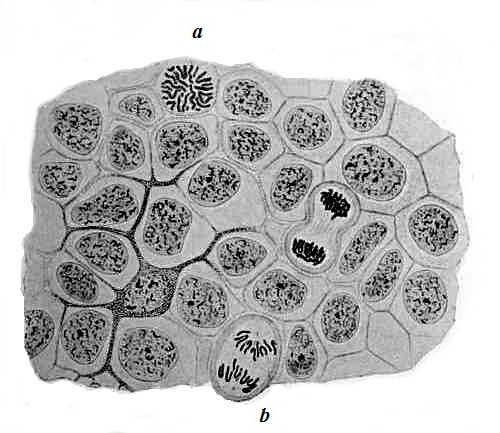
Fig. I.
This illustration, which (by permission of The Macmillan Co.) I take
from Wilson’s work, The Cell, is one of remarkable interest, for in
it the microscope has caught, in a piece of actual tissue from the skin
of the salamander, Amblystoma, three nuclei in different stages of
mitotic division. Most of the nuclei, which are seen as large, roundish
objects in their respective cells, show the chromatin in its ‘resting’ condition
interspersed through the nucleus. The nucleus under a shows
the chromatin gathered into chromosomes. At b the centrosomes with
their astral figures (which can barely be detected) have been formed,
the chromosomes have carried out their longitudinal division, and are
being attracted half towards one centrosome and half towards the
other. A little above this the process has been carried further, and
the sides of the cell are beginning to contract, preparatory to forming
two new ones. In Fig. 2 will be found a clear representation of the
astral figures.
To face p. 40.
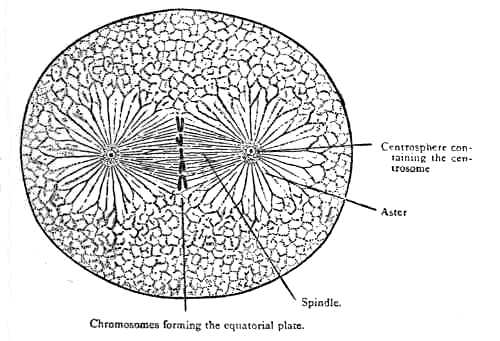
Fig. 2.
The above illustration from Wilson’s The Cell shows in more or
less diagrammatic form the stage of nuclear division in which the
chromosomes, as yet undivided, have arranged themselves in the centre
of the nucleus. The centrosomes with their astral figures have been
formed, and have taken their places near each pole of the nucleus.
The next stage is represented at b in Fig. 1.
When a cell is about to divide, an organ of recent
discovery, termed the ‘centrosome,’ comes into play.
This appears as the core of a sort of rayed or star-like
figure, and it takes up its position beside the nucleus.
When the cell is resting, the chromatin is dispersed
through the nucleus in a mass of broken lines, forming
a kind of network. When division begins, this broken-up
substance forms itself into a series of small threads,
sometimes straight, sometimes looped or curved.
These are called ‘chromosomes.’ There are always
a definite and invariable number of chromosomes for
every species of plant or animal—the cell of a man
has so many,37 of a grasshopper so many, of a lily
so many. The chromosomes range themselves in a
belt across the centre of the nucleus, and the centrosome
breaks into two parts, which take up a position
one at each end of the nucleus. Regarding the
nucleus as a tiny globe, we may say that the chromosomes
lie in the equatorial plane, while the two parts
of the centrosome move towards the North and South
Poles respectively.
The centrosomes, at the two poles of the nucleus, are
surrounded each with a halo of ray-like processes (the
centrosphere), and on the sides next each other these
rays penetrate the nucleus and join, forming a spindle-shaped
figure with a centrosphere at each end. This
spindle figure appears to be the organ by which the
division is accomplished, for each of the chromosomes
now splits itself in two longitudinally, as one
cleaves a log of wood, and one half passes over to
each centrosphere, thus making an exact division of
the whole chromatin or hereditary substance. An
indentation now appears in the outer wall of the
cell and also in the nucleus—it deepens and deepens,
and finally two cells appear instead of one, each with
a nucleus, a centrosome, and a supply of chromatin,
the latter now breaking up into its original condition
of diffusion through the nucleus. In multicellular
organisms the two new cells, of course, do not separate,
but a wall is formed between them. Some plant-cells
contain several nuclei; in this case division of the
nucleus is not necessarily followed by that of the cell.38
Throughout the processes of cell division it is apparent
that the utmost care is taken to ensure an exact
partition of the chromatin between the two new cells.
This partition has to be qualitative as well as quantitative;
for one chromosome may, and no doubt does,
differ in function and influence from another, and has
various elements within itself. The longitudinal division
of each chromosome, in which the elements are
arranged like beads on a rosary, ensures that the
different elements of the whole hereditary substance
shall appear in each new cell in exactly the same
relative proportion as in the parent cell; just as if
two persons had to divide between them a dozen
apples of different varieties, and secured perfect
equality, not by taking six apples each, but by dividing
every apple in two. This is the fundamental cause
of the fixity of species, which means the production
of offspring having the same specific characteristics
as their parents. How, under these conditions, the
mutability of species is brought about must be discussed
later. It is first of all necessary to inquire
more closely into the composition of the chromatin,
and to study the special phenomena of cell-growth
in connexion with conjugation, where new and extraordinary
features come to light.
A chromosome is not, or is not usually, a simple
body. In all but the very lowest organisms it is
composed, as we have said, of a number of elements.
Each of these elements is styled a ‘determinant,’
and it controls the form, colour, and function of some
definite part of the future plant or animal. Weismann
believes the determinants to be grouped into complex
bodies called ‘ids,’ each id containing all the
determinants necessary for a whole being, and each
chromosome being composed of a number of ids.
These ids are microscopically visible; they form
the beads on the rosary already referred to; but
their exact composition and potency are largely
conjectural at present. How far the subdivision of
determinants may go, it is, of course, impossible to ascertain.
We cannot say, for instance, whether there
is a determinant for every hair of the head, or one for
the hirsute covering in general, or one for each of the
different sections of the scalp. But the division is
very minute. Each of the ids may be a very complex
body, as we see by the manner in which, in
some families, small physical signs like a patch of
hair differing from the colour of the rest, or a tiny
pit or mole on the skin of a certain part of the body,
may be handed down, in that precise position, for
generations. There may be, and, in fact, in the
higher plants and animals there must be, a number
of determinants for each part of the structure, and
the final characteristics of that part must be the resultant
of a blend of all these determinants, the
more powerful predominating in proportion to their
vitality and force. The whole body of the chromosomes
may therefore be said to represent one or
more complete beings in diagrammatic form, each
part of the complete animal or plant being represented
by some part of a chromosome, though of
course not physically resembling it. And we thus
strike on the very curious and startling fact that, as
far as we can see, every cell in every organism
throughout the world of life contains all the elements
of the whole being to which it belongs, and
is, potentially, that being.39 All the higher organisms
possess two kinds of cells—reproductive cells which
have the faculty of fusing together to reproduce their
kind, and ‘somatic’ or body cells, which, although
they all originate in a reproductive cell, multiply
only by division, and have the function of forming
the various parts of the bodily structure. Of the
nucleus of a germ cell “we cannot say that it
differs in any essential or definite way from the
nucleus of any other cell.”40 All possess the chromatin
or hereditary substance of the organism,
though, according to Boveri, the germ cells alone
receive all the chromatin of the parent cell, the
derived somatic cells having to part with some of
it.41 There may be some distinction, though on what
it may be based it is at present impossible to say,
between cells that are capable of developing into
a complete organized creature and those that are
not.
Every somatic cell is doomed to perish, but every
reproductive cell now upon the globe is united, not
metaphorically, not by a chain of successive originations
or impulses, but by actual identity of substance,
with the first beginnings of protoplasmic life in the
abyss of time; and it has before it a potential immortality
commensurate with life itself. It is not, as
used to be thought, a physiological product of the
organism in which it dwells; it is a part of the
original reproductive cell from which that organism
sprang.
To understand these conceptions we must now
study the phenomena of reproduction in the light of
recent discoveries.
The lowest form of the reproductive process is,
of course, by simple division and redivision. This
is characteristic of many of those organisms which
consist only of a single cell, and it may co-exist,
even in these, with a considerable degree of structural
complexity, as in the ‘trumpet animalcule,’ Stentor
raselii. But among the lowest of these unicellular
organisms a curious process is sometimes observed
to take place, in which we may doubtless recognize
the origin of sexual reproduction. Two, three, or
more Amœbæ42 approach each other, partially coalesce,
and remain united for some time. They then separate
again. No new creatures are formed by this
contact; there are no visible results at all. But that
something which is for the advantage of the organisms
takes place during this period of union is certain, and in
the light of what is known of processes in other organisms
we can make a very good guess at what this something
is. Each Amœba parts with some of its chromatin
to some other and receives an equivalent in
exchange. The creature is thus reconstituted. The
element of change, which always provides so marked
a stimulus to vital processes, has been obtained. The
process has actually been observed in a certain Infusorian,
Noctiluca. Two Noctilucas coalesce, and
then proceed to divide at right angles to the plane of
contact. This necessarily has the effect of giving to
each of the two new Noctilucas which result from the
division half the nucleus and chromatin of one
parent and half of the other. There is, however, no
actual new birth or multiplication of beings; there
are only two Noctilucas as before.
We can now imagine that if a certain class of
unicellular organisms are in the habit of approaching
each other for the purpose of this interchange of
portions of their chromatin, they might occasionally,
under the influence of the approaching conjugation,
expel those portions of chromatin before another cell
was in a position to receive it. What would happen
if two cells, each of which had thus got rid of half
its chromatin, were to come into contact? Plainly,
they would fuse together; they would not separate
again; they would become a new organism. Each
would have supplied just what the other lacked.
This process, forming the bridge from mere cell
division to sexual reproduction, is a hypothetical one;
it has not, I believe, been actually observed in unicellular
organisms, but it is exactly what we find to
be taking place when we reach the stage of sexual
reproduction among multicellulars. Multicellular
organisms of more or less elaborate structure plainly
cannot, without breaking up, fuse together like single
cells. How, then, are they, as a species, to gain
the advantages of the temporary union and interchange
of elements which we have observed in the
low unicellular organisms? Only in one way—by
producing special cells for this purpose. These cells
must represent the whole parent, they must be
capable of shedding half their chromatin, and, when
they have fused, must be capable of growing into a
complete organism like the parent. When these
specialized cells have been formed, the others, the
somatic cells, will at the same time have been specialized
for other functions, and will thus naturally lose
the original capacity for interchanging chromatin with
other cells, i.e. for conjugation. We see the significance,
then, of Weismann’s remark, “germ cells made their
appearance along with the multicellular body.”43 They
are an instance of that differentiation of structure
and function which takes place in all highly organized
life. We must note also that the benefits of
conjugation which are realized individually by the
lowest unicellular forms are only realized as a species
by the multicellulars. A species must, then, be
regarded as in some sense an organic whole, and
not as a mere aggregate of individuals.
In some very curious cases which stand on the
borderland between sexual and non-sexual reproduction,
the same organism is capable of employing both
methods. Thus, among the lower seaweeds (Algæ),
the genus Pandorina consists of a colony of sixteen
green cells contained in a kind of gelatinous matrix
which the cells excrete. Each cell is ordinarily capable
of recreating the whole organism by division.
But after this process has gone on for some time, the
need of conjugation is felt, the colony breaks up and
cells begin to fuse with each other, though never with
those of the same colony. In Pandorina the two
conjugating cells are similar in appearance, but in
the genus Volvox we begin to see a difference in the
appearance of the two kinds of conjugating cells.
What may be called the ‘female’ cells (germ cells)
are large and quiescent; the ‘male’ (sperm cells)
are smaller and active. The primary meaning of
this is that the larger cells have stored up a supply
of nutriment for the young organism, and are therefore
bulkier and less active, while the others contain
only the bare elements of cell-structure and are
therefore able, as they are obliged, to be active in order
to search out their quiescent mates. A strictly vegetable
organism, in this stage, may therefore possess
organs of locomotion, and be as free-moving as a
fish. A remarkable fact has come to light respecting
those organisms (like some Algæ among vegetables
and Infusorians among animals), which are capable
both of conjugation and of reproduction by division,
namely, that the supply of nutriment often determines
which method shall be followed. If nutriment
is abundant, division is practised; if it becomes
scanty, an impulse appears to be given to conjugation.
Infusorians, which ordinarily conjugate at
pretty regular intervals, can be kept indefinitely
from doing so, and confined to division, by the
simple process of supplying abundance of nutritive
matter in the water in which they live.
“As far as we can see from an a priori point of view,”
writes Dr. E. B. Wilson in his great work on cell structure
and cell phenomena, “there is no reason why, barring
accident, cell-division should not follow cell-division in
endless succession in the stream of life. It is possible,
indeed probable, that such may be the fact in some of the
lower and simpler forms of life where no form of sexual
reproduction is known to occur. In the vast majority of
living forms, however, the series of cell-divisions tends to
run in cycles in each of which the energy of division
gradually comes to an end and is only restored by an
admixture of living matter derived from another cell.
This operation, known as fertilization, or fecundation, is
the essence of sexual reproduction, and in it we behold
a process by which, on the one hand, the energy of division
is restored, and by which, on the other hand, two independent
lines of descent are blended into one. Why
this dual process should take place we are as yet unable to
say.”44
The actual mechanism of sexual reproduction is
essentially the same wherever it occurs, whether in
a seaweed or a human being. Two cells have to
play their part in it, the Germ cell and the Sperm
cell, and these, in the higher orders of organized
beings, come to be located respectively in distinct
classes or sexes of individuals. Reproduction begins
by the fusion of a sperm, or male cell with a germ,
or female cell.
These cells originally resemble the other cells of
the same species, containing the same number of
chromosomes. If this number was, say, sixteen,
which is believed to be the number in man, then
a fusion of two complete cells, if it were possible,
would produce a cell with thirty-two chromosomes,
and that would mean a different species of animal.
What happens is that each of the reproductive cells,
male and female, prepares itself for conjugation by
getting rid of half its chromosomes. Two divisions
of the nucleus take place, not as in the ordinary
fashion of cell-division, when the chromosomes split
longitudinally, but in such a way that, in each
division, four of the sixteen chromosomes are bodily
expelled from the nucleus and from the cell, when
they either perish or, in some cases, appear to help
in forming an envelope of nutritive matter round the
germ cell. These divisions are called ‘maturation
divisions,’ and until they are accomplished, fecundation
is impossible. When a sperm cell after maturation
comes into the neighbourhood of a germ
cell, it penetrates into its substance, using the long
flagellum, or tail-like process, with which it is
equipped as an organ of locomotion. The two
nuclei come into contact and coalesce, and we have
thus a new cell with its sixteen chromosomes complete.
This cell is the origin of the new being. It
divides in two, and each part divides and redivides,
different cells gradually differentiating themselves as
muscular tissue, cartilage, blood-corpuscles, nerves,
reproductive cells, and so forth, until the whole
animal is built up and is ready for birth. One point
of cardinal importance must here be noted. The
originating cell, as we have seen, has eight of its
sixteen chromosomes from one parent and eight
from another. When division takes place, these
chromosomes, as we have seen, split longitudinally,
and the result is that each new cell gets exactly the
same mixture of chromatin as that of the originating
cell—half from each parent. This principle of
division is carried on throughout the whole process
of building up the new being—every cell of the
latter, down to the minutest details of its structure,
containing an exactly equal quantity of hereditary
elements from each of its parents.
It will be seen from the above account that the
old conception of the germ-cell as a passive body,
incapable of a change till ‘fertilized’ by a male or
sperm cell, was altogether wrong. Both male and
female cells prepare themselves for conjugation long
before it takes place, and neither of them can be
said to be a more active agent in fertilization than
the other. Not ‘fertilization’ but ‘fusion’ is the keyword
of the process. The mystical conception, as
old as Plato, of the male and female as representing
respectively the two halves of a complete being,
turns out to be no poetic metaphor. As regards
the essential features of reproduction, it is a literal
fact.
If we now ask why and by what mysterious law
all these exact and elaborate choric movements take
place Weismann and his school refer us to “chemotactic
forces,” the nature of which is yet unknown.
Chemotaxis means simply the effect of the presence
of certain substances on vital organisms without
specific chemical action. The really essential fact
is that these special chemotactic forces are working
in living protoplasm. Life is not the product or the
slave of any chemotactic forces, but their maker and
steersman.
The following passage from a work of the late
Prof. Geo. Rolleston may be pertinently quoted here:—
“There exists, as is well known, a tendency to resolve
all physiological into physico-chemical phenomena: undoubtedly
many have been, and some more may still
remain to be, so resolved; but the public may rest assured
that in the kingdom of Biology no desire for a rectification
of frontiers will ever be called out by any such attempts at,
or successes in the way of, encroachment; and that where
physics and chemistry can show that physico-chemical
agencies are sufficient to account for the phenomena, there
their claim upon the territory will be acceded to, as in the
cases we have been glancing at [certain animal poisons],
and where such claims cannot be established and fail to
come up to the quantitative requirements of strict science,
as in the cases of continuous and of discontinuous development
or self-multiplication of a contagious germ, and in
some others, they will be disallowed.”45
This was written in 1870. A generation later
the attempt to reduce life to a physico-chemical
phenomenon had not made much way, as may be
judged by the following passage from Strasburger’s
Text Book of Botany:—46
“Vital phenomena are essentially bound up with the
living protoplasm. No other substance exhibits a similar
series of remarkable and varied phenomena, such as we
may compare with the attributes of life. As both physics
and chemistry have been restricted to the investigation of
lifeless bodies, any attempt to explain vital phenomena
solely by chemical and physical laws could only be induced
by a false conception of their real significance, and must
lead to fruitless results. The physical attributes of air,
water, and of the glasses and metals made use of in
physical apparatus, can never explain qualities like nutrition,
respiration, growth, irritability and reproduction.”
And Wilson concludes his work by the admission
that
“the study of the cell has on the whole seemed to widen
rather than to narrow the enormous gap that separates
even the lowest forms of life from the inorganic world.”47
“The lowest observed forms of life” would have
been a more exact way of stating the fact.
Many questions of detail will occur to the reader at
this point, which he will find answered in the pages
of Weismann or other investigators. Here we must
confine ourselves to what has a distinct bearing on
the objects of this study. One of the points which
may be briefly touched on is the question how it
comes that two germ cells, once having passed
through their maturation divisions, cannot fuse and
form a new being; nor can two sperm cells. Were
this possible we might have ‘self-fertilization,’ and
virginal conception or parthenogenesis, whenever two
germ cells in the ovary of a female animal or
in that of a plant happened to come into contact.
But since the object of fusion is the union of (more
or less) unlike, and not closely related, elements, we
find that even when a kind of self-fertilization occurs,
as in some plants, the sperm or pollen cells are differentiated
visibly, and probably still more invisibly,
from the germ cells. But, apart from this, the
object of preventing the union of reproductive cells
of the same sex is mechanically attained by a very
curious device. The cell-organ by which division
is carried out is the centrosome. But in the course
of the two maturation divisions of the germ cell,
that cell loses its centrosome, which seems to be
absorbed into the protoplasmic substance of the cell
when once its task is accomplished. No fusion of
any number of such cells can therefore lead to any
further change or growth, for growth is based on cell
division, and the centrosome is the organ of division.
The sperm cell, on the other hand, does not lose
its centrosome; it retains it to form the organ
of division for the new cell after conjugation. But,
reduced as it is to little more than a bare nucleus
without any envelope of nutritive matter, the sperm
cell cannot support the intense vital activity called
for in the initial stages of the life of a new being, and
therefore sperm cells, like the germ cells, though for
a different reason, would be incapable of mutual conjugation,
even if the element of mutual attraction
existed among them.
Another point of interest is the question of the determination
of sex. The known facts afford a strong
corroboration of the general theory of reproduction
outlined above. It has not been ascertained, nor is it,
perhaps, ascertainable, whether the sperm cells of the
male contain in their chromatin a preponderance of
male, while the germ cells provide chiefly the female
determinants.48 However this may be, it is certain
that determinants which severally control the formation
both of male and of female structure are always
present in every combination of the sperm and
germ cells, those which exhibit the greatest energy
and vitality probably prevailing in the determination
of the sex of the future being. This accounts at
once not only for the cases (rare in the higher
animals) of actual hermaphroditism, when the sex is
really indistinguishable, but for the universal occurrence
in all male animals of rudimentary female
organs (such as mammæ) and in all females of rudimentary
male organs. Both sets of determinants are
always present; the more powerful prevail, but the
weaker have a deflecting influence on the total result.
When the primary sexual characters of the embryo
are determined, they appear to communicate a stimulus
which starts into activity the appropriate secondary
characters, such as colouring and other modifications
not directly sexual. An extraordinary case, which
I take from Beddard’s Animal Coloration,49 is that
of a chaffinch which was found to have on the left
side of its body the plumage of a hen bird and
on its right that of a cock. On dissection the meaning
of this freak of physiology was revealed. The
bird was an hermaphrodite, having the female organs
of generation on the left side of its body and the
male on the right. Hermaphroditism is not in itself
a very uncommon phenomenon in birds (though here
it is a monstrosity, not, as in slugs and snails, a
natural and useful condition); but the way in which
in this instance it governed the distribution of colour
is most peculiar; and of course it strongly reinforces
Weismann’s conception of distinct determinants for
the various details of bodily structure.50
This brings us to the recognition of a competition
among determinants which is an important, indeed a
cardinal, feature in Weismann’s theory of evolution.
He makes, as I am forced to believe, an illegitimate
and extravagant use of it, but the principle may
really exist and be operative without furnishing the
master-word to the riddle of organized being. The
master-word, as I shall try to show, is nature’s will
to live. But before going fully into this argument,
let us fix in our minds the rationale of those processes
of elementary organic life which have been described
in this chapter. Protoplasmic life may be
supposed to have originated, and perhaps to be still
originating, in certain molecular combinations of
matter. In other words, the combination, when it
took place, developed certain peculiar forces through
which it was enabled to maintain itself and to grow,
by the processes called assimilation and nutrition.
These forces, then, were potentially present in
nature before the molecules combined to evoke
them. They are among the latent powers of life.
They waited, ready to be called into action when the
required external form should be arrived at in the
play of molecular energy. Life first originated, no
doubt, in unconnected and inconceivably small units
of protoplasm. Between the units thus formed and
their combination into the elaborate structure which
we now know a cell to be—packed as full of varied
energies, it has been said, as an ironclad is of
machinery—there is evidently a very wide gap. All
we know is that when we have got the cell, we find it
in possession of a complex apparatus for subdivision,
which, taken together with the faculties of nutrition
and growth, enable any one cell to multiply indefinitely
by producing replicas of itself. To life and
growth, then, has been added the faculty for multiplication.
Here we strike on a veritable mystery.
Why should any new movement ever take place?
Why should a cell ever divide in two? We can only
say that it is its property to do so.51 It does so because
it is alive. Did this property first arise as one
of a multitude of aimless movements—the only one
which ensured permanence and multiplicity to the
organisms which exhibited it? If so, then Nature,
at the time when life began on the earth, behaved in
a manner most unlike that in which she behaves at
present. If we are to interpret the processes hidden
in the remote past by the light of what we see at
present, we shall conclude that, at bottom, the will to
live made molecular action—and the same force incorporated
itself in the combinations which originated
protoplasmic life, ordered the structure of the cell,
and gave it the need and the power to multiply.
Nature is for ever changing, for ever straining after
new life, after more life.
Having arrived at the cell with its powers of
division, the next step was the power of conjugation
between cells with their interchange of vital
substance, bringing about, in Weismann’s words, “a
wealth and diversity of organic architecture which
without it would have been unattainable.” It takes
place by means of physical energies, but the process
is entirely inexplicable unless we assume that it exists
to satisfy a need, a Drang, for life. And this need,
although of course it displays itself in physical
processes, is not in itself a physical process. At
the very beginnings of structural life, if not
before it, we are obliged to pass beyond physics
in order to comprehend physical phenomena. Whenever
we find an aggregate of living units, such as a
Pandorina colony, living with a communal life which
is other than the sum-total of the lives of the individual
units, we are in presence at once of the
necessity for a metaphysical conception, to render intelligible
the unity in diversity which we perceive.
The response of living protoplasm to the stimuli
it receives from the outside world is normally directed
to the maintenance of the life and form of the
organism. The response of what is called ‘lifeless’
matter is of another nature; not because it is really
lifeless, for if it were it would not respond at all, but
because it has no organisms to protect and foster.
We all know the nature of the action of gravity on
Newton’s apple. It was treated as a dead substance,
like a stone, and gravity acted upon it as upon all
other ponderable matter. But when it had fallen to
the earth, had decayed, and one of its pips began to
grow, the action of gravity began to be manifested
in a quite different and very peculiar fashion. It
has been ascertained by a series of ingenious experiments
that gravity is the force which obliges the
roots of a plant to sink downwards into the earth.
This does not, of course, mean that the roots are
drawn downwards by attraction of the earth, but
that the pull of gravitation gives a certain stimulus
to the cells concerned which makes them grow in
that direction. Precisely the same stimulus communicated
to the cells of the stem has the very
opposite effect—these it causes to grow upright into
the air and light. Thus the roots are, as it is termed,
positively, and the stems negatively, geotropic. The
substance of the root cells and of the stem cells is
the same, the stimulus is the same, but the effects on
growth agree in only one point, that they are respectively
what the plant requires them to be. There is
no doubt that if a species of plants were placed in
such a position that it would serve them for the
roots to grow upwards, then upward-growing roots
would eventually be evolved; in fact, this is actually
the case in the lateral underground roots of
certain mangroves which rise to the surface and
become modified as breathing organs, and in the
aerial roots of various orchids, etc.52 When a change
of habitat takes place calling for new developments
of structure to meet new conditions, these developments
are not, as a matter of actual observation,
found to be mechanically ‘selected’ from a mass of
random movements and modifications of tissue—they
reach their goal, it is true, by a series of gradual
approximations, but the goal is in sight from the
beginning. In other words, adaptability is a fundamental
character of life. Hence the fact that multicellular
organisms which cannot, as a whole, fuse
with others, adapt themselves to these conditions by
the allotment of special cells for that purpose; while,
again, the production of multicellular organisms is
itself an adaptation to Nature’s need for the higher
organization of life.
“The botanist Reinke,” writes Weismann, “has recently
called attention once again to the fact that machines
cannot be directly made up of primary physico-chemical
forces or energies, but that, as Lotze said, forces of a
superior order are indispensable, which so dispose the
fundamental chemico-physical forces that they must act in
the way aimed at by the purpose of the machine....
Organisms also [according to Reinke] are machines which
perform a particular and purposeful kind of work, and
they are only capable of doing so because the energies
which perform the work are forced into definite paths by
superior forces; these superior forces are thus ‘the steersmen
of the energies.’”53
Weismann admits that there is “undoubtedly a
kernel of truth in this view,” but he is content with this
perfunctory acknowledgment. His main efforts are
devoted to the substitution of fortuitously developed
“constellations” of molecular energy for any force
which can be deemed to have the slightest tincture of
intelligence or purpose. “In our time,” as he writes,
“the great riddle has been solved—the riddle of the
origin of what is best suited to its purpose without
the co-operation of purposive forces.” The nature
of the proposed solution can be best described and
discussed in another chapter, when we shall be in a
position to consider it in relation to the whole history
of organic development from its origin in protoplasmic
life to the evolution of species in plants and animals.
THE MECHANICAL THEORY OF EVOLUTION:
THE DARWIN-LAMARCK
EXPLANATION
“Quelle est donc cette nature sujette à être effacée? La coutume
est une seconde nature qui detruit la première. Pourquoi la
coutume n’est elle pas naturelle? J’ai bien peur que cette nature
ne soit elle-même qu’une première coutume, comme la coutume est
une seconde nature.”—Pascal.
WE now approach the arcana of Evolution. The
processes we have to deal with in this chapter
are not, and probably never will be, the subjects of
direct observation. All we can hope to do is to
generalize from the results which have risen to the
surface of life about the unseen forces from which
they spring. The problem is to find (if possible) a
generalization which will cover all the facts relating
to that modification of natural forms, habits, and
instincts which, when it reaches a certain point, means
the establishment of a new species. We know that
the thing happens, but we shall not understand how
it happens until either the mechanism of the process
is laid bare, or until it is clear that we are in presence
of an agency not entirely definable in terms of
mechanical action.
The fixity of species is maintained by a number
of conditions, chief among which must be reckoned
the law of reproduction by conjugation, with the
consequent intermixture of numerous different lines
of descent. From one point of view conjugation, as
Weismann so often insists, greatly favours the adaptability
of the organism to new and varied conditions
of life, inasmuch as it results in the mingling together
in each individual of a great number of varied
determinants. But when the conditions are constant,
conjugation has also the obvious effect of constantly
reabsorbing, as it were, any heritable abnormalities
which may occur in individuals or the species,
and bringing them back to type. An individual
possessing some abnormality of structure will be
most unlikely to find a mate possessing the same
abnormality—the mate will be either an ordinary
individual or will possess, if any, some quite different
variation. Their descendants will, therefore, usually
show more resemblance to the normal type than to
the one abnormal parent, and in their descendants
again, for the same reason, the abnormal feature will
be still further reduced, until finally it disappears.
It is only by the careful selection of mates extending
over many generations that pigeon-fanciers, to take
one prominent instance, are able to establish a
new type. Left to mate uncontrolled among themselves
we should never have had the great variety of
breeds which have been produced by the art of the
fancier from the original rock-pigeon. The small
variations which form the starting points of his
operations would, under natural conditions, have soon
been resolved into the normal type. What is it in
nature, then, that sometimes appears to play the part
of the intelligent breeder and to urge the plastic
forms of life into new moulds?
The goal of the breeder is some new form which
it pleases him to produce, either for its use, or its
beauty, or for its mere singularity. The goal of
nature, at least the apparent and immediate goal, is
the adaptation of each species to the circumstances
of its life. And the first thing that strikes the investigator
is the way, often indeed not perfect, but
usually most impressive in its apparent thoughtfulness
and care, in which the organs of plants and
animals are fashioned to secure the most favourable
results. But all this is the result of development.
The whale is a creature excellently adapted for its
present mode of life, but we know that it was once
a furry land animal with four legs; the legs are all
there still, in modified or rudimentary form, and the
fur appears at a certain stage of embryonic development.
When we ask, How did this extraordinary
transformation come about? what we really mean is,
How did the determinants composing the chromatin
in the reproductive cells of the original land animal
so come to alter as to produce the characteristics of
the whale? For new species can only be evolved by
means of structural modifications capable of being
transmitted by inheritance; and nothing can be inherited
except through the action of the determinants.
A modification which does not affect the reproductive
cells has no significance in the evolution of
species.
To this question Darwinism has given us our choice
of two answers, which may be termed respectively the
Darwin-Lamarck and the Darwin-Weismann theories.
Lamarck explained the origin of species by
the accumulated effect of the inheritance, through
many generations, of modifications acquired by the
exercise, or the disuse, of the modified organs.
Observing that living protoplasm responds to demands
upon it (thus, for instance, a muscle when
systematically exercised attracts more nourishment
from the blood and grows stronger, and callosities
form to protect the skin of the hands of a manual
worker), he assumed that modifications so acquired
might be transmitted by inheritance. Each new
generation, then, would start with a slightly better
equipment in this particular respect than the former
one had when it started; and so, by slow degrees, a
new organ, or one markedly differing from the
original form, might be built up. The world, since
protoplasmic life first appeared upon it, has gone
through many changes, and has always presented a
vast variety of climatic and other conditions, calling
for the most varied types of organic structure. As
animal life gradually spread over the earth and sea,
the effort to cope with the different conditions it met
with would gradually, by the combined action of
exercise, of disuse, and of heredity, produce multitudes
of different types; and these are what we
know as families, orders, genera, and species. When
a species is fairly well adapted to its surroundings
and way of life it may go on indefinitely without
change. But should any members of it be obliged
to migrate, from scarcity of food or any other reason,
to some new locality where somewhat different conditions
prevail, structural alterations would soon
begin to appear to suit those new conditions. Thus
the giraffe, if we could trace its ancestry back, would
probably be found to have originated in some animal
not differing from the vast majority of quadrupeds
in the relative proportions of its fore and hind quarters.
But some members of this original species—or
the whole species, owing to some change in their
surroundings—found themselves obliged to rely
largely for food on leaves growing at a considerable
height. They stretched up to reach them, and a prolongation
of the bones of the neck (the giraffe has
only the usual seven cervical vertebræ) and of the
fore-legs would ensue, especially in the young; this
prolongation would be handed on by inheritance,
and so by degrees the new type of animal would be
evolved. The horn of the rhinoceros, the antlers of
the stag, the canine teeth of beasts of prey, the flat
grinders of ruminants, the flippers of the whale, the
proboscis of the honey-feeding butterfly, the jaws of
the ant or the beetle, and a host of other adaptations
which seem obviously to owe their origin to
the exercise of their functions, occur to the mind in
confirmation of this theory.
Besides Adaptation, we have what appears the
strikingly confirmatory case of what is called Co-adaptation,
where the variation of one organ or
structure in an animal puts a strain upon other parts,
which accordingly respond by auxiliary adaptations.
Such co-adaptations are numerous in every animal
structure, and, as we cannot suppose them to have
all originated simultaneously and by chance, the
conclusion drawn by Lamarckians is that one was
produced by use, and, in the course of its development,
produced the others in the same way. A typical
case is that of the Irish elk. The enormous antlers
of this beast, sometimes weighing a hundredweight,
must have needed (besides other structural changes)
a cervical ligament of immense size and power to
support them, and from the peculiar structure of the
cervical vertebræ it is demonstrable that such a ligament
must have existed. What more natural than
to suppose that the antlers were developed by fighting
wild beasts of prey, combats between male elks,
etc., and that then in their gradual growth, as the
species was evolved, the ligament and the bony
structure associated with it responded to the increasing
strain. That is exactly what would happen
in an individual. We have only to assume the
heritability of modifications acquired by use to
understand how these co-adaptations became constant
characters in a species.
Not less apparent cogency for the argument for
modifications by use have those cases where the
modification has been apparently due to disuse. It
is well known that living creatures found in the total
darkness of great limestone caverns, like those at
Kentucky, are blind, through imperfections of one
kind or another in the organs of sight. But the
rudimentary structures which remain tell us that
these creatures had ancestors which were once fully
equipped in this respect, and which had wandered
into the caverns from the sunlit outer world. Thus
the case of a crab has been noted, in which the stalks
on which a crab’s eyes are set were preserved, while
the eyes had disappeared: it is, as Darwin observes,
as if the stand of a telescope had been retained while
the telescope itself had gone. Sometimes the eyes
of cave-fishes are covered with a horny layer, sometimes
the whole structure is atrophied and withered.
But never is an animal found under these conditions
which has retained its power of sight. The conclusion
seems obvious. In individuals, a muscle or
other organ is known to strengthen and develop
by use and to atrophy by disuse. As use and
disuse appear to be invariably accompanied by precisely
the same effects in the species as in the individual,
and as there seems no way of accounting
for this by any known physiological law without assuming
that modifications acquired by the individual
are transmitted to its progeny, the case for the inheritability
of such modifications appears, at first sight,
irresistible.54
So matters stood when Darwin’s Origin of Species
carried the argument for evolution a long step
further. Accepting fully the views of Lamarck,
Darwin attempted, by his doctrine of Natural Selection,
first to reinforce those views, secondly to explain
much that they could not be made to cover. It is plain
that if we assume the existence of a severe competition for
livelihood among the members of a species, any favourable
variations of structure or instinct which may
occur among certain members of the species will
give their type an advantage over the normal type
in the struggle for existence. They will, on the
average, live longer and produce more offspring.
Ultimately, as the struggle for life is always most
severe among nearly related organisms, which seek
a living from the same sources, the less perfectly
equipped type will be extinguished, and so on, until
a species exhibiting the most complete form of
adaptation has been evolved. The variations on
which Natural Selection has to work are produced,
according to Darwin, not only by the exercise of
particular organs as in Lamarck’s theory, but also
and more potently by “innate variations” originating
from unascertained causes in the reproductive cells.
Variations, it is indisputable, are always occurring;
probably no two members of any species exactly
resemble each other. Among low and primitive
organisms, such as the Foraminifera, Dr. W. B.
Carpenter (I quote from A. R. Wallace’s Darwinism)
found, on careful examination, the range of variation
so great that characteristics typical not merely
of species but of genera and even of orders were
liable to vary,55 while at the other end of evolution,
in man, to give only one instance, Mr. J. Wood
is stated by Darwin to have observed no less than
five hundred and fifty-eight variations in the muscular
structure of thirty-six subjects examined.56 The
cause of these variations is often quite obscure, but
it is certain that some kinds of them are capable
of arising as the natural response of the organism to
changed conditions of food or habitat Conditions such
as these, affecting the whole constitution of the organism,
have been proved capable of affecting the reproductive
cells, and thus of giving rise to hereditary
characteristics. Natural Selection, then, by preserving
and encouraging the better fitted as opposed to the
less fit, acts as a spur to the Lamarckian principles
of development by exercise of function, while it also
lays hold of and intensifies all kinds of other favourable
variations occurring either casually or in consequence
of change of habitat, and weeds out the types
in which such variations happen to be unfavourable.
According to Darwin, therefore, given (1) constant
variations of structure arising from use, disuse, or
from other known or unknown causes, (2) the capacity
to transmit by inheritance these variations whether innate
or acquired, (3) a constant struggle for existence
among organisms both against each others’ competition
and against the general conditions of life57—given
these simple data, the secret springs of evolution are
laid bare, and the vast complexity of natural forms
upon the globe is adequately accounted for without
calling in the agency of special creations. But
variations are the starting-point in the process:
Natural Selection can originate nothing—it can only
act on what is presented to it by some quite different
force. The relative parts played by the various
agencies at work are, with characteristic moderation
of statement, thus described by Darwin:—
“On the whole I think we may conclude that habit,
use, and disuse, have, in some cases, played a considerable
part in the modification of the constitution, and in the
structure of various organs; but that the effects of use and
disuse have often been largely combined with, and sometimes
overmastered by the natural selection of innate
variations.”58
To explain evolution, then, we must first explain
the occurrence of appropriate variations, strong enough
and widespread enough to maintain themselves
against the constant reducing influence of promiscuous
intercrossing, and they must be variations
capable of being transmitted by inheritance. This, we
now see, is the true field of the inquiry.
The new factors introduced by Darwin into the
process of evolution—Natural Selection and Innate
Variations—were destined in our day to have the
whole weight of the argument for evolution suddenly
thrown upon them. The inheritability of variations
acquired by the individual through use and disuse
when subjected to fresh investigation by the younger
school of biologists has turned out to be open to the
gravest doubts, both theoretically, on account of the
great difficulty of reconciling it with what has now
been ascertained of the nature of the reproductive
mechanism in plants and animals, and also on the
score of a closer consideration of the facts commonly
adduced as evidence for the law. To take
these points separately: The reproductive cells in
every living creature are now believed to be formed
directly from the reproductive cells of its parents.
They are not a product of the organism in which
they find themselves. They are nourished by its
blood, and are therefore liable to be affected by anything
which produces a broad general effect on the
constitution of the being in whom they are lodged,
but it is difficult to see how special modifications of
individual parts of that being could affect them so as
to influence the determinants in the direction of reproducing
that modification. How, for example,
could the habit of grubbing for roots in an animal of
the pig tribe so affect its reproductive cells as to
ensure the birth of an offspring with callosities on
their snouts? The physiological mechanism by
which such a result could be produced seems hardly
conceivable—at any rate no one has yet offered a
plausible conception of it. Of course if the fact were
indisputably proved one would only have to accept
it, and endeavour, if possible, to discover the why and
how. But the fact, which once looked so solidly
established, is taking on a more and more insubstantial
appearance in the light of closer investigation.
The argument against Lamarckism rests on the
basis (1) artificial experiment, (2) of observation
of nature under normal conditions.
As to the evidence from experiment, opinions
fluctuated for some time—Darwin was disposed at
one time to deny, at another to admit the alleged
proofs it offered. In the present day opinion is overwhelmingly
against the validity of these proofs.
The cases where artificially produced mutilations are
said to have been inherited have, when investigated,
turned out to be by no means as clear and trustworthy
as was supposed, nor can one place much
reliance on a few cases of striking coincidence such
as are certain to occur from time to time.59
The adverse instances are very clear indeed.
Chinese girls are never born with abnormally small
feet. Jews are not born circumcised. Among tribes
where tattooing is practised, no traces of this embellishment
are ever found to be inherited. If it is a
physiological law that the disuse of an organ not only
atrophies it in the individual but (by inheritance of
the atrophy) eliminates it from the species, there is
no apparent reason why this law should not operate
in cases where the organ is artificially removed. Yet
it rarely or never seems to do so. Experiments
upon animals, such as breeding for many generations
from mice whose tails have been cut off, have never
resulted in producing a clear case of inherited mutilation.
A strong presumption is therefore raised that
the effects apparently due to use and disuse under
natural conditions (as in the eyeless fishes of the
Kentucky caves) must be set down to some other
cause. The queens in colonies of ants and bees have
never exercised the functions of workers for thousands
of centuries, yet they transmit these functions
unimpaired.
There is, indeed, a case often referred to in this
connexion which must be here mentioned. Dr.
Brown-Séquard found that by injuring or compressing
the sciatic nerve in guinea-pigs epilepsy was
produced, and that the descendants of animals so
injured had a marked tendency to epileptic fits.
This is undoubtedly a very significant and important
fact in biology, but it gives no support to the
Lamarckian theory. What is inherited by the guinea-pigs
is not the injury to the nerve but the pathological
condition resulting therefrom. It remains to
be discovered how, precisely, this takes place, and
the experiment may end in illuminating a very
obscure region in physiology, but on Lamarckism it
has no bearing at all. A better case is that of atrophy
of a toe, which is said to have been inherited in
consequence of its original production by severance
of the sciatic nerve, but, again, what is inherited is
not an actual injury but an effect of it. It is clear,
however, that bodily conditions of a large and comprehensive
kind produced naturally or artificially in
an individual may have an effect on the reproductive
cells, especially when the nervous system is affected.
Coming to the observation of what happens under
natural conditions, we are struck at the outset by the
fact that the inheritance of acquired characteristics,
if it works at all, must work under some system of
salutary control and not as a blind physiological law.
For if each generation starts with some measure
at least of what the former generation had acquired,
and adds to it by its own activity, then all acquired
characteristics would ere long attain a monstrous
development, and the species would perish under
them. But nothing of the kind is observed to happen.
The continual use of the muscles in the labouring
classes has not made men stronger than they were
thousands of generations ago. The habit of handling
the spade and hoe has never produced a peasant
child born with callosities on its hands. The horn
of the rhinoceros, which on Lamarckian principles
we must regard as developed by the gradual increase
of a callosity formed by grubbing for roots, does
not grow beyond a certain size, however the species
may go on grubbing. The Lamarckian law, then,
if it has any real effect at all, can only express half
the truth about the action of heredity on acquired
characteristics. As the column of water in a fountain
hovers about a certain height, so the action of heredity
in the accumulation of the effects produced by the
use of organs seems to have a limit beyond which it
cannot pass. May it not be that heredity is really
as false an expression for the phenomenon as the
popular superstition about ‘water seeking its own
level’ is for the upspringing of a fountain?
The cases of co-adaptation, where one organ appears
to be developed by use and others by the use of that,
as in the case of the Irish elk referred to above,
are met by instances just as striking where the elements
of modification by use cannot come into play.
Weismann mentions the case of the ingenious brush
arrangement on the anterior legs of the bee, which
the insect uses for cleansing its antennæ. Two
adaptations are here developed—a little semicircular
notch in the leg, set with small bristles, and a movable
projection or flap used for pressing the antenna
into the notch as it is drawn through. The bee,
no doubt, would naturally try to clean its antennæ
with its fore-legs, but how could this process develop
the special arrangements referred to in the hard or
scaly covering of its limbs? It is not until the
shell of the insect has grown quite hard and incapable
of further vital changes that the arrangement
comes into use. Again, the stridulating noise
produced by the legs of the grasshopper is due to
serrations occurring on different joints of the limb.
Serrations on one joint would in no way tend to
develop them on the other, but rather the contrary,
yet there they are, in harmonious co-operation. If
Nature can obtain these effects, as she does in
numberless instances, without the aid of Lamarck’s
principle, we cannot help asking whether that principle
is ever operative at all.
The three instances which we shall next consider
seem to offer very serious obstacles to the Lamarckian
theory.
A modification of structure caused by the special
use of a certain organ takes place in probably over
90 per cent of the whole human race, male and
female. The records of art, of language, and the
evidence of actual remains, tend to show that the
habitude in question, with the attendant modification,
goes back to very ancient, even perhaps to
palæolithic times.60 I refer to the preferential use
of the right hand and the enlargement of structure
thus brought about in the right hand and arm.
Every right-handed adult man and woman shows
this enlargement of bony and muscular structure. The
origin of the habitude does not concern us here.
Let us suppose it due, as Dr. D. J. Cunningham
suggests, to “a transmitted functional pre-eminence
of the left brain,”61 which is larger than the right, and
which governs the movements of the right side of
the body. However this may be, it is clear that if
bodily characteristics acquired by exercise are transmissible
by inheritance the new-born child of right-handed
ancestry ought to show some appreciable
preponderance in weight and size of the right over
the left limb. There could hardly be a more crucial
test of the validity of the Lamarckian principle.
What do the investigations of the dissecting-room
reveal? I shall quote the two most recent authorities
who have studied this interesting question.
Dr. Cunningham, in the lecture already referred to,
writes:—
“Although the matter has not been investigated so fully
as to place the question outside the region of dispute, the
evidence at our disposal distinctly favours the view that at
birth the two upper limbs start upon their individual duties
equally endowed in so far as strength of muscle and size of
bones are concerned. Both in mass and weight the two
limbs are to all intents and purposes similar at birth, and
the preponderance in bulk and strength which later on
distinguishes the right arm is acquired during life, and
is caused by the greater amount of work it is called upon
to perform.”62
Dr. T. G. Moorhead, Chief Demonstrator in
Anatomy in Trinity College, Dublin, after giving
the results of the researches of various other inquirers,
writes:—
“From this mass of conflicting evidence I am forced to
the conclusion that no real differences exist.... After
weighing as a whole the limbs of eight foetuses I was
unable to detect any constant difference.”63
These results appear to conflict most seriously
with the theory of the transmissibility of acquired
modifications.
Fig. 3.
Kallima paralecta, as it appears at rest, with wings closed.
From Weismann’s The Evolution Theory.
K, the head; B, the limbs.
Every one is familiar with the fact that species of
animals which are preyed on by others, or which
require to be inconspicuous for the purpose of preying,
are very apt to take the colour of their habitual
surroundings. Individuals of the same species will
even differ according to their special habitat. Perhaps
the most marvellous instances of this kind of
adaptation are to be found in certain tropical butterflies,
such as the Indian butterfly, Kallima paralecta,
here illustrated. We have here, painted on the
butterfly’s wing, the picture of a leaf belonging to a
shrub which it frequents—a picture, when seen under
natural conditions, capable of baffling all but the closest
inspection. The different parts—the midrib, the
lateral veinings, the little blotches and spots which
represent patches of mould or drops of water, even
the outer contour of the wing itself—all form an
harmonious whole composed of related parts which
have separately no meaning or use. They certainly
did not all appear in full development at the same time.
Nor could any one of them, if it appeared first, have
exercised the smallest influence on the appearance
of the others, as the antlers of the elk were supposed
to have influenced the development of the ligamentum
nuchæ. The early stages must have been anticipatory
of the later ones, but exercise could have
had nothing to do with the result from first to
last. The butterfly never practised looking like a
leaf. Nor can any large chemical and elemental
influences have been at work. If nature is capable
of producing such effects as this without the agency
of Lamarck’s principle, are there not excellent
grounds for seeking for some other agency which
will cover all the phenomena alike?
Finally let us take the case of the slave-owning
‘Amazon’ ants, Polyergus rufescens. Here we have
a case which at the first blush looks like a perfect
picture of an evolutionary process conducted on the
principles of Lamarck’s theory. These ants, it may
be supposed, were originally of the ordinary type
of that industrious and respectable insect, but they
were led by the weakness of some of their neighbours
of another species to make occasional attacks
on them for the purpose of carrying off their immature
brood, the pupæ, as food. Some of these
pupæ, near maturity at the period of their capture,
would come out while stored-up in the nest of the
conquerors, and when they did so would immediately
set about doing the household work of the hive as
if they were at home. Polyergus rufescens ultimately
became aware that a life of aristocratic leisure
awaited him if he only captured enough pupæ of
another species of ant to do his work. He accordingly
confined himself entirely to piratical expeditions
of this nature, and in the course of time
underwent a moral and physical transformation of
a most remarkable kind. The ordinary ant instincts
have disappeared in this variety. They do not make
their nests, they do not gather stores, they do not
mind their young, they do not even feed themselves—an
Amazon ant will perish of starvation in the
presence of food if there is not a slave ant to put
it into his mouth. But they fight ferociously in their
slave-raids, and the form of their mandible has
changed to suit their mode of life. It has become
a pair of sabre-like nippers, excellent for slaying a
foe, but ill-adapted for carrying objects and other
industrial occupations. Corresponding changes have
taken place in the head and in the chitinous and
muscular structure.
We have before us, then, what would seem to an
uninformed observer, a striking picture of the acquirement
of a certain bodily form and a certain
set of instincts by use, and the total loss of other
traits by disuse, and of the fixing of these characters
in a species by heredity. Yet the picture is altogether
an illusion. However we are to explain the
facts—of which more anon—we cannot do so by
Lamarckism, for the simple reason that the peculiar
instincts and bodily structure of the Amazon ants
are confined to the so-called ‘worker,’ or in this case
‘soldier,’ caste, which are sexless, and incapable
of reproducing their kind. If these were the individuals
which originally started the slave system
among the species, they could not possibly have
transmitted the modifications, moral and physical,
which they acquired. The queen-ants, which normally
are the only fertile ants, transmit them, but do
not possess them, and neither do the drones.
The case of these mysterious communities of insects,
composed largely of neuters which do the
work of the community but do not reproduce their
kind, was one of the difficulties in the way of
Darwin’s theory of evolution which, he said, staggered
him every time he reflected on it.64 It is not
surprising, therefore, that this difficulty came to be
the battlefield, or a main position thereof, in a most
interesting and illuminating controversy on Natural
Selection versus Lamarckism, waged between Mr.
Herbert Spencer and Dr. Weismann in the years
1893-4.65 Spencer considered the inheritance of
acquired characteristics a factor in evolution of the
very first importance; and so, indeed, from his point
of view it is. “Either,” he declared, “there has been
inheritance of acquired characteristics, or there has
been no evolution.” Met by the case, among others,
of the slave-making ants, his explanation is substantially
as follows: It was not the workers (soldiers)
which originally acquired military traits, but the
queens, the fully developed females, which lost them.
There was once, as every one admits, a time when all
ants, bees, etc. were sexually mature. There were
only males and females. At this stage, possibly, the
Amazon ants were already predatory. It was then
that they may have acquired the military habits and
structure, which they were then able to perpetuate by
inheritance.
How, then, did the queens lose these traits?” From
the queens,” replies Spencer, “they have slowly disappeared
by inheritance of the effects of disuse.”
The obvious and unanswerable rejoinder made by
Weismann and his followers was that Spencer had
only shifted the difficulty to another ground—from
the workers to the queens. If the queens (and
drones) lost the military characteristics by disuse,
how do they come to transmit them unimpaired to
the workers? It is the very essence of Lamarckism
that whatever modifications are produced by use or
by disuse shall be transmissible by inheritance.
In this controversy, however, there was another string
to the Lamarckian bow. Worker-ants, bees, etc. are
imperfectly developed females. They have four or five
egg-tubes where the queen has two hundred, but they
cannot be fertilized by the drones. It occasionally
happens, however, that these neuter insects do lay a
few eggs. These unfertilized eggs always develop
into drones. One of these drones might, it was
suggested, now and then fertilize a genuine queen,
and thus hand on the traits of the worker from which
it sprang. But apart from the fact that an occasional
occurrence of this sort would hardly suffice to maintain
the worker-characteristics unimpaired throughout
the ages, there is the decisive answer, as Weismann
points out, that we know at least one species of ant in
which the evolution of a neuter caste is absolutely
complete, for the workers of Tetramorium caespitum
possess no egg-tubes at all. Yet the transmission of
characteristics from queens and drones who never
exercise them to workers who cannot pass them on,
goes forward in this species of any ant just as in any
other.
Nature, therefore, while doing in the case of these
insect communities exactly what she appears to be
doing elsewhere by the accumulation of acquired
characteristics, must, in reality, have been working
on entirely different lines. If we can discover what
those lines were, they will cover the apparently
Lamarckian cases as well, but the Lamarckian principle
certainly will not cover these.
In the next chapter we shall review the alternative
explanation offered by Darwinism, the explanation
of Weismann; and we shall see whether Spencer
was not as successful in demolishing it as Weismann
was in showing that, if evolution exists at all, some
other basis must be found for it than that on which
it was so largely rested by Herbert Spencer.
THE MECHANICAL THEORY OF EVOLUTION:
THE DARWIN-WEISMANN
EXPLANATION
“Chance guides all things: mind and forethought must call it
God alone!”—Menander.
“IN the end,” writes M. Edmond Perrier, “every imaginable
theory of evolution must lead up to one or
other of two absolute doctrines, essentially antagonistic to
each other. Either the inheritance of acquired characteristics
must be admitted in its full scope (dans toute sa
généralité), or else we must believe in the predestination of
protoplasm, developing by virtue of its own internal forces.
But in the latter case we pass from the domain of pure
science to enter that of metaphysics.”66
We have now to consider the most conspicuous
attempt made in recent times to escape from this
tragic dilemma.
If the acquired and inherited variations of the Lamarckian
theory drop out as a contribution to the
explanation of evolution, we are reduced to two
forces only—innate, or germinal, variability of offspring,
and natural selection. Indeed it might be
said that we are reduced to variability alone, since
natural selection can do nothing until suitable variations
are presented to it. The suitable variations do,
however, turn up, and the question is, what causes
them? The real difficulty for the school of biologists
who, like Weismann, “assume the mechanical theory
of the world to be correct,” is how to reconcile the
aptness and apparent purposefulness of these variations
with any mechanical theory.
“We are justified in inquiring,” writes Weismann,
“whether the assumption of ‘chance’ germinal variations,
which we have hitherto made with Darwin and Wallace,
affords a sufficient basis for selection. Osborn says very
neatly in this connection, ‘We see with Weismann and
Galton the element of chance; but the dice appear to be
loaded, and in the long run turn “sixes” up. Here arises
the question, What loads the dice?’”67
What loads the dice? There is the great question in
which the realms of biology and of philosophy meet
each other! Through that borderland no definite
frontier has ever been traced, for in thought as in
matter the saying is true that natural groupings have
nuclei, but no boundaries. It is all the more essential
that men of science should understand philosophy
and its methods, and that philosophers should understand
science. It is to be feared that at present the
second of these desiderata is much more fully realized
than the first.
However, we have to see now what Weismann,
protagonist among contemporary biologists of the
mechanical theory of the world, has to answer to
the crucial question which he has allowed Osborn to
set him.
The problem is to discover how innate, germinal
variations can come about, of such a nature as to
adapt an organism with striking accuracy to its
surroundings and way of life, without our assuming
either (1) that the exercise of function had any influence
in causing heritable variations, or (2) that they
were caused by any non-mechanical power, which, so
to speak, had in view the objects which they fulfil.
For the variations are to be regarded, on Weismann’s
theory of life, as completely fortuitous in
respect of the objects they serve. How, then, do
they come to serve them, in most cases, so admirably
well?
The general nature of Weismann’s explanation
may be summed up in a curious illustration given by
him in The Evolution Theory.68 Let us suppose, he
says, a snow-field surrounded by precipices on all
sides, but with a narrow track leading away from it
at one point. Scattered about on the snow-field are
a number of persons. A sleigh is now projected
among them from some outside point. Each person,
when the sleigh comes near him, gives it a push, but
he has no object in pushing it anywhere in particular,
and simply sends it flying off in whatever direction
he chances to be looking. What will happen under
these circumstances? After more or less bandying
about, the sleigh will, in the vast majority of cases,
fall into one of the abysses round the snow-field and
be lost But another is then launched on to the
snow-field, and then another and another without
end; and so, at last, it may happen that a series of
pushes will take place which will send the sleigh over
the narrow track to its goal.
The goal is supposed to represent some condition
to which the organism (the sleigh) has to adapt itself.
The random pushes which it receives are the multitude
of variations constantly occurring in the reproductive
cells. Most of these variations have no
decisive tendency, favourable or unfavourable. If a
series of unfavourable ones should occur, leading to
some development which markedly impairs the
chances of the organism for success in life, it, or its
line of succession, dies out, and the unfavourable
variation is, therefore, not perpetuated. This is
illustrated by the sleigh going into the abyss. But
if a favourable variation occurs, and is increased till
it reaches ‘selection value,’ i.e. till it gives the
organisms possessing it a distinct advantage over
others in the battle of life, then this favoured type
will ultimately, by the action of natural selection,
drive out the less favoured, and will establish itself
as the sole representative of the species. Having
reached this level, of course the same process will go
on further indefinitely.
Before criticizing this conception of evolutionary
processes, we must inquire into the vital point of
how the variations, the random pushes given to the
sleighs, ever rise to such intensity as to have selection-value,
and to make head against the influence of
intercrossing. The explanation is certainly ingenious,
but is so purely hypothetical and has an air so
fantastic that it has commended itself to very few
students of biology. Weismann would have us suppose
that the determinants of which the hereditary
substance in the reproductive cells is made up are
carrying on with each other an incessant struggle for
nutriment. If one of them succeeds in getting a
little more than its neighbours it thereby grows
stronger, and is able to attract still more nutriment
to itself, and to impoverish those around it. It is
thus launched, as it were, on an ascending scale, and
will go on automatically if the variation caused by
it proves favourable to the species. If it proves unfavourable
(which ex hypothesi it is just as likely to
do) its career will be put a stop to by the extinction
of the line of descent which inherits this variation.
Weismann’s theory of “Germinal Selection” is therefore
simply an application to the reproductive cell
and its contents of the Darwinian principle of Natural
Selection.
The theory is one which plainly makes immense
demands upon our faith. As regards the existence
of a continual competition among the determinants,
there may be reason to accept it, but hardly in the
Weismann sense. Suppose two parents to unite,
one healthy, well-nourished, full-blooded, the other
starved and weakly, it is very likely that, in the
resulting offspring, other things being equal, the
determinants coming from the well-nourished frame
will be seen to have surpassed in potency those from
the weakly one. For the determinants are living
protoplasm—they depend on nourishment derived
from the blood of the organism in which they are
lodged, and they are capable, no doubt, of being well-nourished
or ill-nourished or possibly over-nourished,
according to the constitution and history of that
organism. But this is a very different thing from
supposing that one determinant can begin to grow in
the same cell at the expense of another, when both
are absolutely embedded in an ocean of the same
nutritive matter. There is not—of course in the
nature of things there cannot be—a particle of evidence
for the supposition. It is a pure imaginative
hypothesis, and on the face of it a most improbable
one. It is difficult to believe that it could ever have
been adopted save as a desperate attempt to break
through the ever-narrowing ring of evidence which is
forcing investigation more and more towards a non-mechanical
explanation of the processes of life. But
even if it were true, what is gained by it? “Appropriate
variational tendencies,” writes Weismann,
“not only may present themselves, they must do so,
if the germ-plasm contains determinants at all by
whose fluctuations in a plus or minus direction the
appropriate variation is attainable.”69 But why must
they? There is no ‘must’ about Chance, unless one
extends its operations to infinity. Why is it so certain
that the inequalities of nutriment, on which
hereditary variability is supposed to depend, must
necessarily run the gamut of all possible variations?
There is no ‘must’ in this theory, except that it is
the last ditch of the “mechanical conception of the
economy of life.” It ‘must’ be true—or that conception
must quit the field.
Were evolution to depend on the occurrence, by
pure chance, of a few appropriate variations among a
vast multitude of indifferent or disadvantageous ones,
is it conceivable that we should find in nature anything
like the infinite wealth of closely and beautifully
adapted structure which is actually present? In particular,
how are we to account for the cases in which
a number of parts are so modified as to work together
in harmonious co-adaptation? Each of these parts,
according to Weismann, originates quite independently
of the others. Take the case of the Indian
leaf-butterfly already referred to.70 The first beginnings
of the midrib on Weismann’s theory had nothing to
do with the rest of the rib, nor had any of the veinings
with this, or with one another; and the contour
of the leaf, sending out a little projection like a stalk
exactly where the midrib starts, originated quite independently
of that marking, and equally so of the
leaf it mimics! To explain co-adaptations like this
on Weismann’s theory is really much the same as to
suppose that a picture could be painted by simply
plastering the scrapings of a palette on a canvas, if
only one continued the process long enough. And
the marvel in question, the co-adaptation of various
parts, has not been attained once or twice but, to a
greater or less degree, in every organism possessing
any structural complexity.
The difficulty, of course, has not escaped Weismann.
His explanation depends on some conception of the
potentialities of conjugation and intercrossing which
I confess I cannot understand. He finds the key to
the mystery in the mingling and constant recombination
of determinants from different individuals produced
by promiscuous intercrossing. “It is only
through amphimixis [conjugation] that simultaneous
harmonious adaptation of many parts becomes possible.”71
But surely this continual mingling and recombination
would, primâ facie, be just as likely
to break up co-adaptations already forming as to give
rise to new ones? Amphimixis, as we have seen, is
one of the most potent forces against which the
evolution of a new species has to contend. Evolution
has to make head against the constant tendency of
intercrossing to obliterate individual distinctions.
True, if parents exhibiting the same heritable variation
unite, their offspring will have that variation
in a strongly marked form, and will transmit it
further. But this, to be of value for evolution, presupposes
the same variation occurring simultaneously
in a number of individuals within reach of
each other. Weismann had indeed good reason to
ascribe to the action of intercrossing “a wealth and
diversity of organic architecture otherwise unattainable,”
but were it not supplemented by an architectural
instinct of nature, the only architecture
attainable would be that of the child when it empties
its bricks on the floor.
Consider the theory of germinal selection in the
light of the following very curious case.72 Most
people have seen an example of the kind of spectacles
having what are called bifocal lenses. Each lens is
divided across the centre, and the focal lengths of
the upper and the lower halves are different. They
are intended for persons who see indistinctly both at
near and at far distances—the upper half of the lens
is used for looking at distant objects and the lower
for reading, etc., so as to avoid the inconvenience of
having a different pair of glasses for each requirement.
Now there is a fish, named Anableps (the
Uplooker), living in estuaries on the east coast of
South America which actually has its eye-lenses
constructed on this principle. The pupil of the eye
is divided laterally by prolongations from the iris.
The significance of this extraordinary arrangement is
that the fish is in the habit of swimming near the
surface, and often has its eyes wholly or partly out
of water, presumably to look out for attacks from
birds of prey. The upper half of the eye has become
adapted for vision in the air and the lower for vision
in the water.
According to Weismann, the habits and needs of
the fish could have had no influence whatever in
producing this peculiar adaptation as an inherited
characteristic of a species. Any other fish or mammal
would have been just as likely as Anableps to begin
the development of a bifocal eye. How does it come,
then, that from the thousands of species of eyed
animals one, and one only, possesses this bifocal eye,
and that precisely the one which so greatly needs it?
Weismann’s answer would doubtless be that, in the
case of other creatures, Natural Selection would not
have acted in protecting the individuals which possessed
the bifocal eye and penalizing those which did
not. But can we imagine that this principle acted
very strongly when the bifocal arrangement in
Anableps was in a mere rudimentary stage, as it must
at first have been? And should we not occasionally
see at least traces of the arrangement in the eyes of
other creatures, if its full development in Anableps
was merely the result of Natural Selection laying
hold of and perfecting an originally quite fortuitous
variation?
A case still more curious and convincing occurs in
connexion with the hermaphroditism exhibited by a
whole class of animals belonging to many different
orders, but alike in the one respect that it is specially
desirable for them to have both sexes comprised in
the same individual. These are animals capable only
of sluggish movement, the different sexes of which
have therefore some difficulty in finding each other
out. Terrestrial snails and slugs are an example.
All these creatures are double-sexed; any two snails
which meet can conjugate, since each can act either
as male or as female at will. Oysters are another
instance, though in this case the two sexes follow
each other at different periods in the life-history of
each individual. Clearly, this faculty gives to snails
and slugs twice as many opportunities of reproducing
their kind as if the sexes were distinct. It is certain
from general biological considerations that they were
distinct originally. One can easily understand how,
if any small group of the original species from which
all the present tribes are descended, happened to
throw up these bisexual peculiarities, their progeny
would multiply faster than the rest and might ultimately
exterminate them by the operation of natural
selection. But exactly the same might be said of any
other tribe of unisexual animals. Any of these might,
a priori, on the “mechanical conception of the
economy of life,” be just as reasonably expected to
develop bisexuality; for no one supposes that there
is any physical connexion between sluggishness and
hermaphroditism, or swiftness and distinction of the
sexes; and the causes which have operated to extend
and confirm the type in sluggish and sedentary
animals would have the same effect in swift ones.
Yet this remarkable adaptation occurs just wherever
there is special need for it; there always and there
only. What mechanism can account for such a
phenomenon as this? No; the dice are loaded.
Nature gains her end slowly and not without hesitations
and failures, but the phenomena are wholly
unlike the results of the play of uncontrolled and
fortuitous forces. Imagine a blindfolded archer
shooting arrows upwards, downwards, and all around
him in every direction as it may take his fancy.
There is, unknown to him, a target some distance off.
If he went on long enough it is conceivable, though
by no means necessary, that some arrow would hit
the bull’s eye. But the facts plainly point not to the
above analogy, but rather to an aim at a desired
object. Some of the arrows miss, some light near
the mark, others hit it precisely. The flight, on the
whole, is in the right direction, as the immense proportion
of complete or partial successes plainly
proves.
The two pillars of Weismann’s theory of evolution
are germinal variation and natural selection. The
one is supposed to originate ceaseless changes of
structure, the other to eliminate those changes which
are useless73 or unfavourable and to foster and confirm
the favourable. We have seen, if the foregoing
considerations are sound, that fortuitous variations do
not provide the material with which natural selection
can build up a universe of organic life like ours. We
have now to turn our attention to the other prop
of the system and to inquire whether natural selection
can play and does play the part which Darwin
and his school assign to it in the economy of
nature.
Natural selection is supposed to depend for its
efficacy on the existence of a state of strenuous
competition for nourishment, or for the avoidance
of foes, in the type out of which the favourable
variations emerge. But in recent times the fact of
any such competition has been gravely doubted. Let
us look back to the beginnings of animal life in the
world. The first primitive animal organisms found
themselves swimming in a boundless sea of nourishment
and had no foes at all! Yet they developed
into higher and higher grades of life. Competition
did not aid in the development of these higher
grades—it was they which ultimately created the
state of competition. What Nature then achieved
without competition she is equally able to perform
now. Even now when the earth is swarming with
varied life competition plays a much smaller part
than was taken for granted in the first flush of
Darwinism. Creatures of the same type but on
different grades of organization, like the hive-bee
and the humble bee, are constantly found side by
side, drawing their nourishment from the same
sources, but each holding its own without difficulty.
Facts like these were not unobserved by Darwin,
who met them by the supposition that competition
came chiefly into play at exceptional periods, during
a drought, an inundation, a severe winter, or the like,
in which the less fitted members of the race perished
wholesale. But, as Kropotkin, in his interesting work,
Mutual Aid among Animals, has remarked,
“If the evolution of the animal world were based
exclusively, or even chiefly, upon the survival of the
fittest during periods of calamities; if natural selection
were limited in its action to periods of exceptional drought,
or sudden changes of temperature, or inundations, retrogression
would be the rule in the animal world. Those
who survive a famine, or a severe epidemic of cholera, or
small-pox, or diphtheria, such as we see them in uncivilized
countries, are neither the strongest, nor the
healthiest, nor the most intelligent. No progress could
be based on such survivals—the less so as all survivors
usually come out of the ordeal with an impaired health,
like the Transbaikalian horses just mentioned, or the
Arctic crews, or the garrison of a fortress which has been
compelled to live for a few months on half rations, and
comes out of its experience with a broken health, and subsequently
shows a quite abnormal mortality.”74
Kropotkin’s book shows good reason to believe
that the principle of mutual aid and support plays
at least as great a part in the animal world as does
that of mutual competition and extermination.
That the competition of organisms, animal and
vegetable, for nourishment and for protection may
favour certain types, and depress or even exterminate
others, is of course indisputable. We see it when
the Japanese worker and the Californian meet in industrial
rivalry on the Pacific slopes—we see it when
the willows planted by New Zealand rivers destroy
the weed which infested them, by absorbing the
nourishment from the river-bed on which it lived.75
What we have to consider, however, is the efficacy
of competition in giving predominance and permanence
to a type differing but slightly in the initial
stages from that of the rest of the species, and differing
but in a very few individuals. We have to consider,
in fact, whether natural selection is not a
consequence rather than a cause of evolution. On
no mechanical theory of evolution can we suppose
that the first leaf-markings of the butterfly, Kallima
paralecta, were either at all pronounced in their
mimicry, or that they originated simultaneously in
any large group of the original species from which
Kallima paralecta sprang. Therefore, with very small
advantage in the way of protection from enemies,
and with the constant and powerful influence of
intercrossing ever tending to obliterate the distinctive
leaf-marks, how could natural selection alone
enable the new, the mimicking type, to assert and
develop itself, as it has done not only in this
particular species of butterfly but in hundreds of
species of the Lepidoptera and other insects?
“A considerable initial resemblance,” writes Mr. Beddard
in his most valuable though somewhat chaotic work on
this subject,76 “may be fairly set down to other causes
[than natural selection]; because it is impossible to believe
that a slight move in the required direction would
be of sufficient importance to serve as material for the
action of natural elimination.”
The most convinced Darwinian will hardly deny that
the problem involved in this case is a serious one.
Another singular fact to be noted in this connexion
is the “conclusion arrived at by the study of mimetic
butterflies in all parts of the world—that the females
are far more liable to assume this method of defence
than the males.”77 An instance in point, which has
been the subject of much discussion, is that of the
yellow and black swallow-tailed butterfly, Papilio
meriones, found in Madagascar. The island is supposed
to be the original home of the species, and
here both sexes are much alike. On the mainland of
South Africa, however, while the male has undergone
the very slight transformations represented by the
species P. merope and P. cenea, the females imitate
closely three different species of the Danais butterfly
which is protected by its disagreeable taste from the
usual enemies of the tribe, and which is altogether
unlike in shape and coloration to the swallow-tail.
“The new forms,” writes Mr. Poulton, “have arisen at
so recent a date that many of the intermediate stages
can still be seen, while the parent form has been
preserved unchanged in a friendly land, where the
keener struggle of continental areas is unknown.”78
The significance of such a fact as this is obvious. If
mimicry arose from fortuitous variations of colouring
and of form, males alone might show it in some
species, females alone in others, and both in yet
others, but it is difficult to understand how we could
arrive at the actual condition, and find it either
common to both sexes or practically confined to the
female. If, on the other hand, mimicry and other
similar adaptations are ultimately to be interpreted
as the common response of the species to the
attack of its foes, it is quite natural that the
female, as the egg-bearer, the most important factor
in the continuance of the species, should be specially
protected. It is probable also that she is most in
need of protection, as her functions may render her
rather more exposed than the male to attack. That
natural selection cannot have been the dominant
factor in the case we are considering seems clear;
for how could it have acted at all without a somewhat
vigorous weeding out of unprotected forms?
And, in that case, what would have become of the
unprotected males of the species?
Difficulties of this kind have, in different cases,
been raised again and again since the publication of
the Origin of Species, and have had to be answered
so often that there seems good prima facie ground
for doubting whether they have ever really been
answered at all. The strongest advocates of the pure
mechanical theory are obliged, as we have seen, to
admit that the drift of contemporary scientific
opinion is to place little reliance on casual variation
and natural selection and to look for the driving
force of evolution in other directions.79 In the introduction
to Strasburger’s Text Book of Botany80 we
find this important passage:—
“The tendency is to assume the existence of a development
of the organic world due to original, innate capabilities
of the living substance and not dependent on selection.
The origin of the large subdivisions of the animal and
vegetable kingdoms, the ‘Archetypes,’ would be due to this
sort of evolution. These archetypes have been, and are
still, continually influenced by the environment, and, by
their reaction to external conditions, organisms become
more or less directly adapted.... The progressive evolution
of the archetypes, as well as the direct adaptations to
external conditions shown by them, is independent of
selection. The latter does, however, exert an influence on
the process of evolution of the organic world, though to a
much more limited extent than was formerly supposed.”
It is clear that in these original innate capabilities
of the living substance we have a power which alone
may fully account for the evolution of the organic
world, though natural selection can emphasize and
hasten its action. Its nature and limits are still undetermined.
Biologists are very chary of expressing
this power save in terms of chemistry and physics.
Men of science are afraid—sometimes I venture to
think even morbidly afraid—of opening any door
by which the fantastic horde of arbitrary dogmas
and superstitions which they have cast out with so
much toil and peril might find their way back into
the temple of Knowledge. But philosophy must
warn them that in shutting out all forces that cannot
be weighed and measured in a laboratory they may
be shutting out life itself. And those who strenuously
insist on reducing nature to a mechanism often
find themselves obliged to let in the mysterious life-force
by some more or less clandestine entry in order
to make their mechanism work. Thus Nägeli, the
originator of the theory of heredity which Weismann
has developed, attributes the phenomena of growth
and evolution not to natural selection but to “internal
forces.”81 He disclaims for these forces any
but a physical and chemical significance; but Professor
Eimer, in spite of all disclaimers, cannot get
rid of the suspicion, well justified in my opinion,
that there is in these forces, as conceived by Nägeli,
something purposeful and teleological—admit them,
he says in effect, and who knows what we shall next
be asked to believe?82 Yet for Eimer himself we
find that, as Schopenhauer says, “the lotus of physics
is rooted in metaphysics.” Twice in his work on
organic evolution, he refers with approval to the
view of “our profound philosopher, Oken,”83 who
regarded all existing beings as members or organs
of some vast and transcendental organism whose
development conditioned theirs. Eimer even makes
a somewhat daring application of this principle to
a concrete instance in the physical world, one which
we have already referred to, the problem of the inheritance
of qualities in ants, bees, etc., when these
qualities are possessed and exercised only by individuals
who cannot transmit them.
“We must regard,” he writes, “the different forms of
bees, queens, drones, workers, as discontinuous organs of
one whole, which have been evolved from a single indifferent
ancestral form.... Only thus can we explain to ourselves
the fact that the peculiarities of the workers, notwithstanding
that they do not reproduce, are inherited.”84
When we are asked to believe in physico-chemical
laws of such a nature that they enable the habits
of life of a worker-ant or bee to react upon the
germ-cells of the queen, just as the exercise of an
organ, on Lamarckian principles, affects the reproductive
cells of the creature to which it belongs, it
becomes plain enough that for modern investigators
the so-called mechanical and the so-called psychic
conceptions of the universe are really running out
at the same point. The gulf between these conceptions,
which seemed to yawn so widely after Darwinism,
was a mere illusion, arising from a point of
view now left behind.
To resume the argument of the foregoing chapters.
We have seen that at the basis of all theories of evolution
lies the fact of the responsive powers of living
protoplasm. But what does it respond to? That is
the question of questions. To put it accurately in
relation to the process of evolution we must ask, To
what do the determinants in the germinal cells of
plants and animals respond? To what call did
unicellular organisms respond when they first began
to interchange chromatin with each other? To what,
when they began to divide and form new organisms?
To what, when multicellular organisms began to specialize
certain cells for reproduction, and these cells to
mature themselves for fusion by throwing out half
their chromosomes? And when the higher plants
and animals came on the scene, reproducing their
kind under conditions which make strongly for the
fixity of species, how are we to interpret the response
of protoplasm when we see organs and structures
melt away, and others grow, giving rise to the innumerable
types which yield us the existing world
with its overwhelming richness and variety of life?
Weismann tells us that the response is only to differences
in the amount of nutriment obtainable by the
various determinants of the germ cell, and has but a
fortuitous connexion with the results attained. We
have seen the inadequacy of this theory, in the light
of the many adaptations such as that of which the fish,
Anableps, with its bifocal eyes, and the double sexual
organs of terrestrial snails, are types. Lamarck and
Darwin, besides the belief in fortuitous variation,
held that heritable characters arise from exercise of
function. Innumerable cases can be quoted in favour
of this explanation, but we have seen instances in
which it is absolutely untenable, and yet where the
required response takes place just the same. The
influence of light and colour tells on the colouring
of animals, and impartially protects them when they
are preyed upon, or helps them to secure their prey;
and this influence is frequently explainable by
chemical or electric agencies originating in the
environment of the animal, acting on the blood,
and thus influencing pigmentation of the skin,85 but
chemistry is helpless to account for the manner
in which nature shapes the contour of the wing of
a tropical butterfly and paints upon it the veinings
of a leaf, or protects a harmless fly by giving it a
resemblance to a stinging one, or protects a caterpillar
by making it look like a vicious and dangerous
reptile. Yet all these protective arrangements are
evidently, at bottom, facts of the same order. Protoplasm
lives and responds not only discretely in the
lowest unit perceptible by the microscope, but collectively
in the connected groups of these units called
multicellular organisms, and in the disconnected
groups of these organisms called species. It really
responds not to the exercise of function or to the
play of physical forces, but to vital tendencies of the
organism. There seems an expansive force in nature
which, though working strictly under the dominion of
physical laws, is capable of using the combinations
brought about by those laws for the preservation and
development of life. It is in love with life, it is ever
pressing toward action and self-realization, and all
roads are one to it if they lead to that end. In it
are included the very chemical and physical agencies
which it obeys, and also that something beyond
which eludes the analysis of the laboratory.
How it acts, under what conditions, what limitations,
why here in one way, there in another, are
questions of profound interest, the fringe of which
philosophy has hardly begun to touch. Nor is
philosophy yet in a position to do more, for the
scientific conception of nature is but a recent birth
of thought; much remains to do in the collection and
organization of the facts with which the framework
must be filled in, and a philosophy which does not
keep closely in touch with scientific fact can have no
message for the modern world. But it does seem
possible to discern, and it shall now be our endeavour
to set forth, in broad outline, certain principles
of deep significance from which we may obtain
an answer to the question: What can we learn from
the physical universe that has a bearing on the
spiritual life of man?
THE DIRECTIVE THEORY OF
EVOLUTION
“Who is there that cannot distinguish between the actual
cause of a thing and that without which the cause could
never be a cause?”—Plato, Phædo.
The problem set at the close of our first
chapter was to find a fit explanation of the
guiding power apparent in natural phenomena. We
have not been able to interpret this guiding power
either in terms of conscious, intelligent contrivance
or in terms of blind, mechanical law. The investigations
which followed have led us up to another
explanation. We have seen that the vivifying, transforming,
progressive power in nature may be conceived
as a power of Response. Every particle of
matter, organic and inorganic, has this power. Every
particle of matter can react and respond to some
stimulus. The more it can respond to, the higher it
is in the scale of being. And we have found, as
I think, one constant and universal stimulus to which
both the fixity of nature’s laws and the plasticity of
her mysterious substance may be conceived as a response.
This stimulus is the call of Life. Stimulus
and response taken together constitute the directive
force in obedience to which the world unfolds itself
in the evolutionary process. We have been led to
interpret nature as the concrete expression of the
will to live, a will which for the first time comes into
rational consciousness in man. Having brought this
conception, I hope, into clear light, it is the aim
of the present chapter to illustrate and enforce it in
more detail, and thus to gain a secure foundation for
the application of the conception to the more strictly
human problems with which we have ultimately
to deal.
It must be confessed that the existence in nature
of any directive power transcending and utilizing
the mechanical forces and relations of matter, call it
‘vital force,’ the ‘hand of Providence,’ the ‘X’
of evolution, or what one will, has never readily been
admitted by scientific naturalists. They feel that,
if once admitted, it offers a prompt and facile explanation
of every difficulty, and is available as the
cheap resource of all those who study nature with
a view to the grinding of their moral or religious
axes, rather than to the discovery of truth. Those
who feel obliged to believe in the existence of some
such power are therefore bound to be more than
ordinarily on their guard against all loose thinking.
They must not be content with vague generalities,
but must be prepared to indicate as exactly as
possible the distinction existing between the mechanical
and the non-mechanical or transcendental agencies
in nature. It does not follow that one’s account of
the matter will prove to be exactly true in every
detail. One must always speak in such matters
with that wise reservation of Socrates, “If this be
not the truth, something of the kind is.” But it is
not allowable to fall back on that “something of
the kind” until an attempt has been made definitely
to establish the “kind,” by searching into the inmost
heart of the fact.
The fact here is the responsive power of living
protoplasm. It will be well to examine it first in its
operation in an individual organism before we consider
it in relation to the species.
Reaction or response of a chemical and mechanical
type takes place alike in dead matter and in living
organisms, but certain stimuli will induce action in
an organism which they could not possibly induce in
a mineral. For in every cell, as Reinke well says,
there are a chemist and an architect who guide its
energies, and who have something quite different
from chemistry and physics in view. Consider the
following case. Every tuber of a potato plant is
covered with a light skin composed of a corky substance
intended to protect the internal structure from
injury. This skin is produced by the action of the
surface cells of the tuber. Chemically and physically
these cells are just the same as the cells in the
interior of the tuber. But the interior cells do not
produce this corky substance, because it would be
injurious to the plant if they did. The cells below
the surface of the tuber, though they are by no
means secluded from the chemical influences of the
earth around them, behave quite differently from those
actually in contact with the earth.
Now let us take our tuber, slice it in half, and
replace it in the earth again. If we look at it again
in a few days we shall find that the interior cells,
now exposed by the cutting, have done what they
could not or did not do before—they have produced
a layer of skin to cover the exposed surface of the
tuber just as if they had been surface cells from the
outset.
This kind of response seems to take us quite out
of the region of chemical and physical action as
understood in the case of inorganic matter. It is a
response directed to maintaining as far as possible
the life and form of the organism, a thing which mere
chemical action in mineral substances never does.
It may perhaps, however, be argued that the actual
contact with the earth has a possible chemical stimulus
which is not communicable to cells even a hair’s-breadth
below the surface, and that the cells laid
bare by slicing react as they do simply because they
are exposed to this stimulus. Let us take, then,
another common and typical case of response to
altered conditions in plant life.
The taproot of a tree, as we have seen,86 grows
straight downwards towards the centre of the earth
in obedience to the stimulus given by the pull of
gravitation. The same stimulus impels the stem to
shoot upwards, and the other roots and the branches
to grow more or less laterally. New growth always
takes place at the extreme tip of the shoot or root.
Lay bare the taproot, cut away this growing tip, and
that root can grow no more; no fresh tip charged
with vegetative vitality can form itself over the scar.
But mark what happens! The nearest lateral root,
instead of pursuing its normal course, straightway
begins to bend downwards and takes the place of
the mutilated taproot. Similarly if the leading shoot
of the stem is nipped off, the nearest lateral branch
will turn upwards. In this case the lateral root or
shoot has not been subjected to any new influences
whatever, or at least to none of a chemical or physical
nature. Yet it responds, not to anything affecting
itself, but to the needs of the organism as a whole.87
None of the forces which living organisms have in
common with minerals will account for this kind of
response.
How are we to represent to our minds the nature
of the forces which apply to the innumerable cases
of which the above is a type? Reinke, who deals
exhaustively with this question, conceives the vitality
of living things, manifested in growth, development,
and reproduction, as lodged in what he calls
“Dominants.”88 These dominants exist in all parts
of the organism, and govern those processes which
ordinary physical laws do not explain, i.e. the
phenomena which are specifically vital. They are not
themselves chemical or physical energies, but they
guide these energies toward the fulfilment of the
objects of life.
“Dominants,” he writes,89 “are those secondary90 forces in
the organism whose existence we recognize in their operations,
but which we cannot further analyse. Thus I
understand under this form that principle of control which
takes effect in every organism and which sways whatever
energies are available just as men use tools and machines.
Since this control is manifold in its manifestations, one is
obliged, when seeking for a technical designation for it, to
express it in the plural. The dominants are therefore an
abstraction; a symbol for phenomena, just like the conceptions,
Force, Matter, the Atom, etc.; the term has been
devised in order to provide a short explanatory description
of certain essential processes.
“I therefore repel the objection, if anyone should make
it, that the dominants are a fiction, a troop of ghosts with
which I have peopled the cells and organs of animals and
plants. They are, in some sense, merely a paraphrase of
the description of certain phenomena, a personification of
forces not to be ranged under the conception of energy—the
directive impulses in the animal and vegetable world.”
To continue Reinke’s explanation: Two different
classes of dominants are to be recognized. These are
the operative and the formative. The former control
principally the chemical activities of the organism, as
when a plant turns inorganic substances into sugar,
albumen, etc.; the latter are the invisible architects
in the organism who control its form and structure.
Both are heritable, and are capable of modification
within certain limits. Closely bound up with matter
and energy, they are neither matter nor energy.
They can be indefinitely multiplied and (to all
appearance) totally destroyed. Their multiplication
does not abstract energy from other known sources,
nor does their destruction restore it; they do not
therefore come (visibly) under the law of the conservation
of energy. They operate entirely within the
framework of natural laws, and can only utilize what
energies are available for them at the given time
and place. Every cell has its dominants; and as an
organism is a synthesis, not a mere aggregate, of
cells, so its individual dominant is a synthesis of the
dominants of its parts. The evolution of species,
like the development of an embryo, is under the
control of dominants. The conditions under which
they work for this end are material and physical;
these conditions can, to a great extent, be ascertained
and defined, but the driving force lies beyond scientific
analysis.
Such is the conception of Reinke; and taken as
he presents it, that is to say, merely as a kind
of working hypothesis, as a means of making intelligible
a vast and various mass of phenomena, it seems
admirably suited to its purpose. It remains to add,
though Reinke himself does not say so, that this
conception of the dominants appears to harmonize
remarkably with what has been put forward in
regard to cell-structure and reproduction. The chromosomes
are probably the material vehicles of the
dominants; in fact, Weismann’s determinants seem
to be the same thing under another name, though
Weismann conceives them rather from the point
of view of the scientist, and Reinke from that of the
metaphysician.
We have now arrived at an intellectual conception
under which to range the phenomena (not the
ultimate nature) of vital response. Let us apply it
to the question of evolution. The following passage
from Henslow’s Origin of Plant Structures91 may
serve to introduce this part of our discussion:—
“The question ... resolves itself into this: which
probability or hypothesis do the facts of the case seem to
favour most, viz. that indefinite variations arise from some
assumed internal causes, of which variations only those in
harmony with the environment survive, and are said, therefore,
metaphorically, to be selected by it; or is it that the
external forces of the environment excite the variability
which is inherent in plants, and call into action the
responsive power of the protoplasm in the various species
of plants, which thus all tend to put on the same, or
similar, or at least adaptive and definite variations of one
sort or another, so that there are no indiscriminate or
wasted variations92 at all? I know an abundance of facts
which support the latter contention, but none whatever in
illustration of the former hypothesis.”
Here is the action of the dominants in evolution
placed in the clearest light. To prove the truth of
Professor Henslow’s contention it is necessary not
only to study organisms in situations where they
have been established for many generations or centuries,
but to see how they behave on transportation
to a new kind of environment. The cases which can
be adduced are numerous and convincing. Thus
Mr. D. Dewar reported to Mr. Henslow that on
introducing at Kew a cress, Arabis anachortica, found
in cave-like situations in the Alps, and having very
thin, papery leaves, it turned, when raised from seed,
into a different species, Arabis alpina. The change
took only three generations to accomplish.93
Bulbous roots have it among their functions to
store up moisture for the plant they belong to.
Haeckel has shown that the grass Poa bulbosa, on
being cultivated in moist soil, almost lost its bulbous
character. Contrariwise we find that many plants
not bulbous elsewhere are observed to be so when
growing on the dry Karoo in South Africa.94
Spines on a plant are usual accompaniments of
dryness in soil or atmosphere. Ononis spinosa has
an excessively spiny variety, termed horrida, which
is found on maritime sands. Grown in very rich
moist situations, it gradually loses its spines and
they ultimately disappear entirely.95
In the animal world experimental cultivation is
not at all so easy, but the facts observed all go to
support the view that the response to environment
is direct and definite. The small shrimp-like crustacean,
Artemia salina is a case frequently quoted. It
lives in salt pools by the Black Sea, and it has been
found that by breeding it in water of which the
salinity is gradually decreased, the creature in a few
generations assumes a type commonly assigned not
merely to a different species but to a different genus—Branchipus
stagnalis.96
Perhaps the most remarkable instance of a transformation
produced by the influence of environment
is that of the Mexican water-newt, Axolotl. When
gradually accustomed to live on dry land, this creature
usually throws off its gills, develops lungs, alters
the shape of its tail, and takes on all the characteristics
of a terrestrial instead of an aquatic reptile. This
transformation does not take generations to accomplish—it
happens in one individual in the course of
a few weeks or months. When found in the terrestrial
form, the Axolotl is called Amblystoma tigrinum,
and is classed among the salamanders. Its progeny
are then Amblystomas, and they do not naturally
revert to the Axolotl type, although under certain
circumstances the steps of this amazing transformation
can be retraced. The Axolotl is not a larva in
the ordinary sense of the word, for it is not an imperfect
creature; it is sexually mature, and in most
cases, in nature, probably never develops into an
Amblystoma, nor do the progeny of the Amblystomas
begin as Axolotls. What we have here is probably,
as Weismann plausibly suggests, a case of a species
which has almost reached the stage of evolution from
an aquatic into a terrestrial form, so that a sufficient
impulse from its environment suffices to send it over
the border. Internal forces have evidently prepared
the way for the change, and the process does not in
the least resemble the mechanical selection of suitable
characters from a crowd of fortuitous variations.97
The case of the Porto Santo rabbit may also be
quoted in this connexion. In the year 1419 the
young born of a tame Spanish rabbit were put ashore
on the island of Porto Santo near Madeira. No
rabbits then existed on the island. They have since
increased enormously, and have quite changed their
appearance. They have acquired a peculiar colour,
are very small, rat-like in shape, have nocturnal
habits, and are noted for their extreme wildness.
They no longer pair with the European rabbit. The
case was observed by Haeckel, who styled the new
species Lepus Huxleyi.98
Cases like the foregoing show the organism affected
during its process of transformation by large
elemental influences, and the response to these influences
is so familiar that often it does not surprise
us. We veil the real mystery of the process by
talking of the chemical and other physical properties
of protoplasm which render this response possible.
But when we come to the protective mimicry of
stinging insects by stingless ones, of leaves by butterflies,
and so forth, these physical explanations manifestly
fail us. The explanation which assumes the
building up of these extraordinary resemblances bit
by bit, through natural selection working upon a
multitude of fortuitous variations, fails us as completely.
It would be difficult to accept it if only a
single species of insect showed these mimetic markings.
The unlikelihood of their production by mere
chance in the case not of one but of hundreds of
species of butterflies, flies, and caterpillars is stupendous,
and defies all calculation. It must, we repeat,
always be borne in mind that, if chance variations
are all we can postulate, these variations must at first
be confined to one or few individuals, and that the
influence of intercrossing would always be at work
to obliterate individual peculiarities before they could
develop to the point of affording any protection
worth mentioning. We are bound, therefore, so far
as I can see, to conclude, first, that these mimetic
markings originate not in individuals but in the
species as a whole, and are an expression of the
communal life of the species; secondly, that they
are a real and direct response to the external conditions
of danger from attacks of birds, etc., and of
protection afforded by deceiving these foes through
mimicry of something which they do not care to
attack. They can only originate in the dominants
of the reproductive cells, and there, where undoubtedly
forces and affinities of which we have no conception
are ever at work, the initial changes take
place. These changes, no doubt, take place by
forming new combinations or modifications of existing
dominants. The directive force must have something
to work on. It does not follow that because some
things are possible to it therefore all things are. It
is not to be expected, for instance, that human
beings, although it would be a great advantage to
them to fly, could ever develop wings, like the conventional
angels of mediæval art, for that would
violate the essential character of the archetypal form.
It is true, however, that life is ultimately responsible
for the material with which it works as well as the
directive agency that breathes through it. This point
is of importance and must be made perfectly clear.
The view of cosmic action here put forward does not
contemplate ‘interventions’ in the order of nature
from a source outside it. There never was a moment
when, if law prevailed, one result would take place,
while another result actually does occur in obedience
to some mysterious life-force. No; it is the life-impulse
which makes the law, obeys it and utilizes
it. One can never say, “Such and such would have
happened if the life-force had not been in action, but,
as it was, the event was so-and-so”; for if it were
not in action nothing would ever happen at all—the
Universe would be the Eternal Nothing. One might
as well speculate as to what would happen in a game
of whist if nobody held a trump. The voluntary
limitations under which nature works resemble, in
the conception here put forward, the playing of a
game, say a game of ‘Patience,’ where there is only
one player, who plays the game with himself. There
are laws to be obeyed, combinations which are necessary,
but a guiding force can take advantage of the
conditions as they arise and lead them to a certain
end. If there were no laws and conditions there
would be no game. If, on the other hand, matter
were absolutely plastic life could not realize itself;
nature’s game would be finished ere it was begun. A
concrete illustration may, while we are on this topic,
serve to suggest the kind of limitations under which
nature seems to work.99 During the last century or
so the African elephant has been ruthlessly hunted
down for its ivory, and since rifles and expanding
bullets came into play the process of extermination
has been greatly hastened. Elephants are now, I
believe, protected by law over a great part of South
Africa, but if it were not for this the species would
at present be in considerable danger of extinction.
The case is very like that of the Kallima butterfly
and similar mimetic forms before they acquired their
protective markings. Now, how might we expect
nature to attempt the protection of the elephant?
Doubtless by increased fleetness, cunning, watchfulness,
capacity of one kind or another for concealing
itself from hostile observation. But could we look
for any such development as, for example, a deterioration
in the quality of the ivory? Suppose, for example,
the interior structure of the tusk were to become
spongy and cellular instead of being dense. The
tusk, if coated with hard enamel, might be almost if
not quite as useful to the elephant, but it would cease
to be of any use for most of the purposes to which it
is now applied by man. The protection would be
most effective; yet we know that nothing of this
kind can possibly take place, though intrinsically the
process would be far less remarkable than the painting
of the butterfly’s wing. It cannot take place
because it would either imply a supernatural knowledge
on the part of the evolution-dominants of the
elephant tribe of the reasons why it is hunted, or a
conscious supervising and co-ordinating power above
nature, a manlike Deity, omnipotent and omniscient,
such as Paley assumed; to both of which explanations
the actual processes of nature stand uncompromisingly
opposed.
It is much easier to say what the life-impulse is
not than what it is. I cannot, for my own part,
conceive it as personal or conscious, in the sense in
which I feel myself a conscious person. If we ask,
Has it or has it not the quality of intelligence? we
shall find both the affirmative and the negative
answers equally hard to square with the facts. Our
own intelligences working in a mysterious relation
to a bodily organism are perhaps fundamentally
incapable of forming a clear idea of the nature of
the cosmic intelligence which is revealed to us in the
outside world, “like the dim view of a country seen
in the twilight, with forms half extricated from the
darkness, with broken lines, and isolated masses.”100
But those who find it difficult to believe that anything
having the nature of intelligence is at work
in the physical world might reflect on the striking
analogy which that world offers to a certain sphere
where it is quite certain that the human spirit, including
its intelligence as well as its appetites and instincts,
is the governing power. Social institutions are
a product of the human spirit. Yet the development
of these institutions is extraordinarily like that of
the functions and structures of an animal or vegetable
organism. The value of Mr. Herbert Spencer’s
philosophic system may be disputed on many points,
but his elaborate analysis of the phenomena of social
life and his exposition of the minute analogies they
exhibit to the processes of evolution in nature must
always remain a landmark indicating the conquest
of a great territory of human thought.101 Here, as in
nature, we find a principle of movement and progress
conflicting with a principle of inertia. We
find all grades of development existing at the same
time. We see the gradual progression, by means
of all kinds of by-ways, to a goal which one might
have expected intelligence to attain simply and
directly. We see parallels in human societies to
arteries, nerves, to co-ordinating and ruling brain-centres,
to the specialization of different members or
organs for different tasks; and we see all these things
growing up slowly, from point to point, in obedience
to immediate and pressing requirements. We find,
both in nature and in society, survivals of past structures,
whose use is gone, carried forward into new
stages of development. A particularly interesting
analogy is that of structures which develop to meet
one kind of requirement, and, on the cessation of
that, persist into a further stage and are then modified
to meet quite other requirements. Thus the
swim-bladder of the fish became, it is supposed, the
lung of the terrestrial animal. We may compare
this with the development of municipal institutions.
Originally intended to enable bodies of craftsmen
and merchants to make head against the aggressions
of a feudal aristocracy they have survived the
fall of feudalism, and have become more important
than ever as independent agencies for carrying on the
functions of social administration and education.
Thus, operations in the physical world which certainly
do not look as if they were the work of intelligence,
as we understand it, are seen to be closely
paralleled by transactions in the history of man’s
social life. The development of life, in fact, is
carried forward when the plane of human consciousness
is reached on just the same lines as those which
prevailed on the vegetable and the animal plane:
there is no breach of continuity in the broad outlines
of evolutionary progress. It is difficult to
over-estimate the significance of this fact.
Perhaps nothing that man has evolved is so purely
a work of mind as Language. Here, the analogy with
the phenomena of physical evolution is very close
and very illuminating. As in nature, the ultimate
origins are obscure—we can only form hypotheses
as to how language came to arise from the cries of
animals, as we can only form hypotheses how life
arose from the play of molecular forces. But when
both are once established on the earth we see in them
the same general features—unity, in a few leading
types, branching out into infinite modifications in
subordinate groups. Greek, Erse, German, Russian,
Sanskrit are all Aryan tongues and have all a common
ancestry. They differ widely among each other, but
all alike are marked off from the Semitic or the
Mongolian families. So a man, a snake, a bear, a
fish are all vertebrates, and belong to a type essentially
distinct from that of a lobster or a snail. As
in nature, we find all stages of development existing
at the same time—some lines of development show
a rapid advance, some a very slow one. Some types
have, in both cases, perished completely—there are
fossil languages as there are fossil species. A new
invention, an advance per saltum, without the utilization
of existing constituents, is almost as rare in the
evolution of language as in that of species. Just as
the lung is developed from the swim-bladder, so the
human mind, in the development of language, takes
hold of whatever existing form will suit its purpose
and transforms it to another end, as when it takes a
word for ‘breath’ and makes it ‘spirit.’ There are
laws governing the development of root-forms, linguistic
or physical, in various different orders or
species. The same osseous framework yields us in
one class of animal a hand, in another a hoof, in
another a paw, in another (as in bats) a wing. So in
language the same root yields us the words, in different
languages, for shining, showing, speaking, proving,
a face, a story, whiteness. Another gives us, young, a
stepmother, a certain musical string, a messenger.102
Contrariwise we see both in nature and in language
forms which have grown from entirely different roots
into a close external and functional similarity. What
unlearned observer would suspect that a whale was
not a fish, and that it descends from a furry land
animal with four legs, or that the Latin Deus and the
Greek Theos with their perfect identity of meaning
and their almost perfect identity of sound have
probably a widely divergent etymological pedigree?103
On the other hand, the etymological identity of such
words as évêque and bishop is as obscure on the surface
as would probably be the relationship of a greyhound
with a bull-dog to an anatomist who saw
them only in fossil form.
Again we note that languages, like species, when
they send out a migratory colony, are capable of
gradual transformation to meet new conditions, and
of marked divergence from the parent stock. Thus
English, as spoken and written in the United States,
in spite of the retaining influence of a common
literary tradition, is steadily diverging from the
English of Great Britain.104 So with the French of
Canada, the Spanish of South America, and the
Dutch of the Cape. We note also in both cases that
curious phenomenon, the survival of the useless relics
of earlier structure, e.g. in the silent letters which reveal
the historic origin of innumerable English words,
which are paralleled in nature by the vermiform
appendix of man, or the splint bones in a horse, or
the rudimentary legs of the whale or the python.
But analogies of detail like these, interesting as
they are, are not the main thing. The main thing is
the organic likeness prevailing between the work of
nature and this work of man—the likeness of growing
and developing structures, with their response to immediate
needs, their development by specialization of
function, their lack of a strict logical scheme, their
anomalies and capricious variations, and their control
of these variations within certain archetypal forms.
The substance of language is sound, as the substance
of life is protoplasm. Phonetic laws govern the one
as mechanical and chemical laws do the other. But
phonetic laws and the capability of producing sound
could never have made a language. The evolution of
language is urged forward by the constant pressure
and expansion of human thought; and on human
thought, in its turn, it reacts, giving the stimulus and
the starting ground for fresh expansion. We have
the heart of the analogy before us now. As thought
acts on language so the pressure and expansion of the
life-impulse acts on the forms of matter. Let us see
whither the comparison leads us. Language is a
product of the human mind, but not of a mind. When
a human mind consciously applies itself to the fashioning
of a language it produces Esperanto. If we were
living in an Esperanto universe, such as Paley makes
out this to be, we might draw Paley’s easy conclusions
as to its Maker; but the reality is very unlike
that. On the other hand, if mind has produced the
natural languages which we see, with all their
anomalies, imperfections, and slow organic growth,
then the corresponding phenomena in nature, as the
evolution doctrine has brought them out, are evidently
no bar to the belief that mind has had a part in this
work also. I should go farther and say that the facts
compel a belief in the existence in nature of something
that can only be described in terms of mind.
In other words, the universe is, at bottom, rational.
It is true that the cosmic Reason acts not as a
single personal being, but more or less independently
at a multitude of points. But it must not be forgotten
that it is observed, up to a certain point, to act
through groups as well as through units. Even the
life and structure of a single cell show us distinct
parts acting in harmonious subordination to the
interests of the whole. An organism composed of
many of these cells exhibits a series of syntheses or
groupings rising in comprehensiveness and complexity
till the individual is complete and the wheel
of development has come full circle, beginning with
a single unit and ending with a complex unit. But
the synthetic movement of cosmic control does not
end there,105 for aggregates of individuals can be collectively
animated by it. The numerous cases of
co-operation among animals of the same species are
an instance of this. All animals which live in communities
exhibit this co-operation habitually, and
many others do so occasionally. When Professor
Eimer, as we have seen, reflected on the phenomena of
reproduction and heredity in ants and bees, he was
driven, like Oken, to account for them by regarding
these creatures as “discontinuous organs” of one
being, having the same power of affecting each other
as have the distinct, though connected, parts of any
single animal or plant.106 As an illustrative analogy,
helping us to understand the invisible bond of the
communal life of a species, this conception is of
service, but I hardly think that we are in a position
at present to affirm it in any exact and literal sense.
Can we, however, trace the analogy, as Oken did,
beyond species, and show anything of the nature of
an adaptation of one order of beings to the use of
another? To do so convincingly, it is evident that
the adaptation must be of no use to the creature possessing
it; for, if it were, we might expect to see
it evolved, whether it were incidentally of use to
a neighbour species or not. Honey, for instance,
though apparently of no direct use to flowers, is
secreted by them because it attracts insects, and
insects fertilize the flowers. If flowers secreted honey
solely for insects’ use, deriving no benefit from their
visits, we should have a case of a synthesis of communal
life wider than that of the species. Are there
such cases, or does every species fight exclusively
for its own hand?
“If,” wrote Darwin, “it could be proved that any part
of the structure of any one species had been formed for
the exclusive good of another species, it would annihilate
my theory, for such could not have been produced through
natural selection.”107
Certainly it could not, but neither could other
adaptations. Natural selection, as Darwin knew well
enough, does not “produce” anything—all it can do is
to depress the less favourable variations presented to
it in favour of the more favourable ones. As Darwin
never professed to have sounded the depths of the
problem of variation, it is not clear why variations
favourable to another species than the one in which
they occur should be presumed to be impossible. It
is true that they would not illustrate or come under
the operation of natural selection, but neither would
they contradict it—they would simply be outside it.
Individuals unquestionably exhibit modifications intended
not for their own personal benefit, but for
that of the species—for instance, the maternal instincts.
The modification of a part in the interest
of the whole to which it belongs may, perhaps, turn
out to have the same essential significance whether
the part is an organ or instinct belonging to the
synthesis called an individual, or an individual belonging
to the synthesis called a species, or a species
belonging to some fauna or flora of the globe. In
any case, the question where synthesis is arrested,
and where the fight for one’s own hand begins, is
one of great interest and must be here briefly discussed.
Cases such as those of which Darwin rejected
the possibility certainly appear to be rare,
if they exist at all. The naturalists of the older
school, of course, saw them everywhere—the rattlesnake’s
rattle was to warn its victims, the colouring
of flowers was to give pleasure to man, and so forth.
Most of these cases have been exploded by modern
research. The modern naturalists, however, may not
be right in refusing to see them anywhere. The
question demands much special study and observation.
Reverting to the case of flowers and their
secretion of honey, one is struck by the fact that
in the Viola family there exist flowers more or less
conspicuous, and endowed with scent and with
honey-filled nectaries, which usually do not play
any part at all in fertilization. The process of
fertilization in Viola is carried on by small flowers
hidden under the leaves which never open, and
which fertilize themselves. Again, at the base of
the laurel leaf, on each side of the midrib, there are
two small glands filled with honey, and bees may
be observed biting into these in the early part of
the year before flower-honey is plentiful. Nägeli
has an ingenious argument to show the existence,
not exactly of disinterested aid among species, but
of something which would make such aid look more
possible than it does, of a mutual responsiveness,
namely, between the form of the honey-receptacles
of certain flowers and the probosces of the insects
which frequent them. Taking a short honey-tube
as the normal and original condition among plants,
and a short proboscis among insects, he argues
that the honey-tube could not have lengthened
without depriving the species in which it did
so of the chances of insect-fertilization unless
the insect-proboscis in certain species lengthened
simultaneously.108 Cases also have been noticed of
sea-anemones, which attach themselves to the shells
of hermit crabs and by their poisonous tentacles
repel attacks on the crab.109 The crab is no doubt
useful to its guest by providing it with the means
of locomotion. Still, the case of mutual help between
two such different orders of beings is remarkable.
A very peculiar case is that of the waterfern,
Azolla, which has certain roomy cavities on the
underside of its leaves. These are always found to
be occupied by a small unicellular organism of the
Alga order (Anabæna). It is of no apparent use to
the Azolla, which provides it a home. The arrangement
must have been of immensely long standing,
for it occurs in all the four species of Azolla, one
of which is found in America, two distributed over
Australia, Asia, and Africa, and one only in the Nile.
It must, therefore, have arisen before the original
species split into four.110
It would be rash to conclude from these and some
similar curiosities that we are really in the presence
of the phenomenon of disinterested aid given by one
species to another. The question needs more investigation.
But an important general consideration
arises in this connexion. It is clear that there could
be no advance in evolution if nature consisted solely
of a multitude of independent units of life, fiercely
competing against or warring with each other. It is
equally clear that no advance could take place if
every organism found an environment so perfectly
adapted to it as to call for the very minimum of
effort and strain in the maintenance of life. Between
the chaos of the first supposition and the lubberland
of the second there must be a condition of nature in
which synthetic organization is carried just to the
point at which life will have the maximum power
to perfect and to realize itself. Looking at the conditions
of nature as we know them, and at the majestic
expression of material and spiritual life which those
conditions have permitted, we may well be content
to believe that both the synthetic process, as far as
it goes, and its apparent suspension at a certain
point in the ascending scale, are the outcome of one
and the same motive and have one and the same significance—they
both alike mean and make for the conservation,
the development, the enrichment of life.
Against this view there is an argument which has
hitherto only been glanced at, but which must now
be discussed in more detail. It is represented in
a recent work by Prof. Conrad Günther, one of the
latest champions of the theory of chance variations
and natural selection as the sole explanation of
evolution, who has assembled a number of instances
to show that the “purposive force” which biologists
are now coming to believe in “often fails in living
beings.” Such are, for example, the fact that an
Amœba seeking nourishment will take in a particle
of stone or anything that comes in its way;111 that
the mutual relations of flowers and insects are
often unsuitable; that a bee will sting a human
being just as it will another insect, although the
sting, only meant for the latter kind of use, cannot
be withdrawn from the human skin; that embryos
often go astray during development; that a cricket
which tries to escape in the open by burying itself in
the earth will act similarly if you set it on a glass
plate; and so forth. Nature, of course, teems with
such cases—one might add the singular degeneration
of the slave-making ants already described in some
detail.112 “If,” he concludes, “the purposive reaction
in the vital force of animals were independent of the
external world, they would be armed against all contingencies,
and that is not the case.”113
Thus, too, Prof. Eimer, who in dealing with cases
where the alleged X factor in Nature has gone wrong,
writes:—
“The zoologist can hardly accept the existence of such
a dominant inner factor ever pushing toward advance, when
he recalls the host of regressive structures which he has
to see.”114
Now when the cause of physico-chemical versus vital
agencies comes to be tried, not in the laboratory but
in the study, not by science but by philosophy, the
first question that will be asked is, What, then, is
your distinction between ‘vital’ and ‘physico-chemical’
energies? How are we to recognize when
we are in presence of the one or of the other? The
usual answer to this searching question is that in
vital agency we find a directive, a purposeful, a
psychic element, whereas physico-chemical energies
seem to be nothing but the play of a blind, indifferent
mechanism. But, it will be rejoined, how can any one
affirm that physico-chemical energies are not also
vital, directive, psychic? Is there not, in fact, something
psychic in the very conception of energy? To
these questions there seems to me no conceivable
reply. When a ‘vital’ energy has been reduced to
a ‘physico-chemical,’ we have evidently explained
nothing—we have only exchanged one mystery for
another.
Yet if there is no difference in essential nature
between one kind of energy and another, there does
appear a marked difference when we come to consider
them in relation to particular results of their
operation. Let us take an example. We explain
that classic instance of gravitation, the fall of an
apple, by reference to the law formulated by Newton
which extends to every particle of matter in the
visible universe. But we also find that the fall of the
apple is, for apples, a necessity of life; if the seed
did not fall to the ground when ripe there would
be no more apple trees. Yet gravitation acts quite
indifferently to the life of the apple. Whether the
branches overhang a river, or a street, or a plot of
fertile ground, the apple will fall straight towards
the centre of the earth. The fulfilment, therefore, of
the vital needs of the apple is plainly a by-product of
the force of gravitation. In this relation, gravity has
no directive or psychic element. Yet in larger relations,
we have to take note of the fact that if there
were no such thing as gravity, there would be no
apples and no earth. Thus the law of gravitation is
a condition of life as we now know it. The fact
that it acts mechanically, without selection or purpose,
in relation to particular occurrences is quite
consistent with the view that it, or the conditions of
the ether from which it possibly arises, may be directive
and psychic in relation to life as a whole, or rather to
what we recognize as the manifestation of life in the
material universe.
We have now got hold of a valid distinction between
mechanical and directive agencies. We can
distinguish them not by their nature but in relation
to the particular phenomenon we are considering.
We call them mechanical where that phenomenon is
a by-product of the agency, and directive where, if the
agency were conscious, we should say that this was
its main intent. I can see no more fundamental distinction.
It follows from this that the same action can
be at once both mechanical (physico-chemical) and
directive. The old distinction between vital and
mechanical energy disappears. The question resolves
itself simply into that of the number of distinct
agencies which are deemed necessary to account for
the universe.
Now the true way of dealing with this problem of
the unity or multiplicity of agencies in nature is, I
would suggest, to assume the existence of a single
power which is of course psychic and directive but
which can only be communicated to matter by
degrees and under certain conditions still very
obscure. These conditions it itself both creates and
uses. Its development in Time and that of matter
go on, as it were, on parallel paths, eternally apart (to
our limited view) yet eternally inseparable. The
key to the course of its development in nature lies in
the word Synthesis.115 Here we seem to have the
explanation of the apparent difference between the
so-called ‘vital’ and the physico-chemical forces.
When matter has been so grouped as to form not
a mere aggregate of particles but a synthesis, then
that synthesis is enabled to make use of energy in
a manner not open to its parts. Synthesis is a condition
of the discovery of liberation of unsuspected
forces. Thus a synthesis of molecules produces the
stage for Life, a synthesis of living particles produces
the Cell, a synthesis of cells produces an organism,
a synthesis of organisms is a species—for the evidence
(most notably that derived from the consideration of
bee and ant communities) seems to show that material
discontinuity in the members does not preclude the
existence of a true synthetic union.116 The characteristic
power gained by a species is that of evolutionary
development working in the obscure region of
germinal combination and variation. Of course, I
am aware that all this is merely a way of representing
facts so as to make them intelligible to and
manageable by the mind. If any one should object
that we do not know what kind of grouping a
synthesis is, except precisely through that very
organic activity which I have described as its product
or accompaniment, I entirely agree. All these terms
are intellectual forms—like atoms, molecules, and
other concepts of physics. They do not reveal anything;
they merely help us to comprehend. In the
region of the controversy of Vitalism versus Mechanism,
the conceptions which I have been trying to
explain enable us, without introducing a multiplicity
of different energies, to understand how an organism
synthetized by life may exhibit directive action which
looks entirely different from any action possible in dead
matter. Yet it works under laws of its own, and no
doubt the particles of such an organism, if they were
conscious, would be unaware that any but physico-chemical
processes were in operation; in fact, I
should have no hesitation in agreeing with the statement
with which the great physiologist, Verworn,
concludes an exhaustive analysis of this obscure
subject: “The general fact must be regarded as
established, that all the work of the organism is
based finally upon chemical energy.”117 But what
directs the chemical energy? Something which is
not itself a chemical energy and which is associated
with the organic synthesis which that energy
serves to maintain. Verworn’s statement, it must
be borne in mind, is as true of the composition
of the Iliad as it is of the digestive process of an
animalcule.
The explanations above suggested are purely
tentative; but so, it must be remembered, are the
theories which they combat. No one pretends
that the mechanical explanation of the universe, including
the phenomena of organic life, is at present
made out so as to cover the known facts, or even that
expert opinion is at all unanimous in the belief that
it can ever do so.
I know no single work in which the present
position of the controversy is so well set forth as
in Professor V. L. Kellogg’s Darwinism To-day.118 A
great array of scientific authorities will there be
found mustered, and the verdict of Professor Kellogg
(reluctantly given, for he clings to the mechanical
explanation of the universe) is that evolution is not
explained by any mechanical force at present known
to science. “With Osborn,” he concludes, “let us
join the believers in the unknown factors in evolution.”119
He does not, however, contemplate their remaining
unknown—we have to say Ignoramus, not
Ignorabimus; and by ‘known’ he means apparently,
reducible to a mechanical process. He will have
nothing to say to any internal force directing the
energies of matter, such as the Vervollkomnungsbewegung
of Nägeli.120
“Such an assumption,” he writes, “of a mystic, essentially
teleologic force, wholly independent of and dominating
all the physico-chemical forces and influences that we do
know, and the reactions and behaviour of living matter to
their influences which we are beginning to recognize and
understand with some clearness and fulness—such a surrender
of all our hardly won actual scientific knowledge
in favour of an unknown, unproved, mystic, vital force we
are not prepared to make.”121
The above passage is very well fitted to be the
pivot of the whole controversy. We shall examine it
therefore in some detail.
It is, in the first place, hardly correct to say that
the X factor in life and evolution is supposed by
thinkers like Driesch, Reinke, and Nägeli to be
‘wholly independent of’ and to ‘dominate’ all the
physico-chemical forces that we do scientifically
know. Man, for example, cannot be said to be
‘wholly independent’ of the physico-chemical energies
of which he makes use for a multitude
of objects. He is very dependent, both on those
outside him and those in his own organism. He
cannot originate the smallest quantum of physical
energy. Yet he is unquestionably capable of directive
action upon matter.
In the second place it must be pointed out that
the X factor, conceived as it is in this book, though
Prof. Kellogg may call it ‘mystic’ if he likes, is
certainly anything but ‘unknown.’ There is nothing
more mystic than the human spirit—does not
mysticism mean the attribution of spiritual significance
to material things?—but there is nothing
more real and certain. The very act of knowing,
however material or mechanical may be the object
of knowledge, is an act of the spirit, and we know
the spirit itself better than anything else. How did
this spirit come into active being? There are only
two conceivable ways. Either it was at a certain
moment projected into the universe from without
by a Supreme Spirit, or it was, like everything else,
evolved. If we accept the former view we may say
good-bye to science. Miraculous interventions will
explain anything, and if we admit them in one case
they may be valid everywhere. But if we take the
second view, as do practically all men of science,
we are bound to admit that spirit had from the
beginning some constant and natural relation to
matter, for evolution does not work miracles—it
cannot make something out of nothing. If, then,
we regard Man not as an outside observer of the
universe but as an organic part of it—and I believe
no thinking about nature can be of any value until
we have grasped and fully realized that position—then
there can be nothing to surprise us if we find
traces of a directive control in the elementary processes
of life and development. It would be more
surprising if we did not. If we reduce the whole
universe, apart from the human spirit, to physico-chemical
processes we are at once confronted with
the problem of evolving the human spirit out of
such processes; and that, on the face of it, is a
sheer impossibility. All physical and all chemical
phenomena as such are reducible to the movements
and groupings of atoms and molecules. These
movements and groupings can affect the spirit
which finds itself mysteriously implicated in their
activity, and the spirit can affect them. But that
molecular movements can create spirit is unthinkable
by any one who realizes what spirit is and what
movement. Rather should we say that in the power
of movement, in action, change of any kind, we are
to see the evidences of spirit.
We are now in a position to discuss the difficulty
raised by Eimer and by Günther, when they point to
instances where the supposed psychic force in nature
has failed to achieve its end. It fails because, on its
mechanical side, it sometimes encounters obstacles
which on the psychic side were not provided for.
The law of gravitation is a condition of life, but it
will kill a man who falls over a precipice. The
adaptability of protoplasm is a necessary condition of
evolution, but circumstances will occur in which the
adaptation means degeneracy for the organism as
a whole. Eimer’s argument is good, indeed, against
the mythological conception of a supreme Creator,
perfect in prescience and in power, who orders the
goings-on of the universe from his throne above and
outside it. But we seek for no such being in natural
phenomena. Perfection is no attribute of anything
that operates in Time, and so far as we regard the
divine life as working in Time we must regard it as
becoming, not as being, perfect. Again, Eimer’s
objection shows that he conceives the psychic force
against which he is arguing as in itself something
mechanical, a mechanized kind of vitality, which
ought to achieve its end with a flawless exactitude.
Of this, also, nature knows nothing. The universe
is what it is precisely because the Power behind its
phenomena is neither blind Chance on the one hand
nor rigid determination on the other—because it is
vital, progressive, and free. This power is certainly
capable of making imperfect adaptations and of
diverging into false side-tracks of development.
That is a fact of much significance, but it is no argument
against the existence of such a power—it
merely reveals its character. A special study of
regressive structures and of the laws and principles
which lead to them would have extreme interest,
both for biology and for philosophy. But it could
not affect the significance of the broad fact that, in
a world where the highest living being was once
a particle of shapeless protoplasm, we have now
Man, a being lamentably unfit, indeed, to be the last
birth of Time, but uniquely great by his very consciousness
of that unfitness.
In contemplating this wonderful ascending movement
let us not forget that the warrant for its
continuance rests in ourselves. The false tracks,
the regressive forms, which meet us in nature prove
at least this: that the line of development which we
observe on earth may conceivably end in a disaster
which would bear to the course of Life in general just
such a relation as the degeneration of the Amazon
ants does to life on this globe. We are by no means
entitled to sit still and expect that the current of
evolution will bear mankind along irresistibly to its
goal. With the development of the conscious will
we are made responsible for the advance of life in
the only sphere which we know and which our
actions can affect. Man is, as it were, the growing-point
of that progressive life. If his strange passion
for the perfection which he has never seen should
be smothered in the struggle for mere existence, or
corrupted by brutal luxury, then growth will be at
an end, atrophy or degeneration will set in. The
vision of a nobler, freer, more humane life than is
anywhere widely possible on earth at present cannot
be realized without the strenuous help of men and
women who have learned to subdue the Ego with
its fierce egotisms into harmony with the purposes
of the divine Whole. But this much we may say—that
they will not fight alone. No one ever pursued
a high and worthy aim without finding that he
had drawn to himself those ‘great allies’ of whom
Wordsworth has written so greatly; powers implicit
in the nature of the world, and always waiting to be
unlocked by the heroic Will.
The Power, some of whose workings it has been
attempted to trace in the foregoing pages, is a controlling
and directive force, making, through countless
varieties of being, for one clear and definable
end—the realization of life. It may be asked, Are
we to regard this divine Power as wholly immanent
in matter or as partly transcending it and governing
it from without?
The nature of the divine principle, so far as we
are able to discern it, cannot be fully discussed until
we come to consider it in the highest sphere of
manifestation yet known to us, that of the human
soul. But with the question which has just been
raised we are now in some measure able to deal, and
the consideration of it may bring this section of our
study to a close.
In the world of inorganic matter, the tendency of
units to form themselves into groups having relation
to other groups is already visible. A force immanent
in the atom clearly becomes transcendent in relation
to the atom when atoms group themselves into
molecules. And when molecular affinities come into
play, and obey definite laws of form, as in the wonderful
phenomena of crystallization, we see that the
force immanent in each molecule becomes transcendent,
as regards the molecules taken separately,
when we look at them from the point of view of the
completed group. Crystallization is a process which
trembles on the very verge of vital action. And in
vital action the alternation of immanence and transcendence
in an ever-ascending scale becomes still
clearer and more significant. Every cell is a collection
of forces controlled by a power which transcends
each one of them, or any number of them below the
whole. Every cell colony, like the Alga described
in an earlier chapter,122 has a life which is immanent
in the colony but transcendent as regards its component
members. Definite groups of cells make up
the structure of the highly organized plant or animal,
and exhibit the same combination of forces immanent
in the parts and transcendent, as regards those
parts, in the whole. Again, each whole, each individual,
is moved by life-impulses immanent in itself
but transcendent in so far as they represent the communal
life of the species to which it belongs. This
communal life of the species becomes immanent again
when we regard it as embraced in the life of the
totality of beings on the globe. The thought must
at once occur, as the ascending series passes out of
reach of man’s intelligence: Whither, then, does it
lead us in the end? Is there any end? And is our
knowledge of Being absolutely limited to those parts
of it which lie beneath us?
We are, I think, able, without going beyond the
limits of observation and experience, to frame a
synthesis of all physical nature, and to express its
character in terms of Life and Response. But at
the next step we have to embrace man with his
moral nature, his intelligence, his personal consciousness,
and there may for aught we know be beings far
higher than man who must also be included. Now
here we are not only in the synthesis and therefore
unable to grasp and survey it, but we are also quite
unaware of its contents and limits. We ask, Is the
All of Things personal? is It conscious? has It a
manlike intelligence? and so forth, and I confess
I see no way of answering these questions with our
present capacities. We can only say—but this is
much—that as the universe is one, the part of it
which we do not see cannot stand in any essential
contradiction to that which we do.
Furthermore we must remember that since, in that
aspect of us which observes and studies, we are distinct
personalities, we are obliged, in so observing
and studying, to regard things as outside of ourselves.
This is the core of the whole difficulty. At
bottom, the relativity of human knowledge does not
depend on the fact that time, space, and causality
are, as Kant has taught us, modes of thought imposed
upon our ‘I,’ with nothing external answering
to them; it goes deeper, it depends on the ultimate
fact that I am an ‘I,’ and therefore separate (as such)
from what I observe, and therefore only capable of
studying my own states as affected by external
things, not the very things themselves. Real knowledge,
then, must consist in getting out of this prison
of ‘I’-hood and entering into actual union with
what we observe. Could we do that, we should at
once live not in our ‘selves’ but in the Whole. The
question then is, whether it is ever possible so to
escape, and how?
We must note, however, that no one who has done
this could ever tell us precisely what he has done.
For the moment he begins to put his experiences
into an intellectual form, the laws of the mind reassert
themselves, things externalize themselves
again, the ‘I’ reappears, the gulf yawns again between
subject and object.
And yet the instinctive language of man shows
that he does regard it as possible to lose himself in
the contemplation of something transcending his
powers of ordinary intellectual apprehension. Why
should he not? If a transcendent Reality exists, as
it must, then the faculty of entering into conscious
relation with it is one which Time would surely some
day bring to birth.
And although no man, as I have said, can ever express
to other minds in terms of the intellect the
reality he has thus witnessed, he has found means to
do better than this—he can help them to share his
vision. These means we call Poetry, Art, and
Religion which is the poetry of Ethics. Through
these it is that man most truly lives, because united
in spirit with a larger life than his ‘self’ and his
senses are aware of. Through them it is that while
the eye sees the sunrise, the spirit sees the glory, that
while the intellect apprehends Truth, the soul is ready
to die for it, that while self-interest bands men together
in communities for mutual service, Love
prompts to the services that will never be recompensed.
We are not then, it seems, absolutely imprisoned
in our ‘I,’ strait as the bonds may seem.
But this must be added, that they will never seem so
strait as when we fancy that we can get out of them
by any purely intellectual conception of the Ultimate
Reality. “God,” says Æschylus most nobly, “is the
Air, God is the Earth, God is the Heavens; yea, God
is all things, and That which is above them.”123 There
is always a ‘beyond’ for the explorations of the
intellect. The function of the intellect is to combine
and reduce to order the experiences of sense, thus
guiding us with definite aim through the bewildering
wonders of life. But let us not dream that it can
ever guide us to any goal or terminus. The goal
is at once infinitely distant and nearer than our
breath and blood. The search for it will last as long
as Time. It is of the essence of the view of the
universe here put forward that the intellect can never
embrace it in any closed system of thought. Turn
as we may to one after another of these closed systems
as each grows out of harmony with advancing
knowledge and insight, the true conclusion, at least
for readers who have followed these pages with
assent, will be to stand cheerfully ready to renounce
all systems, trusting in the last resort to no
formulas, but to the play of eternal Powers on the
imagination, the heart, the will:—
“They bring none to his or her terminus or to be content and full,
Whom they take they take into space to behold the birth of stars, to learn one of the meanings,
To launch off with absolute faith, to sweep through the ceaseless rings and never be quiet again.”
124