
Because the Lilly is the more stately flower among manie:
and amongst the wonderfull varietie of Lillies,
knowne to vs in these daies, much more then in former
times, whereof some are white, others blush, some purple,
others red or yellow, some spotted, others without
spots, some standing vpright, others hanging or
turning downewards, The Crowne Imperiall for his
stately beautifulness, deserueth the first place in this our
Garden of delight, to be here entreated of before all other
Lillies; but because it is so well knowne to most
persons, being in a manner euery where common, I shall
neede onely to giue you a relation of the chiefe parts
thereof (as I intend in such other things) which are these: The roote is yellowish on
the outside, composed of fewer, but much thicker scales, then any other Lilly but the
Persian, and doth grow sometimes to be as great as a pretty bigge childes head, but
somewhat flat withall, from the sides whereof, and not from the bottome, it shooteth
forth thicke long fibres, which perish euery yeare, hauing a hole in the midst thereof,
at the end of the yeare, when the old stalke is dry and withered, and out of the which
a new stalke doth spring againe (from a bud or head to be seen within the hollownesse
on the one side) the yeare following: the stalke then filling vp the hollownesse, riseth
vp three or foure, foote high, being great, round, and of a purplish colour at the bottome,
but greene aboue, beset from thence to the middle thereof with many long and
broad greene leaues, very like to the leaues of our ordinary white Lilly, but somewhat
shorter and narrower, confusedly without order, and from the middle is bare or naked
without leaues, for a certaine space vpwards, and then beareth foure, sixe, or tenne
flowers, more or lesse, according to the age of the plant, and the fertility of the soyle
where it groweth: The buddes at the first appearing are whitish, standing vpright among
a bush or tuft of greene leaues, smaller then those below, and standing aboue
the flowers, after a while they turne themselues, and hang downewards euerie
one vpon his owne footestalke, round about the great stemme or stalke, sometimes of
an euen depth, and other while one lower or higher than another, which flowers are
neare the forme of an ordinary Lilly, yet somewhat lesser and closer, consisting of
sixe leaues of an Orange colour, striped with purplish lines and veines, which adde
a great grace to the flowers: At the bottome of the flower next vnto the stalke, euery
leafe thereof hath on the outside a certaine bunch or eminence, of a darke purplish colour,
and on the inside there lyeth in those hollow bunched places, certaine cleare
drops of water like vnto pearles, of a very sweete taste almost like sugar: in the midst
of each flower is a long white stile or pointell, forked or diuided at the end, and sixe
white chiues tipt with yellowish pendents, standing close about it: after the flowers
are past, appeare sixe square seede vessels standing vpright, winged as it were or welted
on the edges, yet seeming but three square, because each couple of those welted edges
are ioyned closer together, wherein are contained broad, flat, and thinne seedes, of a
pale brownish colour, like vnto other Lillies, but much greater and thicker also. The
stalke of this plant doth oftentimes grow flat, two, three, or foure fingers broad, and
then beareth many more flowers, but for the most part smaller then when it beareth
round stalkes. And sometimes it happeneth the stalke to be diuided at the top, carrying
two or three tufts of greene leaues, without any flowers on them. And sometimes
likewise, to beare two or three rowes or crownes of flowers one aboue another vpon
one stalke, which is seldome and scarce seene, and besides, is but meere accidentall:
the whole plant and euery part thereof, as well rootes, as leaues and flowers, doe smell
somewhat strong as it were the fauour of a Foxe, so that if any doe but come neare it,
he cannot but smell it, which yet is not vnwholsome.
I haue not obserued any variety in the colour of this flower, more then that it will
be fairer in a cleare open ayre, and paler, or as it were blasted in a muddy or smoakie
ayre. And although some haue boasted of one with white flowers, yet I could neuer
heare that any such hath endured in one vniforme colour.
This plant was first brought from Constantinople into these Christian
Countries, and by the relation of some that sent it, groweth naturally in
Persia.
It flowereth most commonly in the end of March, if the weather be milde,
and springeth not out of the ground vntill the end of February, or beginning
of March, so quicke it is in the springing: the heads with seed are ripe
in the end of May.
It is of some called Lilium Persicum, the Persian Lilly: but because wee
haue another, which is more vsually called by that name, as shall be shewed
in the next Chapter, I had rather with Alphonsus Pancius the Duke of Florence
his Physitian, (who first sent the figure thereof vnto Mᶴʳ. Iohn de
Brancion) call it Corona Imperialis, the Crowne Imperiall, then by any other
name, as also for that this name is now more generally receiued. It
hath been sent also by the name Tusai, and Tuschai, and Turfani, or Turfanda,
being, as it is like, the Turkish names.
For any Physicall Vertues that are in it, I know of none, nor haue heard that
any hath been found out: notwithstanding the strong sent would perswade
it might be applyed to good purpose.
The roote of the Persian Lilly is very like vnto the root of the Crowne Imperiall,
and losing his fibres in like maner euery yeare, hauing a hole therin likewise
where the old stalke grew, but whiter, rounder, and a little longer, smaller, and
not stinking at all like it, from whence springeth vp a round whitish greene stalke, not
much lower than the Crowne Imperiall, but much smaller, beset from the bottome to
the middle thereof, with many long and narrow leaues, of a whitish or blewish greene
colour, almost like to the leafe of a Tulipa: from the middle vpwards, to the toppe of
the stalke, stand many flowers one aboue another round about it, with leaues at the
foote of euery one of them, each whereof is pendulous or hanging downe the head,
like vnto the Crowne Imperiall, and not turning vp any of the flowers againe, but
smaller than in any other kinde of Lilly, yea not so bigge as the flower of a Fritillaria,
consisting of sixe leaues a peece, of a dead or ouerworne purplish colour, hauing in the
midst a small long pointell, with certaine chiues tipt with yellow pendents: after the
flowers are past (which abide open a long time, and for the most part flower by degrees,
the lowest first, and so vpwards) if the weather be temperate, come sixe square
heads or seede vessels, seeming to be but three square, by reason of the wings, very like
to the heads of the Crowne Imperiall, but smaller and shorter, wherein are contained
such like flat seed, but smaller also, and of a darker colour.
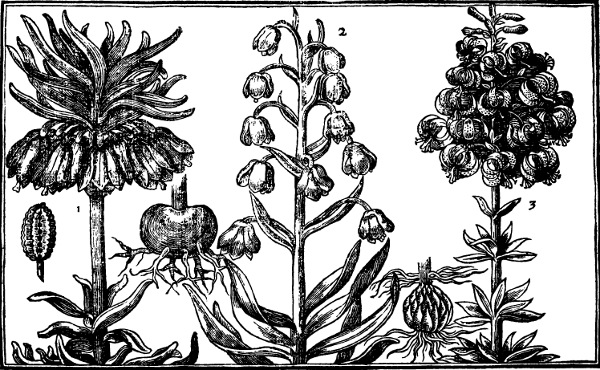
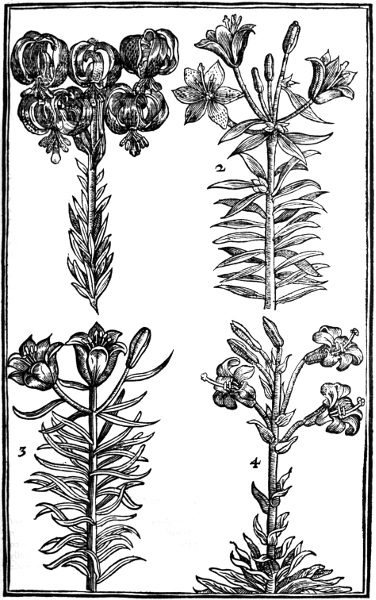
| 1 | Corona Imperialis. The Crown Imperiall. |
| 2 | Lilium Persicum. The Persian Lilly. |
| 3 | Martagon Imperiale. The Martagon Imperiall. |
This was, as it is thought, first brought from Persia vnto Constantinople,
and from thence, sent vnto vs by the meanes of diuers Turkie Merchants,
and in especiall, by the procurement of Mʳ. Nicholas Lete, a worthy Merchant,
and a louer of all faire flowers.
It springeth out of the ground very neare a moneth before the Crowne
Imperiall, but doth not flower till it bee quite past (that is to say) not vntill
the latter end of Aprill, or beginning of May: the seed (when it doth come
to perfection, as it seldome doth) is not ripe vntill Iuly.
It hath been sent by the name of Pennachio Persiano, and wee thereupon
doe most vsually call it Lilium Persicum, The Persian Lilly. Clusius saith it
hath been sent into the Low Countries vnder the name of Susam giul, and
he thereupon thinking it came from Susis in Persia, called it Lilium Susianum,
The Lilly of Susis.
Wee haue not yet heard, that this hath beene applyed for any Physicall
respect.
Vnder this title of Lilium Montanum, or Lilium Siluestre, I do comprehend only
those kindes of Lillies, which carry diuers circles of greene leaues set together
at certaine distances, round about the stalke, and not sparsedly as the two former,
and as other kindes that follow, doe. And although there bee many of this sort,
yet because their chiefest difference is in the colour of the flower, wee will containe
them all in one Chapter, and begin with the most stately of them all, because of the
number of flowers it beareth vpon one stalke. The Imperiall Lilly hath a scaly roote,
like vnto all the rest of the Lillies, but of a paler yellow colour, closely compact or set
together, being short and small oftentimes, in comparison of the greatnesse of the
stemme growing from it. The stalke is brownish and round at the bottome, and sometimes
flat from the middle vpwards, three foote high or more, beset at certaine distances
with rondles or circles of many broad leaues, larger and broader for the most part
than any other of this kinde, and of a darke green colour: It hath two or three, and
sometimes foure of these rondles or circles of leaues, and bare without any leafe betweene;
but aboue toward the tops of the stalkes, it hath here and there some leaues
vpon it, but smaller than any of the other leaues: at the toppe of the stalke come forth
many flowers, sometime three or foure score, thicke thrust, or confusedly set together,
and not thinne or sparsedly one aboue another, as in the lesser of this kinde of Mountaine
Lilly. It hath been sometimes also obserued in this kinde, that it hath borne manie
flowers at three seuerall spaces of the stalke, one aboue another, which hath made
a goodly shew; each flower whereof is pendulous, hanging downe, and each leafe of
the flower turning vp againe, being thicke or fleshy, of a fine delayed purple colour,
spotted with many blackish or brownish spots, of a very pleasant sweet sent, which maketh
it the more acceptable: in the middle of the flower hangeth downe a stile or
pointell, knobbed or buttoned at the end with sixe yellow chiues, tipt with loose pendents
of an Orient red or Vermillion colour, which will easily sticke like dust vpon
any thing that toucheth them: the heads or seede vessels are small and round, with
small edges about them, wherein is contained flat browne seede like other Lillies, but
lesser. This root is very apt to encrease or set of, as we call it, wherby the plant seldome
commeth to so great a head of flowers, but riseth vp with many stalkes, and then carry
fewer flowers.
Martagon
Imperiale
flore non punctato.
Of this kinde there is sometimes one found, that beareth flowers without any spots:
the leaues whereof and stalke likewise are paler, but not else differing.
We haue also some other of this kind, the first wherof hath his stalke & leafe greener
than the former, the stalke is a little higher, but not bearing so thicke a head of flowers,
although much more plentifull than the lesser Mountaine Lilly, being altogether of a
fine white colour, without any spots, or but very few, and that but sometimes also: the
pendents in the middle of this flower are not red, as the former, but yellow; the roote
of this, and of the other two that follow, are of a pale yellow colour, the cloues or
scales of them being brittle, and not closely compact, yet so as if two, and sometimes
three scales or cloues grew one vpon the head or vpperpart of another; which difference
is a speciall note to know these three kindes, from any other kinde of Mountaine
Lilly, as in all old rootes that I haue seene, I haue obserued, as also in them that are reasonably
well growne, but in the young rootes it is not yet so manifest.
The second is like vnto the first in all things, saue in this, that the flowers hereof are
not altogether so white, and besides hath many reddish spots on the inside of the leaues
of the flower, and the stalke also is not so greene but brownish.
A third sort there is of this kinde, whole flowers are wholly of a delayed flesh colour,
with many spots on the flowers, and this is the difference hereof from the former.
The lesser Mountaine Lilly is so like in root vnto the greater that is first described,
that it is hard to distinguish them asunder; but when this is sprung vp out of the ground,
which is a moneth after the first: it also carrieth his leaues in rondles about the stalke,
although not altogether so great nor so many. The flowers are more thinly set on the
stalkes one aboue another, with more distance betweene each flower than the former,
and are of a little deeper flesh colour or purple, spotted in the same manner. The buds
or heads of flowers, in some of these before they be blowne, are hoary white, or
hairie, whereas in others, there is no hoarinesse at all, but the buddes are smooth
and purplish: in other things this differeth not from the former.
Lilium Montanum
non maculatum.
Of this sort also there is one that hath but few spots on the flowers, whose colour is
somewhat paler than the other.
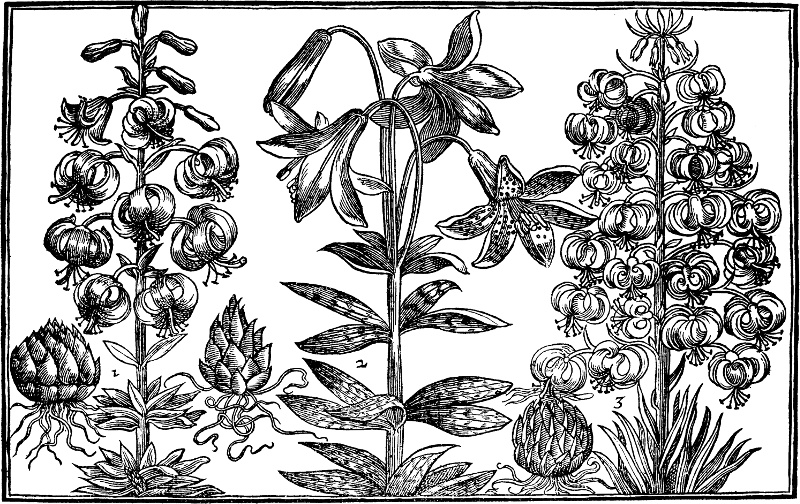
| 1 | Martagon flore albo. The white Martagon. |
| 2 | Martagon siue Lilium Canadense maculatum. The spotted Martagon, or Lilly of Canada. |
| 3 | Martagon Pomponeum. The Martagon Pompony, or early red Martagon. |
Although this strange Lilly hath not his flowers hanging downe, and turning vp again,
as the former kinds set forth in this Chapter, yet because the green leaues stand at
seuerall ioynts as they do, I must needs insert it here, not knowing where more fitly to
place it. It hath a small scaly roote, with many small long fibres thereat, from whence
riseth vp a reasonable great stalke, almost as high as any of the former, bearing at three
or foure distances many long and narrow greene leaues, but not so many or so broad
as the former, with diuers ribbes in them: from among the vppermost rundle of leaues
breake forth foure or fiue flowers together, euery one standing on a long slender foote
stalke, being almost as large as a red Lilly, but a little bending downewards, and of a
faire yellow colour, spotted on the inside with diuers blackish purple spots or strakes,
hauing a middle pointell, and sixe chiues, with pendents on them.
All these Lillies haue been found in the diuers Countries of Germany, as
Austria, Hungaria, Pannonia, Stiria, &c. and are all made Denisons in our
London Gardens, where they flourish as in their owne naturall places. The
last was brought into France from Canada by the French Colonie, and
from thence vnto vs.
They flower about the later end of Iune for the most part, yet the first
springeth out of the ground a moneth at the least before the other, which
are most vsually in flower before it, like vnto the Serotine Tulipas, all of
them being early vp, and neuer the neere.
The first is vsually called Martagon Imperiale, the Imperiall Martagon,
and is Lilium Montanum maius, the greatest Mountaine Lilly; for so it deserueth
the name, because of the number of flowers vpon a head or stalke.
Some haue called it Lilium Sarasenicum, and some Hemerocallis, but neither
of them doth so fitly agree vnto it.
The second is Lilium Montanum maius flore albo, and of some Martagon
Imperiale flore albo, but most vsually Martagon flore albo, the white Martagon.
The second sort of this second kinde, is called Martagon flore albo maculato,
the spotted white Martagon. And the third, Martagon flore carneo,
the blush Martagon.
The third kinde is called Lilium Montanum, the Mountaine Lilly, and
some adde the title minus, the lesser, to know it more distinctly from the other.
Some also Lilium Siluestre, as Clusius, and some others, and of Matthiolus
Martagon. Of diuers women here in England, from the Dutch name,
Lilly of Nazareth. The last hath his title Americanum & Canadense, and in
English accordingly.
As in the former Chapter we described vnto you such Lillies, whose flowers being
pendulous, turne their leaues backe againe, and haue their greene leaues,
set by spaces about the stalke: so in this wee will set downe those sorts, which
carry their greene leaues more sparsedly, and all along the stalke, their flowers hanging
downe, and turning vp againe as the former, and begin with that which is of greatest
beauty, or at least of most rarity.
1. Martagon
Pomponeum
angusti folium
praecox.
1. This rare Martagon hath a scaly root closely compact, with broader and thinner
scales than others, in time growing very great, and of a more deepe yellow colour
then the former, from whence doth spring vp a round greene stalke in some plants, and
flat in others, two or three foote high, bearing a number of small, long, and narrow
greene leaues, very like vnto the leaues of Pinkes, but greener, set very thicke together,
and without order about the stalke, vp almost vnto the toppe, and lesser by degrees
vpwards, where stand many flowers, according to the age of the plant, and thriuing in
the place where it groweth; in those that are young, but a few, and more sparsedly,
and in others that are old many more, and thicker set: for I haue reckoned threescore
flowers and more, growing thicke together on one plant with mee, and an hundred
flowers on another: these flowers are of a pale or yellowish red colour, and not so
deep red as the red Martagon of Constantinople, hereafter set down, nor fully so large:
yet of the same fashion, that is, euery flower hanging downe, and turning vp his leaues
againe. It is not so plentifull in bearing of seede as the other Lillies, but when it doth,
it differeth not but in being lesse.
2. Martagon
angusti folium
magis serotinum.
There is another, whose greene leaues are not so thicke set on the stalke, but else
differeth not but in flowring a fortnight later.
3. Martagon
Pomponeum
latifolium praecox.
There is another also of this kind, so like vnto the former in root, stalk, flower, & maner
of growing, that the difference is hardly discerned; but consisteth chiefly in these
two points: First, that the leaues of this are a little broader and shorter then the former;
and secondly, that it beareth his flowers a fortnight earlier than the first. In the colour
or forme of the flower, there can no difference bee discerned, nor (as I said) in any other
thing. All these Lillies doe spring very late out of the ground, euen as the yellow
Martagons doe, but are sooner in flower then any others.
4. Martagon
flore phaeniceo.
A fourth kinde hereof hath of late been knowne to vs, whose leaues are broader and
shorter than the last, and the flowers of a paler red, tending to yellow, of some called
a golden red colour: but flowreth not so early as they.
1. The red Martagon of Constantinople is become so common euery where, and so
well knowne to all louers of these delights, that I shall seeme vnto them to lose time,
to bestow many lines vpon it; yet because it is so faire a flower, and was at the first so
highly esteemed, it deserueth his place and commendations, howsoeuer encreasing
the plenty hath not made it dainty. It riseth out of the ground early in the spring, before
many other Lillies, from a great thicke yellow scaly root, bearing a round brownish
stalke, beset with many faire greene leaues confusedly thereon, but not so broad
as the common white Lilly, vpon the toppe whereof stand one, two, or three, or more
flowers, vpon long footestalkes, which hang downe their heads, and turne vp their
leaues againe, of an excellent red crimson colour, and sometimes paler, hauing a long
pointell in the middle, compassed with sixe whitish chiues, tipt with loose yellow
pendents, of a reasonable good sent, but somewhat faint. It likewise beareth seede in
heads, like vnto the other, but greater.
Martagon Constantinopolitanum maculatum.
The red spotted Martagon of Constantinople.
We haue another of this kinde, that groweth somewhat greater and higher, with a
larger flower, and of a deeper colour, spotted with diuers blacke spots, or strakes and
lines, as is to be seene in the Mountaine Lillies, and in some other hereafter to be described;
but is not so in the former of this kinde, which hath no shew of spots at all.
The whole plant as it is rare, so it is of much more beauty than the former.
2. Martagon Pannonicum, siue Exoticum flore spadiceo.
The bright red Martagon of Hungarie.
Although this Martagon or Lilly bee of another Countrey, yet by reason of the
neerenesse both in leafe and flower vnto the former, may more fitly be placed next vnto
them, then in any other place. It hath his roote very like the other, but the leaues
are somewhat larger, and more sparsedly set vpon the stalke, else not much vnlike:
the flowers bend downe, and turne vp their leaues againe, but somewhat larger, and
of a bright red, tending to an Orenge colour, that is, somewhat yellowish, and not
crimson, like the other.
1. This Yellow Martagon hath a great scaly or cloued roote, and yellow, like vnto
all these sorts of turning Lillies, from whence springeth vp a round greene strong
stalke, three foote high at the least, confusedly set with narrow long greene leaues,
white on the edges vp to the very toppe thereof almost, hauing diuers flowers on the
head, turning vp againe as the former doe, of a faint yellowish, or greenish yellow colour,
with many blacke spots or strakes about the middle of the leafe of euery flower,
and a forked pointell, with sixe chiues about it, tipt with reddish pendents, of a heauie
strong smell, not very pleasant to many. It beareth seede very plentifully, in great
heads, like vnto the other former Lillies, but a little paler.
2. Martagon Luteum non maculatum.
The Yellow Martagon without spots.
The other yellow Martagon differeth in no other thing from the former, but onely
that it hath no spots at all vpon any of the leaues of the flowers; agreeing with the former,
in colour, forme, height, and all things else.
3. Martagon Luteum serotinum.
The late flowring Yellow Martagon.
There is yet another yellow Martagon, that hath no other difference then the time
of his flowring, which is not vntill Iuly, vnlesse in this, that the flower is of a deeper
yellow colour.
The knowledge of the first kindes of these early Martagons hath come
from Italy, from whence they haue bin sent into the Low-Countries, and to
vs, and, as it seemeth by the name, whereby they haue bin sent by some into
these parts, his originall should be from the mountaines in Macedonia.
The second sort is sufficiently knowne by his name, being first brought
from Constantinople, his naturall place being not farre from thence, as it
is likely. But the next sort of this second kinde, doth plainly tell vs his
place of birth to be the mountaines of Pannonia or Hungarie.
The third kindes grow on the Pyrenæan mountains, where they haue
been searched out, and found by diuers louers of plants, as also in the Kingdome
of Naples.
The first early Martagons flower in the end of May, or beginning of
Iune, and that is a moneth at the least before those that come from Constantinople,
which is the second kinde. The two first yellow Martagons
flower somewhat more early, then the early red Martagons, and sometimes
at the same time with them. But the third yellow Martagon, as is said, flowreth
a moneth later or more, and is in flower when the red Martagon of
Constantinople flowreth. And although the early red and yellow Martagons,
spring later then the other Martagons or Lillies, yet they are in flower
before them.
The first early red Lillies or Martagons haue beene sent vnto vs by seuerall
names, as Martagon Pomponeum, and thereafter are called Martagon of
Pompony, and also Lilium or Martagon Macedonicum, the Lilly or Martagon
of Macedonia. They are also called by Clusius Lilium rubrum præcox,
the one angustiore folio, the other latiore folio. And the last of this kinde hath
the title flore phæniceo added or giuen vnto it, that is, the Martagon or Lilly
of Macedonia with gold red flowers.
The Martagons of Constantinople haue beene sent by the Turkish name
Zufiniare, and is called Martagon, or Lilium Byzantinum by some, and Hemerocallis
Chalcedonica by others; but by the name of the Martagon of Constantinople
they are most commonly receiued with vs, with the distinction
of maculatum to the one, to distinguish the sorts. The last kinde in this classis,
hath his name in his title, as it hath been sent vnto vs.
The Yellow Martagons are distinguished in their seuerall titles, as much
as is conuenient for them.
There are yet some other kindes of red Lillies to bee described, which differ
from all the former, and remaine to be spoken of in this place. Some of them
grow high, and some lowe, some haue small knots, which wee call bulbes,
growing vpon the stalkes, at the ioynts of the leaues or flowers, and some haue none:
all which shall be intreated of in their seuerall orders.
The dwarfe red Lilly hath a scaly roote, somewhat like vnto other Lillies, but
white, and not yellow at all, and the cloues or scales thicker, shorter, and fewer in
number, then in most of the former: the stalke hereof is not aboue a foote and a halfe
high, round and greene, set confusedly with many faire and short greene leaues, on the
toppe of which doe stand sometimes but a few flowers, and sometimes many, of a faire
purplish red colour, and a little paler in the middle, euery flower standing vpright, and
not hanging downe, as in the former, on the leaues whereof here and there are some
blacke spots, lines or markes, and in the middle of the flower a long pointell, with
some chiues about it, as is in the rest of these Lillies.
Lilium rubrum multiplici flore.
This kinde is sometimes found to yeeld double flowers, as if all the single flowers
should grow into one, and so make it consist of many leaues, which notwithstanding
his so continuing sundry yeares, vpon transplanting, will redire ad ingenium, that is,
quickly come againe to his old byas or forme.
| 1 | Martagon rubrum siue luteum. The red or the yellow Martagon. |
| 2 | Lilium Bulbiferum. The red bulbed Lilly. |
| 3 | Lilium aureum. The gold red Lilly. |
| 4 | Lilium album. The white Lilly. |
The second red Lilly without bulbes groweth much higher then the first, and almost
as high as any other Lilly: the roote hereof is white and scaly, the leaues are
somewhat longer, and of a darke or sad greene colour; the flowers are many and
large, standing vpright as all these sorts of red Lillies doe, of a paler red colour tending
to an Orenge on the inside, with many blacke spots and lines on them, as in the
former, and more yellow on the outside: the seede vessels are like vnto the roundish
heads of other Lillies, and so are the seedes in them likewise.
The first of the Lillies that carrieth bulbes on the stalke, hath a white scaly roote
like the former; from whence riseth vp a small round stalke, not much higher then
the first dwarfe Lilly, seeming to be edged, hauing many leaues thereon of a sad green
colour set about it, close thrust together: the greene heads for flowers, will haue a kind
of woollinesse on them, before the flowers begin to open, and betweene these heads
of flowers, as also vnder them, and among the vppermost leaues, appeare small bulbes
or heads, which being ripe if they be put into the ground, or if they fall of themselues,
will shoote forth leaues, and beare flowers within two or three yeares like the mother
plant, and so will the bulbes of the other hereafter described: the flowers of this
Lilly are of a faire gold yellow colour, shadowed ouer with a shew of purple, but not
so red as the first, or the next to bee described. This Lilly will shoote strings vnder
ground, like as the last red Lilly will doe also, whereat will grow white bulbed roots,
like the rootes of the mother plant, thereby quickly encreasing it selfe.
The second bulbed Lilly riseth vp with his stalke as high as any of these Lillies,
carrying many long and narrow darke greene leaues about it, and at the toppe many
faire red flowers, as large or larger then any of the former, and of a deeper red colour,
with spots on them likewise, hauing greater bulbes growing about the toppe of the
stalke and among the flowers, then any else.
Lilium Cruentum flore pleno.
The Fierie red double Lilly.
The difference of this doth chiefly consist in the flower, which is composed of manie
leaues, as if many flowers went to make one, spotted with black spots, and without
any bulbes when it thus beareth, which is but accidentall, as the former double Lilly
is said to be.
The third red Lilly with bulbes, riseth vp almost as high as the last, and is the most
common kinde we haue bearing bulbes. It hath many leaues about the stalke, but not
of so sad a greene colour as the former: the flowers are of as pale a reddish yellow colour
as any of the former, and comming neerest vnto the colour of the Gold red Lilly.
This is more plentifull in bulbes, and in shooting strings, to encrease rootes vnder
ground, then the others.
These Lillies doe all grow in Gardens, but their naturall places of growing
is the Mountaines and the Vallies neere them in Italy, as Matthiolus
saith: and in many Countries of Germany, as Hungarie, Austria, Stiria,
and Bohemia, as Clusius and other doe report.
They flower for the most part in Iune, yet the first of these is the earliest
of all the rest.
All these Lillies are called Lilia Rubra, Red Lillies: Some call them
Lilium Aureum, Lilium Purpureum, Lilium Puniceum, & Lilium Cruentum.
Some also call them Martagon Chimistarum. Clusius calleth these bulbed
Lillies Martagon Bulbiferum. It is thought to be Hyacinthus Poetarum, but I
referre the discussing thereof to a fitter time. Wee haue, to distinguish them
most fitly (as I take it) giuen their proper names in their seuerall titles.
Now remaineth onely the White Lilly, of all the whole family or stocke of the
Lillies, to bee spoken of, which is of two sorts. The one is our common or
vulgar White Lilly; and the other, that which was brought from Constantinople.
The ordinary White Lilly scarce needeth any description, it is so well knowne,
and so frequent in euery Garden; but to say somewhat thereof, as I vse to doe of euery
thing, be it neuer so common and knowne; it hath a cloued or scaly roote, yellower
and bigger then any of the red Lillies: the stalke is of a blackish greene colour, and
riseth as high as most of the Lillies, hauing many faire, broad, and long greene leaues
thereon, larger and longer beneath, and smaller vpon the stalke vpwards; the flowers
are many or few, according to the age of the plant, fertility of the soile, and time of
standing where it groweth: and stand vpon long greene footstalkes, of a faire white
colour, with a long pointell in the middle, and white chiues tipt with yellow pendents
about it; the smell is somewhat heady and strong.
The other White Lilly, differeth but little from the former White Lilly, either in
roote, leafe, or flower, but only that this vsually groweth with more number of flowers,
then euer we saw in our ordinary White Lilly: for I haue seene the stalke of this
Lilly turne flat, of the breadth of an hand, bearing neere two hundred flowers vpon a
head, yet most commonly it beareth not aboue a dozen, or twenty flowers, but smaller
then the ordinary, as the greene leaues are likewise.
The first groweth onely in Gardens, and hath not beene declared where
it is found wilde, by any that I can heare of. The other hath beene sent from
Constantinople, among other rootes, and therefore is likely to grow in
some parts neere thereunto.
They flower in Iune or thereabouts, but shoote forth greene leaues in
Autumne, which abide greene all the Winter, the stalke springing vp betweene
the lower leaues in the Spring.
It is called Lilium Album, the White Lilly, by most Writers; but by Poets
Rosa Iunonis, Iuno’s Rose. The other hath his name in his title.
This Lilly aboue all the rest, yea, and I thinke this onely, and none of
the rest is vsed in medicines now adayes, although in former times Empericks
vsed the red; and therefore I haue spoken nothing of them in the end
of their Chapters, reseruing what is to be said in this. This hath a mollifying,
digesting, and cleansing quality, helping to suppurate tumours, and to
digest them, for which purpose the roote is much vsed. The water of the
flowers distilled, is of excellent vertue for women in trauell of childe bearing,
to procure an easie deliuery, as Matthiolus and Camerarius report. It
is vsed also of diuers women outwardly, for their faces to cleanse the skin,
and make it white and fresh. Diuers other properties there are in these
Lillies, which my purpose is not to declare in this place. Nor is it the scope
of this worke; this that hath been said is sufficient: for were it not, that I
would giue you some taste of the qualities of plants (as I said in my Preface)
as I goe along with them, a generall worke were fitter to declare them
then this.
Although diuers learned men do by the name giuen vnto this delightfull plant,
thinke it doth in some things partake with a Tulipa or Daffodill, and haue
therefore placed it betweene them; yet I, finding it most like vnto a little Lilly,
both in roote, stalke, leafe, flower, and seede, haue (as you see here) placed it next
vnto the Lillies, and before them. Hereof there are many sorts found out of late, as
white, red, blacke, and yellow, besides the purple, which was first knowne; and of
each of them there are also diuers sorts: and first of that which is most frequent, and
then of the rest, euery one in his place and order.
The ordinary checkerd Daffodill (as it is vsually called, but might more properly
be called the small checkerd Lilly) hath a small round white roote, and somewhat
flat, made as it were of two cloues, and diuided in a maner into two parts, yet ioyning
together at the bottome or seate of the roote, which holdeth them both together:
from betweene this cleft or diuision, the budde for the stalke &c. appeareth, which in
time riseth vp a foote, or a foote and a halfe high, being round and of a brownish
greene colour, especially neere vnto the ground, whereon there standeth dispersedly
foure or fiue narrow long and greene leaues, being a little hollow: at the toppe of the
stalke, betweene the vpper leaues (which are smaller then the lowest) the flower sheweth
it selfe, hanging or turning downe the head, but not turning vp againe any of his
leaues, as some of the Lillies before described doe; (sometimes this stalke beareth
two flowers, and very seldome three) consisting of sixe leaues, of a reddish purple colour,
spotted diuersly with great spots, appearing like vnto square checkers, of a deeper
colour; the inside of the flower is of a brighter colour then the outside, which
hath some greennesse at the bottome of euery leafe: within the flower there appeare
sixe chiues tipt with yellow pendents, and a three-forked stile or pointell compassing a
greene head, which when the flower is past, riseth vpright againe, and becommeth
the seede vessell, being somewhat long and round, yet hauing a small shew of edges,
flat at the head, like the head of a Lilly, and without any crowne as the Tulipa hath,
wherein is contained pale coloured flat seede, like vnto that of a Lilly, but smaller.
Fritillaria vulgaris
pallidior,
praecox, & serotina.
There is some variety to be seene in this flower; for in some the colour is paler, and
in others againe of a very high or deepe colour: sometimes also they haue eight leaues,
and sometimes ten or twelue, as if two flowers were made one, which some thereupon
haue called a Double Fritillaria. Some of them likewise doe flower very early, euen
with or before the early flowring Tulipas; and some againe flower not vntill a moneth
or more after the former.
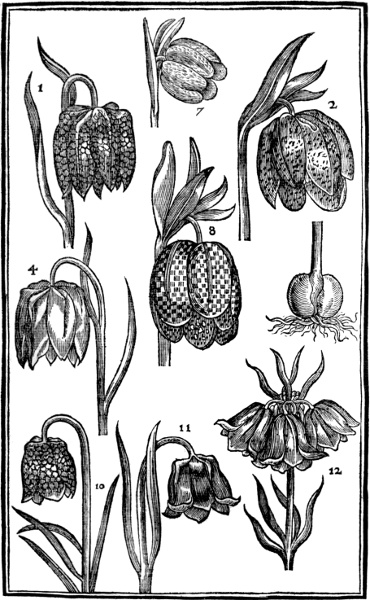
| 1 | Fritillaria vulgaris. The common Fritillaria. |
| 2 | Fritillaria flore atrorubente. The dark red Fritillaria. |
| 4 | Fritillaria alba. The white Fritillaria. |
| 7 | Fritillaria lutea punctata. The yellow checkerd Fritillaria. |
| 8 | Fritillaria lutea Italica. The great yellow Italian Fritillaria. |
| 10 | Fritillaria lutea Lusitanica. The small yellow Fritillaria of Portugal. |
| 11 | Fritillaria Pyrenæa. The blacke Fritillaria. |
| 12 | Fritillaria umbellifera. The Spanish blacke Fritillaria. |
The roote of this Fritillaria is somewhat rounder and closer then the former, from
whence the stalke riseth vp, being shorter and lower then in any other of these kindes,
hauing one or two leaues thereon, and at the top thereof two or three more set closer
together, which are broader, shorter, and whiter then any of them before, almost like
vnto the leaues of the yellow Fritillaria, from among which toppe leaues commeth
forth the flower, somewhat bending downe, or rather standing forth, being larger
then any of the former, and almost equall in bignesse vnto the yellow Fritillaria, of a
duskie gray colour all ouer on the outside, and of a very darke red colour on the inside,
diuersly spotted or straked: this very hardly encreaseth by the roote, and as seldome
giueth ripe seede, but flowreth with the other first sorts, and before the blacke, and abideth
lesse time in flower then any.
This great Fritillaria hath his roote equall to the bignesse of the rest of his parts,
from whence riseth vp one, & oftentimes two stalks, hauing one, two or three flowers
a peece on them, as nature and the seasons are fitting: euery one of these flowers are
larger and greater then any of the former described, and pendulous as they are, of a
sad red or purplish colour, with many thwart lines on them, and small long markes,
which hardly seeme checkerwise, nor are so eminent or conspicuous as in the former:
the stalke is strong and high, whereon are set diuers long whitish greene leaues, larger
and broader then those of the former.
The white Fritillaria is so like vnto the first, that I shall not neede to make another
description of this: it shall (I hope) be sufficient to shew the chiefe differences, and so
proceed to the rest. The stalke and leaues of this are wholly greene, whereby it may
easily be knowne from the former, which, as is said, is brownish at the bottome. The
flower is white, without almost any shew of spot or marke in it, yet in some the markes
are somewhat more plainly to be seene, and in some againe there is a shew of a faint
kinde of blush colour to be seene in the flower, especially in the inside, the bottomes
of the leaues of euery flower sometimes are greenish, hauing also a small list of greene,
comming downe towards the middle of each leafe: the head or seede vessell, as also
the seede and the roote, are so like vnto the former, that the most cunning cannot distinguish
them.
This Fritillaria hath a round flattish white roote, very like vnto the last Fritillaria,
bearing a stalke with long greene leaues thereon, little differing from it, or the first ordinary
Fritillaria: the flower is said to be constant, composed of many leaues, being
ten at the least, and most vsually twelue, of a pale whitish purple colour, spotted like
vnto the paler ordinary Fritillaria that is early, so that one would verily thinke it were
but an accidentall kinde thereof, whereas it is (as is said before) held to bee constant,
continuing in this manner.
The pure yellow Fritillaria hath a more round, and not so flat a whitish roote as the
former kindes, and of a meane bignesse; from the middle riseth vp a stalke a foote and
a halfe high, and sometimes higher, whereon are set without order diuers long and
somewhat broad leaues of a whitish greene colour, like vnto the leaues of the blacke
Fritillaria, but not aboue halfe so broad: the flower is somewhat small and long, not
much vnlike to the blacke for shape and fashion, but that the leaues are smaller and
rounder pointed, of a faint yellowish colour, without any shew of spots or checkers
at all, eyther within or without the flower, hauing some chiues and yellow pendents in
the middle, as is to be seene in all of them: the seede is like the first kinde.
This Fritillaria groweth not much lower then the former, and brownish at the rising
vp, hauing his leaues whiter, broader, and shorter then it, and almost round pointed.
The flower is greater, and larger spread then any other before, of a faire pale yellow
colour, spotted in very good order, with fine small checkers, which adde a wonderfull
pleasing beauty thereunto: it hath also some lists of greene running downe the
backe of euery leafe. It seldome giueth seede; the roote also is like the other, but not
so flat.
This kinde of Fritillaria riseth vp with a round and browne greene stalke, whereon
are set diuers leaues somewhat broad and short, which compasse the stalke at the bottome
of them, of a darke greene colour; at the toppe of the stalke, which bendeth a
little downewards, doe most vsually stand three or foure leaues, betweene which commeth
forth most vsually but one flower, which is longer then the last, hanging downe
the head as all the others doe, consisting of sixe leaues, of a darke yellowish purple
colour, spotted with some small red checkers. This kinde flowreth late, and not vntill
all the rest are past.
This small Italian Fritillaria carrieth more store of flowers on the stalke, but they
are much smaller, and of a yellowish greene colour, spotted with long and small darke
red checkers or markes: the stalke hath diuers small short greene leaues thereon, vnto
the very toppe.
The leaues of this Fritillaria are so small, narrow and long, that it hath caused them
to take the name of rushes, as if you should call it, The rush leafed Fritillaria, which
stand on a long weake round stalke, set without order the flower is small and yellow,
but thicker checkerd with red spots then any of the other yellow Fritillaria’s; the stalk
of the flower, at the head thereof, being also of a yellowish colour.
The roote of this kinde doth often grow so great, that it seemeth like vnto the roote
of a small Crowne Imperiall: the stalke is strong, round, and high, set without order,
with broader and whiter greene leaues then any of the former, bearing one, two, or
three flowers; sometimes at the toppe, being not so large as those of the ordinary purple
Fritillaria, but smaller, longer, and rounder, sometimes a little turning vp the
brims or edges of the leaues againe, and are of a yellowish shining greene colour on
the inside, sometimes spotted with red spots almost through the whole inside of the
flower, vnto the very edge, which abideth of a pale yellow colour, and sometimes
there are very few spots to be seene, and those from the middle onely on the inside
(for on the outside there neuer appeareth any spots at all in this kinde) and sometimes
with no shew of spots at all, sometimes also of a more pale greene, and sometime of a
more yellow colour: the outside of the flowers doe likewise vary, for in some the outside
of the leaues are of a darke sullen yellow, &c. else more pale yellow, and in other
of a darke purplish yellow colour, which in some is so deepe, and so much, that it rather
seemeth blacke then purple or yellow, and this especially about the bottome of
the flower, next vnto the stalke, but the edges are still of a yellowish greene: the head
of seede, and the seede likewise is like vnto the former, but bigger in all respects.
This Fritillaria is no doubt of kindred to the last recited, it is so like, but greater in
all parts thereof, as if growing in a more fruitfull soile, it were the stronger and lustier
to beare more store of flowers: the flowers grow foure or fiue from the head together,
hanging downe round about the stalke, like vnto a Crowne Imperiall, and are of a
yellowish greene colour on the inside, spotted with a few red spots, the outside being
blackish as the former.
The first of these plants was first brought to our knowledge from France,
where it groweth plentifully about Orleance; the other sorts grow in diuers
other Countries, as some in Portugall, Spaine, Italy, &c. as their names
doe import, and as in time they haue been obserued by those that were curious
searchers of these rarities, haue been sent to vs.
The early kindes doe flower in the beginning of Aprill or thereabouts,
according to the mildenesse or sharpenesse of the precedent Winter. The
other doe flower after the first are past, for a moneths space one after another,
and the great yellow is very late, not flowring vntill about the middle
or end of May.
This hath receiued diuers names: some calling it Flos Meleagridis, the
Ginny Hen Flower, of the variety of the colours in the flower, agreeing with
the feathers of that Bird. Some call it Narcissus Caparonius, of the name of
the first inuentor or finder thereof, called Noel Caperon, an Apothecary
dwelling in Orleance, at the time he first found it, and was shortly after the
finding thereof taken away in the Massacre in France. It is now generally
called Fritillaria, of the word Fritillus, which diuers doe take for the Chesse
borde or table whereon they play, whereunto, by reason of the resemblance
of the great squares or spots so like it, they did presently referre it. It is
called by Lobel Lilionarcissus purpureus variegatus, & sessulatus, making it a
kinde of Tulipa; but as I said in the beginning of the Chapter, it doth most
neerely resemble a small pendulous Lilly, and might therefore rightly hold
the name of Lilium variegatum, or in English, the checkerd Lilly. But because
the errour which first referred it to a Daffodill, is growne strong by
custome of continuance, I leaue to euery one their owne will, to call it in
English eyther Fritillaria, as it is called of most, or the checkerd Daffodill,
or the Ginnie Hen flower, or, as I doe, the checkerd Lilly. I shall not neede
in this place further to explaine the seuerall names of euery of them, hauing
giuen you them in their titles.
I haue not found or heard by any others of any property peculiar in this
plant, to be applied either inwardly or outwardly for any disease: the
chiefe or onely vse thereof is, to be an ornament for the Gardens of the curious
louers of these delights, and to be worne of them abroad, which for
the gallant beauty of many of them, deserueth their courteous entertainment,
among many other the like pleasures.
Next vnto the Lillies, and before the Narcissi or Daffodils, the discourse of Tulipas
deserueth his place, for that it partaketh of both their natures; agreeing
with the Lillies in leaues, flowers, and seede, and somewhat with the Daffodils
in rootes. There are not onely diuers kindes of Tulipas, but sundry diuersities of
colours in them, found out in these later dayes by many the searchers of natures varieties,
which haue not formerly been obserued: our age being more delighted in the
search, curiosity, and rarities of these pleasant delights, then any age I thinke before.
But indeede, this flower, aboue many other, deserueth his true commendations and
acceptance with all louers of these beauties, both for the stately aspect, and for the admirable
varietie of colours, that daily doe arise in them, farre beyond all other
plants that grow, in so much, that I doubt, although I shall in this Chapter set downe
the varieties of a great many, I shall leaue more vnspoken of, then I shall describe; for
I may well say, there is in this one plant no end of diuersity to be expected, euery yeare
yeelding a mixture and variety that hath not before been obserued, and all this arising
from the sowing of the seede. The chiefe diuision of Tulipas, is into two sorts: Præcoces,
early flowring Tulipas, and Serotinæ, late flowring Tulipas. For that sort which
is called Mediæ or Dubiæ, that is, which flower in the middle time betweene them
both, and may be thought to be a kinde or sort by it selfe, as well as any of the other
two: yet because they doe neerer participate with the Serotinæ then with the Præcoces,
not onely in the colour of the leafe, being of the same greennesse with the Serotinæ,
and most vsually also, for that it beareth his stalke and flower, high and large like as
the Serotinæ doe; but especially, for that the seede of a Media Tulipa did neuer bring
forth a Præcox flower (although I know Clusius, an industrious, learned, and painfull
searcher and publisher of these rarities, saith otherwise) so farre as euer I could, by
mine owne care or knowledge, in sowing their seede apart, or the assurance of any others,
the louers and sowers of Tulipa seede, obserue, learne, or know: and because
also that the seede of the Serotinæ bringeth forth Medias, and the seede of Medias Serotinæ,
they may well bee comprehended vnder the generall title of Serotinæ: But because
they haue generally receiued the name Mediæ, or middle flowring Tulipas,
to distinguish between them, and those that vsually doe flower after them; I am content
to set them downe, and speake of them seuerally, as of three sorts. Vnto the
place and ranke likewise of the Præcoces, or early flowring Tulipas, there are some other
seuerall kinds of Tulipas to be added, which are notably differing, not onely from the
former Præcox Tulipa, but euery one of them, one from another, in some speciall note
or other: as the Tulipa Boloniensis flore rubro, the red Bolonia Tulipa. Tulipa Boloniensis
flore luteo, the yellow Bolonia Tulipa. Tulipa Persica, Persian Tulipa. Tulipa Cretica,
the Candie Tulipa, and others: all which shall bee described and entreated of, euery
one apart by it selfe, in the end of the ranke of the Præcoces, because all of them
flower much about their time. To begin then with the Præcox, or early flowring Tulipas,
and after them with the Medias and Serotinas, I shall for the better method, diuide
their flowers into foure primary or principall colours, that is to say, White, Purple,
Red and Yellow, and vnder every one of these colours, set downe the seuerall varieties
of mixtures we haue seene and obserued in them, that so they may be both the better
described by me, and the better conceiued by others, and euery one placed in their
proper ranke. Yet I shall in this, as I intend to doe in diuers other plants that are variable,
giue but one description in generall of the plant, and then set downe the varietie
of forme or colour afterwards briefly by themselues.
The early Tulipa (and so all other Tulipas) springeth out of the ground with his
leaues folded one within another, the first or lowest leafe riseth vp first, sharpe pointed,
and folded round together, vntill it be an inch or two aboue the ground, which
then openeth it selfe, shewing another leafe folded also in the bosome or belly of the
first, which in time likewise opening it selfe, sheweth forth a third, and sometimes a
fourth and a fifth: the lower leaues are larger then the vpper, and are faire, thicke,
broad, long, and hollow like a gutter, and sometimes crumpled on the edges, which
will hold water that falleth thereon a long time, of a pale or whitish greene colour,
(and the Mediæ and Serotinæ more greene) couered ouer as it were with a mealinesse or
hoarinesse, with an eye or shew of rednesse towards the bottome of the leaues, and the
edges in this kinde being more notable white, which are two principall notes to know
a Præcox Tulipa from a Media or Serotina: the stalke with the flower riseth vp in the
middle, as it were through these leaues, which in time stand one aboue another, compassing
it at certaine vnequall distances, and is often obserued to bend it selfe crookedly
downe to the ground, as if it would thrust his head thereinto, but turning vp his
head (which will be the flower) againe, afterwards standeth vpright, sometimes but
three or foure fingers or inches high, but more often halfe a foote, and a foot high, but
the Medias, and Serotinas much higher, carrying (for the most part) but one flower on
the toppe thereof, like vnto a Lilly for the forme, consisting of sixe leaues, greene at
the first, and afterwards changing into diuers and sundry seuerall colours and varieties,
the bottomes likewise of the leaues of these sometimes, but most especially of the
Mediæ, being as variable as the flower, which are in some yellow, or green, or blacke,
in others white, blew, purple, or tawnie; and sometimes one colour circling another:
some of them haue little or no sent at all, and some haue a better then others. After it
hath been blowne open three or foure dayes or more, it will in the heate of the Sunne
spread it selfe open, and lay it selfe almost flat to the stalke: in the middle of the flower
standeth a greene long head (which will be the seed vessell) compassed about with sixe
chiues, which doe much vary, in being sometimes of one, and sometimes of another
colour, tipt with pendents diuersly varied likewise: the head in the middle of the
flower groweth after the flower is fallen, to be long, round, and edged, as it were
three square, the edges meeting at the toppe, where it is smallest, and making as it
were a crowne (which is not seen in the head of any Lilly) and when it is ripe, diuideth
it selfe on the inside into sixe rowes, of flat, thinne, brownish, gristly seede, very like
vnto the seede of the Lillies, but brighter, stiffer, and more transparent: the roote being
well growne is round, and somewhat great, small and pointed at the toppe, and
broader, yet roundish at the bottome, with a certaine eminence or seate on the one
side, as the roote of the Colchicum hath; but not so long, or great, it hath also an
hollownesse on the one side (if it haue borne a flower) where the stalke grew, (for although
in the time of the first springing vp, vntill it shew the budde for flower, the
stalke with the leaues thereon rise vp out of the middle of the roote; yet when the
stalke is risen vp, and sheweth the budde for flower, it commeth to one side, making
an impression therein) couered ouer with a brownish thin coate or skin, like an Onion,
hauing a little woollinesse at the bottome; but white within, and firme, yet composed
of many coates, one folding within another, as the roote of the Daffodils be, of a reasonable
good taste, neyther very sweete, nor yet vnpleasant. This description may
well serue for the other Tulipas, being Medias or Serotinas, concerning their springing
and bearing, which haue not any other great variety therein worth the note, which is
not expressed here; the chiefe difference resting in the variety of the colours of the
flower, and their seuerall mixtures and markes, as I said before: sauing onely, that the
flowers of some are great and large, and of others smaller, and the leaues of some long
and pointed, and of others broad and round, or bluntly pointed, as shall bee shewed
in the end of the Chapter: I shall therefore onely expresse the colours, with the
mixture or composure of them, and giue you withall the names of some of them, (for
it is impossible I thinke to any man, to giue seuerall names to all varieties) as they are
called by those that chiefly delight in them with vs.
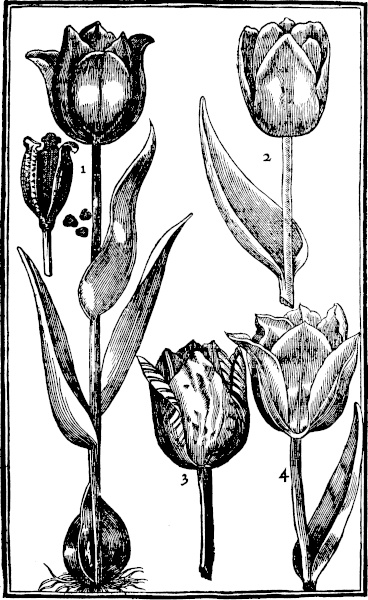
| 1 | Tulipa præcox alba siue rubra, &c. vnius coloris. The early white or red Tulipa, &c. being of one colour. |
| 2 | Tulipa, præcox purpurea oris albis. The early purple Tulipa with white edges, or the Prince. |
| 3 | Tulipa præcox variegata. The early stript Tulipa. |
| 4 | Tulipa præcox rubra oris luteis. The early red Tulipa with yellow edges, or the Duke. |
[48]
Tulipa præcox Alba.
1 Niuea tota interdum purpureis staminibus,
vel saltem luteis, fundo puro haud luteo.
2 Alba siue niuea fundo luteo.
3 Albida.
4 Alba, venis cærulis in dorso.
5 Alba purpureis oris.
⎧Harum flores vel
⎨constantes, vel
⎩dispergentes.
6 Alba carneis oris.
7 Alba sanguineis oris.
8 Alba oris magnis carneis, & venis intro respicientibus.
9 Alba extra, carnei vero coloris intus, oras
habens carneas saturatiores.
10 Albida, oris rubris, vel oris purpureis.
11 Alba, purpurascentibus maculis extra, intus
vero carnei viuacissimi.
12 Alba, purpureis maculis aspersa extra, intus
vero alba purpurantibus oris.
13 Dux Alba, i. e. coceineis & albis variata
flaminis, à medio ad oras intercursantibus.
14 Princessa, i.e. argentei coloris maculis purpurascentibus.
15 Regina pulcherrima, albis & sanguineis
aspersa radijs & punctis.
The early White Tulipa.
1 The flower whereof is either pure snow
white, with purple sometimes, or at least
with yellow chiues, without any yellow
bottome.
2 Or pure white with a yellow bottome.
3 Or milk white that is not so pure white.
4 White with blew veines on the outside.
5 White with purple edges.
⎧Some of these
⎪abiding constant,
⎨& others
⎪spreading
⎩or running.
6 White with blush edges.
7 White With red edges.
8 White with great blush edges, and some
strakes running from the edge inward.
9 White without, and somewhat blush
within, with edges of a deeper blush.
10 Whitish, or pale white with red or purple
edges.
11 Whitish without, with some purplish
veins & spots, & of a liuely blush within.
12 White without, spotted with small purple
spots, and white within with purple
edges.
13 A white Duke, that is, parted with
white & crimson flames, from the middle
of each leafe to the edge.
14 The Princesse, that is, a siluer colour
spotted with fine deepe blush spots.
15 The Queen, that is, a fine white sprinkled
with bloud red spots, and greater
strakes.
Tulipa præcox purpurea.
1 Purpurea satura rubescens, vel violacea.
2 Purpurea pallida, Columbina dicta.
3 Persici coloris saturi.
4 Persici coloris Pallidioris.
5 Paeoniæ floris coloris.
6 Rosea.
7 Chermesiua peramæna.
8 Chermesiua parum striata.
9 Princeps, i.e. purpurea saturatior vel dilutior,
oris albis magnis vel paruis, fundo luteo,
vel albo orbe, quæ multum variatur,
& colore, & oris, ita vt purpurea elegans
oris magnis albis; dicta est, Princeps
excellens, &
10 Princeps Columbina, purpurea dilutior.
11 Purpurea Chermesina, rubicandioris coloris,
albidis vel albis oris.
12 Purpurea, vel obsoleta albidis oris Princeps
Brancion.
13 Purpurea diluta, oris dilutioris purpurei
coloris.
14 Purpurea in exterioribus, carnei vero ad
medium intus, oris albis, fundo luteo.
15 Purpurea albo plumata extra, oris albis,
purpurascens intus, fundo luteo, vel orbe
albo.
16 Alia, minus elegans plumata, minoribusq.,
oris albidis.
The early purple Tulipa.
1 A reddish purple, or more violet.
2 A pale purple, called a Doue colour.
3 A deep Peach colour.
4 A paler Peach colour.
5 A Peony flower colour.
6 A Rose colour.
7 A Crimson very bright.
8 A Crimson stript with a little white.
9 A Prince or Bracklar, that is, a deepe or
pale purple, with white edges, greater
or smaller, and a yellow bottome, or
circled with white, which varieth much,
both in the purple & edges, so that a faire
deep purple, with great white edges, is
called, The best or chiefe Prince, and
10 A paler purple with white edges, called
a Doue coloured Prince.
11 A Crimson Prince or Bracklar.
12 A Brancion Prince, or purple Brancion.
13 A purple with more pale purple edges.
14 Purple without, and blush halfe way
within, with white edges, and a yellow
bottome.
15 Purple feathered with white on the
out side, with white edges, and pale
purple within, the ground being a little
yellow, or circled with white.
16 Another very neere vnto it, but not so
fairely feathered, being more obscure,
and the edges not so great or whitish.
Tulipa præcox rubra.
1 Rubra vulgaris fundo luteo, aliquando
nigro.
2 Rubra satura oris luteis paruis, dicta
Roan.
3 Baro, i. e. rubra magis intensa, oris luteis
paruis.
4 Dux maior & minor, i.e. rubra magis aut
minus elegans satura, oris luteis maximis
vel minoribus, & fundo luteo magno. Alia
alijs est magis amœna, in alijs etiam fundo
nigro vel obscuro viridi.
5 Ducissa, i. e. Duci similis, at plus lutei
quàm rubri, oris magnis luteis, & rubore
magis aut minus intus in gyrum acto, fundo
item luteo magno.
6 Testamentum Brancion i.e., rubra sanguinea
satura, aut minus rubra, oris pallidis,
magnis vel paruis: alia alijs magis aut minus
elegans diuersimodo.
7 Flambans, ex rubore & flauedine radiata,
vel striata fundo luteo.
8 Mali Aurantij coloris, ex rubore, & flauedinè
integre, non separatim mixta, oris
luteis paruis, vel absq., oris.
9 Minij, siue Cinabaris coloris, i.e. ex purpurea,
rubedine, & flauedine radiata, vnguibus
luteis, & aliquando oris.
10 Rex Tuliparum, i.e. ex sanguineo & aureo
radiatim mixta, à flammea diuersa, fundo
luteo, orbe rubro.
11 Tunica Morionis, i.e. ex rubore & aureo
separatim diuersa.
The early red Tulipa.
1 An ordinary red, with a yellow, & sometimes
a blacke bottome.
2 A deep red, with a small edge of yellow,
called a Roane.
3 A Baron, that is, a faire red with a small
yellow edge.
4 A Duke, a greater and a lesser, that is, a
more or less faire deep red, with greater
or lesser yellow edges, and a great yellow
bottome. Some of this sort are
much more or lesse faire then others,
some also haue a blacke or darke greene
bottome.
5 A Dutchesse, that is like vnto the Duke,
but more yellow then red, with greater
yellow edges, and the red more or lesse
circling the middle of the flower on the
inside, with a large yellow bottome.
6 A Testament Brancion, or a Brancion
Duke, that is, a faire deepe red, or lesse
red, with a pale yellow or butter coloured
edge, some larger others smaller:
and some more pleasing then others,
in a very variable manner.
7 A Flambant, differing from the Dutchesse;
for this hath no such great yellow
edge, but streaks of yellow through
the leafe vnto the very edge.
8 An Orenge colour, that is, a reddish yellow,
or a red and yellow equally mixed,
with small yellow edges, and sometimes
without.
9 A Vermillion, that is, a purplish red,
streamed with yellow, the bottome
yellow, and sometimes the edges.
10 The Kings flower, that is, a crimson or
bloud red, streamed with a gold yellow,
differing from the Flambant, the
bottome yellow, circled with red.
11 A Fooles coate, parted with red and
yellow guardes.
Tulipa præcox lutea.
1 Lutea siue flaua.
2 Pallida lutea siue straminea.
3 Aurea, oris rubicundis.
4 Straminea, oris rubris.
5 Aurea, rubore perfusa extra.
6 Aurea, vel magis pallida, rubore in gyrum
acta simillima Ducissæ, nisi minus rubedinis
habet.
7 Aurea, extremitatibus rubris, dici potest,
Morionis Pilæus præcox.
The early yellow Tulipa.
1 A faire gold yellow without mixture.
2 A strawe colour.
3 A faire yellow with reddish edges.
4 A strawe colour, with red edges.
5 A faire yellow, reddish on the out side
onely.
6 A gold or paler yellow, circled on the
inside a little with red, very like the
Dutchesse, but that it hath lesse red
therein.
7 A gold yellow with red toppes, and may
be called, The early Fooles Cap.
There is another sort or kinde of early Tulipa, differing from the former, whose
pale greene leaues being as broad and large as they, and sometimes crumpled or waued
at the edges, in some haue the edges onely of the said leaues for a good breadth, of
a whitish or whitish yellow colour, and in others, the leaues are lifted or parted with
whitish yellow and greene: the stalke riseth not vp so high as the former, and beareth
a flower at the toppe like vnto the former, in some of a reddish yellow colour, with a
russet coloured ground or bottome, and in others, of other seuerall colours: the seede
and roote is so like vnto others of this kinde, that they cannot be distinguished.
There is (as I doe heare) of this kinde, both Præcoces and Serotinæ early flowring,
and late flowring, whereof although wee haue not so exact knowledge, as of the rest,
yet I thought good to speake so much, as I could hitherto vnderstand of them, and
giue others leaue (if I doe not) hereafter to amplifie it.
There are likewise other kindes of early Tulipas to bee spoken of, and first of the
red Bolonia Tulipa; the roote whereof is plainly discerned, to be differing from all others:
for that it is longer, and not hauing so plaine an eminence at the bottome thereof,
as the former and later Tulipas, but more especially because the toppe is plentifully
stored with a yellowish silke-like woollinesse: the outside likewise or skinne is of
a brighter or paler red, not so easie to be pilled away, and runneth vnder ground both
downeright and sidewise (especially in the countrey ground and ayre, where it will
encrease aboundantly, but not either in our London ayre, or forc’t grounds) somewhat
like vnto the yellow Bolonia Tulipa next following. It shooteth out of the ground
with broad and long leaues, like the former; but neither so broad, nor of so white or
mealy a greene colour as the former, but more darke then the late flowring Tulipa,
so that this may bee easily discerned by his leafe from any other Tulipa aboue the
ground, by one that is skilfull. It beareth likewise three or foure leaues vpon the
stalke, like the former, and a flower also at the toppe of the same fashion, but that the
leaues hereof are alwayes long, and somewhat narrow, hauing a large blacke bottome,
made like vnto a cheuerne, the point whereof riseth vp vnto the middle of the
leafe, higher then any other Tulipa; the flower is of a pale red colour, nothing so
liuely as in the early or late red Tulipas, yet sweeter for the most part then any of
them, and neerest vnto the yellow Bolonia Tulipa, which is much about the same
sent.
There are two other sorts hereof, and because they were found about Bergomo, do
carry that name, the one bigger or lesser then another, yet neither so great as the former,
hauing very little other difference to bee obserued in them, then that they are
smaller in all parts of them.
The roote of this Tulipa may likewise bee knowne from the former red (or any other
Tulipa) in that it seldome commeth to bee so bigge, and is not so woolly at the
toppe, and the skinne or outside is somewhat paler, harder, and sharper pointed: but
the bottome is like the former red, and not so eminent as the early or late Tulipas.
This beareth much longer and narrower leaues then any (except the Persian & dwarfe
yellow Tulipas) and of a whitish greene colour: it beareth sometimes but one flower
on a stalke, and sometimes two or three wholly yellow, but smaller, & more open then
the other kinds, and (as I said) smelleth sweete, the head for seede is smaller then in others,
and hath not that crowne at the head thereof yet the seed is like, but smaller.
This Tulipa is very like vnto the yellow Bolonia Tulipa, both in roote, leafe, and
flower, as also in the colour thereof, being yellow: the onely difference is, that it is
in all things lesser and lower, and is not so apt to beare, nor so plentifull to encrease by
the roote.
Both these kindes of Tulipas doe so neere resemble the last kinde, that I might almost
say they were the same, but that some difference which I saw in them, maketh
mee set them apart; and consisteth in these things, the stalkes of neither of both these
rise so high, as of the first yellow Bolonia Tulipa: the leaues of both sorts are writhed
in and out at the edges, or made like a waue of the sea, lying neerer the ground, and
the flower being yellow within, is brownish or reddish on the backe, in the middle of
the three outer leaues the edges appearing yellow. Both these kindes doe differ one
from the other in nothing, but in that one is bigger, and the other smaller then the other
which I saw with Iohn Tradescante, my very good friend often remembred.
This dwarfe Tulipa is also of the same kindred with the three last described; for
there is no other difference in this from them, then that the flower hath some red veins
running in the leaues thereof.
There are two other sorts of dwarfe Tulipas with white flowers, whereof Lobel
hath made mention in the Appendix to his Aduersaria; the one whereof is the same
that Clusius setteth forth, vnder the title of Pumilio altera: but because I haue not seen
either of them both, I speake no further of them.
But that white flower that Iohn Tradescante shewed me, and as hee saith, was deliuered
him for a white Pumilio, had a stalke longer then they set out theirs to haue,
and the flower also larger, but yet had narrower leaues then other sorts of white Tulipas
haue.
Vnto these kindes, I may well adde this kinde of Tulipa also, which was sent out of
Italy, whose leaues are small, long, and narrow, and of a darke greene colour, somewhat
like vnto the leaues of an Hyacinth: the flower is small also, consisting of sixe
leaues, as all other Tulipas doe, three whereof are wholly of a red colour, and the other
three wholly of a yellow.
[53]
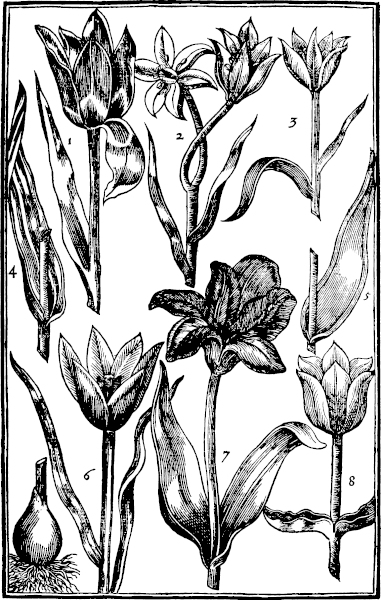
| 1 | Tulipa Bombycina flore rubro. The red Bolonia Tulipa. |
| 2 | Tulipa Boloniensis flore luteo. The yellow Bolonia Tulipa. |
| 3 | Tulipa pumilio rubra siue lutea. The red or yellow dwarfe Tulipa. |
| 4 | Folium Tulipa de Cassa per totum striuatum. The leafe of the Tulipa of Cassa striped throughout the whole leafe. |
| 5 | Folium Tulipa Cassa per oras striatum. The leafe of the Tulipa of Cassa striped at the edges onely. |
| 6 | Tulipa Persica. The Persian Tulipa. |
| 7 | Tulipa Cretica. The Tulipa of Candie. |
| 8 | Tulipa Armeniaca. The Tulipa of Amenia. |
This rare Tulipa, wherewith we haue beene but lately acquainted, doth most fitly
deserue to be described in this place, because it doth so neerely participate with the
Bolonia and Italian Tulipas, in roote, leafe, and flower: the roote hereof is small, couered
with a thicke hard blackish shell or skinne, with a yellowish woollinesse both at
the toppe, and vnder the shell. It riseth out of the ground at the first, with one very
long and small round leafe, which when it is three or foure inches high, doth open it
selfe, and shew forth another small leafe (as long almost as the former) breaking out
of the one side thereat, and after it a third, and sometimes a fourth, and a fift; but each
shorter then other, which afterwards be of the breadth of the dwarfe yellow Tulipa,
or somewhat broader but much longer then any other, and abiding more hollow, and
of the colour of the early Tulipas on the inside: the stalke riseth vp a foot and a halfe
high sometimes, bearing one flower thereon, composed of sixe long and pointed
leaues of the forme of other small Tulipas, and not shewing much bigger then the yellow
Italian Tulipa, and, is wholly white, both inside and outside of all the leaues, except
the three outtermost, which haue on the backe of them, from the middle toward
the edges, a shew of a brownish blush or pale red colour, yet deeper in the midst, and
the edges remaining wholly white: the bottomes of all these leaues are of a darke or
dun tawnie colour, and the chiues and tippes of a darkish purple or tawnie also. This
doth beare seed but seldome in our country, that euer I could vnderstand, but when it
doth, it is small like vnto the Bolonia or dwarfe yellow Tulipas, being not so plentifull
also in parting, or setting of by the roote as they, and neuer groweth nor abideth so
great as it is brought vnto vs, and seldome likewise flowreth after the first yeare: for
the rootes for the most part with euery one grow lesse and lesse, decaying euery yeare,
and so perish for the most part by reason of the frosts and cold, and yet they haue been
set deepe to defend them, although of their owne nature they will runne downe deep
into the ground.
The small Tulipa of Constantinople, beareth for the most part but two leaues on
the stalke, which are faire and broad, almost like vnto the Candy Tulipa, next hereunto
to be described: the stalke it selfe riseth not aboue a foote high, bearing sometimes
but one flower, but most commonly two thereon, one below another, and are
no bigger then the flowers of the yellow Bolonia Tulipa, but differing in colour; for
this is on the outside of a purplish colour, mixed with white and greene, and on the
inside of a faire blush colour, the bottome and chiues being yellow, and the tippes or
pendents blackish: the roote is very like the yellow Bolonia Tulipa.
This Tulipa is of later knowledge with vs then the Persian, but doth more hardly
thriue, in regard of our cold climate; the description whereof, for so much as wee
haue knowledge, by the sight of the roote and leafe, and relation from others of the
flower, (for I haue not yet heard that it hath very often flowred in our Country) is as
followeth. It beareth faire broad leaues, resembling the leaues of a Lilly, of a greenish
colour, and not very whitish: the stalke beareth thereon one flower, larger and more
open then many other, which is either wholly white, or of a deepe red colour, or
else is variably mixed, white with a fine reddish purple, the bottomes being yellow,
with purplish chiues tipt with blackish pendents: the roote is small, and somewhat
like the dwarfe yellow Tulipa, but somewhat bigger.
This small Tulipa is much differing from all the former (except the small or dwarfe
white Tulipas remembred by Lobel and Clusius, as is before set downe) in that it
beareth three or foure small, long, and somewhat narrow greene leaues, altogether at
one ioynt or place; the stalke being not high, and naked or without leaues from them
to the toppe, where it beareth one small flower like vnto an ordinary red Tulipa, but
somewhat more yellow, tending to an Orenge colour with a blacke bottome: the
roote is not much bigger then the ordinary yellow Bolonia Tulipa, before set downe.
And these are the sorts of this first Classis of early Tulipas.
For any other, or further description of this kinde of Tulipa, it shall not neede, hauing
giuen it sufficiently in the former early Tulipa, the maine difference consisting
first in the time of flowring, which is about a moneth after the early Tulipas, yet some
more some lesse; for euen in the Præcoces, or early ones, some flower a little earlier, and
later then others, and then in the colours of the flowers; for wee haue obserued many
colours, and mixtures, or varieties of colours in the Medias, which we could neuer see
in the Præcoces, and so also some in the Præcoces, which are not in the Medias: yet there
is farre greater varieties of mixture of colours in these Medias, then hath been obserued
in all the Præcoces, (although Clusius saith otherwise) eyther by my selfe, or by any
other that I haue conuersed with about this matter, and all this hath happened by the
sowing of the seede, as I said before. I will therefore in this place not trouble you
with any further circumstance, then to distinguish them, as I haue done in the former
early Tulipas, into their foure primary colours, and vnder them, giue you their seuerall
varieties and names, for so much as hath come to my knowledge, not doubting, but
that many that haue trauelled in the sowing of the seed of Tulipas many yeares, may
obserue each of them to haue some variety that others haue not: and therefore I thinke
no one man can come to the knowledge of all particular distinctions.
Tulipa media alba.
1 Niuea, fundo albo vel luteo.
2 Argentea, quasi alba cineracea fundo lutescente,
purpureis staminibus.
3 Margaritina alba, carneo dilutissima.
4 Alba, fundo cæruleo vel nigro.
5 Albida.
6 Alba, oris rubris.
⎧Hæc tria genera
⎪in aliquibus
⎨constanter
⎪tenent oras, in
⎩alijs dispergunt.
7 Alba, purpureis oris.
8 Alba, oris coccineis.
9 Albida primum, deinde albidior, oris purpureis,
& venis intrò respicientibus, dicta
nobis Hackquenay.
10 Alba, sanguineo colore variata, fundo vel
albissimo, vel alio.
11 Alba, radiatim disposita flammis, & maculis
coccineis.
12 Alba, purpurea rubedine plumata, diuersarum
specierum, quæ cum superiore, vel
albo, vel luteo, vel paruo cæruleo constant
fundo, quæ constanter tenent punctatos colores,
& non dispergunt, sed post trium aut
quatuor dierum spatium pulchriores apparent.
13 Panni argentei coloris, i.e. alba, plumata,
punctata, striata, vel diuersimodè variata,
rubedine dilutiore, vel saturatiore purpurea,
interius vel exterius, vel vtrinq.,
diuersarum specierum.
14 Tunica morionis alba varia, i.e. ex albo
& purpureo striata diuersimodè, fundo albo
vel alio.
15 Holias alba vel albida, absq., fundo, vel
fundo purpureo cæruleo, vel cæruleo albo circundato,
diuersè signata, vel variata intus
ad medietatem foliorum, sursum in orbem
vt plurimum, vel ad oras pertingens amplas
& albas. Hæ species tantoperè multiplicantur,
vt vix sint explicabiles.
Tanta est huius varietas, vel multitudine,
vel striarum paucitate & distinctione, vel
fundis variantibus, vt ad tædium esset perscribere.
The white meane flowring Tulipa.
1 A snow white, with a white or yellow
bottome.
2 A siluer colour, that is, a very pale or
whitish ashe colour, with a yellowish
bottome and purple chiues.
3 A Pearle colour, that is, white, with a
wash or shew of blush.
4 A white, with a blew or blacke bottome.
5 A Creame colour.
6 A white, with red edges.
⎧These three sorts
⎪doe hold their
⎨edges constant
⎪in some, but well
⎩spread in others.
7 A white, with purple edges.
8 A white, with crimson edges.
9 A pale or whitish yellow, which after a
few dayes groweth more white, with
purplish red edges, and some streakes
running inward from the edge, which
we call an Hackney.
10 A white mixed with a bloud red very
variably, and with a pure white, or other
coloured bottome.
11 A white, streamed with crimson flames,
and spots through the whole flower.
12 A white, speckled with a reddish purple,
more or lesse, of diuers sorts, with
white, yellow, or blew bottomes, all
which doe hold their markes constant,
and doe not spread their colours, but
shew fairer after they haue stood blown
three or foure dayes.
13 A cloth of siluer of diuers sorts, that is,
a white spotted, striped, or otherwise
marked with red or purple, in some paler,
in some deeper, either on the inside,
or on the outside, or on both.
14 A white Fooles coate of diuers sorts,
that is, purple or pale crimson, and
white, as it were empaled together, eyther
with a white ground or other,
whereof there is great variety.
15 A white Holias, that is, a faire white, or
paler white, eyther without a bottome,
or with a blewish purple bottome, or
blew and white circling the bottome,and from the middle vpwards, speckled
and straked on the inside for the most
part, with bloud red or purplish spots
and lines vnto the very edges, which
abide large and white. Of this kinde
there are found very great varieties, not
to be expressed.
Of this sort there is so much variety, some
being larger or fairer marked then others,
their bottomes also varying, that
it is almost impossible to express them.
Tulipa media purpurea.
1 Purpurea satura.
2 Purpurea dilutior, diuersarum specierum,
quarum Rosea vna, Carnea sit altera.
3 Persicicoloris, duarum aut trium specierum.
4 Chermesina, obscura aut pallida.
5 Stamela, intensior aut remissior.
6 Xerampelina.
7 Purpurea, striata.
8 Persici saturi, vel diluti coloris, vndulata,
vel radiata.
9 Columbina, oris & radijs albis.
10 Purpurea rubra, oris, albis, similis Præcoci,
dicta Princeps.
11 Chermesina, vel Heluola, lineis albis in
medio, & versus oras, fundo cæruleo, vel
albo, itemq., albo orbe.
12 Purpurea remissior, aut intensior, oris albis,
paruis aut magnis, vt in Principe præcoci,
fundo vel cæruleo, orbe albo, vel albo
orbe cæruleo amplo.
13 Holias Heluola, sanguineis guttis intus à
medio sursum in orbem, fundo cæruleo.
14 Tunica Morionis purpurea rubra satura,
albido striata, quam in alba saturatior,
fundo ex cæruleo & albo.
15 Purpurea rubra satura vel diluta, albo vel
albedine, punctata vel striata diuersimodè,
dicta Cariophyllata.
The meane flowring purple Tulipa.
1 A faire deep purple.
2 A paler purple, of many sorts, whereof a
Rose colour is one, a Blush another.
3 A Peach colour of two or three sorts.
4 A Crimson, deepe, or pale.
5 A Stamell, darke or light.
6 A Murrey.
7 A purple, stript and spotted.
8 A Peach colour, higher or paler, waued
or stript.
9 A Doue colour, edged and straked with
white.
10 A faire red purple, with white edges,
like vnto the early Tulipa, called a Prince.
11 A faire crimson, or Claret wine colour,
with white lines both in the middle,
and towards the edges, most haue a
blew bottome, yet some are white, or
circled with white.
12 A light or deepe purple, with white
edges, greater or smaller, like the early
Prince, the bottomes eyther blew circled
with white, or white circled with
a large blew.
13 A purple Holias, the colour of a pale
Claret wine, marked and spotted with
bloud red spots, round about the middle
of each leafe vpward on the inside
onely, the bottome being blew.
14 A Crimson Fooles Coate, a darke
crimson, and pale white empaled together,
differing from the white Fooles
Coate, the bottome blew and white.
15 A deeper or paler reddish purple, spotted
or striped with a paler or purer
white, of diuers sorts, called the Gilloflower
Tulipa.
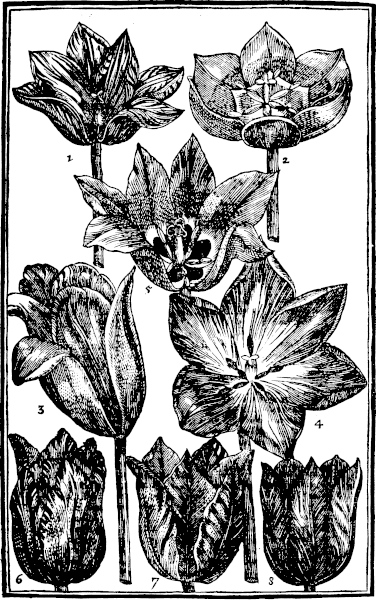
| 1 | Tulipa rubra & lutea varia. The Fooles Coate red and yellow. |
| 2 | Tulipa Holeas alba absq. fundo. The white Holeas without a bottome. |
| 3 | Tulipa argentea, vel punctata, &c. The cloth of siluer, or other spotted Tulipa. |
| 4 | Tulipa alba flammis coccineis. The white Fooles Coate. |
| 5 | Tulipa Holeas alba, &c. fundo purpureo, &c. A white Holeas, &c. with a purple bottome, &c. |
| 6 | Tulipa rubra & lutea flammea, &c. A red and yellow flamed Tulipa, &c. |
| 7 | Tulipa alba striata & punctata. A white striped and spotted Tulipa. |
| 8 | Tulipa altera variata, &c. Another variable Tulipa. |
Tulipa media rubra.
1 Rubra communis, fundo luteo, vel nigro.
2 Mali Aurantij coloris.
3 Cinabaris coloris.
4 Lateritij coloris.
5 Rubra, luteo aspersa.
6 Rubra, oris luteis.
7 Testamentum Brancion rubra satura, oris
pallidis, diuersarum specierum, rubore variantium,
& orarum amplitudine.
8 Cinabaris radiata, magis aut minus serotina.
9 Rubra purpurascens obsoleta exterioribus
folijs, perfusa luteo intus, oris pallidis
luteis.
10 Rubra purpurascens elegans extra & intus
lutescens, oris pallidis luteis, fundo luteo
vel viridi.
11 Rubra flambans coccinea, crebris maculis
luteis absq. fundo.
12 Flambans elegantior rubra, i.e. radijs luteis
intercursantibus ruborem.
13 Flambans remissior vtroq. colore.
14 Panni aurei coloris.
15 Tunica Morionis verior, seu Palto du Sot.
optima, tænijs amplis amœnis & crebris, exrubro
& flauo separatim diuisis & excurrentibus,
flos constans.
16 Tunica Morionis altera, tænijs minoribus
& minus frequentibus, magis aut minus
alia alijs inconstans.
17 Tunica Morionis pallida, i. e. tænijs vel
strijs frequentioribus in vtroq. colore pallidis,
flos est constans & elegans.
18 Pileus Morionis, radijs luteis, in medio
foliorum latis, per ruborem excurrentibus,
fundo luteo, apicibus luteis, & tribus exterioribus
folijs luteis oris rubris, vel absq.
oris.
19 Le Suisse, tænijs radiata magnis ex rubore
& pallore.
20 Altera dicta Goliah à floris magnitudine,
tænijs radiata simillima le Suisse, nisi rubor
& albedo sint elegantiores.
21 Holias rubra, i.e. sanguinea argenteis radijs,
& guttis in orbem dispositis, præsertim
interiùs, fundo viridi saturo.
22 Holias coccinea, rubra coccinea, albo radiata
in orbem, circa medium foliorum interiùs,
fundo albo.
23 Alia huic similis, fundo albo & cæruleo.
The meane flowring red Tulipa.
1 A faire red which is ordinary, with a yellow
or blacke bottome.
2 A deepe Orenge colour.
3 A Vermillion.
4 A pale red, or Bricke colour.
5 A Gingeline colour.
6 A red with small yellow edges.
7 A Testament Brancion of diuers sorts,
differing both in the deepnesse of the
red, and largenesse of the pale coloured
edges.
8 A Vermillion flamed, flowring later or
earlier.
9 A dead purplish red without, and of a
yellowish red within, with pale yellow
edges.
10 A bright Crimson red on the outside,
more yellowish on the inside, with pale
yellow edges, and a bottome yellow or
greene.
11 A red Flambant, spotted thicke with
yellow spots without any bottome.
12 A more excellent red Flambant, with
flames of yellow running through the
red.
13 A pale coloured Flambant.
14 A cloth of gold colour.
15 A true Fooles Coate, the best is a faire
red & a faire yellow, parted into guards
euery one apart, varied through euery
leafe to the very edge, yet in most abiding
constant.
16 Another Fooles Coate, not so fairely
marked, nor so much, some of these are
more or lesse constant in their marks, &
some more variable then others.
17 A pale Fooles Coate, that is, with pale
red, and pale yellow guardes or stripes
very faire and constant.
18 A Fooles Cappe, that is, with lists or
stripes of yellow running through the
middle of euery leafe of the red, broader
at the bottome then aboue, the bottome
being yellow, the three outer
leaues being yellow with red edges, or
without.
19 A Swisse, pained with a faire red and
pale white or strawe colour.
20 A Goliah, so called of the bignesse of
the flower, most like to the Swisse in the
marks and guardes, but that the red and
white is more liuely.
21 A red Holias. A bloud red stript with
siluer white veines and spots, with a
darke green bottome.
22 A Crimson red Holias, that is, a faire
purplish red, spotted with white circlewise
about the middle of the inner
leaues, and a white bottome.
23 Another like thereunto, with a blew
and white bottome.
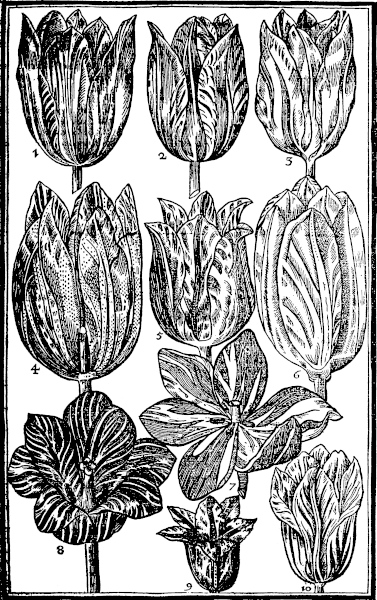
| 1 | Tulipa tricolor. A Tulipa of three colours. |
| 2 | Tulipa Macedonica, siue de Caffa varia. The Tulipa of Caffa purple, with pale white stripes. |
| 3 | Tulipa Heluola chermesina versicolor. A pure Claret wine colour variable. |
| 4 | Tulipa Caryophyllata Wilmeri. Mr. Wilmers Gilloflower Tulipa. |
| 5 | Tulipa Chermesina flammis albis. A Crimson with white flames. |
| 6 | Tulipa Goliah. A kind of Zwisser called Goliah. |
| 7 | Tulipa le Zwisse. A Tulipa called the Zwisser. |
| 8 | Tulipa alba flammis coccineis. Another white Flambant or Fooles Coate. |
| 9 | Tulipa Cinnabarina albo flammata. The Vermillion flamed. |
| 10 | Tulipa plumata rubra & lutea. The feathered Tulipa red and yellow. |
[60]
Tulipa media lutea.
1 Lutea, siue Aurea vulgaris.
2 Straminea.
3 Sulphurea.
4 Mali Aurantij pallidi coloris.
5 Lutea dilutè purpurea striata, aurei panni
pallidi instar.
6 Pallidè lutea fuscedine adumbrata.
7 Flaua, oris rubris magnis, aut paruis.
8 Straminea oris rubris magnis intensis, vel
paruis remissis.
9 Obscura & fuliginosa lutea, instar Folij
decidui, ideoq. Folium mortuum appellatur.
10 Flaua, rubore perfusa, etiamque striata
per totum, dorso coccineo, oris pallidis.
11 Pallidè lutea, perfusa & magis aut minus
rubore striata, fundo vel luteo, vel viridi.
12 Testamentum Clusij, i.e. lutea pallida fuligine
obfusca, exteriùs & interiùs ad oras
vsq. pallidas, per totum vero floris medium,
maculis interiùs aspersa instar omnium
aliarum Holias, dorso obscuriore,
fundo viridi.
13 Flambans lutea, diuersimodè intus magis
aut minus striata, vel in alijs extra maculata
rubore, fundo vt plurimum nigro,
vel in alijs luteo.
14 Flambans pallidior & elegantior.
15 Holias lutea intensior vel remissior
diuersimodè, in orbem radiata interius, rubris
maculis ad supremas vsq. oras, aliquoties
crebrè, aliàs parcè, fundo viridi, vel
tanetto obscuro.
16 Holias straminea rubore striata & punctata,
instar alba Holias.
17 Tunica Morionis lutea, alijs dicta Flammea,
in qua color flavus magis & conspicuus
rubore, diuersimodè radiata.
Huc reddenda esset viridarum Tuliparum
classis, quæ diuersarum etiam constat
specierum. Vna viridis intensior cuius
flos semper ferè semiclausus manet staminibus
simbriatis. Altera remissior, instar
Psittacipennarum viridium, luteo variata
oris albis. Tertia adhuc dilutiori viriditate
oris purpureis. Quarta, cujus folia
æqualiter purpura diluta, & viriditate
diuisa sunt. Quinta, folijs longissimis
stellæmodo expansis, ex rubore & viriditate
coacta.
The meane flowring yellow Tulipa.
1 A faire gold yellow.
2 A Strawe colour.
3 A Brimstone colour pale yellowish
greene.
4 A pale Orenge colour.
5 A pale cloth of gold colour.
6 A Custard colour a pale yellow shadowed
ouer with a browne.
7 A gold yellow with red edges, greater
or smaller.
8 A Strawe colour with red edges, deeper
or paler, greater or smaller.
9 A sullen or smoakie yellow, like a dead
leafe that is fallen, and therefore called,
Fucille mort.
10 A yellow shadowed with red, and striped
also through all the leaues, the
backside of them being of a red crimson,
and the edges pale.
11 A pale yellow, shadowed and striped
with red, in some more in some lesse, the
bottomes being either yellow or green.
12 A Testamentum Clusij, that is, a shadowed
pale yellow, both within & without,
spotted round about the middle on the
inside, as all other Holias are, the backe
of the leaues being more obscure or shadowed
with pale yellow edges, and a
greene bottome.
13 A yellow Flambant of diuers sorts, that
is, the whole flower more or lesse streamed
or spotted on the inside, and in
some on the outside with red, the bottome
in most being blacke, yet in some
yellow.
14 A paler yellow Flambant more beautifull.
15 A yellow Holias, paler or deeper yellow
very variable, spotted on the inside
round about the middle, with red
sometimes plentifully, or else sparingly
with a green or dark tawny bottome.
16 A strawe coloured Holias, spotted and
streamed with red, as is to bee seene in
the white Holias.
17 A yellow Fooles coate, of some called
a flame colour, wherein the yellow is
more then the red, diuersly streamed.
Vnto these may be added the greene Tulipa
which is also of diuers sorts. One hauing
a great flower of a deepe green colour,
seldome opening it selfe, but abiding
alwaies as it were halfe shut vp
and closed, the chiues being as it were
feathered. Another of a paler or yellowish
green, paned with yellow, and
is called, The Parret, &c. with white
edges. A third of a more yellowish
green, with red or purplish edges. A
fourth, hath the leaues of the flower
equally almost parted, with greene and
a light purple colour, which abiding a
long time in flower, groweth in time to
be fairer marked: for at the first it doth
not shew it selfe so plainely diuided.
Some call this a greene Swisser. A fifth
hath the longest leaues standing like a
starre, consisting of greene and purple.
The late flowring Tulipa hath had his description expressed in the precedent discourse,
so that I shall not neede to make a repetition of what hath already beene set
downe. The greatest matter of knowledge in this kinde is this, That it hath no such
plentifull variety of colours or mixtures in his flowers, as are in the two former sorts,
but is confined within these limits here expressed, as farre as hath come to our knowledge.
Tulipa Serotina.
Rosea intensior, aut remissior.
Rubra vulgaris, aut saturatior, & quasi
nigricans, fundo luteo vel nigro
orbe, aureo incluso, dicta Oculus Solis.
Lutea communis.
Lutea oris rubris.
Lutea guttis sanguineis, fundo nigro vel
vario.
The late flowring Tulipa.
A Rose Colour deeper or paler.
An ordinary red, or else a deeper red like
blacke bloud, with a blacke or yellow
bottome, or blacke circled with yellow,
called the Suns eye.
An ordinary yellow.
A yellow with red edges.
A yellow with red spots and veines, the
bottome black or discoloured.
There yet remaine many obseruations, concerning these beautifull flowers, fit to be
knowne, which could not, without too much prolixity, be comprehended within the
body of the description of them; but are reserued to bee intreated of a part by themselues.
All sorts of Tulipas beare vsually but one stalke, and that without any branches:
but sometimes nature is so plentifull in bearing, that it hath two or three stalkes, and
sometimes two, or more branches out of one stalke (euery stalke or branch bearing
one flower at the toppe) but this is but seldome seene; and when it doth happen once,
it is hardly seene againe in the same roote, but is a great signe, that the roote that
doth thus, being an old roote, will the same yeare part into diuers rootes, whereof
euery one, being of a reasonable greatnesse, will beare both his stalke and flower the
next yeare, agreeing with the mother plant in colour, as all the of-sets of Tulipas doe
for the most part: for although the young of-sets of some doe vary from the maine
roote, euen while it groweth with them, yet being separated, it will bee of the same
colour with the mother plant.
There groweth oftentimes in the Medias, and sometimes also in the Præcoces, but
more seldome, a small bulbe or roote, hard aboue the ground, at the bottome of the
stalke, and betweene it and the lower leafe, which when the stalke is dry, and it ripe,
being put into the ground, will bring forth in time a flower like vnto the mother plant,
from whence it was taken.
The flowers also of Tulipas consist most commonly of sixe leaues, but sometimes
they are seene to haue eight or tenne, or more leaues; but vsually, those rootes beare
but their ordinary number of sixe leaues the next yeare: the head for seede then, is
for the most part foure square, which at all other times is but three square, or when
the flower wanteth a leafe or two, as sometimes also it doth, it then is flat, hauing but
two sides.
The forme of the flower is also very variable; for the leaues of some Tulipas are all
sharpe pointed, or all blunt and round pointed, and many haue the three outer leaues
sharpe pointed, and the three inner round or pointed, and some contrariwise, the three
outermost round pointed, and the three inner sharpe pointed. Againe, some haue all
the leaues of the flowers long and narrow, and some haue them broader and shorter.
Some Præcoces also haue their flowers very large and great, equall vnto eyther the
Media, or Serotina, which most commonly are the largest, and others haue them as
small as the Bolonia Tulipa.
The bottomes of the leaues of the flowers are also variably diuersified, and so are
both the chiues or threeds that stand vp about the head, and the tips or pendents that
are hanging loose on the toppes of them; and by the difference of the bottomes or
chiues, many flowers are distinguished, which else are very like in colour, and alike
also marked.
For the smell also there is some diuersity; for that the flowers of some are very
sweete, of others nothing at all, and some betweene both, of a small sent, but not offensiue:
and yet some I haue obserued haue had a strong ill sent; but how to shew you to
distinguish them, more then by your owne sense, I cannot: for the seedes of sweete
smelling Tulipas doe not follow their mother plant, no more then they doe in the
colour.
And lastly, take this, which is not the least obseruation, worth the noting, that I
haue obserued in many: When they haue beene of one entire colour for diuers yeares,
yet in some yeare they haue altered very much, as if it had not beene the same, viz.
from a purple or stamell, it hath beene variably either parted, or mixed, or striped
with white, eyther in part, or through the whole flower, and so in a red or yellow
flower, that it hath had eyther red or yellow edges, or yellow or red spots, lines,
veines, or flames, running through the red or yellow colour, and sometimes it hath
happened, that three leaues haue been equally parted in the middle with red yellow,
the other three abiding of one colour, and in some the red had some yellow in it,
and the yellow some red spots in it also; whereof I haue obserued, that all such flowers,
not hauing their originall in that manner, (for some that haue such or the like
markes from the beginning, that is, from the first and second yeares flowring, are constant,
and doe not change) but as I said, were of one colour at the first, doe shew the
weaknesse and decay of the roote, and that this extraordinary beauty in the flower, is
but as the brightnesse of a light, vpon the very extinguishing thereof, and doth plainly
declare, that it can doe his Master no more seruice, and therefore with this iollity doth
bid him good night. I know there is a common opinion among many (and very confidently
maintained) that a Tulipa with a white flower, hath changed to beare a red or
yellow, and so of the red or yellow, and other colours, that they are likewise inconstant,
as though no flowers were certaine: but I could neuer either see or heare for
certaine any such alteration, nor any other variation, but what is formerly expressed.
Let not therefore any iudicious be carried away with any such idle conceit, but rather
suspect some deceit in their Gardeners or others, by taking vp one, and putting in another
in the place, or else their owne mistaking.
Now for the sowing, planting, transplanting, choise, and ordering of Tulipas,
which is not the least of regard, concerning this subiect in hand, but (as I think) would
be willingly entertained; What I haue by my best endeauours learned, by mine owne
paines in almost forty yeares trauell, or from others informations, I am willing here
to set downe; not doubting, but that some may adde what hath not come to my
knowledge.
First, in the sowing of seedes of Tulipas, I haue not obserued (whatsoeuer others
haue written) nor could of certainty learne of others, that there doth arise from the
seedes of Præcoces any Medias or Serotine Tulipas, (or but very seldome) nor am certainly
assured of any: but that the seedes of all Præcoces (so they be not doubtfull, or
of the last flowring sorts) will bring Præcoces: And I am out of doubt, that I neuer saw,
nor could learne, that euer the seede of the Medias or Serotines haue giuen Præcoces;
but Medias or Serotines, according to their naturall kinde. But if there should bee any
degeneration, I rather incline to thinke, that it sooner commeth to passe (à meliore ad
pelus, for facilis est descensus, that is) that Præcoces may giue Medias, then that Medias or
Serotines should giue Præcoces.
For the choise of your seede to sowe. First, for the Præcoces, Clusius saith, that the
Præcox Tulipa, that beareth a white flower, is the best to giue the greatest variety of colours.
Some among vs haue reported, that they haue found great variety rise from the
seede of the red Præcox, which I can more hardly beleeue: but Clusius his experience
hath the greater probability, but especially if it haue some mixture of red or purple in
it. The purple I haue found to be the best, next thereunto is the purple with white
edges, and so likewise the red with yellow edges, each of them will bring most of
their owne colours. Then the choise of the best Medias, is to take those colours that
are light, rather white then yellow, and purple then red; yea white, not yellow, purple,
not red: but these againe to be spotted is the best, and the more the better; but
withall, or aboue all in these, respect the ground or bottome of the flower, (which in
the Præcox Tulipa cannot, because you shall seldome see any other ground in them but
yellow) for if the flower be white, or whitish, spotted, or edged, and straked, and the
bottome blew or purple (such as is found in the Holias, and in the Cloth of siluer), this
is beyond all other the most excellent, and out of question the choisest of an hundred,
to haue the greatest and most pleasant variety and rarity. And so in degree, the meaner,
in beauty you sowe, the lesser shall your pleasure in rarities be. Bestowe not your time
in sowing red or yellow Tulipa seede, or the diuers mixtures of them; for they will (as
I haue found by experience) seldome be worth your paines. The Serotina, or late flowring
Tulipa, because it is seldome seene, with any especiall beautifull variety, you may
easily your selues ghesse that it can bring forth (euen as I haue also learned) no raritie,
and little or no diuersity at all.
The time and manner to sowe these seedes is next to be considered. You may not
sowe them in the spring of the yeare, if you hope to haue any good of them; but in the
Autumne, or presently after they be thorough ripe and dry: yet if you sowe them not
vntill the end of October, they will come forward neuer the worse, but rather the better;
for it is often seene, that ouer early sowing causeth them to spring out of the
ground ouer early, so that if a sharp spring chance, to follow, it may go neere to
spoile all, or the most of your seede. Wee vsually sowe the same yeares seede, yet if
you chance to keepe of your owne, or haue from others such seed, as is two years old,
they will thriue and doe well enough especially if they were ripe and well gathered:
You must not sowe them too thicke, for so doing hath lost many a pecke of good
seede, as I can tell; for if the seede lye one vpon another, that it hath not roome vpon
the sprouting, to enter and take roote in the earth, it perisheth by and by. Some vse to
tread downe the ground, where they meane to sowe their seede, and hauing sowne
them thereon, doe couer them ouer the thicknesse of a mans thumbe with fine sifted
earth, and they thinke they doe well, and haue good reason for it: for considering the
nature of the young Tulipa rootes, is to runne downe deeper into the ground, euery
yeare more then other, they thinke to hinder their quicke descent by the fastnesse of
the ground, that so they may encrease the better. This way may please some, but I
doe not vse it, nor can finde the reason sufficient; for they doe not consider, that the
stiffenesse of the earth, doth cause the rootes of the young Tulipas to bee long before
they grow great, in that a stiffe ground doth more hinder the well thriuing of the
rootes, then a loose doth, and although the rootes doe runne downe deeper in a loose
earth, yet they may easily by transplanting be holpen, and raised vp high enough. I
haue also seene some Tulipas not once remoued from their sowing to their flowring;
but if you will not lose them, you must take them vp while their leafe or stalk is fresh,
and not withered: for if you doe not follow the stalke downe to the roote, be it neuer
so deepe, you will leaue them behinde you. The ground also must be respected; for
the finer, softer, and richer the mould is, wherein you sowe your seede, the greater
shall be your encrease and varietie: Sift it therefore from all stones and rubbish, and
let it be either fat naturall ground of it selfe, or being muckt, that it bee thoroughly
rotten: but some I know, to mend their ground, doe make such a mixture of grounds,
that they marre it in the making.
After the seede is thus sowne, the first yeares springing bringeth forth leaues, little
bigger then the ordinary grasse leaues; the second yeare bigger, and so by degrees
euery yeare bigger then other. The leaues of the Præcoces while they are young, may
be discerned from the Medias by this note, which I haue obserued. The leaues of them
doe wholly stand vp aboue the ground, shewing the small footstalkes, whereby euerie
leafe doth stand, but the leaues of the Medias or Serotines doe neuer wholly appeare
out of the ground, but the lower part which is broad, abideth vnder the vpper face of
the earth. Those Tulipas now growing to bee three yeares old, (yet some at the second,
if the ground and ayre be correspondent) are to bee taken vp out of the ground,
wherein yee shall finde they haue runne deepe, and to be anew planted, after they haue
been a little dryed and cleansed, eyther in the same, or another ground againe, placing
them reasonable neare one vnto another, according to their greatnesse, which being
planted and couered ouer with earth againe, of about an inch or two thicknesse,
may be left vntaken vp againe for two yeare longer, if you will, or else remoued euery
yeare after, as you please; and thus by transplanting them in their due season (which
is still in the end of Iuly, or beginning of August, or thereabouts) you shall according
to your seede and soyle, haue some come to bearing, in the fifth yeare after the flowring,
(and some haue had them in the fourth, but that hath beene but few, and none of
the best, or in a rich ground) some in the sixth and seuenth, and some peraduenture, not
vntill the eighth or tenth yeare: but still remember, that as your rootes grow greater,
that in re-planting you giue them the more roome to be distant one from another,
or else the one will hinder, if not rot the other.
The seede of the Præcoces doe not thriue and come forward so fast as the Medias or
Serotines, nor doe giue any of-sets in their running downe as the Medias doe, which
vsually leaue a small roote at the head of the other that is runne downe euery yeare;
and besides, are more tender, and require more care and attendance then the Medias,
and therefore they are the more respected.
This is a generall and certaine rule in all Tulipas, that all the while they beare but
one leafe, they will not beare flower, whether they bee seedlings, or the of-sets of
elder rootes, or the rootes themselues, that haue heretofore borne flowers; but when
they shew a second leafe, breaking out of the first, it is a certaine signe, that it will
then beare a flower, vnlesse some casualty hinder it, as frost or raine, to nip or spoile
the bud, or other vntimely accident befall it.
To set or plant your best and bearing Tulipas somewhat deeper then other rootes,
I hold it the best way; for if the ground bee either cold, or lye too open to the cold
Northerne ayre, they will be the better defended therein, and not suffer the frosts or
cold to pierce them so soone: for the deepe frosts and snowes doe pinch the Præcoces
chiefly, if they bee too neare the vppermost crust of the earth; and therefore many,
with good successe, couer ouer their ground before Winter, with either fresh or old
rotten dung, and that will maruellously preserue them. The like course you may hold
with seedlings, to cause them to come on the forwarder, so it bee after the first yeares
sowing, and not till then.
To remoue Tulipas after they haue shot forth their fibres or small strings, which
grow vnder the great round rootes, (that is, from September vntill they bee in flower)
is very dangerous; for by remouing them when they haue taken fast hold in the
ground, you doe both hinder them in the bearing out their flower, and besides, put
them in hazzard to perish, at least to bee put backe from bearing for a while after, as
oftentimes I haue proued by experience: But when they are now risen to flower, and
so for any time after, you may safely take them vp if you will, and remoue them
without danger, if you haue any good regard vnto them, vnlesse it be a young bearing
roote, which you shall in so doing much hinder, because it is yet tender, by reason it
now beareth his first flower. But all Tulipa roots when their stalke and leaues are dry,
may most safely then be taken vp out of the ground, and be so kept (so that they lye in
a dry, and not in a moist place) for sixe moneths without any great harme: yea I haue
knowne them that haue had them nine moneths out of the ground, and haue done reasonable
well, but this you must vnderstand withall, that they haue not been young but
elder rootes, and they haue been orderly taken vp and preserued. The dryer you keep
a Tulipa roote the better, so as you let it not lye in the sunne or winde, which will
pierce it and spoile it.
Thus Gentlewomen for your delights, (for these pleasures are the delights of leasure,
which hath bred your loue & liking to them, and although you are herein predominant,
yet cannot they be barred from your beloued, who I doubt not, wil share with
you in the delight as much as is fit) haue I taken this paines, to set downe, and bring to
your knowledge such rules of art, as my small skill hath enabled mee withall concerning
this subiect, which of all other, seemed fittest in this manner to be enlarged, both
for the varietie of matter, and excellency of beautie herein, and also that these rules
set forth together in one place, might saue many repetitions in other places, so that
for the planting and ordering of all other bulbous rootes, and the sowing the seedes of
them, you may haue recourse vnto these rules, (tanquam ad normam & examen) which
may serue in generall for all other, little diuersitie of particulars needing exception.
The greater Tulipas haue first beene sent vs from Constantinople, and
other parts of Turkie, where it is said they grow naturally wilde in the
Fields, Woods, and Mountaines; as Thracia, Macedonia, Pontus about
the Euxine Sea, Cappadocia, Bithynia, and about Tripolis and Aleppo in
Syria also: the lesser haue come from other seuerall places, as their names
doe decipher it out vnto vs; as Armenia, Persia, Candye, Portugall,
Spaine, Italy, and France. They are all now made denizens in our Gardens,
where they yeeld vs more delight, and more encrease for their proportion,
by reason of the culture, then they did vnto their owne naturals.
These doe flower some earlier, some later, for three whole moneths together
at the least, therein adorning out a Garden most gloriously, in that
being but one kinde of flower, it is so full of variety, as no other (except the
Daffodils, which yet are not comparable, in that they yield not that alluring
pleasant variety) doe the like besides. Some of the Præcoces haue beene
in flower with vs, (for I speake not of their owne naturall places, where the
Winters are milder, and the Spring, earlier then ours) in the moneth of Ianuary,
when the Winter before hath beene milde, but many in February,
and all the Præcoces, from the beginning to the end of March, if the yeare
be kindly: at what time the Medias doe begin, and abide all Aprill, and
part of May, when the Serotines flower and fade; but this, as I said, if the
yeare be kindly, or else each kinde will be a moneth later. The seede is ripe
in Iune and Iuly, according to their early or late flowring.
There haue beene diuers opinions among our moderne Writers, by
what name this plant was knowne to the ancient Authors. Some would
haue it be Cosmosandatos, of the Ancient. Dodonæus referreth it to πυπῶν of
Theophrastus, in his seuenth Booke and thirteenth Chapter: but thereof
he is so briefe, that besides the bare name, wee cannot finde him to make
any further relation of forme, or quality. And Bauhinus, vpon Matthiolus
Commentaries of Dioscorides, and in his Pinax also, followeth his opinion.
Camerarius in his Hortus Medicus is of opinion, it may be referred to
the Helychrysum of Crateua. Gesner, as I thinke, first of all, and after him
Lobel, Camerarius, Clusius and many others, referre it to the Satyrium of
Dioscorides: and surely this opinion is the most probable for many reasons.
First, for that this plant doth grow very frequent in many places of
Greece, and the lesser Asia, which were no doubt sufficiently knowne both
to Theophrastus, and Dioscorides, and was accounted among bulbous
rootes, although by sundry names. And secondly, as Dioscorides setteth
forth his Satyrium, so this most commonly beareth three leaues vpon a
stalke (although sometimes with vs it hath foure or fiue) like vnto a Lilly,
whereof some are often seen to be both red, in the first springing, and also
vpon the decaying, especially in a dry time, and in a dry ground: the flower
likewise of some is white, and like a Lilly; the roote is round, and as white
within as the white of an egge, couered with a browne coate, hauing a
sweetish, but not vnpleasant taste, as any man without danger many try.
This description doth so liuely set forth this plant, that I thinke wee shall
not neede to be any longer in doubt, where to finde Dioscorides his Satyrium
Triphyllum, seeing wee haue such plenty growing with vs. And
thirdly, there is no doubt, but that it hath the same qualities, as you shall
hereafter heare further. And lastly, that plant likewise that beareth a red
flower, may very well agree with his Erythronium; for the descriptions in
Dioscorides are both alike, as are their qualities, the greatest doubt may be
in the seede, which yet may agree vnto Lin or Flaxe as fitly, or rather more
then many other plants doe, in many of his comparisons, which yet wee receiue
for currant. For the seede of Tulipas are flat, hard, and shining as the
seede of Linum or Flaxe, although of another colour, and bigger, as Dioscorides
himselfe setteth it downe. But if there should be a mistaking in the
writing of λὶνου for κρὶνου or λεῖριου in the Greeke Text, as the slippe is both easie and
likely, it were then out of all question the same: for the seede is very like
vnto the seede of Lillies, as any man may easily discerne that know them, or
will compare them. It is generally called by all the late Writers, Tulipa,
which is deriued from the name Tulpan, whereby the Turkes of Dalmatia
doe entitle their head Tyres, or Caps; and this flower being blowne, laide
open, and inuerted, doth very well resemble them. We haue receiued the
early kinde from Constantinople, by the name of Cafa lale, and the other
by the name of Cauala lale. Lobel and others doe call it Lilio-narcissus, because
it doth resemble a Lilly in the leafe, flower, and seede, and a Daffodil
in the roote. We call it in English the Turkes Cap, but most vsually Tulipa,
as most other Christian Countries that delight therein doe. Daleschampius
calleth it Oulada.
Dioscorides writeth, that his first Satyrium is profitable for them that
haue a convulsion in their necke, (which wee call a cricke in the necke) if it
be drunke in harsh (which we call red) wine.
That the roots of Tulipas are nourishing, there is no doubt, the pleasant,
or at least the no vnpleasant taste, may hereunto perswade; for diuers haue
had them sent by their friends from beyond Sea, and mistaking them to bee
Onions, haue vsed them as Onions in their pottage or broth, and neuer
found any cause of mislike, or any sense of euill quality produced by them,
but accounted them sweete Onions.
Further, I haue made tryall of them my selfe in this manner. I haue preserued
the rootes of these Tulipas in Sugar, as I haue done the rootes of Eringus,
Orchis, or any other such like, and haue found them to be almost as
pleasant as the Eringus rootes, being firme and sound, fit to be presented to
the curious; but for force of Venereous quality, I cannot say, either from my
selfe, not hauing eaten many, or from any other, on whom I haue bestowed
them: but surely, if there be any speciall propertie in the rootes of Orchis,
or some other tending to that purpose, I thinke this may as well haue it as
they. It should seeme, that Dioscorides doth attribute a great Venereous
faculty to the seede, whereof I know not any hath made any especiall experiment
with vs as yet.
There hath beene great confusion among many of our moderne Writers of
plants, in not distinguishing the manifold varieties of Daffodils; for euery one
almost, without consideration of kinde or forme, or other speciall note, giueth
names so diuersly one from another, that if any one shall receiue from seuerall
places the Catalogues of their names (as I haue had many) as they set them down, and
compare the one Catalogue with the other, he shall scarce haue three names in a dozen
to agree together, one calling that by one name, which another calleth by another, that
very few can tell what they meane. And this their confusion, in not distinguishing
the name of Narcissus from Pseudonarcissus, is of all other in this kinde the greatest and
grossest errour. To auoide therefore that gulfe, whereof I complaine that so manie
haue bin endrenched; and to reduce the Daffodils into such a methodicall order, that
euery one may know, to what Classis or forme any one doth appertaine, I will first
diuide them into two principall or primary kindes: that is, into Narcissos, true Daffodils,
and Pseudonarcissos, bastard Daffodils: which distinction I hold to be most necessarie
to be set downe first of all, that euery one may be named without confusion vnder
his owne primary kind, and then to let the other parts of the subdiuision follow, as is
proper to them, and fittest to expresse them. Now to cause you to vnderstand the
difference betweene a true Daffodill and a false, is this; it consisteth onely in the flower,
(when as in all other parts they cannot bee distinguished) and chiefly in the middle
cup or chalice; for that we doe in a manner onely account those to bee Pseudonarcissos,
bastard Daffodils, whose middle cup is altogether as long, and sometime a little longer
then the outter leaues that doe encompasse it, so that it seemeth rather like a trunke or
long nose, then a cup or chalice, such as almost all the Narcissi, or true Daffodils haue;
I say almost, because I know that some of them haue their middle cup so small, that
we rather call it a crowne then a cup; and againe, some of them haue them so long,
that they may seem to be of the number of the Pseudonyms, or bastard Daffodils: but
yet may easily be knowne from them, in that, although the cup of some of the true
Daffodils be great, yet it is wider open at the brim of edge, and not so long and narrow
all alike as the bastard kindes are; and this is the chiefe and onely way to know how to
seuer these kindes, which rule holdeth certaine in all, except that kinde which is called
Narcissus Iuncifolius reflexo flore, whose cup is narrow, and as long as the leaues that
turne vp againe.
Secondly, I will subdiuide each of these again apart by themselues, into foure sorts;
and first the Narcissos, or true Daffodils into
- Latifolios, broad leafed Daffodils.
- Angustifolios, narrow leafed Daffodils.
- Iuncifolios, Rushe Daffodils, and
- Marinos, Sea Daffodils.
These sorts againe doe comprehend vnder them some other diuisions, whereby
they may the better be distinguished, and yet still bee referred to one of those foure
former sorts: as
- Monanthos, that is, Daffodils that beare but one flower, or two at the most vpon a
stalke, and
- Polyanthos, those that beare many flowers together vpon a stalke: as also
- Simplici flore, those that beare single flowers, and
- Multiplici flore, or flore pleno, that is, haue double flowers.
- Vernales, those that flower in the Spring, and among them some that are earlier; and
therefore called
- Præcoces, early flowring Daffodils, and
- Autumnales, those that flower in Autumne onely.
And lastly, with the Pseudonarcissos, or bastard Daffodils, I will keepe the same order,
to distinguish them likewise into their foure seuerall sorts; and as with the true
Daffodils, so with these false, describe vnder euery sort: first, those that beare single
flowers, whether one or many vpon a stalke; and then those that beare double flowers,
one or many also. As for the distinctions of maior and minor, greater and lesser,
and of maximus and minimus, greatest and least, they doe not onely belong to these
Daffodils; and therefore must be vsed as occasion permitteth, but vnto all other sort
of plants. To begin therefore, I thinke fittest with that stately Daffodill, which for his
excellency carrieth the name of None such.
{Incomparable Daffodils}
1. Narcissus latifolius omnium maximus, amplo calice flauo, siue Nompareille.
The great None such Daffodill, or Incomparable Daffodill.
This Narcissus Nompareille hath three or foure long and broad leaues, of a grayish
greene colour, among which riseth vp a stalke two foote high at the least, at the toppe
whereof, out of a thinne skinnie huske, as all Daffodils haue, commeth forth one large
single flower, and no more vsually, consisting of sixe very pale yellow large leaues,
almost round at the point, with a large cuppe in the middle, somewhat yellower then
the leaues, the bottome whereof next vnto the stalke is narrow and round, rising wider
to the mouth, which is very large and open, and vneuenly cut in or indented about
the edges. The cup doth very well resemble the chalice, that in former dayes with vs,
and beyond the Seas is still vsed to hold the Sacramentall Wine, that is with a narrower
bottome, and a wide mouth. After the flower is past, sometimes there commeth
(for it doth not often) a round greene head, and blacke round seede therein, like
vnto other Daffodils, but greater. The roote is great, as other Daffodils that beare
large flowers, and is couered ouer with a brownish coate or skinne. The flower hath
little or no sent at all.
Flore geminato.
This doth sometimes bring forth a flower with ten or twelue leaues, and a cup much
larger, as if it would be two, euen as the flower seemeth.
2. Narcissus omnium maximus flore & calice flauo.
The great yellow Incomparable Daffodill.
This other kinde differeth neither in forme, nor bignesse of leafe or flower from the
former, but in the colour of the circling leaues of the flower, which are of the same
yellow colour with the cup.
Flore geminato.
This doth sometimes degenerate and grow luxurious also, bringing forth two flowers
vpon a stalke, each distinct from other, and sometimes two flowers thrust together,
as if they were but one, although it be but seldome; for it is not a peculiar kinde that
is constant, yearly abiding in the same forme.
3. Narcissus maximus griseus calice flauo.
The gray Peerlesse Daffodill.
This Peerlesse Daffodill well deserueth his place among these kindes, for that it
doth much resemble them, and peraduenture is but a difference raised from the seede
of the former, it is so like in leafe and flower, but that the leaues seeme to be somewhat
greater, and the sixe outer leaues of the flower to be of a glistering whitish gray colour,
and the cup yellow, as the former, but larger.
4. Narcissus latifolius flauo flore amplo calice, siue Mattenesse.
The lesser yellow Nompareille, or the Lady Mattenesses Daffodill.
The leaues of this Daffodill, are somewhat like vnto the leaues of the first kind, but
not altogether so long or broad: the stalke likewise riseth not vp fully so high, and
beareth one flower like the former, but lesser, and both the cuppe and the leaues are of
one colour, that is, of a pale yellow, yet more yellow then in the former: the cup of
this also is lesser, and a little differing; for it is neither fully so small in the bottome,
nor so large at the edges, nor so crumpled at the brimmes, so that all these differences
doe plainly shew it to be another kinde, quite from the former.
The Place.
The places of none of these are certainly knowne to vs where they grow
naturally, but we haue them onely in our Gardens, and haue beene sent, and
procured from diuers places.
The Time.
They flower sometimes in the end of March, but chiefly in Aprill.
The Names.
The first and second haue been sent vs by the name of Narcisse Nompareille,
as it is called in French; and in Latine, Narcissus omnium maximus amplo
calice flauo, and Narcissus Incomparabilis, that is, the Incomparable Daffodill,
or the greatest Daffodill of all other, with a large yellow cuppe: but assuredly,
although this Daffodill doth exceed many other, both in length and
bignesse, yet the great Spanish bastard Daffodill, which shall be spoken of
hereafter, is in my perswasion oftentimes a farre higher and larger flower;
and therefore this name was giuen but relatiuely, we may call it in English,
The great None such Daffodill, or the Incomparable Daffodill, or the great
Peerlesse Daffodill, or the Nompareille Daffodill, which you will: for
they all doe answer either the French or the Latine name; and because this
name Nompareille is growne currant by custome, I know not well how to
alter it. The third kinde may passe with the title giuen it, without controule.
The last is very well knowne beyond the Seas, especially in the
Low Countries, and those parts, by the Lady Mattenesse Daffodill, because
Clusius receiued it from her. We may call it in English, for the correspondency
with the former, The lesser yellow Nompareille, or Peerlesse Daffodill,
or the Lady Mattenesse Daffodill, which you will.
Narcissus Indicus flore rubro, dictus Iacobæus.
The Indian Daffodill with a red flower.
This Indian Daffodill is so differing, both in forme, not hauing a cuppe, and in colour
being red, from the whole Family of the Daffodils (except the next that followeth,
and the Autumne Daffodils) that some might justly question the fitnesse of his
place here. But because as all the plants, whether bulbous or other, that come from
the Indies, either East or West (although they differ very notably, from those that
grow in these parts of the world) must in a generall suruey and muster be ranked euery
one, as neere as the surueiours wit will direct him, vnder some other growing with vs,
that is of neerest likenesse; Euen so vntill some other can direct his place more fitly, I
shall require you to accept of him in this, with this description that followeth, which
I must tell you also, is more by relation then knowledge, or sight of the plant it selfe.
This Daffodill hath diuers broad leaues, somewhat like vnto the common or ordinary
white Daffodill, of a grayish greene colour; from the sides whereof, as also from the
middle of them, rise vp sometimes two stalkes together, but most vsually one after another
(for very often it flowreth twice in a Summer) and often also but one stalke alone,
which is of a faint reddish colour, about a foote high or more, at the toppe
whereof, out of a deepe red skinne or huske, commeth forth one flower bending
downwards, consisting of sixe long leaues without any cup in the middle, of an excellent
red colour, tending to a crimson; three of these leaues that turne vpwards, are
somewhat larger then those three that hang downewards, hauing sixe threads or
chiues in the middle, tipt with yellow pendents, and a three forked stile longer then
the rest, and turning vp the end thereof againe: the roote is round and bigge, of a
brownish colour on the outside, and white within. This is set forth by Aldinus, Cardinall
Farnesius his Physitian, that at Rome it rose vp with stalks of flowers before
any leaues appeared.
The Place, Time, and Names.
This naturally groweth in the West Indies, from whence it was brought
into Spaine, where it bore both in Iune and Iuly, and by the Indians in their
tongue named Azcal Xochitl, and hath beene sent from Spaine, vnto
diuers louers of plants, into seuerall parts of Christendome, but haue not
thriued long in these transalpine colde Countries, so far as I can heare.
Narcissus Trapezunticus flore luteo præcocissimus.
The early Daffodill of Trebizond.
Because this Daffodill is so like in flower vnto the former, although differing in colour,
I thought it the fittest place to ioyne it the next thereunto. This early Daffodill
hath three or foure short very greene leaues, so like vnto the leaues of the Autumne
Daffodill, that many may easily bee deceiued in mistaking one for another, the difference
consisting chiefly in this, that the leaues of this are not so broad or so long, nor
rise vp in Autumne: in the midst of these leaues riseth vp a short green stalke, an handfull
high, or not much higher vsually, (I speake of it as it hath often flowred with mee,
whether the cause be the coldnesse of the time wherein it flowreth, or the nature of
the plant, or of our climate, I am in some doubt; but I doe well remember, that the
stalkes of some plants, that haue flowred later with me then the first, haue by the greater
strength, and comfort of the Sunne, risen a good deale higher then the first) bearing
at the top, out of a whitish thinne skinne stripped with greene, one flower a little bending
downewards, consisting of sixe leaues, laid open almost in the same manner with
the former Indian Daffodill, whereof some doe a little turne vp their points againe, of
a faire pale yellow colour, hauing sixe white chiues within it, tipt with yellow pendents,
and a longer pointell: the roote is not very great, but blackish on the outside,
so like vnto the Autumne Daffodill, but that it is yellow vnder the first or outermost
coate, that one may easily mistake one for another.
The Place.
It was sent vs from Constantinople among other rootes, but as wee may
ghesse by the name, it should come thither from Trapezunte or Trebizond.
The Time.
It flowreth sometimes in December, if the former part of the Winter
haue been milde; but most vsually about the end of Ianuary, or else in Februarie
the beginning or the end.
The Names.
Wee doe vsually call it from the Turkish name, Narcissus Trapezunticus,
and some also call it Narcissus vernus præcox, as Clusius doth, in English,
The early Daffodill of Trebizond.
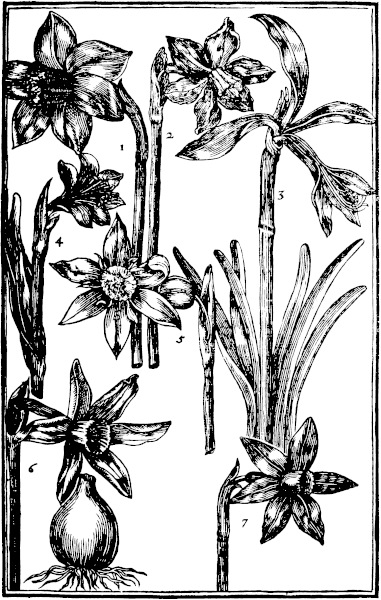
| 1 | Narcissus Nonpareille. The incomparable Daffodill. |
| 2 | Narcissus Mattenesse. The lesser yellow Nompareille Daffodill. |
| 3 | Narcissus Iacobæus flore rubro. The red Indian Daffodill. |
| 4 | Narcissus Trapezunticus. The early Daffodill of Trabesond. |
| 5 | Narcissus Montanus albus apophysibus præditus. The white winged Daffodill. |
| 6 | Narcissus Montanus, siue Nompareille totus albus. The white Nompareille, or Peerlesse Daffodill. |
| 7 | Narcissus albus oblongo calice. The white Daffodill with a long cup. |
{Mountain Daffodils}
Narcissus Montanus albus apophysibus præditus.
The white Mountaine Daffodill with eares, or The white winged Daffodill.
This Mountaine Daffodill riseth vp with three or four broad leaues, somewhat
long, of a whitish greene colour, among which riseth vp a stalke a foote and a halfe
high, whereon standeth one large flower, and sometimes two, consisting of sixe white
leaues a peece, not very broad, and without any shew of yellownesse in them, three
whereof haue vsually each of them on the back part, at the bottome vpon the one side
of them, and not on both, a little small white peece of a leafe like an eare, the other
three hauing none at all: the cup is almost as large, or not much lesse then the small
Nompareille, small at the bottome, and very large, open at the brimme, of a faire yellow
colour, and sometimes the edges or brimmes of the cup will haue a deeper yellow
colour about it, like as if it were discoloured with Saffron: the flower is verie
sweete, the roote is great and white, couered with a pale coate or skinne, not verie
blacke, and is not very apt to encrease, seldome giuing of-sets; neither haue I euer gathered
seede thereof, because it passeth away without bearing any with me.
Narcissus Montanus, siue Nompareille totus albus amplo calice.
The white Nompareille Daffodill.
This white Nompareille Daffodill, is in roote and leafe very like vnto the former
mountain or winged Daffodill, but that they are a little larger: the stalke from among
the leaues riseth vp not much higher then it, bearing at the top one large flower, composed
of sixe long white leaues, each whereof is as it were folded halfe way together,
in the middle whereof standeth forth a large white cup, broader at the mouth or brims
then at the bottome, very like vnto the lesser Nompareille Daffodill before remembred,
which hath caused it to be so entituled: the sent whereof is no lesse sweete then
the former.
The Place.
The naturall places of these Daffodils are not certainly knowne to vs;
but by the names they carry, they should seeme to bee bred in the Mountaines.
The Time.
These flower not so early as many other kindes doe, but rather are to bee
accounted among the late flowring Daffodils; for they shew not their
flowers vntill the beginning of May, or the latter end of Aprill, with the
soonest.
The Names.
The names set downe ouer the heads of either of them be such, whereby
they are knowne to vs; yet some doe call the first Narcissus auriculatus, that
is to say, The Daffodill with eares: and the other, Narcissus Nompareille
totus albus, that is to say, The white Nompareille, or Peerlesse Daffodill.
{Daffodils with a long cup}
1. Narcissus albus oblongo calice luteo præcox minor.
The small early white Daffodill with a long cup.
The leaues of this early Daffodill are broad, very greene, and not whitish as others,
three or foure standing together, about a foote long or better, among which riseth vp a
greene stalke, not full so high as the leaues, bearing one flower at the toppe thereof of
a reasonable bignesse, but not so great as the later kindes that follow are, consisting of
six whitish leaues, but not perfect white, hauing a show of a Creame colour appearing
in them; in the middle is a long round yellow cup, about halfe an inch long or better.
The smell of this flower is reasonable sweete, the roote is of a reasonable bignesse, yet
lesser then the rootes of the later kindes.
2. Narcissus pallidus oblongo calice flauo præcox.
The early Strawe coloured Daffodill with a long cup.
The leaues of this Daffodill are as greene as the former, but much narrower; and
the leaues of the flower are more enclining to yellow, but yet very pale, as if it were a
light strawe colour, and seeme to bee a little more narrow and pointed then the former:
the cup of this, is as long and yellow as the precedent. The smell whereof is very
like the former, yet neither of them being so sweete as those that follow.
3. Narcissus albus oblongo calice luteo serotinus maier.
The great late flowring white Daffodill with a long cup.
This later flowring Daffodill hath his leaues somewhat narrow & long, of a grayish
or whitish greene colour, among which the stalke riseth vp a foote and a halfe high,
bearing one flower at the toppe, made of six white leaues, hauing the cup in the middle
thereof as long as the former, and of a deepe yellow: the edges of this cuppe are
sometimes plaine, and sometimes a little crumpled; they are often also circled at the
brimmes with a Saffron colour, and often also without it, the smell whereof is very
pleasant, and not heady: the roote hereof is reasonable bigge, and couered ouer rather
with a pale then blackish skinne. This flower doth sometimes alter his forme into
eight leaues, which being narrow and long, seeme like a white starre, compassing a
yellow trunke.
4. Narcissus totus pallidus oblongo calice serotinus minor.
The late pale coloured Daffodill with a long cup.
There is another of this kinde, whose flowers is wholly of a pale white, or yellowish
colour, differing neither in leafe nor roote from the former.
5. Narcissus pallidus oblongo calice flauo serotinus.
The Strawe coloured late flowring Daffodill with a long yellow cup.
The chiefe difference of this Daffodill from the former, consisteth in the colour of
the cup, which is a more yellow colour, and a little larger then the
former, and the brimmes or edges of the cup of a deeper yellow, or Saffron colour.
The smell of this is no lesse sweete then in the former.
6. Narcissus albus oblongo calice flauo serotinus, duobus floribus in caule.
The late white Daffodill with a long cup, and two flowers on a stalke.
This Daffodill is surely a kinde of it selfe, although it be so like the former, abiding
constant in his forme and manner of flowring, vsually bearing without missing two
flowers vpon a stalke, very like vnto the former great white kinde, that one cannot
know any greater matter of difference betweene them, then that it beareth two flowers
on a stalke: the cuppes whereof are seldome touched with any shew of Saffron colour
on them at the brimmes or edges, as some of the former haue.
The Place.
All these Daffodils doe grow on the Pyrenæan mountaines, and haue
been sought out, and brought into these parts, by those curious or couetous
searchers of these delights, that haue made vs partakers of them.
The Time.
The former kindes flower earlier by a fortnight then the later, the one in
the later end of March, and the other not vntill the middle of Aprill.
The Names.
Their names are giuen to euery one of them in their seuerall titles, as fitly
as may best agree with their natures; and therefore I shall not neede to
speake any further of them.
{White Daffodils}
Narcissus medioluteus vulgaris.
The common white Daffodill called Primrose Peerlesse.
This Daffodill is so common in euery Country Garden almost through England,
that I doubt I shall but spend my time in vaine, to describe that which is so well
knowne, yet for their sakes that know it not, I will set downe the description of it in
this manner. It hath long limber and broad leaues, of a grayish greene colour, among
which riseth vp a stalke, bearing at the toppe out of a skinnie huske sometimes
but one flower, but most commonly two flowers, and seldome three or more, but larger
for the most part, then any that beare many flowers vpon a stalke, of a pale whitish
Creame colour, tending somewhat neare vnto the colour of a pale Primrose (which
hath caused our Countrey Gentlewomen, I thinke, to entitle it Primrose Peerlesse)
with a small round flat Crowne, rather then a cup in the middle, of a pale yellow colour,
with some pale chiues standing therein, being of a sweete, but stuffing sent: the
roote is reasonable great, and encreasing more then a better plant.
Narcissus mediocroceus serotinus.
The late flowring white Daffodill.
This Daffodill hath much smaller leaues, and shorter then the last, the stalke also
riseth not so high by much, and beareth but one flower thereon, of a pure white colour,
made of six small leaues, and somewhat narrow, standing seuerally one from
another, and not so close together as the former, but appearing like a starre: the cup is
small and round, of a pale yellow colour, but saffrony about the brims, hauing six
small pale chiues in the middle, the smell whereof is much sweeter then in the former.
The Place.
The first is thought to grow naturally in England, but I could neuer heare
of his naturall place. I am sure it is plentifull enough in all Country Gardens,
so that wee scarce giue it place in our more curious parkes. The second
liueth only with them that delight in varieties.
The Time.
The first Daffodill flowreth in the middle time, being neither of the
earliest, nor of the latest; but about the middle, or end of April. The other
flowreth with the latest in May.
The Names.
I shall not neede to trouble you with further repetitions of names, they
hauing been set downe in their titles, which are proper to them.
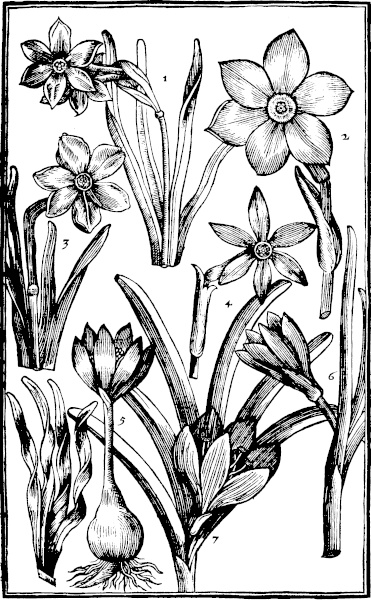
| 1 | Narcissus vulgaris medio luteus. The common White Daffodill, or Primrose Peerlesse. |
| 2 | Narcissus medio purpureus maximus. The great white purple ringed Daffodill. |
| 3 | Narcissus medio purpureus præcox. The early purple ringed Daffodill. |
| 4 | Narcissus medio purpureus stellatus. The starry purple ringed Daffodill. |
| 5 | Narcissus Persicus. The Persian Daffodill. |
| 6 | Narcissus Autumnalis minor. The lesser Winter Daffodill. |
| 7 | Narcissus Autumnalis maior. The greater Winter Daffodill. |
{Purple Ringed Daffodils}
1. Narcissus medio purpureus præcox.
The early purple ringed Daffodill.
This early Daffodill hath many long grayish greene leaues, somewhat narrower
and stiffer than the former common white Daffodill, among which riseth vp a long
naked hollow stalke (as all other Daffodils haue) bearing at the toppe one flower, and
seldome two, made of sixe long white leaues, standing close together about the stalke;
the cup is yellow, and so flat, that it might rather bee called a crowne: for it standeth
very close to the middle, and very open at the brimmes, circled with a reddish or purple
coloured ring, hauing certaine chiues in the middle of it also. The smell hereof is
very sweete, exceeding many other.
2. Narcissus medio purpureus serotinus.
The late purple ringed Daffodill.
The leaues of this Daffodill are alwayes broader then the former early one, and
some are very neare twice as broad: the flower is very like the former, being large,
and his leaues standing close one to the side of another; the ring likewise that compasseth
the yellow coronet, is sometimes of a paler reddish purple, and sometimes as
deep a red as the former: so that it differeth not in any other materiall point, then
that it flowreth not vntill the other is past and gone. The sent of this is like the former,
the roote hereof is greater, as well as the leafe and flower.
3. Narcissus medio purpureus maximus.
The great white purple ringed Daffodill.
There is another kinde, whose flower (as well as leaues and rootes) is larger then
any other of this kinde, which only maketh it a distinct sort from the other: it flowreth
also with the later sort of these purple ringed Daffodils.
4. Narcissus medio purpureus stellaris.
The starry purple ringed Daffodill.
This Daffodill hath his leaues a little narrower and greener then the former sorts,
the flower also of this hath his sixe white leaues not so broad, but narrower, and seeming
longer then they, not closing together, but standing apart one from another, making
it seem like a white starre: it hath also a yellow coronet in the middle, circled
about with purple, like the former. This doth smell nothing so sweete as the first but
yet hath a good sent.
The Place.
The first, third, and fourth of these Daffodils, haue always beene sent
vs from Constantinople among other bulbous rootes, so that wee know no
further of their naturall places.
The second groweth in many places of Europe, both in Germany,
France, and Italy, as Clusius hath noted.
The Time.
The first flowreth very early in March, euen with the first Daffodils. The
second, third, and fourth, about a moneth after.
The Names.
The early and starre Daffodils, haue been sent vs by the Turkish name of
Deuebohini, and Serincade. But their names, they haue receiued since, to bee
endenizond with vs, are set downe in their seuerall titles.
{Persian and Autumne or Winter Daffodils}
Narcissus Persicus.
The Persian Daffodill.
This Persian Daffodill differeth from all other kindes of Daffodils in his manner of
growing, for it neuer hath leaues and flowers at one time together, wherein it is like
vnto a Colchicum, yet in roote and leafe it is a Daffodill. The roote is a little blackish
on the outside, somewhat like the roote of the Autumne Daffodill, from whence riseth
vp a naked foote stalke, bearing one pale yellow flower, breaking through a thinne
skinne, which first enclosed it, composed of six leaues, the three outermost being a
little larger then the rest, in the middle of the flower there are six small chiues, and a
longer pointell. The whole flower is of an vnpleasant sent. After the flower is past,
come vp the leaues, sometimes before Winter, but most vsually after the deepe of
Winter is past with vs, in the beginning of the yeare, which are broad, long, and of a
pale greene colour, like the leaues of other Daffodils, but not greene as the Autumne
Daffodill is, and besides they doe a little twine themselues, as some of the Pancratium,
or bastard Sea Daffodils doe.
Narcissus Autumnalis maior.
The greater Autumne or Winter Daffodill.
The greater Autumne Daffodill riseth vp with three or foure faire broad and short
leaues at the first, but afterwards grow longer, of a very deepe or darke greene colour,
in the middle of which riseth vp a short, stiffe, rounded footestalke, bearing one faire yellow
flower on the head thereof (inclosed at the first in a thinne skinne, or huske) and
consisteth of six leaues as the former, with certaine chiues in the middle, as all or most
other Daffodils haue, which passeth away without shew of any seed, or head for seed,
although vnder the head there is a little greene knot, which peraduenture would beare
seede, if our sharpe Winters did not hinder it. The roote is great and round, couered
ouer with a blackish skinne or coate.
Narcissus Autumnalis minor.
The lesser Autumne or Winter Daffodill.
Clusius setteth downe, that the manner of the flowring of this lesser Daffodill, is
more like vnto the Persian Daffodill, then vnto the former greater Autumne kind; but
I doe fine that it doth in the same sort, as the greater kinde, rise vp with his leaues first,
and the flowers a while after: the flower of this is lesser, and a little paler then the
flower of the greater kinde, but consisting in like sort of six leaues, narrow and sharpe
pointed; the greene leaues also are almost of as deepe a green colour, as the greater
kinde, but smaller and narrower, and a little hollow in the middle. The roote is also
alike, but lesser, and couered with a blackish skinne as the former. This hath sometimes
borne blacke round seede in three square heads.
The Place.
The Persian Daffodill hath beene sent sometimes, but very seldome, among
other roots from Constantinople, and it is probable by the name
whereby it was sent, that it should naturally grow in Persia.
The other two haue likewise beene sent from Constantinople, and as it
is thought, grow in Thracia, or thereabouts.
The Time.
They all doe flower much about one time, that is, about the end of September,
and in October.
The Names.
The first hath been sent by the name of Serincade Persiana, and thereupon
is called Narcissus Persicus, The Persian Daffodill.
The other two haue been thought by diuers to be Colchica, and so haue
they called them, vpon no other ground, but that their flower is in forme
and time somewhat like Colchicum, when as if they had marked them better,
they might plainly discerne, that in all other things they did resemble
Daffodils; but now the names of Colchicum luteum maius, & minus, is quite
lost, time hauing worne them out, and they are called by most Herbarists
now adayes, Narcissus Autumnalis maior & minor, The greater and the
lesser Autumne Daffodill.
Thus farre haue I proceeded with those Daffodils, that hauing broad leaues, beare
but one single flower, or two at the most vpon a stalke: And now to proceed with the
rest, that haue broad leaues, and beare single flowers, but many vpon a stalke.
{Yellow Daffodils}
Narcissus Africanus aureus maior.
The great yellow Daffodill of Africa.
This braue and stately Daffodill hath many very long and broad leaues, of a better
green colour, then many others that are grayish, among which appeareth a stalke,
not rising to the height of the leaues, bearing at the toppe out of a skinnie hose many
faire, goodly, and large flowers, to the number of ten or twelue, if the roote bee well
growne, and stand in a warme place, euery one being larger then any of the French,
Spanish, or Turkie Daffodils, that beare many single flowers vpon a stalke, and commeth
neere vnto the bignesse of the English Daffodill, called Primrose Peerlesse, before
described, or that French kinde hereafter described, that beareth the largest
flowers, many vpon a stalke (which some would make to bee a kinde of English
Daffodill, but bearing more flowers) and of a faire shining yellow colour, hauing
large, round, and open cups or boules, yellower then the outer leaues; and is of so exceeding
sweete a sent, that it doth rather offend the senses by the aboundance thereof:
the roote is great, and couered with a blackish browne coate or skinne.
Narcissus Africanus aureus minor.
The lesser Barbary Daffodill.
This lesser kinde is very neere the same with the former, but that it lacketh somewhat
of his statlinesse of height, largenesse of flower and cup (being a paler yellow)
and beauty of colour, for it beareth neither of these equall vnto the former, but
is in them all inferiour. And thus by this priuatiue, you may vnderstand his positive,
and that shall be sufficient at this time.
Narcissus Byzantinus totus luteus.
The yellow Turkie Daffodill.
Whereas the last described, came short of the beauty of the former, so this lacketh
of that beauty is in the last; for this, although it haue very long leaues, and a high
stalke, yet the flowers are neither so many, as not being aboue foure or fiue, nor so
large, being not much greater then the ordinary French Daffodill hereafter described,
nor the colour so faire, but much paler, and the cup also smaller; and herein consisteth
the chiefest differences betweene this, and both the other, but that the sent of
this is also weaker.
The Place.
The first and the second grow in Barbary, about Argiers, and Fez, as by
the relation of them, that haue brought them into these parts, wee haue
been enformed.
The last hath been often brought from Constantinople among other varieties
of Daffodils, but from whence they receiued them, I could neuer
learne.
The Time.
These Daffodils do flower very early, euen with the first sort of Daffodils,
I meane after they haue been accustomed vnto our climate: for oftentimes
vpon their first bringing ouer, they flower in Ianuary or February,
especially if they be preserued from the frosts, and kept in any warme place;
for they are very tender, and will soone perish, being left abroad.
The Names.
The first is called by diuers in French, Narcisse d’ Algiers and in many
places of the Low Countries, Narcissen van Heck, or Narcissus Heckius; by
diuers others Narcissus Africanus aureus maior, we may call it in English, The
great African Daffodill, or the great Barbary Daffodill, or the great yellow
Daffodill of Argiers, which you please.
The second hath no other variation of name, then a diminutiue of the
former, as is set downe in the title.
The third is no doubt the same, that Clusius setteth downe in the twelfth
Chapter of his second Booke of the History of more rare plants, and maketh
the fourth sort, which came from Constantinople, and may also be the
same, which he maketh his fifth, which (as he saith) he receiued from Doctour
Simor Touar of Seuill in Spaine. Wee call it, from the place from
whence we receiued it, Narcissus Byzantinus, with the addition of totus luteus,
to put a difference from other sorts that come from thence also: in English,
The yellow single Daffodill of Turkie.
{Lemon coloured Daffodils}
Narcissus Sulphureus maior.
The greater Lemon coloured Daffodill.
The greater of these Daffodils, beareth three or foure greene and very long leaues,
a foote and a halfe long at the least, among which riseth vp a round, yet crested stalke,
not so high as the leaues, bearing fiue or sixe single flowers thereon, euery one of them
being greater then the ordinary French or Italian Daffodils, with many flowers vpon
a stalke; of a faint, but yet pleasant yellow colour at the first, which after they haue
been in flower a fortnight or thereabouts, change into a deeper, or more sullen yellow
colour: the cup in the middle is likewise larger, then in those formerly named, and of
a deeper yellow colour then the outer leaues, hauing onely three chiues within it. The
smell is very pleasant.
Narcissus Sulphureus minor.
The lesser Lemon coloured Daffodill.
This lesser Daffodill hath broader and shorter leaues then the former, of the colour
of other Daffodils, and not greene like the former: the stalke of this riseth vp higher
then the leaues, bearing foure or fiue flowers vpon shorter footestalkes, and no bigger
then the French Daffodill, of a pale yellow, which most doe call a Brimstone colour,
the cup or rather crowne in the middle, is small, and broad open, of a little deeper yellow,
hauing many chiues within it, and is as it were sprinkled ouer with a kinde of
mealinesse. The smell of this is not full so pleasant as the former.
The Place.
Both these haue been gathered on the Pyrenæan Mountaines, and both
likewise haue been sent out of Italy.
The Time.
They both flower in the middle time of the Daffodils flowring, that is, in
Aprill.
The Name.
They haue their Latine names expressed in their titles and so are their
English also, if you please so to let them passe; or else according to the Latine,
you may call them, The greater and the lesser Brimstone coloured
Daffodils; some haue called them Narcissus Italicus, but the Italians themselues
haue sent them by the name of Narcisso Solfarigno.
{Milke White Daffodils}
Narcissus totus albus polyanthos.
The milke white Daffodill many vpon a stalke.
The leaues of this Daffodill are of a meane size, both for length and breadth, yet
somewhat greener then in the ordinary sorts, that haue some whitenesse in them: the
flowers are many vpon the stalke, as small for the most part, as any of these kindes that
beare many together, being wholly of a milke, or rather snow white colour, both the
cuppe, which is small, and the outer leaues that compasse it; after which come small
heads, wherein is contained round blacke seede, as all other Daffodils doe, although
some greater, and others lesser, according to the proportion of the plants: the roote is
couered ouer with a blackish skinne or coate; the smell is very sweete.
There are two other sorts more of this kinde, the differences whereof are, that the
one hath his leaues somewhat broader, and the flowers greater then the former: And
the other smaller leaues and flowers also, whose cups being small, are neuer seene fully
open, but as it were halfe closed at the brimmes.
Narcissus latifolius totus albus, mediocri calice reflexus.
The milke white Daffodill with the great cup.
There is yet another sort of these milke white Daffodils, whose leaues are as broad
as any of the former, and whose cup in the middle of the flower, is somewhat larger
then in any of the lesser sorts, and lesser then in the greater kinde: but the leaues of the
flowers doe a little turne themselues vpwards, which maketh a chiefe difference.
The Place.
These Daffodils grow in Spaine, from whence I receiued many that
flourished a while, but perished by some fierce cold Winters: they likewise
grow in France, from whence many also haue been brought vnto vs. They
haue likewise been sent from Constantinople to vs, among other kindes of
Daffodils.
The Time.
They that come from Constantinople, for the most part doe flower
earlier then the other, euen after they are accustomed to our ayre. Some of
them flower notwithstanding in the end of March, the rest in Aprill.
The Names.
They are vsually called Narcissus totus albus polyanthos, adding thereunto
the differences of maior, medius, and minor, that is, The milke white Daffodill,
the greater, the middle, and the lesser; for so some doe distinguish
them. The last, for distinction, hath his name in his title sufficient to expresse
him.
{French, Italian and English Daffodils}
1. Narcissus Narbonensis, siue medio luteus præcox.
The early French Daffodill.
The leaues of this Daffodill, spring vp out of the ground a moneth or two sometimes
before the other of this kinde, that follow; being also shorter and narrower:
the stalke likewise is not very high, bearing diuers flowers at the top, breaking through
a thinne skinne, as is vsuall with all the Daffodils, euery one whereof is small, consisting
of six white leaues, and small yellow cup in the middle, which is of a prettie
small sent, nothing so strong as many others: the roote is great and round, and seldome
parteth into of-sets, euen as all the other that follow, bearing many single flowers,
doe.
[81]
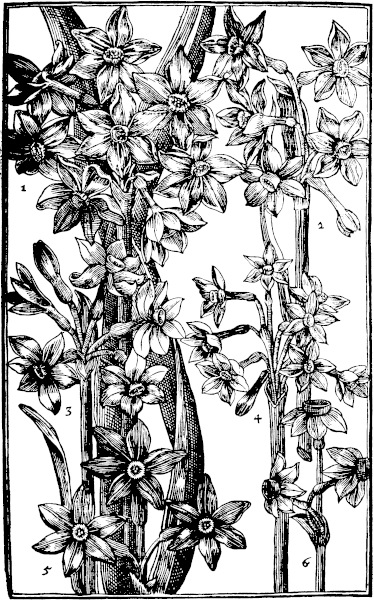
| 1 | Narcissus Africanus aureus maior. The great yellow Daffodill of Africa. |
| 2 | Narcissus Africanus luteus minor. The lesser yellow Daffodill of Africa. |
| 3 | Narcissus Narbonensis medio luteus. The French Daffodill. |
| 4 | Narcissus Pisanus, vel totus albus. The Italian Daffodill, or the all white Daffodill. |
| 5 | Narcissus Mussart. Mussart his Daffodill. |
| 6 | Narcissus Anglicus polyanthos. The great English Daffodill. |
2. Narcissus Narbonensis vulgaris.
The ordinary French Daffodill.
This Daffodill hath long and broad greene leaues, a little hollowish in the middle,
and edged on both sides; the stalke is a foote and a halfe high, bearing at the toppe diuers
flowers, somewhat larger then the former, consisting of six white leaues, somewhat
round; the cup is yellow in the middle, small and round, like vnto an Acorne
cuppe, or a little fuller in the middle: this is the forme of that sort which was first
brought vnto vs: But since there is found out some, whose cup is shorter, others flatter,
some of a paler, others of a deeper yellow colour, and some that haue their cuppe
longer then the rest. The rootes of them all are couered with a blackish skin or coate.
3. Narcissus Narbonensis maior amplo flore.
The French Daffodill with great flowers.
The leaues of this Daffodill are somewhat like vnto the last, but not so broad, yet
full as long, and spring sooner out of the ground, yet not so early as the first of these
kindes: the stalke hereof is flatter, and riseth higher, bearing foure or fiue flowers,
much larger then any of this kinde; for euery one of them doth equall the English
Daffodill, before described, but whiter then it, and the yellow cup larger, and more
open then in any of the rest. The roote of this is not so great, or round, as the former,
but is more plentifull in of-sets, then any other of these French, or Italian kindes.
4. Narcissus Pisanus.
The Italian Daffodill.
This Italian Daffodill hath his leaues as large, or larger then the second French
Daffodill, and his stalke somewhat higher, bearing many white flowers, very like vnto
the common French Daffodill, but somewhat larger also; and the yellow cup in the
middle likewise is larger, and rounder, then is vsually seen in any of the French kinds,
except the last with the greatest flowers.
5. Narcissus mediocroceus polyanthos.
The French Daffodill with Saffron coloured cups.
This French Daffodill hath diuers leaues of a grayish greene colour, not so broad
or long as the last recited Daffodill, but comming neerer vnto the second French
kinde, the flowers likewise are white, and many vpon a stalke, like thereunto, but the
yellow cup is somewhat large, and circled with a Saffron like brimme or edge, which
maketh the chiefest difference.
6. Narcissus mediocroceus alter, dictus Mussart.
Mussart his Daffodill.
The affinity between this & the last, (for it is not the same to be expressed vnder one
title) hath made me ioyne it next vnto it, yet because it hath a notable difference, it
deserueth a place by himselfe. The leaues are large and long, and the flowers, being
white, are larger also then in any other, except the greatest, but the cup hereof is small
and short, rather seeming a coronet then a cup, of a deepe Saffron colour all about the
brimmes or edges.
7. Narcissus Anglicus polyanthos.
The great English Daffodill.
This Daffodill hath his leaues not much broader or longer, then the French kinde
with great flowers, before described, the stalke with flowers riseth not fully so high as
it, bearing many flowers thereon, not altogether so white, yet whiter then the former
English Daffodill, called Primrose Peerlesse, but nothing so large, and with short,
broad, and almost round leaues, standing close one vnto another: the yellow cup in
the middle is bowle fashion, being somewhat deeper then in any of the former kinds,
but not much greater: the smell hereof is very sweete and pleasant.
8. Narcissus Narbonensis, siue medio luteus serotinus maior.
The greater late flowring French Daffodill.
The roote as well as the leaues of this Daffodill, are greater, larger, broader, and
longer then in any other of the former French, or Italian kindes; the stalke is as high
as any of them, bearing at the toppe fiue or sixe white flowers, standing open spread
like a starre, and not close together, euery one whereof is large, and round pointed,
the cup is yellow, small and short, yet not lying flat to the flower, but a little standing
out with some threads in the middle, as all the former Daffodils haue. This is not so
sweete as the earlier kindes.
9. Narcissus medioluteus alter serotinus calice breui.
The lesser late flowring French Daffodill.
This Daffodill is of the same kinde with the last described, the onley difference is,
that it is lesser, and the yellow cuppe in the middle of the flower, is somewhat shorter
then the former, although the former be shorter then many others, otherwise it differeth
not, no not in time; for it flowreth late as the former doth.
The Place.
These Daffodils haue been brought vs from diuers places; The first and
second grow naturally in many places of Spaine, that are open to the Sea:
they grow likewise about Mompelier, and those parts in France. They haue
been likewise sent among many other sorts of Daffodils from Constantinople,
so that I may thinke, they grow in some places neere thereunto.
The fourth groweth plentifully in Italy, about Pisa in Tuscane, from
whence we haue had plants to furnish our Gardens.
The seuenth is accounted beyond Sea to be naturall of our Country, but
I know not any with vs that haue it, but they haue had it from them.
The rest haue been brought at diuers times, but wee know no further of
their naturall places.
The Time.
The first flowreth earlier then any of the rest by a moneth, euen in the
beginning of March, or earlier, if the weather be milde. The other in Aprill,
some a little before or after another. The late kinds flower not vntill May.
The Names.
There can be no more said of the names of any of them, then hath beene
set out in their titles; for they distinguish euery sort as fitly as we can: onely
some doe call the first two sorts, by the name of Donax Narbonensis.
After all these Daffodils, that hauing broad leaues beare single flowers, either one or
many vpon a stalke, I shall now goe on to set forth those broad leafed Daffodils, that
carry double flowers, either one or many vpon a stalke together, in the same order
that we haue vsed before.
1. Narcissus albus multiplex.
The double white Daffodill.
The leaues of this Daffodill are not very broad, but rather of a meane size, being of
the same largenesse with the leaues of the purple ringed Daffodill, the stalke riseth vp
to be a foote and a halfe high, bearing out of a thinne white skinne or hose, one flower
and no more, consisting of many leaues, of a faire white colour, the flower is larger
then any other double white Daffodill, hauing euery leafe, especially the outermost,
as large almost as any leafe of the single Daffodill with the yellow cup, or purple ring.
Sometimes it happeneth, that the flower is very little double, and almost single, but
that is either in a bad ground, or for that it hath stood long in a place without remouing;
for then it hath such a great encrease of rootes about it, that it draweth away into
many parts, the nourishment that should be for a few: but if you doe transplant it,
taking away the of-sets, and set his rootes single, it will then thriue, and beare his
flower as goodly and double, as I haue before described it: and is very sweete.
2. Narcissus mediopurpureus multiplex.
The double purple ringed Daffodill.
There is little difference in the leaues of this kinde, from the leaues of the single purple
ringed Daffodill; for it is probable it is of the same kinde, but by natures gift (and
not by any humane art) made more plentifull, which abideth constant, and hath not
that dalliance, which oftentimes nature sheweth, to recreate the senses of men for the
present, and appeareth not againe in the same forme: the chiefest difference is, that the
flower (being but sometimes one on a stalke, and sometimes two) consisteth of six
white outer leaues, as large as the leaues of the single kinde, hauing many small yellow
peeces, edged with purple circles round about them, instead of a cup; and in the middle
of these peeces, stand other six white leaues, lesser then the former, and a yellow
cup edged with a purple circle likewise, parted into peeces, and they comprehend a
few other white leaues, smaller than any of the other, hauing among them some broken
peeces of the cup, with a few chiues also in the middle of the flower. The flower
is very sweete.
There is of this kinde another, whose flower hath not so plaine a distinction, of a
triple rowe of leaues in it: but the whole flower is confusedly set together, the outer
leaues being not so large, and the inner leaues larger then the former; the broken yellow
cuppe, which is tipt with purple, running diuersly among the leaues; so that it
sheweth a fairer, and more double flower then the former, as it is indeed.
3. Narcissus medioluteus corona duplici.
The Turkie Daffodill with a double crowne.
This Daffodill hath three or foure leaues, as large and long almost, as the great
double Daffodill of Constantinople next following hath: the stalke likewise is very
neere as great, but as high altogether, bearing at the toppe foure or fiue flowers, the
leaues whereof are as large, as of the first or second kinde of French Daffodils, before
described, but not altogether of so pure a white colour; and being six in number, stand
like the former single French Daffodils, but that the yellow cup in the middle of this is
thicke and double, or as it were crumpled together, not standing very high to be conspicuous,
but abiding lowe and short, so that it is not presently marked, vnlesse one
looke vpon it precisely; yet is exceeding sweete. The roote is like vnto the roote of
the purple ringed Daffodill, or somewhat bigger.
4. Narcissus Chalcedonicus flore pleno albo polyanthos.
The double white Daffodill of Constantinople.
This beautifull and goodly Daffodill (wherewith all Florists greatly desire to bee
acquainted, as well for the beauty of his double flowers, as also for his superabounding
sweete smell, one stalke with flowers being instead of a nosegay) hath many very
broad, and very long leaues, somewhat greener then gray, among which riseth vp a
strong round stalke, being sometimes almost flat, and ribbed, bearing foure or fiue, or
more white flowers at the toppe, euery one being very great, large, and double, the
leaues being confusedly set together, hauing little peeces of a yellow cup running among
them, without any shew of that purple ring that is in the former, and fall away
without bearing seed, euen as all, or most other double flowers doe: the smell
is so exceeding sweet and strong, that it will soone offend the senses of any, that
shall smell much vnto it: the roote is great and thicke, couered with a blackish
coate.
5. Narcissus Chalcedonicus fimbriatus multiplex polyanthos.
The great double purple ringed Daffodill of Constantinople.
This Daffodill differeth very little or nothing in leafe from the former, the onely
difference is in the flowers, which although they bee double, and beare many vpon a
stalke, like vnto them, yet this hath the peeces of the yellow cuppes tipt with purple,
as if they were shred or scattered among the white leaues, whereas the other hath only
the yellow, without any shew of purple tips vpon them: the smell of this is as strong
as of the other.
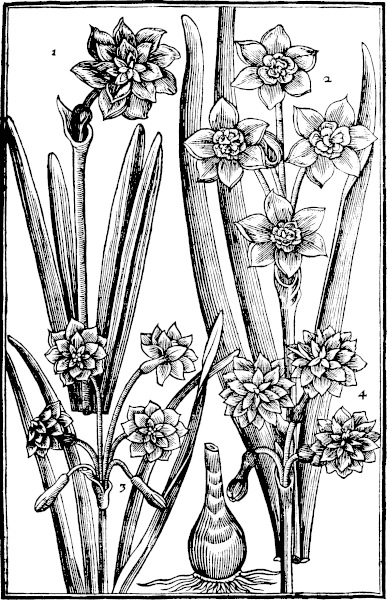
| 1 | Narcissus albus multiplex. The double white Daffodill. |
| 2 | Narcissus medioluteus corona duplici. The Turkie Daffodill with a double crowne. |
| 3 | Narcissus mediopurpureus multiplex. The double purple ringed Daffodill. |
| 4 | Narcissus Chalcedonicus flore pleno albo polyanthos. The double white Daffodill of Constantinople. |
[86]
6. Narcissus Cyprius flore pleno lutes polyanthos.
The double yellow Daffodill of Cyprus.
The leaues of this Daffodill are almost as broad and long as the former, the stalke is
a foot high and more, bearing foure or fiue flowers on the top, euery one very double,
and of a fine pale yellow colour, of a strong heady sent. The root of this is also like the
former.
The Place.
The first of these Daffodils, was full brought into England by Mʳ. Iohn
de Franqueuille the elder, who gathered it in his owne Countrey of Cambray,
where it groweth wild, from whose sonne, Mʳ. Iohn de Franqueuille,
now liuing, we all haue had it. The rest haue come from Constantinople at
seuerall times; and the last is thought to come from Cyprus. Wee haue it
credibly affirmed also, that it groweth in Barbary about Fez and Argiers.
Some of the double white kindes grow in Candy, and about Aleppo also.
The Time.
The Turkie kindes doe for the most part all flower early, in the end of
March, or beginning of Aprill at the furthest, and the first double, about
the middle or end of April.
The Names.
All these Daffodils, except the first, haue had diuers Turkish names set
vpon the packets, wherein they haue been sent, but there is small regard of
certainty to be expected from them; for that the name Serincade, without
any more addition, which is a single Daffodill, hath beene imposed vpon
that parcell of rootes, that have borne most of them double flowers of diuers
sorts; and the name Serincade Catamer lale which signifieth a double
flowered Daffodill, hath had many single white flowers, with yellow cups,
and some whose flowers have been wholly white, cuppe and all, and some
purple ringed, and double also among them. Their names, whereby they
are knowne and called with vs, are, as fitly as may be, imposed in their titles:
And this I hope shall suffice, to have spoken of these sorts of Daffodils.
Hauing finished the discourse of the former sort of broad leafed Daffodils, it is fit to
proceede to the next, which are Angustifolios Narcissos, those Daffodils that have
narrow leaures, and first to set down those that beare single flowers, whether one or
many flowers vpon a stalke, and then those that beare double flowers in the same manner.
Narcissus Virginens.
The Virginia Daffodill.
This plant I thought fittest to place here in the beginning of this Classis, not finding
where better to shroud it. It hath two or three long, and very narrow leaues, as greene
as the leaues of the great Leucoium bulbosum, and shining withall, which grow sometimes
reddish, especially at the edges: the stalke riseth vp a spanne high, bearing one
flower and no more on the head thereof, standing vpright like a little Lilly or Tulipa,
made of six leaues, wholly white, both within and without, except that at the bottome
next to the stalke, and a little on the backside of the three outer leaues, it hath a small
dash or shew of a reddish purple colour: it hath in the middle a few chiues, standing
about a small head pointed; which head groweth to bee small and long, containing
small blackish flat seede: the roote is small, long, and round, a little blackish on the
outside, and white on the inside.
The Place.
This bulbous plant was brought vs from Virginia, where they grow aboundantly;
but they hardly thriue and abide in our Gardens to beare
flowers.
The Time.
It flowreth in May, and seldome before.
The Names.
The Indians in Virginia do call it Attamusco, some among vs do call it
Lilionarcissus Virginianus, of the likenesse of the flower to a Lilly, and the
leaues and roote to a Daffodill. Wee for breuity doe called it Narcissus Virgineus,
that is, The Daffodill of Virginia, or else you may call it according to
the former Latine name, The Lilly Daffodill of Virginia, which you will;
for both names may serue well to expresse the plant.
Narcissus angustifolius albidus præcox oblongo calice.
The early white narrow leafed Daffodill with a long cup.
This Daffodill hath three or foure narrow, long, and very green leaues, a foot
long for the most part: the stalke riseth not vp so high as the leaves, whereon standeth
one flower, not altogether so great as the late flowring Daffodill, with a long cuppe,
described before among the broad leafed ones, which consisteth of six pale coloured
leaves, not pure white, but hauing a wash of light yellow among the white: the cuppe
in the middle is round and long, yet not so long as to bee accounted a bastard Daffodill,
within which is a middle pointell, compassed with six chiues, hauing yellow
mealy pendents.
The Place.
The Daffodill groweth with the other sorts of broad leafed ones, on the
Pyrenæan Mountaines, from whence they have beene brought vnto vs, to
furnish our Gardens.
The Time.
It flowreth early, a month before the other sorts of the same fashion,
that is, in the beginning of March, if the time be milde, which the other
before spoken of the doe not.
The Names.
It hath no other name that I know, then is expressed in the title.
{Small Daffodils}
2. Narcissus mediocroceus tenuifolius.
The small Daffodill with a Saffron crown.
This small Daffodill hath foure or fiue narrow leaues, about a spanne long, among
which riseth vp a stalke some nine inches high, bearing at the toppe one small white
flower, made of six leaues, with a small yellow cup in the middle, shadowed ouer at
the brimmes with a Saffron colour: the roote is small, rounded, and little long withall,
couered with a blackish skinne or coate.
3. Narcissus minimus mediopurpureus.
The least purple ringed Daffodill.
This little Daffodill hath small narrow leaues, shorter by much then any of the purple
ringed Daffodils, before described: the stalke and flower keepe an equal proportion
to the rest of the plant, being in forme and colour of the flower, like vnto the
Starre Daffodill before recited, but vnlike in the greatnesse: this also is to bee obserued,
that the purple colour that circleth the brimmes of the cuppe, is so small, that
sometimes it is not well perceiued.
4. Narcissus minimus Iuncifolij flore.
The least Daffodill of all.
This least Daffodill hath two or three whitish greene leaues, narrower then the two
last recited Daffodils, and shorter by halfe, being but aboue two or three inches long,
the stalke likewise is not aboue three or foure inches high, bearing one single flower at
the toppe, somewhat bigger then the smalnesse of the plant should seeme to beare,
very like vnto the least Rush Daffodill, and of the same bignesse, or rather somewhat
bigger, being of a faint yellow colour, both leaues, and cup, or crowne, (if you please
so to call it); for the middle part is spread very much, euen to the middle of the leaues
almost, and lyeth flat open vpon the flower: the roote is small, euen the smallest of any
Daffodill, and couered with a blackish skinne or coate.
The Place.
The first of these Daffodils haue beene brought vs from the Pyrenæan
Mountaines, among a number of other rare plants, and the last by a French
man, called Francis le Veau, the honestest roote-gatherer that euer came ouer
to vs. The second was sent to Mʳ. Iohn de Franqueuille, before remembred,
who imparted
it to mee, as hee hath done many other good things;
but his naturall place wee know not.
The Time.
They all flower about the latter end of Aprill.
The Names.
Being brought without names, wee haue giuen them their names according
to their face and fashion, as they are set downe in their titles.
Narcissus Autumnalis minor albus.
The little white Autumne Daffodill.
This little Autumne Daffodill riseth with his flowers first out of the ground, without
any leaues at all. It springeth vp with one or two stalkes about a finger long, euery one
bearing out of a small huske one small white flower, laid open abroad like vnto the
Starre white Daffodill, before spoken of: in the middle of the flower is a small yellow
cup of a meane size, and after the flower is past, there commeth in the same place
a small head, containing small, round, blacke seede, like vnto the Autumne Hyacinth:
the leaues come vp after the seede is ripe and gone, being small and narrow, not much
bigger then the Autumne Hyacinth: the roote is small and blackish on the outside.
The Place.
This Daffodill groweth in Spaine, where Clusius saw it, and brought it
into these parts.
The Time.
It flowreth in the beginning of Autumne, and his seede is ripe in the end
of October in those hot Countries, but in ours it will scarce abide to shew a
flower.
The Names.
The Spaniards, as Clusius reporteth, call it Tonada, and he vpon the sight
thereof, Narcissus Autumnalis minor albus, and wee in English thereafter,
The little white Autumne Daffodill.
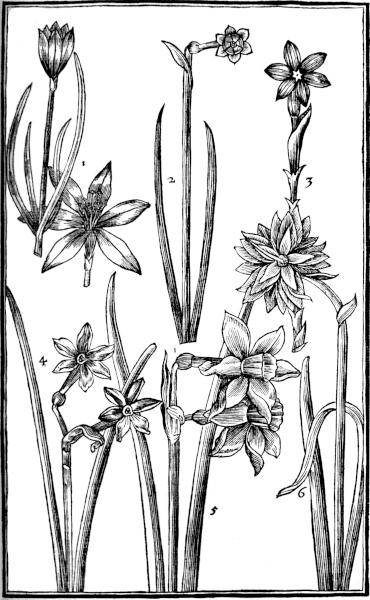
| 1 | Narcissus Virgineus. The Virginian Daffodill. |
| 2 | Narcissus minimus Iuncifolij flore. The least Daffodill of all. |
| 3 | Narcissus Autumnalis minor albus. The little white Autumne Daffodill. |
| 4 | Narcissus albus Autumnalis medio obsoletus. The white Autumne Daffodill with a sullen crown. |
| 5 | Narcissus Iuncifolius maximus amplo calice. The great Iunquilia with the largest flower or cup. |
| 6 | Narcissus totus albus flore pleno Virginianus. The double white Daffodill of Virginia. |
[90]
{The white Autumne Daffodill with a sullen crowne & The yellow Italian Daffodill of Caccini}
Narcissus albus Autumnalis medio obsoletus.
The white Autumne Daffodill with a sullen crowne.
This Autumne Daffodill hath two or three leaues at the most, and very narrow, so
that some doe reckon it among the Rush Daffodils, being somewhat broad at the bottome,
and more pointed at the toppe, betweene these leaues commeth vp the stalke,
bearing vsually two flowers and no more at the toppe, made of sixe white leaues a
peece, pointed and not round: the cup is small and round like vnto the cup or crowne
of the least Rush Daffodill, of a yellow colour at the bottome but toward the edge of
a dunne or sullen colour.
Narcissus angustifolius luteus semper florens Caccini.
The yellow Italian Daffodill of Caccini.
This Daffodill beareth a number of small, long, narrow, and very greene leaues,
broader then the leaues of any Rush Daffodill, among which rise vp diuers stalkes,
bearing at the head two or three flowers a peece, each of them being small and yellow,
the cup or crowne is small also, of a deeper yellow then the flower. The Nobleman of
Florence, who first sent this plant to Christian Porret at Leyden, after the death of Carolus
Clusius, writeth that euery stalke doth beare with him more store of flowers,
then are formerly set downe, and that it neuer ceaseth to beare flowers, but that after
one or more stalkes haue been in flower together, and are past, there succeed other in
their places.
The Place.
The first is naturall of Spain, the naturall place of the other is not known
to vs.
The Time.
The times of the flowring, are set downe both in the title and in the descriptions;
the one to be in Autumne, the other to be all the Summer long.
The Names.
The Latine names are imposed on them, as are fittest for them, and the
last by that honourable man that sent it, which is most fit to continue, and
not to bee changed. But wee, to let it bee knowne by an English name to
English people, haue entituled it, The yellow Italian Daffodill of Caccini:
if any man can giue it a more proper name, I shall bee therewith right well
content.
Narcissus angustifolius, siue Iuncifolius maximus, amplo calice.
The great Iunquilia with the large flower or cup.
Although this Daffodill importeth by his name, not to be of this family, but of the
next, considering it is so like vnto them, but bigger; yet I haue thought good to place
it in the end of these narrow leafed Daffodils, as being indifferent, whether it
should bee referred to this or to that. For this carrieth diuers long green leaues,
like vnto the other Rush Daffodils, but thicker and broader, so that it may without
any great errour, bee reckoned among these narrow leafed Daffodils, bearing at
the toppe two or three very faire large flowers, with a large and more open cuppe,
then in any other of the Rush Daffodils, both of them of a faire yellow colour, yet
the cuppe a little deeper then the flower, and a little crumpled about the edges, and
both a pretty sharpe sent: the roote is greater and longer then the other Rush Daffodill,
and couered likewise with a blackish coate.
The Place.
We haue this in Gardens onely, and haue not heard of his naturall place.
The Time.
It flowreth in Aprill.
The Names.
I leaue it indifferent, as I said, whether you will call it Narcissus angustifolius,
or Iuncifolius magno calice, or maximus, because it is the greatest of all
the rest of that kinde.
Narcissus totus albus flore pleno Virginianus.
The double white Daffodill of Virginia.
The roote of this Daffodill, is very like vnto the former single Virginia Daffodill,
set forth in the first place of this ranke of narrow leafed Daffodils, but that it is a little
bigger and rounder, being a little long withall, and blackish also on the outside, as
that is: from whence riseth vp two leaues, somewhat broader then the former: but of
a like greennesse: the stalke riseth vp betweene these two leaues, about a span high, or
not much higher, bearing one faire double snow white flower, very like in the fashion
vnto the pale yellow double Daffodill, or bastard Daffodill of Robinus, hereafter described:
For it is in the like manner laid open flat, and composed of six rowes of
leaues, euery rowe lying in order iust opposite, or one before another, whereof those
six leaues that make the first or outermost course, are the greatest, and all the rest lying,
as I said, one vpon or before another, are euery rowe smaller then others from the
middle of this flower, thrusteth forth a small long pointed forke or horne, white as
the flower is.
The Place.
The place is named to be Virginia, but in what part it is not known to vs.
The Time.
It flowreth in the end of Aprill.
The Names.
It may be that this doth grow among the former single kinde, and called
by the same name Attamusco, for that the plant is not much differing, yet
hereof I am not certaine: But we, from the forme and countenance of the
plant, do call it Narcissus Virginianus, The Virginian Daffodill, and because
it beareth a double flower, it hath the title of double added vnto it.
The third order of Daffodils, I said in the beginning was of Iuncifolios, Rush Daffodils,
which are now next to be entreated of, I shall herein keepe the same order I vsed
in the former; but because I finde none of this order, that beare but one flower vpon a
stalke, I must begin with those that beare many.
1. Narcissus Iuncifolius albus.
The white Iunquilia.
This white Rush Daffodill hath small long leaues, a little broader, and of a whiter
greene colour then the ordinary yellow Rush Daffodils: the stalke riseth vp
halfe a foote high or more, bearing two or three small white flowers vpon a
stalke, yet somewhat bigger then the common yellow Rush Daffodill, hauing a
small round cuppe in the middle, white also as the leaues are. The seede is small,
blacke, and round, as other seedes of Daffodils are: the roote is small and round, couered
with a blackish coate.
Narcissus Iuncifolius albus magno calice.
The white Iunquilia with a great cup.
There is of this kinde another sort, that hath the cup in the middle of the flower, a
little larger then the other, but in all other things alike.
2. Narcissus Iuncifolius flore albo reflexo.
The white turning Iunquilia, or Rush Daffodill.
This turning white Daffodill hath foure or fiue long greene leaues, yet shorter and
broader then the ordinary yellow Iunquilia, and fully as greene also, from among
which riseth vp a slender greene stalke, a foote high bearing out of a thinne skinnie
huske, three or foure, or more snow white flowers, standing vpon long greene foot-stalkes,
euery flower hanging downe his head, and turning vp his six narrow and long
leaues, euen to the very foot-stalk againe: from the middle of the flower hangeth
downe a long round cuppe, as white as the leaues, within which are contained three
small white chiues, tipt with yellow, and a small long pointell, thrusting out beyond
the brimmes of the cup: after the flowers are past, there come vp in their places small
three square heads, wherein is contained very small, round, and blacke shining seede:
the roote is small, round, and a little long withall, couered with a blackish browne
coate or skin. The flower is quite without any good sent, or indeed rather none at all.
3. Narcissus Iuncifolius flore luteo reflexo.
The yellow turning Iunquilia, or Rush Daffodill.
The leaues of the Rush Daffodill are greater and longer then the former, and of a
paler greene colour: the stalke riseth somewhat higher, bearing two or three flowers
thereon wholly of a gold yellow colour, both the cuppe and the leaues that turne vp
againe.
4. Narcissus Iuncifolius calice albo reflexis folijs luteis.
The yellow turning Iunquilia with a white cup.
This Daffodill hath his long rush-like leaues standing vpright as the former, betweene
which riseth vp a greene stalke, about a foote high or more, bearing two or
three flowers thereon, whose turning leaues are of a faire pale yellow, and the cuppe
pale white, and not so pure a white as the former.
5. Narcissus Iuncifolius calice luteo reflexis folijs albidis.
The white turning Iunquilia with a yellow cup.
As the last had the leaues of the flower that turne vp againe yellow, and the cuppe
whitish, so this hath contrariwise the turning leaues of a whitish yellow, and the long
cup yellower, else in his long green leaues, or any other thing, there is small difference.
6. Narcissus Iuncifolius luteus magno calice.
The Iunquilia, or Rush Daffodill with a great cup.
This Rush Daffodill hath bigger leaues, and longer then the ordinary yellow Rush
Daffodill, being a little flat on the one side, and round on the other, but of the same
greennesse with all the rest: the stalke riseth vp two foote high, bearing two, and
sometimes three flowers thereon, being of a faire yellow colour, with a large open
cup in the middle, of a little deeper yellow colour, like vnto the great Iunquilia with
the large flower, before set downe, whereof this is a kinde, no doubt; but that is larger
and greater then this, both in leafe, flower, cup, &c. and this onely somewhat lesse in
all parts then that.
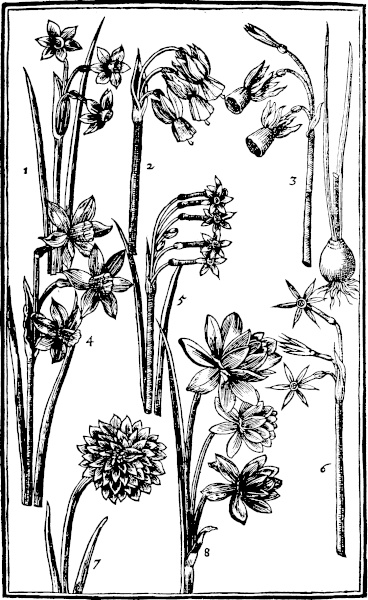
| 1 | Narcissus Iuncifolius albus. The white Iunquilia. |
| 2 | Narcissus Iuncifolius flore albo reflexo. The white turning Iunquilia. |
| 3 | Narcissus Iuncifolius calice luteo reflexis folijs albis. The yellow turning Iunquilia. |
| 4 | Narcissus Iuncifolius luteus magno calice. The yellow Iunquilia with a great cuppe. |
| 5 | Narcissus Iuncifolius luteus maior vulgaris. The ordinary yellow Iunquilia. |
| 6 | Narcissus Iuncifolius Autumnalis flore viridi. The greene Autumne Iunquilia. |
| 7 | Narcissus angustifolius aureus multiplex. The golden double narrow leafed Daffodill. |
| 8 | Narcissus Iuncifolius flore pleno. The double Iunquilia. |
7. Narcissus Iuncifolius luteus vulgaris maior.
The ordinary Iunquilia, or Rush Daffodill.
This ordinary Rush Daffodill hath foure or fiue long greene round leaues, like vnto
Rushes, whereof it tooke the name: among these leaues riseth vp the stalke, round and
greene, a foote and a halfe high very often, bearing at the toppe three or foure flowers
all yellow, but much smaller then the last, and so is the cup also: the seede is small and
blacke, inclosed in small cornered heads; the roote is blackish on the outside. The
smell of the flower is very sweete in all these sorts of Rush Daffodils.
8. Narcissus Iuncifolius luteus medius.
The smaller Iunquilia, or Rush Daffodill.
The leaues of this Daffodill are like vnto the former, but smaller and rounder, the
stalke riseth vp so high, nor are the flowers so great, but the leaues of the flower
are a little rounder, and not so pointed as in the former, in all things else alike, sauing
lesser.
9. Narcissus Iuncifolius luteus minor.
The least Iunquilia, or Rush Daffodill.
This least Daffodill hath fiue or six small greene leaues, a little broader, and not so
long as the last, among which riseth vp a stalke almost a foote high, bearing one or
two small flowers at the toppe, of a paler yellow colour then the former, with a yellow
open cuppe, or crowne rather in the middle, bigger then in either of the last two: the
roote is very small and blacke, like vnto the last in roundnesse and colour.
10. Narcissus Iuncifolius luteus albicantibus lineis distinctus.
The yellow Iunquilia, or Rush Daffodill with white lines.
This Rush Daffodill, hath round, greene, and long leaues, like vnto the ordinary
Rush Daffodill, with a stalke bearing two or three yellow flowers, hauing leaues somewhat
round at the point or end, with a line or strake of white in the middle of euerie
one of them, the cup is short, and crowne fashion, a little crumpled about the brims:
the seede, roote, or anything else differeth not.
11. Narcissus Iuncifolius Autumnalis flore viridi.
The Autumne Rush Daffodill with a greene flower.
This strange Rush Daffodill (I call it strange, not onely because it differeth from all
others of this kinde, but also because there are but few in these parts that haue had it,
and fewer that doe still enioy it, in that it is perished withall that had it) hath but one
onely leafe, very long, round, and greene, in all that euer I saw growing, which beareth
no flower while that greene leafe is fresh, and to bee seene: but afterwards the
stalke riseth vp, being like vnto the former greene leafe, round, naked, and greene vp
to the toppe, where two or three flowers breake forth out of a small thin skinne, euery
one consisting of six small and narrow greene leaues, very sharpe pointed at the end,
and as it were ending in a small pricke or thorne: in the middle whereof is a small
round cup, or rather crowne, of the same colour with the leaues and stalke, which
flower smelleth very sweete, somewhat like vnto the rest of the Rush Daffodils: this
sheweth not his flower vntill October, and the frosts quickly following after their
flowring, cause them soone to perish.
12. Narcissus angustifolius aureus multiplex.
The golden double narrow leafed Daffodill.
The leaues of this Daffodill are very narrow, and of a whitish greene colour, not
aboue foure or fiue inches long, from among which riseth vp a stalke about a foote
high, bearing at the top one flower, consisting of some outer leaues, which are of a yellow
colour, and of many other leaues in the middle being smaller, and set thicke and
round together of a more yellow gold colour, but with some whiter leaues among
them, the middle part a little pointing forth; the flower standeth long before it doth
perfect his colour, and abideth long in flower before the colour decay: the roote is in
fashion almost like the ordinary Iunquilia, or Rush Daffodill. I acknowledge this
Daffodill hath not his proper place; but because the figure is set in this table, let it thus
passe at this time.
13. Narcissus Iuncifolius luteus flore pleno.
The double Iunquilia, or Rush Daffodill.
The double Rush Daffodill hath his long greene leaues round, like the leaues of the
common or ordinary Rush Daffodill, and of the same bignesse, among which riseth
vp a long slender greene stalke, bearing two or three, seldome more small flowers,
yellow and double, that is, with diuers rowes of leaues, hauing the yellow cup such as
is in the single flower, broken into small threads or peeces, running among the leaues
of the flower, which peeces in some flowers are not so easily seene, being smaller then
in others, this beareth no button or head vnder the flower for seede, his roote is round
and blackish, browne on the outside, so like vnto the common Rush Daffodill, that it
is almost impossible to know the one from the other.
Alter minori
flore.
There is another of this kinde, whose flowers are smaller, and not so double, one,
two, or three at the most vpon a stalke, and of lesse beauty by much.
The Place.
All these Rush Daffodils, doe for the most part grow in Spaine and
France, and on the Pyrenæan Mountaines, which are betweene Spaine and
France, which Mountains are the Nourseries of many of the finest flowers,
that doe adorne the Gardens of these louers of natures pride, and gathered
in part by industrious, learned, generous men, inhabiting neare thereunto,
and in part by such as make a gaine of their labours, bestowed vpon these
things. Onely that with the greene flower was gathered in Barbary, and
imparted vnto vs from France.
The Time.
They flower in the Spring, that is, in March and Aprill, except such
whose time is set downe to be in Autumne.
The Names.
Their names are specified in their titles, and therefore I shall not need to
set downe any further repetitions.
To conclude therefore this discourse of true Daffodils, there remaineth to speake
of the Sea Daffodils, which (as I said in the beginning) is but one, that is frequent, and
doth abide with vs. But there bee some others found about the Cape of good Hope,
and in the West Indies, and brought vnto these parts rather for ostentation, then continuance,
where they haue flowred onely once (if peraduenture so often) so that being
such strangers, of so remote Countries, and of so diuers natures, I shall but shew you
some of them, rather cursorily then curiously; and but onely for your satisfaction, giue
you knowledge of two or three of them, that there haue beene seene such in flower,
and that they are scarce to bee seene againe, except they bee fetcht a new euery yeare
that they be seene.
{The great white Sea Daffodil}
Narcissus Marinus, siue tertius Matthioli.
The great white Sea Daffodill, or Matthiolus his third Daffodill.
The roote of this Daffodill by long continuance, standing in one place without being
remoued, groweth to be much greater and larger, than any other Daffodill whatsoeuer,
and as bigge as any meane Squilla or Sea Onion roote, hauing many long,
thicke, and white fibres, or long rootes, diuersly branched, and spread vnder the vpper
part of the earth beside some others that grow downward, and perish not euery
yeare, as the fibres of all, or most of the other Daffodils doe; and therefore this plant
will not thriue, and beare flowers, if it be often transplanted, but rather desire to abide
in one place without remouing, as I said, and that not to be ouershadowed, or couered
with other herbes standing too neare it, which then will flourish, and beare aboundantly:
from this roote, which is couered with many blackish coates, ariseth six
or seuen, or more leaues, twice so broad almost, as any of the former Daffodils, but
not so long by halfe as many of them, being but short, in comparison of the breadth,
and of a white greene colour; from the middle of which leaues, as also from the sides
sometimes, springeth vp one or two, or more stalkes, roundish and thicke, and sometimes
a little flat and cornered, a foote high or somewhat more, bearing at the toppe,
out of a skinnie huske, eight, ten, twelue, or more very large flowers, consisting of six
white leaues a peece, spread or laid open, with a white short cuppe or crowne in the
middle, lying flat vpon the leaues, cut or diuided into six corners (and not whole, as
the cuppe or crowne of any other single Daffodill) from euery of which edges, or
corners of this cup or crowne, standeth one white long thread, a little crooked or turning
vp at the end, tipt with a yellow pendent, and some other white threads tipt with
yellow pendents, standing also in the middle: after the flower is past, there come vp
great three square heads, wherein the seede is contained, which is great, blacke, and
round, like vnto the seede of other Daffodils, but greater: the flower hath a reasonable
good sent, but not very strong.
The Place.
It was first found by the Sea side, in the Isle of Sardinia, and on the high
Mountaines also of the same Isle, where it hath borne by report, thirty fiue
flowers vpon a stalke: it groweth likewise about Illyricum, and in diuers
other places.
The Time.
It springeth later out of the ground then any other Daffodill, that is to
say, not vntill the later end of March, or beginning of Aprill, and flowreth
in the end of May, or the beginning of Iune: the seede is ripe in the end of
Iuly, or beginning of August.
The Names.
The first that hath made mention of this Daffodill, was Matthiolus, who
placed it in the third place among his Daffodils, and is most vsually now adayes
called Narcissus tertius Matthioli, Matthiolus his third Daffodill,
the rather, because Clusius vpon a more mature deliberation, first referred
it thereunto, but called it at the first, Lilionarcissus Hemerocallidis facie, and,
as hee saith, Iacobus Plateau (who first sent him the figure hereof, with the
description) called it Lilionarcissus Orientalis, but Clusius vpon certaine information,
that it grew in the places aforesaid, misliked the name of Orientalis,
and added Hemerocallis, which yet is not fit, for that his Hemerocallis
Valentina, is a plaine Pancration or Sea bastard Daffodill, whose middle
cup is longer then the cup of any true Daffodill, which (as I said in the beginning
of this Chapter) is the chiefest note of difference, betweene a true
and a bastard Daffodill. I receiued the seede of this Daffodill among many
other seedes of rare plants, from the liberality of Mʳ. Doctor Flud, one of
the Physitians of the Colledge in London, who gathered them in the Vniuersity
Garden at Pisa in Italy, and brought them with him, returning home
from his trauailes into those parts, by the name of Martagon rarissimum,
(and hauing sowne them, expected fourteene yeares, before I saw them
beare a flower, which the first yeare that it did flower, bore foure stalkes of
flowers, with euery one of them eight or ten flowers on them) which of all
other names, doth least answer the forme or qualities of this plant. It may
most fitly be called Narcissus marinus maximus, in English, The great Sea
Daffodill, both because it is a true Daffodill, and the greatest of all other,
and also because it hath not been found, but in Islands, or else in other places
neare the Sea. Lobelius entituleth it Pancratium Indicum alterum vernum,
siue Narcissus Indicus alter facie Pancratij Monspeliaci, but all this is wide from
the matter, as may easily be known, by that that hath been said before. It is
generally (as I said before) called of all Narcissus tertius Matthioli, Matthiolus
his third Daffodill, which may either so passe with vs, or as I called it,
The great Sea Daffodill, which you will, & so Clusius doth lastly entitle it.
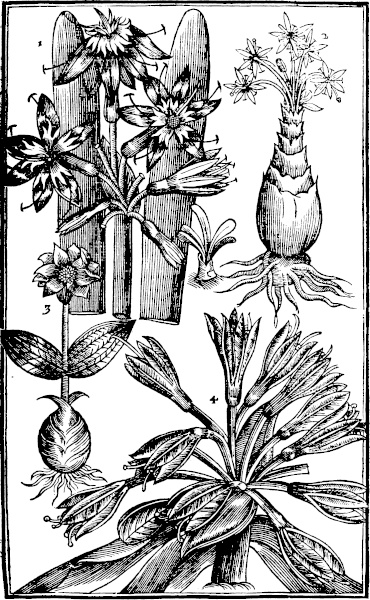
| 1 | Narcissus tertius Matthioli. The great white Sea Daffodill. |
| 2 | Narcissus Indicus Autumnalis. The Indian Autumne Daffodill. |
| 3 | Narcissus marinus Africanus. The Sea Daffodill of Africa. |
| 4 | Narcissus marinus exoticus. The strange Sea Daffodill. |
[98]
{Sea Daffodils and the Indian Autumne Daffodill}
1. Pancratium Indicum, aut Narcissus Indicus Autumnalis quorundam Lobelij.
The Indian Autumne Daffodill of Lobel.
This plant hath in my opinion, a farre nearer resemblance vnto an Hyacinthus, then
vnto any Daffodill: But because Lobel hath so set it forth, I will so publish it vnto
you, leauing it to iudgement. The roote is, as he saith, a span long, and of the thicknesse
of a mans arme, couered with many white shells, whereof the outermost are of a
darke red or Chestnut colour: the flowers rise vp in September and October, being
eight or ten in number, euery one by it selfe vpon a small footstalke, made of six leaues
a peece, somewhat long, narrow, and pointed, like vnto the flowers of the English
Colchicum, or Medowe Saffron, of a whitish yellow dunne colour, with six long
threads in the middle: the greene leaues are long and broad, and broad pointed.
2. Narcissus Marinus Africanus, siue Exoticus Lobelij.
The Sea Daffodill of Africa.
The roote of this strange plant (which of some likenesse is called a Daffodill) is very
great, made as it were of many scaly cloues, from whence riseth vp a small short stalke,
bearing hard aboue the ground two faire broad greene pointed leaues, more long then
broad, so compassing the stalke at the bottome, that it seemeth to run through them:
the stalke is spotted with diuers discoloured spots, and is bare or naked from these two
leaues vnto the toppe, where it beareth one faire double flower, like vnto a double Anemone,
of a delayed reddish colour, tending to a blush, with many threads set about
the middle head.
3. Narcissus Marinus Exoticus.
The strange Sea Daffodill.
The strange Sea Daffodill, hath fiue or six large and long leaues of a pale greene colour,
from among which riseth vp a strong and bigge stalke, bearing at the toppe, out
of a thinne hose or skinne, many very large flowers, made of six long and pointed
leaues apeece, of a blewish purple colour, with a large round open cup in the middle,
of a sadder colour then the leaues: the roote is very great, yet like vnto other great
Daffodils, the outer skins whereof are of a darke browne colour.
The Place.
The Indian Daffodils grew in the vpper part of Hispaniola in the West
Indies, and brought hither, where they all soone perished.
The other grew neare the Cape of good Hope, and was brought into the
parts of Holland and thereabouts, from whence we had it, & perished also.
The last is vnknowne where it was gathered.
The Time.
The first flowred in Autumne, as it is said.
The other in the first Summer of their bringing.
And so did the last, but the same rootes will not flower with vs againe.
The Names.
So much hath been said of their names in their titles, as hath come to our
knowledge; and therefore let that suffice.
Thus hauing gone through the whole Family of the true Daffodils, (for so much as
hath come to our knowledge) and set them downe euery one by his name, and in this
order; it is fit that we speake of their bastard brethern, and shew you them also, in the
same order held with the former, as neare as the plenty of variety herein, which is not
the like with the former, will giue leaue, that when you know them both by face and
name, you may the better know to place or distinguish of others, that haue not passed
vnder this rod.
{Bastard Daffodils: Broad leaves, Single flowers}
Pseudonarcissus aureus Hispanicus maximus.
The great yellow Spanish bastard Daffodill.
The roote of this kinde of Daffodill is reasonable great, and blackish on the outside,
desiring to be deepe in the ground; and therefore will runne downe, where it
will then encrease into many of-sets, from whence rise vp many thicke, long, and stiffe
leaues, of a grayish greene colour, among which riseth vp a round strong stalke, sometimes
three foote high or better, bearing at the toppe one onely faire great yellow
flower, standing forth right, and not pendulous, consisting of six short and somewhat
broad leaues, with a very great, large, and long trunke, of an equall largenesse, but
open at the mouth, and turning vp the brimmes a little, which are somewhat crumpled:
after the flower is past, there commeth in the place a three square head, containing
round, blacke seede, like vnto other Daffodils.
Pseudonarcissus Pyrenæus Hispanico & Anglico similis.
The Mountaine bastard Daffodill of diuers kindes.
There is much variety in this kinde of bastard Daffodill: For one sort hath verie
broad and whitish greene leaues, somewhat short in comparison of others, that are of
that breadth: the flower is wholly yellow, but a little paler then the former Spanish
kinde, hauing the leaues of his flower long, and somewhat narrow, standing like wings
about the middle trunke, which is as long as the leaues, and smaller then in many other
of this kinde, but a little yellower then the wings. Another sort hath narrower green
leaues then this last, and longer, the flower is all yellow, but the trunke is larger, wider,
and more open at the mouth then the former, and almost as large as the former Spanish,
but not so high as the last. A third hath the wings of the flower of a Strawe colour,
but the trunke is long and narrow, of a faire yellow. A fourth hath such like
flowers, but that it is shorter, both the wings and the trunke: Some likewise haue the
wings of the flower longer, then the long trunke, and some shorter. Some also are all
yellow, and some haue their wings onely a little more pale or white, like the English
kinde: Some againe haue their trunkes long and narrow, others haue them larger and
wider open, and crumpled at the brimmes; so that it is needlesse, to spend a great deale
of time and labour vpon such smally respected flowers, but that in the beholding of
them, we may therein admire the worke of the Creatour, who can frame such diuersity
in one thing: But this is beside the text, yet not impertinent.
Pseudonarcissus pallidus præcox.
The early Strawe coloured bastard Daffodill.
The leaues of this Daffodill are of a meane size, betweene the broadest and the narrower
kindes, of a grayish greene colour, and not very long: the stalke riseth vp a foot
high or more, whereon standeth one large great flower, equalling the greatest Spanish
bastard Daffodill, before described, in the largenesse of his trunke, and hauing the
brimmes turned vp a little, which maketh it seeme the larger: the wings or outer leaues
are in a manner as short, as they are in the greatest Spanish kinde, (and not long flagging
down, like vnto the Mountain kinds) and stand straight outright: all the whole flower is
of one euen colour, that is, of a fine pale yellow, somewhat like vnto the colour of a
Lemon peele or rinde, but somewhat whiter, which vsually we call a Strawe colour;
the greatnesse of the flower, the earlinesse of the flowring, and the difference of colour
from all the rest of this kinde, hath made me entreate of it apart by it selfe, as being no
lesse worthy.
Pseudonarcissus Hispanicus flore albo maior.
The great white Spanish bastard Daffodill.
This bastard Daffodill hath diuers leaues rising vp together, long and broad, somewhat
like vnto the first Spanish kinde, but a little broader, and of a whiter greene colour,
yet not so white, as in the lesser Spanish white kindes, hereafter described: among
these leaues riseth vp a round strong stalke, about two foote high, bearing one white
flower at the toppe, bending downe the head, as all these white kindes doe, but is not
of so pure a white, as the lesser kindes that follow, yet whiter then the greatest white
Spanish kinde, next of all to be described: the whole flower, as well trunke as wings,
is much larger then the lesser white kindes, and almost equalling the first Spanish yellow,
but a little longer and narrower, a little crumpled and turning vp at the brimmes:
the head and seede are like the first; the roote is greater and thicker then the first Spanish,
and doth not encrease so much, nor is couered with a blacke, but rather with a
whitish coate.
Pseudonarcissus Hispanicus maximus albidus.
The greatest Spanish white bastard Daffodill.
This kinde of bastard Daffodill is very like the last mentioned Daffodill, both in
leaues and flowers, but larger in both: the flower of this is not full so white, but hath
some shew of palenesse therein, and more vpon the first opening of the flower then afterwards,
and is as great altogether, as the great Spanish yellow, at the least with a
longer, and somewhat narrower trunke: the seede is like vnto the former, and so is the
roote also, but greater, being white on the outside, and not blacke.
Pseudonarcissus Hispanicus flore albo medius & minor.
The two lesser white Spanish bastard Daffodils.
There are two other of these kindes of white Spanish Daffodils, one greater or lesser
then the other, but neither of them so great as the former. The leaues of both are
of a whitish greene colour, one a little broader then the other: the flowers of both are
pure white, and bending downe the heads, that they almost touch the stalke againe,
the greater flower hath the longer and narrower trunke; and the lesser flower, the
shorter and wider open, yet both a little crumpled at the edges or brimmes: the rootes
of both are like one vnto another, but differ in the greatnesse. From the seede of these
haue sprung much variety, few or none keeping either colour or height with the mother
plants.
Pseudonarcissus Anglicus vulgaris.
Our common English wilde bastard Daffodill.
This bastard Daffodill is so common in all England, both in Copses, Woods, and
Orchards, that I might well forbeare the description thereof, and especially, in that
growing wilde, it is of little respect in our Garden: but yet, lest I bee challenged of
ignorance in common plants, and in regard of some variety therein worth the marking.
I will set downe his description and variety as briefly as I may: It hath three or
foure grayish greene leaues, long and somewhat narrow, among which riseth vp the
stalke, about a span high or little higher, bearing at the toppe, out of a skinnie huske,
as all other Daffodils haue, one flower (although sometimes I haue seene two together)
somewhat large, hauing the six leaues that stand like wings, of a pale yellow colour,
and the long trunke in the middle of a faire yellow, with the edges or brimmes
a little crumpled or vneuen: after the flower is past, it beareth a round head, seeming
three square, containing round blacke seede; the roote is somewhat blackish on the
outside.
But there is another of this kinde like vnto the former, whose further description
you haue here before; the wings of which flower are much more white then the former,
and in a manner of a milke white colour, the trunke remaining almost as yellow
as the former, and not differing in any thing else.
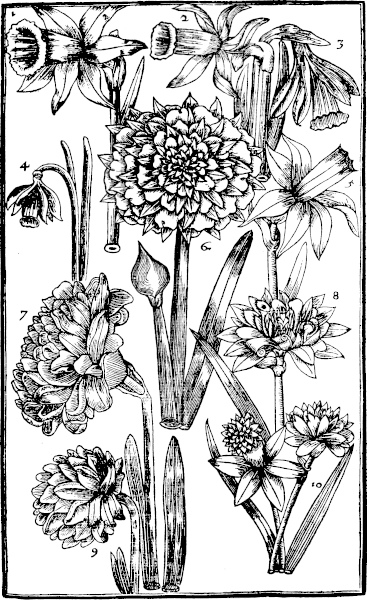
| 1 | Pseudonarcissus Hispanicus maximus aureus. The great yellow Spanish bastard Daffodill. |
| 2 | Pseudonarcissus Pyrenæus variformis. The Mountaine bastard Daffodill of diuers kindes. |
| 3 | Pseudonarcissus Hispanicus maior albus. The greater white Spanish bastard Daffodill. |
| 4 | Pseudonarcissus Hispanicus minor albus. The lesser Spanish white bastard Daffodill. |
| 5 | Pseudonarcissus tubo sexangulari. The six cornered bastard Daffodill. |
| 6 | Pseudonarcissus maximus aureus, siue Roseus Tradescanti. Iohn Tradescants great Rose Daffodill. |
| 7 | Pseudonarcissus aureus Anglicus maximus. Master Wilmers great double Daffodill. |
| 8 | Pseudonarcissus Hispanicus aureus flore pleno. The double Spanish Daffodill, or Parkinsons double Daffodill. |
| 9 | Pseudonarcissus Gallicus maior flore pleno. The greater double French Daffodill. |
| 10 | Pseudonarcissus Anglicus flore pleno. The double English Daffodill, or Gerrards double Daffodill. |
Pseudonarcissus tubo sexangulari.
The six cornered bastard Daffodill.
This kinde of Daffodill hath two or three long, and somewhat broader leaues then
the last, between which commeth forth a stalke, bearing one flower somewhat large
hauing the six outer leaues of a pale yellow colour, and the long trunke plaited or cornered
all along vnto the very edge into six parts, of a little deeper yellow then the
wings.
The Place.
The first great Spanish kinde was brought out of Spaine. The rest from
the Pyrenæan Mountaines, onely the last sauing one is plentifull in our
owne Country, but the white sort of that kinde came with the rest from
the same Mountaines.
The Time.
The pale or third kinde, and the English bee the most early, all the rest
flower in Aprill, and the greatest yellow somewhat earlier, then the other
greater or lesser white.
The Names.
Their seuerall names are expressed in their titles sufficient to distinguish
them, and therefore there needeth no more to be said of them.
{Double flowered Bastard Daffodils}
1. Pseudonarcissus aureus maximus flore pleno, siue Roseus Tradescanti.
The greatest double yellow bastard Daffodill, or
Iohn Tradescant his great Rose Daffodill.
This Prince of Daffodils (belongeth primarily to Iohn Tradescant, as the first founder
thereof, that we know, and may well bee entituled the Glory of Daffodils) hath a
great round roote, like vnto other Daffodils, couered with a brownish outer skinne or
peeling, from whence riseth vp foure or fiue somewhat large and broad leaues, of a
grayish greene colour, yet not fully so long and large as the next following Daffodill:
from the middle whereof riseth vp a stalke almost as high and great as it, bearing at
the toppe (out of a skinnie huske) one faire large great flower (the budde, before it
breake open, being shorter and thicker in the middle, and ending in a longer and sharper
point then any of the other Daffodils) very much spread open, consisting of smaller
and shorter leaues then the next, but more in number, and thicker and rounder set
together, making it seeme as great and double as any Prouince Rose, and intermixt
with diuers yellow and pale leaues, as it were on rowes one vnder another. It abideth
long in flower, and spreadeth, by standing long, to be the broadest in compasse of any
of the Daffodils, but falleth away at the last without giuing any seede, as all double
Daffodils doe.
2. Pseudonarcissus aureus Anglicus maximus.
Mʳ. Wilmers great double Daffodill.
The other great double Daffodill doth so neare resemble our ordinary English
double kinde, that I doe not finde therein any greater difference, then the largenesse
both of leaues and flowers, &c., and the statelinesse of growth. It beareth three or
foure large, long, and broad leaues, somewhat longer and broader then the former,
and of a whitish greene colour: the stalke riseth to bee two foote high, growing (in a
fruitfull and fat soyle) strong, and somewhat round, bearing at the toppe, out of a thin
skinne, one great and faire double flower, each leafe whereof is twice as large and
broad as the former, diuersly intermixt with a rowe of paler, and a rowe of deeper
yellow leaues, wholly dispersed throughout the flower, the pale colour as well as the
deeper yellow, in this as in the other small English kinde, growing deeper by standing:
sometimes the leaues hereof are scattered, and spread wholly, making it shew a
faire, broad, open flower: and sometimes the outer leaues stand separate from the
middle trunke, which is whole and vnbroken, and very thicke of leaues: and sometimes
the middle trunke, will bee halfe broken, neither expressing a full open double
flower, nor a close double trunke, as it is likewise seene in the small English kinde, as
shall bee declared in his place: this beareth no seede; the roote hereof is thicke and
great, and encreaseth as well as any other Daffodill.
3. Pseudonarcissus aureas Hispanicus flore pleno.
The great double yellow Spanish bastard Daffodill, or Parkinsons Daffodill.
This double Spanish Daffodill hath diuers leaues rising from the roote, stiffer, narrower,
and not of so whitish a greene colour as the former, but more sullen or grayish,
plainely resembling the leaues of the single great kinde, from whence this hath risen:
the stalke hereof likewise riseth almost as high as it, and neare the height of the last recited
double, bearing one double flower at the toppe, alwayes spread open, and neuer
forming a double trunke like the former, yet not so faire and large as it, the outermost
leaues whereof being of a greenish colour at the first, and afterward more yellow, doe
a little turne themselues backe againe to the stalke, the other leaues are some of a pale
yellow, and others of a more gold yellow colour, those that stand in the middle are
smaller, and some of them shew as if they were hollow trunked, so that they seeme to
be greenish, whitish, yellow, and gold yellow, all mixed one among another: the root
is great, round, and whitish on the inside, couered with darke coloured skinnes or
peelings. I thinke none euer had this kinde before my selfe, nor did I my selfe euer see
it before the yeare 1618, for it is of mine own raising and flowring first in my Garden.
4. Pseudonarcissus Gallicus maior flore pleno.
The greater double French bastard Daffodill.
This greater double Daffodill, hath his whitish greene leaues longer and broader
then the smaller French kinde, hereafter following, to bee described, and broader,
longer, and more limber then the double English kinde: the stalke riseth vp not much
higher, then the smaller French kinde, but a little bigger, bearing at the top one great
double flower, which when it is fully and perfectly blowne open (which is but seldome;
for that it is very tender, the leaues being much thinner, and thereby continually
subiect, vpon any little distemperature of the time, to cleaue so fast one vnto another,
that the flower cannot blow open faire) is a faire and goodly flower, larger by
halfe then the smaller kinde, and fuller of leaues, of the same pale whitish yellow, or
Lemon colour, with the lesser, or rather a little whiter, and not set in the same order of
rowes as it is, but more confusedly together, and turning backe the ends of the outermost
leaues to the stalke againe, and hauing the bottome of the flower on the backside
somewhat greene, neither of which is found in the lesser kinde: the roote is very like
vnto the lesser kinde, but a little bigger and longer.
5. Pseudonarcissus Anglicus flore pleno.
The double English bastard Daffodill, or Gerrards double Daffodill.
The leaues of this double Daffodill are very like vnto the single kinde, being of a
whitish greene colour, and somewhat broad, a little shorter and narrower, yet stiffer
then the former French kinde: the stalke riseth vp about a foote high, bearing at the
toppe one very double flower, the outermost leaues being of the same pale colour,
that is to bee seene in the wings of the single kinde; those that stand next them are
some as deepe a yellow as the trunke of the single, and others of the same pale colour,
with some greene stripes on the backe of diuers of the leaues: thus is the whole flower
variably intermixt with pale and deepe yellow, and some greene stripes among them,
when it is fully open, and the leaues dispersed and broken. For sometimes the flower
sheweth a close and round yellow trunke in the middle, separate from the pale outer
wings, which trunke is very double, shewing some pale leaues within it, dispersed
among the yellow: And sometimes the trunke is more open, or in part broken, shewing
forth the same colours intermixt within it: the flower passeth away without giuing
any seede, as all other bulbous rootes doe that beare double flowers: the roote is
small, very like vnto the French double kindes, especially the lesser, that it is verie
hard to know the one from the other.
The Place.
The first and greatest kinde, we had first from Iohn Tradescante (as I said
before) whether raised from seed, or gained from beyond Sea, I know not.
The second we first had from Vincent Sion, borne in Flanders, dwelling
on the Bank side, in his liues time, but now dead; an industrious and worthy
louer of faire flowers, who cherished it in his Garden for many yeares,
without bearing of any flowers vntill the yeare 1620, that hauing flowred
with him, (and hee not knowing of whom hee receiued it, nor hauing euer
seene the like flower before) he sheweth it to Mʳ. Iohn de Franqueuille, of
whom he supposed he had receiued it, (for from beyond Sea he neuer receiued
any) who finding it to bee a kinde neuer seene or knowne to vs before,
caused him to respect it the more, as it is well worthy. And Mʳ. George
Wilmer of Stratford Bowe Esquire, in his liues time hauing likewise receiued
it of him (as my selfe did also) would needes appropriate it to himselfe,
as if he were the first founder thereof, and call it by his owne name Wilmers
double Daffodill, which since hath so continued.
The third is of mine owne fostering or raising, as I said before; for assuredly,
it is risen from the seede of the great Spanish single kinde, which I
sowed in mine owne Garden, and cherished it, vntill it gaue such a flower
as is described.
The fourth is not certainly knowne where his originall should be: Some
thinke it to be of France, and others of Germany.
The last is assuredly first naturall of our owne Countrey, for Mʳ. Gerrard
first discouered it to the world, finding it in a poore womans Garden in the
West parts of England, where it grew before the woman came to dwell
there, and, as I haue heard since, is naturall of the Isle of Wight.
The Time.
They doe all flower much about one time, that is, from the middle or
end of March, as the yeare is forward, vnto the middle of Aprill.
The Names.
Vpon the three first I haue imposed the names in Latine, as they are expressed
in their titles: and for the English names, if you please, you may let
them passe likewise as they are expressed there also, that thereby euery one
may be truely distinguished, and not confounded. The fourth, besides the
name in the title, is called of some Narcissus Germanicus, which whether it
be of Germany, or no, I know not; but that the name should import so much.
The last doth vsually carry Mʳ. Gerrards name, and called Gerrards double
Daffodill.
{Bastard Daffodils: Narrow leaves}
1. Pseudonarcissus angustifolius flore flauescente tubo quasi abscisso.
The narrow leafed bastard Daffodill with the clipt trunke.
This kinde of Daffodill hath long and narrow grayish greene leaues, bearing one
single flower at the toppe of his stalke, like vnto the former single bastard kindes, before
specified, hauing his outer leaues of a pale yellow colour, and his trunke of a deeper
yellow: the chiefe differences in this from the former, is in the leaues, being narrow,
and then in the trunke of the flower, which is not crumpled or turned vp, as most
of the other are; and that the brimmes or edges of the flower is as if it had been clipt
off, or cut euen.
2. Pseudonarcissus Hispanicus medius & minor luteus.
The two lesser Spanish yellow bastard Daffodils.
These two lesser kindes of Spanish Daffodils, doe but differ in greatnesse the one
from the other, and not in any thing else; so that in declaring the one, you may vnderstand
the other to bee a little greater. The lesser hath three or foure narrow
short whitish greene leaues, from among which commeth forth a short stalke, not aboue
an hand breadth, or halfe a foote high, bearing one single flower, not fully standing
outright, but a little bending downe, consisting of six small leaues, standing as
wings about a small, but long trunke, a little crumpled at the brimmes: the whole
flower, as well leaues as trunke, are of one deepe yellow colour, like vnto the great
Spanish kinde: the roote is but small, and couered with a darkish coate. The other is
in all parts greater, and (as I said) differeth not else.
3. Pseudonarcissus Hispanicus luteus minimus.
The least Spanish yellow bastard Daffodill.
The leaues of this small kinde are smaller and shorter then the former, seldome exceeding
the length of three inches, and very narrow withall, but of the same grayish
greene colour with the former: euery flower standeth vpon a small and short footestalke,
scarce rising aboue the ground; so that his nose, for the most part, doth lye or
touch the ground, and is made after the same fashion, and of the same colour with the
former, but much smaller, as his roote is so likewise.
4. Pseudonarcissus Gallicus minor flore pleno.
The lesser French double bastard Daffodill.
The rootes of this lesser French kinde (if I may lawfully call it, or the greater kinde
before specified, a bastard Daffodill; for I somewhat doubt thereof, in that the flower
of either is not made after the fashion of any of the other bastard Daffodils, but doth
more nearely resemble the forme of the double white Daffodill, expressed before among
the true Daffodils) are like vnto the double English kinde, as also to the former
double great French kinde, and the leaues are of the same whitish greene colour also,
but narrower and not longer: the stalke riseth a little higher then the English, and not
fully so high as the greater French, bearing one faire double flower thereon, of a
pale yellow or Lemon colour, consisting of six rowes of leaues, euery rowe growing
smaller then other vnto the middle, and so set and placed, that euery leafe of the
flower doth stand directly almost in all, one vpon or before another vnto the middle,
where the leaues are smallest, the outermost being the greatest, which maketh the
flower seeme the more beautifull: this and the greater kinde hath no trunke, or shew
of any other thing in the middle, as all or most of the other former double bastard
Daffodils haue, but are flowers wholly composed of leaues, standing double euen to
the middle.
The Place.
The first is vndoubtedly a naturall of the Pyrenæan Mountaines.
The Spanish kindes grew in Spaine, and
The French double kinde about Orleance in France, where it is said to
grow plentifully.
The Time.
The first flowreth at the end of March.
The Spanish kindes are the most early, flowring betimes in March.
The French double doth flower presently after.
The Names.
More cannot bee said or added, concerning the names of any of these
Daffodils, then hath been set downe in their titles: onely the French kinde
is most vsually called Robinus his Daffodill.
{Bastard Rush Daffodils}
Pseudonarcissus Iuncifolius albus.
The white bastard Rush Daffodill, or Iunquilia.
This bastard Rush Daffodill hath two or three long and very greene leaues, very
like vnto the small yellow Rush Daffodill, formerly described, but not altogether so
round, among which riseth vp a short stalke, seldome halfe a foote high, bearing at
the toppe, out of a small skinnie huske, one small white flower, sometime declining to
a pale colour, hauing six small and short leaues, standing about the middle of the
trunke, which is long, and much wider open at the mouth, then at the bottome: the
small outer leaues or wings are a little tending to greene, and the trunke (as I said) is
either white, or whitish, hauing the brimmes a little vneuen: the seede is small, blacke,
and round, like vnto other Rush Daffodils, but smaller.
Pseudonarcissus Iuncifolia, luteus maior.
The greater yellow Iunquilia, or bastard Daffodill.
The leaues of this greater kinde are longer, greater, and a little broader then the
former; the stalke also is higher, and the flower larger, more open at the mouth and
crumpled, then the white, but wholly of a yellow colour: the seede and the roots are
bigger, according to the proportion of the plant.
Pseudonarcissus Iuncifolius luteus minor.
The lesser yellow bastard Iunquilia.
This is so like vnto the last in all things, that I shall not neede to trouble you with
repetitions of the same things formerly spoken; the chiefest difference is the smallnesse
of the plant in all parts.
Pseudonarcissus Iuncifolius luteus serotinus.
The late yellow bastard Iunquilia.
There is likewise a third kinde, as great as the greater yellow, and in all his parts expressing
and equalling it, but is accounted the fairer, and flowreth somewhat later.
The Place.
The Pyrenæan Hils haue afforded vs all these varieties, and wee preserue
them carefully; for they are all tender.
The Time.
All these flower in Aprill, except the last, which is a moneth later.
The Names.
The French and Lowe-Countrey men call them Trompettes, that is,
Trumpets, from the forme of the trunke; wee sometimes call them also by
that name, but more vsually bastard Iunquilia’s.
[107]
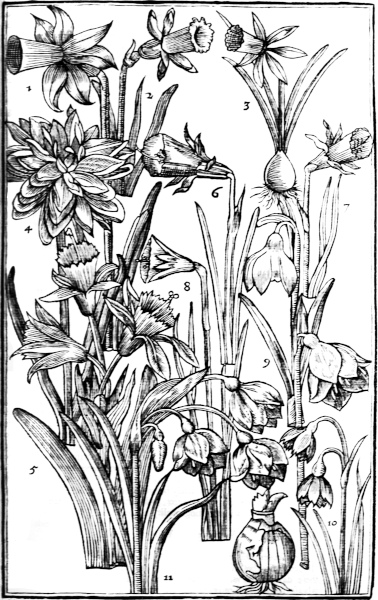
| 1 | Pseudonarcissus tubo quasi abscisso. The bastard Daffodill with the clipt trunke. |
| 2 | Pseudonarcissus Hispanicus minor. The lesser Spanish bastard Daffodill. |
| 3 | Pseudonarcissus Hispanicus minimus. The least Spanish bastard Daffodill. |
| 4 | Pseudonarcissus Gallicus minor flore pleno. The lesser double French bastard Daffodil. |
| 5 | Pancratium flore albo. The white Sea bastard Daffodil. |
| 6 | Pseudonarcissus Iuncifolius luteus maior. The greater yellow bastard Iunquilia. |
| 7 | Pseudonarcissus Iuncifolius luteus minor. The lesser yellow bastard Iunquilia. |
| 8 | Pseudonarcissus Iuncifolius luteus serotinus. The late yellow bastard Iunquilia. |
| 9 | Leucoium bulbosum præcox maius. The great early bulbous Violet. |
| † | Leucoium bulbosum præcox minus. The lesser early bulbous Violet. |
| 10 | Leucoium bulbosum autumnale. The small Autumne bulbous Violet. |
| 11 | Leucoium bulbosum maius serotinum. The great late flowring bulbous Violet. |
Pseudonarcissus marinus albus, Pancratium vulgo.
The white Sea bastard Daffodill.
The Sea bastard Daffodill (to conclude this Chapter, and the discourse of Daffodils)
hath diuers broad whitish greene leaues, but not very long, among which riseth
vp a stiffe round stalke, at the top whereof breaketh out of a great round skinny huske,
fiue or six flowers, euery one made somewhat of the fashion of the great bastard Rush
Daffodill, but greater, and wholly white; the six leaues, being larger and longer
then in the Rush kinde, and extending beyond the trunke, are tipt with greene at the
point of each leafe, and downe the middle likewise on the backside. The trunke is
longer, larger, and wider open at the mouth, cut in or indented at the brims or edges,
and small at the bottome, with diuers white threeds in the middle, and is very sweet:
vnder the flower is a round greene head, which groweth very great, hauing within it,
when it is ripe, flat and blacke seede: the roote is great and white.
Flore luteo, &
flore rubro.
It is reported, that there are found other sorts; some that beare yellow flowers, and
others that beare red: but we haue seene none such, and therefore I can say no more of
them.
The Place.
This kinde groweth neare the Sea side, both in Spaine, Italy, and France,
within the Straights, and for the most part, vpon all the Leuant shoare and
Islands also, but will seldome either flower, or abide with vs in these colder
Countries, as I haue both seene by those that I receiued from a friend, and
heard by others.
The Time.
It flowreth in the end of Summer, that is, in August and September.
The Name.
Diuers doe call it Pancratium, as the learned of Mompeher, and others,
with the addition of flore Lilij, after they had left their old errour, in taking
it to be Scylla, and vsing it for Scylla, in the Trochisces that go into Andromachus
Treakle. The learned of Valentia in Spaine, as Clusius saith, doe call
it Hemerocallis, thinking it to be a Lilly; and Clusius doth thereupon call it,
Hemerocallis Valentina: but in my opinion, all these are deceiued in this
plant; for it is neither a Lilly, to haue the name of Hemerocallis giuen vnto
it, nor Scylla, nor Pancratium, as many doe yet call it: for certainly this is a
kinde of Daffodill; the forme both of roote, leafe, and flower, doth assure
me that haue seene it, and not Pancratium, which (as Dioscorides testifieth)
is a kinde of Scylla, and in his time called Scylla, with a red roote, and a leafe
like a Lilly, but longer, and was vsed both with the same preparation and
quantity, and for the same diseases that Scylla was vsed, but that his force
was weaker: all which doth plainly shew the errours that many learned men
haue been conuersant in, and that all may see how necessary the knowledge
of Herbarisme is to the practice of Physicke; And lest the roote of this Sea
bastard Daffodill bee vsed in the stead of an wholesome remedy, which (as
Clusius maketh mention) was deadly to him that did but cut his meate with
that knife, which had immediately before cut this roote, and done in malice
by him, that knew the force thereof, to kill his fellow, it working the more
forceably by the euill attracting quality of the iron.
Howsoeuer Dioscorides and others, doe giue vnto some of them speciall
properties, both for inward and outward diseases, yet know I not any in
these dayes with vs, that apply any of them as a remedy for any griefe,
whatsoeuer Gerrard or others haue written.
Hauing thus set downe the whole family, both of the true and bastard Daffodils,
I should next set in hand with the Hyacinths; but because Leucoium bulbosum,
The bulbous Violet is a plant that doth challenge a place next vnto the
Daffodils, as most nearly partaking with them, and a little with the Hyacinthes, I must
of necessity interpose them, and shew their descriptions and differences, whereof some
are early, of the first Spring, others later, and some of the Autumne.
Leucoium bulbosum præcox maius.
The greater early bulbous Violet.
This bulbous Violet hath three or foure very greene, broad, flat, and short leaues,
among which riseth vp a naked greene stalke, bearing out of a small skinny hose (as the
former Daffodils doe) one white flower, hanging downe his head by a very small
foot-stalke, made of six leaues, of an equall length, euery one whereof is tipt at the
end with a small greenish yellow spot: after the flower is past, the head or seed-vessell
groweth to be reasonable great, somewhat long and round, wherein is contained hard
round seede, which being dry, is cleare, and of a whitish yellow colour: the roote is
somewhat like a Daffodill roote, and couered with a blackish outside or skinne.
Leucoium bulbosum præcox minus.
The lesser early bulbous Violet.
This lesser kinde riseth vp with two narrow grayish greene leaues, between which
commeth forth the stalke, fiue or six inches high, bearing one small pendulous flower,
consisting of three white leaues, which are small and pointed, standing on the outside,
and hauing three other shorter leaues, which seeme like a cup in the middle, being
each of them round at the ends, and cut in the middle, making the forme of an heart,
with a greene tippe or spot at the broad end or edge: the seede is whitish, inclosed in
long and round heads, like the former, but lesser: the roote is like a small Daffodill,
with a blackish gray coate, and quickly diuideth into many of-sets.
Minus Byzantinum.
There is another of this kinde, that came among other bulbous rootes from Constantinople,
and differeth in nothing from it, but that it is a little greater, both in root,
leafe, and flower.
The Place.
The two first are found in many places of Germany, and Hungary. The
third, as I said, was brought from Constantinople.
The Time.
The two lesser sorts doe most commonly flower in February, if the weather
be any thing milde, or at the furthest in the beginning of March, but
the first is seldome in flower, before the other be well neare past, or altogether.
The Names.
Lobel and Dodonæus call the lesser kinde Leucoium triphyllum, and Leuconarcissolirion
triphyllum, of the three leaues in the flower. Some doe call
it Viola bulbosa alba. The first or greater kinde is called by Lobel, Leuconarcissolirion
paucioribus floribus; and by Dodonæus, Leucoium bulbosum hexaphyllum.
We doe most vsually call them, Leucoium bulbosum præcox maius, &
minus, The greater, or the lesser early bulbous Violet. In Dutch, Somer
Sottekens, and not Druiskens, which are Grape-flowers, as some haue
thought.
1. Leucoium bulbosum Vernum minimum.
The small bulbous Violet of the Spring.
This small Leucoium sendeth forth his small and long greene leaues, like haires in
Autumne, and before Winter, which abide greene vntill Aprill, and then wither away
quite, and about May there ariseth vp a naked slender stalke, at the toppe whereof
breake forth two small white flowers, made of six leaues a peece, hanging downe their
heads, the three inner leaues being a little larger then the three outward, a little reddish
neare the stalke, and very sweete: the root is small and round, and couered with a darke
coate.
2. Leucoium bulbosum Autumnale.
The small Autumne bulbous Violet.
As the former small Leucoium sprang vp with his leaues without flowers in Autumne,
so this contrariwise, riseth vp with his slender brownish stalke of flowers in
Autumne, before any greene leaues appeare, whereon stand two or three very small
snow white pendulous flowers, consisting of six leaues a peece, and a little reddish at
the bottome of the flower next vnto the stalke, so like vnto the former, that one would
take them to be both one: after which, there grow small browne heads, containing
small, blacke, round seed; after the flower is past, and the seede is ripening, and sometimes
after the heads are ripe, the leaues begin to spring vp, which when they are full
growne, are long, greene, and as small, or smaller then the leaues of the Autumne Hyacinth,
which abide all the Winter, and Spring following, and wither away in the beginning
of Summer: the roote is small, long, and white.
3. Leucoium maius bulbosum serotinum.
The great late flowring bulbous Violet.
The late bulbous Violet hath three or foure broad flat greene leaues, very like vnto
the first, but longer, among which riseth vp a flattish stalke, being thicker in the middle
then at both edges, on the toppe whereof stand three or foure flowers, hanging
downe their heads, consisting of six leaues a peece, all of an equall length and bignesse,
wholly white, except that each leafe hath a greene tippe at the end of them: the seede
hereof is blacke and round; the roote is reasonable great and white.
The Place.
The two former small ones were first found in Spaine, and Portugall, and
sent to me by Guillaume Boel; but the first was so tender, that scarce one
of a score sprang with me, or would abide. The greatest haue beene found
wilde in Germany and Austria.
The Time.
The small ones haue their times expressed in their titles and descriptions,
the last flowreth not vntill May.
The Names.
These names that are set downe in their titles, doe passe with all Herbarists
in these daies.
Wee haue not knowne these plants vsed Physically, either inwardly or
outwardly, to any purposes in these dayes.
The Iacinths are next to be entreated of, whereof there are many more kindes
found out in these later times, then formerly were knowne, which for order
and method sake, I will digest vnder seuerall sorts, as neare as I can, that auoiding
confusion, by enterlacing one among another, I may the better put euery sort
vnder his owne kinde.
Hyacinthus Indicus maior tuberosa radice.
The greater Indian knobbed Iacinth.
I haue thought fittest to begin with this Iacinth, both because it is the greatest and
highest, and also because the flowers hereof are in some likenesse neare vnto a Daffodill,
although his roote be tuberous, and not bulbous as all the rest are. This Indian
Iacinth hath a thicke knobbed roote (yet formed into seuerall heads, somewhat like
vnto bulbous rootes) with many thicke fibres at the bottome of them; from the diuers
heads of this roote arise diuers strong and very tall stalkes, beset with diuers faire,
long, and broad leaues, ioyned at the bottome close vnto the stalke, where they are
greatest, and grow smaller to the very end, and those that grow higher to the toppe,
being smaller and smaller, which being broken, there appeare many threeds like wooll
in them: the toppes of the stalkes are garnished with many faire large white flowers,
each whereof is composed of six leaues, lying spread open, as the flowers of the white
Daffodill, with some short threeds in the middle, and of a very sweete sent, or rather
strong and headie.
Hyacinthus Indicus minor tuberosa radice.
The smaller Indian knobbed Iacinth.
The roote of this Iacinth is knobbed, like the roote of Arum or Wake Robin, from
whence doe spring many leaues, lying vpon the ground, and compassing one another
at the bottome, being long and narrow, and hollow guttered to the end, which is small
and pointed, no lesse woolly, or full of threeds then the former: from the middle of
these leaues riseth vp the stalke, being very long and slender, three or foure foot long,
so that without it be propped vp, it will bend downe, and lye vpon the ground, whereon
are set at certaine distances many short leaues, being broad at the bottome, where
they doe almost compasse the stalke, and are smaller toward the end where it is sharpe
pointed: at the top of the stalke stand many flowers, with a small peece of a green leafe
at the bottome of euery foot-stalke, which seeme to bee like so many white Orientall
Iacinths, being composed of six leaues, which are much thicker then the former, with
six chiues or threeds in the middle, tipt with pale yellow pendents.
The Place.
They both grow naturally in the West Indies, from whence being first
brought into Spaine, haue from thence been dispersed vnto diuers louers of
plants.
The Time.
They flower not in these cold Countries vntill the middle of August, or
not at all, if they bee not carefully preserued from the iniury of our cold
Winters; and then if the precedent Summer be hot, it may be flower a moneth
sooner.
The Names.
Clusius calleth the lesser (for I thinke hee neuer saw the first) Hyacinthus
Indicus tuberosa radice, that is in English, The Indian Iacinth with a tuberous
roote: Some would call these Hyacinthus Eriophorus Indicus, that is, The Indian
woolly Iacinth, because they haue much wooll in them when they are
broken; yet some doe doubt that they are not two plants seuerall, as of
greater and lesser, but that the greatnesse is caused by the fertility of the
soyle wherein it grew.
1. Hyacinthus Botroides maior Moschatus, siue Muscari flore flauo.
The great yellow Muske Grape-flower, or yellow Muscari.
This Muske Iacinth or Grape-flower, hath fiue or six leaues spread vpon the ground
in two or three heads, which at the first budding or shooting forth out of the ground,
are of a reddish purple colour, and after become long, thicke, hollow, or guttered on
the vpper side, of a whitish greene colour, and round and darke coloured vnderneath:
in the middle of these heads of leaues, rise vp one or two hollow weake brownish
stalkes, sometimes lying on the ground with the weight of the flowers, (but especially
of the seede) yet for the most part standing vpright, when they are laden towards the
toppe, with many bottle-like flowers, which at their first appearing, and vntill the
flowers begin to blow open, are of a browne red colour, and when they are blowne,
of a faire yellow colour, flowring first below, and so vpwards by degrees, euery one of
these flowers is made like vnto a little pitcher or bottle, being bigge in the belly, and
small at the mouth, which is round, and a little turned vp, very sweete in smell, like
vnto Muske, whereof it tooke the name Muscari; after the flowers are past, there come
three square thicke heads, puffed vp as if it were bladders, made of a spongie substance,
wherein are here and there placed blacke round seed: the roote is long, round,
and very thicke, and white on the outside, with a little woollinesse on them, being broken,
and full of a slimie iuice, whereunto are annexed thicke, fat, and long fibres,
which perish not as most of the other Iacinths; and therefore desireth not to bee often
remoued, as the other sorts may.
2. Hyacinthus Botroides maior Moschatus, seu Muscari flore cineritio.
The Ashcoloured Muske Grape-flower, or Muscari.
This Muscari differeth not in rootes, or forme of leaues or flowers from the former,
the chiefe differences are these: the leaues hereof do not appeare so red at the first budding
out of the ground, nor are so darke when they are fully growne; the stalke also
most vsually hath more store of flowers thereon, the colour whereof at the first budding
is a little duskie, and when they are full blowne, are of a bleake, yet bright ash-colour,
with a little shew of purple in them, and by long standing change a little more
gray; being as sweete, or as some thinke, more sweete then the former: the roote (as I
said) is like the former, yet yeeldeth more encrease, and will better endure our cold
clymate, although it doth more seldome giue ripe seede.
3. Hyacinthus Botroides maior Moschatus, siue Muscari flore rubro.
The red Muske Grape-flower.
This kinde (if there be any such, for I am in some doubt thereof) doth chiefly differ
in the colour of the flower from the first, in that this should beare flowers when they
are blowne, of a red colour tending to yellownesse.
4. Hyacinthus Botroides maior Moschatus, siue Muscari flore albo.
The white Muske Grape-flower.
This also is said to haue (if there bee such an one) his leaues like vnto the second
kinde, but of a little whiter greene, and the flowers pale, tending to a white: the roots
of these two last are said vsually not to grow to be so great as of the former two.
[113]
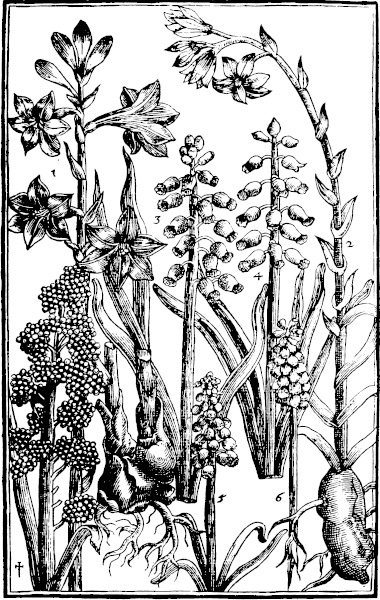
| 1 | Hyacinthus Indicus maior tuberosa radice. The greater Indian knobbed Iacinth. |
| 2 | Hyacinthus Indicus minor tuberosa radice. The lesser Indian knobbed Iacinth. |
| 3 | Muscari flore flauo. The yellow Muscari. |
| 4 | Muscari flore cineritio. The ashcoloured Muscari. |
| 5 | Hyacinthus Botroides cæruleus amænus. The skie coloured Grape-flower. |
| 6 | Hyacinthus Botroides flore albo. The white Grape-flower. |
| † | Hyacinthus Botroides ramosus. The branched Grape-flower. |
The Place.
The rootes of the two first sorts, haue been often sent from Constantinople,
among many other sorts of rootes, and it may be come thither from beyond
the Bosphorus in Asia; we haue them in our Gardens.
The other two sorts are sprung (it is probable, if they be in rerum natura)
from the seede of the two former; for we could neuer get such from Constantinople,
as if the Turkes had neuer knowledge of any such.
The Time.
They flower in March or Aprill, as the yeare is temperate, but the first is
soonest vp out of the ground.
The Names.
The two former haue beene sent from Turkie by the name of Muschoromi
and Dipcadi. Matthiolus calleth it Bulbus vomitorius, saying that no root
doth more prouoke vomit then it. Caspar Bauhinus doth most properly
call it Hyacinthus Moschatus. It is most generally called Muscari, by all Herbarists
and Florists, yet because it doth so neerely resemble the Grape-flower,
I haue named it Hyacinthus Botroides maior Moschatus, to put a difference
from the lesser Grape-flowers that follow; in English, The great
Muske Grape-flower, or Muscari.
Hyacinthus Botroides minor cæruleus obscurus.
The darke blew Grape-flower.
This Grape-flower hath many small, fat, and weake leaues lying vpon the ground,
which are somewhat brownish at their first comming vp, and of a sad greene afterwards,
hollow on the vpperside, and round vnderneath, among which rise vp round,
smooth, weake stalkes, bearing at the toppe many small heauie bottle-like flowers, in
shape like the former Muscari, but very thicke thrust together, smaller, and of a very
darke or blackish blew colour, of a very strong smell, like vnto Starch when it is new
made, and hot: the root is round, and blackish without, being compassed with a number
of small rootes, or of-sets round about it, so that it will quickly choke a ground, if
it be suffered long in it. For which cause, most men doe cast it into some by-corner, if
they meane to preserue it, or cast it out of the Garden quite.
Alter maior.
There is another of this kinde that is greater, both in leafe and flower, and differeth
not in colour or any thing else.
Hyacinthus Botroides cæruleus amænus.
The skie coloured Grape-flower.
This Iacinth springeth vp with fewer leaues then the first, and not reddish, but green
at his first appearing; the leaues, when they are full growne, are long and hollow, like
the former, but greener, shorter, and broader, standing vpright, and not lying along
vpon the ground as they doe: the flowers grow at the toppe of the stalke, more sparsedly
set thereon, and not so thicke together, but like a thinne bunch of grapes, and
bottle-like as the former, of a perfect blew or skie colour, euery flower hauing some
white spots about the brimmes of them: this hath a very sweete smell, nothing like the
former: this roote is whiter, and doth not so much encrease as the former, yet plentifull
enough.
Hyacinthus Botroides ramosus.
The branched Grape-flower.
Of this kinde, there is another found to grow with many branches of flowers, breaking
out from the sides of the greater stalkes or branches: the leaues as all the rest of
the plant is greater then the former.
Hyacinthus Botroides flore albo.
The white Grape-flower.
The white Grape-flower hath his green leaues a little whiter, then the blew or
skie coloured Grape-flower, his flowers are very pure white, alike sparsedly set on the
stalkes, but a little lower and smaller then it, in all other things there is no difference.
Hyacinthus Botroides flore albo rubente.
The blush Grape-flower.
The roote of this Grape-flower groweth greater, then either the skie coloured, or
white Grape-flower, and seldome hath any small rootes or of-sets, as the other haue:
his leaues also are larger, and somewhat broader; the flowers are of a pale, or bleake
blush colour out of a white, and are a little larger, and grow a little higher and fuller
of flowers then the white.
The Place.
They naturally grow in many places both of Germany and Hungary; in
Spaine likewise, and on Mount Baldus in Italy, and Narbone in France, about
the borders of the fields: we haue them in our Gardens for delight.
The Time.
These flower from the beginning of March, or sooner sometimes, vntill
the beginning of May.
The Names.
They are most commonly called Botroides, but more truely Botryodes,
of Βότρυς the Greeke word, which signifieth a bunch or cluster of grapes:
Lobelius calleth the white one, Dipcadi flore albo, transferring the name Dipcadi,
whereby the Muscari is called to this Iacinth, as if they were both one.
Their seuerall names, whereby they are knowne, and called, are set downe
in their titles. The Dutchmen call them Driuekens, as I said before. Some
English Gentlewomen call the white Grape-flower Pearles of Spaine.
1. Hyacinthus Comosus albus.
The white haired Iacinth.
This Iacinth doth more neerly resemble the Grape-flowers, then the faire haired
Iacinths that follow, whereof it beareth the name, in that it hath no haire or threeds
at the toppe of the stalke or sides, as they: and therefore I haue placed it next vnto
them, and the other to follow it, as being of another kinde. The root hereof is blackish,
a little long and round, from whence rise vp three or foure leaues, being smooth and
whitish, long, narrow, and hollow, like a trough or gutter on the vpperside: among
which the stalke riseth vp a foote high or more, bearing at the toppe diuers small flowers,
somewhat like the former, but not so thicke set together, being a little longer, and
larger, and wider at the mouth, and as it were diuided into six edges, of a darke whitish
colour, with some blacker spots about the brimmes on the inside: the heads or seede-vessels
are three square, and somewhat larger, then the heads of any of the former
lesser Grape-flowers, wherein is contained round blacke seede.
2. Hyacinthus Comosus Byzantinus.
The Turkie faire haired Iacinth.
This other Iacinth which came from Constantinople, is somewhat like the former,
but that it is bigger, both in roote, and leafe, and flower, and bearing greater store of
flowers on the head of the stalke: the lower flowers, although they haue short stalkes
at their first flowring, yet afterwards the stalkes grow longer, and those that are lower,
stand out further then those that are highest, whose foot-stalkes are short, and almost
close to the stemme, and of a more perfect purple then any below, which are of a
duskie greenish purple colour: the whole stalke of flowers seem like a Pyramis, broad
belowe, and small aboue, or as other compare it, to a water sprinkle; yet neither of
both these Iacinths haue any threeds at the tops of the stalkes, as the other following
haue.
3. Hyacinthus Comosus maior purpureus.
The great purple faire haired Iacinth.
This faire haired Iacinth hath his leaues softer, longer, broader, and lesse hollow
then the former, lying for the most part vpon the ground: the stalke riseth vp in the
midst of the leaues, being stronger, higher, and bearing a greater and longer head of
flowers also then they: the flowers of this stand not vpon such long foote-stalkes, but
are shorter below, and close almost to the stalke aboue, hauing many bright purplish
blew threeds, growing highest aboue the flowers, as it were in a bush together, euery
one of these threeds hauing a little head at the end of them, somewhat like vnto one of
the flowers, but much smaller: the red of the flowers below this bush, are of a sadder
or deader purple, and not so bright a colour, and the lowest worst of all, rather enclining
to a greene, like vnto the last Turkie kinde: the whole stalke with the flowers vpon
it, doth somewhat resemble a long Purse tassel, and thereupon diuers Gentlewomen
haue so named it: the heads and seede are like vnto the former, but greater: the
roote is great and white with some rednesse on the outside.
4. Hyacinthus Comosus ramosus purpureus.
The faire haired branched Iacinth.
The leaues of this Iacinth are broader, shorter, and greener then of the last, not
lying so weakly on the ground, but standing somewhat more vpright: the stalke riseth
vp as high as the former, but branched out on euery side into many tufts of threeds,
with knappes, as it were heads of flowers, at the ends of them, like vnto the head of
threeds at the toppe of the former Iacinth, but of a little darker, and not so faire a
blewish purple colour: this Iacinth doth somewhat resemble the next Curld haire Iacinth,
but that the branches are not so fairely composed altogether of curled threeds,
nor of so excellent a faire purple or Doue colour, but more duskie by much: the roote
is greater and shorter then of the next, and encreaseth faster.
5. Hyacinthus Pennatus, siue Comosus ramosus elegantior.
The faire Curld-haire Iacinth.
This admirable Iacinth riseth vp with three or foure leaues, somewhat like vnto the
leaues of the Muske Grape-flower, but lesser; betweene which riseth vp the stalke about
a foote high, or somewhat more, bearing at the toppe a bush or tuft of flowers,
which at the first appearing, is like vnto a Cone or Pineapple, and afterwards opening
it selfe, spreadeth into many branches, yet still retaining the forme of a Pyramis, being
broad spread below, and narrow vp aboue: each of these branches is againe diuided
into many tufts of threeds or strings, twisted or curled at the ends, and of an excellent
purple or Doue colour, both stalkes and haires. This abideth a great while in
his beauty, but afterwards all these flowers (if you will so call them) do fall away without
any seede at all, spending it selfe as it should seeme in the aboundance of the flowers:
the roote is not so great as the last, but white on the outside.
The Place.
The two first haue been sent diuers times from Constantinople, the third
is found wilde in many places of Europe, and as well in Germany, as in
Italy. The two last are onely with vs in Gardens, and their naturall places
are not knowne vnto vs.
The Time.
The three former kindes doe flower in Aprill, the two last in May.
The Names.
The first and second haue no other names then are expressed in their titles.
The third is called of some onely Hyacinthus maior and of others Hyacinthus
comosus maior: We call it in English, The purple faire haired Iacinth,
because of his tuft of purple threeds, like haires at the toppe, and (as I said)
of diuers Gentlewomen, purple tassels. The fourth is called by some as it
is in the title, Hyacinthus Comosus ramosus, and of others Hyacinthus Calamistratus.
And the last or fifth is diuersly called by diuers, Fabius Columna in
his Phytobasanos the second part, calleth it Hyacinthus Sannesius, because hee
first saw it in that Cardinals Garden at Rome. Robin of Paris sent to vs the
former of the two last, by the name of Hyacinthus Pennatus, and Hyacinthus
Calamistratus, when as others sent the last by the name Pennatus, and the other
by the name of Calamistratus; but I thinke the name Cincinnatus is more
fit and proper for it, in that the curled threeds which seeme like haires, are
better expressed by the word Cincinnus, then Calamistrum, this signifying
but the bodkin or instrument wherewith they vse to frisle or curle the haire,
and that the bush of haire it selfe being curled. Some also haue giuen to both
these last the names of Hyacinthus Comosus Parnassi, the one fairer then the
other. Of all these names you may vse which you please; but for the last
kinde, the name Cincinnatus, as I said, is the more proper, but Pennatus is
the more common, and Calamistratus for the former of the two last.
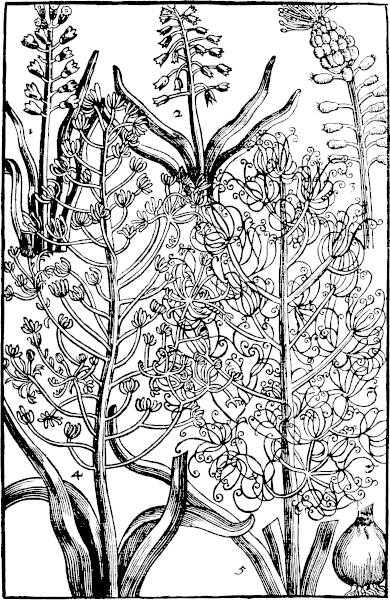
| 1 | Hyacinthus Comosus albus. The white haired Iacinth. |
| 2 | Hyacinthus Comosus Byzantinus. The Turkie faire haired Iacinth. |
| 3 | Hyacinthus Comosus maior purpureus. The purple faire haired Iacinth, or Purse tassels. |
| 4 | Hyacinthus Comosus ramosus, siue Calamistratus. The faire haired branched Iacinth. |
| 5 | Hyacinthus Pennatus, siue Comosus elegantior. The faire curld haire Iacinth. |
[118]
1. Hyacinthus Orientalis Brumalis, siue præcox flore albo.
The white Winter Orientall Iacinth.
This early Iacinth riseth vp with his greene leaues (which are in all respects like to
the ordinary Orientall Iacinths, but somewhat narrower) before Winter, and sometimes
it is in flower also before Winter, and is in forme and colour a plaine white Orientall
Iacinth, but somewhat lesser, differing onely in no other thing, then the time of
his flowring, which is alwayes certaine to be long before the other sorts.
2. Hyacinthus Orientalis Brumalis, siue præcox flore purpureo.
The purple Winter Orientall Iacinth.
The difference of colour in this flower causeth it to bee distinguished, for else it is of
the kindred of the Orientall Iacinths, and is, as the former, more early then the rest
that follow: Vnderstand then, that this is the same with the former, but hauing fine
blewish purple flowers.
3. Hyacinthus Orientalis maior præcox, dictus Zumbul Indi.
The greatest Orientall Iacinth, or Zumbul Indi.
The roote of this Orientall Iacinth, is vsually greater then any other of his kinde,
and most commonly white on the outside, from whence rise vp one or two great
round stalkes, spotted from within the ground, with the lower part of the leaues also
vpward to the middle of the stalkes, or rather higher, like vnto the stalkes of Dragons,
but darker; being set among a number of broad, long, and somewhat hollow greene
leaues, almost as large as the leaues of the white Lilly: at the toppe of the stalkes stand
more store of flowers, then in any other of this kinde, euery flower being as great as
the greatest sort of Orientall Iacinths, ending in six leaues, which turne at the points,
of a faire blewish purple colour, and all standing many times on one side of the
stalkes, and many times on both sides.
4. Hyacinthus Orientalis vulgaris diuersorum colorum.
The ordinary Orientall Iacinth.
The common Orientall Iacinth (I call it common, because it is now so plentifull
in all Gardens, that it is almost not esteemed) hath many greene leaues, long,
somewhat broad and hollow, among which riseth vp a long greene round stalke,
beset from the middle thereof almost, with diuers flowers, standing on both sides
of the stalkes, one aboue another vnto the toppe, each whereof next vnto the foote-stalke
is long, hollow, round, and close, ending in six small leaues laid open,
and a little turning at the points, of a very sweete smell: the colours of these
flowers are diuers, for some are pure white, without any shew of other colour in
them: another is almost white, but hauing a shew of blewnesse, especially at the brims
and bottomes of the flowers. Others againe are of a very faint blush, tending towards
a white: Some are of as deepe a purple as a Violet; others of a purple tending to rednesse,
and some of a paler purple. Some againe are of a faire blew, others more watchet,
and some so pale a blew, as if it were more white then blew: after the flowers
are past, there rise vp great three square heads, bearing round blacke seede, great and
shining: the roote is great, and white on the outside, and oftentimes purplish also, flat
at the bottome, and small at the head.
Flore purpureo
violaceo lincis
albicantis in
dorso.
There is a kinde of these Iacinths, whose flowers are of a deepe purplish Violet colour,
hauing whitish lines downe the backe of euery leafe of the flower, which turne
themselues a little backwards at the points.
Floribus antrorsum
respicientibus.
There is another, whose flowers stand all opening one way, and not on all sides, but
are herein like the great Zumbul Indi, before set out.
Serotinus erectus
floribus
diuersorum colorum.
There is againe another kinde which flowreth later then all the rest, and the flowers
are smaller, standing more vpright, which are either white or blew, or mixt with
white and purple.
5. Hyacinthus Orientalis folioso caule.
The bushy stalked Orientall Iacinth.
This strange Iacinth hath his rootes, leaues, and flowers, like vnto the former Orientall
Iacinths: the onely difference in this is, that his stalke is not bare or naked, but
hath very narrow long leaues, growing dispersedly, and without order, with the flowers
thereon, which are blew, and hauing for the most part one leafe, and sometimes
two at the foote, or setting on of euery flower, yet sometimes it happeneth, some flowers
to be without any leafe at the bottome, as nature, that is very variable in this plant,
listeth to play: the heads and seede are blacke and round, like the other also.
6. Hyacinthus Orientalis flore duplici.
The bleake Orientall Iacinth once double.
This double Iacinth hath diuers long leaues, like vnto the other Orientall Iacinths,
almost standing vpright, among which riseth vp a stalke, brownish at the first, but
growing greene afterwards, bearing many flowers at the toppe, made like the flowers
of the former Iacinths, and ending in six leaues, greene at the first, and of a blewish
white when they are open, yet retaining some shew of greenesse in them, the brims
of the leaues being white; from the middle of each flower standeth forth another
small flower, consisting of three leaues, of the same colour with the other flower, but
with a greene line on the backe of each of these inner leaues: in the middle of this little
flower, there stand some threeds tipt with blacke: the smell of this flower is not so
sweete as of the forme; the heads, seede, and rootes are like the former.
7. Hyacinthus Orientalis flore pleno cæruleo, vel purpuro violaceo.
The faire double blew, or purple Orientall Iacinth.
The leaues of these Iacinths are smaller, then the leaues of most of the other former
sorts; the stalkes are shorter, and smaller, bearing but three or foure flowers on
the heads of them for the most part, which are not composed like the last, but are more
faire, full, and double of leaues, where they shew out their full beauties, and of a faire
blew colour in some, and purple in others, smelling pretty sweete; but these doe seldome
beare out their flowers faire; and besides, haue diuers other flowers that will be
either single, or very little double vpon the same stalke.
8. Hyacinthus Orientalis candidissimus flore pleno.
The pure white double Orientall Iacinth.
This double white Iacinth hath his leaues like vnto the single white Orientall Iacinth;
his stalke is likewise long, slender, and greene, bearing at the toppe two or
three flowers at the most, very double and full of leaues, of a pure white colour, without
any other mixture therein, hanging downe their heads a little, and are reasonable
sweete. I haue this but by relation, not by sight, and therefore I can giue no further
assurance as yet.
The Place.
All these Orientall Iacinths, except the last, haue beene brought out of
Turkie, and from Constantinople: but where their true originall place is,
is not as yet vnderstood.
The Time.
The two first (as is said) flower the earliest, sometimes before Christmas,
but more vsually after, and abide a great while in flower, in great beauty,
especially if the weather be milde, when as few or no other flowers at that
time are able to match them. The other greatest kinde flowreth also earlier
then the rest that follow, for the most part. The ordinary kindes flower
some in March, and some in Aprill, and some sooner also; and so doe the
double ones likewise. The bushy stalked Iacinth flowreth much about the
same time.
The Names.
The former two sorts are called Hyacinthus Orientalis Brumalis, and Hyacinthus
Orientalis præcox flore albo, or cæruleo. The third is called of many
Zumbul Indicum, or Zumbul Indi, and corruptly Simboline; of others, and
that more properly, Hyacinthus Orientalis maior præcox. The Turkes doe
call all Iacinths Zumbul, and by adding the name of Indi, or Arabi, do shew
from what place they are receiued. In English, The greatest Orientall Iacinth;
yet some doe call it after the Turkish name Zumbul Indi, or Simboline,
as is said before. The rest haue their names set downe in their titles, which
are most fit for them.
Flore cæruleo.
This little Iacinth hath foure or fiue long narrow greene leaues, lying vpon the
ground, among which riseth vp a slender smooth stalke, about a spanne high or more,
bearing at the toppe many slender bleake blew flowers, with some white stripes and
edges to be seene in most of them, fashioned very like vnto the flowers of the Orientall
Iacinth, but much smaller: the flower hath no sent at all; the seede is like the seede
of the English Iacinth, or Hares-bels: the roote is small and white.
Flore albo.
There is another of this kinde, differing in nothing but in the colour of the flower,
which is pure white.
Flore rubente.
There is also another, whose flowers are of a fine delayed red colour, with some
deeper coloured veines, running along the three outer leaues of the flower, differing
in no other thing from the former.
The Place.
These plants haue been gathered on the Pyrenæan Mountaines, which
are next vnto Spaine, from whence, as is often said, many rare plants haue
likewise been gathered.
The Time.
They flower very late, euen after all or most of the Iacinths, in May for
the most part.
[121]
The Names.
They are called eyther Hyacinthus Hispanicus minor Orientalis facie, as it is
in the title, or Hyacinthus Orientalis facie, that is to say, The lesser Spanish
Iacinth, like vnto the Orientall: yet some haue called them, Hyacinthus
Orientalis serotinus minor, The lesser late Orientall Iacinth, that thereby
they may be knowne from the rest.
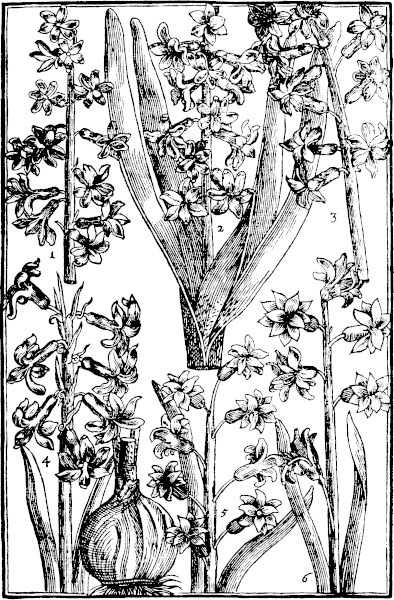
| 1 | Hyacinthus Orientalis brumalis. The Winter Orientall Iacinth. |
| 2 | Zumbul Indi. The greatest Orientall Iacinth. |
| 3 | Hyacinthus Orientalis vulgaris. The ordinary Orientall Iacinth. |
| 4 | Hyacinthus Orientalis folioso caule. The bushy stalked Orientall Iacinth. |
| 5 | Hyacinthus Orientalis flore duplici. The Orientall Hyacinth once double. |
| 6 | Hyacinthus Orientalis flore pleno cæruleo. The faire double blew Orientall Iacinth. |
This Spanish Iacinth springeth very late out of the ground, bearing foure or fiue
short, hollow, and soft whitish greene leaues, with a white line in the middle of euery
one of them, among which rise vp one or more stalkes, bearing diuers flowers at the
toppes of them, all looking one way, or standing on the one side, hanging downe their
heads, consisting of six leaues, three whereof being the outermost, lay open their
leaues, and turne back the ends a little again: the other three which are innermost, do
as it were close together in the middle of the flower, without laying themselues open
at all, being a little whitish at the edges: the whole flower is of a purplish yellow colour,
with some white and green as it were mixed among it, of no sent at all: it beareth
blacke and flat seede in three square, great, and bunched out heads: the roote is reasonable
great, and white on the outside, with many strong white fibres at it, which perish
not yearely, as the fibres of many other Iacinths doe, and as it springeth late, so it
holdeth his greene leaues almost vntill Winter.
Mauritanicus.
There hath been another hereof brought from about Fez and Marocco in Barbary,
which in all respects was greater, but else differed little.
Maximus Æthiopicus.
There was another also brought from the Cape of good Hope, whose leaues were
stronger and greener then the former, the stalke also thicker, bearing diuers flowers,
confusedly standing vpon longer foote-stalkes, yet made after the same fashion, but
that the three inner leaues were whitish, and dented about the edges, otherwise the
flowers were yellow and greenish on the inside.
The Place.
These plants grow in Spaine, Barbary, and Ethiopia, according as their
names and descriptions doe declare.
The Time.
The first flowreth not vntill Iune; for, as I said, it is very late before it
springeth vp out of the ground, and holdeth his leaues as is said, vntill September,
in the meane time the seede thereof ripeneth.
The Names.
They haue their names according to the place of their growing; for one
is called Hyacinthus Hispanicus obsoletioris coloris. The other is called also
Hyacinthus Mauritanicus. And the last, Hyacinthus Æthiopicus obsoletus. In
English, The Spanish, Barbary, or Ethiopian Iacinth, of a dunne or duskie
colour.
Hyacinthus Anglicus Belgicus, vel Hispanicus.
English Hares-bels, or Spanish Iacinth.
Our English Iacinth or Hares-bels is so common euery where, that it scarce needeth
any description. It beareth diuers long and narrow greene leaues, not standing
vpright, nor yet fully lying vpon the ground, among which springeth vp the stalke,
bearing at the toppe many long and hollow flowers, hanging downe their heads all
forwards for the most part, parted at the brimmes into six parts, turning vp their
points a little againe, of a sweetish, but heady sent, somewhat like vnto the Grape-flower:
the heads for seede are long and square, wherein is much blacke seede; the
colour of the flowers are in some of a deeper blew, tending to a purple; in others of a
paler blew, or of a bleake blew, tending to an ash colour: Some are pure white, and
some are party coloured, blew and white; and some are of a fine delayed purplish red
or blush colour, which some call a peach colour. The rootes of all sorts agree, and are
alike, being white and very slimie; some whereof will be great and round, others long
and slender, and those that lye neare the toppe of the earth bare, will be greene.
Hyacinthus Hispanicus maior flore campanulæ instar.
The greater Spanish bell-flowred Iacinth.
This Spanish bell-flowred Iacinth, is very like the former English or Spanish Iacinth,
but greater in all parts, as well of leaues as flowers, many growing together at
the toppe of the stalke, with many short greene leaues among them, hanging downe
their heads, with larger, greater, and wider open mouths, like vnto bels, of a darke
blew colour, and no good sent.
The Place.
The first groweth in many places of England, the Lowe-Countries, as
we call them, and Spaine, but the last chiefly in Spaine.
The Time.
They flower in Aprill for the most part, and sometimes in May.
The Names.
Because the first is more frequent in England, then in Spaine or the Lowe-Countries,
it is called with vs Hyacinthus Anglicus, The English Iacinth;
but it is also called as well Belgicus, as Hispanicus: yet Dodonæus calleth it
Hyacinthus non scriptus, because it was not written of by any Authour before
himselfe. It is generally knowne in England by the name of Hare-bels.
The other Spanish Iacinth beareth his name in his title.
This Woolly Iacinth hath many broad, long, and faire greene leaues, very like vnto
some of the Iacinths, but stiffer, or standing more vpright, which being broken, doe
yeeld many threeds, as if a little fine cotton wooll were drawne out: among these
leaues riseth vp a long greene round stalke, a foote and a halfe high or more, whereon
is set a great long bush of flowers, which blowing open by degrees, first below, and
so vpwards, are very long in flowring: the toppe of the stalke, with the flowers, and
their little footstalkes, are all blew, euery flower standing outright with his stalke, and
spreading like a starre, diuided into six leaues, hauing many small blew threeds, standing
about the middle head, which neuer gaue ripe seede, as farre as I can heare of:
the root is white, somewhat like the root of a Muscari, but as full of wooll or threeds,
or rather more, then the leaues, or any other part of it.
The Place.
This hath been sent diuers times out of Turkie into England, where it
continued a long time as well in my Garden as in others, but some hard
frosty Winters caused it to perish with me, and diuers others, yet I haue had
it againe from a friend, and doth abide fresh and greene euery yeare in my
Garden.
The Time.
This flowred in the Garden of Mʳ. Richard Barnesley at Lambeth, onely
once in the moneth of May, in the yeare 1606, after hee had there preserued
it a long time: but neither he, nor any else in England that I know, but
those that saw it at that time, euer saw it beare flower, either before or since.
The Names.
It is called by diuers Bulbus Eriophorus, or Laniferus, that is, Woolly Bulbous;
but because it is a Iacinth, both in roote, leafe, and flower, and not a
Narcissus, or Daffodill, it is called Hyacinthus Eriophorus, or Laniferus, The
Woolly Iacinth. It is very likely, that Theophrastus in his seuenth Book &
thirteenth Chapter, did meane this plant, where hee declareth, that garments
were made of the woolly substance of a bulbous roote, that was taken
from between the core or heart of the roote (which, as he saith, was
vsed to be eaten) and the outermost shels or peelings; yet Clusius seemeth
to fasten this woolly bulbous of Theophrastus, vpon the next Iacinth of
Spaine.
Hyacinthus Stellatus Bæticus maior, vulgò Perüanus.
The great Spanish Starry Iacinth, or of Peru.
This Iacinth (the greatest of those, whose flowers are spread like a starre, except the
two first Indians) hath fiue or six, or more, very broad, and long greene leaues, spread
vpon the ground, round about the roote, which being broken are woolly, or full of
threeds, like the former: in the middle of these leaues riseth vp a round short stalke, in
comparison of the greatnesse of the plant (for the stalke of the Orientall Iacinth is
sometimes twice so high, whose roote is not so great) bearing at the toppe a great
head or bush of flowers, fashioned in the beginning, before they bee blowne or separated,
very like to a Cone or Pineapple, and begin to flower belowe, and so vpwards
by degrees, euery flower standing vpon a long blackish blew foote-stalke, which when
they are blowne open, are of a perfect blew colour, tending to a Violet, and made of
six small leaues, laid open like a starre; the threeds likewise are blewish, tipt with yellow
pendents, standing about the middle head, which is of a deeper blew, not hauing
any good sent to be perceiued in it, but commendable only for the beauty of the flowers:
after the flowers are past, there come three square heads, containing round blacke
seede: the roote is great, and somewhat yellowish on the outside, with a knobbe or
bunch at the lower end of the roote, (which is called the seate of the roote) like vnto
the Muscari, Scylla, and many other bulbous rootes, at which hang diuers white,
thicke, and long fibres, whereby it is fastened in the ground, which perish not euery
yeare, but abide continually, and therefore doth not desire much remouing.
Hyacinthus Stellatus Bæticus, siue Perüanus flore albo.
The great white Spanish starry Iacinth.
This other Spanish Iacinth is in most parts like vnto the former, but that his leaues
are not so large, nor so deep a greene: the stalks of flowers likewise hath not so thicke
a head, or bush on it, but fewer and thinner set: the flowers themselues also are whitish,
yet hauing a small dash of blush in them: the threeds are whitish, tipt with yellow pendents:
the seede and rootes are like vnto the former, and herein consisteth the difference
betweene this and the other sorts.
Hyacinthus Stellatus Bæticus, siue Perüanus flore carneo.
The great blush coloured Spanish Starry Iacinth.
This likewise differeth little from the two former, but onely in the colour of the
flowers; for this being found growing among both the other, hath his head of flowers
as great and large as the first, but the buds of his flowers, before they are open, are
of a deepe blush colour, which being open, are more delayed, and of a pleasant pale
purple, or blush colour, standing vpon purplish stalkes: the heads in the middle are
whitish, and so are the threeds compassing it, tipt with yellow.
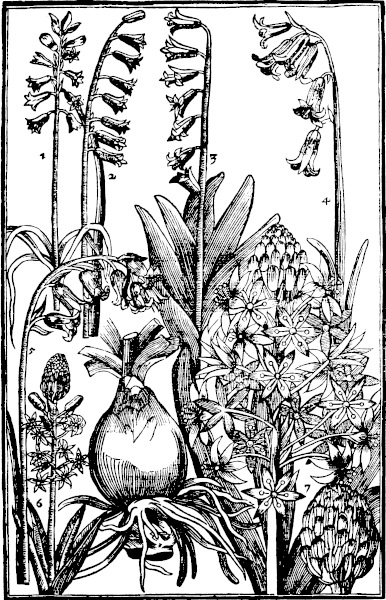
| 1 | Hyacinthus Orientalis facie. The little Summer Orientall Iacinth. |
| 2 | Hyacinthus Mauritanicus. The Barbary Iacinth. |
| 3 | Hyacinthus obsoletus Hispanicus. The Spanish duskie Iacinth. |
| 4 | Hyacinthus Hispanicus flore campanula. The greater Spanish bel-flowred Iacinth. |
| 5 | Hyacinthus Anglicus. The English Iacinth or Harebels. |
| 6 | Hyacinthus Eriophorus. The Woolly Iacinth. |
| 7 | Hyacinthus Stellaris Bæticus maior, siue Peruanus. The great Spanish Starry Iacinth, or of Peru. |
[126]
The Place.
These doe naturally grow in Spaine, in the Medowes a little off from the
Sea, as well in the Island Gades, vsually called Cales, as likewise in other
parts along the Sea side, as one goeth from thence to Porto Santa Maria,
which when they be in flower, growing so thicke together, seeme to couer
the ground, like vnto a tapistry of diuers colours, as I haue beene credibly
enformed by Guillaume Boel, a Freeze-lander borne, often before and
hereafter remembred, who being in search of rare plants in Spaine, in the
yeare of our Lord 1607, after that most violent frosty Winter, which perished
both the rootes of this, and many other fine plants with vs, sent mee
ouer some of these rootes for my Garden, and affirmed this for a truth,
which is here formerly set downe, and that himselfe gathered those he sent
mee, and many others in the places named, with his owne hands; but hee
saith, that both that with the white, and with the blush flowers, are farre
more rare then the other.
The Time.
They flower in May, the seede is ripe in Iuly.
The Names.
This hath beene formerly named Eriophorus Peruanus, and Hyacinthus
Stellatus Peruanus, The Starry Iacinth of Peru, being thought to haue grown
in Peru, a Prouince of the West Indies; but he that gaue that name first vnto
it, eyther knew not his naturall place, or willingly imposed that name, to
conceale it, or to make it the better esteemed. It is most generally receiued
by the name Hyacinthus Peruanus, from the first imposer thereof, that
is, the Iacinth of Peru: but I had rather giue the name agreeing most fitly
vnto it, and call it as it is indeede Hyacinthus Stellatus Bæticus, The Spanish
Starry Iacinth; and because it is the greatest that I know hath come from
thence, I call it, The great Starry Iacinth of Spaine, or Spanish Iacinth.
Hyacinthus Stellatus vulgaris, siue Bifolius Fuchsij.
The common blew Starry Iacinth.
This Starry Iacinth (being longest knowne, and therefore most common) riseth out
of the ground, vsually but with two browne leaues, yet sometimes with three, inclosing
within them the stalke of flowers, the buds appearing of a darke whitish colour,
as soone as the leaues open themselues, which leaues being growne, are long, and hollow,
of a whitish greene on the vpper side, and browne on the vnder side, and
halfe round, the browne stalke rising vp higher, beareth fiue or sixe small starre-like
flowers thereon, consisting of six leaues, of a faire deepe blew, tending to a purple.
The seede is yellowish, and round, contained in round pointed heads, which by reason
of their heauinesse, and the weaknesse of the stalke, lye vpon the ground, and often
perish with wet and frosts, &c. The roote is somewhat long, and couered with a yellowish
coate.
Hyacinthus stellatus flore albo.
The white Starry Iacinth.
The white Starry Iacinth hath his leaues like the former, but greene and fresh, not
browne, and a little narrower also: the buddes for flowers at the first appeare a little
blush, which when they are blowne, are white, but yet retaine in them a small shew of
that blush colour.
Flore niueo.
We haue another, whose flowers are pure white, and smaller then the other, the
leaues whereof are of a pale fresh greene, and somewhat narrower.
Hyacinthus Stellatus flore rubente.
The blush coloured Starry Iacinth.
The difference in this from the former, is onely in the flowers, which are of a faire
blush colour, much more eminent then in the others, in all things else alike.
Hyacinthus Stellatus Martius, siue præcox cæruleus.
The early blew Starry Iacinth.
This Iacinth hath his leaues a little broader, of a fresher greene, and not browne at
all, as the first blew Iacinth of Fuchsius last remembred: the buds of the flowers, while
they are enclosed within the leaues, and after, when the stalke is growne vp, doe remaine
more blew then the buds of the former: the flowers, when they are blowne open,
are like the former, but somewhat larger, and of a more liuely blew colour: the
roote also is a little whiter on the outside. This doth more seldome beare seede then
the former.
Hyacinthus Stellatus præcox flore albo.
The white early Starry Iacinth.
There is also one other of this kinde, that beareth pure white flowers, the green leafe
thereof being a little narrower then the former, and no other difference.
Hyacinthus Stellatus præcox flore suaue rubente.
The early blush coloured Starry Iacinth.
This blush coloured Iacinth is very rare, but very pleasant, his flowers being as large
as the first of this last kinde, and somewhat larger then the blush of the other kinde:
the leaues and rootes differ not from the last recited Iacinth.
The Place.
All these Iacinths haue beene found in the Woods and Mountaines of
Germany, Bohemia, and Austria, as Fuchsius and Gesner doe report, and in
Naples, as Imperatus and others doe testifie. Wee cherish them all with
great care in our Gardens, but especially the white and the blush of both
kindes, for that they are more tender, and often perish for want of due regard.
The Time.
The common kindes, which are first expressed, flower about the middle
of February, if the weather bee milde, and the other kindes sometimes a
fortnight after, that is, in March, but ordinarily much about the same time
with the former.
The Names.
The first is called in Latine Hyacinthus Stellatus vulgaris, and Hyacinthus
Stellatus bifolius, and Hyacinthus Stellaris Fuchsij and of some Hyacinthus
Stellatus Germanicus; wee might very well call the other kinde, Hyacinthus
Stellatus vulgaris alter, but diuers call it Præcox, and some Martius, as it is in
the title. In English they may bee seuerally called: the first, The common;
and the other, The early Starry Iacinth (notwithstanding the first flowreth
before the other) for distinction sake.
The Hyacinthus, seemeth to be called Vacinium of Virgil in his Eclogues;
for hee alwayes reckoneth it among the flowers that were vsed to decke
Garlands, and neuer among fruits, as some would haue it. But in that hee
calleth it Vacinium nigrum, in seuerall places, that doth very fitly answer the
common receiued custome of those times, that called all deepe blew colours,
such as are purples, and the like, blacke; for the Violet it selfe is likewise
called blacke in the same place, where he calleth the Vacinium blacke;
so that it seemeth thereby, that he reckoned them to be both of one colour,
and we know the colour of the Violet is not blacke, as we doe distinguish of
blacke in these dayes. But the colour of this Starry Iacinth, being both of
so deepe a purple sometimes, so neare vnto a Violet colour, and also more
frequent, then any other Iacinth with them, in those places where Virgil
liued, perswadeth me to thinke, that Virgil vnderstood this Starry Iacinth
by Vacinium: Let others iudge otherwise, if they can shew greater probabilitie.
1. Hyacinthus Stellatus Byzantinus nigra radice.
The Starry Iacinth of Turkie with the blacke roote.
This Starry Iacinth of Constantinople hath three or foure fresh greene, thinne, and
long leaues, of the bignesse of the English Iacinth, but not so long, betweene which riseth
vp a slender lowe stalke, bearing fiue or six small flowers, dispersedly set thereon,
spreading open like a starre, of a pale or bleake blew colour: the leaues of the flowers
are somewhat long, and stand as it were somewhat loosly, one off from another, and
not so compactly together, as the flowers of other kindes: it seldome beareth ripe
seede with vs, because the heads are so heauie, that lying vpon the ground, they rotte
with the wet, or are bitten with the frosts, or both, so that they seldome come to good:
the roote is small in some, and reasonable bigge in others, round, and long, white
within, but couered with deepe reddish or purplish peelings, next vnto it, and darker
and blacker purple on the outside, with some long and thicke white fibres, like fingers
hanging at the bottome of them, as is to be seene in many other Iacinths: the roote it
selfe for the most part doth runne downewards, somewhat deep into the ground.
2. Hyacinthus Stellatus Byzantinus maior.
The greater Starry Iacinth of Constantinople.
This Iacinth may rightly be referred to the former Iacinth of Constantinople, and
called the greater, it is so like thereunto, that any one that knoweth that, will soone
say, that this is another of that sort, but greater as it is in all his parts, bearing larger
leaues by much, and more store, lying vpon the ground round about the roote: it
beareth many lowe stalkes of flowers, as bleake, and standing as loosly as the former:
onely the roote of this, is not black on the outside, as the other, but three times bigger.
3. Hyacinthus Stellatus Byzantinus alter, siue flore boraginis.
The other Starry Iacinth of Constantinople.
This other Iacinth hath for the most part onely foure leaues, broader and greener
then the first, but not so large or long as the second: the stalke hath fiue or six flowers
vpon it, bigger and rounder set, like other starry Iacinths, of a more perfect or deeper
blew then either of the former, hauing a whitish greene head or vmbone in the middle,
beset with six blew chiues or threeds, tipt with blacke, so closly compassing the
vmbone, that the threeds seeme so many prickes stucke into a clubbe or head; some
therefore haue likened it to the flower of Borage, and so haue called it: after the flowers
are past, come vp round white heads, wherein is contained round and white seede:
the roote is of a darke whitish colour on the outside, and sometimes a little reddish
withall.
The Place.
The first and the last haue beene brought from Constantinople; the
first among many other rootes, and the last by the Lord Zouch, as Lobel
witnesseth. The second hath been sent vs out of the Lowe-Countries, but
from whence they had it, we do not certainly know. They growe with vs in
our Gardens sufficiently.
The Time.
These flower in Aprill, but the first is the earliest of the rest, and is in
flower presently after the early Starry Iacinth, before described.
The Names.
The former haue their names in their titles, and are not knowne vnto vs
by any other names that I know; but as I said before, the last is called by
some, Hyacinthus Boraginis flore. The first was sent out of Turkie, by the
name of Susamgiul, by which name likewise diuers other things haue beene
sent, so barren and barbarous is the Turkish tongue.
Hyacinthus Stellatus Æstivus maior.
The greater Summer Starry Iacinth.
This late Iacinth hath diuers narrow greene leaues, lying vpon the ground, somewhat
like the leaues of the English Iacinth, but stiffer and stronger; among which riseth
vp a round stiffe stalke, bearing many flowers at the toppe thereof, and at euery
foote-stalke of the flowers a small short leafe, of a purplish colour: the flowers are
starre-like, of a fine delayed purplish colour, tending to a pale blew or ash colour, striped
on the backe of euery leafe, and hauing a pointed vmbone in the middle, with
some whitish purple threeds about it, tipt with blew: the seede is blacke, round, and
shining, like vnto the seede of the English Iacinth, but not so bigge: the roote is round
and white, hauing some long thicke rootes vnder it, besides the fibres, as is vsuall in
many other Iacinths.
Hyacinthus Stellatus Æstivus minor.
The lesser Summer Starry Iacinth.
This lesser Iacinth hath diuers very long, narrow, and shining greene leaues, spread
vpon the ground round about the roote, among which riseth vp a very short round
stalke, not aboue two inches high, carrying six or seuen small flowers thereon, on each
side of the stalke, like both in forme and colour vnto the greater before described, but
lesser by farre: the seede is blacke, contained in three square heads: the roote is small
and white, couered with a browne coate, and hauing some such thicke rootes among
the fibres, as are among the other.
The Place.
Both these Iacinths grow naturally in Portugall, and from thence haue
been brought, by such as seeke out for rare plants, to make a gaine and profit
by them.
The Time.
They both flower in May, and not before: and their seed is ripe in Iuly.
The Names.
Some doe call these Hyacinthus Lusitanicus, The Portugall Iacinth. Clusius,
who first set out the descriptions of them, called them as is expressed in
their titles; and therefore we haue after the Latine name giuen their English,
according as is set downe. Or if you please, you may call them, The greater
and the lesser Portugall Iacinth.
This ash coloured Iacinth, hath his leaues very like vnto the leaues of the English
Iacinth, and spreading vpon the ground in the same manner, among which rise vp one
or two stalkes, set at the toppe with a number of small starre-like flowers, bushing bigger
below then aboue, of a very pale or white blew, tending to an ash colour, and very
sweete in smell: the seede is blacke and round, like vnto the seede of the English Iacinth,
and so is the roote, being great, round, and white; so like, I say, that it is hard to
know the one from the other.
The Place.
The certaine originall place of growing thereof, is not knowne to vs.
The Time.
It flowreth in Aprill.
The Names.
Some doe call this Hyacinthus Someri, Somers Iacinth, because as Lobel
saith, he brought it first into the Lowe-Countries, eyther from Constantinople,
or out of Italy.
Hyacinthus Stellatus Lilifolio & radice cæruleo.
The blew Lilly leafed Starre Iacinth.
This Iacinth hath six or seuen broad greene leaues, somewhat like vnto Lilly leaues,
but shorter (whereof it tooke his name as well as from the roote) spread vpon the
ground, and lying close and round: before the stalke riseth out from the middle of
these leaues, there doth appeare a deepe hollow place, like a hole, to bee seene a good
while, which at length is filled vp with the stalke, rising thence vnto a foote or more
high, bearing many starre-like flowers at the toppe, of a perfect blew colour, neare
vnto a Violet, and sometimes of paler or bleake blew colour, hauing as it were a small
cuppe in the middle, diuided into six peeces, without any threeds therein: the seede is
blacke and round, but not shining: the roote is somewhat long, bigge belowe, and
small aboue, like vnto the small roote of a Lilly, and composed of yellow scales, as a
Lilly, but the scales are greater, and fewer in number.
Hyacinthus Stellatus Lilifolius albus.
The white Lilly leafed Starre Iacinth.
The likenesse of this Iacinth with the former, causeth me to be briefe, and not to
repeate the same things againe, that haue already been expressed: You may therefore
vnderstand, that except in the colour of the flower, which in this is white, there is no
difference betweene them.
Flore carneo.
I heare of one that should beare blush coloured flowers, but I haue not yet seene
any such.
The Place.
These Iacinths haue been gathered on the Pyrenæan Hils, in that part of
France that is called Aquitaine, and in some other places.
The Time.
These flower in Aprill, and sometimes later.
The Names.
Because the roote is so like vnto a Lilly, as the leafe is also, it hath
most properly beene called Hyacinthus Stellatus Lilifolio & radice, or for
breuity Lilifolius, that is, The Starry Lilly leafed Iacinth. It is called
Sarahug by the Inhabitants where it groweth, as Clusius maketh the report
from Venerius, who further saith, that by experience they haue
found the cattell to swell and dye, that haue eaten of the leaues thereof.
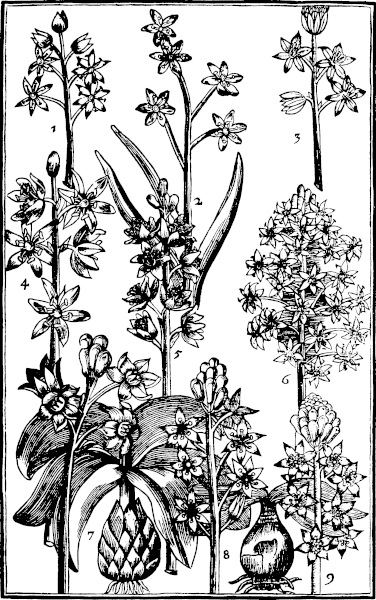
| 1 | Hyacinthus stellatus præcox cæruleus. The early blew starry Iacinth. |
| 2 | Hyacinthus stellatus præcox albus. The early white starry Iacinth. |
| 3 | Hyacinthus stellatus Byzantinus nigra radice. The Turkie starry Iacinth with a blacke roote. |
| 4 | Hyacinthus Byzantinus alter siue flore Boraginis. The other starry Iacinth of Constantinople. |
| 5 | Hyacinthus æstivus maior. The greater Summer starry Iacinth. |
| 6 | Hyacinthus stellatus flore cinereo. The ash coloured starry Iacinth. |
| 7 | Hyacinthus stellatus Lilifolius. The Lilly leafed starre Iacinth. |
| 8 | Hyacinthus Autumnalis. The Autumne Iacinth. |
| 9 | Scilla alba siue Hyacinthus marinus. The Sea Onion or Squill. |
Hyacinthus Autumnalis maior.
The greater Autumne Iacinth.
The greater Autumne Iacinth hath fiue or six very long and narrow greene leaues,
lying vpon the ground; the stalkes are set at the toppe with many starre-like flowers,
of a pale blewish purple colour, with some pale coloured threeds, tipt with blew,
standing about the head in the middle, which in time growing ripe, containeth therein
small blacke seede, and roundish: the roote is great and white on the outside.
Hyacinthus Autumnalis minor.
The lesser Autumne Iacinth.
This lesser Iacinth hath such like long and small leaues, but narrower then the former:
the stalke is not full so high, but beareth as many flowers on it as the other,
which are of a pale or bleake purple colour, very like vnto it also: the roote and seed
are like the former, but smaller. These both for the most part, beare their flowers and
seede before the greene leaues rise vp much aboue the ground.
Flore albo.
There is a kinde hereof found that beareth white flowers, not differing in any other
thing from the smaller purple kinde last mentioned.
The Place.
The first and last are onely kept in Gardens, and not knowne to vs where
their naturall place of growing wilde may be.
The second groweth wilde in many places of England. I gathered diuers
rootes for my Garden, from the foote of a high banke by the Thames side,
at the hither end of Chelsey, before you come at the Kings Barge-house.
The Time.
The greatest flowreth in the end of Iuly, and in August.
The other in August and September, you shall seldome see this plant
with flowers and greene leaues at one time together.
The Names.
They haue their names giuen them, as they are expressed in their titles,
by all former Writers, except Daleschampius, or hee that set forth that
great worke printed at Lyons; for hee contendeth with many words, that
these plants can bee no Iacinths, because their flowers appeare before their
leaues in Autumne, contrary to the true Iacinth, as he saith: and therefore he
would faine haue it referred to Theophrastus bulbus in libro primo cap. 12. and
calleth it his Tiphyum mentioned in that place, as also Bulbus astivus Dalechampij.
Howsoeuer these things may carry some probability in them, yet
the likenesse both of rootes, and flowers especially, hath caused very learned
Writers to entitle them as is set downe, and therefore I may not but let
them passe in the like manner.
Both the rootes and the leaues of the Iacinths are somewhat cold and
drying, but the seede much more. It stayeth the loosnesse of the belly. It
is likewise said to hinder young persons from growing ripe too soone, the
roote being drunke in wine. It helpeth them also whose vrine is stopt, and
is auaileable for the yellow Iaundise; but as you heare some are deadly to
cattell, I therefore wish all to bee well aduised which of these they will vse
in any inward physicke.
Scilla alba.
The Sea Onion or Squill.
As I ended the discourse of both the true and the bastard Daffodils, with the Sea
kindes of both sorts; so I thinke it not amisse, to finish this of the Iacinths with the description
of a Sea Iacinth, which (as you see) I take to be the Scilla, or Sea Onion, all
his parts so nearely resembling a Iacinth, that I know not where to ranke him better
then in this place, or rather not any where but here. You shall haue the description
thereof, and then let the iudicious passe their sentence, as they thinke meetest.
The Squill or Sea Onion (as many doe call it) hath diuers thicke leaues, broad, long,
greene, and hollowish in the middle, and with an eminent or swelling ribbe all along
the backe of the leafe, (I relate it as I haue seene it, hauing shot forth his leaues in the
ship by the way, as the Mariners that brought diuers rootes from out of the Straights,
did sell them to mee and others for our vse) lying vpon the ground, somewhat like
vnto the leaues of a Lilly: these spring vp after the flowers are past, and the seed ripe,
they abiding all the Winter, and the next Spring, vntill the heate of the Summer hath
spent and consumed them, and then about the end of August, or beginning of September,
the stalke with flowers ariseth out of the ground a foote and a halfe high, bearing
many starre-like flowers on the toppe, in a long spike one aboue another, flowring by
degrees, the lowest first, and so vpwards, whereby it is long in flowring, very like, as
well in forme as bignesse, to the flowers of the great Starre of Bethlehem (these flowers
I haue likewise seene shooting out of some of the rootes, that haue been brought in
the like manner:) after the flowers are past, there come vp in their places thicke and
three square heads, wherin is contained such like flat, black, and round seed, as the Spanish
duskie Iacinth before described did beare, but greater: the root is great & white,
couered with many peelings or couerings, as is plainly enough seen to any that know
them, and that sometimes wee haue had rootes, that haue beene as bigge as a pretty
childes head, and sometimes two growing together, each whereof was no lesse then
is said of the other.
Scilla rubra siue Pancratium verum.
The red Sea Onion.
The roote of this Squill, is greater oftentimes then of the former, the outer coates
or peelings being reddish, bearing greater, longer, stiffer, and more hollow leaues, in
a manner vpright: this bringeth such a like stalke and flowers, as the former doth, as
Fabianus Ilges, Apothecary to the Duke of Briga, did signifie by the figure thereof
drawne and sent to Clusius.
The Place.
They grow alwayes neare the Sea, and neuer farre off from it, but often
on the very baich of the Sea, where it washeth ouer them all along the
coasts of Spaine, Portugal, and Italy, and within the Straights in many
places: it will not abide in any Garden farre from the Sea, no not in Italy,
as it is related.
The Time.
The time wherein they flower, is expressed to be in August and September:
this seede to be ripe in October and Nouember, and the greene leaues
to spring vp in Nouember and December.
The Names.
These are certainly the true kindes of Scilla that should bee vsed in medicines,
although (as Clusius reporteth) the Spaniards forbade him to taste of
the red Squill, as of a most strong and present poison. Pliny hath made
more sorts then can be found out yet to this day with vs: that Scilla that is
called Epimenidia, because it might be eaten, is thought to be the great Ornithogalum,
or Starre of Bethlehem. Pancratium is, I know, and as I said before,
referred to that kinde of bastard Sea Daffodill, which is set forth before
in the end of the history of the bastard Daffodils; and diuers also
would make the Narcissus tertius Matthioli, which I call the true Sea Daffodill,
to be a Pancratium; but seeing Dioscorides (and no other is against him)
maketh Pancratium to be a kinde of Squill with reddish rootes, I dare not
vphold their opinion against such manifest truth.
The Vertues.
The Squill or Sea Onion is wholly vsed physically with vs, because wee
can receiue no pleasure from the sight of the flowers. Pliny writeth, that
Pithagoras wrote a volume or booke of the properties thereof, for the singular
effects it wrought; which booke is lost, yet the diuers vertues it hath is
recorded by others, to be effectual for the spleene, lungs, stomach, liuer,
head and heart; and for dropsies, old coughs, Iaundise, and the wormes;
that it cleareth the sight, helpeth the tooth-ache, cleanseth the head of
scurfe, and running sores; and is an especiall Antidote against poison: and
therefore is vsed as a principall ingredient into the Theriaca Andromachi,
which we vsually call Venice Treakle. The Apothecaries prepare hereof,
both Wine, Vinegar, and Oxymel or Syrupe, which is singular to extenuate
and expectorate tough flegme, which is the cause of much disquiet in the
body, and an hinderer of concoction, or digestion in the stomach, besides
diuers other wayes, wherein the scales of the rootes, being dryed, are vsed.
And Galen hath sufficiently explained the qualities and properties thereof,
in his eight Booke of Simples.
After the Family of the Iacinths, must needes follow the kindes of Starre-flowers,
or Starres of Bethlehem, as they are called, for that they doe so nearely resemble
them, that diuers haue named some of them Iacinths, and referred them
to that kindred: all of them, both in roote, leafe, and flower, come nearer vnto the
Iacinths, then vnto any other plant. They shall therefore bee next described, euery
one in their order, the greatest first, and the rest following.
This Arabian Starre-flower hath many broad, and long greene leaues, very like vnto
the leaues of the Orientall Iacinth, but lying for the most part vpon the ground,
among which riseth vp a round greene stalke, almost two foote high, bearing at the
toppe diuers large flowers, standing vpon long foote-stalkes, and at the bottome of
euery one of them a small short pointed greene leafe: these flowers are made of six
pure white leaues a peece, laid open as large as an ordinary Daffodill, but of the forme
of a Starre Iacinth, or Starre of Bethlehem, which close as they doe euery night, and
open themselues in the day time, especially in the Sunne, the smell whereof is pretty
sweete, but weake: in the middle of the flower is a blackish head, compassed with six
white threeds, tipt with yellow pendents: the seede hath not beene obserued with vs:
the roote is great and white, with a flat bottome, very impatient of our cold Winters,
so that it seldome prospereth or abideth with vs; for although sometimes it doe abide
a Winter in the ground, yet it often lyeth without springing blade, or any thing else a
whole yeare, and then perisheth: or if it doe spring, yet many doe not beare, and most
after their first bearing doe decay and perish. But if any be desirous, to know how to
preserue the roote of this plant, or of many other bulbous rootes that are tender, such
as the great double white Daffodill of Constantinople, and other fine Daffodils, that
come from hot Countries; let them keepe this rule: Let either the roote be planted in
a large pot, or tubbe of earth, and housed all the Winter, that so it may bee defended
from the frosts; Or else (which is the easier way) keepe the roote out of the ground
euery yeare, from September, after the leaues and stalkes are past, vntill February, in
some dry, but not hot or windy place, and then plant it in the ground vnder a South
wall, or such like defended place, which will spring, and no doubt prosper well
there, in regard the greatest and deepest frosts are past after February, so that seldome
any great frosts come after, to pierce so deepe as the roote is to be set, or thereby to
doe any great harme to it in such a place.
The Place.
This hath been often sent out of Turkie, and likewise out of Italy; I had
likewise two rootes sent mee out of Spaine by Guillaume Boel before remembred,
which (as hee said) hee gathered there, but they prospered not
with me, for want of the knowledge of the former rule. It may be likely that
Arabia is the place, from whence they of Constantinople receiue it.
The Time.
It flowreth in May, if it be of the first yeares bringing; or in Iune, if it
haue been ordered after the manner before set downe.
The Names.
It hath been sent out of Italy by the name of Lilium Alexandrinum, The
Lilly of Alexandria, but it hath no affinity with any Lilly. Others call it
Hyacinthus Arabicus; and the Italians, Iacintho del pater nostro; but it is no Iacinth
neither, although the flowers be like some of them. Some also would
referre it to a Narcissus or Daffodill, and it doth as little agree with it, as
with a Lilly, although his flowers in largenesse and whitenesse resemble a
Daffodill. Clusius hath most fitly referred it to the stocke or kindred of
Ornithogala, or Starres of Bethlehem, as wee call them in English, and
from the Turkish name, Zumbul Arabi, entituled it Ornithogalum Arabicum,
although Zumbul, as I haue before declared, is with them, a Iacinth, wee
may call it in English, The Arabian Starre-flower, or Starre of Bethlehem,
or the great Starre-flower of Arabia.
1. Ornithogalum maximum album.
The greatest white Starre-flower, or Starre of Bethlehem.
This great Starre-flower hath many faire, broad, long, and very fresh green leaues,
rising vp very early, and are greater, longer, and greener then the leaues of any Orientall
Iacinth, which doe abide greene, from the beginning or middle of Ianuary, or
before sometimes, vntill the end of May, at which time they begin to fade, and the
stalke with the head of flowers beginneth to rise, so that it will haue either few or no
leaues at all, when the flowers are blowne: the stalke is strong, round, and firme, rising
two foote high or more, bearing at the toppe a great bush of flowers, seeming at the first
to be a great greene eare of corne, for it is made spike-fashion, which when the flowers
are blowne, doth rise to be very high, slender or small at the head aboue, and broad
spread and bushing below, so that it is long in flowring; for they flower below first,
and so vpwards by degrees: these flowers are snow white, without any line on the
backside, and is therein like vnto the former, as also in whitenesse, but nothing so
large, with a white vmbone or head in the middle, beset with many white threeds,
tipt with yellow: the seede is blacke and round, contained in three square heads: the
roote is great, thicke, and short, and somewhat yellowish on the outside, with a flat
bottome, both like the former, and next that followeth.
2. Ornithogalum maius spicatum album.
The great white spiked Starre-flower.
This spiked Starre-flower in his growing, is somewhat like vnto the last described,
but springeth not vp so early, nor hath his leaues so greene, or large, but hath broad,
long, whitish greene hollow leaues, pointed at the end, among which riseth vp the
stalke, which is strong and high, as the former, hauing a great bush of flowers at the
toppe, standing spike-fashion, somewhat like the former, flowring in the same maner
by degrees, first below, and so vpwards; but it is not so thicke set with flowers, nor so
farre spread at the bottome as it, the flowers also are not so white, and each of the
leaues of them haue a greene line downe the backe, leauing the edges on both sides
white: after the flowers are past, the heads for seede grow three square, like the other,
bearing such like blacke seede therein: the roote hereof is vsually bigger then the last,
and whiter on the outside.
3. Ornithogalum Pannonicum.
The Hungarian Starre-flower.
This Hungarian Starre-flower shooteth out diuers narrow, long, whitish greene
leaues, spread vpon the ground before Winter, which are very like vnto the leaues of
Gilloflowers, and so abide aboue the ground, hauing a stalke rising in the middle of them
the next Spring, about halfe a foote high or thereabouts, bearing many white flowers
at the toppe, with greene lines downe the backe of them, very like vnto the ordinary
Starres of Bethlehem: the roote is greater, thicker, and longer then the ordinary
Starres, and for the most part, two ioyned together, somewhat grayish on the outside.
4. Ornithogalum vulgare.
The Starre of Bethlehem.
The ordinary Starre of Bethlehem is so common, and well knowne in all countries
and places, that it is almost needlesse to describe it, hauing many greene leaues
with white lines therein, and a few white flowers set about the toppe of the stalke, with
greenish lines downe the backe: the roote is whitish, and encreaseth aboundantly.
5. Asphodelus bulbosus Galeni, siue Ornithogalum maius flore subuirescente.
The bulbous Asphodill, or greene Starre-flower.
Diuers haue referred this plant vnto the Asphodils, because (as I thinke) the flowers
hereof are straked on the backe, and the leaues long and narrow, like vnto the Asphodils;
but the roote of this being bulbous, I rather (as some others doe) ioyne it with
the Ornithogala, for they also haue strakes on the backe of the flowers. It hath many
whitish greene leaues, long and narrow, spread vpon the ground, which spring vp in
the beginning of the yeare, and abide vntill May, and then they withering, the stalke
springeth vp almost as high as the first, hauing many pale yellowish greene flowers, but
smaller, and growing more sparsedly about the stalke vpon short foot-stalkes, but in a
reasonable long head spike-fashion: the seede is like vnto the second kinde, but smaller:
the roote is somewhat yellowish, like the first great white kinde.
[137]
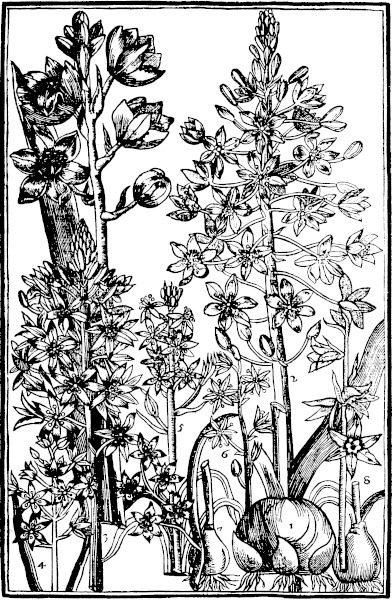
| 1 | Ornithogalum Arabicum. The great starre-flower of Arabia. |
| 2 | Ornithogalum maximum album. The greatest white starre-flower. |
| 3 | Ornithogalum maius spicatum album. The great white spiked starre-flower. |
| 4 | Ornithogalum Pannonicum album. The Hungarian starre-flower. |
| 5 | Asphodelus bulbosus Galeni, siue Ornithogalum maius subuirescente flore. The bulbed Asphodill, or greene starre-flower. |
| 6 | Ornithogalum Hispanicum minus. The little starre-flower of Spaine. |
| 7 | Ornithogalum luteum. The yellow starre-flower of Bethlehem. |
| 8 | Ornithogalum Neapolitanum. The starre-flower of Naples. |
The Place.
The first is onely nursed in Gardens, his originall being not well
knowne, yet some attribute it vnto Pannonia or Hungary. The second hath
been found neare vnto Barcinone, and Toledo in Spaine. The third was
found in Hungary by Clusius. Our ordinary euery where in the fields of
Italy and France, and (as it is said) in England also. And the last groweth
likewise by the corne fields in the vpper Hungary.
The Time.
They flower in Aprill and May, and sometimes in Iune.
The Names.
The first is called by Clusius Ornithogalum maximum album, because it is
greater then the next, which hee tooke formerly for the greatest: but it
might more fitly, in my iudgement, bee called Asphodelus bulbosus albus (if
there be any Asphodelus bulbosus at all) because this do so nearly resemble
that, both in the early springing, and the decay of the greene leaues, when
the stalkes of flowers doe rise vp. Diuers also doe call it Ornithogalum Pannonicum
maximum album.
The second hath his name in his title, as most authors doe set it downe,
yet in the great Herball referred to Dalechampius, it is called Ornithogalum
magnum Myconi.
The third hath his name from the place of his birth, and the other from
his popularity, yet Dodonæus calleth it Bulbus Leucanthemos.
The last is called by diuers Asphodelo-hyacinthinus, and Hyacintho-asphodelus
Galeni. Dodonæus calleth it Asphodelus fæmina, and Asphodelus bulbosus.
But Lobel, and Gerrard from him, and Dodonæus, doe make this to
haue white flowers, whereas all that I haue seene, both in mine owne, and in
others Gardens, bore greenish flowers, as Clusius setteth it truely downe.
Lobel seemeth in the description of this, to confound the Ornithogalum of
Mompelier with it, and calleth it Asphodelus hyacinthinus forte Galeni, and
saith that some would call it Pancratium Monspeliense, and Asphodelus Galeni.
But as I haue shewed, the Ornithogalum spicatum and this, doe plainly differ
the one from the other, and are not both to be called by one name, nor to
be reckoned one, but two distinct plants.
The leaues of this plant are a foote long, and at the least an inch broad, which being
broken, are no lesse woolly then the woolly Iacinth: the stalke is a cubit high, strong
and greene; from the middle whereof vnto the toppe, stand large snow white flowers,
vpon long, greene, thicke foot-stalkes, and yellowish at the bottome of the flower;
in the middle whereof stand six white threeds, tipt with yellow chiues, compassing
the head, which is three square, and long containing the seede: the roote is thicke
and round, somewhat like the Asphodelus Galeni.
The Place.
This plant was gathered by some Hollanders, on the West side of the
Cape of good Hope.
The Time.
It flowred about the end of August with those that had it.
The Names.
Because it came from that part of the continent beyond the line, which is
reckoned a part of Æthiopia, it is thereupon so called as it is set downe.
This beautifull plant riseth out of the ground very early, with foure or fiue hollow
pointed leaues, standing round together, of a whitish greene colour, with a white line
downe the middle of euery leafe on the inside, somewhat narrow, but long, (Fabius
Columna saith, three foot long in Italy, but it is not so with vs) in the middle of these
leaues riseth vp the stalke, a foote and a halfe high, bearing diuers flowers at the toppe,
euery one standing in a little cuppe or huske, which is diuided into three or foure
parts, hanging downe very long about the heads for seede: after the flower is past,
these flowers doe all hang downe their heads, and open one way, although their little
foot-stalkes come forth on all sides of the greater stalke, being large, and composed of
six long leaues, of a pure white on the inside, and of a blewish or whitish greene colour
on the outside, leauing the edges of euery leafe white on both sides: in the middle of
these flowers stand other small flowers, each of them also made of six small white
leaues a peece, which meeting together, seeme to make the shew of a cuppe, within
which are contained six white threeds, tipt with yellow, and a long white pointell in
the middle of them, being without any sent at all: after the flowers are past, come vp
great round heads, which are too heauie for the stalke to beare; and therefore lye
downe vpon the leaues or ground, hauing certaine lines or stripes on the outside,
wherein is contained round, blacke, rough seede: the roote is great and white, and
somewhat flat at the bottome, as diuers of these kindes are, and doe multiply as plentifully
into small bulbes as the common or any other.
The Place.
This Starre-flower groweth in the Medowes in diuers places of Naples,
as Fabius Columna, and Ferrantes Imperatus doe testifie, from whence
they haue been sent. And Matthiolus, who setteth out the figure thereof
among his Daffodills, had (it should seeme) seene it grow with him.
The Time.
It flowreth in May, although it begin to spring out of the ground oftentimes
in Nouember, but most vsually in Ianuary: the seede is ripe in Iuly.
The Names.
Matthiolus reckoneth this (as is said) among the Daffodils, for no other
respect, as I conceiue, then that he accounted the middle flower to bee the
cuppe or trunke of a Daffodill, which it doth somewhat resemble, and setteth
it forth in the fourth place, whereupon many doe call it Narcissus quartus
Matthioli, The fourth Daffodill of Matthiolus. Fabius Columna calleth
it Hyacinthus aruorum Ornithogali flore. Clusius (to whom Imperatus sent it,
in stead of the Arabian which hee desired) calleth it of the place from
whence he receiued it, Ornithogalum Neapolitanum, and we thereafter call it
in English, The Starre-flower of Naples.
Clusius hath set forth this plant among his Ornithogala or Starre-flowers, and although
it doth in my minde come nearer to a Hyacinthus, then to Ornithogalum, yet
pardon it, and let it passe as he doth. From a little round whitish roote, springeth vp in
the beginning of the yeare, fiue or six small long green leaues, without any white line
in the middle of them, among which rise vp one or two small stalkes, an hand length
high or better, bearing seuen or eight, or more flowers, growing as it were in a tuft or
vmbell, with small long leaues at the foote of euery stalke, the lower flowers being
equall in length with the vppermost, of a pale whitish blew or ash colour, with a strake
or line downe the backe of euery leafe of them, with some white threeds standing about
a blewish head in the middle: these flowers passe away quickly, and giue no seed,
so that it is not knowne what seede it beareth.
The Place.
This groweth in Spaine, and from thence hath been brought to vs.
The Time.
It flowreth in May.
The Names.
It hath no other name then is set down in the title, being but lately found
out.
1. Ornithogalum album vnifolium.
The white starre-flower with one blade.
This little starre-flower I bring into this place, as the fittest in my opinion where to
place it, vntill my minde change to alter it. It hath a very small round white roote,
from whence springeth vp one very long and round greene leafe, like vnto a rush, but
that for about two or three inches aboue the ground, it is a little flat, and from thence
springeth forth a small stalke not aboue three or foure inches high, bearing at the top
thereof three or foure small white flowers, consisting of six leaues a peece, within
which are six white chiues, tipt with yellow pendents, standing about a small three
square head, that hath a white pointell sticking as it were in the middle thereof: the
flower is pretty and sweete, but not heady.
Ornithogalum luteum.
The yellow Starre of Bethlehem.
This yellow Starre-flower riseth vp at the first, with one long, round, greenish leafe,
which openeth it selfe somewhat aboue the ground, and giueth out another small
leafe, lesser and shorter then the first, and afterward the stalke riseth from thence also,
being foure or fiue inches high, bearing at the toppe three or foure small green leaues,
and among them foure or fiue small yellow starre-like flowers, with a greenish line or
streake downe the backe of euery leafe, and some small reddish yellow threeds in the
middle: it seldome giueth seede: the roote is round, whitish, and somewhat cleare,
very apt to perish, if it bee any little while kept dry out of the ground, as I haue twice
tryed to my losse.
The Place.
The first grew in Portugall, and Clusius first of all others desciphers it.
The other is found in many places both of Germany and Hungary, in the
moister grounds.
The Time.
The first flowreth in May: the other in Aprill, and sometimes in March.
The Names.
Carolus Clusius calleth the first Bulbus vnifolius, or Bolbine, but referreth
it not to the stocke or kindred of any plant; but (as you see) I haue ranked it
with the small sorts of Ornithogalum, and giue it the name accordingly.
The other is referred for likenesse of forme, and not for colour, vnto the
Ornithogala, or Starres of Bethlehem. It is called by Tragus and Fuchsius
Bulbus siluestris, because of the obuiousnesse. Cordus taketh it to be Sisyrinchium.
Lacuna calleth it Bulbus esculentus. Lobel and others in these dayes
generally, Ornithogalum luteum, and wee thereafter in English, The yellow
Starre-flower, or Starre of Bethlehem.
The first kinde being but lately found out, is not knowne to be vsed. The
rootes of the common or vulgar, are (as Matthiolus saith) much eaten by
poore people in Italy, either rawe or roasted, being sweeter in taste then
any Chestnut, and seruing as well for a necessary food as for delight. It is
doubtfull whether any of the rest may be so vsed; for I know not any in our
Land hath made any experience.
There are many other sorts of Starre-flowers, which are fitter for a generall then
this History; and therefore I referre them thereunto.
Vnto the former Starre-flowers, must needes bee ioyned another tribe or kindred,
which carry their straked flowers Starre-fashion, not spikewise, but in a
tuft or vmbell thicke thrust or set together. And although diuers of them
smell not as the former, but most of their first Grandfathers house, yet all doe not so;
for some of them are of an excellent sent. Of the whole Family, there are a great many
which I must leaue, I will onely select out a few for this our Garden, whose flowers
for their beauty of statelinesse, forme, or colour, are fit to bee entertained, and take
place therein, euery one according to his worth, and are accepted of with the louers
of these delights.
1. Moly Homericum, vel potius Theophrasti.
The greatest Moly of Homer.
Homers Moly (for so it is most vsually called with vs) riseth vp most commonly
with two, and sometimes with three great, thicke, long, and hollow guttered leaues,
of a whitish greene colour, very neare the colour of the Tulipa leafe, hauing sometimes
at the end of some of the leaues, and sometimes apart by it selfe, a whitish round
small button, like vnto a small bulbe, the like whereof also, but greater, doth grow betweene
the bottome of the leaues and the stalke neare the ground, which being planted
when it is ripe, will grow into a roote of the same kinde: among these leaues riseth
vp a round, strong, and tall stalke, a yard high or better, bare or naked vnto the toppe,
where it beareth a great tuft or vmbell of pale purplish flowers, all of them almost
standing vpon equall foot-stalkes, or not one much higher then another, consisting of
fiue leaues a peece, striped downe the backe with a small pale line, hauing a round
head or vmbone with some threeds about it in the midst: These flowers doe abide a
great while blowne before they vade, which smell not very strong, like any Onion or
Garlicke, but of a faint smell: and after they are past come the seede, which is blacke,
wrapped in white close huskes: the roote groweth very great, sometimes bigger then
any mans closed fist, smelling strong like Garlicke, whitish on the outside, and greene
at the toppe, if it be but a while bare from the earth about it.
2. Moly Indicum siue Caucason.
The Indian Moly.
The Indian Moly hath such like thicke large leaues, as the Homers Moly hath, but
shorter and broader, in the middle whereof riseth vp a short weake stalke, almost flat,
not hauing any flowers vpon it, but a head or cluster of greenish scaly bulbes, inclosed
at the first in a large thinne skinne, which being open, euery bulbe sheweth it selfe,
standing close one vnto another vpon his foot-stalke, of the bignesse of an Acorne,
which being planted, will grow to bee a plant of his owne kinde: the roote is white
and great, couered with a darke coate or skinne, which encreaseth but little vnder
ground; but besides that head, it beareth small bulbes aboue the ground, at the bottome
of the leaues next vnto the stalke, like vnto the former.
The Place.
Both these doe grow in diuers places of Spaine, Italy, and Greece; for
the last hath been sent out of Turkie among other rootes. Ferrantes Imperatus
a learned Apothecary of Naples, sent it to diuers of his friends in
these parts, and hath described it in his naturall history among other
plants, printed in the Italian tongue. It grew also with Iohn Tradescante at
Canterbury, who sent me the head of bulbes to see, and afterwards a roote,
to plant it in my Garden.
The Time.
The first flowreth in the end of May, and abideth vnto the midst of Iuly,
and sometimes longer. The other beareth his head of bulbes in Iune and
Iuly.
The Names.
We haue receiued them by their names expressed in their titles, yet the
last hath also been sent by the name of Ornithogalum Italicum, but as all may
easily see, it is not of that kindred.
1. Moly montanum Pannonicum bulbiferum primum.
The first bulbed Moly of Hungary.
This first Hungarian Moly hath three or foure broad and long greene leaues, folded
together at the first, which after open themselues, and are carried vp with the stalke,
standing thereon one aboue another, which is a foote high; at the toppe whereof doe
grow a few sad reddish bulbes, and betweene them long footstalkes, bearing flowers
of a pale purplish colour; after which followeth blacke seede, inclosed in roundish
heads: the roote is not great, but white on the outside, very like vnto the roote of
Serpents Moly, hereafter described, encreasing much vnder ground, & smelling strong.
2. Moly montanum Pannonicum bulbiferum secundum.
The second bulbed Moly of Hungary.
The second Moly hath narrower greene leaues then the former: the stalke is about
the same height, and beareth at the toppe a great cluster of small greene bulbes, which
after turne of a darker colour; from among which come forth long foot-stalks, whereon
stand purplish flowers: the roote is couered with a blackish purple coate or skinne.
3. Moly Serpentinum.
Serpents Moly.
This Moly must also be ioyned vnto the bulbous Molyes, as of kindred with them,
yet of greater beauty and delight, because the bulbes on the heads of the small stalkes
are redder, and more pleasant to behold: the stalke is lower, and his grassie winding
leaues, which turne themselues (whereof it tooke the name) are smaller, and of a whiter
greene colour: it beareth among the bulbes purplish flowers also, but more beautifull,
the sent whereof is nothing so strong: the roote is small, round, and whitish, encreasing
into a number of small rootes, no bigger then pease round about the greater
roote.
4. Moly caule & folijs triangularibus.
The three cornered Moly.
This three square Moly hath foure or fiue long, and somewhat broad pale greene
leaues, flat on the vpper side, and with a ridge downe the backe of the leafe, which maketh
it seeme three square: the stalke which riseth vp a foote and a halfe high or better,
is three square or three cornered also, bearing at the toppe out of a skinnie huske
diuers white flowers, somewhat large and long, almost bell-fashion, with stripes of
greene downe the middle of euery leafe, and a few chiues tipt with yellow in the
middle about the head, wherein when it is ripe, is inclosed small blacke seede: the
roote is white on the outside, and very like the yellow Moly; both roote, leafe, and
flower hath a smacke, but not very strong of Garlicke.
[143]
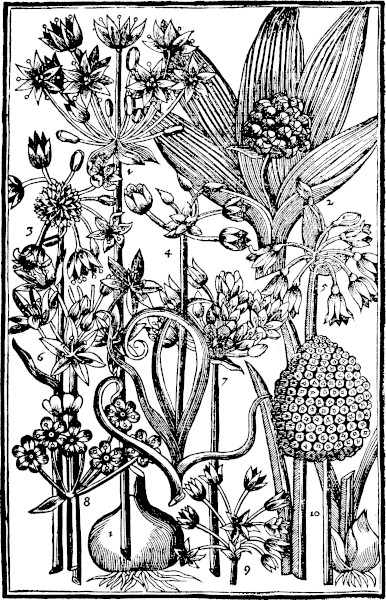
| 1 | Moly Homericum vel potius Theophrasti. The greatest Moly of Homer. |
| 2 | Moly Indicum siue Caucason. The Indian Moly. |
| 3 | Moly Pannonicum bulbiferum. The bulbed Moly of Hungary. |
| 4 | Moly Serpentinum. Serpents Moly. |
| 5 | Moly purpureum Neapolitanum. The purplish Moly of Naples. |
| 6 | Moly caule & folijs triangularibus. The three cornered Moly. |
| 7 | Moly latifolium flore luteo. The yellow Moly. |
| 8 | Moly Dioscorideum Hispanicum. The Spanish Moly of Dioscorides. |
| 9 | Moly Zibettinum vel Moschatinum. The sweete smelling Moly of Mompelier. |
| 10 | Moly serotinum Coniferum. The late Pine apple Moly. |
5. Moly Narcissinis folijs.
Daffodill leafed Moly.
This Moly hath many long, narrow, and flat greene leaues, very like vnto the leaues
of a Daffodill, from whence it tooke his name (or rather of the early greater Leucoium
bulbosum, or bulbed Violet before described, ioyned next vnto the Daffodils, because
it is so like them) among which riseth vp two or three stalkes sometimes, each of a foot
and a halfe high, bearing at the toppe, inclosed in a skinny hose, as all the Molyes
haue, a number of small purplish flowers, which doe not long abide, but quickly fade:
the seede is blacke as others are; the roote is sometimes knobbed, and more often
bulbed, hauing in the knobs some markes of the old stalkes to be seene in them, and
smelleth somewhat like Garlicke, whereby it may be knowne.
6. Moly montanum latifolium luteo flore.
The yellow Moly.
The yellow Moly hath but one long and broad leafe when it doth not beare flower,
but when it will beare flower, it hath two long and broad leaues, yet one alwaies longer
and broader then the other, which are both of the same colour, and neare the bignesse
of a reasonable Tulipa leafe: betweene these leaues groweth a slender stalke, bearing
at the toppe a tuft or vmbell of yellow flowers out of a skinnie hose, which parteth
three wayes, made of six leaues a peece, laid open like a Starre, with a greenish backe
or outside, and with some yellow threeds in the middle: the seede is blacke, like vnto
others: the roote is whitish, two for the most part ioyned together, which encreaseth
quickly, and smelleth very strong of Garlicke, as both flowers and leaues doe also.
7. Moly Pyrenæum purpureum.
The purple mountaine Moly.
This purple Moly hath two or three leaues, somewhat like the former yellow
Moly, but not so broad, nor so white: the stalke hath not so many flowers thereon, but
more sparingly, and of an vnpleasant purple colour: the roote is whitish, smelling
somewhat strongly of Garlicke, but quickly perisheth with the extremity of our cold
Winters, which it will not abide vnlesse it be defended.
8. Moly montanum latifolium purpureum Hispanicum.
The purple Spanish Moly.
This Moly hath two broad and very long greene leaues, like vnto the yellow Moly,
in this, that they doe compasse one another at the bottome of them, between which
riseth vp a strong round stalke, two foote high or more, bearing at the toppe, out of a
thinne huske, a number of faire large flowers vpon long foot-stalkes, consisting of six
leaues a peece, spread open like a Starre, of a fine delayed purple or blush colour, with
diuers threeds of the same colour, tipt with yellow, standing about the middle head:
betweene the stalke and the bottome of the leaues it hath some small bulbes growing,
which being planted, will soone spring and encrease: the roote also being small and
round, with many fibres thereat, hath many small bulbes shooting from them; but
neither roote, leafe, nor flower, hath any ill sent of Garlicke at all.
9. Moly purpureum Neapolitanum.
The purple Moly of Naples.
The Neapolitane Moly hath three of foure small long greene leaues set vpon the
stalke after it is risen vp, which beareth a round head of very fine purple flowers, made
of six leaues a peece, but so closing together at the edge, that they seeme like vnto
small cuppes, neuer laying themselues open, as the other doe; this hath some sent of
his originall, but the roote more then any part else, which is white and round, quickly
encreasing as most of the Molyes doe.
10. Moly pyxidatum argenteum Hispanicum.
The Spanish siluer cupped Moly.
This Spanish Moly hath two or three very long rush like leaues, which rise vp with
the stalke, or rather vanish away when the stalke is risen vp to bee three foote high or
more, bearing a great head of flowers, standing close at the first, but afterwards spreading
much one from another, euery flower vpon a long foote-stalke, being of a white
siluer colour, with stripes or lines on euery side, and fashioned small and hollow, like
a cuppe or boxe: the seede I could neuer obserue, because it flowreth so late, that the
Winter hindereth it from bearing seede with vs: the roote is small and round, white,
and in a manner transparent, at least so shining, as if it were so, and encreaseth nothing
so much, as many of the other sorts: this hath no ill sent at all, but rather a pretty
smell, not to bee misliked.
11. Moly serotinum Coniferum.
The late Pineapple Moly.
This late Moly that was sent me with the last described, and others also from Spain,
riseth vp with one long greene leafe, hollow and round vnto the end, towards this end
on the one side, breaketh out a head of flowers, enclosed in a thinne skinne, which after
it hath so stood a good while, (the leafe in the meane time rising higher, and growing
harder, becommeth the stalke) breaketh, and sheweth a great bush or head of buds for
flowers, thicke thrust together, fashioned very like vnto the forme of a Pineapple (from
whence I gaue it the name) of the bigness of a Walnut: after this head hath stood in this
manner a moneth or thereabouts, the flowers shew themselues to bee of a fine delayed
or whitish purple colour, with diuers stripes in euery of them, of the same cup-fashion
with the former, but not opening so plainly, so that they cannot bee discerned to bee
open, without good heede and obseruation. It flowreth so late in Autume, that the
early frosts doe quickly spoile the beauty of it, and soone cause it to rotte: the roote is
small and round, and shining like the last, very tender also, as not able to abide our
sharpe Winters, which hath caused it vtterly to perish with me.
12. Moly Dioscorideum.
Dioscorides his Moly.
The roote of this small Moly is transparent within, but couered with a thicke yellowish
skinne, of the bignesse of an Hasell Nut, or somewhat bigger, which sendeth
forth three or foure narrow grassie leaues, long and hollow, and a little bending downwards,
of a whitish greene colour, among which riseth vp a slender weake stalke, a foot
and a halfe high, bearing at the toppe, out of a thinne skinne, a tuft of milke white
flowers, very like vnto those of Ramsons, which stand a pretty while in their beauty,
and then passe away for the most part without giuing any seede: this hath little or no
sent of Garlicke.
We haue anothor of this sort that is lesser, and the flowers rounder pointed.
13. Moly Dioscorideum Hispanicum.
The Spanish Moly of Dioscorides.
This Moly came vnto me among other Molyes from Spaine, and is in all things
like vnto the last described, but fairer, larger, and of much more beauty, as hauing his
white flowers twice as great as the former; but (as it seemeth) very impatient of our
Winters, which it could not at any hand endure, but quickly perished, as some others
that came with it also.
14. Moly Moschatinum vel Zibettinum Monspeliense.
The sweete smelling Moly of Mompelier.
This sweete Moly, which I haue kept for the last, to close vp your senses, is
the smallest, and the finest of all the rest, hauing foure or fiue small greene leaues,
almost as fine as haires, or like the leaues of the Feather-grasse: the stalke is about
a foote high, bearing fiue or six or more small white flowers, laid open
like Starres, made of six leaues a peece, of an excellent sweete sent, resembling
Muske or Ciuet; for diuers haue diuersly censured of it. It flowreth late
in the yeare, so that if the precedent Summer bee either ouer moist, or the Autumne
ouer early cold, this will not haue that sweete sent, that it will haue in a
hot drie time, and besides must be carefully respected: for it will hardly abide the
extremity of our sharpe Winters.
The Place.
The places of these Molyes, are for the most part expressed in their titles,
or in their descriptions.
The Time.
The time is set downe, for the most part to bee in Iune and Iuly, the rest
later.
The Names.
To make further relation of names then are expressed in their titles, were
needlesse; let these therefore suffice.
All these sorts of Molyes are small kindes of wilde Garlicke, and are to
be vsed for the same purposes that the great Garden Garlicke is, although
much weaker in their effects. For any other especiall property is in any of
these, more than to furnish a Garden of variety, I haue not heard at all.
And thus much may suffice of these kindes for our Garden, reseruing manie others
that might be spoken of, to a generall worke, or to my Garden of Simples, which as
God shall enable me, and time giue leaue, may shew it selfe to the world, to abide the
iudicious and criticke censures of all.
There remaine some other flowers, like vnto the last described, to be specified,
which although they haue no bulbous rootes, yet I thinke them fittest to bee
here mentioned, that so I may ioyne those of neerest similitude together, vntill
I haue finished the rest that are to follow.
1. Asphodelus maior albus ramosus.
The great white branched Asphodill.
The great white Asphodill hath many long, and narrow, hollow three square
leaues, sharpe pointed, lying vpon the ground round about the roote: the stalke is
smooth, round, and naked without leaues, which riseth from the midst of them, diuided
at the toppe into diuers branches, if the plant bee of any long continuance, or
else but into two or three small branches, from the sides of the maine great one,
whereon doe stand many large flowers Starre-fashion, made of six leaues a peece,
whitish on the inside, and straked with a purplish line downe the backside of euery
leafe, hauing in the middle of the flowers some small yellow threeds: the seede is
blacke, and three square, greater then the seede of Bucke wheate, contained in
roundish heads, which open into three parts: the roote is composed of many tuberous
long clogges, thickest in the middle, and smaller at both ends, fastened together
at the head, of a darke grayish colour on the outside, and yellow within.
2. Asphodelus albus non ramosus.
The white vnbranched Asphodill.
The vnbranched Asphodill is like vnto the former, both in leaues and flowers, but
that the flowers of this are whiter, and without any line or strake on the backe side,
and the stalkes are without branches: the rootes likewise are smaller, and fewer, but
made after the same fashion.
3. Asphodelus maior flore carneo.
The blush coloured Asphodill.
This Asphodill is like to the last in forme of leaues and branches, and differeth in
this, that his leaues are marked with some spots, and the flowers are of a blush or flesh
colour, in all other things alike.
4. Asphodelus minimus albus.
The least white Asphodill.
This least Asphodill hath foure or fiue very narrow long leaues, yet seeming three
square like the greatest, bearing a small stalke, of about a foote high among them,
without any branches, and at the toppe a few white flowers, straked both within and
without, with a purplish line in the middle of euery leafe. The rootes are such like tuberous
clogges as are in the former, but much lesser.
5. Asphodelus albus minor siue Fistulosus.
The little hollow white Asphodill.
This little white Asphodill hath a number of leaues growing thicke together,
thicker and greener then those of the small yellow Asphodill, or Kings Speare next
following, among which riseth vp diuers round stalkes, bearing flowers from the middle
to the toppe, Starre-fashion, with small greene leaues among them, which are
white on the inside, and striped on the backe with purple lines like vnto the first described:
the seede, and heads containing them, are three square, like the seede of the
little yellow Asphodill: the rootes of this kinde are not glandulous, as the former, but
stringie, long and white: the whole plant is very impatient of our cold Winters, and
quickly perisheth, if it be not carefully preserued, both from the cold, and much wet
in the Winter, by housing it; and then it will abide many yeares: for it is not an annuall
plant, as many haue thought.
6. Asphodelus luteus minor, siue Hastula regia.
The small yellow Asphodill, or Kings speare.
This small yellow Asphodill, which is vsually called the Kings speare, hath many
long narrow edged leaues, which make them seeme three square, of a bluish or whitish
greene colour: the stalke riseth vp three foote high oftentimes, beset with small
long leaues vp vnto the very flowers, which grow thicke together spike-fashion one
aboue another, for a great length, and wholly yellow, laid open like a Starre, somewhat
greater then the last white Asphodill, and smaller then the first, which when
they are past yeeld round heads, containing blacke cornered seede, almost three
square: the rootes are many long yellow strings, which spreading in the ground, doe
much encrease.
The Place.
All these Asphodils doe grow naturally in Spaine and France, and from
thence were first brought vnto vs, to furnish our Gardens.
The Time.
All the glandulous rooted Asphodils doe flower some in May, and some
in Iune; but the two last doe flower, the yellow or last, of them in Iuly, and
the former white one in August and September, and vntill the cold and
winter hinder it.
The Names.
Their seuerall names are giuen them in their titles, as much as is fit for
this discourse. For to shew you that the Greekes doe call the stalke of the
great Asphodill Ανθερίκη, and the Latines Albucum, or what else belongeth
to them, is fitter for another worke, vnto which I leaue them.
The bastard Asphodils should follow next in place, if this worke were fit for them;
but because I haue tyed my selfe to expresse onely those flowers and plants, that for
their beauty, or sent, or both, doe furnish a Garden of Pleasure, and they haue none, I
leaue them to a generall History of plants, or that Garden of Simples before spoken of,
and will describe the Lilly Asphodils, and the Phalangia or Spider-worts, which are
remaining of those, that ioyne in name or fashion, and are to be here inserted, before I
passe to the rest of the bulbous rootes.
1. Liliasphodelus phœniceus.
The gold red Day Lilly.
Because the rootes of this and the next, doe so nearely agree with the two last recited
Asphodils, I haue set them in this place, although some doe place them next after
the Lillies, because their flowers doe come nearest in forme vnto Lillies; but whether
you will call them Asphodils with Lilly flowers, as I thinke it fittest, or Lillies with
Asphodill rootes, or Lillies without bulbous rootes, as others doe, I will not contend.
The red Day Lilly hath diuers broad and long fresh greene leaues, folded at the
first as it were double, which after open, and remaine a little hollow in the middle;
among which riseth vp a naked stalke three foot high, bearing at the toppe many flowers,
one not much distant from another, and flowring one after another, not hauing
lightly aboue one flower blown open in a day, & that but for a day, not lasting longer,
but closing at night, and not opening againe; whereupon it had his English name, The
Lilly for a day: these flowers are almost as large as the flowers of the white Lilly, and
made after the same fashion, but of a faire gold red, or Orange tawny colour. I could
neuer obserue any seede to follow these flowers; for they seeme the next day after they
haue flowred, (except the time be faire and dry) to bee so rotten, as if they had lyen in
wet to rotte them, whereby I thinke no seede can follow: the rootes are many thicke
and long yellow knobbed strings, like vnto the small yellow Asphodill rootes, but
somewhat greater, running vnder ground in like sort, and shooting young heads round
about.
2. Liliasphodelus luteus.
The yellow Day Lilly.
I shall not neede to make a repetition of the description of this Day Lilly, hauing
giuen you one so amply before, because this doth agree thereunto so nearely, as that
it might seeme the same; these differences onely it hath, the leaues are not fully so
large, nor the flower so great or spread open, and the colour thereof is of a faire yellow
wholly, and very sweet, which abideth blowne many daies before it fade, and hath
giuen blacke round seede, growing in round heads, like the heads of the small yellow
Asphodill, but not so great.
Clusius hath set downe, that it was reported, that there should be another Liliasphodill
with a white flower, but we can heare of none such as yet; but I rather thinke, that
they that gaue that report might be mistaken, in thinking the Sauoye Spider-wort to
be a white Liliasphodill, which indeede is so like, that one not well experienced, or
not well regarding it, may soone take one for another.
[149]
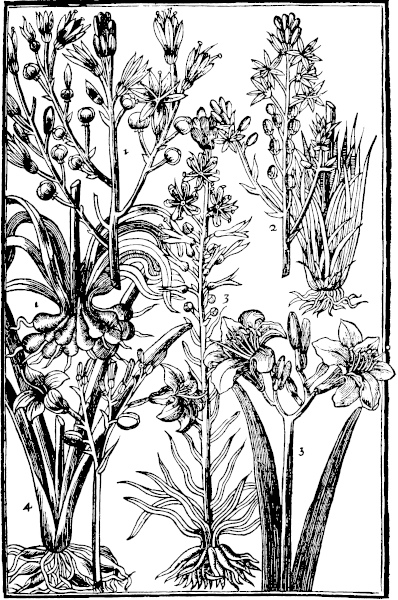
| 1 | Asphodelus maior albus ramosus. The great white branched Asphodill. |
| 2 | Asphodelus minor albus seu fistulosus. The little hollow white Asphodill. |
| 3 | Asphodelus minor luteus, siue Hastula regia. The small yellow Asphodill, or Kings speare. |
| 4 | Liliasphodelus luteus. The yellow Day Lilly. |
| 5 | Liliasphodelus phœniceus. The gold red Day Lilly. |
The Place.
Their originall is many moist places in Germany.
The Time.
They flower in May and Iune.
The Names.
They are called by some Liliago, and Lilium non bulbosum, and Liliasphodelus.
In English we call them both Day Lillies, but the name doth not so
well agree with the last, as with the first, for the causes aboue specified.
The Vertues.
The rootes of Asphodill haue formerly beene had in great account, but
now are vtterly neglected; yet by reason of their sharpnesse they open and
cleanse, and therefore some haue of late vsed them for the yellow Iaundise.
The Day Lillies haue no physicall vse that I know, or haue heard.
These plants doe so nearely resemble those that are last set forth, that I thinke
none that knowes them, will doubt, but that they must follow next vnto them,
being so like vnto them, and therefore of the fairest of this kinde first.
1. Phalangium Allobrogicum.
The Sauoye Spider-wort.
The Sauoye Spider-wort springeth vp with foure or fiue greene leaues, long and
narrow, yet broader at the bottome, narrower pointed at the end, and a little hollow
in the middle; among which riseth vp a round stiffe stalke, a foote and a halfe high,
bearing at the toppe one aboue another, seuen or eight, or more flowers, euery one as
large almost as the yellow Day Lilly last described, but much greater then in any other
of the Spider-worts, of a pure white colour, with some threeds in the middle,
tipt with yellow, and a small forked pointell: after the flowers are past, the heads or
seede vessels grow almost three square, yet somewhat round, wherein is contained
blackish seede: the rootes are many white, round, thicke, brittle strings, ioyned together
at the head, but are nothing so long, as the rootes of the other Phalangia or Spider-worts.
2. Phalangium maius Italicum album.
The great Italian Spider-wort.
This great Spider-wort hath diuers long and narrow leaues spread vpon the ground,
and not rising vp as the former, and not so broad also as the former, but somewhat
larger then those that follow: the stalke is bigger, but seldome riseth vp so high as the
next, whereof this is a larger kinde, hauing a long vnbranched stalke of white flowers,
laid open like starres as it hath, but somewhat greater: the rootes are long and white,
like the next, but somewhat larger.
3. Phalangium non ramosum vulgare.
Vnbranched Spider-wort.
The leaues of this Spider-wort doe seeme to bee little bigger or longer then the
leaues of grasse, but of a more grayish green colour, rising immediately from the head
or tuft of rootes; among which rise vp one or two stalkes, sometimes two or three
foote long, beset toward the toppe with many white Starre-like flowers, which after
they are past turne into small round heads, containing blacke seede, like vnto the seed
of the little yellow Asphodill, but lesser: the rootes are long white strings, running
vnder ground.
4. Phalangium ramosum.
Branched Spider-wort.
The branched Spider-wort hath his leaues somewhat broader then the former, and
of a more yellowish greene colour: the stalke hereof is diuersly branched at the top,
bearing many white flowers, like vnto the former, but smaller: the seedes and rootes
are like the former in all things.
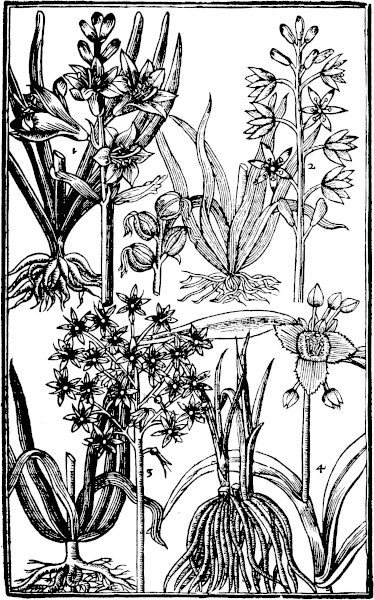
| 1 | Phalangium Allobrogicum. The Sauoye Spider-wort. |
| 2 | Phalangium non ramosum. Vnbranched Spider-wort. |
| 3 | Phalangium ramosum. Branched Spider-wort. |
| 4 | Phalangium Ephemerum Virginianum. Iohn Tradescante’s Spider-wort. |
The Place.
The first groweth on the Hils neare vnto Sauoye, from whence diuers,
allured with the beauty of the flower, haue brought it into these parts.
The second came vp in my Garden, from the seede receiued out of Italy.
The others grow in Spaine, France, &c.
The Time.
The vnbranched Spider-wort most commonly flowreth before all the
other, and the branched a moneth after it: the other two about one time,
that is, towards the end of May, and not much after the vnbranched kinde.
The Names.
The first (as I said before) hath beene taken to be a white Lilliasphodill,
and called Liliasphodelus flore albo; but Clusius hath more properly entituled
it a Phalangium, and from the place of his originall, gaue him his other
denomination, and so is called of most, as is set downe in the title.
The other haue no other names then are expressed in their titles, but only
that Cordus calleth them Liliago; and Dodonæus, lib. 4. hist. plant. would
make the branched kinde to bee Moly alterum Plinij, but without any good
ground.
The Vertues.
The names Phalangium and Phalangites were imposed on these plants,
because they were found effectual, to cure the poyson of that kinde of Spider,
called Phalangium, as also of Scorpions and other Serpents. Wee doe
not know, that any Physitian hath vsed them to any such, or any other purpose
in our dayes.
5. Phalangium Ephemerum Virginianum Ioannis Tradescant.
The soon fading Spider-wort of Virginia, or Tradescant his Spider-wort.
This Spider-wort is of late knowledge, and for it the Christian world is indebted
vnto that painfull industrious searcher, and louer of all natures varieties, Iohn Tradescant
(sometimes belonging to the right Honourable Lord Robert Earle of Salisbury,
Lord Treasurer of England in his time, and then vnto the right Honourable the Lord
Wotton at Canterbury in Kent, and lastly vnto the late Duke of Buckingham) who
first receiued it of a friend, that brought it out of Virginia, thinking it to bee the Silke
Grasse that groweth there, and hath imparted hereof, as of many other things, both to
me and others; the description whereof is as followeth:
From a stringie roote, creeping farre vnder ground, and rising vp againe in many
places, springeth vp diuers heads of long folded leaues, of a grayish ouer-worne
greene colour, two or three for the most part together, and not aboue, compassing one
another at the bottome, and abiding greene in many places all the Winter; other-where
perishing, and rising anew in the Spring, which leaues rise vp with the great
round stalke, being set thereon at the ioynts, vsually but one at a ioynt, broad at the
bottome where they compasse the stalke, and smaller and smaller to the end: at the
vpper ioynt, which is the toppe of the stalke, there stand two or three such like leaues,
but smaller, from among which breaketh out a dozen, sixteene, or twenty, or more
round green heads, hanging downe their heads by little foot-stalkes, which when the
flower beginneth to blow open, groweth longer, and standeth vpright, hauing three
small pale greene leaues for a huske, and three other leaues within them for the flower,
which lay themselues open flat, of a deepe blew purple colour, hauing an vmbone or
small head in the middle, closely set about with six reddish, hairy, or feathered threeds,
tipt with yellow pendents: this flower openeth it selfe in the day, & shutteth vsually at
night, and neuer openeth againe, but perisheth, and then hangeth downe his head againe;
the greene huske of three leaues, closing it selfe againe into the forme of a head,
but greater, as it was before, the middle vmbone growing to bee the seede vessell,
wherein is contained small, blackish, long seede: Seldome shall any man see aboue
one, or two at the most of these flowers blowne open at one time vpon the stalke,
whereby it standeth in flowring a long time, before all the heads haue giuen out their
flowers.
The Place.
This plant groweth in some parts of Virginia, and was deliuered to Iohn
Tradescant.
The Time.
It flowreth from the end of May vntill Iuly, if it haue had greene leaues
all the Winter, or otherwise, vntill the Winter checke his luxuriousnesse.
The Names.
Vnto this plant I confesse I first imposed the name, by considering duely
all the parts thereof, which vntill some can finde a more proper, I desire
may still continue, and to call it Ephemerum Virginianum Tradescanti, Iohn
Tradescante’s Spider-wort of Virginia, or Phalangium Ephemerum Virginianum,
The soone fading or Day Spider-wort of Virginia.
The Vertues.
There hath not beene any tryall made of the properties since wee had it,
nor doe we know whether the Indians haue any vse thereof.
To returne to the rest of the bulbous and tuberous rooted plants, that remaine
to bee entreated of, the Colchica or Medowe Saffrons are first to bee handled,
whereof these later dayes haue found out more varieties, then formerly were
knowne; some flowring in the Spring, but the most in Autumne, and some bearing
double, but the greatest part single flowers: whereof euery one in their order, and
first of our owne Country kindes.
It is common to all the Medowe Saffrons, except that of the Spring, and one other,
to beare their flowers alone in Autumne or later, without any green leaues with them,
and afterwards in February, their greene leaues: So that I shall not neede to make manie
descriptions, but to shew you the differences that consist in the leaues, and colours
of the flowers; and briefly to passe (after I haue giuen you a full description of the
first) from one vnto another, touching onely those things that are note worthy. The
white English Medowe Saffron then doth beare in Autumne three or foure flowers at
the most, standing seuerally vpon weake foote-stalkes, a fingers length or more aboue
the ground, made of six white leaues, somewhat long and narrow, and not so large as
most of the other kindes, with some threeds or chiues in the middle, like vnto the
Saffron flowers of the Spring, wherein there is no colour of Saffron, or vertue to that
effect: after the flowers are past and gone, the leaues doe not presently follow, but
the roote remaineth in the ground without shew of leafe aboue ground, most part of
the Winter, and then in February there spring vp three or foure large and long greene
leaues, when they are fully growne vp, standing on the toppe of a round, weake, green,
and short foote-stalke, somewhat like the leaues of white Lillies, but not so large, and
in the middest of these leaues, after they haue been vp some time, appeare two or three
loose skinny heads, standing in the middle of the leaues vpon short, thicke, greene
stalkes, and being ripe, conteine in them round small brownish seede, that lye as it
were loose therein, and when the head is dry, may bee heard to rattle being shaken:
the roote is white within, but couered with a thicke blackish skinne or coate, hauing
one side thereof at the bottome longer then the other, with an hollownesse also on
the one side of that long eminence, where the flowers rise from the bottome, and
shooting downe from thence a number of white fibres, whereby it is fastened in the
ground: the greene leaues afterwards rising from the top or head of the roote.
There is no difference at all in this Medowe Saffron from the former, but only in the
colour of the flowers, which as they were wholly white in the former, so in this they
are of a delayed purple colour, with a small shew of veines therein.
The greatest difference in this Colchicum from the former English white one, is, that
it is larger both in roote, leafe, and flower, and besides, hath more store of flowers together,
and continuing longer in beauty, without fading so soone as the former, and
are also somewhat of a fairer white colour.
This purple Medowe Saffron is somewhat like vnto the white of this kinde, but that
it beareth not so plentifully as the white, nor doth the roote grow so great; but the
flowers are in a manner as large as they, and of the like pale delayed purple colour, or
somewhat deeper, as is in the purple English, with some veines or markes vpon the
flowers, making some shew of a checker on the out side, but not so conspicuous, as in
the true checkerd kindes. Wee haue a kinde hereof is party coloured with white
streakes and edges, which abide constant, and hath been raised from the seede of the
former.
This Medowe Saffron of Constantinople hath his leaues so broad and large, that
hardly could any that neuer saw it before, iudge it to be a Colchicum; for they are much
larger then any Lilly leaues, and of a darke greene colour: the flowers are correspondent
to the leaues, larger and more in number then in any of the former purple kindes,
of the same colour with the last purple kinde, but of a little deeper purple on the inside,
with diuers markes running through the flowers, like vnto it, or vnto checkers,
but yet somewhat more apparently: the roote is in the middle greater and rounder
then the others, with a longer eminence, whereby it may easily bee knowne from all
other sorts.
The flowers of this Medowe Saffron are larger and longer then the flowers of either
the English or Hungarian, and almost as large as the last before mentioned, and of the
same colour, but a little deeper, the spots and markes whereof are somewhat more
easie to be seene euen a farre off, like vnto the flower of a Fritillaria, from whence it
tooke his significatiue name: the leaues of this Medowe Saffron doe rise vp sooner
then in any other of the Autumne kindes, for they are alwayes vp before Winter, and
are foure or fiue in number, short rather then long, broad belowe, and pointed at the
end, canaled or hollow, and standing round aboue the ground, one encompassing another
at the bottome, like the great Spanish Starre Iacinth, called the Iacinth of Peru,
but shorter, and of a pale or grayish greene colour, differing from the colour of all
the other Medowe Saffrons: the roote is like the roote of the English or Hungarian
without any difference, but that it groweth somewhat greater. It is one of the first Medowe
Saffrons that flower in the Autumne.
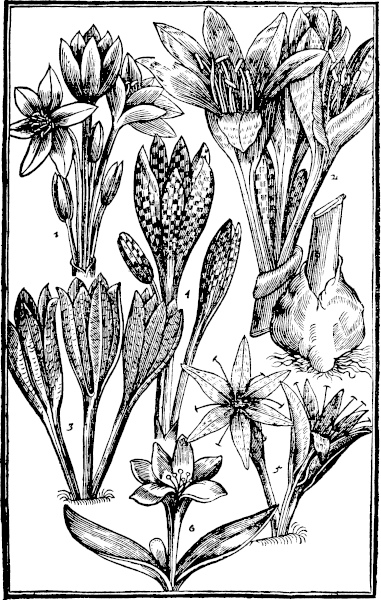
| 1 | Colchicum Pannonicum. The Hungarian Medow Saffron. |
| 2 | Colchicum Byzantinum. Medowe Saffron of Constantinople. |
| 3 | Colchicum Lusitanicum Fritillaricum. The checkerd Medowe Saffron of Portugall. |
| 4 | Colchicum Neapolitanum Fritillaricum. The checkerd Medowe Saffron of Naples. |
| 5 | Colchicum Fritillaricum Chiense. The Checkerd Medowe Saffron of Chio or Sio. |
| 6 | Colchicum Hermodactylum. Physicall Medowe Saffron. |
[156]
This checkerd Medowe Saffron of Naples, is very like vnto the last recited checkerd
Saffron of Portugall, but that the flower is somewhat larger, yet sometimes very
little, or not at all: the greatest marke to distinguish them is, that the flowers of this
are of a deeper colour, and so are the spots on the flowers likewise, which are so conspicuous,
that they are discerned a great way off, more like vnto the flowers of a deepe
Fritillaria, then the former, and make a goodlier and a more glorious shew: the leaues
of this doe rise vp early after the flowers, and are somewhat longer, of a darker greene
colour, yet bending to a grayish colour as the other, not lying so neatly or round, but
stand vp one by another, being as it were folded together: neither of both these last
named checkerd Medowe Saffrons haue giuen any seede in this Countrey, that euer I
could learne or heare of, but are encreased by the roote, which in this is like the former,
but a little bigger.
This most beautifull Saffron flower riseth vp with his flowers in the Autumne, as
the others before specified doe, although not of so large a size, yet farre more pleasant
and delightfull in the thicke, deepe blew, or purple coloured beautifull spots therein,
which make it excell all others whatsoeuer: the leaues rise vp in the Spring, being
smaller then the former, for the most part three in number, and of a paler or fresher
greene colour, lying close vpon the ground, broad at the bottome, a little pointed at
the end, and twining or folding themselues in and out at the edges, as if they were indented.
I haue not seene any seede it hath borne: the roote is like vnto the others of
this kinde, but small and long, and not so great: it flowreth later for the most part then
any of the other, euen not vntill Nouember, and is very hard to be preserued with vs,
in that for the most part the roote waxeth lesse and lesse euery yeare, our cold Country
being so contrary vnto his naturall, that it will scarce shew his flower; yet when it
flowreth any thing early, that it may haue any comfort of a warme Sunne, it is the
glorie of all these kindes.
The flowers of this Medowe Saffron most vsually doe not appeare, vntill most of
the other Autumne sorts are past, except the last, which are very lowe, scarce rising
with their stalkes three fingers breadth aboue the ground, but oftentimes halfe hid
within the ground: the leaues whereof are smaller, shorter, and rounder, then in any of
the other before specified, some being altogether white, and others wholly of a very
pale purple, or flesh colour; and some againe parted, the one halfe of a leafe white,
and the other halfe of the same purple, and sometimes striped purple and white, in diuers
leaues of one and the same flower: and againe, some will be the most part of the
leafe white, and the bottome purple, thus varying as nature list, that many times from
one roote may bee seene to arise all these varieties before mentioned: these flowers doe
stand long before they fade and passe away; for I haue obserued in my Garden some
that haue kept their flower faire vntill the beginning of Ianuary, vntill the extremitie
of the Winter frosts and snowes haue made them hide their heads: the leaues therefore
accordingly doe rise vp after all other, and are of a brownish or darke greene colour
at their first springing vp, which after grow to be of a deepe greene colour: the
roote is like the former English or Hungarian kindes, but thicker and greater for the
most part, and shorter also.
There is another, whose party coloured flowers rise a little higher, diuersly striped
and marked, with a deeper purple colour, and a pale or whitish blush throughout all
the leaues of the flower.
The flowers of this little Medowe Saffron are narrower and smaller then any of the
former, and of a deeper reddish purple colour then either the English or Hungarian
kindes: the greene leaues also are smaller then any other, lying on the ground, of a
deepe or sad greene colour, rising vp within a while after the flowers are past, and doe
abide greene all the Winter long: the roote is small and long, according to the rest of
the plant, and like in forme to the others.
This little kinde differeth not from the Spanish kinde last set forth, but in the varietie
of the flower, which is as small as the former; the three inner leaues being almost
all white, and the three outer leaues some of them pale or blush, and some party coloured,
with a little greene on the backe of some of them.
This Physicall Medowe Saffron springeth vp with his leaues in Autumne, before
his flowers appeare beyond the nature of all the former kindes, yet the flower doth,
after they are vp, shew it selfe in the middle of the greene leaues, consisting of six white
leaues, with diuers chiues in the middle, and passeth away without giuing any seede
that euer I could obserue: the greene leaues abide all the Winter and Spring following,
decaying about May, and appeare not vntill September, when (as I said) the flowers
shew themselues presently after the leaues are sprung vp.
The greatest difference in this kinde consisteth in the flower, which at the first appearing
is as pale a purple, as the flower of the former Hungarian kinde: but after it
hath stood in flower two or three dayes, it beginneth to change, and will after a while
become to bee of a very deepe reddish purple colour, as also the little foote-stalke
whereon it doth stand: the flower is of the bignesse of the Hungarian purple, and so is
the greene leafe: the seede and roote is like the English purple kinde.
We haue of late gained another sort of this kinde, differing chiefly in the flower,
which is diuersly striped thorough euery leafe of the flower, with a paler purple colour,
whereby the flower is of great beauty: this might seeme to bee a degeneration
from the former, yet it hath abiden constant with me diuers yeares, and giueth seede
as plentifully as the former.
The double Medowe Saffron is in roote and leafe very like unto the English kinde:
the flowers are of a fine pale or delayed purple colour, consisting of many leaues set
thicke together, which are somewhat smaller, as in the English flower, being narrow
and long, and as it were round at the points, which make a very double flower, hauing
some chiues with their yellow tips, dispersed as it were among the leaues in the middle:
it flowreth in September, a little after the first shew of the earlier Medowe Saffrons
are past.
We haue another of these double kinds (if it be not the very same with the former,
varying in the flower as nature pleaseth oftentimes; for I haue this flower in my garden,
as I here set it forth, euery yeare) whose flowers are diuersified in the partition of the
colours, as is to be seene in the single party coloured Medowe Saffron before described,
hauing some leaues white, and others pale purple, and some leaues halfe white
and halfe purple, diuersly set or placed in the double flower, which doth consist of as
many leaues as the former, yet sometime this party coloured flower doth not shew it
selfe double like the former, but hath two flowers, one rising out of another, making
each of them to be almost but single flowers, consisting of eight or ten leaues a peece:
but this diuersity is not constant; for the same roote that this yeare appeareth in that
manner, the next yeare will returne to his former kinde of double flowers againe.
This Medowe Saffron riseth vp very early in the yeare, that is, in the end of Ianuarie
sometimes, or beginning, or at the furthest the middle of February, presently after
the deepe Frosts and Snowes are past, with his flowers inclosed within three greene
leaues, which opening themselues as soone almost as they are out of the ground, shew
their buds for flowers within them very white oftentimes, before they open farre, and
sometimes also purplish at their first appearing, which neuer shew aboue two at the
most vpon one roote, and neuer rise aboue the leaues, nor the leaues much higher then
they, while they last: the flower consisteth of six leaues, long and narrow, euery leafe
being diuided, both at the bottome and toppe, each from other, and ioyned together
onely in the middle, hauing also six chiues, tipt with yellow in the middle, euery chiue
being ioyned to a leafe, of a pale red or deepe blush colour, when it hath stood a while
blowne, and is a smaller flower then any Medowe Saffron, except the small Spanish
kindes onely, but continueth in his beauty a good while, if the extremity of sharpe
Frosts and Windes doe not spoile it: the leaues wherein these flowers are enclosed, at
their first comming vp, are of a brownish greene colour, which so abide for a while,
especially on the outside, but on the inside they are hollow, and of a whitish or grayish
greene colour, which after the flowers are past, grow to bee of the length of a mans
longest finger, and narrow withall: there riseth vp likewise in the middle of them the
head or seede vessell, which is smaller and shorter, and harder then any of the former,
wherein is contained small round browne seede: the roote is small, somewhat like vnto
the rootes of the former, but shorter, and not hauing so long an eminence on the
one side of the bottome.
The flower of this Medowe Saffron, is in the rising vp of his leaues and flowers together,
and in all things else, like vnto the former, onely the flowers of this sort are at
their first appearing of a deeper purple colour, and when they are blowne also are
much deeper then the former, diuided in like manner, both at the bottome and toppe
as the other, so that they seeme, like as if six loose leaues were ioyned in the middle
part, to make one flower, and hath his small chiues tipt with yellow, cleauing in like
manner to euery leafe.
[159]
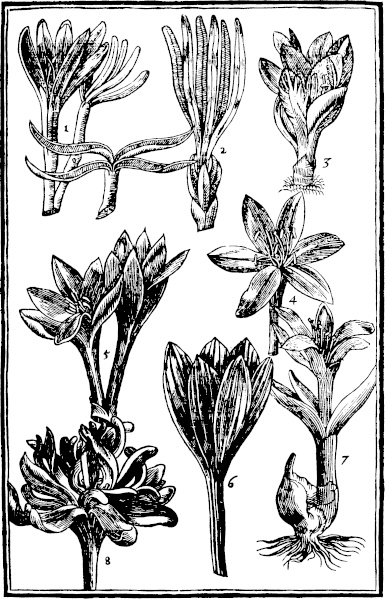
| 1 | Colchicum montanum Hispanicum. The little Spanish Medowe Saffron. |
| 2 | Colchicum montanum minus versicolore flore. The small party coloured Medowe Saffron. |
| 3 | Colchicum versicolor. The party coloured Medowe Saffron. |
| 4 | Colchicum variegatum alterum. Another party coloured Medowe Saffron. |
| 5 | Colchicum atropurpureum. The darke purple Medowe Saffron. |
| 6 | Colchicum atropurpureum variegatum. The variable darke purple Medowe Saffron. |
| 7 | Colchicum vernum. Medowe Saffron of the spring. |
| 8 | Colchicum flore pleno. Double Medowe Saffron. |
All these Medowe Saffrons, or the most part of them, haue their places
expressed in their titles; for some grow in the fields and medowes of the
champion grounds, others on the mountaines and hilly grounds. The
English kindes grow in the West parts, as about Bathe, Bristow, Warmister,
and other places also. The double kindes are thought to come out of
Germany.
Their times likewise are declared in their seuerall descriptions: those
that are earliest in Autumne, flower in August and September, the later
in October, and the latest in the end of October, and in November. The
other are said to bee of the Spring, in regard they come after the deepe of
Winter (which is most vsually in December and Ianuary) is past.
The generall name to all these plants is Colchicum, whereunto some haue
added Ephemerum, because it killeth within one dayes space; and some
Strangulatorium. Some haue called them also Bulbus Agrestis, and Filius ante
Patrem, The Sonne before the Father, because (as they thinke) it giueth
seede before the flower: but that is without due consideration; for the root
of this (as of most other bulbous plants) after the stalke of leaues and seede
are dry, and past, may be transplanted, and then it beginneth to spring and
giue flowers before leaues, (and therein onely it is differing from other
plants) but the leaues and seede follow successiuely after the flowers, before
it may be remoued againe; so that here is not seede before flowers, but contrarily
flowers vpon the first planting or springing, and seede after, as in all
other plants, though in a diuers manner.
The Colchicum Hermodactilum may seeme very likely to bee the Colchicum
Orientale of Matthiolus, or the Colchicum Alexandrinum of Lobelius: And
some thinke it to be the true Hermodactilus, and so call it, but it is not so. We
doe generally call them all in English Medowe Saffrons, or Colchicum, according
to the Latine, giuing to euery one his other adiunct to know it by.
None of these are vsed for any Physicall respect, being generally held
to be deadly, or dangerous at the least. Only the true Hermodactile (if it be
of this tribe, and not this which is here expressed) is of great vse, for paines
in the ioynts, and of the hippes, as the Sciatica, and the like, to be taken inwardly.
Costæus in his Booke of the nature of plants, saith, that the rootes
of our common kindes are very bitter in the Spring of the yeare, and sweet
in Autumne, which Camerarius contradicteth, saying, that he found them
bitter in Autumne, which were (as he saith) giuen by some imposters to diuers,
as an antidote against the Plague.
There are diuers sorts of Saffrons, whereof many doe flower in the Spring
time, and some in Autumne, among whom there is but one onely kinde, that
is called tame or of the Garden, which yeeldeth those blades or chiues that are
vsed in meates and medicines, and many wayes profitable for other respects, none of
the rest, which are all wilde kindes, giuing any blade equall vnto those of the tame
kinde, or for any other vse, then in regard of their beautifull flowers of seuerall varieties,
and as they haue been carefully sought out, and preserued by diuers, to furnish a
Garden of dainty curiosity. To entreate therefore of these, I must, to obserue an orderly
declaration, diuide them into two primary families: the former shall be of those
that yeeld their pleasant flowers in the Spring of the yeare, and the other that send out
their colours in the Autumne, among whom that Rex pomarij (as I may so call it) the
tame or manured kinde, properly called of the Garden, is to be comprehended, for
that it giueth his pleasant flowers at that time among others. I shall againe distribute
those of the Spring time into three chiefe colours, that is, into white, purple, and yellow,
and vnder euery one of them, comprehend the seuerall varieties that doe belong
vnto them; which course I will also hold with those of the Autumne, that thus being
rightly ranked, they may the more orderly be described.
1. Crocus Vernus albus purus minor.
The smaller pure white Saffron flower of the Spring.
This small Saffron flower springeth vp in the beginning of the yeare, with three or
foure small greene leaues, somewhat broader, but much shorter then the true Saffron
leaues, with a white line downe the middle of euery leafe: betweene these leaues, out
of a white skinne, riseth vp one or two small flowers, made of six leaues a peece, as all
the rest in generall are, of a pure white colour, without any mixture in it, which abide
not in flower aboue a weeke, or rather lesse, so sodainly is the pleasure of this, and the
purple lost: it flowreth not for the most part, vntill a moneth after the yellow Crocus
appeareth in flower, and the ordinary stript Crocus is past: the seede is small, round,
and reddish, yet not so red as the seede of the yellow, contained in three square heads,
yet seldome beareth, but encreaseth by the roote plentifully enough, which is small,
round, and flat at the bottome, somewhat white on the outside, but whiter within,
shooting out small sprouts on euery side of the roote, which is the best note to know
this kinde and the lesser purple, which are both alike, from all other rootes of Saffron
flowers.
2. Crocus albus maior multiflorus.
The great snow white Crocus.
This greater Saffron flower riseth vp vsually with three or foure greene leaues,
larger then the former, with a white line in euery one of them: the flowers are greater,
and more in number, rising together, but flowring one after another, of a pure
snow white colour, and abiding but little longer in flower then the former.
3. Crocus albus maior alter dictus Mæsiacus.
The great white Saffron flower or Crocus of Mesia.
This great white Crocus of Mesia, riseth vp out of the ground, almost as early as the
first sort of the yellow, with foure or fiue leaues, being very like vnto the leaues of the
yellow Crocus, and as large, with white lines in them: the flowers also are as large as
the flowers of the yellow, and many also rising one after another like vnto it, but not
of so pure a white colour, as the former or last described, but rather tending to a Milky
or Creame colour: the roote is not couered with any reddish, but rather pale skinnes
or coates.
4. Crocus albus Mæsiacus fundo violaceo.
The great white Crocus of Mesia with a blew bottome.
There is another of this kinde, like vnto the former in all things, sauing that the bottomes
of the flowers of this kinde, with some part of the stalke next the flower, are of a
pale shining purple colour, and rising vp a pretty way into the flower; whereas another
also of this kind, hath a little shew or marke of blew, and not purple, at the bottome of
the flower onely, which maketh a difference.
5. Crocus albus fundo purpureo.
The white Crocus with a purple bottome.
This Saffron flower is of the same kinde with the first, both in roote, leafe, and
flower, in none of them differing from it, but in that the bottome of this flower, with
that part of the short foote-stalke next vnto it, is of violet or purple colour, and
sometimes hauing here and there some purple small lines, or spots on the white leaues:
it flowreth also with the first white, or somewhat later.
6. Crocus vernus albus striatus.
The white stript Crocus.
This stript Saffron flower is likewise neare the same first kind, or first white Crocus,
hauing the like leaues and flowers, somewhat larger, but as soone fading almost as it:
but herein this flower differeth, that it hath pale blewish lines and spots in all the
leaues thereof, and more principally in the three outer leaues: the root is also white on
the outside, like the first white, but greater, with young ones growing round about it.
7. Crocus vernus albus polyanthos versicolor.
The greater party coloured white Crocus.
The greater party coloured Saffron flower, hath his greene leaues like vnto the second
great white Crocus before mentioned, hauing more flowers then any of the former,
except the first great white, the leaues whereof haue greater stripes then the last
recited Crocus, but of a purple Violet colour, making each leafe seeme oftentimes to
haue as much purple as white in them: the roote hereof is somewhat like the second
white, but of a little more duskie colour on the outside, and not budding out on the
sides at all, or very little.
8. Crocus vernus albus versicolor.
The lesser party coloured white Crocus.
The leaues and flowers of this other party coloured Crocus, are for bignesse in a
manner equall with the last, but hath not so many flowers rising together from the
roote: the flower is finely marked with blew strakes on the white flower, but nothing
so much as in the former: the roote also is like the last.
9. Crocus Episcopalis.
The Bishops Crocus.
This party coloured or Bishops Saffron flower, is very like both in leaues and rootes
vnto the Neapolitane blew Crocus, but somewhat greater: the flowers doe abide not
so long time blowne, and hath all the leaues either wholly white, with blew stripes on
both sides of them, or wholly of a fine delayed blew Violet colour, and the three innermost
more blew and finely striped, both on the inside and outside of them, and
sometimes it hath been seen to haue three leaues white, and three leaues of a pale blew.
10. Crocus vernus striatus vulgaris.
The ordinary stript Crocus.
There is another sort of stript Saffron flower, which is most common and plentifull
in most Gardens, which I must needes bring vnder the ranke of these white kinds,
although it differre very notably, both in roote, leafe, and flower, from all of them:
the leaues of this rise vp sooner then the yellow or white Crocus, lying spread vpon
the ground for the most part, but narrower then any of the former: among these leaues
spring vp diuers flowers, almost as large as the former great white Crocus, of a very
bleake or pale purple colour, tending to white on the inside, and in many almost white,
with some small whitish chiues tipt with yellow in the middle: the three outer leaues
are of a yellowish white colour on the backe side of them, stript euery one of them
with three broad stripes, of a darke murrey or purple colour, and a little sprinkled with
some small purple lines, on both sides of those stripes; but on the inside, of the same
pale purple or white colour with the rest: the seede hereof is somewhat darker coloured
then of the white, and is more liberall in bearing: the roote is differing from all
the former, being rounder and bigger then any of them, except the kindes of Misia,
yet somewhat flat withall, not hauing any shootes from the sides, but setting off into
rootes plentifully, hauing a round circle compassing the bottome of the roote, which
easily falleth away, when it is taken vp out of the ground, and couered with a browne
coate, somewhat neare the colour of the yellow Crocus, but not altogether so
bright: it flowreth vsually the first of all these sorts, or with the first of the early yellowes.
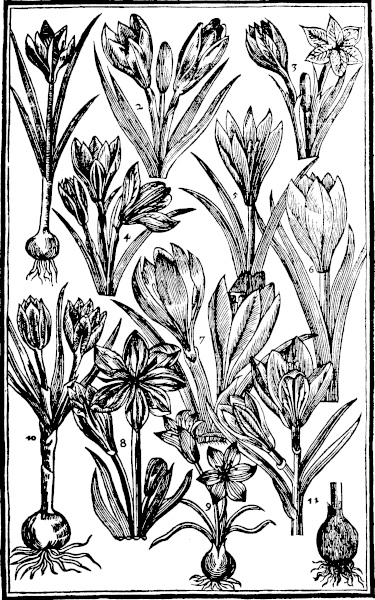
| 1 | Crocus vernus albus minor. The small white Saffron flower of the spring. |
| 2 | Crocus vernus Mæsiacus albus. The great white Crocus of Misia. |
| 3 | Crocus vernus albus striatus. The white stript Crocus. |
| 4 | Crocus vernus albus polyanthos versicolor. The party coloured white Crocus. |
| 5 | Crocus albus fundo purpureo. The white Crocus with a purple bottome. |
| 6 | Crocus vernus Neapolitanus. The great blew Crocus of Naples. |
| 7 | Crocus vernus purpureus maximus. The great purple Crocus. |
| 8 | Crocus vernus purpureus striatus. The purple stript Crocus. |
| 9 | Crocus vernus purpureus Capillarifolio. The purple Crocus with small leaues. |
| 10 | Crocus vernus flavus striatus. The yellow stript Crocus. |
| 11 | Crocus vernus luteus versicolor. The cloth of gold Crocus. |
11. Crocus vernus striatus Turcitus.
The Turkie stript Crocus.
There is another of this kinde, whose flower is a little larger, and of a deeper purple
colour, both on the inside and outside; the greene leafe also is bigger, and of a more
whitish colour.
12. Crocus vernus Capillarifolio albus.
The white Crocus with small leaues.
This white Crocus is in all things like vnto the purple of the same kinde, but that
the flower of this is wholly white: the full description therefore hereof, you shall haue
in that purple with small leaues, of this kinde hereafter set downe, whereunto I referre
you.
13. Crocus vernus purpureus minor.
The smaller purple Crocus.
The smaller purple Saffron flower of the Spring, hath his greene leaues so like vnto
the first white flowred Saffron, that they can hardly be distinguished, onely they seem
to bee a little narrower: the flower is also much about the same bignesse, or a little
bigger, and seldome beareth aboue one flower from a roote, euen as the first doth, of a
deepe purple Violet colour, the bottome of the flower, with the vpper part of the
stalke next thereunto, being of a deeper or blacker purple; in the middle of the flower
are some pale chiues tipt with yellow pendents, and a longer pointell, diuided or forked
at the toppe: the roote of this is in all things so like vnto the first white, that it is
impossible for the most cunning and conuersant in them, to know the one from the other.
This beareth seede very sparingly, as the white doth, and is reddish like vnto it,
but recompenseth that defect with a plentifull encrease by the roote: it likewise flowereth
at the very same time with the white, and endureth as small a time.
14. Crocus vernus purpureus maximus.
The greatest purple Crocus.
This great purple Crocus is of the same kinde with the next described, as well in
roote as leafe, but greater; for the greene leaues hereof are the greatest and broadest of
all other Crocus, with a large white line in the middle of euery one: it springeth vp
much later then the former, and doth not shew his flower vntill the other bee past a
good while: the flowers also are the largest of all these Crocus of the Spring time, and
equalling, if not surpassing that purple kinde that flowreth in Autumne, hereafter set
forth, of a very faire and deepe Violet colour, almost as deepe as the former: the seed
vessels are large also and white, wherein is contained pale reddish seede, like vnto the
next blew kinde, but somewhat greater: the roote is (as I said before) like vnto the
next, that is, flat and round, with a duskie coloured outside, whose head for springing
in it is as hardly discerned.
Alter Apicibus
albidis.
We haue one of this kinde, the toppes onely of whose purple flower are whitish,
for the breadth of halfe the naile of a mans hand, which abideth constant euery yeare
in that manner, and therefore is a difference fit to be remembred.
15. Crocus vernus Neapolitanus siue cæruleus maior.
The greater blew Crocus of Naples.
This great blew Crocus riseth vp with diuers greene leaues, broader then any of
the former (except the last) with a white line running downe the inside of euery leafe,
as in the former, among which riseth vp, out of diuers great long white skinnes, diuers
large flowers, but not fully so great as the former, consisting of six leaues, of a paler
blew or Violet colour then in the former, hauing in the middle of the flowers a few
pale threeds, tipt with yellow, and a longer pointell of a gold yellow colour, forked
or diuided at the toppe, smelling sweeter then in the former, and abiding a great while
longer, being in flower vsually euen with the stript yellow Crocus, or before the former
purple, and yeelding more plenty of seede: the roote hereof is not very great, but
a little darke on the outside, being round and flat withall, that one can hardly know
which is the vpperside thereof.
Crocus Neapolitanus
præcocior.
This kinde differeth very little from the former, either in roote, leafe, or flower,
for the bignesse or colour, but that it seemeth to be a little bleaker or paler blew, because
it flowreth a little earlier.
16. Crocus vernus purpureus striatus.
The stript purple Crocus.
The leaues of this stript purple Saffron flower, are as large and broad as the last, or
rather a little longer: the flowers also are as plentifull, and as large, of a fine delayed
purple colour on the outside, with three broad strakes or lines downe the backe of the
three outer leaues, and of a little deeper purple on the inside, as the other three leaues
are also of a deeper purple colour, and are striped with the same deepe purple about
the ground, or bottome of the leaues: this sometimes yeeldeth three square heads,
containing in them brownish seede: the roote is like vnto the last, and flowreth much
about the time of the former.
17. Crocus vernus purpureus versicolor.
The siluer stript purple Crocus.
This stript Saffron flower, is in leaues and flowers somewhat like vnto the last stript
purple, but a little smaller: the flowers are of a little deeper purple through the whole
leaues, striped with white lines, both on the leaues, and towards the edges, which maketh
a peculiar difference from all the rest: the roote of this is not so flat, though like
it, and couered with a darke ash coloured skinne: it flowreth about the same time.
18. Crocus purpureus flammeus maior.
The greater purple flame coloured Crocus.
The greene leaues of this Crocus or Saffron flower, are of a reasonable breadth and
length, and of a pleasant fresh greenesse, with a faire broad white line downe the
middle of them, but rising not out of the ground so early as the next described Crocus:
the flowers are likewise of a meane bignesse, of a pale purple on the outside,
somewhat whitish, especially the three outer leaues; but on the inside of a deeper purple,
and striped with great stripes like flames, hauing some chiues in the middle, and a
longer one also feathered a little at the toppe: the roote is white on the outside, somewhat
flat and round, but not so flat as the Neapolitane Crocus before described.
19. Crocus purpureus flammeus minor.
The lesser purple flame coloured Crocus.
This Crocus hath almost as broad and long greene leaues as the former, and of the
same verdure, which rise vp earlier then it, and is in flower likewise somewhat before
it, being smaller for size by a little, but of as deepe a purple on the outside, as on the
inside, flamed with faire broad stripes from the middle of the leaues, or somewhat
lower vnto the edges: each of these giue seed that is of a pale reddish colour: the root
is very like vnto the former, but a little lesser.
20. Crocus vernus purpureus Capillarifolio.
The purple Crocus with small leaues.
This small kinde of Saffron flower riseth out of the ground, with two or three long
and small green leaues, very like vnto the leaues of the fine Fether-Grasse hereafter described,
standing vpright at the first, but afterwards lying vpon the ground; among
which come the flowers, sometimes three, but most vsually two vpon one stalke, if
the roote be not young, which then will beare but one on a stalke, which is very short,
so that the flowers scarce arise aboue the ground, yet laying themselues open in the
day time, if it be faire, and the Sunne doe shine, otherwise they keepe close, and doe
not open at all: and after one flower is past, which doth not last aboue three or foure
dayes at the most, the others follow, which are of a bleake blewish purple in the middle
of the flower, and of a deeper purple towards the ends or points or the leaues, but
of a more sullen or darke purple on the outside of them, and yellowish at the bottome,
with some yellow chiues in the middle: the seede is small and darker coloured then
any of the former Crocus, contained also in smaller heads, standing one by another
vpon the same short foote-stalke, which then riseth vp a little higher, shewing the maner
of the standing of the flowers, which in their flowring time could not so easily bee
discerned: the roote is very small and round, hauing one side at the bottome lower
then the other, very like the roote of a Colchicum or Medowe Saffron, and somewhat
neare resembling also the hoofe of an horse foote, couered with a very thicke skinne,
of a darke or blackish browne colour: this flowreth the last of all the former sorts of
Saffron flowers, euen when they are all past.
21. Crocus vernus purpureus striatus Capillarifolio.
The stript purple Crocus with small leaues.
This small stript purple Saffron flower hath such like leaues, as the last described
hath, betweene which riseth the flower vpon as short a foote-stalke, consisting of six
leaues like the former, of a faire purple colour on the outside of the three outer leaues,
with three lines or strakes downe euery leafe, of a deeper purple colour, and on the inside
of a paler purple, as the other three leaues are also, with some chiues tipt with yellow
pendents, and a forked pointell in the middle: the roote of this is somewhat
bigger then the former, and rounder, but couered with as thicke and as browne a
skinne: it flowreth about the same time with the former.
22. Crocus vernus luteus siue Mæsiacus.
The yellow Crocus.
The yellow Crocus or Saffron flower, riseth vp with three or foure leaues out of
the ground, being somewhat neare the breadth of the great purple kindes, with a white
line in them, as in most of the rest: the flowers stand in the middle of these leaues, and
are very large, of a gold yellow colour, with some chiues, and a forked point in the
middle: the seede hereof is of a brighter colour then in any of the other: the roote is
great and round, as great or greater then a Wall Nut sometimes, and couered with reddish
skinnes or coates, yeelding more store of flowers then most of the former, and beginning
to blowe with the first sorts, or presently after, but outlast many of them, and
are of a pleasant good sent.
Flore aureo.
Of this kinde we haue some, whose flowers are of a deeper gold yellow colour then
others, so that they appeare reddish withall.
Flore pallido.
And we haue also another sort, whose flowers are very pale, betweene a white and a
yellow, not differing in any thing else.
Flore viridante
luteo.
And another smaller, whose flower hath a shew of greennesse in the yellow, and
more greene at the bottome.
23. Crocus vernus flavus striatus.
The yellow stript Crocus.
This kinde of yellow stript Crocus or Saffron flower, riseth vp with more store of
narrower and greener leaues then the former, and after the leaues are spread, there rise
vp many yellow flowers from among them, which are not of so faire and bright a yellow
colour, but more dead and sullen, hauing on the backside of each of the three outtermost
leaues, three small stripes, of an ouer-worne or dull purple colour, with some
chiues and a pointell in the middle: the roote of this kinde, is very like the roote of
the former yellow, but somewhat smaller and shorter, and couered with the like reddish
skinnes, but a little sadder: it flowreth not so early as the former yellow, but abideth
almost as long as it.
24. Crocus vernus luteus versicolor primus.
The best cloth of gold Crocus.
The fairest cloth of gold Crocus or Saffron flower, riseth vp very early, euen with
the first, or the first of all other Crocus, with three or foure very narrow and short
leaues, of a whiter colour then any of the former, which by and by after doe shew
forth the flowers, rising from among them out of the same white skinne, which includeth
the leaues, but are not so plentifull as the former yellow, being but two or
three at the most, of a faire gold yellow colour, yet somewhat paler then the first, hauing
on the backe of euery of the three outer leaues, three faire and great stripes, of a
faire deepe purple colour, with some small lines at the sides or edges of those purple
stripes; on the inside of these flowers, there is no signe or shew of any line or
spot, but wholly of a faire gold yellow, with chiues and a fethertopt pointell in the
middle: the seede hereof is like the former, but not so red: the roote of this kinde is
easily knowne from the roote of any other Saffron flower, because the outer peelings
or shels being hard, are as it were netted on the outside, hauing certaine ribbes, rising
vp higher then the rest of the skinnes, diuided in the forme of a net-worke, of a darke
browne colour, and is smaller and rounder then the former yellow, and not encreasing
so plentifully by the roote.
25. Crocus vernus luteus versicolor alter.
The second cloth of gold, or Duke Crocus.
There is no difference either in roote, leafe, or colour of flower, or time of flowring
in this sort from the last before mentioned; for the flower of this is of the same bignesse
and colour, the only note of difference is in the marking of the three outer leaues,
which haue not three stripes like the former, but are wholly of the same deepe purple
colour on the backe of them, sauing that the edges of them are yellow, which is the
forme of a Duke Tulipa, and from thence it tooke the name of a Duke Crocus.
26. Crocus vernus versicolor pallideluteus.
The pale cloth of gold Crocus.
We haue a third sort of this kinde of cloth of gold Crocus, which hath leaues and
flowers like the former, but differeth in this, that the colour of the flower is of a paler
yellow by much, but stript in the same manner as the first, but with a fainter purple
colour: the roote also is netted like them, to shew that this is but a variation of the
same kinde.
27. Crocus vernus versicolor albidoluteus.
The cloth of siluer Crocus.
The chiefest note of difference in this Saffron flower is, that being as large a flower
as any of the former of this kinde, it is of so pale a yellowish white, that it is more
white then yellow, which some doe call a butter colour: the three outer leaues are
striped on the backe of them, with a paler purple blew shining colour, the bottome of
the flower, and the vpper part of the stalke, being of the same purple blew colour: the
roote of this is also netted as the other, to shew it is a variety of the same kinde.
And thus much for those Saffron flowers that come in the Spring time; now to
those that flower in Autumne onely: and first of the true Saffron.
1. Crocus verus sativus Autumnalis.
The true Saffron.
The true Saffron that is vsed in meates and medicines, shooteth out his narrow long
greene leaues first, and after a while the flowers in the middle of them appeare about
the end of August, in September and October, according to the soile, and climate
where they growe; these flowers are as large as any of the other former or late sorts,
composed of six leaues a peece, of a murrey or reddish purple colour, hauing a shew
of blew in them: in the middle of these flowers there are some small yellow chiues
standing vpright, which are as vnprofitable, as the chiues in any other of the wilde
Saffrons, before or hereafter specified; but besides these, each flower hath two, three,
or foure greater and longer chiues, hanging downe vpon or betweene the leaues,
which are of a fierie red colour, and are the true blades of Saffron, which are vsed physically
or otherwise, and no other: All these blades being pickt from the seuerall flowers,
are laid and pressed together into cakes, and afterwards dryed very warily on a
Kill to preserue them; as they are to be seene in the shops where they are sold. I neuer
heard that euer it gaue seede with any: the roote groweth often to be as great, or greater
then a green Wall Nut, with the outer shell on it, couered with a grayish or ash-coloured
skin, which breaketh into long haire threeds, otherwise then in any other roote
of Crocus.
2. Crocus Byzantium argenteus.
The siluer coloured Autumne Crocus.
This Saffron flower springeth vp in October, and seldome before, with three or
foure short greene leaues at the first, but growing longer afterwards, and in the midst
of them, presently after they haue appeared, one flower for the most part, and seldome
two, consisting of six leaues, the three outermost whereof are somewhat larger
then the other three within, and are of a pale bleake blew colour, almost white, which
many call a siluer colour, the three innermost being of a purer white, with some yellow
chiues in the middle, and a longer pointell ragged or fethered at the toppe: this
very seldome beareth seede, but when the yeare falleth out to bee very milde; it is
small, round, and of a darke colour: the roote is pretty bigge, and rounder then any
other Crocus, without any flat bottome, and couered with a darke russet skinne.
3. Crocus Pyrenæus purpureus.
The purple mountaine Crocus.
This purple Saffron flower of the Autumne, riseth vp but with one flower vsually,
yet sometimes with two one after another, without any leaues at all, in September, or
sometimes in August, standing vpon a longer foote-stalke then any kinde of Saffron
flower, either of the Spring or Autumne, and is as large as the flower of the greatest
purple Saffron flower of the Spring, of a very deepe Violet purple colour, which decayeth
after it hath stood blowne three or foure dayes, and becommeth more pale,
hauing in the middle some yellow chiues, and a long fether topt pointell, branched,
and rising sometimes aboue the edges of the flowers: about a moneth after the flowers
are past, and sometimes not vntill the first of the Spring, there riseth vp three or foure
long and broad greene leaues, with a white line in euery one of them, like vnto the
first purple Vernall kindes, which abide vntill the end of May or Iune: the roote is
small and white on the outside, so like vnto the roote of the lesser Vernall purple or
white Crocus, that it cannot be distinguished, vntill about the end of August, when it
doth begin to shoot, and then by the early shooting vp a long white sprout for flower,
it may be knowne. I neuer could obserue it to giue any seede, the Winter (as I thinke)
comming on it so quickly after the flowring, being the cause to hinder it.
4. Crocus montanus Autumnalis.
The Autumne mountaine Crocus.
The mountaine Saffron flower springeth vp later then any of the former, and doth
not appeare vntill the middle or end of October, when all the flowers of the former
are past, appearing first with three or foure short greene leaues, like vnto the Byzantine
Crocus, and afterwards the flowers betweene them, which are of a pale or bleake blew
tending to a purple, the foote-stalkes of them being so short, that they scarce appeare
aboue ground at the first, but after two or three dayes they grow a little higher: the
roote is very great and flat bottomed, couered with a grayish duskie coate or skinne,
and encreaseth very little or seldome.
The seuerall places of these Saffron flowers, are in part set downe in their
titles; the others haue beene found out, some in one Countrey, and some
in another, as the small purple and white, and stript white in Spaine: the
yellow in Mesia about Belgrade, the great purple in Italy; and now by such
friends helpes as haue sent them, they prosper as well in our Gardens, as in
their naturall places. Yet I must giue you this to vnderstand, that some of
these formerly expressed, haue been raised vp vnto vs by the sowing of their
seede.
Their seuerall times are likewise expressed in their descriptions; for some
shew forth their pleasant flowers in the Spring, wherein for the three first
moneths, our Gardens are furnished with the varietie of one sort or another:
the rest in Autumne, that so they might procure the more delight, in
yeelding their beauty both early and late, when scarce any other flowers
are found to adorne them.
I shall not neede to trouble you with an idle tale of the name of Crocus,
which were to little purpose, nor to reiterate the former names imposed
vpon them; let it suffice that the fittest names are giuen them, that may distinguish
them one from another; onely this I must giue you to vnderstand,
that the gold yellow Crocus or Saffron flower, is the true Crocus Mæsiacus, as
I shewed before; and that neither the yellow stript, or cloth of gold (which
wee so call after the Dutch name Gaud Laken) is the true Mæsiacus, as some
suppose; and that the great white Saffron flower, by reason of his likenesse
vnto the gold yellow, is called Crocus albus Mæsiaci facie, or facie lutei, that
is, The white Saffron flower that is like the Mæsiacus or yellow.
The true Saffron (for the others are of no vse) which wee call English
Saffron, is of very great vse both for inward and outward diseases, and is
very cordiall, vsed to expell any hurtfull or venomous vapours from the
heart, both in the small Pockes, Measels, Plague, Iaundise, and many other
diseases, as also to strengthen and comfort any cold or weake members.
[169]
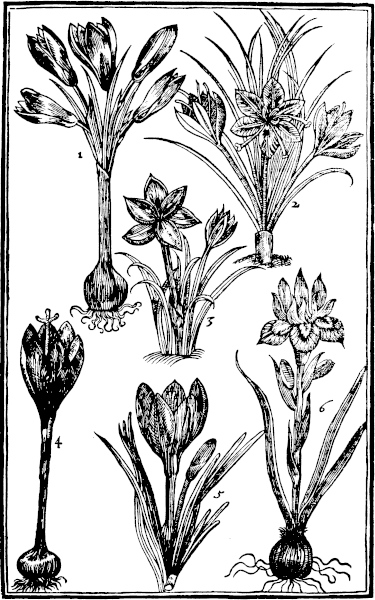
| 1 | Crocus vernus luteus vulgaris. The common yellow spring Crocus. |
| 2 | Crocus verus sativus Autumnalis. The true Saffron. |
| 3 | Crocus Byzantinus argenteus. The siluer coloured Autumne Crocus. |
| 4 | Crocus Pyrenæus purpureus. The purple mountaine Crocus. |
| 5 | Crocus montanus Autumnalis. The Autumne mountaine Crocus. |
| 6 | Sisyrinchium maius. The greater Spanish Nut. |
[170]
I can doe no otherwise then make a peculiar Chapter of this plant, because it is
neither a Crocus, although in the roote it come somewhat neare vnto that kinde that
is netted; but in no other part agreeing with any the delineaments of a Saffron
flower, and therefore could not be thrust into the Chapter amongst them: neither can
I place it in the forefront of the Chapter of the Iris bulbosa, or bulbous Flowerdeluces,
because it doth not belong to that Family: and although the flower thereof doth most
resemble a Flowerdeluce, yet in that no other parts thereof doe fitly agree thereunto,
I haue rather chosen to seate it by it selfe betweene them both, as partaking of both
natures, and so may serue in stead of a bridge, to passe from the one to the other, that
is, from the Crocus or Saffron flower, to the Iris bulbosa or bulbous rooted Flowerdeluce,
which shall follow in the next Chapter by themselues.
The Spanish Nut hath two long and narrow, soft and smooth greene leaues, lying
for the most part vpon the ground, and sometimes standing vp, yet bending downewards;
betweene these leaues riseth vp a small stalke, halfe a foote high, hauing diuers
smooth soft greene leaues vpon it, as if they were skinnes, through which the stalke
passeth; at the toppe whereof stand diuers flowers, rising one after another, and not
all flowring at once: for seldome shall you haue aboue one flower blowne at a time,
each whereof doth so quickly passe and fade away, that one may well say, that it is but
one dayes flower, or rather the flower of a few houres: the flower it selfe hath nine
leaues, like vnto a Flowerdeluce, whereof the three that fall downe, haue in each of
them a yellow spot: the other three, which in the Flowerdeluces are hollow and
ridged, couering the other three that fall downe, in this stand vpright, and are parted
at the ends: the three that stand vp in the middle are small and short: the whole flower
is smaller then any Flowerdeluce, but of sundry colours; for some are of an excellent
skie colour blew, others of a Violet purple, others of a darker purple colour, and some
white, and many others mixed, either pale blew and deepe purple, or white and blew
mixed or striped together very variably, quickly fading as I said before: the seede is
enclosed in small cods, so thinne and transparent that one may easily see, and tell the
seeds as they lye, which are of a brownish red colour: the roote is small, blackish and
round, wrapped in a thicke skinne or huske, made like vnto a net, or somewhat like
vnto the roote of the cloth of gold Crocus: when the plant is in flower, it is found to
haue two rootes one aboue another, whereof the vppermost is firme and sound, and
the vndermost loose and spongie, in like manner as is found in the rootes of diuers Orchides
or Satyrions, Bee-flowers and the like, and without any good taste, or sweetnesse
at all, although Clusius saith otherwise.
There is another of this kinde, not differing from the former in any other notable
part, but in the flower, which in this is of a delayed purplish red colour, hauing in each
of the three lower leaues a white spot, in stead of the yellow in the former, but are as
soone fading as they.
The former doe grow very plentifully in many parts both of Spaine and
Portugall, where Guillaume Boel, a Dutch man heretofore remembred
often in this Booke, found them; of the sundry colours specified, whereas
Clusius maketh mention but of one colour that he found.
The other was found in that part of Barbary, where Fez and Morocco do
stand, and brought first into the Lowe-Countries: but they are both very
tender, and will hardly abide the hard Winters of these colder regions.
The first flowreth in May and Iune, the last not vntill August.
The name Sisyrinchium is generally imposed vpon this plant, by all authors
that haue written thereof, thinking it to bee the right Sisyrinchium of
Theophrastus: but concerning the Spanish name Nozelha, which Clusius
saith it is called by in Spaine, I haue beene credibly enformed by the aforenamed
Boel, that this roote is not so called in those parts; but that the small
or common stript Crocus is called Nozelha, which is sweete in taste, and
desired very greedily by the Shepheards and Children, and that the roote
of this Sisyrinchium or Spanish Nut, is without any taste, and is not eaten.
And againe, that there is not two kindes, although it grow greater, and
with more flowers, in those places that are neare the Sea, where both the
washing of the Sea water, and the moisture and ayre of the Sea, causeth the
ground to bee more fertile. This I thought good, from the true relation
of a friend, to giue the world to vnderstand, that truth might expell errour.
These haue not beene knowne to bee vsed to any Physicall purpose, but
wholly neglected, vnlesse some may eate them, as Clusius reporteth.
The Flowerdeluces that haue bulbous rootes are of two sorts, the one greater
then the other: the greater bearing larger and broader leaues and flowers, and
the lesser narrower. But before I giue you the descriptions of the vsuall greater
kindes, I must needes place one or two in the fore-front that haue no fellowes; the
one is called of Clusius, his broad leafed Flowerdeluce, and the other a Persian, somewhat
like vnto it, which although they differ notably from the rest, yet they haue the
nearest resemblance vnto those greater kindes, that come next after them.
Iris bulbosa prima latifolia Clusij.
Clusius his first great bulbous Flowerdeluce.
This Flowerdeluce hath diuers long and broad leaues, not stiffe, like all the other,
but soft and greenish on the vpperside, and whitish vnderneath; among which rise vp
sometimes seuerall small, short, slender stalkes, and sometimes but one, not aboue
halfe a foote high, bearing at the top one flower a peece, somewhat like vnto a Flowerdeluce,
consisting of nine leaues, whereof those three that stand vpright, are shorter
and more closed together, then in other sorts of Flowerdeluces; the other three that
fall downe, turne vp their ends a little, and those three, that in other Flowerdeluces
doe couer them at the bottome, stand like the vpright leaues of other Flowerdeluces,
but are parted into two ends, like vnto two small eares: the whole flower is of a faire
blew, or pale skie colour in most, with a long stripe in the middle of each of the three
falling leaues, and in some white, but more seldome: the roote is reasonable great,
round and white, vnder the blackish coates wherewith it is couered, hauing many
long thicke white rootes in stead of fibres, which make them seeme to be Asphodill
rootes. The flower is very sweete.
Iris bulbosa Persica.
The Persian bulbous Flowerdeluce.
This Persian Flowerdeluce is somewhat like vnto the former, both in roote and in
leafe, but that the leaues are shorter and narrower, and the flower being much about
the same fashion, is of a pale blew russetish colour, each of the three lower falling
leaues are almost wholly of a browne purple colour, with a yellow spot in the middle
of them: this as it is very rare, so it seldome beareth flowers with vs.
The Place.
The first groweth in many places of Spaine and Portugall, from whence
I and others haue often had it for our Gardens, but by reason of the tendernesse
thereof, it doth hardly endure the sharpnesse of our cold Winters, vnlesse
it be carefully preserued.
The other is said to come from Persia, and therefore it is so entituled,
and is as tender to be kept as the other.
The Time.
The first flowreth most vsually not vntill May with vs, yet many times
sooner: but in Ianuary and February, as Clusius saith, in the naturall places
thereof.
The other is as early oftentimes when it doth flower with vs.
The Names.
Because Clusius by good iudgement referreth the first to the greater
kindes of Flowerdeluces, and placeth it in the fore ranke, calling it Iris bulbosa
latifolia prima, that is, The first broad leafed Flowerdeluce, and all others
doe the like, I haue (as you see) in the like manner put it before all the
other, and keepe the same name. The Spaniards, as he saith, called it Lirio
espadanal, and they of Corduba, Lirios azules.
The other hath no other name then as it is in the title.
1. Iris bulbosa maior siue Anglica cærulea.
The blew English bulbous Flowerdeluce.
This bulbous Flowerdeluce riseth vp early, euen in Ianuary oftentimes, with fiue
or six long and (narrow, in comparison of any great breadth, but in regard of the other
kinde) broad whitish green leaues, crested or straked on the backside, and halfe round,
being hollow like a trough or gutter, white all along the inside of the leafe,
and blunt at the end; among which riseth vp a stiffe round stalke, a cubit or two foot
high, at the toppe whereof, out of a skinnie huske, commeth forth one or two flowers,
consisting of nine leaues a peece, three whereof that are turned downewards, are larger
and broader then the other, hauing in each of them a yellow spot, about the middle
of the leafe, other three are small, hollow, ridged or arched, couering the lower
part next the stalke of those falling leaues, turning vp their ends, which are diuided
into two parts, other three stand vpright, and are very small at the bottome of them,
and broader toward the toppe: the whole flower is of a faire blew colour; after the
flowers are past, come vp three square heads, somewhat long, and lanke, or loose,
containing in them round yellowish seede, which when it is ripe, will rattle by the shaking
of the winde in the dry huskes: the roote of this kinde is greater and longer then
any of the smaller kindes with narrow leaues, couered with diuers browne skinnes,
which seeme to be fraught with long threeds like haires, especially at the small or vpper
end of the roote, which thing you shall not finde in any of the smaller kindes.
2. Iris bulbosa maior purpurea & purpuro violacea.
The paler or deeper purple great bulbous Flowerdeluce.
These purple Flowerdeluces differ not from the last described, either in roote or
leafe: the chiefest difference consisteth in the flowers, which in these are somewhat
larger then in the former, and in the one of a deepe blew or Violet purple colour, and
in the other of a deepe purple colour, in all other things alike.
Flore cinereo.
There is also another, in all other things like vnto the former, but only in the flower,
which is of a pale or bleake blew, which we call an ash-colour.
3. Iris bulbosa maior purpurea variegata siue striata.
The great purple stript bulbous Flowerdeluce.
There is another of the purple kinde, whose flower is purple, but with some veines
or stripes of a deeper Violet colour, diuersly running through the whole leaues of
the flower.
Flore cinereo
striata purpureo.
And another of that bleake blew or ash-colour, with lines and veines of purple in
the leaues of the flowers, some more or lesse then other.
Flore purpureo
orbe cinereo.
And againe another, whose flower is of a purple colour like vnto the second, but
that round about that yellow spot, in the middle of each of the three falling leaues (as
is vsuall in all the bulbous Flowerdeluces) there is a circle of a pale blew or ash-colour,
the rest of the leafe remaining purple, as the other parts of the flower is.
4. Iris bulbosa maior flore rubente.
The great peach coloured bulbous Flowerdeluce.
There is another of these greater kindes, more rare then any of the former, not
differing in roote, leafe, or flower, from the former, but onely that the flower in this is
of a pale reddish purple colour, comming somewhat neare vnto the colour of a peach
blossome.
5. Iris bulbosa maior siue latifolia alba.
The great white bulbous Flowerdeluce.
The great white bulbous Flowerdeluce, riseth not vp so early out of the ground as
the blew or purple doth, but about a moneth or more after, whose leaues are somewhat
larger, and broader then of the others: the stalke is thicker and shorter, bearing
vsually two very large and great flowers, one flowring a little before the other,
yet oftentimes both in flower together in the end, of a bleake blewish white colour,
which wee call a siluer colour, while they are in the budde, and before they be blowne
open, but then of a purer white, yet with an eye or shew of that siluer colour remaining
in them, the three falling leaues being very large, and hauing that yellow spot in
the middle of each of them: the seedes are likewise inclosed in heads, like vnto the
blew or purple kindes, but larger, and are of a reddish yellow colour like them: the
roote likewise is not differing, but greater.
6. Iris bulbosa maior alba variegata.
The great white stript bulbous Flowerdeluce.
This white stript Flowerdeluce, is in roote, leafe, and flower, and in manner of
growing, like vnto the former white Flowerdeluce; the onely difference is in the
marking of the flower, being diuers from it: for this hath in the white flower great
veines, stripes, or markes, of a Violet blew colour, dispersed through the leaues of the
flower very variably, which addeth a superexcellent beauty to the flower.
7. Iris bulbosa maior siue latifolia versicolor.
The great party coloured bulbous Flowerdeluce.
There is no difference in this from the former, but in the flower, which is of a whitish
colour in the three falling leaues, hauing a circle of ash-colour about the yellow
spot, the three rigged leaues being likewise whitish, but ridged and edged with that
ash-colour, and the three vpright leaues of a pale blewish white colour, with some
veines therein of a blewish purple.
Varietas.
There hath beene brought vnto vs diuers rootes of these kindes, with the dryed
flowers remaining on them, wherein there hath beene seene more varieties, then I can
well remember to expresse, which variety it is very probable, hath risen by the sowing
of the seeds, as is truely obserued in the narrower leafed kinde of Flowerdeluce, in the
Tulipa, and in some other plants.
Flore luteo.
Wee haue heard of one of this kinde of broad leafed Flowerdeluces, that should
beare a yellow flower, in the like manner as is to be seene in the narrow leafed ones:
but I haue not seene any such, and therefore I dare report no further of it, vntill time
hath discouered the truth or falshood of the report.
[175]
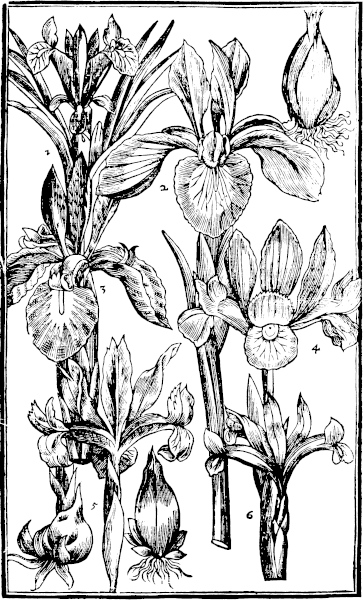
| 1 | Iris bulbosa latifolia prima Clusii. Clusius his first great bulbous Flowerdeluce. |
| 2 | Iris bulbosa maior cærulea siue Anglica. The great blew of English bulbous Flowerdeluce. |
| 3 | Iris bulbosa maior purpurea variegata. The great purple stript bulbous Flowerdeluce. |
| 4 | Iris bulbosa angustifolia maior alba. The greater white narrow leafed bulbous Flowerdeluce. |
| 5 | Iris bulbosa angustifolia versicolor. The party coloured narrow leafed bulbous Flowerdeluce. |
| 6 | Iris bulbosa angustifolia Africana. The purple African bulbous narrow leafed Flowerdeluce. |
The Place.
Lobelius is the first reporter, that the blew Flowerdeluce or first kinde
of these broad leafed Flowerdeluces, groweth naturally in the West parts
of England; but I am in some doubt of the truth of that report: for I rather
thinke, that some in their trauels through Spaine, or other parts
where it groweth, being delighted with the beauty of the flower, did
gather the rootes, and bring them ouer with them, and dwelling in some
of the West parts of England, planted them, and there encreasing so
plentifully as they doe, they were imparted to many, thereby in time
growing common in all Countrey folkes Gardens thereabouts. They
grow also, and all the other, and many more varieties, about Tholouse,
from whence Plantinianus Gassanus both sent and brought vs
them, with many other bulbous rootes, and rare plants gathered thereabouts.
[176]
The Time.
These doe flower vsually in the end of May, or beginning of Iune, and
their seede is ripe in the end of Iuly or August.
The Names.
Lobel calleth the first English blew Flowerdeluce, Hyacinthus Poetarum
flore Iridis, & propter Hyacinthinum colorem, id est violaceum dictus: but I know
not any great good ground for it, more then the very colour; for it is neither
of the forme of a Lilly, neither hath it those mourning markes imprinted
in it, which the Poet faineth to bee in his Hyacinth. It is most truely
called an Iris, or Flowerdeluce (and there is great difference betweene a
Lilly and a Flowerdeluce, for the formes of their flowers) because it answereth
thereunto very exactly, for the flower, and is therefore called vsually by
most, either Iris bulbosa Anglica, or Iris bulbosa maior siue latifolia, for a difference
betweene it, and the lesser with narrow leaues: In English, eyther
The great English bulbous Flowerdeluce, or the great broad leafed bulbous
Flowerdeluce, which you will, adding the other name, according to
the colour.
And thus much for these broad leafed bulbous Flowerdeluces, so much as hath
come to our knowledge. Now to the seuerall varieties of the narrow leafed bulbous
Flowerdeluces, so much likewise as we haue been acquainted with.
Iris bulbosa minor siue angustifolia alba.
The smaller white or narrow leafed bulbous Flowerdeluce.
This first Flowerdeluce, which beareth the smaller flower of the two white ones,
that are here to bee described, springeth out of the ground alwaies before Winter,
which after breaketh forth into foure or fiue small and narrow leaues, a foote long or
more, of a whitish greene on the inside, which is hollow and chanalled, and of a
blewish greene colour on the outside, and round withall: the stalke of this kinde is
longer and slenderer then the former, with some shorter leaues vpon it, at the toppe
whereof, out of short skinny leaues, stand one or two flowers, smaller, shorter, and
rounder then the flowers of the former broad leafed Flowerdeluces, but made after
the same proportion with nine leaues, three falling downewards, with a yellow spot
in the middle, other three are made like a long arch, which couer the lower part next
the stalke of those falling leaues, and turne vp at the ends of them, where they are diuided
into two parts: the other three stand vpright, betweene each of the three falling
leaues, being somewhat long and narrow: the flower is wholly, (sauing the yellow
spot) of a pure white colour, yet in some hauing a shew of some blew throughout, and
in others towards the bottome of the three vpright leaues: after the flowers are past,
there rise vp so many long cods or seede vessels, as there were flowers, which are
longer and smaller then in the former, and a little bending like a Corner, with three
round squares, and round pointed also, which diuiding it selfe when the seede is ripe
into three parts, doe shew six seuerall cells or places, wherein is contained such like
round reddish yellow seedes, but smaller then the former: the roote is smaller and
shorter then the former, and without any haires or threeds, couered with browne thin
skinnes, and more plentifull in giuing encrease.
Iris bulbosa angustifolia alba flore maiore.
The greater white narrow leafed bulbous Flowerdeluce.
I shall not neede to make a seuerall description to euery one of these Flowerdeluces
that follow, for that were but to make often repetition of one thing, which being once
done, as it is, may well serue to expresse all the rest, and but onely to adde the especiall
differences, either in leafe or flower, for bignesse, colour, or forme, as is expedient
to expresse and distinguish them seuerally. This greater white bulbous Flowerdeluce
is like vnto the last described in all parts, sauing that it is a little larger and higher, both
in leafe, stalke, and flower, and much whiter then any of these mixed sorts that follow,
yet not so white as the former: the roote hereof is likewise a little bigger and rounder
in the middle.
Albescens.
Milke white.
There is another, whose falling leaues haue a little shew of yellownesse
in them, and so are the middle ridges of the arched leaues, but the vpright
leaues are more white, not differing in roote or leafe from the first white.
Argentea.
Siluer colour.
And another, whose falls are of a yellowish white, like the last, the arched
leaues are whiter, and the vpright leaues of a blewish white, which we
call a siluer colour.
Albida.
Whitish.
Another hath the fals yellowish, and sometimes with a little edge of
white about them, and sometimes without; the vpright leaues are whitish,
as the arched leaues are, yet the ridge yellower.
Albida labris
luteis.
White with
yellow fals.
Another hath his fals yellow, and the vpright leaues white, all these
flowers are about the same bignesse with the first.
Albida angustior.
The narrow
white.
But we haue another, whose flower is smaller, and almost as white as the
second, the lower leaues are small, and doe as it were stand outright, not
hauing almost any fal at all, so that the yellow spot seemeth to be the whole
leafe, the arched leaues are not halfe so large as in the former, and the
vpright leaues bowe themselues in the middle, so that the tops doe as it were
meete together.
And another of the same, whose falling leaues are a little more eminent
and yellow, with a yellower spot.
Aurea siue lutea
Hispanica.
The Spanish
yellow.
We haue another kinde that is called the Spanish yellow, which riseth
not vp so high, as ordinarily most of the rest doe, and is wholly of a gold
yellow colour.
Pallide lutea.
Straw colour.
There is another, that vsually riseth higher then the former yellow, and
is wholly of a pale yellow, but deeper at the spot.
Albida lutea.
Pale Straw colour.
There is also another like vnto the pale yellow, but that the falling leaues
are whiter then all the rest of the flower.
Mauritanica
flaua serotina
minor.
The small Barbary
yellow.
There is a smaller or dwarfe kinde, brought from the backe parts of Barbary,
neare the Sea, like vnto the yellow, but smaller and lower, and in
stead of vpright leaues, hath small short leaues like haires: it flowreth very
late, after all others haue almost giuen their seede.
Versicolor Hispanica
cærulea
labris albis.
The party coloured
Spanish.
We haue another sort is called the party coloured Spanish bulbous Flowerdeluce,
whose falling leaues are white, the arched leaues of a whitish siluer
colour, and the vpright leaues of a fine blewish purple.
Diuersitas.
The diuersity
or variation of
this flower.
Yet sometimes this doth vary; for the falling leaues will haue either an
edge of blew, circling the white leaues, the arched leaues being a little
blewer, and the vpright leaues more purple.
Or the fals will be almost wholly blew, edged with a blewer colour, the
arched leaues pale blew, and the vpright leaues of a purplish blew Violet
colour.
Or the fals white, the arched leaues pale white, as the vpright leaues are.
Of not of so faire a blewish purple, as the first sort is.
Some of them also will haue larger flowers then others, and be more liberall
in bearing flowers: for the first sort, which is the most ordinary, seldome
beareth aboue one flower on a stalke, yet sometimes two. And of the
others there are some that will beare vsually two and three flowers, yet some
againe will beare but one. All these kindes smell sweeter then many of the
other, although the most part are without sent.
Cærulea siue
purpurea minor
Lusitanica præcox.
The small
early purple
Portugall.
There is another kinde, that is smaller in all the parts thereof then the
former, the stalke is slender, and not so high, bearing at the toppe one or
two small flowers, all wholly of a faire, blewish purple, with a yellow spot
in euery one of the three falling leaues, this vsually flowreth early, euen
with the first bulbous Flowerdeluces.
Purpurea maior.
The greater
purple.
We haue another purple, whose flower is larger, and stalke higher, and
is of a very reddish purple colour, a little aboue the ground, at the foote or
bottome of the leaues and stalke: this flowreth with the later sort of Flowerdeluces.
Purpurea serotina.
The late purple.
There is another, whose flower is wholly purple, except the yellow
spot, and flowreth later then any of the other purples.
Purpurea rubescens
labris cæruleis.
A reddish purple
with blew fals.
There is yet another purple, whose vpright leaues are of a reddish purple,
and the falling leaues of a blew colour.
Purpurea rubescens
labris albido
cæruleis.
A reddish purple
with whitish
blew fals.
And another of a reddish purple, whose falling leaues are of a whitish
blew colour, in nothing else differing from the last.
Purpurea labris
luteis.
Party coloured
purple & yellow.
Another hath his falling leaues of a faire gold yellow, without any stripe,
yet in some there are veines running through the yellow leaues, and some
haue an edge of a sullen darke colour about them: the vpright leaues in euery
of these, are a Violet purple.
Purpurea labris
ex albido cærulea
& luteo mixtis.
Party coloured
purple with stript
yellow fals.
Another is altogether like this last, but that the falling leaues are of a pale
blew and yellow, trauersing one the other, and the arched leaues of a pale
purplish colour.
Subpurpurea
labris luteis.
Pale purple with
yellow fals.
Another hath his vpright leaues of a paler purple, and the falling leaues
yellow.
A paler purple.
And another little differing from it, but that the arched leaues are whitish.
Subcærulea labris
luteis.
Party coloured
blew and yellow.
Another whose vpright leaues are of a pale blew, and the falling leaues
yellow.
And another of the same sort, but of a little paler blew.
Crinis coloris
elegantioris.
A faire haire colour.
We haue another sort, whose vpright leaues are of a faire brownish yellow
colour, which some call a Fuille mort, and others an haire colour; the
falling leaues yellow.
Altera obsoletior.
A dull haire colour.
And another of the same colour, but somewhat deader.
Iris bulbosa Africana serpentriæ caule.
The purple or murrey bulbous Barbary Flowerdeluce.
This Flowerdeluce as it is more strange (that is, but lately knowne and possessed
by a few) so it is both more desired, and of more beauty then others. It is in all
respects, of roote, leafe, and flower, for the forme like vnto the middle sort of these
Flowerdeluces, onely the lowest part of the leaues and stalke, for an inch or thereabouts,
next vnto the ground, are of a reddish colour, spotted with many spots, and the
flower, being of a meane size, is of a deepe purplish red or murrey colour the whole
flower throughout, except the yellow spot in the middle of the three lower or falling
leaues, as is in all others.
Purpurea cærulea
obsoleta labris
fuscis.
The duskie
party coloured
purple.
And lastly, there is another sort, which is the greatest of all these narrow
leafed Flowerdeluces, in all the parts of it; for the roote is greater
then any of the other, being thicke and short: the leaues are broader and
longer, but of the same colour: the stalke is stronger and higher then any of
them, bearing two or three flowers, larger also then any of the rest, whose
falling leaues are of a duskie yellow, and sometimes with veines and borders
about the brimmes, of another dunne colour, yet hauing that yellow
spot that is in all: the arched leaues are of a sullen pale purplish yellow, and
the vpright leaues of a dull or duskie blewish purple colour: the heads or
hornes for seede are likewise greater, and so is the seede also a little.
The Place.
These Flowerdeluces haue had their originall out of Spaine and Portugall,
as it is thought, except those that haue risen by the sowing, and those
which are named of Africa.
The Time.
These flower in Iune, and sometimes abide vnto Iuly, but vsually not so
early as the former broad leafed kindes, and are soone spoiled with wet in
their flowring.
The Names.
The seuerall names, both in Latine and English, are sufficient for them as
they are set downe; for we know no better.
There is not any thing extant or to be heard, that any of these kindes of
Flowerdeluces hath been vsed to any Physicall purposes, and serue onely
to decke vp the Gardens of the curious.
And thus much for these sorts of bulbous Flowerdeluces, and yet I doubt not, but
that there are many differences, which haue risen by the sowing of the seede, as many
may obserue from their owne labours, for that euery yeare doth shew forth some variety
that is not seene before. And now I will conuert my discourse a while likewise,
to passe through the seuerall rankes of the other kindes of tuberous rooted Flowerdeluces,
called Flagges.
There are two principall kindes of tuberous or knobby rooted Flowerdeluces,
that is, the tall and the dwarfe, or the greater and the lesser; the former called
Iris maior or latifolia, and the other Iris minor, or rather Chamæiris; and each of
these haue their lesser or narrow leafed kindes to bee comprehended vnder them: Of
all which in their order. And first of that Flowerdeluce, which for his excellent beautie
and raritie, deserueth the first place.
Iris Chalcedonica siue Susiana maior.
The great Turkie Flowerdeluce.
The great Turkie Flowerdeluce, hath diuers heads of long and broad fresh greene
leaues, yet not so broad as many other of those that follow, one folded within another
at the bottome, as all other of these Flowerdeluces are: from the middle of some
one of those heads (for euery head of leaues beareth not a flower) riseth vp a round
stiffe stalke, two foote high, at the toppe whereof standeth one flower (for I neuer obserued
it to beare two) the largest almost, but rarest of all the rest, consisting of nine
leaues, like the others that follow, but of the colour almost of a Snakes skinne, it is so
diuersly spotted; for the three lower falling leaues are very large, of a deepe or darke
purple colour, almost blacke, full of grayish spots, strakes, and lines through the whole
leaues, with a blacke thrume or freeze in the middle of each of them: the three arched
leaues that couer them, are of the same darke purple colour, yet a little paler at the
sides, the three vpper leaues are very large also, and of the same colour with the lower
leaues, but a little more liuely and fresh, being speckled and straked with whiter spots
and lines; which leaues being laid in water, will colour the water into a Violet colour,
but if a little Allome be put therein, and then wrung or pressed, and the iuice of these
leaues dryed in the shadow, will giue a colour almost as deepe as Indico, and may
serue for shawdowes in limming excellent well: the flower hath no sent that can be perceiued,
but is onely commendable for the beauty and rarity thereof: it seldome beareth
seedes in these cold Countries, but when it doth, it is contained in great heads,
being brownish and round, but not so flat as in other sorts, the roots are more browne
on the outside, and growing tuberous thicke, as all other that are kept in Gardens.
Iris Chalcedonica siue Susiana minor.
The lesser Turkie Flowerdeluce.
There is another hereof little differing, but that the leafe is of a more yellowish
greene colour, and the flower neither so large or faire, nor of so perspicuous markes
and spots, nor the colour of that liuely (though darke) lustre.
The Place.
These haue been sent out of Turkie diuers times among other things, and
it should seeme, that they haue had their originall from about Susis, a chiefe
Citie of Persia.
The Time.
They flower in May most vsually, before any of the other kindes.
The Names.
They haue been sent vnto vs, and vnto diuers other in other parts, from
Constantinople vnder the name of Alaia Susiana, and thereupon it hath
been called, both of them and vs, either Iris Chalcedonica, or Susiana, and for
distinction maior or minor: In English, The Turkie Flowerdeluce, or the
Ginnie Hen Flowerdeluce, the greater or the lesser.
Iris alba Florentina.
The white Flowerdeluce.
The great white Flowerdeluce, hath many heads of very broad and flat long leaues,
enclosing or folding one within another at the bottome, and after a little diuided one
from another toward the top, thin edged, like a sword on both sides, and thicker in the
middle: from the middle of some of these heads of leaues, riseth vp a round stiffe stalk,
two or three foot high, bearing at the top one, two, or three large flowers, out of seuerall
huskes or skins, consisting of nine leaues, as all the other do, of a faire white colour,
hauing in the middle of each of the three falling leaues, a small long yellow frize or
thrume, as is most vsuall in all the sorts of the following Flowerdeluces, both of the
greater and smaller kindes: after the flowers are past, come the seed, inclosed in thicke
short pods, full fraught or stored with red roundish and flat seede, lying close one vpon
another: the roote is tuberous or knobby, shooting out from euery side much like tuberous
heads, lying for the most part vpon or aboue the ground, and fastened within the
ground with long white strings or fibres, which hold them strongly, and encreaseth
fast. There
Flore pallido. is another like vnto this last in all things, sauing that the colour of the
flower is of a more yellowish white, which we vsually call a Straw colour.
Iris alba maior versicolor.
The white party coloured Flowerdeluce.
This variable Flowerdeluce is like vnto the former, but that the leaues are not so
large and broad, the flower hereof is as large almost, and as white as the former, but it
hath a faire list or line of a blewish purple downe the backe of euery one of the three
vpright leaues, and likewise round about the edges, both of the vpper and lower
leaues, and also a little more purplish vpon the ridge of the arched leaues, that couer
the falling leaues: the roote hereof is not so great as of the former white, but a little
slenderer and browner.
Iris Dalmatica maior.
The great Dalmatian Flowerdeluce.
This greater Flowerdeluce of Dalmatia, hath his leaues as large and broad as any
of the Flowerdeluces whatsoeuer, his stalke and flower doe equall his other proportion,
onely the colour of the flower is differing, being of a faire watchet or bleake
blew colour wholly, with the yellow frize or thrum downe the middle of the lower
or falling leaues, as before is said to be common to all these sorts of Flowerdeluces; in
all other parts it little differeth, sauing onely this is obserued to haue a small shew of a
purplish red about the bottome of the greene leaues.
Iris purpurea siue vulgaris.
The common purple Flowerdeluce.
This Flowerdeluce, which is most common in Gardens, differeth nothing at all
from those that are formerly described, either in roote, leafe, or flower for the forme
of them, but onely that the leaues of this are not so large as the last, and the flower it
selfe is of a deep purple or Violet colour, and sometimes a little declining to rednesse,
especially in some places.
Purpurea pallidior
versicolor.
Sometimes this kinde of Flowerdeluce will haue flowers of a paler purple colour,
comming neare vnto a blew, and sometimes it will haue veines or stripes of a deeper
blew, or purple, or ash-colour, running through all the vpper and lower leaues.
Cærulea labris
purpureis.
There is another like vnto this, but more purple in the fals, and more pale in the
vpright leaues.
Iris Asiatica cærulea.
The blew Flowerdeluce of Asia.
This Flowerdeluce of Asia, is in largenesse of leaues like vnto the Dalmatian, but
beareth more store of flowers on seuerall branches, which are of a deeper blew colour,
and the arched leaues whitish on the side, and purplish on the ridges, but in other
things like vnto it.
Purpurea.
There is another neare vnto this, but that his leaues are a little narrower, and his
flowers a little more purple, especially the vpper leaues.
Iris Damascena.
The Flowerdeluce of Damasco.
This is likewise altogether like the Flowerdeluce of Asia, but that it hath some white
veines in the vpright leaues.
Iris Lusitanica biflora.
The Portugall Flowerdeluce.
This Portugall Flowerdeluce is very like the common purple Flowerdeluce, but
that this is not so large in leaues, or flowers, and that it doth often flower twice in a
yeare, that is, both in the Spring, and in the Autumne againe, and besides, the flowers
haue a better or sweeter sent, but of the like purple or Violet colour as it is, and comming
forth out of purplish skins or huskes.
Iris Camerarij siue purpurea versicolor maior.
The greater variable coloured purple Flowerdeluce.
The greater of the variable purple Flowerdeluces, hath very broad leaues, like vnto
the leaues of the common purple Flowerdeluce, and so is the flower also, but differing
in colour, for the three lower leaues are of a deepe purple colour tending to rednesse,
the three arched leaues are of the colour with the vpper leaues, which are of a
pale or bleake colour tending to yellownesse, shadowed ouer with a smoakie purplish
colour, except the ridges of the arched leaues, which are of a more liuely purple colour.
Iris purpurea versicolor minor.
The lesser variable purple Flowerdeluce.
This Flowerdeluce differeth not in any thing from the last, but onely that it hath
narrower greene leaues, and smaller and narrower flowers, else if they be both conferred
together, the colours will not seeme to varie the one from the other any whit
at all.
Altera minus
fuliginea.
There is another somewhat neare vnto these two last kindes, whose huskes from
whence the flowers doe shoote forth, haue purple veines in them, and so haue the falling
purplish leaues, and the three vpright leaues are not so smoakie, yet of a dun purple
colour.
Iris cærulea versicolor.
The blew party coloured Flowerdeluce.
This party coloured Flowerdeluce hath his leaues of the same largenesse, with the
lesser variable purple Flowerdeluce last described, and his flowers diuersly marked:
for some haue the fals blew at the edges, and whitish at the bottome, the arched leaues
of a yellowish white, and the vpright leaues of a whitish blew, with yellowish edges.
Some againe are of a darker blew, with brownish spots in them. And some are so pale
a blew, that we may well call it an ash-colour: And lastly, there is another of this sort,
whose vpright leaues are of a faire pale blew, with yellowish edges, and the falling
leaues parted into two colours, sometimes equally in the halfe, each side sutable to the
other in colour: And sometimes hauing the one leafe in that manner: And sometimes
but with a diuers coloured list in them; in the other parts both of flower and
leafe, like vnto the other.
Iris lutea variegata.
The yellow variable Flowerdeluce.
This yellow variable Flowerdeluce loseth his leaues in Winter, contrary to all the
former Flowerdeluces, so that his roote remaineth vnder ground without any shew of
leafe vpon it: but in the beginning of the Spring it shooteth out faire broad leaues,
falling downwards at the points or ends, but shorter many times then any of the former,
and so is the stalke likewise, not rising much aboue a foote high, whereon are set
two or three large flowers, whose falling leaues are of a reddish purple colour, the three
that stand vpright of a smoakie yellow, the arched leaues hauing their ridges of a
bleake colour tending to purple, the sides being of the former smoakie yellow colour,
with some purplish veines at the foote or bottome of all the leaues: the roote groweth
somewhat more slender and long vnder ground, and of a darker colour then manie of
the other.
Another sort hath the vpright leaues of a reasonable faire yellow, and stand more
vpright, not bowing downe as most of the other, and the purple fals haue pale edges.
Some
Varietas. haue their greene leaues party coloured, white and greene, more or lesse, and so
are the huskes of the flowers, the arched leaues yellow, as the vpright leaues are, with
purplish veines at the bottome. And some haue both the arched and vpright leaues of
so pale a yellow, that we may almost call it a straw colour, but yellower at the bottome,
with purple veines, and the falling leaues purple, with two purple spots in them.
And these are the sorts of the greater tuberous or Flagge Flowerdeluces that haue
come to our knowledge: the next hereunto are the lesser or narrow leafed kindes to be
described; and first of the greatest of them.
1. Iris angustifolia Tripolitana aurea.
The yellow Flowerdeluce of Tripoly.
This Flowerdeluce I place in the forefront of the narrow leafed Flowerdeluces,
for the length of the leaues, compared with the breadth of them; it may fitly bee called
a narrow leafed Flowerdeluce, although they be an inch broad, which is broader
then any of them that follow, or some of those are set downe before, but as I said, the
length make them seem narrow, and therefore let it take vp his roome in this place, with
the description that followeth. It beareth leaues a yard long, or not much lesse, and
an inch broad, as is said before, or more, of a sad greene colour, but not shining: the
stalke riseth vp to be foure of fiue foote high, being strong and round, but not very
great, bearing at the toppe two or three long and narrow gold yellow flowers, of the
fashion of the bulbous Flowerdeluces, as the next to bee described is, without any
mixture or variation therein: the heads for seede are three square, containing within
them many flat cornered seedes: the roote is long and blackish, like vnto the rest that
follow, but greater and fuller.
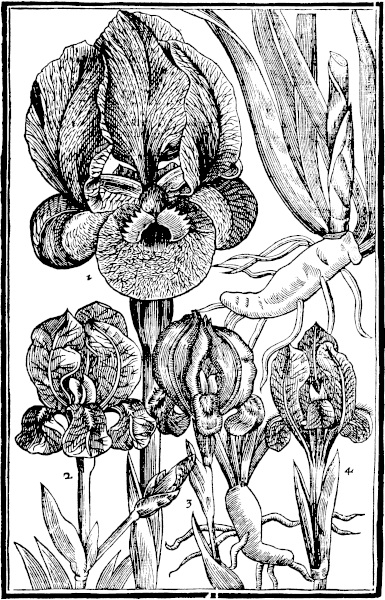
| 1 | Iris Chalcedonica siue Susiana maior. The great Turkie Flowerdeluce. |
| 2 | Iris alba Florentina. The white Flowerdeluce. |
| 3 | Iris latifolia variegata. The variable Flowerdeluce. |
| 4 | Chamæiris latifolia maior. The greater dwarfe Flowerdeluce. |
2. Iris angustifolia maior cærulea.
The greater blew Flowerdeluce with narrow leaues.
This kinde of Flowerdeluce hath his leaues very long and narrow, of a whitish
greene colour, but neither so long or broad as the last, yet broader, thicker and stiffer
then any of the rest with narrow leaues that follow: the stalke riseth sometimes no
higher then the leaues, and sometimes a little higher, bearing diuers flowers at the top,
successiuely flowring one after another, and are like vnto the flowers of the bulbous
Flowerdeluces, but of a light blew colour, and sometimes deeper: after the flowers
are past, rise vp six cornered heads, which open into three parts, wherein is contained
browne seede, almost round: the roote is small, blackish and hard, spreading into
many long heads, and more closely growing or matting together.
3. Iris angustifolia purpurea marina.
The purple narrow leafed Sea Flowerdeluce.
This Sea Flowerdeluce hath many narrow hard leaues as long as the former, and
of a darke greene colour, which doe smell a little strong: the stalke beareth two or
three flowers like the former, but somewhat lesse, and of a darke purple or Violet colour:
in seede and roote it is like the former.
4. Iris angustifolia purpurea versicolor.
The variable purple narrow leafed Flowerdeluce.
The leaues of this Flowerdeluce are very like the former Sea Flowerdeluce, and do
a little stinke like them; the flowers are differing, in that the vpper leaues are wholly
purple or violet, and the lower leaues haue white veines, and purple running one among
another: the seede and rootes differ not from the former purple Sea kinde.
5. Iris angustifolia minor Pannonica siue versicolor Clusij.
The small variable Hungarian Flowerdeluce of Clusius.
This Hungarian Flowerdeluce (first found out by Clusius, by him described, and
of him tooke the name) riseth vp with diuers small tufts of leaues, very long, narrow,
and greene, growing thicke together, especially if it abide any time in a place; among
which riseth vp many long round stalkes, higher then the leaues, bearing two or three,
or foure small flowers, one aboue another, like the former, but smaller and of greater
beauty: for the lower leaues are variably striped with white and purple, without any
thrume or fringe at all; the vpper leaues are of a blewish fine purple or Violet colour, &
so are the arched leaues, yet hauing the edges a little paler: the heads for seede are
smaller, and not so cornered as the other, containing seedes much like the former, but
smaller: the roote is blacke and small, growing thicker and closer together then any
other, and strongly fastened in the ground, with a number of hard stringie rootes: the
flowers are of a reasonable good sent.
6. Iris angustifolia maior flore duplici.
The greater double blew Flowerdeluce.
This Flowerdeluce, differeth not either in roote or leafe from the first great blew
Flowerdeluce of Clusius, but onely in that the leaues grow thicker together, and that
the flowers of this kinde are as it were double with many leaues confusedly set together,
without any distinct parts of a Flowerdeluce, and of a faire blew colour with
many white veines and lines running in the leaues; yet oftentimes the stalke of flowers
hath but two or three small flowers distinctly set together, rising as it were out of one
huske.
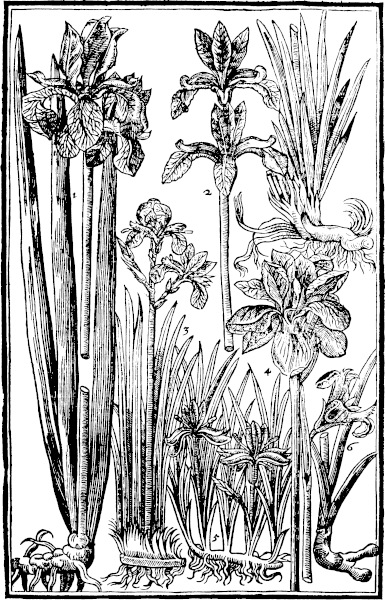
| 1 | Iris angustifolia Tripolitana. The yellow Flowerdeluce of Tripoli. |
| 2 | Iris angustifolia maior cærulea. The greater blew Flowerdeluce with narrow leaues. |
| 3 | Iris angustifolia minor Pannonica siue versicolor Clusii. The small variable Hungarian Flowerdeluce of Clusius. |
| 4 | Iris angustifolia maior flore duplici. The greater double blew Flowerdeluce. |
| 5 | Chamæiris angustifolia minor. The lesser Grasse Flowerdeluce. |
| 6 | Iris tuberosa. The veluet Flowerdeluce. |
7. Iris angustifolia minor alba Clusij.
The small white Flowerdeluce of Hungary.
This likewise differeth little from the former Hungarian Flowerdeluce of Clusius,
but that the leafe is of a little paler greene colour, and the flower is of a faire whitish
colour, with some purple at the bottome of the leaues.
Next after these narrow leafed Flowerdeluces, are the greater and smaller sorts of
dwarfe kindes to follow; and lastly, the narrow or grasse leafed dwarfe kindes, which
will finish this Chapter of Flowerdeluces.
1. Chamæiris latifolia maior alba.
The greater white dwarfe Flowerdeluce.
This dwarfe Flowerdeluce hath his leaues as broad as some of the lesser kindes last
mentioned, but not shorter; the stalke is very short, not aboue halfe a foote high or
thereabouts, bearing most commonly but one flower, seldome two, which are in some
of a pure white, in others paler, or somewhat yellowish through the whole flower, except
the yellow frize or thrume in the middle of euery one of the falling leaues: after
the flowers are past, come forth great heads, containing within them round pale seed:
the roote is small, according to the proportion of the plant aboue ground, but made
after the fashion of the greater kindes, with tuberous peeces spreading from the sides,
and strong fibres or strings, whereby they are fastened in the ground.
2. Chamæiris latifolia maior purpurea.
The greater purple dwarfe Flowerdeluce.
There is no difference either in roote, leafe, or forme of flower in this from the former
dwarfe kinde, but onely in the colour of the flower, which in some is of a very
deepe or blacke Violet purple, both the toppes and the fals: in others the Violet purple
is more liuely, and in some the vpper leaues are blew, and the lower leaues purple,
yet all of them haue that yellow frize or thrume in the middle of the falling leaues,
that the other kindes haue.
Altera.
There is another that beareth purple flowers, that might be reckoned, for the smalnesse
and shortnesse of his stalke, to the next kinde, but that the flowers and leaues of
this are as large as any of the former kindes of the smaller Flowerdeluces.
3. Chamæiris latifolia minor alba.
The lesser white dwarfe Flowerdeluce.
There is also another sort of these Flowerdeluces, whose leaues and flowers are
lesse, and wherein there is much variety. The leaues of this kinde, are all for the most
part somewhat smaller, narrower, and shorter then the former: the stalke with the
flower vpon it scarce riseth above the leaues, so that in most of them it may be rather
called a foote-stalke, such as the Saffron flowers haue, and are therefore called of manie
ἄκαυλοι, without stalkes; the flowers are like vnto the first described of the dwarfe
kindes, and of a whitish colour, with a few purplish lines at the bottome of the vpper
leaues, and a list of greene in the falling leaues.
Straminea.
Another hath the flowers of a pale yellow, called a Straw colour, with whitish
stripes and veines in the fals, and purplish lines at the bottome of the vpper leaues.
4. Chamæiris latifolia minor purpurea.
The lesser purple dwarfe Flowerdeluce.
The difference of this from the former, consisteth more in the colour then forme of
the flower, which is of a deep Violet purple, sometimes paler, and sometimes so deep,
that it almost seemeth blacke: And sometimes the fals purplish, and the vpper leaues
blew. Some of these haue a sweete sent, and some none.
Cærulea.
There is another of a fine pale or delayed blew colour throughout the whole flower.
5. Chamæiris latifolia minor suauerubens.
The lesser blush coloured dwarfe Flowerdeluce.
This Flowerdeluce hath the falling leaues of the flower of a reddish colour, and
the thrumes blew: the vpper and arched leaues of a fine pale red or flesh colour, called
a blush colour; in all other things it differeth not, and smelleth little or nothing
at all.
6. Chamæiris latifolia minor lutea versicolor.
The lesser yellow variable dwarfe Flowerdeluce.
The falling leaues of this Flowerdeluce are yellowish, with purple lines from the
middle downewards, sometimes of a deeper, and sometimes of a paler colour, and
white thrumes in the middle, the vpper leaues are likewise of a yellowish colour, with
purple lines in them: And sometimes the yellow colour is paler, and the lines both in
the vpper and lower leaues of a dull or dead purple colour.
7. Chamæiris latifolia minor cærulea versicolor.
The lesser blew variable dwarfe Flowerdeluce.
The vpper leaues of this flower are of a blewish yellow colour, spotted with purple
in the broad part, and at the bottome very narrow: the falling leaues are spread ouer
with pale purplish lines, and a small shew of blew about the brimmes: the thrume is
yellow at the bottome, and blewish aboue: the arched leaues are of a blewish white, being
a little deeper on the ridge.
And sometimes the vpper leaues are of a paler blew rather whitish, with the yellow:
both these haue no sent at all.
8. Chamæiris marina purpurea.
The purple dwarfe Sea Flowerdeluce.
This small Flowerdeluce is like vnto the narrow leafed Sea Flowerdeluce before
described, both in roote, leafe, and flower, hauing no other difference, but in the smalnesse
and lownesse of the growing, being of the same purple colour with it.
9. Chamæiris angustifolia maior.
The greater Grasse Flowerdeluce.
This Grasse Flowerdeluce hath many long and narrow darke greene leaues, not so
stiffe as the former, but lither, and bending their ends downe againe, among which
rise vp diuers stalkes, bearing at the toppe two or three sweete flowers, as small as any
of them set downe before, of a reddish purple colour, with whitish yellow and purple
strakes downe the middle of the falling leaues: the arched leaues are of a horse flesh
colour all along the edges, and purple vpon the ridges and tips that turne vp againe:
vnder these appeare three browne aglets, like vnto birds tongues: the three vpper
leaues are small and narrow, of a perfect purple or Violet colour: the heads for seede
haue sharper and harder cornered edges then the former: the seedes are somewhat
grayish like the former, and so are the rootes, being small, blacke, and hard, growing
thicke together, fastened in the ground with small blackish hard strings, which hardly
shoote againe if the roote be remoued.
10. Chamæiris angustifolia minor.
The lesser Grasse Flowerdeluce.
This Flowerdeluce is in leaues, flowers, and rootes so like the last described, that
but onely it is smaller and lower, it is not to be distinguished from the other. And this
may suffice for these sorts of Flowerdeluces, that furnish the Gardens of the curious
louers of these varieties of nature, so farre forth as hath passed vnder our knowledge.
There are some other that may be referred hereunto, but they belong to another history;
and therefore I make no mention of them in this place.
The Place.
The places of most of these are set downe in their seuerall titles; for
some are out of Turkie, others out of Hungaria, Dalmatia, Illyria, &c.
as their names doe import. Those that grow by the Sea, are found in
Spaine and France.
The Time.
Some of these do flower in Aprill, some in May, and some not vntill Iune.
The Names.
The names expressed are the fittest agreeing vnto them, and therefore it
is needlesse againe to repeate them. Many of the rootes of the former or
greater kindes, being dryed are sweete, yet some more then other, and some
haue no sent at all: but aboue all the rest, that with the white flower, called
of Florence, is accounted of all to be the sweetest root, fit to be vsed to make
sweete powders, &c. calling it by the name of Orris rootes.
Vnto the Family of Flowerdeluces, I must needes ioyne this peculiar kinde, because
of the neare resemblance of the flower, although it differ both in roote and leafe; lest
therefore it should haue no place, let it take vp a roome here in the end of the Flowerdeluces,
with this description following. It hath many small and foure square leaues,
two foote long and aboue sometimes, of a grayish greene colour, stiffe at the first, but
afterwards growing to their full length, they are weak and bend downe to the ground:
out of the middle, as it were of one of these leaues, breaketh out the stalke, a foot high
and better, with some leaues thereon, at the toppe whereof, out of a huske riseth one
flower, (I neuer saw more on a stalke) consisting of nine leaues, whereof the three that
fall downe are of a yellowish greene colour round about the edges, and in the middle
of so deepe a purple, that it seemeth to be blacke, resembling blacke Veluet: the three
arched leaues, that couer the lower leaues to the halfe, are of the same greenish colour
that the edges and backside of the lower leaues are: the three vppermost leaues, if
they may be called leaues, or rather short peeces like eares, are green also, but wherein
a glimpse of purple may be seene in them: after the flower is past, there followeth a
round knob or whitish seede vessell, hanging downe by a small foote-stalke, from betweene
the huske, which is diuided as it were into two leaues, wherein is contained
round white seede. The roote is bunched or knobbed out into long round rootes,
like vnto fingers, two or three from one peece, one distant from another, and one
longer then another, for the most part of a darkish gray colour, and reddish withall on
the outside, and somewhat yellowish within.
The Place.
It hath beene sent out of Turkie oftentimes (as growing naturally thereabouts)
and not knowne to grow naturally any where else.
The Time.
It flowreth in Aprill or May, sometimes earlier or later, as the Spring
falleth out to be milde or sharpe.
The Names.
Matthiolus contendeth to make it the true Hermodadactylus, rather from
the shew of the rootes, which (as is said) are like vnto fingers, then from any
other good reason: for the rootes hereof eyther dry or greene, do nothing
resemble the true Hermodactyli that are vsed in Physicke, as any that knoweth
them may easily perceiue, either in forme or vertue. It is more truely
referred to the Flowerdeluces, and because of the tuberous rootes, called
Iris tuberosa, although all the Flowerdeluces in this Chapter haue tuberous
rootes, yet this much differing from them all. In English it is vsually called,
The Veluet Flowerdeluce, because the three falling leaues seeme to be like
smooth blacke Veluet.
Both the rootes and the flowers of the great Flowerdeluces, are of great
vse for the purging and cleansing of many inward, as well as outward diseases,
as all Authors in Physicke doe record. Some haue vsed also the greene
rootes to cleanse the skinne, but they had neede to be carefull that vse them,
lest they take more harme then good by the vse of them. The dryed rootes
called Orris (as is said) is of much vse to make sweete powders, or other
things to perfume apparrell or linnen. The iuice or decoction of the green
roots doth procure both neezing to be snuft vp into the nostrils, and vomiting
very strongly being taken inwardly.
Next vnto the Flagges or Flowerdeluces, come the Gladioli or Corne Flagges to
bee entreated of, for some resemblance of the leaues with them. There are
hereof diuers sorts, some bigger and some lesser, but the chiefest difference is
in the colour of the flowers, and one in the order of the flowers. Of them all in their
seuerall orders.
The French Corne Flagge riseth vp with three or foure broad, long, and stiffe
greene leaues, one as it were out of the side of another, being ioyned together at the
bottome, somewhat like vnto the leaues of Flowerdeluces, but stiffer, more full of
ribbes, and longer then many of them, and sharper pointed: the stalke riseth vp from
among the leaues, bearing them on it as it riseth, hauing at the toppe diuers huskes,
out of which come the flowers one aboue another, all of them turning and opening
themselues one way, which are long and gaping, like vnto the flowers of Foxegloue,
a little arched or bunching vp in the middle, of a faire reddish purple colour, with two
white spots within the mouth thereof, one on each side, made like vnto a Lozenge
that is square and long pointed: after the flowers are past, come vp round heads or
seede vessels, wherein is contained reddish flat seede, like vnto the seede of the Fritillaria,
but thicker and fuller: the roote is somewhat great, round, flat, and hard, with a
shew as if it were netted, hauing another short spongie one vnder it, which when it
hath done bearing, and the stalke dry, that the roote may be taken vp, sticketh close to
the bottome, but may be easily taken away, hauing vsually a number of small rootes
encreased about it, the least whereof will quickly grow, so that if it be suffered any long
time in a Garden, it will rather choake and pester it, then be an ornament vnto it.
The Italian Corne Flagge is like vnto the French in roote, leafe, and flower, without
any other difference, then that the roote is smaller and browner, the leafe and
stalke of a darker colour, and the flowers (being of a little darker colour like the former,
and somewhat smaller) stand out on both sides of the stalke.
This Corne Flagge that came first from Constantinople, is in all things like vnto
the French Corne Flagge last described, but that it is larger, both in rootes, leaues, and
flowers, and likewise that the Flowers of this, which stand not on both sides, are of a
deeper red colour, and flower later, after all the rest are past: the roote hereof being
netted as plainly as any of the former, is as plentifull also to giue encrease, but is more
tender and lesse able to abide our sharpe cold Winters.
This blush kinde is like vnto the French Corne Flagge in all respects, sauing onely
that the flowers are of a pale red colour, tending to whitenesse, which wee vsually call
a blush colour.
This white Corne Flagge also differeth not from the last, but onely that the rootes
are whiter on the outside, the leaues are greener, without any brownesse or darknesse
as in the former, and the flowers are snow white.
This also differeth not from any of the former, but onely in the smallnesse both of
leafe, stalke, and flowers, which stand all on the one side, like vnto the French kinde,
and of the same colour: the roote of this kinde is netted more then any other.
They grow in France and Italy, the least in Spaine, and the Byzantine,
as it is thought, about Constantinople, being (as is said) first sent from
thence. Iohn Tradescante assured mee, that hee saw many acres of ground
in Barbary spread ouer with them.
They all flower in Iune and Iuly, and the Byzantine latest, as is said before.
It hath diuers names; for the Latines call it Gladiolus, of the forme of a
sword, which the leafe doth resemble. The Romanes Segetalis, because it
groweth in the Corne fields. Some call it Victorialis rotunda, to put a difference
between it, and the longa, which is a kinde of Garlicke. Plinie saith,
that Gladiolus is Cypirus, but to decide that controuersie, and many others,
belongeth to another discourse, this being intended only for pleasure. Gerrard
mistaketh the French kinde for the Italian.
The roote being bruised, and applyed with Frankinsense (and often of
it selfe without it) in the manner of a pultis or plaister, is held of diuers to
be singular good to draw out splinters, thornes, and broken bones out of
the flesh. Some take it be effectuall to stirre vp Venerie, but I somewhat
doubt thereof: For Galen in his eighth Booke of Simples, giueth vnto it a
drawing, digesting and drawing faculty.
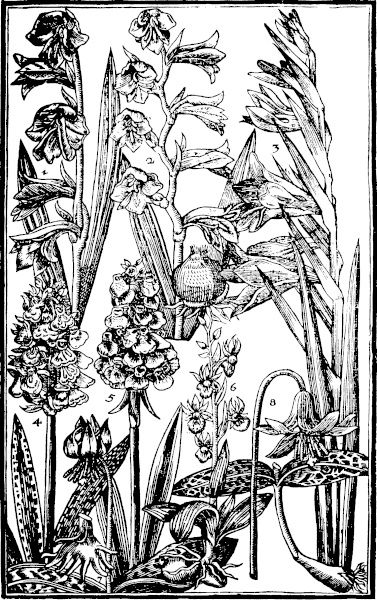
| 1 | Gladiolus Narbonensis. The French Corne Flagge. |
| 2 | Gladiolus Italicus. The Italian Corne Flagge. |
| 3 | Gladiolus Byzantinus. Corne Flagge of Constantinople. |
| 4 | Palma Christi mas. The great male handed Satyrion. |
| 5 | Orchis Hermaphroditica candida. The white Butterflie Orchis. |
| 6 | Orchis Melitias siue apifera. The Bee flower or Bee Orchis. |
| 7 | Dens Caninus flore purpurante. Dogges tooth Violet with a pale purplish flower. |
| 8 | Dens Caninus flore albo. Dogges tooth Violet with a white flower. |
Although it is not my purpose in this place, to giue a generall history of all the
sorts of Orchides, Satyrions, and the rest of that kinde; yet because many of
them are very pleasant to behold, and, if they be planted in a conuenient place,
will abide some time in Gardens, so that there is much pleasure taken in them: I shall
intrude some of them for curiosities sake, to make vp the prospect of natures beautifull
variety, and only entreate of a few, leauing the rest to a more ample declaration.
This handed Satyrion hath for the most part but three faire large greene leaues,
neare vnto the ground, spotted with small blackish markes: from among which riseth
vp a stalke, with some smaller leaues thereon, bearing at the toppe a bush or spike of
flowers, thicke set together, euery one whereof is made like a body, with the belly
broader belowe then aboue, where it hath small peeces adioyned vnto it: the flower
is of a faire purple colour, spotted with deeper purple spots, and hauing small peeces
like hornes hanging at the backes of the flowers, and a small leafe at the bottome of the
foote-stalke of euery flower: the rootes are not round, like the other Orchides, but
somewhat long and flat, like a hand, with small diuisions belowe, hanging downe like
the fingers of a hand, cut short off by the knockles, two alwayes growing together,
with some small fibres or strings aboue the heads of these rootes, at the bottome of
the stalke.
This female Satyrion hath longer and narrower leaues then the former, and spotted
with more and greater spots, compassing the stalke at the bottome like the other: this
beareth likewise a bush of flowers, like vnto the other, but that each of these haue heads
like hoods, whereas the former haue none: in some they are white with purple spots,
and in others of a reddish purple, with deepe or darke coloured spots: the roots are alike.
The rootes of this kinde take part with both the sorts of Orchis and Satyrium, being
neither altogether round, nor fully handed, and thereupon it tooke the name, to signifie
both kindes: the leaues are two in number, seldome more, being faire and broad,
like vnto the leaues of Lillies, without any spot at all in them: at the toppe of the
stalke stand many white flowers, not so thicke set as the first or second, euery one being
fashioned like vnto a white Butterflie, with the wings spread abroad.
This is a small and lowe plant for the most part, with three or foure small narrow
leaues at the bottome: the stalke is seldome above halfe a foote high, with foure or fiue
flowers thereon one aboue another, hauing round bodies, and somewhat flat, of a kind
of yellowish colour, with purple wings aboue them, so like vnto an honey Bee, that it
might soone deceiue one that neuer had seene such a flower before: the roots are two
together, round and white, hauing a certaine muccilaginesse or clamminesse within
them, without any taste almost at all, as all or the most part of these kindes haue.
The leaues of this Orchis are somewhat larger then of the Bee flower, the stalke also
somewhat higher: the flowers are fewer on the toppe, but somewhat larger then of
the Bee flowers, made to the resemblance of a Gnat or great long Flie: the rootes are
two round bulbes, as the other are.
The Flie Orchis is like vnto the last described, both in leafe and roote, the difference
is in the flower, which is neither so long as the Gnat Satyrion, nor so great as the
Bee Orchis, but the neather part of the Flie is blacke, with a list of ash-colour crossing
the backe, with a shew of legges hanging at it: the naturall Flie seemeth so to bee in
loue with it, that you shall seldome come in the heate of the day, but you shall finde
one sitting close thereon.
These grow in many places of England, some in the Woods, as the Butterflie,
and the two former handed Satyrions: others on dry bankes and
barren balkes in Kent, and many other places.
They flower for the most part in the beginning or middle of May, or
thereabouts.
Their seuerall names are expressed in their titles, so much as may suffice
for this discourse.
All the kindes of Orchis are accounted to procure bodily lust, as well the
flowers distilled, as the rootes prepared.
The rootes boyled in red Wine, and afterwards dryed, are held to bee a
singular good remedie against the bloody Flixe.
Vnto the kindes of Orchides, may fitly be ioyned another plant, which by
many is reckoned to be a Satyrium, both from the forme of roote and leafe,
and from the efficacy or vertue correspondent thereunto. And although it
cannot be the Satyrium Erythronium of Dioscorides, as some would entitle it, for that
as I haue shewed before, his Satyrium tryphillum is the Tulipa without all doubt; yet
because it differeth very notably, and carrieth more beauty and respect in his flower
then they, I shall entreate thereof in a Chapter by it selfe, and set it next vnto them.
The white Dogs tooth hath for his roote a white bulbe, long and small, yet vsually
greater then either of the other that follow, bigger belowe then aboue, with a small
peece adioyning to the bottome of it, from whence rise vp in the beginning of the
Spring, after the Winter frosts are past, two leaues for the most part (when it will
flower, or else but one, and neuer three together that euer I saw) closed together when
they first come vp out of the ground, which inclose the flower betweene them: the
leaues when they are opened do lay themselues flat on the ground, or not much aboue
it, one opposite vnto the other, with the stalke and the flower on it standing betweene
them, which leaues are of a whitish greene colour, long and narrow, yet broader in the
middle then at both ends, growing lesse by degrees each way, spotted and striped all
ouer the leaues with white lines and spots: the stalke riseth vp halfe a foote high or
more, bearing at the toppe one flower and no more, hanging downe the head, larger
then any of the other of this kinde that follow, made or consisting of six white long
and narrow leaues, turning themselues vp againe, after it hath felt the comfort of the
Sunne, that they doe almost touch the stalke againe, very like vnto the flowers of Cyclamen
or Sowebread: it hath in the middle of the flower six white chiues, tipt with
darke purple pendents, and a white three forked stile in the middle of them: the flower
hath no sent at all, but commendable onely for the beauty and forme thereof: after
the flower is past, commeth in the place a round head seeming three square, containing
therein small and yellowish seede.
This other Dogs tooth is like vnto the former, but lesser in all parts, the leafe
whereof is not so long, but broad and short, spotted with darker lines and spots: the
flower is like the other, but smaller, and of a delayed purple colour, very pale sometimes,
and sometimes a little deeper, turning it selfe as the other, with a circle round
about the vmbone or middle, the chiues hereof are not white, but declining to purple:
the roote is white, and like vnto the former, but lesser, as is said before.
This is in all things like vnto the last, both for forme and bignesse of flower and
leafe: the chiefe difference consisteth in this, that the leaues hereof are of a yellowish
mealy greene colour, spotted and streaked with redder spots and stripes, and the
flower of a deeper reddish purple colour, and the chiues also more purplish then the
last, in all other things it is alike.
The sorts Dens Caninus doe growe in diuers places; some in Italy on
the Euganean Hils, others on the Apenine, and some about Gratz, the chiefe
Citie of Stiria, and also about Bayonne, and in other places.
They flower in March most vsually, and many times in Aprill, according
to the seasonablenesse of the yeare.
Clusius did call it first Dentali, and Lobel, and from him some others Satyrium,
and Erythronium, but I haue said enough hereof in the beginning of
the Chapter. It is most commonly called Dens Caninus, and we in English,
either Dogs tooth, or Dogs tooth Violet. Gesner called it Hermodactylus,
and Matthiolus Pseudohermodactylus.
The roote hereof is held to bee of more efficacy for venerous effects,
then any of the Orchides and Satyrions.
They of Stiria vse the rootes for the falling sicknesse.
Wee haue had from Virginia a roote sent vnto vs, that wee might well
iudge, by the forme and colour thereof being dry, to be either the roote of
this, or of an Orchis, which the naturall people hold not onely to be singular
to procure lust, but hold it as a secret, loth to reueale it.
The likenesse of the flowers, and the spotting of the leaues of the Dens Caninus,
with these of the Cyclamen or Sowebread, maketh mee ioyne it next thereunto:
as also that after the bulbous rooted plants I might begin with the tuberous
that remaine, and make this plant the beginning of them. Of this kinde there are
diuers sorts, differing both in forme of leaues and time of flowring: for some doe
flower in the Spring of the yeare, others afterwards in the beginning of Summer: but
the most number in the end of Summer, or beginning of Autumne or Haruest, whereof
some haue round leaues, others cornered like vnto Iuie, longer or shorter, greater or
smaller. Of them all in order, and first of those that come in the Spring.
This Sowebread hath a smaller roote then most of the others, yet round and blackish
on the outside, as all or most of the rest are (I speake of them that I haue seene; for
Clusius and others doe report to haue had very great ones) from whence rise vp diuers
round, yet pointed leaues, and somewhat cornered withall, greene aboue, and
spotted with white spots circlewise about the leafe, and reddish vnderneath, which at
their first comming vp are folded together; among which come the flowers, of a reddish
purple colour and very sweete, euery one vpon a small, long, and slender reddish
foote-stalke, which hanging downe their heads, turne vp their leaues againe: after the
flowers are past, the head or seede vessel shrinketh downe, winding his footestalke,
and coyling it selfe like a cable, which when it toucheth the ground, there abideth hid
among the leaues, till it be growne great and ripe, wherein are contained a few small
round seedes, which being presently sowne, will growe first into round rootes, and afterwards
from them shoote forth leaues.
The white flowring Sowebread hath his leaues like the former, but not fully so
much cornered, bearing small snow white flowers, as sweete as the other: and herein
consisteth the chiefest difference, in all other things it is alike.
This Sowebread is somewhat like the former white kinde, but that the leaues grow
much larger and longer, with more corners at the edges, and more eminent spots on
them: the flowers also somewhat longer and larger, and herein consisteth the whole
difference.
Summer Sowebread hath round leaues like vnto the Romane Sowebread, but somewhat
cornered, yet with shorter corners then the Iuie leafed Sowebread, full of white
spots on the vpperside of the leaues, and very purple vnderneath, sometimes they haue
fewer spots, and little or no purple vnderneath: the flowers hereof are as small, as
purple, and as sweete, as the purple Sowebread of the Spring time: the roote hereof
is likewise small, blacke, and round.
The Romane Sowebread hath round leaues, somewhat like vnto the common
Sowebread, but not fully so round pointed at the ends, a little cornered sometimes
also, or as it were indented, with white spots round about the middle of the leaues,
and very conspicuous, which make it seeme the more beautifull: the flowers appeare
in Autumne, and are shorter, and of a deeper purplish red colour then the Iuie Sowebread,
rising vp before the leaues for the most part, or at least with them, and little or
nothing sweete: the roote is round and blacke, vsually not so flat as it, but growing
sometimes to bee greater then any other kinde of Sowebread. There is sometimesVarietas.
some variety to be seene, both in the leaues and flowers of this kinde; for that sometime
the leaues haue more corners, and either more or lesse spotted with white; the
flowers likewise of some are larger or lesser, longer or rounder, paler or deeper coloured
one then another. This happeneth most likely from the sowing of the seede, causing
the like variety as is seene in the Iuie leafed Sowebread. It doth also many times
happen from the diuersity of soyles and countries where they grow: the seed of this,
as of all the rest, is small and round, contained in such like heads as the former, standing
almost like the head of a Snake that is twined or folded within the body thereof.
This and the other Autumnall kindes, presently after their sowing in Autumne, shoote
forth leaues, and so abide all the Winter, according to their kinde.
The Iuie leafed Sowebread groweth in the same manner that the former doth, that
is, bringeth forth flowers with the leaues sometimes, or most commonly before them,
whose flowers are greater then the common round leafed Sowebread, somewhat
longer then the former Romane or Italian Sowebreads, and of a paler purple colour,
almost bluish, without that sweete sent as is in the first kinde of the Spring: the greene
leaues hereof are more long then round, pointed at the ends, and hauing also one or
two corners on each side, sometimes much spotted on the vpperside with white spots
and marks, and sometimes but a little or not at all; and so likewise sometimes more or
lesse purple vnderneath: all the leaues and flowers doe stand vsually euery one seuerally
by themselues, vpon their owne slender foote-stalkes, as most of all the other
kindes doe:Varietas. but sometimes it happeneth, that both leaues and flowers are found growing
from one and the same stalke, which I rather take to be accidentall, then naturall so
to continue: the seede hereof is like the former kindes, which being sowne produceth
variety, both in the forme of the leaues, and colour and smell of the flowers: some being
paler or deeper, and some more or lesse sweete then others: the leaues also, some
more or lesse cornered then others: the root groweth to be great, being round and flat,
and of a blackish browne colour on the outside.
There is one of this kinde, whose leaues are rounder, and not so much cornered as
the former, flowring in Autumne as the last doth, and whose flowers are wholly
white, not hauing any other notable difference therein.
This kinde of Sowebread may easily be knowne from all the other kindes, because
his leafe is longer and narrower then others, fashioned at the bottome thereof with
points, somewhat like vnto Arum or Wake Robin leaues: the flowers are like the
former sorts for forme, but of a purple colour. There is also another of this kinde in
all things like the former, but that the flowers are white.
[197]
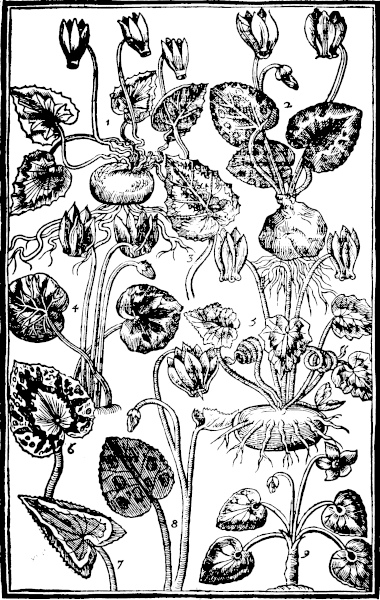
| 1 | Cyclamen Vernum flore purpureo. Purple flowred Sowebread of the Spring. |
| 2 | Cyclamen astivum. Summer Sowebread. |
| 3 | Folium Cyclaminis Cretici vernalis flore candido. A leafe of Candie Sowebread. |
| 4 | Cyclamen Romanum Autumnale. Romane Sowebread of the Autumne. |
| 5 | Cyclamen hederæfolio Autumnale. Iuie leafed Autumne Sowebread. |
| 6 | Folium Cyclaminis Autumnalis flore albo. A leafe of the Autumne Sowebread with a white flower. |
| 7 | Folium Cyclaminis angustifolij Autumnalis. A leafe of the long leafed Sowebread. |
| 8 | Cyclamen Antiochenum Autumnale flore amplo purpureo duplici. The double flowred Sowebread of Antioch. |
| 9 | Cyclamen vulgare folio rotundo. The common round leafed Sowebread. |
This Sowebread of Antioch with double flowers, hath his leaues somewhat round,
like vnto the leaues of the Summer Sowebread, but with lesse notches or corners, & full
of white spots on them: it beareth flowers on stalks, like vnto others, & likewise some
stalks that haue two or three flowers on them, which are very large, with ten or twelue
leaues a peece, of a faire Peach colour, like vnto the flowers of purple Sowebread of
the Spring, and deeper at the bottome.
There are of this kinde some, whose flowers appeare in the Spring, and are as large
and double as the former, but of a pure white colour.
There are of these Sowebreads of Antioch, that haue but single flowers, some appearing
in the Spring, and others in Autumne.
The common Sowebread (which is most vsed in the Apothecaries Shops) hath
many leaues spread vpon the ground, rising from certaine small long heads, that are
on the greater round rootes, as vsually most of the former sorts doe, being in the like
manner folded together, and after spread themselues into round greene leaues, somewhat
like vnto the leaues of Asarum, but not shining, without any white spots on the
vpperside for the most part, or but very seldome, and reddish or purplish vnderneath,
and very seldome greener: the flowers stand vpon small foot-stalkes, and shew themselues
open for the most part, before any leaues doe appeare, being smaller and shorter
then those with Iuie leaues, and of a pale purple colour, yet sometimes deeper, hanging
downe their heads, and turning vp their leaues againe, as all others doe, but more
sweete then many other of the Autumne flowers: after the flowers are past, come the
heads turning or winding themselues downe in like manner as the other doe, hauing
such like seede, but somewhat larger, and more vneuen, or not so round at the least:
the roote is round, and not flat, of a browner colour, and not so blacke on the outside
as many of the others.
The Sowebreads of the Spring doe both grow on the Pyrenæan Mountaines
in Italy, and in Candy, and about Mompelier in France; Antioch in
Syria also hath yeelded some both of the Spring and Autumne. Those
with round and Iuie leaues grow in diuers places both of France and Italy:
and the common in Germany, and the Lowe-Countries. But that Autumne
Sowebread with white flowers, is reported to grow in the Kingdome of
Naples. I haue very curiously enquired of many, if euer they found them
in any parts of England, neare or further off from the places where they
dwell: but they haue all affirmed, that they neuer found, or euer heard of
any that haue found of any of them. This onely they haue assured, that
there groweth none in the places, where some haue reported them to grow.
Those of the Spring doe flower about the end of Aprill, or beginning
of May. The other of the Summer, about the end of Iune or in Iuly. The
rest some in August, and September, others in October.
The Common Sowebread is called by most Writers in Latine, Panis
Porcinus, and by that name it is knowne in the Apothecaries shops, as also
by the name Arthanita, according to which name, they haue an ointment
so called, which is to be made with the iuice hereof. It is also called by diuers
other names, not pertinent for this discourse. The most vsuall name,
whereby it is knowne to most Herbarists, is Cyclamen (which is the Greeke
word) or as some call it Cyclaminus adding thereunto their other seuerall
titles. In English, Sowebread.
The leaues and rootes are very effectuall for the spleene, as the Ointment
before remembred plainly proueth, being vsed for the same purpose,
and that to good effect. It is vsed also for women in long and hard trauels,
where there is danger, to accelerate the birth, either the roote or the leafe
being applyed. But for any amorous effects, I hold it meere fabulous.
The next tuberous rooted plants that are to follow (of right in my opinion) are
the Anemones or Windeflowers, and although some tuberous rooted plants,
that is, the Asphodils, Spiderworts, and Flowerdeluces haue beene before inserted,
it was, both because they were in name or forme of flowers sutable to them
whom they were ioyned vnto, and also that they should not be seuered and entreated
of in two seuerall places: the rest are now to follow, at the least so many of them as
be beautifull flowers, fit to furnish a Florists Garden, for natures delightsome varieties
and excellencies. To distinguish the Family of Anemones I may, that is, into the wilde
kindes, and into the tame or mannured, as they are called, and both of them noursed
vp in Gardens; and of them into those that haue broader leaues, and into those that
haue thinner or more iagged leaues: and of each of them, into those that beare single
flowers, and those that beare double flowers. But to describe the infinite (as I may so
say) variety of the colours of the flowers, and to giue to each his true distinction and
denomination, Hic labor, hoc opus est, it farre passeth my ability I confesse, and I thinke
would grauell the best experienced this day in Europe (and the like I said concerning
Tulipas, it being as contingent to this plant, as is before said of the Tulipa, to be without
end in yeelding varieties:) for who can see all the varieties that haue sprung from
the sowing of the seede in all places, seeing the variety of colours risen from thence, is
according to the variety of ayres & grounds wherein they are sowne, skill also helping
nature in ordering them aright. For the seede of one and the same plant sowne in diuers
ayres and grounds, doe produce that variety of colours that is much differing one
from another; who then can display all the mixtures of colours in them, to set them
downe in so small a roome as this Book? Yet as I haue done (in the former part of this
Treatise) my good will, to expresse as many of each kinde haue come to my knowledge,
so if I endeauour the like in this, I hope the courteous wil accept it, and hold me
excused for the rest: otherwise, if I were or could be absolute, I should take from my self
and others the hope of future augmentation, or addition of any new, which neuer will
be wanting. To begin therefore with the wilde kinds (as they are so accounted) I shall
first entreate of the Pulsatillas or Pasque flowers, which are certainly kindes of wilde
Anemones, both in leafe and flower, as may well be discerned by them that are iudicious
(although some learned men haue not so thought, as appeareth by their writings)
the rootes of them making one speciall note of difference, from the other sorts of
wilde Anemones.
1. Pulsatilla Anglica purpurea.
The purple Pasque flower.
The Pasque or Passe flower which is of our owne Country, hath many leaues lying
on the ground, somewhat rough or hairie, hard in feeling, and finely cut into many
small leaues, of a darke greene colour, almost like the leaues of Carrets, but finer and
smaller, from among which rise vp naked stalkes, rough or hairie also, set about the
middle thereof with some small diuided leaues compassing them, and rising aboue
these leaues about a spanne, bearing euery one of them one pendulous flower, made of
six leaues, of a fine Violet purple colour, but somewhat deepe withall, in the middle
whereof stand many yellow threads, set about a middle purple pointell: after the
flower is past, there commeth vp in the stead thereof a bushie head of long seedes,
which are small and hoarie, hauing at the end of euery one a small haire, which is gray
likewise: the roote is small and long, growing downewards into the ground, with a
tuft of haire at the head thereof, and not lying or running vnder the vpper crust thereof,
as the other wilde Anemones doe.
2. Pulsatilla Danica.
The Passe flower of Denmarke.
There is another that was brought out of Denmarke, very like vnto the former, but
that it is larger both in roote and leafe, and flower also, which is of a fairer purple colour,
not so deepe, and besides, will better abide to bee mannured then our English
kinde will, as my selfe haue often proued.
Viriusque flore
albo & flore
duplici.
Of both these sorts it is said, that some plants haue bin found, that haue borne white
flowers. And likewise one that bore double flowers, that is, with two rowes of leaues.
3. Pulsatilla flore rubro.
The red Passe flower.
Lobel, as I take it, did first set forth this kinde, being brought him from Syria, the
leaues whereof are finer cut, the flower smaller, and with longer leaues, and of a red
colour.
4. Pulsatilla flore luteo.
The yellow Passe flower.
The yellow Passe flower hath his leaues cut and diuided, very like vnto the leaues
of the first kinde, but somewhat more hairie, greene on the vpperside, and hairie vnderneath:
the stalke is round and hoary, the middle whereof is beset with some small
leaues, as in the other, from among which riseth vp the stalke of the flower, consisting
of six leaues of a very faire yellow colour on the inside, and of a hoary pale yellow on
the outside; after which followeth such an head of hairie thrummes as in the former:
the roote is of the bignesse of a mans finger.
5. Pulsatilla flore albo.
The white Passe flower.
The white Passe flower (which Clusius maketh a kinde of Anemone, and yet as hee
saith himselfe, doth more nearely resemble the Pulsatilla) hath, from amongst a tuft or
head of haires, which grow at the toppe of a long blacke roote, many leaues standing
vpon long stalkes, which are diuided as it were into three wings or parts, and each
part finely cut and diuided, like vnto the Passe flower of Denmarke, but somewhat
harder in handling, greenish on the vpperside, and somewhat gray vnderneath, and
very hairie all ouer: among these leaues rise vp the stalkes, beset at the middle of them
with three leaues, as finely cut and diuided as those belowe, from aboue which standeth
the flower, being smaller, and not so pendulous as the former, but in the like manner
consisting of six leaues, of a snow white colour on the inside, and a little browner on
the outside, with many yellow thrums in the middle: after the flower is past, riseth vp
such a like hoary head, composed as it were of many haires, each whereof hath a small
seede fastened vnto it, like as the former Passe flowers haue.
The Place.
The first is found in many places of England, vpon dry bankes that lye
open to the Sunne.
The second was first brought, as I take it, by Doctor Lobel from Denmarke,
& is one of the two kinds, that Clusius saith are common in Germanie,
this bearing a paler purple flower, and more early then the other, which
is the same with our English, whose flower is so darke, that it almost seemeth
blacke.
The red kinde, as Lobel saith, came from Syria.
The yellow Passe flower, which Clusius maketh his third wilde Anemone,
was found very plentifully growing at the foote of St. Bernards Hill, neare
vnto the Cantons of the Switzers.
The white one groweth on the Alpes neare Austria, in France likewise
and other places.
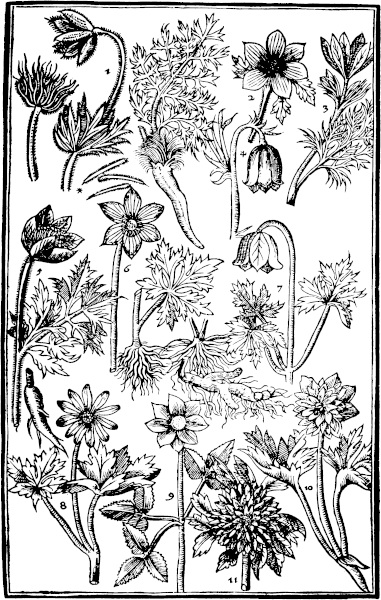
| 1 | Pulsatilla purpurea cum folio, semine, & radice. The purple Pasque flower with leafe, seed, and root. |
| 2 | Pulsatilla luteo flore. The yellow Pasque flower. |
| 3 | Pulsatilla rubra Syriaca Lobelij. Red Pasque flower of Lobel. |
| 4 | Pulsatilla rubra Swertij. Swertz his red Pasque flower. |
| 5 | Pulsatilla flore albo. White Pasque flower. |
| 6 | Anemone siluestris albo Matthioli. The wilde white broad leafed Windflower. |
| 7 | Anemone siluestris tenuifolia alba. The wilde single white Windflower. |
| 8 | Anemone siluestris tenuifolia luteo. The yellow wilde thin leafed Windflower. |
| 9 | Anemone siluestris trifolia Dodonæi. The three-leafed wilde Windflower. |
| 10 | Anemone siluestris flore pleno albo. The double white wilde Windflower. |
| 11 | Anemone siluestris flore pleno purpureo. The double purple wilde Windeflower. |
| * | Semen seperatim divulsum. The seed separated. |
| † | Radice cum folio inferiore. The roote with a lower leafe. |
The Time.
All of them doe flower early in the yeare, that is, in the beginning of Aprill,
about which time most commonly Easter doth fall.
The Names.
Their proper names are giuen to each in their seuerall titles, being all of
them kindes of wilde Anemones, as I said in the beginning of the Chapter,
and so for the most part all Authors doe acknowledge them. We call them
in English, because they flower about Easter, Pasque flower, which is the
French name for Easter, or Euphoniæ gratia, Pasque flower, which may passe
currant, without any further descant on the name, or else Pulsatilla, if you
will, being growne old by custome.
The Vertues.
The sharpe biting and exulcerating quality of this plant, causeth it to be
of little vse, notwithstanding Ioachimus Camerarius saith in his Hortus Medicus,
that in Borussia, which is a place in Italy, as I take it, the distilled water
hereof is vsed with good successe, to be giuen to them that are troubled
with a Tertian Ague; for he saith that it is medicamentum ὀκφρακτικὸν, that is, a
medicine of force to helpe obstructions.
Anemone siluestris latifolia alba siue tertia Matthioli.
The white wilde broad leafed Windflower.
This Windflower hath diuers broad greene leaues, cut into diuisions, and dented,
about, very like vnto a broad leafed Crowfoote, among which riseth vp a stalke, hauing
some such like cut leaues in the middle thereof, as growe below, but smaller; on
the toppe whereof standeth one large white flower, consisting of fiue leaues for the
most part, with some yellow threads in the middle, standing about such a greene head
as is in the tame or garden Anemones, which growing greater after the flower is past,
is composed of many small seedes, wrapped in white wooll, which as soone as they
are ripe, raise themselues vp from the bottome of the head, and flye away with the
winde, as the other tame or garden kindes doe: the roote is made of a number of long
blacke strings, encreasing very much by running vnder ground, and shooting vp in diuers
places.
Anemone siluestris tenuifolia lutea.
The yellow wilde thin leafed Windflower.
The yellow wilde Anemone riseth vp with one or two small round naked stalkes,
bearing about the middle of them, small, soft, and tender iagged leaues, deeply cut in
and indented on the edges about, from aboue which, doth grow the stalke, bearing
small yellow flowers, standing vpon weake foote-stalks, like vnto a small Crowfoot,
with some threads in the middle: the roote is long and small, somewhat like vnto the
roote of Pollipodie, creeping vnder the vpper crust of the earth: this kinde is lower,
and springeth somewhat earlier then the other wilde kindes that follow.
Anemone siluestris tenuifolia alba simplex.
The single white thin leafed wilde Windflower.
This white wilde Anemone riseth vp with diuers leaues vpon seuerall long stalkes;
which are somewhat like vnto the former, but that they are somewhat harder, and not
so long, nor the diuisions of the leaues so finely snipt about the edges, but a little
broader, and deeper cut in on euery side: the flowers hereof are larger and broader
then the former, white on the inside, and a little purplish on the outside, especially at
the bottome of the flower next vnto the stalke: the roote of this is very like vnto the
last.
Purpurea.
There is another of this kinde, whose flowers are purple, in all other things it is like
vnto the white.
Coccinea siue
suave rubens.
And likewise another, with a blush or carnation coloured flower.
Peregrina alba.
There is one that is onely nursed vp with vs in Gardens, that is somewhat like vnto
these former wilde Anemones in roote and leafe, but that the flower of this, being pure
white within, and a little purplish without, consisting of eight or nine small round
pointed leaues, hath sometimes some leaues vnder the flower, party coloured white
and greene: the flower hath likewise a greene head, like a Strawberry, compassed about
with white threads, tipt with yellow pendents.
Peregrina viridis.
And another of the same kinde with the last, whose flower consisting of eight or
nine leaues, is of a greenish colour, except the foure outermost leaues, which are a little
purplish, and diuided at the points into three parts; the middle part is of a greenish
white colour, with a greene head in the middle as the other.
Anemone siluestris trifolia Dodonæi.
The three leafed wilde Windflower.
This wilde Anemone hath his rootes very like vnto the former kindes; the leaues are
alwaies three set together at the toppe of slender stalkes, being small and indented about,
very like vnto a three leafed Grasse, but smaller: the flower consisteth of eight
small leaues, somewhat like vnto a Crowfoote, but of a whitish purple or blush colour,
with some white threads, and a greene rough head in the middle.
Anemone siluestris flore pleno albo.
The double white wilde Windflower.
This double kinde is very like vnto the single white kinde before described, both
in his long running rootes, and thin leaues, but somewhat larger: the flowers hereof
are very thicke and double, although they be small, and of a faint sweete sent, very
white after it is full blowne for fiue or six dayes, but afterwards it becommeth a little
purplish on the inside, but more on the outside: this neuer giueth seede (although it
haue a small head in the middle) like as many other double flowers doe.
Anemone siluestris flore pleno purpureo.
The double purple wilde Windflower.
This double purple kinde hath such like iagged leaues as the last described hath, but
more hoarie vnderneath: the flower is of a fine light purple toward the points of the
leaues, the bottomes being of a deeper purple, but as thicke, and full of leaues as the
former, with a greene head in the middle, like vnto the former: this kinde hath small
greene leaues on the stalkes vnder the flowers, cut and diuided like the lower leaues.
The Place.
The first broad leafed Anemone groweth in diuers places of Austria and
Hungary. The yellow in diuers woods in Germany, but not in this Countrey
that euer I could learne. The other single wilde kindes, some of them
are very frequent throughout the most places of England, in Woods,
Groues, and Orchards. The double kindes were found, as Clusius saith, in
the Lowe-Countries, in a Wood neare Louaine.
The Time.
They flower from the end of March (that is the earliest) and the beginning
of Aprill, vntill May, and the double kindes begin within a while after
the single kinds are past.
The Names.
They are called Ranunculi siluarum, and Ranunculi nemorum, and as Clusius
would haue them, Leimonia of Theophrastus; they are generally called
of most Herbarists Anemones siluestres, Wilde Anemones or Windflowers.
The Italians call them Gengeuo saluatico, that is, Wilde Ginger, because the
rootes are, besides the forme, being somewhat like small Ginger, of a biting
hot and sharpe taste.
Anemone Lusitanica siue hortensis latifolia flore simplici luteo.
The single Garden yellow Windflower or Anemone.
This single yellow Anemone or Windflower hath diuers broad round leaues, somewhat
diuided and endented withall on the edges, brownish at the first rising vp out of
the ground, and almost folded together, and after of a sad greene on the vpperside,
and reddish vnderneath; among which rise vp small slender stalkes, beset at the middle
of them with two or three leaues, more cut and diuided then those belowe, with
small yellow flowers at the toppe of them, consisting of ten or twelue leaues a peece,
hauing a few yellow threads in the middle of them, standing about a small greene
head, which in time growing ripe hath small flat seede, inclosed within a soft wooll
or downe, which is easily blowne away with the winde: the roote groweth downeward
into the ground, diuersly spread with branches here and there, of a brownish yellow
on the outside, and whitish within, so brittle, that it can hardly bee touched without
breaking.
Anemone latifolia flore luteo duplici.
The double yellow Anemone or Windflower.
This double yellow Anemone hath such broad round leaues as the single kinde
hath, but somewhat larger or ranker: the stalkes are beset with larger leaues, more
deeply cut in on the edges: the flowers are of a more pale yellow, with some purplish
veines on the outside, and a little round pointed; but they are all on the inside of a
faire yellow colour, consisting of two rowes of leaues, whereof the innermost is the
narrower, with a small greene head in the middle, compassed with yellow threads as
in the former: the roote is like the roote of the single; neither of these haue any good
sent, and this springeth vp and flowreth later then the single kinde.
Anemone latifolia purpurea stellata siue papaveracea.
The purple Starre Anemone or Windflower.
The first leaues of this purple Anemone, which alwayes spring vp before Winter,
(if the roote be not kept too long out of the ground,) are somewhat like the leaues of
Sanicle or Selfe-heale, but the rest that follow are more deeply cut in and iagged; among
which rise vp diuers round stalkes, beset with iagged leaues as all other Anemones
are, aboue which leaues, the stalkes rising two or three inches high, beare one
flower a peece, composed of twelue leaues or more, narrow and pointed, of a bleake
purple or whitish ash-colour, somewhat shining on the outside, and of a fine purple colour
tending to a murrey on the inside, with many blackish blew threads or thrummes
in the middle of the flower, set about a head, whereon groweth the seede, which is
small and blacke, inclosed in soft wooll or downe, which flieth away with the winde,
carrying the seede with it, if it be not carefully gathered: the roote is blackish on the
outside, and white within, tuberous or knobby, with many fibres growing at it.
Anemone purpurea Stellata altera.
Another purple Starre Anemone.
There is so great diuersity in the colours of the flowers of these broad leafed kinds of
Anemones or Windflowers, that they can very hardly be expressed, although in their
leaues there is but little or no difference. I shall not neede therefore to make seuerall
descriptions of euery one that shall be set downe; but it will be sufficient, I thinke, to
giue you the distinctions of the flowers: for as I said, therein is the greatest and chiefest
difference. This other Starre Anemone differeth not from the former in leafe or
flower, but onely that this is of a more pale sullen colour on the outside, and of a paler
purple colour on the inside.
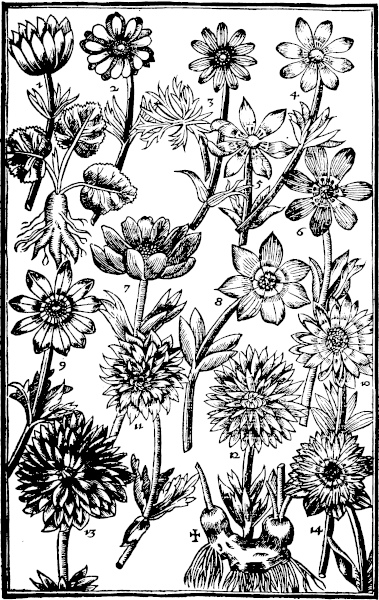
| 1 | Anemone latifolia flore luteo simplici. The single yellow Anemone. |
| 2 | Anemone latifolia flore luteo duplici. The double yellow Anemone. |
| 3 | Anemone latifolia flore purpureo Stellato. The purple Starre Anemone. |
| 4 | Anemone latifolia purpurea dilutior. The pale purple Starre Anemone. |
| 5 | Anemone latifolia flore miniato diluto. The pale red Anemone. |
| 6 | Anemone latifolia coccinea Cardinalis dicta. The Cardinall Anemone. |
| 7 | Anemone latifolia incarnata Hispanica. The Spanish incarnate Anemone. |
| 8 | Anemone latifolia Pauo simplex dicta. The lesser Orenge tawney Anemone. |
| 9 | Anemone latifolia flore carneo. The carnation Anemone. |
| 10 | Anemone latifolia Arantiaca siue Pauo maior. The double Orenge tawney Anemone. |
| 11 | Anemone Superitica siue Cyparissia. The double Anemone of Cyprus. |
| 12 | Anemone latifolia flore pleno albicante. The double pale blush Anemone. |
| 13 | Anemone Chalcedonica maxima. The great Spanish Marigold Anemone. |
| 14 | Anemone Cacumeni siue Persica. The double Persian Anemone. |
| † | Anemonis latifoliæ radice. The roote of a great Anemone. |
Viola purpurea.
There is another, whose flower hath eight leaues, as many of them that
follow haue (although diuers sorts haue but six leaues in a flower) and is of
a Violet purple, and therefore is called, The Violet purple Anemone.
Varietas.
Of all these three sorts last described, there be other that differ only in hauing
white bottomes, some smaller and some larger.
Purpurea striata.
There is also another of the same Violet purple colour with the former,
but a little paler, tending more to rednesse, whose flowers haue many
white lines and stripes through the leaues, and is called, The purple stript
Anemone.
Carnea vivacissima simplex.
There is another, whose greene leaues are somewhat larger, and so is the
flower likewise, consisting of eight leaues, and sometimes of more, of the
colour of Carnation silke, sometimes pale and sometimes deeper, with a
whitish circle about the bottome of the leaues, which circle in some is
larger, and more to be seene then in others, when the flower layeth it selfe
open with the heate of the Sunne, hauing blewish threads in the middle.
This may be called, the Carnation Anemone.
Persiciviolacea.
We haue another, whose flower is betweene a Peach colour and a Violet,
which is vsually called a Gredeline colour.
Cochenille.
And another of a fine reddish Violet or purple, which we call, The Cochenille
Anemone.
Cardinalis.
And another of a rich crimson red colour, and may be called, The Cardinall
Anemone.
Sanguinea.
Another of a deeper, but not so liuely a red, called, The bloud red Anemone.
Cramesina.
Another of an ordinary crimson colour, called, The crimson Anemone.
Coccinea.
Another of a Stamell colour, neare vnto a Scarlet.
Incarnata.
Another of a fine delayed red or flesh colour, and may bee called, The
Incarnidine Anemone.
Incarnata Hispanica.
Another whose flower is of a liuely flesh colour, shadowed with yellow,
and may be called, The Spanish Incarnate Anemone.
Rubescens.
Another of a faire whitish red, which we call, The Blush Anemone.
Moschutella.
Another whose flower consisteth of eight leaues, of a darke whitish colour,
stript all ouer with veines of a fine blush colour, the bottomes being
white, this may be called, The Nutmegge Anemone.
Enfumata.
Another whose flower is of a pale whitish colour, tending to a gray, such
as the Monkes and Friers were wont to weare with vs, and is called, A
Monkes gray.
Pauo maior simplici flore.
There is another, whose leafe is somewhat broader then many or most
of the Anemones, comming neare vnto the leafe of the great double Orenge
coloured Anemone; the flower whereof is single, consisting of eight
large or broad leaues, very neare vnto the same Orenge colour, that is in
the double flower hereafter described, but somewhat deeper. This is vsually
called in Latine, Pauo maior simplici flore, and we in English, The great
single Orenge tawnie Anemone.
Pauo minor.
There is likewise of this kinde another, whose flower is lesser, and called,
The lesser Orenge tawnie Anemone.
Varietas magna ex seminio.
There is besides these expressed, so great a variety of mixt colours in the
flowers of this kinde of Anemone with broad leaues, arising euery yeare
from the sowing of the seede of some of the choisest and fittest for that
purpose, that it is wonderfull to obserue, not onely the variety of single
colours, but the mixture of two or three colours in one flower, besides the
diuersity of the bottomes of the flowers, some hauing white or yellowish
bottomes, and some none, and yet both of the same colour; and likewise
in the thrums or threads in the middle: But the greatest wonder of beauty
is in variety of double flowers, that arise from among the other single ones,
some hauing two or three rowes of leaues in the flowers, and some so thicke
of leaues as a double Marigold, or double Crowfoote, and of the same
seuerall colours that are in the single flowers, that it is almost impossible
to expresse them seuerally, and (as is said before) some falling out to
bee double in one yeare, which will proue single or lesse double in another,
yet very many abiding constant double as at the first; and therefore
let this briefe recitall be sufficient in stead of a particular of all the colours.
Anemone Chalcedonica maxima versicolor.
The great double Windflower of Constantinople.
This great Anemone of Constantinople hath broader and greener leaues then any
of the former kindes, and not so much diuided or cut in at the edges, among which
rise vp one or two stalkes, (seldome more from one roote) hauing some leaues about
the middle of the stalke, as other Anemones haue, and bearing at the toppes of the
stalkes one large flower a peece, very double, whose outermost leaues being broadest,
are greenish at the first, but afterwards red, hauing sometimes some greene abiding still
in the leaues, and the red striped through it: the other leaues which are within these
are smaller, and of a perfect red colour; the innermost being smallest, are of the same
red colour but turned somewhat inward, hauing no thrummes or threads in the middle,
as the former haue, and bearing no seede: the roote is blackish on the outside, and
white within, thicke and tuberous as the other kindes, but thicker set and close together,
not shooting any long slender rootes as others doe. Some Gentlewomen call this
Anemone, The Spanish Marigold.
Anemone Chalcedonica altera siue Pauo maior flore duplici.
The great double Orenge tawney Anemone.
This other great Anemone of Constantinople hath his large leaues so like vnto
the last, that one can hardly distinguish them asunder; the stalke hath also such like
leaues set vpon it, bearing at the toppe a faire large flower, consisting of many leaues
set in two or three rowes at the most, but not so thicke or double as the last, yet seeming
to be but one thicke rowe of many small and long leaues, of an excellent red or crimson
colour, wherein some yellow is mixed, which maketh that colour is called an Orenge
tawney; the bottomes of the leaues are red, compassed with a whitish circle,
the thrummie head in the middle being beset with many darke blackish threads: the
roote is like the former.
Anemone Superitica siue Cyparissia.
The double Anemone of Cyprus.
This Anemone (which the Dutchmen call Superitz, and as I haue beene enformed,
came from the Isle of Cyprus) hath leaues very like the last double Anemone, but not
altogether so large: the flower consisteth of smaller leaues, of colour very neare vnto
the last double Orenge coloured Anemone, but more thicke of leaues, and as double
as the first, although not so great a flower, without any head in the middle, or thrums
about it as is in the last, and differeth not in the roote from either of them both.
Somewhat like vnto this kinde, or as it were betweene this and the first kinde of
these great double Anemones, we haue diuers other sorts, bearing flowers very thicke
and double; some of them being white, or whitish, or purple, deepe or paler, and some
of a reddish colour tending to Scarlet or a Carnation colour, and some also of a blush
or flesh colour, and diuers other colours, and all of them continue constant in their
colours.
Anemone Cacumeni Maringi siue Persica.
The double Persian Anemone.
This rare Anemone, which is said to come out of Persia to Constantinople, and
from thence to vs, is in leafe and roote very like vnto the former double Anemones
before described; onely the flower hereof is rather like vnto the second great double
Orenge coloured Anemone, vsually called Pauo maior flore pleno, being composed of
three rowes of leaues, the outermost rowe consisting of ten or twelue larger leaues,
and those more inward lesser and more in number, but all of them variably mixed
with white, red, and yellow, having the bottomes of the leaues white: but instead of
a middle head with thrums about it, as the other hath, this hath a few narrow leaues,
or a deepe yellow colour in the middle of the flower, standing vpright.
Hauing thus farre proceeded in the two parts of the kindes of Anemones or Windflowers,
it remaineth to entreate of the rest, which is those Anemones which haue thin
cut leaues, whereof some haue reckoned vp thirty sorts with single flowers, which I
confesse I haue not seene; but so many as haue come to my knowledge, I shall here set
downe.
Anemone tenuifolia siue Geranifolia cærulea.
The Watchet Anemone or Storkes bill leafed Windflower.
This first Windflower with thin cut leaues, riseth not out of the ground vntil the great
Winter frosts be past, that is, about the middle or end of February, and are somewhat
brownish at their first appearing, but afterwards spread into wings of greene leaues,
somewhat broader then the rest that follow, diuided into three parts, & each part into
three leaues, euery one cut in about the edges, one standing against another vpon a
long slender foote-stalke, and the end leafe by it selfe: among these riseth vp two or
three greene stalkes, garnished with such like thin leaues as are at the bottome, from
aboue which rise the flowers, but one vpon a stalke, consisting of fourteene or fifteene
small pale blew or watchet leaues, lesser then any of the single kindes that follow,
compassing many whitish threads, and a small greene head in the middle, somewhat
like the head of the wilde Crowfoote, wherein is contained such like seede: the roote
is blackish without, thrusting out into long tuberous peeces, somewhat like vnto some
of the broad leafed Anemones.
Alba.
Of this kinde there is another, whose leaues are not browne at their first rising, but
greene, and the flowers are white, in other things not differing.
Anemone tenuifolia purpurea vulgaris.
The ordinary purple Anemone with thin leaues.
This purple Anemone which is most common, and therefore the lesse regarded,
hath many winged leaues standing vpon seuerall stalkes, cut and diuided into diuers
leaues, much like vnto the leaues of a Carrot; among which rise vp stalkes with some
leaues thereon (as is vsuall to the whole Family of Anemones, both wilde and tame,
as is before said;) at the toppes whereof stand the flowers, made of six leaues most vsually,
but sometimes they will haue seuen or eight, being very large, and of a perfect
purple Violet colour, very faire and liuely: the middle head hath many blackish
thrums or threads about it, which I could neuer obserue in my Gardens to beare seed:
the roote is smaller, and more spreading euery way into small long flat tuberous parts,
then any other kindes of single or double Anemones.
Carneapallida.
There is another very like in leafe and roote vnto the former, but the
flower is nothing so large, and is whitish, tending to a blush colour, and
of a deeper blush colour toward the bottome of the flower, with blackish
blew thrums in the middle, and giueth no seede that I could euer obserue.
Carnea viuida
vnguibus albis.
There is likewise another like vnto the last in leafe and flower, but
that the flower is larger then it, and is a of liuely blush colour, the leaues
hauing white bottomes.
Alba venis purpureis.
And another, whose flower is white, with purple coloured veines and
stripes through euery leafe, and is a lesser flower then the other.
Anemone tenuifolia coccinea simplex.
The single Scarlet Anemone with thin leaues.
The leaues of this Scarlet Windflower are somewhat like vnto the former, but a little
broader, and not so finely cut and diuided: the flower consisteth of six reasonable
large leaues, of an excellent red colour, which we call a Scarlet; the bottomes of the
leaues are large and white, and the thrums or threads in the middle of a blackish purple
colour: the roote is tuberous, but consisting of thicker peeces, somewhat like vnto
the rootes of the broad leafed Anemones, but somewhat browne and not so blacke,
and most like vnto the roote of the double Scarlet Anemone.
Coccinea absq;
vnguibus.
There is another of this kinde, whose flower is neare vnto the same colour,
but this hath no white bottomes at all in his leaues.
Flore holosericeo.
We haue another which hath as large a flower as any single, and is of an
Orient deepe red crimson Veluet colour.
Sanguinea.
There is another of a deeper red colour, and is called, The bloud red
single Anemone.
Rubra fundo
luteo.
And another, whose flower is red with the bottome yellow.
Coccinea dilutior.
Another of a perfect crimson colour, whereof some haue round pointed
leaues, and others sharpe pointed, and some a little lighter or deeper then
others.
Alba staminibus
purpureis.
There is also one, whose flower is pure white with blewish purple
thrums in the middle.
Carnea Hispanica.
And another, whose flower is very great, of a kinde of sullen blush colour,
but yet pleasant, with blewish threads in the middle.
Alba carneis
venis.
And another with blush veines in euery leafe of the white flower.
Alba purpureis
vnguibus.
And another, the flower whereof is white, the bottomes of the leaues
being purple.
Purpurascens.
Another whose flower consisteth of many small narrow leaues, of a pale
purple or blush colour on the outside, and somewhat deeper within.
Facie florum
pomi simplex.
There is another like in leafe and roote vnto the first Scarlet Anemone,
but the flower hereof consisteth of seuen large leaues without any bottomes,
of a white colour, hauing edges, and some large stripes also of a carnation
or flesh colour to bee seene in them, marked somewhat like an Apple
blossome, and thereupon it is called in Latine, Anemone tenuifolia simplex
alba instar florum pomi, or facie florum pomi, that is to say in English,
The single thin leafed Anemone with Apple blossome flowers.
Multiplex.
I haue heard that there is one of this kinde with double flowers.
1. Anemone tenuifolia flore coccineo pleno vulgaris.
The common double red or Scarlet Anemone.
The leaues of this double Anemone are very like vnto the leaues of the single Scarlet
Anemone, but not so thin cut and diuided as that with the purple flower: the flower
hereof when it first openeth it selfe, consisteth of six and sometimes of seuen or eight
broad leaues, of a deepe red, or excellent Scarlet colour, the middle head being thick
closed, and of a greenish colour, which after the flower hath stood blowne some time,
doth gather colour, and openeth it selfe into many small leaues, very thicke, of a more
pale red colour, and more Stamell like then the outer leaues: the root of this is thicke
and tuberous, very like vnto the root of the single Scarlet Anemone.
2. Anemone tenuifolia flore coccineo pleno variegata.
The party coloured double Crimson Anemone.
We haue a kinde hereof, varying neither in roote, leafe, or forme of flower from
the former, but in the colour, in that this will haue sometimes the outer broad leaues
party coloured, with whitish or blush coloured great streakes in the red leaues both inside
and outside; as also diuers of the middle or inner leaues striped in the same manner:
the roote hereof giueth fairer flowers in some yeares then in others, and sometimes
giue flowers all red againe.
3. Anemone tenuifolia flore coccineo saturo pleno.
The double crimson Veluet Anemone.
Wee haue another also, whose flower is of a deepe Orenge tawny crimson colour,
neare vnto the colour of the outer leaues, of the lesser French Marigold, and not differing
from the former in any thing else.
4. Anemone tenuifolia flore pleno suauerubente.
The greater double blush Anemone.
There is small difference to be discerned, either in the roote or leaues of this from
the former double Scarlet Anemone, sauing that the leaues hereof are a little broader,
and seeme to bee of a little fresher greene colour: the flower of this is as large almost,
and as double as the former, and the inner leaues likewise almost as large as they, being
of a whitish or flesh colour at the first opening of them, but afterwards become of
a most liuely blush colour; the bottomes of the leaues abiding of a deeper blush, and
with long standing, the tops of the leaues will turne almost wholly white againe.
5. Anemone tenuifolia flore albo pleno.
The double white Anemone.
This double white Anemone differeth little from the former blush Anemone, but
in that it is smaller in all the parts thereof, and also that the flower hereof being wholly
of a pure white colour, without any shew of blush therein, hath the middle thrummes
much smaller and shorter then it, and not rising vp so high, but seeme as if they were
chipped off euen at the toppes.
6. Anemone tenuifolia flore pleno albicante.
The lesser double blush Anemone.
This small double blush Anemone differeth very little from the double white last
recited, but onely in the colour of the flower: for they are both much about the bignesse
one of another, the middle thrums likewise being as small and short, and as euen
aboue, onely the flower at the first opening is almost white, but afterwards the outer
leaues haue a more shew of blush in them, and the middle part a little deeper then they.
7. Anemone tenuifolia flore pleno purpureo violaceo.
The double purple Anemone.
This double purple Anemone is also of the same kindred with the first double red or
Scarlet Anemone for the form or doublenesse of the flower, consisting but of six or seuen
leaues at the most in this our Country, although in the hotter it hath ten or twelue,
or more as large leaues for the outer border, and as large small leaues for the inner
middle also, and almost as double, but of a deepe purple tending toward a Violet colour,
the outer leaues being not so deepe as the inner: the roote and leafe commeth
neare vnto the single purple Anemone before described, but that the roote spreadeth
not so small and so much.
8. Anemone tenuifolia flore pleno purpureo cæruleo.
The double blew Anemone.
This Anemone differeth not in any thing from the former double purple, but onely
that the flower is paler, and more tending to a blew colour.
9. Anemone tenuifolia flore pleno roseo.
The double Rose coloured Anemone.
The double Rose coloured Anemone differeth also in nothing from the former
double purple, but onely in the flower, which is somewhat smaller, and not so thicke
and double, and that it is of a reddish colour, neare vnto the colour of a pale red Rose,
or of a deepe coloured Damaske.
10. Anemone tenuifolia flore pleno carneo viuacissimo.
The double Carnation Anemone.
This Anemone, both in roote, leafe, and flower, commeth nearest vnto the former
double white Anemone, for the largenesse and doublenesse of the flower, and in the
smalnesse of the middle thrums, and euennesse at the toppes of them, being not so large
and great a flower as the double purple, either in the inner or outer leaues, but yet is
very faire, thicke and double, and of a most liuely Carnation silke colour, very deepe,
both the outer leaues and middle thrums also so bright, that it doth as it were amaze,
and yet delight the minde of the beholder, but by long standing in the Sun, waxe a little
paler, and so passe away as all the most beautifull flowers doe.
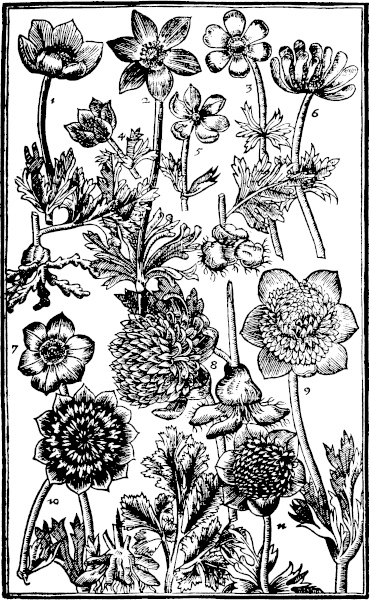
| 1 | Anemone tenuifolia simplex purpurea. The single purple Anemone with thin cut leaues. |
| 2 | Anemone tenuifolia simplex alba pura. The single pure white Anemone. |
| 3 | Anemone tenuifolia simplex chermesina. The single bright Crimson Anemone. |
| 4 | Anemone tenuifolia simplex sanguinea. The single bloud red Anemone. |
| 5 | Anemone tenuifolia simplex facie florum pomi. The single Apple bloome Anemone. |
| 6 | Anemone tenuifolia simplex purpurascens. The single purplish blush Anemone. |
| 7 | Anemone tenuifolia simplex alba vnguibus carneis. The single white Anemone with blush bottomes. |
| 8 | Anemone tenuifolia flore pleno coccineo. The double red or ordinary Scarlet Anemone. |
| 9 | Anemone tenuifolia flore pleno rubrofusca coma Amarantina. The double purple Veluet Anemone. |
| 10 | Anemone tenuifolia flore pleno purpura violaceo. The double blewish purple Anemone. |
| 11 | Anemone tenuifolia flore pleno incarnedini coloris sericei vivacissimi. The double Carnation Anemone, or of a liuely Carnation silke colour. |
11. Anemone tenuifolia flore rubrofusco pleno coma Amarantina.
The double purple Veluet Anemone.
This double Veluet Anemone is in all things like the last described Carnation Anemone,
but somewhat larger, the difference consisteth in the colour of the flower,
which in this is of a deep or sad crimson red colour for the outer leaues and of a deep
purple Veluet colour in the middle thrums, resembling the colour of the lesser Amaranthus
purpureus, or Purple flower gentle hereafter described, whereof it tooke the
name, which middle thrums are as fine and small, and as euen at the toppes as the
white or last Carnation Anemones.
12. Anemone tenuifolia flore pleno tricolor.
The double purple Veluet Anemone of three colours.
This double Anemone also is very like the last described Anemone, but that in the
middle of the purple thrums, there thrusteth forth a tuft of threads or leaues of a more
light crimson colour.
And thus much for the kindes of Anemones or Windflowers, so farre forth as haue
hitherto come to our knowledge; yet I doubt not, but that more varieties haue beene
elsewhere collected, and will be also in our Countrey daily and yearly obserued by
diuers, that raise them vp from sowing the seede, wherein lyeth a pretty art, not yet familiarly
knowne to our Nation, although it be very frequent in the Lowe-Countries,
where their industry hath bred and nourished vp such diuersities and varieties, that
they haue valued some Anemones at such high rates, as most would wonder at,
and none of our Nation would purchase, as I thinke. And I doubt not, if wee would
be as curious as they, but that both our ayre and soyle would produce as great variety,
as euer hath been seene in the Lowe-Countries; which to procure, if any of our Nation
will take so much paines in sowing the seedes of Anemones, as diuers haue done of
Tulipas: I will set them downe the best directions for that purpose that I haue learned,
or could by much search and tryall attaine vnto; yet I must let them vnderstand thus
much also, that there is not so great variety of double flowers raised from the seede of
the thin leafed Anemones, as from the broad leafed ones.
First therefore (as I said before) concerning Tulipas, there is some speciall choice to
be made of such flowers, whose seed is fittest to be taken. Of the Latifolias, the double
Orenge tawney seede being sowne, yeeldeth pretty varieties, but the purples, and
reds, or crimsons, either Latifolias or Tenuifolias, yeeld small variety, but such as draw
nearest to their originall, although some be a little deeper or lighter then others. But
the light colours be they which are the chiefe for choice, as white, ash-colour, blush
or carnation, light orenge, simple or party coloured, single or double, if they beare
seede, which must bee carefully gathered, and that not before it bee thorough ripe,
which you shall know by the head; for when the seede with the wollinesse beginneth
to rise a little of it selfe at the lower end, it must bee then quickly gathered, lest the
winde carry it all away. After it is thus carefully gathered, it must be laid to dry for a
weeke or more, which then being gently rubbed with a little dry sand or earth, will
cause the seede to be somewhat better separated, although not thoroughly from the
woollinesse or downe that compasseth it.
Within a moneth at the most after the seede is thus gathered and prepared, it must
be sowne; for by that meanes you shall gaine a yeare in the growing, ouer that you
should doe if you sowed it in the next Spring.
If there remaine any woollinesse in the seede, pull it in sunder as well as you can,
and then sowe your seede reasonable thin, and not too thicke, vpon a plaine smooth
bed of fine earth, or rather in pots or tubbes, and after the sowing, sift or gently straw
ouer them some fine good fresh mould, about one fingers thicknesse at the most for the
first time: And about a moneth after their first springing vp, sift or straw ouer them
in like manner another fingers thicknesse of fine earth, and in the meane time if the
weather proue dry, you must water them gently and often, but not to ouerglut them
with moisture; and thus doing, you shall haue them spring vp before Winter, and
grow pretty strong, able to abide the sharpe Winter in their nonage, in vsing some
little care to couer them loosely with some fearne, or furse, or beane hame, or straw,
or any such, which yet must not lye close vpon them, nor too farre from them neither.
The next Spring after the sowing, if you will, but it is better if you stay vntill August,
you may then remoue them, and set them in order by rowes, with sufficient distance
one from another, where they may abide, vntill you see what manner of flower
each plant will beare, which you may dispose of according to your minde.
Many of them being thus ordered (if your mould be fine, loose, and fresh, not stonie,
clayish, or from a middin) will beare flowers the second yeare after the sowing,
and most or all of them the third yeare, if the place where you sowe them, be not annoyed
with the smoake of Brewers, Dyers, or Maultkils, which if it be, then will they
neuer thriue well.
Thus much haue I thought good to set downe, to incite some of our owne Nation
to be industrious; and to helpe them forward, haue giuen such rules of directions, that
I doubt not, but they will vpon the tryall and view of the variety, proceede as well in
the sowing of Anemones as of Tulipas.
I cannot (Gentlewomen) withold one other secret from you, which is to informe
you how you may so order Anemones, that after all others ordinarily are past, you
may haue them in flower for two or three moneths longer then are to be seene with
any other, that vseth not this course I direct you.
The ordinary time to plant Anemones, is most commonly in August, which will
beare flower some peraduenture before Winter, but most vsually in February, March,
and Aprill, few or none of them abiding vntill May; but it you will keepe some roots
out of the ground vnplanted, vntill February, March, and Aprill, and plant some at
one time, and some at another, you shall haue them beare flower according to their
planting, those that shall be planted in February, will flower about the middle or end
of May, and so the rest accordingly after that manner: And thus may you haue the
pleasure of these plants out of their naturall seasons, which is not permitted to be enioyed
in any other that I know, Nature being not so prone to bee furthered by art in
other things as in this. Yet regard, that in keeping your Anemone rootes out of the
ground for this purpose, you neither keep them too dry, nor yet too moist, for sprouting
or rotting; and in planting them, that you set them not in too open a sunny place,
but where they may be somewhat shadowed.
The Place.
I shall not need to spend much time in relating the seuerall places of these
Anemones, but onely to declare that the most of them that haue not beene
raised from seed, haue come from Constantinople to vs; yet the first broad
leafed or yellow Anemone, was first found in Portugall, and from thence
brought into these parts. And the first purple Starre Anemone in Germanie,
yet was the same sent among others from Constantinople also. And
the first thin cut leafed Anemone came first out of Italy, although many of
that sort haue come likewise from Constantinople. And so haue the double
red or Scarlet Anemones, and the great double blush, which I first had by
the gift of Mʳ. Humfrey Packington of Worcestershire Esquire, at Haruington.
The Time.
The times of their flowring are sufficiently expressed in the descriptions,
or in the rules for planting.
The Names.
The Turkish names whereby the great double broad leafed kindes haue
beene sent vnto vs, were Giul Catamer, and Giul Catamer lale; And Binizade,
Binizante, and Galipoli lale for the thinne cut leafed Anemones.
All Authors haue called them Anemones, and are the true Herbæ venti.
Wee call them in English eyther Anemones, after the Greeke name,
or Windflowers, after the Latine.
The Vertues.
There is little vse of these in Physicke in our dayes, eyther for inward or
outward diseases; onely the leaues are vsed in the Ointment called Marciatum,
which is composed of many other hot herbes, and is vsed in cold
griefes, to warme and comfort the parts. The roote, by reason of the
sharpenesse, is apt to drawe downe rheume, if it be tasted or chewed in the
mouth.
There be diuers sorts of Wolfebanes which are not fit for this booke, but are
reserued for a generall History or Garden of Simples, yet among them there
are some, that notwithstanding their euill quality, may for the beauty of their
flowers take vp a roome in this Garden, of whom I meane to entreate in this place:
And first of the Winter Wolfesbane, which for the beauty, as well as the earlinesse of
his flowers, being the first of all other, that shew themselues after Christmas, deserueth
a prime place; and therefore for the likenesse of the rootes vnto the Anemones,
I ioyne it next vnto them.
This little plant thrusteth vp diuers leaues out of the ground, in the deepe of Winter
oftentimes, if there be any milde weather in Ianuary, but most commonly after
the deepe frosts, bearing vp many times the snow vpon the heads of the leaues, which
like vnto the Anemone, doe euery leafe rise from the roote vpon seuerall short foote-stalkes,
not aboue foure fingers high, some hauing flowers in the middle of them,
(which come vp first most vsually) and some none, which leaues stand as it were
round, the stalke rising vp vnder the middle of the leafe, deeply cut in and gashed to
the middle stalke almost, of a very faire deepe greene colour, in the middle whereof,
close vnto the leafe, standeth a small yellow flower, made of six leaues, very like a
Crowfoote, with yellow threads in the middle: after the flower is fallen, there rise vp
diuers small hornes or cods set together, wherein are contained whitish yellow round
seede. The roote is tuberous, so like both for shape and colour vnto the rootes of Anemones,
that they will easily deceiue one not well experienced, but that it is browner
and smooth without, and yellow within, if it be broken.
This Wolfesbane shooteth not out of the ground vntill the Spring be well begun,
and then it sendeth forth great broad greene leaues, deeply cut in about the edges,
not much vnlike the leaues of the great wilde Crowfoote, but much greater; from among
which leaues riseth vp a strong stiffe stalke, three foote high, hauing here and
there leaues set vpon it, like vnto the lowest, but smaller; the toppe of the stalke is diuided
into three or foure branches, whereon are set diuers pale yellow flowers, which
turne at the last to be almost white, in fashion like almost vnto the flowers of the Helmet
flower, but much smaller, and not gaping so wide open: after the flowers
are past come vp diuers short poddes, wherein is contained blacke seede: the
roote is made of a number of darke browne strings, which spread and fasten
themselues strongly in the ground.
The Helmet flower hath diuers leaues of a fresh greene colour on the vpperside,
and grayish vnderneath, much spread abroad and cut into many slits and notches,
more then any of the Wolfebanes; the stalke riseth vp two or three foot high, beset to
the top with the like leaues, but smaller: the toppe is sometimes diuided into two or
three branches, but more vsually without, whereon stand many large flowers one aboue
another, in forme very like vnto a Hood or open Helmet, being composed of
fiue leaues, the vppermost of which and the greatest, is hollow, like vnto an Helmet
or Headpeece, two other small leaues are at the sides of the Helmet, closing it like
cheekes, and come somewhat vnder, and two other which are the smallest hang down
like labels, or as if a close Helmet were opened, and some peeces hung by, of a perfect
or faire blew colour, (but grow darker, hauing stood long) which causeth it be so nourished
vp in Gardens, that their flowers, as was vsuall in former times, and yet is in
many Countrey places, may be laid among greene herbes in windowes and roomes
for the Summer time: but although their beauty may be entertained for the vses aforesaid,
yet beware they come not neare your tongue or lippes, lest they tell you to your
cost, they are not so good as they seeme to be: in the middest of the flower, when it is
open and gapeth wide, are seene certaine small threads like beards, standing about a
middle head, which when the flower is past, groweth into three or foure, or more small
blackish pods, containing in them blacke seede: the rootes are brownish on the outside,
and white within, somewhat bigge and round aboue, and small downewards,
somewhat like vnto a small short Carrot roote, sometimes two being ioyned at the
head together. But the name Napellus anciently giuen vnto it, doth shew they referred
the forme of the roote vnto a small Turnep.
This wholsome plant I thought good to insert, not onely for the forme of the flower,
but also for the excellent properties thereof, as you shall haue them related hereafter.
The rootes hereof are small and tuberous, round and somewhat long, ending
for the most part in a long fibre, and with some other small threads from the head
downeward: from the head whereof riseth vp diuers greene leaues, euery one seuerally
vpon a stalke, very much diuided, as finely almost as the leaues of Larkes heeles
or spurres: among which riseth vp a hard round stalke, a foote high and better, with
some such leaues thereon as grow belowe, at the toppe whereof stand many small
yellowish flowers, formed very like vnto the former whitish Wolfesbane, bearing
many blacke seedes in pods afterwards in the like manner.
Many more sorts of varieties of these kindes there are, but these onely, as the most
specious, are noursed vp in Florists Gardens for pleasure; the other are kept by such
as are Catholicke obseruers of all natures store.
All these grow naturally on Mountaines, in many shadowie places of
the Alpes, in Germany, and elsewhere.
The first flowreth (as is said) in Ianuary, and February, and sometimes
vntill March be well spent, and the seede soone ripe after.
The other three flower not vntill Iune and Iuly.
The first is vsually called Aconitum hyemale Belgarum. Lobelius, calleth it
Bulbosus vnifolius Batrachoides, Aconitum Elleboraceum, and Ranunculus Monophyllos,
and some by other names. Most Herbarists call it Aconitum hyemale,
and we in English thereafter, Winters Wolfesbane; and of some, Yellow
Aconite.
The second is called by most Writers, Aconitum luteum Ponticum: Some
also Lupicida, Luparia and Canicida, of the effect in killing Wolues and
Dogs: And some, because the flower is more white then yellow, doe call
it Aconitum flore albido, we call it in English, The whitish yellow Aconite,
or Wolfesbane, but some after the Latine name, The yellow Wolfesbane.
The third is called generally Napellus, and Verus, because it is the true
Napellus of the ancient Writers, which they so termed from the forme of a
Turnep, called Napus in Latine.
The fourth is called Aconitum Salutiferum, Napellus Moysis, Antora and
Anthora, quasi Antithora, that is, the remedy against the poisonfull herbe
Thora, in English according to the title, eyther wholsome Helmet flower,
or counterpoison Monkes hood.
Although the first three sorts of plants be very poisonfull and deadly, yet
there may bee very good vse made of them for sore eyes (being carefully
applyed, yet not to all sorts of sore eyes neither without discretion) if the
distilled water be dropped therein.
The rootes of the counterpoison Monkes hood are effectuall not onely
against the poison of the poisonfull Helmet flower, and all others of that
kinde, but also against the poison of all venemous beasts, the plague or pestilence,
and other infectious diseases, which raise spots, pockes, or markes
in the outward skinne, by expelling the poison from within, and defending
the heart as a most soueraigne Cordiall. It it vsed also with good successe
against the wormes of the belly, and against the paines of the Wind collick.
Next vnto the Aconites, of right are to follow the Ranunculi or Crowfeete, for
the nearenesse both of forme, of leaues, and nature of the plants, although lesse
hurtfull, yet all of them for the most part being sharpe and exulcerating, and
not without some danger, if any would be too bold with them. The whole Family of
the Ranunculi is of a very large extent, and I am constrained within the limits of a Garden
of Pleasure; I must therefore select out onely such as are fit for this purpose, and
set them here downe for your knowledge, leauing the rest for that other generall
worke, which time may perfect and bring to light, if the couetous mindes of some
that should be most affected towards it, doe not hinder it: or if the helpe of generous
spirits would forward it.
This lowe Crowfoote hath three or foure broad and thicke leaues, almost round,
yet a little cut in and notched about the edges, of a fine greene and shining colour on
the vpperside, and not so green vnderneath, among which riseth a small short stalke,
bearing one snow white flower on the toppe, made of fiue round pointed leaues, with
diuers yellow threads in the middle, standing about a greene head, which in time
groweth to be full of seede, in forme like vnto a small greene Strawberry: the roote is
composed of many white strings.
Duplici flore.
There is another of this lowe kinde, whose leaues are somewhat more deeply cut
in on the edges, and the flower larger, and sometimes a little double, as it were with
two rowes of leaues, in other things not differing from the former.
The leaues of this Crowfoote are large and greene, cut into three, and sometimes
into fiue speciall diuisions, and each of them besides cut or notched about the edges,
somewhat resembling the leaues of the Globe Crowfoote, but larger: the stalke is
two foote and a halfe high, hauing three small leaues set at the ioynt of the stalke,
where it brancheth out into flowers, which stand foure or fiue together vpon long
foote-stalkes, made of fiue white leaues a peece, very sweete, and somewhat larger
then the next white Crowfoote, with some yellow threads in the middle compassing
a greene head, which bringeth seede like vnto other wilde Crowfeete: the roote
hath many long thicke whitish strings, comming from a thicke head.
This Crowefoote hath faire large spread leaues, cut into fiue diuisions, and somewhat
notched about the edges, greene on the vpperside, and paler vnderneath, hauing
many veines running through the leaues: the stalke of this riseth not so high as the
former, although this be reasonable tall, as being neare two foote high, spread into
many branches, bearing such like white flowers, as in the former, but smaller: the
seede of this is like the former, and so are the rootes likewise.
The double white Crowfoote is of the same kinde with the last single white Crowfoote,
hauing such like leaues in all respects: the onely difference is in the flowers,
which in this are very thicke and double. Some doe make mention of two sorts of
double white Crowfeete, one somewhat lower then another, and the lower likewise
bearing more store of flowers, and more double then the higher: but I confesse,
I haue neuer seene but one sort of double, which is the same here expressed,
not growing very high, and reasonably well stored with flowers.
This Crowfoote hath three or foure very greene leaues, cut and diuided into many
small peeces, like vnto the wing of leaues of Rue, or rather like the lower leaues of the
Coriander (for they well resemble either of them) euery of them standing vpon a long
purplish stalke, at the toppe whereof groweth the flower alone, being composed or
made of twelue small white leaues, broad pointed, and a little endented at the ends,
somewhat purplish on the outside, and white on the inside, sustained by diuers small
greene leaues, which are in stead of a cup or huske: in the middle of the flower are
many small white threads, tipt with yellow pendents, standing about a small greene
head, which after groweth to bee full of seedes like a Strawberry, which knobs giue
small blackish seede: the roote is white and fibrous.
The lower leaues of this Crowfoote haue long stalkes, and are very like vnto the
smaller leaues of Colombines, or the great Spanish Thalictrum, which hath his leaues
very like vnto a Colombine, foure or fiue rising from the roote: the stalke riseth about
a foote and a halfe high, somewhat reddish, beset here and there with the
like leaues, at the toppe whereof stand diuers small white flowers, made of fiue
leaues a peece, with some pale white threads in the middle: the seede is round
and reddish, contained in small huskes or hornes: the roote is made of a bush or
tuft of white strings.
This small Crowfoote hath three or foure winged leaues spread vpon the ground,
standing vpon long stalkes, and consisting of many small leaues set together, spreading
from the middle ribbe, euery leafe somewhat resembling both in shape and colour
the smallest and youngest leaues of Colombines: the flowers are white, standing at
the toppe of the stalkes, made of fiue round leaues: the root hath three or foure thick,
short, and round yellowish clogs hanging at the head, like vnto the Asphodill roote.
The great Herball of Lyons, that goeth vnder the name of Daleschampius, saith, that
Dʳ. Myconus found it in Spaine, and sent it vnder the name of Oenanthe; and therefore
Ioannes Molineus who is thought to haue composed that booke, set it among the vmbelliferous
plants, because the Oenanthes beare vmbels of flowers and seede, and haue
tuberous or cloggy rootes; but with what iudgement, let others say, when they haue
compared the vmbels of flowers and seede of the Oenanthes, with the flowers and
seede of this plant, and whether I haue not more properly placed it among the Ranunculi
or Crowfeete, and giuen it a denomination agreeable to his forme.
This Crowfoote (which in the Northerne countries of England where it groweth
plentifully, is called Locker goulons) hath many faire, broad, darke greene leaues
next the ground, cut into fiue, sixe, or seuen diuisions, and iagged besides at the edges;
among which riseth vp a stalke, whereon are set such like leaues as are belowe, but
smaller, diuided toward the toppe into some branches, on the which stand seuerall
large yellow flowers, alwayes folded inward, or as a close flower neuer blowing open,
as other flowers doe, consisting of eleuen leaues for the most part, set or placed in
three rowes, with many yellow threads in the middle, standing about a greene rough
head, which in time groweth to be small knops, wherein are contained blacke seede:
the roote is composed of many blackish strings.
There is little or no difference in the leaues of this double Crowfoot, from those of
the single kindes that growe in euery medowe, being large and diuided into foure
or fiue parts, and indented about the edges, but they are somewhat smaller, and of a
fresher greene: the flowers stand on many branches, much diuided or separated,
being not very great, but very thicke and double: the roote runneth and creepeth
vnder ground like as the single doth.
This great double Crowfoote, which is common in euery Garden through England,
hath many great blackish greene leaues, iagged and cut into three diuisions, each
to the middle ribbe: the stalkes haue some smaller leaues on them, and those next vnder
the branches long and narrow: the flowers are of a greenish yellow colour, very
thicke and double of leaues, in the middle whereof riseth vp a small stalke, bearing another
double flower, like to the other, but smaller: the roote is round, like vnto a small
white Turnep, with diuers other fibres annexed vnto it.
[219]
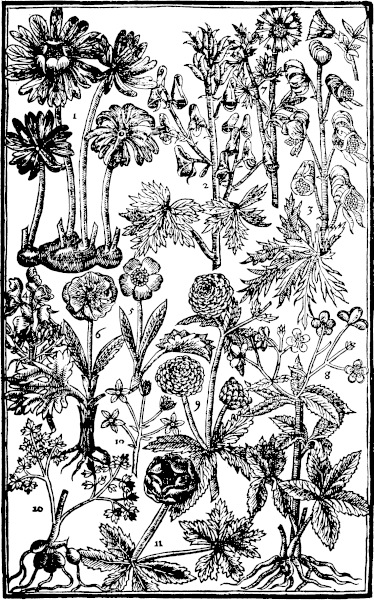
| 1 | Aconitum Hyemale. Winter Wolfesbane. |
| 2 | Aconitum flore albido siue luteum Ponticum. The whitish yellow Wolfesbane. |
| 3 | Napellus verus. Blew Helmets or Monkes hood. |
| 4 | Anthora. The counterpoison Monkes hood. |
| 5 | Ranunculus humilis albus simplex. The single white low Crowfoot. |
| 6 | Ranunculus humilis albus duplici flore. The double lowe white Crowfoot. |
| 7 | Ranunculus Coriandrifolio. The early Coriander leafed Crowfoot. |
| 8 | Ranunculus montanus elatior albus. The great single white mountain Crowfoot. |
| 9 | Ranunculus montanus albus flore pleno. The double white mountain Crowfoot. |
| 10 | Ranunculus Thalictrifolio minor. The lesser Colombine leafed Crowfoot. |
| 11 | Ranunculus globosus. The globe Crowfoot. |
The leaues of this Crowfoote are long and narrow, somewhat like vnto Grasse, or
rather like the leaues of single Gilloflowers or Pinckes, being small and sharpe pointed,
a little hollow, and of a whitish greene colour; among these leaues rise vp diuers
slender stalkes, bearing one small flower at the toppe of each, consisting of fiue yellow
leaues, with some threads in the middle: the roote is composed of many thicke, long,
round white strings.
There is another of this kinde that beareth flowers with two rowes of leaues, as if it
were double, differing in nothing else.
This Autumne Crowfoote hath diuers broad round leaues lying on the ground, set
vpon short foote-stalkes, of a faire greene colour aboue, and grayish vnderneath, snipt
all about the edges, hauing many veines in them, and sometimes swelling as with blisters
or bladders on them; from among which rise vp two or three slender and hairy
stalkes, bearing but one small yellow flower a peece, consisting of fiue and sometimes
of six leaues, and sometimes of seuen or eight, hauing a few threads in the middle, set
about a small greene head, like vnto many of the former Crowfeete, which bringeth
small blacke seede: the roote is made of many thicke short white strings, which seeme
to be grumous or kernelly rootes, but that they are somewhat smaller, and longer then
any other of that kinde.
This Crowfoote of Candy, hath the greatest and broadest leaues of all the sorts of
Crowfeete, being almost round, and without any great diuisions, but onely a few
notches about the edges here and there, as large or larger sometimes then the palme
of a mans hand; among which riseth vp the stalke, not very high when it doth first
flower, but afterwards, as the other flowers doe open themselues, the stalke groweth
to be a foote and a halfe high, or thereabouts, hauing some leaues on it, deeply cut in
or diuided, and bearing many faire yellow flowers, consisting of fiue leaues a peece,
being somewhat whitish in the middle, when the flower hath stood blowne a little
time: the roote is composed of a number of small kernelly knobs, or long graines, set
thicke together. This flowreth very early, being vsually in flower before the end of
March, and oftentimes about the middle thereof.
The leaues of this Crowfoote are very like vnto the leaues of the red Crowfoote
of Tripoli or Asia, hereafter set downe, being somewhat broad and indented about
the edges, some of the leaues being also cut in or gashed, thereby making it as it were
three diuisions, of a pale greene colour, with many white spots in them: the stalke riseth
vp a foote high, with some leaues on it, more diuided then the lower, and diuided
at the toppe into two and sometimes into three branches, each of them bearing a faire
snow white flower, somewhat large, included at the first in a brownish huske or cup of
leaues, which afterwards stand vnder the flowers, consisting of fiue white large round
pointed leaues, in the middle whereof is set many blackish purple thrums, compassing
a small long greene head, composed of many scales or chaffie whitish huskes, when
they are ripe, which are the seede, but vnprofitable in all that euer I could obserue:
the rootes are many small graines or kernels, set together as in the former, and much
about the same colour, that is, of a darke or duskie grayish colour, but much smaller.
Alba purpureis oris & venis.
There is another of this kinde, whose flowers haue purple edges, and sometimes
some veines of the same purple in the leaues of the flowers, not differing in any other
thing from the former.
Alba oris rubris.
And another, whose edges of the flowers are of a bright red colour.
[221]
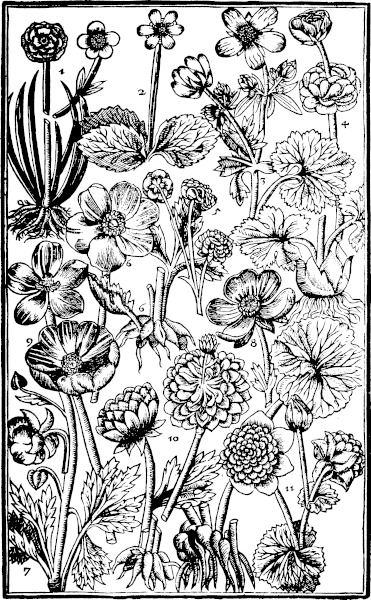
| 1 | Ranunculus gramineus flore simplici & duplici. The single and the double grasse Crowfoot. |
| 2 | Ranunculus Lusitanicus Autumnalis. The Portugall Autumne Crowfoot. |
| 3 | Ranunculus Creticus latifolius. The broad leafed Candy Crowfoot. |
| 4 | Ranunculus Anglicus maximus multiplex. The double English Crowfoot. |
| 5 | Ranunculus pratensis flore multiplici. The double yellow field Crowfoot. |
| 6 | Ranunculus Creticus albus. The white Candy Crowfoot. |
| 7 | Ranunculus Asiaticus flore albo vel pallido vario. The white or the straw coloured Crowfoot with red tops or edges. |
| 8 | Ranunculus Tripolitanus flore rubro simplici. The single red Crowfoot of Tripoli. |
| 9 | Ranunculus Asiaticus flore rubro amplo. The large single red Crowfoot of Asia. |
| 10 | Ranunculus Asiaticus flore rubro pleno. The double red Crowfoot of Asia. |
| 11 | Caltha palustris flore pleno. Double Marsh Marigold or Batchelours buttons. |
The greene leaues of this Crowfoote are as small and thinne, cut in or diuided on
the edges, as the last two sorts; the stalke riseth vp somewhat higher, and diuided into
some branches, bearing at the toppe of euery of them one flower, somewhat smaller
then the former, composed of six, seuen, and sometimes of eight small round pointed
leaues, of a whitish yellow blush colour on the inside wholly, except sometimes a little
stript about the edges: but the outside of euery leafe is finely stript with crimson
stripes, very thicke, somewhat like vnto a Gilloflower: in the middle riseth vp a small
blacke head, compassed about with blackish blew threads or thrums, which head is as
vnfruitfull for seede in our Countrey as the former. This flower hath no such greene
leaues vnder it, or to enclose it before it be blowne open as the former: the rootes are
in all things like the former.
The lower leaues of this red Crowfoote are alwayes whole without diuisions, being
onely somewhat deeply indented about the edges, but the other that rise after
them are more cut in, sometimes into three, and sometimes into fiue diuisions, and
notched also about the edges: the stalke riseth higher then any of the former, and hath
on it two or three smaller leaues, more cut in and diuided then those belowe: at the
toppe whereof standeth one large flower, made of fiue leaues, euery one being narrower
at the bottome then at the toppe, and not standing close and round one to another,
but with a certaine distance betweene, of a duskie yellowish red colour on the
outside, and of a deepe red on the inside, the middle being set with many thrums of a
darke purple colour: the head for seede is long, and scaly or chaffie, and idle in like
manner as the rest: the roote is made of many graines or small kernels set together,
and closing at the head, but spreading it selfe, if it like the ground, vnder the vpper
crust of the earth into many rootes, encreasing from long strings, that runne from the
middle of the small head of graines, as well as at the head it selfe.
There hath come to vs out of Turkie, together with the former, among many other
rootes, vnder the same title, a differing sort of this Crowfoote, whose leaues weare
broader, and much goaler; the flower also larger, and the leaues thereof broader,
sometimes eight in a flower, standing round and close one to another, which maketh
the fairer shew: in all other things it is like the former.
This party coloured Crowfoote differeth not eyther in roote or leafe from the former,
the chiefest difference is in the flower, which being red, somewhat like the former,
hath yet some yellow stripes or veines through euery leafe, sometimes but little,
and sometimes so much, that it seemeth to bee party coloured red and yellow: this
sort is very tender; for we haue twice had it, and yet perished with vs.
There is little difference in the roote of this Crowfoote from the last described, but
the leaues are much different, being very much diuided, and the flower is large, of a
fine pale greenish yellow colour, consisting of six and seuen, and sometimes of eight
or nine round leaues; the toppes whereof haue reddish spots, and the edges sometimes
also, with such purplish thrums in the middle that the other haue. None of these former
Crowfeete with kernelly rootes, haue euer beene found to haue giuen so good
seed in England, as that being sowne, any of them would spring vp; for hereof tryall
hath been often made, but all they haue lost their labour, that haue bestowed their
paines therein, as farre as I know.
The double red Crowfoote hath his rootes and leaues so like vnto the single red
kinde, that none can perceiue any difference, or know the one from the other, vntill
the budde of the flower doe appeare, which after it is any thing forward, may be perceiued
to be greater and fuller then the budde of the single kinde. This kinde beareth
most vsually but one faire large double flower on the toppe of the stalke, composed of
many leaues, set close together in three or foure rowes, of an excellent crimson
colour, declining to Scarlet, the outter leaues being larger then the inner; and instead
of thrummes, hath many small leaues set together: it hath likewise six small
narrow greene leaues on the backside of the flower, where the stalke is fastened to
the flower.
Prolifero flore.
There is of this double kinde another sort, whose flower is of the same colour with
the former, but out of the middle of the flower ariseth another double flower, but
smaller.
These plants grow naturally in diuers Countries; some in France, and
Germany, and some in England, some in Spaine, Portugall, and Italy, and
some haue been sent out of Turkie from Constantinople, and some from other
parts, their titles for the most part descrying their Countries.
Some of them flower early, as is set downe in their descriptions, or titles.
The others in Aprill and May. The white Candy Crowfoote, and
the other single and double sorts of Asia, about the same time, or somewhat
later, and one in Autumne, as it is set downe.
The names that are giuen seuerally to them may well serue this worke,
that thereby they may bee distinguished one from another: For to set
downe any further controuersie of names, how fitly or vnfitly they haue
beene called, and how variably by diuers former Writers, is fitter for a generall
History, vnto which I leaue what may be said, both concerning these
and the rest: Onely this I would giue you to vnderstand, that the Turkie
kindes haue been sent to vs vnder the names of Terobolos for the single, and
Terobolos Catamer lale for the double, and yet oftentimes, those that haue
been sent for double, haue proued single, so little fidelity is to bee found
among them.
All or most of these plants are very sharpe and exulcerating, yet the care
and industry of diuers learned men haue found many good effects in many
of them. For the rootes and leaues both of the wilde kindes, and of some
of these of the Garden, stamped and applyed to the wrists, haue driuen away
the fits in Feuers. The roote likewise of the double English kinde is
applyed for pestilent sores, to helpe to breake them, by drawing the venome
to the place. They helpe likewise to take away scarres and markes
in diuers places of the body.
As an appendix to the Crowfeete, I must needes adde this plant, yet seuerally
by it selfe, because both it and his single kinde are by most adioyned thereunto,
for the neare resemblance both in shape and sharpnesse of quality. The
single kinde I leaue to the Ditch sides, and moist grounds about them, as the fittest places
for it, and onely bring the double kinde into my Garden, as fittest for his goodly
proportion and beauty to be entertained, and haue place therein.
The double Marsh Marigold hath many broad and round greene leaues, a little endented
about the edges, like vnto the single kinde, but not altogether so large, especially
in a Garden where it standeth not very moist: the stalkes are weake, round, hollow,
and greene, diuided into three or foure branches at the toppe, with leaues at the
seuerall ioynts, whereon stand very double flowers, of a gold yellow colour: the fiue
outer leaues being larger then any of the rest that are encompassed by them, which
fall away after they haue stood blowne a great while (for it endureth in flower a moneth
or more, especially if it stand in a shadowie place) without bearing any seed: the
rootes are composed of many thicke, long, and round whitish strings, which runne
downe deep into the ground, and there are fastened very strongly.
This plant groweth naturally in diuers Marshes, and moist grounds in
Germany, yet in some more double then in others; it hath long agoe
beene cherished in our Gardens.
It flowreth in Aprill or May, as the yeare proueth earlier or later: all
his leaues doe in a manner quite perish in Winter, and spring anew in the
end of February, or thereabouts.
There is great controuersie among the learned about the single kinde,
but thereof I shall not neede to speake in this place; if God permit I
may in a fitter. This is called generally in Latine, Caltha palustris multiplex,
or flore pleno. And wee in English (after the Latine, which take
Caltha to be that which wee vsually call Calendula, a Marigold) The double
Marsh Marigold.
The roote hereof is sharpe, comming neare vnto the quality of the
Crowfeete, but for any speciall property, I haue not heard or found any.
Next vnto the Crowfeete are to follow the Hepaticas, because of the likenesse
with them, seeming to be small Crowfeete in all their parts, but of another
and more wholsome kinde. Their diuersity among themselues consisteth
chiefly in the colour of the flowers, all of them being single, except one which is very
thicke and double.
The flowers of this Hepatica doe spring vp, blow open, and sometimes shed and
fall away, before any leaues appeare or spread open. The rootes are composed of a
bush of blackish things, from the seuerall heads or buttons whereof, after the flowers
are risen and blowne, arise many fresh greene leaues, each seuerally standing vpon
his foot-stalke, folded together, and somewhat browne and hairy at their first comming,
which after are broad, and diuided at the edges into three parts: the flowers
likewise stand euery one vpon his owne seuerall foote-stalke, of the same height with
the leaues for the most part, which is about foure or fiue fingers breadth high, made of
six leaues most vsually, but sometimes it will haue seuen or eight, of a faire blew colour,
with many white chiues or threads in the middle, standing about a middle green
head or vmbone, which after the flower is fallen groweth greater, and sheweth many
small graines or seede set close together (with three small greene leaues compassing
them vnderneath, as they did the flower at the bottome) very like the head of seed of
manie Crowfeete.
The leaues of this Hepatica are smaller by the halfe then the former, and grow
more aboundantly, or bushing thicke together: the flowers (when it sheweth them,
for I haue had the plant halfe a score yeares, and yet neuer saw it beare flower aboue
once or twice) are of a pale or bleake blew colour, not so large as the flowers of the
former.
This Hepatica is in all things like vnto the first, but onely the flowers are of a
deeper blew tending to a Violet purple: and therefore I shall not neede to reiterate
the former description.
The flowers of this Hepatica are wholly white, of the bignesse of the red or purple,
and the leaues somewhat smaller, and of a little whiter of paler greene colour, else in
all other things agreeing with the former.
There is no other difference herein from the last, but that the flower being as white,
is as large as the next.
Both the leaues and the flowers of this Hepatica are larger then any of the former,
except the last: the flowers hereof at the first opening seeme to bee of a blush ash-colour,
which doe so abide three or foure dayes, decaying still vntill it turne almost
white, hauing yet still a shew of that blush ash-colour in them, till the very last.
There is no difference between this Hepatica and the first white one, sauing that the
threads in the middle of the flower, being white, as in the former, are tipt at the ends
with a pale reddish colour, which adde a great beauty to the flowers.
The leaues of this Hepatica are of a little browner red colour, both at their first
comming vp, and afterwards, especially in the middle of the leafe more then any of
the former: the flowers are in forme like vnto the rest, but of a bright blush, or pale red
colour, very pleasant to behold, with white threads or chiues in the middle of them.
The double Hepatica is in all things like vnto the single purple kinde, sauing onely
that the leaues are larger, and stand vpon longer foote-stalkes, and that the flowers are
small buttons, but very thicke of leaues, and as double as a flower can be, like vnto the
double white Crowfoote before described, but not so bigge, of a deepe blew or purple
colour, without any threads or head in the middle, which fall away without giuing
any seede.
In the colour of this flower, consisteth the chiefest difference from the last, except one
may say it is a little lesse in the bignesse of the flower, but not in doublenesse of leaues.
All these plants with single flowers grow naturally in the Woods, and
shadowie Mountaines of Germany in many places, and some of them in
Italy also. The double kinde likewise hath been sent from Alphonsus Pantius
out of Italy, as Clusius reporteth, and was also found in the Woods,
neare the Castle of Starnbeg in Austria, the Lady Heusenstains possession,
as the same Clusius reporteth also.
These plants doe flower very early, and are of the first flowers that shew
themselues presently after the deepe frosts in Ianuary, so that next vnto the
Winter Wolfesbane, these making their pride appeare in Winter, are the
more welcome early guests. The double kinde flowreth not altogether so
early, but sheweth his flower, and abideth when the others are past.
They haue obtained diuers names; some calling them Hepatica, Hepatica
nobilis, Hepaticum trifolium, Trifolium nobile, Trifolium aureum, and some Trinitas,
and Herba Trinitatis. In English you may call them either Hepatica,
after the Latine name, as most doe, or Noble Liuerwort, which you please.
These are thought to coole and strengthen the liuer, the name importing
as much; but I neuer saw any great vse of them by any the Physitians of our
London Colledge, or effect by them that haue vsed them in Physicke in our
Country.
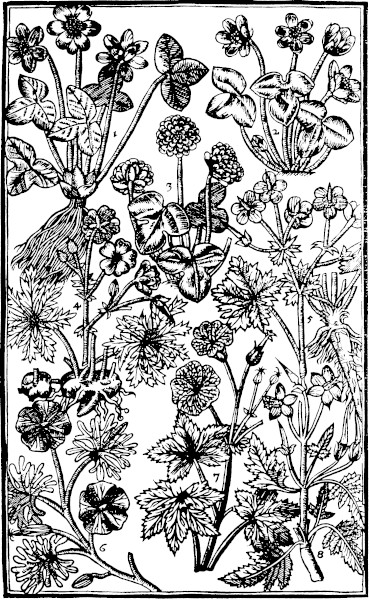
| 1 | Hepatica flore albo amplo simplici. The large white Hepatica. |
| 2 | Hepatica flore rubro simplici. The red Hepatica. |
| 3 | Hepatica flore purpureo pleno. The double purple Hepatica. |
| 4 | Geranium tuberosum. Knobbed Cranes bill. |
| 5 | Geranium Batrachoides flore albo vel cæruleo. The blew or white Crowfoote Cranes bill. |
| 6 | Geranium Hematodes. The red Rose Cranes bill. |
| 7 | Geranium Romanum striatum. The variable stript Cranes bill. |
| 8 | Geranium Creticum. Candy Cranes bill. |
As was said before concerning the Crowfeet, of their large extent and restraint,
the like may be said of the Storkes bils or Cranes bils; for euen of these as of
them, I must for this worke set forth the descriptions but of a few, and leaue
the rest to a generall worke.
The knobbed Cranes hath three or foure large leaues spread vpon the ground, of a
grayish or rather dusty greene colour, euery one of them being as it were of a round
forme, but diuided or cut into six or seuen long parts or diuisions, euen vnto the middle,
which maketh it seeme to be so many leaues, each of the cuts or diuisions being
deeply notched or indented on both sides; among which riseth vp a stalke a foote
high or better, bearing thereon diuers pale but bright purple flowers, made of fiue
leaues a peece, after which come small heads with long pointed beakes, resembling
the long bill of a Storke or Crane, or such like bird, which after it is ripe, parteth at
the bottome where it is biggest, into foure or fiue seedes, euery one whereof hath a
peece of the beake head fastened vnto it, and falleth away if it bee not gathered: the
roote is tuberous and round, like vnto the roote of the Cyclamen or ordinary Sowbread
almost, but smaller, and of a darke russet colour on the outside, and white within,
which doth encrease vnder ground, by certaine strings running from the mother root
into small round bulbes, like vnto the rootes of the earth Chesnut, and will presently
shoote leaues, and quickly grow to beare flowers, but will not abide to be kept long
dry out of the ground, without danger to be vtterly spoiled.
This Crowfoote Cranes bill hath many large leaues, cut into fiue or fix parts or diuisions,
euen to the bottome, and iagged besides on the edges, set vpon very long
slender foote-stalkes, very like the leaues of the wilde Crowfoot; from among which
rise vp diuers stalkes with great ioynts, somewhat reddish, set with leaues like the former:
the toppes of the stalkes are spread into many branches, whereon stand diuers
flowers, made of fiue leaues a peece, as large as any of the wilde or field Crowfeete,
round pointed, of a faire blew or watchet colour, which being past, there doe arise
such heads or bils, as other of the Cranes bils haue: the roote is composed of many
reddish strings, spreading in the ground, from a head made of diuers red heads, which
lye oftentimes eminent aboue the ground.
This Cranes bill is in leafe and flower altogether like the former, the onely difference
betweene them consisteth in the colour of the flower, which in this is wholly
white, and as large as the former: but the roote of this hath not such red heads as the
other hath.
The flowers of this Cranes bill are variably striped and spotted, and sometimes diuided,
the one halfe of euery leafe being white, and the other halfe blew, sometimes
with lesser or greater spots of blew in the white leafe, very variably, and more in some
years then in others, that it is very hard to expresse all the varieties that may be obserued
in the flowers, that blow at one time. In all other parts of the plant, it is so like vnto
the former, that vntill it be in flower, the one cannot be knowne from the other.
This purple Cranes bill hath many leaues rising from the roote, set vpon long foot-stalkes,
somewhat like vnto the other, yet not so broad, but more diuided or cut, that
is, into seuen or more slits, euen to the middle, each whereof is likewise cut in on the
edges more deeply then the former; the stalkes are somewhat knobbed at the ioynts,
set with leaues like vnto the lower, and bearing a great tuft of buds at the toppes of the
branches, which breake out into faire large flowers, made of fiue purple leaues, which
doe somewhat resemble the flower of a Mallow, before it be too full blowne, each
whereof hath a reddish pointell in the middle, and many small threads compassing it,
this vmbell or tuft of buds doe flower by degrees, and not all at once, and euery flower
abideth open little more then one day, and then sheddeth, so that euery day yeeldeth
fresh flowers, which because they are so many, are a long while before they are all
past or spent: after the flowers are past, there arise small beake heads or bils, like vnto
the other Cranes bils, with small turning seede: the roote is composed of a great tuft
of strings, fattened to a knobby head.
This beautifull Cranes bill hath many broad yellowish greene leaues arising from
the roote, diuided into fiue or six parts, but not vnto the middle as the first kindes are:
each of these leaues hath a blackish spot at the bottome corners of the diuisions, the
whole leafe as well in forme as colour and spots, is very like vnto the leafe of the Geranium
fuscum, or spotted Cranes bill, next following to be described, but that the
leaues of this are not so large as the other: from among these leaues spring vp sundry
stalkes a foote high and better, ioynted and knobbed here and there, bearing at the
tops two or three small white flowers, consisting of fiue leaues a peece, so thickly & variably
striped with fine small reddish veines, that no green leafe that is of that bignesse
can shew so many veines in it, nor so thick running as euery leafe of this flower doth: in
the middle of the flower standeth a small pointell, which when the flower is part doth
grow to be the seed vessell, whereon is set diuers small seeds, like vnto the small seedes
of other Cranes bils: the root is made of many small yellow threads or strings.
The leaues of this Cranes bill are in all points like the last described, as well in the
forme and diuisions as colour of the leaues, being of a yellowish greene colour, but
larger and stronger by much: the stalkes of this rise much higher, and are ioynted or
knobbed with reddish knees or ioynts, on the tops whereof stand not many although
large flowers, consisting of fiue leaues a peece, each whereof is round at the end, and a
little snipt round about, and doe bend or turne themselues backe to stalkewards,
making the middle to be highest or most eminent; the colour of the flower is of a darke
or deepe blackish purple, the bottome of euery leafe being whiter than the rest; it hath
also a middle pointell standing out, which afterwards bring forth seede like vnto others of
his kinde: the roote consisteth of diuers great strings, ioyned to a knobby
head.
This Cranes bill hath diuers leaues spread vpon the ground, very much cut in or
diuided into many parts, and each of them againe slit or cut into two or three peeces,
standing vpon slender long foote-stalkes, of a faire greene colour all the Spring and
Summer, but reddish in Autumne: among these leaues spring vp slender and weake
stalkes, beset at euery ioynt (which is somewhat reddish) with two leaues for the most
part, like vnto the lower: the flowers grow seuerally on the toppe of the stalkes, and
not many together in bunches or branches, as in all other Cranes bils, euery
flower being as large as a single Rose Campion flower, consisting of fiue large leaues,
of a deeper red colour then in any other Cranes bill at the first opening, and will
change more blewish afterwards: when the flower is past, there doth arise such like
beakes as are in others of the same kinde, but small: the roote is hard, long, and thicke,
with diuers branches spreading from it, of a reddish yellow colour on the outside, and
whitish within, which abideth and perisheth not, but shooteth forth some new greene
leaues, which abide all the Winter, although those that turne red doe fall away.
Candy Cranes bill beareth long and tender stalkes, whereon growe diuers broad
and long leaues, cut in or iagged on the edges: the toppes of the stalkes are branched
into many flowers, made of fiue leaues of a reasonable bignesse, and of a faire blew
or watchet colour, with a purplish pointell in the middle, which being past, there follow
beake heads like other Cranes bils, but greater, containing larger, greater, and
sharper pointed seede, able to pierce the skinne, if one be not warie of it: the roote is
white and long, with some fibres at it, and perisheth when it hath perfected his seede,
and will spring of it owne sowing many times, if the Winter be not too sharpe, otherwise
(being annuall) it must be sowne in the Spring of the yeare.
Most of these Cranes bils are strangers vnto vs by nature, but endenizond
in our English Gardens. It hath beene reported vnto mee by some of good
credit, that the second or Crowfoot Cranes bill hath been found naturally
growing in England, but yet I neuer saw it, although I haue seen many sorts
of wilde kindes in many places. Matthiolus saith that the first groweth in
Dalmatia and Illyria very plentifully. Camerarius, Clusius, and others, that
most of the rest grow in Germany, Bohemia, Austria, &c. The last hath
his place recorded in his title.
All these Cranes bils doe for the most part flower in Aprill, and May,
and vntill the middle of Iune. The variable or stript Cranes bill is vsually
the latest of all the rest.
The first is vsually called Geranium tuberosum, of some Geranium bulbosum,
of the likenesse of the roote vnto a bulbe: It is without controuersie Geranium
primum of Dioscorides. The second is called Geranium Gratia Dei, of
others, Geranium cæruleum. The blew Cranes bill Lobel calleth it Batrachoides,
because both leafe and flower are like vnto a Crowfoote; and the affinity
with the Cranes bils in the seede causeth it rather to be referred to
them then to the Crowfeete. The stript Cranes bill is called by some Geranium
Romanum. The last sauing one is called Geranium Hæmatodes, or
Sanguineum, of Lobel Geranium Gruinale Hæmatodes supinum radice repente.
In English it may be called after the Greek and Latine, The bloudy Cranes
bill, but I rather call it, The Rose Cranes bill, because the flowers are as
large as single Roses, or as the Rose Campion. Some of them are called in
many places of England Bassinets.
All the kindes of Cranes bils are accounted great wound herbes, and effectuall
to stay bleedings, yet some more than others. The Emperickes of
Germanie, as Camerarius saith, extoll it wonderfully, for a singular remedie
against the Stone, both in the reines and bladder.
Hauing long debated with my selfe, where to place this & the other plants that
follow in the two next Chapters, I haue thought it not amisse for this worke
to set them downe here, both before the Beares eares, which are kindes of
Sanicle, as the best Authors doe hold, and after the Cranes bils, both for some qualities
somewhat resembling them, and for some affinity of the flowers with the former.
The spotted Sanicle hath many small round leaues, bluntly endented about the
edges, somewhat like vnto the leaues of our white Saxifrage, of a full greene colour
aboue, and whitish hairy, and somewhat reddish withall vnderneath: the stalkes are
set here and there with the like leaues, rising a foote and a halfe high or more, very
much diuided at the toppe into sundry small branches, bearing many very small white
flowers, consisting of fiue small leaues, wherein are many small red spots to be seene,
as small as pins points, of a pretty sweete sent, almost like Hawthorne flowers, in the
middle whereof are many small threads compassing a head, which when it is ripe containeth
small blacke seede: the roote is scaly, or couered with a chaffie matter, hauing
many small white fibres vnderneath, whereby it is fastened in the ground.
Minor non guttata.
There is another of this kinde, like both in roote, leafe, and flower to the former,
the onely difference is, that this is lesser then the former, and hath no spots in the
flower, as the other hath.
Minus guttata.
We haue also another smaller kinde then the last, both in leafe and flower, the leaues
whereof are smaller, but rounder, and more finely snipt or indented about the edges,
like the teeth of a fine sawe: the stalke is little aboue a span high, hauing many small
white flowers spotted as the first, but with fewer spots.
These growe in the shadowie Woods of the Alpes, in diuers places, and
with vs they more delight in the shade then the sunne.
All these Sanicles doe flower in May, and continue flowring vntill Iune,
and the seede soone ripeneth after: the rootes abide all the Winter, with
some leaues on them, springing a fresh in the beginning of the yeare.
The former two are called by Clusius Sanicula montana, and by others
Sanicula guttata: by Lobel Geum Alpinum. The third or last hath been sent
vs vnder the name of Sanicula montana altera minor.
The name imposed on these plants doe certainly assure vs of their vertues,
from the first founders, that they are great healers, and from their
taste, that they are great binders.
This spotted Nauelwort, as many doe call it, hath many thicke small leaues,
not so broad as long, of a whitish greene colour, lying on the ground in circles,
after the manner of the heads of Houseleeke, and dented about the edges; from
the middle whereof sometimes (for it doth not flower euery yeare in many places) ariseth
vp a stalke, scarce a foote high, beset with such like leaues as are belowe, but somewhat
longer: from the middle of the stalke vp to the top it brancheth forth diuersly,
with a leafe at euery ioynt, bearing three or foure flowers on euery branch, consisting
of fiue white leaues, spotted with small red spots, like vnto the spotted Sanicle, but
with fewer and greater spots, hauing a yellowish circle or eye in the bottome of euery
flower, and many whitish threads with yellowish tips in it: the seede is small and
blacke, contained in small round heads: the roote is small, long, and threadie, shooting
out such heads of leaues, which abide all the Winter, those that beare flower perishing.
There is another like vnto that before described in most things, the differences be
these: It hath shorter leaues then the former, and dented about the edges in the like
manner: the flowers hereof are white, but greater, made of six leaues, and most vsually
without any spots at all in them, some are seene to haue spots also: the heads or
seede vessels are more cornered then the former.
This hath also many heads of leaues, but more open, which are longer, greener, and
sharper pointed then eyther of the former, somewhat reddish also, and not dented about
the edges, but yet a little rough in handling: the stalke ariseth from among the
leaues, being somewhat reddish, and the leaues thereon are reddish pointed, diuided
at the toppe into many branches, with diuers flowers thereon, made of twelue small
long leaues, standing like a starre, of a reddish purple colour, with many threads therein,
set about the middle head, which is diuided at the toppe into many small ends, like
pods or hornes, containing therein very small seede: the roote is small like the former.
This kinde of Sengreene is composed of heads of larger, broader, and thinner
leaues then any of the former, of a sadder greene colour, somewhat vneuenly endented
about the edges, and not so close set together, but spreading forth into seuerall
heads like as the former sorts doe, although not so plentifully; from the middle of
diuers of which heads rise vp brownish or reddish stalkes, set with smaller leaues thereon
to the middle thereof, and then brancheth forth into seuerall sprigs, set with diuers
small reddish flowers consisting of fiue leaues a peece, the innerside of which are of a
pale red, somewhat whitish, spotted with many small bloud red spots, as small almost
as pins points, with some small threads in the middle, standing about a small greene
head, which turneth into the seede vessell, parted foure wayes at the head, wherein
is contained small blackish seede: the rootes are small threads, which spread vnder
the ground, and shoote vp seuerall heads round about it.
All these growe in Germany, Hungarie, Austria, the Alpes, and other
such like places, where they cleaue to the rocke it selfe, that hath but a crust
of earth on it to nourish them. They will abide in Gardens reasonable well,
if they be planted in shadowie places, and not in the sun.
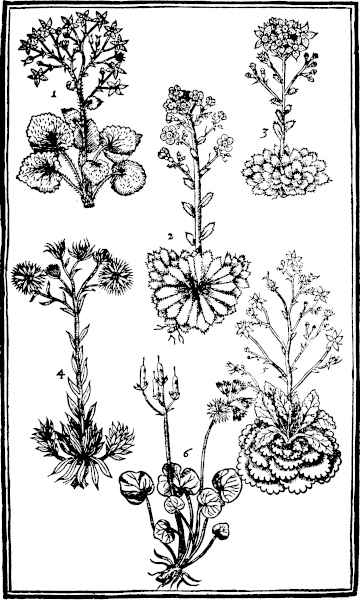
| 1 | Sanicula guttata. Spotted Sanicle. |
| 2 | Cotyledon altera Matthioli. Spotted Nauelwort. |
| 3 | Cotyledon altera minor. Small dented Nauelwort. |
| 4 | Cotyledon altera flore rubro stellato. Small red flowred Nauelwort. |
| 5 | Sedum serratum flore rubente maculato. The Princes Feather. |
| 6 | Soldanella Alpina. Blew Moonwort. |
They flower for the most part in the end of May, and sometimes sooner
or later, as the yeare falleth out.
The first is called by Matthiolus, Cotyledon altera Dioscoridis, and Vmbilicus
alter, but it is not the true Cotyledon altera of Dioscorides; for Sedum
vulgare maius, Our common Houseleeke, by the consent of the best moderne
Writers, is the true Cotyledon altera of Dioscorides, or Vmbilicus
Veneris alter. I hold it rather to bee a kinde of small Houseleeke, as
the other two likewise are. The second is called by some Aizoum or Sedum
minus serratum. The third hath his name in his title. Wee doe call
them Nauelworts in English rather then Houseleekes, Euphoniæ gratia. The
last may be called dented Sengreene with reddish spotted flowers, but some
of our English Gentlewomen haue called it, The Princes Feather, which although
it be but a by-name, may well serve for this plant to distinguish it,
and whereby to be knowne.
They are all held to be cold and moist, like vnto other Houseleekes.
This beautifull plant hath many round and hard leaues, set vpon long foote-stalkes,
a little vneuenly cut about the edges, greene on the vpperside, and of a
grayish greene vnderneath, and sometime reddish like the leaues of Sowbread,
which because they doe somewhat resemble the leaues of Soldanella marina, which is
the Sea Bindweede, tooke the name thereof: the stalkes are slender, small, round, and
reddish, about a span high, bearing foure or fiue flowers at the toppe, euery one hanging
downe their heads, like vnto a Bell flower, consisting but of one leafe (as most of
the Bindweeds doe) plated into fiue folds, each of them ending in a long point, which
maketh the flower seem to haue fiue leaues, each whereof is deeply cut in on the edges,
and hauing a round greene head in the middle, with a pricke or pointell at the end
thereof: the flower is of a faire blew colour, sometimes deeper or paler, or white, as
nature listeth without any smell at all: the middle head, after the flower is fallen, riseth
to be a long round pod, bearing that pricke it had at the end thereof, wherein is contained
small greenish seede: the roote hath many fibres shooting from a long round
head or roote.
This groweth on the Alpes, which are couered with snow the greatest
part of the yeare, and will hardly abide transplanting.
In the naturall places it flowreth not vntill the Summer moneths, Iune,
Iuly, and August, after the snow is melted from the Hils, but being
brought into Gardens, it flowreth in the beginning of Aprill or thereabouts.
This plant, by reason of the likenesse of leaues with Soldanella, as was
before said, is called by many Soldanella, but yet is no Bindweede; and
therefore I rather call it in English a Mountaine Soldanella, then as Gerrard
doth, Mountaine Bindweede. It is likewise called by some, Lunaria minor
cærulea, The lesser blew Lunary or Moonwort, and so I would rather haue
it called.
They that imposed the name of Lunaria vpon this plant, seeme to referre
it to the wound or consolidating herbes, but because I haue no further relation
or experience, I can say no more thereof vntill tryall hath taught it.
Some also from the name Soldanella, which is giuen it, because of the likenesse
of the leaues, haue vsed it to help the Dropsie, for which the Sea plant
is thought to be effectuall.
There are so many sundry and seuerall sorts of Beares eares, the variety consisting
as well in the differing colours of the flowers, as the forme and colour
of the leaues, that I shall not comprehend and set downe vnto you all the diuersities
by many, that are risen vp to those that haue beene industrious in the sowing
of the seedes of the seuerall sorts of them; yet if you accept of these that I doe
here offer vnto you, I shall giue you the knowledge of others, as time, occasion, and
the view of them shall enable me. And because they are without all question kinds of
Cowslips, I haue set them downe before them in the first place, as being of more beautie
and greater respect, or at the least of more rarity vnto vs. To dispose them therefore
into order, I shall ranke them vnder three principall colours, that is to say, Red or Purple,
White, and Yellow, and shew you the varieties of each of them (for so many as
are come to my knowledge) apart by themselues, and not promiscuously as many others
haue done.
1. Auricula Vrsi flore purpureo.
Purple Beares eare, or The Murrey Cowslip.
This purple Beares eare or Cowslip hath many greene leaues, somewhat long and
smooth, narrow from the bottome of the leafe to the middle, and broad from thence
to the end, being round pointed, and somewhat snipt or endented about the edges; in
the middle of these leaues, and sometimes at the sides also, doe spring round greene
stalkes foure or fiue fingers high, bearing at the top many flowers, the buds whereof,
before they are blowne, are of a very deepe purple colour, and being open, are of a
bright, but deepe purple, vsually called a Murrey colour, consisting of fiue leaues a
peece, cut in at the end as it were into two, with a whitish ring or circle at the bottome
of each flower, standing in small greene cups, wherein after the flowers are fallen, are
contained very small heads, not rising to the height of the cups, bearing a small pricke
or pointell at the toppe of them, wherein is little blackish seede: the roote hath many
whitish strings fastened to the maine long roote, which is very like vnto a Primrose
or Cowslip roote, as it is in all other parts besides.
2. Auricula Vrsi purpurea absque orbe.
The murrey Cowslip without eyes.
There is another of this kinde, whose leafe is somewhat lesse, as the flower is also,
but of the same colour, and sometimes somewhat redder, tending to a Scarlet, without
any circle at the bottome of the flower, in no other things differing from it.
3. Auricula Vrsi minor flore tannetto.
Tawney Beares eares.
The leaues of this kinde haue a greater shew of mealinesse to be seene in them, and
not much smaller then the former, yet snipt or endented about the ends like vnto
them: the flowers are many, of the same fashion with the former, but smaller, each
whereof is of as deepe a murrey or tawnie colour when it is blowne, as the buds of the
former are before they are blowne, hauing a white circle at the bottome of the flower,
and yellowish in the middle belowe the circle.
4. Auricula Vrsi flore rubro saturo orbe luteo.
Deepe or bloud red Beares eares with eyes.
This kinde hath small and long greene leaues, nothing mealy, but snipt about the
edges, from the middle of the leaues forwards to the ends: the flowers hereof are of
a deepe red colour, tending to a bloud red, with a deepe yellow circle, or rather bottome
in the middle.
Auricula Vrsi
flore rubro saturo
absque
orbe.
There is another of this kinde, whose leaues are somewhat mealy, and smaller then
any (that I haue seene) that haue mealy leaues: the flowers are of the same deepe red
colour with the last described, yet hath no circle or bottome of any other colour at all.
5. Auricula Vrsi flore purpuro cæruleo.
The Violet coloured Beares eare.
We haue another, whose leaues are somewhat mealy and large; the flowers whereof
are of a paler purple then the first, somewhat tending to a blew.
6. Auricula Vrsi flore obsoleto magno.
The Spaniards blush Beares eare.
This great Beares eare hath as large leaues as any other of this kindred whatsoeuer,
and whitish or mealy withall, somewhat snipt about the edges, as many other of them
are: the flowers stand at the toppe of a strong and tall stalke, larger then any of the other
that I haue seene, being of a duskie blush colour, resembling the blush of a Spaniard,
whose tawney skinne cannot declare so pure a blush as the English can; and therefore
I haue called it the Spaniards blush.
7. Auricula Vrsi flore rubello.
Scarlet or light red Beares eares.
The leaues of this kinde are very like the leaues of the first purple kinde, but that
they are not so thicke; of a little paler greene colour, and little or nothing snipt about
the edges: the flowers are of a bright, but pale reddish colour, not halfe so deepe as
the two last with white circles in the bottomes of them, in other things this differeth
not from others.
8. Auricula Vrsi roseo colore.
The Rose coloured Beares eare.
We haue another, whose leafe is a little mealy, almost as large as any of the former,
whose flowers are of a light red colour, very neare the colour of an ordinary Damaske
Rose, with a white eye at the bottome.
[237]
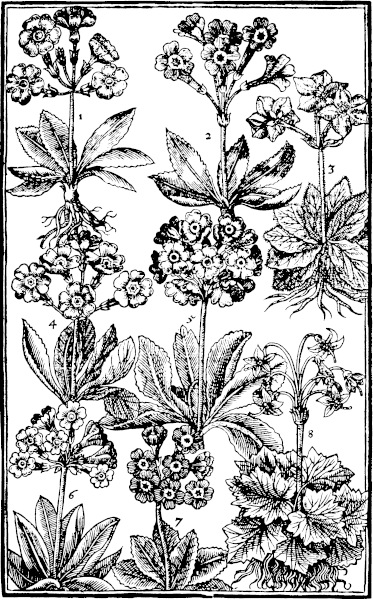
| 1 | Auricula Vrsi flore purpureo. Purple Cowslips or Beares eares. |
| 2 | Auricula Vrsi flore tannetto. Tawney Beares eare. |
| 3 | Auricula Vrsi flore & folio Boraginis. Blew Beares eares with Borage leaues. |
| 4 | Auricula Vrsi flore carneo. Blush Beares eare. |
| 5 | Auricula Vrsi maxima lutea flore eleganti. The greatest faire yellow Beares eares with eyes. |
| 6 | Auricula Vrsi altera flore luteo. The yellow Beares eare. |
| 7 | Auricula Vrsi crinis coloris siue flore fusco. The haire coloured Beares eare. |
| 8 | Cortusa Matthioli. Beares eare Sanicle. |
9. Auricula Vrsi flore cæruleo folio Boraginis.
Blew Beares eares with Borage leaues.
This plant is referred to the kindred or family of the Beares eares, onely for the
forme of the flower sake, which euen therein it doth not assimilate to the halfe; but
because it hath passed others with that title, I am content to insert it here, to giue you
the knowledge thereof, and rather to satisfie others then my selfe with the place thereof:
the description whereof is as followeth: It hath diuers broad rough hairy leaues
spread vpon the ground, somewhat like vnto the leaues of Borage for the roughnesse,
but not for the largenesse; the leaues hereof being somewhat rent in some places at the
edges: from among these leaues rise vp one, or two, or more brownish, round, and
hairy stalkes, a span high or thereabouts, bearing at the toppes three or foure flowers a
peece, consisting of fiue large pointed leaues, of a faire blew or light azur colour, with
some small yellow threads in the middle, standing in small greene cups: the roote is
long and brownish, hauing many small fibres annexed vnto it.
10. Auricula Vrsi maior flore albo.
The great white Beares eare.
This white Beares eare hath many faire whitish greene leaues, somewhat paler then
the leaues of any of the kindes of Beares eares, and a little snipt about the ends, as manie
other are: among these leaues rise vp stalkes foure or fiue inches high, bearing at
the toppe many flowers like vnto the small yellow Beares eare hereafter set downe, of
a pale whitish colour, tending to yellow at the first opening of the flower, which after
two or three dayes change into a faire white colour, and so continue all the while it
flowreth: the roote is like the purple kinde, as all or most of the rest are, or very
little differing.
11. Auricula Vrsi minor flore albo.
The lesser white Beares eare.
The lesser Beares eare hath smaller leaues, of a little darker green colour: the stalke
and flowers are likewise lesser then the former, and haue no shew of yellownesse at
all, eyther in budde or flower, but is pure white, differing not in other things from
the rest.
12. Auricula Vrsi maxima lutea flore eleganti.
The greatest faire yellow Beares eare with eyes.
This yellow Beares eare hath many faire large thicke leaues, somewhat mealy or
hoary vpon the greennesse, being larger then any other kinde, except the sixth, and the
next yellow that followeth, smooth about the edges, and without any endenting at all:
the stalke is great, round, and not higher then in other of the former, but bearing manie
more flowers thereon then in any other kinde, to the number of thirty many times,
standing so round and close together, that they seeme to be a Nosegay alone, of the
same fashion with the former, but that the leaues are shorter and rounder, yet with a
notch in the middle like the rest, of a faire yellow colour, neither very pale nor deepe,
with a white eye or circle in the bottome, about the middle of euery flower, which
giueth it the greater grace: the seede is of a blackish browne colour, like vnto others,
but contained in greater round heads then any other, with a small pointell sticking in
the middle: the roote is greater and thicker then any other, with long strings or fibres
like vnto the other sorts, but greater.
13. Auricula Vrsi maior lutea folio incano.
The greater yellow Beares eare.
This greater yellow Beares eare hath his leaues larger, and more mealy or hoarie
then the last, or any other of these kindes: the flowers are not so many, but longer, and
not so thicke thrusting together as the first, but of a deeper yellow colour, without any
eye or circle in the middle.
14. Auricula Vrsi maior flore pallido.
The great Straw coloured Beares eare.
This hath almost as mealy leaues as the last, but nothing so large; the flowers are
of a faire strawe colour, with a white circle at the bottome of them, these three last
haue no shew or shadow of any other colour in any part of the edge, as some others
that follow haue.
15. Auricula Vrsi minor flore pallente.
The lesser straw coloured Beares eare.
We haue another, whose leafe is lesse mealy, or rather pale green, and a little mealy
withall; the flowers whereof are of a paler yellow colour then the last, and beareth almost
as many vpon a stalke as the first great yellow.
16. Auricula Vrsi minor lutea.
The lesser yellow Beares eares.
The leaues of this Beares eare are nothing so large as either of the three former yellow
kindes, but rather of the bignesse of the first white kinde, but yet a little larger,
thicker, and longer then it, hauing vnder the greennesse a small shew of mealinesse, and
somewhat snipt about the edges: the flowers are of a pale yellow colour, with a little
white bottome in them: the seed and rootes are like vnto the other kindes.
17. Auricula Vrsi flore flauo.
The deepe yellow or Cowslip Beares eare.
This kinde hath somewhat larger leaues then the last, of a yellowish greene colour,
without any mealinesse on them, or endenting about the edges, but smooth and whole:
the flowers are not larger but longer, and not laide open so fully as the former, but of
as deepe a yellow colour as any Cowslip almost, without any circle in the bottome:
neither of these two last haue any shew of other colour then yellow in them, sauing
the white in the eye.
18. Auricula Vrsi versicolor prima siue flore rubescente.
The blush Beares eare.
The blush Beares eare hath his leaues as large, and as hoary or mealy as the third
greater yellow, or straw coloured Beares eare; among which riseth vp a stalke about
foure inches high, bearing from six to twelue, or more faire flowers, somewhat larger
then the smaller yellow Beares eare before described, hauing the ground of the flower
of a darke or dunne yellow colour, shadowed ouer a little with a shew of light purple,
which therefore we call a blush colour, the edges of the flower being tipt with a little
deeper shew of that purple colour, the bottome of the flower, abiding wholly yellow,
without any circle, and is of very great beauty, which hath caused me to place it in the
forefront of the variable coloured Beares eares. And although some might thinke it
should be placed among the first ranke of Beares eares, because it is of a blush colour,
yet seeing it is assuredly gained from some of the yellow kindes by sowing the seede,
as many other sorts are, as may be seene plainly in the ground of the flower, which is
yellow, and but shadowed ouer with purple, yet more then any of the rest that follow;
I thinke I haue giuen it his right place: let others of skill & experience be iudges herein.
19. Auricula Vrsi crinis coloris.
Haire coloured Beares eares.
The leaues of this kinde are more mealy like then the last blush kinde, but somewhat
longer and larger, and snipt about the edges in the same manner, from the middle of
the leafe forwards: the flower is vsually of a fine light browne yellow colour, which
wee doe vsually call an Haire colour, and sometimes browner, the edges of the flower
haue a shew or shadow of a light purple or blush about them, but more on the outside
then on the inside.
20. Auricula Vrsi versicolor lutea.
The yellow variable Beares eare.
This variable Beares eare hath his greene leaues somewhat like vnto the deepe yellow,
or Cowslip Beares eare before described, but somewhat of a fresher greene, more
shining and smaller, and snipt about the edges towards the ends, as many of those before
are: the flowers are of a faire yellow colour, much laid open when it is full
blowne, that it seemeth almost flat, dasht about the edges onely with purple, being
more yellow in the bottome of the flower, then in any other part.
21. Auricula Vrsi versicolor lutescente viridi flore.
The variable greene Beares eare.
This kinde of Beares eare hath greene leaues, very like vnto the last described, and
snipt in the like manner about the edges, but in this it differeth, that his leaues do turne
or fold themselues a little backwards: the flowers are of a yellowish greene colour,
more closed then the former, hauing purplish edges, especially after they haue stood
blowne some time, and haue little or none at the first opening: these haue no circles at
all in them.
Many other varieties are to be found, with those that are curious conseruers of these
delights of nature, either naturally growing on the mountaines in seuerall places,
from whence they (being searched out by diuers) haue been taken and brought, or else
raised from the seede of some of them, as it is more probable: for seuerall varieties
haue beene obserued (and no doubt many of these before specified) to bee gotten by
sowing of the seedes, euery yeare lightly shewing a diuersity, not obserued before, either
in the leafe, diuers from that from whence it was taken, or in the flowers. I haue
onely set downe those that haue come vnder mine owne view, and not any by relation,
euen as I doe with all or most of the things contained in this worke.
The Place.
Many of these goodly plants growe naturally on mountaines, especially
the Alpes, in diuers places; for some kindes that growe in some places, doe
not in others, but farre distant one from the other. There hath likewise
some beene found on the Pyrenæan mountaines, but that kinde with the
blew flower and Borage leafe, hath beene gathered on the mountaines in
Spaine, and on the Pyrenæans next vnto Spaine.
The Time.
They all flower in Aprill and May, and the seede is ripe in the end of
Iune, or beginning of Iuly, and sometimes they will flower againe in the
end of Summer, or in Autumne, if the yeare proue temperate, moist, and
rainie.
The Names.
It is very probable, that none of these plants were euer knowne vnto the
ancient Writers, because we cannot be assured, that they may be truely referred
vnto any plant that they name, vnlesse we beleeue Fabius Columna,
that it should be Alisma of Dioscorides, for thereunto hee doth referre it.
Diuers of the later Writers haue giuen vnto them diuers names, euery one
according to his owne conceit. For Gesner calleth it Lunaria arthritica,
and Paralytica Alpina. Matthiolus accounteth it to bee of the kindred of the
Sanicles, and saith, that in his time it was called by diuers Herbarists, Auricula
Vrsi, which name hath since bin receiued as most vsuall. We in English
call them Beares eares, according to the Latine, or as they are called by diuers
women, French Cowslips; they may be called Mountaine Cowslips,
if you will, for to distinguish betweene them and other Cowslips, whereof
these are seuerall kindes.
I cannot chuse but insert this delicate plant in the end of the Beares eares, for that it
is of so neare affinity, although it differ much in the forme of the leaues, the description
whereof is in this manner: The leaues that spring vp first are much crumpled, and
as it were folded together, which afterwards open themselues into faire, broad, and
roundish leaues, somewhat rough or hairy, not onely cut into fine diuisions, but somewhat
notched also about the edges, of a darke greene colour on the vpperside, and
more whitish greene vnderneath; amongst these leaues riseth vp one or two naked
round stalkes, fiue or six inches high, bearing at the toppes diuers small flowers, somewhat
sweete, like vnto the first purple Beares eare, hanging downe their heads, consisting
of fiue small pointed leaues a peece, of a darke reddish purple colour, with a
white circle or bottome in the middle, and some small threads therein: after the flowers
are past, there come small round heads, somewhat longer then any of the Beares
eares, standing vpright vpon their small foot-stalkes, wherein is contained small round
and blackish seede: the roote consisteth of a thicke tuft of small whitish threads, rather
then rootes, much enterlaced one among another: the leaues of this plant dye
downe euery yeare, and spring vp a new in the beginning of the yeare, whereas all the
Beares eares doe hold their leaues greene all the Winter, especially the middlemost,
which stand like a close head, the outermost for the most part perishing after seed time.
The Place.
This groweth in many shadowie Woods both of Italy and Germany;
for both Clusius hath described it, finding it in the Woods of Austria and
Stiria; and Matthiolus setteth it downe, hauing receiued it from Anthonius
Cortusus, who was President of the Garden at Padua, and found it in the
woody mountaines of Vicenza, neare vnto Villestagna; whereon (as Matthiolus
saith) there is found both with white flowers as well as with blew,
but such with white flowers or blew we neuer could see or heare further of.
The Time.
It flowreth much about the time of the Beares eares; or rather a little later,
and the seede is ripe with them.
The Names.
Clusius calleth it Sanicula montana, and Sanicula Alpina, and referreth it
to the Auricula Vrsi, or Beares eare, which it doth most nearly resemble:
but Matthiolus referreth it to the Cariophyllata or Auens, making it to be of
that tribe or family, and calleth it Cortusa of him that first sent it him. Wee
may call it eyther Cortusa, as for the most part all Herbarists doe, or Beares
eare Sanicle as Gerrard doth.
All the sorts of Beares eares are Cephalicall, that is, conducing helpe for
the paines in the head, and for the giddinesse thereof, which may happen,
eyther by the sight of steepe places subiect to danger, or otherwise. They
are accounted also to be helping for the Palsey, and shaking of the ioynts;
and also as a Sanicle or wound-herbe. The leaues of the Cortusa taste a little
hot, and if one of them bee laide whole, without bruising, on the
cheeke of any tender skind woman, it will raise an orient red colour, as if
some fucus had beene laide thereon, which will passe away without any
manner of harme, or marke where it lay: This is Cortusus his obseruation
Camerarius in his Hortus Medicus saith, that an oyle is made thereof,
that is admirable for to cure wounds.
We haue so great variety of Primroses and Cowslips of our owne Country
breeding, that strangers being much delighted with them, haue beene
often furnished into diuers Countries, to their good content: And that I
may set them downe in some methodicall manner, as I haue done other things, I will
first set downe all the sorts of those we call Primroses, both single and double, and afterwards
the Cowslips with their diuersities, in as ample manner as my knowledge
can direct me. And yet I know, that the name of Primula veris or Primrose, is indifferently
conferred vpon those that I distinguish for Paralyses or Cowslips. I doe therefore
for your better vnderstanding of my distinction betweene Primroses and Cowslips,
call those onely Primroses that carry but one flower vpon a stalke, be they single
or double, except that of Master Hesket, and that with double flowers many vpon a
stalke, set out in Gerards Herball, which is his onely, not found (as I thinke) in rerum
natura, I am sure, such a one I could neuer heare of: And those Cowslips, that beare
many flowers vpon a stalke together constantly, be they single or double also. I might
otherwise distinguish them also by the leafe; that all the Primroses beare their long
and large broad yellowish greene leaues, without stalkes most vsually; and all the
Cowslips haue small stalkes vnder the leaues, which are smaller, and of a darker
greene, as vsually, but that this distinction is neither so certaine and generall, nor so
well knowne.
The Primrose that groweth vnder euery bush or hedge, in all or most of the Woods,
Groues, and Orchards of this Kingdome, I may well leaue to his wilde habitation,
being not so fit for a Garden, and so well knowne, that I meane not to giue you any
further relation thereof: But we haue a kinde hereof which is somewhat smaller, and
beareth milke white flowers, without any shew of yellownesse in them, and is more
vsually brought into Gardens for the rarity, and differeth not from the wilde or ordinary
kinde, either in roote or leafe, or any thing else, yet hauing those yellow spots,
but smaller, and not so deepe, as are in the other wilde kinde.
The single greene Primrose hath his leaues very like vnto the greater double Primrose,
but smaller, and of a sadder greene colour: the flowers stand seuerally vpon long
foot-stalkes, as the first single kinde doth, but larger then they, and more laide open,
of the same, or very neare the same yellowish greene colour that the huske is of, so that
at the first opening, the huske and the flower seeme to make one double greene flower,
which afterwards separating themselues, the single flower groweth aboue the huske,
and spreadeth it selfe open much more then any other single Primrose doth, growing
in the end to be of a paler greene colour.
The leaues of this differ in a manner nothing from the former, neither doth the
flower but only in this, that out of the large yellowish green huskes, which contain the
flowers of the former, there commeth forth out of the middle of each of them either
a small peece of a whitish flower, or else a larger, sometimes making vp a whole flower,
like an ordinary Primrose.
[243]
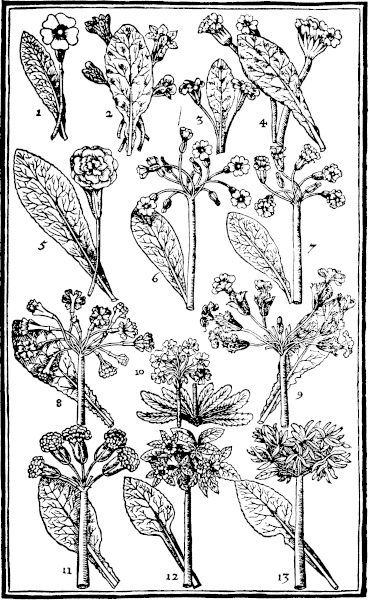
| 1 | Primula veris flore albo. The white Primrose. |
| 2 | Primula veris flore viridi & albo simplici. The green and white Primrose. |
| 3 | Primula veris flore viridi duplici. The double green Primrose. |
| 4 | Primula veris Hesketi. Master Heskets double Primrose. |
| 5 | Primula veris flore pleno vulgaris. The ordinary double Primrose. |
| 6 | Paralysis veris flore viridante simplici. The single green Cowslip. |
| 7 | Paralysis flore geminato odorato. Double Cowslips or hose in hose. |
| 8 | Paralysis inodora flore geminato. Double Oxelips hose in hose. |
| 9 | Paralysis hortensis flore & calice crispo. Curld Cowslips or Gaskins. |
| 10 | Paralysis minor angustifolia flore rubro. Red Birds eyen. |
| 11 | Paralysis hortensis flore pleno vulgaris. Double Paigles. |
| 12 | Paralysis fatuo. The foolish Cowslip or Iacke an Apes on horse backe. |
| 13 | Paralysis flore viridi roseo calamistrato. The double greene feathered Cowslip. |
This double Primrose is in his leaues so like the former single greene kindes, that
the one cannot be knowne from the other vntill it come to flower, and then it beareth
vpon euery stalke a double green flower, of a little deeper green colour then the flower
of the former single kinde consisting but of two rowes of short leaues most vsually,
and both of an equall height aboue the huske, abiding a pretty time in flower, especially
if it stand in any shadowed place, or where the Sun may come but a while vnto it.
Master Heskets double Primrose is very like vnto the small double Primrose,
both in leafe, roote, and height of growing, the stalke not rising much higher then it,
but bearing flowers in a farre different manner; for this beareth not only single flowers
vpon seuerall stalkes, but sometimes two or three single flowers vpon one stalk, and also
at the same time a bigger stalke, and somewhat higher, hauing one greene huske at the
toppe thereof, sometimes broken on the one side, and sometimes whole, in the middle
whereof standeth sometimes diuers single flowers, thrust together, euery flower to be
seene in his proper forme, and sometimes there appeare with some whole flowers others
that are but parts of flowers, as if the flowers were broken in peeces, and thrust
into one huske, the leaues of the flowers (being of a white or pale Primrose Colour,
but a little deeper) seldome rising aboue the height of the very huske it selfe; and
sometimes, as I haue obserued in this plant, it will haue vpon the same stalke, that beareth
such flowers as I haue here described vnto you, a small flower or two, making the
stalke seeme branched into many flowers, whereby you may perceiue, that it will vary
into many formes, not abiding constant in any yeare, as all the other sorts doe.
The leaues of this Primrose are very large, and like vnto the single kind, but somewhat
larger, because it growth in gardens: the flowers doe stand euery one seuerally
vpon slender long footestalkes, as the single kinde doth, in greenish huskes of a pale
yellow colour, like vnto the field Primrose, but very thicke and double, and of the
same sweete sent with them.
This Primrose is both in leafe, roote, and flower, altogether like vnto the last double
Primrose, but that it is smaller in all things; for the flower riseth not aboue two or
three fingers high, and but twice double, that is, with two rowes of leaues, yet of
the very same Primrose colour that the former is of.
The common fielde Cowslip I might well forbeare to set downe, being so plentifull
in the fields: but because many take delight in it, and plant it in their gardens, I will
giue you the description of it here. It hath diuers green leaues, very like vnto the wilde
Primrose, but shorter, rounder, stiffer, rougher, more crumpled about the edges, and
of a sadder greene colour, euery one standing vpon his stalke, which is an inch or two
long: among the leaues rise vp diuers round stalkes, a foote or more high, bearing at
the toppe many faire yellow single flowers, with spots of a deeper yellow, at the bottome
of each leafe, smelling very sweete. The rootes are like to the other Primroses,
hauing many fibres annexed to the great roote.
The leaues of this Cowslip are larger then the ordinary fielde Cowslip, and of a
darke yellowish greene colour; the flowers are many, standing together, vpon the
toppes of the stalkes, to the number of thirty sometimes vpon one stalke, as I haue
counted them in mine owne Garden, and sometimes more, euery one hauing a longer
foote stalke then the former, and of as pale a yellowish colour almost as the fielde
Primrose, with yellow spots at the bottome of the leaues, as the ordinary hath, and of
as sweet a sent.
There is little difference in leafe or roote of this from the first Cowslip, the chiefest
varietie in this kinde is this, that the leaues are somewhat greener, and the flowers being
in all respects like in forme vnto the first kinde, but somewhat larger, are of
the same colour with the greene huskes, or rather a little yellower, and of a very
small sent; in all other things I finde no diuersitie, but that it standeth much longer in
flower before it fadeth, especially if it stand out of the Sunne.
There is another kinde, whose flowers are folded or crumpled at the edges, and the
huskes of the flowers bigger than any of the former, more swelling out in the middle,
as it were ribbes, and crumpled on the sides of the huskes, which doe somewhat
resemble mens hose that they did weare, and tooke the name of Gallegaskins from
thence.
The only difference of this kinde from the ordinary field Cowslip is, that it beareth
one single flower out of another, which is as a greene huske, of the like sent that the
first hath, or somewhat weaker.
This kinde of Cowslip hath leaues much like the ordinary kinde, but somewhat
smaller: the flowers are yellow like the Cowslip, but smaller, standing many vpon
a stalke, but bare or naked, that is, without any huske to containe them, hauing but
little or no sent at all; not differing in any thing else from the ordinary Cowslip.
As the former double Cowslip had his flowers one within another, in the very like
manner hath this kinde of Cowslip or Oxelippe, sauing that this hath no huske to
containe them, no more then the former single Oxelippe hath, standing bare or naked,
of the very same bignesse each of them, and of the same deepe yellow colour with it,
hauing as small a sent as the former likewise.
Flore pallidiora.
Wee haue another of this kinde, whose leaues are somewhat larger, and so are the
flowers also, but of a paler yellow colour.
This kinde differeth not from the first Oxelip in the smalnesse of the greene leaues,
but in the flower, which standing many together on a reasonable high stalke, and being
very small and yellow, scarce opening themselues or layde abroade as it, hath a greene
huske vnder each flower, but diuided into sixe seuerall small long peeces.
Wee haue in our gardens another kinde, not much differing in leaues from the former
Cowslip, and is called Fantasticke or Foolish, because it beareth at the toppe of
the stalke a bush or tuft of small long greene leaues, with some yellow leaues, as it
were peeces of flowers broken, and standing among the greene leaues. And sometimes
some stalkes among those greene leaues at the toppe (which are a little larger then
when it hath but broken peeces of flowers) doe carry whole flowers in huskes like the
single kinde.
This little Cowslippe (which will hardly endure in our gardens, for all the care and
industrie we can vse to keepe it) hath all the Winter long, and vntill the Spring begin
to come on, his leaues so closed together, that it seemeth a small white head of leaues,
which afterwards opening it selfe, spreadeth round vpon the ground, and hath small
long and narrow leaues, snipt about the edges, of a pale greene colour on the vpperside,
& very white or mealy vnderneath, among these leaues rise vp one or two stalks,
small & hoary, halfe a foot high, bearing at the top a bush or tuft of much smaller flowers,
standing vpon short foot stalkes, somewhat like vnto Cowslips, but more like vnto
the Beares eares, of a fine reddish purple colour, in some deeper, in others paler, with a
yellowish circle in the bottomes of the flowers, like vnto many of the Beares eares, of
a faint or small sent: the seede is smaller than in any of the former kindes, and so are
the rootes likewise, being small, white and threddy.
This kinde differeth very little or nothing from the former, sauing that it seemeth
a little larger both in leafe and flower, and that the flowers hereof are wholly white,
without any great appearance of any circle in the bottome of them, vnlesse it be well
obserued, or at least being nothing so conspicuous, as in the former.
Flore geminato.
These two kindes haue sometimes, but very seldome, from among the middle of
the flowers on the stalke, sent out another small stalke, bearing flowers thereon likewise.
The double Paigle or Cowslip hath smaller and darker greene leaues then the single
kinde hath, and longer stalkes also whereon the leaues doe stand: it beareth diuers
flowers vpon a stalke, but not so many as the single kinde, euery one whereof is of a
deeper and fairer yellow colour then any of the former, standing not much aboue the
brimmes of the huskes that hold them, consisting of two or three rowes of leaues set
round together, which maketh it shew very thicke and double, of a prettie small sent,
but not heady.
This double greene Cowslip is so like vnto the single greene kinde formerly expressed,
that vntill they be neare flowring, they can hardly be distinguished; but when
it is in flower, it hath large double flowers, of the same yellowish greene colour with
the single, and more laid open then the former double Paigle.
There is small difference in the leaues of this double kinde from the last, but that
they are not of so darke a greene: the chiefest difference consisteth in the flowers,
which are many, standing together at the toppes of the stalkes, but farre differing from
all other of these kindes: for euery flower standing vpon his owne stalke, is composed
of many very small and narrow leaues, without any huske to containe them, but
spreading open like a little Rose, of a pale yellowish greene colour, and without any
sent at all, abiding in flower, especially if it stand in a shadowie place out of the sunne,
aboue two moneths, almost in as perfect beauty, as in the first weeke.
All those kindes as they haue been found wilde, growing in diuers places
in England, so they haue been transplanted into Gardens, to be there nourished
for the delight of their louers, where they all abide, and grow fairer
then in their naturall places, except the small Birds eyes, which will (as I
said) hardly abide any culture, but groweth plentifully in all the North
Countries, in their squally or wet grounds.
These doe all flower in the Spring of the yeare, some earlier and some
later, and some in the midst of Winter, as they are defended from the colds
and frosts, and the mildnesse of the time will permit; yet the Cowslips doe
alwayes flower later then the Primroses, and both the single and double
greene Cowslips latest, as I said in their descriptions, and abide much after
all the rest.
All these plants are called most vsually in Latine, Primulæ veris, Primulæ
pratenses, and Primulæ siluarum, because they shew by their flowring the new
Spring to bee comming on, they being as it were the first Embassadours
thereof. They haue also diuers other names, as Herba Paralysis, Arthritica,
Herba Sancti Petri, Claues Sancti Petri, Verbasculum odoratum, Lunaria arthritica,
Phlomis, Alisma siluarum, and Alismatis alterum genus, as Fabius Columna
calleth them. The Birds eyes are called of Lobel in Latine, Paralytica
Alpina, Sanicula angustifolia, making a greater and a lesser. Others call
them Sanicula angustifolia, but generally they are called Primula veris minor.
I haue (as you see) placed them with the Cowslips, putting a difference betweene
Primroses and Cowslips. And some haue distinguished them, by
calling the Cowslips, Primula veris Elatior, that is, the Taller Primrose, and
the other Humilis, Lowe or Dwarfe Primroses. In English they haue in like
manner diuers names, according to seuerall Countries, as Primroses, Cowslips,
Oxelips, Palsieworts, and Petty Mulleins. The first kindes, which are
lower then the rest, are generally called by the name of Primroses (as I
thinke) throughout England. The others are diuersly named; for in some
Countries they call them Paigles or Palsieworts, or Petty Mulleins, which
are called Cowslips in others. Those are vsually called Oxelips, whose
flowers are naked, or bare without huskes to containe them, being not so
sweete as the Cowslip, yet haue they some little sent, although the Latine
name doth make them to haue none. The Franticke, Fantasticke, or Foolish
Cowslip, in some places is called by Country people, Iacke an Apes on
horse-backe, which is an vsuall name with them, giuen to many other
plants, as Daisies, Marigolds, &c. if they be strange or fantasticall, differing
in the forme from the ordinary kinde of the single ones. The smallest
are vsually called through all the North Country, Birds eyen, because of
the small yellow circle in the bottomes of the flowers, resembling the eye
of a bird.
Primroses and Cowslips are in a manner wholly vsed in Cephalicall diseases,
either among other herbes or flowers, or of themselues alone, to ease
paines in the head, and is accounted next vnto Betony, the best for that purpose.
Experience likewise hath shewed that they are profitable both for
the Palsie, and paines of the ioynts, euen as the Beares eares are, which
hath caused the name of Arthritica, Paralysis, and Paralytica to bee giuen
them. The iuice of the flowers is commended to cleanse the spots or marks
of the face, whereof some Gentlewomen haue found good experience.
Although these plants are generally more vsed as Pot-herbes for the Kitchen,
then as flowers for delight, yet because they are both called Cowslips, and are
of like forme, but of much lesse beauty, I haue ioyned them next vnto them, in
a distinct Chapter by themselues, and so may passe at this time.
The Cowslip of Ierusalem hath many rough, large, and round leaues, but pointed
at the ends, standing vpon long foot-stalkes, spotted with many round white spots on
the vppersides of the sad greene or browne leaues, and of a grayer greene vnderneath:
among the leaues spring vp diuers browne stalkes, a foote high, bearing many flowers
at the toppe, very neare resembling the flowers of Cowslips, being of a purple or reddish
colour while they are buds, and of a darke blewish colour when they are blowne,
standing in brownish greene huskes, and sometimes it hath beene found with white
flowers: when the flowers are past, there come vp small round heads, containing
blacke seed: the roote is composed of many long and thicke blacke strings.
The leaues of this other kinde are not much vnlike the former, being rough as they
are, but smaller, of a fairer greene colour aboue, and of a whiter greene vnderneath,
without any spots at all vpon the leaues: the flowers also are like the former, and of
the same colour, but a little more branched vpon the stalkes then the former: the
rootes also are blacke like vnto them.
The leaues hereof are somewhat longer, but not so broad, and spotted with whitish
spots also as the former: the stalke hereof is set with the like long hairy leaues, but
smaller, being a foote high or better, bearing at the toppe many flowers, standing in
huskes like the first, being somewhat reddish in the bud, and of a darke purplish blew
colour when they are blowne open: the seede is like the former, all of them doe well
resemble Buglosse and Comfrey in most parts, except the roote, which is not like
them, but stringie, like vnto Cowslips, yet blacke.
The Cowslips of Ierusalem grow naturally in the Woods of Germany,
in diuers places, and the first kinde in England also, found out by Iohn
Goodier, a great searcher and louer of plants, dwelling at Maple-durham
in Hampshire.
They flower for the most part very early, that is, in the beginning of
Aprill.
They are generally called in Latine, Pulmonaria, and maculosa, or non maculosa,
is added for distinctions sake. Of some it is called Symphitum maculosum,
that is, spotted Comfrey. In English it is diuersly called, as spotted
Cowslips of Ierusalem, Sage of Ierusalem, Sage of Bethlehem, Lungwort,
and spotted Comfrey, and it might bee as fitly called spotted Buglosse,
whereunto it is as like as vnto Comfrey, as I said before.
It is much commended of some, to bee singular good for vlcered lungs,
that are full of rotten matter. As also for them that spit bloud, being boyled
and drunke. It is of greatest vse for the pot, being generally held to be
good, both for the lungs and the heart.
Although Borage and Buglosse might as fitly haue been placed, I confesse, in
the Kitchen Garden, in regard they are wholly in a manner spent for Physicall
properties, or for the Pot, yet because anciently they haue been entertained
into Gardens of pleasure, their flowers hauing been in some respect; in that they
haue alwaies been enterposed among the flowers of womens needle-worke, I am more
willing to giue them place here, then thrust them into obscurity, and take such of their
tribe with them also as may fit for this place, either for beauty or rarity.
The Garden Buglosse and Borage are so well knowne vnto all, that I shall (I doubt)
but spend time in waste to describe them; yet not vsing to passe ouer any thing I name
and appropriate to this Garden so sleightly, they are thus to bee knowne: Buglosse
hath many long, narrow, hairy, or rough sad greene leaues, among which rise vp two
or three very high stalks, branched at the top, whereon stand many blew flowers, consisting
of fiue small round pointed leaues, with a small pointell in the middle, which are
very smooth, shining, and of a reddish purple while they are buds, and not blowne open,
which being fallen, there groweth in the greene huske, wherein the flower stood,
three or foure roundish blacke seedes, hauing that thread or pointell standing still in the
middle of them: the roote is blacke without, and whitish within, long, thicke, and
full of slimie iuice (as the leaues are also) and perisheth not euery yeare, as the roote of
Borage doth.
Borage hath broader, shorter, greener, and rougher leaues then Buglosse, the stalkes
hereof are not so high, but branched into many parts, whereon stand larger flowers,
and more pointed at the end then Buglosse, and of a paler blew colour for the most
part (yet sometimes the flowers are reddish, and sometimes pure white) each of the
flowers consisting of fiue leaues, standing in a round hairy whitish huske, diuided
into fiue parts, and haue a small vmbone of fiue blackish threads in the middle, standing
out pointed at the end, and broad at the bottome: the seed is like the other: the root is
thicker and shorter then the roote of Buglosse, somewhat blackish without also, and
whitish within, and perisheth after seede time, but riseth of it owne seede fallen, and
springeth in the beginning of the yeare.
Euerliuing Borage hath many broad greene leaues, and somewhat rough, more resembling
Comfrey then Borage, yet not so large as either; the stalkes are not so high
as Borage, and haue many small blew flowers on them, very like to the flowers of
Buglosse for the forme, and Borage for the colour; the rootes are blacke, thicker then
either of them, somewhat more spreading, and not perishing, hauing greene leaues
all the Winter long, and thereupon tooke his name.
The Sea Buglosse or Alkanet hath many long, rough, narrow, and darke greene
leaues, spread vpon the ground (yet some that growe by the Sea side are rather hoarie
and whitish) among these leaues riseth vp a stalke, spread at the toppe into many branches,
whereon stand the flowers in tufts, like vnto the Garden Buglosse, or rather
Comfrey, but lesser; in some plants of a reddish blew colour, and in others more red
or purplish, and in others of a yellowish colour: after which come the seedes, very
like vnto Buglosse, but somewhat longer and paler: the roote of most of them being
transplanted, are somewhat blackish on the outside, vntill the later end of Summer,
and then become more red: for those that grow wilde, will be then so red, that
they will giue a very deepe red colour to those that handle them, which being dryed
keepe that red colour, which is vsed to many purposes; the roote within being white,
and hauing no red colour at all.
This Limonium (which I referre here to the kindes of Buglosse, presuming it is
the fittest place where to insert it) hath many long narrow, and somewhat rough leaues
lying vpon the ground, waued or cut in on both sides, like an Indenture, somewhat like
the leaues of Ceterach or Miltwast, among which rise vp two or three stalkes, somewhat
rough also, and with thin skinnes like wings, indented on both sides thereof also,
like the leaues, hauing three small, long, rough, and three square leaues at euery ioynt,
where it brancheth forth; at the toppe whereof stand many flowers vpon their foote
stalkes, in such a manner, as is not seene in any other plant, that I know; for although
that some of the small winged foot stalkes are shorter, and some longer, standing as it
were flatwise, or all on one side, and not round like an vmbell, yet are they euen at the
toppe, and not one higher than another; each of which small foote stalkes doe beare
foure or fiue greenish heads or huskes, ioyned together, out of each of which doe arise
other pale or bleake blew stiffe huskes, as if they were flowers, made as it were of
parchment, which hold their colour after they are dry a long time; and out of these
huskes likewise, doe come (at seuerall times one after another, and not all at one time
or together) white flowers, consisting of fiue small round leaues, with some white
threds in the middle: after these flowers are past, there come in their places small long
seede, inclosed in many huskes, many of those heads being idle, not yeelding any
goode seede, but chaffe, especially in out Countrey, for the want of sufficient heate of
the Sunne, as I take it: the roote is small, long, and blackish on the outside, and perisheth
at the first approach of Winter.
Borage and Buglosse grow onely in Gardens with vs, and so doth the
Semper virens, his originall being vnknowne vnto vs. Alkanet or Sea Buglosse
groweth neare the Sea, in many places of France, and Spaine, and
some of the kindes also in England. But the Limonium or Marshe Buglosse
groweth in Cales, and Malacca in Spaine, and is found also in Syria, as
Rauwolfius relateth: and in other places also no doubt; for it hath beene
sent vs out of Italie, many yeares before eyther Guillaume Boel found it in
Cales, or Clusius in Malacca.
Borage and Buglosse doe flower in Iune, and Iuly, and sometimes sooner,
and so doth the euer-liuing or neuer-dying Borage, but not as Gerrard saith,
flowring Winter and Summer, whereupon it should take his name, but leaueth
flowring in Autumne, and abideth greene with his leaues all the Winter,
flowring the next Spring following. The other flower not vntill Iuly,
and so continue, especially the Marshe Buglosse vntill September bee well
spent, and then giueth seede, if early frosts ouertake it not; for it seldome
commeth to be ripe.
[251]
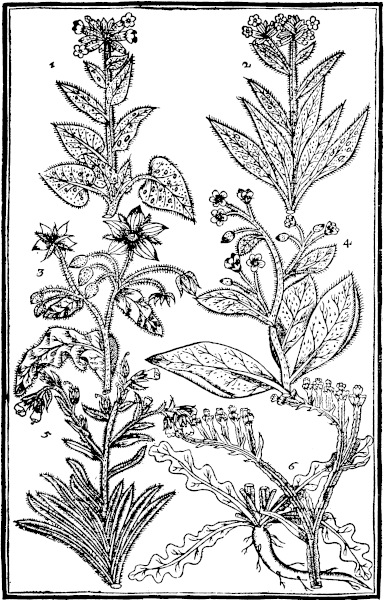
| 1 | Pulmonaria latifolia maculosa. Cowslips of Ierusalem. |
| 2 | Pulmonaria angustifolia. Narrow leafed Cowslips of Ierusalem. |
| 3 | Borrago. Borage. |
| 4 | Borrago semper virens. Euerliuing Borage. |
| 5 | Anchusa. Sea Buglosse or Alkanet. |
| 6 | Limonium Rauwolfij. Marsh Buglosse. |
[252]
Our ordinary Borage by the consent of all the best moderne Writers, is
the true Buglossum of Dioscorides, and that our Buglosse was vnknowne to
the ancients. The Borago semper virens, Lobel calleth Buglossum semper virens,
that is, Euer-liuing, or Greene Buglosse: but it more resembleth Borage
then Buglosse; yet because Buglosse abideth greene, to auoyde that
there should not be two Buglossa semper virentia, I had rather call it Borage
then Buglosse. Anchusa hath diuers names, as Dioscorides setteth downe.
And some doe call it Fucus herba, from the Greeke word, because the roote
giuing so deepe a colour, was vsed to dye or paint the skinne. Others call it
Buglossum Hispanicum, in English Alkanet, and of some Orchanet, after the
French. Limonium was found by Leonhartus Rauwolfius, neere vnto Ioppa,
which he setteth downe in the second Chapter of the third booke of
his trauayles, and from him first knowne to these parts: I haue, as you see,
referred it to the kindes of Buglosse, for that the flowers haue some resemblance
vnto them, although I know that Limonium genuinum is referred to
the Beetes. Let it therefore here finde a place of residence, vntill you or I
can finde a fitter; and call it as you thinke best, eyther Limonium as Rauwolfius
doth, or Marshe Buglosse as I doe, or if you can adde a more proper
name, I shall not be offended.
Borage and Buglosse are held to bee both temperate herbes, beeing vsed
both in the pot and in drinkes that are cordiall, especially the flowers, which
of Gentlewomen are candid for comfitts. The Alkanet is drying, and held
to be good for wounds, and if a peece of the roote be put into a little oyle
of Peter or Petroleum, it giueth as deepe a colour to the oyle, as the Hypericon
doth or can to his oyle, and accounted to be singular good for a cut or
greene wound.
The Limonium hath no vse that wee know, more then for a Garden; yet
as Rauwolfius saith, the Syrians vse the leaues as sallats at the Table.
There bee diuers sorts of Campions, as well tame as wilde, and although some
of them that I shall here entreate of, may peraduenture be found wilde in our
owne Countrey, yet in regard of their beautifull flowers, they are to bee respected,
and noursed vp with the rest, to furnish a garden of pleasure; as for the wilde
kindes, I will leaue them for another discourse.
The single red Rose Campion hath diuers thicke, hoary, or woolly long greene
leaues, abiding greene all the winter, and in the end of the spring or beginning of summer,
shooteth forth two or three hard round woolly stalkes, with some ioynts thereon,
and at euery ioynt two such like hoary greene leaues as those below, but smaller,
diuersly branched at the toppe, hauing one flower vpon each seuerall long foot stalke,
consisting of fiue leaues, somewhat broade and round pointed, of a perfect red crimson
colour, standing out of a hard long round huske, ridged or crested in foure or fiue
places; after the flowers are fallen there come vp round hard heads, wherein is contained
small blackish seed: the roote is small, long and wooddy, with many fibres annexed
vnto it, and shooteth forth anew oftentimes, yet perisheth often also.
The white Rose Campion is in all things like the red, but in the colour of the flower,
which in this is of a pure white colour.
Like vnto the former also are these other sorts, hauing no other difference to distinguish
them, but the flowers, which are of a pale or bleake whitish blush colour, especially
about the brims, as if a very little red were mixed with a great deale of white,
the middle of the flower being more white; the one being spotted all ouer the flower,
with small spots and streakes, the other not hauing any spot at all.
The double red Rose Campion is in all respects like vnto the single red kinde, but
that this beareth double flowers, consisting of two or three rowes of leaues at the
most, which are not so large as the single, and the whole plant is more tender, that is,
more apt to perish, then any of the single kindes.
This Campion of Constantinople hath many broad and long greene leaues, among
which rise vp sundry stiffe round hairy ioynted stalks three foot high, with two leaues
euery ioynt: the flowers stand at the toppes of them, very many together, in a large
tuft or vmbell, consisting of fiue small long leaues, broade pointed, and notched-in
in the middle, of a bright red orenge colour, which being past, there come in their
places small hard whitish heads or seede vessels, containing blacke seede, like vnto the
seede of sweet Williams, and hauing but a small sent; the roote is very stringie, fastening
it selfe very strongly in the ground, whereby it is much encreased.
Flore albo.
Et carneo.
Versicolor.
Of the single kinde there is also two or three other sorts, differing chiefly in the colour
of the flowers. The one is pure white. Another is of a blush colour wholly,
without variation. And a third is very variable; for at the first it is of a pale red, and
after a while groweth paler, vntill in the end it become almost fully white; and all these
diuersities of the flowers are sometimes to bee seene on one stalke at one and the same time.
This glorious flower being as rare as it is beautifull, is for rootes beeing stringie,
for leaues and stalkes being hairy and high, and for the flowers growing in tufts, altogether
like the first single kinde; but herein consisteth the chiefest difference, that
this beareth a larger vmbell or tuft of flowers at the toppe of the stalke, euery flower
consisting of three or foure rowes of leaues, of a deeper orenge colour then it, which
addeth the more grace vnto it, but passeth away without bearing seede, as most other
double flowers doe, yet recompenceth that defect with encrease from the roote.
The leaues of this wilde Campion are somewhat like the ordinary white wilde
Campion, but not so large, or rather resembling the leaues of sweete Williams, but
that they grow not so close, nor so many together: the stalkes haue smaller leaues at
the ioynts then those belowe, and branched at the toppe, with many pale, but bright
red flowers, iagged or cut in on the edges, like the feathered Pinke, whereof some haue
taken it to be a kinde, and some for a kinde of wilde William, but yet is but a wilde
Campion, as may be obserued, both by his huske that beareth the flowers, and by the
greyish roundish seede, being not of the Family of Pinkes and Gillowers, but (as I said)
of the Campions: the roote is full of strings or fibres.
Flore pleno.
The double kinde is very like vnto the single kinde, but that it is lower and smaller,
and the flowers very double.
The double wilde Campion (which of our Countrey Gentlewomen is called Batchelours
buttons) is very like both in rootes, leaues, stalkes, and flowers vnto the ordinary
wilde red Campion, but somewhat lesser, his flowers are not iagged, but
smooth, and very thicke and double, so that most commonly it breaketh his short
huske, wherein the flower standeth on the one side, seldome hauing a whole huske,
and are of a reddish colour.
As the leaues of the former double Campion was like vnto the single kinde that had
red flowers, so this hath his leaues like vnto the single white kinde, differing in no other
thing from it, but in the doublenesse of the flowers, which by reason of the multiplicity
of leaues in them thrusting forth together, breaketh his huskes wherein the
flowers doe stand, as the other doth, and hath scarce one flower in many that is whole.
This Strange Campion (for thereunto it must bee referred) shooteth forth many
round, whitish, wooddy, but brittle stalkes, whereon stand diuers long, and somewhat
thicke leaues, set by couples, narrow at the bottome, and broader toward the point,
of a very faire greene and shining colour, so that there is more beauty in the greene
leaues, which doe so alwaies abide, then in the flowers, which are of a pale red or
blush colour, consisting of fiue small long broad pointed leaues, notched in the middle,
which doe not lye close, but loosly as it were hanging ouer the huskes: after the
flowers are past, there come heads that containe blackish seede: the roote is small,
hard, white, and threadie.
I must needes insert this small plant, to finish this part of the Campions, whereunto
it belongeth, being a pretty toye to furnish and decke out a Garden. It springeth vp (if
it haue beene once sowne and suffered to shed) in the later end of the yeare most commonly,
or else in the Spring with fiue or six small leaues, very like vnto the leaues of
Pinkes, and of the same grayish colour, but a little broader and shorter, and when it
beginneth to shoote vp for flower, it beareth smaller leaues on the clammy or viscous
stalkes (fit to hold any small thing that lighteth on it); being broad at the bottome
compassing them, and standing two at a ioynt one against another: the toppes of the
stalkes are diuersly branched into seuerall parts, euery branch hauing diuers small red
flowers, not notched, but smooth, standing out of small, long, round, stript huskes,
which after the flowers are past, containe small grayish seede: the roote is small,
and perisheth after it hath giuen seede; but riseth (as is before said) of its owne seede,
if it be suffered to shed.
[255]
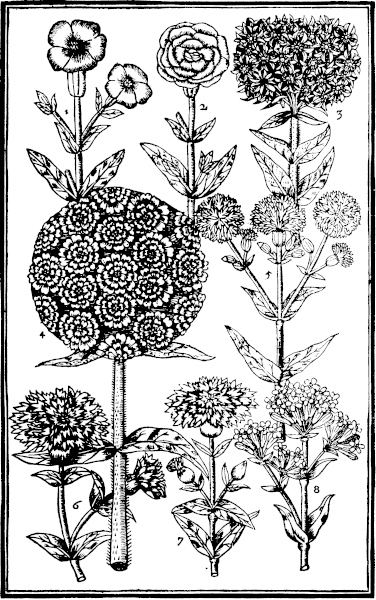
| 1 | Lychnis Coronaria simplex. Single Rose Campion. |
| 2 | Lychnis Coronaria rubra multiplex. The double red Rose Campion. |
| 3 | Lychnis Chalcedonica simplex. Single None such, or flower of Bristow. |
| 4 | Lychnis Chalcedonica flore pleno. Double None such, or flower of Bristow. |
| 5 | Lychnis plumaria multiplex. Pleasant in sight. |
| 6 | Lychnis siluestris flore pleno rubro. Red Batchelours Buttons. |
| 7 | Lychnis siluestris flore pleno albo. White Batchelours Buttons. |
| 8 | Muscipula Lobelij. Lobels Catch Flie. |
The Rose Campions, Flowers of Bristow, or Nonesuch, the Bassil Campion,
and the Catch Flie, haue been sent vs from beyond the Seas, and are
onely noursed vp in Gardens with vs; the other Campions that are double,
haue been naturally so found double wilde (for no art or industry of man,
that euer I could be assured of to be true, be it by neuer so many repetitions
of transplantations, and planeticall obseruations (as I haue said in the beginning
of this worke) could bring any flower, single by nature, to become
double, notwithstanding many affirmations to that purpose, but whatsoeuer
hath been found wilde to be double, nature her selfe, and not art hath so
produced it) and being brought into Gardens, are there encreased by slipping,
and parting the roote, because they giue no seede.
All of them doe flower in the Summer, yet none before May.
The first kindes are called Lychnides satiuæ, and coronariæ, in English generally
Rose Campions. The next is called Lychnis Chalcedonica, and Byzantina;
in English, of some Nonesuch, and of others Flower of Bristow,
and after the Latine, Flower of Constantinople, because it is thought the
seede was first brought from thence; but from whence the double of this
kinde came, we cannot tell. The names of the others of this kinde, both
single and double, are set downe with their descriptions. The feathered
Campions are called Armoraria pratensis, and Flos Cuculi, and of Clusius
and others thought to be Odontitis Plinij. Some call them in English Crowflowers,
and Cuckowe-Flowers; and some call the double hereof, The
faire Maide of France. The Bassil Campions were sent ouer among many
other seedes out of Italy, by the name of Ocimoides arborea semper virens.
Arborea, because the stalke is more wooddy and durable then other Campions:
And semper virens, because the leaues abide greene Winter and
Summer. Clusius calleth it Lychnis semper virens, because it is certainly a
Campion. The last is diuersly called of Authors; Lobel calleth it Muscipula:
Others Armoraria altera: Dodonæus Armerius flos quartus. Clusius
Lychnis siluestris altera, in his Spanish obseruations, and prima in his History
of plants, and saith, the learned of Salmantica in Spaine called it, Ben rubrum,
as Lobel saith, they of Mompelier doe also: and by that name I receiued
it first out of Italy. It hath the name of Catch Flie, of Muscipula the
Latine word, because the stalkes in the hot Summer dayes haue a certaine
viscous or clammy humour vpon them, whereby it easily holdeth (as I said
before) whatsoeuer small thing, as Flies, &c. lighteth vpon it.
We know none in these dayes, that putteth any of these to any Physicall
vse, although some haue in former times.
There are two sorts of Wall-flowers, the one single, the other double, and of
each of them there is likewise some differences, as shall be shewed in their
description.
The common single Wall-flower which groweth wilde abroad, and yet is brought
into Gardens, hath sundry small, narrow, long, and darke greene leaues, set without
order vpon small round whitish wooddy stalkes, which beare at the tops diuers
single yellow flowers one aboue another, euery one hauing foure leaues a peece, and of
a very sweete sent: after which come long pods, containing reddish seede: the roote
is white, hard and thready.
There is another sort of single Wall-flower, whose leaues as well as flowers are
much larger then the former: the leaues being of a darker and shining greene colour,
and the flowers of a very deepe gold yellow colour, and vsually broader then a twentie
shilling peece of gold can couer: the spike or toppe of flowers also much longer,
and abiding longer in flower, and much sweeter likewise in sent: the pods for seede
are thicker and shorter, with a small point at the end: this is slower to encrease into
branches, as also to be encreased by the branches, and more tender to be preserued;
for the hard frosts doe cause it to perish, if it be not defended from them.
This Wall-flower hath his leaues as greene as the great kinde, but nothing so large:
the flowers stand at the toppe, but not in so long a spike, and consisteth of foure leaues,
of a very white colour, not much larger then the common kinde, and of a faint or
weaker sent: the pods are nothing so great as the former great one: this is more easie
to be propagated and encreased also, but yet will require some care in defending it
from the colds of the Winter.
This ordinary double Wall-flower is in leaues and stalke very like vnto the first single
kinde, but that the leaues hereof are not of so deepe a greene colour: the flowers
stand at the top of the stalkes one aboue another, as it were a long spike, which flower
by degrees, the lowest first, and so vpwards, by which it is a long time in flowring, and
is very double, of a gold yellow colour, and very sweete.
Wee haue another sort of this kinde of double Wall-flower, whose double flowers
stand not spike-fashion as the former, but more open spread, and doe all of them
blowe open at one time almost, and not by degrees as the other doth, and is of a paler
yellow colour, not differing in any thing else, except that the greene leaues hereof are
of a little paler greene then it.
We haue also another sort of double Wall-flower, whose leaues are as greene, and
almost as large as the great single yellow kinde, or full as bigge as the leaues of the
white Wall-flower: the flowers hereof are not much larger then the ordinary, but are
of a darker yellow colour then the great single kinde, and of a more brownish or red
colour on the vnderside of the leaues, and is as it were striped.
This great double Wall-flower is as yet a stranger in England, and therefore what I
here write is more vpon relation (which yet I beleeue to be most true) then vpon sight
and speculation. The leaues of this Wall-flower are as greene and as large, if not larger
then the great single kinde: the flowers also are of the same deepe gold yellow
colour with it, but much larger then any of the former double kindes, and of as sweet
a sent as any, which addeth delight vnto beauty.
The first single kind is often found growing vpon old wals of Churches,
and other houses in many places of England, and also among rubbish and
stones. The single white and great yellow, as well as all the other double
kindes, are noursed vp in Gardens onely with vs.
All the single kindes doe flower many times in the end of Autumne, and
if the Winter be milde all the Winter long, but especially in the moneths
of February, March, and Aprill, and vntill the heate of the Spring doe
spend them: but the other double kindes doe not continue flowring in that
manner the yeare throughout, although very early sometimes, and very late
also in some places.
They are called by diuers names, as Viola lutea, Leucoium luteum, and
Keiri, or Cheiri, by which name it is chiefly knowne in our Apothecaries
shops, because there is an oyle made thereof called Cheirinum: In English
they are vsually called in these parts, Wall-flowers: Others doe call them
Bee-flowers; others Wall-Gilloflowers, Winter-Gilloflowers, and yellow
Stocke-Gilloflowers; but we haue a kinde of Stocke-Gilloflower that
more fitly deserueth that name, as shall be shewed in the Chapter following.
The sweetnesse of the flowers causeth them to be generally vsed in Nosegayes,
and to decke vp houses; but physically they are vsed in diuers manners:
As a Conserue made of the flowers, is vsed for a remedy both for
the Appoplexie and Palsie. The distilled water helpeth well in the like
manner. The oyle made of the flowers is heating and resoluing, good to
ease paines of strained and pained sinewes.
There are very many sorts of Stocke-Gilloflowers, both single and double, some
of the fields and mountaines, others of the Sea marshes and medowes; and
some noursed vp in Gardens, and there preserued by seede or slippe, as each
kinde is aptest to bee ordered. But because some of these are fitter for a generall History
then for this our Garden of Pleasure, both for that diuers haue no good sent,
others little or no beauty, and to be entreated of onely for the variety, I shall spare so
many of them as are not fit for this worke, and onely set downe the rest.
[259]
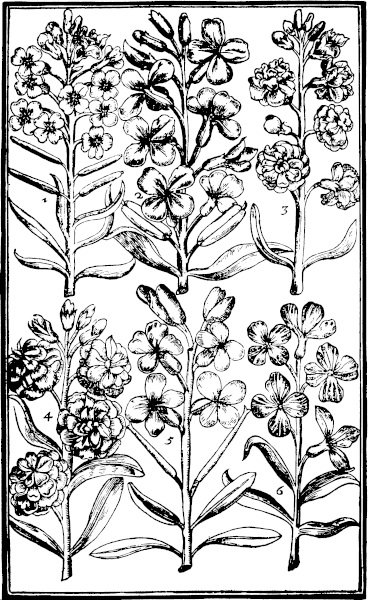
| 1 | Keiri siue Leucoium luteum vulgare. Common Wall-flowers. |
| 2 | Keiri siue Leucoium luteum maius simplex. The great single Wall-flower. |
| 3 | Keiri siue Leucoium luteum flore pleno vulgare. Ordinary double Wall-flowers. |
| 4 | Keiri maius flore pleno ferrugineo. The great double red Wall-flower. |
| 5 | Leucoium sativum simplex. Single Stocke Gilloflowers. |
| 6 | Leucoium sativum simplex flore striato. Single stript Stocke-Gilloflowers. |
These single Stocke-Gilloflowers, although they differ in the colour of their flowers,
yet are in leafe and manner of growing, one so like vnto another, that vntill they
come to flower, the one cannot be well knowne that beareth red flowers, from another
that beareth purple; and therefore one description of the plant shall serue, with a declaration
of the sundry colours of the flowers. It riseth vp with round whitish woody
stalkes, two, three, or foure foot high, whereon are set many long, and not very broad,
soft, and whitish or grayish greene leaues, somewhat round pointed, and parted into
diuers branches, at the toppes whereof grow many flowers, one aboue another, smelling
very sweet, consisting of foure small, long, and round pointed leaues, standing in
small long huskes, which turne into long and flat pods, sometimes halfe a foote long,
wherein is contained flat, round, reddish seedes, with grayish ringes or circles about
them, lying flat all along the middle rib of the pod on both sides: the roote is long,
white, and woody, spreading diuers wayes. There is great variety in the colours of the
flowers: for some are wholly of a pure white colour, others of a most excellent crimson
red colour, others againe of a faire red colour, but not so bright or liuely as the
other, some also of a purplish or violet colour, without any spot, marke, or line in
them at all. There are againe of all these colours, mixed very variably, as white mixed
with small or great spottes, strakes or lines of pure or bright red, or darke red, and
white with purple spots and lines; and of eyther of them whose flowers are almost
halfe white, and halfe red, or halfe white, and halfe purple. The red of both sorts, and
the purple also, in the like manner spotted, striped, and marked with white, differing
neyther in forme, nor substance, in any other point.
There is very little difference in this kind from the former, for the manner of growing,
or forme of leaues or flower. Only this hath greener leaues, and pale yellow almost
white flowers, in all other things alike: this is of no great regard, but only for rarity,
and diuersity from the rest.
This wilde kinde of stocke gilloflower hath larger, longer and greener leaues then
any of the former kindes, vneuenly gashed or sinuated on both edges lying on the
ground, and a little rough or hairy withall: from among which rise vp the stalkes, a yard
high or more, and hairy likewise, bearing thereon here and there some such like leaues as
are below, but smaller, and at the top a great number of flowers, as large or larger then
any of the former single kindes, made of 4. large leaues a peece also, standing in such
like long huskes, but of a darke or sullen yellowish colour: after which come long
roundish pods, wherein lye somewhat long but rounder and greater seede then any
stocke gilloflower, and nearer both in pod and seede vnto the Hesperis or Dames Violet:
this perisheth not vsually after seede bearing, although sometimes it doth.
This kind of stocke gilloflower riseth vp at the first with diuers long and somewhat
broad leaues, a little vneuenly dented or waued on the edges, which so continue the
first yeare after the sowing: the stalke riseth vp the next yeare to bee two foot high or
more, bearing all those leaues on it that it first had, which then do grow lesse sinuated
or waued then before: at the top whereof stand many flowers, made of foure leaues
a peece, of a delayed purple colour, but of a small sent which turne into very long and
narrow flat pods, wherein are contained flat seed like the ordinary stocke gilloflowers,
but much larger and of a darke or blackish browne colour: the root is white, and
groweth deepe, spreading in the ground, but growing woody when it is in seede, and
perisheth afterwards.
This kinde of Stocke gilloflower differeth neyther in forme of leaues, stalkes, nor
flowers from the former, but that it oftentimes groweth much larger and taller; so that
whosoeuer shall see both these growing together, shall scarce discerne the difference,
onely it beareth flowers, eyther white, red or purple, wholly or entire, that is, of one
colour, without mixture of other colour in them (for so much as euer I haue obserued,
or could vnderstand by others) which are eyther single, like vnto the former, or very
thicke and double, like vnto the next that followeth; but larger, and growing with
more store of flowers on the long stalke. But this you must vnderstand withall, that
those plants that beare double flowers, doe beare no seede at all, and is very seldome
encreased by slipping or cutting, as the next kinde of double is: but the onely way to
haue double flowers any yeare, (for this kinde dyeth euery winter, for the most part,
after it hath borne flowers, and seldome is preserued) is to saue the seedes of those
plants of this kinde that beare single flowers, for from that seede will rise, some that
will beare single, and some double flowers, which cannot bee distinguished one from
another, I meane which will be single and which double, vntill you see them in flower,
or budde at the least. And this is the only way to preserue this kinde: but of the seed
of the former kinde was neuer known any double flowers to arise, and therefore you
must be carefull to marke this kinde from the former.
This other kinde of Stock gilloflower that beareth onely double flowers, groweth
not so great, nor spreadeth his branches so farre, nor are his leaues so large, but is in
all things smaller, and lower, and yet is woody, or shrubby, like the former, bearing
his flowers in the like manner, many vpon a long stalke, one aboue another, and
very double, but not so large as the former double, although it grow in fertile soyle,
which are eyther white, or red, or purple wholly, without any mixture, or else mixed
with spots and stripes, as the single flowers of the first kinde, but more variably, and
not in all places alike, neuer bearing seede, but must be encreased, only by the cutting
of the young sproutes or branches, taken in a fit season: this kinde perisheth not, as
the former double kinde doth, so as it bee defended in the winter from the extreame
frosts, but especially from the snow falling, or at the least remaining vpon it.
This double yellow Stock gilloflower is a stranger in England, as far as I can learne,
neyther haue I any further familiaritie with him, then by relation from Germany,
where it is affirmed to grow only in some of their gardens, that are curious louers of
these delights, bearing long leaues somewhat hoary or white, (and not greene like
vnto the Wallflower, whereunto else it might be thought to be referred) like vnto the
Stock gilloflowers, as the stalkes and branches also are, and bearing faire double
flowers, of a faire, but pale yellow colour. The whole plant is tender, as the double
Stock gilloflowers are, and must be carefully preserued in the winter from the coldes,
or rather more then the last double, lest it perish.
The single kindes, especially some of them, grow in Italie, and some in
Greece, Candy, and the Isles adiacent, as may be gathered out of the verses
in Plutarches Booke De Amore fraterno:
Inter Echinopodas velut asperam, & inter Ononim,
Inter dum crescunt mollia Leucoia.
Which sheweth, that the soft or gentle stocke gilloflowers doe sometimes
grow among rough or prickely Furse and Cammocke. The other sorts are
only to be found in gardens.
They flower in a manner all the yeare throughout in some places, especially
some of the single kindes, if they stand warme, and defended from
the windes and cold: the double kindes flower sometimes in Aprill, and
more plentifully in May, and Iune; but the double of seed, flowreth vsually
late, and keepeth flowring vnto the winter, that the frostes and colde
mistes doe pull it downe.
It is called Leucoium, & Viola alba: but the name Leucoium (which is in
English the white Violet) is referred to diuers plants; we call it in English
generally, Stocke gilloflower, (or as others doe, Stocke gillouer) to put a
difference betweene them, and the Gilloflowers and Carnations, which are
quite of another kindred, as shall be shewne in place conuenient.
These haue no great vse in Physick that I know: only some haue vsed the
leaues of the single white flowred kinde with salt, to be laid to the wrests of
them that haue agues, but with what good successe I cannot say, if it happen
well I thinke in one (as many such things else will) it will fayle in a
number.
The ordinary Dames Violets, or Queene Gilloflowers, hath his leaues broader,
greener, and sharper pointed, then the Stock gilloflowers, and a little endented
about the edges: the stalkes grow two foot high, bearing many greene leaues
vpon them, smaller then those at the bottome, and branched at the toppe, bearing many
flowers, in fashion much like the flowers of stocke gilloflowers, consisting of foure
leaues in like manner, but not so large, of a faint purplish colour in some, and in others
white, and of a pretty sweet sent, especially towards night, but in the day time little or
none at all: after the flowers are past, there doe come small long and round pods,
wherein is contained, in two rowes, small and long blacke seede: the roote is wholly
composed of stringes or fibres, which abide many yeares, and springeth fresh stalks
euery yeare, the leaues abiding all the Winter.
The leaues of this Violet are very like the former, but smoother and thicker, and
not at all indented, or cut in on the edges: the flowers are like the former, but of a
sullen pale colour, turning themselues, and seldome lying plaine open, hauing many
purple veines, and streakes running through the leaues of the flowers, of little or no
sent in the day time, but of a very sweete sent in the euening and morning; the seedes
are alike also, but a little browner.
[263]
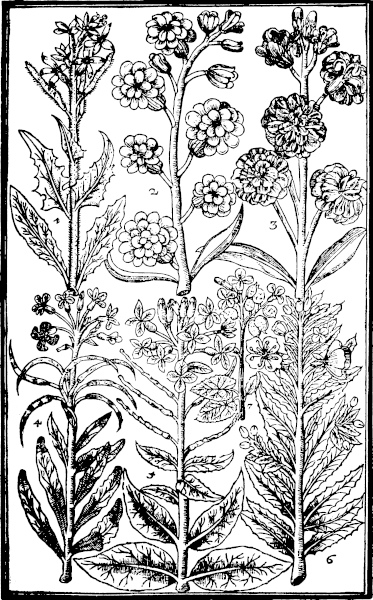
| 1 | Leucoium Melancholicum. Sullen Stocke-Gilloflowers. |
| 2 | Leucoium sativum flore pleno. Double Stocke-Gilloflowers. |
| 3 | Leucoium sativum flore pleno vario. Party coloured Stocke-Gilloflowers. |
| 4 | Leucoium marinum Syriacum. Leuant Stocke-Gilloflowers. |
| 5 | Hesperis vulgaris. Dames Violets or Winter Gilloflowers. |
| 6 | Lysimachia lutea siliquosa Virginiana. The tree Primrose of Virginia. |
| 7 | Viola lunaris siue Bolbonach. The white Sattin flower. |
[264]
Vnto what tribe or kindred I might referre this plant, I haue stood long in suspence, in
regard I make no mention of any other Lysimachia in this work: lest therefore it should
lose all place, let me ranke it here next vnto the Dames Violets, although I confesse
it hath little affinity with them. The first yeare of the sowing the seede it abideth
without any stalke or flowers lying vpon the ground, with diuers long and narrow
pale greene leaues, spread oftentimes round almost like a Rose, the largest leaues being
outermost, and very small in the middle: about May the next yeare the stalke riseth,
which will be in Summer of the height of a man, and of a strong bigge size almost to a
mans thumbe, round from the bottome to the middle, where it groweth crested vp to
the toppe, into as many parts as there are branches of flowers, euery one hauing a small
leafe at the foote thereof: the flowers stand in order one aboue another, round about
the tops of the stalks, euery one vpon a short foot-stalke, consisting of foure pale yellow
leaues, smelling somewhat like vnto a Primrose, as the colour is also (which hath caused
the name) and standing in a greene huske, which parteth it selfe at the toppe into
foure parts or leaues, and turne themselues downewards, lying close to the stalke: the
flower hath some chiues in the middle, which being past, there come in their places
long and cornered pods, sharpe pointed at the vpper end, and round belowe, opening
at the toppe when it is ripe into fiue parts, wherein is contained small brownish seed:
the roote is somewhat great at the head, and wooddy, and branched forth diuersly,
which perisheth after it hath borne seede.
The two first grow for the most part on Hils and in Woods, but with vs
in Gardens onely.
The last, as may be well vnderstood by the title, came out of Virginia.
They flower in May, Iune, and Iuly.
The name of Hesperis is imposed by most Herbarists vpon the two first
plants, although it is not certainly knowne to be the same that Theophrastus
doth make mention of, in his sixth Booke and twenty fiue Chapter de
causis plantarum: but because this hath the like effects to smell best in the
euening, it is (as I said) imposed vpon it. It is also called Viola Marina Matronalis,
Hyemalis, Damascena and Muschatella: In English, Dames Violets,
Queens Gilloflowers, and Winter Gilloflowers.
The last hath his Latine name in the title as is best agreeing with it, and
for the English, although it be too foolish I confesse, yet it may passe for
this time till a fitter be giuen, vnlesse you please to follow the Latine, and
call it Virginia Loose-strife.
I neuer knew any among vs to vse these kindes of Violets in Physicke, although
by reason of the sharpe biting taste, Dodonæus accounteth the ordinary
sort to be a kinde of Rocket, and saith it prouoketh sweating, and vrine:
and others affirme it to cut, digest, and cleanse tough flegme. The
Virginian hath not beene vsed by any that I know, either inwardly or outwardly.
Vnto the kindes of Stocke-Gilloflowers I thinke fittest to adioyne these kindes
of Sattin-flowers, whereof there are two sorts, one frequent enough in all our
Countrie, the other is not so common.
The first of these Sattin flowers, which is the most common, hath his leaues broad
belowe, and pointed at the end, snipt about the edges, and of a darke greene colour:
the stalkes are round and hard, two foot high, or higher, diuided into many branches,
set with the like leaues, but smaller: the tops of the branches are beset with many purplish
flowers, like vnto Dames Violets, or Stocke Gilloflowers, but larger, being
of little sent: after the flowers are past, there come in their places round flat
thin cods, of a darke colour on the outside, but hauing a thinne middle skinne, that is
white and cleare shining, like vnto very pure white Sattin it selfe, whereon lye flat and
round brownish seede, somewhat thicke and great: the rootes perish when they haue
giuen their seede, and are somewhat round, long, and thicke, resembling the rootes of
Lilium non bulbosum, or Day Lilly, which are eaten (as diuers other rootes are) for Sallets,
both in our owne Country, and in many places beside.
This second kinde hath broader and longer leaues then the former, the stalkes also
are greener and higher, branching into flowers, of a paler purple colour, almost white,
consisting of foure leaues in like manner, and smelling pretty sweete, bearing such like
pods, but longer and slenderer then they: the rootes are composed of many long
strings, which dye not as the former, but abide, and shoot out new stalkes euery yeare.
The first is (as is said) frequent enough in Gardens, and is found wilde in
some places of our owne Country, as Master Gerard reporteth, whereof I
neuer could be certainly assured, but I haue had it often sent mee among other
seedes from Italy, and other places. The other is not so common in
Gardens, but found about Watford, as he saith also.
They flower in Aprill or May, and sometimes more early.
It hath diuers names, as well in English as in Latine; for it is called most
vsually Bolbonach, and Viola Lunaris: Of some Viola latifolia, and of others
Viola Peregrina, and Lunaria Græca, Lunaria maior, and Lunaria odorata, and
is thought to be Thlaspi Crateuæ: In English, White Satten, or Satten flower:
Of some it is called Honesty, and Penny-flower.
Some doe vse to eate the young rootes hereof, before they runne vp to
flower, as Rampions are eaten with Vinegar and Oyle; but wee know no
Physicall vse they haue.
Although neither the manured Line or Flaxe is a plant fit for our Garden, nor
many of the wilde sorts, yet there are some, whose pleasant and delightfull
aspect doth entertaine the beholders eyes with good content, and those I will
set downe here for varietie, and adioyne vnto them some of the Linarias, or Tode
Flaxe, for the neare affinity with them.
This kinde of wilde Flaxe riseth vp with diuers slender branches, a foote high or
better, full of leaues, standing without order, being broader and longer then the manured
Flaxe: the tops of the branches haue diuers faire white flowers on them, composed
of fiue large leaues a peece, with many purple lines or strikes in them: the seede
vessell as well as the seede, is like vnto the heads and seede of the manured Flaxe: the
rootes are white strings, and abide diuers yeares, springing fresh branches and leaues
euery yeare, but not vntill the Spring of the yeare.
This wilde Flaxe doth so well resemble a kinde of St. Iohns wort, that it will soone
deceiue one that doth not aduisedly regard it: For it hath many reddish stalkes, and
small leaues on them, broader then the former wilde Flaxe, but not so long, which are
well stored with yellow flowers, as large as the former, made of fiue leaues a peece,
which being past, there come small flattish heads, containing blackish seede, but not
shining like the former: the rootes hereof dye not euery yeare, as many other of the
wilde kindes doe, but abide and shoote out euery yeare.
This purple Tode Flaxe hath diuers thicke, small, long, and somewhat narrowish
leaues, snipt about the edges, of a whitish greene colour, from among which rise vp
diuers stalkes, replenished at the tops with many small flowers, standing together one
aboue another spike-fashion, which are small and somewhat sweete, while they are
fresh, fashioned somewhat like the common Tode flaxe that groweth wilde abroad almost
euery where, but much smaller, with a gaping mouth, but without any crooked
spurre behinde, like vnto them, sometimes of a sad purple neare vnto a Violet, and
sometimes of a paler blew colour, hauing a yellow spot in the middle or gaping place:
after the flowers are past, there come small, hard, round heads, wherein are contained
small, flat, and grayish seede: the roote is small and perisheth for the most part euery
yeare, and will spring againe of it owne sowing, if it be suffered to shed it selfe, yet
some hard Winters haue killed the seede it should seeme, in that sometimes it faileth
to spring againe, and therefore had neede to be sowne anew in the Spring.
The lower leaues of this purple Tode Flaxe are nothing like any of the rest, but are
long and broad, endented about the edges, somewhat resembling the leaues of the
greater wilde white Daisie: the stalke is set at the bottome with such like leaues, but
a little more diuided and cut in, and still smaller and smaller vpward, so that the vppermost
leaues are very like the common Tode Flaxe, the toppe whereof is branched,
hauing diuers small flowers growing along vpon then, in fashion and colour almost
like the last described Tode Flaxe, but not altogether so deepe a purple: the heads
and seedes are very like the former, but that the seede of this is reddish; the flowers
in their naturall hot Countries haue a fine sent, but in these colder, little or none at all:
the rootes are small and threadie, and perish after they haue flowred and seeded.
[267]
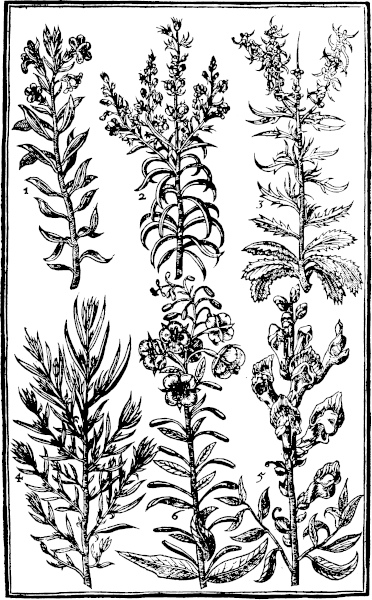
| 1 | Linum siluestre flore albo. Wilde Flaxe with a white flower. |
| 2 | Linaria purpurea siue cærulea. Purple Tode Flaxe. |
| 3 | Linaria purpurea odorata. Sweete purple Tode Flaxe. |
| 4 | Scoparia siue Beluidere Italorum. Broome Tode Flaxe. |
| 5 | Antirrhinum maius. The greater Snapdragon. |
| 6 | Chamænerium flore delphinij. The willowe flower. |
[268]
This Spanish Tode Flaxe hath three or foure thicker and bigger stalkes then the
former, bearing small broad leaues, like vnto the small Centory, two or three together
at a ioynt, round about the lower end of the stalkes, but without any order vpwards, at
the toppes whereof stand many flowers, in fashion like vnto the common kinde,
and almost as large, of a faire yellow colour, but the gaping mouth is downie, and
the spurre behinde of a purplish colour.
Although this plant haue no beautifull flowers, yet because the greene plant full of
leaues is so delightfull to behold, being in Italy and other places planted not onely in
their Gardens, but set likewise in pots to furnish their Windowes, and euen with vs
also hath growne to be so dainty a greene bush, that I haue thought it worthy to be among
the delights of my Garden; the description whereof is as followeth: This pleasant
Broome Flaxe riseth vp most vsually with one straight vpright square stalke, three
foote and a halfe high or better in our Gardens, branching it selfe out diuers waies,
bearing thereon many long narrow leaues, like the Garden Line or Flaxe, very thicke
set together, like vnto a bush, or rather like vnto a faire greene Cypresse tree, growing
broad belowe, and spire-fashion vpwards, of a very faire greene colour: at the seuerall
ioynts of the branches, towards the tops, and among the leaues, there come forth
small reddish flowers, not easily seene nor much regarded, being of no beauty, which
turne into small round blackish gray seede: the rootes are a number of blackish strings
set together, and the whole plant perisheth euery yeare at the first approach of any cold
ayre, as if it neuer had beene so faire a greene bush.
These kindes of wilde Flaxe doe growe naturally in diuers places, some
in Germany, some in Spaine, and some in Italy. Those that delight in the
beauty of natures variety, doe preserue them, to furnish vp the number of
pleasant aspects.
They all flower in the Summer moneths, and soone after perfect their
seede.
Their names are sufficiently expressed in their titles, yet I must giue you
to vnderstand that the last is called of some Linaria magna, and of others
Osyris.
The wilde Flaxe hath no medecinable vertue appropriate vnto it that is
knowne. The Tode Flaxe is accounted to be good, to cause one to make
water.
There is some diuersity in the Snapdragons, some being of a larger, and others
of a lesser stature and bignesse; and of the larger, some of one, and some of another
colour, but because the small kindes are of no beautie, I shall at this
time onely entreate of the greater sorts.
The leaues of these Snapdragons (for I doe vnder one description comprehend the
rest) are broader, longer, and greener then the leaues of the Garden Flaxe, or of the
wilde Flaxe set confusedly vpon the tender greene branches, which are spread on all
sides, from the very bottome, bearing at the toppes many flowers, somewhat resembling
the former Tode Flaxe, but much larger, and without any heele or spurre, of a
faire white colour, with a yellow spot in the mouth or gaping place: after the flowers
are past, there come vp in their places hard round seede vessels, fashioned somewhat
like vnto a Calues head, the snout being cut off, wherein is contained small blacke
seede: the rootes are many white strings, which perish in most places after they haue
giuen seede, notwithstanding any care or paines taken with them to preserue them aliue,
and yet they will abide in some places where they are defended in the Winter.
The purple Snapdragon is in stalkes, leaues, and flowers altogether like the former,
and as large and great in euery part, or greater; the only difference is, that this beareth
pale Stammell or Rose coloured flowers, with a yellow spot in the mouth, and sometimes
of a paler colour, almost blush.
This variable kinde is somewhat lesse, and tenderer then the last described, hauing
also a reddish or blush coloured flower, lesser then the former, but much bigger then
the middle kinde of Snapdragon (which is not set downe in this worke) the yellow
spot in the mouth of it hath some white about it, and extending to both sides of the
spot: the heads and seede are like the former: the rootes are smaller, but neuer will
abide after they haue giuen flowers and seede.
There is likewise another of these kindes, that beareth leaues as large as any of the
former, & very faire yellow flowers, as large likewise as they, not differing in any thing
else from the first; let not any therefore imagine this to be a Linaria or Tode Flaxe:
for all parts are answerable vnto the Snapdragons.
All these are nourished with vs in our Gardens, although in Spaine and
Italy they are found growing wilde.
They flower for the most part the second yeare after the sowing, from Aprill
vntill Iuly, and the seede is quickly ripe after.
The name Antirrhinum is vsually giuen to this plant, although it fully
agreeth not eyther with the description of Dioscorides, or Theophrastus:
It hath also diuers other names in Latine, as Orontium, Canis cerebrum Os
Leonis, Leo herba, &c. In English Calues snout, from the forme of the seede
vessels, and Snapdragon, or Lyons mouth, from the forme of the flowers.
They are seldome or neuer vsed in Physicke by any in our dayes.
This plant riseth vp with many strong, woddy, round, brownish great stalkes,
three or foure foote high, beset here and there without order, with one broad
and long whitish greene leafe at a ioynt, somewhat like vnto a Lysimachia, or
Willowe herbe, as also vnto a Peach leafe, but larger and longer: at the toppe of the
branches stand many flowers one aboue another, of a pale reddish purple colour,
consisting of fiue leaues, spread open with an heele or spurre behinde them, with many
yellow threads in the middle, much larger then any flower of the Larkes spurres, and
smelling somewhat sweete withall; it beareth a shew of long pods with seede, but I
could neuer obserue the seede: the rootes are like the rootes of Lysimachia, or the ordinary
yellow Loose-strife, or Willowe herbe, but greater: running and spreading vnder
ground, and shooting vp in many places, whereby it filleth a ground that it likes
quickly: the stalkes dye downe euery yeare, and spring againe in many places farre
asunder.
Wee haue not knowne where this Willowe flower groweth naturally,
but we haue it standing in an out corner of our Gardens, to fill vp the
number of delightfull flowers.
It flowreth not vntill May, and abideth a long while flowring.
It may seeme to diuers, that this is that plant that Dodonæus called Pseudolysimachium
purpureum minus, and Lobel seemeth by the name of Delphinium
buccinum to aime at this plant, but withall calleth it Chamænerium
Gesneri, and giueth the same figure that Dodonæus hath for his Pseudolysimachium:
But that is one kinde of plant (which hath smaller and shorter
stalkes, and very narrow long leaues, whose flowers stand vpon long slender
cods, full of downe, with reddish seede, like vnto the Lysimachia siliquosa
siluestris, and rootes that abide many yeares, but creepe not) and this
is another, much greater, whose true figure is not extant in any Author that
I know. It is vsually called Chamænerium flore delphinij; but the name of
Delphinium buccinum in my minde may not so conueniently be applyed vnto
it. It is called in English, The Willowe flower, for the likenesse of the
leaues, and the beauty and respect of the flowers.
There is no vse hereof in Physicke that euer I could learne, but is onely
cherished among other sorts of flowers, that serue to decke and set forth a
Garden of varieties.
There are many sorts of Colombines, as well differing in forme as colour of the
flowers, and of them both single and double carefully noursed vp in our Gardens,
for the delight both of their forme and colours.
Because the whole difference of these Colombines standeth in the varieties of the
forme, and colour of the flowers, and little in the leaues, I shall not neede to make anie
repetitions of the description of them, seeing one onely shall suffice for each peculiar
kinde. The Colombine hath diuers large spread leaues, standing on long stalkes:
euery one diuided in seuerall partitions, and roundly endented about the edges, in
colour somewhat like the leaues of Celondine, that is, of a darke blewish greene colour:
the stalkes rise vp sometimes two or three foote high, diuided vsually into many
branches, bearing one long diuided leafe at the lower ioynt, aboue which the flowers
growe, euery one standing on a long stalke, consisting of fiue hollow leaues, crooked
or horned at the ends, turning backward, the open flower shewing almost like vnto a
Cinquefoile, but more hollow: after the flowers are past, there arise small long cods,
foure or fiue together, wherein are contained blacke shining seede: the rootes are
thicke and round, for a little space within the ground, and then diuided into branches,
ending in many small fibres, abiding many yeares, and shooting a fresh euery Spring
from the round heads, that abide all the Winter. The variety of the colours of these
flowers are very much, for some are wholly white, some of a blew or violet colour, others
of a blush or flesh colour, or deepe or pale red, or of a dead purple, or dead murrey
colour, as nature listeth to shew it selfe.
The double Colombines differ not in leafe or manner of growing from the single,
so that vntill they come to flower, they cannot bee discerned one from another; the
onely difference is, it beareth very thicke and double flowers, that is, many horned or
crooked hollow leaues set together, and are not so large as the leaues of the single
flowers. The variety of colours in this double kinde is as plentifull, or rather more
then in the single; for of these is party coloured, blew and white, and spotted
very variably, which are not in the single kinde, and also a very deepe red, very thicke
and double, but a smaller flower, and lesse plentifull in bearing then many of the other
double sorts. These double kindes doe giue as good seede as the single kindes doe,
which is not obserued in many other plants.
These Colombines are not to be distinguished eyther in roote, leaues, or seed from
the former, the flowers onely make the difference, which are as double as the former,
but that the heeles or hornes of these are turned inward, and stand out in the middle of
the flowers together: there is not that plentifull variety of colours in this kinde, as
there is in the former: for I neuer saw aboue three of foure seuerall colours in this
kinde, that is, white, purplish, reddish, and a dun or darke ouerworne purplish colour.
These double flowers doe likewise turne into pods, bearing seede, continuing his kind,
and not varying into the former.
The leaues and other parts of this kinde of Colombine, differ little or nothing
from the former, the diuersitie consisteth likewise in the flowers, which although they
stand in the same manner seuerally vpon their small stalkes, somewhat more sparingly
then the former doe, yet they haue no heeles or hornes, eyther inward or outward, or
very seldome, but stand sometimes but with eight or tenne smooth small plaine leaues,
set in order one by one in a compasse, in a double rowe, and sometimes with foure or
fiue rowes of them, euery one directly before the other, like vnto a small thick double
Rose layd open, or a spread Marigold: yet sometimes it happeneth, that some of these
flowers will haue two or three of the first rowes of leaues without any heele, and the
rest that are inward with each of them a peece of a small horne at them, as the former
haue: the colours of these flowers are almost as variable, and as variably mixed as the
former double kindes. This likewise giueth seede, preseruing his owne kinde for the
most part.
This kinde of Colombine might seeme to some, to bee but a casuall degeneration,
and no true naturall kinde, happening by some cause of transplanting, or otherwise
by the art of man: but I haue not so found it, in that it keepeth, and holdeth his own
proper forme, which is like vnto the double Rose Colombine, but that the outermost
row of leaues are larger then any of the rest inwardes, and is of a greenish, or else of
a purplish greene colour, and is not altogether so apt to giue good seed like the former.
The single kindes haue beene often found in some of the wooddy mountaines
of Germany, as Clusius saith, but the double kindes are chiefly cherished
in gardens.
They flower not vntill May, and abide not for the most part when Iune is
past, and in the meane time perfecteth their seede.
Costæus doth call this plant Pothos of Theophrastus, which Gaza translateth
Desiderium. Dalechampius vpon Athenæus, calleth it Diosanthos, or
Iouis flos of Theophrastus, who in his sixth Booke and seuenth Chapter reckoneth
them both, that is, Diosanthos and Pothos, to be Summer flowers, but
seuerally. Dodonæus Leoherba, and Gesner Leontostomium. Fabius Columna
in his Phytobasanos, vnto whom Clusius giueth the greatest approbation,
referreth it to the Isopyrum of Dioscorides. All later Writers doe generally
call it, eyther Aquileia, Aquilina, or Aquilegia; and we in English, generally
(I thinke) through the whole Countrey, Colombines. Some doe call the
Aquilegia rosea, Aquilegia stellata, The starre Colombine; because the leaues
of the flowers doe stand so directly one by another, besides the doublenesse,
that they somewhat represent eyther a Rose or a Starre, and thereupon they
giue it the name eyther of a Starre or Rose.
[273]
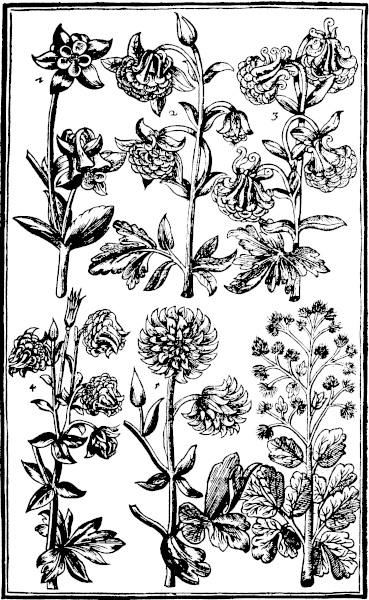
| 1 | Aquilegia simplex. The single Colombine. |
| 2 | Aquilegia flore multiplici. The double Colombine. |
| 3 | Aquilegia versicolor. The party coloured Colombine. |
| 4 | Aquilegia inuersis corniculis. The double inuerted Colombine. |
| 5 | Aquilegia Rosea siue Stellata. The Rose or the Starre Colombine. |
| 6 | Thalictrum Hispanicum album. White Spanish tufts. |
Some in Spaine, as Camerarius saith, vse to eate a peece of the roote hereof
fasting, many dayes together, to helpe them that are troubled with the
stone in the kidneyes. Others vse the decoction, of both herbe and roote in
wine, with a little Ambargrise, against those kinds of swounings, which the
Greekes call ἀδυναμία. The seede is vsed for the iaundise, and other obstructions
of the liuer. Clusius writeth from the experience of Franciscus Rapard,
a chiefe Physician of Bruges in Flanders, that the seede beaten and drunke
is effectuall to women in trauell of childe, to procure a speedy deliuerie,
and aduiseth a second draught thereof should be taken if the first succeede
not sufficiently.
From among the diuersities of this plant, I haue selected out two sorts for this my
garden, as hauing more beautie then all the rest; leauing the other to be entreated
of, where all in generall may be included. I haue in this place inserted them, for
the likenesse of the leaues only, being in no other part correspondent, and in a Chapter
by themselues, as it is most fit.
These plants haue both one forme, in roote, leafe and flower, and therefore neede
but one description. The leaues are both for colour and forme so like vnto Colombines
leaues (although lesser and darker, yet more spread, and on larger stalkes) that
they may easily deceiue one, that doth not marke them aduisedly; for the leaues are
much more diuided, and in smaller parts, and not so round at the ends: the stalkes are
round, strong, and three foote high at the least, branching out into two or three parts,
with leaues at the seuerall ioynts of them, at the toppes whereof stand many flowers,
which are nothing but a number of threads, made like vnto a small round tuft, breaking
out of a white skinne, or leafe, which incloseth them, and being vnblowne, shew
like vnto little buttons: the colour of these threds or tufts in this are whitish with yellow
tips on them, and somewhat purplish at the bottome, hauing a strong but no good
sent, and abiding in their beautie (especially if they grow in the shade, and not too
hot in the sun) a great while, and then fall away, like short downe or threds: the seed
vessels are three square, containing small, long, and round seede; the rootes are many
long yellow fringes, which endure and encrease much.
This purple tufted Colombine differeth onely from the former, in that it is not so
high nor so large, and that the colour of the flower or tuft is of a blewish purple colour
with yellow tips, and is much more rare then the other.
These grow both in Spaine and Italie.
They flower in the end of May, or in Iune, and sometimes later.
Some doe call them Thaliotrum, and some Thalictrum. Others Ruta palustris,
and Ruta pratensis, and some Rhabarbarum Monachorum, or Pseudo-rhabarbarum,
by reason that the rootes being yellow, haue an opening qualitie,
and drying as Rubarbe. In English what other fit Names to giue these
then I haue expressed in the titles, I know not.
They are a little hot and drying withall, good for old Vlcers, as Dioscorides
saith, to bring them to cicatrising: in Italy they are vsed against the
Plague, and in Saxonye against the Iaundise, as Camerarius saith.
The likenesse of the leaues likewise of this plant with Colombines, hath
caused mee to insert it next the other, and although some of this kinde bee of
small respect, being accounted but foolish, yet let it fill vp a waste corner,
that so no place be vnfurnished.
The leaues of this hollow roote breake not out of the ground, vntill the end of
March, or seldome before, and are both for proportion and colour somewhat like vnto
the leaues of Colombines, diuided into fiue parts, indented about the edges, standing
on small long footestalkes of a whitish greene colour, among which rise vp the
stalkes, without any leaues from the bottome to the middle, where the flowers shoote
forth one aboue another, with euery one a small short leafe at the foote thereof, which
are long and hollow, with a spurre behinde it, somewhat like vnto the flowers of
Larckes spurres, but hauing their bellies somewhat bigger, and the mouth not so open,
being all of a pure white colour: after the flowers are past, arise small long and round
cods, wherein are contained round blackish seede: the roote is round and great, of a
yellowish browne colour on the outside, and more yellow within, and hollow vnderneath,
so that it seemeth but a shell: yet being broken, euery part will grow: it abideth
greene aboue ground but a small time.
The blush Hollow roote is in all things like vnto the former, but onely that the
flowers hereof are of a delayed red or purple colour, which we call blush: and sometimes
of a very deepe red or purple colour; but very rare to meete with.
This small kinde hath his leaues of a blewish greene colour, yet greener and smaller
then the former, growing more thicke together: the flowers are like in proportion
vnto the former in all respects, but lesser, hauing purplish backes, and white bellyes:
standing closer and thicker together vpon the short stalkes: the roote is solid or firme,
round and a little long withall, two being vsually ioyned together, yellowish both
within and without: but I haue seene the dry roots that came from beyond Sea hither,
that haue beene as small as hasell nuts, and somewhat flat with the roundnesse, differing
from those that growe with vs, whether the nature thereof is to alter by manuring I know not.
The greater kindes Clusius reporteth he found in many places of Hungarie,
and the other parts neare thereunto: the lesser in the lower Germany,
or Low Countries, as we call them.
These are most truely to bee reckoned Vernall plants, for that they rise
not out of the ground vntill the Spring bee come in, and are gone likewise
before it be past, remaining vnder ground all the rest of the yeare, yet the
lesser abideth longer aboue ground then the greater.
Concerning the former of these, there is a controuersie among diuers,
whether it should be Thesium of Theophrastus, or Eriphium of Galen, but
here is no fit place to trauerse those opinions. Some would haue it to bee
Corydalis, and some referre it to Plinie his Capnos Chelidonia, for the likenesse
it hath both with Fumeterie and Celandine. It is generally called of all
moderne Writers, Radix Caua, and we in English thereafter, Hollow roote.
The lesser for the firmnesse of his round roote, is vsually called, Capnos fabacea
radice, and the Dutch men thereafter, Boonkens Hollwortell: we of
the likenesse with the former, doe call it the lesse Hollow roote.
Some by the bitternesse doe coniecture (for little proofe hath beene had
thereof, but in outward cases) that it clenseth, purgeth, and dryeth withall.
Of Larkes heeles there are two principall kindes, the wilde kinde, and the tame
or garden; the wilde kinde is of two sorts, one which is with vs noursed vp
chiefly in gardens, and is the greatest; the other which is smaller and lower,
often found in our plowed landes, and elsewhere: of the former of these wilde sorts,
there are double as well as single: and of the tame or more vpright, double also and
single: and of each of diuers colours, as shall be set downe.
Varietas.
The common Larkes heele spreadeth with many branches much more ground
then the other, rather leaning or bending downe to the ground, then standing
vpright, whereon are set many small long greene leaues, finely cut, almost like Fennell
leaues: the branches end in a long spike of hollow flowers, with a long spurre behinde
them, very like vnto the flowers of the Hollow roote last described, and are of
diuers seuerall colours, as of a blewish purple colour, or white, or ash colour or red, paler
or deeper, as also party coloured of two colours in a flower; after the flowers are
past, (which in this kinde abide longer then in the other) there come long round cods,
containing very blacke seede: the root is hard after it groweth vp to seede, spreading
both abroad and deepe, and perisheth euery yeare, vsually raising it selfe from it own
sowing, as well as from the seede sowen in the spring time.
Of this vulgar kinde there is some difference in the flower, although in nothing else:
the flowers stand many vpon a stalke like the former, but euery one of them are as if
three or foure small flowers were ioyned together, with euery one his spurre behinde,
the greatest flower being outermost, and as it were containing the rest, which are of a
pale red, or deepe blush colour: Another of this kinde will beare his flowers with
three or foure rowes of leaues in the middle, making a double flower with one spurre
behinde onely: and of this kinde there is both with purple, blew, blush, and
white flowers, and party coloured also; these doe all beare seed like the single, wherby
it is increased euery yeare.
This wilde Larkes spurre hath smaller and shorter leaues, smaller and lower branches,
and more thinly or sparsedly growing vpon them, then any of the former: the
flowers likewise are neyther so large as any of the former, nor so many growing together,
the cods likewise haue smaller seede, and is harder to grow in gardens then any
of the former, the most vsuall colour hereof is a pale reddish or blush colour, yet sometimes
they are found both white and blew, and sometimes mixt of blew and blush, variably
disposed, as nature can when she listeth; but are much more rare.
The difference betweene this and the last is, that the leaues of this are not fully so
greene, nor so large; the stalkes grow vpright, to the height of a man, and sometimes
higher, hauing some branches thereon, but fewer then the former, and standing likewise
vpright, and not leaning downe as the former: the toppes of the stalkes are better
stored with flowers then the other, being sometimes two foote long and aboue,
of the same fashion, but not altogether so large, but of more diuers and seueral colours,
as white, pale, blush, redde deeper or paler, ashcoloured, purple or violet, and of an
ouerworne blewish purple, or iron colour: for of all these we haue simple, without
any mixture or spot: but we haue other sorts, among the simple colours, that rise from
the same seede, and will haue flowers that wil be halfe white, and halfe blush or purple,
or one leafe white, and another blush or purple, or else variably mixed and spotted:
the seede and seede vessels are like the former but larger and harder.
These double Larkes heeles cannot bee knowne from the single of the same kinde,
vntill they come towards flowring; for there appeare many flowers vpon the stalkes, in
the same manner, and of as many colours almost as of the single, except the party coloured,
which stand like little double Roses, layd or spread broade open, as the Rose
Colombine without any heeles behinde them, very delightfull to behold, consisting
of many small leaues growing together, and after they are fallen there come vp in
their places three or foure small cods set together, wherein is contained here and
there (for all are not full of seede, as the single kindes) blacke seede, like vnto all the
rest, but smaller, which being sowen will bring plants that will beare both single and
double flowers againe, and it often happeneth, that it variably altereth in colours from
it owne sowing: for none of them hold constantly his owne colour, (so farre as euer
I could obserue) but fall into others; as nature pleaseth.
This small Larkes spurre of Spaine, hath diuers long and broad leaues next the
ground, cut-in on both sides, somewhat like vnto the leafe of a Scabious, or rather that
kinde of Stœbe, which Lobel calleth Crupina, for it doth somewhat neerly resemble
the same, but that this is smooth on the edges, and not indented besides the cuts, as the
Crupina is, being of a whitish greene colour, and somewhat smooth and soft in
handling: among the leaues riseth vp a whitish greene stalke, hauing many smaller
leaues vpon it that grow belowe, but not diuided, branching out into many small
stalkes, bearing flowers like vnto the wilde Larkes heeles, but smaller, and of a bleake
blewish colour, which being past, there come vp two or three small cods ioyned together,
wherein is blacke seede, smaller and rounder then any of the former: the roote is
small and thready, quickly perishing with the first cold that ouertaketh the plant.
The greatest or first wilde kindes growe among corne in many countries
beyond the Seas, and where corne hath beene sowne, and for his beauty
brought and nourished in our Gardens: the lesser wilde kinde in some fields
of our owne Country. The Spanish kinde likewise in the like places, which
I had among many seedes that Guillaume Boel brought mee out of Spaine.
The first double and single haue been common for many yeares in all countries
of this Land, but the tall or vpright single kindes haue been entertained
but of late yeares. The double kindes are more rare.
These flower in the Summer onely, but the Spanish wilde kinde flowreth
very late, so that oftentimes in our Country, the Winter taketh it before it
can giue ripe seede: the double kindes, as well the vpright as the ordinary
or wilde, are very choise and dainty many times, not yeelding good seede.
They are called diuersly by diuers Writers, as Consolida regulis, Calcaris
flos; Flos regius, Buccinum Romanorum, and of Matthiolus, Cuminum siluestre
alterum Dioscoridis: but the most vsuall name with vs is Delphinium: but
whether it be the true Delphinium of Dioscorides, or the Poets Hyacinth, or
the flower of Aiax, another place is fitter to discusse then this. Wee call
them in English Larkes heeles, Larkes spurres, Larkes toes, or clawes, and
Monkes hoods. The last or Spanish kinde came to mee vnder the name of
Delphinium latifolium trigonum, so stiled eyther from the diuision of the
leaues, or from the pods, which come vsually three together. Bauhinus vpon
Matthiolus calleth it, Consolida regalis peregrina paruo flore.
There is no vse of any of these in Physicke in these dayes that I know, but
are wholly spent for their flowers sake.
I haue set this plant in this place, for some likenesse of the flower, rather then for
any other comparison, euen as I must also with the next that followeth. This plant
riseth vp with a thicke round reddish stalke, with great and bunched ioynts, being
tender and full of iuice, much like to the stalke of Purslane, but much greater, which
brancheth it selfe forth from the very ground, into many stalkes, bearing thereon manie
long greene leaues, snipt about the edges, very like vnto the Almond or Peach tree
leaues; among which from the middle of the stalkes vpwards round about them,
come forth vpon seuerall small short foot-stalkes many faire purplish flowers, of two
or three colours in them, fashioned somewhat like the former Larkes heeles, or Monks
hoods, but that they are larger open at the mouth, and the spurres behinde crooke or
bend downewards: after the flowers are past, there come in their places round rough
heads, pointed at the end, greene at the first, and a little yellower when they bee ripe,
containing within them small round blackish seede, which will soone skippe out of
the heads, if they be but a little hardly pressed betweene the fingers: the rootes spread
themselues vnder ground very much from the toppe, with a number of small fibres, annexed
thereunto: this is a very tender plant, dying euery yeare, and must bee sowne
carefully in a pot of earth, and tended and watered in the heate of Summer, and all
little enough to bring it to perfection.
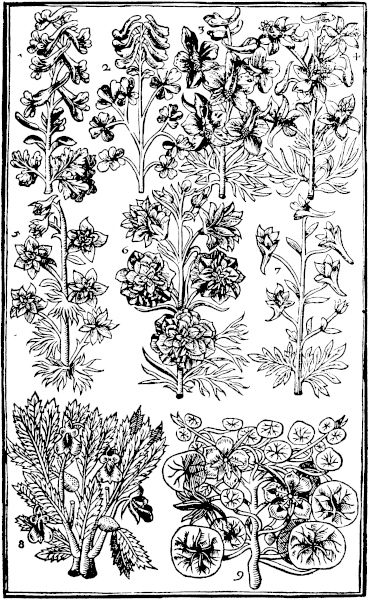
| 1 | Radix Caua maior flore albo. The white flowred Hollow roote. |
| 2 | Capnos fabacea radice. The small Hollow roote. |
| 3 | Delphinium flore simplici. Single Larkes spurs. |
| 4 | Delphinium vulgare flore medio duplici. Larkes spurs double in the middle. |
| 5 | Delphinium vulgare flore pleno. Common Larks spurs double. |
| 6 | Delphinium elatius flore pleno. Double vpright Larkes spurs. |
| 7 | Delphinium Hispanicum parvum. Small Spanish Larkes spurs. |
| 8 | Balsamina fœmina. The Female Balsam apple. |
| 9 | Nasturtium Indicum. Indian Cresses, or yellow Larkes spurs. |
[280]
Wee haue alwaies had the seede of this plant sent vs out of Italy, not
knowing his originall place.
It flowreth from the middle of Iuly, to the end of August: the seed doth
seldome ripen with vs, especially if the Summer be backward, so that wee
are oftentimes to seeke for new and good seede from our friends againe.
Some vse to call it Charantia fœmina, Balsamina fœmina, Balsamella, and
Anguillara, Herba Sanctæ Katharinæ. We haue no other English name to call
it by, then the Female Balsame Apple, or Balsamina.
Some by reason of the name, would attribute the property of Balme vnto
this plant, but it is not sufficiently knowne to haue any such; yet I am
well perswaded, there may bee some extraordinary quality in so beautifull a
plant, which yet lyeth hid from vs.
The likenesse (as I said before) of this flower likewise, hauing spurres or heeles
maketh me ioyne it with the rest, which is of so great beauty and sweetnesse
withall, that my Garden of delight cannot bee vnfurnished of it. This faire
plant spreadeth it selfe into very many long trayling branches, enterlaced one within
another very confusedly (yet doth it not winde it selfe with any claspers about either
pole or any other thing, but if you will haue it abide close thereunto, you must tye it, or
else it will lye vpon the ground) foure or fiue foot in length at the least, wherby it taketh
vp a great deale of ground: the leaues are smooth, greene, and as round as the
Penniwort that groweth on the ground, without any cut or incisure therein at all
in any part, the stalkes whereof stand in the middle of each leafe and stand at euery
ioynt of the stalke, where they are a little reddish, and knobbed or bunched out:
the flowers are of an excellent gold yellow colour, and grow all along these stalkes,
almost at euery ioynt with the leaues, vpon pretty long foote-stalkes, which are composed
of fiue leaues, not hollow or gaping, but standing open each leafe apart by it
selfe, two of them, that be larger and longer then the other, stand aboue and the other
two that are lesser belowe, which are a little iagged or bearded on both sides, and the
first lowest: in the middle of each of the three lower leaues (yet sometimes it is but in
two of them) there is a little long spot or streake, of an excellent crimson colour, with
a long heele or spurre behinde hanging downe: the whole flower hath a fine small
sent, very pleasing, which being placed in the middle of some Carnations or Gilloflowers
(for they are in flower at the same time) make a delicate Tussimussie, as they
call it, or Nosegay, both for sight and sent: After the flower is past, come the seede,
which are rough or vneuen, round, greenish yellow heads, sometimes but one, and
sometimes two or three standing together vpon one stalke, bare or naked of themselues,
without any huske, containing a white pulpy kernell; the rootes are small,
and spreading vnder ground, which perish with the first frosts, and must be sowne a
new euery yeare; yet there needeth no bed of horse-dung for the matter: the naturall
ground will be sufficient, so as you defend it a little from those frosts, that may spoile
it when it is newly sprung vp, or being yet tender.
This goodly plant was first found in the West Indies, and from thence
sent into Spaine vnto Monardus and others, from whence all other parts
haue receiued it. It is now very familiar in most Gardens of any curiosity,
where it yearly giueth ripe seed, except the yeare be very vnkindly.
It flowreth sometimes in Iune, but vsually in Iuly (if it be well defended
and in any good ground) and so continueth flowring, vntill the cold frosts
and mistes in the middle or end of October, doe checke the luxurious nature
thereof, and in the meane time the seede is ripe, which will quickly fall
downe on the ground, where for the most part the best is gathered.
Some doe reckon this plant among the Clematides or Convolvuli, the
Clamberers or Bindweedes; but (as I said) it hath no claspers, neither doth
it winde it selfe: but by reason of the number of his branches, that run one
within another, it may seeme to climbe vp by a pole or sticke, which yet
doth but onely close it, as hauing something whereon to leane or rest his
branches. Monardus and others call it Flos sanguineus, of the red spots in
the flowers, as also Mastuerzo de las Indias, which is Nasturtium Indicum, by
which name it is now generally knowne and called, and wee thereafter in
English, Indian Cresses, yet it may bee called from the forme of the flowers
onely, Yellow Larkes heeles.
The Spaniards and others vse the leaues hereof in stead of ordinary Cresses,
because the taste is somewhat sharpe agreeing thereunto, but other Physicall
properties I haue heard of none attributed to it.
The Garden Violets (for the Wilde I leaue to their owne place) are so well
knowne vnto all, that either keepe a Garden, or hath but once come into it,
that I shall (I thinke) but lose labour and time to describe that which is so common.
Yet because it is not onely a choise flower of delight, notwithstanding the popularity,
and that I let not passe anything without his particular description, I must
also doe so by this. And hereunto I must adde that kinde of Violet, which, although
it want that smell of the other, goeth beyond it in variety of dainty colours, called
Viola tricolor & flammea, or Harts eases.
The single Garden Violet hath many round greene leaues, finely snipt or dented about
the edges, standing vpon seuerall small stalkes, set at diuers places of the many
creeping branches, which as they runne, doe here and there take roote in the ground,
bearing thereon many flowers seuerally at the ioynts of the leaues, which consist of
fiue small leaues, with a short round tayle or spurre behinde, of a perfect blew purple
colour, and of a very sweete sent, it bringeth forth round seede vessels, standing likewise
vpon their seuerall small stalkes, wherein is contained round white seede: but
these heads rise not from where the flowers grew, as in all other plants that I know,
but apart by themselues, and being sowne, will produce others like vnto it selfe,
whereby there may be made a more speedy encrease to plant a Garden (as I haue done)
or any other place, then by slipping, as is the vsuall manner: the rootes spread both
deepe and wide, taking strong hold in the ground.
Flore albo.
Of this kinde there is another that beareth white flowers, not differing in smell or
any thing else from the former.
Flore obsoleto.
And also another, that beareth flowers of a dead or sad reddish colour, in all other
things alike, sauing that this hath not altogether so good a sent as the other.
There is no difference betweene this Violet and the former, in any other thing then
in the doublenesse of the flowers, which haue so many leaues set and thrust together,
that they are like vnto hard buttons. There is of this double kinde both white and
purple, as in the single; but the white sort is seldome so thicke and double as the purple:
but of the red colour to be double I neuer heard.
The Harts ease hath his leaues longer, and more endented or cut in on the edges
then the Violet hath, and somewhat round withall: the stalkes are vpright, yet weake,
and ready to fall downe, and lye vpon the ground, set here and there with the like
leaues, from whence come forth the flowers, of little or no sent at all, made like vnto a
Violet, yet more open, and with larger leaues; but so variably mixed with blew or
purple, white and yellow, that it is hard to set downe all the varieties; For some flowers
will be more white, and but some spots of purple or blew in the two vpper leaues,
and the lower leaues with some stripes of yellow in the middle: others will haue more
purple in them then any other colour, both in the vpper and lower leaues, the side
leaues blew, and the middle yellow, and others white and blew with yellow stripes, as
nature listeth to distribute their colours: the seede is small, whitish, and round, contained
in small round heads: the roote perisheth euery yeare, and raiseth it selfe vp
plentifully by it owne sowing, if it be suffered.
We haue in our Gardens another sort, that beareth flowers with more leaues then
the former, making it seeme to be twice double, and that onely in Autumne; for the
first flowers are single that come in Summer: This is of that sort that beareth purple
flowers: And it is to be obserued, that the seed of this kinde will not all bring double
flowers, but only some, if the ground be fit and liking, so that if you haue once had of
this double kinde, you shall seldome misse to haue double flowers againe euery yeare of
it owne growing or sowing.
There is one other kinde of Harts ease, that decketh vp our Gardens not to be forgotten,
whose leaues and flowers are like the former, but more plentifull in stalkes
and branches, and better abideth our Winters; the flowers are larger then any of the
former, of a faire pale yellow colour, with some yellower stripes now and then about
the middle; for it is sometimes without any stripes; and also of a little deeper yellow
colour: this is to bee encreased by slips, which will soone comprehend in a moist or
moistened ground, for that I neuer could obserue that it bore seede.
These plants were first wilde, and by manuring brought to be both fairer
in colour, and peraduenture of a better sent then when they grew wilde.
The Violets flower in March, and sometimes earlier, and if the yeare be
temperate and milde, in Autumne againe. The double Violets, as they are
later before they flower then the single, so they hold their flowers longer.
The Harts ease flowreth seldome vntill May; but then some will abide to
flower vntill the end of Autumne almost, especially if the frosts be not early.
The Violet is called Viola nigra, purpurea, and Martia: In English, Violets,
March Violets, and purple Violets. The Harts ease is called Viola
flammea, Viola tricolor, Viola multicolor, and of some, Iacea, Flos trinitatis,
and Herba clauellata: In English, Harts ease, and Pansies, of the French name
Pensees. Some giue it foolish names, as Loue in idlenesse, Call mee to you,
and Three faces in a hood. The great yellow Harts ease is so called, because
it is like in forme, and is the greatest of all other, although it haue not
that diuersity of colours in it that the other haue.
The properties of Violets are sufficiently knowne to all, to coole and
moisten: I shall forbeare to recite the many vertues that may be set downe,
and onely let you knowe, that they haue in them an opening or purging quality,
being taken either fresh and greene, or dryed, and made into powder,
especially the flowers; the dryed leaues will doe the like, but in greater
quantity. Costæus in his booke of the nature of all plants saith, that the distilled
water of Harts ease, is commended in the French disease, to be profitable,
being taken for nine dayes or more, and sweating vpon it, which
how true it is, I know not, and wish some better experience were made of
it, before we put any great confidence in that assertion.
This pretty plant riseth vp out of the ground with vpright, hard, round, small
stalkes, a foote and a halfe high, or not two foote high at the highest, diuided
into three branches for the most part, each branch whereof is againe diuided
for the most part into three other branches, and each of them beare three leaues (seldome
either more or lesse) set together, yet each vpon his owne foote-stalke, each
leafe being broad, round, and pointed at the end, somewhat hard or dry in feeling,
hayrie, or as it were prickly about the edges, but very tenderly, without harme, of a
light greene colour on the vpperside, and a little whiter vnderneath: from the middle
of the stemme or stalke of leaues doth likewise come forth another long stalke, not
much higher then those with the leaues on them, diuided into other branches, each
whereof hath likewise three flowers, each vpon his owne footestalke, consisting of
eight small leaues a peece, yet seeming to be but of foure leaues spread or layd open flat,
for that the foure vppermost, which are the smaller and being yellow, doe lye so close
on the foure vndermost, which are a little broader and red, that they shew as if they were
yellow flowers with red edges, hauing yellow threds tipt with greene, standing in the
middle of the flowers: the vnderside of the lower leaues are of a pale yellowish red,
striped with white lines: after the flowers are past, there come small long pods, wherin
are contained flat reddish seede: the rootes are small, reddish and hard, spreading,
branching and enterlacing themselues very much, and is fit to be placed on some shady
side of a garden: the whole plant is rather of a strong then any good sent, yet is
cherished for the pleasant varietie of the flowers.
Cæsalpinus saith it groweth on the mountaines of Liguria, that is nigh
vnto Ligorne, in the Florentine Dominion. Camerarius saith, nigh vnto
Vicenza in Italie. Bauhinus on the Euganian hils, nigh vnto Padoa, and in
Romania in shadowie wet grounds.
It flowreth from Iune vntill the end of Iuly, and to the middle of August,
if it stand, as I said it is fittest, in a shadowie place.
It is of most Writers accepted for the true Epimedium of Dioscorides,
though he saith it is without flower or seede, being therein eyther mistaken,
or mis-informed, as he was also in Dictamnus of Candy, and diuers other
plants. From the triple triplicitie of the standing of the stalkes and leaues,
and quadriplicitie of the flowers, it might receiue another name in English
then is already imposed vpon it: but lest I might be thought to be singular
or full of noueltie, let it passe with the name Barrenwort, as it is in the title.
It is thought of diuers to agree in the propertie of causing barrennesse,
as the ancients doe record of Epimedium.
Of Poppies there are a great many sorts, both wilde and tame, but because our
Garden doth entertaine none, but those of beautie and respect, I wil onely
giue you here a few double ones, and leaue the rest to a general suruey.
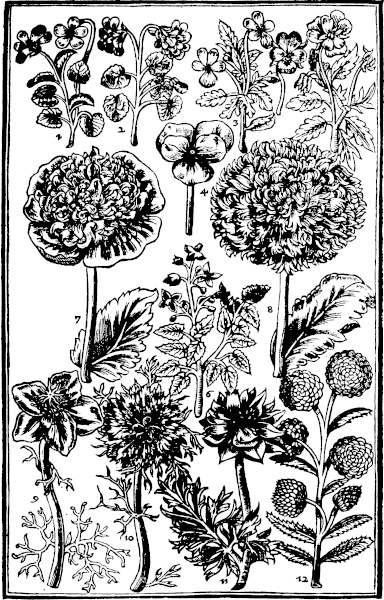
| 1 | Viola Martia simplex. Single March Violets. |
| 2 | Viola Martia multiplex. Double March Violets. |
| 3 | Viola flammea siue tricolor. Ordinary garden Pansies or Harts ease. |
| 4 | Viola flammea lutea magna. Great yellow Pansies. |
| 5 | Viola tricolor duplex. Double Pansies or Harts eases. |
| 6 | Epimedium. Barrenwort. |
| 7 | Papauer sativum flore pleno. Double garden Poppies. |
| 8 | Papauer sativum flore pleno laciniata. Double feathered Poppies. |
| 9 | Nigella Hispanica flore amplo. Spanish Nigella or Fenell flower. |
| 10 | Nigella multiplex cærulea. Double blew Nigella or Fenell flower. |
| 11 | Nigella duplex flore albo. Double white Nigella. |
| 12 | Ptarmica flore pleno. Double wilde Pelletory. |
The double white Poppy hath diuers broade, and long whitish greene leaues, giuing
milke (as all the rest of the plant aboue ground doth, wheresoeuer it is broken) very
much rent or torne in on the sides, and notched or indented besides, compassing at the
bottome of them a hard round brittle whitish greene stalke, branched towards the
toppe, bearing one faire large great flower on the head of euery branch, which before
it breaketh out, is contained within a thin skinne, and being blowne open is very thick
of leaues, and double, somewhat iagged at the ends, and of a white colour, in the
middle whereof standeth a round head or bowle, with a striped crowne on the heade
of it, very like a starre, compassed about with some threds, wherein when it is ripe, is
contained small, round, white seede, disposed into seuerall cels: the roote is hard
wooddy, and long, perishing euery yeare, and must bee new sowne euery Spring, if
they doe not spring of their own sowing, which if it doe, the flowers are seldome so
faire and double as they that are sowne in the Spring: the whole plant is of a strong
heady smell.
This other kind of double Poppy differeth not in any other thing from the former,
but only in the colour of the flowers, which are of a bright red, tending to a blush colour,
parted, paned or striped in many places with white, and exceedingly more iagged
then the former, almost like a feather at the ends, the bottomes of all the leaues being
white: the seede hereof is white as the former, which is not so in any other Poppie,
that beareth not a full white flower.
This kinde varyeth both in flowers and seede, although neyther in leaues or any other
thing from the first: the flowers are thicke and double, and some what iagged at
the ends, in some more, in some lesse, eyther red or blush, or purplish red, more or lesse,
or of a sad murrey or tawney, with browne, or blacke, or tawny bottomes: the seede
is eyther of a grayish blew colour, or in others more blackish.
This double Poppie is like the wilde or fielde Poppie, which is well knowne to all
to haue longer, narrower, and more iagged greene leaues then the former, the stalkes
more hairy, and the flower of a deepe yellowish red colour, knowne to all. Now this
differeth in nothing from it, but in the doublenesse of the flower, which is very thicke
and double, but not so large as the former. This riseth of seede in the like manner as
they doe, and so to bee preserued.
From what place they haue beene first gathered naturally I cannot assure
you, but we haue had them often and long time in our gardens, being sent
from Italie and other places. The double wilde kindes came from Constantinople,
which whether it groweth neere vnto it or further off, we cannot
tell as yet.
They flower in the beginning or middle of Iune at the furthest, the seede
is ripe within a small while after.
The generall knowne name to all, is Papauer, Poppie: the seuerall distinctions
are according to their colours. Yet our English Gentlewomen in
some places, call it by a by-name, Ione siluer pinne: subauditur, Faire without
and fowle within.
It is not vnknowne, I suppose to any, that Poppie procureth sleepe, for
which cause it is wholly and onely vsed as I thinke: but the water of the
wilde Poppies, besides that it is of great vse in Pleurisies, and Rheumatick,
or thinne Distillations, is found by daily experience, to bee a soueraigne remedy
against surfeits; yet some doe attribute this propertie to the water
of the wilde Poppies.
Among the many sorts of Nigella, both wilde and tame, both single and double,
I will onely set downe three sorts, to be noursed vp in this garden, referring the
rest to a Physicke garden, or a generall Historie, which may comprehend all.
Spanish Nigella riseth vp with diuers greene leaues, so finely cut, and into so many
parts, that they are finer then Fenell, and diuided somewhat like the leaues of Larkes
heeles, among which rise vp stalkes, with many such like leaues vpon them, branched
into three or foure parts, at the toppe of each whereof standeth one faire large flower,
like vnto other single Nigella’s, consisting of fiue or six leaues sometimes, of a bleake
blew, or of a purplish blew colour, with a greene head in the middle, compassed about
with seuen or eight small blewish greene flowers, or peeces of flowers rather, made
like gaping hoodes, with euery of them a yellowish line thwart or crosse the middle
of them, with some threds also standing by them: after the flower is past the head
groweth greater, hauing sixe, seuen or eight hornes as it were at the toppe, greater and
longer, and standing closer together then any other Nigella, spreading very like a
starre, or the crowne of the Poppy head, but larger and longer, each whereof being
folded together, openeth a little when the head is ripe, which is greater aboue, and
smaller below, and not so round as the others are, containing within them small yellowish
greene seede, or not so blacke as the other sorts: the rootes are small and yellow,
perishing euery yeare as the others likewise doe.
The double Nigella is in leaues, stalkes and rootes, very like vnto the former Nigella,
so that the one can very hardly bee discerned from the other before this rise vp
to flower, except it be that the leaues hereof are not fully so large as they: the flower
consisteth of three or foure rowes of leaues, layde one vpon another, of a pale blew
colour, with a greene round head compassed with diuers short threads in the middle,
and hauing fiue or sixe such small greene Fenell-like leaues vnder the flower, to beare
it vp (as it were) below, which adde a greater grace to the flowers, which at the first
sheweth sometimes white, but changeth quickely after: the horned heads hereof are
like vnto the heads of the other wilde kinde, which are somewhat rounder and greater,
hauing within: them blacke vneuen seedes, but without any sent.
This double white Nigella hath such like leaues as the last hath, but somewhat larger,
of a yellower greene colour, and not so finely cut and iagged: the flowers are
somewhat lesse, and lesser double then the former, and in colour white, hauing no
greene leaues vnder the flower, as the former hath, the head whereof in the middle is
very like the head of the last double kinde, but not great, wherein is contained black
seede for the most part, and sweete like the Romane Nigella, which only is sweet besides
this: yet sometimes it is not so blacke, but a little more white or yellowish:
the roote is yellow, and perisheth as the others euery yeare.
All these, and the rest be found wilde in diuers Countreyes, as France,
Spaine, Italie, &c. but wee onely cherish them in our Gardens for our delight.
They flower in the end of Iune, and in Iuly, or thereabouts.
They are called Melanthium, Gith, and Nigella, and of some Flos Diuæ
Catherinæ. We may either call them Nigella according to the Latine name,
or the Fenell flower, as some doe, because the double blew Nigella hath
small Fenell-like leaues bearing vp the flower, as I shewed before in the description.
These Nigella’s are nothing so hot in qualitie as the single Romane kind
is, as may well be knowne by the smell of the seede thereof, and therefore
are not fit to be vsed in the steed of it, as many ignorant persons vse to doe:
for the single Romane seede is vsed to helpe paines, and cold distillations in
the head, and to dry vp the rheume. Pena saith, that the pressed oyle of the
seede as well taken inwardly as vsed outwardly is an excellent remedy for
the hardnesse and swelling of the spleene.
The double wilde Pelletorie hath straight and slender stalkes, beset with long
and narrow leaues, snipt round about the edges, in all points like vnto the single
wilde kinde, that groweth common with vs almost euery where: on the
toppes of the stalkes stand foure or fiue, or more white flowers, one aboue another,
with a greene leafe at the bottome of the footestalke of euery one of them, beeing
small, thicke, and very double, with a little yellowishnesse in the middle of euery
flower, like both for forme and colour vnto the flower of the double Featherfew, but
smaller: the rootes are many long strings, running here and there in the ground: this
hath no smell at all, but is delightsome only for the double white flowers.
It is only cherished in some few Gardens, for it is very rare.
It flowreth in the end of Iune or thereabouts.
It is called of most Ptarmica, or Sternutamentoria, of his qualitie to prouoke
neesing: and some Pyrethrum, of the hot biting taste. We vsually
call it double wilde Pelletorie, and some Sneesewort, but Elleborus albus is
vsually so called, and I would not two things should be called by one name,
for the mistaking and mis-using of them.
The properties hereof, no doubt, may well bee referred to the single
kinde, beeing of the same qualitie, yet as I take it, a little more milde and
temperate.
Featherfew that beareth double flowers is so like vnto the single kinde, that the
one cannot be discerned from the other, vntill it come to flower, bearing broad,
pale or fresh greene leaues, much cut in on the sides: the stalkes haue such like
leaues on them as grow below, from the toppes whereof come forth many double
white flowers, like vnto the flowers of the former wilde Pelletory, but larger, and
like also vnto the flowers of the double Camomill: the sent whereof is as strong as
of the single.
We haue this kinde only in Gardens, and as it is thought by others, is peculiar
only to our owne Countrey.
It flowreth in the end of May, and in Iune and Iuly.
It is called diuersly by diuers: Some thinke it to be Parthenium of Dioscorides,
but not of Galen; for his Parthenium is a sweet herbe, and is thought
to bee Amaracus, that is Marierome: others call it Matricaria; and some
Amarella. Gaza translateth it Muraleum, Theoph. lib. 7. cap. 7. It is generally
in these parts of our Country called Double Feaverfew, or Featherfew.
It is answerable to all the properties of the single kinde which is vsed
for womens diseases, to procure their monthly courses chiefly. It is held
to bee a speciall remedy to helpe those that haue taken Opium too liberally.
In Italy some vse to eate the single kinde among other greene herbes, as
Camerarius saith, but especially fryed with egges, and so it wholly loseth
his strong and bitter taste.
Ovr ordinary Camomill is well knowne to all, to haue many smal trayling
branches, set with very fine small leaues, bushing and spreading thicke ouer
the ground, taking roote still as it spreadeth: the toppes of the branches
haue white flowers, with yellow thrummes in the middle, very like vnto the Featherfew,
before described, but somewhat greater, not so hard, but more soft and gentle in
handling, and the whole herbe to be of a very sweet sent.
We haue another sort of Camomill in some Gardens, but very rare, like vnto the
former, but that it is whiter, finer, and smaller, and raiseth it selfe vp a little higher,
and beareth naked flowers; that is, without that border of white leaues that is in the
former, and consisteth onely of a yellow round thrummie head, smelling almost as
sweete as the former.
The double Camomill groweth with his leaues vpon the ground, as the other single
kinde doth, but of a little fresher greene colour, and larger withall: the stalkes with
the flowers on them, doe raise themselues vp a little higher then the ordinary, and
bearing one or two flowers vpon a stalk, which are composed of many white leaues set
together in diuers rowes, which make a fine double flower, with a little yellow spot in
the middle for the most part of euery one, and are much larger then any single kinde,
smelling better, and more pleasing then the ordinary: this doth creepe vpon the
ground as the other, but is more tender to be kept in the Winter. Yet if you saue the
flowers hereof (and so will the double Featherfew also) when they haue stood long,
and ready to fade, and keepe them dry vntill the Spring, and then breaking them or
pulling them to peeces, sowe them, there will spring vp from them Camomill, and
also Featherfew, that will againe beare double flowers.
Our ordinary Camomill groweth wilde in many places of our Country,
and as well neare London as in other places. The others are onely found in
our Gardens, where they are cherished. Bauhinus saith, that the double
flowred Camomill is found wilde about Orleance in France.
The double kinde is vsually in flower in Iune, before the ordinary kinde,
and most commonly past before it flowreth, which is not vntill Iuly or August.
The naked Camomill flowreth betweene them both, or later.
Camomill is called Anthemis, Leucanthemis, and Leucanthemum, of the
whitenesse of the flowers; and Chamæmælum of the corrupted Italian name
Camomilla. Some call the naked Camomill, Chrysanthemum odoratum. The
double Camomill is called by some Chamæmælum Romanum flore multiplici.
Camomill is put to diuers and sundry vses, both for pleasure and profit,
both for inward and outward diseases, both for the sicke and the sound, in
bathings to comfort and strengthen the sound, and to ease paines in the diseased,
as also in many other formes applyed outwardly. The flowers boyled
in Posset drinke prouoke sweat, and helpe to expell colds, aches,
and other griefes. A Syrupe made of the iuice of the double Camomill,
with the flowers and white wine, as Bauhinus saith, is vsed by some against
the Iaundise and Dropsie, caused by the euill disposition of the splene.
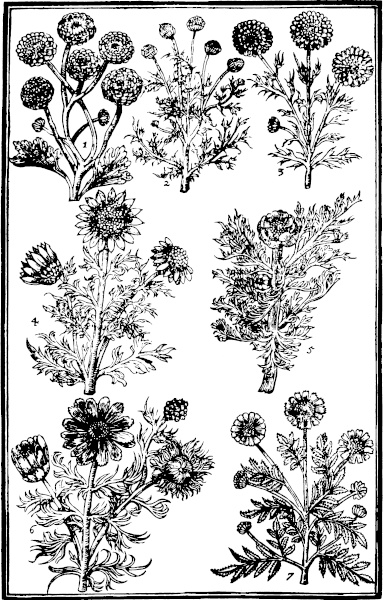
| 1 | Parthenium flore pleno. Double Featherfew. |
| 2 | Chamæmælum nudum. Naked Camomill. |
| 3 | Chamæmælum flore pleno. Double Camomill. |
| 4 | Pyrethrum officinarum. Pelletory of Spaine. |
| 5 | Flos Adonis flore rubro & flore lutea. Adonis flower both red & yellow. |
| 6 | Helleborus niger ferulaceus siue Buphthalmum. The great Oxe eye or the great yellow Anemone. |
| 7 | Buphthalmum vulgare. The common yellow Oxe eye. |
I must needes adioyne vnto the Camomils this fine and tender plant, for some neare
resemblance it hath with them in face, though not in quality. It is a small and lowe
plant, bearing many fine greene leaues vpon his slender branches, which leane or
lye down vpon the ground, diuided into many parts, yet somewhat larger and broader
then Camomill, the stalkes whereof are bigger, and more iuicie then it: the flowers
that stand at the toppes of the stalkes are single, but much larger then any Camomill
flower, hauing a pale or border of many leaues, white on the vpperside, and reddish
vnderneath, set about the yellow middle thrumme; but not standing so close together
ioyning at the bottome, as the Camomill flowers doe, but more seuered one from another:
it beareth small whitish seede, which is hardly found and discerned from the
chaffe: the roote is long, and growing downe right, of the bignesse of a mans finger
or thumbe in our Countrey, but not half so great where it groweth naturally, with
some fibres and branches from the sides thereof, of a very hot, sharpe, and biting
taste, drawing much water into the mouth, after it hath been chewed a while: the plant
with vs is very tender, and will hardly or not at all endure the hardnesse and extremities
of our Winters, vnlesse it be very carefully preserued.
It groweth in Spaine wilde in many places, and in other hot Countries,
where it may feele no frosts to cause it perish.
It flowreth so late with vs, that it is not vntill August, that oftentimes we
cannot gather ripe seedes from it, before it perish.
The name Pyrethrum (taken from πὺρ, that is, ignis, fire) is giuen to this
plant, because of the heate thereof, and that the roote is somewhat like in
shew, but specially in property vnto the true Pyrethrum of Dioscorides,
which is an vmbelliferous plant, whose rootes are greater, and more feruent
a great deale, and haue a hayrie bush or toppe as Meum, and many other
vmbelliferous plants haue. It is also called in Latin, Salinaris, of the effect
in drawing much moisture into the mouth, to be spit out. We doe vsually
call it Pelletory of Spaine.
It is in a manner wholly spent to draw rheume from the teeth, by chewing
it in the mouth, thereby to ease the tooth-ach, and likewise from the head,
in the paines thereof.
Adonis flower may well be accounted a kinde of Camomill, although it hath
some especiall differences, hauing many long branches of leaues lying vpon
the ground, and some rising vp with the stalke, so finely cut and iagged, that
they much resemble the leaues of Mayweed, or of the former Nigella: at the top of the
stalkes, which rise a foote high or better, stand small red flowers, consisting of six or
eight round leaues, hauing a greene head in the middle, set about with many blackish
threads, without any smell at all: after the flowers are past, there grow vp heads with
many roundish white seedes at the toppes of them, set close together, very like vnto
the heads of seede of the great Oxe eye, set downe in the next Chapter, but smaller:
the rootes are small and thready, perishing euery yeare, but rising of his owne seede
againe, many times before Winter, which will abide vntill the next yeare.
Flore luteo.
Yellow Adonis flower is like vnto the red, but that the flower is somewhat larger,
and of a faire yellow colour.
The first groweth wilde in the corn fields in many places of our own country,
as well as in others, and is brought into Gardens for the beauties sake
of the flower. The yellow is a stranger, but noursed in our Gardens with other
rarities.
They flower in May or Iune, as the yeare falleth out to be early or late:
the seed is soone ripe after, and will quickly fall away, if it be not gathered.
Some haue taken the red kinde to be a kinde of Anemone; other to be
Eranthemum of Dioscorides: the most vsuall name now with vs is Flos Adonis,
and Flos Adonidis: In English, where it groweth wilde, they call it
red Maythes, as they call the Mayweede, white Maythes; and some of our
English Gentlewomen call it Rosarubie: we vsually call it Adonis flower.
It hath been certainly tryed by experience, that the seed of red Adonis
flower drunke in wine, is good to ease the paines of the Collicke and Stone.
Vnder the name Buphthalmum, or Oxe eye, are comprehended two or three seueral
plants, each differing from other, both in face and property, yet because
they all beare one generall name, I thinke fittest to comprise them all in one
Chapter, and first of that which in leafe & seed commeth nearest to the Adonis flower.
This great Oxe eye is a beautifull plant, hauing many branches of greene leaues
leaning or lying vpon the ground for the most part, yet some standing vpright, which
are as fine, but shorter then Fenell; some of them ending in a small tuft of green leaues,
and some hauing at the toppes of them one large flower a peece, somewhat reddish or
brownish on the outside, while they are in bud, and a while after, and being open, shew
themselues to consist of twelue or fourteene long leaues, of a faire shining yellow colour,
set in order round about a greene head, with yellow thrums in the middle, laying
themselues open in the sunne, or a faire day, but else remaining close: after the flower
is past, the head growing greater, sheweth it selfe compact of many round whitish
seede, very like vnto the head of seede of the Adonis flower last described, but much
greater: the rootes are many long blackish fibres or strings, set together at the head,
very like vnto the rootes of the lesser blacke Hellebor or Bearefoote, but somewhat
harder, stiffer, or more brittle, and seeming without moisture in them, which abide
and encrease euery yeare.
This plant might seeme to be referred to the Camomils, but that it is not sweete, or
to the Corne-Marigolds, but that the stalkes and leaues are not edible: it is therefore
put vnder the Oxe eyes, and so we will describe it; hauing many weake branches lying
vpon the ground, beset with winged leaues, very finely cut and iagged, somewhat like
vnto Mayweede, but a little larger; the flowers are like vnto the Corne Marigold, and
larger then any Camomill, being wholly yellow, as well the pale or border of leaues,
as the middle thrummes: the rootes are somewhat tough and long.
This Oxe eye riseth vp with hard round stalkes, a foote and a halfe high, hauing
many winged leaues vpon them, made of diuers long and something broad leaues,
snipt about the edges, set together somewhat like vnto Tansie, but smaller, and not so
much winged: the flowers stand at the toppes of the stalkes, of a full yellow colour,
both the outer leaues and the middle thrum, and not altogether so large as the last: the
rootes of this kinde perish euery yeare, and require a new sowing againe.
The first groweth in diuers places of Austria, Bohemia, and those parts,
it hath beene likewise brought out of Spaine. The second in Prouence, a
country in France. The last in diuers places, as well of Austria as Morauia,
and about Mentz and Norimberg, as Clusius setteth downe. We haue them
in our Gardens, but the first is of the greatest respect and beauty.
The first flowreth betimes, oftentimes in March, or at the furthest in Aprill;
the seede is ripe in May, and must be quickly gathered, lest it bee lost.
The other two flower not vntill Iune.
The first is called Buphthalmum of Dodonæus, Pseudohelleborus of Matthiolus,
Helleborus niger ferulaceus Theophrasti by Lobel, of some others
Elleborus niger verus, vsing it for the true blacke Ellebor, but it is much differing,
as well in face as properties. Of others Sesamoides minus. Some haue
thought it to be a yellow Anemone, that haue looked on it without further
iudgement, and by that name is most vsually knowne to most of our English
Gentlewomen that know it. But it may most fitly be called a Buphthalmum,
as Dodonæus doth, and Hispanicum or Austriacum, for distinctions sake. We
doe most vsually call it Helleborus niger ferulaceus, as Lobel doth: Bauhinus
calleth it Helleborus niger tenuifolius Buphthalmi flore. The second is called
Buphthalmum Narbonense: In English, The French, or lesser Oxe eye, as the
first is called, The great Oxe eye. The last, The common Oxe eye.
The first hath been vsed in diuers places for the true blacke Ellebor, but
now is sufficiently knowne to haue been an errour; but what Physicall property
hath, other then Matthiolus hath expressed, to be vsed as Setterwort
for cattell, when they rowell them, to put or draw the rootes hereof
through the hole they make in the dewe lappe, or other places, for their
coughes or other diseases, I know not, or haue heard or read of any. The
others likewise haue little or no vse in Physicke now a dayes that I know.
Although the sorts of Corne Marigolds, which are many, are fitter for another
then this worke, and for a Catholicke Garden of Simples, then this of Pleasure
and Delight for faire Flowers; yet giue me leaue to bring in a couple: the one
for a corner or by-place, the other for your choisest, or vnder a defenced wall, in regard
of his statelinesse.
This faire Corne Marigold hath for the most part one vpright stalke, two foote
high, whereon are set many winged leaues, at euery ioynt one, diuided and cut into
diuers parts, and they againe parted into seuerall peeces or leaues: the flowers growe
at the toppes of the stalkes, rising out of a scaly head, composed of ten or twelue large
leaues, of a faire, but pale yellow colour, and more pale almost white at the bottome
of the leaues, round about the yellow thrumme in the middle, being both larger and
sweeter then any of the other Corne Marigolds: the seede is whitish and chaffie:
the roote perisheth euery yeare.
This goodly and stately plant, wherewith euery one is now a dayes familiar, being
of many sorts, both higher and lower (with one stalke, without branches, or with
many branches, with a blacke, or with a white seede, yet differing not in forme of
leaues or flowers one from another, but in the greatnesse or smalnesse) riseth vp at the
first like vnto a Pompion with two leaues, and after two, or foure more leaues are
come forth, it riseth vp into a great stalke, bearing the leaues on it at seuerall distances
on all sides thereof, one aboue another vnto the very toppe, being sometimes, and
in some places, seuen, eight, or ten foote high, which leaues standing out from the
stemme or stalke vpon their seuerall great ribbed foote-stalkes, are very large, broad
belowe, and pointed at the end, round, hard, rough, of a sad greene colour, and
bending downewards: at the toppe of the stalke standeth one great, large, and broad
flower, bowing downe the head vnto the Sunne, and breaking forth from a great head,
made of scaly greene leaues, like vnto a great single Marigold, hauing a border of manie
long yellow leaues, set about a great round yellow thrumme, as it were in the middle,
which are very like vnto short heads of flowers, vnder euery one whereof there is
a seede, larger then any seede of the Thistles, yet somewhat like, and lesser, and rounder
then any Gourd seede, set in so close and curious a manner, that when the seede is
taken out, the head with the hollow places or cels thereof seemeth very like vnto an
hony combe; which seede is in some plants very blacke, in the hotter countries, or very
white, and great, or large, but with vs is neither so large, blacke, or white; but sometimes
blackish or grayish. Some sort riseth not vp halfe the height that others doe,
and some againe beare but one stemme or stalke, with a flower at the toppe thereof;
and others two or three, or more small branches, with euery one his flower at the end;
and some so full of branches from the very ground almost, that I haue accounted
threescore branches round about the middle stalke of one plant, the lowest neare two
yards long, others aboue them a yard and a halfe, or a yard long, with euery one his
flower thereon; but all smaller then those that beare but one or two flowers, and lesser
also for the most part then the flower on the middle stalke it selfe. The whole plant,
and euery part thereof aboue ground hath a strong resinous sent of Turpentine, and the
heads and middle parts of the flowers doe oftentimes (and sometimes the ioynts of
the stalke where the leaues stand) sweat out a most fine thin & cleare Rossin or Turpentine,
but in small quantity, and as it were in drops, in the heate and dry time of the year,
so like both in colour, smell, and taste vnto cleare Venice Turpentine, that it cannot
be knowne from it: the roote is strongly fastened in the ground by some greater roots
branching out, and a number of small strings, which growe not deepe, but keepe vnder
the vpper crust of the earth, and desireth much moisture, yet dyeth euery yeare
with the first frosts, and must be new sowne in the beginning of the Spring.
Their places are set downe in their titles, the one to come out of Candy,
the other out of Peru, a Prouince in the West Indies.
The first flowreth in Iune, the other later, as not vntill August, and sometimes
so late, that the early frosts taking it, neuer suffer it to come to ripeness.
The first hath his name in his title. The second, besides the names set
downe, is called of some Planta maxima, Flos maximus, Sol Indianus, but the
most vsuall with vs is, Flos Solis: In English, The Sunne Flower, or Flower
of the Sunne.
There is no vse of either in Physicke with vs, but that sometimes the
heads of the Sunne Flower are dressed, and eaten as Hartichokes are, and a
accounted of some to be good meate, but they are too strong for my taste.
Some haue reckoned vp many sorts of Marigolds, I had rather make but two, the
single and the double; for doubtlesse, those that be most double, rise from the
best seede, which are the middlemost of the great double, and some would be lesse
double, whose seede is greater then the rest, according to the ground where it groweth;
as also those that be of a paler colour, doe come of the seed of the yellower sort.
[297]
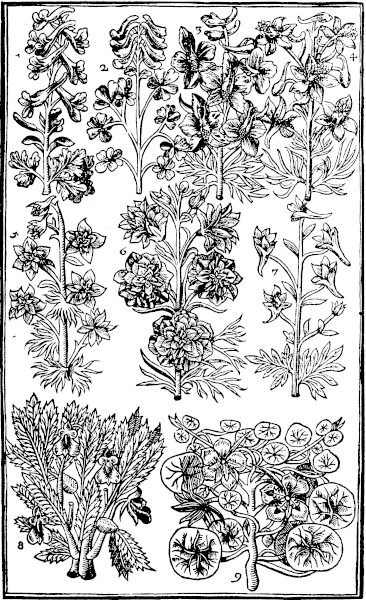
| 1 | Chrysanthemum Creticum. Corne Marigolds of Candy. |
| 2 | Flos Solis. The Flower of the Sunne. |
| 3 | Calendula. Marigolds. |
| 4 | Aster Atticus siue Italorum. The Purple Marigold. |
| 5 | Pilosella maior. Golden Mouse-eare. |
| 6 | Scorsonera Hispanica. Spanish Vipers grasse. |
| 7 | Tragopogon. Goates beard, or goe to bed at noone. |
Garden Marigold hath round greene stalkes, branching out from the ground
into many parts, whereon are set long flat greene leaues, broader and rounder at the
point then any where else, and smaller also at the setting to of the stalke, where it compasseth
it about: the flowers are sometimes very thicke and double (breaking out of a
scaly clammy greene head) composed of many rowes of leaues, set so close together
one within another, that no middle thrume can bee seene, and sometimes lesse double,
hauing a small browne spot of a thrume in the middle: and sometimes but of two or
three rowes of leaues, with a large browne thrume in the middle; euery one whereof
is somewhat broader at the point, and nicked into two or three corners, of an excellent
faire deepe gold yellow colour in some, and paler in others, and of a pretty
strong and resinous sweete sent: after the flowers are past, there succeede heads of
crooked seede, turning inward, the outermost biggest, and the innermost least: the
roote is white, and spreadeth in the ground, and in some places will abide after the
seeding, but for the most part perisheth, and riseth againe of his owne seede. Sometimes
this Marigold doth degenerate, and beareth many small flowers vpon short
stalkes, compassing the middle flower: but this happeneth but seldome, and therefore
accounted but lusus naturæ, a play of nature, which she worketh in diuers other
plants besides.
There is no difference betweene this and the former, but that the flowers are single,
consisting of one rowe of leaues, of the same colour; eyther paler or deeper yellow,
standing about a great browne thrumme in the middle: the seed likewise is alike, but
for the most part greater then in the double kindes.
Our Gardens are the chiefe places for the double flowers to grow in; for
we know not of any other naturall place: but the single kinde hath beene
found wilde in Spaine, from whence I receiued seede, gathered by Guillaume
Boel, in his time a very curious, and cunning searcher of simples.
They flower all the Summer long, and sometimes euen in winter, if it be
milde, and chiefly at the beginning of those monethes, as it is thought.
They are called Caltha of diuers, and taken to be that Caltha, whereof both
Virgil and Columella haue written. Others doe call them Calendula, of the
Kalendes, that is the first day of the monthes, wherein they are thought
chiefly to flower; and thereupon the Italians call them Fiori di ogni mese,
that is, The Flowers of euery moneth: We cal them in English generally,
eyther Golds, or Marigolds.
The herbe and flowers are of great vse with vs among other pot-herbes,
and the flowers eyther greene or dryed, are often vsed in possets, broths, and
drinkes, as a comforter of the heart and spirits, and to expel any malignant
or pestilential quality, gathered neere thereunto. The Syrupe and Conserue
made of the fresh flowers are vsed for the same purposes to good effect.
Dioscorides and other of the ancient Writers, haue set forth but one kinde of
Starre-wort, which they call Aster Atticus, of the place no doubt, where the
greatest plentie was found, which was the Countrey of Athens: the later
Writers haue found out many other plants which they referre to this kinde, calling
them by the same name. It is not my purpose to entreate of them all, neyther doth
this garden fitly agree with them; I shall therefore select out one or two from the rest,
and giue the knowledge of them, leauing the rest to their proper place.
This Starre-wort riseth vp with two or three rough hairy stalkes, a foote and a halfe
high, with long, rough or hairie, brownish, darke greene leaues on them, diuided into
two or three branches: at the toppe of euery one whereof standeth a flat scaly head,
compared vnderneath with fiue or sixe long, browne, rough greene leaues, standing
like a Starre, the flower it selfe standing in the middle thereof, made as a border of
narrow, long, pale yellow leaues, set with a brownish yellow thrume: the roote dyeth
euery yeare, hauing giuen his flower.
This Italian Starre-wort hath many wooddy, round brittle stalkes, rising from the
roote, somewhat higher then the former, sometimes standing vpright, and otherwhiles
leaning downewards, whereon are set many somewhat hard, and rough long
leaues, round pointed, without order vp to the toppe, where it is diuided into seuerall
branches, whereon stand the flowers, made like vnto a single Marigold, with a border
of blewish purple leaues, set about a browne middle thrume, the heads sustaining
the flowers are composed of diuers scaly greene leaues, as is to be seene in the Knapweedes
or Matfelons, which after the flowers are past yeelde a certaine downe, wherein
lye small blacke and flat seedes, somewhat like vnto Lettice seede, which are carried
away with the winde: the roote is composed of many white strings, which perisheth
not as the former, but abideth, and springeth afresh euery yeare.
The first is found in Spaine, as Clusius, and in France, as Lobel say. The
other hath beene found in many places in Germany, and Austria: in Italie
also, and other places; we haue it plentifully in our Gardens.
The first flowreth in Summer. And the other not vntill August or September.
The first is called Aster Atticus flore luteo, Bubonium, & Inguinalis, and of
many is taken to be the true Aster Atticus of Dioscorides: yet Matthiolus
thinketh not so, for diuers good reasons, which hee setteth downe in the
Chapter of Aster Atticus, as any man may vnderstand, if they will but reade
the place, which is too long to bee inserted here. The other is thought by
Matthiolus, to bee the truer Aster Atticus, (vnto whom I must also consent)
and constantly also affirmed to be the Amellus Virgilij, as may be seene in the
same place: but it is usually called at this day, Aster Italorum flore cæruleo or
purpureo. Their English names are sufficiently expressed in their titles, yet
some call the last, The purple Marigold, because it is so like vnto one in form.
They are held, if they bee the right, to bee good for the biting of a mad
dogge, the greene herbe being beaten with old hogs grease, and applyed;
as also for swolne throats: It is likewise vsed for botches that happen in
the groine, as the name doth import.
Some resemblance that the flowers of this plant hath with the former Golds,
maketh me to insert it in this place, although I know it agreeth not in any other
part, yet for the pleasant aspect thereof, it must bee in this my garden, whose description
is as followeth: It hath many broade greene leaues spread vpon the ground,
spotted with pale spots, yet more conspicuous at sometimes then at other; somewhat
hairy both on the vpper and vnderside, in the middle of these leaues rise vp one, two
or more blackish hairy stalkes, two foote high at the least, bare or naked vp to the top,
where it beareth an vmbell, or short tuft of flowers, set close together vpon short
stalkes, of the forme or fashion of the Haukeweedes, or common Mouse-eare, but
somewhat smaller, of a deep gold yellow, or orenge tawney colour, with some yellow
threds in the middle, of little or no sent at all: after the flowers are past, the heads carry
small, short, blacke seede, with a light downie matter on them, ready to bee carried away
with the winde, as many other plants are, when they be ripe: the rootes spread
vnder ground, and shoote vp in diuers other places, whereby it much encreaseth, especially
if it be set in any moist or shadowie place.
It groweth in the shadowie woods of France, by Lions, and Mompelier, as
Lobell testifieth: we keepe it in our gardens, and rather in a shadowie then
sunnie place.
It flowreth in Somer, and sometimes againe in September.
It is called by Lobell, Pulmonaria Gallorum Hieratij facie: and the Herbarists
of France take it to be the true Pulmonaria of Tragus. Others call it Hieratium
flore aureo. Pelleterius Hieratium Indicum. Some Pilosella, or Auricula
muris maior flore aureo. And some Chondrilla flore aureo. Dalechamptus
would haue it to bee Corchorus, but farre vnfitly. The fittest English name
we can giue it, is Golden Mouse-eare, which may endure vntill a fitter bee
imposed on it: for the name of Grim the Collier, whereby it is called of
many, is both idle and foolish.
The French according to the name vse it for the defects of the lunges,
but with what good successe I know not.
Although there be foure or fiue sorts of Scorsonera, yet I shall here desire you to
be content with the knowledge only of a couple.
This Spanish Vipers grasse hath diuers long, and somewhat broad leaues, hard and
crumpled on the edges, and sometimes vneuenly cut in or indented also, of a blewish
greene colour: among which riseth vp one stalke, and no more for the most part, two
foote high or thereabouts, hauing here and there some narrower long leaues thereon
then those below: the toppe of the stalke brancheth it selfe forth into other parts,
euery one bearing a long scaly head, from out of the toppe whereof riseth a faire large
double flower, of a pale yellow colour, much like vnto the flower of yellow Goates
beard, but a little lesser, which being past, the seede succeedeth, being long, whitish
and rough, inclosed with much downe, and among them many other long smooth
seedes, which are limber and idle, and are carryed away at the will of the winde: the
roote is long, thicke and round, brittle and blacke, with a certaine roughnesse on the
outside: but very white within, yeelding a milkie liquor being broken, as euery other
part of the plant doth besides, yet the roote more then any other part, and abideth
many yeares without perishing.
This purple flowred Vipers grasse hath long and narrow leaues, of the same blewish
greene colour with the former: the stalke riseth vp a foote and a halfe high, with a
few such like leaues, but shorter thereon, breaking at the toppe into two or three parts,
bearing on each of them one flower, fashioned like the former, and standing in the like
scaly knoppe or head, but of a blewish purple colour, not fully so large, of the sweetest
sent of any of this kinde, comming neerest vnto the smell of a delicate perfume.
The first is of Spaine. The other of Hungarie and Austrich: which
now furnish our gardens.
They flower in the beginning of May: the seede is soone ripe after, and
then perishing downe to the roote for that yeare, springeth afresh before
Winter againe.
They are called after the Spanish name Scorsonera, which is in Latine Viperaria,
of some Viperina, and Serpentina: Wee call them in English Vipers
grasse, or Scorsonera.
Manardus as I thinke first wrote hereof, and saith that it hath been found
to cure them that are bitten of a Viper, or other such like venemous Creature.
The rootes hereof being preserued with sugar, as I haue done often,
doe eate almost as delicate as the Eringus roote, and no doubt is good to
comfort and strengthen the heart, and vitall spirits. Some that haue vsed the
preserued roote haue found it effectuall to expelling winde out of the stomacke,
and to helpe swounings and faintnesse of the heart.
I must in this place set downe but two sorts of Goates beards; the one blew or ash-colour,
the other red or purple, and leaue the other kindes: some to bee spoken of
in the Kitchin Garden, and others in a Physicall Garden.
All the Goates beards haue long, narrow, and somewhat hollow whitish greene
leaues, with a white line downe the middle of euery one on the vpperside: the stalke
riseth vp greater and stronger then the Vipers grasse, bearing at the toppe a great long
head or huske, composed of nine or ten long narrow leaues, the sharpe points or ends
whereof rise vp aboue the flower in the middle, which is thicke and double, somewhat
broad and large spread, of a blewish ash-colour, with some whitish threads among
them, shutting or closing it selfe within the greene huske euery day, that it abideth
blowing, vntill about noone, and opening not it selfe againe vntill the next morning:
the head or huske, after the flower is past, and the seede neare ripe, openeth it
selfe; the long leaues thereof, which closed not before now, falling downe round about
the stalke, and shewing the seede, standing at the first close together, and the
doune at the toppe of them: but after they haue stood a while, it spreadeth it selfe
round, and is ready to be carried away with the winde, if it be not gathered: the seede
it selfe is long, round, and rough, like the seede of the Vipers grasse, but greater and
blacker: the roote is long, and not very great, but perisheth as soone as it hath borne
seede, and springeth of the fallen seede, that yeare remaining greene all Winter, and
flowring the next yeare following: the whole yeeldeth milke as the former, but somewhat
more bitter and binding.
There is little difference in this kind from the former, but that it is a little larger, both
in the leafe, and head that beareth the seed: the flowers also are a little larger, and spread
more, of a darke reddish purple colour, with some yellow dust as it were cast vpon it,
especially about the ends: the roote perisheth in the like manner as the other.
Both these haue been sent vs from the parts beyond the Seas, I haue had
them from Italy, where no doubt they grow naturally wilde, as the yellow
doth with vs: they are kept in our Gardens for their pleasant flowers.
They flower in May and Iune: the seede is ripe in Iuly.
Their generall name is after the Greeke word Tragopogon, which is in Latine,
Barbahirci: In English, Goates beard; the head of seede when it is readie
to bee carried away with the winde, causing that name for the resemblance:
and because the flower doth euery day close it selfe at noone (as I
said before) and openeth not againe vntill the next Sunne, some haue fitly
called it, Goe to bed at noone.
The rootes of these kindes are a little more bitter and more binding also
then the yellow kinde expressed in the Kitchin Garden; and therefore fitter
for medicine then for meate, but yet is vsed as the yellow kinde is, which
is more fit for meate then medicine. The distilled water is good to wash
old sores and wounds.
Of the French or African Marigolds there are three kindes as principall, and of
each of them both with single and double flowers: of these, some diuersity
is obserued in the colour of the flowers, as well as in the forme or largenesse,
so that as you may here see, I haue expressed eight differences, and Fabius Columna
nine or ten, in regard hee maketh a diuersity of the paler and deeper yellow colour:
and although the lesser kinde, because of its euill sent, is held dangerous, yet for
the beauty of the flower it findeth roome in Gardens.
This goodly double flower, which is the grace and glory of a Garden in the time of
his beauty, riseth vp with a straight and hard round greene stalke, hauing some crests
or edges all along the stalke, beset with long winged leaues, euery one whereof is like
vnto the leafe of an Ash, being composed of many long and narrow leaues, snipt about
the edges, standing by couples one against another, with an odde one at the end, of a
darke or full greene colour: the stalke riseth to be three or foure foote high, and diuideth
it selfe from the middle thereof into many branches, set with such like leaues to
the toppes of them, euery one bearing one great double flower, of a gold yellow colour
aboue, and paler vnderneath, yet some are of a pale yellow, and some betweene
both, and all these rising from one and the same seede: the flower, before it be blowne
open, hath all the leaues hollow; but when it is full blowne open, it spreadeth it selfe
larger then any Prouince Rose, or equall vnto it at the least, if it be in good earth, and
riseth out of a long greene huske, striped or furrowed, wherein after the flower is past,
(which standeth in his full beauty a moneth, and oftentimes more, and being gathered,
may be preserued in his full beauty for two moneths after, if it be set in water)
standeth the seede, set thicke and close together vpright, which is blacke, somewhat
flat and long: the roote is full of small strings, whereby it strongly comprehendeth
in the ground: the flower of this, as well as the single, is of the very smell of new
waxe, or of an honie combe, and not of that poisonfull sent of the smaller kindes.
This single Marigold is in all things so like vnto the former, that it is hard to discerne
it from the double, but by the flowers, onely the stalke will be browner then
the double; and to my best obseruation, hath and doth euery yeare rise from the seede
of the double flower: so that when they are in flower, you may see the difference (or
not much before, when they are in bud) this single flower euer appearing with thrums
in the middle, and the leaues, which are the border or pale standing about them, shewing
hollow or fistulous, which after lay themselues flat and open (and the double
flower appearing with all his leaues folded close together, without any thrum at all)
and are of a deeper or paler colour, as in the double.
3. Flos Africanus fistuloso flore simplex & multiplex.
Single and double French Marigolds with hollow leafed flowers.
As the former two greatest sorts haue risen from the seede of one and the same (I
meane the pod of double flowers) so doe these also, not differing from it in anything,
but that they are lower, and haue smaller greene leaues, and that the flower also being
smaller, hath euery leafe abiding hollow, like vnto an hollow pipe, broad open at the
mouth, and is of as deepe a yellow colour for the most part as the deepest of the former,
yet sometimes pale also.
The lesser double French Marigold hath his leaues in all things like vnto the former,
but somewhat lesser, which are set vpon round browne stalkes, not so stiffe or vpright,
but bowing and bending diuers wayes, and sometimes leaning or lying vpon the
ground: the stalkes are branched out diuersly, whereon are set very faire double flowers
like the former, and in the like greene huskes, but smaller, and in some the outermost
leaues will be larger then any of the rest, and of a deeper Orenge colour, almost
crimson, the innermost being of a deepe gold yellow colour, tending to crimson; the
whole flower is smaller, and of a stronger and more vnpleasant sauour, so that but for
the beautifull colour, and doublenesse of the flower, pleasant to the eye, and not to any
other sense, this kinde would finde roome in few Gardens: the rootes and seedes are
like the former, but lesser.
This single kinde doth follow after the last in all manner of proportion, both of
stalkes, leaues, seedes, and rootes: the flowers onely of this are single, hauing fiue or six
broad leaues, of a deepe yellow crimson colour, with deepe yellow thrummes in the
middle, and of as strong a stinking sent, or more then the last.
They growe naturally in Africa, and especially in the parts about Tunis,
and where old Carthage stood, from whence long agoe they were brought
into Europe, where they are onely kept in Gardens, being sowne for the
most part euery yeare, vnlesse in some milde Winters. The last single and
double kindes (as being more hardy) haue sometimes endured: but that
kinde with hollow leafed flowers, as Fabius Columna setteth it downe, is
accounted to come from Mexico in America.
They flower not vntill the end of Summer, especially the greater kindes:
but the lesser, if they abide all the Winter, doe flower more early.
They haue been diuersly named by diuers men: Some calling them Caryophyllus
Indicus, that is, Indian Gilloflowers, and Tanacetum Perüvianum,
Tansie of Peru, as if it grew in Peru, a Prouince of America; and Flos Indicus,
as a flower of the Indies; but it hath not been knowne to haue beene
brought from thence. Others would haue it to be Othonna of Plinie, and others;
some to be Lycopersicum of Galen. It is called, and that more truely,
Flos Tunetensis, Flos Africanus, and Caltha Africana, that is, the flower of
Tunis, the flower of Africa, the Marigold of Africa, and peraduenture
Pedna Pænorum. We in English most vsually call them, French Marigolds,
with their seuerall distinctions of greater or smaller, double or single. To
that with hollow leafed flowers, Fabius Columna giueth the name of Fistiloso
flore, and I so continue it.
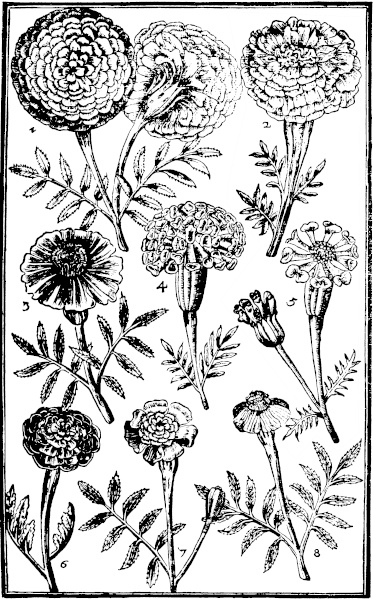
| 1 | Flos Africanus maximus multiplex. The greatest double French Marigold. |
| 2 | Flos Africanus maior multiplex. The greater double French Marigold. |
| 3 | Flos Africanus maximus simplex. The greatest single French Marigold. |
| 4 | Flos Africanus multiplex fistulosus. The double hollow French Marigold. |
| 5 | Flos Africanus simplex fistulosus. The single hollow French Marigold. |
| 6 | Flos Africanus minor multiplex. The smaller double French Marigold. |
| 7 | Flos Africanus minor multiplex alter. Another sort of the lesser double French Marigold. |
| 8 | Flos Africanus minor simplex. The lesser single French Marigold. |
We know no vse they haue in Physicke, but are cherished in Gardens for
their beautifull flowers sake.
To auoide confusion, I must diuide Gilloflowers from Pinkes, and intreate of
them in seuerall Chapters. Of those that are called Carnations or Gilloflowers,
as of the greater kinde, in this Chapter; and of Pinkes, as well double as
single, in the next. But the number of them is so great, that to giue seuerall descriptions
to them all were endlesse, at the least needlesse: I will therefore set downe onely
the descriptions of three (for vnto these three may be referred all the other sorts) for
their fashion and manner of growing, and giue you the seuerall names (as they are vsually
called with vs) of the rest, with their variety and mixture of colours in the flowers,
wherein consisteth a chiefe difference. I account those that are called Carnations
to be the greatest, both for leafe and flower, and Gilloflowers for the most part to bee
lesser in both; and therefore will giue you each description apart, and the Orenge
tawnie or yellow Gilloflower likewise by it selfe, as differing very notably from all
the rest.
I take this goodly great old English Carnation, as a president for the description of
all the rest of the greatest sorts, which for his beauty and statelinesse, is worthy of a
prime place, hauing beene alwayes very hardly preserued in the Winter; and therefore
not so frequent as the other Carnations or Gilloflowers. It riseth vp with a great
thicke round stalke, diuided into seuerall branches, somewhat thickly set with ioynts,
and at euery ioynt two long greene rather then whitish leaues, somewhat broader
then Gilloflower leaues, turning or winding two or three times round (in some other
sorts of Carnations they are plaine, but bending the points downewards, and in some
also of a darke reddish greene colour, and in others not so darke, but rather of a whitish
greene colour:) the flowers stand at the toppes of the stalkes in long, great, and round
greene huskes, which are diuided into fiue points, out of which rise many long and
broad pointed leaues, deeply iagged at the ends, set in order round and comely, making
a gallant great double flower, of a deepe Carnation colour, almost red, spotted
with many blush spots and strakes, some greater and some lesser, of an excellent soft
sweete sent, neither too quicke as many others of these kinds are, nor yet too dull, and
with two whitish crooked threads like hornes in the middle: this kinde neuer beareth
many flowers, but as it is slow in growing, so in bearing, not to be often handled,
which sheweth a kinde of statelinesse, fit to preserue the opinion of magnificence:
the roote is branched into diuers great, long, wooddy rootes, with many small fibres
annexed vnto them.
The red Cloue Gilloflower, which I take as a president for the second sort, which
are Gilloflowers, grow like vnto the Carnations, but not so thicke set with ioynts and
leaues: the stalkes are more, the leaues are narrower and whiter for the most part, and
in some doe as well a little turne: the flowers are smaller, yet very thicke and double
in most, and the greene huskes wherein they stand are smaller likewise then the former:
the ends of the leaues in this flower, as in all the rest, are dented or iagged, yet
in some more then in others; some also hauing two small white threads, crooked at the
ends like hornes,in the middle of the flower, when as diuers other haue none. These
kindes, and especially this that hath a deepe red crimson coloured flower, doe endure
the cold of our winters, and with lesse care is preserued: these sorts as well as the
former doe very seldome giue any seede, as far as I could euer obserue or learne.
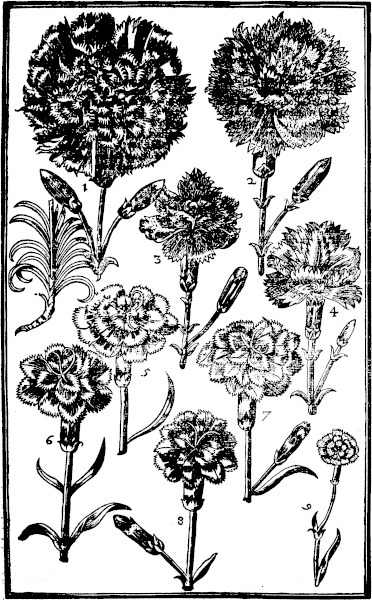
| 1 | Caryophyllus maximus rubro varius. The great old Carnation or gray Hulo. |
| 2 | Caryophyllus maior rubro & albo varius. The white Carnation. |
| 3 | Caryophyllus albo rubens. The Cambersine or the Poole flower. |
| 4 | Caryophyllus Cantij striatus. The faire made of Kent. |
| 5 | Caryophyllus Sabaudicus carneus. The blush Sauadge. |
| 6 | Caryophyllus Xerampelinus. The Gredeline Carnation. |
| 7 | Caryophyllus dictus Grimelo. The Grimelo or Prince. |
| 8 | Caryophyllus albus maior. The great white Gilloflower. |
| 9 | Elegans Heroina Bradshawij. Master Bradshawes dainty Lady. |
[308]
This Gilloflower hath his stalkes next vnto the ground, thicker set, and with smaller
or narrower leaues then the former for the most part: the flowers are like vnto the
Cloue Gilloflowers, and about the same bignesse and doublenesse most vsually, yet
in some much greater then in others; but of a pale yellowish Carnation colour, tending
to an Orenge, with two small white threds, crooked at the ends in the middle,
yet some haue none, of a weaker sent then the Cloue Gilloflower: this kinde is more
apt to beare seede then any other, which is small, black, flat, and long, and being sowen,
yeelde wonderfull varieties both of single and double flowers: some being of a lighter
or deeper colour then the mother plants: some with stripes in most of the leaues:
Others are striped or spotted, like a speckled Carnation or Gilloflower, in diuers sorts,
both single and double: Some againe are wholly of the same colour, like the mother
plant, and are eyther more or lesse double then it, or else are single with one row of
leaues, like vnto a Pinck; and some of these likewise eyther wholly of a crimson red,
deeper or lighter, or variably spotted, double or single as a Pinck, or blush eyther
single or double, and but very seldome white: yet all of them in their greene leaues
little or nothing varying or differing.
Caryophylli maximi.
Carnations.
Caryophyllus maximus dictus
Hulo rubro-varius.
The gray Hulo hath as large leaues as the former old Carnation,
and as deepely iagged on the edges: it hath a
great high stalke, whereon stand the flowers, of a deepe
red colour, striped and speckled very close together with a
darkish white colour.
Caryophyllus maximus dictus
Hulo ruber non variatus.
The red Hulo is also a faire great flower, of a stamell colour,
deeply iagged as the former, and groweth very comely without
any spot at all in it, so that it seemeth to bee but a stamell Gilloflower,
saue that it is much greater.
Caryophyllus maximus dictus
Hulo cæruleo purpureus.
The blew Hulo is a goodly faire flower, being of a faire purplish
murrey colour, curiously marbled with white, but so smally
to be discerned, that it seemeth only purple, it hath so much
the Mastrie in it; it resembleth the Brassill, but that it is much
bigger.
Caryophyllus maximus dictus
Grimelo siue Princeps.
The Grimelo or Prince is a faire flower also, as large as any
Chrystall or larger, being of a faire crimson colour, equally for
the most part striped with white, or rather more white then red,
thorough euery leafe from the bottome, and standeth comely.
Caryophyllus maximus Incarnadinus
albus.
The white Carnation or Delicate, is a goodly delightfull fair
flower in his pride and perfection, that is, when it is both marbled
and flaked, or striped and speckled with white vpon an incarnate
crimson colour, beeing a very comely flower, but abideth
not constant, changing oftentimes to haue no flakes or
strakes of white, but marbled or speckled wholly.
Caryophyllus maximus Incarnadinus
Gallicus.
The French Carnation is very like vnto the white Carnation,
but that it hath more specks, and fewer stripes or flakes of white
in the red, which hath the mastrie of the white.
Caryophyllus maximus Incarnadinus
grandis.
The ground Carnation (if it be not the same with the graund
or great old Carnation first set downe, as the alteration but of
one letter giueth the coniecture) is a thicke flower, but spreadeth
not his leaues abroade as others doe, hauing the middle standing
higher then the outer leaues, and turning vp their brimmes or
edges; it is a sad flower, with few stripes or spots in it: it is very
subiect to breake the pod, that the flower seldome commeth
faire and right; the greene leaues are as great as the Hulo or
Lombard red.
Caryophyllus maximus
Chrystallinus.
The Chrystall or Chrystalline (for they are both one, howsoeuer
some would make them differ) is a very delicate flower
when it is well marked, but it is inconstant in the markes, being
sometimes more striped with white and crimson red, and sometimes
lesse or little or nothing at all, and changing also sometimes
to be wholly red, or wholly blush.
Caryophyllus maximus flore
rubro.
The red Chrystall, which is the red hereof changed, is the
most orient flower of all other red Gilloflowers, because it is
both the greatest, as comming from the Chrystall, as also that
the red hereof is a most excellent crimson.
Caryophyllus maximus dictus
Fragrans.
The Fragrant is a faire flower, and thought to come from the
Chrystall, being as large, but of a blush red colour, spotted with
small speckes, no bigger then pinnes points, but not so thicke as
in the Pageant.
Caryophyllus maximus Sabaudicus
varius.
The stript Sauadge is for forme and bignesse equall with the
Chrystall or White Carnation, but as inconstant as eyther of
them, changing into red or blush, so that few branches with
flowers containe their true mixtures, which are a whitish blush,
fairely striped with a crimson red colour, thicke and short, with
some spots also among.
Caryophyllus maximus Sabaudicus
carneus.
The blush Sauadge is the same with the former, the same root
of the stript Sauadge, as I said before, yeelding one side or part
whose flowers will be eyther wholly blush, or hauing some small
spots, or sometimes few or none in them.
Caryophyllus maximus Sabaudicus
ruber.
The red Sauadge is as the blush, when the colour of the flower
is wholly red without any stripes or spots in them, and so abideth
long; yet it is sometimes seene, that the same side, or part,
or roote being separate from the first or mother plant, will giue
striped and well marked flowers againe.
Caryophyllus maximus Oxoniensis.
The Oxeford Carnation is very like vnto the French Carnation,
both for forme, largenesse and colour; but that this is of a
sadder red colour, so finely marbled with white thereon, that
the red hauing the maistry, sheweth a very sad flower, not hauing
any flakes or stripes at all in it.
Caryophyllus maximus Regius,
siue Bristoliensis maior.
The Kings Carnation or ordinary Bristow, is a reasonable
great flower, deepely iagged, of a sad red, very finally striped
and speckled with white: some of the leaues of the flower on
the one side will turne vp their brimmes or edges: the greene
leafe is very large.
Caryophyllus maximus Granatensis.
The greatest Granado is a very faire large flower, bigger then
the Chrystall, and almost as bigge as the blew Hulo; it is almost
equally diuided and stript with purple and white, but the purple
is sadder then in the ordinary Granado Gilloflower, else it might
bee said it were the same, but greater. Diuers haue taken this
flower to bee the Gran Pere, but you shall haue the difference
shewed you in the next ensuing flower.
Caryophyllus maximus Gran
Pere dictus.
The Gran Pere is a fair great flower, and comely for the forme,
but of no great beautie for colour, because although it be stript
red and white like the Queenes gilloflower, yet the red is so sad
that it taketh away all the delight to the flower.
Caryophyllus maximus Cambersine
dictus.
The Cambersine is a great flower and a faire, beeing a redde
flower, well marked or striped with white, somewhat like vnto a
Sauadge, say some, but that the red is not crimson as the Sauadge;
others say the Daintie, but not so comely: the leaues of the
flowers are many, and thrust together, without any due forme of
spreading.
Caryophyllus maximus Longobardicus
ruber.
The great Lombard red is a great sad red flower, so double and
thick of leaues, that it most vsually breaketh the pod, and seldome
showeth one flower among twenty perfect: the blades or
greene leaues are as large as the Hulo.
Carophylli majores.
Gilloflowers.
Caryophyllus maior Westminsteriensis.
The lustie Gallant or Westminster (some make them to be
one flower, and others to bee two, one bigger then the
other) at the first blowing open of the flower sheweth
to be of a reasonable size and comelinesse, but after it hath stood
blowen some time it sheweth smaller and thinner: it is of a
bright red colour, much striped and speckled with white.
Caryophyllus maior Bristoliensis
purpureus.
The Bristow blew hath greene leaues, so large, that it would
seeme to bring a greater flower then it doth, yet the flower is of
a reasonable size, and very like vnto the ordinary Granado Gilloflower,
striped and flaked in the same manner, but that the white
of this is purer then that, and the purple is more light, and tending
to a blew: this doth not abide constant, but changeth into
purple or blush.
Caryophyllus maior Bristoliensis
carneus.
The Bristow blush is very like the last both in leafe and flower,
the colour only sheweth the difference, which seldome varyeth
to be spotted, or change colour.
Caryophyllus maior Doroborniensis
ruber.
The red Douer is a reasonable great Gilloflower and constant,
being of a faire red thicke poudered with white spots, and seemeth
somewhat like vnto the ground Carnation.
Caryophyllus maior Doroborniensis
dilutus siue albus.
The light or white Douer is for forme and all other things
more comely then the former, the colour of the flower is blush,
thicke spotted with very small spots, that it seemeth all gray, and
is very delightfull.
Caryophyllus maior Cantii.
The faire maide of Kent, or Ruffling Robin is a very beautiful
flower, and as large as the white Carnation almost: the flower is
white, thicke poudered with purple, wherein the white hath the
mastrie by much, which maketh it the more pleasant.
Caryophyllus maior Regineus.
The Queenes Gilloflower is a reasonable faire Gilloflower although
very common, striped red and white, some great and
some small with long stripes.
Caryophyllus maior elegans.
The Daintie is a comely fine flower, although it be not great,
and for the smallnesse and thinnesse of the flower being red so
finely marked, striped and speckled, that for the liuelinesse of the
colours it is much desired, beeing inferiour to very few Gilloflowers.
Caryophyllus maior Brasiliensis.
The Brassill Gilloflower is but of a meane size, being of a sad
purple colour, thicke poudered and speckled with white,
the purple herein hath the mastrie, which maketh it shew
the sadder, it is vnconstant, varying much and often to
bee all purple: the greene leaues lye matting on the
ground.
Caryophyllus maior Granatensis.
The Granado Gilloflower is purple and white, flaked and striped
very much: this is also much subiect to change purple. There
is a greater and a lesser of this kinde, besides the greatest that is
formerly described.
Caryophyllus Turcicus.
The Turkie Gilloflower is but a small flower, but of great delight,
by reason of the well marking of the flower, being most
vsually equally striped with red and white.
Caryophyllus Cambrensis Poole.
The Poole flower, growing naturally vpon the rockes neare
Cogshot Castle in the Isle of Wight, is a small flower, but very
pleasant to the eye, by reason of the comely proportion thereof;
it is of a bright pale red, thicke speckled, and very small with
white, that it seemeth to bee but one colour, the leaues of the
flower are but smally iagged about: it is constant.
Caryophyllus Pegma dilutior.
The light or pale Pageant is a flower of a middle size, very
pleasant to behold, and is both constant and comely, and but
that it is so common, would be of much more respect then it is:
the flower is of a pale bright purple, thicke poudered, and very
euenly with white, which hath the mastery, and maketh it the
more gracefull.
Caryophyllus Pegma saturatior.
The sad Pageant is the same with the former in forme and
bignesse, the difference in colour is, that the purple hath the mastery,
which maketh it so sad, that it doth resemble the Brassill
for colour, but is not so bigge by halfe.
Caryophyllus Heroina dictus
elegans Magistri Bradshawij.
Master Bradshawe his dainty Lady may be well reckoned among
these sorts of Gilloflowers, and compare for neatenesse
with most of them: the flower is very neate, though small, with
a fine small iagge, and of a fine white colour on the vnderside of
all the leaues, as also all the whole iagge for a pretty compasse,
and the bottome or middle part of the flower on the vpperside
also: but each leafe is of a fine bright pale red colour on the vpperside,
from the edge to the middle, which mixture is of wonderfull
great delight.
Caryophyllus albus optimus
maior Londinensis & alius.
The best white Gilloflower groweth vpright, and very double,
the blades growe vpright also, and crawle not on the
ground.
The London white is greater and whiter then the other ordinary
white, being wholly of one colour.
Caryophyllus maior rubens
& minor.
The stamell Gilloflower is well knowne to all, not to differ
from the ordinary red or cloue Gilloflower, but only in being of
a brighter or light red colour: there is both a greater and a lesser
of this kinde.
Caryophyllus purpureus maior
& minor.
The purple Gilloflower a greater and a lesse: the stalke is so
slender, and the leaues vpon them so many and thicke, that they
lye and traile on the ground: the greatest is almost as bigge as a
Chrystall, but not so double: the lesse hath a smaller flower.
Caryophyllus Persico violaceus.
The Gredeline Gilloflower is a very neate and handsome
flower, of the bignesse of the Cloue red Gilloflower, of a fine
pale reddish purple or peach colour, enclining to a blew or violet,
which is that colour is vsually called a gredeline colour:
it hath no affinity with eyther Purple, Granado, or Pageant.
Caryophyllus purpuro cæruleus.
The blew Gilloflower is neither very double nor great, yet
round and handsome, with a deepe iagge at the edge, and is of
an exeeding deepe purple colour, tending to a tawnie; this
differeth from all other sorts, in that the leafe is as greene as
grasse, and the stalkes many times red or purple: by the greene
leaues it may be knowne in the Winter, as well as in the Summer.
Caryophyllus carneus.
The blush Gilloflower differeth not from the red or stamell,
but only in the colour of the flower, which is blush.
Caryophyllus Silefiacus
maximus Wittin.
Iohn Wittie his great tawny Gilloflower is for forme of growing,
in leafe and flower altogether like vnto the ordinary tawny,
the flower onely, because it is the fairest and greatest that any other
hath noursed vp, maketh the difference, as also that it is of
a faire deepe scarlet colour.
There are also diuers other Tawnies, either lighter or sadder,
either lesse or more double, that they cannot be numbered, and
all rising (as I said before) from sowing the seede of some of
them: besides the diuersities of other colours both simple and
mixed, euery yeare and place yeelding some variety was not seen
with them before: I shall neede but onely to giue you the names
of some of them we haue abiding with vs, I meane such as haue
receiued names, and leaue the rest to euery ones particular
denomination.
Of Blushes there are many sorts, as the deepe blush, the pale
blush, the Infanta blush, a blush enclining to a red, a great blush,
the fairest and most double of all the other blushes, and many
others both single and double.
Of Reds likewise there are some varieties, but not so many as
of the other colours; for they are most dead or deepe reds, and
few of a bright red or stamell colour; and they are single like
Pinkes, either striped or speckled, or more double striped and
speckled variably, or else.
There are neither purple nor white that rise from this seede
that I haue obserued, except one white in one place.
Caryophyllus Silesiacus striatus.
The striped Tawny are either greater or lesser, deeper or lighter
flowers twenty sorts and aboue, and all striped with smaller or
larger stripes, or equally diuided, of a deeper or lighter colour:
and some also for the very shape or forme will bee more neate,
close, and round; others more loose, vnequall, and sparsed.
Caryophyllus Silesiacus
marmor-amulus.
The marbled Tawny hath not so many varieties as the striped,
but is of as great beauty and delight as it, or more: the flowers
are greater or smaller, deeper or lighter coloured one then another,
and the veines or markes more conspicuous, or more frequent
in some then in others: but the most beautifull that euer I
did see was with Master Ralph Tuggie, which I must needes
therefore call
Heroina Rodolphi florum
Imperatoris.
Master Tuggies Princesse, which is the greatest and fairest of
all these sorts of variable tawnies, or seed flowers, being as large
fully as the Prince or Chrystall, or something greater, standing
comely and round, not loose or shaken, or breaking the pod as
some other sorts will; the marking of the flower is in this manner:
It is of a stamell colour, striped and marbled with white
stripes and veines quite through euery leafe, which are as deeply
iagged as the Hulo: sometimes it hath more red then white, and
sometimes more white then red, and sometimes so equally marked,
that you cannot discerne which hath the mastery; yet which
of these hath the predominance, still the flower is very beautifull,
and exceeding delightsome.
Caryophyllus Silesiacus assulosus.
The Flaked Tawny is another diuersity of these variable or
mixt coloured flowers, being of a pale reddish colour, flaked
with white, not alwaies downeright, but often thwart the leaues,
some more or lesse then others; the marking of them is much
like vnto the Chrystall: these also as well as others will be greater
or smaller, and of greater or lesse beauty then others.
Caryophyllus Silesiacus
plumatus.
The Feathered Tawny is more rare to meete with then many
of the other; for most vsually it is a faire large flower and double,
equalling the Lumbard red in his perfection: the colour hereof
is vsually a scarlet, little deeper or paler, most curiously feathered
and streamed with white through the whole leafe.
Caryophyllus Silesiacus
punctatus.
The Speckled Tawny is of diuers sorts, some bigger, some
lesse, some more, and some lesse spotted then others: Vsually it
is a deepe scarlet, speckled or spotted with white, hauing also
some stripes among the leaues.
Caryophyllus roseus rotundus
Magistri Tuggie.
Master Tuggie his Rose Gilloflower is of the kindred of these
Tawnies, being raised from the seede of some of them, and onely
possessed by him that is the most industrious preseruer of all natures
beauties, being a different sort from all other, in that it hath
round leaues, without any iagge at all on the edges, of a fine stamell
full colour, without any spot or strake therein, very like vnto
a small Rose, or rather much like vnto the red Rose Campion,
both for forme, colour, and roundnesse, but larger for size.
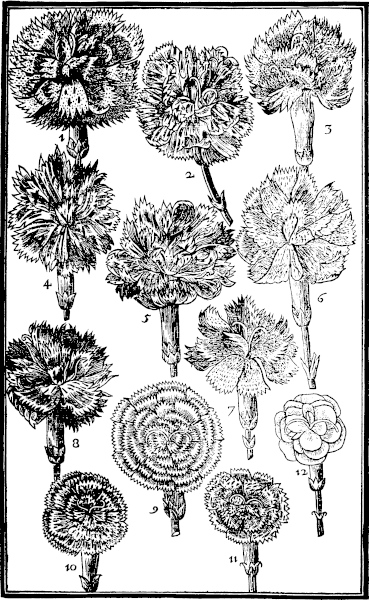
| 1 | Heroina Rodolphi florum Imperatoris Princessa dictus. Master Tuggie his Princesse. |
| 2 | Caryophyllus Oxoniensis. The French or Oxford Carnation. |
| 3 | Caryophyllus Westmonasteriensis. The Gallant or Westminster Gilloflower. |
| 4 | Caryophyllus Bristoliensis. The Bristow. |
| 5 | Caryophyllus Chrystallinus. The Chrystall or Chrystalline. |
| 6 | Caryophyllus Sabaudicus striatus. The stript Sauadge. |
| 7 | Caryophyllus Granatensis maximus. The Granpere or greatest Granado. |
| 8 | Caryophyllus peræmanus. The Dainty. |
| 9 | Caryophyllus Silesiacus maximus Ingonij Ioannis. Iohn Witty his great tawny Gilloflower. |
| 10 | Caryophyllus Silesiacus striatus. The stript Tawny. |
| 11 | Caryophyllus marmor-amulus. The marbled Tawny. |
| 12 | Caryophyllus roseus rotundas magistri Tuggie. Master Tuggie his Rose Gilloflower. |
[314]
All these are nourished with vs in Gardens, none of their naturall places
being knowne, except one before recited, and the yellow which is Silesia;
many of them being hardly preserued and encreased.
They flower not vntill the heate of the yeare, which is in Iuly (vnlesse it
be an extraordinary occasion) and continue flowring, vntill the colds of the
Autumne checke them, or vntill they haue wholly out spent themselues,
and are vsually encreased by the slips.
Most of our later Writers doe call them by one generall name, Caryophyllus
sativus, and flos Caryophylleus, adding thereunto maximus, when wee
meane Carnations, and maior when we would expresse Gilloflowers, which
name is taken from Cloues, in that the sent of the ordinary red Gilloflower
especially doth resemble them. Diuers other seuerall names haue beene
formerly giuen them, as Vetonica, or Betonica altera, or Vetonica altilis, and
coronaria. Herba Tunica, Viola Damascena, Ocellus Damascenus, and Barbaricus.
Of some Cantabrica Plinij. Some thinke they were vnknowne to the
Ancients, and some would haue them to be Iphium of Theophrastus, wherof
he maketh mention in his sixth and seuenth Chapters of his sixth booke,
among Garland and Summer flowers; others to be his Dios anthos, or Iouis
flos, mentioned in the former, and in other places. We call them in English
(as I said before) the greatest kindes, Carnations, and the others Gilloflowers
(quasi Iuly flowers) as they are seuerally expressed.
The red or Cloue Gilloflower is most vsed in Physicke in our Apothecaries
shops, none of the other being accepted of or vsed (and yet I
doubt not, but all of them might serue, and to good purpose, although not
to giue so gallant a tincture to a Syrupe as the ordinary red will doe) and is
accounted to be very Cordiall.
There remaine diuers sorts of wilde or small Gilloflowers (which wee vsually
call Pinkes) to be entreated of, some bearing single, and some double flowers,
some smooth, almost without any deepe dents on the edges, and some iagged,
or as it were feathered. Some growing vpright like vnto Gilloflowers, others creeping
or spreading vnder the toppe or crust of the ground, some of one colour, some of
another, and many of diuers colours: As I haue formerly done with the Gilloflowers,
so must I doe with these that are entertained in our Gardens, onely giue you the descriptions
of some three or foure of them, according to their variety, and the names of
the rest, with their distinctions.
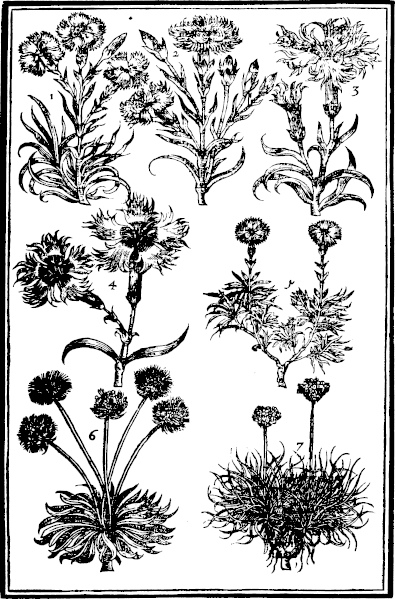
| 1 | Caryophyllus siluestris simplex. The vsuall single Pinke. |
| 2 | Caryophyllus multiplex siluestris. Double Pinkes. |
| 3 | Caryophyllus siluestris plumarius. Feathered or iagged Pinkes. |
| 4 | Caryophyllus Stellatus. Starre Pinkes. |
| 5 | Caryophyllus repens. Matted Pinkes. |
| 6 | Caryophyllus mediterraneus. The great Thistle or Sea Gilloflower. |
| 7 | Caryophyllus marinus. The ordinary Thistle or Sea Cushion. |
[316]
The single and double Pinkes are for forme and manner of growing, in all parts like
vnto the Gilloflowers before described, sauing onely that their leaues are smaller and
shorter, in some more or lesse then in others, and so are the flowers also: the single
kindes consisting of fiue leaues vsually (seldome six) round pointed, and a little snipt
for the most part about the edges, with some threads in the middle, either crooked or
straight: the double kindes being lesser, and lesse double then the Gilloflowers, hauing
their leaues a little snipt or endented about the edges, and of diuers seuerall colours,
as shall hereafter be set downe, and of as fragrant a sent, especially some of them as
they: the rootes are long and spreading, somewhat hard and wooddy.
The iagged Pinkes haue such like stalkes and leaues as the former haue, but somewhat
shorter and smaller, or grasse-like, and of a whitish or grayish greene colour likewise:
the flowers stand in the like manner at the toppes of the stalkes, in long, round,
slender, greene huskes, consisting of fiue leaues, very much cut in on the edges, and
iagged almost like a feather, of a light red, or bright purple colour, with two white
threads standing in the middle, crooked like a horne at the end, and are of a very good
sent. Some of these haue not those two crooked threads or hornes in the middle, but
haue in their stead many small threads, not crooked at all: the seedes of them all are
like vnto the seedes of Gilloflowers, or the other Pinkes, that is, small, blacke, long,
and flat: the rootes are small and wooddy likewise.
Of this kinde there is another sort, bearing flowers almost as deeply cut or iagged
as the former, of a faire white colour, hauing a ring or circle of red about the bottome
or lower part of the leaues, and are as sweete as the former: this being sowne of seede
doth not giue the starre of so bright a red colour, but becommeth more dunne.
This kinde of Pinke hath his first or lower leaues, somewhat broader and greener
then any of the former Pinkes, being both for breadth and greennesse more like vnto
the Sweete Iohns, which shall bee described in the next Chapter: the leaues on the
stalkes are smaller, standing by couples at euery ioynt, at the toppes whereof stand
such like iagged flowers as the last described, and as large, but more deeply cut in or
iagged round about, some of them of a purplish colour, but the most ordinary with vs
are pure white, and of a most fragrant sent, comforting the spirits and senses a farre off:
the seedes and rootes are like vnto the former. Some haue mistaken a kinde of wilde
Campion, growing in our Woods, and by the paths sides in Hornsie Parke, and other
places, to be this feathered Pinke: but the flowers declare the difference sufficiently.
The matted Pinke is the smallest, both for leafe and flower of all other Pinkes that
are nourished in Gardens, hauing many short and small grassie greene leaues vpon the
stalkes, which as they grow and lye vpon the ground (and not standing so vpright as
the former) doe take roote againe, whereby it quickly spreadeth, and couereth a great
deale of ground in a little space: the flowers are small and round, a little snipt about
the edges, whereof some are white, and some red, and some are white spotted with
red, and some red spotted with white, all of them being single flowers. But there is
another of this kinde, not differing in leafe, but in flower: for that the first flowers are
but once double, or of two rowes of leaues, of a fine reddish colour, spotted with
siluer spots: but those that follow, are so thicke and double, that they oftentimes
doe breake the pod or huske; being not altogether of so deepe a red colour,
but more pale.
Vnto these kindes of Pinkes I must needs adde, not only our ordinary Thrift (which
is more frequent in gardens, to empale or border a knot, because it abideth greene
Winter and Summer, and that by cutting, it may grow thick, and be kept in what form
one list, rather then for any beautie of the flowers) but another greater kinde, which
is of as great beautie and delight almost as any of the former Pinkes, as well for that
the leaues are like vnto Gilloflowers, being longer and larger then any Pinkes, and of
a whitish greene colour like vnto them, not growing long or by couples vpon the
stalkes as Pinkes and Gilloflowers doe, but tufting close vpon the ground, like vnto
the common Thrift: as also that the stalkes, rising from among the leaues (being sometimes
two foote high (as I haue obserued in my garden) are yet so slender and weake,
that they are scarce able to beare the heads of flowers, naked or bare, both of leaues
and ioynts, failing only in one place, where at the ioynt each stalke hath two small and
very short leaues, not rising vpwards as in all other Gilloflowers, Pinkes, and other
herbes, but growing downewards) and doe beare each of them a tuft or vmbell of
small purplish, or blush coloured flowers, at the toppes of them standing somewhat
like vnto sweete Williams, but more roundly together, each flower consisting of fiue
small, round, stiffe or hardish leaues, as if they were made of paper, the bottome or
middle being hollow, not blowing all at once as the ordinary Thrift, but for the most
part one after another, not shewing vsually aboue foure or fiue flowers open at one
time (so farre as I could obserue in the plants that I kept) so that it was long before the
whole tuft of flowers were past; but yet the hoter and dryer the time was, the sooner
it would be gone: the seede I haue not perfectly obserued, but as I remember, it was
somewhat like vnto the seede of Scabious; I am sure nothing like vnto Gilloflowers
or Pinkes: the roote is somewhat great, long and hard, and not so much spreading in
the ground as Gilloflowers or Pinkes.
Our common Thrift is well knowne vnto all, to haue many short and hard greene
leaues, smaller then many of the grasses, growing thicke together, and spreading
vpon the ground: the stalkes are naked of leaues a spanne high, bearing a small tuft of
light purple, or blush coloured flowers, standing round and close thrusting together.
The double white Pinke is onely
with more leaues in it then the single
which maketh the difference.
The double red Pinke is in the same
manner double, differing from the single
of the same colour.
The double purple Pinke differeth not
from the single purple for colour, but only
in the doublenesse of the flower.
The Granado Pinke differeth not from
the Gilloflower of the same name, but in
the smalnesse both of leaues and flower.
The double Matted Pinke is before described.
The double blush Pinke is almost as
great as the ordinary blush Gilloflower,
and some haue taken it for one, but the
greene leaues are almost as small as Pinks,
and therefore I referre it to them.
The single white ordinary Pinke
hath a single white flower of fiue
leaues, finely iagged about the
edges.
The single red pink is like the white, but
that the leaues are not so much iagged, and
the flower is of a pale purplish red colour,
The single purple Pinke is of a faire
purple colour, like almost vnto the purple
Gilloflower.
The great blush Pinke hath broader and
larger leaues in the flower then any other
Pinke, and of a faire blush colour.
The white Featherd Pinke hath the
edges of the flower more finely and deeply
cut in then the former.
The red or light purple featherd Pinke
is like the former featherd Pinke, but only
differeth in colour.
The Starre Pinke is a faire flower, finely
iagged on the edges, with a faire red circle at the lower end of the leaues on the inside.
The white featherd Pinke of Austria is described before. The purple featherd
Pinke of Austria is so likewise. The single matted Pinke is before described. The
speckled Pinke is a small flower hauing small spots of red here and there dispersed
ouer the white flower.
Those single flowers being like vnto Pinkes that rise from the sowing of the orenge
tawney, I bring not into this classis, hauing already spoken of them in the precedent
Chapter.
These are all like as the former, nourished in Gardens with vs, although
many of them are found wilde in many places of Austria, Hungarie, and
Germany, on the mountaines, and in many other places, as Clusius recordeth.
The ordinary Thrift groweth in the salt Marshes at Chattam by Rochester,
and in many other places in England: but the great kinde was gathered
in Spaine, by Guillaume Boel that painefull searcher of simples,
and the seede thereof imparted to me, from whence I had diuers plants,
but one yeare after another they all perished.
Many of these Pinkes both single and double, doe flower before any
Gilloflower, and so continue vntill August, and some, most of the Summer
and Autumne.
The seuerall titles that are giuen to these Pinkes, may suffice for their particular
names: and for their generall they haue beene expressed in the former
Chapter, beeing of the same kindred, but that they are smaller, and
more frequently found wilde. The two sorts of Thrift are called Caryophyllus
Marinus. The greater, Maior & Mediterraneus; In English, The greater
or Leuant Thrift, or Sea Gilloflower. The lesser Minimus, and is accounted
of some to be a grasse, and therefore called Gramen Marinum &
Polyanthemum; In English, Thrift, Sea grasse, and our Ladies Cushion,
or Sea Cushion.
It is thought by diuers, that their vertues are answerable to the Gilloflowers,
yet as they are of little vse with vs, so I thinke of as small effect.
These kindes of flowers as they come neerest vnto Pinkes and Gilloflowers,
though manifestly differing, so it is fitted to place them next vnto them in
a peculiar Chapter.
The sweete Iohn hath his leaues broader, shorter, and greener then any of the former
Gilloflowers, but narrower then sweete Williams, set by couples, at the
ioynts of the stalkes, which are shorter then most of the former, and not aboue a
foote and a halfe high, at the tops whereof stand many small flowers, like vnto small
Pinkes, but standing closer together, and in shorter huskes, made of fiue leaues, smaller
then most of them, and more deeply iagged then the Williams, of a red colour in
the middle, and white at the edges, but of a small or soft sent, and not all flowring at
once, but by degrees: the seede is blacke, somewhat like vnto the seede of Pinkes,
the roote is dispersed diuersly, with many small fibres annexed vnto it.
This white Iohn differeth not in any thing from the former, but onely that the leafe
doth neuer change brownish, and that the flower is of a faire white colour, without
any mixture.
There is of both those former kindes, some whose flowers are once double, that is,
consisting of two or three rowes of leaues, and the edges not so deeply iagged; not
differing in any thing else.
The sweet Williams doe all of them spread into many very long traylng branches,
with leaues lying on the ground, in the very like manner that the sweete Iohns doe:
the chiefe differences betweene them are, that these haue broader, and darker greene
leaues, somewhat brownish, especially towards the points, and that the flowers stand
thicker and closer, and more in number together, in the head or tuft, hauing many small
pointed leaues among them, but harmlesse, as all men know; the colour of the flower is
of a deep red, without any mixture or spot at all.
The double kinde differeth not from the single kinde of the same colour, but only in
the doublenesse of the flowers, which are with two rowes of leaues in euery flower.
These spotted Williams are very like the first red Williams, in the forme or maner
of growing, hauing leaues as broade, and browne sometimes as they, the flowers, stand
as thicke or thicker, clustring together, but of very variable colours: for some
flowers will be of a fine delayed red, with few markes or spots vpon them, and others
will bee full speckled or sprinkled with white or siluer spots, circlewise about the middle
of the flowers, and some will haue many specks or spots vpon them dispersed:
all these flowers are not blowne at one time, but some are flowring, when others are
decaying, so that abiding long in their pride, they become of the more respect: The
seede is blacke, as all the rest, and not to be distinguished one from another: the roots
are some long, and some small and threddy, running vnder the vpper crust of the earth.
The leaues of this kinde seeme to be a little larger, and the ioints a little redder
then the former, but in the flower consisteth the chiefest difference, which is of a
deepe red, or murrey purple colour, like vnto veluet of that colour, without any spots,
but smooth, and as it were soft in handling, hauing an eye or circle in the middle, at
the bottome of the leaues.
The white kinde differeth not in forme, but in colour from the former, the leaues
are not browne at all, but of a fresh greene colour, and the flowers are wholly white,
or else they are all one.
These for the most part grow wilde in Italie, and other places: we haue
them in our Gardens, where they are cherished for their beautifull varietie.
They all generally doe flower before the Gilloflowers or Pinkes, or with
the first of them: their seede is ripe in Iune and Iuly, and doe all well abide
the extremitie of our coldest winters.
They all generally are called Armerius, or Armeria, as some doe write,
and distinguished as they are in their titles: Yet some haue called them Vetonica
agrestis, and others Herba Tunica, Scarlatea, & Caryophyllus siluestris:
Wee doe in English in most places, call the first or narrower leafed kindes,
Sweet Iohns, and all the rest Sweete Williams; yet in some places they call
the broader leafed kindes that are not spotted, Tolmeiners, and London
tufts: but the speckled kinde is termed by our English Gentlewomen, for
the most part, London pride.
We haue not knowne any of these vsed in Physicke.
There be diuers sorts of Daisies, both great and small, both single and double,
both wilde growing abroade in the fieldes, and elsewhere, and manured growing
only in Gardens: of all which I intend not to entreate, but of those that are
of most beautie and respect, and leaue the rest to their proper place.
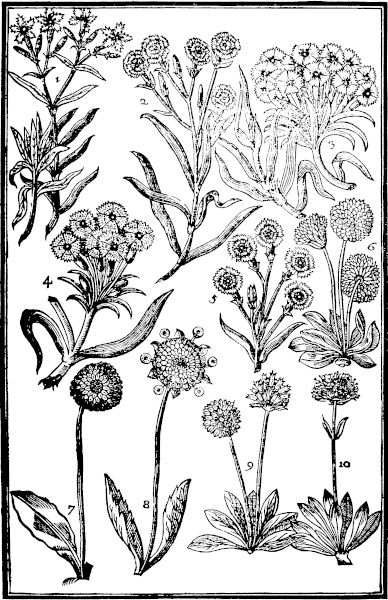
| 1 | Armerius angustifolius simplex. Single sweete Iohns. |
| 2 | Armerius angustifolius multiplex. Double sweet Iohns. |
| 3 | Armerius latifolius simplex. Single sweete Williams. |
| 4 | Armerius latifolius versicolor. Spotted sweet Williams or pride of London. |
| 5 | Armerius latifolius multiplex. Double sweet Williams. |
| 6 | Bellis hortensis minor multiplex. Double Garden Daisies. |
| 7 | Bellis minor hortensis flore vario. Double red Daisies stript. |
| 8 | Bellis minor hortensis prolifera. Double fruitfull Daisies or Iacke an Apes on horsebacke. |
| 9 | Bellis cærulea siue Globularia. Double blew Daisies or blew Globeflower. |
| 10 | Bellis lutea montana siue Globularia lutea montana. Double yellow Daisies or yellow Globeflower. |
The great Daisie with the double white flower, is in all things so like vnto the great
single kinde, that groweth by the high wayes, and in diuers medowes and fields, that
there is no difference but in the flower, which is double. It hath many long, and somewhat
broad leaues lying vpon the ground, deepely cut in on both sides, somewhat
like vnto an oaken leafe; but those that are on the stalkes are shorter, narrower, and
not so deeply cut in, but onely notched on the edges: the flowers at the toppe are (as
I said) white and double, consisting of diuers rowes of leaues, being greater in compasse
then any of the double Daisies that follow, but nothing so double of leaues.
This single Daisie (like as all the rest of the small Daisies) hath many smooth,
greene, round pointed leaues lying on the ground, a little snipt about the edges; from
among which rise many slender round foote-stalkes, rather then stalkes or stems, about
an hand breadth high at the most, and oftentimes not halfe so high, bearing one flower
a peece, consisting of many small leaues, as a pale or border set about a middle
thrumme: the leaues of this kinde are almost wholly red, whereas in the wilde they
are white or whitish, enclining to red on the edges, the middle being yellow in both
sorts: the rootes are many small white threads or strings.
The leaues of all the double Daisies are in forme like vnto the single ones, but that
they are smaller, and little or nothing snipt or notched about the edges: the small
stalkes like wise are smaller and lower, but bearing as double flowers as any that growe
on the ground, being composed of many small leaues, thicke thrust together, of diuers
colours; for some are wholly of a pure white, others haue a little red, either dispersed
vpon the white leaues, or on the edges, and sometimes on the backes of the leaues:
some againe seeme to be of a whitish red, or more red then white, when as indeede
they are white leaues dispersed among the red; others of a deepe or darke red colour,
and some are speckled or striped with white and red through the whole flower: and
some the leaues will bee red on the vpperside, and white vnderneath; and some also
(but those are very rare) are of a greenish colour.
There is no difference either in leafe or roote in this kinde from the former double
Daisies: the chiefest variety consisteth in this, that it beareth many small double flowers,
standing vpon very short stalkes round about the middle flower, which is vsually
as great and double as any of the other double kindes, and is either wholly of a deepe
red colour, or speckled white and red as in some of the former kindes, or else greenish,
all the small flowers about it being of the same colour with the middlemost.
The likenesse and affinity that this plant hath with the former, both in the forme
of leafe and flower, as also in the name, hath caused me to insert it, and another rare
plant of the same kinde, in this place, although they be very rare to be met with in our
English Gardens. This beareth many narrower, shorter, and blacker greene leaues
then the former, lying round about vpon the ground; among which rise vp slender,
but stiffe and hard stalks, halfe a foot high or more, set here and there with small leaues,
and at the top a small round head, composed of many small blew leaues, somewhat like
vnto the head of a Scabious: It hath bin found likewise with a white head of flowers:
the roote is hard and stringie: the whole plant is of a bitter taste.
This mountaine yellow Daisie or Globe-flower hath many thicke, smooth, round
pointed leaues, spread vpon the ground like the former; among which spring diuers
small round rushie stalkes, a foote high, bearing about the middle of them two small
leaues at the ioynts, and at the toppes round heads of flowers thrust thicke together,
standing in purplish huskes, euery of which flowers do blow or spread into fiue leaues,
starre-fashion, and of a faire yellow colour, smelling like vnto broome flowers, with
many small threads in the middle compassing a flat pointell, horned or bended two
wayes: after the flowers are past rise vp the seede vessels, which are round, swelling
out in the middle, and diuided into foure parts at the toppes, containing within them
round, flat, blacke seede, with a small cut or notch in them: the roote is a finger long,
round and hard, with a thicke barke, and a woddy pith in the middle, of a sharpe drying
taste and strong sent: the leaues are also sharpe, but bitter.
The small Daisies are all planted, and found onely in Gardens, and will
require to be replanted often, lest they degenerate into single flowers, & at
least into lesse double. The blew Daisie is naturall of Mompelier in
France, and on the mountaines in many places of Italy, as also the yellow
kinde in the Kingdome of Naples.
The Daisies flower betimes in the Spring, and last vntill May, but the
last two flower not vntill August or September.
They are vsually called in Latine Bellides, and in English Daisies. Some
call them Herba Margarita, and Primula veris, as it is likely after the Italian
names, of Marguerite, and Flor di prima vera gentile. The French call them
Pasquettes, and Marguerites, and the Fruitfull sort, or those that beare small
flowers about the middle one, Margueritons: our English women call
them Iacke an Apes on horse-backe, as they doe Marigolds before recited,
or childing Daisies: but the Physitians and Apothecaries doe in generall
call them, especially the single or Field kindes, Consolida minor. The blew
Daisie is called Bellis cærulea, and Globularia, of some Scabiosæ pumilum genus.
The Italians call it Botanaria, because the heads are found like buttons.
The yellow, Globularia montana, is onely described by Fabius Columna, in
his last part of Phytobasanos, and by him referred vnto the former Globularia,
although it differ in some notable points from it.
The properties of Daisies are certainly to binde, and the roote especially
being dryed, they are vsed in medicines to that purpose. They are
also of speciall account among those herbes, that are vsed for wounds in
the head.
The sorts of Scabious being many, yeeld not flowers of beauty or respect, fit
to bee cherished in this our Garden of delight; and therefore I leaue them to
the Fields and Woods, there to abide. I haue onely two or three strangers to
bring to your acquaintance, which are worthy this place.
This white Scabious hath many long leaues, very much iagged or gasht in on both
sides, of a meane bignesse, being neither so large as many of the field, nor so small as
any of the small kindes: the stalkes rise about a foote and a halfe high, or somewhat
higher, at the tops whereof grow round heads, thicke set with flowers, like in all points
vnto the field Scabious, but of a milke white colour.
This red Scabious hath many leaues lying vpon the ground, very like vnto Deuils
bit, but not so large, being shorter and snipt, not gashed about the edges, of a light
greene colour; yet (there is another of a darker greene colour, whose flower is of a
deeper red) the stalkes haue diuers such leaues on them, set by couples at the ioynts as
grow belowe, and at the tops small heads of flowers, each consisting of fiue leaues,
the biggest flowers standing round about in the outer compasse, as is vsuall almost in
all the kinds of Scabious, of a fine light purple or red colour: after the flowers are past,
come the seede, which is somewhat long and round, set with certaine haires at the
head thereof, like vnto a Starre: the roote is composed of a number of slender
strings, fastened at the head.
This (reputed Indian) Scabious hath many large faire greene leaues lying on the
ground, iagged or cut in on both sides to the middle ribbe, euery peece whereof is
narrower then that at the end, which is the broadest: among these leaues rise vp sundry
slender and weake stalkes, yet standing vpright for the most part, set with smaller
and more iagged leaues at certaine distances, two or three at euery ioynt, branching
forth at the toppe into other smaller branches, bearing euery one head of flowers,
like in forme vnto other Scabiouses, but of an excellent deepe red crimson colour (and
sometimes more pale or delayed) of no sent at all; after which doe come small roundish
seede, like vnto the field Scabious: the roote is long and round, compassed with
a great many small strings, and perisheth vsually as soone as it hath borne out his flowers
and seede: otherwise if it doe not flower the first yeare of the sowing, if it be carefully
defended from the extremity of Winter, it will flower the sooner the next yeare,
as I my selfe haue often found by experience.
The first is sometimes found wilde in our owne Countrey, but it is very
geason, and hath been sent among other rare seedes from Italy.
The second was first found and written of by Clusius, in Pannonia and
Austria, where it is very plentifull.
The third hath been sent both from Spaine & Italy, and is verily thought
to grow naturally in both those parts.
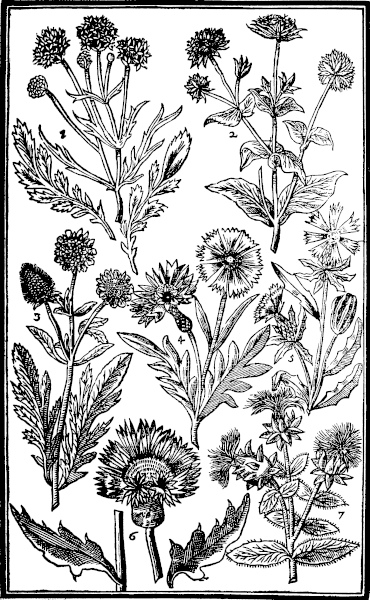
| 1 | Scabiosa flore albo. White flowred Scabious. |
| 2 | Scabiosa rubra Austriaca. Red Scabious of Austria. |
| 3 | Scabiosa rubra Indica. Red flowred Indian Scabious. |
| 4 | Cyanus vulgaris minor. Corn-flower of diuers colours. |
| 5 | Cyanus Bæticus. Spanish Corn-flower. |
| 6 | Cyanus floridus Turcicus. The braue Sultans flower. |
| 7 | Carthamus sativus. Spanish Saffron. |
The first and second flower earlier then the last, for that it flowreth not
vntill September or October, (vnlesse it be not apt to beare the first yeare
as I before said) so that many times (if none be more forward) it perisheth
without bearing ripe seede, whereby we are oftentimes to seeke new seede
from our friends in other parts.
They haue all one generall name of Scabious, distinguished eyther by
their flower, or place of growing, as in their titles: yet the last is called of
diuers Scabiosa exotica, because they thinke the name Indica, is not truely
imposed vpon it.
Whether these kindes haue any of the vertues of the other wilde kinds,
I know none haue made any experience, and therefore I can say no more of
them.
Vnder the name of Cyanus are comprehended, not onely those plants which
from the excellent blew colour of their flowers (furnishing or rather pestering
the Corne fieldes) haue peculiarly obtained that name, and which doth much
vary also, in the colour of the flowers, as shall be shewed; but some other plants also for
their neere resemblance, but with seuerall distinctions. The Cyanus maior, Ptarmica
Austriaca, Ptarmica Imperati, and many others which may be adioyned vnto them, do
more fitly belong to the Garden of Simples, whereunto I leaue them, and will here
only entreate of those that may most please the delight of our Gentle Florists, in that
I labour and striue, to furnish this our garden, with the chiefest choyse of natures
beauties and delights.
All these sorts of Corne flowers are for the most part alike, both in leaues and
flowers one vnto another for the forme: the difference betweene them consisteth in
the varying colour of the flowers: For the leaues are long, and of a whitish greene
colour, deeply cut in on the edges in some places, somewhat like vnto the leaues of a
Scabious: the stalkes are two foote high or better, beset with such like leaues but smaller,
and little or nothing cut in on the edges: the toppes are branched, bearing many small
greene scaly heads, out of which rise flowers, consisting of fiue or sixe, or more long
and hollow leaues, small at the bottome, and opening wider and greater at the brims,
notched or cut in on the edges, and standing round about many small threds in the
middle: the colours of these flowers are diuers, and very variable; for some are
wholly blew, or white, or blush, or of a sad, or light purple, or of a light or dead red,
or of an ouerworne purple colour, or else mixed of these colours, as some, the edges
white, and the rest blew or purple, or the edges blew or purple, and the rest of the
flower white, or striped, spotted, or halfed, the one part of one colour, and the other
of another, the threds likewise in the middle varying in many of them; for some
will haue the middle thrume of a deeper purple then the outer leaues, and some haue
white or blush leaues, the middle thrume being reddish, deeper or paler. After the
flowers are past, there come small, hard, white and shining seede in those heads, wrapped
or set among a deale of flockie matter, as is most vsuall, in all plants that beare
scaly heads: the rootes are long and hard, perishing euery yeare when it hath giuen
seede.
As a kinde of these Corne flowers, I must needes adioyne another stranger, of much
beautie, and but lately obtained from Constantinople, where, because (as it is said) the
great Turke, as we call him, saw it abroade, liked it, and wore it himselfe; all his vassals
haue had it in great regard, and hath been obtained from them, by some that haue sent
it into these parts. The leaues whereof are greener, and not only gashed, but finely
snipt on the edges: the stalkes are three foote high, garnished with the like leaues as
are below, and branched as the former, bearing large scaly heads, and such like flowers
but larger, hauing eight or nine of those hollow gaping leaues in euery flower, standing
about the middle threds (if it be planted in good and fertile ground and be well
watered, for it soone starueth and perisheth with drought) the circling leaues are of a
fine delayed purple or blush colour, very beautifull to behold; the seede of this is
smaller and blacker, and not enclosed in so much dounie substance, as the former (yet
in our Countrey the seede is not so blacke, as it came vnto vs, but more gray) the roote
perisheth likewise euery yeere.
This Spanish kinde hath many square low bending or creeping stalkes, not standing
so vpright as the former, but branching out more diuersly; so that one plant will take
vp a great deale of ground: the leaues are broader then any of the rest, softer also, of
a pale or whitish greene colour, and not much gashed on the edges: the flowers stand
in bigger heads, with foure or fiue leaues vnder euery head, and are of a light pale
purple or blush colour; after which come seede, but not so plentifully, yet wrapped in
a great deale of flockie matter, more then any: the roote groweth downe deepe into
the ground, but perisheth euery yeare as they doe.
The first or former kindes, grow many times in the Corne fields of our
own Countrey, as well as of others, especially that sort with a blew flower:
but the other sorts or colours are not so frequent, but are nourished in gardens,
where they will vary wonderfully.
The second as is before set downe, groweth in Turkie: and the last in
Spaine, found out and first sent to vs by that industrious searcher of simples,
Guillaume Boel before remembred.
The first doe flower in the end of Iune, and in Iuly, and sometimes sooner.
The other two later, and not vntill August most commonly, and the seede
is soone ripe after.
The first is generally called Cyanus, and some following the Ditch name,
call it Flos frumenti. The olde Writers gaue it the name of Bapti sæcuba,
which is almost worne out. We doe call them in English, Blew Bottles, and
in some places, Corne flowers, after the Ditch names. The second hath
beene sent by the name of Ambreboi, which whether it be a Turkie or Arabian
name, I know not. I haue called it from the place, from whence we had
it, Turcicus, and for his beauty, Floridus. The Turkes themselues as I vnderstand,
doe call it The Sultans flower, and I haue done so likewise, that it
may bee distinguished from all the other kindes, or else you may call it,
The Turkey blush Corne flower, which you please. The last was sent by
the name of Iacea Bætica, but I had rather to referre it to the Cyanus, or
Corne flowers, because the flowers are like vnto the Corne flowers, and
not vnto the Iaceas or Knapweedes.
These had no vse in Physicke in Galen and Dioscorides time, in that (as
it is thought) they haue made no mention of them: We in these dayes doe
chiefly vse the first kindes (as also the greater sort) as a cooling Cordiall,
and commended by some to be a remedy, not onely against the plague and
pestilentiall diseases, but against the poison of Scorpions and Spiders.
There are a great many sorts of Knapweedes, yet none of them all fit for this
our Garden, but this only stranger, which I haue beene bold to thrust in here,
for that it hath such like gaping or open flowers, as the former Corne flowers
haue, but notably differing, and therefore deserueth a peculiar Chapter, as partaking
both with Cyanus and Iacea. It hath many long and narrow leaues vneuenly dented or
waued on both edges (and not notched, gashed or indented, as many other herbes are)
being thicke, fleshie and brittle, a little hairy, and of an ouerworne darke greene colour,
among which rise lowe weake stalkes, with such like leaues as grow at the bottome,
but smaller, bearing but here and there a flower, of a bright reddish purple colour,
like in forme vnto the Corne flowers, but much larger, with many threds or
thrumes in the middle of the same colour, standing vp higher then any of the former:
this flower riseth out of a large scaly head, all set ouer with small sharpe (but harmelesse)
white prickles: the seedes are blackish, like vnto the Knapweedes, and larger
then any of the former Corne flowers: the roote is great and thicke, growing deepe
into the ground, fleshie and full of a slimie or clammy iuice, and easie to bee broken,
blackish on the outside, and whitish within, enduring many yeares, like as the other
Knapweedes, or Matfelons doe, growing in time to be very thicke and great.
It groweth naturally by the Sea side in Spaine, from whence I receiued
the seedes of Guillaume Boel, and did abide well in my garden a long
time, but is now perished.
It flowreth in the beginning of Iuly, or thereabouts, and continueth not
long in flower: but the head abideth a great while, and is of some beauty
after the flower is past; yet seldome giueth good seed with vs.
It hath no other name then is set down in the title, being altogether a Nouelist,
and not now to be seene with any sauing my selfe.
We haue not yet known any use hereof in Physick.
There are two or three sorts of Cnicus or bastard Saffrons which I passe ouer, as
not fit for this Garden, and onely set downe this kinde, whose flowers are of
a fairer and more liuely colour in our Country, then any hath come ouer from
Spaine, where they manure it for the profit they make thereof, seruing for the dying
of Silke especially, and transporting great quantities to diuers Countries. It hath large
broad leaues, without any prickes at all vpon them in our Country, growing vpon the
stalke, which is strong, hard, and round, with shorter leaues thereon vp to the toppe,
where they are a little sharpe pointed, and prickly about the edges sometimes, which
stalke riseth three or foure foote high, and brancheth it selfe toward the toppe, bearing
at the end of euery branch one great open scaly head, out of which thrusteth out many
gold yellow threads, of a most orient shining colour, which being gathered in a dry
time, and kept dry, will abide in the same delicate colour that it bare when it was fresh,
for a very long time after: when the flowers are past, the seede when it is come to maturity,
which is very seldome with vs, is white and hard, somewhat long, round, and
a little cornered: the roote is long, great, and wooddy, and perisheth quickly with
the first frosts.
It groweth in Spaine, and other hot Countries, but not wilde, for that it
is accounted of the old Writers, Theophrastus and Dioscorides, to be a manured
plant.
It flowreth with vs not vntill August, or September sometimes, so that
it hardly giueth ripe seede (as I said) neither is it of that force to purge,
which groweth in these colder Countries, as that which commeth from
Spaine, and other places.
The name Cnicus is deriued from the Greekes, and Carthamus from the
Arabians, yet still sativus is added vnto it, to shew it is no wilde, but a manured
plant, and sowne euery where that wee know. Of some it is called
Crocus hortensis, and Sarasenicus,from the Italians which so call it. We call
it in English Bastard Saffron, Spanish Saffron, and Catalonia Saffron.
The flowers are vsed in colouring meates, where it groweth beyond Sea,
and also for the dying of Silkes: the kernels of the seede are onely vsed in
Physicke with vs, and serueth well to purge flegmaticke humours.
You may somewhat maruaile, to see mee curious to plant Thistles in my Garden,
when as you might well say, they are rather plagues then pleasures, and
more trouble to weede them out, then to cherish them vp, if I made therein no
distinction or choise; but when you haue viewed them well which I bring in, I will
then abide your censure, if they be not worthy of some place, although it be but a corner
of the Garden, where something must needes be to fill vp roome. Some of them
are smooth, and without prickes at all, some at the heads onely, and some all ouer; but
yet not without some especiall note or marke worthy of respect: Out of this discourse
I leaue the Artichoke, with all his kindes, and reserue them for our Kitchin Garden,
because (as all know) they are for the pleasure of the taste, and not of the smell or sight.
The leaues of this kinde of smooth thistle (as it is accounted) are almost as large as
the leaues of the Artichoke, but not so sharp pointed, very deeply cut in and gashed on
both edges, of a sad green & shining colour on the vpperside, and of a yellowish green
vnderneath, with a great thicke rib in the middle, which spread themselues about the
root, taking vp a great deale of ground. After this plant hath stood long in one place,
and well defended from the iniury of the cold, it sendeth forth from among the leaues
one or more great and strong stalkes, three or foure foote high, without any branch at
all, bearing from the middle to the top many flowers one aboue another, spike-fashion
round about the stalke, with smaller but not diuided greene leaues at euery flower,
which is white, and fashioned somewhat like vnto a gaping mouth; after which come
broad, flat, thicke, round, brownish yellow seede (as I haue well obserued by them
haue beene sent me out of Spaine, and which haue sprung vp, and doe grow with me;
for in our Countrey I could neuer obserue any seede to haue growne ripe) the rootes
are composed of many great and thicke long strings, which spread farre in and vnder
the ground, somewhat darkish on the outside, and whitish within, full of a clammy
moisture (whereby it sheweth to haue much life) and doe endure our Winters, if they
be not too much exposed to the sharpe violence thereof, which then it will not endure,
as I haue often found by experience.
This prickly Thistle hath diuers long greenish leaues lying on the ground, much
narrower then the former, but cut in on both sides, thicke set with many white prickes
and thornes on the edges: the stalke riseth not vp so high, bearing diuers such like
thornie leaues on them, with such a like head of flowers on it as the former hath: but
the seede hereof (as it hath come to vs from Italy and other places, for I neuer saw it
beare seed here in this Country) is blacke and round, of the bignesse of a small pease:
the roote abideth reasonable well, if it be defended somewhat from the extremity of
our Winters, or else it will perish.
The lower leaues of this Thistle that lye on the ground, are somewhat large, round,
and broad, hard in handling, and a little snipt about the edges, euery one standing vpon
a long foote-stalke: but those that growe vpon the stalke, which is stiffe, two or
three foote high, haue no foote-stalke, but encompasse it, two being set at euery ioynt,
the toppe whereof is diuided into diuers branches, bearing small round rough heads,
with smaller and more prickly leaues vnder them, and more cut in on the sides then
those belowe: out of these heads rise many blew flowers, the foote-stalkes of the
flowers, together with the toppes of the branches, are likewise blew and transparent,
or shining.
Flore albo.
We haue another of this kinde, the whole toppes of the stalkes with the heads and
branches, are more white then blew: the seede contained in these heads are white,
flat, and as it were chaffie: the roote is great and whitish, spreading farre into many
branches, and somewhat sweete in taste, like the ordinary Sea Holly rootes.
[331]
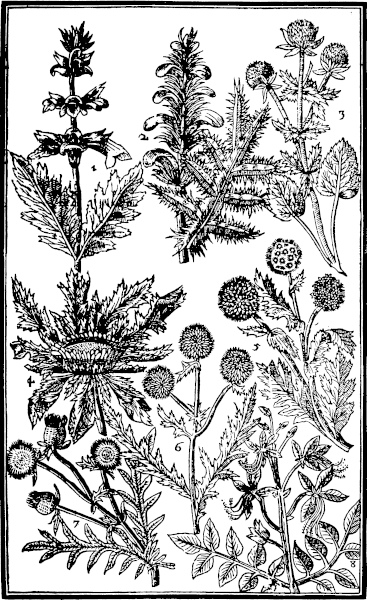
| 1 | Acanthus sativus. Garden Beares breech. |
| 2 | Acanthus siluetris. Wilde Beares breech. |
| 3 | Eryngium Pannonicum. Mountaine Sea Holly. |
| 4 | Carlina humilis. The lowe Carline Thistle. |
| 5 | Carduus sphærocephalus maior. The greater Globe-Thistle. |
| 6 | Carduus sphærocephalus minor. The lesser Globe-Thistle. |
| 7 | Carduus Eriocephalus. The Friers crowne. |
| 8 | Fraxinella. Bastard Dittanie. |
The leaues of this soft and gentle Thistle that are next vnto the ground, are greene
on the vpperside, and hoary vnderneath, broad at the bottome, somewhat long pointed,
and vneuenly notched about the edges, with some soft hairie prickles, not hurting
the handler, euery one standing vpon a short foote-stalke; those that growe about the
middle stalke are like the former, but smaller and narrower, and those next the toppe
smallest, where it diuideth it selfe into small branches, bearing long and scaly heads,
out of which breake many reddish purple threads: the seede is whitish and hard, almost
as great as the seede of the greater Centory: the roote is blackish, spreading vnder
the ground, with many small fibres fastened vnto it, and abideth a great while.
This lowe Thistle hath many iagged leaues, of a whitish greene Colour, armed with
small sharp white prickles round about the edges, lying round about the root vpon the
ground, in the middle whereof riseth vp a large head, without any stalke vnder it, compassed
about with many small and long prickly leaues, from among which the flower
sheweth it selfe, composed of many thin, long, whitish, hard shining leaues, standing
about the middle, which is flat and yellow, made of many thrums or threads like small
flowers, wherein lye small long seede, of a whitish or siluer colour: the roote is somewhat
aromaticall, blackish on the outside, small and long, growing downewards into
the ground. There is another of this kinde that beareth a higher stalke, and a redder
flower, but there is a manifest difference betweene them.
The greatest of these beautifull Thistles, hath at the first many large and long leaues
lying on the ground, very much cut in and diuided in many places, euen to the middle
ribbe, set with small sharpe (but not very strong) thornes or prickles at euery corner of
the edges, greene on the vpperside, and whitish vnderneath: from the middle of these
leaues riseth vp a round stiffe stalke, three foote and a halfe high, or more, set without
order with such like leaues, bearing at the toppe of euery branch a round hard great
head, consisting of a number of sharpe bearded huskes, compact or set close together,
of a blewish greene colour, out of euery one of which huskes start small whitish blew
flowers, with white threads in the middle of them, and rising aboue them, so that the
heads when they are in full flower, make a fine shew, much delighting the spectators:
after the flowers are past, the seede encreaseth in euery one, or the most part of the
bearded huskes, which doe still hold their round forme, yntill that being ripe it openeth
it selfe, and the huskes easily fall away one from another, containing within
them a long whitish kernell: the roote is great and long, blackish on the outside, and
dyeth euery yeare when it hath borne seede.
The lesser kinde hath long narrow leaues, whiter then the former, but cut in and
gashed on the edges very much with some small prickes on them; the stalke is not
halfe so long, nor the heads halfe so great, but as round, and with as blew flowers as the
greater: this seldome giueth ripe seede, but recompenseth that fault, in that the roote
perisheth not as the former, but abideth many yeares.
This woolly Thistle hath many large and long leaues lying on the ground, cut in on
both sides into many diuisions, which are likewise somewhat vnequally cut in or diuided
againe, hauing sharpe white prickles at euery corner of the diuisions, of a dead
or sad greene colour on the vpperside, and somewhat woolly withall, and grayish vnderneath:
the stalke is strong and tall, foure or fiue foote high at the least, branching
out into diuers parts, euery where beset with such like leaues as growe below; at the
toppe of euery branch there breaketh out a great whitish round prickly head, flattish at
the toppe, so thicke set with wooll, that the prickles seeme but small spots or haires,
and doth so well resemble the bald crowne of a Frier, not onely before it be in flower,
but especially after it hath done flowring, that thereupon it deseruedly receiued the
name of the Friers Crowne Thistle: out of these heads riseth forth a purple thrumme,
such as is to be seene in many other wilde Thistles, which when they are ripe, are full
of a flockie or woolly substance, which breake at the toppe shedding it, and the seede
which is blackish, flat, and smooth: the roote is great and thicke, enduring for
some yeares, yet sometimes perishing, if it be too much exposed to the violence of the
frosts in Winter.
The first groweth naturally in Spaine, Italy, and France, and in many other
hot Countries, and growe onely in Gardens in these colder climates,
and there cherished for the beautifull aspect both of the greene plants, and
of the stalkes when they are in flower. The Carline Thistle is found both
in Germany and Italy in many places, and as it is reported, in some places
of the West parts in England. The others are found some in France, some
in Hungary, and on the Alpes, and the last in Spaine.
They doe all flower in the Summer moneths, some a little earlier or later
then others.
The first is called Acanthus sativus (because the other that is prickly, is
called siluestris or spinosus) and Branea vrsina; In English, Branck vrsine,
and Beares breech. The third is called Eryngium montanum, Alpinum, and
Pannonicum latifolium: In English, Mountaine or Hungary Sea Holly. The
fourth is called Carduus mollis, The gentle Thistle, because it hath no harmfull
prickles, although it seeme at the first shew to be a Thistle. The fifth is
called of diuers Chamæleo albus, and Carlina, as if they were both but one
plant; but Fabius Columna hath in my iudgement very learnedly descided
that controuersie, making Carlina to be Ixine of Theophrastus, and Chamæleo
another differing Thistle, which Gaza translateth Vernilago. We call it
in English, The Carline Thistle. The other haue their names in their titles,
as much as is conuenient for this discourse.
The first hath alwaies been vsed Physically, as a mollifying herbe among
others of the like slimie matter in Glisters, to open the body; yet Lobel
seemeth to make no difference in the vse of them both (that is, the prickly
as well as the smooth.) The Carline Thistle is thought to bee good against
poysons and infection. The rest are not vsed by any that I know.
Hauing finished those pleasing Thistles, I come to other plants of more gentle
handling, and first bring to your consideration this bastard Dittany, whereof
there are found out two especiall kindes, the one with a reddish, the other with
a whitish flower, and each of these hath his diuersity, as shall be presently declared.
This goodly plant riseth vp with diuers round, hard brownish stalkes, neare two
foote high, the lower parts whereof are furnished with many winged leaues, somewhat
like vnto Liquerice, or a small young Ashe tree, consisting of seuen, nine, or eleuen
leaues set together, which are somewhat large and long, hard and rough in handling,
of a darkish greene colour, and of an vnpleasant strong resinous sent: the vpper parts
of the stalkes are furnished with many flowers, growing spike fashion, at certaine distances
one aboue another, consisting of fiue long leaues a peece, whereof foure that
stand on the two sides, are somewhat bending vpwards, and the fift hanging downe,
but turning vp the end of the leafe a little againe, of a faint or pale red colour, striped
through euery leafe with a deeper red colour, and hauing in the middle a tassell of fiue
or six long purplish threds, that bowe downe with the lower leafe, and turne vp also
the ends againe, with a little freese or thrume at the ends of euery one: after the flowers
are past, arise hard, stiffe, rough, clammy huskes, horned or pointed at the end, foure or
fiue standing together, somewhat like the seede vessels of the Wolfes-banes, or Colombines,
but greater, thicker and harder, wherein is contained round shining blacke
seede, greater then any Colombine seede by much, and smaller then Peony seede:
the roote is white, large, and spreading many wayes vnder ground, if it stand long: the
whole plant, as well roots as leaues and flowers, are of a strong sent, not so pleasing for
the smell, as the flowers are beautifull to the sight.
This differeth not from the former eyther in roote, leafe or flower for the forme
but that the stalkes and leaues are of a darker greene colour, and that the flowers are of
a deeper red colour, (and growing in a little longer spike), wherein the difference chiefly
consisteth, which is sufficient to distinguish them.
The white flowred Fraxinella hath his leaues and stalkes of a fresher greene colour
then any of the former; and the flowers are of a pure white colour, in forme differing
nothing at all from the other.
The colour of the flower of this Fraxinella onely putteth the difference betweene
this, and the last recited with a white flower: for this beareth a very pale, or whitish
blew flower, tending to an ash colour.
All these kindes are found growing naturally, in many places both of
Germany, and Italie: and that with the white flower, about Franckford,
which being sent me, perished by the way by long and euill carriage.
They flower in Iune and Iuly, and the seede is ripe in August.
The name Fraxinella is most generally imposed on those plants, because
of the resemblance of them vnto young Ashes, in their winged leaues. Yet
some doe call them Dictamus albus, or Dictamnus albus, and Diptamus albus,
as a difference from the Dictamnus Creticus, which is a farre differing plant.
Some would haue it to be Tragium of Dioscorides, but beside other things
wheaten this differeth from Tragium, this yeeldeth no milkie iuice, as Dioscorides
saith Tragium doth: We in English doe eyther call it Fraxinella,
or after the other corrupted name of Dictamus, Bastard Dittanie.
It is held to be profitable against the stingings of Serpents, against contagious
and pestilent diseases, to bring downe the feminine courses, for the
paines of the belly and the stone, and in Epilepticall diseases, and other
cold paines of the braines: the roote is the most effectual for all these,
yet the seede is sometimes vsed.
If I should describe vnto you all the kindes of Pulse, I should vnfold a little world
of varieties therein, more knowne and found out in these dayes, then at any time
before, but that must bee a part of a greater worke, which will abide a longer time
before it see the light. I shall only select those that are fit for this garden, and set them
downe for your consideration. All sorts of Pulse may be reduced vnder two generall
heads, that is, of Beanes and Pease, of each whereof there is both tame and wilde:
Of Beanes, besides the tame or vsuall garden Beane, and the French or Kidney Beane,
(whereof I meane to entreate in my Kitchen garden, as pertinent thereto) there
is the Lupine or flat Beane, whereof I meane to entreate here, and the blacke Beane
and others which must bee reserued for the Physicke Garden. And of the kindes of
Pease some are fit for this Garden; (whereunto I will adioyne two or three other plants
as neerest of affinitie, the flowers of some, and the fruit of others being delightfull
to many, and therefore fit for this garden) some for the Kitchen, the rest for the Physicke
garden. And first of Lupines or flat Beanes, accepted as delightfull to many, and
therefore fit for this garden.
1. Lupinus sativus albus.
The white garden Lupine.
The garden Lupine riseth vp with a great round stalke, hollow and somewhat woolly,
with diuers branches, whereon grow vpon long footestalkes many broade leaues,
diuided into seuen or nine parts, or smaller leaues, equally standing round about, as it
were in a circle, of a whitish greene colour on the vpperside, and more woolly vnderneath:
the flowers stand many together at seuerall ioynts, both of the greater stalke,
and the branches, like vnto beanes, and of a white colour in some places, and in others
of a very bleake blew tending to white: after the flowers are past, there come in their
places, long, broade, and flat rough cods, wherein are contained round and flat seede,
yellowish on the inside, and couered with a tough white skin, and very bitter in taste:
the rootes are not very great, but full of small fibres, whereby it fasteneth it selfe
strongly in the ground, yet perisheth euery yeare, as all the rest of these kindes doe.
2. Lupinus cæruleus maximus.
The greater blew Lupine.
The Stemme or stalke of this Lupine is greater then the last before recited, as also
the leaues more soft and woolly, and the flowers are of a most perfect blew colour,
with some white spots in the middle: the long rough greenish cods are very great and
large, wherein are contained hard, flat and round seede, not so white on the outside as
the former, but somewhat yellower, greater also, and more rough or hard in handling.
3. Lupinus cæruleus minor.
The lesser blew Lupine.
This kinde of wilde Lupine differeth not in the forme of leafe or flower from the
former, but only that it is much smaller, the leaues are greener, and haue fewer diuisions
in them: the flower is of as deepe a blew colour as the last; the cods likewise
are small and long, containing small round seede, not so flat as the former, but more
discoloured or spotted on the outside, then the greater kinde is.
Minimus.
There is a lesser kind
then this, not differing in any thing from this, but that it is lesser.
4. Lupinus flore luteo.
The yellow Lupine.
The yellow Lupine groweth not vsually so high, but with larger leaues then the
small blew Lupine; the flowers grow in two or three rundles or tufts, round about
the stalke and the branches at the ioynts, of a delicate fine yellow colour, like in fashion
vnto the other kindes, being larger then the last, but nothing so large as the
greater kindes, and of a fine small sent: the seede is round, and not very flat, but much about
the forme and bignesse of the small blew, or somewhat bigger, of a whitish colour
on the outside, spotted with many spots.
The Place.
The first groweth in many places of Greece, and the Easterne Countries
beyond it, where it hath beene anciently cherished for their foode, being
often watered to take away the bitternesse. It groweth also in these Western
parts, but still where it is planted. The great blew Lupine is thought to
come from beyond the parts of Persia, in Caramania. The lesser blew is
found very plentifully wilde, in many places both of Spaine and Italy. The
last hath beene brought vs likewise out of Spaine, whereas it is thought it
groweth naturally. They all grow now in the gardens of those, that are
curious louers of these delights.
The Time.
They flower in Summer, and their seede is ripe quickly after.
The Names.
They are generally called Lupini. Plautus in his time saith, they were
vsed in Comedies in stead of money, when in any Scene thereof there
was any shew of payment, and therefore he calleth them Aurum Comicum.
And Horace hath this Verse,
Nec tamen ignorant, quid distent æra Lupinis,
to shew that counterfeit money (such as counters are with vs, or as these Lupines
were vsed in those times) was easily knowne from true and currant
coine. In English wee vsually call them after the Latine name, Lupines;
and some after the Dutch name, Figge-beanes, because they are flat and
round as a Figge that is pressed; and some Flat-beanes for the same reason.
Some haue called the yellow Lupine, Spanish Violets: but other foolish
names haue beene giuen it, as Virginia Roses, and the like, by knauish Gardiners
and others, to deceiue men, and make them beleeue they were the
finders out, or great preseruers of rarities, of no other purpose, but to
cheate men of their money: as you would therefore auoyde knaues and
deceiuers, beware of these manner of people, whereof the skirts of our
towne are too pitifully pestered.
The Vertues.
The first or ordinary Lupine doth scoure and cleanse the skin from spots,
morphew, blew markes, and other discolourings thereof, beeing vsed eyther
in a decoction or pouther. Wee seldome vse it in inward medicines,
not that it is dangerous, but of neglect, for formerly it hath beene much
vsed for the wormes, &c.
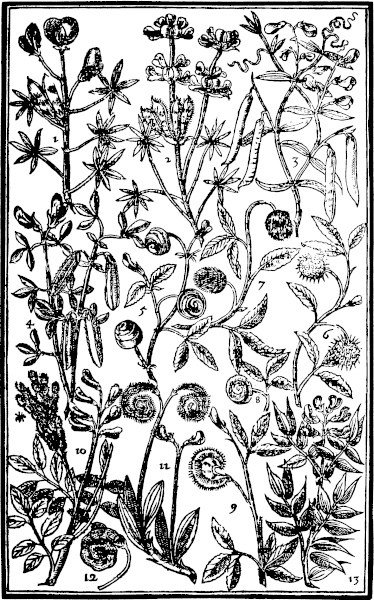
| 1 | Lupinus maior. The great Lupine. |
| 2 | Lupinus luteus. The yellow Lupine. |
| 3 | Lathyrus latifolius seu Pisum perenne. Pease euerlasting. |
| 4 | Pisum quadratum. The crimson blossomd or square Pease. |
| 5 | Medica cochleata vulgaris. Snailes or Barbary buttons. |
| 6 | Medica spinosa. Prickly Snailes. |
| 7 | Medica spinosa altera. Another sort of prickly Snailes. |
| 8 | Medica folliculo lata. Broad buttons or Snailes. |
| 9 | Medica lunata. Halfe Moons. |
| 10 | Hedysarum clypeatum. The red Sattin flower or French Honeysuckle. |
| 11 | Scorpioides minus. The lesser Caterpillar. |
| 12 | Scorpioides maius. The greater Caterpillar. |
| 13 | Orobus Venetus. Blew vpright Pease euerlasting. |
1. Lathyrus latifolius, siue Pisum perenne.
Pease euerlasting.
This kinde of wilde Pease that abideth long, and groweth euery yeare greater then
other, springeth vp with many broade trayling branches, winged as it were on both
the sides, diuersly diuided into other smaller branches, at the seuerall ioynts whereof
stand two hard, not broad, but somewhat long greene leaues, and diuers twining claspers,
in sundry places with the leaues, from betweene the branches and the leaues, at
the ioynts towards the toppes, come forth diuers purplish pease like blossomes, standing
on a long stemme or stalke, very beautifull to behold, and of a pretty sent or
smell: after which come small, long, thin, flat, hard skind cods, containing small round
blackish seede: the roote is great and thicke, growing downe deepe into the ground,
of the thicknesse sometimes of a mans arme, blackish on the outside, and whitish within,
with some branches and a few fibres annexed thereunto.
2. Orobus Venetus.
Blew vpright euerlasting Pease.
This pretty kinde of Pease blossome beareth diuers slender, but vpright greene
branches somewhat cornered, two foote high or thereabouts, hauing at seuerall distances
on both sides of them certaine winged leaues, set together vpon long footestalkes
one against another, consisting of six or eight leaues, somewhat broade and
pointed, and without any odde one at the end: at the ioynts toward the toppes, between
the leaues and the stalkes, come forth many flowers set together at the end of a
pretty long footestalke, of the fashion of the former Pease blossome, but somewhat
smaller, and of a purplish violet colour: after which come slender and long pointed
pods rounder then they, wherein is contained small round grayish pease: the roote is
blacke, hard or woody, abiding after seede bearing as the former doth, and shooting
afresh euery yeare.
3. Lathyrus annuus filiquis orobi.
Partie coloured Cichelings.
This small Pulse or wild Pease, hath two or three long slender winged branches,
with smaller leaues thereon then the former, and without any claspers at all on them:
the flowers stand single, euery one by it selfe, or two at the most together, the middle
leaues whereof that close together are white, and the vpper leaues of a reddish purple
colour: after which come long round flattish cods, bunched out in the seuerall places
where the seedes lye, like vnto the cods of Orobus or the bitter Vetch, but greater: the
roote is small and dyeth euery yeare.
4. Pisum quadratum.
The crimson blossomd or square codded Pease.
This pretty kinde of Pulse might very well for the forme of the leaues, be referred
to the kindes of Lotus or Trefoiles: but because I haue none of that kindred to entreate
of in this Worke, I haue thought fittest to place it here before the Medica’s, because
both pods and seedes are like also. It hath three or foure small weake stalkes, diuided
into many branches, hauing two stalkes of leaues at euery ioynt, and three
small soft leaues standing on a very small stalke, comming from the ioynts: the
flowers stand for the most part two together, of a perfect red or crimson colour, like
in forme almost vnto a Pease blossome; after which come long thicke and round cods,
with two skinnes or filmes, running all along the cod at the backe or vpperside and
two other such like filmes, all along the belly or vnder side, which make it seeme foure
square, wherein there lye round discoloured Pease, somewhat smaller and harder then
ordinary Pease: the roote is small and perisheth euery yeare.
5. Medica Cochleata vulgaris.
Snailes or Barbary buttons.
The plant that beareth these pretty toyes for Gentlewomen, is somewhat like vnto
a Three leafed grasse or Trefoile, hauing many long trayling branches lying vpon the
ground, whereon at diuers places are three small greene leaues, set together at the end
of a little footestalke, each of them a little snipt about the edges: at seuerall distances,
from the middle of these branches to the ends of them, come forth the flowers, two
for the most part standing together vpon a little footstalke, which are of a pale yellow
colour, very small, and of the forme of a Pease blossome: after which come smooth
heads, which are turned or writhen round, almost like a Snaile, hard and greene at the
first, somewhat like a greene button (from the formes of both which came their
names) but afterwards growing whiter, more soft and open, wherein lyeth yellowish
round and flat seede, somewhat like vnto the Kidney beane: the roote is small and
stringie, dying downe euery yeare, and must be new sowne in the spring, if you desire
to haue it.
6. Medica spinosa maior.
Prickly or thorny Snailes, or Buttons.
This kinde of Medica is in all things very like vnto the former, both in the long trayling
branches, & three leaues alwaies growing together, but a little greater pale yellow
flowers, and crooked or winding heads: but herein chiefly consisteth the difference,
that this kinde hath his heads or buttons harder, a little greater, more closed together,
and set with short and somewhat hard prickles, all the head ouer, which being pulled
open, haue those prickles standing on each side of the filme or skinne, whereof the
head consisteth, somewhat like vnto a fish bone, and in this kinde goeth all one way;
in which are contained such like seedes for the forme, as are in the former, but great
and blacke, and shining withall.
7. Medica spinosa altera.
Small thorney Buttons, or Snailes.
This other kinde is also like vnto the last described in all other things, except in the
heads or buttons, which are a little smaller, but set with longer and softer prickes vpon
the filmes, and may easily bee discerned to goe both forwards and backewards, one
enterlacing within another, wherein are contained such like flat and blacke shining
seede, made after the fashion of a kidney, as are in the former, but somewhat smaller:
the roote perisheth in like manner euery yeare.
8. Medica lata.
Broade Buttons.
This kinde differeth not from the first in leafe or flower, the fruite onely hereof is
broade and flat, and not so much twined as it.
9. Medica Lunata.
Halfe Moones.
This is also a kinde of these Medicke fodders, hauing a trefoyle leafe and yellow
flowers like the former sorts, but both somewhat larger, the chiefest difference consisteth
in the head or fruite, which is broade and flat, and not twined like the rest, but
abideth halfe closed, resembling a halfe Moone (and thereupon hath assumed both the
Latine and English name) wherein is contained flat seede, kidney fashion like the former.
10. Hedysarum clypeatum.
The red Sattin flower.
This red flowred Fitchling, hath many stalkes of winged faire greene leaues, that is,
of many set on both sides a middle ribbe, whereof that at the end is the greatest of
the rest: from the ioynts where the leaues stand, come forth pretty long small stalkes,
bearing on them very many flowers, vp to the toppe one aboue another, of an excellent
shining red or crimson colour, very like vnto Sattin of that colour, and sometimes
of a white colour, (as Master William Coys, a Gentleman of good respect in
Essex, a great and ancient louer and cherisher of these delights, and of all other rare
plants, in his life time assured me; he had growing in his garden at Stubbers by North
Okenden) which are somewhat large, and more closed together, almost flat and
not open, as in most of the other sorts: after the flowers are past, there come
rough, flat, round huskes, somewhat like vnto the old fashioned round bucklers without
pikes, three or foure standing one vpon or aboue another, wherein are contained
small brownish seede: the roote perisheth the same yeare it beareth seede, for oftentimes
it flowreth not the first yeare it is sowne.
11. Scorpioides maius & minus.
Great and small Caterpillers.
Vnder one description I comprehend both these sorts of Scorpions grasse, or Caterpillers,
or Wormes, as they are called by many, whereof the greater hath been known
but of late yeares; and ioyne them to these pulses, not hauing a fitter place where to
insert them. It is but a small low plant, with branches lying vpon the ground, and
somewhat long, broad, and hard leaues thereon, among which come forth small stalkes,
bearing at the end for the most part, two small pale yellowish flowers, like vnto Tares
or Vetches, but smaller, which turne into writhed or crooked tough cods; in the greater
sort they are much thicker, rounder and whiter, and lesser wound or turned together
then in the smaller, which are slenderer, more winding, yet not closing like vnto
the Snailes, and blacker more like vnto a Caterpiller then the other, wherein are
contained brownish yellow seede, much like vnto a Medica: the rootes of both are
small and fibrous, perishing euery yeare.
The Place.
These are found seuerally in diuers and seuerall places, but wee sow and
plant them vsually to furnish our Gardens.
The Time.
They doe all flower about the moneths of Iune and Iuly, and their seede
is ripe soone after: but the second is earlier then the rest.
The Names.
The first is called Clymenum of Matthiolus, and Lathyris of Lobel and others:
but Lathyris in Greeke is Cataputia in Latine, which is our Spurge,
farre differing from this Pulse; and therefore Lathyrus is more proper to
distinguish them asunder, that two plants so farre vnlike should not bee
called by one name: this is also called Lathyrus latifolius, because there
is another called angustifolius, that differeth from it also: It is most vsually
called with vs, Pisum perenne, and in English Pease blossome, or Pease euerlasting.
The second is called by Clusius, Orobus venetus, because it was sent
him from Venice, with another of the same kinde that bore white flowers;
yet differeth but little or nothing from that kinde he found in Hungary, that
I thinke the seuerall places of their growing only cause them to bear seuerall
names, and to be the same in deede. Although I yeeld vnto Clusius the
Latine name which doth not sufficiently content mee; yet I haue thought
good to giue it a differing English name, according as it is in the title. The
third, because I first receiued it among other seeds from Spaine, I haue giuen
it the name, as it is entituled. The fourth is called of some Sandalida Cretica,
& Lotus filiquosus flore rubello, Lotus tetragonolobus, Pisum rubrum, & Pisum
quadratum: We vsually call it in English, Crimson Pease, or square Pease.
The Medica Cochleata is called of Dodonæus Trifolium Cochleatum, but not
iudged to be the true Medica. Wee call it in English, Medick fodder, Snailes
Clouer, or as it is in the title, and so the rest of the Medica’s accordingly.
The Hedysarum clypeatum or Securidaca is called of Dodonæus Onobrichis
altera, and we in English for the likenesse, The red Sattin flower, although
some foolishly call it, the red or French Honysuckle. The last is called by
Lobel, Scorpioides bupleurifolio, I haue called it minus, because the greatest
sort which came to me out of Spaine was not knowne vnto him; in English
they are generally called Caterpillers.
The Vertues.
The Medica’s are generally thought to feede cattell fat much more then
the Medow Trefoile, or Clouer grasse, and therefore I haue known diuers
Gentlemen that haue plowed vp some of their pasture grounds, and sowen
them with the seedes of some Medica’s to make the experience. All the other
sorts are pleasures to delight the curious, and not any way profitable
in Physicke that I know.
There are two principall kindes of Peonie, that is to say, the Male and the Female.
Of the male kinde, I haue onely known one sort, but of the Female a
great many; which are thus to be distinguished. The male his leafe is whole,
without any particular diuision, notch or dent on the edge, & his rootes long & round,
diuided into many branches, somewhat like to the rootes of Gentian or Elecampane,
and not tuberous at all. The Female of all sorts hath the leaues diuided or cut in on the
edges, more or lesse, and hath alwaies tuberous rootes, that is, like clogs or Asphodill
rootes, with many great thick round peeces hanging, or growing at the end of smaller
strings, and all ioyned to the toppe of the maine roote.
The Male Peonie riseth vp with many brownish stalkes, whereon doe grow winged
leaues, that is, many faire greene, and sometimes reddish leaues, one set against another
vpon a stalke, without any particular diuision in the leafe at all: the flowers stand at
the toppes of the stalkes, consisting of fiue or six broade leaues, of a faire purplish red
colour, with many yellow threds in the middle, standing about the head, which after
riseth to be the seede vessels, diuided into two, three or foure rough crooked pods like
hornes, which when they are ful ripe, open and turn themselues down one edge to another
backeward, shewing within them diuers round black shining seede, which are the
true seede, being full and good, and hauing also many red or crimson graines, which are
lancke and idle, intermixed among the blacke, as if they were good seede, whereby it
maketh a very pretty shew: the roots are great, thick and long, spreading in the ground,
and running downe reasonable deepe.
This ordinary Female Peonie hath many stalkes, with more store of leaues on them
then the Male kinde hath, the leaues also are not so large, but diuided or nicked diuersly
on the edges, some with great and deepe, and others with smaller cuts or diuisions,
and of a darke or dead greene colour: the flowers are of a strong heady sent,
most vsually smaller then the male, and of a more purple tending to a murrey colour,
with yellow thrumes about the head in the middle, as the male kinde hath: the heads
or hornes with seed are like also but smaller, the seede also is blacke, but lesse shining:
the rootes consist, as I said, of many thicke and short tuberous clogs, fastened at the
ends of long strings, and all from the head of the roote, which is thicke and short, and
tuberous also, of the same or the like sent with the male.
This double Peonie as well as the former single, is so frequent in euerie
Garden of note, through euery Countrey, that it is almost labour in vaine
to describe it: but yet because I vse not to passe ouer any plant so slightly, I will set
down the description briefly, in regard it is so common. It is very like unto the former
single female Peony, both in stalkes and leaues, but that it groweth somewhat higher,
and the leaues are of a fresher greene colour: the flowers at the tops of the stalkes are
very large, thicke and double (no flower that I know so faire, great, and double; but
not abiding blowne aboue eight or ten daies) of a more reddish purple colour then
the former female kinde, and of a sweeter sent: after these flowers are past, sometimes
come good seed, which being sowne, bring forth some single flowers, and some double:
the rootes are tuberous, like vnto the former female.
The single blush Peony hath his stalkes higher, and his leaues of a paler or whiter
greene colour then the double blush, and more white vnderneath (so that it is very probable
it is of another kinde, and not risen from the seede of the double blush, as some
might thinke) with many veines, that are somewhat discoloured from the colour of
the leafe running through them: the flowers are very large and single, consisting of
fiue leaues for the most part, of a pale flesh or blush colour, with an eye of yellow dispersed
or mixed therewith, hauing many whitish threads, tipt with yellow pendents
standing about the middle head: the rootes are like the other female Peonies.
The double blush Peony hath not his stalkes so high as the double red, but somewhat
lower and stiffer, bearing such like winged leaues, cut in or diuided here and there
in the edges, as all these female kindes are, but not so large as the last: the flowers are
smaller, and lesse double by a good deale then the former double red, of a faint shining
crimson colour at the first opening, but decaying or waxing paler euery day: so that
after it hath stood long (for this flower sheddeth not his leaues in a great while) it will
change somewhat whitish; and therefore diuers haue ignorantly called it, the double
white Peony: the seedes, which sometimes it beareth, and rootes, are like vnto the
former female kindes, but somewhat longer, and of a brighter colour on the outside.
This red Peony of Constantinople is very like in all things vnto the double red Peonie,
but that the flowers hereof are single, and as large as the last, and that is larger
then either the single female, or the male kinde, consisting of eight leaues, of a deeper
red colour then either the single or double Peonies, and not purplish at all, but rather
of the colour of an ordinary red Tulipa, standing close and round together: the roots
of this kinde haue longer clogs, and not so short as of the ordinary female kinde, and
of a paler colour on the outside.
All these Peonies haue beene sent or brought from diuers parts beyond
the Seas; they are endenized in our Gardens, where wee cherish them for
the beauty and delight of their goodly flowers, as well as for their Physicall
vertues.
They all flower in May, but some (as I said) abide a small time, and others
many weekes.
[343]
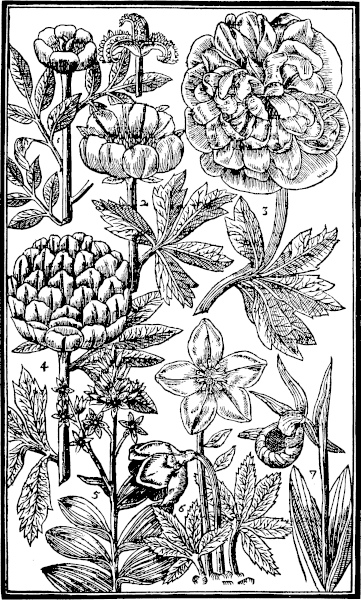
| 1 | Pæonia mas cum semine. The male Peony & the seed. |
| 2 | Pæonia fæmina Byzantina. The female red Peony of Constantinople. |
| 3 | Pæonia fæmina flore pleno vulgaris. The ordinary double Peony. |
| 4 | Pæonia flore pleno albicante. The double white Peony. |
| 5 | Helleborus vernus atrorubente flore. The early white Ellebor with a darke red flower. |
| 6 | Helleborus niger verus. The Christmas flower. |
| 7 | Calceolus Mariæ. Our Ladies Slipper. |
The name Pæonia is of all the later Writers generally giuen to these
plants, although they haue had diuers other names giuen by the elder Writers,
as Rosa fatuina, Idæus dactylus, Aglaophotis, and others, whereof to set
downe the causes, reasons, and errours, were to spend more time then I intend
for this worke. Wee call them in English, Peonie, and distinguish
them according to their titles.
The male Peony roote is farre aboue all the rest a most singular approued
remedy for all Epilepticall diseases, in English, The falling sicknesse
(and more especially the greene roote then the dry) if the disease be not too
inueterate, to be boyled and drunke, as also to hang about the neckes of the
younger sort that are troubled herewith, as I haue found it sufficiently experimented
on many by diuers. The seede likewise is of especiall vse for women,
for the rising of the mother. The seede of the female kinde, as well
as the rootes, are most vsually sold, and may in want of the other be (and
so are generally) vsed.
There are three sorts of blacke Hellebor or Beares foote, one that is the true and
right kinde, whose flowers haue the most beautifull aspect, and the time of his
flowring most rare, that is, in the deepe of Winter about Christmas, when no
other can bee seene vpon the ground: and two other that are wilde or bastard kindes,
brought into many Gardens for their Physicall properties; but I will only ioyne one
of them with the true kinde in this worke, and leaue the other for another.
The true blacke Hellebor (or Beare foote as some would call it, but that name doth
more fitly agree with the other two bastard kindes) hath many faire greene leaues rising
from the roote, each of them standing on a thicke round fleshly stiffe greene stalke,
about an hand breadth high from the ground, diuided into seuen, eight, or nine parts
or leaues, and each of them nicked or dented, from the middle of the leafe to the pointward
on both sides, abiding all the Winter, at which time the flowers rise vp on such
short thicke stalkes as the leaues stand on, euery one by it selfe, without any leafe
thereon for the most part, or very seldome hauing one small short leafe not much vnder
the flower, and very little higher then the leaues themselues, consisting of fiue
broad white leaues, like vnto a great white single Rose (which sometimes change to
be either lesse or more purple about the edges, as the weather or time of continuance
doth effect) with many pale yellow thrummes in the middle, standing about a greene
head, which after groweth to haue diuers cods set together, pointed at the ends like
hornes, somewhat like the seede vessels of the Aconitum hyemale, but greater & thicker,
wherein is contained long, round, and blackish seede, like the seede of the bastard
kindes: the rootes are a number of brownish strings running downe deepe into the
ground, and fastened to a thicke head, of the bignesse of a finger at the toppe manie
times, and smaller still downewards.
The smaller Beare foote is in most things like vnto the former true blacke Hellebor;
for it beareth also many leaues vpon short stalkes, diuided into many leaues also, but
each of them are long and narrow, of a blacker greene colour, snipt or dented on both
edges, which feele somewhat hard or sharpe like prickes, and perish euery yeare, but
rise againe the next Spring: the flowers hereof stand on higher stalkes, with some
leaues on them also, although but very few, and are of a pale, greene colour, like in
forme vnto the flowers of the former, but smaller, hauing also many greenish yellow
threads or thrums in the middle, and such like heads or seede vessels, and blackish seed:
the rootes are stringie and blackish like the former.
The first groweth onely in the Gardens of those that are curious, and delight
in all sorts of beautifull flowers in our Countrey, but wilde in many
places of Germany, Italy, Greece, &c.
The other groweth wilde in many places of England, as well as the other
greater sort, which is not here described; for besides diuers places within
eight or ten miles from London, I haue seen it in the Woods of Northamptonshire,
and in other places.
The first of these plants doth flower in the end of December, and beginning
of Ianuary most vsually, and the other a moneth or two after, and
sometime more.
The first is called Helleborus, or Elleborus niger verus, and is the same that
both Theophrastus and Dioscorides haue written of, and which was called
Melampodion, of Melampus the Goateheard, that purged and cured the mad
or melancholicke daughters of Prætus with the rootes thereof. Dodonæus
calleth it Veratrum nigrum primum, and the other secundum: Wee call it in
English, The true blacke Hellebor, or the Christmas flower, because (as I
said) it is most commonly in flower at or before Christmas. The second is
a bastard or wilde kinde thereof, it so nearely resembleth the true, and is
called of most of the later Writers, Pseudoelleborus niger minor, or Helleboraster
minor, for a distinction betweene it and the greater, which is not here
described: and is called in English, The smaller or lesser Beare foote, and
most vsed in Physicke, because it is more plentifull, yet it is more churlish and
strong in operation then the true or former kinde.
The rootes of both these kindes are safe medecines, being rightly prepared,
to be vsed for all Melancholicke diseases, whatsoeuer others may feare
or write, and may be without danger applied, so as care and skill, and not
temerary rashnesse doe order and dispose of them.
The powder of the dryed leaues, especially of the bastard kinde, is a sure
remedy to kill the wormes in children, moderately taken.
There are two sorts of great white Ellebors or Neeseworts, whereas there was
but one kinde knowne to the Ancients; the other being found out of later
dayes: And although neither of both these haue any beauty in their flowers,
yet because their leaues, being faire and large, haue a goodly prospect, I haue inserted
them in this place, that this Garden should not be vnfurnished of them, and you
not vnacquainted with them.
The first great white Ellebor riseth at the first out of the ground, with a whitish
greene great round head, which growing vp, openeth it selfe into many goodly faire
large greene leaues, plaited or ribbed with eminent ribbes all along the leaues, compassing
one another at the bottome, in the middle whereof riseth vp a stalke three foot
high or better, with diuers such like leaues thereon, but smaller to the middle thereof;
from whence to the toppe it is diuided into many branches, hauing many small yellowish,
or whitish greene starre-like flowers all along vpon them, which after turne
into small, long, three square whitish seede, standing naked, without any huske to containe
them, although some haue written otherwise: the roote is thicke and reasonable
great at the head, hauing a number of great white strings running downe deepe into
the ground, whereby it is strongly fastened.
This other Ellebor is very like the former, but that it springeth vp a moneth at the
least before it, and that the leaues are not fully so thicke or so much plaited, but as large
or larger, and doe sooner perish and fall away from the plant: the stalke hereof is as
high as the former, bearing such like starry flowers, but of a darke or blackish red colour:
the seede is like the other: the roote hath no such head as the other (so farre as I
haue obserued, both by mine own and others plants) but hath many long white strings
fastened to the top, which is as it were a long bulbous scaly head, out of which spring
the leaues.
The first groweth in many places of Germany, as also in some parts of
Russia, in that aboundance, by the relation of that worthy, curious, and diligent
searcher and preseruer of all natures rarities and varieties, my very
good friend, Iohn Tradescante, often heretofore remembred, that, as hee
said, a good ship might be loaden with the rootes hereof, which hee saw in
an Island there.
The other likewise groweth in the vpland wooddy grounds of Germanie,
and other the parts thereabouts.
The first springeth vp in the end or middle of March, and flowreth in
Iune. The second springeth in February, but flowreth not vntill Iune.
The first is called Elleborus albus, or Helleborus albus, the letter H, as all
Schollers know, being but aspirationis nota: and Veratrum album flore viridante,
of some Sanguis Herculis. The other is called Elleborus albus præcox,
and flore atrorubente, or atropurpurante. We call the first in English, White
Ellebor, Neesewort, or Neesing roote, because the powder of the roote is
vsed to procure neesing; and I call it the greater, in regard of those in the
next Chapter. The other hath his name according to the Latine title, most
proper for it.
The force of purging is farre greater in the roote of this Ellebor, then in
the former; and therefore is not carelessly to bee vsed, without extreame
danger; yet in contumatious and stubborne diseases it may bee vsed with
good caution and aduice. There is a Syrupe or Oxymel made hereof in the
Apothecaries shops, which as it is dangerous for gentle and tender bodies,
so it may be very effectuall in stronger constitutions. Pausanias in Phocicis,
recordeth a notable stratagem that Solon vsed in besieging the Citie of
Cirrheus, viz. That hauing cut off the riuer Plistus from running into the
Citie, he caused a great many of these rootes to be put into a quantity thereof,
which after they had steeped long enough therein, and was sufficiently
infected therewith, he let passe into the Citie againe: whereof when they
had greedily drunke, they grew so weake and feeble by the superpurgation
thereof, that they were forced to leaue their wals vnmand, and not guarded,
whereby the Amphyctions their enemies became masters of their Citie.
The like stratagems are set downe by diuers other Authors, performed by
the helpe of other herbes.
The likenesse of the leaues of these plants, rather then any other faculty with
the former white Ellebor, hath caused them to be called Elleborine, as if they
were smaller white Ellebors. And I for the same cause haue ioyned them next,
whereof there are found many sorts: One which is the greater kinde, is of greatest
beauty; the other which are lesser differ not much one from another, more then in the
colour of the flowers, whereof I will onely take three, being of the most beautie,
and leaue the rest to another worke.
This most beautifull plant of all these kindes, riseth vp with diuers stalkes, a foote
and a halfe high at the most, bearing on each side of them broad greene leaues, somewhat
like in forme vnto the leaues of the white Ellebor, but smaller and not so ribbed,
compassing the stalke at the lower end; at the tops of the stalkes come forth one, or
two, or three flowers at the most, one aboue another, vpon small short foote-stalkes,
with a small leafe at the foote of euery stalke: each of these flowers are of a long ouall
forme, that is, more long then round, and hollow withall, especially at the vpper part,
the lower being round and swelling like a belly: at the hollow part there are two small
peeces like eares or flippets, that at the first doe couer the hollow part, and after stand
apart one from another, all which are of a fine pale yellow colour, in all that I haue
seene (yet it is said there are some found, that are more browne or tending to purple)
there are likewise foure long, narrow, darke coloured leaues at the setting on of the
flower vnto the stalke, wherein as it were the flower at the first standeth: the whole
flower is of a pretty small sent: the seede is very small, very like vnto the seede of the
Orchides or Satyrions, and contained in such like long pods, but bigger: the roots are
composed of a number of strings enterlacing themselues one within another, lying
within the vpper crust of the earth, & not spreading deep, of a darke brownish colour.
This smaller wilde white Ellebor riseth vp in the like manner vnto the former, and
not much lower, bearing such like leaues, but smaller, and of a winter greene colour,
almost of the colour and fashion of the leaues of Lilly Conually; the top of the stalke
hath many more flowers, but lesser, growing together, spike-fashion, with small short
leaues at the stalke of euery flower, which consisteth of fiue small white leaues, with a
small close hood in the middle, without any sent at all; the seede and seede vessels are
like vnto the former, but smaller: the rootes are many small strings, dispersing themselues
in the ground.
The leaues of this kinde are like vnto the last described, but somewhat narrower:
the stalkes and flowers are alike, but smaller also, and of a pale purplish or blush colour,
which causeth the difference.
The first groweth in very many places of Germany, and in other Countries
also. It groweth likewise in Lancashire, neare vpon the border of
Yorkeshire, in a wood or place called the Helkes, which is three miles from
Ingleborough, the highest Hill in England, and not farre from Ingleton, as
I am informed by a courteous Gentlewoman, a great louer of these delights,
called Mistris Thomasin Tunstall, who dwelleth at Bull-banke,
neare Hornby Castle in those parts, and who hath often sent mee vp the
rootes to London, which haue borne faire flowers in my Garden. The Second
groweth in many places of England, and with the same Gentlewoman
also before remembred, who sent me one plant of this kinde with the other.
The last I haue not yet knowne to growe in England; but no doubt many
things doe lye hid, and not obserued, which in time may bee discouered, if
our Country Gentlemen and women, and others, in their seuerall places
where they dwell, would be more carefull and diligent, and be aduertised
either by themselues, or by others capable and fit to be imployed, as occasion
and time might serue, to finde out such plants as growe in any the circuits
or limits of their habitations, or in their trauels, as their pleasures or
affaires leade them. And because ignorance is the chiefe cause of neglect
of many rare things, which happen to their view at sometimes, which are
not to be seene againe peraduenture, or not in many yeares after, I would
heartily aduise all men of meanes, to be stirred vp to bend their mindes, and
spend a little more time and trauell in these delights of herbes and flowers,
then they haue formerly done, which are not onely harmlesse, but pleasurable
in their time, and profitable in their vse. And if any would be better
enformed, and certified of such things they know not, I would be willing
and ready to my best skill to aduertise them, that shall send any thing vp to
me where I dwell in London. Thus farre I haue digressed from the matter
in hand, and yet not without some good vse I hope, that others may make
of it.
The two first flower earlier then the last, and both the first about one
time, that is, in the end of Aprill, or beginning of May. The last in the
end of May, or in Iune.
The first is called Elleborine recentiorum maior, and Calceolus Mariæ: Of
some thought to be Cosmosandalos, because it is Sandali forma. In English we
call it our Ladies Slipper, after the Dutch name. The other two lesser kinds
haue their names in their titles: I haue thought it fit to adde the title of small
white Ellebors vnto these, for the forme sake, as is before said.
There is no vse of these in Physicke in our dayes that I know.
The remembrance of the Conuall Lilly, spoken of in the precedent Chapter,
hath caused me to insert these plants among the rest, although differing both
in face and properties; but lest it should lose all place, let it keepe this. It is of
two sorts, differing chiefly in the colour of the flowers, the one being white, and the
other reddish, as shall be shewed in their descriptions following.
The white Conuall or May Lilly, hath three or foure leaues rising together from
the roote, one enclosed within another, each whereof when it is open is long and
broad, of a grayish shining greene colour, somewhat resembling the leaues of the former
wilde Neesewort, at the side whereof, and sometime from the middle of them,
riseth vp a small short naked foote-stalke, an hand breadth high or somewhat more,
bearing at the toppe one aboue another many small white flowers, like little hollow
bottles with open mouths, nicked or cut into fiue or six notches, turning all downewards
one way, or on one side of the stalke, of a very strong sweete sent, and comfortable
for the memory and senses, which turne into small red berries, like vnto Asparagus,
wherein is contained hard white seede: the rootes runne vnder ground, creeping
euery way, consisting of many small white strings.
This other May Lilly differeth neither in roote, leafe, nor forme of flower from that
before, but onely in the colour of the flower, which is of a fine pale red colour, being
in my iudgement not altogether so sweet as the former.
The first groweth aboundantly in many places of England. The other is
a stranger, and groweth only in the Gardens of those that are curious louers
of rarities.
They both flower in May, and the berries are ripe in August.
The Latines haue no other name for this plant but Lilium Conuallium, although
some would haue it to be Lilium vernum of Theophrastus, and others
Oenanthe of the same Author. Gesner thinketh it to be Callionymus.
Lonicerus to be Cacalia, and Fuchsius to be Ephemerum non lethale: but they
are all for the most part mistaken. We call it in English Lilly Conually, May
Lilly, and of some Liriconfancie.
The flowers of the white kinde are often vsed with those things that help
to strengthen the memory, and to procure ease to Apoplecticke persons.
Camerarius setteth downe the manner of making an oyle of the flowers
hereof, which he saith is very effectuall to ease the paines of the Goute, and
such like diseases, to be vsed outwardly, which is thus: Hauing filled a glasse
with the flowers, and being well stopped, set it for a moneths space in an
Ants hill, and after being drayned cleare, set it by to vse.
There are diuers sorts of Gentians or Fell-wortes, some greater, others lesser,
and some very small; many of them haue very beautifull flowers, but because
some are very suddenly past, before one would thinke they were blowne open,
and others will abide no culture and manuring, I will onely set forth vnto you two of
the greater sorts, and three of the lesser kindes, as fittest, and more familiarly furnishing
our gardens, leauing the rest to their wilde habitations, and to bee comprehended
in a generall Worke.
The great Gentian riseth vp at the first, with a long, round and pointed head of
leaues, closing one another, which after opening themselues, lye vpon the ground,
and are faire, long and broad, somewhat plaited or ribbed like vnto the leaues of white
Ellebor or Neeseworte, but not so fairely or eminently plaited, neyther so stiffe, but
rather resembling the leaues of a great Plantane: from among which riseth vp a stiffe
round stalke, three foote high or better, full of ioynts, hauing two such leaues, but
narrower and smaller at euery ioynt, so compassing about the stalke at the lower end
of them, that they will almost hold water that falleth into them: from the middle of
the stalke to the toppe, it is garnished with many coronets or rundles of flowers, with
two such greene leaues likewise at euery ioynt, and wherein the flowers doe stand,
which are yellow, layd open like starres, and rising out of small greenish huskes, with
some threds in the middle of them, but of no sent at all, yet stately to behold, both
for the order, height and proportion of the plant: the seede is browne and flat, contained
in round heads, somewhat like vnto the seede of the Fritillaria, or checkerd
Daffodill, but browner: the rootes are great, thicke and long, yellow, and exceeding
bitter.
This kinde of Gentian hath many stalkes rising from the roote, neere two foote
high, whereon grow many faire pale greene leaues, set by couples, with three ribs in
euery one of them, and doe somewhat resemble the leaues of Asclepias or Swallow-wort,
that is, broade at the bottome, and sharpe at the point: the flowers grow at the
seuerall ioynts of the stalkes, from the middle vpwards, two or three together, which
are long and hollow, like vnto a bell flower, ending in fiue corners, or pointed leaues,
and folded before they are open, as the flowers of the Bindeweedes are, of a faire
blew colour, sometimes deeper, and sometimes paler: the heads or seede vessels haue
two points or hornes at the toppes, and containe within them flat grayish seed, like vnto
the former, but lesse: the rootes hereof are nothing so great as the former, but are
yellow, small and long, of the bignesse of a mans thumbe.
This small Gentian hath many branches lying vpon the ground, scarce lifting themselues
vpright, and full of ioynts, whereat grow vsually foure leaues, one opposite
vnto another, in manner of a Crosse, from whence it tooke his name, in shape very like
vnto Saponaria or Sopewort, but shorter, and of a darker greene colour: at the tops of
the stalkes stand many flowers, thick thrusting together, and likewise at the next ioynt
vnderneath, euery one of them standing in a darke blewish greene huske, and consisting
of fiue small leaues, the points or ends whereof only appeare aboue the huskes
wherein they stand, and are hardly to be seene, but that they are of a fine pale blew colour,
and that many grow together: the seed is small and brown, hard, and somewhat
like vnto the seed of the Marian Violets, or Couentry bels: the roots are small and whitish,
dispersing themselues diuersly in the ground, of as bitter a taste almost as the rest
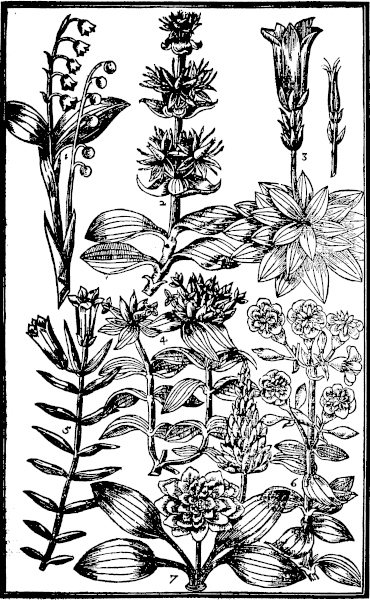
| 1 | Lilium Conuallium. Liricon fancy or Lilly Conually. |
| 2 | Gentiana maior. The great Gentian. |
| 3 | Gentianella verna. Small Gentian of the Spring. |
| 4 | Gentiana Cruciata. Crossewort Gentian. |
| 5 | Pneumonanthe seu Gentiana Autumnalis. Autumne Gentian. |
| 6 | Saponaria flore duplici. Double flowred Sopewort. |
| 7 | Plantago Rosea. Rose Plantane. |
[352]
The small Gentian of the Spring hath diuers small hard greene leaues, lying vpon
the ground, as it were in heads or tufts, somewhat broade below, and pointed at the
end, with fiue ribs or veines therein, as conspicuous as in the former Gentians, among
which riseth vp a small short stalke, with some smaller leaues thereon, at the toppe
whereof standeth one faire, large, hollow flower, made bell fashion, with wide open
brimmes, ending in fiue corners or diuisions, of the most excellent deepe blew colour
that can be seene in any flower, with some white spots in the bottome on the inside:
after the flower is past, there appeare long and round pods, wherein are contained
small blackish seede: the rootes are small, long, pale yellow strings, which shoot forth
here and there diuers heads of leaues, and thereby encrease reasonable well, if it finde
a fit place, and ground to grow, or else will not be noursed vp, with all the care and diligence
can be vsed: the whole plant is bitter, but not so strong as the former.
This Gentian that flowreth in Autumne, hath in some places higher stalkes then in
others, with many leaues thereon, set by couples as in other Gentians, but long and
narrow, yet shewing the three ribbes or veines that are in each of them: the toppes of
the stalkes are furnished euery one with a flower or two, of an excellent blew purple
colour, ending in fiue corners, and standing in long huskes: the rootes are somewhat
great at the top, and spreading into many small yellow strings, bitter as the rest are.
Vnto these kindes of Gentians, I must needes adde these following plants, for that
the former is of some neere resemblance in leafe with some of the former. And because
the ordinary Sopeworte or Bruiseworte with single flowers is often planted in
Gardens, and the flowers serue to decke both the garden and the house; I may vnder
the one describe them both: for this with double flowers is farre more rare, and of
greater beautie. It hath many long and slender round stalkes, scarce able to sustaine
themselues, and stand vpright, being ful of ioynts and ribbed leaues at them, euery one
somewhat like a small Gentian or Plantane leafe: at the toppes of the stalkes stand
many flowers, consisting of two or three rowes of leaues, of a whitish or pale purple
colour, and of a strong sweet sent, somewhat like the smell of Iasmin flowers, standing
in long and thicke pale greene huskes, which fall away without giuing any seede, as
most other double flowers doe that encrease by the roote, which spreadeth within the
ground, and riseth vp in sundry distant places like the single.
This other plant is in all things like vnto the ordinary Plantane or Ribworte, that
groweth wilde abroade in many places, whose leaues are very large: but instead of
the long slender spike, or eare that the ordinary hath, this hath eyther a thicke long
spike of small greene leaues vpon short stalkes, or else a number of such small greene
leaues layd round-wise like vnto a Rose, and sometimes both these may be seene vpon
one and the same roote, at one and the same time, which abide a great while fresh vpon
the roote, and sometimes also giueth seede, especially from the more long and slender
spikes.
Some of these Gentians grow on the toppes of hils, and some on the sides
and foote of them in Germany and other Countreyes: some of them also
vpon barren heaths in those places, as also in our owne Countrey, especially
the Autumne Gentian, and as it is reported, the Vernall likewise. The
single or ordinary Sopeworte is found wilde in many places with vs, but
the double came to vs from beyond the Sea, and is scarce known or heard
of in England. The Rose Plantaine hath beene long in England, but whether
naturall thereof or no, I am not assured.
They flower for the most part in Iune and Iuly, but the small Gentian of
the Spring flowreth somewhat earlier, and that of the Autumne in August
and September.
Gentiana is the generall name giuen to the Gentians. We call them in English
Gentian, Fellworte, Bitterwort, and Baldmoney. Saponaria taketh his
name from the scouring qualitie it hath: Wee call it in English Sopewort,
and in some places Bruisewort. Some haue thought it to bee Struthium of
Dioscorides, or at least haue vsed it for the same causes, but therein they
are greatly deceiued, as Matthiolus hath very well obserued thereon, and
so is Dodonæus, that thought it to be Alisma. The Rose Plantaine is so called
of the double spikes it carrieth.
The wonderfull wholsomnesse of Gentian cannot bee easily knowne to
vs, by reason our daintie tastes refuse to take thereof, for the bitternesse
sake: but otherwise it would vndoubtedly worke admirable cures, both
for the liuer, stomacke and lunges. It is also a speciall counterpoison against
any infection, as also against the violence of a mad dogges tooth: wilde
Sopewort is vsed in many places, to scoure the countrey womens treen, and
pewter vessels, and physically some make great boast to performe admirable
cures in Hydropicall diseases, because it is diureticall, and in Lue Veneria,
when other Mercuriall medicines haue failed. The Rose Plantaine no
doubt hath the same qualities that the ordinary hath.
Under the title of Bell-flowers are to bee comprehended in this Chapter, not
only those that are ordinarily called Campanula, but Viola Mariana, and Trachelium
also, whereof the one is called Couentry, the other Canterbury Bells.
The Peach-leafed Bell-flower hath many tufts, or branches of leaues lying vpon the
ground, which are long and narrow, somewhat like vnto the leafe of an Almond or
Peach tree, being finely nicked about the edges, and of a sad greene colour, from among
which rise vp diuers stalkes, two foote high or more, set with leaues to the middle,
and from thence vpwards, with many flowers standing on seuerall small foote-stalkes,
one aboue another, with a small leafe at the foote of euery one; the flowers
stand in small greene huskes, being small and round at the bottome, but wider open at
the brimme, and ending in fiue corners, with a three forked clapper in the middle, set
about with some small threds tipt with yellow, which flowers in some plants are pure
white, and in others of a pale blew or watchet colour, hauing little or no sent at all:
the seede is small, and contained in round flat heads, or seede vessels: the roote is very
small, white and threddy, creeping vnder the vpper crust of the ground, so that oftentimes
the heat and drought of the Summer will goe near to parch and wither it vtterly:
it requireth therefore to be planted in some shadowie place.
This great Bell-flower hath diuers stalkes, three foote high or better, whereon grow
diuers smooth, darke, greene leaues, broade at the bottome, and small at the point,
somewhat vneuenly notched about the edges, and standing vpon longer footestalkes
below then those aboue: the flowers are blew, and in some white, not so great or
large as the former, but neare of the same fashion, growing thicker and more plentifully
together, with smaller leaues among them, burning thicke below, and rising smaller
and thinner vp to the toppe, in fashion of a Pyramis or speere Steeple: the roote is
thicke and whitish, yeelding more store of milke being broken (as the leaues and stalks
also doe) then any other of the Bell-flowers, euery one whereof doe yeelde milke,
some more and some lesse.
The leaues of Couentry Bels are of a pale or fresh greene colour, long, and narrow
next vnto the bottome, and broader from the middle to the end, and somewhat round
pointed, a little hairy all ouer, and snipt about the edges: the stalkes rise vp the yeare
after the sowing, being somewhat hairy also, and branching forth from the roote, into
diuers parts, whereon stand diuers leaues, smaller then the former, and of a darker
greene colour: at the end of euery branch stand the flowers, in greene huskes, from
whence come large, round, hollow Bels, swelling out in the middle, and rising somewhat
aboue it, like the necke of a pot, and then ending in fiue corners, which are either
of a faire or faint white, or of a pale blew purplish colour, and sometimes of a deeper
purple or violet: after the flowers are past, there rise vp great square, or cornered seede
vessels, wherein is contained in diuers diuisions, small, hard, shining, browne, flat seeds:
the roote is white, and being young as in the first yeares sowing, is tender, and often
eaten as other Rampions are; but the next yeare, when it runneth vp to seede, it groweth
hard, and perisheth: so that it is to be continued by euery other yeares sowing.
The greater Canterbury Bels, or Throateworte, hath many large rough leaues,
somewhat like vnto Nettle leaues, being broad and round at the bottome, and pointed
at the end, notched or dented on the edges, and euery one standing on a long footstalk:
among these leaues rise vp diuers square rough stalkes, diuided at the toppe into diuers
branches, whereon grow the like leaues as grow below, but lesser; toward the ends of
the branches stand the flowers, mixed with some longer leaues, euery one in his seuerall
huske, which are hollow, long and round, like a bell or cup, wide open at the mouth,
and cut at the brimme into fiue corners, or diuisions, somewhat lesser then the Couentry
Bels, in some of a pure white, and others of a faire deepe purple violet colour,
and sometimes paler: after the flowers are past, come smaller and rounder heades
then in the former, containing flat seede, but blacker, and not so redde as the last:
the roote is hard and white, dispersing it selfe into many branches vnder ground,
not perishing euery yeare as the former (although it loseth all the leaues in winter) but
abiding many yeares, and encreasing into diuers heades or knobs, from whence spring
new leaues and branches.
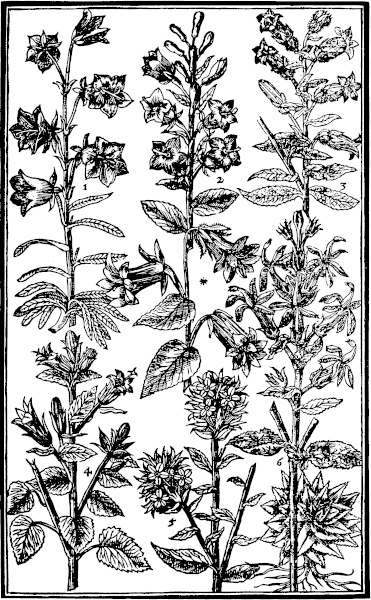
| 1 | Campanula persicifolia. Peach leafed Bell-flower. |
| 2 | Trachelium maius simplex. Canterbury Bels. |
| * | Trachelium flore duplici. Double Canterbury Bels. |
| 3 | Viola Mariana. Couentry Bels. |
| 4 | Trachelium Giganteum. Giants Throatewort. |
| 5 | Trachelium minus. The lesser Throatewort. |
| 6 | Trachelium Americanum siue Cardinalis planta. The rich crimson Cardinals flower. |
Of this kinde of Throateworte or Canterbury Bels, there is another sort, not differing
in any thing from the former, but in the doublenesse of the flower: For there
is of both the kindes, one that beareth double white flowers, and the other blew: Of
each whereof I receiued plants from friends beyond the Sea, which grow well with me.
This Bell-flower, although it hath a Gigantine name, yet did I neuer perceiue it in
my garden, to rise vp higher then the former, the epithite beeing in my perswasion,
only giuen for difference sake: the leaues whereof are not so rough, but as large, and
dented about the edges, somewhat larger pointed, and of a fresher greene colour: the
stalkes beare such like leaues on them, but more thinly or dispersedly set, hauing a
flower at the setting on of euery one of the leaues, from the middle vpwards, and are
somewhat like the great Throateworte in forme, but of a pale or bleake reddish purple
colour, turning the brims or corners a little backwards, with a forked clapper in
the middle, sufficient eminent and yellow: the seede hereof is white, and plentifull
in the heads, which will abide all the winter vpon the stalkes, vntill all the seede being
shed, the heads remaining seeme like torne rags, or like thin peeces of skin, eaten with
wormes: the roote is great, thicke and white, abiding long without perishing.
Flore albo.
There is another which differeth not any thing but in the flower, which is white.
The lesser Throateworte hath smaller leaues, nothing so broade or hard as the former
great kinde, but long, and little or nothing dented about the edges: the stalkes are
square and brownish, if it beare purple flowers, and greene if it beare white flowers,
which in forme are alike, and grow in a bush or tuft, thicke set together, more then any
of the former, and smaller also, being not much bigger then the flowers of the fielde,
or garden Rampions: the roote is lasting, and shooteth afresh euery yeare.
This braue plant, from a white roote spreading diuers wayes vnder ground, sendeth
forth many greene leaues, spread round about the head thereof, each whereof is somewhat
broade and long, and pointed at the end, finely also snipt about the edges; from
the middle whereof ariseth vp a round hollow stalke, two foote high at the least, beset
with diuers such leaues as grow below, but longer below then aboue, and branching
out at the toppe aboundantly, euery branch bearing diuers greene leaues on them, and
one at the foote of euery of them also, the toppes whereof doe end in a great large
tuft of flowers, with a small greene leafe at the foote of the stalke of euery flower,
each footestalke being about an inch long, bearing a round greene huske, diuided into
fiue long leaues or points turned downwards, and in the midst of euery of them a most
rich crimson coloured flower, ending in fiue long narrow leaues, standing all of them
foreright, but three of them falling downe, with a long vmbone set as it were at the
backe of them, bigger below, and smaller aboue, and at the toppe a small head, being
of a little paler colour then the flower, but of no sent or smell at all, commendable only
for the great bush of so orient red crimson flowers: after the flowers are past, the
seede commeth in small heads, closed within those greene husks that held the flowers,
which is very like vnto the seede vessels of the Viola Mariana, or Couentry Bels, and
is small and brownish.
All these Bell-flowers do grow in our Gardens, where they are cherished
for the beautie of their flowers. The Couentry Bels doe not grow wilde in
any of the parts about Couentry, as I am credibly informed by a faithfull
Apothecary dwelling there, called Master Brian Ball, but are noursed in
Gardens with them, as they are in other places. The last groweth neere the
riuer of Canada, where the French plantation in America is seated.
They flower from May vntill the end of Iuly or August, and in the mean
time the seed is ripe: But the Peache-leafed Bell-flowers, for the most part,
flower earlier then the other.
The first is generally called Campanula Perficifolia, in English Peach-leafed
Bell-flower. The second is called Campanula maior, Campanula lactescens Pyramidalis,
and Pyramidalis Lutetiana of Lobel, in English, Great or Steeple
Bell-flower. The third is vsually called Viola Mariana, and of some Viola
Marina. Lobel putteth a doubt whether it be not Medium of Dioscorides,
as Matthiolus and others doe thinke; but in my opinion the thicknesse of
the roote, as the text hath it, contradicteth all the rest. We call it generally
in English Couentry Bels. Some call it Marian, and some Mercuries Violets.
The fourth and fift are called Trachelium or Cervicaria, of some Vvularia,
because many haue vsed it to good purpose, for the paines of the Vvula, or
Throate: Yet there is another plant, called also by some Vvularia, which
is Hippoglossum, Horse tongue, or Double tongue. The sixt hath his title to
descipher it out sufficiently, as is declared. The seuenth is called Trachelium
minus, and Ceruicaria minor, of some Saponaria altera; in English, Small
Throateworte, or Small Canterbury Bels. The last hath his name in the title,
as it is called in France, from whence I receiued plants for my Garden
with the Latine name: but I haue giuen it in English.
The Peach-Bels as well as the others may safely bee vsed in gargles and
lotions for the mouth, throate, or other parts, as occasion serueth. The
rootes of many of them, while they are young, are often eaten in sallets
by diuers beyond the Seas.
There are two other kindes of Bell-flowers, much differing from the Tribe
or Familie of the former, because of their climbing or winding qualitie,
which I must needes place next them, for the likenesse of the flowers, although
otherwise they might haue beene placed with the other clamberers that
follow. Of these there is a greater, and a lesser, and of each likewise some difference,
as shall be declared.
This goodly plant riseth vp with many long and winding branches, whereby it
climbeth and windeth vpon any poles, herbes, or trees, that stand neare it within a
great compasse, alwaies winding it selfe contrary to the course of the Sunne: on these
branches doe growe many faire great round leaues, and pointed at the end, like vnto a
Violet leafe in shape, but much greater, of a sad greene colour: at the ioynts of the
branches, where the leaues are set, come forth flowers on pretty long stalkes, two or
three together at a place, which are long, and pointed almost like a finger, while they
are buds, and not blowne open, and of a pale whitish blew colour, but being blowne
open, are great and large bels, with broad open mouths or brims ending in fine corners,
and small at the bottome, standing in small greene huskes of fine leaues: these
flowers are of a very deepe azure or blew colour, tending to a purple, very glorious to
behold, opening for the most part in the euening, abiding so all the night and the next
morning, vntill the Sunne begin to growe somewhat hot vpon them, and then doe
close, neuer opening more: the plant carrieth so many flowers, if it stand in a warme
place, that it will be replenished plentifully, vntill the cold ayres and euenings stay
the luxury thereof: after the flowers are past, the stalkes whereon the flowers did
stand, bend downwards, and beare within the huskes three or foure blacke seedes, of
the bignesse of a Tare or thereabouts: the rootes are stringy, and perish euery yeare.
The growing and forme of this Bindeweede or Bell-flower, is all one with the former,
the chiefest differences consisting in the forme of the leafe, which in this is three
cornered, like vnto an Iuie leafe with corners; and in the flower, which is of a deeper
blew, tending more to a deepe purple Violet, and somewhat more reddish in the fiue
plaites of each flower, as also in the bottomes of the flowers.
Although this rare plant (because wee seldome haue it, and can as hardly keepe it)
be scarce knowne in these cold Countries, yet I could not but make mention of it, to
incite those that haue conueniencie to keepe it, to be furnished of it. It springeth vp
at the first from the seede with two leaues, with two long forked ends, which abide a
long time before they perish, betweene which riseth vp the stalke or stemme, branching
forth diuers waies, being of a brownish colour, which windeth it selfe as the
former great Bell-flower doth, whereon are set at seuerall ioynts diuers winged leaues,
that is to say, many small narrow and long leaues set on both sides of the middle ribbe,
and one at the end: from these ioynts arise long stalkes, at the ends whereof stand two
or three small, long, hollow flowers, fashioned very like vnto the flowers of a Bindeweede,
or the flowers of Tabacco, and ending in the like manner in fiue points, but
not so much laide open, being of a bright red colour, plaited as the Bindeweedes or
Bell-flowers before they be open, with some few threads in the middle, which turne
into long pointed cods, wherein is contained long and blacke seede, tasting hot like
Pepper: the roote is small and stringy, perishing euery yeare, and with vs will seldome
come to flower, because our cold nights and frosts come so soone, before it can
haue comfort enough of the Sun to ripen it.
This small Bindeweede hath small long leaues, somewhat broader then the next
that followeth, and not so broad as the common small Bindeweede (that groweth
euery where wilde on the bankes of fields abroad) set vpon the small trayling branches,
which growe aboue two or three foote high: from the middle of these branches,
and so vnto the toppes of them, come forth the flowers at the ioynts with the
leaues, folded together at the first into fiue plaites, which open into so many corners,
of a most excellent faire skie coloured blew (so pleasant to behold, that often it amazeth
the spectator) with white bottomes, and yellowish in the middle, which turne
into small round white heads, wherein are contained small blackish cornered seede,
somewhat like the former, but smaller: the roote is small and threddy, perishing as
the former euery yeare: this neuer windeth it selfe about any thing, but leaneth by
reason of the weaknesse of the branches, and dyeth euery yeare after seede time, and
not to be sowne againe vntill the next Spring.
This small purple Bindeweede, where it naturally groweth, is rather a plague then
a pleasure, to whatsoeuer groweth with it in the fields; yet the beauty of the flower
hath caused it to be receiued into Gardens, bearing longer and smaller leaues then the
last, and such like small Bell-flowers, but of a sad purple colour: the roote is liuing,
as the common kinds are, and springeth againe where it hath been once sowne, without
feare of perishing.
The first two greater kindes haue beene sent vs out of Italy, but whether
they had them from the East Indies, or from some of the Easterne Countries
on this side, wee know not: but they thriue reasonable well in our
Country, if the yeare be any thing kindly. The next came out of America,
as his name testifieth. The lesser blew kinde groweth naturally in many
places both of Spaine and Portugall (from whence I first receiued seedes
from Guillaume Boel, heretofore remembred.) The last groweth wilde in
the fields, about Dunmowe in Essex, and in many other places of our
owne Countrey likewise.
The three first greater kindes flower not vntill the end of August, or
thereabouts, and the seede ripeneth in September, if the colds and frosts
come not on too speedily. The lesser kindes flower in Iune and Iuly.
The first is called of some Campana Lazura, as the Italians doe call it, or
Campana cærulea, of others Convolvulus cæruleus maior, siue Indicus, and Flos
noctis. Of some Nil Auicennæ. The second, is called Convolvulus trifolius,
or hederaceus, for the distinction of the leaues. In English wee call them eyther
Great blew Bell flowers, or more vsually, Great blew Bindeweedes.
That of America is diuersly called by diuers. It is called Quamoclit of the
Indians, and by that name it was sent to Ioachinus Camerarius out of Italy,
where it is so called still, as Fabius Columna setteth it downe, and as my
selfe also can witnesse it, from thence being so sent vnto mee: but Andræas
Cæsalpinus calleth it, Iasminum folio Millefolij, supposing it to be a Iasmine.
Camerarius saith, it may not vnfitly be called Convolvulus tenuifolius, accounting
it a kinde of Bindeweede. Columna entituleth it Convolvulus pennatus
exoticus rarior, and saith it cannot bee referred to any other kinde of
plant then to the Bindeweede. Hee that published the Curæ posteriores of
Clusius, giueth it the name of Iasminum Americanum, which I would doe
also, if I thought it might belong to that Family; but seeing the face and
forme of the plant better agreeing with the Bindeweedes or Bell-flowers,
I haue (as you see) inserted it among them, and giuen it that name may bee
most fit for it, especially because it is but an annuall plant. The lesser kindes
haue their names sufficiently expressed in their titles.
We know of no vse these haue in Physicke with vs, although if the first
be Nil of Auicen, both he and Serapio say it purgeth strongly.
Vnto the Bell-flowers, I must adioyne three other plants, in the three seuerall
Chapters following, for some affinity of the flowers: and first of the Thorne-Apples,
whereof there are two especiall kindes, that is, a greater and a lesser,
and of each some diuersity, as shall be set downe.
The greater Thorne-Apple hath a great, strong, round greene stalke, as high as any
man, if it be planted in good ground, and of the bignesse of a mans wrest almost at the
bottome, spreading out at the toppe into many branches, whereon stand many very
large and broad darke greene leaues, cut in very deeply on the edges, and hauing manie
points or corners therein: the flowers come forth at the ioynts, betweene two
branches towards the toppe of them, being very large, long, and wide open, ending
in fiue points or corners, longer and larger then any other Bell-flowers whatsoeuer:
after the flowers are past, come the fruit, which are thorny long heads, more prickly
and greene then the lesser kindes, which being ripe openeth it selfe into three or foure
parts, hauing a number of flat blackish seede within them: the roote is aboundant in
fibres, whereby it strongly taketh hold in the ground, but perisheth with the first
frosts; yet the seede that is shed when the fruit is ripe, commeth vp the next yeare.
This purple Thorne-Apple is in largenesse of leaues, thicknesse and height of stalke,
greatnesse and forme of flowers and fruit, euery way equall and correspondent vnto
the former, the chiefe differences be these: the stalke is of a darke purple colour; the
leaues are of a darker greene, somewhat purplish, and the flowers are of light purple
or pale Doue colour, enclining to white, and whiter at the bottome.
The smaller Thorne-Apple riseth vp with one round stalke, of the bignesse of a
mans finger, and neuer much aboue two foote high with vs, bearing a few large, broad,
smooth leaues thereon, without any branches at all, which are vneuenly rent or torne
about the edges, with many ribs, and smaller veines running through them, yet lesser
by much then the greater kinde: at the ioynts where the leaues stand, come forth
long and large white flowers, with broad or wide open brims, folded together before
their opening, as the other former Bell-flowers or Bindeweedes, but hauing their fiue
corners more pointed or horned then either they, or the former Thorne-Apples: after
the flowers are past, succeed small fruit, rounder and harder, set with harder, but
blunt prickes then the former, wherein is contained brownish yellow flat seede,
sticking to the inward pulpe; the roote is not very great, but full of strings, and
quickly perisheth with the first frosts.
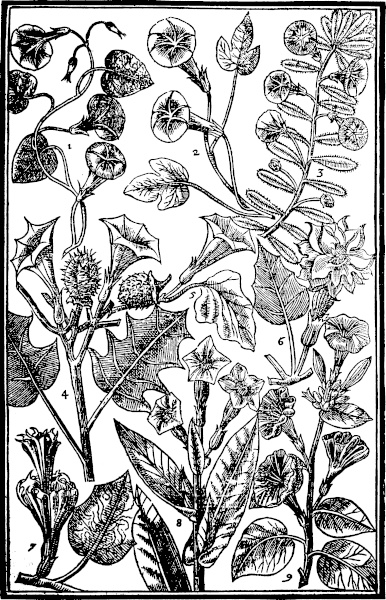
| 1 | Convolvulus maior cæruleus. The greater blew Bindweed or Bell flower. |
| 2 | Convolvulus trifolius seu hederaceus. The great purple Bindeweed. |
| 3 | Convolvulus minor cæruleus Hispanicus. The Spanish small blew Bindweed. |
| 4 | Stramonium maius seu Pomum spinosum. The great Thorne-Apple. |
| 5 | Datura seu Stramonium minus. The small Thorne-Apple. |
| 6 | Stramonium flore duplici. The double flowred Thorne-Apple. |
| 7 | Stramonium flore geminato. Double Thorne-Apple one out of another. |
| 8 | Tabacco latifolium. Broad-leafed Tabacco. |
| 9 | Mirabilia Peruana. The Meruaile of the world. |
In the flower of this plant, consisteth the chiefest difference from the former, which
is as large as the last, pointed into more hornes or corners, and beareth two flowers,
standing in one huske, one of them rising out from the middle of the other, like vnto
those kindes of Cowslips and Oxelips, called double, or Hose in hose, before described,
which are of a pale purplish colour on the outside, and almost white within: the
fruit is round like the last, and beareth such like seede, so that vntill it bee in flower,
their difference can hardly bee discerned: this is more tender then the last, although
euen it is so tender, that it seldome beareth ripe seede with vs.
Flore duplici.
Sometimes (for I think it is not another kind) the flower will haue as it were double
rowes of leaues, close set together, and not consisting of two, rising so distinctly one
aboue another.
All these kindes haue been brought or sent vs out of Turkie and Egypt;
but Garcias, and Christopherus Acosta, with others, affirme that they grow
in the East Indies. The lesser kindes are very rare with vs, because they seldome
come to maturity; and therefore we are still to seeke of new seede to
sowe. The greater kindes are plentifull enough in our Gardens, and will
well abide, and giue ripe fruit.
The smaller kindes flower later then the greater; and therefore their
fruit are the sooner spoyled with the cold ayres, dewes, and frosts, that
come at the latter end of the yeare: but the greater kinds neuer misse lightly
to ripen.
Both the greater and smaller kindes are generally called Stramonium,
Stramonia, Pomum spinosum, and Datura. Bauhinus vpon Matthiolus his
Comentaries on Dioscorides, calleth it Solanum fætidum spinosum. Some
learned men haue referred it to Nux Metel, of the Arabian Authors. Wee
call them generally, in English, Thorne-Apples, and distinguish them by
their titles of greater and letter, single and double.
The East Indian lasciuious women performe strange acts with the seed (of
the smaller kinde, as I suppose, or it may be of either) giuing it their husbands
to drinke. The whole plant, but especially the seed, is of a very cold
and soporiferous quality, procuring sleep and distraction of senses. A few
of the seeds steeped and giuen in drinke, will cause them that take it to seem
starke drunke or dead drunke, which fit will within a few houres weare away,
and they recouer their senses againe, as a drunken man raysed after
sleep from his wine. It may therefore (in my opinion) be of safe and good
vse to one, that is to haue a legge or an arme cut off, or to be cut for the stone,
or some other such like cure to be performed, to take away the sense of paine
for the time of doing it; otherwise I hold it not fit to be vsed without great
caution. But the greene leaues of the greater kindes (as also the lesser, but
that with vs they are not so plentifull) are by tryed experience, found to be
excellent good for any scalded or burned part, as also to take away any hot
inflammations, being made vp into a salue or ointment with suet, waxe, and
rossin, &c. or with Axungia, that is, Hogs larde.
There hath beene formerly but three kindes of Tabacco knowne vnto vs, two
of them called Indian, and the third English Tabacco. In these later yeares, we
haue had in our gardens about London (before the suppressing of the planting)
three or foure other sorts at the least, and all of the Indian kinde, hauing some especiall
difference, eyther in leafe, or flower, or both: And in regard the flowers of some
of these carry a pretty shew, I shall only entreate of them, and not of the English kind.
The great Indian Tabacco hath many very large, long, thicke, fat and faire greene
leaues, standing foreright for the most part, and compassing the stalkes at the bottome
of them, being somewhat pointed at the end: the stalke is greene and round, sixe or
seuen foote high at sometimes, and in some places, in others not past three or foure
foote high, diuided towards the toppe into many branches, with leaues at euery ioynt,
and at the toppes of the branches many flowers, the bottomes hereof are long and
hollow, and the toppes plaited or folded before they are open, but being open, are
diuided sometimes into foure, or more vsually into fiue corners, somewhat like vnto
other of the Bell-flowers, but lying a little flatter open, of a light carnation colour.
The seede is very small and browne, contained in round heads, that are clammy while
they are greene, and pointed at the end: the roote is great, whitish, and woody at the
head, dispersing many long branches, and small fibres vnder the ground, whereby it is
strongly fastened, but perisheth with our violent frosts in the winter, if it be left abroad
in the garden, but if it be housed, or safely prouided for against the frostes, the rootes
will liue, and spring afresh the next yeare.
There is of this kinde another sort, whose leaues are as large and long as the former,
but thicker, and of a more dead greene colour, hanging downe to the ground-ward,
and scarce any standing forth-right, as the former, vnlesse they bee very young: the
flowers of this kinde are almost whole, without any great shew of corners at the brims
or edges, in all other things there is no difference.
There is another, whose large and thicke flat leaues doe compasse the stalke at the
bottome, and are as it were folded together one side vnto another: the flowers are of a
deeper blush, or carnation colour, and with longer points and corners then in any of
the former; and in these two things consisteth the difference from the others, and is
called Verines Tabacco.
Another hath his leaues not so large and long as the first, and these haue short footestalkes,
whereon they stand, and doe not compasse the stalke as the other doe: the
flower hereof is like the first, but smaller, and of a little paler colour.
This kinde of Tabacco hath somewhat lower, and smaller stalkes, then any of the
former: the leaues hereof are smaller and narrower, and not altogether so thicke,
but more pointed, and euery one standing vpon a footstalke, an inch and a halfe long
at the least: the flowers hereof stand thicker together, vpon the small branches, somewhat
larger, of a deeper blush colour, and more eminent corners then in any the former;
the seed and roots are alike, and perish in like manner, vnlesse it be brought into
a cellar, or other such couert, to defend it from the extremitie of the Winter.
America or the West Indies is the place where all these kindes doe grow
naturally, some in one place, and some in another, as in Peru, Trinidado,
Hispaniola, and almost in euery Iland and Countrey of the continent thereof:
with vs they are cherished in gardens, as well for the medicinable qualities,
as for the beauty of the flowers.
It flowreth in August, seldome before, and the seede is ripe quickly after.
If it once sowe it selfe in a Garden, it will giue next year after young plants:
but for the most part they will spring vp late, and therefore they that would
haue them more early, haue sowen the seede vpon a bed of dung, and
transplanted them afterwards.
This plant hath gotten many names. The Indians call it in some places
Petum, in others, Picielt, and Perebecenuc, as Ouiedus and others doe relate.
The Spaniards in the Indies first called it Tabacco, of an Iland where plenty
of it grew. It hath in Christendome receiued diuers other names, as Nicotiana,
of one Nicot a French man, who seeing it in Portugall, sent it to the
French Queene, from whom it receiued the name of Herba Regina. Lobel
calleth it Sancta herba, & Sanasancta Indorum. Some haue adiudged it to be
an Hioscyamus, and therefore call it Peruvianus. The most vsuall name wherby
we call it in English, is Tabacco.
The herbe is, out of question, an excellent helpe and remedy for diuers
diseases, if it were rightly ordered and applyed, but the continuall abuse
thereof in so many, doth almost abolish all good vse in any. Notwithstanding
if men would apply their wits to the finding out of the vertues, I make
no doubt but many strange cures would bee performed by it, both inward
and outward. For outward application, a Salue made hereof (as is before recited
of the Thorne apple leaues) cureth vlcers, and wounds of hard curation:
And for inward helpes, a Syrupe made of the iuice and sugar, or honey,
procureth a gentle vomit (but the dryed leafe infused in wine much
more) and is effectuall in astmaticall diseases, if it bee carefully giuen. And
likewise cleanseth cankers and fistulaes admirably, as hath beene found by
late experience. The ashes of Tabacco is often vsed, and with good successe,
for cuts in the hands, or other places, and for other small greene
wounds.
This plant yeeldeth in our Gardens fiue or sixe seuerall varieties of beautifull
flowers, as pure white, pure yellow, pure red, white and red spotted, and red
and yellow spotted. But besides these, I haue had some other sorts, among
which was one, of a pale purple or peach colour: all which, comming vnto mee out
of Spaine with many other, seedes in an vnkindly yeare (an early winter following a
cold summer) perished with mee; yet I plainely might discerne by their leaues, and
manner of growing, to be diuers from them that we now haue and keepe. I shall need
therefore (because the chiefest difference consisteth almost in the flowers) to giue only
one description of the plant, and therein shew the varieties as is before declared.
The stalke of this meruellous plant is great and thick, bigger then any mans thumbe,
bunched out or swelling at euery ioynt, in some the stalkes will bee of a faire greene
colour, and those will bring white, or white and red flowers: in others they will bee
reddish; and more at the ioynts, and those giue red flowers; and in some of a darker
greene colour, which giue yellow flowers; the stalkes and ioynts of those that will
giue red and yellow flowers spotted, are somewhat brownish, but not so red as those
that giue wholly red flowers: vpon these stalkes that spread into many branches, doe
grow at the ioynts vpon seuerall footestalkes, faire greene leaues, broad at the stalke,
and pointed at the end: at the ioynts likewise toward the vpper part of the branches,
at the foote of the leaues, come forth seuerall flowers vpon short footestalkes, euery
one being small, long and hollow from the bottome to the brimme, which is broade
spread open, and round, and consist but of one leafe without diuision, like vnto a Bell
flower, but not cornered at all: which flowers, as I said, are of diuers colours, and
diuersly marked and spotted, some being wholly white, without any spot in them for
the most part, through all the flowers of the plant; so likewise some being yellow,
and some wholly red; some plants againe being mixed and spotted, so variably either
white and red, or purple, (except here and there some may chance to be wholly white,
or red or purple among the rest) or red and yellow through the whole plant, (except
as before some may chance in this kinde to be eyther wholly red, or wholly yellow)
that you shall hardly finde two or three flowers in a hundred, that will bee alike
spotted and marked, without some diuersitie, and so likewise euery day, as long as they
blow, which is vntill the winters, or rather autumnes cold blastes do stay their willing
pronenesse to flower: And I haue often also obserued, that one side of a plant will
giue fairer varieties then another, which is most commonly the Easterne, as the more
temperate and shadowie side. All these flowers doe open for the most part, in the
euening, or in the night time, and so stand blowne open, vntill the next mornings sun
beginne to grow warme vpon them, which then close themselues together, all the
brims of the flowers shrinking into the middle of the long necke, much like vnto the
blew Bindeweede, which in a manner doth so close vp at the sunnes warme heate: or
else if the day be temperate and milde, without much sunne shining vpon them, the
flowers will not close vp for the most part of that day, or vntill toward night: after
the flowers are past, come seuerall seedes, that is, but one at a place as the flowers stood
before, of the bignesse (sometimes) of pease, but not so round, standing within the
greene huskes, wherein the flowers stood before, being a little flat at the toppe, like a
crowne or head, and round where it is fastened in the cup, of a blacke colour when it
is ripe, but else greene all the while it groweth on the stalke, and being ripe is soone
shaken downe with the wind, or any other light shaking: the roote is long and round,
greater at the head, and smaller downwards to the end, like vnto a Reddish, spreading
into two or three, or more branches, blackish on the outside and whitish within.
These rootes I haue often preserued by art a winter, two or three (for they will perish
if they be left out in the garden, vnlesse it be vnder a house side) because many times,
the yeare not falling out kindely, the plants giue not ripe seede, and so we should be to
seeke both of seede to sow, and of rootes to set, if this or the like art to keep them,
were not vsed; which is in this manner: Within a while after the first frosts haue taken
the plants, that the leaues wither and fall, digge vp the rootes whole, and lay them
in a dry place for three or foure dayes, that the superfluous moysture on the outside,
may be spent and dryed, which done, wrap them vp seuerally in two or three browne
papers, and lay them by in a boxe, chest or tub, in some conuenient place of the house
all the winter time, where no winde or moist ayre may come vnto them; and thus you
shall haue these rootes to spring a fresh the next yeare, if you plant them in the beginning
of March, as I haue sufficiently tryed. But some haue tryed to put them vp into
a barrell or firkin of sand, or ashes, which is also good if the sand and ashes be thorough
dry, but if it bee anything moist, or if they giue againe in the winter, as it is vsuall,
they haue found the moisture of the rootes, or of the sand, or both, to putrefie the
rootes, that they haue beene nothing worth, when they haue taken them forth. Take
this note also for the sowing of your seede, that if you would haue variable flowers,
and not all of one colour, you must choose out such flowers as be variable while they
grow, that you may haue the seede of them: for if the flowers bee of one entire colour,
you shall haue for the most part from those seedes, plants that will bring flowers
all of that colour, whether it be white, red or yellow.
These plants grow naturally in the West Indies, where there is a perpetuall
summer, or at the least no cold frosty winters, from whence the seede
hath been sent into these parts of Europe, and are dispersed into euery
garden almost of note.
These plants flower from the end of Iuly sometimes, or August, vntill
the frosts, and cold ayres of the euenings in October, pull them down, and
in the meane time the seed is ripe.
Wee haue not receiued the seedes of this plant vnder any other name,
then Mirabilia Peruvians, or Admirabilis planta. In English wee call them,
The meruaile of Peru, or the meruaile of the world: yet some Authors
haue called it Gelseminum, or Iasminum rubrum, & Indicum: and Bauhinus
Solanum Mexicanum flore magno.
We haue not knowne any vse hereof in Physicke.
Of the kindred of Mallowes there are a great number, some of the gardens, others
wilde, some with single flowers, others with double, some with whole
leaues, others with cut or diuided: to entreate of them all is not my purpose,
nor the scope of this worke, but onely of such whose flowers, hauing beautie and respect,
are fit to furnish this garden, as ornaments thereunto. And first of those single
kindes, whose flowers come neerest vnto the fashion of the former Bell-flowers, and
after to the double ones, which for their brauery, are entertained euery where into euery
Countrey womans garden.
The Spanish Mallow is in forme and manner of growing, very like vnto our common
fielde Mallow, hauing vpright stalkes two or three foote high, spread into diuers
branches, and from the bottome to the toppe, beset with round leaues, like vnto our
Mallowes, but somewhat smaller, rounder, and lesse diuided, yet larger below then
aboue: the flowers are plentifully growing vpon the small branches, folding or writhing
their leaues one about another before they bee blowne, and being open consist
of fiue leaues, with a long forked clapper therein, of the same colour with the flower:
the chiefest difference from the common consisteth in this, that the leaues of these
flowers are longer, and more wide open at the brimmes (almost like a Bell flower)
and of a faire blush or light carnation colour, closing at night, and opening all the
day: after the flowers are past, there come such like round heads, with small blacke
seede, like vnto the common kinde, but somewhat smaller: the roote is small and long,
and perisheth euery yeare.
[367]
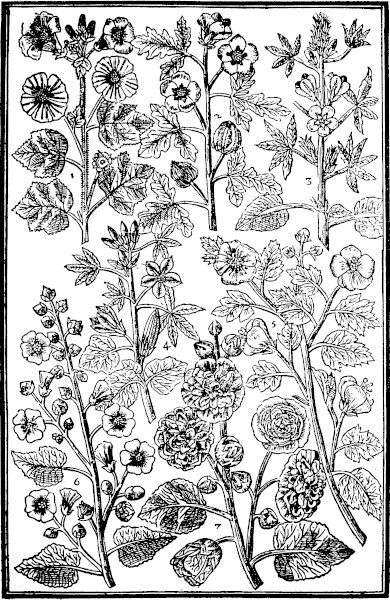
| 1 | Malua Hispanica flore carneo amplo. The Spanish Mallow. |
| 2 | Alcea Veneta. The Venice Mallow. |
| 3 | Alcea Americana. Thorney Mallow. |
| 4 | Alcea Ægyptia. The Mallow of Egypt. |
| 5 | Althea frutex. The shrubbe Mallow. |
| 6 | Malua hortensis simplex. Single Hollihockes. |
| 7 | Malua rosea multiplex. Double Hollihockes. |
There is a Mallow that hath long stalkes, and flowers like vnto the common wilde
Mallow, and of the same deepe colour with it, so that you can hardly know it from
the ordinary kinde, which is found growing wilde together with it, but onely by
the leafe, which is as round and as large as the former, but cut into many fine diuisions,
euen to the stalke that vpholdeth it, that it seemeth to consist onely of ragges,
or peeces of leaues: Of this kinde I take a plante for this garden, growing in all
respects like vnto it, but differing onely in the colour of the flowers, which are of the
same blush or light carnation colour, or not much differing from the former Spanish
kinde, with some veines therein of a deeper colour: the root hereof liueth, as the root
of the common wilde kinde doth.
The Venice Mallow hath long and weake stalkes, most vsually lying or leaning
vpon the ground, hauing here and there vpon them long leaues and somewhat broad,
cut in or gashed very deepely on both edges, that it seemeth as if they were diuers
leaues set together, euery one standing on a long footestalke: at the ioynts of these
stalkes, where the leaues are set, come forth seuerall flowers, standing vpon long footstalkes,
which are somewhat larger then any of the former flowers, consisting of fiue
leaues, small at the bottome, and wide at the brimmes, of a whitish colour tending to
a blush, and sometimes all white, with spots at the bottomes of the leaues on the inside,
of a very deepe purple or murrey colour, which addeth a great grace to the flower,
and hauing also a long pestle or clapper in the middle, as yellow as gold: these flowers
are so quickly faded and gone, that you shall hardly see any of them blowne open,
vnlesse it bee betimes in the morning before the Sunne doe grow warme vpon them,
for as soone as it feeleth the Sunnes warme heate, it closeth vp and neuer openeth againe,
so that you shall very seldome see a flower blowne open in the day time, after
nine a clocke in the morning: after these flowers are past, there rise vp in their places
thinne, round, shining or transparent bladders, pointed at the toppe, and ribbed down
all along, wherein are contained small, round, blackish seede: the roote is long and
small, and perisheth euery yeare.
The stalkes of this Mallow are very long, hard or wooddy, more then of any of
the other Mallowes: at the lower part whereof, and vp to the middle, stand diuers
leaues vpon long footestalkes, parted or diuided into fiue parts or leaues, and dented
about the edges; but vpwards from the middle to the toppe, the leaues haue but three
diuisions: among these leaues stand large wide open flowers, of the colour of the
common Mallow: the seede is smaller then in any other Mallow, but the rootes are
great and long, spreading in the ground like vnto the rootes of Marsh Mallowes, and
springeth vp afresh euery yeare from the roote.
This Thorney Mallowe hath greene leaues next vnto the ground, that are almost
round, but pointed at the end, and dented very much about the edges; the other leaues
that growe vpon the stalke are diuided into three parts, like vnto a trefoile, and some
of them into fiue diuisions, all of them dented about the edges: the stalke is reddish,
with some harmelesse prickles in sundry places thereon, and riseth vp three or foure
foote high in a good ground, a fit place, and a kindly yeare, bearing plenty of flowers
vpon the stalkes, one at the foote of euery leafe, the toppe it selfe ending in a long
spike, as it were of buddes and leaues together: the flowers are of a very pale yellow,
tending to a white colour, spotted in the bottome of each of the fiue leaues, with a
deepe purple spot, broad at the lower part, and ending in a point about the middle of
the leafe, which are quickly fading, and not abiding aboue one day, with a long pestle
in the middle diuided at the toppe: after the flower is past, commeth vp a short prickly
podde, set within a small greene huske or cup that bore the flower, wherein is contained
whitish, or rather brownish yellow seede, flat and somewhat round, like vnto the
seedes of Hollyhocke: the roote is stringie, and quickly perisheth; for it will hardly
endure in our cold Country to giue flowers, much lesse seede, vnlesse (as I said before)
it happen in a kindly yeare, and be well planted and tended.
This Mallow is also as tender to nourse vp as the last, hauing the lower leaues broad
like a Marsh Mallow, and of a fresh greene colour; but those that growe vpon the
stalke, and vp to the toppe, are diuided into fiue parts or points, but are not cut in to
the middle ribbe, like the former Thorney Mallow, yet dented about the edges like
vnto them: the flowers growe at the setting to of the leaues, like vnto a Mallow for
forme, but of a whitish colour; after which come long fiue square pointed pods, with
hard shels, wherein are contained round blackish gray seede, as bigge as a Vetch or
bigger: the roote perisheth quickly with vs, euen with the first frosts.
There are diuers sorts of shrubbe Mallowes, whereof some that haue their stemmes
or stalkes lesse wooddy, dye downe to the ground euery yeare, and others that abide
alwayes, are more wooddy: Of the former sorts I intend not to speake, referring them
to a fitter place; and of the other, I will onely giue you the knowledge of one or two
in this place, although I doe acknowledge their fitted place had been to be among the
shrubbes; but because they are Mallowes, I pray let them passe with the rest of their
kindred, and their descriptions in this manner: These wooddy kindes of shrub Mallowes
haue somewhat large, long, and diuided leaues, of a whitish greene colour, soft
also, and as it were woolly in handling, set dispersedly on the whitish hard or wooddy
stalkes: their flowers are large, like vnto a single Rose or Hollyhocke, in the one being
white with purple spots in the bottome; in the other either of a deepe red colour, or
else of a paler purple, with a deeper bottome, and with veines running in euery leafe:
they are somewhat tender, and would not be suffered to be vncouered in the Winter
time, or yet abroad in the Garden, but kept in a large pot or tubbe, in the house or in a
warme cellar, if you would haue them to thriue.
I shall not neede to make many descriptions of Hollihockes, in regard the greatest
difference consisteth in the flowers, which are in some single, in some double, in some
of one colour, and in others of other colours: for the lowest leaues of Hollihockes are
all round, and somewhat large, with many corners, but not cut in or diuided, soft in
handling; but those that growe vp higher are much more diuided into many corners:
the stalkes sometimes growe like a tree, at the least higher then any man, with diuers
such diuided leaues on them, and flowers from the middle to the toppe, where they
stand as it were a long spike of leaues and buds for flowers together: the flowers are of
diuers colours, both single and double, as pure white, and pale blush, almost like
a white, and more blush, fresh and liuely, of a Rose colour, Scarlet, and a deeper red
like a crimson, and of a darke red like blacke bloud; these are the most especiall colours
both of single and double flowers that I haue seene: the single flowers consist of fiue
broad and round leaues, standing round like vnto single Roses, with a middle long
stile, and some chiues aboue them: the double flowers are like vnto double Roses, very
thicke, so that no stile or vmbone is seene in the middle, and the outermost rowe of
leaues in the flowers are largest, the innermost being smaller and thicke set together:
after the flowers are past, there come vp as well in the double as single, flat round
heads, like flat cakes, round about the bottomes whereof growe flat whitish seede: the
roote is long and great at the head, white and tough, like the roote of the common
Mallowes, but greater, and will reasonably well abide the Winter.
The first groweth wilde in Spaine. The second in our owne Countrey.
The third is thought to growe in Italy and Venice; but Lobel denieth it,
saying, that it is there onely in Gardens, and is more plentifull in these
parts then with them. The fourth Clusius saith he found in many places of
Germany. The fifth is supposed to be first brought out of the West Indies,
but an Arabicke name being giuen it, maketh me somewhat doubtfull how
to beleeue it. The sixth groweth in Egypt, where it is of great vse, as Prosper
Alpinus hath let downe in his Booke of Egyptian plants. The seuenth
groweth in some parts both of Spaine and France. The last is not found
but in Gardens euery where.
The first, second, third, fourth, and last, doe flower from Iune vntill the
end of Iuly and August. The rest flower very late, many times not vntill
September or October.
The first and second haue their names sufficiently expressed in their titles.
The third is diuersly called, as Malua horaria, Alcea versicaria, Alcea Veneta,
Alcea Peregrina, and of Matthiolus, Hypecoum. The most vsuall English name
is Venice Mallow. The fourth is called Alcea fruticosa pentaphyllea, and Cannabinifolio,
or Pentaphyllifolio: In English, Cinquefoile Mallow. The fifth
hath been sent vnder the name of Sabdarifa, and Sabdariffa, and (as I said) is
thought to be brought from America, and therefore it beareth the name of
that Country. The sixth is called in Egypt, Bamia, or Bammia, and by that
name sent with the addition del Cayro vnto it: In English, Egyptian Mallow,
or Mallow of Egypt. The seuenth is called Althæa frutex, and of some
Althæa arborea: In English, Shrubbe Mallow, because his stemme is wooddie,
and abideth as shrubbes and trees doe. The eight and last is called
Malua hortensis, Malua Rosea, and of some Rosa vltra marina: In English, of
some Hockes, and vsually Hollihockes.
All sorts of Mallowes, by reason of their viscous or slimie quality, doe
helpe to make the body soluble, being vsed inwardly, and thereby helpe
also to ease the paines of the stone and grauell, causing them to be the more
easily voided: being outwardly applyed, they mollifie hard tumours, and
helpe to ease paines in diuers parts of the body; yet those that are of most
vse, are most common. The rest are but taken vpon credit.
We haue foure or fiue sorts of Flower-gentle to trimme vp this our Garden
withall, which doe differ very notably one from another, as shall be declared
in their seuerall descriptions; some of which are very tender, and
must be carefully regarded, and all little enough to cause them beare seede with vs, or
else wee shall bee to seeke euery yeare: others are hardy enough, and will hardly
be lost out of the Garden.
This gallant purple Veluet flower, or Flower-gentle, hath a crested stalke two foote
high or more, purplish at the bottome, but greene to the toppe, whereout groweth
many small branches, the leaues on the stalkes and branches are somewhat broad at
the bottome, and sharpe pointed, of a full greene colour, and often somewhat reddish
withall, like in forme vnto the leaues of Blites (whereof this and the rest are accounted
species, or sorts) or small Beetes: the flowers are long, spikie, soft, and gentle tufts of
haires, many as it were growing together, broad at the bottome, and small vp at the
toppe, pyramis or steeple-fashion, of so excellent a shining deepe purple colour, tending
to a murrey, that in the most excellent coloured Veluet, cannot be seene a more
orient colour, (and I thinke from this respect, the French call it Passe velours, that is to
say, passing Veluet in colour) without any smell at all, which being bruised giueth the
same excellent purple colour on paper, and being gathered in his full strength and
beauty, will abide a great time (if it be kept out of the winde and sunne in a dry place)
in the same grace and colour: among these tufts lye the seede scattered, which is small,
very blacke, and shining: the rootes are a few threddy strings, which quickly perish,
as the whole plant doth, at the first approach of Winter weather.
The leaues of this Flower-gentle are longer, and somewhat narrower then the former;
the stalke groweth somewhat higher, bearing his long tufts at seuerall leaues, as
also at the toppe of the stalkes, many being set together, but separate one from another,
and each bowing or bending downe his head, like vnto a Feather, such as is worn
in our Gallants and Gentlewomens heads, of an excellent bloudy Scarlet colour: the
seede is blacke, like vnto the former: the roote perisheth quicklier, because it is
more tender.
The chiefest beauty of this plant consisteth in the leaues, and not in the flowers; for
they are small tufts growing along the stalke, which is nothing so high as the former,
especially with vs, and at the ioynts with the leaues: the leaues hereof are of the
same fashion that the former are, and pointed also; but euery leafe is to be seene parted
into greene, red, and yellow, very orient and fresh (especially if it come to his
full perfection, which is in hot and dry weather) diuided not all alike, but in some
leaues, where the red or yellow is, there will be greene, and so varying, that it is very
pleasant to behold: the seede hereof is blacke and shining, not to bee knowne from
the former.
There is another more rare then all the rest, whose leaues are somewhat longer, and
narrower then the first, and like vnto the second kinde: the spikes are short, many set
together, like branches full of heads or eares of corne, euery one whereof hath some
long haires sticking out from them, of a deep blush, tending to a carnation colour.
The great Floramour hath one thicke, tall, crested, browne red stalke, fiue or six
foote high, from whence spring many great broad leaues, like vnto the former for the
forme, but much larger & redder for the most part, especially the lowest, which brancheth
forth into diuers parts, & from between these leaues, & the stalks or branches, as
also at the tops of them, stand long, spikie, round, & somewhat flat tufts, of a more reddish
purple colour then the first, and diuided also into seuerall parts, wherin when they
are full ripe, are to be seen an innumerable company of white seed, standing out among
the short thrums, and do then easily fall away with a little touching; euery one of these
white seed hath as it were an hole halfe bored through therin: the root is a great bush of
strings, spreading in the ground, whereby it is strongly fastened, yet perisheth euery
yeare, after it hath giuen his seede.
All these plants growe in the Easterne Countries, as Persia, Syria, Arabia,
&c. except the greatest, which hath been brought out of the West Indies,
where it is much vsed, especially the seede: they are all,
noursed vp with much care in our Gardens, and yet in a backward or cold
yeare they will not thriue, for that they desire much heate: but the greatest
doth alwayes giue ripe seede euery yeare.
They beare their gallant tufts or spikes for the most part in August, and
some not vntill September.
The name Amaranthus is giuen to all these plants, taken from the Greeke
word ἀμαραντίνος, non marcescens, or non senescens, that is, neuer waxing old,
and is often also imposed on other plants, who haue the same property, that
is, that their flowers being gathered in a fit season, will retaine their natiue
colour a long time, as shall be shewed in the Chapter following. Diuers do
thinke the first to be Phlox, or Flamma of Theophrastus. The third is called
Gelosia, or Celosia of Tragus. Spigelius in his Isagoges saith, it is generally
taken to be Sophonia, whereof Plinie maketh mention; and Lobel, to bee
the Persians Theombroton of Plinie. The Italians, from whom I had it (by
the meanes of Mʳ. Doctor Iohn More, as I haue had many other rare simples)
call it, Blito di tre colori, A three coloured Blite. The fifth, which is
the greatest, hath been sent from the West Indies by the name of Quinüa,
as Clusius reporteth. The name Flower-gentle in English, and Floramour,
which is the French, of Flos amoris, and Passe velours, as is before said, or
Veluet flower, according to the Italian, Flor veluto, are equally giuen to all
these plants, with their seuerall distinctions, as they are expressed in their
titles.
Diuers suppose the flowers of these plants doe helpe to stay the fluxe
of bloud in man or woman, because that other things that are red or purple
doe performe the same. But Galen disproueth that opinion very notably,
in lib. 2. & 4. de simpl. medicament. facultatibus.
The propinquity of property (as I before said) hath caused the affinity in name,
and so in neighbourhood in these plants, wherein there are some diuersity; and
although they differ from them before in many notable points, yet they all agree
with themselues in the golden, or siluer heads or tufts they beare; and therefore I
haue comprised them in one Chapter, and will begin with that which commeth nearest
vnto the Helichrysum of Dioscorides, or Aurelia (as Gaza translateth it) of Theophrastus.
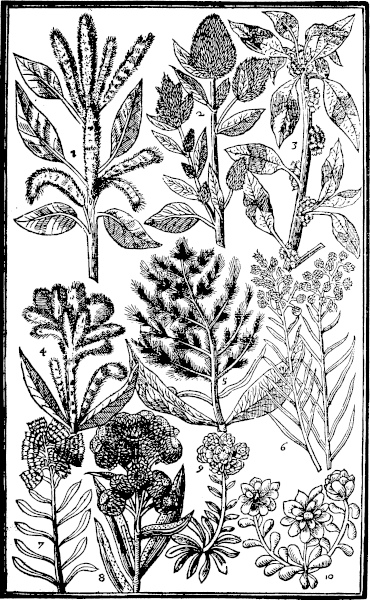
| 1 | Amaranthus purpureus maior. The great purple Flower gentle. |
| 2 | Amaranthus purpureus minor. The lesser purple Flower gentle. |
| 3 | Amaranthus tricolor. Variable Flower gentle. |
| 4 | Amaranthus Coccineus. Scarlet Flower gentle. |
| 5 | Amaranthus carnea spica. Carnation Flower gentle. |
| 6 | Chrysocome. Golden Cassidonie. |
| 7 | Heliochrysum Creticum. Candy Goldilockes. |
| 8 | Gnaphalium Americanum. Liuelong or Life euerlasting. |
| 9 | Gnaphalium montanum. Cats foote. |
| 10 | Gnaphalium roseum. The Cotton Rose. |
[374]
This first Golden tuft riseth vp with many hard, round, white stalkes, a foote and a
halfe high, whereon at certaine distances stand many fine cut leaues, or rather one leafe
cut into many small fine parts, almost as small as Fenell, but grayish, like vnto the Cud-weedes
or Cotton-weedes (whereof certainly these are speciall kindes) at the toppes
of the stalkes stand many round flowers, of a pale gold colour, in an vmbell close together,
yet euery flower vpon his owne stalke, and all of an euen height, which will
keepe the colour, being gathered, and kept dry for a long time after, and are of a hot
and quicke sent: the roote is small and wooddy, spreading vnder the vpper crust of
the earth, and liueth long in his owne naturall place, but very hardly endureth the
cold of our Winters, vnlesse they be milde, or it be well defended.
Candy Goldilockes hath two or three small slender white branches, set here and
there very scatteringly, with small, long, and narrow hoary leaues, hauing yellow
heads of flowers at the tops made into vmbels or tufts, not so round and euen as the
former, but longwise one aboue another, the heads being made as it were of scales,
loosly, and not so closely set together, as in the next following, which when they are
full ripe, doe passe into doune, and are blowne away with the winde, hauing a small
reddish seede at the end; but will abide a long time, as the other in his beauty, being
gathered in time, as the rest will doe.
This most beautifull plant is very like vnto the former Candy Goldilockes last described,
but growing vp higher, with many more branches, and more hoary, white,
and woolly, hauing also long and narrow white leaues, but somewhat broader, and
thicker set on the branches: the tufts of flowers or vmbels likewise doe consist of
longer and larger heads, more scaly, and closer compact together, of an excellent
pale gold yellow colour, and shining, with some yellow threads or thrummes in the
middle: the roote dyeth not euery yeare, but liueth long, especially in the South and
East Countries, where no colds or frosts are felt; but will require extraordinary care
and keeping, and yet scarce sufficient to preserue it in these cold Countries.
This Golden flower is somewhat like the former of these two last described, hauing
hoary stalkes and leaues, standing confusedly on them, being long, and narrower then
any of the former: the tops of the stalkes are diuided into many parts, each bearing a
small long yellow head or flower at the toppe, with some yellow thrummes in them,
which heads being many, are diffusedly set together, like a loose or sparsed vmbell,
keeping their colour long before they wither, and when they are ripe, haue thinne
small reddish seede, like Mariorome seede, but smaller; the roote is small and blacke:
the whole plant, as well leaues and flowers, as rootes, are of a strong sharpe sent, yet
pleasant.
This siluer tuft or Indian Cotton weede, hath many white heads of leafes at their
first springing out of the ground, couered with a hoary woollinesse like cotton, which
rising into hard, thicke round stalkes, containe still the same hoarinesse vpon them, as
also vpon the long and narrow leaues which are set thereon, especially on the vnder
side, for the vpper sides are of a darke shining greene colour: the stalkes are diuided at
the toppe into many small branches, each whereof haue many scaly tufted heads set
together, couered ouer with cotton before their opening, and then diffeuering one
from another, abiding very white on the outside, when they are fully growne, but
with a small yellow thrume in the midde of euery flower, which in time turne into
yellow doune, apt to be blowne away with euery winde: the roots are long and black
on the outside, creeping vnder ground very much.
This small Cudweede or Cottonweede, hath many small white woolly leaues
growing from the roote, which is composed of a few small blackish threds, and lying
vpon the ground somewhat like vnto the leaues of a small Mouse eare, but smaller;
from among which riseth vp a small stalke of halfe a foote high or thereabouts, beset
here and there with some few leaues, at the top whereof commeth forth a tuft of small
flowers, set close together, in some of a pure white, in others of a purple or reddish
colour, in some of a pale red or blush, and in others of a white and purple mixt together,
which for the beauty is much commended and desired, but will hardly abide to
be kept in Gardens, so vnwilling they are to leaue their naturall abiding.
This little rose Cotton weede hath many such like woolly leaues, growing as the
former from the roote vpon small short branches, not full an hand breadth high, in fashion
somewhat like vnto Daysie leaues, but lesser, and round pointed: at the toppe of
euery stalke or branch, standeth one flower, composed of two rowes of small white
leaues, layd open like a Starre or a Rose, as it beareth the name, hauing a round head
in the middle made of many yellow threds or thrumes, which falling away, there riseth
vp a small round head, full of small seedes: the root is small, long and threddy.
The foure first plants doe grow naturally in many of the hot Countries
of Europe, as Spaine, Italie, and Prouince in France; as also in Candy,
Barbary, and other places, and must be carefully kept with vs in the winter
time. The Liue long was brought out of the West Indies, and groweth
plentifully in our gardens. The two last doe grow as well in the colder
Countries of Germany, as in France and other places.
They all flower in the end of September, if they will shew out their beauty
at all with vs, for sometimes it is so late, that they haue no faire colour at all,
especially the foure first sorts.
Variable and many are the names that seuerall Writers do call these foure
first sorts of plants, as Helichrysum, Heliochrysum, or Elichrysum, Eliochrysum,
Chrysocome, Coma aurea, Amaranthus luteus, Stoechas Citrina, and Aurelia, with
others, needlesse here to be recited: it is sufficient for this worke, to giue
you knowledge that their names are sufficient as they are expressed in their
titles: The fift is called Gnaphalium by Carolus Clusius, from the likenesse
of the vmbels or tufts of heads, though greater and white: for as I said before,
the Cotton weedes are of kindred with the golden tufts: It hath been
called by our English Gentlewomen, Liue long, and Life euerlasting, because
of the durabilitie of the flowers in their beautie. The two last are called
Gnaphalium, according to their titles; and in English they may passe vnder
those names are set downe with them.
The foure first are accounted to bee hot and dry, and the three last to bee
cold and dry: yet all of them may to some good purpose bee applyed to
rheumaticke heads. The former foure are likewise vsed to cause vrine, and
in baths to comfort and heate cold parts. They are also layd in chests and
wardrobes, to keepe garments from moths; and are worne in the heads and
armes of Gentiles and others, for their beautifull aspect.
There are two kindes or sorts of this beautifull plant, the one with a red flower,
the other with a yellow, spotted with reddish spots, both which in some kindly
yeares haue borne their braue flowers, but neuer any ripe seede, and doth
not abide the extremities of our winters, eyther abroade or vnder couert, vnlesse it
meete with a stoue or hot-house, such as are vsed in Germany, or such other like place:
For neyther house nor cellar will preserue it, for want of heate.
This beautifull plant riseth vp with faire greene, large, broade leaues, euery one rising
out of the middle of the other, and are folded together, or writhed like vnto a
paper Coffin (as they call it) such as Comfitmakers and Grocers vse, to put in their
Comfits and Spices, and being spread open, another riseth from the bottome thereof,
folded in the same manner, which are set at the ioynts of the stalke when it is risen vp,
like vnto our water Reede, and growing (if it runne vp for flower) to be three or foure
foote high, as I haue obserued in mine owne garden: the flowers grow at the toppe of
the stalke one aboue another, which before their opening are long, small, round, and
pointed at the end, very like vnto the claw of a Crauise or Sea-Crab, and of the same
red or crimson colour, but being open, are very like vnto the flower of Gladiolus or
Corne-flagge, but of a more orient colour then at the first, and standing in a rough
huske, wherein afterwards standeth a three square head, containing therein round
blacke seede, of the bignesse of a pease: the roote is white and tuberous, growing into
many knobs, from whence arise such other leaues and stalkes, whereby it encreaseth
very much, if it be rightly kept and defended.
This Reede groweth vp with leaues and flowers, in all points so like vnto the former,
that it cannot bee knowne from it, vntill it come to flower, which is of a yellow
colour, spotted with reddish spots, without any other difference.
These plants grow naturally in the West Indies, from whence they were
first sent into Spaine, and Portugall, where Clusius saith he saw them planted
by the houses sides, flowring in winter, which might be in those warme
Countreyes. We preserue them with great care in our gardens, for the beautifull
aspect of their flowers.
They flower not with vs vntill the end, or middle of August, at the soonest.
They are called of some Canna Indica, and Arundo Indica, of others Cannacorus,
and of some Flos Cancri, because the colour of the flowers, as well as
the forme of the buds, are so like vnto a Sea-Crabs cle, or claw.
There is not any vse of these in Physicke that I know.
The Mandrake is distinguished into two kindes, the male and the female; the
male hath two sorts, the one differing from the other, as shall be shewed; but of
the female I know but one: The male is frequent in many gardens, but the female,
in that it is more tender and rare, is noursed vp but in a few.
The male Mandrake thrusteth vp many leaues together out of the ground, which
being full growne, are faire, large and greene lying round about the roote, and are larger
and longer then the greatest leaues of any Lettice, whereunto it is likened by Dioscorides
and others: from the middle, among these leaues, rise vp many flowers, euery
one vpon a long slender stalke, standing in a whitish greene huske, consisting of fiue
pretty large round pointed leaues, of a greenish white colour, which turne into small
round apples, greene at the first, and of a pale red colour when they are ripe, very
smooth and shining on the outside, and of a heady or strong stuffing smell, wherein is
contained round whitish flat seede: the roote is long and thicke, blackish on the outside,
and white within, consisting many times but of one long roote, and sometimes
diuided into two branches a little below the head, and sometimes into three or more,
as nature listeth to bestow vpon it, as my selfe haue often seene, by the transplanting of
many, as also by breaking and cutting off of many parts of the rootes, but neuer found
harme by so doing, as many idle tales haue beene set downe in writing, and deliuered
also by report, of much danger to happen to such, as should digge them vp or breake
them; neyther haue I euer seene any forme of man like or woman-like parts, in the
rootes of any: but as I said, it hath oftentimes two maine rootes running down right
into the ground, and sometimes three, and sometimes but one, as it likewise often happeneth
to Parsneps, Carrots, or the like. But many cunning counterfeit rootes haue bin
shaped to such formes, and publickly exposed to the view of all that would see them,
and haue been tolerated by the chiefe Magistrates of the Citie, notwithstanding that
they haue beene informed that such practices were meere deceit, and vnsufferable;
whether this happened through their ouer-credulitie of the thing, or of the persons,
or through an opinion that the information of the truth rose vpon enuy, I know not,
I leaue that to the searcher of all hearts: But this you may bee bold to rest vpon, and
assure your selues, that such formes as haue bin publickly exposed to be seene, were neuer
so formed by nature, but only by the art and cunning of knaues and deceiuers, and
let this be your Galeatum against all such vaine, idle and ridiculous toyes of mens inuentions.
There is likewise another sort of these male Mandrakes, which I first saw at Canterbury;
with my very louing and kinde friende Iohn Tradescante, in the garden of the
Lord Wotton, whose gardiner he was at that time; the leaues whereof were of a
more grayish greene colour, and somewhat folded together, when as the former kind
that grew hard by it, was of the same forme that is before described, and ordinary in
all others: but whether the apples were differing from the other, I know not, nor did
they remember that euer it had borne any.
The female Mandrake doth likewise put vp many leaues together, from the head of
the roote, but they are nothing so large, and are of a darker greene colour, narrower
also and shining, more crumpled, and of a stronger sent: the flowers are many, rising
vp in the middle of the leaues, vpon slender stalkes, as in the male kind, but of a blewish
purple colour, which turne into small round fruite or apples, and not long like a
peare (as Clusius reporteth that saw them naturally growing in Spaine) greene at the
first, and of a pale yellowish colour, when they are full ripe; of a more pleasing, or if
you will, of a lesse heady sent then the apples of the male, wherein is contained such
like seede, but smaller and blacker: the rootes are like the former, blacke without and
white within, and diuided in the same manner as the male is, sometimes with more,
and sometimes with fewer parts or branches.
They grow in many places of Italie, as Matthiolus reporteth, but especially
on Mount Garganus in Apulia. Clusius saith hee found the female in
many wet grounds of Spaine, as also in the borders of those medowes that
lye neere vnto riuers and water courses. The male is cherished in many
Gardens, for pleasure as well as for vse; but the female as is said, is both very
rare, and farre more tender.
The Male flowreth in March, and the fruit is ripe in Iuly. The Female, if
it be well preserued, flowreth not vntill August, or September; so that without
extraordinary care, we neuer see the fruite thereof in our gardens.
Mandragoras mas is called albus, as the Fæmina is called niger, which titles
of blacke and white, are referred vnto the colour of the leaues: the female
is called also Thridacias, from the likenesse of Lettice, whereunto they
say in forme it doth carry some similitude. Dioscorides saith, that in his time
the male was called Morion, and both of them Antimelum, and Circæa. Wee
call them in English, The male, and the female Mandrake.
The leaues haue a cooling and drying qualitie, fit for the oyntment Populeon,
wherein it is put. But the Apples haue a soporiferous propertie, as
Leuinus Lemnius maketh mention in his Herball to the Bible, of an experiment
of his owne. Besides, as Dioscorides first, and then Serapio, Auicen,
Paulus Ægineta, and others also do declare, they conduce much to the cooling
and cleansing of an hot matrix. And it is probable, that Rachel knowing
that they might be profitable for her hot and dry body, was the more
earnest with Leah for her Sonne Rubens Apples, as it is set downe Genesis
30. verse 14. The strong sent of these apples is remembred also, Cant. 7. 13.
although some would diuert the signification of the Hebrew word, דודאים,
vnto Violets, or some other sweet flowers, in the former place of Genesis,
and the fruit of Musa, or Adams Apples in this place of the Canticles.
Hamilcar the Carthaginian Captaine is said to haue infected the wine of
the Lybians (his enemies against whom he fought) with the apples of Mandrake,
whereby they being made exceeding drowsie, he obtained a famous
victory ouer them.
Although the beautie of this plant consisteth not in the flower, but fruit, yet giue
me leaue to insert it here, lest otherwise it haue no place: whereof there are
two especiall sorts, which wee comprehend in one Chapter, and distinguish
them by maius and minus, greater and smaller: yet of the greater kinde, we haue noursed
vp in our Gardens two sorts, that differ only in the colour of the fruite, and in nothing
else.
This greater kinde of Loue Apples, which hath beene most frequently cherished
with vs, hath diuers long and trayling branches, leaning or spreading vpon the ground,
not able to sustaine themselues, whereon doe grow many long winged leaues, that is,
many leaues set on both sides, and all along a middle ribbe, some being greater, and
others lesse, iagged also and dented about the edges, of a grayish ouer-worne greene
colour, somewhat rough or hairy in handling; from among the leaues and the branches
come forth long stalkes, with diuers flowers set thereon, vpon seuerall short footstalks,
consisting of sixe, and sometimes of eight small long yellow leaues, with a middle
pricke or vmbone, which after the flowers are fallen, riseth to be the fruite, which are
of the bignesse of a small or meane Pippin, vneuenly bunched out in diuers places,
and scarce any full round without bunches, of a faire pale reddish colour, or somewhat
deeper, like vnto an Orenge, full of a slimie iuice and watery pulpe, wherein the seede
lyeth, which is white, flat and somewhat rough: the roote shooteth with many small
strings and bigger branches vnder ground, but perisheth at the first feeling of our winter
weather. The fruite hereof by often sowing it in our Land, is become much smaller
then I haue here described it: but was at the first, and so for two or three yeares after,
as bigge as I haue related it.
Of the same kinde is this other sort of Amorous Apples, differing in nothing but
the colour of the fruite, which is of a pale yellow colour, hauing bunches or lobes
in the same manner, and seede also like the former.
The small Apples of Loue in the very like manner, haue long weake trayling
branches, beset with such like leaues as the greater kinde hath, but smaller in euery
part: the flowers also stand many together on a long stalke, and yellow as the former,
but much smaller: the fruite are small, round, yellowish red berries, not much
bigger then great grapes, wherein are contained white flat seede, like the other, but
smaller: the roote perisheth in like manner euery yeare, and therefore must bee new
sowen euery spring, if you will haue the pleasure of their sight in the garden; yet some
yeares I haue known them rise of their owne sowing in my garden.
They growe naturally in the hot Countries of Barbary, and Ethiopia;
yet some report them to be first brought from Peru, a Prouince of the West
Indies. Wee onely haue them for curiosity in our Gardens, and for the
amorous aspect or beauty of the fruit.
They flower in Iuly and August, and their fruit is ripe in the middle or
end of September for the most part.
The first is named diuersly by diuers Authors; for Lobel, Camerarius,
and others, call them Poma amoris. Dodonæus Aurea Mala. Gesnerus first,
and Bauhinus after him, make it to be a kinde of Solanum Pomiferum. Anguillara
taketh it to be Lycopersicum of Galen. Others thinke it to bee Glaucium
of Dioscorides. The last is called Mala Æthiopica parua, and by that
title was first sent vnto vs, as if the former were of the same kinde and
country. We call them in English, Apples of Loue, Loue-Apples, Golden
Apples, or Amorous Apples, and all as much to one purpose as another,
more then for their beautifull aspect.
In the hot Countries where they naturally growe, they are much eaten
of the people, to coole and quench the heate and thirst of their hot stomaches.
The Apples also boyled, or infused in oyle in the sunne, is thought
to be good to cure the itch, assuredly it will allay the heate thereof.
There are three principall sorts of Foxegloues, a greater, a middle or meane
sort, and a lesser, and of them, three especiall colours, that is, purple, white, and
yellow; the common purple kinde that groweth abroad in the fields, I leaue
to his wilde habitation: and of the rest as followeth.
The leaues of this Foxegloue are long and large, of a grayish green colour, finely cut
or dented about the edges, like the teeth of a fine sawe; among which commeth vp a
strong tall stalke, which when it was full growne, and with ripe seede thereon, I haue
measured to be seuen foot high at the least, whereon grow an innumerable company (as
I may so say, in respect of the aboundance) of flowers, nothing so large as the common
purple kinde, that groweth wilde euery where in our owne Countrey, and of a
kinde of browne or yellowish dunne colour, with a long lippe at euery flower; after
them come seede, like the common kinde, but in smaller heads: the rootes are stringie
like the ordinary, but doe vsually perish, or seldome abide after it hath giuen seed.
[381]
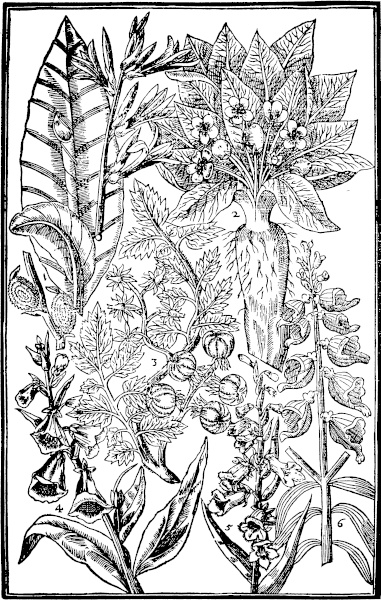
| 1 | Canna Indica. The Indian Reed. |
| 2 | Mandragoras mas. The male Mandrake. |
| 3 | Pomum amoris maius. Great Apples of loue. |
| 4 | Digitalis maior flore luteo amplo. The great yellow Foxegloue. |
| 5 | Digitalis media flore luteo rubente. Orenge tawny Foxegloues. |
| 6 | Digitalis maxima ferruginea. Dun coloured Foxegloues. |
This kinde of Foxegloues hath reasonable large leaues, yet not altogether so large
as the common field kinde: the flowers are also smaller then the common sort, but
of a blush colour.
As this Foxegloue is none of the greatest, so also is it none of the smallest; but a sort
betweene both, hauing leaues in some proportion correspondent to the lesser yellow
Foxegloue, but not so large as the lesser white: the flowers are long and narrow, almost
as large as the last white, but nothing so large as the first white, of a faire yellowish
browne colour, as if the yellow were ouershadowed with a reddish colour, and is that
colour wee vsually call an Orenge tawnie colour: the seede is like the former: the
rootes perish euery yeare that they beare seede, which is vsually the second yeare of
the springing.
This white Foxegloue is in all things so like vnto the purple wilde kinde, that it can
hardly be distinguished from it, vnlesse it be in the fresher greennesse and largenesse of
the leaues: the flowers are as great in a manner as the purple, but wholly white, without
any spot in them: the seed and other things agree in all points.
We haue in our Gardens another sort of white Foxegloue, whose leaues are like
vnto the last described, but not altogether so long or large, and of a darker greene colour:
the stalke groweth not so high, as not full three foote: the flowers are pure
white, fashioned like vnto the former, but not so great or large, in all other things
alike: the rootes hereof did abide sometime in our Gardens, but since perished, and
the seede also, since when we neuer could obtaine from any our friends of that kinde
againe.
The leaues of this greater yellow Foxegloue, are in forme somewhat like vnto the
common purple kinde, but not altogether so large: the stalke groweth to bee three or
foure foote high, whereon stand many long hollow pendulous flowers, in shape like
the ordinary purple: but somewhat shorter, and more large and open at the brimmes,
of a faire yellow colour, wherein are long threads, like as in the others: the roote
hereof is greater at the head, and more wooddy then any of the rest, with many
smaller fibres, spreading themselues in the ground, and abideth almost as well as our
common purple kinde.
This small pale yellow Foxegloue hath somewhat short, broad, smooth and darke
greene leaues, snipt or dented about the edges very finely: the stalke is two foot high,
beset with such like leaues, but lesser: the flowers are more in number then in any of the
rest, except the first and greatest, and growe along the vpper part of the stalke, being
long and hollow, like the other, but very small, and of a pale yellow colour almost
white: the seede vessels are small like the former, wherein are contained seede like
the rest, but smaller: the rootes are stringy, but durable, and seldome perish with
any iniury of the extreamest frosts.
The great white kinde hath been often, and in many places found wilde
in our owne Country, among or hard by the common purple kinde. All
the rest are strangers, but cherished in our Gardens.
They flower in Iune and Iuly, and some in August, their seede becomming
ripe quickly after.
Onely the name Digitalis, is of all Writers giuen vnto these plants; for
it is not knowne to bee remembred of any of the old Authors. Wee call
them generally in English, Foxegloue; but some (as thinking it to bee too
foolish a name) doe call them Finger-flowers, because they are like vnto the
fingers of a gloue, the ends cut off.
Foxegloues are not vsed in Physicke by any iudicious man that I know;
yet some Italians of Bononia, as Camerarius saith, in his time vsed it as a
wound herbe.
There be diuers kindes of Mullein, as white Mullein, blacke Mullein, wooddy
Mullein, base Mullein, Moth Mullein, and Ethiopian Mullein, all which to
distinguish or to describe, is neither my purpose, nor the intent of this worke,
which is to store a Garden with flowers of delight, and sequester others not worthy
of that honour. Those that are fit to bee brought to your consideration in this place,
are first, the Blattarias, or Moth Mulleins, and then the wooddy Mullein, which otherwise
is called French Sage, and lastly, the Ethiopian Mullein, whose beauty consisteth
not in the flower, but in the whole plant; yet if it please you not, take it according
to his Country for a Moore, an Infidell, a Slaue, and so vse it.
The yellow Moth Mullein whose flower is sweete, hath many hard grayish greene
leaues lying on the ground, somewhat long and broad, and pointed at the end: the
stalks are two or three foot high, with some leaues on them, & branching out from the
middle vpwards into many long branches, stored with many small pale yellow flowers,
of a pretty sweete sent, somewhat stronger then in the other sorts, which seldome
giueth seede, but abideth in the roote, during many yeares, which few or none of the
others doe.
This Spanish kinde hath larger and greener leaues then the former, and rounder
and larger then the next that followeth: the stalke is higher than in any of the Moth
Mulleins, being for the most part foure or fiue foote high, whereon toward the toppe
growe many goodly yellow flowers, consisting of fiue leaues, as all the rest doe, not
so thicke set as the former, but much larger, with some small purplish threads in the
middle: the ends whereof are fashioned somewhat like as if a Flie were creeping vp
the flower, which turne into round heads, sometimes two or three or more standing
together, but vsually one, wherein lye small duskie seed: the roote is not great nor full
of threads, and doth perish most vsually hauing giuen seede, except the Winter bee
very milde.
This yellow Moth Mullein (which is the most frequent in our Gardens) hath
longer, and narrower leaues then any of the former, and roundly notched or dented
on the edges, of a darke greene colour: the stalke is sometimes branched, but most
vsually single, whereon stand many gold yellow flowers, not fully so large as the Spanish
kinde, but with the like purple threads in the middle: the seede is small, and
contained in the like round heads, but alwaies euery one single by it selfe: the roote
perisheth euery yeare that it beareth seede.
The greatest point of difference betweene this and the last described, consisteth
chiefly in the colour of the flower, which in this is of the colour of cloth of gold, that
is, the ground yellow, and ouershadowed with a bright crimson colour, which is a fine
colour of much delight: the threads in the middle are not so purple red as in the former,
but much about the colour of the flower: this is not so willing to giue seede, and
will as hardly abide in the roote, and hath out of question risen from the seede of the
former.
The leaues of the white Moth Mullein are somewhat like vnto the yellow, yet not
altogether so much roundly notched about the edges, but rather a little dented, with
sharper notches: the stalke riseth as high as the yellow, and hath now and then some
branches about it: the flowers hereof are pure white, as large and great as the ordinary
yellow, or somewhat larger, with the like purple threads in the middle, as are in the
yellow: the seed is like the other; the root perisheth in like manner, and will not endure.
The Purple Moth Mullein hath his leaues lying on the ground, broader and shorter
then any of the other, of a more grayish greene colour, and without any denting
for the most part about the edges, sharpe pointed also at the end of the leafe; among
the leaues riseth vp the stalke, not so high as either the white or the yellow, and many
times branched, bearing many flowers thereon, of the same fashion, and no whit
smaller, of a faire deepe blewish colour tending to rednesse, the threads in the middle
of the flowers being yellow: the seede vessels hereof are somewhat smaller then any
of the former, except the first sweete yellow kinde: the roote hereof is long, thicke,
and blackish on the outside, abiding very well from yeare to yeare, and riseth well
also from the sowing of the seede.
This blew Moth Mullein is in all respects like vnto the former purple kinde, sauing
onely in the colour of the flower, which is of a blewish violet colour, and is not much
inferiour either in greatnesse of the plant, or in the largenesse of the flower, vnto the
former purple kinde, and endureth many yeares in the like manner. And these be all
the sorts of this kinde of Moth Mullein, that I haue seene and noursed vp for this my
Garden, without interposing any vnknowne, not seene, or vnworthy.
Wooddy Mullein or French Sage, hath diuers wooddy branches two or three foot
high, very hoary or white, whereon at seuerall ioynts stand diuers thicke leaues, white
also and hoary, long, somewhat broad, round pointed, and rough, somewhat resembling
the leaues of Sage in the forme and roughnesse, but not in the sent, whereof our
people gaue it the name of Sage, calling it French Sage (when as it is as great a stranger
in France as in England, yet they doe with this as with many other things, calling
them French, which come from beyond the Seas; as for example, all or most of
our bulbous flowers, they call French flowers, &c.) at the toppes of the stalkes and
branches, at certaine distances, are placed round about them many gaping flowers,
like vnto the flowers of Sage, but yellow: after which now and then come seede,
somewhat bigger then the Moth Mulleins, and lesse then the next Mullein of Ethiopia:
the roote is wooddy at the toppe, with diuers blackish strings growing from it, and endureth
as well aboue ground with his leaues, as vnder it with his rootes.
This Mullein of Ethiopia hath many great, broad, and large leaues lying on the
ground, rent or torne in diuers of them very much on the sides, of so hoary a white
greene colour, that it farre passeth any of the white Mulleins, that growe wilde abroad
in our owne Country; for they are of a yellowish white hoarinesse, nothing so pleasant
to looke on as this: in the middle of these leaues riseth vp a square strong stalke,
foure or fiue foote high, set full of such like leaues as growe belowe, but much lesser,
and lesser still vp to the toppe, all hoary and woolly, as the rest, and diuided into manie
branches, spreading farre, and taking vp a great compasse of ground, more then
any one roote of Garden Clary, or other such like plant: at each of the stalkes and
branches are set two small leaues, and with them, round about the stalkes, stand many
small gaping flowers, of a pale bleake blew colour: the seede is almost as large as Garden
Clary seede, and of the same forme and colour: the roote is wooddy, and perisheth
as soone as it hath borne seede, which is vsually the second yeare after the sowing;
for the first yeare it seldome runneth vp to flower.
Let mee thrust this plant into this place, rather then make a peculiar Chapter, because
I haue no other of the same stocke or kindred to be ioyned with it, and is a pretty
ornament in a Garden. The leaues whereof are very large, round, and great, rough
or full of veines, which make it seeme crumpled, dented or deepely notched about the
edges, and of a very darke greene colour, and some times brownish, or of a darke
reddish colour withall, euery one standing on a long foote-stalke, very like in forme
vnto the great white Arch-Angell leaues, but farre larger and blacker: the stalkes are
great and foure square, hauing leaues and flowers standing round about them at the
ioynts like coronets, which flowers are very great, long, and wide gaping open, of a
darke red or purple colour, with some whitenesse or spots in the iawes, and some hairinesse
also on the sides, which stand in full flower two or three moneths most vsually,
and sometimes longer, after which come brownish seede: the roote is a great tuft or
bush of long whitish strings, and encreaseth euery yeare, not fearing the greatest
iniuries of our coldest and extreamest Winters.
All these plants are strangers in our Countrey, and onely preserued in
Gardens, to furnish them with variety; but (as I said) the cloth of gold
Moth Mullein hath been raised from seed in our owne Country.
The last flowreth first, before all the rest, beginning in Aprill. The
Moth Mulleins in May and Iune. The French Sage in Iuly.
All the sorts of Blattaria may bee comprehended vnder the kindes of
Verbascum nigrum, as any one but meanely exercised in the knowledge of
plants, may discerne. And although Plinie saith, that Moths doe most frequently
haunt where Blattaria either groweth, or is laid, yet it is not obserued
sufficiently in our Country so to doe, notwithstanding the name of
Moth Mullein is generally giuen them. The last is generally called with
vs Lamium Pannonicum, but certainely it is the Galeosis maxima Pannonica
of Clusius.
Other qualities I haue not found hath been alloted vnto the Blattaria or
Moth Mullein, then those of Plinie, to engender Moths. Wee vse none of
these plants in Physicke in these daies.
The many sorts of Valerian (or Set-wall as many doe call them) are fitter for a
generall worke, or a generall Physicall Garden of Simples, then this of delightfull
flowers. I will therefore select out a few, worthy of the place, and
offer them to your considerations.
This Valerian hath diuers hard, but brittle whitish greene stalkes, rising from the
roote, full of tuberous or swelling ioynts, whereat stand two leaues, on each side one,
and now and then some small leaues from betweene them, which are somewhat long
and narrow, broadest in the middle, and small at both ends, without either diuision
or incisure on the edges, of a pale greene colour: the stalkes are branched at the top
into diuers parts, at the ends whereof stand many flowers together, as it were in an
vmbell or tuft, somewhat like vnto the flowers of our ordinary Valerian, but with
longer neckes, and of a fine red colour, very pleasant to behold, but of no sent of any
Valerian: after these flowers haue stood blowne a very great while, they sodainely
fall away, and the seede is ripe very quickly after, which is whitish, standing vpon
the branches naked, as the Valerians doe, and very like vnto them, with a little white
doune at the end of euery one of them, whereby they are soone carried away with
the winde: the roote is great, thicke, and white, continuing long, and shooting out
new branches euery yeare, and smelling somewhat like a Valerian.
This kinde of Valerian or Spiknard, if you will so call it, hath his first leaues lying
on the ground, without any diuision in them at all, being smooth, and of a darke greene
colour, which so abide all the winter; but those that spring vp after, and when it runneth
vp to flower, are cut in on the edges, very like vnto the iagged leaues of the great
garden Valerian, and so the elder they grow, the more cut and iagged they are: the
stalke and flowers are very like the stalke with flowers of the garden Valerian, but of a
darke or deepe red colour, and more store of them thrust together, by double the
number almost: the seede is like the seede of the great Valerian: the root is tuberous,
or knobbed in many parts, round about, aboue and below also, with some fibres shooting
from them, whereby it is encreased, and smelleth very like the roote of the garden
Setwall, or not altogether so strong.
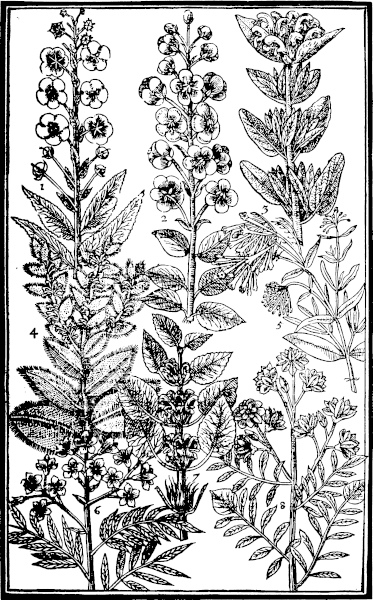
| 1 | Blattaria flore albo. Moth Mullein with a white flower. |
| 2 | Blattaria flore purpureo. Moth Mullein with a purple flower. |
| 3 | Verbascum quartum Matthioli. French Sage. |
| 4 | Æthiopis. Ethiopian Mullein. |
| 5 | Valeriana rubro Dodonæi. Red Valerian. |
| 6 | Valeriana Græca. Greek Valerian. |
| 7 | Lamium Pannonicum. Hungary dead Nettle. |
| 8 | Cardamine flore pleno. Double Cuckowe flower or Ladies smocks. |
The Greek Valerian hath many winged leaues lying vpon the ground, that is, many
small leaues set on both sides of a middle ribbe, very like vnto the wilde Valerian, that
groweth by the ditch sides, but much smaller and tenderer, among which rise vp one
or two round brittle stalkes, two foote high or thereabouts, whereon are set at the
ioynts, such like leaues as grow below, but smaller: the toppes of the stalkes are diuided
into many small branches, thicke set together, full with flowers, consisting of
fiue small round leaues a peece, layd open like vnto the Cinquefoile flower, with some
white threds in the middle, tipt with yellow pendents: the colour of these flowers in
some plants, is of a faire bleake blew colour, and in others pure white: And I doe
heare of one beyond the Seas (if the report bee true, for I haue not seene such a one)
which should beare red flowers: after the flowers are past, there come vp in their places
small hard huskes or heads, containing small blackish seedes: the roote is composed
of a number of small long blackish threds, fastened together at the head, without
any sent at all of a Valerian, eyther in roote or leafe; and why it should bee called
a Valerian I see no great reason, for it agreeth with none of them, in flower or seede,
and but onely with the wilde Valerian in leafe, as I said before: but as it is, we so giue
it you, and for the flowers sake is receiued into our gardens, to helpe to fill vp the number
of natures rarities and varieties.
All these Valerians are strangers, but endenizond for their beauties sake
in our Gardens. The Mountaine Valerian I had of the liberalitie of my
louing friend Iohn Tradescante, who in his trauaile, and search of natures
varieties, met with it, and imparted thereof vnto me.
They flower in the Summer moneths, and seed quickly after.
The first is generally called of most, Valeriana rubra Dodonæi, who saith
also that some would haue it to be Behen rubrum. Some call it Valerianthon,
others make it a kinde of Ocimastrum, and some Saponaria altera, with other
names, which are to no great purpose to set downe in this place, it beeing
fitter for a generall worke to discusse of names, wherein both reading, knowledge
and iudgement must bee shewen, to correct errours, and set downe the
truth, that one may rest thereon. The others haue their names in their titles
sufficient to distinguish them.
The Mountaine Valerian is of all the rest here set downe of most vse
in Physicke, the rest hauing little or none that I know, although it be much
weaker then the great garden kinde, or the Indian Nardus, in whose steed
anciently it was vsed, in oyles, oyntments, &c.
Of the common sorts of Cuckow flowers that grow by ditch-sides, or in moist
medowes, & wet grounds, it is not my purpose here to write, but of one or two
other, the most specious or faire of all the tribe, that doe best befit this garden.
The double Cardamine hath a few winged leaues, weake and tender, lying on the
ground, very like vnto the single medow kinde; from among which riseth vp a round
greene stalke, set here and there, with the like leaues that grow below, the top whereof
hath a few branches, whereon stand diuers flowers, euery one vpon a small footestalk,
consisting of many small whitish round leaues, a little dasht ouer with a shew of blush,
set round together, which make a double flower: the roote creepeth vnder ground,
sending forth small white fibres, and shooteth vp in diuers places.
This small plant hath diuers hard, darke round greene leaues, somewhat vneuen about
the edges, alwayes three set together on a blackish small footstalke, among which
rise vp small round blackish stalkes, halfe a foote high, with three small leaues at the
ioynts, where they branch forth; at the toppes whereof stand many flowers, consisting
of foure leaues a peece, of a whitish or blush colour very pale: after which come vp
small, thicke and long pods, wherein is contained small round seede: the root is composed
of many white threds, from the heads whereof runne out small strings, of a dark
purple colour, whereby it encreaseth.
The first with the double flower is found in diuers places of our owne
Countrey, as neere Micham about eight miles from London; also in Lancashire,
from whence I receiued a plant, which perished, but was found by
the industrie of a worthy Gentlewoman, dwelling in those parts heretofore
remembred, called Mistresse Thomasin Tunstall, a great louer of these delights.
The other was sent me by my especiall good friend Iohn Tradescante,
who brought it among other dainty plants from beyond the Seas, and imparted
thereof a roote to me.
The last most vsually flowreth before the former, yet not much differing,
that is, in the end of Aprill or in May.
The first is a double kinde of that plant, that growing wilde abroade, is
vsually called Cardamine altera, and Sisymbrium alterum of Dioscorides, and
of some Flos cuculi, but not fitly; for that name is more vsually giuen vnto
the wilde featherd Campion, both single and double, as is before expressed:
yet for want of a fitter name, wee may call it in English, eyther Cuckowe
flower, or Ladyes smockes which you will. The second hath beene sent vnder
the name of Sanicula trifolia, but the most frequent name now receiued,
is Cardamine trifolia, and in English Trefoile Ladies smockes.
The double Ladies smockes are of the same qualitie with the single, and
is thought to be as effectuall as Watercresses. The propertie of the other I
thinke is not much knowne, although some would make it a wound herbe.
Of the many sorts of Thlaspi it is not the scope of this worke to relate, I will select
but onely two or three, which for their beautie are fit to bee inserted into
this garden.
This small plant riseth seldome aboue a foote and a halfe high, hauing small, narrow,
long and whitish greene leaues, notched or dented with three or foure notches on each
side, from the middle to the point-wards; from among which rise vp the stalkes,
branched from the bottome almost into diuers small branches, at the toppes whereof
stand many small flowers, thick thrust together in an vmbell or tuft, making them seeme
to be small, round, double flowers of many leaues, when as euery flower is single, and
standeth a part by it selfe, of a faire white colour in some plants, without any spot, and
in others with a purplish spot in the centre or middle, as if some of the middle leaues
were purple; in others agane the whole flower is purplish all ouer, which make a pretty
shew in a garden: the seede is contained in many small and flat seed vessels, which stand
together in an vmbell, as the flowers did, in which are contained somewhat reddish
seede, like vnto some other sorts of Thlaspi, called Treakle Mustards: the roote is small
and hard, and perisheth euery yeare hauing giuen seede.
Thlaspi Marinum
Bæticum.
We haue another sort, whose leaues before it sendeth forth any stalke, are a little
toothed, or finely dented about the edges, and brancheth not so much out, but carryeth
an vmbell of purplish flowers like vnto the former, and paler yellow seede.
These doe grow in Spaine and Candie, not farre from the Sea side.
These Thlaspi giue not their flowers vntill the end of Iune, or beginning
of Iuly, and the seed is ripe soone after.
The first is named by some, Draba, or Arabis, as Dodonæus, but Draba
is another plant differing much from this. Wee call one sort, Thlaspi Creticum,
and the other Thlaspi Bæticum marinum, because the one came from
Spaine, and the other from Candy; we giue it in English, the name of
Tufts, because it doth fit the forme of the flowers best, although ordinarily
all the Thlaspi are Englished Wilde Mustardes.
Candy, or Spanish Tufts, is not so sharpe biting in taste, as some other
of the Thlaspies are, and therefore is not to be vsed in medicines, where
Thlaspi should be in the stead thereof.
Hauing shewed you all my store of herbes bearing fine flowers, let mee now
bring to your consideration the rest of those plants, be they Shrubs or Trees,
that are cherished in our garden, for the beauty of their flowers chiefly, or for
some other beautifull respect: and first I will begin with such as creepe on the ground,
without climing, and then such as clime vp by poles, or other things, that are set or
grow neere them, fit to make Bowers, and Arbours, or else are like them in forme, in
name, or some other such qualitie or propertie.
The smaller Perwinkle which not onely groweth wilde in many places, but is most
vsuall in our Gardens, hath diuers creeping branches, trayling or running vpon the
ground, shooting out small fibres at the ioynts, as it creepeth, taking thereby hold in
the ground, and rooteth in diuers places: at the ioynts of these branches stand two
small darke greene shining leaues, somewhat like vnto small Baye leaues, but smaller,
and at the ioynts likewise with the leaues, come forth the flowers, one at a ioynt, standing
vpon a tender footestalke, being somewhat long and hollow, parted at the brims,
sometimes into foure leaues, and sometimes into fiue, the most ordinary sort is of a
pale or bleake blew colour, but some are pure white, and some of a darke reddish purple
colour: the root is in the body of it, little bigger then a rush, bushing in the ground,
and creeping with his branches farre about, taking roote in many places, whereby it
quickely possesseth a great compasse; and is therefore most vsually planted vnder
hedges, or where it may haue roome to runne.
The double Perwinkle is like vnto the former single kinde, in all things except in
the flower, which is of that darke reddish purple colour that is in one of the single
kindes; but this hath another row of leaues within the flower, so that the two rowes
of leaues causeth it to be called double, but the leaues of these are lesser then the single.
I haue heard of one with a double white flower, but I haue not yet seene it.
This greater Perwinkle is somewhat like the former, but greater, yet his branches
creepe not in that manner, but stand more vpright, or lesse creeping at the least: the
leaues also hereof stand by couples at the ioynts, but they are broader and larger by
the halfe: the flowers are larger, consisting of fiue leaues that are blew, a little deeper
then the former blew: this plant is farre tenderer to keepe then the other, and therefore
would stand warme, as well as in a moist shadowie place.
This Causticke or burning Climer, hath very long and climing tender branches,
yet somewhat woody below, which winde about those things that stand neere it, couered
with a brownish greene barke, from the ioynts whereof shoote forth many
winged leaues, consisting for the most part of fiue single leaues, that is two and two
together, and one at the end, which are a little cut in or notched on the edges here and
there, but euery part of them is lesser then the leaues of the next following Climer,
without any clasping tendrels to winde about any thing at all: towards the vpper part
of the branches, with the said leaues, come forth long stalks, whereon stand many white
flowers clustering together, opening the brims into sixe or eight small leaues, spreading
like a starre, very sweet of smell, or rather of a strong heady sent, which after
turne into flattish and blackish seede, plumed at the head, which plume or feather flyeth
away with the winde after it hath stood long, and leaueth the seede naked or bare:
the roote is white and thicke, fleshie and tender, or easie to be broken, as my selfe can
well testifie, in that desiring to take a sucker from the roote, I could not handle
it so tenderly, but that it broke notwithstanding all my care. Master Gerard in his
Herball maketh mention of one of this kinde with double white flowers, which hee
saith he recouered from the seede was sent him from Argentine, that is Strasborough,
whereof hee setteth forth the figure with double flowers: but I neuer saw any such
with him, neither did I euer heare of any of this kinde with double flowers. Clusius
indeed saith, that hee receiued from a friend some seede vnder the name of Clematis
flore albo pleno: but he doubteth whether there bee any such: the plants that sprang
with him from that seede, were like vnto the vpright kinde called Flammila Matthioli,
or Iouis cresta, as he there saith: but assuredly I haue beene informed from some of my
especiall friends beyond Sea, that they haue a double white Clematis, and haue promised
to send it; but whether it will be of the climing or vpright sort, I cannot tell vntill
I see it: but surely I doe much doubt whether the double will giue any good seede.
This Climer hath many limber and weake climing branches like the former, couered
with a browne thin outer barke, and greene vnderneath: the leaues stand at the
ioynts, consisting but of three leaues or parts, whereof some are notched on one side,
and some on both, without any clasping tendrels also, but winding with his branches
about any thing standeth next vnto it: the flowers in like manner come from the same
ioynts with the leaues, but not so many together as the former vpon long footstalkes,
consisting of foure leaues a peece, standing like a crosse, of a darke red colour; the
seed is flat and round, and pointed at the end, three or foure or more standing close together
vpon one stalk, without any doune vpon them at all, as in the former: the roots
are a bundell of brownish yellow strong strings, running down deep into the ground,
from a bigge head aboue.
This Ladies Bower differeth in nothing from the last described, but onely in the
colour of the flower, which is of a sad blewish purple colour; so that the one is not
possible to be known from the other, vntill they be in flower.
This double Clematis hath branches and leaues so neere resembling the single kinds,
that there can be knowne no difference, vnlesse it be, that this groweth more goale and
great, and yeeldeth both more store of branches from the ground, and more spreading
aboue: the chiefest marke to distinguish it is the flower, which in this is very thicke
and double, consisting of a number of smaller leaues, set close together in order in the
middle, the foure outermost leaues that encompasse them, being much broader and
larger then any of the inward, but all of a dull or sad blewish purple colour, the points
or ends of the leaues seeming a little darker then the middle of them: this beareth
no seede that euer I could see, heare of, or learne by any of credit, that haue noursed
it a great while; and therefore the tales of false deceitfull gardiners, and others, that
diliuer such for truth, to deceiue persons ignorant thereof, must not bee credulously
entertained.
Clematis peregrina
flore carneo
pleno.
In the great booke of the Garden of the Bishop of Eystot (which place is neere
vnto Noromberg) in Germany, I reade of a Clematis of this former kinde, whose figure
is thereto also annexed, with double flowers of an incarnate, or pale purple tending
to a blush colour, whereof I haue not heard from any other place.
This kinde of Clematis hath diuers more vpright stalkes then any of the foure last
described, sometimes foure or fiue foote high, or more: yet leaning or bending a little,
so that it had some neede of sustaining, couered with a brownish barke; from
whence come forth on all sides diuers winged leaues, consisting of fiue or seuen leaues,
set on both sides of a middle ribbe, whereof one is at the end: the tops of the stalkes
are diuided into many branches, bearing many white sweet smelling flowers on them,
like in fashion vnto the white Virgins Bower; after which come such like feather topt
seede, which remaine and shew themselues, being flat like the other, when the plumes
are blowne abroad: the roote spreadeth in the ground from a thicke head, into many
long strings, and fasteneth it selfe strongly in the earth; but all the stalkes dye downe
euery yeare, and spring afresh in the beginning of the next.
The stalks of this plant stand vpright, & are foure square, bearing at euery ioynt two
leaues, which at the first are closed together, and after they are open, are somewhat like
vnto the leaues of Asclepias, or Swallow-wort: from the tops of the stalks, and sometimes
also from the sides by the leaues commeth forth one flower, bending the head
downward, consisting of foure leaues, somewhat long & narrow, standing like a crosse,
and turning vp their ends a little againe, of a faire blew or skie colour, with a thicke
pale yellow short thrumme, made like a head in the middle: after the flower is past,
the head turneth into such a like round feather topt ball, as is to be seene in the Trauellers
ioy, or Viorna (as it is called) that groweth plentifully in Kent, and in other
places by the way sides, and in the hedges, wherein is included such like flat seede.
These stalkes (like as the last) dye downe to the ground euery yeare, and rise againe
in the Spring following, shooting out new branches, and therby encreaseth in the root.
Because this braue and too much desired plant doth in some things resemble the
former Climers, so that vnto what other family or kindred I might better conioyne it
I know not; let me I pray insert it in the end of their Chapter, with this description. It
riseth out of the ground (very late in the yeare, about the beginning of May, if it be a
plant hath risen from the seed of our owne sowing, and if it be an old one, such as hath
been brought to vs from Virginia, not till the end thereof) with a round stalke, not aboue
a yard and a halfe high (in any that I haue seene) but in hotter Countries, as some
Authors haue set it downe, much higher, bearing one leafe at euery ioynt, which
from the ground to the middle thereof hath no claspers, but from thence vpwards
hath at the same ioynt with the leafe both a small twining clasper, like vnto a Vine, and
a flower also: euery leafe is broad at the stalke thereof, and diuided about the middle
on both sides, making it somewhat resemble a Figge leafe, ending in three points,
whereof the middlemost is longest: the bud of the flower, before it doe open, is very
like vnto the head or seede vessell of the ordinary single Nigella, hauing at the head or
top fiue small crooked hornes, which when this bud openeth, are the ends or points of
fiue leaues, that are white on the inside, and lay themselues flat, like vnto an Anemone,
and are a little hollow like a scoope at the end, with fiue other smaller leaues, and
whiter then they lying betweene them, which were hid in the bud before it opened,
so that this flower being full blowne open, consisteth of ten white leaues, laide in order
round one by another: from the bottome of these leaues on the inside, rise diuers
twined threads, which spread and lay themselues all ouer these white leaues, reaching
beyond the points of them a little, and are of a reddish peach colour: towards the bottomes
likewise of these white leaues there are two red circles, about the breadth of
an Oten strawe, one distant from another (and in some flowers there is but one circle
seen) which adde a great grace vnto the flower; for the white leaues shew their colour
through the peach coloured threads, and these red circles or rings vpon them being
also perspicuous, make a tripartite shew
of colours most delightfull: the middle
part of this flower is hollow, and yellowish;
in the bottome whereof riseth vp an
vmbone, or round stile, somewhat bigge,
of a whitish greene colour, spotted with
reddish spots like the stalkes of Dragons,
with fiue round threads or chiues, spotted
in the like manner, and tipt at the
ends with yellow pendents, standing about
the middle part of the said vmbone,
and from thence rising higher, endeth
in three long crooked hornes most
vsually (but sometimes in foure, as hath
beene obserued in Rome by Dʳ. Aldine,
that set forth some principall things of
Cardinall Farnesius his Garden) spotted
like the rest, hauing three round greene
buttons at their ends: these flowers are
of a comfortable sweete sent, very acceptable,
which perish without yeelding
fruit with vs, because it flowreth so late:
but in the naturall place, and in hot
Countries, it beareth a small round whitish
fruit, with a crowne at the toppe
thereof, wherein is contained (while it is
fresh, and before it be ouer dried) a sweet
liquor, but when it is dry, the seede within it, which is small, flat, somewhat rough
and blacke, will make a ratling noise: the rootes are composed of a number of exceeding
long and round yellowish browne strings, spreading farre abroad vnder the
ground (I haue seene some rootes that haue beene brought ouer, that were as long as
any rootes of Sarsaparilla, and a great deale bigger, which to be handsomely laid into
the ground, were faine to be coyled like a cable) and shooting vp in seuerall places a
good distance one from another, whereby it may be well encreased.
The Iesuites Figure of the Maracoc.
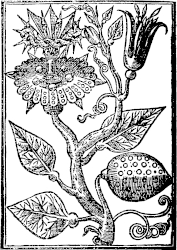
Granadillvs Frvtex Indicvs
Christi Passionis Imago.
The first blew Perwinkle groweth in many Woods and Orchards, by
the hedge sides in England, and so doth the white here and there, but the
other single and double purple are in our Gardens onely. The great Perwinkle
groweth in Prouence of France, in Spaine, and Italy, and other
hot Countries, where also growe all the twining Clamberers, as well single
as double: but both the vpright ones doe growe in Hungary and there abouts.
The surpassing delight of all flowers came from Virginia. Wee
preserue them all in our Gardens.
The Perwinkles doe flower in March and Aprill. The Climers not vntill
the end of Iune, or in Iuly, and sometimes in August. The Virginian
somewhat later in August; yet sometimes I haue knowne the flower to shew
it selfe in Iuly.
[395]
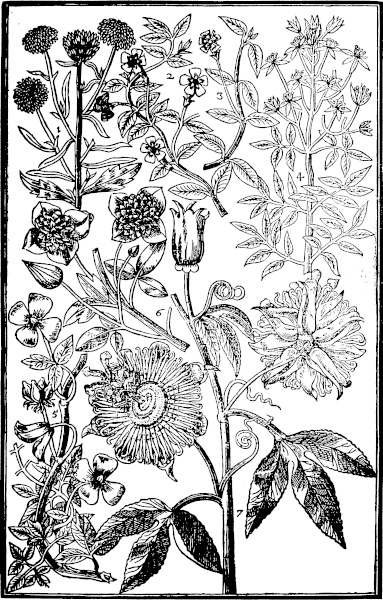
| 1 | Thlaspi Creticum. Candy tufts. |
| 2 | Vinca peruinca flore simplici. Single Perwinkle. |
| 3 | Vinca peruinca flore duplici. Double Perwinkle. |
| 4 | Flammula Matthioli. Vpright Virgins Bower. |
| 5 | Clematis peregrina flore simplici. The single Ladies Bower. |
| 6 | Clematis peregrina flore pleno purpureo. Double flowred Ladies Bower. |
| 7 | Maracoc siue Clematis Virginiana. The Virginian Climer. |
The first is out of question the first Clematis of Dioscorides, and called of
many Clematis Daphnoides (but not that plant that is simply called Daphnoides,
for that is Laureola) and is vsually called Vinca pervinca: but it is not
Chamædaphne, for that is another plant, as shall be shewed in his place; some
call it Centunculus: In English wee call it Perwinkle. The other is Clematis
altera of Dioscorides, and is called also Clematis peregrina, whose distinctions
are set downe in their titles: In English, Ladies Bower, or Virgins
Bower, because they are fit to growe by Arbours, to couer them. The first
vpright Clamberer is called, and that rightly of some, Clematis erecta, or
surrecta. Of others, Flammula frutex, and Flammula Iouis, or surrecta: In
English, Vpright Virgins Bower. The next is called by Clusius, Clematis
Pannonica cæulea, who thought it to be Climeni species, by the relation of others,
at the first, but after entituled it, Clematis: In English, the Hungarian
Climer. The last may be called in Latine, Clematis Virginiana: In English,
The Virgin or Virginian Climer; of the Virginians, Maracoc: of the Spaniards
in the West Indies Granadillo, because the fruit (as is before said) is in
some fashion like a small Pomegranate on the outside; yet the seede within
is flattish, round, and blackish. Some superstitious Iesuite would faine make
men beleeue, that in the flower of this plant are to be seene all the markes of
our Sauiours Passion; and therefore call it Flos Passionis: and to that end
haue caused figures to be drawne, and printed, with all the parts proportioned
out, as thornes, nailes, speare, whippe, pillar, &c. in it, and all as true
as the Sea burnes, which you may well perceiue by the true figure, taken to
the life of the plant, compared with the figures set forth by the Iesuites,
which I haue placed here likewise for euery one to see: but these bee their
aduantagious lies (which with them are tolerable, or rather pious and meritorious)
wherewith they vse to instruct their people; but I dare say, God
neuer willed his Priests to instruct his people with lyes: for they come from
the Diuell, the author of them. But you may say I am beside my Text, and
I am in doubt you will thinke, I am in this besides my selfe, and so nothing
to be beleeued herein that I say. For, for the most part, it is an inherent errour
in all of that side, to beleeue nothing, be it neuer so true, that any of
our side shall affirme, that contrarieth the assertions of any of their Fathers,
as they call them: but I must referre them to God, and hee knoweth the
truth, and will reforme or deforme them in his time. In regard whereof
I could not but speake (the occasion being thus offered) against such an erroneous
opinion (which euen Dʳ. Aldine at Rome, before remembred, disproued,
and contraried both the said figures and name) and seek to disproue
it, as doth (I say not almost, but I am affraid altogether) leade many to adore
the very picture of such things, as are but the fictions of superstitious brains:
for the flower it selfe is farre differing from their figure, as both Aldine in
the aforesaid booke, and Robinus at Paris in his Theatrum Floræ, doe set
forth; the flowers and leaues being drawne to the life, and there exhibited,
which I hope may satisfie all men, that will not be perpetually obstinate and
contentious.
Costæus saith hee hath often seene, that the leaues of Perwinkle held in
the mouth, hath stayed the bleeding at the nose. The French doe vse it to
stay the menstruall fluxes. The other are causticke plants, that is, fiery hot,
and blistering the skinne; and therefore (as Dioscorides saith) is profitable
to take away the scurfe, leprye, or such like deformities of the skin. What
property that of Virginia hath, is not knowne to any with vs I thinke, more
then that the liquor in the greene fruit is pleasant in taste; but assuredly it
cannot be without some speciall properties, if they were knowne.
I haue three sorts of Chamælæa to bring to your consideration, euery one differing
notably from other; two of them of great beauty in their flowers, as well as in the
whole plant: the third abiding with greene leaues, although it haue no beauty in
the flower, yet worthy of the place it holds. And vnto these I must adioyne another
plant, as comming nearest vnto them in the brauery of the flowers.
We haue two sorts of this Spurge Oliue or Dwarfe Baye, differing onely in the colour
of the flowers. They both rise vp with a thicke wooddy stemme, fiue or six foot
high sometimes, or more, and of the thicknesse (if they be very old) of a mans wrest at
the ground, spreading into many flexible long branches, couered with a tough grayish
barke, beset with small long leaues, somewhat like vnto Priuet leaues, but smaller and
paler, and in a manner round pointed: the flowers are small, consisting of foure leaues,
many growing together sometimes, and breaking out of the branches by themselues:
in the one sort of a pale red at the first blowing, and more white afterwards; the other
of a deeper red in the blossome, and continuing of a deeper red colour all the time of
the flowring, both of them very sweete in smell: after the flowers are past, come the
berries, which are greene at the first, and very red afterwards, turning blackish red, if
they stand too long vpon the branches: the rootes spread into many tough long branches,
couered with a yellowish barke.
This Mountaine Laurell riseth vp with a small wooddy stemme, three or foure foot
high, or more, branching forth towards the vpper parts into many slender and tough
branches, couered with a rough hoary greene barke, beset at the ends thereof with
flatter, fuller, and smaller round pointed leaues then the former, of a grayish greene
colour on the vpperside, and hoary vnderneath, which abide on the branches in
Winter, and fall not away as the former: the flowers are many set together at the ends
of the branches, greater then the former, and consisting of foure leaues a peece, of a
light blush colour, standing in small grayish huskes, of little or no sent at all: the fruit
followeth, which are small long graines or berries, of an excellent red colour, which
afterwards turne blacke: the roote is long, and spreadeth about vnder the vpper part
of the earth.
This three berried Spurge Oliue hath no great stemme at all, but the whole plant
spreadeth from the ground into many flexible tough greene branches, whereon are set
diuers narrow, long, darke greene leaues all along the branches, which abide greene
all the Winter: the flowers are very small, scarce to be seene, and come forth between
the leaues and the stalke, of a pale yellow colour, made of three leaues; after which
come small blackish berries, three vsually set together; the roote spreadeth it selfe in
the ground not very farre, being hard and wooddy, and often dyeth, if it bee not well
defended from the extremity of our sharpe Winters.
I was long in doubt in what place I should dispose of this plant, whether among the
Campions, as Bauhinus, or among these, as Clusius doth; but lest my Garden should
want it wholly, let it take vp roome for this time here. This gallant plant hath diuers
long, weake, slender, but yet tough branches lying vpon the ground, diuided vsually
into other smaller branches, whereon growe many, small, long, and somewhat thicke
leaues, somewhat like vnto the leaues of the former Mezereon, set without any order
to the very tops, from whence doe come forth a tuft of many small flowers together,
made or consisting of foure leaues a peece, of a bright red or carnation colour, and very
sweete withall, which turne into small round whitish berries, wherein is contained
small round seede, couered with a grayish coate or skinne: the roote is long and yellowish,
spreading diuers wayes vnder the ground, and abideth many yeares shooting
forth new branches.
Flore albo.
It hath beene obserued in some of these plants, to bring forth white flowers, not
differing in any thing else.
The first sorts growe plentifully in many places of Germany. The second
in the mountaines by Sauoye. The third in Prouence and Spaine.
The last in diuers parts of Germany, Bohemia, and Austria, and about
Franckford.
The two first sorts are most vsually in flower about Christmas, or in Ianuary,
if the weather be not violent, and sometimes not vntill February.
The second flowreth not vntill Aprill. The third in May. The berries of
them ripen some in Iune and Iuly; some in August and September, as
their flowring is earlier or later. The last flowreth as well in the Spring as
in Autumne, so apt and plentifull it is in bearing, and the seede at both
times doth ripen soone after.
The first is called of some Chamælæa, with this addition Germanica, that
it may differ from the third, which is the true Chamælæa of Dioscorides,
as all the best Authors doe agree, and is also called Piper montanum of the
Italians. It is generally called Mezereon, and is indeede the true Mezereon
of the Arabians, and so vsed in our Apothecaries shops, wheresoeuer the
Arabians Mezereon is appointed, although the Arabians are so intricate and
vncertaine in the descriptions of their plants, confounding Chamælæa and
Thymælæa together. Matthiolus maketh it to be Daphnoides of Dioscorides;
but in my opinion he is therein mistaken: for all our best moderne Writers
doe account our Laureola, which hath blacke berries, to bee the true
Daphnoides: the errour of his Countrey might peraduenture drawe him
thereunto; but if hee had better considered the text of Dioscorides, that
giueth black berries to Daphnoides, and red to Chamædaphne, he would not so
haue written; and truly, I should thinke (as Lobel doth) with better reason,
that this Chamælæa were Dioscorides Chamædaphne, then hee to say it were
Daphnoides: for the description of Chamædaphne, may in all parts be very fitly
applyed to this Chamælæa: and euen these words, Semen annexum folijs,
wherein may be the greatest doubt in the description, may not vnfitly bee
construed, that as is seene in the plant, the berries growe at the foote of the
leaues, about the branches: the faculties indeede that Dioscorides giueth
to Chamædaphne, are (if any repugnancie be) the greatest let or hinderance,
that this Chamælæa should not be it: but I leaue the discussing of these and
others of the like nature, to our learned Physitians; for I deale not so much
with vertues as with descriptions. The second is called of Lobel Chamælæa
Alpine incana, of Clusius Chamælæa secunda, and saith hee had it out of Italy.
Wee may call it in English, Mountaine Spurge Oliue, as it is in the description,
or Mountaine Laurell, which you will. The last hath the name of
Cneorum, first giuen it by Matthiolus, which since is continued by all others.
Bauhinus (as I said) referreth it to the Mountaine Campions, but Clusius
(as I doe) to the kindes of Chamælæa or Thymælæa. For want of an English
name I haue (as you see, and that is according to the name the Germane women,
as Clusius saith, doe call it) entituled it the Small Rocke Rose; which
may abide vntill a fitter may be conferred vpon it.
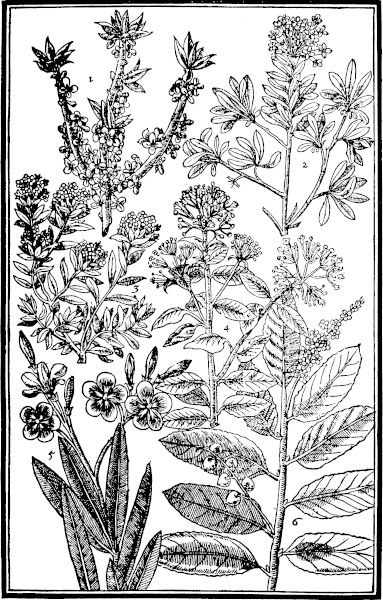
| 1 | Chamælæa Germanica seu Mezereon. Mezereon or Dwarfe Bay. |
| 2 | Chamælæa Alpina. Mountain or Spurge Oliue. |
| 3 | Cneorum Matthioli. Small Rocke Roses. |
| 4 | Laurus Tinus siue siluestris. The wild Bay tree. |
| 5 | Oleander siue Laurus Rosea. The Rose Bay tree. |
| 6 | Laurocerasus. The Bay Cherrie tree. |
All these plants except the last, as well leaues as berries, are violent purgers,
and therefore great caution is to bee had in the vse of them. The last
hath not beene applyed for any disease that I know.
My meaning is not to make any description of our ordinary Bayes in this place
(for as all may very well know, they may be for an Orchard or Courtyard, and
not for this Garden) but of two or three other kindes, whose beautifull aspect
haue caused them to be worthy of a place therein: the one is called Laurus Tinus, The
wilde Baye: the other Laurus Rosea or Oleander, The Rose Bay: and a third is
Laurocerasus, The Cherry Bay; which may haue not onely some respect for his long
bush of sweet smelling flowers, but especially for the comely statelinesse of his gallant
euer fresh greene leaues; and the rather, because with vs in most places, it doth
but frutescere, vse to bee Shrub high, not arborescere, Tree high, which is the more fit
for this Garden.
This wilde Baye groweth seldome to bee a tree of any height, but abideth for the
most part low, shooting forth diuers slender branches, whereon at euery ioynt
stand two leaues, long, smooth, and of a darke greene colour, somewhat like vnto the
leaues of the Female Cornell tree, or between that and Baye leaues: at the toppes of
the branches stand many small white sweete smelling flowers, thrusting together, as it
were in an vmbell or tuft, consisting of fiue leaues a peece, the edges whereof haue a
shew of a wash purple, or light blush in them, which for the most part fall away without
bearing any perfect ripe fruit in our Countrey: Yet sometimes it hath small black
berries, as if they were good, but are not. In his naturall place it beareth small, round,
hard and pointed berries, of a shining blacke colour, for such haue come often to my
hands (yet Clusius writeth they are blew); but I could neuer see any spring that I put
into the ground. This that I here describe, seemeth to me to be neither of both those
that Clusius saw growing in Spain and Portugall, but that other, that (as he saith) sprang
in the low Countreyes of Italian seede.
Of the Rose Bay there are two sorts, one bearing crimson coloured flowers, which
is more frequent, and the other white, which is more rare. They are so like in all other
things, that they neede but one description for both. The stemme or trunke is many
times with vs, as bigge at the bottome as a good mans thumbe, but growing vp smaller,
it diuideth it selfe into branches, three for the most part comming from one ioynt or
place, and those branches againe doe likewise diuide themselues into three other, and
so by degrees from three to three, as long as it groweth: the lowest of these are bare
of leaues, hauing shed or lost them by the cold of winters, keeping onely leaues on
the vppermost branches, which are long, and somewhat narrow, like in forme vnto
Peach leaues, but thicker, harder, and of a darke greene colour on the vpperside, and
yellowish greene vnderneath: at the tops of the young branches come forth the flowers,
which in the one sort before they are open, are of an excellent bright crimson colour,
and being blowen, consist of foure long and narrow leaues, round pointed,
somewhat twining themselues, of a paler red colour, almost tending to blush, and in
the other are white, the greene leaues also being of a little fresher colour: after the
flowers are past, in the hot countries, but neuer in ours, there come vp long bending or
crooked flat pods, whose outward shell is hard, almost woody, and of a browne colour,
wherein is contained small flat brownish seede, wrapped in a great deale of a
brownish yellow doune, as fine almost as silke, somewhat like vnto the huskes of Asclepias,
or Periploca, but larger, flatter and harder; as my selfe can testifie, who had
some of the pods of this Rose bay, brought mee out of Spaine, by Master Doctor
Iohn More, the seedes whereof I sowed, and had diuers plants that I raised vp vnto
a reasonable height, but they require, as well old as young, to bee defended from the
colde of our winters.
This beautifull bay in his naturall place of growing, groweth to bee a tree of a reasonable
bignesse and height, and oftentimes with vs also if it bee pruined from the
lower branches; but more vsually in these colder Countries, it groweth as a shrub or
hedge bush, shooting forth many branches, whereof the greater and lower are couered
with a darke grayish greene barke, but the young ones are very greene, whereon are
set many goodly, faire, large, thicke and long leaues, a little dented about the edges,
of a more excellent fresh shining greene colour, and farre larger then any Bay leafe,
and compared by many to the leaues of the Pomeritron tree (which because wee haue
none in our Countrey, cannot be so well known) both for colour and largenesse, which
yeeld a most gracefull aspect: it beareth long stalkes of whitish flowers, at the ioynts
of the leaues both along the branches and towards the ends of them also, like vnto
the Birds Cherry or Padus Theophrasti, which the French men call Putier & Cerisier
blanc, but larger and greater, consisting of fiue leaues with many threds in the middle:
after which commeth the fruite or berries, as large or great as Flanders Cherries, many
growing together one by another on a long stalke, as the flowers did, which are
very blacke and shining on the outside, with a little point at the end, and reasonable
sweete in taste, wherein is contained a hard round stone, very like vnto a Cherry stone,
as I haue obserued as well by those I receiued out of Italie, as by them I had of Master
Iames Cole a Merchant of London lately deceased, which grew at his house in Highgate,
where there is a faire tree which hee defended from the bitternesse of the weather
in winter by casting a blanket ouer the toppe thereof euery yeare, thereby the
better to preserue it.
The first is not certainly knowne from whence it came, and is communicated
by the suckers it yeeldeth. The second groweth in Spaine, Italie,
Grece, and many other places: that with white flowers is recorded by Bellonius,
to grow in Candy. The last, as Matthiolus, and after him Clusius
report, came first from Constantinople: I had a plant hereof by the friendly
gift of Master Iames Cole, the Merchant before remembred, a great louer
of all rarities, who had it growing with him at his countrey house in
Highgate aforesaid, where it hath flowred diuers times, and borne ripe fruit
also.
The first flowreth many times in the end of the yeare before Christmas,
and often also in Ianuary, but the most kindly time is in March and Aprill,
when the flowers are sweetest. The second flowreth not vntill Iuly. The
last in May, and the fruit is ripe in August and September.
The first is called Laurus siluestris, and Laurus Tinus: in English Wilde
Bay, or Sweete flowring Bay. The second is called Laurus Rosea, Oleander,
Nerium, and Rhododendros: in English The Rose Bay, and Oleander. The
last was sent by the name of Trebezon Curmasi, that is to say, Dactylus Trapezuntina,
but not hauing any affinitie with any kinde of Bay. Bellonius as I
thinke first named it Laurocerasus, and Cerasus Trapezuntina. Dalechampius
thinketh it to bee Lotus Aphricana, but Clusius refuteth it. Those stones or
kernels that were sent me out of Italie, came by the name of Laurus Regia,
The Kings Bay. Wee may most properly call it according to the Latine
name in the title, The Cherry bay, or Bay Cherry, because his leaues are
like vnto Bay-leaues, and both flowers and fruit like vnto the Birdes Cherry
or Cluster Cherry, for the manner of the growing; and therefore I might
more fitly I confesse haue placed it in my Orchard among the sorts of
Cherries: but the beautifulnesse of the plant caused mee rather to insert it
here.
The wilde Bay hath no propertie allotted vnto it in Physicke, but that it
is not to be endured, the berries being chewed declare it to be so violent hot
and choking. The Rose Bay is said by Dioscorides, to be death to all foure
footed beasts, but contrariwise to man it is a remedie against the poison of
Serpents, but especially if Rue bee added vnto it. The Cherry Bay is not
knowne with vs to what physicke vse it may be applyed.
The beautifull shew of these three sorts of flowers, hath made me to insert them
into this garden, in that for their worthinesse I am vnwilling to bee without
them, although the rest of their kindes I haue transferred into the Orchard,
where among other fruit trees, they shall be remembred: for all these here set downe,
seldome or neuer beare any fruite, and therefore more fit for a Garden of flowers,
then an Orchard of fruite.
The double blossomed Cherry tree is of two sorts for the flower, but not differing
in any other part, from the ordinary English or Flanders Cherry tree, growing in
very like manner: the difference consisteth in this, that the one of these two sorts
hath white flowers lesse double, that is, of two rowes or more of leaues, and the other
more double, or with more rowes of leaues, and besides I haue obserued in this greater
double blossomd Cherry, that some yeares most of the flowers haue had another
smaller and double flower, rising vp out of the middle of the other, like as is to bee
seene in the double English Crow-foote, and double redde Ranunculus or Crowfoote,
before described: this I say doth not happen euery yeare, but sometimes. Sometimes
also these trees will giue a few berries, here and there scattered, and that with lesse
double flowers more often, which are like vnto our English Cherries both for taste and
bignesse. These be very fit to be set by Arbours.
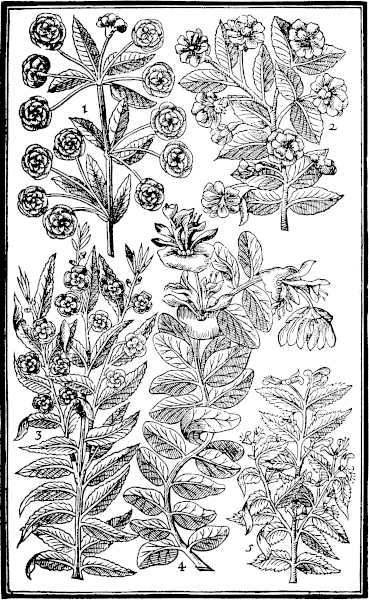
| 1 | Cerasus flore pleno. The double blossomd Cherry tree. |
| 2 | Malus flore multiplici. The double blossomd Apple tree. |
| 3 | Malus Persica flore pleno. The double blossomd Peach tree. |
| 4 | Periclymenum perfoliatum. Double Honisuckle. |
| 5 | Periclymenum rectum. Vpright Honisuckle. |
This double blossomd Apple tree is altogether like vnto our ordinary Pippin tree
in body, branch and leafe, the only difference is in the flower, which is altogether whitish,
sauing that the inner leaues towards the middle are more reddish, but as double
and thicke as our double Damaske Roses, which fall away without bearing fruit.
This Peach tree for the manner of growing, is so like vnto an ordinary Peach tree,
that vntill you see it in blossome you can perceiue no difference: the flower is of the
same colour with the blossomes of the Peach, but consisting of three or foure, or
more rowes of leaues, which fall often away likewise without bearing any fruite; but
after it hath abiden some yeares in a place doth forme into fruite, especially being
planted against a wall.
Both the Cherry trees are frequent in many places of England, noursed
for their pleasant flowers. The Apple is as yet a stranger. And the Peach,
hath not been seen or knowne, long before the writing hereof.
They all flower in April & May, which are the times of their other kinds.
Their names are also sufficiently expressed to know them by.
Cherries, Peaches and Apples, are recorded in our Orchard, and there
you shall finde the properties of their fruit: for in that these beare none or
very few, their blossomes are of most vse to grace and decke the persons of
those that will weare or beare them.
The Honisuckle that groweth wilde in euery hedge, although it be very sweete,
yet doe I not bring into my garden, but let it rest in his owne place, to serue
their senses that trauell by it, or haue no garden. I haue three other that furnish
my Garden, one that is called double, whose branches spreade far, and being very fit
for an arbour will soone couer it: the other two stand vpright, and spreade not any
way far, yet their flowers declaring them to be Honisuckles, but of lesse delight, I consort
them with the other.
The truncke or body of the double Honisuckle, is oftentimes of the bignesse of a
good staffe, running out into many long spreading branches, couered with a whitish
barke, which had neede of some thing to sustaine them, or else they will fall down
to the ground (and therefore it is vsually planted at an arbour, that it may run thereon,
or against a house wall, and fastened thereto in diuers places with nailes) from whence
spring forth at seuerall distances, and at the ioynts, two leaues, being like in forme vnto
the wilde Honisuckles, and round pointed for the most part; these branches diuiding
themselues diuers wayes, haue at the toppes of them many flowers, set at certaine
distances one aboue another, with two greene leaues at euery place, where the flowers
doe stand, ioyned so close at the bottome, and so round and hollow in the middle, that
it seemeth like a hollow cuppe or sawcer of flowers: the flowers stand round about
the middle of these cuppes or sawcers, being long, hollow, and of a whitish yellow
colour, with open mouthes dasht ouer with a light shew of purple, and some threds
within them, very sweet in smell, like both in forme and colour vnto the common Honisuckles,
but that these cuppes with the flowers in them are two or three standing one
aboue another (which make a far better shew then the common, which come forth all
at the heade of the branches, without any greene leaues or cuppes vnder them) and
therefore these were called double Honisuckles.
This vpright Woodbinde hath a straight woody stemme, diuided into seuerall
branches, about three or foure foote high, couered with a very thinne whitish barke,
whereon stand two leaues together at the ioynts, being lesser then the former, smooth
and plaine, and a little pointed: the flowers come forth vpon slender long footstalks
at the ioynts where the leaues stand, alwayes two set together, and neuer more, but
seldome one alone, which are much smaller then the former, but of the same fashion,
with a little button at the foote of the flower; the buds of the flowers before they
are open are very reddish, but being open are not so red, but tending to a kinde of yellowish
blush colour: after which come in their places two small red berries, the one
withered for the most part, or at least smaller then the other, but (as Clusius saith) in
their naturall places they are both full and of one bignesse.
This other vpright Woodbinde groweth vp as high as the former, or rather somewhat
higher, couered with a blackish rugged barke, chapping in diuers places, the
younger branches whereof are somewhat reddish, and couered with an hoary doune:
the leaues stand two together at the ioints, somewhat larger then the former, and more
whitish vnderneath: the flowers are likewise two standing together, at the end of a
slender footestalke, of a pale yellowish colour when they are blowne, but more reddish
in the bud: the berries stand two together as the former, of a darke blewish
colour when they are fully ripe, and full of a red liquour or iuice, of a pleasant taste,
which doth not only dye the hands of them that gather them, but serueth for a dying
colour to the inhabitants where they grow plentifully, wherein are contained many
flat seede: The roote is woody as the former is.
The first groweth in Italie, Spaine, and Prouence of France, but not in
the colder countreyes, vnlesse it be there planted, as is most frequent in our
countrey. The others grow in Austria, and Stiria, as Clusius saith, and are
entertained into their gardens onely that are curious.
The first flowreth vsually in Aprill, the rest in May.
The first is called Periclymenum, Caprifolium perfoliatum, and Italicum,
as a difference from the common kinde: In English Double Woodbinde,
or double Honisuckles. The others, as they are rare, and little knowne, so
are their names also: yet according to their Latine, I haue giuen them
English names.
The double Honisuckle is as effectuall in all things, as the single wilde
kinde, and besides, is an especiall good wound herbe for the head or other
parts. I haue not knowne the vpright kindes vsed in Physicke.
We haue but one sort of true Iasmine ordinarily in our Gardens throughout
the whole Land; but there is another greater sort, which is farre
more tender, brought out of Spaine, and will hardly endure any long
time with vs, vnlesse it be very carefully preserued. Wee haue a third kinde called a
yellow Iasmine, but differeth much from their tribe in many notable points: but because
the flowers haue some likenesse with the flowers of the true Iasmine, it hath been
vsually called a Iasmine; and therefore I am content for this Garden to conioyne
them in one Chapter.
The white Iasmine hath many twiggy flexible greene branches, comming forth of
the sundry bigger boughes or stems, that rise from the roote, which are couered with
a grayish darke coloured barke, hauing a white pith within it like the Elder, but not so
much: the winged leaues stand alwaies two together at the ioynts, being made of manie
small and pointed leaues, set on each side of a middle ribbe, six most vsually on
both sides, with one at the end, which is larger, more pointed then any of the rest,
and of a darke greene colour: at the toppes of the young branches stand diuers flowers
together, as it were in an vmbell or tuft, each whereof standeth on a long greene
stalke, comming out of a small huske, being small, long, and hollow belowe, opening
into fiue white small, pointed leaues, of a very strong sweete smell, which fall
away without bearing any fruit at all, that euer I could learne in our Country; but in
the hot Countries where it is naturall, it is said to beare flat fruit, like Lupines: the
rootes spread farre and deepe, and are long and hard to growe, vntill they haue taken
strong hold in the ground.
This Catalonia Iasmine groweth lower then the former, neuer rising halfe so high,
and hath slender long greene branches, rising from the toppe of the wooddy stemme,
with such like leaues set on them as the former, but somewhat shorter and larger: the
flowers also are like vnto the former, and stand in the same manner at the end of the
branches, but are much larger, being of a blush colour before they are blowne, and
white with blush edges when they are open, exceeding sweete of smell, more strong
then the former.
This that is called the yellow Iasmine, hath many long slender twiggy branches rising
from the roote, greene at the first, and couered with a darke grayish barke afterwards,
whereon are set at certaine distances, three small darke greene leaues together,
the end leafe being alwaies the biggest: at the ioynts where the leaues come forth,
stand long stalkes, bearing long hollow flowers, ending in fiue, and some in six leaues,
very like vnto the flowers of the first Iasmine, but yellow, whereupon it is vsually called
the Yellow Iasmine: after the flowers are past, there come in their places round
blacke shining berries, of the bignesse of a great Pease, or bigger, full of a purplish
iuyce, which will dye ones fingers that bruise them but a little: the roote is tough, and
white, creeping farre about vnder the ground, shooting forth plentifully, whereby it
greatly encreaseth.
The first is verily thought to haue been first brought to Spaine out of Syria,
or thereabouts, and from Spaine to vs, and is to be seene very often,
and in many of our Country Gardens. The second hath his breeding in
Spaine also, but whether it be his originall place we know not, and is scarce
yet made well acquainted with our English ayre. The third groweth plentifully
about Mompelier, and will well abide in our London Gardens, and
any where else.
The first flowreth not vntill the end of Iuly. The second somewhat earlier.
The third in Iuly also.
The first is generally called Iasminum album, and Gelseminum album: In
English, The white Iasmine. The second hath his name in his title, as much
as may be said of it. The third hath been taken of some to be a Cytisus, others
iudge it to be Polemonium, but the truest name is Trifolium fruticans,
although many call it Iasminum luteum: In English most vsually, The yellow
Iasmine, for the reasons aforesaid; or else after the Latine name,
Shrubbie Trefoile, or Make-bate.
The white Iasmines haue beene in all times accepted into outward medicines,
eyther for the pleasure of the sweete sent, or profit of the warming
properties. And is in these dayes onely vsed as an ornament in Gardens,
or for sent of the flowers in the house, &c. The yellow Iasmine, although
some haue adiudged it to be the Polemonium of Dioscorides, yet it is
not vsed to those purposes by any that I know.
Vnder the name of Syringa, is contained two speciall kinds of Shrubs or Trees,
differing one from another; namely, the Lilac of Matthiolus, which is called
Syringa cærulea, and is of two or three sorts: And the Syringa alba, which also
is of two sorts, as shall bee declared.
The blew Pipe tree riseth sometimes to be a great tree, as high and bigge in the bodie
as a reasonable Apple tree (as I haue in some places seene and obserued) but most
vsually groweth lower, with many twigs or branches rising from the roote, hauing as
much pith in the middle of them as the Elder hath, couered with a grayish greene
barke, but darker in the elder branches, with ioynts set at a good distance one from
another, and two leaues at euery ioynt, which are large, broad, and pointed at the
ends, many of them turning or folding both the sides inward, and standing on
long foote stalkes: at the toppes of the branches come forth many flowers, growing
spike-fashion, that is, a long branch of flowers vpon a stalke, each of these flowers are
small, long, and hollow belowe, ending aboue in a pale blewish flower, consisting of
foure small leaues, of a pretty small sent: after the flowers are past, there come sometimes
(but it is not often in our Country, vnlesse the tree haue stood long, and is grown
great, the suckers being continually taken away, that it may growe the better) long and
flat cods, consisting as it were of two sides, a thin skinne being in the midst, wherein
are contained two long flattish red seede: the rootes are strong, and growe deepe in
the ground.
This Pipe tree differeth not from the former blew Pipe tree, either in stemme or
branches, either in leaues or flowers, or manner of growing, but onely in the colour
of the flower, which in this is of a milke, or siluer colour, which is a kinde of white,
wherein there is a thinne wash, or light shew of blew shed therein, comming somewhat
neare vnto an ash-colour.
This Pipe tree should not differ from the first in any other thing then in the leaues,
which are said to be cut in on the edges into seuerall parts, as the relation is giuen à viris
fide dignis; for as yet I neuer saw any such; but I here am bold to set it downe, to induce
and prouoke some louer of plants to obtaine it for his pleasure, and others also.
The single white Pipe tree or bush, neuer commeth to that height of the former, but
abideth alwaies like a hedge tree or bush, full of shootes or suckers from the roote,
much more then the former: the young shootes hereof are reddish on the outside, and
afterward reddish at the ioynts, and grayish all the rest ouer: the young as well as the
old branches, haue some pith in the middle of them, like as the Elder hath: the leaues
stand two at a ioynt, somewhat like the former, but more rugged or crumpled, as also
a little pointed, and dented about the edges: the flowers growe at the toppes of the
branches, diuers standing together, consisting of foure white leaues, like vnto small
Muske Roses, and of the same creame colour, as I may call it, with many small yellowish
threads in the middle, and are of a strong, full, or heady sent, not pleasing to
a great many, by reason of the strange quicknesse of the sent: the fruit followeth, being
flat at the head, with many leafie shels or scales compassing it, wherein is enclosed
small long seede: the rootes runne not deepe, but spread vnder the ground, with
many fibres annexed vnto them.
This Pipe tree hath diuers long and slender branches, whereon growe large leaues,
somewhat like vnto the leaues of the former single white kinde, but not so rough or
hard, and not at all dented about the edges, two alwaies standing one against another
at euery ioynt of the stalke, but set or disposed on contrary sides, and not all vpon one
side; at the ends whereof come forth diuers flowers, euery one standing on his owne
foote-stalke, the hose or huske being long and hollow, like vnto the white Iasmine,
and the flowers therein consisting of a double rowe of white and round pointed leaues,
fiue or six in a rowe, with some yellownesse in the middle, which is hollow, of a very
strong and heady sweet sent, and abiding a long time flowring, especially in the hotter
Countries, but is very tender, and not able to abide any the least cold weather with vs;
for the cold windes will (as I vnderstand) greatly molest it: and therefore must as
charily be kept as Orenge trees with vs, if wee will haue it to abide.
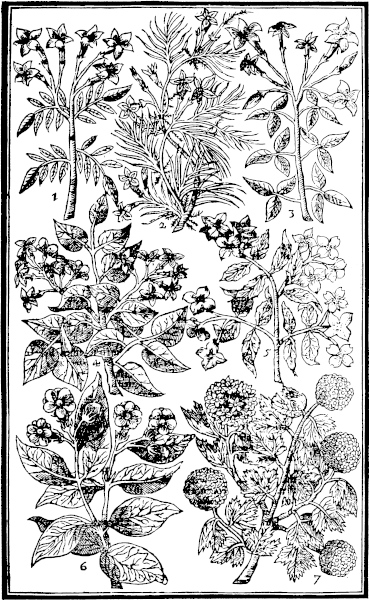
| 1 | Iasminum album vulgare. The ordinary white Iasmine. |
| 2 | Iasminum Americanum siue Convolvulus Americanus. The Iasmine or Bindweed of America. |
| 3 | Iasminum luteum vulgare. The yellow Iasmine. |
| 4 | Lilac seu Syringa cærulea. The blew Pipe tree. |
| 5 | Syringa alba vulgaris. The single white Syringa or Pipe tree. |
| 6 | Syringa flore albo duplici. The double white Syringa. |
| 7 | Sambucus rosea. The Elder or Gelder Rose. |
The first groweth in Arabia (as Matthiolus thinketh, that had it from
Constantinople.) We haue it plentifully in our Gardens. The second and
third are strangers with vs as yet. The fourth is as frequent as the first, or
rather more, but his originall is not knowne. The last hath his originall from
Arabia, as his name importeth.
The first, second, and third flower in Aprill, the other two not vntill May.
The first is called of Matthiolus Lilac, and by that name is most vsually
called in all parts. It is also called Syringa cærulea, because it commeth nearest
vnto those woods, which for their pithy substance, were made hollow
into pipes. It is called of all in English, The blew Pipe tree. It seemeth
likely, that Petrus Bellonius in his third Booke and fiftieth Chapter of his
obseruations (making mention of a shrubbe that the Turkes haue, with Iuie
leaues alwaies greene, bearing blew or violet coloured flowers on a long
stalke, of the bignesse and fashion of a Foxe taile, and thereupon called in
their language a Foxe taile) doth vnderstand this plant here expressed. The
certainty whereof might easily be knowne, if any of our Merchants there
residing, would but call for such a shrubbe, by the name of a Foxe taile in
the Turkish tongue, and take care to send a young roote, in a small tubbe or
basket with earth by Sea, vnto vs here at London, which would be performed
with a very little paines and cost. The second and third, as kindes
thereof, haue their names in their titles. The fourth is called by Clusius
and others, Frutex Coronarius; some doe call it Lilac flore albo, but that name
is not proper, in that it doth confound both kindes together. Lobel calleth
it Syringa Italica. It is now generally called of all Syringa alba, that is in
English, The white Pipe tree. Some would haue it to bee Ostrys of Theophrastus,
but Clusius hath sufficiently cleared that doubt. Of others Ligustrum
Orientale, which it cannot be neither; for the Cyprus of Plinie is Dioscorides
his Ligustrum, which may be called Orientale, in that it is most proper
to the Easterne Countries, and is very sweete, whose seede is like vnto
Coriander seede. The last is called by diuers Syringa Arabica flore albo duplici,
as most fitly agreeing thereunto. Of Basilius Beslerus that set forth the
great booke of the Bishop of Eystot in Germany his Garden, Syringa Italica
flore albo pleno, because, as it is likely, hee had it from Italy. It is very
likely, that Prosper Alpinus in his booke of Egyptian plants, doth meane
this plant, which hee there calleth Sambach, siue Iasminum Arabicum. Matthæus
Caccini of Florence in his letter to Clusius entituleth it Syringa Arabica,
siue Iasminum Arabicum, siue Iasminum ex Gine, whereby hee declareth
that it may not vnfitly be referred to either of them both. We may call it in
English as it is in the title, The double white Pipe tree.
We haue no vse of these in Physicke that I know, although Prosper Alpinus
saith, the double white Pipe tree is much vsed in Egypt to help women
in their trauailes of childbirth.
Although there be diuers kindes of Elders, yet there is but one kinde of Elder
Rose, whereof I meane to intreate in this Chapter, being of neare affinity in
some things vnto the former Pipe trees, and which for the beauty of it deserueth
to be remembred among the delights of a Garden.
The Gelder Rose (as it is called) groweth to a reasonable height, standing like a
tree, with a trunke as bigge as any mans arme, couered with a darke grayish barke,
somewhat rugged and very knotty: the younger branches are smooth and white,
with a pithy substance in the middle, as the Elders haue, to shew that it is a kind thereof,
whereon are set broad leaues, diuided into three parts or diuisions, somewhat like
vnto a Vine leafe, but smaller, and more rugged or crumpled, iagged or cut also about
the edges: at the toppes of euery one of the young branches, most vsually commeth
forth a great tuft, or ball as it were, of many white flowers, set so close together, that
there can be no distinction of any seuerall flower seene, nor doth it seeme like the double
flower of any other plant, that hath many rowes of leaues set together, but is a cluster
of white leaued flowers set together vpon the stalke that vpholdeth them, of a
small sent, which fall away without bearing any fruit in our Country, that euer I could
obserue or learne: The roote spreadeth neither farre nor deepe, but shooteth many
small rootes and fibres, whereby it is fastened in the ground, and draweth nourishment
to it, and sometimes yeeldeth suckers from it.
It should seeme, that the naturall place of this Elder is wet and moist
grounds, because it is so like vnto the Marsh Elder, which is the single kind
hereof. It is onely noursed vp in Gardens in all our Country.
It flowreth in May, much about the time of the double Peony flower,
both which being set together, make a pleasant variety, to decke vp the
windowes of a house.
It is generally called Sambucus Rosea: In English, The Elder Rose, and
more commonly after the Dutch name, the Gelder Rose. Dalechampius
seemeth to make it Thraupalus of Theophrastus, or rather the single Marsh
Elder; for I thinke this double kinde was not knowne in Theophrastus his
time.
It is not applyed to any Physicall vse that I know.
The great varietie of Roses is much to be admired, beeing more then is to bee
seene in any other shrubby plant that I know, both for colour, forme and smell.
I haue to furnish this garden thirty sorts at the least, euery one notably differing
from the other, and all fit to be here entertained: for there are some other, that
being wilde and of no beautie or smell, we forbeare, and leaue to their wilde habitations.
To distinguish them by their colours, as white, red, incarnate, and yellow, were
a way that many might take, but I hold it not so conuenient for diuers respects: for so
I should confound those of diuers sorts one among another, and I should not keepe
that methode which to me seemeth most conuenient, which is, to place and ranke euery
kinde, whether single or double, one next vnto the other, that so you may the better
vnderstand their varieties and differences: I will therefore beginne with the most
ancient, and knowne Roses to our Countrey, whether naturall or no I know not, but
assumed by our precedent Kings of all others, to bee cognisances of their dignitie,
the white Rose and the red, whom shall follow the damaske, of the finest sent, and most
vse of all the other sorts, and the rest in their order.
The white Rose is of two kindes, the one more thicke and double then the other:
The one riseth vp in some shadowie places, vnto eight or ten foote high, with a stocke
of a great bignesse for a Rose. The other growing seldome higher then a Damaske
Rose. Some doe iudge both these to be but one kinde, the diuersitie happening by the
ayre, or ground, or both. Both these Roses haue somewhat smaller and whiter greene
leaues then in many other Roses, fiue most vsually set on a stalke, and more white vnderneath,
as also a whiter greene barke, armed with sharpe thornes or prickles, whereby
they are soone known from other Roses, although the one not so easily from the other:
the flowers in the one are whitish, with an eye or shew of a blush, especially towards
the ground or bottome of the flower, very thicke double, and close set together, and for
the most part not opening it selfe so largely and fully as eyther the Red or Damaske
Rose. The other more white, lesse thicke and double, and opening it selfe more, and
some so little double as but of two or three rowes, that they might be held to be single,
yet all of little or no smell at all. To describe you all the seuerall parts of the Rose, as
the bud, the beards, the threds &c. were needlesse, they are so conuersant in euery ones
hand, that I shall not neede but to touch the most speciall parts of the varieties of them,
and leaue a more exact relation of all things incident vnto them, vnto a generall worke.
The Carnation Rose is in most things like vnto the lesser white rose, both for the
growing of the stocke, and bignesse of the flower, but that it is more spreade abroade
when it is blown then the white is, and is of a pale blush colour all the flower thoroughout,
of as small a sent as the white one is almost.
Rosa Belgica
siue Vitrea.
This kinde of Rose is not very great, but very thicke and double, and is very variable
in the flowers, in that they will be so different one from another: some being paler then
others, and some as it were blasted, which commeth not casually, but naturally to this
rose: but the best flowers (whereof there will bee still some) will be of a bright pale
murrey colour, neere vnto the Veluet rose, but nothing so darke a colour.
The red Rose (which I call English not only for the reason before expressed, but because
(as I take it) this Rose is more frequent and vsed in England, then in other places)
neuer groweth so high as the damaske Rose bush, but most vsually abideth low, and
shooteth forth many branches from the roote (and is but seldome suffered to grow vp
as the damaske Rose into standards) with a greene barke, thinner set with prickles, and
larger and greener leaues on the vpperside then in the white, yet with an eye of white
vpon them, fiue likewise most vsually set vpon a stalke, and grayish or whitish vnderneath.
The Roses or Flowers doe very much vary, according to their site and abiding;
for some are of an orient, red or deepe crimson colour, and very double (although neuer
so double as the white) which when it is full blowne hath the largest leaues of any
other Rose; some of them againe are paler, tending somewhat to a damaske; and some
are of so pale a red, as that it is rather of the colour of the canker Rose, yet all for the
most part with larger leaues then the damaske, and with many more yellow threds in
the middle: the sent hereof is much better then in the white, but not comparable to
the excellencie of the damaske Rose, yet this Rose being well dryed and well kept, will
hold both colour and sent longer then the damaske, bee it neuer so well kept.
The Damaske Rose bush is more vsually noursed vp to a competent height to stand
alone, (which we call Standards) then any other Rose: the barke both of the stocke
and branches, is not fully so greene as the red or white Rose: the leaues are greene with
an eye of white vpon them, so like vnto the red Rose, that there is no great difference betweene
them, but that the leaues of the red Rose seeme to bee of a darker greene. The
flowers are of a fine deepe blush colour, as all know, with some pale yellow threds in
the middle, and are not so thicke and double as the white, not being blowne, with so
large and great leaues as the red, but of the most excellent sweet pleasant sent, far surpassing
all other Roses or Flowers, being neyther heady nor too strong, nor stuffing or
vnpleasant sweet, as many other flowers.
This Rose (that some call Centifolia Batauica incarnata) hath his barke of a reddish
or browne colour, whereby it is soone discerned from other Roses. The leaues are
likewise more reddish then in others, and somewhat larger, it vsually groweth very
like the Damaske rose, and much to the same height: the flowers or roses are of the
same deepe blush colour that the damaske roses are, or rather somewhat deeper, but
much thicker, broader, and more double, or fuller of leaues by three parts almost, the
outer leaues turning themselues backe, when the flower hath stood long blowne, the
middle part it selfe (which in all other roses almost haue some yellow threds in them
to be seene) being folded hard with small leaues, without any yellow almost at all to be
seene, the sent whereof commeth neerest vnto the damaske rose, but yet is short of it
by much, howsoeuer many doe thinke it as good as the damask, and to that end I haue
known some Gentlewomen haue caused all their damaske stockes to bee grafted with
prouince Roses, hoping to haue as good water, and more store of them then of damask
Roses; but in my opinion it is not of halfe so good a sent as the water of damaske
Roses: let euery one follow their own fancie.
As the former was called incarnata, so this is called Batauica centifolia rubra, the difference
being not very great: the stemme or stocke, and the branches also in this,
seeming not to be so great but greener, the barke being not so red; the leaues of the
same largenesse with the former damaske Prouince. The flowers are not altogether so
large, thicke and double, and of a little deeper damaske or blush colour, turning to a
red Rose, but not comming neere the full colour of the best red Rose, of a sent not so
sweete as the damaske Prouince, but comming somewhat neere the sent of the ordinary
red rose, yet exceeding it. This rose is not so plentifull in bearing as the
damaske Prouince.
It is said of diuers, that there is a white Prouince Rose, whereof I am not oculatus
testis, and therefore I dare not giue it you for a certaintie, and indeed I haue some doubt,
that it is the greater and more double white rose, whereof I gaue you the knowledge
in the beginning: when I am my selfe better satisfied, I shall bee ready to satisfie others.
This Rose in the forme and order of the growing, is neerest vnto the ordinary
damaske rose, both for stemme, branch, leafe and flower: the difference consisting in
this, that the flower (being of the same largenesse and doublenesse as the damask rose)
hath the one halfe of it, sometimes of a pale whitish colour, and the other halfe, of a
paler damaske colour then the ordinary; this happeneth so many times, and sometimes
also the flower hath diuers stripes, and markes in it, as one leafe white, or striped with
white, and the other halfe blush, or striped with blush, sometimes also all striped, or
spotted ouer, and other times little or no stripes or markes at all, as nature listeth to
play with varieties, in this as in other flowers: yet this I haue obserued, that the longer
it abideth blowen open in the sun, the paler and the fewer stripes, markes or spots
will be seene in it: the smell whereof is of a weake damaske rose sent.
This Rose is very like vnto the last described, both for stocke, branch and leafe:
the flower hereof is not much different from it, being no great large or double Rose,
but of a meane size, striped and marked with a deeper blush or red, vpon the pale coloured
leafe, that it seemeth in the marking and beauty thereof, to bee of as much delight
as the Chrystall Gilloflower: this, euen like the former, soone fadeth and passeth
away, not yeelding any great store of flowers any yeare.
This Rose groweth alwayes low and small, otherwise in most respects like vnto the
ordinary redde Rose, and with few or no thornes vpon it: the Flowers or Roses are
double, thicke, small and close, not so much spread open as the ordinary red, but
somewhat like vnto the first double white Rose before expressed; yet in some places
I haue seene them more layde open then these, as they grew in my garden, being so euen
at the toppes of the leaues, as if they had been clipt off with a paire of sheeres,
and are not fully of so red a colour as the red Prouince Rose, and of as small or weak
sent as the ordinary red Rose, or not so much.
The young shootes of this Rose are couered with a pale purplish barke, set with a
number of small prickes like haires, and the elder haue but very few thornes: the
flower or rose it selfe hath a very great bud or button vnder it, more then in any other
rose, and is thicke and double as a red rose, but so strongly swelling in the bud, that many
of them breake before they can be full blowen, and then they are of a pale red rose
colour, that is, betweene a red and a damaske, with a very thicke broade and hard vmbone
of short yellow threds or thrumes in the middle, the huske of the flower hauing
long ends, which are called the beards of the rose, which in all other are iagged in
some of them, in this hath no iagge at all; the smell is neerest vnto a red Rose.
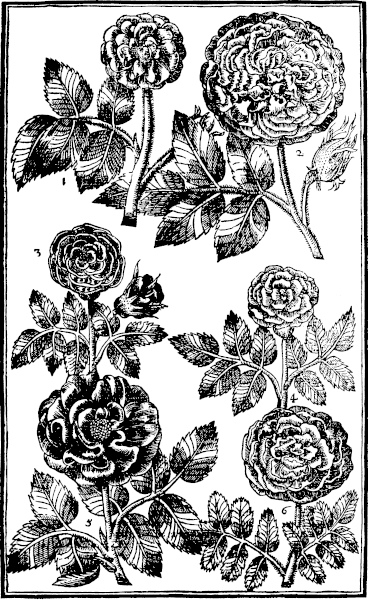
| 1 | Rosa Damascena. The Damaske Rose. |
| 2 | Rosa Prouincialis siue Hollandica. The great Prouince Rose. |
| 3 | Rosa Francafurtensis. The Franckford Rose. |
| 4 | Rosa rubra humilis. The dwarfe red Rose. |
| 5 | Rosa Hungarica. The Hungarian Rose. |
| 6 | Rosa lutea multiplex. The great double yellow Rose. |
The Hungarian Rose hath greene shootes slenderly set with prickes, and seldome
groweth higher then ordinarily the red Rose doth; the stemme or stocke being much
about that bignesse: the flower or rose is as great, thicke and double, as the ordinary
red Rose, and of the same fashion, of a paler red colour, and beeing neerely looked
vpon is finely spotted with faint spots, as it were spreade ouer the red; the smell wherof
is somewhat better then the smell of the ordinary red Rose of the best kinde.
The old stemme or stock of the veluet Rose is couered with a dark coloured barke,
and the young shootes of a sad greene with very few or no thornes at all vpon them:
the leaues are of a sadder greene colour then in most sorts of Roses, and very often
seuen on a stalke, many of the rest hauing but fiue: the Rose is eyther single or double:
the single is a broade spread flower, consisting of fiue or sixe broade leaues with many
yellow threds in the middle: the double hath two rowes of leaues, the one large,
which are outermost, the other smaller within, of a very deepe red crimson colour
like vnto crimson veluet, with many yellow threds also in the middle; and yet for all
the double rowe of leaues, these Roses stand but like single flowers: but there is another
double kinde that is more double then this last, consisting oftentimes of sixteene
leaues or more in a flower, and most of them of an equall bignesse, of the colour of
the first single rose of this kinde, or somewhat fresher; but all of them of a smaller
sent then the ordinary red Rose.
The Rose without thornes hath diuers greene smooth shootes, rising from the root,
without any pricke or thorne at all vpon them, eyther young or old: the leaues are not
fully so large as of the red rose: the flowers or roses are not much bigger then those
of the double Cinamon Rose, thicke set together and short, of a pale red Rose colour,
with diuers pale coloured veines through euery leafe of the flower, which hath caused
some to call it The marbled Rose, and is of a small sent, not fully equall to the red
Rose. The single of this kinde differeth not in any other thing from the former, then
in the doublenesse or singlenesse of the flowers which in this are not halfe so double,
nor yet fully single, and are of a paler red colour.
Rosa siue spina
flore albo.
I haue heard likewise of a white Rose of this kinde, but I haue seene none such as yet,
therefore I can say no more thereof.
The single Cinamon Rose hath his shootes somewhat red, yet not so red as the double
kinde, armed with great thornes, like almost vnto the Eglantine bush thereby
showing, as well by the multiplicitie of his shootes as the quicknesse and height of his
shooting, his wilde nature: On the stemme and branches stand winged leaues, sometimes
seuen or more together, which are small and greene, yet like vnto other Roses.
The Roses are single, of fiue leaues a peece, somewhat large, and of a pale red colour,
like vnto the double kinde, which is in shootes redder, and in all other things like vnto
the single, but bearing small, short, thicke and double Roses, somewhat like vnto
the Rose without thornes, but a little lesser, of a paler red colour at the end of the
leaues, and somewhat redder and brighter toward the middle of them, with many
yellow short thrumes; the small sent of Cinamon that is found in the flowers hath
caused it to beare the name.
This single yellow Rose is planted rather for variety then any other good vse. It
often groweth to a good height, his stemme being great and wooddy, with few or no
prickes vpon the old wood, but with a number of small prickes like haires, thicke set,
vpon the younger branches, of a darke colour somewhat reddish, the barke of the
young shootes being of a sad greene reddish colour: the leaues of this Rose bush are
smaller, rounder pointed, of a paler greene colour, yet finely snipt about the edges,
and more in number, that is, seuen or nine on a stalke or ribbe, then in any other Garden
kinde, except the double of the same kinde that followeth next: the flower is a
small single Rose, consisting of fiue leaues, not so large as the single Spanish Muske
Rose, but somewhat bigger then the Eglantine or sweete Briar Rose, of a fine pale yellow
colour, without any great sent at all while it is fresh, but a little more, yet small
and weake when it is dryed.
The double yellow Rose is of great account, both for the rarity, and doublenesse of
the flower, and had it sent to the rest, would of all other be of highest esteeme. The
stemme or stocke, the young shoots or branches, the small hairy prickes, and the small
winged leaues, are in all parts like vnto the former single kinde; the chiefest difference
consisteth in the doublenesse of the flower or Rose, which is so thicke and double,
that very often it breaketh out on one side or another, and but a few of them abiding
whole and faire in our Countrey, the cause whereof wee doe imagine to bee the
much moisture of our Countrey, and the time of flowring being subiect to much
raine and showers; many therefore doe either plant it against a wall, or other wayes
defend it by couering: againe, it is so plentifull in young shootes or branches, as also
in flowers at the toppe or euery branch, which are small and weake for the most part,
that they are not able to bring all the flowers to ripenesse; and therefore most of them
fall or wither away without comming to perfection (the remedy that many doe vse
for this inconuenience last recited is, that they nippe away most of the buds, leauing
but some few vpon it, that so the vigour of the plant may be collected into a few flowers,
whereby they may the better come to perfection, and yet euen thus it is hardly
effected) which are of a yellowish greene colour in the bud, and before they be blowne
open, but then are of a faire yellow colour, very full of leaues, with many short haires
rather then leaues in the middle, and hauing short, round, greene, smooth buttons, almost
flat vnder them: the flower being faire blowne open, doth scarce giue place for
largenesse, thicknesse, and doublenesse, vnto the great Prouence or Holland Rose.
This Rose bush or plant is very tender with vs here about London, and will require
some more care and keeping then the single of this kinde, which is hardy enough; for
I haue lost many my selfe, and I know but a few about this towne that can nourse it vp
kindly, to beare or scarce to abide without perishing; but abideth well in euery free
aire of all or the most parts of this Kingdome: but (as I heare) not so well in the North.
The Muske Rose both single and double, rise vp oftentimes to a very great height,
that it ouergroweth any arbour in a Garden, or being set by an house side, to bee ten
or twelue foote high, or more, but more especially the single kinde, with many green
farre spread branches, armed with a few sharpe great thornes, as the wilder sorts of
Roses are, whereof these are accounted to be kindes, hauing small darke greene leaues
on them, not much bigger then the leaues of Eglantine: the flowers come forth at the
toppes of the branches, many together as it were in an vmbell or tuft which for the
most part doe flower all at a time, or not long one after another, euery one standing
on a pretty long stalke, and are of a pale whitish or creame colour, both the single and
the double; the single being small flowers, consisting of fiue leaues, with many yellow
threads in the middle: and the double bearing more double flowers, as if they
were once or twice more double then the single, with yellow thrummes also in the
middle, both of them of a very sweete and pleasing smell, resembling Muske: some
there be that haue auouched, that the chiefest sent of these Roses consisteth not in the
leaues, but in the threads of the flowers.
This other kinde of Muske Rose (which with some is called the white Damaske
Muske, but more truely the double white Cinamon Rose) hath his stemme and branches
also shorter then the former, but as greene: the leaues are somewhat larger, and
of a whiter greene colour; the flowers also are somewhat larger then the former double
kinde, but standing in vmbels after the same manner, or somewhat thicker, and of
the same whitish colour, or a little whiter, and somewhat, although but a little, neare
the smell of the other, but nothing so strong. This flowreth at the time of other Roses,
or somewhat later, yet much before the former two sorts of Muske Roses, which
flower not vntill the end of Summer, and in Autumne; both which things, that is, the
time of the flowring, and the sent being both different, shew plainly it cannot be of
the tribe of the Muske Roses.
This Spanish Rose riseth to the height of the Eglantine, and sometimes higher, with
diuers great greene branches, the leaues whereof are larger and greener then of the
former kindes: the flowers are single Roses, consisting of fiue whiter leaues then in
any of the former Muske Roses, and much larger, hauing sometimes an eye of a blush
in the white, of a very sweete smell, comming nearest vnto the last recited Muske
Rose, as also for the time of the flowring.
The stemme or stocke of this Rose is great, couered with a darke grayish barke, but
the younger branches are somewhat reddish, armed here and there with great and
sharpe thornes, but nothing so great or plentifull as in the Eglantine, although it be a
wilde kinde: the leaues are of a whitish greene colour, almost like vnto the first white
Rose, and fiue alwaies set together, but seldome seuen: the flowers are small and single,
consisting of fiue leaues, without any sent, or very little, and little bigger then
those of the Eglantine bush, and of the very same deepe blush colour, euery one standing
vpon a rough or prickly button, bearded in the manner of other Roses, which
when the flowers are fallen growe great, somewhat long and round, peare-fashion,
bearing the beards on the tops of them; and being full ripe are very red, keeping the
small prickles still on them, wherein are many white, hard, and roundish seedes, very
like vnto the seede of the Heppes or Eglantine Berries, lying in a soft pulpe, like vnto
the Hawthorne berries or Hawes: the whole beauty of this plant consisteth more in
the gracefull aspect of the red apples or fruit hanging vpon the bushes, then in the
flowers, or any other thing. It seemeth to be the same that Clusius calleth Rosa Pumila,
but that with me it groweth much higher and greater then he saith his doth.
The sweete Briar or Eglantine Rose is so well knowne, being not onely planted in
Gardens, for the sweetenesse of the leaues, but growing wilde in many woods and
hedges, that I thinke it lost time to describe it; for that all know it hath exceeding long
greene shootes, armed with the cruellest sharpe and strong thornes, and thicker set
then is in any Rose either wilde or tame: the leaues are smaller then in most of those
that are noursed vp in Gardens, seuen or nine most vsually set together on a ribbe or
stalke, very greene and sweete in smell, aboue the leaues of any other kinde of Rose:
the flowers are small single blush Roses, of little or no sent at all, which turne into
reddish berries, stuffed within with a dounie or flock matter or substance, wherein
doth lye white hard seede.
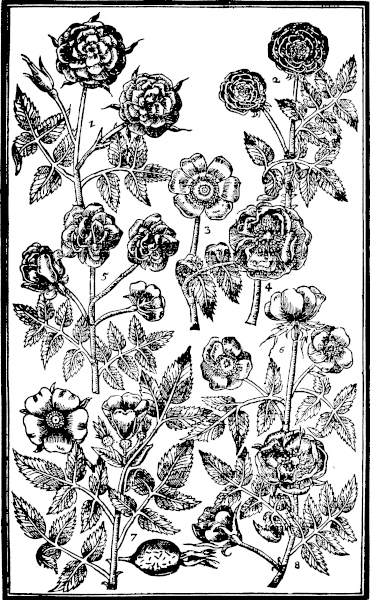
| 1 | Rosa siue spinis multiplex. The double Rose without thorns. |
| 2 | Rosa Cinamomea flore plena. The double Cinamon Rose. |
| 3 | Rosa Holoserica simplex. The single Veluet Rose. |
| 4 | Rosa Holoserica duplex. The double Veluet Rose. |
| 5 | Rosa Moschata multiplex. The double Muske Rose. |
| 6 | Rosa Moschata Hispanica simplex. The single Spanish Muske Rose. |
| 7 | Rosa Pomifera maior. The great Apple Rose. |
| 8 | Rosa siluestris siue Eglanteria duplex. The double Eglantine Rose. |
The double Eglantine is in all the places that I haue seene it a grafted Rose, (but I
doubt not, but that his originall was naturall, and that it may be made naturall againe,
as diuers other Roses are.) It groweth and spreadeth very well, and with a great head
of branches, whereon stand such like leaues as are in the single kinde, but a little larger,
not smelling fully so sweete as it: the flowers are somewhat bigger then the single, but
not much, hauing but one other rowe of leaues onely more then the former, which
are smaller, and the outer leaues larger, but of the same pale reddish purple colour,
and smelleth somewhat better then the single.
This Rose or bush is very like vnto a wilde single Eglantine bush in many respects,
hauing many very long greene branches, but more slender and weake, so that many
times they bend downe againe, not able to sustaine themselues without some helpe,
and armed with hooked thornes as other Roses be; the winged leaues consist of seuen
for the most part, whereof those two that are lowest and opposite, are smallest, the
next two bigger then they, the third couple bigger then any of the rest belowe, and
the end leafe biggest of all: this proportion generally it holdeth in euery winged leafe
through the whole plant, which at the first comming forth are somewhat reddish, with
the young branch that shooteth out with them, but being full growne, are of a deepe
greene colour, and somewhat shining, dented about the edges, and fall not away from
the branches as other Roses doe, but abide thereon for the most part all the Winter:
the flowers stand foure or fiue together at the tops of the branches, being single Roses,
made of fiue leaues a peece, of a pure white colour, much larger then the ordinary
Muske Rose, and of a fine sent, comming nearest thereunto, with many yellow chiues
or threads in the middle.
Some of these Roses had their originall, as is thought in England, as the
first and second; for these dryed red Roses that come ouer to vs from beyond
the Seas, are not of the kinde of our red Rose, as may well be perceiued
by them that will compare our English dryed leaues with those. Some
in Germany, Spaine, and Italy. Some againe in Turkie, as the double yellow
Rose, which first was procured to be brought into England, by Master
Nicholas Lete, a worthy Merchant of London, and a great louer of flowers,
from Constantinople, which (as wee heare) was first brought thither
from Syria; but perished quickly both with him, and with all other to
whom hee imparted it: yet afterwards it was sent to Master Iohn de Franqueuille,
a Merchant also of London, and a great louer of all rare plants, as
well as flowers, from which is sprung the greatest store, that is now flourishing
in this Kingdome.
The Cinamon Rose is the earliest for the most part, which flowreth with
vs about the middle of May, and sometimes in the beginning. The ordinary
Muske Roses both single and double flower latest, as is said. All the other
flower much about one time, in the beginning of Iune, or thereabouts, and
continue flowring all that moneth, and the next throughout for the most
part, and the red vntill August be halfe past.
The seuerall names, whereby they are most commonly knowne vnto vs
in this Countrey, are expressed in their titles; but they are much differing
from what they are called in other Countries neare vnto vs, which to compare,
conferre, and agree together, were a worke of more paines then vse:
But to proportion them vnto the names set downe by Theophrastus, Pliny,
and the rest of the ancient Authors, were a worke, wherein I might be sure
not to escape without falling into errour, as I verily beleeue many others
haue done, that haue vndertaken to doe it: I will therefore for this worke
desire that you will rest contented, with so much as hath already been deliuered,
and expect an exact definition and complete satisfaction by such a
methodicall course as a generall History will require, to be performed by
them that shall publish it.
The Rose is of exceeding great vse with vs; for the Damaske Rose (besides
the superexcellent sweete water it yeeldeth being distilled, or the perfume
of the leaues being dryed, seruing to fill sweete bags) serueth to cause
solublenesse of the body, made into a Syrupe, or preserued with Sugar moist
or dry candid. The Damaske Prouince Rose, is not onely for sent nearest
of all other Roses vnto the Damaske, but in the operation of solubility also.
The red Rose hath many Physicall vses much more then any other, seruing
for many sorts of compositions, both cordiall and cooling, both binding
and loosing. The white Rose is much vsed for the cooling of heate in the
eyes: diuers doe make an excellent yellow colour of the iuyce of white Roses,
wherein some Allome is dissolued, to paint or colour flowers or pictures,
or any other such things. There is little vse of any other sort of Roses;
yet some affirme, that the Muske Roses are as strong in operation to
open or loosen the belly as the Damaske Rose or Prouince.
There are three principall kindes of Cistus, the male, the female, and the gumme
or sweete smelling Cistus bearing Ladanum, called Ledon. Of each of these three
there are also diuers sorts: Of them all to intreate in this Worke is not my
minde, I will onely select out of the multitude some few that are fit for this our Garden,
and leaue the rest to a greater.
The male Cistus that is most familiar vnto our Countrey, I meane that will best abide,
is a small shrubby plant, growing seldome aboue three or foure foote high with
vs, hauing many slender brittle wooddy branches, couered with a whitish barke,
whereon are set many whitish greene leaues, long and somewhat narrow, crumpled
or wrinckled as it were with veines, and somewhat hard in handling, especially the
old ones; for the young ones are softer, somewhat like vnto Sage leaues for the
forme and colour, but much smaller, two alwaies set together at a ioynt: the flowers
stand at the toppe of the branches, three or foure together vpon seuerall slender footstalkes,
consisting of fiue small round leaues a peece, somewhat like vnto a small single
Rose, of a fine reddish purple colour, with many yellow threads in the middle, without
any sent at all, and quickly fading or falling away, abiding seldome one whole
day blowne at the most: after the flowers are past, there come vp round hard hairie
heads in their places, containing small brownish seede: the roote is wooddy, and
will abide some yeares with vs, if there be some care had to keepe it from the extreamity
of our Winters frostes, which both this, and many of the other sorts and kinds,
will not abide doe what we can.
The female Holly Rose groweth lower, and smaller then the former male kinde,
hauing blackish branches, lesse woody, but not lesse brittle then it: the leaues are somewhat
rounder and greener, but a little hard or rough withall, growing in the same manner
vpon the branches by couples: the flowers grow at the toppes of the branches,
like vnto the former, consisting of fiue leaues, but somewhat lesser, and wholly white,
with yellow threds in the middle, as quickly fading, and of as little sent as the former:
the heads and seede are somewhat bigger then in the former.
This dwarfe Cistus is a small low plant, hauing diuers shootes from the rootes, full
of leaues that are long and narrow, very like vnto the leaues of the French Spikenard
or Spica Celtica; from among which leaues shoote forth short stalkes, not aboue a span
high, with a few smaller leaues thereon; and at the toppes diuers small flowers one aboue
another, consisting of six small round leaues, of a yellow colour, hauing two circles
of reddish spots round about the bottome of the leaues, a little distant one from
another, which adde much grace to the flower: after the flowers are past, there come
in their places small round heads, being two forked at the end containing within them
small brownish chaffie seede: the roote is small and slender, with many fibres thereat
creeping vnder ground, and shooting forth in diuers places, whereby it much encreaseth:
the whole plant, and euery part of it, smelleth strong without any pleasant sent.
This small Cistus that endureth but a year (and will require to be sowne euery year,
if ye will haue it) riseth vp with straight, but slender hard stalkes, set here and there confusedly
with long and narrow greenish leaues, very like vnto the leaues of the Gum
Cistus or Ledon, being a little clammy withall: at the toppe of the stalkes, and at the
ioynts with the leaues, stand two or three pale yellow flowers, consisting of fiue leaues
a peece, with a reddish spot neere the bottome of euery leafe of the flower, as quickely
fading as any of the former: after which follow small three square heades, containing
small seede, like vnto the first female kinde, but somewhat paler or yellower: the root
is small and woody, and perisheth as soone as it hath borne seede.
This sweete Holly Rose or Gum Cistus, riseth higher, and spreadeth larger then the
former male kind doth, with many blackish woody branches, whereon are set diuers
long and narrow darke greene leaues, but whitish vnderneath, two alwayes standing
together at a ioint, both stalks and leaues bedeawed as it were continually with a clammy
sweete moisture (which in the hot Countries is both more plentifull, and more
sweet then in ours) almost transparent, and which being gathered by the inhabitants,
with certaine instruments for that purpose (which in some places are leather thongs,
drawne ouer the bushes, and after scraped off from the thongs againe, and put together)
is that kind of blacke sweet gum, which is called Ladanum in the Apothecaries
shops; at the tops of the branches stand single white flowers, like vnto single Roses,
being larger then in any of the former kindes, consisting of fiue leaues, whereof euery
one hath at the bottome a dark purplish spot, broad below, and small pointed vpwards,
with some yellow threds in the middle: after which are past, there arise cornered
heads, containing such small brownish seede as is in the former male kinde: the roote
is woody, and spreadeth vnder ground, abiding some yeares, if it be placed vnder a
wall, where it may bee defended from the windes that often breake it, and from the
extremitie of our winters, and especially the snow, if it lye vpon it, which quickly
causeth it to perish.
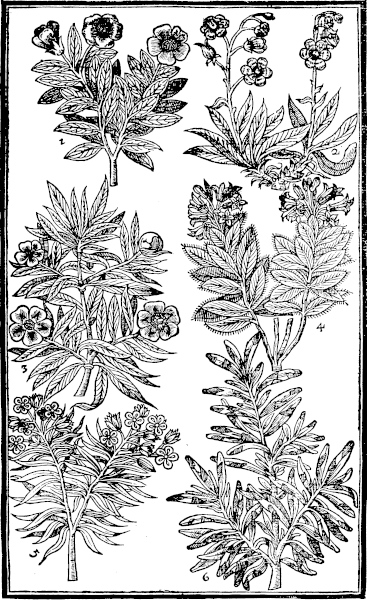
| 1 | Cistus mas. The male Holly Rose. |
| 2 | Chamæcistus Frisicus. The dwarfe Holly Rose of Frisia. |
| 3 | Cistus Ledon. The sweet Holly Rose or gumme Cistus. |
| 4 | Ledum Alpinum. The mountaine Holly Rose. |
| 5 | Ledum Silesiacum. The sweet Mary Rose of Silesia. |
| 6 | Rosmarinum aureum. Gilded Rosemary. |
The fragrant smell with properties correspondent of two other plants, causeth me
to insert them in this Chapter, and to bring them to your knowledge, as well worthy
a fit place in our Garden. The first of them hath diuers slender woody branches, two
foote high or thereabouts, couered with a grayish coloured barke, and many times
leaning downe to the ground, whereby it taketh roote againe: vpon these branches
grow many thicke, short, hard greene leaues, thicke set together, confusedly without
order, sometimes whitish vnderneath, and sometimes yellowish: the toppes of the
branches are loden with many flowers, which cause them to bend downwards, being
long, hollow and reddish, opening into fiue corners, spotted on the outside with many
white spots, and of a paler red colour on the inside, of a fine sweet sent: after the
flowers are past, there follow small heads, containing small brownish seede: the root
is long, hard and woody, abiding better if it comprehend in the ground, then some of
the former, because his originall is out of a colder country.
This other sweete plante riseth vp with woody ash-coloured branches two foote
high or more, which shoote forth other branches, of a reddish or purplish colour, couered
with a brownish yellow hoarinesse, on which are set many narrow long greene
leaues, like vnto Rosemary leaues, but couered with the like hoarinesse as the stalks are
(especially in the naturall places, but not so much being transplanted) and folding the
sides of the leaues so close together, that they seeme nothing but ribbes, or stalkes, of
an excellent sweet and pleasant sent; at the ends of the branches there grow certaine
brownish scaly heads, made of many small leaues set thicke together, out of which
breake forth many flowers, standing in a tuft together, yet seuerally euery one vpon
his owne footstalke, consisting of fiue white leaues, with certaine white threds in the
middle, smelling very sweete: after which rise small greene heads, spotted with
brownish spots, wherein is contained very small, long, yellowish seede: the roote is
hard and woodie.
The first, second, fourth and fifth, grow in the hot Countries, as Italie,
Spaine, &c. The third, and the two last in the colder Countries, as Friseland,
Germanie, Bohemia.
They do all flower in the Summer moneths of Iune, Iuly and August, and
their seede is ripe quickly after.
The first, second, fourth and fift, haue their names sufficiently expressed
in their descriptions. The third was sent vnto Clusius, vnder the name of
Hirculus Frisicus, because of the strong sent: but he referreth it to the kinds
of Chamæcistus, that is, dwarfe or low Cistus, both for the low growth, and
for the flowers and seede sake. The sixt is diuersly called; for Clusius calleth
it Ledum Alpinum: others, Nerium Alpinum, making it to bee a Rose Bay.
Gesner according to the Countrey peoples name, Rosa Alpina, and Rosa
Montana. Lobel calleth it Balsamum Alpinum, of the fragrant smell it hath,
and Chamærhododendros Chamælææfolio. And some haue called it Euonymus,
without all manner of iudgement. In English wee may call it, The Mountaine
Rose, vntill a fitter name be giuen it. The last is called of Matthiolus,
Rosmarinum siluestre, but of Clusius Ledum, referring it to their kindred;
and Silesiacum, because he found it in that Countrey; or for distinction sake,
as he saith, it may bee called, Ledum folijs Rosmarini, or Ledum Bohemicum.
Cordus, as it seemeth in his History of Plants, calleth it Chamæpeuce, as
though he did account it a kinde of low Pine, or Pitch tree.
The first, second, and fift, are very astringent, effectuall for all sorts of
fluxes of humours. The sweet Gum called Ladanum, made artificially into
oyle, is of singular vse for Alopecia, or falling of the haire. The seed of the
fourth is much commended against the stone of the Kidneyes. The sweete
Rosemary of Silesia is vsed of the inhabitants, where it naturally groweth,
against the shrinking of sinewes, crampes, or other such like diseases, whereof
their daily experience makes it familiar, being vsed in bathing or otherwise.
There hath beene vsually knowne but one sort of Rosemary, which is frequent
through all this Country: but there are some other sorts not so well known; the
one is called Gilded Rosemary; the other broade leafed Rosemary; a third I
will adioyne, as more rare then all the other, called Double flowred Rosmary, because
few haue heard thereof, much lesse seene it, and my selfe am not well acquainted with
it, but am bold to deliuer it vpon credit.
This common Rosemary is so well knowne through all our Land, being in euery
womans garden, that it were sufficient but to name it as an ornament among other
sweete herbes and flowers in our Garden, seeing euery one can describe it: but that I
may say something of it, It is well obserued, as well in this our Land (where it hath
been planted in Noblemens, and great mens gardens against bricke wals, and there
continued long) as beyond the Seas, in the naturall places where it groweth, that it riseth
vp in time vnto a very great height, with a great and woody stemme (of that compasse,
that (being clouen out into thin boards) it hath serued to make lutes, or such like
instruments, and here with vs Carpenters rules, and to diuers other purposes) branching
out into diuers and sundry armes that extend a great way, and from them againe
into many other smaller branches, whereon are set at seueral distances, at the ioynts, many
very narrow long leaues, greene aboue, and whitish vnderneath; among which
come forth towards the toppes of the stalkes, diuers sweet gaping flowers, of a pale or
bleake blewish colour, many set together, standing in whitish huskes; the seed is small
and red, but thereof seldome doth any plants arise that will abide without extraordinary
care; for although it will spring of the seede reasonable well, yet it is so small
and tender the first yeare, that a sharpe winter killeth it quickly, vnlesse it be very well
defended: the whole plant as well leaues as flowery smelleth exceeding sweete.
This Rosemary differeth not from the former, in forme or manner of growing, nor
in the forme or colour of the flower, but only in the leaues, which are edged, or striped,
or pointed with a faire gold yellow colour, which so continueth all the yeare
throughout, yet fresher and fairer in Summer then in Winter; for then it will looke of
a deader colour, yet so, that it may be discerned to be of two colours, green & yellow.
This broad leafed Rosemary groweth in the same manner that the former doth, but
that we haue not seene it in our Countrey since we had it to grow so great, or with such
woody stemmes: the leaues stand together vpon the long branches after the same fashion,
but larger, broader and greener then the other, and little or nothing whitish
vnderneath: the flowers likewise are of the same forme and colour with the ordinary,
but larger, and herein consisteth the difference.
The double flowred Rosmary thus far differeth from the former, that it hath stronger
stalkes, not so easie to breake, fairer, bigger and larger leaues, of a faire greene colour,
and the flowers are double, as the Larkes heele or spurre: This I haue onely by
relation, which I pray you accept, vntill I may by sight better enforme you.
Our ordinary Rosmary groweth in Spaine, and Prouence of France,
and in others of those hot Countryes, neere the Sea side. It will not abide
(vnlesse kept in stoues) in many places of Germany, Denmarke, and those
colder Countries. And in some extreame hard winters, it hath well neere
perished here in England with vs, at the least in many places: but by slipping
it is vsually, and yearly encreased, to replenish any garden.
It flowreth oftentimes twice in the yeare; in the Spring first, from April
vntill the end of May or Iune, and in August and September after, if the
yeare before haue been temperate.
Rosmary is called of the ancient Writers, Libanotis, but with this distinction,
Stephanomatica, that is, Coronaria, because there were other plants called
Libanotis, that were for other vses, as this for garlands, where flowers
and sweete herbes were put together. The Latines call it Rosmarinum. Some
would make it to be Cneorum nigrum of Theophrastus, as they would make
Lauander to bee his Cneorum album, but Matthiolus hath sufficiently confuted
that errour.
Rosmary is almost of as great vse as Bayes, or any other herbe both for
inward and outward remedies, and as well for ciuill as physicall purposes.
Inwardly for the head and heart; outwardly for the sinewes and ioynts:
for ciuill vses, as all doe know, at weddings, funerals, &c. to bestow among
friends: and the physicall are so many, that you might bee as well tyred in
the reading, as I in the writing, if I should set down all that might be said of
it. I will therefore onely giue you a taste of some, desiring you will be content
therewith. There is an excellent oyle drawne from the flowers alone
by the heate of the Sunne, auaileable for many diseases both inward and
outward, and accounted a soueraigne Balsame: it is also good to helpe dimnesse
of sight, and to take away spots, markes and scarres from the skin; and
is made in this manner. Take a quantitie of the flowers of Rosemary, according
to your owne will eyther more or lesse, put them into a strong glasse
close stopped, set them in hot horse dung to digest for fourteene dayes,
which then being taken forth of the dung, and vnstopped, tye a fine linnen
cloth ouer the mouth, and turne downe the mouth thereof into the mouth
of another strong glasse, which being set in the hot Sun, an oyle will distill
downe into the lower glasse; which preserue as precious for the vses before
recited, and many more, as experience by practice may enforme diuers.
There is another oyle Chymically drawne, auaileable in the like manner
for many the same inward and outward diseases, viz. for the heart, rheumaticke
braines, and to strengthen the memory, outwardly to warme and comfort
cold benummed sinewes, whereof many of good iudgement haue had
much experience.
In the hot Countreyes, there haue been many sorts of Mirtles found out, naturally
growing there, which will not fructifie in this of ours, nor yet abide without extraordinary
care, and conueniencie withall, to preserue them from the sharpenesse
of our winters. I shall only bring you to view three sorts in this my Garden, the one
with a greater, the other two with lesser leaues, as the remainder of others which wee
haue had, and which are preserued from time to time, not without much paine and
trouble.
The broader leafed Mirtle riseth vp to the height of foure or fiue foote at the most
with vs, full of branches and leaues growing like a small bush, the stemme and elder
branches whereof are couered with a dark coloured bark, but the young with a green,
and some with a red, especially vpon the first shooting forth, whereon are set many
fresh greene leaues, very sweet in smell, and very pleasant to behold, so neer resembling
the leaues of the Pomegranate tree that groweth with vs, that they soone deceiue many
that are not expert therein, being somewhat broade and long, and pointed at the
ends, abiding alwaies green: at the ioynts of the branches where the leaues stand, come
forth the flowers vpon small footestalkes, euery one by it selfe consisting of fiue small
white leaues, with white threds in the middle, smelling also very sweet; after the flowers
are past, there doe arise in the hot Countries, where they are naturall, round blacke
berries, when they are ripe, wherein are contained many hard white crooked seedes,
but neuer in this Countrey, as I said before: the roote disperseth it selfe into many
branches, with many fibres annexed thereto.
The smaller leafed Mirtle is a low shrub or bush, like vnto the former, but scarce rising
so high, with branches spreading about the stemme, much thicker set with leaues
then the former, smaller also, and pointed at the ends, of a little deeper greene colour,
abiding greene also winter and summer, and very sweete likewise: the flowers are
white like vnto the former, and as sweete, but shew not themselues so plentifull on the
branches: the fruit is blacke in his naturall places, with seedes therein as the former.
Wee haue another sort of this small kinde of Mirtle, so like vnto the former both
for smalnesse, deepe greene colour of the leaues, and thicke growing of the branches,
that it will be thought of most, without good heede, and comparing the one with the other,
to be the very same with the former: but if it bee well viewed, it will shew, by the
roundnesse at the ends of the leaues very like vnto the small Boxe leaues, to be another
differing kinde, although in nothing else. Wee nourse them with great care, for the
beautifull aspect, sweete sent and raritie, as delights and ornaments for a garden of pleasure,
wherein nothing should be wanting that art, care and cost might produce and preserue:
as also to set among other euer greene plants to sort with them.
These, and many other sorts of Mirtles grow in Spaine, Portugall, Italie,
and other hot Countries in great aboundance, where they make their hedges
of them: wee (as I said) keepe them in this Countrey, with very great
care and diligence.
The Mirtles doe flower very late with vs, not vntill August at the soonest,
which is the cause of their not fructifying.
They are called in Latine Myrtus, and in English Mirtle tree, without any
other diuersitie of names, for the generall title. Yet the seuerall kindes haue
had seuerall denominations, in Plinies time, and others, as Romana, Coniugala,
Tarentina, Egyptia, alba, nigra, &c. which haue noted the differences, euen
then well obserued.
The Mirtle is of an astringent qualitie, and wholly vsed for such purposes.
There are two kindes of Pomegranet trees, The one tame or manured, bearing
fruit, which is distinguished of some into two sorts, of others into three, that
is, into sower, and sweet, and into sower sweete. The other wilde, which beareth
no fruite, because it beareth double flowers, like as the Cherry, Apple, and Peach
tree with double blossomes, before described, and is also distinguished into two sorts,
the one bearing larger, the other lesser flowers. Of the manured kinde wee haue onely
one sort (so farre as we know, for it neuer beareth ripe fruit in this our Countrey) which
for the beautifull aspect, both of the greene verdure of the leaues, and faire proportion
and colour of the flowers, as also for the raritie, are noursed in some few of their gardens
that delight in such rarities: for in regard of the tendernesse, there is neede of diligent
care, that is, to plant it against a brick wall, and defend it conueniently from the
sharpenesse of our winters, to giue his Master some pleasure in seeing it beare flowers:
And of the double kinde we haue as yet obtained but one sort, although I shall giue you
the knowledge and description of another.
[429]
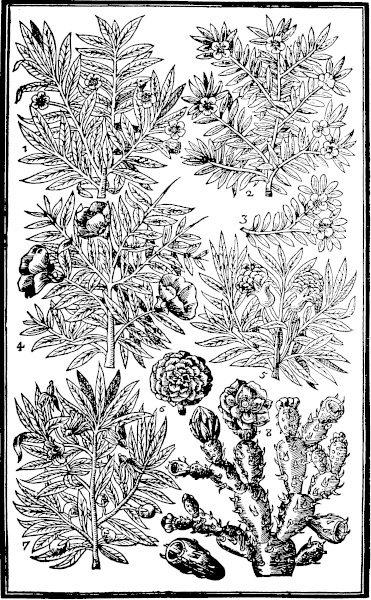
| 1 | Myrtus latifolia maior. The broad leaded Myrtle. |
| 2 | Myrtus angustifolia minor. The small leafed Myrtle. |
| 3 | Myrtus buxifolia minor. The Boxe leafed Myrtle. |
| 4 | Malus Granatus simplici flore. The ordinary Pomegranet tree. |
| 5 | Balaustium Romanum seu minus. The lesser double flowred Pomegranet tree. |
| 6 | Balaustium maius siue Cyprium. The greater double flowred Pomegranet. |
| 7 | Pseudocapsicum seu Amomum Plinij. The Winter Cherry tree. |
| 8 | Ficus Indica cum suo fructu. The Indian Figgetree and his fruit. |
This Pomegranet tree groweth not very high in his naturall places, and with vs somtimes
it shooteth forth from the roote many brownish twigges or branches, or if it bee
pruned from them, and suffered to grow vp, it riseth to bee seuen or eight foote high,
spreading into many small and slender branches, here and there set with thornes, and
with many very faire greene shining leaues, like in forme and bignesse vnto the leaues
of the larger Myrtle before described, euery one hauing a small reddish foote-stalke
vpon these branches: among the leaues come forth here and there, long, hard, and
hollow reddish cups, diuided at the brimmes, wherein doe stand large single flowers,
euery one consisting of one whole leafe, smaller at the bottome then at the brimme,
like bels, diuided as it were at the edges into fiue or six parts, of an orient red or crimson
colour in the hotter Countries; but in this it is much more delayed, and tendeth
neare vnto a blush, with diuers threads in the middle. The fruit is great and round, hauing
as it were a crowne on the head of it, with a thicke tough hard skinne or rinde, of
a brownish red colour on the outside, and yellow within, stuffed or packt full of small
graines, euery one encompast with a thin skin, wherein is contained a clear red iuyce
or liquor, either of a sweet (as said before) or sower taste, or betweene them both of
a winie taste: the roote disperseth it selfe very much vnder ground.
The wilde Pomegranet is like vnto the tame in the number of purplish branches,
hauing thornes, and shining faire greene leaues, somewhat larger then the former:
from the branches likewise shoote forth flowers, farre more beautifull then
those of the same or manured sort, because they are double, and as large as a double
Prouince Rose, or rather more double, of an excellent bright crimson colour, tending
to a silken carnation, standing in brownish cups or huskes, diuided at the brims vsually
into foure or fiue seuerall points, like vnto the former, but that in this kinde there neuer
followeth any fruit, no not in the Country, where it is naturally wilde.
This smaller kinde differeth from the former in his leaues, being of a darker greene
colour, but not in the height of the stemme, or purplishnesse of his branches, or thorns
vpon them; for this doth shew it selfe more like vnto a wilde kind then it: the flowers
hereof are much smaller, and not so thicke and double, of a deeper or sadder red Orenge
tawny colour, set also in such like cups or huskes.
The tame or manured kinde groweth plentifully in Spaine, Portugall,
and Italy, and other in other warme and hot countries. Wee (as I said before)
preserue it with great care. The wilde I thinke was neuer seene in
England, before Iohn Tradescante my very louing good friend brought it
from the parts beyond the Seas, and planted it in his Lords Garden at
Canterbury.
They flower very late with vs, that is, not vntill the middle or end of
August, and the cold euenings or frosts comming so soone vpon it, doth
not onely hinder it from bearing, but many times the sharpe winters so
pinch it, that it withereth it downe to the ground, so that oftentimes it
hardly springeth againe.
The name Malus Punica for the tree, and Malum Punicum for the fruit, or
Malus Granata, and Malum Granatum, is the common name giuen vnto this
tree, which is called in English the Pomegarnet or Pomegranet tree. The
flowers of the tame kinde are called Cytini, as Dioscorides saith, although
Plinie seemeth either to make Cytinus to be the flower of the wilde kinde, or
Balaustium to be the flower of both tame and wilde kinde: but properly, as
I take it, Cytinus is the cup wherein the flower as well of the tame as wilde
kinde doth stand; for vnto the similitude of them, both the flowers of Asarum,
and the seede vessels of Hyosciamus are compared and resembled, and
not vnto the whole flower: the barke or rinde of the fruit is called of diuers
Sidion, and in the Apothecaries shops Psidium, and cortex Granatorum. The
wilde kinde is called Malus Punica siluestris: In English, The wilde Pomegranet
tree; the flower thereof is properly called Balaustium. The lesser kind
is vsually called Balaustium Romanum, as the greater is called Creticum and
Cyprium, because they growe in Candy and Cyprus.
The vse of all these Pomegranets is very much in Physicke, to coole and
binde all fluxibility both of body and humours: they are also of singular
effect in all vlcers of the mouth, and other parts of the body, both of man
and woman. There is no part of them but is applyed for some of these respects.
The rinde also of the Pomegranet is vsed of diuers in stead of Gaules,
to make the best sort of writing Inke, which is durable to the worlds end.
I haue adioyned this plant, for the pleasurable beauty of the greene leaues, and red
berries. It groweth vp to be a yard or foure foote high at the most, hauing a small
wooddy stemme or stocke, as bigge as ones finger or thumbe, couered with a whitish
greene barke, set full of greene branches, and faire greene leaues, somewhat vneuen
sometimes on the edges, narrower then any Night shade leaues, and very neare
resembling the leaues of the Capsicum, or Ginny pepper, but smaller and narrower, falling
away in the Winter, and shooting fresh in the Spring of the yeare: the flowers
growe often two or three together, at the ioynts of the branches with the leaues, being
white, opening starre-fashion, and sometimes turning themselues backe, with a yellow
pointell in the middle, very like vnto the flowers of Night shade: after the flowers
are past, come forth in their stead small greene buttons, which after turne to be
pleasant round red berries, of the bignesse of small Cherries when they are ripe,
which with vs vsually ripen not vntill the Winter, or about Christmas, wherein are
contained many small whitish seede that are flat: all the whole plant, as well leaues
and flowers as seede, are without either smell or taste: the roote hath many yellowish
strings and fibres annexed vnto it.
The originall place hereof is not well knowne, but is thought to bee the
West Indies. It hath been planted of long time in most of these Countries,
where it abideth reasonable well, so that some care bee had thereof in the
extreamity of the Winter.
It flowreth sometimes it Iune but vsually in Iuly and August, and the
fruit is not ripe (as is said) vntill the Winter.
This plant hath diuers names; for it is thought to be that kinde of Amomum
that Plinie setteth downe. Dodonæus calleth it Pseudocapsicum, for
some likenesse in the leafe and fruit vnto the small Capsicum or Ginnie Pepper,
although much vnlike in the taste and property. Others doe call it
Strichnodendron, that is, Solanum arborescens, and wee in English according
thereunto, Tree Night shade. But some Latin asses corrupting the Latine
word Amomum, doe call it the Mumme tree. Dalechampius calleth it Solanum
Americum, seu Indicum, and saith the Spaniards call it in their tongue,
Guindas de las Indias, that is, Cerasa Indiana, Indian Cherries, which if any
would follow, I would not bee much against it: but many Gentlewomen,
doe call them Winter Cherries, because the fruit is not throughly ripe vntill
Winter.
I finde no physicall property allotted vnto it, more then that by reason
of the insipidity, it is held to be cooling.
This Indian Figge tree, if you will call it a tree (because in our Country it is not
so, although it groweth in the naturall hot Countries from a wooddy stemme
or body into leaues) is a plant consisting only of leaues, one springing out of another,
into many branches of leaues, and all of them growing out of one leafe, put into
the ground halfe way, which taking roote, all the rest rise out thereof, those belowe
for the most part being larger then those aboue; yet all of them somewhat long, flat,
and round pointed, of the thicknesse of a finger vsually, and smallest at the lower end,
where they are ioyned or spring out of the other leaues, hauing at their first breaking
out a shew of small, red, or browne prickes, thicke set ouer all the vpper side of the
leaues, but with vs falling away quickly, leauing onely the markes where they stood:
but they haue besides this shew of great prickes, a few very fine, and small, hard, white,
and sharpe, almost insensible prickes, being not so bigge as haires on the vnderside,
which will often sticke in their fingers that handle them vnaduisedly, neither are they
to be discerned vnlesse one look precisely for them: the leaues on the vnderside hauing
none of those other great pricks or marks at all, being of a faire fresh pale green colour:
out of the vppermost leaues breake forth certaine greene heads, very like vnto leaues
(so that many are deceiued, thinking them to be leaues, vntill they marke them better,
and be better experienced in them) but that they growe round and not flat, and are
broad at the toppe; for that out of the tops of euery of them shooteth out a pale yellow
flower, consisting of two rowes of leaues, each containing fiue leaues a peece,
laid open with certaine yellow threads, tipt with red in the middle: this greene head,
vntill the flower be past, is not of halfe that bignesse that it attaineth vnto after, yet
seldome or neuer commeth vnto perfection with vs, being long and round, like vnto a
Figge, small belowe, and greater aboue, bearing vpon the flat or broad head the marke
of the flower; some holding still on them the dryed leaues, and others hauing lost
them shew the hollownesse which they haue in the toppe or middle of the head, the
sides round about being raised or standing vp higher: this head or figge in our Country
abideth greene on the outside, and little or nothing reddish within (although it abide
all the Winter, and the Summer following, as sometimes it doth) for want of
that heate and comfort of the Sunne it hath in his naturall place, where it groweth
reddish on the outside, and containing within it a bloudy red clammy iuyce, making
the vrine of them that eate of them as red as bloud, which many seeing, were in doubt
of themselues, lest their vrine were not very bloud; of what sweetnesse, like a figge,
in the naturall places, I am not well assured, yet affirmed: but those that haue beene
brought vnto me, whose colour on the outside was greenish, were of a reddish purple
within, and contained within them round, small, hard seede, the taste was flat, waterish,
or insipide: the roote is neither great, nor disperseth it selfe very deepe or farre,
but shooteth many small rootes vnder the vpper crust of the earth.
There is a greater kinde hereof, whose leaues are twice or thrice as bigge, which hauing
been often brought vs, will seldome abide more then one Summer with vs, our
Winters alwaies rotting the leaues, that it could not be longer kept.
This Indian Figge tree groweth dispersedly in many places of America,
generally called the West Indies: The greater kinde in the more remote
and hot Countries, as Mexico, Florida, &c. and in the Bermudas or
Summer Islands, from whence wee haue often had it. The lesser in Virginia,
and those other Countries that are nearer vnto vs, which better endureth
with vs.
It flowreth with vs sometimes in May, or Iune; but (as I said) the fruit neuer
commeth to perfection in this Country.
Diuers doe take it to bee Opuntia Plinij, whereof hee speaketh in the 21.
Booke and 17. Chapter of his Naturall History: but he there saith, Opuntia
is an herbe, sweete and pleasant to be eaten, and that it is a wonder that
the roote should come from the leafe, and so to growe; which words although
they descipher out the manner of the growing of this plant, yet because
this is a kinde of tree, and not an herbe, nor to be eaten, it cannot bee
the same: but especially because there is an herbe which groweth in the
same manner, or very neare vnto it, one leafe standing on the toppe or side
of another, being a Sea plant, fit to be eaten with vinegar and oyle (as many
other herbes are that growe in the salt marshes, or neare the Sea, whereof
Sea Purslane is one) which Clusius calleth Lychen Marinus, and (as Clusius
saith) Cortusus very fitly called Opuntia marina, and out of doubt is the verie
same Opuntia that Theophrastus maketh mention of, and Plinie out of
him. Our English people in Virginia, and the Bermuda Island, where it
groweth plentifully, because of the form of the fruit, which is somewhat like
to a Peare, & not being so familiarly acquainted with the growing of Figs,
sent it vnto vs by the name of the prickly Peare, from which name many
haue supposed it to be a Peare indeede, but were therein deceiued.
There is no other especiall property giuen hereunto, by any that haue
written of the West Indies, then of the colouring of the vrine, as is before
said.
This rare Indian plant hath a great thicke tuberous roote (spreading in time into
many tuberous heads) from the head whereof shooteth forth many long,
hard, and guttured leaues, very sharpe pointed, compassing as it were one another
at the bottome, of a grayish greene colour, which doe not fall away, but abide
euer greene on the plant; from the middle whereof springeth forth (now and then,
but not euery yeare) a strong round stalke, diuided into diuers branches, whereon
stand diuers white, and somewhat large flowers, hanging downe their heads, consisting
of six leaues, with diuers veines, of a weake reddish or blush colour, spread on the
backe of the three outer leaues, especially from the middle of the leaues to the bottome,
and not rising to the edge of the leafe of any flower, which fall away without
bearing any seede in our Country, as farre as euer could be obserued either in the plant
that Master Gerard kept a long time by him, or by Robinus at Paris his plant, which
Master Gerard sent vnto him, or yet by that plant, that Vespasian Robin the sonne of
old Robin sent vnto Master Iohn de Franqueuille, and now abideth and flourisheth in
my Garden.
It was first brought into England (as Master Gerard saith) from the West
Indies, by a seruant of Master Thomas Edwards, an Apothecary of Exeter,
and imparted to him, who kept it vnto his death: but perished with him
that got it from his widow, intending to send it to his Country house.
It flowreth not vntill Iuly, and the flowers fall away sodainely, after
they haue beene blowne open a while.
Master Gerard first as I thinke called it Iucca, supposing it to bee the true
Yuca of Theuet, wherewith the Indians make bread, called Cassaua: but the
true Iucca is described to haue a leafe diuided into seuen or nine parts, which
this hath not: Yet not knowing by what better name to call it, let it hold
still his first imposition, vntill a fitter may be giuen it.
Wee haue not heard of any, that hath either read, heard, or experimented
the faculties hereof, nor yet whether it hath good or euill taste; for being
rare, and possessed but by a few, they that haue it are loth to cut any
thereof, for feare of spoiling and losing the whole roote.
Some haue affirmed, that in some parts of Turkie, where as they say this
plant groweth, they make a kinde of cloth from the threads are found running
through the leaues; but I finde the threads are so strong and hard, that
this cannot be that plant the relators meane is vsed in that manner.
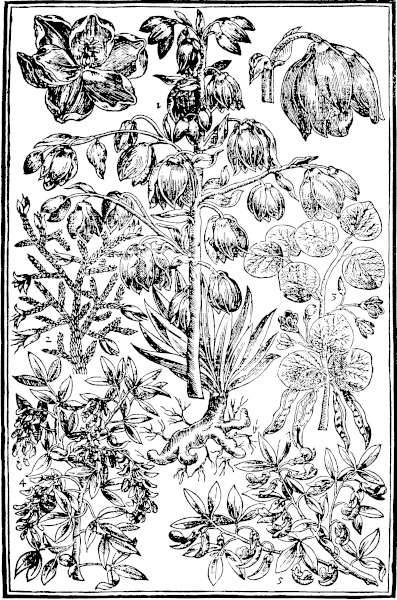
| 1 | Yuca siue Iucca. The Indian Iucca. |
| 2 | Arbor vitæ. The tree of life. |
| 3 | Arbor Iudæ. Iudas tree. |
| 4 | Laburnum. Beane Trefoile. |
| 5 | Cytisus. Tree Trefoile. |
The tree of life riseth vp in some places where it hath stood long, to be a tree of
a reasonable great bignesse and height, couered with a redder barke then any
other tree in our Country that I know, the wood whereof is firme and hard,
and spreadeth abroad many armes and branches, which againe send forth many smaller
twigges, bending downewards; from which twiggy or slender branches, being
flat themselues like the leaues, come forth on both sides many flat winged leaues, somewhat
like vnto Sauine, being short and small, but not pricking, seeming as if they
were brayded or folded like vnto a lace or point, of a darke yellowish greene colour,
abiding greene on the branches Winter and Summer, of a strong resinous taste, not
pleasing to most, but in some ready to procure casting, yet very cordiall and pectorall
also to them that can endure it: at the toppes of the branches stand small yellowish
dounie flowers, set in small scaly heads, wherein lye small, long, brownish seede,
which ripen well in many places, and being sowne, doe spring and bring forth plants,
which with some small care will abide the extreamest Winters we haue.
The first or originall place where it naturally groweth, as farre as I can
learne or vnderstand, is that part of America which the French doe inhabite,
about the riuer of Canada, which is at the backe of Virginia Northward,
and as it seemeth, first brought by them from thence into Europe, in
the time of Francis the first French King, where it hath so plentifully encreased,
and so largely beene distributed, that now few Gardens of respect,
either in France, Germany, the Lowe Countries, or England, are without it.
It flowreth in the end of May, and in Iune; the fruit is ripe in the end
of August and September.
All the Writers that haue written of it, since it was first knowne, haue
made it to be Thuyæ genus, a kinde of Thuya, which Theophrastus compareth
vnto a Cypresse tree, in his fifth Book and fifth Chapter: but Omne simile
non est idem, and although it haue some likenesse, yet I verily beleeue it is
proprium sui genus, a proper kinde of it owne, not to bee paralleld with any
other. For wee finde but very few trees, herbes, or plants in America,
like vnto those that growe in Europe, the hither part of Africa, or in the
lesser Asia, as experience testifieth. Some would make it to be Cedrus Lycia,
but so it cannot be. The French that first brought it, called it Arbor vitæ,
with what reason or vpon what ground I know not; but euer since it hath
continued vnder the title of the Tree of life.
It hath beene found by often experience, that the leaues hereof chewed
in the morning fasting, for some few dayes together, haue done much good
to diuers, that haue beene troubled with shortnesse of breath, and to helpe
to expectorate thinne purulentous matter stuffing the lungs. Other properties
I haue not heard that it hath; but doubtlesse, the hot resinous smell and
taste it hath, both while it is fresh, and after it hath beene long kept dry,
doth euidently declare his tenuity of parts, a digesting and cleansing quality
it is possessed with, which if any industrious would make tryall, hee
should finde the effects.
Iudas tree riseth vp in some places, where it standeth open from a wall, and alone
free from other trees (as in a Garden at Batthersey, which sometimes agoe belonged
to Master Morgan, Apothecary to the late Queene Elizabeth of famous memory)
to be a very great and tall tree, exceeding any Apple tree in height, and equall
in bignesse of body thereunto (as my selfe can testifie, being an eye witnesse thereof)
when as it had many stalkes of flowers, being in the bud, breaking out of the body of
the tree through the barke in diuers places, when as there was no bough or branch near
them by a yard at the least, or yet any leafe vpon the tree, (which they gathered to put
among other flowers, for Nosegayes) and in other places it groweth to bee but an
hedge bush, or plant, with many suckers and shootes from belowe, couered with a
darke reddish barke, the young branches being more red or purplish: the flowers on
the branches come forth before any shew or budding of leaues, three or foure standing
together vpon a small foote-stalke, which are in fashion like vnto Pease blossomes,
but of an excellent deepe purplish crimson colour: after which come in their
places so many long, flat, large, and thinne cods, of a brownish colour, wherein are
contained small, blackish browne, flat, and hard seede: the roote is great, and runneth
both deepe, and farre spreading in the earth: the leaues come forth by themselues,
euery one standing on a long stalke, being hard & very round, like vnto the leafe
of the largest Asarum, but not so thick, of a whitish green on the vpper side, and grayish
vnderneath, which fall away euery yeare, and spring a fresh after the Spring is well
come in, and the buds of flowers are sprung.
Flore albo.
There is another of this kinde, growing in some places very high, somewhat like
the former, and in other places also full of twiggy branches, which are greener then
the former, as the leaues are likewise: the flowers of this kinde are wholly white, and
the cods nothing so red or browne, in all other things agreeing together.
The former groweth plentifully in many places of Spaine, Italy, Prouence
in France, and in many other places. The other hath beene sent vs
out of Italy many times, and the seede hath sprung very well with vs, but it
is somewhat tender to keepe in the Winter.
The flowers (as I said) appeare before the leaues, and come forth in Aprill
and May, and often sooner also, the leaues following shortly after;
but neither of them beareth perfect seede in our Country, that euer I could
learne, or know by mine owne or others experience.
Some would referre this to Cercis, whereof Theophrastus maketh mention
in his first Booke and eighteenth Chapter, among those trees that beare
their fruit in cods, like as Pulse doe: and hee remembreth it againe in the
fourteenth Chapter of his third Booke, and maketh it not vnlike the white
Poplar tree, both in greatnesse and whitenesse of the branches, with the leafe
of an Iuie, without corners on the one part, cornered on the other, and
sharpe pointed, greene on both sides almost alike, hauing so slender long
footestalkes that the leaues cannot stand forthright, but bend downwards,
with a more rugged barke then the white Poplar tree. Clusius thinketh this
large description is but an ample description of the third kinde of Poplar,
called Lybica, the Aspen tree, which Gaza translateth Alpina: but who so
will well consider it, shall finde it neyther answerable to any Poplar tree, in
that it beareth not cods as Cercis doth; nor vnto this Arbor Iudæ, because it
beareth not white branches. Clusius saith also, that the learned of Mompelier
in his time, referred it to Colytea of Theophrastus in his third booke
and seuenteenth chapter, where he doth liken it to the leaues of the broadest
leafed Bay tree, but larger and rounder, green on the vpperside, and whitish
vnderneath, and whereunto (as he saith) Theophrastus giueth cods in the
fourteenth chapter of the same third booke: and by the contracting of their
descriptions both together, saith, they agree vnto this Iudas tree. But I find
some doubts and differences in these places: for the Colutæa that Theophrastus
mentioneth in the said fourteenth chapter of his third booke, hath (as
he saith there) a leafe like vnto the Willow, and therefore cannot bee the
same Colutæa mentioned in the seuenteenth chapter of the same third book,
which hath a broade Bay leafe: indeede hee giueth seede in cods: but
that with broade Bay leaues is (as he saith) without eyther flower or fruite;
and besides all this, he saith the rootes are very yellow, which is not to bee
found in this Arbor Iudæ, or Iudas tree: let others now iudge if these things
can bee well reconciled together. Some haue for the likenesse of the cods
vnto Beane cods, called it Fabago. And Clusius called it Siliqua siluestris.
It is generally in these dayes called Arbor Iudæ, and in English after the Latine
name, vntill a fitter may be had, Iudas tree.
There is nothing extant in any Author of any Physicall vse it hath, neyther
hath any later experience found out any.
There be three sorts of these codded trees or plants, one neere resembling
another, whereof Anagyris of Dioscorides is one. The other two are called Laburnum;
the larger whereof Matthiolus calleth Anagyris altera, and so doe
some others also: the third is of the same kinde with the second, but smaller. I shall
not for this our Garden trouble you or my selfe with any more of them then one,
which is the lesser of the two Laburnum, in that it is more frequent, and that it will far
better abide then the Anagyris, which is so tender, that it will hardly endure the winters
of our Countrey: and the greater Laburnum is not so easily to be had.
This codded tree riseth vp with vs like vnto a tall tree, with a reasonable great body,
if it abide any long time in a place, couered with a smooth greene barke; the branches
are very long, greene, pliant, and bending any way, whereon are set here and there diuers
leaues, three alwaies standing together vpon a long stalk, being somewhat long, and
not very narrow, pointed at the ends, greene on the vpperside, and of a siluer shining
colour vnderneath, without any smell at all: at the ioynts of these branches, where
the leaues stand, come forth many flowers, much like vnto broome flowers, but not so
large or open, growing about a very long branch or stalke, sometimes a good span or
more in length, and of a faire yellow colour, but not very deepe; after which come
flat thin cods, not very long or broade, but as tough and hard as the cods of Broome;
wherein are contained blackish seede, like, but much lesse then the seede of Anagyris
vera (which are as big as a kidney beane, purplish and spotted): the roote thrusteth
down deepe into the ground, spreading also farre, and is of a yellowish colour.
This tree groweth naturally in many of the woods of Italie, and vpon
the Alpes also, and is therefore still accounted to be that Laburnum that Plinie
calleth Arbor Alpina. It groweth in many gardens with vs.
It flowreth in May, the fruit or cods, and the seedes therein are ripe in the
end of August, or in September.
This tree (as I said before) is called of Matthiolus Anagyris altera, siue secunda,
of Cordus, Gesner and others, especially of most now adayes, Laburnum.
It is probable in my opinion, that this should bee that Colutæa of
Theophrastus, mentioned in the fourteenth Chapter of his third book with
the leafe of a Willow; for if you take any one leafe by it selfe, it may well
resemble a Willow leafe both for forme and colour, and beareth small seed
in cods like vnto pulse as that doth. Of some it hath beene taken for a kinde
of Cytisus, but not truely. We call it in English, Beane Trefoile, in regard
of his cods and seede therein, somewhat like vnto Kidney Beanes, and of
the leaues, three alwayes standing together, vntill a more proper name
may bee giuen it.
There is no vse hereof in Physicke with vs, nor in the naturall place of
the growing, saue only to prouoke a vomit, which it will doe very strongly.
There are so many sorts of Cytisus or Tree trefoiles, that if I should relate them
all, I should weary the Reader to ouerlooke them, whereof the most part pertaine
rather to a generall worke then to this abstract. I shall not therefore trouble
you with any superfluous, but only with two, which we haue noursed vp to furnish
waste places in a garden.
This Tree Trefoile which is held of most Herbarists to bee the true Cytisus of Dioscorides,
riseth vp to the height of a man at the most, with a body of the bignesse of a
mans thumbe, couered with a whitish bark, breaking forth into many whitish branches
spreading farre, beset in many places with small leaues, three alwayes set together vpon
a small short footestalke, which are rounder, and whiter then the leaues of Beane
Trefoile: at the ends of the branches for the most part, come forth the flowers three
or foure together, of a fine gold colour, and of the fashion of Broome flowers, but
not so large: after the flowers are past, there come in their places crooked flat thinne
cods, of the fashion of a halfe moone, or crooked horne, whitish when they are ripe,
wherein are contained blackish seede: the roote is hard and woody, spreading diuers
wayes vnder the ground: the whole plant hath a pretty small hot sent.
This Cytisus is the most common in this Land, of any the other sorts of tree trefoiles,
hauing a blackish coloured barke, the stemme or body whereof is larger then the former,
both for height and spreading, bearing also three leaues together, but smaller and
greener then the former: the flowers are smaller, but of the same fashion and colour:
the cods blackish and thin, and not very long, or great, but lesser then Broome cods,
wherein there lyeth small blackish hard seede: the roote is diuersly dispersed in the
ground.
The first groweth in the kingdome of Naples, and no doubt in many
other places of Italie, as Matthiolus saith. The other groweth in diuers
places of France.
They flower for the most part in May or Iune: the seede is ripe in August
or September.
The first (as I said) is thought of most to be the true Cytisus of Dioscorides,
and as is thought, was in these later dayes first found by Bartholomæus
Maranta of Naples, who sent it first to Matthiolus, and thereupon hath euer
since beene called after his name, Cytisus Maranthæ. Some doe call it Cytisus
Lunatus, because the cods are made somewhat like vnto an halfe Moone.
We call it in English, Horned Tree Trefoile. The other is called Cytisus vulgaris
or vulgatior; in English, The common Tree Trefoile, because we haue
not any other so common.
The chiefest vertues that are appropriate to these plants, are to procure
milke in womens breasts, to fatten pullen, sheep &c. and to be good for bees.
Wee haue in our Gardens two or three sorts of the Bastard Sena tree; a
greater as I may so call it, and two lesser: the one with round thin transparent
skins like bladders, wherein are the seede: the other with long
round cods, the one bunched out or swelling in diuers places, like vnto a Scorpions
tale, wherein is the seede, and the other very like vnto it, but smaller.
This shrub or tree, or shrubby tree, which you please to call it, riseth vp to the height
of a pretty tree, the stemme or stock being sometimes of the bignesse of a mans arme,
couered with a blackish greene rugged barke, the wood whereof is harder then of an
Elder, but with an hollownesse like a pith in the heart or middle of the branches,
which are diuided many wayes, and whereon are set at seuerall distances, diuers winged
leaues, composed of many small round pointed, or rather flat pointed leaues, one
set against another, like vnto Licoris, or the Hatchet Fitch; among these leaues come
forth the flowers, in fashion like vnto Broome flowers, and as large, of a very yellow
colour: after which appeare cleare thinne swelling cods like vnto thinne transparent
bladders, wherein are contained blacke seede, set vpon a middle ribbe or sinew in the
middle of the bladder, which if it be a little crushed betweene the fingers, will giue a
cracke, like as a bladder full of winde. The roote groweth branched and woody.
This Bastard Sena groweth nothing so great or tall, but shooteth out diuersly, like
vnto a shrub, with many shoots springing from the root: the branches are greener, but
more rugged, hauing a white barke on the best part of the elder growne branches;
for the young are greene, and haue such like winged leaues set on them as are to be seen
in the former, but smaller, greener, and more pointed: the flowers are yellow, but
much smaller, fashioned somewhat like vnto the former, with a reddish stripe downe
the backe of the vppermost leafe: the long cods that follow are small, long and round,
distinguished into many diuisions or dents, like vnto a Scorpions tayle, from whence
hath risen the name: in these seuerall diuisions lye seuerall blacke seede, like vnto the
seede of Fenigrecke: the roote is white and long, but not so woody as the former.
This lesser Bastard Sena is in all things like the former, but somewhat lower, and
smaller both in leafe, flower, and cods of seede, which haue not such eminent bunches
on the cods to be seene as the former.
They grow as Matthiolus saith about Trent in Italie, and in other places:
the former is frequent enough through all our Countrey, but the others
are more rare.
They flower about the middle or end of May, and their seede is ripe in
August. The bladders of the first will abide a great while on the tree, if
they be suffered, and vntill the winde cause them to rattle, and afterwards
the skins opening, the seede will fall away.
The name Colutæa is imposed on them, and by the iudgement of most
writers, the first is taken to bee that Colutæa of Lipara that Theophrastus maketh
mention of, in the seuenteenth chapter of his third booke. But I should
rather thinke that the Scorpioides were the truer Colutæa of Theophrastus,
because the long pods thereof are more properly to bee accounted filiquæ,
then the former which are vesicæ tumentes, windy bladders, and not filiquæ:
and no doubt but Theophrastus would haue giuen some peculiar note of
difference if he had meant those bladders, and not these cods. Let others of
iudgement be vmpeeres in this case; although I know the currant of writers
since Matthiolus, doe all hold the former Colutæa vesicaria to be the true Colutæa
Liparæ of Theophrastus. Wee call it in English, Bastard Sena, from
Ruellius, who as I thinke first called it Sena, from the forme of the leaues.
The second and third (as I said before) from the forme of the cods receiued
their names, as it is in the titles and descriptions; yet they may as properly
be called Siliquosæ, for that their fruite are long cods.
Theophrastus saith it doth wonderfully helpe to fatten sheepe: But sure
it is found by experience, that if it be giuen to man it causeth strong purgings
both vpwards and downwards; and therefore let euery one beware that
they vse not this in steede of good Sena, lest they feele to their cost the
force thereof.
Although Clusius and others haue found diuers sorts of this shrubby Spartum
or Spanish Broome, yet because our Climate will nourse vp none of them, and
euen this very hardly, I shall leaue all others, and describe vnto you this one
only in this manner: Spanish Broome groweth to bee fiue or sixe foote high, with a
woody stemme below, couered with a darke gray, or ash-coloured barke, and hauing
aboue many pliant, long and slender greene twigs, whereon in the beginning of the
yeare are set many small long greene leaues, which fall away quickly, not abiding long
on; towards the tops of these branches grow the flowers, fashioned like vnto Broom
flowers, but larger, as yellow as they, and smelling very well; after which come small
long cods, crested at the backe, wherein is contained blackish flat seede, fashioned
very like vnto the Kidney beanes: the roote is woody, dispersing it selfe diuers waies.
This groweth naturally in many places of France, Spaine and Italie, wee
haue it as an ornament in our Gardens, among other delightfull plants, to
please the senses of sight and smelling.
It flowreth in the end of May, or beginning of Iune, and beareth seede,
which ripeneth not with vs vntill it be late.
It is called Spartium Græcorum, and Spartum frutex, to distinguish it from
the sedge or rush, that is so called also. Of some it is called Genista, and
thought not to differ from the other Genista, but they are much deceiued;
for euen in Spaine and Italie, the ordinary Genista or Broome groweth with
it, which is not pliant, and fit to binde Vines, or such like things withall
as this is.
There is little vse hereof in Physicke, by reason of the dangerous qualitie
of vomiting, which it doth procure to them that take it inwardly: but
being applyed outwardly, it is found to helpe the Sciaticæ or paine of the
hippes.
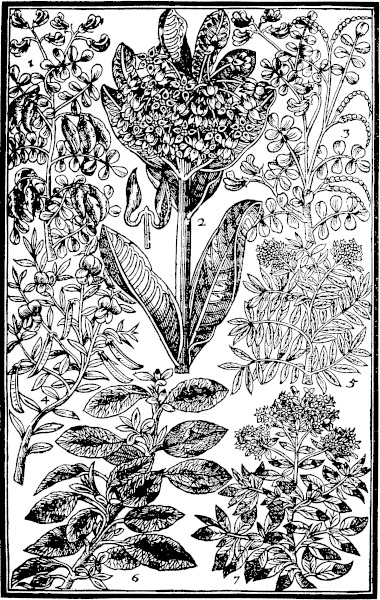
| 1 | Colutæa vulgaris. Ordinary bastard Sene. |
| 2 | Periploca recta Virginiana. Virginian Silke. |
| 3 | Colutæa Scorpioides. Scorpion bastard Sene. |
| 4 | Spartum Hispanicum. Spanish Broome. |
| 5 | Ligustrum. Priuet. |
| 6 | Saluia variegata. Party coloured Sage. |
| 7 | Maiorana aurea. Guilded Marierome. |
Lest this stranger should find no hospitality with vs, being so beautifull a plant,
or not finde place in this Garden, let him be here receiued, although with the
last, rather then not at all. It riseth vp with one or more strong and round
stalkes, three or foure foote high, whereon are set at the seuerall ioynts thereof two
faire, long, and broad leaues, round pointed, with many veines therein, growing
close to the stemme, without any foote-stalke: at the tops of the stalkes, and some
times at the ioynts of the leaues, groweth forth a great bush of flowers out of a
thinne skinne, to the number of twenty, and sometimes thirty or forty, euery one
with a long foote-stalke, hanging downe their heads for the most part, especially
those that are outermost, euery one standing within a small huske of greene leaues,
turned to the stalkeward, like vnto the Lysimachia flower of Virginia before described,
and each of them consisting of fiue small leaues a peece, of a pale-purplish
colour on the vpperside, and of a pale yellowish purple vnderneath, both sides
of each leafe being as it were folded together, making them seeme hollow and
pointed, with a few short chiues in the middle: after which come long and crooked
pointed cods standing vpright, wherein are contained flat brownish seede, dispersedly
lying within a great deale of fine, soft, and whitish browne silke, very like vnto
the cods, seede, and silke of Asclepias, or Swallow-wort, but that the cods are greater
and more crooked, and harder also in the outer shell: the roote is long and white, of
the bignesse of a mans thumbe, running vnder ground very far, and shooting vp in diuers
places, the heads being set full of small white grumes or knots, yeelding forth
many branches, if it stand any time in a place: the whole plant, as well leaues as
stalkes, being broken, yeeld a pale milke.
It came to me from Virginia, where it groweth aboundantly, being raised
vp from the seede I receiued.
It flowreth in Iuly, and the seede is ripe in August.
It may seeme very probable to many, that this plant is the same that Prosper
Alpinus in the twenty fift Chapter of his Booke of Egyptian plants,
nameth Beidelsar; and Honorius Bellus in his third and fourth Epistles vnto
Clusius (which are at the end of his History of plants) calleth Ossar frutex:
And Clusius himselfe in the same Booke calleth Apocynum Syriacum,
Palæstinum, and Ægyptiacum, because this agreeth with theirs in very many
and notable parts; yet verily I thinke this plant is not the same, but rather
another kinde of it selfe: First, because it is not frutex, a shrub or wooddy
plant, nor keepeth his leaues all the yeare, but loseth both leaues and stalks,
dying down to the ground euery yeare: Secondly, the milke is not causticke
or violent, as Alpinus and Bellus say Ossar is: Thirdly, the cods are more
crooked then those of Clusius, or of Alpinus, which Honorius Bellus acknowledgeth
to be right, although greater then those he had out of Egypt:
And lastly, the rootes of these doe runne, whereof none of them make any
mention. Gerard in his herball giueth a rude figure of the plant, but a very
true figure of the cods with seede, and saith the Virginians call it Wisanck,
and referreth it to the Asclepias, for the likenesse of the cods stuffed with
silken doune. But what reason Caspar Bauhinus in his Pinax Theatri Botanici
had, to call it (for it is Clusius his Apocynum Syriacum) by the name of
Lapathum Ægyptiacum lactescens siliqua Asclepiadis, I know none in the
world: for but that he would shew an extreame singularity in giuing names
to plants, contrary to all others (which is very frequent with him) how
could he thinke, that this plant could haue any likenesse or correspondencie,
with any of the kindes of Dockes, that euer he had seene, read, or heard
of, in face, or shew of leaues, flowers, or seede; but especially in giuing
milke. I haue you see (and that not without iust and euident cause) giuen it
a differing Latine name from Gerard, because the Asclepias giueth no milke,
but the Periploca or Apocymum doth; and therefore fitter to be referred to
this then to that. And because it should not want an English name answerable
to some peculiar property thereof, I haue from the silken doune called
it Virginian Silke: but I know there is another plant growing in Virginia,
called Silke Grasse, which is much differing from this.
I know not of any in our Land hath made any tryall of the properties
hereof. Captaine Iohn Smith in his booke of the discouery and description
of Virginia, saith, that the Virginians vse the rootes hereof (if his be
the same with this) being bruised and applyed to cure their hurts & diseases.
Because the vse of this plant is so much, and so frequent throughout all this Land,
although for no other purpose but to make hedges or arbours in Gardens, &c.
whereunto it is so apt, that no other can be like vnto it, to bee cut, lead, and
drawne into what forme one will, either of beasts, birds, or men armed, or otherwise:
I could not forget it, although it be so well knowne vnto all, to be an hedge bush growing
from a wooddy white roote, spreading much within the ground, and bearing manie
long, tough, and plyant sprigs and branches, whereon are set long, narrow, and
pointed sad greene leaues by couples at euery ioynt: at the tops whereof breake forth
great tufts of sweete smelling white flowers, which when they are fallen, turne into
small blacke berries, hauing a purple iuyce within them, and small seede, flat on the
one side, with an hole or dent therein: this is seene in those branches that are not cut,
but suffered to beare out their flowers and fruit.
This bush groweth as plentifully in the Woods of our owne Countrey,
as in any other beyond the Seas.
It flowreth sometimes in Iune,and in Iuly; the fruit is ripe in August and
September.
There is great controuersie among the moderne Writers concerning this
plant, some taking it to be κύπρος of Dioscorides, other to be Phillyrea of Dioscorides,
which followeth next after Cyprus. Plinie maketh mention of
Cyprus in two places; in the one he saith Cyprus hath the leafe of Ziziphus,
or the Iuiube tree: in the other he saith, that certain do affirme, that the Cyprus
of the East Country, and the Ligustrum of Italy is one and the same plant:
whereby you may plainly see, that our Priuet which is Ligustrum, cannot be
that Cyprus of Plinie with Iuiube leaues: Besides, both Dioscorides & Plinie
say, that Cyprus is a tree; but all know that Ligustrum, Priuet, is but an hedge
bush: Againe, Dioscorides saith, that the leaues of Cyprus giue a red colour,
but Priuet giueth none. Bellonius and Prosper Alpinus haue both recorded,
that the true Cyprus of Dioscorides groweth plentifully in Egypt, Syria,
and those Easterne Countries, and noursed vp also in Constantinople,
and other parts of Greece, being a merchandise of much worth, in that they
transport the leaues, and young branches dryed, which laid in water giue a
yellow colour, wherewith the Turkish women colour the nailes of their
hands, and some other parts of their bodies likewise, delighting much
therein: and that it is not our Ligustrum, or Priuet, because Cyprus beareth
round white seede, like Coriander seede, and the leaues abide greene alwaies
vpon the tree, which groweth (if it bee not cut or pruined) to the
height of the Pomegranet tree. I haue (I confesse) beyond the limits I set for
this worke spoken concerning our Priuet, because I haue had the seede of
the true Cyprus of Dioscorides sent mee, which was much differing from
our Priuet, and although it sprang vp, yet would not abide any time,
whereas if it had beene our Priuet, it would haue beene familiar enough
to our Countrey.
It is of small vse in physicke, yet some doe vse the leaues in Lotions, that
serue to coole and dry fluxes or sores in diuers parts.
Vnto all these flowers of beauty and rarity, I must adioyne two other plants,
whose beauty consisteth in their leaues, and not in their flowers: as also to separate
them from the others of their tribe, to place them here in one Chapter,
before the sweete herbes that shall follow, as is fittest to furnish this our Garden of
pleasure. This kinde of Sage groweth with branches and leaues, very like the ordinary
Sage, but somewhat smaller, the chiefest difference consisteth in the colour of
the leaues, being diuersly marked and spotted with white and red among the greene:
for vpon one branch you shall haue the leaues seuerally marked one from another, as
the one halfe of the leafe white, and the other halfe greene, with red shadowed ouer
them both, or more white then greene, with some red in it, either parted or shadowed,
or dasht here and there, or more greene then white, and red therein eyther in the middle
or end of the leafe, or more or lesse parted or striped with white and red in the
greene, or else sometimes wholly greene the whole branch together, as nature listeth
to play with such varieties: which manner of growing rising from one and the same
plant, because it is the more variable, is the more delightfull and much respected.
There is another speckled Sage parted with white and greene, but it is nothing of
that beauty to this, because this hath three colours euidently to bee discerned in euery
leafe almost, the red adding a superaboundant grace to the rest.
This kinde of Marierome belongeth to that sort is called in Latine Maiorana latifolia,
which Lobel setteth forth for Hyssopus Græcorum genuina: In English Winter Marierome,
or pot Marierome: for it hath broader and greater leaues then the sweete
Marierome, and a different vmbell or tuft of flowers. The difference of this from that
set forth in the Kitchin Garden, consisteth chiefly in the leaues, which are in Summer
wholly yellow in some, or but a little greene, or parted with yellow and greene more
or lesse, as nature listeth to play: but in Winter they are of a darke or dead greene colour,
yet recouering it selfe againe: the sent hereof is all one with the pot Marierome.
Wee haue another parted with white and greene, much after the manner with the
former.
The Place, Time, Names, and Vertues of both these plants, shall be declared
where the others of their kindes are specified hereafter, and in the
Kitchen Garden; for they differ not in properties.
After all these faire and sweete flowers before specified, I must needes adde a
few sweete herbes, both to accomplish this Garden, and to please your senses,
by placing them in your Nosegays, or else where, as you list. And although I
bring them in the end or last place, yet are they not of the least account.
Our ordinary Garden Lauender riseth vp with a hard wooddy stemme aboue the
ground, parted into many small branches, whereon are set whitish, long, and narrow
leaues, by couples one against another; from among which riseth vp naked square
stalkes, with two leaues at a ioynt, and at the toppe diuers small huskes standing round
about them, formed in long and round heads or spikes, with purple gaping flowers
springing out of each of them: the roote is wooddy, and spreadeth in the ground:
The whole plant is of a strong sweete sent, but the heads of flowers much more, and
more piercing the senses, which are much vsed to bee put among linnen and apparrell.
Flore albo.
There is a kinde hereof that beareth white flowers, and somewhat broader leaues,
but it is very rare, and seene but in few places with vs, because it is more tender, and
will not so well endure our cold Winters.
The Spike or small Lauender is very like vnto the former, but groweth not so high,
neither is the head or spike so great and long, but shorter and smaller, and of a more
purplish colour in the flower: the leaues also are a little harder, whiter, and shorter
then the former; the sent also is somewhat sharper and stronger. This is not so frequent
as the first, and is nourished but in some places that are warme, and where they
delight in rare herbes and plants.
Lauender groweth in Spaine aboundantly, in many places so wilde,
and little regarded, that many haue gone, and abiden there to distill the oyle
thereof whereof great quantity now commeth ouer from thence vnto vs:
and also in Lanquedocke, and Prouence in France.
It flowreth early in those hot Countries, but with vs not vntill Iune and
Iuly.
It is called of some Nardus Italica, and Lauendula, the greater is called
Fæmina, and the lesser Mas. We doe call them generally Lauender, or Lauender
Spike, and the lesser Spike, without any other addition.
Lauender is little vsed in inward physicke, but outwardly; the oyle for
cold and benummed parts, and is almost wholly spent with vs, for to perfume
linnen, apparrell, gloues, leather, &c., and the dryed flowers to comfort
and dry vp the moisture of a cold braine.
Cassidony that groweth in the Gardens of our Countrey, may peraduenture
somewhat differ in colour, as well as in strength, from that which groweth in
hotter Countries; but as it is with vs, it is more tender a great deale then Lauender,
and groweth rather like an herbe then a bush or shrub, not aboue a foote and a
halfe high, or thereabouts, hauing many narrow long greene leaues like Lauender, but
softer and smaller, set at seuerall distances together about the stalkes, which spread
abroad into branches: at the tops whereof stand long and round, and sometimes foure
square heads, of a darke greenish purple colour, compact of many scales set together;
from among which come forth the flowers, of a blewish purple colour, after which
follow seede vessels, which are somewhat whitish when they are ripe, containing
blackish browne seede within them: the roote is somewhat wooddy, and will hardly
abide the iniuries of our cold Winters, except in some places onely, or before it haue
flowred: The whole plant is somewhat sweete, but nothing so much as Lauender.
Cassidony groweth in the Islands Stæchades, which are ouer against Marselles,
and in Arabia also: we keep it with great care in our Gardens.
It flowreth the next yeare after it is sowne, in the end of May, which is
a moneth before any Lauender.
It is called of some Lauendula siluestris, but most vsually Stæchas in English,
of some Stichadoue, or French Lauender; and in many parts of England,
Cassidony.
It is of much more vse in physicke then Lauender, and is much vsed for
old paines in the head. It is also held to be good for to open obstructions, to
expell melancholy, to cleanse and strengthen the liuer, and other inward
parts, and to be a Pectorall also.
This Lauender Cotton hath many wooddy, but brittle branches, hoary or of a
whitish colour, whereon are set many leaues, which are little, long, and foure
square, dented or notched on all edges, and whitish also: at the tops of these
branches stand naked stalkes, bearing on euery one of them a larger yellow head or
flower, then eyther Tansie or Maudeline, whereunto they are somewhat like, wherein
is contained small darke coloured seede: the roote is hard, and spreadeth abroad
with many fibres: the whole plant is of a strong sweete sent, but not vnpleasant, and
is in many places planted in Gardens, to border knots with, for which it will abide to
be cut into what forme you thinke best; for it groweth thicke and bushy, very fit for
such workes, besides the comely shew the plant it selfe thus wrought doth yeeld,
being alwayes greene, and of a sweet sent; but because it quickly groweth great, and
will soone runne out of forme, it must be euery second or third yeare taken vp, and new
planted.
It is onely planted in Gardens with vs, for the vses aforesaid especially.
It flowreth in Iuly, and standeth long in the hot time of the yeare in his
colour, and so will doe, if it be gathered before it haue stood ouer long.
Diuers doe call it as Matthiolus doth, Abrotanum fæmina, and Santolina;
and some call it Chamæcyparissus, because the leaues thereof, are somewhat
like the leaues of the Cypresse tree: Wee call it in English generally Lauender
Cotton.
This is vsually put among other hot herbes, eyther into bathes, ointments,
or other things, that are vsed for cold causes. The seede also is much
vsed for the wormes.
Bassill is of two sorts (besides other kindes) for this our Garden, the one whereof
is greater, the other lesse in euery part thereof; as shall be shewed.
Our ordinary Garden Bassill hath one stalke rising from the root, diuersly branched
out, whereon are set two leaues alwayes at a ioynt, which are broad, somewhat round,
and pointed, of a pale greene colour, but fresh, a little snipt or dented about the edges,
and of a strong or heady sent, somewhat like a Pomecitron, as many haue compared
it, and thereof call it Citratum: the flowers are small and white, standing at the tops of
the branches, with two smal leaues at euery ioynt vnder them, in some plants green, in others
browne vnder them: after which commeth blacke seede: the roote perisheth
at the first approach of winter weather, and is to be new sowen euery yeare.
The bush Basill groweth not altogether so high, but is thicker spreade out into
branches, whereon grow smaller leaues, and thicker set then the former, but of a more
excellent and pleasant smell by much: the flowers are white like the former, and the
seede blacke also like it, and perisheth as suddenly, or rather sooner then it, so that it
requireth more paines to get it, and more care to nourse it, because we seldome or neuer
haue any seede of it.
The Indian Basill hath a square reddish greene stalke, a foote high or better, from
the ioynts whereof spreade out many branches, with broade flat leaues set thereon,
two alwayes together at the ioynt, one against another, as other Basils haue, but somewhat
deepely cut in on the edges, and oftentimes a little crumpled, standing vpon long
reddish footestalkes, of a darke purple colour, spotted with deeper purple spots, in
some greater, in others lesser: the flowers stand at the tops of the stalkes spike-fashion,
which are of a white colour, with reddish stripes and veines running through them, set
or placed in darke purple coloured huskes: the seede is greater and rounder then the
former, and somewhat long withall: the roote perisheth in like manner as the other
former doe. The whole plant smelleth strong, like vnto the other Basils.
The two last sorts of Basils are greater strangers in our Country then the
first which is frequent, and only sowen and planted in curious gardens. The
last came first out of the West Indies.
They all flower in August, or Iuly at the soonest, and that but by degrees,
and not all at once.
The first is vsually called Ocimum vulgare, or vulgatius, and Ocimum Citratum.
In English, Common or Garden Basill. The other is called Ocimum
minimum, or Gariophyllatum, Cloue Basill, or Bush Basill. The last eyther of
his place, or forme of his leaues, being spotted and curled, or all, is called
Ocimum Indicum maculatum, latifolium & crispum. In English according to the
Latine, Indian Basill, broade leafed Basill, spotted or curled Basill, which
you please.
The ordinary Basill is in a manner wholly spent to make sweet, or washing
waters, among other sweet herbes, yet sometimes it is put into nosegayes.
The Physicall properties are, to procure a cheerefull and merry heart, whervnto
the seede is chiefly vsed in pouder, &c. and is most vsed to that, and
to no other purpose.
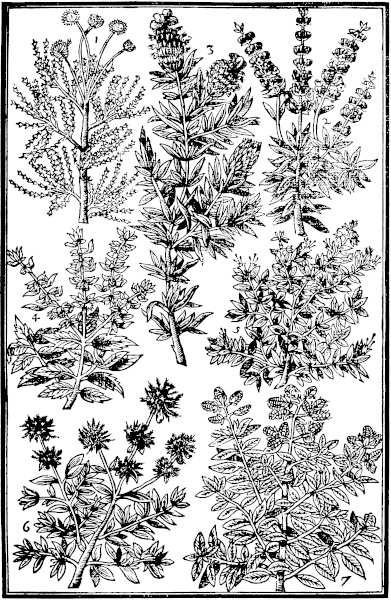
| 1 | Santolina. Lauender Cotton. |
| 2 | Lauendula. Lauender Spike. |
| 3 | Stœchas. Cassidony. |
| 4 | Chamædrys. Germander. |
| 5 | Ocimum minus. Fine Bassill. |
| 6 | Marum. Herbe Masticke. |
| 7 | Maiorana. Sweete Marierome. |
Wee haue many sorts of Marierome; some that are sweete, and but Summer
plants; others that are greater and not so sweet; and some also that
are wilde. Of all these I will onely select some of the choisest that are
fit for this place, and leaue the other for the next garden, and the garden of simples, or
a generall worke: yet hereunto I will adioyne another sweete plant called Masticke,
as participating neerer with them then with Time, whereunto many doe referre it.
The sweet Marierome that is most frequently sowen in our Country, is a low herbe
little aboue a foote high when it is at the highest, full of branches, and small whitish
soft roundish leaues, smelling very sweet: at the toppes of the branches stand diuers
small scaly heads, like vnto knots, (and therefore of some called knotted Marierome)
of a whitish greene colour, out of which come here and there small white flowers, and
afterwards small reddish seede: the roote is composed of many small threds or strings,
which perish with the whole plant euery yeare.
This Marierome hath likewise diuers small branches, growing low, and not higher
then the former, but hauing finer and smaller leaues, hoary and soft, but much sweeter:
the heads are like vnto the former, and so are the flowers and seede, and the whole
plant abiding but a Summer in the like manner.
The neerer resemblance that this herbe hath with Marierome then with Tyme (as
I said before) hath made me place it next vnto the small sweet Marierome. It riseth vp
with a greater, and a more woody stalke then Marierome, two foote high or better in
some places, where it liketh the ground and ayre, branching out on all sides towards
the vpper part, leauing the stemme bare below, if it bee old, otherwise being young,
thinly furnishing the branches from the bottome with small greene leaues, bigger then
the leaues of any Tyme, and comming neere vnto the bignesse and forme of the last
recited finer Marierome, but of a greener colour: at the toppes of the branches stand
small white flowers on a head, which afterwards turne into a loose tuft of a long white
hoary matter, like vnto soft doune, with some leaues vnderneath and about it, which
abide not long on the stalkes, but are blowne away with the winde: the seede is so
small if it haue any, that I haue not obserued it: the roote is threddy: the whole plant
is of a sweete resinous sent, stronger then the Marierome, and abideth our winters, if
it be carefully planted and regarded.
The sweete Marieromes grow naturally in hot Countreyes: the first in
Spaine &c. the second is thought to come out of Syria, or Persia first into
Italie, where they much esteeme it, and plant it curiously and carefully in
pots, and set them in their windowes, beeing much delighted therewith for
the sweet sent it hath. The first is vsually sowen euery yeare in most gardens
with vs: but the second is very rare and daintie, and must as daintely be preserued
being more tender then the former. The herbe Masticke is thought
to be first brought out of Candie, Clusius saith he found it in Spaine: It is
planted by slippes, (and not sowen) in many gardens, and is much replanted
for increase, but prospereth onely, or more frequently, in loamie or clay
grounds then in any other soyle.
The sweete Marieromes beare their knots or scaly heads in the end of Iuly,
or in August. Herbe Masticke in Iune many times, or in the beginning
of Iuly.
The first of the two sweet Marieromes called Maiorana in Latine à maiore
cura, is taken of most writers to be the Amaracus or Sampsuchum of Dioscorides,
Theophrastus and Plinie, although Galen doth seem a little to dissent
therefrom. The other sweet Marierome hath his name in his title as much
as can be said of it. The next is thought by the best of the moderne Writers
to be the true Marum that Galen preferreth for the excellent sweetnesse, before
the former Marierome in making the Oleum, or vnguentum Amaricinum,
and seemeth to incline to their opinion that thought Amaracus was deriued
from Marum. It is the same also that Galen and others of the ancient Writers
make mention of, to go into the composition of the Trochisci Hedychroi,
as well as Amaracus among the ingredients of the Theriaca Andromachi. In
English we call it Masticke simply, or Herbe Mastick, both to distinguish it
from that Tyme that is called Masticke Tyme, and from the Masticke
Tree, or Gum, so called. Some of later times, and Clusius with them, haue
thought this to be Dioscorides his Tragoriganum, which doth somewhat resemble
it: but there is another plant that Matthiolus setteth forth for Marum,
that in Lobels opinion and mine is the truest Tragoriganum, and this
the truest Marum.
The sweete Marieromes are not onely much vsed to please the outward
senses in nosegayes, and in the windowes of houses, as also in sweete pouders,
sweete bags, and sweete washing waters, but are also of much vse in
Physicke, both to comfort the outward members, or parts of the body, and
the inward also: to prouoke vrine being stopped, and to ease the paines
thereof, and to cause the feminine courses. Herbe Masticke is of greater
force to helpe the stopping of vrine, then the Marierome, and is put into
Antidotes, as a remedie against the poyson of venemous Beasts.
There are many kindes of Tyme, as they are vsually called, with vs, some are
called of the garden, and others wilde, which yet for their sweetnesse are
brought into gardens, as Muske Tyme, and Lemon Tyme; and some for their
beauty, as embroidered or gold yellow Tyme, and white Tyme. But the true Tyme
of the ancient Writers, called Capitatum, as a speciall note of distinction from all other
kindes of Tyme, is very rare to be seene with vs here in England, by reason of the
tendernesse, that it will not abide our Winters. And all the other sorts that with vs
are called garden Tymes, are indeede but kindes of wilde Tyme, although in the defect
or want of the true Tyme, they are vsed in the stead of it. With the Tymes I must
doe as I did with the Marieromes in the Chapter before, that is, reserue the most common
in vse, for the common vse of the Kitchen, and shew you only those here, that are
not put to that vse: and first with the true Tyme, because it is knowne but to a few.
The true Tyme is a very tender plant, hauing hard and hoary brittle branches,
spreading from a small wooddy stemme, about a foote and a halfe high, whereon are
set at seuerall ioynts, and by spaces, many small, long, whitish, or hoary greene leaues,
of a quicke sent and taste: at the tops of the branches stand small long whitish greene
heads, somewhat like vnto the heads of Stæchas, made as it were of many leaues or
scales, out of which start forth small purplish flowers (and in some white, as Bellonius
saith) after which commeth small seede, that soone falleth out, and if it be not carefully
gathered, is soone lost, which made (I thinke) Theophrastus to write, that this
Tyme was to be sowne of the flowers, as not hauing any other seede: the root is small
and wooddy. This holdeth not his leaues in Winter, no not about Seuill in Spaine,
where it groweth aboundantly, as Clusius recordeth, finding it there naked or spoiled
of leaues. And will not abide our Winters, but perisheth wholly, roote and all.
The wilde Tyme that is cherished in gardens groweth vpright, but yet is lowe, with
diuers slender branches, and small round greene leaues, somewhat like vnto small fine
Marierome, and smelling somewhat like vnto it: the flowers growe in roundels at the
toppes of the branches, of a purplish colour: And in another of this kinde they are
of a pure white colour.
There is another also like hereunto, that smelleth somewhat like vnto Muske; and
therefore called Muske Tyme, whose greene leaues are not so small as the former,
but larger and longer.
The wilde Tyme that smelleth like vnto a Pomecitron or Lemon, hath many weake
branches trayling on the ground, like vnto the first described wilde Tyme, with small
darke greene leaues, thinly or sparsedly set on them, and smelling like vnto a Lemon,
with whitish flowers at the toppes in roundels or spikes.
This kinde of wilde Tyme hath small hard branches lying or leaning to the ground,
with small party coloured leaues vpon them, diuided into stripes or edges, of a gold
yellow colour, the rest of the leafe abiding greene, which for the variable mixture or
placing of the yellow, hath caused it to be called embroidered or guilded Tyme.
The first groweth as is said before, about Seuill in Spaine, in very great
aboundance as Clusius saith; and as Bellonius saith, very plentifully on the
mountaines through all Greece. The others growe some in this Country,
and some in others: but wee preserue them with all the care wee can in our
gardens, for the sweete and pleasant sents and varieties they yeeld.
The first flowreth not vntill August; the rest in Iune and Iuly.
Their names are seuerally set downe in their titles, as is sufficient to
distinguish them; and therefore I shall not neede to trouble you any further
with them.
The true Tyme is a speciall helpe to melancholicke and spleneticke diseases,
as also to flatulent humours, either in the vpper or lower parts of the
body. The oyle that is Chimically drawne out of ordinary Tyme, is vsed
(as the whole herbe is, in the stead of the true) in pils for the head and stomach.
It is also much vsed for the toothach, as many other such like hot
oyles are.
There are many varieties of Hyssope, beside the common or ordinary, which
I reserue for the Kitchen garden, and intend onely in this place to giue you
the knowledge of some more rare: viz. of such as are noursed vp by those
that are curious, and fit for this garden: for there are some other, that must be remembred
in the Physicke garden, or Garden of Simples, or else in a generall worke.
This white Hyssope is of the same kinde and smell with the common Hyssope; but
differeth, in that this many times hath diuers leaues, that are wholly of a white colour,
with part of the stalke also: others are parted, the one halfe white, the other halfe
greene, and some are wholly greene, or with some spots or stripes of white within the
greene, which makes it delightfull to most Gentlewomen.
As the last hath party coloured leaues, white and greene, so this hath his leaues of
an ash-colour, which of some is called russet; and hath no other difference either in
forme or smell.
All the leaues of this Hyssope are wholly yellow, or but a little greene in them, and
are of so pleasant a colour, especially in Summer, that they prouoke many Gentlewomen
to weare them in their heads, and on their armes, with as much delight as many
fine flowers can giue: but in Winter their beautifull colour is much decayed, being of
a whitish greene, yet recouer themselues againe the next Summer.
As this kinde of Hyssope groweth lower then the former or ordinary kinde, so it
hath more branches, slenderer, and not so wooddy, leaning somewhat downe toward
the ground, so wonderfully thicke set with leaues, that are like vnto the other, but of a
darker greene colour, and somewhat thicker withall, that it is the onely fine sweete
herbe, that I know fittest (if any be minded to plant herbes) to set or border a knot of
herbes or flowers, because it will well abide, and not growe too wooddy or great, nor
be thinne of leaues in one part, when it is thicke in another, so that it may be kept with
cutting as smooth and plaine as a table. If it be suffered to growe vp of it selfe alone,
it riseth with leaues as before is specified, and flowreth as the common doth, and of
the same sent also, not differing in any thing, but in the thicknesse of the leaues on the
stalkes and branches, and the aptnesse to be ordered as the keeper pleaseth.
Lest Germander should be vtterly forgotten, as not worthy of our Garden, seeing
many (as I said in my treatise or introduction to this Garden) doe border knots therewith:
let me at the least giue it a place, although the last, being more vsed as a strewing
herbe for the house, then for any other vse. It is (I thinke) sufficiently knowne to haue
many branches, with small and somewhat round endented leaues on them, and purplish
gaping flowers: the rootes spreading far abroad, and rising vp againe in many places.
These Hyssopes haue beene most of them noursed vp of long time in our
English Gardens, but from whence their first originall should be, is not well
knowne. The Germander also is onely in Gardens, and not wilde.
They flower in Iune and Iuly.
The seuerall names whereby they are knowne to vs, are set forth in their
titles; and therefore I neede not here say more of them then onely this, that
neyther they here set downe, nor the common or ordinary sort, nor any of
the rest not here expressed, are any of them the true Hyssope of the ancient
Greeke Writers, but supposititiæ, vsed in the stead thereof. The Germander,
from the forme of the leaues like vnto small oaken leaues, had the name Chamædrys
giuen it, which signifieth a dwarfe Oake.
The common Hyssope is much vsed in all pectorall medicines, to cut
fleagme, and to cause it easily to be auoided. It is vsed of many people in
the Country, to be laid vnto cuts or fresh wounds, being bruised, and applyed
eyther alone, or with a little Sugar. It is much vsed as a sweet herbe,
to be in the windowes of an house. I finde it much commended against the
Falling Sicknesse, especially being made into Pils after this manner: Of
Hyssope, Horhound, and Castor, of each halfe a dramme, of Peony rootes
(the male kinde is onely fit to be vsed for this purpose) two drams, of Assafætida
one scruple: Let them be beaten, and made into pils with the iuyce
of Hyssope; which being taken for seuen dayes together at night going to
bed, is held to be effectual to giue much ease, if not thoroughly to cure those
that are troubled with that disease. The vse of Germander ordinarily is as
Tyme, Hyssope, and other such herbes, to border a knot, whereunto it is
often appropriate, and the rather, that it might be cut to serue (as I said) for
a strewing herbe for the house among others. For the physicall vse it serueth
in diseases of the splene, and the stopping of vrine, and to procure womens courses.
Thus haue I led you through all my Garden of Pleasure, and shewed you all the varieties
of nature noursed therein, pointing vnto them, and describing them one after
another. And how lastly (according to the vse of our old ancient Fathers) I bring
you to rest on the Grasse, which yet shall not be without some delight, and that not
the least of all the rest.
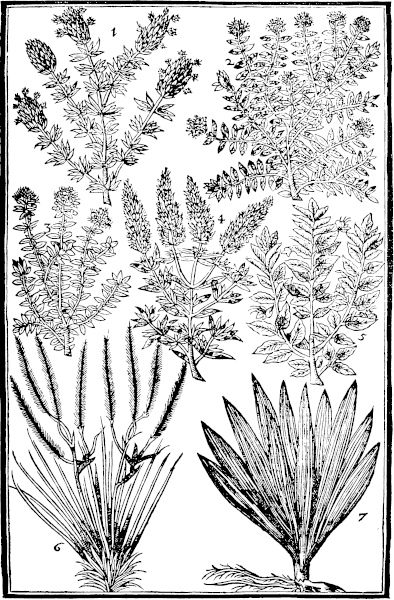
| 1 | Thymum legitimum. The true Tyme. |
| 2 | Serpillum maius hortense. Garden wilde Tyme. |
| 3 | Serpillum Citratum. Lemon Tyme. |
| 4 | Hyssopus versicolor siue aureus. Golden Hyssope. |
| 5 | Chamædrys. Germander. |
| 6 | Spartum Austriacum siue Gramen plumarium minus. The lesser feather Grasse. |
| 7 | Gramen striatum vel sulcatum. Painted Grasse or Ladies Laces. |
There are among an infinite number (as I may so say) of Grasses, a few onely
which I thinke fit to be planted in this Garden, both for the rarity of them,
and also for your delight, and the excellent beauty that is in them aboue many
other plants. One of them hath long agoe bin respected, and cherished in the country
gardens of many Gentlewomen, and others. The others are knowne but vnto a few.
This kinde of Grasse hath many stiffe, hard, round stalkes, full of ioynts, whereon
are set at euery ioynt one long leafe, somewhat broad at the bottome, where it compasseth
the stalke, and smaller to the end, where it is sharpe pointed, hard or rough in
handling, and striped all the length of the leafe with white streakes or lines, that they
seeme party coloured laces of white and greene: the tops of the stalkes are furnished
with long spikie tufts, like vnto the tufts of Couch Grasse: the rootes are small, white,
and threddy, like the rootes of other Grasses.
This lesser Feather-Grasse hath many small, round, and very long leaues or blades,
growing in tufts, much finer and smaller then any other Grasse that I know, being almost
like vnto haires, and of a fresh greene colour in Summer, but changing into gray,
like old hay in Winter, being indeede all dead, and neuer reuiuing; yet hardly to be
plucked away vntill the Spring, and then other greene leaues or rushes rise vp by them,
and in their stead, and are aboue a foote in length: from the middle of these tufts come
forth rounder and bigger rushes, which are the stalkes, and which haue a chaffie round
eare about the middle thereof, which when it is full growne, is somewhat higher then
the toppes of the leaues or rushes, opening it selfe (being before close) at the top, and
shewing forth three or foure long ayles or beards, one aboue another, which bend
themselues a little downewards (if they stand ouer long before they are gathered, and
will fall off, and be blowne away with the winde) being so finely feathered on both
sides, all the length of the beard, and of a pale or grayish colour, that no feather in the
taile of the Bird of Paradise can be finer, or to be compared with them, hauing sticking
at the end of euery one of them, within the eare, a small, long, whitish, round, hard,
and very sharpe pointed graine, like vnto an oaten graine, that part of the stalke of the
feather that is next vnder it, and aboue the seede for some two or three inches, being
stiffe and hard, and twining or curling it selfe, if it be suffered to stand too long, or to
fall away, otherwise being straight as the feather it selfe: the roote is composed of
many long, hard, small threddy strings, which runne deepe and far, and will not willingly
be remoued, in that it gaineth strength euery yeare by standing.
The greater Feather-Grasse is like vnto the lesser, but that both the leaues and the
feathers, are greater, and nothing so fine, grosser also, and of lesse beauty and respect,
though whiter then it; and therefore is not so much regarded: for I haue knowne, that
many Gentlewomen haue vsed the former lesser kinde, being tyed in tufts, to set them
in stead of feathers about their beds, where they haue lyen after childe-bearing, and at
other times also, when as they haue been much admired of the Ladies and Gentles that
haue come to visit them.
The first of these Grasses, as Lobel saith, groweth naturally in the woods
and hils of Sauoy. It hath long agoe beene receiued into our English gardens.
The second, as Clusius saith, in Austria, from whence also (as I take
it) the greater came, and are both in the gardens of those, that are curious
obseruers of these delights.
The first is in its pride for the leaues all the Spring and Summer, yeelding
his bush in Iune. The other giue their feather-like sprigs in Iuly and
August, and quickly (as I said) are shed, if they be not carefully gathered.
The first is called by Lobel Gramen sulcatum, or striatum album; of others
Gramen pictum. The French call it Aiguellettes d’armes, of the fashion that
their Ensignes, Pennons, or Streamers vsed in wars were of, that is, like
vnto a party coloured curtaine. In English vsually Ladies laces, and Painted
Grasse. The first of the other two is called Gramen plumarium or plumosum,
and minus is added for the distinction of it. Clusius calleth it Spartum
Austriacum, of the likenesse and place where he found it. The last is, called
Gramen plumarium, or plumosum maius, The greater Feather-Grasse.
These kindes of Grasses are not in any time or place that I doe heare of
applyed to any Physicall vse; and therefore of them I will say no more:
but here I will end the prime part of this worke.

[460]