Some years ago the Editor of News
from Afar had a series of articles describing
“How We Go” in different
lands. Only one of the series dealt
with Papua, and that mainly with a journey
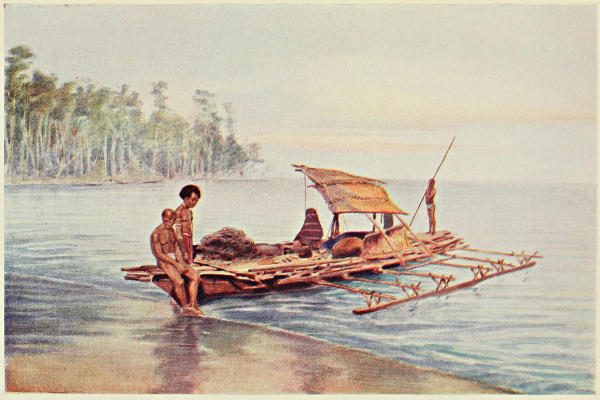
in a small cutter. In Delena district we have
no cutter, so every journey must be made
either in the whale boat, or a canoe, or by
tramping. After the comfort of fast trains
and trams in England, the labour of a short
journey in Papua would be laughable if it
were not so wearisome. To talk of a journey
when the distance to be covered is only
some 50 or 60 miles, seems absurd till you
have had experience of it, and then you will
measure the distance not by miles, but by
hours or days.
These journeys are necessary because each
missionary, in addition to the head station at
which he lives, has charge of villages scattered
over a wide area, where the South Sea and
Papuan teachers who help him are doing their
work.
If the journey is to be performed in comfort
(and there is no need to seek discomfort,
plenty will come in the ordinary way) careful
thought must be given to the preparation.
Much more has to be done than just pack a
portmanteau, for everything that will be
needed till the return must be remembered
and packed, or done without, for nothing can
be got on the way. Food is the first consideration,
and if we are to be away three weeks,
then it is not safe to start with provision for
less than a month. A time-table may be
made out, but that does not say that it is
going to be kept. A tide may be lost, or a
strong wind may blow, and then there is
nothing for it but to “dohore,” or more often
the real trouble of Papuan travel causes delay.
Carriers cannot be got to take the baggage
on to the next village. How many weeks
are lost to travellers in Papua in the course of
a year, from this cause alone, it would be difficult
to estimate. The total would surprise
one, and unfortunately no amount of arrangement
will overcome the difficulty. Remembering
this it will be well to be liberal in the estimate
of the number of meals that will be required
before we return to the starting-point.
Next comes the provision for paying the
carriers and buying native food for them. A
missionary from China once told me of the
trouble caused by the quantity of Chinese cash
that had to be carried on a journey. A big
purse indeed would be necessary, but no purse
would be any good in Papua. A good sized
box, heavy enough to require two men to
carry it, takes its place. Instead of £ s. d.
it contains an assortment of barter goods.
The real currency is black tobacco, made up
in small sticks going 26 to the pound. For
ordinary work three of these constitute a
day’s pay, in the Delena district but do not
imagine that the man who receives the pay
smokes it all. As often as not when he has
been paid he says, “Now give me a smoke.”
His unbroken sticks of tobacco are like so
many unchanged shillings. They are safe,
and can be passed on in payment for food,
but if once broken they are like the coppers—they
soon vanish. One after another his
friends will borrow, or beg—it amounts to
the same thing in this case—till there is nothing
of the original stick left.
Matches, print, knives, hooks, lines, mirrors,
beads, hatchets—all find a place in the trade
box. I have tried soap, but it does not
“take.” Some of the Papuans will receive
it as a present, but not as payment for work
done.
Having provided for the inner man, and
for paying our way, we next think of the
saucepan, the “billy,” the frying-pan, lamps,
bucket, hatchet, kerosene for the lamps,
hammocks and tent if we are going to villages
where we have no teacher, table requisites,
and are careful to see that the mosquito nets
are in the bag. Once only did I forget to do
this, and the lesson I learnt has never been
forgotten. Beds one can do without, but not
mosquito nets. Rice for the boys must not
be overlooked, for it is not always possible to
buy native food.
When all is ready it is a wonderful assortment,
beating “Mrs. Brown’s Luggage,” and
so wonderful that even a Waterloo porter
would have his attention arrested, and wonder
what it all meant.
Having made our preparations, now where
are we going, and how are we going? The
where you will find out as we go along, the
how is answered by the whale boat, over the
launching of which there has been so much
shouting. The start is to be made about midnight,
and to try not to be late, the crew are
invited to a supper, and are kept about the
place till it is time to load the boat. A wide
margin must be allowed for this, or it will
be long after midnight before we get away.
Midnight seems to be a strange time for
starting, but it is chosen for reasons which can,
like the sermon, be divided into three heads.
Firstly: to escape the terrible heat of the sun.
Secondly: to allow the strong south-east
wind to die down, and make the pulling easier
for the boys. Thirdly: to allow of landing
at the end of the first stage early in the
morning, when the sea is at its calmest.
There will be a big gathering to witness
the start, but you must not run away with
the idea that the white folks are the centre of
interest. The men who form the crew have
mothers and fathers and wives, and all have
come to see them off, much as though they
were going to the other side of the world.
Now the start is not so distressing as it was a
few years ago, when all the relatives considered
it necessary to hug the members of the crew,
and howl over them as though they had little
hope of ever seeing them again.
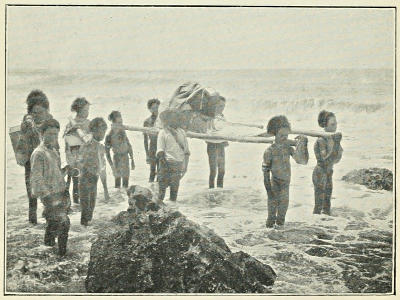
As we have no landing-stage the passengers
will have to submit to being carried to the
boat, and if they have any respect for their
clothes they will look out that the men who
carry them have on some kind of covering,
otherwise they may find themselves smeared
with reddish oil. Papuans would never take
a first-class certificate as stevedores. The
boat is large and has plenty of room for all
the cargo, but unfortunately the crew seem
to think it necessary to put all the big, awkward
things at the stern where the passengers’
legs ought to go, and the locker is always full
of high-smelling blankets and small bags
belonging to the crew. A certain amount
of re-stowing is necessary, and perhaps rearrangement
of the boys at the oars, and then
we settle down for the remainder of the night.
We are bound for the Nara and Kabadi
villages, but as we are short of one man in
the crew, we call at Geabada. No one lands;
but in answer to our “Coo-e,” Avi the teacher
appears. We inform him of our need and
turning round he soon wakes the village and
asks for a volunteer. Many questions have
to be answered as to how long we shall be
away, where we are going, and who forms
the crew, before a man steps into the boat,
rubbing his eyes as though they were full of
sleepy-dust. As soon as he gets hold of an oar
he is all awake, and again we get under way.
The night being dark there is nothing to see,
and the boys beguile the time by telling
of experiences they have had at each point
as they pass it. One yarn leads to another,
and interesting bits of native history come to
light, especially if there happens to be in the
boat an older man who was with Lawes or
Chalmers on their early journeys.
At last light begins to show behind the
Owen Stanley range to our left, and the beauty
of the sunrise is often worth the long hours in
the boat. We are in good time, so will land
and have a morning cup of tea. Water is in
the boat, and firewood is all around, so there
is not much time lost, and while we are enjoying
real “Billy tea” the boys are roasting
bananas in the fire. Had we been smart we
might have had turtle eggs for breakfast,
for natives coming along a few hours later
found that our fire was made within a couple
of yards of a nest containing a bucketful of
eggs.
In less than an hour we have again started,
and another hour brings us off the opening of
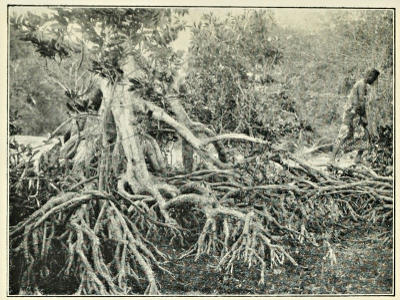
Namoa Creek. The entrance is so hidden
by mangrove trees that it is well we have on
board boys who know it. There is barely
room for the boat to enter, but once inside
there is deep water, and the boat will be safe
till we return to her in about three weeks.
Unloading the boat takes less time than
loading her, and having seen that the boys
have made her fast at both ends, we get ready
for the walk inland. There are plenty of
volunteers to carry the small packages, but
none of them like the look of the boxes.
Apportioning the various loads takes time,
but at last it is done, and seeing that the food
box and our clothes have gone ahead of us, we
start, leaving what we cannot carry till we
can send men down from Nara.
The road leads away through the forest,
and being a government road is at least six
feet wide. It is impossible, however, to make
use of the whole six feet, for natives never
walk side by side, and the beaten track worn
just wide enough for their feet winds along
like a great snake. Sweet-potato vines are
the only thing I know harder to walk in than
one of these tracks. The rain cuts it deeper
and deeper, till it is a gutter not more than
a foot wide, and often deeper than that. One
may want to look about at the trees and the
butterflies, but it must never be forgotten
that you must look well where you are going,
or a tumble will be the result.
We have not got as far as that part of the
track which was used as the dressing-room
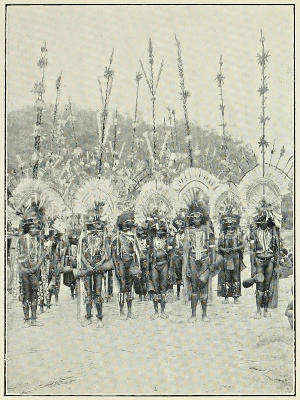
on the night of the Nara dance, when we meet
Matareu the teacher. Some one has gone
ahead and told him we are on the way, and
he has come to take us to the house, while
the men with him go on to the creek for the
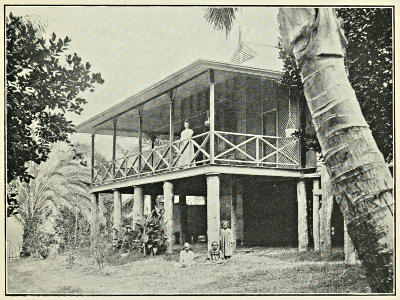
baggage we have left behind. The house is
built on the side of a steep hill, so we enter it
at the back, and walking through to the front
verandah have a view we are not likely to
forget. We have the village immediately in
front of us, then the green hills and valleys,
and away in the distance mountains rising
higher and higher till Mount Victoria is lost in
the clouds. We may be tempted to linger
and watch the play of light and shade over it
all, but after a night in the boat the first
need is food, and then a rest. All we shall
want, even to the water, is in the food box,
and if we cannot buy some bananas for the
boys then the rice must be opened. If possible
however, that is kept as a reserve. This time
there is no need to touch it, for along comes
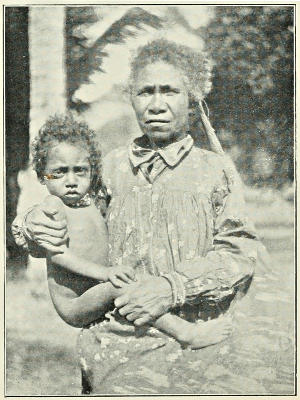
Queen Koloka with a few of her grandchildren
carrying bowls of cooked yarns and bananas,
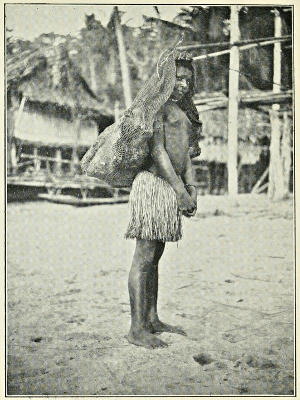
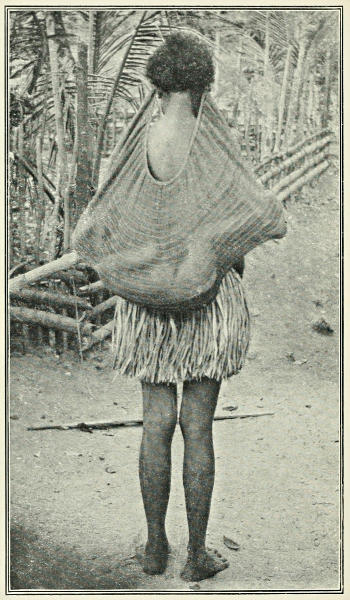
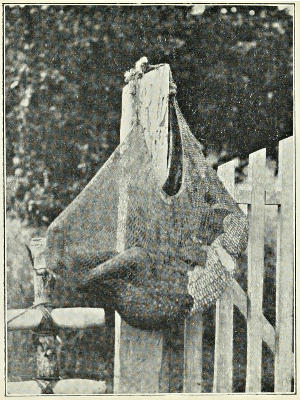
while she herself has hanging down her back
a netted bag containing a few choice uncooked
yams for roasting.
The preparation of the food does not take
long, and before we have finished ours the
boys are stretched in all positions, heads
resting on any article of baggage they could
get hold of, or on their folded arms, and sleeping
as soundly as on feather beds. After a
word or two with Koloka and having given
her a present that will keep her occupied for
some time, we too seek a rest; but the children
are inquisitive, and the dogs are on the prowl
for any scraps they can find, so the rest is
disturbed, and before long we get up and
have a talk with Matareu and hear how
matters are going in his village.
At Nara it is always a feast or a fast. A
feast when it rains, and a fast soon after the
dry season has begun. The people are feeling
the pinch now and consequently spend most
of their time in the forest hunting for food.
Of course they take their children with them,
and the teacher is discouraged because of the
small attendance at school. Knowing that we
were coming most have remained in the village
to-day, but they want to get away hunting,
so we will have school at once. A little
fellow takes a cow-bell and walks round the
village ringing it all the time, and when he
has made the complete circuit the big bell
hanging at the end of the house is rung as the
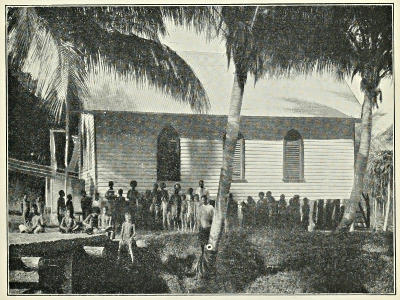
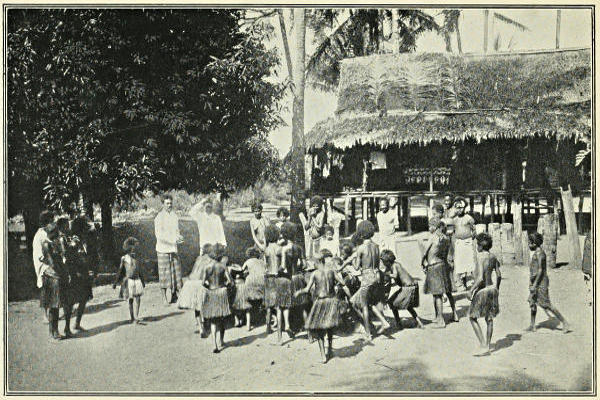
final signal, and we go to the neat little church
you can see in the right of the picture, and
about which I have told you in chapter vi.
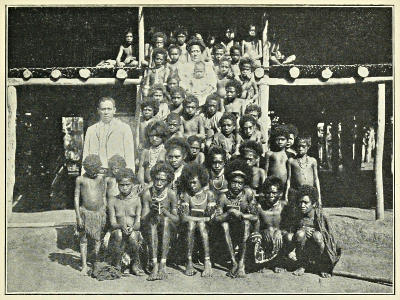
Between forty and fifty children are present,
and at the back of the church are fathers and
mothers and uncles and aunts who have come
to see how the youngsters acquit themselves.
The strongest points are reading and the
catechism, but some can write fairly. After
school small presents are given to the children,
and then they are free to go and hunt
in the bush for all kinds of queer things for
supper.
The missionary is wanted to see a sick
man at the far end of the village, and as we
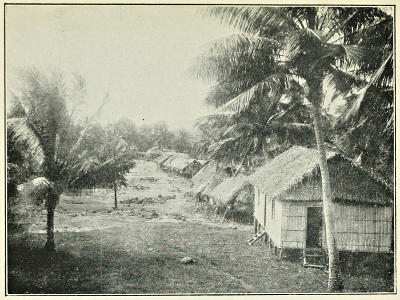
go we can notice that the houses differ from
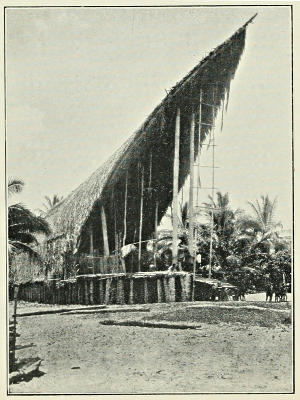
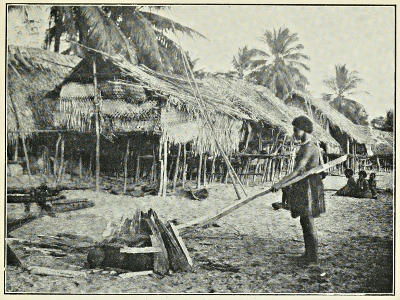
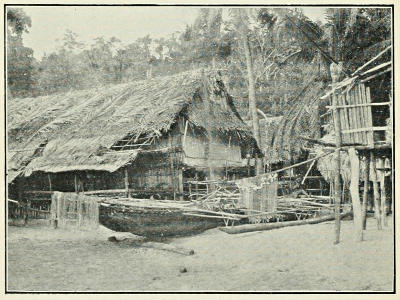
those at Delena. The village is built in
sections. Long sheds with open fronts face
the centre, and at the back of these, and at
right angles to them, are the houses proper,
each consisting of one room. The long shed
is used by all the occupants of the houses
at the back, who belong to one Iduhu or
family. All the buildings look rickety, but
as the wood is all very hard they last well.
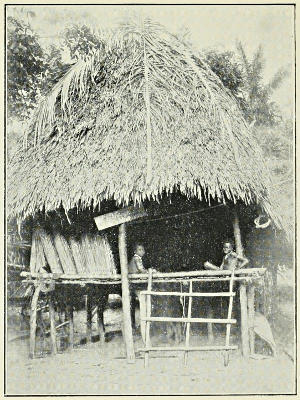
The front steps at Delena may be poor,
but those at Nara are poorer, and certainly of
lighter build, but they do what no steps in
England can. They serve to close the house
and show that the owner is not at home.
Really nothing more than a rough ladder, a
little wider at the bottom than at the top,
the owner, when he goes out detaches them
and hangs them across the front of the house.
Not much protection, one would think, but
quite as much as a piece of vine tied across
is at Delena.
The Nara men are great hunters and consequently
think much of their dogs. A native
dog is quite capable of climbing the ordinary
steps into the house, but his master is thoughtful
enough to provide a separate set for him,
with a back so that his feet cannot slip through.
It is interesting to watch a dog going home.
He goes away from the house as though
he had no connexion with it; then turns
round and starts straight for it, and as he
gets nearer increases his speed. With a
rush he starts up the steep steps, and if fortunate
vanishes over the top and into his
home. If unfortunate he just falls back to
the ground, and goes through the whole performance
again, only with a little more energy.
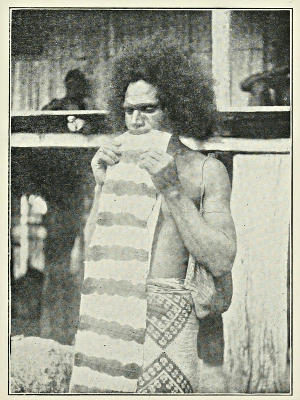
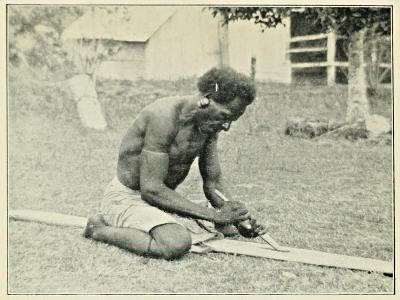
In front of one house a man is doing a bit
of tailoring on his own account. His material
is neither best broad cloth, nor shoddy, for he
gets it from the bark of a tree. It was too
thick for his purpose when he peeled it from
the tree, so he thinned it out by placing it on a
log and beating away with a piece of wood
shaped like a plumber’s bossing stick. We
are too late to see that part of the performance,
but in time for the marking of the
pattern upon the suit. Aua has filled his
mouth with bark and lime and chewed it till
he has a plentiful supply of red saliva. Then
folding the bark cloth he passed the folded
edge through his lips, leaving a dull red stain;
then another and another fold till the other
end of the strip is reached and the new suit of
clothes is complete. No visit to the tailor
necessary, bark and lime supply all he needs,
and there is no tailor’s bill to follow.
I do not remember seeing the performance
that particular afternoon, but may as well
tell you now what goes on when a girl is
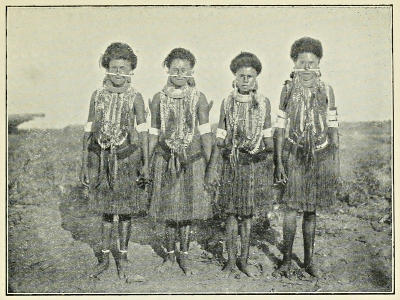
having a new dress. The materials are three
in number, and can all be found near the
village. The fibre is obtained from the sago
palm, and the dye from a root and some dark
mud, boiled together in a cooking-pot. The
fibre is teased out till it looks like lengths of
untwisted manilla rope. Small bunches of
this are knotted on to a string, which is to form
the waist-band, and in sufficient numbers to
hang like a kilt all round the girl. For the
present no uniformity of length is aimed at,
but care is taken to have panels of red and
yellow alternating, and across some of these
panels will be dark stripes. When all is
dry the girl has to be fitted, and this is
not done in the privacy of the dressmaker’s
room. The girl mounts a stump or a stone
in front of an old relative, with the new dress
hanging in uneven lengths around her. The
relative takes a knife, if she has one; if not, a
shell; and if even that cannot be found handy,
then the teeth can be used as scissors, and
going all round trims off the dress till it hangs
just right. That means that enough has been
taken off the sides, and enough left on the
back to enable the girl, as she goes along,
to swing her tails behind her. Many a sly
glance have I seen directed over the shoulder
with a view to finding out whether the effect
was all that could be desired.
If two girls are seen with the same markings
on their skirts it may be taken for granted
that they belong to the same family, or are
at least cousins. Each family has its own
particular pattern, and woe betide those who
try to infringe the copyright.
The sick man having been attended to,
on the way back to Matareu’s house we
notice that big pigs have begun to gather in
the village. They have been away foraging
all day, but as it is nearing the time for the
evening meal they have not only put in an
appearance, but are loudly demanding attention.
Some go so far as to put their forefeet
on the ladders as though they would mount
and help themselves to what they could find.
In Nara wooden troughs much like small
canoes are provided, and when the food is
put in some one has to mount guard to see
that a stranger does not get his snout into the
wrong trough.
A sure way to gather a crowd at any village
is to show the magic lantern, and word is soon
passed round that there will be an exhibition
in the church that evening. Many a strange
experience have I had with the lantern.
At one village where some twenty years
ago they had scarcely seen a white man,
and where a teacher had only been settled
for a few months, the people took some persuading
before they would come in to the
church after dark. When the circle of light
was thrown upon the sheet a deep gasping
breath was taken by all, and a mixture of a
sigh and a shudder was quite audible. All
might have gone well had the operator been
content to proceed quietly from this point,
but the spirit of mischief prompted the desire
to see what would be the result of a chromotrope.
It was fatal. No sooner did the
coloured rings begin to revolve as though they
would overwhelm the audience, than with one
yell men, women and children made for the
doors and windows. Each one was blocked
by a struggling mass and there seemed danger
of the building being carried away. For that
night the show was over as far as the village
people were concerned.
At Ukaukana, years later, the church was
cleared in another way. A large head of a
former chief of the village was thrown upon
the sheet, the operator forgetting for the
moment that the man was dead. A great
stillness fell upon the gathering, so noticeable
that the operator looked the other side of the
sheet. There were the people with their
heads as low as they could get them without
knocking their noses on the floor, all crawling
to the doors as fast as they could. Then the
mistake was recognized, but too late. Naime
had a bad name as a sorcerer while still alive,
and the ordinary size for a big well-built man.
If he was bad then, what must he be now
when he was many sizes larger. Something
of his power might hang about the enlarged
picture, so that people would not take the
risk. Once more the teacher and my own
boys formed my audience.
A third experience was of a more exciting
kind. At Hula the people were taking but
little interest in the pictures, and to stimulate
them two boys were placed between the
lantern and the sheet, and after their shadows
had been recognized by their friends were
told to wrestle. All went well at first, but
when the youngsters began to put more
energy into the business one of them got hurt.
His friends came to his rescue. Then the
other boy’s friends joined in, and in a moment
there was a tangled mass of sheet, rope, and
human beings on the floor, and to save a fire
I snatched up the lantern and made my way
out of the building by the back door.
Nara people are accustomed to the lantern,
and there were no accidents that evening.
All the pictures interested them, and they
listened to the description of a set illustrating
the life of Moses. At first the natives do not
seem able to see the picture, or fail to connect
ideas with it. Then comes in the use of
pictures of their own village and their own
people. They can connect the idea and the
picture, and so pass to ideas conveyed by
pictures of things and places they do not know.
It was a relief to find there was to be no
dancing on this night, and that we were able
to get a good night’s rest and be ready for
the start the next morning. Carriers had to
be engaged and then there was all the packing
up to be done again.
The village we were making for was Ala-ala,
and to get there we had to traverse a long
switch-back. Down from the village into
the valley; then up again as high as the
village we had left; down again and up
again. In this way some three hours were
spent, but as part of the time we were in a
tunnel cut through the forest, it was pleasant.
Out on the grass land the sun gave trouble
and the sea breeze was missed. Ala-ala is
but a small village and the teacher an old
man who in his younger days had travelled
much with Tamate. His wife’s idea of cleanliness
and Donisi Hahine’s did not at all agree.
The one thought that if a piece of new calico
was spread over a pillow or a mat it did not
matter what was underneath. Donisi Hahine
wanted to see what was underneath, and
then there was a lot of changing and cleaning
before the camp for the night was arranged.
I think it was the first time a white woman
had been in the village, and the people, and in
particular the old women, were anxious to show
due attention, or maybe satisfy their curiosity
to the full. Their attention was overpowering,
and would have been more acceptable at
a little increased distance. The small house
was decidedly overcrowded that night. Even
the lantern in the village did not completely
clear it, and a number of young babies, probably
excited by the unusual gathering, kept
up a chorus all night.
Next morning we went down into a valley,
and through what in the wet season is a
swamp, and then a gradual rise till Diumana
was reached.
Here the village is fenced, not with a view
to safety but to keep the pigs in and prevent
their visiting the gardens, which are on the
slopes around the village. The Mission has
its own little fence some distance from one
end of the village, but what between lack of
energy and sickness the teacher has not
built much inside that fence. When his house
will be finished it is hard to say, and
we spent the night in the little temporary
hut.
There is no church in the village yet,
and the services and school are held in the
dubu, or club house. In the old village half
a mile away, this was a large building with
elaborately-carved posts, but in the present
village is only a shed raised some seven feet
from the ground. Here preparations were made
for school and for the baptism of some children.
Native gear, such as hunting-nets and
drums, was soon removed, and a small table—a
very small one—and two boxes introduced
by way of furniture. First the children
were examined, and then the service begun,
but before it was half through it was suddenly
interrupted. A loud crack, and ejaculation
from the people, and half of them jumped
to the ground. It was evident that the congregation
was larger than usual, for the floor
had given way, and there would have been a
nasty accident, but for the prompt action of
those who jumped down and held the breaking
pieces of wood in position while the rest of us
dismounted as quickly and quietly as possible.
Nothing worse happened than our having to
finish the service on the ground on the shady
side of the building instead of under the roof
on the platform.
One great drawback to Diumana is the lack
of good water. What there is has to be
brought from a water-hole a long way from
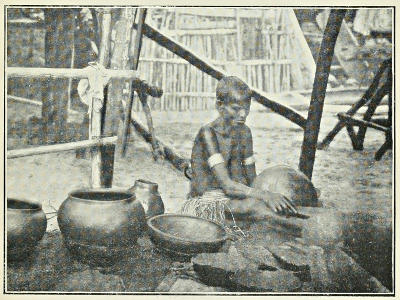
the village, and the only pots the people have
are procured from coast villages. By looking
about them they have, however, found a good
substitute. Bamboo grows plentifully in the
neighbourhood, and from a well-grown length
of this the divisions at the joints are knocked
out, and at once there is a bucket seven or
eight feet long. In the afternoon the girls
and women can be seen returning from the
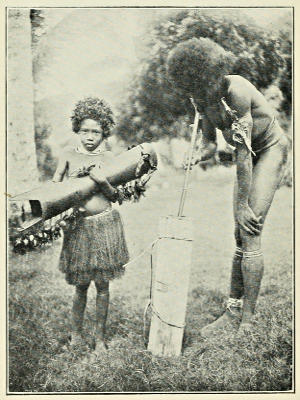
water-hole, each with a couple of these long
buckets carried as a soldier carries his rifle.
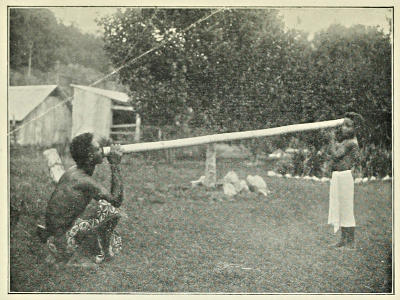
They are too awkward for taking into the
house so stand outside. To find out how
such buckets were handled I asked for a
drink, and was told to squat down as low as I
could, and take the open end of the bamboo
and put it to my lips. I did so, and then the
boy who held the other end lifted it. Of
course it was said to be an accident, but boys
are boys all the world over, and he who had
the lifting of that other end could not resist
the temptation, or did not try. The result
was the same. He lifted just a little too high,
and a little too quickly, with the result that
the missionary got plenty of water outside,
but very little inside, much to the amusement
of the crowd.
The Papuan generally can do with little
water inside, and the people of Diumana,
having far to fetch it, manage with a surprisingly
small quantity outside. This makes
them unpleasant near neighbours. They take
a bath when they happen to be caught in the
rain, or when they visit the coast.
That night for the magic lantern we did
not trust the Dubu which had refused to carry
our weight in the afternoon, but hung the
sheet at the side of a house, and feared no fall,
for we were as low as we could get to begin with.
Next day as we were going to a village
where for the time being there was no teacher
we did not move our camp. The food box is
known to our boys as “Hari maua kakakaka”
from its being painted red, so that we can
easily see if it is with us, and not left behind
as on one occasion when at the end of a long
tramp we found ourselves without water or
food. This box provided all we needed for
the day, and we were to return to Diumana
for the night.
Less than a mile from Diumana to the
right of the track is a beautiful group of palms.
Sago, areca and cocoanut all tower above the
surrounding vegetation. In the order given
they might be taken to typify dignity, slender
grace, and real utility. Looking at the sago
palm one wonders how men can approach
it near enough to cut it down, so formidable
are the thorns that cover its lower fronds.
One by one the workman has to remove those
fronds till he can get to the main stem. Even
the thorns have a use, for long strips of the
frond covered with thorns four and five inches
long, are bound to the stem of the areca palm,
and present a surface that none can climb.
In this way the owner protects his property.
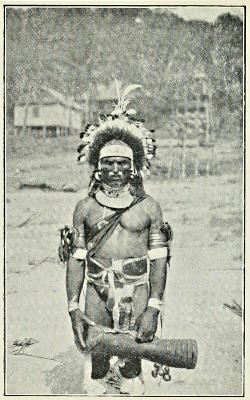
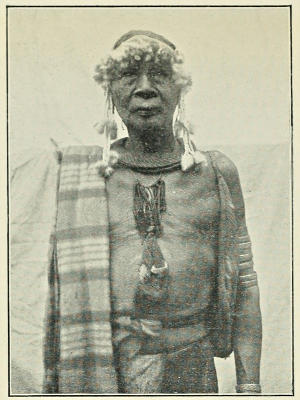
Oa, the chief of Bokama, good old friend that
he is, has heard that he may expect a visit, and
is on the look-out. Down the hill from the
village he comes, dressed, not in his Papuan
best, but his real Beritani Sunday best. A
gay waist cloth, and an Oxford mat shirt, and
his shock of hair tied up in a red printed
handkerchief. Just a few of his native
adornments give the finishing touches. If
you care to try a real Papuan salutation Oa
will oblige you as you are a friend of mine.
If you do not care to try it you had better
let me go first, as Oa always expects me to
indulge him. He gives me a good hug and we
rub noses, and then taking my hand he leads
me to his Dubu, and calls for his daughter to
bring cocoanuts. When he thinks the delay
has been as long as decency demands, and if
he sees no tobacco forthcoming, he will pick up
his baubau (bamboo pipe) and look at it.
Of course that is enough and he passes it and
the tobacco over to one of the younger men,
and when it is alight has the first pull himself,
and then passes the baubau round as a pipe
of peace.
Oa’s Dubu is much like the one that gave
way at Diumana, except that on one side
the roof comes down and joins the floor, making
a wall. Of ornamentation there is little except
a collection of bones. These attract attention,
and Oa is nothing loth to talk about them.
The pigs’ jaws need little explanation. They
are a record of the number killed for the
feasts.
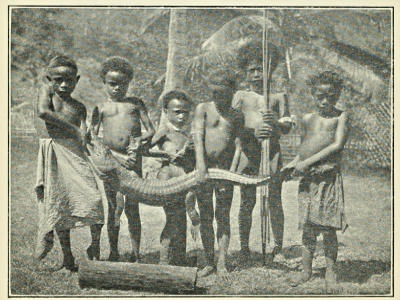
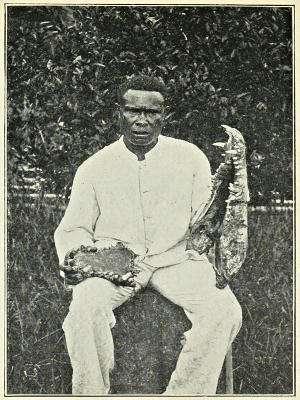
Bound to one of the wall plates were much
longer jaws, and these we found belonged to
crocodiles which were caught in a way that
causes us not a little surprise. They must
belong to a different class from those at the
coast or the men would never venture to
take them as they do. There is no doubt
as to the method, for the same account is
given at different villages throughout the district.
The crocodiles are found in the lagoons,
and usually sleeping in the mud at the bottom.
The hunter wades in and feels about with his
feet till he touches one of the creatures. That
would be enough for most folks, and they would
make for the bank in double quick-time, but
not so our hunter. He stoops down and
begins to stroke the crocodile. They say the
animal likes it and remains perfectly still
while the hunter introduces a rope under its
legs and round its back, keeping up the stroking
all the time with the other hand. When
all is ready he suddenly pulls the rope tight
and then the struggle begins: at one end
the crocodile, at the other the natives; the
crocodile lashing with his tail, and the natives
pulling for all they are worth. It is a grand
tug-of-war, and if the animal is a big one it
may be some time before he is landed, but
that he will be landed there is little doubt,
for the people say that one rarely escapes
when once the ropes have been made fast.
Clubs finish the struggle, and then comes the
feast. The flesh looks all right but I have
never been able to bring myself to eat it.
When the bones have been picked clean the
lower jaw is added to the collection in the
Dubu.
In another part of the Dubu is a collection
of lengths of the backbone of some creature.
These, Oa informs us, belonged to large carpet
snakes. They are plentiful in the district
and the Nara people consider them a delicacy.
They not only hunt them along the ground
but follow the great beautifully marked
creatures into the trees, and I have seen a
man holding on to the tail of one with his
teeth while he moved his hands to get a better
grip. Some of the men seem to have no fear
in handling the carpet snake, and one adept
hunter, when I expressed surprise at his
allowing a creature at least ten feet long to
writhe round him, explained that it could
do him no harm as he had hold of its neck
and the tip of its tail. The head seemed easy
of explanation, but not the tail, till he gave
the fuller information that a carpet snake
cannot crush a body unless it has its tail
round some solid substance.
One of our boys who had not previously
eaten snake, came to us that evening and
said that he had eaten a whole one (it could
not have been a ten-footer), and that it was
“Digara bada.” He knew no praise beyond
that, which was his way of saying it was not
only fat but all that was good. Next day he
did not seem so sure about it, and since then
has not eaten snake at all.
This might almost be called a Natural
History section, for there is still another animal
for you to hear about. It is reported
from many districts, but in Nara one family
has adopted it as the family coat of arms,
and carved it on the posts of the Dubu. They
call it lolio, and I believe it is a species of
Iguana, a curious climbing reptile. I have
seen one which some white men captured to
send to Europe, so I know the animal exists,
but hesitate to accept some of the stories the
natives tell about it. That they dread it there
is no doubt, as the following story will show.
Report came to Nara that a lolio had been
seen on the bank of a creek, and a native who
was used to a white man’s gun went to look
for it, but when near the creek his courage
failed him till he remembered that he had
something more than a spear in his hand.
Creeping nervously nearer he caught sight of
the animal, and much relieved called to his
friends, “It is only a crocodile.”
The lolio is reported to steal children
and take them up trees, and is said never to
run away from a man. The man runs away
from him, but can find no safety in climbing a
big tree, as the lolio can climb better and
quicker than he. The only safety to be got
is by climbing a tree just big enough to bear
the man’s weight, but too small for the lolio
to grasp, as he cannot climb if his claws meet
at the back of the stem.
It is strange that an animal cunning enough
to cover itself with leaves and lie in wait for its
prey, should nearly always make the mistake
of leaving a little of its whip-like tail exposed,
and so betray itself. In two places nearly a
hundred miles apart I heard a story of men
finding the lolio so hid, and quietly and securely
knotting the tip of the tail to a tree,
and so holding the animal in position while
it was killed, in the one case by arrows and
the other by spears.
Having examined Oa’s museum, now look
at the building on the other side of the village.
The square one without a verandah, and with
steps with treads like those you are accustomed
to, not like the bars in a hen-roost—that
building has a history. The first
teacher placed in the village was a Papuan.
He held his services and his little school in the
Dubu, but upon a subsequent visit my attention
was drawn to the new building by all
eyes being turned that way when I entered the
village. It was evident the people intended
I should see the result of their work. Without
consulting me at all they had built themselves
a neat little church, under the guidance
of the young Papuan who was their teacher,
and in that church later on Oa and two of his
relatives were baptized, and some of the
children of the village learnt to read. Unfortunately
the village has been without a
teacher for some time, but the man from
Diumana visits it for the Sunday services.
Beyond Diumana are two small villages.
Lalime and Tubu. These had to be visited,
but as it meant a long tramp in the hottest
part of the day, Donisi Hahine remained in
Oa’s Dubu while I was away. Exactly how
the afternoon was spent history does not
record, but this much is known. The old
men of the village felt their responsibility,
and kept guard in the Dubu. When one was
tired he just lay down where he was and
went to sleep, while others sat up and talked
and had a smoke. Owing to the language
difficulty they and their guest could hold little
communication except by signs.
It was dark before we reached Diumana
and that evening we did not indulge in the
lantern, though the people would have been
quite willing to see the same pictures
again.
The next day’s journey was to be a long one,
so no time was lost in the morning in packing
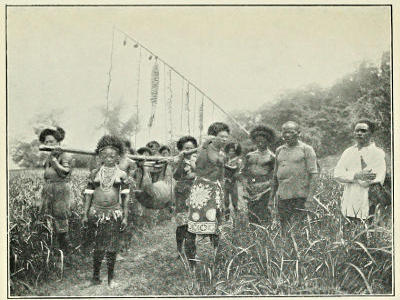
and starting. Fresh carriers had been engaged
over night and a home-made palanquin
rigged up to give Donisi Hahine a lift on the
way when she required it. We had done a
good two hours’ walking when a halt was
called for breakfast, and then all hands
wanted to huddle up close to our “red box”
and cook their food in our fire. A rearrangement
had to be made before we could have
our meal in peace. The halt was a short
one, for we were only at the beginning of the
journey. With regret we left the interesting
shady forest road and began the weary miles
along the open beach. The sea breeze was acceptable,
but the soft sand made heavy going,
particularly for those carrying the baggage.
Rests became frequent as midday drew near,
and no one was sorry when shade enough was
found for the midday halt. Hour after
hour along the sand made us ask, “Is that
point the last?” and the sun was getting
low before the boys were able to answer
“Yes.” Hisiu was so far beyond that point
that another halt was called for tea.
At the end of a heavy day the Samoan welcome
we received from Fareni and his wife
was doubly acceptable. Their one concern
was that the old teacher’s house was unsafe.
They were living on a platform with a roof
over it, but without walls, and this they placed
at our disposal, together with their table, and
with our boxes for seats and mats for beds
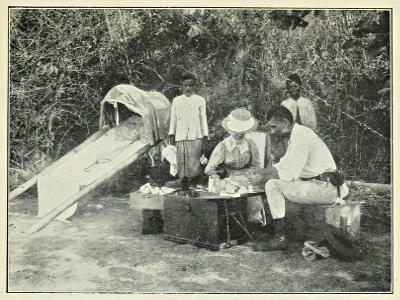
the place was soon furnished. Before the
evening meal was over curtains of cocoanut
fronds were hung round, and our camp was
comfortable as well as rather out of the
common.
People in England, whether believers in
Christianity or not, pay tribute to its founder
every time they date a letter. The Papuans
now acknowledge Him by making their calculations
from His day. The Sabate they
call it. The boys all knew that the next day
was Sabate, and that we should not travel,
but remain at Hisiu. Those who had clothes
had managed to keep them fairly clean for
that day, and those who had none, borrowed
from those who had, with the result that a
small singlet fell to the lot of the biggest man of
the party. Still he was satisfied, and no one
was surprised at his odd appearance.
Soon after six in the morning the people were
called to the first service by a bell which
they had purchased for themselves. How
different the surroundings and the gathering
from anything to be seen in England: the
walls and the roof of the church supplied by
the palm; the floor made from old canoe
boards; the reading-desk by the teacher
from packing-cases; the seat round the
wall also from old canoes. Then the congregation.
Our own boys had more clothing
than the rest of the congregation all told.
In the first few rows sat the children. Behind
them the adults, and on the seat round the
wall the Church members and those more
particularly identified with the Mission. Very
few ornaments were to be seen and none in
the hair of the men, for the Papuan having
no hat to take off as a mark of reverence removes
his comb when he enters the church.
Of the service little need be said. You could
not follow the words, but the bowing of the
head by the natives, and the opening of the
New Testaments, would mark the times of
prayer and of reading the lessons. How often
one wishes the Papuans were direct descendants
of the Sweet Singer of Israel; but,
alas! they are not even distant relatives, and
most of the Samoans can claim but little
closer kinship, and so cannot help the Papuan
much. Tuneful singing cannot be expected
from a people with a range of about three
notes, especially when they do not always use
even these three. They will chant a hymn
on one note only. Still they do their best,
they are improving; and we always hope for
better times in this as in other respects. In
one thing the Papuans do not fail. Their
behaviour is reverent throughout the service,
and they listen to the message given.
During the day there are three services and
a Sunday School, all held in the church; but
I was most pleased with the evening gathering
at the teacher’s house. The few Church
members, with thirty or forty children and
young people, came to family prayers, and
of the young people at least twenty had their
own New Testaments, and took their turn in
reading a verse, and one of the young men
offered prayer. Such a scene makes one
realize the change for the better which is
taking place. The first time I went to Hisiu
there was no teacher living there; no church;
no school; not a Church member in the
place, and not a soul who could tell which way
to hold a book even if he had one.
One advantage of having to stay over the
Sunday at a village is the opportunity for
good informal chats with the people, during
which much can be gathered as to their way
of looking at the message the Missionary
brings.
Two separate conversations that Sunday
revealed the fact that they carry their own
ideas of malevolent spirits into their idea of
the God whom we regard as the loving Father.
To many of them He seems to be a compound
of the policeman and the magistrate, seeing
that due punishment is inflicted for each
given offence.
Rosa came to see us in the afternoon wearing
signs of mourning. We had heard that
her husband Veata was dead, but did not know
the circumstances. It was a long story, for
she began at the time when her husband was
taken by the teacher to live in his house, and
when she, as a young girl, was nurse to the
teacher’s children. She recalled what Faasiu
had taught them and how after they were
married Veata expressed a wish to become a
teacher, and how glad she was. Then came
the history of the three years during which
they lived with us at Delena, which ended
in the call of the old village life being too
strong, and their giving up the idea of being
teachers and returning to their village. At
first Veata boasted of what he had done, but
afterwards became ashamed, and very sad.
He knew he had done wrong, but took no
steps to put the matter right.
One day on the way to his garden he saw
a snake in the track, and as he could not kill
it, got out of its way. It followed him, however,
and bit him twice. His friends, knowing
the snake was a deadly one, carried Veata
back to the village, and began the death wail
over him, but he asked them to be quiet
and to listen to what he had to say, as he
should soon leave them and they would not
hear his voice again. The speech was a long
one for a man under such circumstances, but
Veata was in earnest in his desire that his
friends should know that he acknowledged
he had done wrong, “in putting out the
light he once had within him.” He looked
upon the ending of his life by snake bite as a
just punishment for his having turned back
“after he had put his hand to the plough,”
and begged his friends to listen to the teacher
“and follow the light.”
On the same day another widow, a much
older woman, came to see us. Her husband
had been west with Tamate, and later had
served for a time as a teacher under Holmes.
He too listened to the call of the old life, and
at Hisiu took a leading part in reviving the
night dancing. He was an elderly man, and
probably the sitting about after he was hot
from the dancing produced chest troubles.
He became ill, and then found that his right
hand was affected with what looked like
leprosy. Before long he was unable to use
it at all, and became so ill that it was only
with difficulty that he could get as far as the
church. The last time he attended the service
he asked the teacher to let him speak
to the people. His address followed the lines
of Veata’s, but near the end, lifting his maimed
hand, he said, “This is the hand that beat the
drum to call you to the dance. Look at it
now. God has taken from it the power to do
anything. He has punished me, and I shall
not live much longer. God forgive me, and
help you to follow not me but Jesus.”
I heard of these two cases in one day, but
often, both before and since, have wondered
at the number of those who having turned
back from taking part in Mission work have
died soon after. When the first wild burst is
over, they lose heart and feel there is nothing
left to live for, and that the end is near.
When a native gets that idea nothing can
save him. It is sad to think how little they
realize the love that can forgive. Their own
idea is vengeance, “An eye for an eye,” and
only slowly comes that of an all-loving and
forgiving Father.
The next morning saw us again on the
tramp. Canoes ferried us across the Aroa
River, and then on we went along the sand.
Mile after mile with nothing to break the
monotony except the great stranded trees
that had been washed out of Galley Reach
by the last floods, and a solitary pelican that
would fly on ahead of us, wait till we were
nearly up to him, and then start off again as
though to show us the way.
When we got near to Morabi, the village
we were making for, the beach was covered
with thousands upon thousands of little
round crabs who moved with the precision of
an army. If one got in front of them, and
stamped on the sand, no confusion followed,
but the army, as though at the word of command,
turned off and went in another direction.
For at least a mile we walked through
these strange little creatures, they opening
up a way by which we might pass and not one
of them getting under our feet.
Morabi is on the left as we stand at the
mouth of Galley Reach, but away on the
right bank is a spot that will always be of
interest to those connected with the L.M.S.
It was there, where the village of Manumanu
stood, that in 1872 the first Christian teachers
landed. Sixteen years later most of the
houses had been moved to Morabi, and now
there is no village at Manumanu. Few of
those who witnessed that landing are now
alive, but their descendants are the people
we are going to see. After Ieru the Samoan
teacher, the first to welcome us is Naime,
till lately as fine a specimen of a man as could
be found in the country. He was too young
to have distinct memories of the landing of
those first teachers, but has been good
friends with their successors.
The usual round of service, school, doctoring,
and talking to the people having been
accomplished, the next thing was to arrange
for an experience which does not often come
to the missionary in the more settled districts,
that is, a visit to new ground, and an introduction
to new people.
To mark the event we will deal with it in
a new chapter.