The cover image was created by the transcriber and is placed in the public domain.
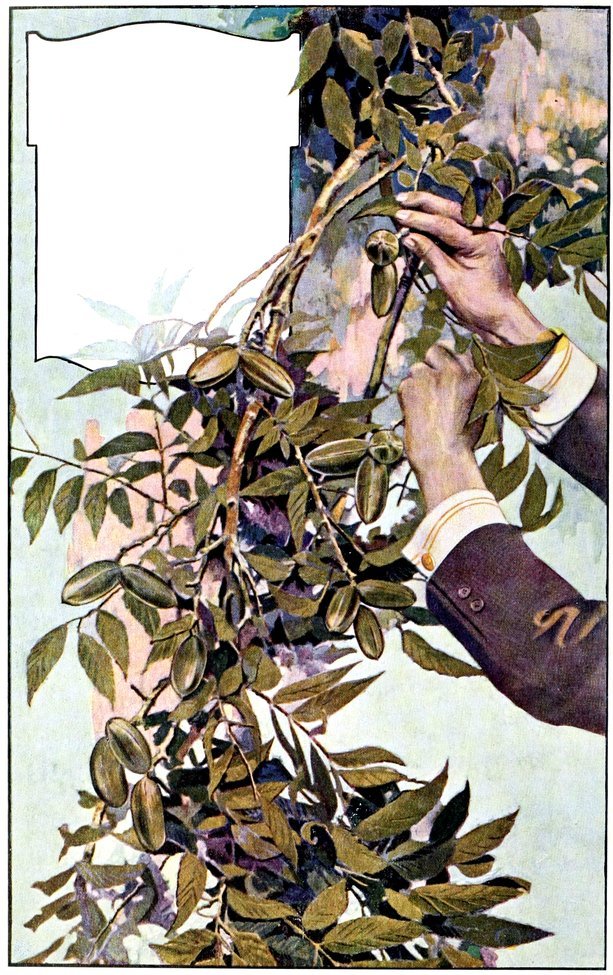
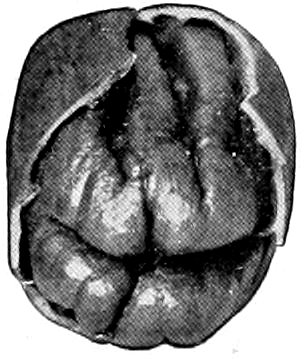
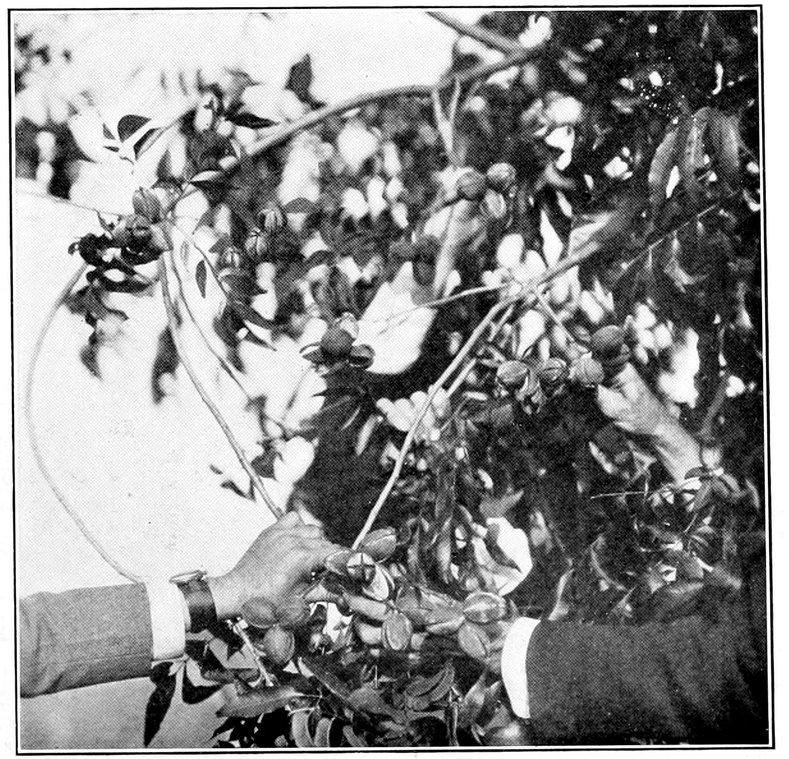
SIXTEEN big pecan nuts on a single small lower branch of one tree in our big, bearing orchard on our Calhoun County Orchard Plantation. This picture, in natural colors, from a photograph taken in late September, 1919, gives an idea of the prodigious number of nuts that a single large, bearing tree will yield.
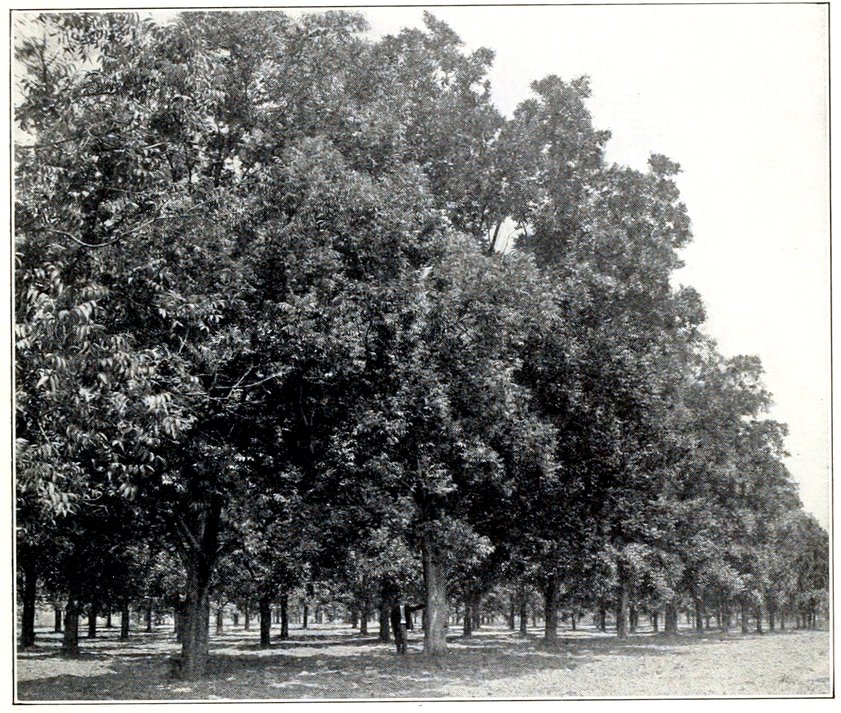
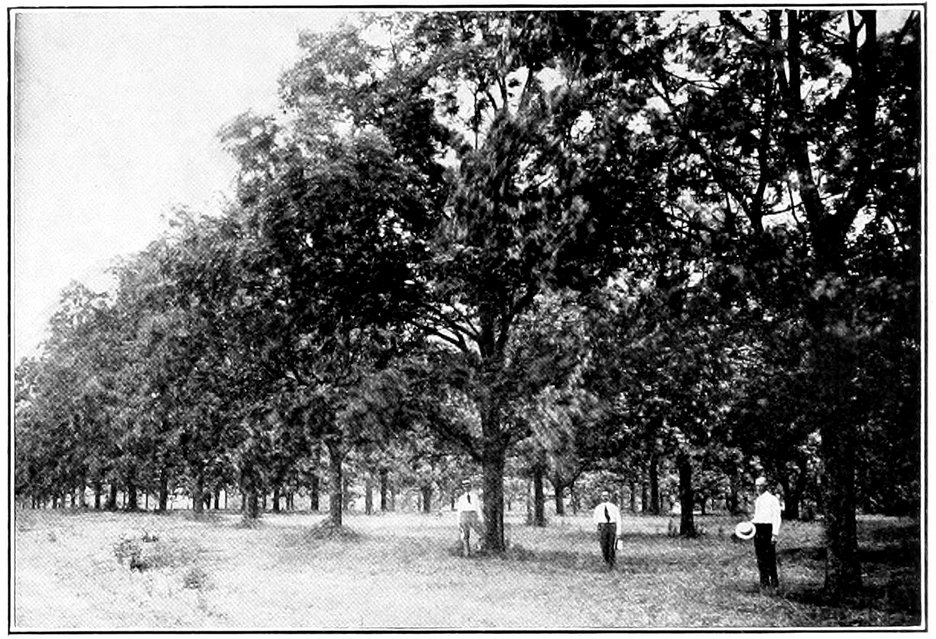
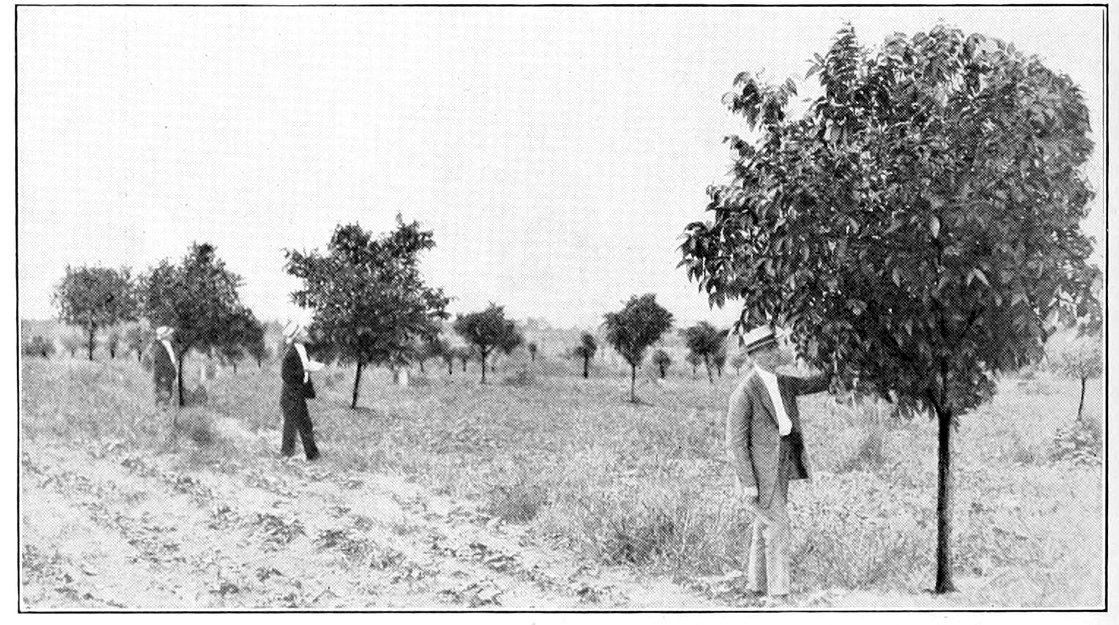
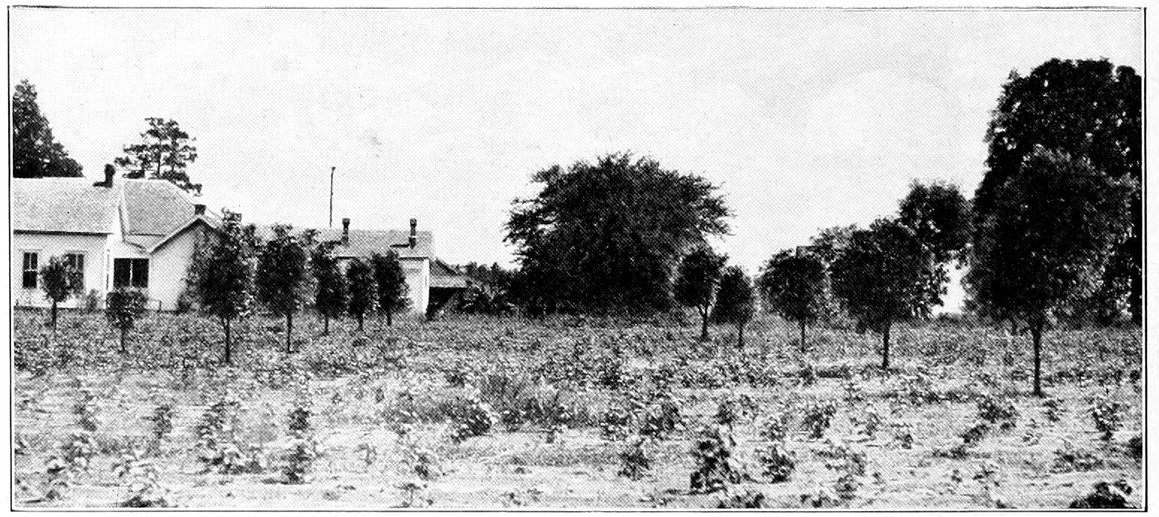
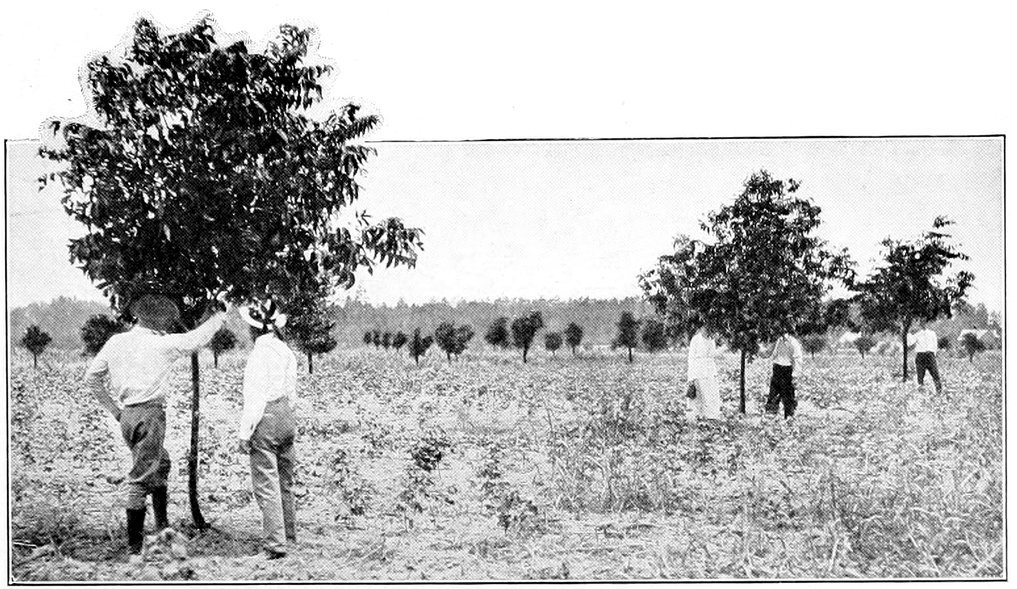
The first quarter of the east front of our bearing pecan orchard.
As far as the eye can see, stretch row after row of fine, big
pecan trees (compare with man for size); many of which have borne
over two hundred pounds in a single season.
What better evidence could you wish of the adaptability of soil
and climate to pecan growing?
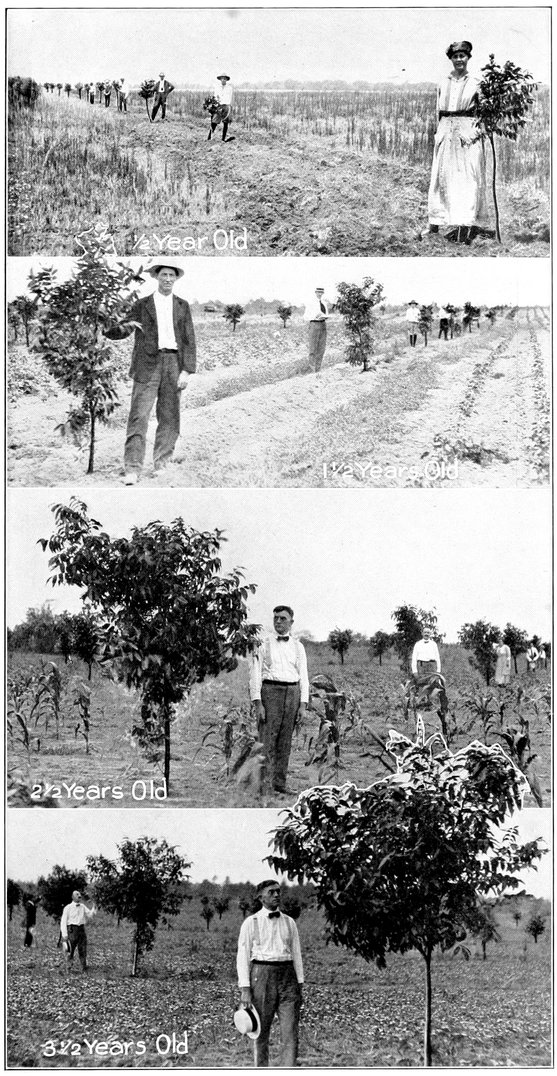
All illustrations of pecan trees in this book were made from photographs taken on our plantations of over 7000 acres in southwest Georgia—where pecans thrive best.
TABLE OF CONTENTS — A Few of the Noted Authorities and References — Government Statistics. — Famous Food Authorities. — Prominent Magazines Quoted. — Noted Agricultural Authorities.
Copyright, 1921, Elam G. Hess, Manheim, Pa., Issued Jan., 1921.
3
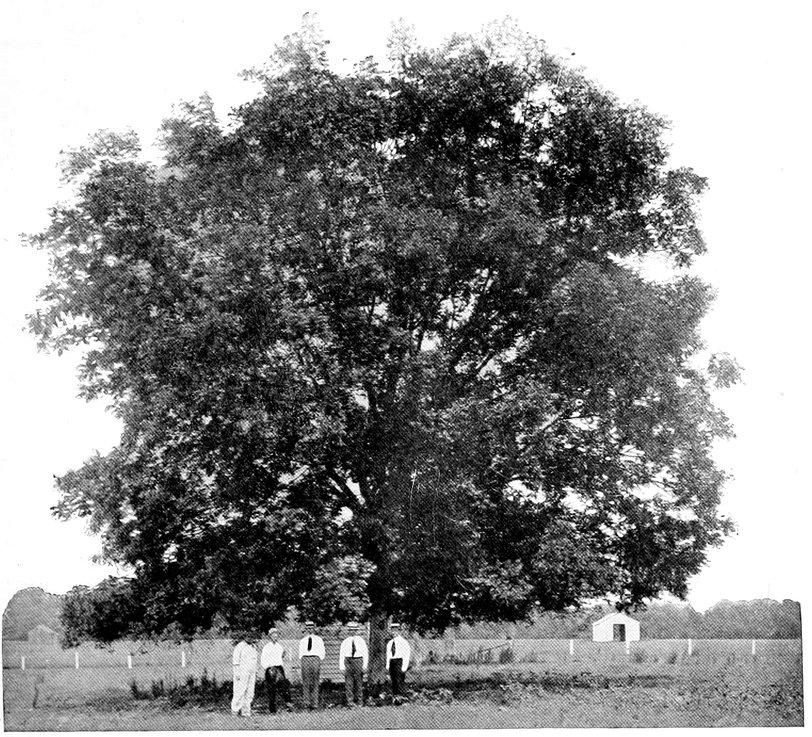
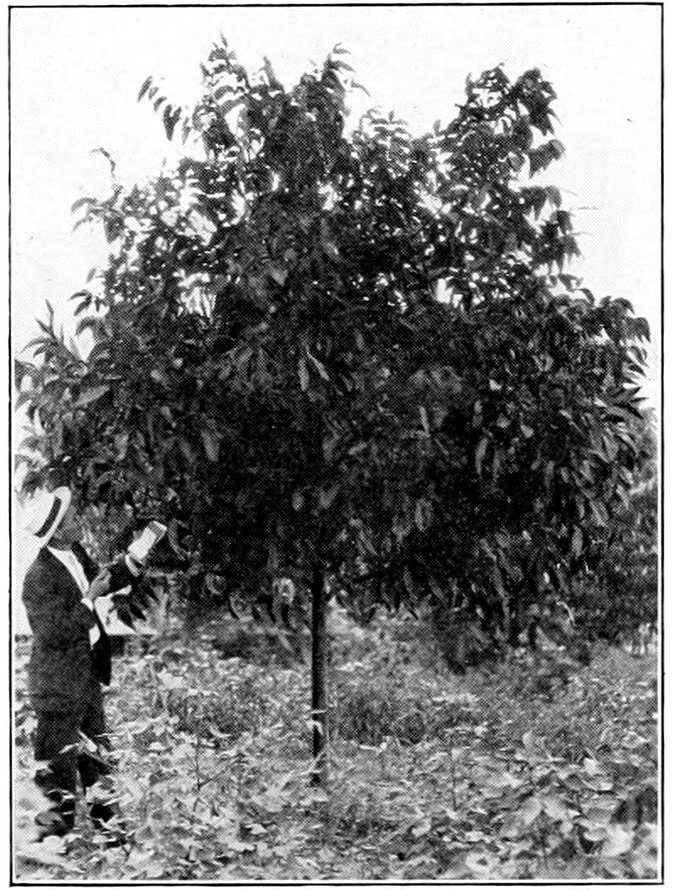
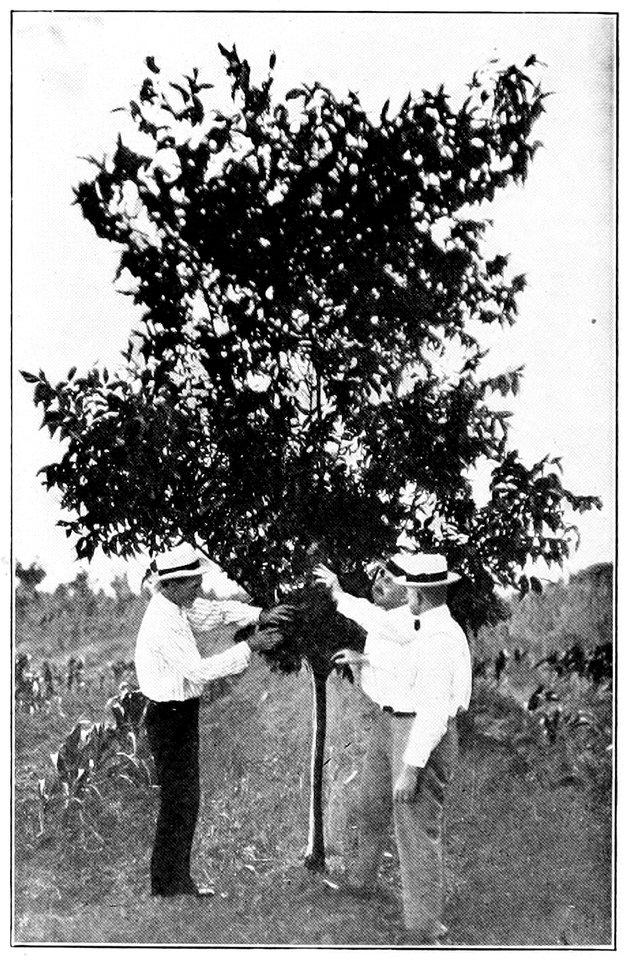
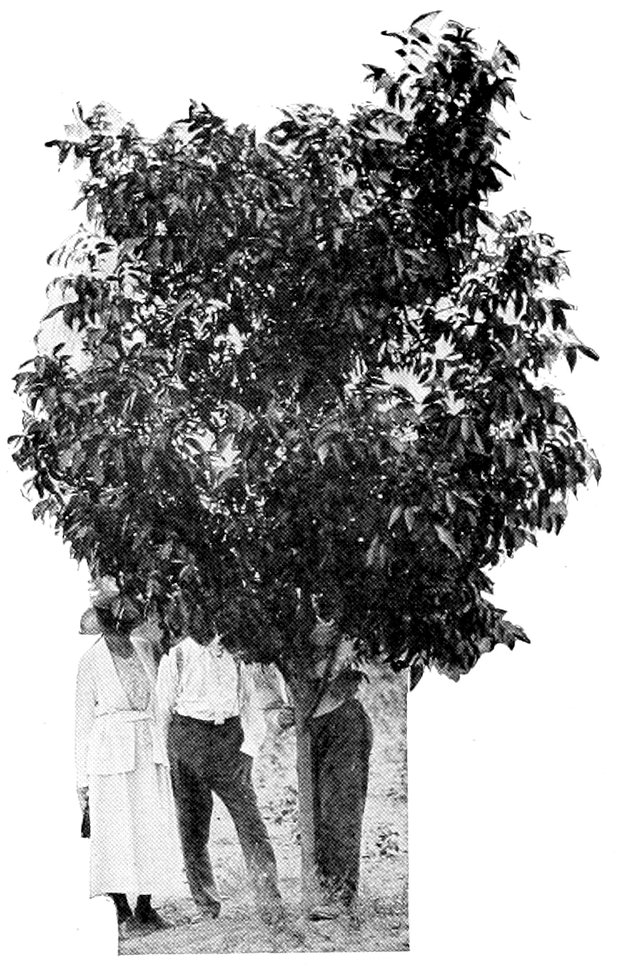
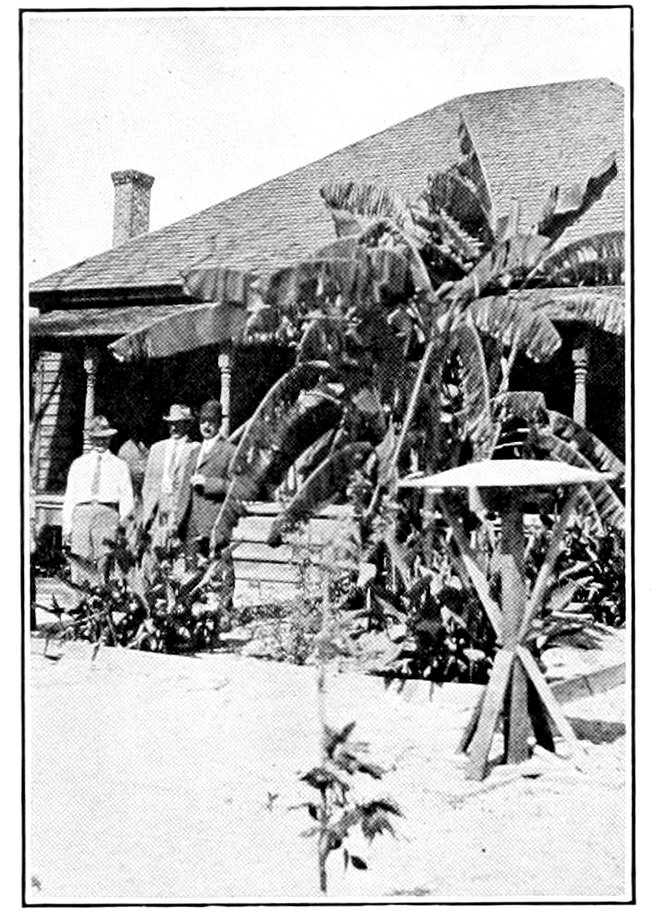
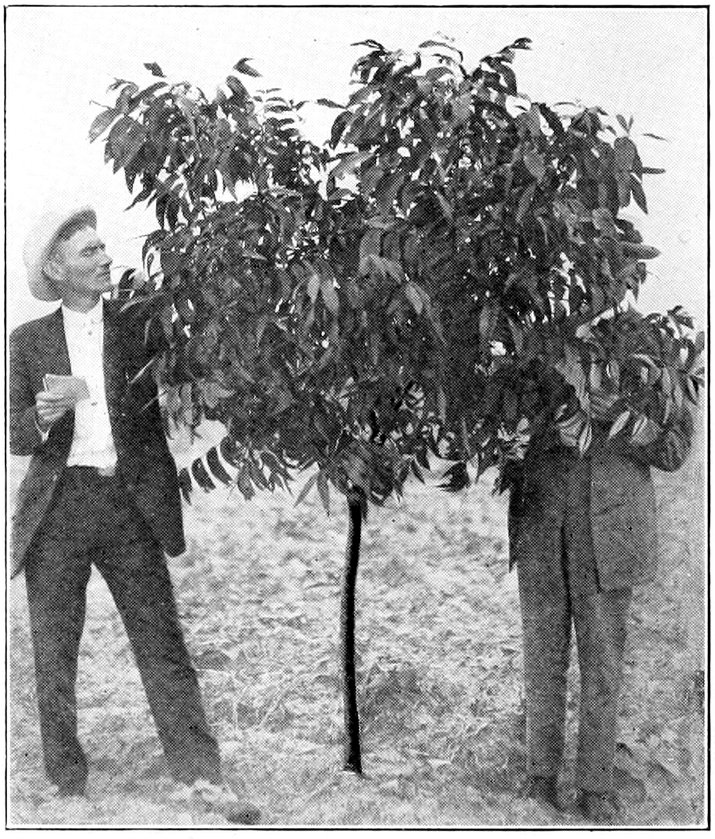
The above photographic illustration shows a big, bearing pecan tree on our plantation, near the house. For size, compare with the men shown in the foreground.
FOREWORD
Food is the need of the day—of every day.
Food is the need of the future.
From the beginning of the world food production has been the most
important of the activities of man—but food production has frequently
taken uneconomic channels. Even before the war in Europe started, the
tendency toward changing standards in food production was marked.
In one of America’s leading periodicals, we read: “Tree crops is the
next big thing in farming,” says J. Russel Smith, after an 18,000–mile
journey through the nut growing countries.
The man who is alert to changing food standards, who realizes how
largely the cattle herds of the world have been depleted during the World
War, who has learned how long it will be before they can be built up, will
see in this condition an opportunity paralleled only in a small way by the
noted investment opportunities of the past.
About a hundred years ago the railroad offered an investment opportunity
which the Vanderbilts were wise enough to see—and to seize.
4You know that the Vanderbilt wealth has lasted through generations—increasing
year by year.
About fifty years ago there was a similar opportunity offered in steel—demanded
by the rapidly growing industries. The names of Carnegie
and Schwab head the list of the famous “thousand steel millionaires”—made
rich by foresight.
Forty years ago electricity offered its opportunities to Edison—and
to many others who have become extremely wealthy because they combined
courage with foresight.
Marvelous as have been the fortunes in railroads, in steel and in electricity,
we are today, says the Luther Burbank Society in its book, “Give
the Boy a Chance,” “facing an opportunity four hundred times bigger
than the railroad opportunity was a hundred years ago, eight hundred
times bigger than electricity offered at its inception, fifteen hundred times
bigger than the steel opportunity which Mr. Carnegie found—because
agriculture is just by these amounts bigger than those other industries.”
From land—the most permanent basis of wealth—immense fortunes
of today and tomorrow are being drawn. America is beginning to see a
new vision,—its agriculture is taking a newer, more profitable form.
What is the Biggest Future in Agriculture? When James J. Hill
staked his all in apples and received in return a profit estimated at ten
million dollars—he was merely a pioneer in the new type of farming.
Yet the pecan comes into bearing as early as the apple orchard and
remains in bearing many times as long, says Bulletin No. 41, of the
Alabama Department of Agriculture.
It is particularly significant that the strongest advocates of tree agriculture
are those familiar with conditions in nut growing countries. Consider
that fact in connection with this statement of Luther Burbank, the
Edison of Agriculture: “Paper Shell Pecans of the improved varieties are
the most delicious, as well as the most nutritious nuts in the world. They
are higher in food value than any other nuts, either native or foreign.”
In a prominent agricultural weekly we read: “The tree that yields
a pound or two of nuts at five years of age is counted upon for twenty to
fifty pounds by the tenth year, and after that the yield grows beyond anything
known in fruit trees, because the Pecan at maturity is a forest
giant.”
In the face of such facts, is it not wise to consider carefully the interesting
facts on Paper Shell Pecans found within?
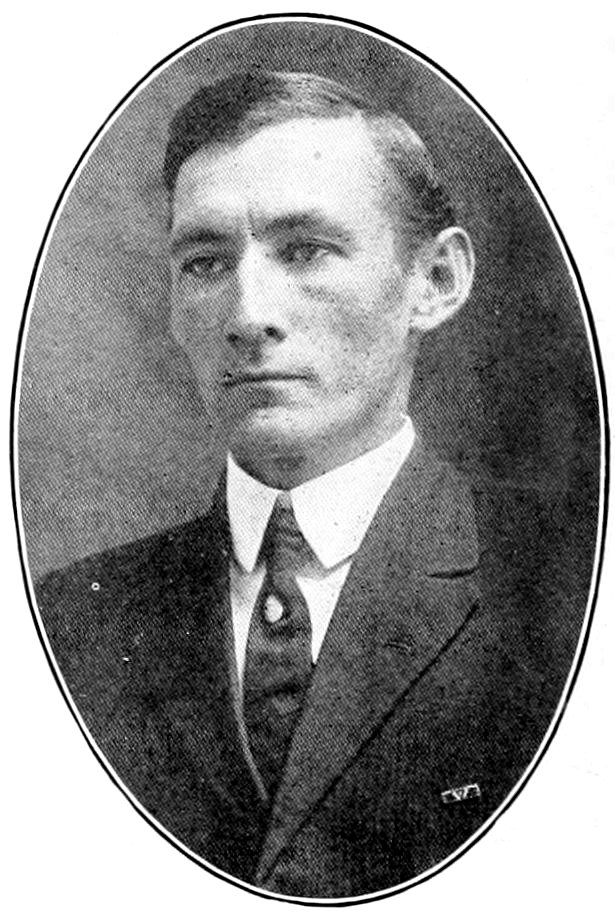
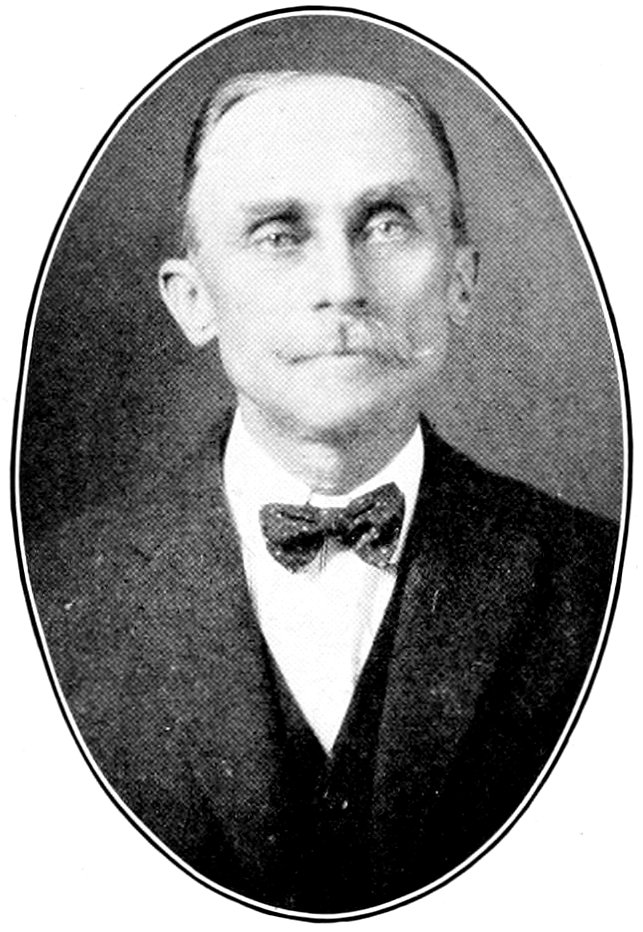
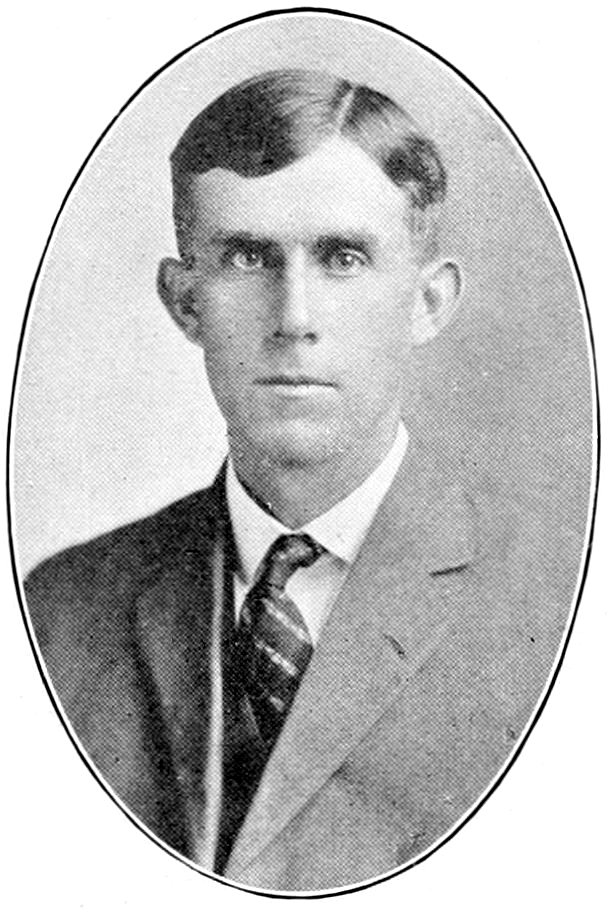
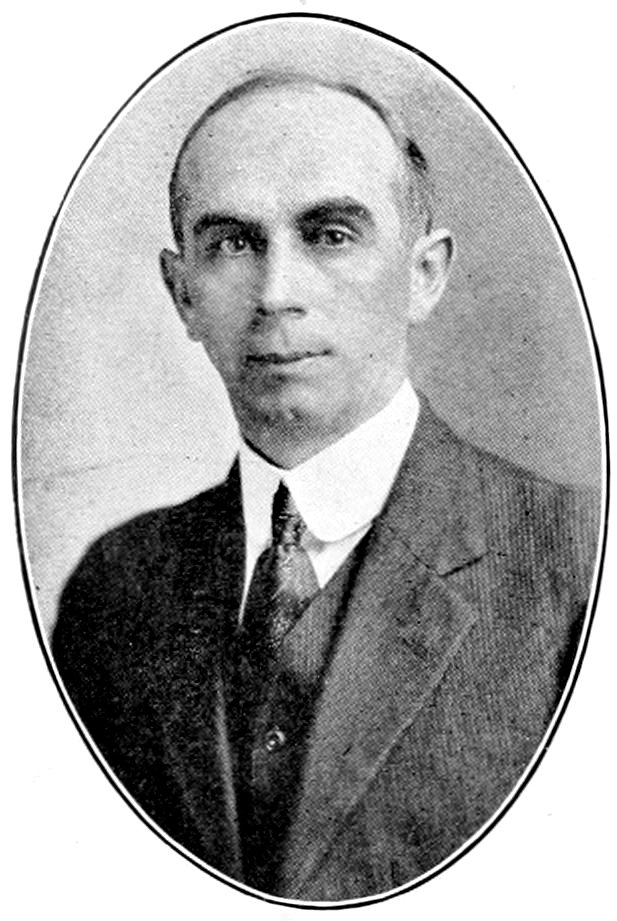
ELAM G. HESS, Manheim, Lancaster County, Pa.
Keystone Pecan Orchard Plantations
President Keystone Pecan Company
in Southwest Georgia—Calhoun, Dougherty, Lee and Mitchell Counties
Pennsylvania State Vice President of National Nut Growers Association
“Pecan production is destined to become one of the most important lines of orchard development in the United States.”—Cong. Record of the United States, p. 1101, Vol. 54.
Right Foods—The Increasing Demand — Why Spend Millions For Imported Nuts?
5
No matter what may happen, the demand for nourishing
foods is sure to grow so long as the population increases. Railroads,
steel, electricity—all are recent developments, none of
them indispensable to mankind. But existence itself depends
on nourishing foods.
“Then,” you say, “no business should be surer than that
of supplying food to the growing population of America.”
Correct, provided you supply the right food.
Food standards are changing
For food standards are changing. Prove that fact, if you
will, by the figures of the U. S. Census Bureau for the years
1900 and 1910, a period unaffected by the World War.
During that period the population of the United States increased
from 75,091,575 to 91,972,266—an increase of virtually
223 10 per cent. Therefore, the production of any foodstuffs
should increase by the same percentage during that period to
provide for the same consumption per capita.
Less beef, less pork, more nut meat
Has the consumption of beef increased during that period?
Apparently not—for there were 8.7 per cent. less cattle on the
farms in 1910 than in 1900. Nor was there any material increase
in imports. That there was not a corresponding increase
in the price of beef during this period, is indicated by the fact
that the value of all cattle on American farms increased only
1.6 per cent. between 1900 and 1910—an increase only one-fourteenth
as great as the increase in population.
There was a loss of 7.4 per cent. in the number of swine on
American farms and a decrease of 14.7 per cent, in the number
of sheep—the inevitable result of which loss while population
was increasing to the extent of 223 10 per cent. was an increase
in price per pound in pork, ham, bacon, mutton, etc., which
automatically cut off a large part of the demand.
A loss of twenty-nine pounds per capita on animal flesh
When urging the necessity for close study of the food
problem, President Wilson pointed out the fact that during a
ten-year period there had been a loss of 29 pounds of animal
flesh per capita per year. With such a record it is obvious that
some foods to replace meats must be found.
“We are annually importing between 60,000,000 and 70,000,000 pounds of nuts
at a cost of between $12,000,000 and $13,000,000, while we export nuts worth
less than a half million dollars. Why should we spend millions of dollars each
year in buying nuts from foreign countries, when we can grow the pecan, the
equal of any other nut, either native or foreign, in unlimited quantities?”—Congressional
Record of the United States, Vol. 54, No. 27.
Poultry Gains Fail to Equal Increase of Population
6
Poultry was the only exception among meats to this history
of diminishing supply, increased prices and diminishing demand.
Yet the gain in the number of all fowls on American farms was
only 17 per cent., while the population was increasing 22.3 per
cent. The American production of nut foods was increasing 55.7
per cent. in the same period without beginning to meet the demand.
Though the increase in value of the American nut crop was
128.1 per cent., still the increase in consumption required an increase
in imports so great that in 1910 America was supplying only one-fourth
of the nuts it was eating; while in 1900 it supplied half.
Government figures, taken from a leading nut publication, show that in
1900 the value of nuts imported into the United States was $3,484,651. By 1910
it had risen to $12,775,196, which is 365% of 1900 importations, although the
population of the United States increased only 22.3% during that ten-year period.
In 1919 there were $57,499,044 worth of nuts imported, which is 450% of
the importations in 1910, although the 1920 census shows an increase of only
15% in population since 1910. Nut importations in 1919 are 1650% of those in
1900, while population increased only 40% between 1900 and 1920.
We see, therefore, that there is a gain in nut importations between 1900
and 1910 twelve times as great as the gain in population; that the later increase
is so great that this gain between 1900 and 1919 is 39 times as great as the
increase in population. Surely this is conclusive evidence of the great increase
in nut consumption in the United States, when we remember how greatly the
American nut crop was increasing during this period.
Nut consumption increases thirty-nine times as greatly as population
These authentic figures astonish even the man who has
learned by experience that “nut meat is the real meat” of
greatest food value; for they show what great number of his
fellow countrymen have proved their belief in the same fact.
The man who has looked upon nuts as a holiday diet alone,
cannot fail to see his error, when he realizes that this increase
in the importation of nut meats in 1919 compared to 1900 is
nearly nine times as great as the increase in population; despite
the largely increasing American production.
Higher education in food values has led people to realize the
necessity for different and more varied diet—and this educational
development has been facilitated also by economic conditions.
The public forced to cut down on animal flesh—grazing land scarcer
As population increases, land becomes more valuable. As land
becomes more valuable—intensive farming is practiced. Grazing
becomes virtually impossible under such conditions; and, despite all
the efforts of the Department of Agriculture experts, cattle raising
is pushed farther and farther from the large centers of population.
Increased transportation and costs of refrigeration mean increased
meat prices—even the importation of large quantities of South
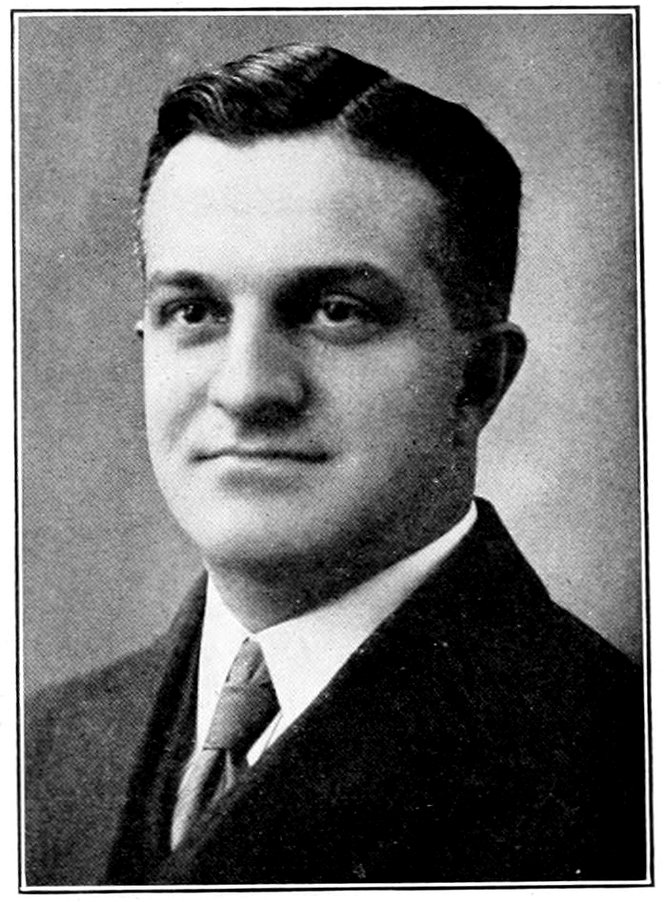
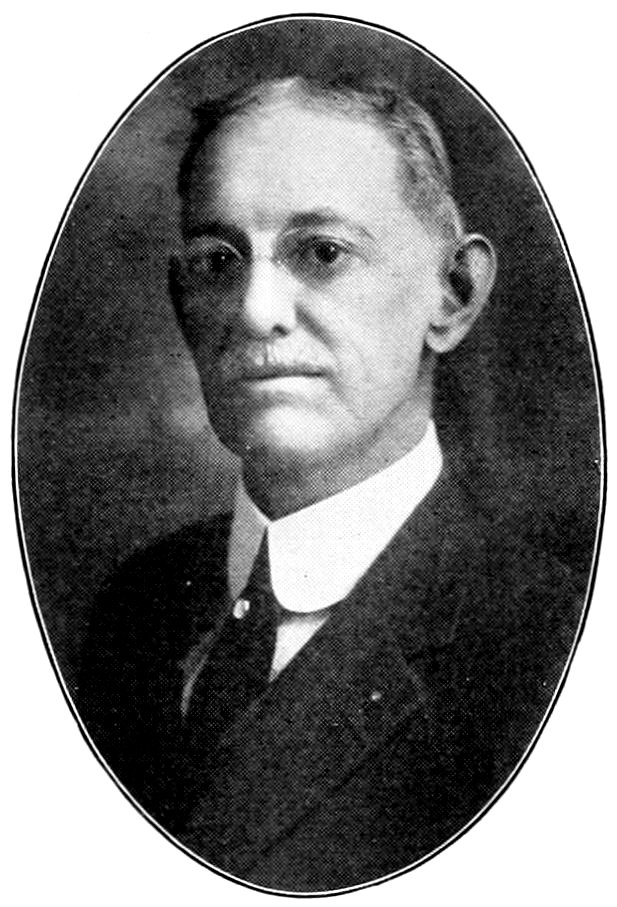
American beef between 1910 and 1914, for instance, failed to keep
meat at a price low enough so that it could constitute the large food
element which it once was on the American table.
“Shall We Cease to Eat Meat?”
7
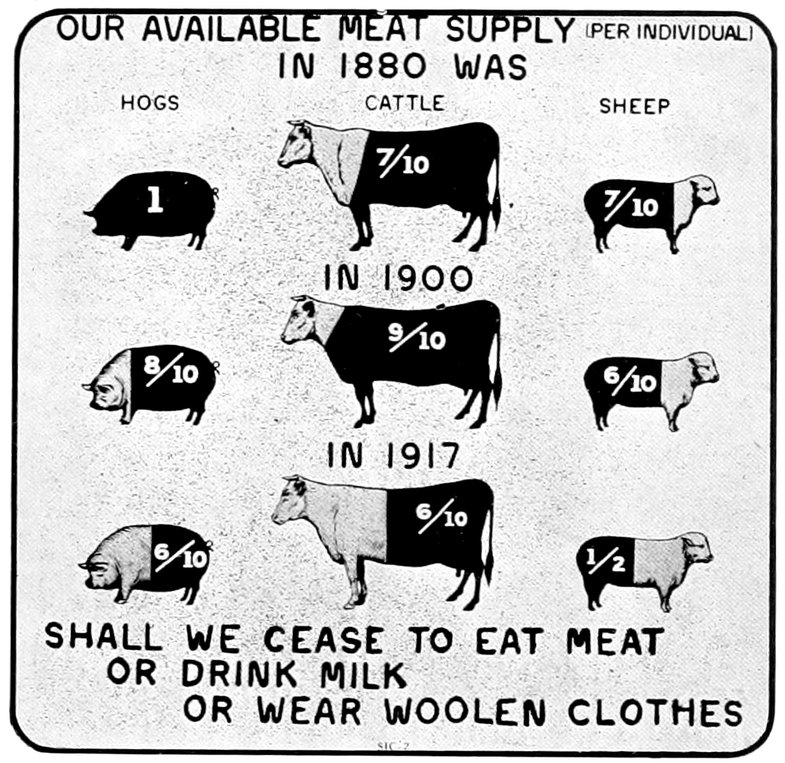
Available supply of pork, beef and mutton shrinking
asks Field Illustrated for March, 1919. A question of great significance,
from a publication of unquestioned leadership on
scientific cattle breeding. A question graphically illustrated by
this self-explanatory chart.
OUR AVAILABLE MEAT SUPPLY (PER INDIVIDUAL)
IN 1880 WAS
HOGS
CATTLE
SHEEP
1
7 10
7 10
IN 1900
8 10
9 10
6 10
IN 1917
6 10
6 10
½
SHALL WE CEASE TO EAT MEAT
OR DRINK MILK
OR WEAR WOOLEN CLOTHES
Copyright 1919, Field Illustrated
Field Illustrated shows that, the country over, it takes an
average of three acres to support a single full grown cow
through the summer season alone. It shows that wheat is the
great competitor of the meat crop, that wheat has driven livestock
from the western ranges, and that during the past four
years wheat has been driving the dairy cows and the beef steer
from the eastern and middle western farms.
Animals must not compete with human beings for cereal foods
“Whenever there is pressure for food,” concludes Field
Illustrated, “and animals must compete with humans for the
cereal products of the fields, then animals are pretty likely to
lose out. An acre of corn will feed ten times as many people in
the form of Johnny Cakes as it would if converted into meat.”
This statement is in striking accord with the conclusions
reached by Graham Lusk, one of the two American representatives
to the Inter-Allied Scientific Food Commission, who wrote
in December, 1918, “It is, therefore, axiomatic that in times of
scarcity one must not give to pigs food which can nourish
human beings.” For further data, see pages 14 and 15.
Why America Must Eat Less Animal Flesh
8
The call of the United States Food Administration for
meatless days, for porkless days and for every day a fat saving
day, taught a lesson that America will never forget.
Americans use twice as much animal flesh as any European nation
Food experts have for years emphasized the fact that
Americans eat too much animal flesh. Physical Culture says:
“About forty per cent. of our American bill of fare is of animal origin. In
England the percentage is but twenty per cent. of the total food, in Continental
Europe it is less, and in Japan it is not more than five per cent. Yet the
Japanese have astounded the world in every test of endurance.”
Excessive in cost, wasteful, and the cause of illness
“‘The American soldier is eating 100 per cent. too much meat,’ said the world
famous Dr. Wiley; while Dr. Gordon J. Saxon, director of the laboratory for
cancer of the Oncologic Hospital, Philadelphia, was quoted by the Philadelphia
North American as ascribing the wonderful resistive powers of the French
soldiers to the fact that they lived on a meagre supply of high protein foods,
like animal flesh, and were given an abundance of fats and carbohydrates. He
laid stress on the excessive cost of our American diet with its high ‘animal intake,’
and this was also emphasized by the booklet, ‘War Economy in Food,’ issued
by the U. S. Food Administration, which characterized animal flesh as the
most expensive of staple foods in proportion to food value.”
Fat is needed; securing it through eating animal flesh is the source of trouble
Americans are just learning that the cause of most of their
bodily ailments is the securing of fat by eating animal flesh. As
the Literary Digest well says in its March 9th, 1918, issue:
“Fats are chiefly valuable as fuel for the body. But in addition to being
consumed and turned to energy, fats are also readily stored away by the body,
alongside muscle and bone; as a reserve in times of illness or physical exertion.
Chief among the functions of protein is its importance as a builder of bodily
tissues. It is structural. The part it plays is like that of iron in a locomotive.”
Once built, the body, like the locomotive, needs only sufficient
building material (protein) to rebuild wornout portions;
but it needs motive material (fat) in far greater proportion.
Yet high animal flesh diet, which has been the American custom,
puts into the system a far greater amount of protein than
is needed and too little fat. The system cannot absorb this
excess protein, and sluggishness, intestinal derangements, autointoxication
and flesh-borne diseases are the inevitable result.
Fat is essential to withstand exposure
“Fat is fuel for Fighters,” said the U. S. Food Administration.
It urged civilians to avoid waste of fats because fats are
necessary to those who must withstand extremes of climate,
stand in water-soaked trenches and indulge in extreme physical
activity.
Two to four ounces daily are needed
As Good Health for March, 1918, pointed out, “Fats are
fuel foods! The daily requirement is two to four ounces.”
There is a way to get this required quantity of fat without
the excessive protein intake which is the inevitable result of our
high animal flesh diet. By following this plan America can multiply
its industrial efficiency, and benefit the physical welfare
of all.
Nut Meat Gives Fat and all Needed Protein
9
In his speech to the National Nut Growers’ Association, at
Biloxi, Mississippi, Dr. Kellogg emphasized the necessity for
fuel foods and the need for less proteins and albumens. He said:
Nut production destined to exceed animal industry
“To nuts, then, we must look for the future sustenance of the race....
Half a century hence the nut crop will far exceed in volume and in value our
present animal industry.”
He emphasizes the fact that all experiments have proved that “Nut protein
is the best of all sources upon which the body may draw for its supplies of
tissue building material,” while at another point he adds, “On account of their
high fat content they are the most highly concentrated of all natural foods.”
At great length, he compares the ease of assimilation of nut fats with that of
the other source of fat, and concludes, “nut fats are far more digestible than
animal fats.”
Pecans supply the proper ratio of fat and protein
Necessity is the mother of invention. If America had utilized
in the past its full opportunities to grow pecans—the best
of all nuts in high fat content with the perfect ratio of protein—we
could have shipped to our soldiers abroad the nourishment
most needed in most condensed form, protected from all contamination
and free from all putrefactive bacteria. It would
require approximately a tenth of the cargo space and would
need no refrigeration. It would require no cooking; could be
munched on the march, and would be assimilated more readily
than animal fats and proteins.
The public is changing from animal fats
It requires but a glance at any newspaper or magazine to
realize that vegetable fats are taking the place of animal fats—and
that the source of virtually all the new products along this
line is nut oil, peanuts and cocoanuts being the largest sources
of supply to date. Our 1915 Pecan Book quoted Prof. H.
Harold Hume, then State Horticulturist of Florida, Glen St.
Mary, Fla., as saying:
“According to analysis, the Pecan is richer in fat than any other nuts—70
per cent. of the kernel is fat. The pecan may at some time be in requisition
as a source of oil—an oil which would doubtless be useful for salad purposes—but
it is never likely to be converted into oil until the present prices of nuts are
greatly reduced.”
Since then pecan prices have had a decided tendency to
increase because the demand is growing more rapidly than the
supply; and the chances of the pecan being used for oil are more
remote than ever. Yet one of the great reasons for the increase
in demand is increasing public knowledge of the pecan and its
wonderful food value. For the pecan is proved richer in fat
than any other nut, with the right proportion of easily assimilated
protein, and free from any irritating membrane such as
makes some nuts difficult of digestion by those who have weak
stomachs.
Nut Meat is Superior to Animal Flesh — Pecans Furnish The Balanced Ration
10
Nut meat is Nature’s food product for supplying fats and
proteins, superior in every way to animal flesh. Dr. Kellogg,
of the Battle Creek Sanitarium, said:
“Nuts are rich in fat and protein. On account of their high fat content they
are the most highly concentrated of all natural foods. A pound of nuts contains
on an average more than 3,000 calories or food units, double the amount supplied
by grains, four times as much as average meats and ten times as much as
average fruits or vegetables.”
For example, according to Jaffi’s table, ten different kinds
of our common nuts contain on an average 20.7% of protein,
53% of fat, and 18% of carbohydrate. Among all nuts the
pecan has the largest percentage of fat and the best balanced
proportion of protein, analysis showing 12% protein, 70% fat,
and 18% carbohydrate.
Meat (round steaks) gives 19.8% of protein and 15.6% of
fat, with no carbohydrate. A pound of average nuts contains
the equivalent of a pound of beefsteak and, in addition, nearly
a pound of butter and a third of a loaf of bread. The nut is, in
fact, a sort of vegetable meat. Its composition is much the same
as that of fat meat, only it is in much more concentrated form.
Knowing that the nut is a highly concentrated food, the
question naturally arises, can the body utilize the energy stored
in nuts as readily as that supplied by meat products?
Nut meat is readily digestible
The notion that nuts are difficult of digestion has really no
foundation in fact. The idea is probably the natural outgrowth
of the custom of eating nuts at the close of a meal when an
abundance, more likely a superabundance of highly nutritious
foods has already been eaten, and the equally injurious custom
of eating nuts between meals. Neglect of thorough mastication
must also be mentioned as a possible cause of indigestion following
the use of nuts.
“The fat of nuts exists in a finely divided state, and in
chewing of nuts a fine emulsion is produced so that nuts enter
the stomach in a form best adapted for prompt digestion,” says
Dr. Kellogg.
“The pecan is a nut of immense economic value. The pecan furnishes practically
a balanced ration. It is a highly concentrated and highly nutritious food.
Compared with round steak, it contains one-twelfth as much water, two-thirds
as much protein, from four to six times as much fat and has between three and
four times as great fuel value.
Pecans contain most of the elements essential to the building of the frame
and body tissues. The food value of pecans is rapidly becoming generally
recognized, and it will not be long before the pecan will be extensively used not
only as a substitute for certain classes of food, such as meats, but also a substitute
for food of all classes.”—U. S. Congressional Record, Jan. 12, 1917.
Nuts—A Staple, Necessary Food
11
Long valued for diabetics—a good food for all
“There are abundant indications,” says the Journal of the
American Medical Association for September 21, 1918, “that
nuts, which have long found a valued place in the dietary of the
diabetic without detriment to his health, will grow in popularity
as foods for the well.”
“Not luxuries—but among the most nutritive of foods”
“The exigencies of war time have emphasized anew those
properties of nuts as foods which remove them from the category
of luxuries and place them on the list of substantial components
of the day’s ration,” it adds in its editorial comments on
the experiments of Professor Cajori, of Yale University. “It
should be remembered,” it states, “that bulk for bulk they
(nuts) belong among the most nutritive foods ordinarily
available.”
Opposing the prejudice that nuts are difficult of digestion,
it adds, “Cajori’s studies lead him to the conclusion that if nuts
are eaten properly and used in the diet as are eggs, meats and
other foods rich in protein, they have a physiological value on a
par with that of staple articles.” Only in the case of the chestnut—because
of its large starch content—was cooking desirable.
Commenting upon this article, Good Health Magazine for
January, 1918, says: “For nearly half a century we have advocated
the use of nuts as a staple element of the dietary of man.”
As Good Health points out, these conclusions of Professor
Cajori are in harmony with the suggestions of the United States
Food Administration that nuts “should be counted as part of
the necessary food and not eaten as an extra.” “We are led to
believe,” adds Good Health, “that the occasional indigestion
following injudicious eating of cheese and nuts is probably often
due to forgetting that they are very substantial foods, and eating
them at the end of an already substantial meal.”
Ideal food for nursing mothers
The experiments of Dr. Hoobler, of Detroit, Michigan, in
the Woman’s Hospital and Infant’s Home, showed that for
nursing mothers a diet consisting largely, 50%, of nuts, was far
superior to any other dietary, and in every particular giving
nearly 15% greater flow of milk, with 30% greater food value,
and that the mothers took the diet readily and enjoyed it.
(Journal of the American Medical Association, Aug. 12, 1917.)
12
THE SECOND QUARTER of the east front of our big, bearing orchard. To realize the immense size of this orchard, add to this picture the trees on page one, and remember that these together show only one-half of one side of this orchard.
Nuts Versus Beefsteak
Animal flesh supplies too much protein for bodily needs
“Beefsteak has become a fetish with many people; but the experiments of
Chittenden and others have demonstrated that the amount of protein needed by
the body daily is so small that it is scarcely possible to arrange a bill of fare to
include flesh foods without making the protein intake excessive. This is because
the ordinary foodstuffs other than meat contain a sufficient amount of
protein to meet the needs of the body. Nuts present their protein in combination
with so large a proportion of easily digestible fat that there is comparatively
little danger of getting an excess,” states Dr. Kellogg.
“In face of vanishing supply of animal flesh it is most comforting to know
that meats of all sorts may be safely replaced by nuts not only without loss, but
with a decided gain,” he adds.
Among the other advantages of nuts and animal flesh
which Dr. Kellogg cites are the freedom from waste products
such as uric acid, urea, carmine, etc., which cause so many
human ills.
Nuts are clean, sweet and aseptic, free from putrefactive
bacteria; while ordinary flesh foods contain three to thirty million
putrefactive bacteria per ounce.
Nuts—clean, sweet and pure—do not deteriorate like animal flesh
Nuts are free from trichinæ, tape worm and parasites, and
from the possibility of carrying specific disease which is always
present with animal flesh. “Nuts,” says Dr. Kellogg, “are in
good health when gathered and remain so till eaten.”
Nuts—The Safer Source of Protein
13
Why add to your load the burden of the tired steer?
“Beefsteak has a certain food value,” says Good Health
for January, 1919, “though far less than is generally attributed
to it, but in addition it embodies toxic elements, waste products
from the animal’s body, contained in the venous blood, always
poisonous, which gives the beefsteak its red color.”
“These elements are muscle poisons and brain poisons.
They cause fatigue in the animal from which they are derived
and in the man who eats them.”
“An experiment by the late Victor Horsley, a London
surgeon, proved that in concentrated form these poisons completely
paralyze the brain cells.”
“Do we need meat?” asks Alfred W. McCann, famous food authority
“Do we need meat?” asks Alfred W. McCann, noted food
authority, in Physical Culture. He answers his own question
by pointing to conclusive proof of Anthony Bassler and others,
that the human system cannot utilize over two ounces of protein
a day. Yet four ounces of beefsteak, roast beef, pork or lamb
chops, etc., contain all the protein the system can utilize, while
cereals, milk, eggs, nuts, etc., add to the quantity. He proves
by the figures of former Secretary Houston, of the U. S. Dept.
of Agriculture, and of Dr. Clyde L. King, University of Pennsylvania,
that Americans consume 80 grams of protein daily,
compared to 44 grams for France before the war; 14 grams for
Japan; 26 for Russia; 27 for Austria. He indicts Americans as
“Kidneycides,” overtaxing the kidneys by this excess protein
diet, and bringing on constipation, biliousness, headache,
catarrh, rheumatism, etc. He emphasizes the disadvantages of
animal flesh as a source of protein, shows how vegetable sources
of protein are purer and safer.
“No” answers the world’s most authoritative food body
The Inter-Allied Scientific Food Commission, the most
authoritative food body ever gathered, “voted that meat was
not a physiological necessity.” Dr. Graham Lusk, one of the
American Commissioners to that body, suggests cutting the
American meat ration in half. That this is readily possible is
shown by the November, 1919, Monthly Crop Report of the
United States Department of Agriculture. Page 116 gives the
annual average meat consumption in the United States as 179.9
pounds per capita—while best authorities agree with the statement
of Alfred W. McCann that 91 pounds would be more
than ample. Dr. Lusk comments on the fact that in England “The
reduction of meat in the dietary produced no unfavorable results.”
Grow Pecans—The Ideal “Fat” Food
14
Dr. Kellogg in an address at Biloxi, October, 1917, said that
the officials of the United States Department of Agriculture
foresaw this condition and the increasing prices for animal flesh
over twenty years ago. Since then the increase of our human
population and the decrease of our animal population has so
greatly exceeded their estimated figures that the question, “Is
meat imperative to complete nutrition?” has become an imminent
one.
Animal flesh supplies protein and fat. We have shown on
page 10 how nuts supply the necessary fat and protein. Dr.
Kellogg emphasizes the fact that nuts supply proteins of such a
character that they render complete the proteins of cereals and
vegetable foods.
“This discovery is one of the highest importance since it
opens a door of escape for the race from the threatened extinction
by starvation at some future period, perhaps not so very
remote,” adds Dr. Kellogg.
Nine-tenths of our corn fed to animals
“From an economic standpoint,” he adds, “the rearing of animals for food
is a monstrous extravagance. According to Professor Henry, Dean of the Agricultural
Department of the University of Wisconsin, and author of an authoritative
work on foods and feeding, one hundred pounds of food fed to a steer
produces less than three pounds of food in the form of flesh. In other words,
we must feed the steer thirty-three pounds of corn in order to get back one
pound of food in the form of steak. Such an extravagant waste can be tolerated
only so long as it is possible to produce a large excess of foodstuffs. It is
stated, as a matter of fact, that at the present time scarcely more than ten per
cent. of the corn raised in the United States is directly consumed by human
beings. A large part of it is wasted in feeding to animals. This economic loss
has been long known to practical men, but it has been regarded as unavoidable
since meat has been supposed to be absolutely essential as an article of food.”
“Think of it,” comments Good Health, for June, 1918, “100 pounds of perfectly
good corn, in exchange for three pounds of beef, and the pound of beef
when obtained is worth less as a food than a pound of the original corn.
Ninety-seven pounds wasted just to satisfy a cultivated appetite, or appetite
based on ignorance.”
“In view of these facts,” stated Dr. Kellogg, “it is most
interesting to know that in nuts, the most neglected of all well
known food products, we find the assurance of an ample and
complete food supply for all future time, even though necessity
should compel the total abandonment of all our present forms
of animal industry.”
Seven or eight million acres of nut trees would supply all needed fats
“The planting of seven or eight million acres of nut trees
might supply the whole country with an abundance of fat, so
that it would no longer be necessary to waste corn in feeding
to pigs to obtain an inferior quality of fat,” says Good Health.
15
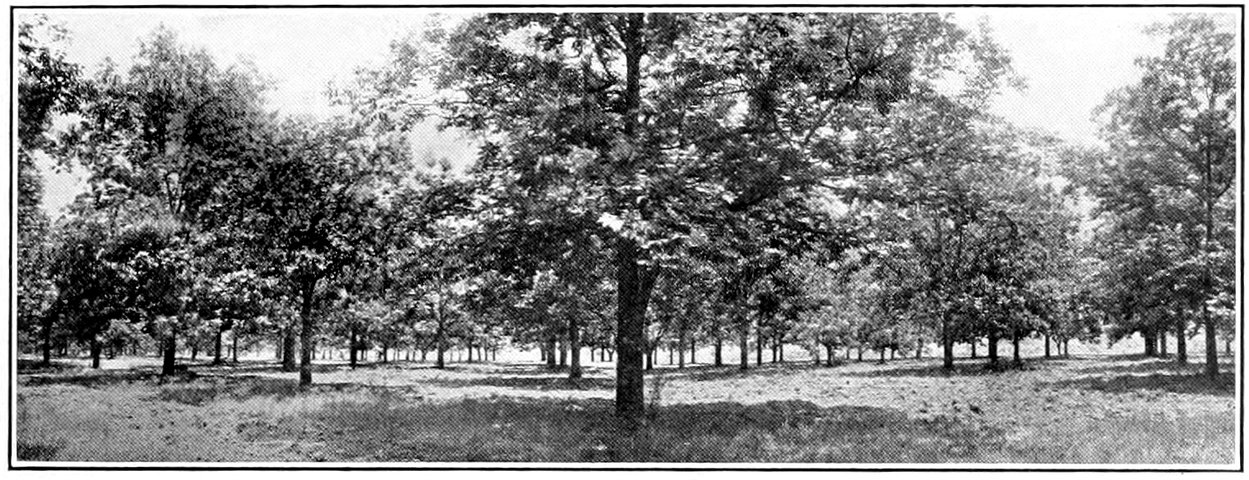
A panoramic view in our large orchards, showing a fraction of one side which is not illustrated in the other pictures. Can you, looking forward fifteen years or more, see in this a picture of your own pecan unit trees sturdy and healthy, their branches thickly covered with pecans, filling out under the summer sun? The soil is the same, the climate the same, results should be better with the finer varieties planted.
Twenty Times As Much Food Per Acre
3,000,000 calories per acre from nuts; only 150,000 from beef
Consider what it would mean if America could take its
many million acres of pasturage and get from each twenty times
the food value! Of course, no thinking man would claim that
every acre of pasturage is available for nut raising; but where
the change can be made, that gain is possible.
As Dr. Kellogg points out, it takes two acres two years to produce a steer
weighing 600 pounds; an average of 150 pounds per year per acre. The same
acre planted to walnut trees would, he states, produce 100 pounds per tree per
year for the first twenty years; which means 4,000 pounds of nuts from an acre
of 40 trees. The food value of the 150 pounds of steer cannot exceed 150,000
calories or food units; while the nut meat from the same acre equals 3,000,000
calories in food value. As Dr. Kellogg concludes, “Twenty times as much food
from the nut trees as from the fattened steer, and food of the same general
character, but of superior quality.”
As Dr. Kellogg previously pointed out: “A pound of pecans
is worth more in nutritive value than two pounds of pork chops,
three pounds of salmon, two and a half pounds of turkey or five
pounds of veal.”
While the price of nuts is by some considered high, Dr.
Kellogg directs attention to the fact that “even at present
prices the choicest varieties of nuts are cheaper than meats if
equivalent food values are compared.”
Nuts as a Substitute for milk and eggs
Experiments by Dr. Hoobler, Detroit, and at Battle Creek
Sanitarium, prove that nuts “Possess such superior qualities
as supplementary or accessory food that they are able to replace
not only meats, but even eggs and milk.”
Nut Meat The Real Meat
16
Nuts imported 1917, nearly ten times as great as in 1900
It must be remembered that the period in which the use of
nut meat grew over fifteen times as quickly as the population
increased was before the war conditions made every man consider
food values more carefully. Right up till 1914, the year
in which the war in Europe started, there was a steady increase
each year in the production of nuts and the importation
of nuts, yet prices kept soaring on all the better varieties
because the greatly increasing supply failed to keep pace with
the increase in demand.
Though the importation of nuts in 1910 had been valued
at over thirteen million dollars, and this was nearly four times
as great as in 1900—it kept increasing until in 1917 it amounted
to nearly thirty-three million dollars. The importation of nuts in
1917 was nearly ten times as great as imports for 1900, yet these
imports and the increasing American production failed to meet
the demand.
Pecan nut meat a year-round necessity
These figures from U. S. Government reports show that
any one who assumes that nuts are a holiday luxury is entirely
wrong. That the public wants nut meat the year round, that
the only drawback to a still greater increase in consumption is
the shortage of the supply of fine nuts is proved by United
States Department of Agriculture figures.
When J. C. Cooper wrote in a leading agricultural weekly:
“The demand for walnuts is growing much faster than the supply. We do
not produce in America more than twenty per cent. of what we consume, and it
will take fifty to a hundred years, with all the encouragement of the nut experts,
to raise enough walnuts to supply the home demand.”
he stated a condition which applies with manifold greater force
to the consumption of pecan nuts.
It is true that the California production of Walnuts doubled during ten
years, while the importation trebled—yet in spite of this five-fold production
English Walnuts constantly increased in price. Since then the price of walnuts
has increased steadily every year, despite increase of supply until in November,
1918, the price per pound was 80% higher than at the same time in 1914, according
to the Monthly Crop Report for December, 1918. Yet the 1918 crop
was nearly twice as large as in 1914, according to Statistician H. E. Pastor, well
known as an authority on western crops.
The price of pecans increased 50% on the commonest sorts
between 1900 and 1910; and from the December, 1918, Monthly
Crop Report we see that the 1918 price per pound on all pecans
was over 38% higher than for 1917; Georgia, which has the
largest percentage of paper shell pecans, showing the highest
price per pound.
The Finer The Nut—The Greater The Demand — “The Most Prized of All Nuts For Domestic Uses”
17
Increased demand is for finer nuts
It is true that in Walnuts a condition has come about as in
other nuts—that the increasing demand is for the finer, higher
priced grades. What are the points of superiority that have led
to this great increase in public demand? Why are old established
black walnut trees less valuable as profit producers than
English Walnut trees only a quarter as old and producing only
a fraction of the quantity of nuts?
First—Thinness of shell and ability to get out the kernels
whole.
Second—Superior flavor and food value.
Third—Attractiveness in appearance of the nut and of the
nut meat when removed.
Fourth—Ease of keeping nuts for longer periods and using
them readily.
Paper Shell Pecans meet every demand
Now compare the fine Paper Shell Pecan with the English
Walnut on every one of these four points of public demand.
It is contained in a shell so thin that it is easily broken in
the hands without the use of nut crackers. The partitions between
the kernels average as thin as in the English Walnut,
and the average person will, in less time, remove more whole
kernels of the Paper Shell Pecan than of any other nut.
As to flavor and food value let such experts as Luther Burbank
answer. (See Foreword, page 4.) Remember that his
answer is certainly unbiased, for he is a patriotic native of California
where America’s largest crop of walnuts is produced—and
that State produces no quantity of Paper Shell Pecans.
As to attractiveness in appearance, of both the nut and the
nut meat, you and your friends are the best judges. People who
know both nuts have already handed in their verdict favorable
to the paper shell pecan. In addition, the pecan has been
endowed by nature with a shell which is air-tight—and therefore
keeps many times as long without losing its fine flavor or
becoming dry and tough.
In Bulletin No. 30, of the Department of Agriculture, Washington, D. C.,
we read regarding Pecans: “In the course of time, however, as they are more
widely grown, they will become the most prized of all nuts for domestic use,
and it is probable that when the supply is large they will be preferred abroad to
the best Persian nuts.”
18
IN OUR ESTABLISHED ORCHARDS stretch row after row of these sturdy, strong-trunked, well established pecan trees, which after severe pruning are forming immense heads with a profusion of nut bearing branches.
The Pecan—The Year-round Nut — “Among the Highest Priced Horticultural Products of America”
Can be raised at best in a forty-mile radius
The pecan is the one nut suitable for eating the year round.
And the present tendency is toward the year-round use of nuts.
Another reason why the finer pecans are surer to maintain
their high prices than any other nuts is found in the fact that
Walnuts of the finest grades are being raised in quantities in
California, Oregon, Washington and other States, and in England,
France, Italy and South American countries—while the
territory in which the Paper Shell Pecan attains its highest
state of perfection is confined to a 40–mile radius in southwestern
Georgia, embracing those portions of Calhoun, Dougherty,
Lee and Mitchell counties, which are nearest Albany.
Is it any wonder that the former State Entomologist of
Georgia, Mr. E. Lee Worsham, whose name is virtually always
included as one of “the three big men in his line of endeavor,”
wrote: “In my opinion the pecan growers of South Georgia
have the finest horticultural proposition in the United States.”
“Pecans of the second class bring $12,500 a carload. As a result of the
superior merit of this class of pecans and the limited extent to which they are
grown, they are now netting the growers in certain districts a value per volume
of product ranking them among the highest priced horticultural products grown
on a large scale in this country. Carloads weighing 36,000 pounds each were
recently (Oct. 1916) shipped from the Albany district of southwest Georgia to
Chicago brokers at 35c. a pound or $12,500 a car. These prices were for pecans
of the second class, the firsts bringing still higher prices.” United States
Congressional Record, Vol. 54, No. 22.
“What is The Paper Shell Pecan?” — “Your Pecan Is Superior To Our Walnut,” Says Burbank
19
Mention Pecan to any one who has tasted the improved
paper shell variety and they will assume that you are talking of
Paper Shell Pecans. For the person who cracks and eats paper
shell pecans feels it almost a sacrilege to call the common wild
pecan a pecan.
Yet there are thousands of Americans who have never
tasted paper shell pecans, and who think of pecans only as wild
pecans, grown largely in Texas.
Pecans are divided in three general but radically different
classes, as the description and cuts below indicate.
Wild Pecan—a staple food among Indians
The ordinary wild pecan is native to America. The earliest
French explorers found that one of the staple foods of the
Indians was this palatable nut which grew
in the forests of the south, and in that portion
of Mexico adjoining the Gulf States.
Pecan trees in Texas and Louisiana have
been found which were over five hundred
to seven hundred years old—which were still yielding large
crops of nuts.
Like the oak, no one ever knew a Pecan tree to die of old
age.
There are in the Southern States wild pecan trees of which
the records go back to the first civilization on this continent.
The pecan tree is so symmetrical and beautiful that it is
called “The Queen Shade Tree of Many a Southern Home.”
Its fruitage is so prolific that it is said to be “one of the most
astonishing food engines in all nature, yielding literally barrels
of nuts.”
In the American Nut Journal, May, 1915, we read: “Luther Burbank is
credited with the following statement regarding the pecan tree: ‘If I were
young again I would go South and devote my life to propagating new species of
the pecan. Walnut culture is the leading horticultural product in California,
makes more money for us and makes it easier than anything else, and your
pecan is superior to our walnut. The longevity of the pecan orchard and its immense
earning power make it one of the most profitable and permanent of
agricultural investments.’”
The Hardiest of All Nut Trees — The Pecan Makes More Progress Than Other Nuts Made In Centuries
20
Pecan trees fear no drought
The reason for this long life is that the pecan is the hardiest
of all nut trees—free from all ordinary tree pests and diseases
because it is of the hickory group, and the longest lived member
of that group. The lack of surface moisture—the great enemy
of most trees—is not a disadvantage to the pecan, for it has a
remarkably long tap root which goes down so deeply into the
ground that it draws moisture from the sub-soil. Since the
blooming period is late in Spring, the buds are not injured by
frost.
The wild pecan has been a popular nut, rivaling, because
of its superior flavor, such other nuts as the walnut, chestnut,
shellbark, hickory-nut, etc. This popularity was secured despite
its many drawbacks—for the shell of the wild pecan is hard and
the partition walls between the kernels thick and bitter. There
was too little meat and too much difficulty getting it—but the
experts saw in the great demand for pecans, despite these disadvantages,
the promise of rich reward for improving the pecan.
Seedling superior to wild grown Pecan
The seedling pecan is the next step toward pecan perfection.
Larger than the wild pecan, and thinner shelled, it equals
or surpasses it in flavor, depending upon the variety of seedling
under consideration. Selling at an average price of 35 to
45 cents per pound, which is double the cost
of the wild pecan, it has so much more meat
and it is so much more accessible, that it is
always a better paying purchase for the
housewife. So justly popular has the seedling
pecan become that the wise dealer and
the discriminating housewife will have nothing
to do with the inferior, thick-shelled
pecan, which is brightly tinted and polished
to disguise the inferiority.
“With practically no improvement as a result of culture and breeding, but
taken directly from nature, many of the wild pecans afford an exceedingly desirable
product. Unconscious, and, therefore, unsystematic selection and planting
of pecan seed about dooryards during a period of less than 200 years has developed
varieties of such desirable quality that the pecans most successfully
compete with other species, like the almond and the walnut which have been
under cultivation for many centuries.”—Congressional Record for January, 1917.
21The Paper Shell Pecan
Had the work of experts not gone further than establishing
the improved Seedling Pecan, it would have justified all efforts—for
the seedling pecan bore justifiable comparison with any
other nut on the market in food value and accessibility; until
the Paper Shell Pecan was developed from budded trees.
The paper shell pecan—the queen of all nuts
The Paper Shell Pecan has an air-tight shell so thin that
it is easily broken in one hand by a gentle pressure. Kernel is
large, easily removed, of flavor so much finer that any observing
person can distinguish it from any other pecan by taste alone.
Instead of a bitter partition wall which imbeds itself in the
nut when it is cracked, as in the wild pecan, the paper shell
pecan has a thin, tissue-like membrane which is easily removed.
With the paper shell pecan a larger portion of the total
weight of the nut is meat than with any other nut, with the possible
exception of the finest almond. And this meat of the
paper shell pecan contains seventy per cent. fat, while that of
the almond contains but fifty-four per cent.
The paper shell pecan is the Queen of all nuts.
Quality unequalled but supply is limited
It has no equal from the standpoint of size, appearance,
accessibility of meat, size of kernel, and fine flavor. The only
disadvantage is the limited supply—for there is but a small territory
in which soil conditions and climate are right. The
walnut is raised in England, France, Italy and in large quantities
in the three Pacific coast states, and in smaller quantities elsewhere.
The paper shell pecan seems to flourish best within a
forty-mile radius around Albany, in Southwest Georgia. Of the
half million budded pecan trees in the world, two hundred and
forty thousand, or practically
half, are in this forty-mile
radius. Were complete records
of yield accessible, it would be
seen that this half of the budded
trees has produced far more
than their portion of the crop.
While State Entomologist of Georgia, Mr. E. L. Worsham, wrote: “The
Pecan Industry has developed beyond the point where it matters not what you
or I believe. It is a success. Results are being produced of wide interest and of
permanent character, and the industry in the Albany district in the hands of
competent men has wonderful potentialities. The hundreds of thousands of
dollars invested by shrewd business men in Commercial Pecan properties, after
personal investigation, argues that the development being recorded in the Albany
district is meritorious.”
The First Three Steps In Establishing Paper Shell Pecan Orchards — First, the Seedling Pecan Nut is Planted in the Nursery — A Few Years Later in the Same Nursery Corner — The Sturdiest Budded Trees are later Transplanted while Dormant, into the Orchard Units
22
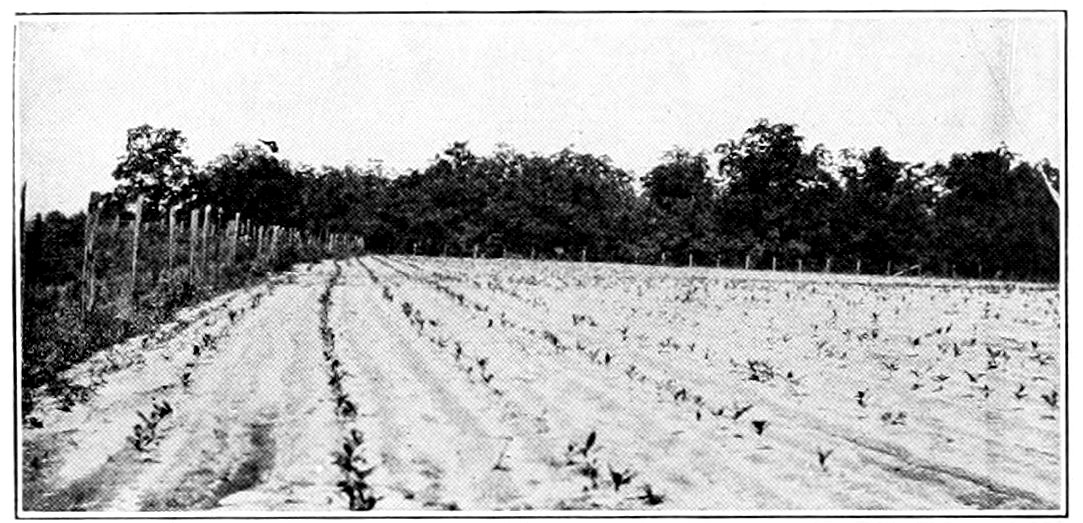
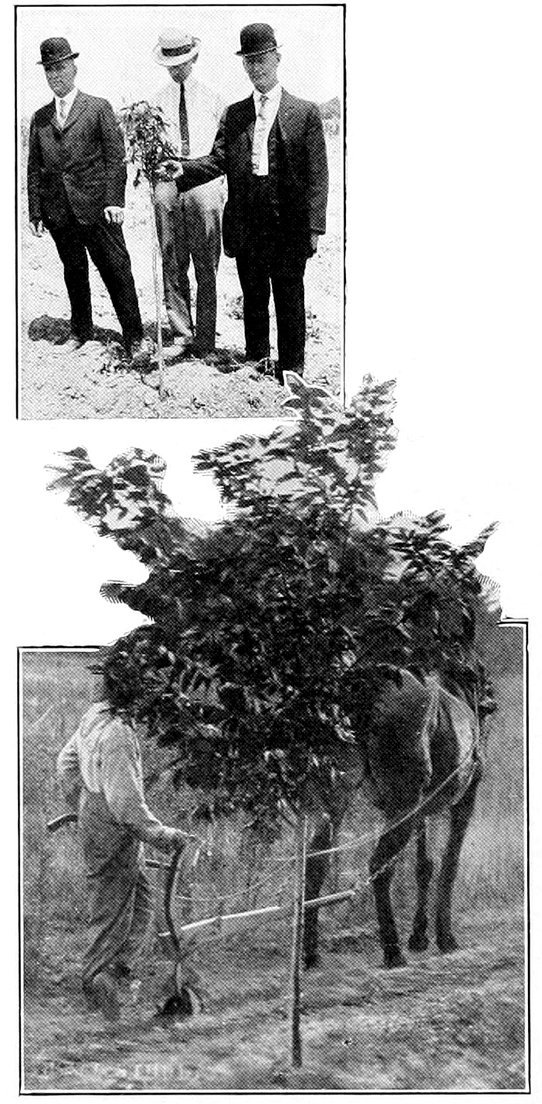
This picture shows a corner of the Nursery on our Calhoun County Plantation, in which thousands of young trees have been grown. Selected seedling nuts from our bearing seedling orchard (in the background) have but recently sprouted, and are just above ground when this first picture is taken.
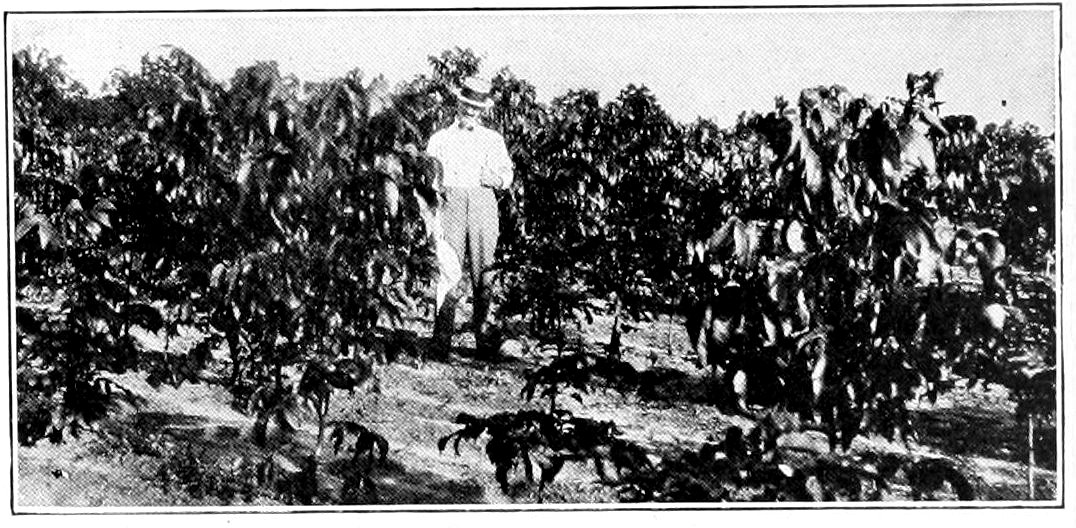
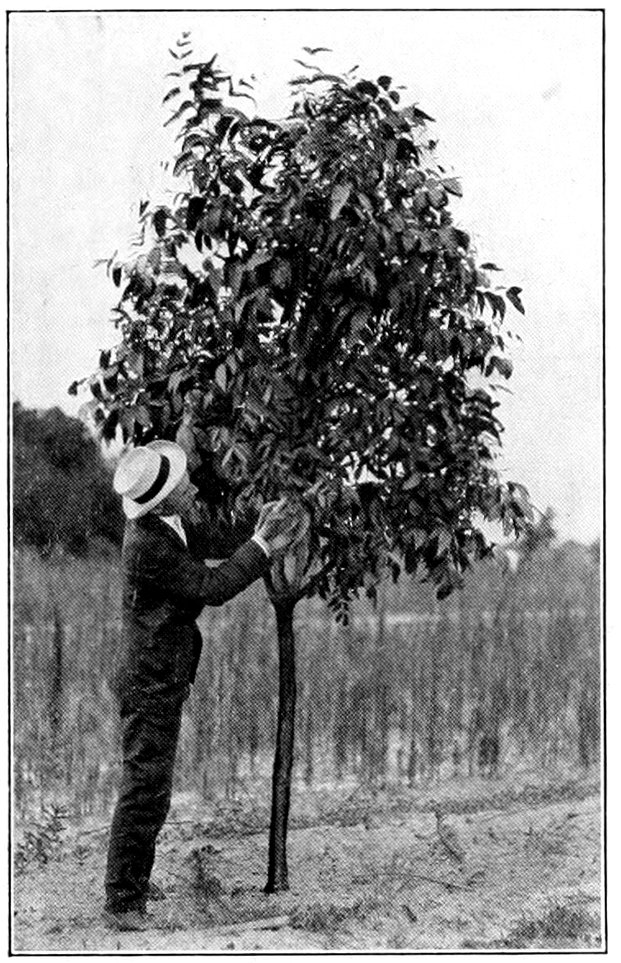
One of our orchard unit owners inspecting the nurseries two years later. The vigorous, sturdy two year old trees have been budded to the standard paper shell varieties.
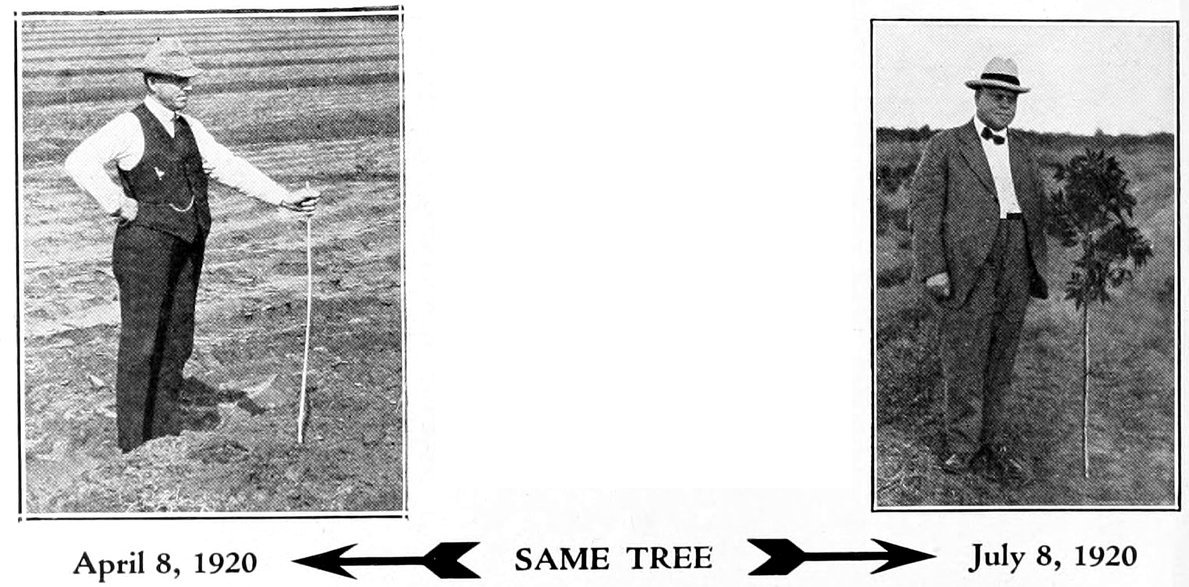
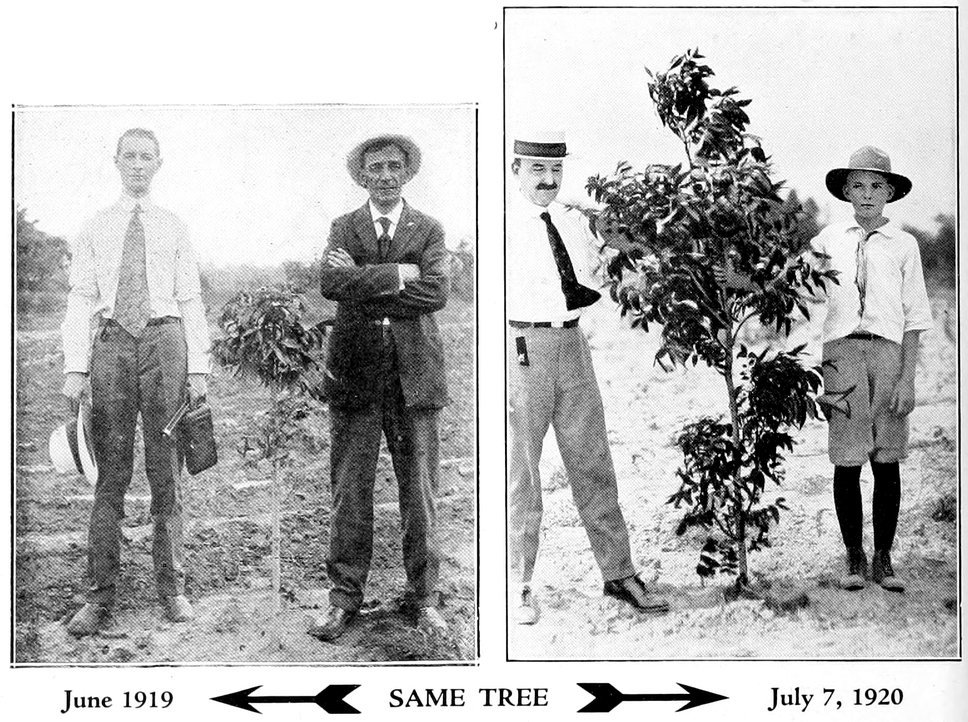
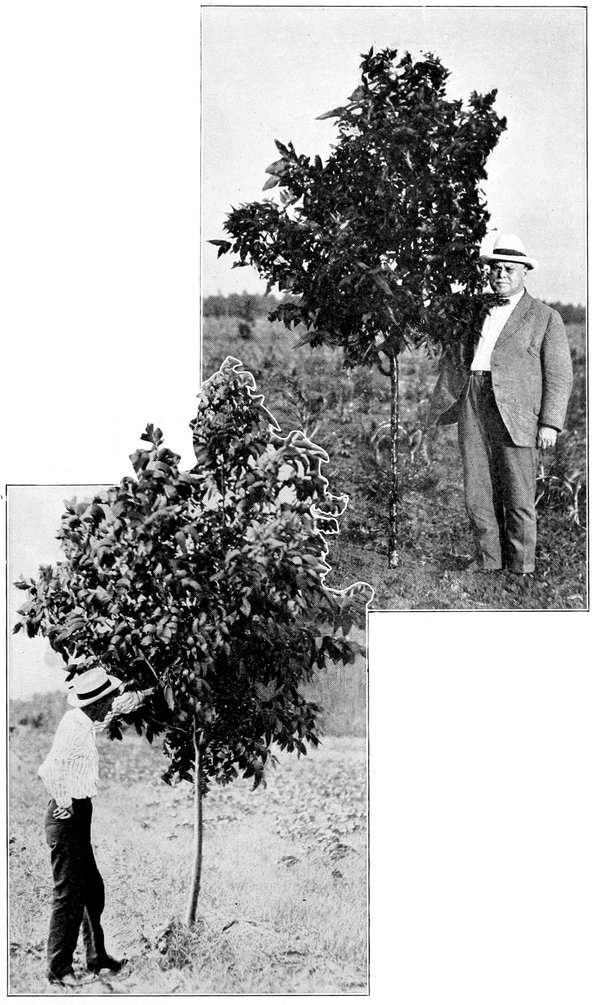
Illustration at left shows one of our unit owners, Mr. A. E. Pretty, Dawson, Yukon Territory, standing at a dormant tree in recently planted units purchased by Alaska and Yukon people.
Illustration at right shows Mr. Henry E. Morton, President of the First State Savings Bank and of the Morton Mfg. Co., Muskegon Heights, Mich. (owner of 45 units on our plantation) standing at the same tree, three months later.
Both pictures made to same scale, as figures of men show. (See letter of Mr. Morton, page 50.)
23
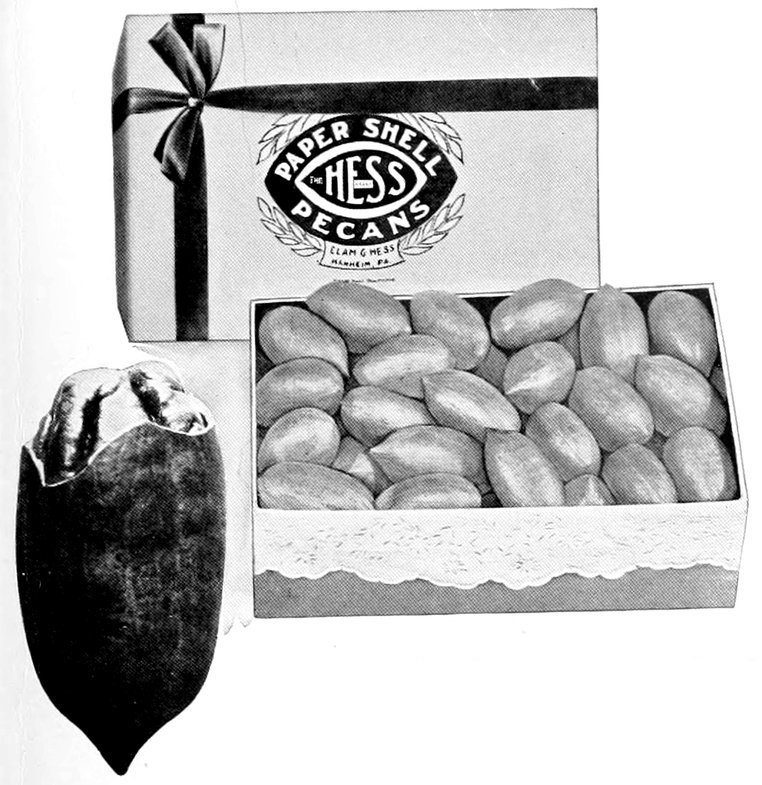
THE 12 OZ., “GIFT BOX” of Hess Brand Paper Shell Pecans, which has been ordered and re-ordered by pleased purchasers in every section of the United States and Canada—and in many foreign countries, including Mexico, Cuba, Australia, New Zealand, South Africa, India, China, France and Great Britain.
Hess Brand Paper Shell Pecans
Selected for finest flavor—and superior quality
are selected for their superior quality from among the finest
nuts produced anywhere in the pecan district. They are
the choice of thousands of satisfied customers, everywhere,
because they are the finest flavored nuts which Nature produces.
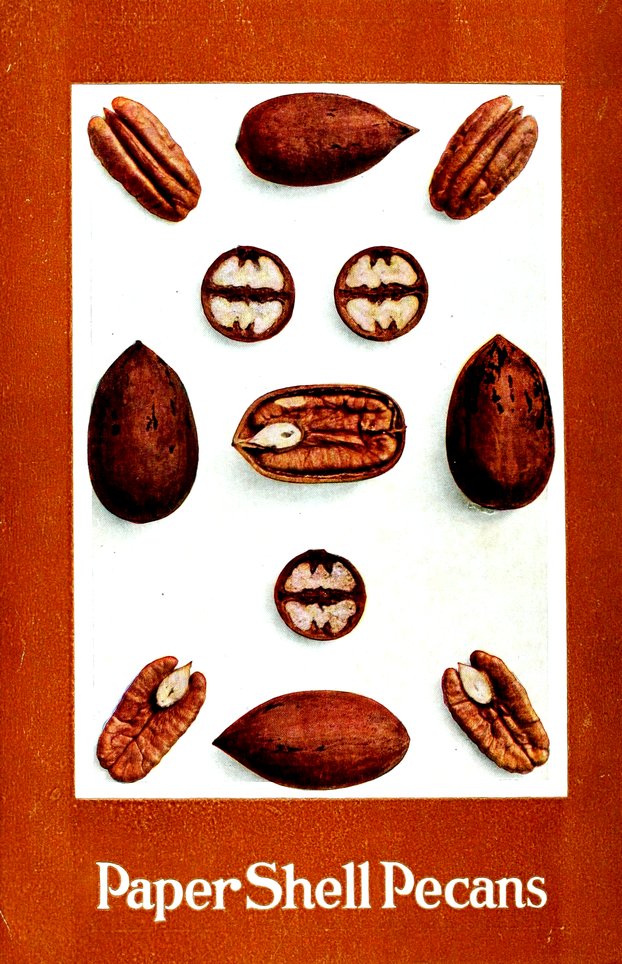
They are uniformly large in size, thin in shell and well filled with
nut meat, as shown by illustration in natural colors on outside cover.
Their plump kernels—of delicious flavor and wonderful nutritive
value—are easily removed whole without the use of nut crackers. By
following the simple directions in every box, the thin shell is easily
cracked with your bare hand.
Sold the world over—under this Money Back Guarantee
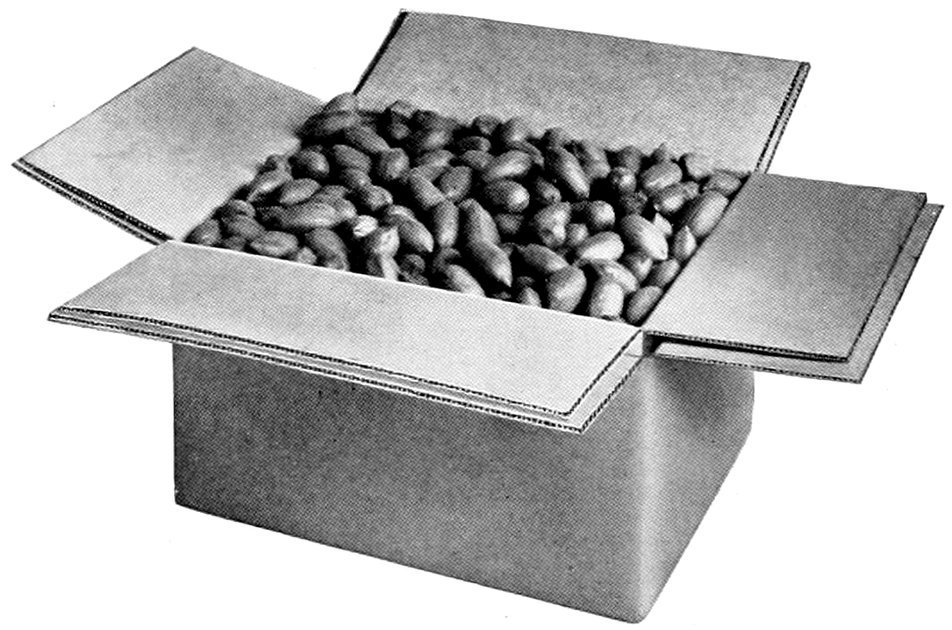
THE 10 LB. CARTON for family use—the logical second purchase of many pleased customers.
They are packed in the beautiful 12–oz. Gift Box shown above; and
sold at $1.25 per box,
under this Money Back
Guarantee:—“Eat six
at my risk—if dissatisfied,
return the balance
within ten days
and get your $1.25
back”; yet out of
thousands of packages sent out,
less than six packages have ever
been returned.
24
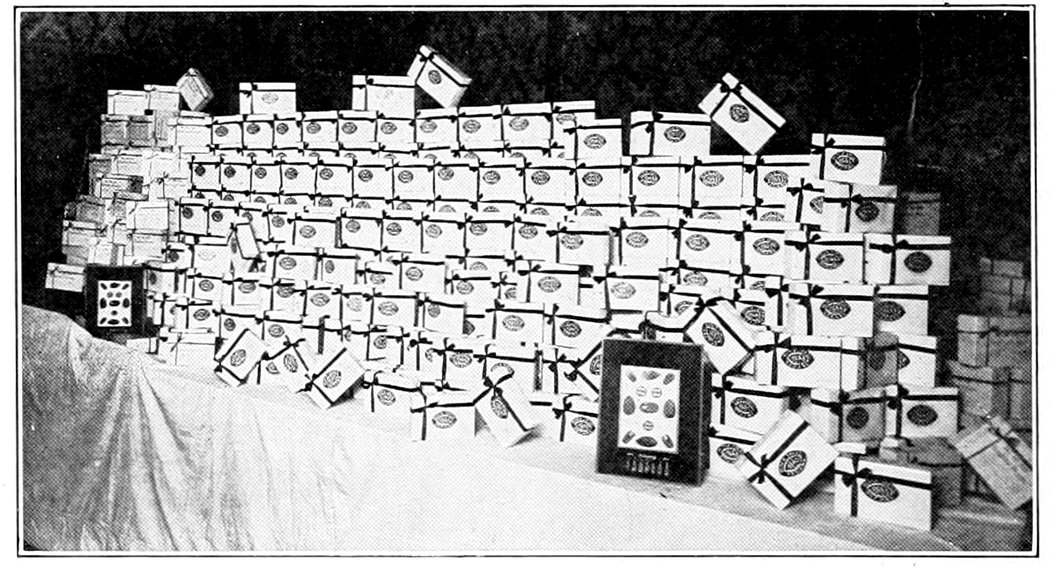
One shipment of pecans, boxed, ready to send out—photographed in the packing room at Manheim.
We have Sold Tons of Hess Brand Paper Shell Pecans
The 12 oz. gift box leads to orders for 10 lb. cartons or 175 lb. barrels
Though our Gift Boxes have enjoyed a remarkable sale
during the Holiday Season, our business is by no means limited
to that period. Orders for large quantities are received throughout
the year from individuals for use in their homes; but since
each year’s supply has been exhausted in a few months, we have
found it necessary to refund money continuously month after
month until the new crop was harvested.
Numerous purchasers of Hess Brand Paper Shell Pecans
have re-ordered many times in a single winter—while many
others who have first bought the 12–oz. box have ordered in
large quantities up to 200 pounds, rather than be compelled to
order so frequently.
We have customers who buy by the barrel for their own
table, and some who have ordered two and three barrels in a
single season. Each barrel contains about 175 pounds.
America does not produce enough pecans of this standard
Our experience selling these high quality pecans shows
that there is no question whether the public will pay the increased
price. The real problem is to secure more pecans to
meet the constant increase in demand. The whole southern
section of the United States does not produce enough paper
shell pecans of this standard to fill the demand for them.
ELAM G. HESS.
A Few Typical Cases of Re-orders
25
Detroit, Mich., Jan. 30, 1919.
Bought twenty pounds—orders 75 pounds for next season
I enclose check for 10 lbs. of Hess Pecans. Could you still take my order
for another 10 lbs.? I wish you to place me on your orders for 75 lbs. of the
pecans from next fall’s crop.
W. H.
Sawyerville, Quebec, Mar. 18, 1919.
Will you please take my order for twenty pounds of Hess Pecans from the
next crop? The nuts are just splendid, and we never tasted anything like them
before for flavor.
R. G. B.
Reading, Pa., Jan. 6, 1919.
Had 70 pounds orders 40 pounds more
The 70 lbs. Hess Pecans received just before Christmas were eminently
satisfactory and disappeared like hot cakes. I am enclosing check to cover the
following order: 10 lbs. Ex. Fancy, 20 lbs. “A,” 10 lbs. “B.”
W. O. L.
Nov. 7, 1919.
Orders 3 barrels later
Please enter my order for 3 barrels of fancy grade pecans.
W. O. L.
Dec. 2, 1919.
The barrel of pecans arrived the day before Thanksgiving. The nuts are
gone and I am ready for more; wish the entire order before the Xmas holidays.
W. O. L.
Buying in 50 lb. lots
F. B., Los Angeles, California (in the heart of the finest walnut district),
ordered 22 oz. box for $2, Feb. 13th, 1917. March 11th, 1917, wrote: “They are
unquestionably the very best I ever ate, and I am wondering if you have more
to offer, and if so, the price in bulk.” Aug. 2, 1917, order booked for Fall,
1917, delivery, 50 pounds Hess Brand Paper Shell Pecans.
Nov. 27, 1917, sent check for $50 in payment of 50 pounds.
February 26th, 1918, sent his third re-order for 50 lbs. of Hess Brand Paper
Shell Pecans for delivery, Fall, 1918, for $50.
In 1919, purchased 20 lbs., remitting $25.00; 1920, bought orchard units on
our plantations.
16 pounds in less than three months
Order received, Dec. 11, 1917, from Dr. M. B., Wabash, Ind., for $1 box
of Hess Brand Paper Shell Pecans.
Jan. 8, 1918, “Enclosed find check for $5 for which ship pecans like the
12 oz. box recently sent me. They are the finest I ever ate.”
Jan. 24, 1918, sent check for $10 for more nuts.
Feb. 9, 1918, bought orchard units.
“Wish I had a barrel”
J. C., Seattle, Washington, wrote Jan. 29, 1917: “The size, quality, and
flavor are all of the very highest. They are richness itself. Regarding food
value, I question if there is any nut on earth equal to it. I wish I had a barrel
of them. You ought to plant at least 10,000 acres.”
April 10th, 1917, ordered 10 lbs. more for Fall, 1917, delivery, saying, “They
are the very best on earth.”
“The Finest Nuts I Ever Saw” — Says the world famous food authority, Dr. J. H. Kellogg — Battle Creek Sanitarium — From Another Food Authority
26
Dr. J. H. Kellogg, head of the famous Battle Creek Sanitarium,
is a world famous expert on nuts. His writings, based on a half
century of research, have shown that pecan meat is suitable for
“every month in the year, for all climates, all work and all ages
of mankind (except infants)”, as Good Health stated. He has
directed attention to the fact that pecans give all the food elements
that animal flesh gives, in better proportion and with assured freedom
from impurity and disease. He has made clear the vital importance
of vitamines, found only to a very slight degree in animal
flesh, but profusely found in nuts.
His unquestioned leadership in this field gives added importance
to this letter:
Battle Creek, Mich., Jan. 18, 1918.
Mr. Elam G. Hess, Pres.,
Keystone Pecan Co.,
Hess Pecans are the finest nuts I ever saw. What a blessing to the world
it will be when these fine products of the vegetable kingdom come to be better
appreciated by the public.
J. H. Kellogg.
New York City, Dec. 27, 1916.
It is not strange that Hess Pecans are so much appreciated; they are so
good to eat. I ate a dozen at my supper and feel that could everyone eat them
every one would be benefited.
Dr. Elmer Lee (Formerly Editor Health Culture).
The Hess Brand Paper Shell Pecan is its own best advocate.
Those who taste it, quickly see why such superior pecans sell readily
at $1.25 per pound, while wild pecans are selling at 35c. per pound.
The only difficulty is that not one person in a thousand has ever
tasted the improved Paper Shell Pecan. Any thinking person,
checking over the records of increasing sales year after year, is
sure to agree with Burbank, America’s foremost horticulturist, when
he says, “We have now one pecan where we ought to have a
million.”
More Evidence of Superiority on Hess Brand Paper Shell Pecans
27
Covington, Ky., Jan. 16, 1919.
Over 200 pounds in a single order
The barrel of Hess Pecans that you sent me got here in good condition,
weight just as you say—202 lbs.—all right. They are certainly fine nuts and
fine to eat. Nuts and apples make a fine meal, take that from me. Friends of
mine think they are the best nuts (pecans) they ever came across. My advice
to the public—more nuts, less meats and there would be less sickness. I have
lived on nuts, fruit and vegetables for the last four years and never sick.
F. J. L.
Auckland, New Zealand, Mar. 8, 1920.
“Perfect” says New Zealand purchaser
Received safely the 12 oz. box of Pecans which you so promptly sent me
on receipt of price. The pecan is unknown out here, and the arrival of this
stranger caused no little excitement. The pecan is all you claim for it—we all
pronounce it perfect.
F. L. G.
Columbus, Ohio, Nov. 29, 1919.
Food value superior to beef
The box of Hess Pecans arrived O. K., but they didn’t last long. I never
saw such a wonderful product in my life, and as for food value—we need not
worry about Beef becoming short or extinct.
H. J. W., M.D.
Goulburn, Jan. 14, 1918.
They are the first pecans that I have ever seen and I must say that they
come entirely up to your description and are splendid nuts.
C. F. M.
Cleveland, O., Dec. 24, 1919.
“The finest nut on earth”
I am in possession of the 10 pounds of the Paper Shell Pecan. Without
doubt it is the finest nut that exists on earth. I am happy I have bought 5
Units of your wonderful plantation.
M. M.
New Orleans, La., Dec. 30, 1918.
I have received the box of Hess Pecans. I like them so well that I enclose
payment herewith, and request you to send a box to Mrs. G. D., New Orleans.
C. F. L.
South Bend, Ind., Dec. 13, 1919.
Liked 10 lb. box, orders two more
The 10 lb. Box of Pecans you sent me came to hand and are good, fresh,
and very fine. I enclose you my check for $25 for two more 10 lb. boxes.
A. J.
San Jose, Cal., May 3, 1919.
By all odds the best
I received the box of Paper Shell Pecans, and enjoyed them immensely;
would say they are by all odds the best I have ever eaten. I have also eaten
the Creole Pralines of New Orleans, and the nuts used in that confection,
although good, do not compare.
W. S. M., Jr.
Wharton, Tex., Dec. 4, 1919.
Wonderful flavor; it is all that you claim
I am in receipt of the 10 lb. package of Hess Paper Shell Pecans, and I
wish to state that they are the very finest and best flavored that I have ever
tasted. You have produced a wonderful nut and it is all that you claim.
R. A. G.
Quanah, Texas.
More praise from Texas
“Finest pecan I ever ate.”
E. S.
The Highest Priced Pecans—Yet Demand far Exceeds Supply — A leading agricultural publication says:
28
A few more commendations from many received
A high official of the city of New York wrote: “Such pecans never were
seen before in our neighborhood. They are all you advertised them to be. I
sent a box on to my daughter in Boston.”
Re-orders and the cash—prove superiority
From another, whose husband is at the head of a publication which enjoys
national prestige as an exponent of the finest nuts and other foods by mail
order, we received the following letter, along with the second order: “Enclosed
find check for which send package of your Hess Pecans. Kindly ship these at
once as we wish them for Thanksgiving.”
Why take more of your time with detailed copies of letters
from customers ordering and re-ordering Hess Brand Paper Shell
Pecans? Is not the fact that re-orders were received in itself the
best evidence of superior quality when it is considered that the selling
price of many of these shipments was $1.25 for 12 ounces, or
at the rate of $1.65 per pound?
The man whose wife wrote the last letter questioned whether
any one would pay this price—for an addition of fifty per cent. of
the price of the average paper shell pecan was too much, in his
opinion. He questioned the price before he sampled the nuts and
noticed how much they were preferred in his own home and among
his friends. After that the price was forgotten and the recollection
of superior quality led him to re-order, just as it did many others.
Impossible to supply dealers’ demands
For the past several years we have had to confine our sales
almost entirely to mail orders, because the supply has failed to increase
quickly enough to meet the demand. But in 1914 we made a
test in one American city of only 51,000 population (based on the
1910 census) through one wholesale grocery firm. Paper shell
pecans had not been previously known in this section, their salesmen
said that it was absurd to attempt to market a 12–oz. box of Hess
Brand Pecans at the retail price of $1.00, then prevailing. Yet
grocers re-ordered and re-ordered till our available supply was exhausted—the
demand created by the nuts themselves astonished
all concerned.
New York City can consume the world’s supply
The city in which this test was made was not our home town.
It does not stand above the average in per capita wealth—nor is
there any evidence to show that the people of this city are more
likely to be interested in pecans than any average American. To
make such a test in a large city like New York was impossible—for
the entire yield of a 100,000–acre plantation, planted twenty trees to
the acre, could not supply a week’s demand there, if New York
bought pecans in the same proportion as the city cited above.
“Tyler is a Texas town with about 12,000 people who eat a carload of
pecans every year. If New York ate pecans at the same rate, it would consume
our whole crop.” (“Whole crop” refers to all of America’s crops combined,
which is also the world’s crop.)
Why This Phenomenal Demand for Finer Pecans
29
There are many reasons for this remarkable demand for the
finest grade pecans—despite the higher price—which reasons are
briefly indexed on the five following pages.
The superiority of these finer pecans
The greatest of these reasons is the superior quality of these
pecans, as shown by tests on pages 33 and 34—the fact that they
have a greater content of easily digested nut meat, of attractive
appearance and greatest nutritive value, which nut meat is easily
accessible, due to their thin shells.
The movement toward nut meat as the “true meat”
There is a strong movement the world over toward nut meat as
the “true meat,” in which some have joined for religious reasons,
some for ethical reasons, others from dietetic or hygienic considerations—and
many others because of increasing knowledge of food
values.
The Seventh Day Adventists will refer you to the twenty-ninth
verse of the first chapter of Genesis, which reads:
“And God said, Behold, I have given you every herb bearing seed, which
is upon the face of all the earth, and every tree in the which is the fruit of a
tree yielding seed; to you it shall be for meat.” They reason that according to
this passage “true meat” grows on trees, and in this belief they are joined by
many others for ethical, dietetic and hygienic reasons.
By religious, ethical and hygienic organizations
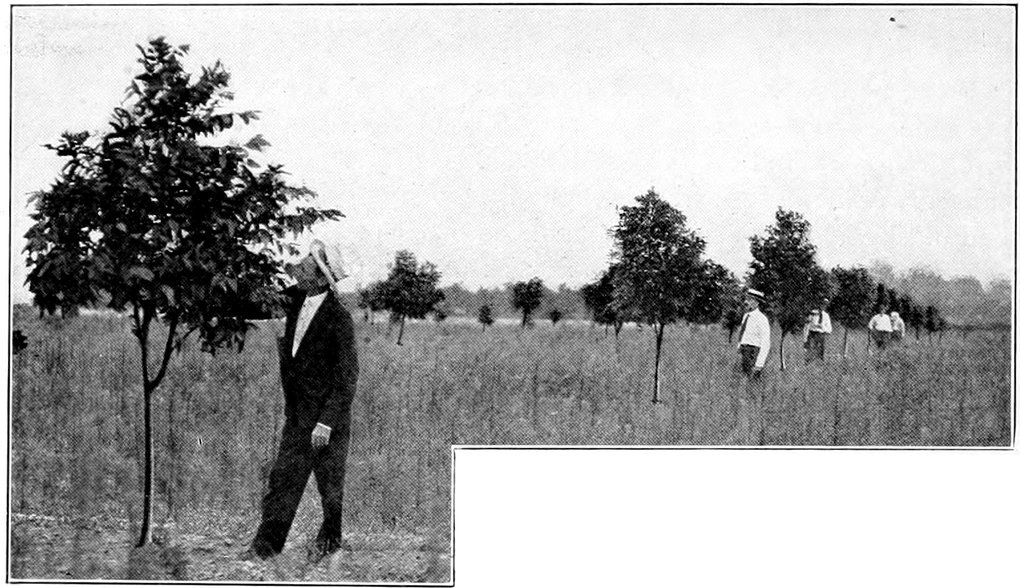
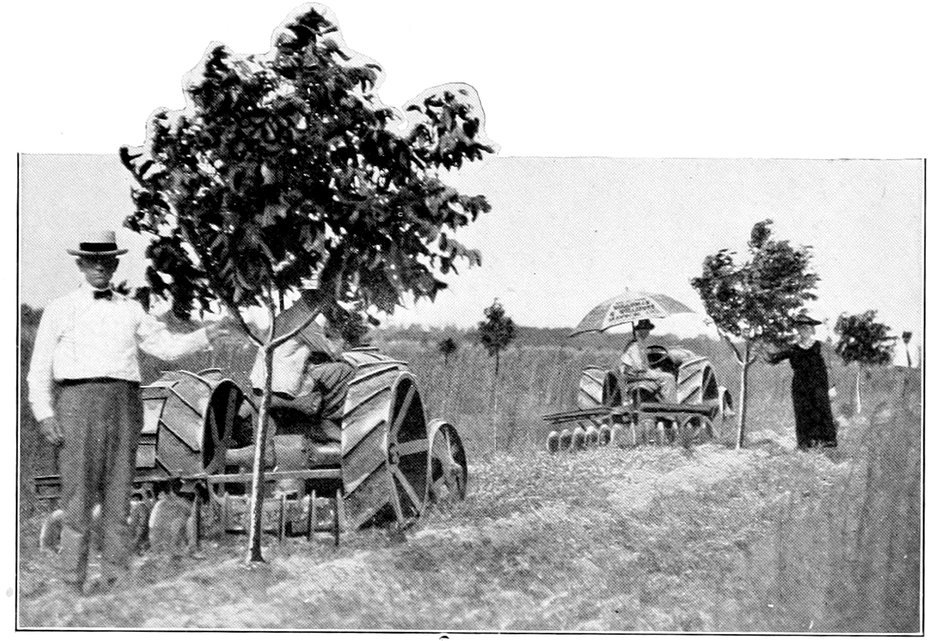
A 3½ YEAR OLD TREE on our plantation, photographed August, 1920. October it bore many clusters of large, fully developed pecan nuts.
Everywhere in America there are large numbers of people,
organized and unorganized, who will not eat the flesh of any animal.
In sanitaria of all sorts there is a tendency to reduce to the minimum
the use of all animal
meat or do away
with it entirely. In one
system of forty sanitaria
there are practically no
drugs used because the
patients are put on a perfected
diet system in
which nuts are substituted
for animal flesh.
At Battle Creek Sanitarium
alone, under Dr.
Kellogg, over 10,000 patients
have adopted the
meatless diet. Nut meat
is largely used there to
replace animal flesh.
Nuts Meet the Demand For Uncooked Foods
30
The most perfect uncooked food
Many physicians who specialize in diseases of the intestinal
tract are advising the use of uncooked foods. Dr. Kellogg, in
his book, Colon Hygiene, sums up one strong argument in
simple, non-technical language when he says on page 223:
“Raw food resists the destructive changes which are produced
by bacteria, while cooked food makes no such resistance.”
Nut meat is practically the only source of both protein and
fat, in large proportions, which it is safe to eat uncooked. This
statement is readily proved by high authority.
In the Congressional Record for January 6, 1917, we read:
“Nuts occupy a unique position in the list of important food
products, in that, with the possible exception of a few other
fruits, in the raw condition they alone afford a fairly complete
and balanced food for human beings.”
The fact that nut importations in 1917 were nearly ten
times as great in value as those in 1900—while the consumption
of animal flesh had failed to even keep pace with the increase in
population—is evidence of increasing public recognition of the
great and varied advantages of nut meat over animal flesh.
Less butter-fat demanded, more nut-fat
Possibly you will find this increase in the consumption of
nut meats even more surprising when you consider that there
was practically twenty per cent. less butter sold from America’s
farms in 1909 than in 1899, according to U. S. census figures.
In other words, the consumption of butter, which is the principal
table article competing with nuts in fatty content, was
falling off to four-fifths during practically the same period while
the consumption of nut meat was increasing so rapidly.
Perfected pecan nuts contain more protein than beefsteak, and
almost as much fat as butter. Isn’t it only natural that people
should want their nourishment and fat in this concentrated form—hermetically
sealed and kept pure by nature? Is there any such
assurance of purity and cleanliness on butter—or on beefsteak?
Place a Hess Brand Paper Shell Pecan on a hat-pin, light
the nut meat and notice that it burns like a candle because it is
seventy per cent. fat.
“At this age (eight to ten years) the best parts of the orchards under the
most favorable conditions and in favorable years will not infrequently produce
from twelve to fifteen pounds per tree. The average number of trees per acre
of the orchards already planted is twenty. Twenty trees per acre, each averaging
twelve pounds, yield two hundred and forty pounds per acre.” Speech of
Congressman Frank Park, Jan. 6, 1917, as reported in the Congressional Record.
Pecans For Sundaes and Candies, Etc. — “A Greater Future Than Any Nut Raised In This Country”
31
The young women of America, who have changed so
largely from soda water and ice cream to nut sundaes, may not
realize that they are getting increased nourishment—but that
is the case. That this is no small element in the consumption of
pecans is evidenced by the fact that one druggist alone uses
1,500 pounds of crushed pecan meat per year for nut sundaes—while
hundreds might probably use as many if the true figures
were known.
The pecan is the concentrated form of nourishment.
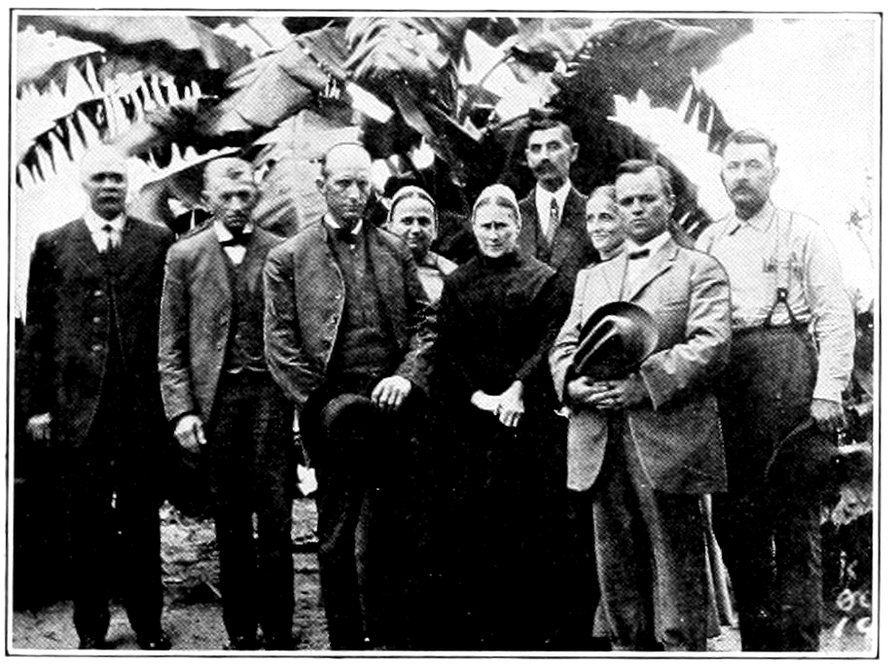
Enos H. Hess, Second Vice President, and some stockholders of the Keystone Pecan Plantation.
Nut candies are in such great demand that the best confectioners
are astonished. But not all nuts are fit for use in
summer. The confectioner who is anxious to produce a quality
product, places his dependence upon the pecan—the finest of
nuts—which nature has furnished in an air-tight shell, which
assures satisfaction the year round. The confectioners of New
Orleans—a hot weather city—long since learned their lesson
and that city is almost as much noted for its pralines—a pecan
nut confection—as
for its
wonderful fete,
the Mardi Gras.
Pralines were
too good to be
confined to New
Orleans alone.
Along the
boardwalk at
Atlantic City
and other
watering places,
and at the finer
confectionery
shops of the
larger cities, they are in good demand. There is no other way to
make acceptable pralines except by using pecan nuts—the finest
pralines require that the nuts be whole, which, in turn, indicates
another need for paper shell pecans.
“It is not many years since these delicious nuts, the Paper Shell Pecans,
were first introduced to the people of the North, and wherever they have gone
they have met with instant and cordial favor. The Paper Shell Pecan has a
greater future than any other nut raised in this country. It is a most delicious
nut.” Geo. K. Holmes, noted authority on agriculture, Washington, D. C.
Maximum Food Values In Condensed Form — From one of the largest nut-tree nurserymen in the world:
32
Greater digestibility
One remarkable fact about the improved paper shell pecan is
that it is at the same time richer in protein and fat than other nuts,
yet is more digestible. People who say, “I cannot eat nuts because
I suffer from indigestion,” are surprised to hear of pecans being prescribed
by physicians—until they try the Paper Shell Pecan themselves
and find that it agrees even with the invalid. Unlike other
nuts which contain less fat—it can be eaten in quantity without salt
without any ill effect. This is probably due to the fact that the improved
pecan contains an oil which seems to possess many of the
lubricating and healing qualities which are found in olive oil.
Convenient, condensed nutriment
The digestibility of pecan fat is an established fact—pecans
are used largely at such scientifically conducted sanitaria as
those at Battle Creek as a substitute for meat and corrective
diet in troublesome cases of intestinal derangement.
Consider the many fortunes made in olive oil—then remember
that even if scientific research should show that pecan oil is
not so beneficial as olive oil, the pecan has many manifest advantages
in its more appetizing form, assurance of cleanliness and
purity, etc., which makes its future promising.
No authority has ever questioned the nutritive value of
the pecan. Even the wild pecan, which is far inferior in nutritive
qualities to the Paper Shell Pecan, has received high recommendation
from eminent authorities. But the fact that this
nutriment was locked up within a hard shell, separated by a
partition so strong and bitter that it was seldom possible to get
out a satisfactory kernel, kept the wild pecan from enjoying the
wide popularity it deserved. The introduction of the improved
seedling and paper shell varieties not only led to an interest in
these improved varieties, but caused such an increased demand
for all pecans that prices rose on even the poorest wild pecans.
But the public found that the best pecans are the cheapest in
the end—and the demand for pecans has increased most rapidly
on these grades from which the largest kernels, containing the
utmost in nutritive value, could most easily be removed whole.
“The demand for pecans of all descriptions is increasing faster than the
supply.... The large pecans that we raise bring from 50 cents per pound
up to $1.25. We do not think that the price will ever drop a great deal, though
a great income can be had even at 25 cents per pound or even lower if trees are
ten or more years of age. If one had $1,000 to invest he would be satisfied
with 7%, which is $70, yet five or six trees will bring in this income. There are
no diseases or insects that are bad on the pecan, nothing like as bad as with the
apple, peach, etc., nothing that is anywhere near ruinous. Pecan trees are
naturally a wild tree and therefore very hardy.”
A Test Which Proves The Best Pecans Cheapest In The End
33
A comparison of equal weights of five grades
A comparison was made of equal weights of the following
grades of pecans:
First, Common wild pecans selling at about 25c per pound.
Second, Common seedling selling at about 30c per pound.
Third, Selected seedling selling at an average price of 40c
per pound.
Fourth, Average Paper Shell Pecans, retailing at an average
price of about 75c per pound.
Fifth, Hess Brand Paper Shell Pecans selling at $1.25 per
pound.
This comparison—on the five points (A-B-C-D-E)
detailed below on this page and on the following page—shows
which gives you the most for your money.
Tested on five counts
A—Before Cracking.—Though size of the nut whole
counts for but little in judging pecans, as compared to the
quantity and quality of the meat within the shell, those making
the test were interested to note that even in the case of
the few paper shell pecans in Class Four which seemed larger
than an average Hess Brand Paper Shell Pecan, these larger
shells were later found to be only partially filled with meat, or
with many kernels shrivelled.
B—Opening Process.—The Hess Brand Paper Shell was
found to open more readily in the hand without nut crackers,
than did the other classes of nuts when nut crackers were used.
When the fragments of shell were compared it was easy to see
why—superior thinness of shell distinguishes Hess Brand Paper
Shell Pecans.
The meat in the Hess Brand Paper Shell Pecans filled the
shells completely, while large air spaces were noted in many
varieties in Class Four.
C—Separating Meat From Shell.—When various lots of
nuts were carefully opened, in separate piles, a careful comparison
was made of the meat and shells in each pile.
“Nature has prepared the soft shell pecan for man’s food by making the
kernel easier both to extract and to digest,” says a well known pecan specialist.
34The number of whole kernels was counted—no other pecan
had four-fifths as many whole kernels as were found among the
Hess Brand Paper Shell Pecans. The common wild pecan and
the common seedling had such hard shells that the meat was
practically all broken to small fragments in opening the shells.
No detailed comparison was necessary between these crumbs
of nut meat, mixed with shell and pith, and the whole kernels
or half kernels of the Hess Brand Paper Shell Pecans.
D—The Pith Test.—In the Hess Brand Paper Shell and in
the Paper Shell Pecans of the Fourth Class there was practically
no pith—the inner partition taking the form of a thin
membrane which was easily removed, instead of the thick, bitter
wall of the two cheaper classes of pecans.
The most meat per dollar from the highest priced nuts
E—The Final Test.—When the nut meat, which was in
appetizing or edible form, was separated from the shells and
partitions in each case, it was found that for table use the Hess
Brand Paper Shell gave the greatest weight of nut meat for
every dollar invested in the nuts, carriage and opening costs
included. The average paper shell variety which costs nearly
as much as the Hess Brand Paper Shell was a poor second,
followed closely by the Third Class (the selected seedlings),
while the two cheap grades were in the end the most costly investment—because
they yielded so small a quantity of satisfactory
nut meat for each dollar invested.
This is also confirmed by many other tests, which show
that even including small particles of nut meat, which are far
from appetizing in form, the wild pecan and the common seedling
yield less than four pounds of meat to each ten pounds of nuts;
the Selected Seedling Pecan and the common Paper Shell about
five pounds of meat to each ten pounds of nuts; and the Hess
Brand Paper Shell Pecan about six and three-quarters pounds
of meat to each ten pounds of nuts.
With such superiority proven for Hess Brand Paper Shell
Pecans, it is no longer a question whether the public will pay
the higher price. It is paying it.
Oskaloosa, Ia., Jan. 8, 1920.
The nuts certainly are life size and look good enough to eat. Every one
who was so fortunate as to get some of the nuts, and they were quite a few,
pronounced them the finest ever. Here is wishing all good things for the
pecan company.
R. S.
More Pecan Orchards—A Vital Necessity
35
Our only problem NOW is to meet the demand for the
highest grade Paper Shell Pecans.
America demands more fine pecans—it is hungry for them.
“Once a pecan eater, always a pecan eater”
Not only because of the superior food value of pecans;
nor only because of their many advantages as the purest, most
condensed of all natural food products, but also because of their
alluring flavor. As Prof. Hutt, Ex-President of the American
Pomological Society, well puts it, “Once a pecan eater, always
a pecan eater.”
Wherever the improved pecan goes—the world over—it
creates its own market.
It is simply marvelous how hungry the world is for these
fine pecans, and it will be hungry for many years to come
because the increase in supply does not keep pace with the
rapidly increasing demand for high quality pecans. The obvious
remedy, therefore, is to produce more fine pecans by planting
more pecan orchards.
Small branches showing how pecan nuts grow.
How Pecan Trees Do Grow
36
on our plantations in South Georgia once
their wonderful root system is established.
Above—C. L. Cudebec, of Denver, Col., and Fred. W. Burger, of Boulder, Col., (right) at a tree planted in 1919 on one of Mr. Burger’s units. Photo six months after planting.
Above—A picture to same scale, of same tree, one year later. The growth in one year is shown by portion of tree above hand of boy (Maurice Forman, of Nogales, Arizona).
Pecan trees on our plantations—3½ years old.
Our Co-operative Profit-Sharing System
37
Like all tree crops of value, pecans do not bear the first
few years after planting. During this period before bearing
begins, the greatest care and attention are necessary—once the
pecan orchard is well established, the trees are hardy as an oak.[1]
1. In the proceedings of the National Nut Growers Association we read of
many pecan trees which have remarkable records for long life and great yields.
It tells of one tree, now 110 years old, which has borne every year for thirty
years, bearing 400 pounds of nuts in a single season. Another is now 75 years
old and has borne every year for forty-one years—largest annual crop being 800
pounds, average crop over 500 pounds per season for thirty years past. Another
property has borne as high as 900 pounds per year and has borne every year
for forty-one years.
Trained specialists and our exceptional equipment on your units
Our co-operative, profit-sharing plan gives your pecan
orchard the benefit of the skill and experience of our trained
horticulturists, and of mechanical facilities which it would be
impossible for the average pecan orchardist to possess.
Our pecan orchard plantations, totaling over 7,300 acres,
are all located near Albany, Georgia, the “hub of the pecan
universe.” The land has been approved by experts of highest
standing as possessing the rare character of soil necessary.
Corroborating these opinions is the fact that we have right
on our property many pecan trees, bearing seedling nuts in
large quantities, despite the fact that they were planted thirty
trees to the acre fifteen and twenty years ago. Now only twenty
Paper Shell Pecan trees are being planted to the acre, because
of their vigorous growth. These trees will undoubtedly increase
in size and in annual yield every year till they are forty years
old—and bear their maximum crop for a century or more.
Twenty Paper Shell Pecan trees of standard varieties on each acre-unit
The Keystone Pecan Company was organized and incorporated
for the purpose of planting its property with Paper Shell Pecans
on a co-operative and profit-sharing basis. That is, of the 7,395
acres, 5,400 acres will be sold to investors, the investor buying as
few or as many acres as he desires. From the beginning the company
has been planting the property to Paper Shell Pecans of standard
varieties, twenty trees to each acre-unit. It cultivates and cares
for the trees and the land for a period of five years from planting
of orchard units, and the charge per acre-unit includes land, clearing,
furnishing trees, planting, cultivating, care, etc. After this
period the company shares with the unit holder in the profits from
the nuts as explained on page 38. Our unit plan is considered by
conservative investors as the safest, most equitable and most profitable
plan to plant our large Pecan Orchard Plantations in the
shortest possible time.
We Sell You The Land, And Establish Your Orchard
38
Under this attractive plan the company agrees to sell to
investors land up to 5,400 acres from its plantations. The
interest of the company and its obligation does not cease with
the sale of the land, for on each acre-unit are planted twenty
pecan trees of the finest standard varieties.
All trees that die replaced without charge
The company further obligates itself to do all the cultivating
necessary—caring for the young trees and the land for a
period of five years from original date of planting orchard units,
replacing at its own expense all trees that die, so that at the end
of that period your orchard will have twenty healthy, thrifty
trees. All this is done without expense to the buyer. The total
net proceeds from any nuts grown during this development
period, will be paid to the Orchard Unit Owner after deducting
12½ per cent. commission for gathering and marketing.
Crops marketed for you
After the five-year development period the Company will,
at the option of the unit owner, enter into an agreement to
operate the property as agent for the unit owner on the most
profitable basis, for such period of time as shall be mutually
agreed upon, fertilizing and farming the land, cultivating and
pruning the trees, as well as gathering and marketing the
pecans, receiving, after the necessary expenses are deducted,
12½% of the profits, 87½% being paid to the Orchard Unit
Owner. Under the co-operative profit-sharing agreement and
plans as outlined there should be enormous profits.
Sold on easy monthly payments
As the expense of developing is distributed over a number
of years, the company has arranged to sell the orchard units
on small monthly payments, thus placing a golden opportunity
within the reach of all investors and giving them a chance to
make their money work as effectively for them as if they themselves
were operating on a large scale.
You own the land
Remember, you become absolute owner of the acre of land
in your orchard unit. The land is cleared, the pecan trees are
planted, cultivated and cared for as a whole on a large scale.
This is co-operation under a system which relieves you of every
worry and which makes for economy and large profits.
“The pecan industry is a husky infant with almost boundless possibilities.
We are building an industry, which, for generations, should yield its bountiful
crop of delicious food and bring millions of dollars to our citizens.” Congressional
Record of United States, page 1478, Vol. 54.
The Practical Answer—The Unit Plan
39
Expert supervision at lower cost than hired help by our plan
There are many people who know of the great successes
made in pecan growing in this district, who would be glad to
buy five, ten or twenty acres of our Pecan Orchard Plantation.
The land in itself would undoubtedly be a good investment,
because cases are on record showing increase of double and
treble value on land which does not have an orchard. But this
would not be of any great advantage in solving the problem of
supplying more of the finest pecans unless the purchaser had
the knowledge, skill and time to bring his trees to the bearing point.
Even assuming that he could himself bring the trees to
bearing, his ability to market his product advantageously could
not possibly equal that of a co-operative group of orchardists,
who have the most skilled supervision service and the advantages
regarding marketing which come from collective effort.
Co-operative marketing assures higher profits
With several carloads to ship instead of a few barrels, the
large orchardist is in a position to command the very lowest
rate and to reach the market in just the right season.
Ask any member of a Citrus Fruit Exchange whether he
has made more money since he joined that organization than
he did before, and he will tell you an interesting story which cannot
fail to convince you of the advantage of collective marketing.
Yet oranges and grape fruit, the products of the members
of these exchanges, are perishable in such a short time that the
benefits derived are small compared with those gained by co-operative
marketing of Paper Shell Pecans.
There are other advantages of collective effort which exceed
even the advantages in marketing. Among them is the
advantage of skilled supervision at minimum cost. The professional
or business man can live in the North, enjoying the income
which his specialized efforts assure, yet be growing his
pecan orchard in the South under the supervision of expert
pecan horticulturists whom he could not possibly afford to
retain for a plantation of less than a thousand acres and with
labor costs reduced to a minimum by such skillful management
and the use of the most modern mechanical appliances such as
tractors, etc.
Live at home raise pecans in Georgia
He need not lose an hour from his regular business to
supervise the gathering and marketing of his crop of pecans.
While he makes money at his own business, his orchard unit
also makes money for him without sacrificing his time.
Our Pecan Orchard Plantations Are Divided Into One-Acre Units
40
Each twenty-tree unit is platted off on the plan of our
property and indicated with an Orchard Unit number.
In each of these units twenty pecan trees are planted.
The purchaser of an Orchard Unit secures absolute ownership
of his land, but each entire plantation is operated as a
whole. This plan has made it possible for us to clear the land,
plant, cultivate and care for the young trees at a fraction of the
cost which would be necessary if the units were operated
separately.
Illustration at left: Upper picture shows James J. Best, Canton, Ohio, photographed June, 1918, at one of the newly planted trees on his 21 acre-units. Picture below shows same tree two years later. Great growth of head and thickening of trunk result from our intensive cultivation.
The cost of land, cost of clearing and cost of setting trees,
etc., is of such magnitude as to be almost prohibitive to any
person developing a small acreage.
Under the Orchard Unit Plan this cost
is reduced owing to the scope of the
undertaking. It is generally conceded
that when you develop orchards in large
tracts of 1,000 acres each or more, the
cost of machinery, equipment, live stock,
management and other essentials—distributed
over the whole area—is therefore
far lower per acre than when
you develop a limited area, such as
five, ten or even fifty acres. A small
orchard managed on a small
scale cannot produce pecans
nearly as economically as if
that small orchard is a Unit
under large plantation management.
The company gains also
by the natural increase in
value of the 2,000 acres of
fertile pecan growing land
which it is holding for itself
under the same conditions
which apply to any unit in
the 5,400 being sold.
SERVICE Which Build Productive Orchards
41
Intensive cultivation by Mechanical Power—Mule
Power—Man Power.
Two of our six tractors at work on one of the 51 acre-units owned by Mrs. C. J. Balliet, Lehighton, Pa., pulling Roderick-Lean 24 disk harrows. Note also on page 43 the mule drawn plows.
The Keystone Pecan Co. has set as its goal the production of pecan orchards second to
none. To achieve this, all work is planned many months ahead of operations, every detail
carefully considered and specifications drawn which cover every phase of the work from
the planning of the tree rows, the planting of the young, dormant, budded, paper shell pecan
trees, to the care and cultivation of these trees throughout the entire development period.
These specifications cover the selection of trees of the standard varieties, the size and quality
of the trees, the methods by which they are dug in the nursery, the size of the hole in which
they are planted and the methods of planting; with especial attention to the character of
the soil placed in the tree holes and the methods of replacing the same. The proper system
of fertilizing when planting and at each subsequent stage is carefully outlined and all other
work is done under the supervision of skilled experts.
Hoe hands augment the tractor and mule cultivation by hoeing around every tree on the plantation at approximate 10–day intervals during the growing season.
The cultivation at the various periods of the year and the various stages of
growth is provided for and carried out with utmost care. The Keystone horticulturists
insist upon intensive cultivation using mechanical, mule and man power,
each in its separate sphere to complete their
carefully planned system. The use of powerful
tractors for plowing and harrowing with
24–disk Roderick-Lean harrows has produced results
which would otherwise be unattainable.
Throughout the growing season a thorough harrowing
at ten-day intervals conserves the moisture,
destroys noxious vegetation and so improves
the condition of the soil that its sturdy,
vigorous growth continues.
At certain stages tractor cultivation is augmented
by mule drawn plows which in alternate
plowings turn the soil to and from the trees.
These are followed by Planet, Jr. Cultivators.
This work is further augmented by hoeing
squads working under thorough supervision (see cut
at right). The result of this intensive cultivation is
growth—quick growth—substantial growth.
One of the Safest Industries—The Profit is O. K.
42
L. J. Cooper, President of the First National Bank of Waycross,
Georgia, clearly states the whole proposition, when he
says: “The pecan industry is in its infancy, but is being developed
very rapidly in this immediate section. It is considered
one of the safest industries in South Georgia, and the profit is
O. K. once you get the trees in good bearing condition.”
Far-sighted business people are investing in pecan orchards
because their investigation proves that the bearing pecan
orchard is “one of the most profitable and permanent of agricultural
investments.” See statement of Luther Burbank, the
Edison of Agriculture on page 19.
Below is a table showing a conservative estimate of the
probable yield of an acre orchard unit in this district. The
figures are not guaranteed, but are to the best of our knowledge
and belief accurate and authentic.
The first column in this table refers to the number of years
from planting in the orchard units.
Per tree, based on average records of varieties developed
Average yield per tree, nuts at 40c. a lb
Average income per tree
Income per unit
4th year
a few nuts.
5th year
2 to
3 lbs.
2½
lbs.
$1.00
$20.00
6th year
4 to
5 lbs.
4½
lbs.
1.80
36.00
7th year
7 to
9 lbs.
8
lbs.
3.20
64.00
8th year
10 to
12 lbs.
11
lbs.
4.40
88.00
9th year
18 to
25 lbs.
21
lbs.
8.40
168.00
10th year
37 to
50 lbs.
43⅓
lbs.
17.33
346.60
15th year
100 to
150 lbs.
125
lbs.
50.00
1,000.00
20th year
150 to
300 lbs.
225
lbs.
90.00
1,800.00
43
44J. R. Pinson, near our Mitchell Co. plantation, reports 685 pounds from 246
trees, an average of 2.8 pounds per tree, in the fifth year.
R. P. Jackson makes affidavit to a yield of 1,056 pounds the fifth year from
his 259 pecan trees, or an average of 4¼ pounds per tree.
The Monticello Board of Trade, Monticello, Florida, directs attention to 95
trees of finest paper shell pecans owned by H. C. White, at Putney, Georgia,
which bore 380 pounds of nuts in the sixth year.
J. A. Kernodle reports 17 pounds per tree the sixth year from a group
of trees.
J. R. Pinson reports a yield of 2,450 pounds from a 13–acre orchard in its
seventh year, average of 190 pounds per acre, or 9½ pounds per tree.
B. W. Stone, Ex-President of the National Nut Growers’ Association, reports
a yield of 1,300 pounds from 3 acres the eighth year, which figures over
20 pounds average per tree.
I. P. Delmas reports a yield of 9,750 pounds of pecans from his 325 trees
in the ninth year, an average of 30 pounds per tree.
T. S. McManus reports 165 pounds of nuts from one tree the tenth year.
He states that he can show average yields of 50 to 75 pounds at ten years.
Theo. Bechtel, President of the National Nut Growers’ Association, reports
a yield of 100 pounds in the 10th year and of 185 pounds in the 13th year.
A 3½ year old tree on our plantations on which 44 nuts were counted by the men in the picture, A. S. Perry, Secretary of the National Nut Growers Association, Thos. F. Miller, Allentown, Pa., Prof. W. S. Hafer, Womelsdorf, Pa., and by Frank R. Ritter, Fleetwood, Pa. The nuts, being still small and practically the same color as the foliage, cannot be seen in the photograph.
B. W. Stone, in his
book, “The Pecan
Business,” tells of one
tree which in its
seventh, eighth and
ninth year bore an
aggregate of 200
pounds of nuts. The
same tree bore 106
pounds in its tenth
year.
I. P. Delmas reports
a yield of 235
pounds of pecans
from a tree thirteen
years old.
John D. Gunn reports
a yield of 268
pounds in a single
season from one of
his paper shell pecan
trees.
3½ Years’ Growth
45
Henry E. Morton, President
of the Morton Mfg.
Co., large manufacturers of
heavy machinery, Muskegon
Heights, Michigan, standing
beside a 3½ year old tree on
one of the 45 units which he
owns on our plantations.
Note on page 49 Mr. Morton’s
statement that these
strong-trunked, heavy-headed
trees exceeded his
expectations. Note also his
comment on the benefits of
our Medium Height Pruning
System in producing
large spreading heads with
a great increase in the
number of nut bearing
branches.
Picture below shows our Field Secretary at a 3½ year old tree which by its sturdy trunk and spreading head shows the advantages of our thorough cultivation and Medium Height Pruning System.
“I firmly believe that commercial
pecan growing is one
of the most promising horticultural
possibilities of the
South. There is now a greater
demand for all kinds of nuts
than ever before, a demand
that our growers will not be
able to catch up with for
years. The pecan is undoubtedly
the finest, most nutritious
and most delicious of nuts.
The world must get her supplies
of pecans from us (in
the southern section of the
United States) and as yet we
do not begin to supply the
local demands, to say nothing
of producing for export.”
W. N. Hutt, Ex-President,
American Pomological Society,
Ex-President, National Nut
Growers Association.
Our Figures are Intentionally Conservative — An Increase in Value of $100 per Year per Acre
46
In recent years the selling price of pecans at the orchard has
been more than double the price used in our table. No one can
tell how much higher pecan prices may go. On Patrician Pecans—introduced
by us in the 1920 season—we have found an exceedingly
large demand at $1.50 for a 12–oz. box, which is at the rate
of $2.00 a pound, and have received many strong commendations
from purchasers. These de luxe pecans have been sold into all sections
of the United States—including such southern states as Mississippi,
Florida, Texas, etc.—and into Canada, Alaska, France and
other foreign countries; not in the 12–oz. package only, but also in
10–lb. cartons and barrel lots.
We are intentionally conservative. We want the investor in
our twenty-tree orchard units to be agreeably surprised that the
yield is greater and the price secured per pound higher than our
table shows. Our interests and those of the investor are identical—selling
an orchard at the low price shown on the application
blank (page 71) benefits us little unless the return secured from
the gathering and sale of nuts is satisfactory.
“For the person who is willing to wait a few years there is no
more profitable investment than a grove of pecans,” says J. B.
Wight, Pecan Nurseryman and Grove Owner.
Under our co-operative plan the investment is reduced to the
minimum during the waiting years. As shown by application blank
at rear of this book we offer an acre-unit planted with twenty pecan
trees of standard varieties on an easy deferred payment plan.
From the moment you put down your first payment, the contract
of sale protects you—in the opportunity to reap profits from
the constantly increasing yields of pecans when the trees begin to
bear, and in the opportunity to gain by the $100 a year increase in
value of your acre-unit. For the most authentic information shows
that each acre pecan orchard unit increases in value each year at the
rate of at least $100.
Figure it out for yourself—carefully and conservatively.
Though the price now being secured for the nuts is far higher than
the price used in the table on page 42, we would rather that you
base your comparisons on the figures in that conservative table.
The case is strong enough on that basis.
Mr. E. B. Adams, formerly Secretary of the Albany, Ga., Chamber of Commerce,
writes: “Each season the pecan groves enhance in value, it being agreed
by eminent pecan authorities that properly cared for pecan groves increase $100
an acre in value each year.”
This is an investment where your principal increases and your income gets
larger as the years roll by.
Why Do We Sell Orchard Units?
47
We can answer that in a few words.
To raise money to establish more pecan orchards.
We must have more finest grade paper shell pecans to meet the
increasing demand. America demands more. When this market is supplied—which
date seems generations distant—there are limitless opportunities
open for export business.
The pecan is a food in demand all year around, yet the constantly
increasing supply is exhausted in a few months.
No ordinary increase of plantings would meet the need. Our Co-operative
Profit-Sharing Plan is the most direct, most effective solution
of the problem.
The opportunity is enormous. To make right use of that opportunity
requires large planning and large plantings. We have now four
thousand acres of pecan trees planted and growing on our plantations—to
establish these, fertilize, cultivate and care for them until bearing
would involve an outlay so prodigious that it is good policy for our company
to welcome the co-operation of a limited number of unit owners,
assuring maximum efficiency on all our acreage at a minimum expense
for planting, care, cultivation, gathering crop, marketing nuts, etc.
In one of our 3½ year old orchards, showing sturdy trunks and heavy heads.
Our Investors Are Found All Over The World
48
A 3½ YEAR OLD TREE on our plantation. Observe the massive trunk, the sturdy limbs, the great spread of nut bearing branches.
Far-sighted people, who,
after thorough investigation,
have invested in
Pecan Orchard Units
under our co-operative
plan, are found in every
section of the United
States and Canada, and
also in many foreign countries,
such as Mexico, New
Zealand, Australia, the
British Isles, South Africa,
India, etc.
You will find them from Sanford,
Maine, on the East, to Oakland
and Lompoc, California, on
the West; from Miami, Florida,
and El Paso, Texas, on the South,
to points as far North as Alaska.
In New York, Boston, Philadelphia,
Baltimore, Washington, Atlanta
and Columbus, Georgia;
Pittsburgh, Toledo, Detroit, Chicago,
St. Louis, Jacksonville, New
Orleans and other large cities you
will find those who are providing
for the future by putting their
money in Keystone Pecan Orchard
Units.
Investigations on the grounds prove our statements conservative
The strongest believers in our co-operative orchard proposition
are keen business people, with ability to get at the facts, who have
visited the plantations themselves, and have seen for themselves our
bearing pecan orchards, our nursery, our planted units, their intensive
care and cultivation. On their return many have bought
additional units—or recommended the investment to their friends.
The progress made is so evident that it convinces all who see it.
We are glad to have you visit the plantations
Prospective investors and owners of orchard units are welcome
any time at the plantations in order that they may see for themselves
just what progress has been made and is being made. It is necessary
that we shall have undisputed control of the orchard during the first
five years—the period when closest cultivation is required—in order
that we may make good on our guarantee and turn over to you a
successful orchard at the end of that period. But we shall be glad
to have you establish a bungalow or cottage on the ground at any
time afterward.
A few typical letters from unit owners who have visited the
plantation are found on the following pages.
Finds His 45–Acre Orchard Better Than He Expected — Your Extra Efforts Lead to Bigger Results Says Unit Owner From the Klondike — “Our Interests Are in Safe Hands,” Says Rev. George W. Lutz, Unit Owner. — Well Pleased, Want Entire Block for My Family, Writes California Physician and Food Expert — Buying 10 More Units—A Good Investment
49
Sturdy main branches, resulting from our Keystone System of Pruning.
Writes Prominent Manufacturer of Muskegon Heights, Mich.
Muskegon Heights, Mich.,
July 15, 1920.
Keystone Pecan Company,
Manheim, Pa.
Gentlemen:
Ever since 1917, when I purchased my
45–acre pecan orchard from you, I have
been wanting to go to see it, and several
times had all arrangements made, but unforeseen
events arising suddenly in my
business prevented my going until now.
Of course, I satisfied myself before
buying that an investment in your pecan
orchards is sound and profitable, and I received
your reports from time to time
showing progress, so that I knew my trees
were receiving the best of care and were
growing nicely, and yet naturally I wanted
to see them. I am happy to say that my
orchards were fully as good as reported—the
thrifty, strong-trunked, heavy-headed
trees are in many respects better than I expected.
Your Medium Height Pruning System
has produced wonderful trees. They are developing
thick, strong trunks and branches,
and large, symmetrical heavy heads. Your
thorough cultivation, with tractors, mules,
and hoeing around the trees by hand, on
every part of the plantation, keeps the soil in
the best possible condition to promote growth.
The growth already made shows that your methods produce unusual results.
The foundation idea underlying all your plans seems to be service, and as a manufacturer
of many years experience selling to many of the largest concerns in this and other
countries, I have learned that service and the application of the Golden Rule are the foundation
of all success. All businesses and all persons are measured by the service they render.
My visit to your plantations has shown me that your Company places service always
foremost, and that you stand for a square deal. In cultivation and pruning and in every
way the trees are treated as individuals and each tree receives individual attention. When
the thirty-five hundred acres now planted will have passed through the development years,
the Keystone Pecan Groves will be a place of beauty and will be a perennial source of
profit to the owners of the units.
I have also visited your offices at Manheim on various occasions, and have found the
equipment and organization there fully as complete and as efficient as that on the plantations.
I have met several of the directors of the company, all of whom stand high in their
communities, and are known as men of honor and ability. Mr. Elam G. Hess, the president
of the Company, I have found to be a man of integrity and uprightness in his dealings, who
has demonstrated exceptional ability in building up an organization which renders expert
and conscientious service to the unit owners.
In my travels I have investigated the pecan market and its possible future. I have tried
to buy Paper Shell Pecans in the different cities from Kansas City and Minneapolis, East
as far as Boston, but find it is possible to get them during only a few months of the year.
The orchards now planted will be able to supply only a small fraction of the demand already
existing for these pecans, and with your marketing facilities reaching to all parts of the
civilized world, the opportunities in this field are unlimited.
Yours very truly,
HENRY E. MORTON.
50
April 21, 1920.
By the time I am back in Dawson, I will have travelled 11,000 miles to visit the Keystone
Pecan Plantations. Long as this trip is, what I saw there well repaid me for the effort.
Throughout this district (around Albany) I made inquiry regarding the Keystone Pecan
Orchards and heard that your orchards were noted not only for their large size but also for
the extra care and cultivation given the trees. The advantage of these high scientific standards
and thorough supervision are apparent all over the property. I was pleased to see
over a hundred thousand pounds of ground bone meal being put around the trees to fertilize
them. It is such extra effort that leads to biggest results.
A. E. Pretty, Dawson, Yukon Territory.
Pennsburg, Pa., June 26, 1919.
Your plantation is large—very large. The soil is real pecan soil. When I saw thousands
upon thousands of pecan trees—budded and large bearing trees—in the same kind of soil,
on all sides, I no longer asked myself the question whether my units were of soil on which
the pecan would grow into a productive and profitable orchard. When I saw the kind of
trees you planted—thick-stemmed and healthy trees, and the splendid care given them as
regards cultivation and scientific pruning, I was still better satisfied.
But I am convinced, now that I saw it all, that soil, climate, moisture and virile trees,
necessary as these are, they are not the whole thing in producing a thrifty pecan orchard.
These factors mixed with brains grow the pecan. I congratulate your company, first of all,
upon the fact that you have a real executive in your energetic President. Mr. Elam G. Hess.
It is this master mind that has planned so wisely and soundly for the future. Every unit
holder with whom I have talked has the fullest confidence in his integrity and ability. In
my opinion, therefore, the affairs of your company and the interests of the unit owners are
absolutely safe in his hands.
Finally, permit me to congratulate you upon your and our good fortune in securing the
services of Mr. William P. Bullard as Horticulturist. Mr. Bullard is without a doubt the
best-posted pecan man in the country today. He is not a theorist but very practical. A visit
to his well-kept bearing orchard and nurseries was a most delightful one. I am absolutely
confident that what Mr. Bullard has already done in his own orchard he can accomplish
for you and all unit owners—grow a productive and profitable pecan orchard in the shortest
possible time.
(Rev.) Geo. W. Lutz.
238 E. 46th St., Los Angeles, Calif., July 6, 1920.
As a food the pecan stands second to no other natural product. During the twenty
years in which I have studied food values—and throughout my years of practice as a physician—I
have noted the great need for this pure, fresh, easily digested nut as a source of
fat and protein.
My visit to my pecan orchards this week showed me that conditions on your plantations
are highly satisfactory. Your work in preparation and planting had been most thoroughly
done, and the remarkably thrifty condition of the trees shows that they have established
good root systems. The wonderful progress made by your trees shows the advantage of
your thorough cultivation and scientific pruning. This should mean bigger yields—and
bigger profits.
I am well pleased with all I have seen. Please let me know by return mail whether you
can give me the entire block on which my units are located for our own immediate family.
A. Robt. Hauter.
Fleetwood, Pa., July 14, 1920.
Ritter Hosiery Company.
As I went carefully over your entire pecan plantations during the past week, I have
studied with special care the growth made by the trees which are now 1½, 2½ and 3½ years
old, for I have orchards of all three of these ages. The growth made by them shows that
your methods are right, and I know that your thorough care in cultivation and fertilizing
brings about even greater progress for the future. Your methods of pruning my older trees
have produced exceptionally sturdy trunks, and heads which show a three-fold increase of
nut bearing branches.
I am perfectly satisfied with the progress you are making and the fact that I have just
bought ten additional units is proof that I consider the investment a good one.
Frank R. Ritter.
An Ideal Southern Home — Where Winter Does Not Consume What the Summer Produces — Office of the Clerk, District Court, Boulder County, Col.
51
Practically every thoughtful man looks forward to the time when he
may have a home where the winter rigors of the Northern climate shall
not sap his vitality. No one need apologize for this longing—or consider
it a sign of lack of vigor or backbone.
For the tendency toward establishing a home in the South is not
based alone on this desire for an agreeable, equable climate. It is founded
on sound economic principles.
In the North, the winter consumes the food which the summer produces.
In the fertile sections of Southern Georgia a succession of crops,
properly planned, makes the whole year productive.
Vegetation is so rapid that in a few years a home is surrounded by a
growth of trees, shrubbery and growing crops.
Government statistics show a surprisingly slight variation between
Winter and Summer in Southern Georgia. Here there is no enervating
humidity compared to that found in the Northern and Central Atlantic
States.
The home of our Assistant Horticulturist—shaded by the big bearing pecan trees.
Here is the ideal home—“Where
the sun shines bright and the
meadow’s in bloom”—where good
fishing and hunting abound—where
the call of the
“Bob White” is heard
from September to
March—where the
52outdoor life is the natural, healthful
life the year round.
A plantation house of the Keystone Pecan Company on its Calhoun County Orchard Plantation. From left to right: Elam G. Hess, President of the Company; M. G. Esbenshade, Secretary and Treasurer; and Thos. F. Miller, Sales Manager.
Here, with the fine southern town
of Albany only a short distance away,
with fine roads extending roundabout
in all directions, you may live on a
typical plantation. While Nature,
soil and sun combine to produce
profitable crops on the pecan trees
which have been turned over to you
a thrifty orchard, you may fish, boat
or swim on the beautiful Lake Marcelia—a
twenty-five acre lake right on
your plantation.
We expect eventually to erect a
club house or hotel on the banks of
the lake, where unit owners may be
accommodated should they wish to
spend their vacation here hunting and
fishing.
When you live amid such surroundings
you really live. The country all
about is so attractive that many a man in the North would be glad to pay
$650 or $750 for an acre on which to build a southern home. If he planted
on that acre only enough pecan trees to yield an average income of $45
per year, he would have six per cent. interest from his money. One tree
should yield more than $30 per year, on an average, from the tenth to
the twentieth year from planting. Why be satisfied with a single tree
when there is room for twenty trees and a small bungalow on your acre?
Boulder, Colorado, June 26, 1919.
I have lived many years in Colorado and have been in close contact with
the agricultural development of the west. I have long believed that Walnut
growing in California was one big opportunity. During the past two weeks I
have visited your plantation in Georgia and have travelled over it from end to
end. Since that visit I am more thoroughly convinced than ever that you have
the finest nut growing proposition in this country.
The wonderful way in which I found the trees growing on the ten orchard
units which I had previously bought has led me to purchase more units, and I
expect to buy still more later.
You have the soil, the climate and the organization to produce successful
pecan groves.
Fred. W. Burger.
Investigate The Company And Its Management — “The Supply Will Never Equal The Demand” — ELAM G. HESS — L. B. Coddington — Enos H. Hess — Willis G. Kendig — M. G. Esbenshade — B. L. Johnson — Joseph Seitz — Thomas F. Miller — A. S. Perry, Field Secretary, Keystone Pecan Co.
53
Because the most conservative statement of yield from our
pecan units sounds too good to be true, we have found that it
was necessary to urge prospective purchasers to investigate
every phase of the company.
For this reason, the men who have invested most largely are
always the men most capable of getting at the real facts—and acting
on their own knowledge—manufacturers, merchants, bankers,
lawyers, physicians, dentists, salesmen, accountants, teachers, preachers,
farmers and others of the most intelligent classes are becoming
owners of orchard units because their investigation has shown:
Why your investment is secure
First. That the Company is financially strong—a $215,000
corporation, which received its charter in 1911 from the
Superior Court of Georgia. Subsequent to the incorporation,
the Company purchased what its officers believed to be the
finest plantation in Calhoun County for the growth and development
of Paper Shell Pecans. The plantation with recent additions,
all located around Albany, Georgia, totals nearly 7,400
acres of land, which has been or is to be planted to pecans.
From the date of the purchase the Company has expended large
sums of money annually upon the development of the property
and each passing year sees a greater expenditure upon property
development and permanent property improvement. Latest
approved methods are sought and applied; and notwithstanding
all this the Calhoun County Plantation is subject to a lien of
only twenty-seven thousand dollars, the Dougherty County
Plantation to only five thousand dollars, the Mitchell County
Property to only ten thousand dollars. For the purpose of
safeguarding the unit owners a special trustee was appointed
whose duty it is to see that the company’s receipts from orchard
sales are appropriated to the development of the orchards sold,
the planting of new orchards and the reduction of the lien until
the same shall have been extinguished entirely. This result will
be achieved before the Company shall have conveyed one-half
of its orchards—a unique record among modern business concerns.
The Trustee plan was specially devised for the protection
of Unit buyers, and we know of no Company that has devised a
safer plan. It is the result of the most careful consideration given
in the interest of the unit buyer. When you are safe, we are safe also.
The books of the Keystone Pecan Co. are audited quarterly
by Certified Public Accountants, Vollum, Fernley & Vollum,
of Philadelphia, New York and Chicago.
54Second. That the orchards are under capable supervision.
The active officers of the Company were close students of pecan
growing for years previous to 1911.
Realizing the fact that the making of profits depends in
part on the skill of the orchardist, the Company has employed
educated, practical horticulturists who have large pecan groves of
their own, where they earned reputations as orchardists that secured
them highest recommendations of well known authorities. The
fact that such men accepted positions with the Keystone Pecan
Company is a tribute to the possibilities of these plantations.
For resident plantation managers they chose pecan men of
excellent reputation, who had demonstrated exceptional ability
in handling the problem in all its phases.
Third. That the Company has the character of soil, the
kind of budded trees, and the shipping facilities needed to fill
the demand for better grade pecans which comes from all over
America and abroad. The immediate district in which our
plantations are located is the natural home of the pecan. We
have an excellent warehouse site on the Central of Georgia Railroad,
at Bermuda Station, a passenger station and warehouse
on the Dougherty County Plantation, and all portions of our
plantations are favorably located for shipping.
Fourth. The Company has demonstrated also that its
management is capable and efficient. Every one is interested
heartily in the success of the orchards. All are men of unquestioned
honor and ability; as inquiry in their home cities will prove. They
are, as the following pages show, men old enough and experienced
enough to capably manage the business, yet young enough to retain
their business capacity and vigor for many years to come.
Fifth. That a marketing organization has been developed
which has successfully sold paper shell pecans all over the
world, and that the demand for these superior pecans far exceeds
the supply.
From the former President of the Albany, Ga., Chamber of Commerce,
J. A. Davis, we hear: “The strongest evidence of my belief in the future of this
wonderful development is that I have just planted a grove of one hundred acres.
I know of no agricultural or horticultural industry which, with proper attention,
holds promise of returns half so large as the pecan in Southwest Georgia.
Both our soil and our climate are peculiarly adapted for the production of the
finest nuts in most abundant yield. These nuts are the size and quality which
make them absolutely the finest nut on the market. They will always command
a fancy price because the supply will never equal the demand.”
55
ELAM G. HESS
President of the Keystone Pecan Company
and Pennsylvania State Vice President of the
National Nut Grower’s Association, is a resident
of Manheim, Lancaster Co., Pa., and is
well and favorably known, not only throughout
Lancaster County, but in many parts of
America. Mr. Hess, who is forty-three years
of age, worked on his father’s farm in Lancaster
County until he was eighteen years of age. He
taught public school for five years, prepared for
college at Perkiomen Seminary, graduating in
1902, and in 1906 graduated from Gettysburg
College. He had acted as a traveling salesman
during his summer vacations for Underwood &
Underwood, New York, and had built such a
reputation for fair dealing among the best class
of trade that he was appointed field manager,
along with Mr. Thomas F. Miller. After serving
in this capacity for two years, he was sent
to England to represent the same company.
In his travels he was impressed with the opportunities
which existed for finer grade pecan
nuts, and began to make an exhaustive study of
their production and their selling possibilities—one
result of which has been the formation of
the Keystone Pecan Company.
Mr. Hess devotes his entire time to the success of the Company, and is an acknowledged
authority on pecan nuts, their growth and their marketing.
Reference: Keystone National Bank, Manheim, Pa.
L. B. CODDINGTON
First Vice President of the Keystone Pecan Company
is a resident of Murray Hill, New Jersey, where
he has been successfully engaged in the Wholesale
Rose Growing Industry for twenty-four
years. The cut flowers from his greenhouses
are sold wholesale in New York City and Brooklyn
and nearby towns. He is well known as one
of the largest rose growers in the United States.
Second Vice President of the Keystone Pecan
Company
lives on the farm on which he was reared—R.
F. D. No. 3, Lancaster, Pa. He is 50 years
of age. He is noted as a truck farmer, selling
his own products to Lancaster City consumers
at famous Lancaster Markets, which he attends
twice a week.
Formerly a director of the Ideal Cocoa
Company, Lititz, Pa.
Reference: Farmers Trust Co., Lancaster,
Pa.
Director of the Keystone Pecan Company, and
Corporation Counsel
is the well known corporation lawyer of Lancaster.
He is widely known as a lawyer of
keen discrimination regarding commercial enterprises,
and the fact that he and so many
associates from the richest agricultural county in the United States place their money in this
Georgia pecan orchard is evidence of its worth. Mr. Kendig is 45 years of age; the son of
a doctor of Salunga, Pa., who also enjoyed a most excellent reputation in his field.
Reference: Fulton National Bank, Lancaster, Pa.
M. G. ESBENSHADE
Secretary and Treasurer of the Keystone Pecan
Company
lives on the farm in Lancaster Co. on which
he spent his boyhood days. (R. F. D. No. 3.)
He is noted throughout the county and beyond
as a successful grower of tobacco. He
is 45 years of age, a graduate of Lancaster
Business College, a director of the Farmers’
Association of Lancaster County, one of the
founders of the Agricultural Trust Co. of
Lancaster, of which he is a director.
In his extensive travels throughout the
United States he has visited nearly every
State. Mr. Esbenshade has received valuable
first hand information on the growing
and marketing of large food crops—especially
nuts. In 1895 he traveled widely in Florida,
paying special attention to orange and citrus
fruit groves and pineapple fields, and in 1897
he worked with the large growers of wheat in
Dakota and California and in the apple orchards
of Colorado. In 1905 he made another
trip south, studying the groves along the Gulf
Coast in which wild and seedling pecans were
raised, since which time he has made several trips throughout the South with special reference
to Paper Shell Pecans.
Reference: The Agricultural Trust Company of Lancaster, Pa.
57
B. L. JOHNSON
Director of the Keystone Pecan Company
resides at Allentown, Pa., and has been Sales
Manager for that district—embracing important
counties in Pennsylvania and New Jersey—for
the Burroughs Adding Machine Company,
a $16,500,000 corporation, which is known
all over the world. Mr. Johnson is known
throughout the Allentown district as a self-made
man, who has, at an early age, held positions
of trust and responsibility because of his
earnest and efficient work and his remarkable
business judgment.
Reference: Penn Counties Trust Co.
JOSEPH SEITZ
Director of the Keystone Pecan Company
is a native of Lancaster Co., residing at Mountville,
Pa., formerly a farmer, now a dealer in
leaf tobacco.
Reference: Northern National Bank of
Lancaster, Pa.
From a commercial standpoint the pecan is by far the most important of native nuts.
Its smooth shell, attractive appearance, abundant production, plump kernels, which are
usually extracted with ease, and high quality are largely accountable for its popularity.
Page 23, Bulletin 160, U. S. Dept. of Agriculture.
58
THOS. F. MILLER
Sales Manager of the Keystone Pecan Company
is 46 years of age. A graduate of State Normal School
and also of Lebanon Valley College, and taught public
school three years. He has had long, successful experience
in selling, and was sixteen years in the employ
of Underwood & Underwood, and was associated with
Elam G. Hess, President of the Company, as Field
Manager, appointing and drilling hundreds of successful
salesmen for their Travel System. He resides in
Allentown, Pa.; member of the Chamber of Commerce,
of Allentown, and is favorably known as a man of high
ability and good reputation.
Reference: Merchants National Bank.
A. S. PERRY
Field Secretary of the Keystone Pecan Company, and Secretary of the National Nut Growers Association.
A. S. Perry, Field Secretary of the Keystone Pecan Company, is not only one of the
best known pecan experts in America, but is also thoroughly in touch with the best pecan
land in Southwest Georgia, of which he is a native.
For practically a hundred years his family has lived
or owned land in Calhoun County—his grandfather’s
farm being only ten miles from our Calhoun
County Plantation.
Was educated at the Southwest Georgia Agricultural
and Military College (a branch of the State
University) and also at Emory University. In addition
to his general and agricultural education, he
studied law and was admitted to practice in all
courts of Georgia—specializing in Commercial Law.
Has had much practical experience in pecan
growing—orchards near Cuthbert, established by
Mr. Perry, are recognized as of such high grade
that his services have been in great demand for
establishing new orchards, top working old seedling
orchards to paper shell pecans and similar expert
horticultural work. In addition to the National Nut
Growers’ Association, of which he has been elected
secretary for the fourth successive term, he is a
member of the Georgia-Florida Pecan Growers’ Association,
Georgia Horticultural Society and Alabama
Horticultural Society, and is in demand as a
speaker on pecan culture before these organizations.
Reference: Georgia Bank and Trust Co., Cuthbert,
Georgia.
Our Vice President and Sales Manager Have Both Added to Their Holdings on Our Plantation During the Past Year — Why Mr. Coddington, Vice President of the Keystone Pecan Company, Bought More Units — Why Mr. Miller, Our Sales Manager, Bought Seven Additional Units
59
Read Their Letters Below
Murray Hill, N. J., Oct. 1st, 1919.
My Dear Mr. Hess:
After spending last Saturday and Monday inspecting the entire plantation, I am highly
pleased with the progress made since my last inspection.
The trees of this year’s planting have taken hold in a remarkable fashion—the growth
made since last March is so wonderful that it is hard to believe.
The trees of the preceding year’s plantings look well, but the greatest surprise of all
was the earlier plantings. The trees in Block 1 A, for instance, prove the advantages of the
Keystone Medium Height Pruning System. In many cases they have made five to six feet
growth since they were pruned last Spring—and the thickening of the trunks and all the
branches proves that those trees will be well able to carry heavy heads and bear large crops
of pecans.
In the old bearing orchard the foliage was of the same healthy deep green color noted
all over the plantation. But the best proof of their vigor was the fact that on many of
these trees all the branches were loaded down with big nuts, nearly ripe.
After a lifetime contact with growing things, I am so well pleased with the conditions
on the plantation that I have, as you know, purchased additional units.
L. B. Coddington.
968 Jackson St., Allentown, Pa., Dec. 29, 1919.
Dear Mr. Hess:
In May, 1915, I wrote you that my interest in this new industry and my ambition to
some day own a pecan orchard dates back before the Keystone Pecan Co. was in existence.
My study of this improved nut, its food value, the whole world to supply, its advantage over
other tree crops, in harvesting, packing, shipping, not perishable, beside the long life of the
trees and the small expense of up-keep after the fifth year, and the wonderful yield satisfied
me that it was the safest and most profitable industry I know.
When you conceived and formed the Keystone Pecan Company with its co-operative
plan, I saw my opportunity, and invested and purchased Units. Having been in business with
you for so many years and knowing your capacity to plan big business and your ability to
carry your plans to perfection, also the other members of the Company being known as clean,
honest and progressive business men, gave me entire confidence. When you wanted me to
become sales manager, I decided to visit the plantation. In company with some of my
friends, I made my first visit. We were delighted, beyond expression, with everything.
Competent management seemed to be working out a perfect system.
Now, after nearly five years of continual work with you in selling the Keystone Pecan
Orchard units, I want to compliment you more strongly than ever on the way you have
planned and are making good. The progress has been beyond our most sanguine expectations.
Each year I have visited the plantation from one to three times accompanied in every
case by Unit Owners. My friends have always been well pleased with what they saw on
their orchards, but the marked progress the past year, under your expert plantation organization,
is such as to fire every Unit Owner with the desire to own more units, fertilized,
pruned, cultivated and cared for under your system.
A total of over 200 additional units have been purchased during the past year by unit
owners who have visited the plantation with me. Many of these purchased their first units
two, three, or four years ago, before visiting the orchards. This is the strongest evidence
that the conditions on the plantation must be right. I was glad I could add seven more units
to my own number during the past year, and hope to further increase my holdings. I can
see now why Mr. William P. Bullard, your horticulturist, expressed surprise that the Company
was selling these units at so low a figure.
Thos. F. Miller.
60
WM. P. BULLARD, Executive Horticulturist Keystone Pecan Company. Former Secretary of the National Nut Growers’ Association.
William P. Bullard, Horticulturist on our Calhoun County Plantations
Of William P. Bullard, the American
Nut Journal of Rochester, N. Y., said:
“He is a grower of many years’ active practical
experience, and is familiar with all the
problems of production and selling from
the growers’ standpoint.”
Mr. Bullard is widely known as a
careful, conservative man, who emphasizes
the importance of thorough cultivation
and fertilizing during the first five
years, in order to establish orchards that
will produce beyond the average. The
favorable reputation of this large company
and its well known desire to produce
superior orchards for its unit
owners, naturally draws to it experts of
big calibre and broad experience. (See
letter of Rev. Lutz, page 50.)
Reference: Georgia National Bank, Albany, Ga.
On these Calhoun County Plantations, we have as resident horticulturists
and orchard managers, W. J. Moran and G. W. West, practical
pecan men of long experience, and with the proven ability to produce
orchards up to the highest standards. Mr. Moran has been in pecan
orcharding since boyhood, having been first associated with the Simpson
Nursery Co. and later having developed one of the finest orchards in the
district; Mr. West is an excellent manager of large bodies of farm labor,
with long experience in pecan tree cultivation.
The pruning of the older trees and the budding of the seedling trees
in the nursery is all done by O. C. Starks, pruning expert, or under his
supervision.
Our Dougherty Co. Organization — R. C. Simpson — C. A. Simpson
61
R. C. SIMPSON, President of Simpson Nursery Company.
R. C. Simpson, President of the Simpson Nursery
Company of Monticello, Florida, and C. A.
Simpson, Secretary and Treasurer of that Company,
are both horticulturists of the highest reputation.
They are pecan growers of recognized ability,
and this plantation shows the advantages of their
thorough skilled supervision.
R. C. Simpson, President of the Simpson Nursery
Co., is now 38 years old. Born at Vincennes,
Indiana, where both his grandfather and father were
leading nurserymen. Graduated from Vincennes
University in 1901 and from Cornell University in
1905. While in college he pursued the study of
Agriculture, specializing in horticulture, and in 1905
was granted the degree of Bachelor of Science in
Horticulture by Cornell University, one of the most
advanced agricultural institutions in America.
Went South in 1906 to pursue his practical work
in pecan culture and established the nurseries of
which he is now the head. His fourteen years of
practical experience in pecan growing in the South,
backed by his long preliminary training have made
him one of the most successful men in America in
his line.
Bank Reference: Bank of Monticello, Monticello,
Florida.
C. A. SIMPSON, Secretary and Treasurer of Simpson Nursery Company, First Vice President National Nut Growers’ Association.
C. A. Simpson, Vice President, National Nut
Growers’ Association, and Secretary and Treasurer
of the Simpson Nursery Company, was born at
Vincennes, Indiana, 1876—is 45 years old. Graduated
from Vincennes University in 1895, and from
Purdue University in 1898.
Has had business experience in engineering department
of large telephone manufacturing company,
and was Assistant to Chief Engineer, when he
went South in 1911 to become his brother’s partner
in the Simpson Nursery Co.
He has had wide experience and is widely
known for his skill in propagating pecan trees and
developing pecan groves.
Bank Reference: Bank of Monticello, Monticello,
Florida.
Our Mitchell County Organization — J. B. Miller, of Baconton, Ga. — J. R. Miller, of Baconton, Ga.
62
whose supervision extends over our Mitchell County Plantation,
is a successful pecan grower and business man known
throughout this district. He was born in this section, 45 years
ago and has had lifelong contact with agriculture of all types
in this district. He is among the pioneers in the pecan business,
having developed successful orchards and a fine pecan nursery.
He is, in addition, well known as a manufacturer of Naval
Stores, and dealer in general merchandise, and is connected
with a leading banking institution of Baconton.
Mr. Miller is a younger brother of Mr. J. B. Miller and has
been associated with him in the handling of his farm interests
and the development of his pecan nursery and orchard. He is
an able business man, 40 years of age. He has acquired a reputation
around this district as being one of the most practical
farmers and pecan horticulturists and is particularly well versed
in field practise and in the supervision of cultivation.
Assistant to the Miller brothers in the cultivation of these
orchards is Mr. Dukes, who has had many years of experience
in the care and development of pecan orchards and is in addition
noted as one of the best experts in South Georgia, in the
mechanical cultivation of the tree rows.
Our Lee County Organization — Alexander Pope Vason — James P. Champion
63
ALEXANDER POPE VASON
Alexander Pope Vason is one of the foremost
business men of Albany, Georgia, being president of
the Fowltown Farms Company, and of the Albany
Warehouse Company; Vice President of the Citizens’
First National Bank of Albany; Director of the
Albany Trust Company, and a member of the Albany
Board of Aldermen, Board of Education, etc.
He is above all a practical horticulturist and farmer,
having been the pioneer in the peach growing industry
in South Georgia. While a graduate of the
University of Georgia, it is as a practical man, able
to get the best results from his farm labor, that he
is most noted.
JAMES P. CHAMPION
James P. Champion, one of the leading business
men of Albany, Georgia. He has been identified
all his life with agricultural development in
this district, having risen to the position of Manager,
Secretary and Treasurer of the Albany Warehouse
Company, manufacturers of fertilizer, and
large cotton factors, because of his rare foresight in
regard to farming and horticulture throughout the
surrounding district. Was associated in first successful
peach orchard in this district, the Vason and
Champion Peach Orchard; is Secretary and Treasurer
of the Fowltown Farms Company. Has served
as Director of the Albany Chamber of Commerce,
Chairman of Liberty Loan Committee of County in
3rd, 4th, and 5th drives. Director of Exchange
Bank of Albany, Georgia.
Our Lee County Organization — Alva W. Barrett — C. C. McKnight of Senoia, Georgia — Robert Craig Berckmans
64
ALVA W. BARRETT
Alva W. Barrett was born in North Carolina
and lived in Florida in his early days. In 1910 became
connected with the Albany Grocery Company,
of Albany, Georgia, following which date he made
most careful study of farms and farming throughout
the district, handling up to 1917 a large amount
of farm real estate. In 1917 he organized the Consolidated
Motor Company, which has become under
his management the leading automobile business of
Southwest Georgia, continuing his farm development
all the while.
He is the owner of the large, successful farms
immediately adjoining our Lee County property, and
is also a most substantial business man.
He has served as a director of the Albany National
Bank and is now director of the Georgia Bank
and Trust Company.
C. C. McKNIGHT
C. C. McKnight of Senoia, Georgia, is known,
not only as one of the largest land owners in his
country, but also as a practical farmer and business
man. He is 41 years old, was born in Georgia, and
has for twenty-one years been known as a large
dealer in mules, wagons, farm implements and supplies
of which his practical farming experience makes
him a keen judge. For fifteen years he has been
active in the Farmers and Merchants Bank of
Senoia, and has been Vice President since 1910—during
which time deposits have increased nine fold.
He is also Vice President of the Newnan Bank and
Trust Company of Newnan, Georgia, which has a
capital stock of one-half million dollars.
65
R. C. BERCKMANS, who has an international reputation as an authority on horticulture and nut growing.
Horticulturist and Fruit Grower
Member of the P. J. Berckmans
Company (Nurserymen), Augusta,
Georgia, 1883–1917, when above business
was sold by him and his brother. Nurseries
were established by his father in
1856—he is of the third generation that
has followed this profession.
He established the famous Berckmans
Bros.’ Farm and Peach Orchards,
at Mayfield, Georgia, some twenty years
ago, the products of which are known on
all Eastern and Western markets.
He has been identified with some of the largest developments in the
South in horticultural lines, and is known to all horticulturists and nurserymen
of the United States and many foreign countries.
Was President Georgia State Horticultural Society for the past ten
years, succeeding his father, who was President for 34 years and the only
President that the Society had ever had up to his death.
President, American Association of Nurserymen for two years.
President, Southern Association of Nurserymen.
President, Ornamental Growers’ Association of America.
Vice President, American Pomological Society.
Member Georgia State Board of Entomology for past ten years and
just re-appointed for the next six years.
Member of many horticultural societies in Europe.
Has traveled extensively in foreign countries, studying horticultural
conditions with the view of applying these to conditions here in America
when practical.
Member Executive Committee, National Nut Growers’ Association.
Author of many articles on horticulture.
No Investment Can Be Safer — England Likes Hess Pecans
66
Think it over. Let your own judgment decide. Ask yourself
these questions in regard to any investment under consideration.
What is the security back of my investment? In the Keystone
Pecan Co. there is an acre of land which becomes yours
on the payment of price shown on page 71. Remember this—you
own the acre of land itself.
Productive land—yielding needed food of highest value
Land is the safeguard of this safe investment. Land cannot
burn up, cannot be stolen; land cannot be wiped out by
panics. The biggest trusts base their bond issues and their
mortgages on land—yet the manufacturing plants which are
built on that land may, due to panic, fail to produce enough to
pay interest on the bonds or mortgages. Many of the largest
industrial companies have suspended or decreased dividends
since the European War ended, yet nature continues to provide
foodstuffs and man still needs to eat them.
Productive land is the best of land investments. Tree
crops are the profitable crops, which make land most productive.
Note on page 37 that a leading farm paper tells of single pecan trees
making more human food than a whole acre of Kentucky blue grass.
A 3½ YEAR OLD TREE ON OUR PLANTATIONS
In Gardening, Illustrated,
a prominent
weekly published in
London, England, we
read: “The shells of
the Hess Brand Paper
Shell Pecans are
thin and easily broken
and the body of the
nut in this variety is
larger, fuller and better
flavored than is
usual with pecans.
The pecan may rightly
be regarded as a
food of very highest
value. It contains 70
per cent. of fat. Its
texture is delicate,
and it can be digested
easily. * * * The demand
for the Paper
Shell Pecan is constantly
increasing and
is well in front of
the supply.”
67The pecan is the surest of profitable crops—because after
the first five years, during which we assume all the risks, the
pecan is among the hardiest of trees. Gathering the nuts and
selling them represents the bulk of the effort required after that.
You cannot be deceived on this score—the plan on page 38
shows that our interests are mutual. Would we deceive ourselves—could
we afford to take any chances if we did not know
that the pecan is as hardy a tree as the hickory or oak, and a
surer profit payer than any other crop of any sort?
We could not have such assurance on a fruit tree—for
every farmer knows that apples and peaches are subject to
many perils of frost, storm, blight, borer, and of loss in shipment.
Pecans are hardier than hickory nuts, they cannot be
shaken off the tree till ripe. Citrus fruits—like oranges and grape
fruit—are liable to frost, and spoil so quickly that it is impossible to
hold them long before marketing. Paper Shell Pecans can be held
a year without losing their delicious flavor and nutritive value; for
nature has provided them with a perfect container (shell) which
shuts out impurities and prevents deterioration.
There can be no glut of fine pecans—because they can be
raised only in limited territory, they have the whole world for
a market and the whole year for a selling season. As the famous
Luther Burbank well says (see page 26): “We have now one
pecan where we ought to have a million to create a market.”
An assured increasing market for perfected pecans, at an
excellent profit, is back of every dollar you invest here.
Who Should Invest In Keystone Pecan Orchards?
The young man
The young man. To provide an income for later years.
“He must,” says the American Fruit and Nut Journal, “look
to a business that will increase in value and returns. The improved
pecan orchard fulfills all these requirements. It is safe,
pays little at the beginning, but increases its income gradually,
and when ten or fifteen years old will yield ten times more than
the same money would in any other business.”
In Health Culture, for December, 1915, we read: “There is but a small territory
in the United States in which soil conditions and climate are right for
pecans. Of the half million budded pecan trees in the world nearly half are in
Calhoun and Dougherty Counties, Georgia. Sufficient is known of the yield
to claim that this half of the budded trees has produced far more than one-half
of the crop.”
“The chief interest in the pecan centers in its high food value for mankind.
The flavor is greatly in its favor; also the pecan surpasses all others in
the percentage of fat, the comparison being made with walnuts, peanuts, filberts,
almonds, and cocoanuts.”
Who Should Invest In Keystone Pecan Orchards?
68
The man of middle age and above
To provide now while his earning power is at its greatest,
for those years when his energy begins to ebb—let him plant his
money where it grows. As J. B. Wight said before the American
Pomological Society: “Plant a pecan grove, and when you
are old, it will support you.... It will lighten your burdens
while here, and when you are gone your children and your children’s
children will rise up and call you blessed.”
Husbands and parents
To provide an annuity for their wives and families, which
will exceed in annual return any equal investment for the purpose
and which will yield a growing income each year. No
father wants to look forward and see the home broken up for
lack of income, the wife deprived of comfort and the children
deprived of education—because he put off till the morrow,
which never comes, this investment for their protection.
Business and professional people—all men and women with foresight
Business and professional incomes vary greatly. There
should be some provision for the years of reduced earning
power—when conditions beyond your control cut into a mere
fraction the satisfactory income of last year. Because pecan
orchards have their foundation in land, because Nature yields
her crops abundantly despite wars and panics, because the
demand for Paper Shell Pecans was not affected by the hard
times in the winter of 1914–15, you know that here is a dependable
source of income. The period of uncertainty on pecans is
the first five years—when we assume the risk!
“For want and age save while you may,
No morning sun shines the whole day.”
says Ben Franklin. Are you saving for the “rainy day”?
Ask yourself that question—and insist on a fair answer.
Accept no excuses—excuses will not provide for you and
your loved ones in years to come.
Don’t say, “I’ll begin to invest when I get a larger income.”
If your income were reduced a tenth today—you
would manage to live on the balance. Put that tenth now where
it will protect you against “the slings and arrows of outrageous
fortune.”
Orchard Unit Applications Are Enclosed For Your Convenience
Select Which You May Desire, Full Cash Payment Or Deferred Payments
Keystone Pecan Company
Plantations in Calhoun, Dougherty, Lee and
Mitchell Counties, contiguous to Albany, Georgia
Northern Office
Woolworth Building, Lancaster, Pa.
President’s Office
Manheim, Lancaster County, Pa.
Please Mail all Applications and Checks to Keystone Pecan Company, Manheim, Lancaster County, Pennsylvania
Units Full Paid in Case of Death
69
If any unit holder, who is paying for his unit on
the monthly payment plan, and who has made all his
payments promptly on the dates called for by contract,
should die after twelve monthly payments, in addition
to the initial payment, and all subsequent payments
having become due up to the time of his death have
been paid, but before his entire contract price of $650
has been paid in full, the company will, upon satisfactory
proof of death (suicide excepted), furnish to his
beneficiary a deed to his unit or units and all further
payments on same shall cease. This protects the family
or estate of the unit holder who meets his monthly
payments promptly against all possibility of loss due
to his death. The right to change the beneficiary is
reserved to the unit holder, provided he notifies the
Company in writing.
In case of my death please make deed to
——————————————————————————-
(Here insert name of beneficiary)
——————————————————————————-
(Signature of purchaser)
$10 Down Per Unit, $10 Per Month — The Pecan Tree—Nature’s Most Powerful Food Producer
70
A discount of ten per cent. for full cash payment
Each Orchard Unit will be sold under the following conditions:
$10 down when application is made for the Orchard Unit, and $10
per month per Unit until it is paid in full. No interest is charged
on deferred payments. Should one prefer to pay full cash for
one’s Orchard Unit, a discount of ten per cent. will be allowed on
the amount of cash paid, and the deed will be delivered at once.
Upon receipt of an application, together with the first payment,
an Orchard contract will be prepared and executed and
forwarded. Upon the completion of the payments, the deed
will be delivered.
Remember that the price quoted covers every expense of
the five-year development period.
A home site on your units
The contract of sale shows that the purchaser may, after
the five-year development period is over, locate his home on his
units and look after his own trees, managing his property entirely
independent of the company. But we believe that our management
and our method of marketing will prove so economical, efficient and
satisfactory that the unit owners will always want the company
to manage their units and harvest and market their pecans for
them.
Units full paid in case of death
If any unit owner, who is paying for his unit on the
monthly payment plan, and who has made all his payments
promptly on the dates called for by the contract, should die
after twelve monthly payments in addition to the initial payment,
and all subsequent payments having become due up to
the time of his death have been paid, but before his entire contract
price has been paid in full, the company will upon satisfactory
proof of death furnish to his heirs a deed to his unit or
units and all further payments on the same shall cease. This
plan protects the family or estate of the unit holder who meets
his monthly payments promptly against all possibility of loss due
to his death.
A leading farm paper, in an article on pecans, published the following, “The
nut is nutritious, very nutritious, and we already have numerous instances of
one good big tree making more human food than the best acre of blue grass in
all Kentucky. Plainly, the tree-nut method beats the grass-meat method of
feeding men. Tree crops are to be the agriculture of the future.”
71
In natural colors from photograph of Lake Marcelia, taken week of June 16, 1919. Note on the large live oak tree at right the beautiful red flowered trumpet vine which wends its way among the glossy green ferns, and further out on the branches the beautiful grayish Spanish moss which stands out so vividly against the luxuriant evergreen leaves of this tree. Mr. Cudabec, orchard unit owner from Denver, Colorado, seated at end of boat, is holding up a fine black bass, measuring a foot in length, which he caught after he rowed but a few rods from the firm, sandy beach which surrounds this lake.
TRANSCRIBER’S NOTES
Silently corrected typographical errors and variations in spelling.
Archaic, non-standard, and uncertain spellings retained as printed.