PAPER AND PAPER MAKING,
ANCIENT AND MODERN.
Introduction—Language—Origin of the Art of Writing—Various
modes of recording events which preceded it—Materials upon which
Men first Wrote—Stones, Bricks, Metals, Skins and Intestines of
Animals, Tablets, Leaves, Bark, etc., etc.—The Egyptian Papyrus, from
which Paper (so called) was first made—Process of Manufacture—Usual
dimensions and extreme durability of Papyri—Modern Paper—Its
general advantages to mankind—Supposed period of its Invention—The
Introduction of Paper-making into Europe—Historical incidents
connected therewith—James Whatman—The superiority of his manufacture—Adoption
of the Fourdrinier-Machine—General advantages of
Machinery over the Original Process, etc., etc.
Amongst the numerous and diversified objects
of human investigation and research, it would,
perhaps, be difficult to single out one, more curious
and interesting, than that of the medium which
bears the symbols of language; which retains
the register of circumstances and events of past
ages, and which hands down to us the transactions
of primeval time, with its intervening periods.
Undoubtedly the noblest acquisition of mankind,
perhaps the greatest advantage which we
possess, is that of the faculty of speech. Without
speech, man, in the midst of crowds, would be
solitary. The endearments of friendship, and the
communications of wisdom, alike would become
unavailing; man, in fact, without speech, could
hardly be accounted a rational being.
That the use of speech or language was given
to Adam immediately upon his formation, we
have no reason to doubt; for from the testimony
of Moses it appears, that he not only gave names
to every living creature, “to every beast of the
field, and to every fowl of the air,” as they were
brought to him, but that also as soon as Eve was
made he could say—“This is now bone of my
bone, and flesh of my flesh,” the first sentence
which is recorded of his uttering, and which is
sufficient to show, that even then, he possessed a
competent stock of words to declare the ideas or
conceptions of his mind.
Thus was man at once rendered as superior to
the brute creation, as in after times by the aid of
writing, or the art of drawing those ideas into
vision, he was especially distinguished from the
condition of uncivilized savages. For of all
the arts that contribute to the comfort and
happiness of mankind, no one, perhaps, is more
intimately connected with our social habits, or
more closely entwined with the best and purest
feelings of our nature, than that of writing.
And yet to conceive or to account for the origin
of an art so invaluable in its tendency to elevate
and improve mankind, as that of exhibiting to
sight the various conceptions of the mind, which
have no corporeal forms, by means of hieroglyphics
or legible characters, is still as difficult
and perplexing, as in past ages it has ever proved
to the sagacity of mankind. With the poet of
old we have yet to enquire—
“Whence did the wondrous mystic art arise,
Of painting speech, and speaking to the eyes?
That we by tracing magic lines are taught
How to embody, and to colour thought.”
Notwithstanding the great and manifold blessings
which men have received from this
curious and wonderful invention, it is very
remarkable, as a distinguished writer observes,
that writing, which gives a sort of immortality
to all other things, should, by the disposal
of Divine Providence, be without any trace
of the memory of its first founders. Indeed, the
invention of letters and their various combinations
in forming words, amounting, it is computed,
to 620,448,401,733,239,439,360,000, without repeating
any combination capable of being made
from so small a number of letters as that now comprising
our alphabet, has something so extremely
ingenious and surprising in its application, that
most men who have treated the subject, can
hardly forbear attributing it to a divine original.
Many have conceived that the theatre of this
important legacy to man was Mount Sinai. But
it is observable, that previously to the arrival
of the Israelites at Mount Sinai, Scripture makes
mention of writing as an art already understood
by Moses: “And the Lord said unto Moses, write
this for a memorial.” (Exodus, 17th ch. 14th v.)
Now, Moses seems to have expressed no difficulty
of comprehension when he received this command,
nor does anything appear to induce the
slightest doubt; on the contrary, I think we may
safely conclude that Moses was even then well
acquainted with the art of writing, or otherwise
he would have been instructed by God, as in the
case of Noah, when he was required to build the
Ark. And further, we find that Moses wrote all
the words, and all the judgments of the Lord,
contained in the twenty-first and two following
chapters of the Book of Exodus, before the two
written tables of stone were even so much as
promised. The delivery of the tables is not
mentioned till the 18th verse of the 31st chapter,
after God had made an end of communing with
him upon the mount. Nevertheless, I am not
prepared to dispute the probability of a divine
origin to so wonderful a medium, any more than I
am disposed to question the possibility of its
resulting merely from what Aristotle terms the
Faculty of Imitation; for which, says he, men are
so remarkable, even in an uncivilized state. I
pass by all questions of the kind, satisfied for the
present with the simple fact, that such medium
does exist; that through it we become, as it were,
introduced to the multitudinous throng of a world’s
tenantry, while we thus learn their words, works,
and ways, their History, Literature, and Arts,
their Science, and Theology; and while even the
mummy, recovered from the subterranean recesses
of the Egyptian pyramids, may still be
said to talk with us, by virtue of the roll of
papyrus and its pictured inscription which he
holds in his hand;
Writing’s art, which like a sovereign queen,
Amongst her subject sciences is seen;
As she in dignity the rest transcends,
So far her power of good, and harm extends.
In the earliest ages of mankind, very simple
means were necessarily adopted, to preserve the
remembrance of any important event. During
many centuries, tradition, perhaps solely, served to
represent that, which in recent times has been more
completely effected by the introduction of printing.
At other periods we find trees were planted,
heaps of stones, altars or pillars, as we read in
sacred history, were erected; and even games and
festivals ordered, to keep up the recollection of important
facts. Since, however, the art of writing
was invented (be the period when it may), various
materials have from time to time been made use
of, for the purpose of transmitting to posterity
the discoveries and deeds of their ancestors. Thus,
for instance, the most ancient remains of writing
which have been handed down to us, are upon
hard substances, such as bricks, stones, and
metals, which were used by the ancients for all
matters of public notoriety; abundant proofs of
which we have in the recent discoveries of Mr.
Layard. And Josephus, in the third chapter of
the first book of Jewish Antiquities, tells us:
that, “the descendants of Seth, leading a happy
and quiet life, found out by study and observation
the motions and distribution, or order, of
the heavenly bodies; and, that their discoveries
might not be lost to men (knowing that the
destruction of the world had been foretold by
Adam, which should be once by fire, and once by
water,) they made two pillars—one of brick, and
the other of stone, and wrote or engraved their
discoveries thereon; so that if the rains should
destroy that of brick, the other of stone might
continue to show mankind their observations.”
In the sacred text we are further informed,
that great stones were directed to be set up by
the children of Israel, after the passage of the
Jordan, and being “plastered with plaster,”—which
appears to have been a very common
practice—“thereon were to be written all the
words of the law very plainly.” In the book
of Job, which some suppose to have been
written by Moses, we have an obscure intimation
of the method employed in registering upon
the rock, “graven with an iron pen and lead
in the rock for ever.” But, although there is
apparently a want of clearness in our translation
of the passage, by no means does it affect the idea
of Job’s desire to give the greatest possible permanence
to the words he then uttered. He
exclaims, “Oh that my words were now written,”
or, (though probably not an exact translation,)
“Oh that they were printed in a book;” and
more (he adds) “that they were even graven with
an iron pen and lead in the rock for ever;” which
latter clause some take to be in reference to the
leaden tablets which are found to have been in
very early use. But I rather favour the interpretation,
for which I am indebted, to my much
esteemed friend the Rev. Dr. Croly; that as a
still more indelible and effectual mode of perpetuating
his thoughts, it was Job’s conception
that his words should be graven in the rock with
an iron pen, or tool, and the interstices afterwards
filled with lead, in order that the contrast
occasioned thereby might render them the more
readily intelligible to those who happened to
travel that way.
Herodotus also mentions a letter engraven on
plates of stone, which Themistocles, the Athenian
general, sent to the Ionians, about five hundred
years before the birth of Christ. Lead, however,
and similar metals being less difficult to write
upon, and more simple and convenient, afterwards
superseded to a great extent the use of such
unwieldy substances as bricks and stone. And
subsequently we find others of a still more pliable
texture employed, such as the skins of animals,
bark, wood, and the leaves of trees. Solomon,
for instance, in the Book of Proverbs, in allusion
to the practice of writing upon thin slices of wood,
advises his son to write his precepts upon the
tables of his heart. And the prophet Habakkuk
was commanded to write a vision and make it
plain upon tables, that he may run that readeth
it. Solomon, as you are aware, lived a thousand
years, and Habakkuk about six hundred and twenty
six, before the Christian era. At a later period,
Zacharias, the father of John the Baptist, when
enquired of as to what he would have his child
called, asked, we are told, for “a writing table,
and wrote, saying, his name is John.” Amongst
the Romans, it was customary for the public
affairs of every year to be committed to writing
by the high priest, and published on a table;
such tables being exposed to view, either in their
market-places or temples, in order that the people
might have an opportunity of becoming acquainted
with their contents.
At an early period in their history, both Greeks
and Romans appear to have commonly used either
those plain wooden boards, or boards covered
with wax. It is probable, that at first the tables
were written upon just as they were planed,
and that the overlaying them with wax was an
improvement on that invention. A very decided
advantage being thus obtained, in the facility
afforded for erasing any inaccuracies that might
have occurred, and consequently of correcting
the manuscript. The practice of writing upon
tablets of one kind or another, appears not
to have been entirely laid aside, until the commencement
of the fourteenth century; and, indeed,
even in our day, tablet books of ivory are
occasionally used, for writing upon with black lead
pencils.
The use of boards was in some measure superseded
by that of the leaves of palm, olive, poplar,
and other trees. And, although in Europe, all
these disappeared upon the introduction of the
papyrus and parchments, in some countries the
use of them remains even to this day. Perhaps
a record of this old custom may still be found in
the word leaf, which we continue to apply to
sheets of paper, when sewed up into the form of
a book. According to the account of Pliny, the
Egyptians were the first to use the palm leaf, and
books written on it are still preserved in the
East India Museum, as also in the Library of the
British Museum.
The mode of preparation, after cutting into
strips of the length and width required, is
simply to soak them for a short time in boiling
water, after which they are rubbed backwards
and forwards over a smooth piece of wood to
make them pliable, and then carefully dried.
The letters or characters being written or rather
engraved thereon with an iron style, which, piercing
the outside covering, makes indelible letters;
and by afterwards rubbing the writing over with
some dark coloured substance, such as soot or
charcoal, the parts etched or scratched, have
greater relief imparted to them: and the writing
is more easily read.
Notwithstanding many paper mills have been
erected in India, the natives, I understand, frequently
prefer this method, not only for the
ordinary purposes of correspondence and accounts,
but even in some quarters for government documents
of importance.
I must here express my sense of the kind assistance
which has on several occasions been
afforded me by the Rev. Benjamin Bailey, late of
Cottyam, Allepie, Madras, who has not only given
to the world a translation in Malayalim of the
entire Bible, but has also compiled two voluminous
dictionaries, for rendering assistance in the study
of that language. This gentleman has recently
afforded me an opportunity of inspecting many
great curiosities of the kind: indeed, before me is
now lying a very neat little specimen written in
Malayalim by him (St. Paul’s Second Epistle to
Timothy), which shows, in a remarkable degree,
the astonishing distinctness which may be produced
by this singular mode of writing.
The style with which the letters are engraven
upon the leaf is usually worn in the
girdle as a prominent ornament of dress. The
case which protects it containing also a small
knife, employed in preparing the slips, and
likewise a little instrument which is used for
piercing the leaves, in order that cords may be
passed through them for the purpose of securing
the manuscript, as may be seen in the instance
of various documents both in the East India
Company’s Museum, and also in the Library of
the British Museum.
A work which I possess, termed the Kammavakyam,
written in the Pali language, in Burmese
character, upon palm leaf, is thus secured between
very handsome covers. It is a Catechism
of Sacred Rites, used by the Buddhist priesthood
in the examination of a candidate for admission
to that order. A translation of it here,
however, would be no more consistent in point of
matter contained, than it would be in reference
to the subject I am treating. Its character and
language throughout are truly humiliating to
human nature.
In the British Museum there are many very
singular documents of the kind, one in particular,
which is written upon 390 leaves, bound, as it were,
in a frame of gilt copper in the form of a tortoise,
screws being passed through the strips instead
of cords, the fastenings, with some addition, representing
the limbs of the animal. And in the East
India Museum may be seen a smaller one, protected
by stout wooden covers, which has been
carved to represent some animal, apparently
a pig. The custom of writing upon leaves of
trees, appears to have given rise to the adoption
also of the interior bark; the outer being seldom
made use of, in consequence of its extreme
coarseness. When employed, it is customarily
folded over, to admit of its being written upon
both sides. The only documents of this kind,
which have come under my notice, have been
Batta manuscripts, from the island of Sumatra.
Before the art of making paper was known to
the Chinese, they appear to have cut pieces of
silk to such sizes as they wished to make their
books, and thereupon painted the letters with
pencils; the silk being first steeped in a kind of
size, to prevent the colour from running. But
such material being liable to decay, various
animal substances were afterwards employed,
as being of a more durable nature. Of course
the skins were principally used, after being
tanned; but their bones, and even entrails, were
also made use of for the like purpose. Thus, in
the “History of Mahomet,” we read that the
Arabians used the shoulder bones of sheep, on
which they carved remarkable events with a knife,
when, after tying them with a string, they hung
those chronicles up in their cabinets. And in the
library of Ptolemy Philadelphus, which is said to
have contained 700,000 volumes, were the works
of Homer, written in golden letters, on the skins
of serpents. I might mention, that the term
volume here, should not be understood in the sense
which it is now customary to receive it, but
in its derivation from the Latin; signifying
simply a roll, which was the most ancient form of
book.
Parchment, or the skins of beasts, dressed and
prepared in a manner rendering them fit for
writing upon, appears to have been employed at
a very early period. Diodorus Siculus informs
us, that the Persians of old wrote all their records
on skins; and Herodotus also alludes to sheep
skins, and goat skins, as in general use among
the Ionians about 440 years before the Christian
Era. The word Parchment is a corruption of the
Latin Pergamena, from Pergamus, which some
allege to have been the place of its invention.
But it is very probable that in the time of
Eumenes, who was king of Pergamus, (about 200
years before Christ,) the circumstance of increased
consumption merely occasioned the discovery
of a better method of dressing the skins;
from which fact alone, and perhaps with sufficient
reason, the origin of the present term was derived.
Eumenes, about that period, appears to have endeavoured
to form a library at Pergamus, which
should surpass that of Ptolemy Philadelphus at
Alexandria, and in so doing enraged Ptolemy to
that degree, that he immediately prohibited any
further exportation from Egypt, of the papyrus
which by that time was coming into very general
use, and thus effectually put a stop to Eumenes’
emulation in that particular. It may be, however,
that this prohibition was not solely occasioned
by jealousy, but by Ptolemy’s fearing that his
dominions, which were so much improved in arts,
sciences, and civilization, since the discovery and
adoption of the papyrus, (of which we shall presently
speak), would be again reduced to a state of
ignorance for want of it; the plant sometimes
failing in unfavourable weather, while the supply
invariably proved unequal to the demand. The
people of Pergamus, therefore, were obliged to
devise other means, and the improved manufacture
of parchment would seem to have been the
result. But, that Eumenes on this occasion invented
the art of making parchment is exceedingly
dubious; for in the books of Isaiah, Jeremiah,
Ezekiel, and other parts of Scripture, we find
mention made of rolls of writing: in all probability
rolls of parchment.
The manner of reading such rolls may be
gathered from a passage extracted from Hartley’s
“Travels in Greece,” which serves also to elucidate
the peculiar scriptural expression of their
being “written within and without.” You began,
(says he) to read by unfolding, and you continued
to read and to unfold, till, at last, you arrived at
the stick to which the roll was attached; then
you turned the parchment round, and continued
to read on the other side of the roll,
folding it gradually up until you completed
the writing, thus were they “written within and
without.”
Papyrus, from which the term paper was
derived, is the name of a celebrated plant,
once extensively used by the Egyptians for
making various articles of utility, such as baskets,
shoes, cordage, and the like. Some writers
state that of this plant the little ark was made,
in which the parents of Moses exposed him upon
the banks of the Nile, and of this it was that the
most ancient paper was manufactured. Not as
would now be customary, by first reducing it to a
pulp, nor, indeed, in any way as resembling modern
paper, except that in both, vegetable fibre is
the basis. That a plant once so useful, and for ages
in Egypt so commercially valuable, should have
totally disappeared, being altogether unknown to
modern botanists, appears scarcely credible; yet
so it is. For the ancient descriptions of the
papyrus, as a flag or bulrush, with a triangular
stem that could barely be spanned, and which
grew to the height of ten feet, or even considerably
more, in the immense marshes occupying a
large part of the surface of lower Egypt; a
leafless wood, as it were, or as one writer describes
it, a forest without branches, the bare stem being
surmounted only by a head of long, thin, straight
fibres, is certainly quite irreconcilable with the
nature of the plant which now bears that name,
and of which one of the stoutest growth has been
very kindly furnished me by Sir W. J. Hooker,
from the Royal Gardens at Kew.
In the prophecy of Isaiah a very remarkable
prediction occurs with reference to this plant.
“The paper reeds by the brooks, by the mouth of
the brooks, and everything sown by the brooks,
shall wither, be driven away, and be no more.”
Doubtless, we may believe that this prophecy
has literally received its fulfilment.
With reference to the mode in which the paper
was manufactured from this plant, two distinct
opinions have been handed down to us. One, that
the epidermis being removed, the spongy part was
cut into thin slices, which were steeped in the
waters of the Nile, or in water slightly imbued
with gum; after which two layers were placed one
above another, carefully arranged in contrary directions,
that is, lengthwise and breadthwise,
which, after being dried, were finally smoothed
and brought to a fit surface for receiving writing,
by being rubbed with a tooth or piece of polished
ivory.
Another method said to have been adopted
in preparing this material, was simply that
of separating the thin concentric coats, or
pellicles of the plant which surrounded the
stock, by means of a needle or pointed shell (on
an average about twenty from each stalk), and
afterwards extending them longitudinally side by
side on a table, a similar layer being placed
across them at right angles; in which state they
were moistened with water, and while wet put
under pressure, being afterwards exposed to the
rays of the sun, and finally polished as in the
former case, with some hard substance, such as
a tooth or shell, not merely for the purpose of
improving the surface, but to prevent its absorbing
the ink. The saccharine matter with which
the whole juice of the plant is said to have been
impregnated, being usually sufficient to cause the
adhesion of the strips together.
So great was the importance of this manufacture
at some periods, that Gibbon informs us of
one Firmus, who raised the standard of revolt in
Egypt against the Emperor Aurelian; that he
boasted he would maintain an army solely from
the profits of his paper trade. At another time,
in the reign of Tiberius, there happened such a
scarcity of paper, from causes that are not mentioned,
that the Senate, in order to prevent a riot,
were obliged to appoint commissioners to distribute
paper to the applicants according to their
respective demands.
Papyri vary much more in length than in
breadth, and upon this fact I would dwell, as
decidedly favouring the conception that the outer
coat merely was employed in preparing the
writing material. Indeed, in every specimen
which I have examined, I have found the slips of
which it is composed rarely exceeding twelve
or fifteen inches even lengthwise. Whereas, if
they had been produced from the pithy part of
the stem, after being cut into slices, there would
have been no difficulty whatever in manufacturing
the paper of the entire length, which, as I have
already stated, sometimes exceeded ten feet.
The breadth of papyri seldom exceeds eighteen
inches, sometimes they are not more than four
inches in width, which I imagine to have been
determined by the length of the outer coats or
pellicles taken from the plant; the length, of
course, being carried to any extent, simply by
fastening one sheet to another. The largest
specimen of which I have heard is one at Paris,
measuring thirty feet in length. The most interesting
which we possess in this country is one
which may be seen in the Manuscript Department
of the British Museum, which appears to
have been written in Latin in the year 572, upon
a roll of papyrus, eight feet and a half long, and
twelve inches wide. It is a deed relating to the
sale of a house and land at Ravenna.
Though papyri found on mummies are often
in a good state of preservation, it is necessary to
be very careful in handling them. The roll,
owing to its being pressed under the swathings
of the mummy, being completely flattened, and
from the unvarying high temperature of the tomb
to which it has for so long a time been subjected,
is frequently so dry and brittle, that if any
attempt be made to unroll it without previous
precaution, small pieces will continually fall off.
Still, the durability of this writing material is
one of its best qualities. It can, in some instances,
be rolled and unrolled after the lapse of many
centuries without any detriment to it; but the
complete preservation of such specimens is generally
to be attributed to their being kept from the
air either in wooden or earthen vessels, frequently
in the interior of the Idol to which the
mummy was once wont to present his offering,
which is usually of some grotesque, or even
hideous form, altogether unworthy of mention as
representing any created thing, either upon the
face of the earth, or in the waters beneath. Not
long since I was shown one, containing a roll of
papyrus, which had been roughly carved out of
wood, somewhat resembling an overgrown cat in
a sitting posture. And this so called god, as
appears to have been customarily the case, was
taken from the tomb, where it stood over the
mummy, with two very beautiful vases, which at
one time contained fragrant oils, believed to be
acceptable to the Idol, placed in front. The
papyri thus curiously preserved, usually contain
an account of the rank or station which the
dead once filled, and occasionally some description
of the particular rites and ceremonies
observed with reference to the worship.
With respect to the period at which the
ancients began to make a writing substance of
the papyrus, or, indeed, of the name of the originator,
nothing decisive is known. It would,
however, appear from the prophecy in Isaiah,
which has been already referred to, in which
mention is made of paper reeds by the brooks,
that paper made of such reeds was actually in
use when that prophecy was written. And in
accordance with this conception, the learned Dr.
Gill, in his commentary says, “On the banks of
the Nile grew a reed, or rush, called by the
Greeks papyrus, or byblus, from whence come
the words paper and bible, or book, of which
paper was anciently made, even as early as
the time of Isaiah,” now nearly 3000 years
ago.
The kind of pen ordinarily used for writing
upon this material was simply a reed, cut and
split just as our quill pens at present are, but
with a point not quite so sharp.
I have in my possession some very fine specimens
of what is usually called Bark Cloth,
which, in its manufacture, approximates more
nearly to that of modern paper than any other
substance with which I am acquainted. It is
formed from the bark of a small tree, or shrub,
called the Paper Mulberry (morus papyrifera),
which grows wild in the southern provinces
of China, in Ava, in the Burmese country,
and in India, as well as in all the Asiatic
and Polynesian islands from Japan to Otaheite.
If a strip of this bark, which is remarkable for
the fineness of its texture, after being soaked
in water, be laid on a smooth stone, and then
carefully beaten with a bat or mallet, the surface
of which is cut into fine ribs, the fibres will become
separated more or less from one another,
and if the beating be carefully conducted, the bark
will ultimately assume the appearance of a web
of fine linen, two pieces of bark being made to
incorporate with one another simply by laying
them so as to overlap a little, and then beating
again. In this simple way the material is
formed; and by a short exposure to the sunshine
when wet, becomes perfectly white. To
render it fit for writing, it is afterwards polished
in a manner similar to the papyrus, by
rubbing it with a shell or other hard substance
until it has very much the appearance of parchment;
and that it bears ink perfectly well, may
be seen by an inspection of some Javanese
Works, which are contained in the library of the
Hon. East India Company.
The bat or mallet employed by the natives in
preparing this material is usually about 15 inches
in length, and from two and a half to three inches
square, one side being grooved very coarsely,
another somewhat finer, a third exceedingly fine,
and the fourth generally cut in chequers or small
squares. The bark is first beaten with the
coarsest side of the instrument, and then, in turn,
with those parts which are finer, the resinous
matter contained in it being usually found sufficiently
adhesive.
Without, however, dwelling longer upon this
portion of our subject, which time will not permit,
let us now proceed to trace out, in some
measure, the history and progress of that more
perfect and ingenious invention, MODERN PAPER;
and in so doing, I can hardly forbear making
some allusion to the incalculable advantages
which have resulted to mankind from the introduction
of so ingenious and extraordinary
a discovery. It certainly would appear very remarkable,
that not only amongst mankind generally,
but even with those intimately associated
with that branch of commerce, so little interest
should be found to exist in an acquaintance with
its origin and advancement, beyond the bare
knowledge which directly concerns them. It is
true that with them, no less than with people in
general, the very indispensableness of the material
renders familiarity at once an unconscious stumbling-block,
to any conception of the grandeur
of its importance, or its vastly interesting, and
varied associations. Yet what infinite trouble
and labour, what fruitless consumption of time, has
not been saved by the invention of paper. How
many toilsome and dangerous experiments have
not philosophical projectors been spared. What
laborious investigations and study have not thus
been abridged, by the facts of others’ researches
being so conveyed to posterity—knowledge,
more than any one man could have attained to
in a thousand years, though born with faculties
in maturity. To enumerate all the advantages
which the invention of paper has afforded mankind,
it were, indeed, useless to attempt; for,
whether we look at the traveller, traversing sea
and land, without the knowledge of geography,
and navigation; without those beautiful charts of
the ocean, by which he is now enabled to proceed
with safety, and even to predict with certainty, his
arrival at the most distant ports: or, whether we
look at the man of science, who being neither
artist, nor manufacturer, is thus enabled to communicate
his plans and projects with accuracy
and ease, for mechanics afterwards to improve
and perfect: or, indeed, whether we view the
growing youth, educated with such facility in the
principles of their duty, backward even to barbarous
states, softened and enlightened by means
of the discovery; its value, in the applicability
of its purposes, stands out alike in each, declaring
it distinctly above all other inventions, as truly
the most wonderful, useful, and important, which
has ever yet transpired in any age of the world;
inasmuch, as without it, every other discovery
must necessarily have continued comparatively
useless to society. For, be it remembered, that
in contrasting the results of this invention, with
the productions of former periods, we are, in fact,
arraying in our train, the mighty arm of the
press against the feeble efforts of an unwieldy
style, or the tedious and uncertain process of the
slow-paced pen, which prior to an acquaintance
with the art of printing, were the only means
mankind possessed for spreading the influence
and advantages of learning amongst their fellow-creatures.
And, again, how highly interesting
is it, to observe the prodigious advancement
resulting from an ingenious and successful application
of machinery in the one case, serving
at the same time to develop to our wonder
and amazement the extraordinary capabilities of
production which have since been revealed by
the Printing Machine. Truly may we now pronounce—
The Press! the venerated Press!
Freedom’s impenetrable shield—
The sword that wins her best success,
The only sword that man should wield.
It is stated that the daily aggregate printed
surface of the Times alone, actually exceeds that
of thirty acres, and the Illustrated London News,
on one occasion, sent forth no less than 500,000
double numbers, or one million sheets. In
fact, 2000 reams, exceeding seventy tons in
weight.
The manufacture of four or five hundred square
feet of paper per minute, and 12,000 impressions
per hour, are now matters of every day occurrence,
although it should be borne in mind,
that without the paper machine, pouring forth
its miles of web, these corresponding advantages
in printing could not have been developed.
We may take as an instance, that book of
books, which Pollok very beautifully describes
as—
“The only star
By which the bark of man could navigate
The sea of life, and gain the coast of bliss
Securely!”
Although now a handsome copy, printed on tolerably
fine paper, gilt edged, and bound in embossed
roan, may be purchased for one shilling,
in the reign of Henry the Third, it is recorded
that two arches of London Bridge were built for
a less sum than that for which a Bible could be
procured. And, as we continue the search still
further back, the contrast becomes increasingly
interesting. For let it be remembered, that the
sixty-six books of which the Bible is composed,
were not always contained in so convenient a
form. During the sixteen centuries which were
occupied in making known this revelation to
man, not only were the advantages which we
possess altogether unknown, even in their
rudest form, but substitutes, apparently far less
promising than many we have referred to, were
also at one period and another directed to be
employed. As for instance, to Ezekiel, Jehovah
once said, “Thou also son of man, take thee a tile,
and lay it before thee, and pourtray upon it the
city, even Jerusalem.” And elsewhere, “Moreover,
thou son of man, take thee one stick, and
write upon it, for Judah, and for the children of
Israel, his companions.”
Of course there have been occasions when certain
portions of the Scriptures were very beautifully
inscribed (more particularly of the New
Testament) sometimes in letters of gold, on parchment
of the richest purple. Still they were manuscript,
and as such, not unfrequently occupied the
labour of individuals for years. Instances are
upon record, of fifty years in the life of one man
being engaged in the execution of a single copy of
the Scriptures. In the present day it is, perhaps,
impossible for us properly to appreciate the skill,
the labour, and the immense expenditure employed
in such productions.
For now, by the aid of the printing machine, we
have an entire copy struck off in the space of one
minute; and such were the almost miraculous
efforts of the British and Foreign Bible Society
last year, that they actually issued, in nearly 150
known languages, an average circulation of a copy
for every minute throughout the year.
It is much to be regretted that in tracing
the origin of so curious an art as that of the manufacture
of modern paper, any definite conclusion
as to the precise time or period of its adoption
should hitherto have proved altogether
unattainable. The Royal Society of Sciences at
Gottingen, in 1755 and 1763, offered considerable
premiums for that especial object, but unfortunately
all researches, however directed, were
utterly fruitless. The most ancient manuscript
on cotton paper appears to have been written in
1050, while Eustathius, who wrote towards the
end of the 12th century, states that the Egyptian
papyrus had gone into disuse but a little before his
time. To reconcile, however, in some measure
contradictory accounts, it may be observed, that
on some particular occasions, and by some particular
persons, the Egyptian paper might have
been employed for several hundred years after
it ceased to be in general use, and it is quite certain,
that although the new invention must have
proved of great advantage to mankind, it could
only have been introduced by degrees. Amongst
the records which are preserved at the Tower
of London I have seen a letter addressed to
Henry the Third, and written previously to
1222, which appears to be upon strong paper,
of mixed materials. Several letters of the following
reign, which are there preserved, are
evidently written on cotton paper. Were we able
to determine the precise time when paper was
first made from cotton, we should also be enabled
to fix the invention of the art of paper making
as it is now practised. For the application of
cotton to the purposes of paper making, requires
almost as much labour and ingenuity as the use
of linen rags. Some have conceived, and I think
with sufficient reason, that China originally gave
birth to the invention. Certain it is, that the art
of making paper from vegetable matter reduced
to pulp was known and understood there long
before it was practised in Europe, which did not
take place until the 11th century, and the Chinese
have carried it to a high degree of perfection.
Several kinds of their paper evince the
greatest art and ingenuity, and are applied with
much advantage to many purposes. One especially,
manufactured from the inner bark of the
bamboo, is particularly celebrated for affording
the clearest and most delicate impressions from
copper plates, which we ordinarily term india
proofs. The Chinese, however, make paper of
various kinds, some of the bark of trees, especially
the mulberry tree, and the elm, but chiefly
of the bamboo and cotton tree, and occasionally
from other substances, such as hemp, wheat, or
rice straw. To give an idea of the manner of
fabricating paper from these different substances,
it will suffice, (the process being nearly the same
in each,) to confine our observations to the method
adopted in the manufacture of paper from
the bamboo,—a kind of cane or hollow reed,
divided by knots, but larger, more elastic, and
more durable than any other reed. The whole
substance of the bamboo is at times employed
by the Chinese in this operation, but
the younger stalks are preferred. The canes
being first cut into pieces of four or five feet in
length, are made into parcels, and thrown into a
reservoir of mud and water for about a fortnight,
to soften them; they are then taken out, and
carefully washed, every one of the pieces being
again cut into filaments, which are exposed to
the rays of the sun to dry, and to bleach. After
this they are boiled in large kettles, and then
reduced to pulp in mortars, by means of a hammer
with a long handle; or as is more commonly
the case, by submitting the mass to the action of
stampers, raised in the usual way by cogs on
a revolving axis. The pulp being thus far prepared,
a glutinous substance, extracted from
the shoots of a certain plant, is next mixed
with it in stated quantities, and upon this mixture
chiefly depends the quality of the paper.
As soon as this has taken place the whole is again
beaten together until it becomes a thick viscous
liquor, which, after being reduced to an essential
state of consistency, by a further admixture of
water, is then transferred to a large reservoir or
vat, having on each side of it a drying stove, in
the form of the ridge of a house, that is, consisting
of two sloping sides touching at top. These
sides are covered externally with an exceedingly
smooth coating of stucco, and a flue passes
through the brickwork, so as to keep the whole
of each side equally and moderately warm. A
vat and a stove are placed alternately in the manufactory,
so that there are two sides of two
different stoves adjacent to each vat. The workman
dips his mould, which is sometimes formed
merely of bulrushes, cut in narrow strips, and
mounted in a frame, into the vat, and then raises
it out again, the water passing off through the
perforations in the bottom, and the pulpy paper-stuff
remaining on its surface. The frame of the
mould is then removed, and the bottom is pressed
against the side of one of the stoves, so as to
make the sheet of paper adhere to its surface,
and allow the sieve, (as it were) to be withdrawn.
The moisture, of course, speedily evaporates by
the warmth of the stove, but before the paper is
quite dry, it is brushed over on its outer surface
with a size made of rice, which also soon dries,
and the paper is then stripped off in a finished
state, having one surface exquisitely smooth,
it being seldom the practice of the Chinese
to write or print on both sides of the paper.
While all this is taking place, the moulder has
made a second sheet, and pressed it against the
side of the other stove, where it undergoes the
operation of sizing and drying, precisely as in the
former case.
The very delicate material, which is brought
from China in pieces only a few inches square,
and commonly, but erroneously, termed rice
paper, is in reality but a membrane of the breadfruit
tree, obtained by cutting the stem spirally
round the axis, and afterwards flattening it by
pressure. That it is not an artificial production
may very readily be perceived by contrasting
one of the more translucent specimens with a
piece of the finest manufactured paper, by the
aid of the microscope.
The precise period at which the manufacture
of paper was first introduced into Europe appears
to be rather a matter of uncertainty. Paper mills,
moved by water power, were in operation
in Tuscany at the commencement of the fourteenth
century; and at Nuremberg, in Germany,
one was established in 1390, by Ulman Stromer,
who wrote the first work ever published on the
art of paper making. He seems to have employed
a great number of persons, all of whom
were obliged to take an oath that they would not
teach any one the art of paper making, or make it
on their own account. In the following year, when
anxious to increase the means of its production,
he met with such strong opposition from those he
employed, who would not consent to any enlargement
of the mill, that it became at length requisite
to bring them before the magistrates, by whom
they were imprisoned, after which they submitted,
by renewing their oaths. Two or three centuries
later, we find the Dutch in like manner, so extremely
jealous with respect to the manufacture,
as to prohibit the exportation of moulds, under
no less severe a penalty than that of death.
Fuller makes some exceedingly curious observations
respecting the paper of his time, which
may, perhaps, be introduced here with advantage.
He says—“Paper participates in some sort of
the character of the country which makes it; the
Venetian being neat, subtile, and court like; the
French light, slight, and slender; and the Dutch
thick, corpulent, and gross, sucking up the ink
with the sponginess thereof.” He complains
that the paper manufactories were not then sufficiently
encouraged, considering the vast sums of
money expended in our land for paper out of
Italy, France, and Germany, which might be lessened,
were it made in our nation. “To such
who object,” says he, “that we can never equal
the perfection of Venice paper, I return, neither
can we match the purity of Venice glasses, and
yet many green ones are blown in Sussex, profitable
to the makers, and convenient to the users,
our home-spun paper might be found beneficial.”
With reference to any particular time or place
at which this inestimable invention was first
adopted in England, all researches into existing
records contribute little to our assistance. The
first paper mill erected here is commonly attributed
to Sir John Spielman, a German, who established
one in 1588, at Dartford, for which the
honour of knighthood was afterwards conferred
upon him by Queen Elizabeth, who was also
pleased to grant him a license “for the sole
gathering for ten years of all rags, &c., necessary
for the making of such paper.” It is, however,
quite certain that paper mills were in existence
here long before Spielman’s time.
Shakspeare, in the second part of his play of Henry the Sixth,
the plot of which appears laid at least a century
previously, refers to a paper mill. In fact, he
introduces it as an additional weight to the
charge which Jack Cade is made to bring against
Lord Saye, “Thou hast most traitorously corrupted,”
says he, “the youth of the realm, in
erecting a grammar school, and whereas, before,
our forefathers had no other books but the score
and the tally, thou hast caused printing to be
used, and contrary to the king, his crown and
dignity, thou hast built a paper mill.”
Understanding that some five-and-thirty or
forty years since it was asserted by the then
occupier of North Newton mill, near Banbury,
in Oxfordshire, which at that time was the property
of Lord Saye and Sele, that such was the
first erected in this country for the manufacture
of paper, and also that it was to that mill Shakspeare
referred in the passage just quoted, I
recently communicated with Lord Saye and Sele
as to the plausibility of the supposition; remarking
at the same time as I would now, that
although it was of course quite impossible to
award the immortal bard great credit for chronological
accuracy, it must, I thought, be admitted,
that so marvellous an invention, unless really in
existence, could not by any possibility of conception
have been conjured up even to supply the
unlimited necessities of the poet’s strain. His
Lordship, however, at once terminated the probability
of this mill taking the precedence, even
of Sir John Spielman’s, by informing me that the
first nobleman succeeding to that title who had
property in Oxfordshire, which he acquired by
marriage, was the son of the
first Lord Saye, to whom Shakspeare makes reference.
The earliest trace of the manufacture in this
country occurs in a book printed by Caxton,
about the year 1490, in which it is said of John
Tate—
“Which late hathe in England doo make thys paper thynne,
That now in our Englyssh thys booke is prynted inne.”
His mill was situate at or near Stevenage,
in Hertfordshire, and that it was considered
worthy of especial notice is evident from an
entry made in Henry the Seventh’s Household
Book, on the 25th of May, 1498—“For a rewarde
geven at the paper-mylne, 16s. 8d.” And
again in 1499—“Geven in rewarde to Tate of
the mylne, 6s. 8d.”
Still, it appears to me far less probable that
Shakspeare alluded to this mill, although established
at a period corresponding in many respects
with that of occurrences referred to in
connection, than to that of Sir John Spielman’s,
which, standing as it did in the immediate
neighbourhood of Jack Cade’s rebellion, and
being esteemed so important at the time, as to
call forth the marked patronage of Queen Elizabeth;
while the extent of the operations carried
on there, if we may judge from the remarks of a
poet of the time, were equally calculated to arouse
undivided national interest; one can hardly help
thinking, that the prominence to which Shakspeare
assigns the existence of a paper mill, coupled as
such allusion is with an acknowledged liberty, inherent
in him, of transposing events, to add force
to his style, as also with very considerable doubt
as to the exact year in which he wrote the play,
that the reference made was to none other than
that of Sir John Spielman’s establishment of
1588, concerning which we find it said—
“Six hundred men are set to work by him,
That else might starve or seek abroad their bread,
Who now live well, and go full brave and trim,
And who may boast they are with paper fed.”
Be the introduction or establishment of the
invention, so far as this country is concerned,
when it may; little progress appears to have resulted
therefrom, even so late as the middle of
the 17th century. In 1695, a company was
formed in Scotland “for manufacturing white
writing and printing paper,” relating to which,
“Articles concluded and agreed upon at a general
meeting at Edinburgh, the 19th day of August,”
in the same year, may still be seen by those who
are sufficiently curious, in the Library of the
British Museum. It is also recorded in the
Craftsman (910), that William the Third granted
the Huguenots refuged in England a patent for
establishing paper manufactories, and that Parliament
likewise granted to them other privileges,
amongst which, in all probability, that very unsatisfactory
practice of putting up each ream
with two quires composed entirely of sheets
spoiled in course of production. Their undertaking,
however, like that of many others, appears
to have met with very little success.
In fact, the making of paper here scarcely
reached any high degree of perfection until about
1760-5, at which period the celebrated James
Whatman established his reputation at Maidstone.
The report of the Juries of the Great Exhibition
of 1851—a work from whence information
might very naturally be sought, and which
one would have supposed to be unexceptionable
in point of authenticity,—contains, I regret to say,
a very unfortunate misstatement with reference
to the position of Mr. Whatman at that time. It
is there stated that he gained his knowledge of
the manufacture prior to establishing these well-known
mills “by working as a journeyman in
most of the principal paper manufactories of the
Continent,” which is altogether an erroneous assertion;
for Mr. Whatman previously to his being
engaged as a manufacturer, was an officer in the
Kent Militia, and acquired the information, which
eventually rendered him so successful, by travelling
in the suite of the British Ambassador to
Holland, where the best papers were then made,
and the insight thus obtained enabled his genius
to effect the great improvements afterwards so
universally admitted.
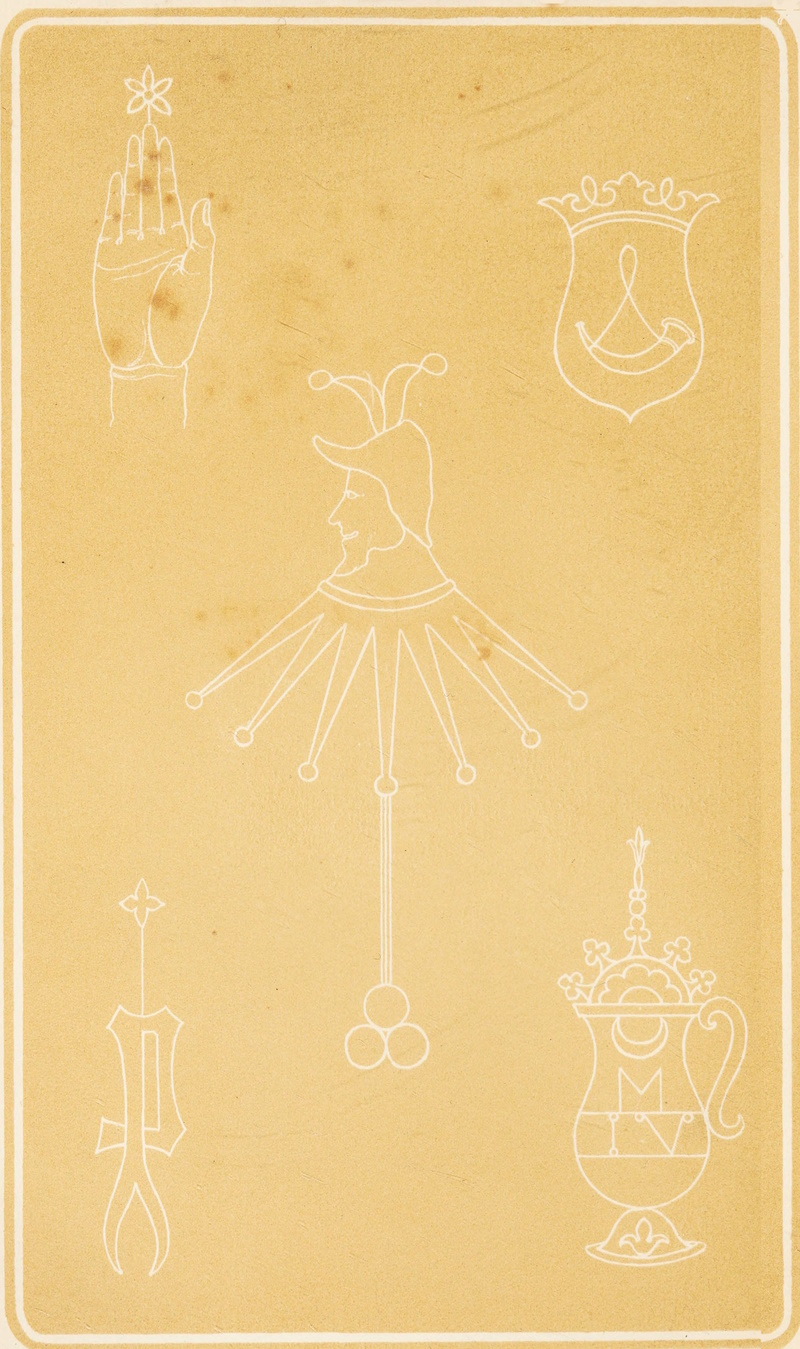
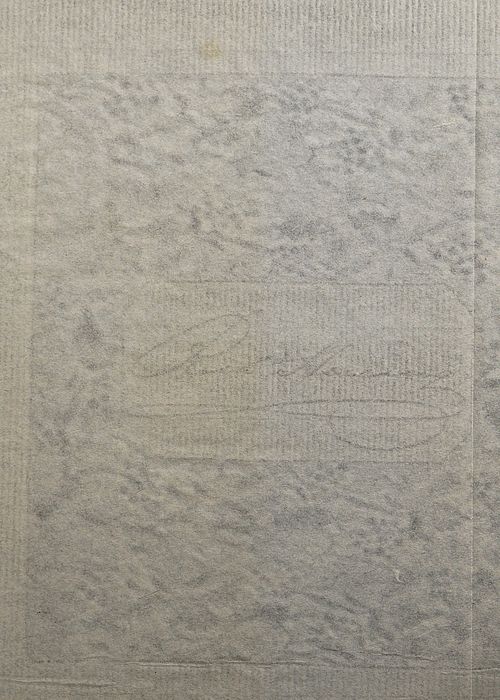
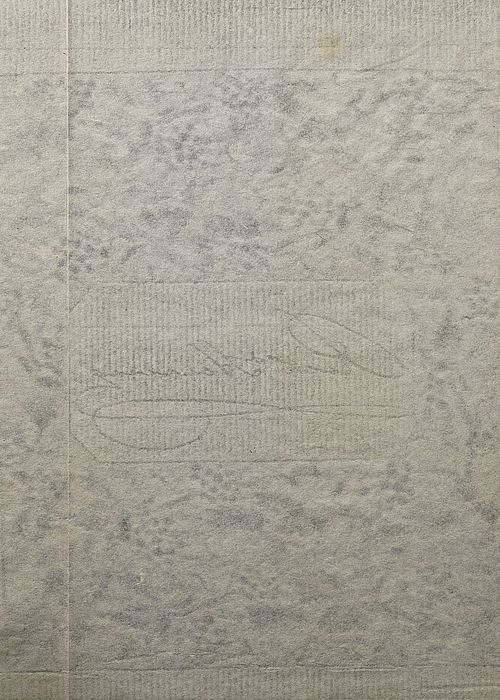
At the present time, Whatman’s papers (so
called) are manufactured at two mills, totally
distinct, both of which are still worked by the
descendants of Mr. Whatman’s successors; the
paper in the one case being readily distinguished
by the water-mark, “J. Whatman, Turkey Mill,”
and in the other, by the water-mark simply “J.
Whatman,” but bearing upon the upper wrapper
of each ream the original and well-known stamp,
containing the initials L. V. G., which are those
of L. V. Gerrevink, as celebrated a Dutch manufacturer
prior to Mr. Whatman’s improvements,
as Mr. Whatman’s name has since become
in all parts of the world.
In making so marked an allusion to this particular
manufacture, I am bound, perhaps, to
qualify it in some measure by directing attention
to the comparatively recent application
of continuous or rotatory motion which has,
indeed, effected no more wonderful or extraordinary
results than in the singular conversion of
pulp into paper.
The largest paper now made by hand, which is
termed Antiquarian, measures 53 inches by 31,
and so great is the weight of liquid pulp employed
in the formation of a single sheet, that no
fewer than nine men are required, besides additional
assistance in raising the mould out of the
vat by means of pulleys; while by the aid of the
paper machine, the most perfect production may
be ensured, of a continuous length, and eight feet
wide, without any positive necessity for personal
superintendence.
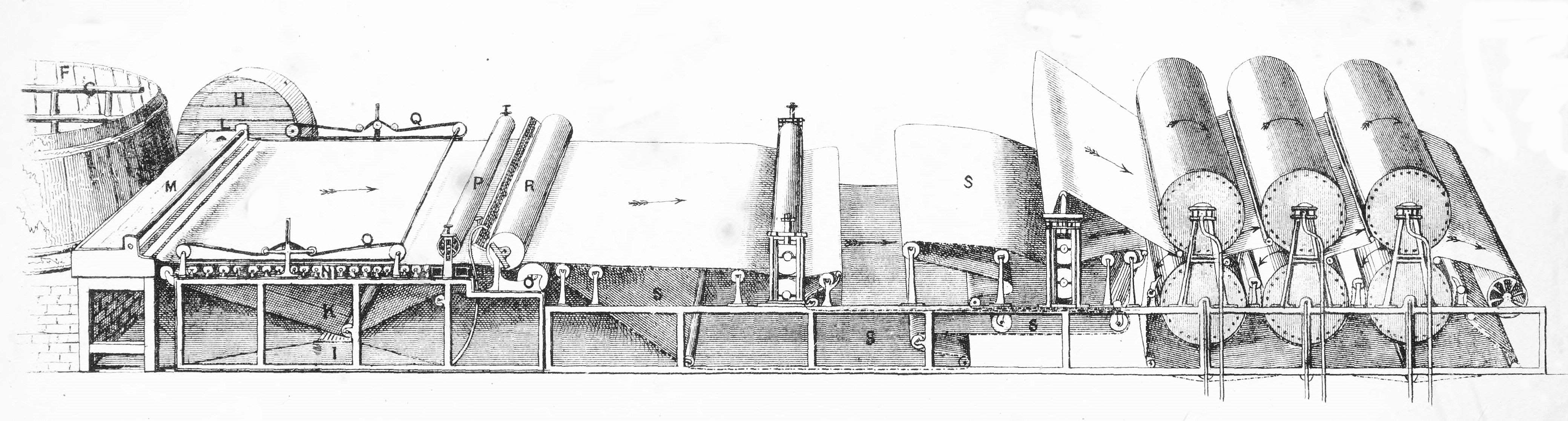
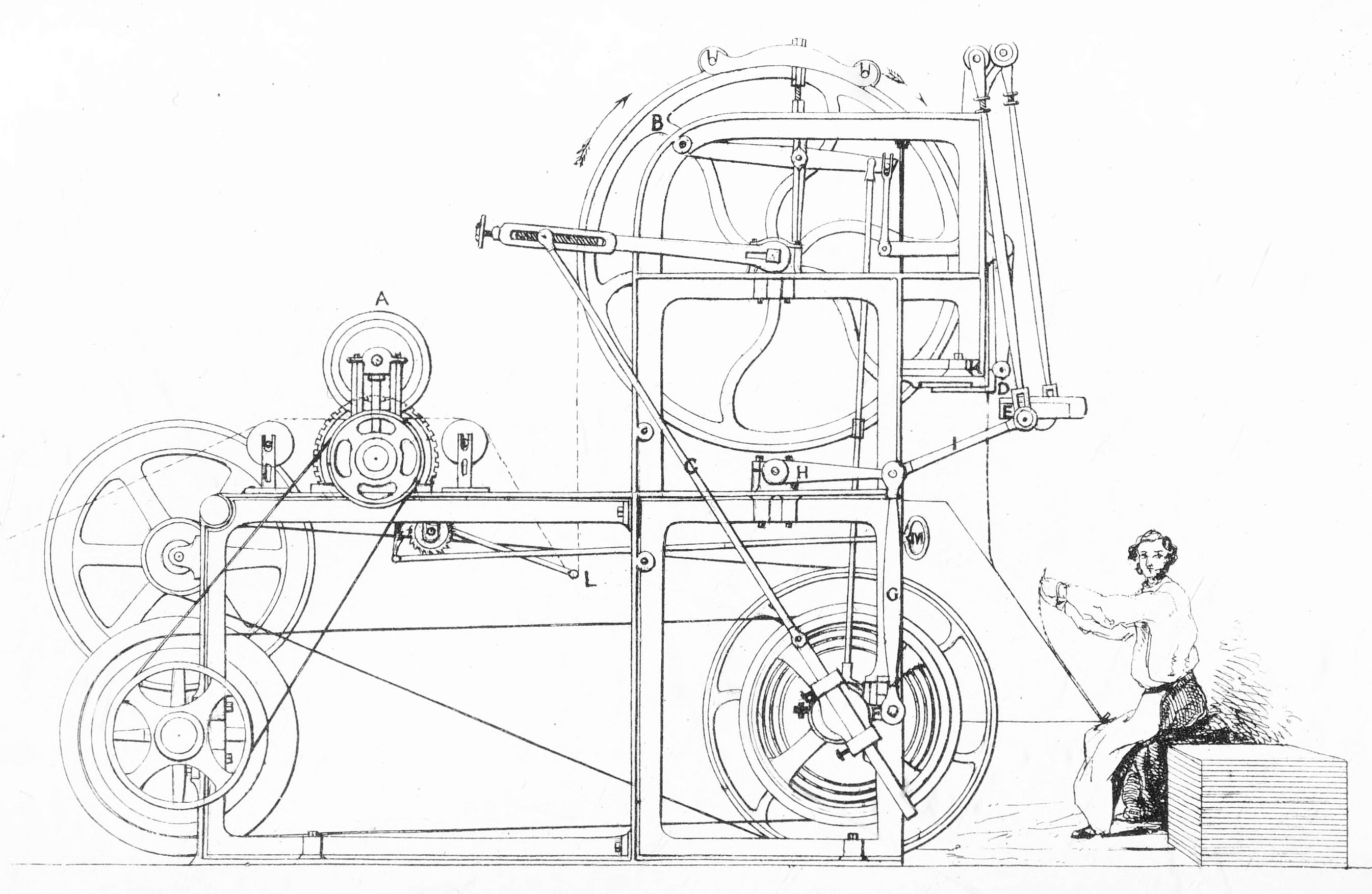
The principle of paper making by machinery
is simply this, instead of employing moulds and
felts of limited dimensions, as was originally the
practice, the peculiar merit of the invention consists
in the adaptation of an endless wire-gauze to
receive the paper pulp, and again an endless felt,
to which in progress the paper is transferred;
and thus by a marvellously delicate adjustment,
while the wire at one end receives but a constant
flow of liquid pulp, in the course of two or three
minutes we may have, carefully wound on a roller
at the other extremity, the most beautiful and serviceable
of fabrics. Instead of counting sheets in
course of production as formerly, or even measuring
the length by yards, we may actually have the
paper drawn out as it were, and wound up, miles in
length. In the recent Dublin Exhibition, a sheet
was exhibited which was said to have been of
sufficient length to wrap round the world; but, I
must confess, that I am not in a position to vouch
for the accuracy of the statement. An anecdote,
however, is told, (the truth of which
I have no reason to doubt,) of the patentee of this machine,
and a relative or friend of his, of some
considerable standing and influence in the pottery
district, who were dining together about the period
at which this machine was first adopted;
when the one speaking of the advantages which
he conceived the new mode would prove to his
friend, alluded above all others to the remarkable
capability which it possessed of producing
paper of any length that could possibly be required.
“Well,” said his friend, “I very much
doubt that, but if you can make me five miles of
the quality I require, I shall certainly have little
hesitation in admitting all the perfection and
suitability which you have laboured to impress
upon me.” The very next day the machine was
set to work, and timed, in order to ascertain
the required length wound upon the reel, which,
after being charged with Excise duty, was forwarded
without delay to its destination; and, as
may be conceived, to the utter astonishment of
his incredulous friend.
It is a fact, which certainly deserves to be noticed
for its singularity as well as for the strong
point of view in which it places the merits of this
invention, that an art of such great importance
to society as that of the manufacture of paper,
should have remained for at least eight centuries
since paper is first believed to have been in use,
and that upwards of 200 of those years should
have elapsed since its first introduction into England,
without any mechanical improvement whatever
as regards the processes which were then
employed. It is true, that various attempts from
time to time were made, but in every instance
they appear to have met with very little success.
In France, an ingenious artist contrived
three figures in wood to do the work of the vatman,
the coucher, and the layer; but, after persevering
for six months, and incurring considerable
expense, he was at length compelled to
abandon his scheme. And although paper was
previously manufactured in China, in Persia, and
indeed throughout all Asia, sometimes of considerable
length, I might mention that it was so,
not by machinery, but by means of a mould of
the size of the paper intended to be made, suspended
like a swing, and having men placed at
the distance of about every four feet, for the purpose
of producing an uniform shaking motion,
after the mould had been immersed in the vat,
in order to compact the pulp.
Such then was the rude state of this important
manufacture, even up to the commencement of
the present century, when another ingenious
Frenchman, named Didot, brought over to this
country a small model of a continuous machine,
with the view of getting the benefit of English
capital and mechanical skill to bring it into an
operative state; and fortunately for the vigorous
development of this embryo project, which had
proved an abortion in France, he communicated
his ideas of the practicability of the measure to
a mercantile firm of considerable opulence, who,
with great public spirit, at once concluded an
agreement with him for the purchase of a principle
which might be said at that period never to
have been tried. The firm alluded to was that
of the Messrs. Fourdrinier, who at that time, and
for several years afterwards, were the principal
stationers and paper manufacturers in Great
Britain.
In order to accomplish the arduous object which
those gentlemen then had in view, they appear
to have laboured without intermission for nearly
six years, when, after incurring an expense which
would have exhausted any fortune of moderate
extent (upwards of £60,000), they at length succeeded
in giving some sort of organization and
connection to the mechanical parts, for which
they obtained a patent, and finding eventually
that there was little prospect of being recompensed
for labour and risk, or even reimbursed
their expenses, unless Parliament should think
proper to grant an extension of their patent,
they determined upon making a fresh application
to the Legislature for that purpose. But, it
would appear that although in the Bill as it passed
the House of Commons, such prolonged period
extended to fourteen years; in the Lords it was
limited to seven, with an understanding that such
term should be extended to seven years more in
the event of the patentees proving, upon a future
application, that they had not been sufficiently
remunerated. No such application, however, was
made, in consequence of a Standing Order of the
House of Lords, placed on their journal subsequently
to the passing of the said act; which regulation
had the effect of depriving the Messrs.
Fourdrinier of any benefit whatever from the
invention; and ultimately, so great were the difficulties
they had to encounter, and so little encouragement
or support did they receive, that the
time and attention required to mature this valuable
invention, and the large capital which it absorbed,
were the means of reducing that wealthy
and liberal firm to the humiliating condition of
bankruptcy; and only within the past few months
the surviving partner, Mr. Henry Fourdrinier, to
whom mainly we owe the success of the invention,
and as unquestionably our present high position
in the scale of nations, was carried to his
grave, in his ninetieth year, comparatively a beggar.
A leading article in the Times, June 17,
1847, speaking of Mr. Henry Fourdrinier, thus
concludes by advocating his claims:—“Three
days only are past since an assembly, illustrious
for rank and station, met to celebrate and immortalize
the memory of Caxton. What more
fitting or graceful opportunity of paying a tribute
of respect and justice to his fellow-labourer
in an adjoining field? the one the father of
printing, the other the inventor of a process by
which the full benefits of printing have been
realized to the civilized world. And in the case
of Mr. Fourdrinier this advantage is found, that
he can receive in person the tribute of a nation’s
gratitude; an octogenarian, he still lives; unlike
Caxton, he is not yet a subject for posthumous
honours. It is not a monument he wants,
but justice. The world, no doubt, according to
ancient precedent, would rather pay its tribute
of admiration, if we should not rather say its
debt of homage, after death. But it is fortunately
in the power of the present age to point to a modern
example of tardy but full reparation made
to a living man, a great improvement upon the
old rule, the mockery of a national funeral, and
Westminster Abbey. Lord Dundonald’s case
will always stand as a brilliant exception to the
common neglect of contemporary merit, and by
his side it would be well to place, at no great
interval, the man who in a humbler sphere, but
better suited to an age of peace, has benefitted
humanity by facilitating the diffusion of letters,
and the acquisition of knowledge.” Powerful
and influential as is that journal, however, this
worthy man was still left to combat
so bitter a reverse, without even the means of procuring
comfort in his declining years.
But I am happy to say that an appeal has
lately been made to that particular branch of
trade so materially benefitted by the invention,
the paper manufacturers, in the hope that thus
a sufficient fund may be raised to furnish his
surviving daughters with a competent annuity
for the remainder of their days. And I sincerely
hope that the results of this laudable effort may
speedily prove to be as worthy the spirit of its
originators, as on the part of the public generally
it deserves consideration, as being supremely a
national duty. For, be it remembered, that
while the value and importance of such an invention
to the paper maker is sufficiently clear and
conclusive, from the fact of its general adoption
throughout the united kingdom, by no less than
700 manufacturers (averaging, probably, twice
that number of machines); so on the other hand,
we surely cannot remain unmindful of its effects
and benefits upon ourselves, when in contrasting
the results of the paper-making-machine with the
productions of a former period, we find the cost
reduced to the consumer considerably more than
one-half, in some instances to actually a fourth.
Thus then, it will be seen that as civilization
has advanced, the facilities for recording and
transmitting facts have uniformly improved and
multiplied until now, instead of oral tradition,
necessarily uncertain; instead of the bark and
leaf, perishable or fragile; instead of the papyrus,
so brittle; the parchment, so costly; the raw
cotton paper, so expensive; instead of inscriptions
by the unwieldy style and by the slow-paced
pen, we have now a cheap, serviceable
material, manufactured from the most useless of
fabrics, and even from the very refuse of our
clothing, which, conjointly with that art which
preserves all other arts, enables us far to surpass
in recording and transmitting power, even the
greatest demands in the world’s history.
Note.—Since the “proof” sheet was put into my hands, I have heard
with very great satisfaction, that some interest has at length been
awakened in the case of the Fourdriniers, and that a list has been commenced,
headed with liberal subscriptions from his Grace the Duke of
Sutherland, the Right Hon. the Earl of Harrowby, the Proprietors of The
Times, Illustrated London News, and several leading firms connected with
the Paper Trade.—R. H.