New Hampshire League
To Provide For National Defense
and To Enforce International Peace
Branch of the National Security League
Gov. Henry W. Keyes, Honorary President Frank S. Streeter, President
Dr. Ernest M. Hopkins, President of Dartmouth
}
Vice-Presidents
Rolland H. Spaulding, Ex-Governor
Executive Committee
Clarence E. Carr
Andover
Frank Knox
Manchester
Lester F. Thurber
Nashua
James W. Remick
Concord
Gordon Woodbury
Bedford
Nathaniel E. Martin
Concord
James F. Brennan
Peterborough
Charles R. Tilton
Tilton
Andrew L. Felker
Meredith
John S. B. Davie
Concord
John B. Jameson
Concord
Arthur M. Heard
Manchester
Secretary
Hobart Pillsbury
Manchester
Treasurer
Edward N. Pearson
Concord
Finance Committee
Gen. Elbert Wheeler
Nashua
Walter M. Parker
Manchester
Harry H. Dudley
Concord
Frederick W. Sawyer
Milford
Rodney E. Smythe
Plymouth
E. H. Hallett
Lisbon
W. H. McCarten
Lancaster
Arthur H. Hough
Lebanon
Leslie P. Snow
Rochester
W. R. Porter
Keene
Charles E. Tilton
Tilton
John Scammon
Exeter
Fred H. Perry
Charlestown
A. L. Mansfield
Hillsborough
E. Bertram Pike
Haverhill
Perley R. Bugbee
Hanover
State House, Concord, N. H., Feb. 1, 1918.
The purpose of this book is to bring to the people of New
Hampshire a knowledge of the German plan to dominate the
world by force and a clear view of what the Germans have
done toward the success of their plan. It sounds a note of
warning to every loyal American, to give his greatest help to
win the war. Read this and think about it.
Henry W. Keyes. (signature)
Honorary President.
Frank S. Streeter. (signature)
President.
Clarence E. Carr. (signature)
Chairman Executive Committee.
Hobart Pillsbury. (signature)
Secretary.
Pan-Germany
The Disease and Cure
By André Chéradame
Reprinted from several issues of The Atlantic Monthly
The Atlantic Monthly Press Three Park Street, Boston, Mass.
Copyright, 1917
THE ATLANTIC MONTHLY COMPANY
THE ATLANTIC MONTHLY PRESS, Inc.
[No student outside of Germany itself has studied
the Pan-German scheme in all its details more
thoroughly than the distinguished French publicist,
André Chéradame. For more than twenty years he
has devoted all his energies and resources, physical and
intellectual alike, to a vigorous and exhaustive investigation
of the origin and progress of the monstrous
conspiracy which threatens to overwhelm the liberties
of the entire world. His books, long unheeded, now
read like prophecies. The papers reprinted in this
pamphlet originally appeared in The Atlantic Monthly,
where they attracted very great interest. They are
now published in inexpensive form, so that every
American who desires a clear understanding of the
meaning of this war may have a chance to read them.
To careful readers we recommend M. Chéradame’s
more elaborate books, “The Pan-German Plot Unmasked”
and “Pan-Germanism and the United States,”
published by Charles Scribner’s Sons.
A new series of articles by this author will appear in
The Atlantic Monthly for 1918.]
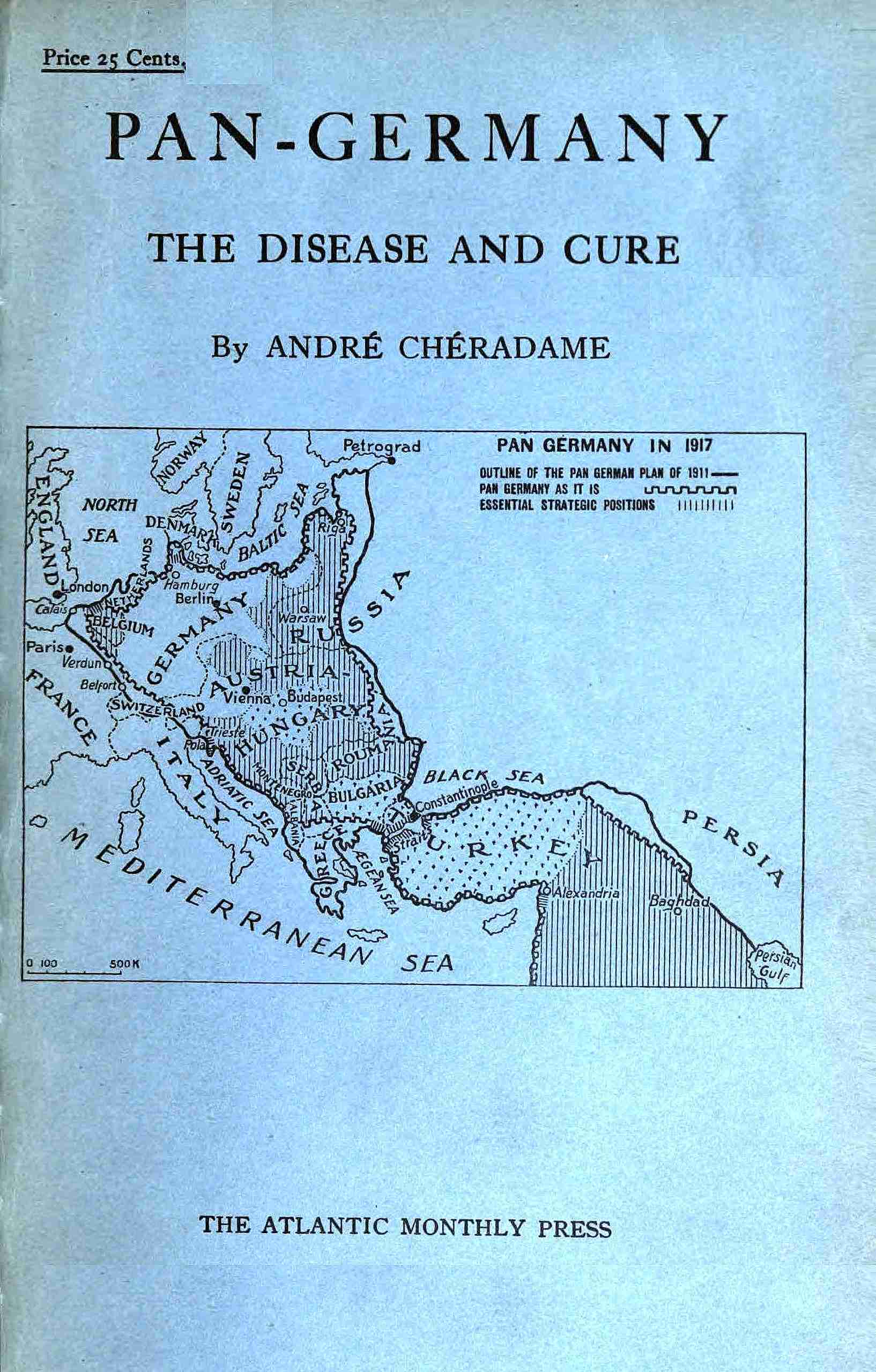
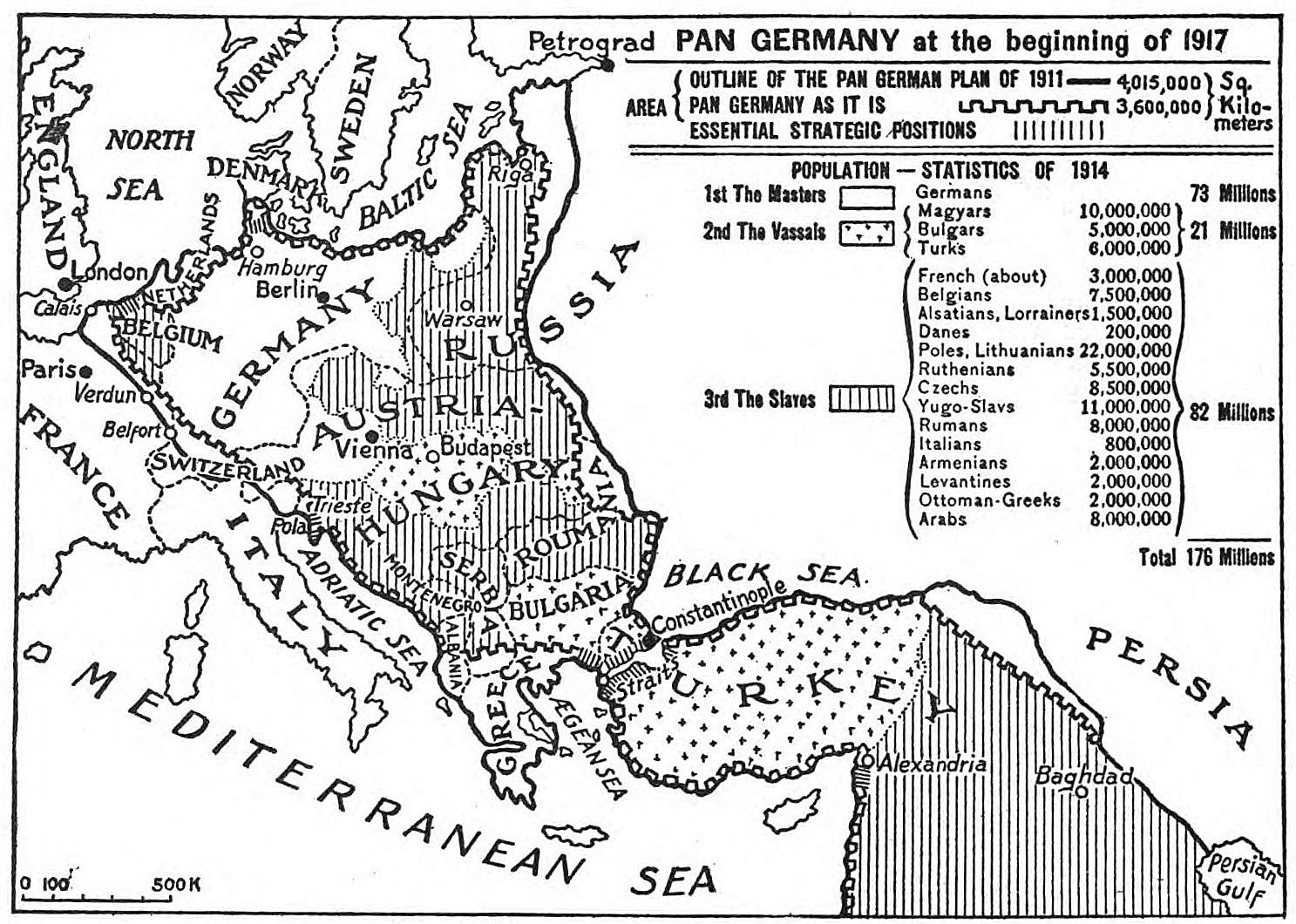
PAN GERMANY at the beginning of 1917
PAN-GERMANY AS IT IS
CHAPTER I How Cheaply Germany Has Fought the War — SEVEN ELEMENTS IN TWO GROUPS
Pan-Germany
The Disease and Cure
At the beginning of 1916, I said in my book The
Pan-German Plot Unmasked,—
‘Finally, when all negotiations for an armistice
have fallen flat and Germany’s situation has become
still more critical, we shall see Berlin play
her trump card. Protests against territorial annexations
will become insistent beyond the Rhine,
secretly sanctioned by the German government,
which will finally say to the Allies: “Let this
slaughtering of one another cease! We are willing
to listen to reason; we resign our claims to those
territories of yours now occupied by our armies.
The game has been played to a draw; so let us
treat for peace on that basis.”
‘On the day when this proposition is put forward,
the Allies will find themselves face to face
with the most subtle move yet made by Berlin—the
most insidious German snare. Then, above
all things, must the steadfastness, the perspicacity,
and the unity of the Allies be most brilliantly
made manifest. The trick of the “drawn game,”
if successful, would involve an overwhelming triumph
for Germany and an irreparable tragedy for
the Allies and for the liberty of the world.’
Only a few months after these lines were printed,
the prophecy began to be fulfilled more and
more completely. Every possible step has been
taken by Germany to bring about peace on the
basis of a draw. The slogan, ‘Peace without annexations
or indemnities,’ was coined to that end.
At first the Allies believed that this formula originated
in Russia; as a matter of fact, however, it
was worked out in Berlin and then suggested to
the Russian Socialists through secret agents whom
Germany has successfully established in the Petrograd
Soviet. These Socialists, doubtless well-meaning,
but over-fond of theories and always
ready to embrace the wildest utopian schemes,—ignorant,
too, of all realities, as has been shown by
the steady aggravation of the general situation in
Russia since they came into power with the Revolution,—have
declared enthusiastically for the
‘peace without annexations and indemnities.’ As
there exist also in the other Allied countries groups
of Socialists with a stronger grip on theories than
on facts, and also because Allied sympathies naturally
rallied strongly to the support of the Russian
Revolution, the formula, ‘peace without annexations
or indemnities,’ thanks to its apparent
origin, has unquestionably made serious inroads
on a certain section of Allied public opinion.
The Stockholm manœuvres, engineered by all
the powerful and varied means at the disposal of
German propagandists, were designed to establish
this formula as the fixed basis of all peace
negotiations. When the astuteness of the Allied
governments prevented the fulfillment of this
attempt within the period desired by Berlin, the
Vatican was persuaded through Viennese agencies
to throw its influence on the side of peace as determined
by Germany.
As a matter of fact, the Pope’s peace proposals,
while not embodying the exact terms of the Kaiser’s
formula, involved, in the last analysis, practically
the same essential results. Berlin, therefore,
in order to assure unceasing discussion of her
formula,—a discussion tending at least to bring
about an armistice, which would split up and morally
disarm the Allies, thus making it possible for
her to deal with them separately,—outdid herself
in mobilizing toward one end the most widely
divergent forces, from the Maximalist anarchists
of Petrograd to the most hidebound reactionaries
of the Sacred College. The extent, the vigor, and
the persistence of the amazing ‘pacifist’ offensive
launched by Germany were such that the expressions
‘peace without indemnities or annexations,’
‘drawn game,’ ‘white peace,’ ‘paix boiteuse,’ have
become as current in the Allied countries as if
they had some established connection with reality.
This is entirely contrary to the fact: with the best
intentions in the world, peace without annexations
or indemnities, as things stand now, is impossible.
There can be no ‘white peace,’ no ‘drawn game,’
no ‘paix boiteuse.’
To tell the truth, a section of Allied opinion has
become befuddled by these formulæ of Berlin,
whose function is to accomplish in the moral order
the same asphyxiating action as that of the gases
employed on the battlefield by the German General
Staff. The result of this moral intoxication is
that important groups of the Allies begin to juggle
with words and lose sight of facts. As the natural
outcome of giving serious thought to impossibilities,
grave errors are made in weighing the present
situation, with an attendant weakening of the
joint action of the Allied democracies. It is imperative,
therefore, that the pursuit of Utopias,
leading only to disaster, be abandoned, and that
we return to those realities which alone can lead
to victory and the establishment of a durable
peace.
If the formula ‘peace without annexations and
indemnities’ has been allowed to insinuate itself
into the general discussion, it is only because great
numbers of the Allied peoples fail to understand
the overwhelming advantages which Germany, by
means of the war, has been able to assure to herself
for the present and the future. The object of
this paper is to show just what these advantages
are, and at the same time to brand the utter hypocrisy
of the slogan, ‘peace without annexations
and indemnities,’ which, regarded even in the
most favorable light, would allow Germany to
make off with immense booty, leaving the Allies
to face the incalculable losses incurred by them in
a war launched by their adversary.
The significance of the low rate
of German exchange
The continual fall of German exchange is regarded
by many of the Allies as proof of the progressive
and irremediable impoverishment of Germany.
When, for instance, the mark drops 47 per
cent in Switzerland, while the franc has depreciated
only 13 per cent, Frenchmen are for the most
part inclined to believe that the war has affected
the two countries in relatively the same proportion;
they then conclude that Germany’s financial
situation is infinitely worse than that of France.
In reality, such a comprehensive conclusion cannot
be reached simply through the rise and fall of
exchange, which reflects only certain special aspects
of the financial situation of a country.
Among the various causes affecting exchange,
there are two principal ones. The first is moral.
It cannot be denied that the fluctuation of exchange
responds to foreign confidence. If German
exchange is low, it implies, to a certain extent at
least, the existence of a universal conviction that
in the long run Germany cannot hold out against
her formidable ring of adversaries. As a result,
there is no great demand for the currency of a
state whose credit, it is thought, must finally collapse.
It should be noted, however, that the reason
for this fall of exchange is only a moral evaluation
anticipating a probable outcome; it is not
due to a mathematically certain estimate of what
Germany now stands to win or lose as a result of
the war.
The second great factor affecting exchange, on
the other hand, is based on present realities which
are susceptible of being accurately determined.
Germany, since she has been blockaded by sea,
exports infinitely less than formerly; consequently,
her ability to settle her accounts in foreign
countries is limited. When she was able to sell
the United States a million marks’ worth of merchandise,
she then had at her disposal a million
marks with which to pay cash for such imports as
she needed. Now that her exports have been so
reduced, she has little money to spare for spending
abroad. If she wishes to increase these foreign
purchases, she must export her gold and consequently
reduce the security behind her banknotes.
This results in a lowering of the basis of
German credit, with a resulting drop in exchange.
We shall now see that this falling exchange,
whatever its importance, does not take into account
all the elements of the general financial situation.
If the blockade of Germany seriously complicates
her food problems, on the other hand it is
in a way advantageous from a financial point of
view. In a word, when Germany found herself
blockaded she was obliged to evolve means of existing
on her own resources or those of her allies.
Our enemies had great difficulties of organization
to overcome, but they turned them to good account:
for if Germany’s exports are small, her imports
have been correspondingly reduced. Hence
she needs to send very little money abroad—a fact
which is financially in her favor.
Now, the case of France is radically different.
The French government, feeling assured of the
liberty of the seas and believing that the war
would be a short one, found it more expedient to
place enormous orders abroad than to rely on domestic
resources to supply the nation’s need. As
a result, French imports, according to published
statistics, exceed exports by one billion of francs a
month. This means that, as things stand now,
France must pay to foreign countries the staggering
sum of twelve billion francs a year, with no
corresponding compensation, since her purchases
consist of products which are destroyed in use.
For this reason France is undergoing serious impoverishment
while Germany gets off comparatively
easily. It is therefore plain that the fluctuations
of exchange bear little relation to those conditions
which must be taken into consideration in
making an appraisal of the general situation; they
reflect, in fact, only a special and limited aspect of
the financial situation as a whole. Popular conclusions
drawn from the fall in the value of the
mark are false when attempts are made to give
them an absolute or general significance.
Why people are still ignorant of the vast advantages
gained by Germany from the war
Many of the Allies are hoodwinked by the ‘great
illusion’ which even now prevents them, to their
endless detriment, from seeing things as they actually
are. In the Allied nations, in fact, people
continue to speak of Germany, Austria-Hungary,
Bulgaria and Turkey, as if these states remained
just as they were before the war. But these terms
have no longer any relation to reality. The
Quadruple Alliance of Central Europe is simply
a great illusion, studiously fostered by William
II, for by its means his plans are vastly facilitated.
As a matter of fact, Turkey, Bulgaria,
and Austria-Hungary are not the allies, but the
vassals, of Berlin, and their influence with her is
less than that of Saxony or Bavaria. The rulers
at Constantinople, Sofia, Vienna, and Budapest
are simply marionettes moved by threads which
are pulled by Berlin according to her strategic
needs.
Very often we hear it said, ‘Germany has created
Mitteleuropa.’ This is another mistake. Geographically
speaking, Mitteleuropa includes only
Central Europe; and Germany’s dominion is infinitely
further flung, extending as it does from the
west front in France to the British front before
Bagdad. If we wish to see things in the light of
reality, we must say, for the present at least,
‘There is no longer any Germany; instead, there is
Pan-Germany.’ This is an essential assumption
if we are to reason justly. The map of Pan-Germany
at the beginning of 1917, which is printed
above, shows clearly the essential, but all-too-little-known
elements of the present situation,
which is characterized by the fact that 73 million
Germans, aided by 21 million vassals,—Magyars,
Slavs, and Turks,—have reduced to slavery 82
millions of Latins, Slavs, and Semites, belonging
to thirteen different nationalities. Pan-Germany,
which has now almost completely reached the limits
set by the Pan-German plan of 1911, consists,
therefore, of one vast territory containing about
176 million inhabitants and natural resources of
the greatest variety.
I beg my readers to refer to this map of Pan-Germany
every time it is made desirable by the
text. This repeated study of the map is indispensable
to a clear and complete comprehension of
the demonstration which follows. As regards the
profits which Germany has wrung from the war,
it is particularly important, in order to grasp the
idea of Pan-Germany; for it is the direct result of
its creation that Germany, in spite of the losses
and expenses inevitably incurred by a warring
nation, has been able to assure herself of certain
advantages which, considered as a whole, far outbalance
her losses and expenses, as we shall see.
In order to understand the nature of these advantages,
one point must first be made clear.
The war has cost the Germans comparatively little
For six fundamental reasons, the conduct of the
war has really cost the Germans far less than it
has cost their adversaries.
1. No Experimentation. Germany, in order to
produce a vast output of various types of guns and
projectiles economically evolved in times of peace,
needed only to extend, by means of machinery of
domestic manufacture, her arsenals and munition-factories,
which before the war were already
considerable. On the other hand, the production
of war-material in France at the outbreak of hostilities
was very slack, while in England and Russia
it was almost negligible. In these three countries,
therefore, it was necessary to improvise, as
best might be, thousands of new plants, to equip
them with machinery purchased in America at
vast expense, and hastily to evolve new types of
cannon, projectiles, and the rest. Now, improvisation,
especially in war-time, means false starts
and inevitable bad work, which must be paid
dearly for. Germany was not obliged to incur
these very considerable expenses.
2. Regulated Wages. The fact that the problem
of German wages was worked out at leisure in exact
correlation to productions whose types were
exhaustively studied in the calm of peace-time
certainly allowed the Germans to obtain war-materials
at a lower net cost than was possible for
the Allies.
3. The Prevention of Waste. The absence of experimentation
and the simple extension to war-work
of highly efficient industrial methods tested
in peace-time, naturally allowed the Germans to
avoid in all spheres those immense losses of material
of every nature whose bad effects and heavy
cost were incurred by the Allies. This state of
affairs in France caused losses which were as
expensive as they were inevitable. One may
imagine the conditions existing in Russia, where
control is far more difficult of exercise than in
France.
4. Cheap Labor. The Germans have forcibly
enlisted the labor of about two million prisoners
of war. Moreover, the official French report of
April 12, 1917, concerning acts committed by the
Germans in violation of international law, asserts
that in the occupied territories deportation of
workers has been a general measure. It has ‘applied
to the entire able-bodied population of both
sexes, from the ages of sixteen to sixty, excepting
women with young children.’
Now, the Germans requisition labor from among
7,500,000 Belgians, 3,000,000 French, 4,500,000
Serbians, 5,000,000 Roumanians, 22,000,000
Poles, Ruthenians, and Lithuanians—a total of
42,000,000 slaves.
Let us see what sort of remuneration is made.
Take the case of a young girl of Lille, twenty years
old, who was forced to work for six months, harvesting
and threshing wheat and digging potatoes
from six in the morning to twilight, receiving
all the while the vilest food. For her six months
of work she was given 9 francs, 45 centimes. The
Germans, therefore, have at their disposal a vast
reservoir of labor for which they pay next to nothing;
moreover, the small amounts they do pay remain
in Pan-Germany.
The Allies, on the contrary, pay high wages to
their workers, and, when they run short, must
needs pour out good gold in bringing reinforcements
from Asia, Africa, and America. This
means that a considerable part of the wages paid
these foreign workmen will leave France or England
for all time.
5. Free Coal and Iron Ore. In addition to their
own mines, the Germans have seized important
coal and iron mines in France, Belgium, and Poland.
A vast proportion of their ore and coal
therefore costs them nothing. Naturally, then, a
German shell made with French iron and Belgian
coal costs far less than a French shell made with
American steel and English coal. As a result, the
net price of a greater part of German munitions
is much lower than that paid by the Allies.
6. Economical Transportation. By reason of
the grouping of the Central Powers,—a result of
the conquest of the Danube front by the Teutons,—Germany
profits by a geographical situation
which is infinitely more advantageous than that
of the Allies, as regards not only the speed, but
also the cheapness, of war-transportation. It is
evident that it costs far less to send a shell from
the Krupp factory to any one of the Pan-German
fronts than to send an American shell to France,
a Japanese shell to the Polish front, a French shell
to Roumania via Archangel, or an English shell
to the army operating in Mesopotamia. By the
same token, the cost of transporting a soldier of
Pan-Germany to any of the battle-fronts is infinitely
lighter than that of transporting Allied
soldiers from Australia or America.
We should note that each one of these six factors
which we have just enumerated reacts profoundly
on the sum-total of general war-expenses,
and that, taken together, they involve a formidable
sum. It can therefore truthfully be said that
Germany carries on the war much more economically
than the Allies. Figures are so far lacking
which will give the true proportions, but we shall
certainly remain well within the realities of the case
if we conclude that, as a result of the six factors
mentioned above, France must spend one hundred
and fifty million francs for war material to every
hundred million spent by Germany. When,
therefore, France spends thirty billions, Germany
evidently spends not more than twenty billions.
And what is true of France applies even more
accurately to some of the other Allied nations.
This is a fact of the greatest general importance
in coming to a true understanding of the financial
situation created by the war—a fact
which takes on its full significance when we realize
that Germany is not only carrying on the war
cheaply, but that she has been enabled, by means
of this war, to win very important advantages.
They consist of seven principal elements. The
last six of these, it should be noted without fail,
depend solely on the existence of central Pan-Germany—that
is, on the hegemony exercised by
Germany over Austria-Hungary, Bulgaria, and
Turkey; they are therefore wholly independent
of the first element, which relates to Germany’s
occupation of enemy territories, particularly to
the east and west. They may be summarized
as follows:—
The first group includes:—
The advantages derived directly from Germany’s
aggression, comprised in a single element,
namely, the plunder accruing from the occupation
of enemy territory. This may be analyzed
thus:—
(a) The value of the 500,000 square kilometres
of Montenegrin, Serbian, Roumanian, Russian,
Belgian, and French land held by the Germans.
This value, estimated according to the national
fortunes of the respective countries before the
war,—the area and population of the occupied
portions being taken into consideration,—is in
the neighborhood of 155 billion francs.
This figure, though naturally only approximate,
is probably far below the real sum. We know that
the entire national fortune of France, with its
536,000 square kilometres, was put before the war
at 325 billion francs. The valuation of the 500,000
square kilometres of occupied territory at
155 billions seems therefore an underestimate, especially
when one remembers that these 500,000
square kilometres include Belgium and the North
of France—the richest districts in the world.
(b) The plunder of human beings, supplies, and
property (laborers, war-material, provisions, minerals,
raw products, manufactured products, personal
property, art objects, war levies, specie,
jewels, and securities) which has been going on, in
some cases for as long as three years, throughout
the occupied territories. This booty unquestionably
represents a value of tens of billions of francs.
These tens of billions should be deducted from
the total of the national fortunes of the invaded
districts. The plunder in question is composed of
property or supplies already used up by the Germans
or taken away by them into Germany; the
value it represents, therefore, no longer exists in
the invaded districts.
The second group includes:—
The advantages which Germany has assured
herself for the present or for the future through
the creation of Pan-Germany, which in turn result
from
(a) Germany’s burglarization of her own allies—Austria-Hungary,
Bulgaria, and Turkey.
(b) The seizure by Germany and her allies of
Serbia; in all six elements:—
I. The Pan-German loans, which throw Austria-Hungary,
Bulgaria, and Turkey into a state of
absolute financial dependence on Berlin.
II. The value of Germany’s monopoly in exploiting
the latent resources of the Balkans and
Asia Minor, resulting from the Pan-German loans.
III. The inherent value of the creation of Economic
Pan-Germany. This cannot fail to be a
powerful instrument for the acquisition of wealth.
IV. The value of Military Pan-Germany, which
is a guaranty of the security of Economic Pan-Germany.
V. The value of the enormous economic profits
assured to Berlin through the existence of Pan-Germany
at the cost of Russia. These are a direct
consequence of the establishment of Military Pan-Germany.
VI. The taking over by Germany of at least
21 billions of French credit. This is a consequence
of the establishment of Economic Pan-Germany.
CHAPTER II How Much Germany Has Won in the War
Let us now take up, in their order, the seven
elements mentioned in the last chapter.
I
The first element of German advantage: the booty
acquired from the occupation of enemy territory
Germany is getting direct war-profits from the
enemy territories occupied by her. These territories,
listed in the ascending order of their richness,
are: Montenegro, 14,000 square kilometres;
Albania, 20,000; Serbia, 87,000; Roumania, 70,000
(Bulgaria and Austria-Hungary share the pillage
of these four territories); dependent territories
of Russia, 260,000; Belgium, 29,000; and France,
20,000; making a grand total of 500,000 square
kilometres.
In order to realize as clearly as possible the importance
of the booty wrung by Germany from
this enormous area, we may establish by means of
examples or statistics that this plunder comes
from nine principal sources:—
Seizure of Human Material.—Throughout
these 500,000 square kilometres of occupied territory,
the Germans have scientifically enslaved
42,000,000 human beings, who furnish a vast
amount of labor—this labor being all the cheaper
because, as we shall see, the slaves are robbed in
various ways.
Seizure of War-Material.—By reason of their
lightning advances in Belgium, France, Serbia,
and Roumania the Germans have taken possession
of vast stores of war-material: cannon, rifles,
munitions, wagons, locomotives, cars, as well as
thousands of kilometres of railway, of which they
make full use, representing a certain value of
billions of francs. (The Belgian railway system
alone is worth three billions.)
Seizure of Food-stuffs.—The official report of
April 12, 1917, on the acts committed by the Germans
in France contrary to international law,
states: ‘The inhabitants, subjected as they were
to annoyances of every sort, watched daily the
theft of such food-stuffs as they happened to possess.’
Everywhere the Germans steal horses,
cattle, domestic animals, grain, potatoes, food-products
of all kinds, sugar, alcohol, all of which
constitute the reserve supply of the occupied
countries. Their harvests, too, are appropriated
through the cultivation of productive lands by
means of labor obtained almost without cost from
the enslaved peoples.
Theft of Raw Materials.—Throughout the
length and breadth of the occupied territories, the
Germans, at the dictates of expediency, have
seized raw materials: coal and iron ore, copper,
petroleum, and so forth. Metals—bronze, zinc,
lead, copper, tin—have been taken from private
citizens, as well as textile fabrics—wool, cotton
cloth, and the like. When one learns that from
the cities of the North of France alone the Germans
stole 550 million francs’ worth of wool, it is
easy to see that this single source of plunder has
been worth a number of billions to them.
Theft of Finished Products.—Everywhere in
the occupied territories, so far as means of transportation
permit, motors, steam-hammers, machinery,
rolling-mills, lathes, presses, drills, electrical
engines, looms, and so forth, have been
taken to pieces by mechanics and transported into
Germany. The total value of this stolen material
in Belgium and the North of France alone—the
richest industrial districts in the world—is almost
incalculable.
Theft of Personal Property.—The official
French report previously quoted states: ‘In the
shops, officers and soldiers made free with whatever
pleased their fancy. Every day the people
witnessed the theft of property which was indispensable
to them. At Ham, General von Fleck
carried off all the furniture of M. Bernot’s house,
where he had been quartered.’ The property
thus stolen is sent to Germany, as is proved by
this advertisement in the Kölnische Zeitung:
‘Furniture moved from the theatre of military
operations to all destinations.’ From this source,
war-booty to the value of several billions has already
been divided among an army of Germans.
Seizure of Works of Art.—The Germans have
stolen countless works of art, ‘in order’—so runs
a recent official note of their government—‘that
they may be preserved as a record of art and civilization.’—‘It
would be impossible,’ declares Le
Temps, ‘to find a more cynical admission of the
thefts committed by the German authorities in
our museums and public buildings.’ If one remembers
that this methodical pillage has gone
merrily on among private individuals, drawing on
the unlimited stores of works of art which have
been accumulated throughout the centuries in
Poland, and particularly in Belgium and France,
it must certainly be apparent that the value of
these stolen art treasures is immense.
War Imposts.—Our official report establishes
that ‘Requisitions have everywhere been continuous.
Towns that have had to meet the expenses
of troops quartered within their jurisdiction have
been overwhelmed by huge levies.’
Belgium is staggering under an annual war assessment
of 480,000,000 francs. Bucharest, after
its capture by the Germans, was forced to pay a
levy amounting to about 1900 francs per capita
of the population. At Craiova the levy was 950
francs per capita. An edict forbids the circulation
of paper money unless it has been specially
stamped by the Germans, who retain 30 per cent
of its nominal value.
In April, 1917, the Frankfurter Zeitung announced
that the leaders of the Austro-German
forces of occupation in Roumania would shortly
call for an obligatory internal loan of a hundred
million francs. In Poland, the German government
has just issued a billion marks in paper
money for enforced circulation. These are only
single examples.
Theft of Specie, Jewels, and Securities.—In
September, 1916, the Germans seized three quarters
of a billion francs from the National Bank of
Belgium in Brussels, which was subsequently
transferred to Germany. In January, 1917, on
the steamer Prinz Hendrick, they stole a million
francs from a Belgian who was traveling from
England, and took ten million francs’ worth of
diamonds from the mail-bags. In the village of
Vraignes, on March 18, 1917, the Germans, before
evicting the inhabitants, stole from them the
13,800 francs they had in their possession. At
Noyon—we learn from the official report already
quoted—the Germans broke open and pillaged
the safes of banks and private citizens before retiring
from the town. The securities, jewels, and
silver plate of Noyon represented a value of about
eighteen million francs. And, as I have said, these
are only random incidents.
Taking into consideration, then, the present
high prices of food-products, coal, metal, petroleum,
war-material, machinery, and the rest, it
can be seen at a glance that each one of the nine
sources of booty just enumerated, on which the
Germans have been steadily drawing, in some
cases for as much as three years, has unquestionably
yielded the value of several billions of francs,—certain
of them, perhaps, tens of billions.
Hence we may reasonably conclude that, without
fixing a definite figure for the yield of these nine
sources, the total plunder has mounted well up
in the tens of billions.
Another basis for calculating the worth of the
invaded territories to Germany lies in the fact
that the national fortunes of these countries, according
to ante-bellum statistics, amounted to
about 155 billions of francs.
We shall now examine the six other elements
of Germany’s present advantageous situation—those
which result from the domination which the
war has enabled her to exert over her own allies,
Austria-Hungary, Bulgaria, and Turkey. This
domination, which amounts practically to actual
seizure, has permitted her to fulfill the scheme of
Central Pan-Germany as a result of the crushing
of Serbia.
II
The second element of German advantage:
the Pan-German loans
A portion of the approximate sum of 115 billion
francs devoted by Germany, up to the end of
July, 1917, to the carrying on of the war has enabled
her to burglarize her own allies by taking
advantage of the extremely bad financial situation
which faced them at the end of the Balkan wars.
As a result of this situation, Austria-Hungary,
Bulgaria, and Turkey, in order to sustain the
present long-drawn-out struggle, have been forced
to draw on the credit of Berlin. The sum total of
the loans made by Germany to her allies and secured
by her own war loans cannot yet be verified,
but there can be no doubt that it mounts up to a
respectable number of billions.
These loans have worked out to the immense
advantage of Germany, for the following reasons.
Established facts prove that, without the assistance
of Austro-Hungarian, Bulgarian, and Turkish
troops, and without the numerous products
supplied her by the Orient, Germany would have
been beaten long ago, even in spite of the Allies’
blundering. As these troops and resources are of
priceless value to Germany, it would seem that
she must have paid dearly for them, and in gold.
However, as the reserve of the German Imperial
Bank was 1,356,875,000 marks in July, 1914, and
2,527,315,000 in February, 1917, it is certain that
Germany has not lent gold to her allies,—in large
quantities, at any rate,—but only paper, whose
value depends solely on the strength of German
credit.
In reality, therefore, Germany, simply by keeping
a printing-press busy turning out little stamped
slips of paper, has obtained troops, food-stuffs,
and raw materials which were indispensable to her
in avoiding defeat; and at the same time she has so
established herself as a creditor as to give her the
right to exact final payment by her allies for advances
which were primarily made to them in Germany’s
own vital interest.
Now these obligations weigh so heavily on
countries like Austria-Hungary, Bulgaria, and
Turkey, already in sore stress, that they incur
loans which no one of these three countries can
ever hope to pay off unless a victory of the Allied
democracies should shatter the financial yoke of
Berlin.
In order to appreciate the nature of these loans
and their consequences, the example of Turkey is
particularly instructive. ‘Germany’s advances to
Turkey in no way represent Turkish war-expenditure.
We must add to them the requisitions
made in the country itself, and the war-material
purchased in Germany and Austria-Hungary
which is not yet paid for.’
At the beginning of 1917 Djavid Bey arranged
in Berlin for a new loan of three million pounds,
simply to enable Turkey to pay her debts to the
Krupp firm, as well as the advances made her by
the different groups of financiers and the German
Minister of Finance. This means, therefore,
that, when Germany sends arms to the Turks in
order that they may use them to consolidate the
Pan-German scheme, she also finds a means of
making this consignment of arms serve to entangle
the Turks still more hopelessly in the financial
web. ‘In Pan-Germanist circles, there has
been much discussion of the compensations which
Turkey must make to Germany in return for services
rendered in the course of the war. It is the
unanimous opinion that Germany, without gaining
any territorial acquisitions in Turkey, must
have controlling rights in the Ottoman Empire,
so that the Pera-Galata bridge may be as near
Berlin as Constantinople.’
What has taken place in the spheres of finance
between Berlin and Constantinople has, by the
very nature of things, been duplicated between
Berlin and Sofia, though of course in a less pronounced
form. Germany, therefore, by means of
paper loans based on her own credit, has caused
colossal obligations to be assumed by her allies—countries
representing vast areas of land: Austria-Hungary
with 676,616 square kilometres, Bulgaria
with 114,104, and Turkey with 1,792,900, or
2,583,620 square kilometres in all. Now these
three countries are precisely the ones which are
indispensable to the carrying out of the Central
Pan-German ‘Hamburg to the Persian Gulf’
scheme; the loans, therefore, are Pan-Germanist
loans.
It should be borne in mind, on the other hand,
that although Austria-Hungary, Bulgaria, and
Turkey are financially encumbered in their quality
of states, the exploitation of these countries by the
Germans is very profitable. Their combined national
fortunes were estimated, before the war,
at about 269 billion francs. We must realize also
that, although these loans granted by Berlin to
her allies are merely paper loans, they bind Turkey,
Bulgaria, and Austria-Hungary to Germany
as closely as debtors can be bound to a creditor.
None of these three countries can reasonably
hope to get funds after the war from their present
adversaries, who, it is certain, will have none too
much money for their own needs; and so the
financial situation as a whole combines with the
enterprise shown by the Berlin General Staff to
strengthen the grip which Germany has obtained
over her allies through loans.
As this financial dependence of the three vassal
states, with its tremendous consequences, is, as I
have said, maintained simply by means of a printing-press
and little slips of paper, which cost very
little indeed; and since Germany receives in exchange
for these slips of paper bearing her signature,
men, food-stuffs, and supplies which, but
for the action of the Allies, would enable her to
establish Pan-Germany as mistress of Europe,
we may safely say that the Pan-Germanist loans
floated by Berlin at her allies’ expense constitute
a powerful element of military advantage,
which, if one but examines the conditions of its
origin, must stand out as the most profitable and
extraordinary swindle ever perpetrated.
III
The third element of German advantage: the value of
a monopoly in exploiting the latent resources of
the Balkans and Asia Minor
The figure of 269 billions of francs quoted above
takes no account of the enormous agricultural
and mineral wealth, as yet unexploited and unappraised,
of the Balkans and the Ottoman Empire.
Now, the business of tapping these vast reservoirs
is entirely in the hands of the Germans, as a
result of the Pan-Germanist loans.
IV
The fourth element of German advantage: the value
resulting from the creation of an economic Pan-Germany
Economic Pan-Germany, as it was outlined by
List, Roscher, Rodbertus, and other German economists,
may be defined as follows: A territory
uniting under one supreme central control Central
Europe, the Balkans, and Turkey—a territory
large enough to include military and economic resources
entirely sufficient to provide for the needs of
the population in times of war; and to assure its
rulers in times of peace the domination of the world.
The seizure by Berlin of Austria-Hungary, Bulgaria,
and Turkey—all essential elements of Central
Pan-Germany—was accomplished in three
ways: militarily, by the supremacy acquired by
the German General Staff over the troops of the
vassal states; financially, by means of the paper
loans granted by Germany; and diplomatically, by
the treaties signed in Berlin on January 11, 1917,
establishing the strongest sort of German protectorate
over the Ottoman Empire. This done, the
consolidation of Pan-Germany was quickly undertaken
by Berlin in a great number of ways.
Control of Customs.—As the establishment of
the great Pan-German Zollverein (Customs Union)
was not to be accomplished at one stroke, the
Kaiser’s government set about preparing the necessary
steps. Numerous conferences held at Berlin
and attended by German, Austrian, and Hungarian
statesmen and business men, resulted in the
following essential provisions. (1) An economic
customs agreement of long duration, which would
make a single economic unit of Germany and Austria-Hungary;
(2) to bring this about gradually, a
progressive increase of duty—free articles, and
a unification of the customs charges on certain
goods; (3) a close economic union between Austro-Germany
and Bulgaria and Turkey, to be arranged
and established with the greatest possible
expedition.
Ethnographic Control.—Certain nations afford
considerable resistance to the Hamburg-Persian
Gulf scheme. The Serbians, who are morally irreducible,
are an obstacle to the permanent establishment
of the Pan-German nexus between Hungary
and Bulgaria; and without this the entire
Pan-German programme falls flat. The systematic
destruction of the Serbian people has been
entrusted to the Bulgars, who, under pretext of
quelling insurrections, slaughter not only the Serbian
men, but also women and children, down to
babies at the breast. In the Ottoman Empire the
Armenians happen to occupy those regions which
were characterized in the Reichstag by Herr Delbrück
as ‘Germanic India.’ Berlin therefore puts
to good use the Turks’ inherited taste for massacres
of Christians. Already more than one million
Armenians have been got out of the way.
Agricultural Control.—The food crisis in Germany
has led Berlin to proceed with the greatest
haste toward utilizing the rich farming districts
which the fortunes of war have put within her
grasp. Hundreds of experts, with thousands of
agricultural implements, have been sent to Roumania,
Serbia, and Asia Minor. In this latter
country, two cultural centres in particular have
received attention. In the province of Adana cotton-growing
is being developed; on the plains of
Anatolia the intensive cultivation of grain is in
progress. These energetic efforts have had a twofold
result: the Turks will not revolt against Germanic
domination—because of starvation, if for
no other reason; and, by reason of the increasing
yield of Serbian, Roumanian, and Turkish lands,
more of which are continually being brought into
service, the food-supply of the Central Empires
becomes more and more completely assured.
Banking Control.—The exploitation of Eastern
Pan-Germany calls for vast capital. The German,
Austro-Hungarian, Bulgarian, and Turkish
banks have formed powerful combinations. As
the leaders of this movement in Germany we find
the Deutsche Bank, the Dresdner Bank, the
Kölnische Bankverein; in Austria-Hungary the
Vienna Kredit-Anstalt and the Hungarian Bank
of Credit in Budapest.
Economic Control.—As the rapid exploitation
of the latent resources of the Balkans and Turkey
is the principal economic object of the Germans,
they have just established, in coöperation with
King Ferdinand, the ‘Institute for Furthering
Economic Relations between Germany and Bulgaria.’
In order to facilitate the Germanic penetration
of Turkey, ten thousand Turkish boys between
the ages of twelve and eighteen years are to
come to Germany for their technical education.
These young Turks, living in German families,
learning German, and saturating themselves with
German ideas, will soon be able collaborators with
the Teutons themselves in germanizing Turkey
and exploiting the numerous concessions which,
if the war turns out successfully for them, will be
wrung from the Ottoman government by the subjects
of the Kaiser.
Railway Control.—The railway systems of European
Pan-Germany have been brought to the
highest degree of perfection. In Turkey, German
officers are absolutely in control of the railroads.
Out of the 2435 kilometres which separate Constantinople
from Bagdad, only 583 kilometres of
line remain to be constructed—and this distance
is traversed by automobile roads. As for the
Turkish railroads belonging to French and English
companies, the German government has suggested
that the Turks ‘purchase’ them. One
should cherish no illusions as to the real meaning
of this word ‘purchase.’ It means, according to
Turco-German methods, that the expenses involved
in this purchase should be set down against
the war damages which the Central Powers consider
to be due them from the Allies.
Canal Control.—The canal project, outlined as
far back as April 26, 1895, by the Pan-Germanist
Dr. G. Zoepfl, was taken up and begun by the
Economic Congress of Central Europe, which met
at Berlin on March 19, 1917. This project is
made up of the following elements: (1) Union of
the Rhine with the Danube by the opening up to
navigation of the Main and of the canal from
the Main to the Danube. (2) Completion of the
central canal joining the Vistula and the Rhine.
(3) The Oder-Danube canal, joining the Baltic
and Black Sea. (4) Opening to navigation of
the Rhine as far as Bâle. (5) Union of the Elbe
with the Danube by means of the river Moldau.
(6) Union of the Weser with the Main by means of
the Fulda-Werra. (7) Connection of the Danube
and the Vistula by means of canals. (8) Union
of the Danube with the Dniester by means of
the Vistula. (9) Opening to navigation of the
Save. (10) Opening to navigation of the Morava
and the Vardar as far as Saloniki. The Danube
is the base of this gigantic programme of construction.
‘The Danube means everything to
us,’ declared General von Groener, in December,
1916.
This rapid sketch of the preparations now going
on in the economic sphere of Pan-Germany will
permit any clear-thinking man to understand the
crushing power which will lie in this formidable
system when all its latent resources have been developed
by the Germans to the profit of their hegemony.
The organization of Pan-Germany is
only in its first stages; nevertheless, the concentrated
military, economic, and strategic strength
which it has already put at the disposal of Berlin
is so great that it permits Germany to baffle her
far more numerous, but widely scattered, adversaries.
What, then, would be the strength of a
completely organized Pan-Germany? It is undeniable,
in fact, that a methodical, big-scale development
of all the mineral, vegetable, animal, and
industrial products of economic Pan-Germany,
together with the low-cost transportation afforded
by a complete system of canals, would make it
possible for the Germans to pay high wages to
their own workmen, and yet at the same time
bring about such a reduction of net prices in every
line of industry as to force Pan-German products
on the whole world by their sheer cheapness.
It is easy to see, then, that in the face of economic
Pan-Germany’s overwhelming methods
any economic revival on the part of the European
nations now allied would be impossible. The economic
ruin of the Allies, after so exhausting and
costly a war as this, would by the nature of things
bring about their political subjection to Berlin.
Besides, there is not a country in the world which
could escape the clutches of economic Pan-Germany
on the one hand, or the consequences of the
irremediable ruin of the Allies on the other. The
fact that Pan-Germany is organizing itself is an
ominous event which should receive the concentrated
attention of all the world’s free peoples;
for it places in German hands the elements of such
an overwhelming economic power as has no precedent
in the world’s history.
V
The fifth element of German advantage: the value of
military Pan-Germany
Berlin relies, above all else, on her military resources
to render secure for all time that economic
Pan-Germany which is destined to provide her, in
peace-time, with a permanent means of acquiring
wealth and world-dominion. Military Pan-Germany
is, therefore, the complement and the pledge
of economic Pan-Germany. The Kaiser’s successful
seizure, through the fortunes of war, of new
sources of man-power—Austro-Hungarian, Bulgarian,
and Ottoman soldiery; of new strategic
points or regions of exceptional importance, located
in invaded countries or in those of his own allies,
has furnished him with the basis of military
Pan-Germany. In 1914, Prussian militarism held
sway over only the 68 million inhabitants of the
German Empire. At the beginning of 1917, it had
been extended by consent or by force to the 176
million people of Pan-Germany.
This result—evidently the consequence of an
immense extension of exclusive influence throughout
Central and Eastern Europe—has permitted
the German General Staff to take over at will
certain strategic points or regions of the greatest
importance, over which it exerted no direct influence
before the war. Zeebrugge, on the North
Sea, for instance; Trieste, Pola, and Cattaro on
the Adriatic; the Bulgarian coasts of the Ægean;
the Ottoman Straits; the Turkish, Bulgarian, and
Roumanian shores of the Black Sea, have always
been strategic points or districts of exceptional
value.
This value, however, has become vastly greater
now that these points or districts form part of
a single military system under the directing and
organizing power of the Berlin General Staff. At
present, these essential strategic points and districts
are the strongholds of the Pan-German
frontiers. They are, in fact, connected by continuous
fortifications, defended in the most effective
way the world has ever known by an intensive
system of barbed-wire entanglements, deep-dug
subterranean shelters, machine-guns, and heavy
artillery. The internal military organization of
Pan-Germany is being carried forward with uninterrupted
speed. Factories of war-material have
been judiciously distributed throughout the whole
territory, with the double object of utilizing raw
materials near their source of origin, thus avoiding
useless transportation, and of making possible the
swift dispatch of munitions to any threatened
sector of front. For this reason the Krupp firm,
at the outbreak of war, established important
branch factories, not only in Bavaria, but also in
Bulgaria and Turkey.
The railway system and strategic automobile
roads in Pan-Germany have been developed very
swiftly—notably in the Balkans and in Turkey,
where the need was relatively great. Back of
every military front railroads running parallel
with that front have been constructed, so that reinforcements
may be sent to any given point with
the maximum of speed. All this, taken as a whole,
has converted Pan-Germany into one gigantic,
extremely powerful fortress.
A new phase is now in preparation. The Kaiser’s
General Staff, not content with holding the
high command of all forces in Pan-Germany, is
determined to standardize as far as possible their
arms, their munitions, and their methods of instruction.
The Deputy Friedrich Naumann—one
of the sponsors of the Mitteleuropa idea—is
plainly smoothing the way toward this end,
which, because of geographic reasons, most intimately
concerns Austria-Hungary. In the Vossische
Zeitung he has just outlined a scheme of ‘full
and complete harmony of the Central Empires in
so far as military matters are concerned.’ He
boldly adds an avowal which is well worth remembering.
‘Mitteleuropa is in existence to-day.
Nothing is lacking save its organs of movement
and action. These organs can be provided by its
two emperors, since they have at their disposal the
necessary elements for the creation of a common
army.’
This prophecy merits our close attention; for it
can readily be seen that, if the unification of the
Armies of the two Central Empires were to take
place, neither Bulgaria nor Turkey, on whose military
resources the German General Staff is getting
an increasingly firm grip, could prevent the absorption
of their armed forces into the Pan-German
system.
As for the military strength of Pan-Germany,
it is an easy matter to estimate it. Even if the
Kaiser’s armies were to withdraw from Russia,
Poland, Belgium, and France, Pan-Germany
would still include 150,000,000 people. Now, as
Germany has mobilized about 20 per cent of her
own population and that of her allies,—who have
become vassals,—we see that Central Pan Germany
can count upon approximately 30,000,000
soldiers. Prussian militarism, whose destruction
by the Allies has become the true, legitimate, essential
aim of the war, has therefore become far
more widespread, through the carrying out of the
Hamburg-Persian Gulf scheme, than it was in
1914. It is proved by well-established facts that
Berlin, while vigorously pushing a peace campaign
destined to disunite the Allies, is doing everything
in her power to turn Pan-Germany into a fortress
the strength of which is unexampled in the world’s
history. In any case it is undeniable that, as military
Pan-Germany is a pledge of the success of
economic Pan-Germany, its establishment constitutes
an important element of advantage for the
German cause. This will be further proved when
we come to examine the two final elements of advantage.
VI
The sixth element of German advantage: the importance
of the vast economic profits which accrue
to Berlin at the expense of Russia through the
establishment of Pan-Germany
We need only glance at the map to realize that
a really free Russian republic could never range
itself on the side of Pan-Germany. It is self-evident
that, if Pan-Germany were to succeed in
splitting Europe in two, her economic and military
pressure toward the East would be irresistible.
The countless agents whom Berlin already
maintains in the immense territory of Russia
would find their work becoming easier and easier.
Following up the hypothesis, then, Russia, succumbing
to insoluble financial problems and unending
internal difficulties, would break up, from
the Baltic to the Pacific, into a series of anarchistic
republics—all of which is according to the
plans of Lenine, who is a creature of Berlin. After
that there would be nothing to prevent German
influence from becoming the controlling force in
the economic exploitation of the immense natural
riches of European and Asiatic Russia.
We are well within the bounds of reason in predicting
such a possibility. The fact that German
agents have already succeeded in stirring up most
serious trouble throughout the length and breadth
of Russia—that they have provoked separatist
movements in Finland, Ukrainia, and the Caucasus,
and that all China is seething with disturbances
which react on Asiatic Russia—proves to
the satisfaction of the most skeptical that the
break-up of Russia into little states inevitably
subject to the political and economic influence of
Berlin would be an inevitable consequence of a
successful Pan-Germany.
It is plain, therefore, that the huge profits
which the Germans would stand to gain by such a
state of affairs—a direct result of military Pan-Germany—form
an element of advantage worthy
of being considered by itself.
VII
The seventh element of German advantage: the transfer
to Germany of at least twenty-one billion francs
of French credit
The creation of military and economic Pan-Germany
makes possible a method of securing
war-booty planned in advance by the Pan-Germanists,
which may be stated as follows: The
transfer to Germany of funds owed to one of her enemies
by another enemy, or by one of her own allies.
In order to understand this method of extortion
one need only read a passage from Tannenberg’s
book, Greater Germany, published in French translation
in 1916 by the firm of Payot. This work
possesses exceptional interest for two reasons:
first, it appeared in Germany in 1911; its publication,
therefore, was evidently inspired, as in many
other cases, by the ruling class at Berlin, in order
to prepare the German people for war by promises
of colossal booty; second, the facts of the case
show that the German General Staff, ever since
the outbreak of hostilities, has been modeling the
political conduct of the war on the exact lines laid
down by Tannenberg, who may be said to have
officially declared the Pan-German scheme of 1911.
Now, independent of the 35 billion marks—nearly
44 billion francs—which were to be imposed
on France in the coming war by way of regular
war indemnity, Tannenberg, in Article 5 of
the hypothetical treaty, outlined the following additional
extortion:—
‘France cedes to Germany her claim to the 12
billion marks (15 billion francs) lent by her to
Russia.’ This means nothing more or less than a
cession of credit.
On page 308 of Payot’s edition, Tannenberg indicates
as follows the use to be made by Germany
of these Russian debts to France:—
‘We shall not be able to give thanks to Holy
Russia for this splendid sum, for she has made
such vile use of these billions that to-day almost
nothing remains. There is no question of reimbursement.
Russia is not a mortgaged property
subject to payment of interest, which can be sold
when this interest is not promptly forthcoming on
the day it is due. However, we shall be able to
collect our money in another way, simply by taking
in exchange for these credits the territories of
the Poles in Posnania, East Prussia, and Upper
Silesia; of the Lithuanians on the banks of the
Niemen; of the Letts on the Duna; of the Esthonians
on the Embach and the regions bordering on
the rivers of the northern coastal country; of the
Czechs in Bohemia, Austrian Silesia, and Moravia;
of the Slavs in Southern Ukrainia, Carinthia,
Styria, Croatia, Dalmatia, Goerz, and Gradiska,
in so far as they come within the southern and
eastern limits of Greater Germany.
‘This procedure enables us to kill three birds
with one stone. Russia rids herself of the burden
of debts and interest-paying which is crushing her;
the Slavs of the West and South become citizens
of a Slavic country; and we Germans obtain, free
of debt and incumbrance, the much-needed territories
for colonization.’
These words were written in 1911. On May 24,
1917, the Berlin Tägliche Rundschau thus exposed
Germany’s future attitude toward Russia:—
‘If we reach an agreement with the new Russian
government, or with the government which
succeeds it, so much the better; but in making
our terms we shall deliberately turn to account
the internal situation of the ancient empire now
in revolution. It is more essential to-day than
ever before that we should push our claims against
Russia for indemnity and for the annexation of
that territory which we so sorely need for colonization.’
The similarity between this programme of annexation
and indemnity, written so recently, and
Tannenberg’s outline, published six years ago, is
indeed striking.
Let us now see how, in the present state of affairs,
Tannenberg’s plan for a transfer of credit
could be worked out. Suppose we suggest a hypothesis.
In the first place, it is evident that, if Russia
should continue to submit to anarchy fostered by
German agents, her financial situation, already
perilous, would no longer permit her to pay the interest
on her bonds held abroad. Again, if Pan-Germany,
now momentarily established, continues
to exist, Berlin will be able to take over
Russian obligations to France without the necessity
of a formal treaty. In fact, the tremendous
pressure against Russia, exerted by the mere
geographical contact of Pan-Germany as she lies
athwart Europe, would practically render unnecessary
the formal cession of French credit. Berlin,
taking fullest advantage of the situation, would
then say to Petrograd, ‘We consider that France
owes us a considerable sum by way of war-indemnity.
We are unable to collect this, but you
Russians also owe an indemnity. We therefore
assume the position of France as your creditor,
and, as the strength of Pan-Germany has put you
practically at our mercy, we demand the payment
of your debts in such and such a form.’
What resistance could disorganized Russia
make to this claim, presented with true German
cynicism?
Russian extremists need not hope, as certain
of them do, to avoid paying the debts contracted
by the old régime. If they do not care to fulfill
their obligations to France, which is working hard
to sustain the Russian Revolution, they will have
to pay those same debts to Berlin, where full use
would be made of them to exploit the Russian
people.
Moreover, the ‘purchase’ of French- and English-owned
railroads in Turkey, suggested several
months ago by Berlin, of which we have already
spoken, proves convincingly that the Germans
intend also to follow out the system of transferring
credits in cases where money is owed by Germany’s
allies to Germany’s enemies. For a long
period great numbers of Frenchmen purchased
the state obligations of Austria-Hungary, Serbia,
Bulgaria, Roumania, and Turkey. It is impossible
to give the exact amount of French money
thus invested in Pan-Germanized Central and
Eastern Europe, for the securities of the above-mentioned
countries were generally floated in
several foreign financial centres at once; but persons
who have the most thorough knowledge of
French investments make a minimum estimate of
six billion francs. As for the French money invested
in Roumania and Serbia it will vanish into
thin air as soon as the Austro-German conquests
are consolidated. As for investments in Austria-Hungary,
Bulgaria, and Turkey, the assumption
by Germany of French credits—supposing peace
to be concluded on the basis of the present war-map—would
be easily accomplished if she reasoned
as follows with her allies:—
‘France now owes you war indemnities which
you cannot collect. By putting them down
against the obligations owed by you to France,
you cancel this debt. However, we Germans have
lent you during the war great sums, and furnished
you with supplies without which you could never
have continued the struggle. Since you cannot
meet these obligations we shall secure ourselves,
in part at least, by assuming France’s position as
your creditor.’
On the whole, if the present state of things
were to continue, Berlin, by the process of transferring
credit, would be able to cause France the
very considerable loss of about 15 billion francs
owed her by Russia, and 6 billions owed by Germany’s
vassal states—a total of at least 21
billions. Now that the Pan-German scheme has
for the moment been accomplished, we can truthfully
say that 21 billions of French money, at the
lowest estimate, represented by Russia, Austrian,
Hungarian, Serbian, Bulgarian, and Turkish securities,
have been virtually Pan-Germanized.
CHAPTER III The Necessity for a Decision
In the preceding chapters I have pointed out
that the advantages which Germany has already
gained through the war, or has assured for herself
in the future, if the present situation remains
essentially unchanged, consist of seven chief
elements. Before we arrive at final conclusions
concerning these elements, let us establish the
following facts:—
1. In three years of war, Germany has spent
on the war 1612 francs per capita of her population.
France, in the same period, has spent 2200
francs per capita—that is to say, 608 francs, or
the immense figure of 38 per cent, more than Germany.
If the formula ‘without indemnity’ be adopted,
with respect to the expenses of the war, far
indeed from serving the cause of the Right, it
would result in this unspeakable iniquity: each
Frenchman who desired peace would have to bear
a financial burden heavier by more than a third
than that of each German and loyal subject of
the Kaiser who loosed the dogs of war. Therefore
this enormous difference—38 per cent—in
the per capita war-expenses between France
and Germany would in itself suffice to make the
economic—and hence the political—downfall of
France, swift, complete, inevitable, and beyond
recall.
2. Unquestionably Austria-Hungary, Bulgaria,
and Turkey, as separate states, have been ruined
by their war-expenses, but this ruin is all to the
advantage of Germany, as it throws her vassals
into a condition of absolute financial dependence.
As a result, if Pan-Germany is to continue to
exist, the Berlin government must be the unchallenged
controller of all the financial combinations
on which the peace and well-being of Pan-Germany
depend. Now these combinations evidently
can serve only to strengthen the German hegemony.
No parallel situation is to be found among the
Entente powers. The ruin of Russia, for example,
would simply make the ruin of France more inevitable,
unless a decisive victory of the Allies were to
rob Germany of her iniquitous spoils and at the
same time guarantee to France the legitimate reparation
which alone can save her from irretrievable
financial disaster.
3. If Germany can still continue to float new
internal loans with comparative ease, it is because
her wholesale territorial and Pan-German seizures
are considered by her people as new pledges of the
credit of the German state as the heart of Pan-Germany.
4. France, which has spent in three years of war
2500 francs per capita of her population, has suffered
only loss: 20,000 square kilometres of her
territory have been invaded, and given over to
undreamed-of spoliation at German hands. Germany,
on the other hand, which has spent only
1691 francs per capita for the war, has occupied
500,000 square kilometres of foreign soil, burglarized
her own allies, and piled up huge profits
from the war.
The diversity of these profits is so great, and
the mortgage that they have placed on the future
is so heavy, that no figures will convey the sum-total
of these advantages; but enough has been
said to show that the aggregate is enormous. If
one deducts the 115 billions of francs devoted by
Germany to the war from the total represented by
all the elements of advantage already enumerated,
one begins to realize that Germany has really
wrung from the war present and future profits
which can be computed only in hundreds of billions
of francs. This war, therefore, has brought
Germany boundless material gain, such as no war
in history has ever brought to one people. It is
equally certain, on the other hand, that Germany
can utilize her advantages only on the express
condition of maintaining certain indispensable
conditions of the situation on which they are
based. We shall now see to what minimum these
conditions may be reduced.
Our table shows that out of the seven elements
of advantage won by Germany from the war, the
last six—that is, those in the second group—are
altogether independent of the first, except for
one small detail relating to the national fortunes
of the territories occupied by Germany to the
southeast—that is, in Albania, Montenegro,
Roumania, and Serbia.
If, therefore, the formula, ‘peace without annexations
and indemnities,’ were actually adopted,
Germany, by withdrawing from Belgium and
France to the west, Russian Poland to the east,
and Montenegro, Albania, Roumania, and Serbia
to the southeast, would renounce her first element
of advantage, represented by the value of the invaded
territories—that is, about 155 billion
francs. From this, however, must be deducted
the tens of billions’ worth of plunder carried out
of the invaded territories during these three
years, consisting either of products already used
up by the Germans, or of material, metals, and
securities which have already been removed to
Germany. Her renunciation of this first element
of advantage would therefore be rendered relatively
incomplete were the formula adopted.
We should note also that there are excellent
reasons why Germany’s renunciation could never
apply in reality to the territories invaded by her
to the southeast—to Serbia, at all events.
The six elements of German advantage forming
the second group of our table are infinitely more
important to Berlin than the first element—which
is in any case partially assured by the ‘no
indemnity’ formula, as we have seen. Although
they are less directly apparent to the Allies, the
six elements of the second group are nevertheless
real, for they depend on incontrovertible military,
economic, and geographic facts. Now these six
elements, big with possibilities for the future, depend
entirely on the covert but certain seizure
which the war has enabled Germany to make of
her own allies. But this seizure was possible only
as a result of Serbia’s destruction. Serbia, therefore,
formed the geographic bulkhead which Germany
had to batter down before her influence
could predominate over Bulgaria and Turkey.
The destruction of Serbia was the sine qua non
of the establishment of Central Pan-Germany,
which assures the Kaiser of the six principal elements
of advantage from the war. Moreover, it
is undeniable that the essential prop of Central
Pan-Germany has been furnished by the Berlin-Bagdad
Railroad, of which the most important
branch, that of Belgrade-Nish-Pirot, runs across
Serbia. Now, that Germany is fighting for the
Berlin-Bagdad line, Count Karoly, an ally of Berlin,
admitted, speaking on December 12, 1916,
in the Hungarian Chamber. (See Le Journal de
Genève, December 30, 1916.)
To sum up, then, German victory and the
fruition of her most important war-advantages
depend directly on the maintenance of Central
Pan-Germany, made up of Germany, Austria-Hungary,
Serbia, Bulgaria, and Turkey. Now
this maintenance is based on two prime conditions.
1. The continuance of Serbia’s state of subjection
to Austro-Germany.
2. The preservation of the new economic and
military lines of communication between Berlin
on the one side and Vienna, Budapest, Sofia, and
Constantinople on the other. These are, indeed,
the bonds which have enabled Berlin to reduce to
practical slavery the Poles, Czechs, Jugo-Slavs,
and Roumanians,—the adversaries of Pan-Germany,—and
then, without changing any names
or long-established frontiers, to make Austria-Hungary
and Bulgaria vassal-states of Berlin,
and, consequently, active elements of Central
Pan-Germany.
Finally, if the present order of things in Central
Europe is preserved, Germany can maintain the
Hamburg-Bagdad line. This would be assured
by the adoption of the formula, ‘peace without
indemnities and annexations.’ This is easily
proved.
As we have already seen, even if Germany were
to withdraw in the East and West, the stipulation
‘no indemnities’ would permit her to give back
the territories stolen from Russia, France, Belgium,
and Roumania in a condition of complete
economic, physical, and moral collapse: in a word,
sucked dry. By reason, too, of the principle of
‘no indemnities,’ the reconstruction of these devastated
countries would be another cause of financial
exhaustion for France, Russia, Belgium, and
Roumania, already overburdened with the costs
of the war. But, even assuming that the Germans
withdraw from these occupied territories to
the East and West,—although at present there
is no reason for seriously considering such an
eventuality,—no one in his senses could believe
that they would give up Serbia unless forced to do
so by the most ruthless methods; for Serbia, by
reason of her geographic position, is absolutely
essential to the existence of Central Pan-Germany,
on which, in turn, Germany’s vast advantages
depend.
Of course, it is easy to imagine that Germany
would give her signature to treaties of settlement,
even involving Serbia. But treaties signed by
Germany have no value whatever. ‘We snap our
fingers at treaties,’ said the Grand Duke of Mecklenburg-Schwerin
to Mr. Gerard, American Ambassador
at Berlin. Besides, even supposing that
Berlin were party to a treaty concerning Serbia,
this treaty might allow Serbia to exist in theory,
but not in fact. We must look the situation in the
face: Serbia is one great graveyard. Her population
has been systematically butchered by the
Bulgarians, with German approval. Serbia is utterly
ruined: the Bulgaro-Austro-Germans have
taken everything.
Now the principle ‘no indemnities’ would keep
Serbia in this terrible and irremediable state of
misery. It is evident that under these conditions
the Serbian state would be hopelessly crippled.
If, therefore, Austria-Germany were to say to the
Allies, ‘Very well; in conformity with the formula
“no annexations, no indemnities,” we are willing
to recognize Serbia’s dependence by treaty,’ who
would be deceived by this sinister and portentous
joke? Who could believe in the sincerity of a proposition
which, on the face of it, is rendered impossible
of fulfillment by the ‘no indemnities’
clause. And what guaranty would the Allies
hold that Germany, Austria, and Bulgaria would
withdraw from Serbia at the same time, in view
of the fact that such a withdrawal, if bona fide,
would imply Berlin’s renunciation of the whole
Central Pan-German scheme and its vast attendant
profits?
To suppose such a thing possible implies a complete
ignorance of the Germanic spirit as it has
manifested itself since the beginning of history.
Besides, declarations made by the Germans themselves
show that they will never recede from their
position as regards Serbia. As early as December,
1916, the Frankfurter Zeitung prepared its
readers in advance for the ‘pacifist’ tactics about
to be employed—tactics which are now being
tried out with the help of the Russian anarchists,
the Kienthal Socialists, and the Pope.
‘Certainly,’ said the Frankfort paper, ‘if we
are to make a lasting profit from the military
situation, both in its favorable and in its less advantageous
aspects, it is essential that special
questions should be severally considered in their
relation to the whole. To-day our point of view
should be as follows: in the East, the formulation
of definite demands, and in the West, negotiations
on a flexible basis. This is not a programme but
a general line of action. “Negotiation” is by no
means a synonym for “renunciation.”’
This last sentence should be read and pondered
over by all the Allies. Here we find an absolutely
clear statement as regards the fate of Serbia,
whose restoration, by means indicated later, is
the one thing which can save the world from
the consequences of the Hamburg-Persian Gulf
scheme.
On August 8, 1917, at a banquet given at London
for M. Pachitch, the Serbian Premier, Mr.
Lloyd George acknowledged in decisive terms
Great Britain’s obligations to Serbia—obligations
which are practically those of the whole
Entente.
‘What I have already said in the name of the
British Government regarding Belgium, I here repeat
in the name of the same Government regarding
Serbia. The first condition of peace must be
its complete and unrestricted restoration. I have
not come here to make a speech. I have simply
come to say that, no matter how long the war
should last, Britain has pledged her honor that
Serbia shall emerge from the conflict independent
and completely restored. Moreover, it is not
only a matter of honor. The security of civilization
is directly involved here. In the West, Belgium
has blocked Germany’s way, and Serbia in
the East has been the check of the Central Powers.
She must continue to mount guard over the
gateway to the East.’
To this the Berlin Kreuzzeitung made reply,—
‘Mr. Lloyd George has said that the integral
restoration of Serbia was an essential condition of
peace and that British honor was pledged to this
restoration. The war-aims of England and those
of Austria-Hungary and Bulgaria are in absolute
opposition on this point.’
The Hamburger Fremdenblatt, speaking for Germany
as well, added,—
‘Germany and Austria-Hungary have crushed
Serbia. They alone will decide what disposition
is to be made of King Peter’s former realm.’
There can be no illusion here. The formula
‘peace without annexations and indemnities’ cannot
apply to Serbia, which is the keystone of Pan-Germany.
We now see that, even if the withdrawal of Germany
from the territories of Belgium, France, and
Russia now held by her were to take place, Central
Pan-Germany would remain essentially intact;
and her commercial competition alone would
suffice to bring about the economic ruin of France,
England, and Russia. The last-named countries
would be staggering under their colossal war-debts,
with no offsetting compensation, whereas
Germany, thanks to six great elements of advantage,
would find her war-losses more than counterbalanced
by her profits. What chance would the
Allied powers, exhausted by a deadly peace, have
against the thirty million soldiers of Pan-Germany,
when Berlin, refreshed by a short respite, should
choose to renew her hold over those western territories
which she had temporarily relinquished?
Is it not plain what depths of deception lie beneath
that formula, ‘peace without annexations
and indemnities,’ which the Russian Socialists,
ignorant of the vast advantages accruing to Germany
from the war, have adopted at the suggestion
of Berlin’s Leninist agents? Let us look at
the facts, not at the words. If the formula ‘peace
without annexations and indemnities’ is acceptable
to the Germans, it is simply because this formula,
in the opinion of Berlin, will assure the
maintenance of Central Pan-Germany, which, in
turn, pledges to Germany the domination of
Europe and the fulfillment of all other elements of
the Pan-German scheme.
Now, if Central Pan-Germany were to survive,
thus assuring to Germany all its vast attendant
advantages, and leaving the Allies to face their
incalculable war-losses, could such a peace properly
be called a ‘white peace’? Could a peace
which gave Germany the domination of Europe
be called a ‘drawn game,’ a ‘peace without annexations
or indemnities’? What sort of ‘limping
peace’ (paix boiteuse) would permit Prussian militarism
to hold sway over the 150 million people
of Pan-Germany instead of the 68 millions of
1914, and put 30 million soldiers at Berlin’s disposal?
What one of the exhausted states of
Europe could lift a hand under such conditions?
This would be no paix boiteuse; it would be the
peace of slavery.
If the Allies are to understand the crucial situation
which lies before them, they must realize
that, as Lloyd George said, ‘The security of civilization
is directly involved in the independence
of Serbia.’ But the independence of Serbia can
never be assured so long as Germany practically
exercises hegemony over the 50 million people
of Austria-Hungary, for the Austro-German unit
of 118 million inhabitants, all subject to Berlin,
is geographically the mistress of the Balkans. The
pledge of Serbia’s independence, therefore, does not
lie in Serbia, but north of the Danube. This pledge
involves the liberation of the peoples under Hapsburg
domination,—the Poles, Czecho-Slovaks,
Jugo-Slavs, and Roumanians,—which alone can
permit the creation of a barrier sufficiently strong
to block the Hamburg-Persian Gulf line, and, at
the same time, annul the vast advantages that the
definite establishment of the formidable economic
and military Pan-German scheme would assure to
the Kaiser and his people.
Now it is much easier to devise the destruction
of Pan-Germany than is generally supposed. This
fact will become plain as soon as the Allies as a
whole realize that the freedom of the nationalities
subject to the Hapsburgs should not only be an
object of the Entente victory, but also a means to
that victory. This, however, is a matter which
needs greater elaboration than I can give it at
this point. It is discussed at length in the concluding
chapters of this volume.
In a word, the solution of the Central European
problem means everything for the Allies. So long
as it shall remain unsolved, victory will be out
of their reach. On the other hand, when this one
point has been settled, all the other special war-aims
of each of the Allies can be fulfilled with
ease.
Assuming now that the problem of Central
Europe has been solved, could it be said that the
resulting peace would be ‘without annexations
and indemnities’? Plainly not: for this peace, if
it is to break up forever the autocracies of the
Central Empires, must, for reasons of nationality,
change the existing frontiers, which have made
Austro-German imperialism possible. It might
involve also certain legitimate reparations. Can
it be said that peace on the terms of the Allies
would be a ‘white peace’—a ‘drawn game’?
Again we must say no; for such a peace would
bring incalculable benefits to the world: the end of
Prussian militarism, together with the possibility
of organizing the society of nations under other
and better conditions. Neither could it be
called a ‘paix boiteuse,’ for the destruction of
Prussian militarism would insure to the world a
long term of rest after the present awful struggle.
The formulæ ‘peace without indemnities or annexations,’
‘white peace,’ ‘drawn game’ and
‘paix boiteuse’ have therefore no more connection
with reality in the event of an Allied victory than
in that of a German victory. The truth in a nutshell
is that, by virtue of the prime importance of
the Central European problem, either the Allies
will win victory through the destruction of Pan-Germany,
or else the Germans, thanks to Central
Pan-Germany and its economic and military advantages,
will reduce all Europe to slavery.
These are the two phases of the dilemma.
In any case, the fact that expressions without
any practical application, and hence absurd, are
constantly made use of in many Allied organs of
public opinion in the discussion of peace, proves
beyond doubt that certain Allied circles, poisoned
by the influence of Lenine or Kienthal, have lost
their sense of realities. With such insidious enemies
as the Germans, this involves a real danger
for that moral resistance of the Allies which is so
invaluable. The Americans, through their practical
common sense, can be of the greatest service
in helping the European Allies to set it at naught.
President Wilson, by his message to Russia and
his Flag Day address, has already done much for
the common cause by clearly setting forth the
concrete difficulties to be overcome by the Allies
if they are to live at liberty. Mr. Gompers has
done the same by his firm stand regarding the
Stockholm conference. By energetically opposing
the pernicious Socialist theoreticians, he has
supported those real Socialists in France, England,
and Russia who understand the vital importance
of killing Prussian militarism.
May all true Americans continue to speak as
these two men have done! The common sense of
their opinions, spread broadcast among the European
Allies, will help us to neutralize the deadly
action of those among us who have become intoxicated
by theories. The cause of the Allies is an
ideal, but the triumph of this ideal can never be
insured by words; it can be compassed only by
the accurate knowledge of military and economic
realities.
CHAPTER IV The Allies and Pan-Germanism
It is now twenty years that I have worked tirelessly
to tear the veil from the Pan-German
scheme, which my investigations in all parts of
the world have enabled me to unearth. In spite
of the positive and abundant proofs of its existence
which I have been publishing for nineteen
years, I was unable to persuade the responsible
authorities in France, Russia, or England, that a
formidable peril was swiftly and more swiftly
drawing near. Paris and London were steeped in
blind pacifist delusions. As for Petrograd, the
sinister Teutonic influences which, until only yesterday,
were at work on the highest personages,
prevented the great Russian people from knowing
the real nature of Germany’s projects.
If the Europeans most directly interested in
knowing the truth were, until the very outbreak
of hostilities, completely hoodwinked as to the
true intentions of William II, it is only natural
that Americans should take some time to realize
the staggering facts concerning the fantastic and
odious plan of world-domination so toilsomely
built up by the government at Berlin. In peace
times, too, the affairs of old Europe, especially the
intricate tangle of Austro-Hungarian and Balkan
politics, had no practical interest for so vast and
remote a nation as the United States. This was
particularly true of her Western citizens. To-day,
however, Americans as well as French, British,
Russians, and Italians, are faced with the obligation
of mastering the problems of Central European
affairs; for, without exaggeration, it is on
the proper solution of these problems that the independent
existence of the United States depends.
As events have justified the views I have held
for a score of years, I trust my American readers
will hold this fact in my favor. If I should seem
to run counter to the ideas they now hold, they
should realize that I do so deliberately, in order to
save priceless time and better serve their own legitimate
interests.
I
The present situation in Europe is due to two
factors: first, the almost complete fulfillment by
the Germans of a plan which they had long been
preparing with the utmost care; second, the repeated
mistakes of the Allies in their carrying on
of the war—mistakes which alone have permitted
the Germans to consummate their plan almost
without opposition.
The Pan-Germanist programme of 1911 called
for the establishment of Prussian hegemony over
a territory of nearly 4,015,000 square kilometres—in
other words, besides actual conquest in the
East and West, it meant the indirect, yet effective
seizure of Austria-Hungary, the Balkan States,
and Turkey. At the beginning of 1917—before
the capture of Bagdad by the English and the
strategic retreat of the German troops in the West—the
programme had been realized to the extent
of 3,600,000 square kilometres—that is, in nine-tenths
of its entirety.
The basic explanation of this achievement lies
partly in the fact that, if the Germans are outlaws
they are very intelligent outlaws, perfectly trained
for the task of seizing the booty on which they
have set their hearts; partly in the fact that the
leaders of the Allies, intelligent and animated by
the best intentions though they are, have been
quite unenlightened as to the multiple realities of
the European tangle, a thoroughgoing knowledge
of which is absolutely necessary for the conduct
of the terrible war in progress.
The proof of this ignorance lies in the recognized
truth that the heads of the European states
now in league against Germany were, without exception,
taken by surprise when war broke out.
Posterity will look on this fact with amazement.
The governments of the Allies were no better prepared
to direct the war intellectually than were
their generals to carry it on materially. Now, the
intellectual prosecution of this war presents unprecedented
difficulties: it calls uncompromisingly
for a detailed knowledge, not only of matters military
and naval, but of geographic, ethnographic,
economic, and political questions which, by reason
of the scale of the present conflict, react profoundly
on all military operations of general scope. As
a result of this interpenetration of all the various
problems, the world-conflict is not, as many people
still believe, a purely military struggle, in
which the mere machinery of war plays a decisive
role. In spite of appearances, mind—that is, the
intellectual element—dominates the material
element which, though indispensable, can attain
full effectiveness only when it is employed in furtherance
of a definite plan of action, backed by
clear thinking; and such a plan can never be formulated
unless the ethnographic, psychological,
economic, and geographic factors capable of affecting
every great movement of a general strategic
nature are calculated as carefully as the purely
military factors. By reason of the potency of
these many factors—invisible, but very real and
powerful—it may be said: ‘This war is not a
mere war of armaments—it is a war of political
science.’
It is because the strategists of Berlin have long
recognized this conception of modern warfare; it
is because they have at their fingers’ ends a documentation
of political science, slowly accumulated
and of unquestionable worth, that they are in a
position to meet endless problems as they present
themselves, and to achieve successes against the
Allies which, on the surface, appear incomprehensible.
As for the leaders of the Allies, it seems as if
many of them are not alive to the element of political
science in the war, even at the present moment.
The reason is simple. The same men who
ignored the realities of Pan-Germanism before the
war are, naturally enough, unable to grasp the
politico-scientific, geographic, economic, ethnographic,
and psychological realities of all Europe
now that the conflict has burst on us. In the
realm of the intellectual there can be no improvisation.
To master the politico-scientific elements
necessary for the prosecution of this war, there is
need of minds trained by the unremitting application
of fifteen or twenty years. Among the leaders
of the Entente no man is to be found who has
bent his will to such intellectual effort; and the
pressing problems brought forth by each day give
no time for minute, deliberate study by the men
who have succeeded to the seats of power since
war began.
II
The capital mistakes in the prosecution of the
war committed by the Entente proceed directly
from the defective equipment of its leaders which
I have just pointed out. They explain the difference
in the results obtained by the two groups of
belligerents, although the courage and self-sacrifice
of the Allies’ soldiers are as great as those of
the Germans. They explain, too, why the three
hundred millions of the Allies—this takes no account
of their colonial resources or of the support
drawn from trans-oceanic neutrals—have not yet
succeeded in defeating Germany, which entered
the war with a population of sixty-eight millions
and one ally, Austria-Hungary, of whose thirty
million people three quarters were directly antagonistic
to Berlin.
These capital mistakes made by the Allies are
as follows. They believed that a friendly agreement
with Bulgaria was possible, although that
country was treaty-bound to Berlin and Constantinople
long before the war. They cherished illusions
concerning King Constantine, who, above all
else, was brother-in-law of the Kaiser. They organized
the Dardanelles expedition, which should
never have been attempted. Even if this operation
had been judged technically feasible, its futility
would have been apparent if the Allies had
realized—and it was their arch-error not to realize—that
the strategic key to the whole European
war was the Danube. The mere occupation by
the Allies of the territory stretching from Montenegro
through Serbia to Roumania, would have
resolved all the essential problems of the conflict.
Cut off from the Central Empires, Bulgaria and
Turkey, whose arsenals were depleted by the Balkan
disturbances of 1912-1913, would have found
it impossible to make a strong stand against the
Allies. Turkey, who had been imprudent enough
to defy them, would have been obliged to open the
Straits within a very short time, for sheer lack of
munitions to defend them. This opening of the
Straits would have been effected by a strong pressure
by the Allies on the south of Hungary. Moreover,
by the same action the Central Empires
would have been barred from reinforcements and
supplies from the Orient. Germany, finding herself
cut off on land in the South as she was blockaded
by sea in the North, would have been obliged
to come to terms.
Unhappily, the general staffs of the Allies in the
West were not prepared to grasp the politico-scientific
character of the war, especially the cardinal
importance of the economic factor. This ignorance
remained unenlightened until Roumania was
crushed in 1916. As a result, for twenty-seven
months the Balkans were looked on by the leaders
in the West as being of only secondary military
importance. During these twenty-seven months
the Allies were obsessed by the idea that they
would vanquish Germany on the Western front
by a war of attrition. This conviction delayed
the Saloniki-Belgrade expedition, and when it
was finally undertaken, it was on too small a scale
to insure success. Such a grave error would never
have been committed by the Allied strategists if
they had fully realized that the principal objective
of the Pan-German scheme, for the attainment of
which Germany was primarily fighting, was the
seizure of the Orient. This point of view, however,
was for a long time ignored, in spite of the
tireless efforts made by a few to demonstrate its
vital importance.
The Austro-Germans, profiting by this basic
mistake of the civil and military chiefs of the Entente,
were able in October-November, 1915, to
join hands with Bulgaria and Turkey over the
corpse of Serbia. From that time on, the General
Staff at Berlin has been profiting by this situation,
improving it and consolidating it by seizing half
of Roumania toward the close of 1916. The direct
result of the mistakes of the Allies, coupled with
the methodical procedure of Berlin, has been the
realization of nine tenths of Pan-Germany.
This Pan-Germany is composed of two elements.
First, the great occupied territories taken
by Germany from Belgium, France, Russia, Serbia,
and Roumania. Second, the practical seizure
effected by her at the expense of her own allies:
Austria-Hungary, Bulgaria, and Turkey; for, as a
matter of fact, the Quadruple Alliance is nothing
but a great illusion carefully fostered by the Kaiser
for the purpose of concealing the true situation
from the neutrals—particularly the United
States, which was then in that category. If one
wishes to see things as they are, one must realize
that Austria-Hungary, Bulgaria, and Turkey are
not the allies—that is, the equals—of Germany.
These three states are practically the vassals of
Berlin, in whose sight they count for scarcely more
than Saxony or Bavaria. The principal proof of
this state of affairs lies in the fact that the Kaiser
wields an uncontested supremacy from Hamburg
to the British front at Bagdad.
Since the beginning of hostilities there has been
a formidable extension of Prussian militarism. At
first, it held in its grasp only the sixty-eight million
people of the German Empire. By April,
1915, it had extended and organized its influence
among the thirty millions of Austro-Hungarians,
who until that time had taken orders from their
own independent military chiefs. After October-November,
1915,—the date of Serbia’s downfall,—the
Prussian system reached out to Bulgaria
and Turkey. By taking account of these extensions
and adding together the populations of the
territories occupied by Germany, together with
those of her infatuated allies, one finds that to-day
Prussian militarism no longer controls sixty-eight
million souls, as at the beginning of the war, but
about one hundred and seventy-six million European
and Ottoman subjects.
This is the brutal, overwhelming fact which
Americans must face if they wish to learn the sole
solution of the war which will assure to them, as
well as to the rest of the world, a durable peace.
The following figures will show how the three
groups of the population of Pan-Germany were
divided at the beginning of 1917:—
1. The Masters
Germans
73,000,000
2. The Vassals
Magyars
10,000,000
Bulgars
5,000,000
21,000,000
Turks
6,000,000
3. The Slaves
French
(about) 3,000,000
Belgians
7,500,000
Alsatians, Lorrainers
1,500,000
Danes
200,000
Poles, Lithuanians
22,000,000
Ruthenians
5,500,000
Czechs
8,500,000
82,000,000
Jugo-Slavs
11,000,000
Roumanians
8,000,000
Italians
800,000
Armenians
2,000,000
Levantines
2,000,000
Ottoman Greeks
2,000,000
Arabs
8,000,000
Total
176,000,000
To sum up, seventy-three million Germans rule
over twenty-one million vassals and eighty-two
million slaves,—Latin, Slavic, Semitic, belonging
to thirteen different nationalities,—who are
bearing the most cruel and unjustifiable yoke that
the world has ever known.
It is undeniable, moreover, that each extension
of Prussian militarism over a new territory has enabled
Germany to prolong the struggle by obtaining
new supplies of food, new reinforcements to
press into her service and territory to exploit, new
civil populations, whose labor is made use of even
in works of a military nature. As a result, the
technical problem now confronting the Allies in
Europe is, through the mistakes of their former
leaders, infinitely more complicated than at the
outbreak of hostilities.
To-day Berlin, by means of Prussian terrorism
methodically and pitilessly employed, disposes of
the military and economic resources of one hundred
and seventy-six million people, occupying a
strategic position in the centre of Europe which is
all to her profit. It is this very state of things,
founded on the slavery of eighty-two millions of
human beings, which is intolerable.
III
Many times, and rightly, the Allies have declared
that it was not their object to exterminate
the German people and bring about their political
extinction. On the other hand, it is just and essential
to proclaim that Pan-Germany must be
destroyed. On this depends the liberty, not only
of Europe, but of the whole world. This is the
point of view which, in the crisis of to-day, should
prevail with Americans, for the following reasons.
Suppose that Pan-Germany were able to maintain
itself in its present position. It cannot be denied
that its territory contains considerable latent military
and economic resources, as well as strategic
positions of world-significance, like the Dardanelles.
If these resources were freely exploited
and developed to their highest pitch by the relentless
organizing spirit of Berlin, Prussianized Pan-Germany,
dividing Europe in two, would dominate
the Continent, uncontestably and indefinitely,
by means of her crushing strength. France, Russia,
England, Italy, ceasing to exist as great powers,
could only submit to Germany’s will. And
Berlin, mistress of Europe, would soon realize, not
merely the Hamburg-Bagdad and Antwerp-Bagdad
railways, but the Brest-Bagdad line as well;
for Brest has long been coveted secretly by the
Pan-Germanists, who would make of it the great
military and commercial transatlantic port of
Prussianized Europe.
Moreover, if Germany achieved the ruin of the
Allies, it is entirely probable that the General
Staff of William II would launch a formidable expedition
against the United States without delay,
in order to allow her no time to organize herself
against the Prussian tyranny hypothetically dominating
Europe. Even if Berlin felt it necessary
to defer this step, Americans would none the less
be forced to prepare for the inevitable struggle and
to serve an apprenticeship to militarism which
would be odious to them. If Americans, then, see
things as they really are, and perceive the dangers
to which they are pledging their future, they will
be convinced that they, as much as Europeans,
have a vital interest in the annihilation of Pan-Germanism.
In a word, it is clear that any peril
accruing to the United States from Europe can
arise only from so formidable a power as Pan-Germany,
and not from a Germany kept within her
legitimate frontiers, and forced to behave herself,
by the balance of other powers.
We must also realize that the moral considerations
at stake are a matter of the liveliest interest
to the United States. Can republican America
allow the feudal spirit which kindled the torch of
this war to triumph over the world? This spirit
is made up of the following elements: the feudalism
of the Prussian Junkers, chief prop and stay
of the Hohenzollerns; the feudalism of the great
Austrian land-owners; the feudalism of the Magyar
grandees, whose caste-spirit is precisely the
same as that of the Prussian lordlings; and the
Turkish feudalism of Enver Bey and his friends.
In other words, this four-ply feudal spirit which is
the basis of Pan-Germany is in radical and absolute
opposition to the democratic spirit of the
modern world. Granting for a moment that Germany
were victorious, Russia, after a frightful
reign of anarchy, would be forced to submit once
more to the yoke of autocracy. As for the peoples
of Western Europe, reduced to worse than slavery,
they could only renounce their dearest ideals—the
ideals for which they have shed their blood for
centuries.
The present war, then, is manifestly a struggle
à outrance between democracy and feudalism. To
Americans as well as to Europeans falls the task,
not only of preserving their corporeal independence,
but of saving our common civilization. This
can be accomplished only by the destruction of
Pan-Germanism.
It is plain that Berlin, failing so far to crush the
Allies completely, is bending every effort to maintaining
Pan-Germany in its present position, so
that, after peace is declared, it may crystallize and
swiftly develop its full power. When, in December,
1916, President Wilson requested the belligerents
to make known the causes for which they
were fighting, the government of Berlin issued no
definite statement. The reason for this attitude
is plain. If Berlin still hopes to enforce her outrageous
pretensions by her immense military
power, she cannot possibly put down her terms in
black and white, in a document subject to general
perusal, without instantly calling down on her
head the blazing reprobation of the civilized
world.
The Allies, on the contrary, replied to Mr. Wilson’s
question easily and with precision.
The universal attention drawn to this reply
has entailed advantages and disadvantages. By
the very nature of things, the Allies definitely announced
that the smaller nationalities in Turkey,
Austria-Hungary, and the Balkans must be set
free, thus implying a radical opposition to the
Hamburg-Persian Gulf idea. This has enabled
Berlin, for one thing, to bind her accomplices at
Vienna, Budapest, Sofia, and Constantinople more
closely, if possible, to her cause, and also to galvanize
for a still longer period the forces of the
German people, who are resolved to endure the
bitterest suffering in order to insure, after peace
comes, the immense advantages accruing from
the fait accompli of Pan-Germanism.
By way of compensation for this, the publicity
given the reply of the Allies has accomplished
two excellent ends. First of all, it has permitted
every one to see that the common purpose of the
Allies is to solve the Central European problem,
which, as a matter of fact, is not only of European,
but of universal interest, since such a solution
puts a quietus on German dreams of world-domination.
This publicity, too, has made it possible
to compare the principles invoked by the Allies in
their peace-terms with those of President Wilson,
proclaimed in his message to the Senate on January
22, 1917, and to establish the fact that these
principles are identical.
IV
The reason for this harmonious point of view
lies in the adoption of the principle of nationality
by the Allies and by President Wilson as the fundamental
basis for the reconstruction of the Europe
of to-morrow. Because of this point in common,
it is evident that the war measures of the
Allies and the pacific endeavors of Mr. Wilson
have in view the same general geographic solutions
of the problem of organizing Europe on the
lines of a durable peace. This is a fact of the utmost
importance, as I tried to show with the aid
of maps in an article in L’Illustration, of February
27, 1917. Allies and Americans, then, may
join hands and press resolutely ahead,—especially
since the Russian Revolution has come to
pass,—for, with a common ideal, their general
practical solutions for meeting this formidable
crisis cannot but be identical.
In order to understand fully the seriousness of
the situation, one must distinguish clearly between
the moral position of the Allies and the
strategic positions of the two groups of belligerents.
The moral position of the Allies is excellent.
After Washington and Peking broke with Berlin,
and especially after the magnificent revolution
in Russia, after Bagdad fell and a fraction of the
invaded French territory was won back, the
spirit of the Allies was all that could be desired.
But even while recognizing the excellence of this
moral strength and its potentialities of success,
we must first of all consider the general strategic
situation. The events of this war have plainly
shown that, unfortunately, brute force in the
service of the lowest passions can prevail over
the holiest rights, the purest aspirations. Since
August, 1914, incontestable rights have been violated,
and noble nations martyrized.
Let us face the cruel truth and say: the Allies
may yet be completely vanquished if certain developments
come about, or if new strategic mistakes
are added to those portentous ones which
nearly lost them the fight, in spite of the righteousness
of their cause and their immense, if badly employed,
latent resources. If we wish, then, really
to understand the crisis of to-day and the mighty
peril which still menaces the world’s liberty, we
must not shrink from meeting the realities of the
military situation. We must be ready to face the
most serious developments that can be conceived.
Such an attitude implies, not pessimism, but that
readiness for the worst which lies at the root of
military wisdom.
Let us now accept the following facts. The
troops of France are beginning to be exhausted.
The iniquitous administration of the Tsar had
seriously compromised the provisioning of the
Russian army with food and munitions. In that
vast country, where conditions were ripe for idealistic
extremists to guide the revolution toward
pacifism or anarchy, there are alarming symptoms
of the prevalence of the latter condition.
The swarming agents of Germany are working
there without respite. If their efforts shall finally
succeed, the strength of Russia will swiftly dissolve.
This would practically insure a German
victory, for, with the Russian armies demoralized,
all the forces of Pan-Germany could be flung
against the Franco-British front. Moreover, if,
from the moral standpoint, the Berlin government
is universally to be despised, the same cannot
be said about her general technical military
ability, whose elements are as follows.
Berlin is incontestably mistress of Pan-Germany—that
is, she has absolute disposal of vast
resources in men and in the manifold products of
a great territory with a population of one hundred
and seventy-six millions. The Kaiser’s
Great General Staff, whose intellectual resourcefulness
cannot be questioned, is quick to make the
most of every lesson taught by the war. The
annual levies of men from the various territories
of Pan-Germany certainly outnumber the losses
sustained each year by her troops. It is therefore,
in my opinion, a grave error to assume, as the
Allies have done, that the Germans can be beaten
by mere attrition of their forces. By organizing
under one uniform system the soldiery furnished
by the many different countries of Pan-Germany,
Prussian militarism has unquestionably given its
troops a cohesion and a unity unknown to the
vassal-allies of Germany before the war. This
state of affairs has undoubtedly added to the
military effectiveness of the vast armies which
take their orders from Berlin.
The German military authorities most advantageously
employed the respites given them by
the strategic errors of the Allies. Never have the
broad lines of trenches, the far-flung battle frontiers,
been more powerfully guarded than now.
Never have the Germans had more abundant
stores of munitions. Never has the network of
railways covering the length and breadth of Pan-Germany
been so complete. Never has the Great
General Staff, making full use of its central position,
been better able to concentrate on any front
with lightning speed. For these reasons, it is my
opinion that we may safely say that never before
has the Berlin government, from a military point
of view, been so strong. The various statistics
which justify such a conclusion are, I think, to be
relied on. Even supposing them to be exaggerated,
it is much better to run the risk of overestimating
the enemy’s strength than to underestimate
it. Many of the Allies’ mistakes sprang from
neglect of this axiom.
CHAPTER V Military Operations
I
As a prelude to the further consideration of certain
aspects of the world-war, I should like, if I
may, to quote a few paragraphs which I printed
early last summer, by way of forecast, and which
events have not wholly belied.
Let us now attempt to forecast the German
military plans for 1917. For some weeks persistent
reports have been telling of their tremendous
preparations for hurling an offensive against the
Russian front. As for the Franco-British front in
the West, it was stated that the General Staff at
Berlin would be glad to hold things stationary on
that side until, after winning the victory on which
they count in the East, they are free to devote
their attentions to the occidental theatre. This
project, of course, cannot be confirmed; but the
voluntary shortening of the western line by the
Germans would lend color to its probability.
Moreover, such a plan would coincide perfectly
with the present interests of Berlin, with the
habitual methods of the Kaiser’s General Staff,
with the broad Pan-Germanist scheme, and with
the personal preferences of Marshal von Hindenburg.
It is natural also that the Germans
should avail themselves of the sinister and undeniable
effects of the Russian imperial administration
on the army and civil population of the country
before the new government at Petrograd has
time to repair the all-too-abundant harm that
has been wrought.
We must cherish no illusions. As long as it can
dispose of the vast resources of Pan-Germany,
which, to my thinking, are still taken too lightly
by the Allies; while the results of the Russian
Revolution are still uncertain; while the reorganization
of the Muscovite armies still remains uncompleted,
the government at Berlin, in spite of
its serious problems connected with the food supply,
is still convinced that it can win a decisive
military victory by dealing with its adversaries
one by one. And so we should foresee that the
German General Staff will meet its problems in
succession.
It seems probable, then, that it will follow the
basic principles of warfare and concentrate all the
forces at its disposal against the weakest front.
This, without question, is the Roumano-Russian
line. Its great extent, together with the formidable
development of the German railway system,—infinitely
superior to that of the Russians,—makes
it easier to introduce the element of surprise,
which is of capital importance for swift, decisive
victory. The Russians, too, are certainly less well
provided with munitions of war than the Franco-British
troops; and the Germans have succeeded
in further weakening them by means of the terrible
explosions recently engineered by their spies
at Archangel. As a result of the execrable administration
of the former government, the food
situation in Russia is most critical, while the revolutionists
are not yet sure of the reorganization
of the military forces. The Germans, therefore,
have an unquestionable interest in profiting without
delay by this state of affairs.
A vigorous offensive on the Eastern front is
also in harmony with the Pangermanist plan,
which for twenty-five years has looked forward to
the seizure by Germany of Riga, Little Russia,
and Odessa. And a German success in the south
of Russia would be big with economic, naval,
military, and moral consequences of world-import.
The Germans would become masters of the
rich and boundless wheat-lands of Little Russia,
which, from the midst of their food-problems,
they watch with greedy eyes. The capture of
Odessa and the complete conquest of the Black
Sea, by means of transports (sent in large numbers
down the Danube, thus permitting surprise
attacks at vital points), would end in the loss of
the Crimea and, probably, the fall of the Caucasus
into the hands of the Turco-Germans. The British,
then, could no longer hold out at Bagdad.
Freed by such successes from all immediate fear
of Russia, the Germans could then turn in enormous
strength against the Balkan front of the
Allies. Under these hypothetical conditions, one
may assume that the Allied army north of Saloniki,
demoralized by the Russian reverses, would
be taken prisoners or driven into the sea.
These various operations in the East vigorously
taken in hand, as the General Staff at Berlin
knows so well how to do, would require four or
five months for their execution. This interval of
time, combined with the depressing moral effect
brought about by the supposed German victories,
would act, as it were, as an automatic preparation
for the final Teutonic offensive on the Western
front. It must be remembered that during these
four or five months the submarine warfare, pursued
more and more ruthlessly, would considerably
impede neutral navigation and decimate the
tonnage of the Franco-British merchant marine.
The food-problems and the war-expenditure of the
Allies would be enormously increased. Even if
their pressure has forced the Kaiser to evacuate
a considerable portion of France and Belgium,
the importance of this retreat would be only relative,
for it would be temporary. Following our
hypothesis, then, if Russia were beaten, the army
of Saloniki driven into the sea, and the food crisis
in the West intensified, the moral depression and
discouragement among the soldiers and civilians
of France would be most profound. Under the
given material and psychological conditions, the
concentration of all the Pan-German forces on
the Western front would probably permit them to
break through. This would spell ruin for France
and for England as well, and assure that decisive
German victory which would mean the mastery of
Europe.
If this theoretical German plan is to be accomplished
in 1917, however, the general technical
situation in Europe must remain much as it stands
at present. No new power capable of making itself
felt on the battlefield must come to the support
of the Allies. It is necessary, then, that the
scheme be carried out in 1917, before the Russian
Revolution, which is essentially favorable to the
Allies, has time to repair the damage done by the
former régime, and before the United States,
realizing that it is to their vital interest to take
part directly and without delay in the war on the
Continent, are ready to do so effectively.
The tactics of Berlin, after being forced to a
diplomatic rupture with Washington, consist in
doing everything to avoid actual blows with the
United States, while keeping up a vigorous submarine
campaign, and in making frantic efforts
to effect a miscarriage of American military preparation—especially
as regards sending reinforcements
to Europe. In pursuance of this
scheme, Berlin instructed Vienna to send Washington
a dilatory answer concerning submarine
warfare, in order to avoid a diplomatic break and
thus gain time. This procedure was specifically
intended to make America believe that Austro-Hungary
can act independently of Germany.
And so, by virtue of this delusion, William II veils
the existence of that Pan-Germany whose reality,
for the sake of his plans, must not be revealed
until the latest possible moment.
II
If the programme for 1917, which we have good
reason to attribute to the Germans, were substantially
carried out (and, after all, this is not
impossible), in six to eight months the United
States would find themselves face to face with
a Germany controlling the resources, not only of
the present-day Pan-Germany, but of all Europe.
And, Americans, do not think your turn would be
long in coming. Do not take it for granted that
the German people, worn out by the endless horrors
of war, would cry to their masters, ‘Peace at
any price!’ The German people, as I know them,
filled with enthusiasm by a victory that would be
without parallel in the history of the world, maddened
by incalculable plunder, would follow the
lead of their Emperor more blindly than ever.
The pride and ambition of the Kaiser and his
General Staff are so prodigious that, unless all
signs fail, they would give the United States no
chance to organize against a Prussianized Europe.
In eight or ten months, after new advances had
been made to Japan, who would be isolated by the
defeat of her allies in Europe, and with the aid
of the German-Mexicans and German-Americans
whose mission, as every one knows, is to paralyze
by every possible means the military organization
of the United States, it would be possible to look
for ruthless action against America by the Pan
germanized forces of Europe.
The prediction of such extraordinary eventualities
will no doubt seem fantastic and improbable
to many of my American readers. I beg them,
nevertheless, to consider them seriously. As a
matter of fact, if we consider all that has been
achieved by the Germans since August, 1914, the
events which I have forecast are much less amazing
than those indicated by me in 1901, when, in
my book L’Europe et la Question d’Autriche au
Seuil du XXe Siècle, I unmasked the Pan-German
plot, which was then looked on as a mere
phantasmagoria—although as a matter of fact
it was so real that it now stands almost completely
fulfilled.
You Americans, then, should learn your lesson
from the past. Your own best interest lays on
you the obligation to face facts which may at
present seem improbable, and to prepare yourselves
without losing a day for meeting the gravest
perils. As the situation now stands, a delay
in making a decision may involve disastrous results.
For instance, the three weeks of parleying
indulged in by the Allies before deciding to send
troops to Serbia were of the utmost significance.
Those three lost weeks simply prevented the
Allies from achieving victory, and resulted in an
unthinkable prolongation of the war.
The surest, the most economical way for Americans
to avoid excessive risks is to prepare at once
for the severest kind of struggle, on the hypothesis
that the Allies may sustain grave reverses.
Everything favors concerted action by the United
States and the Allies. Their material and moral
interests are identical, and, in doing away with
autocracy, Russia removed the well-justified distrust
felt in the United States for the land of the
Tsars. As we have seen, a German victory over
Russia, involving the fall of Saloniki and, later,
the breaking of the Western front, would be unquestionably
the most dangerous eventuality
imaginable for the future security of the United
States. American interest therefore demands,
not only that support should be given France
and Great Britain, but that the United States
should hasten to help the Russians, who will probably
be called on first to meet the onslaught.
On reflection, perhaps, Americans may even
find it worth while to give further thought to an
idea which, a few months ago, would have seemed
preposterous to them. Since President Wilson
cherishes the ideal of the brotherhood of nations,—a
noble conception, but one which can be
realized only after Prussian militarism is ground
in the dust, after the Hapsburgs and the Hohenzollerns
have gone the way of the Romanoffs,—why
should not this world-crisis provide an opportunity
for intimate coöperation between the
United States and Japan?
Even if Americans were to admit the necessity
of so doing, it will be long before they are in the
position to throw into the European conflict those
reinforcements which, by exercising a decisive
influence, would hasten the end of the mad
slaughter. At the present moment Japan alone,
outside of Europe, has at her disposal a trained
army capable of taking the field at once. Everything
considered, President Wilson might well decide
that the interests of humanity called for the
intervention of Japan in Europe. If he succeeded
in convincing Tokyo of this, he would stand out
as the great, decisive figure of the war. From the
technical point of view, it is certain that victory
for the Allies calls for a simultaneous concentric
attack on all the fronts of Pan-Germany. For
that reason, Japanese troops on the Russian line,
at Bagdad, Alexandretta, and Saloniki, would
furnish the Eastern positions of the Allies with
the supplementary strength that they need to
achieve decisive results and so hasten the end of
the whole war.
Let me again urge my point that the line of
action morally and materially most profitable to
the United States is that which, by achieving
the total destruction of Pan-Germany and Prussian
militarism, will terminate the horrible carnage
once for all. This is the moral pointed by the
past. If the Allies had undertaken the Saloniki-Belgrade
expedition in the beginning of 1915, the
war would have ended a year ago. If you, Americans,
had cast your lot with us a year ago, it
would be ending about now. If you act to-day,
with all your energies, and especially if you compass
the Japanese intervention, you will save
the lives of millions of men who, without your
military and diplomatic support, will surely be
sacrificed.
The real problem for America is clearly to discern
Pan-Germany lurking beneath the Quadruple
Alliance of the Central Powers, and to decide
to strike this Pan-Germany quick and hard.
This is the one and only way to foil the odious
Prussian militarism which threatens the liberty
of the world.
CHAPTER VI Pan-Germany’s Strength and Weakness — THE FUNDAMENTAL AND ENDURING ERROR OF THE ALLIES — THE CREDULITY OF THE ALLIES — THE SIX LEADING PACIFIST GERMAN INTRIGUES — FOOTNOTES:
In April last, when it was generally believed in
Paris that the Revolution at Petrograd made certain
the end of German influence over the vast
former Empire of the Tsars, I wrote the study
referred to on page 81 and reprinted here as
Chapters IV and V.[1] I then said, [In Russia]
‘Where conditions were ripe for idealistic extremists
to guide the revolution toward pacifism or
anarchy, there are alarming symptoms of the
prevalence of the latter condition. The swarming
agents of Germany are working there without
respite. If their efforts succeed, the strength of
Russia will swiftly dissolve.’
Unhappily, events have justified this word of
caution in only too full measure. The efforts of
the Allies to reorganize the forces of Russia have
thus far met with small success. It is a task to
which their duty and their interests alike make it
imperative for them to devote themselves with
their utmost strength. But we must cherish no
illusions. The rebuilding of the forces of Russia
must inevitably be a long, arduous, and doubtful
undertaking. It is advisable, therefore, to
consider, at the same time, if there is not some
method of making up for the Russian default by
bringing into play, to further the victory of the
Entente, certain powerful forces which the Allies
have not thus far even thought of employing.
Now, these forces and this method do exist;
but in order to enforce clearly their reality, their
importance, and the way to make use of them, I
must, in the first place, call attention to a fundamental
and enduring error of the Allies, set forth
the extraordinary credulity with which they allow
themselves to be ensnared in the never-ending intrigues
of Berlin, and describe the principal shifts
which Germany employs, with undeniable cleverness,
to annul to an extraordinary degree the effect
of the Allies’ efforts. These essential causes of
mistaken judgment being eliminated, we shall then
be able to understand what the existing forces are
which will enable the Entente to make up with
comparative rapidity for the Russian default, and
to contribute with remarkable efficiency to the
destruction of Pan-Germany.
I
For three years past events have notoriously
proved that the concrete Pangermanist scheme,
developed between 1895 and 1911, has been followed
strictly by the Germans since the outbreak
of hostilities. Now, the diplomacy of the Entente
is devised as if there were no Pangermanist
scheme.
This is the source of all the vital strategical and
diplomatic errors of the Entente—consequences
of the failure to understand the German military
and political manœuvring. Here is proof derived
from recent events—one of many which it would
be possible to allege.
When it was announced a few weeks ago that
Austria would play an apparently preponderating
part in the reconstitution of Poland, a very large
number of newspapers in the Entente countries
decided that ‘it is perfectly evident that the Austrian
policy has carried the day in Poland.’ A
similar deduction has led Allied readers to believe
that Vienna has prevailed over Berlin. The result
has been to strengthen the faith of those who
deem it possible to impose terms on Berlin through
the channel of Vienna, and even to induce Austria
to conclude a separate peace. Now, to convey
such an impression as this to Allied public opinion
is to lead it completely astray. If the Hapsburgs
are playing an apparently predominant
part in Poland it is solely because that part, as we
are about to prove, is assigned to them by the
Pangermanist scheme.
In the pamphlet, Pan-Germany and Central
Europe about 1950, published in Berlin in 1895,
which contains the whole Pangermanist plan, we
find the following:—
‘Poland and Little Russia [the kingdom to be
established at Russia’s expense] will agree to have
no armies of their own, and will receive in their
fortresses German or Austrian garrisons. In Poland,
as well as in Little Russia, the postal and
telegraph services and the railways will be in German
hands.’
For twenty-two years the Pangermanist scheme
has been followed up. Tannenberg, in his book,
Greater Germany, which appeared in 1911,—a
work whose exceptional importance has been demonstrated
by events, and which, in all probability,
was inspired officially,—prophesies very distinctly,—
‘The new kingdom of Poland is made up of the
former Russian portion, of the basin of the Vistula,
and of Galicia, and forms a part of the new Austria.’
These most unequivocal words appeared, it will
be admitted, three years before the war. Now Le
Temps of September 7, 1917, said on the authority
of the Polish agency at Berne, which is subsidized
by Austria and publishes news communicated to
it by the government of Vienna,—
‘Germany would take such portion of Russian
Poland as she needs to rectify her “strategic
frontiers.” This portion would include almost a
tenth of Russian Poland. The rest would be annexed
to Austria. The Emperor Charles would
thereupon issue a decree of annexation of Russian
Poland to Galicia, under the title of Kingdom of
Poland.... The dual monarchy would then become
triple, and the first result of this readjustment
would be to compel all Poles to undergo military
service in the Austrian armies. All the deputies
representing Galicia would automatically
leave the Austrian Reichsrath, to enter the new
Polish Parliament, which would give the German
parties in the Austrian Parliament a certain absolute
majority.’
This result of the present action of Vienna and
Berlin, foreshadowed by the Temps apparently
for the near future, has been in view for twenty-two
years. In fact, in the fundamental pamphlet
of 1895, already quoted, it is said that ‘Galicia and
the Bukowina will be excluded from the Austrian
monarchy. They will form the nucleus of the kingdoms
of Poland and Little Russia ... which, however,
may be united, by the personal link of the
sovereign, to the reigning house of Hapsburg.’
So it is that, very far from having forced anything
on Germany in relation to Poland, Charles I
of Hapsburg has shown that he submits with docility
to the Pangermanist decrees, since he gives
his entire adhesion to the carrying into effect of
the plan followed at Berlin from 1895 to 1914—for
nineteen years before hostilities began! The
actual fact, therefore, is the direct antithesis of
what the conclusions of many Allied newspapers
have, of course in absolute good faith, permitted
their readers to believe. Now everything goes to
show that this error arises solely from a technical
ignorance of the Pangermanist scheme, of which
the guiding spirits of the Entente seem to have no
more conception than a considerable portion of
the Allied press. However, if they wish for victory,
the Allies must inevitably act in systematic
opposition to the Pangermanist scheme. They
cannot therefore dispense with the necessity of
becoming thoroughly familiar with it.
Nor is there any more reliable guide, since the
events that have taken place for three years past
have demonstrated the absolute accuracy of the
Pangermanist outgivings anterior to the war.
Knowing what the Germans are going to do, we
can deduce therefrom the best means of opposing
it. If this method had been followed, no serious
error would have been committed by the Allies.
They would have understood that Germany was
making war in behalf of the Hamburg-Persian
Gulf enterprise,—which was intended to supply
her with the instruments of world-domination;
that, consequently, the Danube front, which the
Allies held, must be retained at whatever cost,
which would have been, comparatively speaking,
very easy, if they had recognized in time this imperative
necessity.
Now, if the Allies had retained their hold of the
Danube front, the war would have been over
nearly two years ago. It is, in fact, solely because
they did not grasp the necessity of thus holding it,
that the Germans have been able to carry out
their Eastern plan and to constitute the Pan-Germany
which must now be destroyed in order
to avoid the defeat of civilization, and eventual
slavery. To effect this destruction is infinitely
easier than is generally believed, on the condition
that the most is made of the causes tending to the
internal dissolution of Pan-Germany. But, to
understand these available causes, familiarity
with the Pangermanist scheme is indispensable.
It is urgently necessary, therefore, to put an end
to this intolerable condition, namely, that, while
the Allies have an extraordinary opportunity to
become accurately acquainted with the whole programme
of procedure at Berlin, as contained in a
multitude of German documents,—that is to
say, the real objects of Germany in the war,—while
they have this opportunity, they go on acting
and arguing as if that programme did not
exist. It is this condition which proves most clearly
the extraordinary and enduring credulity which
the Allies exhibit in face of the endless German
intrigues.
II
The heads of the Allied governments, moved
by the best intentions but completely taken by
surprise by the war, are carrying it on far too
much in accordance with the ordinary procedure
of times of peace—negotiations, declarations,
speeches. Notably in the gigantic palaver into
which Maximalist Russia has developed, men
fancy that they have acted when they have talked.
The events of three years of war prove conclusively
that the Boches, turning to their profit
the predilection of the Allied leaders for verbal
negotiations and manifestations,—a predilection
complicated by ignorance of the Pangermanist
scheme,—have succeeded in nullifying to an extraordinary
degree the effect of the sacrifices of the
Entente.
Until the Russian Revolution, Berlin brought
to bear on the diplomacy of the Entente those
allies of Germany who were then regarded by the
Entente as neutrals. Indeed, the declarations of
Radoslavoff, confirmed by the recently published
Greek White Book, have conclusively established
the fact that the agreements between Germany,
Bulgaria, Turkey, and King Constantine, in contemplation
of this war, antedated the opening of
hostilities—that certain ones of them go back as
far as April, 1914. Now, it is known that the Entente
diplomacy had no knowledge of this situation,
and that it allowed itself to be hoodwinked
for three months by the Turks, for thirteen months
by the Bulgarians, for thirty months by the King
of Greece, the Kaiser’s brother-in-law, and even,
to a certain degree, down to a very recent period
by Charles I of Hapsburg, certain Allied diplomatists
having persisted in coddling the chimera
of a peace with Austria against Germany.
Unhappily, to solve the present problems,
which are, above all, technical, the best intentions,
or even the most genuine natural intelligence, are
insufficient. It is necessary to know how, and one
cannot know how without having learned. The
Allied Socialists who have placed themselves in
the spotlight have shown themselves to be, generally
speaking, utopists, entirely ignorant of
Germany, of the German mind, of geography,
ethnography, and political economy, pinning
their faith, before all else, to formulas, and knowing
even less than the official diplomats of the
technique of the multifold problems imposed by
war and peace. As the anti-Prussian German,
Dr. Rosemeier, has stated it so fairly in the New
York Times, these idealists, by reason of their
radical failure to grasp the inflexible facts, are
doing as much harm to the world in general as the
Russian extremists and their German agents.
It is undeniable that Berlin has found it easy
to profit by the state of mind of the idealistic
Socialists of the Entente by causing its own Social
Democrats to put forth the soi-disant ‘democratic’
peace formulas, which for some months
past have been infecting the Allied countries with
ideas that are most pernicious because they are
impossible of realization. Despite the efforts of
realist Socialists, men like Plekhanoff, Kropotkin,
Guesde, Compère-Morel, Gompers, and their
like, the Stockholm lure, notwithstanding its clumsiness,
has helped powerfully to lead Russia to
the brink of the abyss, and hence to prolong the
war and the sacrifices of the Allies. In France
and England a few Socialists have been so genuinely
insane as to say that the occupations of
territory by Germany are of slight importance;
that we can begin to think about peace; that Germany
is already conquered morally, and so forth.
In view of such results, due to the astounding
credulity of the idealistic Socialists of the Entente,
it is quite natural that Germany should pursue
her so-called ‘pacifist’ manœuvres.
Late in 1916, the Frankfort Gazette advised its
readers of the spirit in which these intrigues were
to be conducted by Berlin. ‘The point of view
is as follows: to put forward precise demands in
the East, and in the West to negotiate on bases
that may be modified. Negotiation is not synonymous
with renunciation.’
This last sentence summarizes the whole of
German tactics. All the proposals of Berlin have
but a single object: to deceive and sow discord
among the Allies by means of negotiations which
would be followed by non-execution of the terms
agreed upon, Germany retaining the essential
positions of to-day’s war-map which would assure
her, strategically and economically, the domination
of Europe and the world.
Now, it is an astounding fact that the warnings
given by the Germans themselves—the occupation
of more than 500,000 square kilometres by
the Kaiser’s troops, the burglarizing of Austria-Hungary,
Bulgaria, and Turkey by the government
of Berlin—have not yet availed to prevent
a considerable proportion of the Allies from continuing
to be enormously deceived. At the very
moment when the German General Staff is
strengthening the fortifications of Belgium, especially
about Antwerp, there are those among
the Allies who seriously believe that, by opening
negotiations, they will succeed in inducing Germany
to evacuate that ill-fated country and to repair
the immense damage that she has inflicted
on her.
There are those who wonder what the objects
of the war on Germany’s part can be, when the
occupations of territory by Germany, corresponding
exactly to the Pangermanist scheme dating
back twenty-two years, make these objects as
clear as day.
There are those who attach importance to such
declarations as the German Chancellor may
choose to make, when every day that passes forces
us to take note of monumental and never-ending
German lies and of the unwearying duplicity of
Berlin.
There are those who are willing to listen to
talk about a peace by negotiation, when the facts
prove that Germany respects no agreement, that
a treaty signed by Berlin is of no value, and that,
furthermore, it is the Germans themselves who
so declare. At the very outbreak of the war Maximilian
Harden said, ‘A single principle counts—Force.’
And the Frankfort Gazette printed these
words: ‘Law has ceased to exist. Force alone reigns,
and we still have forces at our disposal.’ To Mr.
Gerard, United States Ambassador to Germany,
the Grand Duke of Mecklenburg-Schwerin said,
‘We snap our fingers at treaties.’
After such facts and such declarations, the
persistent credulity of a certain fraction of the
Allies is a profoundly distressing thing, for which
the remedy must be found in a popular documentary
propaganda, thoroughly and powerfully prepared.
The pacifist German intrigues are manifest
enough. We can particularize six leading examples,
employed by Berlin, either separately or in
combination.
III
1. A separate peace between Germany and one of
the Entente Allies. The Alsace-Lorraine coup
It is evident that the defection of one of the
principal Allies would inevitably place all the
others in a situation infinitely more difficult for
continuing the struggle. If we assume such a
defection, the Germans might well hope to negotiate
concerning peace on the basis of their present
conquests.
That is why they have multiplied proposals for
a separate peace with the Russians. At Berlin
they are especially apprehensive of a continuance
of the war by Russia because of the inexhaustible
reserves of men possessed by the former Empire of
the Tsars. The time will probably come when
they will attempt also to lure Italy from the coalition
by offering her the Trentino, and if necessary,
Trieste, at Austria’s expense, this last-named cession,
however, being destined, in the German plan,
to be temporary only.
The desire to break up the coalition at any
cost is so intense among the Germans, that we
must anticipate that, at the psychological moment,
they will even go so far as to offer to restore
Alsace-Lorraine to France. As for the sincerity of
such an offer, these words of Maximilian Harden,
written early in 1916, enable us to estimate it:—
‘If people think in France that the reëstablishment
of peace is possible only through the
restitution of Alsace-Lorraine, and if necessity
compels us to sign such a peace, the seventy millions
of Germans will soon tear it up.’
Moreover, nothing would be less difficult for
Germany, thanks to the effective forces of Central
Pan-Germany, than to seize Alsace-Lorraine
again, very shortly, having given it up momentarily
as a tactical manœuvre.
2. A separate peace between Turkey, Bulgaria, or
Austria-Hungary, and the Entente
A particularly astute manœuvre on the part of
Berlin consists in favoring, under the rose, not
perhaps a formally executed separate peace, but,
at least (as has already taken place), semi-official
negotiations for a separate peace between her
own allies named above and the Entente.
The particular profit of this sort of manœuvre
in relation to the definitive consummation of the
Hamburg-Persian Gulf scheme, is readily seen if
we imagine the Allies signing a treaty of peace
with Turkey, for instance. In such a hypothesis
the Allies could treat only with the liegemen of
Berlin at Constantinople, for all the other Turkish
parties having any political importance whatsoever
have been suppressed. Now, if the Allies
should treat with the Ottoman government, reeking
with the blood of a million Armenians, Greeks,
and Arabs, massacred en masse as anti-Germans
and friends of the Entente, the following results
would follow from this negotiation: the Entente,
agreeing not to punish the unheard-of crimes committed
in Turkey, would renounce its moral platform:
it could no longer claim to be fighting in the
name of civilization. The Turkish government,
which is notoriously composed of assassins, would
be officially recognized; and thus the self-same
group of men who sold the Ottoman Empire to
Germany would be confirmed in power—the
group whose leader, Talaat Pasha, declared in the
Ottoman Chamber in February, 1917, ‘We are
allied to the Central Powers for life and death!’
The control by Germany of the Dardanelles, a
strategic position of vast and world-wide importance,
guarded by her accomplices, would be confirmed;
the numerous conventions signed at Berlin
in January, 1917, which effectively establish
the most unrestricted German protectorate over
the whole of Turkey, would accomplish their full
effect during a Pan-German peace.
The Bulgarian intrigues for a so-called separate
peace with the Allies have been at least as numerous
as those of the Turks of the same nature. In
reality, the Bulgarian agents who were sent to
Switzerland to inveigle certain semi-official agents
of the Entente into negotiations, were there by
arrangement with Berlin for the purpose of sounding
the Allies, in order to determine to what degree
they were weary of the war. The Bulgarians
have never been really disposed to conclude peace
with the Entente based on compromise upon
equitable conditions. They desire a peace which
will assure them immense acquisitions of territory
at the expense of the Greeks, the Roumanians,
and, especially, the Serbians, for at Sofia they
crave, above all things, direct geographical contact
with Hungary. Thus the great Allied Powers
could treat with the Bulgarians only by being
guilty of the monstrous infamy of sacrificing their
small Balkan allies, and of assenting to a territorial
arrangement which would permit Bulgaria
to continue to be the Pangermanist bridge between
Hungary and Turkey over the dead body
of Serbia—an indispensable element in the functioning
of the Hamburg-Persian Gulf scheme,
and hence of Central Pan-Germany.
Now, this is precisely the one substantial result
of the war to which Bulgaria clings above all
else. So it is that a peace by negotiation—in
reality a peace of lassitude—between the Allies
and Bulgaria, would simply give sanction to this
state of affairs.
In the same way, such a peace with Austria-Hungary
could but give definitive shape to the
Hamburg-Persian Gulf scheme. From the financial
and military standpoint, the monarchy of
the Hapsburgs, considered as a state, is to-day
absolutely subservient to Germany. The reigning
Hapsburg, whatever his private sentiments,
can no longer do anything without the consent of
the Hohenzollern. Any treaty of peace signed by
Vienna would be, practically, only a treaty of
which the conditions were authorized by Berlin.
There must be no illusion. Nothing less than the
decisive victory of the Allies will avail to make
Germany loosen her grip upon Austria-Hungary,
for that grip is to Germany the substantial result of
the war. In truth it is that grip which, by its
geographic, military, and economic consequences,
assures Berlin the domination of the Balkans, and
of the East, hence of Central Pan-Germany, hence
of Hamburg-Persian Gulf, and the vast consequences
which derive therefrom.
Let us make up our minds, therefore, that all
the feelers toward a separate peace with Turkey,
Bulgaria, and Austria-Hungary, which have been
put forth and which will hereafter be put forth,
have been and will be simply manœuvres aimed at a
so-called peace by negotiation, which would cloak,
not simply a German, but a Pan-German peace.
3. The democratization of Germany
Certain Allied groups having apparently made
up their minds that the ‘democratization’ of Germany
would suffice to put an end automatically
to Prussian militarism and to German imperialism,
it was concluded at Berlin that a considerable
number, at least, of their adversaries, being
weary of the war, might be willing to content
themselves with a merely formal satisfaction of
their demands, in order to have an ostensibly
honorable excuse for bringing it to an end. That
is why, with the aim of leading the Allies off the
scent and inducing them to enter into negotiations,
Berlin devoted herself during the first six
months of 1917, with increasing energy, to the
farce called ‘the democratization of Germany.’
Meanwhile the most bigoted Pangermanists put
the mute on their demands. They ceased to utter
the words ‘annexations’ or ‘war-indemnities.’
They talked of nothing but ‘special political arrangements’—a
phrase which in their minds led
to the same result but had the advantage of not
embarrassing the peace-at-any-price men in the
Allied countries. The device of democratization
of Germany was complementary to the Stockholm
trick, which, as we know, was intended to
convince the Russian Socialists that Russia had
no further advantage to expect from continuing
the war, since Germany in her turn, was about to
enter in all seriousness upon the path of democracy—and
so forth.
We must acknowledge that many among the
Allied peoples allowed themselves to be ensnared
for the moment by this manœuvre, and honestly
believed that Germany was about to reform, of
her own motion and radically. But when the
German tactics had achieved the immense result
of setting anarchy loose in Russia,—a state of
affairs which was instantly made the most of in a
military sense by the Staff at Berlin,—the farce
of the democratization of Germany was abandoned.
Von Bethmann-Hollweg was sacrificed to
the necessity of dropping a scheme which he had
managed, and Michaelis—Hindenburg’s man,
and therefore the man of the Prussian military
party and of the Pangermanists—succeeded him.
As a matter of fact, the Germans have, for all
time, had such an inveterate penchant for rapine
that they are quite capable of setting up a great
military republic and submitting readily enough
to Prussian discipline, with a view to starting
afresh upon wars for plunder.
We must bear this truth constantly in mind:
if the Hohenzollerns have succeeded, in accordance
with Mirabeau’s epigram, in making war
‘the national industry,’ it is because, ever since
the dawn of history, the Germans have always
subordinated everything to their passion for lucrative
wars. The same is true of them to-day.
Especially in the last twenty years the secret
propaganda of the Berlin government has convinced
the masses that the creation of Pan-Germany
will assure them immense material benefits.
It is because this conviction is so firmly rooted
among them that substantially the entire body
of Socialist workingmen are serving their Kaiser
without flinching, and are willing to endure the
horrors of the present conflict so long as it may
be necessary and so long as they are not conquered
in the field.
4. Peace through the International
This is another of the tricks conceived at Berlin.
In reality the International, having always
followed the direction of the German Marxists,
has been the chief means employed for thirty
years to deceive the Socialists of the countries now
in alliance against Germany by inducing them
to believe that war, thanks to the International
alone, could never again break out. In a report
on ‘the international relations of the German
workingmen’s unions’ (1914), the Imperial Bureau
of Statistics was able to proclaim as an undeniable
truth: ‘In all the international organizations
German influence predominates.’
The conference at Stockholm, initiated by German
agents, and that at Berne, upon which they
are now at work, are steps which German unionism
is taking to reëstablish over the workingmen
of all lands the German influence, which has vanished
since the war began. The idea now is to
force the proletariat of the whole world into subjection
to the guiding hand of Germany. The object
officially avowed is to rehabilitate the International
in the interest of democracy. In reality,
it is proposed, above all else, to replace in the front
rank the struggle between classes in the Allied
countries, in order to destroy the sacred unity
that is indispensable to enable the most divergent
parties to wage war vigorously against Pangermanist
Germany. As the Berlin government is
well aware that it has nothing to fear from its own
Socialists, the vast majority of whom, even when
they disown the title of Pangermanists, are partisans
of Central Pan-Germany, the profit of the
manœuvre based on the International would inure
entirely to Germany, who would retain her
power of moral resistance unimpaired, while the
Allied states, once more in the grip of the bitterest
social discord, would find their offensive powers
so diminished by this means that peace would in
the end be negotiated on the basis of the present
territorial occupations of Germany.
5. The armistice trick
All the schemes hitherto discussed, whether
employed singly or in combination, are intended,
first and last, to assist in playing the armistice
trick on the Allies. This is based upon an astute
calculation, still founded on the weariness of the
combatants, which is so easily understood after
a war as exhausting as that now in progress. At
Berlin they reason thus—and the reasoning is
not without force: ‘If an armistice is agreed upon,
the Allied troops will say, “They’re talking, so
peace is coming, and, before long, demobilization.”
Under these conditions our adversaries
will undergo a relaxation of their moral fibre.’
The Germans would ask nothing more. They
would enter upon peace negotiations with the following
astute idea. If, hypothetically, the Allies
should make the enormous blunder of discussing
terms of peace on bases so craftily devised, Germany,
being still intrenched behind her fronts
which had been made almost impregnable, would
end by saying, ‘I am not in accord with you. After
all is said, you cannot demand that I evacuate
territory from which you are powerless to expel
me. If you are not satisfied, go on with the war.’
Inasmuch as, during the negotiations, everything
essential would have been done by German
agents to accentuate the moral relaxation of the
country which was most exhausted by the conflict,
as they succeeded in doing in Russia in the first
months of the Revolution, the immense military
machine of the Entente could not again be set in
motion in all its parts. The result would be the
breaking asunder of the anti-German coalition,
and, finally, the conclusion of peace substantially
on the basis of existing conquests. Thus Berlin’s
object would be attained.
6. The ‘status quo ante’ trick
The last of the German schemes, and the most
dangerous of all, is that concealed under the formula,
‘No annexations or indemnities’—a formidable
trap, which, as I have pointed out in
earlier chapters, has for its object to confirm
Germany in the possession of the gigantic advantages
which she has derived from the war, and
which would assure her the domination of the
world, leaving the Allies with their huge war-losses,
whose inevitable economic after-effects
would suffice to reduce them to a state of absolute
servitude with respect to Berlin.
CHAPTER VII The Best Way to Crush Pan-Germany — THE UNITED STATES AND THE VASSALS OF BERLIN — DESTRUCTION OF PAN-GERMANY BY INTERNAL EXPLOSION — FOOTNOTES:
I
In the wholly novel plan which I am about to
set forth, the United States may play a preponderating
and decisive part; but by way of preamble
I must call attention to the fact that the
United States is not, in my judgment, as I write
these lines, in a position to give its full effective
assistance in the conflict, because it is not officially
and wholeheartedly at war with Austria-Hungary,
Bulgaria, and Turkey—states in thrall to
Berlin and constituent parts of Pan-Germany.
This situation is, I am fully convinced, unfavorable
to the interests of the Allies, and it paralyzes
American action, for these reasons.
As a matter of fact, Germany can no longer
carry on the war against the Entente save by
virtue of the troops and resources which are
placed at her disposal by Austria-Hungary, Bulgaria,
and Turkey. If the Allies wish to conquer
Germany, their chief adversary, it is necessary
that they understand that they must first of all
deprive Prussian militarism of the support—apparently
secondary, but really essential—which
it receives from its allied vassals. It is,
furthermore, eminently desirable that it should be
recognized in the United States that Turkish,
Bulgar, Magyar, and Austrian imperialism are
bases of Prussian imperialism, and that in order
to establish a lasting peace, the disappearance of
these secondary imperialisms is as necessary as
that of Prussian imperialism itself. Moreover,
the fact that Austria-Hungary, Bulgaria, and
Turkey are not officially at war with the United
States enables Berlin to maintain connections in
America of which we may be sure that she avails
herself to the utmost.
This situation is propitious also for that German
manœuvre which consists in making people
think that a separate peace is possible between
Turkey, or Bulgaria, or Austria-Hungary on the
one side and the powers of the Entente on the
other. However, as the game to be played is complicated
and difficult, good sense suggests that we
proceed from the simple to the complex, and
hence that we strike the enemy first of all in his
most vulnerable part. Now, as we shall see, it is
mainly in the territory of the three vassals of
Germany that the new plan which I am about to
set forth can be carried out in the first instance,
without, however, causing any prejudice—far,
far from it,—to the invaluable assistance which
the Americans are preparing to bring to the Allies
on the Western front. For all these reasons, it
seems desirable that American public opinion
should admit the imperious necessity of a situation
absolutely unequivocal with regard to the governments
of Constantinople, Sofia, Vienna, and Budapest,
which are vassals of Berlin and by that
same token substantial pillars of Pan-Germany.
II
I believe that I have demonstrated, in earlier
chapters of this book that, because of the advantages,
economic and military, which the existence
of Central Pan-Germany guarantees to Germany
for both present and future, the essential, vital
problem that the Allies have to solve—a problem
which sums up all the others—is, how to destroy
this Central Pan-Germany.
It is infinitely easier to destroy than is generally
supposed among the Allies, because it contains
potent sources of dissolution. The Allied
leaders seem not to have bestowed upon this situation
the extremely careful attention which it deserves.
In any event, down to the present time
they have not sought to take advantage of a state
of affairs which is eminently favorable to them.
To understand this situation, and how it may
be utilized at once, we must set out from the following
starting-point. Of about 176,000,000
inhabitants of Pan-Germany in 1917, about
73,000,000 Germans, with the backing of only
21,000,000 vassals—Magyars, Bulgars, Turks,—have
to-day reduced to slavery the immense
number of 82,000,000 allied subjects—Slavs,
Latins, or Semites, belonging to thirteen different
nationalities, all of whom desire the victory of the
Entente, since that alone will assure their liberation.
In addition, a considerable portion of Germany’s
vassals would, under certain conditions,
gladly throw off the yoke of Berlin.
Among the 176,000,000 people of Pan-Germany
we distinguish the following three groups.
Group 1. Slaves of the Germans or of their vassals
capable of immediate action favorable to the
Entente—say, 63,000,000, made up as follows:—
(a) In Turkey,—
Arabs
8,000,000
Generally speaking the Arabs detest the Turks.
A portion of them have risen in revolt in Arabia,
under the leadership of the King of Hedjaz.
(b) In Central Europe,—
Polish-Lithuanians
22,000,000
Ruthenians
5,500,000
Czechs
8,500,000
Jugo-Slavs
11,000,000
Roumanians
8,000,000
55,000,000
There are, then, in Central Europe alone, 55,000,000
people determinedly hostile to Germanism,
forming an enormous, favorably grouped
mass, occupying a vast territory, commanding a
part of the German lines of communication, and
comparatively far from the fronts where the
bulk of the German military forces is.
Moreover, at the present crisis, these 55,000,000
human beings, subjected to the most heartless
German and Bulgarian terrorism, are coming
to understand better and better that the only
means of escape from a ghastly slavery, from
which there is no appeal, is to contribute at the
earliest possible moment to the victory of the
Entente. The insurrectionary commotions that
have already taken place in Poland, Bohemia,
and Transylvania, prove what a limitless development
these outbreaks might take on if the Allies
should do what they ought to do to meet this
psychological condition. It is clear that, if these
55,000,000 slaves of Central Europe should revolt
in increasing numbers, this result would
follow first of all: the default of Russia would be
supplied. Indeed, the Germans, being harassed
in rear of their Eastern fronts, would be considerably
impeded in their military operations and in
their communications. Under such conditions
the attacks of the Allies would have much more
chance of success than they have to-day.
Group 2. Slaves of the Germans or of their vassals,
who cannot stir to-day, being too near the
military fronts, but whose action might follow
that of the first group—nearly 16,000,000, made
up as follows:—
(a) In Turkey,—
Ottoman Greeks
2,000,000
Armenians
1,000,000
3,000,000
(b) On the Western front,—
French
3,000,000
Belgians
7,500,000
Alsatians and Lorrainers
1,500,000
Italians
800,000
12,800,000
Group 3. Vassals of Germany, possible rebels
against the yoke of Berlin after the uprising of
the first group—about 9,000,000.
Of 10,000,000 Magyars, there are—a fact not
generally known among the Allies—9,000,000
poor agricultural laborers cynically exploited by
one million nobles, priests, and officials. These
9,000,000 Magyar proletarians are exceedingly
desirous of peace. As they did not want the war,
they detest those who forced it on them. They
would be quite capable of revolting at the last
moment against their feudal exploiters, if the
Allies, estimating accurately the shocking social
conditions of these poor Magyars, were able to
assure them that the victory of the Entente would
put an end to the agrarian and feudal system
under which they suffer.
Is not this a state of affairs eminently favorable
to the interests of the Allies? Would not the Germans
in our place have turned it to their utmost
advantage long ago? Does not common sense tell
us that if, in view of the pressure on their battle
fronts, the Allies knew enough to do what is
necessary to induce the successive revolts of the
three groups whose existence we have pointed out,
a potent internal element in the downfall of Pan-Germany
would become more and more potent,
adding its effects to the efforts which the Allies
have confined themselves thus far to putting
forth on the extreme outer circumference of Pan-Germany?
Let us inquire how this assistance of the 88,000,000
persons confined in Pan-Germany in their
own despite can be obtained and made really
effective.
Let us start with an indisputable fact. The
immense results which the German propaganda
has achieved in barely five months in boundless
Russia, with her 182,000,000 inhabitants, where
it has brought about, in Siberia as well as in Europe,
separatist movements which, for the most
part,—I speak of them because I have traveled
and studied much in Russia,—would never have
taken place but for their artificial agitation,—these
results constitute, beyond dispute, a striking
demonstration of what the Allies might do if
they should exert themselves to act upon races
radically anti-Boche, held captive against their
will in Pan-Germany. Assuredly, in the matter
of propaganda, the Allies are very far from being
as well equipped as the Germans and from knowing
how to go about it as they do. But the Germans
and their vassals are so profoundly detested
by the people whom they are oppressing in Pan-Germany;
these people understand so fully that
the remnant of their liberty is threatened in the
most uncompromising way; they are so clearly
aware that they can free themselves from the
German-Turkish-Magyar yoke only as a result
of this war and of the decisive victory of the Entente,
that they realize more clearly every day
that their motto must be, ‘Now or never.’
Considering this state of mind, so favorable to
the Allies, a propaganda on the part of the Entente,
even if prepared with only moderate skill,
would speedily obtain very great results. Furthermore,
the desperate efforts which Austria-Hungary,
at the instigation of Berlin and with
the backing of the Stockholmists and the Pope,
was making to conclude peace before its threatening
internal explosion, show how precarious
German hegemony in Central Europe still is.
The Austro-Boches are so afraid of the extension
of the local disturbances which have already
taken place in Poland and Bohemia, that they
have not yet dared to repress them root and
branch. Those wretches, to fortify themselves
against these anti-German popular commotions,
resort to famine. At the present moment, notably
in the Jugo-Slav districts and in Bohemia,
the Austro-Germans are removing the greatest
possible quantity of provisions in order to hold
the people in check by hunger. But this hateful
expedient itself combines with all the rest to convince
these martyrized peoples of the urgent necessity
of rising in revolt if they prefer not to be
half annihilated like the Serbs.
To make sure of the constant spread and certain
effectiveness of the latent troubles of the
oppressed Slavs and Latins of Central Europe,
there is need on the part of the Allies, first of moral
suasion, then of material assistance.
To understand the necessity and the usefulness
of the first, it must be said that, despite all the
precautions taken by the Austro-Boche authorities,
the declarations of the Entente in behalf of
the oppressed peoples of Central Europe become
known to these latter comparatively soon, and
that these declarations help greatly to sustain
their morale. For example, President Wilson’s
message of January 22, 1917, in which he urged
the independence and unification of Poland, and
his ‘Flag Day’ speech, on June 15, in which he set
forth the great and intolerable peril of the Hamburg-Persian
Gulf scheme, manifestly strengthened
the determination of the Poles, the Czechs,
and the Jugo-Slavs to free themselves at whatever
cost from the fatal yoke of Vienna and Berlin.
In addition, the constantly increasing power of
the aeroplane enables the Allies to spread important
communications broadcast over enemy territory.
First of all, it is essential that the three races
which, by reason of their geographical situation
and their ethnographical characteristics are indispensable
in any reconstitution of Central Europe
based on the principle of nationalities, and
who consequently have a leading part to play in
the centre of the Pan-Germany of to-day, should
be, one and all, absolutely convinced that the victory
of the Entente will make certain their complete
independence. The Poles have received
this assurance on divers occasions, notably from
President Wilson, and very recently from M.
Ribot, commemorating in a dispatch to the
Polish Congress at Moscow ‘the reconstitution
of the independence and unity of all the Polish
territories to the shores of the Baltic.’ But the
11,000,000 Jugo-Slavs and the 8,500,000 Czechs
have not yet received from the leaders of the Entente
sufficiently explicit and repeated assurances.
There are two reasons why this is so. In the
first place, the absolutely chimerical hope of
separating Austria-Hungary from Germany has
obsessed, down to a very recent date, certain
exalted personages of the Entente, who, having
never had an opportunity to study on the spot
the latest developments in Austria, still believe
in the old classic formula, ‘If Austria did not exist,
we should have to create it.’ In the second
place, certain other personages of the Entente incline
to the belief that, in order to obtain a swift
victory, the problem of Central Europe is a problem
to be avoided. Now, as to this point, the few
men who unquestionably know Austria well—for
example, the Frenchmen Louis Léger, Ernest
Denis, M. Haumant, Auguste Gauvain, and
others, and the Englishmen, Sir Arthur Evans,
Seton-Watson, Wickham Steed, and others—are
unanimous in being as completely convinced
as I myself am that the breaking-up of the monarchy
of the Hapsburgs is indispensable to the establishment
of a lasting peace—and furthermore,
such a breaking-up as a result of the revolt
of the oppressed peoples is one of the most powerful
instruments in the hands of the Entente to
bring the war to a victorious close.
In fact, there are certain quasi-mechanical
laws which should guide in the reconstruction of
a Europe that can endure. Now, without a free
Bohemia and Jugo-Slavia it is impossible—impossible,
I insist—that Poland should be really
free, that Serbia and Roumania should be restored,
that Russia should be released from the
grip of Germany, that Alsace-Lorraine should
be restored permanently to France, that Italy
should be protected from German domination in
the Adriatic, in the Balkans, and in Turkey, that
the United States should be warranted against
the world-wide results of the Hamburg-Persian
Gulf enterprise. Bohemia is the central point of
the whole. With its circle of mountains, it is the
indispensable keystone of the European edifice,
rebuilt upon the basis of the principle of nationalities.
Whosoever is master of Bohemia is master
of Europe. It must be, therefore, that liberty
shall be master of Bohemia.
On the other hand, it is undeniable that the
successive uprisings of 8,500,000 Czechs and
11,000,000 Jugo-Slavs, taking place concurrently
with that of 22,000,000 Poles, is absolutely in line
with the present military interests of the Entente.
Therefore, for the Allies to assume an attitude
of reserve toward the Czechs and Jugo-Slavs
is as contrary to the democratic principles
they invoke as to their most urgent strategic interests.
But this mistake has been frequently
made, solely because the exceptional importance
of Bohemia has not yet been fully grasped. Mr.
Asquith, in his speech of September 26 last,
furnishes an example of this regrettable reserve
with respect to the Czechs—a reserve which is
diminishing, no doubt, but which still exists. He
said:—
‘If we turn to Central and Eastern Europe, we
see purely artificial territorial arrangements,
which are repugnant to the wishes and interests of
the populations directly concerned, and which,
so long as they remain unchanged, will constitute
a field fertile in new wars. There are, first, the
claims of Roumania and Italy, so long overdue;
there is heroic Serbia, which not only must be restored
to her home, but which is entitled to more
room in which to expand nationally; and there is
Poland. The position of Greece and the South
Slavs must not be forgotten.’
Thus, while Mr. Asquith manifests the best intentions
toward the oppressed peoples of Central
Europe, he does not even mention the Czechs,
that is, Bohemia. Now, in reality, all the promises
that the Entente can make concerning Poland,
Serbia, Roumania, and Italy, are not capable
of lasting fulfillment unless Bohemia is set
free, for Bohemia dominates all Central Europe.
Furthermore, Mr. Asquith’s silence as to the fate
of Bohemia may be a legitimate cause of uneasiness
to the Czechs, who are now doing the impossible
to contend with Germanism, despite the
shocking terrorism which lies so heavy upon them.
So we may say, that Mr. Asquith would have served
the interest of the Entente more effectively if
he had emphatically named Bohemia and the
Czechs who are so much in need of being supported
and encouraged by the Allies, whom they
regard as their liberators.
The misconceptions that have led to the ignoring
of the claims of the Central European Slavs,
and of their extreme importance in the solution
of the war-problem, will soon prove themselves
an even heavier load to carry than those committed
in Bulgaria and Greece. To put an end to
these vagaries, it is necessary that henceforth
the leaders of the Entente should earnestly encourage,
at least the Poles, Czechs, and Jugo-Slavs—that
is to say, about 42,000,000 slaves of
Berlin in Central Europe. The encouragement of
these peoples as a single body is indispensable, for,
although the Boches are able to control the local
and, so to say, individual insurrectionary movements,
on the contrary, because of the vast area
which a general insurrection of the 42,000,000
would involve, its repression by the Austro-Boches
would be practically impossible. The example
of a successful general uprising would certainly
induce a similar movement by the balance
of the 88,000,000 human beings who are vitally
interested in the destruction of Pan-Germany.
To bring about this result, then, the first essential
thing to be done is for the leaders of the Entente
to put forth a most unequivocal declaration, giving
the Poles, Czechs, and Jugo-Slavs assurance
that the victory of the Entente will make certain
their complete liberation. It is impossible to see
what there is to hinder such a declaration. Its
effects would soon be discerned if it were enthusiastically
supported by the Allied press and by the
Allied Socialists, who, let us hope, will finally
realize that, while it is impossible to bring about
a revolution against Prussian militarism in Germany,
it can very easily be effected in Austria-Hungary.
But, some one will say, a revolution is not possible
without material resources. Naturally, I
shall discuss this point only so far as the interests
of the Entente will allow me to do it publicly.
In the first place I will call attention to the fact
that, by reason of the immensity of the territory
they occupy, simple passive resistance on the
part of the oppressed races of Central Europe,
provided that it is offered in concert and accompanied
by certain essays in the way of sabotage
and strikes, which are easy enough to practice
without any outside assistance, would create almost
inextricable difficulties for the Austro-Germans.
But there is something much better to be done.
At first sight, it seems very difficult for the Allies
to bear effective material aid to the oppressed peoples
of Pan-Germany, because they are surrounded
by impregnable military lines. In fact, by combining
the results of the tremendous development
of the aviation branch made possible by the adhesion
of the United States, with certain technical
resources which are available, the Entente can,
comparatively quickly and easily, supply the
Poles and the rest with material assistance which
would prove extraordinarily efficacious.
I am not writing carelessly. I have studied for
twenty years these down-trodden races and the
countries in which they live. I know about the
material resources to which I refer. If I do not
describe them more explicitly, it is because no
one has yet thought of employing them, and in
such matters silence is a bounden duty. But I
am, of course, at the disposition of the American
authorities if they should wish to know about the
resources in question, and to study them seriously.
I am absolutely convinced that, if employed
with due method, determinedly, and scientifically,
in accordance with a special technique, these resources,
after a comparatively simple preparation,—much
less in any event than those which
have been made in other enterprises,—would
lead to very important results which would contribute
materially to the final decision.[2]
To sum up—in Central Europe, through the
liberation, preceded by the legitimate and necessary
revolution, of its martyred peoples, are found
in conjunction: (a) the means of making good the
default of Russia; (b) the basis of a new and decisive
conclusion of the war; (c) the possibility of
destroying Central Pan-Germany; (d) the consequent
wiping out of the immense advantages from
the war which the mere existence of Pan-Germany
assures to Germany; and (e) the elements
of a lasting peace upon terms indisputably righteous
and strictly in accordance with the principles
of justice invoked by the Entente.
ANNOUNCEMENT OF OTHER VOLUMES
DEALING WITH THE GREAT WAR
AND PUBLISHED BY
THE ATLANTIC MONTHLY PRESS
THREE PARK STREET, BOSTON, MASS.
WILL BE FOUND ON THE
FOLLOWING PAGES
[2] To the editor, M. Chéradame has written with less reserve on
this vital subject; but it seems best to put in print at this time no
more than the suggestion indicated.—The Editor of the Atlantic
Monthly.
THE WAR AND THE SPIRIT OF YOUTH
This book is a spiritual interpretation of the suffering and sacrifice
of the World War, expressed in a group of three papers of
kindred significance, yet written from three different points of
view by a Frenchman, an Englishman, and an American. The
volume includes:
Young Soldiers of France, By Maurice Barrès.
Juventus Christi, By Anne C. E. Allinson.
The Soul’s Experience, By Sir Francis Younghusband.
Each writer is seeking in the dreadful welter of war some common
revelation of spiritual comfort and advance. Is the agony of
these years meaningless and wanton? Is the heartsickening
struggle brutal and brutalizing, and nothing more? Each, in his
or her own way, finds an answer.
One, a questioner by temperament, has come to see the regeneration
of human life in the miracle which the war has worked in
the younger generation. Another, by profession a soldier, found
a new and vivid faith born of physical impotence and pain. The
third, an American woman, has come to her new belief from far
distant fields of the imagination. All three unite in confidence
that the generation now culminating in manhood is passing
through blackness into light brighter than any dawn the world
has known.
The spirit of the volume is the spirit of youth, learning in the
Book of Life, trusting that the best is yet to be, and reading with
shining eyes to the end. It is the spirit or Léo Latil, a young soldier
of France, who, shortly before his death on the edge of a German
trench, wrote to his family, —
Our sacrifices will be sweet if we win a great and glorious victory,—if there
shall be more light for the souls of men; if truth shall come forth more radiant,
more beloved.
The War and the Spirit of Youth is an inspiring, heartening
little volume. It is well printed, handsomely bound, and sells
postpaid for one dollar.
THE ATLANTIC MONTHLY PRESS THREE PARK STREET, BOSTON, MASS.
HEADQUARTERS NIGHTS
By Vernon Kellogg
When the World War broke out, Vernon Kellogg was Professor
of Biology at Leland Stanford University. As a man of science, he
was accustomed to weigh facts calmly and dispassionately. He
was an admirer of Germany, a neutral, and a pacifist. With the
hope of relieving human suffering, he went to Europe and became
special envoy of the Committee for the Relief of Belgium at German
General Headquarters and at the headquarters of General
Von Bissing in Brussels.
For many months, Professor Kellogg lived with Germany’s
military leaders in the West, worked with them, argued with
them, learned from their own lips their aims and principles of life.
He saw the workings of German autocracy among the people it
had crushed, heard German methods defended by some of the
ablest men in the Kaiser’s empire, tried in vain to understand the
German point of view.
“Quite four nights of each seven in the week,” he says, “there
were other staff officers in to dinner, and we debated such trifles
as German Militarismus, the hate of the world for Germany,
American munitions for the Allies, submarining and Zeppelining,
the Kaiser, the German people.”
These “headquarters nights,” and the days he spent trying to
assuage the misery caused by the German military system,
brought about “the conversion of a pacifist to an ardent supporter,
not of War, but of this war; of fighting this war to a definitive
end—that end to be Germany’s conversion to be a good
Germany or not much of any Germany at all.”
One of the most graphic pictures of the German attitude, the attitude which
rendered this war inevitable, is contained in Vernon Kellogg’s Headquarters
Nights. It is a convincing, and an evidently truthful, exposition of the shocking,
the unspeakably dreadful, moral and intellectual perversion of character
which makes Germany at present a menace to the whole civilized world.
Theodore Roosevelt.
Headquarters Nights is attractively printed and bound in
cloth. Its price is one dollar postpaid.
THE ATLANTIC MONTHLY PRESS THREE PARK STREET, BOSTON, MASS.
THE ATLANTIC MONTHLY AND THE
GREAT WAR
During 1918, The Atlantic Monthly will not only
print a new series of papers by André Chéradame, but
also an extraordinarily comprehensive succession of
articles dealing with every phase of the military and
political significance of the Great War.
Everyone who wishes to keep informed on the issues
of war and peace, absolutely vital to the world, should
read these papers as they are published.
Over and above these Chéradame articles, month
by month, The Atlantic debates every phase of the
Great War, in papers ranging from the recital of personal
adventures by fighting men to statesmanlike
discussions of policy during and after the war.
THE ATLANTIC MONTHLY
35 CENTS A COPY $4.00 A YEAR
THREE PARK STREET, BOSTON
Transcriber’s Notes
Copies of this book for patriotic distribution can be had in
quantities at the following rates (prices established on cost plus
the author’s royalty):—
10,000 or more,
$17.00 a hundred
}
Carriage additional
5000 or more,
18.00 a hundred
1000 or more,
19.00 a hundred
100 or more,
20.00 a hundred
Orders promptly filled by
THE ATLANTIC MONTHLY PRESS THREE PARK STREET, BOSTON, MASS.
pg 28 Changed: at her allies’ expense constitutute to: at her allies’ expense constitute
pg 53 Changed: the reconstruction of these devasted to: the reconstruction of these devastated
pg 72 Changed: the slavery of eight-two millions to: the slavery of eighty-two millions