ANCHITHERIUM.
Von Meyer, Jahrbuch für Mineralogie, 1844, p. 298.
Anchitherium —— ?
A small calcaneum and astragalus of equine type are provisionally
referred to this genus until further material enables
us to determine them with certainty.
The astragalus has narrow and very oblique condyles,
which are more equal in size than in Orohippus; the neck is
very short, the internal condyle reaching to the face for the
navicular; the posterior projection of this condyle is much
shorter than in that genus. The articular face for the navicular
is quadrate in shape and concave; the cuboid face is
very narrow. The articulation with the calcaneum is made
by a narrow, convex face. When the two are in position the
navicular face of the astragalus is in the same horizontal line
as the cuboid face of the calcaneum, thus resembling the
arrangement of the horse's tarsus rather than that of Orohippus.
The calcaneum is a short, slender bone, having the upper
and lower margins convergent toward the tuberosity, and
not parallel as in Orohippus. The tuberosity is especially
small. The face for the cuboid is very narrow.
From the articular facets of these two bones we can see
that the tarsus resembled very much that of the modern
horse, with a broad, short navicular, and a narrow cuboid.
The strata in which these remains were found were somewhat
higher than those containing the bones of Orohippus.
Measurements.
|
M. |
| Greatest length of astragalus |
0·021 |
| Greatest breadth of ditto |
·018 |
| Length of neck of ditto |
·005 |
| Width between the condyles |
·010 |
| Vertical diameter of face for navicular |
·012 |
| Transverse diameter of ditto |
·012 |
| Length of calcaneum |
·046 |
| Width of face for cuboid |
·006 |
From Henry's Fork.
OROHIPPUS, Marsh.
Am. Jour. Sc. vol iv., p. 207, third series.
Generic Characteristics.—"The crowns of the upper true
molars are composed of a pair of external cusps similar to
those of anchitherium. There are two corresponding inner
tubercles, from which ridges extend obliquely to the anterior
inner margin of the outer cusps; but the anterior ridge is
divided so as to form an intermediate anterior tubercle. All
the teeth preserved have a distinct basal ridge."
Species Known.—
Orohippus pumilus, Marsh.
Orohippus major, Marsh.
Orohippus agilis, Marsh.
Orohippus gracilis, Marsh. |
Orohippus pumilus? Marsh.
Specimen obtained. Penultimate and third superior molars,
with part of zygoma.
From Cottonwood Creek.
Orohippus major? Marsh.
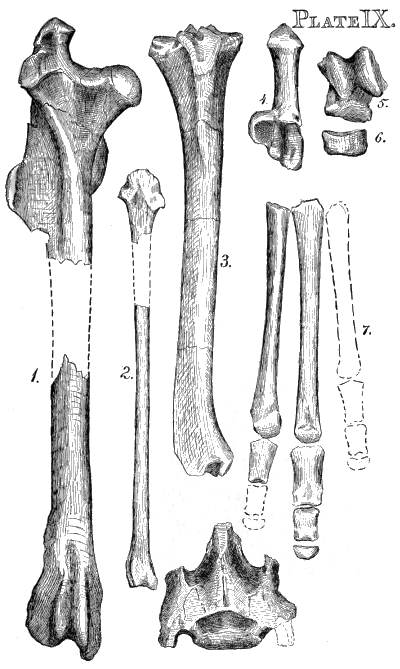
Femur (Plate IX., Fig. 1).—The femur has a small, nearly
hemispherical head, developed on a long and slender neck;
the head is but slightly out of the axis of the shaft, and has a
large pit for ligamentous insertion. The shaft is long, simple,
and curved slightly forward. At the proximal end it is
broad and flattened axially; below this it becomes expanded
fore-and-aft, but it thickens greatly at the distal end, just
above the condyles. The great trochanter is large and retroverted,
rising above the head, with two prominences rising from
it, one on top, the other back. The digital fossa is wide and
deep, penetrating far into the great trochanter. The second
trochanter is a small rounded ridge; the third trochanter is
large and prominent, curving slightly forward. The condyles
are long and narrow, projecting very far back, and are separated
by a wide and deep popliteal groove. From the external
condyle a low ridge runs obliquely, forming the upper
border of the shallow popliteal space. The trochleæ are long,
very convex, deeply grooved, and symmetrical.
Measurements of Femur.
|
M. |
| Width between head and great trochanter |
·019 |
| Width at third trochanter |
·034 |
| Diameter of head |
·019 |
| Width at condyles |
·028 |
| Width of trochlea |
·015 |
| Height of great trochanter |
·015 |
| Diameter fore-and-aft of shaft at middle |
·018 |
The tibia (Plate IX., Fig. 3) is very long and heavy, with
broad proximal articular face, the inner borders of which are
prolonged upward and separated by a groove.
The shaft at the tuberosity is subtriangular, with strongly
concave sides. The tuberosity is prominent, with a deep pit
on its upper surface for the insertion of the ligament of the
patella. The shaft below becomes sub-cylindrical, and decreases
regularly in size downward. Its curvature is forward.
The distal articular face is divided by a smooth ridge
into two deep facets. The malleolus is long.
The fibula (Plate IX., Fig. 2) is distinct, straight, and very
slender. The distal end is but slightly expanded, and is
strongly marked by a vertical groove externally. The proximal
end articulates with the overhanging portion of the
proximal face of the tibia.
Measurements of Tibia.
TIBIA.
| Upper Jaw. |
M. |
| Length |
·178 |
| Width of proximal surfaces (transverse) |
·032 |
| Width of proximal surfaces (antero-posterior) |
·019 |
| Transverse diameter of shaft |
·022 |
| Antero-posterior diameter of distal articulation |
·018 |
| Transverse diameter of distal articulation |
·018 |
The tarsus.—The astragalus (Plate IX., Fig. 5) has the
condyles asymmetrical and divided by a deep groove; the
head is narrow, with the neck elongate. The face for the
cuboid is small, and confined to the external border.
The calcaneum (Plate IX., Fig. 4) is long and compressed,
with its upper and lower margins straight and nearly parallel;
its tuberosity is large. The face for the cuboid is small.
The navicular (Plate IX., Fig. 6) is proportionately longer
and narrower than it is in the modern horse. The internal
and middle cuneiforms were probably separate.
Metatarsals (Plate IX., Fig. 7).—Three in number. Are
very much shorter proportionately than in the modern
horse. In shape they are compressed and arched forward.
The distal ends are flattened vertically, arched forward, and
deeply grooved in the middle.
The phalanges (Plate IX., Fig. 7) are very short, rather
stout, and very smooth and convex above.
The ungual phalanges are very thin and crescent shaped.
Measurements.
ASTRAGALUS.
|
M. |
| Greatest width |
·029 |
| Greatest length |
·022 |
| Length of navicular facet |
·017 |
| Width of navicular facet |
·012 |
| Length of tibial trochleæ externally |
·016 |
CALCANEUM.
|
M. |
| Total length |
·058 |
| Total width |
·019 |
| Depth in front |
·022 |
| Length of heel |
·035 |
| Depth of heel |
·018 |
| Length of cuboid facet |
·014 |
NAVICULAR.
|
M. |
| Width |
·009 |
| Length |
·010 |
PHALANGES.
|
M. |
| Length of first phalanx |
·022 |
| Width of first phalanx |
·012 |
| Length of second phalanx |
·013 |
| Width of second phalanx |
·010 |
| Length of ungual phalanx |
·005 |
| Width of ungual phalanx |
·010 |
PALÆOSYOPS, Leidy.
Hayden's Geological Survey of Montana, 1871.—Proceedings Academy Natural
Sciences, Philadelphia, 1871, p. 118.—Limnohyus.—Marsh, American Journal
Science and Arts, 1872, p. 124.
Generic characters.—The dentition is full, I. 3, C. 1, Pm. 4,
M. 3; the same in lower jaw. The internal cones of the superior
molars isolated from the crescentoid crests. One inner
tubercle on the last three premolars. One internal cone on
the last superior molar. In lower jaw, true molars with four
acute tubercles alternating in pairs and connected by oblique
crests. The last molar adds a fifth posterior tubercle. The
last premolar lacks the posterior inner tubercle. The canines
are in continuity with the incisors.
A broad, triangular forehead. A wide zygoma. Long,
projecting nasals. Large temporal fossæ. High sagittal
crest. Prominent and nearly vertical occiput.
Palæosyops major, Leidy.
Survey of Wyoming, 1871, p. 359.—Limnohyus robustus.—Marsh, American
Journal Science and Arts, 1872, p. 124.
Specific characters.—Sagittal crest short and thick. Temporal
fossæ not very deep. Frontals diverge rapidly. Occipital
condyles wide and low; the same is true of the foramen
magnum. Meatus auditorius high and deep. Glenoid
cavity shallow; no internal process. As compared with P.
Paludosus, post-glenoid process not so much compressed.
Occipital region comparatively higher and not so concave.
The occipital condyles are more prominent. The zygomas
are lighter. Head larger than Paludosus, perhaps not so large
as Vallidens.
Description from (i) a head, complete, but distorted, with
complete dentition, upper and lower. (2) A head somewhat
crushed, and lacking some portions, with full set of upper
molars and canines. (3) A great number of fragmentary specimens
of different parts of the body.
Dentition.—In the upper jaw the incisors are arranged in a
semi-circle as in P. paludosus; they have long fangs and short,
conical crowns, with a decided basal ridge, which is very
strong in the third. They increase from first to third, which
is very large and pointed.
The canines have very large and long fangs (longer than
the crowns). The crowns are very stout and pointed, constituting
formidable weapons. In section they are nearly circular,
with a distinct hinder margin and a slight recurve. A
rudimentary anterior margin is sometimes present, and of the
faces thus marked off, the inner is much smaller and flatter.
The general direction is forwards, downwards, and slightly
outwards. There is a diastema of about half an inch between
the incisors and canines.
Premolars.—The first is very small, about half an inch
from the canine, simple and conical, with an obscurely marked
basal ridge, and two heavy fangs.
Further description of the upper dentition is unnecessary,
owing to the complete work of Dr. Leidy upon the subject.
The lower incisors are placed in a semi-circular row, and
are somewhat procumbent, though hardly as much so as in the
tapir. They are much as in P. paludosus, but are relatively
smaller, and have not such distinct basal ridges; features
which indicate a departure from the carnivorous type, and a
nearer approach to the herbivorous type. The lateral incisor,
though the largest of the series, is not so large nor so pointed
as in P. paludosus. There is no diastema.
The canines are about equal in size to those of the upper
jaw, growing from stout fangs and permanent pulps. The
margins of the crowns are more decided, and are smooth,
leaving a very narrow and flat inner face. A feeble basal
ridge. When the jaw was closed, the lower canines passed
inside and in front of the upper.
The first premolar stands immediately behind the canine,
is longer than that of the upper jaw, consisting of a single
pointed lobe implanted by one fang, slightly recurved with a
flat inner and convex outer face. Passing in front of the
first upper premolar, it leaves a considerable diastema between
this and the second premolar.
The mandible approximates in form that of the tapir; the
lower border is less curved fore and aft, the alveolar border
is slightly concave antero-posteriorly. The molars converge
in front, presenting a very different arrangement from that in
Sus. The ramus is heavy, contracting in depth forward, and
very slightly in section. Below the alveolus, on the interior
side, the ramus is greatly swollen for two thirds of its depth,
to accommodate the very long and strong molar fangs.
The rami converge to the second premolar, where they
expand laterally to the canine alveolus. The symphysis is
shorter relatively than in P. paludosus, and the chin is regularly
rounded in front. The mental foramen is below the second
premolar. The dental foramen is small, very high up, and far
behind the molars. The alveolar border ascends rapidly behind
the last molar, expanding laterally into two ridges.
The coronoid is slender and recurved. The condyle is
broad, flat behind, inclines forward internally; there is
scarcely any depression between the condyle and the coronoid.
The masseteric fossa is very wide and deep. The
angle of the ramus is broken, but evidently has no such
posterior extension as in P. paludosus. It thins out rapidly
behind.
Measurements.
|
P. pal. |
P. major. |
| UPPER JAW. |
M. |
M. |
| Length of entire molar series |
·147 |
·170 |
| Length of three true molars |
·085 |
·102 |
| Length of three premolars |
·058 |
·068 |
| Diameter of last molar, transverse |
·039 |
·047 |
| Diameter of last molar, antero-posterior |
·036 |
·036 |
| Diameter of second molar, transverse |
·036 |
·040 |
| Diameter of second molar, antero-posterior |
·033 |
·036 |
| Length of incisor series |
···· |
·075 |
| Fore-and-aft diameter of canine at base |
·016 |
·021 |
| Length of crown of canine |
···· |
·033 |
| Diastema between canines and incisors |
···· |
·013 |
| Diastema between canines and molars |
···· |
·010 |
|
P. pal. |
P. major. |
| LOWER JAW. |
M. |
M. |
| Incisor series |
···· |
·073 |
| Median incisor fang, length |
···· |
·034 |
| incisor crown, length |
···· |
·012 |
| Diameter of median incisor crown, transverse |
···· |
·009 |
| Diameter of lateral incisor crown, transverse |
···· |
·011 |
| Diameter of lateral incisor crown, antero-posterior |
···· |
·012 |
| Length of fang of canine |
·055 |
·052 |
| breadth of fang of canine |
·023 |
·024 |
| Crown of canine, length |
···· |
·034 |
| Crown of canine, fore-and-aft diameter at base |
·019 |
·021 |
| Diameter of first premolar, antero-posterior |
·015 |
·010 |
| Diameter of first premolar, transverse |
·009 |
·007 |
| Diastema between first and second premolars |
···· |
·014 |
| Length of entire molar series |
·164 |
·186 |
| Length of molar series, omitting first premolar |
·132 |
·163 |
| Diameter of last molar, antero-posterior |
·017 |
·050 |
| Diameter of last molar, transverse |
···· |
·027 |
| Depth of jaw below last molar |
·068 |
·075 |
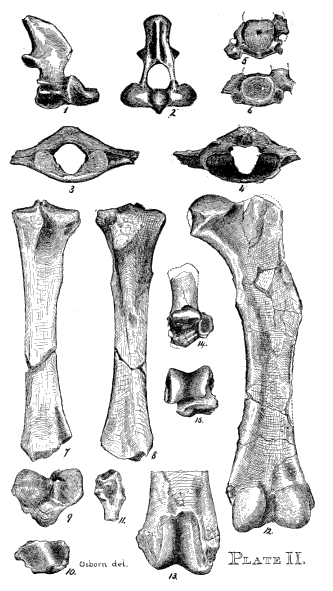
Among other specimens obtained at the divide between
Henry's Fork and Cottonwood Creek, was a nearly complete
but somewhat shattered skeleton of a Palæosyops major,
found contiguous to the head of the same, parts of which are
just described. Portions of these are figured on a one fourth
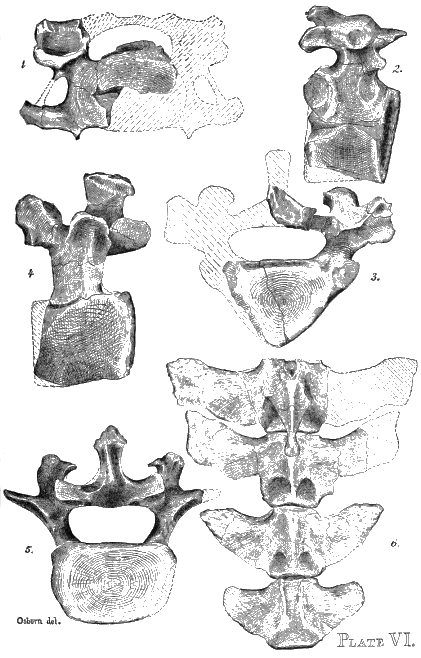
scale in Plate II. The description is from a nearly perfect
atlas and axis, several cervical, dorsal, and lumbar vertebræ,
more or less complete, and a portion of the sacrum and
pelvis, in addition to several bones of the limbs.
The atlas has a broad inferior arch, contracted antero-posteriorly,
and deeply notched for the prominent odontoid
of the axis. The heavy superior arch, inclosing a large and
depressed neural canal, is capped by a low tuberosity. It
slopes into a flat, and very broad transverse process, which
thickens backwards, and is perforated by the vertebraterial
canal. Forwards the transverse process is notched for the
exit of the first spinal nerve. The anterior or condylar faces
are continuous, deeply concave from above downwards; and
slightly so from side to side; while the posterior faces are
oval, nearly flat, and directed backwards and inwards.
The axis is proportionately small, with a long opisthocœlous
centrum, depressed, and produced forwards into a stout
conical odontoid process, and marked below by a strong
hypapophysial keel, which, developed on the latter half,
thickens backwards. The wide and thin pedicles inclose a
high neural canal, support the posterior zygapophyses and a
prominent and peculiar neural spine. The latter is flattened,
broad, and recurved posteriorly, thinning rapidly forwards
into a prow-shaped recurved edge. The transverse processes
arising from the latter half of the centrum are undersized
and widely perforated at base. The anterior faces are very
broad, directed outwards, and slightly rounded from above
downwards; they expand as they diverge (see Fig. 2). The
post-zygapophyses are small convex faces, projecting at the
base of the neural spine.
The remaining cervicals, five in number, are short, all
carinate, except the seventh, and opisthocœlous; with the
faces expanding only slightly beyond the body of the centrum.
A peculiar feature is a small pit upon the convex
anterior face, indicating either a ligamentous attachment
with the antecedent vertebra, or a remnant of the notochord.
This is a feature we have not noticed elsewhere. A long
and heavy transverse process supports a large and widely-perforated
inferior lamella. The pedicles are quite wide at
base, inclosing a large neural canal. The entire upper part
of the arch is unfortunately wanting.
The dorsal centra are smaller than the cervical, slightly
opisthocœlous, and carinate. They are sub-cylindrical anteriorly,
with decided costal surfaces before and behind;
approaching the lumbar region they become subtriangular.
A high neural arch supports a stout, but never very high
neural spine; this projects backwards, keeled in front, expanding
and deeply grooved behind. The zygapophyses are
small and nearly vertical. There is a short and thick transverse
process.
The lumbar vertebræ are long, decidedly opisthocœlous,
becoming wider and more depressed as they approach the
sacrum. The first sacral vertebra presents the same characteristics
as the last lumbar, only the body of the centrum is
slightly shorter. It has a very broad pleuropophysial plate.
The remaining sacral vertebræ are broad, and very greatly
depressed, rapidly decreasing in size. The transverse processes
are slender. The very low neural spines anchylose
into a long ridge. The number cannot be ascertained, owing
to the fragmentary state of the sacrum. The caudals indicate
a tail of not very great length; as the neural canal is
small and persists in only a few of the anterior vertebræ.
Measurements of Vertebræ.
|
Pal, major.
M. |
| Atlas, width, including transverse processes |
·195 |
| Atlas, length of inferior arch |
·082 |
| Atlas, height, including superior and inferior arches |
·078 |
| Axis, width, anterior articular faces |
·110 |
| Axis, length, excluding odontoid process |
·058 |
| Axis, height of neural spine |
·096 |
| Axis, length of odontoid process |
·025 |
| Seventh cervical, length of centrum |
·037 |
| Seventh cervical, width of posterior face |
·043 |
| Dorsals, anterior region, length |
·038 |
| Dorsals, anterior region, width, articular face |
·034 |
| Lumbar, width of posterior face |
·058 |
| Lumbar, length of centrum |
·056 |
| First sacral, width of anterior face |
·059 |
The ribs, of which great quantities of fragments remain,
were slender and not of very great width.
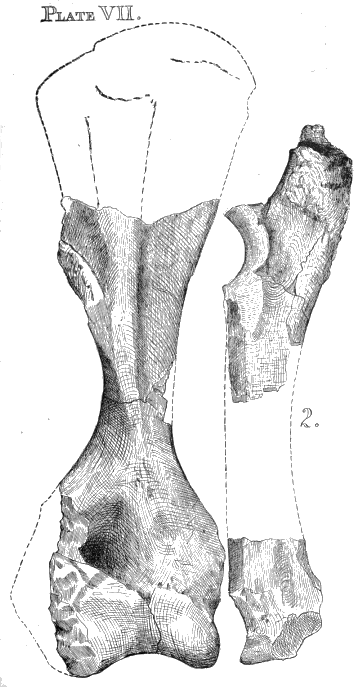
The femur, which is figured in Plate I., has a small head,
supported by a short neck. The shaft, very broad below the
head, supports the third trochanter one third of the way
down; below which it takes a cylindrical form, and expands
slightly above the trochlea. The two condyles, separated by
a wide and deep popliteal groove, are nearly subequal in
size—the internal somewhat the larger, while the trochlea is
long, narrow, and symmetrical. The great trochanter rises
slightly above the head, and overhangs a long and quite
deep digital fossa. The second trochanter is small. The
popliteal space is slightly concave.
Tibia.—The proximal end of the tibia is very large, with
massive rugosities for muscular attachment. The two proximal
faces are subequal, slightly convex, and separated by a
prominent spine, which is grooved at the top. The shaft is
long, straight, and compressed antero-posteriorly; the anterior
ridge on upper third is very high, and expands into the
tuberosity, which is enormous; while on the posterior face is
a deep fossa just below the head. The distal end of the
shaft is remarkably small, with two concave faces—the internal
the smallest—with a low oblique ridge dividing them.
There is a prominent malleolus.
The fibula (which is a distinct bone) has a small proximal
end, and expands slightly below, with a large external malleolus.
Measurements of Limbs.
|
M. |
| Femur, total length |
·420 |
| Femur, transverse diameter at distal end |
·098 |
| Tibia, length |
·310 |
| Tibia, transverse diameter, proximal articular face |
·090 |
| Tibia, transverse diameter, distal articular face |
·077 |
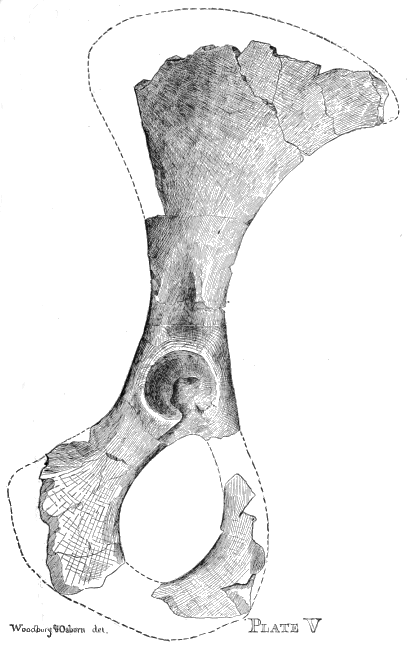
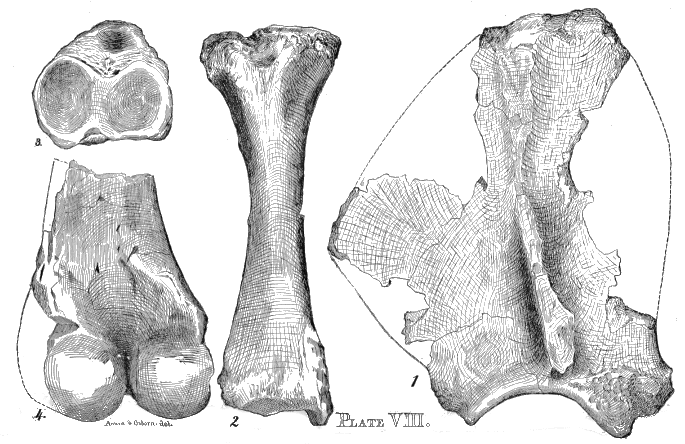
The pelvis is described from the right and left ilia, which
are broken as they expand towards the crest; the acetabulum
is fragmentary, but all the parts remain. The ischium and
pubis are only represented by fragments. As figured in
Plate V., the acetabulum is restored from a somewhat smaller
specimen. The most striking feature of the ilium is the long
and somewhat constricted neck. The acetabular border is
long and curved forward, thinning gradually as it approaches
the crest; and marked on the iliac surface, near the acetabulum,
by a slight rugosity for the rectus muscle.
The ischial border, while less arched, is probably longer;
and the sacral surface, distinctly defined, indicates that the
rounded upper border of the ilium rarely reached above the
sacral spines. There is a deep groove between the ischial
and pubic borders, the latter disappearing about half way up
the iliac surface. The gluteal surface near the acetabulum
is much depressed; above it expands into a broad, flat, thin
plate.
The ischium has a stout neck and thick expansion below;
the upper border is very heavy. From what remains of the
ischium and pubis we can infer a large elliptical obturator
foramen, a short pubic symphysis, a narrow and rather
slight pubis, with a small nearly cylindrical neck. The
acetabulum is deep, with a thick well-raised border, and a
large, oblong, and very deep pit for the ligamentum teres.
Measurements of Pelvis.
|
M. |
| Ilium, transverse diameter above acetabulum |
·062 |
| Ilium, long diameter (estimated) |
·232 |
| Acetabulum, greatest diameter |
·050 |
| Ischium, transverse diameter below acetabulum |
·041 |
| Pubis, diameter at obturator foramen |
·035 |
The tarsus is arranged in the usual Perissodactyle order.
The calcaneum is stout, of good length, tuberous, but not
expanding much at the extremity; presenting two faces for
the astragalus, of which the internal is the largest, and a
large distal face for the cuboid. The astragalus is wide, with
less asymmetry in the two articular facets than is common.
It articulates with both the cuboid and navicular.
Measurements of Tarsus.
|
M. |
| AAstragalus, total width, tibial facets |
·048 |
| Astragalus, total length |
·056 |
| Astragalus, length, navicular facet |
·046 |
| Astragalus, width, navicular facet |
·035 |
| Calcaneum, total length |
·120 |
| Calcaneum, total breadth |
·057 |
| Calcaneum, length of tuber calcis |
·050 |
All the above were found at Henry's Fork Divide. In
another locality, in connection with a fine head of P. major,
was found the lower half of a humerus.
The shaft is cylindrical and twisted, expanding widely at
the distal end. Of the two condyles the external is the
largest; and, to quote from Dr. Leidy, "a deep supra-condylar
fossa occupies the front of the humerus, opposed by a
deeper and more capacious anconeal fossa." The greatest
breadth between the supracondyloid eminences is ·091 m.
Palæosyops paludosus, Leidy.
Cont. to Ext. Vert. Faun, P. lævidens Cope. U. S. Geol. Survey of Terrs, 1872,
p. 591.
Specific characters.—Second superior molar has but one
outer tubercle. The cones are low as compared with P. major.
The cingula are much less developed. The angle of the
lower ramus is much longer. The zygoma is massive and
wide. An internal process on the glenoid cavity. Temporal
fossæ very deep. Crest of occiput nearly in same vertical
line as occipital condyles.
The full details of P. paludosus, which follow, may seem
somewhat unnecessary, to one familiar with the comprehensive
work of Dr. Leidy upon the subject. Care has been
taken not to retrace any of his steps; and the descriptions
given below are of those parts of the animal which he did
not possess at the time of writing. They include (1) a
cranium perfect posterior to the orbits; (2) a right ramus
mandibuli, with full dentition, except the first premolar; (3)
portions of the fore-limbs, scapula, and pelvis, pes and
manus, and many fragments of other parts.
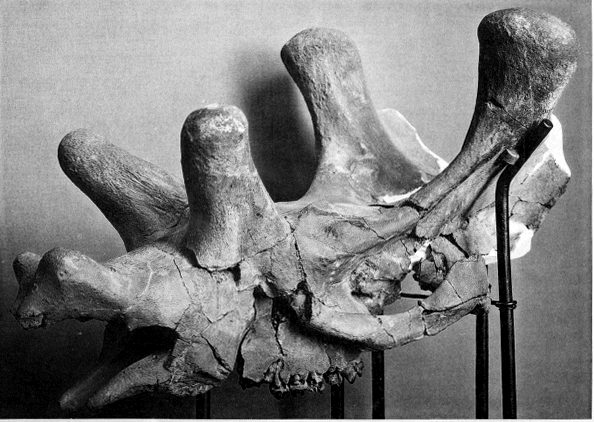
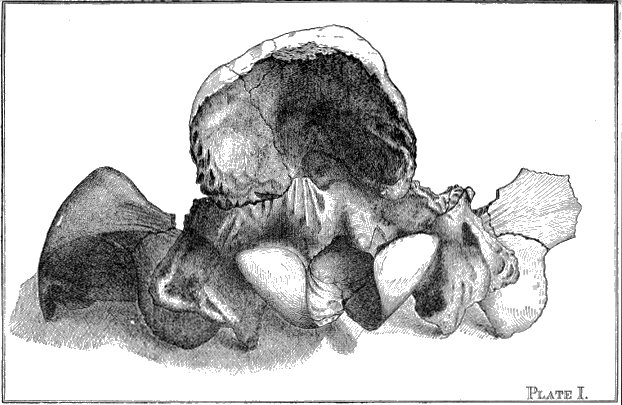
Among the first discoveries on Cottonwood Creek, in a
stratum of fine green sand, was a head of P. paludosus, complete
posteriorly, and broken off just behind the orbit. A
rear view of this has been admirably figured in Plate I.
General appearance.—The base of the cranium is of great
width; the occiput is high, inclined very slightly backwards,
and deeply concave from side to side. The forehead is triangular
and narrow. The temporal fossa is of immense size
and depth, leaving a small intracranial cavity. The zygomas
are heavy, and arching widely outwards give this part of the
head a strong resemblance to the Felidæ.
Description in detail.—The narrow but prominent basioccipital
segment is broadest posteriorly and tapers forwards;
divided by a median ridge, which expands anteriorly into a
large tuberosity; a feature also characteristic of the tapir.
About half an inch in advance of the condyles are the condylar
foramina. The condyles are formed of the exoccipitals,
which are low and of great lateral expansion. Their junction
with the mastoids is marked by a large foramen. The par-occipitals
are short and styliform. The supra-occipital region is
very large, high, and deeply concave from side to side, much
wider than in the tapir, with a marked interparietal suture.
The condyles are wide, but not very deep, approaching each
other very closely below. The basisphenoids are long and narrow,
tapering forwards. The alisphenoids are mutilated, but
indicate large vertical ridges joining the parietals, and heavy
pterygoid processes, perforated at the base by the alisphenoid
canal. They are again perforated by the foramen ovale
three fourths of an inch behind this. This completes the
base of the skull.
The parietals are very large, they form nearly the whole
of the temporal fossil; which, deep and wide, enclosing a
small cranial cavity, contrast strongly with the long and
shallow temporal fossæ of the tapir. The parietal crest is
very broad, and grooved at the top. This high crest and
deep adjacent temporal fossæ we at first mistook as pointing
to an exclusively carnivorous type. The forehead has a triangular
appearance, from the divergence of the two side
ridges of the sagittal crest. The postorbital processes are
very large, but do not reach the opposing processes of the
malar. The orbit is thus left incomplete posteriorly, while in
form it greatly resembles that of the Sus. The squamosal
encroaches considerably upon the temporal; and sends outwards
and downwards a great zygomatic process, which
arches outwards from the skull as in the Felidæ, and is more
powerful than in any living carnivore (Leidy.) A strong
downward direction is especially characteristic, the whole
describing a sigmoid curve. The mastoids are of great size
vertically, and transversely they are confluent with the par-occipitals.
A low, thick process on the internal side of the
glenoid cavity prevents lateral motion.
The nasals are long, broad, and thick, convex from side to
side, narrowing slightly anteriorly. They are straight, as in
Sus, which they resemble more than they do either tapir
or rhinoceros. The anterior borders are rounded, and do
not reach as far forward as the symphysis of the premaxillary.
The malar is broad and thick, probably forming but
little of the face, being directed downwards and backwards
to meet the zygoma. The postorbital process is short, and
rather larger than Dr. Leidy has indicated. The maxillaries,
smaller proportionately than in Sus, form posteriorly the
floor of the orbit; while the infraorbital foramen is situated
over the last premolar. The premaxillaries fail to reach the
nasals.
Comparative Measurements of Head.
|
P. paludosus. |
P. major. |
P. Tapir. |
|
M. |
M. |
M. |
| Height of occiput |
·122 |
·148 |
·120 |
| Breadth of occiput at post tympanic processes |
·160 |
·166 |
·110 |
| Breadth of cranium at ends of post-glenoid processes |
·172 |
·210 |
·126 |
| Transverse diameter of occipital foramen |
·031 |
·049 |
·040 |
| Vertical diameter of occipital foramen |
·027 |
·033 |
·027 |
| Depth of occipital condyles |
·033 |
·039 |
·029 |
| Breadth of occipital condyles |
·040 |
·049 |
·041 |
| Breadth at occipital condyles together |
·082 |
·100 |
·082 |
| Width of basioccipital at anterior condyloid foramina |
·038 |
·039 |
·028 |
| Width of basioccipital at junction with basisphenoid |
·025 |
·032 |
·020 |
| Width of crest dividing the temporal fossæ posteriorly |
·011 |
·020 |
·011 |
| Breadth of cranium outside of zygomata |
·262 |
·280 |
·180 |
| Depth of zygoma |
·046 |
···· |
·036 |
Lower jaw of P. paludosus described from another specimen.
The peculiar feature of this jaw is its remarkable extension
back of the molar series (a feature which has not been
noticed heretofore), the distance from the last tooth to the
angle being greater than the length of the entire molar
series. From beneath the last molar, the lower margin
curves gently up to the symphysis. The alveolar border is
but slightly curved. Behind the last molar the lower margin
forms a sigmoid curve, much more decided than in P.
major (first upwards and then downwards), and the ramus
thins out rapidly to the angle, where it has a slightly raised
border; at the diastema the ramus curves outwards so as to
throw the canines out of the line of the molars. The symphysis
is long.
Dentition.—The incisors, three in number, from length
and shape indicate a semi-circular arrangement, as in most
Perissodactyles. They increase from first to third. The
crown of the first resembles very much that of the ruminants,
but has a straight posterior basal ridge. Its forward edge is
worn so as to expose a small tract of dentine. The second is
larger, but very much like the first in conformation; while the
third has an acute conical crown with a strong basal ridge.
Of the premolars the first is wanting in this specimen.
The second is bilobed, the anterior lobe much the larger. It
has a small accessory tubercle on its anterior slope. The
outer face is rounded, the inner nearly flat. The posterior
lobe is very small and obtuse, and with the inner face slightly
grooved. In third and fourth the valley between the lobes
and the groove on their faces enlarge; while the anterior lobe
becomes relatively smaller.
Measurements of Lower Jaw.
|
M. |
| Diastema between canine and first premolar |
·024 |
| Length of entire molar series |
·143 |
| Distance between last molar and extremity of angle |
·147 |
| Depth of jaw at last molar |
·070 |
Among the first discoveries on Cottonwood Creek, in connection
with the lower jaw of P. paludosus just described,
were an ulna and radius, and part of the manus and scapula
of the same. These have been figured, together with other
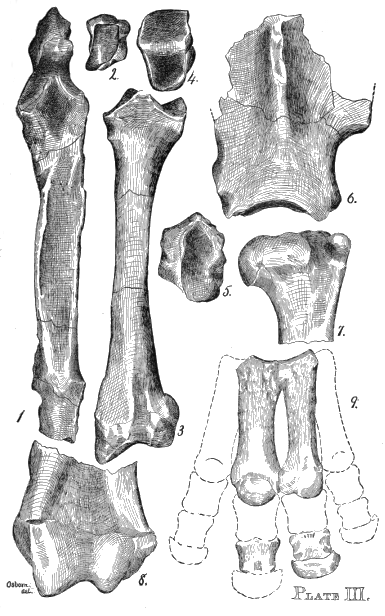
fragments belonging to the same species, in Plate III., and
form an interesting complement to the nearly complete hind
limb of P. major previously described.
The scapula has a shallow oval glenoid cavity, which is
concave longitudinally. Separated from it by a narrow notch
is a strongly recurved coracoid, placed on the inner side of
the bone. Above the coracoid the border is thin, and arches
inwards and then forwards; while the glenoid border is much
straighter, rising from a slight tuberosity. The spine rises
gradually from the glenoid, and does not bear any indication
of an acromion.
The humerus is represented by proximal and distal extremities.
The latter presents the same characters on a
smaller scale as in P. major. Upon the proximal end there
is a deep bicipital groove. The greater tuberosity has a
hooked anterior projection, and runs back into a ridge behind.
(See Fig 7, Plate III.)
The proximal end of the ulna (of median breadth anteriorly)
narrows into a prominent ridge behind. This gives a
trihedral character to the shaft. This is persistent, but is
less marked as the fore-and-aft diameter decreases. The
remaining features of note are a high tuberous olecranon
expanding behind; a shallow sigmoid, divided by a deep fossa
into two long divergent articular faces; a trihedral shaft
tapering slightly, but distinct from the radius; a narrow distal
extremity, with a small irregular face for the cuneiform.
The radius has a rather short shaft, curved forwards,
expanding below, and placed immediately in front of the ulna.
A strong ridge runs from the external tuberosity up the posterior
face of the shaft, disappearing two inches from the
top. The proximal end, fitting against the ulna by two small
faces, forms the greater part of the elbow-joint, a strong
median ridge dividing the proximal face into two subequal
surfaces with well-raised borders. The distal end of the
shaft is rugose, and more prominent than the proximal. It
has an oblong transverse face, which is slightly concave fore
and aft. The position of the radius, immediately in front of
the ulna, and its manner of articulation, remove any possibility
of rotation, a feature in strong contrast with what we
should expect from the character of the head.
Measurements of Ulna and Radius.
|
M. |
| Ulna, length, excluding olecranon |
·224 |
| Ulna, length of olecranon |
·080 |
| Ulna, transverse diameter, proximal surfaces |
·041 |
| Ulna, diameter of shaft at median line |
·038 |
| Ulna, fore-and-aft diameter, distal face |
·025 |
| Ulna, transverse diameter, distal face |
·017 |
| Radius, proximal face, transverse |
·048 |
| Radius, proximal lace, fore-and-aft |
·030 |
| Radius, median diameter, shaft |
·019 |
| Radius, median diameter distal face, transverse |
·043 |
| Radius, median diameter distal face, fore-and-aft |
·016 |
The manus is described from the third and fourth metatarsals,
with three phalanges. The metatarsals are short, with a
wide, stout shaft, flat in front and slightly arched forwards
behind. The proximal ends unite and form a continuous
articular face, concave from side to side; while upon the
exposed sides are smooth facets, indicating the presence of
two additional toes of less size. (See Plate III.) The convex
distal faces are marked behind by a slight groove.
The phalanges are very short and broad, the lower facets
marked by a shallow median groove. The ungual phalanx
is wide and short, with a crescentic outline.
Measurements.
|
M. |
| Third metatarsal, total length |
·090 |
| Third metatarsal, transverse diameter, proximal face |
·017 |
| Third metatarsal, transverse diameter, distal end |
·019 |
| Second phalanx, length |
·024 |
| Third phalanx |
·014 |
| Total estimated length of manus (6 inches) |
·155 |
Palæosyops vallidens, Cope.
Proceedings Am. Phil. Society, 1872, p. 487; Hayden's Survey, 1872, p. 572.
Specific characters.—Founded on details of dental structure.
Superior size. In the upper molars two strong transverse
ridges connect the inner tubercle with the outer crescents,
inclosing a pit between them. In the premolars the outer
crescents fuse almost into a single ridge. These united crescents
are relatively narrower. The inner molars are also
narrower, and the posterior tubercle of the last is an elevated
cone.
Fragment of a lower jaw containing the two posterior
molars. The measurements of the teeth are identical with
those given by Professor Cope. The depth of the ramus
below the last molar is three and one third inches, and it is
slightly heavier below than in P. major.
Restoration of Palæosyops.—The elevation of Palæosyops
major, which is taken as a type, was approximately the same
as that of Palæotherium magnum as restored by Cuvier.
The nearly complete ilium, femur, tibia, and tarsus of P.
major in our possession, enable us to make the following estimate
of the elevation of the hind quarters.
|
INCHES. |
| Pelvis, height of ilium above acetabulum |
9 |
| Femur and tibia by actual measurement, allowing for bend at the knee |
26 |
| Tarsus, from astragalus, and cuboid |
3 |
| Metatarsus and phalanges (estimated from manus of P. paludosus) |
8 |
|
46 |
It is probable that the fore-shoulders were of the same
height. From the atlas, axis, and from other cervicals, several
dorso-lumbar vertebræ, and part of the sacrum, a rude
estimate places the length of the animal at sixty-seven inches,
or nearly six feet, including the head, and excluding the tail.
In general features it strongly resembled the tapir, with
stout body, slender tail, and very short neck, compensated by
a proboscis of considerable length. In comparing the heads
of the ancient and modern representatives of this class of
Perissodactyles, the points of contrast are the wide stout
zygomas, the deep temporal fossæ, the protruding nasals, and
the narrow gaps in the dental series of the older type.
There are also strong points of resemblance in the structure
of the Palæosyops and Palæothere. Some of the cranial
homologues have been detailed by Dr. Leidy. The femur of
the Palæothere is shorter, the tibia longer; they are both
much stouter. The tarsus of the Palæosyops is narrower,
while the remainder of the Pes is very similar. The pelvis,
and particularly the ilium and acetabulum of Palæosyops, is
more palæotheroid than tapiroid. The similarity of the fore-shoulder
in the two types is also striking. The neck of the
Palæosyops was probably shorter.
In the descending series of Palæotheres terminating in
the diminutive P. minus, and characteristic of the upper
eocene of France, we have an interesting counterpart in the
large family of Palæosyops, of equal diversity of size and
characteristic of our lower eocene, and it is hoped that future
discoveries will render a complete discussion of this interesting
coincidence possible.
LIMNOHYUS, Leidy.
Proceedings Academy Natural Sciences, Phil., 1872, p. 242; Palæosyops;
Marsh, American Journal Sci. and Arts, 1872, p. 122; Hayden's Survey,
1872, p. 592, Cope.
Generic characters.—Resembles Palæosyops in general features.
Distinction founded on the possession of two conic
tubercles, of the inner series, on the last superior molar instead of one.
Limnohyus laticeps, Marsh.
Palæosyops Laticeps. Am. Journ. of Sc. v. iv. p. 122.
Specific characters.—"Cranium is broad. The zygomatic
arches much expanded. The nasals are narrow and elongated,
and more like the corresponding bones in Hyrax than
those in the larger pachyderms."
Fragments of the upper molar and premolar series. The
species is determined by measurements given by Dr. Leidy
of the second upper molar.
LEUROCEPHALUS, Gen. Nov.
Established on a specimen having a nearly complete dentition,
and portions of the cranium.
Dental Formula: (I. 3/3, C. 1/1, Pm. 4/4, M. 3/3,) × 2 = 44.
Upper incisors acute, with strong posterior ridges, lower
incisors compressed and laniariform, canines compressed, with
serrated cutting edges; first upper premolar with rudimentary
anterior lobe, last upper molar with rudimentary postero-internal
cusp. Molars constructed as in Palæosyops, but
higher, with sharper cones and more erect external lobes.
Internal median valley very much deeper. Little or no
depression at the forehead; zygomatic arch round, comparatively
straight and does not project outwards, and with obscure
postorbital process. Premaxillaries short and straight.
Mandible with nearly straight lower margin, and shallow
masseteric fossa; mental foramen single.
Leurocephalus cultridens, Sp. Nov.
This species was considerably larger than Palæosyops major,
with which it shows affinities, as also with Titanotherium
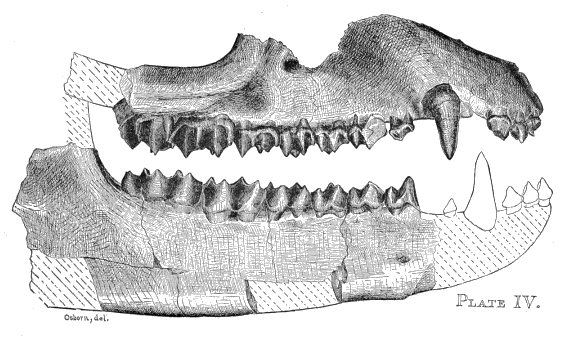
Proutii. See Plate IV.
The Frontal is narrow and flat, or slightly arched. It
sends out a strong curved postorbital process, which projects
outwards, but not so much outwards as in Palæosyops. The
sagittal crest runs back from the postorbital in a low rounded
ridge, rising but little as it recedes. The superciliary ridge
is distinct, and is pierced by two small venous foramina. The
shape of the entire bone is much as we find it in the dog,
except that it does not arch so much. One of the most marked
differences between this genus and Palæosyops is here shown.
In the latter the forehead rises abruptly from behind the
orbit, while in the former there is only a slight rise for some
distance behind the orbit. As the bone is broken here, it is
impossible to state whether there is any rise at all. Probably
not, however. Below the postorbital process, on the
lateral aspect of the bone, there is a low ridge which separates
the orbit from the temporal fossa. The under surface of
the frontal is smooth.
The Nasal, of which but a small portion is preserved, is flat
on top, but bends downward at the angle.
The Maxillary is long and stout, over the last and penultimate
molars it broadens to form the floor of the orbit, which
is of unusual size. Between the canine and the malar the
maxillary arches inwards, forming a perceptible concavity, at
this point it reaches its greatest vertical height, as it rises to
join the nasal. The alveolar border is curved in two directions,
one with the convexity outwards, and the other downwards.
It exhibits no emargination in the diastema between
the canines and molars. The palatine plate is long, thick,
and narrow; it is flat fore-and-aft, but concave transversely,
owing to the elevation of the alveolus; the suture also is
raised slightly. In thickness it varies; being thickest between
the canine and the second premolar, and beyond this becoming
thinner. Its forward termination seems to be obtuse, running
for a short distance along the premaxillaries. The infraorbital
foramen is large, situated over the fourth premolar,
lower down, and nearer to the malar than in Palæosyops.
The Premaxillary is rather short and stout; it is slightly
compressed, and ends in a sharp keel on top. Although not
so thick as in Palæosyops, it is much larger vertically. The
inner surface is ridged; it has no palatine process, and no
spine, so that the incisive foramen is large and undivided.
There was no symphysis between the two premaxillaries, they
do not show even any articular faces for each other, so that
they may not have been in contact during life. The animal
was adult, but not old. The incisive alveolus is short and
straight, and is but little out of the line of the molars. There
is a very long diastema between the incisors and the canine,
and here the premaxillary is deeply notched to allow the passage
of the lower canine.
The Malar is very different in shape and size from the same
bone in Palæosyops. Its facial extent is greater, as it articulates
with the maxillary as far forward as the first molar.
It is not so broad from above downwards, but is considerably
thicker; the articulation with the squamosal is by flat surfaces.
The postorbital process is small and indistinct. The
orbit is of great size; its breadth, shown by the maxillary
floor is unusual, but its fore-and-aft diameter is extreme,
being nearly twice as great as in a large Palæosyops major.
The Squamosal is a short, slender, and trihedral bone; it is
not at all like the squamosal of Palæosyops. It is smaller
even than that of P. paludosus; its outer margin is not turned
up, making the upper surface concave; it does not project
much outward, and scarcely at all downwards, as this is rendered
unnecessary by the flatness of the forehead. The chief
difference, in the size of this bone, between this genus and
Palæosyops is found in the much greater vertical and lateral
diameter of the latter; in length they are about equal. The
glenoid cavity is large, shallow, and transverse.
As a whole, the zygomatic arch is comparatively slender;
it is rounded, and does not project much laterally from the
side of the head; but its chief peculiarity consists in the fact
that it is nearly horizontal. It is thus altogether different
from the arch of Palæosyops.
The Occipital Condyles are different from those of that genus.
They are flatter, shorter from above downwards, and proportionately
much smaller; but are expanded laterally in much
the same manner. At the border of the foramen magnum
they are gently rounded instead of having a sharp angle.
These borders are segments of circles, but as the condyles are
broken from the rest of the occiput, we cannot infer from this
the shape of the foramen.
The Mandible is long, stout, but comparatively shallow.
It is of nearly uniform thickness throughout, and does not
exhibit the thickening of the alveolus and thinning, of the
lower margin, which is shown in Palæosyops, especially in
P. major; and the downward and inward arching of the alveolar
border is not marked to the same extent as in that species.
The lower border is nearly straight, and has but one slight
emargination just behind the symphysis. The ascending
portion of the ramus rises near the last molar quite abruptly,
and makes an angle of nearly 90° with the horizontal portion.
The masseteric fossa is shallow and obscure, and the anterior
bounding ridge is almost obsolete. This part of the jaw is
very different from any of the species of Palæosyops. The
symphysis is quite long, and extends back as far as the second
premolar; the chin is probably rounded. The dental foramen
is situated high up in the ascending portion of the ramus;
the mental foramen is placed below the second premolar; it
is large and single.
Cranial Measurements.
|
M. |
| Breadth of frontal at postorbital process |
·045 |
| Breadth of frontal in front of postorbital |
·030 |
| Breadth of nasal just in front of orbit |
·032 |
| Length from angle of nares to end of premaxillary |
·1235 |
| Length of premaxillary |
·056 |
| Length of maxillary |
·230 |
| Breadth of palatine process at canine |
·026 |
| Breadth of palatine process at second premolar |
·029 |
| Vertical height of maxillary at angle of nares |
·064 |
| Breadth of maxillary across floor of orbit |
·058 |
| Fore-and-aft diameter of orbit |
·054 |
| Length of malar along maxillary |
·094 |
| Vertical diameter of malar behind maxillary |
·029 |
| Transverse diameter of malar behind maxillary |
·033 |
| Fore-and-aft diameter of glenoid cavity (about) |
·029 |
| Vertical diameter of squamosal at end of malar articulation |
·032 |
| Transverse diameter of squamosal at end of malar articulation |
·0325 |
| Length of ramus mandibuli from symphysis to ascending portion |
·177 |
| Depth of jaw at last molar |
·068 |
| Depth of jaw at second premolar |
·061 |
DENTITION.
Upper Jaw.—The incisors, three in number, are placed
close together in a nearly straight line, which does not make
so great an angle with the line of molars as in Palæosyops.
They increase regularly in size from the first to the third,
which is very large. They all have stout rounded fangs,
and sharp pyramidal crowns, with strong basal ridges separated
from the acute blades by deep clefts. Between the
incisors and the canine there is a long diastema.
The canine is of great size; it has a swollen fang, and a
long recurved crown which is much compressed, and has
sharp serrated cutting-edges. The external face is the more
convex, the internal has a well-marked basal ridge, and both
are longitudinally striated. The canine is separated from
the premolars by a short diastema.
Premolars.—The first premolar stands by itself, separated
by a short interval from the second. It is implanted by two
fangs, and has a compressed crown with sharp cutting-edges.
It is nearly twice the size of the corresponding tooth in
Palæosyops, which is simple and conical. In the specimen
under description there is, besides the principal lobe of the
tooth, a rudimentary anterior lobe which gives the crown an
elongate shape. The basal ridge is shown on the inner side
only. The second premolar has a crown which is oval in
section. The external part consists of two sharp-pointed
cusps, separated by a valley, but confluent at base; while the
internal division is a low ridge (not a pointed cone as in
Palæosyops) with a tubercle developed behind it. The basal
ridge is marked all around, and sends up a buttress along the
antero-external lobe; as is also the case in the third and
fourth premolars. These are enlarged copies of the second;
but have the internal lobe elevated into a sharp cone, and
showing a much stronger basal ridge and deeper median valley.
These teeth differ in several respects from the premolars
of Palæosyops. The crowns are higher and the lobes sharper;
the basal ridge is more distinct, and is not interrupted at the
internal cusp; the external ascending buttress is stronger;
and there is no fold between the external lobes of the fourth.
The molars are constructed in a manner which resembles
that of P. paludosus rather than of P. major, but its
resemblance to the form shown in Titanotherium is stronger than
to either. They have broad, square crowns, which increase
progressively in size from first to last. There is a convexity
running up the median line of the external lobes, and the two
posterior lobes are connected together at their bases. The
first molar does not exhibit such a decided increase in size
over the last premolar as is seen in Palæosyops; the two external
lobes are more erect and sharper than in any form of
that genus. The cingulum is complete even across the
internal cones, and the median valley is very deep, as in
Titanotherium. There is a conspicuous fold at the junction
of the external lobes, and a minute tubercle between the two
anterior lobes; this tubercle is present only in the first
molar, and not throughout the series, as in Palæosyops. The
second molar in general form is like the first; but is larger,
has a deeper median valley, more conspicuous external folds,
and a stronger basal ridge. There is also some change in
the proportions of the crown; the first measuring the same
in both directions, while the second is wider than it is long.
The last molar has but one internal cone; the second is
represented by a tubercle; which however is a true rudimentary
lobe and not a development of the basal ridge. In
this tooth, the external fold is very large and the median
valley very deep.
Lower Jaw.—The lower molars and premolars are very
much like those of Palæosyops, but are longer, narrower, and
higher. The incisors are not at all like Palæosyops, but are
compressed and laniariform, with acute crowns and sharp
cutting-edges. The canine is not present in our specimen;
but that it was large, is shown by the long diastema between
the upper canine and incisors.
Premolars.—The first is small, simple, and implanted by a
single fang close to the canine. The diastema between it
and the second premolar is about one half of that in P. major.
The second premolar is the most peculiar tooth in the lower
series; as it carries the development of the anterior lobe at the
expense of the posterior lobe, to a still greater extent than in
Palæosyops., forming a crown like the blade of the carnivorous
sectorial. The third lobe of the last molar is no longer a
simple cone, but a functional lobe, with two crests running
from it, which bound a median valley.
Teeth Measurements.
| UPPER JAW. |
M. |
| Length of entire dental series |
·275 |
| Length of incisor series |
·375 |
| Length of diastema between canine and incisors |
·018 |
| Fore-and-aft diameter of canine |
·019 |
| Transverse diameter of canine |
·015 |
| Length of diastema between canine and premolars |
·0145 |
| Length of premolar series |
·083 |
| Length of first premolar |
·016 |
| Width of first premolar |
·009 |
| Length of second premolar |
·021 |
| Width of second premolar |
·017 |
| Length of third premolar |
·022 |
| Width of third premolar |
·022 |
| Length of fourth premolar |
·024 |
| Width of fourth premolar |
·027 |
| Length of true molar series |
·106 |
| Length of first molar |
·031 |
| Width of first molar |
·031 |
| Length of second molar |
·037 |
| Width of second molar |
·040 |
| Length of third molar |
·038 |
| Width of third molar |
·041 |
| LOWER JAW. |
M. |
| Length of entire molar series |
·202 |
| Length of premolar series |
·081 |
| Length of true molar series |
·121 |
| Length of second premolar |
·024 |
| Width of second premolar |
·0125 |
| Length of third premolar |
·022 |
| Width of third premolar |
·014 |
| Length of fourth premolar |
·0235 |
| Width of fourth premolar |
·0155 |
| Length of first molar |
·030 |
| Width of first molar |
·017 |
| Length of second molar |
·038 |
| Width of second molar |
·021 |
| Length of third molar |
·053 |
| Width of third molar |
·024 |
Found at Henry's Fork Divide.
This may eventually prove to be a species of Telmatherium,
(Marsh); but the description given by him of that genus is
so brief and uncharacteristic that it might apply to any of
the allied genera. Indeed, Dr. Leidy has regarded it as a
synonym of Palæosyops.
HYRACHYUS, Leidy.
Proc. Ac. Nat. Sc., 1871, p. 229, et seq.
A genus of tapiroid mammals, which is thus defined:
"Lower Jaw: Third molar with two crests; four premolars,
third and fourth with one transverse and one longitudinal
crest. Upper Jaw: Seven molars, first without interior heel;
premolars with two transverse crests." (Cope.)
Synopsis of Species.
| I. |
Long diastema between lower canines and molars. |
|
| A. |
Lower jaw with six molars |
H. nanus. |
| B. |
Lower jaw with seven molars. |
|
| a a. Upper molars with complete
cingulum. Enamel wrinkled. |
|
a. The last molar with two external lobes
on nearly the same transverse line. |
H. intermedius. |
| b. Last molar with the external lobes on the same longitudinal line. |
H. modestus. |
| b b. Upper molars with cingulum incomplete externally. |
|
| a. With anterior conical buttress larger than anterior lobe. |
|
| α. Buttress separate, and no fold from
anterior lobe. |
H. princeps. |
| β. Buttress united, and quite large fold
from anterior lobe. |
H. imperialis. |
| b. With anterior conical buttress smaller than anterior lobe. |
|
| α. Tooth large. |
H. eximius. |
| β. Tooth smaller. |
H. agrarius. |
c c. Cingulum only on outer side of first molar, buttress separated by
a ridge from anterior lobe, fold from this lobe very prominent. |
H. implicatus. |
| |
| II. |
Short diastema between lower canines and molars. |
|
| A. |
Descending ridge from antero-external point of lower
molar extends entirely across the crown of the tooth anteriorly. |
H. crassidens. |
Hyrachyus imperialis, sp. nov.
Established on the second and third molars of each upper
jaw, and three premolars, and one lower molar, portions of
the skull and vertebræ.
This species is, with the exception of H. princeps, (Marsh),
the largest species of the genus as yet known. It differs from
H. princeps in the greater proportionate length of the molars,
in their larger size, compared with the bulk of the animal, and
in the less separation of the anterior external conical buttress.
The third molar is the largest; the fold extending from the
antero-external lobe into the valley is very conspicuous. The
basal ridge (which is very strongly marked on the posterior
edge), is very feebly indicated on the exterior. The transverse
crests are more oblique in the second than in the third,
but in the latter the valley is deeper and the crests slightly
longer. The anterior conical buttress is of great size, being
larger than the anterior lobe. The premolars have, as usual,
one internal cone; the anterior and posterior external lobes
approach close together, while the accessory fold from the
anterior lobe becomes very prominent, reaching the internal
cone and enclosing a valley between itself and the transverse
crest. The basal ridge does not extend around the inner
part of the crown as in H. agrarius.
The only lower molar we have, seems to be a penultimate
molar of the right side. The basal ridge is large anteriorly,
very short posteriorly, but does not appear at all upon the
sides, as in H. agrarius.
The remaining bones of the skeleton indicate a rather
small animal, the teeth are therefore proportionately very
large.
The occipital condyles are small and sessile; they are
much extended laterally, and the external angles are pointed.
In other respects they resemble the condyles of Palæosyops.
The zygomatic arch is slender and does not curve outward
strongly. We cannot tell how far the malar encroaches upon
the face. After leaving the maxillary it becomes much compressed;
it has no postorbital process. The maxillary is of
unusual breadth, extends far backwards, and it forms the
floor of the large orbit. The mandible is slender and compressed,
with a large dental canal.
The atlas is small, and has narrow transverse processes,
which are perforated by a large vertebraterial canal. The
dorsals have considerably depressed centra, and the ribs are
slender.
Measurements.
|
M. |
| Length of last molar |
·025 |
| Breadth of last molar |
·030 |
| Length of second molar |
·024 |
| Width of second molar |
·0305 |
| Length of last (?) premolar |
·018 |
| Width of last premolar |
·0245 |
| Length of second lower molar |
·025 |
| Width of second lower molar |
·018 |
From Henry's Fork Divide.
Hyrachyus intermedius, Sp. nov.
Established on the upper true molar series of the right
side.
This species is intermediate in size between H. agrarius
and H. modestus. As in the latter species; the basal ridge extends
around the entire crown of the tooth, with a small interruption
on the antero-external lobe. It is more pronounced,
in front and less behind than in H. imperialis. The anterior
conical buttress is not nearly so well developed as in H. imperialis;
the valleys are wide, and the descending fold from
the antero-external lobe is obscure, scarcely marked at all in
the first. The transverse crests are strongly arched forwards,
and the anterior is very much the longer. The peculiar feature
of the species is the position of the postero-externa,
lobe, which is pushed to the posterior aspect of the tooth;
this is carried so far in the last molar that the two external
lobes stand on nearly the same transverse line. The antero-external
lobe is much the highest point in the tooth, and its
the first molar is remarkably sharp. The enamel is considerably
wrinkled, but not nearly so much as in H. modestus.
Measurements.
|
M. |
| Length of first molar |
·012 |
| Breadth of first molar |
·0155 |
| Length of second molar |
·015 |
| Breadth of second molar |
·017 |
| Length of third molar |
·0145 |
| Breadth of third molar |
·017 |
From Cottonwood Creek.
Hyrachyus nanus, Leidy.
Pr. Ac. Nat. Sc., 1872, 20.
Henry's Fork.
Hyrachyus agrarius, Leidy.
Pr. Ac. Nat. Sc., 1871, 229.
Henry's Fork.
Hyrachyus eximius, Leidy.
Pr. Ac. Nat. Sc., 1871, 229.
Cottonwood Creek.
Hyrachyus crassidens, sp. nov.
Established on the left and a portion of the right ramus
mandibuli, containing the first molar.
The jaw presents some differences from the form common
in Hyrachyus. The alveolus is more curved, especially near
the ascending portion of the ramus; the jaw is narrower, and
is especially contracted near the incisive alveolus. The lower
margin of the ramus is but slightly curved. The ramus itself
thickens regularly from before backwards, and is thickest at
the last molar; beyond which it becomes thinner again. The
depth of the jaw is comparatively small, and the teeth have a
forward inclination; the mental foramina are not so large as
in other species of Hyrachyus, and are four in number.
The incisors are small, arranged in a semi-circle, and have
very much compressed fangs, with somewhat procumbent
crowns; the canines are small, and form a continuous series
with the incisors. There is a diastema between the canine
and first premolar; but one which is shorter than in known
species of the genus, and which does not indicate the usual
curve of the upper border of the ramus.
The molar series, (so far as can be judged from their broken
condition), are much the same as in other species; except, perhaps,
in the greater relative size of the posterior lobes, and
in the more complete closing of the median valley by the
junction of the two lobes externally. The ridge which curves
downwards and inwards from the external point of the anterior
lobe is unusually well developed, and curves across the
entire crown. The cingulum is feebly shown; it appears on
the anterior and posterior ends of the tooth (first molar) and
for a very short distance on the outside of the tooth opposite
the median valley; there is no trace of it on the inner side.
Measurements.
|
M. |
| Length of entire molar series (about) |
·080 |
| Length of premolar series |
·033 |
| Length of true molar series (about) |
·047 |
| Fore-and-aft diameter of fang of canine |
·008 |
| Distance between canine alveoli |
·009 |
| Length of diastema |
·115 |
| Length of the first molar |
·015 |
| Breadth of the first molar |
·010 |
| Depth of ramus below last molar |
·0245 |
| Depth of ramus below last premolar |
·0215 |
| Greatest thickness of ramus |
·017 |
| Length of symphysis (about) |
·030 |
Found at Henry's Fork.
Hyrachyus ———— ?
There are three premolars of the upper jaw which we
cannot refer to any known species; but they are too imperfect
to justify the formation of a new species for their reception.
What appears to be a first premolar is inserted by a single
broad fang; it is too much worn to show the characteristic
enamel folding, and is peculiarly broad and short. The second
premolar shows the usual foldings of Hyrachyus; save that
a distinct valley enters the tooth from the posterior edge,
running forward to the transverse crest, and inclosed by the
curving backwards of the internal cone. The crown is nearly
square; the basal ridge is scarcely marked at all.
Measurements.
|
M. |
| Length of first premolar |
·011 |
| Breadth of first premolar |
·016 |
| Length of second premolar |
·012 |
| Breadth of second premolar |
·014 |
HELALETES, Marsh.
Am. Journ. Sc. and Arts, 1872, p. 218.
Additional material enables us to give further characteristics
of this genus, which may be thus defined: Mammals,
allied to Lophiodon, having a third lobe to the last lower molar,
short symphysis, and with the teeth of the lower jaw forming
a continuous series. Astragalus has narrow, oblique
condyles.
| Dental formula: I. |
? - ? |
, C |
1 - 1 |
, Pm. |
4 - 4 |
, M. |
3 - 3 |
| 3 - 3 |
1 - 1 |
4 - 4 |
3 - 3 |
Synopsis of Species.
| A. |
Teeth small; a small tubercle on the outer margin, between
the cusps of last upper molar |
H. boöps. |
| B. |
Teeth much larger and proportionately broader; no tubercle
on last upper molar |
H. latidens. |
Helaletes latidens, sp. nov.
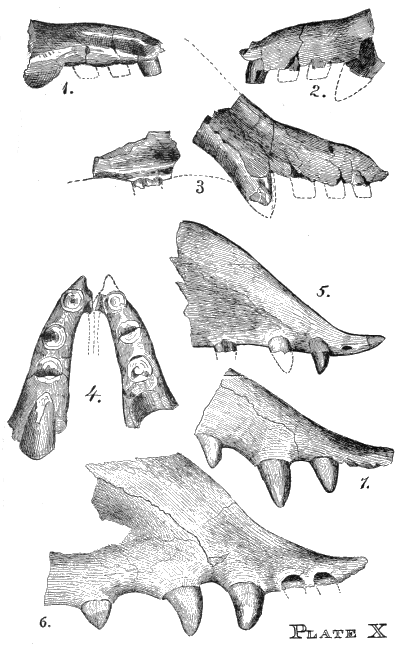
Lower Jaw.—The ramus is stout, and resembles in general
form that of Hyrachyus, but the alveolar border is
straighter than in that genus; the ascending portion forms
a right angle with the horizontal portion, and the masseteric
fossa is deep. The symphysis is comparatively short, and
there is complete bony union between the rami, which do not
diverge so much as in Hyrachyus. As in that genus, there
are several small mental foramina beneath the premolar
series. The dental series forms a nearly continuous line, the
only diastema being a very short one between the first and
second premolars. The incisors have compressed fangs, and
are arranged in a slight curve. The canine is small and subcircular
at base. The premolars also are small; they somewhat
resemble those of Hyrachyus in shape, but are smaller,
and have the posterior lobe not so well developed. The
first is implanted by a single fang, the others by two. The
molars (except the last) consist of two pyramidal lobes,
which form transverse cutting-crests, as in Tapirus and
Hyrachyus. The basal ridge is shown on the anterior and
internal sides only. Externally the lobes meet at their bases,
inclosing the valley on that side. The last molar is by far
the longest of the series, and consists of three lobes, of which
the anterior is the largest, and the posterior the smallest.
The basal ridge at the anterior part of the tooth is very
strongly marked.
Upper Jaw.—The molars increase in size from first to last
with considerable regularity. The premolars are small, and,
as in Hyrachyus, have one single internal cone, which is
joined by transverse ridges from the two outer cusps; the
anterior accessory tubercle is well developed. The first
molar is considerably larger than the last premolar; it is
much worn, and does not show anything more than that
there are two internal cones. The anterior conical buttress
is very largely developed throughout the true molar series.
The second and third molars resemble almost precisely the
corresponding teeth of Hyrachyus. Their shape, however,
is more nearly square than is usual in that genus.
Measurements.
UPPER JAW.
|
M. |
| Length of true molar series |
·036 |
| Length of last molar |
·0135 |
| Width of last molar |
·015 |
| Length of second molar |
·012 |
| Breadth of second molar |
·015 |
| Length of first molar |
·0105 |
| Breadth of first molar |
·012 |
| Length of last premolar |
·009 |
| Breadth of last premolar |
·011 |
| Length of third premolar |
·008 |
| Breadth of third premolar |
·009 |
LOWER JAW.
|
M. |
| Length of true molar series |
·042 |
| Length of last molar |
·018 |
| Breadth of last molar |
·009 |
| Length of second molar |
·013 |
| Breadth of second molar |
·008 |
| Length of first molar |
·012 |
| Breadth of first molar |
·008 |
| Length of third premolar |
·008 |
| Breadth of third premolar |
·005 |
| Diameter of canine at base |
·006 |
| Length of symphysis (about) |
·027 |
Found at Henry's Fork.