Painting by Immersion.
The process of painting various articles by dipping them
bodily into specially prepared paint contained in a tank or
other receptacle is a very old idea. It has, however,
developed considerably in late years, and is now largely
employed in many industries, particularly in the finishing
of agricultural implements of various kinds, iron work and a
hundred and one other articles. It is sometimes used in
conjunction with paint spraying; that is to say, the first
coat or coats may be put on by immersing the article to be
painted in the paint, or varnish, and the final coat of enamel
or varnish may be put on by means of a spray. In some
cases, the final coat is applied by means of brushes in the
ordinary manner.
Perhaps the simplest form of paint dipping is that applied
to various articles, such as bolts, rings and small parts, which
are placed in a wire basket and plunged into the paint.
The basket is then hung up for a quarter of an hour or so to
drain, and afterwards in another place, until such time as the
paint becomes hard.
Another familiar example of painting by dipping is that
of ordinary tapered cans, such as those which are used to
contain varnish, etc. In this case, a piece of wood is
introduced into the neck, the can is immersed in the paint
up to almost the top of the neck, and is then placed upside
down to drain and to dry. A paint which dries with a gloss
is usually employed for this purpose, and it may be remarked
that a good deal of this work is now done by spraying; in
fact, a great deal of difference of opinion exists as to the
respective merits of the two processes for this particular
purpose.
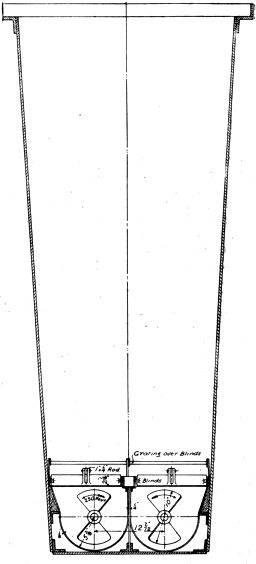
Fig 1.—Cross Section Through Paint Tank.
Going a step farther, we come to the consideration of
articles such as iron sashes and casements, parts of staircases,
etc., which may be dipped into a tank containing, say,
five to ten gallons or so. Such tanks are usually made to
slant at the bottom in order to facilitate cleaning when
necessary. Adjacent to them is provided a platform,
usually lined with sheet iron upon which the paint can drip
after the articles are removed from the tank, and a system of
overhead rails for moving the articles from one part of the
works to another. No agitating apparatus for the paint is
required, but after the tank has been used for some time,
say, for example, at the week-end, it is necessary to stir
it up by means of a pole before the work commences.
As a matter of fact, the articles being plunged in the tank, and
their withdrawal, in itself stirs the paint sufficiently for the
purpose.
In dealing with the larger-sized articles which are to be
painted, such as reaping machines, the construction of the
tank which may hold several tons of paint is naturally of a
more elaborate character. Such a plant will consist, first, of
the tank itself; next, the system of overhead railing; third, the
apparatus upon which the articles to be painted are hung;
and fourth, the hoists for lowering and raising such articles
into and from the tank. It will be convenient to consider
these parts which go to form a complete installation under
their several heads, taking a more elaborate plant by way of
example, it being understood that the plant may be simpler
in form when the size of the articles to be painted is small,
or under other circumstances, such as will be presently
suggested.
The Tank.
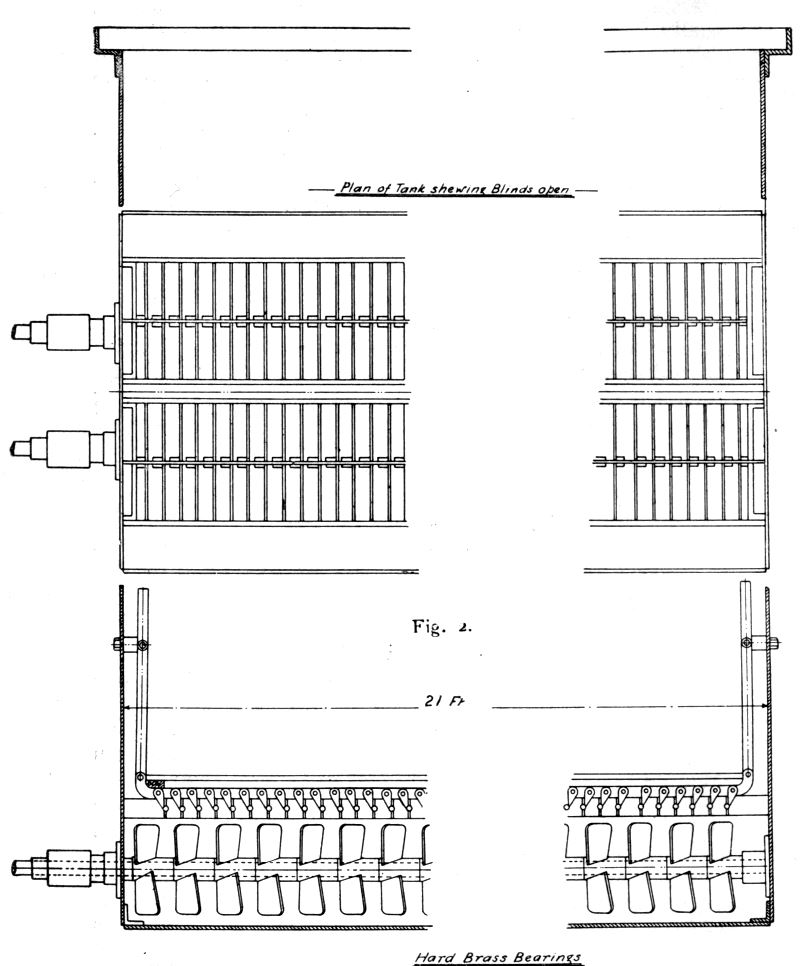
Stirrers and Blinds for Paint Dipping Tank. Fig 2.—Plan.
Fig. 3.—Longitudinal Vertical Section.
There are two forms of special tanks in general use, one
having at the bottom paddles for agitating purposes, and the
other worms provided with the same object. Fig.
1. shows a cross section of a tank made on the McLennan
patented system. In this two series of paddles revolving in
opposite directions are provided, and above them is an appliance
which may be likened to a horizontal venetian blind,
consisting of iron laths, which are nearly horizontal when
closed, forming a platform upon which the paint can settle, and
vertical when open. This blind is left open when the tank is
in use, and is closed when it is at rest. The illustration gives
the dimensions of the parts, although these, of course, will
be varied according to circumstances. Above the blind is
sometimes a grating, which, together with the blind, form a
protection to the agitating gear from articles dropped into
the tank by mistake, the two together preventing the heavy,
pigment in the paint from clogging the paddles when the
agitating gear has been stopped for some time. Figs. 2 and
3 show respectively longitudinal plan and section, from
which the construction will be clear.
Messrs. Wilkinson, Heywood & Clark, Ltd., of Poplar,
who own the McLennan patents, in a little book, entitled
"Painting by Immersion," state that there were certain
disadvantages in the design of this tank, inasmuch as
should it become necessary to remove or repair the paddles,
it would be necessary to empty the tank and bodily remove
the parts. They have, therefore, a new design, which is
shown in Fig. 4, in which this remedy is overcome. The
agitating gear, in this case, is on a sub-frame, separate and
independent from the tank itself. The drive is in the
tank, and is taken by means of a claw clutch through a
right angled bevel to the agitating shaft. This design has
proved very satisfactory for small tanks. For very large
tanks a gear is recommended in which the agitating gear is
enlarged and the shafting is supported or stiffened to prevent
whipping. This entails a design of some special bearing,
which should be paint proof and oil proof, for the reason
that the bearing is immersed in the paint itself. In Fig.
5 is shown drawings of this bearing, on which the firm named
hold patents. The perfected plants now consist of a tank
with an independent and removable chassis frame, on which
are mounted the Venetian blind arrangements, already
mentioned, together with the agitating gear, which consists of
either one, two, or more parallel shafts, mounted on parallel
gear, as shown in Fig. 6.
These shafts are held on the sub-frame with the patent
bearings already referred to, and the drive is transmitted
through the bevel gear encased in a special gear box, which
is equally oil and paint proof and self-lubricating. It
will readily be seen that with this plant it is an easy matter
to withdraw the driving gear and lift the sub-frame bodily
out, without in any way disturbing the paint in the tank.
The tank, therefore, can be buried nearly flush in the ground,
embedded in concrete, and need never be disturbed. In
case of emergency, and when painting is continuous throughout
the year, it is recommended that the consumer should
keep a complete spare chassis for use when occasion requires.
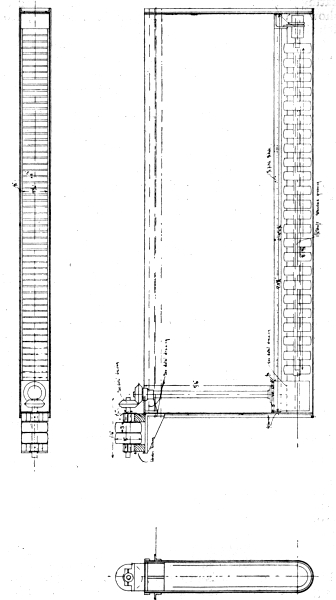
Fig. 4.—Design for Tank for Painting Steel Sheets.
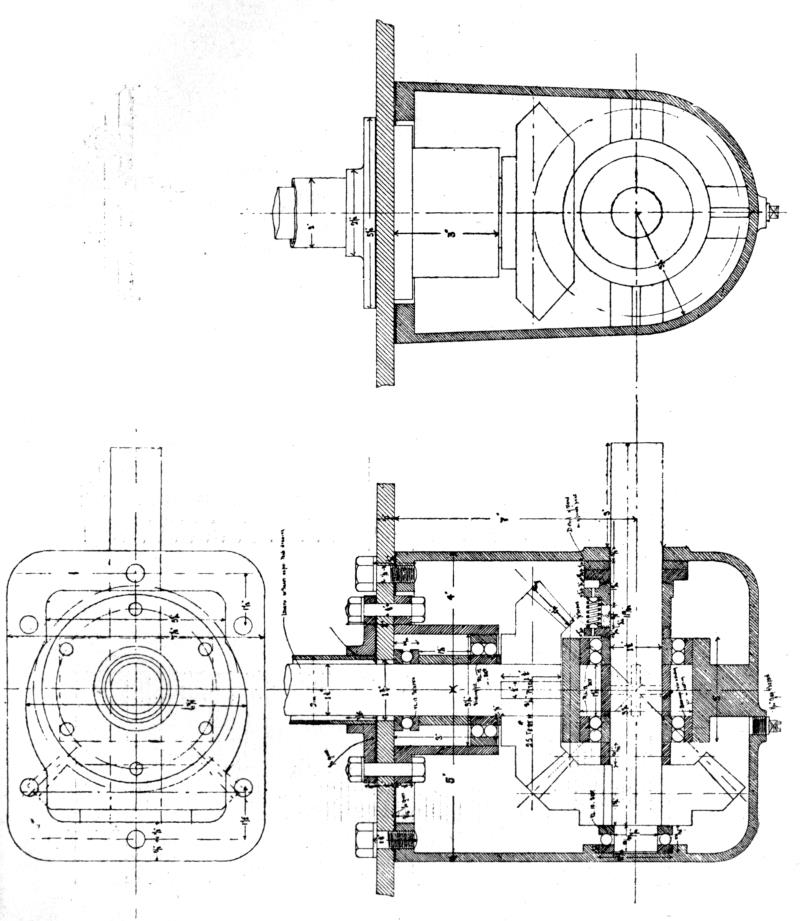
Fig. 5.—Details of Paint-Proof Bearings and Gear Box.
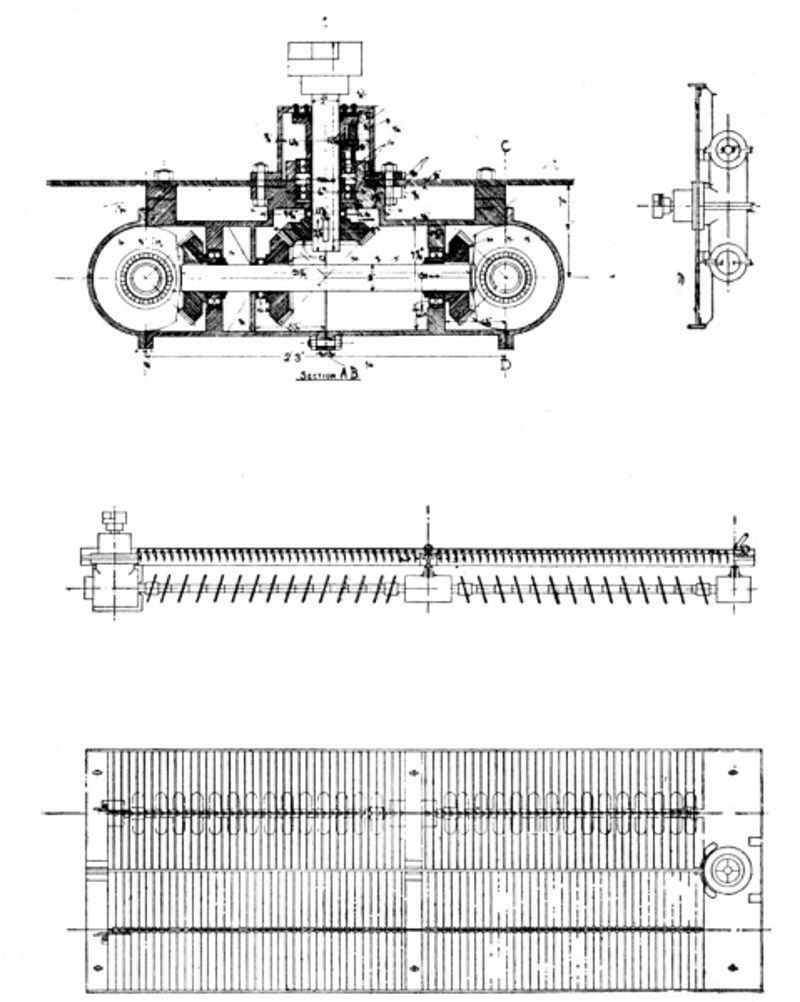
Fig. 6.—Details of Sub-frame, Shafting and Driving Gear for Tank Designed for Implement Manufacturers.
Whatever the construction of the tank itself may be,
and whether or not it is provided with agitating apparatus,
it is generally found most convenient to build it with the
top nearly level with the floor. It is advisable to provide
iron doors or covers to close the tank in when out of use so
as to prevent excessive evaporation and also for use in case
of fire. These doors or covers should therefore be actuated
by levers or other suitable appliance which may be put in
motion at a point some distance from the tank itself, for while
the paint is not very liable to catch light, an accident may
cause it to do so, particularly when electricity is used in the
works, and the closing of properly constructed doors will
quickly subdue fire as far as the tank itself is concerned by
shutting off access of the air. The usual plan followed is to
provide wide strips of thick felt attached to the doors in
proper position so that when the doors are closed the contact
will be thorough and the tank itself be practically sealed.
When agitators form part of the apparatus it is not
necessary to buy the paint ready mixed for use, as it may be
introduced into the tank in thin paste form; the necessary
thinners such as white spirit can be added and the agitating
apparatus slowly revolving will quickly mix the parts together
and render the paint suitable for use.
It will be understood that the form of tank above
described may be very considerably modified according to
circumstances. In very simple paint dipping, such as is
required for small articles, casements, etc., the agitating
apparatus may be wholly dispensed with, while in other
cases, the shutter-like arrangement above mentioned may
be omitted and the agitator may consist of a worm with a
screen above to protect the parts from pieces which may
accidentally fall in.
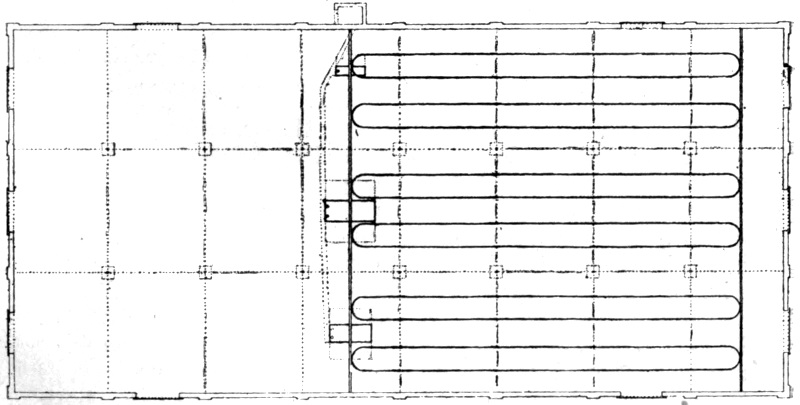
Fig. 7.—General Lay-out of a Three-tank Plant Designed
for the Use of an Agricultural Implement Maker, Using Three Colours in this Instance, Red, Green and Blue.
The Rails and Hanging Apparatus.
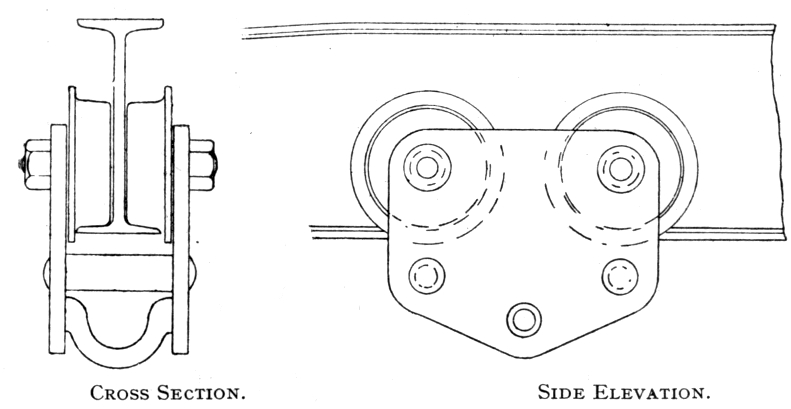
Fig. 8.—Joist and Wheels Supporting Hanger.
These two details may be conveniently considered together,
and it should be stated at once here again a great
deal of difference of opinion exists as to what system is the
best. It should, however, be clearly understood that upon
the system of railing a great deal of the success depends.
The object, of course, to be attained is that of handling a
large number of parts with as little labour as possible. With
this object, a complete system of overhead rails, commencing
with the finishing shops, leading to the paint tank, and thence
to storage or delivery departments, should be carefully thought
out, always remembering that the growth of a business
may necessitate the erection of additional buildings from
time to time and provision made accordingly. One of the
simplest and best forms of rails is an H section joist with two
wheels on either side as shown in Fig. 8. In other cases
an L rolled joist is used, the railing part being on the vertical
flange while the horizontal flange is connected with rods
fixed to the upper part of the building. One method which
is used quite successfully is to employ hooks as shown in
Fig. 9. These run over rails which are lubricated with
vaseline, and in this case the rails are usually slightly inclined.
In very large works, however, where a considerable length of
rail is employed this inclination might be inconvenient, as
the rails would go too near the ground. In all cases horizontal
rails are found in practice to be the most convenient,
but an installation requires careful consideration from all
points of view and no general rules can be laid down.
Hanging after Dipping or Spraying.
A practical point of more importance than might be
supposed, at first sight, is to avoid hanging articles very
close together after they have been painted or enamelled,
either by dipping or spraying. The reason is that if they
are hung quite close together the turpentine or volatile
thinner used in the paint may affect part of the adjacent
surface, and cause a diminished gloss.
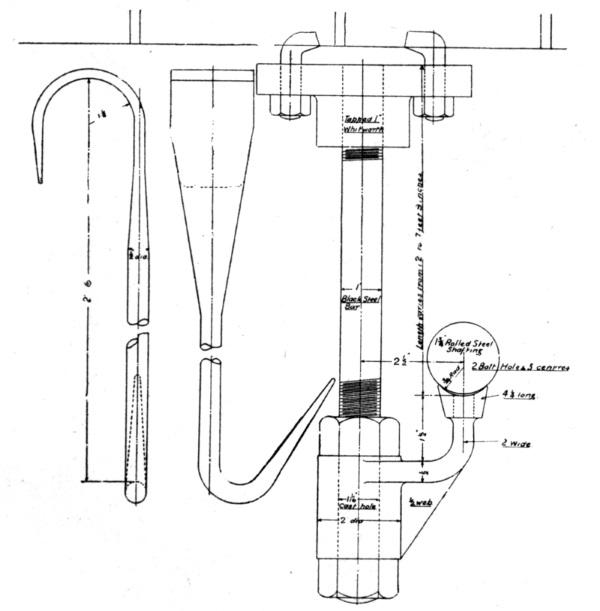
Fig. 9.—Hook for Hanging.
This point was brought to light in the case of one manufacturer
who was painting varnish cans by dipping. They
were hung up to dry quite close together—in fact, almost
touching. When dry, it was noticed that, instead of being
nice and glossy all over, one side was somewhat dull. The
explanation appeared to be that the turpentine fumes
affected the paint in drying, and this was proved to be
true, as when the cans were placed farther apart the trouble
ceased.
Hoists.
The hoists used will depend upon the size and weight
of the objects that are to be dipped. In some cases they
may be dispensed with altogether and the dipping can be
done by hand.
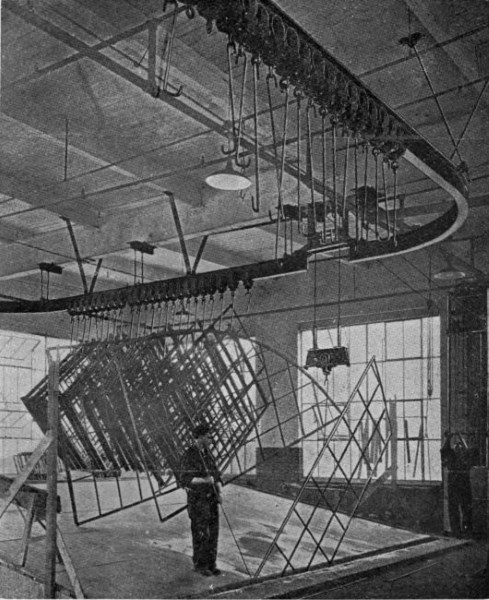
Fig. 15.—A Typical Hoist for Use in Painting by Immersion.
In cases where the space is confined, it is sometimes
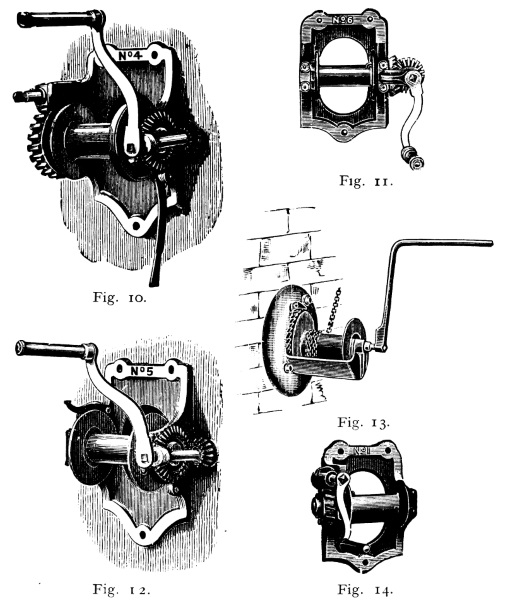
desirable to use hoists in the form of wall crabs, and a few
of these made by the London Hoist Machinery Co., Ltd.,
103, Worship Street, E.C., are illustrated in Figs. 10 to 14.
The hoist shown in Fig. 10 will lift 10 cwt. with slow speed
on the left-hand side, and 3 cwt. on the right-hand side with
a quick speed of 13 feet per minute. This form can be made
lower by brake if desired. The little crab shown in Fig. 11
deals with weights of 1 cwt. at a speed of 60 feet per minute,
while that shown in Fig. 12 is also a quick gear, lifting
3 cwt. at 13 feet per minute. The other illustrations are
self-explanatory.
Fig. 15 shows a typical hoist which may be regarded
as an ideal installation for the work, and the idea can be
adapted to either large or small works as required. The
installation consists of an overhead track with a movable
portion over the dipping tank. The goods to be dipped
are hung on the trolleys and run one by one on to the movable
portion of the track over the tank. There is a stop on this
portion to prevent the trolley running right over the tank,
and the movable portion with the article to be dipped is
lowered into the tank, and afterwards raised by means of
a hoist. The hoist in this case was driven by pneumatic
power. It could, however, in very small installations be
a hand hoist worked by the rotary movement of a handle,
or in other large installations a quick moving electric hoist.
After the article is dipped and the movable portion
raised by the hoist to its correct position in the track of the
runway, the trolley is run off the movable portion on to the
track beyond the tank, and left there to dry.
These overhead runways can be made to suit loads
from 2½ cwts. up to 10 tons, so that the system covers all
classes of work, since it is seldom that it would be necessary
to dip articles weighing more than 10 tons.
Fig. 16 shows a Morris standard electric trolley
hoist suitable for lifting up to, say, 5 or 6 tons. Both of
the foregoing hoists are made by Messrs. Herbert Morris,
Ltd., of Loughborough, to whom the author is indebted
for these illustrations.
In Fig. 17 is shown another type of trolley hoist
suitable for lifting heavy weights.
The number of Coats of Paint to be Given.
An important consideration both in paint immersion and
paint spraying is the number of coats of paint which should be
given in order to produce the required appearance and ensure
durability. This must necessarily depend upon the use to
which the article to be painted is to be put, and it will also depend
upon the appearance. In paint spraying it is clear that
any thickness of paint required could be obtained by continuing
the operation of spraying, but it has been found in
practice that it is not desirable to continue the application
of the paint beyond the point when every part of the surface
is completely covered. It is a well-known fact that three
thin coats of paint applied separately will prove more durable
than two thick coats, even if the quantity of paint used in
the two cases is identical. The same is true to a great
extent when the paint is sprayed on. When it is applied
by dipping another important element enters into consideration,
and that is, thin coats are a practical necessity, because
if an attempt was made to make the coat thick it would
inevitably result in unsightly runs, fat edges, etc., which
would wholly spoil the work. Where the object is only that
of a temporary protection, as in the case of iron castings, a
single coat will usually suffice, because the castings when
fixed in position will be painted with the building in the ordinary
way.
Sometimes a priming or first coat of paint is given by
dipping, and the following coats are applied by brushes
or by spraying. There appears to be some idea that when
paint is applied by brushes it is forced into the pores of the
wood and therefore holds better; as a matter of fact, in
a well-designed paint the thinners will penetrate the wood
and no particular force is necessary; but if it should be, it
will be certainly supplied by the spraying process.
Advantages of the Dipping Process.
The advantages of applying paint, japan, enamel,
or varnish by the process of immersion are obvious. The
saving of time is the chief advantage, and this will be in
most cases very considerable. For instance, a complete
wagon can be painted by dipping in a very few minutes,
while large and intricate agricultural machines may be
painted in the same way in a fifth part of the time it would
take to spray them, and probably a twentieth part of the
time it would take to do the work by hand.
There is another advantage which should be mentioned
when paint dipping is compared with spraying. In the
latter, an outfit consisting of sprayer, air compressor, exhaust,
cabinet, etc., are all necessary. In dipping, however, the
apparatus may in many cases be of the simplest character.
For example, in painting bedsteads all that is necessary
is a narrow but deep tank containing the paint, into which
the bedstead may be plunged by hand and then hung up
to drip over a metal-lined floor.
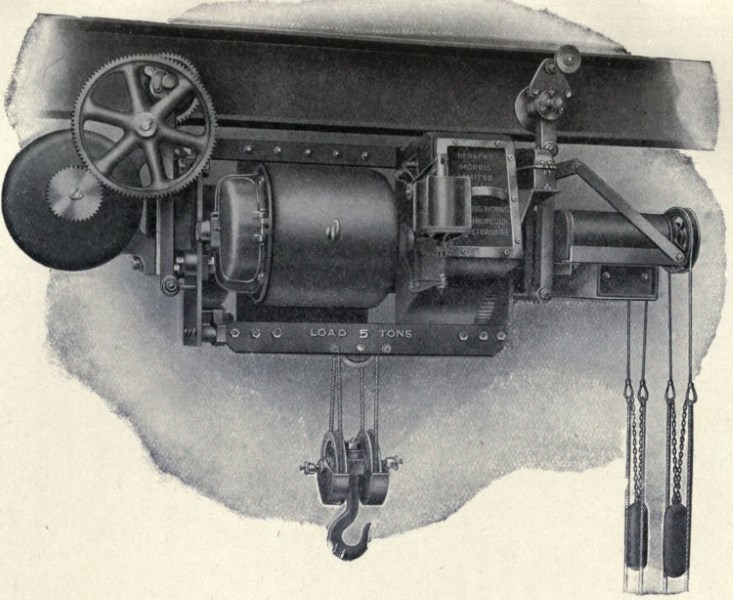
Fig. 16.—A Morris Standard Electric Trolley Hoist.
In Birmingham, hundreds of iron bedsteads are dipped
in this way every day. The head or foot of the bedstead
is taken in the two hands of the operator, dipped into a
tank of black japan, and immediately hung up on a travelling
chair, which slowly carries it across the room to the oven,
the superfluous paint dripping off during the process.
In another chapter will be found the advantages which
the process of spraying has over dipping. A decision as
to which is the best system to adopt for any particular
purpose can only be determined after due consideration
has been given to all the circumstances bearing upon the
work to be done.
It may be pointed out in this connection that the
process of painting called "flowing on," which is fully
described on another page, is in effect only a modification
of dipping. As a motor body, for instance, cannot be plunged
into a paint tank because the inside is not to be painted,
the paint is literally poured over the surface, and the effect
is exactly the same.
Protecting Parts Not to be Painted.
It frequently happens in paint dipping that certain
parts of a machine or other article that is desired to be
coated with paint is to be left unpainted, and the problem
is how to effect this most economically. The method usually
employed is to cover the parts, such as name plates, bright
portions of a machine, etc. with vaseline. When the
article is dipped the paint covers this as well as the other
parts, and after the paint is dry the vaseline and the paint
on it can be easily wiped off and the surface beneath it will
be found to be quite clean.
Preparing Woodwork Before Painting.
Previous to the priming coat of paint being applied
to any article made of pine or other wood containing knots
it is necessary to protect such knots by applying one or two
coats of a liquid known in the trade as "knotting." If this
were not done the rosin which exudes more or less from the
knots would penetrate the paint, discolour it and give a very
unsightly appearance.
The best knotting consists of shellac dissolved in
alcohol, usually in the form of methylated spirits; in other
words, it is shellac spirit varnish. Many inferior grades,
however, are sold in which the shellac is adulterated with
rosin or other substances, while the alcohol is sometimes
replaced wholly or in part with naphtha. These inferior
qualities of knotting should never be used, as they are very
likely indeed to cause trouble and spoil the whole job.
Although the parts of machines such as agricultural
implements are usually made of selected and well-seasoned
timber, it sometimes happens that portions of the work are
found to be more or less sappy. This should also be coated
with knotting, as otherwise they will absorb the paint to too
great an extent and the priming coat will not be uniform.
In passing, it may be observed that a coat of shellac
varnish—a term, as already explained, which is synonymous
with knotting—is very useful as an undercoat whenever there
is an excess of rosin as in pitch pine. It is also used to stop
suction on plaster ornaments which are finished in imitation
bronze, and which may successfully be used over tar or tar
spots which it is desired to paint.
It is very important that knotting be applied in quite
thin coats, and it is for this reason that usually two coats
are given. If it is too thick it fails to dry properly. Thick
knotting may be used if it be well brushed out, but this
is almost impossible in applying it to the knots of ordinary
woodwork which are merely "dabbed" with the end of the
brush; moreover, such work is usually done by piece work,
hence two coats are much safer to use.
Filler For Iron.
It is sometimes necessary before dipping or spraying
cast iron work to fill up sand flaws and inequalities. This
may be effectually done by using a filler prepared as follows:
Mix together equal parts of genuine red lead and gilders'
whiting and add two parts of boiled linseed oil and one part
of goldsize. It will be found most effective to mix the two
liquids last mentioned before adding them to the dry lead and
whiting. Thoroughly mix all together, or, preferably, grind
through a mill until the putty-like consistency is obtained.
This stopping will dry very hard. It is important to remember
that this filler must be mixed in small quantities as
required as it rapidly becomes hard, so that if a considerable
quantity were made at one time any unused would become
spoiled.
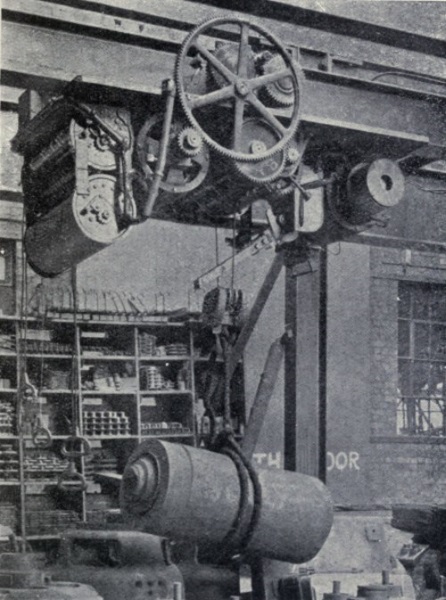
Fig. 17.—Electric Hoist Suitable for Heavy Goods.
Another recipe of an entirely different character for a
cement or putty for the same purpose is made by mixing one
parts of flowers of sulphur, two parts of sal-ammoniac and
80 parts of iron filings and making them into a paste with
water. By increasing the proportion of sal-ammoniac the
setting is also increased.
Stopping Holes in Woodwork.
However carefully a piece of woodwork may be prepared,
there are usually more or less depressions or holes such as
those which occur over countersunk nails, and in other places
which require to be filled up. The usual stopping for this
purpose employed by house painters is a mixture of equal
parts of dry whiting and dry white lead, made in the form of
putty, with raw linseed oil to which, say, 10 per cent. of
boiled oil has been added. A cheaper and quite as effective
a stopping, however, can be made by using a material
known as "Alabastine," which possesses the advantage
of being easily cut down. This material may be also used
when mixed to a thinner consistency for priming, but it is
not suitable for being applied by dipping, although it may
be sprayed. The very best stopping is one such as is used
by carriage painters, and is strongly recommended for high-class
work. It is supplied both in powder and paste form
by all first-class varnish manufacturers, and although the
cost is a little higher than that of stopping putty made of
whiting and linseed oil, as described, it is well worth the
difference.
An excellent filling composition for coach and motor
body builders, railway and tramway carriage manufacturers,
etc., is that made by the well-known varnish house of Messrs.
Wm. Harland & Son, Merton, S.W.
It is especially suitable, obtaining a perfectly level and
unyielding groundwork where a fine finish is to be given,
either in paint, varnish or enamel. It is made in two colours,
grey for dark work and cream for light colours or white,
and costs sixpence a pound, or less when bought in quantities.
It effects a great saving of time and labour, being already
finely ground into a stiff paste, which only needs the addition
of specially prepared thinners to bring it to a proper consistency
for use with the brush.
It is most successful and expeditious as well as the most
economical process for giving a smooth surface to rough
castings—a condition which is, of course, indispensable
when these have to be painted and varnished.
For ordinary surfaces of woodwork of a slightly rough or
uneven character, two or three coats of the filling composition
will suffice to produce, when carefully rubbed down, a perfectly
smooth surface of a hard metallic nature, combined
with great tenacity and durability.
"Philorite" is another speciality which may be
mentioned in this connection. It is manufactured by
Messrs. Wilkinson, Heywood and Clark, Ltd., and is a
filler made in white and seven colours. This is a great
advantage when the finish is to be coloured, as it may save
a coat of paint. It can be rubbed smooth without difficulty,
and will serve as a perfect ground for enamels and japans,
as well as for paint. For use it is thinned out with American
turpentine to the required consistency, say, that of a ready
mixed paint. It is brushed on with a stiff bristle brush,
and two coats may be safely applied on one day. The
last coat can be rubbed down smooth with pumice and
water or sandpaper. It may also be used as a knifing paste
for defective surfaces.
Rubbing Down.
In many cases the coats of paint, japan or enamel have
to be rubbed down between coats in order to produce a
perfectly level surface. This is usually done by means
of finely powdered pumice stone and water, and it is important
to remember that the operation must be done with care
so that the rubbing is quite uniform. If a slight gloss is
given to the paint the portions which are rubbed down can
readily be discerned, as they will have a gloss, and in this
way uniformity can be ensured. It is of the utmost importance
that all of the powder be washed away before the next
coat is applied; if any is left it will mar the job. It may be
noted that the work of rubbing down may be done more
expeditiously by means of the finest grade of steel wool. On
the Continent this is now used exclusively, and it is rapidly
gaining favour in Great Britain.
Fig. 18.—Sprayed Show Card.

Fig. 19.—Dipping and Stoving Bedsteads.
Requirements of Different Trades.
The following are a few of the special requirements of
different trades as to paint dipping. The details might be
lengthened almost indefinitely.
Bedsteads.
The methods adopted for the class of work will, of
course, depend upon the quality of the finish required.
Cheap bedsteads may be done by dipping in one coat of
black japan and stoving at 350° F. In better class work
several coats may be applied either by dipping or spraying,
and each may be rubbed down after stoving. If a good
enamel is used this is unnecessary.
When the work is white several coats—say, at least
three—are necessary, for white japans cannot be made
which will cover sufficiently in one coat. White lead should
not be used in this class of work for the reason that a good
deal of handling of parts is necessary, while the rubbing
down is sometimes done with glass paper and cause
dust, both of which may give rise to lead poisoning.
All of the best white japans or enamels are made on a base
of zinc oxide or lithopone (zinc sulphide), or a mixture of
them.
Collapsible Gates.
This work is usually done by dipping in paint which
dries "flat," i.e., without gloss. The colour is, as a rule,
black. In fitting and adjusting the work in order that
the parts will collapse readily it is necessary to apply a
lubricating oil where the rods meet. This lubricating oil is
difficult to remove after the adjustment has been completed,
and therefore the last coat of paint is usually put on by hand.
It is suggested, however, that raw linseed oil might be used
instead of lubricating oil, and that this could be wiped off
as soon as possible after the adjustment. In such a case
the paint could be applied by dipping, as if even a little
of the raw linseed oil were not removed it would not interfere
with the drying of the paint to any material extent.
Dipping Sewing Machine Parts.
The process employed by a very large firm of American
manufacturers is as follows:—
When the castings come from the machine shop they
are boiled for 20 minutes in ammonia water to kill the grease
(1 of strong ammonia to 20 of water), and are then rinsed
in hot water. Any holes or inequalities in the castings are
then stopped with a filler made from dry white lead, mixed
into a stiff paste with some varnish, brown japan dryers
and dry lampblack made quite stiff. When the stopping
is hard the castings are dipped into a black metallic coating
thinned with 62% benzine to a specific gravity 850. They
are then dipped with two coats of finishing japan (sp. gr.
830) flatted with powdered pumice after each coat and
leathered off. The parts which are not plated or flatted are
given 5 hours stoving at 325° F., and are then rubbed with
pumice and carpet pad until flat. Cut out gold transfers
are then fixed with transfer varnish and the work is stoved at
185° F. The parts are then sponged and dusted, and are
given a good coat of polishing varnish (sp. gr. 950)
Finally the work is rubbed down fine with glass paper and
pumice powder and then polished with machine oil and rottenstone
powder for the iron, or rottenstone and benzine for
the tables. The latter, as well as the covers for these, are not
usually dipped but brush finished.
Iron Rods.

Fig. 20.—Immersing Mangle Frames.
In most cases, iron and steel rods are best painted by
immersion, as the small surface presented would cause too
much waste if spraying were attempted. As in most cases of
dipping, success depends largely upon the means adopted
for handling and dipping a number of rods at one time.
Frequently, stoving is required to harden the japan, because
a rod is often subjected to considerable wear. Perhaps the
best plan to adopt, where the number of rods to be treated
warrants the outlay, is to provide mechanism by which the
rods are dipped and are at once automatically carried into a
stove, and by means of slowly travelling chains, carried out
at the other end.
An excellent contrivance for the purpose is in use at
the Ford Motor Works, at Manchester. This consists of a
vertical oven, heated by gas, and having slowly-moving
endless chains running from bottom to top and down again
to a point where the rods are discharged on to inclined
runners. These rods are passed through a bath of japan, are
then taken up by the chain, and, during their progress, are
baked. A gear is provided by which the time between the
entry of a rod to its discharge may be varied from twenty
to ninety minutes, or any period between, according to the
purpose for which the rod is to be used and the degree of
hardness of the japan required.
Iron Window Frames or Casements.
A long narrow tank, say, from 1 foot 6 inches to 2 feet
wide and 15 feet long, is suitable for this class of work,
which is usually done in one coat only, and this is quite
sufficient to protect the iron until the casement is fixed in
position, when it will, of course, receive additional coats
by means of a brush in the ordinary way.
It is important that the iron be dipped just as soon
as it leaves the finishing shop, and it is necessary that the
surface be thoroughly cleaned before the paint is applied, and
particularly after all scale is removed. Sometimes the
application of the sand blast is necessary for this work,
but, as a rule, a vigorous application of suitable wire brushes
will suffice.
Another very important provision is a system of overhanging
rails on which the sashes or other articles can be
run direct from the finishing shop to the paint tank, and
thence to any part of the building, from which they may be
taken as required for shipment.
The paint used for casements is usually grey, being as a
rule made of zinc oxide and lampblack. These pigments,
when mixed with a suitable vehicle, are very durable, while,
the colour being neutral, it is suitable as an undercoat for
green, as well as nearly any other colour which it may be
desired to use as a finish. The weight of the paint should
be 13 lbs. to the gallon, and it should dry with a semi-gloss.
The elevating apparatus need only be of a simple character,
and several casements can be suspended and dipped at one
time. For this purpose a "hanger" is used, having perforations
through which one end of the hooks pass. One form is
shown in Fig. 21. By the side of the tank should be a large
metal lined floor, say, 20 feet by 15 feet, or even larger,
inclined toward the tank. The frames having been plunged
into the paint, are at once withdrawn and hung in rows to
dry over this floor. The superfluous paint drips on to it
and runs back through a screen or sieve into the tank. The
latter should be provided with a cover, to be closed in when
the work is not being proceeded with.
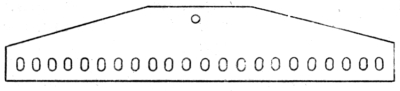
Fig. 21.—Iron Hanger for Suspending Several Articles to be
Dipped Together.
In this class of work it is unnecessary to employ a stirring
apparatus provided that the paint is of the right consistency,
and an occasional stirring up with a pole after the work
has been suspended, say, for example, from Saturday to
Monday, will usually be all that is required. As a matter of
fact, the lowering and raising of the casements into the
paint effectually stirs it up.
Metal Furniture.
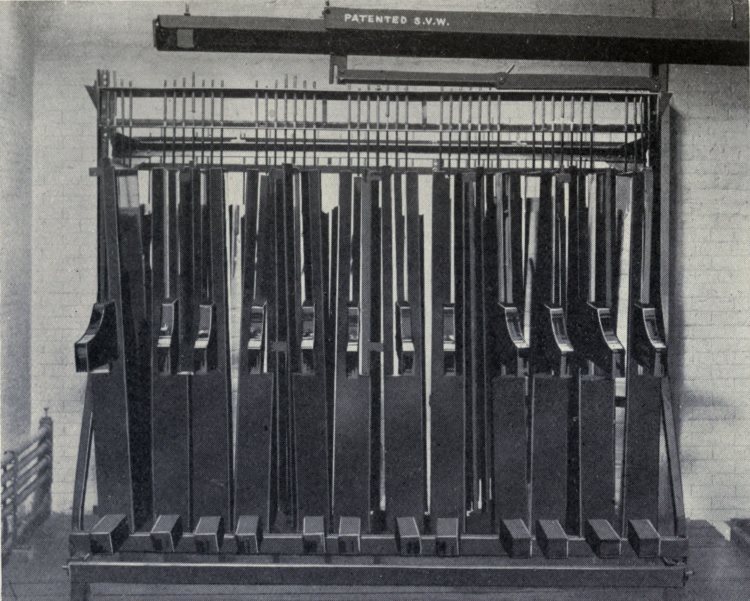
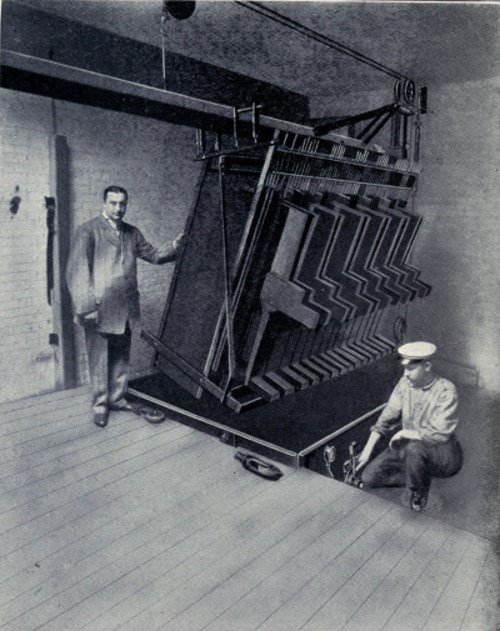
Fig. 22.—The Automatic Finishing of Pianos.
Carrier Filled with Six Complete Pianos.
Under this head it is intended to include such articles as
deed boxes, lockers, files and other metal goods which are
required to be painted both inside and out. An enamel
stoving or baking paint is usually employed for the purpose,
while the tank must be of sufficient size to accommodate
the various articles that are to go into it. Taking a deed box
by way of example, a large iron hook, such as is shown in
Fig. 32 is placed inside the box so that it is suspended at
an angle; the box or boxes are then lowered into the tank
and immediately withdrawn after all the superfluous paint
runs away, care being taken that the box hangs at a proper
angle to permit of this being done. Great care must be
taken in this room to exclude all dust, which would considerably
mar the work. For this purpose wire netting
of the finest mesh should be placed over the windows so
as to screen off any dust which might otherwise enter. A
system of overhead rails are made, consisting of an L-iron
on the top side of which run two rollers to which are attached
hanging gears, and is sufficient for the purpose. At least ten
minutes should be allowed for these articles to drip over the
inclined floor adjacent to the tank, and for safety's sake
it is as well to employ a workman with a brush in his hand to
go over each piece and remove any tears or runs which may
possibly occur. Metal work of the description named is
then placed in a stove and baked for three hours at a
temperature of 400° F. The paint is frequently green,
which is found to be a good serviceable colour and which is
attractive in appearance. After the baking the paint is
quite hard, and will withstand more or less rough usage.
If any ornamental work is required, this is done afterwards,
as explained under the head of "Stencilling." The paint
employed weighs 13 lbs. to the gallon, and a fine mesh paint
strainer must be provided, through which the superfluous
paint passes as it drips from the articles on their way to the
tank. In this case, as in others, no special stirring apparatus
is required, as the comparatively heavy vehicle and the
relatively light specific gravity of the pigment employed
gives little or no opportunity for any "settling out."
Motor Parts (Metal).
The various parts which go to make up a complete
motor car are differently treated according to their shape
and size. In most cases, stoving is resorted to, because the
enamel or japan is thereby much increased in durability by
the hardening which takes place in consequence of the
high temperature.
The steel rims of wheels are dipped by hand into a
black japan made especially for the purpose. They are
hung on hooks and allowed to drain for some minutes, and
are then transferred to the stove, where they are subjected
to a heat of 320° F. Such parts as ribs, front and rear
wings, running boards, shields, etc., are dealt with in the
same way.
Previous to dipping, these parts undergo the process
known as "pickling," by which scale, grease, etc., is removed
so that a perfectly clean surface is presented to
receive the japan.
Troughs to catch the drips must be provided, and it is
essential that these be kept quite clean, so that the superfluous
japan may run through gauze and be pumped back
again into the tank to be used again.
Automatic Finishing of Pianos.
The Standard Hydraulic Immersion System.
Any doubt as to the perfection of finish which may be
produced by a carefully thought out system of immersion
or dipping must be removed by the fact that such a system
has been in successful use for some years for the finish of
pianos. It need hardly be pointed out that such a finish
must necessarily be so well done as to approach perfection.
One firm has made a special study of this subject,
viz., the Standard Varnish Co., of London and New York,
and their efforts have been most successful.
By this method an absolutely even distribution of
varnish is always secured; no part of the piano case is
neglected and an enormous reduction in the cost of varnishing
is effected. The factory output can be readily increased
as desired, as the varnish working force of the factory can
do as much or as little work as trade conditions may
demand.
The mechanical details have been so perfected that
every kind of instrument can be handled satisfactorily.
The excellence of the finishing done in accordance with
this system is attributable to a large extent to its mechanical
construction. The apparatus used in connection with
the Standard method of piano finishing consists, in the
first place, of a steel tank for the varnish with an adjustable
cover which can be locked when the apparatus is not in operation,
a hydraulic lift for raising the work slowly out of the
varnish, a small horse-power pump which is operated either
by steam pressure or compressed air, and in extreme emergencies
where the pressure is not adequate for heavy work,
a small motor for operating the pump.
There is also installed an apparatus similar to the
automatic sprinkler system. A fusible link or another
mechanical device makes it possible to draw off the varnish
into a tank outside the main buildings at will, and for protection
in case a fire should take place in any other part of
the building.
The principal investment for the piano manufacturer
is the carriers or racks for holding the separate pieces. The
cases are held firmly in the carriers by means of springs
which are adjusted for the introductory carrier, or secured
by screws in the permanent carrier which is designed for
keeping the cases in the carrier until they are ready for rubbing.
This latter method saves the labour of handling.
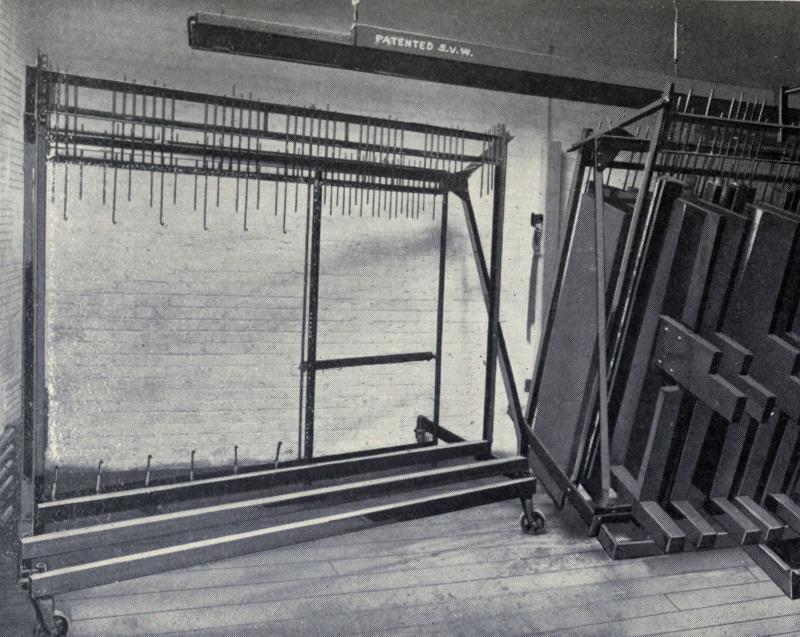
Fig. 23.—Automatic Finishing of Pianos.
Introductory Carrier ready for Parts to be Varnished.
Carriers filled with work to be varnished are raised from
the floor, swung directly over the tank, and lowered into
the varnish by means of an hydraulic lift. The speed with
which the work is raised from the varnish is controlled by
a lever conveniently located for the operator.
Once the speed has been determined and the lever set
the apparatus requires merely the supervision of an operator,
who may devote considerable time to helping his assistants
reload another carrier while the one in the tank is emerging.
Generally only a limited number of carriers are required.
When the work is to be removed between coats a large
percentage can be handled without tack in a short time after
it is taken from the varnish.
In the introductory carrier, parts like piano tops, which
are finished on all sides, require a little additional care
because of the difficulty of handling. This contingency is
provided for by the use of special head pieces.
In emergencies, for rushing out an extra quantity of
work, carriers holding falls, frames and small parts may be
immersed in one-half the interval usually required.
For example, these carriers can be withdrawn in from
fifteen to twenty minutes, whereas for carriers including
sides from twenty-five to thirty minutes are required. The
carriers are equipped with head pieces adjustable to meet
all peculiar local factory requirements. In fact, these
carriers can be constructed by the manufacturer to meet
all his demands.
The number of carriers necessary depends entirely upon
the volume of work to be handled. But it is desirable,
when possible, to have a sufficient number of carriers to hold
all the work until the varnish is sufficiently dry for rubbing.
In this way a tremendous amount of labour and time is
saved.
Permanent carriers, in which the work has been secured
by ordinary screws, have been constructed by some manufacturers
at an unusually low cost by their own machinists
in their own factories.
The work in the carriers can be easily dusted by means
of air-bellows or a compressed air-blower. Work finished
in this manner is so clean that the usual sanding is not
necessary and a considerable amount of labour thereby saved.
That the Standard hydraulic immersion system of
automatic finishing of pianos has distinct advantages over
the ordinary hand process is obvious even to the casual
observer. Among the numerous advantages which have
been effected the following seem to be worthy of special
consideration:
It constitutes practically the factory's entire varnishing
force.
Its use insures an even coat, free from imperfections.
Coating both sides of the work preserves the cases
considerably from shrinking and warping. A
great deal of labour is saved by varnishing both
sides at once.
It requires very little more varnish than the old, slow,
hand method as there is no waste from brushes and
pots and absolutely no dripping outside the tank.
The elasticity of the Standard system of piano varnishing
eliminates the necessity of additions and reductions
to the working force.
The cleanness and evenness of the finish virtually makes
every coat a flowing coat. The amount of time and effort
saved in the rubbing and polishing is tremendous, and the
finish obtained is much finer, due to the absence of uneven
coating and the blemishes of pinholing and dust.
Carriers containing six complete pianos each, at an
average interval of one half-hour, will enable the factory
to turn out 108 pianos with one coating during a nine-hour
working day.
Carriers containing eight complete pianos would handle
144 pianos a day. A lift sufficiently strong to accomplish
any demand placed upon it can be installed to immerse as
many carriers at once as will be necessary.
A smaller carrier containing four pianos can be installed
for the manufacturer with a small output of pianos, which
by the very nature of its construction is handled more
readily than the larger carrier.
In coating both sides of the work a decided protection
against shrinking and warping has been provided. In fact
many manufacturers are taking this precaution by brushing
both sides of the work. By the Standard method the work
is automatically coated on both sides at the same time.
Very little more varnish (not more than 5%) is required
by the Standard system than by the hand method. The
inventors' own experiments, as well as the daily use of the
system by manufacturers, shows that more varnish is wasted
about the varnishing room than is required by the immersion
system to coat the unfinished side of the work. With this
method, all of the small amount of varnish that drips off
falls back into the tank.
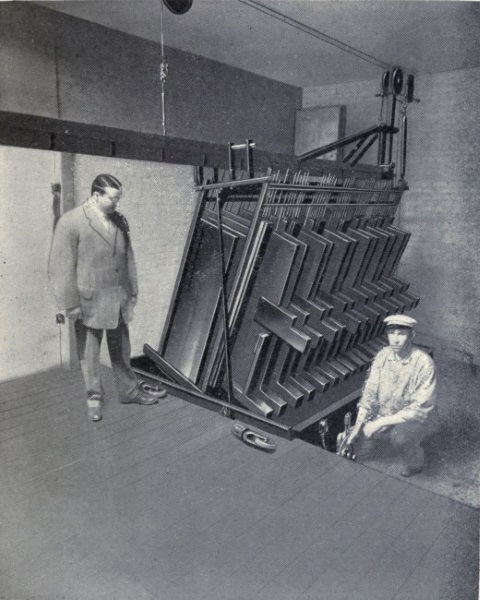
Fig. 24.—Lowering Piano Cases into the Varnish Tank.
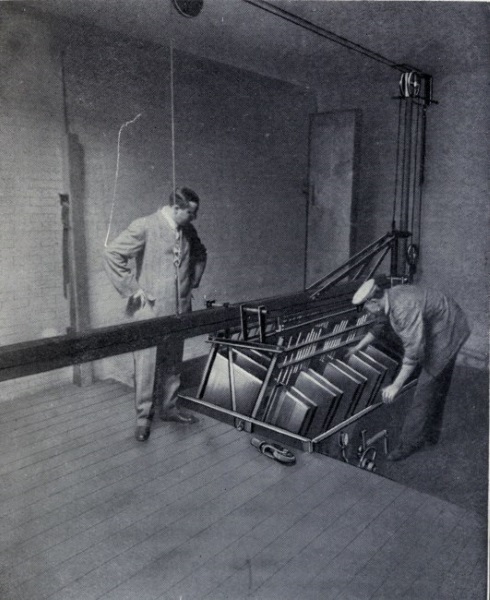
Fig. 25.—Piano Cases nearly Immersed.

Fig. 26.—Piano Cases Wholly Immersed.
One of the most difficult tasks of the finishing room foreman
is to be certain that the proper reduction is made
for the first and other undercoats. This is entirely
eliminated with the use of the Standard system of piano
finishing. This process alone makes it possible to apply a
minimum quantity of varnish sufficient to withstand the
strain of rubbing and polishing. This lessens the possibility
of shrinking and cracking which excessive varnish coats
applied by brush involves. The slower the speed of the
lift, the less varnish is applied to the work, consequently
there is a gradual regulation of the amount of varnish for the
separate coats.
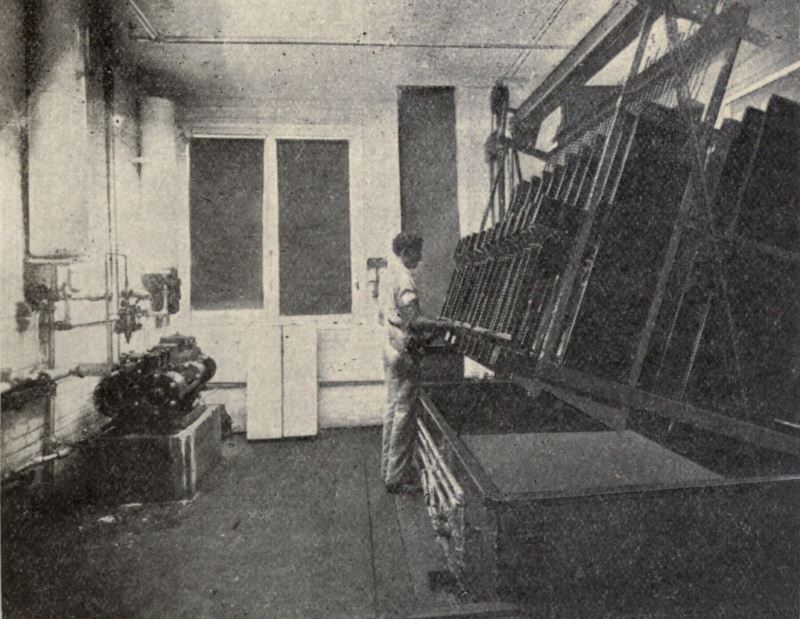
Fig. 27.—Piano Cases about to be Dipped.
The foregoing description, together with the accompanying
illustrations, will enable the reader to understand the
general method adopted. It should be added that it is
applicable to many other articles besides piano cases.
The system described was invented and is controlled
by the Standard Varnish Company of London and New
York.
Wheels.
An extremely ingenious but effective machine for
coating hickory wheels with paint or japan is in use at the
works of the Ford Motor Company, Trafford Park, Manchester.
It consists of a stationary cylindrical vessel of exactly
the right size to receive a wheel, which, being placed in position,
is at once lowered into a tank containing the japan.
Here it is made to revolve very rapidly, by which means the
japan is thoroughly distributed over every part. Hickory,
being a hard and comparatively non-absorbent wood, the
japan might give too thick a coating if dipped and left to
dry in the ordinary way. To prevent this, the wheel, while
still revolving very rapidly, is mechanically lifted out of the
japan, and is held just above it, where it continues to spin.
This has the effect of throwing off the superfluous japan by
centrifugal force. The cylindrical sides of the apparatus
catch the japan, and it runs down into the tank below. The
wheels are then taken out by a man, who wears gloves, are
stacked on edge in rows to dry, and, after an hour or so,
they receive a second coat. After twenty-four hours, or less,
they are ready for use.
The advantage of rapidly revolving the wheels is that
anything in the nature of a drip is entirely eliminated. This
machine can deal with 300 wheels an hour, so rapid is the
process. At the present time the Ford Works are using
2,000 wheels a week.
Some Typical Plants.
In gathering information of up-to-date character to
include in this book the author has visited various parts of
the country, and through the courtesy of the firms mentioned
below has examined the plants used successfully for the
treatment of many different goods. The following is a
brief description of some of the plants inspected, although
it by no means exhausts the list:—
Carriage Department, Woolwich Arsenal.
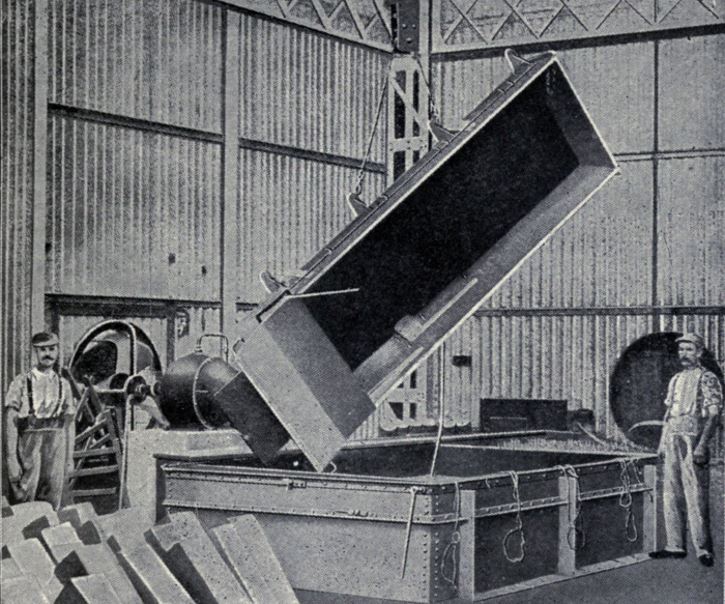
Fig. 28.—Dipping a Coach Body at Woolwich Arsenal.
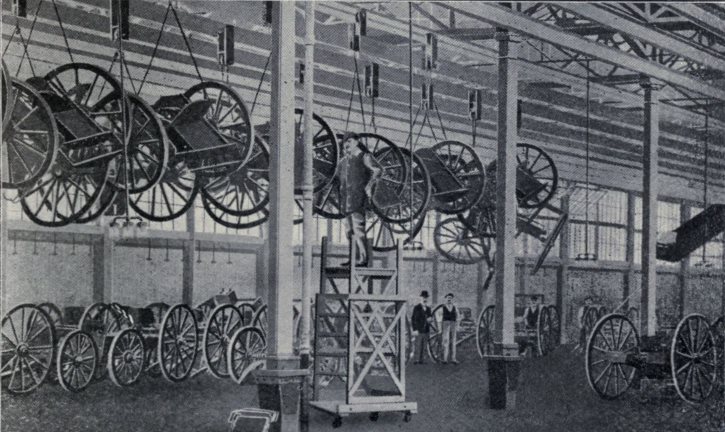
Fig. 29.—General View of Paint Dipping Room at Woolwich Arsenal.
The plant for painting wagons, etc., has been in use
for about 12 years and has been eminently successful, it
being found by experience that a paint applied by dipping
proves equally durable to that formerly applied by means
of brushes. Indeed, the durability is increased for the
reason, which has been pointed out elsewhere, that the paint
finds it way into open joints and crevices which could not
be reached by a brush. In some cases a wagon is dipped
bodily, while in others it is dismantled and the different parts
are dipped separately; again, the smaller portions are placed
in an open wire basket which is plunged into the paint.
The building in which this painting is done is of considerable
extent and a large paint tank is located at each end. A
wagon on being completed, or in the case of an old wagon,
after having been prepared, is brought to the first tank and
is raised from the ground and lowered into the paint, where
it remains for about half a minute. It is then immediately
raised, allowed to drain over a tank for a few minutes, and
then over an inclined floor for a further period. At the
end of about half an hour a workman inspects the wagon or
other article and removes any tears or runs which may
have occurred. The paint being specially prepared this
is not usually an arduous undertaking.
The illustrations show very clearly a coach body in
process of dipping. Overhead rails run throughout the
length of the building and upon these are suspended the
painted wagons, which are gradually moved along with a
very little exertion, such rails being slightly inclined to
facilitate this. By the time the series of wagons reach the
further end of the building they are ready to receive a second
coat of paint, by being dipped in the second tank. This
being done they are then moved back, being at once suspended
on the rails until quite dry, when they are hoisted
to the upper part of the building, where they are left suspended
until they are required for use. The paint is, of course,
a special one which is supplied in paste form having the
necessary binding ingredients. The colour used is khaki,
which is very durable, being composed of earth colours. The
thinning is done on the premises and white spirit is employed
for the purpose, not turpentine, which would be far too expensive.
Formerly benzine was employed, but this necessitated
the use of a fan to take away the fumes which came
from the spirit. Such a fan is not now found to be necessary.
The tanks are fitted with iron covers bearing upon thick
felt and are operated by means of levers placed at a distance,
so that should a fire occur they can be closed at a moment's
notice. The hoist is worked from the ground by electricity.
Formerly the operator of the hoist was located in a cab near
the roof, but it was felt that this would be a dangerous position
in case of fire, and he now, as stated, does the work from
the ground. The work done at Woolwich gives an excellent
example of the actual saving which may be effected by
using the paint dipping process. Before the painting plant
was put in no fewer than 200 painters were constantly
employed; now about 40 are fully able to turn out the same
or even a larger number of wagons in a given time.
James Gibbons.
Most of the metal sheets as well as finished metal work
of various kinds made at these extensive works at Wolverhampton
are finished by dipping into special enamels or
japans made by Messrs. Mander Bros. The dipping is done
by hand and the pieces are placed at the side of the tank to
drain. In some cases it is found necessary to go over the
work slightly with a brush to remove tears, but such work
takes only a few minutes and is used mostly as a precautionary
measure.
One coat is usually found sufficient, and at the proper
time the iron sheet or metal article is stoved at 250° F. to
300° F. for two hours. Many other articles are also dipped
successfully.
Harrison, McGregor & Co.
In the extensive factories of this firm at Leigh, Lancashire,
dipping by immersion has been successfully carried
on for some years past. Various agricultural implements
are dipped bodily in a tank of paint which is fitted with a
worm agitator, and is of simple construction. The iron
parts are dipped separately, being supported on suitable
hangers, while the very small parts are placed in wire baskets
for immersion.
Phillips and Son.
The paint dipping plant at these works, which are
situated at Sherbourne Street, Birmingham, has been in
successful operation for some years past and is applied
principally to bedsteads.
The tank holding black japan measures about 5 feet
by 18 inches and is some 9 feet deep. The bedstead head
and foot are separately dipped by hand into the tank which
contains black japan, and are immediately hung on a hook
attached to a slowly travelling chain. This chain runs
around a rectangular space, and beneath is a metal lined
dripping floor. The stove is located diagonally from the
tank, so that by the time the bedstead parts reach it the
dripping has ceased and they are ready to be baked. The
stoving is done at 320° F., and is continued all night. One
coat is found to be ample.
A very ingenious arrangement is in use for the application
of coloured enamels. Three shallow tanks are mounted
on rollers running in angle irons one above the other in
such a manner that any one tank may be pulled out when
required for use free from the others.
As a rule three coats are given for white work and
two for green, blue and most other colours. No white
lead is used, but only non-poisonous colours. The stoving
is done mostly overnight at a temperature of 250° F. A
little rubbing down between coats is done with very fine
glass or emery paper. The japans are made by Messrs.
Thornley & Knight.
In these works safes are painted, but the work is all
done by hand.
The Ford Motor Company.
The extensive works of this company, at Trafford Park,
Manchester, contain as complete a plant for painting,
japanning, enamelling and varnishing, as it has been the
pleasure of the author to inspect.
With characteristic thoroughness every detail which
will ensure a first class finish with a minimum of time and
labour has been thought out and applied. The result is
that not only is every part dealt with most expeditiously
but one coat of paint is applied to the whole outer surface
of a motor body in the almost incredibly short time of
two minutes. Further details will be found in this book
under the heads of "Flowing-on," "Motor Parts," and
"Iron Rods."
Marshall, Sons & Co., Ltd.
This well-known firm of agricultural implement manufacturers
have a large dipping plant at their Gainsborough
works, which they employ for painting various agricultural
machines made principally of red wood. Some
idea of the extent to which this process is applied may
be obtained when it is said that on an average nearly 5,000
pieces pass through the dipping plant every month. The
process is particularly well adapted for threshing machines
and for appliances of the kind which consist of thousands
of holes bored in the wood. If the painting were done by
hand it would take many hours to paint such a machine,
while by dipping it is done even more effectually in a few
minutes. The priming coat only is dipped after knots, etc.,
have been treated with shellac. The tank measures 21ft. long
by 7ft. deep and 2ft. 3in. in width. An agitating apparatus
is used and the lifting is done by pneumatic appliances.
Hayward Brothers and Eckstein, Limited.
The paint dipping plant in use at the works of this firm,
at Union Street, Borough, S.E., is of a comparatively simple
type, and consists of a shallow tank in which various cast
iron and steel goods are dipped in horizontal position. As a
rule, one coat of paint is given, but in certain cases two are
required. The bottom of the tank is slanted, and the contents
are stirred up from time to time, but no agitating
apparatus is used. The principal goods painted by dipping
are the frames of Hayward's lights, which are of cast iron
and are dipped on one side only, the other side, after the
glass is fitted, being done by hand. Metal casements are
also dipped in considerable numbers, as well as treads and
rises of circular staircases, straight staircases, balconies,
etc. These, being made of ornamental open ironwork,
contain a large number of small shaped holes, and the
dipping process is found to be by far the most effective.
Another speciality of this firm are Hayward's patent
steel collapsible gates. The first coat of paint is applied
by dipping; this paint, being black, dries flat, i.e., without
gloss.
The Crittall Manufacturing Co., Ltd.
These works are at Braintree, Essex, where a large amount
of structural steelwork is produced, the chief manufactures
being metal windows of all kinds, from the well-known
steel casement and sash to metal windows for use in industrial
dwellings and specially designed windows for various climates,
steel fireproof doors, skylights, steel office and works partitions,
shop fronts; frictionless ball race runners for sliding doors,
etc.
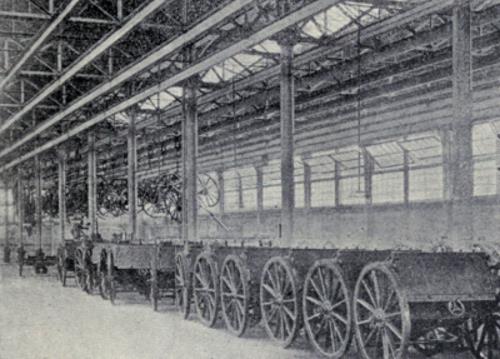
Fig. 30.—Wagon Store Room, Woolwich Arsenal.
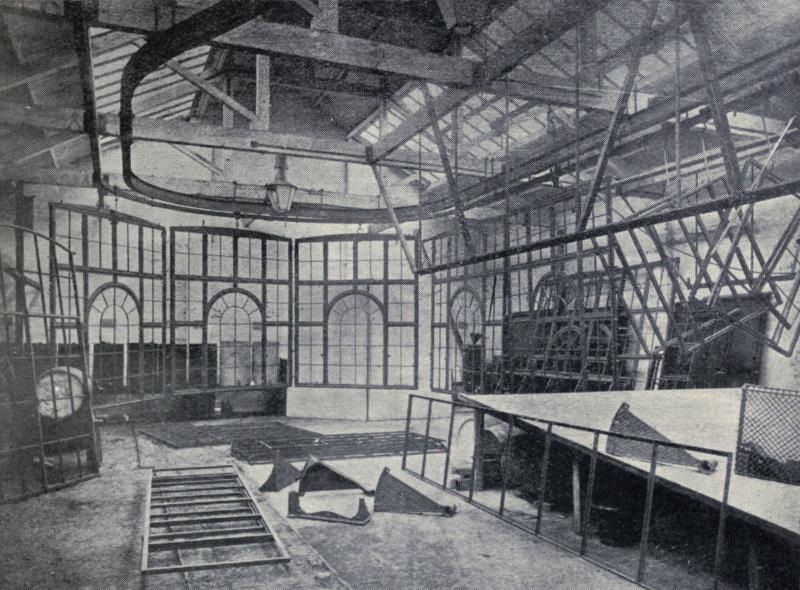
Fig. 31.—Dipping Casements at the Crittall Manufacturing Co.'s Factory, Braintree.
Perhaps the most noticeable feature of these works
as far as our subject is concerned, is the very complete
system of overhead rails, by means of which the various
metal goods produced in the different finishing shops are
conveyed to one or other of the paint tanks and then,
having been left to dry, are taken to store rooms ready for
instant shipment. These rails facilitate handling of the
various goods, and reduce the actual expenditure under
this particular item to a minimum. The rails are L-shaped,
the hanger used for each article or series of articles being
of a simple character, consisting of two wheels bearing
on the top of the upright flange, while rods secured by
bolts pass through the horizontal flange and hold it in
position.
We will first describe the tank used for dipping metal
windows. This is 15ft. long by 12ft. deep and only
1ft. 6in. wide. Attached to the tank is a large dripping
floor measuring some 15ft. by 21ft. covered with sheet
iron and inclined toward the tank, so that the paint which
drips on to it finds its way back into the tank through a
grating provided for the purpose to take off any dried
particles. The paint used in this work is made by Messrs.
Docker Brothers, and weighs 13 lbs. to the gallon; one coat
is found sufficient for the purpose. The sashes or casements
being brought in from the finishing room on the overhead
rail, they are lowered into the tank by means of a special
lowering apparatus designed on the premises. Some idea
of this may be had from Fig. 31. In order to keep the load
steady during the time it is being dipped, a slight depression
or dip in the rail is made immediately over the tank. The
sashes are only left in the paint for a few seconds, and are then
raised, allowed to drip over the tank for perhaps a minute
or two, and then allowed to drip over the adjacent floor
for perhaps a quarter of an hour or less. They are then
taken farther along and the paint dries in about three hours.
Sometimes two, four, six, or even eight casements may be
dipped at the same time. Attached to the elevating and
lowering apparatus are hooks which pass through one
corner of the casements. This causes the parts to hang
at an angle which facilitates running off of the paint.
We come now to the department in which the baking
or stoving enamel is used as applied to metal furniture in
general, as mentioned. In this case the articles are
dipped in a manner very similar to that already described,
excepting that a large hook, similar in shape to that shown
in Fig. 32, is used to support the article to be dipped;
the wide opening goes inside the box or file and holds it at
an angle so that when it is lowered into the paint all parts
are covered inside and out. A few minutes are allowed
for dripping, and after two or three hours the articles are
ready to be stoved. In this case, Messrs. Docker Brothers'
standard colour, a very pleasing dark green, is used. The
stoving takes three hours at a temperature of 240° F., or
higher in some cases. The tank mentioned is, of course,
considerably wider than that used for casements. The
dripping floor is in this case inclined toward the centre, which
in turn is inclined toward the grating just outside the
tank itself. If necessary, special thinners are added to
bring up the gloss, but, as a rule, this is unnecessary. It
is desirable after the article is dipped to go over it once
with a small brush to remove any drips or runs which may
possibly appear.
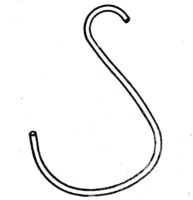
Fig. 32.—Hook Used for Suspending Metal Boxes While Dipping.
Another very important point to be attended to is
to exclude all dust, and for this purpose the Crittall Manufacturing
Co. have erected in this department screens of
wire of the finest mesh over windows, so that no air can
pass into the room without the dust being screened off.
Excluding Dust.
A matter of very great importance, yet one which is
frequently overlooked in painting iron and other goods
which are to have a glossy finish, either air dried or stoved,
is to exclude dust from the apartment in which the work is
done. In many engineering shops the nature of the business
gives rise to a considerable amount of dust, and if this is
allowed to enter the paint shop it will be fatal to the appearance
of the painted work, as many specks will inevitably
settle on the work and mar its appearance.
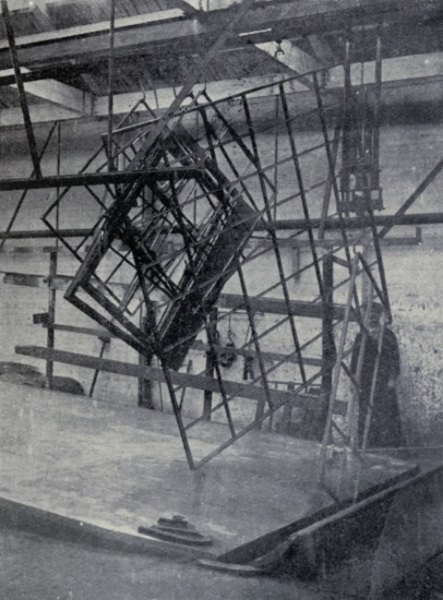
Fig. 33.—Dipping Casements at Braintree. Note the Narrow Tank used for this Class of Work.
A paint shop is best provided with a concrete floor,
and this should be frequently cleaned. The workmen
should wear clean overalls, frequently renewed, and even so
small a matter as keeping the hair, beard, etc., clean and free
from dandruff should be attended to. The doors are best
if double, and thick felt may be used with advantage in the
joints so as to practically seal the opening when the doors
are closed. Air which is admitted, either through ventilators
or windows, should be strained before entering the
building, and for this purpose silk gauze of the finest mesh
is usually employed. In some cases, cotton wool in addition
is placed in such a position that the air must pass through it
before entering the room. If these precautions are taken
it will be found that the quality of the work is greatly
enhanced.
It may be observed in this connection that it is important
also to provide means of adequate ventilation of the
apartment. Moisture charged air has a bad effect upon
paint work. Extreme heat is unnecessary, but it is very
important that the temperature be maintained at a uniform
rate, say 60° F. If the room in which the painting is done
is very hot, the paint will be affected and be likely to become
too thin for its purpose; while, on the other hand, if the
room or articles to be painted are very cold, the paint
or enamel will have a tendency to congeal. Both of these
defects can be remedied, as already stated, by a good system
of ventilation and maintaining the heat, night and day, at
a uniform temperature.
A Model Drying Room.
The immense importance of providing a uniform
temperature and ensuring an adequate system of ventilation
in the room in which goods are placed for air drying
can hardly be exaggerated. Unless such a system is in use
the actual drying may be greatly retarded and the work
stand a chance of being spoiled.
In connection with some of the plant inspected by the
author it must be admitted that the provision made in this
respect falls far short of what is needed. In one case the
work of rubbing down was proceeding in the same shop,
although in a different part, in which various goods which
had been dipped were hanging up to dry. It need hardly
be said that under such conditions it was impossible to keep
the work free from specks.
In other cases the drying rooms were inadequate because
of the inefficiency of doors and windows. These,
it may be remarked,should always be double so as to maintain
the heat uniformly.
Every varnish user knows that a draught of cold air
which is allowed to reach a coat of varnish while drying is
fatal alike to its appearance and durability. The result is
almost certain to be a case of "blooming," which to the
uninitiated may be described as a film not unlike the bloom
of a freshly coloured plum which comes on the surface of
varnish exposed under such conditions. Those unacquainted
with varnish vagaries are apt to regard this trouble as being
the result of inferior materials used in its manufacture. As
a matter of fact it indicates nothing of the kind because,
speaking generally, the higher grades of varnishes are the
most susceptible.
Without doubt the best and by far the most economical
plan to adopt is to have a drying room specially built for
the purpose of receiving the articles to be dried. If constructed
on scientific principles this will not only give a
uniform temperature entirely free from draughts and dust
but will considerably expedite the work, thereby allowing
of a quicker delivery of goods and effecting a great saving
of valuable floor space.
The author inspected such a drying room at the works
of Messrs. Pinchin, Johnson, and Co., Ltd., at Silvertown,
and a description of it will doubtless prove of interest. It
is built of 5-ply wood and is about 16 feet square, sufficiently
large to hold two full-sized motor bodies or several
dozen perambulators, hand wagons, etc. The actual size
may, of course, be varied according to the size of and number
of articles to be dried. Air is admitted through two ducts
situated close to the floor through fine wire gauze, which is
provided with a lifting cover by which the amount of air
admitted may be regulated.
Immediately over the two air ducts mentioned is a coil
of steam pipes which heats the air to, say, 110° F. This, of
course, causes it to rise toward the ceiling, but the angle
between the ceiling and wall is rounded off by a cove, so that
the current of heated air is directed along the ceiling toward
the centre of the room where there is another cove and
beneath it a coil of cold air pipes which lowers the temperature
somewhat. Thus is created a constant motion of
the air which may be regarded as the essence of the system.
But there is another very important provision in the
shape of an automatic control. This cuts off the steam
when any desired heat is attained so that when the drying
room is filled up at night before the works close it can
safely be left until the morning when the drop in temperature
will not be more than 2 degrees. The steam may be
admitted at, say, 10 lbs. pressure, but as soon as the room is
heated from 2 to 2½ lbs. will be found to be sufficient. The
actual time for heating the room to 120° F. is from 15 to 20
minutes.
The speed with which work is turned out by this well-considered
adjunct may be gauged from the fact that a
panel may receive one coat of enamel and two coats of
flatting varnish in one day, or four coats of japan in the
same period.
In addition to the advantages mentioned is the most
important one that the drying room renders the manufacturer
who is fortunate enough to possess one quite independent
of the weather. In the words of the inventors and patentees,
"one enabled by its use to create one's own climate."

Fig. 34.—Design for Show Card done by Spraying.
Paints for Dipping.
It need hardly be said that the paint employed for this
purpose must be of a special character. There are several
firms of manufacturers who make a speciality of this class of
paints and supply them either ready for use or in paste form,
requiring only the addition of white spirit or other suitable
thinner to bring them to the right consistency. The following
may be considered as the necessary qualities of a paint
suitable for this purpose:—
1. It must dry hard in not less than six hours.
2. The pigment must be of such a specific gravity that
when mixed with a suitable vehicle or thinner to form a
paint the pigment will not quickly deposit at the bottom
of the tank or settle out.
3. The consistency of the paint must be so arranged
that only a minimum quantity will run off, while it must not
be so thick as to give rise to tears or runs.
White lead which has a specific gravity of about 6.750
is for the reason mentioned usually considered too heavy,
and in the case of a white or grey paint, zinc oxide which
has a specific gravity of 5.470 is used in preference. The
following colours may also be successfully employed, because
of their low specific gravity, viz., Oxford ochre (s. g. 2.822),
Venetian red (s. g. 3.560), Indian red (4.732), golden ochre
(3.107), Italian raw sienna (3.081), burnt sienna (3.477),
Turkey umber (3.496), Prussian blue (1.956), bone black
(2.319).
It will be observed that the earth colours, such as
ochre, sienna, umber, etc., are all light pigments, and as
they are also recognised as being the most durable, they are
eminently well suited for use in many positions, although the
colour is not always very agreeable. Precipitated barytes
(s. g. 4.144) can be used up to, say, a proportion of 10 per cent.—not
more; red lead (s.g. 8.681) cannot be used for this purpose,
as it is far too heavy, and the same applies to English
vermilion (s. g. 7.726). If, however, a bright colour is required,
it may be obtained by dipping in Venetian red or
Indian red and giving a second coat of crimson lake (s. g.
1.898), but a coat of varnish should be sprayed upon this
for protective purposes.
In considering this subject, it is well to remember
that much will depend upon the thickness of the vehicle
used, as, clearly, a fairly heavy pigment will settle out in a
thin vehicle much quicker than it would in a comparatively
thick one. The successful paint, therefore, is one in which
both considerations are taken into account.
Very rarely indeed does it pay manufacturers to attempt
to grind or prepare paints themselves, and much greater
satisfaction will be obtained by getting supplies from a
reputable firm who have made a special study of the subject.
Sometimes a white paint is required for dipping, and
in that case 30 lbs. of sublimed white lead, 10 lbs. of zinc
oxide and 6 lbs. of gilders' whiting, with 4 lbs. of asbestine
pulp, mixed with 9 lbs. of raw linseed oil, will be found to
give good results.
A paint which dries with a gloss is often desired for
the finish of many articles, and can be readily obtained
by first priming, then giving a finishing coat of paint on
it which has been mixed with sufficient varnish to produce
the desired gloss. In some cases three coats may be given,
namely, the first or priming coat, the second, which should
be flat, or semi-flat, and the third a coat of varnish paint,
which will dry with a gloss. It should be pointed out,
however, that the finish obtained by these means is not a
little inferior to that which may be produced by using over
the priming one or more coats of flat paint of the desired
colour and finishing with a coat of suitable varnish, which
may be applied either by dipping or spraying, according
to circumstances. A point here worthy of mention is one
which every house painter is or should be well acquainted
with, and that is that the coats of paint that are superimposed
should be alternatively flat, i.e., without gloss, and glossy,
in order that each may adhere closely to the other. If the
article to be painted is wood or any other material which
is of an absorbent character, a comparatively large amount
of turpentine and oil must be mixed with it in order to
allow for suction. This will dry with a semi-flat finish,
and a glossy coat or one having more oil in its composition,
may be applied over it. If a further coat is required it
should be flat or nearly so, and in that case a finishing coat of
varnish will probably be required. The paints for these
purposes may be purchased ready made or ready for thinning
down, from firms who have made a special study of the
requirements.
The question sometimes arises as to whether paint
dipping or spraying can be used advantageously when
in the finish two or more colours are to be used. As a
rule the difficulties can be overcome by dipping first or
even the second coat, spraying on the third or finishing
coat, using specially prepared masks or shields over those
parts which are not to be painted with the particular colour
in use.
The following useful information is taken from "White
Paints and Painting Materials," by W. G. Scott, who was
for sixteen years connected as paint expert with the Milwaukee
Harvester Company and the J. I. Case Threshing
Machinery Co. Mr. Scott therefore speaks from a wide
experience. He says:—
A certain amount of oil must be present in dipping
paints to act as a binder, and it is advisable to add a small
quantity of varnish to hold the paint together. The
desired features in a good dipping paint are: freedom
of flow and proper drip; sufficient binder to prevent chalkiness
and produce a firm coat; covering capacity and an
even distribution of the paint.
Non-absorbent surfaces like metal and hard wood
require less oil than the absorbent soft woods.
In the former case there is little or no penetration of
the liquid portion of the paint, but with pine, bass wood,
white wood, poplar, etc., nearly all of the liquid is absorbed
or taken up by the wood, consequently with benzine only
as a thinner there will not be sufficient binder present to
hold the pigment when the thinner evaporates.
Whereas 5 lbs. of paste pigment or colour ground in
oil and thinned with a gallon of benzine would produce a
suitable primer on iron or other non-absorbent material,
it would not answer for soft wood.
Dipping paints, as a rule, contain from 4 to 10 lbs. of
paste per gallon of thinner, the primer containing less
paste than the second coat paints.
The composition of the paste colour has much to do
with the dipping paint; for instance, 5 lbs. of paste white
lead to the gallon of thinner will cover and work better than
a mixture consisting of half white lead and the other half
made up of transparent pigments like china clay, barytes,
etc., nevertheless a small amount of inert material is
generally understood to be an improvement in the way of
durability.
Asbestine, whiting, silica and china clay are the inert
materials most often used in paste goods for dipping purposes.
Asbestine probably helps to hold the pigments in
suspension better than any of the others and answers nicely
for dipping paints, but, as previously mentioned, does not
allow the paint to level out when used with a brush.
China clay, on account of its low specific gravity, is much
favoured as a suspension agent, but materially lessens the
opacity of the paint.
A small amount of whiting is a good addition to a
dipping paint, as it carries down much of the dirt and heavy
particles usually produced during the process of dipping.
Silica gives the paint "tooth," and by some authorities
is considered an actual necessity in primers which are
intended to be sand-papered.
White lead and zinc oxide are the two ideal white
pigments considered from a dipping standpoint, and it
will be found that the majority of dipping paste paints
on the market contain a notable quantity of zinc oxide,
either straight or in the form of zinc lead.
Zinc oxide is generally the predominating pigment
in the white and tinted paste paints, and is usually associated
with white lead (basic carbonate), zinc lead, and sublimed
white lead, mixed with more or less inert material according
to the ideas of the manufacturer or in order to cheapen the
product.
The admixture of inert material with the coloured
pigments requires some knowledge of the composition of the
coloured pigment; for instance, lampblack might be safely
mixed with asbestine, whiting, silica, barytes, etc., without
detriment, but yellow ochre containing, naturally, considerable
clay and silica would hardly permit of any great
addition of china clay or silica.
The strong iron oxides, chrome greens and similar
tinting colours will stand a large quantity of inert material
when the paint is to be used as a body colour, but for varnish
colours it is customary to use the chemically pure colours
and less paste per gallon of thinner.
Paste paint for varnish colours is frequently ground
in oil, in japan, or in a mixture of the two, but far better
results are obtained by grinding the dry pigment in varnish
thinned to a grinding consistency with a little turpentine.
A varnish with a viscosity of 20 (water = 1) which gives
a stiff mix with, say, 5 lbs. of pigment will, when thinned
to a viscosity of that of raw oil, i.e., a viscosity of 4, take
about 20 lbs. of pigment.
No set rule can be given for the kind and amount of
thinners to be used in dipping paints for various purposes,
but the following proportions[1] will furnish a key to the
general mixtures used:—
Primers for Metal.
4 to 5 lbs. of paste thinned with 7/8 to 31/32 gallon of
benzine or turpentine and 1/8 to 1/32 gallon of mixing varnish.
Primers for Hard Wood.
4 to 5 lbs. of paste thinned with 15/16 gallon benzine or
turpentine, 3/64 gallon raw oil, 1/64 gallon mixing varnish.
Primers for Soft Wood.
4 to 7 lbs. paste thinned with ½ to ¾ gallon benzine or
turpentine, 15/32 to 15/64 gallon raw oil, 1/32 to 1/64 gallon
varnish.
In some cases, with very soft, porous woods, it may
be necessary to add more raw oil and some japan or liquid
drier, but too much drier must not be added, as it will shorten
the "flow."
Second Coat Dipping Paints.
5 to 10 lbs. of paste thinned entirely with benzine or
turpentine, or with 7/8 gallon of solvent and variable proportions
of oil and varnish according to the surface desired.
Varnish is advocated in all of these mixtures, as it helps
to hold the solids and liquids together and prevent separation;
it also induces toughness.
It is essential that a varnish be used which will mix
perfectly with oil and benzine at a temperature of 60° F.
Varnish colours are best thinned with turpentine, but
owing to the high price of turpentine the large factories
insist on using benzine or some of the turpentine substitutes
now on the market.
The fact that some of the turpentine substitutes work
better and give a better "flow" with the paint and varnish,
is due to the fact that most of them contain a heavy distillate
of petroleum similar to kerosene.
Kerosene oil has the double property of thinning and
imparting "flow" to either paint or varnish, but retards the
drying, hence too much must not be used.
Damar varnish, which will not stand thinning with
benzine without separation of the gum or becoming cloudy,
will permit of dilution with kerosene to quite an extent.
So far as durability is concerned, kerosene imparts more
durability and is more waterproof than any of the other
thinners. Combined with rosin and manganese oxide, it may
be made to dry like raw linseed oil, but, of course, does not
possess the same properties.
In dipping paints, as in all other kinds of paints, good
judgment must be used in the mixing, and it is absolutely
essential that paints for soft wood, or other absorbent
material, contain enough oil, or binder, to hold the pigment.
White Paste Primer. Extra Fine.
- 300 lbs. white lead (carbonate).
- 150 " zinc oxide.
- 50 " floated silica.
- Grind in 10 gal. raw linseed oil.
- Product = 575 lbs.
This paste is thinned with turpentine or benzine for
dipping purposes in the following manner:—
White Dip for Metal.
- 100 lbs. of white paste.
- 14 gal. turpentine or benzine.
- ½ " pale mixing varnish.
- ¼ " white liquid drier.
White Dip for Hard Wood.
- 100 lbs. white paste.
- 13 gal. turpentine or benzine.
- 2 " raw linseed oil.
- 1/4 " pale mixing varnish.
- 1/2 " white liquid drier.
White Dip for Soft Wood.
- 100 lbs. white paste.
- 12 gal. turpentine or benzine.
- 6 " raw linseed oil.
- ¾ " white liquid drier.
The pale mixing varnish and the white liquid drier must
not liver with lead or zinc, otherwise, the paint in the tank
will thicken continually.
The above formula produces one of the best paints
known, and it is certainly not a cheap paint.
White Spirit.
As already mentioned, many firms who use the paint
dipping process buy their paint in paste form with the
requisite amount of driers added, and thin it themselves
with white spirit, which is a petroleum product specially
prepared for the purpose. Turpentine is, of course, too
expensive, and the spirit costs, under normal conditions,
little more than one-third of the price, although exact
figures cannot be given owing to the fluctuation in the
price of these materials. Some manufacturers use a white
spirit, to which has been added from 25 to 30 per cent. of
genuine American turpentine. This, of course, renders the
mixture somewhat expensive, and possesses no advantage
excepting that it gives the characteristic smell of turpentine;
but this, it appears, is not important in a factory, and the
pure white spirit is quite suitable in itself.
According to Mr. S. Roy Illingworth, A.R.C.Sc.,
A.I.C., B.Sc., Lond., expert to the Gas Lighting and Improvement
Co., Ltd., turpentine substitutes were first
placed on the market about 30 years ago, and consisted at
that time of a mixture of turpentine and kerosene oil.
Investigations led to the production of white spirit, drying
as quickly as turpentine, or even quicker if desired. Several
grades of this material are made, varying in flash-point
from 80° up to 150°. The flash-point of genuine turpentine,
it may be mentioned in passing, is 90° to 91°, and the 90°
flash-point spirit is the one usually employed for painting
purposes, although the 80° flash-point would answer equally
well for dipping. The best grade is practically free from
smell and is suitable for admixture in all paints, excepting
those having a bitumastic or asphaltic base, or paints in
which very common driers containing cheap rosin are used.
A rough-and-ready test as to the quality of white spirit
is to dip a piece of blotting-paper into it and hang it up to
dry. In the course of an hour-and-a-half it should have
wholly disappeared, leaving no smell or stain behind it.
If there should be a stain the sample should be viewed with
suspicion. Another test of the same kind is to drop a little
spirit on a piece of white writing paper and to leave it for
three-quarters of an hour, when it should have disappeared
without leaving a stain. In addition to these tests it
might be advisable to mix a little spirit with paint and to
try it experimentally.
In the evaporation of turpentine it is usually admitted
that a small proportion, say, from ·25 to ·50, is left behind
owing to oxidation. In the case of best white spirit, however,
very little residue will be left behind, certainly not sufficient
quantity to interfere in any way with the drying. The
use of the spirit has proved so successful that practically
nothing else is now employed in paint dipping. It is,
however, important, of course, that the best quality white
spirit be used, but as this is so much less in cost than
turpentine, there is no temptation to use an inferior quality.
The Quantity of Paint Required for Dipping and
Spraying.
Speaking generally, rather less paint will be required
when it is applied by dipping, or spraying, than is necessary
when it is applied with a brush. But there are many
exceptions, particularly in spraying, where it may be necessary
to give a coat considerably thicker than usual.
The following table will be found useful as a guide, but
it should be remembered that the actual space covered will
vary considerably with different grades of paint, so that the
table should only be taken as approximately correct. In
cases of doubt, careful calculations should be made after
a given quantity of paint, varnish, or lacquer has been
applied to a surface of known area. This will serve as a
useful guide in ordering in the future. It need hardly be
said that the quantity of paint necessary will vary largely
with the surface to which the paint is applied. For example,
an absorbent surface, such as unprimed wood, will require
much more paint than metal work, which absorbs little
or none.
Spreading Capacity of Paints.
| | Per Gallon on Wood. | Per Gallon on Metal. |
| Priming Coats | 60 to 70 | 90 to 100 |
| Mixed Paint 2nd coat | 85 to 90 | 100 to 120 |
| Varnish (on paint) | 95 to 110 | 120 to 130 |
| Lacquer (on paint) | 100 to 115 | 130 to 150 |
| Enamel (on paint) | 75 to 80 | 85 to 95 |
PAINTING BY COMPRESSED AIR.
The Evolution of the Apparatus Employed.
By way of introduction to the subject of the application
of paints, enamels, lacquers, varnishes, stains, etc., by
means of compressed air, a few notes on the development
of the method may be given, if only with the object of
correcting the impression, which sometimes exists, that
such apparatus as is now employed is more or less of an
experimental character.
The early attempts to apply paint, etc., to articles
other than by the old method of brushing were mainly
carried out with a type of machine still largely used for
whitewashing, and the principle adopted was to partly
fill a convenient tank with the paint or whitewash and to
pump a pressure of 35 to 40 lbs. into the tank by means of
a suitable hand pump. The paint was forced through
a flexible tube attached to a connection near the bottom
of the tank, and at the other end of the tube was a simple
form of nozzle with a trigger control for the paint.
It may be said at once that this method was doomed
to failure owing to the underlying principle being at fault.
While eminently suitable for applying whitewash or distemper,
it was hopeless for paint of a more viscous character,
owing to the fact that the latter was not atomised as it
issued from the nozzle.
The type of machines referred to, viz., those which
are used for spraying lime white, distemper, whitewash,
etc., are fully described and illustrated in another chapter.
After failing to achieve satisfactory results with such
simple apparatus when applying viscous paints, etc.,
further experiments were carried out with a somewhat
different type, commonly known as the "kettle" type of
sprayer. The principle employed was to employ compressed
air, supplied, in this case, not from a hand pump
but some form of power compressor, and at a pressure
varying from 20 to 50 lbs. per square inch.
The air was delivered through a nozzle controlled by
a convenient plunger or trigger type of valve, and impinged
at an angle across a similar nozzle communicating with the
paint receptacle of the sprayer. The action of the air
impinging on or across the paint nozzle created a vacuum
in the paint tube, and thereby sucked up the paint from
the receptacle and gave a fan-shaped spray. Up to a point
these experiments proved satisfactory, but still did not
overcome the difficulty of successfully dealing with intricate
shapes, small articles, and particularly in applying heavy
paints with fair percentages of varnish embodied therein.
The Concentric Form of Spray.
Attention was therefore directed to the concentric
jet form of sprayer, and this is now almost universally
employed where painting, enamelling, etc., is carried out
on a large scale.
The advantages of the latter type are many, and in
addition to being designed, in most cases, to produce the
greatest effect with the least possible consumption of air,
they are also capable of applying the paint in very finely
divided particles to the smallest work, such as buttons,
imitation jewellery, small electrical camera parts, or of
applying silky coats to such large work as motor bodies,
constructional iron work, large tinplate work, agricultural
machinery, domestic gas apparatus, etc. at a speed approximating
to four to ten times the speed of handwork, and
giving a far superior finish, in many cases with less coats.
Many people who contemplate the subject of painting
with a spray think only of a smother of paint being discharged
from a nozzle. They are not aware that the colour can be
better controlled in a suitably constructed spray than is
possible with a hog's hair brush.
The flow of paint is stopped or started instantly, and
the amount of paint delivered is at all times under perfect
control, so that a quantity corresponding to that delivered
by a ¼-inch brush or pencil can be increased to the quantity
distributed by a 4-inch brush in a single stroke. In other
words, you have a tool which is the equivalent of half a dozen
brushes ranging from ¼ inch to 4 inch in width.
A little practice is, of course, necessary to master the
instrument, but nothing like the practice which is required
for successful painting with hog's hair.
The principal care is to put on the paint until the
beads of paint coalesce. Too much would make the paint
run, too little would not leave the surface covered. When
properly done the surface is superior to other painting, as
the hairs of the brush are not dragged through it to disturb
the evenness of the surface.
The air pressure required for painting varies with the
consistency of the paint, its viscosity as well as its thickness.
Some liquids have a quality of stringiness or hanging together
which require a higher pressure to break up.
Thin lacquers and varnishes may be sprayed with 18
or 20 lbs. to the square inch, and from that to about 50 lbs.
will cover most classes of paint.
The lowest pressure at which a paint breaks up is the
best pressure to use, as high pressures have a tendency to
make more dust and put fine particles of paint in the air,
where they are not wanted.
The volume of air has also to be considered. This
varies with the size of the aperture through which it exhausts
and to some extent with the pressure—for a small nozzle
such as is used for lacquers and thin liquids, say, one cubic
foot of free air per minute, and up to 3 cubic feet for oil
paints.
When it is stated that a pistol sprayer consumes say
two cubic ft. of free air per minute, it means when
working almost continuously, but as the periods of actual
work do not represent more than two-thirds of the actual
number of working hours, there is a margin left. Nevertheless,
it would be unsafe to state a lower figure, for in
some cases where convenient feeding of the work to the
operator is arranged, the consumption of air is continuous.
It should also be remembered that the air is used for
other purposes, i.e., a small amount is used to provide a
pressure feed of colour to the instrument in many cases, and
where a heater is employed, a small amount of air is bypassed
through the pistol to keep this warm when spraying
is momentarily stopped. Although the practice of heating
the air slightly increases the ultimate efficiency of a given
compressor, yet it is unwise to count too much upon this fact.
In submitting the following figures as to air consumption,
the Airostyle pistol has been taken as a type:—
For work with a tip and needle of 1 m/m. dia., 1 cub.
ft. per minute; 1½ m/m. dia., 1¾ cub. ft.; 2 m/m. dia.,
2½ cub. ft.; 2½ m/m. dia., 3 cub. ft.; 2½-3 m/m. dia.,
3½-4 cub. ft.; 4½ m/m. dia., 5 cub. ft.
These consumptions naturally vary slightly with the
adjustment of the nozzle of the pistol, but they are from
actual tests and so may be taken as authoritative.
Types of Spraying Apparatus.
We now come to a consideration of the different appliances
by means of which the actual spraying is effected,
and in order to avoid any suspicion of partiality the review
of instruments, etc., in use will be dealt with alphabetically.
The Aerograph.
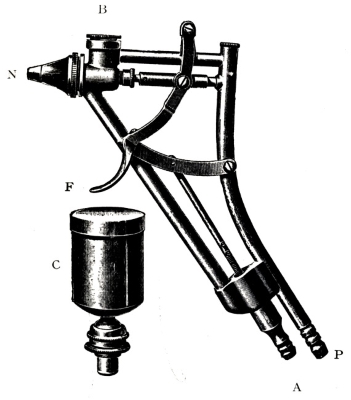
Fig. 35.—The Aerograph Spraying Instrument.
First, therefore, comes the Aerograph Co.'s Spray Painter.
This instrument is of the concentric jet type, and was one
of the first of the kind made in Europe. It is capable
of excellent work. In Fig. 35 is shown one form of the handpiece.
A flexible tube for compressed air connects with the
nipple A. The finger lever F controls both the air valve and
a colour valve in the nozzle N, so that little or much colour
may be allowed to pass out into the current of escaping
air.
The colour may be supplied under pressure, through
a flexible tube from a large paint pot, and pass through
the tube P to the nozzle N, or in smaller quantities from
a cup C, which is attachable at B, and when so attached
cuts off the supply through the tube P. This cup is useful
when small quantities of colour are wanted with frequent
changes. A ball joint permits work to be done in either
an upward or downward direction.
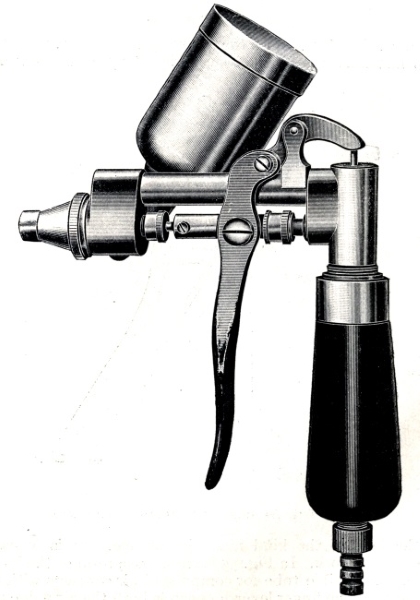
Fig. 36.—Form of Aerograph Suitable for Spraying Vertically or at an Angle.
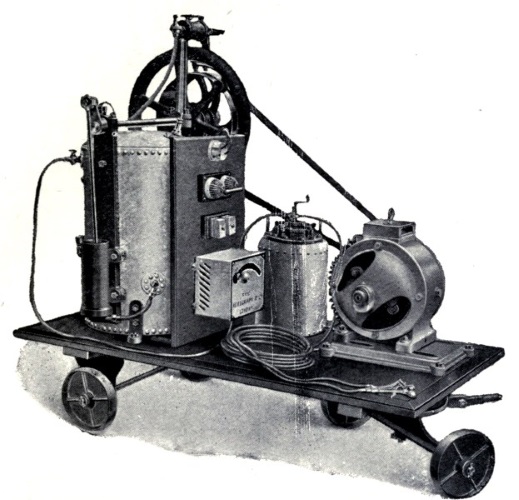
Fig. 37.—The Aerograph Electric Motor Outfit.
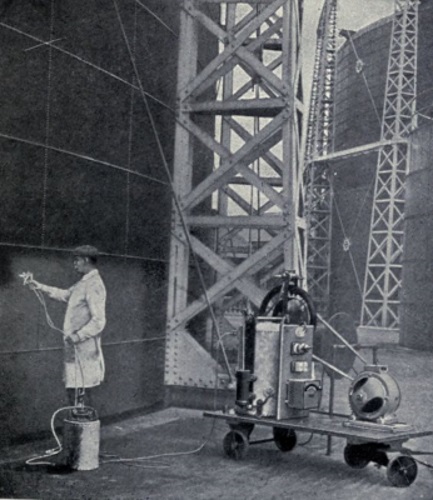
Fig. 38.—Painting a Gasometer.
In Fig. 36 is illustrated a pistol pattern of the
Aerograph, which has a large side cup which can be
sprayed at any angle, being adjusted to facilitate spraying
in an upward, downward or horizontal position. Thus
work can be done by it on table, wall or ceiling. The cup
referred to contains the paint or other liquid to be sprayed,
and a series of cups may be provided for a quick change
of colour, if desired, as will be readily understood.
In cases where electric power is available, the electric
motor outfit shown in Fig. 37 will be found very serviceable.
It may be described as a "spray painter" outfit
complete, and it includes a 1 h.p. motor mounted on a trolley
ready for use, which can be employed for many different
classes of work. In Fig. 38 it is shown being used for
spraying paint on a gas holder. It would appear that this
outfit might be employed for ship bottom painting, provided
that the necessary scaffolding or its equivalent were available.
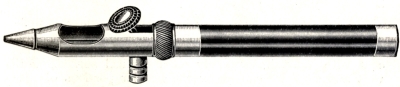
Fig. 39.—Small Aerograph for Delicate Work, Lining, Lettering, etc.
Going to the other extreme, a form of Aerograph,
suitable for very delicate work, is shown in Fig. 39. This
may be used for photograph retouching, pottery, and small
decorative work generally—in fact, it is suitable for any
work requiring delicacy of work.
In another chapter the subject of artistic work done by
means of compressed air is considered at some length,
and a number of specimens of work executed by this
process are given.
The Aeron.
The system of spraying is manufactured by the De
Vilbiss Manufacturing Co., Toledo, Ohio, U.S.A., and 71,
Newman Street, London, W.
The method consists, briefly, in spraying stain, shellac,
varnish, or enamel, as the case may be, on the work by
the means of compressed air, under a pressure varying
from 30 to 80 pounds per square inch.
The necessary outfit comprises the Aeron sprayer itself—which
is made in two styles and several sizes—the air
compressor and receiver, an air transformer set, for regulating
the pressure and purifying the air supply, a steel Fumexer,
in which the work is done, and an exhaust fan to disperse
the vapours or fumes resulting from the atomising of the
finishing material. Besides these necessary appliances,
turn-tables are used where advisable to facilitate the handling
of the work while the "aeroning" is being done.
The two styles of Aerons are shown in the illustrations,
each connected with an air transformer set to which
the air supply pipe is attached. In one style of Aeron
the finishing material is carried in a pint or quart capacity
cup forming a part of the Aeron itself. The other machine
takes its supply from a five-gallon container suspended
above the nozzle. The work is placed in the Fumexer
on the turn-table, which can be tilted at any convenient
angle and revolved by hand, and is coated on the top, sides,
and front, with the drawers in place. Drawers may also
be finished inside by this process.
A full coat can be applied to a vertical surface as well
as to one in a horizontal position. There are two
reasons why. It is impossible to put on a perfectly uniform
coat with a brush, especially on a vertical surface, and
runs and sags are caused by the heavier portions of the
coat dropping down over the lighter coated spots. With
the Aeron a uniform coat of varnish is applied, and it is
a fact that as the coat is the same over the entire surface it
will not run, even if it is as heavy as a brush coat, which
would show sags. The second reason is that an Aeron
coat sets somewhat quicker than a brush coat, owing to a
slight evaporation of the solvent caused by the action of
the compressed air. Again, since the coat is uniform it
sets uniformly. For the same reason the final drying is
hastened to some degree.
In brushing flat horizontal surfaces where a heavy
coat is applied it is almost impossible to avoid fatty edges,
and in brushing carved or ornamental relief work the
low spots are sure to collect more varnish than the high
places. Corners and edges in panel work are also causes
of difficulty in this respect. In using the Aeron the surface
varnished is covered uniformly and evenly, whether
flat, panelled or carved, with one sweep of the machine at
an even speed. Consequently, heavy spots, runs and fatty
edges are entirely avoided.
In applying finishes with the Aeron a slight reduction
of the material with turpentine or other solvents is logical;
with some materials, necessary. Reducing is logical on
account of the slight evaporation of solvent previously
mentioned. In other words, in order to have the Aeron
application of the same consistency after reaching the surface
as it is when brushed, a reduction of from 5 to 10 per cent.
would be required. This is not always desirable by any
means, especially in the case of the heavy gloss coat spoken
of. Whenever a free-flowing coach varnish is used, reducing
is not necessary. Conditions in different plants govern
this matter to a great extent.
Rubbing varnishes are usually reduced slightly, as
a full-bodied, heavy coat is not required, also because a
rubbing varnish does not flow as readily as a coach varnish.
On account of this evenness of the coat, an Aeron coat of
rubbing varnish is somewhat more easily and quickly
rubbed either by hand or by machine.
Undercoat varnishes are reduced to some extent for
Aeron work for similar reasons. They are also more
easily sanded than when brushed.
Pigments, primers or first coaters are Aeroned to better
advantage if the pigment content is less than for brushing.
It is also sometimes desirable and expedient to use a more
finely ground pigment.
Flat finishes are applied to great advantage, and,
because of greater uniformity of surface, more closely resemble
a rubbed finish than when brushed.
This spray offers perhaps greater advantages in the
application of shellacs than with other materials. It is
a matter of common knowledge that shellac is very difficult
to brush, while, on the other hand, it sprays easily.
Instead of cutting the gum 4 or 5 pounds to the gallon
of alcohol, as for brushing, the material is used in the proportion
of 2½ to 3 pounds of gum to the gallon. The sprayed
coat of shellac is perfectly smooth and uniform, and requires
practically no sanding compared with the work necessary
to sand a brushed coat.
The Aeron is simple and easy to operate, and a week's
work is sufficient to make an efficient and expert operator
of the average man.
The work is clean, and, what is more, is healthful and
sanitary, as all vapours and fumes are removed from the
finishing room by the exhaust fan used with each outfit.
Cleaning the Aeron is accomplished by spraying a
solvent through the nozzle instead of the finishing material,
and the whole machine may be placed in a can of thinner
overnight if desired. It is necessary to clean the Aeron
but once a day if it is used more or less continuously. The
whole operation of cleaning may be performed in a minute
or two.
There is usually some loss in finishing material when
the Aeron is used, though this is hardly noticeable except
on small work, when it may amount to 15 or 20 per cent.
In many cases there is no waste, in others an actual saving—where
coats are eliminated by the use of the machine.
On an average, however, there is some slight loss—largely
of the solvent used in reducing the material. In any
event, however, the waste is offset many times by the
saving effected in time and labour, without taking into
consideration the saving in floor space, the greater ease in
handling the work, the better quality of the work done,
the advantage to the workmen, and, finally, the general
all-round convenience of the Aeron system.
Description of the Illustrations.
We will now give a description of the illustrations
of the different parts of the Aeron. Fig. 40 shows
the attached cup straight barrel Aeron, which can be
fitted with either metal or glass cups. Metal cup is the
standard equipment.
Attached cup Aerons can be furnished with four sizes
of nozzles: F—.047" dia., E—.070" dia., D—.081" dia.,
and C—.094" dia. These nozzles are selected according
to the nature of the work that is to be done.
Fig. 41 shows an attached cup angle barrel Aeron, a
type of advantage in spraying work lying in a horizontal
position.
In some classes of work, where the liquid to be sprayed
is apt to settle, an agitator is required, such as is shown in
Fig. 42.
In Fig. 43 is shown an attached cup Aeron with type V
double nozzle spray head. This type is especially adapted
for the finishing of large surfaces, such as automobile
bodies, case furniture, etc.
The V spray head shown separately in the above
illustration is interchangeable with the single nozzle spray
head, and can be attached to any standard Aeron.
Type G Aeron is illustrated in Fig. 44. The nozzle
is ·027 inch in diameter This Aeron can also be furnished
with other sizes of nozzles to special order.
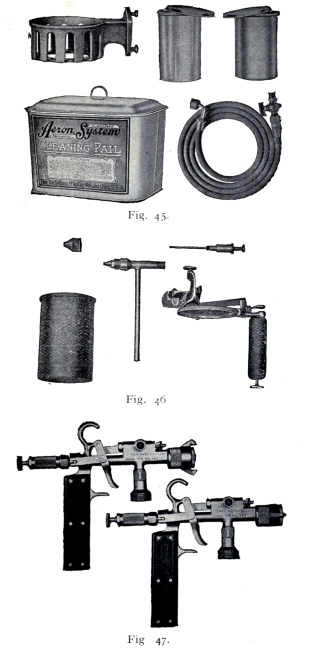
The Aeron Sprayer.
In Fig. 45 are shown various attachments used with
this form of sprayer. At the top left-hand corner is a cup holder
and screws, and on the right, metal or glass cups.
Beneath are cleaning pail and length of pressure tubing with
connections.
Fig. 46 shows the construction of the Aeron, the parts
being disassembled for ease of cleaning.
We now come to the type of Aerons which take their
supply of material from a five-gallon tank placed above the
level of the nozzle, the fluid flowing down by gravity.
This arrangement offers all the advantages of the pressure
feed tank type with none of its disadvantages. It is shown
in Figs. 47 and 48.
The next type is termed the M Aeron with V-A
spray head and is illustrated in Fig. 47.
There is the same advantage in the use of this Aeron
as with the former type in that the supply of material
is taken from a container placed overhead, the fluid flowing
down by gravity. The slightest pull upon the trigger
releases the material instantly—the varying of the pressure
adjusts the flow automatically. As with the type L there
is but one adjustment.
This type Aeron is built for large work. It produces
a "wide spray," similar to the V spray head, which covers
large surfaces with remarkable rapidity.
The nozzle can be turned so that a full, fan-like spray
is projected horizontally, vertically, or in any intermediate
position.
A container with agitator and hose for types L and
M Aerons is shown in Fig. 50.
It is drawn from one sheet of steel and is heavily
tinned to prevent rust.
The standard and block and tackle (Fig. 49) are furnished
for holding the container above the level of the Aeron.
The block and tackle, which is of the safety, self-locking
type, is recommended where it is possible to obtain a ceiling
fastening. The standard (Fig. 51) can be used if the block
and tackle is impracticable.
The air transformer set (Fig. 52) is for the purpose of
regulating and purifying the compressed air, and is a
necessity with each Aeron installed. The air duster (D)
is a valuable addition to the equipment for removing loose
dust or dirt from the work before finishing.
The auto-filter (S) is for removing dust, grit, and oil
from the compressed air. The auto-regulator and gauge (R)
makes possible the regulating of the air pressure between
5 and 80 pounds, simply by turning a thumb-screw. The
auto-condenser (C) is for separating moisture from the
compressed air.
Full details of the air compressor and other special
appliances used in connection with the Aeron will be found
elsewhere.
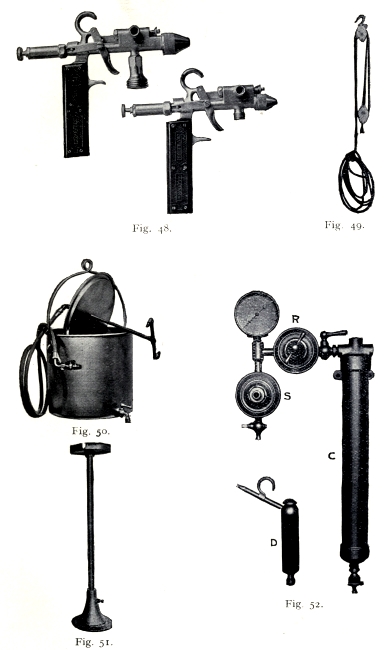
The Aeron Sprayer.
The Airostyle.
Next comes the Airostyle and Lithos, Ltd., with their
"Airostyle" type Record, also a concentric jet-type, an
illustration of which is given in Fig. 55 and a section of
which we give also in Fig. 54. This type is largely used for
small, medium or large work, and is considered to be extremely
sensitive and very fast in operation. It has a gunmetal
casting for the main body, and all wearing parts are of steel,
tempered or case hardened.
It is supplied either with or without pressure fed
accessories, although the makers are strong advocates of
pressure feeds for most work, and with which they have met
considerable success.
In addition to the Record Pistol this firm makes other
types, and in order must be mentioned the type "Ultra"
for use where frequent changes of colour may be necessary,
and where no continuous colour feed is required. This
type is specially adapted for stencilling in oil colours, and
is illustrated in Fig. 56.
Another type about to be introduced is shown in Fig. 53,
for small and medium work, simplicity of construction
and ease of adjustment being specially claimed for this
type. This type is called the Airostyle Pistol "M."
Yet other type of Airostyle may be mentioned for
smaller work, namely, the "Stencil and Universal Lustre
and Photo," which is illustrated in Fig. 53.
These types are mainly employed for decorative work,
and give a very wide selection, but save that they are
employed in process work and for textile goods, they do not
enter into the scope of this book.
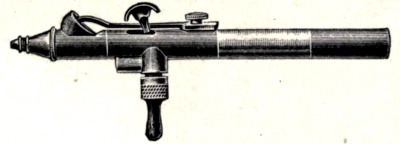
Fig. 53.—Airostyle Type Photo.
As the pistol type is used for all general painting and
japanning, the adjustment of this may be advantageously
explained in greater detail, and referring to Fig. 54 the
instructions are as follows:—
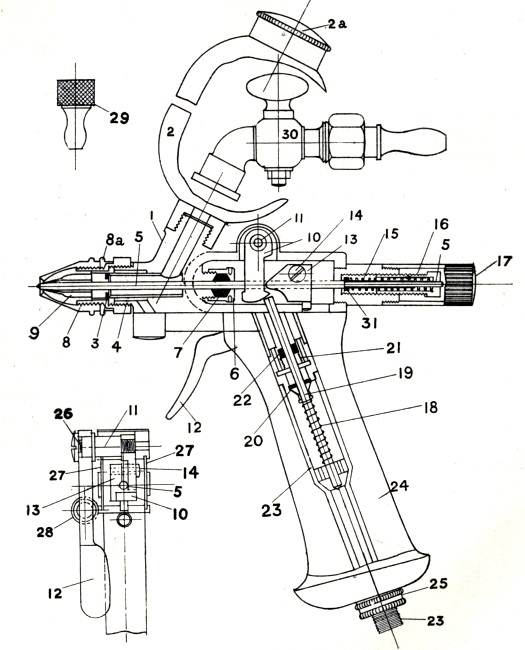
Fig. 54.—Section Showing Construction of the Airostyle.
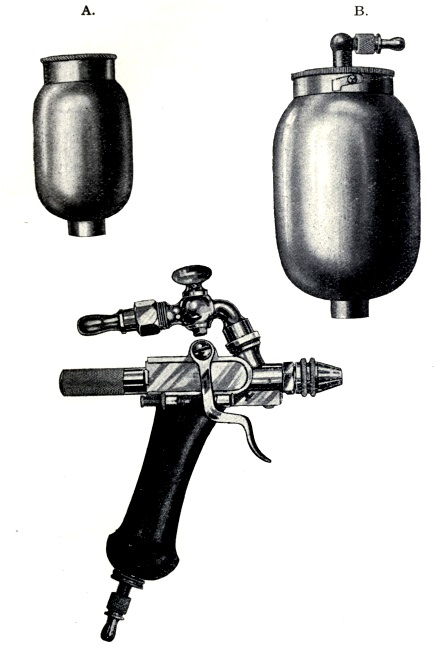
Fig. 55.—Airostyle Type "Record" with Union for Continuous Supply.
A.—Small Pressure Bowl.
B.—Small Simple Bowl.
If a wide spray is required the nozzle 8 is unscrewed
to a small extent and then locked by means of a small
ring 8a, but if a narrow spray is wished for, the
nozzle 8 is screwed on farther and locked in position. On
all-round work one position serves, that is, a position
in which the recessed point of the nozzle coincides with the
end of the tip 9, which just allows the needle 5 to project
through it. If it should happen that a leakage of colour
occurs through 9 when spraying is suspended, this may
be obviated by giving an increased tension to spring 15
which may be obtained by screwing in the spring box 16
slightly. It may happen that some foreign matter
becomes lodged in 9, in which case the pistol from
the colour tube must be first disconnected, the nose 4
removed and the parts brushed or swilled with turps or
spirit. This having been effected, the nose 4 will be replaced,
care being taken that the washer 3 beds down on its
seating in the body of the pistol.
Fig. 56.—Airostyle Type "Ultra."
It is well to provide for any possible contingencies
which may arise, and it may, therefore, be remarked that
if any leakage of air occurs through the air valve 19, it will
probably be caused by some grit to be found on the face of
air valve washer 20, and to remove this the handle can
be taken off by unscrewing the milled nut 25 and the valve
body 23 in order to get to the air valve. The replacement
of the parts is simple.
The adjustment of the pistol for working is made as
follows:—First release the screw 14 on cross head 13, and
while the instrument is connected up with the air supply,
slightly withdraw the trigger 12, allowing a small amount
of air to pass through the nozzle. While maintaining the
trigger in this position, move the cross head along the
needle until it just bears against the cam 10, and in this
position clamp the same by screwing home the clamping
screw 14.
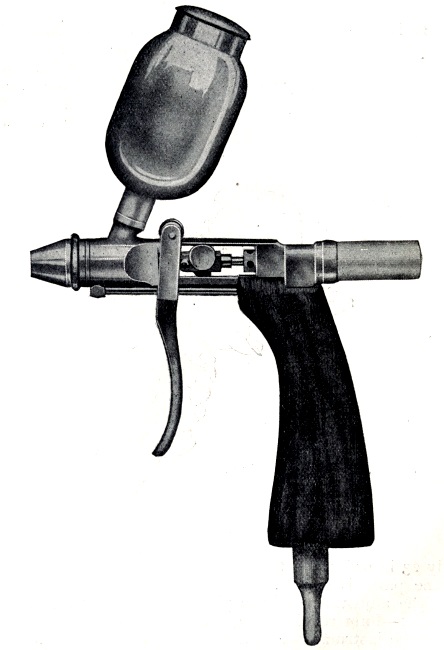
Fig. 57.—The Airostyle Pistol "M."
Another important point is to see that the lubrication
of the compressor is carefully watched; the sight feed lubricator
on top holds sufficient lubricant for 10 working days and
is capable of adjustment by means of a needle valve. It
can, therefore, be easily set. The main bearings are ring
oiling and only need occasional attention. The fan bearings
are ball bearings and only need attention once in six months.
The Eureka Spraying Machine.
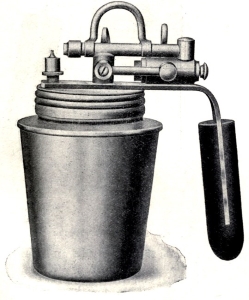
Fig. 58.—The Crane "Eureka."
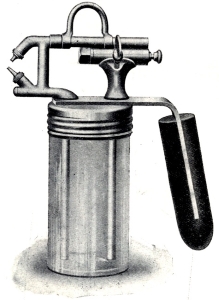
Fig. 59.—The Crane "Record."
An inspection of Figs. 58 and 59 will show that
this machine is of entirely different construction to those
already described. The advantages claimed are the simplicity
in construction, the absence of complicated parts
which might get out of order, and the fact that the machines
cannot clog in use. The operation is as follows: The feed
pipe from air tank should be connected up with a high-pressure
hose to the sprayer and a fluid nozzle is then adjusted
so that the tip of the nozzle is in alignment with the
centre of the air nozzle. This adjustment varies according
to the thickness of material. When using thin liquids the
fluid nozzle should be slightly below the centre of the air
nozzle. When ready for spraying the valve is pressed, and this
releases the air, which blows through the air nozzle, across
the top of fluid nozzle and draws up the material from the
inside, spraying the fluid on to the work. The shape of the
spray is that of a fan. The air pressure required varies from
20 to 50 lbs. according to the viscosity of the material being
dealt with. As a rule the best results are obtained when the
machine is held from 4 to 6 in. away from the work. The
Fredk. Crane Chemical Co., Armoury Close, Bordesley Green,
Birmingham, are the agents for these machines, and it
is also manufactured in the United States. The remarks
given under the head of "Exhaust," "Air Compressor,"
etc., will apply to this machine also. It may be observed
that the cup holding the metal can be very quickly changed,
so that a variety of colours may be sprayed one after the other
with very little trouble. The price of the machine (which
may be provided with an agitator if required) is low.
"The Invincible."
These sprayers are designed on an excellent "universal
movement" principle and are particularly well constructed
throughout. They further claim distinction on the score
that every section is an independent unit of standardized
pattern, and as spare parts are always available, replacements
and renewals can be made instantly with the minimum
of trouble and cost.
They are made in several types to suit varying classes
of work, ranging from the fine lining and shading of small
objects required by artists, etc., to commercial painting
on the scale practised by motor car manufacturers and
other large users; and important points in their favour
are the special facilities provided for quick cleaning after
use, their completely enclosed mechanism, which prevents
the penetration of any dirt, colour or liquid to working
parts, and the adjustment of the needle so that no pressure
or damage can occur at any time to the colour tip, even
if trigger is allowed to snap forward.
Automatic control is also provided for work requiring
a given volume of colour, it being only necessary to turn
a regulator to ensure a constant flow of any desired density.
The "Invincible" Pistol Sprayer type "E" is illustrated
in section (Fig. 60). The body is gun metal with working
parts of finest steel, highly polished where necessary to
ensure smooth working and minimum of wear. The
instruments have a handsomely nickelled finish.
Working.—When connector (4) is attached to colour
cup or extension cock for paint pot and connector (18)
affixed to air-line, the air brush is ready to commence work.
Dusting.—No separate or special dusting attachment
is necessary with the "Invincible" apparatus, as a slight
pull on trigger (20) carries back steel sleeve (7), depressing
steel ball (15) and bringing the air valve (19) into "open"
position. This allows a stream of air to pass forward
through air channel (21) to nozzle (1) and the projection
of this upon surface to be treated removes all dust.
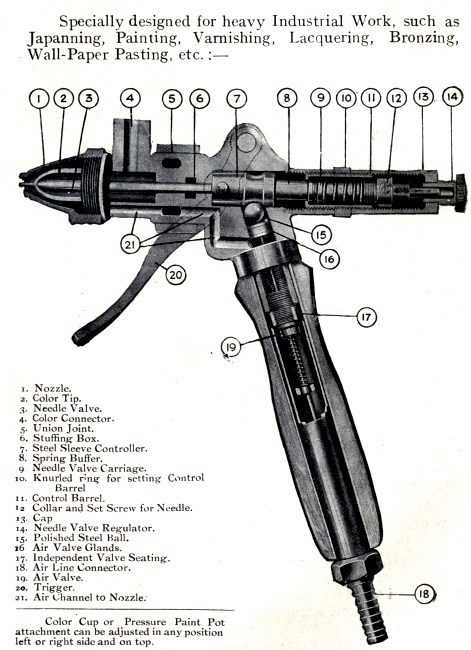
Fig. 60.—Invincible Sprayer Type "E" in Section.
Spraying.—A continuation of the trigger pull carries
back the spring buffer (8) and opens the control barrel (11)
of the needle valve (3) allowing colour to flow through
colour tip (2), at the end of which it meets the vacuum
created by the air stream, and is then (atomized) broken
up into thousands of minute particles which coalesce upon
meeting their object, and form a perfectly level, smooth
and even surface.
Control.—The trigger control is very sensitive, giving
a spraying range from a fine line to the fullest flush of the
instrument's capacity. For automatic control it is only
necessary to adjust regulator (No. 14).

Fig. 61.
Cleaning.—By unscrewing union nut (5) the complete
fore-part may be removed for cleaning without interfering
with any other part of the mechanism, therefore the operation
of cleaning is always quick and thorough, even when sticky,
heavy liquids have been used.
The movement for the above sprayer applies to all
"Invincible" sprayers. Type "A" for artists, miniature
tinting, black and white process work, etc. Type "B"
for Christmas and show card work, etc. Type "C" for
ceramic work, posters and so on.
A cheaper series is also made which, whilst lacking
some of the refinements of the standard models, are reliable,
and soundly made instruments.
The patentees and manufacturers of "Invincible" Air
Brushes are the Air Brush Manufacturing Co., Ltd.,
Pneumatic Works, 13, Arlington Street, Rosebery Avenue,
London, E.C., who also provide all accessories for complete
spraying installation, such as air-compressors, air-receivers,
air valves, reducing valves, condensers and clarifiers, pressure
paint pots and paint pot stands, exhaust benches,
fans, turn-tables, automatic cut-outs, motors, etc., of which
complete details will be sent upon request.
The Midland Sprayer.
Fig. 65.—The Midland Sprayer.
From what has already been said, it will be obvious that
the most important part of a spraying plant is the correct
construction of the actual sprayer or spraying pistol. The
Midland Fan Co., Ltd., of 46, Aston Road, Birmingham, have
placed on the market a sprayer which is shown in Fig. 65,
and this, we learn, has given a great deal of satisfaction. Its
principal claim to superiority is the simplicity of construction,
for one reason because the sprayer may be used by
those who have but little knowledge of mechanics. The construction
permits of easy cleaning, which is of vital importance,
and for this purpose the needle can be removed by a turn
of the fingers and replaced with equal ease. The illustration
shows the larger pistol, and it may be mentioned that smaller
sizes are made for finer work.
The Paasche Air Brush.
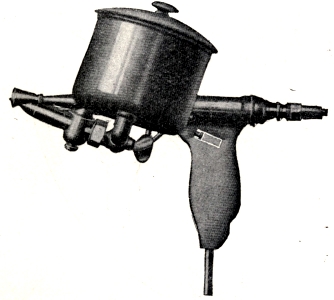
Fig. 66.—The "Paasche" Sprayer.
This spraying machine is manufactured by the Paasche
Air Brush Co., 9, South Clinton Street, Chicago, in various
sizes, for spraying by compression air liquids of all kinds.
The above illustration shows what is known as the
"Three in One" quick action model "S" brush, and is
recommended for use with heavy material. Instead of
the paint pot being at the top an underslung jar with aluminium
cover as shown on the lower part of Fig. 67 may
be used. This figure shows the same air brush or sprayer
with one gallon container; in either case the spraying of the
colour or material is quickly done. The flow of the
liquid is entirely independent of the air circulation. An
agitator is provided to keep the material well stirred, and
should be used with all liquids which have a tendency to
settle, such as bronzes, enamels, paints, etc. The coupling
or taper stem of the flexible metal tube or bottles are easily
detachable, and one material after the other can be used
without stopping. If the underslung jar or the gravity
pot be used no agitator is necessary.
This instrument is made in much larger sizes. The
general form of apparatus is shown in Fig. 68, the
special finishing hood with exhaust fan being in this case
employed, while a paint container is suspended on an adjustable
stand. In this case a chair is shown being painted.
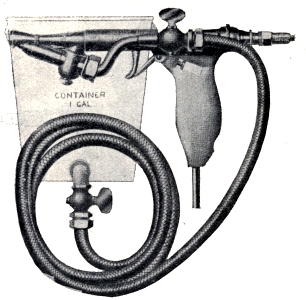
Fig. 67.—Larger Size "Paasche".
A somewhat novel apparatus for separating oil and
water is that shown in Fig. 69. This is constructed
to obviate the trouble which is sometimes caused by the oil
and water in the air main mixing. It is connected at the
end of the air main as close to the air regulator or air outlet
to the brush as convenient. Oil gets into the air main through
the piston of the compressor, and will in time saturate the
walls of the air pipes. The condensation of water which
is due to changes of temperature makes the iron pipes
sweat, and a considerable amount of water is accumulated
in this manner. The simple appliance shown in the
illustration will remove this.
Fig. 70 shows the Paasche Automatic electric controller
which is used for automatic starting and stopping motor
driven compressor outfits where from 1/8th to 1 horse-power
motors are used.
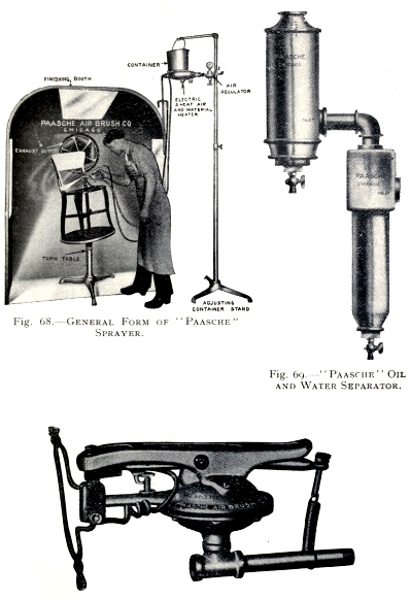
Fig. 70.—"Paasche" Automatic Electric Controller.
Supply of Compressed Air—Paint Supply—Exhaust.
The forms of spraying apparatus having been selected,
consideration must next be given to the following details,
viz.:—(1) The supply and degree of pressure of the compressed
air. (2) The form and location of the paint supply.
(3) The arrangement of an exhaust installation to carry
away the fumes and waste paint. These will be dealt
with in their order.
It is clear that attention has to be paid to a convenient
arrangement of reducing valves controlling the pressure of
air to the sprayer, and also providing, what is in many cases
indispensable, a pressure feed of colour to the sprayer,
either from a large pot mounted over the hood, or a special
type of bowl screwed on to the sprayer.
Some makers still advocate a simple type with small
bowl screwed on to the sprayer, and no means of controlling
the pressure save by adjusting the safety valve on the
main tank, thus necessitating that each operator shall work
at the same pressure, arguing that reducing valves, pressure
feeds, etc., etc., are unnecessary refinements, but it may be
safely claimed that such opinions are made without due consideration
of the advantages of the more complete system,
and that the consensus of opinion is in favour of such refinements,
giving, as they undoubtedly do, a further increase
in speed, and, in many cases, making practicable what would
otherwise be impossible, as well as ensuring that whatever
work is to be done, the most suitable pressure is instantly
available.
In the equipment of an efficient compressed air plant for
painting, the type of compressor employed, and the arrangement
of the air main, should first be decided upon.
The compressors must be designed to give an absolutely
pure supply of air free from oil or grit, and the air-main
must be so arranged as to avoid any trouble due to condensation.
This is overcome, first, by using, at least for high-class
work, a horizontal air compressor, water cooled, with
a sensitive sight-feed needle valve lubricator to the cylinder,
capable of delicate adjustment, so as to avoid excess of
lubrication. Needless to say, the machining of the cylinder,
piston, etc., of the compressor must be of the highest class to
ensure satisfactory running under such conditions. Then a
suitable air filter must be fitted to the intake of the compressor.
This filter should be of large diameter, and
have a gauze screen and wad of cotton wool.
The air valves should be so arranged that they may be
removed without breaking the water joint, and be so arranged
that they may be taken out and replaced in a few seconds.
The main tank must be provided with safety valve drain
cock and pressure gauge, and the air main, of not less than
¾ in. diameter barrel, preferably steam barrel, must be
arranged to travel in a downward direction from the
main tank towards an end station tank, which is a duplicate
in miniature of the main tank or receiver. All branches
must be taken upwards off the main. Such an arrangement,
if care is taken that the end station tank has its relief valve
set to blow off before the main tank safety valve acts, ensures
that all moisture is collected in the end station tank.
The Airostyle and Lithos, Ltd., claim to be the originators
of such a system, and it is here explained in print for
the first time.
All experiments with a view to scrubbing or purifying
the compressed air of moisture, oils, etc., on the air main
side of the main tank, other than the above simple expedient,
have proved more or less failures, either from want
of appreciation of the increased capillary attraction set
up in the tanks and air main, or from the difficulty of satisfactorily
and frequently cleaning out such scrubber as may
be inserted, and the incidental difficulty created in the
prevention of dust being carried out of the scrubber
throughout the system.
It need hardly be said that ample air must be provided
in order to have sufficient pressure always available for
the full number of operators employed, and this point
is one which cannot be too strongly emphasized, for in too
many cases firms have installed small compressors and
have been misled as to their maximum capacity, mainly
through over anxiety on the part of the salesman to secure
his order for apparatus, he apparently having been afraid
to ask a high figure for a really efficient compressor.
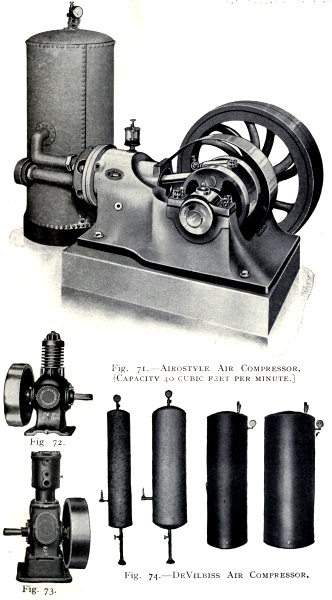
Another point of importance is that unloading devices,
cutting in and out automatically should be avoided at all
cost where compressed air is to be used for painting. The
reasons are that it is much better to use the surplus air
for the purpose of getting rid of the condensation in the
way already indicated, and that in addition most unloading
devices are in the nature of compromises, and while saving
only a small amount of power materially increase the wear
and tear by throwing the load in the reverse direction on
the gudgeon pin, large and small end of connecting rod
and main bearings, and by causing a hammering action
to be set up.
This applies in particular to air compressors with
automatic valves where the device works by means of a
valve closing the air intake entirely, and so setting up a
vacuum in the cylinder.
A much better plan is to arrange the compressor to
run at a speed sufficient to give a slight reserve of air above
what is needed and to have it running constantly during
the whole working period.
This may seem at first sight an arbitrary attitude to
take up, but it is the result of considerable experience, and
need not be considered as extravagant when it is borne
in mind that air compressors of more than 40 to 50 cubic
feet per minute capacity are seldom employed for such
work, and so the maximum power absorbed is light.
The compressor illustrated in Fig. 71 is designed and
made by the Airostyle and Lithos, Ltd., and has a number
of well thought out refinements, both as to accessibility
and form of valve bodies and valves, and also with regard
to the filtration of the air and the lubrication of the cylinder.
Ring oiler bearings are employed for the crankshaft, and
the compressor throughout is as carefully built as a gas
engine. The makers claim that an absolutely pure supply
of air is delivered by this compressor at all speeds up to
350 r.p.m.
Water cooling is employed and very ample cooling
surface is provided, not only for the cylinder but also the
cylinder cover is cooled, and has the valves located in
pockets in same.
An air compressor is shown in Fig. 72, and another
one, which is water cooled, in Fig. 73. These are made by
the DeVilbiss Co.
In Fig. 74 are illustrated various forms of air compressors;
a pressure gauge, safety valve and drain cock are furnished
with each receiver. These tanks have welded seams and
are tested to 200 lbs. pressure.
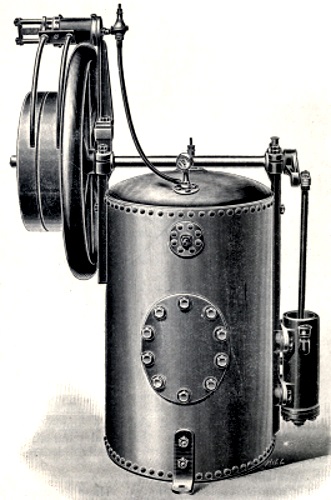
Fig. 75.—Aerograph Air Pump and Tank Combined.
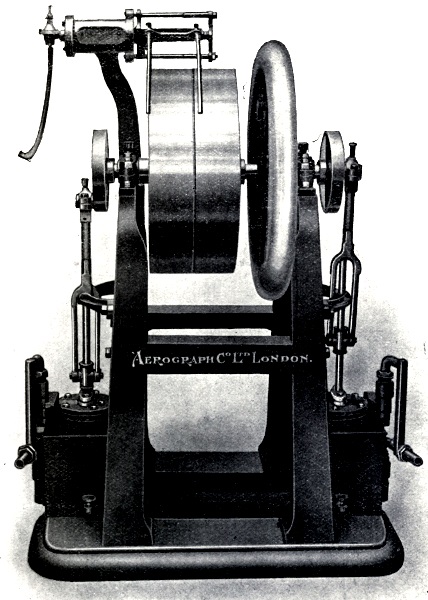
Fig. 76.—The Aerograph Type of Air Pump for Larger Installations.
One of the Aerograph types of power pump and tank
is shown below. It is strongly built, easy working,
and is fitted with metal extending rings and metal valves,
which will supply enough air for three spraying painters.
In the illustration is shown the pump fitted with an automatic
regulator, but this may be dispensed with if desired. The
regulator, therefore, will be found of great value, not only
in saving power, but also in the wear and tear of the pump.
The tank is fitted with an air gauge and a speed valve, and
the dimensions of the air receiver are 18 inches diameter
by 30 inches high, and the pump has a bore of 3 in. while
the stroke is 7 in. The power required is 1 h.p.
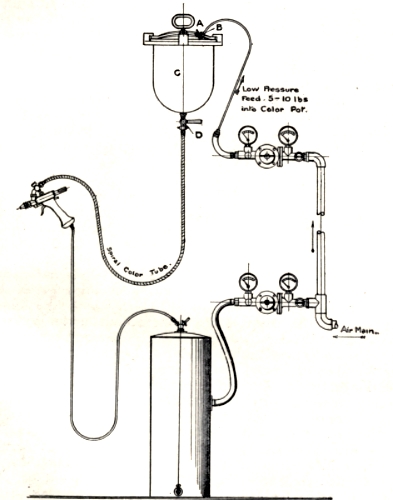
Fig. 77.—The Airostyle Plant—General Arrangement of Accessories.
The Supply of Paint.
For lacquering or coating small articles a spray may
be used which is constructed with a cup to contain the
paint, but for any heavy painting where large surfaces are
to be covered quickly a cup on the handpiece is not of much
utility, and it is necessary to provide a means to keep the
supply of paint to the handpiece continuous. This is done
in two ways: By an overhead paint pot, allowing gravity
to carry the paint to the handpiece, or by an enclosed paint
pot with a regulating valve and pressure applied to the
surface of the paint by compressed air. In some situations
all that is required is an overhead paint pot, the weight
of the liquid feeding it to the handpiece. An enclosed
paint pot has the very great advantage that (with a proper
valve) the feed of the paint can be regulated to a nice
degree. The paint pot shown in Fig. 77 has a damped
cover which is capable of being quickly removed, and a
low-pressure feed to the paint is obtained from a reducing
valve. This can be set so that the paint can be
forced to the handpiece to secure a uniform flow whether
the paint be thick or thin.
The Exhaust Installation.
We next reach the question of arranging a satisfactory
form of exhaust installation, which has been found to be
absolutely essential in order to insure the health of the
operator.
This exhaust question obviously opened up special
problems in the direction of convenient forms of hoods
or work benches, so arranged as to carry away the fumes
created by the paint distributor without unduly inconveniencing
the operator by reason of the draught set up.
By some firms use is made of the exhaust to collect
the residue or surplus paint drawn off by employing a
ventilator, which sets up a medium pressure, and interposing
between the outlets of the hood and the air shaft
some form of perforated screen or screens which are readily
removable, or in some cases revolvable and self-cleaning.
Where slow drying japans are employed, such saving
is of considerable advantage, although it must not thereby
be assumed that an extravagant wastage of paint occurs,
for it must be borne in mind that with a spraying plant
there is no loss through evaporation from open pots and
gradual drying up of the paint on the sides of the pots,
or absorption of same in the brushes employed. Actually,
therefore, although it would appear that considerable
wastage occurs, yet in practice it is found to be economical,
and even where intricate forms, such as cycle frames, wheels,
carriers, etc., or bedstead work are to be dealt with no
undue loss is experienced, and such small loss as may be
noted is compensated for ten times over in the saving of
time effected.
When selecting a ventilator for the plant, the fact
must not be overlooked that the fine particles of paint, etc.,
drawn off by the ventilator gradually coat the blades of
the fan, sufficiently to materially increase the friction,
and to absolutely prevent the exhausting of the air should
multiple bladed fans be adopted.
Experience has shown, therefore, that for such work
as compressed air painting multiple bladed fans are to be
avoided, even though these are scientifically designed and
admirable for many classes of exhaust work.
Not more than 8 to 10 blades should be employed,
and there must be no belt-drive taken through the air
shaft, this being a source of continual annoyance in addition
to creating a loss of efficiency.
Where simple impellor fans are used, long spindles
should be employed permitting an outside drive, but a
better type of fan is the central draught type, preferably ball
bearing, as these run for years with no attention save
occasionally filling up with grease and periodical cleaning.
It may be argued that many of the foregoing remarks
are not properly within the scope of this book, yet on further
consideration it must be conceded that they all have a
bearing upon the ultimate efficiency of the installation, and
are the outcome of years of experience.
When arranging a compressed air painting plant
considerable thought must be given to the most convenient
position, and where stoves for artificially drying on the paint,
japan, etc., are employed, care must be taken that a sufficient
number of these stoves are provided to give the plant full
scope, for a very material saving per annum is effected,
additional to that accruing through the labour-saving effect
of the apparatus, by the fact that the stoves are filled
more quickly.
Where bulky work is to be handled, the plant must
be so arranged as to give ample room for getting the work
to and from the hoods.
The volume of exhaust air will depend on the character
of the paint and the size of the cabinet. For large articles
a large cabinet is required, and a proportionately larger fan
will be needed. From 500 to 1,000 cubic feet of air per minute
should be supplied for each worker. A hurricane of air is
not required; all that is needed is to keep the air moving
away from the worker, and the ordinary type of wall fan
may be sufficient for a simple installation, but cannot be
used for large plants.
Airostyle Central Draught Steel Plate Fan.
This fan is designed and made by the Airostyle and
Lithos, Ltd., and is invariably specified in all their medium
and large installations for compressed air painting. It
is very carefully designed and built specially for the work,
and is fitted with ball-bearings.
As will be seen from the illustration, Fig. 79, it is
worth serious attention on the part of intending users.
It is made in many sizes, from 2,000 to 23,000 cubic
feet capacity, and is very largely used, not only for
Airostyle plants, but also for general ventilation work.
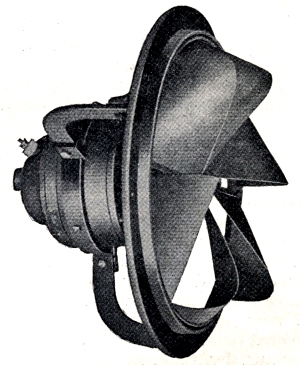
Fig. 78.—The Paasche Motor Driven Fan.
In the above figure is shown a motor-driven propeller
fan manufactured by the Paasche Air Brush Co. It
is made in various sizes, varying in air delivery from 1,200
to 10,000 cubic feet per minute.
Fig. 79.—The Airostyle Centre Draught Steel Plate Fan.
Fig. 80.—The DeVilbiss Auto Cool Electric Exhaust Fan, Closed, and Open for Cleaning.
Location of the Work Cabinets.
Fig. 81.—Sketch of Spraying Cabinets, Showing side Lighting.
As to the position of the spraying benches, it is a little
curious to note that in not a few cases these cabinets are
placed facing the window, the idea being to obtain as much
light as possible for the process. A moment's consideration,
however, will show that this is not the correct position,
because the workman faces the light, which is thrown on
the back of the article he is spraying, in exactly the wrong
position for his purpose. The cabinets should be lighted
from the back of the workman and be, as far as possible,
directed from the roof or the top of the room, so that it
comes directly on the article to be sprayed. Clearly it
is necessary to provide as good a light as possible in order
that no part of the work shall be missed.
Artificial light will, as a rule, be provided for working
on dark days and after the sun sets, and here again the same
provision must be made. Plenty of light arranged in such
a manner that it is directed on the front of the object to
be painted is essential in every case.
After due provision has been made for a suitable exhaust,
which question should be left in the hands of the specialist
in compressed air painting if satisfaction is to be guaranteed,
other questions need attention, such as provision of means
for handling the work, special turn-tables, which should
be ball-bearing, if possible, to ensure light running and enable
even heavy articles to be turned about when spraying, and
when examining the work.
Fig. 82.—"Aerograph" Spraying Cabinets.
The Fumexer.
In connection with the Aeron, the makers supply a
special form of cabinet or booth, made of steel, which is
called by them the "Fumexer," and is illustrated in Figs 83
to 89.
These are made in various sizes, from 3 feet to 16 feet
wide, and 4 feet to 18 feet deep. They are each fitted with
turn-table and specially constructed fans for drawing out
the air, and with it the superfluous paint, enamel, etc.
Fig. 84 shows a side view of an 8-ft. Fumexer indicating
the style of construction and funnel-shaped back clear to the
floor.
The steel Fumexer with the Autocool electric exhaust
fan installed is claimed to insure a maximum exhaust
efficiency, and to completely remove all fumes arising from
the work in the finishing room—at a minimum of power
consumption.
The Fumexer is a fire-proof steel booth specially designed
and built for the height of service. It is constructed of
heavy sheet steel on an angle iron frame, with wire glass
windows in sides and top. Provision is made for electric
lights—reflector and sockets being built in.
The back of the Fumexer is funnel-shaped clear to the
floor, which arrangement, together with the large fan opening,
gives maximum exhausting results, especially on large work.
The short exhaust pipe running from the back opening is
easy to clean and permits of the placing of the Fumexer
near outside wall.
To take care of all classes and styles of work, the
Fumexer is regularly made in a variety of sizes as
above mentioned with the proper number of fans
installed. Other sizes to meet any special requirements
are made to order.
A turn-table, which is adjustable, tilting and revolving—either
floor or suspended type—is supplied with the
Fumexer. This device facilitates the handling of a large
percentage of work. The floor type turn-table is not
fastened to the floor nor Fumexer and can be removed when
not required.
The Autocool electric exhaust fan installed in all
Fumexers is an exclusive Aeron system product, and is
particularly adapted to the work required of it.
In Fig. 85 is illustrated the side and front views of a
4-foot single exhaust fan installation Fumexer with suspended
type turn-table.
The fan motor, completely enclosed and protected
from fumes, is automatically cooled by a stream of pure
air which is continuously drawn through the motor. This
means a fan of increased efficiency. The motor is only one-twelfth
H.P. and will do the required work at one-tenth or
less the power consumption of other styles of exhausting
methods.
Autocool fans are made in one size only, the number
of fan units being increased for Fumexers above five feet
in width. In this way the right number can easily be
adapted to any kind of work. The makers claim that
by this arrangement a better distribution of exhaust is
obtained, and the vapour is moved quickly at low pressure
through the large fan openings—this accounting for the small
amount of power used.
The next illustration shows the Autocool electric
exhaust fan both closed for use and with motor and blades
swung inward for cleaning.
In Fig. 86 is shown a special Fumexer with three
exhaust fan installation and automobile body.
This equipment, together with type D Aeron with V
spray head or type M Aeron with V-A spray head and the
air transformer set, is used for priming and surfacing
automobile bodies.
Two very interesting illustrations are Fig. 88, the one
on the left being a Fumexer with automatic elevating and
revolving turn-table, while that on the right is a Fumexer
with wheel-jack.
The turn-table is revolved by a 1/8 H.P. electric motor,
furnished in either direct or alternating current. The speed
of rotation is adjustable through a wide range by means of
a friction wheel and disc. The table is started and stopped
by either hand lever or foot pedal entirely independent of
motor.
A ten-inch elevation of the table is accomplished by
compressed air acting on a piston which supports the revolving
parts. A hand lever controls this feature, and the speed
of elevation and lowering is adjustable for different classes
of work.
This turn-table is especially designed for handling
box-like work, finished inside and outside in the same or
different materials. The elevation feature makes possible
the painting of an article one colour inside and another outside
in one operation without interference. It is also well
adapted for use on other classes of small work.
The Fumexer in operation is shown in Fig. 89.
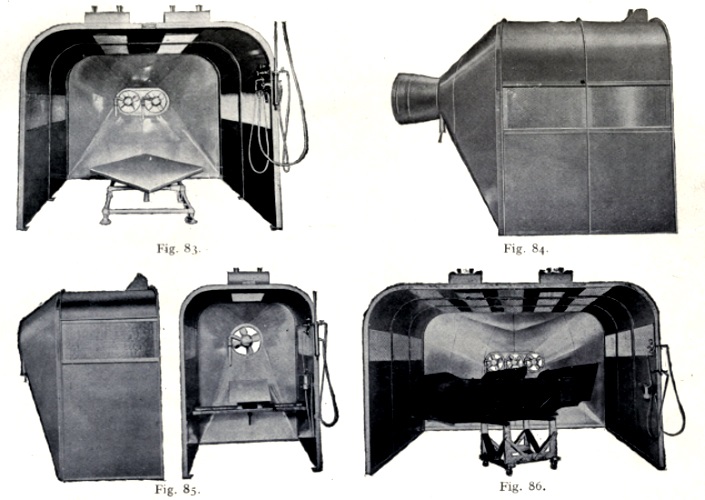
The DeVilbiss "Fumexer" or Spraying Cabinet.
Accessories.
It is difficult to classify accessories as readily as the
sprayers themselves; we must content ourselves with a
description of some of these as supplied by the firms
mentioned in the previous chapter.
One of the most complete plant supplied is that installed
by the Airostyle & Lithos, Ltd.
They have, in addition to the sprayers, a system of
carrying a specially designed colour pot on a bracket over
the hood clearly seen in Fig. 77. Such a colour pot
has a clamped cover, making an airtight joint, and
so arranged as to be readily taken off for cleaning or
re-charging, and with a spun copper container, offering no
obstruction to the flow of the paint and reducing loss to a
minimum. Connections are provided on the top for the
pressure feed, for filling up by means of a funnel, and for
permitting the use of the compressed air as a means of
driving out the paint from the flexible tube before leaving
the instrument after work is finished each night.
Another accessory is a smaller pressure bowl made
to screw directly on the pistol sprayer and designed to
make possible the use of many coloured enamels, while
still retaining the advantage of the pressure feed. Pressure is
conveyed into the bowl through a flexible tube from a special
type of reducing valve, shown in Fig. 77.
This illustration shows the connections as universally
employed on Airostyle plants.
The reducing valves are so designed as to give in case
of the top valve a pressure up to 15 lbs. for the pressure feed,
and in the lower one any pressure instantly from atmospheric
pressure up to the maximum.
It is the practice to take the air pressure from the
air main through the reducing valve into the low pressure
tank, as shown, as this further ensures that absolutely
pure air shall be delivered to the sprayer and a steady
supply of air at any pressure is always available.
The low pressure tank is, as shown, a very simple type,
albeit soundly made, and a drain tap is provided at the base
of same.
Last, but not least, comes the type of flexible tubing
employed, and this is the outcome of much experimenting,
in that the same is unaffected by the action of turpentine,
white spirit, or even naphtha.
Before leaving this question the reader is referred to the
numerous illustrations (see pages 155 to 185), as these give a
far better idea of the completeness of the Airostyle plants
than is possible in this chapter.
Turn-tables.
To facilitate handling of goods to be sprayed, a turn-table
is usually found of considerable service. These turn-tables
vary according to the class of work that is being
dealt with. In Fig. 87 is shown one made by the Aerograph
Co., Ltd., which is 20 inches in diameter by 12 inches
high. It is made entirely of cast iron, excepting the cone
seated bearing, which is of hardened steel, which rotates
freely and is nicely finished. The weight is 98 lbs. Sometimes
turn-tables are provided with projecting points to
prevent the article being sprayed from moving, while in
other cases the top of the table is provided with ridges for
the same purpose.
In all small turn-tables a conical bearing of hardened
steel, properly lubricated, is sufficient for the purpose, but
in the larger work it is desirable to employ ball-bearings.
Whichever method is used, it is essential that the table
turns very freely so that it can be moved almost with a
touch.
Fig. 87.—Aerograph Turn-table.
Fig. 88.—Two Forms of Fumexer.
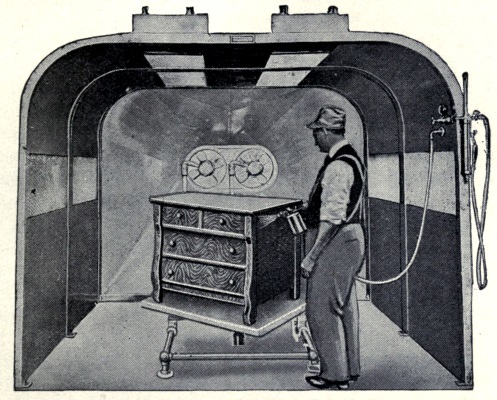
Fig. 89.—The Fumexer in Use.
Fig. 90.—A Paasche Turn-table.
Fig. 90 shows the Paasche turn-table, which can
be raised or lowered into suitable positions as well as tilted
at any angle. It revolves freely with a gentle touch. Larger
sizes are supplied. The necessity of providing for carrying
off the fumes which arise in paint spraying has already been
dealt with.
The Auto-Electric Air Heater.
This invention is the property of the DeVilbiss Manufacturing
Company, and is intended to overcome the tendency
of the air to cool as it leaves the nozzle in spraying, while it
tends to keep it heated till it reaches the work. It also
raises the temperature of the varnish or enamel, producing
a smooth, even finish.
In addition to heating the air, the auto-heater warms
the nozzle, thereby raising the temperature of the varnish.
Because of the heated air and warmed material there is a
complete elimination of the pitted, pebbled or mottled
effect so noticeable when "short oil," quick setting or heavy
bodied varnishes or enamels are sprayed on flat surfaces.
The auto-heater enables Aeron users to improve the
quality of many classes of work—in many instances it opens
up an entirely new field of usefulness. The auto-heater and
the air transformer set together insure clean, dry and warm
air at the proper pressure, which is an important factor
in the production of the best Aeron results.
The auto-heater applies the heat at the last possible
point before the air enters the Aeron; as a consequence
there is absolutely no loss or waste of heat, as would be the
case if the air were heated at some other point and then
passed through the hose to the machine. It is very easy
to understand that if air heated before entering the hose
retained sufficient heat to be of service when reaching the
nozzle, it would be so hot that it would destroy the hose.
In the only practical way, the auto-heater maintains the
heat in the air at the proper degree till the spray reaches
the work.
The auto-heater is light, yet rugged in construction.
It has no exposed contacts. The conductor wires run
through the air hose. It can be attached to any style of
Aeron without difficulty. There is an automatic cut-off
furnished with every auto-heater. Placing the Aeron in
the cup holder, or hanging it on the hook, automatically
cuts off the current—picking up the Aeron automatically
turns on the current. This automatic control effects a
great saving in current. As a protection against overheating
the auto-heater is equipped with a fusible safety disc, which
melts, allowing the air to escape, if current is left turned on
by accident when the Aeron is not in use. This safety
device operates within four minutes. Several extra discs
are furnished with every outfit. The auto-heater can be
connected to any electric light socket, and consumes only
250 watts current when in operation.
The construction of the auto-heater will be understood
on reference to Fig. 91.
Another interesting heater is supplied by the Airostyle &
Lithos, Ltd., a number of which are in use in this country
Its general form can be seen on reference to Fig. 102, page.
165, which shows a gas-heated type. The same heater is also
supplied either electrically or steam heated.
In all types it has the same general features, namely, a
water-jacketed colour pot, a special coil for heating the air
supply, which is afterwards passed through the water
jacket for the dual purpose of raising the temperature of the
jacket and damping down the air temperature at the same
time. To a convenient standpipe the hot air is carried and
distributed to the pistol, and also to a special jacket round the
colour tube.
The Airostyle pistol is provided with an adjustment
which admits of the hot air by-passing the whole time so,
maintaining the pistol at the same temperature as the
colour pot and ensuring a steady flow of the japan.
The heaters are mounted on a stand at the side of the
hood and are complete with pressure gauges, regulating
valves, special burner for gas, or an electrically heated pot
giving three heats, or for steam giving a wide range of temperatures
controlled by the steam pressure through a reducing
valve. It must be explained that the same result is obtained
no matter which form of heater is employed, and that in no
case can the japan be burnt. The heaters are used for
thick black tar varnish, or cycle japans, also for certain
gum or glue mixtures and special varnishes.
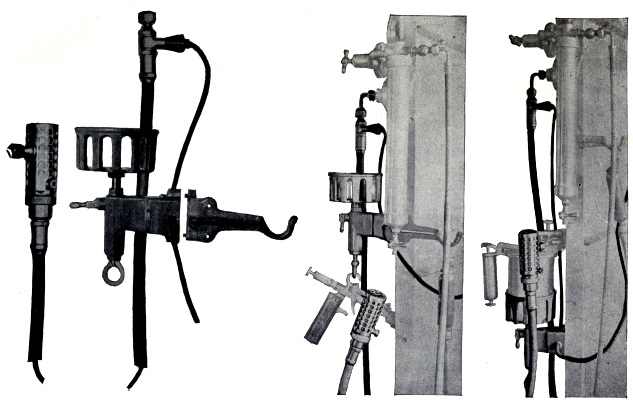
Fig. 91.—The Auto Electric Air Heater.
Stencils and Masks—The Requirements of
Different Trades in Spraying.
Just as in applying paint by immersion some parts
which are not required to be painted can be protected,
as already explained, so in spraying.
Certain parts are to be left unpainted, such as the plated
fronts and glass lenses of cycle lamps. This is effected by
the adoption of some system of masking. Such masks are,
however, very simple and are sprung on with a simple wire
spring or clip, and so held in place while spraying.
A mask has been designed and patented purposely
for use when spraying. This is described on page 143. This
mask has embodied in it a plunger on the end of which is
mounted a rubber sucker, and as the plunger is controlled
by a spring, all that is necessary to do is to depress the
plunger down on to the lamp, box, or whatever article is
to be painted; and as the sucker of the plunger comes into
contact with the article first, it grips the surface and the
spring behind the plunger forces the mask, which may be
any shape, but is preferably of box form, down upon the
article. This mask is very practical, but its use is limited,
to some extent, to forms of lamps which do not need any
stencil or mask. Such a step, needless to say, has only been
taken because the system of compressed air japanning is
the one ideal method—and one has only to refer to
manufacturers who have used it for confirmation of this.
In addition to simple masks, there are many more
complicated forms, such as those in use in gas meter manufactories,
where there are no fewer than half a dozen points
to be masked, and in hardly any case do more than two
points remain the same over numbers of meters to be dealt
with.
However, this has been overcome by arranging the
masks on a spring foundation, and making them capable of
sliding adjustment in two or more directions, and the time
taken to fix these masks is in no case more than 30
seconds. Seeing that the time taken to brush a meter
(even a small one) is not more than seven minutes and
the time taken to spray one, with a superior result,
is not more than one minute, there is a very considerable
saving even after allowing time for fixing the mask.
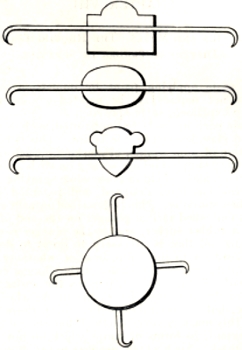
Fig. 92.—Masks for Gas Meters.
Other stencils are employed for lettering on plates,
despatch boxes, and for ornamental work on cash boxes, etc.,
and need no further description here other than stating that
these must be of something stronger than tinfoil, and not
too strong to prevent them being pressed firmly down on to
the article to be dealt with.
In other cases, stencils are spun or pressed out to
exactly fit the article, as in the case of brass lacquered goods,
rubber balls, enamelled ironware, etc., and in some cases,
where a number of stencils are employed, for one pattern,
these are arranged round a common centre, and hinged
so that, once the article is in position, stencil after stencil
may be readily and accurately brought into position over
the work.
For decorative work, very elaborate stencils are
employed, with many plates for each design; but such
stencils hardly come within the scope of the present work,
although they are employed for wallpaper work, and in the
textile industries for high-class effects.
The Hart Patent Mask.
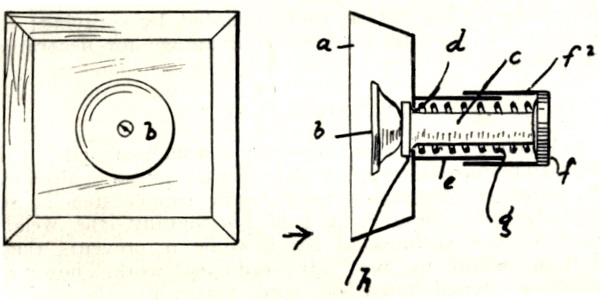
Fig. 93.—The Hart Patent Mask.
A very ingeniously constructed, although simple,
mask which is suitable for many purposes, but particularly
for motor and carriage lamps, has been patented by Mr.
Walter William Hart, of the firm of Matthew J. Hart &
Sons, Great Barr Street, Birmingham, and others. By this
invention means are provided for applying the mask to a
plain surface so that it may be immovably held without
causing injury to the surface. The mask, too, has the
advantage that it can be placed in position with extreme
rapidity. By this invention the mask is fastened in position
by a suction pad, preferably made of indiarubber, which,
when pressed on to the surface to be covered, adheres
thereto by the pressure of the atmosphere. In Fig. 93
is shown an inner face view and a sectional elevation of the
device. The mask (a) is adapted to have an axial movement
in relation to the suction pad (b) so that when such pad
has been fixed in position the mask may be pressed close
upon the surface it is required to protect. This suction
pad (b) is of a conical formation, and is secured to the end
of the plunger (c) which passes rearwardly through a hole
(d) in the back of the mask, and through a tubular extension
(e) passing rearwardly from the back of the mask. The
rear end of the plunger has a hole therein, which hole is
screw threaded, and to such end a cap (f) is secured. A stud
(f) on the interior of the flat end of the cap screwing into the
said tapped hole, and the cylindrical portion (f2) of the cap
slidingly fitting over the tubular extension (e) on the mask.
A spiral spring (g) surrounds the plunger, one end bearing
on a shoulder (h) at the rear of the mask and the other end
bearing against the cap (f). To fasten the mask, the
same is placed in position over the part to be covered
and the cap (f) is pressed down, thus pressing the suction
pad (b) upon the surface of the article, to which it adheres.
A mask constructed according to this invention is capable
of a great variety of applications, one of which is in connection
with lamps. That shown in the illustration is intended
for this purpose.
It will be clear that the shape, however, can be varied
according to the article to be painted by spraying; for
example, it may be used with advantage for decorative
purposes.
MAKING STENCILS.
When it is decided to spray through stencils, it is
usual to employ thin copper plates for the purpose, although
in wallpaper decoration very heavy copper stencils are
used, because, these being held horizontally, the weight
increases the stiffness of them, while it prevents them
shifting while in use. In ordinary work, however,
where a stencil must be used vertically, the lighter
stencil will be most useful. If paper is used, the best
material is Japanese vellum, which is manufactured from a
special fibre and possesses the advantage of being easy to
cut and makes remarkably durable stencils. It is imported
from Japan by Jas. Spicer & Sons, Ltd., 15, Upper Thames
Street, London, E.C. Manilla paper may be had from the
same firm, and answers also very well. For some styles of
work, lead foil gives good results. Messrs. Locke, Lancaster,
and W. W. and R. Johnstone & Co., Ltd., 94, Gracechurch
Street, E.C., supply a material which they call "Four-ounce
stencil metal," which weighs 4 ounces to the square foot, is
made in sheets 6ft. by 2ft. 6in., and in smaller sizes, and costs
2s. per lb. It can be easily cut with a stencil knife, and is
most suitable for work on horizontal surfaces. Another
paper which may be used is ordinary Whatman's paper.
The usual method of cutting is to use a very sharp knife,
such as a shoemaker uses, and to cut on a sheet of glass. If
any variety of paper is employed, it will be necessary to
apply two coats of shellac varnish, ordinarily called "Patent
Knotting." This protects the surface of the paper from
being worn away by the action of the brush. Some stencil
cutters prefer boiled oil for the purpose.
Zinc stencils are sometimes employed. These may be
made as follows: The thinnest sheets of zinc are employed
for the purpose, and upon this is painted the letters or
design to form the stencil. The whole of the zinc which is
not to be cut out, or rather, by this process, eaten out by
acid, must be protected by means of a varnish made as
follows: Take one pint of best asphaltum varnish, two
ounces of beeswax and half-an-ounce of rosin and four
ounces of Venice turpentine. Melt the beeswax and rosin
in the Venice turpentine, and while warm add the asphaltum
varnish, mixing thoroughly together. Paint this on the
back of the zinc plate and on all parts that are to be protected.
Form a dam or little wall made of 6 parts of beeswax
and one part of tallow melted together and allow to
cool. This is intended to confine the acid to the parts
required to be eaten out. Nitric acid is used for the purpose
mixed with three parts of water. This is poured on the
space inside the dam and allowed to remain on for from 24 to
48 hours, when it will be found to have eaten away the zinc
on the parts unprotected. Further information concerning
stencils will be found in the book entitled "Stencils and
Stencilling," by A. L. Duthie, published by the Trade
Papers Publishing Co., Ltd., 365, Birkbeck Bank Chambers,
High Holborn, London, W.C., price 3s. 3d.
REQUIREMENTS OF SPECIAL TRADES.
The following hints are given of the requirements of a
few special trades:—
Piece Work.
In very many cases where articles are painted by means
of compressed air it will be found quite practicable to have
the work done by piece work. The exact time taken to
spray any particular article can, after a very little practice, be
determined quite accurately. In fixing the price to be paid
for the work an allowance must, of course, be made for the
time taken in bringing the piece to the spraying cabinet
and placing it ready to be taken away by the boys or labourers.
It is in this detail that speed may be increased so
materially. The actual time of spraying to a great extent
regulates itself, but if care is not taken considerable waste
of time will be occasioned in getting articles ready and taking
them away, and a satisfactory arrangement of piece work
to both employer and employee will remove this waste of
time and will prove more beneficial than day work.
Bookbinding.
The principal use of spraying in this work is to put on
the speckled edges of books after they are sewed and before
binding. This is usually done by splashing colour from
a stiff-haired brush over a comb, but the method is a crude
one at best. In using a spray for the purpose one of the
simpler forms will do all that is required. The pressure
must be lowered and paint removed some distance from the
books until the requisite size of the spots or dots of colour
is obtained. With a little practice this can be regulated
to a nicety.
Carriages.
The remarks which will be found elsewhere, under the
head of "Tramcars," apply to some extent to carriages also,
and although the superfine finish required for a high-class
carriage could hardly be produced excepting by the old-fashioned
means, yet the processes of flowing-on and
spraying could, without doubt, often be employed for the
cheap and moderately cheap style of vehicles of various
kinds which are now produced on so extensive a scale.
Cycle Parts.
Many parts of cycles are now painted by means of
spraying, although some firms prefer dipping. Whichever
process is used it is necessary, as a rule, to give at least
two or sometimes three or even more coats, and to get a
fine finish to rub down between these coats with powdered
pumice and water, and, for the last coat underneath
the finish, rottenstone and oil. The parts must always
be stoved, as air drying enamels are not, as a rule, sufficiently
hard to permit of their resisting the hard wear to which
cycles are subjected. It need hardly be said that the method
of handling various parts will to a great extent determine
the economy effected.
The wearing parts of cycles are sometimes finished
in the following manner, which is the method used by the
Birmingham Small Arms Co. Although somewhat expensive
it is certainly worthy of all praise, because it gives
so durable a finish. The iron or steel parts are first
thoroughly washed in American turpentine and are then
stoved, the result being a perfectly clean surface. A coat
of Calcutta linseed oil is then given by means of brushes
and the parts are then stoved at 250° F., after which they
receive a coat of what is called "Black Rubber Solution,"
an elastic enamel which dries with a semi-gloss. Then
two separate coats of khaki colour japan are given and
each are stoved at 280° to 300° F. A little rubbing down
between the coats is sometimes necessary, and this is done
with glass paper. The parts thus finished are very suitable
for work which is to be subjected to very hard wear. At
this writing the cycles are all intended for Government,
hence the care taken in the finish.
Electrical Work.
Painting by compressed air is done in the case of many
parts of electrical apparatus, the process being similar to
that previously described. Thus the metal work of fuse
boxes may be finished in this way with black japan, and one
coat stoved at 250° F. or thereabouts will usually be found
to suffice.
Among the large number of electric works where the
process is employed may be mentioned those of W. T.
Henley's Telegraph Works, Ltd., at Gravesend. The
Airostyle is used in this case, and the work is done approximately
from twice to three times as rapidly as it was
formerly done with the brush.
Fancy Baskets.
Fancy baskets which are made of cane, willow, special
straw and other materials can be sprayed with admirable
effect in many cases where brushing would be impossible.
Indeed, the application of a spray in this work may be considered
to have created almost a new industry in a wide
range of fancy goods, which may be sprayed with gold paint,
or a great variety of coloured enamels may also be employed.
In this case celluloid varnishes are also employed with the
addition of coal tar dyes for the production of colours
such as mauve, blue, moss green, rose pink, amber, orange,
fire red, navy blue, etc. The work of spraying in this case
is usually done over a bin such as is shown below,
a simple wire device being used at the top to support the
basket while it is being sprayed, although even this is often
dispensed with as the article may be held by the handle, and
being very light this is not found to be irksome.
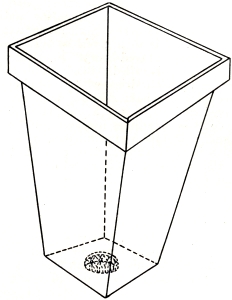
Fig. 94.—Bin for Spraying Light Articles.
Gas Meters.
At the present time less than half a dozen gas meter
manufacturers or repairers have a paint spraying plant
in use, and these are described elsewhere. The saving,
however, by spraying the paint is in this class of work very
considerable, amounting to about 1 to 5; that is to say,
five times as much work can be turned out with a spraying
machine as by hand. It is generally recognised that the
quality of the painting is much improved, it being harder
and better in appearance and generally more satisfactory.
Turn-tables of a simple character are employed, and 24
hours are allowed for the drying of the work. For protecting
the indicators, the name of owner or manufacturer and
brass plates of similar character, various types of shields
or masks are employed, consisting of a plate of requisite
shape soldered on to a piece of stiff wire, with turned ends,
which embrace the meter and hold it in position. There
appears to be no reason why the larger size gas meters should
not be painted by spraying, provided that a suitable plant,
which would be of a simple character, were provided.
There is but little doubt that in a little time every manufacturer
of gas meters will find it necessary to employ a
spraying plant.
Gas Stoves and Ranges.
In this class of work spraying is used almost exclusively;
as only one side of the iron is to be painted the dipping
process is obviously unsuitable. The work is done at a
pressure of about 45 lbs., but sometimes a little less is sufficient.
The usual exhaust is provided and turn-tables are employed
having bearing wheels on the outer edge of a circular plate.
Those used for the larger ranges are usually level with
the floor. In addition to black, all kinds of colours may
be used. This work is mostly done piece work. The smaller
parts, such as rings, cookers, etc., are also sprayed. The
stoving is done at 350° F., but when two coats are given
the first is subjected to 450° F.
The interior of the ovens are coated for a finish of
oxide of tin, which when stoved at a high temperature
assures a great increase of "body" or opacity. Sometimes
the finish is left solid, but in most cases the coat is stippled.
The usual overhead runways consisting of hanger
on four wheels on V-shaped girder are employed.
Picture Frames, Picture Moulding, Etc.
One of the industries in which paint spraying is strikingly
successful is that of preparing picture frames with a "gold"
finish. If properly done the result is even better than if
gold leaf is used, as the spray covers completely the most
elaborate and intricate ornament. Picture frames or mouldings
of various shapes and sizes are obtained ready for receiving
the various coats necessary to give a gold finish. Formerly
the whole of the operations were done by means of
brushes, but this method has been wholly superseded by
spraying, which approximately does the work five times as
quickly and gives a far better result.
Three separate processes are employed; the first is
the application of a coat of enamel, the second a coat of
bronze or "gold paint," and the third the application of
a transparent lacquer. The last protects the bronze from
discoloration, and the manufacturers guarantee that such
mouldings will last at least 5 years without tarnishing.
The whole of the work is air dried, but to facilitate
the operation the workroom is kept at a temperature of about
75°F and the drying ovens up to, say, 80° or even 85°F.
The first coat of enamel is sprayed on, and in about two hours
is felted down with a pad similar to that used by french
polishers. This is dipped in a solvent which removes all
inequalities. The actual spraying is done on a long open
trough shaped bin some 3 ft. 6 in. from the floor having
exhausts at the bottom and thin laths placed across it at
intervals of about 18 inches. The long stretches of moulding
are placed on these laths lengthwise, the laths holding them
in position. The spraying is done directly on them and they
are turned from side to side, and when the spraying is completed
each length is lifted bodily by two boys, one at each end,
on to racks in the drying room which is close by and which
has a large number of open iron shelves running from end
to end. These shelves are quite close together, so that a
large number of lengths of moulding may be dealt with at
one time. Heat at about 85°F is admitted at the bottom, and
the drying apartment is open from end to end in front so
that the mouldings may be readily introduced. This heat
also serves to warm the room.
The enamel being dry the length is removed and gone
over with a pad as described and the gold paint is then sprayed
on over the whole of the work, giving a beautifully fine and
compact gold finish. The application of the transparent
lacquer completes the operation. The materials used in
this work are special spirit varnishes made on a base of
celluloid. The exact composition varies with different
manufacturers, but the following recipes are based on "The
Manufacture of Spirit Varnishes," by Livache and McIntosh
(Scott, Greenwood and Son), and will be useful for
reference. The great advantage of using celluloid is that
a coloured transparent varnish is obtained.
Recipe for Celluloid Varnish.
| 1. | Celluloid | 1 lb. |
| | Amyl Acetate | 2 lbs. |
| | Acetone | 2 lbs. |
| | Ether (Syph. Meth.) | 2 lbs. |
| 2. | Same as before with the addition of 1/5th part of camphor. |
| 3. | Celluloid | 1 lb. |
| | Amyl Acetate | 5 lbs. |
| | Acetone | 5 lbs. |
Picture frames are also finished in black having a semi-gloss
finish,which gives an excellent effect and is most durable.
It is very important in this class of work that ample
ventilation be given to the apartment in which the work is
done in such a way as to avoid draught. Heated air, of
course, takes up moisture much more readily than cold
air, and unless means are provided for adequate ventilation
the air will become moisture charged, and the work will
thereby be adversely affected. This is a point which is
frequently overlooked.
Spraying Ships' Hulls.
It is the opinion of the author that the painting of
ships' hulls may be done by means of spraying with a great
saving of time. Although there are no available statistics,
it is probable that many thousands of acres of surface on
ships' bottoms are re-painted every year. A careful enquiry
has shown that some experiments have been made in this
direction, but that they have always been of a somewhat
perfunctory character. The very large surface gives an
opportunity for the use of the spray which is almost unequalled
in its possibilities. There are, however, certain
difficulties in connection with this work, which have doubtless
had much to do with the fact that it has not, thus far, been
adopted to any considerable extent.
The first of these is that the composition applied is not
ordinary paint, but one which is mixed with arsenic, mercury
and other poisonous compounds, which are added in order
to destroy animal and vegetable life and prevent the adhesion
of barnacles and other marine growth. So necessary
is this that compositions are made suitable for different
waters through which the vessel must pass, and it is well
known that those vessels which sail by regular routes need
much less frequent painting than a tramp steamer which
may sail in any direction and through any sea. The reason
is, that in the first case the composition is specially made to
withstand the growth of life in well-defined waters, while in
the case of tramp steamers it must be more or less of a
general nature.
The point, however, which has now to be dealt with, is
that the addition of arsenic, etc., added to the paint, causes
it sometimes to settle out, but it is suggested that this could
be easily overcome by an agitating apparatus in the paint pot.
As explained elsewhere, such an apparatus is frequently
used in ordinary painting, when the composition of the paint
demands it.
The second and more serious objection to spraying ships'
hulls is that the work must be done in the open, and that the
wind will carry away a portion of the paint and prevent it
reaching the surface required. It is suggested, however, this
might perhaps be overcome by adopting a form of enclosed
cabinet, which would screen the operator from the wind.
This could be rendered portable by being mounted on a platform
with wheels, and a system of elevators, and be adopted
with a little ingenuity to reach the higher parts of the
vessel. In any case, the subject is one which is well worth the
attention of those interested in spraying, owing to the
immense field it opens up.
In this connection attention may be directed to the
illustrations which appear on pages 252 to 254 of the
apparatus used for spraying by the Pennsylvania Railroad
for painting their freight cars. This apparatus may be
adapted, with suitable modifications, for ship painting also.
Slate Enamelling.
The usual procedure followed in connection with
enamelling on slate for mantel-pieces, stall-board, signs and
other work of the kind, is to get the slate slabs quite smooth
and level by means of a slate planing machine. A coat of
"black varnish" or enamel is then sprayed on, and is stoved
at 160° to 170° F. Careful rubbing down with powdered
pumice and water is next done, when the work receives a
second coat of enamel. It is again stoved and then rubbed
down by hand to a finish with rottenstone and oil. Sometimes,
the slate receives three coats, the finish being left with
a high gloss, but more frequently the semi-gloss obtained by
rubbing with rottenstone is preferred. It is unsafe to
stove slate at higher than 260° F., as it is likely to break
when cooling.
Formerly, a great deal of this class of work was done
in imitation of various marbles, mostly worked on a black
ground, but "marbling" is now done but rarely. The
method is to employ a shallow tank of water upon which are
placed colours in imitation of the veins of the marble to be
imitated. This colour is of a special kind, made to float, and
is manipulated on the surface. The slab of slate, which has
received one coat, is then dipped gently in the water, when
the colour adheres to it. A coat of stoving varnish completes
the operation.
Many slate enamellers still employ the old method of
applying the enamel by means of brushes, but it is only
a question of time before compressed air will be used almost
exclusively, for the reason so frequently urged in this work,
viz., that the spray eliminates brush marks and, therefore,
greatly reduces the work of rubbing down.
Spraying Colour Specimens.
Specimens of various colours in distemper, oil, varnish
and enamel are sent out in very large quantities by the
various manufacturers of those goods, and the preparation
of these specimens may be very considerably facilitated by
using a suitable spraying machine. When distemper is
used fairly large sheets of paper are usually employed, and
these are cut up by means of a guillotine machine when dry.
Ordinary oil paint and varnish paints may in like manner
be sprayed, but when an enamel finish is desired it is usual
to apply the paint on the back of a sheet of thin white
celluloid, which gives the appearance which would be
obtained by the application of varnish. In spraying
celluloid sheets it will be found that after a little practice
the paint may be laid on much more uniformly than is
possible by means of a brush. This can easily be demonstrated
by holding up the painted sheet to the light, when
it will be found that the paint applied by a brush shows
more inequalities or streaks than that when sprayed.
Stencilling may be done very well on either paper or
celluloid sheets; in the case of these specimens, for example,
supposing it was desired that each specimen of colour when
cut up should bear a number, it would not be difficult to
cut a stencil in zinc or leadfoil, repeating the number as
many times as there are specimens to be cut out of each
sheet. The tinfoil would then be fixed in position and the
spraying done over it, which would mark each piece with
a number. Then the coat of colour can be sprayed all
over the surface. The plan above would be followed in
the case of celluloid, but when ordinary paper is used
the process would, of course, have to be reversed and the
number put on last.
In some cases where a very great brilliancy of colour
is required, this is done by the process of glazing, which is
described elsewhere in this book; for example, a comparatively
dull red could be very much brightened by spraying
a coat of madder or crimson lake. Here, again, if celluloid
is used the glazing colour will go on first and the ground
colour afterwards, but in ordinary circumstances the ground
work would, of course, be first applied.
Probably the most complete plant for preparing colour
specimens is in use by Mander Brothers, the well-known
paint, varnish and colour manufacturers, of Wolverhampton.
The spraying of colours is mostly done on celluloid sheets,
and four cabinets of the Airostyle type are in more or less
constant use. These cabinets have glass sides and top
hung on hinges so that they may be opened when desired.
The pressure of air is usually from 30 to 35 lbs., with an
additional 5 lbs. on the paint pot. One coat is sufficient,
because, of course, it can be made as thick as may be
necessary according to the particular specimens being
prepared. The saving of time is estimated at, at least,
33 per cent.
In dealing with celluloid sheets it is obviously of importance
to adopt some safe means of storing them while
drying. Formerly Messrs. Mander Brothers had a long series
of double clips by which the sheets were suspended while
drying, but this method has been abandoned owing to the
danger involved of fire. Now suitable tin-lined cabinets are
provided having from top to bottom a series of cleats which
support open wire trays. Each sheet of celluloid as it is
painted is placed on a wire tray which is slipped in the
cabinet, where it dries in 12 hours.
Tramcars.
Fig. 95.—General View of Airostyle Plant for 16 Operators on Small Work.
Fig. 96.—View of Airostyle Plant for 16 Operators, showing Ventilator.
As far as the author can gather information, the processes
described in this book are not used in Great Britain
to any extent in the finish of tramcars, but are gradually
making headway in America, particularly for the final coats.
There appears to be no reason, however, why "flowing-on,"
as described in Chapter XIII., should not be used to a much
greater extent than is at present the case. The earlier
coats, being very stiff, might be applied by means of brushes,
and these coats could be followed by spraying, and finally
the finishing coats could be flowed on.
Formerly, this work was done almost in the same way as
that by which the fine finish of a carriage body is produced,
viz., the building up of a perfectly smooth surface by a large
number of coats, rubbing each one down carefully and
finishing with two or more coats of varnish, these being also
rubbed down excepting the last.
In modern practice these methods are greatly simplified,
and at least several coats, which were formerly thought
to be necessary, are dispensed with. The finish is often
obtained by applying a coat of a suitable enamel, rubbing
this down, and then giving a final finish of a good flowing
varnish.
It is suggested that spraying, or flowing-on, could be
used for some of this work with very great advantage in
the saving of time.
In dealing with many paints which are to be
stoved, a well-thought-out system should be in use of
conveying the articles from the finishing rooms to the
painting apparatus and thence to the ovens. If more than
one coat is given it will be necessary to arrange also for
conveyance after the parts are baked back to the painting
plant for the next coat.
As a rule, a system of overhead runways, such as is
described for use in paint dipping, will be found the most
economical method to adopt.
It will be observed that in the list of trades and articles
which may be successfully painted by mechanical means,
given on pages 3 to 6, there are many which are omitted
from the detailed descriptions. The reason for this is that
the main principles are in all cases practically the same and
the details must necessarily vary, not only with the goods
being dealt with, but according to the extent of the operations
and the accommodation of the factory available.
Thornley & Knight, Ltd., of Birmingham, specialise
in this business, and have sold, during the last few years,
many thousands of gallons of their air-drying coloured
japans, for use on car bodies. Many of the largest motor car
manufacturers have adopted the process.
Some Typical Plants.
An interesting Airostyle plant is shown in Figs. 95, 96
and 101, and is arranged for 16 operators to deal mainly with
bronze lacquers, hence the somewhat simple arrangement
with no provision for adjustment of pressures at each hood.
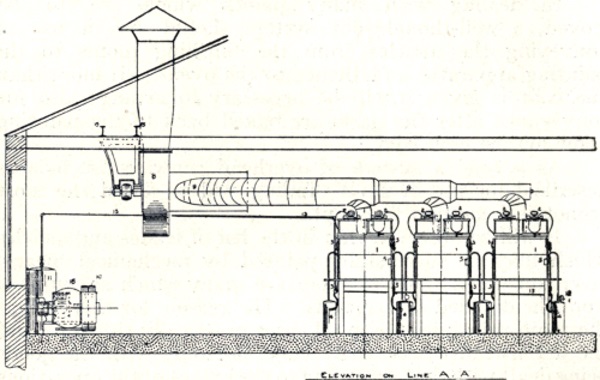
Fig. 97.—Side Elevation of Plant for 12 Operators.
It will be noted that the ventilator employed is of
important size; the compressor delivering air to the plant
is stationed in the basement.
The views of the plant are excellent, and serve to
remove the erroneous impression that such a plant cannot
be conveniently and economically arranged, both as regards
floor space occupied and the provision of adequate gangways
on all sides.
Another interesting Airostyle plant is shown in Figs. 84,
85 and 86, and was installed for japanning gas fires, radiators,
gas cookers, etc. An item worthy of note in this plant is the
patented hot air apparatus installed for warming the japan
and for also heating the sprayer and flexible tube conveying
the japan to the sprayer; it is clearly seen in the centre of
the two hoods. The large hood is mainly used for radiators,
which are wheeled on to the large ball-bearing turn-table,
shown white for the purpose of a clearer view, but when not
so used a table is wheeled into position and two operators
are accommodated for smaller work.
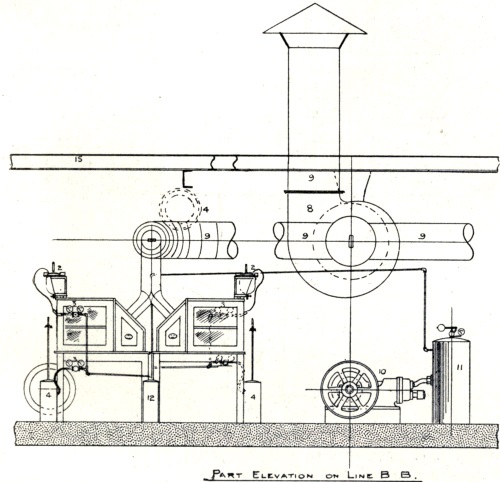
Fig. 98.—Part End Elevation of Plant for 12 Operators.
The power unit, consisting of electric drive and suitable
overhead countershaft, together with the compressor and
ball-bearing fan, is shown in Fig. 100, and is directly outside
the japanning shop.
This plant was installed for the Davis Gas Stove
Company, Luton, and has been in operation for several
years.
The compressor shown in Fig 98 also delivers air
to the gas cooker department for two or three operators,
and to the porcelain enamelling department for six or
seven operators, but as the same practice is adopted as
is shown in the photos here reproduced, no useful purpose
will be served in describing them in detail.
Undoubtedly one of the most important plants in the
country, and one producing the highest finish, is installed at
Messrs. Joseph Lucas, Ltd., Birmingham, and the photographs
reproduced here are by their kind permission. The
author was granted the privilege of inspecting the plant
fully, and proposes to enlarge upon its arrangement and
capacities for saving of labour, etc.
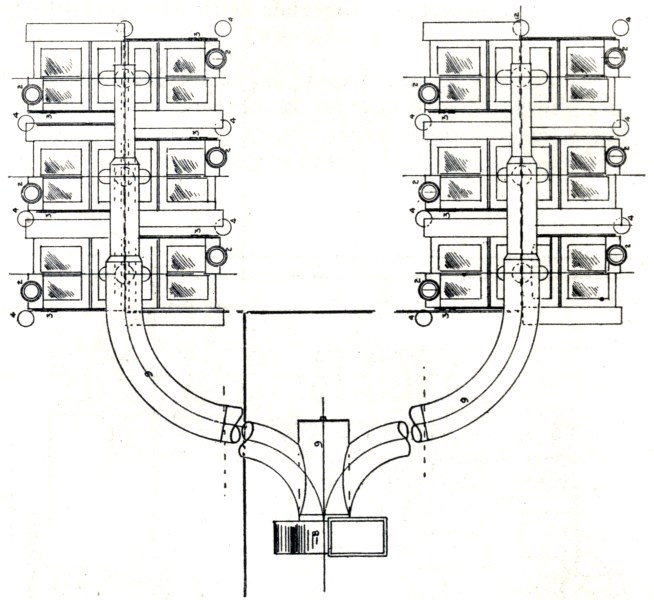
Fig. 99.—Plan of Figs. 96 and 97.
The whole of the work was carried out by Messrs.
The Airostyle and Lithos, Ltd., and it must be admitted
that the plants are so arranged as to admit of rapid
handling of the work, and the subsequent stoving of the
articles is just as conveniently provided for.
Two distinct plants are in use at the moment with a
separate steel plate central draught fan and a water-cooled
air compressor (the type of fan and air compressor employed
is shown elsewhere in the book, see Figs. 71 and 79).
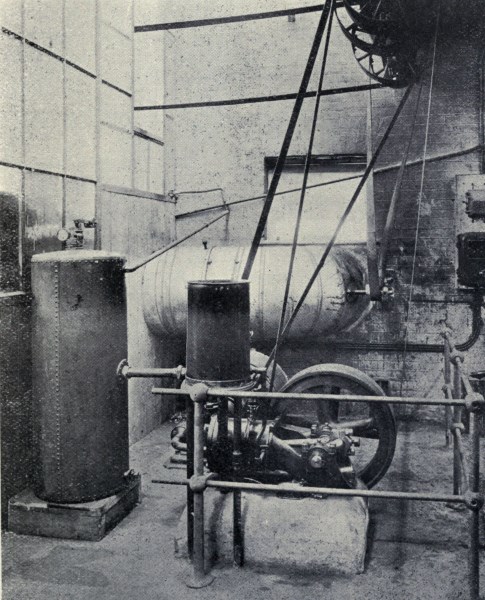
Fig. 100.—Airostyle Plant Power Unit, Compressor, Motor Fan etc., Installed for the Davis Gas Stove Co., Ltd., Luton.
On referring to the drawings Figs. 97, 98 and 99,
showing respectively an elevation, end view and plan of
one of the plants, it will be seen that the plant is divided
up into two bays, each accommodating six operators, so
that, in all, twenty-four operators are provided for in the
two plants and were actually seen at work.
It will at once be noticed that ample space between the
bays is provided, and this is most essential in order to give
sufficient room for the racks which are wheeled into place
behind each operator. These racks are readily seen in
the photographs, Figs. 103 and 106, and can also be distinguished
in Fig. 104.
The japanning shop in which the plants are installed is
of large dimensions, 250 feet long by 48 feet wide, and is
extremely light and airy, but, owing to the fact that the
roof-lights are now painted over (by Government regulations),
the shop at present appears to disadvantage, and the
photographs consequently suffer.
The photographs, nevertheless, show very clearly what
an immense amount of work can be daily handled, but, notwithstanding
this, the writer was assured that there were
still numbers of brush hands in the shop. This was primarily
due to the fact that full arrangements for spraying
are not yet completed (12 more operators are being provided
for), and, secondly, to the fact that certain work needing a
large amount of masking can be almost as readily brushed,
and this class of work finds employment for brush hands.
Messrs. Lucas, Ltd., admit that there is a wastage of japan,
but maintain that a heavier and much more even coat is
applied with a superior finish to brush work, and that there
is an enormous gain in time of about 4 to 1 over brushing.
They state, also, that an indirect gain is obtained in
the economical working of the stoves, for these are filled
far more quickly, and, consequently, the daily output per
stove is correspondingly increased.
A striking proof of the saving is their statement that
if they had not the system of spraying at work, it would have
meant 200 hands in the japanning department, whereas
they now employed only 90, and a considerable number
of these were engaged upon brush work, so that if only the
whole of the work could have been handled with the spray,
then the number of hands necessary would have been even
less than 90.
The photographs, Figs. 105 to 107, need no description,
and are self-explanatory to a large extent.
The type of instrument used, and the accessories, are
described in detail elsewhere, as they are the standard
practice adopted with all Airostyle plants.
The writer also had the privilege of inspecting another
interesting Airostyle plant, installed at Messrs. G. Cabdy
and Sons, Birmingham, where 7 or 8 operators are
employed upon high-class celluloid enamel finishes upon
buttons, medallions, cameos, electrical fittings, and last,
but not least, numerous parts for munition work, such as
cartridge clips for 18 or 24-pounders, etc.
The small articles are laid on a grid measuring about
11 inches by 9 inches, and while holding the grid the operator
sprays over the whole of the article on the grid, and in the
case of rounded faces of buttons, sprays these obliquely
from all sides in turn, as well as over the tops of the buttons.
It may be mentioned that the greater part of the
spraying paints and enamels are supplied by Messrs.
Thornley & Knight, Ltd., of Birmingham.
The Birmingham Small Arms Co.
The cycle department of this well-known firm deals
with an enormous, amount of parts, and a new paint spraying
department on an extensive scale is in course of construction
at Redditch, and the method in use at the Birmingham works
will be to a great extent followed. In both cases the "Midland"
sprayer is used under a pressure of from 30 to 50 lbs.
The method is very thorough, and although comparitively
expensive is well calculated to produce a finish
which is (a) capable of withstanding hard wear and possible
knocks and (b) absolutely rust-proof. The finish is
elastic and very durable. It is produced by the following
method. The steel or iron parts are first thoroughly washed
in pure American turpentine in order to remove every trace
of grease and dirt. In passing, it may be said that a suitable
white spirit would probably answer as well and would effect
a considerable saving, although it is possible that the pure
turpentine leaves a certain residue behind it which is of
advantage in forming a key to the subsequent coats. The
parts are then stoved, when a coat of pure Baltic linseed oil
is applied by means of brushes, and they are again stoved
at 250° F. Then a coat of black japan, known in the works
as "rubber solution," is sprayed on, and a third stoving is
given in this case at 280° F. This is followed by two coats
of khaki-coloured enamel sprayed on, which dries with a semi-gloss
finish. The parts are stoved between each coat and after
the final coat, so that they receive five stovings altogether.
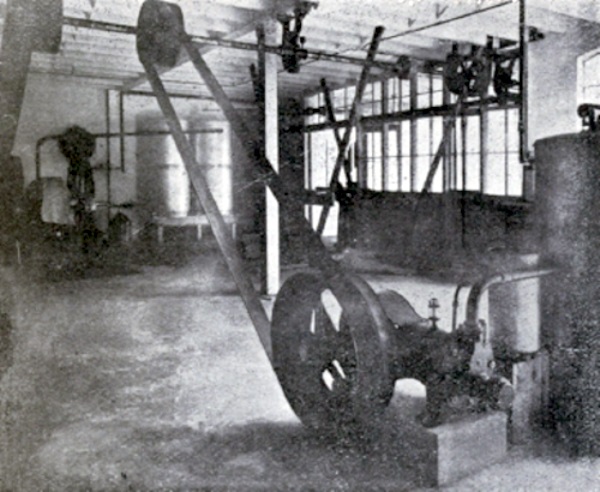
Fig. 101.—Compressor, etc., for Airostyle Plant for 16 operators.
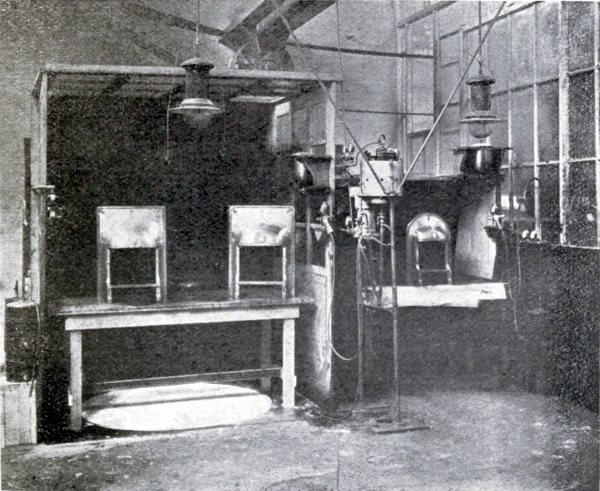
Fig. 102.—Airostyle Plant Installed for Gas Fire and Radiator Work for Messrs. The Davis Gas Stove Co., Ltd.
The ovens are of special construction and are described
in detail elsewhere. The japans employed are supplied by
Messrs. Arthur Holden and Co., Ltd., of Birmingham.
Samples of the work thus finished were submitted to
the author, who carefully tested them. He found that the
finish was all that could be desired. A piece of plate metal,
for instance, was bent double without the finish being
affected, thus showing very clearly the great elasticity of
the coating—a most important and necessary quality in a
finish for this class of work.
Messrs. Fletcher, Russell & Co., Ltd.
This well-known firm use spraying at their Warrington
Works on an extensive scale. All parts of gas cookers, gas
stoves, and ranges large and small, are sprayed by different
sizes of the Airostyle sprayer. Stoving takes place in
most cases, and the work of spraying effects a great saving,
one man being able to do the work of at least three under
the old brush system.
Some very beautiful effects are obtained in stoves
intended for use in drawing, dining and reception
rooms, by spraying various coloured semi-transparent
lacquers over silver-bright iron or steel. Rich reds, browns,
greens and blues in various shades are produced, and
the bright surface beneath the lacquer gives a very pleasing
and artistic effect. Stoving produces the necessary hardness
of the lacquer, which may be regarded as being very durable.
Special Machines.
The Berkel and Parnall's Slicing Machine Co., Ltd.,
whose extensive works are at 6, Bow Common Lane, London,
E., have had a plant for paint spraying in use for the last
four years, and find it to be quite successful and a great
saving of time over the old method of applying the paint
by means of brushes, in addition to a superior finish being
obtained. The sprayer in this case is the "Invincible,"
and the paint is sprayed on under pressure varying
according to the nature of the work. The iron parts which
go to make up the slicing machine are first primed and stoved
and any imperfections stopped in the usual manner. They
are then painted by means of compressed air and again
stoved, after which they receive a further coat, which is
also stoved. Various ornamentation in gold is then
put on, mostly by the transfer process, although certain
parts require lining by hand. The final coat of varnish
is given by means of brushes, it being found that this is the
most economical way for this particular class of work.
In this particular it will be observed that the method differs
from that used in many other works where all the operations
are done by spraying, including a final coat of varnish.
The colour used for the paint is a bright red. There are
two spraying cabinets with the usual exhaust, and turn-tables
are employed for turning the parts round to receive
the coat of paint. It may surprise some readers to learn
the very large extent to which these slicing machines are
used throughout the world for various purposes.
Gittings, Hills and Boothby, Limited.
The plant for spraying in use in these works is principally
intended for experimental purposes in connection with the
preparation of paints, varnishes and lacquers of various
descriptions which the firm manufacture. An up-to-date
type of pistol is used, with a pressure not exceeding
30 lbs. to the inch. The work is done in a small closet
with glass sides open at one side, and a small turn-table is
employed upon which to place the article that is being
sprayed. Some admirable results are obtained with the
aid of gold lacquers. It is found that in certain varnishes
the application of heat is an advantage, but as a rule the
spraying is done cold. Among the articles which have been
painted are motor cars and various smaller appliances.
The Kingsbury Manufacturing Co., Ltd.
A typical plant for finishing picture frames, furniture,
fancy articles such as wood, cane and other ornamental
baskets, is that of the Kingsbury Manufacturing Co., Ltd.,
1, Markfield Rd., Broad Lane, Tottenham, N. This firm
are the inventors of what is known as the "Inolite" system
of gilding, which is described as an ideal process. Certainly
the work produced is as near perfection as one would desire,
the gilding being excellent in appearance, while it is guaranteed
for five years to be free from discoloration or tarnishing.
The process consists in applying by means of spraying,
first, a coat of special enamel, which when dry is rubbed
down with a solvent applied by a pad. Upon this is sprayed
a coat of gold paint, and a final coat of colourless celluloid
varnish is given which protects the gold from tarnishing.
The process adopted is described in greater detail under the
head of "Picture Frame Finishing" in this book.
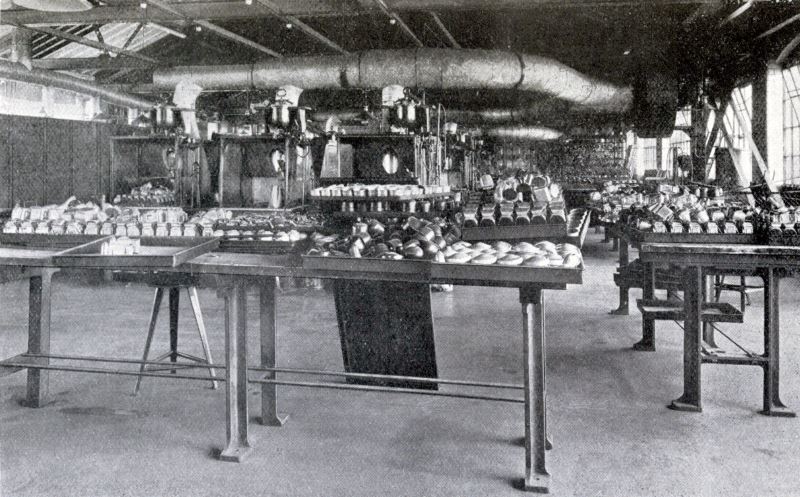
Fig. 103.—View from one end of Messrs. Lucas, Ltd., Airostyle Plants, showing Fan and Compressor Drives.
The coloured celluloid enamels which are applied to
fancy baskets, etc., have a very attractive metallic appearance,
which is far superior to the ordinary crude bronzy
effect. Another speciality of the firm is the finish of frames
in special black, which gives a perfectly smooth finish which
might be called "egg-shell gloss." It is quite artistic in
appearance, eminently suitable for the particular purpose,
and gives a durable frame at a comparatively small cost.
The firm estimate the saving of time by using the spraying
as compared with that of employing a brush is as 5 is
to 1. They point out that a little extra material is required,
but this is not begrudged as it possesses advantages in an
increased durability of the protective coating.
The Gas Light and Coke Co.
Several of the works of this company, which deal with
gas meters, are fitted with paint spraying installations.
The branch at Laburnum Street, Kingsland Road, in charge
of Mr. W. F. Fagan, may be taken as a type. Two Aerographs
and three Airostyles are in use. The old meters
that come to the works are examined, and if the paint is
in fairly good condition the surface is rubbed down with
pumice stone and water, but if it is much decayed the
meters are placed in a hot bath containing a solution of
lime and caustic soda, and allowed to remain in it a short
time, when the paint becomes so soft as to be easily removable.
The surface of new tinplate is cleaned down with
spirit, when it is quite ready to receive the coat of paint.
At these works many different makes of meters come in
to be dealt with, hence various masks are necessary to
protect those parts which it is not desired to spray. The
pressure used here is rather more than usual, being 40 lbs.
to the sq. inch. The time taken to paint a meter is very small,
as can be understood when it is said that two men working
on five-light meters can turn out 30 an hour. Before the
spraying apparatus was put in, about a year ago, a man
could paint with a brush about three meters in an hour,
so that, with the present system, there is an immense saving.
It is calculated that the whole of the original outlay of
putting in the plant will be returned at the end of about a
year.
The masks or shields having been placed in position,
a cap is placed over each union and the paint is sprayed on.
The meters are turned out at the rate of 900 to 1,500 a week
of 48 hours. The spraying apparatus is provided with the
usual exhaust consisting of two 9-inch holes to each cabinet,
with grating over. About 10 per cent, more paint is allowed
than that used when it is applied by hand, but the greater
part of this goes on the surface, and the coat of paint as
a protector is distinctly improved. The exhaust is carried
up to the roof, but the actual loss of paint is very small.
Fig. 108 shows a general view, and a large central
draught steel plate fan is employed to exhaust the hoods,
and to drive this and the compressor a gas engine is
employed. The compressor is of the type illustrated in
Fig. 71, page 115, and can just be discerned behind the
gas engine.
Fig. 109 shows a gas meter in position, with the
necessary masks fixed, and Fig. 110 shows the operator
about to spray-paint same. This plant has been in daily
operation for more than two years.
The Gas Meter Co., Limited.
The installation of a spraying plant at the works of
this firm, which are at 238, Kingsland Road, have been in
operation for rather less than a year, but has proved quite
satisfactory. Various types of gas meters are sprayed
with one coat of Torbay paint, which is an iron oxide paint
of high quality, and the one coat possesses amply sufficient
quality to give a good covering. Prior to painting the
surface of the tinned plate which is used for gas meters,
it is cleaned down with a piece of waste dipped in spirit.
Masks are used to fit over name plates, etc., and the spraying
is done in the usual cabinet, with an exhaust. A three or
four-light meter takes about two minutes to do, and the
larger sizes, of course, longer in proportion. All sizes up
to and including 500-light meters are sprayed, but those
larger, up to 1,000 lights, are a little too big to handle.
The greater part of the meters are done in deep red oxide
iron colour, but three other colours are used in addition,
as may be required. The meter to be sprayed is placed on
a turn-table which bears on a sharp steel point and has
on its upper portion spikes or ridges, to hold the meter in
position. The Aerograph spray is employed in this case.
Fig. 104.—General View of Airostyle Plants at Messrs. Lucas' Ltd.
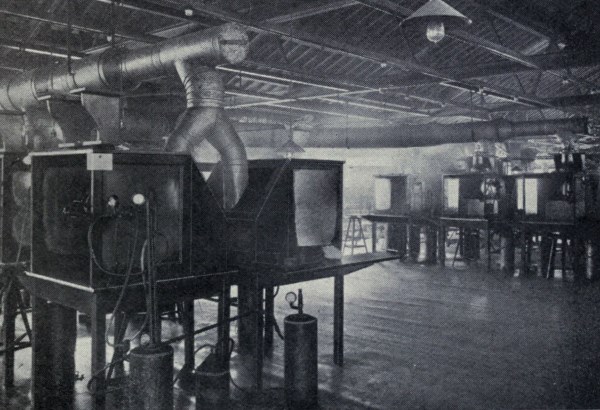
Fig. 105.—J. Lucas, Ltd., Airostyle Plants, showing the Ample Space between Hoods.
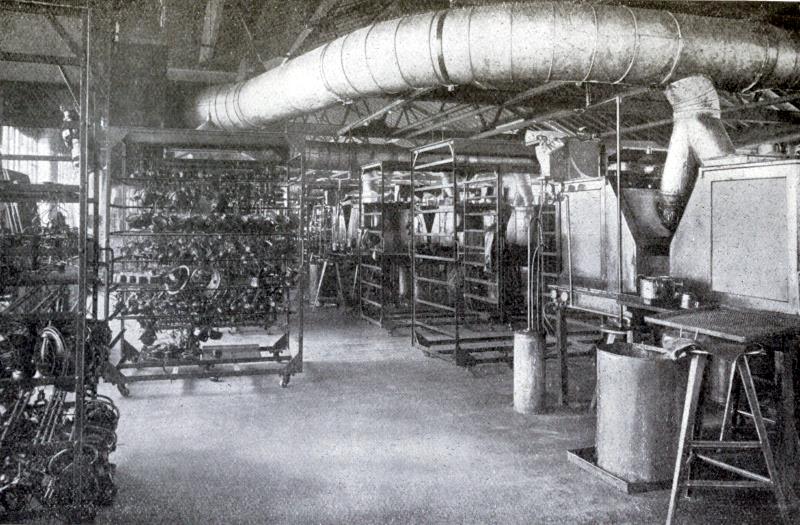
Fig. 106.—J. Lucas, Ltd., Airostyle Plants, showing the Method of Employing Racks to Greater Advantage, and also giving a Clearer Idea of the Large Fan Employed.
Paints, Lacquers, Varnishes, Etc. used in
Spraying.
Under the head of "Paints used for Dipping" some information
has been given in respect to the paints suitable for that
purpose. Some, but not all, paints are suitable for both
dipping and spraying, the exceptions being the heavier or
more viscous compounds, which are not suitable for painting
by immersion because they are too thick. Tar, enamel,
and the heavier varnishes may be given as examples,
although they may be successfully applied by the spraying
process.
Sometimes in dealing with the heavier compounds the
application of heat is an advantage. This may be applied
to either the paint or the compressed air or to both in order
to increase the fluidity of the compound. It is important
when heat is thus applied that the temperature of the room
in which the spraying is done should be raised correspondingly,
so that the heavier paints, enamel, etc., do not
congeal by being directed against a cold surface. Under
most circumstances it is unnecessary to apply heat, provided
that the spraying room is kept at a temperature of not less
than 60° F. both in summer and winter.
As already intimated, the preparation of paints, lacquers
and varnishes for both dipping and spraying necessitates
a close study of the special requirements. In the case
of paint the particles of pigment must be very finely
divided as coarse material would tend to choke up the spraying
apparatus, or if even they did not actually have that
result they would require a greater pressure of air and thus
add to the cost of working. Zinc oxide, the various grades
of black and most bright reds, are examples of finely ground
pigments which are well suited for spraying.
In buying materials for this purpose it is well to purchase
of those firms who have made a special study of the subject.
The following is a list of a few such firms, all well known to
the writer, and although it by no means exhausts the list
yet anyone desiring to buy materials may very safely leave
themselves in their hands.
Messrs. Docker, Bros., Ltd., Birmingham; Gittings,
Hills and Boothby, Ltd., Tower Varnish Works, Long Acre,
Birmingham; Goodlass, Wall and Co., Ltd., Seal Street,
Liverpool; A. Holden and Sons, Ltd., Bradford Street,
Birmingham; Indestructible Paint Co., Ltd., King's House,
King Street, London, E.C.; Lewis Berger and Sons, Ltd.,
Homerton, London, N.; Llewellyn Rylands, Ltd., Balsall
Heath Works, Birmingham; Mander Bros., Wolverhampton;
Postans and Morley Brothers, Ltd, 19, Lionel Street, Birmingham;
The Frederick Crane Chemical Co., Birmingham;
Thornley and Knight, Birmingham; Wilkinson, Heywood
and Clark, Ltd., Caledonian Works, Poplar. E.; Pinchin,
Johnson and Co., Ltd., Bevis Marks, London.
The following are American firms:—
The Moller and Schumann Co., Chicago, Ill.; John
Lucas and Co., Inc, Gibbsboro', N.J.; The Chicago White
Lead and Oil Co., Chicago, Ill.; John W. Masury and Son,
New York, N.Y.; The Glidden Varnish Company, Cleveland,
O.; The Sherwin-Williams Co., Cleveland, O.;
STOVING ENAMELS.
We now reach these important enamels, and extract the
following from the foreword of the little book above
mentioned. Messrs. Wilkinson, Heywood and Clark claim
to be the first successful makers of stoving blacks, which was
in the days before the introduction of bicycles. Though
originally introduced for cycle work, stoving enamel produces
a most successful finish for all kinds of materials.
In the United States of America such enamels are used in
great quantities for finishing standardised motor bodies.
These black enamels have gained a very high name for themselves,
as properly baked they are extraordinarily hard,
brilliant and tough, and when applied over such material
as tin sheets are flexible enough to withstand being bent
double without showing signs of cracking. An important
feature are the coloured enamels made by the same firm,
which run through a whole series of yellows, reds, browns,
greens and blues, and are hard, durable and tough, and
can be stoved without changing colour. We extract the
following notes on the "Application of Stoving Enamels,"
and fully endorse the recommendations offered:—
1. All work should be perfectly free from dirt, grease
or oil, before application of enamel.
2. Every trace of moisture should be removed before
enamelling. This can be effected by stoving the work,
previous to enamelling, at a light heat. Moisture on work
will cause enamel to blister and burn.
3. Always when using brushing or dipping enamels,
allow the enamel to set slightly (i.e., after the surplus paint
has dried off) before putting in the baking oven. This will
prevent uneven stoving and eliminate "fat edges," as far
as possible.
4. Oven heat should be increased gradually. Never
place enamelled work into a hot oven at once, but raise
the heat by degrees, until the full temperature is obtained.
5. Most of our enamels are sent out slightly thick;
should an easier working material be desired, in the case of
colours or blacks, add kerosene gradually until the required
consistency is obtained. Coloured enamel should always be
stirred before use, to prevent the pigment settling and
the light medium rising. If this is not done, the appearance
of the work will lack body and appear dull and lifeless.
This applies especially to dipping enamels. To render white
stoving enamel thinner, add pure turpentine only, stirring
well, until a uniform consistency is obtained.
6. It is quite possible to over-bake enamels and spoil
the colours, and likewise under-baked enamels will not be
tough enough to withstand hard wear. Particular attention
should be paid to the directions on the package labels,
as the various pigments require different temperatures.
7. Stoving enamels, if left in an opened can, tend to
thicken considerably. For this reason, keep the can closed
when not actually using the enamel.
For thinning purposes we recommend kerosene.
Sp. gr. 810 at 60° F.
8. Ovens should be properly ventilated to allow the
proper oxidation necessary in baking.
Enamels.
It has already been pointed out in these pages that the
success of painting by dipping, spraying, "flowing on,"
in fact, all other mechanical means, depends upon the
exact properties of the materials used. The same is true
with enamels, which are made from a large variety of formulæ
so as to dry slowly or quickly in the air, or when subjected
to heat in a stove. The author feels he cannot do better
than take as a guide to the properties of enamels in general
the extremely useful handbook published by Wilkinson,
Heywood and Clark, under the head of "Enamels for every
Purpose." This book gives practically all the information
concerning enamels likely to be required by the average
user. The products are divided up under different heads,
for example, one page is headed "Heat Resisting and Slow
Drying Enamels." These dry fit to handle in 16 hours,
and dry bone hard in 24 hours. They are made to withstand
heat up to 212° F., and for this reason are suitable for
enamelling iron baths, radiators, etc., particularly so as
to effectively resist hot water without softening or peeling.
They are made in a number of beautiful colours. A somewhat
similar series of enamels is made which dry quicker,
viz., in 8 hours fit to handle and quite hard in 12 hours.
They are useful for touching up radiators, stoves, steam
pipes, etc., and are made in white and a dozen or more
colours. The next series which demands our attention
are "Dipping Air Drying Enamels." They dry in 8 hours
and are quite hard in 12 hours. They are claimed to
produce a finish equal to that obtained by a quick air drying
brushing enamel with the labour of brushing eliminated.
For a finish done by immersing the article to be painted
these are capital enamels, but they require to be used with
a stirrer of some sort in the tank.
Hints on Stoving or Baking.
The degree of heat to which an article is subjected
after being painted or japanned will obviously depend
upon the kind of coating used. It is safe to assert as a
general rule that the heat applied must not be higher than
the particular paint or enamel is made to withstand, for,
if this be exceeded, it will inevitably result in a loss of elasticity,
of the protecting film and, hence, its durability.
The following hints are taken from a very useful little
pamphlet issued by the Moller & Schumann Co., of Chicago,
Ill. The degrees of temperature given refer to their products,
and would doubtless have to be modified in some cases,
according to the nature of the paint being dealt with. They
will, however, form a very useful guide.
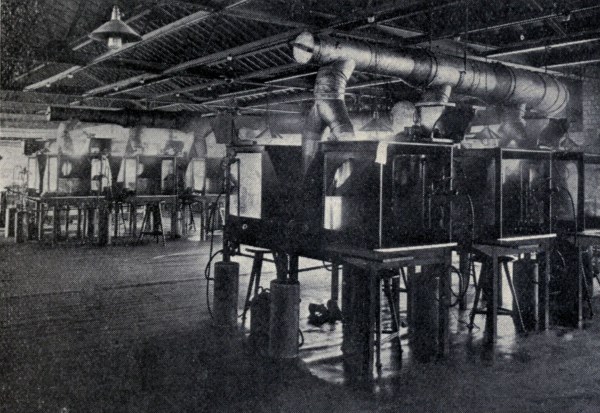
Fig. 107.—J. Lucas, Ltd., Airostyle Plants, showing the Two Bays of One Complete Unit.
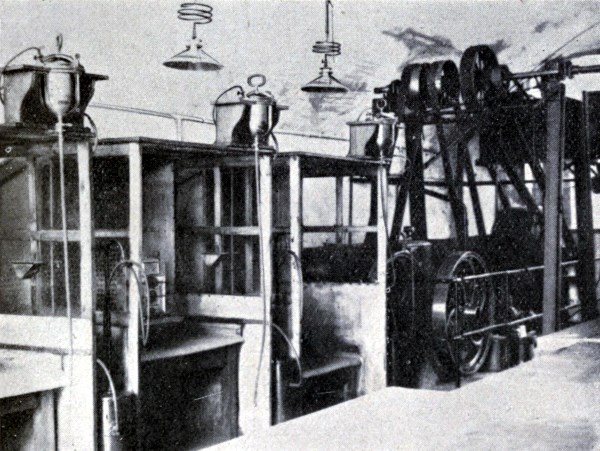
Fig. 108.—Airostyle Plant Installed for Messrs. The Gas Light and Coke Co., Ltd. General View.
Black Japan Finishes.
One or more coats rubbing finish japan, reduced as
thin as possible and still cover well.
Bake each coat at 250° to 350° for 3 to 4 hours.
Sandpaper each coat lightly.
One or more coats finishing black japan reduced to
brushing consistency (not too thin).
Bake each coat at 300° to 350° for 3 to 4 hours. Sandpaper
each coat lightly. Rub the last coat with pumice.
Apply transfer and striping to last coat of japan.
Bake these at 150° for 1 to 2 hours.
One or more coats finishing copal brushed as it comes
from the can. This protects the transfer and striping and
increases the depth of the finish.
Bake each coat at 175° for 2 to 3 hours. Rub each
coat and polish the last coat.
If finishing copal is omitted, leave the last coat of
japan in gloss, or rub and polish as preferred.
Steel Furniture Enamels.
One or more coats of first coat enamel, reduced as thin
as possible and still cover well. When brushed on, use
steel preservative for back and underside of metal, one coat
only, baked at same time as first coat of first coat enamel.
Bake each coat at 250° for 3 hours. Sandpaper each
coat lightly. One or more coats of finishing enamel.
Bake each coat at 250° for 3 hours. Sandpaper all
but the last coat. Rub the last coat with pumice.
Enamels when rubbed have a different colour than the
surface colour; this must be taken into account in finishing.
Transfer and striping, if any, should be put over last
coat of finishing enamel. Bake at 150° for 1 to 2 hours.
One or more coats of finishing copal.
Bake each coat at 175° for 2 to 3 hours. Rub each
coat, and polish the last coat.
If finishing copal is omitted, leave the last coat of enamel
in gloss, or rub and polish as preferred.
The same enamel will bake to different shades at
different heats and varied lengths of time, so care must be
observed to get uniform results.
Imitation Wood Effects.
One or more coats of ground colour; back of metal one
coat steel preservative, both reduced as thin as possible, and
still cover well. If the steel preservative is used by dipping,
only one coat of ground colour is generally used.
Bake each coat at 250° for 3 hours. Sandpaper each
coat of ground colour. One coat of graining colour, reduced
with turpentine brushed on, and grained by hand, or with
tools as in general graining. This may be done by machine
or as transfer work.
Bake the graining colour at 200° for 2 to 3 hours.
Sandpaper lightly.
Put on transfer and striping, if any, over last coat of
finishing enamel.
Bake at 150° for 1 to 2 hours. One or more coats of
finishing copal.
Bake each coat at 175° for 2 to 3 hours. Rub each coat.
Rub and polish the last coat.
In this work, at least one coat of finishing copal is
necessary to protect the graining colour.
White Work—Bedsteads, Etc.
White work cannot be finished with one coat, because
no white pigment has sufficient covering power.
Two or more coats of first coat white enamel.
Bake each coat at 120° to 150° for 3 to 4 hours. Sandpaper
each coat lightly.
Two or more coats of finishing white enamel.
Bake each coat at 120° to 150° for 3 to 4 hours. Sandpaper
each coat lightly except the last coat.
For gloss finish, leave last coat as it is; for eggshell
finish, rub the last coat.
Finishing copal is rarely used over whites because of
colour.
Transparent Colour Varnishes.
These varnishes are used over smooth, clean, bright
metal. As the metal shows through the varnish, no primer
or filler can be used.
One coat only is applied, usually by brushing or by a
coating machine; however, it may be dipped or sprayed.
Bake at 225° for 3 hours.
The more these varnishes are reduced, the lighter the
colour becomes.
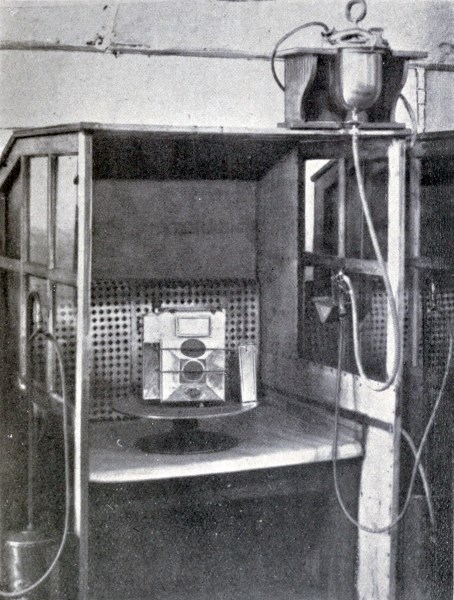
Fig. 109.—Airostyle Plant Installed for the Gas Light and Coke Co., Ltd., showing Hood in Greater Detail and a Meter with Masks Affixed.
Safe Baking Heats of Pigment Colours.
All colours are more or less affected by heat. They
lose their brilliancy, become very much darker and sometimes
turn black when baked at too high a heat.
Prolonged heat (not too high) kills the elasticity of the
enamel. It does not affect the colour.
To assure brilliancy of the colour, the following
highest heats can be used with safety.
| White | 160° | 4 | hours. |
| Pale Blue | 175° | 2-3 | " |
| Pale Gray | " | " | " |
| Pale Green | " | " | " |
| Pale Yellow | " | " | " |
| Gray | 200°-225° | 4-3 | hours |
| Bright Red | " | " | " |
| Green | " | " | " |
| Yellow | " | " | " |
| Dark Blue | " | " | " |
| Olive Green | 240°-275° | 4-3 | hours |
| Maroon | " | " | " |
| Brown | " | " | " |
| Black - any heat up to 600° |
Comments on the Above.
A well-known English firm, commenting on the above
says:—
"Generally speaking, the information given therein
is quite correct, though it should be remembered that
instruction as to stoving temperatures which might be quite
correct with one maker's materials, might be quite wrong
with another's.
"We notice they recommend that all black japan
finishes should be stoved at from 250 to 350 degrees. This
is the general practice in England, but it also happens that
some firms cannot use these high temperatures or some goods
will not stand it, and black japans have to be supplied
which can be stoved at temperatures of about 180 or 200
degrees Fahr. Such qualities cost rather more to produce.
We also notice it is recommended that finishing varnish
should be stoved at 175 degrees Fahr. Personally, we cannot
make any clear finishing varnishes which will stand this
temperature without discoloration, and even if used over
black japan, they would discolour the lining or the striping
thereon.
"The temperatures recommended for coloured enamels
are also higher than we find satisfactory, and the statement
made that the same enamel will bake to different shades at
different heats, and that therefore a uniform temperature is
necessary to obtain uniform results, seems to confirm our
view. In practice we think that uniform results can only
be obtained by using a lower temperature. If a workman
has to watch the thermometer in a stove to make sure that
his enamels will always discolour to the same degree, you can
rely upon it that in practice accidents would soon happen."
Dipping and Spraying Paints Compared.
From the above it can readily be seen that it is necessary
to exercise considerable care in the selection of paints for
both of these processes. The following opinions on this
important subject are given by the firms named.
Messrs. John Lucas and Co., Inc., Gibbsboro', N.J.,
U.S.A., say:—
"It is our experience that a paint which is suitable for
dipping purposes can also be manipulated for spraying.
A paint to be suitable for spraying depends largely on two
factors, namely:—Gravity, or weight per gallon, and
consistency, or fluidity. A paint made from pigments
which are heavy gravity will not produce good results
for spraying, just as it will not prove satisfactory for dipping,
because of the tendency for the pigment to settle out. In
the case of spraying such paints produce an uneven finish.
A paint such as is ordinarily used for dipping contains
sufficient light gravity pigments to make possible reduction
with the proper vehicles (depending on the desired finish) so
that by spraying a satisfactory coating can be produced
so far as finish is concerned. We are not certain whether
a coating produced by spraying will wear as long as a coating
which is applied either by dipping or by brushing."
The Chicago White Lead and Oil Co., Chicago, Ill., say:—"There
is no very intricate or specific formula for this
class of material. The following rule we think will prove
a safe one to follow:—
"Always select a pigment which will stay in suspension,
and also hold with it the extenders such as very fine silica.
The addition of a very fine silica to all dipping or spraying
paints will add materially to the flowing off and levelling
of the finish. The pigments should be ground very fine
in varnish, the grade of varnish depending upon the quality
of the material to be produced, and reduced to working
consistency with varnish and turpentine, or naphtha.
"Linseed oil should be avoided in the preparation of
dipping paints, as the tendency of linseed oil to wrinkle
is very objectionable. Chemically pure colours, such as
green, yellow, para toners, etc., are best adapted as colour
bases.
"The above constitute the principles upon which we
have produced extremely satisfactory paints for the purpose
named. These, coupled with expert workmen, will produce
excellent results. The average formula for paints can
only be considered as a general guide; the successful blending,
tinting, etc., must be perfected by careful and sometimes
extended experiments.
"The difference between a dipping paint and spray
paint is in the consistency. A spray paint must naturally
be made thinner, and consequently only the most dense of
colours should be used and a smaller amount of inert pigment
as an extender, or leveller. A few experiments with a
spraying apparatus (of which some inexpensive hand
sprayers can be obtained) will quickly guide the paint man
as to proper consistencies to produce best results."
Messrs. John W. Masury and Son, of New York:—"It
is practically impossible to give full particulars regarding
varnishes and enamels for spraying and dipping, for the
reason there are so many different kinds and they vary
so much owing to the different character of work that a
description of them is out of the question. In a general
way it may be said that dipping coatings must be quick
setting, so as to avoid runs and sags; it must flow out to a
smooth, even surface. The drying quality must depend
upon the kind of work being done, character of surface,
subsequent exposure, and whether the coating is to be
baked or air dried. Dipping varnish and enamels are made
for many classes of work, such as all kinds of small iron
castings and sheet metal work, as well as wood work, vehicle
wheels, parts of automobiles, and in some cases wagon
bodies and automobile bodies, these last only in one or two
shops. These goods include cheap black baking japans,
coloured enamels of various kinds and clear varnishes.
"In regard to spraying enamels, the 'spray brush' is
gradually coming into use. These goods must be made to
suit the character of the work; the body or viscosity of the
material, the pressure used in the spray and character of the
surface to be coated, must all be taken into consideration
and properly graduated to insure suitable finish.
"In both dipping and spraying work one, two and
three coats are frequently used, sometimes the under coats
are only dipped or sprayed, while the finishing coat is
applied with brush.
"The equipment for dipping will vary also with the
article to be dipped; it includes dipping tanks of suitable
size and shape, racks for hanging articles dipped, with
troughs or trays to collect surplus material. In dipping
it is necessary to wipe off with brush the surplus which
gathers on lower edge of the article.
"Equipment for spraying requires besides the spraying
machine a pressure tank with suitable cocks to regulate
pressure, which will vary from thirty to fifty pounds, a
suitable hood provided with fan to draw off any fine spray
away from the workman, proper racks for taking care of
the finished work. Work done with spray does not require
any wiping up."
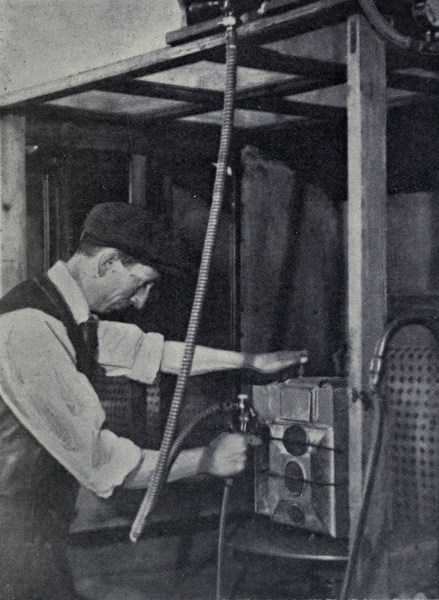
Fig. 110.—Airostyle Plant Installed for the Gas Light and Coke Co., Ltd. Operator at Work on Gas Meters.
Spraying versus Brushing.
It will be convenient now to consider the length of time
involved in spraying, as compared with that involved when
painters' brushes are used.
In dealing with this question, it should be pointed out
that while some little gain is apparent in the actual time
occupied in handling the article, which is mostly done on
turn-tables when spraying, yet no note is taken here of the
difference in handling, but only the time occupied in covering
the article with paint, japan, etc.
We will take, by way of example, a modern gas fire. Very
few of these are now brushed. It is the consensus of opinion
that a gas fire takes 10 minutes to brush.
To spray one, with a superior finish, takes 30 to 45
seconds, and even where some difficulty is experienced in
handling, or where it is the practice to have the firebricks in
place beforehand, so necessitating the use of a mask, in
no case is a greater time than 1½ to 2 minutes taken. A
cycle lamp, small size, takes fully 2 minutes to brush properly.
To spray the same lamp takes 10 seconds. A gas meter, 5 or
10 light size, takes 7 minutes to brush. To spray one takes
1½ minutes, allowing for the time occupied in fixing and
removing the somewhat elaborate mask employed for
covering the indicator glass, badges, name-plate, etc.
A motor headlight takes nearly 20 minutes to brush
properly, whereas to spray one takes but 1½ minutes at the
outside.
To brush a cycle frame takes 10 minutes or so (brushing
is still done for coloured work).
To spray either in japan or colours takes 1 to 1½ minutes,
and when it is considered that a heavier coat can be applied
than is the case when brushing or dipping, it will be admitted
that such a result compares favourably even with dipping.
A 2-seater motor body takes from 25 to 45 minutes to
brush properly.
To spray the same body takes only 6 to 8 minutes, and
when it is noted that a fraction of the rubbing down is
necessary in the case of the sprayed result, as against the
brushed body, it will be granted that an enormous gain is to
be effected.
Where two or more colours are employed, it is difficult to
make comparisons as readily, but, generally speaking, it is
the practice to employ two instruments per operator where
the colours are applied one immediately after the other, as is
the case with many electrical parts, and in this case a gain of
4 or 6 to 1 is shown over brushed work.
In some cases it has been found an advantage to spray
one coat and to brush the other, especially where some
difficulty is experienced in masking, and, in such cases, the
only way to arrive at the most satisfactory method is by
actual test.
In other cases, such as bronzing, with a celluloid
medium, it is absolutely impracticable to apply these
bronzes, save with the spray, unless the old method of
varnishing and afterwards dusting on the bronze is adopted;
but, of course, against spraying, such an obsolete method
as the latter has absolutely no chance when speed is considered.
Iron piano frame manufacturers have almost universally
adopted the system of spraying bronze on the frames. Where
the old-fashioned method is still in use, it is usually because
the quantity of frames to be dealt with is hardly large
enough to justify the outlay required in the purchase of a
plant.
Another advantage should be mentioned. The special
celluloid japans now largely used for application by means of
compressed air obviate the necessity of a considerable
amount of rubbing down and papering, etc., which cannot
be dispensed with when the liquid is applied by means of a
brush.
For the purpose of comparison, it may be said that
these japans may be sprayed upon such articles as buttons,
medallions, electrical and bedstead fittings, and also on
wood brush-handles and furniture, large and small, with a
gain of 5 to 1 over brushing.
Objections Sometimes Urged Against Spraying.
Having explained the advantages of the spraying
system, we may now consider the objections which are
occasionally raised against it.
One of the arguments most frequently used is that the
effect thereby obtained must be less durable than is the case
of the brushed effect.
Why such a theory should be advanced is a little
obscure, for, theoretically, it is possible to apply, with a
properly fitted plant, a far more even coat than is the case
when brushing, and seeing that such paint is applied with
the idea of protecting the article against rust, or corrosion, or
of improving the appearance, the argument is for rather than
against spraying.
However, to come to the practical side, the evidence is
all in favour of spraying, for it has been proved by many
exhaustive tests by independent persons, that, with the
same material treated in the same manner, i.e., either
air dried or stoved after spraying or brushing, there is no
difference in the durability of the japan or paint, and that
the sprayed result has this advantage, that some little gain
in time is effected in the period occupied in drying or stoving
of the paint.
Another objection is sometimes raised to the application
of paint by means of the spray to rough and uneven surfaces.
The argument here is that it is impossible to make the
paint adhere to the surface, save with a good stiff brush.
Such arguments ignore the pressure at which the paint is
applied, which is usually between 30 and 45 lbs. per square
inch, and are mainly based on unfortunate experiences with
early types of whitewashing machines, which have already
been pointed out to be entirely unsuited to painting
problems.
Again here, it may be positively stated that in no case has
it been found that a less durable finish is obtained with the
spray. As a fact, an advantage is to be recorded in that on
rough surfaces the gain in time is enormous, for such surfaces
may be spray-painted as rapidly as the smoothest surface
obtainable, whereas the labour of brushing such rough
surfaces is very considerable.
Still another objection which may be mentioned
is the slightly mottled appearance which the sprayed
surface sometimes shows when finished—if such can be
objected to seriously.
This objection may be met by the statement that such
a mottled effect is only apparent when the paint has not
been specially prepared for spraying, and is mainly due to
the fact that mediums used dry rather too rapidly and do
not allow the paint (which is, of course, applied in minute
spots) to flow out.
The remedy is naturally to re-model the paint should the
mottled appearance be objected to, but most certainly such
an effect, if not pronounced, is not any worse than brush
marks, which are always noticeable unless rubbing down
has been done.
In passing, it may be stated that most of the large
paint and varnish manufacturers have experimental plants
for producing spraying materials, and they are naturally
well able to answer any queries which may be likely to arise
and which may not be adequately dealt with here.
Many firms who consider the question of adopting a
spraying plant seem to have the idea that while the principle
is admirable for many trades, yet it cannot be successfully
employed in their particular case, and one frequently finds
the manufacturer of small goods wondering why his
neighbour opposite, who makes, we will say, motor bodies,
does not install a plant, although, of course, in his own case
the question is impossible. Most probably, at the same time
the said neighbour has precisely similar thoughts, save that
he considers the only proper use for a plant is in small work.
Occasionally one hears the opinion advanced that
primers or fillers cannot be applied with a sprayer, or, if so
applied, it is at a risk that they will either crack or peel
off afterwards.
This objection may just as readily be advanced in the
case of brushing. If trouble of this kind occurs, it is not due
to the method of spraying, or brushing, so much as to the
way in which the paint has been used. This statement
sounds paradoxical, yet it will be understood by practical
men. For instance, it is obvious that motor bodies, par
exemple, must be dealt with by the expert coach-painter
as far as the methods, number of coats, etc., to be
employed are concerned, even though the work may be
carried out by unskilled labour, and naturally whether
brushed or sprayed, motor bodies cannot be well done by
novices.
To summarise, it may be confidently stated that whatever
difficulties there may be in the application of paints,
enamels, varnishes, lacquers, etc., by means of brushes
in the ordinary way, these are certainly never accentuated
but are in most cases considerably lessened by the use of
an adequate spraying plant.
Spraying and Dipping Compared.
In considering those articles which may be dealt with
either by dipping or spraying, the manufacturer has first
to take into account the number of coats necessary.
If, for instance, to produce the correct finish on a
cycle frame, when dipping, needs three coats, and assuming
that the same effect may be obtained in two when spraying
(and this is frequently the case), then spraying must be considered
to rank favourably with dipping, and if allowance be
made for the time taken to drain, and the room occupied with
an elaborate dipping plant, then again spraying scores, for a
cycle frame can be sprayed in 1 to 1½ minutes, or, say, 40
to 50 frames per hour, which is very little, if any, less than
can be comfortably dealt with by dipping, and, of course,
no time is lost in draining.
If, on the other hand, gas is so cheap as to be of little
consequence whether two or three stovings are necessary, and
if some of the work can be done with two coats, then the saving
effected when spraying would not be sufficient to warrant
the outlay necessary for a modern compressed air plant,
unless a fair proportion of coloured work, not easily dipped,
was required to be dealt with. In this latter case, a spraying
plant ought to receive very serious consideration.
To take another case. Some gas fires may be dipped,
but, owing to their weight and to the fact that they are
seldom entirely free from grit or dust, they are not a
satisfactory type for dipping, and we venture to state that
all the leading gas engineers have dropped the question of
dipping such work in favour of spraying, although in some
cases, for gas cookers, the accessories, such as burners, bars,
racks etc., are dipped.
Such accessories are as readily sprayed, but as only
one coat is applied, naturally no saving is shown over dipping.
Other goods sprayed or dipped are steel implements,
hoes, spades, shovels, axes, picks, etc., and in some cases it
is an advantage to dip where the same colour, black, red,
etc., is needed, say, half-way up the spade or hoe, but
otherwise spraying should be adopted; and, of course, in
many cases where two colours are employed it is out of the
question to dip, the only alternative being to spray or brush—spray
for preference on account of the enormous saving
of time over brushing.
Where very small articles are dealt with in bulk and can
be so handled that trays may be used, then these are undoubtedly
better dipped; but if various colours are needed
it is better to still use the trays, but to spray them, as the
speed is approximately the same as when dipping.
A tray full of camera parts is sprayed almost instantaneously
and with a far better finish than if dipped.
To sum up the various arguments advanced on this
subject, we may come to the following conclusion.
As already intimated, the saving effected by painting
by immersion or by spraying as compared with brushing
is very large indeed, provided that a properly equipped
plant is employed, and the paint or enamel is exactly
fitted for the purpose. The question must often
arise as to whether dipping or spraying is the best and
cheapest to employ. The answer is that everything will
depend upon the nature of the article that is to be painted.
Speaking generally, painting by immersion possesses many
advantages, because the actual work of applying the paint
is done in a few minutes and every part of the article is
covered with paint at one time. In reaping machinery,
iron treads of staircases and many other parts of the kind
in which there are a large number of small parts or depressions,
paint dipping cannot be improved upon; on the other
hand, spraying possesses distinct advantages in dealing
with many classes of goods which are of such a shape or
character that if the paint were applied by dipping some
accumulation in parts would inevitably occur.
A decision on the subject can only be arrived at after
a very careful study in comparison of the two methods.
It will frequently be found that, on the whole, the most
economical plan to pursue is to dip the first and subsequent
coats, excepting the last, and to spray this on, particularly
when it consists of varnish or a viscous liquid. It is in
this particular that one can draw a wide distinction between
the two methods. In dipping, the paint must not be very
thick, and, as previously stated, in designing a paint for the
purpose the greatest effort is made to produce one which
gives a happy medium between excessive thickness and the
reverse, too thin a coat. Just as soon as the peculiarities
of the article to be painted necessitate the use of all thick
paint or enamel it must be considered that dipping is not
suitable, but that spraying is. The latter may be employed
successfully with any liquid up to the thickness of tar.
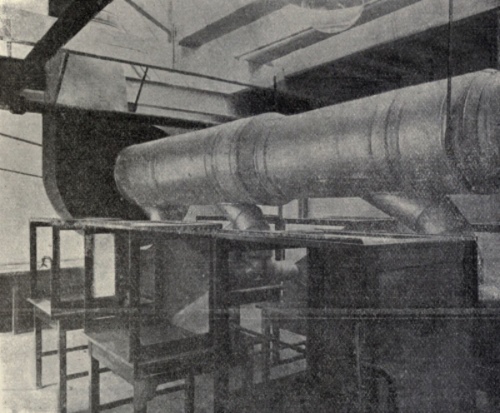
Fig. 111.—Airostyle Plant showing Ventilator and Portion of Hoods for 4 or 6 Hoods Providing for Subsequent Enlargement.
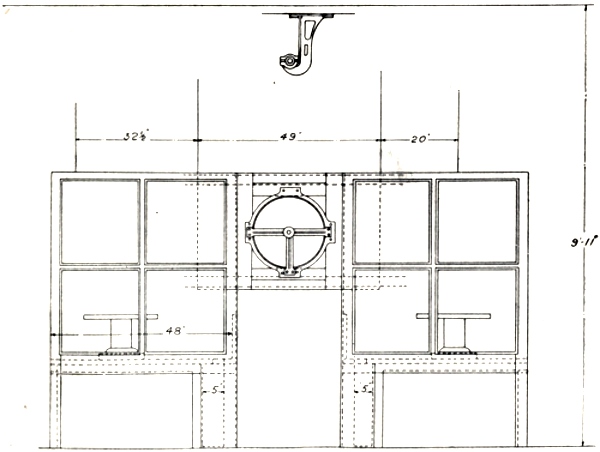
Fig. 112.—Elevation of Spraying Plant.
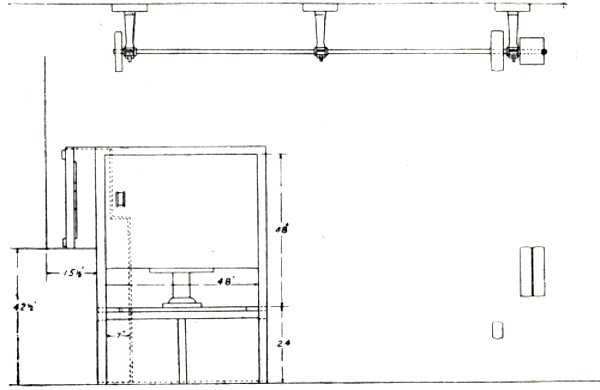
Fig. 113.—Elevation of Spraying Plant.
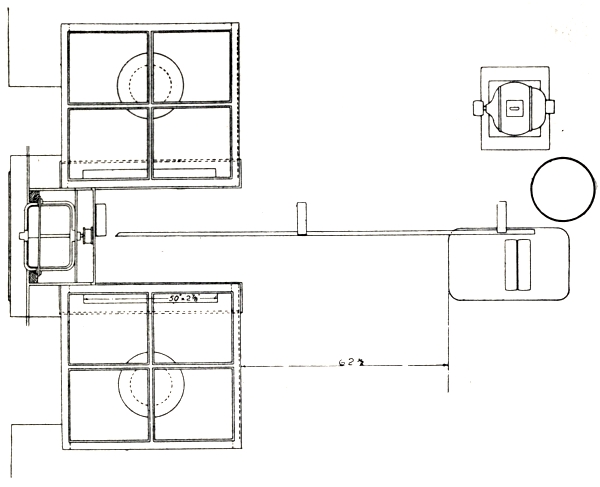
Fig. 114.—Plan of Figs. 111 and 112.
The Artistic Application of Paint Spraying.
Some of the smaller and more delicate types of spraying
apparatus are largely employed for such purposes as the
following:—Black and white and water-colour drawing,
photograph finishing, preparing pictures for process blocks,
Christmas cards, window tickets, embossed cards and small
stencil and shaded work on fabrics, wood, glass, metal,
leather, etc., lithographic work, picture painting in oils,
decoration of pottery and stencil and shaded work of all
kinds. They are also employed for producing very charming
effects in wallpaper. The writer has seen most creditable
examples of work done in this way on menu cards, lamp
shades, and even stencilled ornaments on men's ties.
A few examples of this class of work are given in
the accompanying illustrations.
It may be pointed out that when decorative work is
required on metal work or engineering appliances, it can
in most cases be done by spraying without much difficulty,
aided in some cases by stencils specially cut for the purpose.
Thus the outline of a trade mark, a monogram or a coat-of-arms,
or heraldic device can be easily sprayed and be then
finished by hand.
Again, the lining on a motor or carriage can, if care
is taken, be done by the same means, although it must be
said that the result is never quite equal to that produced
by the hand of a skillful worker.
In relief work, such as ornamental iron, pressed paper,
etc., some pretty effects may be produced by spraying a
different colour to that of the ground in such a manner that
only one side of the relief receives the second colour. This
is effected by directing the spray from the side. Most
readers will be familiar with these effects produced on
menu cards, concert programmes, etc. The possibilities
in connection with relief metal work are many.
Another series of effects in which brilliancy of colouring
is required may be referred to in passing. Sometimes a
bright red or a bright green is desired for the finish of a
particular piece of work. In such cases a use of the process
known as "colour glazing" is recommended. For example,
an agricultural implement or any other article which it is
desired should have a bright crimson finish can be first painted
with Venetian or Indian red, by either spraying or dipping,
and then have a coat of crimson lake, which will give an
excellent effect. As the crimson lake is somewhat fugitive
a protecting coat of varnish will be required.
All glazing colours may be applied by dipping, because,
being semi-transparent, they are all very fine, and the coats
may be thin, but the varnish should be applied by spraying
or by hand. It may of course, be of a variety suitable for
baking or stoving if required.
This process is an alternative to using coloured
enamels, and in some cases gives better results. Much
depends upon the colour and the constituents of the enamels.
Many of the lakes are very sensitive to a high heat, which
changes the colour to a dirty brown. In such cases a
final coat of stoving varnish, if carefully handled, will be
safer than some grades of enamel.
Scumbling and Colour Glazing.
For convenience of reference we include a short list
of glazing colours taken from Andrew Miller's "Scumbling
and Colour Glazing," published by the Trade Papers
Publishing Co., Ltd., 365, Birkbeck Bank Chambers,
London, W.C.
Glazing.
The principal colours used for glazing are cadmium,
crimson lake, Prussian blue, lemon and orange, chrome,
yellow, Brunswick green, carmine, madder lake, Chinese
blue, cobalt, indigo, gamboge, terra verte and emerald green.
These colours may be used ground in either linseed oil,
turpentine or water. Some of them are rather expensive,
but the coat being very thin a little colour goes a long way.
Following is a list of ground colours with the glazing
which may be used in conjunction with them. They by
no means exhaust the range of effects, but are given as
suggestions:—
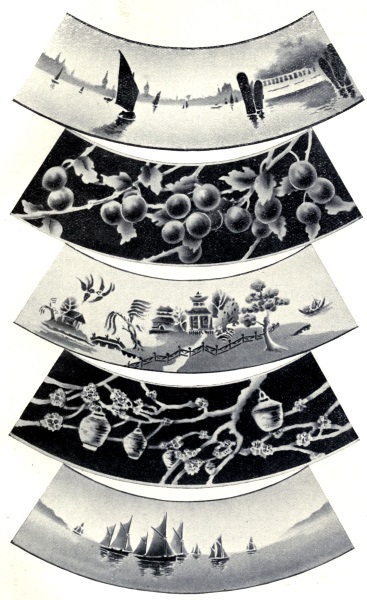
Fig. 115.—Designs for Lamp Shades (Opened Out) Done by Spraying.
REDS.
Apricot.—Ground made up with zinc white, middle
chrome, and vermilionette, glazed with crimson lake.
Begonia.—White zinc, vermilionette and Prussian
blue, glazed with brown madder lake.
Carnation.—White zinc and vermilion, glazed with
crimson madder lake.
Claret.—Zinc oxide, Venetian red and vermilion
glazed with brown madder lake; or zinc oxide and ultramarine
blue, glazed with carmine.
Coral.—White zinc, vermilion and lemon chrome,
glazed with crimson lake.
Flesh Colour.—White zinc, yellow ochre and Venetian
red, glazed with burnt sienna.
Geranium.—Bright Derby red and orange chrome,
glazed with crimson lake.
Lilac.—White lead, vermilion and ultramarine blue,
glazed with brown madder lake.
Magenta.—Zinc oxide and ultramarine blue, glazed
with crimson lake.
Peach.—Zinc oxide, vermilion and lemon chrome,
glazed with cadmium (deep); or white lead and Venetian red
glazed with carmine.
Plum.—Zinc white, Indian red, and ultramarine blue,
glazed with carmine; or white lead and Indian red, glazed
with ultramarine blue.
Pomegranate.—Zinc white, Venetian red and lemon
chrome, glazed with burnt sienna.
Russet.—Venetian red, orange chrome, lemon chrome,
glazed with emerald green (thin).
Rose.—Zinc oxide and vermilion, glazed with crimson
lake; or white lead and lemon chrome, glazed with carmine.
Terra-cotta.—White zinc and Venetian red, glazed
with burnt sienna.
BLUES.
Azure Blue.—Zinc oxide and ultramarine blue,
glazed with cobalt.
Bronze Blue.—Zinc white and Prussian blue, glazed
with black japan.
China Blue.—Zinc white, cobalt and raw sienna, glazed
with indigo.
Gobelin Blue.—White, blue black, Prussian blue,
glazed with emerald green.
Marine or Sea Blue.—Ultramarine, ivory black,
glazed with cobalt; or white, raw sienna and cobalt, glazed
with indigo.
Metallic Blue.—Zinc white and cobalt, glazed with
emerald green; or zinc oxide, Prussian blue, black, glazed
with indigo.
Mauve.—Zinc oxide and cobalt glazed with carmine;
or zinc oxide and celestial blue glazed with carmine.
Peacock Blue.—Zinc oxide and ultramarine, glazed
with emerald green; or zinc oxide and Prussian blue,
glazed with cobalt.
Turquoise.—Zinc white and cobalt, glazed with emerald
green.
Wedgwood.—Zinc white, Prussian blue, glazed with
terra-verte.
YELLOWS.
Amber.—Zinc white, golden ochre, glazed with cadmium
(deep); or white lead and lemon chrome, glazed with
cadmium.
Antique Brass.—Zinc white lead, orange chrome,
glazed with Vandyke brown or black japan.
Brass.—Yellow ochre, white lead, orange chrome
glazed with Vandyke brown.
Canary.—Zinc white and Naples yellow, glazed with
emerald green (thin).
Chamois.—Zinc white and middle chrome, glazed
with terra-verte.
Citron.—Zinc white and middle chrome, glazed with
brown madder lake (thin); or white lead, Venetian red,
lemon chrome, glazed with Prussian blue.
Daffodil.—Zinc white, lemon chrome, glazed with
burnt sienna.
Gold.—Zinc oxide, golden ochre, vermilionette, glazed
with raw sienna.
Old Gold.—Middle chrome, vermilion, burnt sienna
glazed with cobalt (thin); or zinc oxide, Oxford ochre,
glazed with burnt sienna.
Primrose.—Zinc oxide, lemon chrome, Naples yellow,
glazed with emerald green.
Topaz.—Zinc oxide, raw sienna, lemon chrome, glazed
with cadmium (deep).
GREENS.
Apple Green.—Zinc oxide, Prussian blue, glazed with
cadmium (middle); or lemon chrome, zinc oxide, celestial
blue, glazed with lemon chrome.
Duck-Egg Green.—Zinc oxide, lemon chrome, glazed
with Prussian blue.
Eau-de-Nil.—Zinc oxide, lemon chrome, Prussian
blue, glazed with emerald green.
Grass Green.—Zinc oxide, Oxford ochre, glazed with
cobalt.
Ivy Green.—Zinc oxide, lemon chrome, burnt sienna,
glazed with Prussian blue.
Myrtle Green.—Zinc oxide and ultramarine, glazed
with emerald green.
Olive.—Zinc oxide, lemon chrome, burnt sienna, glazed
with emerald green.
BROWNS.
Chestnut.—Yellow ochre and middle chrome, glazed
with burnt sienna; or burnt sienna and orange chrome, glazed
with Vandyke brown.
Chocolate.—Burnt sienna, vermilion, ultramarine
glazed with crimson lake; or burnt sienna and Indian red,
glazed with Vandyke brown.
Cherry.—Raw sienna and burnt sienna, glazed with
raw umber.
Nut Brown.—Venetian red, lemon chrome, zinc oxide,
glazed with burnt sienna.
GRAYS.
Cool Gray.—Zinc oxide and ivory black, glazed with
Prussian blue.
Dove.—White, ivory black, Prussian blue, glazed with
terra-verte.
Fawn.—White, raw sienna, glazed with raw umber.
Heliotrope.—Zinc oxide, vermilionette, glazed with
ultramarine.
Lavender.—Zinc oxide, ultramarine and carmine,
glazed with cobalt.
Mouse Gray.—Zinc oxide, Prussian blue, glazed with
burnt umber.
Pearl Gray.—White, Prussian blue, and vermilion,
glazed with terra verte; or zinc oxide, vermilion, glazed with
emerald green.
Silver Grey.—Zinc oxide, ivory black, glazed with
indigo.
Opal.—Zinc oxide, celestial blue, glazed with burnt
sienna.
Warm Gray.—Zinc oxide, Venetian red and ivory
black, glazed with Vandyke brown.
Wedgwood Gray.—Zinc oxide, Prussian blue, glazed
with terra verte.
Note.—The terms "Zinc white," "White zinc"
used above, all mean pure zinc oxide.
Scumbling and Graining.
It is sometimes desired to obtain a different effect from
plain paint or enamel, and to either imitate graining, such
as old oak or to give mottled effects. Both processes
are produced by scumbling, which means that the ground
and finishing colours are different in hue or in intensity, and
that portions of the latter are removed to show part of the
ground. Thus, in imitating oak, the ground might be
painted with a mixture of zinc oxide and yellow ochre, and
the graining colour be made of burnt umber and raw sienna.
Both coats could be applied either by dipping or spraying,
but while the latter is wet, portions should be removed by
combs and by the thumb held over a piece of rag, both marks
being intended to represent the grain of the wood. In other
cases, the colours may be applied as before, and the last
coat, while wet, be wiped away at the edges, or in the case
of relief metal work, at the highest parts. Again, some
excellent effects are obtained by using different colours
for the two coats, as suggested, and stippling the second,
while wet.
Space will not permit of a more lengthy reference to
this part of the subject, but full information can be obtained
from Mr. Miller's book already mentioned. Something
should be said, however, about
Brush Graining,
because it is so very well suited for work of this character,
and by its use some very pleasant effects may be produced.
Fig. 116.—Show Card Done by Spraying.
Fig. 117.—Another Example.
In this case, a material such as "Matsine," or "Scumblette"
is applied by spraying over a different coloured ground,
and, while wet, this is "flogged," or a dry brush is drawn
over the surface, removing hair-like parts which expose
the ground colour beneath. Thus a very dark green or
even black may be used over a white or nearly white
ground, or a very dark red over an orange chrome ground.
Various metallic effects may also be produced on wood
or other materials by using silver, aluminium, gold or
copper leaf, and partly spraying over it a lacquer of suitable
colour.
The actual graining can be done in the ordinary way
by an expert artisan, but as a rule this would be too costly
when perhaps thousands of iron or other goods are to be turned
out in a short time. In such a case transfer graining paper
is sometimes employed, but this also is somewhat costly.
Bellamy's graining rollers are found to be very economical.
This tool consists of a cylinder on the outside of which is
engraved the grain of various woods, such as oak, mahogany,
maple, satin wood, birch, walnut and ash. All that is necessary
in working it, is to pass the roller over the surface
immediately after the graining colour has been applied,
when it will be found to remove some of the paint and give
the appearance of graining. This appearance is considerably
enhanced if the parts are softened after the roller is used
by going over the work with a badger softener.
Marble Grounds.
For the convenience of those who are called upon to
imitate marble for any class of work, the following information
is given as to the colours to be employed for the ground
colours.
White.—A dead white ground should be used mixed
to dry hard and smooth.
Sienna.—White blended with a mixture of white and
raw sienna in irregular patches.
Pink Marble.—The ground may be the same as that
used for sienna, but a little Venetian red should be added to
give it a pinkish cast.
Alabaster.—Light cream ground made by adding
a little middle chrome and vermilion to white.
Rouge Grotte.—This is a very beautiful marble which
contains a large number of different colours. The ground
may be either white or Venetian red, mixed with a little
chrome yellow.
Granite.—There are several varieties of granite, the
principal being termed "grey" and "red" respectively.
To mix the former ground, add a little black and Prussian
blue with just a touch of Indian red to white. The grounds
for red granites can be produced by mixing Venetian red and
white.
Rouge Royal.—A mixture of Indian red, Venetian red
and vegetable black, with a little white, will make the
correct colour for the ground of this beautiful marble. It is
very necessary that the ground be quite "solid," and to
produce this, two, or even three, coats may be necessary.
Egyptian Green.—The ground should be a dead black.
Verd Antique.—The same as above.
Devonshire Marble.—Venetian red and ochre with
a little white to produce a light terra-cotta ground.
Black and Gold.—A dead black ground should be used.
Dove.—In this case a white ground without gloss may
be employed, but a grey is better, such as that produced by
tinting white with Prussian blue, a little black and a very
little Indian red.
Grey.—The same as "dove."
St. Anne's—A dead black ground should be used.
Graining Grounds.
Pollard Oak.—The ground colour is prepared with
a mixture of Oxford ochre, Venetian red and white lead
in proportions, to form a rich buff; or white lead, chrome
yellow and vermilion may be used.
Knotted or Root of Oak.—This ground is exactly
the same as the above.
Birch.—The ground is prepared with white lead, a
little Oxford ochre and a little Venetian red, of which
latter, however, only sufficient must be used to make a
very light buff colour.
Mahogany.—The ground colour is prepared with the
best Venetian red, yellow ochre and a little white lead
(or orange chrome may be substituted for the yellow ochre).
If it is desired to increase the brilliancy of the colour,
substitute vermilion for Indian red. If a light ground is
required use the same colours as above, adding more white.
The addition of a little vermilion will increase the richness
of the colour.
Rosewood.—The ground colour is mixed in the same
manner as above described for mahogany, but a little
burnt Turkey umber and Victoria lake is added.
Satinwood.—A little Oxford ochre added to white
lead gives the proper ground for this wood.
Fig. 118.—Showing the Beautiful Shaded Effects which may be Produced by Spraying (Strong).
Walnut.—The ground is prepared with white lead,
Venetian red and Oxford ochre, with a small quantity of
burnt Turkey umber, but not so much as to destroy the
appearance of the other colours and make them poor.
Neither red nor yellow should be in excess, but all should be
toned down with the umber. Although this colour may
look dull when mixed, it is only a relative dullness, and it
will shine out brightly enough when grained and glazed.
Bird's Eye Maple.—This ground may be prepared
with either white lead and a little Oxford ochre, Venetian
red or vermilion, but care must be taken not to use too much.
Satinwood.—The ground should be a yellowish white,
obtained by adding yellow ochre to white lead.
Note.—Those who desire to obtain copies of marbles
and woods printed in colour, from which to copy, should
obtain either or all of the following books:—"The Art of
Graining and Marbling," by James Petrie. Price 25s.
The Trade Papers Publishing Co., Ltd., 365, Birkbeck Bank
Chambers, High Holborn, London, W.C.; "The Art of
Graining," by W. Sutherland. Price 25s. A. M. Sutherland,
26, Oxford Road, Chorlton-on-Medlock, Manchester;
"Graining," by A. R. Van der Burg, 26s., Crosby
Lockwood and Co., Stationers' Hall Court, London, E.C.
In Fig. 119 is given an illustration of a fruit dish,
the ornamentation of which has been done by spraying.
In Fig. 120 is shown a portion of a table cover done by
the "Airostyle" on a fine art fabric.
There is, of course, no limit to the number of artistic
designs which may be produced by applying the paint by
compressed air; indeed, the air brush or spraying machine
for this class of work produces results which cannot be obtained
in any other way. Several of the engravings
illustrate forms of advertising cards all done by spraying,
while Fig. 118 illustrates very well indeed the different
effects in form which may be produced by the spray
properly used, such as the raised panels, the sphere in the
middle and the convex and concave portions of cylinder.
These examples are reproduced, with full acknowledgments,
from the "Book of Designs" by Chas. J. Strong, of the
Detroit School of Lettering, Detroit, Mich., U.S.A. The
price of this book is £1 ($5.00), and it contains an immense
number of useful designs suitable for the use of sign painters,
show card writers and commercial artists. It may be had in
London from the office of the "Decorator," 365, Birkbeck
Bank Chambers, London, W.C.
The "Flowing-on" System.
The very latest method of finishing automobiles which
have steel bodies is that at present in use by the Ford
Motor Co., Ltd., at Trafford Park, Manchester, and elsewhere.
The method is a remarkable one not only because of the
great saving of time it effects, but by reason of the fact that
the "life" of the painted or enamelled surface is prolonged
by the improved method.
Stated briefly, the process consists in coating the body
with blue-black enamel by means of gravity only; that is to
say, the enamel is placed in an elevated tank and discharged
on to the work through a flexible pipe and slotted nozzle
opened by a lever which is actuated by the thumb of the
operator. Thus no spraying is required, while dipping is out of
the question, as only the outside of the body is required to be
painted.
Each coat takes two minutes to apply to the whole
surface of a four-seated Ford motor body! An achievement
which justifies our use of the word "remarkable."
But it will be convenient to explain how the present
method came into use. Until a few months ago the several
undercoats were sprayed on the work in the ordinary manner,
but the finishing coat of varnish was flowed on by the gravity
apparatus now referred to. Then it was thought that
the undercoats might be applied by the same method, and
some careful experiments having been made, it was found
that by dispensing with the spraying and flowing on the
coats a much more satisfactory result was obtained. As
the new method caused more paint to adhere to the work
than would be put on by the spray under ordinary conditions,
one coat, it was found, could be dispensed with altogether.
There was also less rubbing down required because of the
very smooth coat obtained by flowing on, and, above all, the
time of applying the coat was reduced to the extraordinarily
short time of two minutes.
Fig. 119.—A China Fruit Dish Decorated with the Airostyle.
Fig. 120.—Table Cover Decorated with the Airostyle.
The apparatus employed for this work is of the simplest
character. The car body is placed upon a platform mounted
upon wheels. This is made of exactly the right size to fit
between a V-shaped metal trough which surrounds three
sides of the body and is intended to receive the superfluous
paint, a considerable quantity of which drips into it from
the body as the enamel is applied. This trough, a
sketch of which is shown in Fig. 121, is slightly inclined
so that the paint which drips off all runs to one point, where
it passes through a gauze covered orifice, descends to a
small tank beneath, whence it is pumped up to the elevated
tank above and is then ready to be used again.
This elevated tank is cylindrical and holds, perhaps, 25 or
30 gallons. It is stationed overhead some 12 or 15 feet high.
From this tank descends a flexible metal pipe or hose ending
in a slotted nozzle, opened by a lever, which is operated by
the thumb of the workman and is closed by a spring. This
completes this simple though very effective apparatus.
The body of the car is made of stamped steel which
has already received a protective coat of paint of a dull red
colour, the body being placed upon the platform or bogie
and being placed in position with the V-shaped trough
surrounding it on three sides. The first or undercoat is
given by rapidly passing the slotted end of the lever valve
over the surface, upon which the paint literally pours out.
The top part receives attention first and the paint runs down
over the surface, which it covers completely, excepting perhaps
here and there, where the discharge of paint is directed,
and the whole of the outer surface of the car is, as already
stated, completely covered in two minutes. This coat dries
semi-flat.
In order that the discharge pipe may be kept nearly
vertical and be moved around the car as the different sides
are dealt with it is provided, at its upper end close to the
point where it joins the tank, with a brass swivel union
and a horizontal arm which swings around. A stop-cock
is also provided.
The undercoat having been applied the body is allowed
to rest for a few minutes until the dripping ceases. It is
then wheeled on the bogie across the room to an oven, in
which it remains for one hour at a temperature of 160° F.
This heat is found to be sufficient to bake the paint but is
not high enough to injure the woodwork which, of course,
forms part of the body. At the expiration of the hour a
little stopping of inequalities of the surface is usually found
necessary, but in any case the surface is lightly rubbed down
with fine glass paper.
Fig. 121.—Sketch of Trough Tank Used in Flowing on Paint.
The body is now brought underneath a second tank
with the V-shaped surrounding trough exactly as before
described, and here it receives another coat of enamel or
paint, which in this case has a little more body and gloss.
After stoving as before and at the same temperature the
surface is carefully but rapidly rubbed down with powdered
pumice stone and water applied by means of felt pads.
There are a series of four troughs and tanks in all, corresponding
in number with the coats to be applied. From
the third one the body receives a third coat, is then baked
or stoved, rubbed down with powdered pumice and water,
thoroughly cleaned off, and from the fourth tank receives
the final coat of varnish which completes the operation.
This coat of varnish is not stoved but is air-dried. The
finish is a blue-black picked out with very dark blue, and it
is free from any signs of runs or drips; in fact, no one could
tell how the application was made. As already remarked,
the coats of paint are somewhat fuller than would be the
case if they were applied by spraying, and the durability is
thereby increased.
The output from this department is 70 cars a day,
a number which would be practically impossible if the work
were not so splendidly systemised.
It should be observed that the varnish is applied in a
separate room from that used for the application of colour.
This is done in order to exclude dust, and also to maintain
the temperature at 90° F.
In considering the essential points of this method of
finishing motor bodies, it is clear that the system might be
successfully applied in very many other industries to a
great variety of goods. The apparatus is so simple in character
that no engineer would have the least difficulty in
designing a plant suitable for any particular requirement.
It must be admitted that the crux of the whole situation
is the kind of paint or enamel used. It must be sufficiently
viscid to hold on to the surface to which it is applied,
sufficiently liquid to run off freely without leaving runs,
tears or "fat edges." And, above all, it must flow out
uniformly. All these conditions, however, apply also to
a dipping plant, and only require careful consideration
on the part of the paint manufacturer who has made a
special study of the subject. The varnish applied by this
method must also be of a special character so that it may
flow out nicely without yielding too thick a coat, which would
be likely to lead to blemishes. Ordinary paint, enamel
or varnish, then, will not answer for this class of work, but
special products must be employed, and when these are
obtained, the rest is comparatively easy.
The Floco Process.
This process is in some respects similar to that above
mentioned, the difference being that it is intended principally
for the application of varnish by flowing over a painted
surface done by spray. The essential difference in the
apparatus is that the varnish, instead of being discharged
by gravity, is pumped up from a tank. It is largely used
in America, and is manufactured by the DeVilbiss Manufacturing
Company, Toledo, Ohio, U.S.A. It is particularly
suitable for automobile bodies and large surfaces generally.
The process flows such materials as varnishes, enamels
and japans, when it is impracticable to spray them. It
has superseded the inadequate, inefficient flowing systems
used in the past, and is also replacing brush and dip methods
as practised in many instances.
The equipment of the process comprises a 15-gallon
tank, drawn from one sheet of steel and heavily tinned;
1-6 H.P. motor, housed in, driving a rotary pump; regulator;
nozzle; electric fittings; flexible fluid hose, and galvanized
iron drain trough on rack. All parts, excepting nozzle,
hose and trough, are mounted on a castered truck for moving
about. The truck is equipped with a rack around which
to wind the hose when not in use, and a holder for the
nozzle.
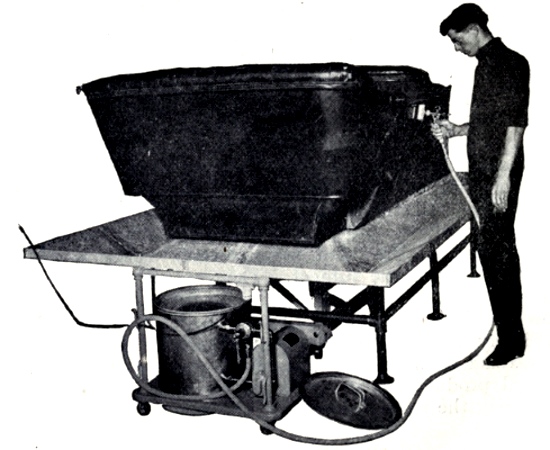
Fig. 122.—The "Floco" System of Painting Motor Bodies.
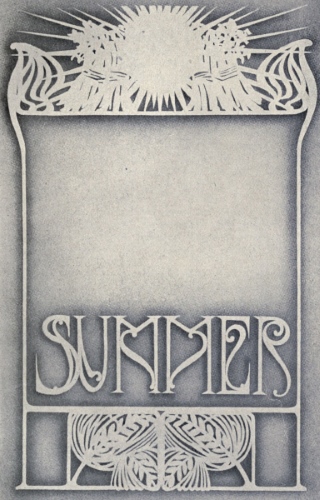
Fig. 123.—Show Card Done by Spraying (Strong).
The finishing material, such as varnish, to be used is
pumped from the bottom of the tank by the electric motor-driven
pump, in a continuous stream, through the flexible
hose, to the nozzle. The flow of material is adjusted by
the regulator, by means of which a varying amount is not
put into use and returned to the tank. In this way the
flow from the nozzle is instantly adaptable to any class of
work and viscosity of fluid without changing the speed of
the motor.
When the nozzle is closed the material pumped is all
forced back into the tank through the overflow. This,
serves to agitate the material; in fact, is the only agitation
necessary with material containing pigment, such as colour
varnish.
The body to be flowed is—as shown in Fig. 122—placed
over the drain trough. The operator first applies
the material all along the top, then flows it copiously over
the upper half of the surface. Sufficient material is thus,
applied to insure a perfect flow to the bottom. The job is allowed
to drain into the trough which carries the material
back to the tank—here it is strained and, without the
slightest waste, used again.
Only enough material is put into the tank to take care
of the work at hand, or to handle the day's production.
The maximum amount of material exposed is 15 gallons—the
tank's capacity. The nozzle will operate satisfactorily
on a gallon of material.
The tank, motor, pump and regulator are—as previously
stated—mounted on a truck fitted with casters, permitting
of these parts being moved about with the greatest of ease.
Another appreciable advantage of this style of arrangement
is that an extra truck can be kept on hand and put into
immediate use in case of accident.
The cleaning of the parts is simple. The nozzle of the
machine is detached and all of the material pumped out of
the tank, after which a small quantity of naphtha—or some
other similar solvent—is put into the tank and pumped
through the machine.
As the motor is only 1-6 H.P., the consumption of
power is low. The motor is made for all kinds of current,
and can be attached to any light socket.
It may be observed that the pressure tank used in this
equipment permits of the use of heavier or more viscid
enamels and paints than would be possible where gravity
was depended upon. In view, however, of the success
which has been met with in the case of the Ford Motor
Company, there appears to be no reason why the Floco
process should not be used for some of the undercoats,
as well as for the finishing.
The following article by M. C. Hillick appeared in
"The Painters' Magazine," of New York, and will doubtless
be read with interest:—
The Willys-Overland automobile factory has recently
been installed with sixteen large enamelling furnaces or ovens
having a volume of 48,000 cubic feet and a capacity of 140
tons of enamelled product every ten hours. These ovens
have been electrified and they require approximately 5,500
horse-power. For some months past the Overland Company
has been testing one of these electrically-heated ovens,
and the results have, in every way, measured up to expectations.
Formerly the company, in common with practically
all other companies using enamelling or baking ovens,
employed gas as the treating medium. The ovens now
electrified are almost entirely automatic in operation.
When the oven is loaded the closing of its doors automatically
throws a switch which turns on the current. A pyrometer
which can be adjusted to operate at any desired temperature
rings a bell when the proper degree of heat is reached,
thus notifying the attendant, and also automatically turning
off the current. The electrically heated oven does
away with all flue gases and with their attendant dirt and
spots. It also reduces the required volume of ventilation
to the minimum, thereby eliminating air currents and the
dust which, in greater or less degree, usually accompany
them. The electrification of the ovens does away with explosions,
banishes danger from fire, and gives an assured
"safety first" to the workmen. The heat is said to be non-oxidizing
and, therefore, cannot scald the operator. The
working quarters are rendered comfortable and a higher
grade of work is made possible.

Fig. 124.—Show Card Done by Spraying (Strong).
While for the custom shop painter it is a long way to
such equipment, the fact that these facilities are gradually
being acquired leads to the assumption that, in the course
of a few years at most, some portion of the work coming
to the shop for painting repairs will be handled through the
baking oven. In connection with this subject of enamelling
and oven baking, the various costs of paint and varnish,
it is to be noted that the excessive temperature employed in
baking is being criticised as detrimental to the finish. Recent
tests are said to have been made which show that
baking paint and varnish at the maximum temperature
shortens the life of the finish. Mr. J. W. Lawrie, of the
Chemical Works of Milwaukee, Wis., has stated that, as a
rule, the lower the temperature and the longer the time
the paint and varnish is baked, the finer the appearance,
service and durability of the finish and the greater its capacity
for resisting moisture. The finish will have more elasticity
and deeper lustre. Mr. Lawrie is of the opinion that twelve
hours at 180 degrees are better than five hours at 280
degrees.
In some motor car shops, within the past two years,
by the use of baking ovens cars were painted and finished,
all coats being baked, and made ready for service in three
days. However, we are not commending or recommending
this practice. For the custom shop painter, especially,
it is entirely unsuited. Nor would we recommend the baking
process for surfaces other than metal. The same disadvantages
marshalled in opposition to baking paint and
varnish upon wood surfaces fifteen years ago, or longer,
still remain in evidence. For aluminium, sheet steel or
other metal panels or metal surfaces in general, the baking
process offers an opportunity for finishing work under
conditions more uniform than any which may be expected
to prevail outside the oven. An other advantage is noted
in favour of oven baking. It permits the use of more elastic
materials without the aid of artificial oxidizing agents.
As compared to the present air-drying system, the oven
baking method, operated upon a conservative basis, permits
the car to be thoroughly painted and finished in six or
eight days. The use of more elastic materials—paints,
colours and varnishes—has been mentioned as a part of
the oven baking method. Upon steel surfaces this is perhaps
more necessary than upon aluminium, and possibly iron.
Steel has a linear expansion double that of wood. As a
matter of fact, experts in these matters employed by the
Pennsylvania Railroad assert that the contraction and
expansion of steel surfaces is much more pronounced than
the same action in wood. Materials of greater elasticity
as compared to those used in natural air-drying practice
are urged.
Primers and surfacers, and the general class of foundation
coats, will require an average of three hours' baking at 200
degrees F. While some colours require higher degrees of
heat than others, 170 degrees F. baked for, say, six hours will
dry the average colour, excluding white. The latter pigment,
baked at a temperature varying from 85 to 110 degrees
F., will dry properly in the course of a few hours, and retain
its natural purity of colour, whereas at a higher degree of
heat the white takes on an objectionable yellowish cast.
Black, at the opposite end of the colour pole, can be safely
baked for six hours, at something like 200 degrees F. Finishing
varnishes, taking them as they run, will bake at from
110 to 150 degrees F. for five or six hours. In all baking
practice the personal equation figures largely. Reason,
good judgment, the capacity for taking pains—all these are
items of importance.
Oven baking methods are being successfully employed
in some of the large city repainting establishments. A
firm near New York, for example, using what is known as
the radio process, paints and finishes a car in three days.
The cleaning of the cars is accomplished by the use of a steam
jet, a treatment which is said to cut away the grease like
magic. All surface defects following the cleaning of the
car are touched up and faced over with the necessary filling
and surfacing materials. Then these patched-up parts are
rubbed down with water and rubbing brick, and the general
surface of the car is lightly rubbed with pulverized pumice
stone and water. All colour, and varnish colour, coats are
applied with a paint atomizer. This atomizer is a pistol-shaped
device operated with a trigger, the material being
sprayed from the muzzle of the barrel. The varnish colour
is baked for three hours at a temperature of from 110 to
120 degrees. From 90 to 100 degrees of humidity are provided
for the oven, and by means of an exhaust fan a fresh
supply of air is furnished every three minutes. In the oven
where the varnish colour coats are baked a thermostat is
installed, which regulates the temperature. All the air
entering the oven is washed and purified by running it through
a water tank before it enters the oven. This water-washed
air is forced into the oven by a fan blower, and contact
with a radiator superheats it.
In practice, the high humidity here referred to, and the
water-washed air, are mediums which serve to keep the outer
surface of the drying coat moist while the inner surface is
drying, in this manner furnishing in due time a paint
film dried uniformly from top to bottom.
The finishing varnish is dried in an oven having a
maintained temperature of from 90 to 100 degrees, the
humidity being regulated at from 60 to 70 percent. This
humidity is likewise found to assist a varnish film to dry
uniformly throughout.
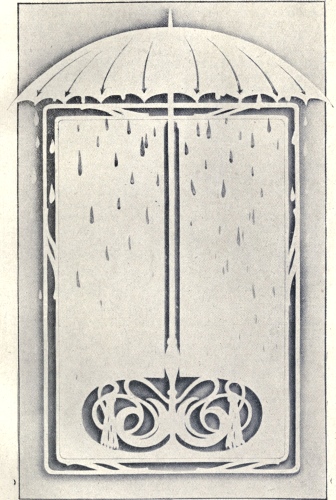
Fig. 125.—Design for Show Card (Strong).
The treatment of the car chassis in the establishment
here referred to is quite similar to that given the body of
the car. A steam treated potash bath is provided into
which fenders and other removed parts are immersed,
removing all grease and foreign substances, and even the
paint, from such parts. These parts, after cleaning,
are then dropped into tanks containing the required paints,
varnish colour, etc., after which they are taken out and
drained and then consigned to an oven maintained at a
uniform degree of heat.
Other establishments having ovens installed are employing
methods designed to secure equally quick results without
sacrificing any measure of durability or appearance.
In the absence of ovens, not a few car and carriage painters
are practising the so-called hot-air method as far as
possible. Successful results are reported in many instances,
the work being turned out quicker, with an increase
in lustre advised in some cases. This method is very simple
and requires no previous experience or special training. Anyone
capable of providing the necessary degree of heat—85
to 95 degrees F.—and maintaining it for eight or ten consecutive
hours, can have the benefit, in full measure, of the
hot-air system. Coats of paint, colour, varnish colour and
varnish dry rapidly in a temperature at the above degree,
where the ventilation is good and a fair volume of pure,
fresh air can be constantly brought into the drying room.
Notes on the Construction of Stoves.
The construction of stoves for use in connection with
enamelling and baking japans generally does not properly
form part of this treatise, but a few remarks on the subject
may be of service. It is to be regretted that in only too many
cases the stoves employed are very inadequate. In some
cases they are heated by gas, and the jets cause a certain
amount of discoloration. This is objectionable even
when the work is black, but if it is coloured it may lead to
serious disadvantages. In Fig. 126 is shown a sketch
of what is known as the "Perkins System of Heating." It
is largely adopted in many trades for enamelling cycle frames
and parts, lamps and motor horns, etc. It is this system
which is used by Messrs. Lucas, Limited, of Birmingham,
a description of whose plant is given elsewhere. In the
"Perkins" system water is heated under pressure, and the
comparatively high temperatures required for drying and
other similar purposes are obtained in a simple but efficient
manner.
The apparatus consists of circulations of hydraulic
tubing, certain proportions of which are formed into a coil
and placed in a furnace situated in any convenient position
outside and below the drying chamber. The apparatus
is hermetically sealed and self-contained, the heating water
circulating from the furnace through the heating pipes
or coils and back again to the furnace without any loss
through evaporation. No pumps or moving parts of any
description are required, so that unskilled attention only
is needed.
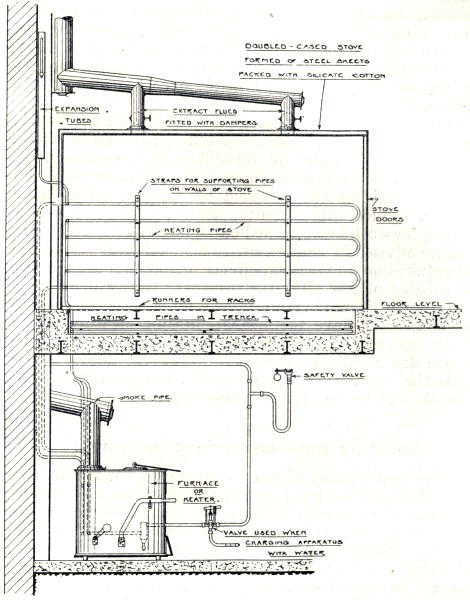
Fig. 126.—The Perkins Stove.
The illustration shows a simple application of the apparatus,
which is the type often employed for cycle and motor
parts, bedstead frames, electric apparatus parts, etc. The
arrangement of the pipes, of course, depends upon the class
of work which has to be dealt with.
Fig. 127.—A Typical Goodyear Stove.
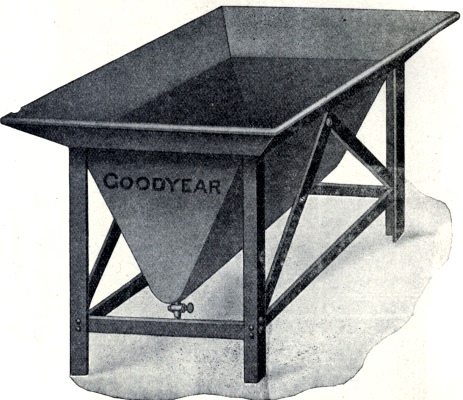
Fig. 128.—Dipping Trough.
In Fig. 127 is shown a type of stove manufactured
by Goodyear and Sons, Churchfield Works, Dudley. The
construction is a great improvement on the old-fashioned
type of enamelling stoves, which through faulty design
were responsible for great loss through radiation and combustion.
The work done in such stoves is necessarily inferior.
The firm named are among those from whom may
be purchased up-to-date stoves heated by gas (ordinary
lighting or producer), steam, superheated water, and oil,
either single, double, or treble cased suitable for purposes
which a few years back were hardly dreamt of, and which
may be said to range from hairpins to bedsteads, and
include munitions of war, such as stoves for shell drying and
varnishing. A very important part of the process of stoving
is the rack and trolley system of transport in and
out of the stove, which in effect means that no article is too
heavy for such process. In the production of stoves for
enamelling certain firms have made a special study of the
requirements, including those above mentioned.
Fig. 129.—Show or Menu Card (Strong).
Fig. 130.—Example of Metal Decoration—Lid of Coal Box Done with Airostyle.
Lime and Whitewash Sprayers.
As explained in previous chapters, this type of machine
is of an entirely different and much simpler construction
than those used for spraying oil paint, varnish, etc. Yet
such apparatus is used to a very considerable extent in
factories of all kinds as well as for spraying insecticides on
fruit trees and other purposes of the agriculturist. By the
Factory and Workshop Act of 1901 it is provided that "all
walls and ceilings must be limewashed at least every fourteen
months, and painted and varnished work must be washed with
hot water and soap at the same periods. Special exceptions to
this rule may be made by Special Order." Such an order
was made in 1911, which was to the effect that "when at
least two coats of washable water paint or sanitary distemper
is used instead of limewhite the period for renewing with
one coat of such paint shall be three years. The paint, however,
must be washed at least once in every three months.
It is provided in this Order that "If it appears to an inspector
that any part of a factory to which the exception applies
is not in a cleanly state, he may, by a written notice, require
the occupier to limewash, wash or paint the same; and in
the event of the occupier failing to comply with such requisition
within two months from the date of the notice, the
special exception shall cease to apply to such part of the
factory. In this Order a washable water paint means a
washable paint which, when finished for use contains:—(i)
at least half its weight of solid pigment containing not
less than twenty-five parts by weight of zinc sulphide as
zinc white (lithopone) in each hundred parts by weight of
solid pigment and (ii) at least ten parts by weight of oil and
varnish to each hundred parts by weight of solid pigment."
It should be stated that the type of machine now under
consideration may be used for the application of such paint
or distemper provided that it is rendered sufficiently thin
by the addition of water. If very thick compressed air
will be required as in the case of ordinary oil paint.
An excellent machine for applying limewash, whitewash
or distemper is made by Messrs A. C. Wells and Co., Engineers,
London and Manchester. It is used to a very large
extent by engineers and in factories, breweries, car sheds,
cattle docks, etc. Builders, decorators, corporations, etc.
also find it of great service for special work. The manufacturers
state that over 5,000 of these machines have
been sold, and that they are fast taking the place of the old
method of limewashing with the brush. The speed with
which lime, whiting or cold water paint can be applied is
from 10 to 20 square yards per minute. A very distinct
advantage of the machine over brushes is that when an
irregular surface, such as a brick wall, the joints of which
are not by any means perfect, is being dealt with, the lime
or distemper is forced in by the spray into the interstices
which could not be reached by the brush. These machines
consist essentially of a pump with spraying nozzle which is
made in various forms, the simplest of which is that shown
in Fig. 131.
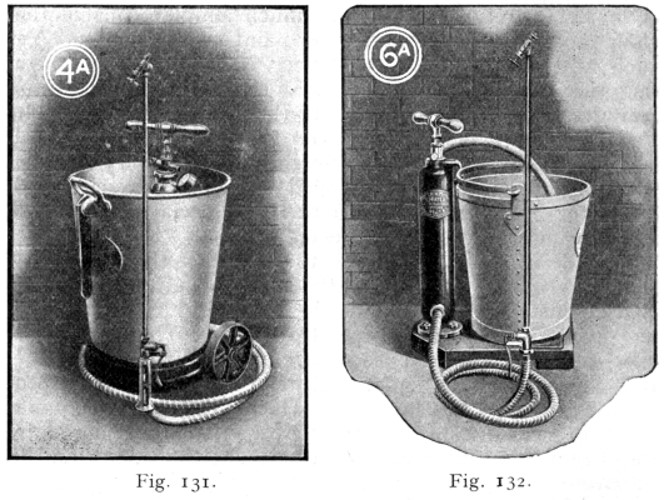
This machine is designed to stand rough usage. The
pump is simple and easily removable for repairs, and the
spraying nozzle, which is naturally an important feature,
can be regulated to any degree of fineness. A patent filter
is provided which prevents clogging. It will be observed by
the illustration that wheels are provided which enable the
machine to be easily removed from one place to another.
A 15 ft. armoured delivery hose and 5 ft. spraying pole for
reaching the upper portion of a surface to be sprayed is
provided. The capacity is 8 gallons. The machine shown
in Fig. 132 is somewhat smaller and cheaper. It contains
6 gallons.
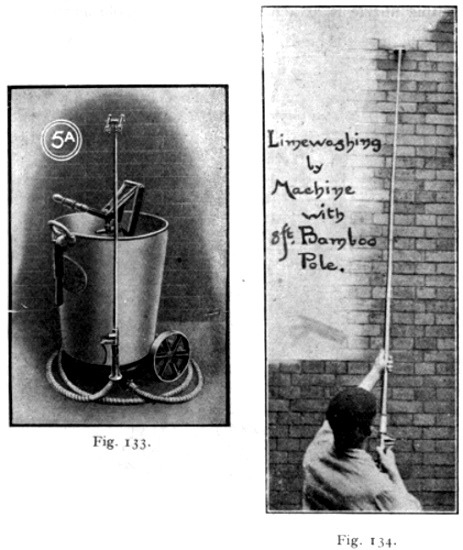
Fig. 133 shows a machine with a double spraying nozzle
and valve arrangement. This has several advantages over
the single pattern; the speed is almost double, and one jet
can be put out of action if desired when working in cramped
places. It is a powerful machine with 12 gallon tank and
strong lever pump. It is supplied with large wheels and
is easily moved about, and is eminently suitable for anyone
having a large quantity of work to do quickly.
In dealing with very high buildings either the single
or double nozzle is attached to a bamboo pole, as shown in
Fig. 134.
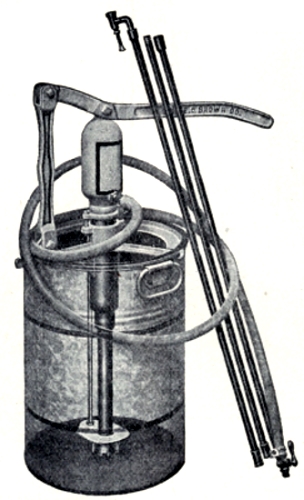
Fig. 135.—The Brown Sprayer with Extension Rod.
In Fig. 135 is shown an excellent machine suitable
for spraying whitewash, distempers and disinfectants. It
is manufactured by the E. C. Brown Co., of Rochester, N.Y.
The pump is of a simple but effective character; the valves
are located so that they can be opened instantly and are
fitted with springs so that the operator can pump while the
machine is pointed in a downward direction. The strainer
has five inches of screen surface and the screen can be instantly
removed and cleaned. The pump barrel projects
beyond the hand and serves as an extension rod. The
nozzle is guaranteed not to clog, and is fitted with Messrs.
Brown's patented screen arrangement. It throws four
different kinds of spray, one a solid stream, the second a
broad carrying spray, the third a long driving spray for
ceilings and tops of walls, and the fourth a fine spray which
may occasionally become of service for spraying work near
at hand.
There are several other makes of machines suitable
for whitewash spraying, among them one manufactured
by Merryweather and Co., Greenwich Road, S.E., The
Bean Spray Pump Co., Los Angeles, California, U.S.A.,
and the Four Oaks Spraying Machine Co., Sutton Coldfield,
Birmingham. The last named is particularly well adapted
for spraying insecticides upon fruit and other trees.
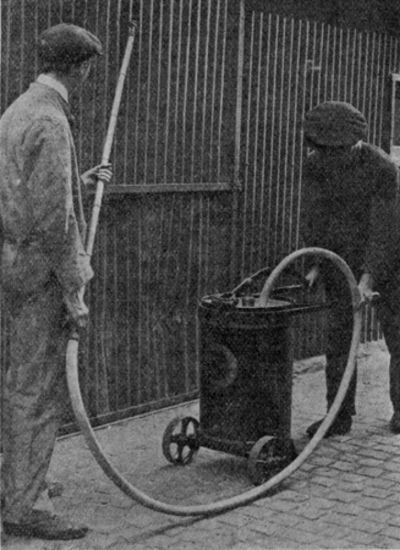
Fig. 136.—The Merryweather Limewhite Sprayer.
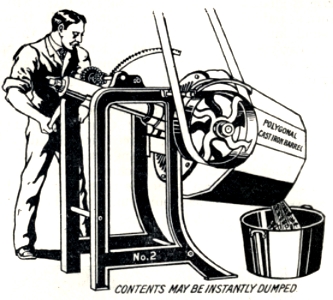
Fig. 137.—A Tumbling Barrel.
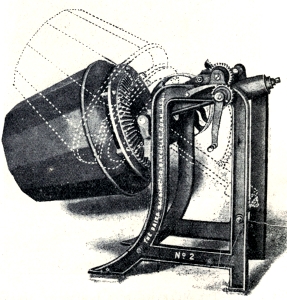
Fig. 138.—Another Form.
The Tumbling Barrel Process.
This process of japanning small castings is very successful
in those cases where the parts are small and intricate in
construction, and, therefore, cannot either be dipped or
sprayed, excepting with some difficulty. The great advantage
of tumbling is that such work is done better and faster
than by dipping. A machine, of which two examples are
shown in Figs. 137 and 138, is used in this process.
Inside this machine are placed a number of shot or steel balls
of different sizes. The articles to be treated are then introduced
in the japan and the machine is started at varying
degrees of speed. The shot carries the japan over the various
parts and into the interstices. As different objects and
materials require different speeds, some work will be started
slowly and the speed increased to get the desired finish.
The objects are then dumped out on to wire screens or
baskets, and shaken, when the steel balls and shot fall
through the mesh, leaving the articles that have been
japanned behind. The baskets are then hung in baking
ovens, while the balls are washed in gasoline ready for use.
The machines mentioned above are manufactured by the
Baird Machine Co., Bridgeport, Connecticut, U.S.A. The
English agents are R. Cruickshank, Ltd., Camden Street,
Birmingham.
A Portable Paint Sprayer for Railway and
other Work.
Mr. M. E. McDonnell, Engineer of the Pennsylvania
Railroad Company, Altoona, Pa., U.S.A., very kindly
furnishes the author with the drawings which will be found
on the following pages. He says:—The Company does very
little painting by dipping. The spray process is, however,
used very extensively, a large percentage of our freight
cars having been painted by this method for years. The
method is very satisfactory and also economical. The
saving in the cost of labour in the spraying method is
approximately 60 per cent. In some cases the saving is
greater than this. In one of our largest shops the cost
of application per unit for a given number of square feet
is thirty-eight and nine-tenth cents with the spray as
compared with one dollar with brush. It might be said
that more paint is applied per coating when the brush
method is used. A given surface which would require
10 gallons of paint for one coat by the brush method would
require approximately 7 gallons by the spray method.
When painting a freight car a more uniform coating
is obtained when the brush is used, due to the fact that the
paint can be brushed out behind ladders and other things
which would obstruct spraying, while in the application
of the paint with a sprayer it is necessary to apply a
thicker coating at certain points in order to reach
other points which are obstructed, and which must, therefore,
be approached from a side angle. The spray
however, reaches certain crevices which cannot be reached
with the brush, which is in some cases advantageous with
the painting of freight equipment cars. Our Company
would not consider returning to the brush method of
painting.
The machines which we use for spraying the paint are
made in the Company shops.
The following is a description of the apparatus referred
to:—
It consists of a stout steel cylindrical receptacle
11½in. internal dia. by 24in. in depth, and having a capacity
of about 12 gallons. It is supported on a special wheelbarrow
of wood with trundling wheel of cast iron. The
bottom of the receptacle is so low down that it rests on
the ground when in use, by lowering the handles of the
barrow. The paint is placed in this cylinder and is forced
out by air pressure, introduced through the lid of the
receptacle, at from 80 to 90 lbs. pressure per square inch.
This air is provided from the shop compressor range or
by a separate compressor. The paint pipe penetrates
the cover and is extended nearly to the bottom of the
receptacle. The air pressure on the surface of the paint
forces it through this pipe to the atomizer.
A branch from the air supply is also taken to the
atomizer and a third air branch taken to the bottom of
the receptacle and carried through a 1in. iron pipe stopped
at the end with a screw plug, but perforated with a number
of 1/8in. holes. This latter is for agitating the paint and prevents
settlement. The atomizer is shown clearly in the drawing.
It consists of an air jet impinging on a vena contracta
nozzle and surrounded by the paint forced through from
the receptacle. The air blast carries the paint through
the orifice immediately opposite to the nozzle and there
reduces it to a fine spray. A hose is attached to the exit
of the atomizer and the atomized paint is carried by the
blast to the spray pipe, which is slightly fan-shaped and flat.
The cover is fastened by four hook-clamps, and is,
therefore, readily removable. An air pressure gauge
reading to 120 lbs. is also provided, and the valves are so
arranged that the regulation of both the paint and the
air supply are easily adjustable.
It will be noticed that, in the atomizer, a vena contracta
is arranged so that it may be adjusted in its position in
relation to the air orifice. The use of this is to provide
for paint of various consistencies. Very great care has
been taken in designing the details; as, for example, the
provision of a scraper to clear off accumulations from the
periphery of the trundling wheel.
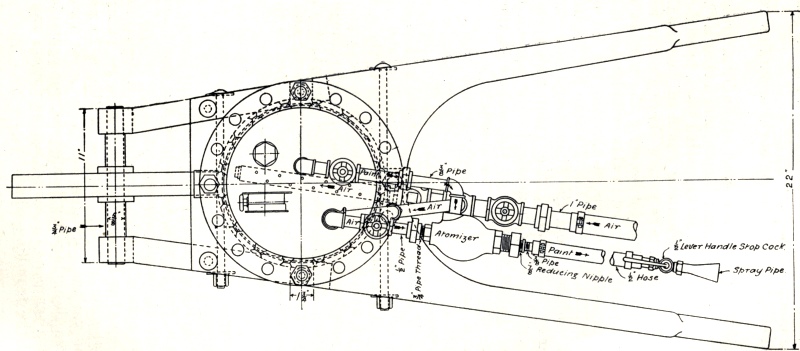
Fig. 139.—Plan of Paint Spraying Apparatus Used by the Pennsylvania Railroad, Principally for Freight Cars.
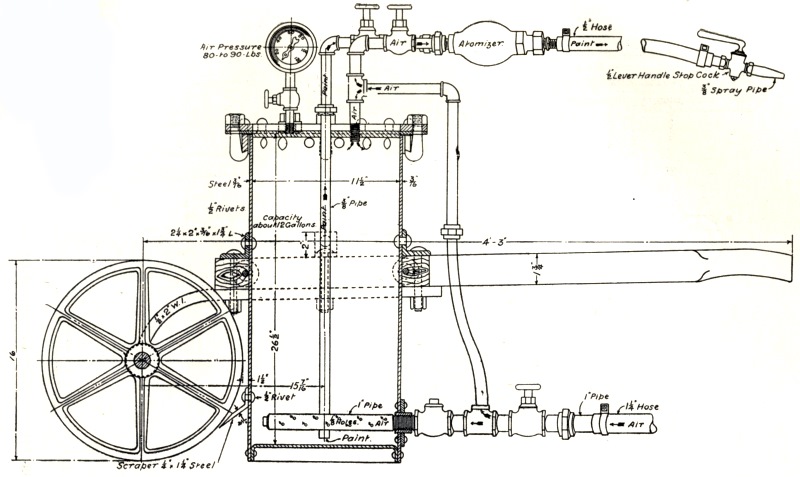
Fig. 140.—Elevation of Apparatus Shown in Fig. 139.
Fig. 141.—Details of Apparatus Shown in Figs. 139 and 140.
Metal Spraying.
Although the spraying of metal does not really come within
the scope of this book, the process is so closely allied to paint
spraying that it is considered advisable to devote a chapter
to the subject, particularly as the perfected process is of very
recent date, and bids fair to be used successfully in many
industries. It should be stated at once that a metallic
coating may be applied to practically any surface, and that
almost any metal or alloy may be employed.
Stated briefly, the process consists in melting metal in
the form of a rod or wire, by means of oxygen and coal gas, or
other gas, depending upon the metal used. The molten
metal is sprayed at a high pressure, and a surface may be
quickly covered with the metal of any desired thickness. A
remarkable fact concerning the process is that the metal
is cooled to an extent that renders it possible to hold the hand
in the jet so as to receive a coat of metal without inconvenience,
and samples of wood and fabrics may be coated
with metal without injury.
A moment of consideration will render it clear that
there is an immense field for this process; for example, as
aluminium can be sprayed, a lining of that metal might be
given to brewers' and cooking utensils, etc., while tanks,
barrels, reservoirs, intended to contain acids and oils, can
also be treated. In the production of blocks for printing,
in decorative work and mural decoration, there is an immense
field, while ships' bottoms, instead of being painted with
composition, can be copper-plated or sprayed with any other
suitable metal, in order to prevent incrustation. No
doubt some very beautiful effects can be produced by means
of the process.
It will be convenient now to describe the machine used
for the application of the metals. It consists of a pistol
rather bulkier, but not unlike in form, the usual spraying
apparatus, see Fig. 142.
Fig. 142.—The Metal Spraying Machine or "Pistol."
Fig. 143.—The Metal Sprayer.
In Fig. 143 is shown very clearly the construction of
the sprayer, which it will be understood comprises a combined
melting and spraying jet and a feed mechanism. The
metal, in the form of rod or wire, is fed to the melting flame.
This, as already stated, is formed by coal gas burned in the
air, or oxygen, water gas, acetylene, hydrogen, etc., may be
employed instead of the coal gas. The gases are supplied at
such a pressure as to prevent blowing out and to ensure a
highly deoxidizing flame. The spraying jet can be of carbon
dioxide, nitrogen, air, steam, etc., and it must be fed at
such a pressure as to produce a sufficiently high velocity for
successful coating. The usual gauges and reducing valves
will, of course, be employed. The feeding of the wire is
accomplished by a small pneumatic motor, driven by the
spraying medium, either in series or parallel with the main
jet. The dimensions of the wire nozzle, and feed mechanism
vary with the different metals. To obtain a good adhesion
between the metals being sprayed and the surface to which
it is to be applied, the latter must be thoroughly clean and of
an open nature, to give a key for the deposit. Sandblasting
is sometimes employed to effect this.
Fig. 145 shows an enlargement of the nozzle with the
different parts marked. The cost of the process is not
prohibitive; the cost of the metal only on one square foot of a
thickness of 0·001 inch is quite small with the cheaper metals.
The process is put on the market by the British Metal Spray
Co., Ltd., Queen Anne's Chambers, Tothill Street, Westminster,
London, S.W.
In a paper read by Mr. R. K. Morcom before the Institute
of Metals, the following interesting information was
given:—
Fig. 144.—Sectional Drawing of the Metal Spraying Machine or "Pistol."
With a given design of jet there is only a certain volume
left by the air-jet which can be filled with flame, and this
flame has a limiting temperature which cannot be exceeded.
The wire, passing through this cone of flame receives heat,
partly by radiation, but chiefly by conduction, and becomes
melted; but there is a definite limit to the amount of heat
which can be picked up by the wire passing through the
flame, and a definite limit to the rate at which it can be
melted. This cannot be increased by forcing more gas
into the flame, as the extra gas is merely blown away by the
air-jet. It is possible to increase the rate of melting by
shaping the nozzles so as to leave room for a larger cone of
flame, and experiments are in progress on this point. There
is, therefore, a most definite economical quantity of gas
which should be used in the pistol, this quantity being
about 1·5 cubic foot of hydrogen per minute, and 0·5 cubic
foot of oxygen; or about 0·8 cubic foot of coal-gas to 0·65
cubic foot of oxygen for the present standard designs.
In refractory metals these quantities may be increased
slightly, as a slightly higher temperature can be obtained
if the burning gases are under a pressure greater than
atmospheric, and this occurs if the gas quantities are increased,
the inner surface of the air-jet acting to some extent
as an enclosing wall to the flame. On the other hand, for the
more easily fusible and oxidizable metals, such as tin, lead,
and zinc, it is advisable to keep the gas quantities rather
below the figure given, so as to avoid any possibility of overheating
and burning any portion of the wire.
The outer jet performs a threefold purpose: it keeps the
nozzles and wire cool, it cools the object, and it produces the
requisite velocity.
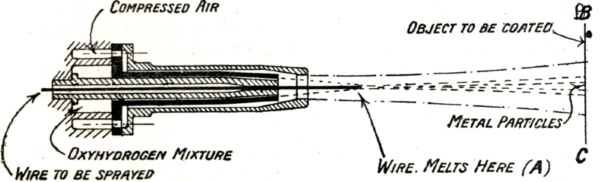
Fig. 145.—Diagrammatic Representation of Melting and Spraying Jets in Action.
The velocity of the air leaving the jet will be independent
of the volume discharged, and depends only upon the
pressure at the jet, so long as there is no disturbance due to
the entraining of air from the surrounding atmosphere.
This, of course, will actually occur in practice, and the layer
of air must have a certain thickness in order to prevent its
being broken up, and its velocity destroyed by mixing with
the surrounding atmosphere.
As at present constructed the standard pistol uses about
0·55 to 0·6 cubic foot per minute for every 1 lb. per square
inch air pressure, so that with an air supply at 80 lb. per
square inch, which is a very suitable figure for ordinary
spraying, the air consumption will be from 45 to 50 cubic
feet per minute.
The bulk of this will be from 830 to 920 grammes, and
the mass of metal sprayed by this air will be from about
8 grammes in the case of iron to about 200 grammes in the
case of lead.
The action of deposition is probably a complex one.
The minute particles of solid metal are driven with such
force against the object that, in some cases, they fuse, but
owing to their small relative size, are promptly chilled by
the object to which they adhere. If any of the particles
are molten or gaseous they will adhere. In addition, the
suddenly chilled particles are possibly, or even probably,
in the state of unstable equilibrium found in "Prince
Rupert's Drops," and act like so many minute bombs,
bursting on impact into almost molecular dimensions, and
penetrating the smallest cracks and fissures of the object.
The process requires some care in manipulation, as, by
varying the conditions, it is possible to spray porous or
non-porous coatings, and, with some metals, anything
from a pure metal to a pure oxide. With care, however,
non-porous, oxide-free, adherent coatings can be produced,
of almost any metal on almost any solid.
In addition to metals, it is possible to spray fusible
non-metals, or, by stranded wires, alloys of metals or mixture
of metals with non-metals.
The process is so new that its uses are still partly to be
developed. But it is easy to see that it may have far-reaching
value for protective coatings against weather or
fire, for ornament, for electrical resistance and conductors,
for the production of special alloys, for joint making, and
for many other purposes.
Quite in a different category comes that of very fine
casting. The surface of a pattern, polished or slightly
greasy, is most minutely copied, and it is possible to produce
process blocks very rapidly. It may be useful to line moulds
before pouring in a metal. The application of the process
to the production of very fine or coarse metallic powders
is being investigated.
The bulk of the work has hitherto been carried on in
laboratories, but the apparatus is gradually becoming used
in the more progressive factories, where extended facilities,
and the knowledge of specialised requirements, will ensure
a rapid improvement in technique and results.
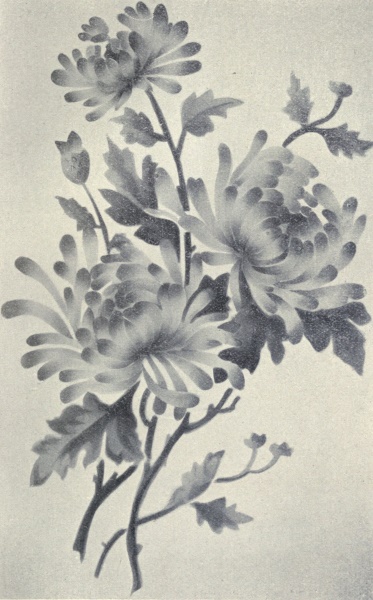
Fig. 146.—An Example of Sprayed Decorative Work. (Aerograph.)
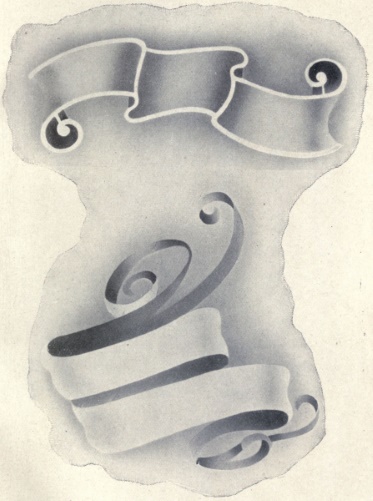
Fig. 147.—Shaded Work by the Aerograph.
The research on the lower melting point metals has
been greater than on the others, and undoubtedly the
economy with them both can be greatly improved. Preheating
of gases and air, supplementary flames acting in
front of the main jet, and electrical methods of heating,
are all still the subject of experiment.
The following metals are among those which have been
successfully sprayed by this process:—Aluminium, brass,
bronze, copper, cupro-nickel, iron, gold, nickel, silver,
tin, zinc, lead.
It will be obvious that this method is a most useful
one to employ when it is desired to prevent iron from rusting
on machine parts which cannot possibly be treated by
chemical or other anti-rust processes, and be rendered immune
from rusting by treatment where they stand. To give
some idea of the cost, it may be said that if the thickness
of 0.001 of one inch of zinc is deposited, the cost of metal
for coating 10 square feet would only be a fraction over
4d.; while for lead the cost would be about 2d. The
amount of gas used is not a large item, being at the rate
per minute of 0.50 cubic foot of oxygen and 0.55 cubic foot
of coal gas when spraying zinc, and 0.101 cubic foot less in
each case where lead is being used in the pistol. These
figures are given on the authority of the "Daily
Telegraph."

Fig. 148.—Show Card.
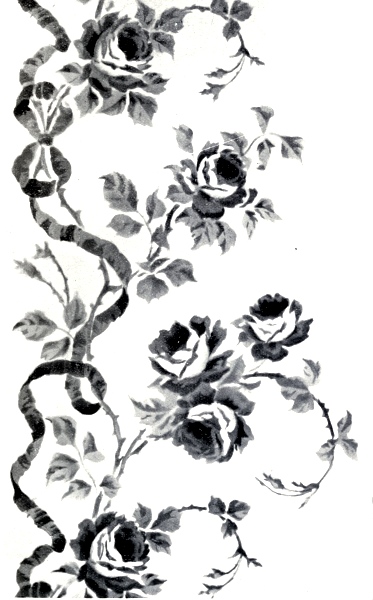
Fig. 149.—A Sprayed Frieze (Aerograph).
- Accessories 121-133
- Advantages of Dipping 22
- Advantages of Dipping Piano Cases 46
- Aerograph 81
- Aerograph Air Pump and Tank Combined 118
- Aerograph Electric Motor Outfit 83
- Aerograph Spraying Cabinet 127
- Aerograph Turntable 134
- Aeron 85-87
- Agitating Apparatus 9-15
- Agricultural Implements, Dipping 58
- Air Drying Enamels 180
- Air-drying coloured Japans 157
- Air Heater 137
- Air Pump and Tank Combined 118
- Air Pump for Large Installation 119
- Air Transformer Set 93
- Airostyle 97
- Airostyle Air Compressor 115
- Airostyle Central Draught Fan 125
- Airostyle Plant 121
- Airostyle Plants for 16 Operators on Small Work 155
- Airostyle Plant Showing Ventilator 199
- Alabastine 29
- Apparatus for Dipping Piano Cases 42
- Application of Stoving Enamels 179
- Artistic Application of Paint Spraying 201
- Artists' Type of Invincible Sprayer 107
- Asbestine 73
- Auto Electric Air Heater 137, 139
- Auto Filter 93
- Automatic Control of Drying Room 68
- Automatic Electric Controller 111
- Automatic Finishing of Pianos 42
- Automobiles, Latest Method of Finishing 216
- Baird Machine Co. 249
- Baking Enamel 63
- Baking Heats, Safe for Pigment Colours 187
- Baking or Stoving, Hints on 180
- Barytes, Precipitated 70
- Baskets, Fancy 147
- Bean Spray Pump Co. 247
- Bearings, Paint Proof 13
- Bedsteads 33
- Bedsteads, Dipping 58
- Bedsteads, White Work 184
- Berkel and Parnall's Slicing Machine Co., Ltd. 167
- Bin for Spraying Light Articles 148
- Birmingham Small Arms Co. 147-164
- Black Japan Finishes 183
- Blinds for Paint Dipping Tank 10
- Block and Tackle 93
- Blooming of Varnish 68
- Blues 205
- Bone Black 70
- Bookbinding 146
- Brown, E. C. & Co. 246
- Brown Sprayer with Extension Rod, The 246
- Browns 207
- Bronzing 194
- Brush Graining 208
- Brushing versus Spraying 193
- Burnt Sienna 70
- Cabinets 127
- Cadby, G. & Sons 164
- Cans, Painting by Dipping 7
- Carriage Department, Woolwich Arsenal 54
- Carriages 146
- Carriers for Dipping Piano Cases 42
- Casements 7, 37
- Casements Dipping 60, 61, 65
- Casements, Steel 60
- Celluloid Buttons 3
- Celluloid Varnish, Recipe for 150
- Central Draught Fan 125
- Chicago White Lead and Oil Co. 188
- China Clay 73
- China Fruit Dish Decorated with the Airostyle 217
- Cleaning Metal Parts 41
- Coach Body Painting 55
- Coal Box, Metal Decoration done by Airostyle 241
- Coats of Paint, number 21
- Collapsible Gates 33
- Colour Glazing 202
- Colour on Bedsteads 33
- Colour Specimens, Spraying 153
- Colour Varnishes, Transparent 184
- Coloured Enamels 59
- Compressed Air, Painting by 78
- Compressed Air, Supply of 113
- Compressor for Airostyle Plant 165
- Concentric Form of Spray 79
- Construction of Airostyle 98
- Cost of Paint Dipping Plant 2
- Cover for Tank 11
- Crabs 18
- Crane Eureka 103
- Crane Record 104
- Crittall Manufacturing Co. 60
- Cycle Frames 197
- Cycle Parts 146
- Davis Gas Stove Co., Ltd. 161, 165
- Decorative Work, an Example of Sprayed 261
- Deed Boxes 38
- Demar Varnish 75
- Designs for Lamp Shades Done by Spraying 203
- De Vilbiss Air Compressor 115
- De Vilbiss Auto Cool Fan 125
- De Vilbiss Fumexer or Spraying Cabinet 131
- De Vilbiss Manufacturing Co. 85
- Diogrammatic Representation of Melting and Spraying
- Jets in Action 259
- Different Trades in Spraying, Requirements of 33, 141
- Dipping and Spraying Compared 197
- Dipping and Spraying Paints Compared 188
- Dipping Casements 61, 65
- Dipping Paints 7, 70, 72
- Dipping Process, Advantages of 22
- Dipping, Quantity of Paint Required for 77
- Dipping Sewing Machine Parts 34
- Dipping Tanks 57
- Dipping Troughs 238
- Dripping Platform 9
- Driving Gear for Tank 14
- Drying Room, Model 67
- Durability of Dipping Paints 1
- Dust, Excluding 64
- Electric Controller 111
- Electric Hoist for Heavy Goods 27
- Electric Motor Outfit 83
- Electrical Work 147
- Elevation of Spraying Plant 199
- Enamel, Stoving 63
- Enamelling, Slate 152
- Enamels 179
- Enamels, Air Drying 180
- Enamels for Steel Furniture 183
- Enamels, Heat Resisting and Slow Drying 180
- Enamels, Stoving 178
- Eureka Spraying Machine 103
- Evaporation of Turpentine 77
- Evolution of Spraying Apparatus 78
- Exhaust 113
- Exhaust Installation 122
- Fan, Central Draught 104, 124
- Fancy Baskets 147
- Files 38
- Filler for Iron 26
- Filler, Harland's 29
- Finishing of Pianos 42, 43
- Finishing Room 53
- Flash Point of Turpentine 76
- Fletcher, Russell & Co., Ltd. 167
- Floco Process 223
- Flowing-on System 25, 216
- Ford Motor Co., Ltd. 54, 59, 216
- Four Oaks Spraying Machine Co. 247
- Freight Car, Painting 250
- Frieze, a Sprayed 267
- Furniture, Metal 38
- Fumexer 86, 129, 135
- Gas Fires 197
- Gas Meter Co., Ltd. 172
- Gas Meters, Masks for 142
- Gas Meters, Spraying 148, 171
- Gas Light and Coke Co. 171, 181, 185, 191
- Gas Stoves and Ranges 149
- Gasometer, Painting 83
- Gates, Collapsible 33
- Gear Box, Paint Proof 13
- Gibbons, James 58
- Gittings, Hills and Boothby, Ltd. 168
- Glazing Colours 202, 205
- Gloss Paint 71
- Goodyear Stove, a Typical 237
- Golden Ochre 70
- Graining and Scumbling 208
- Graining Grounds 212
- Grays 207
- Greens 207
- Hanger, Iron 34, 38
- Hanging Apparatus 16
- Hard Wood, Primers for 74
- Hard Wood, White Dip for 75
- Harland, Wm. & Sons 29
- Harrison, McGregor & Co. 58
- Hart Patent Mask 143
- Hayward Bros. & Eckstein, Ltd. 60
- Heat of Drying Room 69
- Heat Resisting and Slow Drying Enamels 180
- Heavy Goods, Hoist for 27
- Henley's Telegraph Works, Ltd. 147
- Hickory Wheels 54
- Hints on Stoving or Baking 180
- Hoist for Heavy Goods 27
- Hoists 18
- Holden, Arthur & Co, Ltd. 167
- Holes in Woodwork, Stopping 29
- Hook for Suspending 17, 64
- Hot Air Method 235
- Illingworth on White Spirit 76
- Imitating Marbles 210
- Imitation Wood Effects 183
- Immersing Mangle Frames 35
- Immersion, Painting by 7, 11
- Implement Manufacturers 14
- Indian Red 70
- Introduction 1
- Invincible Sprayer 105
- Iron, Filler for 26
- Iron Hanger 38
- Iron Rods 34
- Iron Sashes 7
- Iron Window Frames 37
- Italian Raw Sienna 70
- Joist and Wheels Supplying Hanger 16
- Kerosene Oil 75
- Kettle Type of Spray 78
- Khaki Paint 57
- Kingsbury Manufacturing Co, Ltd. 168
- Lacquers for Spraying 80
- Lacquers, Paints, etc, for Spraying 177
- Lamp Shades, Designs done by Spraying 203
- Lime and Whitewash Sprayers 241
- Limewashing by Machine with 8ft. Bamboo Pole 245
- Limewhite Sprayer, Merryweathers 247
- Location of Work Cabinets 127
- Lockers 38
- Lowering Piano Cases into the Varnish Tank 47
- Lucas, John & Co. 188
- Lucas, Joseph, Ltd. 160, 169, 173, 175, 181
- Machine for Metal Spraying 256
- Making Stencils 144
- Mander Brothers 154
- Mangle Frames Immersing 35
- Marble Grounds 210
- Marshall Sons & Co, Ltd. 59
- Mask Hart Patent 143
- Masks and Stencils 141
- Masks for Gas Meters 142
- Masury, John W. & Son 189
- McLennan System 9
- Melting and Spraying Jets in Action 259
- Merryweather Limewhite Sprayer 247
- Metal Decoration 241
- Metal Furniture 38
- Metal Goods 38
- Metal Motor Parts 41
- Metal, Primers for 74
- Metal Sheets, Dipping 58
- Metal Sprayer, Details of 257
- Metal Spraying 255
- Metal Spraying Machine 256
- Metal, White Dipping for 75
- Midland Sprayer 108
- Model Drying Room 67
- Moller and Schumann Co. 180
- Morris, Herbert, Limited 21
- Morris Standard Electric Trolley Hoist 23
- Motor Bodies, The Floco System of Painting 224
- Motor Car Shops 231
- Motor Outfit for Spraying 83
- Motor Parts, Metal 41
- Motor Wheels 54
- Objections sometimes urged against Spraying 194
- Ochre 70
- Office Partitions 60
- Oil and Water Separator 111
- Oil in Dipping Paints 72
- Oxford Ochre 70
- Oven Baking Methods 232
- Overhead Rails 57
- Paasche Air Brush 109
- Paasche Automatic Electric Controller 111
- Paasche Motor Driven Fan 124
- Paasche Turn-Table 135
- Paint Dipping 7
- Paint Dipping Plant, Cost of 2
- Paint Dipping, Simple Form of 7
- Paint Dipping Tank 10
- Paint for Casements 37
- Paint for Metal Work 41
- Paint for Wagons 57
- Paint, Number of Coats 21
- Paint Proof Bearings 13
- Paint Sprayer, Portable 250
- Paint Spraying Apparatus Used by the Pennsylvania Railroad 252
- Paint Spraying, Artistic Application of 201
- Paint, Supply of 113, 122
- Paint Tank 8
- Painting a Freight Car 250
- Painting by Compressed Air 78
- Painting by Immersion 7, 11
- Painting Gasometer 83
- Painting Motor Bodies the Floco System of 224
- Painting Motor Wheels 54
- Paints Durability of 1
- Paint for Dipping 70
- Paints, Spreading Capacity of 77
- Part End Elevation of Plant for 12 Operators 159
- Pennsylvania Railroad Company 250
- Perkins System of Heating 235
- Phillips & Son 58
- Philorite 30
- Piano Cases, Lowering into the Varnish Tank 47
- Pianos, Finishing of 39
- Pickling Metal Parts 41
- Picture Frames 149
- Picture Mouldings 149
- Piece Work 145
- Pigment Colours, Safe Baking Heats for 187
- Pinchin Johnson's Drying Room 68
- Plants, Some Typical 54, 158
- Platform, Dipping 9
- Portable Paint Sprayer for Railing and other Work 250
- Precipitated Barytes 70
- Preparing Wood Before Painting 25
- Pressure in Spraying 80
- Primers and Surfacers 235
- Primers for Metal 71
- Primers for Soft Wood 74
- Protecting Parts not to be Painted 24
- Prussian Blue 70
- Purifying Air 114
- Quantity of Paint Required for Dipping 77
- Raido process 232
- Rails and Hanging Apparatus 16
- Rails for Overhead 57
- Railway Work, Portable Paint Sprayer for 250
- Raw Sienna 70
- Recipe for Celluloid Varnish 150
- Record Pistol 97, 99
- Reds 205
- Reducing Varnish 87
- Requirements of Special Trades 33, 141, 145
- Rims and Wheels 41
- Rods, Iron 34
- Rubbing Down 30
- Safe Baking Heats of Pigment Colours 187
- Scrubbing Air 114
- Scumbling and Colour Glazing 202
- Scumbling and Graining 208
- Second Coat Dipping Paints 74
- Sectional Drawing of Metal Spraying Machine 258
- Sewing Machine Parts, Dipping 34
- Shaded Effects produced by Spraying 213
- Shaded Work by the Aerograph 263
- Shafting for Tank 14
- Sheets Metal Dipping 38, 58
- Shellac Spraying 87
- Ships' Hulls Spraying 151
- Spraying Plant, Elevation of 199
- Spraying, Quantity of Paint Required 77
- Spraying Requirement of Different Trades 121
- Spraying Ships' Hulls 151
- Spraying versus Brushing 193
- Staircases 7
- Standard Hydraulic Immersion System 42
- Standard Varnish Co 42
- Steel Casements 60
- Steel Furniture Enamels 183
- Steel Implements 197
- Steel Office Partitions 60
- Steel Plate Fan 125
- Steel Sheets 1, 12
- Steel Wheels 41
- Steel Wool for Rubbing Down 30
- Stencils and Masks 141
- Stencils, Making 144
- Stirrers and Blinds for Paint Dipping Tank 10
- Stopping Holes in Woodwork 29
- Stove, a Typical Goodyear 237
- Stoving Blacks 179
- Show Card Done by Spraying 69, 209, 225, 239
- Shop Fronts 60
- Side Elevation of Plant for 12 Operators 158
- Skylights 60
- Slate Enamelling 152
- Sliding Doors 60
- Soft Wood, White Dip for 75
- Soft Woods, Primers for 74
- Spray, Concentric Form of 79
- Sprayed Decorative Work, An Example 261
- Spraying and Dipping Compared 197
- Spraying and Dipping Paints Compared 188
- Spraying Apparatus for Painting Freight Cars 252
- Spraying Apparatus, Types of 81
- Spraying Cabinets 127
- Spreading Capacity of Paints 77
- Spraying Colour Specimens 153
- Spraying Metal 255
- Spraying, Objections Sometimes Urged Against 194
- Spraying Plant, Cost of 2
- Stoving Enamel 63, 178
- Stoving or Baking, Hints on 180
- Stoving Temperatures 187
- Stoves, Notes on the Construction of 235
- Sub Frame for Tank 14
- Supply of Compressed Air 113
- Supply of Paint 122
- Suspending Hook 64
- Table Cover Decorated with the Airostyle 219
- Tank and Air Pump Combined 118
- Tanks for Dipping 57
- Tank for Dipping Metal Windows 63
- Tank for Painting Steel Sheets 12
- Tank Paint 8
- Tank, Special Form of 9
- Tank Used in Flowing on Paint 222
- Tapered Cans 7
- Temperatures for Stoving 187
- Test for White Spirit 76
- Three Tank Plant 15
- Thornley and Knight, Ltd. 157
- Time Saving 1
- Toys 1
- Trade, Requirements of Different 33
- Tramcars 154
- Transparent Colour Varnishes 184
- Trolley Hoist 19
- Troughs 41
- Tumbling Barrel Process 248, 249
- Turkey Umber 70
- Turn-Tables 129, 130, 134
- Turpentine, Flash Point of 76
- Type G Aeron 68
- Types of Spraying Apparatus 81
- Typical Hoist 19
- Typical Plants, Some 54, 158
- Ultra Airostyle 101
- Umber 70
- Varnish, Quantity Required for Piano Cases 46
- Varnishes for Spraying 80, 177
- Varnishes, Transparent Colour 184
- Venetian Red 70
- Ventilation of Paint Shop 67
- Ventilator for Plant 123
- Volume of Air in Spraying 80
- Wagons, Painting 54
- Wagons, Store Room 61
- Wells, A. C. & Co. 244
- Wheels, Rims of 41
- White Dipping for Meta 75
- White Paint for Dipping 71
- White Paste Primer 75
- "White Paints and Painting Materials" 72
- White Spirit 76
- White Work Bedsteads, etc. 33, 184
- Whitewash Sprayers 241
- Whitewashing Machines 78
- Whiting 73
- Wilkinson, Heywood and Clark 11
- Willys-Overland Automobile Factory 228
- Winch 18
- Window Frames, Iron 37
- Wood Effects, Imitation 183
- Woodwork Preparing before Painting 25
- Woodwork, Stopping Holes in 29
- Woolwich Arsenal, Carriage Department 54
- Woolwich Arsenal Store Room 61
- Work Cabinets 127
- Yellows 206
- Zinc Oxide 73
- Zinc Stencils 145
ADVERTISEMENTS.
STANDARD
VARNISH WORKS.
Consulting Specialists respecting, and
Manufacturers of every class of
Varnish for all Industrial purposes
INSULATING VARNISHES,
CARRIAGE, AUTOMOBILE,
MARINE & DECORATORS'
VARNISHES, etc.
Patentees of the new STANDARD
HYDRAULIC IMMERSION
SYSTEM described on pages 42-53
of this publication.
Correspondence invited from responsible
houses:
NEW YORK ELM PARK, STATEN ISLAND.
CHICAGO 2,600 FEDERAL STREET.
TORONTO INTERNATIONAL VARNISH Co., Ltd.
BRUSSELS 26, RUE GAUCHERET.
PARIS 34, RUE DE CHABROL.
MELBOURNE 479, COLLINS STREET.
LONDON 27, BEVIS MARKS, E.C.
THE
AIROSTYLE
THE ONE
COMPLETE & EFFICIENT
SYSTEM
OF
COMPRESSED AIR
PAINTING, JAPANNING,
VARNISHING, Etc.
Manufactured throughout by
The AIROSTYLE & LITHOS, Ltd.,
35, St. Bride Street, Ludgate Circus,
TELE PHONE: 12025 CENTRAL.
GRAMS: STAINLESS, LONDON. London, E.C.
THE
AIROSTYLE
COMPRESSED AIR
PAINTING PLANTS
ARE IN DAILY USE
at the Leading Works for
Motor Cars, Side Cars, etc.
Gas Meters
Gas Fires, Radiators, etc.
Kitchen Ranges, Grates, etc.
Cycles and Motor Cycles
Cycle and Motor Accessories
Carriage Lamps
Leather Manufactures
Buttons
Toys
Baby Carriages
Sewing Machines
China and Glass
Electrical Apparatus
Scientific Instruments
Constructional Work
Horticultural Buildings, etc.
Tinplate Work
Munitions
General Japanned Goods
Porcelain Enamelled Goods
Advertising Signs
Textile Productions
Rubber Goods
Typewriters
Tiles
etc., etc., etc., etc.
Manufactured throughout by
The AIROSTYLE & LITHOS, Ltd.,
35, St. Bride Street, Ludgate Circus,
TELE PHONE: 12025 CENTRAL. London, E.C.
GRAMS: STAINLESS, LONDON.
PECORA
FIRST COATERS, FINISHING COATS & THINNERS
FOR USE BY THE IMMERSION (DIPPING) PROCESS
OR APPLICATION BY COMPRESSED AIR (SPRAY)
ARE THE RESULT OF
1st.—Theoretical Combinations of pigments
and vehicles.
2nd.—Careful practical test of these combinations
and changes to meet given
requirements.
3rd.—Close study of the finished article to
determine durability.
4th.—Twenty-five years experience in the
production of special finishes, which
must meet unusually severe conditions.
Our Experimental Laboratory is equipped with a complete
dipping, spraying and baking plant, and is at the service
of any interested person.
We would be glad to finish samples of your product
along any desired lines, or to follow out our own ideas
as to the most desirable method.
PECORA PAINT COMPANY.
4th & Erie Ave. Philadelphia, Pa., U.S.A.
Est. 1862 by Smith Bowen. Incorporated 1911.
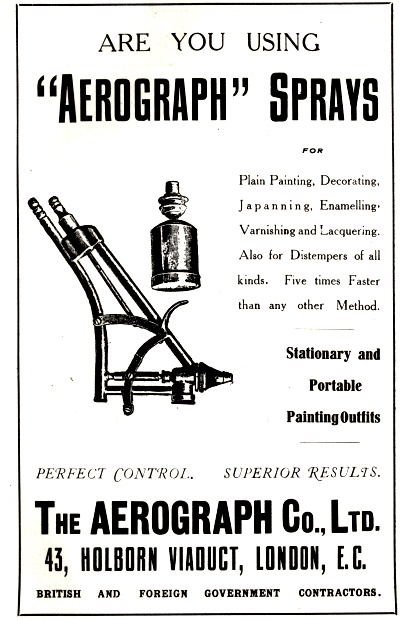
ARE YOU USING
"Aerograph" Sprays
FOR
Plain Painting, Decorating,
Japanning, Enamelling,
Varnishing and Lacquering.
Also for Distempers of all
kinds. Five times Faster
than any other Method.
Stationary and
Portable
Painting Outfits
PERFECT CONTROL. SUPERIOR RESULTS.
The AEROGRAPH Co., Ltd.
43, HOLBORN VIADUCT, LONDON, E.C.
BRITISH AND FOREIGN GOVERNMENT CONTRACTORS.
CRANE'S
SPRAYERS
For ENAMELS, PAINTS, LACQUERS,
VARNISHES, ETC., ARE
—THE GREATEST ECONOMISERS OF TIME—
MATERIAL & LABOUR EXTANT—The Handiest
and most Efficient yet Devised
and further
They ENSURE the Best Results.
Write for details:
FREDK. CRANE CHEMICAL Co.,
Bordesley Green, B'HAM.
W. GOODYEAR & Sons,
Manufacturers, DUDLEY.
SPECIALISTS IN:
Enamelling Stoves
for
All Purposes
WRITE FOR CATALOGUE.
ESTABLISHED ·1760·
If you will come to Homerton to see a
practical demonstration of the finishing
of your own products by the economical
Spraying process, our facilities are at your
service without charge or obligation. Those
facilities are: a fully equipped spraying
plant—probably the first spraying expert in
the Kingdom—and a range of spray paints
covering the entire process from Filler to
Varnish coat, perfected by experience. We
specialise too in paints for Dipping and shall
be glad to demonstrate to you the economy
of either or both.
Berger's
Spray Paints &
Dipping Paints.
Lewis Berger & Sons, Ltd.
Makers of Paints, Colours & Varnishes,
HOMERTON, LONDON, N.E.
Branches—Paris, Copenhagen, Sydney,
Wellington, Bombay, New York.
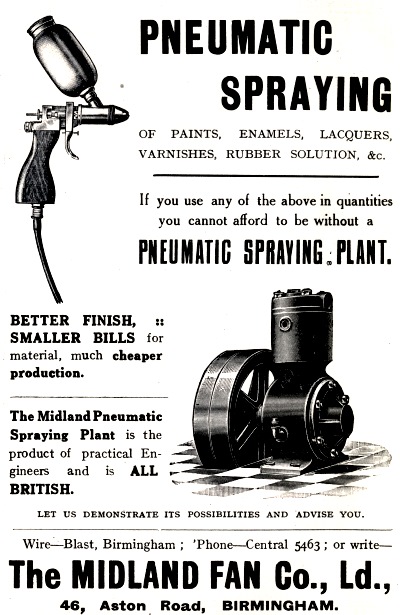
PNEUMATIC
SPRAYING
OF PAINTS, ENAMELS, LACQUERS,
VARNISHES, RUBBER SOLUTION, &c.
If you use any of the above in quantities
you cannot afford to be without a
PNEUMATIC SPRAYING PLANT.
BETTER FINISH,
SMALLER BILLS for
material, much cheaper
production.
The Midland Pneumatic
Spraying Plant is the
product of practical Engineers
and is ALL
BRITISH.
LET US DEMONSTRATE ITS POSSIBILITIES AND ADVISE YOU.
Wire—Blast, Birmingham; 'Phone—Central 5463; or write—
The MIDLAND FAN Co., Ltd.,
46, Aston Road, BIRMINGHAM.
Gittings, Hills
& Boothby, Ld.
BIRMINGHAM.
SPECIALISTS FOR
SPRAYING, DIPPING & STOVING
VARNISHES & PAINTS.
G. H. & B., Ltd., will be pleased to show their Spraying
Installation to any firm desirous of seeing
and testing same—customers' own material
sprayed.
DIPPING TANKS loaned to customers to enable adequate
tests to be made.
DO YOU WANT TO
SAVE MONEY ?
Then take up the most economical methods of painting, viz.,
DIPPING AND SPRAYING.
Gittings, Hills & Boothby, Ltd.,
Varnish and Paint Manufacturers,
LONG ACRE,
BIRMINGHAM.
And at
82, TURNMILL STREET,
LONDON. E. C.
One Man with the Aeron is worth 2 to 10 without
There is not only this 50 to 90% saving in time and labour,
because of the speed that is possible with the AERON
SYSTEM of spraying, but there is also produced a
better quality of finish than is obtainable with any
other method. The surface is absolutely uniform,
smooth and even of thickness. It is free from all sags,
runs, thin spots or fatty edges.
The AERON SYSTEM is simple and easy to operate.
Ordinarily inaccessible places, and carved and irregular
surfaces, are quickly and uniformly finished.
The AERON SYSTEM installed in your finishing room
will produce the utmost in results at the lowest
possible cost.
Address:
The DeVilbiss Manufacturing Co.
71 Newman St.,
Oxford St., London, W., Eng.:
Toledo, Ohio, U.S.A.
Finish Your Products,
Large or Small, Wood or Metal,
with the
Guaranteed
Aeron System
Paints With Air
The AERON SYSTEM of applying varnishes, enamels,
shellacs, lacquers, japans, bronzes, and practically every
kind of finishing material, on wood and metal products
with compressed air, is the result of extensive painting and
mechanical experience, and a comprehensive study of
finishing problems.
The AERON SYSTEM is complete in every detail. Every
angle and problem of the application of finishing materials
is successfully met with a thoroughness and
positiveness—with a certainty of greater quality, speed,
economy and efficiency—by this SYSTEM. There is a
wide variety of "best type" Aerons and Accessory
Equipment, meeting all requirements and enabling the
operator to obtain striking results.
Let us send you full and interesting particulars,
—and a booklet of equipment facts.—
Address:
The DeVilbiss Manufacturing Co.
71 Newman St., Oxford St., London, W., Eng.:
Toledo, Ohio, U.S.A.
Telegrams—Varnish, Birmingham.
ARTHUR HOLDEN & SONS, Ld.
(Established nearly a Century)
Bradford Street, BIRMINGHAM.
Specialists in Spraying Finishes for every Trade.
Spraying Paints, Enamels, Japans,
Varnishes, Varnish Paints, etc.,
FOR STOVING OR SELF-DRYING
IN ALL COLOURS AND QUALITIES.
TRADES ALREADY SUPPLIED:—
Photographic, Optical, Electrical & Surgical
Apparatus Manufacturers. Bicycles, Motor
Bodies, Motor and Cycle accessories. Steel
Toys, Wood Toys, Lamps, Iron Fittings. Mail
Carts, Radiators, Trunks, Weighing Machines,
Scales, etc., etc.
The DeVilbiss Aeron
The most Efficient and Flexible
:: Spraying Machine. ::
Sold by
LLEWELLYN RYLAND, LTD.,
BIRMINGHAM.
Manufacturers of
LACQUERS, PAINTS, JAPANS
AND VARNISHES,
Suitable for Spraying.
Wells' "Lightning" Lime & Colour Washer.
A Great SAVING of TIME, LABOUR AND MONEY.
NO OUTSIDE POWER REQUIRED. OVER 5,000 SOLD.
SAVES its Cost in a Few Days
LIME, WHITING, or COLD WATER PAINTS
applied at a speed of from 10 to 20 square
yards per minute, in a manner superior to
brushwork. One coat with the machine on
rough surfaces is equal to two applied with
brushes.
ENLARGED PATTERNS.
REDUCED PRICES.
No. 6a—Small Size, fed from
pail, 5 gallons £5 5 0
" 4—8 gallons £8 5 0
" 4a On Wheels, same capacity £9 0 0
" 5a—On Wheels, 12 gallons £11 5 0
Nos. 4a and 5a Patterns.
A. C. WELLS & CO.,
MIDLAND ROAD, ST. PANCRAS, LONDON.
Works—Carnarvon Street,
MANCHESTER.
THE
PERKINS CLOSED SYSTEM
OF
HEATING BY HOT WATER
FOR
ENAMELLING, JAPANNING, DRYING, etc.
Schemes & Estimates Submitted Free of Charge.
PERKINS, ENGINEERS, LTD.,
KINGSWAY HOUSE, KINGSWAY, W.C.
Telephone No. Telegraphic Address—
482 Gerrard. "Arktos" Westcent, London.
"PAINT & COLOUR MIXING."
By ARTHUR SEYMOUR JENNINGS.
5th EDITION, REVISED & ENLARGED.
A Practical Handbook for Painters, Decorators, Artists, and all who
have to mix colours.
Containing 300 samples of actual oil and water paints and water
colours of various colours, including the principal graining grounds and
upwards of 600 different colour mixtures, with instructions on colour
and paint mixing generally, testing colours, &c., &c.
With fourteen coloured plates.
Contents.—Paints and Colour Mixing, Colours or Stainers, How to
learn to mix and match colours, Reds and how to mix them, Blues and
how to mix them, Yellows and how to mix them, Greens and how to
mix them, Browns and how to mix them, Greys and Greys, White and
Blacks, Black Japan in colour mixing, Glazing, Graining grounds and
Graining colours, Mixing paints and colours on the manufacturing
scale, Water paints, Distempers, Artists' water colours and how to mix
them, testing colours, notes on harmony, The proportions of materials,
Notes, &c.
POST FREE 5/4.
E. & F. N. SPON, Ltd.,
57, Haymarket, S.W.
THE
PAINTERS' POCKET
BOOK.
By ARTHUR SEYMOUR JENNINGS.
Many thousands of copies of this exceedingly
useful book have been sold.
3s. 3d. Post Free.
SYNOPSIS OF CONTENTS.
Simple methods for Painters' materials.
Behaviour of different pigments.
How to measure Painters' work.
Painters' Prices for all kinds of Paint work, Sign
Writing, Varnishing, Gilding, Enamelling,
Marbling, Graining, Paperhanging, etc., etc.
Many Miniature Stencils which can be submitted
to clients for their selection and afterwards
be increased in size.
Ribbons for Church Decoration.
Defects in Painting and how to remedy them.
Colours and how to mix them.
Hints on Practical Geometry and setting out of
work.
Symbols and Emblems in Church Decoration,
on Flags, in Heraldry, etc.
Poisoning and remedies.
Concise Dictionary of terms used in Painting,
Building, Architecture, Art, Applied Chemistry,
etc., etc., with many illustrations.
Hints on Paperhanging.
Tables for Wallpapers, English, French, and
American.
Table for ceiling papers.
Table of superficial yards.
Table of materials required according to the
surface to be painted.
Roman Numerals.
Table for calculating the price of Linseed Oil
and Turpentine.
Wages Table.
The Orders, Greek and Roman.
Table of Prices.
Table of discounts and percentages.
Colours and Pigments, permanent and otherwise.
Linseed Oil—percentage required for grinding
dry Pigments.
How oils are sold.
How far paints will spread.
Mensuration.
English and American gallons.
Specific gravity.
Table of Thermometrical degrees.
Superficial contents of squares of glass.
Ready reckoner.
Notes of Insurance.
Table of Pigments, etc., etc.
The Trade Papers Publishing Co., Ltd.,
365, Birkbeck Bank Chambers,
High Holborn, W.C.
PRACTICAL BOOKS FOR
PAINTERS.
Post Free.
PAINT AND COLOUR MIXING. A Practical
Handbook for Painters, Decorators, Artists, and all
who have to mix colours. Containing 300 samples
of actual oil and water colours. By Arthur Seymour
Jennings 5/4
HOUSE PAINTING AND DECORATION. A
popular guide, by Arthur Seymour Jennings 2/3
PRACTICAL CHURCH DECORATION. A guide
to the Design and Execution of Decoration of
Churches, Chapels and Ecclesiastical Structures.
By Arthur Louis Duthie 3/3
SCUMBLING AND COLOUR GLAZING, illustrated
with 48 examples of glazed work. By Andrew Millar 3/3
ZINC OXIDE AND ITS USES. By J. Cruickshank
Smith 2/3
PRACTICAL GILDING, BRONZING, LACQUERING
AND GLASS EMBOSSING. Illustrated
by actual examples of Gilded and Lacquered Relief
and other Decorations. By F. Scott-Mitchell 3/3
THE PAINTERS' AND BUILDERS' POCKET
BOOK. By Arthur Seymour Jennings. Consists of
252 pages, containing a large amount of information
of the greatest use to Painters and Builders 3/3
DECORATORS' SYMBOLS, EMBLEMS AND
DEVICES. By G. C. Rothery 3/3
GRAINING AND MARBLING, THE PRACTICAL
ARTS OF. By James Petrie. Each plate measures
17-1/2 × 11-1/2 and gives the different stages of the work.
Published in 14 parts at 2/6 each, or bound volume
25/-
Office of "The Decorator,"
365, Birkbeck Bank Chambers,
High Holborn, London, W.C.
PRACTICAL BOOKS FOR
PAINTERS.
Post Free.
STENCILS AND STENCILLING. For all purposes,
Artistic and Decorative. 154 pages of designs. By
Arthur Louis Duthie 3/3
PAINT AND PAINTING DEFECTS, their Detection,
Cause and Cure. By J. Cruickshank Smith 3/3
PAINTERS' BUSINESS BOOK. A manual of up-to-date
methods of obtaining business, submitting
Estimates, Book-keeping, Buying and Testing
materials, etc., with many tables. By C. E. Oliver 3/3
CLARK'S BOOK OF ALPHABETS, two parts.
For Signwriters, Designers, Decorators, and
Draughtsmen, each 1/2
HEWETT'S DISTINCTIVE LETTERING AND
DESIGNS 1/2
KAEMMERER'S LETTER BOOK. Containing
several hundred alphabets in 140 plates, together
with descriptive text 18/6
THE ART OF SHOW CARD WRITING. By C. J.
Strong. Contains many beautiful Designs 10/-
STRONG'S BOOK OF DESIGNS. Invaluable to
the Signpainter, Show Card Writer, etc. Containing,
in addition to Posters, Show Cards, Ribbons, etc.,
33 pages of ornamental work in Colour 20/-
ATKINSON'S SIGN PAINTING, replete with original
Designs, Colour Combinations, etc. 12/7
GRAINING, ANCIENT AND MODERN. By Wm.
E. Wall 12/4
Office of "The Decorator,"
365, Birkbeck Bank Chambers,
High Holborn, London, W.C.
THE OFFICIAL ORGAN OF
The London Association of Foremen Engineers.
The Leeds Association of Engineers.
The Stoke-on-Trent Engineers' Association.
Sixpence a Copy.
THE
"Managing Engineer."
Five Shillings a Year.
PUBLISHED BY
THOMAS TOFTS,
93 & 94, Chancery Lane, London,
W.C.
Transcribers Notes:
Punctuation and spelling inaccuracies were silently corrected.
Archaic and variable spelling has been preserved.
Variations in hyphenation and compound words have been preserved.
Fig 125. Design for Show Card is wrongly shown to be on page 223 in the list of illustrations. This has been corrected to page 233.
In the index 'Sheets Metal Dipping 40, 58', has been altered to 38, 58.
Page 40 was a blank page and page 38 is near and in context but maybe an inaccurate alteration.
Both middle and modern decimal points are used.
Fig 114 has been corrected by rotating it 180 degrees.