The author trusts that he has made it clear to the reader that
the subject of paint and colour mixing is far more comprehensive
than might at first sight appear. Yet it is of such great importance
that every house painter worthy of the name should make himself
acquainted with it, and, unless he be colour blind, he can do so
without difficulty if he will only take the trouble to make a number
of tests and experiments.
In “putting on,” i.e., engaging the services of journeyman, the
master painter will find, as a rule, that only about one in twenty has
any knowledge of colour mixing, yet these men could, if they would
only do so, easily make themselves at least fairly proficient in the
subject by devoting their spare time to making various mixtures
and using a box of ordinary artists’ oil colours for the purpose. A
very good box can be purchased for about ten shillings.
Having given some practical tests for colours, we may now add
one or two for turpentine.
—It is of considerable
importance that turpentine used for painting should be quite pure.
To test the purity in a practical way pour a few drops on a sheet of
white writing paper; if it is pure the mark will evaporate in a few
minutes, leaving the paper quite clean. If, however, paraffin oil has
been added to the turpentine it will leave a greasy mark on the paper,
which will not disappear for several hours or even days. Turpentine
is sometimes adulterated with benzine. The test above will not
detect this, as the benzine will not leave a greasy mark. The
evaporation, however, will be more rapid than when the turpentine
is pure. When turpentine is very old, it becomes “gummy” or
thick, and is unsuitable for mixing with paint. This condition is
indicated by a greasy mark left on writing paper when a few drops
are poured upon it.
Another very simple test for the purity of turpentine is to place
a sample in a small white bottle and shake vigorously, carefully
observing the time that it takes the bubbles that arise from the
agitation to disappear. If the turpentine is adulterated with paraffin
oil the bubbles will hold longer than when it is pure. The best plan
is to have a bottle containing pure turpentine and another containing
the suspected sample, and to shake up both together, comparing the
rapidity with which the bubbles disappear.
Paraffin oil is also sometimes detected by smell: pour a couple
of drops on the palm of the hand, rub the two hands briskly
together, when the characteristic smell of paraffin will be easily
detected if any considerable amount be present. Turpentine is
sometimes adulterated with rosin spirit, and this can only be detected
by means of analysis.
—To ascertain with absolute certainty whether a
sample of linseed oil is pure or not is by no means easy, and can
only be done by aid of chemistry. There are various methods by
which the adulteration can be ascertained, but we hesitate to print
them here, because they may prove misleading to the uninitiated.
The experienced painter has two tests of his own, viz., smell and the
working of the oil, and if these lead him to suppose it is adulterated
his only safe plan is to obtain the services of a competent chemist.
We next reach a consideration of the different qualities of the
principal pigments, and can best show these by means of tables.
Pigments Liable to Change under the Influence of Sulphuretted
Hydrogen, Air, and Moisture:
Yellow.—Turner’s yellow, chrome yellow, mineral yellow, Naples
yellow.
White.—Cremintz white, flake white, pearl white.
Red.—Red lead, purple red, iodine scarlet.
Green.—Verdigris, Scheele’s green, emerald green, mountain
green.
Blue.—Prussian blue, Antwerp blue.
Orange.—Orange chrome.
Pigments Little Liable to Change under the Influence
of Sulphuretted Hydrogen, Air and Mixture:
White.—Zinc white, constant white, tin white.
Red.—Vermilion, red ochre, Indian red, madder lakes.
Yellow.—Yellow ochre, barium chromate, zinc chromate,
aureolin, raw sienna.
Green.—Chrome green, cobalt green.
Blue.—Ultramarine, smalt, Thenard’s blue.
Brown.—Vandyke brown, raw umber, burnt umber, manganese
brown, sepia.
Black.—Ivory black, lamp black, Indian ink, graphite.
Orange.—Orange vermilion, burnt sienna.
Pigment Liable to Deterioration when in Contact with
White Lead, Chrome or other Lead Pigment:
Yellow.—Yellow orpiment, king’s yellow, Indian yellow, gamboge.
Red.—Iodine scarlet, cochineal, carmine.
Orange.—Golden antimony sulphide, orange orpiment.
Green.—Sap green.
Blue.—Ultramarine.
Pigments which are Little Affected by Heat, and which
may be Employed when the Material has to Stand Fire:
White.—Tin white, barium white, zinc white.
Red.—Red ochre, Venetian red, Indian red.
Yellow.—Naples yellow, antimony yellow.
Blue.—Smalt and royal blue, ultramarine.
Green.—Chrome green, cobalt green.
Orange.—Burnt sienna, burnt ochre.
Brown.—Burnt umber, manganese brown.
Black.—Graphite, mineral black.
Colours that may be Used with Lime:
White.—Permanent white, i.e., baryta white, gypsum, zinc
white.
Red.—The vermilions, light red, Venetian red, Indian red,
madder lakes.
Orange.—Cadmium, orange chrome, Mars orange, burnt sienna,
burnt Roman ochre, light red.
Yellow.—Aureolin, cadmium yellow, lemon yellow, Naples
yellow, Mars yellow, raw sienna, yellow ochre, Roman
ochre, transparent gold ochre, brown ochre, Indian yellow,
Oxford ochre.
Green.—Oxide of chromium, transparent oxide of chromium,
viridian, emerald green, malachite green, verdigris, terre
verte, cobalt green, chrome green.
Blue.—Genuine ultramarine, artificial ultramarine, new blue,
permanent blue, cobalt blue, cerulean blue, smalt.
Purple.—Purple madder, Mars violet.
Brown.—Bone brown, bistre, Prussian brown, burnt umber,
Vienna brown, Vandyke brown, Cologne earth, asphaltum,
Cassel earth, manganese brown.
Citrine.—Raw umber, Mars brown.
Blacks.—Ivory black, lamp black, blue black, charcoal black,
Cork black, Indian ink, black lead, drop black, plumbago.
We think it well to include here some information concerning
brushes, but may first give a brief description of the way in which
they are made, taking the firm of G. B. Kent & Sons, Ltd., as
an example, as the author had the pleasure of going over their
factory some time since. The following is his account written for
“The Decorators’ Magazine”:—
A superficial observer may be inclined to think there is no
particular advantage to the painter and decorator in possessing a
knowledge as to how the tools he uses are made. Yet such a knowledge
may help him considerably in judging as to the quality of those
tools, and it will be at once acknowledged that an ability to discriminate
in this respect is of considerable value. For brushes vary
greatly in quality, far more so, perhaps, than our readers may imagine
possible. Everyone knows that there are good brushes that cost
more than a trifle, and rubbishy goods, chiefly of foreign make,
that can be bought for, perhaps, half the amount. Probably
there is not a reader who does not fully understand that it is far
better in the end to buy the best quality brushes, that is, that it is
cheaper to pay a higher price, because the work with such brushes
can be done quicker and better than it can by the inferior ones, and
also because the superior quality lasts much longer. Those things
are well understood among most painters, and even if some
of them will use cheap stainers and lose money in consequence,
they have, at least, learned the lesson of the necessity of using only
best quality tools.
But it is not a comparison between high grade and low grade
brushes that we now want to make, it is rather to direct attention
to the difference that exists in the actual quality of so-called first-class
tools of different makes. It is this difference than can best
be understood after inspecting the process of brush making, and it
must be acknowledged that adulteration can be carried on in the
manufacture of brushes to a considerable extent. Take a common
ground brush as an example. The actual brush part should consist
wholly of hog’s bristles, for there is nothing yet discovered that
gives better results. Yet there are on the market many brushes
marked “pure bristle” which really contain more or less a large
proportion of horsehair or other material which makes a poor
substitute, but which cannot be easily detected, in fact, it is the
difficulty of detection which has probably given rise to the objectionable
adulteration referred to.
The objection to horsehair in a painter’s brush is that it is
flabby and without spring, but its presence in adulterating brushes
can be understood when it is said that approximately the price of
horsehair is 1s. 9d. to 2s. 2d., and bristles 8s. to 9s. per pound.
It certainly requires an expert to state positively whether horsehair
is included or not, but there are certain signs that, with care, will
determine the matter, at least to a certain extent. The real bristle
has its end split—called a “flag” end—the root end is considerably
larger and cannot be mistaken. The spring or elasticity is another
indication of the bristle. The horsehair, on the other hand, is the
same size both ends, and has no flag end; if the suspected bristles
be viewed under a strong reading glass the difference can be told
without a great deal of difficulty.
At the works of Messrs. G. B. Kent & Sons, Ltd., the
author was shown how suspected brushes sent out had been
dissected and the various parts divided up, and it was surprising to
see how much horsehair could be included in a brush without giving
it any out-of-the-way appearance. There were little piles of horsehair
of different lengths, while the bristles were all sorted into other
piles, each of different lengths. Photographs of the brushes that
have been dissected in this way have been distributed through the
trade, and they have no doubt proved of use in showing painters
that adulteration in brushes is carried on to almost as great an
extent as it is in paint materials. No adulteration whatever in
painting brushes is permitted in the factory of G. B. Kent & Sons.
Certainly the brush department in any brush manufactory,
which is of the most importance is the bristle room, and it was to
this that the author was first taken. There were bristles of many
different kinds, most of them tied up into neat bundles ready to be
afterwards dealt with. For instance, Siberian Okatka, and perhaps
most important to my readers because they make the best paint
brushes, having an excellent spring and being stiff. They are very
costly and are rarely used by themselves, nor is it necessary,
because other varieties of bristles may be mixed in, and it is this
mixing or blending that constitutes so important a part in the brush
manufacturer’s art. Indeed, the purchase and blending takes years
of careful study to learn. One class of bristle is introduced into
the mixing to give strength, another straightness, another solidity,
another colour, and it is the judicious blending, the knowledge of
which is acquired only by much experience, which makes a first-class
brush for first-class work, and having the requisite spring and
durability and the band of which will not burst.
The process of dividing the bristles into uniform lengths
is termed “dragging,” a very interesting process which requires
considerable expertness on the part of the operator. A handful of
bristles, after being mixed, is placed against a gauge, and the
operator, grasping firmly those bristles which project beyond a mark
which indicates the required length, withdraws them with his thumb
and finger and places them aside. The whole bundle having been
gone over in this way, a second dragging to the next mark is made,
and so on until the bristles are arranged in little piles of uniform
lengths.
The operation of “mixing” is also interesting. This is done
in order to obtain an uniform colour and quality in the bristles.
First, all the bristles of different colours are piled on the top of one
another, varying considerably in colour in the different layers from
top to bottom. Perhaps there will be one layer nearly white and
another nearly black. If these were all mixed up indiscriminately
to make a brush, the result would be a very patchy appearance that
would not be liked. The object, therefore, is to have an equal
admixture of black and white throughout. A workman takes in his
hand a portion of the bristles from top to bottom, cutting through
all at once. These he holds in his two hands and ‘jabs’—for the
want of a better word—through a steel comb which is fixed upright
before him. This mixes the different coloured bristles, and at the
same time pulls out inferior or woolly parts that may have been left
in. As each handful of bristles is dressed in this way it is laid
aside, and when the whole is completed the second dressing is gone
through in the same way as the first, the result being that the
admixture is perfect, and the appearance of any one part of the pile
is exactly the same as that of the other. It is essential also that all
the bristles should lie the same way, and, as in the rough an uncertain
small proportion of the bristles arrive with their heads the
wrong way, to extract them another small comb, termed an ‘engine,’
with teeth very close together, is used; the ‘flag’ end of the handful
is combed over this, and the roots of the ‘turned’ hairs catch in
the comb.
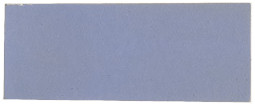
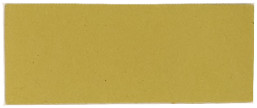
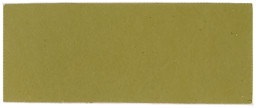
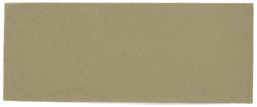
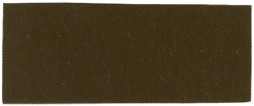
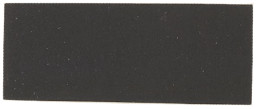
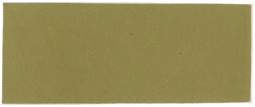
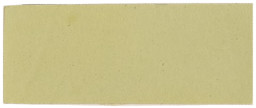
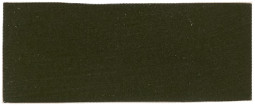
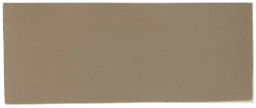
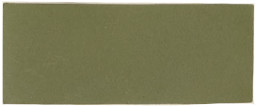
|
OLD ROSE |
MOSS GREY |
|
IVY GREEN |
WARM GREY |
|
GREEN SLATE |
LEAD |
|
SEA FOAM |
SILVER GREY |
|
APPLE GREEN |
STONE |
|
SLATE |
MIDDLE STONE |
|
GRANITE |
DARK OAK |
|
ASH GREY |
IVORY |
It will be unnecessary to describe in detail how every brush
is made, but an ordinary ground brush will serve as an example.
The actual manufacture is not difficult. First the bristles are
carefully weighed out so that every brush of the same grade has
exactly the same quantity of bristle in it as a corresponding brush;
great care being taken not to disturb the way in which the bristles
lie. They must all point one way, and naturally they have a certain
bend. The outside of the brush is usually made of white bristles,
while the inside is grey and yellow. This is almost a universal rule,
for although the inside bristles are of equal spring to those outside,
still trade demands white bristles outside and has them. The reader
will understand that the bristles that are to form the ground brush
about to be made are lying on the scale, these having been weighed
they are taken off, the white bristles being underneath, so as to
form the outside of the brush. The workman takes all the bristles
carefully, but firmly, in both hands, and turns the bristle round his
thumb in such a way that the bend of the bristles all turn inward
towards the centre, and the white bristles or ‘cappings’ lie in an even
rim round the rest, and the ‘knot’ is then tied round with string.
The knots are then dipped in hot cement and kept warm standing
upon a hot plate.
The next process is ‘driving,’ which consists in forcing the
handle through the bristles, which has been previously inserted in its
binding, and this tightens the brush by compression.
Varnish brushes, as a rule, are shaped in a manner somewhat
similar to the method of making artists’ pencils, that is to say, the
wedge shape is produced by placing the bristles into a small circular
box, the bottom of which is concave. Hence, it will be seen that
the bristles, if even they are all of the same length, have the
necessary chisel-edge for a varnish brush. Pegged brushes are
made under a patent of Messrs. G. B. Kent & Sons. Speaking
roughly, it consists of driving pegs into the back woodwork of the
brush so as to throw the parts into greater compression and to hold
the bristles tighter. After the brush is made, the bristles are
thoroughly scoured on a stone with soap and water. After the brush
is finished, the bleaching chambers are reached where, by means of
sulphurous fumes, the bristles are bleached to the required degree of
whiteness.
—However good a brush may be it
will soon be ruined unless it is properly treated when out of use.
The following hints will suffice as a guide in this respect:—
Writing Pencils, etc.—Wash in turpentine until quite clean, and
if they are not to be used for some time dip in olive oil and smooth
from heel to point.

RED SABLE.
Stipplers.—Wash thoroughly in pure soap and hot water
rinsing with cold water. Place point downwards to dry.
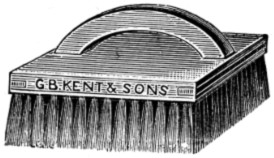
STIPPLER, WITH BRIDGE HANDLE.
Varnish Brushes.—The best method of keeping varnish brushes,
in the opinion of the author, is to suspend them in the same
description of varnish as that they are used for. As this is not
always possible boiled oil may be used instead.

VARNISH BRUSH—GALVD. WIRE BOUND.
Paint Brushes.—Mr. Ernest N. Kent gives the following
instructions in “Specifications”:—

SASH TOOL.

FLAT OVAL GROUND BRUSH.
Brushes made for Use in Colour should first be soaked well
in water to swell the bristle in the binding. This applies also to
whitewash brushes which are bound either by wire or leather.
A Brush after Use should be thoroughly cleansed out in turps
or soap and water. If left in water any length of time they are
liable to twist, and the bristles lose their elasticity.
A Brush made for Paint should not be used in varnish, the
spirit of which dissolves the cement with which it is set, and loosens
the bristles. When a ground brush has been well worn down in
colour, it may, however, be used in varnish.
A Brush made for Varnish must on no account be put into water
as the water destroys the cement.
Varnish Brushes when not in use should be suspended in either
varnish or oil, the brush not resting on the bristles. No brushes
should on any account be kept in turpentine.
Stippling Brushes should be well cleaned and dried after use,
the bristle being carefully kept from crushing; a box in which
they can be slid, allowing the bristle to hang downwards is recommended.
Should a Brush become quite hard with Paint it should be soaked
for twenty-four hours in raw linseed oil, after which time in hot
turpentine.
—Take 2lbs. of ground litharge, 2lbs.
of red lead, 1lb. of sulphate of manganese, 1⁄2lb. of sugar of lead.
Mix these to a paste with light coach japan, put the paste into a
gallon jar and add half a gallon of pure turpentine. Let this stand
for three days, stirring occasionally, then pour off the resultant
liquid which forms first-class terebine. You can afterwards pour in
another half gallon of turps, well stir and pour off as before. This
can be done a third time when the chemicals will have become
exhausted.
Iron Cement.
—A cement suitable for filling up defects in cast
iron is made by mixing one part of bone black, one part of powdered
gum arabic, one part iron dust or very fine iron filings, and two
parts of plaster of Paris. This powder is made up into a stiff body
with water, but only sufficient for immediate use should be made,
as it sets very rapidly. In time it becomes as hard as iron.
Buff Paint.
—The following mixture will produce an excellent
buff paint for ordinary purposes. Grind in raw linseed oil 3cwt. of
white lead, 4cwt. of grey barytes, 8lbs. of genuine red oxide,
100lbs. of J.F.L.S. ochre, and 8lbs. burnt Turkey umber.
Torbay Paint, Imitation.
—Grind together 5cwt. of grey
barytes, 1cwt. Paris white, 4cwt. of French ochre, and 4lbs. of
genuine red oxide of iron.
Drum Paint.
—Dissolve rosin in an equal bulk of naphtha and
colour with lamp black for black, celestial blue for blue, Venetian
red for red, and so on. A little oil added will be of assistance.
Bronze Paint Tins, Dipping Solution for.
—Dissolve
asphaltum in spirits of turpentine and thin down to the required
consistency.
This class of paint is much used in America, and they are made
in a variety of colours. The necessary qualities are great durability
under wear. Three coats are usually given, but it is very necessary
that sufficient time be allowed to elapse between the application of
each coat to enable a thorough drying to be effected. The thinners
for each recipe will be the same, namely, gloss oil twenty gallons,
linseed oil eight gallons, turpentine japan six gallons, benzine japan
two gallons, turpentine four gallons, benzine three gallons, making
together 52 gallons. The pigments will be as follows:
Buff.
—Yellow ochre, 175lbs.; whiting, 25lbs.; zinc, 25lbs.;
Portland cement, 3lbs.
Dust Colour.
—Zinc white, 175lbs.; white lead, 25lbs.;
whiting, 50lbs.; lamp black, 1lb.; yellow ochre, 8lbs.
Lead Colour.
—The same as dust colour, excepting that 5lbs.
of lamp black should be used and 3lbs. of yellow ochre.
Terra-Cotta.
—Yellow ochre, 100lbs.; Venetian red, 17lbs.;
zinc, 25lbs.; whiting, 70lbs.
Maroon or Indian Red.
—Indian red, 100lbs.; Venetian red,
50lbs.; zinc, 25lbs.; whiting, 25lbs.
Light Brown.
—Yellow ochre, 100lbs.; whiting, 70lbs.; mineral
brown, 15lbs.; zinc, 25lbs.; Venetian red, 6lbs.
This class of paints is much used in the United States, the
article that is to be painted being dipped into the paint so as to save
the labour of applying it with a brush in the ordinary manner.
Black Dipping Paint.
—In this case two separate dippings
are required, first with the following mixture which acts as a primer.
Take 100lbs. of dry ground slate, 100lbs. of whiting, 50lbs. of zinc
white, 2 gallons of linseed oil, 20 gallons of gloss oil, and 5 gallons
of benzine. These being properly mixed form a priming coat which
dries fairly quickly. When dry dip the article into a paint made of
the following mixture: 25lbs. of drop black, 31⁄2 gallons of grinding
japan, half gallon of turpentine, 71⁄2 gallons gloss oil, and one gallon
of turpentine.
Yellow Dipping Paint.
—A primer is made by grinding
together 14lbs. of golden ochre, 11⁄2 gallons of grinding japan, 2
gallons of gloss oil, and half gallon of turpentine. The paint is
made of 30lbs. of medium chrome yellow, 2 gallons of grinding
japan, 11⁄2 gallons of turpentine, and 7 gallons of gloss oil. This
makes 12 gallons of paint.
Red Dipping Paint.
—Grind together 80lbs. of bright scarlet
or Turkey red, 80lbs. best Paris white, 38 gallons gloss oil, 4 gallons
of benzine, 2 gallons of linseed oil, and 2 gallons of benzine japan.
This makes 50 gallons of paint.
Machinery Dipping Paint.
—Grind together 100lbs. of dry
ground slate, 25lbs. zinc white, 1 gallon of linseed oil, 2 gallons of
gloss oil, and 1 gallon of japan drier.
Dipping White.
—Grind 100lbs. of zinc white with 90lbs. of
Paris white in 2 gallons of linseed oil, 32 gallons of gloss oil, and 11
gallons of benzine. This makes 50 gallons of paint.
The above recipes for dipping paints have been modified from
recipes which originally appeared in “Drugs, Oils and Paints,” of
Philadelphia.
There has been a very considerable amount of difference of
opinion as to the best paint for iron. An elaborate course of
experiments were made and the results reported in the columns
of the “Engineer” some time since. The results of these
experiments showed that no rust whatever resulted from either of
the following mixtures, which may therefore be recommended as
good paints for iron.
Red Lead Paint.
—Red lead, 88 parts; raw linseed oil, 12
parts.
Cheaper Red Lead Paint.
—Cheaper red lead, 45 parts;
barytes, 45 parts; raw linseed oil, 10 parts.
Red Lead Paint, Cheaper Still.
—Very cheap red lead, 22
parts; barytes, 66 parts; raw linseed oil, 12 parts.
Vermilionette Paint.
—Barytes, 33 parts; deep vermilionette,
44 parts; pale vermilionette, 14 parts; raw linseed oil, 7 parts.
Permanent Red Paint.
—Permanent red, 88 parts; raw
linseed oil, 7 parts.
Although an ordinary putty is made of dry whiting with raw
linseed oil, a modification of this mixture is often necessary and
desirable.
Soft Putty.
—One pound of white lead mixed with 10lbs. of
whiting and ground with the necessary quantity of boiled linseed
oil makes an excellent putty. About half a gill of best olive oil or
cotton seed oil added, prevents the white lead from hardening and
preserves the putty in a state sufficiently soft to adhere at all times.
Export Putty.
—The above recipe answers for putty that is to
be sent abroad, the cotton oil preventing it from going hard. Sometimes
the white lead is omitted.
Putty for Exposed Positions.
—A very strong putty is made
of boiled oil and whiting and is suitable for exposed positions, such
as skylights. It is not adapted for keeping, as it gets too hard.
Putty for inside work that is ground in raw linseed oil may be made
by adding a little white lead.
Hard Putty.
—Mix dry red lead with boiled oil and turpentine
varnish. This may be used immediately, as it soon gets hard.
French Putty.
—Boil 7 parts of linseed oil with four parts of
brown umber for two hours. Then add 51⁄2 parts of whiting and 11
parts of white lead and mix the whole. This putty is very durable
and adheres well to wood.
Imperishable Putty.
—Various recipes for a so-called imperishable
putty have been given. The one published above, named
French putty, is very durable, but it may be varied by boiling
together for two hours 31⁄2lbs. of linseed oil and 2lbs. of brown umber.
Stir in one ounce of beeswax, take off the fire, and mix 2³⁄4lbs. of
whiting and 51⁄2lbs. of white lead.
Wood and Glue Putty.
—Dissolve glue in water and add as
much very fine sawdust as may be required.
Blackboard Paint.
—Mix 5 oz. of lamp black and 3 oz. of
superfine flour of emery in half a gallon of shellac varnish or patent
knotting. This gives a fine slating. Shellac varnish may be made
by dissolving 1lb. of orange shellac in half a gallon of methylated
spirits. Another recipe is: Dissolve 1lb. shellac in one gallon of
methylated spirits. When dissolved add 1lb. best ivory black, 5 oz.
of best flour of emery. Mix and put in a stoppered bottle, shake
well before using. In applying this it must be done rapidly, and
only a little of the paint should be poured out at a time, as the spirit
rapidly evaporates. In applying it to old blackboards one coat is
usually sufficient.
Whitewash for Poultry Houses.
—In order to prevent the
breeding of vermin the whitewash used for poultry houses should be
mixed with a little gas tar—not coal tar. It may be obtained at any
gas works, and should be used in the proportion of about a quarter
of a pint to the pailful of ash. To bind the whitewash, flour made
into a paste with hot water may be used, and is better than glue
size as it does not decay and will not injure the fowls.
An excess of driers in paint often gives rise to blistering.
Boiled oil, if of good quality, will, when applied to glass, dry in
24 hours.
Tar should always be applied hot.
Dark boiled oil may be pure, but it will not produce good work.
A little varnish added to paint, often improves both its appearance
and durability.
In painting over bad stains, tar, etc., a coat of shellac varnish
will usually give a good surface on which the paint will dry.
Ochre makes a good and cheap priming coat, if it is very fine.
To test patent driers, mix it with raw linseed oil, in the proportion
of one to three, and apply to glass. If still tacky at the end
of 24 hours, the driers may be looked upon as being of inferior
quality.
Varnish brushes are best kept, when not in use, by being suspended
in the same kind of varnish in which they are ordinary used.
For thinning gold size, use a little boiled oil, not turpentine.
The practical painter should have an “educated” nose—that is,
one that can at once detect adulteration in oil and turpentine.
To mix varnishes is sometimes necessary, when the particular
kind required is not at hand. But it is always a bad plan, and is
never desirable. When it must be done, do not use the varnish for
a few days.
An even temperature is of the greatest importance in obtaining
good results from varnish. Coach painters’ shops are usually kept
exactly at the same heat, while dust and draughts of cold air are
rigidly excluded. This is one of the reasons why coach painters
are able to turn out such fine work.
Success in repainting ironwork largely depends in removing all
rust, scale, etc. For this purpose, wire brushes should be used, as
they greatly facilitate the operation.
Luminous paint which, if exposed to the light during the day,
will give off sufficient light at night time to enable one to see the
time by a watch, may be had to last several years, if protected by a
piece of glass from the weather, and it is extremely useful for certain
positions where it is not desired to burn a light.
Fineness of grinding is a most important quality of all tinting
colours, but in none more so than in the umbers and siennas prepared
for grainer’s use. It is of equal importance that the tone and
colour be pure. Sometimes this class of colours are toned up with
chrome, but this is objectionable, and the right tone of sienna can
only be expected when the correct quality of crude earth is selected.
Tube colours are now becoming so popular among the highest
class painters and decorators that the use of dry colours will soon be
considered obsolete. When the colours are put in tubes, waste is
almost wholly prevented, while their use keeps the colours moist
for a considerable time.
Two coats of patent knotting or shellac varnish may be given to
cover stains, damp spots, or other work which will not take the
paint. Even tar spots thus treated may be neutralized.
Grained work should never be varnished until after 6 or 7 days
from the time it is finished. This delay will render the surface
much more durable than it would be if varnished immediately.
Spring and summer are not the best for painting, as many suppose.
The autumn is better, as the work is then, as a rule,
thoroughly dry and in the best condition to take the paint.
To obscure window glass, the best plan is to apply a coat of
matting varnish, which is specially made for the purpose. It looks
very neat, and effectively obscures the glass, although it shuts out
very little of the light.
A rough way of testing a brush is to pluck a few bristles and to
burn them by applying a match. If they are true bristles they will
give off an unmistakable odour, will frizzle up while burning, but
will not leave an ash. Fibre, on the other hand, burns without
smell, and leaves an ash.
Embossing on glass is usually done by means of hydrofluoric
acid. The design is pounced or sketched on with French chalk.
Then every part that is not to be embossed is painted over with a
special Brunswick black. A little wall of tallow is then built all
around the pane of glass laid flat, and the acid is gently poured on.
In about half an hour it has eaten into the glass sufficiently to form
a well-defined pattern. The acid is poured off into a guttapercha
bottle, the tallow removed, and the surface washed with clean
water. The black is softened with turpentine and removed by
means of an old chisel.
A priming coat can never prove satisfactory unless it is composed
of very fine materials. White lead, red lead, or white lead
and ochre are among the best primers.
The best tests of linseed oil for the practical man are the senses
of smell and taste. The analysis of linseed oil is a very difficult
process, and every oil dealer should educate his senses by constant
practice and recognise the pure oil immediately when he smells or
tastes it. Adulteration in boiled oil is more difficult to detect than
it is in raw oil.
Never mix two different kinds of driers in a paint; they may
re-act upon one another and actually retard the drying of the paint.
Too much driers in paint will destroy its durability and may
affect the gloss.
Messrs. Wilkinson, Heywood & Clark, Ltd., 7, Caledonian
Road, London, N., have favoured the author with samples of their
colours, which he finds, after examination, to be of a high order of
excellence. Their white oil varnish is also highly recommended,
being almost colourless and not turning yellow.
In preparing plaster figures for showing samples of gold paint
it is necessary first to give a heavy coat of shellac to prevent
absorption.
Perhaps not one painter in a thousand knows that water glass
(silicate of soda) makes an excellent size for wall paper. It will not
wash up the pattern, and it forms a foundation for the paper varnish
that makes it stand out admirably.
The priming coat for new pine may be made by mixing a stone
of white lead in oil with an equal quantity of patent driers. About
one pound of turpentine and a pound and a half of raw linseed oil
will be required.
—As already stated we cannot
spare room to deal with this important subject, but may give one or
two notes on the subject. The following is a useful list taken from
“Colour,” by George H. Hurst. A somewhat similar list will be
found in “Colour” by Professor A. H. Church. The names and
addresses of the publishers of these two books are given on another
page.
—
| Crimson |
and |
orange |
Bad. |
| „ |
„ |
yellow |
Inferior. |
| „ |
„ |
green |
Strong, but harsh. |
| „ |
„ |
blue |
Good. |
| „ |
„ |
violet |
Bad. |
| „ |
„ |
gold-yellow |
Good. |
| Scarlet |
and |
yellow |
Bad. |
| „ |
„ |
green |
Inferior. |
| „ |
„ |
greenish-blue |
Good. |
| Scarlet |
and |
blue |
Good. |
| „ |
„ |
violet |
Bad. |
| Orange |
and |
yellow |
Poor. |
| „ |
„ |
yellow-green |
Fair. |
| „ |
„ |
green |
Strong-poor. |
| „ |
„ |
green-blue |
Fair. |
| „ |
„ |
blue |
Good. |
| „ |
„ |
violet |
Strong-good. |
| Orange-yellow |
and |
crimson |
Poor. |
| „ |
„ |
scarlet |
Poor. |
| „ |
„ |
green |
Bad. |
| „ |
„ |
blue-green |
Bad. |
| „ |
„ |
green-blue |
Fairly good. |
| „ |
„ |
blue |
Excellent. |
| „ |
„ |
violet |
Good. |
| Yellow |
and |
crimson |
Poor. |
| „ |
„ |
green |
Bad. |
| „ |
„ |
blue-green |
Very bad. |
| „ |
„ |
blue |
Only fair. |
| „ |
„ |
violet |
Very good. |
| Green |
and |
blue |
Very poor. |
| „ |
„ |
violet |
Moderate. |
| „ |
„ |
red |
Good. |
The author has thought it might be of service to his readers to
include a list of books which would probably be useful to the purchaser
of this work. The list below includes the most modern and
up-to-date works, together with their prices and publishers. A very
brief description is appended.
PAINTING & DECORATING, by Walter J. Pearce,
second edition, 1902. Price, 12s. 6d. Published by Chas. Griffin
& Co., Ltd., London. This is a book of 312 pages and several
coloured plates. The first edition was published in 1898, and it
contains information on every branch of house painting and decorating.
It is the work of a practical painter, who is also an artist, and
who has lectured on the subject at the Manchester Technical
School for several years past. The book is highly recommended.
PAINTERS’ COLOURS, OILS & VARNISHES, a
Practical Manual by George H. Hurst, F.C.S. This work contains
over 500 pages. The third edition was published in 1901 by
Chas. Griffin & Co., Ltd., Exeter Street, Strand, E.C. The book
contains detailed information of the most practical and thorough
character concerning all pigments, colours, colour and paint
machinery, paint vehicles, such as paint oils, turpentine, etc., driers
and varnishes. As a manual treating of painters’ materials it will
be found most useful to painters who desire to know the properties
of the materials they use.
PRANG’S “STANDARD OF COLOUR.” This work is
very useful to colour mixers. It consists of seven plates, each
plate consisting of 168 colours, tints or hues. (Arthur Ackerman,
Regent Street, S.W.)
“HOUSE PAINTING, GRAINING, MARBLING AND
SIGN WRITING,” by Ellis A. Davidson. This book comprises
9 coloured plates of wood and marbles, 150 wood engravings and a
full treatise on the process of house painting, sign writing, etc.
(Crosby, Lockwood & Son.)
“CHEMISTRY OF PAINTS AND PAINTING,” by
Professor A. H. Church, published by Seeley & Co., Gt. Russell
Street, W.C. This is a reliable and exhaustive treatise on pigments,
oils, varnishes and other materials used by artists.
“PIGMENTS, PAINT AND PAINTING,” by George
Terry, published by Messrs. E. & F. N. Spon, Ltd., London, 7s. 6d.
“MANUFACTURE OF PAINTS,” by J. Cruickshank
Smith, B.S.A., published by Scott, Greenwood & Co., London,
7s. 6d.
“COLOUR.” A handbook of the theory of colour by George
H. Hurst, F.C.S., with 10 coloured plates and 22 illustrations.
Published by Scott, Greenwood & Co., London, 7s. 6d.
“COLOUR.” A text book of modern chromatics, with
application to art and industry, by Professor Ogden Rood, 3rd
edition, 5s.
“COLOUR.” An elementary manual for students, with 6
coloured plates, by Professor A. H. Church. Published by Cassell
& Co.
“THE MODERN WOOD FINISHER,” by F. Maire.
This is a thoroughly practical little work on Wood Finishing in all
its branches. Price 2s. Published by “The Western Painter,”
Journal Building, Chicago, Ill., U.S.A.
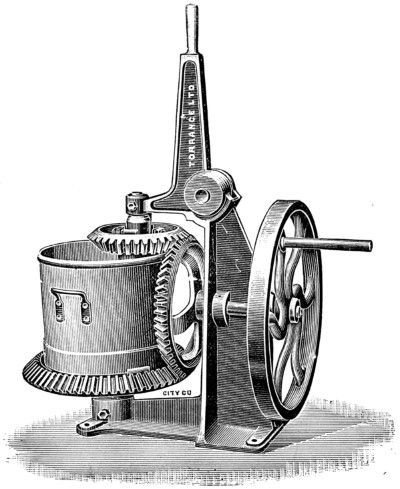
The Author regrets that in the text the address of Messrs.
Torrance & Sons, Ltd., is given incorrectly. It should be Bitton, near
Bristol, Glos.