CHAPTER I.
“Happy the man who has the town escaped;
To him the whisp’ring trees, the murmuring brooks,
The shining pebbles, preach
Virtue’s and wisdom’s love.”
THE START.—UNWARRANTED ASSUMPTIONS.—OUR
GUIDES AND OUTFIT.—A FLIMSY WHARF.—RAILROADING
OF THE OLD DAYS.—CONTEMPTIBLE DECEIT TOWARD
DUMB ANIMALS.—COMMENCEMENT OF FUN ON
THE “CARRIES.”—WE GO INTO CAMP.—FIRST NIGHT
IN THE WILDS.
On the 11th of September I landed
at the Mount Kineo House, Moosehead
Lake, fully equipped for a voyage
of over four hundred miles
through the wilderness of Maine to
New Brunswick. Colonel G., my
comrade adventurer, having arrived
a few days previous, had engaged the
guides, canoes, provisions, and other
accessories, so there was little to do save discard the
habiliments of civilization.
Two days after, on the morning of the 13th, we started
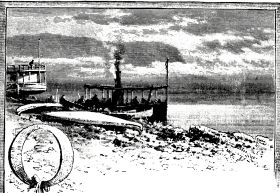
from the Kineo Dock on the little steamer Day
Dream for the northern extremity of Moosehead Lake,
at which point we were to bid adieu to civilization and
traverse the remainder of our route alone by paddle and
portage.
As the steamer cast loose from the wharf, our interested
friends ashore gave us a farewell cheer that echoed
across the waters of the lake. In these realms of adventure,
everybody is one’s friend. Friendship is spontaneous;
good feeling reigns supreme, and people that we
did not know united with people that we did know in
their signal-tokens of “Godspeed”—or, at least, we
thought they did. As we passed up the lake, fashionable
ladies and gentlemen waved their handkerchiefs
upon the piazzas of the hotel.
“This attention is pleasing,” remarked the Colonel.
“Pshaw!” I said; “It is warm this morning. Don’t
you feel the heat of the air? They are fanning themselves.”
“Oh!” he said; “I thought they were giving us a farewell.”
Down on Kineo pebble beach some of the guides, who
hang around the hotel while “open for engagements,”
were standing in company with a few of the oldest inhabitants,
sweeping the air with their broad felt hats in a
manner wild and energetic. Pointing these out to me,
the Colonel hinted his belief that their actions were intended
for us.
“Nonsense,” I said; “more likely they’re doing battle
with a horde of offensive insects.”
Not far from this group stood a party of sportsmen,
who fired a volley from their rifles that rattled over the
lake with a harsh, spasmodic detonation. To me, however,
the voice of the report was highly expressive.
“Colonel,” I said, with a sudden flush of pleasure;
“there’s a party of the boys giving us a send-off.”
“Fudge,” said the Colonel; “do you see that duck flying
across the lake? There’s the worthy object of the
honor. They’ve missed it. Some bevy of girl-admirers
have been watching them from the hotel, and they save
their reputation by looking toward us, as if the volley
was intended for a salute.”
“Oh,” I said, collapsing at the Colonel’s retaliatory explanation;
“I thought it strange that we should cause so
much trouble.”
In a short while we were ploughing the upper waters
of Moosehead Lake, and the frowning bluffs of Mount
Kineo began to fade into the distance, the rocks, the
trees, and other features of its scenery, becoming indistinct
in a haze of deepening purple. As the little steamer
moved onward, lying on the deck among the baggage,
we took our ease, and listened to the predictions of our
few companion-passengers, and studied the glowing eloquence
of the cloudless sky, both of which bespoke the
ominous fact of the dry season, and told us with cruel
blandness to rest while we might, as there was in store
plenty of exhilarating exercise upon the “carries” beyond.
While we are progressing to our destination, I will take
an opportunity for a description of our guides and general
outfit. This some people consider necessary, and it
is therefore a duty which sooner or later must be fulfilled.
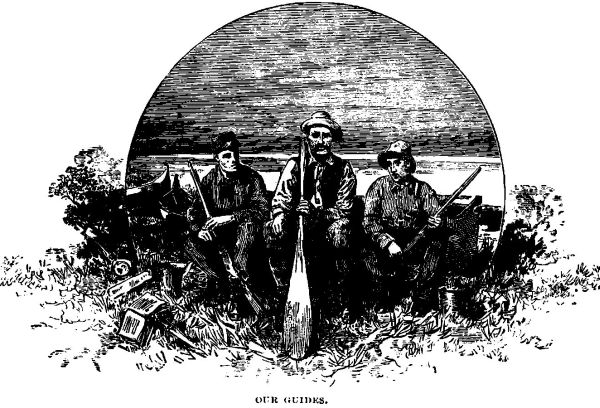
The guides, for such an extended tour of exploration,
had been well chosen. One of them was an Indian,
whose tribe had originated on the St. John’s River. He
lived, however, at Oldtown, Maine. His name was
Thomas Nichols. He was a stalwart man, six feet in
height, forty-eight years of age, and weighed one hundred
and fifty-five pounds. He was considered the best
hunter in the vicinity, while his reputation in the manufacture
of birch canoes was known throughout the State.
He was dressed in a grey shirt, a cardigan jacket, and a
black felt hat, which made him look like a savage who
had fallen into the clutches of some prowling missionary,
and issued from the “conversional brush,” not the better
of soul, but the richer of a complex and indifferent suit
of clothes.
OUR GUIDES.
We had two other guides, Hiram and John Mansell,
who were brothers from Greenville, Maine, the former officiating
as cook, the latter as man of all work. Hiram
was clad in a pair of blue pants with red stripes at the
sides, a souvenir of military life, and looked like a relic
of Bull Run. He wore a jacket of brown duck, with a
leather strap about his waist, to which was slung a long
bowie-knife, whose sheath was a deer’s leg with the hoof
attached. He stood five feet five inches in his stockings—how
high with his shoes on we are not prepared to
say—was thirty-one years of age, and weighed just one
hundred and forty-eight pounds, before dinner. His
brother John, clad throughout in grey woollen attire, was
twenty-three years old, but as strong as an ox, and having
served a good apprenticeship among the loggers,
could wield an axe with powerful effect.
In addition to the provisions necessary to feed five
hungry men on a five weeks’ cruise, our canoes were
further loaded with two canvas A tents, 6 × 8 feet, a Baker
tent, 7 × 9 feet, six iron beaver traps, five rubber and
canvas bags, containing our blankets, rubber beds, cooking
utensils, four Winchester rifles, and a good supply of
ammunition.
Last but not least in importance to the expedition
was a Tourograph, an instrument with which to photograph
the scenery along the route. This apparatus,
which was always placed at the head of my tent, was
tended with zealous care from first to last, and many
were the cautions given the guides as to its disposition
in the canoe or on the carries.
“All ashore!” cried Colonel G., as we reached the ricketty
wharf at the extremity of Moosehead Lake. This
wharf was a sadly dilapidated affair. As we stepped
upon it to transfer our baggage to the shore it squeaked
like a box of compressed guinea-pigs, and bounced and
rocked so beneath our weight that the Colonel declared
it had at one time been an Indian baby-charmer.
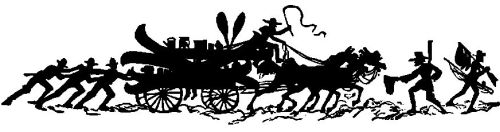
Gaining land we strapped our canoes and baggage
upon a wagon which was in waiting, to which were attached
a pair of horses, that were also in waiting, with
their goodly snouts immersed in the contents of a monster
bag and snuffing after a handful of oats that had
been lost somewhere in the interior. Then, as our party
gave the steamer a farewell cheer, the Colonel and I led
the advance along the sandy path of the North East
Carry, leaving the guides to bring up the rear, to prevent
any loss of the “kit.” As we trudged along, looking to
the right, our attention was attracted to an old road along
which ran in dubious parallel two long rows of disjointed
logs, which were soon lost to sight in the choking wild-growth.
These logs had once served as the tracks of a
wooden railroad, extending two miles across the fields,
over which the loggers, in former years, had drawn their
supplies to the Penobscot waters, with the motor power
of oxen. Theodore Winthrop wrote, that “whenever the
engine-driver stopped to pick a huckleberry, the train,
self-braking, stopped also, and the engine, or ‘bullgine,’
took in fuel from the tall grass that grew between the
sleepers.” But few traces of these rails now remain, and
horse-power has been substituted for that of the more
patient ox.
As the Colonel and I progressed, we became quite absorbed
in commenting on the features of the route over
which we had both travelled so frequently. The sun
shone brightly, the birds were twittering merrily on the
twigs at the side of the path, insects and other nondescripts
buzzed, chirped, hummed, and squeaked with
ready avail of the true American privilege of free speech;
but so concerned were we in our talk that we failed to
notice for some time that there was room enough in the
air for other music, which we did not hear. In fact, we
missed the sonorous jolt and rumble of the wagon-wheels
behind us. Looking back, to our surprise, we found that
the vehicle was not in sight.
“A break-down,” I suggested; “let us go back and see
what has happened.”
Retracing our way, in a few moments we came in sight
of the wagon. It was standing stock-still in the road.
As we ran up beside it, we found our caravan in a most
distressing situation. The horses were standing before
the clumsy wagon as motionless as statues, and with forward-pricked
ears and firmly planted feet were stubbornly
refusing to move a step, while the driver and our
guides were dancing around them with the grace of
frantic Zulus, inciting them to energy with the aid of
sticks snatched from the roadside.
“What’s the matter?” we inquired.
“Can’t git the ’tarnal brutes to budge a step,” cried
Hiram, desisting from the chastisement, and dropping
his stick upon the road in sheer exhaustion.
“What’s the reason you can’t? Let me get at them!”
cried the Colonel, furiously.
“Don’t, Colonel,” I pleaded, as my comrade began to
pirouette in the Zulu dance with flourished stick.
“There’s no telling what is the cause of their inability.
Perhaps the poor creatures have corns.”
“No, they ’avent; no sir-ee!” cried the driver, meeting
my remark with a howl of indignation. “Nary a spavin,
a heave, nur a corn abeout them ar hosses, I’d hev ye
know. Finest breed that was ever raised in Maine;
they cum all the way from Californy.”
“Then why don’t they stir their stumps?” demanded
one of the guides in a voice that made the animals
quiver.
“No cross-questioning. At them again with the sticks,
boys!” cried the Colonel. “We’ll put life into them.”
“No, no ye can’t. Thar’s only one thing kin inspire
them ar hosses.”
“What’s that?” I asked, breathlessly.
“Oats,” replied the driver, mournfully.
“Then where are the oats? Bring out the oats!”
cried the Colonel.
“Aint got none. They’ve all giv out.”
“Then where’s the bag,” I cried, with a desperate idea.
“Give me the bag, and I’ll start them.”
The driver threw me the big oat bag from the interior
of the wagon. It fell into my arms like a collapsed
balloon. Taking a position in front of the horses, I held
it at arm’s length toward their noses.
“Now,” I cried to the guides; “get behind the wagon
and push. Between two fires the engine cannot fail to
move.”
“You’re mad! Tom,” cried the Colonel, with a look
of supreme disgust.
“Never mind,” said I; “there’s method in my madness,
as you’ll soon see;” and he did see, for the next
moment the horses, sniffing the oat bags, sprang forward
with a desperate spurt after me. All the way
along the road, I held the oat bag dancing before their
eyes like an ignus fatuus. At times, however, the animals
half suspected the deceit, and seemed inclined to
lose faith in the feeling of man and lag. This made our
progress rather spasmodic; but they were never suffered
to come to a halt, for at every threatened relapse
the guides stood ready to do propeller-power behind.
“This is Rapid Transit with a vengeance,” cried the
Colonel, as he strode after us convulsed with laughter.
We travelled in this way for some time, until we reached
the West Branch of the Penobscot, where the driver
and his dashing equipage were cheerfully dismissed
and we took to the water in our canoes. Thus the last
link between us and civilization was broken. The water
was very low, and we found ourselves ushered into
a difficult passage. This was the dryest season experienced
in Maine for many years.
The water courses displayed such masses of huge
rocks and uncovered stretches of gravel beds that, at a
distance, one would have thought them logging roads
rather than the beds of large rivers. Constantly we
were obliged to step overboard and lift our canoes over
obstructions, and often we sighed for the aid of horse-flesh,
of better calibre, however, than that we had just
parted with.
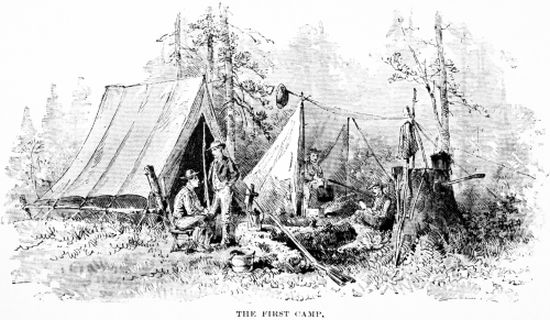
After two hours of alternate dragging and paddling
we shot into the right bank of the river, and made our
first camp half a mile above Moosehorn Stream. Then
“There was hurrying to and fro;”
the baggage was thrown out of the canoes, the latter
were drawn up on the bank and overturned to dry; the
tents were unrolled, the poles were struck, and two of
the guides busied themselves in their erection, while
John Mansell woke the echoes of the woods with the
resounding blows of his heavy axe as he cut the logs
and fuel for the camp fire, and the Colonel and I, seizing
our rifles, sauntered forth with sanguinary strides to decrease
the population of the forest game in the interest
of our first meal. When we returned we found everything
under way; the log fire was crackling merrily, before
which were squatted the guides on upturned pails.
Around them was scattered in picturesque confusion our
full culinary paraphernalia, consisting of tea and coffee-pots,
kettles, frying-pans, tin cups, bakers, broilers, etc.,
out of which assortment they were selecting the utensils
needed for our meal. They looked like a band of itinerant
tinkers.
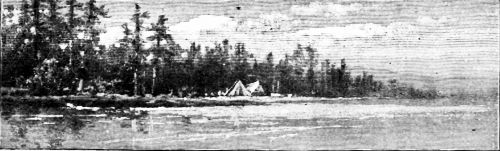
THE FIRST CAMP.
Tossing Hiram a brace of partridges the Colonel and I, arranging the
Tourograph apparatus, obtained a photograph of our first camp. Soon
after that supper was announced, after which sleeping accommodations
engaged our attention. Going toward our tent we found that Nichols, the Indian, had
carpetted it as well as those of the guides with fragrant boughs of
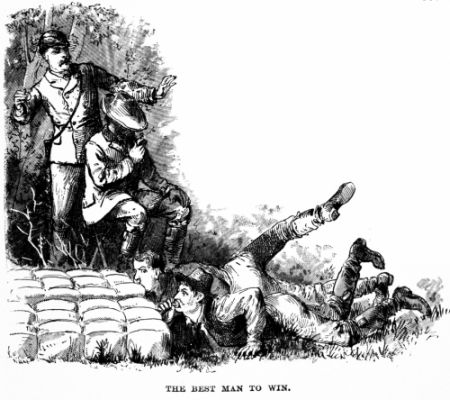
hemlock. But our two large rubber beds yet remained to be inflated. The
size of these were 36 × 80 inches. The Colonel and I began to devise a
plan for swelling them without taxing our physical resources. We soon
agreed that the only way out of the difficulty was the arrangement of
a match on time between two of the guides. Hiram and the Indian seized
upon our proposition instantly, and their rival wind powers were soon
tested. Stretching the collapsed rubber bags side by side, they spread
themselves flat upon the
ground in similar positions, and placing their mouths at the
apertures received the signal, and began to blow as if for dear life.
The Colonel and I held our time-pieces in our hands, and watched the
struggle with amusement. They had both powerful lungs and the bags were
soon inflated. As they withdrew from the contest, the veins swelled
upon their foreheads like whip-cords, and their fiery red faces glowed
with the color of a harvest moon.
THE BEST MAN TO WIN.
“Who wonee?” gasped the Indian, as he passed the
sleeve of his grey shirt across his perspiring face. The
Colonel and I consulted, and not desiring to discourage
either of the guides from a repetition of the act we declared
the match a tie.
By this time night had set in. But we did not hasten
to bed; no, indeed. Stretching ourselves before the big
log fire we revelled in the raptures of a scene of which
the tourist can never tire—the last wakeful hours of the
camp at night, those hours so rife with merriment, so rich
with unbosomed anecdote, when the first story, springing
from the innocent seed of palpable truth, becomes a prey
to those succeeding ones which bear the hideous stain of
doubt. Exaggeration is wonderfully prolific. “India-rubber
yarns” are told in endless variety, each one being
a super-test of the elasticity of the whole. Then some
one falls into the error of telling the truth, and his story
is howled at as being weak and unpalatable. Finally
some one tells the “whopper” of the evening, which bids
defiance to retaliation and sends the party to bed in first-class
trim for weird dreams. A bomb-shell of this kind
from the Colonel was the cause of our dispersal, and exchanging
“good nights” we entered our tents. Then,
while the camp fire still burned on, while the bark curled
from the trunks of the big birch logs, while the cedar
snapped with its merry crackle, while the shadows of the
leaping flame and smoke danced fantastically upon the
ruddy tent walls—we slept.
CHAPTER II.
“A band of hunters were we. All day long
Our feet had trail’d the woods.”—Street.
MOVING ON.—PINE STREAM FALLS.—CHESUNCOOK LAKE
AND FARM.—UMBAZOOKUS CARRY.—A DRY GROUND
SLEIGHING PARTY.—FURTHER EXPERIENCE WITH
THE HORSE.—A GLIMPSE OF DESOLATION.—CHAMBERLIN
LAKE.—A VISION.—EAGLE LAKE.—SMITH
BROOK.—HAYMOAK FALLS.—TROUT
STORIES.
Bright and early the next morning
tents were struck, canoes loaded,
and soon we were afloat upon
the waters of the Penobscot, hoping
to reach the mouth of the river
by nightfall.
Nightfall?
Perish the fond and audacious expectation. It was
not until four days subsequently, after a running battle
with difficulties, that we passed the Pine Stream Falls
and entered Chesuncook Lake.
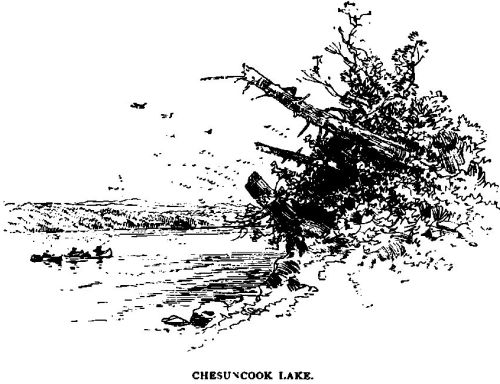
CHESUNCOOK LAKE.
There is a farm upon this lake. It consists of a wilderness
of ground, and a collection of rickety sheds, clustered
like barnacles to a major “pile,” which you suspect
to be the homestead.
There is nothing pretentious about the architecture.
It is of a rather complex order, and the span of life never
seemed to me so short as at the moment I attempted
to determine it. Such a view of angles, horizontals, and
perpendiculars never before greeted my eyes. It was
simply distracting. The designing genius must have suffered
with a cast in his eye, or a mind disordered through
indigestion.
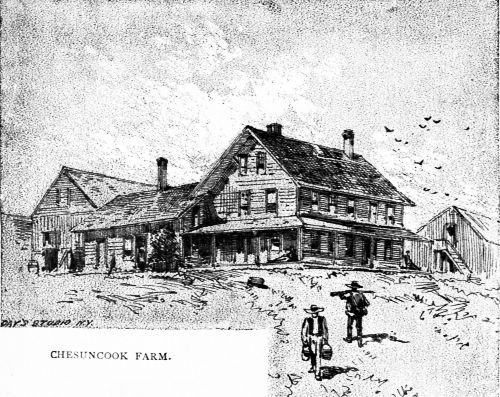
CHESUNCOOK FARM.
These farm buildings stand
alone in a wild, open tract of
country. The sight of them strikes you instantly as
strange and unaccountable. At first you wonder and
half believe yourself in the vicinity of Ararat and a debilitated
ark. Then you shudder and give thought to a
terrible suspicion—a small-pox hospital, perhaps! Finally,
unable to reach a plausible conclusion, you forget you
are in Maine, and in generous sympathy with the glory
awarded to all the super-dilapidated buildings of the lower
states, declare at once that the pile must be the old
headquarters of General Washington.
We made a brief stay at this farm, spending most of
our time in duck and plover shooting.
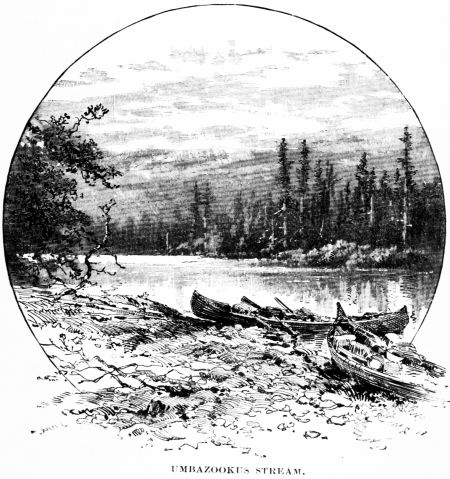
We then paddled across the lake and passed up Umbazookus
Stream, dragging our canoes most of the way.
We landed at a carry on the right bank.
During the previous season, while visiting this region,
we had pushed further up the stream to what is known
as “Mud Pond Carry,” sacking our entire kit to Mud
Pond. But a longing for the almighty dollar has since
been aroused in the heart of one Smith, who having
erected a house and barn a short distance from the landing,
now transports the tourist’s canoe and supplies six
miles to Mud Pond, across Umbazookus Carry.
As we neared the house we fired a gun in signal of
our approach, and were met by a man and a boy who
rushed forth from the adjoining barn. Then
A party through the Maine wilds bound
Cried “Good man, do not tarry;
But tow us o’er the boggy ground
Whereupon the man and the boy began immediate preparations
for the transport.
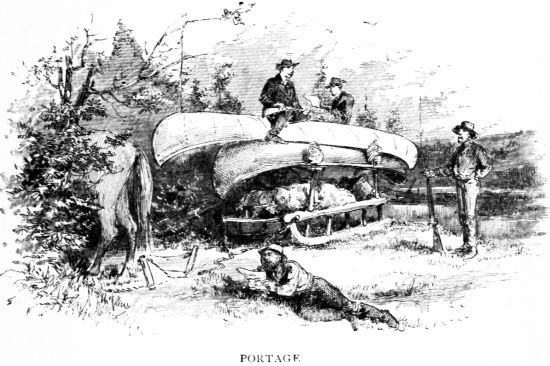
Hastening to the woods they soon appeared with four
bony animals in harness that put one more in mind of
the rigging of a clam boat than the trappings of horses.
These were attached to two large wooden sleds made of
tree branches, upon which were placed our birch canoes,
swung by an adjustment of ropes to four stanchions at
their sides, while the spaces underneath were occupied
by our baggage.
UMBAZOOKUS STREAM.
These clumsy vehicles, with their strangely arranged
cargo, presented a novel and picturesque sight, which I
thought a good subject for the Tourograph, and “photo’d”
before starting. Then, amid the cheering of our guides,
the horses were whipped up, and we were soon underway,
sliding across the logs, bouncing over the rocks, and pitching
along through the mud like a fishing-smack foundering
in a storm.
PORTAGE
The Colonel and I strode ahead with our guns, securing
partridges by the way, closely followed by Hiram’s
team. Soon we heard a shout, and looking back saw
his horses rearing and plunging, and the sled stopped
short before a tree.
“What’s up?” we cried.
“This left-hand nag here is a Tartar,” replied Hiram,
as he tugged and jerked at the reins. “I tried to tack
and leave that ’ere tree on the starboard quarter, but I’ll
be blamed if he haint sot me into it all kerchunk on the
port bow. Say, gineral!” he yelled, turning ferociously
toward Smith; “what’s the matter with this here animile
of yours?”
“Which one? That one?” asked Smith. “I meant to
warn ye consarnin’ him. He must be handled mighty
gingerly. Takes an ingineer to run him properly.”
“Why, for sin’s sake?” inquired Hiram.
“He’s cross-eyed, an’ he allers leans hard toward the
west.”
“Cross-eyed! Poor crittur,” murmured Hiram, sympathetically,
as he laid the lash along the animal’s ribs.
“How’d it happen?”
“Don’t know exactly. Born so, I expect; but I heerd
say onst that the children o’ the people who had ’im afore
me dropped a nail into his feed bag. Don’t know how
true it is.”
Hiram struggled desperately with the reins to free the
sled, but without success.
To back the craft would have required more than the
entire strength of the party, so John Mansell’s axe came
into play, the tree was felled, and leaping over its stump
the sled was soon bounding on.
After three hours of heavy toil for both horses and
men, we completed the six miles, and arrived at the uninteresting
sheet of water called Mud Pond.
“Jemima!” cried Hiram, as he surveyed the pond and
gauged the depth of the water; “how are we going to
get across?”
“Have to dig a channel with our paddles,” said John.
“Me think so—yes!” ejaculated the Indian, as with a
miss-step he almost sank from sight in the mud.
A channel was soon made, canoes repacked, and by dint
of hard poling we reached deep water, and paddled for the
opposite shore a mile distant.
On arriving the same difficulties which prevented our
embarking delayed our landing, and at one time it looked
as if each man would make his canoe his camp for the
night. But just as the sun set we managed to land, and
pitched our tents in the dark.
Mud Pond Stream being almost dry, we were forced
the next morning to carry our canoes and kit almost a
mile, depositing them at last in the stream which flows
through the moose barren bordering on Chamberlin
Lake.
Here we found ourselves in a wild, desolate country.
The stream along which we moved ran through an immense
tract of bog, which was dotted here and there with
old stumps reaching for a quarter of a mile in every direction.
This was bounded in the dim distance by a
dead wood forest, which enclosed it completely like a
chevaux de frise. Within this was presented a most lugubrious
landscape. It was the picture of a region dead
to the world and to itself. The old grey stumps scattered
about seemed like storm-beaten tombstones which marked
the resting-places of perished souls, and the naked,
bleached forms of the trees in the palisade like sentinel
skeletons guarding a death ground.
OUTLET OF CHAMBERLIN LAKE.
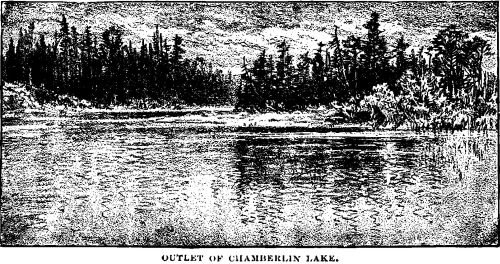
Soon with our three canoes in line we entered the waters
of Chamberlin Lake. There we were suddenly startled
by hearing a loud splash in the water, and greeted
with the vision of an immense bull caribou, which sprang
up and instantly disappeared in she woods before we could
tender him the slightest compliment at the pleasure of
the meeting.
“Confound the luck!” yelled John, throwing aside a
rifle in exasperating disappointment.
“Exceedingly impolite of the beast to decamp so suddenly”
said the Colonel, as we examined the animal’s
tracks; “he would have weighed three hundred pounds,
if an ounce!”
CHAMBERLIN FARM.
Chamberlin Lake is eighteen miles long, three miles
wide, and is one of the largest bodies of water in
Maine. At this point, the preceding year, I turned south
through the East Branch of the Penobscot, and landed
at Mattawamkeag on the European and North American
Railroad. This year our course lay directly to the
north.
FACETLÆ.
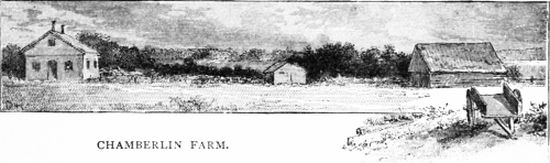
At Chamberlin Farm we made a brief stay, and
purchased an extra supply of hard tack,
sugar, and molasses, as our stores were
running short. Then turning our backs
on the lovely peaks of Mt. Katahdin
and the Soudahaunk range, which lay
to the southwest, we buffetted the
waves of the lake for six miles, landing
at the locks which divide its waters
from those of Eagle Lake below.
Here we went into camp, and the
Tourograph was brought into important
requisition while a benign and
smiling sun was at its best. And here
we were delayed for three days afterwards,
through a go-as-you please rain-storm,
during which we tried the camera
while the aforesaid benign and
smiling sun was at its worst, hidden
away like an unfortunate trade-dollar during the
storm of repudiation.
When the weather grew favorable, we followed the
current of Chamberlin River one mile down to Eagle
Lake below.
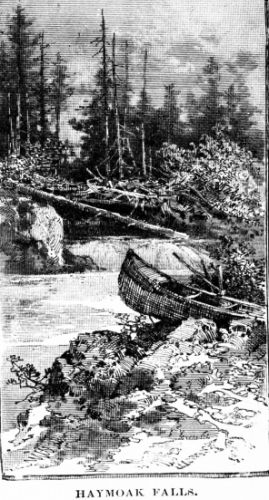
HAYMOAK FALLS.
Some people think of Maine as a state containing
only one large lake with an innumerable number of
smaller ponds within its borders, but the tourist visiting
these regions for the first time is daily surprised by
bodies of water which fairly compete with the area of
Moosehead. Eagle Lake is thirteen miles long, with an
average measurement of three wide. Within its bosom
it nurses two islands, while the horizon of its northern
extremity is broken by the cone-shaped peak of Soper
Mountain.
Our next camp was made at the mouth of a beautiful
stream near here, which writhes under the opprobrious
title of Smith Brook. This innocent sheet of water,
which I am certain has done naught to merit the ignominy
it suffers, presents most picturesque beauties in its
windings as far as Haymoak Falls.
There we discovered the skull of a large moose, and
extracted the great teeth, fearing they would be the only
souvenirs we should obtain of that almost extinct animal.
“My!” said the Colonel, as he pried out one of the
grinders; “what a surface for a tooth-ache!”
There, also, we had splendid fishing, and captured
many large trout.
The day before we broke up camp we had a run of
sport that well-nigh astonished us, and that night at the
evening meal we had a rare fish feast, served with the
following sauce:
“I don’t care whether you believe this yarn I’m goin’
to tell ye or not,” said Hiram, as he added another vertebra
to the pile of trout skeletons accumulating by his
plate; “but it’s true as gospel, nevertheless an’ notwithstanding,
an’ with me the truth is like the stump of a
back tooth—it must cum out. You know, Nichols,
where the old farm road from Greenville to Dexter
crosses the bridge at Spectacle Pond?”
“Me know,” said the Indian, scarcely raising his eyes
from the fire.
“Wall, I was guiding for Doctor L. and Squire B. one day in that region, which
happened, by the way, to be a pet fishin’ ground o’ their’n. As we
were gittin’ along to the bridge, the Doctor, all of a sudden, says to
the Squire, ‘If you’ve no objections, Rufe, I’ll slip ahead of you and
cast my flies under that bridge, for ten to one I’ll strike a big fish,
as I saw some mighty fine trout there the other day while crossing to
see my patient in the old farm beyond.’ The Squire told him to go by
all means, but to have some mercy for the sport of other people an’
not to altogether clean the brook. With that the Squire turned around,
an’ began to amuse himself at pistol practice with my old hat that I’d
set up for a target on a tree, an’ the Doctor, he pegged down the road
like mad toward the bridge. I stood an’ watched him jest for fun, for
he was a comical old duck, an’ so nervus an’ fussy that I ’spected
like’s not to see him tumble overboard. Reaching the spot he made a
dozen or so wild casts, but at last succeeded in landin’ his flies
under the bridge, when he took a seat on a projectin’ beam, an’ let the
current sweep ’em out. Quicker’n ye could say Jack Robinson, I heard
a shout; the Doctor’s rod almost bent double, an’ he begun reeling in
for dear life. ‘I’ve got
him, Mansell; I’ve got him. Come, quick! he’s the biggest fellow I ever
hooked.’ Grabbin’ the landin’ net, I ran over the bank to help him. It
looked for all the world as if he’d ketched a shark, but as soon as I
reached the other side an’ saw the game a flappin’ on the surface, I
give a shout that almost blew me to pieces, an’ rollin’ down on the
bank, I roared until every ’tarnal rib was sore. What d’ye guess had
hold of the old fellow’s line? Why, nothin’ less than a big Shanghai
rooster! The animile, as I found out after, belonged to the farm
near by. It had been hatched and raised with a brood of ducks, an’
bein’ quite a water-nimp, as they call it, had strolled into the stream
to have a pick at the Doctor’s flies. I tell ye what, so long as he
lives the Doctor’ll never forgit that bite, for the shock of the discovery knocked him clean
off the beam into the water, where I clapped the landin’ net on his old
bald head an’ fished him out like a drowned rat. I don’t know how true
it is, but they say that ever since he took that bath ther’ hain’t been
another trout seen about the brook.”
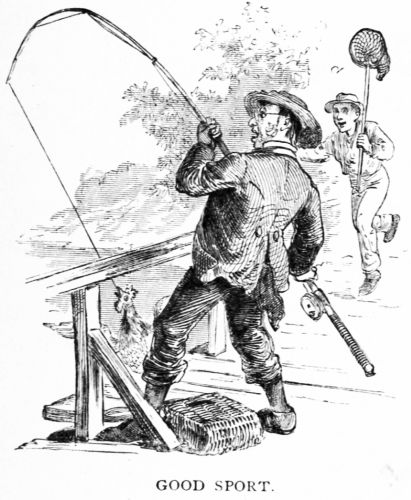
GOOD SPORT.
“Which puts me in mind of another fish story, in
which I and an old schoolmaster friend of mine are concerned,”
said the Colonel, as Hiram concluded. “Out
trouting once we suddenly met on our way to the brook
a dog, which sneaked out from a patch of woods and began
to follow in a close trot at our heels. We were
taken somewhat by surprise at his appearance, because of
the loneliness of the country, for there was no house
within miles of us, and we were puzzled to think where
he had come from. He looked the picture of starvation.
His skin was literally hanging on him, and the
body was so thin and sunken that we almost heard his
ribs playing a bone chorus as he jogged behind us. We
fed him with a portion of our lunch, which he devoured
greedily. Finding himself favored, he followed us to the
trouting ground. Spying out a beautiful quiet brook we
sat down on the bank and cast our flies. The sport was
instantaneous, and for a while continued and exciting,
during which time the Professor had the good fortune
to capture some half-dozen trout, which equalled in weight
and beauty anything I had ever seen. When the luck
was on the wane we reeled in our lines, and turned
about to gather together our ‘catch,’ which during the
sport we had thrown behind us on the grass. Suddenly
the Professor gave a gasp. ‘Great heavens!’ he cried;
‘My half-dozen beauties! Where are they?’ We searched
the bank, but they could not be found. ‘Is it possible
that any one is prowling about these parts and has
crept behind us and stolen them?’ he said. ‘I don’t think
that likely,’ I replied. At the same time my attention
was attracted to an object lying at the base of a tree. It
was our dog—thin, starved and miserable-looking no
longer, but swelled out as fat as a potato-bag, and wagging
his tail, and smacking his jaws in heavenly transport.
‘Professor,’ said I; ‘look!’ ‘What! Another dog!’
gasped the Professor. ‘No, the same dog with variations,’
I said, ‘thanks to the expansive properties of
trout, a little rosier in health.’ The Professor guessed
the truth and gave a groan. He danced about like a
lunatic and kicked the dog until it began to snap at his
legs. Then with a heavy heart he packed his traps and
we left the animal at the tree enjoying its siesta. ‘Fate
could not harm him—he had dined that day.’”
Rare treats, these fish feasts. Rare tack, these fish
stories. But, reader, beware of bones.
CHAPTER III.
“But who can paint
Like Nature? Can imagination boast,
Amid it’s gay creation, hues like hers?”—Thomson.
IN ROUGH WATER.—NORTH TWIN STREAM.—AN INDIAN
PADDLE FOR FUTURE USE.—BREEZES, BLANKETS, COLD
AND ICE.—SPIDER LAKE.—MANIFOLD CHARMS OF
CAMP LIFE.—AT WORK WITH THE TRAPS.—CONCERNING
BEAVER.—WE PROCLAIM OUR INTENTIONS.
Early on the morning of September
23d we continued down
Eagle Lake and through the
“Thoroughfare” to Churchill
Lake. Then a change came o’er
the spirit of the weather. It
grew suddenly colder, and as our three canoes prowed
into the lake a sharp breeze sprang up which ruffled its
usually calm surface into a restless quiver. As the breeze
increased to a “blow” the waves were lashed into white
caps, and then into billows, until our fragile birch-barks
were tossed about like corks.
Each breaker seemed ready to engulf us; but we shipped
little water, for the inventive genius of the Colonel
had devised a novel covering for the bows of our canoes.
It consisted of a strip of white canvas extending aft
about two feet, which was stretched and secured to a
brass hoop arched across the canoe, and fastened with
brass pins or pegs.
This made the bow of the canoe resemble the fore-part
of an immense Chinese shoe. All articles liable to damage
by exposure were thus secured from the spray of the
waves and passing rain showers. It proved a capital
nook for the storage of the camera, guns, ammunition,
etc., and was quite a suggestion to Nichols, who was an
old canoe maker.
Our course lay through the Eastern arm of Churchill
Lake, a distance of only six miles, the larger body of
these waters lying to the north, and having for their outlet
the Allaguash River.
At one o’clock we beached our canoes and erected our
tents at the mouth of North Twin Stream.
As we supped that night on broiled partridge and stewed
duck, we little dreamed of the hardships which lay to
the eastward, between us and the waters of the great
Aroostook River.
Since leaving our camp on Mud Pond Stream, Nichols
had been hard at work at odd moments on a long paddle.
From a rough maple log-split, it had gradually
been shaped into a thing of beauty, and now with pride
was being curiously ornamented with all the artistic execution
of which the Indian’s deft hand was capable.
“Me beat you, boys, when I get to the ‘Roostook,’”
said Nichols, with a sly twinkle of his eye, as from under
his black felt hat he cast a triumphant look at the other
guides.
“But perhaps we shall never get there unless it rains,”
said John.
“Me think so, too,” chimed in Hiram, trying to imitate
in tone of voice the Indian’s favorite expression.
“When the ‘Pioneers of the Aroostook’ pushed
through this country last season,” said the Colonel, glancing
at me with an air of superiority, “we experienced no
difficulty in continuing our voyage one mile above to
Marsh Pond. On examination,
since landing,
I find we shall be obliged to ‘carry’ around the obstructions,
and it will detain us a day.”
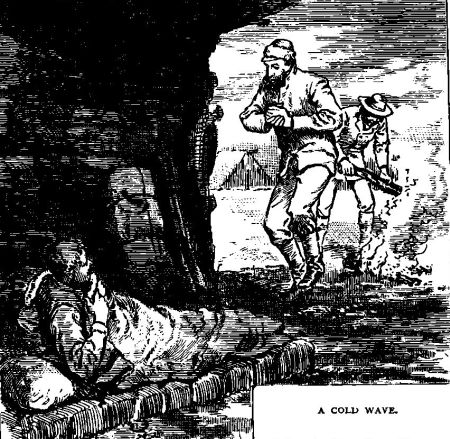
A COLD WAVE.
That night we found use for all the spare blankets in
camp, and John was repeatedly aroused to replenish the
fire.
“What’s the matter, Colonel?” I asked, as gazing out
from under my warm blankets on the morning of Sept.
24th I discovered my compagnon-du-voyage dancing before
the fire and rubbing his hands with “invisible soap.”
“Well, you just turn out and see. There is half an
inch of ice in our camp pails, and a fair chance for skating
on the Lake. We shall have to take to snow-shoes,
if this weather holds on.”
The tents, stiff with frost, were packed in bags, and in
“Indian file” at the right of North Twin Stream we
started for Marsh Pond, each man burdened to the utmost.
Again and again we repeated our trips, between
lake and pond, sinking in the mud one instant, slipping
on some frosty rock the next, and not until late in the
afternoon were our canoes and the last loads of our kit
safely landed at Marsh Pond.
Paddling through this water, its name being typical of
its character, we ascended a small stream at its head on
our way to Spider Lake.
“Me think it getting dark, boys,” said the Indian, “and
we better make camp at once.”
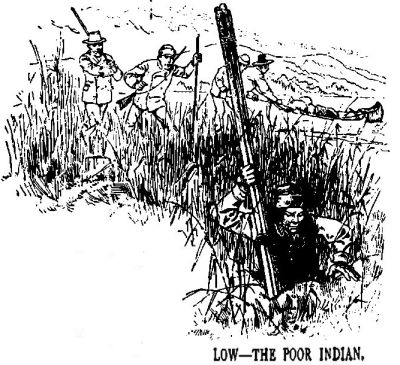
LOW—THE POOR INDIAN.
So hauling our canoes on shore we cast about for the
most desirable spot.
There was no choice; it was an immense swamp in whatever direction
we travelled. We sank almost to our knees in the moss and decayed
underbrush. Once the Indian, floundering in the mud with our
tent-poles, disappeared completely from sight, and we might have lost
him, but the poles sticking up like bare flag-staffs through the dense
brush which masked the marsh pools, disclosed the spot where he had
sunk from view. When we dragged him out, he looked like a muskrat.
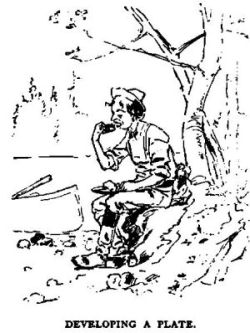
DEVELOPING A PLATE.
“Nichols is trying to discover an underground road to
the Aroostook,” said Hiram. “Guess he’s given up all
thought o’ usin’ that long paddle on them ’ere waters.”
This place proved the worst camping ground of the whole trip, but
despite this fact it had its charms. The tourist soon grows to despise
the consideration of personal comfort, when self-sacrifice is required
to bring him in direct association with the nature which infatuates
him. He becomes like the poet or painter, a creature purely spiritual,
who raves in the rapture of exalted soul while his boots ship water by
the gallon, while scarcely a rag hangs to his back, and low-dwindling
provisions place him on rations intimate with starvation.
Thus it was with us. Our
surroundings were unpleasant, but apart from this, as we
saw them, interestingly picturesque.
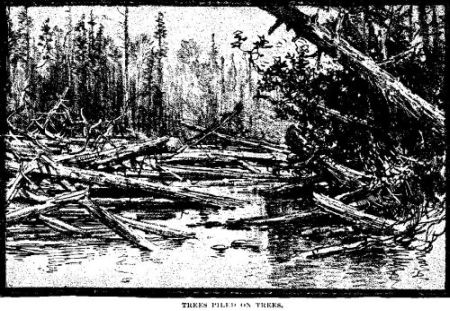
TREES PILED ON TREES.
Here we were in the presence of a great dead forest.
Across the pools, the rocks, and the brush growth lay
the trunks of monster trees prostrated by the winds,
storms, and decaying processes of nature. Trees were
piled on trees in huge, insurmountable barriers, each
one bearing on the other with a crushing force that tore
through the limbs and logs, and pressed the massive pile
down deep into the soft vegetation of the marsh.
All was grey and lifeless. It seemed as if nature had
lain unresurrected since the Deluge, and that the trees
had twisted about and embraced each other in their dying
agonies. All was dead! dead! dead! The only sign
of life upon them was the deep moss that flourished on
the decayed and weather-beaten trunks; but this was
like the grass above the grave.
The next day for lack of water we dragged our canoes
through the remainder of the river to Spider Lake, and
camped on a high ledge of rocks on the Southern shore,
its dry and picturesque position being in delightful contrast
to our last quarters. This lake, three miles long and
half a mile wide, set among these forest depths like a
jewel in a ring, reflects ten mountain peaks on its surface.
On our way to camp we examined a point of rocks
jutting far out into the lake, whose curious construction
attracted our attention. It was a perpendicular pile of
corrugated stone crowned with a tall growth of spruce
trees, which swept like Indian head-plumes to a hill-top
beyond.
The rocks at this time arose fifteen feet from the water,
but their well-worn sides indicated their covering in
any but a dry season. At their base we discovered deep,
subterranean cavities, made by the action of the water,
and into these with curiosity we pushed our canoes bent
on a full investigation. Some were only slight excavations,
suggesting the dwelling-places of large trout, or
the coverts of the fur animals abounding in the vicinity,
but there were others of considerable space, into which
we passed without difficulty. Within all was gloomy
and damp, and the motion of the water against the cold,
slimy walls made a strange phase of music which echoed
mournfully through the caverns. They seemed like the
abodes of spirits; we could scarcely repress a shudder
at the weird effect of the scene.
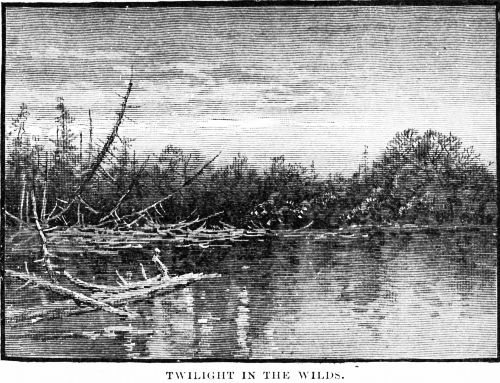
TWILIGHT IN THE WILDS.
Many times afterward did we recall with pleasure the delightful
experiences of our sojourn at Spider Lake. The charming comforts
of a dry and well-pitched camp, the exhilarating sport by the
trout pools among the rocks not twenty feet from the tent door,
the partridge-shooting in the woods, the ducking on the lake, the
adventures of exploration, and the grand scenic surroundings which we
still admire in the souvenirs afforded by photography, have made those
too fleeting hours “red-letter days” in our memory.
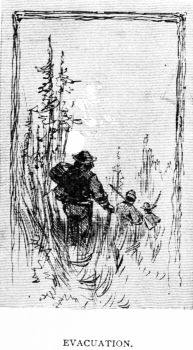
EVACUATION.
“You are not proposing to desert this lovely camp so soon?” I said
to the Colonel, as we stood in the tent door gazing out on the lake
some days later. “It seems a pity after spending so much labor about
the camp to leave at once.”
“Well, we cannot tarry long; we little know what is
before us if the water courses remain dry; our birch canoes
will not endure the strain much longer,” was the
Colonel’s reply. And so we bade farewell to this charming
spot.
At night we reached Logan Pond. Before our tents
were in position we were overtaken by a drenching rain
storm, which we fought through with philosophical patience,
hoping it would increase the water along the route.
It takes true grit to endure without complaint a rain-storm
in the woods, and one must have an abundance of cheerfulness
to keep from murmuring.
“You had better set those beaver traps to-night,” said
the Colonel to the Indian, as he stood drying himself before
the fire, and turning about from one side to the other
like a roasting turkey.
“Yes, me think so, too,” replied Nichols; and suiting
the action to the word, he soon started off down the hill
with the iron traps over his shoulder, I following him,
bent upon investigating all the mysteries of wood-craft.
“You see beaver house over there?” whispered the
guide, as we reached a mud dam at the outlet of the lake,
at the same time pointing out to me a cone-shaped knob
of mud and sticks about ten feet high and six feet in
diameter. “One, two, three beaver live there, and me
set traps to catch one to-night. Beaver build house
with door; then build dam and raise water to cover
door to house.”
Slipping into the woods the Indian soon returned with
a cedar pole ten feet in length and four inches in diameter
at the butt. With his axe he split this, and slipping
over it the chain ring of the trap, secured it in position
by a wedge. The trap was then opened and lowered
carefully into the water, and after driving the pole into
the mud, the upper end was made fast with twisted
grasses to a neighboring tree.
What was our joy on arising the next morning to see
Nichols returning from the pond lugging a fine beaver of
over forty pounds’ weight, held in position on his shoulders
by a withe of cedar bark encircling his forehead.
“Me lost another beaver,” said the Indian, as he dropped
the heavy animal before the tent door for our examination,
and wiped the perspiration from his dusky forehead.
“Beaver cut pole in pieces and run with trap.
Me hunt pond all over, but no find him;” and he displayed
as much sorrow over the loss as if it had been a small
fortune.
The fur of the animal was in excellent condition. He
was three feet in length, with tail 5 × 12 inches, half an
inch in thickness, and covered with black, shining scales
of leather-like toughness.
“Is there any truth in the story, Nichols, that the beaver
uses his tail to build his dam?”
“No! no!” replied the guide, as laying the animal
across his lap he commenced to rob him of his “jacket.”
“No beaver do that. He use tail to make noise to other
beavers. It slap on water, make sound like pistol, and
give alarm. Beaver push mud and stones from bed of
river with front feet to make dam, and when build house
walk up straight on hind feet, and hold to breast sticks
and stones with front feet. No one hunt beaver who
tell such stories.”
The animal was soon dressed and stewed for our breakfast.
Its taste was similar to that of corn beef, but of a
much more delicate flavor, the liver being reserved as a
choice dish for the next meal. The tail was one mass of
solid fat, which only the Indian, after toasting it before
the fire, could digest. The skin was stretched on a hoop
four feet in diameter laced with strips of cedar bark, a
shingle of wood being used in spreading the skin of
the tail.
“Me no like this,” said the Indian, arising after the
completion of his work. “In my tribe, brave trap beaver;
squaw dress him.”
“Which is a much superior way,” observed the Colonel.
“Thus all the world over the gallant brave saddles
upon the poor woman the undaintiful share of the work.
A great pity, Nichols, that circumstances in your life have
abolished the custom, as far as you are concerned.”
“Me think so; yes,” replied the Indian, with just the
faintest idea of what the Colonel meant; and as he turned
to wash the grease and blood from his warrior hands he
looked the picture of dignity dethroned.
After a few days tarry we pushed on across Logan
Pond, made half a mile carry to Beaver Pond, and camped
on Osgood Carry at the head of the last water.
“What do you find so interesting?” I inquired of the
Colonel, as I saw him examining minutely the side of an
old tree not far from the tents.
“Oh! nothing special, except a record I made last year
regarding the ‘Pioneers of the Aroostook,’ which the
winter storms have failed to obliterate.”
“Then, before we go, we had better leave some relic
of this tour,” I said.
Accordingly a photographic plate which had been spoiled
by sudden contact with the light was drawn from my
Tourograph, and scratching the names of the party on its
surface, we nailed it to the tree for the benefit of the next
comer, adding as a suggestion of our destination “On to
the Aroostook!”
CHAPTER IV.
“The wise and active conquer difficulties
By daring to attempt them: sloth and folly
Shiver and shrink at sight of toil and hazard,
And make the impossibility they fear.”
OSGOOD CARRY.—THE PACK HORSE LEAGUE.—NOVEL
TRICK IN PEDESTRIANISM.—CAMP ON ECHO LAKE.—HIRAM
TELLS A STORY.—SLUICING A DAM.—MORE
CONCERNING BEAVER.—CAMP AT THE MANSUNGUN
LAKES.
Imagine the difficulties we surmounted
in our passage across Osgood Carry to
Echo Lake.
With the exception of an occasional
beaver, duck, partridge, or string of
trout captured on the way, we were
obliged to carry provisions sufficient for five men, who
never failed in their attendance at meals three times a
day, and with appetites which only wood life can stimulate.
Add to these provisions the weight of three tents,
three blankets for each man, rubber beds, personal baggage,
cooking utensils, guns, ammunition, rods, a Tourograph
with seventy five glass plates, and three canoes
weighing from eighty-five to one hundred pounds each
and you have an idea of the toil and hardships of a tramp
through this wilderness.
This “Carry” is the water-shed of the St. John’s and
Aroostook Rivers, and passes over a succession of hills,
through swamps, and wind falls.
Although one trip across is but two miles, a return
for a second load makes four, and four trips carrying
during half the time all one can bear on his shoulders
makes sixteen miles, a fair day’s tramp in a country
where not even a “spotted line” guides the traveler to
his destination.
At the time of our appearance there, the ground after
the recent rain was in a soft, soggy condition, which
made the way slippery and tedious.
As we pushed forward loaded down with our traps,
frequently did a misstep send one of our number “to
grass,” and smother him among the articles which constituted
his burden. Our progress, as Hiram observed,
“was slower than cold molasses.”
For every step taken forward we slipped two backward,
until the idea was suggested to us of turning
about and walking in the opposite direction, that we
might travel faster.
“Me fix your load for the ‘Carry,’” said Nichols to
me, as I started off with what I supposed I should be
able to transport without halting; “I show you how to
fix pack.”
Stepping aside into the woods he cut from a cedar
broad strips of bark, and passing them about my chest
outside of my arms, fastened them to a roll of blankets
on my back. On top of this he mounted my Tourograph,
and held it in place by another strap across my
forehead.
Like a horse being harnessed, I stood motionless,
while he placed my rifle on one shoulder, my shot gun
on the other, and hung to them an iron tea kettle, cups,
and various other cooking utensils.
Everything ready, and having burdened himself with
a much heavier load arranged in like manner, we started
off up the side of the mountain in search of Echo Lake.
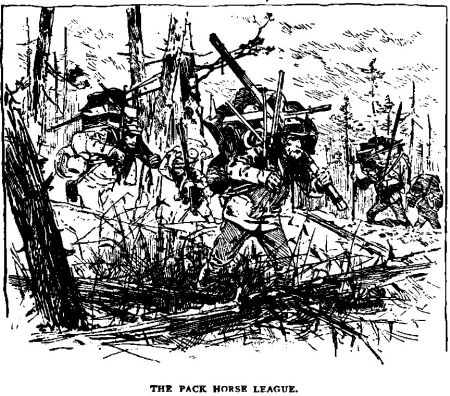
THE PACK HORSE LEAGUE.
It was hard work. Soon I was boiling with perspiration,
and the Indian puffing like a grampus. It seemed
like a veritable “first of May” in the wilderness.
AT NIGHT BY THE CAMP-FIRE.
Occasionally as a fallen log crossed our path we could
relieve our aching shoulders by resting the load thereon,
but never for a moment did we change its position.
Then on we would tramp, over rocks and through the
mire, the stillness of the woods unbroken save by the
crackle of twigs beneath our footsteps, or the occasional
grunt of the Indian guide.
From early dawn until late at night, dividing our party
at times into sections, we labored with our baggage,
transporting it but half the distance, from whence it was
forwarded by a second relay of guides the remainder of
the way, and landed in safety at our camp on Echo Lake.
In this vicinity we discovered in the crotch of an aged
tree an old folding canvas canoe. This the Colonel, with
a burst of delight, recognized as one deserted by the
“Pioneers of the Aroostook” in their excursion of the
previous year. Running short of provisions they had
been forced to abandon it, and make for the settlements
as quickly as possible in their other two.
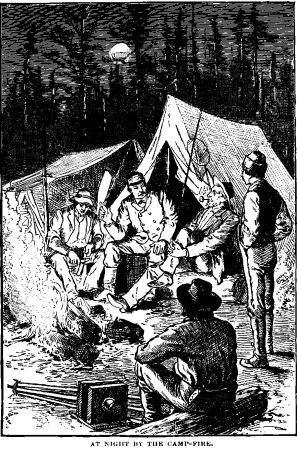
That night about the camp-fire the Colonel told us the
story of their privations, and how their final meal consisted
of nothing but the boiled bone of a salt ham seasoned
with the last crumbs of hard-tack.
This story suggested others of the same kind, and
many and interesting were those retailing the experiences
of our guides. I give the following, told by Hiram,
of the man who was the first to make maps of
Moosehead Lake and its vicinity. It gives an idea of
the rigors and danger incident to a journey through the
woods of Maine in the dead of winter, and may not be
uninteresting:
“Ye never heerd me tell about the man who fust tried
to make maps o’ these ’ere woods, did ye?” said Hiram,
as he tossed an extra log upon the fire. “Wall, it’s a
long story; but I’ll try an’ load the cart’idge so the bullet
won’t go far, as I see Nichols a-blinkin’ over there like
an’ owl at high meridian. It was ’long about the Autumn
of 1870, if I remember right, that a feller by the
name o’ Way cum up from down below an’ took board
in Greenville, foot o’ Moosehead Lake. He was quite a
spruce lookin’ chap for these ’ere regions, an’ though
still under twenty-one years of age, had seen a deal o’
the world in his little day. Wall, Johnny (that was his
name,) had come to rough it, an’ take his chances for
life with the rest of us, though it was said he’d heaps o’
money, an’ mighty fine fixins’ at home; but he was one
of them advent’rous splinters as are allers flyin’ round
a-wantin’ to see more an’ more, an’ git into wuss an’
wuss every step they go. Us boys was mighty busy
that year a-loggin’, an he enj’yed the fust winter so rattlin’
well among us that he cum back the next season.
When the snow got good an’ deep in Jan’wary, an’
snow-shoein’ was just fine, we two arranged a huntin’
trip an’ started out with our rifles an’ all the provishuns
we could truss on our backs toward Chamberlin Farm.
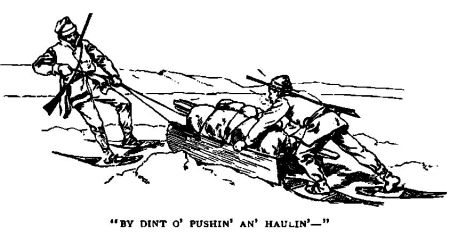
We hunted about there some days, but finally made a
hand-sled, strapped our kit on to it, and by dint o’ pushin’
and haulin’ made our way over the fruz surface o’ Chamberlin
and Eagle Lakes to Smith Brook. Next day we
pushed on to Haymoak Brook an’ as it cum on to rain
we built a hut of bark and camped.
“BY DINT O’ PUSHIN’ AN’ HAULIN’—”
“Johnny was a restless feller, an’ fur all tired out with
the pull through to camp, thought if we were goin’ to
stay long and hunt we’d better lay in more provishuns.
He was a plucky little feller, too, an’ ’though not much
used to the woods, could foller a ‘spotted line’ with the
best o’ ye. So he made up his mind to switch back to
Chamberlin Farm an’ git enough provishuns to last out
the trip. I thought this a rather crazy freak, for I felt
pretty sartin we could manage to pan out with what we
had. But Johnny wanted to be sure. Like all city fellers
he had a peevish bread-basket, an’ fur all he’d spirit
enough to rough it in other ways, he couldn’t weather
the trial of goin’ without his straight meal no-how. I
did all I could do to hold him back, but it was no use;
then I offered to go back with him, but he was bent on
doin’ the trip alone, an’ leavin’ me to rest in camp. So,
after buryin’ his part o’ the kit in the snow, he stood
ready to start.
“He did’nt want to go back the same way we had
come, but had planned to skirt round back o’ the lakes,
you know—a mighty unsartin kind of bizness, boys, for
a feller raised in a hot-house.
“But he plead so hard I finally give in to him, an’ with
the point o’ my ramrod I marked out his course in the
wet snow. Says I, ‘You see here, Johnny, that mark I
jist made goes across Haymoak Lake to Stink Pond.
Now don’t you forgit it,’ says I, ‘to keep right on your
course to Fourth Lake, for that there line leads into
Little Leadbetter Pond, an’ by a foot-track, will take ye
to Chamberlin Lake, an’ then yer all hunk. There’s an
old log camp on the Leadbetter, right there,’ says I, diggin’
the rod into the snow. ‘Don’t go further than that
to-night. Camp there, no matter how early ye reach it;
lie over till mornin’ an then push on.’
“It was the wuss snow shoein’ I ever did see, and I
ought not to’ve let the boy go, but I’d said yes, an’ I’m
not one of them fellers who goes back on his word.
“I buckled on Way’s haversack, filled it with graham
bread, stuck his hatchet in his belt, slung his rifle over
his shoulder, and with many misgivin’s saw him disappear
in the woods. After he’d left I commenced to get
kind o’ nervus like, an’ wish I hadn’t let him go. Afore
night I begun to feel terrible skittish about him. I lit my
pipe, cleaned my gun, cut boughs and bark from the
trees to make our camp more snug, an’ tried by fussin’
round to git the lad out o’ my mind; but ’twant no use—it
didn’t work wuth a cent. So buryin’ the balance
of our kit in the snow I started back to Chamberlin
Farm by the old path and camped that night on Haymoak
Lake, reaching the farm the next night.
“You will bet boys I was scared to find that Way
had not got in, but I thought p’raps he was restin’ at the
old log camp I had pinted out for him on the Leadbetter.
John the “toter” came along the next morning from the
logging camp—don’t you think, he had’nt seen a hair of
him either. Wall, the way I got into them snow-shoes
was a caution—the deer’s hide was gathered over my
toes and heels quicker than a trout takes a fly, and I was
a-slidin’ off into the woods like mad. I kept goin’ and
goin’ hour arter hour, as if the devil hisself was arter
me; it was the best time I ever made on snow-shoes,
even on a moose track.
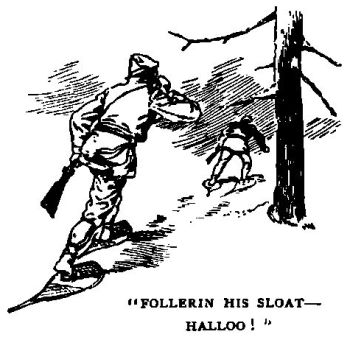
“At 2 o’clock I reached Way’s camp of the night before, and
follerin’ his ‘sloat’ (track) I kept on arter him and in two hours saw
him stumblin’ along through the snow in front o’ me like a lost sheep.
I give a shout of joy, and then a wild halloo, as I dashed on arter
him. But he plunged on without turnin’ a head—he did’nt seem to hear
me. I hailed him agin with no better effect, ‘Somethin’s up. He’s not
hisself by a long sight,’ I said to myself; an’ the way I put forrard
through that snow would have done honor to a pair o’ the seven leagued
boots. Jist as I come up with him, an’ was about plankin’ my paw down
on his shoulder, I heerd him give a gasp, an’ then he stumbled an’ fell
in a parfect heap at my feet.
“FOLLERIN HIS SLOAT—HALLOO!”
“‘Johnny! Johnny!’ says I, ‘Brace up. Hiram’s here,
and yer all safe.’ But he was so far gone, he skarce
knew me. To his belt was tied a partridge; but this
was all the provishuns he had left, an’ with his half froze
hands he could but jist hang on to his rifle. I took his
gun an’ haversack, an’ goin’ before broke down the
big drifts with my snow-shoes, an’ cleared a track for him
to foller. But he was so weak an’ benumbed with cold,
that every little while he dropped in the snow like a
wounded animile, an’ begged me to let him alone.
“‘Hiram,’ he moaned, ‘I can go no further. I am so
tired. I feel so sleepy. Go on yourself, an’ leave me
here.’ But I warn’t a lad o’ that kind. I knew pesky
well what that there sleepiness meant; it meant nothin’
less than a closin’ of eyes once an’ forever; he would
have been cold, stiff, stone dead in half an hour. It
didn’t take me more’n a brace o’ minutes to find a remedy
for this. Whippin’ out my old knife I cut down a stick
from one o’ the young trees on the road, an’ the way I
laid it round that poor feller’s body would have been a
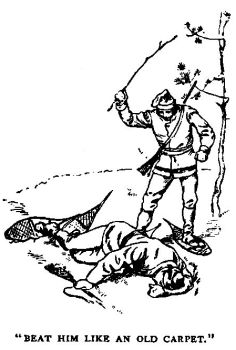
sight for the chicken-hearted, I tell ye. I beat him like
an old carpet until his bones were sore. I fairly warmed
him, which was jist what was wanted; an’ what with
whippin’, kickin’ him, an’ at times cartin’ him along on
my back, we soon made mile after mile on our way.
“Those were long hours flounderin’ on through the
snow; but at last we reached Chamberlin Farm, though
to tell a gospel truth I felt we never would git in.
“As luck would have it there was a doctor there from East Corinth,
an’ with his help we were soon at work with snow gittin’ the frost out
of Johnny’s hands an’ feet, an’ pumpin’ life into him. In a week he was
up an’ about, good as new, an’ hunted with us till the followin’ April
afore goin’ out o’ the woods.
“BEAT HIM LIKE AN OLD CARPET.”
“As I learned from him arterwards, Johnny had lost his way between
Fourth Lake and Leadbetter Pond. The snow there was over three foot
deep, an’ as the rain had clogged his snow-shoes he turned into an
old loggin’-road that he diskivered an’ this took the poor feller
right smack off his course. He follered the old road till dark, an’
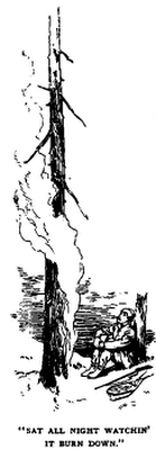
not comin’ across the old log cabin I told him about, made for the base of a decayed
tree, which he reckoned was fifty foot high at the least. This he
set fire to, an’ sat all night watchin’ it burn down. Fallin’ asleep
towards mornin’, when he woke up he found the merk’ry had gone a long
way below zero, an’ that his feet, though wrapped in four pair o’ socks
had both frozen. What the poor feller suffered till I found him must
have been terrible. Afore leavin’ Greenville that Spring, John Way made
the fust of a lot o’ maps o’ Moosehead Lake an’ all its surroundin’s.
Arterwards he jined these all into one, which I used to sell on the
boats, and this is the orthority for nearly all the late maps of these
’ere regions.”
“SAT ALL NIGHT WATCHIN’
IT BURN DOWN.”
Beautiful Echo Lake, the head-waters of the Aroostook River, charms
one at once by its picturesque location. High mountains encircle it,
which make the peculiar
reverberation from which it takes its name, and breathe into the soul
that sense of solitude so delightful to the spiritual nature.
We spent three days here hunting and trapping, and
added three beaver to our collection of furs and stock
of provisions, which latter was now rapidly decreasing.
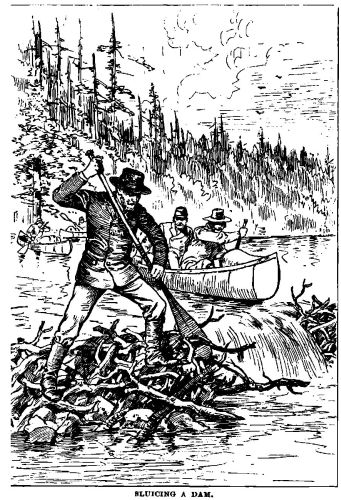
On breaking camp we explored the outlet of the lake,
and, finding the stream very dry, were obliged to build
dams in order to sluice our canoes through this country
to the Mansungun Lakes below.
“I tell you that water is cold,” said John Mansell, as
he waded ashore after putting the last mud and stone
upon a dam opposite the camp. “You don’t call this a
canoe tour, do you, Hiram? I should call it going overland
to New Brunswick. Never did see such a dry time
in my life.”
The water having greatly increased during the night,
we loaded our canoes and placed them in line above the
dam, each man, with the exception of the Colonel, being
in his customary position.
“Are you all ready?” yelled the Colonel, standing on
the top of the dam below us.
“Ready!” was answered; and with the blade of his
paddle he threw the mud and rocks to the right and left,
and the pent-up waters of three days’ detention swept us
down the stream a long way on our voyage. The Colonel,
dashing through the woods, regained his canoe at a
bend in the river.
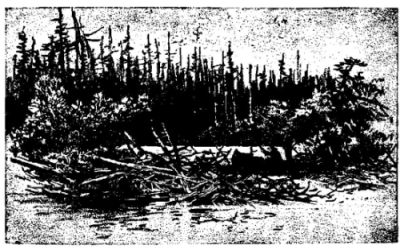
BEAVER DAM—FOUR FEET HIGH—ONE HUNDRED FEET WIDE.
But gradually the water receded from under our barks,
and we were again forced to take to the stream and lift
our canoes over the cruel rocks, until we reached a broad
expanse of the river below.
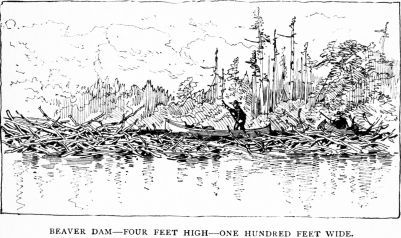
This pond was the result of an enormous beaver dam
four feet high and one hundred feet wide.
SLUICING A DAM.
“We better set our traps,” said Nichols; “many beaver
here; me catch some to-night, a family of nine,” the Indian’s
accuracy regarding the points of wood-craft being
at times wonderful.
“But we cannot proceed without water,” said the Colonel,
observing the stream very dry below.
We therefore set our traps and cut the dam to the
width of over ten feet, through which the water rushed
with velocity, and floated us quickly to the Third Mansungun
Lake. We were detained only by a few fallen trees,
which the axe in the brawny hands of John Mansell soon
cleared.
Before it was light the next morning the Indian’s canoe
was far away on the lake for an examination of the
traps; he soon returned with four immense beavers,
whose aggregate weight fell not short of two hundred
pounds.
“Me footed two more,” said the guide, exhibiting the
webbed feet of the animals in corroboration of the fact;
“but they very quick—they get away. I see dam we
cut last night, and it now just good as new.”
“Good as new!” we echoed. “Impossible.”
“True as me stand here,” said Nichols, at the same
time glancing anxiously into the stew pan, to see if we
had left him any beaver meat for breakfast. “Beaver,
they fell tree in night ten inch thick, gnaw it in lengths
three feet long, plant them at cut, and heap with much
bark, mud and sticks. Build dam up in one night. No
think it myself, if not see it with own eyes. You go see,
too.”
Astonishing as it may seem, the Indian was perfectly
correct in his statement.
After our toil on Osgood Carry and the stream below,
we rested over a week on these Mansungun Lakes. The
third Mansungun Lake, on which we first camped, is five
miles long and two wide. This is connected by a narrow
outlet with the second Mansungun Lake, which is about
the same size as the other, while the first or lower lake is
the smallest body of water, being about two miles long
and one wide. I fished and hunted in short excursions
from camp, and, with Tourograph over my shoulder, I
was constantly in search of the picturesque. Nichols had
discovered a brook (the name of which we afterwards
learned was Chase,) tumbling down the side of a mountain
near our camp, and as falls were a rarity on the route
I spent half a day in this gorge.
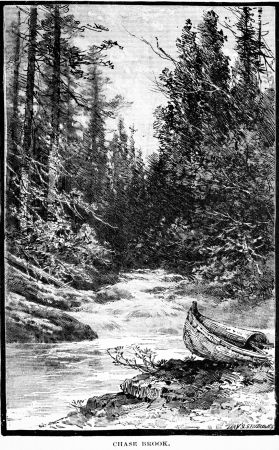
CHASE BROOK.
About this region we had rare success in our hunting
and trapping, and with many skins stretched on the drying
hoops about camp, and fresh animals coming in to
add to the stock, our quarters gradually assumed the appearance
of a Hudson Bay trading-post.
CHAPTER V.
“’Tis night upon the lake. Our camp is made
’Twixt shore and hill beneath the pine-trees’ shade.
’Tis still, and yet what woody noises loom
Against the background of the silent gloom;
One well might hear the opening of a flower
If day were hushed as this.”
A VISION ON THE LAKE.—NICHOLS’ BIRCH-HORN.—A
MIDNIGHT HUNT UNDER A COLD MOON.—CALLING
THE MOOSE.
Two days afterwards the Colonel and
Hiram, returning from an excursion
down the lake, drew their canoes up
on the shore, and entered the camp
looking as sorrowful and dejected as
a couple of jilted lovers.
“What’s the matter?” I asked with alarm, for John
Mansell happened to be out also, and the fear struck me
at once that something might have happened him.
“Matter? you would not ask it if you had been with
us to-day and seen the moose,” replied the Colonel
sadly.
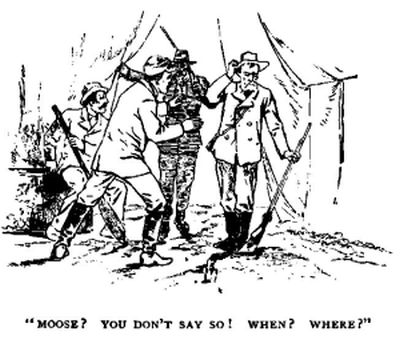
“MOOSE? YOU DON’T SAY SO! WHEN? WHERE?”
“Moose! you don’t say so! when? where?” I exclaimed,
and in this frantic query I was joined by the voice
of the younger Mansell, who at that moment suddenly
appeared behind us from the woods.
The Colonel’s voice choked itself in a feeble struggle
at reply, and stacking his Winchester against the back
of the tent, he threw himself with a disconsolate air down
upon his bed. But Hiram, less crushed by the evident
misfortune, kindly obliged me with a graphic detail of
the trouble.
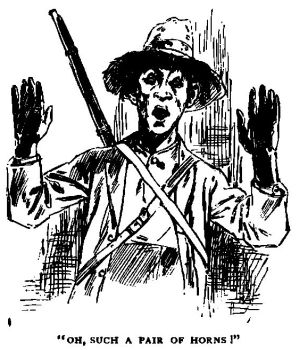
“OH, SUCH A PAIR OF HORNS!”
“It was down on the second Mansungun Lake. We
was paddlin’ up that stream to the right, where we shot
the mink yesterday, and the Kernel was whippin’ the
stream with his fly rod, when all of a sudden we heerd
a crackin’ of the bushes, and then out on the edge o’ the
bank stalked one of the biggest bull moose I ever did
see. He’d have weighed more’n a thousand pound,
Nichols, sure as I stand here. Oh, such a pair of horns!”
and the guide’s arms were raised in a tremendous gesture.
The Colonel groaned, and raising himself on one hand
he swept the other frantically through the air and gave
us a magnificent idea of the spread of the horns from tip
to tip.
“Then,” continued Hiram, “up started the Kernel, and
slingin’ his rifle to place he pegged in the lead afore ye
could count a brace o’ winks. Did the bull drop?—no—didn’t
even give a quiver, for the ball cut wide. Did he
turn flanks and tear off—no sir-ee; he waded nearer and
nearer to us, till he was only eight rods off at the most.
‘Pepper him agin, Kernel, and fire low,’ I whispered,
a-tryin’ to steady the canoe. Then bang! went the
Kernel agin, an’ with a thunderin’ snort the bull wheeled
’round, and went smashin’ away through the woods.”
“An’ you missed him clean?” said John.
“No! not the last shot, that hit him somewhere in the
neck, for we found his blood on the ground afterwards,
but the first ball cut the alders three foot over his head.
It was the queerest thing you ever see. Why! I was
so sure of him, that I was figurin’ how I was goin’ to
get the carcass back to camp, an’ smackin’ my lips over
the steaks.”
“Oh! don’t speak of it! don’t speak of it! I shall never
have such a chance again as long as I live; no, never!
never!” and the Colonel threw himself back on his blankets
with a groan.
I smiled for an instant. I could have “Pinafored” him
then and there upon the spot. It was a glorious chance,
but his gun was standing close beside him and I did not
dare.
“But it’s something to have seen one, in his native
wilds,” I remarked, trying my best to comfort him; “the
animal will soon be extinct in this country.”
It was of no use, and I think that lost opportunity
threw a veil of sadness over the Colonel’s mind for the
remainder of the tour; at any rate, it was a delicate subject
to touch upon afterwards.
“If moose so near,” said Nichols, one day, “me better
make horn and call moose to-night; no try, no get him.”
We thought this a good scheme, and with the approval
of all the Indian tramped off into the woods, and soon
returned with a large piece of birch bark. Shaving the
edges with his knife, he warmed it over the fire, and proceeded
to roll it up into a great horn two
feet in length, tapering it from six inches
to one in diameter, and fastening the
edges with wooden pegs.
Nichols and I were the only ones who
went out on the hunt. Preparing ourselves
after the evening repast, we stepped
into our canoes at 7.30 o’clock. It
was not a remarkably severe night, but
as I knew I should be obliged to remain
for a long time in almost motionless position,
I took precautions to wrap up extremely
well, and before I returned, the
night chill had penetrated through it all
to the very vicinity of my bones.
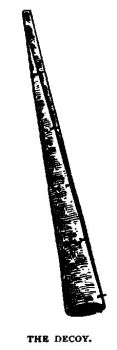
THE DECOY.
“Most ready?” asked the Indian, as in this clumsy
and uncomfortable attire I rolled, rather than seated, myself
in the bottom of the canoe.
“Yes; all ready, Nichols!” and throwing the birch
moose horn into the craft we paddled out into the lake,
with the best wishes of the rest of the party from the
shore.
“If we hear a shot,” yelled the Colonel, with a look of
dubiousness, “we will add an extra log to the fire.”
“And cut up the balance of our salt pork,” added Hiram,
“for moose steak is a little dry without it.”
It was a clear night, and so still that the sound of
voices and the blows of an axe at camp could be easily
heard two miles across the lake. The bright October
moon was gradually creeping down the western sky,
but shone enough to light us on our way many miles.
“She shone upon the lake
That lay one smooth expanse of silver light;
She shone upon the hills and rocks, and cast
Within their hollows and their hidden glens
A blacker depth of shade.”
The tall hemlocks that fringed the shore threw their
shadows far out into the lake, and in these reflections
the guide paddled from point to point.
A slight rustle behind me and the Indian draws forth
the long birch horn, dips it noiselessly in the water, and
for the first time in my existence I listen to the weird
sound of the moose call.
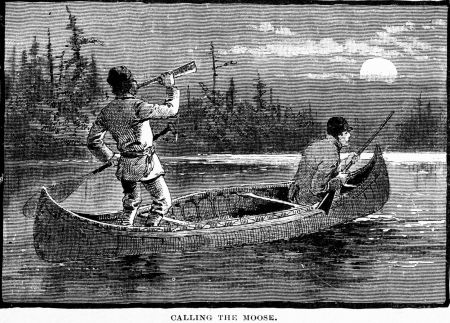
CALLING THE MOOSE.
Ugh—ugh—ugh—oo—oo—oo—oo—oo—ugh—ugh!
Three plaintive “ughs,” then a prolonged bellow, commencing
in a low tone, increasing in power and volume
to the end, and followed by two notes like the first.
It rolled across the lake in every direction, was tossed
from mountain tops to the inmost depths of the forests,
echoing and re-echoing. Then all was hushed, and we
waited in silence the result. The stillness was something
overpowering. We held our breaths. At times, however,
it was harshly broken. Away toward the distant
shore some sportive animal would splash in his gambols
at the water’s edge, or a muskrat could be distinctly
heard gathering his evening meal; then the prow of the
canoe would graze the rushes or the lily-pads with a
suddenness that was startling.
Noiselessly the Indian plied his paddle, and we crept
silently on in the shadows. Again the horn was raised
to his lips, and there came forth that strange midnight
call so melodious to my ears. This was repeated again
and again for six successive hours, neither of us exchanging
a word during the entire time.
At last the stars alone cast their reflections in the
glassy lake, and although from a distant mountain side
we at last received an answer to our call, we could not
draw the animal to the water’s edge.
We had paddled over ten miles. It was now 2 o’clock
in the morning, and we returned to camp. I was too
stiff to move, and the Indian lifted me from the canoe
to the shore, while I realized that I had experienced all
the pleasures of moose hunting—save the moose.
CHAPTER VI.
“And now the thicken’d sky
Like a dark ceiling stood; down rushed the rain
Impetuous.”—Milton.
DECREASE OF OUR PROVISIONS.—FACE TO FACE WITH
STARVATION.—SORE TRIALS.—SHOEING CANOES.—THROUGH
THE STORM.—WE SIGHT THE WATERS OF
THE AROOSTOOK.—“HURRAH!”
After this adventure we moved our
camp to the foot of the first Mansungun
Lake, which has for its outlet a
river bearing the same name.
After arranging our camp we sent
the guides ahead to explore the country
in our advance, and ascertain the pitch of water in
Mansungun Stream.
“There’s more work ahead,” said Hiram, in a disconsolate
tone of voice on returning to camp, “The water’s
jest about deep enough to float a turtle. We’re in for a
long ‘drag,’ an’ I’m afeard our canoes won’t never reach
the ’Roostook waters unless somethin’s done to pertect
’em.”
A council was held, and at the suggestion of Nichols,
we at last decided to build sleds or “shoes” for our
canoes, and drag them through the bed of the stream
twelve miles to the Aroostook River.
Little by little our provisions had given out. First
the sugar, then the hard tack and coffee, while potatoes
and Indian meal had been a thing of the past for many
days. The trout had left the summer pools for their
spawning beds, and notwithstanding the state of our
larder, we had no time to ascertain their whereabouts.
Occasionally we shot a duck or partridge; we added
plenty of water to the stew, to make sufficient for the
party, and in consequence had an unsubstantial meal.
For many weeks we had subsisted almost entirely on
the flesh of beavers, but now being in haste we had little
time to set our traps.
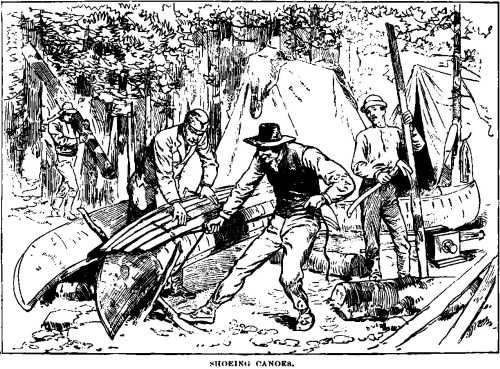
SHOEING CANOES.
On the 20th of October starvation almost stared us in
the face. Our breakfast this day consisted of the last
portion of beaver flesh and a cup of tea without milk
or sugar.
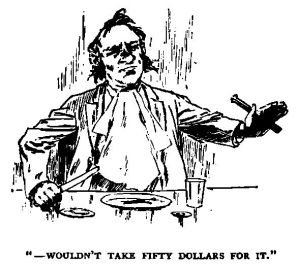
“—WOULDN’T TAKE FIFTY DOLLARS FOR IT.”
“I believe I’d give ten dollars a mouthful for another
meal like that, ’though its only an appetiser,” said Hiram,
arising from the frugal repast.
“Hiram,” remarked the Colonel, “puts me in mind
of an Englishman I met some weeks ago at the Tremont
Hotel, Boston. The gentleman sat at my table, and for
four mornings in succession I had noticed him call for
dried herrings and coffee, of which he made his entire
meal. I was wonderfully interested, and on the fifth
morning, to satisfy my curiosity, I had the audacity to
question him; ‘I say, my friend, you must excuse me;
but do you eat those herrings from a medicinal motive,
or because you really love them?’ ‘Well,’ he answered,
with a drawl, ‘I don’t exactly love them, but along
about 11 o’clock in the morning there creeps over me
such a glorious thirst that I wouldn’t take fifty dollars
for it!’”
But this was no time for story telling, and we immediately
set to work on the “shoes” for the canoes.
The guides soon felled a number of tall cedars and
dragged them into camp.
Then we split them into boards ten feet in length, half
an inch in thickness, and tapering from four to two inches
in width, the broadest extremities lapping one another
at midships.
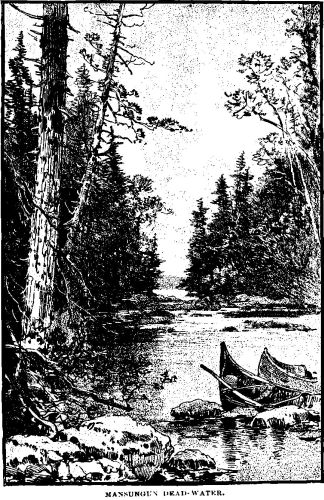
MANSUNGUN DEADWATER.
Sixteen of these strips were necessary for each of the
three canoes, and were fastened to their bottoms by being
split at the edges and drawn tightly together with
strips of cedar bark which ran through the slits, and passing
upward were tied securely to the thwarts. Thus the
graceful form of the birch was lost in the rough outline
of a boat.
For four days we labored incessantly at our task, and
from the splitting of the great logs to the finishing of the
wood had as tools only an axe and a penknife.
Fortunately partridges proved abundant, and on these we subsisted
during our forced encampment. A fine otter four feet in length was shot
near camp, but his flesh proved too fishy for us, half-famished as we
were. A large hawk frightened by our voices, dropped from his talons a
trout of over two pounds in weight, suggesting to our minds Israelitish
experience.
A SKY PICTURE.
Among all trying circumstances we kept at work, and
cheered one another by incessant jokes on the situations.
At last the “shoeing” of the canoes was accomplished,
and repacking our luggage, we paddled down the dead
water of Mansungun Stream, and passed falls five miles
below.
Although the morning was lowery, we little thought
we had selected the worst day of the entire tour for the
passage of the river; but so it proved.
Soon the heavens grew dark, the birds sought shelter
in the wooded depths, the wind howled among the tall
forest trees, and the rain, beginning first with light showers,
increased at last in volume to a perfect deluge.
In the midst of this we were obliged to disembark
from our canoes and drag them through the rocky bed
of the river, and the good results of the “shoeing” at
once became manifest.
“You look out for the bow, me look out for stern,”
yelled Nichols, as crowding my canoe forward over the
ledges of rocks and through the shallow water of the
stream we pushed onward, followed by the remainder
of the party.
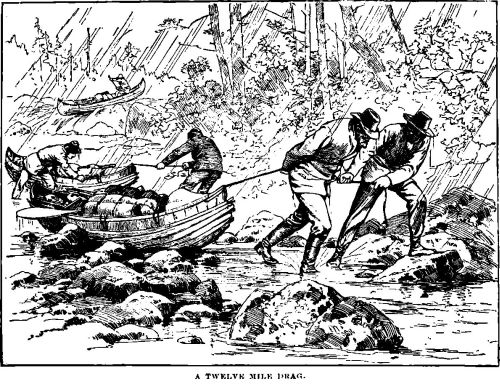
A TWELVE MILE DRAG.
We soon realized that we were in for hard work.
Mile after mile we dragged the canoes, at one moment
plunging into some unseen hole almost to our waists,
the next instant striking a ledge with hardly sufficient
water to cover our feet while the rain poured in torrents
upon us. It was water above and water below, and when
we were thoroughly wet, it made little difference from
which source it came.
Occasionally we reached water sufficiently deep to
float us a short distance, but after a few trials we found
it less fatiguing to remain in the stream all the time.
I pulled and hauled until every muscle seemed strung
to the tension of a fiddle-string, and before the end of
the ordeal I felt like a beast of burden.
So did the others; but we never grumbled. A common
feeling inspired us with the idea that it was heroic
sport.
After nine hours of toil and discomfort, through difficulties
that lasted for twelve miles, we reached the mouth
of the stream, and camped at the junction of the Mansungun
and Millnoket Rivers, our hardships forgotten in
the first sight of the Aroostook waters.
But for the cedar splits protecting the canoes, they
would hardly have withstood this rough experience, as
the knife-like rocks had left deep impressions on them.
Our rubber bags had shielded our tents and blankets,
from the ill effects of the storm, but the Tourograph had
been floating unobserved in two inches of water, which
destroyed a number of the plates, changing them from
the “dry” to the “wet process” of photography.
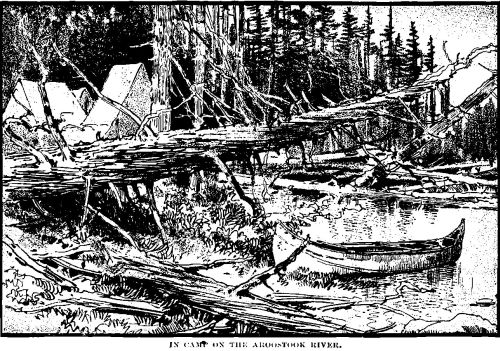
IN CAMP ON THE AROOSTOOK RIVER.
CHAPTER VII.
“Now, my co-mates, and brothers in exile,
Hath not old custom made this life more sweet
Than that of painted pomp? are not these woods
More free from peril than the envious court?”
REDEEMED FROM STARVATION.—THE FIRST HABITATION
ON THE AROOSTOOK.—MR. BOTTING’S HOUSE.—THE
TOUROGRAPH ASTONISHES THE NATIVES.—PURCHASING
SUPPLIES AT MASARDIS.—HOMEWARD
BOUND.—AU REVOIR!
When I turned out the next morning
the first thing I heard was an exclamation
from the Colonel.
“What a jolly place for trout!”
“Trout!” we echoed. “You don’t mean it?”
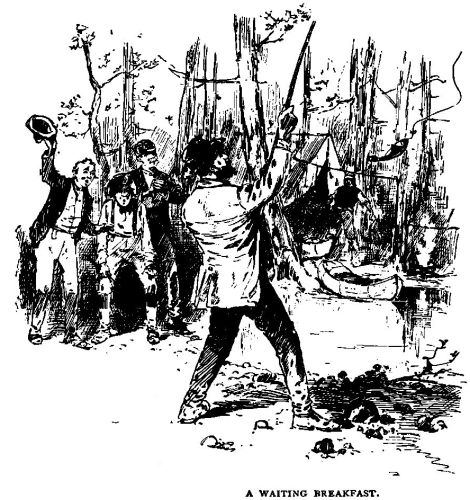
A WAITING BREAKFAST.
“I do, every time, my hearties,” responded the Colonel, as he
cast his line far out on the surface of a dark foam-flecked pool at the junction of the
two rivers. The next instant we saw his rod bend like a whip-lash,
and as the speckled prize which weighed above two pounds shot up out
of the stream five hungry men fastened their eyes on it with ravenous
fascination, and smacked their jaws in anticipation of a breakfast.
“Bravo, Colonel! Do it again!” we cried, as the trout
was landed; and verily he did it again and again, while
we did them all to a brown in the frying-pan.
During a few days rest here we secured a number of
views, hunted partridges, and captured four fine beaver.
Aside from the value of the pelts of the latter animals,
they placed us once more beyond the chance of starvation;
and having lived for a month almost entirely on
their flesh, we had learned by experience that it was
better than nothing.
We still retained the “shoes” on our canoes, for although
each day the Aroostook River grew deeper and
wider, we were obliged to repeat the experiences of
Mansungun Stream.
On we paddled, day after day. Soon we passed the
junction of the Mooseleuk and Aroostook Rivers, and
great was our joy when at last we caught sight of the
first house since leaving Chamberlin Lake.
From an architectural point of view it would hardly
have interested the humblest carpenter, but to our longing
eyes it was the assurance of perils over and the
hardest part of the tour accomplished.
A rough log cabin, with barn adjoining, and a few
acres of cleared land constituted the farm of one Philip
Painter. Here, as I was focussing the camera for a picture,
a mother and three children gazed on me from the
window, and viewed my operations with astonishment.
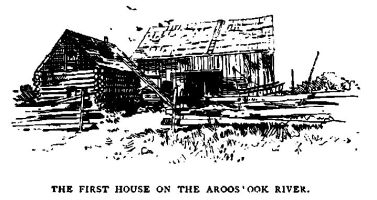
THE FIRST HOUSE ON THE AROOSTOOK RIVER.
But being still over one hundred miles from the end
of our voyage, the tarry was of short duration.
The Colonel, however, in prowling about the farm,
found time to fill his pockets with a quantity of small
apples, no larger than nutmegs, and about as digestible.
He distributed them among the party as we were returning
to the boats, imagining that he had made a
glorious capture.
“Splendid, aren’t they?” he said, as we began to munch
them.
“Anything for a change from beaver stews,” I replied.
“I feel that I could take to boot-leg cheerfully.”
A mile further on another farm appeared, perched
upon a high bluff.
“We must take this place by storm!” cried the Colonel.
“We must find a straight North American meal
if we perish in the attempt,” and he led a gallant advance
toward the farm house.
Mr. Botting, the proprietor of the place, appeared in
answer to our hail and greeted us with a stare of open-eyed
wonder. The first words he spoke were in company
with a jerking action of his thumb toward the Tourograph.
“What kind of a machine do ye call that?” he asked,
eyeing the instrument with a profound glance.
“This,” said the Colonel, hastening to explain, “is the
improved Gatling gun.”
“An’ ye’ve come all the way to this God-forsaken
hole to sell it?” said the man. “What’s it fur, anyhow?”
“Cats,” replied the Colonel, with the gravest expression
in the world.
“Wal, we ain’t got no cats round here,” said the man.
“Haint seen the ghost o’ one in years.”
“Don’t believe him,” I said, interposing, “It’s not a
Gatling gun; it is a camera—an instrument for taking
pictures—likenesses.”
“Oh!” drawled the man, “I see! He-he! Queer
lookin’ affair, ain’t it? Looks like one o’ these patent
coffee-grinders I seed down at ’Guster (Augusta) when
I was there last.”
“Sir, you insinuate,” said the Colonel. “We have
had neither sight nor taste of coffee in weeks, and we
don’t sport a coffee-grinder for bare admiration’s sake,
we can tell you.”
“Which brings us to our business,” said I. “We have
just come from Moosehead Lake. Can you get up a
dinner for the crowd?”
“Wal, yes, I guess so,” said the man in a half-dubious
tone, as he took in the calibre of the party.
Then, beckoning us to follow, he hobbled back into the house,
where after an hour’s tarry we were served with a dinner that hardly paid for the time
lost in eating it. It consisted of bread, potatoes, and tea sweetened
with molasses; but, like the apples, even this was “a change” from
beaver stews.
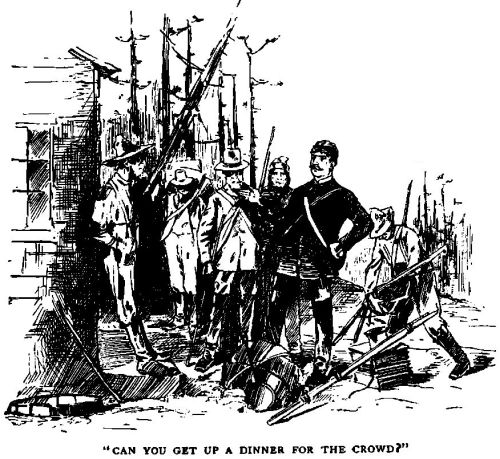
“CAN YOU GET UP A DINNER FOR THE CROWD?”
“Must a-had a dry time, gen’lmen,” he said, as he busied himself
attending to us. “Didn’t find much water, I guess. Never did see the
’Roostook run down so low in all my life, an’ I’ve lived on this
’ere river now nigh on thirty-seven year. I’m seventy odd year old, but only for a lame
hip I’ve got I could tramp through the woods with the best o’ ye.”
“You must have some trouble in working your farm,”
remarked the Colonel, surveying the fields in front of
the door.
“Oh, no; not much. I raise sons to do it. I’ve got
eleven as likely boys as you ever did see; but I lost one
in the war—poor feller!” as in a husky tone of voice he
pointed to a framed certificate of his son’s war services.
Sixteen miles more of vigorous paddling brought us to
the town of Masardis, the post-office of the county, and
landing on the shore among a number of dug-outs and
batteaux, we entered the village.
“Where is the store?” inquired the Colonel, as he
crossed the street and rapped at the door of one of the
houses.
“Don’t have any,” said the lady who answered his
call, surprised at her visitor.
“Well, can you sell us some flour, potatoes and coffee?”
and then the Colonel unrolled his memorandum of much
needed camp supplies.
At this house we purchased flour, at another potatoes,
at another coffee, no two articles being had at the same
place, while chickens at twenty-five cents each were sold
“on the run,” the Colonel and Hiram securing them after
an energetic race.
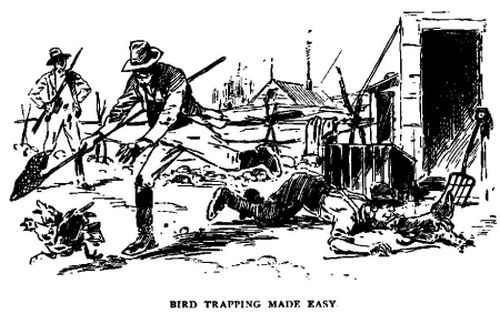
BIRD TRAPPING MADE EASY.
An old lady of seventy summers, who sold me a box of honey and was
very communicative, said during a short but delightful conversation—“I
suppose you have heaps more people down in Connecticut than we
have in this town; but I don’t believe they are half so happy as
our townsfolks. Oh, no! they can’t be near so happy—except, well—except on election
days;” and a sad expression came over her wrinkled countenance, for the
smaller the town, the greater is the feeling on politics in Maine.
“SEVENTY SUMMERS.”
The river now widens to a distance of over one hundred and fifty
feet, and day after day shows a gradual increase in its depth and
power.
The current sweeps us swiftly onward through rapids innumerable in
the full excitement of canoe life, but occasionally we are forced to
disembark and drag our canoes over a rocky beach, which obliges us to
retain the “shoes.”
At our various camps we are visited by the inhabitants
along the route, who in return for the history of
our tour entertain us with news of the outside world,
from which we have been separated for so many weeks.
Then we begin to realize that we are homeward bound.
An invitation to one of these callers, requesting the
honor of his company at breakfast was accepted (with
avidity), although, as he remarked, “the old woman was
waiting to serve that meal for him on yonder hill.”
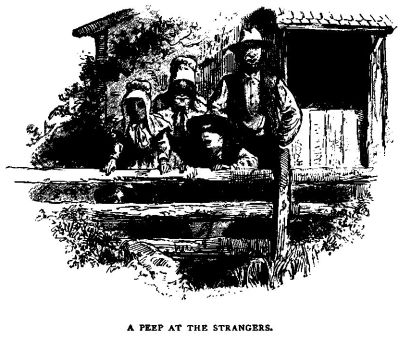
A PEEP AT THE STRANGERS.
On passing the towns of Ashland and Washburn, the
foamy and discolored appearance of the stream gave
evidence of the potato starch manufactories in the vicinity.
The strangest peculiarity of the inhabitants was their
utter ignorance of the country and its surroundings.
These people, living on the river, could not give us
the faintest idea of distances to points along the shore.
“Hello, stranger!” yelled the Colonel, as rounding a
bend in the stream he spied a man standing in one of
the log-houses that dot the banks; “can you tell us how
far it is to the next town?”
“Dunno, friend; but its nigh on ten miles by the road.”
Another gave the same answer, while a third did not
know the name of the next town, although he had lived
five years in the country—a parallel to the Virginian
woodsman who stalked forth from his native pines one
day to learn that there had been such a catastrophe
in the history of his country as the war of the Rebellion.
“Wake up, boys,” yelled the Colonel, arousing the
party (4 A. M.) at our last camp near Washburn, where
we turned out in the dark to partake of a hasty breakfast
before embarking.
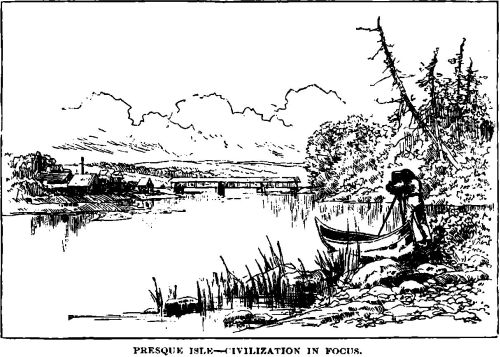
PRESQUE ISLE—CIVILIZATION IN FOCUS.
“If we are going to make forty-five miles to Caribou
to day, we must make hay while the sun shines,—or
while it doesn’t shine,” he added, as he took notice of
the darkness.
Soon we were gliding down the swift stream, avoiding
the huge rocks dimly appearing through the mist, until
at last the rising sun dispelled the darkness.
At Presque Isle we landed, and while the guides were
preparing dinner, I climbed a neighboring hill with my
Tourograph and secured a picture of the scene.
Hour after hour we labored at the paddles, until they
seemed almost a part of ourselves; the “shoes” on our
canoes retarded us not a little.
The sun was creeping down the western sky, and the
tall pines on the bluffs above us threw their lengthening
shadows across the stream, as doubling the last bend we
shot the canoes along side the wharf at Caribou, and
completed our tour of over four hundred miles from
Moosehead Lake to the Aroostook River.
Here we took the cars.[B]
A delegation of the “big people” of the vicinity saw
us off.
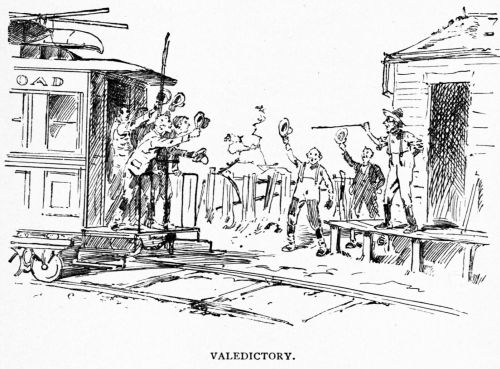
VALEDICTORY.
At the parting moment they seemed visibly affected, as
our sketch shows.
As we crossed the line at Fort Fairfield the following
day on our way to Woodstock, New Brunswick,
the custom house officer found nothing in our kit to
reward his examination, although he displayed much
curiosity in the leather case containing the camera.
“You must have had a fine time,” he remarked.
“Yes,” was the reply, “save building dams and shoeing
canoes.”
While the Indian ejaculated—
“Me think so, too; yes!”
In the whirl of the outside world the weeks fleet by
as with the swiftness of a day, but in the solitude of the
wilds it seems a longer lease of time.
It is like an age since we took leave of civilization and
plunged into the heart of the forests. Now, out of the
depths, with a bound we are again in the noise of the
busy world.
Mighty trees, primeval rocks with draperies of vine
and moss and lichen, tumbling cascades, rushing streams,
and all the forest’s wealth of color, form and music disappear
like magic.
Presto! what a change!
From the sigh and rustle of the grand old pines list
to the rattle of rail cars, the shriek of whistles, and hum
of machinery in the mills and factories.
From the croon of the night-bird, that with the distant
star has often been my only company in the dark hours
while my comrades slept, list to the bark of dogs and
crow of cocks, as we rush past town and hamlet through
the night and early morn. We are out of the wilds.
Farewell, Nature! Welcome, Home!
“There is a pleasure in the pathless wood,
There is a rapture on the lonely shore,
There is society where none intrude—
To sit on rocks, to muse o’er flood and fell,
To slowly trace the forest’s shady scene,
Where things that own not man’s dominion dwell,
And mortal foot hath ne’er or rarely been;
To climb the trackless mountain all unseen,
Alone o’er steep and foaming falls to lean—
This is not solitude; ’tis but to hold
Converse with Nature’s charms and view her stores unrolled.”
THE MOST ARTISTIC AND CHARMING BOOK OF THE SEASON. — CANOE AND CAMERA.
A Photographic and Descriptive Tour of Two Hundred Miles through the Maine Forests.
By THOMAS SEDGWICK STEELE, of Hartford, Conn.
Sixty Beautiful Scenery and Character Illustrations by well-known Artists, including
True Williams, Benjamin Day, Aug. Will, and others, together with New Maps
of the State, Expressly Prepared for the Work, which Present the
Latest Explorations of the Author and his Experienced Guides.
WHAT IS SAID OF “CANOE AND CAMERA.”
Forest and Stream says: “It is a superb
volume. One of the most attractive summer books of the year. The
mechanical work is of the very highest standard. The country explored
and described comprised the region of the East Branch of the Penobscot
River—a territory rich in beautiful scenery and well supplied with
game and fish. It is admirably adapted to canoeing. Mr. Steele is no
amateur in the camp and on the jaunt. He has explored the wilds of
Florida, the forests of Lake Superior, Wisconsin, and has camped beside
the Rangeleys. An enthusiastic sportsman, he communicates this spirit
to his book, and writes in a vein which leads the reader unconsciously
to sympathize with him in his description of a striking landscape, his
spirited accounts of a capture of a fish, or the running of a rapid,
and in his philosophical and outspoken sentiments regarding the ethics
of the camp and field.”
Charles Dudley Warner, the eminent author, writes concerning this volume: “Canoe and
Camera, by Mr. Thomas Sedgwick Steele, is one of the handsomest books of the season, and reflects
great credit on the taste of the author, the printer, and the binder. It is seldom that a book is so fully
and so well illustrated. Many of the drawings are charming, and many of them are not only picturesque,
but interesting, as views of wild scenery which the author describes.”
The Advance, Chicago.—“A delightful book, delightfully gotten up, is Canoe and Camera, an
illustrated description of a 200-miles tour through the Maine forests. There are instructions as to the
best modes of reaching and traversing this wild, romantic region, and the accounts of the routes, the
fishing regions, the adventures, and the scenery, with the sixty illustrations and the 20 x 25 in. map, almost
make the reader feel that he takes the trip in his easy chair, without any of its attendant drawbacks.”
The Independent, N. Y.—“It is a lively narrative of adventure, with abundant illustrations, and
is altogether a charming volume.”
Boston Journal.—“The book is written in the best of temper, in a fresh and breezy style, and
with a zest that marks a true sportsman.”
1 vol. Crown 8vo. Cloth. $1.50.
Sent, post-paid, on receipt of price, by
ESTES & LAURIAT, Publishers,
301 to 305 Washington Street, BOSTON, MASS.
JUST PUBLISHED.
A NEW MAP OF THE
HEADWATERS OF THE
AROOSTOOK, PENOBSCOT, AND ST. JOHN RIVERS,
MAINE,
COMPILED BY
THOMAS SEDGWICK STEELE,
HARTFORD, CONN.
AUTHOR OF
CANOE AND CAMERA; or, Two Hundred Miles Through the
Maine Forests.
PADDLE AND PORTAGE, from Moosehead Lake to the Aroostook
River, etc., etc.
What is said of the Map by the well-known Sportsman’s Paper, “Forest and Stream.”
“A New Map of Northern Maine.—Mr. Thomas Sedgewick Steele, author of
‘Canoe and Camera’ and other works, has just compiled one of the most satisfactory maps
of the great canoe tours of Northern Maine yet published. This chart is 20 x 30 inches,
printed on Government Survey paper, mounted on cloth, and is an invaluable aid to the
sportsman tourist in these wild regions,—in fact, to such an individual it is a most necessary
adjunct to the economy of his camp kit. From the extreme lower portion of the map
covered by Moosehead Lake diverge the great rivers of this vast wilderness,—the Main
St. John, Aroostook, and East and West Branches of the Penobscot, while a portion of Canada
on the north and New Brunswick on the east is embraced within its boundaries. Great care
has been exercised in noting many points along these routes, which, although of the greatest
importance to the canoeist, are seldom brought within the scope of the ordinary map. Along
the Main St. John every log house and portage seems to be conscientiously indicated, while
the many falls of the picturesque East Branch are noted, to the advantage and caution of
the voyageur of these waters. After leaving the farms at Chesuncook and Chamberlin
Lake the tourist to the Aroostook paddles about two hundred miles through the wilderness
before reaching a sign of civilization, the first house being that of Philip Painter, while the
second habitation, one mile further on, is that of William Botting, situated on the right
bank, at a bend of the Aroostook River, called the Oxbow. Innumerable lakes and ponds
are spread out before one on this chart like shot holes in a target. These and many other
points of interest recommend this new survey of Mr. Steele to the camper-out in the wilds
of Maine. The map is published by Estes & Lauriat, of Boston, and is mailed, post-paid,
for $1.00 per copy.”—Forest and Stream.
PRICE, $1.00.
Sent, post-paid, on receipt of price, by
ESTES & LAURIAT, Publishers,
301-305 Washington Street, Boston, Mass.