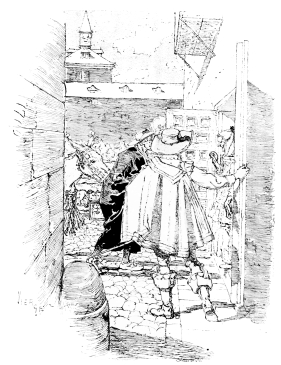
I SIR, was born at Segovia, my father’s name was Clemente Pablo, a
native of the same town; may God keep him in heaven. I need not speak of
his virtues, for those are unknown, but by trade he was a barber, though
so high minded, that he took it for an affront to be called by any name
but that of a cheek-shearer and beard-tailor. They say he came of a good
stock, and his actions showed it. He was married to Aldonza Saturno de
Rebollo, daughter to Octavio de Rebollo Codillo, and grandchild to
Lepido Ziuraconte. The town foully suspected that she was no old
Christian,[3] though she strongly urged the names of her progenitors, to
prove herself descended from those great men that formed the Triumvirate
at Rome. She was very handsome, and so famous, that all the ballad
rhymers of her time made verses of her, which were sung about the
streets. She ran through many troubles, when first married, and long
after, for there were scandalous tongues in the neighbourhood that did
not stick to say my father was willing to wear the horns, provided they
were tipped with gold. It was proved upon him, that whilst he was
lathering the beards of those he was to trim, a small brother of mine,
about seven years of age, rifled their pockets. The little angel died of
a whipping he had in the gaol; and my father was much concerned at the
loss, because he won the hearts of them all. He was himself a while in
prison for some small trifles of this nature; but I am told he came off
so honourably, that at his first walking abroad from gaol two hundred
cardinals went behind him, of whom ne’er a one was monsignor,[4] and the
ladies stood at their windows to see him pass by; for my father always
made a good figure, either a-foot or a-horseback. I do not speak it out
of vanity, for everybody knows that to be foreign to me.

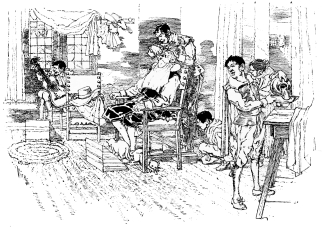
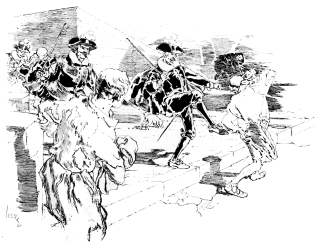
My mother, good woman, had no share of troubles. An old woman that bred
me, commending her one day, said, she was of such a taking behaviour,
that she bewitched all she had to do with; but they say, she talked
something concerning her intercourse with a great he-goat, which had
like to have brought her to the stake, to try whether she had anything
of the nature of the salamander, and could live in fire. It was reported
that she had an excellent hand at soldering cracked maidens, and
disguising of grey hairs. Some gave her the name of a pleasure-broker,
others of a reconciler; but the ruder sort, in coarse language, called
her downright bawd, and universal money-catcher. It would make anybody
in love with her to see with what a pleasant countenance she took this
from all persons. I shall not spend much time in relating what a
penitential life she led; but she had a room into which nobody went
besides herself, and sometimes I was admitted on account of my tender
years; it was all beset with dead men’s skulls, which she said were to
put her in mind of mortality, though others in spite to her pretended
they were to put tricks upon the living. Her bed was corded with halters
malefactors had been hanged in; and she used to say to me: “D’ye see
these things? I show them as remembrances to those I have a kindness
for, that they may take heed how they live, and avoid coming to such an
end.”
My parents had much bickering about me, each of them contending to have
me brought up to his or her trade; but I, who from my infancy had more
gentleman like thoughts, applied myself to neither. My father used to
say to me: “My child, this trade of stealing is no mechanic trade, but a
liberal art.” Then pausing and fetching a sigh, he went on: “There is no
living in this world without stealing. Why do you think the constables
and other officers hate us as they do? Why do they sometimes banish,
sometimes whip us at the cart’s tail, and at last hang us up like
flitches of bacon without waiting for All Saints’ Day to come?”[5] (I
cannot refrain from tears when I think of it, for the good old man wept
like a child, remembering how often they had flogged him.) “The reason
is, because they would have no other thieves among them but themselves
and their gang; but a sharp wit brings us out of all dangers. In my
younger days I plied altogether in the churches, not out of pure
religious zeal, and had been long ago carted, but that I never told
tales, though they put me to the rack; for I never confessed but when
our holy mother the Church commands us. With this business and my trade,
I have made a shift to maintain your mother as decently as I could.”
“You maintain me!” answered my mother, in a great rage (for she was
vexed I would not apply me to the sorcery), “it was I that maintained
you; I brought you out of prison by my art, and kept you there with my
money. You may thank the potions I gave you for not confessing, and not
your own courage. My good pots did the feat; and were it not for fear I
should be heard in the streets, I would tell all the story, how I got in
at the chimney, and brought you out at the top of the house.” Her
passion was so high, that she would not have given over here, had not
the string of a pair of beads broke, which were all dead men’s teeth she
kept for private uses. I told them very resolutely I would apply myself
to virtue, and go on in the good way I had proposed, and therefore
desired them to put me to school, for nothing was to be done without
reading and writing. They approved of what I said, though they both
muttered at it a while betwixt them. My mother fell to stringing her
dead men’s teeth, and my father went away, as he said, to trim one—I
know not whether he meant his beard or his purse. I was left alone,
praising God that he had given me such clever parents, and so zealous
for my welfare.
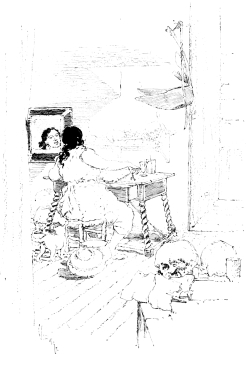
THE next day my primer was bought, and my schoolmaster bespoke. I went
to school, Sir, and he received me with a pleasant countenance, telling
me I had the looks of a sharp lad and intelligent. That he might not
seem to be mistaken in his judgment, I took care to learn my lessons
well that morning. My master made me sit next to him, and gave me good
marks every day, because I came first and went away last, staying behind
to run on some errands for my mistress, and thus I gained all their
affections. They favoured me so much that all the boys were envious. I
made it my business to keep company with gentlemen’s sons, above all
others, but particularly with a son of Don Alonso Coronel de Zuñiga: I
used to eat my afternoon’s luncheon with him, went to his house every
holiday, and waited on him upon other days. The other boys, either
because I took no notice of them, or that they thought I aimed too high,
were continually giving of me nicknames relating to my father’s trade.
Some called me Mr. Razor, others Mr. Stuckup. One to excuse his envy
would say he hated me, because my mother had sucked the blood of his two
little sisters in the night; another, that my father had been sent for
to his house to frighten away the vermin, for nothing was safe where he
came. Some, as I passed by cried out, “Cat”; others, “Puss, Puss.”
Another said, “I threw rotten oranges at his mother when she was
carted.” Yet, for all their backbiting, glory to God, my shoulders were
broad enough to bear it; and though I was out of countenance yet I took
no notice, but put all up, till one day a boy had the impudence to call
me son of a whore and a witch; he spoke it so plain, that though I had
been glad it had been better wrapped up, I took up a stone, and broke
his head. Away I went, running as fast as I could to my mother to hide
me, telling her all the story. She said, “It was very well done of you,
and like yourself; but you were in the wrong that you did not ask him
who told him so.” Hearing what she said, and having always had high
thoughts, I turned to her, and said, “Mother, all that troubles me is,
that some of the slanders by told me I had no cause to be disturbed at
it; and I did not ask them what they meant, because he was so young that
said it.” I prayed her to tell me, whether I could have given him the
lie with a safe conscience, or whether I was begot in a huddle, by a
great many, or was the true son of my father. She laughed, and answered,
“God a-mercy, lad, are you so cunning already! You’ll be no fool, you
have sense enough; you did very well in breaking his head, for such
things are not to be said, though never so true.” This struck me to the
heart, and I was so very much out of countenance, that I resolved, as
soon as possible, to lay hold of all I could, and leave my father’s
house. However, I dissembled; my father went and healed the boy; all was
made up, and I went to school again. My master received me in an angry
manner, till being told the occasion of the quarrel, his passion was
assuaged, considering the provocation given me. Don Alonso de Zuñiga’s
son, Don Diego, and I were very great all this while, because he had a
natural affection for me; and besides, I used to change tops with him,
if mine were better than his; I gave him any thing I had to eat, and
never asked for what he had; I bought him pictures, I taught him to
wrestle, played at leap frog with him, and was so obliging in all
respects, that the young gentleman’s parents observing how fond he was
of my company, would send for me almost every day to dine and sup, and
sometimes to stay all night with him.
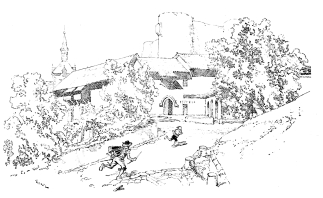
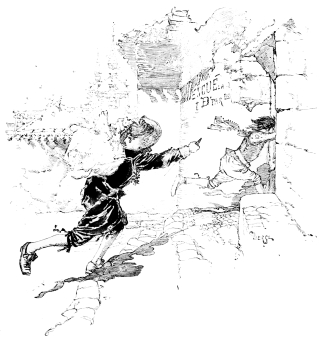
It happened one day soon after Christmas, as we were going to school,
that a counsellor, called Pontio de Aguirre, passed along the street;
little Don Diego seeing him, bid me call him Pontius Pilate, and run
away when I had done. To please my friend, I did so, and the man was so
affronted at it, that he scoured after me as hard as he could, with a
knife in his hand to stab me, so that I was forced to take sanctuary in
my master’s house, crying out with might and main. The man was in as
soon as I; my master saved me from his doing me any mischief, promising
to whip me, and was as good as his word, though my mistress, in
consideration of the great service I did her, interceded for me. He bid
me untruss, and every lash he gave me, cried, “Will you ever call
Pontius Pilate again?” I answered, “No, Sir,” every time he put the
question; and it was such a warning to me, that dreading the name of
Pontius Pilate, the next day, when we were ordered to say our prayers,
according to custom, coming to the Creed (pray observe the innocent
cunning) instead of saying “He suffered under Pontius Pilate,” believing
I was never more to name Pilate, I said, “He suffered under Pontio de
Aguirre.” My master burst out a laughing at my simplicity, and to see
how I dreaded the lashing; and embracing me, promised to forgive the
two first whippings I should deserve, which I took as a great favour of
fortune, and a kindness in him.
To be brief, came Shrove-tide, and our master to divert the boys, and
make sport, ordered that there should be a king of cocks[6] among us,
and we casts lots for that honour among twelve he had appointed for it.
I was the lucky person it fell upon, and spoke to my father and mother
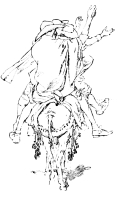
to provide me fine clothes. When the day came, abroad I went upon a
starved poor jade of a horse, that fell to saying his prayers at every
step; his back looked like a saw; his neck like a camel’s, but somewhat
longer; his head like a pig, only it had but one eye, and that
moon-blind; all this plainly showed the knavery of his keeper, who made
him do penance, and fast, cheating him of his provender. Thus I went,
swinging from side to side, like a jointed baby, with all the rest of
the boys after me, tricked up as fine as so many puppets, till we came
into the market place—the very naming of it frights me; and coming to
the herb-women’s stalls, the Lord deliver us from them, my horse being
half starved, snapped up a small cabbage, which no sooner touched his
teeth but it was down his throat, though, by reason of the length of his
neck, it came not into his belly for a long time after. The herb-woman
who, like the rest of them, was an impudent jade, set up the cry, the
others of the trade flocked about her, and among them abundance of the
scoundrels of the market; all these fell a pelting the poor king with
carrot and turnip tops, rotten oranges, and all the offals of the
market. Considering the enemies’ forces were all foot,[7] and therefore
I ought not to charge them a-horseback, I would have alighted, but my
horse received such a shot in the head that as he went to rear, his
strength failing him, we both came down into the sewer. You may imagine
what a condition I was in. By this time my subjects, the boys, had armed
themselves with stones, and charging the herb-women, broke two of their
heads. For my part after my fall into the sewer, I was good for little,
unless it were to drive all from me with stink and filth. The officers
coming up, seized two of the herb-women and some of the boys, searching
them for their weapons, which they took away, for some had drawn
daggers they wore for the greater show, and others short swords. They
came to me, and seeing no weapons about me, because I had taken them
off, and put them into a house to be cleaned, with my hat and cloak, one
of them asked me for my arms; I answered, that in that filthy condition
I had none but what were offensive to the nose alone. I cannot but
acquaint you, Sir, by the by, that when they began to pelt me with the
rotten oranges, turnip-tops, &c., my hat being stuck with feathers, as
they do the bawds in Spain when they cart them, I fancied they mistook
me for my mother, and thought they threw at her, as they had done
several times before. This foolish notion being got into my young head,
I began to cry out, “Good women, though I wear feathers in my cap, I am
none of Aldonza Saturno de Rebollo; she is my mother”; as if they could
not perceive that by my shape and face. However, the fright I was in may
excuse my ignorance, especially considering the misfortune came so
suddenly upon me. To return to the officer; he would willingly have
carried me to prison, but did not, because he could not find a clean
place to lay hold of me, for I was all over mire. Some went one way, and
some another, and I went directly home from the market place, punishing
all the noses I met by the way. As soon as I got home I told my father
and mother all the story, who were in such a passion to see me in that
nasty pickle, that they would have beat me. I excused myself the best I
could, laying all the blame on the two leagues of attenuated horse they
had provided for me; and finding nothing would appease them, left the
house, and went away to see my friend Don Diego, whom I found at home
with a broken head, and his parents fully resolved, for this reason,
that he should go to school no more. There was I informed, that my
steed, finding himself in distress, summoned up all the strength he had
to salute his enemies with his heels, but was so weak that he put out
his hips with the effort, and lay in the mud expiring. Considering that
all the sport was spoiled, the mob alarmed, my parents in a rage, my
friend’s head broken, and my horse dead, I resolved to go no more to
school, nor to my father’s house, but to stay and wait upon Don Diego,
or rather to bear him company, which his parents were well pleased with,
because their son was so taken with me. I wrote home to tell them I had
no need to go to school any longer, for though I could not write a good
hand, that was no fault, because it was more becoming me, who designed
to be a gentleman, to write an ill one; and therefore, from that time, I
renounced the school, to save them charges, and their house, that they
might have no trouble with me. I acquainted them where and what post I
was in, and that I should see them no more, till they gave me leave.
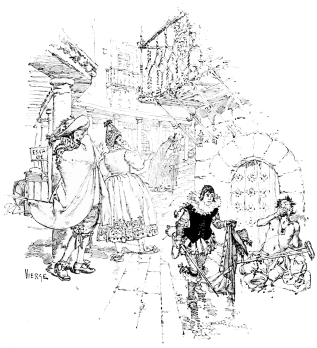
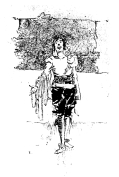
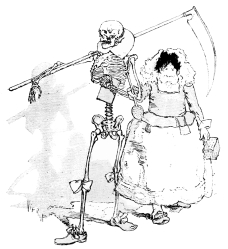
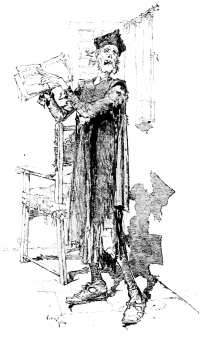
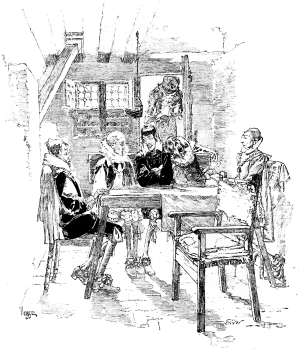
DON ALONSO resolved to send his son to a boarding-school; both to wean
him from his tender keeping at home, and at the same time to ease
himself of that care. He was informed there was a master of arts in
Segovia whose name was Cabra, that made it his business to breed up
gentlemen’s sons;[8] thither he sent his, and me to wait on him. The
first Sunday after Lent we were brought into the house of famine, for it
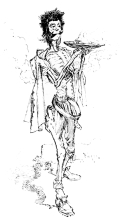
is impossible to express the penury of the place. The master was a
skeleton, a mere shotten herring, or like a long slender cane, with a
little head upon it, and red haired; so that there needs no more to be
said to such as know the proverb, that “neither cat nor dog of that
colour is good.” His eyes were sunk into his head, as if he had looked
through a fruit bottle, or the deep windows in a linen draper’s shop;
his nose turning up, and somewhat flat, for the bridge was almost
carried away with an inundation of a cold rheum, for he never had the
disease, because it costs money; his beard had lost its colour for fear
of his mouth, which being so near, seemed to threaten to eat it for mere
hunger; his teeth had many of them forsaken him for want of employment,
or else were banished for being idle livers; his neck as long as a
crane’s, with the gullet sticking out so far, as if it had been
compelled by necessity to start out for sustenance; his arms withered;
his hands like a bundle of twigs, each of them, taken downwards, looking
like a fork or a pair of compasses; with long slender legs. He walked
leisurely, and whensoever he happened to move any thing faster his bones
rattled like a pair of snappers. His voice was weak and hollow; his
beard bushy and long, for he never trimmed to save charges, though he
pretended it was so odious to him to feel the barber’s hands all over
his face that he would rather die than endure it. One of the boys cut
his hair. In fair weather he wore a thread-bare cap, an inch thick in
grease and dirt, made of a thing that was once cloth, and lined in scurf
and dandruff. His cassock, some said, was miraculous, for no man knew
what colour it was of; some seeing no sign of hair on it, concluded it
was made of frogs’ skins; others said it was a mere shadow, or a
phantom; near at hand it looked somewhat black, and at a distance
bluish. He wore no girdle, cuffs, nor band; so that his long hair and
scanty short cassock made him look like the messenger of death. Each
shoe might have served for a Philistine’s coffin. As for his chamber,
there was not so much as a cob-web in it, the spiders being all starved
to death. He put spells upon the mice, for fear they should gnaw some
scraps of bread he kept. His bed was on the floor, and he always lay
upon one side, for fear of wearing out the sheets; in short, he was the
Archpauper and Protomiser. Into this prodigy’s hands I fell, and lived
under him with Don Diego. The night we came, he showed us our room, and
made us a short speech, which was no longer, out of mere good husbandry.
He told us how we were to behave ourselves, and the next morning we were
employed till dinner time; thither we went, the masters dined first,
and the servants waited. The dining-room was as big as a half peck; five
gentlemen could eat in it at one table. I looked about for the cat, and
seeing none, asked a servant, who was an old hand, and in his leanness
bore the mark of the boarding-school, how it came they had none? The
tears stood in his eyes, and he said, “What do you talk of cats? Pray
who told you that cats loved penance and mortification? Your fat sides
show you are a new comer.” This, to me, was the beginning of sorrow; but
I was worse scared, when I observed that all those who were before us in
the house looked like so many pictures of death. Master Cabra said
grace, and sat down, and they ate a meal, which had neither beginning
nor end. They brought the broth in wooden dishes, but it was so clear,
that Narcissus going to drink of it would be in worse danger than at the
fountain. I observed how eagerly they all dived down after a poor single
pea that was in every dish. Every sip he gave, Cabra cried, “By my troth
there is no dainty like the olla, or boiled meat and broth. Let the
world say what it will, all the rest is mere gluttony and extravagancy.”
As soon as the words were out of his mouth, he belched out all the
porrenger, saying, “This is good for the health, and sharpens the wit.”
A curse on thee and thy wit, thought I, and at the same time saw a
servant like a walking ghost, and no more substantial, bring in a dish
of meat, which looked as if he had picked it off his bones. Among it was
one poor stray turnip, at whose sight the master said, “What, have we
turnips to-day? No partridge is, in my opinion, to compare to them. Eat
heartily, for I love to see you eat.” He gave every one such a wretched
bit of meat, that I believe it all stuck to their nails, and between
their teeth, so that no part of it ever went into their bellies. Cabra
looked on, and said, “Eat away, for it is a pleasure to me to see what
good stomachs you have.” Think what a comfort this was for them that
were pining with hunger! When dinner was over, there remained some
scraps of bread on the table, and a few hits of skin and bones in the
dish, and the master said, “Let this be left for the servants; they must
dine too; it is not for us to gormandize all.” A vengeance on thee, and
may what thou hast eaten choke thee, thou wretched miser! thought I;
what a consternation have you put my guts into! He gave thanks, and
said, “Now let us give way to the servants, and go ye use some exercise
until two of the clock, lest your dinner do you harm.” I could no longer
forbear laughing for my life, but burst out into a loud fit. He was very
angry, and bid me learn to behave myself modestly, ripping up two or
three old mouldy sentences, and so went his way. We sat down, and I
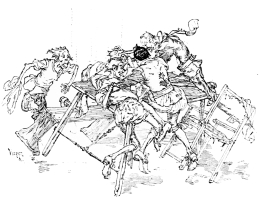
seeing such short commons, and hearing my guts roar for provender,
being cunning and stronger than the rest, clapped both hands in the
dish, as others did, and whipped down two scraps of bread out of three
there were left, and one piece of skin. The others began to murmur, and
making a noise, in came Cabra, saying, “Eat lovingly together like
brethren, since God provides for you; do not fall out, for there is
enough for you all.” This said, he returned to sun himself, and left us
to ourselves. I declare it, there was one of these servants, his name
Surre, a Biscayner, who had so absolutely forgot the way and method of
eating, that he put a small bit of crust, which fell to his share, to
his eyes twice, and even the third time knew not how to carry it to his
mouth. I asked for drink; the rest, who had scarce broke their fast,
never thinking of it, and they gave me a dish with some water, which I
had no sooner laid to my lips, but the sharp-gutted lad I spoke of,
snatched it away, as if I had been Tantalus and that the flitting river
he stands in up to the chin.
Thus we passed on till night. Don Diego asked me how he should do to
persuade his guts that they had dined, for they would not believe it.
That house was an hospital of dizzy heads, proceeding from empty
stomachs, as others are of surfeits. Supper-time came, for afternoonings
were never heard of there; it was much shorter than the dinner, and not
mutton, but a little roasted goat: sure the devil could never have
contrived worse. Our starveling Master Cabra said, “It is very wholesome
and beneficial to eat light suppers, that the stomach may not be
overburdened”; and then he quoted some cursed physician, that was long
since in hell. He extolled spare diet, alleging that it prevented uneasy
dreams, though he knew that in his house it was impossible to dream of
anything but eating. They supped, and we supped, and none had supper. We
went to bed, and neither Don Diego nor I could sleep one wink all that
night, for he lay contriving how to complain to his father, that he
might remove him, and I advising him so to do; and at last I said to
him, “Pray, Sir, are you sure we are alive, for, to tell you the truth,
I have a strong fancy that we were slain in the battle with the
herb-women, and are now souls suffering in purgatory, in which case it
will be to no purpose to talk of your father’s fetching us away, without
he has our souls prayed out of this “place of punishment.” Having spent
the whole night in this discourse, we got a little nap towards morning,
till it was time to rise; six o’clock struck, Cabra called, and we all
went to school; but when I went to dress me, my doublet was two handfuls
too big; and my breeches, which before were close, now hung so loose as
if they had been none of my own. My very teeth were already all furred,
and looked as yellow as amber; such a wonderful change had one day
wrought. When we came to school, I was ordered to decline some nouns,
and was so wonderful hungry, that I ate half my words for want of more
substantial diet. Any man will easily believe this, who does but hear
what Cabra’s man told me, which was, that at his first coming he saw two
great Flanders geldings brought into the house, and two days after they
went out perfect racers, so light, that the very wind would carry them
away; that he saw mastiff dogs come in, and in less than three hours
they went out converted into greyhounds; that one Lent he saw abundance
of men, some thrusting their heads, some their feet, and some their
whole body, into the porch; and this continued a long time, very many
people flocking from all parts to do so; and that he asking one day,
what could be the meaning of it, Cabra was very angry, but one in the
crowd answered, “Some of those “people are troubled with chilblains,
others with the itch, and others with lice; all which distempers and
vermin died as soon as they came into that house, so that they never
felt them more.” He assured me this was very true, and I, who was
acquainted with the house, believe it, which I am fain to take notice
of, lest what I say should be looked upon as an hyperbole.
To return to the school, he set us our lesson, and we conned it, and so
we went on in the same course of life I have here delivered, only that
our master added bacon in the boiling of his pot, because going abroad
one day, he was told that to boil meat without bacon, betokened a
scandalous race descended either from Moors or Jews. For this reason he
provided a small tin case, all full of holes, like a nutmeg-grater,
which he opened, and put in a bit of bacon that filled it; then shutting
the box close, hung it with a string in the pot, that some relish of it
might come through the holes, and the bacon remain for the next day.
Afterwards he thought this too great an expense, and therefore for the
future only dipped the bacon into the pot. It is easy to guess what a
life we led with this sort of diet and usage. Don Diego and I were in
such miserable condition, that since we could find no relief as to
eating, after a month was expired, we contrived, at last, not to rise so
early in the morning, and therefore resolved to pretend we were sick,
but not feverish, because that cheat we thought would be easily
discovered. The head or tooth-ache were inconsiderable distempers; at
last we said we had the gripes, believing, that rather than be at a
penny charges, our master would apply no remedy. The devil ordered worse
than we expected, for Cabra had an old receipt, which descended to him
by inheritance from his father, who was an apothecary. As soon as he was
told our distemper, he prepared a clyster, and sending for an old aunt
of his, threescore and ten years of age, that served him for a nurse
upon occasion, ordered her to give each of us a potion. She began with
Don Diego; the poor wretch shrunk up, and the old jade being blind, and
her hands shaking, instead of giving him it inwardly, let it fly betwixt
his shirt and his back up to his very poll; so that became an outward
ornament which should have served for a lining within. Only God knows
how we were plagued with the old woman. She was so deaf, that she heard
nothing, but understood by signs, though she was half blind; and such an
everlasting prayer, that one day the string of her beads broke over the
pot as it was boiling, and our broth came to table sanctified. Some
said, “These are certainly black Ethiopian pease”; others cried they
were in mourning, and wondered what relation of theirs was dead. Our
master happened to bite one of them, and it pleased God that he broke
his teeth.
On Fridays the old woman would dress us some eggs, but so full of her
reverend grey hairs, that they appeared no less aged then herself. It
was a common practice with her to dip the fire-shovel into the pot
instead of the ladle, and to serve up porrengers of broth stuffed with
coals, vermin, chips, and knots of flax she used to spin, all which she
threw in to fill up and cram the guts. In this misery we continued till
the next Lent, at the beginning of which one of our companions fell
sick. Cabra, to save charges, delayed sending for a physician, till the
patient was just giving up the ghost and desired to prepare for another
world; then he called a young quack, who felt his pulse, and said,
“Hunger had been beforehand with him, and prevented his killing that
man.” These were his last words; the poor lad died, and was buried
meanly because he was a stranger. This struck a terror into all that
lived in the house; the dismal story flew all about the town, and came
at last to Don Alonso Coronel’s ears, who having no other son, began to
be convinced of Cabra’s inhumanity, and to give more credit to the words
of two mere shadows, for we were no better at that time. He came to take
us from the boarding-school, and asked for us, though we stood before
him; so that finding us in such a deplorable condition, he gave our
pinch-gut master some hard words. We were carried away in two chairs,
taking leave of our famished companions, who followed us, as far as
they could, with their eyes and wishes, lamenting and bewailing, as
those do who remain slaves at Algiers when their other associates are
ransomed.
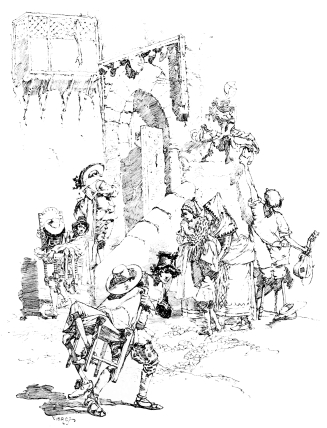
WHEN we came to Don Alonso’s house, they laid us very gently on to two
beds, for fear of rattling our bones, they were so bare with starving;
then with magnifying glasses they began to search all about our faces
for our eyes, and were a long time before they could find out mine,
because I had suffered most, being treated like a servant, and
consequently mine was a royal hunger. Physicians were called, who
ordered the dust should be wiped off our mouths with fox-tails, as if we
had been paintings; and indeed we looked like the picture of death; and
that we should be nourished with good broths and light meats, for fear
of overloading our weak stomachs. Who can be able to express the
rejoicing there was in our guts, the first good soup that we tasted, and
afterwards when we came to eat some fowl? All these things to them were
unknown novelties. The doctors gave order that for nine days nobody
should talk in our chamber, because our stomachs were so empty that the
least word returned an echo in them. These and such like precautions
used caused our spirits to return to us in some measure; but our jaws
were so tanned and shrivelled up that there was no stretching of them,
and therefore care was taken that they should be every day gently forced
out, and, as it were, set upon the last with the bottom of a pestle. In
a few days we got up to try our limbs, but still we looked like the
shadows of other men, and so lean and pale as if we were lineally
descended from the fathers in the desert. We spent the whole day in
praising God for having delivered us out of the clutches of the most
inhuman Cabra, and offered up our earnest prayers, that no Christian
might ever fall into that miserable thraldom. If ever, when we were
eating, we happened to think of the miserable boarding-school table, it
made us so hungry that we devoured twice as much as at any other time.
We used to tell Don Alonso, how, when Cabra sat down to table, he would
inveigh against gluttony though he never knew any thing of it in his
life; and he laughed heartily when we informed him that, in speaking of
the commandment “Thou shall not kill,” he made it extend to partridges
and capons, and such other dainties as never came within his doors, and
even to killing of hunger, which he certainly counted a heinous sin, and
therefore had an aversion to all eating. We were three whole months upon
our recovery, and at the end thereof Don Alonso began to think of
sending his son to Alcalá, to finish his Humanity. He asked me whether I
would go, and I thinking I could never be far enough from that inhuman
monster of misery and famine, offered to serve his son faithfully, as
experience should show. He provided him another servant, in the nature
of steward, to look after him, and give an account of the money he sent
for his expenses, by bill upon one Julian Merluza. We put all our
equipage into a cart belonging to one Diego Monge; it consisted of a
small bed for our master, and a truckle bed to run under it, for me and
the steward whose name was Aranda, five quilts, four pair of sheets,
eight pillows, four hangings, a trunk of linen, and other furniture for
a house. We went ourselves into a coach in the evening, a little before
nightfall, and about midnight came to the ever accursed lone inn of
Viveros. The inn-keeper was a Morisco, and a downright thief; and all
my life I never saw cat and dog so united in peace as that day.[9] He
received us very lovingly, because he and the carters went snacks, for
we travelled so slowly that they were there before us. He came to the
coach-side, gave me his hand to alight, and asked me, “Whether I was
going to the University?” I told him I was. He put me into the house,
where two bullies were with some wenches, a curate praying by them, an
old covetous shopkeeper endeavouring to forget his supper, and two
scoundrelly shabby scholars, contriving how to fill their bellies free
of cost. My master, as being the last comer and but a boy, said,
“Landlord, get what you have in the house for me and two servants.” “We
are all your servants, Sir,” said the sharpers, “and will wait on you.
Here, landlord, take notice; this gentleman will stand treat; fetch out
all you have in the larder.” This said, one of them stepped up to Don
Diego, and taking off his cloak, laid it by, saying, “Pray, Sir, sit
down and rest you.” This puffed me up so full of vanity that the inn was
too little to hold me. One of the damsels said, “What a well shaped
gentleman it is; is he going to his studies? Are you his servant, Sir?”
I fancying that every word they said was sincere, answered, “That I and
the other were both his servants.” They asked me his name, and it was
scarce out of my mouth, before one of the scholars went up to him, with
tears in his eyes, and embracing him, as if he had been his brother,
said, “O my dear Don Diego! who would have thought, ten years ago, to
have seen you thus. Unhappy man, I am in such a condition that you will
not know me.” My master and I were both amazed, and swore we had never
seen him in all our days. The scholar’s companion stared Don Diego in
the face, and said to his friend, “Is this the gentleman of whose father
you told me so many stories? It is extraordinary fortunate that we have
met him, and know him. He is grown very tall; God bless him.” With this
he began to cross himself, and seemed so overjoyed, that any man would
have thought we had been brought up together. Don Diego made him many
compliments; and as he was asking him his name, out came the innkeeper,
and laid the cloth; and smelling the joke, said, “Let that alone and
talk of it after supper, for the meat will be cold.” One of the
bullies stepped up, and set stools for everybody, and an arm chair for
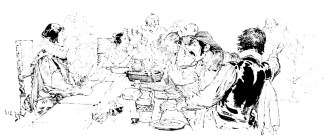
Don Diego; the other of them brought in a dish. The scholars said, “Do
you sup, Sir, and whilst they dress what the house affords for us, we
will wait on you at table.” “God forbid,” answered Don Diego; “pray,
gentlemen, sit down if you please.” The bullies, though he did not speak
to them, readily answered, “Presently, good Sir; all is not ready yet.”
When I saw some invited and the others invite themselves, my heart was
in my mouth, and I dreaded what came to pass; for the scholars laying
hold of the salad, which was a good dishful, and looking upon my master,
said, “It would be unreasonable that these ladies should be left
supperless, where a gentleman of such quality is; pray, Sir, give them
leave to take a bit.” My master, like a true cully, invited them to
partake. They sat down, and between the scholars and them, in a trice,
there was but one single lettuce of all the salad left, which last bit
Don Diego had; and as the accursed students gave it him, he said, “Sir,
you had a grandfather, who was my father’s uncle, that swooned at the
sight of a lettuce; he was a man of such an odd disposition.” This said,
he fetched himself down a brick of bread, and his companion did the
like. The damsels had made a great hole in a good loaf; but yet the poor
curate ate more than all of them with his eyes and wishes. The bullies
bringing in a whole side of kid roasted, and a dish of pigeons and bacon
boiled, took their places at the table, saying to the priest, “Why,
father, what makes you stand there? Draw near and reach a bit, for Don
Diego treats us all.” No sooner were the words spoken but he sat down.
When my master perceived that they had all intruded upon him he began to
be much concerned. They divided the spoil, giving Don Diego some few
bones to pick; the rest the curate and the others devoured. The bullies
said, “Pray, Sir, do not eat too much supper, lest it does you harm”;
and the devil of a scholar answered, “Besides, Sir, you must begin to
practice to be abstemious considering the life you are to lead at
Alcalá.” I and the other servant prayed heartily that God would put it
into their hearts to leave something; and when they had devoured every
bit, and the curate was picking the bones over again, one of the bullies
turned about, and said, “God bless us, we have left nothing for the
servants; come hither, gentlemen. Here, landlord, give them all the
house affords; take this pistole to pay for it.” Up started immediately
my master’s confounded imaginary kinsman, I mean the scholar, saying,
“With your leave, good Sir, I must tell you, I fear your breeding is not
much; it is a sign you are not acquainted with my cousin; he will
provide for his own servants and for ours too, if we had any, as he has
done for us.” “Be not in a passion, Sir,” replied the other, “we did not
know so much before.” When I saw all this sly dissimulation, I began to
curse them and thought I should never have done. The cloth was taken
away, and they all desired Don Diego to go to bed. He would have paid
for the supper, but they answered that in the morning would be time
enough. They stayed a while chatting together; my master asked the
scholar his name, and he answered Don something Coronel. The devil
confound the deceitful dog, whosoever he is. Then perceiving that the
griping shopkeeper was asleep, he said, “Will you have a little sport,
Sir, to make you laugh? Let us put some trick upon this fellow, who has
eaten but one pear upon the road, and is as rich as a Jew.” The bullies
cried, “God-a-mercy, Master Licentiate, do so, it is but right.” With
this approbation he drew near the poor sleeping old fellow, and slipped
a wallet from under his feet, untied it, and took out a box, all the
company flocking about, as if it had been lawful prize taken in war. He
opened it, and found it full of lozenges; all which he took out, and
supplied their place with stones, chips, and any rubbish that came next
to hand, then laid about a dozen of little glittering stones there are
among some fine lime with which in Spain, they plaster the outsides of
houses, which glitters in the sun like bits of glass. This done, he shut
up the box, and said, “I have not done yet, for he has a leather
bottle”; out of which he poured all the wine, only some little he left
in the bottom, and then stuffed it up with tow and wool, and stopped it.
The scholar put all again into the wallet, and a great stone into the
hood of his travelling coat, and then he and all the rest went to bed,
to sleep about an hour or little more.
When it was time to set out, all the company waked and got up, and still
the old man slept; they called him and he could not get up for the
weight of the stone that was in his hood. He looked to see what it was,
and the innkeeper pretended to quarrel with him, saying, “God ’o my
life, could you pick up nothing else to carry away, father, but this
stone? I had been finely served, gentlemen, if I had not discovered it;
I value it above an hundred crowns because it is good for the pain in
the stomach.” The old man swore and cursed that he had not put it into
his hood; the bullies reckoned up the bill, which came to six crowns;
but the best arithmetician in Christendom could never have made out that
sum. The scholars asked what service they could do us at Alcalá; the
reckoning was paid, we breakfasted, and the old man took up his wallet;
but for fear we should see what he had in it, and so he might be obliged
to distribute any, he untied it in the dark under his great coat, and
laid hold of a bit of lime well daubed, which he clapped into his mouth,
and going to crunch it with a tooth and a half he had, was like to lose
them both. He began to spit and make faces, what with the pain, and what
with the loathsome bit he had put into his mouth. We all went up to him,
and the curate among the first, asking, “What ailed him?” He began to
curse and swear, dropped down the wallet, and the scholar came up to
him, saying, “Get behind me, Satan; here is the cross.” The other opened
a breviary and would persuade him he was possessed, till at last he told
what ailed him, and begged they would give him leave to wash his mouth
with some wine he had in his leather bottle. They let him go, he opened
his bottle, and pouring into a small dish, out came a little wine, so
hairy and full of tow, that there was no drinking or enduring the sight
of it. Then the old man fell a raving beyond measure, but seeing all the
company burst their sides with laughing, he was fain to grow calm, and
get up into the waggon with the bullies and wenches. The curate and
scholars mounted on asses, and we went into the coach. We were scarce
gone from the door before they all began to banter and ridicule us,
declaring the trick they had put upon us. The innkeeper cried, “Good
master freshman, a few of these handsels will make you old and wise.”
The cursed scholar said, “Pray, cousin, the next time scratch when it
itches, and not afterwards.” In short, every one had his say; but we
thought best to take no notice, though, God knows, we were quite out of
countenance. At length we got to Alcalá and alighted at an inn, where we
spent all that day, for we came in at nine in the morning, in reckoning
up the particulars of our last supper, but could never make out the
account.
TOWARDS the evening, before it was dark, we left the inn, to go to the
house that had been hired for us, which was without the Santiago Gate,
in a court full of scholars; but in our house there were only three
families of us. The owner, or landlord of it was one of those who
believe in God out of complaisance or only in outward show, such as they
vulgarly called Moriscos; for there are abundance of this sort of
people, and of those that have great noses and cannot endure the smell
of bacon. Yet I do not by this mean to reflect upon the people of
quality, which are there very numerous and unspotted in blood. The
landlord received me with a worse countenance than if I had been an
Inquisitor come to ask him for his billet of faith; I know not whether
he did it to make us respect him the more, or whether it was the nature
of the beast, for it is no wonder they should be ill natured who are of
such bad principles. We brought in our goods, made the beds, and rested
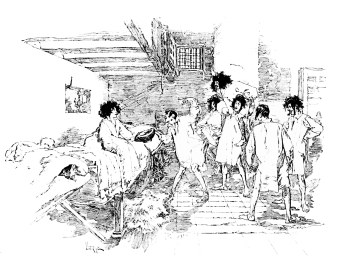
that night. When it was day, all the scholars in the house came in their
shirts to demand entrance money of my master. He being an utter stranger
to that affair, asked me, “What it was they would be at?” whilst I at
the same time, for fear of what might happen, thrust myself between two
quilts, with only half my head out, like a tortoise. They demanded a
couple of crowns, which were given them; and they set up a hellish cry,
singing, “Long live our companion, and let him be admitted into our
friendship; let him enjoy all the privileges of a freeman, and be
allowed to have the itch, to be greasy, and as hungry as we are.” This
said, they all tumbled down the stairs, we dressed ourselves, and set
out for the schools. My master was conducted by some collegians, his
father’s friends, and so took his place in the school; but I, being to
go to another place, went all alone, and began to quake for fear. I had
scarce set my foot into the great court, before they all faced me, and
began to cry, “A new fellow!” The better to colour the matter, I fell
a-laughing, as if I had not regarded it; but it availed me not, for
eight or nine of them standing about me began to grin and laugh out. I
blushed; would to God I had not, for immediately one that was next me
clapped his hand to his nose, and stepping aside, said, “This Lazarus is
for rising from the dead, he stinks so.” Then they all stood off,
stopping their noses. I thinking to escape that way, held my nose too,
and said, “You are in the right, gentlemen, here is a great stink.” They
all burst out a-laughing, and getting farther off, gathered about a
hundred strong. They began to hawk, and give the alarm with their
throats, and by their coughing, and opening and shutting of their
mouths, I perceived what they were preparing for me.[10] By this time I
was daubed all over from head to foot; but a sly dog observing that I
was covered, and had nothing on my face, came running towards me, crying
out, as if he had been in a passion, “Enough; do not murder him.” After
all this they would have necked me as they do rabbits to kill them; but
there was no touching me, without carrying off some part of their
loathsome bounty, which hung all about my wretched cloak, then turned
grey with filth, though it came in black. They left me, looking all
over like an old man’s spitting-sheet. I went home, though I scarce knew
the way; and it was good luck that this happened in the morning, for I
met but two or three boys, who, I believe, were good-natured, for they
only threw half a dozen dirty clouts at me, and went their ways. I got
into the house, and the Moorish landlord seeing me, fell a-laughing, and
made show us if he would have spit upon me; which I dreading, cried out,
“Hold, landlord, for I am not the picture of Christ!” Would to God I had
never said it, for he laid on to me several pounds with a couple of
weights he had in his hand. Having got this good help besides all the
rest, though half revenged, I went up, and was a long time before I
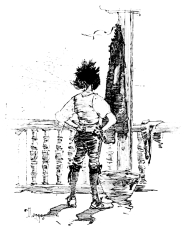
could find out where to take hold of my cloak and cassock. At last I
took them off, hanged them up on the terrace, and laid me down upon the
bed.
My master coming in found me asleep, and not knowing of my loathsome
disaster, was in a passion, and fell a-tugging me by the hair so
furiously, that had I not waked immediately he had made me bald before
my time. I started up, crying out and complaining, and he still more
passionate, said, “This is a fine way of serving me, Pablo; ’tis a new
way of life.” This went to my heart, and I answered, “You are a great
comfort to me, Sir, in my afflictions; do but see what a condition that
cloak and cassock are in, which have served for handkerchiefs to the
filthiest noses that ever poisoned clean linen.” This said, I fell
a-weeping; which he perceiving, believed me, looked for the cassock, and
seeing it, took pity on me, and said, “Pablo, be on your guard, and take
care of yourself, for you have no father or mother to take your part
here.” I told him all that had befallen me, and he ordered me to strip
and go to my chamber, where four servants of the other lodgers in the
house lay. I went to bed and slept, and being refreshed with that and a
good supper, I found myself as well as if nothing had happened to me.
But when misfortunes begin to fall, there is such a series of them
linked together, as if they would never have an end. The other servants
came to bed, who all saluted and asked me, “Whether I was sick, and what
made me so soon a-bed?” I told them the whole story; and immediately, as
if they had been innocence itself, they began to cross themselves, and
said, “Was there ever such wickedness acted? This would not be tolerated
among infidels.” Another cried, “The proctors are in the fault, that
they do not take care to prevent it. Shall you know them again?” I
answered, I should not, and thanked them for the kindness they seemed to
show me. This discourse lasted till they stripped, went to bed, put out
the candle, and I fell asleep, as if I had been with my mother and
brothers. It was about twelve of the clock, I believe, when one of them
waked me, roaring out in a dismal manner, “Help, help; they kill me;
thieves!” At the same time there was a noise in his bed of voices and
lashes. I held up my head, and said, “What is the matter there?” As soon
as ever I uncovered myself, they laid on to my back with a rope made
into a cat-o’-nine-tails. I cried out, and would have got up; the other
complained as much as I, but it was me only they flogged. I called out
for help in God’s name, but the lashes fell so thick upon me, they
having pulled all the clothes off me, that I had no other refuge but
to creep under the bed. I did so, and immediately the other three, who
seemed to be sleeping, began all to roar out, and I hearing the lashes
still, concluded that some stranger scourged us all. In the meanwhile
the hell-hound that was next me, skipped into my bed. This done the
lashes ceased, and all four of them got up, crying out again, “It is a
great villainy, and not to be endured.” Still I lay under my bed,
whining like a dog that is pinched in a door, and shrinking myself all
up, as if I had been drawn together by the cramp. The others made as if
they had shut the door; then I crept out, got into my bed again, and
asking, whether any of them was hurt, they all complained bitterly. I
lay down, covered myself up warm, and fell asleep again; and happening
to tumble about in my sleep, when I waked, I found myself all daubed up
to my very neck. They all got up, and I pleaded the flogging for an
excuse to lie a-bed. The devil himself could not turn me from one side.
I was full of confusion, considering whether the fright and disorder had
occasioned my committing myself in my sleep. In short, I was innocent
and guilty at the same time, and knew not what excuse to make for
myself. It is impossible to express the anguish I was in, what with
shame, what with my finger that was disjointed, and what with the dread
of being cramped. At length, fearing they would really put that villainy
in execution, for they had really put cords about my thighs, I made as
if I came to myself; yet I was not so quick, but that the rogues being
knavishly bent, had whipped the cords about my thighs, and tugged so
hard that they sunk them an inch into my flesh. Then they left me,
crying, “Bless us, what a puny creature you are.” I cried for mere
vexation, and they archly said, “It is all for your health’s good to be
bemired; hold your peace.” This done, they washed me, laid me in the bed
again, and went their way. Being left alone, I lay and considered, that
what I had endured in one day at Alcalá was worse than all my sufferings
under Cabra at the boarding-school. At noon I dressed me, cleaned my
cloak and cassock the best I could, washing it like an old clout, and
waited for my master, who, when he came, asked me, “How I did?” All the
family dined, and so did I, though I ate but little, having but an
indifferent stomach at that time, and after dinner we all met to chat in
an open gallery. The other servants, when they had sufficiently
bantered me, discovering the trick they had put upon me, laughed
heartily. I was worse out of countenance than before, and said to
myself, “Look to yourself, Pablo, be on the alert.” I resolved to begin
a new course of life; we were all made friends, and from that day
forward lived as lovingly in the house together as if we had been all
one mother’s children, and no man disturbed me any more at the schools
or public places.
DO as you see them do, says the proverb; and it is well said. I took it
so seriously into consideration, that I fully resolved to play the knave
among knaves, and to outdo them all if possible. I know not whether I
succeeded as I designed, but I am sure I used all my endeavours. I began
by making a law, that it should be no less than death for any pigs to
come into our house, or for any of our old housekeeper’s chickens to run
out of the yard into our room. It happened one day, that two of the most
elegant porkers that ever my eyes beheld slipped into our domain; I was
then at play with the other servants, and hearing them grunt, said to
one of my companions, “Go, see who it is that grunts in our house.” He
went, and brought word they were two swine. No sooner had I heard these
words but I went out in a passion, saying, “It was a great deal of
impudence in them to grunt in other people’s houses.” Then clapping the
door to, in the same heat of blood, I ran my sword into the throats of
them both, and then we cut off their heads. To prevent their cry being
heard abroad, we all set up our throats, roaring as loud as possibly we
could, as if we had been singing; and so they gave up the ghost among
us. We paunched them, saved the blood, and by the help of our straw bed,
half singed them in the back yard; so that when our masters came home
all was over, though after an indifferent manner; only the puddings were
not yet made, which was not for want of expedition, for we had left half
they had in the guts, merely to save loss of time. Don Diego and our
steward were told the story, and flew into such a passion against me
that the other lodgers, who were ready to burst with laughing, thought
fit to take my part. Don Diego asked me what I could say for myself if
the thing should be found out, and I should be taken up for it? I
answered I would plead hunger, which is the common refuge of all
scholars; and if that was not enough, I would urge that, seeing them
come into the house without knocking as if they had been at home, I
thought they had been our own. They all laughed at my plea, and Don
Diego said, “By my troth, Pablo, you begin to understand your trade.” It
was very well worth observing the difference between my master and me,
he so sober and religious, and I so arch and knavish, so that the one
was a foil to the other and served to set off either his virtue or vice.
Our old housekeeper was pleased to the very heart, for we both played
our parts, and had conspired against the larder. I was caterer, and a
very Judas in my employment, and ever since retained an inclination to
cribbing and stealing. The meat always wasted in the old jade’s keeping,
and she never dressed wether-mutton when she could get ewe or goat;
besides, she picked the flesh off the bones before she boiled them, so
that the dishes served up looked as it the cattle had died of a
consumption; and the broth was so clear, that, had it been consolidated,
it might have passed for crystal; only now and then for change, that the
soup might look a little fat, she clapped in a few candle ends. When I
was by she would say to my master, “In troth, Sir, little Pablo is the
best servant in Spain, bating his unluckiness; but that may well enough
be borne with, because he is honest. He buys the best the market
affords.” I gave the same character of her, and so we put upon the whole
house. If there was any store of coals, bacon, or oil laid in, we stole
half of it, and some while after would say, “Pray, gentlemen, retrench
your expenses a little, for if you go on at this rate, you had need have
a mint of money; the coals or the oil is spent, but no wonder at the
rate that you use it; you had best order more to be brought in. Sir,
give little Pablo the money, and you will have a better account of it.”
Money was accordingly given me, and we sold them the other half we had
stole, and half of what we brought, and that was in full.
If ever I happened to buy anything in the market at the real value, then
the old housekeeper and I would pretend to fall out and quarrel, and she
seeming to be in a passion, would say, “Do not tell me, Pablo, that this
is a pennyworth of salad.” Then I would seem to cry, and make a great
deal of noise, went to complain to my master, and persuaded him to send
the steward to inquire, that the old woman might be convinced, who still
scolded on designedly. The steward went and found as I said, by which
means both master and steward were imposed upon, and had the better
opinion of me for my honesty, and of the housekeeper for her care. Don
Diego being thus fixed in his good opinion of me, used to say to her,
“Would to God Pablo were otherwise as virtuous as he is honest; I see
plainly he is as trusty as you represent him.” Thus we held them in
ignorance, and sucked them like horse leeches. I do not at all doubt,
Sir, but you wonder how much we might cheat them of at the year’s end;
the total was certainly considerable, yet I suppose we were not obliged
to make restitution, for the old woman never missed going to church
daily, yet I never saw any disposition in her to restore the least part;
nor did I perceive any scruple of conscience she made of it, though she
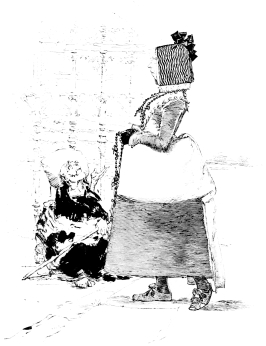
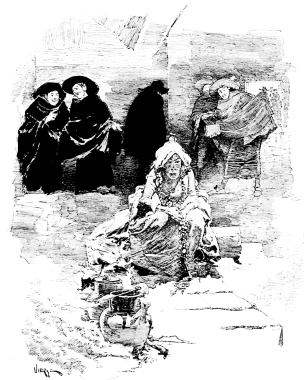
was so great a saint. She always wore a pair of beads about her neck, so
big that the wood of them might have served to roast a sirloin of beef.
It was all hung with crosses, medals, pictures, and other trinkets, on
all which she said she prayed every night for her benefactors. She had a
catalogue of an hundred and odd saints that were her patrons; and in
truth she had need of no less help to bear her out of all her
wickedness. Her chamber was over my master’s, where she set up more
prayers than a blind begger. And all in Latin, such as it was, for
neither mortals on earth nor angels in heaven could understand it, which
she did to appear the more innocent and simple; but we were ready to
split our sides with laughing. Besides these she had many other
excellent qualifications, for she was an extraordinary messenger of love
and contriver of pleasure, which is the same as a bawd; but her excuse
to me was that it came to her by descent, just as the kings of France
had the gift of curing the king’s evil. You will imagine perhaps that we
always lived in unity; but who does not know that the two best friends,
if they are covetous, and live together, will endeavour to cheat one
another; and I took care to let slip no opportunity.
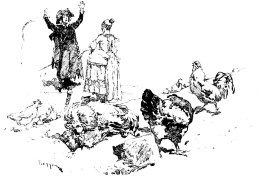
The old woman kept hens in the yard, and had about a dozen or fourteen
well-grown chickens, which made my teeth water to be at them, or they
were fit to be served up to any gentleman’s table. It happened on day
that when going to feed them, as the common custom is in Spain, she
called them together, crying, Pio, Pio, Pio. This she repeated very
often, and I being upon the catch, cried out as loud as she, “As God
shall save me, mistress, I wish I had seen you kill a man, or clip the
king’s coin, for then I might have kept your counsel—rather than do as
you have done; and now I must be forced to discover it. The Lord have
mercy upon us both!” She seeing me act all that concern and disorder,
was somewhat startled, and said, “Why, what have I done, Pablo? If you
are in jest, do not tease me any longer.” “What do you mean by jesting?”
said I; a curse on it, I cannot possibly avoid giving information to the
Inquisition, else I shall be excommunicated.” “The Inquisition,” quoth
she, trembling like a leaf on a tree; “why, have I committed any crime
against religion?” “Why, there’s the case,” answered I; “don’t you think
to dally with the Inquisitors. You had better own you were in the wrong,
that you spoke like a fool; eat your words, and not deny the blasphemy
and irreverence.” She replied in a great consternation: “But tell me,
Pablo, will they punish me if I recant?” “No,” said I, “for then they
will only absolve you.” “Then I recant,” quoth she; “but do you tell me
what it is I am to recant, for I know nothing of it as I hope for
mercy.” “Bless me,” replied I, “is it possible you should be so dull as
not to reflect that, but I don’t know how to express it—the disrespect
was so great that I am afraid to repeat it. Don’t you remember you
called the chickens Pio, Pio, and Pius is the name of several Popes,
vicars of Christ, and heads of the Church? Now, do you consider whether
that be any trifling sin? She stood as if she had been thunder-struck,
and after a while cried, “’Tis true I said so, Pablo, but may I be
curs’d if I did it with any ill design. I recant; do you consider
whether some means may not be found to avoid informing against me? For I
shall die if they get me into the Inquisition.” “Provided you will take
your oath,” answered I, “on the holy altar, that you did it not with any
ill intent. I may, upon that assurance, forbear impeaching you; but then
you must give me those two chickens that fed when you were calling them
by that most sanctified name of the Popes, that I may carry them to an
officer of the Inquisition for him to burn them, for they are defiled;
and in the next place, you must swear positively never to be guilty of
the like again. This you must do now, for to-morrow I’ll swear.” For the
better fixing of this notion in her head, I went on: “The worst of it
is, Cipriana” (for that was her name), “that I shall be in danger, for
the Inquisitor will ask whether I am not the person, and may put me to
trouble. Do you e’en carry them yourself, for I am afraid.” “For the
Lord’s sake,” cried she, “Pablo, take pity on me, and do you carry them;
there is no danger of your coming to any harm.” I made her press me a
long while, and at last, though it was the thing I aimed at, I suffered
myself to be persuaded. I took the chickens, hid them in my chamber,
made show as it I went abroad, and came in again, saying, “It has fallen
out better than I expected; the cunning officer would fain have come
after me to see the woman, but I gave him the slip cleverly, and did the
trick.” She hugged and kissed me, and gave me another chicken for my
pains, which I carried to his companions, had them all dressed at the
cook’s, and ate them with my fellow-servants. Don Diego and the
housekeeper came to hear of the trick, and all the family made excellent
sport with it. The old woman had like to have fretted herself to death
for mere vexation, and was a thousand times in the mind, for revenge, to
discover all my cheats, but that she was as deep in the dirt as I was in
the mire. Being thus at variance with the old woman, and no way now left
to put upon her, I contrived new ways to play my pranks, and fell to
that the scholars call snatching and shoplifting, at which sport I had
many pleasant adventures.
One night, about nine of the clock, at which time there are but few
people abroad, passing through the great street, I spied a
confectioner’s shop open, and in it a basket of raisins upon the
counter. I whipped in, took hold of it, and set off a-running. The
confectioner scoured after me, and so did several neighbours and
servants. Being loaded, I perceived that though I had the start they
would overtake me, and therefore turning the corner of the street, I
clapt the basket upon the ground, sat down upon it, and wrapping my
cloak about my leg, began to cry out, holding it with both hands, “God
forgive him, he has trod upon me and crippled me.” They heard what I
said, and when they came up I began to cry, “For the Lord’s sake pity
the lame! I pray God you may never be lame!” They came to me, panting,
and out of breath, and said, “Friend, did you see a man run this way?”
“He is a-head of you,” answered I, “for he trod upon me.” With this they
started again, and vanished. I was left alone, carried my basket home
and told the story, which they would not believe, though they highly
applauded the ingenuity, for which reason I invited them to see me steal
a box of sweetmeats another night. They came, and observing that all the
boxes were so far within the shop that there was no reaching them,
concluded the thing was impracticable, especially because the
confectioner, having heard what had happened to the other one, was upon
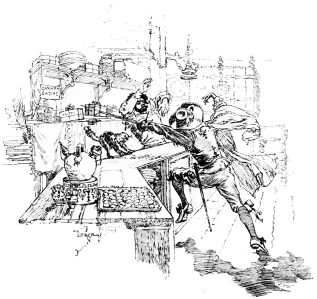
his guard. However, I went on, and drawing my sword, which was a stiff
tuck, about a dozen paces short of the shop, run on, and when I came up
to the door, I cried out, “You are a dead man,” and made a strong pass
just before the confectioner’s breast, who dropped down, calling for
help, and my sword run clear through a box of sweetmeats, which I drew
out with it and carried off. They were all amazed at the contrivance,
and ready to burst with laughing, to hear the confectioner bid the
people search him, for he was certainly wounded, and knew the other to
be a man he had a falling out with; but when he turned about, the other
boxes being disordered by the pulling out of that one, he discovered the
cheat, and fell a blessing himself as if he would never have done. The
truth of it is, I never ate anything that pleased me so well. My
companions used to say, I could maintain the family with what I lifted,
which is only a modest term for stealing. Being then but a boy, and
hearing myself commended for these knavish pranks, it encouraged me to
commit more. I used to bring home my girdle hung all round with little
pitchers, which I stole from nuns, begging some water to drink of them,
and when they turned it out in their wheel, I went off with the mugs,
they being shut up, and not able to help themselves; so that it became a
fashion not to give out anything without a pledge for the vessel.
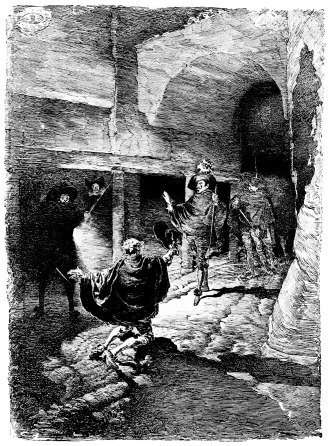
After this I promised Don Diego and his companions that I would one
night disarm the round. The night was appointed, and we set out upon the
exploit. I went foremost with another servant of our family, and as soon
as I discovered the watch, went up as if I had been in a great fright,
saying, “Is it the round?” They answered, “It was.” Then said I, “Is the
officer here?” They replied, “He was.” Then I kneeled down, and said,
“Sir, it is in your power to do me right, to revenge my wrong, and to do
the public a great piece of service; be pleased to hear a word or two I
have to communicate in private, if you desire to secure some notorious
criminals.” He stepped aside, and some of his officers were laying hands
on their swords, and others taking out their rods of authority, whilst I
said, “Sir, I am come from Seville, in pursuit of six of the most
notorious malefactors in the world; they are all thieves and murderers,
and among them is one that killed my mother and a brother of mine,
without any provocation but to exercise his barbarity. This is proved
upon him, and they all come, as I heard them say, with a French spy; and
by what I can further guess from their words, he is sent (then I lowered
my voice) by Antonio Perez.”[11] At these words the officer gave a
start, and cried, “Where are they?” “They are, Sir,” said I, “in a house
of ill-fame; do not stay, good Sir; the souls of my mother and brother
will requite you with their prayers, and the king will reward you.” He
said very earnestly, “Good God! let us lose no time; follow me all of
you, and give me a target.” I took him aside again, and added, “Sir, the
whole business will be spoiled if you do so; the only way to do it is,
for them all to go in without swords, and one by one, for they are above
in the rooms, and have pistols, and as soon as they see any come with
swords, knowing that none can wear them but officers of justice, they
will be sure to fire. It is better only to go in with your daggers, and
then seize them by the arms behind, for we are enough of us.” The
officer being eager to secure them at any rate, approved of my
contrivance. By this time we were come near the place, and the officer,
thus instructed by me, ordered them all to hide their swords in a
field there is just before the house, under the grass. They did so, and
went on. I had already instructed my companion that as soon as ever they
laid their swords down, he should seize them, and make the best of his
way home. He did so, and when they were all going into the house, I
stayed out the last; and as soon as they were entered, being followed by
several people they picked up by the way, I gave them the slip, and
turned short into a narrow lane that comes out near the Victoria,
running all the way as swift as a greyhound. When the round was all in
the house, and found none there but scholars and scoundrels—which is
all one—they began to look about for me, and not finding me, suspected
it was some trick put upon them. Being thus disappointed, they went to
take their swords, but there was no sign of them. It is impossible to
tell what pains the officer, attended by the rector of the university,
took that night. They searched all the town to the very beds, and when
they came to ours, I was in bed, with a nightcap on, and close covered,
for fear of being known, a candle lighted in one hand and a crucifix in
the other, with a sham priest praying by me, and all the rest of my
companions on their knees about the bed. The rector, with all his
officers, came in, and seeing that spectacle, went out again, supposing
no such prank could be played by any there. They made no search, but the
rector prayed by me, and asked whether I was speechless; they answered,
I was; and so away they went, in despair of making any discovery. The
rector swore he would deliver up the offender, if he could find him; and
the officer vowed he would hang him, though he were the son of a grandee
of Spain. I got up, and this prank makes sport at Alcalá to this very
day. To avoid being tedious, I omit giving an account of my robbing in
the open market, as if it had been on a mountain; not a box or case
escaped me, but I had it home, and kept the house in fuel all the year;
and as for the apple-women, nothing was ever safe in their stalls or
standings, for I had declared perpetual war against them, on account of
the affront put upon me when I was king at Segovia. I pass by the
contributions I raised on the fields of beans, vineyards, and orchards,
all about that part of the country. These and the like practices gained
me the reputation of a mischievous, cunning fellow among all people. The
young gentlemen were so fond of me, that I had scarce leisure to wait
on Don Diego, whom I honoured as he deserved for the great kindness he
bore me.
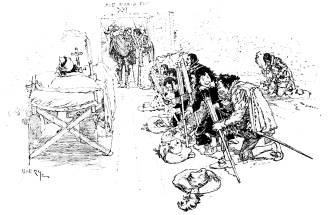
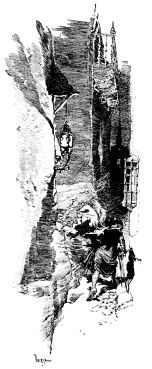
AT length Don Diego received a letter from his father, and with it one
for me, from an uncle of mine, whose name was Alonso Ramplon, a man near
akin to all the virtues, and very well known in Segovia as being the
finisher of the law, and for four years past the carrying out of all its
decrees went through his hands. In short, to speak plain, he was the
executioner or hangman; but such a clever fellow at his business that it
would not vex a man to be hanged by him, he did it so neatly. This
worthy person wrote to me from Segovia to Alcalá as follows:
“Son Pablo (for so he called me for the much love he bore me)—
“The great affairs of this employment in the which it has pleased his
majesty to place me, have been the occasion of my not writing to you
before; for if there be any thing to find fault with in the king’s
service, it is the great trouble and attendance it requires; which,
however, is in some measure requited by the honour of being his servant.
It troubles me to be forced to send you disagreeable news; but your
father died eight days ago, with as much bravery and resolution as ever
man did; I speak of my own knowledge, as having trussed him up myself.
The cart became him as well as if it had been a chariot, and all that
saw the rope about his neck concluded him as clever a fellow as ever was
hanged. He looked up all the way he went at the windows, very much
unconcerned, courteously bowing to all the tradesmen, that left their
shops to gaze at him, and turned up his whiskers several times. He
desired the priests that went to prepare him for death, not to be too
eager, but to rest and take a breathing time, extolling any remarkable
expressions they used. Being come to the triple tree, he presently set
his foot on the ladder, and went up it nimbly, not creeping on all-four
as others do; and perceiving that one of the rounds of it was cracked
through, he turned to the officers attending, and bid them get it mended
for the next that came, because all men had not his spirit. I cannot
express how much his person and carriage were applauded. At the top of
the ladder he sat down, set his clothes handsomely about him, took the
rope and clapped the noose to his ear, and then perceiving the Jesuit
was going to preach to him, he turned to him and said, ‘Father, I accept
of the will for the deed. Let us have a few staves of a psalm, and have
done quickly, for I hate to be tedious.’ This was done accordingly; he
charged me to put on his cap a little to one side and to wipe his mouth,
which I did. And then he swang, without shrinking up his legs, or making
ugly faces; but kept such sedateness in his countenance that it was a
pleasure to behold him. I quartered him out, and left the several parts
on the highways. God knows what a trouble it is to me to see him there
daily treating the crows and ravens. I cannot give you a much better
account of your mother, for, though still living, she is a prisoner in
the Inquisition at Toledo, because she would not let the dead rest in
their graves. They give out that every night she used to salute a great
he-goat, kissing him on the eye which has no pupil. In her house were
found as many arms, legs, and heads as would have stocked a charnel
house; and she reckoned it one of her smallest abilities to counterfeit
virgins and solder cracked virtues. They say she would fly up a chimney,
and ride faster upon a broom-staff than another can upon the best
Andalusian nag. I am sorry she disgraces us all, and me more
particularly as being the king’s officer, and such kindred does not
become my post. Dear child, here are some goods of your father’s that
have been concealed to the value of four hundred ducats; I am your
uncle, and all I have is yours. Upon sight hereof you may come away
hither, for your skill in Latin and rhetoric will qualify you to make
you an excellent hangman. Let me have your answer speedily, and till
then God keep you, &c.”
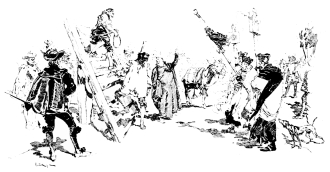
I must confess, I was much troubled at this fresh disgrace, and yet, in
some measure, I was glad of it, for the scandalous lives of parents make
their greatest misfortunes a comfort to their children. I went away
hastily to Don Diego, who was then reading his father’s letter, in which
he ordered him to leave the university and return home, but not to take
me with him, because of the account he had received of my trickiness. He
told me he must be gone, and how his father commanded him to part with
me, which he was sorry for; and I was so much more. He added, he would
recommend me to another gentleman, his friend, to serve him. I smiled,
and answered, “Sir, the case is altered; I have other designs in my
head, and aim at greater matters, so that I must take another course;
for though hitherto I was at the foot of the ladder, in order to mount,
you must understand that my father has got up to the top of it.” With
this I told how bravely he had died, at his full stretch; how he was
carved out, and served up as a feast to the birds of the air. That my
good uncle, the executioner, had sent me the whole account, and
acquainted me with my mammy’s confinement; for I could be plain with
him, because he knew all my pedigree. He seemed to be much concerned,
and asked how I intended to bestow myself. I informed him of all my
resolutions and so the very next day he went away for Segovia, very
melancholy, and I stayed in the house, without taking the least notice
of my misfortune. I burned the letter, for fear it might be dropped, and
somebody read it, and began to provide for my journey to Segovia,
designing to take possession of what was my due, and to know my kindred,
that I might shun them.
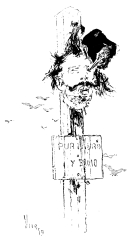
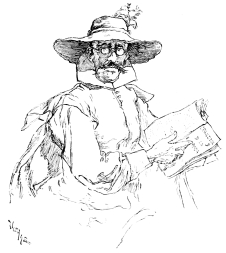
AT length the day came when I left the sweetest life I have ever known.
I cannot express how much it troubled me to leave so many friends and
dear acquaintance, for they were very numerous. I sold what little I had
got underhand, to bear my charges on the way; and with some tricks and
sleights of hand, made up about forty crowns, hired a mule, and left my
lodging, where I had nothing to leave behind. The Lord alone knows what
a hue and cry there was after me; the shoemaker roared for the shoes he
had trusted me with; the old housekeeper scolded for her wages; the
landlord fretted for his rent. One cried, “My heart always misgave me
that I should be so served”; another said, “They were much in the right
who told me that this fellow was a cheat.”
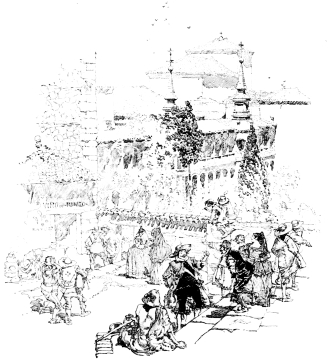
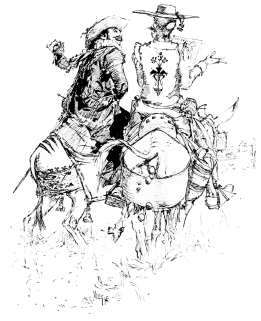
In short, I was so generally beloved that I left half the town in tears
for me when I came away, and the other half laughing at those that
bemoaned themselves. I diverted myself with these thoughts along the
road, when having passed through the town of Torote, I overtook a man
riding on a he-mule, with a pannel. He talked to himself very rapidly,
and was so wrapt in imagination that he did not perceive me, though I
was close by his side. I saluted him, and he returned the courtesy; then
I asked which way he was travelling; and after a few such questions and
answers had passed between us, began to discourse about the Turks coming
down, and the king’s forces. Then he began to lay a scheme for
recovering of the Holy Land, and the taking of Algiers; by which
discourse I perceived that he was mad upon politics and government. We
went on with our dialogue as became a couple of pleasant fellows, and
skipping from one subject to another, fell last upon Flanders. There I
hit his vein, for he fetched up a deep sigh, and said, “That country has
cost me more than it has done the king; for I have been upon a project
about these fourteen years, which were it not impracticable, as it is,
would have set all right there long ago.” “What can that be,” answered
I, “which is so convenient and useful, and yet at the same time
impracticable, and not to be put in execution?” “Who told you,” replied
he, very hastily, “that it cannot be put in execution? It can be
executed, for its being impracticable is another matter; and were it not
for fear of being troublesome, I would tell you what is; but it will all
out; for I design very suddenly to print it, with some other small works
of mine, among which I propose to the king two several methods for
recovering Ostend.”[12] I entreated him to acquaint me with them; and
he, pulling some papers out of his pocket, showed me a draught of the
enemy’s works and of ours, and said, “Sir, you plainly see that all this
difficulty lies in this inlet of the sea; now, my contrivance is to suck
it dry with sponges, and so to remove that obstacle.” This wild notion
made me burst into a loud fit of laughter, and he, looking me
earnestly in the face, went on, “I never showed it to anybody but has
done the same as you do, for they are all mightily pleased with it.”
“Truly,” replied I, “it is an extraordinary pleasure and satisfaction to
me to be acquainted with a design so novel and reasonable; but, Sir, be
pleased to consider, that when you have once sucked up the water that is
in it, the sea will throw in more.” “The sea will do no such thing,”
answered he, “for I have examined it very nicely; besides that, I have
found out an invention to sink the sea twelve fathoms all about there.”
I durst not make any objection, for fear he should say he had a project
to draw down the sky to us. In all my days I never met with such a
madman. He told me that Juanelo, a famous engineer, who brought water
from the river Tagus up a vast hill, to serve the city Toledo, had done
nothing; for he was now contriving to bring the whole river up to that
city a much easier way; and when he came to explain the method, it was
to be by a spell; pray do but mind whether ever such follies were heard
of in the world; but he went on, and added, “Yet I do not design to put
this in execution, unless the king will first settle a good estate upon
me, and knight me, for I am capable enough of that honour, because I
have good testimonials of my gentility.” This rambling, wild discourse
lasted us to Torrejon, where he stayed to see a kinswoman. I went on
very well pleased, and laughing heartily at the projects he spent his
time in.
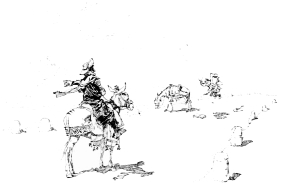
I had not gone far before I spied at a distance a mule loose, and a man
by her a-foot, who looking into a book, drew some lines, and measured
them with a pair of compasses. He leaped and skipped about from side to
side, and now and then laying one finger upon the other, made several
extravagant motions. I must confess, that stopping at a good distance
some time to observe him, I at first concluded he was a conjurer, and
was almost afraid to go on. At last I resolved to venture, and drawing
near, he spied me, shut his book, and going to mount, his foot slipped
out of the stirrup and he fell. I helped him up, and he said, “I took
not the due proportion in rising, to make the half circumference of
mounting.” I did not understand what he meant, but presently guessed
what he was, for a more extravagant distracted man was never born of a
woman. He asked whether I was going to Madrid in a direct line, or took
a circumflex road? Though I did not understand him, yet I answered,
“That by circumflex.” Next he asked me whose sword that was by my side?
and having answered it was mine, he viewed it, and said, “That bar ought
to be longer, to ward off the cuts that are made upon the centre of the
thrusts.” And thus he went on, sputtering out such a parcel of big
words, that I was fain to ask him what his profession was? He told me
that he was a solid master of the noble science of defence, and would
make it good upon any ground in Spain. I could not forbear laughing, and
answered, “By my troth, Sir, I rather took you for a conjurer, when I
saw you describing circles, and making such antic motions in the field.”
“The reason of that,” replied he, “was because there occurred to me a
thrust in quart, fetching the greater compass, to engage my adversary’s
sword, and killing him before he can say his soul is his own, that he
may not discover who did it; and I was then reducing of it to
mathematical rules.” “Is it possible,” said I, “that the mathematics
should be concerned in that affair?” “Not only the mathematics,” quoth
he, “but divinity, philosophy, music, and physic.” “I do not question it
as to the last,” said I, “since that art aims at killing.” “Do not make
a jest of it,” continued he, “for I will now teach you an excellent
guard, and at the same time you shall lay on the great cuts, which shall
contain the spiral lines of the sword.” “I do not understand one word of
all you say,” answered I. And he again, “Why, here you have them in this
book, which is called, The Wonders of the Sword.[13] It is an
excellent one, and contains prodigious things; and to convince you of
it, at Rejas, where we shall lie to-night, you shall see me perform
wonders with two spits; and you need not question but that whosoever
reads this book, will kill as many as he pleases.” “Either that book
teaches men how to make plagues,” replied I, “or it was written by some
doctor of physic.” “What do you mean by a doctor?” replied he. “He is an
extraordinary wise man, and I could find in my heart to say more.”
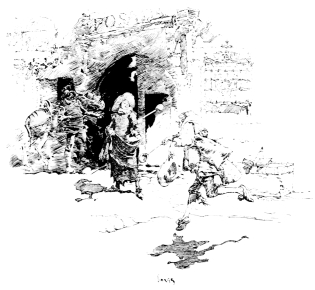
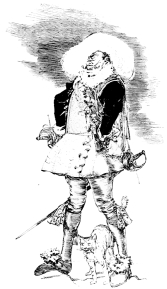
We held on this ridiculous discourse till we came to Rejas, and went
into an inn; but as we were alighting, he called out to me as loud as he
could, to be sure first to form an obtuse angle with my legs, and then
reducing them to parallel lines, to come perpendicularly to the ground.
The landlord seeing me laugh, did so to, and asked me, “Whether that
gentleman was an Indian, that he spoke in such a sort.” I thought I
should have died with laughing between them; but he presently went up to
the host, and said, “Pray, Sir, lend me a couple of spits to make two or
three angles, and I will restore them immediately.” “Lord bless me,
Sir,” answered the host, “give me the angles, and my wife will roast
them in a trice, though they are a sort of birds I never heard the names
of before.” “They are no birds,” replied the other; and turning to me,
added, “Pray, Sir, do but observe the effects of ignorance. Let me have
the spits, for I want them only to fence with, and perhaps you will see
me do that to-day which may be worth more to you than all you have got
in your life.” In fine, the spits were in use, and we were fain to take
up with two long ladles. Never was anything so ridiculous seen in this
world. He gave a skip, and said, “This sally gains me more ground, and
puts by my adversary’s sword; now I make my advantage of the remiss
motion to kill in the natural way; this should be a cut, and this a
thrust.” He came not within a mile of me, but danced round with his
ladle; now I standing still all the while, all his motions looked as if
he were fencing with a pot that is boiling over the fire. Then he went
on, saying, “In short, this is the true art, not like the drunken
follies of fencing-masters, who understand nothing but drinking.” The
words were scarce out of his mouth before a great he-mulatto stepped out
of the next room, with a pair of whiskers like two brushes, a hat as big
as an umbrella, a buff-doublet under a loose coat, bandy-legged,
hook-nosed, and with two or three signs of the cross on his face, a
dagger that might have served Goliath, and a hanging look, and said, “I
am an approved master, and have my certificate about me, and by this
light I’ll make an example of any man that dare presume to reflect upon
so many brave fellows as profess the noble science.”[14] Seeing we were
likely to be in a broil, I stept in, and said, “He had not spoken to
him, and therefore he had no occasion to be affronted.” “Draw your
sword, if you have ever a one,” added he, “and let us try who has most
skill, without playing the fool with ladles.” My poor wretched companion
opened his book, and cried aloud, “Here it is, as I say, in the book,
and it is printed by authority; and I’ll maintain with the ladle that
all it contains is true; or else without the ladle, either here, or upon
any other ground; and if anybody does not believe it, let us measure
it.” This said, he pulled out his compasses, and went on, “This is an
obtuse angle.” The fencing-master drew his dagger, and replied, “I
neither know who is angle, nor who is obtuse; nor did I ever hear such
words before; but I’ll cut you in pieces with this dagger in my hand.”
He ran at the poor devil, who fled from him amain, skipping about the
house, and crying, “He cannot hurt me, for I have gained upon his
sword.” The landlord and I parted them, with the help of other people
that came in, though I was scarce able to stand for laughing. The honest
madman was put into his chamber, and I with him. We supped, and all the
house went to bed. About two of the clock he got up in his shirt, and
began to ramble about the room, skipping and sputtering a deal of
nonsense in mathematical terms. He waked me and not satisfied with this,
went down to the landlord to give him a light, saying he had found a
fixed object for the cross pass upon the bow. The landlord wished him at
the devil for waking him; but still the other tormented him, till he
called him a madman, and then he came up and told me, if I would rise I
should see the curious fence he had found out against the Turks and
their scimitars, and added, he would go show it to the king
immediately, because it was very advantageous to Christendom. By this
time it was day, we all got up and paid our shot. We reconciled the
madman and the fencing-master, who went away, saying, “That what my
companion alleged was good in itself, but it made more men mad than
skilful at their weapon, because not one in a hundred understood the
least part of it.”
I HELD on my journey to Madrid, and my mad companion went off to go
another road; when he had gone a little way he turned back very hastily,
and calling on me as loud as he could, though we were in the open where
none could hear us, he whispered in my ear, “Pray, Sir, let me conjure
you, as you hope to live, not to discover any of the mighty secrets I
have acquainted you with, relating to the art of fencing, but keep them
to yourself, since you are a man of sound judgment.” I promised so to
do; he went his way again, and I fell a-laughing at the comical secret.
I travelled about a league without meeting anybody, and was considering
with myself how difficult a matter it was for me to tread the paths of
virtue and honour, since it was requisite, in the first place, that I
should hide the scandal of my parents, and then have so much worth
myself as to conceal me from their shame. These thoughts seemed to me so
honourable, that I congratulated myself on them, and said, “It will be
much more honourable in me, who had none to learn virtue from, than in
those who had it hereditary from their predecessors.” My head was full
of these ideas, when I overtook a very old clergyman riding on a mule
towards Madrid. We fell into discourse, and he asked me whence I came? I
told him, from Alcalá. “God’s curse,” said he, “on those low people,
since there was not one man of sense to be found among them.” I asked
how could that be said of such a town, where there were so many learned
men? He answered, in a great passion, “Learned! I’ll tell you how
learned, Sir! I have for these fourteen years last past made all the
songs and ballads and the verses for the bedels at Corpus Christi and
Christmas, in the village of Majalahonda,[15] where I am reader; and
those you call learned men, when I put up some of my works among the
rest, at the public act, took no notice of mine. And that you may be
sensible, good Sir, of the wrong they did me, I will read them to you;”
and accordingly he began as follows:
Come, shepherds, let us dance and play
On great saint Corpus Christi’s day;
For he comes down to give its thanks,
For all our kind and loving pranks.
When we have drunk and made all even,
He flies back again to heaven.
What he does there I cannot say,
Since here with us he will not stay.
Come, shepherds, let us dance and play, &c.
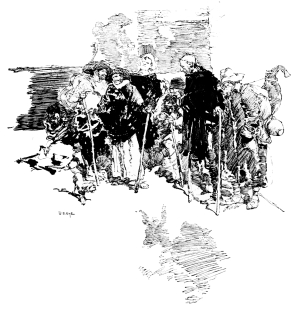
Having read this admired piece, which was too long to remember any more
of it, he proceeded: “Now, Sir, could the very inventor of doggerel
himself have said any thing finer than this? Do but consider what a deal
of mystery there is in that word Shepherds; it cost me about a month’s
hard study.” I could no longer contain myself within bounds, for I was
ready to burst, and so breaking out into a loud fit of laughter, I said,
“It is most wonderful; but I observe you call great saint Corpus
Christi, whereas Corpus Christi is not the name of a saint, but a
festival instituted in honour of the blessed sacrament.” “That’s a
pretty fancy,” replied he, scornfully, “I’ll show you him in the
calendar, and he is canonized, and I’ll lay my head on it.” I could not
contend any more with him for laughing at his unaccountable ignorance,
but told him his verses deserved to be highly rewarded, for I had never
seen anything more comical in my life. “No?” said he; “then pray hear a
little of a small book I have written in honour of the eleven
thousand virgins. I have composed fifty stanzas, of eight verses each,
to every one of them; a most excellent piece.” For fear of being
pestered with so many millions of his lines, I desired him to show me
anything that was not godly; and then he began to recite a comedy, which
had as many acts as there are days in a year. He told me he writ it in
two days, and that was the rough draught, and might be about half a ream
of paper. The name of it was Noah’s Ark; the whole represented by
cocks and mice, asses, foxes, and wild boars, like Æsop’s fables. I
extolled both the plot and the conduct; and he answered, “I ought not to
commend it because it is my own, but the like was never made in the
world, besides that it is altogether new; and if I can but get it acted,
there will be nothing so fine. All the difficulty lies in that, for if
it were not, could anything be so sublime and lofty? However, I have
contrived to have it all acted by parrots, jackdaws, magpies, starlings,
and all other sorts of birds as speak, and to bring in monkeys for the
farce.” “That indeed will be very extraordinary,” answered I. “All this
is nothing,” replied the old man, “to what I have done for the sake of a
woman I love. Here are nine hundred and one sonnets, and twelve
rondeaux”—as if he had been reckoning up pounds, shillings, and
pence—“made in praise of my mistress’s legs.” I asked him whether he
had ever seen them? He replied he had not, on his word as a priest, but
that all his conceits were by way of prophecy. Though it was a diversion
to hear his nonsense, I must confess I dreaded such a multitude of
barbarous verses, and therefore endeavoured to turn off the discourse
another way, telling him I saw hares. “Then,” cried he, “I’ll begin with
one, in which I compare her legs to that creature.” Still to bring him
off that subject, I went on, “Don’t you see that star, Sir, which
appears by daylight?” “As soon as I have done with this,” replied he, “I
will read you the thirtieth sonnet, where I call her a star, for you
talk as if you were acquainted with my fancies.” It was such a vexation
to me to find I could name nothing but what he had writ some nonsense
upon, that I was all joy when I perceived we drew near Madrid, believing
he would then give over for shame; but it proved quite contrary, for as
soon as we came into the street, he began to raise his voice, to show
what he was. I entreated him to forbear, lest if the boys should once
get the scent of a poet, all the rotten oranges and cabbage stumps in
the town should come after us, in regard the poets were declared madmen,
in a proclamation set out against them, by one that had been of the
profession, but recanted and took up in time. This put him in a great
consternation, and he begged me to read it to him if I had it. I
promised him so to do when we came to the lodging-house; and accordingly
we went to one where he used to alight, and found at least a dozen blind
ballad-singers at the door. Some knew him by the scent, and others by
his voice, and all of them gave him a volley of welcomes. He embraced
them all, and then some began to ask him for verses on the day of
judgment in a lofty, bombastical style, that might provoke action;
others would have commemorations for the departed; and so the rest,
every one according to his fancy, giving him eight reals a-man earnest.
He dismissed them, and said to me, “I shall make above three hundred
reals of the blind men, and therefore, with your leave, Sir, I’ll
withdraw for awhile now, to compose some lines, and after dinner we will
hear the proclamation read, if you please.” Wretched life! for none are
more miserable than those madmen that get their bread by such as are as
mad as themselves.
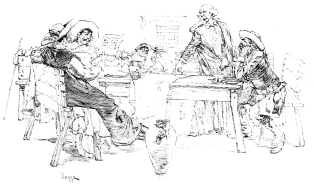
THE poet withdrew awhile to study profaneness and nonsense for the blind
ballad-singers till it was dinner-time, which being over, they desired
to have the proclamation read, and having nothing else to do at that
time, I drew it out and complied with their desires. I have inserted it
here, because I reckon it ingenious, and pat to the purposes mentioned
in it. It ran as follows:
A PROCLAMATION.
Against Addle-headed, Numskull, and Dry-brained Poets.
The old poetaster laughed out very heartily when he heard this title,
and said, “I might have had business cut out till to-morrow; I thought
this had concerned me, and it is only against numskull poets.” I was
mightily pleased with his conceit, as if he had been a Horace or a
Virgil. I skipped over the preamble, and began with the first article,
which was as follows:
In regard that this sort of vermin, called poets, are our neighbours
and Christians, though wicked ones, and considering they spend all their
days in worshipping of eyes, mouths, noses, and old ribbons and
slippers, besides many other abominable sins they are guilty of, we
think fit to direct and ordain, that all common halfpenny poets be
confined together against Easter, as lewd women are wont to be, and that
care be taken to convince them of their evil practices, and to convert
them; and to this purpose we do appoint monasteries of penitent poets.
Item. Observing the excessive heats and droughts in the dog-days,
caused by the abundance of suns, and other brighter stars, created and
produced by those high-flying poets, we enjoin perpetual silence as to
all heavenly beings, and appoint two months’ vacation for the Muses, as
well as for the law, that they may have some time to recruit and recover
the continual charge they are at.
Item. Forasmuch as this infernal sect of men, condemned to eternal
flights, as murderers of good words and ravishers of sentences, have
infected the women with the plague of poetry, we declare that we look
upon this mischief done them as a sufficient revenge for the damage we
received from their sex at the beginning of the world; and to supply the
present wants and necessities the world now labours under, we do farther
ordain, that all the songs and other verses, made by poets in praise of
women, be burned like old lace, to take out the gold and silver they put
into their lady’s hair and skins, and that all the oriental pearls,
rubies, and precious stones be picked out of them, since they are so
full of those rich metals and jewels.
Here the old poetaster was quite out of patience, and starting up in a
fume, cried, “They had even as good rob us of all we have. Pray, Sir,
let us have no more of it, for I design to reverse that judgment, and
remove the cause, not to chancery, for that would be a wrong to my coat
and dignity, but to the spiritual court, where I will spend all I am
worth. It would be very pleasant that I, who am a churchman, should put
up with that wrong. I will make it appear that an ecclesiastical poet’s
verses are not liable to that proclamation, and to lose no time, I will
go and prove it in open court immediately.” I could have laughed
heartily at him, but for the more expedition, because it grew late, I
said to him, “Sir, this proclamation is made only for diversion, and is
of no force, nor binding, as having no lawful authority.” “A vengeance
on it,” replied the old man, in a great heat, “you should have told me
so much before, Sir, and might have saved me all this trouble. Do you
consider what a thing it is for a man to have a stock of eight hundred
thousand songs and ballads by him, and to hear such a decree? Proceed,
Sir, and God forgive you for putting me into such a fright.” Then I went
on thus:
Item. For that very many, since they left their ancient idolatry of
heathen gods and goddesses, still retaining some Pagan superstitions,
are turned shepherds, which is the cause that the cattle are withered up
with drinking nothing but their tears, and parched with the fire that
continually burns in their souls, and so charmed with their music, that
they forget to feed; we do ordain, that they quit that employment, and
that such as love solitude have hermitages appointed them, and the rest
be coachmen and watermen, because those are callings given to much mirth
and ribaldry.
“It was some scoundrel, cuckoldy whoreson,” cried the mad rhymer, “that
contrived this proclamation; and if I knew the dog, I would write such a
satire upon him as should fret his soul, and all that read it. What a
pretty figure a smooth-faced man as I am would make in a hermitage? And
would it be fit for a person dignified as reader to turn coachman?
Enough, Sir, those jests are not to be borne with.” “I told you before,”
said I, “that this is all a jest, and as such you may hear it.” This
said, I proceeded:
Item. To prevent all wrongs, we do appoint that, for the future, no
verses be imported from France or Italy, or other foreign parts, whence
our poets steal, and pretend to make them their own; and that whatsoever
poet shall be found guilty of this offence, be obliged to wear good
clothes, and to keep himself clean and sweet for a week at least.
Our poet was very well pleased with this decree, for he wore a cassock
that was grey with age, and so ragged, that it was a wonder he could go
about without dropping in pieces. His gown and other accoutrements were
only fit to manure the ground, which made me smile. And I told him: It
is further ordained, That all women, who fell in love with mere poets,
should be reputed as desperate persons, who hang or drown themselves,
and as such never be buried in hallowed ground. And considering the
mighty crop of roundelays, sonnets, songs and ballads, these over-rank
years have produced, we do ordain, that all parcels of them, which have
escaped the grocers and tobacconists as unworthy those employments, be
sent to the necessary houses, without any appeal allowed them.
To conclude; I came to the last article which runs thus: However, taking
it into our pitiful consideration, that there are three sorts of persons
in the nation so very miserable that they cannot live without this sort
of poets, which are players, blind men, and ballad-singers; we do ordain
that there may be some journeymen of this profession, provided they be
licensed by the aldermen-poets of their wards; with this limitation,
that the players-poets shall not use any devils or conjurers in their
farces, nor conclude their comedies in matrimony; that the blind men
shall not sing dismal stories which happened at Jerusalem or Morocco,
nor patch up their verses with “eke also, and well a-day,” and the like;
and, that the ballad-singers shall no longer run upon Gil and Pascual,
nor quibble upon words, nor contrive their songs so, that altering but
the names, they may serve upon all occasions. To conclude, we command
all poets in general to discard Jupiter, Venus, Apollo, and all the herd
of heathen gods and goddesses, on pain of having none but them to pray
by them on their deathbed.
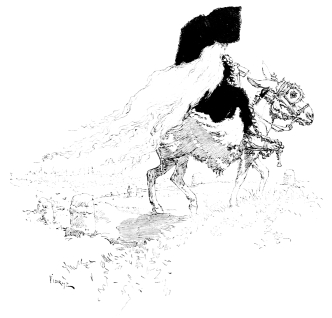
All that heard the proclamation read were highly pleased, and begged
copies of it; only the old man began to swear by his Bible, that it was
a satire upon him, because of what it contained concerning the blind
men, and that he knew what he did better than any man, and went on,
saying, “Do not mistake me, I once lay in the same house with Liñan, and
dined several times with Espinel, and was in Madrid as near Lope de Vega
as to any man in the room, and have seen Don Alonso de Ercilla a
thousand times, and have a picture at home of the divine Figueroa, and I
bought the old breeches Padilla left off when he became a friar, which I
still wear, though bad enough.” These were all old Spanish famous poets,
with whom he pretended to be thus acquainted, as if the knowledge of
them would have made his nonsense the more tolerable. At the same time
he showed us the breeches, which set all the company into such a fit
of laughing, that none of them cared to leave the lodging. But it was
now two of the clock, and having to travel further, we left Madrid. I
took my leave of him, though unwillingly enough, and travelled on
towards the pass on the mountains.
It pleased God, to divert me from evil thoughts, that I met with a
soldier; we fell into discourse. He asked me whether I came from the
Court? I told him I only passed through the town. “It is fit for nothing
else,” answered the soldier, “it is full of base people; by the Lord, I
had rather lie at a siege up to the waist in snow, expecting a kind
bullet, and half starved, than endure the insolencies they offer a man
of honour.” I replied, he should consider that at Court there were
people of all sorts, and that they made great account of any person of
worth. He cut me off short, saying in a great passion, “Why, I have been
this half year at Court, suing for a pair of colours, after twenty
campaigns, and having shed my blood in the king’s service, as appears by
these wounds.” And at the same time he showed me a scar half a quarter
long on his groin, which was as plain a tumour as the light of the sun;
and two seams on his heels, saying, they had been shots; but I
concluded, by some I have of the same sort, that they had been
chilblains broken. He pulled off his hat to show me his face, where
appeared a long gash from ear to ear, and quite across his nose, besides
other smaller cuts, that made it look like a mathematical draught, all
of lines. “These,” said he, “I received at Paris, serving my God and my
king, for whom I have had my countenance carved out and disfigured; and
in return, I have received nothing but fair words, which are equivalent
at present to foul actions. Let me entreat you, learned Sir, to read
these papers; for, by heavens, a more remarkable man, I vow to God,
never went into the field”; and he spoke truth, for he had marks enough
to be known by. With this, he began to pull out tin-cases, and to show
me a multitude of papers, which I believed belonged to another, whose
name he had borrowed. I read them, and said a thousand things in his
praise, pretending that neither the Cid nor Bernardo could compare with
him. He laid hold of what I said in a passion, and cried, “To compare
with me; by this light! no more can Garcia de Paredes, Julian Romero,
nor others as great as they! Damn all they did, there was no cannon in
their days. The devil take me, Bernardo would be a mere chicken now.
Pray, Sir, do you but inquire in the Low Countries about the exploit
performed by the person that wanted a tooth in front, and you will hear
what they say of it.” “Are you the person, Sir?” said I. And he replied,
“Why, who do you think it was? Do you not see here is a breach in my
teeth? But let us talk no more of it, for it does not become a man to
praise himself.” This discourse held us along till we overtook a hermit
riding on an ass, with a long beard like a brush, lean, and clad in
sackcloth. We saluted him as usual with the words Deo Gratias; and he
began to extol the corn on the ground, and in it the mercies of God. The
soldier immediately flew out, and said, “Father, I have seen pikes
charged against me thicker than that corn; and I vow to God, I did all
that man could do at the sacking of Antwerp, that I did by the Lord!”
The hermit reproved him for swearing so much, and he answered, “It is a
sign you were never a soldier, Father, since you reprove me for
exercising my calling.” It made me laugh to hear what he made soldiery
to consist in, and perceived he was some scoundrel, who knew little of
that noble profession, but that infamous part most used by the scum of
those that follow it.
We came at length to the pass in the mountains, the hermit praying all
the way on a pair of beads so big, it was a load; and every bead he
dropped sounded like a stroke with a mallet. The soldier compared the
rocks to the forts he pretended to have seen, observed what place was
strong, and where the cannon might be planted for battery. I had my eyes
fixed on them both, and was as much afraid of the hermit’s monstrous
beads as of the soldier’s extravagant lies. “How easily,” said he,
“would I blow up a great part of this pass with gunpowder, and do all
travellers good service.” Thus we came to Cerecedilla, and went into an
inn all three of us, after night-fall; we ordered supper, though it was
Friday, and in the meanwhile the hermit said, “Let us divert ourselves
awhile, for idleness is the source of all vice. Let us play for Ave
Marias;” and so saying, he dropped a pack of cards out of his sleeve. I
could not but laugh at that pleasant sight, considering the great beads;
but the soldier cried, “Let us have a friendly game as far as an hundred
reals will go I have about me.” Being covetous, I said I would
venture the like sum, and the hermit, rather than disoblige, consented,
telling us he had about two hundred reals to buy oil for the lamp. I
must confess I thought to have sucked up all his oil, but may the Turk
always succeed as I did. We played at lanskenet, and the best of it was
he pretended that he did not understand the game, and made us teach it
him. He let us win for two deals, but then turned so sharp upon us, that
he left us bare, and became our heir before we were dead. The dog palmed
upon us so slily, it was a shame to see him; he would now and then let
us draw a single stake, and then double it upon us. The soldier, every
card he lost, let fly half a score oaths, and twice as many curses,
wrapped up in blasphemies. For my part, I was eating my nails, whilst
the hermit drew my money to him. He called upon all the saints in
heaven, and in short left us penniless. We would have played on upon
some little pledges, but when he had won my six hundred reals and the
soldier’s hundred, he said that was only for pastime, and we were all
brethren, and therefore he would not meddle any farther. “Do not swear,”
said he, “for you see I have had good luck, because I prayed to God.” We
believed him, as not knowing the sleight he had at packing the cards;
the soldier swore he would never play again, and so did I. “A curse on
it,” cried the poor ensign, for he then told me he was so; “I have been
among Turks and infidels, but was never so stripped.” The good hermit
laughed at all we said, and pulled out his beads again. Having never a
stiver left, I desired him to treat me at supper, and pay for our
lodgings till we came to Segovia, since he had cleared our pockets. He
promised so to do, devoured threescore eggs, the like I never beheld,
and said he would go take his rest. We all lay in a great hall among
other people, all the rooms being taken up before. I lay down very
melancholy. The soldier called the landlord, and gave him charge of his
papers in the tin cases, and a bundle of tattered shirts, and so we went
to sleep. The hermit made the sign of the cross, and we blessed
ourselves from him.
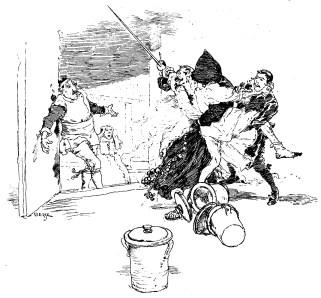
He slept, and I watched, contriving how to get his money from him. The
soldier talked in his sleep about his hundred reals, as if they had not
been past retrieving. When it was time to rise, he called hastily for a
light, which was brought, and the landlord gave the soldier his bundle,
but forgot his papers. The poor ensign made the house ring, calling for
his services. The landlord was amazed, and everybody pressing that he
should give them, he ran out and brought three close-stools, saying,
“There is one for each of you, would you have any more?” (For in
Spanish, services is a polite word for a close-stool.) This had like to
have spoiled all, for the soldier got up in his shirt, with his sword in
his hand, and ran after the landlord, swearing he would murder him;
because he made a jest of him, who had been at the battles of Lepanto,
St. Quintin, and several others, and brought him close-stools instead of
the papers he had given him. We all ran after to hold him, and could
not, whilst the landlord cried, “Sir, you asked me for services; I was
not bound to know, that in the language of soldiers, they gave that
name to the certificates of their exploits.” At length we appeased them,
and returned to our room. The hermit, fearing the worst, lay abed,
pretending the fright had done him harm; however, he paid our reckoning,
and we set out towards the mountain, very much disturbed at his
behaviour towards us, and much more for that we had not been able to get
his money from him.
We came up with a Genoese, I mean one of those bankers who help to drain
Spain of all its money. He was going up the mountain, with a servant
behind him, and an umbrella over his head, much like a rich usurer. We
fell into discourse with him, and still he turned it to talk of money,
for they are a people that seem born for nothing but the purse. He
presently fell upon Besançon, and to argue whether it were convenient or
no to put out money at Besançon. At last the soldier and I asked him
what gentleman that was he talked of? He answered, smiling, “It is a
town in Italy, where all the great money-dealers meet to settle the
exchange and value of coin.” By which we understood that Besançon was
the great exchange of usurers. He entertained us on the way, telling he
was undone because a bank was broke in which he had above sixty thousand
ducats; and swore by his conscience to all he said, though I am of
opinion that conscience among traders is like a virtue among whores,
which they sell though they have none. Scarce any trader has any
conscience, for being informed that it has a sting, they leave it behind
them with the navel-string when they come into the world. We held on our
conversation till we spied the walls of Segovia, which was a great
satisfaction to me, though the thoughts of what I had endured under the
wicked Cabra, at the starving boarding-school, would have given a check
to my joy. When I came to the town, I spied my father waiting upon the
road, which brought tears to my eyes; but I went on, being much altered
since I left the place, for I began to have a beard and was well clad. I
parted from my company, and considering who was most likely to know my
uncle besides the gallows, I could not imagine whom to apply myself to.
I went up and asked several people for Alonso Ramplon, and nobody could
give me any tidings of him, everyone said he did not know him: I was
very glad to find so many honest men in my town. As I stood there, I
heard the common crier set up his note, and after him my good uncle
playing his part. There came a file of bareheaded fellows, naked to the
waist, before my uncle, and he played a tune upon all their backs, going
from the one to the other. I stood gazing at this sight, with a man I
had been inquiring of, and told him I was a person of high birth; when I
saw my uncle draw near, and he espying me, ran to embrace me, calling me
nephew. I thought I should have died for shame; I never looked back to
take leave of the man I was with, but went along with my uncle, who said
to me, “You may follow till I have done with these people, for we are
now upon our return, and you shall dine with me to-day.” I, being
mounted on my mule, and thinking in that gang I should be but one degree
less exposed than those that were whipped, told him I would wait there,
and stepped a little aside, so very much out of countenance that had not
the recovery of my inheritance depended on him, I would never more have
spoken to him, or been seen in that place. He concluded his exercise,
came back, and carried me to his house, where I alighted, and we dined.
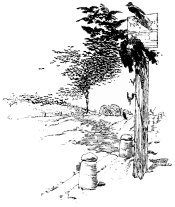
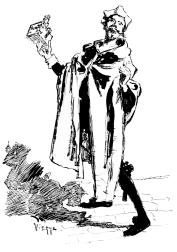
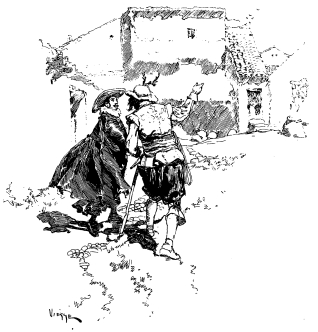
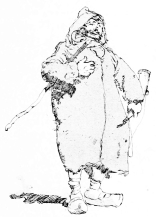
MY worthy uncle was lodged near the slaughterhouse, at a water-seller’s
house. We went in, and he said to me, “My lodging is not a palace, but I
assure you, nephew, it stands conveniently for my business.” We went up
such a pair of stairs that I longed to be at the top, to know whether
there was any difference betwixt it and the ladder at the gallows. There
we came into such a low room that we walked about as if we had been all
full of courtesy, bowing to one another. He hung up the
cat-of-nine-tails on a nail, about which there were others with halters,
broad knives, axes, hooks, and other tools belonging to the trade. He
asked me why I did not take off my cloak and sit down? I answered, “I
did not use to do so.” I cannot express how much I was out of
countenance at my uncle’s infamous profession, who told me it was lucky
that I came at such a time, for I should have a good dinner, because he
had invited some friends. As we were talking, in came one of those that
beg money at the church-doors for the release of souls, in a purple gown
down to his heels, and rattling his questing box, said, “I have got
as much to-day by my souls as you have done by the rogues you flogged.”
They made grimaces at one another; the wicked soul-broker tucked up his
long robe, discovering a pair of bandy legs and canvas breeches, and
began to shift about, asking whether Clement was come? My uncle told him
he was not, when at the same time in came an acorn thresher—I mean a
swineherd, wrapped up in a clout, with a pair of wooden shoes on. I knew
him by his horn he had in his hand, which had been more fashionable had
it been upon his head. He saluted us after his manner, and next to him
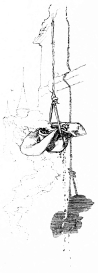 in came a left-handed squinting mulatto, with a hat that had brims like
an umbrella and a crown like a sugar-loaf; his sword with more guards
about it than at the king’s hunting; a buff-doublet; and a face as full
of scars as if it had been made of patches stitched together. He sat
down, saluting all the company, and said to my uncle, “By my troth,
Alonso, Flat Nose and the Nailer have been well mauled to-day.” Up
started he of the souls, and cried “I gave Flechilla, the hangman of
Ocana, four ducats, to put on the ass apace and play with a slender
cat-of-nine-tails, when I was fly-flapp’d there.” “By the Lord,” quoth
the mulatto, “I was too kind to the dog Lobrezno at Murcia, for the ass
went a snail’s gallop all the way, and the rogue laid them on so, that
my back was all weals.” “My back is virgin still,” said the swineherd.
“To every hog comes his Martinmas,” answered the beggar.[16] “I must say
that for myself,” quoth my good uncle, “that of all whipsters I am the
man, who am true and trusty to these that bespeak me; these to-day gave
me five crowns, and they had a parcel of friendly lashes with the single
cat-of-nine-tails.” I was so much out of countenance to see what good
company my uncle kept, that my blushes betrayed me, and the mulatto
perceiving it, said, “Is this reverend gentleman the person that
suffered the other day, and had a certain number of stripes given him?”
I answered, “I was none of those that suffered as they had done.” With
this my uncle started up, and said, “This is my nephew, a graduate at
Alcalá, and a great scholar.” They begged my pardon, and made tenders of
great friendship.
in came a left-handed squinting mulatto, with a hat that had brims like
an umbrella and a crown like a sugar-loaf; his sword with more guards
about it than at the king’s hunting; a buff-doublet; and a face as full
of scars as if it had been made of patches stitched together. He sat
down, saluting all the company, and said to my uncle, “By my troth,
Alonso, Flat Nose and the Nailer have been well mauled to-day.” Up
started he of the souls, and cried “I gave Flechilla, the hangman of
Ocana, four ducats, to put on the ass apace and play with a slender
cat-of-nine-tails, when I was fly-flapp’d there.” “By the Lord,” quoth
the mulatto, “I was too kind to the dog Lobrezno at Murcia, for the ass
went a snail’s gallop all the way, and the rogue laid them on so, that
my back was all weals.” “My back is virgin still,” said the swineherd.
“To every hog comes his Martinmas,” answered the beggar.[16] “I must say
that for myself,” quoth my good uncle, “that of all whipsters I am the
man, who am true and trusty to these that bespeak me; these to-day gave
me five crowns, and they had a parcel of friendly lashes with the single
cat-of-nine-tails.” I was so much out of countenance to see what good
company my uncle kept, that my blushes betrayed me, and the mulatto
perceiving it, said, “Is this reverend gentleman the person that
suffered the other day, and had a certain number of stripes given him?”
I answered, “I was none of those that suffered as they had done.” With
this my uncle started up, and said, “This is my nephew, a graduate at
Alcalá, and a great scholar.” They begged my pardon, and made tenders of
great friendship.
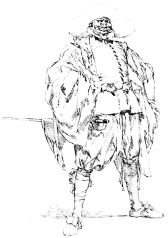
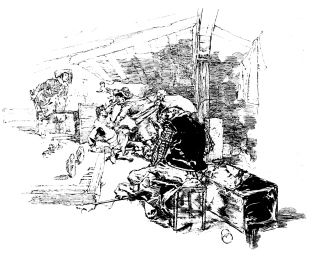
I was quite mad to eat my dinner, receive what was due, and get as far
as I could from my uncle. The cloth was laid, and the meat drawn up in
an old hat, as they draw up the alms that is given in prisons. It was
dished up in broken platters, and pieces of old crocks and pans, being
dressed in a stinking cellar, which was still more plague and confusion
to me. They sat down, the beggar at the upper end, and the rest as it
fell out. I will not tell what we ate, but only that they were all
dainties to encourage drinking. The mulatto, in a trice, poured down
three pints of pure red. The swineherd seeing the cup stand at me, still
whipt it off, pledging more healths than we spoke words; no man called
for water, or so much as thought of it. Five good meat pasties were
served up; they raised the crusts, and taking a holy-water sprinkler,
said a short prayer for the soul to whom the flesh belonged. Then said
my uncle, “You remember, nephew, what I wrote to you about your father;
it now comes afresh into my mind.” They all ate, but I took up only with
the bottoms, and ever since then I have retained the custom of saying a
prayer for the soul departed when I eat meat pies. The pots went round
without ceasing, and the mulatto and the beggar plied it so hard, that a
dish of scurvy sausages, looking like fingers of blacks cut off, being
set upon the table, one of them asked what they meant by serving up
dressed charcoal? My uncle by this time was in such a condition, up to
the throat in wine, with one eye almost out and the other half drowned,
that laying hold of one of the sausages, in a hoarse and broken voice,
he said, “By this bread, which is God’s creature, made to his own image
and likeness, I never ate better black meat, nephew.” It made me laugh
with one side of my mouth, and fret with the other, to see the mulatto,
stretching out his hand, lay hold of the salt-dish, and cry, “This
pottage is hot;” and at the same time the swineherd took a whole handful
of salt, and clapping it into his mouth, said, “This is a pretty
provocative for drinking.” After all this medley there came some soup,
so orderly was our entertainment. The beggar laying hold of a porringer
with both hands, cried, “God’s blessing on cleanliness;” and instead of
clapping of it to his mouth, laid it to his cheek, where he poured it
down, scalding his face and washing himself in grease from head to foot,
in a most shameful manner. Being in this miserable plight, he tried to
get up, but his head being too heavy, he was fain to rest with both his
hands upon the table, which was only a board set upon two tressels, so
that it overturned and begrimed all the rest; and then he cried that the
swineherd had pushed him. The swineherd seeing the other fall upon him,
scrambled up, and laying hold of his horn trumpet, beat it about his
ears. They grappled and clung so close together that the beggar set his
teeth in the swineherd’s cheek, and both of them rolling on the ground,
made such a wambling in the swineherd’s belly, that he cast up all he
had ate and drunk in the beggar’s face. My uncle, who was the soberest
of all the company, asked who had brought so many clergy into the house?
Perceiving that they all looked through multiplying glasses, I parted
the two combatants, made them friends, and helped up the mulatto, who
lay on the ground maudlin drunk, and weeping bitterly. I laid my uncle
on his bed, who made a low bow to a tall wooden candlestick he had,
thinking it had been one of his guests. Next I took away the swineherd’s
horn, but there was no silencing him after all the rest were asleep; he
was still calling for his horn, and said, “No man ever could play more
tunes on it, and he would now imitate the organ.”
In short, I never left them till they were all fast asleep; then I went
abroad, and spent the afternoon in seeing the town; I passed by Cabra’s
house, and heard he was dead, but never asked of what distemper, knowing
he could die of none as long as it was possible to starve. At night I
returned home, full four hours after I had gone out, and found one of
the company awake, crawling about the room on all-four to find the door,
and complaining he had lost the house. I raised him up, and let the rest
sleep till eleven at night, when they awaked of themselves, stretching
and yawning. One of them asked, “What a clock it was?” The swineherd,
who had not laid half his fumes, answered, “It was still afternoon, and
the weather piping hot.” The beggar, as well as he could speak, asked
for his cloak, saying, “The distressed families had been long neglected,
the whole care of their souls lying upon his hands;” and thinking to go
to the door, he went to the window, where seeing the stars, he cried out
to the others, telling them, “That the sky was hill of stars at noonday,
and there was a mighty eclipse.” They all blessed themselves, and kissed
the ground. Having observed the villainy of the beggar, I was much
scandalized, and resolved to take heed of that sort of men. The sight of
all these abominable practices made me the more impatient to be among
gentlemen and persons of worth. I got them all away one by one, the best
I could, and put my uncle to bed, who, though not foxed, was drunk
enough, and made the best shift I could myself, with my own clothes, and
some of the poor departed souls’ that lay about the room. Thus we passed
the night, and in the morning I discoursed my uncle about seeing my
inheritance and taking possession of it, telling him I was quite tired,
and knew not with what. He stretched one leg out of bed, and got up; we
had much talk concerning my affairs, and I had enough to do with him, he
was so tipsy and dull. At length I prevailed with him to tell me of part
or my inheritance, though not all; and so he told me of three hundred
ducats my worthy father had got by sleight of hand, and left them in
custody of a decent woman, that was the receiver of all that was stolen
for ten leagues round the country. To be short, I received and pouched
my money, which my uncle had not yet drank out, nor consumed; and that
was very much, considering he was such a brutal man; but the reason was,
he thought it would serve me to take my degrees, and, with a little
learning, I might come to be a cardinal, which to him seemed no
difficult matter. When he understood I had the money, he said to me, “My
child, Pablo, it will be your own fault if you do not thrive and are not
a good man since you have a good example before you. You have got money,
and I will always be your friend, for all I have and all I earn is
yours.” I returned him thanks for his kind offers. We spent the day in
extravagant talk, and in returning visits to the aforesaid persons. They
passed the afternoon playing at knuckle-bones, the same company—my
uncle, the swineherd, and the beggar, this last squandering the money of
the poor at a villainous rate. It was wonderful to see how dexterous
they were at it, catching them up in the air and shaking them up as they
fell on the wrist. Night came on, the guests went away, and my uncle and
I to bed, for he had now got me a quilt. When it was day, I got up
before he was awake, and went away, without being perceived, to an inn,
locking the door on the outside, and thrusting in the key at a cranny. I
went away, as I have said, to an inn, to hide myself, and wait the next
opportunity to go to Madrid. I left him a letter sealed up in the room,
wherein I gave an account of my departure, and the reasons that moved
me so to do, desiring he would make no inquiry after me, for I would
never see him more.
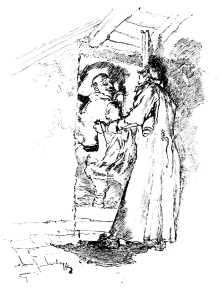
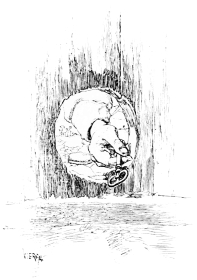
A CARRIER was setting out that morning with a load from the inn for
Madrid. He had a spare ass, which I hired, and went before to wait for
him without the city gate. He came accordingly; I mounted, and began my
journey, and said to myself, “Farewell to thee for ever, thou knave of
an uncle, “dishonour of our family, stretcher of wind-pipes.” I
considered I was going to Madrid, the Court of Spain, where, to my great
satisfaction, nobody knew me, and there I must trust to my ingenuity.
The first thing I resolved to do was to lay aside my scholar’s habit,
and clothe myself in the fashion. But let us return to my uncle, who was
in a great rage at the letter I left him, which was to this effect:
“Mr. Alonso Ramplon.
“Since it has pleased God to show me such signal mercies, as to take
away my good father, and to order my mother to be conveyed to Toledo,
where I know the best that can come of her is to vanish away in smoke;
all I could wish for at present would be to see you served as you serve
others. I design to be singular in my family, for I can never make more
than one, unless I fall under your hands, and you carve me up as you do
others. Do not inquire after me, for I am in duty bound to deny the
kindred that is between us. Serve God and the king.”
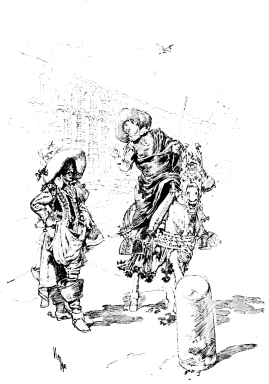
It is impossible to express how, in all likelihood, he railed and swore
at me; but let us leave him there, and return to my journey. I was
mounted on a dappled ass of La Mancha, and wished with all my heart that
I might meet nobody; when on a sudden I discovered at a distance a
gentleman going a-pace, with his cloak hanging on his shoulders, his
sword by his side, close breeches, and boots on, altogether, to outward
appearance, genteel enough, with a clean starched band, and his hat on
one side. I conceived he was some man of quality that was walking, and
had left his coach behind him; and accordingly, when I came up, I
saluted him. He looked at me, and said, “It is very likely, good Sir,
that you travel more easy on that ass than I do with all my equipage.”
Imagining he had meant his coach and servants he left behind, I
answered, “In troth, Sir, I reckon it more easy travelling than in a
coach, for though there is no dispute that you go very easily in that
you have left behind you, yet the jolting of it is troublesome.” “What
coach behind?” replied he, much disturbed, and turning short to look
about him, the sudden motion made his breeches drop down, for it broke
the one point he had to hold them up; and though he saw me ready to
burst with laughing, he asked to borrow one of me. Perceiving he had no
more shirt than would come within the waistband of his breeches, and
scarce reach to acquaint his breech he had any, I replied, “As I hope
for mercy, Sir, you had best wait till your servants come up, for I
cannot possibly assist you, having but one single point to hold up my
own breeches.” “If you are in jest, Sir,” quoth he, holding his breeches
in his hands, “let it pass, for I do not understand what you mean by
servants.” With this he went on, and was so plain in letting me know he
was poor, that before we had gone half a league together, he owned he
should never be able to get to Madrid, unless I would let him ride upon
my ass awhile, he was so tired with walking with his breeches in his
hands, which moved me to compassion, and I alighted. He was so
encumbered with his breeches, that I was fain to help him up, and was
much surprised at what I discovered by my feeling; for behind, as far as
was covered with the cloak, the hinder parts had no other fence against
the eyes and the air. He, being sensible of the discovery I had made,
very discreetly prevented what reflection I might make by saying, “All
is not gold that glitters, Sir Licentiate,” giving me that title on
account of my long scholar’s robe; “no doubt but when you saw my fine
starched band, and the show I made, you fancied I was the Lord knows
who.[17] Little do you think how many fine outsides are as bare within
as what you felt.” I assured him upon my word that I had conceited much
different matters from what I found. “Why then, Sir,” replied he, “let
me tell you, all you have seen as yet is nothing, for everything about
me is remarkable, and no part of me is truly clad. Such as you see me, I
am a real substantial gentleman, of a good family and known seat on the
mountains; and could I but feed my body as I keep my seat and gentility,
I should be a happy man. But as the world goes, good Sir, there is no
keeping up noble blood without bread and meat, and, God be praised, it
runs red in every man’s veins; nor can he be a worthy person who is
worth nothing.[18] I am now convinced of the value of a good pedigree,
for being ready to starve one day, they would not give a chop of mutton
in the cook’s-shop for mine; for they said it was not flourished with
gold letters; but the leaf gold on pills is more valuable, and few men
of letters have any gold. I have sold all to my very burial-place, that
nothing may be called mine when I am dead, for my father Toribio
Rodriguez Vallejo Gomez de Ampuero y Jordan lost all he had in the world
by being bound for others. I have nothing now left to sell but the title
of Don, and I am so unfortunate, that I can find nobody that has
occasion for it, because there is scarce a scoundrel now but usurps it.”
Though the poor gentleman’s misfortunes were intermixed with something
that was comical, I could not but pity him, asked his name, whither he
was going, and what to do? He answered with all his father’s names, Don
Toribio Rodriguez Vallejo Gomez de Ampuero y Jordan. Never did I hear
such an empty sounding jingling name, or so like the clattering of a
bell, as beginning in Don and ending in dan. He added, he was going
to Madrid, because a threadbare elder brother, as he was, soon grew
tainted and mouldy in a country town, and had no way to subsist; and
therefore he was going to the common refuge of distressed persons, where
there is room for all, and open house kept for wandering spongers: “And
I never want five or six crowns in my pocket,” said he, “as soon as I am
there, nor a good bed, meat, and drink, and sometimes a forbidden
pleasure; for a good wit at Court is like the philosopher’s stone, which
converts all it touches into gold.” This to me was the most welcome news
I had ever heard; and therefore, as it were to divert the tediousness of
our journey, I desired him to inform me how, and by whom, he, and others
in his condition, could live at Court; for to me it appeared a very
difficult matter, because everyone there seemed so far from being
contented with his own, that he aimed at what belonged to others. “There
are many of all sorts,” replied my spark, “but flattery is like a
master-key, which introduces a man wheresoever he pleases, in such great
places; and that you may not think strange of what I say, do but listen
to my adventures and contrivances, and you will be convinced of the
truth of it.”
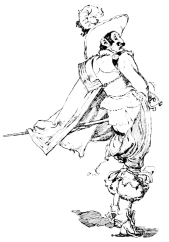
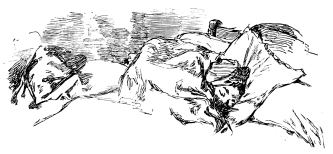
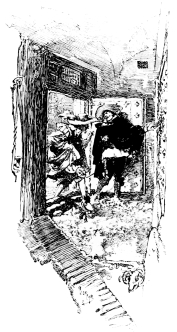
THE first thing you are to observe is, that at Court there are always
the wisest and the weakest, the richest and the poorest, and the
extremes of all other sorts. There the virtuous are concealed, and the
wicked not taken notice of; and there live a sort of people like myself,
who are not known to have any estates, real or personal, nor does it
appear whence they came, or how they live. Among ourselves we are
distinguished by several names, some are called gentlemen-mumpers,
others sharpers, others pinchguts, others barebones, and others
commoners; but in general we live by our wits. For the most part, we
cheat our guts of their due, for it is a very dangerous and troublesome
thing to live upon others. We are scarecrows at all good tables, the
terror of cook-shops, and always unbidden and unwelcome guests, living
like chameleons by the air, and so contented. When we happen to dine
upon a leek, we strut and look as big as if stuffed with capon.
Whosoever comes to visit us, never fails to find mutton and fowl bones,
and parings of fruit about the house, and the doors strewed with
feathers and young coney skins; all which we pick up over night, about
the streets, to credit us the next day. As soon as the friend comes
in, we fall into a passion, and cry, ‘It is a strange thing that I can
never make this maid sweep the room in time. Good Sir, excuse me, for I
have had some friends at dinner, and these servants never mind their
business,’ &c. Such as do not know us believe it, and think we have had
an entertainment. Next, as for dining at other men’s houses, whensoever
we have spoke but three words with a man, we take care to know where he
lives, thither we are sure to make just at eating-time, when we know he
is at table; we tell him his conversation has so charmed us, that we are
not able to keep away, for he is the most taking person in the world. If
he asks whether we have dined, and they have not yet begun, we answer in
the negative. If they invite us, we never stay to be asked twice,
because those ceremonies have often made us go with hungry bellies. If
they have begun to eat, we say we have dined, and then, though the
master of the house carves up his fowl, or any joint of meat never so
dexterously, that we may have the opportunity of chopping up a mouthful
or two, we cry, ‘By your leave, Sir, pray let me have the honour of
being your carver, for I remember (naming some duke or earl that is
dead, God rest his soul), used to take more delight in seeing me carve
than in eating.’ This said, we lay hold of the knife, cut out curious
bits, and say, ‘How deliciously it smells! It would be an affront to the
cook not to taste it; what a delicate hand she has at seasoning!’ With
this we fall on, and down goes half the meat in the dish for a taste. If
there be bacon, we call it our delight; if mutton, the only thing we
love; if but a turnip, an excellent morsel; and so everything that comes
in our way is ever the thing that we most admire. If all this fails, we
are sure of the alms of some monastery, which we do not receive in
public among the beggars, but privately, endeavouring to persuade the
friars that we rather take it out of devotion than for want.
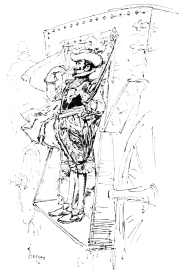
“It is pleasant enough to see one of us in a gaming-house, how
diligently he attends, snuffs the candles, reaches the pots, fetches
cards, applauds all the winner says, and all this for a poor real or two
he gives him. We carry in our mind the whole inventory of our wardrobe
or ragshop, in order to dress us; and as in some places they observe set
times for prayer, so do we for mending and botching. It is wonderful to
see what variety of rubbish we lay up, and produce upon occasion. We
look upon the sun as our mortal enemy, because he discovers our darns,
stitches, and patches; and yet are forced to be beholden to him,
standing up with our legs wide open in the morning where he shines in,
to discover by the shadows on the ground what shreds or rags hang
between our legs, and then with a pair of scissors we trim the breeches.
Now that part betwixt the thighs being so apt to wear, it is very odd to
observe what gaps we make behind to fill up the forepart, so that very
often the posteriors are hacked away till they remain quite naked. Only
the cloak is privy to this secret, and therefore we are very cautious of
windy days, and of going upstairs that are light, or mounting
a-horseback. We make it our business to study postures against the
light; and if it prove a very bright day, we walk with our legs as close
as may be, and sit as if our knees were clung together, for fear lest we
open them the gashes may appear. There is nothing about us but what has
been another thing before, and may have a particular history writ of it;
as for instance, you see this waistcoat. Sir, it was once a pair of
wide-kneed breeches, grandchild to a short cape, and great-grandchild to
a long mourner’s cloak, which was its first parent, and now it waits to
be converted into footing for stockings, and forty other things. Our
socks were once handkerchiefs, descended from towels, which had been
shirts, and those the issue of sheets; after all this, they are made
into paper, on which we write, and at last burn to make blacking for our
shoes, where I have seen it perform wonders, recovering many a pair that
was condemned as only fit for the dunghill. At night we never fail to
get at the greatest distance we can from the light, for fear of
discovering our threadbare cloaks and woolless coats, for there is no
more nap on them than is upon a stone; and though it pleases God to give
us hair on our faces, we have none on our clothes; and therefore, to
save the expense of a barber, we always contrive to stay till two of us
want trimming together, and then we scrape one another, following the
advice of the gospel, ‘Be helpful to one another, like loving brethren.’
Besides, we always take care not to intrude into the houses of others,
for everyone keeps his own and timely notice is given to avoid
contention, being very jealous in the point of eating. It is an
indispensable duty among us to ride about all the great noted streets
once a quarter, though it be on an ass-colt, and once a year to go in a
coach, when we are sure to sit as close to the door as possible,
thrusting out our heads, bowing to all that pass by to be seen, and
talking to our friends and acquaintance, though they do not see or mind
us. If any unmannerly creature happens to bite us before ladies, we have
ways to scratch in public, without being taken notice of; for if it
happened to be on the thigh, we tell a story of a soldier we saw had a
shot through there, clapping our fingers on the place that itches, and
clawing instead of pointing. If it is in the church, and they sting on
our breasts, we beat them by way of devotion, though it be at a
christening; for the back, we lean against a pillar or wall, and rub it
there, as if we only stood up to observe something. To deal ingenuously,
as to the matter of lying, not one word of truth ever comes out of our
mouths. In all companies we run over a bead-roll of dukes and counts,
making some of them our friends, and others our relations, always
observing that those great men must be either dead or very remote. The
best of all is that we never fall in love, unless it be to earn our
bread; for by our constitutions, coy ladies, though never so beautiful,
are absolutely forbidden; so that we ever court a tripe-man for our
meat, the landlady for our lodging, the starcher for our band and other
necessaries; and though such slender diet makes us unfit to satisfy them
all, yet we keep them in good humour. Will anybody that sees the boots
on my legs believe they are upon the bare skin, without any stockings?
Or will any one that sees my curious starched band imagine I have no
shirt? Let me tell you, Sir, a gentleman may make a shift without those
things, but there is no living for him without a set starched band. This
is an outward ornament, altogether necessary to grace a man; and
besides, when he has turned it and wound it every way, the starch in it
will make him a mess as good as watergruel. In short, reverend Sir, a
gentleman of our stamp must go through all sorts of wants and hardships,
and that is the way to live at Court. Sometimes he flourishes and rolls
in plenty, and at another time he falls into an hospital; but still he
lives; and he who knows how to manage is a king, though he has never so
little.”
I was so well pleased with the gentleman’s strange ways of living, and
so much diverted with his relation, that I went on a-foot as far as
Rozas, where we lay that night. The squire supped with me, for he had
not one doit, and I thought myself beholden to him for his instructions,
because they led me into abundance of secrets, and put me into the way
of sharping. I acquainted him with my designs before we went to bed,
which he returned with a thousand embraces, telling me he had always
been in hopes since he met me that his words would work some good effect
on a person of my capacity. He offered me his service towards
introducing me at Madrid into the society of the tricking brotherhood,
and a lodging among them. I accepted of his kindness, without letting
him know what was my treasure in ducats, which was only an hundred
reals, which, with the kindness I had done, and was still continuing,
purchased his friendship. I bought him three points from our landlord;
he tied up his hose, we rested that night, got up early in the morning,
and away we went to Madrid.
END OF BOOK ONE.
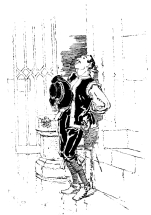
THE HISTORY OF THE
LIFE OF THE SHARPER
CALLED DON PABLO
THE P A T T E R N OF
V A G A B O N D S AND
MIRROR OF ROGUES.