“A clerk ther was of Oxenford also,
That unto logik hadde longe ygo....
For him was lever have at his beddes heed
Twenty bokes, clad in blak or reed,
Of Aristotle and his philosophye
Than robes riche, or fithele or gay sautrye.
But al be that he was a philosophre,
Yet hadde he but litel gold in cofre;
But al that he mighte of his freendes hente,
On bokes and on lerninge he it spente,
And bisily gan for the soules preye
Of hem that yaf him wherwith to scoleye.
Of studie took he most cure and most hede.
Noght o word spak he more than was nede,
And that was seyd in forme and reverence,
And short and quik, and ful of hy sentence.
Souninge in moral vertu was his speche,
And gladly wolde he lerne and gladly teche.”
AS you drive into Oxford from the railway station, you pass, as we have
seen, monuments which may recall to mind the leading features of her
history and the part which she took in the life of the country. The
Castle Mound takes us back to the time when Saxon was struggling against
Dane; the Castle itself is the sign manual of the Norman conquerors; the
Cathedral spire marks the site upon which S. Frideswide and her
“she-monastics” built their Saxon church upon the virgin banks of the
river. Carfax, with the Church of S. Martin, was the centre

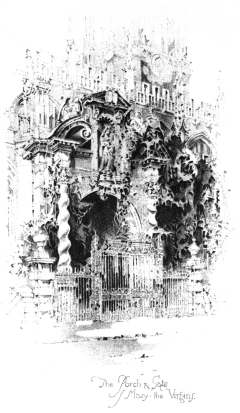
The Porch & Gate S. Mary the Virgins.
of the city’s life and represents the spirit of municipal liberty which
animated her citizens, and the progress of their municipal freedom.
The bell which swung in Carfax Tower summoned the common assembly to
discuss and to decide their own public affairs and to elect their own
mayor. And this town-mote of burghers, freemen within the walls, who
held their rights as burghers by virtue of their tenure of ground on
which their tenement stood, met in Carfax Churchyard. Justice was
administered by mayor and bailiff sitting beneath the low shed, the
“penniless bench”[22] of later times, without its eastern wall. And
around the church lay the trade guilds, ranged as in some vast
encampment.
Carfax Church, with all its significance of municipal life, stands at
the top of High Street, the most beautiful street in the world. Still,
by virtue of the splendid sweep of its curve comparable only to the
Grand Canal of Venice or the bend of Windermere, and by virtue of the
noble grouping of its varied buildings, the most beautiful street in the
world; in spite of modern tramways and the ludicrous dome of the Shelley
Memorial, “a thing resembling a goose pye,” as Swift wrote of Sir John
Vanburgh’s house in Whitehall; in spite of the disquieting ornamentation
of Brasenose new buildings and the new schools; in spite even of the
unspeakably vulgar and pretentious façade of Lloyd’s Bank, a gross,
advertising abomination of unexampled ugliness and impertinence, which
has done all that was possible to ruin the first view of this street of
streets. Let us leave it behind us with a shudder and pass down the High
till we find on our left, at what was once the end of “Schools Street,”
the lovely twisted columns of the porch which forms the modern entrance
to S. Mary’s Church.
What Carfax was to the municipal life of Oxford, S. Mary’s was to the
University. It was the centre of the academical and ecclesiastical life
of the place. And the bell which swung in S. Mary’s tower summoned the
students of the University sometimes to take part in learned
disputations among themselves, sometimes to fight the citizens of the
town.
Here then, between the Churches of S. Martin and S. Mary, the life of
this mediæval University town ebbed and flowed. In the narrow,
ill-paved, dirty streets, streets that were mere winding passages, from
which the light of day was almost excluded by the overhanging tops of
the irregular houses, crowded a motley throng. The country folks filled
the centre of the streets with their carts and strings of pack-horses;
at the sides, standing beneath the signs of their calling, which
projected from their houses, citizens in varied garb plied their trades,
chaffering with the manciples, but always keeping their bow-strings
taut, ready to promote a riot by pelting a scholar with offal from the
butchers’ stall, and prompt to draw their knives at a moment’s notice.
To and fro among the stalls moved Jews in their yellow gaberdines; black
Benedictines and white Cistercians; Friars black, white and grey;
men-at-arms from the Castle, and flocks of lads who had entered some
grammar school or religious house to pass the first stage of the
University course. Here passed a group of ragged, gaunt, yellow-visaged
sophisters, returning peacefully from lectures to their inns, but with
their “bastards” or daggers, as well as their leather pouches, at their
waists. Here a knot of students, fantastically attired in many-coloured
garments, whose tonsure was the only sign of their clerkly character,
wearing beards, long hair, furred cloaks, and shoes chequered with red
and green, paraded the thoroughfare, heated with wine from the feast of
some determining bachelor. Here a line of servants, carrying the books
of scholars or doctors to the schools, or there a procession of
colleagues escorting to the grave the body of some master, and bearing
before the corpse a silver cross, threaded the throng. Here hurried a
bachelor in his cape, a new master in
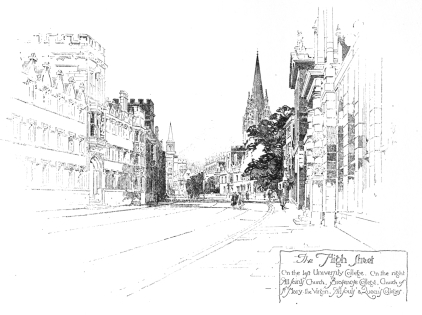
The High Street
On the left University College. On the right All Saints’ Church,
Brasenose College, Church of S. Mary the Virgin, All Souls’ & Queen’s
Colleges.
his “pynsons” or heelless shoes, a scholar of Exeter in his black boots,
a full-fledged master with his tunic closely fastened about the middle
by a belt and wearing round his shoulders a black, sleeveless, close
gown. Here gleamed a mantle of crimson cloth, or the budge-edged hood of
a doctor of law or of theology. And in the hubbub of voices which
proceeded from this miscellaneous, parti-coloured mob, might be
distinguished every accent, every language, and every dialect.[23] For
French, German and Spanish students jostled in these streets against
English, Irish, Scottish and Welsh; Kentish students mingled with
students from Somersetshire or Yorkshire, and the speech of each was
quite unintelligible to the other.
S. Mary’s Church was the only formal meeting place of these students,
thus drawn together in the pursuit of knowledge from various parts of
Europe. It was here that all University business, secular and religious,
was transacted, till the building of the Divinity school and the
Sheldonian theatre allowed the church to be reserved for sacred
purposes. Then at last it ceased to be the scene of violent altercations
between Heads of Houses or the stage where the Terræ Filius of the year
should utter his scurrilous banalities.[24]
But still every Sunday morning during term the great bell of S. Mary’s
rings out and summons the University to assemble in formal session there
to hear a sermon. The bedels of the four faculties with their silver
staves lead the way; and the Vice-chancellor is conducted to his throne,
the preacher to his pulpit; the doctors of the several faculties in
their rich robes follow and range themselves on either side of their
official head; below them the proctors, representatives of the Masters
of Arts, wearing the white hoods of their office, take their seats. The
masters and bachelors fill the body of the church, the undergraduates
are crowded into the galleries.
We must not think of S. Mary’s as merely a meeting-house for University
business or as merely a parish church. For centuries it has been the
centre of Christian Oxford; where each successive movement in English
theology has been expounded and discussed. From the old stone pulpit, of
which a fragment is fixed over the southern archway of the tower, Peter
Martyr delivered his testimony and Cole sent Cranmer to the stake; from
its nineteenth century successor, John Keble began the Oxford movement;
Dr Pusey preached a sermon for which he was suspended, and Newman (vicar
1831) entered on the path to Rome.
The church is mentioned in Domesday Book, and the north wall of the Lady
Chapel, commonly known as Adam de Brome’s Chapel because the tomb of the
founder of Oriel is therein, may have been part of the church as it
stood at the time of the Domesday survey. The tower and the spire date
from the early fourteenth century.
S. Mary’s as we have it now is very much a Tudor building. When William
of Wykeham built New College Chapel he set a fashion which soon
converted Oxford into a city of pinnacles.[25] In the perpendicular
style pinnacles were erected on Merton tower and transept, on All Souls’
Chapel, on Magdalen Chapel, hall and tower; nearly a hundred pinnacles
decorated the Schools and Library; the nave, aisles and chancel of S.
Mary’s received the same ornaments, and pinnacles in the same style were
added to the clusters of the fourteenth century tower and spire. These
were not high but observed a true proportion.
It was the grave fault of the excessively lofty pinnacles (beautiful no
doubt in themselves) which were added in 1848,[26] that they destroyed
the true beauty of proportion and the effect of gradual transition which
the fourteenth century builders had succeeded in giving to the tower and
spire, and with which the ancient statues in
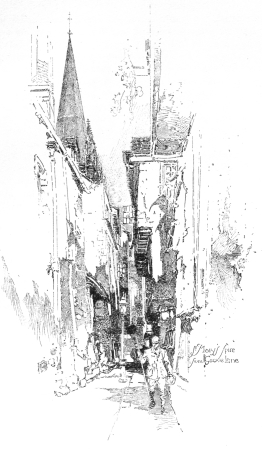
S. Mary’s Spire from Grove Lane
their canopied niches were in perfect harmony. For the massive
tower-buttresses are crowned with turrets, showing canopied niches
containing twelve over-life-size statues and decorated with ball-flower
ornament. Two of the statues on the buttresses facing south are modern;
nine others are copies (1895) of the old statues, stored now in the
ancient Congregation House, which still exhibit the carefully calculated
gestures and the studied designs of the original fourteenth century
workers. They form a series which recalls that on the west front of
Wells Cathedral, a rare example of English sculpture in a genre which
is so plentifully and superbly illustrated by the French cathedrals.
On the face of the south buttress of the west front stood the statue,
beautifully posed, of the Virgin with the Infant Christ, the Lady of the
Church thus occupying the most important angle of the tower; on the
left, S. John the Evangelist with the cup. Between the Evangelist and S.
John the Baptist, patron saint of the Chapel of Merton, Walter of Merton
looks out towards the College he founded. These three are from new
designs by Mr Frampton.
On the N.W. angle of the tower is S. Cuthbert of Durham, facing
northwards. He holds in his hand the head of S. Oswald, the Christian
King slain by Penda, and looks towards his own north country and Durham,
the great diocese so intimately connected through its bishops and
monastery with the early collegiate foundations of the Universities.
Northwards, too, towards his cathedral church of Lincoln, faces S. Hugh,
with the wild swan of Stowe nestling to him as was his wont, with its
neck buried in the folds of his sleeve. This statue is on the eastern
buttress at the N.E. angle, and on the eastern face of the same buttress
is an equally noble statue of Edward the Confessor. On the S.E. angle
stands, it may be, the murdered Becket, and among the other figures
Edmund Rich may perhaps be counted.
The chancel and nave are, it will be seen, splendid examples of late
perpendicular. The chancel, in fact, began to be rebuilt in 1462 and
the nave 1487-1498. For the church “was so ruinated in Henry VII. reign
that it could scarce stand,” and though it was and is really a parish
church, yet so closely was it bound up with the life and procedure of
the University that the University at length took measures to collect
money for its repair.
They begged, after the approved manner of the great church-builders of
the Middle Ages, from the archbishop downwards, and their begging was so
successful that they built the nave, as we now have it, and the chancel.
In order to secure an appearance of uniformity, the architect
unfortunately altered Adam de Brome’s chapel, encasing the outer walls
in the new style, and inserting larger windows. Not content with this,
he likewise converted the old House of Congregation by substituting a
row of large for two rows of small windows, giving thereby a false
impression from the outside, as if the upper and lower stories were one.
The University had no right to the use of S. Mary’s. The church was
merely borrowed for sermons and meetings of Congregation, just as S.
Peter’s in the East was borrowed for English sermons and S. Mildred’s
for meetings of the Faculty of Arts. For the University in its infancy
had little or no property of its own. It could not afford to erect
buildings for its own use. The parish churches, therefore, were used by
favour of the clergy, and lectures were delivered in hired schools.
The need for some University building was, however, severely felt. At
last it was provided for in a small way. “That memorable fabric, the old
Congregation House,” and the room above it were begun in 1320 by the
above-mentioned Adam de Brome, at the expense of Thomas Cobham, Bishop
of Worcester. The latter had undertaken to enlarge the old fabric of S.
Mary’s Church by erecting a building two stories high immediately to the
east of the tower, on the very site, that is, on which the University
had previously endeavoured to found a chantry. He intended that the
lower room should serve primarily as a meeting-place for the
Congregations of regent-masters, and at other times for parochial
purposes. The upper room was to be used partly as an oratory, and partly
as a general library. But the good bishop’s books, which were to form
the nucleus of this library, met with the same fate as Richard de
Bury’s. His executors pawned them to defray the expenses of his funeral,
and to pay his debts. Oriel College at their suggestion redeemed the
books, and being also the impropriating rectors of the church, they
claimed to treat both building and library as their own property. But
the masters presently asserted their supposed rights by coming “with a
great multitude” and forcibly carrying away the books from Oriel, “in
autumn, when the fellows were mostly away.” They lodged the books in the
upper chamber, and Oriel presently acknowledged the University’s
proprietary rights.
The old University library, then, found its home in the upper room of
the old Congregation House, and there remained until the books were
moved to Duke Humphrey’s library (1480). From that time till the
erection of Laud’s Convocation House, the upper room was used as a
school of law, and also as another Congregation House, distinguished by
the name of “Upper.” Meantime a salary was provided for a librarian,
who, besides taking care of the books in the upper chamber, was to pray
for the soul of the donors. Other books were acquired by the University,
either by purchase, bequest, or as unredeemed pledges. Some of these
were kept in chests, and loaned out on security like cash from the other
chests, whilst others were books given or bequeathed to the University,
which were kept chained in the chancel of the church, where the students
might read them. Others, in the upper room, were secured to shelves by
chains that ran on iron bars. These shelves, with desks alongside, would
run out from the walls, between the seven windows, in a manner clearly
shown by such survivals of mediæval libraries as exist at the Bodleian,
Merton and Corpus. The catalogue was in the form of a large board
suspended in the room. At first these books were open for the use of all
students at the specified times, but by later statutes (1412), made
when the library had been increased by further donations and time had
brought bitter experience, the use of them was stringently limited to
graduates or religious of eight years’ standing in Philosophia. These
regulations were intended to provide against the overcrowding of the
small library, the disturbance of readers and the destruction of books
by careless, idle and not over-clean boy students. With the object of
preserving the books, a solemn oath was also exacted from all graduates
on admission to their degree, that they would use them well and
carefully. The lower room fulfilled its founder’s intention, and here
the Congregation of regents met, whilst the Convocation, or Great
Congregation of regents and non-regents, was held in the chancel of the
church.
Here, then, we may imagine the Chancellor sitting, surrounded by doctors
and masters of the Great Congregation as the scene was formerly depicted
in the great west window of S. Mary’s, and is still represented on the
University seal.
I have referred to the “chests” which were kept in the upper chamber.
This was in fact the treasure-house of the University, and here were
stored in great chests doubly and trebly locked, like the “Bodley” chest
in the Bodleian, the books and money with which the University had been
endowed for the benefit of her scholars.
Mr Anstey (Munimenta Academica) has given a brilliant little sketch of
the scene which the fancy may conjure up when the new guardians of the
chests were appointed and the chests opened in their presence.
It is the eve of the Festival of S. John at the Latin Gate, in the year
of Grace 1457. To-morrow is the commemoration day of W. de Seltone,
founder of the chest known by his name. Master T. Parys, Principal of S.
Mary Hall, and Master Lowson are the new guardians, the latter the north
countryman of the two. High mass has just been sung with commemoration
collects, and solemn prayers for the repose of the souls of W. de
Seltone and all the faithful departed. It is not a reading (legible)
day, so the church is full. But now all have left, except a few
ragged-looking lads, who still kneel towards the altar, and seem to be
saying their Pater Nosters and Ave Marias, according to their vow, for
their benefactor. Master Parys and Master Lowson, however, have left
earlier; they have passed out of the chancel and made their way into the
old Congregation House for their first inspection of the Seltone Chest.
Each of the guardians draws from beneath his cape a huge key, which he
applies to the locks. At the top lies the register of the contents, in
which is recorded particulars, dates, names and amounts of the loans
granted. The money remaining in one corner of the chest is carefully
counted and compared with the account in the register. Here and there
among valuable MSS. lie other pledges of less peaceful sort but no less
characteristic of a mediæval student’s valuable possessions. Here
perhaps are two or three daggers of more than ordinary workmanship, and
there a silver cup or a hood lined with minever. That man in an ordinary
civilian’s dress, who stands beside Master Parys, is John More, the
University stationer, and it is his office to fix the value of the
pledges offered, and to take care that none are sold at less than their
real value. It is a motley group that stands around; there are several
masters and bachelors, but more boys and young men in every variety of
coloured dress, blue, red, medley or green. Many of these lads are but
scantily clothed, and all have their attention riveted on the chest,
each with curious eye watching for his pledge, his book or his cup,
brought from some country village, perhaps an old treasure of his
family, and now pledged in his extremity. For last term he could not pay
the principal of his hall seven and sixpence due for the rent of his
miserable garret, or the manciple for his battels, but now he is in
funds again. The remittance, long delayed on the road, has arrived, or
perhaps he has succeeded in earning or begging a sufficient sum to
redeem his pledge. He pulls out the coin from the leathern money-pouch
at his girdle. But among the group you may see one master, whose bearing
and dress plainly denote superior comfort and position. He is wearing
the academical costume of a master, cincture and biretta, gown and hood
of minever. Can it be that he too has been in difficulties? He might
easily have been, for the post was irregular, and rents were not always
punctual in those days. But in this case it is Master Henry Sever,
Warden of Merton, who has lately been making some repairs in the
College, and he has borrowed from the Seltone Chest the extreme sum
permitted by the ordinance, sixty shillings, for that purpose. The
scholars plainly disapprove of his action. They are jealous of his using
the funds of the chest which, they think, were not intended for the
convenience of such as he. Master Sever, however, is filled with anxiety
at the present moment. He has pledged an illuminated missal which far
exceeds in value the sum he has borrowed, and this he omitted to redeem
at the proper time. It is not in the chest. He inquires, and is told
that it has been borrowed for inspection by an intending purchaser, who
has left a silver cup in its place, of more intrinsic value by the
stationer’s decision, but not in Mr Sever’s opinion. Satisfied that he
will be able to effect an exchange, he departs with the cup in search of
the owner. Other cases are now considered. Some redeem their pledges,
some borrow more monies, some are new customers, and they sorrowfully
deposit their treasures and slink sadly away, not without a titter from
the more hardened bystanders. But before the iron lid closes again, and
the bolts slide back, “Ye shall pray,” says Master Parys, addressing the
borrowers, “for the soul of W. de Seltone and all the faithful
departed.”
We may pass from this scene in the old Convocation House to another not
less typical of the mediæval University. The Chancellor’s court is being
held, and the Chancellor himself is sitting there, or, in his absence,
his commissary. The two proctors are present as assessors, and these
three constitute the court. It is before this tribunal that every member
of the “Privilege” must be tried. For it was only in a University court
that they could be sued in the first instance. Here then, if we attend
this court and glance through the records of ages, we shall find the
Chancellor administering justice, exercising the extensive powers which
he holds as a Justice of the Peace and as almost the supreme authority
over members of the University. True, he had not the power of life and
death, but he could fine or banish, imprison and excommunicate. And as
to the townsmen, he exercised over them a joint jurisdiction with the
mayor and civic authorities. The accused was entitled to have an
advocate to defend him, and he could appeal to the Congregation of
Masters, and thereafter to the Pope. No spiritual cause terminable
within the University could be carried out of it. But in all temporal
cases the ultimate appeal was to the King.
The truculent student, however, was often inclined to appeal to force.
Master John Hodilbeston, it is recorded in the Acts of the Chancellor’s
Court (1434), when accused of a certain offence, was observed to have
brought a dagger into the very presence of the Chancellor, contrary to
the statutes, “wherefore he lost his arms to the University and was put
in Bocardo.” The next case on the list of this mediæval police court is
that of Thomas Skibbo. He is not a clerk, but he too finds his way to
Bocardo, for he has committed many crimes of violence. Highway robbery
and threats of murder were nothing to him, as a scholar of Bekis-Inn
comes forward to depose, and, besides, he has stolen a serving boy.
After the scholar and the ruffian, the Warden of Canterbury College
steps forward. He has come to make his submission to the commissary,
whom he had declared to be a partial judge, and whose summons he had
refused to obey. Also, he has added injury to insult by encouraging his
scholars to take beer by violence in the streets. The commissary
graciously accepts his apology and his undertaking to keep the peace in
future. The Master of the Great Hall of the University now comes
forward. Evil rumours have been rife, and he wishes to clear his
character of vile slanders that have connected his name with those of
certain women. He brings no charge of slander, but claims the right of
clearing himself by making an affidavit. This was the system of
compurgation, by which a man swore that he was innocent of a crime, and
twelve good friends of his swore that he was speaking the truth. In this
case the Master was permitted to clear himself by oath before the
commissary in Merton College Chapel, and Mistress Agnes Bablake and
divers women appeared and swore with him that rumour was a lying jade.
On another occasion the Principal of White Hall wished to prove his
descent from true English stock. He insisted on being allowed to swear
that he was not a Scotsman. A discreditable rumour to that effect had
doubtless got abroad, without taking tangible form. But he was, he
maintained, a loyal Englishman. “It was greatly to his credit”
doubtless. Qui s’excuse, s’accuse, we are inclined to think in such
cases. The appalling penalties which awaited the perjurer probably gave
the ceremony some force at one time. But Dr Gascoigne enters his protest
in the Chancellor’s book (1443) against the indiscriminate admission of
parties to compurgation. National feeling and clan feeling ran high.
Gascoigne says that he has known many cases in which people have
privately admitted that they have perjured themselves in public.
Moreover, he added, no townsman ventures to object to a person being
admitted to compurgation, for fear of being murdered or at least maimed.
No good end, therefore, can be answered by it.
But what is the cause of Robert Wright, Esquire-Bedel? He has some
complaint against the master and fellows of Great University Hall
(1456). The Chancellor listens for a moment, and then suggests, like a
modern London police magistrate, that they should settle their quarrel
out of court. They decide to appoint arbitrators, and bind themselves to
abide by their award. The commissary is frequently appointed arbitrator
himself, and his award is usually to the effect that one party shall
humbly ask pardon of the other, pay a sum of money and swear to keep the
peace. Other awards are more picturesque. Thus, when Broadgates and
Pauline Halls decided to settle their quarrel in this way, the
arbitrators ordered the principals mutually to beg reconciliation from
each other for themselves and their parties, and to give either to the
other the kiss of peace and swear upon the Bible to have brotherly love
to each other, under a bond of a hundred shillings. David Phillipe, who
struck John Olney, must kneel to him and ask and receive pardon.
As an earnest of their future good-will, it is often decreed that the
two parties shall entertain their neighbours. Two gallons of ale are
mentioned sometimes as suitable for this purpose; a feast is recommended
at others, and the dishes are specified. As thus:—(1465) The arbiter
decides that neither party in a quarrel which he has been appointed to
settle, shall in future abuse, slander, threaten or make faces at the
other. As a guarantee of their mutual forgiveness and reconciliation,
they are commanded to provide at their joint charges an entertainment in
S. Mary’s College. The arbiter orders the dinner; one party is to supply
a goose and a measure of wine, the other bread and beer.
Many and minute are the affairs of the Chancellor. At one time he is
concerned with the taverners. He summons them all before him, and makes
them swear that in future they will brew wholesome beer, and that they
will supply the students with enough of it; at another he imprisons a
butcher who has been selling “putrid and fetid” meat, or a baker who has
been using false weights; at another banishes a carpenter for shooting
at the proctors, or sends a woman to the pillory for being an
incorrigible prostitute or to Bocardo for the mediæval fault of being a
common and intolerable scold. Next he fines the vicar of S. Giles’ for
breaking the peace, and confiscates his club. Then he dispatches the
organist of All Souls’ to Bocardo, for Thomas Bentlee has committed
adultery. But the poor man weeps so bitterly, that the Warden of that
college is moved to have good hope of the said Thomas, and goes surety
for him, and the “organ-player” is released after three hours of
incarceration. The punishment of a friar who is charged with having
uttered a gross libel in a sermon, and has refused to appear when cited
before the Chancellor’s court, is more severe. He is degraded in
congregation and banished.
The jurisdiction which we have seen the Chancellor wielding in this
court had not been always his, and it was acquired not without dust and
heat. At the beginning of the thirteenth century he was both in fact and
in theory the delegate of the bishop of the diocese; not the presiding
head, but an external authority who might be invoked to enforce the
decrees of the Masters’ Guild.
Before that time the organisation of the University extended at least so
far as to boast of a “Master of the Schools,” who was probably elected
by the masters themselves, and whose office was very likely merged into
that of the Chancellor.
As an ecclesiastical judge, deriving his authority from the Bishop of
Lincoln, the Chancellor exercised jurisdiction over students by virtue
of their being “clerks,” not members of the University. Over laymen he
exercised jurisdiction only so far as they were subject to the authority
of the ordinary ecclesiastical courts. At Oxford he had no prison or
Cathedral dungeon to which he could commit delinquents. He was obliged
to send them either to the King’s prison in the Castle, or to the town
prison over the Bocardo Gate.
But from this time forward by a series of steps, prepared as a rule by
conflicts between town and gown, the office of Chancellor was gradually
raised. First it encroached on the liberties of the town, and then shook
itself free of its dependence on the See of Lincoln.
The protection of the great, learned and powerful Bishop of Lincoln and
the fact that, in the last resort, the masters were always ready to stop
lecturing and withdraw with all the students to another town, for the
University, as such, had not yet acquired any property to tie them to
Oxford, were weapons which proved of overwhelming advantage to the
University at this early stage of its existence. Again and again we find
that, when a dispute as to police jurisdiction or authority arose
between the University and the town, pressure was brought to bear in
this way. The masters ceased to lecture; the students threatened to
shake the dust of Oxford off their feet; the enthusiastic Grossetete,
throwing aside the cares of State, the business of his bishopric, and
the task of translating the Ethics of Aristotle, came forward to
intervene on behalf of his darling University and to use his influence
with the King. The Pope, Innocent IV. (1254), was also induced to take
the University under his protection. He confirmed its “immunities and
liberties and laudable, ancient and rational customs from whomsoever
received,” and called upon the Bishops of London and Salisbury to guard
it from evil. Against the combined forces of the Church, the Crown, and
the evident interests of their own pockets, it was a foregone conclusion
that the citizens would not be able to maintain the full exercise of
their municipal liberty.
It was in 1244 that the first important extension of the Chancellor’s
jurisdiction was made. Some students had made a raid upon Jewry and
sacked the houses of their creditors. They were committed to prison by
the civil authorities. Grossetete insisted on their being handed over to
the ecclesiastical jurisdiction. As the outcome of this riot Henry III.
presently issued a decree of great importance. By it all disputes
concerning debts, rents and prices, and all other “contracts of
moveables,” in which one party was an Oxford clerk, were referred to the
Chancellor for trial. This new power raised him at once to a position
very different from that which he had hitherto enjoyed as the mere
representative of the Bishop of Lincoln. “He was invested henceforth
with a jurisdiction which no Legate or Bishop could confer and no civil
judge could annul.” A charter followed in 1248, which authorised the
Chancellor and proctors to assist at the assaying of bread and beer by
the mayor and bailiffs. On admission to office the latter were required
to swear to respect the liberties and customs of the University, and the
town, in its corporate capacity, was made responsible for injuries
inflicted on scholars. The Chancellor’s jurisdiction was still further
extended in 1255. To his spiritual power, which he held according to the
ordinary ecclesiastical law and to the civil jurisdiction conferred upon
him in 1244, a new charter now added the criminal jurisdiction even over
laymen, for breach of the peace. By this charter Henry III. provided
that,
“for the peace, tranquillity and advantage of the University of
scholars of Oxford, there be chosen four aldermen and eight
discreet and legal burghers associated with them, to assist the
Mayors and Bailiffs to keep the peace and hold the Assizes and to
seek out malefactors and disturbers of the peace and
night-vagabonds, and harbourers of robbers. Two officers shall also
be elected in each parish to make diligent search for persons of
suspicious character, and every one who takes a stranger in under
his roof for more than three nights must be held responsible for
him. No retail dealer may buy victuals on their way to market or
buy anything with the view of selling again before nine in the
morning, under penalty of forfeit and fine. If a layman assault a
clerk, let him be immediately arrested, and if the assault prove
serious, let him be imprisoned in the Castle and detained there
untill he give satisfaction to the clerk in accordance with the
judgment of the Chancellor and the University. If a clerk shall
make a grave or outrageous assault upon a layman, let him be
imprisoned in the aforesaid Castle untill the Chancellor demand his
surrender; if the offence be a light one, let him be confined in
the town prison untill he be set free by the Chancellor.
“Brewers and bakers are not to be punished for the first offence
(of adulteration or other tradesman’s tricks); but shall forfeit
their stock on the second occasion, and for the third offence be
put in the pillory.” (One of these “hieroglyphic State machines”
stood opposite the Cross Inn at Carfax; another, with stocks and
gallows, at the corner of Longwall and Holywell Streets. In the
former one Tubb was the last man to stand (1810), for perjury,
though not the last to deserve it.) “Every baker,” the charter
continues, “must have his own stamp and stamp his own bread so that
it may be known whose bread it is; every one who brews for sale
must show his sign, or forfeit his beer. Wine must be sold to
laymen and clerks on the same terms. The assay of bread and ale is
to be made half yearly, and at the assay the Chancellor or his
deputy appointed for that purpose must be present; otherwise the
assay shall be invalid.”
A few years later a Royal Writ of Edward I. (1275) conferred on the
Chancellor the cognizance of all personal actions whatever wherein
either party was a scholar, be he prosecutor or defendant. And in 1290,
by judgment of King and Parliament, after a conflict between the town
and University, when a bailiff had resisted the authority of the
Chancellor in the students’ playground, Beaumont Fields, which embraced
the University Park and S. Giles’, the Chancellor obtained jurisdiction
in case of all crimes committed in Oxford, where one of the parties was
a scholar, except pleas of homicide and mayhem. His jurisdiction over
the King’s bailiffs was affirmed, but leave was granted them to apply to
the King’s court if aggrieved by the Chancellor’s proceedings.
From this time forward the authority of the Chancellor was gradually
increased and extended. It was, indeed, not long before the office shook
itself free from its historical subordination to the Bishop of Lincoln.
After a considerable struggle over the point, the bishop was worsted by
a Papal Bull (1368), which entirely abrogated his claim to confirm the
Chancellor elect. Since that time the University has enjoyed the right
of electing and admitting its highest officer without reference to any
superior authority whatever (Maxwell Lyte).
The precinct of the University was defined in the reign of Henry IV. as
extending to the Hospital of S. Bartholomew on the east, to Botley on
the west, to Godstow on the north, and to Bagley Wood on the south.
These were the geographical limits of the University, and within them
the following classes of people were held (1459) to be “of the privilege
of the University”:—The Chancellor, all doctors, masters and other
graduates, and all students, scholars and clerks of every order and
degree. These constituted a formidable number in themselves when arrayed
against the town, for there were probably at least 3000 of them at the
most flourishing periods. The Archbishop of Armagh indeed stated
confidently at Avignon (1357) that there had once been 30,000, but that
must have been a rhetorical exaggeration. There can never have been more
than 4000. But in addition to this army of scholars, all their “daily
continual servants,” all “barbers, manciples, spencers, cokes,
lavenders,” and all the numerous persons who were engaged in trades
ancillary to study, such as the preparation, engrossing, illumination
and binding of parchment, were “of the privilege” and directly
controlled by the University. In what was afterwards known as Schools
Street all these trades were represented as early as 1190. Over these
classes, and within the limits defined, the jurisdiction of the
Chancellor was by the end of the fifteenth century established supreme.
Citizens and scholars alike had now to be careful how they lived. The
stocks, the pillory and the cucking stool awaited offenders among the
townsmen, fines or banishment the students who transgressed. Local
governments in the Middle Ages were excessively paternal. They inquired
closely into the ways of their people and dealt firmly with their
peccadilloes. Did a man brew or sell bad beer he was burnt alive at
Nürnberg; at Oxford he was condemned to the pillory; if a manciple was
too fond of cards he was also punished by the Chancellor’s court. A
regular tariff was framed of penalties for those breaches of the peace
and street brawls, in which not freshmen only but heads of houses and
vicars of parishes were so frequently involved.
Endeavours were made to promote a proper standard of life by holding
“General Inquisitions” at regular intervals. The town was divided into
sections, and a Doctor of Theology and two Masters of Arts were told off
to inquire into the morals of the inhabitants of each division. Juries
of citizens were summoned, and gave evidence on oath to these delegate
judges who sat in the parish churches. The characters of their
fellow-townsmen were critically discussed. Reports were made to the
Chancellor, who corrected the offenders. Excommunication, penance or the
cucking stool were meted out to “no common” scolds, notorious
evil-livers and those who kept late hours.
It had formerly been enacted (1333) that since the absence of the
Chancellor was the cause of many perils, his office should become vacant
if he were to absent himself from the University for a month during full
term. But in the course of the fifteenth century the Chancellor changed
from a biennial and resident official to a permanent and non-resident
one. He was chosen now for his power as a friend at court, and by the
court, as it grew more despotic and ecclesiastically minded, he was used
as an agent for coercing the University.
To-day the Chancellorship is a merely honorary office, usually bestowed
on successful politicians. The Chancellor appoints a Vice-Chancellor,
but usage compels him to appoint heads of houses in order of seniority.
This right of appointment dates from the time when the Duke of
Wellington, as Chancellor, dispensed with the formality of asking
convocation for its assent to the appointment of his nominee.
Having sketched thus far the development of the office which represents
the power and dignity of the University, we may now turn to consider the
position of the young apprentices from their earliest initiation into
this guild of learning.
The scholars of mediæval Universities were your true cosmopolitans. They
passed freely from the University of one country to that of another by
virtue of the freemasonry of knowledge. Despising the dangers of the
sea, the knight-errants of learning went from country to country, like
the bee, to use the metaphor applied by S. Athanasius to S. Anthony, in
order to obtain the best instruction in every school. They went without
let or hindrance, with no passport but the desire to learn, to Paris,
like John of Salisbury, Stephen Langton or Thomas Becket, if they were
attracted by the reputation of that University in Theology; to Bologna,
if they wished to sit at the feet of some famous lecturer in Civil Law.
Emperors issued edicts for their safe conduct and protection when
travelling in their dominions—even when warring against the Scots,
Edward III. issued general letters of protection for all Scottish
scholars who desired to repair to Oxford or Cambridge—and when they
arrived at their destination, of whatever nationality they might be,
they found there as a rule little colonies of their own countrymen
already established and ready to receive them. Dante was as much at home
in the straw-strewn Schools Street in Paris as he would have found
himself at Padua or at Oxford, had he chanced to study there.
It has indeed been suggested that he did study there in the year 1313.
Like Chaucer, he may have done so, but probably did not. There is
certainly a reference to Westminster in the “Inferno” (xii. 119); but it
is not necessary to go to Oxford in order to learn that London and
Westminster are on the banks of the Thames.
In attending lectures at a strange University the mediæval students had
no difficulty in understanding the language of their teachers. For all
the learned world spoke Latin. Latin was the Volapuk of the Middle Ages.
Mediæval Latin, with all its faults and failing sense of style, is a
language not dead, but living in a green old age, written by men who on
literary matters talked and thought in a speech that is lively and free
and fertile in vocabulary. The common use of it among all educated men
gave authors like Erasmus a public which consisted of the whole
civilised world, and it rendered scholars cosmopolitan in a sense almost
inconceivable to the student of to-day. That was chiefly in the earlier
days of Universities. Gradually, with the growth of national feeling and
the more definite demarcation of nations and the ever-increasing sense
of patriotism, that higher form of selfishness, cosmopolitanism went out
of fashion. Nowadays only two classes of cosmopolitans survive—in
theory, free traders, and in practice, thieves.
I have spoken of the dangers of the sea; they were very great in those
days of open sailing boats, when the compass was unknown; but the
dangers of land-travelling were hardly less. The roads through the
forests that lay around Oxford were notoriously unsafe, not only in
mediæval days but even a hundred years ago. Armed therefore, and if
possible in companies, the students would ride on their Oxford
pilgrimage. If they could not afford to ride, the mediæval pedagogue,
the common carrier, would take them to their destination for a charge of
fivepence a day. For there were carriers who took a regular route at the
beginning of every University year for the purpose of bringing students
up from the country. They would have a mixed company of all ages in
their care. For though students went up to Oxford as a rule between the
ages of thirteen and sixteen, many doubtless were younger and many
older. It was indeed a common thing for ecclesiastics of all ages to
obtain leave of absence from their benefices in order to go up to the
University and study Canon Law or Theology there. You can fancy, then,
this motley assembly of pack-horses and parish priests, of clever lads
chosen from the monasteries or grammar schools, and ambitious lads from
the plough, all very genuine philosophers, lovers of learning for its
own sake or its advantages, working their way through the miry roads,
passed occasionally by some nobleman’s son with his imposing train of
followers, and passing others yet more lowly, who were just trudging it
on foot, begging their way, their bundles on their shoulders.
You can fancy them at last coming over Shotover Hill, down the “horse
path” past S. Clement’s, and so reaching safely their journey’s end.
Once in Oxford, they would take up their abode in a monastery to which
they had an introduction; in a college, if, thanks to the fortune of
birth or education, they had been elected to share in the benefits of a
foundation; as menials attached to the household of some wealthier
student, if they were hard put to it; in a hall or house licensed to
take in lodgers, if they were foreigners or independent youths. On
taking up his residence in one of these halls, the mediæval student
would find that Alma Mater, in her struggles with the townsmen, had been
fighting his battles. Lest he should fall among thieves, it had been
provided that the rents charged should be fixed by a board of assessors;
lest the sudden influx of this floating population should produce
scarcity, and therefore starvation prices, the transactions of the
retailers were carefully regulated. They were forbidden to buy up
provisions from the farmers outside the city, and so establish a
“corner”; they were forbidden even to buy in Oxford market till a
certain hour in the morning. The prices of vendibles were fixed in the
interests of the poor students. Thus in 1315 the King ordained that “a
good living ox, stalled or corn-fed, should be sold for 16s., and no
higher; if fatted with grass for 14s. A fat cow, 12s. A fat hog of two
years old, 3s. 4d. A fat mutton, corn-fed or whose wool is not grown,
1s. 8d. A fat mutton shorn, 1s. 2d. A fat goose, 2d. A fat hen or two
chickens, one penny. Four pigeons or twenty-four eggs, one penny.”
The halls were, at any rate originally, merely private houses adapted to
the use of students. A common room for meals, a kitchen and a few
bedrooms were all they had to boast. Many of them had once belonged to
Jews, for they were large and built of stone. And the Jews, being
wealthy, had introduced a higher standard of comfort into Oxford, and at
the same time, being a common sort of prey, they probably found that
stone houses were safer as well as more luxurious. Moysey’s Hall and
Lombard’s Hall bore in their names evident traces of their origin. Other
halls derived their names from other causes. After the great fire in
1190 the citizens, in imitation of the Londoners, and the Jews, had
rebuilt their houses of stone.
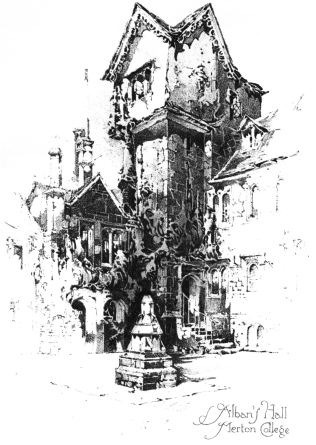
S. Alban’s Hall
Merton College
“Such tenements,” says Wood, “were for the better distinction from
others called Stone or Tiled halls. Some of those halls that were
not slated were, if standing near those that were, stiled Thatched
halls. Likewise when glass came into fashion, for before that time
our windows were only latticed, that hall that had its windows
first glazed was stiled, for difference sake, Glazen hall. In like
manner ‘tis probable that those that had leaden gutters, or any
part of their roofs of lead were stiled Leaden hall, or in one
instance Leaden porch. Those halls also that had staples to their
doors, for our predecessors used only latch and catch, were written
Staple halls.”
Other halls were called after their owners (Peckwater’s Inn, Alban Hall,
etc.), or from their position in the street or town, or the patron Saint
of a neighbouring church (S. Edward’s Hall, S. Mary’s Entry); many from
other physical peculiarities besides those we have mentioned. Angle
Hall, Broadgates Hall, White Hall and Black Hall explain themselves
easily enough, whilst Chimney Hall is a name which recalls the days when
a large chimney was a rarity, a louvre above a charcoal fire in the
middle of the room being sufficient to carry off the smoke. Other halls,
again, were named after signs that hung outside them, or over their
gateways, like ordinary inns or shops. The towering and barbaric
inn-signs always struck foreigners, when first visiting England, with
astonishment not unmingled with dismay. They were thus probably thrown
into a proper state of mind to receive their bills.
The Eagle, the Lion, the Elephant, the Saracen’s Head, the Brazen Nose
and the Swan were some of the signs in Oxford. There are a few survivals
from this menagerie.
The Star Inn, now the Clarendon, was built on the site of one of these
old Halls, and the richly-carved wooden gables were visible in the house
next to it. The Roebuck was once Coventry Hall. The Mitre preserved
traces of Burwaldscote Hall. The Angel had similar traces, but the Angel
itself has now given place to the New Schools. Many students, however,
lodged singly in private houses. Chaucer’s poor scholar lodged with a
carpenter who worked for the Abbot of Osney.
“A chamber had he in that hostelrie,
Alone, withouten any compagnie,
Ful fetisly ydight with herbes sote.”...
Halls, it will have been observed, were known also by the name of
entries and inns or (deriving from the French) hostels. And that in fact
is what they were. The principal, who might originally have been the
senior student of a party who had taken a house in which to study, or
the owner of the house himself, derived a good income from keeping a
boarding-house of this kind. He was responsible to the University for
the good conduct of his men, and to his men, one must suppose, for their
comfort. The position of principal was soon much sought after, and the
ownership of a good hostel, with a good connection, would fetch a price
like a public-house to-day.
It was found necessary, however, to decree that the principal of a hall
should be a master, and should not cater for the other inmates. Payments
for food were therefore made by the students to an upper servant, known
as a manciple, whose duty it was to go to market in the morning and
there buy provisions for the day, before the admission of the
retail-dealers at nine o’clock. The amount which each student
contributed to the common purse for the purchase of provisions was known
as “Commons.” It varied from eight to eighteen pence a week. Extra food
obtained from the manciple to be eaten in private was called “Battels.”
The principal could only maintain his position and fill his hall if he
satisfied the students. The government of these halls was therefore
highly democratic. A new principal could only succeed if he was accepted
by the general opinion of the inmates and received their voluntary
allegiance.
On coming up to Oxford the student, however little he might intend to
devote his life to the Church, adopted, if he had not done so before,
clerical tonsure and clerical garb. By so doing he became entitled to
all the immunities and privileges of the clerical order. He was, now, so
long as he did not marry, exempt from the secular courts, and his person
was inviolable.
No examination or ceremony of any kind seems to have been required in
order to become a member of the University. Attendance at lectures,
after a declaration made to a resident master to the effect that the
student purposed to attend them, was enough to entitle him to the
privileges of that corporation.
The germ of the modern system of matriculation may perhaps be traced in
the statute (1420), which required that all scholars and scholars’
servants, who had attained years of discretion, should swear before the
Chancellor that they would observe the statutes for the repression of
riots and disorders.
Among the students themselves, however, some form of initiation probably
took place, comparable to that of the Bejaunus, or Yellow-bill, in
Germany, or of the young soldier, the young Freemason, or the newcomer
at an atelier in Paris to-day. Horseplay at the expense of the raw
youth, and much chaff and tomfoolery, would be followed in good time by
a supper for which the freshman would obligingly pay. Initiation of this
kind is a universal taste, and, if kept within bounds, is not a bad
custom for testing the temper and grit of the new members of a
community. At Oxford, then, freshmen were subject to certain customs at
the hands of the senior scholars, or sophisters, on their first coming.
So Wood tells us, but he cannot give details. He compares the ceremony,
however, to the “salting” which obtained in his own day. Of this
salting, as it was practised at Merton, he gives the following
account:—
“On Feast days charcoal fires were lit in the Hall of Merton, and
between five and six in the afternoon the senior undergraduates
would bring in the Freshmen, and make them sit down on a form in
the middle of the Hall. Which done, everyone in order was to speak
some pretty apothegm or make a jest or bull or speak some eloquent
nonsense, to make the company laugh. But if any of the Freshmen
came off dull, or not cleverly, some of the forward or pragmatical
seniors would tuck them, that is, set the nail of their thumb to
their chin just under the lower lip, and by the help of their other
fingers under the chin, would give him a mark which would sometimes
produce blood.” On Shrove Tuesday a brass pot was set before the
fire filled with cawdle by the College Cook at the Freshmen’s
expense. Then each of them had to pluck off his gown and band and
if possible make himself look like a scoundrel. ‘Which done they
were conducted each after the other to the High Table, made to
stand upon a form and to deliver a speech.’ Wood gives us the
speech he himself made on this occasion, a dreary piece of
facetiousness. As a ‘kitten of the Muses and meer frog of Helicon
he croaked cataracts of plumbeous cerebrosity.’
“The reward for a good speech was a cup of cawdle and no salted
drink, for an indifferent one some cawdle and some salted drink,
and for a bad one, besides the tucks, nothing but College beer and
salt.
“When these ceremonies were over the senior cook administered an
oath over an old shoe to those about to be admitted into the
fraternity. The Freshman repeated the oath, kissed the shoe, put on
his gown and band and took his place among the seniors.”
When the freshmen of the past year were solemnly made seniors, and
probationers were admitted fellows, similar ceremonies took place. At
All Souls’, for instance, on 14th January, those who were to be admitted
fellows were brought from their chambers in the middle of the night,
sometimes in a bucket slung on a pole, and so led about the college and
into the hall, whilst some of the junior fellows, disguised perhaps,
would sing a song in praise of the mallard, some verses of which I give:
“The griffin, bustard, turkey and capon,
Let other hungry mortals gape on,
And on their bones with stomachs fall hard,
But let All Souls’ men have the mallard.
Hough the blood of King Edward, by the blood of
King Edward,
It was a swapping, swapping mallard.
“The Romans once admired a gander
More than they did their best commander,
Because he saved, if some don’t fool us,
The place that’s named from the scull of Tolus.
Hough the blood of King Edward, by the blood of
King Edward,
It was a swapping, swapping mallard.
“Then let us drink and dance a galliard
In the remembrance of the mallard,
And as the mallard doth in the pool,
Let’s dabble, dive and duck in bowle.[27]
Hough, etc.”
In any attempt to appreciate the kind and character of the mediæval
students and the life which they led, it is necessary first of all to
realise that the keynote of the early student life was poverty. It was
partly for the benefit of poor scholars and partly for the benefit of
their founders’ souls, for which these scholars should pray, that the
early colleges and chantries were founded. Morals, learning and poverty
were the qualifications for a fellowship on Durham’s foundation.
Poverty, “the stepmother of learning,” it is which the University in its
letters and petitions always and truly represents as the great hindrance
to the student “seeking in the vineyard of the Lord the pearl of
knowledge.” Books these poor seekers could not afford to buy, fees they
could scarce afford to pay, food itself was none too plentiful.
But the pearl for which the young student as he sat, pinched and blue,
at the feet of his teacher in the schools, and the Masters of Arts,
“When, in forlorn and naked chambers cooped
And crowded, o’er the ponderous books they hung,”
alike were searching, was a pearl of great price. For learning spelt
success. There was through learning a career open to the talents. The
lowliest and neediest might rise, by means of a University education, to
the highest dignity which the Church, and that was also the world, could
offer.
For all great civilians were ecclesiastics. The Church embraced all the
professions; and the professors of all arts, of medicine, statesmanship
or architecture, of diplomacy and even of law, embraced the Church. And
the reward of success in any of them was ecclesiastical promotion and a
fat benefice. The University opened the door to the Church, with all its
dazzling possibilities of preferment, and the University itself was
thrown open to the poorest by the system of the monastic houses and
charitable foundations.
Promising lads, too, of humble origin were often maintained at the
schools by wealthy patrons. From a villein one might rise to be a clerk,
from a clerk become a master of the University—a fellow, a bursar, a
bishop and a chancellor, first of Oxford, then of England.
At the University, of course, the students were not treated with the
same absolute equality that they are now, regardless of birth or wealth.
Sons of noblemen did not study there, unless they had a strong bent in
that direction. The days were not yet come when a University training
was valuable as a social and moral as well as an intellectual education:
when noblemen, therefore, did attend the schools, more was made of them.
They wore hoods lined with rich fur, and enjoyed certain privileges with
regard to the taking of degrees.
Like those idyllic islanders who lived by taking in each other’s
washing, the masters supported themselves on the fees paid by the
students who attended their lectures, whilst the poorest students earned
a livelihood by waiting on the masters, or wealthier students.
Servitors, who thus combined the careers of undergraduates with those of
“scouts,” continued in existence till the end of the eighteenth century.
They were sent on the most menial errands or employed to transcribe
manuscripts, and five shillings was deemed an ample allowance for their
services. Whitfield was a servitor, and the father of the Wesleys also.
Such students, lads of low extraction, drawn from the tap-room or the
plough, but of promising parts, would be helped by the chests which we
have described, and which were founded for their benefit. When Long
Vacation came, they would turn again from intellectual to manual labour.
For Long Vacation meant for them, not reading-parties, but the harvest,
and in the harvest they could earn wages. But there was another method
of obtaining the means to attend lectures at the University which was
popularised in the Middle Ages by the Mendicants, by the theory of the
poverty of Christ and by the insistence of the Church on the duty of
charity. This was begging on the highway. “Pain por Dieu aus escoliers”
was a well-known “street cry” in mediæval Paris, and in England during
vacations the wandering scholar,
“Often, starting from some covert place,
Saluted the chance comer on the road,
Crying, ‘An obolus, a penny give
To a poor scholar.’”
And as they made their way along the high-road a party of such begging
scholars would come perhaps to a rich man’s house, and ask for aid by
prayer and song. Sometimes they would be put to the test as to their
scholarship by being commanded to make a couplet of Latin verses on some
topic. They would scratch their heads, look wistfully at one another and
produce a passable verse or two. Then they would receive their reward
and pass on. So popular, indeed, did this system become, that begging
students had to be restricted. Only those licensed by the Chancellor
and certified as deserving cases, like the scholars of Aristotle’s Hall
in 1461, were presently permitted to beg.
Where poverty was so prevalent, the standard of comfort was not likely
to be high. The enormous advance in the general level of material
comfort, and even luxury, which has taken place in this country during
the last hundred years, makes it difficult to describe the comfortless
lives of these early students without giving an exaggerated idea of the
sacrifices they were making and the hardships they were enduring for the
sake of setting their feet on the first rung of this great ladder of
learning. But it should be remembered that, as far as the ordinary
appliances of decency and comfort, as we understand them, are concerned,
the labourer’s cottage in these days is better supplied than was a
palace in those when princes
“At matins froze and couched at curfew time,”
and when
“Lovers of truth, by penury constrained
Bucer, Erasmus or Melancthon, read
Before the doors or windows of their cells
By moonshine, through mere lack of taper light.”
If we realise that this was the case, we shall not be surprised to find
that the rooms in which these students and masters lived, so far from
being spacious and luxurious, were small, dingy, overcrowded and
excessively uncomfortable. It was rare for a student to have a room to
himself—“alone, withouten any compagnie.” The usual arrangement in
halls and colleges would seem to have been that two or more scholars
shared a room, and slept in that part of it which was not occupied by
the “studies” of the inhabitants. For each scholar would have a “study”
of his own adjoining the windows, where he might strain to catch the
last ray of daylight. A “study” was a movable piece of furniture, a sort
of combination of book-shelf and desk, which probably survives in the
Winchester “toys.” The students shared a room, and they frequently
shared a bed too. The founder of Magdalen provided that in his college
Demies under the age of fifteen should sleep two in a bed. And in
addition to their beds and lodgings, the poorest students were obliged
to share an academical gown also. Friends who had all things in common,
might sleep at the same time, but could only attend lectures one by one,
for lack of more than one gown amongst them. To these straits, it is
said, S. Richard was reduced. But such deprivation accentuates rather
than spoils the happiness of student life, as anyone who is acquainted
with the Quartier Latin will agree. When the heart is young and
generous, when the spirit is free and the blood is hot, what matters
hardship when there are comrades bright and brave to share it; what
matters poverty when the riches of art and love and learning are being
outspread before your eyes; what matters the misery of circumstance,
when daily the young traveller can wander forth, silent, amazed, into
“the realms of gold?”
During the many centuries that the mansions of the wealthy and the
palaces of princes were totally unprovided with the most indispensable
appliances of domestic decency, it is not to be expected that the rooms
of students should prove to be plentifully or luxuriously furnished. We
know the stock-in-trade of Chaucer’s poor student:
“His Almageste and bokes grete and smale
His astrelabie, longinge for his art,
His augrim-stones layen faire apart
On shelves couched at his beddes heed;
His presse y-covered with a falding reed.
And al above ther lay a gay sautrye
On which he made a nightes melodye
So swetely, that all the chambre rong;
And Angelus ad virginem he song.”
We can supplement Chaucer’s inventory of a poor student’s furniture by
an examination of old indentures. Therein we find specified among the
goods of such an one just such a fithele or “gay sautrye” as Chaucer
noted, an old cithara or a broken lute, a desk, a stool, a chair, a
mattress, a coffer, a tripod table, a mortar and pestle, a sword and an
old gown. Another student might boast the possession of a hatchet, a
table “quinque pedum cum uno legge,” some old wooden dishes, a pitcher
and a bowl, an iron twister, a brass pot with a broken leg, a pair of
knives, and, most prized of all, a bow and twenty arrows. Few could
boast of so many “bokes at his beddes heed” as Chaucer’s clerk of
Oxenford. Manuscripts were of immense value in those days, and we need
hardly be surprised if that worthy philosopher, seeing that he had
invested his money in twenty volumes clad in black and red, had but
little gold remaining in his coffer. The books that we find mentioned in
such indentures, are those which formed the common stock of mediæval
learning, volumes of homilies, the works of Boethius, Ovid’s De remedio
amoris and a book of geometry. These and other books, as articles of
the highest intrinsic value, were always mentioned in detail in the last
will and testament of a dying scholar. But, as the modern artist, on his
death-bed in the Quartier Latin, summoned his dearest friend to his side
and exclaimed, “My friend, I leave you my wife and my pipe. Take care of
my pipe”; so the mediæval student would often feel that though his books
might be his most valuable legacy in some eyes, his bow and arrows, his
cap and gown or his mantle, “blodii coloris,” these were the truest
pledges of affection that he could bequeath to the comrade of his heart.
Only the wealthier students, or the higher officials of the University,
rejoiced in such luxuries as a change of clothes, or could reckon among
their furniture several forms or chairs, a pair of snuffers and bellows.
For of what use to the ordinary student were candlesticks and snuffers,
when candles cost the prohibitive price of twopence a pound; or what
should he do with bellows and tongs when a stove or fire was out of the
question, save in the case of a Principal? To run about in order not to
go to bed with cold feet was the plan of the mediæval student, unless
he anticipated the advice of Mr Jorrocks and thought of ginger.
From his slumbers on a flock bed, in such quarters as I have described,
the mediæval student roused him with the dawn. For lectures began with
the hour of prime, soon after daybreak. He was soon dressed, for men
seldom changed their clothes in those days, and in the centuries when
the manuals of gallantry recommended the nobleman to wash his hands once
a day and his face almost as often, when a charming queen like Margaret
of Navarre, could remark without shame that she had not washed her hands
for eight days, it is not to be expected that the ablutions of a mere
student should be frequent or extensive. Washing is a modern habit, and
not widespread. To attend a “chapel” or a “roll-call” is the first duty
of the modern undergraduate, but a daily attendance at mass was not
required till the college system had taken shape; the statutes of New
College, in fact, are the first to enforce it. All therefore that the
yawning student had to do, before making his way to the lecture-room in
the hall of his inn or college, or in the long low buildings of Schools
Street, was to break his fast, if he could afford to do so, with a piece
of bread and a pot o’ the smallest ale from the “Buttery.” As a lecture
lasted, not the one hour of a “Stunde,” but for two or three hours, some
such support would be highly desirable, but not necessary. Our
forefathers were one-meal men, like the Germans of to-day. Civilisation
is an advance from breakfast to dinner, from one meal a day to several.
Late dinner is the goal towards which all humanity presses. For
dinner-time, as De Quincey observed, has little connection with the idea
of dinner. It has travelled through every hour, like the hand of a
clock, from nine or ten in the morning till ten at night. But at Oxford
it travelled slowly. Hearne growls at the colleges which, in 1723,
altered their dinner hour from eleven to twelve, “from people’s lying in
bed longer than they used to do.” Happily for him he did not live to see
the beginning of the nineteenth century, when those colleges which had
dined at three advanced to four, and those that had dined at four to
five; or the close of it, when the hour of seven became the accepted
time.
The mediæval student took his one meal at ten or eleven in the morning.
Soup thickened with oatmeal, baked meat and bread was his diet, varied
by unwholesome salt fish in Lent. These viands were served in hall on
wooden trenches and washed down by a tankard of college beer. During the
meal a chapter of the Bible or of some improving work in Latin was read
aloud, and at its conclusion the founder’s prayer and a Latin grace
would be said. Conversation, it was usually ordained, might only be
carried on in Latin; the modern student, on the contrary, is “sconced”
(fined a tankard of beer) if he speaks three words of “shop” in hall.
After dinner perhaps some disputations or exercises, some repetition and
discussion of the morning’s lecture would be held in hall, or the
students would take the air, walking out two and two, as the founders
directed, if they were good; going off singly, or in parties to poach or
hawk or spoil for a row, if they were not. Lectures or disputations were
resumed about noon.
Seated on benches, or more usually and properly, according to the
command of Urban V., sitting on the rush-strewn floors of the
school-room, the young seekers after knowledge listened to the words of
wisdom that flowed from the regent master, who sat above them at a
raised desk, dressed in full academical costume. Literally, they sat at
the feet of their Gamaliels.
In the schools they were enjoined to “sit as quiet as a girl,” but they
were far from observing this injunction. Old and young were only too
ready to quarrel or to play during lectures, to shout and interrupt
whilst the master was reading the Sentences of Peter Lombard, and bang
the benches with their books to express their approval or disapproval of
his comments thereon.
Supper came at five, and after that perhaps a visit to the playing
fields of Beaumont or a tavern, where wine would be mingled with song,
and across the oaken tables would thunder those rousing choruses that
students ever love:
“Mihi est propositum in taberna mori
Vinum sit appositum morientis ori,
Ut dicant, quum venerint, angelorum chori,
‘Deus sit propitius huic potatori.’”
When curfew rang at length, all the students would assemble in hall and
have a “drinking” or “collation.” Then, before going to bed, they would
sing the Antiphon of the Virgin (Salve Regina), and so the day was
finished. A dull, monotonous day it seems to us, varied only by
sermons—and there was no lack of them—at S. Mary’s or S. Peter’s in
the East, with the chance excitement of hearing a friar recant the
unorthodox views he had expressed the previous Sunday; but it was a day
that was bright and social compared with the ordinary conditions of the
time.
In this daily round, so far as one has been able to reconstruct it, the
absence of any provision for physical recreation is a noticeable thing
to us, who have exchanged the mediæval enthusiasm for learning for an
enthusiasm for athletics. Both are excellent things in their way, but as
the governor of an American State remarked when defending the practice
of smoking over wine, both together are better than either separate. And
nowadays in some cases the combination is happily attained. But in an
age which inherited the monkish tradition of the vileness of the body
and the need of mortifying it, games of all sorts were regarded as a
weakness of the flesh. So far were founders from making any provision
for recreation, that they usually went out of their way to prohibit it.
Games with bat and ball, and tennis, that is, or fives, were strictly
forbidden as indecent, though in some cases students were permitted to
play with a soft ball in the college courts. But “deambulation in the
College Grove” was the monastic ideal. Nor did the founders frown only
on exercise; amusements of the most harmless sort were also under their
ban. On the long, cold, dark winter evenings the students were naturally
tempted to linger in the hall after supper, to gather round the fire, if
there was one, in the middle of the room, beneath the louvre, to tell
tales there and sing carols, to read poems, chronicles of the realm or
wonders of the world. But it was only on the eve of a festival that
William of Wykeham would allow this relaxation in his foundation. The
members of Trinity College were allowed to play cards in hall on
holidays only, “but on no account for money.” Mummers, the chief source
of amusement among the mediævals, were only permitted to enter New
College once a year, on Twelfth Night. It was not till the dawn of the
Renaissance that plays began to be acted in the colleges and halls, and
to bring the academic intellect into touch with the views and literature
of the people.
Not only was it forbidden to play marbles on the college steps, but even
the hard exercise of chess was prohibited as a “noxious, inordinate and
unhonest game.” And the keeping of dogs and hawks was anathema.
By a survival of this mediæval view, the undergraduate is still solemnly
warned by the statute book against playing any game which may cause
injury to others; he is urged to refrain from hunting wild beasts with
ferrets, nets or hounds, from hawking, “necnon ab omni apparatu et
gestatione bombardarum et arcubalistarum.” In the same way he is
forbidden still to carry arms of any sort by day or night, unless it be
bows and arrows for purposes of honest amusement. But to these
injunctions, I fear, as to the accompanying threat of punishment at the
discretion of the Vice-Chancellor, he does not pay over much attention.
He does not consider them very seriously when he plays football or hunts
with the “Bicester,” takes a day’s shooting or runs with the Christ
Church beagles.
The restrictions which I have quoted above were mostly introduced by the
founders of colleges. So far as the University was concerned, the
private life of the student was hardly interfered with at all.
The offence of night-walking, indeed, was repressed by the proctor who
patrolled the streets with a pole-axe and bulldogs (armed attendants),
but the student might frequent the taverns and drink as he pleased. His
liberty was almost completely unrestricted, except as to the wearing of
academic dress, the attendance of lectures and the observance of the
curfew bell. Offences against morality and order were treated as a rule,
when they were dealt with at all, with amazing leniency. Murder was
regarded as a very venial crime; drunkenness and loose-living as hardly
matters for University police. A student who committed murder was
usually banished, and banishment after all meant to him little more than
changing his seat of learning. The punishment, though it might cause
inconvenience, did not amount to more than being compelled to go to
Cambridge. Fines, excommunication and imprisonment were the other
punishments inflicted for offences; corporal punishment was but seldom
imposed by the University. But with the growth of the college system the
bonds of discipline were tightened. Not only did the statutes provide in
the greatest detail for the punishment of undergraduate offences,
stating the amount of the fine to be exacted for throwing a missile at a
master and missing, and the larger amount for aiming true, but also the
endowment of the scholar made it easy to collect the fine. The wardens
and fellows, too, were in a stronger position than the principal of a
hall, who owed his place to his popularity with the students, who, if he
ceased to please them, might leave his hall and remove to another house
where the principal was more lenient and could be relied upon to wink at
their follies and their vices, even if he did not share them. Thus the
founders of the early colleges were enabled to enforce upon the
recipients of their bounty something of the rigour and decency of
monastic discipline. As the system grew the authority entrusted to the
heads of colleges was increased, and the position of the undergraduate
was reduced to that of the earlier grammar-school boy. The statutes of
B.N.C. (1509) rendered the undergraduate liable to be birched at the
discretion of the college lecturer. He might now be flogged if he had
not prepared his lessons; if he played, laughed or talked in lecture; if
he made odious comparisons, or spoke English; if he were unpunctual,
disobedient or did not attend chapel. Wolsey allowed the students of
Cardinal College to be flogged up to the age of twenty.
Impositions by a dean were apparently a sixteenth-century invention.
Then we find offending fellows who had played inordinately at hazard or
cards, or earned a reputation for being notorious fighters or great
frequenters of taverns, being ordered to read in their college libraries
for a fortnight from 6 to 7 A.M. And the loss of a month’s commons
occasionally rewarded the insolence of undergraduates who did not duly
cap and give way to their seniors, or who, yielding to that desire to
adorn their persons which the mediæval student shared with his
gaudy-waistcoated successors, wore “long undecent[28] hair,” and cloth
of no clerical hue, slashed doublets and boots and spurs beneath their
gowns.
As to the academic career of the mediæval student; the course of his
studies and “disputations” in the schools; the steps by which the
“general sophister” became a “determining bachelor” and the bachelor, if
he wished to teach, took a master’s degree, first obtaining the
Chancellor’s licence to lecture, and then, on the occasion of his
“inception,” when he “commenced master” and first undertook his duty of
teaching in the schools, being received into the fraternity of teaching
masters by the presiding master of his faculty—of these ceremonies and
their significance and the traces of them which survive in modern
academic life, as of the high feastings and banquetings with which, as
in the trade guilds, the new apprentices and masters entertained their
faculties, I have no space here to treat.
The inceptor besides undertaking not to lecture at Stamford, recognise
any University but Oxford and Cambridge, or maintain Lollard opinions,
was also required to swear to wear a habit suitable to his degree. As an
undergraduate he had had no academical dress, except that, as every
member of the University was supposed to be a clerk, he was expected to
wear the tonsure and clerical habit. The characteristic of this was that
the outer garment must be of a certain length and closed in front. It
was the cut and not the colour of the “cloth” which was at first
considered important. But later regulations restricted the colour to
black, and insisted that this garment must reach to the knees. In the
colleges, however, it was only parti-coloured garments that were
regarded as secular, and the “liveries” mentioned by the founders were
usually clothes of the clerical cut but of uniform colour. The fellows
of Queen’s, for instance, were required to wear blood-red. The colour of
the liveries was not usually prescribed by statute, but differences of
colour and ornament still survive at Cambridge as badges of different
colleges.
The masters at first wore the cappa, which was the ordinary out-door
full-dress of the secular clergy. And this “cope,” with a border and
hood of minever, came to be the official academical costume. The shape
of the masters’ cappa soon became stereotyped and distinctive; then a
cappa with sleeves was adopted as the uniform of bachelors. As to the
hood, it was the material of which it was made—minever—which
distinguished the master, not the hood itself; for a hood was part of
the ordinary clerical attire. Bachelors of all faculties wore hoods of
lamb’s-wool or rabbit’s-fur, but undergraduates were deprived of the
right of wearing a hood in 1489—nisi liripipium consuetum ... et non
contextum—the little black stuff hood, worn by sophisters in the
schools till within living memory.
The cappa went out of use amongst the Oxford M.A.’s during the sixteenth
century. The regents granted themselves wholesale dispensations from its
use. Stripped of this formal, outer robe, the toga was revealed, the
unofficial cassock or under-garment, which now gradually usurped the
place of the cappa and became the distinctively academical dress of the
Masters of Arts. But it was not at first the dull prosaic robe that we
know. The mediæval master was clad in bright colours, red or green or
blue, and rejoiced in them until the rising flood of prejudice in favour
of all that is dull and sombre and austere washed away these together
with almost all other touches of colour from the landscape of our grey
island.
The distinctive badge of mastership handed to the inceptor by the father
of his faculty, was the biretta, a square cap with a tuft on the top,
from which is descended our cap with its tassel. Doctors of the superior
faculties differentiated themselves by wearing a biretta (square cap) or
pilea (round) as well as cappas, of bright hues, red, purple or violet.
Gascoigne, indeed, in his theological dictionary, declares that this
head-dress was bestowed by God himself on the Doctors of the Mosaic Law.
Whatever its origin, the round velvet cap with coloured silk ribbon,
came to be, and still is, the peculiar property of the Doctors of Law
and Medicine.
The Oxford gowns of the present day have little resemblance to their
mediæval prototypes. For the ordinary undergraduate or “commoner”
to-day, academical dress, which must be worn at lectures, in chapel, in
the streets at night, and on all official occasions, consists of his
cap, a tattered “mortar-board,” and a gown which seems a very poor
relation of the original clerical garb. The sleeves have gone, and the
length; only two bands survive, and a little gathering on the shoulders,
and this apology for a gown is worn as often as not round the throat as
a scarf, or carried under the arm.
Some years ago it was a point of honour with every undergraduate to wear
a cap which was as battered and disreputable as possible. Every freshman
seized the first opportunity to break the corners of his “mortar-board”
and to cut and unravel the tassel. Yet once the tufted biretta, when it
was the badge of mastership, was much coveted by undergraduates. First,
they obtained the right of wearing a square cap without a tassel, like
those still worn by the choristers of Oxford colleges, and then they
were granted the use of a tassel. The tuft in the case of the gentlemen
commoners took the form of a golden tassel. Snobs who cultivated the
society of these gilded youths for the sake of their titles or their
cash, or tutors,
“Rough to common men,
But honeying at the whisper of a Lord,”
gained from this fact the nick-name of tuft-hunters.
The commoner, it should be explained, is one who pays for his commons, a
student not on the foundation. The colleges were, in most cases,
intended originally only for the fellows and scholars on the foundation.
The admission of other students as commoners or boarders was a
subsequent development, and various ranks of students came to be
recognised—noblemen, gentlemen commoners, commoners, fellow-commoners,
battelers, or servitors. These grades are now practically obsolete, the
only distinction drawn among the undergraduates being between the
scholars or students on the foundation and commoners, the ordinary
undergraduates, who do not enjoy any scholarship or exhibition.
The scholar, who must wear a larger gown with wide sleeves, is known by
various names at various colleges. At Merton he is a post-master, at
Magdalen a demy, so-called because he was entitled to half the commons
of a fellow.
The history of the commoner, the growth of an accretion that now forms
the greater part of a college, may be illustrated by the records of the
latter foundation.
The statutes of New College had not made any provision for the admission
of commensales, but William of Waynflete, in drawing up the statutes
of Magdalen, was the first definitely to recognise the system that had
grown up by which men who were not on the foundation lived as members of
the college. Waynflete limited the number of non-foundationers to
twenty. They were to live at the charges of their own kindred; they were
to be vouched for by “creancers”; and the privilege of admission was to
be reserved for the sons of noble and powerful friends of the college.
But within a hundred years the number of the commoners or battelers
increased far beyond that allowed by the statutes. The position of these
commoners was anomalous and led to “disorder and confusion,” as certain
fellows did most bitterly complain to the Visitor. No provision, it
appears, was made either for the instruction or the discipline of these
supernumeraries. They were, in fact, regarded as the private pupils of
the President or of one of the fellows. In attendance upon the wealthier
of them or upon other members of the college came numerous “poore
scholars,” acting as their servants and profiting in their turn from
such free teaching as the Grammar School and the college lecturers might
afford.
The system, however, was already justified to some extent by the fact
that among the pupils of the President were numbered Bodley, Camden,
Lyly and Florio. The Visitor, therefore, contented himself with
enforcing the observation of the limits imposed by the statutes. The
poor scholars were in future not to be more than thirteen in number, and
were to be attached to the thirteen senior fellows. Before long,
however, the matriculations of non-foundationers began to increase very
rapidly. A new block of buildings even was erected near the Cherwell for
their accommodation by 1636. This is that picturesque group of gables
which nestles under the great tower and forms so distinct a feature of
the view from Magdalen Bridge. The number of “poore scholars” had also
increased—servitors whose office forestalled that of the college
“scout.” They bridged the days when the junior members of a foundation
“did” for themselves and the modern days of an
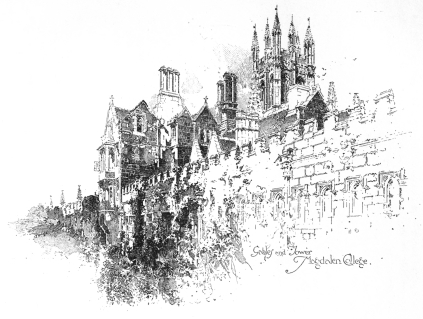
Gables and Tower Magdalen College.
organised college service. It was decided, and this is where the scout
has the advantage of his forerunners, that they should be required to
attend the Grammar School, and afterwards to perform all disputations
and exercises required of members of the foundation. All commoners,
also, “the sonnes of Noblemen and such as are of great quality only
excepted” were to be “tyed to the same rules.”
Little more than a hundred years later Edward Gibbon matriculated at
Magdalen (1752) as a “gentleman commoner,” and as a youth of fifteen
commenced those fourteen months which he has told us were the most idle
and unprofitable of his whole life. There are prigs of all ages. Gibbon
must have been intolerable in a common room. One can forgive the “Monks
of Magdalen” for not discussing the Early Fathers with him after dinner,
but one has no inclination on the other hand to revere the men who had
already (1733), in their enthusiasm for the Italian style, begun the
“New Buildings,” and were still threatening to pull down the cloisters
and to complete a large quadrangle in the same style, of which the New
Buildings were to form one end. The damage done by the succeeding
generation was directed chiefly against the chapel and the hall, where
under the guidance of the outrageous James Wyatt, plaster ceilings were
substituted for the old woodwork. The generosity of a late fellow has
enabled Mr Bodley, with the aid of Professor Case, to repair this error
by an extraordinarily interesting and successful restoration (1903).
Magdalen Hall is now worthy of its pictures, its “linen-fold” panelling
and splendid screen. Bitter as is the account which Gibbon has left us,
it cannot be denied that there was much reason in his quarrel with the
Oxford of his day. I say Oxford, for the state of Magdalen was better
rather than worse than that of the University at large. It should,
however, in fairness be pointed out that as a gentleman commoner in
those days he was one of a class which was very small and far from
anxious to avail itself of the intellectual advantages of a University
training. The commoners at Magdalen were now very few in number. The
founder’s limitation was now so interpreted as to restrict them to the
particular class of gentlemen commoners, sons of wealthy men, at liberty
to study, but expected to prefer, and as a matter of fact usually
preferring, to enjoy themselves.
But the efforts of the more liberal-minded fellows were at length
crowned with success. By the first University Commission the college was
allowed to admit as many non-foundationers as it could provide with
rooms. The last gentleman commoner had ceased to figure in the
Calendar by 1860. The system of licensed lodgings introduced by the
University soon caused the numbers of the ordinary commoners to
increase, so that in 1875 one-third of the resident undergraduates were
living in lodgings outside the college. It was clearly time for the
college to provide accommodation for as many of these as possible within
its own walls. The change which took place in Magdalen during the last
century, a change “from a small society, made up almost wholly of
foundation-members and to a great extent of graduates, to a society of
considerable numbers, made up of the same elements, in about the same
proportion as most of the other Colleges,” is recorded therefore in the
architecture of Oxford. For it was to lodge the commoners that the
buildings which are known as S. Swithun’s (so-called from the statue in
a niche on the west side of the tower which is placed at the entrance of
these buildings, and which reminds one that S. Swithun was buried in
Winchester Cathedral close to the beautiful shrine of William of
Waynflete) were designed by Messrs Bodley & Garner and completed in
1884. They face the High Street, and you will pass them on your left as
you come down to the new entrance gateway, which is in the line of the
outer wall, parallel to the High. The old gateway, which was designed by
Inigo Jones, stood almost at right angles to the site of the present
gateway and lodge, looking west. It was removed in 1844, and a new one
designed by A. W. Pugin erected in its stead. The present gateway (1885)
follows the lines of the old design of Pugin, and the niches are filled
with statues of S. John the Baptist, S. Mary Magdalen and of the
founder, William of Waynflete. S. John the Baptist was the patron Saint
of the old hospital, and after S. John the quadrangle into which you now
enter is called. Opposite to you are the President’s lodgings, built by
Messrs Bodley & Garner in 1887 on the site of the old President’s
lodgings. With the exquisite architecture of the chapel and cloisters on
the right to guide them, these famous architects have not failed to
build here something that harmonises in style and treatment with the
rest. One might wish that S. Swithun’s were a little quieter. There is a
slight yielding to the clamorous desire for fussy ornamentation which is
so typical of this noisy age. But the President’s lodgings are perfect
in their kind. As you stand, then, in S. John’s Quadrangle you have, in
the chapel and founder’s tower, and the cloisters on your right, and in
the picturesque old fragment of the Grammar School, known as the Grammar
Hall, facing you on your left, an epitome, as it were, of the old
college foundations of Oxford; and in those buildings of S. Swithun and
the gateway, which faces in a new direction, an epitome of the new
Oxford that has been grafted on the old. On the extreme right you see a
curious open-air pulpit of stone, from which the University sermon used
to be preached on S. John the Baptist’s Day. On that occasion the
pulpit, as well as the surrounding buildings, was strewn with rushes and
boughs in token of S. John’s preaching in the wilderness.
 Open Air Pulpit Magdalen
In the Middle Ages the chief executive officers of the University were
the Proctors, who are first mentioned in 1248. The origin of their
office is obscure. They were responsible for the collection and
expenditure of the common funds of the University, and as a record of
this function they still retain in their robes a purse, a rudimentary
organ, as it were, atrophied by disuse, but traceable in a triangular
bunch of stuff at the back of the shoulder. Apart from this duty and
that of regulating the system of lectures and disputations, their chief
business was to keep order. One can imagine that a Proctor’s life was
not a happy one. He had to endeavour not only to keep the peace between
the students and the townsmen, but also between the numerous factions
among the scholars themselves. The Friars and the secular clergy, the
Artists and the Jurists, the Nominalists and the Realists, and, above
all, the Northerners and Southerners were always ready to quarrel, and
quarrels quickly led to blows, and blows to a general riot. For the
rivalry of the nations was a peculiar feature of mediæval Universities.
At Bologna and Paris the Masters of Arts divided themselves into “Four
Nations,” with elective officers at their head. At Oxford the main
division was between Northerners and Southerners, between students, that
is, who came from the north or the south of the Trent. Welshmen and
Irishmen were included among the Southerners. And over the northern and
southern Masters of Arts presided northern and southern Proctors
respectively, chosen by a process of indirect election, like the rectors
of Bologna and Paris. Contests and continual riots arising out of the
rivalry of these factions took the place of modern football matches or
struggles on the river.
In 1273, for instance, we read of an encounter between the Northerners
and the Irish, which resulted in the death of several Irishmen. So
alarming, apparently, was this outbreak that many of the leading members
of the University departed in fear, and only returned at the stern
command of the King. The bishops, too, issued a notice, in which they
earnestly exhorted the clerks in their dioceses to “repair to the
schools, not armed for the fight, but rather prepared for study.” But
the episcopal exhortation had about as much effect as a meeting of the
Peace League in Exeter Hall would have now. Quarrel after quarrel broke
out between the rival nations. They plundered each others’ goods and
broke each others’ heads with a zest worthy of an Irish wake.
In spite of their reputation for riotousness, however, the Irish
students were specially exempted by royal writ from the operation of the
statute passed by Parliament in 1413, which ordered that all Irishmen
and Irish clerks, beggars called Chamberdekens, should quit the realm.
Graduates in the schools had been exempted in the statute. This
exemption does not appear to have conduced to the state of law and order
painfully toiled after by the mere Saxon. For a few years later, in the
first Parliament of Henry VI., the Commons sent up a petition
complaining of the numerous outrages committed near Oxford by “Wylde
Irishmen.” These turbulent persons, it was alleged, living under the
jurisdiction of the Chancellor, set the King’s officers at defiance, and
used such threatening language, that the bailiffs of the town did not
dare to stir out of their houses for fear of death. The Commons
therefore prayed that all Irishmen, except graduates in the schools,
beneficed clergy, professed monks, landowners, merchants and members of
civic corporations, should be compelled to quit the realm. It was also
demanded that graduates of Irish extraction should be required to find
security for their good behaviour, and that they should not be allowed
to act as principals of halls. This petition received the royal assent.
But it was stipulated that Irish clerks might freely resort to Oxford
and Cambridge, if they could show that they were subjects of the English
king.
It was in vain that students were compelled to swear that they would not
carry arms; in vain were seditious gatherings and leagues for the
espousal of private quarrels forbidden.
In vain, after one great outbreak in 1252, were formal articles of peace
drawn up; in vain were the combatants bound over to keep the peace, and
to give secret information to the Chancellor if they heard of others
who were preparing to break it. In vain was the celebration of the
national festivals forbidden, and the masters and scholars prohibited,
under pain of the greater excommunication, from “going about dancing in
the churches or open places, wearing masks or wreathed and garlanded
with flowers” (1250). In vain was it decreed that the two nations should
become one and cease, officially, to have a separate existence (1274).
Though the Faculty of Arts might vote from this time forward as a single
body, yet one Proctor was always a Borealis and the other an Australis;
and when, in 1320, it was decreed that one of the three guardians of the
Rothbury Chest should always be a Southerner and another a Northerner,
the University admitted the existence of the two rival nations within
its borders once more. Only a few years after this, in fact (1334), its
very existence was threatened by the violence of the factions. The
Northerners gave battle to the Southerners, and so many rioters were
arrested that the Castle was filled to overflowing. Many of the more
studious clerks resolved to quit this riotous University for ever, and
betook themselves to Stamford, where there were already some flourishing
schools.
They were compelled at last to disperse or to return by the King, who
refused to listen to their plea, that their right to study in peace at
Stamford was as good as that of any other person whatever who chose to
live there. So serious was this secession, and so much was the rivalry
of Stamford feared, that all candidates for a degree were henceforth
(till 1827) required to swear that they would not give or attend
lectures there “as in a University.”
It was on the occasion of this migration that the members of Brasenose
Hall, which adjoined S. Mary’s Entry, Salesbury Hall, Little University
Hall and Jussel’s Tenement, carried with them, as a symbol of their
continuity, the famous Brazen Nose Knocker to Stamford. There the little
society settled; an archway of the hall they occupied there still
exists, and now belongs to Brasenose College. The knocker itself was
brought back in 1890 to a place
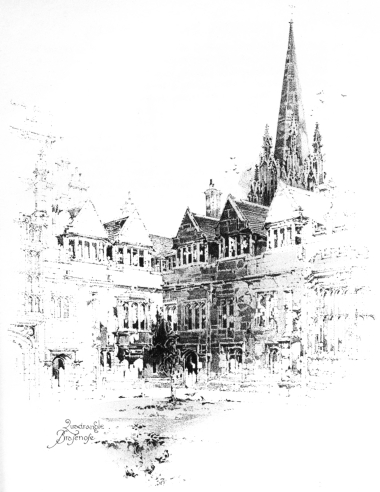
Quadrangle Brasenose
of honour in the college hall. For in the meantime the old hall, after a
career of over two hundred years, had been converted into a college,
founded by William Smyth, Bishop of Lincoln, and Master Sotton, very
much as a protest against the new learning which was then being
encouraged at Corpus Christi. The continuity of the society is indicated
by the fact that the first Principal of the college was the last
Principal of the old “Aula Regia de Brasinnose.” The foundation stone
was laid in 1509, as the inscription in the old quadrangle, to which a
story was added in the time of James I., records.
They were a turbulent crew, these Oxonian forbears of ours. Dearly they
loved a fight, and they rose in rebellion against the masters when they
were bringing in new statutes for the preservation of the peace. Several
were slain on both sides. Nor was it easy to punish the unruly students.
Sometimes, after a brawl in which they were clearly in the wrong, the
delinquents would flee to Shotover, and there maintain themselves in the
forest. At other times, when they had gone too far, and the thunder of
the Chancellor’s sentence of excommunication had fallen on their heads
as a punishment for attempting to sack the Abbey of Abingdon, or
defiling the Church of S. Mary with bloodshed, for sleeping in a tavern,
or fighting with the King’s foresters, they would simply leave the
University altogether and get away scathless. For the Chancellor’s
jurisdiction did not extend beyond Oxford.
A joust or tourney was a certain cause of riot. The passions are easily
roused after any athletic contest, whether it be a football match or a
bull-fight. Remembering this, we shall best be able to understand why
the King found it necessary to forbid any joust or tournament to be held
in the vicinity of Oxford or Cambridge (1305).
“Yea, such was the clashing of swords,” says Fuller, “the rattling
of arms, the sounding of trumpets, the neighing of horses, the
shouting of men all day time with the roaring of riotous revellers
all the night, that the scholars’ studies were disturbed, safety
endangered, lodging straitened, charges enlarged. In a word, so
many war-horses were brought thither that Pegasus was himself
likely to be shut out; for where Mars keeps his terms, there the
Muses may even make their vacation.”
Any excuse, indeed, was good enough to set the whole town in an uproar.
A bailiff would hustle a student; a tradesman would “forestall” and
retail provisions at a higher price than the regulations allowed; a
rowdy student would compel a common bedesman to pray for the souls of
certain unpopular living townsmen on the score that they would soon be
dead. The bailiffs would arrest a clerk and refuse to give him up at the
request of the Chancellor; the Chancellor, when appealed to by the
townsmen to punish some offending students, would unsoothingly retort:
“Chastise your laymen and we will chastise our clerks.” The records of
town and University are full of the riots which arose from such
ebullitions of the ever-present ill-feeling; of the appeals made by
either party; and of the awards given by the King, who might be some
English Justinian, like Edward I., or might not.
The answer of the townsmen (1298) to the Chancellor’s retort quoted
above was distinctly vigorous. They seized and imprisoned all scholars
on whom they could lay hands, invaded their inns, made havoc of their
goods and trampled their books under foot. In the face of such
provocation the Proctors sent their bedels about the town, forbidding
the students to leave their inns. But all commands and exhortations were
in vain. By nine o’clock next morning, bands of scholars were parading
the streets in martial array. If the Proctors failed to restrain them,
the mayor was equally powerless to restrain his townsmen. The great bell
of S. Martin’s rang out an alarm; ox-horns were sounded in the streets;
messengers were sent into the country to collect rustic allies. The
clerks, who numbered three thousand in all, began their attack
simultaneously in various quarters. They broke open warehouses in the
Spicery, the Cutlery and elsewhere. Armed with bows and arrows, swords
and bucklers, slings and stones, they fell upon their opponents. Three
they slew, and wounded fifty or more. One band, led by Fulk de Neyrmit,
Rector of Piglesthorne, and his brother, took up a position in High
Street between the Churches of S. Mary and All Saints, and attacked the
house of a certain Edward Hales. This Hales was a long-standing enemy of
the clerks. There were no half measures with him. He seized his
crossbow, and from an upper chamber sent an unerring shaft into the eye
of the pugnacious rector. The death of their valiant leader caused the
clerks to lose heart. They fled, closely pursued by the townsmen and
country-folk. Some were struck down in the streets, and others who had
taken refuge in the churches were dragged out and driven mercilessly to
prison, lashed with thongs and goaded with iron spikes.
Complaints of murder, violence and robbery were lodged straightway with
the King by both parties. The townsmen claimed three thousand pounds’
damage. The commissioners, however, appointed to decide the matter,
condemned them to pay two hundred marks, removed the bailiffs, and
banished twelve of the most turbulent citizens from Oxford. Then the
terms of peace were formally ratified.
Following the example of their Chancellor, who was gradually asserting
his authority more and more in secular matters, and thought little of
excommunicating a mayor for removing a pillory without his leave (1325),
the clerks became continually more aggressive. Quarrels with the
townsmen were succeeded by quarrels with the Bishop of Lincoln, when the
latter, in his turn, tried to encroach upon the jurisdiction of the
Chancellor. Peace, perfect peace, it will be seen, had not yet descended
upon the University. The triumph of Dulness had not arrived, when the
enraptured monarch should behold:
“Isis’ elders reel, their pupils sport,
And Alma Mater lie dissolved in port.”
Certainly the elders gave their pupils sport enough after their kind,
but the intellectual quarrels of the schoolmen, the furious
controversies of the Dominicans and the Franciscans, the Scotists and
the Thomists, the Nominalists and the Realists, were a part of it. When
the excitement of local riots, theological disputes and political
dissension failed, there were the exactions of a Papal representative to
be resisted. And when such resistance led to the citation of the
Chancellor and Proctors and certain masters to appear within sixty days
before the Cardinal appointed by the Pope to hear the case at Avignon,
there was the whole principle that no Englishman should be dragged
across the seas to judgment to be fought for (circa 1330). For every
man was a politician in those days, and the scholars of Oxford not
least. Their quarrels and riotings were therefore not without political
significance. Thus when the Mad Parliament met in the “new house of the
Black Friars at Oxford,” the behaviour of the barons was reflected by
that of students. The “nations” pitched their field in “Beaumont,” and
after a fierce fight in battle array, divers on both sides were slain
and pitifully wounded. The Northerners and Welshmen were at last
acknowledged to be conquerors.
The position of the students with regard to the country, is indicated by
the old rhyme:
“Mark the Chronicles aright
When Oxford scholars fall to fight
Before many months expired
England will with war be fired.”
It was Oxford, the centre of English ecclesiasticism, which, by the riot
that hounded the Papal Legate out of the city, gave the signal for a
widespread outbreak of resistance to the wholesale pillage of excessive
Papal taxation.
Regardless of the gathering storm, the Legate Cardinal Otho had arrived
at Oxford with his retinue of Italians, and taken up his abode at
Osney.
Some members of the University, having sent him some delicacies for his
table, went to pay their respects in person, and to ask of him a favour
in return. The doorkeeper, however, a suspicious Italian, absolutely
refused to admit them to the guests’ hall. Irritated by this unexpected
rebuff, they collected a great number of their comrades, and made a
determined attack on the foreigners, who defended themselves with
sticks, swords and flaming brands plucked from the fire. The fury of the
clerks reached its height when the Legate’s chief cook took up a
cauldron full of boiling broth, and threw its contents in the face of a
poor Irish chaplain, who had been begging for food at the kitchen door.
A student thereupon drew his bow, and shot the cook dead on the spot,
whilst others tried to set fire to the massive gates which had been
closed against them. The terrified Legate, hastily putting on a
canonical cope, fled for refuge to the belfry of the abbey, and there
lay hid for several hours, while the clerks assailed the building with
bows and catapults.
News of the fray soon reached Henry III., who happened to be staying at
Abingdon, and he lost no time in despatching some soldiers to the
rescue. Under their powerful escort the Legate managed to ford the river
by night, accompanied by the members of his suite. Still as he galloped
away, he seemed to hear the shouts of his adversaries ringing in his
ears, “Where is that usurer, that simoniac, that spoiler of revenues,
and thirster after money, who perverts the King, overthrows the realm,
and enriches strangers with plunder taken from us?”
It was not long before the Papal Legate was forbidden the English
shores, and his bulls of excommunication were flung into the sea.
Simon de Montfort was the friend of Adam Marsh, and the confidant of
Grossetete, and it was appropriately enough at Oxford that the great
champion of English freedom secured the appointment of a council of
twenty-four to draw up terms for the reform of the State. Parliament
met at Oxford; the barons presented a long petition of grievances, the
council was elected, and a body of preliminary articles known as the
Provisions of Oxford was agreed upon. In the following year Henry
repudiated the Provisions; civil war ensued, and ended by placing the
country in the hands of Simon de Montfort.
The struggle between Henry and the barons then did not leave Oxford
unaffected. For any disturbance without was sure to be reflected in a
conflict between clerks and laymen, in a town and gown row, of some
magnitude. In the present case the appearance of Prince Edward with an
armed force—he took up his quarters at the King’s Hall—in the northern
suburb gave occasion for an outbreak. The municipal authorities closed
the gates against him, and he resumed his march towards Wales.
The scholars now thought it was time that they should be allowed to go
out of the city, and finding themselves prevented by the closed wooden
doors of Smith Gate, they hewed these down and carried them away, like
Samson, into the fields, chanting over them the office of the dead:
“A Subvenite Sancti fast began to sing
As man doth when a dead man men will to pit bring.”
The mayor retorted by throwing some of them into prison, in spite of the
Chancellor’s protest. Further arrests were about to be made by the irate
townsmen, but a clerk saw them advancing in a body down the High Street,
and gave the alarm by ringing the bell of S. Mary’s. The clerks were at
dinner, but hearing the well-known summons they sprang to arms and
rushed out into the street to give battle. Many of the foe were wounded;
the rest were put to flight. Their banners were torn to pieces, and
several shops were sacked by the victorious students, who, flushed with
victory, marched to the houses of the bailiffs and set them on fire.
“In the South half of the town, and afterwards the Spicery
They brake from end to other, and did all to robberie.”
The mayor, they then remembered, was a vintner. Accordingly a rush was
made for the vintnery; all the taps were drawn, and the wine flowed out
like water into the streets.
Their success for a moment was complete, but retribution awaited them.
The King was appealed to, and refused to countenance so uproarious a
vindication of their rights. When they saw how the wind blew, they
determined to leave Oxford. It was a question whither they should go and
where pitch their scholastic tents. Now it happened that at Cambridge, a
town which had ceased to be famous only for eels and could boast a
flourishing University of its own, similar disturbances had recently
occurred with similar results. Many masters and scholars had removed to
Northampton, and to Northampton accordingly, to aid them in their avowed
intention of founding a third University, the disconsolate Oxford
scholars departed. The situation was evidently serious. But the King
induced the Oxonians to return by promising that they should not be
molested if they would only keep the peace.
They returned, but almost immediately all scholars were commanded by a
writ from the King to quit the town and stay at home until he should
recall them after the session of Parliament then about to be held at
Oxford. The King, it was officially explained, could not be responsible
for the conduct of the fierce and untamed lords who would be assembled
together there and would be sure to come into conflict with the
students. Perhaps the more urgent motive was fear lest the students
should openly and actively side with the barons, with whom, it was
known, the majority of them were in sympathy.
The fact was that in the great struggle against the Crown in which
England was now involved, the clergy and the Universities ranged
themselves with the towns on the side of Simon de Montfort. Ejected from
Oxford, many of the students openly joined his cause and repaired at
once to Northampton.
For a time all went well with the King. As if to demonstrate his faith
in the justice of his cause, he braved popular superstition and passing
within the walls of Oxford paid his devotions at the shrine of S.
Frideswide. The meeting of Parliament failed to bring about any
reconciliation. Reinforced by a detachment of Scottish allies—“untamed
and fierce” enough, no doubt—Henry left Oxford and marched on
Northampton. Foremost in its defence was a band of Oxford students, who
so enraged the King by the effective use they made of their bows and
slings and catapults, that he swore to hang them all when he had taken
the town. Take the town he did, and he would have kept his oath had he
not been deterred by the reminder that he would by such an act lose the
support of all those nobles and followers whose sons and kinsmen were
students. But the victorious career of the King was almost at an end.
The vengeance of S. Frideswide was wrought at the battle of Lewes. Simon
de Montfort found himself head of the State, and one of his first acts
was to order the scholars to return to their University.
Such keen, occasionally violent, interest in politics seems, in these
days, characteristic of the German or Russian rather than the English
University student. Nowadays the political enthusiasm of the
undergraduate is mild, and his discussion of politics is academic. In
the debating hall of the Union, or in the more retired meeting-places of
the smaller political clubs, like the Canning, the Chatham, the
Palmerston or the Russell, he discusses the questions of the day. But
his discussions lack as a rule the sense of reality, and they suffer
accordingly. Occasionally, when a Cabinet Minister has been persuaded to
dine and talk with one or other of these clubs, or when the speaker is
one who is deliberately practising for the part he means to take in
after-life, the debates are neither uninteresting nor entirely
valueless. And at the worst they give those who take part in them a
facility of speech and some knowledge of political questions. But it is
not so that the University exercises any influence on current events.
Nor, except in so far as they warn practical men to vote the other way,
are those
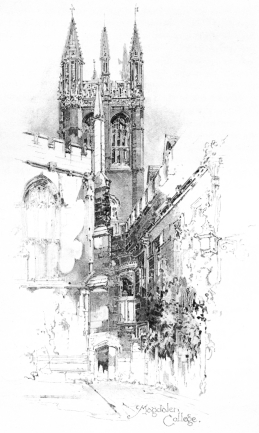
Magdalen College.
occasional manifestoes, which a few professors sign and publish, of any
great importance. But it is through the press and through Parliament
that the voice of young Oxford is heard. It is through the minds and the
examples of those statesmen and administrators, who have imbibed their
principles of life and action within her precincts, and have been
trained in her schools and on her river or playing-fields, that the
influence of the University is reflected on the outer world. Nor is it
only the men like Lord Salisbury, Lord Rosebery and Mr Gladstone, who
guide the country at home, or like Lord Milner and Lord Curzon, who give
their best work to Greater Britain, that are the true sons of the
University; it is the plain, hard-working clergymen and civilians, also,
who, by their lives of honest and unselfish toil, hand on the torch of
good conduct and high ideals which has been entrusted to them.
Oxford had some share in the events which led to the deposition of
Edward II. The King wrote to the Chancellor, masters and scholars
calling upon them to resist his enemies. On the approach of Roger de
Mortimer, a supporter of the Queen, he wrote again enjoining them not to
allow him to enter the city, but to keep Smith Gate shut, lest he should
enter by that way. But when the King was a refugee in Wales, the Queen
came to Islip. She would not come to Oxford till “she saw it secure.”
But when the burghers came to her with presents she was satisfied. She
took up her residence at the White Friars, and the Mortimers theirs at
Osney. And a sermon was preached by the Bishop of Hereford, who
demonstrated from his text, “My head grieveth me,” that an evil head,
meaning the King, not otherwise to be cured, must be taken away. The
majority of scholars apparently agreed with him.
The terrible scourge of the Black Death, which carried off half the
population of England, fell hardly on Oxford. Those who had places in
the country fled to them; those who remained behind were almost totally
swept away. The schools were shut, the colleges and halls closed, and
there were scarcely men enough to bury the dead. The effect upon
learning was disastrous. There were not enough students forthcoming to
fill the benefices, and the scarcity of students affected the citizens
severely.
The disorder of the time, which was to issue in Wat Tyler’s Rebellion,
was shadowed forth at Oxford by the extraordinary riot of S.
Scholastica’s Day (1355). The story of this riot, which was to bear
fruit in further privileges being vouchsafed to the University at the
expense of the town, has been recorded with infinite spirit by Wood.
“On Tuesday, February 10, being the feast of S. Scholastica the
Virgin, came Walter de Springheuse, Roger de Chesterfield, and
other clerks to the Tavern called Swyndlestock (the Mermaid Tavern
at Quatervoix), and there calling for wine, John de Croydon, the
vintner, brought them some, but they disliking it, as it should
seem, and he avouching it to be good, several snappish words passed
between them. At length the vintner giving them stubborn and saucy
language, they threw the wine and vessel at his head. The vintner
therefore receding with great passion, and aggravating the abuse to
those of his family and neighbourhood, several came in, who out of
propensed malice seeking all occasions of conflict with the
scholars, and taking this abuse for a ground to proceed upon,
caused the town bell at S. Martin’s to be rung, that the commonalty
might be summoned together in a body. Which being begun, they in an
instant were in arms, some with bows and arrows, others with divers
sorts of weapons. And then they, without any more ado, did in a
furious and hostile manner suddenly set upon divers scholars, who
at that time had not any offensive arms, no, not so much as
anything to defend themselves. They shot also at the Chancellor of
the University, and would have killed him, though he endeavoured to
pacify them and appease the tumult. Further, also, though the
scholars at the command of the Chancellor did presently withdraw
themselves from the fray, yet the townsmen thereupon did more
fiercely pursue him and the scholars, and would by no means desist
from the conflict. The Chancellor, perceiving what great danger
they were in, caused the University bell at S. Mary’s to be rung
out, whereupon the scholars got bows and arrows, and maintained the
fight with the townsmen till dark night, at which time the fray
ceased, no one scholar or townsman being killed, or mortally
wounded, or maimed.
“On the next day albeit the Chancellor of the University caused
public proclamation to be made in the morning both at S. Mary’s
church in the presence of the scholars there assembled in a great
multitude, and also at Quatervois among the townsmen, that no
scholar or townsman should wear or bear any offensive weapons, or
assault any man, or otherwise disturb the peace (upon which the
scholars, in humble obedience to that proclamation, repaired to the
Schools, and demeaned themselves peaceably till after dinner) yet
the very same morning the townsmen came with their bows and arrows,
and drove away a certain Master in Divinity and his auditors, who
were then determining in the Augustine Schools. The Baillives of
the town also had given particular warning to every townsman, at
his respective house, in the morning, that they should make
themselves ready to fight with the scholars against the time when
the town bell should ring out, and also given notice before to the
country round about, and had hired people to come in and assist the
townsmen in their intended conflict with the scholars. In dinner
time the townsmen subtily and secretly sent about fourscore men
armed with bows and arrows, and other manner of weapons into the
parish of S. Giles in the north suburb; who, after a little
expectation, having discovered certain scholars walking after
dinner in Beaumont, issued out of S. Giles’s church, shooting at
the same scholars for the space of three furlongs: some of them
they drove into the Augustine Priory, and others into the town. One
scholar they killed without the walls, some they wounded mortally,
others grievously, and used the rest basely. All which being done
without any mercy, caused an horrible outcry in the town: whereupon
the town bell being rung out first, and after that the University
bell, divers scholars issued out armed with bows and arrows in
their own defence and of their companions, and having first shut
and blocked up some of the gates of the town (lest the country
people, who were then gathered in innumerable multitudes, might
suddenly break in upon their rear in an hostile manner and assist
the townsmen who were now ready prepared in battle array, and armed
with their targets also) they fought with them and defended
themselves till after Vesper tide; a little after which time,
entered into the town by the west gate about two thousand
countrymen, with a black dismal flag, erect and displayed. Of which
the scholars having notice, and being unable to resist so great and
fierce a company, they withdrew themselves to their lodgings: but
the townsmen finding no scholars in the streets to make any
opposition, pursued them, and that day they broke open five inns or
hostels of scholars with fire and sword. Such scholars as they
found in the said halls or inns they killed or maimed, or
grievously wounded. Their books and all their goods which they
could find, they spoiled, plundered and carried away. All their
victuals, wine and other drink they poured out; their bread, fish,
&c. they trod under foot. After this the night came on and the
conflict ceased for that day, and the same even public proclamation
was made in Oxen, in the King’s name, ‘that no man should injure
the scholars or their goods under pain of forfeiture.’
“The next day being Thursday (after the Chancellor and some
principal persons of the University were set out towards Woodstock
to the King, who had sent for them thither) no one scholar or
scholar’s servant so much as appearing out of their houses with any
intention to harm the townsmen, or offer any injury to them (as
they themselves confessed) yet the said townsmen about sun rising,
having rung out their bell, assembled themselves together in a
numberless multitude, desiring to heap mischief upon mischief, and
to perfect by a more terrible conclusion that wicked enterprize
which they had begun. This being done, they with hideous noises and
clamours came and invaded the scholars’ houses in a wretchless
sort, which they forced open with iron bars and other engines; and
entering into them, those that resisted and stood upon their
defence (particularly some chaplains) they killed or else in a
grievous sort maimed. Some innocent wretches, after they had
killed, they scornfully cast into houses of easement, others they
buried in dunghills, and some they let lie above ground. The crowns
of some chaplains, viz. all the skin so far as the tonsure went,
these diabolical imps flayed off in scorn of their clergy. Divers
others whom they had mortally wounded, they haled to prison,
carrying their entrails in their hands in a most lamentable manner.
They plundered and carried away all the goods out of fourteen inns
or halls, which they spoiled that Thursday. They broke open and
dashed to pieces the scholars’ chests and left not any moveable
thing which might stand them in any stead; and which was yet more
horrid, some poor innocents that were flying with all speed to the
body of Christ for succour (then honourably carried in procession
by the brethren through the town for the appeasing of this
slaughter) and striving to embrace and come as near as they could
to the repository wherein the glorious Body was with great devotion
put, these confounded sons of Satan knocked them down, beat and
most cruelly wounded. The Crosses also of certain brethren (the
friers) which were erected on the ground for the present time with
a ‘procul hinc ite profani,’ they overthrew and laid flat with the
cheynell. This wickedness and outrage continuing the said day from
the rising of the sun till noon tide and a little after without any
ceasing, and thereupon all the scholars (besides those of the
Colleges) being fled divers ways, our mother the University of
Oxon, which had but two days before many sons, is now almost
forsaken and left forlorn.”
The casualty list was heavy. Six members of the University were killed
outright in the fray; twenty-one others, chiefly Irishmen, were
dangerously wounded, and a large number was missing. The Bishop of
Lincoln immediately placed the town under an interdict. The King sent a
commission to inquire into the cause of the riot. The sheriff was
summarily dismissed from his office, two hundred of the townsmen were
arrested, and the mayor and bailiffs committed to the Tower. With a view
to settling the deep-rooted differences, which, it was perceived, were
the origin of this bloody combat, the University and the city were
advised to surrender their privileges into the King’s hands. Edward III.
restored those of the University in a few days. The town was kept some
time in suspense, whilst the King and the Archbishop were striving to
induce the scholars to return to Oxford. In the end all their ancient
rights were restored to the citizens, with the exception of those which
had been transferred to the University. For by the new charter the King
granted to the latter some of the old liberties of the town.
This charter (27th June 1355) granted a free pardon to all masters and
scholars and their servants who had taken part in the great riot. The
University, the King declared, was the main source and channel of
learning in all England, more precious to him than gold or topaz. To the
Chancellor, then, or his deputy, was granted the assay of bread and
ale, the supervision of weights and measures, the sole cognisance of
forestallers, retailers and sellers of putrid meat and fish; the power
of excommunicating any person who polluted or obstructed the streets,
and of assessing the tax to be paid by scholars’ servants. It was also
decreed that the sheriff and under-sheriff of the county should
henceforth swear, on taking office, to uphold the privileges of the
University. In compensation for the damage done in the recent riot, the
city had to restore the goods and books of all scholars wherever found,
and to pay down £250 in cash. Such was the price, in money and rights,
that the commonalty had to pay before they could satisfy the civil
authorities. From that time forth the University practically governed
the town. The wrath of the Church was not so soon appeased. It was not
till 1357 that the interdict was removed, nor were the offences of the
citizens against the Holy Church forgiven even then, except at the price
of further humiliation. The mayor and bailiffs, and sixty of the
chiefest burghers, such were the conditions, were to appear personally,
and defray the expenses of a mass to be celebrated every year in S.
Mary’s on S. Scholastica’s Day, when prayers should be said for the
souls of the clerks and others slain in that conflict. The mayor and
these sixty substantial burghers were also to offer on that occasion one
penny each at the great altar. Forty pence out of this offering were to
be given by the proctors to forty poor scholars, and the remainder to
the curate.
So humiliating did this condition appear, that it gave rise to the
popular saying and, perhaps, belief that the mayor was obliged, on the
anniversary of the riot, to wear round his neck a halter or, at best, a
silken cord. It may well be imagined that the procession, as it took its
way to S. Mary’s, did not escape the taunts and jeers of the jubilant
clerks. Under Elizabeth, when prayer for the dead had been forbidden,
this function was changed for a sermon, with the old offering of a
penny. The service was retained in a modified form down to the time of
Charles II.
The political and religious divisions introduced by the Lollard
doctrines found their expression, of course, in students’ riots. For the
Northerners sided with Wycliffe, himself a Yorkshireman, and the
Southerners, supported by the Welsh, professed themselves loyal children
of the Church. A general encounter took place in 1388; several persons
were killed, and many Northerners left Oxford. The Chancellor was
deposed by Parliament for failing to do his duty in the matter. The
strife was renewed at the beginning of Lent next year. A pitched battle
was arranged to be fought between the contending parties in the open
country. This was only prevented by the active interference of the Duke
of Gloucester. Some turbulent Welshmen were expelled. But this
banishment only gave rise to a fresh outbreak. For as the Welshmen knelt
down to kiss the gates of the town, they were subjected to gross
indignities by their exultant adversaries. And a party of Northerners,
headed by a chaplain named Speeke, paraded the streets in military
array, threatening to kill anyone who looked out of the window, and
shouting, “War, war. Slay the Welsh dogs and their whelps.” Halls were
broken open, and the goods of Welsh scholars who lodged there were
plundered. The Welshmen retaliated, and the University only obtained
peace, when, on the outbreak of Owen Glendower’s rebellion, the Welsh
scholars returned to Wales.
The effect of the lawlessness of these mediæval students upon the
history of the University was considerable. It is reflected in the
statute book. It came to be recognised that their riotous behaviour was
not only scandalous but also a veritable danger, which threatened the
very existence of Oxford as a seat of learning. Politically, too, their
behaviour was intolerable. Each outbreak, therefore, and each revelation
of the licence of unattached students, who were credited with the chief
share in these brawls, were arguments in favour of the college system
inaugurated by the founder of Merton College.
As early as 1250 it had been found necessary to provide that every
scholar should have his own master, on whose roll his name should be
entered, and from whom he should hear at least one lecture daily. And in
1420 Henry V. issued some ordinances for academical reform, with the
object of tightening the bonds of discipline. They were reduced to a
statute of the University immediately. Fines were imposed for threats of
personal violence, carrying weapons, pushing with the shoulder or
striking with the fist, striking with a stone or club, striking with a
knife, dagger, sword-axe or other warlike weapon, carrying bows and
arrows, gathering armed men, and resisting the execution of justice,
especially by night.
All scholars and scholars’ servants, it was enacted, were, on first
coming to Oxford, to take the oath for keeping the peace, which had
hitherto been taken by graduates only; they were no longer to lodge in
the houses of laymen, but must place themselves under the government of
some discreet principal, approved by the Chancellor and regents.
Chamberdekens were to lodge at a hall where some common table was kept.
Thus the “unattached student,” who has been recently revived, was
legislated out of existence.
It is not, then, surprising to find that, whilst the thirteenth century
saw the beginning of the college system, the fourteenth was the era
which saw its great development. Already, sixteen years after the
foundation of Oriel, a North Country priest, Robert Eglesfield, chaplain
of Queen Philippa, had anticipated in conception the achievement of
William of Wykeham by proposing to establish a college which should be a
Merton on a larger scale. But the ideas of the founder of Queen’s were
greater than his resources. In the hope of assistance, therefore, and
not in vain, he commended his foundation to the Queen and all future
Queens-consort of England. He himself devoted his closing years and all
his fortune to the infant society, for whose guidance he drew up
statutes of an original character. His aim seems to have been to endow
a number of students of Theology or Canon Law; to provide for the
elementary education of many poor boys, and for the distribution of alms
to the poor of the city. The ecclesiastical character of the college was
marked by the endowment of several chaplains, and by precise directions
for the celebration of masses, at which the “poor boys” were to assist
as choristers, besides being trained in Grammar and afterwards in Logic
or Philosophy. The bent of Eglesfield’s mind is further indicated by the
symbolism which pervades his ordinances. The fellowships, which were
tenable for life and intended to be well endowed, were practically
restricted to natives of the North Country. And as there had been twelve
apostles, so it was ordained that there should be twelve fellows, who
should sit in hall on one side of the High Table, with the provost in
their centre, even as Christ and His apostles, according to tradition,
sat at the Last Supper. And, as a symbol of the Saviour’s blood, they
were required to wear mantles of crimson cloth. The “poor boys,” who
were to sit at a side-table clad in a distinctive dress, from which they
derived their name of tabarders, and who were to be “opposed” or
examined by one of the fellows at the beginning of every meal,
symbolised the Seventy Disciples.
Some traces of the symbolism which pleased the founder still survive at
Queen’s. The students are still summoned to hall, as the founder
directs, by the blasts of a trumpet; still on Christmas Day the college
celebrates the “Boar’s Head” dinner (see p. 23); still on 1st January
the bursar presents to each guest at the Gaudy a needle and thread
(aiguille et fil = Eglesfield), saying, “Take this and be thrifty.” And
the magnificent wassail cup given to the college by the founder is still
in use. But of the original buildings scarcely anything remains. The old
entrance in Queen’s Lane has been supplanted by the front quadrangle
opening on the High (1710-1730), in which Hawksmoor, Wren’s pupil,
achieved a fine example of the Italian style. Wren himself designed the
chapel. The magnificent library in the back quadrangle (late
seventeenth century) is housed in a room, which, with its rich plaster
ceiling and carving by Grinling Gibbons, is a remarkable specimen of the
ornate classical style.
Eglesfield had attempted a task beyond his means. Forty years later
William of Wykeham adopted his ideas, developed them and carried them
out. It is the scale on which he founded S. Mary College, or New
College, as it has been called for five hundred years to distinguish it
from Oriel, the other S. Mary College, and the completeness of its
arrangements that mark an era in the history of college foundations. Son
of a carpenter at Wickham, William had picked up the rudiments of
education at a grammar school and in a notary’s office. Presently he
entered the King’s service. He was promoted to be Supervisor of the
Works at Windsor; and made the most of his opportunity. Hoc fecit
Wykeham were the words he inscribed, according to the legend, on the
walls of the castle at Windsor; and it is equally true that he made it
and that it made him, for so, to stop the mouths of his calumniators, he
chose to translate the phrase. The King marked the admirable man of
affairs; and rewarded him, according to custom, with innumerable
benefices. Wykeham became the greatest pluralist of his age. He grew in
favour at court, until soon “everything was done by him and nothing was
done without him.” He was “so wise of building castles,” as Wycliffe
sarcastically hinted, that he was appointed Bishop of Winchester and
Chancellor of England. Yet in the midst of the cares of these offices he
found time (1370) to set about establishing his college. His great
genius as an architect, and his astonishing powers of administration
under two kings, point him out as one of the greatest Englishmen of the
Middle Ages. He has left his mark on his country, not only in such
architectural achievements as Windsor and Queenborough Castles, the
reconstruction of the nave of Winchester Cathedral (where is his altar
tomb) or the
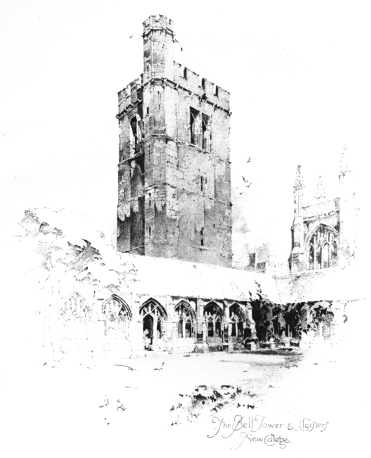
The Bell Tower & Cloisters New College.
original plan of his Collegiate Buildings, but also as the founder of
the public school system and the new type of college.
It was as a lawyer-ecclesiastic that he had succeeded. But it was
against the administration of ecclesiastical statesmen that the
discontent of the time was being directed by the Wycliffites and John of
Gaunt. Himself a staunch supporter of the old régime in Church and
State, Wykeham set himself to remedy its defects and to provide for its
maintenance as well as for his own soul’s health after death.
Oxford had reached the height of its prosperity in the fourteenth
century. Then the Black Death, the decadence of the Friars, the French
Wars, the withdrawal of foreign students and the severance of the ties
between English and foreign Universities, commenced a decay which was
accelerated by the decline of the ecclesiastical monopoly of learning,
by the Wycliffite movement and, later, by the Wars of the Roses.
Wykeham marked some of these causes and their effect. He believed in
himself, and therefore in the Canon Law and lawyer-ecclesiastics; he
noted the falling off in the number of the students, and therefore of
the clergy, caused by the Black Death; he knew the poverty of those who
wished to study, and the weak points in the system of elementary
education. He wished to encourage a secular clergy who should fight the
Wycliffites and reform the Church. Therefore he determined to found a
system by which they might be trained, and by which the road to success
might be opened to the humblest youths—a system which should pay him in
return the duty of perpetual prayers for his soul.[29]
As early as 1370, then, he began to buy land about the north-eastern
corner of the city wall; and ten years later, having obtained licence
from Richard II., he enclosed a filthy lane that ran alongside the
north wall and began to build a home for the warden, seventy scholars,
ten stipendiary priests or chaplains, three stipendiary clerks and
sixteen chorister boys of whom his college was to be composed.
Eglesfield had proposed to establish seventy-two young scholars on his
foundation. Wykeham borrowed and improved upon the idea. He provided a
separate college for them at Winchester, and in so doing he took a step
which has proved to be of quite incalculable consequence in the history
of the moral and intellectual development of this country. For he
founded the first English public school.
From the scholars of Winchester, when they had reached at least the age
of fifteen years, and from them only the seventy scholars of “S. Marie
College” were to be chosen by examination. A preference was given to the
founder’s kin and the natives of certain dioceses. These young scholars,
if they were not disqualified by an income of over five marks or by
bodily deformity, entered at once upon the course in Arts, and, after
two years of probation and if approved by examination, might be admitted
true and perpetual fellows. Small wonder if golden scholars became
sometimes silver bachelors and leaden masters!
A fellow’s allowance was a shilling a week for commons and an annual
“livery.” But it was provided that each young scholar should study for
his first three years under the supervision of one of the fellows, who
was to receive for each pupil five shillings. This was a new step in the
development of the college system. Though designed merely to supplement
the lectures of the regents in the schools, the new provision of tutors
was destined to supplant them. Another step of far-reaching consequence
taken by Wykeham was the acquisition of benefices in the country,
college livings to which a fellow could retire when he had resided long
enough or failed to obtain other preferment.
The government of the college was not entrusted to the young fellows,
but to the warden, sub-warden, five deans, three bursars and a few
senior fellows. But even the youngest of the fellows was entitled to
vote on the election of a warden.
In New College
The warden of this new foundation was to be a person of no small
importance. Wykeham intended him to live in a separate house, with a
separate establishment and an income (£40) far more splendid than the
pittance assigned to the Master of Balliol or even the Warden of Merton.
The buildings of Merton had been kept separate; only by degrees, and as
if by accident, had they assumed the familiar and charming form of a
quadrangle. The genius of Wykeham adopted and adapted the fortuitous
plan of Merton. At New College we have for the first time a group of
collegiate buildings, tower-gateway (the tower assuredly of one “wise of
building castles!”) chapel, hall, library, treasury, warden’s lodgings,
chambers, cloister-cemetery, kitchen and domestics offices, designed and
comprised in one self-sufficing quadrangle (1380-1400). Just as the
statutes of New College are the rule of Merton enormously elaborated, so
the plan of the buildings is that of Merton modified and systematised.
The type of New College served as a model for all subsequent
foundations. The most noticeable features in this arrangement are that
the hall and chapel are under one roof, and that the chapel consists of
a choir, suitable to the needs of a small congregation, and of a nave
of two bays, stopping short at the transepts, and forming an ante-chapel
which might serve both as a vestibule and as a room for lectures and
disputations. The chapel, which contains much very beautiful glass and
the lovely if inappropriate window-pictures of Sir Joshua Reynolds, must
have been in Wykeham’s day, when it was adorned with a magnificent
reredos and “works of many colours,” a thing of even greater beauty than
it now is. The chapels of Magdalen, All Souls’ and Wadham were directly
imitated from it. But, with the hall, it suffered much at the hands of
Wyatt and Sir Gilbert Scott. The latter was also responsible for the
atrocious New Buildings. The proportions of the front quadrangle were
spoilt by the addition of a third story and the insertion of square
windows in the seventeenth century.
The importance of the chapel architecturally, dominating the quadrangle
as it does and absorbing the admiration of the visitor or the dweller in
those courts, is indicative of the ecclesiastical aspect of the new
foundation, which the great opponent of Wycliffe intended to revivify
the Church by training secular priests of ability. This ecclesiastical
aspect is still more prominent in the case of All Souls’, which, like
Magdalen, may fitly be described as a daughter of New College, so much
do they both owe, as regards their rule and their architectural design,
to the great foundation of Wykeham. The deterioration and ignorance of
the parochial clergy were amongst the most serious symptoms of the
decadence of the fifteenth century. Himself a Wykehamist and a
successful ecclesiastical lawyer, the great Archbishop Chichele
therefore followed Wykeham’s example and founded a college which might
help to educate and to increase the secular clergy. Out of the revenues
of the suppressed alien priories he endowed a society consisting of a
warden and forty fellows, of doctors and masters who were to study
Philosophy, Theology and Law. His college was not, therefore, and
happily is not (though now it takes its full share of educational work),
a mere body of teachers, but of graduate students. The prominence given
to the study of Law and Divinity resulted in a close connection with the
public services which has always been maintained. But “All Souls’” was a
chantry as well as a college. As head of the English Church and a
responsible administrator of the Crown, Chichele had devoted all his
powers to the prosecution of that war with France, for which
Shakespeare, following Hall, has represented him as being responsible.
The college is said to have been the Archbishop’s expiation for the
blood so shed. Whatever his motive, his object is stated clearly enough.
It was to found a
“College of poor and indigent clerks bounden with all devotion to
pray for the Souls of the glorious memory of Henry V., lately King
of England and France, the Duke of Clarence and the other lords and
lieges of the realm of England, whom the havoc of that warfare
between the two realms hath drenched with the bowl of bitter death,
and also for the souls of all the faithful departed.”
Chichele had already undertaken the foundation of S. Bernard’s College.
He now (September 1437) purchased Bedford Hall, or Charleton’s Inn, at
the corner of Cat Street,[30] directly opposite the eastern end of S.
Mary’s Church. On this site, in the following February, was laid the
foundation stone of the college afterwards incorporated under the title
of “The Warden and All Soulen College,” or “The Warden and College of
All Faithful Souls deceased at Oxford.” As Adam de Brome had persuaded
Edward II. to be the foster-founder of Oriel, so Chichele asked Henry
VI. to be the nominal founder of his college. The royal patronage proved
advantageous in neither case.
The front quadrangle of All Souls’ remains very much as the founder left
it; the hall and the noble Codrington Library in the Italian style, the
cloister of the great quadrangle and the odd twin towers belong to the
first half of the eighteenth century. The latter are curious specimens
of that mixture of the Gothic and Renaissance styles (Nicholas
Hawksmoor), of which the best that can be said is that “the architect
has blundered into a picturesque scenery not devoid of grandeur”
(Walpole).
The political and social troubles of the fifteenth century brought about
a period of darkness and stagnation in the University. The spirit of
independence and reform had been crushed by the ecclesiastics. Oxford
had learnt her lesson. She took little part in politics, but played the
time-server, and was always loyal—to one party or the other. She
neglected her duties; she neither taught nor thought, but devoted all
her energies and resources to adorning herself with beautiful colleges
and buildings. And for us the result of this meretricious policy is the
possession of those glorious buildings which mark the interval between
the Middle Ages and the Renaissance. For the University now built
herself schools that were worthy of her dower of knowledge.
There was a vacant spot at the end of Schools Street belonging to
Balliol College, lying between the town wall on the north and Exeter
College on the west. On this site it was determined to erect a School of
Divinity (1424). Donations flowed in from the bishops and monasteries.
But in spite of all economy funds ran short. The building had to be
discontinued for a while (1444). The gift of 500 marks from the
executors of Cardinal Beaufort, a former Chancellor, enabled the
graduates to proceed with their work. They made strenuous efforts to
raise money. They put a tax on all non-resident masters and bachelors;
they offered “graces” for sale; they applied to the Pope and bishops for
saleable indulgences. In return for a contribution of one hundred pounds
from the old religious orders, they agreed to modify the ancient
statutes concerning the admission of monks to academical degrees. Some
of these methods of raising the necessary monies are doubtless open to
criticism, but we cannot cavil when we look upon the noble building
which the graduates were thus enabled to raise. The Divinity School, to
which, Casaubon declared, nothing in Europe was comparable, was, with
its “vaulting of peculiar skill,” used, though not completed, in 1466.
It remained to construct an upper story where the books belonging to the
University might be kept and used. For generous gifts of books
(1439-1446) by Humphrey, Duke of Gloucester, uncle of Henry VI., had
greatly increased the University Library. The fashion of large and
gorgeous libraries was borrowed by the English from the French princes.
The duke had taken his opportunity during his campaigns in France. He
seized the valuable collection of books at the Louvre, and many of them
had now found their way to Oxford. They were stored at first in the
Cobham Library, but more room was needed. Accordingly, in 1444, the
University addressed a letter to the duke in which they informed him of
their intention to erect a new building suitable to contain his
magnificent gift, and on a site far removed from the hum of men. Of this
building, with that gratitude which is in part at least a lively sense
of favours to come, they asked permission of the very learned and
accomplished duke to inscribe his name as founder. The Duke Humphrey
Library forms now the central portion of the great Reading Room of the
Bodleian Library. It still answers, by virtue of its position and the
arrangement of its cubicles, to the description and intention of the
promotors—to build a room where scholars might study far removed a
strepitu sæculari, from the noise of the world.
The three wheat-sheaves of the Kempe shield, repeated again and again on
the elaborate groined roof of the Divinity School, commemorate the
bounty of Thomas Kempe, Bishop of London, who (1478) promised to give
1000 marks for the completion of the school and the library. A grateful
University rewarded him with anniversary services; his name is still
mentioned in the “bidding prayer” on solemn occasions. Nor was Duke
Humphrey forgotten. His name still heads the list of benefactors recited
from time to time in S. Mary’s. Religious services were instituted also
for his benefit. He was more in need of them, perhaps, than the bishop.
For the “Good Duke Humphrey” was good only so far as his love of
learning and his generosity to scholars may entitle him to be considered
so. The patron of Lydgate and Occleve, and the donor of hundreds of rare
and polite books to the University was as unscrupulous in his political
intrigues as immoral in his private life. But in his case the good he
did lived after him.
The “Good Duke” was a reader as well as a collector. It was not merely
the outsides of books or the title-pages which attracted him.
“His courage never doth appal
To study in books of antiquity.”
So wrote Lydgate, who knew. Even when he presented his books to the
University, he took care to reserve the right of borrowing them, for
were they not, according to the inscription which he was wont to insert
lovingly in them, all his worldly wealth (mon bien mondain)? It is
perhaps not surprising to find from the list of books which he gave to
the University, that the duke’s taste in literature was for the
Classics, for the works of Ovid, Cato, Aulus Gellius and Quintilian, for
the speeches of Cicero, the plays of Terence and Seneca, the works of
Aristotle and Plato, the histories of Suetonius and Josephus, of Beda
and Eusebius, Higden and Vincent of Beauvais. A fancy for medical
treatises and a pretty taste in Italian literature are betrayed by the
titles of other books, for the duke gave seven volumes of Boccaccio,
five of Petrarch and two of Dante to the University.
Duke Humphrey promised to give the whole of his collection to the
University, together with a hundred pounds to go towards the
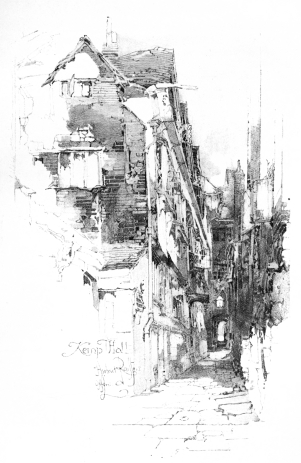
Kemp Hall
building of the library. But he died suddenly, and the University never,
as it appears, received full advantage of his generosity. It was not
till 1488 that the books were removed from S. Mary’s. For the completion
of the library was delayed by an order from Edward IV. The workmen
employed upon the building were summoned by him to Windsor, where he had
need of them, to work at S. George’s Chapel. Those who were not employed
on the chapel were handed over to William of Waynflete, who restored
them to the University along with some scaffolding which had been used
in the building of Magdalen. William Patten or Barbour of Waynflete, an
Oxford man, who had been master of the school at Winchester, had been
appointed first master and then Provost of Eton by the founder, Henry
VI., and was rewarded for his success there by the Bishopric of
Winchester. In 1448 he had founded a hall for the study of Theology and
Philosophy, situated between the present schools and Logic Lane, and
called it, probably after the almshouse at Winchester, of which he had
been master, the Hall of S. Mary Magdalen. When he became Lord
Chancellor he immediately took steps to enlarge this foundation,
transferred it to the site of the Hospital of S. John, and styled it the
College of S. Mary Magdalen (September 1457).
Waynflete resigned the Chancellorship just before the battle of
Northampton. After some years, during which he was “in great dedignation
with Edward IV.,” he received full pardon from his late master’s
conqueror. The Yorkist monarch (whose fine statue is over the west
doorway of the chapel) also confirmed the grants made to Waynflete’s
College in the last reign. After an interval, then, the foundation stone
of the most beautiful college in the world, “the most absolute building
in Oxford,” as James I. called it when his son matriculated there, was
laid “in the midst of the High Altar” (5th May 1474).
Already enclosing walls had been built about the property, which was
bounded on the east by the Cherwell, on the south by the High Street,
on the west by what is now Long Wall Street, and on the north by the
lands of Holywell. The “Long Wall” bounded the “Grove,” famous, since
the beginning of the eighteenth century, for its noble timber and herd
of deer. Most of the trees in the present grove are elms planted in the
seventeenth century, but there are two enormous wych elms, measured by
Oliver Wendell Holmes in 1886, which would have dwarfed that venerable
oak which stood near the entrance into the water-walk, and was blown
down “into the meadow” in 1789. It was over seven hundred years old
(girth 21 ft. 9 in., height 71 ft. 8 in.), and thought to be the same as
that named by the founder for a northern boundary.
In the arrangement of his buildings Waynflete followed Wykeham. Chapel,
hall and library were designed on the same plan. But the beautiful
“Founder’s Tower,” rendered now still more lovely by the drapery of
creepers which hangs about it, formed the principal entrance into
cloisters, which were part of the buildings of the main quadrangle,
carried an upper story of chambers, and were adorned with grotesques
symbolical of the Vices and Virtues. The entrance now used was
originally meant to serve only as the entrance from the cloister to the
chapel. It was adorned (circa 1630) with a gateway similar to that
designed by Inigo Jones for the main entrance to the college.
The statutes were based on those of New College, but, in addition to
those of which we have already had occasion to speak, there were certain
notable improvements. The society was to consist of a President and
seventy scholars besides four chaplains, eight clerks and sixteen
choristers. Forty of these scholars were fellows forming one class, and
thirty were demies, forming another, whose tenure was limited and who
were given half the allowance of the fellows. They had no special claim
to promotion to fellowships. For their instruction a Grammar Master and
an usher were provided; when they were well skilled in Grammar, they
were to
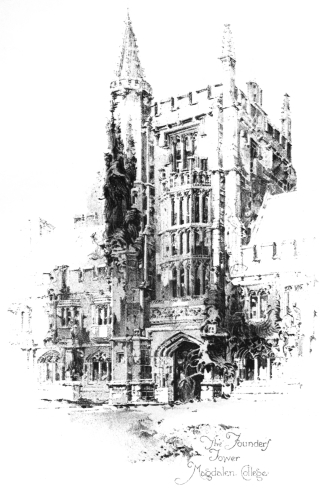
The Founder’s Tower Magdalen College
be taught Logic and Sophistry by the college lecturers, whilst three
“Readers,” in Natural and Moral Philosophy and Theology, chosen out of
the University, were to provide the higher teaching in Arts and
Theology. And all this teaching, in Theology and Philosophy and also in
Grammar, was to be given free to all comers at the expense of the
college.
In 1481 Waynflete, full of pride in his new foundation, “the most noble
and rich structure in the learned world,” persuaded Edward IV. to come
over from Woodstock and see it. The King came at a few hours’ notice.
But as the royal cavalcade drew near the North Gate of the town, a
little after sunset, it was met by the Chancellor and the masters of the
University and a great number of persons carrying lighted torches. The
King and his courtiers were hospitably received at Magdalen. On the
morrow the President delivered a congratulatory address, and the King
made a gracious reply; then he and his followers joined in a solemn
procession round the precincts and the cloisters of the college.
Two years later Richard III. was very similarly welcomed by the
University and entertained at Magdalen. On this occasion the King was
regaled with two disputations in the hall. Richard declared himself very
well pleased; and it is just possible that he was. For one of the
disputants was William Grocyn, who was rewarded with a buck and three
marks for his pains.
The University continued its policy of political time-serving, and,
after the battle of Bosworth Field, congratulated Henry VII. as
fulsomely as it had congratulated Richard III. a few months before.
Henry retorted by demanding the surrender of Robert Stillington, Bishop
of Bath and Wells, who was staying within the limits of the University.
This prelate was accused of “damnable conjuracies and conspiracies,”
which may have included complicity in the rebellion of Lambert Simnel.
For the future scullion was a native of Oxford. The University
prevaricated for a while; and at last, when hard pressed, they explained
that they would incur the sentence of excommunication if they used
force against a prelate of the Catholic Church. The King then took the
matter into his own hands, and committed the offender to prison at
Windsor for the remainder of his life. He soon afterwards visited
Oxford, offered a noble in the chapel of Magdalen College, and, by way
of marking his approval of the University, undertook the maintenance of
two students at Oxford. In 1493 he established at University College an
obit for the widow of Warwick the king-maker.
Some years later, in 1504, he endowed the University with ten pounds a
year in perpetuity for a religious service to be held in memory of him
and his wife and of his parents. On the anniversary of his burial a
hearse, covered with rich stuff, was to be set up in the middle of S.
Mary’s Church before the great crucifix, and there the Chancellor, the
masters and the scholars were to recite certain specified prayers. Among
the articles in the custody of the verger of the University is a very
fine ancient pall of rich cloth of gold, embroidered with the arms and
badges of Henry VII., the Tudor rose and the portcullis, that typify the
union of the houses of York and Lancaster. Penurious in most matters,
Henry VII. showed magnificence in building and in works of piety. In
Westminster Abbey he erected one of the grandest chantries in
Christendom; and it was for the exclusive benefit of the monks of
Westminster that he established at Oxford three scholarships in
Divinity, called after his name, and each endowed with a yearly income
of ten pounds (Maxwell Lyte).
Of Henry’s parents, his mother, the Lady Margaret, Countess of
Richmond,[31] took a warm interest in Oxford as in Cambridge, where she
founded two colleges. It was she who founded the
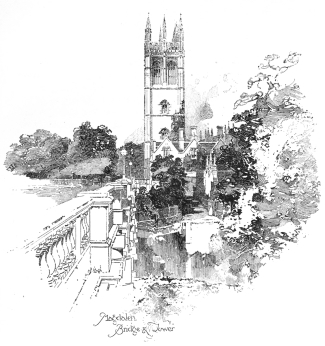
Magdalen Bridge & Tower
two Readerships in Divinity at Oxford (1497) and Cambridge, the oldest
professorial chairs that exist in either University.
His characteristically frugal offering was not the only sign of his
favour which Henry vouchsafed to Magdalen. He sent his eldest son,
Prince Arthur, frequently to Oxford. When there the boy stayed in the
President’s lodgings and the purchase of two marmosets for his amusement
is recorded in the college accounts. One of the old pieces of tapestry
preserved in the President’s lodgings represents the marriage of the
prince with Catherine of Aragon. It was probably presented to the
President (Mayhew) by him.
It is possible that Henry VII. also contributed to the cost of building
that bell tower, which is the pride of Magdalen and the chief ornament
of Oxford.
The tower was built between the years 1492 and 1505. Wolsey was a junior
fellow when the tower was begun, and though popular tradition ascribes
to him the credit of the idea and even the design of that exquisite
campanile, the fact that not he, but another senior fellow (Gosmore by
name) was appointed to superintend the work, is evidence, so far as
there is any evidence, that Wolsey had no particular share in the
design. He was, however, senior bursar in 1499. But the story that he
left the college because he had wrongly applied some of its funds to the
building of the tower, is not borne out by any evidence in the college
records. He ceased to be a fellow of Magdalen about 1501, having been
instituted to the Rectory of Lymington. But he had filled the office of
Dean of Divinity after his term as senior bursar was over.
We have referred to the close connection of the house of Lancaster with
Waynflete’s foundation. By a curious freak of popular imagination the
name of Henry VII. as well as that of the future cardinal has been
intimately connected with this tower. Besides other benefactions, he
granted a licence for the conveyance to the college of the advowsons of
Slymbridge and of Findon.
In return the college undertook to keep an obit for him every year. This
celebration was originally fixed on the 2nd or 3rd of October, but it
has been held on the 1st of May since the sixteenth century. The
coincidence of this ceremony with the most interesting and picturesque
custom of singing on Magdalen Tower has given rise to the fable that a
payment made to the college by the Rectory of Slymbridge was intended to
maintain the celebration of a requiem mass for the soul of Henry VII.
And the hymn that is now sung is the survival, says the popular myth, of
that requiem.
For in the early morning of May Day all the members of Waynflete’s
foundation, the President and fellows and demies with the organist and
choir, clad in white surplices ascend the tall tower that stands sombre,
grey and silent in the half-light of the coming day. There are a few
moments of quiet watching, and the eye gazes at the distant hills, as
the white mists far below are rolled away by the rising sun. The clock
strikes five, and as the sound of the strokes floats about the tower,
suddenly from the throats of the well-trained choir on the morning air
rises the May Day hymn.
The hymn is finished, and a merry peal of bells rings out. The tower
rocks and seems to swing to the sound of the bells as a well made bell
tower should. And the members of the college having thus commemorated
the completion of their campanile, descend once more to earth, to bathe
in the Cherwell, or to return to bed.
For a repetition of an inaugural ceremony is what this function probably
is, and it has nothing to do, so much can almost certainly be said, with
any requiem mass. The hymn itself is no part of any use. It was written
by a fellow of the college, Thomas Smith, and set to music as part of
the college “grace” by Benjamin Rogers, the college organist, towards
the end of the seventeenth century.
Whether or no the origin and meaning of the singing was to commemorate
the completion of the tower, the singing itself would appear to have
borne originally a secular character.
“The choral ministers of this house,” says Wood, “do, according to
an ancient custom, salute Flora every year on the First of May, at
four in the morning, with vocal music of several parts. Which
having been sometimes well performed, hath given great content to
the neighbourhood, and auditors underneath.”
The substitution of a hymn from the college grace for the “merry concert
of both vocal and instrumental music, consisting of several merry
ketches, and lasting almost two hours,” which was the form the
performance took in the middle of the eighteenth century, was made on
one occasion when the weather was very inclement. Once made it was found
easier and more suitable to continue it, and the observance came to be
religious.[32]
Magdalen Tower is one of those rarely beautiful buildings, which strike
you with a silent awe of admiration when first you behold them, and ever
afterwards reveal to your admiring gaze new aspects and unsuspected
charms. It is changeable as a woman, but its changes are all good and
there is nothing else about it that is feminine. It conveys the
impression that it is at once massive and slender, and its very
slenderness is male.
The chaste simplicity of the lower stories carries the eye up unchecked
to the ornamented belfry windows, the parapet and surmounting pinnacles,
and thus enhances the impression of perfect and reposeful proportion.
The growth of the colleges had influenced the halls. Statutes imposed by
the authority of the University, began to take the place of the private
rule of custom and tradition approved and enforced by the authority of
the self-governing scholars. The students quickly ceased to be
autonomous scholars and became disciplined schoolboys. The division
between don and undergraduate began to be formed and was rapidly
accentuated. Thus, at the close of the mediæval period, a change had
been wrought in the character of the University, which rendered it an
institution very different from that which it had been in the beginning.
The growth of Nationalism, the separation of languages and the
establishment of the collegiate system—these and similar causes tended
to give the Universities a local and aristocratic character. The order
introduced by the colleges was accompanied by the introduction of rank,
and of academical power and influence stored in the older, permanent
members of the University. Learning, too, had ceased to be thought
unworthy of a gentleman; it became a matter of custom for young men of
rank to have a University education. Thus, in the charter of Edward
III., we even read that “to the University a multitude of nobles,
gentry, strangers and others continually flock”; and towards the end of
the century we find Henry of Monmouth, afterwards Henry V., as a young
man, a sojourner at Queen’s College. But it was in the next century that
colleges were provided, not for the poor, but for the noble. Many
colleges, too, which had been originally intended for the poor, opened
their gates to the rich, not as fellows or foundation students, but as
simple lodgers, such as monasteries might have received in a former age.
This change has continued to be remarkably impressed upon Oxford and
Cambridge even down to this day.
The influence of other political classes was now also introduced. Never,
as Newman said, has a learned institution been more directly political
and national than the University of Oxford. Some of its colleges came to
represent the talent of the nation, others its rank and fashion, others
its wealth; others have been the organs of the Government of the day;
while others, and the majority, represented one or other division,
chiefly local, of opinion in the country. The local limitation of the
members of many colleges, the West Country character of Exeter, the
North Country character of Queen’s or University, the South Country
character of New College, the Welsh character of Jesus College, for
instance, tended to accentuate this peculiarity. The whole nation was
thus brought into the University by means of the colleges, which
fortunately were sufficiently numerous, and no one of them
overwhelmingly important. A vigour and a stability were thus imparted to
the University such as the abundant influx of foreigners had not been
able to secure. As in the twelfth and thirteenth centuries, French,
German and Italian students had flocked to Oxford, and made its name
famous in distant lands; so in the fifteenth all ranks and classes of
the land furnished it with pupils, and what was wanting in their number
or variety, compared with the former era, was made up by their splendour
or political importance. The sons of the nobles came up to the
University, each accompanied by an ample retinue; the towns were kept in
touch with the University by means of the numerous members of it who
belonged to the clerical order. Town and country, high and low, north
and south, had a common stake in the academical institutions, and took a
personal interest in the academical proceedings. The degree possessed a
sort of indelible character which all classes understood; and the people
at large were more or less partakers of a cultivation which the
aristocracy were beginning to appreciate. Oxford, in fact, became the
centre of national and political thought. Not only in vacations and term
time was there a stated ebbing and flowing of the academical youth, but
messengers posted to and fro between Oxford and all parts of the country
in all seasons of the year. So intimate was this connection, that Oxford
became, as it were, the selected arena for the conflicts of the various
interests of the nation.