Quia lapis de pariete clamabit, et lignum,
quod inter juncturas aedificiorum est, respondebit.
Standing at Carfax, and occasionally moving a step to one side or
another, I see with my eyes, indeed, the west front of Christ Church,
with Tom Tower; the borders of All Saints’ and St. Mary’s; and that grim
tower of St. Michael’s; and the handsome curves of High Street and St.
Aldate’s, which are part of the mere good fortune of Oxford: but,
especially if a dawn light recall the first dim shining, or a sunset
recall the grey and golden splendour of its maturity, I may also see the
past of the University unrolled again. For at Carfax I am in sight of
monuments on which is implied or recorded all its history. On the south,
above Folly Bridge, is the gravelly reach that formed the eponymous
ford; between that and Christ Church was the old south gate; and,
through Wolsey’s gateway, lies the Cathedral, speaking of St.
Frideswide, the misty, original founder,—King’s daughter, virgin,
martyr, saint,—and, with its newly revealed Norman crypt, which
perhaps[Pg 66] held the University chest in the beginning, representative of
Oxford’s piety and generosity. On the east, in the High Street,
University College and St. Mary’s and Brasenose speak clearly, although
falsely, of King Alfred. There, by St. Peter’s in the East, was the old
east gate; and in sight of these is Merton, the fount of the collegiate
idea. On the north, in Cornmarket Street, St. Michael’s marks the place
of the north gate, and while it is one of the oldest, is by far the
oldest-looking place in Oxford, rising up always to our surprise, like a
piece of substantial night left by the dark ages, yet clothed with green
in June. On the west, the Castle tower, twin made with St. Michael’s by
the first Norman lord of Oxford, lies by the old west gate; and the
quiet, monstrous mound beyond recalls the days of King Alfred’s
daughter’s supremacy in Mercia. At Carfax itself there is still a St.
Martin’s church, a descendant of the one whose bells in the Middle Ages
and again in the seventeenth century, called the city to arms against
the University, but long ago deprived of its insolent height of tower,
because the citizens pelted the scholars therefrom.
Moved by the presence of a city whose strange beauty was partly
interpreted from these vigorous hieroglyphics, mediæval and later men,
who had the advantage of living before history was invented, framed for
it a divine or immensely ancient origin. Even kings, or such as quite
certainly existed, were deemed unworthy to be the founders. We believe
now that the first mention of Oxford was as an inconsiderable[Pg 68][Pg 67]
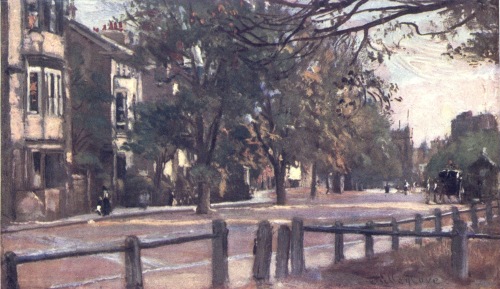
ST. GILES’S, LOOKING TOWARDS ST. MARY MAGDALEN (SOUTH)
Some picturesque houses on the left lead to the entrance of St. John’s
College, seen through the trees. Farther on appears the tower of the
Church of St. Mary Magdalen in Cornmarket. The mass to the extreme right
above the cab shelter is part of the west side of St. Giles’s and the
houses surrounding the Taylor Institution and new Ashmolean Museum.
The posts and rails in the foreground enclose a grassed space in front
of St. Giles’s Church.
The time is sunset in summer.
[Pg 71][Pg 70][Pg 69]
but progressive township in the reign of Edward the Elder, Alfred’s son:
but those old lovers attributed to Alfred the restoration of a
university that was in his time old and honoured; and some said that he
endowed three doctors of grammar, arts, and theology, there; others,
less precise than those who put the foundation of Cambridge at 4317
B.C., discovered that Oxford was founded by the Trojans who (as used to
be well known) came to Britain from their burning city. But to Oxford
the Trojans brought certain Greek philosophers, and at that early date
illustrated the universal hospitality and independence of nationality
and language that were so characteristic, before the place became a
Stuart park. And as the Athenians had in their city and its attendant
landscape all those natural beauties and utilities which make possible a
peerless academy, so also had the Britons, says Anthony à Wood, herein
agreeing with Polydore Vergil, “when by a remnant of the Grecians, that
came amongst them, they or their successors selected such a place in
Britain to plant a school or schools therein, which for its pleasant
situation was afterwards called Bellositum or Bellosite, now
Oxford.” Among these generous suppositions or dreams was the story that
Apollo, at the downfall of the Olympians, flying now to Rome and now to
Athens, found at last something congenial in the brown oak woods and
silver waters of Oxford, and a bride in the puissant nymph of Isis; on
which favoured site, as was fitting, there afterwards arose a place,
with the learning and architectural beauty of Athens, the divine[Pg 72]
inspiration of Delphi, and the natural loveliness of Delos....
There is, said Anthony à Wood, “an old tradition that goeth from father
to son of our inhabitants, which much derogateth from the antiquity of
this city—and that is: When Frideswyde had bin soe long absent from
hence, she came from Binsey (triumphing with her virginity) into the
city mounted on a milk-white ox betokening innocency; and as she rode
along the streets, she would forsooth be still speaking to her ox, ‘Ox
forth,’ ‘Ox forth’ or (as ’tis related) ‘bos perge’ (that is, ‘ox goe
on,’ or ‘ox (goe on) forth’)—and hence they indiscreetly say that our
city was from thence called Oxforth or Oxford.”
But there has never been composed a quite appropriately magnificent
legend that could be received by the faithful as the canonical fiction
for Oxford, as the Aeneid is for Rome; and now there can never be.
There is, however, still a pleasant haze (that might encourage a poet or
a herald) suspended over the early history of Oxford. It is unlikely
that the place was of importance in Roman times; later, its position on
a river and a boundary brought it many sufferings at the hands of Dane
and Saxon. But no one need fear to believe that, early in the eighth
century, Didan, an under king, and his daughter Frideswide established
there a nunnery and built a church of stone, now perhaps mingled with
the later masonry. It was rebuilt by Ethelred in the eleventh century
with a quite exceptional fineness in the Saxon workmanship; and was
girdled by the churches[Pg 74][Pg 73]
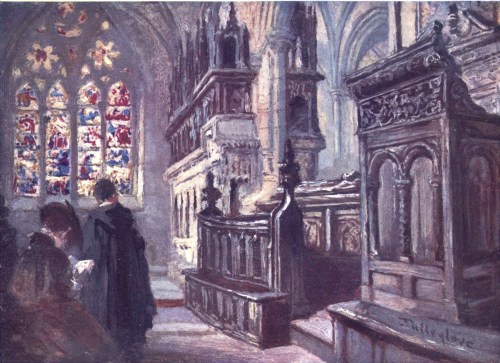
CHRIST CHURCH—INTERIOR OF LATIN CHAPEL
The Shrine of St. Frideswide appears in the middle of the picture,
standing in one of the eastern bays of the north wall of the choir. The
north side of the Shrine is seen, together with the ancient wooden
watching-chamber above.
A tomb shows between the column and the seventeenth-century reading-desk
at the right of the picture, also a glimpse of the choir.
The carved oak stall front immediately under the Shrine is probably of
the time of Wolsey, and part of the furniture of his choir.
To the left is the east window of the Chapel—filled with stained glass
representing scenes in the life of St. Frideswide, designed by Sir
Edward Burne-Jones, Bart., and executed by Mr. William Morris.
The two figures represent a visitor to the shrine of the saint and a
verger.
[Pg 77][Pg 76][Pg 75]
of St. Martin, St. George, St. Mary Magdalen, St. Mary the Virgin, St.
Ebbe, St. Michael, and St. Peter in the East; and the last two, to one
who had stood at Carfax in 1100, would still be recognised, if he
visited the shadowed doorway and stern crypt of the one, and the tower
of the other, though he might look in vain for what he knew in “The
Seven Deadly Sins lane” and elsewhere.
Whatever learning then flourished in the city is now to be found in its
architecture, in Prior Philip’s book on the miracles of St. Frideswide,
and in the inestimable atmosphere of the place. We can guess that there
was much that is worthy to be known, from the eloquent monkish figures
of the corbels in Christ Church chapter-house; and can wistfully think
of the wisdom that was uttered in Beaumont, the royal palace and learned
resort, whose gardens lay at Broken Hays and near Worcester College; and
in Osney Abbey, whose bells—Hautclere, Douce, Clement, Austin, Marie,
Gabriel et John—made music that was known to the Eynsham abbot on May
evenings, when it was a rich, calm retreat, and not as now, a shadowy
outline and a sorrowful heap of stones beyond the railway station. More
than the ghost of the abbey survives in the sketch of its ruined but
still noble walls, in the background of that picture of its last abbot,
in a window of the south choir aisle at Christ Church.
Before the Conquest Oxford had been visited by parliaments and kings; it
now began to be honoured by learning and art. Olim truncus eram....[Pg 78]
maluit esse deum. It had often been violated or burned; in Doomsday
Book it appears as a half desolate city, despite the churches; but it
had already begun, though again checked by fire that flew among the
wooden houses with such ghastly ease, to assume the proportions and the
grace which were fostered by William of Wykeham and a hundred of the
great unknown, and in the last few years by Aldrich and Wren and
Jones,—crowned by the munificence of Radcliffe,—illuminated with green
and white and gold and purple by the unremembered and by Reynolds,
Morris, and Burne-Jones. The Saxon work at St. Frideswide’s was
superseded or veiled by the Norman architects; the fine old pillars were
in part altered or replaced; and the relics of the Saint herself were
transferred ceremoniously and “with all the sweet odours and spices
imaginable,” to a more imposing place of rest. Upon the base of the old
fortifications probably now rose the bastions of the mediæval city wall,
once so formidable but now defensive only against time, and unable any
longer to make history, but only poetry, as they stand peacefully and
muffled with herbage in New College Gardens, or at Merton or Pembroke,
or by the churchyard of St. Peter’s in the East.
The history of that age in Oxford is indistinct, and recorded events
therein have a suddenness, for modern readers, which is vivid and
fascinating, but to the historian at least, painful and false. And so
the birth of the University, in the midst of darkness and noise, is to
us to-day a melodious sudden cry. It is as if a voice,[Pg 80][Pg 79]
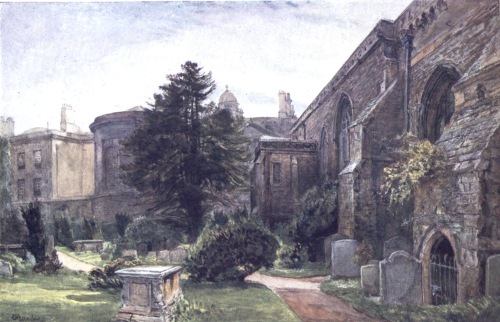
ST. PETER’S-IN-THE-EAST
To the extreme right of the picture, through a huge buttress on the
south side of the chancel, is pierced the doorway to the twelfth-century
crypt, extending some 36 feet under the chancel of the Church.
To the west of this buttress, in the angle formed by another buttress,
appear the remains of a Norman arcading, broken through for the
insertion of the early fifteenth-century window. The windows of the nave
showing in the picture are also of this date, as is the south porch.
It will be noted that this porch has a room over it—probably the
lodgings of a priest. Across the graveyard and Queen’s Lane to the west
are the buildings of Queen’s College; to the immediate left of the yew
tree in the centre of the picture shows the east end of the Chapel; more
to the north the dome of the campanile appears.
To the extreme left of the graveyard shows a portion of the ivy-covered
north wall of St. Edmund’s Hall (see other picture).
[Pg 83][Pg 82][Pg 81]
unexpectedly arose, calling—and the words are said to have been used by
two poor Irish students in an ignorant and worldly land—“Here is wisdom
for sale! Come, buy!” We know that famous lecturers from the continental
universities came; but not with what eloquence and applause they spoke.
It may confidently be surmised that there was something sweet to learned
minds in the air or tradition of the place. The walls are fallen or
forgotten that heard the prelusive lectures of Pullein and Vacarius; and
the brilliant Franciscan house in St. Benedict’s is chiefly known by its
influence in the founding of Balliol, and by the greatest schoolmen, its
alumni. But if we go to the grey domestic little lodgings, with “arms
and rebusses that are depicted and cut in stone over each door,”
vestiges of a Benedictine scholastic house, at Worcester College, we may
fancifully pierce beyond John Giffard’s foundation and the preceding
Carmelites, to the earliest lovers of learning who loved Oxford too. At
St. Mary’s the work of the fancy is easier and more sure. There the
University books, and there a money chest, reposed. There were the
highest deliberations and ceremonies. There a man was graduated, and
from its porch he passed out a clerk of Oxford.
If the University was early associated with a place of holiness and
beauty, still more firmly was it rooted in a becoming poverty. It had
neither a roof nor a certain purse. For years it had not a name. The
University was in fact but a spirit of wisdom and grace; men had heard
of it and sought it; and where one or two were[Pg 84] gathered together to
take advantage of it, there was her school and her only endowment. Now
and then to such a group came in a legacy of books or gold. But that was
a crop for which no one sowed, and before it was possible, it had been
rumoured that there was something in Oxford not visible, yet very
present and necessary; and scholars came with as great zeal as was ever
cherished by reports of gold. They brought what in their devotion they
came to seek. Thus Gerald of Wales came, and for three days read aloud
his glorious book to large audiences. Every day was marked by sumptuous
and generous feasts. It was, indeed, “a costly and noble act,” as he
says himself, “for the authentic and ancient times of the poets were
thus in some measure renewed.” Carmelites, Dominicans, and Franciscans,
and vivid men from the University of Paris, came to teach. Even then,
the University quarrelled with the town over the price of victuals and
rooms, and invaded the extortionate Jew. There, about the streets,
walked the magnificent Franciscans, Roger Bacon and Grosseteste, and the
pure and gracious and learned St. Thomas Cantelupe.
Early in the nineteenth century there was a Chancellor set over the
scholars by the Bishop of Lincoln, in whose diocese Oxford lay. Very
soon the Chancellor was elected by the University; and the Masters in
congregation could legislate, and sometimes did, although questions were
often effectually decided by a popular vote among the students,—who
also themselves chose by vote the heads of their hostels or halls. For
there[Pg 85] were, at an early date, houses already associated with learning,
and governed either by a common landlord or by a scholar of some
standing and age. There a man might read, and comfort himself according
to his means, and finally at night stamp up and down a passage, to warm
his feet, before going to sleep in a crowded bed-chamber. On any day
there was a chance that some splendid man, coming a little in the rear
of his fame, would arrive in Oxford, and lecture or read a book. Should
kings, or priests, or rude citizens interfere, the scholar could
rusticate voluntarily—as he sometimes did—at Stamford, or Reading, or
Maidstone, or Cambridge, and there, as best he might, by study and
self-denial, as by a sacrament, recreate the University. The City, and
until our own time the Crown, had to pay in round sums for such an
insult as the hanging of several scholars; the money lined the bottom of
St. Frideswide’s chest. A man with no possessions but the leaf of a
manuscript, or a dagger, or a cloak, left it with the keepers of the
chest as security for a loan, whether he were Welsh, or Hungarian, or
Italian, or French.
An Englishman, William of Durham, who had enjoyed the University
hospitality at Paris, first kindled the flame which was to be kept
burning by so many afterwards, as a focus perennis for the homeless
student. He left Paris after a town-and-gown quarrel, along with many
French students, whom Henry III. welcomed to Oxford in 1229. William
went to Rome, before returning to England, and remembered Oxford when he
lay dying at Rouen—perchance reminded there of the city[Pg 86] which until
fifty years ago was equal with it in ancient beauty, and has been
clouded in the same way. He left in his will a sum of money to the
University. It was employed in making more steadfast abodes for Oxford
students; at a house, for example, that stood on the site of the
bookseller’s shop opposite University College lodge. This act is counted
the foundation of University College, with its original four masters,
who shall be thought “most fit to advance or profit in the Holy Church
and who have not to live handsomely without it in the state of Masters
of Arts.”
There had previously been similar Halls, and many were afterwards
founded,—Hawk Hall, Perilous Hall, Elm Hall, Winton Hall, Beef Hall,
Greek Hall, Segrim Hall; in fact so large a number that half the Oxford
inns are or were perversions of the old Halls; and even tradesmen who
are not innkeepers now make their rich accounts among the ghosts of
forgotten principals. These had not in them the necessary statutes and
“great bases for eternity” which a college deserves. But henceforward
there were some fortunate students who might indeed have to sing or make
Latin verses in order to earn a bed, or a crust and a pot of ale, while
making their way to or from Oxford; but, once there, they were sure of
such a home as no other place, unless, perhaps, the place of their
nativity, could give.
“It is all,” says Newman, speaking of a college, “and does all that is
implied in the name of home. Youths, who have left the maternal roof,
and travelled some hundred miles for the acquisition of knowledge, find
an[Pg 88][Pg 87]
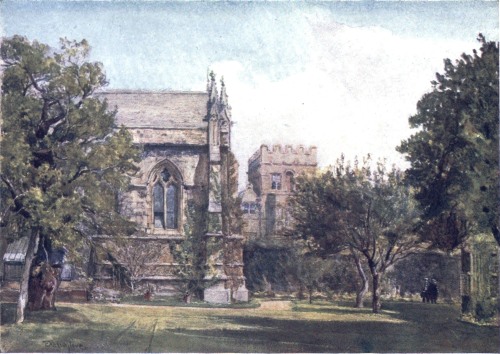
UNIVERSITY COLLEGE—PRIVATE GARDEN OF THE MASTER
The building to the left is the east end of the College Chapel, the
entrance tower being seen over the dividing wall almost in the centre of
the picture.
A bay window to the extreme right of the picture, looking over the
garden, is part of the Master’s Lodging.
[Pg 91][Pg 90][Pg 89]
altera Troja and simulata Pergama at the end of their journey and
their place of temporary sojourn. Home is for the youth, who knows
nothing of the world, and who would be forlorn and sad, if thrown upon
it. It is the refuge of helpless boyhood, which would be famished and
pine away if it were not maintained by others. It is the providential
shelter of the weak and inexperienced who have still to learn how to
cope with the temptations which lie outside of it. It is the place of
training for those who are not only ignorant, but have not yet learned
how to learn, and who have to be taught, by careful individual trial,
how to set about profiting by the lessons of a teacher. And it is the
school of elementary studies, not of advanced; for such studies alone
can boys at best apprehend and master. Moreover, it is the shrine of our
best affections, the bosom of our fondest recollections, a spell upon
our after life, a stay for world-weary mind and soul, wherever we are
cast, till the end comes. Such are the attributes or offices of home,
and like to these in one or other sense and measure, are the attributes
and offices of a College in a University.”
In the unconscious preparation for such a place William of Durham was
the first to leave money; the founders of Balliol the first to gather a
number of scholars under one roof, with a corporate life, and as we may
assume, a set of customary, unwritten laws; but Walter de Merton was the
first to endow and provide with tenements and statutes a college, in all
important respects, like a college of to-day,—a place even at that time
standing in a genial avuncular relationship towards[Pg 92] the students, which
was rich in influence and the making of endearing tradition. Perhaps the
Merton treasury, still conspicuous for its steep roof and burliness, was
part of the founder’s gift; and no building could have been a fitter
nest of an idea which was for so long to make little of time. The Hall
retains some features of the same date. Almost at once the chapel began
to rise, and its light was coloured by the topmost glass just as it is
to-day. In fact, Merton with its older little sister foundation of St.
Alban Hall was, until the annus mirabilis of Mr. Butterfield, in
itself a symbol of the origin and growth of Oxford as a collegiate
university and as a place of beauty.
The royal Dervorguilla was the godmother of the kindly college life of
to-day. She was the wife of the founder of Balliol, and was often in
Oxford, with her honoured Franciscan, Richard of Slikeburne, to look
after her sixteen scholars at Old Balliol Hall, in Horsemonger Street,
now Broad Street. Close by, at the Church of St. Mary Magdalen, she
devised an oratory for the Balliol men. They chose their own Principal,
who presided at disputations and meals. They had breakfast and supper
together, and the more comfortable of them paid anything in excess of
their allowance which the expenses of the common table might demand. One
poor scholar lived on the crumbs. Thus were men less often compelled to
borrow from the Jews at 60 per cent on the security of their books.
While Balliol was so progressing, and University College had its
statutes, and Merton already had its Hall,[Pg 94][Pg 93]
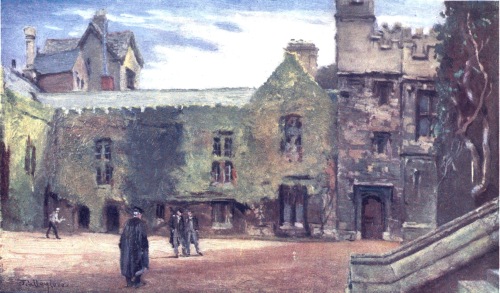
MERTON COLLEGE AND ST. ALBAN’S HALL
The entrance Quadrangle of the College is shown in the picture, to the
right of which is the Warden’s residence.
The building farther to the right is the Library, the steps of which
show in the immediate foreground.
St. Alban’s Hall, recently attached to Merton College, appears over the
north-east corner of the Quadrangle.
[Pg 97][Pg 96][Pg 95]
the spire of the church of St. Mary the Virgin first rose against the
sky. Then also the ashes of St. Frideswide were promoted to a new and
more precious place of rest. The sculptor at work upon the shrine had
evidently at his side the leaves of maple and crowfoot and columbine,
ivy and sycamore and oak, hawthorn and bryony, from the neighbouring
woods, where the saint had lain in hiding or ministered to the
calamities of the poor; and perhaps the season was late autumn, for
among the oak leaves are acorns, and some of the cups are empty. All
these things he carved on the base of the shrine.
It was of this period that the story was told that two barefooted,
hungry travellers from the west were approaching Oxford, and had come in
sight of it near Cumnor, when they found a beautiful woman seated by the
wayside. So beautiful was she that they knelt at her feet, “being simple
men.” Salve Regina! they cried. Then, she bending forward and
speaking, they were first surprised that she should speak to them; and
next ventured to speak to her, and ask her name. Whereat she “raised her
small golden head so that in the sun her hair seemed to flow and flow
continually down,” and looked towards Oxford. There two spires and two
towers could just be seen betwixt the oak trees. “My name,” she said,
“is known to all men save you. It is Pulchritudo. And that,” as she
pointed to the shining stones of the city, “is my home.” Those two were
silent, between amazement and joy, until one said “It is our Lady!” and
the other “Lo! it is Venus, and[Pg 98] she sits upon many waters yonder.”
Hardly had they resumed their ordinary pace when they found an old man,
seated by the wayside, very white and yet “very pleasant and alluring to
behold.” So to him also the simple wayfarers knelt down. Then that old
man bent forward and spoke to them with golden words, and only the one
who had called the beautiful woman “Venus” dared to speak. He it was
that questioned the old man about the woman and about himself. “My name
is Sapientia,” he said, and “that is my home,” he continued, and looked
towards Oxford, where two spires and two towers could just be seen
betwixt the oak trees. “And,” he concluded solemnly, “that woman is my
mother and she grows not old.” The men went their way, one saying, “It
is a place of lies”; the other saying, “It is wonderful”; and when they
looked back the old man and the beautiful woman had vanished. In the
city they were often seen, but the two strangers could not speak with
them, “for they were greatest in the city of Oxford. Some said that he
was an Austin friar and she a light woman; but they are not to be
believed.” And when they had dwelt in Oxford a short time and had seen
“what store of pious and learned and illuminated books were in the
Halls, and what costly and fine things in its churches and Convents,”
the one said, “I believe that what Sapientia and Pulchritudo said was
the truth”; and the other said, “Truly, the city is worthy of them
both”; wherefore they dwelt there until their deaths, and found it “the
most loving and lovely city” in Christendom.[Pg 100][Pg 99]
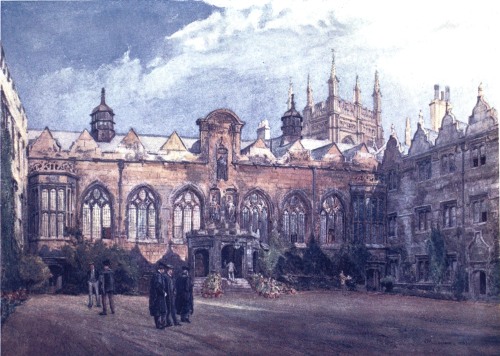
ORIEL COLLEGE
The Hall and Chapel stretch across the picture, in the centre of which
appears the porch. The three niches contain figures of the Virgin and
Child and Edward II. and III. under canopies.
The tower of Merton College shows above the roof of the Chapel. This,
with the louvres and ogee gables, forms a picturesque sky-line.
[Pg 103][Pg 102][Pg 101]
Dervorguilla and Walter de Merton had thus made the University a father
and a mother to the scholar. For a time, indeed, the principals had
often to transfer their penates; the founder’s inheritors lived in
scattered tenements which they changed from necessity or choice, now and
then; yet they had the imperishable sentiment of home, and for some
years they had little more, except in a small degree at Merton and
Queen’s, since the colleges neither demanded nor provided that the
scholars should study according to rule.
Under Edward II. Exeter College was founded, and linked from the
beginning with the west country, by the simultaneous co-foundation of a
school, and the rule that all the scholars should thence be drawn.
Decent poverty and love of learning were the other qualifications of a
scholar. Then followed Oriel, with Edward II. as its founder, the
advowson of the Church of St. Mary the Virgin as part of its support,
and its name derived from the Hall of La Oriole, which it received
early, and soon afterwards occupied. Its library was the first college
library; but the acquirement was technically defective, and the Fellows
of Oriel could not resist the students who broke in and carried away the
books. Fellows and admirers repaired the loss.
Philippa, Queen of Edward III., was joined with her chaplain in the
foundation of Queen’s College “for the cultivation of Theology, to the
glory of God, the advance of the Church, and the salvation of souls.” A
little subtlety on the part of the founder and sentiment on the part of
the queens, enabled the college to[Pg 104] exchange compliments with Anne of
Bohemia, Henrietta Maria, Charlotte and Adelaide. The founder was a
Cumberland man, and his college attracted a neighbour or a man who spoke
with his accent or had the same traditions to become one of the fellows,
equal in number with Christ and His apostles. Before and after the
beginning of colleges, men from the same district made a small “new
Scotland” or “new France” in Oxford streets. Thus the scholars of St.
George’s and Oriel were for some time largely Welsh; at Balliol and
University College there were many northerners. At all times these
divisions were emphasised by conflicts with tongue and arrow and sword.
Scholars overlooked their Aristotle at bloody arguments in Grove Street
and Cornmarket, between North and South, Irish and Welsh and Scotch, in
combinations that varied unaccountably or according to the politics of
the day. You might know a scholar, as an ancient tinker remarked the
other day, remembering the boxing booths of his youth, by the way he
fought. The election of a chancellor, or a church wake, and an exchange
of lusty oaths between men of two parties were the occasion. In later
years Realists and Nominalists,—Orthodox and Wycliffites,—now and then
reduced their disagreement to simple terms. Nor were the citizens with
difficulty persuaded to take or make a side in the disputes, whether
they encountered the scholars at inns, or as they stood on
market-days,—the sellers of hay and faggots and hogs, stretching in
their regular places from the East gate, in front of St. Mary’s and All
Saints’, to Carfax and the[Pg 106][Pg 105]
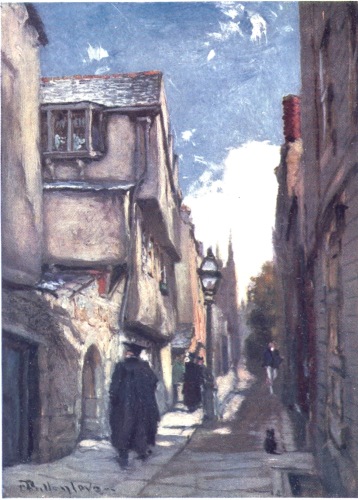
GROVE STREET
This narrow street runs from the High Street opposite St. Mary’s
Church alongside St. Mary’s Hall and Oriel College, emerging near
to Merton, part of the tower of which College appears.
It contains some picturesque half-timbered buildings, some of which
are shown in the picture.
[Pg 109]
[Pg 108]
[Pg 107]
Cross Inn. Once, a northern chaplain, “with other malefactors,”
embattled themselves and sought out the Welshmen with bent bows, crying
to the “Welsh dogs and their whelps” that an Owen or a Meredydd who
looked out at his door was a dead man. The Welshmen were driven out of
the city with ignominy and blood. The Northeners robbed and murdered
indiscriminately, and destroyed not only books but harps, until, finding
an ale-house, they were incontinently appeased. On another occasion some
townsmen burst in, on a Sunday, upon a few scholars, wounding and
despoiling them. The scholars spread their story and collected friends.
The townsmen responded to the sound of horns and St. Martin’s bell.
Countrymen from Hinksey and Headington came to the help of the
unlearned. The air whistled and hummed with the flight of arrows and
stones; the streets were crimsoned. But the reverend gentleman who led
the learned was untimely shot down, and his cause evaporated. Some
scholars fled to the country, some to sanctuary, and were comforted by
the excommunication and fining of their opponents. After a similar fight
the University was allowed that exemption from the city courts which it
still enjoys. In fact, the disturbances earned very cheaply for the
University concessions which put the citizens at a disadvantage, and
emphasised distinctions, so as to cause other disturbances in turn.
Henry V., himself a Queen’s College man, at last interfered with an
order that scholars would only be treated as such if they were under the
rule of an approved head. It was an[Pg 110] attempt to banish the wild errant
scholars, often Irishmen, and to make a common type of Chaucer’s Clerk
of Oxenford, who had been to Padua and knew Petrarch’s verse. He was one
who, even in his devotion to books, did not forget the souls of his
benefactors, for which he was, in the first instance, endowed to pray—
And he was not right fat, I undertake,
But looked holwe, and therto sobrely;
Ful thredbare was his overeste courtepy;
For he hadde geten hym yet no benefice,
Ne was so worldly for to have office;
For hym was levere have at his beddes heed
Twenty bookes clad in black or reed
Of Aristotle and his philosophic,
Than robës riche, or fithele, or gay sautrie;
But al be that he was a philosophre,
Yet hadde he but litel gold in cofre;
But al that he myghte of his freendes hente
On bookes and his lernynge he it spent,
And bisily gan for the soules preye
Of him that yaf hym wherewith to scoleye.
Of studie tooke he moost cure and moost heede,
Noght o word spake he moore than was neede,
And that was seyd in forme and reverence,
And short and quyk and ful of hy sentence.
Sounynge in moral vertu was his speche,
And gladly wolde he lerne and gladly teche.
But William of Wykeham, before that time, had given to New College a
code of ornate and intricate rules for morals and manners, which became
a legacy to the University at large; and in the first place checked the
savage liberties of scholars; in the second, helped to make learning
more “humane,” to make the “Arts” the “humanities.” He built a chapel
for the exclusive use of the scholars of his foundation. That in
itself[Pg 112][Pg 111]
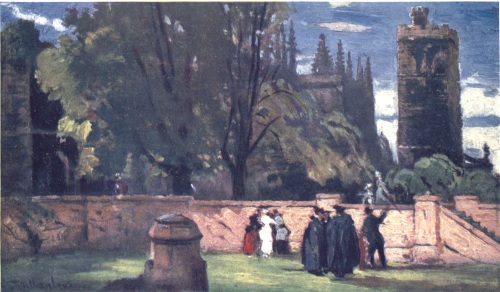
NEW COLLEGE
William of Wykeham (1404) built the noble tower which stands free
to the extreme right of the picture. A portion of the chapel is
seen to the left of the tower, and forms, with it and the trees, a
noble group.
The new retaining walls in the foreground are part of a recent
addition to the College.
[Pg 115]
[Pg 114]
[Pg 113]
was an inestimable addition to the golden chain by which Oxford holds
the memories of men. To the chapel they were to go every day, and there
to say their Paters and Aves. Its Latin—the fittest language to be
uttered amidst old architecture—and its coloured windows alone are not
to-day as they were in Wykeham’s time. He built the bell-tower and the
cloisters, and so gave to generations a pleasant vision, and—when
dreams are on the wing—a starting-place or an eyrie for dreams. He
built also a kitchen, a brewery, and a bakehouse. He stocked both a
garden and a library for college use. Long before the “first tutor of
the first college of the first University of the world” entered Oxford
with post horses to assert his position, the Warden of New College had
the use of six horses. He wore an ermine amice in chapel. He had his own
palace apart. But the humblest member of the foundation had been as
minutely provided for by Wykeham’s code. Above all, the scholar was not
to be left to himself in his studies, but to the care of an appointed
tutor. And in 1387 the new college proceeded to William of Wykeham’s
quadrangle, with singing and pomp. It was the first home of scholars in
Oxford, which was completely and specially fashioned for their use
alone, to be
A place of friends! a place of books!
A place of good things olden!
In the next century the ideas of Walter de Merton and Dervorguilla and
William of Wykeham were borrowed and developed by loving founders,
architects,[Pg 116] and benefactors. The building of Lincoln College, next
founded, was begun as soon as its charter was received; a chapel and a
library, a hall and a kitchen, and chambers on three storys, finely and
nobly built, were a matter of course. In the same way, All Souls’ front
quadrangle, practically as we see it to-day, was built at once by
Archbishop Chichele, the founder; and at Magdalen, which was next
founded, the tower began to rise on the extreme east of the city, to
salute the rising sun with its pinnacles, and on May morning, with a
song of choristers.
For Oxford, the fifteenth century was an age of libraries and books.
Looking back upon it, Duke Humphrey of Gloucester seems its patron
saint,—donor of books to the Benedictines who lived on the site of
Worcester College, and to the University,—harbinger of the Bodleian. We
can still catch the savour of the old libraries at Merton where the
light coloured by painted glass used to inlay the gloom under the wooden
roof, or behind the quiet latticed windows above the cloisters at Christ
Church. “What pleasantness of teaching there is in books, how easy, how
secret,” says Richard de Bury, Bishop of Durham, an old Oxford man, and
the giver of the first library to Oxford. “They are masters who instruct
us without rod or ferule, without angry words, without clothes or money.
If you come to them, they are not asleep; if you ask and inquire of
them, they do not withdraw themselves; they do not chide if you make
mistakes; they do not laugh at you if you are ignorant. O[Pg 118][Pg 117]
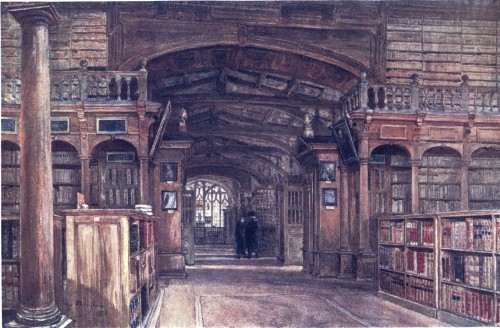
INTERIOR OF THE BODLEIAN LIBRARY
The portion of the Library shown in the picture is a storey built
above the Divinity School by Humphrey, Duke of Gloucester, son of
Henry IV., and the spectator is looking east towards the wing added
by Sir Thomas Bodley at the close of the sixteenth century.
Books cover every available inch of wall space, but the trusses of
the old timbered roof are visible, as are also the more modern
galleries, supported by wooden columns. These are for obtaining
access to books placed high in the Library. The strands of light
which bar the centre aisle are from the south windows of the
building, overlooking the Fellows’ Garden of Exeter College. The
windows also serve to light the “studies,” the latticed and
balustered doors of which may be seen standing open at intervals
(see illustration of one of these “studies”).
The cases in the immediate foreground are used for modern books.
[Pg 121]
[Pg 120]
[Pg 119]
books, who alone are liberal and free, who give to all who ask of you
and enfranchise all who serve you faithfully! by how many types ye are
commended to learned men in the Scriptures given us by the inspiration
of God!... Ye are the wells of living waters, which father Abraham first
digged, Isaac digged again, and which the Philistines strive to fill
up!...” Bury was a friend of Petrarch and Bradwardine, a Chancellor and
Treasurer of England, and his love of books became so famous that he was
reported “to burn with such a desire for books and especially old ones
that it was more easy for any man to gain our favour by means of books
than of money. The aumbries of the most famous monasteries were thrown
open, cases were unlocked and caskets were undone, and volumes that had
slumbered through long ages in their tombs wake up and are astonished.”
The great discoverer’s pleasure at the university of Paris corresponds
to that of visitors to Oxford in later years. “There,” he says, “are
delightful libraries, more aromatic than stores of spicery; there are
luxuriant parks of all manner of volumes; there are Academic meads
shaken by the tramp of scholars; there are lounges of Athens; walks of
the Peripatetics; peaks of Parnassus; and porches of the Stoics. There
is seen the surveyor of all Arts and Sciences, Aristotle, to whom
belongs all that is most excellent in doctrine, so far as relates to
this passing sublunary world; there Ptolemy measures epicycles and
eccentric apogees and the nodes of the planets by figures and numbers;
there Paul reveals the[Pg 122] mysteries.” And to complete the resemblance of
Oxford to such a place, he gave all his books to “our hall at Oxford,”
where the masters and scholars were to pray for his soul. The fate of
his collection may have been worthy, but is mysterious. It is said to
have been divided, and part of it perhaps went to Balliol. It could have
found no more honourable abode than the Balliol library. From the
beginning gifts of books had come in, but chiefly what was even then
old-fashioned, until the middle of the fifteenth century. It was the
period when Guarino at Ferrara was an inspiration to Europe. Robert
Fleming was one of his pupils, and sent beautiful manuscripts to Lincoln
College library; and at Lincoln books flowed in before cash. Three
others of Guarino’s pupils were Balliol men: Gray, Bishop of Ely and
Chancellor of the University, whose books were collected with Guarino’s
help, and passed, the finest of their day, to Balliol at his death;
Free, public reader of physic at Ferrara, a great benefactor of
libraries, and a historian of trees and plants; and Tiptoft, Earl of
Worcester, splendid, eloquent, cruel; who had made golden speeches to
the Pope, the Cardinals, the men of Padua; had translated Cicero; and on
his return, adorned England with his learning and patronage, and shocked
it with the refined cruelties of Italy. His collection of manuscripts
went with Duke Humphrey’s to the University library, where a room was
made for them, over the quiet Divinity School then being built between
St. Mary’s and Durham Hall. Tiptoft was the most striking type of[Pg 124][Pg 123]
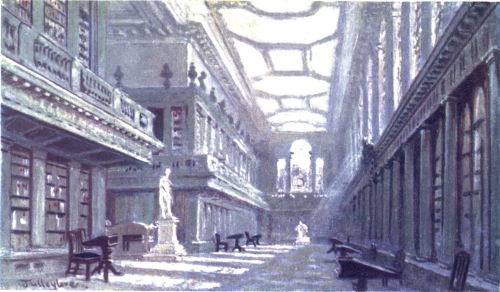
INTERIOR OF THE LIBRARY, ALL SOULS’ COLLEGE
At the extreme east end of the Library is a seated marble figure of
Sir William Blackstone, by Bacon, the standing figure on the north
side in the recess being that of Sir Christopher Codrington, the
Founder of the Library, by Sir Henry Cheere.
Behind the statue is placed a case containing ancient articles
discovered in excavations on the site of the College.
Book-rests and chairs for students are placed at intervals in the
Library, which is nearly 200 feet long by over 30 feet wide.
Bronze busts of Fellows alternate with vases on the cornice of the
upper bookcases.
The colour of this Library is especially suited to its purpose,
being quiet and restful to the eye; the proportions are excellent,
and help the dignity of the room.
[Pg 127]
[Pg 126]
[Pg 125]
the Renaissance, of English blood. But it was the Italian Renaissance;
and after his death the direct influence of Italy was small in Oxford.
It was, however, an Italian, Vitelli, who uttered the first words of
Greek in Oxford. Plato was soon to enjoy a new life there, and to be
woven into the past of Oxford, as if he had really been of its children.
It comes et paribus curis vestigia figit. It was an age of great,
unpopular men who came and went suddenly and obscurely in Oxford, like
the first lecturers of the twelfth century. They were divinely inflated
with the beauty of Greek—a language always more strange and exotic and
fascinating to Englishmen than Latin—and with admiration of the
restorers of that beauty, Chrysoloras, Chalcondila, Politian. Grocyn, a
Magdalen man, fresh from Italy, taught Greek in the hall of Exeter.
Linacre, a great physician and Grecian, was Fellow of All Souls’. The
refined, persuasive Colet, whose “sacred fury” in argument Erasmus
praised, was also a Magdalen man, and founder of St. Paul’s school. Sir
Thomas More, the most perfect, but unhappily not the most influential
type of the English Renaissance, was at St. Mary Hall. Erasmus met them
all in Oxford, within that old gateway of St. Mary’s College in New Inn
Hall Street. As they stepped out after the symposium, one pointed to a
planet in the sky:
“See how Jupiter shines; it is an omen,” said he.
“Yes,” said another, “and we have been listening to Apollo.”
For a time the Grecians were ridiculed and attacked[Pg 128] in the streets by
men who called themselves Priam, Hector, and Paris, and behaved—like
Trojans. In that first enthusiasm men seemed very near to the
inaccessible gods. Perhaps some were disposed to follow Pico della
Mirandola in pursuit of them. There was therefore a party which opposed
the study of Greek as heretical; and More was withdrawn from Oxford to
avoid the danger.
From the beautiful Magdalen cloisters came the men who launched Corpus
Christi College, just after Erasmus had published the New Testament in
Greek and the ancient Brasenose Hall had at last grown into a college.
The founder gave copies of Homer, Herodotus, Plato, and Horace, which
still survive. There was a public lecturer in Greek on the foundation.
Erasmus himself applauded and prophesied liberally of its future. It was
the “new college” of the Renaissance, as Wykeham’s had been of the
Middle Ages. The readers were to be chosen from England or Greece or
Italy. And among the first members of the college was the mystical
Bavarian dialler, Nicholas Kratzer, who made a dial in Corpus garden,
and that exquisite one for Wolsey, which is to be seen, in drawing, in
the library. Wolsey’s own college was built over against St.
Frideswide’s, part of which, together with one side of its cloisters,
was destroyed to give it place. It contained the largest quadrangle and
the most princely kitchen in Oxford. When Henry the Eighth spoiled the
monasteries, the bells of Osney were carried to Christ Church; and one
of them, over Wolsey’s gateway, does what it can to[Pg 130][Pg 129]
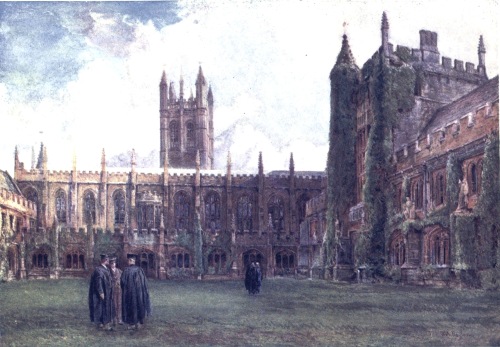
THE CLOISTERS, MAGDALEN COLLEGE
The Hall and Chapel of the College stretch nearly across the picture
immediately in front of the spectator, the oriel window which lights the
daïs of the Hall marking the division between the west end of the Hall
and the east end of the Chapel.
Farther west, and closely adjoining the Chapel, at the south-west angle
of the Cloisters, rises the Founder’s Tower. A gateway under the Tower
leads to the Quadrangle of St. John the Baptist and the entrance to the
College.
The figures above the buttresses of the Cloisters were probably not
designed for their present position, but add to the picturesqueness of
the Cloisters, which, it will be observed, project from the main body of
the buildings.
Above the gleaming roof of the Chapel appears the beautiful bell tower
of the College, detached, and built at a different angle from the Hall
and Chapel, which are continued in the same line. The tower is 145 feet
high, and was completed about 1505.
Men in Masters’ gowns walk and converse on the grass.
The time is late afternoon.
[Pg 133][Pg 132][Pg 131]
call the undergraduates home at nine, with a deep voice, as if it spoke
through its beard, which pretends to be B flat—“Bim-bom,” as the old
leonine hexameter says.
Hark! the bonny Christ Church bells—1, 2, 3, 4, 5, 6—
They sound so wondrous great, so wondrous sweet,
As they trowl so merrily, merrily.
Oh! the first and second bell,
That every day, at four and ten, cry,
“Come, come, come to prayers!”
And the verger troops before the Dean.
Tinkle, tinkle, ting, goes the small bell at nine,
To call the bearers home:
But the devil a man
Will leave his can
Till he hears the mighty Tom.
So runs the catch of a later Dean. At Christ Church also there was a
lecturer in Greek. The dialler, Kratzer, was made mathematical
professor. Wolsey’s chapel never rose above a few feet in height, and
the uncompleted walls remained for a century; St. Frideswide’s became,
almost at the same time, the cathedral of the newly-created see of
Oxford, and the chapel of the college.
The grandiose Christ Church kitchen, which caused so much laughter
because it was the Cardinal’s first contribution to his college, was in
fact rather characteristic of the age that followed. It was built with
the revenues of suppressed monasteries. It was almost contemporaneous
with the destruction of many priceless books by reformers who were as
ignorant of what is dangerous in books as a Russian censor. The shelves
of Duke Humphrey’s library were denuded and sold.[Pg 134] The shrine of St.
Frideswide’s, where the University had long offered reverence twice a
year, was shattered; the fragments were used here and there in the
buildings of the time. The relics of the saint were husbanded by a pious
few in hope of a restoration; but they were finally interred with those
of Peter Martyr’s wife—a significant mixture. It was the age when the
University became the playground of the richer classes, and the
nobleman’s son took the place of the poor scholar in a fellowship. Now
men found time to dispute with Cambridge as to which university was of
the greatest antiquity. The arguments put forward in Oxford were seldom
more convincing than this: that Oxford was named from a ford, Cambridge
from a bridge; and since the ford must have been older than the bridge,
Oxford was therefore founded first. Greek for the time decayed, and the
founder of Trinity College feared that its restoration was impossible in
that age. As to Latin, Sir Philip Sidney, who was at Christ Church, told
his brother that Ciceronianism was become an abuse among the Oxonians,
“who neglected things for words.” Oxford was dignified mainly by the
architecture of Christ Church; by the foundation of Trinity, St. John’s,
and Jesus College, all on learned and holy ground; by the martyrdom of
Latimer and Ridley, opposite Balliol; and by great names, like those of
Burton and Marston at Brasenose, Peele at Broadgates Hall (Pembroke),
Raleigh at Oriel, Hooker at Corpus Christi. Religion was still in the
pot, and men could not confidently tell what it would turn out to be. On
the one hand,[Pg 136][Pg 135]
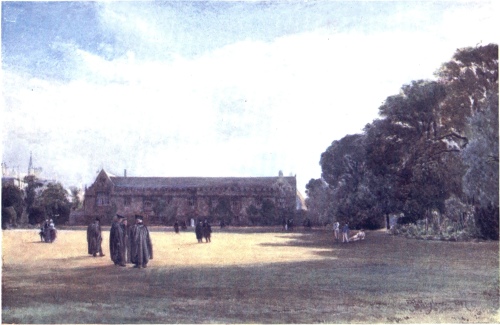
ST. JOHN’S COLLEGE
It is the east front of the College we see in the picture, the library
occupying the south end to the left. The garden upon which it looks is
one of the most beautiful and extensive in Oxford.
Some buildings of Balliol College show to the left.
The time is late afternoon in summer.
[Pg 139][Pg 138][Pg 137]
the Earl of Leicester, as Chancellor of the University, mended and
confirmed its organisation; on the other hand, John Lyly was “the
fiddlestick of Oxford,” and other Magdalen men, lovers of open air, and
especially in the windy forest of Shotover, slew the King’s deer. At the
new college of St. John’s, fellows and presidents suffered for the old
religion, and Edwin Campion was hanged; they preserved, and still
preserve, the statue of St. Bernard from the old foundation to which
their college succeeded. At the end of the century, the most effective
Oxford man of his time, William Laud, became Fellow of St. John’s. He
built a new quadrangle, and as Chancellor made of the statutes that long
and many-tailed whip which every one knows. He created modern Broad
Street by deleting the cottages which stood near and opposite to
Trinity. The impressive, uncomfortable Convocation House was his work.
Within sight of it was the library which Sir Thomas Bodley earlier in
the century had built and stored. It became the calmest, most inviolate,
and most learned place in Europe.
At Christ Church, Dean Duppa, the first of the improvers of Oxford, was
beginning the work of destruction which the Puritans continued so well.
But it was then the good fortune of several colleges to receive large
additions of a simple and homely character, which did more than any
others to make Oxford what it is. It was the age of the retired Lincoln
College chapel, with its carved panels of perfumed cedar and rich,
quaint glass; the placid garden front of Wadham, as seen through the
cedar tree to-day; the front and colonnades[Pg 140] of St. John’s which look on
the garden; the south end of the Exeter garden front that sees so much;
the front quadrangle of University College; the hall and chapel of St.
Mary’s Hall; the east end of Jesus College chapel, which was just
finished when Henry Vaughan arrived; and the front quadrangle of
Pembroke College, converted from Broadgates Hall by a clothier, the Earl
of Pembroke, and James I., and opened with ceremonies which included a
fantastic Latin oration by Sir Thomas Browne, as senior undergraduate.
The architecture of Wadham is a remarkable proof of the influence of
antiquity upon men and things in Oxford. The founders, in 1609, were
Nicholas Wadham and Dorothy, his wife, of Merifield in Somerset. The
builders were mainly west country men, and worked in that lingering
Gothic style which was still vital in Oxford, and seems to have guided
the hand of Wren (if it was Wren) when he planned the fan tracery of
Brasenose library. But in the building of Wadham chapel, one John Spicer
and his men seem to have been haunted by the beauty of the Perpendicular
churches of their native Somerset. The windows are so clear a
reconstruction of this dream that an experienced judge refused to
believe that they were of later date than Christ Church. Thither came a
son of Sir Walter Raleigh and Robert Blake, who took opposite sides when
the Civil War broke out.
There was a prelusive struggle between town and gown in the year before
the war. The chancellorship of Laud had roused opposition; but the
University was almost unanimous for Charles, and easily chose[Pg 142][Pg 141]
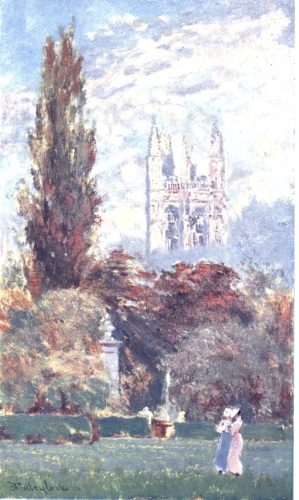
MAGDALEN TOWER AND BOTANIC GARDEN
The tower of Magdalen College is seen rising over the trees of the
Botanic Garden, illumined by the last rays of the setting sun.
Beneath the poplar is one of the gate piers, and through an opening in
the clipped hedge shows the basin of a fountain.
Two girls walk in the meadows.
[Pg 145][Pg 144][Pg 143]
its side, when he demanded a loan on the eve of the war.
Van Ling had just painted the windows of University College chapel. The
Dean of Christ Church, or rather “Smith of London,” had just finished
the airy over-traceried approach to Christ Church hall, upon which every
one looks back as he steps down to the cloisters. Other work was in
preparation at Christ Church. But all building suddenly ceased.
A brief visit of Parliament troops to the yet unfortified city was
recorded by the shattering of the Virgin and her Child over St. Mary’s
porch. After Edgehill, the King came to Oxford, and the effect was worse
than the mutilation of a Virgin of stone. The University Volunteers,
some armed with bows, were drilled in the quadrangle of New College and
Christ Church, and skirmished in the Parks. The royal artillery lay in
Magdalen Grove. New College tower and cloisters became the arsenal: New
Inn Hall the mint. Charles and Queen Henrietta Maria were lodged at
Merton. The Court was held at Christ Church. A Fellow of Magdalen and a
Fellow of All Souls’ edited the royalist gazette, Mercurius Aulicus,
“the latter pleasing more with his buffoneries.” The besieging
Parliamentarians were spread about the high ground of Headington, and
the low fields on the north of the city.
The greater number of scholars left Oxford, and their rooms were
occupied by ladies and cavaliers. College trees were cut down for use in
the defences.[Pg 146] A little war, much gallantry and coarseness, drove away
learning and tranquillity, unwilling to linger for the sound of Sir John
Denham’s smooth and insipid Muse, which produced Coopers Hill in 1642.
The Muses were probably in hiding abroad with Lovelace and Marvell; for
Milton was writing only prose, and George Wither, a Magdalen man, was a
captain of Parliamentary horse at Maidstone. Yet a contemporary pamphlet
says that “Robin Goodfellow” found the Muses near Eynsham. “He had not
gone as far as Ensham, but he espied the nine Muses in a vintner’s porch
crouching close together, and defending themselves as well as they could
from the cold visitation of the winter’s night. They were extream poore,
and (which is most strange) in so short an absence and distance from
Oxford they were grown extreamly ignorant, for they took him for their
Apollo, and craved his power and protection to support them.”
One room at Trinity College was pleasant still; for the glass of the
window was richly painted with a St. Gregory. And there Aubrey received
the newly-published Religio Medici, “which first opened my
understanding.” He carried it to Eston with Sir Kenelm Digby. Coming
back to Oxford, he bade a servant to draw the ruins of Osney “two or
three ways before ’twas pulled down.”
Plague came in 1643, fire in the following year. The Cavaliers were
reputed to have embezzled books from the Bodleian, which had formerly
resisted, and won the respect of, Charles himself. The colleges[Pg 148][Pg 147]
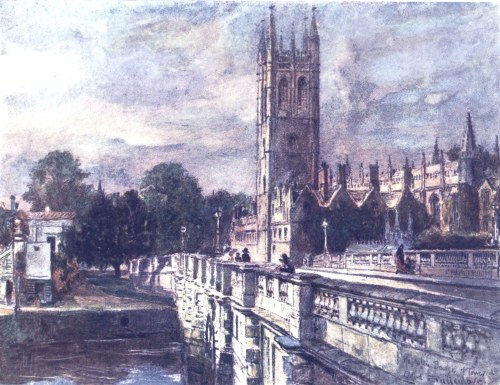
MAGDALEN TOWER AND BRIDGE
The Bridge runs westward across the picture, some buildings of the
Botanic Garden appearing on the extreme left.
Over the centre of the Bridge rises the fine tower of the College, while
to the right above the north balustrade of the Bridge shows the roof of
the Hall and Chapel.
On the ground floor of the gabled buildings are the kitchens, the upper
storey being used as sets of rooms for students.
We see part of the river Cherwell.
[Pg 151][Pg 150][Pg 149]
made what some call a “friendly loan” of all their plate: it was never
returned or replaced by the King. Week by week, they furnished him with
labour and cash. And when the Parliamentarians entered at last, there
were at Merton, for example, “no Bachelors, hardly any Scholars, and few
Masters,” and the hall was untenantable. The triumph of Parliament
brought with it an inquisition in Oxford, which resulted in the exile,
not without force, of the greater number of heads of houses and fellows
for refusal to submit. The soldiers broke the Magdalen chapel
window-glass; Cromwell himself took away the college organ to Hampton
Court. But “the first thing General Fairfax did, was to set a good guard
of soldiers to preserve the Bodleian Library. He was a lover of
learning, and had he not taken this special care, that noble library had
been utterly destroyed.” The chief objection to the intruded fellows and
heads of houses seems to have been that they were intruded and were
likely to stay. As for their accomplishments, though some lacked humour,
they seem to have been respectable. The undergraduates and bachelors
were in the main loyal to Cromwell; and when Prince Charles was rumoured
to be approaching Oxford, New College tower became a Parliament citadel,
and a troop of horse was enlisted from the colleges. The old glory of
religion faded; the sound of distant Latin chanted was no longer heard
in Christ Church and New College. But in one house, three devoted men
preserved the old religion right through the Commonwealth, constantly
and without[Pg 152] molestation. Other changes made men more content. Three
coffee-houses were opened in Oxford and patronised by royalists and
“others who esteemed themselves virtuosi and wits.” Men who would have
adorned any age came up. Christopher Wren came to Wadham, and thence to
All Souls’. Evelyn revisited Oxford and found no just ground to regret
the former times, ... “creation of Doctors, by the cap, ring, kiss,
etc., those ancient ceremonies and institutions, as yet not wholly
abolished.” At All Souls’ he heard “music, voices, and theorbos,
performed by some ingenious scholars.” At New College “the chapel was in
its ancient garb, notwithstanding the scrupulosity of the times,” and
the chapel at Magdalen was “in pontificial order, the altar only I think
turned table-wise.” Then he dined at Wadham, and wrote down an account
of what he saw at the Warden’s, “that most obliging and universally
curious Dr. Wilkins.” The transparent apiaries, hollow speaking statues,
dials, waywisers, and other “artificial mathematical and magical
curiosities,” which he saw, well illustrate the activities of the time
in the cradle of the Royal Society.
A little after Wren came Thomas Traherne, the poet, to Brasenose, still
enjoying that childhood which he praised so adeptly. We may think of him
in the peaceful embowered city as having that characteristic ecstasy at
the sight of common things which his lyrical prose describes. “The corn
was orient and immortal wheat which never should be reaped nor was ever
sown. I thought it had stood from everlasting to[Pg 154][Pg 153]
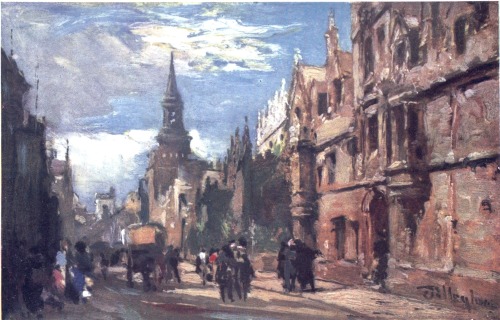
ALL SOULS’ COLLEGE AND THE HIGH STREET
On the right of the picture are the entrance gate and part of the south
front of All Souls’ College. West of the College, and facing the narrow
street leading into Radcliffe Square, shows the east end of the south
aisle of St. Mary’s Church, and the white pinnacles of the Nave.
Past the porch and the new extension of Brasenose to the High Street
rises the tower and spire of All Saints’, the distance being closed by
the tower of St. Martin at Carfax.
[Pg 157][Pg 156][Pg 155]
everlasting. The dust and stones of the street were as precious as gold:
the gates were at first the end of the world. The green trees, when I
saw them first through one of the gates, transported and ravished me;
their sweetness and unusual beauty made my heart to leap, and almost mad
with ecstasy, they were such strange and wonderful things. The men! O
what venerable and reverend creatures did the aged men seem! Immortal
cherubim! And young men glittering and sparkling angels, and maids
strange seraphic pieces of life and beauty!”
Again, books began to flow in their natural courses to the libraries.
Selden’s eight thousand came to the Bodleian. Building was resumed; for
Brasenose chapel was half built by the time of the Restoration.
The Restoration restored to Oxford the Church, a few excellent old men,
and the morals of the siege. The august Clarendon was indeed Chancellor;
but the city became a fashionable resort. Charles II., with his Queen
and Castlemaine, were there in 1663, and again with the Parliament in
the year of the plague. “High-thundering Jove,” runs a contemporary
ballad, supposed to be spoken by London to Oxford:—
High-thundering Jove cannot withstand thy charms,
That Britain’s mighty monarch in thy arms
Canst hold so fast, and quite to overcome
The greatest potentate in Christendom.
The aim of scholars, said Anthony à Wood, “is not to live as students
ought to do, viz., temperate, abstemious, and plain and grave in their
apparel; but[Pg 158] to live like gentry, to keep dogs and horses, to turn
their studies into places to keep bottles, to swagger in gay apparell
and long periwigs!” There was too much punning, thought Eachard. In his
inquiry into the causes of the contempt of the clergy, he is not kind to
the University of the day, and asks, “Whether or not Punning, Quibbling,
and that which they call Joquing, and such delicacies of wit, highly
admired in some academic exercises, might not be very conveniently
omitted?” The first Common Room was established at Merton soon after the
Restoration. But in that age even Common Rooms seem to have been but
privileged and secluded inns, and quite without the severely genial
amphictyonic character of to-day. When Pepys visited Oxford he naturally
found it “a very sweet place”; spent 2s. 6d. on a barber in its honour;
10s. “to him that showed us All Souls’ College and Chichley’s picture”;
2s. for seeing the Brasenose butteries and the gigantic hand of the
“Child of Hale”; and having seen the Physic Garden, the hospital, and
Friar Bacon’s study, concluded: “Oxford mighty fine place, well seated,
and cheap entertainment.” But the cheap entertainment is now among the
lost causes. A little while afterwards, Evelyn attended the opening of
the Sheldonian Theatre, built by Wren. He complained of the “tedious,
abusive, sarcastical rhapsody” which was permitted on that occasion to
the Terræ Filius, a kind of Billingsgate Aristophanes, who
half-officially represented the undergraduate aversion to sweetness and
light. The university printing-[Pg 159]offic[Pg 160]e
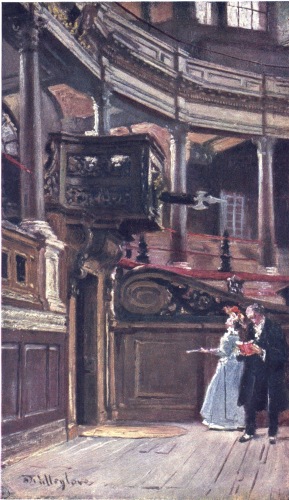
INTERIOR OF THE SHELDONIAN THEATRE
The proceedings of Commemoration take place here, at which time the
area—entered by the door to the left—is crowded by visitors.
One of the two figures is gazing at the pulpit from which the prize
poems and essays of successful candidates are recited.
The axe and fasces projecting from the pulpit denote the justice of the
awards.
The upper gallery is supported by wooden columns standing upon a podium
partially surrounding the area, and the building altogether is one of
Sir Christopher Wren’s best works.
[Pg 163][Pg 162][Pg 161]
lay under the theatre, and, says a ballad of the time—
What structure else but prides it to reveal
Treasures? which bashful this would fain conceal; ...
Spain, Gascoin, Florence, Smyrna, and the Rhine
May taste their language there, tho’ not the wine.
The Jew, Mede, Edomite, Arabian, Crete,
In those deep vaults their wandring ideoms meet,
And to compute, are in amazement hurld,
How long since Oxford has been all the world.
At Magdalen, men were planting the elms of the grove and laying out the
walks round the meadow. Bishop Fell was completing the west front of
Christ Church, which the Civil War had interrupted, and planting those
elms in the Broad Walk that look on the Cathedral and Corpus and Merton,
and, farther off, Magdalen tower. In 1680 Wren’s tower over Wolsey’s
gateway at Christ Church was finished. One of the Osney bells was recast
to hang therein.
The resistance of James II. fell in this coarse, frivolous,
self-satisfied age. He was welcomed to Oxford by music and ceremony. The
conduit “ran claret for the vulgar.” But when he adventured to force his
nominee into the presidentship of Magdalen, he could not even procure a
blacksmith to burst a resisting door. Again, the University stood to
arms to oppose Monmouth’s rebellion, and clothed its members in scarlet
coats, with scarves, and white-plumed hats; but had to be contented with
the bonfires in celebration of the victory at Sedgemoor, and a
full-dress parade. Not long afterwards many yards of orange ribbon made[Pg 164]
the High Street gaudy with a pretence at honouring William III. But the
colleges were vigorously Jacobite, and proved it by drinking the healths
of the Stuarts as long as they could. Merton, Exeter, All Souls’, and
Wadham were the exceptions. One example of the lighter occupations of
the period is to be found in a story of somewhat earlier date, told of
Dr. Bathurst, Vice-Chancellor and President of Trinity. “A striking
instance of zeal for his college, in the dotage of old age, is yet
remembered. Balliol College had suffered so much in the outrages of the
grand rebellion, that it remained almost in a state of desolation for
some years after the Restoration, a circumstance not to be suspected
from its flourishing condition ever since. Dr. Bathurst was perhaps
secretly pleased to see a neighbouring and once rival society reduced to
this condition, while his flourished beyond all others. Accordingly, one
afternoon, he was found in his garden, which then ran almost continuous
to the east side of Balliol College, throwing stones at the windows with
much satisfaction, as if happy to contribute his share in completing the
appearance of its ruin.” I seem to find an echo of the sentiment of very
different men, with a love of the old time amidst the politics and wine
of the day, in Aubrey’s ejaculation: he wished that monasteries had not
entirely been suppressed; for if but a few had been left, “what a
pleasure ’twould have been to have travelled from monastery to
monastery!” Nevertheless, the Oxford output of bishops was not
decreased, and the number of quiet scholars—men like[Pg 166][Pg 165]
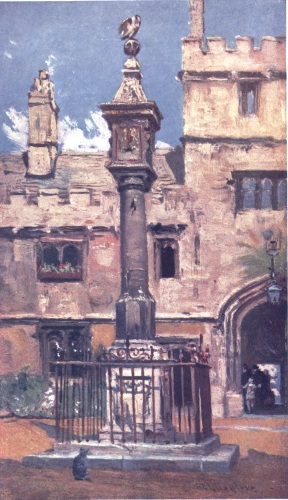
CORPUS CHRISTI COLLEGE
In the centre of the quadrangle rises a cylindrical dial, surmounted by
a “pelican in her piety,” the badge of the Founder of the College.
Behind, to the right, is the great entrance gateway and tower.
The College cat gives scale.
[Pg 169][Pg 168][Pg 167]
Hody of Wadham—was larger than one might conclude from the pages of
honest Thomas Hearne, of St. Edmund Hall.
It was upon an old monastic foundation—once Gloucester College, then
Gloucester Hall—that the one new eighteenth-century college was
established. Gloucester Hall had numbered among its inhabitants several
famous, rather odd men, like Tom Coryat and Thomas Allen, but had fallen
away after the Restoration. It was, in short, almost a possession of
nettles. The buildings were only kept on the edge of desolation by the
Principal and two or three families in residence. The seventeenth
century had made one fantastic attempt to retrieve the Hall. A colony of
twenty students from the four Patriarchates of the Eastern Church was to
be regularly established there. But the dreamy plan was soon parched and
destroyed in the odour of scandal. After much trifling procrastination,
the Greeks were succeeded by Worcester College, and a lucky poverty left
the worn old buildings for a little longer untroubled. A library, a
hall, and a chapel were prepared for the new society. Wide spaces of
land on every side of it were retained or acquired, which afterwards
gave the college a fat rent and its incomparable bosky and watered
garden.
While Worcester was being founded in the conventional way, Oxford was
developed by such buildings as the cloister at Corpus, the Pembroke
chapel, the hall at All Souls’, the front quadrangle at Queen’s, and the
little Lincoln “Grove” cottages. Then also the[Pg 170] Trinity College lime
trees were planted. In most of the work of that time Dean Aldrich of
Christ Church had a hand or a word. This clever and genial tutor was one
of the best men of his day, and quite typical of the early eighteenth
century. He seems to have been one to whom action came more naturally
than dreams, if he dreamed at all; and he could easily express the many
sides of his personality in a lasting way. A happy and golden
mediocrity! He encouraged Boyle in the dazzling indiscretion of The
Epistles of Phalaris. He wrote the enduring Oxford Logic, a smoking
catch, and “Hark! the bonny Christ Church bells”; and perhaps this
translation:—
If on my theme I rightly think,
There are five reasons why men drink,
Good wine, a friend, or being dry,
Or lest we should be, by and by,
Or any other reason why.
The size of his architectural designs is seen in Peckwater quadrangle at
Christ Church; their charm, in All Saints’, which the moon loves. Soon
after his death in 1710, the stately library at Christ Church and that
copious one at All Souls’ were begun.
In the year of the building of Pembroke chapel, Samuel Johnson entered
the college, where they preserve his deal writing-table and china
tea-pot. As Aldrich represents the early part of the century in Oxford,
so Johnson represents the middle. Men are nowadays disposed to blame the
cheerfulness of an age that produced a hundred immortals who do not give
the true[Pg 172][Pg 171]
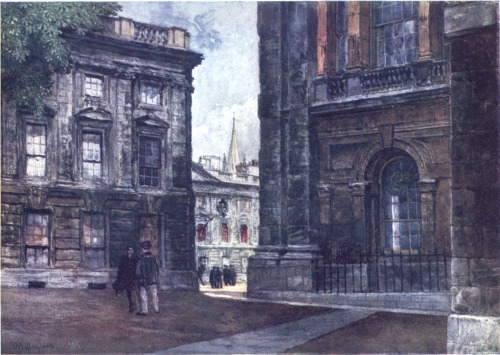
CHRIST CHURCH—PECKWATER QUADRANGLE
Through the opening between the west end of the College Library on the
right, and some houses inhabited by Masters of the College on the left,
appears the spire of the University Church of St. Mary. Part of the
pediment of the buildings on the north side of Peckwater Quadrangle
shows beneath.
The piece of masonry on the extreme right of the picture is part of the
wall of the passage leading to Tom Quadrangle.
Two undergraduates converse to the left.
[Pg 175][Pg 174][Pg 173]
ring. The college historians often entitle one of their
eighteenth-century chapters the “dark” or “iron” age; and indeed, as a
“school of universal learning,” the Oxford of that day might be called
in question. It was more aristocratic and exclusive, perhaps, than it
had ever been, and it failed to justify itself. “What class in life”—it
was a song by a fellow in a play of the period—
What class in life, tho’ ne’er so great,
With a good fellowship can compare?
And in the same play, says one, of Horace, “He was a jolly utile dulci
dog, and I believe formerly might be fellow at a college.” Yet in our
backward glances over Oxford history, how often do we stop when we reach
that age! whether we are drinking from an old reminding tankard with the
date 17—, or looking at one of its books, or living in one of the rooms
which it wainscotted or furnished, heavily but how genially! “You are a
philosopher, Dr. Johnson,” said Edwards, his college friend. “I have
tried too in my time to be a philosopher; but I don’t know how,
cheerfulness was always breaking in.” Cheerfulness broke in pretty often
in Oxford. And that was a time when there was more love of Oxford than
ever before. Even the wealthy Fellows of All Souls’ (“that Eden to the
fruitful mind,” as Lady Winchilsea called it at that time) never bought
their college; and when one of them was taunted with the quip that
Oxford was less learned than Bath, he was able to reply that it was also
more fashionable. I find, too, in its love of the past, as[Pg 176] in its love
of nature, something heartier, though I daresay less mystical, than our
own. Johnson’s love of Pembroke is an example. He had lived there as an
undergraduate only fourteen months, and there seems to have been little
that was tangible, to take hold of him in so short a time. Yet when he
came back long after, and heard old Camden’s grace after meat—which
they still use—he was at home. It is true that men of that age could as
little appreciate its blank verse as we can compose it, but there were
many who could then appreciate what we can now only describe. The
country (in summer)—antiquity—good living—were fine things; but when
they wrote, it was theology, or morals, or inaccurate philology. There
was a man, long ago with God, who after much waiting obtained a fine
coveted room at New College: instead of writing a sonnet forthwith, he
expressed a wish to kick some one downstairs incontinently. On one
occasion, it is said, the head of a college, and a great lover of
Oxford, who was jocund and recumbent after a feast, was with great
circumstance invited by several wags “to accept the crown of this old
and famous kingdom, since King George has resigned.” To which he slowly
replied, without surprise, that “if we can hold our Court of St. James’s
in this Common Room, we shall not demur.” Warton’s Companion to the
Guide and Wood’s Modius Salium are full of what we should call poor
Oxford humour; but I think there is sufficient indication of the
laughter it caused, to make us pause in any condemnation of it as
compared with our own “thoughtful mirth,” which[Pg 178][Pg 177]
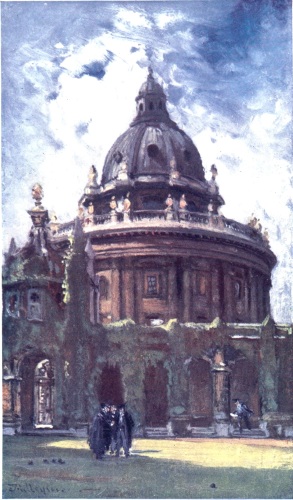
THE RADCLIFFE LIBRARY, OR CAMERA BODLEIANA, FROM ALL
SOULS’ COLLEGE
Across the picture runs a cloistered screen separating the green
quadrangle of All Souls’ College from Radcliffe Square. Over an
entrance to the College to the left rises an octangular ogee roof,
protecting some beautiful wrought-iron gates.
To the right of this is the grand sweeping entablature of the
Camera, bearing its majestic dome and lantern. This dome may
compare with some of the finest in Europe.
The time is morning.
[Pg 181]
[Pg 180]
[Pg 179]
inspires mainly a desire to say something more mirthful and less
thoughtful. And for those who care for none of these things, what
sweeter or more dignified picture of quietness and study is there than
at Lincoln in Wesley’s time, or at University under Scott, or Christ
Church under Jackson? What handsomer than the Camera which was built in
the middle of that century, or better to live in than Fisher’s buildings
at Balliol? Or what inheritance more agreeable than the old
bowling-greens, so happily celebrated in the Sphæristerium; or than the
college gardens, which are nearly all eighteenth-century gifts? It has
been said that the only movement in the eighteenth century was a very
slow ascent to the nineteenth. That is not quite so, as many will agree
who look at the re-fronting of University College chapel and hall, which
was done when the wonderful century was reached at length. In fact, if
we condemn the eighteenth century, we have to disown a large part of the
nineteenth. In Oxford that is especially so. The destruction of the old
chapels at Balliol and Exeter, and of the Grove at Merton, was carried
out only fifty years ago; so long have the dark ages lingered in Oxford.
As for the new buildings at New College, Christ Church, Merton, etc.,
they have been so widely condemned that it is to be presumed there is
some merit in them, which an age nearer the millennium will praise.
But those works are only the less admirable and more conspicuous emblems
of the nineteenth-century reformation. It had at length become possible
again for[Pg 182] a man to keep his terms and take his degree without continual
residence within college walls. The numbers of the University grew
rapidly, and at a time when more efficient tutors and discipline made
Oxford attractive to many who were neither frivolous nor rich. Oxford
became, in fact, a place of education. The previous century had been
conspicuous for great names and lack of system; what was achieved was
due to individual endowment and energy; and the able men stood somewhat
apart from their contemporaries. Wesley, for example, not only failed to
make a strong party, but even to rouse an opposition of useful size. The
nineteenth century, on the other hand, was a sociable one in matters of
intellect. There were few lonely names. There were many groups. College
after college—in a few cases before, in nearly all cases after, the
first Commission—became known for their style of thought more than for
their noblemen or wine. The fault of monkishness was either blotted out
or exchanged for one that is more commonly pardoned to-day, nimium
gaudens popularibus auris. At first, this meant an emphasis upon the
distinction between college and college. It required more than a walk up
Turl Street to get from Oriel to Balliol. The competition engendered by
the new separate honour schools probably increased this for a time; and
it was reported of one Head that, when told that Worcester College was
above his own in a class list, he turned to the butler, and asked where
Worcester was. But the east wind of the Commission changed all that. At
the same time[Pg 184][Pg 183]
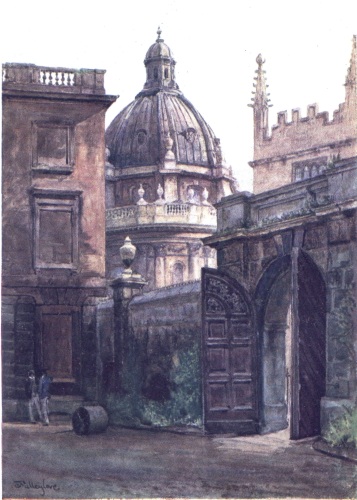
ENTRANCE GATEWAY OF HERTFORD COLLEGE AND THE RADCLIFFE
LIBRARY
The gateway and wall have disappeared, this view of the Library
being shut out by the new high buildings.
To the left of the picture is a part of the College, and over the
gateway shows a portion of the old Schools, the majestic dome and
lantern of the Radcliffe Library filling the intervening space.
A couple of undergraduates lean against the building to the left of
the picture.
[Pg 187]
[Pg 186]
[Pg 185]
the friendly and often stimulating intercourse between senior and junior
members of the colleges grew apace, and was no doubt encouraged by the
increasing fashionableness of athletic sports, which gave a “Blue” the
importance of a fellow, and a greater consciousness of importance.
In its progress towards what is most admired in modern Oxford, Balliol
is the most interesting college. Nearly all other colleges have indeed
acquired a more or less thorough resemblance to Balliol in its good and
bad points, but no other college has been so long, so persistently, and
so progressively devoted to the same ideal. Even those who do not wholly
like that ideal cannot fail to admire the consistency and energy of the
men who have achieved it, or could find the like to any comparable
extent in colleges that cherish other affections.
But nowhere has there been an entire rupture with the past, or anything
new which has not in a sense been laid reverently upon the foundations
of the old. If one could see Keble College without its buildings, it
might well seem to be not the youngest of the colleges. So, too, with
Hertford College, which is indeed but the rejuvenation of the old homes
of Hobbes, Selden, and Matthew Hale: it has doffed knee-breeches and
periwig, and even those perhaps unwillingly, since its fellowships are
lifelong for the celibate. And in the architecture of Oxford, some of
the most novel effects of last century were produced by work in the same
spirit of reverence for the past. Here, a[Pg 188] window received back its
casements again; there, a fine roof was rescued from its burial under
the impertinent superimpositions of more egotistic innovators. No other
age and city perhaps would have been so curious and fortunate in
restoring the old, as when at Christ Church the old floral marble base
of St. Frideswide’s shrine was restored after three hundred years in the
wilderness. Part was found in the cemetery wall, part in a well-side,
part in a staircase, part in a wall: and almost the whole now rests in
the Cathedral again.[Pg 190][Pg 189]
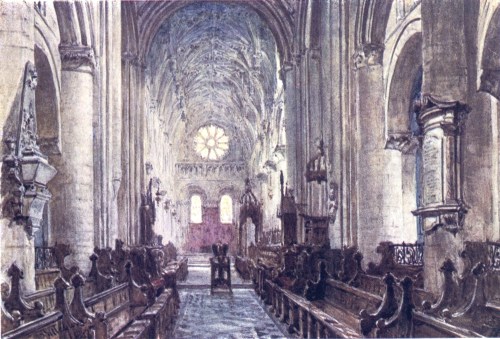
INTERIOR OF THE CATHEDRAL OF CHRIST CHURCH
At the east end of the choir is seen the wheel-window with two
circular-headed windows underneath, restored in 1871.
Above these rises the late groined roof of the Choir, its richness
contrasting well with the Norman arches below, which spring from
corbels attached to the pillars.
The Cathedral is also the College Chapel.
[Pg 193]
[Pg 192]
[Pg 191]
[Pg 194]
[Pg 195]