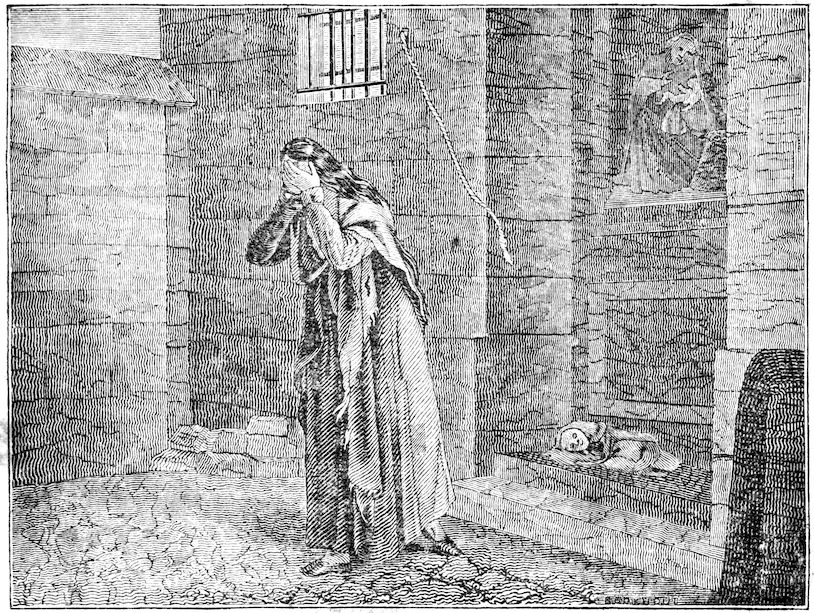
The frontispiece which accompanies this
treatise, represents a poor mother abandoning
her infant, at the gate of the Hôtel des Enfans
trouvés, (Foundling Hospital) at Paris. The
original painting, from which this is a faithful
copy, is by Vigneron, a French artist of celebrity;
it was purchased at the price of one thousand
dollars for the Galerie Royale, and is now in the
possession of the French king.
The Hôtel des Enfans trouvés, than which a
more humane institution was never founded, exhibits,
in its every arrangement, order, economy,
and, above all, a beautiful tenderness of the feelings
of those poor creatures who are thus compelled
to avail themselves, for their offspring, of the
asylum it affords. No obtrusive observation is
made, no unfeeling question asked: the infant
charge is received in silence, and either trained
and supported until maturity, or, if circumstances,
at any subsequent period, enable the parents to
claim their offspring, it is restored to their care.
There is surely no sect or creed so frozen, or
viritual so rigid, that it can systematize away the
common feelings of humanity, or dry up, in the
breasts of some gentler spirits, the milk of human
kindness. The benevolent founder and indefatigable
supporter of this noble institution, was a
Jesuit! Be the good deeds of St. Vincent de Paul
remembered, long after the intrigues and cruelties
of his fellow sectaries are forgotten!
The case selected is one of mild, of modified,—I
had almost said, of favoured misfortune: an
extreme case were too revolting for representation.
But even under these comparatively happy circumstances,
when benevolence extends her Samaritan
care to the destitute and the forsaken,
who that regards for a moment the abandoned
helplessness of the deserted child, and the mute
distress of the departing mother, but will join in
the exclamation, “Alas! that it should ever have
been born!”
EDITOR’S PREFACE.
vii
Ten years have already elapsed since the
publication of the last edition of Mr. Owen’s
book, and it is believed that such change of public
sentiment has taken place, as will render a
republication of the work, with such additions and
alterations as the discoveries and improvements in
this department of physiology have brought to
light, acceptable to the author, his friends, and
the public. Several years spent in a course of
experimental investigation, have brought to the
Editor’s knowledge some practical facts, which,
taken in connexion with the author’s candid
investigation of the subject, would be sufficient
apology (were any necessary) for the publication
of this little treatise, at the present time. Moreover,
a train of circumstances have developed
themselves during the last few years, which have
done much to remove a bias from the public mind,
unfavourable to the subject matter herein discussed.
These circumstances will insure for it
viiia more favourable reception at this time. It is a
self-evident fact, that every discovery in science
which serves to make mankind happier and better
beings, and at the same time evidently tends to
the prevention of crime and to the removal of
moral evil, deserves to be extensively made
known.
PREFACE.
ix
It may be proper to state, in few words, the immediate
circumstances which induced me, at the present
time, to write and publish this treatise.
Some weeks since, a gentleman coming from England
brought with him two pretty specimens of English
typography. One represented a triumphal arch
with a statue of the late king, and was made up of
17,000 different pieces of common printing type; the
other, an altar piece, having the Lord’s Prayer, Creed,
and Commandments, printed within it, and composed
of about 13,000 separate pieces. The gentleman was
requested by a Brighton printer who executed them,
to present these, as specimens of English typography,
to some of his brethern craftsmen in America. He
presented them to me. I admired the ingenuity displayed
in the performance; but thought they ought to
have been presented rather to some printers’ society
than to an individual. I therefore addressed them to
our Typographical Society in New York, accompanied
by a note simply requesting the society’s acceptance
of them, as specimens of the art in England.
I thought no more of the matter, until I received, the
other day, my specimens back again, with a long and
not a little angry letter, signed by three of the members,
xaccusing Robert Dale Owen of principles subversive
of every virtue under heaven, and calculated to
lead to the infraction of every commandment in the
decalogue: and, more especially, accusing him of
having given his sanction to a work, as they expressed
it, “holding out inducements and facilities for the
prostitution of their daughters, sisters, and wives.”
I subsequently learned, from one of the society, circumstances
which somewhat extenuate (albeit nothing
can excuse) their childish incivility. A gentleman
who busied himself last year in making out a notable
reply to the “Society for the Protection of Industry,”
got up, at a late Typographical meeting, and read to
the Society several detached extracts from a pamphlet
written by Richard Carlile, entitled “Every Woman’s
Book,” which extracts he pronounced to be excessively
indecent; and asked the Society whether they
would receive any thing at the hands of a man who
publicly approved a book of a tendency so dreadfully
immoral; which, he averred, I had done. The society
were (or affected to be) much shocked, and thereupon
chose a committee to return to me the heretical specimens,
which committee penned the letter to which I
have alluded.
Probably some members of the society really did
believe the work to be of pernicious tendency. Had
some garbled extracts only from it been read to me,
I might possibly have utterly misconceived its tone
and tendency, and its author’s motives. But he must
be blind indeed, who can read the pamphlet through,
and then (whether he approve it or not) can attribute
xiother than good intentions to the individual who was
bold enough to put it forth.
As to the book itself, I was requested, two years
since, when residing in Indiana, to publish it, and declined
doing so. My chief reasons were, that I doubted
its physiological correctness; that I did not consider
its style and tone in good taste; but chiefly (as
I expressed it in the New Harmony Gazette) because
I feared it would be circulated in this country only “to
fall into the hands of the thoughtless, and to gratify
the curiosity of the licentious, instead of falling, as it
ought, into the hands of the philanthropist, of the
physiologist, and of every father and mother of a
family.” The circumstances I have just detailed may
afford proof, that my fears regarding the hands into
which it might fall, were well founded.
My principles thus officiously and publicly attacked,
I have felt it a duty to the cause of reform to step forward
and vindicate them; and this the rather, because,
unless I give my own sentiments, I shall be understood
as unqualifiedly endorsing Richard Carlile’s. Now,
no one more admires than I do the courage and
strength of mind which induced that bold advocate of
heresy to broach this important subject; and to him
be the praise accorded, that he was the first to venture
it. But the manner of his book I do not admire.
There is in it that which was repulsive (I will not say
revolting) to my feelings, on the first perusal; and
though I afterwards began to doubt whether that first
impression was not attributable, in a great measure,
to my prejudices, yet I cannot doubt that a similar,
xiiand even a more unfavourable impression, will be
made on the minds of others, and thus the interests
of truth be jeopardized. Then again, I think the
physiological portion of his pamphlet somewhat incorrect
as to the facts, and therefore calculated to mislead,
where an error might be of fatal consequence.
It may seem vanity in me to imagine, that this
treatise is free from similar objections; yet I have
taken great pains to render it so.
R. D. O.
INTRODUCTION.
xiii
The reader, after having been taxed with
the perusal of two prefaces before reaching
the subject matter, may consider it a hardship
to be further called upon to read a somewhat
lengthy introduction, when the title of a book
should be its best preface; but the Editor
would ask your indulgence while he briefly
states the object and design of the following
pages.
It has often been held of questionable propriety,
whether the public should be furnished
with medical readings, it being presumed that
such literature tended to thwart the very
purposes it professed to encourage: that, instead
of affording an exposition of the ills of
our nature, whereby we might avoid or remove
them, its effect necessarily, from the
probable absence of all preliminary medical
knowledge on the part of the reader, was but
to create confusion and alarm, and, even
where understood, only to magnify the fear;
xivand this latter notion is grounded on the
popular error, that even professional men,
from the same cause, are least efficient when
in attendance upon themselves. The doubt,
however, may now be considered as removed
if we but observe how of late years the desire
to possess general information on all
matters relative to the functions of life, has
manifested itself, by the public attendance at
the various learned institutions, and how also
it has been encouraged by men eminent for
their talents and worth, devoting themselves
to the unfolding and simplification of the professional
lore they had been years in acquiring.
Lectures have been given, and large crowds
of silent and anxious auditors have attended
them—edition after edition of popular works
on similar subjects, by the same men, have
been called for, and eagerly caught up—the
mysteries of physiology have been laid open
from the lowest to the highest scale of creation:
the history of man has been displayed,
and his several elements have been demonstrated—the
phenomena of respiration, digestion,
and the circulation of the blood, have
all had their share of attention, and many of
the most prevalent diseases of humanity have
xvbeen discussed and examined, their causes
exposed, and the means of their avoidance
detailed. So far from the public suffering
from this diffusion of medical knowledge,
immense advantages have accrued to all classes
of mankind.
Among all the departments of anatomical
research thus introduced, public decorum has
judiciously excluded popular enquiries into
the physiological laws of generation. I say
judiciously, for the discussion of such topics,
constituted as society is, could not be tolerated
in large assemblies, and probably of both
sexes, without the risk of engendering associations
inimical to morality and virtue;[1] but
xvino one can be blind to the creeping progress
there is daily being made, of touching upon
these subjects in popular journals and publications,
and no one can deny at least the
importance of obedience to the laws that
abide over the procreation of a healthy or
diseased population. In the absence of information
afforded through legitimate channels
to the public, and feeling sensible that
many errors are committed through ignorance,
and endured through shame, this little
work is tendered, accompanied with the hope
that its usefulness may not be deteriorated
by any misinterpretation of the writer’s motives.
The philosopher, in asking himself the
question, what is love, solves it by asking another
question, what is an animal, or what is
man?
Looking at mankind, he finds them of two
classes, male and female, varying but little as
xviito external form or internal character. He
finds that they possess the same passions, the
same desires, that they live by the same
means, and with the difference of the female
being the body qualified to breed the species,
he sees them in every respect to be exactly
alike.
Reproduction or accumulation of identities
similar to self is a common law of animal and
vegetable matter; and the disposition to reproduce
in all well-formed and healthy subjects
is as powerful as hunger, or thirst, or
the desire of self-preservation. It is a passion
not criminal in the indulgence, but criminality
attaches where the indulgence is withheld;
because health, and even life, is endangered.
It is not an artificial passion, such as a craving
to exhibit the distinctions of society; but a
natural passion, which we hold in common
with every other animal. It grows with our
growth, and is strengthened with our strength.
To prove that genuine love is nothing but
this passion, it is sufficient to refer to the period
at which it comes on, and at which it
leaves us. We hear not of love in decaying
age or in infancy; and the attachments of
habit, of kindness, of gratitude, or of human,
social, individual, parental, filial, or domestic
xviiiaffection, have no connexion with the passion
of love. We talk of a love, of virtue, of
friendship, of heroism, of character, of generosity;
but this kind of love is a matter
wholly distinct from the passion of love between
the male and female. All men are apt
to feel the tender passion of love for a beautiful
woman: all women for a handsome and
agreeable man: but this is nothing more than
a desire to associate ourselves with the most
agreeable objects for sexual commerce. The
every day occurrences of mankind explain
this matter, and hence the many violences
and intrigues connected with the passion of
love; hence seductions, adulteries, rapes and
intercourses pronounced unlawful in different
countries.
The present purpose of this work is, to explain
the physiology of the reproductive
organs, and the social bearing that a proper
control of the reproductive instinct will have
upon society, and its consequences when uncontrolled,
and the benefits that must necessarily
accrue when kept under due restraint.
Chemical science and experimental investigation,
aided by the recent discoveries in
that department of literature, have enabled
xixthe Editor to offer to the suffering mother a
safe and sure preventive of conception. The
expediency and moral propriety of its use he
trusts will be satisfactorily explained in the
subsequent pages.
MORAL PHYSIOLOGY.
21
I sit down to write a little treatise, which
will subject me to abuse from the self-righteous,
to misrepresentation from the hypocritical,
and to reproach even from the
honestly prejudiced. Some may refuse to
read it; and many more will misconceive its
tendency. I would have delayed its publication,
had the choice been permitted me, until
the popular mind was better prepared to
receive it; but the enemies of reform have
already foisted the subject, under an odious
form, on the public: and I have no choice
left. If, therefore, I prematurely touch the
honest prejudices of any, let them bear in
mind, that the occasion is not of my seeking.
The subject I intend to discuss is strictly a
physiological subject, although connected, like
many other physiological subjects, with political
economy, morals, and social science. In
22discussing it, I must speak as plainly as physicians
and physiologists do. What I mean, I
must say. Pseudo-civilized man, that anomalous
creature who has been not inaptly defined
“an animal ashamed of his own body,”
may take it ill that I speak simply: I cannot
help that.
A foreign princess, travelling towards
Madrid to become queen of Spain, passed
through a little town of the peninsula, famous
for its manufactory of gloves and stockings.
The magistrates of the place, eager to evince
their loyalty towards their new queen, presented
her, on her arrival, with a sample of
those commodities for which alone their town
was remarkable. The major domo, who
conducted the princess, received the gloves
very graciously; but when the stockings were
presented, he flung them away with great
indignation, and severely reprimanded the
magistrates for this egregious piece of indecency.
“Know,” said he, “that a queen of
Spain has no legs.”[2]
I never could sympathize with this major
domo delicacy; and if you can, my reader,
23you had better throw this book aside at
once.
If you have travelled and observed much,
you will already have learnt the distinction
between real and artificial propriety. If you
have been in Constantinople, you probably
know, that when the grand seignor’s wives
are ill, the physician is only allowed to see
the wrist, which is thrust through an opening
in the side of the room, because it is improper
even for a physician to look upon another
man’s wife; and it is thought better to sacrifice
health than propriety.[3]
If you have sojourned among the inhabitants
of Turcomania, you know that they
consider a woman’s virtue sacrificed for ever,
if, before marriage, she be seen to stop on
the public road to speak to her lover:[4] and
if you have read Buckingham’s travels, you
may remember a very romantic story, in
which a young Turcoman lady, having thus
forfeited her reputation, is left for dead on
the road by her brothers, who were determined
their sister should not survive her
dishonor.
24Perhaps you may have travelled in Asia.
If so, you cannot be ignorant how grossly
indecorous to Asiatic ears it is, to enquire of
a husband after his wife’s health; and probably
you may know, that men have lost
their lives to atone for such an impropriety.
You know, too, of course, that in Eastern
nations it is indecent for a woman to uncover
her face; but perhaps you may not know,
unless your travels have extended to Abyssinia,
that there the indecency consists in uncovering
the feet.[5]
In Central Africa, you may have seen
women bathing in public, without the slightest
sense of impropriety; but you were doubtless
told, that men could not be permitted a
similar liberty; seeing that modesty requires
they should perform their ablutions in private.
If my reader has seen all or any of these
countries and customs, I doubt not that he
or she will read my little book understandingly,
and interpret it in the purity which
springs from enlarged and enlightened views;
or, indeed, from common sense. If not—if
you who now peruse these lines have been
educated at home, and have never passed
25the boundary line of your own nation—perhaps
of your own village—if you have
not learnt that there are other proprieties
besides those of your country; and that,
after all, genuine modesty has its legitimate
seat in the heart rather than in the outward
form or sanctioned custom—then, I fear me,
you may chance to cast these pages from you,
as the major domo did the proffered stockings,
unconscious that the indelicacy lies, not in my
simple words, or the Spanish magistrates’
honest offering, but in the pruriently sensitive
imagination that discovers impropriety in
either. Yet, even though inexperienced, if
you be still young and pure-minded, you may
read this book through, and I shall fear
from your lips, or in your hearts, no odious
misconstruction.
Young men and women! you who, if
ignorant, are uncorrupted also; you in whose
minds honest and simple words call up none
but honest and simple ideas; you who think
no evil; you who are still believers in human
virtue and human happiness; you who, like
our fabled first parents in their paradise, are
yet unlearned alike in the hypocritical conventionalities
and the odious vices of pseudo-civilization;
you, with whom love is stronger
26than fear, and the law within the breast more
powerful than that in the statue book; you
whose feelings are still unblunted, and whose
sympathies still warm and generous; you
who belong to the better portion of your
species, and who have formed your opinion
of mankind from guileless spirits like your
own—young men and women! it is to your
pure feelings I would fain speak: it is by
your unsophisticated hearts I would fain have
my treatise and my motives judged.
Libertines and debauchees! this book is not
for you. You have nothing to do with the
subject of which it treats. Bringing to its discussion,
as you do, a distrust or contempt of
the human race—accustomed as you are to
confound liberty with license, and pleasure
with debauchery, it is not for your palled
feelings and brutalized senses to distinguish
moral truth in its purity and simplicity. I
never discuss this subject with such as you.
It has been remarked, that nothing is so
suspicious in a woman, as vehement pretensions
to especial chastity; it is no less true,
that the most obtrusive and sensitive stickler
for the etiquette of orthodox morality is the
heartless rake. The little intercourse I have
27had with men of your stamp, warns me to
avoid the serious discussion of any species of
moral heresy with you. You approach the
subject in a tone and spirit revolting alike to
good taste and good feeling. You seem to
pre-suppose—from your own experience, perhaps—that
the hearts of all men, and more
especially of all women, are deceitful above
all things and desperately wicked; that violence
and vice are inherent in human nature,
and that nothing but laws and ceremonies
prevent the world from becoming a vast
slaughter-house, or an universal brothel. You
judge your own sex and the other by the specimens
you have met with in wretched haunts
of mercenary profligacy; and, with such a
standard in you minds, I marvel not that you
remain incorrigible unbelievers in any virtue,
but that which is forced on the prudish hotbed
of ceremonious orthodoxy. I wonder
not that you will not trust the natural soil,
watered from the free skies and warmed by
the life-bringing sun. How should you?
you have never seen it produce but weeds
and poisons. Libertines and debauchees!
cast my book aside! You will find in it
nothing to gratify a licentious curiosity;
28and, if you read it, you will probably only
give me credit for motives and impulses like
your own.
And you, prudes and hypocrites! you who
strain at a gnat and swallow a camel; you
whom Jesus likened to whited sepulchres,
which without indeed are beautiful, but
within are full of all uncleanness; you who
affect to blush if the ancle is incidentally
mentioned in conversation, or displayed in
crossing a style, but will read indecencies
enough, without scruple, in your closets; you
who, at dinner, asked to be helped to the
bosom of a duck, lest by mention of the word
breast, you call up improper associations;
you who have nothing but a head and feet
and fingers; you who look demure by daylight,
and make appointments only in the
dark—you, prudes and hypocrites! I do not
address. Even if honest in your prudery,
your ideas of right and wrong are too artificial
and confused to profit by the present
discussion; if dishonest, I desire to have no
communication with you.
Reader! if you belong to the class of
prudes or of libertines, I pray you, follow my
argument no farther. Stop here, and believe
that my heresies will not suit you. As a
29prude, you would find them too honest; as a
libertine, too temperate. In the former case,
you might call me a very shocking person;
in the latter, a quiz or a bore.
But if you be honest, upright, pure-minded—if
you be unconscious of unworthy motive
or selfish passion—if truth be your ambition,
and the welfare of our race your object—then
approach with me a subject the most important
to man’s well-being; and approach it as
I do, in a spirit of dispassionate, disinterested
free enquiry. Approach it, resolving to prove
all things, and hold fast that which is good.
The discussion is one to which it is every
man’s and every woman’s duty, (and ought to
be every one’s business,) to attend. The welfare
of the present generation, and—yet far
more—of the next, requires it. Common
sense sanctions it. And the national motto
of my former country, “Honi soit qui mal y
pense,”[6] may explain the spirit in which it
30is undertaken, and in which it ought to be
received.
Reader! it ought to concern you nothing
who or what I am, who now addresses you.
Truth is truth, if it fall from Satan’s lips;
and error ought to be rejected, though
preached by an angel from heaven. Even
as an anonymous work, therefore, this treatise
ought to obtain a full and candid examination
from you. But, that you may not imagine I
am ashamed of honestly discussing a subject
so useful and important, I have given you my
name on the title page.
Neither is it any concern of yours what
my character is, or has been. No man of
sense or modesty unnecessarily obtrudes personalities
that regard himself on the public.
And, most assuredly, it is neither to gratify
your curiosity or my vanity, if I now do violence
to my feelings, and speak a few words
touching myself. I do so, to disarm, if I can,
prejudice of her sting; and thus to obtain
31the ears, even of the prejudiced; and also to
acquaint my readers, that they are conversing
on such a subject as this, with one, whom
circumstance and education have happily
preserved from habits of excess and associations
of profligacy.
All those who have intimately known the
life and private habits of the writer of this
little treatise, will bear him witness, that what
he now states is true, to the letter. He was
indebted to his parents for habits of the
strictest temperance—some would call it abstemiousness—in
all things. He never, at
any time, habitually used ardent spirits, wine,
or strong drink of any kind: latterly, he has
not even used animal food. He never chanced
to enter a brothel in his life; nor to associate,
even for an evening, with those poor, unhappy
victims, whom the brutal, yet tolerated vices
of man, and sometimes their own unsuspicious
or ungoverned feelings, betray to misery
and degradation. He never sought the
company but of the intellectual and self-respecting
of the other sex, and has no associations
connected with the name of woman,
but those of esteem and respectful affection.
To this day, he is even girlishly sensitive to
32the coarse and ribald jests in which young
men think it witty to indulge at the expense
of a sex they cannot appreciate. The confidence
with which women may have honored
him, he has never selfishly abused; and, at
this moment, he has not a single wrong with
which to reproach himself towards a sex,
which he considers the equal of man in all
essentials of character, and his superior in
generous disinterestedness and moral worth.
I check my pen. I have said enough, perhaps,
to awaken the confidence of those
whose confidence I value; and enough, assuredly,
to excite the ridicule, or the sneer,
of him who walks through life wrapped up
in the cloak of conformity, and laughs among
his private boon companions, at the scruples
of every novice, who will not, like himself,
regard debauchery and seduction (in secret)
as manly and spirited amusements.
And now, reader! if I have succeeded in
awakening your attention, and enlisting in
this enquiry your reason and your better
feelings, approach with me a subject the most
interesting and important to you—to me—to
all our fellow-creatures. Reader! if you be
a woman, forget that I am a man: if a man,
33listen to me as you would to a brother. Let
us converse, not as men, nor as women, but
as human beings, with common interests, instincts,
wants, weaknesses. Let us converse,
if it be possible, without prejudice and without
passion. Reader! whatever be your sex, sect,
rank, or party, to you I would now, ere I
commence, address the poet’s exhortation—here,
far more strictly applicable, than in the
investigation to which he applied it:—
“Retire! the world shut out: thy thoughts call home.
Imagination’s airy wing repress.
Lock up thy senses; let no passion stir;
Wake all to reason; let her reign alone.”
CHAPTER II. STATEMENT OF THE SUBJECT.
35
Among the human instincts which contribute
to man’s preservation and well-being,
the instinct of reproduction holds a distinguished
rank. It peoples the earth; it perpetuates
the species. Controlled by reason,
and chastened by good feeling, it gives to
social intercourse much of its charm and zest.
Directed by selfishness, or governed by force,
it is prolific of misery and degradation.
Whether wisely or unwisely directed, its influence
is that of a master principle, that
colours, brightly or darkly, much of the destiny
of man.
It is sometimes spoken of as a low and
selfish propensity; and the Shakers call it a
“carnal and sensual passion.”[7] I see nothing
36in the instinct itself that merits such epithets.
Like other instincts, it may assume a selfish,
mercenary, or brutal character. But in itself,
it appears to me the most social and least
selfish of all our instincts. It fits us to give,
even while receiving, pleasure; and, among
cultivated beings, the former power is ever
more highly valued than the latter. Not one
of our instincts, perhaps, affords larger scope
for the exercise of disinterestedness, or fitter
play for the best moral feelings of our race.
Not one gives birth to relations more gentle,
more humanizing and endearing; not one
lies more immediately at the root of the
kindliest charities and most generous impulses
that honor and bless human nature. Its very
power, indeed, gives fatal force to its aberrations;
even as the waters of the calmest river,
when dammed up or forced from their bed,
flood and ruin the country: but the gentle
flow and fertilizing influence of the stream
are the fit emblems of the instinct, when
suffered, undisturbed by force or passion, to
follow its own quiet channel.
37That such an instinct should be thought
and spoken of as a low, selfish propensity,
and, as such, that the discussion of its nature
and consequences should be almost interdicted
in what is called decent society, is to
me a proof of the profligacy of the age, and
the impurity of the pseudo-civilized mind. I
imagine that if all men and women were
gluttons and drunkards, they would, in like
manner, be ashamed to speak of diet or of
temperance.
Were I an optimist, and, as such, had I
accustomed myself to judge and to admire the
arrangements of nature, I should be inclined
to put forward, as one of the most admirable,
the arrangement according to which the temperate
fulfilling of the dictates of this, as well
as of almost all other instincts, confers pleasure.
The desire of offspring would probably
induce us to perpetuate the species, though
no gratification were connected with the act.
In the language of the optimist, then, “pleasure
is gratuitously super-added.” But instead
of pausing to admire arrangements and intentions,
the great whole of which human reason
seems little fitted to appreciate or comprehend,
I content myself with remarking, that
38this very circumstance (in itself surely a fortunate
one, inasmuch as it adds another to the
sources of human happiness) has often been
the cause of misery; and, from a blessing,
has been perverted into a curse. Enjoyment
has led to excess, and sometimes to tyranny
and barbarous injustice.
Were the reproductive instinct disconnected
from pleasure of any kind, it would neither
afford enjoyment nor admit of abuse. As it
is, the instinct is susceptible of either; just
as wisdom or ignorance governs human laws,
habits, and customs. It behooves us, therefore,
to be especially careful in its regulation;
else what is a great good may become for us
a great evil.
This instinct, then, may be regarded in a
two-fold light; first, as giving the power of
reproduction: secondly, as affording pleasure.
And here, before I proceed, let me recall
to the reader’s mind, that it is the province of
rational beings to bear UTILITY strictly in
view. Reason recognizes as little the romantic
and unearthly reveries of Stoicism, as she
does the doctrines of health-destroying and
mind-debasing debauchery. She reprobates
equally a contemning and an abusing of
39pleasure. She bids us avoid asceticism on
the one hand, and excess on the other. In
all our enquiries, then, let reason guide us,
and let UTILITY be our polar star.
I have often had long arguments with my
friends, the Shakers,[8] touching the two-fold
light in which the reproductive instinct may
be regarded. They commonly stand out
stoutly against the propriety of considering
it, except as a means of perpetuating the species;
and, apart from that, they deny that it
may be regarded as a legitimate source of
enjoyment. In this I totally dissent from
them. It is a much more noble, because less
purely selfish, instinct, than hunger or thirst.
It is an instinct that entwines itself around
the warmest feelings and best affections of
the heart; and though it differ from hunger
and thirst in this, that it may remain ungratified
without causing death. I have yet to learn,
that because it is possible, it is therefore also
desirable, to mortify and repress it. I admit,
40to the Shakers, that in the world, profligate
and hypocritical as we see it, this instinct is
the source of infinite misery; perhaps even,
on the whole, of a balance of unhappiness:
and I always freely admit to them, that if I
had to choose between the life of the profligate
man of the world and that of the ascetic
Shaker, I should not hesitate a moment to
prefer the latter. But for admitting that the
most social and kindly of human instincts is
sensual and degrading in itself, I cannot. I
think its influence moral, humanizing, polishing,
beneficent; and that the social education
of no man or woman is fully completed without
it. Its mortification (though far less injurious
than its excess) is yet very mischievous.
If it do not give birth to peevishness, or
melancholy, or incipient disease, or unnatural
practices, at least it almost always freezes
and stiffens the character, by checking the
flow of its kindliest emotions; and not unfrequently
gives to it a solitary, anti-social,
selfish stamp.
I deny the position of the Shaker, then,
that the instinct is justifiable (if, indeed, it be
at all) only as necessary to the reproduction
of the species. It is justifiable, in my view,
41just in as far as it makes a man happier and
a better being. It is justifiable, both as a
source of temperate enjoyment, and as a
means by which the sexes can mutually polish
and improve each other.
If a Shaker has read my little book thus
far, and cannot reconcile his mind to this
idea, he may as well shut it at once. I found
all my arguments on the position, that the
pleasure derived from this instinct, independent
of, and totally distinct from, its ultimate
object, the reproduction of our race, is good,
proper, worth securing and enjoying. I
maintain, that its temperate enjoyment is a
blessing, both in itself and in its influence on
human character.
Upon this distinction of the instinct into
its two-fold character, hinges the chief point
in the present discussion. It sometimes happens,
nay, it happens every day and hour,
that mankind obey its impulses, not from any
calculation of consequences, but simply from
animal impulse. Thus many children that
are brought into the world owe their existence,
not to deliberate conviction in their
parents that their birth was really desirable,
but simply to an unreasoning instinct, which
42men, in the mass, have not learnt either to
resist or control.
It is a serious question—and surely an
exceedingly proper and important one—whether
man can obtain, and whether he is
benefitted by obtaining, control over this
instinct. Is it desirable, that it should
never be gratified without an increase
to population? Or, is it desirable, that
in gratifying it, man shall be able to say
whether offspring shall be the result
or not?
To answer the questions satisfactorily, it
would be necessary to substantiate, that such
control may be obtained without the slightest
injury to the physical health, or violence to
the moral feelings; and also, that it should
be obtained without any real sacrifice of enjoyment;
or, if that cannot be, with as little
as possible.
Thus have I plainly stated the subject. It
resolves itself, as my readers may observe,
into two distinct heads; first, the desirability
of such control; and, secondly, its possibility.
In discussing its desirability, I enter a wide
field—a field often traversed by political economists,
by moralists, and by philosophers,
43though generally, it will be confessed, to little
purpose. This may be, in a great measure,
attributed rather to their fear than their ignorance.
The world would not permit them to
say what they knew. I intend that my readers
shall know all that I know on the subject;
for I have long since ceased to ask the world’s
leave to say what I think, and what I believe
to be useful to the public.
I propose to begin by considering the question
in the abstract, and then to examine it in
its political and social bearings.
CHAPTER III. THE QUESTION EXAMINED IN THE ABSTRACT.
45
Is it in itself desirable, that man should
obtain control over the instinct of reproduction,
so as to determine when its gratification
shall produce offspring, and when it shall
not?
But that common sense is so scarce an article,
and that the various superstitions of the
nursery pervade the opinions and cramp the
enquiries, even of after life—but for this, the
very statement of the question might suffice
to obtain for it the assent of every rational
being. Nothing so elevates man above the
brute creation, as the power he obtains over
his instincts. The lower animal follows
them blindly, unreflectingly. The serpent
gorges himself; the bull fights, even to death,
with his rival of the pasture; the dog makes
46deadly war for a bone. They know nothing
of progressive improvement. The elephant
or the beaver of the nineteenth century, are
just as wise, and no wiser, than the elephant
or the beaver of two thousand years ago.
Man alone has the power to improve, cultivate,
elevate his nature, from generation to
generation. He alone can control his instincts
by reflection of consequences, and
regulate his passions by the precepts of wisdom.
It is strange, that even at this period of
the world, we should have to remind each
other, that all knowledge of facts is useful;
or, at the least, cannot be injurious. The
knowledge of some facts may be unimportant;
the knowledge of none is mischievous.
A human being is a puppet—a slave, if his
ignorance is to be the safeguard of his virtue.
Nor shall we know where to stop, if we follow
up this principle. Shall we give our sons
lessons in mechanics? but they may thereby
learn to pick locks. Shall we teach them to
read? but they may thus obtain access to
falsehood and folly. Shall we instruct them
in writing? but they may become forgers.
47Such, in effect, was the reasoning of men
in the dark ages. When Walter Scott puts
in the mouth of Lord Douglas, on the discovery
of Marmion’s treachery the following
exclamation, it is strictly in accordance with
the spirit and prevailing opinions of the
times:
“A letter forged! Saint Jude to speed!
Did ever knight so foul a deed!
At first in heart it liked me ill,
When the king praised his clerkly skill.
Thanks to Saint Bothan, son of mine,
Save Gawain, ne’er could pen a line:
So swore I, and so swear I still,
Let my boy bishop fret his fill.”
But the days are gone by when ignorance
may be the safeguard of virtue. The only
rock-foundation for virtue is knowledge.
There is no fact, in physics or in morals,
that ought to be concealed from the enquiring
mind. Let that parent, who thinks to
secure his sons’ honesty or his daughters’ innocence,
by keeping back from them facts—let
that parent know, that he is building up
their morality on a sandy foundation. The
rains and the floods of the world’s influence
48shall beat upon that virtue, and great shall be
the fall thereof.
If man, then, can obtain control over this
most important of instincts, it is, in principle,
right that he should know it. If men, after
obtaining such knowledge, think fit not to use
it; if they deem it nobler and more virtuous,
to follow each animal impulse, like the beasts
of the field and the fowls of the air, without
a thought of its consequences, or an enquiry
into its nature—then let them do so. The
knowledge that they have the power to act
more like rational beings, will not injure, if it
fail to benefit them. They are at perfect
liberty to set it aside, to neglect it, to forget
it, if they can. Only let them show common
sense enough to permit that others, who are
more slow to incur sacred responsibilities,
and more willing to give reason the control of
instinct, should obtain the requisite knowledge,
and follow out their prudent resolutions.
If this little book were in the hands of
every adult in the United States, not one
need profit by it, unless he sees fit. Nor will
any man admit that he can possibly be injured
by it. Oh no. His virtue can bear
49any quantity of light. But then, his neighbour’s,
or his son’s, or his daughter’s!
This would lead me to discuss the social
bearings of the question. But, as conceiving
it more in order, I shall first speak of it in
connexion with political economy.
CHAPTER IV. THE QUESTION IN ITS CONNEXION WITH POLITICAL ECONOMY.
51
The population question, as it is called,
has of late years occupied much attention,
especially in Great Britain. It was first
prominently brought forward and discussed,
through two large volumes, by Malthus, an
English clergyman. Godwin, Ricardo,
Thompson, Place, Mill, and other celebrated
cotemporary writers, have all discussed it,
with more or less reserve, and at greater or
less length.
Malthus’ work has become the text book
of a large politico-economist party in England.
His doctrine is, that “population unrestrained,
will advance beyond the means of
subsistence.” He asserts, that in most countries
population at this moment presses
52against the means of subsistence; and that
in all countries, it has a tendency so to do.
He recommends, as a preventive of the
growing evil, celibacy till a late age, say
thirty years; and he asserts, that unless this
“moral restraint” is exerted, vice, poverty
and misery, will and must become the checks
to population. His book, in my opinion, has
done infinite mischief. I have heard his disciples
openly declare, that they considered
the crimes and wretchedness of society to be
necessary—to be the express ordainings of
Providence, intended to prevent the earth
from being over-peopled. I have heard it
argued by men of rank, wealth and influence,
that the distinctions of rich and poor, and
even of morality and immorality, of luxury
and want, will and must exist to the end of
the world; that he who attempts to remove
them fights against God and nature; and, if
he partially succeed, will but afford the human
race an opportunity to increase, until
the earth shall no longer suffice to contain
them, and they shall be compelled to prey on
each other. It must be confessed, that this
is a comfortable doctrine for the rich idler:
it is a healing salve to the luxurious conscience;
53an opiate to drown the still small
voice of truth and humanity, which calls to
every man to be up and do his part towards
the alleviation of the human suffering that
every where stares him in the face.
It is vain to argue with these defenders of
the evils that be, that the day of overstocking
is afar off. They tell you, it must come at
last; and that the more you do to remove
vice and misery—those destroyers of population—the
sooner it will come. And what
reply can one make to the argument in the
abstract? I believe it to be proved, that
population, unrestrained,[9] will double itself
on an average every twenty-five to fifty
years. If so, it is evident to a demonstration,
that, if population be not restrained,
morally or immorally, the earth will at last
furnish no foothold for the human beings that
will cover it.
54Take a medium calculation as to the
natural rate of increase, and say, that population,
unrestrained, will double itself every
thirty-three and a third years. That it has
done so, (without reckoning the increase from
emigration,) in many parts of this continent,
is certain.
Then, if we suppose the present numerous
checks to population, viz. want, war, vice,
and misery, removed by national reform, and
if we assume the present population of the
world at one thousand millions, we shall find
the rate of increase as follows:
At the end of 100
years, there will be 8,000
millions.
------------- 200
------------------- 64,000
------------- 300
------------------ 512,000
------------- 400
---------------- 4,096,000
------------- 500
--------------- 32,768,000
And so on, multiplying by 8 for every
additional hundred years. So that, in 500
years, there would be more than thirty thousand
times as many as at present: and in
1000 years, upwards of a thousand million
times as many human beings as at this
moment: consequently, one single pair, if
suffered to increase without check, would, in
551000 years, increase to more than double the
present population of the globe.
It appears evident, then, to a demonstration,
that population CANNOT be suffered to
increase unrestrained for more than a very
few hundred years. We are thus compelled
to admit to Malthus, that, sooner or later,
some restraint or other to population must
be employed; and compelled to admit to his
aristocratic disciples, that if no other better
restraint than vice and misery can be found,
then vice and misery must be; they are the lot
of man, from generation to generation.
Let me repeat it: it is no question—never
can be a question—whether there shall be a
restraint to population or not. There MUST
be; unless indeed we find the means of
visiting other planets, so as to people them.
In the nature of things, there must be a check,
of some kind, at some time. The only question
is, what that check shall be—whether, as
heretofore, the check of war, want, profligacy,
misery; or a “moral restraint,” sanctioned by
reason and suggested by experience.
Let those, then, who cry out against this
little treatise, be told, that though they may
postpone the question, no human power can
56evade it. It must come up. Had the friends
of reform been left to choose their own time,
it might, perhaps with advantage, have been
postponed. And it is an imaginable case,
that prejudice might delay it until a general
famine or a universal civil war became the
frightful checks. But will any man of common
sense argue the propriety of suffering
such a crisis to approach?
Malthus saw this. He saw that some
check must exist; and, whatever some of his
disciples might permit themselves to say, he
did not choose to be considered the apologist
of vice and misery. His theory, indeed, supplied
specious arguments to those who asserted,
with the ingenious author of the Fable
of the Bees,[10] that “private vices are public
benefits;” and in consequence, its tendency
appears to be essentially aristocratic and
demoralizing, as tending to produce supine
contentment with a vicious and degrading
order of things. But Malthus himself declares
the only proper check to be, the
general practice of celibacy to a late age.
He employs all his eloquence to persuade
57men and women that they ought not to marry
till they are twenty-eight or thirty; and that
if they do, they are contributing to the misery
of the world.[11]
Now, Mr. Malthus may preach for ever on
this subject. Individuals may indeed be
found, who will look to distant consequences,
and sacrifice present enjoyment; even as
individuals are found to become and remain
Shaking Quakers: but to believe that the
mass of mankind will abjure, through the ten
fairest years of life, the nearest and dearest
of social relations; and during the very holiday
of existence, will live the life of monks
and nuns—all to avert a catastrophe which
is confessedly some hundreds of years distant—to
believe this, requires a faith which no
accurate observer of mankind possesses.
This weak point the aristocratic expounders
of Malthus’ doctrines were not slow to discover.
They broadly asserted, that such
“moral restraint” would never be generally
practiced. They asked, whether a young
58woman, to whom a comfortable home and a
pleasant companion were offered, would refuse
to accept them, on this theory of population;
whether a young man who had a fair
(or even but a very indifferent) prospect of
maintaining a family, would doom himself to
celibacy lest the world should be over-peopled.
And they put it to the advocates of late marriages,
whether, in one sex at least, the recommendation,
if even nominally followed, would
not almost certainly lead to vicious excess
and degrading associations; thus resolving
the check into vice and misery at last. If
experience answered these questions in the
negative, was it not clear, (they would exultingly
ask,) that vice and misery are the
natural lot of man; and that it is quixotic,
if not impious, to plague ourselves about
them, or to attempt, by their suppression, to
controvert the decrees of God?
It was very easy for generous feelings to
reply to so heartless an argument. It was
easy to ask, whether even the apparent hopelessness
of the case formed any legitimate
apology for supine indifference; or whether,
where we cannot cure, we are absolved from
the duty of alleviating. But it was not very
59easy fully and fairly to meet the question. It
was idle to deny that preaching would not
put off marriage for ten years: and if no
other species of moral restraint than ten
years Shakerism could be proposed, it did
appear evident enough, that moral restraint
would be by the mass neglected, and that the
physical checks of vice and misery must
come into play at last.
I pray my readers, then, distinctly, to observe
how the matter stands. Population,
unrestrained, must increase beyond the possibility
of the earth and its produce to support.
At present it is restrained by vice and misery.
The only remedy which the orthodoxy of
the English clergyman permits him to propose,
is, late marriages. The most enlightened
observers of mankind are agreed, that
nothing contributes so positively and immediately
to demoralize a nation, as when its
youth refrain, until a late period, from forming
disinterested connections with those of
the other sex. The frightful increase of
prostitutes, the destruction of health, the rapid
spread of intemperance, the ruin of moral
feelings, are to the mass, the certain consequences.
Individuals there are who escape
60the contagion; individuals whose better
feelings revolt, under any temptation, from
the mercenary embrace, or the Circean cup
of intoxication; but these are exceptions
only. The mass must have their pleasures;
the pleasures of intellectual intercourse, of
unbought affection, and of good taste and
good feeling, if they can; but if they cannot,
then such pleasure (alas! that language should
be perverted to entitle them to the name!)
as the sacrifice of money and the ruin of
body and mind can purchase.[12]
But this is not all. Not only is Malthus’
proposition fraught with immorality, in that
it discountenances to a late age those disinterested
sexual connexions which can alone save
youth from vice; but it is impracticable.
Men and women will scarcely pause to calculate
the chances they have of affording
support to their children ere they become
parents: how, then, should they stop to calculate
the chances of the world’s being over-peopled?
Malthus may say what he pleases,
61they never will make any such calculation;
and it is folly to expect they should.
Let us observe, then: unless some less ascetic
and more practicable species of “moral restraint”
be introduced, vice and misery will
ultimately become the inevitable lot of man
upon earth. He can no more escape them,
than he can the light of the sun, or the stroke
of death.
What an incitement, this, to the prosecution
of our enquiry! Here is a principle set up,
which is all but an apology for the apathy
that prevails among the rich and the powerful—among
governors and legislators—in regard
to human improvement. How important,
how essential for the interests of virtue,
that it should be refuted! How beneficent
that knowledge, which discloses to us some
moral, practicable check to population, and
relieves us from the despairing conclusion,
that the irrevocable doom of man is misery,
without remedy and without end! In the
absence of such knowledge, truly the prospects
of the world were dark and cheerless.
The modern doctrine of population has
weighed like a spell on the exertions of
benevolence, and chilled, almost to inaction,
62even the warm heart of charity. Philanthropy
herself pauses, when she begins to
fear that all her exertions are to result in
hopeless disappointment. And yet—such is
this world—even the ablest opponents of
Malthus stop short when they come to the
question, and leave an argument unanswered,
which a dozen pages might suffice for ever
to set at rest.
Let one of the most intelligent of these
opponents, a man of splendid and sterling
talent—let Mill, the celebrated political
economist and talented author of “British
India,” speak for himself.
I extract from the article “Colony,” in the
supplement to the Encyclopædia Britannica,
and which is from the pen of Mill, the
following paragraph:
“What are the best means of checking the
progress of population, when it cannot go
on unrestrained without producing one or
other of two most undesirable effects, either
drawing an undue portion of the population
to the mere raising of food, or producing poverty
and wretchedness, it is not now the time
to enquire. It is, indeed, the most important
63practical problem to which the wisdom of the
politician and the moralist can be applied.
It has, till this time, been miserably evaded
by all those who have meddled with the subject,
as well as by those who were called
upon by their situation to find a remedy for
the evils to which it relates. And yet, if the
superstitions of the nursery were disregarded,
and the principle of utility kept steadily in
view, a solution might not be very difficult to
be found; and the means of drying up one
of the most copious sources of human evil—a
source which if all other sources were taken
away, might alone suffice to retain the great
mass of human beings in misery, might be
seen to be neither doubtful nor difficult to
be applied.”
Let my readers bear in mind, that this is
from the pen of one of the most justly admired
writers of the present day; a man
celebrated throughout all Europe, for his
works on political economy, and whose writings
are not unknown even on this side the
Atlantic. He considers the question now
under discussion to involve “the most important
problem to which the wisdom of the
64politician and moralist can be applied.” This
question, he admits, has ever been “miserably
evaded.” Yet even a man so influential
and enlightened as Mill, must himself yield
to the weakness he reprobates; must speak
in parables, as the Nazarene reformer did
before him; and, even while commenting on
the “miserable evasion” of a subject so
engrossingly important, must imitate the very
evasion he despises.
I will not imitate it. I am more independently
situated than the English economist;
and I see, as clearly as he does, the
extreme importance of the subject. What
he saw and declared ought to be said, I will
say.
Before concluding this chapter, let me state
distinctly, that I by no means agree with
Malthus and other political economists in
believing, that, at this moment, there is an
actual excess of population in any country
(China perhaps excepted) in the known
world. I believe that there is more than
enough land in every country of Europe to
support, in perfect comfort, all its present
inhabitants. That they are not supported in
comfort, is, in my opinion, attributable, not
65to overpopulation, but to mal-government.
Monopolies favour the rich, taxes oppress the
poor, commercial rivalry grinds its victims to
the dust. To such causes as these, and not
to overpopulation, at the time being, is
the mass of distress (felt more or less over
the civilized world) to be attributed. Thus,
if the enemies of reform would but let us
alone, we might long postpone to other and
more important discussions, this population
question. But they will not. They force it
upon us. And though it might have evinced
want of judgment to obtrude it unnecessarily
or prematurely on the public, it would betray
cowardice to evade it now, when thrust
upon us.
Besides, though it be undeniable that iniquitous
laws and a vicious order of things often
produce the result that is falsely attributed to
overpopulation, it is yet equally undeniable,
that the most perfect system of laws in the
world could not ultimately prevent the evils
of a superabundant population. And it is
no less certain, that, in the meantime, the
pressure of a large family on the labouring
man greatly augments the evil, and often deprives
him of that very leisure which he might
66employ in devising constitutional means to
better his condition, instead of leaving public
business in the hands of political gamblers.
Thus an answer to the population question is
offered as an alleviation of existing evils, not
as a cure for them. Population might be but
half what it is, and unjust legislation and
vicious customs would still give birth, as they
now do, to luxury and want. The laws and
customs ought to be, must be changed; but
while the grass is growing, let us prevent the
horse from starving, if we can.
Enough has been said, probably, in this
chapter, to determine the question, whether
it is, or is not, desirable, in a political point of
view, that some check to population be sought
and disclosed—some “moral restraint” that
shall not, like vice and misery, be demoralizing,
nor, like late marriages, be ascetic and
impracticable.
CHAPTER V. THE QUESTION CONSIDERED IN ITS SOCIAL BEARINGS.
67
This is by far the most important branch
of the question. The evils caused by an
overstocking of the world, if even inevitable,
are distant; and an abstract view of the subject,
however unanswerable, does not come
home to the mind with the force of detailed
reality.
What would be the probable effect, in
social life, if mankind obtained and exercised
a control over the instinct of reproduction?
My settled conviction is—and I am prepared
to defend it—that the effect would be
salutary, moral, civilizing; that it would prevent
many crimes and more unhappiness;
that it would lessen intemperance and profligacy;
that it would polish the manners and
68improve the moral feelings; that it would
relieve the burden of the poor, and the cares
of the rich; that it would most essentially
benefit the rising generation, by enabling
parents generally more careful to educate,
and more comfortable to provide for, their
offspring. I proceed to substantiate as I
may these positions.
And first, let us look solely to the situation
of married persons. Is it not notorious, that
the families of the married often increase
beyond what a regard for the young beings
coming into the world, or the happiness of
those who give them birth, would dictate?
In how many instances does the hard-working
father, and more especially the mother,
of a poor family, remain slaves throughout
their lives, tugging at the oar of incessant
labour, toiling to live, and living only to die;
when, if their offspring had been limited to
two or three only, they might have enjoyed
comfort and comparative affluence! How
often is the health of the mother, giving
birth every year to an infant—happy, if it be
not twins!—and compelled to toil on, even
at those times when nature imperiously calls
for some relief from daily drudgery—how
69often is the mother’s comfort, health, nay, her
life, thus sacrificed! Or, if care and toil have
weighed down the spirit, and at last broken
the health of the father, how often is the
widow left, unable, with the most virtuous
intentions, to save her fatherless offspring
from becoming degraded objects of charity,
or profligate votaries of vice!
Fathers and mothers! not you who have
your nursery and your nursery-maids, and
who leave your children at home, to frequent
the crowded rout, or to glitter in the hot
ball-room; but you by the labour of whose
hands your children are to live, and who, as
you count their rising numbers, sigh to
think how soon sickness or misfortune may
lessen those wages which are now but just
sufficient to afford them bread—fathers and
mothers in humble life! to you my argument
comes home, with the force of reality.
Others may impugn—may ridicule it. By
bitter experience you know and feel its
truth.
It will be said, that government ought to
provide for the support and education of all
the children of the land. No one is less inclined
to deny the position than I. But it
70does not support and educate them. And, if
it did, a period must come at last, when even
such an act of justice would be no relief
from the evils of overpopulation.
Yet this is not all. Every physician
knows, that there are many woman so constituted
that they cannot give birth to healthy—sometimes
not to living children. Is it desirable—is
it moral, that such women should
become pregnant? Yet this is continually
the case, the warnings of physicians to the
contrary notwithstanding. Others there are,
who ought never to become parents; because,
if they do, it is only to transmit to
their offspring grievous hereditary diseases;
perhaps that worst of diseases, insanity.
Yet they will not lead a life of celibacy.
They marry. They become parents, and
the world suffers by it. That a human being
should give birth to a child, knowing that he
transmits to it hereditary disease, is, in my
opinion, an immorality. But it is a folly to
expect that we can ever induce all such persons
to live the lives of Shakers. Nor is it
necessary: all that duty requires of them is,
to refrain from becoming parents. Who can
estimate the beneficial effect which rational
71moral restraint may thus have, on the health,
beauty, and physical improvement of our
race, throughout future generations?
But, apart from these latter considerations,
is it not most plainly, clearly, incontrovertibly
desirable, that parents should have the power[13]
to limit their offspring, whether they choose
to exercise it or not? Who can lose by
their having this power? and how many may
gain! may gain competency for themselves,
and the opportunity carefully to educate and
provide for their children! How many may
escape the jarrings, the quarrels, the disorder,
the anxiety, which an overgrown family
too often causes in the domestic circle?
It sometimes happens, that individual instances
come home to the feelings with greater
force than any general reasoning. I shall,
72in this place, adduce one which came immediately
under my cognizance.
In June, 1829, I received from an elderly
gentleman of the first respectability, occupying
a public situation in one of the western
states, a letter, requesting to know whether
I could afford any information or advice in a
case which greatly interested him, and which
regarded a young woman for whom he had
ever experienced the sentiments of a father.
In explanation of the circumstances to which
he alluded, he enclosed me a copy of a letter
which she had just written to him and which
I here transcribe verbatim. A letter more
touching from its simplicity, or more strikingly
illustrative of the unfortunate situation
in which not one, but thousands, in married
life, find themselves placed, I have never
read.
L***, Kentucky, May 3, 1829.
Dear Sir,
The friendship which has existed between
you and my father, ever since I can remember;
the unaffected kindness you used to
express towards me, when you resided in our
neighbourhood, during my childhood; the
73lively solicitude you have always seemed to
feel for my welfare, and your benevolence and
liberal character, induce me to lay before
you, in a few words, my critical situation,
and ask you for your kind advice.
It is my lot to be united in wedlock to a
young mechanic of industrious habits, good
dispositions, pleasing manners, and agreeable
features, excessively fond of our children and
of me; in short, eminently well qualified to
render himself and family and all around
him happy, were it not for the besetting sin
of drunkenness. About once in every three
or four weeks, if he meet, either accidentally
or purposely, with some of his friends, of
whom, either real or pretended, his good
nature and liberality procure him many, he
is sure to get intoxicated, so as to lose his
reason; and, when thus beside himself, he
trades and makes foolish bargains, so much to
his disadvantage, that he has almost reduced
himself and family to beggary, being no
longer able to keep a shop of his own, but
obliged to work journey work.
We have not been married quite four
years, and have already given being to three
dear little ones. Under present circumstances,
74what can I expect will be their fate
and mine? I shudder at the prospect before
me. With my excellent constitution and industry,
and the labour of my husband, I feel
able to bring up these three little cherubs in
decency, were I to have no more: but when
I seriously consider my situation, I can see
no other alternative left for me, than to tear
myself away from the man who, though addicted
to occasional intoxication, would sacrifice
his life for my sake; and for whom,
contrary to my father’s will, I successively
refused the hand and wealth of a lawyer and
of a preacher; or continue to witness his
degradation, and bring into existence, in all
probability, a numerous family of helpless
and destitute children, who, on account of
poverty, must inevitably be doomed to a life
of ignorance, and consequent vice and misery.
The dreadful sentence pronounced against
me by my father for my disobedience, forbids
me applying to him, either for advice or
any thing else. My husband being somewhat
sceptical, my father attributes his intemperance
to his infidelity; though my brother,
as you know, being a member of the same
75church with my father, is nevertheless,
though he does not fool away his property,
more of a drunkard than my husband, and
ranks among the faithful. You will therefore
plainly see, that for these and other reasons,
I stand the more in need of your friendly
advice; and I do hope and believe, you will
give me such advice and counsel as you
would to your own daughter, had you one
in the same predicament that I am. In so
doing, you will add new claims to the gratitude
of your friend,
M. W.
Need I add one word of comment on such
a case as this? Every feeling mind must be
touched by the amiable feeling and good
sense that pervade the letter. Every rational
being, surely, must admit, that the power of
preventing, without injury or sacrifice, the
increase of a family, under such circumstances,
is a public benefit and a private
blessing.
Will it be asserted—and I know no other
even plausible reply to these facts and arguments—will
it be asserted, that the thing is,
in itself, immoral or unseemly? I deny it;
and I point to the population of France, in
76justification of my denial. Where will you
find, on the face of the globe, a more polished
or more civilized nation than the French, or
one more punctiliously alive to any rudeness,
coarseness or indecorum? You will find
none. The French are scrupulous on these
points, to a proverb. Yet, as every intelligent
traveller in France must have remarked,
there is scarcely to be found, among the
middle or upper classes, (and seldom even
among the working classes,) such a thing as
a large family; very seldom more than three
or four children, A French lady of the utmost
delicacy and respectability will, in common
conversation, say as simply—(ay, and
as innocently, whatever the self-righteous
prude may aver to the contrary)—as she
would proffer any common remark about
the weather: “I have three children; my
husband and I think that is as many as we
can do justice to, and I do not intend to have
any more.”[14]
I have stated notorious facts, facts which
77no traveller who has visited Paris, and seen
any thing of the domestic life of its inhabitants,
will attempt to deny. However heterodox,
then, my view of the subject may be in
this country, I am supported in it by the
opinion and the practice of the most refined
and most socially cultivated nation in the
world.
Will it still be argued, that the practice, if
not coarse, is immoral? Again I appeal to
France. I appeal to the details of the late
glorious revolution—to the innumerable instances
of moderation, of courage, of honesty,
of disinterestedness, of generosity, of magnanimity,
displayed on the memorable “three
days,” and ever since; and I challenge comparison
between the national character of
France for virtue, as well as politeness, and
that of any other nation under heaven.
It is evident, then, that to married persons,
the power of limiting their offspring to their
circumstances is most desirable. It may
often promote the harmony, peace, and comfort
of families; sometimes it may save from
bankruptcy and ruin, and sometimes it may
rescue the mother from premature death. In
no case can it, by possibility, be worse than
78superfluous. In no case can it be mischievous.
If the moral feelings were carefully cultivated,
if we were taught to consult, in every
thing, rather the welfare of those we love
than our own, how strongly would these arguments
be felt? No man ought even to
desire that a woman should become the
mother of his children, unless it was her express
wish, and unless he knew it to be for
her welfare, that she should. Her feelings,
her interests, should be for him in this matter
an imperative law. She it is who bears the
burden, and therefore with her also should the
decision rest. Surely it may well be a question
whether it be desirable, or whether any
man ought to ask, that the whole life of an
intellectual, cultivated woman, should be
spent in bearing a family of twelve or fifteen
children; to the ruin, perhaps, of her constitution,
if not to the overstocking of the
world. No man ought to require or expect
it.
Shall I be told, that this is the very romance
of morality? Alas! that what ought
to be a matter of every day practice—a common-place
exercise of the duties and charities
79of life—a bounden duty—an instance of domestic
courtesy too universal either to excite
remark or to merit commendation—alas!
that a virtue so humble that its absence ought
to be reproached as a crime, should, to our
selfish perceptions, seem but a fastidious refinement,
or a fanciful supererogation!
But I pass from the case of married persons
to that of young men and women who
have yet formed no matrimonial connexion.
In the present state of the world, when
public opinion stamps with opprobrium every
sexual connexion which has not received the
orthodox sanction of an oath, almost all
young persons, on reaching the age of maturity,
desire to marry. The heart must be
very cold, or very isolated, that does not find
some object on which to bestow its affections.
Thus, early marriages would be almost universal,
did not prudential considerations interfere.
The young man thinks, “I must
not marry yet. I cannot support a family.
I must make money first, and think of a
matrimonial settlement afterwards.”
And so he goes to making money, fully and
sincerely resolved, in a few years, to share it
with her whom he now loves. But passions
80are strong, and temptations great. Curiosity,
perhaps, introduces him into the company of
those poor creatures whom society first reduces
to a dependence on the most miserable
of mercenary trades, and then curses for
being what she has made them. There his
health and his moral feelings alike are made
shipwreck. The affections he had thought to
treasure up for their first object, are chilled
by dissipation and blunted by excess. He
scarcely retains a passion but avarice. Years
pass on—years of profligacy and speculation—and
his first wish is accomplished; his fortune
is made. Where now are the feelings
and resolves of his youth?
Like the dew on the mountain,
Like the foam on the river,
Like the bubble on the fountain,
They are gone—and for ever!
He is a man of pleasure—a man of the
world. He laughs at the romance of his
youth, and marries a fortune. If gaudy
equipages and gay parties confer happiness,
he is happy. But if these be only the sunshine
on the stormy ocean below, he is a
victim to that system of morality, which forbids
81a reputable connexion until the period
when provision has been made for a large,
expected family. Had he married the first
object of his choice, and simply delayed becoming
a father until his prospects seemed
to warrant it, how different might have been
his lot! Until men and woman are absolved
from the fear of becoming parents, except
when they themselves desire it, they ever
will form mercenary and demoralizing connexions,
and seek in dissipation the happiness
they might have found in domestic life.
I know that this, however common, is not
a universal case. Sometimes the heavy responsibilities
of a family are incurred, at all
risks; and who shall say how often a life of
unremitting toil and poverty is the consequence?
Sometimes—if even rarely—the
young mind does hold to its first resolves.
The youth plods through years of cold celibacy
and solitary anxiety; happy, if before
the best hours of life are gone, and its warmest
feelings withered, he may return to claim
the reward of his forbearance and his industry.
But even in this comparatively
happy case, shall we count for nothing the
years of ascetical sacrifice at which after-happiness
82is purchased? The days of youth
are not too many, nor its affections too lasting.
We may, indeed, if a great object require
it, sacrifice the one and mortify the
other. But is this, in itself, desirable? Does
not wisdom tell us, that such sacrifice is a
dead loss—to the warm-hearted often a grievous
one? Does not wisdom bid us temperately
enjoy the spring-time of life, “while
the evil days come not, nor the years draw
nigh, when we shall say, ‘We have no pleasure
in them?’”
Let us say, then, if we will, that the youth
who thus sacrifices the present for the future,
chooses wisely between two evils, profligacy
and asceticism. This is true. But let us not
imagine the lesser evil to be a good. It is
not good for man to be alone. It is for no
man’s or woman’s happiness or benefit, that
they should be condemned to Shakerism. It
is a violence done to the feelings, and an injury
to the character. A life of rigid celibacy,
though infinitely preferable to a life of dissipation,
is yet fraught with many evils.
Peevishness, restlessness, vague longings, and
instability of character, are among the least
of these. The mind is unsettled, and the
83judgment warped. Even the very instinct
which is thus mortified, assumes an undue
importance, and occupies a portion of the
thoughts which does not of right or nature
belong to it; and which, during a life of satisfied
affection, it would not obtain.
I speak not now of extreme cases, where
solitary vice[15] or disease, or even insanity,
has been the result of ascetical mortification.
I speak of every day cases; and I am well
convinced, that, (however wise it often is, in
84the present state of the world, to select and
adhere to this alternative,) yet no man or
woman can live the life of a conscientious
Shaker, without suffering, more or less, both
physically, mentally, and morally. This is
the more to be regretted, because the very
noblest portion of our species—the good, the
pure, the high-minded, and the kind-hearted—are
the chief victims.
Thus, inasmuch as the scruple of incurring
heavy responsibilities deters from forming
moral connexions, and encourages intemperance
and prostitution, the knowledge which
enables man to limit his offspring, would, in
the present state of things, save much unhappiness
and prevent many crimes. Young
persons sincerely attached to each other, and
who might wish to marry, would marry
early; merely resolving not to become parents
until prudence permitted it. The
young man, instead of solitary toil or vulgar
dissipation, would enjoy the society and the
assistance of her he had chosen as his companion;
and the best years of life, whose
pleasures never return, would not be squandered
in riot, or lost through mortification.
85My readers will remark, that all the arguments
I have hitherto employed, apply strictly
to the present order of things, and the present
laws and system of marriage. No one,
therefore, need be a moral heretic on this
subject to admit and approve them. The
marriage laws might all remain for ever as
they are; and yet a moral check to population
would be beneficent and important.
But there are other cases, it will be said,
where the knowledge of such a check would
be mischievous. If young women, it will be
argued, were absolved from the fear of consequences,
they would rarely preserve their
chastity. Unlegalized connexions would be
common and seldom detected. Seduction
would be facilitated. Let us dispassionately
examine this argument.
I fully agree with that most amiable of
moral heretics, Shelley, that “Seduction,
which term could have no meaning in a rational
society, has now a most tremendous
one.”[16] It matters not how artificial the penality
which society has chosen to affix to a
86breach of her capricious decrees. Society
has the power in her own hands; and that
moral Shylock, Public Opinion, enforces the
penality, even though it cost the life of the
victim. The consequences, then, to the poor
sufferer, whose offence is, at most, but an error
of judgment or a weakness of the heart,
are the same as if her imprudence were indeed
a crime of the blackest dye. And his
conduct who, for a momentary, selfish gratification,
will deliberately entail a life of
wretchedness on one whose chief fault, perhaps,
was her misplaced confidence in a villain,
is not one whit excused by the folly and
injustice of the sentence.[17] Some poet
says,
“The man who lays his hands upon a woman
Save in the way of kindness, is a wretch
Whom ’twere gross flattery to call a coward.”
87What epithet, then, belongs to him who
makes it a trade to win a woman’s gentle
affections, betray her generous confidence,
and then, when the consequences become
apparent, abandon her to dependence, and
the scorn of a cold, a self-righteous, and a
wicked world; a world which will forgive
any thing but rebellion against its tyranny,
and in whose eyes it seems the greatest of
crimes to be unsuspecting and warm-hearted!
I will give my hand freely to a galley-slave,
and speak to the highway-robber as to an
honest man; but there is one character with
whom I desire to exchange neither word nor
greeting—the cold-hearted, deliberate, practiced,
and calculating seducer!
And, let me ask, what is it gives to the arts
of seduction their sting, and stamps to the
world its victim? Why is it, that the man
goes free and enters society again, almost
courted and applauded for his treachery;
while the woman is a mark for the finger of
reproach, and a butt for the tongue of scandal?
Because she bears about her the mark
88of what is called her disgrace. She becomes
a mother; and society has something tangible
against which to direct its anathemas. Nine
tenths, at least, of the misery and ruin which
are caused by seduction, even in the present
state of public opinion on the subject, result
from cases of pregnancy. Perhaps the unfeeling
selfishness of him who fears to become
a father, administers some noxious drug to
procure abortion; perhaps—for even such
scenes our courts of justice disclose!—perhaps
the frenzy of the wretched mother takes
the life of her infant, or seeks in suicide the
consummation of her wrongs and her woes!
Or, if the little being lives, the dove in the
falcon’s claws is not more certain of death,
than we may be, that society will visit, with
its bitterest scoffs and reproaches, the bruised
spirit of the mother and the unconscious innocence
of the child.
If, then, we cannot do all, shall we neglect a
part? If we cannot prevent every misery
which man’s selfishness and the world’s
cruelty entail on a sex which it ought to
be our pride and honor to cherish and defend;
let us prevent as many as we can. If
89we cannot persuade society to revoke its unmanly
and unchristian[18] persecution of those
who are often the best and gentlest of its
members—let us, at the least, give to woman
what defence we may, against its violence.
I appeal to any father, trembling for the
reputation of his child, whether, if she were
induced to form an unlegalized connexion, her
pregnancy would not be a frightful aggravation?
I appeal to him, whether any innocent
preventive which shall save her from a situation
that must soon disclose all to the world,
would not be an act of mercy, of charity, of
philanthropy—whether it might not save him
from despair, and her from ruin? The fastidious
conformist may frown upon the question,
but to the father it comes home; and,
whatever his lips may say, his heart will
acknowledge the soundness and the force of
the argument it conveys.[19]
90It may be, that some sticklers for orthodox
morality will still demur to the positions I defend.
91They will perhaps tell me, as the
Committee of a certain Society in this city
lately did, that the power of preventing conceptions
“holds out inducements and facilities
for the prostitution of their daughters,
their sisters, and their wives.”[20]
92Truly, but they pay their wives, their sisters,
and their daughters, a poor compliment!
Is, then, this vaunted chastity a mere thing of
circumstance and occasion? Is there but
the difference of opportunity between it and
prostitution? Would their wives, and their
sisters, and their daughters, if once absolved
from the fear of offspring, all become prostitutes—all
sell their embraces for gold, and
descend to a level with the most degraded?
In truth, but they slander their own kindred;
they libel their own wives, sisters, and daughters.
If they spoke truth—if fear were
indeed the only safeguard of their relatives’
chastity, little value should I place on virtue
like that! and small would I esteem his
offence, who should attempt to seduce it.[21]
93That chastity which is worth preserving is
not the chastity that owes its birth to fear and
94to ignorance. If to enlighten a woman regarding
a simple physiological fact will make
her a prostitute, she must be especially predisposed
to profligacy. But it is a libel on
the sex. Few, indeed, there are, who would
continue so miserable and degrading a calling,
could they but escape from it. For one
prostitute that is made by inclination, ten are
made by necessity. Reform the laws—equalize
the comforts of society, and you need
withhold no knowledge from your wives and
daughters. It is want, not knowledge, that
leads to prostitution.
For myself, I would withhold from no sister
or daughter, or wife of mine, any ascertained
fact whatever. It should be to me a duty and
a pleasure to communicate to them all I knew
myself: and I should hold it an insult to their
understandings and their hearts to imagine,
that their virtue would diminish as their
knowledge increased. Vice is never the offspring
of just knowledge, and they who say
it is, slander their own nature. Would we
but trust human nature, instead of continually
95suspecting it, and guarding it by bolts
and bars, and thinking to make it very chaste
by keeping it very ignorant, what a different
world we should have of it! The virtue of
ignorance is a sickly plant, ever exposed to
the caterpillar of corruption, liable to be
scorched and blasted even by the free light
of heaven; of precarious growth; and, even
if at last artificially matured, of little or no
real value.
I know that parents often think it right
and proper to withhold from their children—especially
from their daughters—facts the
most influential on their future lives, and the
knowledge of which is essential to every man
and woman’s well-being.[22] Such a course has
ever appeared to me ill-judged and productive
96of very injurious effects. A girl is surely
no whit the better for believing, until her
marriage night that children are found among
the cabbage leaves in the garden. The imagination
is excited, the curiosity kept continually
on the stretch; and that which, if simply
explained, would have been recollected only
97as any other physiological phenomenon, assumes
all the rank and importance and engrossing
interest of a mystery. Nay, I am
well convinced, that mere curiosity has often
led ignorant young people into situations,
from which a little more confidence and openness
on the part of their parents or guardians,
would have effectually secured them.
In the monkish days of mental darkness,
when it was taught and believed, that all the
imaginations and all the thoughts of man are
only evil continually—when it was deemed
right and proper to secure the submission of
the mass by withholding from them the knowledge
even how to read and write—in those
days, it was all very well to shut up the physiological
page, and tell us, that on the day
we read therein we should surely die. But
those times are past. In this nineteenth century,
men and women read, think, discuss,
enquire, judge for themselves. If, in these
latter days, there is to be virtue at all, she
must be the offspring of knowledge and of
free enquiry, not of ignorance and mystery.
We cannot prevent the spread of any real
knowledge, even if we would; we ought not,
even if we could.
98This book will make its way through the
whole United States. Curiosity and the notoriety
which has already been given to the
subject, will suffice at first to obtain for it
circulation. The practical importance of the
subject it treats of will do the rest. It needed
but some one to start the stone; its own
momentum will suffice to carry it forward.
But, if we could prevent the circulation of
truth, why should we? We are not afraid
of it ourselves. No man thinks his morality
will suffer by it. Each feels certain that his
virtue can stand any degree of knowledge.
And is it not the height of egregious presumption
in each to imagine that his neighbour
is so much weaker than himself, and
requires a bandage which he can do without?
Most of all, is it presumptuous to suppose,
that that knowledge which the man of the
world can bear with impunity, will corrupt
the young and the pure-hearted. It is the
sullied conscience only that suggests such
fears. Trust youth and innocence. Speak
to them openly. Show them that you respect
them, by treating them with confidence;
and they will quickly learn to respect and to
govern themselves. You enlist even their
99pride in your behalf; and you will soon see
them make it their boast and their highest
pleasure to merit your confidence. But
watch them, and show your suspicion of them
but once—and you are the jailor, who will
keep his prisoners just as long as bars and
bolts shall prevent their escape. The world
was never made for a prison-house; it is too
large and ill-guarded: nor were parents ever
intended for goal-keepers; their very affections
unfit them for the task.
There is no more beautiful sight upon earth,
than a family among whom there are no
secrets and no reserves: where the young
people confide every thing to their elder
friends—for such to them are their parents—and
where the parents trust every thing to
their children; where each thought is communicated
as freely as it arises; and all
knowledge given, as simply as it is received.
If the world contain a prototype of that Paradise,
where nature is said to have known no
sin or impropriety, it is such a family; and
if there be a serpent that can poison the innocence
of its inmates, that serpent is Suspicion.
I ask no greater pleasure than thus to be
the guardian and companion of young beings
100whose innocence shall speak to me as unreservedly
as it thinks to itself; of young
beings who shall never imagine that there is
guilt in their thoughts, or sin in their confidence;
and to whom, in return, I may impart
every important and useful fact that is
known to myself. Their virtue shall be of
that hardy growth, which all facts tend to
nourish and strengthen.
I put it to my readers, whether such a view
of human nature, and such a mode of treating
it, be not in accordance with the noblest
feelings of their hearts. I put it to them,
whether they have not felt themselves encouraged,
improved, strengthened in every
virtuous resolution, when they were generously
trusted; and whether they have not
felt abased and degraded, when they were
suspiciously watched, and spied after, and
kept in ignorance. If they find such feelings
in their own hearts, let them not self-righteously
imagine, that they only can be won by
generosity, or that the nature of their fellow-creatures
is different from their own.
There are other considerations connected
with this subject, which farther attest the
social advantages of the control I advocate.
101Human affections are mutable, and the sincerest
of mortal resolutions may change.[23]
Every day furnishes instances of alienations,
and of separations; sometimes almost before
the honey-moon is well expired. In such
cases of unsuitability, it cannot be considered
desirable that there should be offspring; and
the power of refraining from becoming parents
until intimacy had, in a measure, established
the likelihood of permanent harmony
of views and feelings, must be confessed
to be advantageous.
The limits which my numerous avocations
prescribe to this little treatise, permit me not
to meet every argument in detail, which ingenuity
or prejudice might put forward. If
the world were not actually afraid to think
freely or to listen to the suggestions of common
sense, three-fourths of what has already
been said would be superfluous; for most of
102the arguments employed would occur spontaneously
to any rational, reasoning being.
But the mass of mankind have still, in a
measure, every thing to learn on this subject.
The world seems to me much to resemble a
company of gourmands, who sit down to a
plentiful repast, first very punctiliously saying
grace over it; and then, under sanction of
the priest’s blessing, think to gorge themselves
with impunity; as conceiving, that
gluttony after grace is no sin. So it is with
popular customs and popular morality.
Every thing is permitted, if external forms
be but respected. Legal roguery is no crime,
and ceremony-sanctioned excess no profligacy.
The substance is sacrificed to the form, the
virtue to the outward observance. The
world troubles its head little about whether
a man be honest or dishonest, so he knows
how to avoid the penitentiary and escape the
hangman. In like manner, the world seldom
thinks it worth while to enquire whether a
man be temperate or intemperate, prudent or
thoughtless. It takes especial care to inform
itself whether in all things he conforms to
orthodox requirements; and, if he does, all
is right. Thus men too often learn to consider
103an oath an absolution from all subsequent
decencies and duties, and a full release
from all after responsibilities. If a husband
maltreat his wife, the offence is venal; for he
premised it by making her, at the altar, an
“honest woman.” If a married father neglect
his children, it is a trifle; for grace
was regularly said, before they were born.
So true is this, that if some heterodox moralist
were to throw out the idea, that many
of the rudenesses and jarrings, and much of
the indifference and carelessness of each
others’ feelings that is exhibited in married
life, might be traced to the almost universal
custom (in this country though not in France)
of man and wife continually occupying the
same bed—if he put it to us whether such a
forced and too frequent familiarity were not
calculated to lessen the charms and pleasures,
and diminish the respectful regard and deference,
which ought ever to characterize the
intercourse of human beings—if, I say, some
heretical preferrer of things to forms were
to light upon and express some such unlucky
idea as this, ten to one the married portion of
the community would fall upon him without
mercy, as an impertinent intermeddler in
their most legitimate rights and prerogatives.
104With such a world as this, it is a difficult
matter to reason. After listening to all I
have said, it may perhaps cut me short by
reminding me, that nature herself declares it
to be right and proper, that we should reproduce
our species without calculation or
restraint. I will ask, in reply, whether nature
also declares it to be right and proper, that
when the thermometer is at 96°, we should
drink greedily of cold water, and drop down
dead in the streets? Let the world be told,
that if nature gave us our passions and propensities,
she gave us also the power wisely
to control them; and that, when we hesitate
to exercise that power we descend to a level
with the brute creation, and become the
sport of fortune—the mere slaves of circumstance.[24]
105To one other argument it were not, perhaps,
worth while to advert, but that it has
been already speciously used to excite popular
prejudice. It has been said, that to recommend
to mankind prudential restraint in
cases where children cannot be provided
for, is an insult to the poor man; since all
ought to be so circumstanced that they might
provide amply for the largest family. Most
assuredly all ought to be so circumstanced;
but all are not. And there would be just as
much propriety in bidding a poor man to go
and take by force a piece of Saxony broadcloth
from his neighbour’s store, because he
ought to be able to purchase it, as to encourage
him to go on producing children,
because he ought to have wherewithal to
support them. Let us exert every nerve to
correct the injustice and arrest the misery
that results from a vicious order of things;
but, until we have done so, let us not, for
humanity’s sake, madly recommend that
which grievously aggravates the evil; which
increases the burden on the present generation,
and threatens with neglect and ignorance
the next.
And now, let my readers pause. Let them
106review the various arguments I have placed
before them. Let them reflect how intimately
the instinct of which I treat is connected
with the social welfare of society. Let
them bear in mind, that just in proportion to
its social influence, is it important that we
should know how to control and govern it;
that, when we obtain such control, we may
save ourselves—and, what we ought to prize
much more highly, may save our companions
and our offspring, from suffering or misery;
that by such knowledge, the young may form
virtuous connexions, instead of becoming
profligates or ascetics; that, by it, early marriage
is deprived of its heaviest consequences,
and seduction of its sharpest sting:
that, by it, man may be saved from moral
ruin, and woman from desolating dishonour;
that by it the first pure affections may be
soothed and satisfied, instead of being
thwarted or destroyed—let them call to
mind all this, and then let them say, whether
the possession of such control be not a blessing
to man.
It shocks the mind of a woman at the first
thought; but once practiced, all prejudice flies,
and gratification must be the consequence.
107To weak and sickly females, to those to whom
parturition is dangerous, and who never produce
living or healthy children, the discovery
is a great blessing. And it is also a real blessing
in all other cases, where children are not
desired. It will become the very bulwark of
love and wisdom, of beauty, health, and happiness.
CHAPTER VI. THE SUBJECT CONSIDERED IN ITS IMMEDIATE CONNEXION WITH PHYSIOLOGY.
109
It now remains, after having spoken of the
desirability of obtaining control over the
instinct of reproduction, to speak of its practicability.
As, in this world, the value of labour is too
often estimated almost in proportion to its
inutility, so in physical science, contested
questions seem to have attracted attention
and engaged research, almost in the inverse
ratio of their practical importance. We
have a hundred learned hypotheses for one
decisive practical experiment. We have
many thousands of volumes written to explain
fanciful theories, and scarcely as many
dozens to record ascertained facts.
It is not my intention, in discussing this
110branch of the subject, to examine the hundred
ingenious theories of generation which
ancient and modern physiologists have put
forth. I shall not enquire whether the future
human being owes its first existence, as Hippocrates
and Galen asserted, and Buffon
very ingeniously supports, to the union of
two life-giving fluids, each a sort of extract of
the body of the parent, and composed of
organic particles similar to the future offspring;
or whether, as Harvey and Haller
teach, the embryo reposes in the ovum until
vivified by the seminal fluid, or perhaps only
by the aura seminalis; or whether, according
to the theories of Leuvenhoeck and
Boerhaave, the future man first exists as a
spermatic animalcula, for which the ovum
becomes merely the nourishing receptacle;
or whether, as the ingenious Andry imagines,
a vivifying worm be the more correct hypothesis;
or whether, finally, as Perault will
have it,[25] the embryo beings (too wonderfully
organized to be supposed the production of
any mere physical phenomenon) must be
111imagined to come directly from the hands
of the Creator, who has filled the universe
with these little germs, too minute, indeed, to
exercise all the animal functions, but still self-existent,
and awaiting only the insinuation of
some subtle essence into their microscopic
pores, to come forth as human beings. Still
less am I inclined to follow Hippocrates and
Tertullian in their enquiries, whether the soul
is merely introduced into the fœtus, or preexists
in the semen, and becomes, as it were,
the architect of its future residence, the
body;[26] or to attempt a refutation of the
hypothesis of the metaphysical naturalist,[27]
who asserts, (and adduces the infinite indivisibility
of matter in support of the assertion,)
that the actual germs of the whole human race,
and of all that are yet to be born, existed in
the ovaria of our first mother, Eve. I leave
these and fifty other hypotheses as ingenious
and as useless, to be discussed by those who
112seem to make it a point of honour to leave
no fact unexplained by some imagined theory;
and I descend at once to the terra firma of
positive experience and actual observation.
All things having life, increase and multiply
upon an analogous principle, but the method of
effecting that increase differs very considerably.
In the human race, nature has furnished
the sexes parts, which it is necessary for the
purpose of reproduction, should approximate
and commingle their elements or rudiments
of future existence, and that, that intermixture
should take place in the womb of
the female. In some of the lower order of
animals and in the vegetable world the sexes
are combined in one object which object possesses
the power of increase. To enter into
the physiological minutæ of impregnation
would be embarking more scientifically in
these matters than this little book professes to
do, it being our intention more to hold up a
popular view than to discuss the various
opinions upon any given point.
It is exceedingly to be regretted that mankind
did not spend some small portion, at
least, of the time and industry which has
been wasted on theoretical researches, in
113collecting and collating the actual experience
of human beings. But this task, too difficult
for the ignorant, has generally been thought
too simple and common-place for the learned.
To this circumstance, joined to the fact, that
it is not thought fitting or decent for human beings
freely to communicate their personal experience
on the important subject now under
consideration—to these causes are attributable
the great and otherwise unaccountable
ignorance which so strangely prevails, even
sometimes among medical men, as to the
power which man may possess over the
reproductive instinct. Many physicians will
positively deny that man possesses any such
power. And yet, if the thousandth part of
the talent and research had been employed to
investigate this momentous fact, which has
been turned to the building up of idle theories,
no commonly intelligent individual could well
be ignorant of the truth.
I have taken great pains to ascertain the
opinions of the most enlightened physicians
of Great Britain and France on this subject;
(opinions which popular prejudice will not
permit them to offer publicly in their works;)
and they all concur in admitting, what the
114experience of the French nation positively
proves, that man may have a perfect control
over this instinct: and that men and women
may, without any injury to health, or the
slightest violence done to the moral feelings,
and with but small diminution of the pleasure
which accompanies the gratification of the
instinct, refrain at will from becoming parents.
It has chanced to me, also, to win the confidence
of several individuals, who have communicated
to me, without reserve, their own
experience: and all this has been corroborative
of the same opinion.
Thus, though I pretend not to speak positively
of the details of a subject, which will
then only be fully understood when men
acquire sense enough simply and unreservedly
to discuss it, I may venture to assure my
readers, that the main fact is incontrovertible.
I shall adduce such facts in proof of this as
may occur to me in the course of this investigation.
However various and contradictory the
different theories of generation, almost all
physiologists are agreed, that the entrance of
the sperm itself (or of some volatile particles
115proceeding from it) into the uterus, must
precede conception. This it was that probably
first suggested the possibility of preventing
conception at will.
The Author informs us, that among the
modes of preventing conception which may
have prevailed in various countries, that
which has been adopted and practiced by
the cultivated classes, on the continent of
Europe, by the French, the Italians, and to
some extent by the Spaniards and Germans,
consists in a complete withdrawal, on the part
of the man, immediately previous to emission.
This is undoubtedly effectual where it can be
done, but as our author remarks, that he can
readily imagine, that there are men who, in
part from temperament, but much more from
their continued habits of unrestrained indulgence,
may have so little command over their
passions as to find difficulty in practising it,
and some there may be who will declare it to
be impossible. If there be any to whom it
is impossible, Mr. Owen tells us, that he is
convinced that the number is exceedingly
small. In this, however, the Editor thinks the
Author is in error.
116Numerous facts have come to the Editor’s
knowledge which have demonstrated the
impracticability of this check, and have convinced
him that the number who are physically
incapable of profiting by the Author’s
recommendation, is much greater than he imagined.
It is not unusual to see men, in a fit
of anger, lose all self-control. Why, then,
should we suppose them capable at all times
of exercising restraint over the strongest
passion of our nature? Mankind are endued
with different degrees of passion. Some
never loose that perfect command of their
feelings which enables them to profit by the
Author’s suggestions, while others differently
constituted cannot practice the same forbearance.
The Editor knows many affectionate husbands
and kind fathers who would most gladly
practice the check before mentioned had
they the ability to do it.
It is but recent that the father of a very
large family, consulted the Editor on this
subject, and in the course of conversation, he
stated that he had read Mr. Owen’s book,
and had endeavoured to adopt the course
117recommended by him, but found himself
totally unable. Several others have mentioned
the same fact. The Author tells us
that the practice is attended with but trifling
diminution of physical enjoyment; but
however trifling it may be to some, it is not
so to all, for however great their sense of
duty, or however weighty the risk of incurring
sacred responsibilities, they are unable
to exercise the necessary restraint.
It is a commendable virtue in those who
have the ability to practice it, but for such as
cannot or will not, and such as are regardless
of consequences, it is of the utmost moment
to the mother that the power of control
should be placed in the right hands. How
frequently do we hear the mothers say, I have
all the family I want, and am determined to
have no more children if I can prevent it;
but alas: she has not the power, when the
partner of her bosom loses the self-control
of his passions. She who bears the burden
and suffers the affliction, should be able to
protect herself and the fault is her own if she
does not.
Mr. Owen was aware of the strong objection
which would be urged against the
118practicability of the preventive recommended
by him, for in speaking of it, he remarks,
that it places the power in the hands of the
man, and not in those of the woman—she
who is the sufferer is not secured against the
culpable carelessness, or perhaps the deliberate
selfishness of him, who goes free and unblamed
whatever may happen.
To obviate this defect, spoken of by the
Author, and to provide a remedy for the suffering
mother by placing it in her own hands,
is the object of the Editor of the present
edition of Mr. Owen’s work. The science
of medicine and surgery is indebted to galvanism
for some of its most important remedial
agents. Physiological facts of great
utility to the medical profession, have through
its agency been demonstrated, and physicians
have been enabled to turn the electrical influence
to many useful purposes, in the treatment
of diseases, and in furnishing a remedy
for functional derangements. It is capable of
exercising a powerful influence over the nervous
system, and in the hands of the physician,
is a most potent remedy.
The discovery which has enabled us to
obtain such control over uterine action or
119seminal influence, as to prevent conception,[28]
was effected through its aid.
In the present state of society, a great number
of persons are compelled to make an appearance
and to live in a style, which consumes
all their incomes, leaving nothing, or next to
nothing, as a provision for their children. To
such persons a great number of children, is
a never failing source of discomfort and apprehension;
of a state of bodily, mental, and
pecuniary vexation and suffering, from which
there is no escape. This state of things pervades,
to a very great extent, that respectable
class of society called genteel. To those
whose incomes depend on some particular exertion,
which cannot be remitted, these distressing
circumstances are, from various
causes, greatly increased. To those who constitute
the great mass of the community,
whose daily bread is alone procured by daily
labour, a large family is almost always the
cause of ruin, both of parents and children:
reducing the parents to cheerless, hopeless, and
120irremediable poverty; depriving the children
of those physical, moral, and mental helps
which are necessary to enable them to live in
comfort, and turning them out at an early age
to prey upon the world, or to become the
world’s prey.
For these general reasons, cognizable by
every body, it is of the greatest possible importance
that married people should be informed
of a method to prevent such tremendous
evils.
If methods can be pointed out by which all
the enjoyment of wedded life may be partaken
of without the apprehension of TOO
LARGEa family, and all its bitter consequences,
he, surely, who points them out, must be
a benefactor of mankind.
The means of prevention are simple, and
harmless, and might, but for the false delicacy
of the press, or, rather, of those for
whom it caters, have been more generally
communicated.
A course of experiments instituted several
years past, with a view to test the efficacy of
the galvanic power, as a check to reproduction,
has demonstrated and proved its perfect
adaptation, to the accomplishment of this
121important object. The Editor has a very
simple and perfectly harmless instrument, (so
far as the health of the mother is concerned,)
and one which may be depended upon for
this purpose.
The application requires to be immediate,
and its effect is instantaneous. Like many
other operations, the effect of which is known,
it may be somewhat difficult satisfactorily to
explain its modus operandi; nevertheless, the
certainty of its action has been clearly
proved. It is known to impart a slight momentary
impetus to the parts, so that the vivifying
influence of the semen is destroyed or
expelled.
It would be no difficult matter to devise a
multitude of ingenious theories of the manner
in which this operation may be accomplished,
but inasmuch as no practically
good effect could arise from it, we content
ourselves by simply quoting the concluding
remarks of Dr. Maunsell upon the theory of
conception, as expressed in Dr. Gilman’s
edition: “At present it will be sufficient for
our purpose to state simply the facts known
and indulge as little as possible in hypotheses
122which must be more the product of fancy
than of reason.”
In offering this instrument to the public,
the Editor is aware that his motives may be
misconceived and misjudged, and that he
may subject himself to be censured by that
class of persons who think this too delicate
a subject to be even mentioned, much less to
be publicly discussed, and a remedy offered
in this publication. He will be told by some
that the operations of nature ought not to be
interfered with, be the consequences what
they may. It is well known by every person
who is at all conversant with writers upon
midwifery, that in consequence of deformity
of the pelvis, recourse must be had in many
instances to the use of instruments to destroy
the child, that the life of the mother may be
saved; and where the deformity is very
great, resort is had to that most desperate of
all remedies, the Cæsarean operation. Dr.
Gilman, in the work from which we have
already quoted, tells us that this last mentioned
operation was performed five times
upon the same woman, by Michaelis, of Kiel.
It has also been performed twice by Dr.
Gibson, of Philadelphia, and once by Dr. R.
123K. Hoffman, of New York, and by other
operators, on the continent of Europe, and in
the United States. The same Author tells
us, that “A British writer suggest the propriety
of dividing the Fallopian tubes when
this operation is performed, that thus the
women being rendered barren, might be
guarded against the possibility of requiring a
repetition of this terrible Cæsarean section.”
Improvements have been made in almost
every department of the medical profession,
and many new and important remedies have
been brought to light through the aid of the
science of chemistry; but none have heretofore
been discovered, which could afford relief
in these cases; therefore, it affords us a
degree of satisfaction to be able to announce,
that a safe and sure preventive of these sufferings
will be found in the instrument before
mentioned, which we are confident will be
acceptable to every father and husband, who
regards the safety and happiness of his wife.
Perhaps it will be said that these cases seldom
occur. In answer, it will be sufficient to
state, that this is but one of a numerous class
of cases, which imperiously demands the
same preventive aid. As the writer, from
124whom we have just quoted, further remarks:
“When an individual woman, has been frequently
delivered by perforation of the child’s
head, it becomes an object to devise some
means for obviating these successive sacrifices,
and accordingly it has been proposed in
such cases, to induce premature labour at a
period of gestation, when the child’s head is
sufficiently small to pass through the pelvis.”
This, he remarks is a step by no means to be
lightly undertaken, as there must always be a
certain degree of danger incurred by the
mother, and the act itself, even though it be
justified by a powerful necessity, is unwarrantable,
and even criminal in the eye of
the law.
From these quotations it will be perceived
that the best and only remedy adapted to
these cases, which has heretofore been devised
by the profession for the relief of such
as cannot safely become mothers, consists in
destroying the child, that the life of the
mother may be saved, and where a powerful
necessity exists, premature labour or abortion
at an early stage. Why not anticipate
this stage, and prevent the necessity spoken
of, by preventing conception? Would not
125this be more moral, and would it not save
the mother from that degree of danger spoken
of? Prevention is always to be preferred
to cure, and where the remedy is
fraught with such dangerous consequences
to the patient, it is especially incumbent
upon the medical attendant, to devise some
means that will supersede the necessity
of resorting to these desperate measures.
Since some publicity has been given to the
article before mentioned, numerous applications
have been made, and much enquiry
elicited, which has brought a great variety of
cases, under the Editor’s observation. These
cases were of such a nature as to demonstrate
the necessity of some preventive which
should be placed in the right hands, and
would have been sufficient to remove any
doubt (had any remained) as to the propriety
of giving publicity to this instrument. It
was but yesterday that the husband of a delicate
woman, and the father of a family, in
conversation upon this subject, stated that his
wife was the mother of two children—that
since the birth of the last, she had suffered
from five abortions, which had so impaired
her health, that he had found it necessary to
126abstain from all intercourse with her. Numerous
cases of a like nature come under his
observation almost daily. Shall we be told
that it is immoral and unbecoming for the
physician to provide a remedy for cases of
this description? Will any pretend that the
delicacy of the subject should prevent us
from directing the proper course to be pursued
to insure health and happiness? Away
with such mockery—let us speak plainly
upon all subjects that equally concern the
health and happiness of our fellow beings.
It comes within the province of the physician,
to investigate this matter in a philosophical
manner, and to let nothing but a sense
of duty to his patients, and to the public
guide him in his determination.
The only thing that is a matter of surprise
to the Editor is, that this subject should have
been so long neglected by the profession.
He is convinced that this little book and the
means of prevention herein recommended,
will do more to prevent that moral evil,
abortion among married females, than all
the penal enactments of our legislators, and
the criminal courts which enforce them. Yes,
it is his firm conviction that a moral check to
127reproduction, will do what judges and juries
have in vain attempted. It will put an end
to the occupation of the abortionist by removing
the cause and thus striking at the root of
the evil. The want of the means of prevention
has lead to the commission of a
crime revolting to our feelings. How many
lives of mothers would have been spared, had
the power of preventing conception been
known to them! the feelings of the community
would not be so often shocked by those
horrid tales, which are so frequently related in
the daily papers, of child murders: and the
incensed feelings of the community, ready to
burst forth in mobs, and other demonstrations
of popular indignation, against those
who commit such crimes. I here quote a
paragraph which recently appeared in one
of the New York daily papers, for the purpose
of showing the feeling of the community
on this subject: “The residence of
Madame Restell, in Greenwich street, was
beset yesterday afternoon by a vast concourse
of people of all classes, many of them, doubtless,
drawn thither by curiosity, or a vague
idea that something extraordinary was about
to be enacted in reference to this notorious
128woman, and not a few who came apparently
with the intention of being actors in some
scene of violence and popular outbreak.
There were very many of our most respectable
citizens noticed among the mass—a result
unlooked for, and certainly ominous of a
deep and abiding feeling of abhorrence and
detestation among the better classes, for the
practices of this miserable female, which
may yet prove of fearful import to her, and
to those who countenance and support her
in the vile and unholy occupation, the known
existence of which in our midst, in defiance
of all law, and outraging every sense of decency
and morality, has been suffered so long
to rest, as a foul plague-spot upon our city.
We learn that in anticipation of some energetic
demonstration in the course of the day,
Madame Restell early left her house, and secretly
repaired to the dwelling of some unknown
friend, seeking a shelter from her fears
in a hiding-place, far from the scene of her
iniquitous practices. Meanwhile although
the Chief of Police, aided by a strong body
of officers, were upon the ground of the disturbance,
it seemed for some hours as though
the neighbourhood was slumbering upon a
129volcano, which a mere breath would inflame
into fierce and terrible action. Curses loud
and deep upon Restell and her coadjutors,
were rife amid the crowd, and cries of ‘Haul
her out!’ ‘Where’s Mary Applegate’s child?’
‘Where’s the thousand children murdered in
this house!’ ‘Where is Miss Munson!’
‘Throw her in the dock!’ ‘Hanging is too
good for the monster!’ ‘Who murdered
Mary Rodgers!’ and other inflammatory exclamations
of a like nature, were continually
uprising from the excited multitude. Through
the whole vicinity, the windows on both sides
of the street were upraised, and filled with
anxious faces, intently watching the movements
of the mass below; and there were
not wanting those, among the inmates of the
neighbouring houses, and those inmates too,
females of respectability and refinement, who
joined in the universal cry for vengence and
retribution. It did indeed seem as though
the strong feeling of popular indignation was
about to be manifested in an outbreak of a
serious character, and that the unhappy object
of their dislikes was about to realize that there
is in this land, a power above all law, whose
mandates would—when the arm of justice
130became paralysed and insufficient, and was
daringly sneered at by those who depend
upon their ill-earned wealth, and certain peculiar
influences for impunity from the just
reward of crime—be suddenly executed in
violence and confusion. Owing, however,
to the prompt exertions of the Chief of Police,
under whose directions one or two arrests
were made of the most active spirits among
the assembled mass, the threatened disturbance
was finally put down, and at this time,
(late in the evening) order and quiet are restored
to the neighbourhood.
“We do not envy the feelings of the wretched
woman during the existence of the threatening
outbreak, for although at some distance
from the scene yet she well knew what was
going forward, being made acquainted at
short intervals with the position of affairs.
We trust that from the experience of yesterday,
Madame Restell is now convinced of
the necessity of immediately closing her unlawful
business; otherwise, there seems to be
a most fearful certainty that the end is not
yet.”
See, what a mass of evil arises from bastard
children, from child-murder, from deserted
131children, from diseased children, and even
where the parents are most industrious and
most virtuous, from a half-starved, naked,
and badly housed family, from families
crowded into one room, for whose health a
house and garden is essential. All these
matters are a tax upon love, a perpetual tax
upon human pleasure, and upon health; a
tax that turns beauty into shrivelled ugliness,
defaces the noble attitude of mankind, and
makes their condition worse than that of the
cattle of the field.
Then comes the consideration—what a
dreadful thing it is, that health and beauty
cannot be encouraged and extended, that love
cannot be enjoyed without the danger of a conception,
when that conception is not desired,
when it is a positive injury to the parties and
to society. This circumstance has been a
great bar to health, strength, and beauty.
What is to be done to remedy this evil?
There is something to be done: a means has
been discovered, a simple means, criminal in
the neglect, not in the use. The destruction
of conceptions have been sought by acts of
violence, by doses of poison, that injure, and
sometimes destroy the mother, to reach the
132fœtus in her womb. This is dreadful, truly
dreadful. Yet custom has made it a common
matter. Every village has its almost yearly
cases of the kind. In this country, hundreds of
infants are yearly destroyed at birth: some
cases are discovered, but many pass undiscovered.
We condemn and shudder at the infanticides
of China and other countries: yet
it is a question, if infanticide ever prevailed
in any country to a greater extent than in
our own. Here, then, as in every other case
of disease or other evil, it is better to prevent
than to cure, and here prevention is most simply
practicable, a means within the reach of all.
Those who have no means of arriving at
a knowledge of the extent of this evil, could
scarce realize it; since the investigation of
this subject was commenced and since mention
has been made publicly of the instrument
before alluded to, numerous facts have
come to the Editor’s knowledge which would
be sufficient to convince every candid reflecting
person, that the utmost extent of the
credulity of those who have taken but little
pains to inform themselves upon this part of
the subject is not half equal to the extent of
this vice. He is inclined to believe that his
133statement would be doubted were he to relate
the number of calls he has received from
persons seeking this kind of medical service
under a misapprehension of his notice. The
number is not confined to such as cannot legitimately
become mothers, but what is most
surprising, parents who move in what is called
respectable society, appear to feel no delicacy
in asking relief, in these cases, at the
hands of the physician.
For the purpose of illustrating still more
forcibly, the extent to which the business of
the abortionist is carried on in this city, and
likewise the dangers to which the victim is
exposed, we propose to make some extracts
from a case reported by Dr. Bedford, the eminent
Professor of Midwifery in the University
of the city of New York. Several physicians
had been called in, the patient had been in labour
for twenty-four hours, and they severally
professed their ignorance of the nature of the
case. Dr. B. then goes on to say:—
“Mrs. M. had been taken in labour Monday,
Dec. 18th, at seven o’clock, P. M. and
on Tuesday at seven o’clock, P. M., I first
saw her. Her pains were then almost constant,
and such had been the severity of her
134suffering that her cries for relief, as her medical
attendants informed me, had attracted
crowds of persons about the door. As soon
as I entered her room, she exclaimed, ‘For
God’s sake Doctor, cut me open or I shall die:
I never can be delivered without you cut me
open.’ I was struck with this language, especially
as I had already been informed, that
she had previously borne two children. At
the request of the medical gentlemen, I proceeded
to make an examination per vaginam,
and I must confess that I was startled at what
I discovered, expecting every instant, from
the intensity of the contractions of the uterus,
that this organ would be ruptured in some
portion of its extent. I could distinctly feel
a solid, resisting tumor at the superior strait,
through the walls of the uterus, but could detect
no opening in the womb. In carrying
my finger upward and backward toward the
cul-de-sac of the vagina, I could trace two
bridles, extending from this portion of the
vagina to a point of the uterus, which was
quite rough and slightly elevated; this roughness
was transverse in shape, but with all
the caution and nicety of manipulation I
could bring to bear, I found it impossible
135to detect any opening in the womb. In
passing my finger with care, from the bridles
to the rough surface, and exploring the condition
of the parts with an anxious desire to afford
the distressed patient prompt and effectual
relief, I distinctly felt cicatrices, of which this
rough surface was one. Here, then, was a
condition of things produced by injury done
to the soft parts, at some previous period, resulting
in the formation of cicatrices and bridles,
and likewise in the closure of the mouth
of the womb. At this stage of the examination,
I knew nothing of the previous history
of the patient more than I have already stated,
and the first question I addressed to her was
this: ‘Have you ever had any difficulty in
your previous confinements? have you ever
been delivered with instruments?’ &c., &c.
She distinctly replied, that her previous labors
had been of short duration, and that she had
not been delivered with instruments, nor had
she ever sustained any injury in consequence
of her confinements. This information somewhat
puzzled me, for it was not in keeping
with what any one might have conjectured,
taking into view her actual condition, which
was undoubtedly the result of direct injury
136done to the parts. On assuring her, that she
was in a most perilous situation, and at the
same time, promising that we would do all in
our power to rescue her, she voluntarily made
the following confession:
“About six weeks after becoming pregnant,
she called on the notorious Madame Restell,
who, on learning her situation, gave her
some powders with directions for use; these
powders did not appear to produce the desired
effect. She returned again to this woman,
and asked her if there was no other way
to make her miscarry. ‘Yes,’ says Madame
Restell, ‘I can probe you; but I must have
my price for this operation.’ ‘What do you
probe with?’ ‘A piece of whalebone.’ ‘Well,’
thought the patient, but without expressing it,
‘I cannot afford to pay your price, and I will
probe myself.’ She returned home, and used
the whalebone several times; it produced
considerable pain, followed by a discharge of
blood. The whole secret was now disclosed.
Injuries inflicted on the mouth of the womb,
by these violent attempts, had resulted in the
circumstances as detailed above.
“It was evident from the nature of this
poor woman’s sufferings, and the expulsive
137character of her pains, that prompt artificial
delivery was indicated. Accordingly,
without loss of time, (she then having been
in labor twenty-nine hours,) I performed
the operation. In a short time, Mrs. M.
was delivered of a vigorous, full grown
child, whose boisterous cries were heard
with astonishment by the mother, and with
sincere gratification by her medical friends.
The expression of that woman’s gratitude,
in thus being preserved from what she and
her friends supposed to be inevitable death,
was an ample compensation for the anxiety
experienced by those, who were the
humble instruments of affording her relief.
This patient recovered rapidly, and did not
during the whole of her convalescence, present
one untoward symptom. It is now ten
weeks since the operation, and she and her
infant are in the enjoyment of excellent health.
“At my last visit to this patient, with Dr.
Forry, she made some additional revelations,
which I think should be given not only to the
profession, but to the public, in order that it
may be known that in our very midst, there
is a monster who speculates with human life
with as much coolness as if she were engaged
138in a game of chance. This patient,
with unaffected sincerity, and apparently ignorant
of the moral turpitude of the act, stated,
most unequivocally, to both Dr. Forry and myself
that Mad. Restell, on previous occasions,
had caused her to miscarry five times, and
that these miscarriages had, in every instance,
been brought about by drugs administered by
this trafficker in human life. The only instance
in which medicines failed, was the last
pregnancy, when at the suggestion of Madame
Restell, she probed herself, and induced the
condition of things described, and which most
seriously involved her own safety, as well as
that of her child. In the course of conversation,
this patient mentioned that she knew a
great number of females, who were in the
habit of applying to Madame Restell, for the
purpose of miscarrying, and that she scarcely
ever failed in affording the desired relief.
Among others, she cited the case of a female
residing in Houston-street, who was five
months pregnant; Madame Restell probed
her, and she was delivered of a child, which,
to use her own expression, ‘kicked several
times after it was put into the bowl.’ It, indeed,
seems too monstrous for belief that such
139gross violations of the laws, both of God and
man, should be suffered in the very heart of
a community professing to be Christian,
and to be governed by law and good order.
Yet these facts are known to all who read.
This creature’s advertisements are to be
seen in our daily papers; there she invites
the base and the guilty, the innocent and the
unwary, to apply to her. She tells publicly
what she can do, and without the slightest
scruple, urges all to call on her who
may be anxious to avoid having children.
Here, then, is a premium offered for vice, to
say nothing of the prodigal destruction of
human life, that must necessarily result from
the abominations of this mercenary and heartless
woman.”
There is an erroneous impression upon the
minds of a certain class of the community.
They make no distinction between the commission
of crime, and the means that are used
to diffuse information, and remove the inducement
to commit moral offence. Ignorance
and prejudice—the parents of vice—have
blinded or misguided those who have
not or would not properly investigate the
140subject matter of this discussion. However,
we are consoled by the reflection that the day
is dawning which shall dispel the mist and
vapours which have heretofore clouded and
benighted the human understanding, upon
matters that infinitely concern the happiness
of the great mass of the human family.
We take pleasure in stating that since the
publication of Mr. Owen’s little work, (now
ten years,) we have good reason for believing
that the public mind is better prepared for
the reception of the Editor’s amended edition
of his book. As each revolving year passes
over, and as truth overcomes error, and as
the diffusion of knowledge dispels ignorance,
so will the subject elicit additional inquiry,
and the merits of the work be more justly
appreciated by the enlightened portion of the
community. A further discussion and investigation
of the subject will cause it to be
better understood, and a public opinion
favourable to the subject will be formed, of
immense moral utility.
As in the language of the author,—How
mighty and how beneficent the power which
such an influence might exert, and how essentially
and rapidly it might conduce to the
141gradual, but thorough extirpation of those
selfish vices, legal and illegal, which now disgrace
and brutify our species, it is difficult
even to imagine.
In the silent, but resistless progress of
human improvement, such a change is fortunately
inevitable. We are gradually emerging
from the night of blind prejudice and of
brutal force; and, day by day, rational liberty
and cultivated refinement, win an accession of
power. Violence yields to benevolence, compulsion
to kindness, the letter of law to the
spirit of justice; and, day by day, men and
women become more willing, and better
prepared, to entrust the most sacred duties
(social as well as political) more to good feeling
and less to idle form—more to moral and
less to legal keeping.
It is no question whether such reform will
come: no human power can arrest its
progress. How slowly or how rapidly it
may come, is a question; and depends, in
some degree, on adventitious circumstances.
Should this little book prove one among the
number of circumstances to accelerate, however
slightly, that progress, its author will be
142repaid, ten times over, for any trifling labour
it may have cost him.
In conclusion, the author remarks, that a
knowledge of the check to population spoken
of, and recommended by him, with other
preventive means was for many years extensively
disseminated in most of the populous
towns in Great Britain; not only through the
medium of “Every Woman’s Book,” but, previously
to its publication, by hundreds of
thousands of handbills, which were gratuitously
distributed from benevolent motives.
The men who were first instrumental in
making them known in England, are all
elderly men, fathers of families of children
grown up to be men and women; men of
unimpeachable integrity, and of first rate
moral character; many of them men of
science, and some of them known as the first
political economists and philanthropists of the
age. Besides the allusion to the subject
already given from the Encyclopædia Britannica,
it is adverted to in Mill’s “Elements of
Political Economy;” in Place’s “Illustrations
of the Principle of Population;” in Thompson’s
“Distribution of Wealth,” and probably
in other works with which I am unacquainted.
143It was also (disguisedly) broached in several
English newspapers, and was preached in
lectures to the labouring classes, by a most
benevolent man, at Leeds. I do not believe
the subject has ever been touched upon, in
one single instance, except by men of irreproachable
moral character, and generally of
high standing in society. The chief difference
between this little treatise, and the allusions
made by the distinguished authors
above mentioned, is, that what public opinion
would only permit them to insinuate, I venture
to say plainly.
My readers may implicitly depend on the
accuracy of the facts I have stated. Though
in the present state of public opinion, I may
not, for obvious reasons, give names in proof,
yet it is evident that I cannot have the shadow
of a motive to mislead or deceive. I shall
consider it a favour if any individuals who
can adduce, from personal experience, facts
connected with this subject, will communicate
them to me.
Note. The enlightened Condorcet, in his well-known
“Esquisse des progres de l’esprit human,” very
distinctly alludes to the safety and facility with which
population might be restrained, “If reason should but
144keep pace with the arts and sciences, and if the idle
prejudices of superstition should cease to shed over
human morals an austerity corrupting and degrading,
not purifying or elevated.” See his Esquisse, pages
285 to 288, Paris Ed. 1822.
Malthus (See his “Essays on Population,” Book 3,
chap. 1) “professes not to understand” the French
philosopher. No Frenchman could misunderstand
him.
CHAPTER VII. ADDITIONAL REMARKS.
145
That most practical of philosophers, Franklin,
interprets chastity to mean, the regulated
and strictly temperate satisfaction, without
injury to others, of those desires which are
natural to all healthy adult beings. In this
sense, chastity is the first of virtues, and one
most rarely practiced, either by young men or
by married persons, even when the latter most
scrupulously conform to the letter of the law.[29]
The promotion of such chastity is the
chief object of the present work. It is all-important
for the welfare of our race, that
the reproductive instinct should never be
146selfishly indulged; never gratified at the
expense of the well-being of our companions.
A man who, in this matter, will not consult,
with scrupulous deference, the slightest wishes
of the other sex; a man who will ever put
his desires in competition with theirs, and
who will prize more highly the pleasure he
receives than that he may be capable of
bestowing—such a man appears to me, in the
essentials of character, a brute. The brutes
commonly seek the satisfaction of their propensities
with straight-forward selfishness,
and never calculate whether their companions
are gratified or teased by their importunities.
Man cannot assimilate his nature more closely
to theirs, than by imitating them in this.
Again. There is no instinct in regard to
which strict temperance is more essential.
All our animal desires have hitherto occupied
an undue share of human thoughts; but
none more generally than this. The imaginations
of the young and the passions of the
adult are inflamed by mystery or excited by
restraint, and a full half of all the thoughts
and intrigues of the world has a direct reference
to this single instinct. Even those
who, like the Shakers, “crucify the flesh,”
147are not the less occupied by it in their secret
thoughts; as the Shaker writings themselves
may afford proof. Neither human institutions
nor human prejudices can destroy the instinct.
Strange it is, that men should not be content
rationally to control, and wisely to regulate it.
It is a question of passing importance,
“How may it best be regulated?” Not by a
Shaker vow of monkish chastity. Assuredly
not by the world’s favourite regulator, ignorance.
No. Do we wish to bring this
instinct under easy government, and to
assign it only its due rank among human
sentiments? Then let us cultivate the intellect,
let us exercise the body, let us usefully
occupy the time, of every human being.
What is it gives to passion its sway, and to
desires their empire, now? It is vacancy of
mind; it is listlessness of body; it is idleness.
A cultivated race are never sensual; a hardy
race are seldom love-sick; an industrious
race have no time to be sentimental. Develop
the moral sentiments, and they will
govern the physical instincts. Occupy the
mind and body usefully, intellectually; and
the propensities will obtain that care and
time only which they merit. Upon any other
148principle we may doctor poor human nature
for ever, and shall only prove ourselves
empirics in the end. Mortifications, vestal
vows, mysteries, bolts and bars, prudish prejudices—these
are all quack-medicines; and
are only calculated to prostrate the strength
and spirits, or to heighten the fever, of the
patient. If we will dislodge error and passion
from the mind, we must replace them by
something better. They say that a vacuum
cannot exist in nature. Least of all can it
exist in the human mind. Empty it of one
folly, cure it of one vice, and another flows
in to fill the vacancy, unless it find it already
occupied by intellectual exercise and common
sense.
Husbands and fathers! study Franklin’s
definition of chastity. Your fears, your
jealousies, have hitherto been on the stretch
to watch and guard: reflect whether it be
not pleasanter and better, to enlighten and
trust.
Honest ascetics! you have striven to mortify
the flesh; ask yourselves whether it be
not wiser to control it. You have sought to
crucify the body; consider whether it be not
more effectual to cultivate the mind. Have
149you succeeded in spiritualizing your secret
thoughts? If not, enquire whether all human
propensities, duly governed, be not a benefit
and a blessing to the nature in which they
are inherent.
Human beings, of whatever sex or class!
examine dispassionately and narrowly the
influence which the control here recommended
will produce throughout society.
Reflect whether it will not lighten the burdens
of one sex, while it affords scope for the
exercise of the best feelings of the other.
Consider whether its tendency be not benignant
and elevating; conducive to the exercise
of practical virtue, and to the permanent
welfare of the human race.
The following remarks are addressed to the
reasonable and considerate among mechanics,
the most numerous and most useful class
of society.
It is a great truth, often told, and never
denied, that when there are too many working
people in any trade or manufacture, they
are worse paid than they ought to be paid,
and are compelled to work more hours than
they ought to work.
When the number of working people in
150any trade or manufacture, has for some years
been too great, wages are reduced very low,
and the working people become little better
than slaves.
When wages have been thus reduced to a
very small sum, working people can no longer
maintain their children as all good and
respectable people wish to maintain their
children, but are compelled to neglect them;—to
send them to different employments;—to
mills and manufactories, at a very early age.
The misery of these poor children cannot
be described, and need not be described, to
you who witness them and deplore them
every day of your lives.
Many indeed among you are compelled for
a bare subsistence to labor incessantly, from
the moment you rise in the morning, to the
moment you lie down at night, without even
the hope of ever being better off.
The sickness of yourselves and your children,
the privation and pain and premature
death of those you love, but cannot cherish
as you wish, need only be alluded to. You
know all these evils too well.
And, what, you will ask, is the remedy?
How are we to avoid these miseries?
151The answer is short and plain; the means
are easy. You have but to use the Electro-Galvania
as directed and previously explained;
it will prevent conception, and thus,
without diminishing the pleasures of married
life, or doing the least injury to the health of
the most delicate woman, both the woman
and her husband will be saved from all the
miseries which having too many children
produces.
By limiting the number of children, the
wages both of children and of grown up persons
will rise; the hours of working will be
no more than they ought to be; you will have
some time for recreation, some means of enjoying
yourselves rationally, some means as
well as some time for your own and your
children’s moral and religious instruction.
At present, every respectable mother trembles
for the fate of her daughters as they
grow up. Debauchery is always feared.
This fear makes many good mothers unhappy.
The evil when it comes make them miserable.
And why is there so much debauchery?
Why such sad consequences?
Why? But because many young men,
who fear the consequences which a large
family produces, turn to debauchery and destroy
152their own happiness as well as the happiness
of the unfortunate girls with whom
they connect themselves.
Other young men, whose moral and religious
feelings deter then from this vicious
course, marry early and produce large families,
which they are utterly unable to maintain.
These are the causes of the wretchedness
which afflicts you.
But when it has become the custom here
as elsewhere, to limit the number of children,
so that none need have more than they wish
to have, no man will fear to take a wife, all
will be married while young;—debauchery
will diminish:—while good morals, and religious
duties will be promoted.
CHAPTER VIII. TO THE MARRIED OF BOTH SEXES IN GENTEEL LIFE.
153
Among the many sufferings of women, as
mothers, there are two cases which command
the utmost sympathy and commiseration.
The first arises from constitutional peculiarities,
or weakness.
The second from mal-conformation of the
bones of the pelvis.
Besides these two cases, there is a third
case, applicable to both sexes; namely, the
consequence of having more children than
the income of the parents enables them to
maintain and educate in a desirable manner.
The first named case produces miscarriages,
and brings on a state of existence scarcely
endurable. It has caused thousands of respectable
154women to linger on in pain and apprehension,
till, at length, death has put an
end to their almost inconceivable sufferings.
The second case is always attended with
immediate risk of life. Pregnancy never
terminates without intense suffering, seldom
without the death of the child, frequently
with the death of the mother, and sometimes
with the death of both mother and child.
The third case is by far the most common,
and the most open to general observation.
In the middle ranks, the most virtuous and
praiseworthy efforts are perpetually made to
keep up the respectability of the family; but
a continual increase of children gradually, yet
certainly, renders every effort to prevent
degradation unavailing, it paralyzes by rendering
hopeless all exertion, and the family
sinks into poverty and despair. Thus is engendered
and perpetuated a hideous mass of
misery.
The knowledge of what awaits them deters
vast numbers of young men from marrying,
and causes them to spend the best portion of
their lives in a state of debauchery, utterly
incompatible with the honorable and honest
feelings which should be the characteristic of
155young men. The treachery, duplicity, and
hypocrisy that they use towards their friends
and the unfortunate victims of their seductions,
while they devote a large number of
females to the most dreadful of all states
which human beings can endure, extinguishes
in them, to a very great extent, all manly,
upright notions; and qualifies them, to as great
an extent, for the commission of acts, which,
but for these vile practices they would abhor,
and thus, to an enormous extent, is the whole
community injured.
Marriage in early life is the only truly happy
state, and if the evil consequences of too
large a family did not deter them, all men
would marry when young, and thus would
many lamentable evils be removed from society.
A simple, effectual, and safe means of accomplishing
these desirable results has long
been known, and to a considerable extent
practiced in some places. But until lately
has been little known in the United States.
Accouchers of the first respectability, and
surgeons of great eminence, have in some
peculiar cases recommended it. Within the
last two years, a more extensive knowledge
156of the process has prevailed and its practice
has been more extensively adopted. It is
now made public through the medium of this
book; and to those who deem its use expedient,
may not only prevent much unhappiness
and physical inconvenience, but will be
of incalculable benefit to society.
The great utility and importance of the
use of this instrument, may be summed up
under the following heads:
1st. That no married couple shall have
more children than they wish to have and
can maintain.
2nd. That no unhealthy woman shall bear
children, that cannot be reared, and which
endanger her own life in the parturition:
“Women, for no other crime than having
followed the dictates of a natural appetite,
are driven with fury from the comforts and
sympathies of society. It is less venial than
murder! and the punishment which is inflicted
on her who destroys her child to escape
reproach, is lighter than the life of agony
and disease to which the prostitute is irrecoverable
doomed. Has the woman obeyed
the impulse of unerring nature;—society declares
war against her, pitiless and eternal
157war; she must be a tame slave, she must
make no reprisals: theirs is the right of persecution,
hers the duty of endurance. She
lives a life of infamy; the loud and bitter laugh
of scorn scares her from all return. She dies
of long and lingering disease: yet she is in
fault, she is the criminal, she the froward and
untameable child—and society, forsooth, is the
pure and virtuous matron, who casts her as
an abortion from her undefiled bosom! Society
avenges itself on the criminals of its
own creation; it is employed in anathematizing
the vice to day, which yesterday it was
the most zealous to teach.
“Young men, excluded by the fanatical idea
of chastity from the society of modest and
accomplished women, associate with the most
vicious and miserable beings, and thus destroy
those exquisite and delicate sensibilities,
whose existence cold-hearted worldings have
denied; thus they annihilate genuine passion,
and debase that to a selfish feeling which
is the excess of generosity and devotedness.
Their body and mind become a hideous
wreck of humanity; idiocy and disease are
perpetuated in their miserable offspring, and
158distant generations suffer for the ignorance
of their forefathers.”
It has also been objected, that if the physical
means of preventing undesirable conceptions
were to become general, debauchery,
immorality, and misery would be increased,
and society would be much more degraded
than it is. But this is a fallacy easily exposed,
and those who conclude that dissolute conduct
would be increased, are but ill-formed
as to the actual amount of such conduct,
and it is more than probable that if the facts
were disclosed to them as they are known to
exist by magistrates, overseers, and medical
men, they would be astounded.
Multitudes of men never marry, a still
greater number refrain from marrying until
they grow comparatively old; yet most such
men are practiced debauchees, and the mischief
they do by the fraud and hypocrisy
they produce is incalculable. This would not
be so were a freer intercourse permitted and
physical means adopted to prevent conceptions.
But the great good which would result from
physical preventives, would be, that alliances
would be early formed and in most cases would
159be lasting. Girls would not then surrender
themselves to the caprice and injustice of men
as they do now; men would not then be able
to practice upon them as they do now.
A girl would then tell her lover that there
was no impediment to their submitting to the
form whatever it was that society had established,
and as she would be sure to make a
match, she would take care to keep herself
in that state which would induce the man
she liked to conform. The great obstacle to
marriage under its present form, is the fear
of a large family, and the poverty which results
therefrom. This removed, marriages
would become much more common. People
would form alliances while young and unpracticed
in deceit and hypocrisy, and would
live virtuously and happily all their lives.
Whoever will examine the statements here
put forth, will assuredly be convinced that
a physical preventive of conception, if in
general use, would put an end to an immense
quantity of debauchery, and its attendant—misery;
and would greatly improve the condition
of the whole body of the people. Women,
if we may be allowed the expression,
would then be in much greater demand, as
160every young man would take a wife, and
women would be all but infinitely more respected,
than they are now. It is not possible
to anticipate the happiness which would result
from the physical check, if once brought into
general use.
CHAPTER IX. THE PURPOSES AND OBLIGATIONS OF MARRIAGE.
161
It is a strange world and man is a strange
animal. It may appear wonderful that with
such passions and powers as he possesses he
should be so controllable, that he should become
tamed down into a civilized being, and
submit to such impositions on his desires, that
make him a mere creature of circumstance;
and yet from this very submission does he secure
to himself the greater amount of joys
and delights: so that what he partakes of by
tolerance, or call it the unanimous consent of
his fellow-men, is absolutely and infinitely
more gratifying to him than would be the unrestricted
indulgence of his appetites. The
world abounds with inexhaustible sources of
162enjoyment, and man has capacity for all; but
were it not for civil and wholesome restraints,
it would be one continued brute struggle for
possession. For no one circumstance have
we more reason to rejoice in our civilization,
than for the regulations regarding marriage.
It is the basis of a nation’s prosperity and of
individual happiness. It gives legal and strong
possession of the object of our most earnest
wish. It establishes regulation and order,
forms ties of relationship, and makes each
country one family. A happy marriage is
the alpha and omega of every man’s hopes,
nor is it less momentous to our companion.
There is no pleasure in this life comparable
to it where it is unalloyed by physical or
mental disqualifications: but alas! how rarely
is such a consummation to be found. It is a
happy state indeed “when the fountain is
blessed, and he rejoiceth with the wife of his
youth, and she is to him as the loving hind and
the pleasant roe, and he delights in her continually.”[30]
Although this marriage is but a civil contract,
it should not be forgotten that if injudiciously
163made or its obligations be not fulfilled,
the most calamitous results oftentimes ensue.
Imagine a bargain, made between two
persons, in which both parties have assumed
more or less disguise or dissimulation towards
the other, and which are only discovered when
the treaty cannot be annulled. The lady’s
dower may be handsome, or the gentleman’s
prospects good and his pursuits most thriving;
their respective families and connexions may
be equally respectable, and neither consort
nor husband have reason to regret that part
of the arrangement, which the world only
sees or hears of. It may be a love match, a
match of many years’ making, a match in
which the most delicious of all anticipations
assumed every likelihood of being realized,
and yet which one hour’s possession has destroyed.
If the denouement be not so sudden,
there may grow up a secret sorrow, a sorrow
that has its source, like any other feeling, in
some cause, just or evil, by the discovery of
some concealed hindrance to mutual love.
There may arise some justifiable personal
dislike, there may be found to exist some impediment
to the full and proper enjoyment of
those connubial delights which instinct has
164taught each party to expect from the other.
It is true, and well it is so, that all marriages
have not hidden griefs, but that renders not
those which have, the more endurable. Marriage
mostly is a matter of love, policy, or
convenience; it ought no less to be a matter
of conscience. The legal right which the
ceremony gives to the man, of his wife, which
alienates her from the world, which enslaves
her to his person and passions, or shuts her for
ever out from the indulgence of her own,
should not be sought without reflection; for
although the law awards its punishment for
infidelity which is sure to follow such dissimulation,
it is a poor compensation for the mortification
and distress which accompanies it.
The very proceeding may prove alike that nature,
as well as honour, have been outraged.
Love is not the parent of sexual desire—it is
the offspring; and if that instinctive passion
be frustrated or deprived of its just entitlement,
love soon loses its name, and goes one
knows not whither. Yet there are proper
bounds to every thing, an excess is frequently
attended with more unhappy results than
want.
The end of marriage, then, is to afford the
165legitimate use of amative enjoyments; to regulate
the procreation of children; to ensure
succession, and thereby transmit one’s property
and identity; to cultivate domestic happiness,
and thereby give all an equal incentive
to aspire to the same possession; and also to
afford protection when so obtained. If any
deception be practiced towards each other the
culpable party will incur, sooner or later, the
rarely failing punishment—disappointment in
their pleasures, their domestic anticipations,
and their hopes of hereditary succession.
Women have their disqualifications for the
marriage bed—many from causes which we
have already enumerated, and many from
others over which they have no control.
Among the latter, absolute fear of the consequences
imbibed through early intuition of
some disappointed maiden-aunt—some from
acquired notions of the immorality of the proceeding—others
from personal disrelish—a
total absence of desire;[31] and many, although
166an ungenerous world may be sceptical of the
truth hereof, have not the least idea of the
difference even of the sexes; at least the use
and purposes of that difference. There are
ways of preparing females for what they will
have to encounter at all periods of life; and
no mother should fail to instruct her child, as
circumstances demand, of the expectancy of
each succeeding era of her coming existence.
It is not intended thereby to be urged, that
females cannot be too early initiated into the
mysteries of matrimonial ceremonies and consequences;
but there is a time, and an age,
when such intelligence should be conveyed to
them, and by no means should they be allowed
to form alliances without such knowledge.
The reader, I repeat, may possibly express a
doubt whether such an event ever did occur;—he
may be assured that many such have,
and do still occur, and are productive of
much distress. Nor is it intended that the
physiology of reproduction should form part
167of the preliminary education of a boarding-school
young female; but no woman ought to
become a mother without knowing something
of the phenomena of conception. It is really
astonishing to see the very great ignorance of
these matters entertained by woman in general:
it may be constructed into a specimen of
American modesty: but it occasions many
needless fears and anxieties that sometimes
prove of serious consequence to a lying-in
woman. At the hour of peril, as it is called,
how few women, except those in humble life,
and who have earnt their little knowledge by
dear-bought experience,—have any idea of
aiding their fellow-sister at the moment of
their affliction: indeed by the ignorance, fear,
and impatience they display, they unnecessarily
alarm the patient or themselves, and put
a whole family into confusion; whereas, by
the help of a little information on this subject,
they might allay the fears of the timid and
assist the weak, and not unfrequently be the
instruments whereby the life itself of the infant,
or mother, might be saved.
We have before stated, that persons subject
to hereditary diseases ought not to become
parents, because by so doing they will
168bring into the world a progeny, whose issue
will eventually become extinct. And it is
to these persons that we now more particularly
address our remarks.
The same laws which regulate the perfection
of plants, the growth of corn, the fleetness
of the greyhound, and the symmetry of
the horse, govern the physical and mental
culture of man. In the vegetable kingdom,
the agriculturalist is aware that the success
of his crops depends upon the condition of
what he sows, and the fertility of the soil
wherein it is sown. It is precisely the case
with the propagation of the human species.
The race may be improved, or deteriorated,
accordingly as the laws which govern the
continuance of mankind are more or less observed.
But we are digressing from the subject of
which we intended to speak—that of the transmission
of diseases from parent to child.
Parents exercise a mighty influence over the
physical condition of their offspring,—the
general constitution, mental and physical
qualities, and even individual peculiarities,
being transmitted from sire to son.
Premature marriage, and, consequently too
169early sexual congress, although it may not
prove detrimental to the parents, except
where its privileges are intemperately exercised,
may be, and often is a great disadvantage
to the children, they being generally
delicate, imperfect, and seldom arriving
at maturity. The same results follow,
where the parents, or either of them are at
the moment of conception in ill-health. And
shall the circumstances of early marriage,
or a bad state of health, debar the sexes from
the satisfaction of the holiest and most ennobling
of the passions? Would it not be far
more just and moral, then, to make use of a
preventive of conception, when from motives
of economy, offspring is not desired, or, from
the reasons mentioned above, health cannot
be given at the same time that life is imparted?
The candid reader will have but one
answer.
Physicians, generally, when referring to the
subject of the transmission of disease, lay it
down as a law, that persons so affected should
not marry. Here we beg leave to differ from
them, and, we think, justly. Consumptive or
scrofulous persons certainly should not beget
offspring; but we cannot see why they should
170be prevented from enjoying the pleasures of
the married state. It is necessary for the
general health of an individual, that the sexual
embrace should be occasionally enjoyed—indeed
it is an established fact, that many
of those women who die unmarried, owe their
early death, to a species of consumption, excited
by deprivation of the sexual act. We
think therefore, that all ought to be married,
and that those who cannot produce healthy
progeny, should make use of means to prevent
conception.
Enough has been said already to remove
the maudlin delicacy which some people entertain
on the subject of human reproduction,
and as it seems to us not out of place, we will
say a few words on the subject. Copulation
should never be an act of effort. To
use a quaint but selfish phrase, “it should only
be used when the man listeth.” Much mischief
may be done by fruitless endeavours;
violent palpitations of the heart may ensue
that so quicken the circulation of the blood,
and propel it with such violence towards the
brain as to induce apoplexy. I have often
had the question put as to which was the
most fitting season for sexual indulgence.
171We know that man is omnivorous, and
after certain intervals, is capable of reperforming
the procreative act. Some hold
morning to be the most healthy time, as the
body is renovated by the night’s rest, but the
lassitude which follows encroaches on the business
duties of the day, and it is more probable
that so far as the health is concerned,
night is the preferable; the quietude and
secrecy thereby afforded are additional incentives
to love, and the exhaustion of the body
is repaired by the several hours sleep that
follows. Too frequent indulgence in venereal
pleasures are strongly opposed to the
procreation of children. Abstemiousness in
sexual pleasures is a physical virtue where
issue be desirable; and probably the period
when conception is most likely to occur, is to
refrain from intercourse till a day or two
after the female has ceased menstruating.
Women may be sterile, but they are rarely
impotent. Sterility may depend upon the
absence of a uterus, of which many instances
are on record. It may depend upon morbid
conditions of that organ where it exists; such
as excessive debility, frequent floodings, prolapsus
or descent of it, eversion or misplacement
172of it; from a retention of the menstrual
secretion, from the presence of leucorrhœa,
or the debility induced by a long prevalence
of that disorder. Too frequent indulgence
in cohabitation, promiscuous intercourse, &c.,
as with those unfortunates who gain their
subsistence by such means, are direct causes
of infecundity. To bring this subject to a
close, I may observe, that although nature
has been apparently thus freaksome in the
constitution of mankind, she is amply generous
and kind to those who choose to study
and observe her laws. She pays no distinction
to the past, present, or future. For many
of our infirmities we have to thank those who
have gone before us, and many are of our own
producing, the conjoined consideration ought
to induce us to reflect how we are justified in
transferring them to those who follow.
There are seasons for all enjoyments, and
limits set to all; if we infringe those limits,
we are answerable for the consequences:
there is much happiness in this world and
much misery: a skilful pilot will see most
of it and live longest in it.
The Instrument which we have brought before
the public, for preventing conception, depends
for its virtue upon the electric fluid. The
173public are well acquainted with the common
shock of an electrical apparatus; they are
probably aware that many physiologists consider
electricity analogous to the principle of
life itself. They know that lightning is a display
of the electric power—that it abounds
in all nature, but not in equal intensity. They
may possibly have heard of its efficacy in
cases of Rheumatism, Palsy, and many other
diseases—that its property is to stimulate,
and, in excess, to kill. They may be familiar
with the terms Magnetism, Galvanism, &c.,
but, in fact, they all are the effects of one
cause, differing only in the intensity of their
action, and their mode of development.
What is now called electro-magnetism, or
magnetic electricity, is merely electricity in a
modified form; the result of its application is
the same. The public may be told of the extraordinary
powers possessed by this fluid in
supporting partial life, when it is established
in nervous communications. Digestion depends
upon the uninterrupted nervous communication
between the brain and the
stomach; if that is destroyed, digestion
ceases; but if electricity or galvanism be
applied to the divided ends of the nervous
174channels, digestion proceeds as before, and
for a very considerable time. Its usefulness,
therefore, can be fully appreciated when applied
through the instrumentality of the
nerves, to those organs or structures, that are
not sufficiently endued with vital influence.
The many hindrances heretofore existing in
the employment of electricity, as a preventive,
owing to the circumstance of favourable
weather being required for its exhibition, and
it also being difficult and formidable in its application,
are now obviated by the introduction
of this instrument. The advantages are,
that it can be used at any time, and under all
circumstances. It is perfectly safe, and that
it is certain, is attested by the fact, that of
the large number already sold, not one has
been returned, although the purchasers have
had the liberty given them of doing so, should
the instrument fail in effecting its object.
CHAPTER X. CONCLUDING REMARKS.
175
After the publication of Mr. Owen’s first
edition of this work, several communications
were received by him, approbatory of his
book, some of which I think of sufficient importance
to be introduced into this edition,
inasmuch as they contain facts that are
worthy of being treasured up in the recollection
of all young married persons. In the
one to which I now allude his correspondent
remarks as follows:
“I have read your little work with much
interest, and desire that it may have a wide
circulation, and that its recommendations may
be adopted in practice. If you publish a
third edition, I could wish that you would
add a piece of advice of the greatest importance,
176especially to young married persons.
Many women are ignorant, that, in the gratification
of the reproductive instinct, the exhaustion
to the man is much greater than to
the woman: a fact most important to be
known, the ignorance of which has caused
more than one husband to forfeit his health,
nay, his life. Tissot tells us, that the loss by
an ounce of semen is equal to that by forty
ounces of blood;[32] and that, in the case of the
healthiest man, nature does not demand connexion
oftener than once a month.[33]
“How many young spouses, loving their
husbands tenderly and disinterestedly, if they
177were but informed of these facts, would
watch over and preserve their partners’
healths, instead of exciting them to over-indulgence.
“I send you a copy of Italian verses, appropriate,
like the German stanzas you have
quoted in your work, to the above remarks:
178Mr. Fowler the Phrenologist in speaking
upon this subject in his pamphlet entitled,
“Amativeness warning and advice to married
and single,” makes the following remarks,
that “a hard day’s work does not equally
prostrate and fatigue. The fallow-buck after
his passion has subsided is tamed down by
exhaustion, that he can be approached and
almost caught by hand. Frequent indulgence
in any of its forms will run down and run
out any one of either sex. Those who would
write or speak or study must forego this indulgence
or intellectual exertion or else die.
Powerful constitutions will stand an immense
drain before they finally break, but terrible
is the result. Mere animal temperaments are
less injured, because by supposition their vitality
is abundant, and its drain by other
functions is slight; nor do they enjoy this
function as do those more highly organised
and hence are proportionally less exhausted;
such live, to be sure; so do brutes—carnal
grovelling, sensual, low-lived animals, living
mainly on a single pleasure, when their nature
serves up so many. Let such revel in
lust because capable of little else. But then
179highly organised must partake rarely, else it
will excite to distraction and proportionally
exhaust.”
FINIS.
180
ADVERTISEMENT.
The readers of the editor’s second enlarged
edition of the Hon. R. D. Owen’s Moral
Physiology, are apprized that since the publication
of his first edition of this work, considerable
opportunity has been afforded by the
sale of the Electro-Galvania alluded to in this
work, for testing its efficacy as a preventive
of conception. Time is required to test the
effect and establish the certainty of every
new remedial agent. Sufficient opportunity
has been afforded in this instance, since this
instrument was first introduced to public notice,
for proving the certain control which the
electrical influence is capable of exercising
over the nervous system.
The increased demand for the instrument
has demonstrated its perfect adaption to the
accomplishment of the important object for
which it is designed, and has most fully established
its claim to the confidence heretofore
reposed in its preventive influence. Communications
from abroad, and orders for this
work or the article herein alluded to, addressed
to Dr. R. Glover, New York, will meet
with due attention.
1. The Greeks and Romans considered that by familiarizing
the population with the exhibition of the
human figure completely naked, libidinous propensities
and desires would be less excited. The continence
and chastity of the half-clad Germans, Tacitus highly
extols, and contrasts with the effeminate and luxurious
habits of the more polished nations of his time. The
worship of the Phallus, or erect penis, is of the most
remote antiquity, and derived its origin not from vulgar
or obscene notions, but from a consideration that the
generative powers of nature were thus best personified;
and to render the type more complete, the Deities
were often made Hermaphroditic or of a two-fold sex,
to show that either alone would be incomplete without
the other, to represent nature engendering and reproducing.
The Phallus was also used as an amulet or
charm suspended from the neck, and its exhibition over
a house in Pompeii is explained by the words “domus
felicitatis.” On this interesting subject, Mr. O’Brien’s
learned, but too fanciful work, on the Round Towers
of Ireland, will throw considerable light.
2. See “Memoires de la Court d’Espagne,” by Madame
d’Aunoy.
6. One of the English kings, Edward III., in the year
1344, picked up from the floor of a ball-room, an embroidered
garter, belonging to a lady of rank. In
returning it to her, he checked the rising smile of his
courtiers with the words, “Honi soit qui mal y pense!”
or, paraphrased in English, “Shame on him who invidiously interprets it!” The sentiment was so greatly
approved, that it has become the motto of the English
national arms. It is one which might be not inaptly
nor unfrequently applied in rebuking the mawkish,
skin-deep, and intolerant morality of this hypocritical
and profligate age.
7. See “A brief exposition of the principles of the
United Society called Shakers,” published by Calvin
Green and Seth Y. Wells, 1830.
8. I call them my friends, because, however little I am
disposed to accede to all their principles, I have met,
from among their body, a greater proportion of individuals
who have taken with them my friendship and
sympathy, than perhaps from among any other sect or
class of men.
9. By unrestrained, Malthus and his disciples mean,
not restricted or destroyed by any incidental check
whatever, moral or immoral, prudential or violent.
Thus, poverty, war, libertinism, famine, &c. are all
powerful checks to population. In this sense, and not
simply as applying to preventative moral restraint, have
I employed the word throughout this chapter.
11. Some wag, adverting to the fact, that Mr. Malthus
himself has a large family, remarked, “that the
reverend gentleman knew better how to preach than
to practice.”
12. Lawrence, the ingenious author of the “Empire
of the Nairs,” says shrewdly enough, “Wherever the
women are prudes, the men will be drunkards.”
13. It may perhaps be argued, that all married persons
have this power already, seeing that they are no
more obliged to become parents than the unmarried;
they may live as the brethern and sisters among the
Shakers do. But this Shaker remedy is, in the first
place, utterly impracticable, as a general rule; and,
secondly, it would chill and embitter domestic life,
even if it were practicable.
14. Will our sensitive fine ladies blush at the plain
good sense and simplicity of such an observation?
Let me tell them, the indelicacy is in their own minds,
not in the words of the French mother.
15. For a vice so unnatural as onanism there could
be no possible temptation, and therefore no existence,
were not men unnaturally and mischievously situated.
It first appeared, probably, in monasteries; and has
been perpetuated by the more or less anti-social and
demoralizing relation in which the sexes stand to each
other, in almost all countries. In estimating the consequences
of the present false situation of society, we
must set down to the black account the wretched,
wretched consequences (terminating not unfrequently
in incurable insanity) of this vice, the preposterous
offspring of modern civilization. Physicians say that
onanism at present prevails, to a lamentable extent,
both in this country and in England. If the recommendations
contained in this little treatise were generally
followed, it would probably totally disappear in a single
generation.
16. See letter of Percy Byssche Shelley, published
in the “Lion,” of December 5, 1828.
17. Every reflecting mind will distinguish between the
unreasoning—sometimes even generous, imprudence
of youthful passion, and the calculating selfishness of
the matured and heartless libertine. It is a melancholy
truth, that pseudo-civilization produces thousands of
seducers by profession, who, while daily calling the
heavens to witness their eternal affections, have no
affection for any thing on earth but their own precious
and profligate selves. It is to characters so utterly
worthless as these that my observations apply.
18. Jesus said unto her, “Neither do I condemn
thee.”—John viii. 11.
19. What is the actual state of society in Great Britain
and even in this republic, that pseudo-civilization,
in her superlative delicacy, should so fastidiously
scruple to speak of or to sanction a simple, moral,
effectual check to population? Are her sons all
chaste and temperate, and her daughters all passionless
and pure? I might disclose, if I would, in
this very city of New York—and in our neighbour
city of Philadelphia—scenes and practices that have
come to light from time to time, and that would furnish
no very favourable answer to the question. I might
ask, whether all the houses of assignation in these two
cities are frequented by the known profligate alone?
or whether some of the most outwardly respectable
fathers—ay, mothers of families—have not been found
in resorts supported and frequented only by “good society”
like themselves?
As regards Great Britain, I might quote the evidence
delivered before a “Committee of the House of Commons,
on Labourers’ Wages,” by Henry Drummond,
a banker, magistrate, and large land-owner in the
county of Surrey, in which the following question and
answer occur: Q. “What is the practice you allude
to of forcing marriages?” A. “I believe nothing is
more erroneous than the assertion, that the poor laws
tend to imprudent marriages; I never knew an instance
of a girl being married until she was with child,
nor ever knew of a marriage taking place through
a calculation for future support.” Mr. Drummond’s
assertions were confirmed by other equally respectable
witnesses; and from what I myself have learnt in conversation
with some of the chief manufacturers of
England, I am convinced, that the statement, as
regards the working population in the chief manufacturing
districts, is scarcely exaggerated.
I might go on to state, that the spot on which the
Foundling Hospital in Dublin now stands, formerly
went by the name of “Murderer’s Lane,” from the
number of child murders that were perpetrated in the
vicinity.
I might adduce the testimony of respectable witnesses
in proof, that, even among the married, the
blighting effects of ergot are not unfrequently incurred;
by those very persons, probably, who, in public, would
think fit to be terribly shocked at this little book.
But why multiply proofs? The records of every
court of justice, nay, the tittle tattle of every fashionable
drawing-room, sufficiently marks the real character
of this prudish and pharisaical world of ours.
20. See letter of the Committee of the Typographical
Society to Robert Dale Owen, published in the Commercial
Advertiser of the 29th of September, and
copied into the Free Enquirer of the 9th of October,
1830.
For a statement of the circumstances connected with
that letter, and which induced me, at this time, to write
and publish the present treatise, see Preface.
21. I should like to hear these gentlemen explain, according
to what principle they imagine the chastity of
their wives to grow out of a fear of offspring; so that,
if released from such fear, prostitution would follow.
I can readily comprehend that the unmarried may be
supposed careful to avoid that situation to which no
legal cause can be assigned; but a wife must be especially
dull, if she cannot assign, in all cases, a legal
cause; and a husband must be especially sagacious, if
he can tell whether the true cause be assigned or not.
This safeguard to married chastity, therefore, to which
the gentlemen of the Typographical Committee seem
to look with so implicit a confidence, is a mere broken
reed; and has been so, ever since the days of Bethsheba.
Yet conjugal chastity is that which is especially
valued. The inconstancy of a wife commonly cuts
much deeper than the dishonor of a sister. In that
case, then, which the world usually considers of the
highest importance, the fear of offspring imposes no
check whatever. It cannot make one iota of difference
whether a married woman be knowing in physiology or
not; except perhaps, indeed, to the husband’s advantage;
in cases where the wife’s conscience induces her
at least to guard against the possibility of burthening
her legal lord with the care and support of children that
are not his. Constancy, where it actually exists, is the
offspring of something more efficacious than ignorance.
And if in the wife’s case, men must and do trust to
something else, why not in all other cases, where
restraint may be considered desirable? Shall men
trust in the greater, and fear to trust in the less?
Whatever any one may choose to assert regarding his
relatives’ secret inclinations to profligacy, these arguments
may convince him that if he has any safeguard
at present, a perusal of Moral Physiology will not
destroy it.
’Tis strange that men, by way of suborning an
argument, should be willing thus to vilify their relatives’
character and motives, without first carefully examining
whether any thing was gained to their cause, after all,
by the vilification.
22. Instances innumerable might be adduced. Not
one young person, for example, in twenty, is ever told,
that sexual intercourse during the period of a woman’s
courses is not unfrequently productive, to the woman
of a species of fluor albus, and sometimes (as a consequent)
to the man of symptoms very similar to those
of urethritis or gonorrhœa, but more easily removed.
Yet what fact more important to be communicated!
And how ridiculous the mischievously prudish refinement
that conceals from human beings what it most
deeply concerns them to know? The following case is
related by Dr. Dewees in his work on Diseases of Females:
“We have known a complaint communicated to
the male by intercourse with a woman labouring under
Pruritis. It was very similar to that which affected
the female in its general character. When this occurs
with the married man, much disturbance is sometimes
created from a supposition that the wife has been unfaithful,
and the contrary. Indeed it has occurred in
more instances than one, within our own knowledge,
where the woman has thought herself the injured
party; and in one case, the recrimination was mutual.
In this instance, the friends of the parties assembled
to determine on the terms of separation, when it was
suggested, by one of those who happened to be more
rational than the rest, that before they proceeded to
such an extremity, their family physician should be
consulted. We were accordingly sent for. After an
attentive hearing of both parties, and an examination
of the parts, we were satisfied that there was not the
slightest ground for either to be charged with want of
fidelity, and we assured the parties that this was the
case, and were fortunate enough to cause all further
proceedings to be suspended.”
23. Le premier serment que se firent deux êtres de
chair, ce fut au pied d’un rocher, qui tombait en poussière;
ils attestèrent de leur constance un ciel qui
n’est pas un instant le même: tout passait en eux, et
autour d’eux; et ils croyaient leurs cœurs affranchis
de vicissitudes. O enfans! toujours enfans!
Diderot; Jacques et son maitre.
24. Some German poet, whose name has escaped me
says,
“Tapfer ist der Lowensieger,
Tapfer is der Weltbezwinger,
Tapferer, wer sich selbst bezwang!”
“Brave is the lion-victor,
Brave the conqueror of a world,
Braver he who controls himself!”
It is a noble sentiment, and very appropriate to the
present discussion.
25. See “Historie de l’Académie des Sciences,” for
the year 1679, page 279.
26. Hippocrates positively asserts this latter hypothesis,
and is outrageous against all sceptics in his
theory. In his work on diet, he tells us, “Si quis non
credat animam animæ misceri, demens est.” Tertullian
warmly supports the orthodoxy of this opinion.
28. Velpeau defines conception to be, that change
which takes place between the instant of vivification,
and the period at which the germ shows evidence of
development.
29. My father, Robert Owen’s definition of chastity is
also an excellent one: “Prostitution, Sexual intercourse
without affection: Chastity, Sexual intercourse
with affection.”
31. It is not uncommon to hear of women deriving no
pleasure from the sexual embrace; and however powerful
an inducement the expected reward of the highest
sensual gratification may be to encourage propagation,
such a consummation, although much it may be wished for, is not absolutely necessary for impregnation.
I have met with numerous females who, like [35]the
mother of one of Napoleon’s Generals, have declared:
“Qu’elle n’avoit eu que les douleurs d’enfanter.”
32. This, of course, must be rather a matter of conjecture
and approximation, than of accurate calculation.
33. And I doubt whether she permits it, without
more or less of injury, to the average of constitutions,
oftener than once a week. Certain I am, that any
young man who will carefully note and compare his
sensations, will become convinced, that temperance
positively forbids such indulgence, at any rate, more
than twice a week; and that he trifles with his constitution
who neglects the prohibition. How immeasurably
important that parents should communicate to
their sons, but especially to their daughters, facts like
these!
34. For the English reader, I have attempted the following
imitation of the above lines: