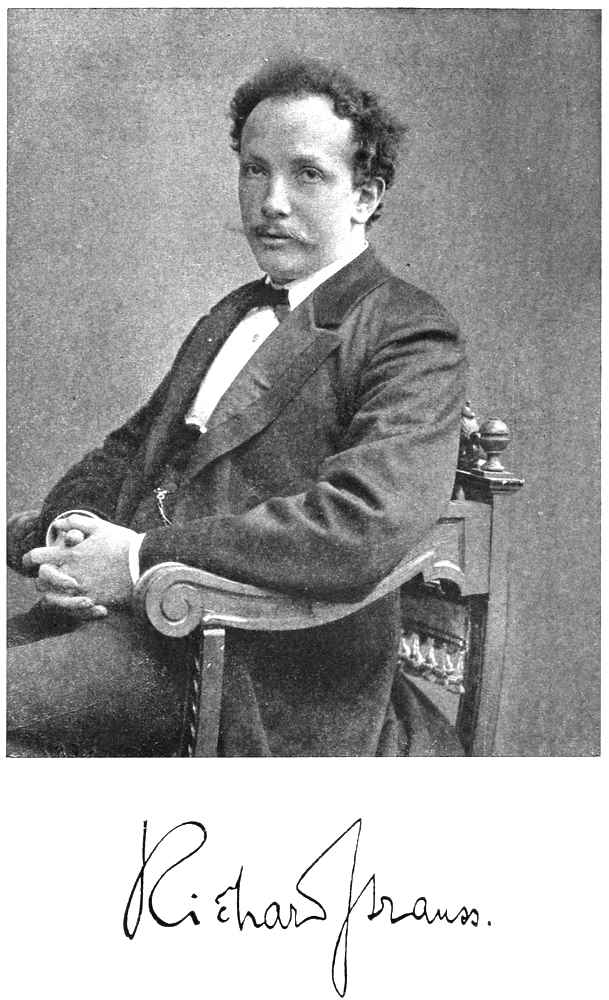
It is easier to trace the artistic lineage of
Richard Strauss to its fountain-head—Johann
Sebastian Bach—than to stamp with a contemporary
stencil its curious ramifications. And
this is not alone because of a similar polyphonic
complexity, a complex of themes and their development
without parallel since the days of the
pattern-weaving Flemish contrapuntists; but because,
like Bach Strauss has experimented in
the disassociation of harmonies, and, in company
with his contemporary, the master-impressionist,
Claude Monet, has divided his tones—set up,
instead of the sober classic lines or the gorgeous
color masses of the romantic painters, an entirely
new scheme of orchestration, the basic
principle of which is individualism of instruments,
the pure anarchy—self-government—of
the entire orchestral apparatus. This is but
a mode of technique and does not necessarily
impinge upon the matter of his musical discourse;
it is a distinctive note, however, of the
Strauss originality, and must be sounded in any
adequate discussion of his very modern art.
Borrowing the word with its original connotations
from the erudite and clairvoyant French
critic, Rémy de Gourmont, disassociation in the
practice of Strauss is a species of tone chemistry
by which a stereotyped musical phrase is
reduced to its virginal element, deprived of factitious
secondary meaning, and then re-created, as
if in the white heat of a retort, by the overpowering
and disdainful will of the composer. We
have also the disassociation of ideas from their
antique succession, that chiefly reveals itself,
not in a feverish, disordered syntax, but in the
avoidance of the classic musical paragraph—that
symmetrical paragraph as inexorably formulated
as the laws of the Medes and Persians,
resulting in a Chinese uniformity maddening in
its dulness and lifelessness unless manipulated
by a man of intellectual power. Strauss is forever
breaking up his musical sentences. He does
this in no arbitrary fashion, but as the curve of
the poem is ideally pictured to his imagination.
A great realist in his tonal quality, he is first
the thinker, the poet, the man of multitudinous
ideas; you hear the crack of the master’s whip,
a cruel one at times, as he marshals his themes
into service, bidding them build, as built the
Pharaohs’ slaves, obelisks and pyramids, shapes
of grandeur that pierce the sky and blot out
from the vision all but their overwhelming and
monumental beauties of form—the form of
Richard Strauss. He is, after his own manner,
as severe a formalist as Josef Haydn.
We are now far away from what is called
euphony for euphony’s sake; though it is, as in
Bach’s case, art for art with all the misused
phrase implies. Intent upon realizing in tone
his vision,—the magnitude or validity of which
we need not yet discuss,—Strauss allows no
antique rubric of fugue or symphony to block
his progress; even the symphonic poem, an invention
of Franz Liszt, proves too cumbersome
for this new man of light and air and earth,
whose imagination is at once sumptuous and
barbaric. The picture must overflow the old
frames. It must burn with an intense life. It
must be true. As a man who crept before he
walked, walked before he ran, Richard Strauss
has the right to our sympathy. He was a wonder-child;
he is one of the world’s great conductors;
he wrote symphonies in the Brahms style
during his studious youth; he composed a little
literature of chamber music, piano pieces, a violin
concerto, and many songs prior to the time
when he faced the sun of Wagner and was undazzled
by its rays. He knew the scores of
Wagner, Liszt, and Berlioz, has imitated, and
has forgotten them in the swirling torrential
tides of his own strange temperament.
Once music was pure rhythm; once it was
howling and gesture. It moved up the evolutionary
scale slowly and reached the kingdom
of the instrumental arabesque with difficulty;
on this side was the ecclesiastical liturgy with
its rigorous inclusions and suppressions; on the
other, the naïve young art of opera. Let us
acknowledge that Bach was the crowning glory
of the art polyphonic, that Palestrina closed
the door behind him on churchly chants, that
Beethoven said the last significant word in the
symphony; let us admit these trite propositions,
and we have still perplexing problems to solve.
The song-writers, Schubert, Schumann, Brahms,
shall not detain us—they represent but an exquisite
province of music. The neo-symphonists,
beginning with Schubert and Schumann and ending
with Brahms, are not to be weighed here.
They said much that was novel, but they adhered
to the classic line; they did not draw in
the mass, to use the painter’s term. It is to
Berlioz, Liszt, and Wagner that the new movement
should be credited: Liszt, for his prophetic
power—he remodelled the symphonic form,
but like Moses, he was destined to see, not to
enter, the promised land; Berlioz, for adding to
the instrumental palette new hues, bewildering
nuances and bizarre splendor; Wagner, for
banishing convention from the operatic stage,
furnishing the myth as the ideal libretto, for his
bold annexation of the symphonic orchestra and
the extraordinary uses to which he put it. Yet
only one of the three men has held out the torch
to future composers—Franz Liszt. Berlioz’s
talent was largely that of a perverse fresco
painter; Wagner quite closed his epoch—one
of rampant romanticism—in his music-drama,
and by his powerful genius almost swerved
music from its normal, absolute currents.
He quite flooded the musical firmament with
his radiations. There was but one god and he
reigned at Bayreuth; go hence and worship, or
else be cast with the unbelieving into outer darkness
where there is gnashing of teeth! The
music-drama was the synthesis of the arts. It
was the panacea of all social evils, and Parsifal
we beheld as another Paraclete! Such arrogation
of omnipotence was bound to encounter
reverses. The Wagnerian mixture of words and
music, of drama ranking before music and music
playing the handmaid rôle of commentator, has
stood the tests neither of its creator nor of time.
We know our Wagner now; not as a philosopher—shades
of Schopenhauer!—not as a poet—let
us not invoke the spirit of Goethe!—not
as a reformer, dramatist, revolutionist, but as a
composer of genius, with a lot of wrong-headed
theories, whose magnificent music floated his
doctrines and blinded the younger generation
to their speciousness. It is music, not drama,
that rules in Wagner’s works.
The evil done was this: Music could no longer
speak in her own divine voice without the aid
of words, without the hobbling drawbacks of
singers, stage pictures, plots, all the thrice-familiar
mise en scène of the Wagnerian music-drama.
Nevertheless, Wagner did enhance the
value of the suggestion in music. He invented
his own stenographic method of speech and with
it literally created a new musical consciousness.
A motive means something, is the symbol of an
idea, or state of soul; yet we know that if this
motive has to be accompanied by dramatic gesture
or clothed verbally, then all the worse for
it as pure music; it gains visually, but loses on
the imaginative side. Before Wagner, Liszt
discovered the power of the concise phrase and
even labelled it; and before Liszt, came Beethoven
in his C minor symphony; while antedating
all was Bach, whose music is a perfect storehouse
of motivation.
And again we reach Richard Strauss by way
of Bach; in the music of the modern composer
the motive achieves its grand climacteric. His
scheme is the broad narrative form, a narration
that for sustained puissance and intensity has
never been equalled. The new melody is no
longer a pattern of instrumentation, nor is it an
imitation of the human voice; it is extra-human,
on the thither side of speech. It is neither a
pure ravishment of the ear, nor yet an abstruse
geometrical problem worked out according to
the law of some musical Euclid.
Now, music of the highest order must make
its first appeal to the imagination; its first impact
must be upon the cortical centres. It must
not alone set the feet rhythmically pattering, it
must not merely stir us to emotional thrilling.
Not in the sensuous abandon of dance rhythms,
but by thought,—that is, by musical thought,
in a chain of tonal imagery, is the aim of the
new music. Walter Pater believed, Plato-wise,
that music is the archetype of the arts. It was
an amiable heresy. But music must stand solitary—it
is often too theatric, as poetry is often
too tonal. It must be intellect suffused by emotion.
Its substance is not the substance of its
sister arts. What music has long needed, what
Wagner and the church writers before him sought
to give it, is definiteness. The welding of word
and tone does not produce true musical articulateness.
We recognize this in Tristan and
Isolde, where incandescent tone quite submerges
the word, the symbol of the idea. Erotic music
has never before so triumphed as in this Celtic
drama. And it is like the fall of some great
blazing visitor from interstellar space; it buries
itself beneath the smoking earth instead of remaining
royally afloat in the pure ether of the
idea.
The arts cannot be thus fused. When faith
moved nations, the world witnessed the marriage
of word and tone in the ritual of the church;
no music has been so definite since Palestrina’s
as Wagner’s—until the music of Richard Strauss
was heard. In it we encounter a definiteness that
is almost plastic, though never baldly literal. As
we noted in our rapid survey, the ethic quality
of Beethoven, the philosophic quality of Brahms,
the dramatic quality of Wagner, are all aside
from the purpose of Strauss. He seeks to
express in tone alone. The new melody is but
an old name for—characterization. And now
we reach at last the core of Strauss, who is a
psychological realist in symphonic art, withal a
master symbolist; back of his surface eccentricities
there is a foundational energy, an epic
largeness of utterance, a versatility of manner,
that rank him as the unique anarchist of music.
He taps the tocsin of revolt, and his velvet sonorities
do not disguise either their meagre skein
of spirituality or the veiled ferocities of his aristocratic
insurgency.
The present writer put this question to Herr
Strauss in London in the summer of 1903: Has
he always subjected himself to the tyranny of an
ideal programme before composing? The notion
seemed elementary to him. “All good music has
a poetic idea for a basis,” he replied; and he instanced
the Beethoven piano sonatas, the Bach
fugues. But he admitted that his brain caught
fire at poetic figures, such as Don Juan, Don
Quixote, Macbeth; Also sprach Zarathustra, Till
Eulenspiegel, Ein Heldenleben. Even a landscape
or a seascape could provoke from him the
charming suite of images we find in his Italia.
With the poem of Death and Apotheosis, affixed
to the score after the music had been composed,
we may see that Strauss is not a man pinioned to
a formula. But the effect on his hearers of his
message, on those hearers who have submitted
to his magic, is articulate as has been no anterior
music. He moulds his meanings into a thousand
forms—for what is form in the academic sense
to this arch-disintegrator? And these forms
resolve themselves into as many more shapes—shapes
of beauty, terror, tragedy, comedy, morose
mysticism, ugly platitude; into grimacing
runes, shuddering madness, lyric exaltation, and
enigmatic gropings; yet never the banal rhetoric
of the orchestra, the rhetoric that has seduced
so many composers to write for the sake of the
sound, for the joy of the style. Strauss always
means something. All is in the narration of his
story, a story suggested with as much art as the
inspiring poem; a misty cloud, perhaps, to the
unsympathetic, a pillar of flame to the initiated.
It is a new speech; notes, phrases, groups,
movements, masses of tone, no longer occupy
conventional, relative positions in his tone-poems.
The violent disassociation of the old
phraseology—his scores seem to be heard vertically
as well as horizontally—smug harmonization,
melodies that fall gratefully into the languid
channels of our memory—in a word, the mechanical
disposition of stale material is transformed,
undergoes permutation to make way
for a new syntax, a nervous, intense method of
expression, strange elliptical flights, erratic foreshortenings,
with classic and romantic canons
cast to the winds; yet imposing a new grouping,
a new harmonic scale of values, a new
order of melody—the melody of characterization,
the melody that pilots the imagination
across uncharted territory into a land overflowing
with feeling, intellect, tenderness, and
sublimity, with irony, ugliness, humor, and humanity;
a land not lacking in milk and honey,
the land of Richard Strauss! A delectable region
is discovered by this young man when we
believed that the grim old wizard, Wagner, had
locked us up forever in his torrid zone, where,
like a Klingsor, he evoked for our parched souls
the shadows of bayaderes and monstrous flowers
and monstrous passions! Lo, another Richard
has guided us to a newer domain, which, if not
so fascinatingly tropical, is one where hallucinating
chromaticism does not rule, where a more
intellectual diatonic mode prevails. Strauss is
master of a cold, astringent voluptuousness.
His head rules his heart. Above all, he
searches for character, for its every trait. He
himself may be a Merlin,—all great composers
are ogres in their insatiable love of power,—but
he has rescued us from the romantic theatric
blight; and a change of dynasty is always welcome
to slaves of the music habit.
His music did not exhibit its first big curve of
originality until the publication of Don Juan,
opus 20. His intimate charming songs are the
epitome of his peculiar dramatic faculty for
clothing in tone, or rather emptying into music,
the meaning of the poet. Avoiding the more
recondite question of form, it may be said that
as in the songs, so is it in his symphonic works.
With no other indication than a title (he cannot
be blamed for the extravagances of the analytical-programme
makers), Strauss pours upon our
puzzled and enchanted ears a billow of music
terrifying at times: it is a veritable tidal wave;
you see it cresting the rim of the horizon and
rolling toward you sky high. His Don Juan
and Macbeth are romantic in style, and for
that reason are praised by those who fear to
desert old milestones and wander in the tangled,
fulminating forests of his later music. With the
story of the mediæval German rogue, Till Eulenspiegel,
Strauss unleashes his fantasy. It is a
scherzo in form—how he burlesques the form
and its very idea! The color scheme is daring,
oppressively high, and at times we near the cosmic
screech. All is prankishness, darting fancy,
consuming irony. The humor is both rarefied
and Teutonically clumsy. Till lives, Till is
scampish, Till is gibbeted. Tone itself is volatilized
into fiery particles that seem to fall upon
the listener from dizzily pitched passages. Such
a picture has never been hung in the august
halls of music. It offends. It blazes in the
eyes with its brilliant audacity, and yet it is new
music, music gashed and quivering with rhythmic
life. Rhythmically, Strauss is an adventurer
into an absolutely novel clime. He touches
hands with the far East in his weaving interior
rhythms.
Death and Apotheosis is a tone-poem, rather
Lisztian in its pompous and processional picture
at the close. Its very title calls up the Weimar
master’s Tasso. But it differs inasmuch as it
is better realized externally, while its psychology,
morbid in several episodes, is more masterful.
It is not a Tasso, not a poet enthroned in deathless
immortality, but a soul, the soul, which, lying
in its “necessitous little chamber” of death, reviews
its past, its youth, hope, love, conflict,
defeat, despair, and at the end its feverish ecstasy,
its sorrowful dissolution. Strauss with a secret
tiny brush has surprised the human heart in
travail. It is pathos breeding. The added
touches of realism, the gasping for breath, and
the lenten tic-toc of the heart, should not disquiet
us. Æsthetic propriety is never violated. And
Tod und Verklärung is hardly the greatest that
is in Richard Strauss.
The much-discussed Thus spake Zarathustra
is not, as has been humorously asserted, an attempt
to make music a camel that will bear the
burdens of philosophy; it is the outcome of profound
study in the vaticinating leaves of Nietzsche’s
bible. Its dancing lyricism is reflected in
the Strauss score, which opens with a pantheistic
evocation of sunrise, uplifting in its elemental
grandeur. Seldom has music displayed a result
brought about with such comparative simplicity—a
simplicity in inverse proportion to its subtlety.
It invites to the prayer of the sun worshippers
as they salute their round burning god
lifting in the blue. The composition is welded
by a giant will. It contains so many incongruous
elements, that their complete amalgamation
seems at first hearing an incredible attempt. It
is the old symphonic-poem form of Liszt, but
altered, amplified. The themes appear, disappear,
surge to insanity in their passion, melt
into religious appeal, dance with bacchanalian
joy, mock, blaspheme, exhort, and enchant.
There is ugly music and hieratic, music bitter
and sweet, black music and white, music that
repels and music that lures—we are hopelessly
snared by the dream tunes of this enharmonic
fowler, who often pipes in No Man’s Land on
the other side of good and evil. The ear is
ravished, the eye dazzled; every brain centre is
assaulted, yet responds to a new and formidable
engine for stimulating ideas and emotions. The
Old-World riddle is propounded and left unsolved.
And we seem to have grazed an Apocalypse of
scepticism in the conflicting tonalities with their
sphinx-like profiles.
The greatest technical master of the orchestra,
making of it a vibrating dynamic machine, a
humming mountain of fire, Richard Strauss, by
virtue of his musical imagination, is painter-poet
and psychologist. He describes, comments, and
narrates in tones of jewelled brilliancy; his
orchestra flashes like a canvas of Monet—the
divided tones and the theory of complementary
colors (overtones) have their analogues in the
manner with which Strauss intricately divides
his various instrumental choirs: setting one
group in opposition or juxtaposition to another;
producing the most marvellous, unexpected
effects by acoustical mirroring and
transmutation of motives; and almost blinding
the brain when the entire battery of reverberation
and repercussion is invoked. If he can paint
sunshine and imitate the bleating of sheep, he
can also draw the full-length portrait of a man.
This he proves with his Don Quixote, wherein
the nobler dreamer and his earthy squire are
heard in a series of adventures, terminating with
the death of the rueful knight—one of the
most poignant pages in musical literature. Don
Quixote is shown as the quotidian type of man
whose day-dreams are a bridge leading to the
drab and sorrowful cell of madness. He is not
mocked, but tenderly treated, by Strauss. It is
upon the broad-backed Sancho Panza that the
composer unlooses his quiver of humorous arrows.
The score is thus far—to my taste—the
greatest of its maker, the noblest in subject-matter,
in dignity of theme, complexity of
handling, and synthetic power. To show his
independence of all musical form, Strauss selected
the most worn—the theme with variations.
Amazing is the outcome. No other
composer before him, not even the master variationist,
Brahms, has so juggled and deployed
the entire range of musical material in serried
battalions. Virtuosity there is, but it is the
virtuosity that serves a psychologist; never
is there display for decoration’s idle use. All
is realistic fancy. A solo violoncello and a
solo viola represent the half-cracked pair of
Cervantes. The madness of Quixote is indicated
by a device musically and psychologically
unique. His theme, his character, goes to pieces
in mid-air, after the mania of romance reading.
The muting of the instruments and general
muddling of ideas make the picture of slow-creeping
derangement painfully true. Then
follow variations, close in their fidelity to the
story, and never unmindful of the medium in
which it is told. Despite the disquieting verisimilitude
of the wind-machine, of the sheep,
Strauss has never put forth his astoundingly
imaginative powers to such purpose. We are
stunned, horrified, piqued, yet always enthralled
by this masterful ironist who has conserved his
mental sincerity. The finale is soothing, its
facture is a miracle of tonal values. Don
Quixote, until he surpasses it, will remain a
monument to Richard Strauss.
The Hero’s Life is nearer the symphony in
a formal sense than any of his newer works. It
is his most robust composition. The conception
is breath-catching, for it is a chant of the
Ego, the tableau of Strauss’s soul exposed as
objectively as Walt Whitman’s when he sang of
his Me. The general outline of the work is
colossal; it has no wavering contours, and is virile
with a virility that shocks. It flouts the critics
of the composer and shows a stupendous battle-piece,
Tolstoyian in fury, duration, and breadth.
Cacophony rules; yet is not a battle always
cacophonous? The old-fashioned symbols of
trumpet-blasts with ornamental passage-work are
here rudely disclaimed; war is cruel, and this
episode is repulsive in its aural cruelty. The
ancient harmonic order will be indeed changed
when such a tonal conflict is accepted by the
rear-guard. Often we cannot hear the music
because of the score. For the rest, there are
apposite quotations from the composer’s earlier
works, and the coda is beautiful with its supreme
peace, supreme absorption in Nirvana.
This, then, has Richard Strauss accomplished:
He has restored to instrumental music its rightful
sovereignty; it need fear no longer the encroachment
of music-drama, at best a bastard
art. Enlarged, its eloquence enormously intensified,
its capacity for rare, subtle beauty increased
tenfold, the modern orchestra has been
literally enfranchised by Strauss from the house
of operatic bondage. He has revolutionized
symphonic music by breaking down its formal
barriers, and he has filled his tone-poems with
a new and diverse content. In less than an
hour he concentrates, relates, makes us see, feel,
and hear more than could be seen, heard, or felt
in a music-drama enduring six. His musical
themes, quâ themes, are not to be matched with
Beethoven’s, his melodic invention deviates from
the classic prettiness; yet because of his incomparable
architectonics, of his majestic grip on
the emotional, he keeps us hypnotized as his
stately, fantastic tonal structures slowly uprise
and unfold like many-colored smoke from the
incantations of legendary Eastern genii. He
absorbs absolutely our consciousness with a
new quintessence of poetic, pictorial, sculptural,
and metaphysical art. Music, unaided
by words or theatric device,—for the compositions
of Strauss may be enjoyed without their
titles,—has never been so articulate, so dangerously
definite, so insidiously cerebral. Madness
may lie that way; but the flaming magic of the
man is ever restrained by deep artistic reverence.
We catch glimpses of vast vistas where dissonance
is king; slow, iron twilights in which trail
the enigmatic figures of another world; there are
often more moons than one in the blood-red
skies of his icy landscapes; yet the sacred
boundaries of music are never overstepped.
Little matters the niche awarded this composer
by posterity—Richard Strauss is the musical
enchanter of our day.
Richard Strauss was born at Munich, June
11, 1864. He is the son of Franz S. Strauss,
formerly first horn player in the Bavarian Court
Band. His father has written studies and other
compositions for his instrument; and, as his son
said, “he could play most of the instruments in
the orchestra.” He sat under Wagner’s stick,
but was not a Wagnerian. Once he played so
well that Wagner exclaimed, “I fancy after all,
Strauss, you cannot be such an anti-Wagnerian
as they make out, for you play my music so
beautifully.” “What has that got to do with
it?” answered the stubborn artist. The mother
of Richard was born Pschorr, and is a daughter
of the wealthy Munich brewer. The boy received
his first piano lessons at the age of four
and a half from his mother. Later he studied
with August Tombo, a harp player, and took up
the violin under Benno Walter. At the age of
six he composed a three-part song, a valse, and
a polka—Schneider Polka, he called the dance.
Before he went to school he had tried his hand
at songs, piano pieces, and an orchestral overture.
Sent to the elementary schools from 1870
to 1874, the gymnasium from 1874 to 1882, and
the university from 1882 to 1884, Strauss laid
the foundation of a comprehensive culture, a
catholicity in taste, a love of belles lettres, and
a general knowledge of the world’s literature.
He early mastered the technics of the piano
and violin, and in 1875, with Kapellmeister
Fr. W. Meyer, theory and composition. This
course lasted five years. The composing went
on apace. A chorus for the Electra of Sophocles
and a festival chorus were given a hearing
at a gymnasium concert. Three of his songs
were sung in 1880; and in March, 1881, his
string quartet in A, opus 2, the scherzo of
which he wrote in his fifteenth year, was played
by Benno Walter’s quartet, to whom it was dedicated.
Four days later his first symphony was
accorded a hearing under Hermann Levi, and
the extreme youth of the composer called forth
remonstrances. In 1883 Berlin heard his C
minor overture under Radecke. Both are still
in manuscript.
Of this formative period Strauss has told us
that, “My father kept me very strictly to the
old masters, in whose compositions I had a thorough
grounding. You cannot appreciate Wagner
and the moderns unless you pass through
this grounding in the classics. Young composers
bring me voluminous manuscripts for my opinion
on their productions. In looking at them I
find that they generally want to begin where
Wagner left off. I say to all such, ‘My good
young man, go home and study the works of
Bach, the symphonies of Haydn, of Mozart, of
Beethoven, and when you have mastered these
art works come to me again.’ Without thoroughly
understanding the significance of the
development from Haydn, via Mozart and
Beethoven, to Wagner, these youngsters cannot
appreciate at their proper worth either the
music of Wagner or of his predecessors.
‘What an extraordinary thing for Richard
Strauss to say,’ these young men remark, but
I only give them the advice gained by my own
experience.”
Then came a stroke of luck. Von Bülow’s
attention being attracted by the charmingly
written and scored serenade (opus 7) in E flat
for thirteen wind instruments, secured it for the
repertory of the Meiningen orchestra. It is
scored for two flutes, two oboes, two clarinets,
four horns, two bassoons, and contrabassoon
(or bass tuba). His second symphony in F
minor was composed during the season of
1883-1884. It was first played in New York
under Theodore Thomas, December 15, 1884,
and later by Walter Damrosch. It shows many
traces of the young composer’s close study of
Brahms. The horn concerto, opus 11, and the
piano quartet, opus 13, were composed at the
same period. The latter won a prize. It
shows a straining for bigger effects, as if
the form were too cramped for the strenuous
composer. The andante and scherzo are the
more agreeable movements. The Wanderer’s
Sturmlied, after Goethe’s poem, beginning,
“Wen du nicht Verlässest, Genius,” revealed
the taste for literary themes and themes that
exalt the individuality. This opus 14 is written
for six-voiced chorus, two soprani, one alto, one
tenor, two bassi, and orchestra. It also shows
the serious influence of the Brahms Schicksalslied.
A second suite for wind was first given
at Munich, conducted by the composer.
“Bülow, who was very fond of my father,”
says Strauss, “interested himself in me, and I
have much to thank him for. He started me
on my conducting career. My first experience
of standing before an orchestra was in connection
with the performance of a suite, in four
movements, for wind instruments, which I had
composed at his request. It is still in manuscript.
Bülow made me conduct it without any
rehearsal!” This must be the grand suite in
B flat, misleadingly numbered opus 14—the
same opus number as the Sturmlied. It is
scored for thirteen wind instruments, and has
been heard in London. The introduction and
entire fourth movement are said to be the best.
It is early Strauss. Strauss became music
director in Meiningen, October, 1885, conducted
his own F minor symphony and also made his
début as pianist in Mozart’s C minor concerto.
Von Bülow honored him by conducting the
concerto.
Strauss had already come under the influence
of Alexander Ritter (1833-1896), a violinist in
the Munich Orchestra who had married a niece
of Wagner’s. Ritter, like von Bülow, was a man
of strong magnetic personality, and both were
warm-blooded Wagnerians and Lisztians. As
boys they listened to that wonderful performance
of Beethoven’s Choral Symphony given by
Wagner at Dresden in 1849, and the two young
gentlemen schoolfellows used to doff their caps
every time they passed the master’s windows in
the Ostra-Allee. “Ritter was exceptionally well
read in all the philosophers, ancient and modern,
and a man of the highest culture. His influence,”
says Strauss, “was in the nature of a
storm-wind. He urged me on to the development
of the poetic, the expressive, in music, as
exemplified in the works of Liszt, Wagner, and
Berlioz. My symphonic fantasia, Aus Italien,
is the connecting link with the old and the new
methods.” The young composer went to Rome
and Naples in the spring of 1886. Strauss tells
an amusing incident. “A few days ago I was
conducting this symphony at Brunswick, when
a policeman appeared on the scene and stopped
the performance because, as he said, some condition
had not been complied with. Soon after,
however, another policeman came and said the
concert might proceed. This unwarrantable
interruption caused great uproar, and the audience
shouted anathemas against the police. At
the close of the symphony I turned to the audience
and said, ‘You see, ladies and gentlemen,
in this Italy there are no anarchists!’”
In 1886 he left Meiningen to become third Kapellmeister
under Levi and Fischer. He wrote
his tone-poem Macbeth at this period, though
it bears a later opus number than Don Juan.
The former, after a revision and partial rewriting,
was dedicated to Alexander Ritter, and first
performed under von Bülow in Berlin. Strauss
remained at Munich until 1890, when he received
a call from Weimar. In the ducal city he shed
his pupil’s skin and developed into a brilliant
conductor. His radical tendencies were now
beginning to be recognized, and his espousal of
the music of the extreme Left caused his conducting
of Wagner and Liszt to become notable.
At Leipsic his influence was felt as conductor
at the Liszt society. He has always warmly defended
the music of Wagner, Liszt, and Berlioz.
In 1892 his lungs were affected and a protracted
journey to Greece, Egypt, and Sicily
was necessary. He was not idle, however, for
on his return his grand opera, Guntram, opus
25, and dedicated to his parents, was produced
at Weimar. He married in 1894 Pauline de
Ahna, the daughter of a well-known Bavarian
general, and the soprano who created the Freihild
in Guntram.
From Weimar Strauss returned to Munich as
Court Kapellmeister, and three years later he
succeeded Levi as general music director. Not
satisfied with matters, he left Munich to become
Kapellmeister at the Berlin Royal Opera, which
position he still occupies. He had conducted
the Philharmonic Orchestra of Berlin after the
death of von Bülow, but the trip from Munich
to Berlin was too exhausting, and Arthur
Nikisch was permanently engaged. Strauss
has conducted at Bayreuth, festivals at Liège,
Cologne, Leipsic, Milan, Moscow. In 1897 he
visited London, Paris, Amsterdam, and Barcelona,
and a year later Zurich and Madrid.
In 1903 he conducted, in conjunction with
Wilhelm Mengelberg, a series of concerts in
London, a Strauss festival organized by Hugo
Goerlitz. The Amsterdam Symphony Orchestra,
a remarkable aggregation of artists, played.
His Parisian experiences were most gratifying;
he appeared in the dual rôles of conductor-composer,
his wife singing his lieder with exquisite
taste.
As a conductor he ranks among the great
ones. He is particularly sympathetic in his
readings of modern works, though any one who
has heard him direct a Mozart opera can never
forget the impressions gleaned—the blitheness,
sanity, sweetness. He is cool, never eccentric
in his beat, and does not play upon his own personality,
as do some other conductors.
A little critical and polemical literature has
grown up about the Strauss case. In addition
to the analytical programmes, some of them
too fantastic to be of value, Hans Merian
has written an extended study of Also sprach
Zarathustra; Gustav Brecher, Richard Strauss;
Dr. Erich Urban, Strauss contra Wagner—in
which Wagner is proved to be old-fashioned;
Urban has also put forth a pamphlet-essay,
Richard Strauss. In his youth, writes Urban,
Wagner cried exultantly, “I am a musician;”
in his age he mumbled, “I am a poet.”
And he really believed he had discovered in
the Greek an excuse for his mutilation of drama
and music. Then Urban turns to Liszt. Liszt,
he said, went far, but not far enough. He grew
timid when he saw the logical outcome of his
experiments. He still clung to the classic, to
the formal. Strauss appears. Urban thinks
he showed absolutely no individual talent until
his opus 14, Wanderer’s Sturmlied. His early
work is Schumann, and Schumann at his worst.
The learned critic does not believe that either
von Bülow or Ritter counted in the formation
of Strauss. He looks upon Guntram as
an accident, and Heldenleben as an answer
to Zarathustra. He does not believe the
latter to have been inspired by Nietzsche,—Strauss
composed it when he discovered that
Nietzsche’s philosophy coincided with his own
revolutionary programme. And as the same
ideas are expressed in Heldenleben, the titles
could be exchanged without any harm. Truly
a Daniel come to judgment! It is in Heldenleben
that Urban sees Strauss at the top notch
of his ideals. Here is musical drama without
the words, scenery, stage, or singers.
Brecher assigns only six periods to the development
of his hero. Brahms has much to say
in the early Strauss music. The critic outlines
the orchestra before Strauss came: Haydn was
the first real instrumental writer, one who dispensed
with the vocal character; Mozart lent
the orchestra freedom and beauty; Beethoven
endowed it with individuality; Berlioz was all
color; Liszt, patterning after Berlioz, developed
thematic variety; and Wagner employed both
the color of Berlioz and Liszt’s theme-weaving
for his profounder and more poetically dramatic
music. Strauss followed all these men, but returned
to pure instrumental forms, avoiding in
his later poems the stringent outlines of the
absolute scheme, and being more eloquent than
his predecessors. Macbeth and Don Juan belong,
says Brecher, to the third period of Strauss.
Death and Apotheosis is a reactionary period,
as is Guntram—too much Liszt and Wagner,
too much chromaticism. From opus 27 to 34
is the fifth period, nearly all songs, wonderful
songs. Till Eulenspiegel belongs to this arbitrary
grouping, and it closes with Also sprach
Zarathustra. The sixth period opens with Don
Quixote and Heldenleben. Beauty is routed
by truth. Even Urban thinks Don Quixote is a
colossal joke, written to astound the Philistines.
But these writers are in sympathy with the
composer. The terrible Hanslick of Vienna is
not. He, even at the expense of contradicting
himself, praised Wagner’s melodic gifts as
an offset to the more meagre thematic invention
of Strauss. His criticism of Also sprach
Zarathustra is not criticism—it is scarification.
He heard the work in Vienna, on a programme
in which figured Weber’s Euryanthe overture,
and the C minor symphony of Beethoven. The
good doctor is a joy to read in these days when
politeness has closed critical mouths. He first
drags out the memory of Liszt and stamps on
it—Liszt, who begged from literature his subjects
for a symphony, and “making the alms
pass as music.” Strauss goes to philosophy instead
of to poetry. And then he slashes to the
right and left of him. It is capital reading, if
not convincing. The tone-poems of Richard
Strauss are a musical refutation of Hanslick’s
theories. There is no “content” in music, he
declares; “the egg stands, anyhow,” retorts
Columbus-Strauss!
The Strauss piano music is hardly inviting to
any but the most devoted. Severe in outline,
sombre in hue, it leans not to the sweet intimacies
of Chopin or Schumann. Opus 5 is a solo
sonata in B minor, some thirty pages long. I
prefer Tschaïkowsky’s effort in the same form.
If it is not as klaviermässig, it is more mellow.
Stern, and in the mood Doric, the several movements
of the Strauss sonata are sinewy rather
than plastic, though the adagio in E has some
moving moments. The scherzo is light and
bright in execution. The composition will
never become popular. In opus 3 there are
some pieces of interest,—five in all,—and here
Schumann’s influence is writ plain. Dense is
the pattern, while the ideas are based on a poetic
idea. Two numbers from opus 9, Stimmungsbilder,
will please. They are a tender Träumerei
and a delicate lyrical bit called An
Einsamer Quelle. In the latter the harmonic
changes recall Wagner. The most ambitious
piano music is the burleske in D minor for
piano and orchestra. This must have been
written in 1885, though it bears no opus number.
It is extremely difficult in the solo part,
and not especially grateful. I can recall no one
but Eugen d’Albert and Herr Backhaus as
having played it—the latter at the London
Strauss festival of 1903. Here Brahms is to
the fore, the very opening bar of the piano being
the theme of Brahms’s first D minor ballade.
But how different the treatment! Bitter, rather
airy, more sardonic than witty, this burleske
demonstrates that the Teuton often unbends as
sadly and stiffly as the Briton. Compare the
piece with the incomparable jesting of Scarlatti’s
burlesca, that joke which begins in G minor and
ends in D minor! It is the eternal difference
between the Italian and the German. Crabbed
I call this burleske. The ’cello and piano
sonata in F is a capital composition, and so is
the sonata in E flat for viola and piano. His
concerto for violin and orchestra in D minor has
never received the attention it deserves; and I
wish for the sake of novelty that the beautiful
horn concerto, opus 11, would be given. For
the waldhorn Strauss has a natural sympathy.
The lieder literature is important in quality.
He has written nearly a hundred songs, some
of them priceless in idea and workmanship. It
is in this form that his friends and enemies have
agreed upon his melodic invention. This refers
to the various collections numbered opus 10,
15, 17, 19, 21, 26, 27, 29, 32, and 34; but I wonder
whether the later collections in opus 39 and
opus 41, 43, and 44 are received with the same
enthusiasm. Some of them are harmonically
difficult to grasp, and many are deceptive; when
Strauss seems at his simplest, he is often most
irritatingly complex and recondite. But an
overflowing meed of praise must be awarded
the opus 15, the lovely serenade in F sharp
from opus 17, several from opus 21 and 27,
and all of opus 29. A critic considers O wärst
du mein, from opus 26, number 2, and Sehnsucht,
opus 32, as the most beautiful of all.
No mood seems denied Strauss. His exposition
of the most exotic is indicative of a subtle, rather
than a sensuous, musical nature. Yet how simply
and naturally he has indicated a primitive
emotion in Jungenhexenlied, opus 39, number 2.
The song is a masterpiece. The sturdy power,
the sheer muscularity, of The Workman from
the same set, should make it beloved of manly
male singers. Its great, resounding blows in F
minor stir one’s very soul. And its sentiment
is that of healthy anarchy, as befits the text of
the poet Richard Dehmel. Death the Releaser,
Leises Lied, and To my Son complete this opus.
The last has a noble ring. The Silent Longing
is the capture of an exquisitely evanescent
mood. There are five numbers in opus 41,—a
Cradle Song; In der Campagna; On the
Shore,—full of introspective beauty, a dashing,
vagabondish song; Brother Good-for-nothing;
and Whisp’ring Songs. In all the music seeks
the emotional curve, in all is there absolute
fidelity to the poetic theme—that is, fidelity
as the composer conceives it. Of mere sensuous
or decorative music-making there is none.
Strauss is ever beset by the idea; whether dramatic,
metaphysical, or romantic-lyric, the idea
takes precedence of the sound that clothes it.
So there is little pretence of form, little thought
of vocal exigencies, while the piano accompaniments
are the most difficult ever written. If he
hammers out epics in his orchestral compositions,
in his lyrics he is the patient, curious master of
miniature, the ivory worker of shapes exotic.
Guntram, for which Strauss wrote his own
book, the first opera of this composer, is not
familiar to Americans. It was never a great
success, despite its earnestness and indisputable
depth. Modelled on Wagnerian lines, it has for
a subject the doings of The Fighters for Love,
an order of knights, which, Parsifal-like, in the
middle of the thirteenth century wars for the
Cross and Brotherly Love; but with song and
not with sword. Guntram, the hero, is a Fighter
for Love, and his adventures and passion for
Freihild form the basis of the book. The
preludes to Acts I and II have been played in
this country. The first is a lovely scheme of
orchestration, Wagnerian in texture, and celebrates
the yearning desire which the singers
have consecrated to art and to the Cross. The
second prelude is a brilliant, joyous picture of a
Festival of Victory. The form and development
are absolutely free. It is interesting to
note, on the last page of the first prelude, an
essential-turn that comes straight from Götterdämmerung.
Strauss employs it with skill as a
pregnant motive. While it is too short for concert
performance, the prelude of the last act is
the embodiment of yearning and rich in harmonic
life. The great duo of Guntram and
Freihild and Guntram’s farewell are noble specimens
of dramatic writing. Nevertheless the
work lacks big wings.
Two later compositions of Strauss, bearing the
opus number 42, are for Männerchor,—Liebe
and Altdeutsches Schlachtlied, both after Herder.
Two sixteen-voiced mixed choruses a capella
are also announced. Enoch Arden, opus
38, is a melodrama for piano and recitative. It
is an interesting experiment, being melodious
and effective. Written for von Possart the
German tragedian, the weight of the work falls
upon the reader.
At the seventy-seventh Netherrhenish Music
Festival in Aix-la-Chapelle, June, 1900, Strauss
produced two Grössere Gesänge, opus 44, for
low voice and orchestra. Decidedly here the
bust is in the orchestra, the pedestal—! The
Rückert and Richard Dehmel are the poets
levied upon—the first represented by his Nächtlichtergang,
the other by a Notturno.
Strauss occasionally indulges in flashes of sly
humor. Here is a footnote he appends to his
song opus 31, number 2, Wenn:—
Should any singers think of singing this song, while
the nineteenth century is still in existence, the composer
would advise them to transpose it from this
point, a half-tone lower (i.e. into E flat), so that the
composition may thus end in the key in which it
began.
Fuersnot, a Singgedicht in one act, book by
Ernst von Wolzogen, music by Richard Strauss,
was produced at the Royal Opera House, Dresden,
November 21, 1901. The libretto is founded
on a Netherland story, entitled, The Fire Famine
at Oudenaerde. Emil Paur introduced
several excerpts, sonorous, brilliant music, at a
Philharmonic concert.
When questioned about his future plans Strauss
replied: “I have made a musical setting to
Uhland’s Taillefer for chorus, soli, and full orchestra.
I am surprised that musicians have
not availed themselves of this fresh, magnificent
poem before—at least I have heard of no setting.
Altogether one admires Uhland too little
these days. When I was younger I neglected
reading him very much; but now I find one
beauty after another in his writing. I also have
material for two symphonic poems, but don’t
know which one I shall use—if indeed I finish
any—now. It usually takes two years before
a composition begins to assume form with me.
At first there comes to me an idea—a theme.
This rests with me for months; I think of other
things and busy myself with everything but it;
but the idea is fermenting of its own accord.
Sometimes I bring it to mind, or play the theme
on the piano, just to see how far it has progressed—and
finally it is ready for use. You
see, therein lies the real art of creation—to
know exactly when an idea is ripe, when one can
use, must use it. More and more I cling to the
belief that we conscious people have no control
over our creative power. For instance, I slave
over a melody and encounter an obstacle which I
cannot surmount, however I try. This during the
course of an evening; but the next morning the
difficulty has surrendered itself, just as though
my creative forces had toiled at it over night.
Several years ago I told a friend that I meant
to compose a symphonic poem, Spring. He
repeated my remark, and at the making up of
the next music festival programme my Spring
was placed and I was asked to conduct it! The
work is not even composed yet, despite the great
number of themes and sketches I have for it. In
fact, I don’t know when I will compose it—if at
all. Sometimes a theme occurs first to me, and
I find the poetic mate to it later; but at others
the poetic idea begins to take on musical form.
I may even compose an opera soon. A young
Vienna poet has suggested a libretto which appeals
to me very much. A libretto of my own
is also receiving some consideration from me.
“The old metre of poetry, the iambic and
trochiac rhythms—also the rhyme—are useless
in music, because the latter has an entirely
different rhythm, and this must necessarily destroy
that of poetry when the two are joined.
According to my opinion, the most available
forms are the Nibelungen verses or a free
prose. Why cannot music express philosophy?
Metaphysics and music are sisters. Even in
music one can express a view point, and if one
wishes to approach the World Riddle, perhaps
it can be done with the aid of music. Is not
the third act of Tristan transcendental philosophy
purely? Lastly, my next tone-poem
will illustrate ‘a day in my family life.’ It
will be partly lyrical, partly humorous—a triple
fugue, the three subjects representing papa,
mamma, and the baby!” This latter is the
Sinfonia Domestica of which the first performance
anywhere, was announced for March 9,
1904, at Carnegie Hall, New York City.
Jean Marnold, the acute critic of the Mercure
de France, calls attention to the “melody of
Strauss, which is frankly diatonic, the tonal
character definitely determined.” This statement
will be challenged by those who take the
composer’s middle period as a criterion of his
chromatic tendencies. But examine the later
themes, and we are forced to agree with M.
Marnold. Arthur Symons finds that Strauss
is cerebral. He writes: “Strauss is what the
French call un cérébral, which is by no means
the same thing as a man of intellect. Un
cérébral is a man who feels through his brain,
in whom emotion transforms itself into idea,
rather than in whom idea is transfigured by
emotion. Strauss has written a Don Juan
without sensuality, and it is in his lack of sensuality
that I find the reason of his appeal.
All modern music is full of sensuality, since
Wagner first set the fevers of the flesh to
music. In the music of Strauss the Germans
have discovered the fever of the soul. And that
is indeed what Strauss has tried to interpret.”
W. J. Henderson is open to conviction. He
wrote:—
“It is too soon for us to say that Strauss will
influence the future. He may leave us nothing
but certain purely mechanical improvements in
orchestral technics. Even these will have their
value. Yet all recent attempts at progress in
music have been in the direction of more definite
expression, and Strauss may be only a stepping-stone
in an advance toward that blissful epoch
whose hearers will display as much imagination
as its composers, that transcendent condition
in which genius understands genius.”
Edward E. Ziegler discerns that Richard
Strauss is “a master of music mathematics and
one who is composing music for the present. It
is an easy evasion,” he adds, “to shift the
responsibility for what the living generation
cannot easily or will not willingly grasp and to
proclaim that such intricate writing is for the
future. But music has ever reflected life, and
no other composer has so nearly approached a
musical expression of our time as has Strauss.
The febrile unrest, the neurotic striving of the
hour, all have their musical equivalent in his
greater compositions. Plying the stress of emphasis
as Strauss does is characteristic of the
present as is typical his use of the enormous
orchestra. All life has become agitated by the
exaggeration of the hour. It needed but a
master like Strauss to express this truth in
music.”
August Spanuth holds that “Richard Strauss
may be a monstrous phenomenon, yet he embodies
the domineering spirit of modern music.
For more than two centuries composers have
endeavored to vindicate the cause of programme-music,
which the staunch old champions of
‘absolute music’ have fought from the outset.
However, after the efforts of Berlioz and Liszt,
Richard Strauss has succeeded in reversing the
question, making it read thus: Is there a future
left for instrumental music outside of the descriptive,
pictorial, illustrative, suggestive, and
philosophizing music of to-day?”
Ernest Newman, in a masterly article, concludes
with this telling passage:—
... This kind of music adds to our knowledge of
man and the world as much as does a play of Ibsen or
a novel of Tolstoy. Certainly to any one who knows
Strauss’s music to Don Quixote, the story of Cervantes
is henceforth inconceivable without it; the story itself,
indeed, has not one tithe of the humor and the profound
sadness which is infused into it by Strauss.
What he has done in this work is to inaugurate the
period of the novel in music. And here at last we see
the subtle fitness of things that has deprived Strauss
of those purely lyrical qualities, whose absence, as I
have previously argued, makes it impossible for him
to be an absolute creator of shapes of pure self-sustained
beauty. His type of melody is now seen to be,
not a failing, but a magnificent gift. It is the prose
of music—a grave, flexible, eloquent prose. His
style is nervous, compact, sinuous, as good prose
should be, which, as it is related, through its subject-matter,
more responsibly to life than is poetry, must
relinquish some of the fine abandonment of song, and
find its compensation in a perfect blend, a perfect
compromise of logic and rapture, truth and ideality.
“I can conceive,” says Flaubert, in one of his letters,
“a style which should be beautiful; which some one
will write one of these days, in ten years or in ten
centuries; which shall be rhythmical as verse, precise
as the language of science, and with undulations,
modulations as of a violoncello, flashes of fire; a style
which would enter into the idea like the stroke of a
stiletto; a style on which our thoughts would sail over
gleaming surfaces, as it were, in a boat with a good
wind aft.”
No better description, it seems to me, could be
had of the musical style of Strauss, with its constant
adaptation to the emotional and intellectual atmosphere
of the moment, and its appropriateness to the
realistic description of character and milieu which is
his mission in music. His qualities are homogeneous;
he is not a Wagner manqué nor an illegitimate son
of Liszt, but the creator of a new order of things in
music, the founder of a new type of art. The only
test of a literature being alive is, as Dr. Georg Brandes
says, whether it gives rise to new problems, new
questionings. Judged by this test, the art of Strauss
is the one sign of new and independent life in music
since Wagner; for it perpetually spurs us on to the
discussion of fresh problems of æsthetics, of psychology,
and of form.
Richard Strauss is the most intellectual of
musicians. Saint-Saëns pointed out long ago
the master part harmony would play in the
music of the future, and Strauss realized the
theory that melody is no longer sovereign in
the kingdom of tone; his master works are
architectural marvels. In structure, in rhythmical
complexity, in striking harmonies, ugly, bold,
brilliant, dissonantal, his symphonic poems are
without parallel. Berlioz never dared, Liszt
never invented, such miracles of polyphony, a
polyphony beside which Wagner’s is child’s
play and Bach’s is outrivalled. And this learning,
this titanic brushwork on vast and sombre
canvases, are never for formal music’s sake;
indeed, one may ask if it is really music, and
not a new art. It is always intended to mean
something, say something, paint some one’s
soul; it is an attempt to make the old absolute
music new and articulate. This flies in the
face of Schopenhauer, who declared music to
be a presentative, not a representative, art. In
his gallery of psychological portraiture Strauss
becomes a sort of musical Dostoïevsky. He
divines, Maeterlinck-like, the secret tragedy of
existence, and paints with delicacy, with great
barbaric masses, in colors that glow, poetic and
legendary figures which yield up their souls to
the psychological genius who questions them.
I call the tendency of Strauss décadent, like
Wagner’s; both men build up their pictures by
a multitude of infinitesimal touches; both men
decompose their themes,—and this is the highest
art of the decadence. Unity is sometimes
absent, and also the power that makes for
righteousness, which we find in Beethoven’s
music.
Touching on the moral of this new dispensation
in art, I may confess that I am puzzled by
its absolute departure from the ethic of Christianity.
It is not precisely a pagan code that
Strauss presents in his splendid laconic manner;
rather is it the ethic of Spinoza ravished by the
rhetoric of Nietzsche. Affirmation of the will,
not its denial, is both preached and practised
by this terrible composer. For him the ineluctable
barrier of barriers is the return to simplicity,
the return to the people. He may be simple
in his complex way, and he may sympathize
lyrically with the proletarian; yet he is the aristocrat
of aristocrats in art; and his art, specialized,
nervous, and alembicated, may be the call
to arms of lonely, proud souls that refuse to go
to the people as did Tolstoy. With Ibsen’s
Brand, not Tolstoy’s, Levin is Strauss in closer
communion. And he may hold the twentieth
century in his hand.
During his Italian trip Strauss wrote Aus
Italien, opus 16, a symphonic fantasia that has
been heard in America with delight. It is
fresh, vigorous, even somewhat popular, in
themes, and characteristically colored. The
orchestration was the envy of the younger men.
Italia was first given in Munich in 1887 under
Strauss. His violin sonata, opus 18, was composed
the same year. Then followed fast the
series of daring orchestral frescos that placed
the name of Strauss at the very forefront of
living composers. And yet how un-German his
music seems, hatched though it be from the
very nest of the classics! Strauss is not of the
same blood as the Vienna dance composers.
He has written a valse; but who could compare
the light, voluptuous Danube music to the ecstatic
scarlet dance of the Overman in Also
sprach Zarathustra! Despite the fact that it is
preceded only by Italia, Macbeth, and Don Juan,
Tod und Verklärung gives us in esse all the
overpowering qualities of Strauss, chiefest of
them being imagination without the ugliness
detected by sensitive natures in later compositions.
Death and Apotheosis is a masterpiece.
The nineteenth century, notwithstanding its
devotion to the material, produced poets and
prose masters for whom death had a peculiar
predilection. There is the mystic Maeterlinck,
with his sobbing shadowgraphs of Death the
Intruder; Tolstoy, with his poignant picture of
the Death of Iván Illyitch; Arnold Böcklin,
that Swiss master, who sang on elegiac canvas
his Toten Insel; and have we not all
read Walt Whitman in his matchless threnody
“When lilacs last in the dooryard bloomed”?
It is not strange, then, that Strauss, a lyric
philosopher of the same passionate pattern as
Friedrich Nietzsche, should wrestle with a problem
as old as eternity. He does wrestle with
it in his symphonic poem—attacking it in large
symbolism, free from the morbidities of the
decadent poets; accomplishes it in a way that
wrings the very heartstrings.
It is the spectacle of a sick man in “a necessitous
little chamber” reviewing his struggles
and defeats as the fever cracks his veins and
throttles his life. He has failed as failed Balzac’s
Louis Lambert, as fail all men with lofty
ideals. He has reached that “squat tower” of
defeat, death, which Robert Browning chanted
in Childe Roland. To the dark tower he goes,
and dauntless at the last, he sets the slughorn to
his lips and blows victory in the very teeth of
Death. Perhaps this most modern of poems
gives the key to the Strauss music better than
any other in the English tongue. The dying
man sunken in lethargic slumber, his heart
feebly beating in syncopated rhythms, recalls
his childhood, his lusty youth, his mad passion
for life at its thickest. He toils and reaches
summits only to hear the implacable Halt! of
destiny. Yet he continues to combat Fate, but
to be laid low. And dying, he triumphs; for his
ideal lifts him to the heights, to “Sun-Smitten
Sunium.” He has dared, and daring conquers.
The fable is old—as old as the Prometheus
myth. In music we have it incarnated in Beethoven’s
Fifth Symphony, the tonality of which—C
minor, C major—Strauss has adopted.
Liszt, too, in his Tasso, a symphonic setting
of Goethe’s tragedy, attempted the same task,
and accomplished it in a brilliant, spectacular
fashion. The thematic grouping of the Strauss
poem is simplicity itself when compared to the
towering architectonics of A Hero’s Life and
Thus spake Zarathustra. After a lengthy prologue
in which mood, atmosphere, Stimmung
in a word, and echoes of childish babbling are
subtly contrived, the bolt of destruction is let
loose, and fever, a spectre, courses through the
allegro. The Ideal motive sounds but in gasping,
broken accents. It is only after the delirium
has reached its climax that a period of repose,
an analogy of the lyric period, is attained. The
childhood of the man is lisped naïvely; youth
and its frolicking unconsciousness are aptly
portrayed; manly passion and conflict end the
section, for the ominous Halt! is blared out by
the trombones. The development—as in all
developments of this composer—contains miracles
of counterpoint buried in passages of emotional
splendor. With cumulative power and
pathos we hear a climax of imposing sonorities;
the marchlike motive of the Ideal is given in
all its majesty, and in a C major of rainbow
riches the poem finishes. Strauss has never
surpassed the plangency of coloring, the melting
sweetness of this score. He is more
philosophic in Also sprach Zarathustra, more
dramatic in Don Juan, more heroic in Ein
Heldenleben; but never has his message been
so consoling, never has he set so vividly over
his orchestra the arc of promise. That such
music came forth from his potent youth is a
prophecy of an astounding future. He is the
only living issue in music to-day; no other
master has his stride, his stature.
That merry old rogue’s tune, Till Eulenspiegel,
is a scherzo-like rondo picturing the crazy
pranks of the historic Tyll Owlglass. Its grotesque,
passionate melancholy, tender violence, its
streaks of broad humor interrupted by mocking
pathos, its galloping down a narrow avenue, at the
end of which looms the gibbet, its mockery of
custom, flaunting of the Philistine, and the unrepentant
death of Till,—make it a picture unparalleled
in music literature. Scored brilliantly,
the rondo leaves in its trail a whiff of sulphur
and violets. It is fantastic music, fantastically
conceived, fantastically executed.
The score of Also sprach Zarathustra is dated
“Begun February 4; finished August 24, 1896.
Munich.” The composer’s words in this connection
must be given:—
“I did not intend to write philosophical music
or portray Nietzsche’s great work musically. I
meant to convey musically an idea of the development
of the human race from its origin, through
the various phases of development, religious as
well as scientific, up to Nietzsche’s idea of the
Uebermensch.”
Only a musical epitome of the creative processes
of the cosmos! The modesty of Strauss
is of a Michelangelo-like magnitude. This new
Faust of music, Nietzsche-Strauss, who would
assail the very stars in their courses, has written
some pages in this opus that are of imposing
grandeur. There is an uplifting roar at the
opening, an effect of sunrise—purely imaginary
all these musical pictures, yet none the less
startling and credible—as Zarathustra’s trumpets
solemnly intone his motive. These tremendous
chords in their naked simplicity alone
proclaim Strauss a man of genius and give him
fee simple to the symphonic heritage of Beethoven
and Brahms. The A flat section is notably
melodious and luscious in color. The five-voiced
fugue is ugly yet masterful, and the dance music
furious in its abandonment, corybantic in its
revelry. Such laughter has never been heard
in an orchestra. The melodic curve is passional.
Strauss is here tender, dramatic, bizarre,
poetic, humorous, ironic, witty, wicked—simple
never. The noble art of simplicity he lacks.
This is the vastest and most difficult score
ever penned. It is a cathedral in tone, sublime
and fantastic, with its grotesque gargoyles,
hideous flying abutments, exquisite traceries,
prodigious arches, half gothic, half infernal,
huge and resounding spaces, gorgeous façades,
and heaven-splitting spires,—a mighty musical
structure! We go to the rear-world, are in religious
transports, are swept on the passional
curves of that fascinating C minor theme “of
Joys and Passions” and repelled by the fugal aspect
of Science. There is “holy laughter” and
dancing; the dancing of the midget, man, in
the futile, furtive gleam of sunshine that bridges
the Past and the Future with the Present. Then
those twelve bell strokes—“deep eternity” is
heard in the humming of the metal, and the
close is of enigmatic tonality. Nothing as audacious
was ever penned by the hand of man—in
music.
The Nature theme is ingeniously designed.
It is, in the most natural of tonalities, C major,
and consists of C, the fifth, and the octave above
it. The third is missing out of the chord, and
this makes the “tonal sex” of the chord variable.
It is, says Merian, hermaphroditic, as is Nature
itself. Major and minor are not yet divided.
And the missing third makes this theme one of
the World Riddle: “It is the sphinx Nature,
who is staring at us with empty, lustreless eyes,
inviting confidence, yet awesome.”
In the midst of the dancing orgy of joy sounds
the bell of midnight. This is the final division,
The Song of the Night Wanderer. Nietzsche,
in the later editions of his book, gave this chapter
the heading, The Drunken Song; and on
the heavy strokes of Brummglocke he wrote:—
One!
O man, take heed!
Two!
What speaks the deep midnight?
Three!
I have slept, I have slept—
Four!
I have awaked out of a deep dream—
Five!
The world is deep,
Six!
And deeper than the day thought.
Seven!
Deep in its woe—
Eight!
Joy, deeper still than heart sorrow:
Nine!
Woe speaks: Vanish!
Ten!
Yet all joy wants eternity—
Eleven!
Wants deep, deep eternity!
Twelve!
But Strauss chooses this symbol as the time
when Zarathustra begins his journey into eternity.
The hour of midnight is the hour of death, the
goal of Zarathustra’s career. This episode is
an emotional parallel to the period when Zarathustra
is felled to earth with conflicting longings.
And the Theme of Disgust here stands
forth as the Motif of Death, controlling the
scene. Zarathustra’s earthly death is wonderfully
translated into tone. The Theme of Death
struggles with that of earthly strife, and both
succumb in a broken chord of C major. Then
without any modulation the Theme of the Ideal
sounds in B major and the transfiguration is
achieved. Again there is a faint reminiscent
plea of the conquered themes. The Theme of
the Ideal sways aloft in the higher regions in B
major; the trombones insist on the cryptic unresolved
chord of C-E-F sharp; and in the
double basses and celli is repeated C-G-C—the
World Riddle. Emil Paur, ever an ardent
Strauss pioneer, produced Also sprach Zarathustra
in New York, December, 1897.
In W. B. Yeats’s Ideas of Good and Evil,
there appears this characteristic passage: “Have
not poetry and music arisen, as it seems, out of
the sounds the enchanters made to help their
imagination to enchant, to charm, to bind with
a spell themselves and the passers-by? These
very words, a chief part of all praises of music
or poetry, still cry to us their origin.” The
Irish mystic poet is writing of magic, and I cannot
help applying his words to Richard Strauss,
who is the initiator of new art. After hearing
his Till Eulenspiegel conducted by the composer,
I was more than ever impressed by the
idea that Strauss is diverting music into psychologic
channels, moulding its plastic forms into
shapes that are really vital, so intense is their
personal appeal. Since primitive man howled
his lays to the moon, the art of music has become
in every age more and more definitive;
even the classic masters were not content to
play alone with tonal arabesques, but sought to
impress upon their bars a definite mood. In
Beethoven the passion for articulating his meanings
literally re-created music. When Wagner
found that he had nothing new to say, he
resorted to an old device—he wedded his music
to words. Richard Strauss has now taken up
the chain, the last links of which were so patiently
forged by Franz Liszt. He has at his
command all the old enchantments of music;
he can woo and ravish the ear and command
the tempests; but this is not enough. He would
have his message still more articulate. He is a
thinker, a philosopher as well as a poet, and
deeply religious in the cosmical sense; he purposes
no less a task than the complete subjugation
of men’s imagination. Notes, phrases,
groups, movements, masses of tone are no
longer merely sensuous symbols, but the actual
symbols of a language; we must hasten to
learn the new speech, which relates in wonderful
tones wonderful things. Tschaïkowsky aimed
at this definiteness, but his passionate, emotional
nature clouded the workings of his intellect.
Strauss, too, has had the seven devils of sensuality
in his mansion, but has exorcised them by
sheer force of a great spiritual nature—the
man is a spiritualist, a seer in the broader meanings
of these much-worn terms. The vision of
approaching death in his Don Quixote could
have been conceived only by one for whom life
and the universe itself were symbols, the living
garment by which we apprehend the Deity.
In our shrewd categories of things intellectual
and things emotional, we partition off too sharply
brain and feeling, soul and body. Life is not a
proposition by Euclid; nor is art. It is one of
the functions of music to make us feel, another
to make us think; the greatest masters are
ever those who make us both feel and think in
one vivid moment. This Beethoven has done,
Wagner has done, and now Richard Strauss.
You cannot call his music frigidly intellectual,
as is often the music of Brahms, nor does it
relapse into such debauches of frenetic passion
as Tschaïkowsky’s—the imperial intellect of
Strauss controls his temperament. He is, like
Nietzsche, a lyric philosopher, but never, like
Nietzsche, will he allow the problems of life
and art to overthrow his reason. In the thunders
of his scores, I seem to hear the annunciation
of a new dispensation, of a new evangel of art
which shall preach the beauty of the soul and
the beauty of body; life on the other side of
good and evil.
There are many to whom Richard Strauss’s
tone-poem Ein Heldenleben proved musically
baneful. Yet Strauss wears no mask. His own
musical lineaments, convulsed in passion’s grimace,
exultant with grandiose dreams, or distorted
by deadly rage, are the naked expression of his
fantastic soul. And to the orthodox his contempt
for clear tonalities, his mockery of the
very harmonic foundations of the art, his juggling
with bizarre rhythms—in a word, his
avoidance of the normal, the facile, the smug,
and the unoriginal, is as great a crime against
ethics as the lucidly insane proclamations of
the Master Immoralist, Friedrich Nietzsche.
Repeated hearings convince one regarding
Strauss’s sincerity. He is working out his own
artistic salvation on his own premeditated lines.
He is the solitary soul of Hauptmann, and he
is doomed to mockery until he is understood.
It is impossible to escape the compelling magnetism
of the man from Munich. He is still
young, still in his storm and stress period.
When the time for clarification comes, Strauss
in this final analysis will emerge a very big
man. His Hero’s Life has its ugly spots—critics
and criticism are objectified in a cruelly
sardonic fashion—and that battlefield will
remain for this generation either sheer brutal
noise or else the forefront of the higher æstheticism
in music. One way or the other it matters
little; the reputation of Strauss will not stand or
fall by this poem. The main thing to record
is the overwhelming impression of power, anarchistic
if you will, that informs Ein Heldenleben.
And all the more disquieting is the
discovery that this Wizard of Dreams wears no
antique musical mask—his own is tragic and
significant enough.
And let it be said that for conventional programme
music Strauss has ever manifested a
violent aversion. The only clew he gives to his
work is the title. Some commentators do the
most mischief, for they read into this music
every imaginable meaning. It is then as absolute
music that Ein Heldenleben may be
criticised, though the names of the various
subdivisions give the hearer, if not a key, at
least notion of the emotional trend of this composition.
This is the way Richard Strauss has
outlined the scheme of his E flat Symphony,
opus 40, his Eroica:—
I. The Hero. II. The Hero’s Antagonists.
III. The Hero’s Consort. IV. The Hero’s
Battlefield. V. The Hero’s Work of Peace.
VI. The Hero’s Retirement from Worldly Life
and Strife and Ultimate Perfection. It must
be remembered that this is a purely arbitrary
arrangement, for in the formal sense the ground
plan of the symphony would be thus: The first
three sections contain the thematic statements;
the next two—parts four and five—are devoted
to the exposition or free fantasia; the last is a
highly elaborate summing up or coda. Here
is the symphonic form in an attenuated shape,
the chief novelty being the introduction in part
five—or second division of the working-out section
of new thematic material, modest quotations
from the Strauss earlier symphonic works.
There can then be no doubt as to the identity
of the protagonist of this drama-symphony—it
is the glorified image of Richard Strauss.
This latter exploitation of personality need not
distress us unnecessarily; Strauss but follows
in the footsteps of Walt Whitman and of his
own contemporaries—Rodin, the sculptor;
Gabriel d’Annunzio, in Il Fuoco; Nietzsche, in
Zarathustra; Tolstoy, in all his confessions—despite
their inverted humility; Wagner, in Meistersinger;
Franz Stuck, the Munich painter,
whose portrait of his own eccentric self is not
the least of his work. Strauss might appreciatively
quote Walt Whitman: “Am I of
mighty Manhattan the son?” as a justification
of what paradoxically could be called his objective
egotism. But the composer not only deifies
the normal man, he shadows forth Nietzsche’s
supernormal humanity. He is a very Victor
Hugo in his colossal egotism, yet he names it
the ego of mankind. So avoiding all this
pother of philosophy and æsthetics, one is
forced to return to the music as poetic music.
The Hero theme is Beethovian in its diatonic
majesty—the entire section has a Beethoven
color, despite its dissonantal interruptions—while
the second section, an amiable picture of
the composer’s adversaries, suggests in a triturated
manner the irony, caricature, and burlesque
spirit of Till Eulenspiegel. His critical
adversaries are represented as a snarling, sorry
crew, with acrid and acrimonious souls, duly
set forth by the woodwind instruments, chiefly
the oboe; there is also a horrid sounding
phrase, empty fifths for tenor and bass tuba.
Then the hero’s wife is pictured by the solo
violin. It is very feminine. It mounts in passion
and interest with the duologue. After
that—chaos! It is but the developing of the
foregoing motives. And such an exposition, it
is safe to say, has never been heard since saurians
roared in the steaming marshes of the
young planet, or when prehistoric man met in
multitudinous and shrieking combat. Yet the web
is polyphonically spun—spun magnificently.
This battle scene is full of unmitigated horror.
One knows that it is the free fantasia, but such a
one has never been conceived before by the mind
of man. A battle is not a peaceful or a pleasant
place, especially a modern battlefield. You
can dimly, after several hearings, thread the
thematic mazes, but so discordant are the opposing
tonalities, so screaming the harmonies, and
so highly pitched the dynamic scheme, that the
normal ear, thus rudely assaulted, becomes bewildered
and finally insensitive. Strauss has
not a normal ear. His is the most marvelous
agglomeration of cortical cells that science has
ever recorded. So acute are his powers of
acoustical differentiation that he must hear, not
alone tones beyond the base and the top of the
normal scale unheard of by ordinary humans,
but he must also hear, or, rather, overhear, the
vibratory waves from all individual sounds. His
music gives us the impression of new overtones,
of scales that violate the well tempered, of tonalities
that approximate to the quarter-tones of
Oriental music. And yet there is, besides the
barbaric energy displayed, grandeur in the conception
of this extraordinary battle piece. It
evokes the picture of countless and waging
hosts; of forests of waving spears and clashing
blades. The din, heat, and turmoil of conflict
are spread over all and the ground piled high
with the slain.
It is all too intricate to grasp at several hearings,
though it may become child’s play for
the next generation. Richard Wagner’s case
must not be forgotten at this point. So complex
is the counterpoint of Strauss that one of
his commentators recommends the all but impossible
feat of listening to it horizontally and vertically.
In the fifth part we hear themes from the
composer’s Don Juan, Macbeth, Death and
Apotheosis, Till Eulenspiegel, Zarathustra, Don
Quixote, Guntram, and his lovely song, Traum
durch die Dämmerung. With the coda, after
some sinister retrospection of an agitated life,
comes peace, pastoral, soul-renewing. And the
big E flat chord that closes the volume is worth
the entire composition. It is the most magnificent
and imposing rainbow of tone that ever
spanned the harmonic heavens. Not Wagner’s
wonderful C major chord, which begins the
Meistersinger overture, is comparable to the
iridescence of this Uebermensch’s sonorous valedictory.
Strauss has not hesitated to annex
some themes from Parsifal and Tristan; there
is, indeed, much Wagner in the score. But do
not call this man a madman, a décadent—unless
by décadent you mean the expression in its literary
sense as in an undue devotion to the letter
at the expense of the word, phrase, sentence,
paragraph, page, chapter, and book. He has
great energy, great power of concentration;
and his critics—those he so caustically portrays
as snarling and cynical in his very Till-Eulenspiegel-like
second section—those critics, we
repeat, must admit the man’s skill in scoring, in
contrapuntal mastery. Whether all this monumental
labor is worth the trouble; whether the
very noticeable disproportion—spiritual and
physical—between the themes and their handling;
whether these things are to defy established
canonic conventions and live by virtue of
their characteristic truth and tonal beauty,—are
considerations I gratefully relinquish to the next
generation. Naturally there is repellent music
in the score; but then the neo-realists insist on
truth, not on the pursuit of vague and decorative
beauty. It is the characteristic versus the
ornamental; and who shall dare predict its
future success or extinction? One thing must
be insisted upon—the absolute abandonment of
the old musical ideal, else Strauss and his tendencies
go by the board. The well-sounding,
the poetic,—in the romantic sense,—are thrown
to the winds in this monstrous orgy; an organized
orgy in the Balzac meaning of the phrase—for
Strauss is only mad north-northwest, and
can always tell a harmonic hawk from a hernshaw.
In his most delirious moments he remembers
his orchestral palette. And what a gorgeous,
horrible color scheme is his! He has a taste
for sour progressions, and every voice in his
orchestral family is forced to sing impossible
and wicked things. He owes much to Beethoven,
Berlioz, Liszt, and Wagner,—the Wagner of
Tristan and Parsifal,—and often he compasses
both beauty and grandeur.
The Strauss tone-poems are dramas without
words. What Tschaïkowsky so eloquently executed
as single figures in the character studies of
Romeo and Juliet, Francesca da Rimini, Hamlet,
and Manfred, Richard Strauss expands to the
compass of a psychical tonal drama, dispensing
with words, with actions, with the machinery of
the stage, just as the great masters of fiction supplanted
the makers of epics and their supernatural
furniture by a synthesis in which action,
dialogue, description, comment, are melted into
homogeneous narrative. Every instrument in the
Strauss orchestra is an actor that speaks its
lines solo or during an amazing polyphony.
After Don Quixote one need not be told that
Strauss is not a mere Tintoretto of the orchestra;
he is, I am not loath to repeat, both painter
and psychologist. As the greatest narrator in
modern prose is Gustave Flaubert, so Richard
Strauss is the greatest of musical narrators.
There is no longer any question of form in the
classic sense; every music symbol and device
hitherto known in the art of music is utilized
and reënforced by the invention of numberless
methods for driving home to the imagination
the Old-World tale of Don Quixote and his squire.
It may be objected here that the story of Cervantes
should suffice without any of the sonorous
exfoliations of this composer. Very true. But
Strauss only uses Don Quixote as he uses Zarathustra
or Don Juan, as a type of something that
may be discovered in all humanity. Don Quixote
the perfect dreamer may be the Knight of Cervantes
or our next-door neighbor. More terrible
still, he may be our true self masked by the dull
garb of life’s quotidian struggle for bread! And
to offset the fantasy of the knight we have the
homely wisdom of Sancho Panza, who, having
barked his shins as well as warmed them at the
grate of life, always speaks by the card. A
sensible fool, he is not understood by the foolish
sensitivist, the poet who looks aloft and therefore
misses the prizes beloved of most men.
Why is not this a theme fit for musical development?
It has every element dear to the heart
of the poetic composer—fantasy, poetry, broad,
obvious humor, realism, nobility of idea, and an
almost infinite number of surfaces fit for the
loving brush of a master painter. Then there is
the psychology. Don Quixote, half-mad, chivalric
withal, must be depicted; as a counterfoil
the obese humors of Sancho Panza are ready for
celebration. After subjecting this pair to the
minutest musical scrutiny, their voyages and adventures
must be duly set forth. It is evident
that here we are confronted by many difficulties.
It is no longer a question of mere musicianship.
Form is a thing of the grammarians, to be discussed
behind closed doors by persons who
believe in musty counterpoint and the rules of
the game. A great vital imagination, defying
alike gods and men and capable of shaping
his dreams, a man of humor, malice, irony, above
all else irony, tenderness, pity, and the marrow
of life, love,—all these qualities, plus an infernal
(or celestial if you like the word better) science,
must the composer of a Don Quixote possess.
Strauss calls his work “Fantastic variations
on a theme, of knightly character.” For the
benefit of the musically pious let me add that it
is in the form—broadly—of a Thema con
Variazione and Finale. Therein Strauss may
be said to mock his own idealism, as Heine and
Nietzsche once mocked theirs. The realism is
after all a realism of fantasy; for the narrative
deals with what the Knight of the Rueful Countenance
imagined and with what his trusty squire
thought of him. With his characteristic flair for
an apt subject, Strauss recognized in the semi-dream-life
of Don Quixote a theme pat for
treatment—and how he has treated it! That
magnificent gift of irony, inherent in every sentence
he utters, here expands in a soil worthy of
it. A garden of curious and beautiful flowers—flowers
of evil as well as good—blooms in this
score. Its close contains some affecting and
noble pages, as affecting as Tschaïkowsky’s, as
dignified and dramatic as Richard Wagner’s.
There is no interruption in the different sections.
Don Quixote is “enacted” by the solo violoncello,
the viola represents Sancho Panza. (Perhaps
Strauss indulged in a sly witticism at the
expense of the romantic Berlioz and his viola
solo in Harold in Italy.) We first see—some
hear, others see—Don Quixote reading crack-brained
romances of chivalry. There are
themes grandiose, mock heroic and crazy in
their gallantry. Queer harmonies from time
to time indicate the profound mental disturbance
of the knight. He envisages the ideal woman;
giants attack her; he rushes to the rescue. The
muting of the instruments, tuba included, produces
the idea of slow-creeping madness and a
turbulent comminglement of ideas. Suddenly
his reason goes, and with a crazy glissando on
the harps and a mutilated version of the knightly
theme the unfortunate man becomes quite mad.
From music to madness is but a step after all.
Don Quixote is now Knight Errant.
Then follows, after a new theme rich in characterization,
the theme of Sancho Panza, for the
bass clarinet and bass tuba; later always on the
viola. The fat shoulders, big paunch, the mean,
good-natured, lying, gluttonous, constant fellow
are limned with the startling fidelity that Gustave
Doré or Daniel Vièrge attained—for music
can give the sense of motion; it is par excellence
the art of narration.
The ten variations which ensue are masterpieces.
We no longer ask for the normal eight-bar
euphonious melody, for the equable distribution
of harmonies, for order, rhythm, mass, and
logic; but, with suspense unconcealed, follow
the line of the story, amazed, delighted, perplexed,
angered, piqued, interested—always
interested by the magic of the narrator. The
adventure with the windmills; the victorious
battle against the host of the great emperor
Alifanfaron; dialogues of Knight and Squire;
the meeting with the Penitents and the Knight’s
overthrow; his vigil; the encounter with his
Dulcinea; the ride through the air; the journey
in the enchanted boat; the conflict with the two
magicians; the combat with the Knight of the
Silver Moon; and the overthrow of Don Quixote
and his death,—are so many canvases upon
which are painted with subtle, broad, ironic,
and naïve colors the memorable history heretofore
hinted at. The realistic effects, notably
the use of the wind machine in Variation VII,
are not distasteful. Muted brass in Variation
II suggests the plaintive m-a-a-h-s of a herd of
sheep. The grunting of pigs, crowing of
roosters, roaring of lions, and hissing of snakes
were crudely imitated by the classic masters;
while in the Wagner music-dramas may be discovered
quite a zoölogical collection. Nor is the
wind machine so formidable as it is said to be.
It is an effect utilized to represent the imaginary
flight through the air in a wild gale of Knight
and Squire on a wooden Pegasus. We know
that it is pure imagination, for the growling
tremolo of the double basses on one note tells
the listener that the solid earth has really never
been abandoned.
Throughout, there are many ravishing touches
of tenderness, of sincere romance; and the finale
is very pathetic. His reason returns—wonderfully
described—and the poor, lovable Knight,
recognizing his aberration, passes gently away.
Here Strauss utilizes a device as old as the
hills, and one heard in the B minor symphony of
Tschaïkowsky. It is sort of a basso ostinato,
the tympani obstinately tapping a tone as the
soul of the much-tried man takes flight. Perhaps
the accents of a deep-seated pessimism
may be overheard here—for I believe Richard
Strauss too great a nature to remain content
with his successes. He recalls to me in this
poem the little mezzotint of John Martin, where
Sadak in search of the waters of oblivion painfully
creeps over the cruel edges of terrifying
abysses to misty heights, upon which still more
appalling dangers await the intrepid soul.
Strauss has only reached the midway of his
mortal life. A stylist, a realist in his treatment
of his orchestral hosts, a psychologist
among psychologists, a master of a new and
generous culture, a thinker, above all an interpreter
of poetic and heroic types of humanity,
who shall say to him: Dare no further! His
audacity is only equalled by his mental serenity.
In all the fury of his fantasy his intelligence is
sovereign over its kingdom.
II PARSIFAL: A MYSTIC MELODRAMA — I THE BOOK — II THE MUSIC
I will open my dark saying upon the harp.
—Psalm xlix.
When a certain famous Wagner conductor
was in New York not long ago, he related to
musical friends an astonishing story. He had
seen, he declared, the manuscript autobiography
of Richard Wagner at Wahnfried, in Bayreuth,
which is to remain unpublished until the expiration
of a certain period. This conductor did
not hesitate to clear up a mystery that, nevertheless,
has been an open secret in Germany for
many years—Wagner’s parentage. The conductor
said that Wagner admitted he was the
son of Ludwig Geyer. Ludwig Geyer, painter,
poet, dramatist, composer, actor, stage manager,—a
versatile man in everything,—was of Hebraic
ancestry. Wagner, therefore, had a moiety of
the blood, and his son Siegfried more than his
father, for Cosima Liszt (von Bülow) Wagner’s
maternal grandparents were the Jewish bankers
Bethmann of Frankfort-on-the-Main. Mr. Henry
T. Finck—whose Wagner biography still remains
the standard one in the language—once
remarked upon the fact that at Wahnfried, Bayreuth,
the pictures of Wagner’s mother and
Ludwig Geyer may be seen, but that of his
reputed father is not on view. Nietzsche, often
a prejudiced witness when his antipathies are
aroused, wrote: “Was Wagner German at all?
We have some reasons for asking this. It is
difficult to discern in him any German trait
whatsoever. Being a great learner, he has
learned to imitate much that is German—that
is all. His character itself is in opposition to
what has been hitherto regarded as German—not
to speak of the German musician! His
father was a stage player named Geyer. A
Geyer is almost an Adler—Geyer and Adler
are both names of Jewish families.” The above
was written about 1887-1888. Setting aside
the statement that Wagner was un-German as
meaningless,—men of genius are generally
strangers to their nation,—the other assertion
only shows that Nietzsche was in possession of
the secret. He was an intimate of the Wagner
household and knew its history.
And what does this prove? Only that the
genius of Richard Wagner, tinctured with Oriental
blood, betrayed itself in the magnificence
of his pictorial imagination, in the splendor of
his music, in its color, glow, warmth, and
rhythmic intensity. It also accounts for his
pertinacity, his dislike of Meyerbeer and Heine
and Mendelssohn. He was essentially a man of
the theatre, as was Meyerbeer, though loftier in
his aims, while not so gifted melodically. In
sooth, he owes much to the Meyerbeer opera
and the Scribe libretto,—Scribe, who really constructed
one of the first viable dramatic books—withal
old-fashioned—for musical setting.
And nothing is more useless than to pin
Wagner down to his every utterance in poem or
speech. As Bernard Shaw has acutely pointed
out, Wagner—versatile, mercurial, wonderful
Wagner—was a different being every hour of
the day. He explained matters to suit his mood
of the moment,—a Schopenhauerian one hour,
a semi-Christian the next. Liszt, Glasenapp,
Heckel, Feustel, all show different portraits of
this man. A German democrat he was—and a
courtier, an atheist, and yet a mystic. Wagner
was all things to all men, like men of his supple
imagination.
He abused conductors for playing excerpts
from his music in concert, and then conducted
concerts devoted to his own works. He wrote
pamphlets on every subject, and with the prerogative
of genius contradicted them in other
pamphlets. He was not always a Wagnerian,
and at times he differed with himself in the
interpretation of his compositions. He was a
genius beset by volatile moods, a very busy
man of affairs, and a much-suffering creature.
Wandering about the world for a half-century
did not improve his temper, and yet next to
Nietzsche there is no one whose judgments on
Wagner’s music I would regard with more suspicion
than—Richard Wagner’s. He was a born
satirist. He loved to play practical jokes, and
it would not be surprising if some day we should
learn that Parsifal was one of his jokes on an
epical scale. Remember how he mocked Mozart
and Beethoven and the symphonic form in his
own C major symphony, as if to say, “I, too,
can cover the symphonic canvas!” No, Wagner
is a dangerous authority to quote upon Wagner.
Though Liszt was only two years older than
Wagner, he was a musician of experience when
Wagner was still a youth. While at the age of
eighteen Wagner published his first sonata,
opus 1, which was written under the direct influence
of Haydn and Mozart, Liszt at the same
age had already sketched a great revolutionary
symphony, the slow movement of which, on
Liszt’s own showing, has survived in his eighth
symphonic poem, Héróïde Funèbre. By reference
to these two early works, it is easy to determine
which of these two masters was the first
to open up new paths. Similarly we find that,
during the Rienzi period, Liszt had already
adopted new forms for his compositions of that
date. In Wagner’s later works there often
appear themes which note for note have been
anticipated by Liszt. Compare, for their thematic
formation, musical construction, and general
coloring, Orpheus and Tristan and Isolde, the
Faust symphony and Tristan, the Faust symphony
and Die Walküre, Benediction de Dieu
dans le Solitude and Isolde’s Liebestod, Die
Ideale and the Ring,—Das Rheingold in particular,—Invocation
and Parsifal, Hunnenschlacht
and Kundry-Ritt, The Legend of Saint Elizabeth
and Parsifal, Christus and Parsifal, Excelsior
and Parsifal, not to mention many others.
The principal theme of the Faust symphony
is to be found in Die Walküre, and one of its
most characteristic themes appears note for note
as the Blick motive in Tristan and Isolde. The
Gretchen motive in Wagner’s A Faust Overture
is also derived from Liszt, and the opening
theme of the Parsifal prelude closely follows
the earlier written Excelsior of Liszt. It was
during a rehearsal at Bayreuth in 1876 that
Wagner suddenly seized Liszt by the arm and
exclaimed, “Now, papa, here comes a theme
which I got from you!” “All right,” replied
the amiable Liszt, “one will then at least hear
it.” The theme in question is the one in the
fifth scene of the second act, which serves to
introduce and accompany Sieglinde’s dream-words,
“Kehrte der Vater nun heim?” This
theme—see page 179 of Kleinmichael’s piano
score—appears at the beginning of Liszt’s
Faust symphony, which Wagner had heard at
a festival of the Allgemeiner Deutscher Musik
Verein in 1861, and during which he burst forth
with these words, “Music furnishes us with
much that is beautiful and sublime; but this
music is divinely beautiful.” Wagner owed
much to Liszt besides money, sympathy, and
a wife.
Even in the matter of the Niebelungenlied
Wagner was anticipated by Friedrich Hebbel,
whose somewhat prosaic dramatic version was
first given at Weimar, in the Grand Ducal
Theatre, May 16, 1861. The author’s wife, a
well-known actress, essayed the principal rôle.
A critic said of this Trilogy, “No one hitherto
has collated the whole dramatic treasure of the
Niebelung legends and made it playable upon
the modern stage.” Yet, who to-day remembers
Hebbel, and who does not know Wagner’s
Trilogy?
But this indebtedness of one genius to another
is often sadly misinterpreted. Handel helped
himself, in his accustomed royal manner, to
what he liked, and the tunes of many composers
whose names are long since forgotten
are preserved in his scenes like flies in amber.
Shakespeare did not hesitate to appropriate from
Plutarch and Montaigne, from Bandello and
Holinshed,—yet he remains Shakespeare. Wagner,
perhaps, was not cautious; and Liszt is too
important a composer to have been thus treated,
too important, and also too much of a contemporary.
Why should we cavil? Wagner made
good use of his borrowings, and it is in their
individual handling and development that he
still remains Richard Wagner.
Richard Strauss once said: “How necessary
to every composer who writes for orchestra the
contact with that body is, I will show you in one
example. It is well known that when Wagner
conducted for the first time Lohengrin, many
years after its completion, he exclaimed, ‘Too
much brass!’ In his exile he also wrote Tristan
and Isolde, a tone-poem which makes over-great
demands upon the orchestra and the
singers. Parsifal, however, he wrote at Bayreuth.
He had regained intimate feeling again
with the orchestra and the stage. Hence I
recognize in Parsifal a model of instrumental
reserve.”
This quite bears out Arthur Symons’s contention
that the best way to study a great
artist is in the works of his decline, when his
invention is on the wane. Another thing, and
this should settle the controversy over that
much discussed phrase, “Bühnenweihfestspiel,”
Hanslick, Wagner’s heartiest opponent, wrote
in 1882: “I must say at once that the ecclesiastic
scenes in Parsifal did not at the performance
produce nearly as offensive an effect as
they do on one who merely reads the text-book.
The actions we see are of a religious character,
but with all their dignified solemnity they are
nevertheless not in the style of the church, but
entirely in the operatic style. Parsifal is and
remains an opera, even though it be called a
Bühnenweihfestspiel.”
Touching on the acrimonious controversy over
Parsifal’s blasphemy, I may only say—to every
one their belief. No one is forced to see the
melodrama, for a mystic melodrama it is, with
the original connotations of the phrase. The
entire work is such a jumble of creeds that
future Bauers, Harnacks, Delitzsches, and other
ethical archæologists will have a terrible task if
the work is taken for a relic of some tribal form
of worship among the barbarians of the then
remote nineteenth century. Here in America,
the Land of the Almighty Hysteria, this artificial
medley of faded music and grotesque forms is
sufficiently eclectic in character to set tripping
the feet of them that go forth upon the mountains
in search of new, half-baked religions.
And now to a complete analysis of the work,
an analysis, be it said, first made at Bayreuth in
August, 1901. That it may prove unpleasant
reading for some I do not doubt. I only hope
that I shall not be accused of artistic irreverence.
The personal equation counts for something in
criticism. I cannot admire Parsifal, and I am
giving my reasons for this dislike. There is no
reason why the criticism that has so royally
acclaimed the beauty of Wagner’s other music-dramas
should be suspected in the case of Parsifal.
Why should Parsifal be hedged as if of
“sacred character”? If you tell a Parsifalite
that the opera is blasphemous, he proves volubly,
ingeniously, that it is pure symbolism, that
Saracenic, Buddhistic, any but Christian, ceremonial
is employed. But if you turn the tables,
and assert that Parsifal is not sacred, that it
should be enjoyed and criticised like Tristan
and Isolde, the Parsifalite quickly jumps the
track and exclaims, “Sir, there is sacred atmosphere
in Parsifal, and not in Tristan!” Oh,
this sacred atmosphere! It is worse than
Nietzsche’s Holy Laughter! The question may
be summed up thus: If Parsifal is blasphemous,
it should not be tolerated; if it is not a
representation of sacred matter, then we have
the privilege of criticising it as we do a Verdi
or a Meyerbeer opera; and Meyerbeer was an
inveterate mocker of religious things—witness
Les Huguenots, Robert le Diable, Le Prophète.
How about Halévy’s La Juive? Parsifal, so it
appears to me, is more morbid than blasphemous.
Ready-made admiration is dangerous. It behooves
us to study Parsifal for ourselves, and not
accept as gospel the uncritical enthusiasms of the
Wagnerite who is without a sense of the eternal
fitness of things. One ounce of humor, of common
sense, puts to flight the sham ethical and
the sham æsthetical of the Parsifal worshippers.
And level-headed study should prove of profit.
The composition is a miracle of polyphonic
architecture—and it is also the weakest that its
creator ever planned.
PARSIFAL
Parsifal a vaincu les filles, leur gentil
Babil et la luxure amusante et sa pente
Vers la chair de garçon vierge que cela tente
D’aimer les seins légers et ce gentil babil.
Il a vaincu la femme belle au cœur subtil
Étalant ces bras frais et sa gorge excitante;
Il a vaincu l’enfer, et rentre dans sa tente
Avec un lourd trophée à son bras puéril.
Avec la lance qui perça le flanc suprême!
Il a guéri le roi, le voici roi lui-même
Et prêtre du très-saint trésor essentiel;
En robe d’or il adore, gloire et symbole,
Le vase pur où resplendit le sang réel,
—Et, ô ces voix d’enfants chantant dans la coupole.
—Paul Verlaine.
Parsifal was published in book form on
December 25, 1877. The first act was completed
during the winter of 1877-1878, and the
instrumentation of the prelude finished by December
25, 1878. The spring and summer of
1878 were devoted to the second act, a sketch
of which was prepared October 11 of the same
year. The third act was finished by April 25,
1879, and from 1878 to 1882 the gigantic task
of orchestration was undertaken. In the copying
of this Wagner was assisted by the late
Anton Seidl and Engelbert Humperdinck. The
entire first act was not completed until the
spring of 1880. In a villa near Naples he finished
the second act, with its garden scene;
and in Palermo, January 13, 1882, the sacred
music-drama was given its final form. July 28
of the same year Parsifal was first performed
at Bayreuth, with Materna as Kundry, Winklemann
as Parsifal, Reichmann as Amfortas;
Kindermann sang the phrases allotted to Titurel,
and Scaria was Gurnemanz. The Klingsor was
Karl Hill. Hermann Levi conducted. Thus
much for dry statistics.
“Besides my Siegfried,” Wagner wrote August
9, 1849, to Uhlig, “I have in my mind two
tragic and two comic subjects; but not one of
them seems to me to be suitable for the French
stage. I have just found a fifth one; it is indifferent
to me in what language it will appear
first; it is Jesus of Nazareth. I have the intention
to offer it to the French and thus to get
rid of the whole affair, for I foresee the indignation
this project will excite in my collaborator.”
Wagner’s plan was to make a play in which
Christ would be tempted by Mary Magdalen.
This idea was abandoned. With the conception
of Tristan and Isolde came the scheme for a
Parsifal. He wrote of this to Liszt in 1876,
being full of Schopenhauer and Buddhism at
the time. The Victors was the sketch found
among his papers, the hero of which is the
Eastern prince Ananda, who rejects the love of
the beautiful Princess Prakriti, and by this act
of renunciation achieves his and the woman’s
redemption. Parsifal is not far removed from
this sketch. In 1857 near Zurich Wagner became
obsessed by the idea, and on a Good
Friday the genesis of Parsifal occurred. In
1864 this sketch, at the request of Ludwig II,
was carefully developed, and became the complete
music-drama.
Wagner has rooted his story in the old legends
and history of Wolfram von Eschenbach and
Chrétien de Troies. The latter wrote his poem
in 1175, Perceval the Gaul; or, the Story of the
Grail; the former was composed between 1201
and 1210. But the story was centuries old before
Chrétien handled it, its origin probably being
Provençal. And before that it may have sprung
from the Moorish, from the Egyptian, from the
Indian, from the very beginnings of literature,
for it is but the old story of might warring
against right, evil attempting to seduce good.
It crops out in a modified form in the Arthurian
cycle, for the Round Table and the Grail are
united in one. Whether Perceval, Parzival, or
Parsifal, we find the guileless young hero
fighting against wrong and resisting evil. There
is even a Romance of Peredur to be found in
the Mabinogion or Red Book, a collection of
Welsh romances. Some believe this Peredur to
be the prototype of the French Perceval. In all
these poems there is a Kundry, or Kondrie, or
Orgeleuse, a sorceress; and a King who has
sinned—Le Roi Pécheur. The Knighthood of
the Grail is a consecrated community that worships
the sang-real, the precious blood of Jesus
Christ, which some say was caught up in a
goblet after the soldier Longinus pierced the
side of the Saviour on Calvary. This lance also
plays an important part in the poems, and in
Wagner’s music-drama. Montsalvat is a beautiful
temple in a far-away land—presumably
Spain—where the knights of the Grail, or Graal,
meet to receive spiritual nourishment from the
holy chalice containing God’s blood. Every
year a white dove descends from heaven to lend
new powers and strength to the miraculous vase
inclosing the blood. These knights are vowed
to chastity, and it was a sin against chastity
committed by Amfortas that caused the monarch
all his suffering. Kundry it was who tempted
the King. Klingsor, the enchanter, a eunuch
by his own act, prompts Kundry to all this evil.
Gurnemanz, the aged servitor of the Grail, and
Titurel, the dead King, though miraculously
alive, father of Amfortas, make up the rest of
the characters in this strange drama of pity and
renunciation.
Wagner saw many opportunities in the legends
and poems, and as was his wont synthesized
them in the shape we know as Parsifal.
His Parsifal is a born innocent, a pure fool.
Wagner pretended to derive the word from
Parsi-fal or Fal-Parsi—i.e. Pure Fool—born
after the death of his father, Gamuret, and
living alone with his mother, Herzeleide, in the
woods. Attracted by a cavalcade of shining
knights he follows it and finally enters the
domain of the Grail. Let us leave him there
and consider that curious composition of the
poet-musician—Kundry. Wagner found some
of her characteristics in the old poems, but to
him belongs the credit of creating the woman
we see in his drama. She is Kundry the enchantress,
Herodias, who laughed at Christ, who
had John the Baptist beheaded—“she is said
to have laughed when she bore aloft the head,”
and it breathed upon her, thus condemning her
to eternal wandering. Besides this, Kundry is
also Gundryggia of the Northern nymphs, the
slaying Valkyr. A type of the eternal temptress,
and yet a Magdalen, Wagner calls her
the Rose of Hell, the She Devil, a tempestuous
spirit, a perpetual seducer. She is under Klingsor’s
rule, though she humbly serves the Grail
Knights in their estate when she is not asleep.
Asleep, Klingsor can summon her as he wills,
and then, instead of the Beneficent Kundry, she
becomes the Demon Kundry.
Now follows the story of Richard Wagner’s
Parsifal, which I condense with the help of
Maurice Kufferath’s version and from the epitomes
of von Wolzogen, Albert Heintz, and many
others. It is assumed before the curtain rises
that the spectator is acquainted with the tale of
the foolish lad Parsifal and his roaming in the
forest, bow and arrow in hand, in pursuit of the
“shining men mounted upon noble steeds.” He
loses his way and enters the region of the Grail.
At this point the curtains part and we see a deep
wood in a mountainous district. The book of
the play tells us of the scene of action: “The
domains and Castle Montsalvat of the Guardian
of the Grail, with scenery characteristic of the
northern mountains of Gothic Spain. Later
Klingsor’s enchanted castle on a southern slope
of the same mountains, looking toward Moorish
Spain.” The scene in Act I represents a clearing
upon the border of a beautiful lake. It
is morning. Stretched in slumber upon the
ground are Gurnemanz, a pious, hale old servant
of the Grail, and two squires. Brass music
awakens them, and after prayer they prepare
to attend the King Amfortas, who is at the very
moment approaching the lake for his bath—he
suffers cruelly from his wound. Two knights
appear and inform the others of this suffering.
The balsam of Gawain is without effect. Suddenly
there appears on the edge of the forest a
terrible figure. It is Kundry. Wagner thus
indicates her appearance: “in wild garb fastened
high with a hanging girdle of snakes’ skins;
black hair, flowing in loose tresses; dark brown,
reddish complexion, piercing black eyes, at times
flaming wildly, but oftener fixed as in death.”
She brings from Arabia a balsam to soothe the
King’s pain. Enter Amfortas. He seeks the
cool of the forest after his night of agony. The
lake, too, will give him some surcease to his
pain. But Gurnemanz knows better: “But One
thing helpeth—One the helper,” he mutters.
Amfortas repeats the prophecy that once in
letters of fire appeared about the rim of the
Grail vase: “Durch Mitleid wissend, der reine
Thor, harre sein, den ich erkor;” that is, “By
pity waken’d the blameless Fool, him await my
chosen tool.” The King longs for death. Kundry
offers him the balsam. “Of what use the
balm? All is useless; rather a bath in the
waters of the lake.” The litter bearing the royal
sufferer moves sadly and slowly away, while
Kundry crouches down like a hunted wild animal.
The squires tease her until Gurnemanz
recalls to them that even beasts are sacred within
the territory of the Grail. Then follows a long
recital by the elder man, who, in reply to questions,
relates the story of Amfortas and his sin.
Klingsor, enraged at being denied admission
to the Order of the Grail after his mad act of
self-mutilation, raised by his infernal arts a magic
castle and gardens not far from Montsalvat.
This he filled with lovely girls, who tempted the
Knights of the Round Table. Amfortas resolved
to destroy this Castle of Perdition. Armed with
the sacred lance which pierced the Saviour’s side
he laid siege to Klingsor’s abode. Unluckily
for him a supernaturally beautiful woman, Kundry,
was sent by Klingsor,—whose heart was
black with envy,—and waylaid by her Amfortas
succumbed to her fascinations. As he was
clasped in her embrace the spear dropped and
was seized by Klingsor, who gave him a fatal
thrust in the side. No alleviation was there for
this pain. Even the mystic bread which he
occasionally dared to dispense to his knights
did not bring ease. Klingsor kept the sacred
spear, and by its aid hoped some day to capture
Montsalvat itself.
When Gurnemanz finishes this harrowing tale
the four squires kneel and sing the above prediction,
“Durch Mitleid wissend.” Cries are
suddenly heard, and knights rush in to inform
their horrified hearers that a blasphemer has
dared to enter the sacred park and shoot one
of the swans. The culprit is dragged in. It
is Parsifal, with his bow and arrow. The swan
lies in death throes before him. While vainly
endeavoring to discover his name, his identity,
Gurnemanz reproaches him for having shed
innocent blood, and points out to him the heinousness
of his offence. Parsifal is overcome
with shame—and pity. Here is first indicated
the cardinal trait of his character. He relates
to Gurnemanz the little he knows of his early
life—with which the reader is already acquainted—and
tells of his mother Herzeleide. Kundry
sneeringly interrupts. His mother is dead from
sorrow at her boy’s desertion. Parsifal, raging,
throws himself upon the woman, but is dragged
away. The truth forcing itself upon him, he
grows faint and is revived by water from a
spring. At this juncture Kundry grows sleepy.
Well she knows—though the others do not—that
her master is about to summon her. Filled
with despair she staggers into the bushes and
is seen no more. Gurnemanz, his heart revived
by the pure foolishness of the lad, begins to hope
anew, and the King’s litter returning to the palace,
he again questions Parsifal. “What is the
Grail?” asks in turn the youth. Then the pair
appear to move slowly, and the scene changes,
to the accompaniment of the sombre “Verwandlungsmusik,”
from the forest to rocky galleries,
finally to the Byzantine hall of the Holy Grail.
All this is accomplished by scenery which moves
in grooves. Parsifal questions Gurnemanz as
to this phenomenon. “I slowly tread, yet deem
myself now far,” he says. “Thou seest, my son,
to space time changeth here,” answers Gurnemanz,
which is a choice metaphysical morsel for
the admirers of Kant and Schopenhauer.
Now begins the most solemn scene of the
music-drama. To the pealing of bells, the intoning
of trumpets and trombones, the scene of
the Holy Grail is inaugurated. Into the vast
hall files the cortége of the sick monarch, and
the Grail Knights, wearing white coats of arms,
a dove embroidered upon a red mantle, advance
in double lines and group themselves about the
table. They chant, and boys’ voices from the
middle part of the dome reply, while children’s
voices in the cupola high above join in a celestial
chorus. After a profound silence the voice of
Titurel issues from his tomb behind the throne.
The dead man is revived by the potency of the
Grail. He bids his erring son to perform the
sacred office, to uncover the Holy Grail. Then
follows a dramatic episode. Conscious of his
unworthiness and showing his bleeding side,
Amfortas long resists the request of his father.
It is a part of his expiation that, sinner as he is,
he must officiate at the solemn sacrifice. His
protests are not heeded. The children’s voices
from the cupola recall the prediction, “Durch
Mitleid wissend.” Exhausted, pale, and suffering
untold agonies, Amfortas lifts the crystal vase,
the Grail. A ray of piercing pure light falls
from above on the chalice—the hall is now
dark—which becomes luminous and glows with
purple splendor. Amfortas sings, “Take this
bread, it is my flesh; take this wine, it is my
blood which love has given thee.” The singing
by the various choirs breaks forth anew, and as
daylight returns the holy ceremonies conclude
with the kiss of peace by the brethren. The
King is carried away, the knights withdraw as
the voices from the cupola sing, “Happy in
faith, Happy in love.” Parsifal, who has been
staring about him all this time, is interrogated
by Gurnemanz. The latter has not noticed the
convulsive start made by the pure fool when he
sees Amfortas fall back upon his couch. Pity
has entered his heart, though he is not able to
voice this sentiment to Gurnemanz. The latter,
angered by such seeming stupidity, thrusts him
roughly from the hall, bidding him go seek a
goose for his gander. Then, saddened by this
fresh disappointment, the old man stands alone
in the hall. Like a gleam of hope an alto voice
from the mysterious height repeats the prediction,
“Durch Mitleid wissend,” and is joined by
boys’ voices. To this music the curtains close.
As in the Rheingold, where Nibelheim follows
Walhalla, Wagner gains a violent contrast by
placing the action of the second act in Klingsor’s
dread castle. The scene represents the magician’s
laboratory—a sort of Faust-like chamber
at the top of a tower. The place is in semi-darkness,
a well-like abyss to the left evoking
a feeling of anticipation. A narrow staircase
ascends to an aperture in the wall, an azure slit
of the sky being revealed. The floor is strewn
with implements of sorcery, and on the steps
Klingsor, an Arabian, and fierce looking man
with a black beard, is seated gazing into a wizard’s
metallic mirror. By its aid he perceives
Parsifal approaching the castle, having already
forgotten his experiences in Montsalvat and
haled by Klingsor’s spell. With a cry of satisfaction
the magician leaves his vantage post,
descends, and approaches the chasm. Throwing
incense into it he begins his cabalistic
spells; “Up, Kundry, ascend from the gulf!
Come to me. Thy master calls thee, thou
nameless one, primal fiend, rose of hell! Thou
who wert Herodias, and what more! Once
Gundryggia, now Kundry; up, up, to thy master;
obey him who has sole power over thee!”
A lovely woman appears enveloped in a misty
veil. It is Kundry. She screams, a blood-curdling
scream which modulates into a feeble,
whimpering moan. The dialogue which ensues
is not a pleasing one. Klingsor berates the
woman for serving the knights like a beast of
burden, as reparation for her crime against
Amfortas. She sneers at his lost powers, and
absolutely refuses to seduce the approaching
Parsifal. But in vain she resists her master.
A sound of battle is heard. Single-handed,
Parsifal, without, routs the feeble,
enslaved knights of Klingsor. From his window
in the battlements the wizard views the
strife with satisfaction. He would be pleased
to see his weak servitors killed by this robust,
handsome youth. Kundry vanishes to prepare
for her fell work of destruction. The tower
sinks to strange, thunderous noises, and we
behold Parsifal in a many-colored tropical garden,
dense with flowers of an unearthly hue
and splendor. Almost immediately he is surrounded
by girls, living flowers who coquet,
tease, and lure him to ravishing music. The
scene is a gay one. Parsifal repulses one group
after another, when suddenly a voice sings,
“Parsifal, stay.” He is deeply moved. “Parsifal?
Thus once my mother called me.” He
remembers his name at last. Thus does Wagner
subtly indicate the growing knowledge that
passion reveals. A scene of temptation follows
that has no parallel in art or literature. Lulling
the youth’s chaste suspicions by telling him of
his mother Herzeleide, she at last wins him to
her side and imprints upon his lips his mother’s
kiss, her own magic kiss. Instead of succumbing
Parsifal leaps to his feet and presses his
heart. He cries in agony, “Amfortas! the
wound—the wound! It burns within me, too.”
Kundry’s kiss shows him what the entire Grail
did not know—that she was the cause of the
King’s downfall. He understands all now, and
his one thought is to go to the King and relieve
his pain. He is the poor fool who pities. Mad
and desperate, Kundry detains him. She believes
that he can, if he so wills it, release her
from Klingsor’s hideous spell. He is to be her
saviour; a second one, not the real Jesus at
whom she laughed and meeting whose reproachful
gaze she forever after wandered. She is the
real Woman who laughed. Her laughter shudderingly
resounds throughout hell, whenever a
sinner yields to her seductions. But Parsifal is
different. Perhaps, being a frequenter of the
Grail land, and a very Erda for wisdom, Kundry
knows of the prediction. She weaves a
web of voluptuous beauty; Parsifal escapes its
blandishments. Then finding that this fails, she
curses him, with furious and hysterical curses.
“Renounce desire; to end thy sufferings thou
must destroy their source.” Thus Parsifal enjoins
her. But Kundry will not be convinced.
“My kiss it was that made thee clear-sighted.
My embrace would make thee divine.” He
asks for the road to Amfortas. She curses
him. “Never, never, shall thou find that road
again. The Saviour’s curse gives me power.
Wander!” She frantically summons Klingsor,
who appears upon the terrace with poised
spear. The flower girls rush in, and Klingsor
hurls the weapon at the audacious intruder.
But it whizzes over Parsifal’s head, where floating
in the air he seizes it and makes the sign
of the cross. A cataclysm ensues. The castle
and garden sink into the earth, accompanied
by volcanic explosions, the flower girls become
withered hags, and all the enchanting vista of
flowers is transformed into an arid waste. Kundry
falls to the ground prostrated. Parsifal, surveying
this desolate ruin from the shattered
ramparts, utters to Kundry these prophetic
words, “Thou knowest where to find me.”
Immediately the curtains veil this effective
scene.
Act III brings us back to the Grail confines,
where a tender, idyllic landscape on the
edge of a forest discloses a hermit’s hut, with a
spring hard by. It is a spring morning. Gurnemanz,
now a white-haired, sorrowful old man,
has relinquished all hope of a saviour for the
King. He feels that unless death intervenes,
Klingsor will become master of the Grail, for
he knows nothing of the stirring events in the
preceding act. A low cry in the bushes apprises
him of Kundry’s presence. She is half
dead, but is revived by the old hermit. She
feebly moans, “Service, service,” and then
rises and goes to the hut, where she gets a
pitcher. This she carries to the spring, and
fills. Gurnemanz marvels at her altered and
penitential appearance. But she makes signs.
One is approaching. A stranger knight in coal
black armor, with visor down and spear in
hand, is seen. He gravely advances. Gurnemanz
asks his name. The stranger shakes his
head. Adjured to remove his armor, as it is
Good Friday, and no Christian knight must
bear arms on that holy day, the stranger obeys.
He plants his spear in the ground, removes his
shield and sword, unfastens his armor, takes off
his helmet, and kneels in fervent prayer before
the lance. At once he is recognized by Gurnemanz
as the youth who killed the swan, and the
lance is also remarked with keen emotion. “Oh,
blessed day,” cries the old man, who knows that
his King’s saviour is now at hand. Now follows
a series of pictures. They move before
the eyes like some strange dream in a land
where life has resolved itself into processional
attitudes. One dissolves into another. The
kneeling knight recalls an Albrecht Dürer, and
his blessing by Gurnemanz, his baptism of the
repentant Kundry,—who utters but two words
during the act,—and the washing of his feet
Magdalen-like, are all accompanied by music
that is almost gesture, and with gestures that
are almost musical. Gurnemanz informs Parsifal
that Amfortas is in sad extremities, his
father, Titurel, no longer strengthened by the
Grail, is really dead, and the King refuses to
perform the sacred office. It is this great hour
of need in which Parsifal appears. Parsifal
tells Gurnemanz of his weary wanderings over
the earth in search of Montsalvat. Sorely beset
by foes, yet he dare not use the sacred
spear. It has been kept intact from worldly
stain or strife. Then follows the soothing Good
Friday magic music episode, when all nature
puts on its sweetest attire to give thanks to the
Saviour who suffered. Bells are heard. It is
noon. As in the first act, but by a different
route and accompanied by other music, the
scene slowly changes to the domed Temple of
the Holy Grail. The funeral services of Titurel
are being held. The hall is full of mourning
knights. Amfortas, his agony at its apex, refuses
to unveil the Grail, and begs his companions
to slay him, for he can no longer endure
his pain and shame. Parsifal enters, accompanied
by Gurnemanz. He witnesses the King’s
paroxysm, and then advances to him. With the
point of the lance he heals the wound. Kundry
dies on the altar steps, and Parsifal, now
King of Montsalvat, mounts the step and lifts
on high in silent invocation the crystal vase.
Mystic voices in the cupola sing “Wondrous
work of mercy. Salvation to the Saviour.”
Thus the mystic melodrama ends.
In the first draft of his poem Wagner ended
the play with these words:—
Great is the charm of desire,
Greater is the power of renunciation.
In all the complicated web of this drama Pity
and Renunciation are the two principal motives.
Wagner drew his themes from all sources,—sagas,
legends, poems, and histories. He incorporated
episodes from the Saviour’s life, and boldly
utilized the theme of the Last Supper. The blood
of Christ which Joseph of Arimathea is said to
have received in a chalice becomes the comforting
and eucharistic Grail. Then side by side
with all these conflicting stories he places the
semi-Saracenic Klingsor, the very embodiment
of a magician of the Dark Ages, and Kundry,
the type of the woman of all times, the wandering
Jewess, the Magdalen. Parsifal is a mediæval
Jesus; the knights of the Holy Grail,
Apostles transposed to a later epoch. As it
suited him Wagner violently tossed about and
made sport of the poetic ideas of Chrétien de
Troies and Wolfram von Eschenbach. He
Wagnerized everything he touched. The result
is Parsifal.
If the poem is charged to the full with Semitic,
Buddhistic, Patristic, Christian, and Schopenhauerian
philosophies, the play affords the great
master fresco painter superb opportunities for
scenic display. The son of Geyer, himself a
scene painter, dramatist, poet, and composer,
did not fail to take advantage of the chance
to indulge his taste for luxuriant, glowing colors,
for sensational contrasts, lofty spaces, and all
the moving magnificence of panoramic display.
There are many tableaux in this drama, genuinely
a static drama. In Act I we see Gurnemanz
surrounded by the tender squires, while
Kundry cowers in the foreground. “Doch Vater
sag, und lehr’ uns fein; du kanntest Klingsor,
wie mag das sein?” The tableau of the killed
swan, with Parsifal admonished by Gurnemanz,
is another noteworthy grouping. Nothing is so
impressive, however, as the spectacle of the sick
King being raised, as he elevates the Grail.
Klingsor’s tower is as sinister as an etching by
Salvator Rosa. The flower garden, first with
the damsels and then desolate, gives two striking
pictures. Parsifal stands spear in hand.
“Du weisst: we einzig du mich wiedersiehst!”
The praying knight in Act III; Parsifal in white
baptismal robe, recalling Ary Scheffer’s portrait
of Christ, and last of all the noble harmonies of
the last scene, the descending dove and the mystic
chant:—
Höchsten Heiles Wunder,
Erlösung dem Erlöser.
TO A KINGLY FRIEND
O König! holder Schirmherr meines Lebens!
Du höchster güte wonnereichster Hort!
Was du mir bist, Kann staunend ich nur fassen,
Wenn mir sich zeigt, was ohne dich ich war.
Du bist der holde Lenz, der neu mich schmückte,
Der mir verjüngt der Zweig und Aeste Saft:
—Richard Wagner.
One is filled with admiration at Wagner’s deft
use of thematic material in the score of Parsifal.
Despite the exegetical enthusiasm of von Wolzogen,
Heintz, and Kufferath, a very few motives
suffice the master for his polyphonic skill in
development. And they are principally in the
prelude—now unhappily a familiar concert
room number. I say unhappily because no
composer’s music is less adapted to concert
than Wagner’s. Divorced from the context
of gesture, speech, scenic display, his music
becomes all profile. One misses the full, rich,
significant glance of the eye. Wagner is a
weaver, not a form-maker. He can follow a
dramatic situation, or burrow deeply into the core
of morbid psychology; but let him attempt to
stand alone, to write music without programme
or the fever of the footlights—then he is the
inferior of several men, the inferior of Liszt,
Tschaïkowsky, and Richard Strauss; not to mention
Beethoven, Schubert, or Chopin. I know
that this opinion ill accords with the belief of
many, yet I do not think it can be disputed.
His preludes and overtures, containing as they
do the leading motives of his dramas, are
of interest only for that reason. Considered
as absolute music they are not noteworthy,
notwithstanding their coloring and grandiose
themes. So is it with Parsifal—even more so.
The work preëminently smells of the lamp. It
lacks spontaneity. Its subject is extremely undramatic.
Nothing happens for several hours,—nothing
but discourses, philosophical and retrospective.
Never has Wagner so laboriously
built a book. It is a farrago of odds and ends,
the very dust-bin of his philosophies, beliefs,
vegetarian, anti-vivisection, and other fads. You
see unfold before you a nightmare of characters
and events. Without simplicity, without lucidity,
without naturalness—Wagner is the great anti-naturalist
among composers—this book, through
which has been sieved Judaism, Buddhism, Christianity,
Schopenhauerism, astounds one by its
puerility, its vapidity. Yet because of his musical
genius, Wagner is able to float this inorganic
medley, and at times makes it almost credible.
It is an astounding feat of the old hypnotist—for
hypnotist he is in Parsifal as in no other composition.
By sheer force of his musical will, this
Klingsor of Bayreuth hypnotizes his hearers
with two or three themes not of themselves remarkable,
as Charcot controls his patients with
a shining mirror.
Wagner always selected librettos that threw
up a lot of dust for the erudite. His Tristan demands
much delving, and with the Ring and its
complementary literature we shall never finish.
The plain fact in the case is this: Parsifal, despite
all its wealth of legend, its misty, poetic allusiveness,
its manufactured mysticism, is simple
old-fashioned opera. And its verse quâ verse is
very bad. The Wagnerites reject this statement
as does the devil holy water. Supposing you
enter the Wagner theatre, your brain cells unencumbered
with the memories of Perceval, Parzival,
Parsifal, Fal-Parsi, and the rest of the
philological mystification, what do you see?—and
remember that the ideal drama should set
forth without previous knowledge or explanation
its dramatic content.
You see an old-fashioned and very tedious
opera—setting aside some of the music; and
there is throughout an abuse of the tremolo that
sounds suspiciously Italian. You see a lot of
women-hating men, deceiving themselves with
spears, drugs, old goblets, all manners of juggling
formulas, and yet being waited upon by a
woman—a poor, miserable witch. You see
a silly youth treated as if he had murdered a
human being because he shot a swan. You
see this same dead bird borne away on a litter
of twigs, to noble, impressive music like a feathered
Siegfried. Surely Wagner was without a
sense of the humorous; or was he parodying his
own Death of Siegfried, as Ibsen parodied Ibsen
in A Wild Duck? You see a theatrically imposing
temple, modelled after the Duomo of Siena,
wherein a maniacal King raves over an impossible
wound, and performs ceremonies recalling
the Roman Catholic communion service. In
Act II you are transported to the familiar land
of Christmas pantomime. There a bad magician
seeks to destroy the castle of the noble knights,
and evokes a beautiful phantom to serve his purpose.
There are spells, incantations, blue lights,
screaming that makes the blood run cold, and the
whole bagful of tricks that Weber, Marschner,
and even Mozart delighted in. Follows fast
the magic garden, and the sirens with rose
petals on head. The foolish boy still eludes
temptation. Even the beautiful witch cannot
lure him. All is fairy play, pantomimic transformations,
castles that crumble, thunder-riven
gardens, and the whizzing of a malignant lance.
Even that old Gounod ruse, the sign of the cross,
is employed, and with overpowering effect. Now
what possesses a generation which knows Darwin,
has read Herbert Spencer, and can follow
with delight the unerring logic of events that unroll
themselves in the Ibsen plays—what possesses
this generation of ours to sit enthralled
before all this nebulosity?
The third act is but a faint replica of the
first—without its vigor or novelty. Here the
librettist is in sore straits. So he drags in
Magdalen washing the feet of Parsifal which is
offensively puerile. We again see the scenery
acting, pantomimic scenery, and once more we
are transported to the Hall of the Holy Grail,
where the music of Allegri, Palestrina, and Vittoria
is marvellously mimicked. Wagner, not
being a strikingly original theme-maker, always
borrowed,—borrowed even from Berlioz,—and
the results of his borrowings are often greater
than the originals. In a beatific blaze of glory—after
Parsifal has healed the King—this sacred
melodrama ends, and the spectator, drugged by
the music, confused by the bells chanting the
tortuous story, and his eyes intoxicated by feasts
of color, staggers away believing that he has
witnessed a great work of art. So he has,—the
art of debauch in color, tone, and gesture. “The
highest perfection of an art,” says Ehlert, “is
not always and necessarily the greatest massing
together of forces. It depends upon entirely
different conditions. The flower of an art arises
only when a positively artistic individuality
creates that particular work for which it possesses
the most marked and exclusive vocation.”
Now Wagner heaps up one art, one idea, upon
another. He little cared for the dramatic proprieties
or the feelings of his audience when he
composed Kundry, a ridiculous hag, an Astarte,
a Herodias, a Meg Merrilies, and a Mary Magdalen
in one. She is Azucena when she reveals
to Parsifal his parentage—perhaps Wagner
had heard of Il Trovatore!—and she plays
Potiphar’s wife to this effeminate lad. She is
of the opera operatic. And Klingsor—is he a
creation, this hater of men and women?—why,
he is nothing else but any giant or any enchanter
in any fairy tale. Parsifal, when he is not a
simulacrum of Christ in white baptismal robes,
is a peculiarly foolish bore. Without Siegfried’s
buoyancy, Wagner tried hard to dower him with
Siegfried’s youth. But he is only an emasculate
Siegfried. The corpse of Titurel is a horrible
idea—yet it fits in this bogie-man’s play.
Wagner, after all, was the creature of his century,
an incurable Romantic, with all the love
of the Romantics for knights, mediæval mysteries,
maidens in distress,—in this case a callow
boy,—magicians, and dead men who tell tales.
The scenery, too, never comes up to one’s realization,
and as usual Wagner oversteps the mark
by surrounding his hero with too many women.
The duo with Kundry is much more effective.
The eye and the ear can grasp the situation—a
stirringly dramatic one, despite the morbid
imagination of the poet who could in his search
for voluptuous depravity mingle a mother’s with
a courtesan’s kiss. Here Paris itself is surpassed
in the piquant and decadent. Wagner’s admiration
for Baudelaire’s poetry shows itself in
this incident. By the magic of his mother’s
name, Kundry evokes a maudlin filial passion,
and with his mother’s name on her lips she
kisses the youth into the first consciousness of
his virility—or a semblance of it, for at no time
is Parsifal a normal young man. His act of
renunciation, in his particular case, denies life.
Again I ask, What is the lure that gathers
multitudes to witness this most nonsensical, immoral
of operas? The answer is, The Music,
always The Music. Not Wagner at the flood-tide
of his musical passion, nor the composer of
Tristan and Isolde, or the Ring or Die Meistersinger;
yet an aged wizard who had retained his
old arts of enchantment, and so great are they
that at times he not only makes one forget his
book, but even the poverty of his themes—Parsifal
is not musically original; rather it is an
extraordinary synthesis of styles, an unique
specimen of the arts of combination, adaptation,
and lofty architectonics. Let us glance at the
score.
Never has Wagner been so bald in his exposition
as in the prelude. But its simplicity is
deceptive. The Love theme,—in A flat, by
von Wolzogen named the Love Feast motive,—the
Grail Hope theme, the Dresden Amen,
and the Faith theme,—these and a subsidiary
theme, the Saviour’s Lament, about comprise this
overture. And the figure of the Saviour’s
agony contains a few of the most poignant bars
Wagner ever penned. This short episode is infinitely
more sincere than the Faith motive—“What
expression would a man like Wagner
find for such an experience?” asks Ehlert. The
Speech of Promise, i.e. the prediction “Durch
Mitleid wissend,” is charmingly prophetic, but
the first section of Act I drags both dramatically
and musically. I am never disappointed in the
Kundry music, for I have long known it in
Liszt’s B minor sonata, and before Liszt it may
be found in the opening bars of Chopin’s B
minor sonata. There is much Liszt in this score.
The trick of the twice repeated modulation into
the upper diminished third, as in the case of the
Faith theme, is an old Lisztian device. Kundry’s
chief motive is to be found in the B minor
sonata. It is not very characteristic, nor is the
evocation of Arabia. Kundry enters on Valkyrie
pinions, and the best thing she does is her
shuddering screech—that same cry of distress
so cleverly utilized by Massenet in Le Cid.
Wagner draws heavily upon the second act of
Die Walküre. Indeed Parsifal is full of Wagner
quotations: Lohengrin, Tristan and Isolde,
Die Meistersinger—there is much in Gurnemanz’s
bars—and even Götterdämmerung—the
Rhine daughters’ music is heard in the garden
scene. Amfortas’s suffering motive is not very
convincing, nor are we impressed by the Forest
Murmur with its canonic appoggiaturas. Ever
this essential turn! As in the Good Friday
magic spell—written years before the opera—the
composer echoes Siegfried and Die Meistersinger,—the
first fine, careless rapture of his
wood-music he never recaptured. And this is
quite natural. An old man, Wagner had reached
the end of his ammunition. Many blank cartridges
are fired in Parsifal. The Sorcery motive
with its Chopin-like chromaticism has meaning;
but I confess I do not care for Parsifal’s motive,
beautifully as it is developed. It lacks the bold,
lusty, clean-cut vigor of his young Siegfried’s
horn call. Wagner musically was always true
to himself. He unconsciously divined the
effeminacy of Parsifal’s nature, and his music is
a truer psychological barometer than all the
learned pundits who write reams about the
purity of Parsifal. Kundry’s Service theme—in
“helpful” thirds—is by no means so exquisitely
musical as the Mitleid motive in Die
Walküre. And what could be more absurd
than the use of the Saviour’s Lament motive as
the dead swan is reverently carried away. The
Herzeleide motive is lovely music, especially
when it is thrown into high relief during the
next act by Kundry’s blandishments. The fleeting
appearance of the Lohengrin Swan motive
is a very happy idea.
We have now reached the last part of the first
act with its Glockenthema, its laments of Amfortas,—the
accents of woe are genuine,—and
the magnificent tonal panorama of boys’ voices,
bells, choral music. Here, not without reverence,
the composer has successfully emulated
the service of Rome. The tripartite choral
divisions recall both Goethe’s Faust and the
spherical order of voices, and the antiphonal
choirs of mediæval cathedrals. The effect is
indescribable, especially when the pure, sexless
boys’ voices are heard a capella. The consummation
of this mystical ecstasy is reached when
the Grail vase is slowly waved aloft. One realizes
that Wagner’s genius, which so often gravitates
pendulum-wise between the sublime and the
ridiculous, here approaches the former.
Act II, in which the ruling key seems to be B
minor,—as A flat predominates the preceding
act,—naturally introduces fewer new motives.
The Klingsor theme, first heard in Gurnemanz’s
slightly tedious recital, and the Kundry theme are
most in evidence in the stormy prelude. To be
quite frank I always find the Flower Girls’ music
a disappointment. The Caress valse theme is a
trifle commonplace, and only Wagner’s polyphonic
skill lends the music some dignity. The
evocation of Kundry by Klingsor in the opening
scene is full of demoniacal grandeur. Wagner
is nothing if not operatic, and here he shows
that his old Weber skin has not been completely
shed. Kundry’s galloping motive, also employed
for Parsifal, is the familiar Valkyrie figure modified.
I heard the Erl-King storm through
several bars, and the triplet figuration of the
Flower Girls is from a trio in one of Schumann’s
symphonies—the B flat, if I remember aright.
The crowning scene of this act—one is
tempted to say of the entire work, for Wagner
spreads his music thin over a wide surface—is
the duo of Parsifal and Kundry. Herein the entire
gamut of passion, maternal, exquisite, voluptuous,
is traversed by a master hand. And never
has Wagner’s touch been so sure. Intellectually
nothing could be more complete than this delineation,
morbid and morose as it occasionally
is. In a dramatic sense it saves the opera. We
hear the Parsifal, the Herzeleide motives—and
a supplementary Herzeleide theme. The outburst
of Parsifal after the kiss with its memories
of Amfortas’s suffering is wonderful. The
Saviour’s theme, Kundry’s Yearning theme and
Self-Abandonment motive, are all made up of
familiar material. Here the spinning of the
web into something strange and touching is
the principal virtue, not the themes themselves.
Klingsor’s sudden appearance and the hurled
lance which is carried out in the score by harps
glissando through two octaves, the mourning
cries of the pretty girls, and Parsifal’s final
words—all these kaleidoscopic effects impress
one considerably; action is paramount. Parsifal’s
music in Es startt der Blick dumpff auf
das Heil’sgefäss may arouse the indignation of
the purist with its direct succession of the G
flat major and D minor triads (page 187 of the
vocal score); but to modern ears his scheme of
harmonization is as normal as the book is abnormal.
In a Wagner opera, or, if you will, a
music-drama, everything must be accepted, dissonantal
harmonies as well. This composer follows
every curve of his poem, and when a
situation demands jarring ugliness, he freely
offers it. Who to-day shall say what is or what
is not ugly music?
The music of the last act presents little novel
thematic material. In the gloomy prelude we
find epitomized the wandering of Parsifal in
search of the Grail domain, in conjunction with
the funeral music of Titurel. Again the static
and contemplative forms a contrast to the rapid
action of the preceding scene. The very pauses
seem pregnant with music. And I must halt
here a moment to lay my tribute of admiration
at the feet of Milka Ternina, whose Kundry is a
dramatic and musical creation of rare imagination
and technical skill. She presents three different
women—we are perplexed to say whether
Kundry defiant, or Kundry seductive, or Kundry
repentant is the most wonderful. But Ternina is
always wonderful! It is in this scene, with its
sun-smitten meadows, its worshipping knight and
mournful penitent, that I agree with those commentators
who perceive the profound influence
exerted upon Wagner by early German and
Flemish religious pictorial art. Parsifal’s attitudes
here would suit a Gothic triptych—as
M. Charles Tardieu so happily expresses it.
There is little movement, all gesture has been
transferred to the orchestra, and the spectator
seems to be participating in one of those miracle
plays or viewing the stiff pictures of a Cimabue
or a woodcut after Dürer. The moving
forest and the final scene lose because of repetition.
But what was the poet to do? Only in
Act II does he escape the lack of variety. For
instance, in Act I Parsifal stands for a long
time immobile, with his back to the audience,
while Kundry, in the last act, utters but two
words. She is a pantomimic lay figure kept on
the stage to emphasize the resemblance between
Jesus and Parsifal. And the feet washing episode
is absolutely unnecessary. It does not
help the story. Nowhere but in Wagner would
all this mish-mash of gospel narrative, mediæval
romance, and Teutonic philosophy be tolerated.
Yet the Wagnerites sit through it all as if listening
to a new evangel of art, philosophy, and
religion. Perhaps they are. In America, where
new religions sprout daily as do potatoes in a
dark cellar, slighter causes have led to the
foundation of a religion—witness the rise and
growth of Mormonism. If religion could ever
become moribund, perhaps in Wagner’s Parsifal
would be found the crystallization of many old
faiths, presented in a concrete, though Wagnerized,
form. “I know of but one thing more
beautiful than Parsifal,” wrote Alfred Ernest,
and approvingly quoted by M. Kufferath, “and
that is any low mass in any church.” And in
this sentence the French author puts his finger
on the weak spot of Parsifal—its lack of absolute
sincerity. No matter how great an art
work it may be, it yet lacks the truthful note
that is to be found at any low mass in a Roman
Catholic church—about the most unadorned
service I can remember. With all its grandeur,
its pathos, its conjuring of churchly and philosophical
motives, its ravishing pictures and marmoreal
attitudes, Parsifal falls short of the one
thing—faith, a faith you may find in any roadside
Bavarian cabin. We have seen that it is
weakest musically in the Faith motive of the
prelude, and ethically it suffers from the same
sterility. All the scholarly efforts to make the
work an ethical, philosophical, and an artistic
message are futile. Parsifal, even if it will
“enjoy a small immortality,” must remain an
opera, a cunning spectacle devised by a man of
genius in the twilight of his powers. It is Wagner’s
own Götterdämmerung, the sunset music
of his singular career.
But if this Parsifal music lacks the virile
glow and imaginative power of his earlier music,
it is none the less fascinating. Over all hovers,
like the dove in the temple, a rich mellowness,
a soothing quality that is the reverse of his
stormy, disquieting, youthful art. It really
seems as if Pity, pity for the tragedy of existence,
for the misery of all animated beings,
had filled parts of the score with a soothing
balm. The muted pauses, the golden stream
of tone, and the almost miraculous musicianship
fill the listener with awe. Never before has
Wagner’s technical mastery come to such a triumphant
blossoming. And the partition is covered
with miniatures that excite admiration both
for their workmanship and their musical meanings.
It was Nietzsche who first called critical
attention to the Lilliputian delicacy of Wagner’s
music. A fresco painter, he yet finds time to
execute the most minute and tender jewel-like
bits, that are lost sight and sound of at the first
hearing. Never has Wagner’s instrumentation
been so smoothly sonorous, so well mixed, so
synthetic. It recalls richly embroidered altar
cloths or Gobelin tapestry. Weaving similes
force themselves upon the hearer when describing
this marvellous and modern polyphonic art.
But how tell of the surge and undertow of his
melting, symphonious narrative! It flashes
with all the tints of a Veronese, of a Makart,
and then appear in processional solemnity the
great flat spaces and still figures of some mediæval,
low-toned, distemper painter. Painting
and weaving—always these two arts! But
there is not the same passionate excess in decoration,
the same tropical splendor, that we find in
the earlier Wagner. Venus wooes Tannhäuser
in more heated accents than does Kundry Parsifal.
And Kundry is the depraved woman of all
art, for Kundry’s quiver of temptations is more
subtle, more decadent.
The correspondence of King Ludwig and
Wagner, of Ludwig and Josef Kainz, the actor,
throws much light on the enigmatic character of
Parsifal. Wagner needed money and encouragement,
badly. So it is not difficult to conceive
of him playing up to every romantic
extravagance of the young king—“le seul vrai
roi de ce siècle,” as Paul Verlaine poetically
called the monarch, whose madness admirably
matched his own. Read in this sense, the psychology
of Kundry’s kiss and its repelling effect
and its arousing of pity for Amfortas in Parsifal
is no longer a mystery. Wagner never
erred in his morbid musical psychology, and he
thus symbolized Amfortas—Wagner—as being
rescued from suffering by Parsifal—Ludwig.
Wagner had been ever an ungrateful man, but
for the King he entertained the most exalted
sentiment of gratitude. There is a psychiatric
literature on this esoteric subject in German and
French beginning with Oskar Panizza, ending
with the remarkable study of Hanns Fuchs, entitled
Richard Wagner.
Parsifal will long remain a rare and stimulating
spectacle to those for whom religious feeling
must be dramatized to be endurable. The
stern simplicities of doctrinal truths have no attraction
for such. Wagner, luxuriously Byzantine
in his faiths, erected a lordly pleasure drama
in which the mystically inclined, the admirer of
theatrical pomps, and the esoteric worshipper
could all find solace, amusement, and consolation.
Yet Parsifal’s pale virtue can never stir
us to higher issues, as do the heroic sacrifices of
Tannhäuser or Senta. Parsifal is the predestinated
one, predestined to save the life of the King.
Lacking freedom of will, he is not a human being
that provokes our sympathy—but why demand
logic, even dramatic logic, of Wagner?
He was first a musician, then a poet and a philosopher;
and in the last of these three was least.
Parsifal is his final offering to the world. It is
the work of a man who had outlived his genius.
Nietzsche quotes with approval the exclamation
of a musician: “I hate Wagner, but I no longer
stand any other music.” We are all Wagnerians
whether we rebel at Parsifal or not.
III NIETZSCHE THE RHAPSODIST — I — II
Tell me, where is justice to be found which is love
with seeing eyes?—Also sprach Zarathustra.
A sane and complete estimate of the life and
philosophical writings of Friedrich Nietzsche
has yet to be made in English. Mentally dead
since 1889, his death, in a private retreat at
Weimar in 1900, created little stir; yet we predict
that this great, if rhapsodical thinker, will
occupy a place in the pantheon of philosophers.
Like Emerson, he formulated no system; he is
a stimulus to thought, an antiseptic critic of all
philosophies, religions, theologies, and moral
systems, an intellectual rebel, a very Lucifer
among ancient and modern thinkers.
His life, barring his friendship with Wagner,
and its sad conclusion, is rather barren of interest
or incident. It was a fiery soul tragedy; outwardly
the world saw a quiet, very reserved,
almost timid man of cultivated bearing and
disinclined to the pursuits of the ambitious.
He was born at Röcken, near Lützen, October
15, 1844. His father was a clergyman;
indeed he descended from a long line of clerical
ancestors, which possibly accounts for the
austere strain in the man. This philosopher
with a hammer, this demolisher of Antichrist,
this writer who outraged all religious Europe,
was a man of pure, upright life, a scholar, a
gentleman, a poet. Taking up philology mainly
as a makeshift, he occupied the chair of classical
philology at the University of Basle. His weak
eyesight—his life long he was a sufferer from
headaches, a weak stomach, and crabbed nerves—drove
him to a retirement, during which he
busied himself with art and philosophy. The
Birth of Tragedy in 1872 attracted Richard
Wagner’s attention, for here was a partisan not
to be despised. In 1876 Nietzsche published
Richard Wagner in Bayreuth, and Wagnerism
had found its philosophical exponent. A friendship,
ideal in its quality, grew up between composer
and thinker. But the sensitive nature of
Nietzsche could brook no rivals, and he soon fell
away from Wagner and Bayreuth. Many have
sought to explain this defection. Nietzsche’s
devoted sister, Elizabeth Förster-Nietzsche, accused
Richard and Cosima Wagner of treachery,
while Wagner, on his part, found this intense
young disciple a trifle irksome. He could not
stir, could not talk sportively—as was his wont—could
not make bad puns, could not associate
with others without a sorrowful apparition warning
him that he was not true to himself, not
true to his higher nature. Wagner, being a
natural man, sometimes a coarse and worldly
man, resented this spiritual caretaker’s solicitude,
and so in the rush and excitement of
Bayreuth in 1876 he was forced to forget his
Nietzsche. Then the usual thing happened:
the other one went off in a sulk, and Wagnerism
had lost its most fanatical adherent.
The truth in this affair is not difficult to discern.
When Wagner was still undiscovered—that
is, the latter-day Wagner—Nietzsche
sailed his soul abroad for spiritual adventures
and found the composer of Tristan and Isolde
full of spiritual irony. Exclusive, haughty,
jealous—a noble sort of jealousy—he published
the good news to the world. Then the
mob, hoi polloi, began to buy excursion tickets
to Bayreuth, and Nietzsche shudderingly withdrew.
Wagner’s music was no longer unique,
no longer to be savored by the intellectually
aristocratic few. So he sailed his bark for
newer, rarer, stranger enterprises and discovered—Nietzsche.
After that the madhouse
yawned for him, and the world lost a wonderful
man, an ecstatic, semi-deranged man, a freethinker
who out-topped all freethinkers, one of
the greatest individualists since Stirner, and a
soul of poetic richness. In 1888 Der Fall
Wagner was published and Nietzsche’s friends
and foes alike noted the decline of a brilliant
intellect. The book is extraordinary. In it are
flashes of dazzling fugitive ideation; but it lacks
logic, nobility of design; above all, it lacks coherency.
Wagner is as bitterly arraigned and
attacked as the apostle of degeneration, as before
he was hailed as the Dispenser of the New Evangel
of music, poetry, and philosophy. It is a pity
that this violent work should have introduced
Nietzsche to the English-speaking world. It is
too fantastic, too ill-balanced, to serve as a dignified
polemic, or yet as a corrective. In Germany
it but strengthened Wagner’s cause. Yet its
occasional meteoric lucidity, its wit, its blows
with a hammer, are at times extremely diverting.
The last of his writings, it should be read the
last. We say the last, for his Transvaluation
of All Values—the first part of which is Antichrist,
need not concern us here—was begun
when the author was struck down. After
Wagner, Bizet; after Parsifal, Carmen; for
he swore that Bizet was the greater, Bizet the
creator of La Gaya Scienza. Nietzsche had to
swing to the other extreme musically after his
secession from Wagnerism. But Bizet——!
The Nietzsche philosophical pedigree is not
difficult to trace. He comes intellectually from
Max Stirner—especially Stirner—Bakounine,
the anarchist, and Karl Gutzkow. As mad a
Schopenhauerian as Richard Wagner, he threw
over his allegiance to the Master Pessimist when
he discovered that there can be no will to live
without previous existence, and existence presupposes
will. It is the Will to Power that is
Nietzsche’s cardinal doctrine, and this will to
power is neither evil nor good, for our Siegfried
among philosophers would transvalue all moral
values. In his divagations with a hammer—he
called himself the Philosopher with a Hammer—smashed
all idols, old, new, and to
come. He likewise, in his intellectual fury and
craving after universal knowledge, smashed the
exceeding delicate mechanism of his own brain.
Boasting of Polish blood, he, like Poland, represented
a disintegrated individualism. Nietzsky
was said to be the ancestral name, and with it
was inherited all the pride of his nationality.
He loathed the common herd more than Horace,
more than Flaubert—to whom life was but a
bad smell. Herbert Spencer’s philosophical
moderation, the tepid piety of the middle classes,
he equally scorned. He would have us all
aristocrats in mind and body, and Wagner’s
snobbery—so necessary to his worldly advancement—filled
Nietzsche with disgust. No king,
no pope, no democracy, could bind his rebellious
intellect. Like Ibsen’s Brand he sought ever
the steepest heights. A lonely soul is Zarathustra—Nietzsche,
and one of the most saddening
scenes in Also sprach Zarathustra
(begun in 1883, finished in 1885, but not published
until 1892) is his finding of the animals,
the pope and Wagner worshipping the Jackass
according to the ritual of the Roman Catholic
church. It was Wagner’s Parsifal that stung
him to madness. The anti-naturalism, the mysticism,
the attempted revival in theatric form of—to
him—hierarchical superstitions and various
abnormalities, shocked the soul of Nietzsche.
In his wonderful prose epic, Wagner appears
masked as the Wizard, the prophet of pity, of
redemption of all the formulas hated by this
extraordinary thinker.
It is mere childishness, or else bigotry, to
point at Nietzsche’s end as the moral tag of his
life. If he had lived during the Middle Ages,
either he would have been burnt alive or else
have proved a formidable rival to some angelic
doctor. But living in the nineteenth century, a
century of indifference to men of his ardent temperament,
he erected his own stake and fagots
and the mad genius within him burnt up his
mind. While he would not have so astonished
the world if born to work in the dogmatic harness
of the Roman Catholic church, yet its
discipline might have quieted his throbbing
nerves, and perhaps given the faith a second
Rosmini.
A magnificent dialectician, Nietzsche threw
overboard all metaphysical baggage. He despised
the jargon of Schoolman and modern
philosophers. For him Hegel was a verbalistic
bat, blind to the realities of life; and it is just
at this point that the influence of the insurgent
has been so provocative of good. He has overturned
the barriers of a repulsive metaphysical
terminology and dared to be naked and natural,
though a philosopher. He erected no system,
no vast, polyphonic edifice with winding staircase
and darkened chambers. Nietzsche made
no philosophical formula; rather, his formula is
an image, the image of a lithe dancer. The
writer of this résumé pretends to see the beginnings
of Nietzsche’s philosophy, or poetry, in
the second part of Faust. When Euphorion,
that child of Helena and Faust, of Beauty and
Intellect, the merging of the Classical and
Romantic, sings:—
Let me be skipping,
Let me be leaping,
To soar and circle
Through ether sweeping,
Is now the passion
That me hath won,
he but set the pace for Nietzsche, the Dancing
Philosopher. Dancing blithely over a tight rope
stretched between two eternities, the Past and
the Future, Man, gay, and unafraid, views the
depths of Time and Space. It is “Man who is
a rope connecting animal and Beyond Man”
(Übermensch). “He is a bridge, not a goal;
a transition and a destruction.” These seemingly
startling statements, which may be found
in Thus spake Zarathustra, are, after all, nothing
new; Christianity, with its angels and Darwinism,
with its bold hints at future evolutions
and developments, do but say the same things,
each in its own way. But Nietzsche, like his
beloved Euphorion, must needs graze the rim
of the sun in his flight, and Icarus-wise come
tumbling to earth—and a Weimar retreat.
The Titanism of Nietzsche, might over right,
power over weakness, impels him to hate all
weakness, and Christianity, he declares, is a
weakness, a degenerate sort of Judaism, complicated
with the teachings of Greek mystagogues.
He says that the first and only Christian was
nailed to the cross, and this should please the
heart of Tolstoy. Bolder still is Nietzsche’s wish
that a Dostoïevsky might have depicted the
Christ in all his childlike innocence and Godlike
love. Nietzsche worships force and hates slave-morality,
i.e. all modern religions, in which pity
for the weak is basic. To him the symbol of the
crucifix is degrading, a symbol of degenerating
races. A very Spartan, he would have the great
blond barbarian once more trample, Attila-like,
the blood-stained soil of Europe and Asia, sparing
none. Væ Victis! “What is best belongeth to
my folk and myself. And if it is not given to
us, we take it, the best food, the purest sky, the
strongest thoughts, the most beautiful women.”
Thus spake Zarathustra, and the voice is
Nietzsche’s, but the hands are the hands of
Esau—Bismarck: Blood and Iron!
It is in Also sprach Zarathustra that the
genius of Nietzsche is best studied. Like the
Buddhistic Tripitaka, it is a book of highly
colored Oriental aphorisms, interrupted by lofty
lyric outbursts. It is an ironic, enigmatic rhetorical
rhapsody, the Third Part of a half-mad
Faust. In it may be seen flowing all the currents
of modern cultures and philosophies, and
if it teaches anything at all, it teaches the
wisdom and beauty of air, sky, waters, and earth,
and of laughter, not Pantagruelian, but “holy
laughter.” The love of earth is preached in
rapturous accents. A Dionysian ecstasy anoints
the lips of this latter-day Sibyl on his tripod,
when he speaks of earth. He is intoxicated
with the fulness of its joys. No gloomy monasticism,
no denial of the will to live, no futile thinking
about thinking,—so despised by Goethe,—no
denial of grand realities, may be found in
the curriculum of this Bacchantic philosopher.
A Pantheist, he is also a poet and seer like
William Blake, and marvels at the symbol of
nature, “the living garment of the Deity”—Nietzsche’s
deity, of course. It is this realistic,
working philosophy—if philosophy it be in the
academic sense—that has endeared Nietzsche to
the newer generation, that has set his triumphant
standard on the very threshold of the new century.
After the metaphysical cobweb spinners,
the Hegels, Fichtes, Schellings, after the dreary
pessimism of the soured Schopenhauer,—whose
pessimism was temperamental, as is all pessimism,
so James Sully has pointed out,—after
many negations and stumblings, the vigorous
affirmations of this Nihilist are stimulating, suggestive,
refreshing, especially in Germany, the
stronghold of philosophical and sentimental Philistinism.
Not reward, but the sheer delight of
living, of conquering self, of winning victories
in the teeth of defeat,—thus spake the wisdom
of Nietzsche.
For English-speaking readers the many attacks
on Nietzsche have placed the philosopher
under the cloud of a peculiar misconception.
Viciously arguing that a man in a madhouse
could only produce a mad philosophy, his assailants
forgot that it was Nietzsche’s very intensity
of mental vision, his phenomenal faculty of attention,
his hopeless attempt to square the circle
of things human, that brought about his sad
plight. If he had not thought so madly, so
strenuously, if he had put to slumber his irritable
conscience, his insatiable curiosity, with current
anodynes, Nietzsche might have been alive
to-day.
In Also sprach Zarathustra he consciously or
unconsciously vied with Goethe in Faust; with
Wagner’s Ring, with Balzac’s Comédie Humaine,
with Ibsen’s Brand, with Tolstoy’s War
and Peace, with Senancour’s Oberman, with
Browning’s Paracelsus. It is the history of his
soul, as Leaves of Grass is Whitman’s—there
are some curious parallelisms between these
two subjective epics. It is intimate, yet hints
at universality; it contains some of Amiel’s introspection
and some of Baudelaire’s morbidity;
half mad, yet exhorting, comforting; Hamlet
and John Bunyan.
Nietzsche then is a critical mode of viewing
the universe, rather than creator of a formal
philosophy. He has set his imprint on all
European culture, from the dream novels of
that Italian of the Renaissance, the new Cellini,
Gabriele d’Annunzio, to the Pole Przybyszewski,
who has transformed Nietzsche into a very
Typhoon of emotion. The musician Heinrich
Pudor has imitated the master in his attacks
on modern music; while Gerhart Hauptmann,
Richard Dehmel—all young Germany, young
France, has patterned after the great Immoralist,
as he chose to call himself. Among the composers
affected by him we find Richard Strauss,
not attempting to set the philosophy of Nietzsche
to music—as many wrongfully suppose—but
arranging, as in a huge phantasmagoria, the
emotions excited by the close study of Thus
spake Zarathustra. And a many-colored piece
of music it is, full of frowning mountains, fragrant
meads, and barren, ugly, waste places.
Nietzsche met the fate of all rebels from Lucifer
to Byron—neglect and obloquy. With
something of Heraclitus, of Democritus, of
Bruno Giordano, of Luther in him, there was
allied a sensitivity almost Chopin’s. The combination
is a poor one for practical purposes;
so the brain died before the body,—humanity
cannot transcend itself. Notwithstanding all
his contradictions, limitations, cloudland rhapsodies,
aversion from the banal, despite his
futile flights into the Inane, his word-weaving,
his impossible premisses and mad conclusions,
the thunder-march of his ideas, the brilliancy
and polish of his style—the greatest German
prose since Schopenhauer’s—have insured
Nietzsche immortality; as immortality goes
among world thinkers: fifty years of quotation
and then—the biographical dictionaries.
Friedrich Nietzsche is, as Havelock Ellis declares,
“a great aboriginal force”; perhaps, with
Max Stirner, the greatest in the last half of the
nineteenth century. And that same Stirner is
the true stock from which Nietzsche sprang—Stirner
who dared to say, “My truth is the
truth.”
Nietzsche died August 28, 1900, literally the
Morgenröthe of the new century. It was at
Weimar, once the home of Goethe and Liszt.
Nietzsche was in an insane asylum from 1888.
Dr. Hermann Turck asserts that his work was
done during a comparatively sane interval between
two incarcerations. In 1868 he met
Richard Wagner, and under the spell of his
synthetic genius he wrote Die Geburt der Tragödie
aus dem Geist der Musik, and dedicated
it to Wagner, his “sublime forerunner.” Every
line of it, he declares in the preface, was “conceived
in close communion with Wagner.” And
let those who know only the later Nietzsche
casually read this essay to be convinced of its
sanity, its acuity, its penetrating originality.
Here we find the enthusiastic, impetuous youth,
fresh from his Grecian studies, a valiant champion
of Hellenistic culture, an opponent of the
orientalization of modern life and thought.
Twelve years later he discovered in Parsifal this
very despised orientalization, and did not hesitate
to say so in The Wagner Case, that fatal illustration
of George Moore’s pithy axiom: When we
change our opinions we change our friends.
The man who marshalled in the most deadly
array of attack his arguments against Wagnerism
is also the man who wrote the most brilliant
book of all on Wagner. Richard Wagner in
Bayreuth is a masterpiece of critical rhapsody.
The sister who nursed the sick-brained man for
twelve years, Frau Friedrich Förster-Nietzsche,
tells the story of the dissensions in this friendship,
a friendship that could have endured only
through a miracle. Both men had “nerves” in
a highly irritable condition; and, while Wagner
had weathered the storm and had, perforce, developed
a stout integument of disdain, Nietzsche
had always remained the sensitive, morbid, cloistered
student. There is no doubt that Richard
Wagner, at the triumphant culmination of his
life-work, was an arrogant, exacting, and jealous
being. Wahnfried was, as it now is, a Star
Chamber, where the Vehmgericht judged swiftly,
fiercely. Here is one story told by the sister
and quoted by H. E. Krehbiel in his too brief
review of the episode:—
My brother and I heard the Triumphlied of
Brahms in the Bâle Cathedral. It was a splendid
performance and pleased Fritz very much. When
he went to Bayreuth in August, he took the pianoforte
arrangement with him, apparently in the naïve
belief that Wagner would like it. I say “apparently,”
for upon later reflection it has occurred to
me that this red-bound Triumphlied was meant as
a sort of goad, and therefore Wagner’s prodigious
wrath seems to have been not altogether groundless.
So I will leave the continuation of the tale to Wagner,
who had an exquisite fashion of satirizing
himself:—
“Your brother set this red book on the piano;
whenever I went into the drawing-room, the red
thing stared me in the face; it exasperated me, as
a red rag to a bull. Perhaps I guessed that Nietzsche
wanted it to say to me, ‘See here another man who
can turn out something good!’ and one evening I
broke out with a vengeance.”
Wagner had a hearty laugh at the recollection.
“What did my brother say?” I asked in alarm.
“Nothing at all,” answered Wagner. “He simply
blushed, and looked at me in astonishment and
modest dignity. I would give a hundred thousand
marks to have such splendid manners as this
Nietzsche, always distinguished, always well bred;
it’s an immense advantage in the world.” That
story of Wagner’s came back to my mind at this
time (spring of 1875). “Fritz,” I said, “why
didn’t you tell me that tale about Brahms’s Triumphlied?
Wagner related the whole thing to me
himself.” Fritz looked straight before him and held
his tongue. At last he said, beneath his breath,
“Lisbeth, then Wagner was not great.”
Another time Wagner interfered with a walking
tour that Nietzsche had planned to take
with the son of Felix Mendelssohn, a professor
at Freiburg. The young philosopher winced,
but gave in to the elder man’s request. His
commonplace book reveals his secret irritation.
Here is a specimen of his early revolt from the
banner of Bayreuth:—
How infinitely purer is the soul of a Bach or a
Beethoven in comparison with the soul of a Wagner.
In the same sense as Goethe was a painter strayed
from his true vocation, and Schiller an orator, Wagner
is an actor manqué....
Who are the men who swell the ranks of his
partisans? Singers who wish to appear more interesting
by acting their parts as well as singing them
to produce the maximum of effect with a minimum
of voice; composers who hoodwink the public by a
sort of glamour into a non-critical attitude; audiences
who are bored by the old masters and find in
Wagner a stimulant for their jaded nerves.
Yet earlier he had written in such an eloquent
strain as this:—
Wagner is never more Wagner than when his
difficulties increase tenfold, and he triumphs over
them with all the legislative zeal of a victorious
ruler, subduing rebellious elements, reducing them
to simple rhythms, and imprinting the supreme
power of his will on a vast multitude of contending
emotions.... It can be said of him that he has
endowed everything in nature with a language. He
believed that nothing need be dumb. He cast his
plummet into the mystery of sunrise, forest and
mountain, mist and night shadows, and learned that
all these cherished intense longing for a voice.
Houston Chamberlain believes that when the
panegyrics and attacks upon Wagner have been
consigned to that eternal limbo, the dust-heap,
Nietzsche’s Richard Wagner in Bayreuth, will
still survive. Perhaps back of the wounded
vanity was the usual feeling that in Bayreuth
and Wagner his last illusion had vanished; madness
was coming on apace. Even his sister
admits that he held aloof during the rejoicing
and festivities of 1876, and Wagner’s Gemüthlichkeit
expressed in exuberant spirits (probably
he stood on his head more than once in
those gay times; it was a trick of his, as Praeger
relates,—his punning, his advice to his shy,
shrinking disciple to get him a wife, useless
advice to this ardent upholder of ideal friendship),
and all these things told on his nerves.
He went away, and later in his Menschliches
Allzumenschliches appeared the first faint thread
that, in Der Fall Wagner, had become a scarlet
skein of abuse. He depreciated genius
as being “a product of atavism, its glory
is cheap, its throne quickly reared, and bending
the knee to it is a mere habit.” Wahnfried,
quick to detect heresy, recognized the allusion;
and Wagner, deeply pained at the defection of a
real friend, forbade his name to be mentioned.
And Wagner was, as Nietzsche declared, the
grande passion of his life.
M. Schuré thus described the personal appearances
of Nietzsche:—
No one who conversed with him could fail to be
struck by the powers of his mind, and the singularity
of his looks. His closely cropped hair and heavy
mustache gave him at first sight the air of a cavalry
officer. There was combination of hauteur and timidity
in his bearing. His voice, musical and deliberate,
betrayed the artistic temperament; his meditative
almost hesitating gait, the philosopher. Nothing
was more deceptive than the apparent calm of his
expression. He had the fixed eye of the thinker,
but at the same time it was the eye of the searching
and keen observer and the fanatical visionary. This
dual character of the eye was almost uncanny, and
had a disquieting effect on those who talked with
him face to face. His expression in moments of
enthusiasm could be one of dreamy sweetness, but
almost instantly relapsed again into fierce hostility....
There was a distant, isolated atmosphere about the
whole Nietzsche personality, a veiled disdain which
is often characteristic of the aristocrat of thought.
In a brief tribute to the memory of Friedrich
Nietzsche, “So solltet ihr Nietzsche verstehen,”
in the Beilage zur Allgemeinen Zeitung,
Frau Professor Wanda Bartels tells of her and her
husband’s chance acquaintance with the famous
thinker during a sojourn in Venice. She dwells
upon the contrast of his own modest reserve and
unassuming ways with those of the blustering
youths who flaunt in public as his followers and
believers in his “system”; for he had no system,
and “did not write to teach the immature, but
to free his own soul.” Frau Bartels’s protest
calls to mind the more weighty and truly enlightening
utterances of another personal friend
of Nietzsche, Professor Paul Deussen, of Kiel,
who, writing in the Wiener Rundschau on the
Truth about Friedrich Nietzsche, discusses with
great clearness the two cardinal points of Nietzsche’s
doctrine, viz. the Übermensch and the
ewige Wiederkehr, or eternal repetition of the
world process. The former, Professor Deussen
holds, is an ideal of humanity which, in essential
points, coincides with the Christ of the church;
and when Nietzsche insists that the man within
us must be overcome in order that the Übermensch
may arise, he preaches what all great
moralists and religious teachers have preached.
Nietzsche errs in his conception of the nature
of the “negation of the will,” and in substituting
genius for morality (or the intellect for the will)
as the means of attaining to an ideal humanity.
After many years of guessing in the dark as
to Nietzsche’s madness, Dr. George M. Gould
points out in a careful and convincing essay that
the original trouble began with his eyes, with a
faulty diagnosis of his complaint. Dr. Gould
writes, after sifting all the evidence of Nietzsche’s
day-books and his sister’s suspicions as to the real
cause, in the Montreal Medical Journal:—
I have spoken of the physiologic cause of this
morbidly feverish intensity of mental activity. It
appears to me the inevitable irritation due to severe
eye-strain. Nietzsche also thought of suicide.
Nietzsche produced within twenty years sixteen volumes,
all written by himself in small, clear handwriting,
all the result of independent philosophic
and original thinking, besides several other volumes
of technical philologic studies. He was, moreover,
a busy, conscientious teacher and lecturer.
The influence of his disease upon his character
and writings is everywhere painfully manifest.
Nietzsche was seized with an enthusiasm for Schopenhauer
and his works at the age of twenty-one.
With greater intensity his devotion to Wagner and
his music, I gather, was turned to morbid dislike by
the influence of diseased cerebral activity. Deussen,
I feel, is in error when he writes that “A deeper
cause lay at the root of Nietzsche’s resignation of his
professorship in 1879 than his ‘combined diseases
of the nerves of his eyes, brain, and stomach.’ The
philologic profession of teachers, like a coat, became
too small for him, etc. His internal unrest, etc.”
But if so, it is an error which only extends the
pathologic to the deeper activities of his mind.
How far his cerebral irritation was responsible for
his “aristocratic anarchy,” his occasional lapses into
egoistic disdain, etc., would be impossible to gauge.
It surely was not wholly inoperative. Stringency,
hardness, radicalism, it certainly helped to produce.
Möbius thinks the Zarathustra would not have been
written without the morbid cerebral irritation. It
appears almost certain that the aphoristic form of
much of his later writing is explained as the result
of the manner in which he was forced to do his literary
work, i.e. by thinking and note-making while
walking. The serious reflexes to eyes, head, and
digestive system, which were induced by writing,
compelled him to collate these notes with the least
overworking possible. Hence also result the growing
contradictions and illogicalities, the discreteness
and want of transitional, connecting, and modifying
sentences.
In one of the last days of December, 1888, or in
the first days of January (dates not definite), Nietzsche
fell, near his lodgings in Turin, and could not
rise again. A servant found him and led him home
with much difficulty. For two days he lay silent
and still on his sofa, when abnormal cerebral activity
and confusion were evident. He spoke much in
monologue, sang and played the piano loud and
long, lost the sense of money value, and wrote fantastically
to and about his friends, etc. Overbeck
hurried to him and brought him to Basle, to the sanatorium
of Professor Binswanger, the alienist, where
the diagnosis, according to Deussen, of progressive,
later corrected to that of atypical, paralysis, was
made. His mother had him brought to Naumburg,
cared for him until her death in 1897, after which
his sister moved with him to Weimar. He died
August 25, 1900.
According to Dr. Reicholdt the immediate cause
of his death was pneumonia, with edema of the
lungs. There was no autopsy; an examination of
the brain would have revealed many secrets.
Is it not an unusual coincidence that Bayreuth,
the very hub of Wagner’s musical and
of Nietzsche’s intellectual activities, is also the
birthplace of a man who is one of Nietzsche’s
forerunners, one is tempted to say, his real philosophical
progenitor? In the thriving Bavarian
village was born, October 25, 1806, Caspar
Schmidt, later known to the world as Max
Stirner, the author of The Individual and his
Property (Der Einzige und sein Eigenthum,
Leipsic, 1845), the very gospel of modern philosophical
anarchy, and a book which, with
Guyau’s system of morals, paved the way
for Nietzsche. Stirner, poor, unknown, died in
Berlin, June 26, 1856. There is a sympathetic
study of his life by John Henry Mackay, the
German poet with Scotch blood in his veins.
The best single study in the English language
on Nietzsche is by Havelock Ellis. This writer
hazards the just observation that there was a
touch of the “prig” in the philosopher, and
that Wagner’s free and easy manners often
made him wince. “Your brother with his air
of delicate distinction is a most uncomfortable
fellow,” Wagner said to Frau Förster-Nietzsche,
“one can always see what he is thinking; sometimes
he is quite embarrassed at my jokes—and
then I crack them more madly than ever.”
And the motley crowd that was attracted to
Bayreuth filled the exclusive Nietzsche with
horror. An aristocrat, a promulgator of an
aristocratic philosophy, writers on social science
very properly refuse to class this thinker
among the leaders of the anarchistic movement—Nietzsche
loathed the promiscuous, the popular,
in a word, the mob. Wagner was Teutonic
(his friend doubted his Teutonism in a memorable
passage); he was no longer Hellenic. And he
seemed to be going Romeward. It was all too
much for the idealist who broke away from his
past; in reality, the attempt was made to break
with himself. Impending madness was preceded
by distressing melancholia.
He loved Wagner to the last, and previous to
the tragic crisis, Lou Salomé says that he went
to Lucerne, and in Triebschen sat and wept at
his ineluctable fate. He even wrote after The
Wagner Case such a sentiment as this:—
“Here, while I am speaking of the recreations
of my life, I lack the word to express my
gratitude for that which formed my deepest and
my heartiest solace. This beyond all doubt was
the intimate communion with Richard Wagner.
I would give little for the rest of my human relations;
at no price would I cut out of my life the
days of Triebschen, days of trust, of cheerfulness,
of sublime inspirations, of deep moments.
I know not what others have gone through with
Wagner; our heaven was never traversed by a
cloud.”
Was Wagner to blame? Wagner, harassed
by a thousand importunings—his gigantic Bayreuth
scheme, his money troubles, his uncertain
position despite his first big success! Ellis believes,
rightly enough, that when Wagner realized
Nietzsche was no longer his friend, “he
dropped him silently, as a workman drops a
useless tool.” This seems cruelly selfish; but
Wagner had no time for unselfish moods, for
fine-spun theories of friendship. He was a
realist. Life had made him one; besides, was
there not Ludwig of Bavaria to take the place
of the once gentle dreamer, now doubter and
scorner? And Wagner was old enough to
recognize the value of money. No, the great
composer is not to be alone censured. Yet must
we exclaim, Alas! poor Nietzsche!
What does Nietzsche preach? What is his
central doctrine divested of its increments of
anti-Semitism, anti-Wagnerism, anti-Christianity,
and anti-everything else? Simply, a doctrine
as old as the first invertebrate organism which
floated in torrid seas beneath a blazing moon:
Egoism, individualism, personal freedom, selfhood.
He is the apostle of the ego, and he
refuses to accept the system spinning of the
Teutonic spider philosophers of the day. He
is a proclaimer of the rank animalism of man.
He believes in the body and not in the soul of
theology.
From Heraclitus to Hobbes materialism has
flowed, a sturdy current, parallel with hundreds
of more spiritual creeds. I say “more spiritual
creeds,” for the spiritualizing of what was once
contemptuously called dead, inorganic matter is
being steadily prosecuted by every man of science
to-day, whether he be electrician, biologist, or
chemist. Nietzsche’s voice is raised against the
mystagogues, occultists, and reactionaries who,
in the name of religion and art, would put science
once more under the ban of a century ago.
He is the strong pagan man who hates the weak
and ailing. He therefore hates the religion of
the weak and oppressed. He is an aristocrat
in art, believing that there should be an art for
artists, and an art—an inferior art—for inferior
intelligences. He forgot that there is an art
for the artist,—his own particular art, and that
into it none but the equally gifted may have an
entrance. And he forgot, too, that all great art
is rooted in the soil of earth.
Nietzsche hates the music that is beloved of
the world. Yet, after the twentieth hearing of
Carmen, he frantically asserts that Bizet is a
greater man than Wagner, that he is blither, possesses
the divine gayety, sparkle, and indescribable
fascination of the Greeks! From his letters
we learn that as a joke he put up Bizet as a man
of straw to fight the Wagner idol. And a joke
it is. But what would he have said to the music
of Richard Strauss?
He rejects with contempt pity,—that pity
which is akin to love; and therefore he hates
Wagner, for in Wagner’s music is the note of
yearning love and pity sounded by a master
hand. To Nietzsche George Eliot’s
Oh may I join the choir invisible
Of those immortal dead who live again
In minds made better by their presence: live
In pulses stirred to generosity,
... in scorn
For miserable aims that end with self
would have been as silly as was the optimism of
Leibnitz to Schopenhauer. This Nietzsche was
a terrible fellow, a very Berserker in his mad
rage against existing institutions. He used a
battering ram of rare dialectic skill, and crash
go the religious, social, and artistic fabrics reared
ages since! But when the brilliant smoke of his
style clears away, we still see standing the same
venerable institutions. This tornadic philosopher
does damage only to the outlying structures.
He lets in light on some dark and dank
places. He is a tonic for malaria, musical and
religious; and there is value even in his own
fantastic Transvaluation of all Values. I fancy
that if Friedrich Nietzsche had been a man of
physical resources, he would have been a soldier
hero. The late Anton Seidl once told me that he
knew the unlucky man when he was a Wagnerian.
He was slight of stature, evidently of delicate
health, but in his eyes burned the restless fire of
genius. If that same energy could have been
transmuted into action, he might have been a sane,
healthy man to-day. In all this he was not unlike
Stendhal, of whom Jules Lemaître wrote:—
“A grand man of action, paralyzed little by
little by his incomparable analysis.” Nietzsche
burned his brain away by a too strenuous analysis
of life.
I can recommend to all Wagnerites Nietzsche’s
Der Fall Wagner. It is bound to take the edge
off their uncritical worship. But read it after the
first study, Richard Wagner in Bayreuth. It
will also demonstrate that Wagner is great, and
Wagnerism dangerous. Nietzsche saw with
clear eyes the peril that threatens music because
of the Wagnerian principles. We must
never lose sight of the fact that with Wagner
the drama almost always takes precedence. His
deviation from his own theory was his artistic
salvation. But there lies the danger in him for
young composers. He is a man of the theatre.
His music, divested of all the metaphysical verbiage
heaped upon it by Wagner and Wagnerian
critics, is music of the footlights. A great
formalist he is; but it is Wagner’s form, not the
form for orchestral writers. It is all well enough
to say that the symphony has had its day; but
its structure, despite numberless modifications,
will survive as long as absolute music itself. And
music pure and simple, for itself, undefiled by
costumes, scenery, limelights, and vocal virtuosi,
is the noblest music of all.
Nietzsche writes of Germany as “being arbitrarily
stupefied by itself for nearly a thousand
years.”
“Nowhere have the two great European
narcotics, alcohol and Christianity, been more
wickedly misused. Recently a third has been
introduced, with which alone every refined and
bold activity of intellect can be wiped out—music,
our sluggish, ever more sluggish, German
music. How much moody heaviness, lameness,
humidity, and dressing-gown mood, how much
beer is in German intelligence!” You may
readily understand that this Nietzsche is a
Slav. He is agile of temperament, his mind is
a supple one; he loves the keen rapier thrusts,
the glancing thrust of the Celt. He hates Germany.
Was he a German? He is wholly Slavic
at times, and yet what a contradictory man and
how naïve his egotism! More feminine altogether
than masculine was this febrile, capricious
mind, and a hater of the Teuton, a race
that is at once both fat and nervous.
Nietzsche is par excellence the thinker for the
artistic. If Wagner was a painter, or a symphonist
manqué, then Nietzsche was an artist
manqué. His prose, swift, weighty, concentrated
and brilliant, attracts readers who dislike his
doctrines. One must read what he says in his
Roving Expeditions of an Inopportune Philosopher.
“Seneca, or the toreador of virtue.”
“Rousseau, or return to nature in impuris
naturalibus.”
“Schiller, or the moral Trumpeter of Säckingen.”
“Dante, or the hyena poetising in tombs.”
“Kant, or cant, as an intelligent character.”
“Victor Hugo, or Pharos, in a sea of absurdity.”
“Michelet, or enthusiasm which strips off the
coat.”
“Carlyle, or pessimism as an undigested
dinner.”
“John Stuart Mill, or offensive transparency.”
“The Goncourts, or the two Ajaxes struggling
with Homer; music by Offenbach.”
Nietzsche preached of the beauty and pride
of the body. Of pride we cannot have too
much. It is the salt of personality. Golden-mouthed
Plato, in De Republica, makes outcry
against the dullard who thinks shame of his
body. The human body is truly a tabernacle,
and woe to him that defileth it, says the wise
man.
He once made a proposal to found a monastery
for freethinkers. What an abbot he would
have been!
Did Nietzsche not declare, in the words of the
Apostle Matthew (xvi. 26), slightly altered:—
“For what is a man profited if he shall gain
his own soul and lose the whole world?”
Consider his great opponent, Tolstoy, who
preaches the doctrine of non-resistance, of altruism,
of a depressing socialism which is saturated
with the very Orientalism so despised by Nietzsche!
But then, Tolstoy does not play fair in the
game. He has reached the threescore and ten of
Scriptures; he has led, by his own acknowledgment,
a life of self-indulgence; he has gambled
and drank deeply. His belly was his god. Then
he ran the intellectual gamut of dissipation. He
worshipped at the shrines of false gods, wrote
great, gray, godless novels, won renown, family
happiness, riches, love, admiration, applause, and
notoriety. So, having lived too happily, he forthwith
falls to railing at destiny, like the Englishman
Mr. Krehbiel tells us of in his Music and
Manners. Quoting Haydn he writes, “Mr.
Brassey once cursed because he enjoyed too
much happiness in this world.” Tolstoy, having
tasted of everything, has damaged his palate.
Man pleases him not, nor does woman. In every
book of his later, lonesome years he gives away
the secret of life’s illusion, like the mischievous
rival of a conjuror. It is not fair to the young
ones who, with mouth agape, gaze at the cunning
pictures limned by that old arch-hypocrite,
Nature. The young man who has not had the
courage to make a fool of himself some time in
his career has not lived. Robert Louis Stevenson
said this, and he said it better. Away with
your cynics! Throw pessimism to the dogs!
Let Tolstoy swear that the inverted bowl of the
firmament is full of ashes, full of burnt-out stars;
youth will see the bravery of the cosmical circus,
its streamers, its mad coursing through eternity.
The only way to help others is to help yourself!
So, despite his age, which is democratic, the
aristocrat Nietzsche caught its ears; in the teeth
of a religious reaction he preached rank atheism;
and he opposed to altruism a selfless egotism.
In a word, all his tendencies were set against
those of his time; yet he has succeeded in attracting
the attention of his contemporaries.
Brandes is right in declaring that in some secret
way Nietzsche “must have agreed with much of
the tumult of modern thought.”
In his Gay Science,—a mockingly ironic title
for such a sad book,—Nietzsche wrote these sentences;
as in a meteoric flare we realize the
sickness of his prophetic soul. He alludes to
his idea of Eternal Recurrence:—
How were it if, some day or night, a demon stole
after thee into thy most solitary solitude, and said to
thee: “This life, as thou livest it now, and hast lived
it, thou shalt have to live over again, and not once but
innumerable times; and there will be nothing new in
it, but every pain and every pleasure, and every thought
and sigh, and everything in thy life, the great and the
unspeakably petty alike, must come again to thee, and
all in the same series and succession; this spider, too,
and this moonlight betwixt the trees, and this moment
likewise and I myself. The eternal sand-glass of time
is always turned again, and thou with it, thou atom of
dust.” Wouldest thou not cast thyself down, and with
gnashing of teeth curse the demon who thus spoke?
Or hast thou ever experienced the tremendous moment
in which thou wouldest answer him, “Thou art a god,
and never heard I anything more divine”?
Frau Andreas-Salomé, whose book on the
philosopher is interesting, though disclaimed by
Frau Förster-Nietzsche, adds this illuminating
commentary on Nietzsche’s Eternal Recurrence
doctrine:—
He struggled with it at first as with a fate from
which there was no escape. Never can I forget the
hours in which he first confided it to me as a secret,
as something of whose verification and confirmation
he had an unspeakable horror; he spoke of it only in
a low voice and with every sign of the profoundest
horror. And he suffered in truth so deeply in life that
the certainty of life’s eternal recurrence could not but
be for him a thing to shudder at. The quintessence
of the doctrine of recurrence, the radiant apotheosis
of life which Nietzsche afterwards taught, forms so profound
a contrast to his own painful experiences of life
that it impresses us as an uncanny mask.
And she further remarks: “Nietzsche contemplated
the possibility that the theory might be
scientifically deduced by physics from the doctrine
of atoms.” And here we are almost back
to the orthodox belief in eternity. All thought
moves circle-wise, and Nietzsche’s ethical teaching
is as old as Callicles in the Gorgias.
Nietzsche, then, is not such a revolutionary
thinker. He is the perfect type of the old Greek
rhapsodist, the impassioned rhetor, who with
sonorous, beautiful phrases charmed and soothed
his listeners as he pursued his peripatetic way.
Sometimes the sound of what he says remains
long after the memory of its sense has vanished.
However, a perfect art or philosophy, or
a perfect world itself, might soon grow monotonous.
The ameliorating, if slightly hedonistic,
philosophy of the Cardinal in John Inglesant
comes back in pleasing sequence:—
There is no solution; believe me, no solution of
life’s enigma worth the reading.... What solution
can you hope to find, brooding on your own heart, on
this narrow plot of grass shut in by lofty walls? You,
and natures like yours, make this great error; you are
moralizing and speculating upon what life ought to be,
and in the meantime it slips by you, and you are nothing,
and life is gone. I have heard, you doubtless, in
a fine concert of viols extemporary descant upon a
thorough-bass in the Italian manner, when each performer
in turn plays such a variety of descant, in concordance
to the bass, as his skill and the present
invention may suggest to him. In this manner of play
the consonances invariably fall true upon a given note,
and every succeeding note of the ground is met, now
in the unison or octave, now in the concords, preserving
the melody throughout by the laws of motion and
sound. I have thought that this is life.
To a solemn bass of mystery and of the unseen
each man plays his own descant, as his taste or fate
suggests; but this manner of play is so governed and
controlled by what seems a fatal necessity that all
melts into a species of harmony; and even the very
discords and dissonances, the wild passions and deeds
of men, are so attempered and adjusted that without
them the entire piece would be incomplete. In this
way I look upon life as a spectacle.
IV LITERARY MEN WHO LOVED MUSIC — THE MUSICAL TASTE OF TURGÉNIEFF — I — II — BALZAC AS MUSIC CRITIC — ALPHONSE DAUDET — GEORGE MOORE — I Evelyn Innes — II Sister Teresa
Mr. Henry James, who is exquisitely aware
of the presence of others, has written of Iván
Turgénieff with astonishing candor. In his Partial
Portraits a picture of the great, gentle Russian
writer is slowly built up by strokes like
smoke. There is much of his troubled melancholy,
some of his humor, and, rare for Mr.
James, distinct allusions to Turgénieff’s attitude
in the presence of the American-born novelist’s
work. Turgénieff cared little for criticism. It
pleased him to know that his friends loved him
and read his books. He did not read theirs;
Mr. James admits he did not pretend to read his,
though the older man confessed to having found
one of the novels written de main de maitre.
His heedlessness about himself and his affairs
is proverbial. He was robbed of 130,000 francs,
“a fairly large slice of his fortune,” he writes
Flaubert, but has blame for himself, not for the
dishonest steward of his estates. Like Flaubert,
he was rich, very rich for a literary man, and
like the author of Bouvard et Pécuchet, he was
continually giving, eternally giving, said his
Paris friends, indignant at the spectacle of both
men denuding themselves of more than their
surplus income.
There is no one alive who could give us such
intimate souvenirs of Turgénieff as Madame
Viardot-Garcia. He was the family friend, the
closest companion, of her husband; it was an
undisturbed intimacy for many years. His
letters, the most eloquent, were written to Madame
Viardot-Garcia, and to both he opened his
mind about music. He knew Gounod, who
often visited him and rolled about on his bearskin
rug when he was in the travail of composition.
It was at Courtavenel, the country place
of the Viardots, that Gounod met Turgénieff.
Their liking was mutual.
Turgénieff knew the piano slightly, for he
writes of his having played duos of Beethoven
and Mozart with a sister of Tolstoy. He counsels,
in a letter from Spasskoïé, Madame Viardot to
work at her composition. This gifted woman,
singer, and pianist, admired by Liszt, Heine, and
half of Europe, occasionally found time to compose.
“And now set to work!” cries Turgénieff.
“I have never admired and preached
work so much as I have since I have been doing
nothing myself; and yet look here, I give
you my word of honor, that, if you will begin to
write sonatas, I will take up my literary work
again. ‘Hand me the cinnamon and I’ll hand
you the senna.’ A novel for a sonata—does
that suit you?”
In an earlier letter he speaks of Russia “with
its vast and sombre countenance, motionless and
veiled like the sphinx of Œdipus. She will
swallow me up later on. I seem to see her
large, inert gaze fixed upon me, with its dreary
scrutiny appropriate to eyes of stone. Never
mind, sphinx, I shall return to thee; and thou
mayest devour me at thine ease, if I do not
guess thy riddle! Meanwhile, leave me in peace
a little longer; I shall return to thy steppes.”
All his life passionately preoccupied with Russia,
Turgénieff had the bitter misfortune of being
discredited by his countrymen. Never a bard
and prophet like Tolstoy, he nevertheless loved
Russia and saw her weaknesses with as keen an
eye as the other writer. Accused of an ultra-cosmopolitanism,
wofully misunderstood, this
great man went to his grave sorrowing because
young Russia, the extreme left, refused him.
If he was solicitous in advancing the names of
Flaubert, Daudet, the de Goncourts, Zola, and
de Maupassant, his zeal for rising talent in his
native land led him to extremes. Halperine-Kaminsky
and Mr. James say that he had always
in tow some wonderful Russian genius,
poet, painter, musician, sculptor, or nondescript,
who was about to revolutionize art. In a month
he was hot on the trail of a new one, and his
pains were usually rewarded by ineptitude or
ingratitude. To paint him as an indifferent
patriot, an “absentee” landlord,—his behavior
to his tenants was ridiculously tender,—is an
injustice, as unjust as the reception given
Tschaïkowsky at the beginning of his career by
certain of his contemporaries.
The friendship of Turgénieff and Flaubert was
a beautiful episode in the history of two literatures.
Alphonse Daudet spoke of it: “It was
George Sand who married them. The boastful,
rebellious, quixotic Flaubert, with a voice like a
guard’s trumpeter, with his penetrating, ironical
outlook, and the gait of a conquering Norman, was
undoubtedly the masculine half of this marriage
of souls; but who, in that other colossal being,
with his flaxen brows, his great unmodelled face,
would have discovered the woman, that woman
of over-accentuated refinement whom Turgénieff
has painted in his books, that nervous, languid,
passionate Russian, torpid as an Oriental, tragic
as a blind force in revolt? So true is it in the
tumult of the great human factory, souls often
get into the wrong covering—masculine souls
into feminine bodies, feminine souls into cyclopean
frames.”
These were the days of the “Dinners of the
Hissed Authors,” when Taine, Catulle Mendès,
de Heredia, Paul Alexis, Leon Hennique,
Philippe Burty, Leon Cladel, Huysmans, Zola,
Turgénieff, the de Goncourts, Flaubert, and de
Maupassant gathered monthly and defined new
literary horizons. There was plenty of wit,
satire, enthusiasm, dreams, and theorizing.
Guy de Maupassant relates that “Turgénieff
used to bury himself in an arm chair and
talk slowly in a gentle voice, rather weak and
hesitating, yet giving to things he said an
extraordinary charm and interest. Flaubert
would listen to him with religious reverence,
fixing his wide blue eyes, with their restless
pupils, upon his friend’s fine face, and answering
in his sonorous voice, which came
like a clarion blast from under that veteran
Gaul’s mustache of his. Their conversation
rarely touched upon the current affairs of life,
seldom wandered away from literary topics or
literary history. Turgénieff would often come
laden with foreign books, and would translate
fluently poems by Goethe, Poushkin, or Swinburne.”
He knew English; he knew Italian,
German, and French. He was crazy over hunting—read
his Memoirs of a Sportsman, miniature
masterpieces—and crossed the Channel
after good game in England.
“Life seems to grow over our heads like
grass,” is a phrase of his that is pinned to my
memory. It was written to Flaubert, “the dear
old boy,” who might have profited by the other’s
advice to cast theory to the winds and “do”
something “passionate, torrid, glowing.” And
yet as Henri Taine says, Madame Bovary is the
greatest literary performance of the century.
Turgénieff did not always follow his own preaching;
“my publisher keeps circling around me
like an eagle screaming for something,” he
writes. Mr. James in a delicately humorous
page wonders when Turgénieff found time to
work. In Paris he was always at déjeuner—that
gout of his was not acquired on wind. It
was in Russia, where he went to bathe himself,
as he puts it, that he took to long spells of
toil. Turgénieff was most painstaking in the
matter of technical references. He calls Flaubert’s
attention to an error in L’Education Sentimentale.
Madame Arnoux is made to sing
very high notes, though she is a contralto. This
was not overlooked by Turgénieff, who, as a
friend of Madame Viardot, naturally enough
heard much good singing in her salon. The
mistake is all the more curious because made by
Flaubert, one of the most conscientious men in
literature. In a burst, a most lovable one, the
Russian bids Flaubert, who was either in the
cellar or celestial spaces, “Cheer up! After
all you are Flaubert.” He writes from London,
during the Franco-Prussian War, “We
have hard times to go through, we who are born
onlookers.”
Rich as he was, but a charitable spendthrift,
Turgénieff was not sorry to inherit from his
brother a legacy of 250,000 francs. It is a notion
of mine that the richer a novelist the better
his art. Poverty does not agree with certain
geniuses. With composers who masquerade in
the theatres money is a necessity. Without it
their art never blows to a blossoming. Look
at Wagner, at Gluck, for example, and then
on the other hand consider that wretched, grimy
Beethoven in mean Vienna lodgings, yelling
as he composed in his deaf estate, the water he
spilt slowly filtering through the crazy seams
of a crazy man’s floor! He lived in an ideal
land, where clean napery and the pliant spine
of the time-server were but encumbrances. Not
so the novel maker, the architect of prose philosophies
like Schopenhauer’s and Flaubert’s.
Leisure, the leisure that feeds on a competence, is
a necessity for these latter. Schopenhauer knew
it, and, practical man, urged all philosophers to
cultivate the wherewithal for leisure—money;
and Goethe in the last book of Wilhelm Meister
sets forth most admirably his idea of an artist’s
abode. Dickens and Thackeray, a great genius,
a great artist, were forced to drive their pens for
bread and cheese. Both fell short of the perfection
achieved by Flaubert, Turgénieff, and
Tolstoy, all three very wealthy men and tardy
producers. The rule holds good for Balzac.
The haste that kills all art was not thrust upon
the other three by hunger, and we are the richer.
Your lyric poet, your symphonist, fattens spiritually
on a lean life, but their brethren should have
a bank account.
Turgénieff did not care much for Sarah Bernhardt:—
I could not know that my opinion on Sarah
Bernhardt would become public property, and I
am very sorry for it. But I am not in the habit
of withdrawing my opinions, even when I have
expressed them in a private and friendly conversation,
and they are made public against my will.
Yes, I consider M. A——’s criticism of her quite
true and just. This woman is clever and skilful;
she has her business at her fingers’ ends, is gifted
with a charming voice and educated in a good
school; but she has nothing natural about her, no
artistic temperament whatever, and she tries to make
up for this by Parisian license. She is eaten
through and through with chic, réclame, and pose.
She is monotonous, cold, and dry; in short, without
a single spark of talent in the highest sense of the
word. Her gait is that of a hen; she has no play of
features; the movements of her hands are purposely
angular in order to be piquant; the whole thing
reeks of the boulevards, of Figaro, and patchouli.
You see that, to my mind, M. A—— has been even
too lenient. You quote Zola as an authority, although
you always rebel against all authorities, so
you must allow me to quote Augier, who once said
to me: “Cette femme n’a aucun talent; on dit
d’elle que c’est un paquet de nerfs—c’est un paquet
de ficelles.” But, you will ask, Why then such a
world-wide reputation? What do I care? I only
speak my own feelings, and I am glad to find somebody
who supports my view.
But these ficelles are artistic to-day. Doubtless
Turgénieff would have been one of the first
to recognize the unassuming realistic talents of
Duse. There is nothing more touching than his
adjuration to Tolstoy to forsake his half-cracked
philosophy and return to literature:—
Very dear Leon Nikolaievitch: It is a long time
since I wrote to you. I was then, and I am now, on
my deathbed. I cannot recover; there is no longer
the least chance of it. I am writing to you expressly
to tell you how happy I have been to be your contemporary,
and to make you a last urgent prayer. My
friend, return to literary work. This gift has come
to you from there whence everything comes to us.
Ah! how happy I should be if I could know that you
would listen to my prayer!... My friend, great
writer of our Russian land, hear my prayer. Let me
know if this letter reaches you. I clasp you for the
last time to my heart—you and all yours....
I can write no more.... I am tired.
Tolstoy, on his side, could never understand
Turgénieff’s fear of death. He said:—
Some people wonder at Socrates who died and did
not care to flee from prison. But is it not better to
die consciously in fulfilment of one’s duty than unexpectedly
from some stupid bacteria? And I have
always been surprised that so clever a man as Turgénieff
should bear himself as he did toward death.
He was awfully afraid of death. Is it not even incomprehensible
that he was not afraid to be afraid
of death? And that darkness of reason was really
astonishing in him! He and Prince D. D. Urusoff
used to discuss religion, and Turgénieff used to dispute
and dispute, and all of a sudden he would no
longer be able to control himself, and would cover
up his ears, and, pretending that he had forgotten
Urusoff’s name, would shout, “I won’t listen any
longer to that Prince Trubetzkoy.”
And Tolstoy mimicked Turgénieff’s voice until one
would have thought the man was there in person.
Turgénieff first met de Maupassant in 1876.
“A door opened. A giant came in—a giant with
a silver head, as they would say in a fairy tale.”
Thus the younger describes the elder man. M.
Halperine-Kaminsky has set at rest the disquieting
rumors of certain alleged strictures upon
his friends, said to have been made by Turgénieff
in letters to Sacher-Masoch. Daudet finally declared
that he did not believe their validity.
“Turgénieff was not a hypocrite,” he wrote to
Kaminsky. The Slavic temperament is difficult
of decipherment. Especially difficult was Turgénieff.
The shining and clear surfaces of his
art covered depths undreamed of by his Parisian
friends. Mr. James speaks of his reservations
and discriminations and “above all the great
back garden of his Slav imagination and his
Germanic culture, into which the door constantly
stood open, and the grandsons of Balzac were
not, I think, particularly free to accompany
him.” M. Renan voices it better in his speech
over the dead body of the great Russian. “Turgénieff,”
Mr. James translates it, “received by
the mysterious decree which marks out human
vocations the gift which is noble beyond all
others. He was born essentially impersonal.
His conscience was not that of an individual to
whom nature had been more or less generous;
it was in some sort the conscience of a people.
Before he was born he had lived for thousands
of years; infinite successions of reveries had
amassed themselves in the depths of his heart.
No man has been as much as he the incarnation
of a whole race; generations of ancestors lost
in the sleep of centuries, speechless, came through
him to life and utterance.” This one, said
to be lacking in the core of patriotism, could
write:—
“In days of doubt, in days of anxious thought
on the destiny of my native land, thou alone art
my support and my staff. Oh, great, powerful,
Russian tongue, truthful and free! If it were
not for thee how should not man despair at the
sight of what is going on at home? But it is
inconceivable that such a language has not been
given to great people.”
Prince Krapotkin in his Autobiography of a
Revolutionist thus describes Turgénieff:—
His appearance is well known. Tall, strongly built,
the head covered with soft and thick gray hair, he was
certainly beautiful; his eyes gleamed with intelligence,
not devoid of a touch of humor, and his whole manner
testified to that simplicity and absence of affectation
which are characteristic of all the best Russian writers.
His fine head revealed a formidable development of
brain power, and when he died, and Paul Bert, with
Paul Reclus (the surgeon), weighed his brain, it so
much surpassed the heaviest brain then known—that
of Cuvier—reaching something over two thousand
grammes, that they would not trust to their scales, but
got new ones, to repeat the weighing. His talk was
especially remarkable. He spoke, as he wrote, in
images. When he wanted to develop an idea, he did
not resort to arguments, although he was a master in
philosophical discussions; he illustrated his idea by
a scene presented in a form as beautiful as if it had
been taken out of one of his novels.
Of all novel writers of our century, Turgénieff has
certainly attained the greatest perfection as an artist,
and his prose sounds to the Russian ear like music—music
as deep as that of Beethoven.
Touching on the objections raised by the
Nihilists as to the truth of the portrait of Bazaroff,
Prince Krapotkin writes:—
The principal novels—the series of Dmitri Rudin,
A Nobleman’s Nest, On the Eve, Fathers and Sons,
Smoke, and Virgin Soil—represent the leading “history
making” types of the educated classes of Russia,
which evolved in rapid succession after 1848; all
sketched with a fulness of philosophical conception
and humanitarian understanding and an artistic beauty
which have no parallel in any other literature. Yet
Fathers and Sons—a novel which he rightly considered
his profoundest work—was received by the young
people of Russia with a loud protest. Our youth declared
that the Nihilist Bazaroff was by no means a
true representation of his class; many described him
even as a caricature upon nihilism. This misunderstanding
deeply affected Turgénieff, and, although a
reconciliation between him and the young generation
took place later on, at St. Petersburg, after he had
written Virgin Soil, the wound inflicted upon him by
these attacks was never healed.
He knew from Lavroff that I was a devoted admirer
of his writings; and one day, as we were returning in
a carriage from a visit to Antokolsky’s studio, he
asked me what I thought of Bazaroff. I frankly replied,
“Bazaroff is an admirable painting of the nihilist,
but one feels that you did not love him as much as
you did your other heroes!” “No, I loved him, intensely
loved him,” Turgénieff replied, with an unexpected
vigor. “Wait; when we get home I will show
you my diary, in which I noted how I wept when I
had ended the novel with Bazaroff’s death.” Turgénieff
certainly loved the intellectual aspect of Bazaroff.
He so identified himself with the nihilist philosophy
of his hero that he even kept a diary in his name, appreciating
the current events from Bazaroff’s point of
view. But I think that he admired him more than
he loved him. In a brilliant lecture on Hamlet and
Don Quixote, he divided the history makers of mankind
into two classes, represented by one or the other
of these characters. “Analysis first of all, and egotism,
and therefore no faith; an egotist cannot even
believe in himself;” so he characterized Hamlet.
“Therefore he is a sceptic, and never will achieve
anything; while Don Quixote who fights against windmills,
and takes a barber’s plate for the magic helm
of Mambrin (who of us has never made the same mistake?)
is a leader of the masses, because the masses
always follow those who, taking no heed of the sarcasms
of the majority, or even of persecutions, march
straight forward, keeping their eyes fixed upon a goal
which they alone may see. They search, they fall,
but they rise again, and find it—and by right, too.
Yet, although Hamlet is a sceptic, and disbelieves in
Good, he does not disbelieve in Evil. He hates it;
Evil and deceit are his enemies; and his scepticism
is not indifferentism, but only negation and doubt,
which finally consume his will.”
These thoughts of Turgénieff give, I think, the true
key for understanding his relations to his heroes. He
himself and several of his best friends belonged more
or less to the Hamlets. He loved Hamlet and admired
Don Quixote. So he admired also Bazaroff.
He represented his superiority well, but he could not
surround him with that tender, poetical love to a sick
friend which he bestowed on his heroes when they
approached the Hamlet type. It would have been out
of place.
Although suffering from a cancer in the spinal
cord, Turgénieff wrote to Alexander III, begging
him to give Russia a constitution—this was in
the autumn of 1881—but of course to no purpose.
The man whose books helped to bring
about the emancipation of the serfs died in exile,
not even a prophet in the literature of his own
country. Yet, because of their poets and prose
masters Russia will one day be free, and then
Turgénieff’s name will be writ in golden letters
as the artist, the patriot.
In 1868 he writes from Baden to Ambroise
Thomas about a sketch made by Viardot for
the libretto of an opera. Nothing, however,
came of the matter. But only in the new letters
translated by Rosa Newmarch, do we catch
Turgénieff’s opinion of the neo-Russian school
of music. For the most part it is rather a contemptuous
opinion and not pleasant reading for
his contemporaries. He hated humbug, and the
cry of young Russia, with its hatred of the
sources whence it derived its inspiration, angered
the writer. In correspondence with Vladimir
Vassilievich Stassov we catch glimpses of the
tempest brewing in the Slavic samovar.
“Have faith in your nationality,” preaches
Stassov, “and you shall have works also.”
“Russian individuality!” cries the contemptuous
voice of Turgénieff. “What humbug, what
blindness and crass ignorance, what willful disregard
of all that Europe has done!”
He loved Schumann, naturally enough, this
Schumann, himself a dreamer of dreams. But
Balakirew, Glinka, “a rough diamond,” and the
rest he would not have. He believed in the
genius of the sculptor Antokolsky and in
Tschaïkowsky and Rimsky-Korsakoff. I wonder
if Tschaïkowsky and Turgénieff ever met? Probably
they did, although I can find no reference
in the correspondence. He listened to Dargomijsky,
to Cui, to Moussorgsky, but could find
nothing but “Slavonic barbarism” and “undisguised
Nihilism.” He loved the playing of
Anton Rubinstein, but his operas—! He writes
Stassov in 1872:—
You are quite wrong in fancying that I “dislike”
Glinka: he was a very great and original man. But
come, now, it is quite different with the others—with
your M. Dargomijsky and his Stone Guest. It
will always remain one of the greatest mysteries of
my life how such intelligent people as you and Cui,
for example, can possibly find in these limp, colorless,
feeble,—I beg your pardon,—senile recitatives,
interwoven now and then with a few howls, to lend
color and imagination—how you can find in this
feeble piping not only music, but a new, genial, and
epoch-making music. Can it be unconscious patriotism,
I wonder? I confess that, except a sacrilegious
attempt on one of Poushkin’s best poems, I find
nothing in it. And now cut off my head, if you like!
Of all these young Russian musicians, only two
have decided talent—Tschaïkowsky and Rimsky-Korsakoff.
All the rest, for what they are worth,
may be put in a sack and thrown into the water!
Not, of course, as men—as men they are charming—but
as artists. The Egyptian Pharaoh Rameses
XXIX is not more utterly forgotten than these men
will be fifteen or twenty years hence. This is my
one consolation.
This prophecy is accomplished. A new generation
has arisen in Russia.
Speaking of some piano pieces of Stcherbatchev
he confesses to Stassov:—
Stcherbatchev, as a man, produces an unfavorable
impression; but this need not imply that he is destitute
of talent, and I should be very much obliged
to you if you would send me his compositions as
soon as they appear. By the way, you have no
ground for fancying that Rubinstein will treat them
with contempt; to me, at least, he spoke of Stcherbatchev
as a very talented young man.... The
day before yesterday I received a parcel containing
two copies of the Zigzags. I have listened with the
utmost attention to two consecutive performances of
them, and the interpretation was excellent. To my
great regret I have not been able to discover in them
the merits about which you wrote to me. I cannot
say whether in time original talent will show itself
in Stcherbatchev, but at present I can see nothing
in him but the “clamor of captive thoughts.” All this
has been written under the influence of Schumann’s
Carnaval, with a mixture of Liszt’s bizarreries
dragged in without motive. It is altogether lacking
in ideas; is tedious, strained, and wanting in life.
The first page pleased me most; the theme is
commonplace, but the working out is interesting.
For this you may chop off my head, if you please.
I thank you, all the same, for your kindness in sending
the music....
In short, pray believe that if I find Mozart’s Don
Juan a work of genius, and Dargomijsky’s Don Juan
formless and absurd, it is not because Mozart is an
authority and others think so, or because Dargomijsky
is unknown outside his little circle, but simply because
Mozart pleases me, and Dargomijsky does not.
Neither do the Zigzags please me. That is the end
of the matter!...
So not for one moment do I doubt the worthlessness
(to my mind) of Maximov’s pictures, I at once
placed him in the same category as your favorites,
MM. Dargomijsky, Stcherbatchev, Repin, and tutti
quanti; all those half-baked geniuses filled with
spiced stuffing in which you keep detecting the real
essence.
He also speaks casually of Saint-Saëns and
his wife.
Stassov sums up the matter this way: “Turgénieff,
a great writer, was, as might be expected
from a Russian, realistic and sincere in his own
novels and tales; but in his tastes and views of
art his cosmopolitanism made him the enemy of
realism and sincerity in others. In such ideas
and in such unaccountable prejudices he elected
to spend his whole life.”
Which proves that the Russian critic was
ultra-Russian in his view of Turgénieff. The
new Russians are descendants of Chopin and
Schumann and again Chopin. Few have attained
to largeness of utterance, perhaps Tschaïkowsky
alone. Men like Borodine and Glazanouw
over-accent their peculiarities, and much of their
music—when it is not sheer imitation—is but
rude art. Rimsky-Korsakoff has fallen into the
rut of cosmopolitanism, as did Rubinstein, indulging
in supersubtleties of orchestral painting,
and has never conceived an original idea. Turgénieff
was right then, this man who loved Russia,
loved her faults and dared to catalogue them in
his beautiful novels. His art in its finish reminds
one of Chopin’s; there is vaporous melancholy,
the vague sighing for days that have vanished and
the dumb resignation,—the resignation of the
Slav peoples. But his idealism was robuster than
Chopin’s and his execution of character hardier.
Once at Flaubert’s dinner table the talk turned
on love. De Goncourt, I have forgotten which
one, told Turgénieff that he was “saturated with
femininity.” The other answered:—
With me, neither books nor anything whatever in
the world could take the place of woman. How can
I make that plain to you? I find it is only love which
produces a certain expansion of the being, that nothing
else gives ... eh? Listen! When I was quite a
young man there was a miller’s girl in the neighborhood
of St. Petersburg, whom I used to see when out
hunting. She was charming, very fair, with a flash of
the eye rather common among us. She would accept
nothing from me. But one day she said to me, “You
must give me a present.”
“What is it you want?”
“Bring me some scented soap from St. Petersburg.”
I brought her the soap. She took it, disappeared,
came back blushing, and murmured, offering me her
hands, delicately scented:—
“Kiss my hands—as you kiss the hands of ladies
in drawing-rooms at St. Petersburg.”
I threw myself on my knees—and you know, that
was the finest moment of my life.
Like Chopin and Tschaïkowsky, Turgénieff
was all love.
While I think that George Moore’s comparative
estimate of Shakespeare and Balzac is a
trifle more Celtic than critical, yet there can
be no denial made to the assertion that Balzac
stands next to Shakespeare—if not exactly on
his level—in his astonishing fecundity of imagination.
“A monstrous debauch of the imagination,”
Henley called the Human Comedy;
but surely no more of a debauch than the
Plays. All abnormal productivity of the intellect
gives this impression. Look at Rabelais.
There are over two thousand figures in the Human
Comedy, all clearly characterized, no two
alike; and every man and woman in the work
you might meet in a day’s stroll about Paris.
Monstrous, yes; but so is Beethoven, so is
Michael Angelo monstrous. All genius has
something monstrous in it—something of what
Nietzsche so happily called the over man.
Balzac’s Gambara and Massimilla Doni—what
genius he had for selecting names which
outwardly and inwardly fitted his character!
After reading the former I felt almost tempted
into echoing Mr. Moore’s extravagant assertion.
Balzac is indeed a magician and not a novelist.
What puts him apart from other novelists, even
from his technical superior, Flaubert, is his faculty
of vision. He is a Seer, not a novelist. Any
motive he touched, whether usury or music-erotics
or patriotism, he vivified with his prophetic
imagination. He saw his theme concretely;
he saw its origins, its roots in the dead
past; and plunging his eyes into the future he
saw its ghost, its spiritual aura, its ultimate evolution.
Such a man as Balzac might have been
a second Bonaparte, a second Spencer. He had
science, and he had imagination; and he preferred
to be the social historian of the nineteenth
century, the greatest romancer that ever
lived, and a profound philosopher besides. All
modern novelists nest in his books, draw nourishment
from them, suck in their very souls from
his vast fund of spirituality. The difference between
such a giant as Balzac and such a novelist
as Thackeray is that the latter draws delightful
and artistic pictures of manners; but never turns
a soul inside out for us. The best way to describe
Balzac is to enumerate the negatives of
his contemporaries and successors. All they
lacked and lack he had in such amazing prodigality
that comparison is not only impossible,
it is brutal.
Balzac and music! Balzac and women! Balzac
and money! Balzac and politics! Or,—Balzac
and any subject! The encyclopædic
knowledge, extraordinary sympathy and powers
of expression—do they not all fairly drench
every line the man wrote? He could analyze
the art of painting and forsee its future affinities
for impressionism—read The Unknown
Masterpiece—just as in Gambara he divined
Berlioz, Wagner, and Richard Strauss. I am
quite sure that Wagner read Balzac. Gambara
was finished June, 1837, and there are things in
it that could only have been written about Berlioz.
The key to the book, however, is passion,
not any particular personality. Balzac always
searched for the master passion in men and
women’s lives. Given the clew-note, he developed
the theme into symphonic proportions. It
is Andrea’s love of intrigue that leads him to
follow the beautiful Marianna, wife of the composer
Gambara,—a fantastic creation worthy of
Hoffmann. He is an Italian in Paris, who wrote
a mass for the anniversary of Beethoven’s death,
and also an opera—Mahomet. But that opera!
Has such a score ever been dreamed of by any
one except Richard Strauss? Gambara is a
poor man, looked upon as a lunatic, living at an
Italian cook shop kept by Giardini,—the latter
one of Balzac’s most delightful discoveries. Born
at Cremona, Gambara studied music in its entirety,
especially orchestration. To him music
was a science and an art—fancy writers of fiction
going into the philosophy of music seventy-five
years ago!—to him tones were definite ideas,
not merely vibrations that agitate nervous centres.
Music alone has the power of restoring
us to ourselves, while other arts give us defined
pleasures. Mahomet is a trilogy, the libretto by
Gambara himself—mark this familiar detail.
It contained The Martyrs, Mahomet, and Jerusalem
Delivered,—the God of the West, the
God of the East, and the struggles of religions
around a tomb. In this immense frame, philosophy,
patriotism, racial antagonisms, love, the
magic of ancient Sabianism and Oriental poetry
of the Jewish—culminating in the Arabian—are
all displayed. As Gambara says, “Ah! to
be a great musician, it is necessary also to be
very learned. Without knowledge, no local
color, no ideas in the music.” This irresistibly
reminds one of a phrase from Wagner’s notebook.
The story of the opera—too long to set down
here—as told by Gambara, is wonderful. It has
the ring of an analytical programme to some new-fangled
and heretical symphonic poem. Here is
the curious medley of psychology, musical references,
history, stage directions, cries of hysteria,
and much clotted egotism. There is the clash
of character, the shock of events; and it is well
to note such a phrase as this: “The dark and
gloomy color of this finale [Act I] is varied
by the motives of the three women who predict
to Mahomet his triumph, and whose phrases
will be found developed in the third act, in the
scene where Mahomet tastes the delights of
his grandeur.” Does this not forestall Wagner’s
Ring? or did Balzac really find the entire
idea in Hoffmann’s Kater Murr? Is not
Kapellmeister Kreisler the first of his line? Now,
while there seems to be far too much praying in
this drama of soul and action, it is not such a
farrago as it appears at first reading. I imagine
that Balzac knew little of the technics of music;
yet he guessed matters with astonishing perspicacity.
His characterization of the megalomaniacal
Mahomet, and his epileptic grandeurs
would do as a portrait of most founders of new
religions. Balzac had Voltaire to draw upon;
but he makes the epilepsy a big motive in Mahomet’s
life,—as it is in the lives of the majority
of religious geniuses and fanatics, from Buddha
to the newest faith-curing healer.
And how was this extraordinary music and
libretto received by Gambara’s wife, her admirer,
and the Italian cook? “There was not the appearance
of a poetical or musical idea in the
stunning cacophony which smote the ears: the
principles of harmony, the first rules of composition,
were totally foreign to this shapeless creation.
Instead of music, learnedly connected,
which Gambara described, his fingers produced
a succession of fifths, sevenths, octaves, major
thirds, and steps from fourth without sixth to
the bass, a combination of discordant sounds
thrown at hazard which seemed to combine to
torture the least delicate ear.” I am positive,
nevertheless, that it must have been great,
wonderful, new music.
As the strange discords “howled beneath his
fingers,” Gambara, we are told, almost fainted
with intoxicating joy. Furthermore, he had a
raucous voice,—the true voice of a composer.
“He stamped, panted, yelled; his fingers equalled
in rapidity the forked head of a serpent; finally,
at the last howl of the piano, he threw himself
backward, and let his head fall upon the back
of his arm-chair.”
Poor Gambara! poor Kapellmeister Kreisler!
And how much it all sounds like the early stories
told of Richard Wagner trying to express on the
treble keyboard his gigantic dreams, his tonal
epics: and for such supercilious men and critics
as Mendelssohn, Hiller, Meyerbeer, Berlioz, and
Schumann!
Signor Giardini, the Italian cook in Gambara,
stands for a portrait of the true musical Philistine;
he has a pretty taste in music, but melody,
or what he conceives to be melody, is his shibboleth.
Andrea Marcosini, a nobleman in
pursuit of Gambara’s wife, and a musical dilettante,
finds Giardini a gabbling boaster. “Yes,
your excellency, in less than a quarter of an
hour you will know what kind of a man I am.
I have introduced into the Italian kitchen refinements
that will surprise you. I am a Neapolitan,—that
is to say, a born cook. But what good
is instinct without science? Science? I have
passed thirty years in acquiring it, and see what
it has brought me to. My history is that of all
men of talent. My experiments and tests have
ruined three restaurants established successfully
at Naples, Parma, and Rome.”
He keeps a little place where Italian refugees
and men who have failed in the black, weltering
symphony of Parisian life gather and feed at
dusk. It is a queer, interesting crew. Here is
a poor composer—not Gambara—of romances.
“You see what a florid complexion, what self-satisfaction,
how little there is in his features, so
well disposed for romance. He who accompanies
him is Gigelmi.” The latter is a deaf conductor
of orchestra. Then there is Ottoboni, a political
refugee—a nice, clean old gentleman, but considered
dangerous by the Italian government. A
journalist is discovered at the table, the poorest
of the lot. He tells the truth about the theatrical
performances, hence writes for an obscure
journal and is miserably paid. Enter Gambara.
He is bald, about forty, a man of refinement,
with brains,—a sufferer in a word. Though his
dress was free from oddity, the composer’s
appearance was not lacking in nobility. A
conversation follows, merging into a debate,
modulating angrily into a furious discussion
about art. It is wonderfully executed.
The composer of romances has written a mass
for the anniversary of Beethoven’s death. He
asks the count, with assumed modesty, if he will
not attend the performance. “Thank you,” responds
Andrea. “I do not feel myself endowed
with the organs necessary to the appreciation of
French singing; but if you were dead, monsieur,
and Beethoven had written the mass, I should
not fail to hear it.” It may be observed that
this epigram has been remembered by several
generations since Balzac. Von Büllow is credited
with it. Behold the original in all its pristine
glory! The deaf orchestra conductor also has
his say: “Music exists independently of execution.
In opening Beethoven’s symphony in C
minor a musical man is soon translated into the
world of fancy upon the golden wings of the
theme in G natural, repeated in E by the horns.
He sees a whole nature by turns illuminated by
dazzling sheafs of light, shadowed by clouds of
melancholy, cheered by divine song.” It is just
possible that some one told Balzac of the indeterminate
tonality at the opening of the Fifth
Symphony, though he gets his scoring mixed.
“Beethoven is surpassed by the new school,”
said the writer of romances, disdainfully. “He
is not yet understood,” answered the count;
“how can he be surpassed? Beethoven has
extended the boundaries of instrumental music,
and no one has followed him in his flight.”
Gambara dissented by a movement of the head.
“His works are especially remarkable for the
simplicity of the plan, and for the manner in
which this plan is followed out. With the majority
of composers the orchestral parts, wild and
disorderly, combine only for momentary effect;
they do not always coöperate by the regularity
of their progress to the effect of a piece as a
whole. With Beethoven the effects are, so to
speak, distributed in advance.” This is not bad
criticism for a writer of fiction. Think of the
banalities perpetrated about the same time by
Henri Beyle, Stendhal, otherwise a master of
psychology.
Then the Count Andrea proceeds to demolish
the reputation of Rossini by comparing the “capering,
musical chit-chat, gossipy, perfumed”
school of the Italian master to Beethoven.
“Long live German music!—when it can sing,”
he adds sotto voce. Of course there is a lively
row, the host having much to say. Later Gambara
shows Andrea his Panharmonicon, an
instrument which is to replace an entire orchestra.
He plays upon it. They are all enchanted.
Every instrument is represented. The total
impression is overwhelming. Gambara sang to
its accompaniment—in which the magic execution
of Paganini and Liszt was revealed—the
adieus of Khadijeh, Mahomet’s first wife. “Who
could have dictated to you such chants?” demanded
the count. “The spirit,” replied Gambara;
“when he appears, everything seems to
me on fire. I see melodies face to face, beautiful
and fresh, colored like flowers; they radiate,
they resound, and I listen, but an infinite time is
required to reproduce them.” It is a pity this
man drank so much. There follows an admirable
exposition of Meyerbeer’s Robert le Diable too
long for transcription. In the end comes ruin.
Gambara’s wife, tiring of his habits, his slow
progress toward fame, leaves him for Andrea.
Abandoned, Gambara falls into disgrace, into
dire poverty. The Panharmonicon is sold by
the sheriff and his scores sold for waste paper.
“On the day following the sale the scores had
enveloped at the Halle butter, fish, and fruits.
Thus three great operas of which this poor man
spoke, but which a former Neapolitan cook, now
a simple huckster, said were a heap of nonsense,
had been disseminated in Paris, and devoured by
the baskets of retailers.” Worse remained.
After years Marianna, the runaway wife, returns,
lean, dirty, old, and withered. Gambara receives
her with tired, faithful arms. Together they
sing duets, with guitar accompaniment, on dusty
boulevards after dark. Marianna makes Gambara
drink cheap brandy so that he will play
well. He gives bits from his half-forgotten
operas. A duchess asks: “Where do you get
this music?” “From the opera of Mahomet,”
replied Marianna; “Rossini has composed a
Mahomet II,” and the other remarks:—
“What a pity that they will not give us at the
Italiens the operas of Rossini with which we are
unacquainted! for this certainly is beautiful
music.” Gambara smiled! Thus ends the career
of a great composer. Gambara knew his failings.
“We are victims of our own superiority.
My music is fine; but, when music passes from
sensation to thought, it can have for auditors
only people of genius, for they alone have the
power to develop it.” Here is consolation for
Richard Strauss!
Massimilla Doni is dedicated to Jacques Strunz,
at one time a music critic in Paris. This dedication,
charmingly indited, as are all of Balzac’s,
acknowledges the author’s indebtedness to the
critic. Massimilla Doni is more violent and less
credible than Gambara. The chief character is a
musical degenerate, a morbid nobleman whose
solitary pleasure in life is to hear two tones in
perfect concord. This musical Marquis de Sade
is described as follows: “This man, who is 118
years old on the registers of vice and forty-seven
according to the records of the church, has but
one last means of enjoyment on earth that is
capable of arousing in him a sense of life. Yes,
all the chords are broken, everything is a ruin or
a tattered rag; the mind, the intelligence, the
heart, the nerves, all that produces an impulse in
man, that gives him a glimpse of heaven through
desire or the fire of pleasure, depends not so much
upon music as upon one of the innumerable
effects, a perfect harmony between two voices,
or between one voice and the first string of his
violin.”
Certainly this evil-minded person would not
care for Wagner. He is attached to a beautiful
Venetian singer, Clara Tinti. It is she who
tells of this horrid Duke Cataneo:—
The old monkey sits on my knee and takes his violin;
he plays well enough, he produces sounds with
it; I try to imitate them, and when the longed-for
moment arrives, and it is impossible to distinguish the
note of the violin from the note that issues from my
windpipe, then the old fellow is in ecstasy; his dead
eyes emit their last flames, he is deliriously happy, and
rolls on the floor like a drunken man. That is why
he pays Genovese so handsomely. Genovese is the
only tenor whose voice sometimes coincides exactly
with mine. Either we do really approach that point
once or twice in an evening, or the duke imagines it;
and for this imaginary pleasure he has engaged Genovese;
Genovese belongs to him. No operatic manager
can engage the singer to sing without me, or me
without him. The duke educated me to gratify this
whim, and I owe to him my talent, my beauty, my
fortune. He will die in some spasm caused by a perfect
accord. The sense of hearing is the only one that
has survived in the shipwreck of his faculties—that is
the thread by which he clings to life.
This is a lovely study of a melomaniac, is it
not? A man whose sole passion mounts to his
ears; who when he hears an accord is vertiginously
possessed like a feline over a bunch of
catnip. As a foil to this delirious duke there is
a cooler headed fanatic of music, named Capraja.
He is a sort of Diogenes—never looks at women
and lives on a few hundreds a year, though a
rich man. “Half Turk, half Venetian, he was
short, coarse looking, and stout. He had the
pointed nose of a doge; the satirical glance of
an inquisitor; a discreet, albeit a smiling mouth.”
For him the decorative is the only element in
music worth mentioning. He goes to the opera
every night of his life. Hear him:—
Genovese will rise very high. I am not sure whether
he understands the true significance of music, or acts
simply by instinct, but he is the first singer with whom
I have ever been fully satisfied. I shall not die without
hearing roulades executed as I have often heard
them in my dreams, when on waking it seemed to me
that I could see the notes flying through the air. The
roulade is the highest expression of art. It is the arabesque
which adorns the most beautiful room in the
building—a little less, and there is nothing; a little
more, and all is confused. Intrusted with the mission
of awakening in your soul a thousand sleeping ideas, it
rustles through space, sowing in the air seeds which,
being gathered up by the ear, germinate in the heart.
Believe me; Raphael, when painting his Saint Cecilia,
gave music precedence over poetry. He was right.
Music appeals to the heart, while written words appeal
only to the intelligence. Music communicates its ideas
instantly, after the manner of perfumes. The singer’s
voice strikes not the thought, but the elements of
thought, and sets in motion the very essence of our
sensations. It is a deplorable fact that the common
herd has compelled musicians to adapt their measures
to words, to artificial interests; but it is true that otherwise
they would not be understood by the multitude.
The roulade, therefore, is the only point left for the
friends of pure music, the lovers of art in its nakedness,
to cling to. To-night as I listened to that last cavatina,
I imagined that I had received an invitation from
a lovely girl who, by a single glance, restored my youth!
The enchantress placed a crown on my head and led
me to the ivory gate through which we enter the
mysterious land of Reverie. I owe it to Genovese
that I was able to lay aside my old envelope for a few
moments, brief as measured by watches, but very long
as measured by sensations. During a springtime, balmy
with the breath of roses, I was young and beloved!
“You are mistaken, caro Capraja,” said the
duke. “There is a power in music more magical
in its effects than that of the roulade.” “What
is it?” queried Capraja. “The perfect accord
of two voices, or of one voice and a violin, which
is the instrument whose tone approaches the human
voice most nearly.” Then follows a rhapsodic
word duel between the old amateurs, each
contending for his favorite form. And is it not,
though purposely exaggerated, the same battle
that is being fought to this very day between the
formalists and sensationalists? Some of us adore
absolute music and decry the sensualities of the
music-drama. The war between the roulade and
the accord will never end. “Genovese’s voice
seizes the very fibres,” cries Capraja. “And La
Tinti’s attacks the blood,” rejoins the duke.
Then follows a remarkable descriptive analysis
of Rossini’s Moses in Egypt, by the wealthy and
beautiful Duchess Cataneo, otherwise Massimilla
Doni. It is cleverly done. The picture of the
rising sun in the score in the key of C proves
Balzac a poet as well as a musician. The prayer,
so famous because of Thalberg’s piano transcription,
is also described, and at the end this
opera—better known to us as an oratorio—is
pronounced superior to Don Giovanni!! Balzac,
Balzac!
There is a realistic account of a small riot in
the opera house because Genovese, the tenor,
sings out of tune. The Duke Cataneo rages
monstrously, Capraja is furious. Both tone-voluptuaries
are deprived of their accords and
roulades. It turns out that the tenor is in love
with the soprano, and once away from her presence
proves his art by singing the air, Ombra
adorata, by Crescentini. This he does at midnight
on the Piazzetta, Venice. The Venetian
scene setting is lovely. Genovese sings his
sweetest. His listeners are rapt to paradise, but
are tumbled earthwards when he asks in injured
accents, “Am I a poor singer?” Listen to
Balzac’s comments upon that phenomenon called
a tenor singer: “One and all regretted that the
instrument was not a celestial thing. Was that
angelic music attributable solely to a feeling of
wounded self-esteem? The singer felt nothing,
he was no more thinking of the religious sentiments,
the divine images which he created in
their hearts, than the violin knows what Paganini
makes it say. They had all fancied that
they saw Venice raising her shroud and singing
herself, yet it was simply a matter of a tenor’s
fiasco.” Most operatic music is.
The theory of the roulade is further explained:—
Capraja is intimate with a musician from Cremona
who lives in the Capello palace; this musician believes
that sound encounters within us a substance analogous
to that which is engendered by the phenomena of
light, and which produces ideas in us. According to
him man has keys within, which sounds affect, and
which correspond to our nerve centres from which our
sensations and ideas spring. Capraja, who looks upon
the arts as a collection of the means whereby man can
bring external nature into harmony with a mysterious
internal nature, which he calls an inward life, has
adopted the idea of this instrument maker, who is at
this moment composing an opera. Imagine a sublime
creation in which the marvels of visible creation are
reproduced with immeasurable grandeur, lightness,
rapidity, and breadth, in which the sensations are infinite,
and to which certain privileged natures, endowed
with a divine power, can penetrate—then you will
have an idea of the ecstatic delights of which Cataneo
and Capraja, poets in their own eyes only, discoursed
so earnestly. But it is true also that as soon as a man,
in the sphere of moral nature, oversteps the limits within
which plastic works are produced by the process of
imitation, to enter into the kingdom, wholly spiritual,
of abstractions, where everything is viewed in its
essence and in the omnipotence of results, that man is
no longer understood by ordinary intellects.
The foregoing paragraph, rather inflated and
tortuous in style, was thoroughly disliked by the
great critic Sainte-Beuve, who never would recognize
the great genius of Balzac, the romantic
rather than the realist in this book. The composer
referred to must be Gambara, for Massimilla
Doni, after the death of the Duke of
Cataneo, weds young Varese and assists the
unfortunate Gambara in Paris. Massimilla
Doni was finished May 25, 1839. Its concluding
paragraph is a masterpiece of irony. After
the love of Varese and Massimilla came the
usual anti-climax. Balzac writes, in a passage
of unexampled splendor: “The peris, nymphs,
fairies, sylphs of the olden time, the muses of
Greece, the marble Virgins of the Certosa of Pavia,
the Day and Night of Michael Angelo, the little
angels that Bellini first drew at the foot of church
paintings, and to whom Raphael gave such divine
form at the foot of the Vierge au donataire,
and of the Madonna freezing at Dresden;
Orcagna’s captivating maidens in the Church
of Or San Michele at Florence, the heavenly
choirs on the tomb of St. Sebald at Nuremberg,
several Virgins in the Duomo at Milan, the
hordes of a hundred Gothic cathedrals, the
whole nation of figures who ruin their shapes to
come to you, O all-embracing artists—all these
angelic incorporeal maidens rushed to Massimilla’s
bed and wept there.”
Richard Wagner might have been a Gambara;
and mark how Balzac treats the vibratory
theory of sound, when it was practically
unknown. Where did he gather his wisdom?
Another story of his, hitherto untranslated,
Sarrasin, will not bear recounting. Its psychology
is morbid; yet it is stamped with
probability. The great male soprano Farinelli
could have been the hero. Nevertheless, the
tale is not a pleasant one. George Moore eloquently
describes how, in chase of the exotic, he
pursued certain books, like a pike after minnows,
along the quays of Paris. And like a
pike he rudely knocked his nose one day against
the bottom. The real lover of Balzac, pike-like,
accepts Sarrasin, just as he accepts Seraphita.
They are many octaves apart, yet both sound a
distinct note in the scale of this great human
symphony. However, Sarrasin is but semi-musical,
so need not be discussed here.
“O mighty poet! Thy works are not as
other men’s, simply and merely great works of
art; but are also like the phenomena of nature,
like the sun, the sea, the stars, and the flowers;
like frost and snow, rain and dew, hail-storm
and thunder, which are to be studied with entire
submission of our own faculties, and in the
perfect faith that in them there can be no too
much or too little, nothing useless or inert; that
the further we press in our discoveries, the
more we shall see proofs of design and self-supporting
arrangement where the careless eye
had seen nothing but accident!”
Thomas De Quincey, master of the sonorous
singing word, wrote this—he meant Shakespeare.
It will also fit Balzac. And I know
of no other name except Balzac’s, that I dare
bracket with Shakespeare’s except Beethoven’s.
“The entire work of Balzac pulsates with a
fever of discovery and of impromptu.” It was
Alphonse Daudet, the little David of the south,
with “the head of an Arabian Christ,” who
wrote that sentence, a sentence that might be
aptly fitted to his own case. Daudet loved
Balzac, loved Beethoven, and—this may be a
surprise for some—loved Wagner, knew Wagner.
Why not? Style for him was a question
of intensity, and what is Wagner if not intense?
And Daudet was no mean critic. He could
recognize the unchanging moi of Hugo, and the
miraculous gift of transforming himself that
gave to Balzac the power of multitudinous creation.
He could speak of Georges Rodenbach as
“the most exquisite and refined of poets and
prose writers, moist and dripping with his Flemish
fogs, a writer whose sentence has the tender
effect of belfries against the sky and the
soft golden hue of reliquaries and stained
glass windows.” Friedrich Nietzsche was “that
admirable writer with a surprising power for
destruction”; while in Ibsen’s Wild Duck he
found “the india-rubber laugh, the laugh of
Voltaire congealed by Pomeranian sleet.” The
reading of Dostoïevsky’s Crime and Punishment
was a “crisis of his mind”; and for Tolstoy
he always entertained a warm admiration.
After Turgénieff died some alleged souvenirs
of his were published and gave Daudet exquisite
unhappiness, for he had loved the man and
extolled the artist. M. Halperine-Kaminsky
cleared up the mystery by proving that Turgénieff
had never written the offensive paragraphs.
They were really not of serious import,
consisting of several free criticisms about the
realistic group to which Daudet belonged. As I
remember, Turgénieff is reported to have said that
much of the work of Daudet, the de Goncourts,
Zola, and a few others smelt of the lamp. Yet
this simple phrase caused Daudet pain, for he
prided himself on his spontaneity of style, his
freedom from use of the file. Possibly, Turgénieff—and
this is pure conjecture on my part—knew
of Daudet’s opinions touching upon what
he called “Russian pity, which is limited to
criminals and low women.” He named it a
“sentimental monstrosity,” and for that reason
depreciated the “rousing fanaticism and actual
hallucinations of the Russian Dickens”—Dostoïevsky.
But Alphonse Daudet and music! His son,
Léon, tells us much in his filial memoirs. “His
ear,” says this pious and admirable biographer,
“had a delicacy and correctness most exquisite.
Thence came his passion for music, which was
made an aid and assistance to his labors. He
sits at his table in his working room. My
mother is at the piano in the next room, and
the music of Mozart, Beethoven, Schumann, or
Schubert follows, one after the other, and excites
or calms the imagination of the writer.
‘Music is another planet.’ ‘I adore all music,
the commonest as well as the loftiest.’ But no
man could analyze and understand better the
masters of harmony, no man lauded the genius
of Wagner in more splendid terms or more brilliant
images: ‘The conquest by Wagner and the
philosophers.’”
Daudet often came home with wet eyes after
a concert, and we are told that his voice was
delicate and penetrating when he hummed the
tunes of Provence. His intimate musical friends
were Raoul Pugno, the pianist, Bizet, and Massenet.
In later years Hahn, the “little Hahn,”
a composer of songs, often visited him, and he
dearly loved the mad music of the Hungarian
gypsy orchestras. We all recall his fondness
for the pastoral pipe, and Valmafour, that thrice
unhappy Valmafour urged in the pursuit of
a hopeless fantastic love by an avaricious
sister! I have often wondered who sat for the
portrait of De Potter in Sapho. It was possibly
a composite of Gounod, Bizet, and Massenet,
though the figure of the love-stricken composer
seems to fit Gounod better than the
others—Gounod at the epoch of Georgiana
Weldon.
That Daudet’s ear for verbal harmonies was
of the finest there can be no doubt, after reading
this: “It seems that the phrase, as Châteaubriand
uses it, has preserved the rhythm and
movement of the sea; the rush of his crises
comes from the farthest line of the horizon;
their return is broad, quiet, majestic. Another
example of sensitiveness to the period in writing,
Gustave Flaubert, is the only one presenting,
in the same degree as Châteaubriand, that
verbal wealth which gives a sensuous satisfaction
to one’s mind when reading.”
Of Wagner he said:—
Wagner was a phenomenon in this century just
as he will be one in the time to come, and no one
is more fruitful than he in remarks of every sort....
He was a man belonging to another age.
Nevertheless, he found a way to our nerves and our
brains far more easily than one would have thought.
If imagination has representatives, he was one of the
giants. A Northern imagination, it is true, on which
all the beauties and faults of the North have left
their impress. He insists, he insists with violence
and tenacity, he insists so pitilessly! He is afraid
that we haven’t understood. That language of
motives which he has imagined, and of which he
makes such magnificent use, has the fault of leaving
us very often with an impression of weariness....
Still, it was absolutely necessary for him to invent
that system of motives.... His characters seem
clothed in sound.... In Richard Wagner the
imagination is so representative and violent that it
saturates his work to overflowing with all the sounds
of nature and leaves a limited space for the episodes.
The passion between Tristan and Isolde plunges into
the tumult of the ocean which overwhelms it; then
it appears on the surface, then it plunges under
again. One invincible power raises the waves and
the souls by a single movement. In the poem,
water, fire, the woods, the blossoming and mystic
meadow, the holy spot become the more powerful
characters. In this paganism of to-day all nature
has become divine.
Wagner’s pantheism has never been sufficiently
realized. For me his dramas deal with
the elemental forces, rather than with men and
women. Daudet evidently recognized this fact.
Wagner was a pagan. The romancer says:
“Your generation is accustomed to these splendors,
this torrent of heroism and life, but you
cannot present to your fancy the impression
which that music exercised on men of my age....
There is everything in Wagner....
Turning his face toward Gayety he wrote the
Meistersinger; turning toward Pain, Love, Death,
the Mutter of Goethe, he wrote Tristan und Isolde.
He made use of the entire human pianoforte, and
the entire superhuman pianoforte. Cries, tears,
the distortion of despair, the trickling of water
over rocks, the sough of the wind in the trees,
frightful remorse, the song of the shepherd and
the trumpets of war—his tremendous imagination
is always at white heat, and always ready.”
Daudet wisely refuses to discuss Wagner’s
methods:—
Let his methods remain in the dark like his
orchestra.... That imagination of his, feverish
and excessive, has not only renovated music, but has
also overwhelmed poetry and philosophy. Although
theories disquiet me, still I feel them trembling in
Wagner behind each one of his heroes. The gods
talk of their destiny and of the conflict of that destiny
with the destiny of men; they talk of ancient
Fate in a way that is sometimes obscure, but with
a rush and a go that make one forget to question
them. It is the famous wall of the Légende des
Siècles, crowded with the tubas and the trumpets of
Sachs, tumultuous and glittering in their mass.
It is quite possible that Wagner desired to have
characters of a size suited to their surroundings,
and that one would feel uncomfortable while considering
ordinary men who should be victims of the
Ocean of Tristan or of the Forest of Siegfried.
What difference does it make? He succeeds in
moving us with these superterrestrial passions. In
Tristan humanity plays a larger part. These are
our own wounds which are bleeding in the flesh of
the lovers, wounds that the sacred spear, which the
hero brings back with him, shall never heal.
It will be seen that these are the utterances
of a man who has pondered music as well as
felt it deeply. He knew Wagner, and was a
welcome visitor at Wahnfried. “Daudet pleases
me much,” Wagner once said. The openly
expressed admiration of this cultured Frenchman
must have flattered the composer greatly.
Because Daudet admired Wagner, his perception
of Beethoven’s greatness was not blurred.
He puts the case succinctly: “It were better to
say that the masterpiece by Beethoven being
more concentrated and closely woven makes a
total impression upon you in a much shorter
time than does a drama with its necessary stops
and changes of scenery and delays for explanation.”
This in answer to his son Léon, who
had asserted that the emotions aroused by a Beethoven
symphony include “a deeper and rarer
quality” than those evoked by the Ring.
The elder Daudet finds that Wagner is saturated
by nature and nature’s sounds:—
His orchestral parts cradle and swing me to and fro.
His gentleness and power cause me to pass within a
few hours through the most powerful emotions—emotions,
in fact, for which no one can fail to be grateful
forever to the man who has excited them, because
they reveal our inner depths to ourselves. I love and
admire Beethoven also for the wide and peaceful landscapes
which he knows how to open up in the soul of
sound. Italian music enchants me, and in Rossini I
experience that extraordinary impression of melancholy
anguish which an excess of life gives us. There
is too much frenzy, too much movement; it is as if
one were trying to escape from death. I adore Mendelssohn
and his delicious pictures of nature in the
Scotch and Italian symphonies. There are certain hours
toward nightfall when the soul of Schumann torments
me.... But to number them all would be to never
end. I have lived through the power of music; I am
a dweller upon its planet.
Now all this is quite satisfying when one
realizes that Daudet, in his love for music, steps
out of the French literary tradition. French
writers, even those of this century, have never
been fanatics for music, Stendhal and Baudelaire
excepted—Baudelaire who discovered Wagner
to France. I cannot recommend Stendhal as a
musical guide. Châteaubriand, Victor Hugo,
Gautier, Alfred de Vigny, de Musset, Flaubert,
Dumas fils, Zola, the de Goncourts—the
brothers secretly abominated music—this mixed
company was not fond of the heavenly maid.
Catulle Mendès is a Wagnerian, and in his
evanescent way Paul Verlaine was affected by
melody. He wrote a magnificent and subtle
sonnet on Parsifal. Perhaps it was what the despiser
of Kundry stood for rather than Wagner’s
music that set vibrating the verbal magic of
this Chopin of the Gutter. Villier de l’Isle
Adam was another crazy Wagnerian, played
excerpts on the piano, had his music performed
at his own deathbed, and sketched in a book of
his the figure of Liszt as Triboulet Bonhomet.
Huysmans, of Flemish descent, has made a close
study of church music and the old ecclesiastical
modes in En Route and in several others of
his remarkable books. The younger Parisian
writers are generally music lovers.
How well Daudet understood that elusive
quantity, the artistic temperament, may be seen
in this bit of analysis: “Neither sculptor, nor
painter represents anything which did not exist
before in the world. It is somewhat different
in regard to music. But, looking at things a
little closer, music is the lofty manifestation of a
harmony, the models for which exist in nature.
Nevertheless the writer, the painter, the poet,
the sculptor, and the musician, whenever their
work bears them honestly along, believe honestly
that they are adding to the world something
which did not exist before their time. Sublime
illusion!”
On this clear, critical note let us leave the
always delightful writer, the once charming
man. “Oh, Daudet, c’est de la bouillabaisse!”
cries the author of Evelyn Innes. Yes, but is
not la bouillabaisse a fascinating dish, especially
when a master chef has prepared it?
There must be a beyond. In Wagner there is none.
He is too perfect. Never since the world began did an
artist realize himself so perfectly. He achieved all he desired,
therefore something is wanting.—George Moore.
At last a novel with some intelligent criticism
of music—George Moore’s Evelyn Innes.
For years I have browsed amidst the herbage
offered by writers of musical fiction, and usually
have found it bitter and unprofitable. We all
smile now at the inflated sentimentalities of
Charles Auchester, and shudder at the mistakes
of the literary person when dealing with musical
themes. Jessie Fothergill’s The First Violin is
very pretty, but it is badly written and reeks
of Teutonic Schwärmerei. The characters are
the conventional puppets of fiction armed with
a conductor’s stick and violin bow, instead of
sword, cloak, and dagger. A novel dealing
with genuine musical figures has yet to be
written, so George Moore’s Evelyn Innes is an
attempt in the right direction. The book is full
of faults, but at least it deals sanely with music,
and contains several very acute criticisms of
Wagner’s music, acute without being too literary
or too technical.
Whenever I read a novel by George Moore I
feel like dividing the English-speaking world
into three parts: those who read Moore and like
him—a determined and growing class; those who
read him and hate him—a very much larger
class; and those who never heard of him—to
this class belong the admirers of Marie Corelli,
Hall Caine, and Sienkiewicz. Yet for certain
young men every stroke of his pen has a hieratic
significance. I remember well when the Confessions
of a Young Man appeared. With what
eagerness was it not seized upon by a small
section of the community, a section that represented
the vanguard of a new movement and
recognized a fellow-decadent. George Moore
may be truthfully called the first of the English
decadents—I mean the Verlaine crop of the
early eighties, not the gifted gang that painted
and sonneted under the name of the Pre-Raphaelitic
Brotherhood.
It was George Moore who first brought to
England’s shores the “poisonous honey of
France.” In his Confessions were criticisms of
acuity and several positive discoveries. He it
was who introduced Arthur Rimbaud and Verlaine,
Jules Laforgue and Gustave Kahn, to a
public that speedily forgot them. To read these
Confessions to-day is like stirring up stale musk.
There is an odd comminglement of caviare and
perfume in the book, and its author evidently
had more to say.
He said it in A Mummer’s Wife, one of the
strongest, most disagreeable books I ever read.
But, while the hands were Moore’s, the voice
was Zola’s. Moore has always been the victim
of methods. He has dissected Tolstoy, Turgénieff,
Flaubert, Balzac, and the de Goncourts
to see how they do the trick; and as he possesses
in a rare degree the mocking-bird voice,
his various books were at first echoes of his passionate
delvings in the minds of others. A
Mummer’s Wife dealt with the English stage—certain
phases of it. It was Zola Anglicized.
Then followed the trilogy of brutal naturalistic
novels, Spring Days, A Modern Lover, and
Mike Fletcher, the last being the biggest. The
writer exploited to the full his love for what he
conceived to be the real, and there are certainly
many telling passages in Mike Fletcher. To-day
A Modern Lover is recognized as a very
truthful study of artistic London, the London
that paints and goes to picture galleries. The
new man—he was very new then to the
younger men—had the gift of gripping your
hand with chilly, withal powerful, fingers. He
forced you to look at certain surfaces and see
them the way he saw them. Because nature
had imposed upon him restrictions, he strove
earnestly to see more clearly, and by dint of
hard gazing he did see, and saw some extraordinary
things.
Having studied Germinie Lacerteux until he
had mastered her, George Moore transposed
her into the key of Fielding. His Esther
Waters, by far simpler and healthier than the
rest, is the Goncourts’ gutter-martyr, Germinie
Lacerteux, done into English. But it is admirably
done, and the paraphrase became known
to the novel-reading world. There was a brief
silence, and Celibates appeared. And there
were things performed within its pages that sent
shivers to your stomach. An outrageous theme
was fashioned superbly. One story was a recurrence
to Moore’s favorite subject, the Roman
Catholic church. Whether he is a Catholic or
not, I cannot say, but the church literally obsesses
him. Her ritual dominates his vision,
and, like a sickly woman, he loves to finger the
gorgeous livery of the Lord. He continually
returns to this topic. He is exercised, almost
haunted, by the notion that outside of her pale
salvation is impossible. “What if this be true?”
cries George Moore, as he arises from his midnight
bed, fearing the dark and looking for some
sign of a dawn! I suppose, being a product of
our times, he enjoys this acrobatic flirting and
balancing on the rope of faith swung over the
chasm of doubt and despair. Religion is one of
his leading motives, art the other.
The new story deals with several episodes in
the life of a singer. She is the daughter of a
devotee of archaic music and archaic instruments.
She has a voice, but her father is so
absorbed in the revival of Palestrina, of Vittoria,
of old English writers, of the Plain Chant, that
he neglects the girl’s vocal possibilities. She
plays the viola da gamba and sings at sight.
Her mother was a celebrated operatic singer, of
chaste life and coloratura tastes. She died before
the girl was developed. The dreamy father,
the high-strung, ambitious girl, a dreary home
at Dulwich, near London, and a rich baronet of
musical tastes, crazy for notoriety in London
musical life,—and you may imagine the rest.
Evelyn goes to Paris with him—and with a
certain Lady Duckle as a chaperon. The scene
at Marchesi’s—for of course Madame Savelli
is Marchesi—is capitally done, and there is a
Henry James lightness of touch and humor in
the description of Lady Duckle and her dislike
of Wagner’s music.
“No, my dear Owen,” she cried, “I am not a
heretic, for I recognize the greatness of the
music, and I could hear it with pleasure if it
were confined to the orchestra; but I can find
no pleasure in listening to a voice trying to accompany
a hundred instruments. I heard Lohengrin
last season. I was in Mrs. Ayre’s box—a
charming woman—her husband is an American,
but he never comes to London. I presented
her at the last Drawing Room. She had
a supper party afterward, and when she asked
me what I’d have to eat, I said, ‘Nothing with
wings!... Oh, that Swan!’”
Now, this is distinctly witty, and it is a pity
that we get only a mere sketch of this chatty
body.
Without explaining the processes, Evelyn becomes
a great singer, a great interpreter of
Wagner; and it is precisely this hiatus that deprives
me of much pleasure. I dislike these
persons in fiction who have become full-fledged
artists at the turning of a page. Mr. Moore was
treading upon dangerous ground, and he knew
it; so he wisely omitted the study years. Evelyn,
whose character shows little growth, conquers
London, and at last goes to her father to ask his
pardon. This episode is the strongest and most
original in the book. Indeed, I cannot recollect
anything in English fiction like it. She falls at
his feet and is Brünnhilde kneeling to Wotan.
As she phrases her petition for pardon she acts,
consciously or unconsciously, the third act of
Die Walküre: “War es so schmählich?” she
mentally implores, and the simple instrument-maker
is vanquished. It is very subtle, and the
dual nature of the lyric artist is clearly indicated.
But such a father, such a daughter! If you
were to ask me frankly if a girl could sacrifice
everything for art I would as frankly reply, Yes;
lots of them have. I have met a dozen myself.
Moore does not believe that the moral sense can
flourish in an artistic atmosphere. Perhaps he
is right. Evelyn is dissatisfied with success.
Her nature is too complex to find gratification
in the society of Sir Owen Asher. A new man
looms up. He is dark, has teeth, is a mystic, a
Roscicrucian, perhaps a diabolist. He is a Celt
and is composing to a Celtic legend a great
music-drama; his musical forms are antique,
and he wins Evelyn, after the first performance
of Isolde. This scene caused all the bellboys
of literature to cry “horrors!” I confess, however,
that the second love is incomprehensible.
It is entered into in too cold-blooded a manner.
She becomes still more dissatisfied, and after
a week of insomnia her early religious beliefs
get the uppermost, and she goes to confession.
But you feel that she has only met a third will
stronger than her own. A Monsignor Mostyn,
the best male portrait of the book, forces her
to bend her knee to God, and she goes into conventual
retreat. We get a few closing chapters—dreary
ones—devoted to convent life, and
then Evelyn goes forth once more into the
world.
Her character is exceedingly well drawn, although
I must protest against the overloading
of page after page with elaborate psychologizing.
Moore has deserted the brutal simplicities of his
earlier manner for a Bourget-like shovelling of
arid psychical details upon your wearied brain.
The story becomes hazy, the main figure nebulous.
At every step in the latter half of the book
I detect Joris Karel Huysmans and his En Route.
Evelyn Innes becomes a feminine Durtal, sick
of life, afraid of God. There is too much padding
in the shape of discussions about early
church music—more Huysmans! Huysmans’s
practice of cataloguing is very monotonous.
Yet it is the best thing in the way of a literary
performance that George Moore has accomplished.
The style is decomposed, but it is
melodious, flexible, smooth, and felicitous. One
can see that he knows his Pater.
Mr. Moore had used to advantage his knowledge
of the London musical set. Mr. Arnold
Dolmetsch may have sat for a portrait of
Evelyn’s father. Mr. Dolmetsch is a player
on the harpsichord and spinet. But who is
Evelyn Innes? That is a dangerous question.
Possibly she is a composite of Melba, Calvé,
Eames, and Nordica. Oddly enough, she gets
a tiara, presented to her by the subscribers of
the opera at New York! Of course this points
to Nordica, but Nordica could never read music
at sight,—you remember the one thousand piano
rehearsals for Tristan,—and so that clew is misleading.
Perhaps the author may enlighten the
musical world some day. Lady Grimalkin is
certainly intended for Lady de Grey.
Sir Owen Asher—he may be one side of George
Moore himself—is well painted in the beginning,
but the colors soon fade. He is a bore,
with his agnosticism, his vanity, and his lack of
backbone. He treated Evelyn too delicately.
A lusty reproof is what the young woman most
needed. Her churchly, sentimental vaporings
would then have been dissipated, and she might
have thrown a clock at her admirer’s head.
Such things have been known to happen in the
life of a prima donna. Sir Owen starts a Wagnerian
Review. Could Mr. Moore have meant
the Earl of Dysart? Ulick Dean is said to be
drawn partially from Yeats, the mystic; but
the music criticism sounds to me very like the
doughty Runciman’s. There is a manager with
a toothache, who is almost funny, and there is
a rehearsal of Tannhäuser, in which the question
of cuts is discussed. Here is a sentence
that reveals the depth of Mr. Moore’s knowledge
of music:—
“According to Mr. Innes, Bach was the last
composer who had distinguished between A
sharp and B flat. The very principle of Wagner’s
music is the identification of the two
notes.” Why? In the name of the Chromatic
Fantasia, why?
I confess I am rather tired of convent scenes.
The best I ever read in latter-day novels is in
Mathilde Serao’s Fantasy. Mrs. Craigie, in
The Schools for Saints, “does” a convent, and
now Moore. The Roman Catholic problem,
too, is overdone. Mrs. Humphry Ward, in
her polemical pamphlet which she calls a novel,
Helbeck of Bannisdale, indulges in numerous
speculations of the sort. George Moore loves
the rich trappings and the pomp of ceremonial
in the church. But its iteration is an artistic
mistake. Indeed, his book goes off into mid-air
in the latter half. The first is fascinating.
The discussion of the various schools of singing
is valuable, and while at no place does he exhibit
the marvellous virtuosity displayed by
d’Annunzio in his exposition of Tristan and
Isolde, there are many jewelled pages of descriptive
writing. The book is permeated with all
manners of pessimism from Omar to Schopenhauer,
and life is discussed from the viewpoints
of the ascetic and the epicurean.
Mr. Moore is an artist. His vision is just,
and he is a better workman than he was; his
sense of form is matured, although his faults
of construction are easily detected. He has
caught the right atmosphere; he is still master
of moods, and he has attempted and nearly
succeeded in spilling out the soul of a singer
for our inspection,—the soul of the selfish,
ambitious prima donna, for there is no denying
that Evelyn, despite her tender conscience,
was selfish and a fascinating creature, mastered
by every passing whim, and a woman utterly
incapable of developing mentally without masculine
assistance. Mr. Moore, then, has given
us the type of the opera singer, and I forgive
him pages of solemn-gaited writing. Alas! that
it should be as he writes. But it is. He says
some things that go very deep, and there are
many exquisite touches.
This novelist’s attitude towards Wagner’s
music is well expressed in John Norton, the
second of the three tales in that uncommonly
strong book called Celibates. Here is another
self-revelation:—
Wagner reminds me of a Turk lying amid the
houris promised by the Prophet to the Faithful—eyes
incensed by kohl, lips and almond nails incarnadine,
the languor of falling hair and the languor
of scent burning in silver dishes, and all
around subdued color, embroidered stuffs, bronze
lamps traced with inscrutable designs. Never a
breath of pure air, not even when the scene changes
to the terrace overlooking the dark river, ... minarets
and the dome reflected in the tide and in a
sullen sky, reaching almost to the earth, the dome
and behind the dome a yellow moon—a carven
moon, without faintest aureole, a voluptuous moon,
mysteriously marked, a moon like a creole, her hand
upon the circle of her breast; and through the torrid
twilight of the garden the sound of fountains,
like flutes far away, breathing to the sky the sorrow
of the water-lilies. And in the dusky foliage,
in which a blue and orange evening dies, gleams the
color of fruit—dun-colored bananas, purple and yellow
grapes, the desert scent of dates, the motley
morbidity of figs, the passion of red pomegranates,
shining like stars, through a flutter of leaves, where
the light makes a secret way. And through all the
color and perfume of twilight, of fruit, of flowers,
cometh the maddening murmur of fountains. At
last the silence is broken by the thud of an over-ripe
fruit that has suddenly broken from its stalk....
Now I am alive to the music, all has ceased but it;
I am conscious of nothing else. Now it has got me;
I am in its power; I am as a trembling prey held in
the teeth and claws of a wild animal. The music
creeps and catches, and with cruel claws and amorous
tongue it feeds upon my flesh; my blood is
drunken, and, losing grasp upon my suborned soul, ...
I tremble, I expire.
Brainstuff is not lean stuff; the brainstuff of fiction is
internal history, and to suppose it dull is the profoundest
of errors.—George Meredith.
What makes Moore’s case so peculiarly his
own is his unlikeness to our preconceived notion
of an Irishman. No man of genius resembles
his countrymen; so we find Burke, Swift, George
Moore, with few of the characteristics ascribed
to Irishmen and wits. They were and are not
jolly world lovers, rollicking sports of the sort
Lever loved to paint. Tom Moore and his rose-water
poetry, Richard Brinsley Sheridan and
his glossy smartness, hit the popular notion
of what an Irish poet, playwright, and man of
letters should be.
Now George Moore is far from being an Irishman
in that sense—this prose poet who is at once
mystical and gross. Yet he is a Celt, and lately
he has developed a restless spirit, a desire to
flee the Anglo-Saxon and his haunts. It is the
“homing” instinct of the Celt—after forty
years of age men of talent return to their tribe.
And Mr. Moore is fast becoming an Irishman
among Irishmen. Here is the newest incarnation
of this feminine soul—perverse and feminine,
he admits he is—which, waxlike, takes and
retains the most subtle and powerful impressions.
The readers of his early books knew him as a
Shelley worshipper, then a digger among the
romantic literature of 1830, finally a follower of
Zola. So after Flowers of Passion (1877) we
got Pagan Poems (1881), and with A Modern
Lover (1883) began his prose trilogy, devoted
to the young man. This was followed in 1884
by A Mummer’s Wife, Literature at Nurse
(1885), A Drama in Muslin (1886), Parnell and
His Island (1887), A Mere Accident (1887),
Confessions of a Young Man (1888), Spring
Days (1888), Mike Fletcher (1889), Impressions
and Opinions (1890), Vain Fortune (1890), Modern
Painting (1893), The Strike at Arlingford,
a play (1893), Esther Waters (1894), Celibates
(1895), Evelyn Innes (1898), The Bending of
the Bough, a play (1900). He also collaborated
in 1894 with Mrs. Craigie in a little comedy
called Journeys End in Lovers’ Meeting, which
was written for Ellen Terry, and Untilled Fields
(1903).
Mr. Moore was born in 1857, the son of the
late George Henry Moore, M.P., of Moore Hall,
County Mayo, Ireland. He was educated at
Oscott College, near Birmingham, and studied
art in Paris, so his expatriation was practical and
complete. He once hated his native land and
hated its religion. Yet I know of few writers
whose books, whose mind, are so tormented by
Catholicism. He may insult the church in A
Drama in Muslin—one of the most veracious
documents of Irish social history in the eighties—and
through the mouth of Alice Barton. But,
like the moth and the flame, he ever circles
about the Roman Catholic religion. It would be
unfair to hold a man responsible for the utterances
of his characters, nevertheless there is a
peculiarly personal cadence in all that Mr.
Moore writes, which makes his problem, like
that of Huysmans, a fascinating one. The
George Moore of Mike Fletcher and the George
Moore of Sister Teresa are very different men.
Mike Fletcher, for me the first virile man in
English fiction since Tom Jones, may please
some critics more than Evelyn Innes turned
nun, for of Mike you could not say in Meredith’s
words: “Men may have rounded Seraglio
Point; they have not yet doubled Cape Turk.”
Mike never rounded Seraglio Point; while of
Evelyn, you dimly feel that she is always
“fiddling harmonics on the strings of sensualism.”
Yes, George Moore is returning to the
tribe; he is Irish; he is almost Roman Catholic—and
the man is often more interesting
than his books. Not to know them all is to miss
the history of artistic London during the last
quarter of a century.
In the preface of the English edition of Sister
Teresa Mr. Moore writes:—
I found I had completed a great pile of Ms., and
one day it occurred to me to consider the length of
this Ms. To my surprise I found I had written about
150,000 words, and had only finished the first half of
my story. I explained my difficulties to my publisher,
suggesting that I should end the chapter I was then
writing on what musicians would call ‘a full close,’
and that half the story should be published under the
title of Evelyn Innes and half under the title of Sister
Teresa. My publisher consented, frightened at the
thought of a novel of a thousand pages—300,000
words. The story has not been altered, but the
text is almost entirely new. No one, perhaps, has
rewritten a book so completely. I am aware that the
alteration of a published text is deprecated in the
press, but it is difficult to understand why, for have
not Shakespeare and Balzac and Goethe and Wagner
and Fitzgerald rewritten their works? Among my
contemporaries, George Meredith and W. B. Yeats
have followed the example of their illustrious predecessors.
The latter half of the book is by no means
so brilliant, or even so convincing, as the first.
But then its psychology is much finer, and it
was infinitely harder to handle. Evelyn was
bound to taste convent life. Morbid, fatigued
by Wagner singing, triumphs, social and operatic,
by her two lovers, her stomach deranged by
dyspepsia, her nerves worn to an irritable thread
by insomnia—is it any wonder the golden-haired
girl, with the freckled face, regarded
convent life as a green-blooming oasis in a
wilderness of lust, vanity, and artificial worldliness!
You can see that her mother’s spirit
grows stronger in her every day, that mother
with the cold eyes and thin lips who lost her
voice so early in a great career. “The portrait
of our father or our mother is a sort of crystal
ball, into which we look in the hope of discovering
our destiny.” Evelyn was tired of love,
above all of animal love which dragged her
soul from God. Ulick, for that reason, was
more grateful to her. He was a mystic, with
the dog-cold nose of mystics, and he soothed
Evelyn when Sir Owen had ruffled her with his
importunities, with his materialism. But these
two men soon fade after the first hundred pages
of the new story; indeed, they are lightly
etched in at the best. “We have only to change
our ideas to change our friends. Our friends
are only a more or less imperfect embodiment
of our ideas,” says Mr. Moore. The feigned
friendship of the two is a truly Flaubertian
note. It recalls a trait of Charles Bovary. The
convent of the Passionist Sisters at Wimbledon,
however, is the glowing core of this remarkable
tale. For nuns, for convents and monasteries,
the life contemplative, this Irish novelist has
always had a deep liking. There is John Norton
in Celibates and there is Lily Young, who
left a convent for Mike Fletcher, and then
we have Agnes Lahens, whose only happiness
was in a claustral life. At one time I believe
that this writer would have indorsed Nietzsche’s
idea of a monastery for freethinkers. Didn’t
H. G. Wells suggest a retreat for a Huysmans
sect? Evelyn Innes, like John Norton, dilly-dallied
with her innermost convictions. It was
long before she realized that faith is a gift, is a
special talent, which must be cultivated to a
perfect flowering. And when she left her
lovers, when she left the stage, after her father
died in Rome,—here the long arm of coincidence
is rather unpleasantly visible,—when
she had professed, taken the veil, and became
Sister Teresa, her former life fell away from her
like water, and she was happy, a happy bride of
Christ—until the honeymoon was over; for
divine nuptials have their honeymoons, their
chilly repulsions, their hours and days of indifference
and despair. And this brings us to
M. Huysmans.
Mr. Peck, in his admirable estimate of George
Moore,—in The Personal Equation,—writes
that Moore is frankly a decadent, frankly a
sensualist of the type of Huysmans, whom he
intensely admires. “A page of Huysmans,”
exclaims Moore, “is as a dose of opium, a glass
of some exquisite and powerful liqueur....
Huysmans goes to my soul like a gold ornament
of Byzantine workmanship. There is in his
style the yearning charm of arches, a sense of
ritual, the passion of the mural, of the window.”
And Mr. Peck adds: “Mr. Moore’s affinity
with Huysmans does not go further than a certain
sensuous sympathy. He could never follow
him....” But he has followed him, followed
En Route; Huysmans has not only gone to his
soul, but to his pen. He once wittily wrote:
“Henry James went to France and read Turgénieff.
W. D. Howells stayed at home and
read Henry James.” This might be paraphrased
thus: Joris Karel Huysmans, that unique disciple
of Baudelaire, went to La Trappe and studied
religion. George Moore, that most plastic-souled
Irishman, stayed at home and studied Huysmans.
This is the precise statement of a truth.
Mr. Moore owes as much to Huysmans for his
Sister Teresa. To no one does he owe Mildred
Lawson. She is as much George Moore’s as
L’Education Sentimentale is truly Flaubert’s.
I do not know of her counterpart in fiction;
like Frédéric Moreau, that unheroic hero, she is
a heroine who failed from sheer lack of temperament.
And her story is one of the best stories
in the language.
But with Sister Teresa the case is different.
She is Huysmansized. Yet Mr. Moore has
only used Huysmans as a spring-board—to
employ a favorite expression of the French
writer—for his narration of Sister Teresa’s
doings in conventual seclusion. He knew, of
course, that he could never hope to rival Huysmans’s
matchless, if somewhat florid and machicolated,
style, and it may be confessed at once
that Sister Teresa is not so intense or so sincere
a book as En Route. Nowhere, despite the
exquisite resignation and Mozartean sweetness
of Mr. Moore’s thirty-eighth chapter, is there
anything that approaches the power of the
wonderful first chapter in En Route, with its
thundering symphonic description of the singing
of the De Profundis. Nor are Teresa’s
raptures and agonies to be compared to Durtal’s
in that awful first night at La Trappe, though
the Irish writer follows the French one closely
enough. But Moore is tenderer, more poetic,
than Huysmans. He has so highly individualized,
so completely transposed, his character,
that to him must only praise be awarded. As
Russell Jacobus writes, in The Blessedness of
Egoism, the secret of Goethe’s self-culture is
“the faculty of drawing from everything—experience,
books, and art—just the element
required at that stage of one’s growth, and the
faculty of obtaining, by a clairvoyant instinct,
the experience, the book, the work of art which
contains that needed element.” This Mr. Moore
has always done—he confesses to it, to the
“echo auguries” of his young manhood. The
color of his mind is ever changing. It often
displays the reverberating tints of a flying-fish
in full flight.
And his art has benefited by his defection
from Zola. It has grown purer, more intense.
As Huysmans says himself in La Bas, “We
must, in short, follow the great highway so
deeply dug out by Zola, but it is also necessary
to trace a parallel path in the air, another road
by which we may reach the Beyond and the
Afterward, to achieve thus, in one word, a spiritualistic
naturalism.” Huysmans believes Dostoïevsky
comes nearest to this achievement—as
Havelock Ellis remarks—Dostoïevsky, who
was once described by Mr. Moore as a Gaboriau
with psychological sauce. But at that time he
had not read The Idiot, The Gambler, or L’Adolescence.
I find traces of the Russian novelists
and their flawless art throughout Sister Teresa,
just as the externals of the book—of Evelyn
Innes also—recall Flaubert in L’Education
Sentimentale. There are many half-cadences,
chapters closing on unresolved harmonies, many
ellipses, and all bathed in a penetrating yet hazy
atmosphere. Yet his style is clear and rhythmic.
Mr. Moore tells of subtle things in a simple
manner—the reverse of Henry James’s method.
The character drawing is no longer so contrapuntal
as in Evelyn Innes. But the convent
sisters are delightful—the Prioress, Mother
Hilda, and Sister Mary Saint John. It would
not be George Moore, however, to miss a tiny
suggestion of the morbid—though I confess he
has treated the episode discreetly. But here
again has Huysmans anticipated him, and also
anticipated him in Durtal’s revolt against the
faith, with his almost uncontrollable desire to
utter blasphemies in the presence of the Blessed
Sacrament. With a master hand—but always
the hand of a master miniaturist—does Mr.
Moore paint cloistered life, its futile gossiping,
little failings, heroic sacrifices, and humming air
of sanctity. There are pages in the book that I
could almost swear were written by a nun—so
real, so intimate, so saturated, are they with the
religious atmosphere. And the garden, that
nuns’ garden! Whosoever has walked in the
sequestered garden of a convent can never quite
lose the faint sense of sweetness, goodness,
spirituality, and a certain soft communion with
nature which modulate into the very speech
and rhythm of the sisters. All this atmosphere
Mr. Moore, whose receptivity is most feminine,
brings into his perfumed pages. After the
fleshly passion, the unrest, of Evelyn Innes, this
book has a consoling music of its own.
It was after the convent doors closed that the
real struggles of the singer began. Some of
them have considerable vraisemblance, some of
them are very trivial. The letters sent to Monsignor
Mostyn, for example, are not credible;
nor are Teresa’s revolt and subsequent spiritual
rebirth made quite clear. Perhaps Mr. Moore
is not yet so strong a believer as Huysmans.
His words do not carry the intense conviction
of the Fleming-Frenchman, who from his retreat
in a Benedictine monastery has given the
world a vivid and edifying account of St. Lydwine
de Schiedam, that blessed Dutch saint he
speaks of in En Route, first attacked at the
time of the plague in Holland. “Two boils
formed, one under her arm, the other above the
heart. ‘Two boils, it is well,’ she said to the
Lord, ‘but three would be better in honor of
the Holy Trinity,’ and immediately a third
pustule broke out on her face.” This extraordinary
mystic considered herself as an expiatory
victim for all the sins of the earth. Her sufferings
were finally rewarded. Like John Bunyan,
she died a “comfortable and triumphant death.”
A writer of Huysmans’s magnificent artistry,
who can thus transform himself into an humble
hagiographer, must indeed have forsworn his
ways and become impregnated by faith.
Mr. Moore does not succeed in arousing
any such poignant and unpleasant impressions.
Notwithstanding his array of mystical learning,
his familiarity with the writings of Rüysbroeck,
John of the Cross, Saint Teresa, Catharine Emmerich,
Saint Angela, and the rest, one cannot
escape the conviction that it is not all deeply
felt. Count S. C. de Soissons writes: “He
who praises the lasciviousness of Alcibiades
does not enjoy the pleasure that he had;
neither do they experience the mystic ecstasies
of the anchorites of the Thebaid who try to
parody their saintly lives.” Even the striking
account of the Carmelite’s profession in Sister
Teresa is paralleled in En Route. There is not
so much music talk as in Evelyn Innes, for she
leaves its world of vain and empty sonorities.
This much I found in an early chapter. “In
Handel there are beautiful proportions; it is
beautiful like eighteenth-century architecture,
but here I can discover neither proportion nor
design.” Moore referred to a Brahms score,
which is manifestly absurd. Whatever else
there may be in Brahms, we are sure to discover
proportion, design. Again, “She remembered
that César Franck’s music affected her in
much the same way.” Shrugging her shoulders,
she said, “When I listen I always hear something
beautiful, only I don’t listen.” I fear
Mr. Moore has succumbed again to the blandishing
voice of Ulick Dean Runciman!
And how does it all end, the psychic adventures
of this Wagner singer turned nun, this
woman who “discovered two instincts in herself—an
inveterate sensuality and a sincere
aspiration for a spiritual life”? She loses her
voice, like her mother, and after relinquishing all
idea of escaping from the convent—not a well-developed
motive—she settles down to teaching
voice and piano. Sir Owen Asher no longer
troubles her; Ulick Dean has evaporated, or
perhaps crumbled to dust, like an unheeding
Brann if he had touched the early shores of
real life. No one from the outside world visits
her but Louise, Mlle. Helbrun, the Brangaene
of her Tristan and Isolde days. To the evanescent
bell booming of their distant past goes the
conversation of the friends. It is not so depressingly
real, not so moving, as the last words
of Frédéric Moreau and Deslauriers in the coda
to L’Education Sentimentale,—that most perfect
of fictions,—but is melancholy enough.
“Our fate is more like ourselves than we are
aware,” and in the last analysis Evelyn’s fate
suits her. As a singer she talked too much like
a music critic; as Sister Teresa, too much
like a sophist in a nun’s habit. She was from
the start a female theologian. Her conscience
was more to her than her lovers. She was
never quite in earnest, always a little inhuman,
and I for one can contemplate with equanimity
her immurement until her final “packing up”
for death and its dusty hypnotism. After
reading the story I was tempted to repeat
Renan’s remarks on Amiel,—quoted by Ernest
Newman in his Wagner,—“He speaks of
sin, of salvation, of redemption, and conversion,
as if these things were realities.” I wonder if
Mr. Moore did not feel that way sometimes!
But the book is full of brainstuff. It is also
a book with a soul. In it George Moore’s art is
come to a spiritual and consummate blossoming.
After reading such a passage of sustained
music as the following I am almost inclined
to make an expiatory pilgrimage to the drab
city on the Liffey, to make of Dublin a critic’s
Canossa; and in the heated, mean streets, and
in sable habiliments of sorrow, beat my breast
without Mr. Moore’s abode, crying aloud,
“Peccavi.” But would I be forgiven for all
that I have said about the noble, morbid, disquieting,
and fascinating art of George Moore,
the Irish Huysmans? Here is a passage executed
with incomparable bravura. Ulick Dean
speaks:—
To keep her soul he said she must fly from the city,
where men lose their souls in the rituals of materialism.
He must go with her to the pure country, to the woods
and to the places where the invisible ones whom the
Druids knew ceaselessly ascend and descend from earth
to heaven, and from heaven to earth, in flame-colored
spirals. He told her he knew of a house by a lake
shore, and there they might live in communion with
nature, and in the fading lights, and in the quiet hollows
of the woods she would learn more of God than
she could in the convent. In that house they would
live; and their child, if the gods gave them one, would
unfold among the influences of music and love and
song traditions.
It was writing of a similar order in Mildred
Lawson that evoked from Harry Thurston Peck
the declaration: “George Moore is the greatest
literary artist who has struck the chords of
English since the death of Thackeray.” George
Moore always had the voice. He has now both
voice and vision.
V ANARCHS OF ART — A SONNET BY CAMPANELLA
The people is a beast of muddy brain
That knows not its own strength, and therefore stands
Loaded with wood and stone; the powerless hands
Of a mere child guide it with bit and rein;
One kick would be enough to break the chain.
But the beast fears, and what the child demands
It does; nor its own terror understands,
Confused and stupefied by bugbears vain.
Most wonderful! With its own hand it ties
And gags itself—gives itself death and war
For pence doled out by kings from its own store.
Its own are all things between earth and heaven;
But this it knows not; and if one arise
To tell this truth, it kills him unforgiven.
—Translated byJohn Addington Symonds.
Have not all great composers been anarchs—from
Bach to Strauss? At first blush the hard-plodding
Johann Sebastian of the Well-tempered
Clavichord seems a doubtful figure to
drape with the black flag of revolt. He grew
a forest of children, he worked early and late,
and he played the organ in church of Sundays;
but he was a musical revolutionist nevertheless.
His music proves it. And he quarrelled with
his surroundings like any good social democrat.
He even went out for a drink during a prosy
sermon, and came near being discharged for
returning late. If Lombroso were cognizant of
this suspicious fact, he might build a terrifying
structure of theories, with all sorts of inferential
subcellars. However, it is Bach’s music that
still remains revolutionary. Mozart and Gluck
depended too much on aristocratic patronage to
play the rôle of Solitaries. But many tales are
related of their refusal to lick the boots of the
rich, to curve the spine of the suppliant. Both
were by nature gentle men, and both occasionally
arose to the situation and snubbed their patrons
outrageously. Handel! A fighter, a born
revolutionist, a hater of rulers. John Runciman—himself
an anarchistic critic—calls Handel
the most magnificent man that ever lived. He
was certainly the most virile among musicians.
I recall the story of Beethoven refusing to
uncover in the presence of royalty, though his
companion, Goethe, doffed his hat. Theoretically
I admire Beethoven’s independence, yet
there is no denying that the great poet was the
politer of the two, and doubtless a pleasanter
man to consort with. The mythic William Tell
and his contempt for Gessler’s hat were translated
into action by the composer.
Handel, despite the fact that he could not boast
Beethoven’s peasant ancestry, had a contempt
for rank and its entailed snobberies, that was remarkable.
And his music is like a blow from a
muscular fist. Haydn need not be considered.
He was henpecked, and for the same reason as
was Socrates. The Croatian composer’s wife
told some strange stories of that merry little
blade, her chamber-music husband. As I do not
class Mendelssohn among the great composers,
he need not be discussed. His music was Bach
watered for general consumption. Schubert
was an anarch all his short life. He is said to
have loved an Esterhazy girl, and being snubbed
he turned sour-souled. He drank “far more
than was good for him,” and he placed on paper
the loveliest melodies the world has ever heard.
Beethoven was the supreme anarch of art, and
put into daily practice the radicalism of his
music.
Because of its opportunities for soul expansion,
music has ever attracted the strong free
sons of earth. The most profound truths, the
most blasphemous things, the most terrible ideas,
may be incorporated within the walls of a symphony,
and the police be none the wiser. Suppose
that some Russian professional supervisor
of artistic anarchy really knew what arrant doctrines
Tschaïkowsky preached! It is its freedom
from the meddlesome hand of the censor that
makes of music a playground for great brave
souls. Richard Wagner in Siegfried, and under
the long nose of royalty, preaches anarchy,
puts into tone, words, gestures, lath, plaster,
paint, and canvas an allegory of humanity liberated
from the convention of authority, from
what Bernard Shaw would call the Old Man of
the Mountain, the Government.
I need only adduce the names of Schumann,
another revolutionist like Chopin in the psychic
sphere; Liszt, bitten by the Socialistic theories
of Saint-Simon, a rank hater of conventions in
art, though in life a silken courtier; Brahms, a
social democrat and freethinker; and Tschaïkowsky,
who buried more bombs in his work than
ever Chopin with his cannon among roses or
Bakounine with his terrible prose of a nihilist.
Years ago I read and doubted Mr. Ashton-Ellis’s
interesting “1849,” with its fallacious denial of
Wagner’s revolutionary behavior. Wagner may
not have shouldered a musket during the Dresden
uprising, but he was, with Michael Bakounine,
its prime inspirer. His very ringing of
the church bells during the row is a symbol of
his attitude. And then he ran away, luckily
enough for the world of music, while his companions,
Roeckel and Bakounine, were captured
and imprisoned. Wagner might be called the
Joseph Proudhon of composers—his music is
anarchy itself, coldly deliberate like the sad and
logical music we find in the great Frenchman’s
Philosophy of Misery (a subtitle, by the way).
And what a huge regiment of painters, poets,
sculptors, prosateurs, journalists, and musicians
might not be included under the roof of the
House Beautiful! Verhaeren of Belgium, whose
powerful bass hurls imprecations at the present
order; Georges Eckhoud, Maurice Maeterlinck;
Constantin Meunier, whose eloquent bronzes
are a protest against the misery of the proletarians;
Octave Mirbeau, Richepin, William Blake,
William Morris, Swinburne, Maurice Barrès, the
late Stéphane Mallarmé, Walt Whitman, Ibsen,
Strindberg; Félicien Rops, the sinister author
of love and death; Edvard Munch, whose men
and women with staring eyes and fuliginous
faces seem to discern across the frame of his
pictures febrile visions of terror; and the great
Scandinavian sculptors, Vigeland and Sinding;
and Zola, Odilon Redon, Huysmans, Heine, Baudelaire,
Poe, Richard Strauss, Shaw,—is not
the art of these men, and many more left unnamed,
direct personal expression of anarchic
revolt?
Przybyszewski asserts that physicians do not
busy themselves with history; if they did, they
would know that decadence has always existed;
that it is not decadence at all, but merely a
phase of development as important as normality:
Normality is stupidity, decadence is genius! Is
there, he asks, a more notable case of the abnormal
than the prophet of Protestantism, Martin
Luther?
They are all children of Satan, he cries, those
great ones who for the sake of the idea sacrifice
the peace of thousands, as Alexander and Napoleon;
or those who spoil the dreams of youth,
Socrates and Schopenhauer; or those who venture
into the depths and love sin because only sin
has depth, Poe and Rops; and those who love
pain for the sake of pain and ascend the Golgotha
of mankind, Chopin and Schumann. Satan was
the first philosopher, the first anarchist; and
pain is at the bottom of all art, and with Satan,
the father of illusions! It is wise to stop here,
else might we become entangled in a Miltonic
genealogy of the angels. I give the foregoing
list to show how easy it is to twist a theory to
one’s own point of view. The decadence theory
is silly; and equally absurd is Przybyszewski’s
idea that the normal is the stupid. This Pole
seems anything but normal or stupid. He now
writes plays in the Strindberg style; formerly he
lectured on Chopin, and played the F sharp
minor polonaise—he was possessed by the
key of F sharp minor, and saw “soul-states”
whenever a composer wrote in that tonality!
Audition colorée, this?
Nor is there cause for alarm in the word
anarchy, which means in its ideal state unfettered
self-government. If we all were self-governed
governments would be sinecures. Anarchy
often expresses itself in rebellion against conventional
art forms—the only kind of anarchy that
interests me. A most signal example is Henry
James. Surprising it is to find this fastidious
artist classed among the anarchs of art, is it not?
He is one, as surely as was Turgénieff, the de
Goncourts, or Flaubert. The novels of his later
period,—What Maisie Knew, The Wings of a
Dove, The Ambassadors, The Better Sort, The
Sacred Fount, The Awkward Age, and the
rest,—do they not all betray the revolution of
Henry James from the army of the conventional?
He will be no dull realist or flamboyant
romantic or desiccated idealist. Every book he
has written, from The Lesson of the Master and
The Pattern in the Carpet, is at once a personal
confession and a declaration of artistic independence.
Subtle Henry James among the
revolutionists! Yes, it is even so. He has
seceded forever from the army of English tradition,
from Bronté, Eliot, Dickens, and Thackeray.
He may be the discoverer of the fiction
of the future.
The fiction of the future! It is an idea that
propounds itself after reading The Wings of the
Dove. Here at last is companion work to the
modern movement in music, sculpture, painting.
Why prose should lag behind its sister arts I do
not know; possibly because every drayman and
pothouse politician is supposed to speak it. But
any one who has dipped into that well of English
undefiled, the seventeenth-century literature,
must realize that to-day we write parlous and
bastard prose. It is not, however, splendid,
stately, rhythmic prose that Mr. James essays or
ever has essayed. For him the “steam-dried
style” of Pater, as Brander Matthews cruelly
calls it, has never offered attractions. The son
of a metaphysician and moralist,—I once fed
full on Henry James, senior,—the brother of
that most brilliant psychologist, William James,
of Harvard, it need hardly be said that character
problems are of more interest to this novelist than
are the external qualities of rhetorical sonority, the
glow and fascination of surfaces. Reared upon
the minor moralities of Hawthorne, and ever an
interested, curious observer of manners, the youthful
James wrote books which pictured in his own
exquisite orchestra of discreet tints and delicate
grays the gestures, movements, and thoughts
of many persons, principally those of travelled
Americans. He pinned to the printed page a
pronounced type in his Daisy Miller, and shall
we ever forget his Portrait of a Lady, the Princess
Cassimassima,—the latter not without a
touch of one of Turgénieff’s bewilderingly capricious
heroines. It is from the great, effortless
art of the Russian master that Mr. James mainly
derives. But Turgénieff represented only one
form of influence, and not a continuing one.
Hawthorne it was in whom Mr. James first
planted his faith; the feeling that Hawthorne’s
love of the moral problem still obsesses the living
artist is not missed in his newer books. The
Puritan lurks in James, though a Puritan tempered
by culture, by a humanism only possible
in this age. Mr. James has made the odious
word, and still more odious quality of cosmopolitanism,
a thing of rare delight. In his
newer manner, be it never so cryptic, his
Americans abroad suffer a rich sea change,
and from Daisy Miller to Milly Theale is the
chasm of many years of temperamental culture.
We wonder if the American girl has so changed,
or whether the difference lies with the author;
whether he has readjusted his point of vantage
with the flight of time; or if Daisy Miller was
but a bit of literary illusion, the pia fraus of an
artist’s brain. Perhaps it is her latest sister,
Milly, whose dovelike wings hover about the
selfish souls of her circle, that is the purer embodiment
of an artistic dream.
The question that most interests me is the
one I posed at the outset: Is this to be the fiction
of the future, are The Wings of a Dove or
The Ambassadors—the latter is a marvellous
illusion—and studies of the like to be considered
as prose equivalents of such moderns as Whistler,
Monet, Munch, Debussy, Rodin, Richard Strauss,
and the rest? In latter-day art the tendency to
throw overboard superfluous baggage is a marked
one. The James novel is one of grand simplifications.
As the symphony has been modified
by Berlioz and Liszt until it assumed the shape
of the symphonic poem, and was finally made
over into the guise of the tone-poem by Richard
Strauss, so the novel of manners of the future
must stem from Flaubert’s Sentimental Education
or else remain an academic imitation, a replica
of Thackeray or of George Eliot’s inelastic
moulds. Despite its length—“heavenly,” as
Schumann would say—Sentimental Education
contains in solution all that the newer novelists
have since accomplished. Zola has clumsily
patterned after it, Daudet found there his impressionism
anticipated. All the new men,
Maupassant, Huysmans, Loti, Barrès, Mirbeau,
and others, discovered in this cyclopædic man
what they needed; for if Flaubert is the father
of realism he is also a parent of symbolism.
His excessive preoccupation with style and his
attaching esoteric significance to his words sound
the note of symbolism. Mr. James dislikes Sentimental
Education, yet he has not failed to
benefit by the radical formal changes Flaubert
introduced in his novel, changes more revolutionary
than Wagner’s in the music-drama. I call the
James novel a simplification. All the conventional
chapter endings are dispensed with; many are
suspended cadences. All barren modulations
from event to event are swept away—unprepared
dissonances are of continual occurrence.
There is no descriptive padding—that bane of
second-class writers; nor are we informed at
every speech of a character’s name. The elliptical
method James has absorbed from Flaubert;
his oblique psychology is his own. All this
makes difficult reading for the reader accustomed
to the cheap hypnotic passes of fiction
mediums. Nothing is forestalled, nothing is
obvious, and one is forever turning the curve of
the unexpected; yet while the story is trying in
its bareness, the situations are not abnormal. You
rub your eyes when you finish, for with all your
attention, painful in its intensity, you have witnessed
a pictorial evocation; both picture and
evocation wear magic in their misty attenuations.
And there is always the triumph of
poetic feeling over mere sentiment. Surely
Milly Theale is the most exquisite portrait in his
gallery of exquisite portraiture. Her life is a
miracle, and her ending supreme art. The entire
book is filled with the faintly audible patter
of destiny’s tread behind the arras of life, of
microphonic reverberations, of a crescendo that
sets your soul shivering long before the climax.
It is all art in the superlative, the art of Jane
Austen raised to the nth degree, superadded to
Mr. James’s implacable curiosity about causes
final. The question whether his story is worth
telling is a critical impertinence too often uttered:
what most concerns us is his manner in
the telling.
The style is a jungle of inversions, suspensions,
elisions, repetitions, echoes, transpositions,
transformations, neologisms, in which the heads
of young adjectives gaze despairingly and from
afar at verbs that come thundering in Teutonic
fashion at the close of sentences leagues long.
It is all very bewildering, but more bewildering
is the result when you draft out in smooth, journalistic
style this peculiarly individual style.
Nothing remains; Mr. James has not spoken;
his dissonances cannot be resolved except by
his own matchless art. In a word, his meanings
evaporate when phrased in our vernacular. This
may prove a lot of negating things and it may
not. Either way it is not to the point. And
yet the James novels may be the fiction of the
future; a precursor of the book our children and
grandchildren will enjoy when all the hurly-burly
of noisy adventure, of cheap historical tales and
still cheaper drawing-room struttings shall have
vanished. A deeper notation, a wider synthesis
will, I hope, be practised. In an illuminating
essay Arthur Symons places Meredith among
the decadents, the dissolvers of their mother
speech, the men who shatter syntax to serve
their artistic purposes. Henry James has belonged
to this group for a longer time than any
of his critics have suspected; French influences,
purely formal, however, have modified
his work into what it now is, what the critical
men call his “third manner.” In his ruthless
disregard for the niceties and conventionalities
of sentence structure I see, or seem to see, the
effect of the Goncourts, notably in Madame Gervaisais.
No matter how involved and crabbed appears
his page, a character emerges from the
smoke of muttered enchantments. The chiefest
fault is that his characters always speak in purest
Jamesian. So do Balzac’s people. So do
Dickens’s and Meredith’s. It is the fault, or
virtue, of all subjective genius. Yet in his obliteration
of self James recalls Flaubert; like the
wind upon the troubled waters, his power is
sensed rather than seen.
I have left Berlioz and Strauss for the last.
The former all his life long was a flaming individualist.
His books, his utterances, his conduct,
prove it. Hector of the Flaming Locks, fiery
speech, and crimson scores, would have made
a picturesque figure on the barricades waving a
red flag or casting bombs. His Fantastic Symphony
is full of the tonal commandments of
anarchic revolt. As Strauss is a living issue,
the only one,—Dvořák, Saint-Saëns, Grieg, Goldmark,
and the neo-Russians are only rewriting
musical history,—it is best that his theme is
separately considered. But I have written so
much of Strauss that it is beginning to be a
fascination, as is the parrot in Flaubert’s Un
Cœur Simple—and this is not well. Sufficient
to add that as in politics he is a Social Democrat,
so in his vast and memorial art he is the anarch
of anarchs. Not as big a fellow in theme-making
as Beethoven, he far transcends Beethoven
in harmonic originality. His very scheme of
harmonization is the sign of a soul insurgent.
In The Anarchists, with its just motto, “A
hundred fanatics are found to support a theological
or metaphysical statement, but not one
for a geometric theorem,” it cannot be denied
that Lombroso has worked in futile veins. His
conclusions are rash; indeed, his whole philosophy
of Degeneration and Madness has a literary
color rather than a sound scientific basis. But
he has contrived to throw up many fertile ideas;
and secretly the reading world likes to believe
that its writers, artists, composers, are more or
less crazy. Hence the neat little formula of
artistic Mattoids, gifted men whose brains are
tinged with insanity. Hazlitt, in one of his
clear, strongly fibred essays, disposed of the
very idea a century back, and with words of
stinging scorn. Yet it is fanaticism that has
given the world its artistic beauty, given it those
dreams that overflow into our life, as Arthur
Symons so finely said of Gérard de Nerval.
And the most incomplete and unconvincing
chapter of the Lombroso book is that devoted
to sane men of genius. At the risk of inconsistency
I feel like asserting that there are no
sane men of genius.
VI THE BEETHOVEN OF FRENCH PROSE — I FLAUBERT AND HIS ART — II THE TWO SALAMMBÔS
The maker of a great style, a lyric poet, who
selected as an instrument the “other harmony
of prose,” a master of characterization and
the creator of imperishable volumes, Gustave
Flaubert is indeed the Beethoven of French
prose. Never was the life of a genius so barren
of content, never had there been seemingly such
a waste of force. In forty years only four
completed books, three tales, and an unfinished
volume; a sort of satyricon and lexicon of stupidity—what
else is Bouvard et Pécuchet? The
outlay of power was just short of the phenomenal,
and this Colossus of Croisset,—one falls
into superlatives when dealing with him,—this
man tormented by an ideal of style, a man who
formed a whole generation of writers, is only
coming into his kingdom. In his correspondence
he is the most facile, the most personal,
the least impassable of artists; in his work the
most concentrated, objective, and reticent. There
never has been in French prose such a densely
spun style,—the web fairly glistening with the
idea. Yet of opacity there is none. Like one
of those marvellous tapestries woven in the hidden
East, the clear woof of Flaubert’s motive is
never obscured or tangled. George Moore declares
L’Education Sentimentale to be as great
a work as Tristan und Isolde. It is the polyphony,
the magical crossings, recrossings, the
interweaving of the subject and the long, elliptical
thematic loops made with such consummate
ease that command admiration. Flaubert was
above all a musician, a musical poet. The ear
was his final court of appeal, and to make
sonorous cadences in a language that lacks
essential richness—it is without the great diapasonic
undertow of the Anglo-Saxon—was just
short of the miraculous. Until Chateaubriand’s
and Victor Hugo’s time the French tongue was
rather a formal pattern than a plastic, liquid
collocation of sounds. They blazed the path
for Flaubert, and he, with almost Spartan restraint
and logical mind, made the language
richer, more flexible, more musical, polished, and
precise. The word and the idea were indissolubly
associated, a perfect welding of matter
and manner. Omnipresent with him was the
musician’s idea of composing a masterpiece that
would float by sheer style, a masterpiece unhampered
by an idea. The lyric ecstasy of his
written speech quite overmastered him. He was
a poet as were De Quincey, Pater, and Poe. The
modulation of his style to his themes caused him
inconceivable agony. A man of equal gifts, and
less exacting conscience, would have calmly
written at length, letting style go free in his
pursuit of theme; but Flaubert strove ceaselessly
to overcome the antinomianism of his
material. He wrote La Tentation de Saint
Antoine, and its pages sing with golden throats;
transpose this style to the lower key of L’Education
Sentimentale, and we find the artist maddened
by the incongruity of surface and subject.
In Madame Bovary, with its symphonic descriptions,
Flaubert’s style was happily mated;
while in the three short tales he is almost flawless.
Then came Bouvard et Pécuchet, and
here his most ardent lover recognizes the superb
stylistic curve. The book is a mound of
pitiless irony, yet a mound, not a living organism.
Despite its epical breadth, there is something
inhuman, too, in the Homeric harmonies
of Salammbô.
With the young wind of the twentieth century
blowing in our faces it is hardly necessary to pose
Flaubert academically. His greatness consists
in his not being speared by any literary camp.
The romanticists claimed him; they were right.
The realists declared that he was their leader,
and the extreme naturalists cried up to him,
“O Master!” They too were wise. Something
of the idealist, of the realist, is in Flaubert;
he is never the doctrinaire. Temperamentally
he was a poet; masked epilepsy made him a
pessimist. In a less cramped milieu he might
have accomplished more, but he would have lost
as a writer. It was his fanatical worship of form
that ranks him as the greatest artist in fiction
the world has ever read. Without Balzac’s invention,
without Turgénieff’s tenderness, without
Tolstoy’s broad humanity, he nevertheless outstrips
them all as an artist. It is his music that
will live when his themes are rusty with the
years; it is his glorious vision of the possibilities
of formal beauty that has made his work classic.
You may detect the heart-beat in Flaubert if
your ear is finely attuned to his harmonies. A
despiser of the facile triumph, of the appeal
sentimental, he reminds me more of Landor
than De Quincey,—a Landor informed by a passion
for fiction. There are pages of Flaubert that
one lingers over for the melody, for the evocation
of dim landscapes, for the burning hush of noon.
In the presence of passion he showed his ancestry;
he became the surgeon, not the sympathetic
nurse, as was the case with many of his contemporaries.
He studied the amorous malady
with great cold eyes, for his passions were all
intellectual. He had no patience with conventional
sentimentality. And how clearly he saw
through the hypocrisy of patriotism, the false
mouthing of politicians! A small literature has
been modelled after his portrait of the discontented
demagogues in L’Education Sentimentale.
The grim humor of that famous meeting at the
Club of Intellect set Turgénieff off into huge
peals of laughter. It is incredibly lifelike. A
student of detail, Flaubert gave the imaginative
lift to all he wrote: his was a winged realism,
and in Madame Bovary we are continually confronted
with evidences of his idealistic power.
Content to create a small gallery of portraits, he
wreaked himself in giving them adequate expression,
in investing them with vitality, characteristic
coloring, with everything but charm.
Flaubert has not the sympathetic charm of his
brother-at-arms, Iván Turgénieff. In private life
a man of extraordinary magnetism, his bonze-like
suppression of personal traits in his books
tells us of martyrdom to a lofty theory of style.
He sacrificed his life to art, and an unheeding,
ungrateful generation first persecuted and then
passed him by. It is the very tragedy of literature
that a man of robust individuality, handsome,
flattered, and wealthy, should retire for life to a
room overlooking the Seine, near Rouen, and
there wrestle with the seven devils of rhetoric.
He subdued them—made them bond-slaves; but
he wore himself out in the struggle. He sought
to extort from his instrument music that was not
in it. What he might have done with the organ-toned
English language after so triumphantly
mastering the technique of the French keyboard—a
genuine piano keyboard—we may only
hazard. His name is one of the glories of
French literature, and in these times of scamped
workmanship, when the cap and bells of cheap
historical romance and the evil-smelling weed
of the dialect novel are ruling fiction, the figure
of the great Frenchman is at once a refuge and
an evocation.
Many years have passed since Gustave Flaubert
published his third novel, L’Education Sentimentale;
and whether it was the unhappy title
or the political condition of France at the time,—Turgénieff
declared that it was the former,—the
big book of five hundred pages failed to
attract much attention. There was no public
prosecution, as with Madame Bovary, nor did
the subject-matter invite the controversy of
archæologists; so to the chagrin of the great
pupil of Châteaubriand and Balzac this masterpiece
of “pitiless observation” hardly aroused a
protest. To be sure, M. René Taillandier saw in
its pages a covert attack on the idea of young
manhood, but then M. Taillandier was given to
the discovery of literary mare’s nests, and the
Franco-Prussian war intervening, one of the
greatest of descriptive novels was allowed to
repose in dusty peace.
As George Moore, in one of the most luminous
of his criticisms, so truthfully says, “Since then
it has been read by novelists in search of material,
and they held their tongues, partly because
it was easier to steal than to appreciate, partly
because they did not wish to draw attention to
their thefts.” Yet L’Education Sentimentale
was not altogether missed by the critics. Paul
Bourget won his way to critical fame with his
exhaustive study of its creator; Henri Taine
wrote sympathetically of him; Henry James,
who will yield to no one in his admiration of
the dead master, frankly confesses that the novel
is dead, is as sawdust and ashes, while George
Saintsbury cannot sufficiently praise it. It is
for him “a whole Comédie Humaine of failure
in two volumes,” and Flaubert “can do with a
couple of epithets what Balzac takes a page of
laborious analysis to do less perfectly.” It remained
for Mr. Moore to cry the work to
heaven and to point out that while Balzac
might have written Madame Bovary, no one
but Flaubert could have produced L’Education
Sentimentale.
Mr. Moore is right; the novel is stupendous,
is appalling in its magnitude and handling of
the unpromising material of life, in its piercing
analysis, power of concrete characterization, and
overwhelming mastery of style. “The ignoble
pleases me,” Flaubert said once; “it is the sublime
of the lower slopes.” L’Education Sentimentale
is the very lowest slope of the ignobly
sublime.
“The great artists are those who impose on
humanity their particular illusions,” cries Guy
de Maupassant, after serving seven long years
of apprenticeship to Flaubert and literature,
with what results we all know. Flaubert’s
particular illusion was so completely magnificent
that but few of his intimates absolutely
realized it. Life, he confessed, was to him a
bad odor; “it was like an odor of unpleasant
cooking escaping by a vent-hole.” Yet despite
his love of the exotic, of the barbarous, of the
Orient, he forced himself to see it, handle it,
estimate it, and write of it. When he wished to
roam in the East or in old Carthaginian times,
he took up the history of the daughter of Farmer
Roualt, and we got Emma Bovary. When Egypt
and the Thebaid tempted him with its ascetic
gloom and dream splendors, he resolutely tied
himself to his monkish desk at Croisset and
worked for six years at L’Education Sentimentale.
Picture to yourself this green-eyed Norman
giant, stalking up and down his terrace spouting
aloud Châteaubriand, whose sonorous, cadenced
lines were implacably engraved on his memory.
Flaubert’s favorite passage was this from Atala:
“Elle répand dans le bois ce grand secret de
mélancholie qu’elle aime à raconter aux vieux
chênes et aux rivages antiques des mers.” One
recalls Matthew Arnold’s love for Maurice de
Guerin’s Centaur, and his eternal quotation of
that marmoreal phrase, “But upon the shores of
what ocean have they rolled the stone that
hides them, O Macareus?” Little wonder that
the passengers on the steamboat bound for Rouen
enjoyed the spectacle of the inspired martyr to
style as he paced his garden in an old dressing-gown,
chanting the swelling phrases of Châteaubriand!
Relentlessly pursued by the demon of perfection,
a victim to epilepsy, a despiser of the second-hand
art of his day, is it not strange
that Flaubert ever wrote a line? Execution
was for him a painful parturition; he was delivered
of his phrases in agony, and yet his first
book, born after ten years of herculean effort,
was a masterpiece. Did not a great critic say,
“Madame Bovary is one of the glories of French
literature?” But it almost sent its author to jail.
Without the toleration, the adaptability of his
dear comrade, Turgénieff, Flaubert took life
symphonically. It was a sad, serious thing, and
to escape its rigors he surrounded himself in the
magic cloud of an ironic art,—an art addressed
to the elect. He felt the immedicable pity of
existence, yet never resorted to the cheap religious
nostrums and political prophylactics of his
contemporaries. He despised the bourgeois;
this lifelong rancor was at once his deliverance
and his downfall; it gave us L’Education Sentimentale,
but it also produced Bouvard et Pécuchet.
Judged by toilsome standards of criticism,
Flaubert was a failure, but a failure monstrous,
outrageous, and almost cosmical; there is something
elemental in this failure. As satirical as
Swift, he was devoured by a lyrism as passionate
as Victor Hugo’s. This colossus of ennui
set out to conquer material life, to crush it with
superb, indifferent hands and was himself vanquished
by it; and in the smoke and dust of defeat
his noble figure went down as if some
strange meteor had shot from the dark blue to
the very bowels of the globe. After forty years
of toil in his hermitage, he left only six volumes,
nearly all masterpieces, but not masterpieces for
the million.
Flaubert, as Saintsbury justly points out,
occupied “a very singular middle position between
romanticism and naturalism, between the
theory of literary art, which places the idealizing
of merely observed facts first of all, and is
sometimes not too careful about the theory
which places the observation first if not also
last, and is sometimes ostentatiously careless
of any idealizing whatsoever.” His was a
realism of a vastly superior sort to that of his
disciples. The profound philosophic bias of his
mind enabled him to pierce behind appearances,
and while his surfaces are extraordinary in
finish, exactitude, and detail, the aura of things
and persons is never wanting. His visualizing
power has never been excelled, not even by
Balzac,—a stroke or two and a man or woman
peers out from behind the types. He ambushed
himself in the impersonal, and thus his criticism
of life seems hard, cold, and cruel to those
readers who look for the occasional amiable
fillip of Gautier, Fielding, Thackeray, and Dickens.
This frigid withdrawal of self behind the
screen of his art gave him all the more freedom
to set moving his puppets; it is this quality that
caused him to be the only naturalist to receive
mercy from Brunetière’s remorseless pen. Those
who mortise the cracks in their imagination
with current romanticism, Flaubert will never
captivate. He seems too remote; he regards his
characters too dispassionately. This objectivity
is carried to dangerous lengths in Sentimental
Education, for the book is minor in tone, without
much exciting incident—exciting in the Dumas
or Stevenson sense—and is inordinately long.
Five hundred pages seem too much by half to
be devoted to a young man who does not know
his own mind. Yet Frédéric Moreau is a man
you are sure to meet on your way home. He is
born in great numbers and in every land, and
his middle name is Mediocrity. Only the golden
mean of his gifts has not brought him happiness.
He has some money, and was born of middle-class
parents in the provinces. His mother’s
hope, he is sent to Paris to the schools, and has
just taken his bachelor degree when the book
begins. On the steamboat bound for Nogent-sur-Seine,
Frédéric meets Arnoux, the art dealer,—an
admirably drawn personality,—and falls in
love with Madame Arnoux. That love—the
leading motive of the work—proves his ruin,
and it is his one pure love; a sample of Flaubert’s
irony, who refuses to be satisfied with the
conventional minor moralities and our conventional
disposition of events. Frédéric goes home,
but cannot forget Madame Arnoux. He is romantic,
rather silly, good-hearted, and hopelessly
weak. Like the sound of a firm, clanging chord
his character is indicated at the outset and there
is little later development. As the flow of some
sluggish river through flat lands, oozing banks,
and neat embankments, Frédéric’s life canalizes
in leisurely fashion. He loses his fortune, he inherits
another, he goes back to Paris, he lives
in Bohemia—such a real Bohemia—and he
frequents the salons of the wealthy. He encounters
fraud, meanness, hypocrisy, rapacity, on
every side, and like Rastignac is a bit of a
snob. He is fond of women, but a constitutional
timidity prevents him from reaping any
sort of success with them, for he is always
afraid of some one “coming in.” When he
does assert himself, he fears the sound of his
own voice, yet in the duel with Cisy—one of
the most superbly satirical set pieces in any
literature—he is seemingly brave. His relations
with La Maréchale are wonderfully set
forth; he is her dupe, yet a dupe with eyes
wide open and without the power of retaliation.
Infirmity of will allied to a charming person,
this young man is a memorable portrait. He
is not the hero, for the book is without one,
just as it is plotless and apparently motiveless.
Elimination is practised unceasingly, yet the
broadest effects are secured; the apparent
looseness of construction vanishes on a second
reading. Almost fugal in treatment is the
development of episodes, and while the rhythms
are elliptical, large, irregular—rhythm there
always is—the unrelated, unfinished, unrounded,
decomposed semblance to life is all the while
cunningly preserved. What Mr. James would
call the “figure in the carpet,” the decorative,
the thematic pattern, is never lost, the assonant
web being exquisitely spun. The whole book
floats in the air; it is a miracle work. It is full
of the clangor and buzz of Time’s loom.
For me Rosalie Arnoux is the unique attraction.
Henry James calls her a failure—spiritually.
She is one of the most charming portraits
in French fiction, and yet a perfectly virtuous
woman. The aroma of her character pervades
the pages of this wonderful “encyclopædia of
life.” What shall I tell you of the magical descriptions
of the ball at the Alhambra and other
masked balls at La Maréchale’s; of the duel; of
the street fighting during the revolution of ’48;
of the cynical journalist, Hussonet, a type for
all times; of the greedy Des Lauriers; of peevish
Senecal; of good-hearted Dussardier; of Pellerin,
who reads all the works on æsthetics extant
so as to paint beautifully; of Mlle. Vatnaz,
skinny, slender, amorous, and enigmatic? What
shall I say of M. Roque, of Louise, of the actor
Delmar, who turns his profile to his audiences;
of Madame Dambreuse and her sleek infidelities;
of her avaricious husband; of Frédéric’s foolish
mother, so like himself; of Regimbart, formidable,
thirsty Regimbart, with his oaths, his daily
café-route, and his magnificent air of bravado?
The list is not large, but every figure is painted
by a master. And the vanity, the futility, the
barrenness of it all! It is the philosophy of
disenchantment, and about the book hangs the
inevitable atmosphere of defeat, of mortification,
of unheroic resignation. It is life, commonplace,
quotidian life, and truth is stamped on its portals.
All is vanity and vexation of spirit. The tragedy
of the petty has never before been so mockingly,
so menacingly, so absolutely displayed. An unhappy
book, you say! Yes; and proves nothing
except that life is but a rope of sand. Read it
if you care for art in its most quintessentialized
form, but if you are better pleased with the
bravery and show of things external, avoid this
novel, I beseech you, for it is as bitter in the
mouth as a page torn from Ecclesiastes.
“And thus it is that Flaubert ... became a
sort of monk of literature, shut away from the
world, solitary and morose, beholding humanity
with horror, with repulsion, with irony, with sarcasm,
with an evil laugh sadder than tears, and
casting upon mankind what are called glances
of pity—in other words, pitiless glances, ...
just as a friar passes a life of contemplation and
meditation, saying to himself that God is great
and that men are small, so he spent almost the
whole of a fairly long life saying to himself
again and again that men are small and that art
is great, scorning the one and serving the other
with an equal fervor and an equal ardor of uncompromising
devotion.”
Émile Faguet in his excellent monograph on
Flaubert—in Les Grands Ecrivains Français—thus
summed up his life. Paul Bourget called
his works “a manual of nihilism,” and declared
that in each sentence of Flaubert’s “inheres a
hidden force.” More significant still is Bourget’s
anecdote illustrating Flaubert’s almost insane
devotion to style.
“He was very proud,” relates Bourget, “of
furnishing his story of Herodias with the adverb
alternativement,—alternately. This word whose
two accents on ter and ti give it a loose swing,
seemed to him to render concrete and almost
perceptible the march of the two slaves who in
turn carried the head of St. John the Baptist.”
And in the preface by Flaubert to Dernières
Chansons de Louis Bouilhet may be found his
startling yet rational theory that good prose
alone can stand the test of being read aloud, for
“a well-constructed phrase adapts itself to the
rhythm of respiration.”
“While remaining itself obscure,” writes
George Moore of L’Education Sentimentale,
“this novel has given birth to a numerous literature.
The Rougon-Macquart series is nothing
but L’Education Sentimentale rewritten into
twenty volumes by a prodigious journalist—twenty
huge balloons which bob about the
streets, sometimes getting clear of the housetops.
Maupassant cut it into numberless walking
sticks; Goncourt took the descriptive passages
and turned them into Passy rhapsodies.
The book has been a treasure cavern known to
forty thieves, whence all have found riches and
fame. The original spirit has proved too strong
for general consumption, but, watered and prepared,
it has had the largest sale ever known.”
Some one in Henry Labouchere’s London
Truth wrote this of the author of Boule de
Suif: “Guy de Maupassant’s death has revived
an interest in his works. He was admittedly
the son of Flaubert, from whom he inherited his
sanguine temperament, ruddy complexion, the
full starting veins in his temples, the bull neck,
and the flaw in his nervous system. Flaubert
was subject to epileptic fits, and Guy de Maupassant
died of general paralysis, preceded by
madness, before he had reached middle age.
As a writer he was with ease what Flaubert
tried to be by great efforts, and something more,
he having a deeper insight into what seem the
ordinary circumstances of life.”
The Beethoven of French prose was, every
one knows, whimsical and fastidious to a degree
with his style. Be it true or not, one of his
friends relates that he found him one day standing
in front of a high music desk, on which
stood a paragraph written in large letters.
“What are you doing there?” said his friend.
“Scanning these words because they don’t
sound well.” Flaubert would spend a day over
a sentence because it did not sound well, and
every sentence he sent to press was equally
closely analyzed. Well, why not! If modern
prose were written for the ear as well as the
eye, chanted and scanned, it would be more
sonorous, more rhythmic, in a word, more artistic.
I believe the story, although it does not appear
in Tarvers’s book on Flaubert. It is glorious,
true or false; it fixes an ideal for young writers.
After doggedly working like a galley slave
for six years Gustave Flaubert published Salammbô
in Paris near the close of 1862. He
was then forty-one years old, in the prime of
his laborious and picturesque life, recluse, man
of the world, traveller, and one of the most devoted
of sons. In 1849, with Maxime du Camp—who
later imprudently lifted the curtain on
the sad secret of his friend’s life—Flaubert
made a journey up the Nile, through Egypt,
Nubia, by the Red Sea, through Palestine and
Syria, into Cyprus, Rhodes, Asia Minor, Turkey
in Europe, and Greece. Before Dr. Schliemann,
the great Flaubert dug in Mycenæ, and from
the “trenches of Herculaneum, on to the rocks
of Cape Misenum,” he explored, furiously obsessed
by a fantastic idea. In 1850 we find him
in Phœnicia, a wanderer and an excavator of
buried pasts. During 1858 he went to Tunis,
and to the ruins of Carthage. From these delvings
was born the epical romance of Salammbô,
a book full of sonorous lines like the sweeping
harmonies of Wagner, a book of mad dreams,
blood, lust, cruelty, and love faithful unto death.
Following the publication of this story Flaubert,
a lion in literary Paris since his artistic and
legal victories with Madame Bovary, found
himself the centre of many attacks by historians,
archæologists, pedants, and the critical small fry
of the town. To one adversary the blond giant
of Croisset deigned a reply. It was M. Froehner,
then editor of the Revue Contemporaine, and
an expert in archæology—that is, an expert until
Flaubert answered his arguments and literally
blew them off the globe. He admitted having
created Salammbô; that the aqueduct which
Mathô and Spendius traversed the night Salammbô
first saw the Zäimph was also an invention;
that Hanno was really crucified in Sardinia;
and a few other minor changes. Then to Froehner’s
animadversions he gave text for text,
authority for authority, and when a question of
topography arose, Flaubert clinched his answer
with: “Is it to shine by trying to make the
dunces believe that I do not distinguish between
Cappadocia and Asia Minor? But I know it,
sir; I have seen it, I have taken walks in it.”
If the question was consecrating apes to the
moon, or whether beards covered in bags in sign
of mourning are in Cahen [Ezekiel xxiv. 17] and
on the chins of Egyptian colossi—any doubtful
fact, be it ethnic, archæologic, ethic, æsthetic, or
historic, was met by a volley of answers, a flood
of learning, a wealth of reading, that simply
overwhelmed his antagonist. The affair was
tremendously diverting for the lookers-on, but it
is to be doubted if art was benefited. For two
dusty German professors such a controversy
might have proved useful; in it Flaubert simply
wasted his glorious powers.
Salammbô, despite its erudition, is a love story,
original in design, set in a strange environment,
a love story withal. The accusations of a too impersonal
style and of a lack of human interest do
not altogether hold when the wonderfully vital
portrait of Salammbô is studied; and the fiery
Mathô, the leper Hanno, Hamilcar, stern, but
loving his little son Hannibal like the apple of his
eye; the wily Spendius, the fanatical high priest—here
is a group of living humans, animated by
the same passions as ours, a delineation almost
cruel in its clearness, and all surrounded by an
atmosphere of realistic beauty that bespeaks the
art of its creator. The style, the superb cadenced
prose which passes us in processional
splendor or else penetrates the soul like a strange
perfume, this style so sharp in outline, so canorous
to the ear, a style at once pictorial and musical,—to
this unique verbal presentation I cannot accord
justice. Flaubert is first the musician and then
the psychologist.
Ernest Reyer was born in 1823. His family
name was Rey, and he hails from Marseilles.
A very old but active man, Reyer is librarian of
the Opéra, and is, or was, critic of the Journal
des Débats, a position formerly held by Berlioz.
In 1876 he succeeded Félicien David as a
member of the Institute. These two composers
exerted the major influence upon the work of
Reyer. He imitated David in his choice of
Eastern subjects and Berlioz in his modern instrumentation.
Beginning as a reformer, writing
music that was classed as too advanced,
Reyer lived to hear himself called a reactionary—and
with justice, for in his setting to Salammbô
he harks back to Meyerbeer, Halévy, and
Félicien David. The mighty wave of Wagner
had no attraction for this Frenchman
until he heard the Tristan Prelude in 1884.
From that time he became an ardent preacher
of the faith Wagnerian. He modelled his orchestration
after Wagner, wrote of his music in his
critical journal, and became known as one of
the men in Paris who could be counted upon for
the Bayreuth propaganda.
Yet in practice Reyer seems timid. Not possessing
much musical individuality, he attempted
what most unoriginal men attempt, he temporized,
became a composer of compromises and
an eclectic. So in his music, even in his best
work, Sigurd, the want of a strong, individual
style is noticeable. As early as 1876 selections
from Sigurd had been given in concert by Pasdeloup.
The theme of the opera is almost
identical with Wagner’s Götterdämmerung, the
book of which was finished in 1853. Is it any
wonder that Reyer speaks of his early music as
coming too late after David and his later music
too soon after Wagner? Berlioz produced his
Erostrate at Baden-Baden, and Bizet said that
La Statue was one of the most remarkable operas
given in France for two decades. With all his
half successes—for Sigurd is in the repertory
of the Paris Opéra—Reyer cannot be considered
as a strong man in any way. He has
imitated Gluck and Wagner, Berlioz and Wagner.
Years ago, after hearing Sigurd, I called
him “le petit Berlioz,” but I now consider the
phrase a pleasing exaggeration. Berlioz was a
master of orchestration. Reyer is not. And he
has nothing new to say. We all recognize
those impotent phrases, hollow and sonorous as
the wind in a tall chimney, that are plastered
over his scores. Those cries “O Ciel!” “Je
t’aime!” and “Horreur!” are they not idiotic
in librettos and music! Here is the musical
phrase cliché in all its banal perfection, and the
thunderous choruses à la Meyerbeer which
punctuate Reyer’s scenes weary the nerves,
beat down our sympathies, and stun our ears.
Sigurd is the one opera that betrays fancy,
science, and a feeling for characterization. I
have enjoyed parts of it at the Paris Opéra, but
wondered why the composer had selected the
subject. Brunhild lies asleep on the fiery
mountain, situated in Iceland. Sigurd, Gunther,
and Hagen swear friendship, and Sigurd puts
on the tarn-cap, winning Hilda, as she is called,
for Gunther. There is the episode of the naked
sword, and later Sigurd is slain by Gunther.
The ballet is very pretty, and Wagner’s influence
is in evidence. Sigurd, though produced in
1884, was really composed before Götterdämmerung.
Again Reyer came too late.
In 1889 he finished the score of Salammbô.
It was first sung at the Théâtre de la Monnaie,
Brussels, February 10, 1890, with Rose Caron,
Sellier, Bouvet, Vergnet, and Renaud in the
cast. Two years later, May 23, 1892, Paris
listened to the opera with Rose Caron, Albert
Saléza, Vaquet, Delmas, and Renaud in the
production. Wednesday night, March 20, 1901,
in the Metropolitan Opera House, New York
viewed its spectacle, for spectacle Salammbô is,
spectacle and naught else. The cast is given
as a matter of record: Lucienne Bréval, Salammbô;
Saléza, Mathô; Salignac, High Priest;
Journet, Narr’ Havas; Gilibert, Giscon; Scotti,
Hamilcar; Sizes, Spendius; Dufriche, Autharite,
and Carrie Bridewell, Taanach. Luigi
Mancinelli conducted. The production was an
elaborate and costly one.
Camille du Locle, who butchered Flaubert’s
book to make a holiday for the Parisians, accomplished
his task successfully according to
his lights—theatrical lights. He altered the
story, suppressed much of its humanity, and
eliminated the magnificent picturesqueness of
the romance. Du Locle divides his scene plots
thus:—
Act I. The Gardens of Hamilcar’s Palace.
Act II. The Temple of Tanit.
Act III. First Scene. The Temple of Moloch.
Second Scene. The Terrace of Salammbô.
Act IV. First Scene. The Camp of the Mercenaries.
Second Scene. The Tent of Mathô.
Third Scene. The Field of Battle.
Act V. The Forum.
I need hardly tell you the original story—how
Mathô, the fierce Libyan warrior, first saw
the lovely daughter of Hamilcar; how he resolved
to win her; the rape of the sacred veil of
Tanit, called the Zäimph, and Salammbô’s terror
at seeing it shroud the person of a Barbarian in
her sleeping chamber; the pursuit, the escape,
the return of Hamilcar and the resolve of Salammbô
to win back for Carthage its holy veil.
Who can describe after Flaubert the massed
shock of armies, the pillage of cities and the
crucifixion of the lions! To the march of his sonorous
sentences we move through strange scenes,
scenes of repulsive horror, slaughtered men and
beasts, and the odor of sun-baked carcasses, over
which hover obscene winged creatures seeking
carrion.
Salammbô, after a hieratic ceremonial with
the huge sacred serpent of the temple—Rodin
alone might execute this episode in shivering
marble—visits the tent of Mathô, recovers the
Zäimph, but meets with an accident. She discovers
her love for the Mercenary chief, who
justly besieges Carthage for the pay of his soldiers,
and she snaps the gold anklet-chain that
daughters of patricians wore in those times.
Mathô is captured, tortured by having to run
the gantlet of Carthage’s enraged populace,
and finally drops before the terraced throne upon
which sits Salammbô beside her affianced husband,
Narr’ Havas, the Numidian. The poor
hunted wretch, over whose red flesh the skin
hangs in bloody strips, dies, and his heart is cut
out before the eyes of Salammbô. She takes
poison from a goblet handed her by the expectant
bridegroom. All who touch the veil of
Tanit must perish. So is it decreed by the law
and the prophets!
M. du Locle has altered this significant ending
by making Salammbô stab herself, and then
Mathô—by the usual “frenzied and superhuman
effort”—breaks his bonds and carves
himself into eternity. It is sweetly gory and melodramatic,
this ending. Of course, the trip through
the aqueduct is omitted and the theft of the
Zäimph takes place before Salammbô’s eyes.
This is in the second act. The librettist, with
memories of Faust, causes Mathô to make an
imaginary circle through which it would be impious
to penetrate. Incidentally he wooes the
young lady with true Gallic ardor. Yet this act,
far removed as it is from the book, is the best
of the five.
What follows is of no consequence; the council
chamber is lugged in for its picture, and the
spectacle of Salammbô dressing on a terrace
under the rays of a Carthaginian moon, as round
as a silver buckler, does not advance the action
materially. The camp and battle scenes do
credit to the taste of the decorator, though they
are meaningless. But in Mathô’s tent, where
Salammbô presently arrives, Reyer strikes fire
for the first time. His hero and heroine have
thus far been smothered by processions of chanting
priests, by mobs of soldiery, by ballets and
by monster choruses. Here the man and the
woman, face to face, bare their souls, and the
music, not so passionate or so desperate as Valentine
and Raoul’s duo in the fourth act of Les
Huguenots, is yet sincere and touching. After
that the opera oozes away in mere pantomime.
There is a fall down a series of lofty staircases,
which is not high art.
I could only distinguish two well-defined leading-motives
in the partition. One came from
Gounod’s Romeo and Juliet, fourth act, the other
is a slight deviation from Tristan’s cry in Act
III: “O Isolde.” For the rest, I have a vague
remembrance of cantilena without melody, finales
without climax, a thin, noisy, shallow, and irritating
stream of orchestration and a vocal score
that either screamed or roared. The harmonic
scheme is dull and there is little rhythmic variety.
Reyer, as I said before, has few musical
ideas, and he does not conceal this deficiency
by the graceful externals of a brilliant instrumentation.
As well meant as was Reyer’s admiration
for the immortal story, a story that will
outlive the mock antiquities of Bulwer, Ebers,
and Sienkiewicz, the French critic and composer
was not the man to give it a musical setting.
Wagner or Verdi—none other—could have
made of his glowing Oriental prose-poem a
music-drama of vital power and exquisite coloring.
It is a holy and wholesome thing to visit
the graves of genius, for the memories aroused
may serve as an inspiration and a consolation
in the spiritually arid tracts of daily and doleful
existence. But as the emotions aroused at
the sight of great men’s relics are profound only
to the individual—they seldom make interesting
reading—so more than a record of the fact
that I have visited Rouen several times to view
the tomb of Gustave Flaubert is not of burning
importance. I cannot help protesting, however,
at the tardy official recognition accorded one of
the greatest prose masters France can boast, and
one of the great world novelists. In the Solferino
Gardens there is the marble memorial by
the sculptor Chapu, and up on the heights of
the Monumental Cemetery lie his remains in the
Flaubert family plot, not very far from the Joan
of Arc monument. The Government has done
nothing, though it has erected marble quarries
to mediocrities not worthy to unlatch the shoes
of Flaubert. Guy de Maupassant is remembered
in the Solferino Gardens by a statue vis-à-vis
to the master whom he loved and to whom
he owed so much. At Paris another loving memorial
stands in the Parc Monceau; yet for
Flaubert, a giant when compared to the unhappy
writer of the Contes, there is nothing—not
even a commemorative tablet.
The least reparation for this neglect that the
French Government can offer is the purchase
and preservation of the little house in which
Madame Bovary was composed with such painful
travail. It still stands, though fast crumbling
into decay, on the bank of the Seine at
Croisset about half an hour below Rouen. The
paternal house has vanished, and occupying part
of the little park is a dismantled manufactory.
Abbé Prévost is said to have written Manon
Lescaut in the old house—at least, Flaubert
believed the story.
The faithful Colange, for twenty years servitor
in the Flaubert household, keeps a small
café near his former home, and is always ready
to talk of the master and of his mother, Madame
Flaubert. For two seasons I vainly tried to get
from Colange a photograph of this mother. To
me the mothers of great men are of extraordinary
interest. No money could tempt the old
man, though he might have had the picture reproduced
and sold the copies.
With his phrase uttered at Flaubert’s grave,
M. François Coppée fastened more firmly to
history the name of that noble artist, “The
Beethoven of French Prose.”
VII VERDI AND BOÏTO — BOÏTO’S MEFISTOFELE
Drama is relentlessly encroaching upon the
domain of music. In Falstaff, the most noteworthy
achievement since Die Meistersinger,
we get something which for want of a better
title one may call lyric comedy. But in form
it is novel. It is not opera buffa; nor yet is it
opèra comique in the French sense; in fact it
shows a marked deviation from its prototypes;
even the elaborate system of Wagnerian leading
motives is not employed. It is a new Verdi we
hear; not the Verdi of Il Trovatore, La Traviata,
or Aïda, but a Verdi brimful of the joy of life,
sophisticated, yet naïve. A marvellous compound
is this musical comedy, in which the
music follows the text, and no concessions are
made to the singers or to the time-honored conventions
of the operatic stage. Verdi has thrown
overboard old forms and planted his victorious
standard in the country discovered by Mozart
and conquered by Wagner. A marvellous old
man indeed!
The play’s the thing to catch the conscience
of the composer to-day. The action in Falstaff
is almost as rapid as if the text were spoken;
and the orchestra, the wittiest and most sparkling
riant orchestra I ever heard,—comments
upon the monologue and dialogue of the book.
When the speech becomes rhetorical, so does
the orchestra. It is heightened speech, and
instead of melody of the antique, formal pattern
we hear the endless melody which Wagner
employs. But Verdi’s speech is his own and
does not savor of Wagner. If the ideas are not
developed or do not assume vaster proportions,
it is because of their character. They could not
be so treated without doing violence to the
sense of proportion. Classic purity in expression,
Latin exuberance, joyfulness, and an inexpressibly
delightful atmosphere of irresponsible
youthfulness and gayety are all in this charming
score.
We get a touch of the older style in the concerted
numbers, but the handling is very free
and the content Verdian and modern. Here
are variety, color, freshness, earnestness, insouciance,
and numberless quaint conceits. The
tempo is like an arrow-shot from the bow of
a classic-featured archer, whose arrows have
been steeped in the burning lake of romanticism.
There is melodic repetition of phrases,
but it is more in the manner of Grétry than
Wagner. I have called Falstaff a pendant to
Die Meistersinger, and the two works, directly
antithetical, are both supreme products of the
Gallic and Teutonic lyric genius. And how
Verdi escaped the current of his younger years!
What wonderful adaptability, what receptivity,
what powers of assimilation! Some future biographer
will write of The Three Styles of
Verdi as did de Lenz of Beethoven’s styles;
perhaps he will even increase the number.
Wagner did not shed his musical skin as absolutely
as this Italian. Compare the young
and the old Verdi. In style to-day Falstaff is
younger than Il Trovatore half a century ago.
Think of La donna è mobile and then of the
fugued finale to Falstaff. And remember, it is
not a fugato with imitative passages, nor the
fugal treatment of an ensemble finale, but a well-constructed
fugue in eight real parts, with episodes,
inversions of the subject, stretti, and even
a pedal point. It is not so pleasing in effect as
the magnificent polyphonic close of Die Meistersinger,
because of its severely formal construction.
It sounds as if Verdi had said, “Go
to; after all this mumming and masking I will
show ye that I, too, can be serious.” So he
fugues the words “Tutto nel mondo è burlo,”
of all words in the world for such a form!
What a gay old dog he must have been! And
heaven knows what jokes he had in store for
us, hidden in the capacious sleeves of his genius.
I am sorry that an important engagement in the
Lethean fields prevented von Bülow from being
present at this Falstaff performance. He had
to recant his opinion of the Manzoni Requiem;
but after this fugue he would have surely bent
the stubborn knee of pride and prostrated himself
before the Italian god of music.
No one can reproach Verdi with lack of ideas
in Falstaff. They are never ending. The
orchestra flows furiously, like a stream of quicksilver,
tossing up repartee, argument, facts, amplifying,
developing, and strengthening the text.
No melody? Why, the opera is one long, merry
tune—jocund, blithe, sweet, dulcet, and sunny.
Few moods of melancholy, no moods of madness,
but all gracious folly and fantasy.
The Honor soliloquy from Henry IV, with
its pizzicati accompaniment and its No! punctuated
by a drum tap, is changed into strength
and sarcastic humor. When I Was a Page is
another gem, and so is the chattering quartet.
But why enumerate details? It is a work of
which one cannot say “this and this,” it is so
rich, so exuberant, so novel, and yet so learned;
little wonder then that we marvel. Verdi’s
musical scholarship is enormous. He paints
delicate, fairylike pictures, using the most delicate
pigments and with the daintiest touch imaginable;
and then he pens a severe and truthful
canon in the second which excites the admiration
of the scholar. The minuet is an echo of old
time, but how superlatives pale before the
wealth of rhythms, modes, subtle tonalities,
simple diatonic effects contrasted with gorgeous,
sonorous orchestral bursts! And it must
not be forgotten that both composer and librettist
have caught the true Shakespearean note.
The corpulent knight, despite his braggadocio
humor, lechery, and gluttony, is a gentleman
born, although sadly run to seed because of
sack and petticoats. The glamour of the revel
at Herne’s Oak, the street scene at dusk, with
the gossiping of the women, and the clear, fresh
air,—and there is no attempt at Purcell madrigals,
English local color,—all these prove
Verdi’s sympathy; also that music is a universal
language and that an Italian poet-composer
may faithfully frame the story of an English
dramatist.
And with what a light hand and vivacity of
speech Verdi has done it! Miracles of construction
there are, but the grim bones of theory are
never exposed. Even the fugue is jaunty. The
love element peeps archly out behind the puffed
mask of humor; the note is never deep, just a
sigh, and it has departed before you can fairly
grasp its beauty. The duos are all charming, and—but
what boots idle cataloguing? Its beauties
should have become patent to our opera-going
public and the work a favorite long ago.
“Après moi, le deluge,” said the Wagnerites of
the great Richard. “After Wagner, Verdi!”
some may explain. Falstaff suggests, of course,
Victor Maurel, and our debt of gratitude for his
vital and sympathetic interpretations is great.
Is there an actor on any stage to-day who
can portray both the grossness of Falstaff and
the subtlety of Iago? I doubt it. Making all
due allowances for the different art medium the
singing actor must work in, despite the slight
exaggeration of pose and gesture, Maurel had
no superior, if indeed an equal, in these two
rôles. And then the man’s astonishing versatility!
What method, what manner of training
has he had? Of what school or schools is he
the crystallized product? His voice, worn and
siccant, seemed to take on any hue he desired.
In Falstaff, you may remember, it was bullying,
blandishing, defiant, tender, and gross; full of
impure suggestiveness, as jolly as a boon companion.
And when he sang “Quando ero paggio
del Duca di Norfolk,” how his vocal horizon
lighted up!
The brainlessness of Verdi’s music previous
to the time when Aïda was composed should not
close our eyes to the promise and potency of that
same early music. It is the music of a passionate
Italian temperament—music hastily conceived,
still more speedily jotted down, and
tumbled anyhow on the stage. Musical Italy
before 1880 was devoted to the voice. Give it
a plank, a dramatic situation, an aria, and success
pursued the composer. As for the dramatic
unities, the orchestral commentary, the
welding of action, story, and music—why, they
could all go hang. Melody, irrelevant, fatuous,
trivial melody, and again melody, was the shibboleth.
The wonder is that an orchestra was
ever employed—except that it made more noise
than a piano player; that costumes were ever
worn—only because they looked braver, gayer,
in the flare of the footlights than street attire.
And most wonderful of all was the expense of
a theatre, for to those melomaniacs anything
but a tune was a deterrent factor. The singer
and the song sung composed an opera. All
the rest was sheer waste of material—or Teutonic
madness.
Verdi’s acquaintance with Arrigo Boïto was
the turning-point in his career. He knew
Boïto’s far better than he knew Wagner’s scores.
If he was affected at all by Wagnerism, it was
by way of Boïto and not at first hand. I am
not prepared to deny that Verdi ever listened
to the Ring, to Tristan, or to Die Meistersinger in
its entirety sung by competent throats; yet I sincerely
doubt it. The Italian’s early music is
full of Rossini, Donizetti, Bellini, and Meyerbeer.
He could not, being of a receptive nature,
have escaped Wagner had he known him thoroughly.
He was a very suspicious, proud old
man,—as proud of I Due Foscari as of Aïda,—and
almost to the day of his death deprecated
Wagner’s influence on modern opera. To see,
then, as do many wise men of music, Wagner
peering sardonically from behind the lively
and exciting bars of Verdi’s later scores, is
to claim a clairvoyance to which I dare not
pretend.
Take any of Verdi’s operas previous to those
of 1850, and what do we get? A string of passionate
tunes bracketed in the conventional
cavatina-cabaletta style; little attempt at following
the book—such awful books!—and the
orchestra, a huge strumming machine, strumming
without color, appositeness, rhyme, or reason.
And then the febrile, simian-like restlessness
of the music. It was written for people
of little musical intelligence, people who must
hum a tune or ever after view it with contempt.
Verdi could furnish tunes by the hundred—real,
vital, dramatic ones. Think of the waste,
the saddening waste, of material made by the
young maestro in Oberto, Nabucco, I Lombardi,
Ernani, I Due Foscari, Attila, Macbeth,
Luisa Miller, and I Masnadieri! If he could
have but saved them for his latter days—for
his so-called third period! I know that your
early Verdian refuses to consider the later
music. He even listens to Aïda under protest.
In it lurks the Wagnerian Wurm that in Otello
and Falstaff stings to death the melodic genius
of the venerable master. Now, I quarrel with
no man’s artistic tastes. It were a futile proceeding.
If you love Rigoletto better than
Otello, I have no objection to make. I cannot
bring any argument to bear upon you, for I am
not a special pleader in matters musical. As
well try to convince a man who asserts that
Dumas père is a greater novelist than Flaubert.
Yet I enjoy certain moments in Rigoletto, just
as I think The Three Guardsmen rattling good
reading. But to call either the opera or the romance
great art is to mix your critical values.
Verdi was not by nature a reformer. A man
of sensual gifts in the way of music-making, a
born dramatizer of anything from an antique ruin
to a murder, he took up the operatic form as
he found it and did not seek to develop it. But
he poured into its ancient, honorable, and somewhat
shaky mould stuff of a stirring nature—and
also an amazing amount of it. Think of
the twenty-five and more operas he made before
he reached Aïda! To be sure, there is a suspicious
resemblance between his melodies, his
characters, his situations; there is always the
blood-curdling story of intrigue,—political, passionate,—with
its elopements, loves, cutthroat
conspirators, booted chorus, and its orchestral
tremolo. We get the dime novel set to music,
the inartistic glorification of the melodrama.
Verdi needed money, love, fame, easily gained,
and being a much more industrious man than
Rossini he contrived to turn out in forty years
twice as many musical pot-boilers. I have always
admired Rossini’s musical laziness. Once
rich, he refused to compose any more. As his
facility was on a par with his lack of artistic
conscience, the thought of the amount he might
have left makes one shudder. But luckily he
was content to give us—not to mention any of
the others—The Barber of Seville, a masterpiece
pure and undefiled.
Verdi, also lacking an artistic conscience, and
without high artistic ideals, produced operas as
indefatigably as incubators chickens. Naturally
such music perished early, and his failures more
than balance his successes. He made money,
an enormous amount; he was probably the richest
composer that ever drove a pen. The usual
fate has overtaken the early music, while even
Rigoletto, Il Trovatore, and La Traviata no
longer draw unless sung by an “all star” cast.
I pass over the Manzoni Requiem of 1874. It
was too near the Aïda epoch to make a great
forward step. Otello, in 1887, set the musical
world mad with surprise, curiosity, delight. It
reveals little or none of the narrow, noisy, vulgar,
and violent Verdi of 1850. The character-drawing
is done by a man who is master of his
material. The plot moves in majestical splendor,
and the musical psychology is often subtle.
At last Verdi has flowered. His other music,
smelling ranker of the soil, showing more thematic
invention, was but the effort of a hot-headed
man of the footlights, a seeker after applause
and money. In Otello all musical provincialisms
have vanished; the writing is clear, the
passion more controlled, the effects aimed at
easily compassed. The master craft of Iago
is set over against the fiery, nerve-shaking passion
of Otello, and Shakespeare is suggested,
withal a very Italian one.
Falstaff was a second surprise. How an old
graybeard of eighty could have conceived such
music is only to be explained by the young heart
of the man, by his sweetly healthy nature, his
Latin frugality in living. He was ever a taciturn
man, a stoic, not an epicurean. As an index
to his character his music is often misleading.
Add to these qualities the beautiful friendship of
Arrigo Boïto, from which came a libretto, and the
sum total is a setting of Shakespeare’s comedy
such as the world has never seen. Here again
Wagner had less to do with the matter than is
supposed. In the musical dialogue Verdi patterned
after Die Meistersinger, for the emotion
ever follows the text. From Mozart’s Marriage
of Figaro and Rossini’s Barber of Seville he absorbed
no little of gay sunshine and effervescence.
But his form is his own; it grew out of the situations
of the play, and was not a procrustean
bed of theory upon which the composer stretched
his characters. It is laughing and joyous, this
comedy of an octogenarian. It fairly ripples
with the humor of the Fat Knight. There are no
leading motives in the Wagnerian sense, though
every character is outlined with precision.
Now, I assert that Arrigo Boïto helped all
this, stimulated a young-old man to conquer
new and more fruitful provinces. And Boïto,
who built two of the best librettos we know,
certainly influenced Verdi in his study of instrumentation.
Compare Rigoletto and Otello
orchestrally! The advance is remarkable, all
things being considered. And at Verdi’s years!
I suspect that Verdi made the sketches, which
Boïto transformed into painted pictures; just
as I discern, as can any one with ears, the intellectual
characteristics in common between
Mefistofele and Iago’s monologues. Yet Verdi
is true Verdi to the last.
Rigoletto, Il Trovatore, and La Traviata have
one cardinal merit, in addition to their miracles
of mellifluousness—they prefigure the later
Verdi, the thinking Verdi, the truer musical
dramatist. In regarding these we again encounter
critical superciliousness of the most
pronounced type. The neo-Verdians will have
none of the middle-century Verdi—forgetting
that no man may lift himself to the stars by his
own bootstraps. Verdi offers a fine picture of
crawling, creeping evolution. I confess that I
believe the man would have stuck at Don Carlos,
Sicilian Vespers, Araldo, Un Ballo in Maschera,
La Forza del Destino, Simon Boccanegra, and
the rest of the reactionary stuff, had it not been
for the masterful influence of Boïto, himself a
composer. Boïto helped Verdi to scramble upon
the shoulders of Verdi, compelled the Verdi of
1887 to forget the Verdi of 1871.
Aïda is pointed out as the great turn in the
style of the composer. It is fuller of Meyerbeerisms
than any opera composed since L’Africaine,
as full as is Rienzi. Indeed, I doubt
if Aïda would have been born had not L’Africaine
preceded it. The resemblance to Meyerbeer
does not stop at the libretto; there is the
same flamboyancy in color, the same barbaric
taste for full-blown harmony and exotic tunes—not
to mention the similarities in the stories.
Wagner had far less to do with Aïda than Meyerbeer,
though many believe the contrary. To
Rigoletto, in 1851, must we go in the search for
the roots of the mature Verdi. In the declamatory
monologues of the hunchback jester are the
germs of the more intellectual and subtle monologues
of Iago and of Falstaff. Il Trovatore
contains strong dramatic situations, and if the
tower scene is become hackneyed, yet how well
devised! In this much-admired, much-sung
composition are to be found harmonic straws
which indicate to the keen observer the way
the musical wind was bound to blow nearly a
half-century later. With Traviata Verdi made
his first attempt at musical psychologizing. Banal
as is the book, there is no denying the
power of some of its situations. No, decidedly
it will not do to overlook the Verdi of 1850.
It would be building musical history without
straw.
As among modern German music-dramas Tristan
and Isolde is the greatest, so is Otello among
the lyric dramas of Italy—one might as well include
France. Falstaff is their comic pendant as
Die Meistersinger is to Tristan. Verdi composed
Otello when he was past threescore and ten.
The fact seems incredible; in its score seethes
the passion of middle manhood, the fervors of a
flowering maturity. No one ever dreamed of
setting Shakespeare in this royally tragic fashion.
Rossini fluted with the theme; in Verdi jealousy,
love, envy, hatred, are handled by a master. It
is a wonderful opera, and a Shakespearean Verdi
began at a time when most men are preparing
for death. Reversing natural processes, this
phenomenal being wrote younger music the
older he grew. After Aïda—Otello! After
grim tragedy, joyous comedy—Falstaff! If
he had survived ninety years, he might have
written a comic opera that would have outpointed
in wit and humor Johann Strauss!
Otello is a true music-drama; its composer
seldom halts to symphonize his events as does
Wagner. Boïto, the greatest of librettists, has
skeletonized the story; Verdi’s music gives it
vitality, grace, contour, brilliancy. And yet the
Italian poet has not gravely disturbed the old
original. It is but a compliment to his gift of
absorbing the Shakespearean spirit to say that
Iago’s Credo, that terrific explosion of nihilism
and hatred, does not seem out of perspective in
the picture. It is Boïto’s intercalation, as are
the Cypriote choruses in Act II. All the rest
is pure Shakespeare, barring a few happy transpositions
from the Senate speech to the duo at
the close of Act I.
Verdi’s character-drawing is masterly. Do
not let us balk at comparisons, or for that matter
at superlatives. No composer ever lived—Mozart
and Wagner are alone excepted—who
could have so drawn the hot-blooded Moor and
the cynical cannikin clinker, set them facing each
other in the score, and allowed them to work out
their own musical fates, as has Verdi. The key
to Otello is its characterization—in a musical
sense, of course. But the medium in which
Verdi bids them move, their fluidity, their humanity—these
are the things that almost defy
critical analysis. Whether he is listening to his
crafty Ancient, or caressing Desdemona, or raging
like the hardy Numean lion, it is always
Otello, the Moor of Venice, a living, suffering,
loving man—Shakespeare’s Otello.
The character does not suggest the flashy
operatic, the ranter of the footlights. Nor does
Iago, whether as the bluff hero of battles and
battles, or the loathsome serpent stinging the
other’s soul, ever lag dramatically, ever sink into
the conventional attitudes of a transpontine melodrama.
It is Iago, “the spirit that denies,” underlined
perhaps, as music must emphasize ever
the current emotions of a character. Desdemona
is drawn in relief to her furious lover and warrior,
and in relief to her cold-blooded maligner.
Verdi has assigned her gentle music, the Ave
Maria, the Willow Song. She is a pure white
cloud against which as a background are etched
the powerful masculine motives of the play.
Delicacy and vivacity reveal, bit by bit, the
interior of a sweet, troubled soul. The other
figures, Cassio, Emilia, are sketches that add to
the density of the background without detracting
from the chief motives. It is a remarkable
libretto.
From the opening storm to the strangling
scene the music flows swiftly, as swiftly as the
drama. Rich, varied, and eloquent, the orchestra
seldom tarries in its vivid and acute commentary.
There is scant employment of typical motives—the
“kiss” theme in Act I is sounded with
psychologic fidelity when Otello dies. In the
Handkerchief Trio is there pause for instrumental
elaboration; but, in the main, old set
forms are avoided, and while there is melodic
flow, it does not often crystallize. The duo at
the end of Act I, the Credo of unfaith, and
Otello’s exhortation to the high heavens in Act
II; the tremendous outburst in the next act with
Iago’s sardonically triumphant exclamation, “Behold
the lion!” as he plants his scornful heel on
the recumbent man—then the final catastrophe!
Throughout there are picturesque strokes, effects
of massed splendor; and about the tempest-stirred
souls is an atmosphere of gloom, of doom, of
guilt and melancholy foreboding.
Verdi has felt the moods of his poet and made
them his own. The moods, the character-painting,
are progressive; Otello, Iago, grow from act
to act. The simple-hearted, trusting general with
his agonized cry, “Miseria mia,” develops into a
savage thirsting for blood; “Sangue, sangue!”
he howls; he sees blood; the multitudinous
music is incarnadine with it. And it is all vocal,
it is written for the human voice; the voice, not
the orchestra, is the centre of gravity in this
astounding drama. Another such Iago, subtle,
sinister, evil incarnate, withal a dangerously graceful
fellow,—such an impersonation as Maurel’s
may never be duplicated. And this singing
actor had the advantage of Verdi and Boïto’s
“coaching” in 1887, when the music-drama
was produced at Milan. This to show that the
music play demands as excellent an Iago as an
Otello—indeed, Verdi’s first idea of a title was
the former—and while there have been several
Otellos, only one great Iago has appeared thus
far on the contemporary operatic stage.
Mefistofele by Arrigo Boïto to was revived at
the Metropolitan Opera House, January 14,
1901, where it was originally heard in December,
1883, and later, January 15, 1896. There is
a record that Marie Roze was the first Marguerite
of Boïto at the Academy of Music. This
was as early as November 24, 1880. Mefistofele
was first heard in Milan, Italy, in 1868: its première
was a scene of rioting, and a duel in which
Boïto participated occurred later. Public feeling
ran very high, for they take their art seriously in
Italy. The performance lasted six hours, and
was a hopeless failure. Not until the work,
pruned, revised, and greatly curtailed, was repeated
in Bologna, did Boïto receive a fair hearing.
He had composed little previous to this
music-drama, preferring journalism and literary
work. But Mefistofele was such a challenge to
older operatic forms that the work was soon
sung in London and elsewhere. Boïto, who is
chiefly known as the librettist of the later Verdi,
is a man of the highest artistic ideals. His
mother was Polish, which may account for his
versatility, his poetic gifts. He worked over,
re-orchestrated, and polished Mefistofele, and
changed Faust from a tenor to a barytone part.
And it all smells of the lamp, despite some beautiful
pages.
Mefistofele was once music of the future;
now it reminds one of some strange, amorphous
survival from a remote period. It is such a tremendous
attempt to embrace all of Goethe’s
profound world philosophy, poetry, dramatic
symbolism, that it is a failure—a remarkable
failure. There is little melodic invention, the
prison scene being the top notch of its dramatic
passion; while the tenor solo, From the Meadows,
From the Valleys, is strangely reminiscent of the
theme from the slow movement of Beethoven’s
Kreutzer sonata. It is mostly music of the
head, not of the heart. Boïto has admirably
characterized Mefistofele. His sinister solo, I
am the Spirit that Denies, is very striking; the
orchestra with its shrill, diabolical whistling suggests
Berlioz. And it also suggests in feeling the
Honor solo in Verdi’s Falstaff and Iago’s Credo
in Otello. Boïto and Verdi have collaborated
so much that they must have absorbed each
other’s ideas. In the garden scene—a quartet
and nothing more—Rigoletto is recalled in the
echoing laughter. It seems trifling though
trickily difficult. Goethe’s Marguerite is not
realized. She is hardly ingénue, this flirting
girl who so calmly gives a sleeping potion to
her mother. And the loving side of her nature
is barely outlined.
The Prologue in Heaven reveals Boïto’s fine
skill in choral writing. Mascagni did not fail to
note this when writing the prayer in Cavalleria
Rusticana. The scene on the Brocken, the
Witches’ Sabbath, is very difficult to realize
scenically. It contains a big fugue. The dying
scene is very strong, dramatically stronger than
Gounod’s. Gounod set out to write a very
effective operatic scena. His trio has in it the
fire of the footlights. Boïto is possessed with
the tragic beauty of the situation, and so presents
a more affecting and dramatically truthful picture.
Calvé has made this scene familiar to
New York.
Boïto attempts Part II of Faust. The classical
Sabbath leaves us dull, although the composer
with his unrhymed dactylic and choriambic
verse, and the accompanying music, with its
old-fashioned harmonic flavor, endeavors to
symbolize the embrace of German and Greek
ideals.
The public sees only Faust consoling himself
with the dark-haired Elena, and the symbolism
falls flat. There is some effort at unity in the
welding of the prologue and epilogue by using
the opening theme as a chorale finale. The one
well-known duo of this second part is La Luna
Immobile for soprano and alto. But it is all too
episodic to rivet the attention; indeed, Mefistofele
is a series of loosely connected episodes.
One is constantly reminded of Mascagni’s obligations
to Boïto. The spoor of Verdi’s later
style is also here. Boïto seems to have been
the pivotal point of the neo-Italian school—himself
remaining in the background—while
the youngsters profited by his many experimentings.
Mefistofele strikes one as an experiment,
with Wagner as a model. The most admirable
thing in the work is the free treatment of the
declamatory passages. In this Boïto set the
pace for Verdi.
Boïto’s devil is greater than Gounod’s. The
French devil is not a terrible fellow; he is too
fond of high living, and has a pretty taste in
wine. The sardonic, mocking arch fiend of Boïto
is more like the popular notion of mankind’s
enemy. He is familiar with the Powers, and is
contemptuous of earthworms. His defiant and
evil song of Triumph is the best thing in the
work. The solo in the Brocken scene, Here is
the World Empty and Round, does not make the
same impression as the Denial song. Faust in
this version is rather colorless, and more philosopher
than lover. Marguerite’s most musical
episode is when she recalls her lost happiness
in the mad scene. And there is much music
that is ugly and dreary, for Boïto, no matter
what he has accomplished in his unpublished
music-drama, is in Mefistofele rather the poet
than the composer. Of rich, red, musical blood,
of vital figures, we are offered but little. This
composition is a product for the closet. It lacks
that quality possessed by musicians of meaner
attainments than Boïto—the quality of humanity.
There are dramatic moments, but the story
halts, the symbolism is not appreciable, and the
mystic element not quite realized. To give the
world a Faust in tone one must be a musical
Goethe. Neither Gounod nor Boïto was strong
enough to cope with the grandeur and beauty
of Goethe’s masterpiece among masterpieces.
Gounod was a musical sensualist, lacking lofty
imagination; Boïto fails in the sensuous temperament
and is ever cerebral.
VIII THE ETERNAL FEMININE — I — II — III
A Grand Piano underneath the Bough,
A Gramophone, a Chinese Gong, and Thou
Trying to sing an Anthem off the Key—
Oh, Paradise were Wilderness enow!
—Wallace Irwin.
To the girl who plays Chopin! This sounds
like a toast, and a cynic would certainly add:
“May her pretty fingers ne’er touch ivory
again!” But it is not a health that I wish to
propose, nor yet an exhortation. My notion is
to put the question boldly: Can women play
Chopin? Before the rigor of such a query the
hardiest-souled male must retire abashed, or
write with the usual masculine brutality and
lack of finesse. Chopin is the favorite composer
of women; Chopin rules the soul of the girl,
and to Chopin is addressed a particular form of
worship. This consists of inarticulate gasps,
irregular sighs, and the glance which is called
psychic. To girls of eighteen or thereabouts
Chopin is a religion—a sentimental one.
Sympathetic medical men diagnose the symptoms
and declare them Chopinitis. We have,
many of us, suffered severely from it; most
musical and unmusical people do. Chopin is in
the emotional curriculum of every woman who
plays the piano; therefore it shocks one if this
question be posed: Can women play Chopin?
Let us be scientific, let us be profound, and
let us quote rows of horrid, forbidding figures.
I am now proposing a little journey into the
misty mid-region of Womanology, for the need
of proving my somewhat oblique case. It is
crab-wise, this progression, but it may serve.
The Nineteenth Century some years ago contained
an article on woman’s brain by Alexander
Sutherland. Written in fullest accord with the
aims and ideals of the new woman, the author is
yet forced to confess that “the male brain has an
advantage of about 10 per cent in weight,” and
adds that “it is a difference which certainly
affords some little foundation for a very ancient
belief,” said belief being the inferiority of the
female intellect to the male intellect. But he
proves that 90 per cent of women are the equals
of 90 per cent of men. And in the very beginning
of his short study he demonstrates that
the neurons on the cortex of the brain are quite
as numerous in women as in men, and that these
neurons “are the instruments of mental energy.”
Mere brain weight, then, seems to prove nothing.
It is the activity of the neurons which
determines the quality of brain power. Music is
denied a place among the more intellectual arts
by many great thinkers. Whether this is just
or not, considering the vast claims of Bach and
Beethoven, I will not say, but one thing is certain:
in Chopin emotional sensibility predominates,
and as women are supposed to be more
emotional than their mates, ergo they should
play Chopin better. But are they more emotional?
Lombroso, who has measured the sighs
of sentimental girls, and weighed her tears, says
no. In an extraordinary series of public experiments,
conducted at Turin, the learned Italian
found that woman as compared with man was
deficient in tactile sensibility; that she did not
record impressions, whether optical, aural, or
sensory, as rapidly or with such clear definition
as did man. I admit this sounds discouraging,
and is enough to give pause to the upward flight
of the sex, if that flight is to be tested by
scientific analysis. But what is all this testing,
weighing, and measuring when faced by the
spectacle of a glorious winged creature which
sails away on victorious pinions with plumage
unruffled by Lombroso and his laboratory logic?
A genuine féministe, one who gently felt the
female pulse of his century and suavely waved
the patient aside, was the late Ernest Renan.
If ever a man should have had exalted ideals of
womanhood, he was that man. His sister
Henriette was his life companion, a veritable
staff to him in his erudite studies, and when she
died, he withered, or, rather, grew fat and
spiritually flabby. Yet this most subtly feminine
of men had the ingratitude to write: “There is
no doubt whatever that at the present time
feminine instincts occupy more space in the
general physiognomy of the world than they did
formerly. The world is more exclusively preoccupied
just now with frivolities that formerly
were looked upon as the exclusive property of
women. Instead of asking men for great achievements,
bold enterprises, and heroic labors, the
women ask them for riches only, to satisfy a
vulgar taste. The general movement of the
world has put itself at the service of the instincts
of woman, not those splendid instincts through
which they display more clearly than men can,
perhaps, the divine ideal of our nature, but the
lower instincts which form the least noble portion
of her vocation.” This was written in
1855. What would Renan have written in the
twentieth century?
We have now laboriously collated the opinions
of three men—Sutherland on the brain, Lombroso
on the sensibility, and Renan on the
moral nature of woman. The general tenor of
these three messages is hardly as hopeful as the
new woman could desire. Let us leave the
chill topic in all its frozen splendor and turn to
the latter part of my question—Chopin.
What is Chopin playing?
That Chopin was a Pole who went from Warsaw
to Paris, there won fame, the love of George
Sand, misery, and a sad death are facts that
even schoolgirls lisp. The pianist-composer
belongs to the stock figures of musical fiction.
He was slender, had consumption, slim, long
fingers, played vaporous moon-haunted music,
and after his desertion by Sand coughed himself
off the contemporary canvas in the most
genteel and romantic manner. I like to recall
George Moore’s description of Robert Louis
Stevenson: “I think of Mr. Stevenson,” he
wrote in his Confessions, “as a consumptive
youth weaving garlands of sad flowers with pale
weak hands, or leaning to a large plate-glass
window and scratching thereon certain exquisite
profiles with a diamond pencil.” The piano
was Chopin’s window, and upon it he traced
arabesques, tender and heroic, sorrowful and
capricious. All this is Chopin romantically
conventionalized by artist-biographers and associates.
The real man, as nearly as we dare describe
a real man—was of a gentle, slightly
acid temper, and of a refined nature, who had a
talent for playing the piano that was without
parallel, and a positive genius in composition.
His life was stupid, if compared with an actor’s
or a sailor’s, and was devoid of public incident.
We can see him giving a few piano lessons to
prim, chaperoned misses of the Boulevard Saint-Germain
before each noon; in the afternoons
making calls or studying; in the evening at the
opera for an hour, later in the enchanted circle
of countesses who listened to his weaving music,
and afterward a space for breathing at a fashionable
café before retiring. Public appearances
were rare; this aristocrat loved not the
larger world and its democratic criticisms. His
was a temperament prone to self-coddling.
Only to the favored few did he reveal the richness
of his inner life. That he suffered intensely
from petty annoyances before which the ordinary
man would hunch his shoulders was but
the result of a hyperæsthetic delicacy. An
æolian harp! you cry, and the simile is a happy
one. But no wind harp has ever discoursed
such music as Chopin’s piano.
And then there is the national element, perhaps
the most fascinating of all the fibres of his
many-colored soul. Chopin was Polish, he loved
Poland madly, yet Chopin never laid down his
music to take up arms for his native land, fight
or die for, as did his countrywoman Emilia Plater.
Being infinitely more feminine than any woman,
Chopin sang his dreams, his disillusions, into
his music, and put his fiery patriotism into his
polonaises. His range is not so wide as Beethoven’s;
but it is quite as intense. His mazurkas,
valses, nocturnes, studies, preludes,
impromptus, scherzos, ballades, polonaises, fantaisies,
variations, concertos, cradle-song, barcarolle,
sonatas, and various dances are the most
intimate music written for any instrument. A
lyric poet, he touched us to the core, and with
exquisite tentacles drew our soul to his. He is
dead, yet a vital musical force to-day. To play
Chopin one must have acute sensibilities, a versatility
of mood, a perfect mechanism, the heart
of a woman and the brain of a man. He is not
all elegant languors and melancholy simperings.
A capricious, even morbid, temperament is demanded,
and there must be the fire that kindles
and the power that menaces; a fluctuating,
wavering rhythm yet a rhythmic sense of excessive
rectitude; a sensuous touch, yet a touch
that contains an infinity of colorings; supreme
musicianship—Chopin was a musician first, poet
afterwards; a big nature overflowing with milk
and honey; and, last of all, you must have suffered
the tribulations of life and love, until the
nerves are whittled away to a thin, sensitive
edge and the soul is aflame with the joy of
death. Does this sound like mocking at the
impossible? All this and much more that is
subtle and indescribable are needed to interpret
Chopin. And now do you see that I am right
when I declare that most women play his music
mechanically?
Who has played Chopin in a remarkable manner?
The list is not large. Chopin himself
must have been the greatest of all, though Liszt
declared that his physical strength was not able
to cope with the more heroic of his works.
Liszt, Tausig, Rubinstein, Essipoff, Joseffy,
Karl Heymann, Pachmann, and Paderewski—a
somewhat attenuated number of names. Of
course there were many others; but these represent
supreme mastery in various phases of the
master’s music. The real pupils all claimed to
have inherited the magic formula, the tradition.
To-day the best-known Chopin players are
Joseffy, Rosenthal, Pachmann, Paderewski, and
others. Each has his virtues, and to define their
limitations, enunciate their excellences, would be
critical hair-splitting. Nearly all the younger
professional men and women play Chopin after
approved academic models. He is expounded
by æstheticians and taught throughout the land.
He is mauled, maimed, thumped, and otherwise
maltreated at conservatories, and the soul of
him is seldom invoked, but floats, a wraith with
melancholy eyes, over nearly every piano in
Christendom. There have been and are charming
interpreters of his music among women
pianists. Paderewski told me that he never
heard the mazurkas better played than by Marcelline,
Princess Czartoryska, a beloved pupil
of Chopin’s. We have never had the mazurkas
so charmingly played here as by the wilful
Vladimir de Pachmann; yet not even his dearest
foe would dower that artist with great mental
ability. But he is more feminine than any
woman in his tactile sensibilities. Joseffy has
far more intellectuality; Paderewski is more
poetic. All three are, as all musical artists
should be, feminine in their delicacy of temperament.
Where, then, does woman enter this race, a
race in which sex traditions are topsy-turvied?
If women are deficient in brain weight, in nervous
and spiritual powers, how is it that they
dare attempt Chopin at all?
Because, patient reader—and now I begin
to draw in the very large loop I have made—men
of science deal with the palpable, and the
time for measuring and weighing the impalpable
has not yet arrived. Because there is no sex in
music, and because you may not be very moral
or very intellectual, and yet play Chopin like
“a little god”—as Pachmann would say. And
now for my most triumphant contention: if the
majority of women play Chopin abominably—so
do the majority of men!
“It may indeed,” answered Amelia; “and I
am so sensible of it that unless you have a mind
to see me faint before your face, I beg you will
order me something—a glass of water if you
please.” And then that most fascinating chronicler,
Henry Fielding, Esq., proceeds to relate
the further history of Captain Booth’s good
lady, but not until Mrs. Bennet infuses some
“hartshorn drops” into a glass of water for
her. All this was about 1750. Since then
Miss Austen and her troop of youthful creatures,
swooning to order, have stolen with charming
graces across the canvas of fiction; the
young woman of 1750, with her needles and
her scruples, has quite vanished; and passed
away is the girl who played the piano in the
stiff Victorian drawing-rooms of our mothers.
It has always seemed to me that slippery haircloth
sofas and the Battle of Prague dwelt in
mutual harmony. And now at the beginning
of the century the girls who devote time to the
keyboard merely for the purpose of social display
are almost as rare as the lavender water
ladies of morbid sensibilities in the Richardson
and Fielding novels. It was one of the new
English essayists who wrote of The Decay of
Sensibility. He meant the Jane Austen girl;
but I wonder if the musical girl of the old sort
may not be also set down for study—the study
we accord to rare and disappearing types. Yet
never has America been so musical, never so
crowded the recitals of popular pianists, while
piano manufacturers bewail the day’s brevity, so
eager for their instruments is the public. Here
is a pretty paradox: the piano is passing and
with it the piano girl,—there really was a piano
girl,—and more music was never made before
in the land!
Women and music have been inseparable in
the male imagination since the days when the
morning stars sang cosmic chorals in the vasty
blue. The Old Testament tells of dancing and
lyrics that accompanied many sacred offices, and
we all recall those music-mad maids who slew
Bacchus for a mere song. Women played upon
shawm and psaltery, and to her fate went dancing
with measured tones the daughter of Jephthah.
I am not sure but Judith crooned a melody for
the ravished ears of Holofernes. An early keyed
instrument was named in honor of woman—the
virginal—and the first printed piece of English
music was called Parthenia. On the title-page
is represented a simpering and rather blowzy
young woman of Rubens-like physique, playing
upon a virginal, her fingers in delightfully impossible
curlicues. This piece was engraved in
1611. A variety of pictures, some as early as
1440, show the inevitable girl seated at the
spinet, or clavichord. There is a painting by
Jan Steen in the London National Gallery,
depicting an awkward Dutch miss fingering the
keys, and a Gérard Ter Borch at the Royal
Museum, Berlin, reveals a woman of generous
breadth playing upon a violoncello. She appears
to be handling her bow like a professional;
and she is, strange to say, left-handed. Ample
are the facts relating to the important rôle enacted
by woman as interpretative artist. To no less
an authority has been ascribed—wrongly, I suspect—a
certain aphorism which places in curious
sequence wine, woman, and song. It was
the woman who entertained that then was considered.
She pleased the rude warrior, fatigued
by the chase or war, and with her dainty tinklings
soothed his sottish brain. Like music,
woman was a handmaiden. With the emancipation
of the art from churchly rubric came its
worldly victories. In the brilliant spaces of the
concert room the piano was king, and not seldom
a king subdued by queenly fingers. The male
virtuoso, surely a thing of gorgeous vanities, soon
had his feminine complement. The woman who
played the piano appeared in Europe; and there
were those that predicted the millennium. In
the eighteenth century pianos had sconces in
which burned candles, while charming women,
hair powdered and patch on face, played Haydn,
attempted Scarlatti, and greatly wondered at the
famously difficult music of Mozart. Beethoven,
a loutish young man of unbearable habits, wrote
music that was not to be thought of—it was simply
not playable. To be sure, a few grand ladies
who gave themselves superior airs of culture—as
do Ibsen girls to-day—attempted the Beethoven
sonatas in the presence of the composer,
who, quite deaf, lolled complacently in their drawing-rooms
and betimes picked his teeth with the
candle snuffers. But there was sterner stuff in
the next generation. After Camilla Pleyel came
Madame de Belleville-Oury, admired of Chopin,
and the transition to the modern piano-playing
women, Clara Schumann, Annette Essipoff,
Sophie Menter, Teresa Carreño, was an easy one.
The latter half of this century has witnessed
an intense devotion to a barren ideal. Years
previous to the advent of the sewing-machine
there burst upon the civilized globe a musical
storm of great magnitude. Every girl whose
parents respected themselves was led almost
manacled to the keyboard, and there made to
play at least one hour out of the twenty-four.
This was before the age of eight; after that
crumby and pinafore period an hour was added,
and O, the tortures of her generation and the
generation that succeeded her! Veritable slaves
of the ivory, they worked like the Niebelungs
for a stern Alberich, who pocketed the hoard
of their fathers and rapped their cold, thin,
and despairing fingers with a lead pencil—one
usually “made in Germany.” With what infantile
malignancy was regarded the lead pencil
of the German music-master! Why, even as
I write, my very sentence assumes an Ollendorffian
cast because of the harrowing atmosphere
conjured up by that same irritable Teutonic
pencil-wielder. Piano music of those days was
a thing of horror. Innumerable variations and
the sonatina that stupefied were supplemented
by diabolical finger studies without end. One
hour after breakfast, one hour after luncheon, and
in the evening a little music to soothe digestion
and drive away dull drink—something of this
sort was the daily musical scheme of our natural
rulers. Every girl played the piano. Not
to play the instrument was a stigma of poverty.
The harp went out with the Byronic pose,
though harp-playing was deemed “a fine, ladylike
accomplishment” until the Civil War. But
a harp is a troublesome instrument “to keep in
order”; it needs skilled attention—above all,
careful tuning. Now the piano is cheaper than
the harp—I mean some pianos—and it is the
only instrument I know of that is played upon
with evident delight when out of tune. Even
the banjo is tuned at times; the average piano
so rarely that it resents the operation and
speedily relapses below pitch. Because of its
unmusical nature, a very uncomplaining beast
of burden, the piano was bound to drive out the
harp; it is more easily “worked,” and, by reason
of its shape, a more useful piece of furniture.
Atop of a piano may be placed anything, from
a bonnet to an ice-cream freezer; indeed, stories
are told of heartless persons using it for a couch;
and once a party of French explorers discovered
on the coast of Africa an individual, oily but
royal, who had removed the action and wires of
a grand piano and used the interior for his permanent
abode. The unfortunate instrument had
drifted ashore from a wreck.
Other reasons, too, there are for the supplanting
of the harp by its more stolid half-brother,
the piano—bigger brother, a noisier, more assertive
one, and a magnificent stop-gap for the
creaking pauses of the drawing-room machinery.
And how nobly it covers thin talk with a dense
mantle of crackling tones! A provoker of
speech, an urger to after-dinner eloquence, the
piano will be remembered in the hereafter as
the greatest social implement of last century’s
latter half.
Liszts in petticoats have been so numerous
during the past twenty-five years as to escape
classification. It was the girl who did not play
that was singled out as an oddity. For one
Sonia Kovalesky and her rare mastery of mathematics
there were a million slaves of the ivory.
Not even the sewing-machine routed the piano,
though it dealt it a dangerous body blow. Treadles
and pedals are not so far asunder, and a
neat piano technique has been found quite useful
by the ardent typewriter. What this present
generation of children has to be especially
thankful for is its immunity from useless piano
practice. Unless there is discovered a sharply
defined aptitude, a girl is kept away from the
stool and pedals. Instead of the crooked back—in
Germany known as the piano back—and
relentless technical studies, our young woman
golfs, cycles, rows, runs, fences, dances, and
pianolas! While she once wearied her heart
playing Gottschalk, she now plays tennis, and
she freely admits that tennis is greater than
Thalberg. Recall the names of all the great
women’s colleges, recall their wonderful curriculums,
and note with unprejudiced eyes their
scope and the comparatively humble position
occupied by music. In a word, I wish to point
out that piano-playing as an accomplishment is
passing. Girls play the piano as a matter of
course when they have nimble fingers and care
for it. Life has become too crowded, too variously
beautiful, for a woman without marked
musical gifts to waste it at the piano.
Begun as a pastime, a mere social adjunct of
the overfed, music, the heavenly maid, was
pressed into unwilling service at the piano, and
at times escorted timid youths to the proposing
point, or eked out the deadly lethargy of evenings
in respectable homes. Girls had to pull the
teeth of this artistic monster, the pianoforte, else
be accounted frumps without artistic or social
ambitions. Unlike that elephant which refused
to play a Bach fugue on the piano, because, as
the showman tearfully explained, the animal
shudderingly recognized the ivory of the tusks
of its mother, the girl of the middle century
went about her task muddled in wits, but with
matrimony as her ultimate goal. To-day she has
forsaken the “lilies and languors” of Chopin,
and the “roses and raptures” of Schumann, and
if she must have music, she goes to a piano recital
and hears a great artist interpret her favorite
composer, thus unconsciously imitating the Eastern
potentate who boasted that he had his dancing
done for him. The new girl is too busy to
play the piano unless she has the gift; then she
plays it with consuming earnestness. We listen
to her, for we know that this is an age of specialization,
an age when woman is coming into her
own, be it nursing, electoral suffrage, or the writing
of plays; so poets no longer make sonnets to
our Ladies of Ivories, nor are budding girls
chained to the keyboard. Never has the piano
been so carefully studied as it is to-day, and, paradoxical
as it may sound, never has the tendency
of music been diverted to currents so contrary to
the genius of the instrument. All this is better
for woman—and for the development of her art
along broader, nobler lines. The tone-poem and
music-drama are now our ideals, and I dare publish
my belief that in this year of grace there
has been born one who will live to see the decay
of the piano recital. He may be a centenarian
before this change is wrought, but witness it he
will, for music, of all arts, changes most its
vesture.
Balzac, master of souls, knower of the heart
feminine, made his lovely Princesse de Cadignan
say to the enamored Daniel d’Arthez: “I have
often heard miserable specimens regret that
they were women, wish that they were men; I
have always looked upon them with pity....
If I had to choose I would still prefer to be a
woman. A fine pleasure it is to have to owe
one’s triumph to strength, to all the powers that
are given you by the laws made by you! But
when we see you at our feet, uttering and doing
sillinesses, is it not then an intoxicating happiness
to feel one’s self the weakness that triumphs?
When we succeed we are obliged to keep silent
under pain of losing our empire. Beaten women
are still obliged to keep silent through pride.
The silence of the slave frightens the master.”
This was written in 1839. If Balzac had lived
a half-century, he would have painted full-length
portraits of women who keep quiet neither in
triumph nor in defeat; and at whose feet pedals,
not men, register new emotional experiences—for
the pedals of the piano are the
soul of it. To be ashamed of one’s sex nowadays
would be an insane confession wrung from
some poor overworked creature, one to whom
the French novelist might refuse even the name
of woman. Females may deny the beauty of being
born to wear petticoats; women, never. Indeed,
the boot is now on the masculine leg. As
the current phraseology runs, Woman has found
herself. She has also found a panacea for irritated
vanity and indigestion, at one time called
in romances a broken heart. This prophylactic
is art; and when it is used intelligently, misery
flies forth from the window as music opens the
door.
Once, for the sheer fun of it, I made an imaginary
classification of music which various heroines
of fiction preferred, or, rather, might prefer—for
many of them are, as you know, tone-deaf.
Mr. Howells remarked this years ago.
But consider Clarissa Harlowe, or any of the immortal
Jane’s brood—do they not all suggest
musical possibilities? What a paper that would
be to read before a mothers’ meeting on a sultry
day in September!—The Musical Tastes of
Fiction’s Heroines. And with what facile
logic, the logic of numbers, a clever girl could
unhorse her ruder opponents. The theme fascinates
me; I am loath to leave it. Think of
the year 1800! Beethoven had written some
piano sonatas, but was not very well known
abroad. In London town there were still harpsichords,
and Scarlatti and Mozart. The modern
grand piano was a dream that nestled in the later
sonatas of Beethoven—and in the brain of their
maker. Tone was not thought of; while a
pearly touch, smooth scales, and crisp little
rhythms were affected by such women as
spared the time to practise from their social
duties. The piano music of the eighteenth
century was written for women, is woman’s
music. All these virginals, spinets, clavecins,
clavichords, harpsichords, are they not feminine?
Are they not the musical rib plucked by an amiable
fate from the side of the masculine church
organ? Historical retrospects gall the mind at
all times, but it may not be amiss to consider the
century’s piano music which preceded ours.
Out of the old dance suites burgeoned latter-day
piano music. Those graceful writers of
old Italy and old France made gay melodies,
full of the artificial life of their time, of their
surroundings. You catch glimpses of delicate
faces, with patches, powdered heads, courtly
struttings, and the sounds of courtly wooing.
The stately minuetto, lively courantes, decorous
allemandes, smooth sarabands, tripping gavottes
and gigues,—all these, and many more with
high-colored titles, enchanted our great-great-grandmothers.
The more tragic note was not
missing, either. They had L’Homicide and
the Fair Murderess, and any number of pieces
named after tears, anger, caprice, sorrow, revenge
and desire. Animals and the gods of Greece
and Rome were quoted; flanked by wax candles,
with suitors smirking at the side of them, and
peering in front of them, fair women played
music, played it with genteel gravity or bewitching
coquetry; played Scarlatti and Emanuel
Bach, and all for the love of art—and perhaps
a matrimonial future. Let it be remarked, en
passant, that the keyboard, vastly modified, developed
and improved as it is, is still a favorite
weapon of feminine offence. Just here get
down your Browning from the shelf and consider
A Toccata of Galuppi’s.
Of Bach, the giant, we do not read in the
diaries, letters, and books of this fashionable
epoch. That grim old forge-master of fugues
would hardly have appealed to the dreams of
fair women, even had they been cognizant of his
existence. Handel’s piano music was more to
their taste; his suites, classical and solid in
character, are full of brightly said things, and
lie well for the instrument. Joseph Haydn,
owing much to Bach’s son Emanuel, wrote
pleasing music, light music, for the piano. His
sonatas are not difficult, were not difficult for
those ladies who could fluently finger Scarlatti.
This Italian, with his witty skippings, rapid
hand-crossings, and implacable vivacity, is still
rainbow gold for most feminine wrists. Mozart,
the sweetly lyric, the mellifluous and ever gay
Mozart, made sonatas as gods carve the cosmos.
Every form he touched he beautified. The
piano sonatas, written for money, written with
ease, were also written with both eyes on the
fair amateur of the period. She admired
Mozart more than Haydn; his music was melodious,
his decorative patterns prettier. So
Mozart raged in the hearts of the ladies, and
slender fingers troubled the chaste outlines of
his sonatas. His eighteenth sonata, preceded
by a fantasia in the same key—C minor—alone
impeded the flight of these butterflies.
In it were mutterings of the music that awed
and thrilled in Don Giovanni, and it was a precursor
of Beethoven and his mighty thunderings.
Behold the conqueror approaches, the Bonaparte,
the Buonarroti, the Balzac of music—Ludwig
van Beethoven. In the track of his
growling tempests followed women, nobly nurtured,
charming women of fashion, Nanette
Streicher, Baroness Ertmann, Julia Guicciardi,
Thérèse, Bettina, and many more besides. They
played for him, and he, great genius and despiser
of idle conventions, stretched his stout short
body out upon drawing-room couches.
It is not a pretty picture this, but is a characteristic.
It must please latter-day pagans
who flout the niceties of society. Not all the
Beethoven sonatas were admired to the studying
point. The early ones—mere exercises of
a young athlete juggling with the weapons of
his grandsire—alone called for commendation.
Dedicated to Haydn, the first three did not
excite the ire of critics or teachers. But as the
man grew, as he felt, suffered, and knew, then
his canvases began to excite fear and repulsion.
“Why these gloomy tints, Herr van Beethoven?”
they cried, and listened eagerly to his rivals,
the Wölffls, the Gelineks, the Hummels. There
is a modishness even in the art of writing for
the piano, and Beethoven despised modishness,
as would have Diana of the Ephesians the millinery
of Lutetia. So he was neglected for a
half-century, and the long-fingered, long-haired
virtuosi overran Europe, with their variations,
their fantasias, their trills, and their trickeries.
From Hummel to Thalberg effect was their
god, and before the shrine of the titillating, the
ornamental and the suave, womankind prostrated
herself, pouring out homage and gold—the
latter provided by patient fathers and husbands.
It was a carnage, a musical rout, and a superior
warrior like Liszt trailed thousands of scalps
after his chariots during triumphal tours. The
mediæval dancing manias were as nothing when
compared with the hysteria evoked by the new
Pied Piper of Hungary. Chopin never had the
physique, and Mendelssohn was too moral, to
copy Liszt. These two men wrote lovely music,
feminine music; while down in Vienna a young
man named Schubert died, after writing incomparable
songs and much beautiful piano music.
His sonatas are not so feminine in texture as his
musical Moments, impromptus and dances. This
music is made for woman, with its intimate, tender
feeling, its loose and variegated structure. Von
Weber composed chivalric sonatas and that
marvellous epitome of the dance, The Invitation.
Schumann, broken in fingers through too
curious experimentings, dreamed twilight music,
which his gifted wife Clara interpreted to an
incredulous world.
Since then the rest is history. Women virtuosi
are as plentiful as the shining sands, beginning
with Clara Schumann and ending with
the prodigy of yesterday. Such thunderers as
Sophie Menter and Teresa Carreño, women of
iron will and great muscular power, and a subtle
interpreter like Annette Essipoff, challenge
men in their own sphere, and relatively hold
their own. I say relatively; and now comes
into view a serious question. It is this: Should
women essay the music of all composers? The
answer is in the affirmative, for who shall assert
that a severe course of Bach, Beethoven, and
Brahms may result in aught else but good. But
do women interpret all composers with equal
success? The answer is here decidedly a negative
one. Though I have heard Menter play
Liszt’s rhapsodies with overwhelming brilliancy,
though I have listened to Carreño in amazement
as she crashed out Chopin’s F sharp minor polonaise
on her Steinway, yet I know that the brawn
and brain of this pair are exceptional. Half a
dozen such do not appear during a century.
Therefore big tonal effects, called orchestral by
the critics, are usually not to be found in the performances
of women. For that reason I enjoy
the playing of women who are genuinely feminine
in their style—Essipoff or Madame Zeisler.
Smoothness, neatness, delicacy, brilliancy, and
a certain grace are common enough. The average
woman pianist is a hard student, and strives
to achieve that which men easily accomplish.
As a rule she has finger facility, a plentiful
lack of rhythm, and no particular interpretative
power—exactly the qualities of the average
male pianist. When Maud Powell plays Bach or
Beethoven on her violin we are amazed and say,
“Why, this is virile!” When Fanny Bloomfield-Zeisler
delivers the scherzo from the Litolff
concerto, we are surprised—not at her swiftness,
ease, or delicacy, but at her nervous force
and bravura—these latter being selfishly annexed
by men as eminently masculine attributes.
Are they? Certain feminine Wagner singers
possess them, and in opera they are accepted as
a matter of course. A genuine paradox, is it not?
The muscular conformation of a woman’s arm
militates against her throwing a stone as far as
a man; it also operates adversely in modern
piano-playing, where the triceps muscles are a
necessity for a broad, sonorous tone. I have
considered the pros and cons of emotional intensity
in writing of woman as a Chopin player,
and shall not again traverse that barren and ungrateful
region. The intellect remains to be
discussed. Are women intellectual in the interpretative
sense? Yes. Without hesitation
I answer this question, for music, apart from
the creative side, is a feminine art, and one in
which woman’s intuitions lead her many leagues
toward success. That women have as yet—you
mark my use of a future contingency!—that
women have as yet exhibited powers of
interpretation as keen, as original, or even on a
par with men, I am not prepared to say. Illuminative
in Bach or Beethoven they are not,
though delightfully poetic in Schumann and
Chopin. I have never heard a woman play the
Hammer-Klavier Sonata, opus 106, of Beethoven
with force, lucidity, or imaginative lift.
Enfin: The lesson of the years seems to be
that women can play anything written for the
piano, and play it well. In all the music of the
eighteenth century, in the sonatas of Haydn,
Mozart, and the early Beethoven, in Hummel,
Weber, Schubert, Mendelssohn, some of Schumann,
some of Chopin, a goodly portion of Liszt,
all of Field, Heller, Hiller, Moszkowski, Grieg,
Scharwenka, and a moiety of Brahms,—all these
composers have been essayed with success.
Bach’s Well-tempered Clavichord should be the
bread and butter of a woman’s musical menu;
it should begin and end her day. One may
quote Balzac again—that dear Princesse de Cadignan,
sometimes called Madame la Duchesse
Maufrigneuse, “Women know how to give to
their words a peculiar saintliness; they communicate
to them I know not what of vibration,
which extends the sense of their ideas and lends
them profundity; if later, their charmed auditor
no longer recalls what they have said, the object
has been completely attained, which is the proper
quality of eloquence.” And of this species of
eloquence is a woman’s playing of Bach and
Beethoven and Brahms. It is often charming;
but is it ever great, spiritual, moving art?
The woman question—is it not one to be
shunned? I mean the question, not the theme
itself, though one may recommend Laura Marholm’s
volumes. Frau Marholm is a Scandinavian,
and Northern women must have been
bound with iron social gyves, to judge by the
quality of their protestant literature. Ibsen,
Björnson, even Strindberg—whose erratic pendulum
swings to the other extreme—are full of
the heady polemics of sex. Sex—why, one sickens
of the subject after reading problem plays
and novels. To all American women between
the ages of eighteen and eighty I say study
Laura Marholm’s Studies in the Psychology of
Woman. The dissatisfied ones, those who really
believe all they read, may perhaps realize how
much better off is The Unquiet Sex—this capital
phrase is of Helen Watterson Moody’s coining—in
America. Little wonder that there
is a woman movement in Europe. For its psychology
read Marholm. Best of all, here is a
woman telling us secrets, secrets not to be
captured by men watchful of the Sphinx that
Defies. And it is a sad corrective for masculine
presumption, masculine vanity. We are
only tolerated. Some of us have known that
for years; here it is elevated to the dignity
of a psychological system. These long-haired,
soft-eyed animals, as Guy de Maupassant described
them, are our true critics weighing us
ever in scales that are mortifyingly candid, excusing
us if they love us, but after all only tolerating
us, allowing the lords of creation to kneel in
humble attitudes at the shrine and rewarded at
the end by—toleration. And if this is the case
on the Continent, where the equality of women
is as yet a half-hatched idea, how is it in America,
where she is queen, queen from kitchen to
palace? I think Mrs. Marholm herself would be
amazed, and mayhap after five years’ residence
here would write a book about the Wrongs of
Man. Her Six Famous Women betrays the
writer’s keenness of vision, the Studies reveal
breadth of idea and judgments. She does not
belong to the “Shrieking Sisterhood.” She is
a woman, a defender of home and family. I
assure you I enjoyed her book far better than
Zola’s Fecondité—that most miraculously dull
and moral tract. Tolstoy is the remote parent
of both books, though Marholm has her own
feminine point of attack. No man may hope to
understand women as does a woman. It was
Zangwill, I think, who said that all women
writers are of value—do they not tell us the
secrets of their sex? This is hardly polite, but
it is true. When the “messages” of George
Eliot and Charlotte Bronté have grown stale
from usage—all truths breed rust after a time—their
unconscious self-portraitures will preserve
them from those giant moths, the critics.
The Marholm knows better than any envious
male the limitations of woman as artist, politician,
and writer. In the admirable study of Mrs.
Besant she writes: “She has always possessed
the wholly feminine capacity of assimilating the
most varied and incompatible mental food, without
disturbance or indigestion, and of giving it
forth with a certain accuracy; her brain was
like a photographic plate upon which the exposed
picture is clearly and mechanically printed.
These characteristics, the quick perception and
exact repetition, are frequently praised by professors
who examine feminine students, and
many have declared that in eagerness for knowledge
and ability to acquire it, women excel men.
It is undeniable that in these characteristics
they excel most men; it would be a pity if most
men excelled them, for these characteristics rest
upon the lesser power and capacity for original
thought, independent selection, and deeper affinity
to the appropriate idea; they depend upon a
mechanical instead of an organic process.”
This is not a pleasing paragraph, but it shows
the writer’s style of argument. She girds with
something approaching violence at the milk-and-water
men of the day, declaring that Woman’s
Emancipation is the result of some deficiency
in modern manhood. However, read Marholm
and draw your own pictures of what women
should or should not be. A charming woman
told me that she had asked Jean de Reszké if he
cared to sing Romeo or Tristan with any particular
singer.
“I always sing to my ideal woman,” replied
the artist. And I fancy that we all pursue that
illuding composite. It is Woman who composes
all the great music, paints all the great pictures,
writes all the great poems—Woman the inspirer
of all art! Is She, after all, our coast of Bohemia?
Then mankind, from the torrid time of
undifferentiated protozoa, has been frantically
striving to acquire a footing upon that fascinating
territory.
IX AFTER WAGNER—WHAT? — I THE CAPRICE OF THE MUSICAL CAT — II WAGNER AND THE FRENCH — III ISOLDE AND TRISTAN
Few critics are prophets honored in their own
musical country, and but one or two in a generation
possess prévoyance enough to predict the
way the musical cat will jump. The antics of
that exotic feline since the day Richard Wagner
pinched its tail and bade it leap through the
large and rather gaudy hoop of the music-drama,
have been mystifying and extraordinary.
It coquetted with Brahms, it visited Italy, and
for a time took up its abode in the house of
Grieg.
In a word, caprice of a deep-seated order has
marked the progress of music during the past
half-century. I am not speaking now of America,
but of the world at large. Chopin died in
1849, Schumann in 1856; with them were buried
the ideals that lit the lantern of the romantic
school. It has flickered on, this sweet, phosphorescent
signal of revolt, but chiefly in the
music of imitators. The strong light of the
torch first firmly held by Bach and passed on
by men like Mozart, Beethoven, and Brahms
was not the sort desired of the dreamers. For
them the twilight and the strange-winged creatures
bred in the twilight; the classical composers—who
were romantics in their time—loved
too much the luminary of day, and had few
favors for melancholy and moonshine.
Then came Richard Wagner, revolutionist,
genius by the grace of God, and a marvellous
moulder of other men’s ideas. We are no longer
alarmed by the senile warnings of the extreme
right camp; as for the crazy boasts and affirmations
of the musical romantics, we who know
our Wagner smile at the godlike things claimed
for him. He had genius and his music is genuine;
but it is music for the theatre, for the glow
of the footlights; rhetorical music is it, and it
ever strives for effect. That this cannot be
music to touch the tall stars of Bach and Beethoven
we know; yet why compare the two
methods when they strive for such other and
various things? Wagner arrogated everything
to his music-dramas; this he had to do or else
be left lonely, bawling his wares to unsympathetic
listeners in the market-place of art. But
he did not hesitate to invade its most sacrosanct
precincts to vend his musical merchandise. And
we must not criticise him for this—such auctioneering
in his case was absolutely necessary.
Wagner caught up into a mighty synthesis all
the loose threads of romanticism, all the widely-severed
strands of opera. He studied Bach and
Beethoven, and utilized the polyphony of the
one, the symphonic orchestra of the other; then,
knowing that opera as opera on Rossinian lines
had reached its apogee, and that Mozart and
Gluck contained in solution the very combinations
he needed, he, like the audacious alchemist,
the cunning Cagliostro that he was, made a
composite that at first smacked of German and
then of Italian. He ran through his Rienzi,
Flying Dutchman, Lohengrin, Tannhäuser days,
strenuously testing his originality the meanwhile;
and when the time had arrived—in his
case late in life—he calmly threw overboard
old formulas and served us the Ring and the
rest of his masterpieces. It was the most deliberate
chase after and assumption of genius
the world had ever witnessed; and, strange
as it seems, the wings that carried Wagner,
Icarus-wise, to the vistas of the sun showed
no weaknesses, no threatened and precipitous
meltings. To change the figure: We know
that this conscious composer perfected his style
with other men’s ideas; he beat, bruised, battered
into shape a method of his own, strong,
individual, and all-sufficing for his purpose. He
knew that certain subjects could stand operatic
treatment, and that your opera orchestra must
not be a big guitar, nor yet as symphonic as
Beethoven’s. With the prescience of genius
he helped himself to precisely the material he
wanted. How well he knew his needs we all
realize when we listen to Die Meistersinger and
Tristan and Isolde.
George Bernard Shaw, in a long since vanished
and brilliant essay, held that “Wagner,
like most artists who have great intellectual
power, was dominated in the technical work of
his gigantic scores by so strong a regard for
system, order, logic, symmetry, and syntax that,
when in the course of time his melody and harmony
become perfectly familiar to us, he will be
ranked with Handel as a composer whose extreme
regularity of procedure must make his
work appear dry to those who cannot catch
his dramatic inspiration. If Nordau, having no
sense of that inspiration, had said: ‘This fellow,
whom you all imagine to be the creator of a new
heaven and a new earth in music out of a chaos
of poetic emotion, is really an arrant pedant and
formalist,’ I should have pricked up my ears and
listened to him with some curiosity, knowing how
good a case a really keen technical critic could
make out for that view.”
Wagner was the last of the great romantics;
he closed a period, did not begin one. It is
the behavior of the musical cat—to resume
our illustration—since Wagner’s death that is
so puzzling to the prophets. The sword and
the cloak, the midnight alarums and excursions
sentimental, occupied for long the foreground;
but music discarded adventure when adventure
was reëntering the land of letters in the person
of Robert Louis Stevenson,—Stevenson who
wore his panache so bravely in the very presence
of Émile Zola and other evangelists of the
drab in fiction. A curious return to soberer
ideals of form was led by Johannes Brahms. I
may add that this leadership was unsought, indeed
was hardly apprehended, by the composer.
A more unpromising figure for a musical Messiah
would have been difficult to find. Wagner,
a brilliant, disputatious, magnetic man, waged a
personal propaganda; Brahms, far from being
the sympathetic, cultured man of the world that
Wagner was, lived quietly and thought highly.
His were Wordsworthian ideals; he abhorred
the world, the flesh, and the devil,—this last
person being incarnate for him in the marriage
of music with the drama. Yet his music is alive
to-day; alive with a promise and a potency that
well-nigh urge me to fatidical utterance, so sane
is it, so noble in contrast, so richly fruitful in
treatment. A sympathetic writer he is, and also
a man who deals largely in the humanities of his
art. Learned beyond the dreams of Wagner,
Brahms buried his counterpoint in roses, set it
to blooming in the Old-World gardens of Germany;
decked his science with the sweet, mad
tunes of Hungary, withal remaining a Teuton,
and one in the direct line of Bach, Beethoven,
and Schubert.
And yet Brahms dreams of pure white staircases
that scale the infinite. A dazzling, dry
light floods his mind at times, and you hear the
rustling of wings,—wings of great, terrifying
monsters, hippogriffs of horrid mien; hieroglyphic
faces, faces with stony stare, menace
your imagination. He can bring down within
the compass of the octave moods that are outside
the pale of mortals. He is a magician,
often spectral; yet his songs have the homely
lyric fervor and concision of Robert Burns. A
groper after the untoward, I have been amazed
at certain bars in his F sharp minor sonata, and
was stirred by the moonlight tranquillity in the
slow movement of the F minor sonata. He is
often dull, muddy-pated, obscure, and maddeningly
slow. Then lovely music wells out of the
mist; you are enchanted, and cry, “Brahms,
master, anoint again with thy precious chrism
our thirsty eyelids!”
Brahms is an inexorable form maker. His
four symphonies, his three piano sonatas, the
choral works and chamber music—are they not
all living testimony to his admirable management
of masses? He is not a great colorist.
For him the pigments of Makart, Wagner, and
Théophile Gautier are unsought. Like Puvis de
Chavannes, he is a Primitive. Simple, flat tints,
primary and cool, are superimposed upon an
enormous rhythmic versatility and a strenuousness
of ideation. Ideas—noble, profundity-embracing
ideas—he has. They are not in the
smart, epigrammatic, flashing style of your little
man. He disdains racial allusions. He is a
planetary Teuton. You seek in vain for the
geographical hints that chain Grieg to the map
of Norway. Brahms’s melodies are world typical,
not cabined and confined to his native soil.
This largeness of utterance, lack of polish, and
a disregard for the politeness of his art do not
endear him to the unthinking. Yet, what a
master miniaturist he is in his little piano pieces,
his intermezzi! There he catches the tender
sigh of childhood, or the faint intimate flutterings
of the heart stirred by desire. Feminine
he is as is no woman; virile, as few men. The
sinister fury, the mocking, drastic fury of his
first rhapsodies,—true Brahmsodies,—how they
pierce to the core the pessimism of our age!
He reminds me more of Browning than
does Schumann. The full-pulsed humanity, the
dramatic—yes, Brahms is sometimes dramatic,
not theatric—modes of analysis, the relentless
tracking to their ultimate lair of motives, are
Browning’s; but the composer never loses his
grip on the actualities of structure. A great
sea is his music, and it sings about the base of
that mighty mount we call Beethoven. Brahms
takes us to subterrene depths; Beethoven is for
the heights. Strong lungs are needed in the
company of these giants.
Now comes another enigmatic tangent of
music, the heavenly maid. The seed planted
by Berlioz and carefully husbanded by Liszt
has come to a pretty and a considerable harvest.
Of Liszt, whose revolutionary music the
world has not yet recognized, this is not the
time to write. Only volumes can do justice
to his rare genius as a man, artist, and composer.
I spoke of the death of Chopin and
Schumann stifling the aspirations of the romantics;
nothing ever dies, and by an elliptical
route there has returned to us something of the
fire and fury-signifying passion of these same
romantics. All this we find in the music of
Peter Tschaïkowsky, all this and more. Tschaïkowsky,
artistically, is another descendant of
Liszt and Berlioz, with a superadded Slavic color—or,
shall I say flavor? Tschaïkowsky deliberately,
though without malice, abandoned the old
symphonic form. Ravished by what Henry
James calls the “scenic idea,” though without
compelling talent for the theatre, he poured into
the elastic and anonymous mould of the symphonic
poem passion and poetry. A poetic
dramatist, he selected as typical motives Hamlet,
Francesca da Rimini, Romeo and Juliet,
Don Juan, Jeanne d’Arc, and Manfred; his six
symphonies are romantic suites, resplendent
with the pomp and color of an imagination
saturated in romanticism. His fierce Cossack
temperament and mingling of realistic, sensuous
savagery and Malo-Russian mysticism set
him apart among composers. As musical as
Wagner or Brahms, he lacks the great central,
intellectual grip of these two masters. He
never tested his genius with fundamental brainwork.
But if we wish a picture of musical psychological
life of the latter half of this century,
it is to Tschaïkowsky that we must go.
Rubinstein I do not consider a factor in the
musical strife. He was an ardent upholder of
both camps, and, being a German-Russian and
a Russian-German Jew and Lutheran, his eclecticism
proved his undoing. Something of the
same sort may be said of Saint-Saëns, the clever
Frenchman. Grieg built his nest overlooking
Norwegian fjords, and built it of bright colored
bits of Schumann and Chopin. He is the bird
with the one sweet, albeit monotonous note. He
does not count seriously. Neither does Dvořák,
of Bohemia, who, despite his intimate mastery of
orchestral color, has never said anything particularly
novel or profound. Smetana is his superior
at every point. Eugen d’Albert treads with care
the larger footprints of Brahms; and Goldmark,
a very Makart in his prodigal amazements of
color, has contributed a few canvases to the
gallery. But Germany and Austria, with one
exception, are dead. I do not count Bruckner;
he patterned after Wagner too closely. Italy,
with the exception of Boïto, is as bare of big
young talent as Mother Hubbard’s cupboard.
France has Massenet, Bruneau, Saint-Saëns,
César Franck, Vincent d’Indy, Fauré, Charpentier,
Lalo—!
We have heard little except a string quartet
of Claude Debussy’s in New York. The music
to Maeterlinck’s Pelléas and Mélisande is so
absolutely wedded to the play, so incidental in
the true sense of a much-abused word, that as
absolute music it is unthinkable. Hearing it
you set the composer down as lacking ear. But
Richard Strauss via the music of Wagner, Liszt,
and Berlioz has set the pace for the cacophonists.
Debussy, notwithstanding his unquestionable
musicianship, is obviously a “literary”
composer. That is to say, his brain must first
be excited by the contemplation of a dramatic
situation, a beautiful bouquet of verse, a picture,
a stirring episode in a novel. But why cavil
whether the initial impulse for his music be the
need of money or Da Vinci’s Mona Lisa! A
composer who can set Mallarmé’s difficult
L’Après Midi, and the more recondite poems
of Baudelaire, need not be daunted by criticism
as to his methods of work. Take this Pelléas
music for example; it is a perfect specimen
of decomposition. The musical phrase is
dislocated; the rhythms are decomposed, the
harmonic structure is pulled to pieces, melts
before our eyes—or ears; is resolved into its
constituent parts. And his themes are often
developed in opposition to all laws of musical
syntax. In Debussy’s peculiar idiom there
seems to be no normal sequence—I say seems,
for it is simply because our ears are not accustomed
to the novel progressions and apparent
forced conjunctions of harmonies and thematic
fragments. Tonalities are vague, even violently
unnatural. The introduction to the forest scene,
where Golaud discovers Mélisande is of a singular
sweetness. The composer has caught,
without anxious preoccupation, the exact note
of Maeterlinck, and he never misses the note
throughout the opera. As it is impossible to
divorce music and text,—Debussy seems to be
Maeterlinck’s musical other self,—so it is a
useless task to point out the beauties, the ugliness,
the characteristic qualities of the score.
In the piano partition nothing may be gleaned
of its poetic fervor, its bold landscape painting,
its psychologic penetration. There are some
isolated spots where the orchestra soliloquizes,
though few. It is the complete enveloping of
Maeterlinck’s strangely beautiful play with a
musical atmosphere that wins the attention. It
is easy to conceive of the play apart from the
music, but not of the music as a separate entity.
Debussy, then, has a musical idiom of his own.
He is a stylist and an impressionist. There
are purples on his palette—no blacks. If the
Western world ever adopted Eastern tonalities,
Claude Debussy would be the one composer
who would manage its system, with its quarter-tones
and split quarters. The man seems a
wraith from the East; his music was heard long
ago in the hill temples of Borneo, was made as
a symphony to welcome the head-hunters with
their ghastly spoils of war! Debussy’s future
should be viewed with suspicion from all the
critical watch-towers.
In Belgium there are major talents such as
Peter Benoit, Gilson, Edgar Tinel, Jan Blockx,
Lekeu, Van der Stucken—the last named was
one of the first among the young Belgians to
compose tone-poems.
Charles Martin Loeffler is an Alsatian with
French blood in his artistic veins. He belongs
by affinity to the Belgian group. His symphonic
poem is called The Death of Tintagiles after the
mysterious and horrible drama of Maurice Maeterlinck—whose
plays, despite their exquisite literary
quality, act better than they read. Mr.
Loeffler’s poem was first produced in Boston
under Emil Paur’s direction, January 8, 1898.
Then there were two violas d’amore employed
in the obligato, perhaps symbolizing the sobbing
voices of Tintagiles and Ygraine. Since that performance—when
Messrs. Kneisel and Loeffler
played the violas—the composer has dispensed
with one of these quaint instruments, has remodelled
the score and has also re-orchestrated it.
Thoroughly subjective as must ever be the
highest type of the symphonic poem, The Death
of Tintagiles is rather a series of shifting mood-pictures
than an attempt to portray the drama
too objectively. One feels the horrid suspense
of the storm—it is a sinister night!—and what
went on behind closed doors in that gloomy
castle not far from the sonorous breakers on the
beach. There is soul strife, but it is muted.
Life here is a tragedy too deep for blood or
tears, and the silence—the Loeffler orchestra
can suggest hideous and profound silence when
playing fortissimo—has the true Maeterlinckian
quality.
And then Ygraine’s agony, as she searches
for her murdered brother, Tintagiles,—“I have
come up, come up high, countless steps between
high, pitiless walls,”—can be poignantly felt.
Those four harsh knocks, like the knocking at
the gate in Macbeth, must surely indicate the
tragedy embouched in hidden spaces.
The music, considered as music, is very
beautiful. It easily ranks its composer among
the stronger of the modern men. Loeffler is
primarily a painter, and then a poet. He seldom
sounds the big heroic note; he is too subtle,
and a despiser of the easily compassed. His
orchestral prose is rather the prose of Walter
Pater than the prose of—say, Macaulay or Meyerbeer.
Despising the cheap and grandiose, he
has formulated a style that is sometimes “precious”
in its intensity and avoidance of the
phrase banal. A colorist, his tints begin where
other men’s leave off; and his palette is richer
than the rainbow’s. In general “tone” he
hovers between the modern Russians and Richard
Strauss.
In theme he is Loeffler. The Death of Tintagiles
has enclosed within it much lacerating
emotion, many new color perspectives, many
harmonic devices, and withal a human, though
somewhat sublimated human, quality which endears
the music at the first hearing.
Despite its psychology, it is always music
for music’s sake. There is formal structure—Loeffler’s
form—and a distinct climax. The
sparing use of the exotic-toned viola d’amore is
most telling. The fanfares, recalling the dim
triumphs of the dusty dead, are superbly effective;
and the cantilena is ever touching. It is
all poetic, “atmospheric” music, yet it is none
the less moving and dramatic.
Here then is the present situation: Wagner
preaching in his music dreams; Tschaïkowsky
passionately declaiming the cumulative woes of
mankind in accents most pathetically dramatic;
Brahms leisurely breasting the turbid billows
of this maelstrom and speaking in golden tones
the doctrine of art for art’s sake; and, finally,
Richard Strauss, a Übermensch himself, seeking
with furious and rhythmic gestures to divert
from the theatre the art he loves—who shall
say whither all this will lead? After Wagner—music
for music’s own symphonic sake, and not
for impossible librettos, acting-singers, and scene-painters.
Stendhal—Henry Beyle—once wrote:—
“Romanticism is the art of presenting to people
the literary works which in the actual state
of their habits and beliefs are capable of giving
them the greatest possible pleasure; classicism,
on the contrary, is the art of presenting them
with that which gave the greatest possible pleasure
to their grandfathers.”
That the reaction from a brutal realism, a
minute photography of nasty details, would come
in Parisian art was a foregone conclusion to any
acute observer of the history of literature, art,
and music since Goethe’s imperial mind set the
fashion of things in the early years of the last
century. The splendor of Théophile Gautier’s
famous “gilet rouge,”—he declared that it was
a pink doublet,—which graced the memorable
days of the first violent representations of Ernani,
was naught but a scarlet protest against
the frozen classicism of Cherubini the composer,
the painters Ingres and David, and the worship
of writers like Boileau, Racine, and Malherbe.
A wild rush toward romanticism was inevitable
after the colorless elegiacs of Lamartine. And
the grand old man at Weimar, in the twilight of
his glorious career, summed up the whole movement
of 1830 by saying:—“They all come
from Châteaubriand.”
But Victor Hugo, Théophile Gautier, Delacroix,
Chopin, Alfred de Musset, George Sand,
Franz Liszt, Heinrich Heine, and later, Charles
Baudelaire, in fact all that brilliant coterie which
was the nucleus of the artistic rebellion, strove
at first independently, with little knowledge of
the others’ doings. They possibly came from
Châteaubriand, whose Genius of Christianity
was but a return to Middle Age ideals: but
Walter Scott, with his great romantic historical
novels, and Lord Byron, with his glowing, passionate
verse, were the true progenitors of the
reaction against stiff scholasticism; and their influence
even stirred phlegmatic Germany, with
its Gallic lacquer, to new and bolder utterances.
Heinrich Heine, an exile who spoke of himself
as a “German swallow who had built a nest in
the periwig of M. Voltaire,” threw himself into
the fray with pen dipped in sparkling vitriol and
did doughty deeds for the cause.
Frédéric Chopin, despite the limited field of a
piano keyboard, was the unconscious centre of
all the hazy, purple dreams, drifting ideals, and
perfumed sprays of thought that to-day we call
romanticism. As the hub of that vast wheel of
poesy and gorgeous imaginings, he absorbed the
spirit of the time and shot out radiant spokes,
which lived after the whole romantic school became
a faded flower, a pallid ghost of the yesteryear.
Hugo flamed across the historical canvas
like a painted scarlet meteor; Berlioz’s mad talent,
expressed by his symbolical coloring in orchestration—color
carried to insanity pitch—was
a lesser musical Hugo. Delacroix, with his
brush dipped in the burning sun, painted vertigoes
of color and audacities of conception. All
was turbulent exaggeration, all was keyed above
the normal pitch of life, and in the midst the
still, small voice of Chopin could be heard.
The end had come to all monstrous growths
of the romantic epoch in French art—be it remembered
that earlier the movement was equally
as strong in Germany, beginning with Novalis,
Schlegel, Tieck, Schubert, Schumann, and Jean
Paul Richter; the revolution of 1848 shattered
the dream of the mad republicans of art. That
sphinx-like nonentity, the third Napoleon,
mounted the imperial tribune, and the Cerberus
of Realism barked its first hoarse bark. For a
time this phantasmagoria dominated Parisian art
and letters.
All this was typical of cynicism, unbelief;
technical perfection was carried to heights undreamed
of, and the outcome of it all was Émile
Zola. French painting was realized in the miniature
manner of Meissonier, or later in the
marvellous brutalities of Degas. Two geniuses
who attempted to stem the tide that ran so
swiftly died untimely deaths: Georges Bizet, the
creator of Carmen, and Henri Regnault, who
painted the Moorish Execution in the Luxembourg.
The last-named perished before Bougival
in 1871, done to death by a spent Prussian
bullet. These two remarkable men, with possibly
the addition of Fortuny, the Spanish
virtuoso of arabesques in color, might have
changed history if they had lived. But the
fates willed it otherwise, and realism became
the shibboleth.
Even that ardent young group, the Parnassians,
as they called themselves, were beguiled
into this quagmire of folly and half-truths. La
Terre marked the lowest depths of the bog, and
again a reaction began. Leconte de Lisle,
Sully-Prudhomme, the graceful Banville (a belated
romanticist), Coppée, Puvis de Chavannes;
the impressionists, Monet, Manet, Rodin, the
sculptor; the poets, René Ghil, Catulle Mendès,
Verlaine, ill-fated Albert Glatigny, Anatole
France, unhappy de Maupassant, and our own
countrymen, Stuart Merrill and Vielé-Griffin
began steering for other waters. Symbolism,
Buddhism, every ism imaginable, have been
at the rudder since then. Synthetic subtlety
in art was the watchword of the party of new
ideas, and a renaissance of the arts seemed
to be at hand. For this movement, which agitated
artistic Paris, the younger and fierier
spirits, musicians, painters, actors, poets, and
sculptors, banded, and, emulative of Richard
Wagner’s Bayreuthian ideal, began the fabrication
of a new art, or rather the synthesis of all
arts, which seemed the wildest and most extravagant
dream ever conceived by a half-dozen
frenzied brains.
The history of art moves in cycles, and each
cycle carries with it a residuum of the last.
Richard Wagner attempted on a gigantic scale a
synthesis of the arts. He wished to condense,
concentrate, epitomize in his music-drama the
arts of mimicry or pantomime, elocution, singing,
painting, sculpture, architecture, drama, and instrumental
music. He literally levied tribute
on two of the senses and welded them into an
ensemble, in which every shade of emotion, particularly
the heroic and the tender, was depicted.
But Wagner’s genius is, after all, Teutonic in
its diffusiveness. He could not escape his
national environment.
“Fifteen years ago,” said Paul Bourget,
“poetry’s ambition was in picturesqueness and
execution to rival painting. To-day it models
itself on music. It is preoccupied with effects
of mystery, of shadow, of the intangible. This
is strikingly illustrated in the verse of Verlaine,
whose poetic creed I have given you before in
the ‘O la nuance, seule fiance, Le rêve au rêve
et la flute au cor.’” These new men are musicians
in words. They follow Wagner; above
all are they descendants of Edgar Allan Poe,
who has literally deflected the mighty wave of
French literature into his neglected channel.
Ah, if we but appreciated Poe as do our Gallic
brethren! Mallarmé and Gustav Kahn produce
verbal effects akin to music, with its melancholy
mystery.
It is Richard Wagner who has done much of
all this, preceded by Poe. Symbolism, a soft
green star, is but a pin-prick in the inverted
bowl of the night, but it sings like flame in thin
glass. Its song is as beautiful as the twilights of
Chopin’s garden, or as the wavings of the trees
in Wagner’s luminous forest. Slowly but resistlessly,
and despite himself,—for Wagner never
bridled his tongue where the French were concerned,—this
positive force conquered France,
and penetrated, not alone the musical world, but
to the world of letters, of moral ideas. It is nothing
short of a miracle. The revolt all along the
line, as manifested by the impressionists in
painting, who preferred to use their eyes and
see an infinity of tintings in nature, undreamed
of by the painters of a generation ago; the poets
and littérateurs who formed the new group
called The Companions of the New Life, whose
aspirations are for the ideal of morality, justice;
sculptors like Marc Antokolsky and Auguste
Rodin, who sought to hew great ideas from the
rude rock, instead of carving lascivious prettiness,—all
these new spirits, I say, but fell in
with the vast revolution instituted by Richard
Wagner. In the region of moral ideas Melchior
de Vogüé, Ernest Lavisse, and Paul Desjardins
are combating the artistic indifferentism and
black despair of the school of materialists, realists,
and the rest. A new idea in France germinates
as in no other country on the globe,
because it finds congenial soil somewhere. From
an idea to a school is but a short step, hence
the rapidity of the Wagner worship after it once
took root.
You notice the inversion! Wagner’s music-drama
primarily concerns the woman; she is the
protagonist, not Tristan. Even in Act III,
where this lover of lovers lies awaiting Isolde
and death, it is her psychology which most concerns
the composer. So I call it Isolde and
Tristan—the subjugation of man by woman.
It was Wagner himself who confessed that
he had thrown overboard his theories while
penning this marvellous score. In it the music
stifles the action. It is the very flowering of the
Wagnerian genius; his best self, his fantasy, his
wonderful power of making music articulate, are
there. And from the tiny acorn in the prelude
grows the mighty oak of the symphonic drama.
There is something primal, something of the
rankness of nature, of life’s odor and hum, and
life’s fierce passions in this music—music before
which all other pictures of love made by poet,
painter, and composer pale. It is one of the
most complex scores in existence; yet it is built
upon but one musical motive. Because of its
epical quality Tristan and Isolde may be compared
to the works of the Greek dramatists, to
the Divine Comedy, to Hamlet, and to Faust.
Its weltering symphonic mass is as the surge
and thunder of tropical seas. It seems almost
incomprehensible for a single human brain to
have conceived and carried to fruition such a
magnificent composition. In it are the pains,
pleasures, and consoling philosophies of life.
Hamlet and Faust are its spiritual brethren.
The doubting, brooding spirit of these two
dreamers are united to the pessimistic, knightly
nature of Tristan. He is human, all too human;
as Nietzsche phrased it—but he is also the
human glorified.
He has grafted upon his mediæval soul the
modern spirit, which we are pleased to believe
Schopenhauer typified in his profoundly pessimistic
philosophy. But this spirit is as old as
Himalaya’s hills. Saka-Munyi sang of the pains
of love centuries ago; and the bliss-stricken pair,
Tristan and Isolde, dive down to death, groping
as they sink, for the problems of life, love, and
mortality. Death and Love is the eternal dualism
chanted by Wagner in this drama. And has
the theme ever been chanted so enthrallingly?
No one of Wagner’s works enchains the imagination
as does this glowing picture of love
and despair. From the first beautiful prelude
to Isolde’s exquisite death-song—one of those
songs the world will not willingly let perish—we
are as in a hypnotic trance. The action is
psychologic rather than theatric. We are permitted
to view two burning souls; we analyze,
rejoice and suffer in their psychical adventures.
This is not the drama of romantic wooing
and the clash of swords; all conventions of
music and drama are set aside, are denied.
There is a love philter, but it is not the philter
which arouses the fatal love; the love is implicit
in the lovers before the curtain lifts.
We are given a night scene of magical beauty—yet
how different from the usual banal operatic
assignation. In an old-time, Old-World forest a
man and a woman have revealed their souls;
sobbing in the distance is the soft horn music of
the kingly hunt. Now it is love against the
world, the relentless instinct that mocks at
conventional gyves. Was ever such an enchanting
romance sung? The very moonlight seems
melodious. After the storm and stress of the
first act this scene recalls Heine’s This is the
Fairy Wood of Old. Wagner’s philosophy
should concern us but little; his music is his
metaphysic; its beauty and dramatic significance
are worth tomes of his theories. There
is the superb web and woof of this tonal tapestry,
the most eloquent orchestra that ever stormed
or sighed; there is every accent and nuance of
human speech, faithfully reproduced; and above
all there hovers the imagination of the poet-composer.
These thematic nuggets, these motives
of love and death, which paint the lives of
his men and women—are they not wonderfully
conceived, wonderfully developed? Berlioz it
was who confessed that the prelude to this music-drama
proved ever an enigma to him. Wagner’s
melodic curves of intensity mirror the soul’s perturbations.
He is poet of passion, a master of
thrilling tones, a magician who everywhere finds
willing thralls.
And the music—how it searches the nerves.
How it throws into the background, because of
its intensity, all the love lays ever penned by
mortal composer! How it appeals to the intellect
with its exalted realism! This music is
not for those who admire the pink prettiness of
Gounod’s Romeo and Juliet. It is music that
would have been loved by that “fierce and
splendid old man,” Walter Savage Landor, by
Shelley, by Byron and Walt Whitman—the
latter once confessed to me his love for Wagner;
“it makes my old bones sweeter,” he said—but
it would not have been admired by Wordsworth
or Tennyson. Swinburne adores Wagner almost
as much as he adores the sea, and he sings the
praise of both with an absence of reserve that
recalls the mot of Vauvenargues: “To praise
moderately is always a sign of mediocrity.”
Yet in Tristan and Isolde are the seeds of the
morbid, the hysterical, and the sublimely erotic—hall
marks of most great modern works of
art. And there is, too, the Katharsis of Aristotle,
the purification by pity and terror. This
dominating tragic principle places the drama
within the category of the classic.
Ernest Newman, in his Study of Wagner, an
epoch-making work in musical criticism, puts
the question in its exact bearings. Wagner is
a great musical-dramatist—his dramas alone
could not stand on their legs, so otiose are they.
His poetry, quâ poetry, is second-rate; but as
“words for music,” words that fly well in the
wind of his inspiration, they are unique. This
composer was harassed all his life long by the
word “drama.” He believed that a perfect
union of music and drama could be effected—vain
dream—and wasted much valuable time
and good white paper trying to prove his thesis.
To the end his musical ruled his dramatic instincts;
he was always the composer. Tristan
and Isolde is the most signal instance of this.
Its Greek-like severity of form in the book, its
paucity of incident, were so many barriers removed
for the poet-composer who, hampered by
the awful weight of material in the Ring, had
to write ineffectual music at times.
Newman thinks that the last scene of Act II
of Isolde and Tristan is an anti-climax. From
a theatric viewpoint, yes; but not so if Wagner
the composer be considered. If he had
dropped the curtain on the infatuated pair—as
he does in Act I of Die Walküre—a whole
skein of the moving story would have been
missing. The action is pulled up with a jerk by
Melot’s entrance; yet what follows is worth a
volume of plays with the conventional thrilling
“curtain.” Think of the drama without Marke’s
speech, without that compassion and love which
Isolde and Tristan exhibit, oblivious to all about
them! Besides, the scene needs a quieter,
withal more tragic, note than the endings of
Acts I and III. Suppose that the King, Tristan’s
uncle, had been like that other monarch
sung of by Heinrich Heine:—
Oh, there’s a king, a grim old king, with beard both long and gray.
The king is old. The queen is young. Her face is fresh as May.
And there’s a lad, a laughing lad, so blithe and debonair,
The queen herself has chosen him, her silken train to bear.
How runs the tale, that good grave tale the peasant women tell?
“So both of them were put to death, for loving over well.”
There has been so much discussion over the
so-called slow tempi of Bayreuth that it is time
to shatter the little legend with stern facts. A
well-known conductor who has presided at Bayreuth
relates that when an old man Richard
Wagner would occasionally take up the baton
and conduct Parsifal or Tristan at a rehearsal.
His admiration for his own music—an admiration
that was starved during his exile—manifested
itself in a tendency to dragging tempi.
The venerable composer retarded each bar as if
to squeeze from it the last lingering drop of
sweetness. This trait was noticed and copied
by the younger generation of conductors. The
elder group, Richter, Levi, and Seidl had and
have the true tradition. The later one simply
means that Wagner’s pulse beat was older and
slower. To slavishly imitate this is but a sign
of the humor-breeding snobbery now so rife at
Wahnfried. The music itself is the best refutation
of such folly.
Wagner lets Love beckon Death to its side,
and together Love and Death, inseparable companions
from time’s infancy, close the drama,
the king sadly gazing at the meeting of the
great clear sky and sea, while Brangaene, near
by, is bruised and bent with immitigable grief.
What a picture, what a tale, what music!
“The world will find a wholesome reaction in
the study of music from its spiritual side, its
inner life. In the laws of tonality the most musical
and the least musical will have a common
ground of interest. By study of tone, character,
or mental effects, we are led to realize that the
marvellous intuition of Pythagoras, Plato, and
Aristotle was correct, that music is the basis of
all human development.” This, by an author
unknown to me, is a prophecy of the track that
music must take if it is to ascend. Intellectual
music, music that does not appeal merely to the
feverish nerves of this generation, is what we
need; and by intellectual music I do not mean
too complex or abstract music, abstract in the
sense of lacking human interest. Is there no
mean between the brawls and lusts of Mascagni’s
peasant folk and the often abstruse delving
of Brahms? Surely to think high means to
hear plainly—or else Wordsworth is mistaken.
We fret, fumble, and analyze too much in our
arts. Why cannot we have the Athenian gladness
and simplicity of Mozart, with the added
richness of Richard Strauss? Must knowledge
ever bring with it pain and weariness of life?
Is there no fruit in this Armida garden that is
without ashes? Why cannot we accept music
without striving to extort from it metaphysical
meanings? There is Mozart’s G minor symphony—in
its sunny measures is sanity. To perdition
with preachers and pedagogues! Open
the casements of your soul; flood it with music,
and sing with Shelley:—
Music when soft voices die
Vibrates in the memory.
Transcriber’s Notes
NOTE
Several of the foregoing essays have appeared in
Scribner’s Magazine, the Musical Courier, Criterion,
Harper’s Bazar, Metropolitan, New York Sun, and
elsewhere. They have been greatly altered and
amplified for republication. The study of Parsifal,
the major part of which was first printed in the Musical
Courier, has been rigorously revised and much
enlarged. A few anecdotes of Richard Strauss must
be credited to the London Musical Times.
pg 12 Changed: at the end its feverish esctasy to: at the end its feverish ecstasy
pg 20 Changed: significance of the development from Hadyn to: significance of the development from Haydn
pg 21 Changed: serious influence of the Brahms Schicksalied to: serious influence of the Brahms Schicksalslied
pg 29 Changed: A critic considers O warst du mein to: A critic considers O wärst du mein
pg 51 Changed: his juggling with bizzare rhythms to: his juggling with bizarre rhythms
pg 68 Changed: Invocation and Parsifal, Hunnenschlact to: Invocation and Parsifal, Hunnenschlacht
pg 97 Changed: Romantics for knights, mediæval myssteries to: Romantics for knights, mediæval mysteries
pg 100 Changed: which so often gravitates pedulum-wise to: which so often gravitates pendulum-wise
pg 117 Changed: Like the Buddhistic Tripatka to: Like the Buddhistic Tripitaka
pg 178 Changed: at the foot of the Vierge au donitaire to: at the foot of the Vierge au donataire
pg 191 Changed: he loves to finger the georgeous to: he loves to finger the gorgeous
pg 217 Changed: social democrat and freethinker; and Tschaïkowsy to: social democrat and freethinker; and Tschaïkowsky