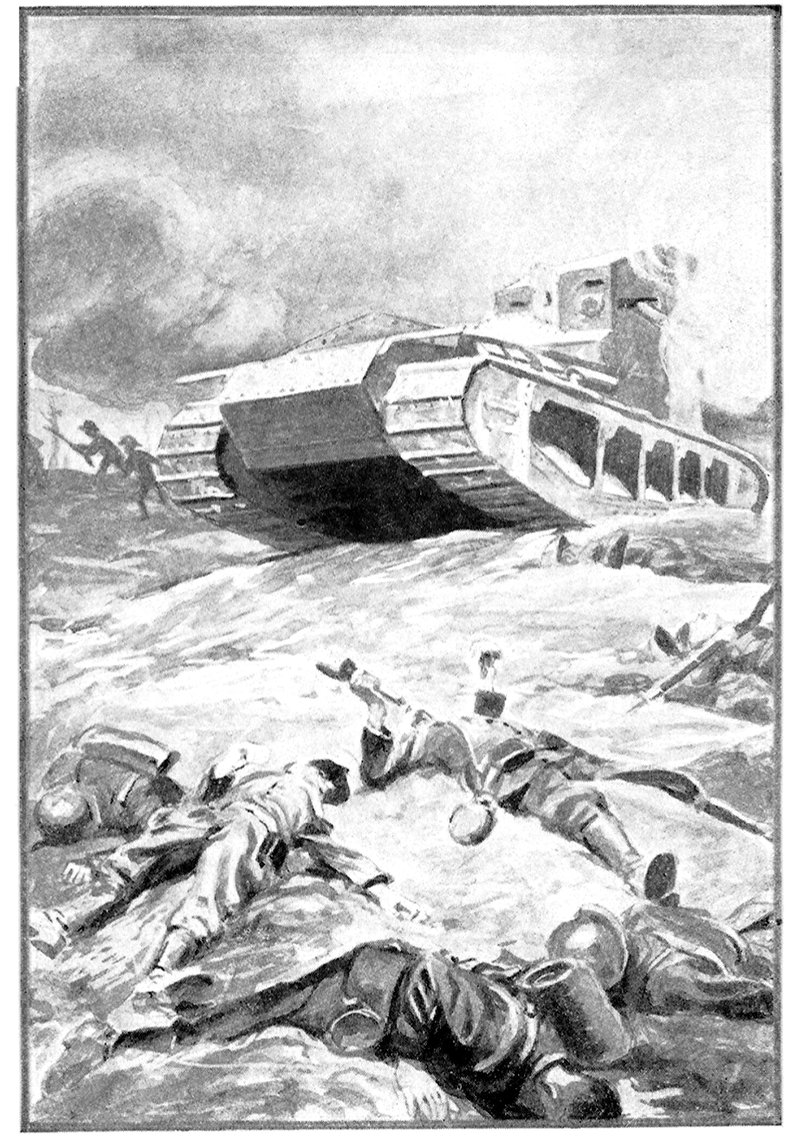
Top Sergeant Phil Speed did not
know exactly where he was when the long
train of trucks bearing hundreds of khaki-clad
American Marines stopped at a small town
within easy gun-roar of the battle front in
France. They were making little demonstration
now. For weeks they had been cheering
and been cheered until their throats became
sore and well again—calloused, as it were. So
spontaneous and so nearly universal had been
the enthusiastic reception extended to them
everywhere that it seemed as if every person
who didn’t yell his head off must be pro-kaiser.
With the noise of battle becoming more and
made distinct through the rumble, roar, and
rattle of trucks and ordnance racing toward
the scene of conflict into which they themselves
8were about to plunge, the hearts of these messengers
of liberty were not so gay as they had
been for weeks, aye, months, before. Everywhere,
among all sorts and conditions of men,
even among fighting patriots, there are bound
to be a few “smart” ones who forget the proprieties
sometimes as their bright ideas go skyrocketing.
And this sort of gay wight was not
lacking even among the pick of America’s
young manhood; but for once the gayest of
them were serious and sober minded.
The person who would joke in the face of
death, or with a messenger of eternity lurking
in the vicinity must be a philosopher “to get
away with it.” Phil had no idea of putting the
thing in such language, but if somebody had
stepped up close to him and whispered the conceit
in his ear, he probably would have responded,
“That fits the situation exactly.”
Still a considerable period of time elapsed before
he was able to dispel all doubt as to the
occasion of such unwonted sobriety.
“I wonder if we’re not all cowards, and if
that isn’t the reason we’ve all stopped our
noise,” he mused. “I hope we don’t turn tail
and run lickety-cut when we see a big bunch o’
boches swinging over the top at us.”
As if in reply to his musing, Timothy Turner,
a training-camp chum, who stood at his elbow
9in the midst of the throng of soldiers waiting
for orders to move along, spoke thus rather
grimly:
“We’re quite a solemn bunch, aren’t we,
Phil? I guess what we need is the explosion of
a few bombs in our midst to get us good and
mad.”
“Maybe,” Phil replied, regarding his friend
meditatively. “Well, it won’t be very long
before we’ll have a chance to find out. Do you
think an explosion a few feet away from you
would make you mad, Tim?”
“Yes, I do,” the latter replied unhesitatingly.
“I believe it would make me want
to telescope with the next shell that came
whistling along.”
Tim was a kind of bullet-headed Yank,
“built on the ground,” his school-boy friends
used to say. Really he looked as if he might
be accepted as a personification of that irresistible
force which would create “the most
powerful standstill” if it struck an immovable
object. But in spite of his bullet-headness,
Tim was anything but dull. Both officers and
fellow soldiers regarded him hopefully as one
of the prospective star fighters of the regiment
because of his mental keenness as well as his
physical prowess.
Phil was built along different lines. He was
10strong and athletic, but he would hardly have
been expected to be able to push over a stone
wall. Whether or not he was more intelligent
than Tim may be a matter for debate. It may
be admitted, perhaps, that he was not so
shrewd, but if they had both lived in the middle
ages, Phil undoubtedly would have listened
with interest to the first declaration that the
world was round, while Tim would just as
surely have repelled it with derision. But in
business Phil might have fallen a comparatively
easy victim to the wiles of a trickster,
where as the cleverest “con man” would have
had to get up very early in the morning to catch
Tim napping.
So here we have a double-barreled standard
for measuring intelligence among men and
among boys. Shall we call Phil more intelligent
than Tim, or vice versa? Let us dismiss
the debatable question without answer, while
we admit that they were both intelligent, but
different; and in spite of their difference—some
would say “in consequence of their difference”—they
were very good friends.
CHAPTER II FOUR KILOS ON HOBNAILS
11
“Battalion!” called out the major.
“Company!” the captain followed, as
it were, with the next breath.
“Attention!” continued the battalion commander.
The line was quickly formed, two deep, officers
in position, the major in attitude of
review.
“At ease!” was the next order which indicated
“something coming.”
“Men,” he said with an incisiveness of tone
indicating that his words would be brief,
“word has just reached me that the officers of
the enemy division that you are soon to meet
welcome you with expressions of contempt.
They say you are soft and will melt before the
Hun armies like wax over white heat. Will
you show them you can go through fire hot
enough to melt steel?”
The yell that greeted this question set at
rest all doubt that may have inspired the
“wonder” which came to Phil’s mind a few
minutes before as to their courage. And nobody
yelled louder or more fiercely than Phil
12did. After it was over he heaved a sigh of
relief.
“That’s what we needed,” he muttered.
“What did we need?” asked Tim, who
heard the remark.
Phil had no opportunity to reply. The major
was giving orders again.
“Attention!”
“Squads, right!” the superior officer added,
and immediately there was a swinging half-about
along the line, and a column of American
Marines, four abreast, was marching up the
street that led away from the detrucking point.
Then followed a hike of four kilometers
(two and a half miles) along the Paris-Metz
road. After journeying on hobnailed soles this
distance, the order was given to fix bayonets.
Phil and Tim were good enough soldiers by
this time to accept everything as it came and
not to look for too much that was not in evidence.
They had had try-out experience at
Verdun and, along with other rapidly seasoning
warriors of their regiment, had given a
good account of themselves. And yet, in spite
of all this curiosity-crushing experience, they
could not help looking just a little expectantly
for a camouflaged line of “bloomin’ boches”
upon whom to use their one-tined pitchforks
when the order was given to “fix bayonets.”
13“Does it mean charge?” both of them
longed to ask somebody, and after this question
they realized must follow another equally
important:
Where was the mysterious enemy?
It proved, however, to be only a precautionary
move to guard against surprise while advancing
through a wheatfield. There might be
a score or two of machine-gun nests in that
field, Phil reasoned. But then, he wondered
how that could very well be, as it must mean
that the gunners had made their way undiscovered
through the front line, which was a
mile farther on. However, the surmise proved
to be in error, for nothing of livelier nature
than a flock of hens and turkeys was encountered.
Presently a halt was ordered at
a group of deserted farm buildings, where
quarters were established pending the development
of further plans.
Meanwhile there were other battalions following,
and the country round about was rapidly
becoming a concentration camp of reserves,
who were sent forward in sections to
take positions in the front line as rapidly as
way was prepared for them, the French moving
out to take positions in other sections. Phil
and Tim were pleased when it became apparent
that they would not be ordered ahead before
14the next day, for they were weary from exertion
and loss of sleep and longed as much as
anything else to be in vigorous, fresh condition
when it came their time to meet the merciless,
unscrupulous foe in battle.
There was nothing radically new in this experience
to any of the Marines billeted at this
place less than two kilometers from the front
line, which was being pressed hard, by the
enemy. All of them had seen a very real kind
of practice service along with the French at
Verdun, and so there was little to arouse their
wonder in the sights and sounds of rumbling
camions, tanks and artillery as they were
rushed hither and thither, the shouts of officers
and drivers, aeroplanes soaring overhead, and
the whistle of an occasional shell fired with
apparent random purpose and exploding far
beyond the range of serious mischief. These
sights and sounds were fast merging into the
obscurity and quiet of darkness and inaction as
Phil and Tim lay down under a large apple
tree, resolved to get as much rest as possible
before the next daybreak.
“I’ve been wanting to ask you a question
ever since we detrucked from those lorries four
kilos up the road,” said Tim after the two boys
had lodged themselves in the privacy of a “ten-foot
sector” of the orchard. As he spoke, he
15picked up a full-grown apple from the ground
and sunk his teeth into it.
“This apple isn’t very ripe,” he observed,
indicating by his digression that the question
on his mind was not as vital as the importance
of appeasing his appetite or of winning the
war. “But the juice is sweet and pungent and
I’m going to make a cider press of my jaws and
squeeze the beverage down my throat.”
“If you haven’t forgotten your question, you
may put it to me,” Phil returned more to the
point.
“I was wondering what you meant when you
remarked, ‘That’s what we needed,’ after the
major made his little speech to us and we yelled
our throats hoarse to prove we weren’t soft,”
said Tim. “Were you afraid we really were
soft?”
“No, not exactly,” Phil replied. “But I
just had a kind o’ longing for proof that we
weren’t.”
“But we’d proved ourselves at Verdun,
hadn’t we?” Tim reasoned.
“Yes and no,” answered Phil. “At Verdun
we fought all right, but we had a lot o’ French
vets right at our elbows to ginger our nerve.
Here, I understand, they’re going to give us a
front all our own, ten or fifteen miles. I was
talking to Corporal Ross about it. He’s been
16doing messenger service at the major’s headquarters
and picked up a good deal of information.
He says we’re bound for a place called
Belleau Wood. The French call it Bois de Belleau.
The Huns, you know, have been pressing
the French pretty hard all the way from
Rheims to Soissons, and we’ve been sent to relieve
the French at this point so that they can
stop the enemy at other points. But I’ve got
a suspicion that a lot more American boys will
be thrown in about here and we’re going to
have a chance to make ourselves famous in the
next few days.”
“It’s up to us to make good,” declared Tim
with characteristic bullet-headed doggedness.
“The Marines have been criticised a good deal
lately. Some say we ought to be eliminated
from the service.”
“We’ve got to make good,” Phil echoed emphatically.
“The reputation of the Marines
is at stake.”
CHAPTER III DIGGING IN
17
Sergeant Phil was a year older than
Corporal Tim. The latter, unbeknown to
anybody except himself and his parents, had
entered the Marine Service in not the most
regular manner, but it was real patriotism that
had caused him to misrepresent his age, which
was the only bar to his eligibility. A wait of
eight months longer would have put him “over
the top” in this respect but he decided not to
wait. He looked 18 years old, and boldly declared
this to be his age, and, as some of his
slangy boy friends would have said, he got
away with it. When his Philadelphia father
learned of his enlistment, the bullet-headed
youngster was already on his way for probation
at the Paris Island, South Carolina, recruit
depot.
Then Mr. Turner thought twice and decided
not to interfere. He was thoroughly patriotic
and concluded that if his son had put over anything
on anybody it was on the kaiser.
Phil was a more regular sort of fellow in
such matters. He would never have misrepresented
18his age in order to gain admittance into
Uncle Sam’s fighting force. If he had not been
able to pass all the tests on merit, he would
have sought to aid the government in some
other branch of service. This is not intended,
by contrast, as a serious reflection on Tim.
The latter was different. He saw no particular
harm in adding a year on his age if thereby he
might help to shorten the reign of the Prussian
despot.
Tim kept his secret religiously, fearing lest
he be sent home or assigned to disgrace service
if it should come to the knowledge of his superior
officers.
Phil and Tim were disappointed in their expectation
that they would move early in the
morning following their arrival at the deserted
farm to a position in the front line. But they
were not disappointed in their anticipation of
thrilling activities before the close of the day.
Until late in the afternoon the entire battalion
was busy perfecting arrangements for relieving
the Frenchies in this sector.
The excitement of the day came at about 4
o’clock in the afternoon. The firing at the
front was heavy, but not of intensity such as
they had witnessed at Verdun. But it seemed
to grow hotter and nearer, so that the only
conclusion the Americans could draw was that
19the boches were driving the French back
through the woods.
Suddenly the company to which Phil and
Tim belonged was thrown into confusion by the
bursting of a shell on the roof of the barn in
which they had sought shelter. This would
have been a poor place for them if they had
been under constant fire from the enemy. But
it had served well enough against injury from
shrapnel, and still better from flying debris
heaved in all directions by the explosion of
bombs dropped from hostile aeroplanes. That
the wrecking of the roof of the barn was
effected by the bursting of a cannon shell was
evidenced by the shriek that immediately preceded
the explosion.
None of those in the barn was killed or injured
so severely that he had to be taken to
the rear for surgical treatment, but the lieutenant
was severely cut on his right arm. Phil
sprang to his assistance and helped him to
bandage the limb; then they rushed out after
the rest of the company. The wounded officer
now gave order for all to take to the woods and
dig in.
The Marines thus deprived of a shelter
rushed back into the roofless building, grabbed
up a supply of entrenching tools and then made
a dash for the woods. Most of them had
20snatched up their guns before making their
hurried exit. About halfway between the barn
and the woods another shell burst in their
midst, killing five and severely wounding a
score of others. Almost as if by magic a corps
of stretcher-bearers were on the scene. The
uninjured scarcely hesitated, and almost in less
time than is required to tell it the order to “dig
in” was being obeyed with the skill and speed
of long practiced teamwork.
The digging-in process was a simple though
strenuous task. All of the members of the company
not seriously injured by the bursting of
the shell were presently spading in the earth
for dear life a short distance within the timber.
They worked as if according to a systematic,
prearranged schedule. If they had been going
through a drill performance, under instruction
from manual and teacher, their work could
hardly have been more nearly true to military
form.
Each of these Marines quickly scratched off
a rectangular plot about three by five feet and
then began to dig. Phil and Tim, who always
endeavored to keep as near together as possible
in all emergencies where they might be able
to aid each other, “dug in” a few feet apart.
After they had cut roots and scooped the dirt
out to a depth of three or four feet, they dashed
21about here and there in the immediate vicinity
and gathered dead limbs and brushwood with
which each built a shelter at one end of his
funk hole, or “stub trench.” These shelters
were rendered more stable and impervious to
rain by heaping on them mounds of loose earth
that had been shoveled out of the trenches.
But the disastrous explosion of the two shells
seemed to have served as a false alarm as to
what ought to be expected for some time thereafter.
The fact of the matter is, “nothing happened.”
Three days they remained “dug in”
and not another shell or bomb struck within
two hundred yards of any point of the sheltered
“stub trenches” of the recently bombarded
regiment.
On the evening of the third day they received
an order to make a quick march to a shell-shattered
village on the front line.
“Now we’re going to see some real fighting,”
Tim prophesied to his friend, as they prepared
to obey the order.
He was not mistaken.
CHAPTER IV GAS MASKS
22
Phil and Tim had made good use of their
time while in training at Paris Island, so
that when they were ordered on board a transport
to steam for “somewhere in France,”
they could boast of being “Jacks of all trades
and masters of all” in the hyperbolic parlance
of Sea Soldier excellence. They could do pretty
nearly everything from the fitting of gun gear
to the operation of a wireless outfit or a portable
searchlight. Moreover, they were both well
qualified to handle machine guns, and Phil was
drawing an extra $3 a month as a rifle sharpshooter.
The company to which Phil and Tim belonged
was stationed just outside the village.
They reached this position at about 2 p. m. and
had little more than completed their digging-in
operations, when the word was passed along
that they would “go over the top” at 4:30.
But this announcement was presently countered
from headquarters, coupled with a “man-to-man message” that scouting aeroplanes and
observation balloons had communicated to
23headquarters the information that the boches
were evidently planning to “come over” at the
Yanks. A hurried conference among the officers
of the Marines decided then that it would
be better strategy to let the enemy come on and
get their fill and then counter their decimated
forces with a good strong bayonet and hand-grenade
drive.
Phil and Tim were near enough to each other
to carry on a conversation in ordinary tones,
and when the word reached them that they
must wait for the enemy to attack them they
expressed their disappointment vigorously.
“I hate this waiting business,” Phil declared.
“We’ll never reach Berlin at this
rate.”
“So do I,” responded Tim. “I wonder what
those minions of the kaiser think they’re going
to do. To my mind it’s a sign of weakness on
their part, making a drive this time o’ the day.”
“Why?” Phil inquired. “I don’t see why it
should be a sign of weakness on their part any
more than our plan to go over the top at 4:30 is
a sign of weakness.”
“Maybe not from their point of view. But
we know what we’ve got behind us—millions
of men and billions of money. We know, too,
that we’ve got vastly more of these than the
boches have. So you see, I have something
24more than suspicion to base my theory on that
they like to make an attack late in the day so
that if they fail they will have the darkness to
cover their retreat. I bet that when our record
is summed up you’ll find that we made most of
our dashes against the enemy’s lines at 4 or 5
o’clock in the morning.”
“I hope I’m spared to contemplate such a
record,” said Phil soberly.
“You don’t doubt it, do you?” Tim asked,
for he was surprised and disappointed to hear
his friend speak so diffidently.
“I was just wondering,” Phil replied meditatively.
“See here, Phil,” Tim said, shaking his
hand toward his soldier comrade; “you’re
making a big mistake. You’re meditating. Do
you realize that a soldier should never meditate?
He should never even think twice. He’s
got to do his best thinking the first time.”
“What’s that got to do with my wondering
whether I’m going to come out o’ this alive?”
Phil inquired.
“It’s got this to do with it: It’s as bad as
writing poetry in a trench. I think you’ll agree
with me that anybody that does that is a nut.
Now, I don’t believe I’m going to have my head
blown off. Notice that I don’t say, ‘I don’t let
myself think I’m going to be killed.’ I’m dead
25sure I’m not going to be killed. Get me?—dead
sure; not sure dead.”
“Sure thing I get you,” Phil answered enthusiastically;
“that’s a peach of an idea. It’s
too bad all the other soldiers of the Allies
haven’t got the same idea.”
“How do you know they haven’t?” Tim demanded
quickly.
“I don’t know it,” Phil admitted with a
smile, for he saw what was coming next.
“A fellow must get this pretty much by himself
to make the best kind of soldier,” Tim said,
speaking with the convincing manner of a veteran.
“I’ve heard young fellows talk about
going into battle with the expectation of being
killed, but that’s before the bullets begin to fly
and the shells begin to burst. The real soldier
is never desperate. The minute you get desperate,
that minute you are rattled. The soldier
who goes into battle expecting to be killed, goes
into battle desperate and is soon rattled. Don’t
go into battle expecting to be killed; go into
battle expecting to kill, kill, kill, and keep on
killing.”
“Hooray!” said Phil jocularly. “That’s
what I call war philosophy. Get me? War
Phil-osophy for a fighting Phil of Philadelphia.”
“Philosophy nothing,” Tim snapped back.
26“You make me ashamed of your name with
your jesting pun. I thought you understood
me better than that, Phil. Wartime is no time
for philosophy. That’s what got a lot of pacifists
into trouble and some of them in prison.
They weren’t philosophers enough to realize
that you can’t stop to philosophize when somebody
is punching you in the nose.”
“Gas masks!” yelled Phil suddenly, and
similar cries came from others along the timber-sheltered
line.
But the warning was not needed by Tim.
Even as he uttered the last word of his
soldier’s common-sense lecture, he caught a
faint whiff of mustard. Instinctively he held
his breath, and eight seconds later he was inhaling
the pure, safe lung-fuel, “canned oxygen,”
contained in the reservoir of his mask.
CHAPTER V A MACHINE-GUN BARRAGE
27
That settled it in Phil’s mind. There
would be no “over the top” from the
enemy lines that night. Probably, after all, he
was mistaken in assuming that the boches, conscious
of their own insufficiency of reserves,
would hesitate to make a morning attack. They
were planning to harass the Yanks all night
with gas and a hurricane of shells, and in the
morning make a charge that would sweep
everything before it.
With the putting on of the masks, the conversation
between Phil and Tim stopped. It
really seemed that the former’s soliloquy following
this operation was better reasoning than
his earlier conjectures had been. The cannonade
that followed the “gas wave” was terrific
and it seemed that such a barrage must mean
something in the nature of a sequence, but they
would hardly charge right into the gas they had
shelled into the Yank’s lines.
But again Phil was privileged to change his
mind, and that very suddenly. The bombardment
continued until after dark and many
shells exploded perilously near the Pershing
28forces—a few did fatal damage right in the
midst of the waiting Americans at the edge of
the woods.
At about 9:30 o’clock this bombardment
ceased as suddenly as it had begun. Neither
Phil nor Tim had taken part in or witnessed
a night attack, except in the nature of a cannonading,
since their first experience on the
Verdun front, and they were greatly astonished
at what came next.
But they were not without warning, for the
signal service was on the qui vive constantly,
as were also the advance sentries, and about
two minutes before there was any sign of
the approach of the enemy, word went
along the line to be on the lookout for an
attack.
“So my first surmise was right, after all,”
Phil mused. “They’re going to attack under
cover of the darkness so that they may retreat
more successfully if their attack fails.”
Another surprise was coming not only to
Phil and Tim, but to many other “dug-in”
Marines along the American front. It had to
do with the character of the attack.
Suddenly the American lines were swept
with a sharp, snappy, vicious machine-gun fire.
The boches had crept up under cover of the
darkness and succeeded in planting a score or
29more of machine guns at various places in the
timber a hundred yards ahead and started
pumping a murderous storm of bullets at the
doughboys.
But fortunately it was murderous in sight
and sound chiefly, for very few of the Yanks
were hit. In the first place, it was almost a
random attack, for the muzzles of the guns
were elevated a degree or more too high to
rake the edges of the funk holes in which the
Americans were crouching. Moreover, the intervening
trees intercepted many of the bullets,
as was evident from the tattoo thuds that could
be heard even amid the noisy spitting of the
machine guns.
Just what the enemy hoped to accomplish by
this method of attack it was difficult at first to
determine, although the Yanks were destined
to discover very shortly that it was a clever
sort of camouflage.
But the cunning boches were destined to discover
something, too, and to Phil was due the
credit for this rather startling enlightenment
of the enemy.
“Tim,” he called out to his friend, “I believe
that is nothing but a machine-gun barrage intended
to throw us off our guard. They’re
planning a surprise attack.”
A “machine-gun barrage” was a new one to
30Tim, but he listened respectfully for further
explanation.
“We can expect them to come over any
minute,” Phil continued rapidly. “I’ve got an
idea of how they’re going to do it. By the way,
I’m going to make a dive over to Lieutenant
Stone and tell him what I’ve got in mind. He’s
only a few jumps away. He’ll probably reprimand
me, if he doesn’t report me to headquarters,
but the suspicion I’ve got seems to me
so important that I’ll risk any punishment this
side of the firing squad.”
The thunder of the cannonade and the
sharper rattle of the machine guns were so intense
that Phil found it necessary to scream
his message to his next-trench neighbor to insure
being heard.
“Well, if it’s so very important, don’t stop
to tell me about it, but hurry up and get it
where it will do most good,” Tim yelled back.
“They won’t take me by surprise.”
A moment later Phil was dashing over the
underbrush and among the trees in momentary
danger of butting his head against a very solid
and substantial interference or of sprawling
violently on the ground. But he had surveyed
the vicinity carefully before the shadows of
evening thickened in the woods and knew
pretty accurately where the lieutenant had dug
31in. He had to move just as carefully also as
if he were stealing along an enemy line of
trenches, for some of the American soldiers
were likely to discover him and shoot him as a
spy.
He succeeded in making his way within a few
feet of the lieutenant’s trench and, crouching
low, began to signal to him by calling his name
in graduated rising tones. Presently the officer
replied and Phil informed him who he was.
In a few words the sergeant communicated
his self-imposed message to his superior officer.
“That is probably the best suggestion that
has come from any source on this front since
the American Marines were stationed here,”
remarked Lieutenant Stone. “Now, you get
back to your post as fast as ever you can, or
I’ll order you sent back behind the lines under
guard.”
Phil darted back gleefully along the rear
of the American line and toward his empty
funk hole, which he reached with very good
caution as well as expedition.
CHAPTER VI THE BOCHE CHARGE
32
Before Phil got back to his funk hole, the
intelligence he had communicated to Lieutenant
Stone had been transmitted over the
trench telephone to every camouflaged station,
and rapidly thereafter by runners to every man
in the line. The message thus delivered was
this:
“Look out for an attack while the machine
guns are going full blast. They may elevate
the muzzles of their machine guns and send
their men over the top when it seems impossible
for them to leave their trenches without
being mowed down with their own fire.”
Phil’s prediction was fulfilled. Indeed, the
preliminary, which constituted, in effect, a signal
for the charge, was exceedingly obvious to
all the Marines in the front line after they had
been advised as to what to expect. It is quite
possible that many of them would not have observed
the elevation of the streams of machine-gun
fire to an angle of forty-five degrees if they
had not received Phil’s warning; and most of
those who might have observed this seemingly
reckless waste of “powder and pills” undoubtedly
33would have been puzzled, if not confused,
by so strange a phenomenon.
As it was, the Yanks were able to time the
attack with remarkable accuracy and met the
boches with volleys from their rifles so nearly
simultaneous that those of the enemy who were
not taken off their feet by the deadly hail of
steel-jacketed bullets must almost have been
taken off their feet with astonishment. At any
rate, the attack failed utterly, not a few of the
Marines leaping out of their “trenchettes” and
engaging the panic-stricken boches with bayonets
or clubbed guns.
It was impossible to get any idea of the number
slain in the fight, for although the sky was
clear and the stars shone brightly, the moon
had not risen and the woods was almost as dark
as a pocket. The Americans kept a sharp lookout
for the appearance of shadowy forms a few
feet away from their intrenchments, and as
soon as they saw them creeping cautiously forward
they blazed away with good execution.
The Marines were bothered with no more
“over the top” from the boches that night,
although there was a heavy bombardment from
their larger guns located beyond the opposite
edge of the woods. When this began, Tim
called out to his friend:
“That means they’ve gone back a respectful
34distance. We’re surely safe from another
attack as long as that keeps up. By the way,
they’re pretty bum marksmen, aren’t they?
Those shells are dropping far behind us.”
“Yes; but we have other lines back there,
and they’ll get a taste of what is probably
meant for us,” Phil replied. “Say, there’s a
wounded fellow lying only a few feet away
from me. Somebody else shot him. I was just
drawing a bead on him when some good friend
tipped him over for me. It wasn’t you, was it,
Tim?”
“Yep, I’m the fellow,” Tim answered modestly.
“I’d disposed of the baboon that was
coming in my direction and saw the one that
was makin’ for your hole in the ground, and I
said, says I, to myself: ‘Phil’s well able to take
care o’ himself, but I don’t think he’ll be
offended if I relieve his soul of the burden of
slayin’ a man.’ So I pulled my trigger, and
over went the villainous gink.”
“Good work,” Phil commended. “I won’t
criticise you for failing to kill him, for you did
far better than I did as it was. You’ve put at
least two serfs of the kaiser out of business,
and I didn’t even fire my gun at one.”
“What’ll we do with ’im?” asked Tim.
“Pull ’im back behind the lines to wait till the
Red Cross comes along?”
35“No, we won’t pull him,” Phil returned more
compassionately. “We’ll pick him up and
carry ’im.”
“He doesn’t deserve any such gentle handling,”
Tim objected stubbornly.
“It isn’t a question of what he deserves, but
the kind of record we Americans want to leave
behind us,” Phil replied earnestly. “You
know how horrified we were by the sinking of
the Lusitania and the atrocities in Belgium
and northern France. Because of those atrocities
we called the whole group of central allies
Huns. Do we want to deserve the same title of
reproach? Besides, the boches aren’t more
than half responsible. They were brought up
that way. A man can get in the habit of thinking
anything that’s popular if he drifts with
the current.”
“Now, you’re doing the very thing I warned
you against,” Tim protested vigorously. “I
told you that wartime was no time for any
philosophy business.”
“And I agreed with you,” Phil responded.
“You win. Come on and we’ll get that fallen
foe and hustle ’im back behind the lines. We’ll
take him any way you say.”
The two boys leaped out of their shallow
“trenchettes” and picked up the boche and
carried him almost gently ten or fifteen feet
36to the rear. Just then two relief men dashed
up, laid the wounded man on a stretcher and
hustled him away.
“Bloodthirsty Tim listened to reason that
time,” Phil told himself.
“I drove some common sense into Phil’s
head,” Timothy mused. “I hope he keeps it
and he’ll make a better soldier.”
CHAPTER VII TIMBER FIGHTING
37
Early the next morning a squadron of
aeroplanes flew over the American lines
dropping bombs and doing considerable damage.
But it was not long before they were met
by a score of Allied planes, which poured into
them such a fusillade of machine-gun bullets
that two of them dived to the ground with a
crash and the others were driven back behind
their own lines.
The cannonading from the German big guns
during the night did little damage to the
Americans, for most of the shells dropped far
to the rear. Moreover, the Yankee field artillery
replied with much better marksmanship
than that of the boches, as was reported in the
morning by scout aviators and balloon observers.
But it was not necessary to wait for
these reports to get an idea of the devastation
effected by the Americans’ cannonading. The
timber that had shielded the enemy forces,
whose attack had been camouflaged by a spitting
of machine guns “at the stars,” was now
a scene of arboreal ruin. The boys decided
38that they had never seen quite so abundant an
assortment of splintered kindling wood in their
lives.
In the course of the day the American lines
were advanced to the farther edge of the belt
of timber in which the battle of the night had
been fought. It seemed that this belt had been
entirely cleared of the enemy. Beyond the
waste of splintered and contorted forestry was
a narrow open stretch of lowland, and beyond
this was another woods undoubtedly peopled
with outpost of sharpshooters and machine-gun
nests. The Yanks did not have to wait
long for a verification of this suspicion.
Scarcely had they taken up their positions
near the edge of the area of green kindling
wood when there came a vicious spitting of
machine guns and sharpshooters’ rifles.
It was exceedingly difficult to bring up the
artillery through the shell-and-shrapnel-torn
timber for the purpose of raking the opposite
woods in a similar manner. There was considerable
work for the engineers before this
could be done. Meanwhile, however, the commander
of the Marines decided not to wait in
idleness. Machine-gun corps were stationed
behind uprooted trees and splintered stumps
and huge boulders and in yawning shell holes
and deep gullies and were presently spitting
39away into the opposite timber wherever a nest
could be located.
At last several cannon were brought up and
a storm of shell and shrapnel was poured into
the woods beyond the clearing. This proved to
be effective to a considerable extent, for many
of the machine guns of the enemy were silenced,
as were also a battery or two located
behind the enemy’s front line.
But certain nests of sharpshooters and machine
guns proved to be exceedingly difficult
to dislodge and orders were given to take those
positions at as little cost as possible, but take
them. Accordingly a body of Marines were
selected for this duty, including the company
to which Phil and Tim belonged.
It was a dangerous task, for it meant a
charge across an open stretch into another timber
in which an uncertain number of the enemy
were concealed waiting to receive them with
all the advantage of position and concealment
on their side. They did not make the fatal
error of massed attack that so often characterized
the death plunges of the boches.
Rather, they scattered out and dashed forward
with more or less individual independence and
bravery almost unknown among the usually
kamerad-encouraged enemy.
“I’m going to try Tim’s method of generating
40self-confidence,” Phil told himself as he
dashed with his fellow Marines across the
open. “Here it is: I’m going to come out of
this without a scratch and I’m going to kill,
kill, kill.”
He saw several Marines in front and on each
side of him fall victims of the accurate shooting
of the concealed enemy, but this did not feaze
him in the least. He knew he was going to
dash through successfully and he knew he was
going to find a hidden machine-gun nest and
whip it single handed if necessary.
And he was not mistaken. He reached the
opposite timber without receiving a scratch.
Then followed a more careful procedure to
hunt out the pests that were doing everything
in their power to make things uncomfortable
for the Marines. The latter were armed with
rifles and hand grenades, and the timber was
soon ringing with evidence of their discoveries.
Phil had charge of a squad that worked as
a unit in the scouring of the woods, and Tim
was a member of this squad. Alternately they
were in hiding in thickets of saplings and
bushes or racing ahead to make a swift surprise
attack on a machine-gun nest located by
the sound of firing or the creeping cunning of
a camouflaged spy. This handful of Marines
cleaned out two nests without the loss of a
41man, and then, it appearing that there were
no others within the sweep of their advance,
they separated in parties of two or three each
to hunt for snipers after agreeing on a place
of meeting and a call by which Phil might
summon them together again whenever he desired.
Phil and Tim, perhaps by force of habit,
continued together without other company.
The Marines were now driving a considerable
rear guard of the enemy ahead of them, principally
snipers and machine gunners, who were
trailing behind the main body of the defeated
boches to facilitate the latter’s retreat. Realizing
that the remnant of this rear guard was
moving more rapidly in its haste to get out of
the way of the terrible American butt-or-muzzle
riflemen and hand-grenade throwers,
Phil and Tim put as much speed to their advance
as the character of the terrain would
permit, hoping to overtake some of the fugitive
snipers.
A few minutes after the squad had spread
out to cover a larger territory, the two friends
arrived at the meadow-like opening into a
wooded ravine which appeared to grow deeper
and deeper in the direction taken by the fleeing
boches. With little hesitation they dashed into
the ravine, becoming more cautious, however,
42as they entered the timber-shaded lowland
with its tangle of ferns and shrubbery.
It was really a dangerous undertaking, but
these boys were in a dangerous business. The
ravine was lined with many ideal places for
concealment of snipers and the route taken by
the venturesome pair along the bottom was an
ideal place to get sniped. But Phil and Tim
felt that the place ought to be explored, and as
a call to summon the other boys of the squad
would serve only to alarm any hidden bodies
in the vicinity, they decided to take the burden
of the investigation on their own shoulders.
They advanced a hundred yards into the ravine
without seeing another living creature,
except a few squirrels and hundreds of birds
which chattered and chirped away as if the
carnage of a world war was the farthest possible
from their thoughts.
The boom of cannon was confined now to distant
portions of the indeterminate battle line,
and the discharge of smaller firearms also had
ceased in the immediate vicinity. It seemed to
the two boys that they and the squirrels and
the birds had the ravine all to themselves, but
they were destined presently to be disillusioned.
Suddenly—of course, for all explosions are
sudden,—Phil was startled by the discharge of
43two rifles from behind a thicket twenty feet
ahead. “Ping!” sung a bullet past his left ear.
Tim was not startled. He did not know what
hit him. Over he went, and Phil sprang behind
a tree, as a true American, to meet the
enemy Indian fashion.
CHAPTER VIII AID FROM THE AIR
44
A bullet through his own body would
not have given Phil as intense a pain as
the one that struck Tim and apparently ended
his career. But he was too good a soldier to
let even so distressing an incident delay him
in the duty of speedy self preservation.
And yet, swift though he was in springing
behind a tree and bringing his rifle into position
for firing, there were others just as speedy
as he. Six men in gray uniforms, but decidedly
un-uniform as to size and grace of physique,
were standing out in full view with guns leveled
at him.
Instinctively Phil’s hand moved an inch or
two toward his hand-grenade sack. But it
stopped almost with the impulse. He had used
the last of his grenades half an hour before
in the squad’s last fight that resulted in the
extermination of one of the most obstinate
of all the machine-gun nests in the woods.
How he wished he had been more mindful of
his supply while hurling those missiles at the
enemy. Two of them, he recalled distinctly,
45had gone wide of their marks and represented
a sheer waste of powder and shell. Oh, if he
had only one of those grenades! With it he
could produce such execution in that group of
snipers that he could easily capture or finish
with his rifle those not slain by the explosion
of the hand missile. He was sure he could
hurl a grenade accurately and at the same time
keep his head and body fairly well protected
from the enemy’s rifles behind the hole of the
tree.
But there was no use now of mourning over
spilled milk or exploded shells, and an attempt
to engage in battle, alone, with six Hohenzollernites,
all of whom had the drop on him,
could mean nothing more hopeful than death.
One of the snipers called out an order in
German, but Phil did not understand it, although
he had studied the language one year
at school. Then all six men advanced toward
him with their guns ready to fire the instant
the Marine showed a disposition to fight.
The boy was on the verge of offering to surrender
when a new interruption of proceedings
produced one of those spectacular thrills
that relieve the carnage of battle of some of
its dreadfulness. Almost without warning,
save for a heavy, momentary rushing sound in
the atmosphere, there was an explosion and upheaval
46of earth midway between the boches
and the American Marines.
Phil did not see what occurred. For the
moment he could see nothing but confusion.
His first thought was that the explosion was
caused by a shell from either American or
boche artillery. But this could hardly be. He
had heard no shrill scream that always heralds
the approach of such missiles. Sound travels
more rapidly than even a cannon projectile,
and soldiers often comment with grim amusement
on their acquired skill at “dodging”
shells whose approach is announced by their
own shrieks piercing the air ahead of them.
Suddenly Phil recalled that, in the midst
of the excitement attending his and Tim’s excursion
into the ravine, he had heard faintly
a familiar noise in the upper atmosphere—caused
by the powerful gyrations of an aeroplane.
As the echoes of the explosion of the
shell died away, he heard the super-sonorous
buzz of the “great mechanical bee” again and
looked upward.
It was a French aeroplane, from which the
bomb had fallen. Apparently the flyer had
seen the unequal combat going on below and
dropped an explosive in the hope of incapacitating
the opponents of the boy in khaki to do
him any harm. The overhead foliage was not
47heavy at this point and it was not inconceivable
that the aviator might have seen even
more of the activities of the six snipers than
Phil and Tim had seen.
None of the advancing enemy was killed, although
it seemed well-nigh miraculous that all
of them were not at least fatally injured. However,
Phil saw two of them picking themselves
up after the cloud of flying earth, stones, and
sticks had fallen back to earth. Blood was
trickling from the face of each of these and
all of the others were nursing severe cuts or
bruises.
Phil saw his opportunity. Every one of the
boches had dropped his gun in order the better
to pet his smarting wounds. The boy, protected
by the hole of the large tree which he was
endeavoring to keep between himself and the
enemy’s bullets, had not been touched by even
the smallest of the flying stones, sticks, bits
of earth or pieces of shell. Springing out from
behind the tree he ran toward the panic-stricken
sextette, with rifle ready to be brought
to his shoulder at a moment’s warning.
“Halt!” he cried; “Halt, or I’ll shoot!”
CHAPTER IX KILL, KILL, KILL, KILL, KILL, KILL!
48
Whether or not the boches could understand
this much, or this little, English
was a matter of no importance. They evidently
knew what the Marine in khaki meant,
and they obeyed, several of them yelling
“Kamerad!” in tones of panic.
Phil had not forgotten all his school German
vocabulary. The next order that left his
lips slipped out with very good Prussian accent:
“Kom her! Hande ueber Kopf.”
The now timid Teutons advanced with hands
over their heads toward their youthful captor,
in strict obedience to the order.
Phil was relieved that his prisoners did not
laugh at his German. They came forward
with all due respect for the order given—or
was it for the bullets in the boy’s gun? He
did not know. Under ordinary civil circumstances
he would have hesitated to engage in
conversation with a German in the latter’s native
tongue for fear lest he show his ignorance
of the idioms of the language. “Hande ueber
Kopf” was a literal translation of “hands over
49(your) head.” It might be very good German,
and then again it might be very poor.
Relieved at the failure of his prisoners to
give him the laugh, he decided to continue to
give orders in their language whenever he
could recall words that seemed to carry
the intended meaning. But he found it difficult
sometimes to keep from laughing at himself,
for he knew unmistakably that some of
the German he was using was at least unique.
Still his prisoners regarded him with profound
respect—or, again, was it the bullets in his
gun?
Phil was puzzled what to do with his prisoners,
whose condition of captivity was, after
all, rather uncertain. He dared not take his
eyes off them for a moment. Possibly some or
all of them carried small firearms, which they
would bring into action at a moment’s opportunity.
The boy dared not attempt to search
them, nor dared he attempt to march them
back through the woods toward the American
rear line. They were almost certain, if they
carried such weapons, to find an opportunity,
by springing behind large trees, to whip out
their pistols and turn the tables on him.
There were evidently only three courses
open for Phil to pursue. One was to stand
where he was and compel his prisoners to remain
50in their present positions, with hands
over their heads until help came. Another was
to shoot the six men down in their tracks as
rapidly as he was able to discharge his repeater
accurately. The other was to turn and flee
with all his well practiced fleetness of foot.
The last he could not consider for an instant.
The second was contrary to American principles
opposed to unnecessary frightfulness in
war. The first was impracticable in view of
the fact that the sun was setting and darkness
would soon cover the ravine.
It occurred to the young sergeant that he
might also compel his doubtfully secured captives
to divest themselves of their uniforms in
order to make certain that they had no concealed
firearms, but such a course would not
guarantee his ability to prevent them from escaping
in the woods after dark. It might, however,
be the means eventually of saving his life
if the men should escape from him, and Phil
decided to adopt it as a precautionary measure.
But at the same time he cast about him in a
vague hope that help of some kind might be
at hand. He glanced quickly up to see if perchance
the French flyer was not about to offer
him further assistance, but that very thoughtful
air-fighter was now engaged in a skirmish
with an enemy plane, which was taking them
51farther and farther away from the precarious
scene in the ravine. Then the young officer bethought
him of his fallen companion, and with
almost hysterical hopefulness he cast a quick
glance toward the spot where the corporal had
dropped without a groan. As he did so, it
seemed that he must behold his friend rising
on his hands and knees in a determination to
lend his much needed assistance.
Phil shuddered as he saw the bullet-headed
boy lying as still as any corpse on a battlefield.
“Poor Tim,” he muttered. “He was sure he
wouldn’t be killed. Well, so am I,” the doubtful
captor of six doubtful prisoners added.
“I’m not going to be killed—I know it. I’m
going to kill, kill, kill, kill, kill, kill, as Tim said
I should do. There, I said ‘kill’ six times.
That means that these six prisoners have to
die as rapidly as this repeater can repeat. Fortunately,
I’m a sharpshooter and can do the
job before the last one of them can much more
than shudder and look pale. Well, here goes,
converting my army rifle into a machine-gun.”
CHAPTER X A NOVEL DISARMAMENT
52
“No, I can’t do it. I’m no Hun.”
That sentiment, which flashed revulsively
through Phil’s brain, probably saved
the lives of those six boches, but it also must
be held responsible for certain subsequent misfortunes
and hardships that rendered Sergeant
Speed’s army experiences worthy of a
many-chaptered record. Meanwhile there was
nothing in the boy’s manner or actions that
indicated what was going on in his mind. None
of them knew how narrowly they escaped execution
at the hands of a “firing squad of one.”
Phil’s next order to his captives was such a
mongrel admixture of English, poor French
and worse German that he has asked that it
be not recorded against him. But it was thoroughly
understood, being in several short sentences
intended to carry something of an explanation
of his purpose, and was obeyed.
One of the men with hands over their heads
was directed to step forward and remove his
“roch und beinkleider.” This he did expeditiously,
having a great respect for the khaki
boy’s gun, and presently appeared in the very
53amusing combination of—beginning at the
feet, surveying upward—a pair of coarse
heavy shoes, a suit of union underwear and a
steel helmet.
It had occurred to Phil several times since
the dropping of the bomb from the aeroplane
that he could best serve his own interests in
the present predicament by sending forth the
call agreed upon for reassembling the members
of his squad, except for one grave possibility.
The sounding of such a call might be taken by
his six prisoners as indicating panic on his
part and serve as a signal for a desperate move
by them. He decided, therefore, to make certain
that they were stripped of all firearms,
before issuing any such summons.
So he continued the de-uniforming program
already begun, and soon six much humiliated
boches stood before him in “union-suit uniforms,”
the “complexion” of which indicated
that the laundry business was not thriving
among the minions of the war lords of central
Europe.
Then Phil ordered his prisoners to move a
considerable distance away from the litter of
uniforms strewn over the ground. When he
was satisfied as to their position and arrangement,
he issued a few more orders with his
ingenious, but hardly idiomatic adaptation of
54first-year school German, which were obeyed
with, as much respect as if delivered by a Heidelberg
graduate with military authority.
The prisoners, who no longer were required
to keep their hands over their heads, were
standing near the apparently lifeless form of
Corporal Tim; and Phil now, with the aid of
expressive motions of his hands and nodding
of his head, communicated to them that he
desired an examination made of his friend to
determine if he were yet alive. The officer in
charge, a fellow of surprisingly large girth
for a soldier, and another boche of ungainly
physique complied with apparent alacrity, and
after a seemingly diligent inspection straightened
up with looks of sadness on their faces
that would have been comical indeed if it had
not been for the seriousness of the situation.
With voluble expressions of condolence and
deprecating shrugs of their shoulders, they
gave the young American soldier to understand
that they regretted profoundly that his
companion lying on the ground was dead.
“You’re a pretty pair of liars,” Phil said
to them with a “happy scowl.” He made no
effort, however, to express himself in German,
for his utterance was intended more as an outburst
of feeling than a communication. “That
boy is alive, or I don’t know anything about
55the early stiffening of a corpse. When you
lifted that body up it hung as limp and limber
as a wet rag.”
Whether any of the six captives understood
what Sergeant Phil said could not be determined
from the expression, or lack of expression,
on their faces. However, that question
mattered little to Phil now. He must do something
quickly to secure his prisoners against
escape and also to effect freedom for himself,
in order that he might render much needed
first aid to his unconscious friend.
In his early school days, Phil had been the
envy of all his boy friends because of one
achievement that every boy longs to attain.
He could pucker his tongue against his teeth
and expel a gust of breath through the straitened
avenue thus formed in such manner as to
vie in shrillness a miniature fire alarm siren.
He was not much good at whistling a tune, but
he surely could wake the echoes with a piercing
air blast through his teeth, and this he proceeded
now to do.
It was his agreed signal to the other members
of his squad to assemble and it surely
startled the six boches, as was evident from
the fact that their faces no longer were expressionless.
There was no doubt in the boy’s mind
now that their minds had been secretly busy
56over something that they did not wish communicated
to him and that his shrill signal
was not in the least pleasing to them.
However, although Phil never had all the
facts and circumstances before him to aid him
in determining the truth, he is of the opinion
now that his call was the one thing needed by
his prisoners to bring about the very result
for which they longed most deeply. But the
startled look on their faces indicated that they
did not know it.
Phil waited a minute for an answer from
other members of his squad, but received none.
Then he was about to repeat the call, when
something occurred that rendered another
shrill whistle through his teeth virtually impossible.
Suddenly a heavy weight landed on him
from behind. A pair of powerful arms were
thrown about his neck, and he was borne to
the ground by the impetus of the onset.
CHAPTER XI PHIL A PRISONER
57
Although this overpowering attack
from behind was doubtless almost as
much a surprise to Phil’s six prisoners as it
was to the boy himself, it did not take them
long to recover and seize advantage of the situation.
Like a football team they rushed forward
to tackle their recent captor, but their
assistance was scarcely needed, for the fellow
who had leaped on Phil’s back was a powerful
200-pounder, and the shock that resulted
when earth and the boy came together half
stunned the latter.
But it was not enough to deprive him entirely
of his senses, and as he was being jerked
to his feet, he had the hazy gratification of
hearing an answering whistle to his own “siren
shriek.” The boches evidently were alarmed
by the same sound, for they put greater energy
and speed in their actions in order to get out
of the ravine as soon as possible.
First they raced about and gathered up their
guns, which lay strewn around the crater-like
hole made by the explosion of the bomb
dropped from the aeroplane. Then they gathered
58up their uniforms, but did not stop to
put them on, and darted into the thick of the
timber in the direction of the retreating boche
lines, two of them half carrying, half dragging
their boy prisoner between them.
But Phil was not the kind of lad who would
attempt to hinder the progress of his captors
by hanging back and pretending to be unable
to keep pace with them. He preferred to conduct
himself as thoroughly able-bodied as soon
as he had recovered from the shock that attended
his capture. In a few minutes he won
just a slight manifestation of good-will from
the two who had hold of his arms by “going
them one better” and actually leading them
slightly in the race through the timber.
In a short time the dusk was so heavy in the
woods that it was difficult for them to make
progress at more than a slow walk. Efforts
to push ahead rapidly were sure to result in
trouble with tripping underbrush, scratching
branches, and bruising boles of trees.
Phil realized that it was next to vain to hope
that they would be overtaken by the comrade
Marines of his squad; for although answering
calls from them had reached his ears, indicating
that they had almost arrived at the scene
of his capture, there was small likelihood, indeed,
that they would be able to hit the trail
59of the fleeing boches and overtake them and
rescue him. He was tempted several times to
repeat his whistle and yell out information as
to his predicament, but vicious threats from
the officer of big girth in charge of the squad
now in “underclothing uniform,” accompanied
by a significant pressing of a rifle muzzle
now and then against his head, advised him
convincingly against any such proceeding.
Sergeant Speed’s one hope of rescue was
that they might run into a body of Americans
who had advanced farther into the timber in
their search for retreating snipers and machine
gunners. But this hope was only remotely
reasonable, for the instruction from
the commanding officer had been that the entire
raiding force return by nightfall. Undoubtedly
he and Corporal Tim, and perhaps
the other members of the squad as well, were
being reckoned among the missing. It was
hardly probable that the latter had yet given
up their efforts to rejoin him after hearing
and answering his siren whistle. Possibly
they had discovered Tim lying on the ground
and even now were doing their best to revive
him or were bearing him back toward the
American lines.
Phil and his captors had by this time advanced
some distance into this wooded battle
60ground, most of which had until recently been
occupied by the enemy. But the heavy shell
fire and attacks by the air fleet of the allies
had driven the main boche division back a considerable
distance, and after the Marines had
routed out the nests of machine guns and
sharpshooters that were concealed in the woods
and rendered perilous any further attempt on
the part of the enemy to hold these positions,
the captured timber terrain was a desolate
waste indeed.
No doubt there would be no attempt on the
part of the Marines to move much farther
toward the enemy’s lines that night. In the
morning probably the commanding officer
would order another advance unless the enemy
anticipated him with a counter attack.
The effects of the shelling of the woods by
the American artillery was evident to some extent
almost to the very front of the boche new
positions. In spite of the darkness, Phil could
see with the aid of the stars that peeped down
through the foliage, torn, twisted and splintered
branches and tree trunks, while every
now and then they stumbled into or narrowly
avoided a jagged shell-hole in the ground.
But at last they reached the objective of
the young non-com’s captors, which was a position
of safety behind their own lines, and
61Phil found himself confronted with the prospect
of remaining a prisoner in the hands of
the enemy for the duration of the rest of the
war.
CHAPTER XII A BARBED WIRE PRISON
62
A short distance out in No Man’s Land
from the German lines, Phil’s captors
stopped long enough to put on their outer
clothing and thus cover the comical evidence
of their humiliation by the young American
who subsequently became their prisoner only
through a surprise rear attack. Doubtless
they had not stopped sooner for this purpose
because they feared the possible consequences
of any delay, with a swarm of Yankee “devil
dogs” scouring the timber for boches.
Phil was rushed to the rear where he was
placed under guard with a dozen other American
prisoners who had been brought in from
various quarters. Half an hour later, it appearing
that no more prisoners would be
brought in that night, they were hustled back
several miles over a rough road to a physically
wrecked village, deserted by its civilian population,
and there corralled in a barbed wire
inclosure already occupied by more than 200
captured Americans and Frenchmen. There
each prisoner was stripped of his helmet and
63every other superfluous article of use or treasure.
It was a wretched place, from all dim appearances
in the darkness. There was not a
glimmer of light within the barbed wire
prison, and only a few outside. The patrol of
guards that paced about outside the inclosure
were ghostly looking shadows against the various
background of empty darkness or debris
of shell-shattered buildings. The other prisoners
did not pay much attention as the newly
captured Marines were driven into the place
like so many cattle. This apparent indifference
doubtless was due to the darkness of the
night and the weariness of all the prisoners.
The young Marine sergeant at once sought
a resting place for the night. He knew better
than to expect any courtesies in the way of
food, water, or couch for the night from men
of the brutal type that characterized most of
the boches with whom he had come into contact
thus far.
Phil was tired and fell asleep “as soon as
his head touched his pillow,” which consisted
of his arm curled up under his head. Later
when this became uncomfortable for the “pillow,”
he rolled over in his sleep, and his only
headrest was the uncushioned earth.
The boy awoke at sunup and looked around
64him with a kind of eager curiosity, rendered
possible by his refreshed condition following
a very good night’s rest. A soldier does not
need a hair mattress to insure slumber in comfort.
Sometimes he would be thankful for a
dry six feet of earth on which to rest his weary
form. Phil congratulated himself as he lay
down to sleep on his first night as a prisoner
of war not only that he had a dry resting place
in the open air, but that the weather was warm.
About two-thirds of the prisoners in this inclosure
were French, as nearly as Phil was
able to estimate after the dawn of day rendered
it possible for him to get a clear view of his
surroundings. The invading army had selected
what appeared to have been a small village
park and fenced it in with barbed wire
stapled to the rows of trees that marked the
marginal border line. The young Marine
“non-com” soon picked out the “colony” of
Americans in the place and discovered among
them two young fellows, Dan Fentress and
Emmet Harding, whose acquaintance he had
made at the last billeting place before the
Yanks were given the Belleau and Bouresches
sector. The three were soon engaged in an animated
conversation on the events of the last
few days. All expressed themselves as deeply
disappointed because it appeared probable that
65they had struck their last blow for world freedom
and must in all probability labor as slaves
for the mailed-fisted kaiserites until their more
fortunate fellow crusaders drove home the last
blow which would make the entire Hohenzollern
host throw up their hands and yell
“Kamerad!”
“What makes me sorest in my hardest-to-hurt
spot,” said Dan, grinding his teeth with
impotent rage, “is the fact that I can’t go back
home and say that I know I killed a Hun. Not
that I wanted to brag about it. I might not
even tell anybody about it if I had shot holes
through a dozen slayers of women and children.
But I’d just like to be able to say I’d made a
record to be proud of and—and—then—keep
the secret to myself if I liked modesty as well as
I’d like real American roast beef in a Hun
prison camp.”
“Maybe you’re just playing modest now,”
suggested Emmet Harding with a shrewd
smile. “Maybe you’ve actually wiped out a
score of Huns and are just practicing, to feel
how it seems to deny you’re a hero.”
“No, I don’t believe he’s doing any such
thing,” interposed Phil almost eagerly. “At
least I hope he isn’t, for I want company right
now. I’m in the same boat he says he’s in. I
don’t know that I’ve even smashed a cootie on
66a Hun’s hide, although I had a chance to shoot
down half a dozen apostles of frightfulness
like so many ten-pins, but didn’t do it; and
that, very probably, is the reason I’m here
now.”
“What!” exclaimed Dan in tones of contemptuous
astonishment. “What sort of animal
are you—a pacifist? You’d better keep
that story under your hat when you get back
home.”
“I don’t know whether I’ll be able to,” Phil
returned with a forlorn smile. “You see,
there’s no person I’d rather tell a joke on than
myself, and this is surely a joke on me. At
first it looked like a joke on the Huns—”
“Whoever heard of turning the biggest and
most bloody war this world has ever known
into humor?” Dan interrupted almost angrily.
“I respect your impatience under the circumstances,”
Phil returned quietly. “But
hear me through before you judge me too
harshly. I’m the sort of fellow that wouldn’t
be guilty of a Lusitania sinking or of a violation
of a Belgian treaty. Neither would I shoot
enemy soldiers after they’ve thrown up their
hands.”
“Did those six Huns throw up their hands?”
“Yes.”
“And you had a gun pointed at them?”
67“Yes.”
“And did they yell ‘Kamerad?’”
“Yes.”
“I thought so. You’re a fool. But where’s
the humor in that situation?”
“The first joke, I suppose, came when I
ordered them to strip off their uniforms one
after another and had them standing before me
in brogans, underwear and steel helmets.”
“A comical sight, indeed,” declared Phil’s
critic sarcastically. “But what did you do that
for?”
“To be sure they had no firearms on their
person,” interposed Emmet.
“Well, what did you mean to do after that?”
inquired Dan as Phil nodded assent to Emmet’s
interpretation.
“March them back to our lines.”
“And why didn’t you?”
“You’re admitting by your line of questions
now that there may have been a little intelligence
in my method,” Phil observed as a prelude
to his answer.
“Intelligent enough if you had succeeded,”
retorted Dan grimly.
“I get your argument and am inclined to
agree with you in a way,” the severely grilled
Marine returned. “Well, I’m going to tell you
why I didn’t take my prisoners back to our
68lines in triumph. A 200-pound boche sneaked
up from behind and jumped on my back
and—”
“That’s enough; you got what was coming
to you,” declared Dan with a finality of opinion
that admitted of no further discussion. “If
you care for my judgment in the matter, I’ll
say it’s up to you to use your wits as you never
used ’em before and whip the kaiser internally
in order to retrieve your honor. Get me?
You’re on the inside now and you must do
something to help win the war from this side of
the boche lines. But here’s the call to breakfast
and some guards coming this way. Methinks
they’re curious to know what’s the
nature of this warm discussion of ours. Everybody
shut up and look hungry—for something
a dog can hardly eat.”
CHAPTER XIII MR. BOACONSTRICTOR
69
“Something we can hardly swallow”
proved to be a true characterization of the
meat-and-vegetable stew that was served to the
prisoners in tin bowls, which looked as if they
had seen service in the Franco-Prussian war.
The meat was in small bits, which were few in
number and so tough or gristly as to be hardly
edible. The vegetables were principally potatoes
and onions. This combination would have
been fairly well calculated to sustain life if it
had been well seasoned and if it had not tasted
and smelled as if it had been warmed several
times over a low fire insufficient to bring it to
the boiling point. A piece of stale brown bread
was served to each prisoner with this stew.
In order to prevent any of the prisoners from
getting double portions of this mess, the men
were lined up next to the barbed wire fence,
along which several boys and men, the latter
too old for military service, passed, carrying
kettles of stew and buckets of sliced bread and
handing out dippersful and slices through the
70fence to the hungry Americans and Frenchmen.
Meanwhile two guards, also of the superannuated
post-military class entered the inclosure
and advanced to the spot where the animated
discussion was going on among the three comrade
Marines. The latter, as has been observed,
noticed their approach and so camouflaged
their further words and actions that the evident
suspicion of the guards was effectually
dispelled.
There was a good deal of comment among the
prisoners concerning the quality of food served
to them and other conveniences—or inconveniences—with
which they were provided.
The general opinion among them was that the
enemy was approaching dangerously near the
limit of their resources, which might mean an
ending of the war in the not far distant future.
Indeed, Phil was sure that he could detect signs
of spitefulness in the manner and actions of
both commissioned officers and non-coms
toward the prisoners, and he was equally certain
that the reason for this spitefulness was an
undisguisable consciousness of their shortage
of resources and equipment.
“This war isn’t going to last very much
longer,” Phil remarked to his two friends as
he forced down the last spoonful of stew. He
71was ravenously hungry, having had nothing to
eat since early the preceding day, and in spite
of the fact that the food served was most unpalatable,
he deemed it wise not to waste any
of the scanty portion served to him.
“That’s what lots of soldiers are saying principally
because of stories of experiences similar
to ours that find their way across No Man’s
Land,” said Dan. “But there’s one thing that
gets me in this connection more than anything
else, and that is that the more defeat you cram
down these boches’ throats, the more arrogant
and overbearing they become. Just look at that
human boaconstrictor strutting around as if
utterly unconscious of the fact that he ought
to be going to sleep.”
“I don’t get you,” said Emmet with an expression
of challenging curiosity. “If we were
campaigning with the British among the pyramids
of Egypt, it might be appropriate for you
to talk like a Sphinx.”
“I get him,” announced Phil. “He means
that boche officer has such an ungainly girth
that he looks like a boa that has swallowed a
pig and ought to be taking an after-dinner nap.
But I have something to add to Dan’s observation.
That fellow is one of the six kaiserites
whom I forced to strip to their underclothes
and who turned the tables on me and recaptured
72their pants et cetera, and brought me
here as an honored guest.”
“Better keep out of his sight then,” Emmet
advised. “If he sets eyes on you, he’s likely
not to rest until he gets his revenge. And you
know what revenge means in wartime. He’ll
probably find some way of blowin’ you to atoms
to feed the molecules.”
“You do him too great a chemical honor by
presenting the matter in such light,” Phil objected,
screwing up one side of his face to indicate
his skepticism. “He looks to me like an
ordinary butcher, and I don’t think he’d attempt
to do anything more than make mincemeat
of me.”
“Have it your own way,” Emmet returned
with a shrug. “But look out for him at any
event. He seems to be recognized as having
a good deal of authority around here.”
“He’s only a second lieutenant,” was Phil’s
reminder.
“That doesn’t make any difference,” Emmet
insisted. “This fellow’s in right with the
higher-ups. It may be easier, you know,
to use an officer of low rank for all sorts of
jobs than one of higher rank. He can work
more quietly—won’t attract so much attention
sometimes.”
Phil decided to take his companion’s advice,
73and keep as much in the background as possible
in order that “Mr. Boaconstrictor” might
not fall into revengeful temptation at the sight
of him. And before long he was congratulating
himself on this decision. Half an hour after
the early “feed,” as he was pleased to designate
the morning stew and bread, the order was
given for everybody in the inclosure to get
ready to move. This was succeeded by another
order ten minutes later for all to file out
through the gate and follow two soldiers who
would lead the way.
Mechanically Phil glanced toward the two
soldiers referred to by the prison guard who
made the announcement. Dan and Emmet, who
were still near him, did likewise.
“It seems impossible for you to shake your
friend, Boche Boa,” observed Emmet. “He’s
going to be one of the leaders of the grand
march to some munitions factory, where, undoubtedly,
we will be set at work making big
shells to shoot at the Allies.”
“Let’s hang back and fall in at the rear end
of the line of march,” Dan suggested. “He
may have forgotten all about his experience
with Phil, and the sight of the fellow who
dragged his dignity in the dust may make him
show his fangs.”
This seemed to be good advice, and was followed
74as nearly as possible, although they were
forced into the line several paces ahead of the
rear end by the guards who herded the prisoners
out of the inclosure without regard for the
wish or convenience of anybody.
CHAPTER XIV A NEW PRISON
75
There were few incidents of special interest
during the first day of the march of
these 250 prisoners toward the German border.
Of course to persons unaccustomed to the
sights and scenes in the blasted war zone, everything
along the route must have been interesting.
But to these men of several months’ experience,
a landscape of unmarred beauty and
order must have been a novelty worthy of observation.
Every town, village or hamlet that they
passed through was partly or completely
wrecked by shell explosions or fire. Most of
the French inhabitants had fled, although here
and there were a few who had been caught in
the advancing wave of the invading army.
Much of the open country was disfigured with
shell holes and trenches, and many of the farm
houses had been converted, wantonly it appeared,
into heaps of charred woodwork, black
masonry and ashes.
An hour before the dusk of evening they
arrived at a small town that was in better condition
76of physical preservation than any of
the others they had passed through. Apparently
it was used as a sort of way-station in the
line of communications between the fighting
front and the Rhine frontier.
There was no barbed wire inclosure for keeping
the prisoners over night in this place, and
so they were housed in buildings that showed
no serious effects of recent bombardment. Phil
and his two friends managed to keep close
together during the march and were much
gratified with the result of their efforts when
they found themselves lodged in the same
building for the night. They were given their
unvarying breakfast-dinner-supper stew and
stale bread shortly before dusk and then, together
with a dozen others, were locked in a
small house that undoubtedly, before the last
big drive of the enemy, had been occupied by a
French family of not more than three or four.
The house was bare. Every article of furniture
had been removed. Not even a lamp
with which to dispel the gloom of the place was
to be found.
“There isn’t a bit of ventilation in this
house,” declared one of the prisoners, whose
name, it soon developed, was Arthur Evans.
“And we don’t dare try to open a window
for fear one of the guards may try his marksmanship
77at us,” said another who had been
addressed in Phil’s hearing as Jerry Carey.
“It’s almost as big a menace as being
gassed,” muttered another Marine, who answered
to the name of Burns.
“I don’t suppose we fifteen men would exactly
die in these tightly closed rooms in one
night,” said Phil meditatively; “but I’m
afraid we’d almost have to be carried out by
morning. We’d better get our wits together
and contrive some kind of vent that will make
possible a current of air up through the chimney.”
“I’m in favor of smashing one of the windows
with a shoe,” Burns announced. “We
can all drop down flat on the floor and escape
a volley from the guards if they fire in
here.”
“Let’s try something else,” Phil proposed.
“Here’s a trapdoor. Maybe it opens into a
basement or cellar. Let’s see if we can’t get
some air through that.”
There was no ring or handle of any kind
with which to lift the door. So Phil hunted
around until he found a small stick with which
he was able to get a slight purchase and lifted
the door until he was able to get hold of it with
his fingers. A moment later the entire group
of prisoners were gazing down into a dark hole
78in which the only visible object was the upper
part of a rude flight of steps.
“There’s no air in that place,” declared one
of the Marines, sniffing in disgust at the scent
of mold and must of the atmosphere in the
cellar.
“I wish I had a light and I’d go down and
explore it,” said Phil. “Who knows what we
might find in it?”
“Some rotten apples and potatoes and a lot
of mice and vermin, more’n likely,” prophesied
Dan Fentress pessimistically.
“Oh, I agree with you there, and I agree also
that it is hardly probable that I’d find anything
worth while,” Phil replied. “Still, just to be
doing something, I’d like to explore that hole
in the ground. Remember, fellows, this is
pretty nearly on the other side of the world
from where we live. Consequently, everything
we see and hear around, about, within and
among these our approximate antipodes ought
to interest us.”
“Nobody could say you nay after such poetic
persuasion as that,” avowed one of the imprisoned
Marines who thus far had been conspicuous
principally because of his silence.
“I left a hard-headed friend unconscious
back in Belleau Woods yesterday who had no
use for poets in war,” Phil returned quickly.
79“He regarded them as worse than enemy spies,
and I don’t know but that I agree with him.
So, you see, you haven’t complimented me very
much.”
“There seems to be a little light down there,”
said Evans, who had been peering into the cellarway
while the others were engaged in what
he regarded as profitless palaver. “There must
be a window in the cellar wall, and as it isn’t
dark yet, probably a wee bit of daylight is
filtering through.”
“I’m going down and feel about with my
hands,” Phil announced, placing one foot on
the top step. “If there’s any light at all down
there, I’ll get the benefit of it after my eyes
have got accustomed to conditions. So here’s
hoping that I’ll find something of more value
than rotten apples.”
“I hope you’ll find a keg o’ cider,” said
Evans, smacking his lips.
Phil had descended no more than half a
dozen steps when he stopped with a low exclamation
of interest.
“What’s up?” asked Emmet Harding.
“There’s a shelf here right beside the stairway
and several things on it. I’ll hand them
up to you, and you see what they are.”
The first article that Phil laid, his hands on
was a short housewife’s paring knife. As he
80had been deprived of his own jackknife when
searched behind the boche lines, he decided to
appropriate this valuable kitchen tool to his
own use and put it into a pocket of his coat.
The next was a small wooden box, which the
finder passed up to one of the fellows who
reached down to receive it.
“Candles!” announced the latter eagerly,
for there was no lid on it and the contents were
plainly visible in the twilight.
“You don’t say!” exclaimed Phil, returning
to the top of the stairway eagerly.
“You bet I do,” answered the other, holding
up one of the sticks of molded wax. “There
must be a dozen here.”
“What good will they do unless somebody
has a match?” inquired Evans skeptically. “I
bet there isn’t a match in this crowd.”
A hurried search by everybody present confirmed
this bit of pessimism.
“Never mind,” said Phil quietly; “I’m
going to light one of those candles without a
match.”
CHAPTER XV A LIGHT WITHOUT MATCHES
81
Phil’s proposition to light without a match
one of the candles discovered in the cellarway
of the probable former residence of a family
of French refugees interested every one of
his imprisoned companions. None of them was
incredulous. All were sufficiently experienced
in human resourcefulness to give attention to
even a seemingly impossible scheme when it
came from an intelligent young man under circumstances
of urgent necessity. Indeed, one
of them, suspecting at once the nature of Sergeant
Speed’s plan, inquired quickly:
“How are you going to do it—rub sticks?”
“You’ve hit it about right,” answered Phil.
“But it’s getting dark, and we’ve got to hustle
if we’re going to be able to do anything. Any
of you fellows got a knife?”
There was not a pocketknife among them.
All had been thoroughly searched after being
brought back behind the enemy lines.
“Well, never mind,” said Phil. “I found a
strong paring knife in the cellarway and it
seems to be pretty sharp. Now, here is what I
want: Several of you fellows hunt about over
82the floor and woodwork and see if you can find
a loose board. If you can get hold of a loose
end of a board rip it up.”
“You don’t need to rip up any boards,”
called out one of the fellows from an adjoining
room. “Here’s half a dozen short pieces—probably
meant as kindling for the fireplace.”
“Good!” exclaimed the volunteer fire-maker.
“Bring them here near the window.”
The comrade did as requested. A few moments
later Phil had selected one of the short
boards and split it on his knee.
“I’m going to make a bow out of this,” he
announced, as he began to whittle. “Some of
you fellows take these shavings and shred them
against something. I’ll need some punk to
catch the sparks in.”
“There’s a brick fireplace in the next room,”
said Dan. “Some of the bricks are loose and
we can pull out a couple and shred the whittlings
between them.”
“Good again,” pronounced the leader of the
enterprise. “Now one of you can help a whole
lot by tying two or three shoestrings together
for a string of the bow I am preparing. Make
the knots as small as you can.”
“That isn’t necessary,” a young fellow
named Barber interposed. “I have a stout cord
five or six feet long that will suit your purpose
83fine. I picked it up in camp a few days ago
and put it in my pocket, thinking it might come
handy sometime.”
Phil received the string offered to him by
the last speaker, and then offered this suggestion
by way of general advice on an important
subject:
“We ought to be careful not to pitch our
voices too loud. Of course there’s nothing in
what has been said that could do us any particular
harm if it had been overheard by one of
the guards. Still, there’s no telling when we’ll
discover something or concoct a scheme that it
would be advisable to keep to ourselves. We’d
better tone our voices down so that we have to
lean forward to hear each other; then we’ll be
on the safe side.”
Several of the prisoners expressed their approval
of this suggestion, and the succeeding
conversations were in lower tones.
The work progressed rapidly, considering
the insufficiency of light in the house. In a
remarkably short time Phil and his assistants
had produced a rude bow two and a half feet
long, a fireboard with a small cone-shaped drill-socket,
or pit, in one side, and a V-shaped
trough leading from the pit to the edge of the
board; a “thunder-bird,” or small block of
wood with a cone-shaped socket in the center;
84a drill, or a rounded piece of wood about fifteen
inches long and sharpened at both ends; and a
handful of shredded shavings.
“There!” exclaimed Phil in subdued tone,
as he surveyed the completed task in the dusk
now so heavy that he was sure the work could
not have progressed successfully many minutes
longer. “I’m glad that’s done. By the
way, it’s fortunate that there are curtain
shades still on the windows. Let’s pull them
down and then light one of the candles. We
can shade the light with our bodies so that there
won’t be much danger of its being seen outside.
Be careful not to let the guards see you pulling
the shades down. It’s so dark now that they
won’t notice what we’ve done after they’re
down.”
The shades were drawn down cautiously, and
fourteen Marine prisoners of war gathered
around Phil to watch the hoped-for success of
making fire in the Old World after the manner
developed and perfected by the aborigines of
the New.
But they did little actual watching before the
first spark appeared. Immediately after the
drawing of the shades there was scarcely a
glimmer of light in the room, and Phil had to
depend on his sense of feeling to enable him to
operate his fire-making contrivance.
85“Now, all of you crowd around in as close
a circle as you can without hindering my movements,”
he directed as he fitted the sharpened
ends of the drill into the pit of the fireboard,
which he had laid on the floor, and the pit of the
“thunder-bird,” which he held in his left hand.
Then he began a sawing motion with the bow,
the string of which was looped around the drill.
A moment later all were listening eagerly to
the merry hum of the drill as it whirled around
in its perpendicular position, the revolving motion
being produced by the drawing back and
forth of the bow string looped about it.
“Keep close together,” Phil warned. “Don’t
let any light get through. It’s coming. Smell
the burning of the wood?”
Suddenly there was a tiny glow at the base of
the drill.
“Quick with the punk,” said Phil eagerly.
Nobody could see the move, but nevertheless
Dan dropped a pinch of the dry shredded wood
on the tiny brilliance.
The bright spot grew larger, the drill whirled
more rapidly, a few more pinches of punk were
applied, and the glow burst into a flame.
“Now, the candle,” Phil directed, but even
as he spoke the wick of one of the illuminants
was being applied to the burning punk.
Phil seized the lighted candle and started for
the open trap-doorway.
86“I’m going downstairs and see what I can
find,” he announced, holding his coat lapel over
the flame. “All of you stand close together and
help keep any rays of this candle from getting
to any of the windows.”
“How about the basement windows?” asked
one of the men. “How’re you going to keep
the light from shining through them?”
“I’ll have to run a little risk on that account,”
Phil replied; “but I’ll shield the light
all I can with my coat and when I get down
there I’ll set it in a corner where it can’t be
seen through the window or windows, if possible.”
The boy descended slowly, and the others, or
such of them as could obtain a view at once
through the opening in the floor, gazed eagerly
after him. They were unable to see much, however,
for he covered the light with the lapel of
his coat so carefully that the entire illumination
fell directly in front of him.
Phil’s first trip into the cellar was a short
one. In less than five minutes he returned to
the head of the stairs without the light and
offered this startling announcement in low but
clear tones:
“Fellows, I’ve made a great discovery. If
you’re game, there’s a good chance for us to
escape.”
CHAPTER XVI PLANS FOR ESCAPE
87
Everybody was eager to hear of Phil’s
discovery, and a chorus of low-toned demands
for an explanation followed his announcement.
“It isn’t a very romantic discovery,” the explorer
of the cellar replied. “In fact, it’s very
ordinary and points toward some hard work
for us.”
“We’re used to that,” returned one of the
prisoners quickly. “Out with it. Don’t keep
us guessing.”
“There’s a regular outfit of excavating tools
down there,” the boy sergeant explained.
“They were concealed behind some boxes, and
I suppose that’s the reason the boche invaders
never found them. There’s a spade, shovel,
pick and hoe there—all in good condition.”
“Do you mean to suggest that we dig our
way out of this place?” asked Phil’s last inquisitor.
“Sure—why not?” was the reply.
“We’d have to tunnel out—clear to the other
side of their outposts.”
88“And that’s just what I propose to do,” said
Phil deliberately.
There being no light in the room, nobody
could see anybody else’s expression of countenance,
but the chilly silence that followed this
announcement indicated something of what
was going on in the minds of those who heard
it. One of the latter whispered into another’s
ear:
But Phil’s sharp ear caught enough of these
words to enable him to understand their purport.
He realized, too, that it was a very natural
conclusion, although he had not intended
to provoke it. Any such self-amusement as
this would have been exceedingly out of place.
Still, he was tempted just a little to see if someone
of his prison-associates would perceive the
feasibility of his plan. None of them did, however,
until he supplemented his last assertion,
as follows:
“It isn’t so crazy an idea after all, when you
consider that we have only about fifteen feet to
dig.”
“By crackey, that’s so!” exclaimed Dan
Fentress excitedly. Then moderating his tone
of voice in mindfulness of their recent agreement
on the subject, he added: “Didn’t you
89fellows notice that there’s an old stonequarry
or something of the kind just south o’ this
house? We can dig right into that and slip
down and away. It’s hardly likely we’ll find
anybody watching from that quarter.”
“That’s a brilliant idea, and we’re a lot o’
mutts for not getting it sooner,” Evans declared.
“Let’s get busy at once.”
“There’s just one window in the basement
wall, and that’s on the south side,” Phil continued.
“We’ll have to blind that up some way
before we do much work. Probably there’s
nobody watching on that side, but we don’t
want to run any risk.”
“We’ll take off our coats and jam ’em up in
the window if the frame is deep enough,”
Emmet Harding proposed. “Is it?” he inquired,
addressing Phil.
“Yes, it’s six or eight inches deep,” the latter
replied. “I propped the candle up with several
brickbats on the floor a few feet from the window.
Nobody’d be likely to see a light from
that side unless he were inspecting very closely
for one.”
“Let’s go down and begin work at once,”
Evans proposed. “The sooner we get away the
better our chances of escape will be.”
“We’ll need about eight or ten coats to blind
the window with,” said Phil. “Here’s mine.
90Some of you pass over yours and I’ll go down
and take care of that matter.”
A minute later the prison tunnel engineer
had as big a load of coats on his arm as he
wished to carry while descending into the cellar,
and he was about to return below when Dan
startled him a little by saying:
“We haven’t got the ventilation yet that we
started out to get. And this place is growing
stuffy already. How about it? We can’t work
very long in such atmosphere as this, and the
worst of it will settle into the cellar, where we’ll
have to do all our hard work.”
“That’s so,” said Phil. “We can’t open
that cellar window any easier probably than
one of the windows up here, and if we could, we
wouldn’t dare use it for ventilating while
working down there with a light. Let’s go
around and try the windows up here and see if
we can’t get one of them open without making
any noise.”
“Let’s try to open one on the north side,”
Emmet suggested. “If the guards hear us,
we’ll explain that we’ve got to have some fresh
air. Then, too, they’ll probably watch that end
of the house more closely and maybe neglect the
south end if they know one of the north windows
is open.”
This plan was adopted and Emmet was delegated
91to try the north windows. The general
suspense was greatly relieved when he turned
and whispered that he had raised the lower
sash of the first window he tried and propped
it up with a short piece of board. He had not
made a sound audible to his companions while
doing this.
“Now, nobody must talk above a whisper,
and that as little as possible, while the window
is open,” he cautioned.
Phil took this as a cue for him to descend
into the cellar and blind the foundation window
with his load of coats. In a few minutes, after
accomplishing this, he returned and selected
two aids, with whom he went below again to
begin work on the proposed escape tunnel into
the excavation to the south.
CHAPTER XVII TUNNELING
92
“We’ll have to conserve our candles,”
was Phil’s first remark after he and his
two assistants, Dan Fentress and Donald Winslow,
reached the foot of the stairway. “I
haven’t any candlestick yet, but we can make
one with some stiff clay as soon as we get to digging.”
“What kind of masonwork do we have to
cut through?” asked Dan, stepping over to the
south wall and proceeding to find an answer to
the question for himself.
“It’s brick and cement,” Phil replied, anticipating
the questioner’s move to answer himself.
“Ordinarily it would be difficult to break
even with a crowbar and a sledge hammer; but
observe that large frost-crack running down
from one corner of the window. Several of the
bricks there are almost loose. We can start a
hole in the wall by picking out those bricks.
Then the work of enlarging the opening ought
to be comparatively easy with the aid of this
pick.”
As he spoke Phil took up the tool referred
93to, which he had stood up against the wall, together
with the spade, shovel and hoe discovered
by him on his first inspection of the cellar.
It was by no means a delicate looking pick, and
all three of the Marines who examined it agreed
that it ought to withstand an extremely heavy
leverage in the work before them.
“I figure that the man who lived here worked
in that quarry, and that is the explanation of
these tools,” Phil continued after his companions
had examined the articles in question and
satisfied themselves as to their serviceability.
“They are not exactly stonequarry tools, or
at least they constitute a decidedly incomplete
kit,” Dan remarked critically. “This isn’t
much more than an ordinary garden outfit.”
“Well, anyway, they’re here for us to use,”
Winslow put in; “so let’s get busy, for this
candle is nearly half gone already, and we’re
liable to run out of light if we don’t hustle.
Here goes for a starter.”
He seized the pick and was about to transform
his manifestation of energy into action,
when Phil stayed him with this caution:
“Be careful, Winslow; no hard blows. Remember,
there are guards within a few rods of
this house, and any noises, even though they
are muffled by cellar walls and masses of earth,
are pretty certain to be investigated.”
94“Very wisely said,” returned the young
Marine with the pick. “I’m altogether too impulsive
for a general. That’s the reason I’m a
private and always will be. What shall I do,
sergeant, begin a toothpick operation on the
wall?”
“Yes, something o’ the sort,” Phil replied,
smiling. “Jab the pick into that crack there
and see if you can’t pry some of those bricks
loose.”
Winslow did as directed, and was astonished
on discovering with what ease half a dozen of
the bricks came out.
“Fine!” exclaimed Phil gleefully. “Now,
try some of that solid wall.”
Winslow did as directed. He was a powerful
fellow—Phil had selected him as an aid for
this reason. The pick stood the test and the
wall fell away in bits. In less than an hour—estimated—a
section of the wall three feet wide
and nearly six feet high had been broken away,
and the first candle was still burning.
“Everything’s going great,” said the young
engineer of the enterprise. “The candles are
going to last longer than I thought.”
“Shan’t we light two of them?” Dan suggested.
“We can work faster, maybe.”
“No, not yet,” Sergeant Speed replied
quickly. “We’ll have two or three of them
95going after we get the tunnel started a few
feet.”
“Stick ’em on our hats?” inquired Winslow.
“No, we haven’t any way that I know of to
fasten them to our hats. We’ll cut niches in
the wall and set the candles in there. By the
way, I’m going upstairs and get a couple more
fellows down here to help.”
“We’ll have to have some fresh air before
long,” said Dan. “First thing we know we’ll
be asphyxiated—carbon-dioxidized, as it were.
That fresh air upstairs won’t come down here
unless forced down with a fan, or we manage to
effect some kind of open-air vent through these
walls.”
“I’ve been thinking of that,” said Phil;
“and I have a scheme that I think will work
first rate. After we get ahead with the tunnel
a few feet, we’ll cut a hole straight up to the
surface next to the foundation. We’ll keep the
lights away from that hole, and stop our talking,
too.”
Phil now left his two companions hard at
work and ascended the stairway to report progress
to his waiting companions and select two
or three more assistants to help speed up the
work in the cellar.
CHAPTER XVIII THE PRISONERS TAKE A PRISONER
96
The work of digging the tunnel progressed
rapidly. At first Phil feared that the job
would prove exceedingly difficult, if not impossible,
of performance in the seven or eight
hours they had before them for labor before
the next daybreak. He based this fear on the
proximity of the supposed stonequarry just
south of the house.
The earth was not even solidly packed at
every place where they struck with spade,
shovel and pick. In fact, much of it was so
loose that to use the pick would have been a
waste of time. Generally the spade served the
purpose best in the tunnel, the one who wielded
that tool pitching the diggings back as far as
he could, while others threw or dragged them
still farther back against the opposite wall with
the shovel and hoe.
Before long it became evident to all the workers
why the earth was so easy to spade. There
was considerable sand mixed with the clay and
the loam constituting the earth’s crust at this
point. They concluded, therefore, that the
stonequarry must be of the sand variety, and
97that the rocky substratum in this section of the
country was covered with a sandy admixture of
supersoil.
But they struck so much of this loosening element
that it presently began to appear as a
menace rather than an advantage. If a vein of
sand should be struck overhead or in the upper
part of the excavation, a cave-in might result
in the suffocation of the tunneler before he
could be rescued. Phil then suggested that
thereafter the continuation of the tunnel be
elevated a foot or two in order to lessen the possibility
of such disaster. However, they were
careful also not to cut too close to the surface
of the ground for fear lest a guard, passing
that way, might step through and be precipitated
into the passage.
But that is the very thing that happened,
and it came near bringing the enterprise of the
energetic Marines to an unhappy conclusion.
Nevertheless, perhaps, it was fortunate that
things turned out as they did, for the guard
who stepped through into the subterranean
avenue was so overwhelmed by the mass of
sand and earth which closed in upon him, that
his wits, his voice and his power of self-help
deserted him.
Phil was taking his turn with the spade in
the tunnel when this thing occurred. Fortunately,
98he had stepped back several feet in
order to bring the candle forward to a new
niche he had just cut in the wall and was not
covered by the avalanche of earth. As it was,
he started back several feet, fearing that the
whole roof of the tunnel was about to fall in,
but was presently reassured by an appearance
of the cause of the sudden interruption of his
work.
A pair of coarse-broganned feet protruded
from the heap of earth in the wrecked passageway
and apprised him of the fact that
someone—certainly not an American Marine—had
been caught in a very effective trap,
which had been intended for anything but
a trap. Moreover, it was likely to prove
a death trap in short order unless steps were
taken to release the victim with all possible
speed.
Phil took hold of the protruding brogans and
pulled, but with no favorable result. He pulled
again—the buried form moved slightly, and
more earth slid down into the trench. The boy
now realized that the situation was desperate—for
the victim was no doubt a boche soldier; but
the young Marine felt it a human duty to rescue
him, nevertheless.
Just then he felt the presence of someone
behind him, and as he turned to see who it was,
99Dan Fentress took hold of one of the protruding
legs and whispered:
“Here, we’ll pull together. It’ll be tough on
him, but not so tough as leaving him there until
we can shovel ’im out. He has some chance this
way.”
It was close quarters for two to work in side
by side, but one strong pull together was
effectual. A badly scared boche, hatless and
with his face considerably the worse for rough
dragging through a mass of earth and sharp
stones, emerged, puffing with exhaustion and
certainly not in condition to exclaim, “Thank
you for saving my life!”
“Here’s his gun,” said Dan, reaching forward
and pulling forth a Mauser from the
loose earth that had almost buried it.
“And here’s his pistol,” said Phil, drawing
a murderous looking weapon from the fellow’s
holster. “He must be a general handy man for
all kinds of service.”
The prisoners’ prisoner, who was rapidly
recovering from the effects of his mishap and
violent handling, sat up presently and looked
about him with astonishment. Evidently he
did not know what to make of the situation.
“See here, my good enemy friend,” Dan
warned, pointing the Mauser at his head; “no
100noise out o’ you, or I’ll send you to the place
where Kultur gets all the reward comin’ to it.
We’re Marines, not submarines; and we hit
above water.”
“Every word of that is lost on him,” said
Phil, noting the blank expression on the
boche’s countenance. “He’s not a very intelligent
fellow—the better for us right now. He’s
one of those old fellows they’ve dragged into
the army to perform duties of secondary importance.
We’d better get him back in the cellar
and let some o’ the other boys take care
of ’im.”
The unfortunate guard proved to be able to
get on his feet and walk back to where the
other Marines were waiting anxiously for an
explanation of the disturbances that had
reached their ears. Phil told the story in a
few words and then said:
“You fellows stay here and take care of this
prisoner, and I’ll go out and reconnoiter. I
want to see the lay o’ the land. Maybe we’ve
done all the digging necessary. With this
guard out of the way, the coast may be clear
to the south. We want to know where we’re
going before we start.”
“Let me go along,” Dan requested. “I’ve
got a notion that two spies working together
can do better than one.”
101“Come on, then,” Phil responded. “Is that
satisfactory to you fellows?”
The speaker by this time was acknowledged
by all as their leader. Half a dozen were now
in the basement giving their assistance in shifts
in the preparations for escape. They nodded
assent to this latest suggestion.
A minute later Phil and Dan had crawled up
over the pile of earth at the end of the tunnel
and were creeping over the ground toward the
supposed stonequarry.
CHAPTER XIX OVERHEARD IN A SANDPIT
102
Carefully the boys peered in every
direction for signs of the presence of
guards in the vicinity, but apparently the boche
whom they had captured had been the only one
stationed south of the house. They reached the
edge of the large excavation without an alarm
to themselves or the enemy, and then began an
examination of the descent for an avenue of
departure for themselves and their waiting
companions in the house.
The night was clear, but there was no moon;
and it was difficult, with the aid of only the
stars, to get a satisfactory view any considerable
distance ahead of them. However, it is well
known that one can accustom his eyes to
ordinary darkness of night to such an extent
that he is able to discern distant objects with a
clearness that at first would seem impossible.
And so it was that after lying several minutes
at the edge of what at first seemed to be a steep
bluff, they found that they could make out the
edge of a deep pit directly to the south and a
hill-like descent that curved along to the left
gradually to the southward. Bushes grew here
103and there along this winding hill-path, so that
it was evident that they must make their inspection
rod by rod, if not yard by yard, in order
to determine of what value it was to them.
“Let’s go down there and see what it looks
like,” Phil whispered in his companion’s ear.
Dan nodded his willingness, and soon they
were creeping along the course indicated.
After they had left a considerable screen of
bushes behind, they stood erect and looked carefully
about them; then continued their descent.
They stopped, however, several times
on the way, looking about and listening intently
for evidence of the presence of enemy soldiers.
In one of these precautionary halts, Phil said
to his companion scout:
“I don’t believe this is a stonequarry at all.
It’s a big sandpit, according to my notion.
And this is a path used by the workmen who
live up on the higher ground. I bet it leads
right down to the entrance of the pit.”
“I believe you’re right,” Dan returned.
“There’s so all-fired much sand around here,
it can’t be otherwise. How far do you think
we’d better go? Everything looks clear in this
direction.”
“Let’s go down to the foot of this hill and see
how things look there before we go back,” Phil
proposed in reply.
104They continued to the bottom of the hill and
found themselves at the wide entrance of a
huge sandpit with bushes growing in abundance
along the border nearest their approach.
Here they stood close to a clump of bushes,
listening and peering cautiously in all directions
for warning sounds or signs indicating
the presence of enemy soldiers in the vicinity.
The warning came almost immediately. The
sound of voices in conversation only a few feet
from them caused the boys to stand as still
almost as the ground on which they stood.
They held their breath, as it were, and listened
eagerly to catch the words being exchanged by
two men on the opposite side of the thicket.
Apparently the conference was very secret,
for the principals had sought a dark and out-of-the-way
place to “put their heads together,”
and the eagerness of their tones indicated the
degree of importance they placed on the purpose
of the interview. But it was in German,
and although both of the listeners had studied
that language at school, they were unable to
form a clear idea as to the main purpose of
the conversation.
It did not take Phil long, however, to identify
one of the men. His high-pitched voice and
tripping utterance, little short of a stutter,
could hardly have been duplicated by another.
105Without a doubt he was the oddly proportioned
commissioned officer who had been in charge of
the squad of boches that Phil had captured at
Belleau Woods and who later, with the assistance
of another, had turned the tables on him.
“It’s my boaconstrictor evil genius,” Phil
mused, although not very apprehensively.
“How I wish I could make out what they are
talking about.”
He did, however, catch a few words that
intensified his curiosity, although they carried
to his mind little or no enlightenment. Considerable
was said about an aeroplane and
“the Americans” and bombs. Phil and Dan
both strained their ears and their imagination
to put these and other single-word ideas together
and uncover the meaning of the interview,
but in vain. Both had studied “literary
German” at school, but their knowledge of
conversational Prussian was exceedingly limited.
Ten or fifteen minutes after Phil and Dan
arrived at the mouth of the sandpit, the conversation
ended and the two men departed,
starting up the path by which the escaped prisoners
had descended. The latter waited a minute
or two for them to get a good start, and
were about to follow them and, if possible,
prevent them from giving the alarm if they
106discovered the wrecked tunnel leading from
their prison, when a new surprise of startling
nature added another thrill to the adventures
of the night.
“Phil!”
This utterance of Sergeant Speed’s given
name was scarcely above a whisper, but distinct.
The latter shivered as if a ghost had
touched him on the shoulder. Then concluding
with a desperate denial of his “sense of sound
location,” that it must have been his companion
that spoke to him, he turned to Dan to ask
him what he wanted. But the latter was looking
about curiously to learn the source of the
familiar address.
A moment later both of them beheld a third
human form standing a few feet away and instinctively
assumed an attitude of defense,
prepared to change it into one of attack, when
the supposed stranger spoke thus in low tones:
“Don’t be alarmed, Phil. I am Tim Turner
whom you left for dead in Belleau Woods.”
CHAPTER XX ESCAPE
107
“Well, of all the most wonderful things
that ever happened this is out of the
ordinary!”
One of the characteristics that made Phil a
good soldier was the fact that it was almost impossible
to astound him. A fellow Marine
commented on this fact once, and he replied:
“Sure. If a Hun plane should drop a bomb
on the end of my nose in the middle of the
night, I shouldn’t be the least bit surprised.”
His first impulse when Tim Turner presented
himself to him and Dan Fentress in the
middle of the night at the entrance of the
French sandpit was to say something ridiculous.
So he popped an anticlimax, which
amounted to serving notice on himself and his
two friends that this was no place for astonishment.
The situation was therefore cleared
up for the benefit of all three with two sentences:
“I came to just as you and your captors
were leaving and followed to help you, but
was captured, put to work on the soup truck,
and escaped tonight,” said Tim.
108“We tunneled out of our prison, came here
to see if the coast was clear, and are going
back now to get a bunch of prisoners who are
waiting for our report,” said Phil.
“Go on, and I’ll wait till you get back this
way,” Tim proposed.
“All right,” Phil assented. “We must hustle
along to see if those two boches stumble
into our tunnel. It caved in before we finished
it.”
That ended the conversation, and the two
prisoner-scouts hastened up the hill after the
two enemy soldiers, whose mysterious conference,
held under appearances of the most careful
secrecy, caused Phil and Dan to wonder
more and more as they puzzled over the few
words they had been able to understand. Halfway
up the incline they caught sight of the
worthy pair, walking leisurely and almost arm-in-arm,
totally unsuspicious, it appeared, of
the proximity of any unfriendly humans at
large.
Near the top of the hill they turned to the
right and soon were moving along a highway
that led into the heart of the town. The two
scouts were greatly relieved by this, as it virtually
precluded any possibility of their discovering
the escape tunnel leading from the
cellar of the prison and overlooking the sandpit.
109The shorter route for them would have
been across the unfenced yard into which the
tunnel had been cut.
A minute later Phil and Dan were back
again in the basement and reporting the success
of their scouting expedition. The prisoner
of the prisoners had been bound and
gagged and lay like a mummy in one corner,
scowling weirdly in the dim candle light. After
inspecting his bonds and gag to make certain
that he was not likely to work loose or raise
an alarm with his voice, Phil announced that
all was ready for a departure. This announcement
was communicated to the prisoners upstairs
and presently all were assembled in the
cellar and ready to file out through the tunnel.
Phil desired very much to talk over plans
with the other escaping prisoners, but the presence
of the captured boche advised him that
it was not well to run the risk of his being able
to understand English. So they filed out with
only a “follow the leader” understanding.
Phil and Dan led the way down the hill to
the point where Corporal Tim waited for their
reappearance. Then they selected a sequestered
nook, partly shielded with a growth of
high bushes near the mouth of the sandpit and
there held a conference.
“It seems to me that this is a case of every
110man for himself,” Evans remarked after several
of the boys, with less constitutional initiative,
had put, or seconded, the question,
“What shall we do next?”
“Yes,” Phil agreed; “I don’t believe there’s
any argument to be made against that. If we
keep together, we’re bound to attract attention.
If we travel singly, or in twos, we can
hide better in the daytime. We’ll be hampered,
too, with these uniforms. If we separate,
traveling by night and hiding in the daytime,
perhaps some of us may be able to exchange
them in some of these French villages
for something less convicting. We may find
some old work clothes that the boches overlooked
or rejected with contempt, or we may
find some French inhabitants caught in the
big drive of the enemy, who will bend an effort
to help us camouflage our American looks.”
“Before we separate, I want to make an
announcement.”
Everybody turned questioningly toward the
speaker.
“Who are you?” asked one of the escaped
prisoners who stood near the boy that volunteered
this interposition and looked curiously
into his face. Evidently the inquisitor had
spotted him as a stranger.
“He’s all right,” said Phil, coming to the
111support of his friend. “Boys, this is Tim Turner
who was with us at Belleau Woods. After
I was captured, he followed in the dusk, hoping
to be able to come to my relief. But he
also was taken prisoner and escaped today.
Dan Fentress and I found him down here, or,
rather, he found us, and he’s been waiting for
our return with you boys. What is it, Tim?
What announcement do you want to make?”
“This,” the bullet-headed corporal answered.
“I don’t believe you and Dan caught
the significance of what those two Huns were
talking about down here, did you?”
“No, we’ll have to confess that we didn’t,”
Phil replied. “We flunked bad in our German
test.”
“Well, I got it,” Tim continued impressively.
“I never studied German at school,
but I worked for a German farmer two years
and got so I could carry on a conversation with
him and his family without any trouble. Those
two Huns were planning one of the most fiendish
plots you ever heard of—dastardly, just
about as bad as sinking the Lusitania or torturing
Belgian women and children. They
were planning to kill most, or all, of the prisoners
in this place and make it appear that an
American did the deed.”
CHAPTER XXI THE PLOT
112
“I understood almost every word they
uttered and the plot is as clear as day,”
Tim declared excitedly. “It’s simply dastardly
and as treacherous as the violation of
the Belgian treaty. Incidentally I learned
something more, too, that will interest you considerably.
“One of those boche plotters is connected
way high up, a distant relative of the kaiser
himself, as I got it. He’s the fellow with the
big girth—one of the bunch that captured you
and brought you back behind their lines. It
was plain that the other fellow held him in a
good deal of awe, if he was only a second lieutenant.
“This other fellow is an aviator, I wasn’t
long finding out. There’s an aviation field a
short distance from here, and the ‘taube chauffeur’
flies from that field. The kaiser’s umpty-umpth
nephew cooked the scheme up in his
own cranium and called the flyer to the conference
in the sandpit. He called the aviator
Hertz, and Hertz addressed him mostly as
113Count, once or twice Count Topoff, and once
referred to him as ‘a general in disguise.’
“Well, the plot they cooked up was this—or
rather it seemed to be cooked up in the brain
of ‘the count’ and was dished out to Hertz
to swallow willy-nilly: The bunch of prisoners
are to continue their march toward the Rhine
tomorrow—or today. Is it past midnight yet?
And Hertz is to come along in his aeroplane
loaded with bombs. The officers are to announce
that it’s an American plane on a bombing
expedition and are to keep the prisoners
bunched together with threats to shoot them
if they try to get away.
“‘He’s arter us,’ the guards will tell the
prisoners; ‘and the only way we can save our
lives from his bombs and machine-gun is to
keep our guns trained on you, and we’ll have
to stand off at a distance to keep you from
rushing us. Now, if you behave yourselves
and obey orders, you’ll save not only your
own lives but ours, too. But if you make trouble
for us, we’ll kill as many of you as we can
before he gets us, and he’ll have to treat each
of us as a separate target, for we’re all scattered
out around you.’
“Well, along will come the supposed American
plane from the west and it’s figured that
the prisoners will drink in the boches’ warning
114and huddle together like a lot o’ barnyard
fowl in a cold rain. Hertz will then proceed
to drop a dozen or more bombs on them, while
the guards stand off at a distance and watch
the fun.”
“But what’s the purpose in such a program
as that?” someone inquired. “Why shouldn’t
they go ahead and commit their wholesale murder
in cold blood and admit they’re responsible
for the whole business? They haven’t anything
to be afraid of.”
“They’ve two reasons for doing it the way
they planned,” Tim replied. “Those reasons
were expressed very clearly in the course of
their conversation. First, some o’ the boche
leaders are pretty sore because of the reputation
they’ve got for committing frightful cruelties,
and a kind of chicken-hearted warning
has gone out from some high source to put on
the soft pedal. Still, it seems to be in the
make-up of some of those scoundrels to do the
most fiendish things they can think of. If
they can satisfy their lust for curdled blood
and throw the blame on somebody else, they
can also flatter their vanity for putting the
thing over with very smooth cunning. Then
again, it would key up the morale of the boche
soldiers to a high pitch if the story could be
circulated that the Americans were such dummies
115that they are likely to commit such blunders
as this fake affair will seem to be. You
see, Hertz is going to fly in a captured French
machine and will be dressed in the uniform
of an American prisoner.”
“Can you beat that for sheer rascality?”
Evans exclaimed. “Do you know, fellows, I
don’t feel like trying to escape and leaving
all those other boys to die like rats in a trap
when a word from us passed among them
might at least give them a chance to make
some of those fiends pay the penalty of their
dastardly plot when it’s put into effect. There
are only about a score of guards in charge of
this bunch of prisoners and I believe they
could be overpowered if a concerted rush were
made at the right time.”
“I confess that I feel the same way,” said
Sergeant Phil vengefully. “But really, boys,
it isn’t necessary for all of us to go back. One
of us would be enough. He could pretend to
be in sympathy with the boche cause and tell
them he refused to go with the rest. That
probably would get him considerable favor
with them and enable him to do some effective
work.”
“Who’s going to be the one to go back?”
asked Evans, thereby propounding a question
not at all easy to answer. Undoubtedly all of
116the sixteen escaped prisoners were not equally
well fitted to handle the matter with like promise
of success. Phil realized this, and, without
intending to arrogate superior qualities
to himself, replied:
“I will, unless someone else can show good
reason why he could do the job better than
I can.”
“I’m conceited enough to believe that I can
do it just as well,” said Evans. “Unless you
can show good reason why you can do it better
than I can, I demand that you match coins
with me to determine who shall go.”
“Where are the coins?”
“Hold on,” interposed Dan Fentress. “You
two aren’t going to have a monopoly on this
business. I want to come in on it.”
“All right,” said Evans; “you ought to be
able to outwit a score of pie-faced boches with
those squint eyes o’ yours. But I think we’d
better close the nominations now, hadn’t we?”
“Not till I get in on it, if you’ll admit an
outsider,” Tim protested eagerly. “I don’t
exactly belong to your bunch, for the boches
sort o’ took me over as chief cook an’ bottle
washer, but I don’t object to being traitor to
my new alliance if you don’t.”
“We’ll let you in on it, nobody objecting,”
Evans ruled. “But unless somebody speaks
117up quick, the nominations are closed. One,
two, three—they’re closed. Now, how shall
we vote? Anybody got a coin to flip?”
Nobody had.
“Let’s settle it among us four candidates,”
Phil proposed. “Nobody shall vote for himself.
Everybody decide whom he will vote for
and as soon as you’re all ready I’ll say ‘one,
two,’ and instead of ‘three’ I’ll call out my
vote. You do likewise.”
This was agreed upon. Presently all announced
that they were ready and Phil began,
“One, two—”
“Evans.”
“Fentress.”
“Speed.”
“Speed.”
Phil was elected.
CHAPTER XXII GOOD-BY
118
The ceremony of good-bys was short following
Phil’s election to return as a messenger
of warning to the other prisoners concerning
the fiendish plot for their destruction.
Pew words of advice were exchanged as to
what each escaping prisoner should do. It
was a case of everybody for himself with no
sure promise of success for anybody. Nobody
knew any more than anybody else concerning
the country through which they must pass or
how they might hope to conceal themselves
in the daytime, or how obtain food for their
already hungry stomachs. Everybody must
work his wits to the limit.
This, in fact, seemed to be the general understanding,
for each of the escaping prisoners
apparently took it for granted that the
responsibility for his own success or failure
in this most important venture rested entirely
on himself. No questions were asked. Everybody
seemed to desire to strike out for himself
as soon as possible. A few went in pairs,
but most of them set out alone.
Tim said good-by to Phil last. The bullet-headed
119corporal, who had proved himself a
boy of no mean intelligence by the manner in
which he had got evidence of the wholesale-murder
plot of “Count Topoff” and Aviator
Hertz and reported it to his friends, was evidently
much disappointed because he had not
been elected to return to the prison camp of
his comrade Marines and Frenchmen and
warn them against the menace that would soon
be upon them.
“I’m sorry I’m not going with you,” he said
to his friend. “I envy you very much, old
man, for while the rest of us are running away,
you are going back to fight. That’s what it
means, Phil, a very hard fight, and a lot of
credit to you for preventing a wholesale and
cowardly slaughter.”
“You evidently expect us to come out victorious,”
Phil observed.
“Of course. Why not?” Tim returned with
something of a challenge in his tone of voice.
“Don’t you?”
“No, Tim, I can’t say that I do. Frankly,
I am disposed to say good-by to you right now
for the last time.”
“You’re not enough of an optimist for a
venture of this kind,” Tim declared regretfully.
“Don’t you expect to be able to communicate
the warning to the other fellows?
120If you don’t, you’d better let me take your
place, for I’m dead sure I can do it.”
“I admire your self-confidence,” Phil replied
deliberatively; “and if I didn’t feel that
I could perform the duty commissioned to me
as well as you could, I’d do as you suggest.
Moreover, you’d be at a disadvantage because
you’d have to return to the job you left or
the boches ’u’d discover the transfer and want
to know the meaning of it.”
“I wouldn’t care for that,” Tim said
quickly. “All I’d care for would be to get
my story started among the boys and let them
take care o’ the rest.”
“But I’m planning to be right on the job
and do some o’ the fighting,” Phil announced
eagerly. “You see, I have the pistol I took
from the boche that fell into our tunnel. I
can do some good work with that right at the
beginning.”
“You don’t talk as if you expected to be
licked,” Tim interrupted.
“Oh, I’m not going into the fight like a
coward,” Phil answered reassuringly. “Up to
the time when we actually mix, I suppose I
shall expect to lose everything under my hat,
but when I once get into the fight, I can easily
imagine myself believing that I was going to
lick the whole boche army single-handed. I’m
121sure I can feel that way if I can only fill my
stomach with something substantial in the way
of food. Well, good-by, Tim. I must be moving
along now, and so must you. I haven’t
much idea what time it is, but I should judge
from the feeling of my empty stomach that
it’s almost breakfast time. I want to get back
into some place, if I can, where I won’t be
suspected of having anything to do with the
night’s escapade.”
“Good-by,” said Tim, squeezing his friend’s
hand. “Good-by and good luck. All things
considered, I believe now that it’s fortunate
you were picked for this job. At first I had
an idea I was the only one who could do it
right. But I have come around to the view
that you’re going to make good in a way that
I might not be able to. Hope to meet you on
the other side of No Man’s Land in a few days.”
Phil started up the hill again while his
friend stole away in the opposite direction,
taken generally by the other escaping Marines.
CHAPTER XXIII THE FIGHT IN THE CELLAR
122
Phil returned at once to the prison from
which he and his companions had just escaped.
He had one purpose in this move. The
excitement of their departure had caused him
to forget one very important thing that he had
planned to do before leaving the place. That
was to transfer the guard’s pistol cartridges
to his own person. While engaged in his good-by
conversation with Tim, he placed his hand
on the pocket containing the weapon he had
taken from the captured guard, and this reminded
him of his neglect to take possession
of the available supply of ammunition.
The candles had been snuffed out just before
the prisoners stole away through the tunnel
and down the path by the sandpit. Phil was
not exactly certain whether he was pleased or
displeased with this fact. If the bound and
gagged boche guard still lay in the south-east
corner of the cellar where he had been left,
the returning Marine would have no trouble
finding him; but if he had rolled away in his
efforts to liberate himself, undoubtedly a light
would be a very desirable aid in locating him.
123Phil crept back through the tunnel cautiously;
not that he anticipated trouble from
any source just now, but his every act under
present circumstances must of necessity be
stealthy and careful. And so, in spite of his
caution, he was totally unprepared for what
took place as he reentered the cellar.
He scarcely realized what happened, too, for
the blow that fell on him half stunned him.
It was a vicious blow, and if it had not glanced
from the side of his head, it must surely have
knocked him out. As it was, the spade, or
shovel, which was the weapon in the hands of
his assailant, bounded from his head to his
shoulder and thence with a dull metallic clang
on the clayey floor.
Phil staggered, but struggled desperately
to keep from falling, and then made a dive
for the dark form whose outlines he could
faintly distinguish by the starlight that came
in through the window from which several of
the prisoners had removed their coats before
departing. But the fellow undoubtedly expected
this move and, having, under the circumstances,
better control of his wits, got a
better hold on the returning Marine and
quickly threw him on his back.
The latter, meanwhile was rapidly recovering
from the effects of the blow on his head,
124and realizing that his enemy would fasten his
fingers on the throat of his victim as soon as
possible, pressed his chin hard against his
chest, threw his left arm over his face for protection
and passed his right hand down to his
right hip pocket.
He was thankful now that it was dark for
there was no possibility of the boche’s seeing
what he was doing. Meanwhile, Phil affected
to be trying to throw off his assailant, while
in fact he was merely elevating his right hip
in order that he might draw the pistol that he
had taken from the captured guard less than
an hour before.
The ruse was successful. In a few moments
the muzzle of the weapon was pressed against
the side of the boche, who was struggling hard
to get his fingers around Phil’s throat. The
boy sergeant set his teeth as he had never set
them before and pulled the trigger.
The explosion was well muffled by the burying
of the muzzle in the clothing of the desperately
vicious fellow, who probably was bent
on having a full revenge for the treatment he
had received at the hands of the Yank prisoners.
Doubtless none of the other guards in
the vicinity could hear the sound of the discharge
of the weapon, in spite of the vent afforded
by the tunnel. Phil felt not the least
125uneasiness on this score after hearing the dull
thud against the body of the man on top of
him.
The latter collapsed with scarcely a groan.
Phil rolled him off and got up, returning the
firearm to his pocket and saying to himself:
“Awful sorry for you, boche, but I couldn’t
help it. Maybe you weren’t so much to blame
after the kind of training you fellows ’ave
had. I wonder what Tim would say about
me now—would he think I’m a mollycoddle?
Really I’m beginning to believe that he was
right when he predicted that I’d be successful
in my mission. I feel at this moment as if
I could lick the whole boche army all alone.
“But I mustn’t stop to philosophize or Tim
’u’d call me a worse fool than ever. First I
must have that belt o’ yours. It probably holds
pistol cartridges for me and gun cartridges
for Tim. Yes, there it is and off it comes—and—around
me it goes. Now, what next? I
wonder if I ought to take it. Yes, I believe I
will. He’s a bigger fellow than I am and his
uniform’ll go over mine very snugly. That’ll
camouflage me for immediate purposes, and
when I don’t want it any longer I can skin
it off. So here goes.”
Twenty minutes later Phil was creeping out
of the cellar again “super-clad” with the
126guard’s uniform which he had removed from
the apparently lifeless form and transferred
over his own khaki.
“I wonder how he ever freed himself of
those bonds,” the boy muttered as he moved
crouchingly toward the bushes at the head of
the descending pathway. “I suppose we didn’t
tie his wrists as securely as we thought we did
and he worked loose. Anyway, I don’t believe
he’ll ‘work loose’ again. But I’m sorry for
him and hope he’s only wounded enough to
keep him helpless till he can’t do us any more
harm. Say, wouldn’t it be glorious if everybody
shot in this war were only wounded and
would get well again after it’s all over? But
war ’u’d be only a game o’ ten pins then,
wouldn’t it?
“Gee! I’m a bum soldier. If I confessed
such a sentiment as that to Tim, he’d shoot
me on the spot for a Prussian propagandist.”
CHAPTER XXIV ANOTHER CAPTURE
127
“Now, what next?”
Phil stopped a minute or two and
considered. First, he must find out where
some of the other prisoners had been housed or
corralled. Then he must devise means of access
into their presence without being challenged
by the guards.
He decided finally that any course that he
might adopt must be preceded by a little preliminary
scouting at random. So he started
out with this in view, advancing toward a large
building which he had observed casually the
evening before but had been unable to determine
whether it was a church or a village hall.
Perhaps some of his comrades were housed
in there.
The prisoners had been lodged for the night
in several sections after being fed in as many
divisions from a like number of soup and stale-bread
services, and Phil had not seen where
any of them, aside from those in his own party,
were put. Right now, however, he found himself
wondering why the church-or-village-hall
edifice hadn’t been selected as a way-prison for
128all the captured French and Americans, if indeed
it had not been chosen for that purpose.
He decided to inspect this place first of all.
It was next door to the house in which he had
spent an eventful half-night as a prisoner of
war, but there was no window in that house
on the side next to the large building, so that
he had been unable to observe what might have
taken place near the latter structure during
his imprisonment. The rear yard of the premises
bordered on a bush-and-sapling wildwood
tangle that extended over the hill bordering
the big sandpit, and Phil advanced cautiously
through this thicket to the edge about sixty
feet from the rear end of the building.
There he halted and stood for several minutes
surveying the faint outlines of everything
perceptible. At first the scene appeared to be
a sort of silhouetted picture of desertion. Not
a sound reached his ears save the slight rustling
of leaves in the breeze, the faint boom
of cannon in the distance, and the rumbling
of supply trucks on the nearest army thoroughfare,
and nothing out of the ordinary in
the dim objects in his immediate vicinity at
first attracted his special attention.
But presently a dark form, which at first
his passing notice had interested him about as
much as a log of wood might have done, moved
129slightly. Phil started, scarcely willing to believe
his eyes. If it was a guard, he was lying
down. But possibly it was a dog sleeping.
The boy was scarcely willing to believe this,
however, although he had no good reason for
his skepticism. Nevertheless, it was sustained
presently in a substantial manner when the
living thing sat up and looked about him a
few moments. There could be no doubt now
that it was a man.
Phil strained his eyes eagerly for further
manifestation as to the character of the fellow
not more than twenty feet away from him.
Presently his sitting form seemed to waver
and he lay down again so suddenly that the
watcher’s irresistible first impression was that
he fell.
“That’s funny,” thought the boy. “What’s
the matter with him?—asleep at his post? If
I had a couple of fellows with me, I think I’d
tap him on the head and take his gun away
from him. Why didn’t we think of something
o’ the kind? I really believe that half a dozen
unarmed men could turn the tables in this
camp tonight by using their wits a little. These
boches are as careless as can be. They seem
to think that because they’re behind their own
lines they’re perfectly safe and their prisoners
wouldn’t dare start anything rough.”
130Just then Phil was thrilled at the sight of
two dimly outlined human forms stealing out
of the thicket fifteen or twenty feet to his
right and advancing cautiously toward the reclining
figure. Then suddenly they pounced
upon him, one of them evidently seizing him
by the throat, for, although he struggled desperately
he was unable to make an outcry.
“My goodness!” was the unvocalized exclamation
of the watcher. “Who are they?
Are some of the other prisoners out and attempting
the very thing that just occurred to
me? I’ll have to find out and take a hand in
this.”
Presently it appeared that the victim of the
surprise attack had been choked into unconsciousness,
for his captors picked him up and
carried him back into the thicket and laid him
down not more than six feet from the spot
where Phil stood. The latter dared not move,
for fear lest he be discovered, for he was not
certain yet whether he was in the presence of
friends or enemies. All doubt on this score
was removed the next instant, however, when
he heard one of the captors address the other
in tones scarcely above a whisper:
“There, Tim, our first strike was a bloomin’
good success. If we can keep this up half a
dozen more times, we can go back home as
chesty as a hunchback and get away with it.”
CHAPTER XXV A CHAPTER OF WIND
131
If he had not been afraid of creating noises
that would reach the ears of other enemy
guards in the vicinity, Phil undoubtedly would
have rushed toward his two friends, who had
appeared so unexpectedly on the scene, and
have welcomed them as if separated from him
for years, instead of an hour, more or less.
Tim’s companion was none other than Arthur
Evans, one of the most interesting and capable
of all the young sergeant’s comrades captured
by the boches.
As it was, Phil merely advanced a pace or
two and said in cautious tones:
“Hello, Tim, Evans. This is Phil Speed.
What are you fellows up to?”
The two Marines thus addressed turned
quickly, first to resist, then to welcome, the
intruder.
“We’re attacking the enemy in the rear
while our friends at Belleau Woods meet him
in front,” replied Evans. “By the way, how
have you succeeded thus far?”
“I don’t think I ought to answer that question,”
Phil replied with mock severity. “Evidently
132you haven’t enough confidence in me
to let me carry out my mission. You are decidedly
weak in your judgment, to say the
least. Suppose you had made a blunder and
spoiled all my plans.”
“But we didn’t,” Evans returned; “and, as
matters stand, I have a sort of conceit that
we’ve helped matters along. Isn’t it so?”
“Yes, I guess it is.”
“Well, what’re you kicking about?”
“I’m kicking right at this instant because
we’re doing entirely too much talking to no
purpose and running great risk of being overheard
by dangerous ears. What are you trying
to do?”
“Evans and I bumped into each other after
you and I separated,” said Tim, taking on himself
the task of explaining. “He’s the one that
lost confidence in you—not I. Or rather, he
was very much concerned, being afraid you
would walk right into a death trap. So he persuaded
me to come back and watch around
and see if we could be of some assistance if
you got into trouble.
“Well, we got back, which was only a short
distance, and what do you think we discovered?
You could never guess, unless you have
found it out for yourself. I won’t keep you
guessing for this is no place for trifling. We
133discovered that every last one of the guards
around this place is drunk.”
Phil’s little gasp of astonishment was
enough to settle any doubt his friends may
have had as to his previous information on the
subject of the bibulous laxity of the guards.
“I suppose they must ’ave found a French
wine cellar or something o’ the kind,” Tim
continued. “You saw this fellow rouse up and
topple over just before we jumped on him, I
presume. Well, he was as drunk as a lord,
and we gave him a choking that will keep him
asleep until a Chicago police pulmotor arrives
to pump oxygen into his lungs.”
“Why Chicago and not Philadelphia?” inquired
Phil who hailed originally from the latter
metropolis.
“Because Chicago is the ‘Windy City,’ and
we shut off this fellow’s wind, which was not
an act of brotherly love,—Philadelphia,—if
you please.”
“Very good,” returned Phil quietly. “But
we’ve expended enough wind over this subject
already and had better get busy. I had some
lively experience also since I left you, but my
story will hold for future telling. What shall
we do now?—go around and tap the other
guards on the head or shut off their wind?”
“No, I don’t think we’ll have to do much
134more than disarm them and keep them quiet
until we liberate the prisoners,” Evans answered.
“We have two guns now—took one
from this fellow. I don’t think we’ll have
much trouble with them.”
Evans held forward the weapon referred to
as he spoke.
“I have a pistol, too, that belonged to the
guard who fell into our tunnel,” Phil remarked
by way of reminder.
“That’s so,” said Evans. “I forgot about
that. We’re well armed. Come on, and we’ll
have our game all bagged before the Crown
Prince can say papa twice.”
CHAPTER XXVI TURNING THE TABLES
135
Evans and Turner, who were making a
circumambulating inspection of the
prison quarters while Phil engaged in desperate
combat with a boche soldier in a dark
pocket of the earth, led the way to another
sentry post on the east side of the large building
and there found a second guard decidedly
under the influence of liquor. He
was seated on a low concrete fence that
marked the dividing line between yard
and the cul-de-sac, or little used stub of a
street, that ran up to the edge of the thicket
which covered the hill adjoining the big sandpit.
The guard was no longer a guard. His gun
was lying on the ground and his head hung
almost between his knees. He was snoring.
“No need o’ disturbing him,” said Evans,
as he picked up the rifle and handed it to Phil.
“He’s dreamin’ about the iron cross the kaiser’s
about to bestow on him for faithful
service.”
They passed on to the next post, but there
found a more lively minion of the Prussian
136War Lord. He was evidently “under the influence,”
but not so much so that he was unable
to spring to his feet in alarm as he heard footsteps
near him. The next instant he was looking
into the muzzles of three rifles and three
very determined faces which must have resembled,
in his startled imagination, the weapons
and merciless countenances of a trio of highwaymen.
“You keep him right where he is,” said
Evans, addressing Tim, while the latter took
charge of the fellow’s gun and cartridge belt.
Tim did as directed and his companions continued
their rounds. They found one more
guard dead drunk and still another in a condition
similar to that of Tim’s prisoner. They
took possession of their guns and then returned
with another staggering prisoner to
the place where the young corporal stood
guard over Semi-Drunk Number 1. The two
captives were also relieved of their cartridge
belts.
“Now where are the rest of the guards?”
Phil inquired.
“They’re lodged snugly in that hotel down
on the corner a block over there,” replied Tim,
indicating the direction with his hand. “And
they’ve got some comfortable quarters, too,
believe me. That hotel was hardly scratched
137when the bodies drove through this place.
Everything was left, apparently, in the best of
order by the fleeing French, and our prison
guards are living like kings there. They’ve
found a big store of wine in the basement and
tapped several casks.”
“What’s their condition now?” asked Phil.
“About the same as these fellows out here.
Tim and I looked in through a window and
saw them.”
“Where are their guns?”
“Standing up in a corner right near the
door,” said Tim. “We can open the door,
seize the weapons and have ’em at our mercy.”
“How about the other prisoners?”
“They’re all in this building, according to
my notion,” said Evans. “My guess is that
they planned to put us all in there, but it got
too full, and, our bunch being the overflow,
they put us in the first place available.”
“Let’s go and get several of those fellows
to help us,” Phil proposed. “We may not
need them, but it isn’t going to do any harm
to play safe. You boys wait here while I go
and announce what we’ve done and bring some
‘moral reinforcements.’”
“Go ahead,” Evans assented. “Bring ’em
all, if you want to. The more that come, the
greater will be the moral effect, even if they
138haven’t any guns. But tell ’em to be mighty
quiet.”
Phil hastened to the entrance of the building,
which opened onto a small pillared portico
at the head of half a dozen steps. There was
a stout bar across the door holding it firmly
in place, and this he lifted away and found
that there was no further obstacle to his entering.
It was so dark inside that he could not, at
first, see his hand before him. So he closed
the door and called out:
“Hello.”
A few moments’ silence followed this greeting;
then an echoing response came from a
point several feet away:
“Hello.”
“We’ve made prisoners of all the guards
around this building and the others are all
dead drunk waiting for us to walk in and take
their guns,” Phil announced. “There’s a plot
on foot to wipe us all out tomorrow by dropping
bombs on us from an aeroplane. Some
of us overheard the plot. Three of us have
handled the job thus far, but we want to play
safe. So if a dozen of you fellows will come
along we’ll soon make it impossible for those
villains to carry out their dastardly plot.”
As this speech was delivered in English, it
139was not understood by the French prisoners,
and only Americans responded to the call.
But before they filed out through the entrance,
Phil addressed to the other Americans a
request that they remain quietly in the building
until notified that the coast was clear, and
delegated to several of his compatriots who
could speak French the task of explaining the
situation to their companion poilus in prison.
Outside, three men were left in charge of
the two boche prisoners who had not yielded
quite all their senses to intoxication. Then
the rest of the party proceeded to the inn
where the “bunch of off-duty convivials”
seemed to have transferred their interest in
the outcome of the war into several casks of
“concentrated thirst.” They were lying in all
attitudes and aspects of alcoholic abandon.
Evidently the last man who had taken a drink
was so lost to everything but his last swallow
that, after filling the tin cup which all appeared
to have used for tipping the fiery liquid
into their stomachs, left the cock open and
the rest of the liquid in the cask ran out over
the floor.
After the soldiers’ guns had been secured
and passed around among the men, Evans, who
was possessed of a rather ghastly sense of
humor, remarked:
140“Fellows, I’ve got a scheme for putting
these beastly boches into a state of mind and
body that will render them harmless so far
as we are concerned for a day of two. They’ve
drunk all they can pour into themselves; I
propose to finish the job by waking them up
and filling them full to the guards.”
“But we won’t have time for that,” Phil
objected. “We ought to be getting away from
here as quickly as possible. It’ll be daylight
before very long.”
“We’ll settle that question in a jiffy,” said
Evans, lifting a wristwatch of one of the
drunken soldiers toward the candle light nearest
him. Two of half a dozen candles, which
had lighted the latter portion of the thirst orgies,
were still burning when the escaping
Yanks entered the place.
“It’s only two-fifteen,” Evans continued.
“We’ve got time enough at least to make sure
that these besotted fools have done a good job
of this thing. I insist that we make of this
affair the best argument for prohibition in
the world. You know prohibition is about the
biggest war issue at home today. Why, do
you know, when they get wind of this story at
home, there’ll be a constant demand for us as
Chautauqua speakers until the demon Rum
has been put where we’re going to put the kaiser.”
CHAPTER XXVII FOOD FOR PROHIBITION
141
Such an argument as this could hardly be
controverted and Evans had his way. This
mischievous Marine of vengeful imagination
opened another cask of wine, which stood
ready to be tapped, and “treated” those who
had less than their capacity to the “amount
they had cheated themselves out of.”
The boches who had “stood” guard outside
were all carried or conducted in and given the
“third degree test.” At this Evans proved
himself a master. If there was any “wake”
in them, he discovered it. He behaved like a
sailor on a lark in a nest of cornered and cowed
pirates, and most of the other fellows caught
the spirit and took a hand in the sport. By
the time the job was finished most of the cask
just tapped had been poured down the throats
of six or eight rousable “soaks” and they
rolled over actually “running over at the
brim.”
“Now come on, fellows,” said Evans enthusiastically.
“We’ve done our deed well.
We’re off now for home, after a little more
fighting, and the Chautauqua platform. But
142I want the testimony of every one of you
that not one of us drunk a drop. Am I
right?”
“Right,” was the chorused response.
There was no need of further delay. The
boys had taken possession of twenty Mauser
rifles, a dozen pistols, and a good supply of
cartridges for all these weapons. If they had
felt it would be of any advantage to them to
do so, they would have stripped the drunken
guards of their uniforms and passed them
around among themselves. But these, it was
decided, were hardly likely to be of service to
them, inasmuch as they could not pass for
Prussian soldiers unless they separated from
the other Americans and French who were unable
to obtain uniforms. Phil was the first
one to advance this idea, at the same time doffing
the suit that he had stripped from the
guard with whom he fought a deadly combat
and expressing the opinion that the entire body
of escaping prisoners ought to “stick together
for common protection.”
“We have guns and pistols now for more
than thirty of us, and a good supply of ammunition,”
he said. “It wouldn’t be fair for
those of us who are armed to leave those who
are unarmed.”
“You wouldn’t have us fight the whole German
143army in the rear, would you?” one of
the Marines inquired.
“We sha’n’t have to,” Phil replied. “In the
first place, they’ll never suspect that so many
of us are armed. The main command of the
German forces will have a hard time getting
a clear statement of our escape from these
drunken guards. They’re not going to admit
that they were drunk and they’ll dodge as long
as possible every question that will tend to
show they were under the influence of liquor.
Meanwhile we’ll keep away from the main
traveled highways over which the enemy truck
lines run between the armies and the supply
stations. Evidently they haven’t been able
to repair the French railroads as fast as they
advanced. In a few days they probably will
have them in running order and that will make
conditions better for us, for the better rail
service they have, the less they’ll have to use
the highways, and the freer the roads’ll be
for us. To tell you the truth, everything is
remarkably in our favor, and all we have to
do is keep out of sight in the daytime and—and—work
out our own salvation at night.”
“And forage for something to eat,” Tim
added, slapping his middle significantly.
“Oh, yes, that reminds me,” Phil said
quickly. “While one of us goes and invites
144our comrades in yonder prison to join us, the
rest of us will load ourselves with provender
from the truck where Tim cooked stew for
us yesterday.”
“That’s just what I was goin’ to suggest,”
the bullet-headed corporal put in.
“All right,” Sergeant Speed continued, in
a well satisfied tone of voice. “You go ahead
and engineer that business and I’ll bring out
the other prisoners.”
CHAPTER XXVIII THE PRISONERS FLEE
145
The mess truck had been driven into the
court of the hotel, and the escaping prisoners
soon relieved it of its burden of food,
principally hard-baked or canned. This was
distributed as equally as possible among them
all, and then the departure from the town was
begun.
They were only a short distance from a main
highway over which the noises of heavy and
rapid traffic could be heard constantly. So
their chief caution was to avoid attracting attention
to their unusual proceedings from the
soldiers and truckmen moving along this route.
It was quickly decided by the leaders of the
escaping prisoners that they had better make
their departure by way of the path that led
down the hill near the sandpit, as it was well
shielded for a quarter of a mile or more with
small trees and bushes from the top of the
hill down into a sort of ravine through which
ran a small stream of water. Moreover, all
admitted without debate that it was far more
important for them to find a good place of concealment
146than to travel any considerable distance
toward the lines of battle before daylight.
Phil, Evans, Tim, and one or two others who
had exhibited leadership qualifications walked
ahead of the column of Americans and Frenchmen
and held an almost incessant discussion
of plans as they proceeded. The more important
of their conclusions were passed back
among their comrades in the rear to keep them
informed and reassured that the leaders were
conducting the escape intelligently. One line
of suggestions offered by Phil and accepted
by all with hopeful enthusiasm was as follows:
“We ought to work our way as close as we
can to the rear line of the boches with safety,
moving forward at night and hiding in the daytime,
and wait for the time when the big drive
of the Allies pushes the enemy back. After
they have been pushed back beyond our hiding
place, we can come out and rejoin our comrades
and take a hand in the fight. I figure
that it’ll be principally open fighting with lots
of rifle and machine-gun action. The boches
won’t be strongly intrenched, and if the Allies
come back at ’em as strong as I believe they
will, their heavy guns won’t have much to do;
and if we find good hiding places, we ought to
147be comparatively safe. There’ll be a lot o’
bombs dropped from the air, but our chances
of keeping out of their way will be much
better than our chances would be in the
midst of a heavy bombardment from big
guns.
“The enemy’s advance over these grounds
has been very rapid and no doubt they have
done little cleaning up after them. If we go
along carefully, we ought to pick up enough
guns and ammunition to arm every last one
of us, and if we get in close quarters some time
we’ll be able to give a good account of ourselves.
There’s little danger of our meeting a
very large body of the enemy miles behind
their lines if we keep clear of their routes of
communication.”
“What’s your idea of a good hiding place
for us?” asked Tim.
“A deserted village like the one we’ve just
left,” Phil replied. “Second-best place perhaps
would be a group of farm houses.”
“How about food if the Allied drive holds
off several weeks?” was Tim’s next question.
“That’s a matter we’ve got to look out for
without delay. It’ll probably be hard picking,
but if everybody keeps his eyes open. All the
gardens and fields no doubt have been pretty
thoroughly devastated, and yet there’s always
148bound to be some pickin’s left here and there.
We may find a few chickens, if we watch carefully,
but we’ll have to knock ’em over with
clubs—no shooting, you know.”
These suggestions rendered Phil more popular
than ever among the escaping American
and French prisoners, so that by the time all
had discussed them fully he was tacitly voted
leader of the fugitive expedition. From that
time on all looked to him for advice whenever
any problem of common interest came up for
solution.
The route taken was considerably of a
“cross-country” character. They avoided
highways that appeared to have been much frequented,
for fear lest at any moment they run
into an enemy patrol or expedition of some
sort that would demand an explanation of their
wanderings. So across fields and meadows and
lowlands overgrown with weeds and bushes
they went, until finally Phil called a halt near
a group of farmhouses and said:
“It must be almost daybreak. Here are two
or three houses and barns that ought to conceal
us very well until the sun goes down again.
Let’s investigate, and if there’s nobody on the
premises we’ll file in and take charge.”
Several scouts were sent ahead to ascertain,
if possible, whether the buildings were deserted.
149In a short time they reported that they
were unable to find evidence of anybody in possession,
and the little army of prisoners-at-large
behind the enemy lines filed in and took
refuge for a day’s hiding.
CHAPTER XXIX IN HIDING
150
The first day of freedom for the escaped
prisoners of war in the land of their captivity
was spent midway between two lines of
communication that ran from the boche armies
back to their bases of supply. One of these
routes lay about a mile to the north and the
other about a mile to the south of the group of
farm houses in which the fugitive Americans
and French were concealed. At points in both
of these routes they could see numerous motor
vehicles rushing in both directions, probably
bearing wounded and reserves as well as supplies.
A little nearer to the north also could be
seen crews of men at work repairing a railroad
bed and tracks that undoubtedly had been
blown up by the French in their retreat.
It was agreed that the men should move
about very little in their quarters during the
day. Lookouts were stationed at certain windows
and doors of the farm buildings, although
these positions were camouflaged as much as
possible with articles of furniture, farm implements,
straw, et cetera, to prevent any chance
151betrayal of the hiding place of the escaped prisoners.
These lookouts also inspected as best they
could the harvest possibilities of the agricultural
vicinity, and it was estimated that even in
the dark a considerable supply of vegetables
and nearly ripened apples could be gathered.
In a bin in one of the barns was discovered several
bushels of year-old barley.
In the course of the day, between sleeps, Phil,
Tim and Evans, from the loftiest viewpoint
attainable in the cupola of one of the barns,
made a studied survey of the country to the
west. They found that they had approached to
within a mile and a half of a small village
directly in their course of advance, and that
perhaps not more than two miles beyond this
were the (probable) ruins of another French
town. Phil had not been in France long before
he observed that the municipalities, large and
small, are situated much more closely together
than are the cities and towns of even the most
thickly populated portions of America.
Phil and Tim also had opportunity during
this day to recount in detail their experiences
to each other since their separation in Belleau
Woods. Phil also questioned his friend regarding
the wound that had rendered him unconscious
for fifteen or twenty minutes on the
152scene of the novel battle in the ravine. In reply,
Tim pulled off his overseas cap and disclosed
a small crudely-made plaster-bandage,
that was held in place by the cap.
“It wasn’t a bad wound,” he explained; “but
it might easily have fractured my skull. The
bullet hit the side of my head a good hard rap,
but glanced and cut a furrow in my scalp.
“I came to just as that funny looking bunch
o’ boches were leading you off through the timber.
The sight o’ that put a thrill of life into
me and I staggered to my feet and started after
you. The boches had left my gun lying on the
ground, thinking, I suppose, that I was dead
and would be unable to use it.
“I was just waiting until I could get control
of myself before I opened fire on those pesky
Huns. If I’d not felt quite so shaky on my
pins I’d ’a’ blazed away as soon as I waked up,
for I figured the firing would attract friends
our way. But I guess that fellow that jumped
onto your back was the smartest one in their
crowd, for he must ’a’ figured we were likely to
have comrades in the neighborhood and been on
the lookout for ’em. Anyway, before long he
played the same game on me that he played on
you, sneaking around and jumpin’ on me from
behind.
“Well, they took me along with you only a
153short distance behind, and you never knew I
was trailing along. I walked back behind with
a couple of boches and jollied them along the
best I could. I guess I succeeded pretty well,
judging from results.
“It seems that this squad were part of a
regular crew that made trips with prisoners
back behind the lines and took part in the fighting
while waiting for a bunch of prisoners
large enough for a trip. At least, that’s what
I gathered from their conversation. You know
I learned to talk German pretty well while living
with a German family in Pennsylvania,
and I made good use of it with these fellows.
Camouflaging my boasts with all the modesty I
could put into words, I told ’em all about my
accomplishments. I guess I hit ’em about right
when I told ’em I could cook as well as any
Pennsylvania-Dutch grandmother, and they
set me to work on a mess truck right away.
That’s why you didn’t see me during the trip,
Phil. But I picked you out in the line.”
“I don’t admire your cooking very much,”
his friend commented with a smile. “Is that
what you call Pennsylvania-Dutch cooking?”
Tim grinned ruefully.
“’Tisn’t my fault,” he said. “Those parsimonious
Prussians stood over me and told me
how much oil I could burn to warm a barrel o’
154stew. And if the first match didn’t light the
burner, you folks ’u’d have to eat your meal
cold, they said. Oh, they’ve got everything
down to an efficiency and conservation basis
for winning the war, they have.”
“How did you get away from them?” Phil
asked.
“Just walked away,” Tim replied in a matter-of-fact
manner. “It was really funny. I
guess they were all interested in that wine cellar
that one o’ them discovered, but I didn’t
know it at the time. Anyway, they seemed to
lose all interest in me, and several times I found
myself all alone. I was so astonished that I
didn’t have sense to cut stick until I concluded
that I was an everlasting fool if I didn’t, and
I don’t believe they know I’m gone yet.”
“They’ll know about the time they’ve
sobered up,” Phil returned with a prophetic
grin. “And by the time the whole truth of
developments dawns on them, there’ll be something
doing, believe me.”
CHAPTER XXX AN AUDACIOUS SCHEME
155
As soon as the dusk of evening was sufficient
to obscure objects of any considerable
size at a distance of a hundred yards,
several scouting and foraging parties were sent
out with instructions to report back in about
two hours. The foraging parties were directed
to gather in whatever vegetables and fruit they
were able to discover in the darkness, and the
scouts were instructed to travel due west for
several miles and determine if the way were
clear for a general advance toward the battle
area.
In the course of the day, Phil, Evans, Tim
and several other leading spirits had held half
a dozen conferences and discussed plans for the
following night. It was during these conferences
that the scouting and foraging plans had
been outlined. A bird-call code was also agreed
upon and practiced in the course of the day for
the purpose of enabling the scouts and foragers
to locate one another or their hide-out in case
any of them should lose his way.
The latter precaution proved to be of considerable
service, as did also a check-up system
156adopted to determine when all who were sent
out on their several missions had reported back.
By about ten o’clock (estimated), therefore,
the checking proved all to have returned with
a gratifying supply of raw food, including apples,
vegetables, half a dozen chickens and a
young pig. The fowl had been captured alive,
and it was decided to carry these to their next
stopping place, but the pig, which one of the
men had slain with a heavy club without the
provocation of a squeal, had to be left behind.
The scouts brought back information to the
effect that there was a clear field between them
and the next town, and that a careful inspection
failed to disclose a sign of an occupant in the
place. So far as they were able to determine,
the village was abandoned by both inhabitants
and invaders.
Accordingly a silent, ghost-like march was
made to this place. On the way they passed a
score or more of bodies of dead soldiers and a
like number of guns were found lying near
them. Most of these were boches, as was later
discovered by examination of their rifles and
cartridge belts by the Americans and French
who took possession of them.
“The advance over this ground was so rapid
that they didn’t have time even to pick up the
arms of their own dead,” Tim observed to Phil.
157“So much the better for us,” the latter replied.
“And I’ve a suspicion that it will work
to the benefit of the Allies in more ways than
one. This is a drive of desperation, or I miss
my guess, and the boches are going to find themselves
in a trap. They can’t possibly have
enough reserves to maintain such an advance
as this. I bet you’ll find in the end that Marshal
Foch is just leading them on.”
“I wish he’d have General Pershing throw
in some of his troops at this point,” said Tim
eagerly. “They’d drive these fellows back, and
we could jump in and have some real fun as
the Gray Coats came running past us.”
“I can hardly hope that things will turn out
just the way our dreams picture them,” said
Phil dubiously. “But it surely would be great
if we could put over such a stunt as that. Anyway,
when we pick our last hiding place we’ll
pick it with that in view.”
“We don’t want to advance too close to the
enemy’s lines,” Tim argued; “because they
may take a notion to back up a little and establish
some kind of headquarters right where we
are stationed.”
“Yes, that’s another thing we want to keep
in mind. And we must also try to pick buildings
that are not likely to interest them for any
purpose.”
158These suggestions were communicated to the
other escaped prisoners and were received with
such favor that they were observed carefully in
the selection of quarters not only for the following
day, but for all the succeeding days that
they remained in hiding behind the enemy’s
lines. And these succeeding days were more
than they at first reckoned on. They had no
way of knowing that the Marines had saved the
day at Chateau Thierry as well as at Belleau
Wood, but there was not an American in this
company of escaped prisoners who did not
firmly believe that the advance of the enemy
was cut short the instant the Yanks got into
the front line.
And so as they advanced day by day, or night
by night, nearer to the enemy’s lines, sometimes
a mile, sometimes two or three miles, sometimes
half a mile, they expected at any moment
to discover evidence of a rapid boche retreat.
However, more than five weeks elapsed before
the hoped-for evidence of Allied victory appeared;
after which events moved so rapidly
that Phil felt like comparing his existence to
life on the tail of a comet flying through space.
CHAPTER XXXI PHIL’S STRATEGY
159
Again we find Phil and Tim within easy
gun-roar of the battle line. But this time
they are on the “other side of No Man’s Land.”
And the roar is becoming louder and louder.
Early one morning it burst forth with great
volume. The hiding refugees had not realized
they were so near the fighting front until this
noisy evidence of proximity burst upon them.
There had been comparative quiet for several
weeks. The boches had made their grand
effort to break through the French line in the
vicinity of Chateau Thierry. At this place it
had seemed as if they were about to effect their
purpose until two divisions of American
Marines were brought up to relieve the French.
Then the enemy was forced to a standstill, beyond
which he was unable thereafter to advance
a foot.
Of all this the fugitives knew nothing, and
their knowledge of succeeding developments
was quite as limited, save for the indications of
sound or silence from the battle area. When
finally the unmistakable evidence of another
big battle reached their ears, they were quartered
160in several buildings in the business section
of a town a few miles from the boche rear
lines. They had selected these buildings with a
view to their special serviceability because of
facilities for concealment, intercommunication
and defense or escape in case of attack.
There was no need of a crier to announce the
long awaited event when finally it came. Everybody
was on the alert almost in an instant. All
day the roar of battle continued without abatement,
but the hidden fugitives had no way to
determine how it was going. At dusk several
scouts were sent on ahead to reconnoiter, but
they were unable to obtain any information of
definite character except that, it appeared, the
enemy had launched a new drive against the
Allies in the “great bend.”
The battle continued with unabating fury
the next day and the next and the next. Finally
two French soldiers, who said they were well
acquainted with the vicinity and who spoke
German fluently, donned enemy uniforms that
they had taken from the bodies of slain boches,
and set out under cover of the darkness to learn
what was the situation.
“The battle of Chateau Thierry is being
fought and it is being won by American
Marines,” they reported on their return after
several hours’ absence.
161“Marines!” was the exclamation uttered by
every American that received this message.
They had not known that two divisions of fellow
Sea Soldiers had stopped the enemy advance
on Paris at this point more than a month
before and, backed up with reinforcements,
were now given the task of driving back the
enemy in a sector where other veteran allied
troops had failed.
For several days more they continued in hiding
and fared pretty well meanwhile, all things
considered. They managed to gather food
enough, such as it was, to keep soul and body
together without any “internal quarrel,” and
they also gathered in a good supply of arms
from the strewn battlefields of the vicinity; so
that, emboldened by numbers and reports of
successes of their friends on the other side of
No Man’s Land, they felt like attacking a whole
boche army in the rear.
Then at last came the announcement from
scouts that the enemy was being driven back,
slowly, it is true, but surely, and after this information
reached them, it was not long before
visual evidence of the retreat loomed before
them over the western horizon.
This was followed by a tense waiting of several
hours; then the boche soldiers began to
pour into the ruined town.
162“They’ll make a stand here, no doubt,” Phil
remarked to several of his comrades; “and that
means we’ll have to begin to get busy before
very long. The Allies no doubt will train their
heavy guns on this place, and we’ll get our
share of the shelling. What we want to do is
to spring a surprise on the enemy that will
create consternation among them and make
them think an attacking army has dropped out
of the clouds on top of them.”
It was ticklish business, this waiting for the
psychological moment which might be wiped
out of future possibility almost any instant by
the dropping of a few bombs that would heap
masses of debris on top of them and convert
their refuge into a tomb. Then suddenly Phil
hit on a scheme that probably proved their salvation.
The two French scouts who had brought back
information regarding the success of the
Americans at Chateau Thierry were sent out
again after they had volunteered for this second
service planned by Sergeant Speed. How
they accomplished their mission is subject
almost for another book, for theirs was clever
work, indeed. But they were aided materially
by the confusion of the boches resulting from
their recent defeat and the necessity for quick
preparations for a new defense.
163These two Frenchmen, Rene La Ferre and
Pierre Balsot, made their way in Prussian uniforms
through the newly forming enemy front
and offered themselves as prisoners to a squad
of Yanks who had just raided a machine-gun
nest and were about to return to their own lines.
They were hurried to headquarters, where they
told their story. Their description of the location
of the hiding place of the fugitive was so
accurate that the American artillery was able
to blow up the rest of the town without materially
damaging the refuge of the 240 United
States Marines and Frenchmen.
Still there remained a considerable force of
the enemy machine gunners, riflemen and bomb
throwers behind breastworks afforded by the
ruins, and it was decided to dislodge these with
a move planned by Phil and his comrades and
communicated to the American command
through the two French messengers.
After the village had been thoroughly
wrecked by the artillery, the bombardment
ceased and a charge on the town was made by
hundreds of Marines, who ran forward in extended
order to minimize the deadly effects of
the sweeping machine-gun fire of the enemy.
This was a signal for the escaped prisoners to
dash forth from their places of concealment.
CHAPTER XXXII MR. BOA AGAIN
164
It was one of the most rapid motion-picture
affairs ever staged in real or cinematic life.
What film enthusiast would not have given
every other opportunity he might hope for in
after years for this one?
The Yanks and the poilus poured out of those
buildings like an army—at least so it must have
seemed to their astonished foes. All of them
were armed with rifles, most of which had been
picked up on the battlefield, and were well
drilled and officered, for Phil had looked after
this important factor while they were in hiding.
Far more rapidly than the narrative can be
told, they charged in squads, routing out
stronghold after stronghold, gun nest after gun
nest. The boches did not know what to make
of it, and their panic grew like a prairie fire.
They had no way to tell how many they had to
face or from what source they had sprung. The
situation was almost ghostly in its aspect of
mystery. Consternation presently seized the
entire enemy force in this section and the
165helter-skelter race that followed in a mad effort
to escape from something like a phantom foe
sprung suddenly out of the ground was laughable
in spite of the carnage with which it was
associated.
Near the end of the fight Phil found himself
face to face with a ponderous antagonist whom
he was not slow to recognize. He cornered the
fellow in a street from which exit was blocked,
or greatly impeded, by heaps of debris. Mr.
Boche then turned, at bay, with clubbed gun,
missed his swing, the weapon flew out of his
hands and Phil had the late commander of the
“underwear squad” of Belleau Wood at his
mercy. It was “Mr. Boaconstrictor” of the
large girth, “Count Topoff,” the so-called
“general in disguise,” who wore the insignia
of a Prussian second lieutenant.
“You’d better surrender,” Phil advised
with a grim grin. “My bayonet maybe
wouldn’t reach clear through you, and your
royal family would be forever disgraced.”
Undoubtedly Phil would have succeeded in
making a prisoner of his antagonist if one of
those fortunes, or misfortunes, of war that
always are beyond the control of even the most
heroic had not intervened. A pillar-like remnant
of a brick wall about fifteen feet away,
probably shaken by some flying missile of the
166fight, toppled over, and a shower of masonry
struck Phil on the head.
If it had not been for the helmet he had
picked up several days before and preserved
for such an occasion as this, he probably would
have been seriously, if not fatally, injured.
But in spite of the protection, the shock was
sufficient to knock him over. Still he was not
utterly incapacitated for further action, and
he staggered to his feet, gripping his gun and
attempting to recover his battling equilibrium.
But he was dazed, and his every effort was
a wavering struggle. He saw his recent antagonist
bearing down upon him and tried his
best to steel himself for the meeting, but
although armed and his assailant unarmed,
his chances were hopeless. He was like a
drunken man attempting to stab a piece of
cheese with a table-fork.
“Mr. Boa,” the titled boche, brushed the
bayonet aside like a reed in his path and
gripped the boy’s left arm with his powerful
right hand. In spite of his odd proportions,
the fellow evidently had his share of physical
strength. Phil tried to twist himself loose,
but his efforts were of no avail. He must
recover from the effects of the shock of the
fallen masonry before he could hope to resist
an assailant of half his ordinary strength.
167“Count Topoff” held the boy with one hand,
and with the other wrenched away his gun.
This was rendered the more easy of performance
by a feeling of nausea that seized Phil
and took away most of his remaining strength.
“Methinks that we have met before this
time.”
If Phil had not been in his present condition
of physical weakness, undoubtedly he would
have observed with interest this evidence of
a knowledge of English on the part of his
captor. But it did occur to him with a sort of
hazy giddiness that undoubtedly the fellow
had understood his comment on the insufficient
length of a bayonet to reach through the
diameter of his girth. He was in just the condition
of mind on the moment to face death
with a sense of sickly humor.
“I suppose he’ll be taking a short cut
measurement of my girth with a bayonet pretty
soon if I don’t come to pretty quick,” was one
of the ideas that whirled through the boy’s
mind like a buzz-saw. “But he’s disposed to
play with me a little, I take it from the kind
of English he uses. Or is it because he got his
knowledge of English by the study of stilted
poetry at Heidelberg?”
“You played a nice trick on me and some
of my comrades at Belleau Wood, didn’t you?”
168the boche of odd proportions continued. “Now
what do you think I ought to do with you?”
“You ought to be very careful what you do,”
Phil replied with a fair degree of energy, for
the nausea was leaving him, although a severe
headache was setting in. “Remember that
you are surrounded now by my friends and if
you take advantage of your temporary power
over me, they’ll see to it that I’m fully
avenged.”
“Oh, that isn’t bothering me,” returned
“Count Topoff” with a wave of disgust.
“What I’m thinking about is this: I can kill
you very easily right now with your own
bayonet. But suppose I spare your life—will
you help me to escape?”
“How can I help you escape?” Phil inquired
wonderingly. “I wouldn’t have charge of you
as a prisoner. I don’t want to promise to help
you, and then fall down on my promise.”
“Oh, I’ll figure out a way, never fear,” was
the “count’s” answer. “All I want is your
promise—but, hello, maybe I won’t need your
help if I can hail this passing ship. Come on,
I’m going to kidnap you on a tank.”
Before this speech was finished, Phil had
observed the source of his captor’s new interest.
It was indeed a tank, a very large one,
of a design known to be peculiar to boche construction.
169It came crunching, rattle-blasting,
“caterpillaring” along right toward them.
Topoff led his prisoner directly in front of
the huge engine of war and stood there waving
one hand as if signaling it to stop. Phil
hardly expected the hail to receive any response,
even though it came from a “kamerad”
who was easily recognized by his uniform, but
it did. The tank stopped within a few feet of
them, a side door was thrown open and a
man called out something in German to Phil’s
captor.
The prisoner did not understand what was
said, but it was evident that the man in the
tank recognized Topoff. Presently the latter
said to his prisoner:
“Go in there, quick, or I’ll run this bayonet
through you. Hurry up now; I won’t stand
any fooling. My opportunity to escape and
take you along has arrived. Get in quick.”
Phil obeyed and the ponderous boche followed
into the ponderous machine. A moment
or two later the tank was in motion again.
CHAPTER XXXIII TANKS AND “WATER CURE”
170
Phil had never before seen the inside of
a tank, and in spite of the uncomfortable
situation in which he now found himself, his
first impulse was to look about him and see
what sort of affair a “land battleship” might
be.
But he was not given much opportunity for
an undisturbed inspection of the interior of
the huge war engine at this time. Almost
immediately after the metal door was closed,
events began to take place with much greater
volume and intensity than at any time during
the machine guns and infantry battle amid the
ruins of the town. Apparently, this tank had
just arrived on the scene of the fight and,
finding the battle going hopelessly against the
boches, turned and fled. But the reason for
the flight did not spring from any menace of
infantry or machine guns. The big war engine
might have cleaned up a whole army of
such comparative pygmies and toys. It was
the advance of half a dozen British tanks into
the fight that caused the crew of the “land
171battleship” to see the unwisdom of tarrying
on the field of the already lost battle and to
turn about and seek safety in flight.
Phil was unable to see much outside. All
the portholes were occupied by members of the
crew who manned the guns or handled the
driving and steering apparatus. Now and
then he was able to get a narrow peek through
one of these ports, but with little satisfaction.
The evidence of the new turn of events since
his capture came to his ears from without and
to his eyes within the car.
The firing of what seemed to be a battery of
heavy guns apprised him of the approach of
a “fleet” of British tanks. The din of the
firing of the guns of the huge war engine in
which he was imprisoned and of the attacking
tanks was terrific. It seemed as if some of the
shells that struck the armor plate of the fleeing
machine must surely pierce it through and
explode inside the car.
Up and down over the heaps of debris went
the big “land ship,” and after it came the
pursuing “caterpillar batteries.” Phil
watched the contest with every sense of perception
on the alert. The inside of the boche
tank was illuminated principally with electric
bulbs, for little light came in through the portholes.
Five men, a driver, a mechanician, and
172three gunners, constituted the crew. The
driver sat on a low cushioned seat in the forward
part of the car. About him, and within
easy reach, were the controlling apparatus,
directing lever, clutch and brake pedals,
gear lever and steering clutch. Behind him
was the starting crank, and behind this
were the radiator, ventilator, fuel tank and
motor.
Every member of the crew was desperately
busy with his own duties in connection with
the operation of the war engine and its battery.
The driver looked straight ahead as if he
hoped to pull the tank along at greater speed
by fastening his gaze on a distant object; the
gunners sat in their hammock-like seats that
swung easily back and forth and from side to
side to suit the will of the occupants as they
loaded and fired; and the mechanician was
busy most of the time with an oil can, the
nozzle of which he poked into more holes and
cups than a layman would have imagined to
exist in a machine several times the size of
this one.
Phil had no technical knowledge of artillery,
but he saw at once that the battery of this tank
was heavy and of very destructive character.
The three pieces sent forth their murderous
messages almost as rapidly, it seemed, as the
173fire of a machine-gun. One of the gunners sat
up in a revolving turret, while the other two
were in swinging “half-turrets” at both sides.
“Count Topoff” forced his prisoner into a
sitting position on what appeared to be a closed
tool-chest near the starting crank and then sat
down beside him. There they waited and
watched and listened, both strung to the
highest tension of eagerness, apprehension,
expectancy.
Phil, of course, longed for victory to crown
the efforts of the pursuing tanks, and yet he
had to admit to himself that probably his own
safety depended upon the escape of his captors.
Their defeat could be effected only by
crippling the caterpillar tread, or “chain-feet,”
or by exploding shells in the machinery.
The former was difficult to do because of the
peculiar construction of the treads with many
slanting surface-sections, and about the only
kind of shell that could be thrown into the
machinery was an explosive bullet about two
inches in diameter, specially made to pierce
armor plate.
Phil had no sure way of determining how
near the British tanks approached to the
fleeing boche engine, but he inferred from the
sound of their guns that it would require a
long and continued peppering away to put the
174big enemy tank out of business. He suspected,
too, that this land-dreadnaught carried at
least one anti-tank rifle capable of firing high
power explosives through the armor of the
attacking “fleet.” He gathered this suspicion
from the one grim and gleeful remark that
“the count” screamed into his ear “between
shots”:
“We’ve knocked two of them out already,
and we’ll fix all the rest the same way if they
don’t keep a slanting front to that gimlet-twist
up there.”
Phil was unable to figure out how Topoff
could determine the number of British tanks
that had been put out of commission, if indeed
any had suffered such disaster, but he now
observed for the first time the smaller gun
alongside the heavy shell-piece in the revolving
turret. He also watched the gunner in the
turret more closely and before long he understood
clearly that the fellow was constantly on
the alert for an opening for an effective shot
with the smaller piece.
The battle continued thus for half an hour,
but the British tanks seemed to be unable to
stop the big boche battler. At last the firing
ceased.
“What’s happened?” Phil ventured to inquire
of the boche of big circumference.
175“It’s all over and we’ve won, as we always
will do,” was the latter’s answer. “It was a
stern chase for your British friends and we’ve
sunk half their fleet and peppered the sails of
the rest of them so full of holes that they won’t
hold a cupful of wind.”
“I’ll admit you’ve got a good pair of sea
legs and ran a good race for a tank, but I’d
like to know how you can tell what your gunners
did without being able to see much farther
than the end of your nose,” Phil returned
skeptically.
“Ah,” said the other with an air of deep
mystery; “that remark demonstrates one of
the great failings of you Americans. You
can’t understand the superior intelligence of
the race you are foolishly trying to whip. But
you are going to wake up before long.”
“What is going to wake us up?” Phil inquired
curiously. His curiosity, however, was
directed more at the personal puzzle in “the
count” than the information “the count”
might be able to communicate.
“Water,” replied the “war prophet.”
Phil looked at his captor a little more keenly,
wondering if, after all, this supposed relative
of the kaiser were not a little off in his
“turret.”
“Maybe he thinks he has an anti-tank gun
176in his head and has just fired an explosive
bullet into me,” the boy mused. “My! what
a wise squint he has in his eyes.”
“How is water going to wake us up?” Phil
asked after a few moments’ silent contemplation
of the strange fellow on the box beside
him.
“How?” repeated the latter, looking his
prisoner hard in the face. “Don’t you know
what’ll wake a sleeping man up quicker than
anything else?”
“No,” replied Phil calmly, but with a
well-mimicked open-mouthed ingenuousness.
“What will wake a sleeping man up quicker
than anything else?”
“Throw a pail of water on him,” said
Topoff.
“Well?” Phil queried with sustained simple-mindedness.
“Well!” roared “the count” with voluminous
contempt; “I believe you’re just fool
enough to think that’s the way we’re going to
wake you up.”
“Isn’t it?” Phil asked, provokingly.
“No!” the boche officer bellowed, and the
boy began to fear he had carried the matter
too far. Perhaps even now an attack of insane
violence could not be averted.
“No,” repeated “the count,” his face becoming
177flushed with, crimson hate; “we’re
going to push you all, Americans, English,
French, Belgians, into the Atlantic Ocean;
then you’ll wake up.”
CHAPTER XXXIV FROM TANK TO LIMOUSINE
178
The big tank was still laboring along with
the retreating boche army, although no
more shells were being hurled at her. The
defeat and rout effected by the dash and daring
of the “devil-hound” Marines had been complete
and this powerful “dreadnaught,” although
uninjured by the score or more of shells
that struck her, evidently was unfitted to fight
a finish fight with the “fleet of land cruisers”
of the enemy, in the opinion of her crew.
The engine made a good deal of noise as the
huge war machine “caterpillared” along, and
Phil and “the count” had to lift their voices
to high pitch in order to be understood during
their conversation. Although the battle had
resulted in disaster for the kaiser’s army, still
the “titled Topoff” appeared to gloat with
satisfaction over such phases of the engagement
as could be shown to have an element of
glory for the boches. He seemed to have no
eye, ear, taste, or smell of appreciation for
anything that suggested defeat for his soldier
comrades.
179“He’s awfully conceited, but not such a fool
as I thought he was,” Phil mused during a
lapse of the conversation. “That was a fairly
clever joke he put over on me about the water cure,
but I don’t believe he saw the joke himself.
He seems to take himself seriously even
when he says something funny.”
Fifteen or twenty minutes after the finish
of the battle, the tank came to a standstill, and
the door in the right side was opened. Topoff
then ordered his prisoner to get out and followed
close at his heels. Outside the tank, “the
count” seized the boy’s arm with one hand and
led him along—whither, Phil was curious to
know.
The defeated army had retreated to a new
line and dropped into a series of trenches
undoubtedly occupied by them, or the French,
during an earlier stage of the big boche offensive.
The most feverish activity marked the
scene, which extended north and south as far
as eye could see and east and west for a depth
of about half a mile. The country consisted
of a succession of rolling hills, but Phil was
able to command a good view of proceedings
from the eminence on which he stood. The
trenches had suffered considerably from shell
explosions and rainy weather since their last
condition of serviceability, and consequently
180there was much to do now to get them back into
the most comfortable shape possible.
All this Phil gleaned with little more than
a sweep of the eye, for he was not left in
leisurely contemplation of the scene more than
a minute or two. He was suddenly aroused
from his spell of enchantment by a new order
from “Mr. Boaconstrictor.”
“Come on,” said the latter; “no time to
waste.”
Phil accompanied his captor to the foot of
the hill behind the front line trench, and there
“the count” held a short consultation with a
superior officer. They conversed in German,
and the prisoner was unable to understand
much that they said. However, he did glean
this from several disgruntled remarks: that
very few prisoners had been taken in the
recent engagement, due, no doubt, to the
boches’ heavy defeat, and there seemed to be
no others in the vicinity to corral with Phil.
“Am I the only prisoner in the hands of
these badly defeated boches in this sector?”
the boy mused. “I feel very much honored,
also considerably ashamed of myself. Well,
it’s some consolation to realize that I wouldn’t
be here if a side of a house hadn’t fallen on
top o’ me.”
A peculiar circumstance in this interview
181struck Phil so forcibly that the impression
remained with him almost constantly as long
as the mystery surrounding “Count Boaconstrictor
Topoff” was unexplained. This was
the manifest attention and deference shown
the oddly shaped lieutenant by the superior
officer, whose insignia indicated that he bore
the rank of major.
“I can’t understand it,” Phil mused with a
puzzled confusion. “From the way everybody
bows and scrapes before him, one might think
he’s the kaiser himself. The officers all seem
to know him at sight, and if it weren’t contrary
to military form, I believe they’d bend before
him in the middle like jackknives. He must
be something more than a count. Maybe I
ought to feel honored at being his prisoner.”
The interview developed remarkable characteristics
more and more as it progressed.
“The count” became more and more demonstrative
and finally was giving unmistakable
orders to the major, who apparently acquiesced
to everything the second lieutenant said.
Finally the subservient superior officer scribbled
a few words on a bit of paper and delivered
it to an orderly with instruction as to
what to do with it.
The orderly jumped onto a motorcycle and
dashed away on his errand. Phil did not watch
182him after his departure, as he would have done
if he had suspected that the note had any bearing
on what was to be done with him as a prisoner
of war. He was considerably surprised
when, a few minutes later, the messenger
returned, followed by an automobile driven by
a soldier in uniform. It was a large closed
limousine, hardly the kind one would expect
to see on a battlefield.
“Pile in,” ordered Topoff, taking hold of
his prisoner’s arm and half dragging him
toward the machine.
Phil obeyed the order literally. He was so
astonished he could do nothing with any degree
of grace. He “piled into” the automobile and
stumbled and fell onto the rear seat. “Mr.
Boa” also squeezed into the car and sat down
beside the boy, taking up so much room that
he pushed the Yank against the upholstered
side hard enough to render breathing difficult.
Then he gave an order through a speaking tube
to the driver, and they were whirled away to
the rear of the Prussian lines.
CHAPTER XXXV IN A TIGHT PLACE
183
“Well, if this doesn’t beat any adventure
ever had outside the Arabian Nights,
I’ll eat a Zeppelin alive,” Phil mused with all
the pep of an ejaculation. “If somebody
doesn’t clear up the mystery of this amorphous
monster of a man pretty soon, I’ll bu’st.”
It surely was a confusing situation, with a
puzzling personality to add to the bewilderment.
Phil would gladly have dismissed the
subject from his mind if such thing had been
possible, but he soon found this out of the question,
so he attempted to quiet his nerves by
venturing a conversation with his captor. He
decided to make this attempt by an appeal to
the unmistakable vanity of “the count.”
“May I ask you how it happens that you
speak the American language so well?” he
inquired.
Topoff turned quickly toward the boy and
fired back at him in his usual high-pitched tone
of voice:
“May I ask you why you call it the American
language instead of the English?”
184“I suppose I may as well tell you the truth,”
Phil answered, somewhat crestfallen. “I
thought I’d be more likely to get an answer
out of you if I steered clear of that word English.
I understand you people hate the English
worse than anything else in the world.”
“Right you are, boy, right you are,” was
the vehement reply of the big boche. “I hate
them worse than poison, as does every other
true subject of the kaiser. That was good diplomacy
on your part, but it didn’t work on me,
did it? Did you see how quickly I called you
for it?”
“Yes, I did, and I’m not going to try anything
on you again. But may I repeat my
question? You speak the best of English, and
your accent is perfect. How did you do
it?”
“That isn’t the only mystery about me
that is puzzling you, is it?” returned Topoff
sharply.
“No, it isn’t,” Phil admitted frankly.
“You’re by far the most mysterious man I
ever met. I could sit here and fire questions
at you all day, seeking an explanation of this
and that.”
“Your first question is very simple,” answered
the boche officer, swelling with pride
and almost crushing the boy against the side
185of the car. “I studied in both England and
America, also in France. I speak French just
as well as English.”
“I must admit that you studied well,” Phil
observed genuinely enough, yet with the view
of winning the fellow’s favor by an appeal to
his vanity.
“I didn’t do much studying at all,” Topoff
flashed back. “Learning always came easy
to me.”
He “swelled” his prisoner still harder
against the well padded upholstering, so that
the latter was scarcely able to restrain an outcry
of pain. After the puff of pride had
relaxed, the boy said to himself:
“This is the most monumental exhibition of
conceit I ever saw in my life. But I must keep
him going, in spite of the habit he has of swelling
up like a gas bag every time I tickle his
vanity. Maybe I can get used to these tight
quarters. I wonder how long this journey is
going to last.”
By this time they had passed the rear line
trenches and were speeding past a company of
artillerymen who were busy emplacing and
camouflaging their field pieces in a bushy hollow.
The automobile was tearing along at high
speed, and in a short time they had left behind
the fighting belt of trenches and ordnance and
186were traversing a broad territory of supply
stations and relief and reinforcement camps.
Phil now found himself almost forced to
resort to methods that he did not like, and, yet,
the situation was in a considerable degree
amusing. In order to bring about a condition
that might prove favorable to himself, he saw
that he must continue to play on his captor’s
vanity. But it was a problem how to do this
successfully. This ungainly and vainglorious
anomaly of military officialdom was certainly
a queer offshoot of humanity, but not a fool in
all respects, according to a conclusion reached
by Phil in more simple language.
“I don’t believe he’d fall for flat flattery,”
the boy mused; “but I believe I can get him
going if I work it right. It makes me feel kind
o’ small to engage in such business, but that’s
one of the penalties of war, and we all have to
be victims of some sort. There’s one thing I’d
like to find out above everything else, and that
is how he manages to violate every principle
of military authority and get away with it. If
I could get an answer to that question, perhaps
I could find out what he’s going to do with me
and perhaps prevail on him to go slow on any
rough stuff he may have in mind. It’s just
possible he’s bent on revenge for the indignity
I heaped on him at Belleau Wood. Well, here
187goes for a try anyway at some—some—suggestive
flattery; yes, that’s a good name for
it—suggestive flattery—to make him swell out
so big, horizontally, that I’ll be pushed—right—through—yes,
right through—happy
thought!—the side of this limousine and
escape. Oh!”
Phil did not, of course, utter this “exclamation”
aloud, but he gave a sudden start that
aroused the curiosity of “the count” quite as
thoroughly as if he had expressed aloud the
eagerness in his mind with the interjection
that he succeeded in holding behind his lips.
“It’s the very idea I’ve been waiting for ever
since I fell into this fellow’s hands,” Phil told
himself, returning the curious look of his captor
with another of naive innocence. “If this
doesn’t work, I may as well jump into the first
river we come to.”
CHAPTER XXXVI SUGGESTIVE FLATTERY
188
“Do you know,” said Phil, with a manner
of meditative musing, “you remind me
of something that has caused a good deal of
comment all over America on a number of
occasions?”
The prisoner stopped to observe the effect
of his question, but not with the expectation
of receiving an answer. The query was of a
rhetorical character hardly calling for more
of a return than a manifestation of interest.
However, the effect on “Count Topoff’s” vanity
moved him to answer in as matter-of-fact
a manner as if he were being quizzed on a problem
in arithmetic.
“No, indeed,” he said. “Is that so? How
is it that I remind you of such a thing?”
“Now, I’ve got to appeal to his intelligence
as well as to his vanity,” the flattery plotter
mused. “I mustn’t fall down on this. I must
handle it so that he can’t help reading glory
for himself between every two words.”
He hesitated several moments, really for the
purpose of phrasing his ideas, although he
189attempted to resume an impressive attitude of
meditation. Then he said:
“Every now and then in America, we hear
of a son of some multi-millionaire starting at
the bottom of some business in order to learn
it from the ground up. He sometimes dons
overalls and enters the shops of a foundry or
other mechanical plant. He puts himself on
a level with the man who earns his bread by
the sweat of his brow, in order that when he
reaches the top—maybe president of the company—there
may be no element of the business
that he won’t understand.”
Phil paused for time to consider how next
to proceed. He figured also that his captor
might interpose a remark of some sort that
would aid him in the development of his vanity
trap. But the looked-for remark proved to
be more confusing than helpful.
“Boy,” said “the count,” with seeming irrelevance
and casting a sharp glance at his prisoner;
“have you any idea whose car you’re
riding in?”
“No,” Phil replied quickly; “unless it’s
yours.”
“It belongs to the emperor of Germany,”
was the rather startling announcement.
The boy was silent for some moments. He
was in doubt at first whether to believe “the
190count’s” statement or to regard it as a bit of
frivolous fiction. Then he decided it was best
to appear, at least, to accept it as worthy of his
credence.
“Is that so?” he said with affected eagerness
of interest. “I’ll have something big to
tell my friends when I get back home—that I
rode in the kaiser’s car.”
“That is, if you ever get back home,” interposed
“the count.”
“To be sure,” Phil agreed quickly. “The
fortunes of war are very uncertain.”
“Yes, in most wars; but in this war the fortunes
and misfortunes are absolutely fixed and
have been fixed ever since it started,” said Topoff,
with unpleasant insinuation in his tone of
voice. “I suppose you know how this war is
going to result.”
“No, I can’t say that I do. Can you tell me
how it’s going to result?”
“Certainly. It’s going to result in complete
victory for the central allies. You ought to
have been able to answer that question.”
“I suppose so,” Phil returned slowly. “But
the question that now interests me most is,
what is going to become of me in the meantime?”
“What do you think ought to become of
you?”
191“It isn’t a question of oughtness. I imagine
it’s a question of your own disposition. I seem
to be your personal prisoner.”
“We’ve been rambling a good deal in our
conversation,” said Topoff. “Let’s go back
and pick up the broken threads and tie them
together. Now, did you understand why I told
you who owned this car?”
“No,” Phil replied.
“The reason is very simple. You had been
comparing me with the sons of wealthy men
who enter shops to learn, from the ground up,
the business they propose to follow. Well, you
weren’t very far off in your comparison. I’ve
been doing the same thing in military life.
That’s why you’ve seen me fighting shoulder
to shoulder with privates in the front ranks,
although I can give orders to captains, colonels,
majors and generals. If I can command the
use of one of the emperor’s automobiles, it’s
reasonable to believe that I belong pretty high
up, isn’t it?”
“Yes, it is,” the Marine sergeant answered.
“I would assume that you must be related to
the kaiser. Is it a fact that you are a
cousin of his and that you are known as Count
Topoff?”
“Where did you ever learn that?” “the
192count” demanded, gazing sharply at his youthful
prisoner.
Phil shuddered apprehensively at the almost
threatening manner of his captor. Was he,
indeed, in possession of a secret regarding “Mr.
Boaconstrictor’s” identity which was supposed
to be known to only a favored and responsible
few?
“You’d better explain how you got that information,”
declared “the count” with menacing
coldness; “and you’ll have to make your
explanation very clear and straightforward if
you escape a firing squad. It looks very much
to me as if you are a spy.”
CHAPTER XXXVII A USELESS ARGUMENT
193
“I’ve got to go the limit now in flattering
this man’s vanity,” was the conclusion
that flashed through Phil’s mind as he listened
to his captor’s coldly worded spy-suspicion.
“And I’ve got to work fast, too.”
Then he addressed the occupant of more
than two-thirds of the seat as follows:
“Let me subject myself to a test under your
detective microscope, if you please. I must
tell my story rapidly, so that you cannot accuse
me of taking time to think it up. If I tell the
truth so that you can’t puncture it with any
reasonable doubt, will you assume that I am
not a spy until there is some evidence tending
to prove that I am one?”
“Of course,” replied Topoff with high-pitched,
cutting tone peculiar to him. Every
time it rasped into Phil’s ear it gave him “apprehensive
creeps,” but the situation was
desperate now, and the boy decided to disregard
it.
“You have recognized me, I take it, as the
American soldier who engaged in a rather spectacular
194contest with a squad under your command
in Belleau Wood a few weeks ago,” Phil
continued.
Topoff nodded with another affirmative
squeak.
“Did you know that I was in that bunch of
prisoners that you started to take back to your
nearest railroad communication?—I presume
that was where you were taking us?”
“You bet I knew it,” “the count” answered
with a nod of significance, which indicated that
the author of the “novel disarmament” of the
boches in the wooded ravine had not been
forgotten.
“Well, I was one of the fellows that engineered
our escape,” Phil continued. “But I
didn’t get the information myself about your
identity. One of the other fellows who understood
German overheard your conversation
with Hertz down in the sandpit and told us all
about it. Naturally we didn’t want to be blown
to atoms with bombs dropped from Hertz’s
aeroplane; so we decided to seek more healthful
quarters. That’s all there is to it. Now,
have I proved to your satisfaction that I’m not
a spy?”
“No, you haven’t proved anything,” Topoff
answered with a sneering look at his prisoner,
“until you explain how you managed to hide
195a company of soldiers right in our midst ready
to spring out and attack us in a manner that
nobody in the wide world would ever think possible.
If it hadn’t been for your little handful
of men, we’d ’ave held the American army and
would now be driving them back. Can you
guess now what I’m going to do with you?”
“No,” Phil replied eagerly, but not without
some apprehension.
“I’m going to put you through a ‘sweating’
process that will make the worst ‘sweating’
given a suspected criminal in the Tower of
London look like a royal reception to the crown
prince,” announced “Count Topoff” with some
more of his villainous sharpness of voice.
“You’re going to have an experience that will
make you remember your uninvited visit to
Europe away beyond the River Jordan or the
River Styx, wherever you go after you give up
the ghost.”
“But we were invited here,” Phil answered,
with a chill of apprehension that his vanity
plot was doomed to failure.
“You invited yourselves here,” piped the
big fellow, with an angry swelling of his form
decidedly uncomfortable to the boy beside him.
“Any other statement from you is a lie.”
Phil ached to give the blustering boche a
sharp answer about submarines and the torture
196of women and children, but he wisely restrained
the impulse.
“I think I can answer right now any questions
you may put to me to settle your suspicion
about my being a spy,” he said resolutely.
“You’d better put the question to me now
before I have time to think up a story. If I
hesitate, you’ll know you’ve caught me; if I
tell a clear, well-connected and rapid story,
you ought to give me credit of telling the
truth.”
“No,” insisted “the count,” whose constitutional
brutality seemed to be showing itself
more and more on the surface; “you had an
opportunity to go on with your story without
waiting for any more questions. You’ve been
hesitating and talking about other things for
several minutes in order to take time to think
up an answer to the last question I put to you.
When I told you you’d have to explain how
you managed to hide a company of soldiers
right inside our lines and near the battle front
ready to spring out and throw our forces into
confusion, why didn’t you answer right away?”
“Because you stopped me by putting another
question,” Phil replied without hesitation.
“You asked me if I could guess what you were
going to do with me.”
“And you took that as an excuse to delay
197answering the other question. You think
you’re very sharp, don’t you?”
“I can answer that question in a very reasonable
way,” Phil insisted. “It’s the only
explanation any living man could give. You
can’t, with all your experience, conceive of
another intelligent explanation. The so-called
company that I was with consisted of only the
soldiers who escaped from the guard under
your command a few weeks ago. We hid in
the daytime and traveled at night, creeping
nearer and nearer to the front. At last we got
as near as we thought safe and hid ourselves
in dark buildings and basements and waited
for the American drive at Chateau Thierry.
When it came and your soldiers were pushed
back to the point where we were hidden, we
jumped out and made our attack.”
“Too thin, too thin, my boy,” declared Topoff
with a sneer. “I thought you’d cook up
some such story.”
“Keep up your ‘sweating’ process,” Phil insisted.
“Don’t give me any time to think up
anything more. Fire your questions at me like
a machine-gun. Surely with your keenness of
mind you can catch me if I’ve been lying.”
“No, no, nothing more now,” returned Topoff
with a doggedness of manner and a glitter
of hate in his eyes. “I haven’t begun to ‘sweat’
198you yet. You see, I didn’t bring any ‘sweating’
machinery along.”
His eyes fairly bulged with bestial cruelty
as he made this announcement with an implied
promise of torture that caused a succession of
shudders to shake the boy’s frame in spite of
his efforts to resist and control the panic attack
that he felt coming.
CHAPTER XXXVIII WHAT THE LIGHTNING REVEALED
199
“Sweating machinery! What is it?”
This question rang in Phil’s brain during
all the rest of the drive. Under the play
of his stimulated imagination it became a nightmare
transferred into an atmosphere of reality.
There was no point in the progress of the
continuous tragic dread where he could say to
himself, even as one might say in his sleep:
“Oh, this is only a dream.”
Who was this more-than-ever mysterious
man? What was the explanation of his anomalous
position and his tyrannical manner?
That he was a man of power and authority
could no longer be doubted. Phil had at first
been inclined to regard this blustering trip-voiced
misfit of a soldier as an unaccountable
joke, but he was fully convinced now that his
judgment was decidedly in error in this respect.
On, on they went in a general north-easterly
direction. They passed over a crudely repaired
bridge that spanned the River Aisne,
though Phil did not know at the time what
stream it was. They dashed along deep rutted
200thoroughfares, which engineering crews were
trying vainly to keep in smooth-surfaced repair;
they passed miles of truck caravans and
marching soldiers, also numerous supply stations,
around which were usually camped large
bodies of soldiers held in reserve to be placed
here and there on the battle front as needed.
Before long, however, the long lines of moving
camions ceased to appear, and the boy concluded
that this was an indication that the
captured French railroads had been put back
into operation up to this point.
Most of the towns that they passed through
were in states of partial or total ruin. The
greater portion of the inhabitants of the entire
country apparently had moved ahead of the
boche advance as refugees, or had been transported
into the enemy’s country to labor there,
while men, women and children of bocheland
fought or prepared supplies for the fighters.
Much of this, however, Phil saw in the dusk
of evening, for they had not traveled more than
two or three hours when the sun began to sink
below the western horizon. On, on, they went,
through the gathering gloom, then through the
thickening darkness. Although they passed
a number of military stations where food might
have been obtained for the asking, they did
not stop for supper. On, on, on, into the night
201they continued their course, how late the prisoner
could only conjecture from his own weariness
and hunger.
But at last the journey came to an end, as
all journeys do. It had produced a good many
surprises for Phil, nor was the least of these
the one that met him at the finish.
Hardly an area of any considerable size in
the course of the drive had the prisoner observed
that did not bear some evidence of battle
devastation. This condition was evident even
in the latter part of the journey, which was in
the darkness of the early half of the night.
They passed close to the ruins of many houses
and other buildings, and found it necessary
to drive slower after sunset in order to avoid
“turning turtle” in the numerous shell holes
of the road, which had been repaired with great
haste and imperfection in those parts of the
invaded country where the railroads remained
in operation.
Moreover, an hour or two before they reached
the end of their journey, the sky became heavily
clouded and much rain fell. This made it
necessary to drive with even greater care, so
that the rate at which they covered the ground
during this dark and rainy period was little
more than a creep, as compared with the speed
maintained in the hours of daylight.
202Phil was able to see but little of his surroundings
for a time, except directly in front of the
machine, as they neared their place of destination.
The storm had abated somewhat, but
the sky had not cleared, and the darkness was
just as intense as ever. Then suddenly the
storm burst anew with a heavier downpour
than at any time since the rain began to fall,
and the lightning, which had flashed with indifferent
illumination, blazed forth with great
brilliance and frequency.
By the aid of this light, Phil saw that they
were entering a drive that ran through a woods
of considerable size. Phil was interested as
well as awed by this new development. The
surroundings were not at all cheerful, especially
in view of the circumstances, but the
situation was decidedly impressive nevertheless.
“If I were back in my fairy-story days,
I’d imagine that I’m being carried captive
into an ogre’s den,” the boy half-muttered to
himself after they had ridden several minutes
along the drive. “Hello!” he almost exclaimed
a minute later. “Here’s the ogre’s castle, all
right.”
There was good cause for this play of grewsome
imagination. It was revealed by a specially
brilliant flash of lightning that lighted
203the surroundings like day. Before them in a
comparatively small clearing was a magnificent
structure of mediaeval mass, lines and
turrets. To a tourist it would have been
greeted with rapturous recollections of a romantic
past; to Phil it was a picture of apprehension
of horror.
CHAPTER XXXIX “THE CASTLE OF THE HUMAN SNAKE”
204
The driver had driven the car under a
large and heavily pillared shelter at
one side of the chateau, and he now honked
his horn, evidently as a signal to someone inside.
Presently a burly Prussian servant came
out, carrying a powerful hand searchlight,
with which he supplemented the front lights
of the automobile. The rain continued to come
down in torrents and the lightning to flash and
the thunder to clap heavily. However, the
travelers were well protected under the shelter,
so that there was no need to hurry inside.
Phil would have broken loose and made a
dash into the uncomfortable storm and the
pitch-dark forest if there had been any opportunity
for him to do so. But, evidently, “the
count” anticipated that he might attempt such
a move and kept a firm hold on one arm of his
prisoner. The servant also, well schooled in
his duties, took hold of the other arm of the
boy, who was thus led through a massive entrance
into the building.
It was a dingy looking place into which Phil
205was conducted. Undoubtedly this appearance
was a result of two principal conditions, for,
with quite as little doubt, this chateau had been
kept in excellent condition before the war.
First, the light was poor, being supplied principally
with oil lamps and candles. The electric
flash-light, in the hands of the servant,
when switched on, caused the other lights to
fade into insignificance. Second, the number
of servants available for the maintenance of so
large an establishment must have been small
indeed.
But an unmistakable atmosphere of luxury,
in spite of its mustiness, almost blew into Phil’s
face as he entered. A breath of rich tapestries
and soft velvety rugs met in sharp contrast the
gust of wet-woods wind that forced itself in
past the midnight arrivals. But for this contrast,
perhaps the neglected richness of the
interior would not have impressed itself so
noticeably on the prisoner’s olfactory sense.
The room into which Phil was first inducted
was a large reception hall, which opened upon
two other apartments, one to the left and one
straight ahead, through wide high-arched doorways,
partly closed with heavy portieres. The
boy was led straight forward through the latter
doorway and into a large room whose rich
decorations and furniture were only vaguely
206discernible by the light of two or three candles
on a deep mantel over a great fireplace.
Here Topoff gave instructions in German to
the servant and left the latter alone to proceed
with the prisoner. Phil next found himself
being conducted through a long hall and then
down a flight of stairs to a basement floor.
There he was thrust into a dark room and the
door was closed and locked.
It was a most unceremonious proceeding,
but Phil decided that he could hardly expect
anything else under the circumstances. He
forgot for the moment that he was wretchedly
hungry, in his eagerness and anxiety to learn
the character of his quarters. He began his
examination of the place by getting down on
his hands and knees. Then he realized for the
first time that he was on a floor of cold, hard
clay, like that of a deep cellar.
Suddenly his investigation was aided by a
brilliant flash of lightning, which afforded him
a good view of the floor of his prison. There
was nothing of particular interest in it except
a board platform at the farther side of the
room, probably built there as a dry elevation
for vegetables harvested from lands of the
estate. No such articles of raw food, however,
were on it now.
“That’ll be a much better place for me to
207sleep on than this pneumonia-and-rheumatism
floor,” Phil muttered. “I think I’ll go over
there and try to sleep. I wonder if I can.”
He had good reason to doubt his ability to
forget his physical and mental distress in slumber,
and the effort he made was therefore the
more courageous. As he lay down on his back,
another flash of lightning illuminated the room,
so that he had now a fairly complete picture in
his mind as to the size and character of his
prison.
It was circular, like a huge cistern, and deep.
A curved wall of masonry arose on all sides.
Midway between floor and ceiling and far above
his reach were two long, narrow, deep windows.
The diameter of the cylindrical room was
twenty-five or thirty feet.
“A regular donjon, or dungeon, of a mediaeval
castle,” Phil said to himself. He almost
uttered the words aloud, just to satisfy his
curiosity as to how his voice would sound, but
a dread of the awe-thrill that would probably
follow controlled the impulse.
“I’m going to do my best to go to sleep,”
he resolved. “Goodness knows, I need it bad
enough, and maybe this place won’t seem so
dreadful in the morning. I wonder if they’ll
give me anything to eat then, or if starvation
is a concomitant of that villain’s sweating
208machinery. Concomitant is a good word under
the circumstances, I guess. It ought to go well
with a donjon of a castle keep. Just to think!
the position ’u’d be reversed and I’d have that
monster of big circumference in limbo behind
the Marine lines at Chateau Thierry if that
tall slim piece of a wall hadn’t toppled over
on top o’ me. But instead of his being under
guard at Chateau Thierry, I’m in a cellar tomb
in Chateau—Chateau—what’ll I call it? Oh,
yes, I’ll call it Chateau Boaconstrictor, or the
Castle of the Human Snake.”
His dread of what the near future might have
in store for him being thus mollified somewhat
by his damp-dungeon serpentine wit, Phil
dozed several minutes over the grewsome idea
and then fell hungrily asleep.
CHAPTER XL A ROOM OF TORTURE
209
Phil was awakened in the morning by the
creaking of his prison door, and opened
his eyes to behold the jailer of his midnight
imprisonment advancing toward him. He observed
now, as he had not noticed when he first
saw him, that this fellow wore a military
uniform.
With a few words in German and expressive
movements of his hands, the jailer indicated
to the boy an order to come with him, and the
prisoner obeyed. Up the stairs they went and
into a very strange room occupied by that very
strange man, “Count Topoff.” Strewn about
in the apartment were a dozen or more remarkable
contrivances, a few of which indicated the
probable general character of all of them. One
was plainly a pillory with holes for the head
and the hands, but within the hand holes projected
many sharp metal points, while on the
stand for the undoubtedly barefooted pilloried
victim were a hundred or more sharp metal
points projecting upwards. There were also
hanging on the wall numerous straps and belts,
210some of them crossed and riveted here and
there until they bore the appearance of elaborate
body-brace or harness, while from various
ends hung numerous sharp-toothed jaw-clasps.
Overhead, suspended on a pulley by a long
rope, was what appeared to be a head harness.
The other end of the rope was caught around
a cleat over against the wall.
Phil shuddered at the sight. Here was
cruelty apparatus of the most fiendish ingenuity.
And there could be no doubt that it was
intended to be used and that “Count Topoff”
was the very fellow to use it with frigid glee.
The prisoner was aroused from his secretly
shrinking contemplation of the prospect before
him by the voice of “the count,” who addressed
him in English, thus:
“You see, most foolish American, what is in
store for you unless you give me a true explanation
of what took place this side of Chateau
Thierry. Now, I’ll give you one more chance
before the course of persuasion begins. By
telling me the truth, you can escape all that
you see before you.”
His voice was more repulsive than it had
been at any time before in Phil’s hearing. The
high-pitched, tripping near-stutter, if the
speaker had spoken from a position of concealment,
might have caused any hearer to suspect
211that the utterances popped forth from the lips
of a bully of imp-land.
“But,” Phil protested, hopelessly, it is true,
“I have already told you the truth. You surely
don’t want me to fabricate a yarn just to escape
your cruelty.”
“No,” thundered the big fellow. “I want
the truth. If you lie, I’ll know it at once and
something worse will follow. Orderly, knee-splints,
toe-thumb.”
The direction was given in English, but it
evidently was understood. The orderly picked
up two pieces of pine board, about three inches
wide, an inch thick and a little more than two
feet long. These he proceeded to strap to
Phil’s legs, behind, so that the prisoner was
unable to bend his knees. Then he tied a string
to each of the boy’s thumbs and with the persuasive
power of a strong pull drew those digits
down against the victim’s great toes and tied
these two extremities together.
“There,” rattled the boche military ogre,
as he viewed the plight of his prisoner with
evident enjoyment; “when you decide you’re
ready to tell the truth, send for me.”
“I don’t know what to tell you besides what
I’ve already told,” replied Phil desperately,
for the pain of his cramped position was already
testing his endurance.
212“Think, think hard!” advised “the count”
as he left the room.
The orderly also departed, and the victim
was left alone in his misery. The latter twisted
and squirmed into every possible position to
relieve his distress. The strain on his legs,
back, thumbs and toes was so uniformly painful
that he only increased his misery when he
added tension at one point or portion to relieve
the others.
Anywhere from ten minutes to half an hour
after Topoff and the orderly left, another man
in coarse tattered civilian garments appeared,
bearing a tray of steaming food. As he set it
down before the prisoner, he startled the latter
with the following speech, scarcely above a
whisper:
“This is not intended for you to eat, only
to look at. If you try to eat it, you’ll find it
full of the hottest of red pepper. By the way,
I’m an English spy and want to give you a
little advice. Think up some kind of plausible
story and tell it to ‘the count’ in the place of
the one he refuses to believe. Grit your teeth,
stick through your torment, for help is on the
way, I hope. As soon as you think up a story
that you think will stand a test of reason, yell
to the orderly and tell him that you’re ready
to give in.”
213“He can’t understand me, can he?” Phil
returned.
“Oh, yes, he can understand a good deal,
although he pretends to be contemptuously
ignorant of the hated English tongue.
Good-by, now, I must go, but I’ll keep my eyes
open and will do everything that I can for
you.”
The spy glided swiftly out of the room, leaving
the tray of food setting on the floor.
Encouraged by the fact of the nearness of a
friend and the assurance that there was reasonable
hope of rescue, Phil cudgeled his brain
hard for an inspiration to think up a plausible
story to tell his tormentor. The strain of pain
and necessity helped him wonderfully, and in
a short time he was yelling at the top of his
voice to the orderly. The latter strolled in in
leisurely manner after the boy yelled two or
three minutes.
“Tell ‘the count’ I’m ready to tell the truth,”
Phil announced in pleading tones, which were
genuine enough, in spite of the fiction plot
behind them.
Without a word the orderly went out of the
room and soon returned accompanied by
“Count Topoff.”
“Ready to tell me the truth?” snapped the
latter, addressing the suffering prisoner.
214“Yes, yes,” cried Phil, designedly making
no effort to conceal his distress.
Topoff gave the orderly directions in German,
and the latter proceeded to cut the strings
that bound the boy’s thumbs and great toes
together.
CHAPTER XLI THE “SUBTERRENE”
215
The first impression that struck Phil forcibly
as “Count Topoff” entered the room
was the fact that he had been drinking. This
reminded him of the drink-fest that had incapacitated
“the count” and his command of
guards, in a French inn a few weeks previously,
to prevent the prisoners in their charge
from turning the tables on them.
“It’s probably lucky for me that he was too
much under the influence to remember the trick
we played on them when we saw to it that every
‘drunk’ among them was super-drunk,” the
boy mused after the strain of his torture had
been relieved by the cutting of his thumb-toe
bonds.
Topoff wasted no time in the carrying out
of the portion of his program now due. Although
plainly flushed with the liquor he had
drunk recently, there was nothing maudlin in
his manner, and he had full command of his
usual wits.
“Well, go ahead with your yarn,” he ordered,
sitting down in an armchair ancient
216enough in appearance to have belonged to the
days of Charlemagne. “But hold on. Do you
realize what is going to happen to you if you
lie? You’re going into that pillory, with your
bare feet on those sharp steel points. Now go
ahead, but you’d better not talk at all if
you’re thinking of telling me another string
of lies.”
Phil’s resolution was almost shattered at
this prospect, and he was on the verge of confessing
the untruth of his purpose, when it
occurred to him that torture on the puncturing
pillory could hardly be worse than the agony
he suffered in the unendurable attitude from
which he had just been released.
“If I have to die or torture, I don’t see that
there’s much choice between these two ways,”
he concluded. “So here goes, hoping I’ll be
able to pull the wool over his eyes.”
“The truth is this,” he continued aloud with
a camouflage of desperation, “and may my
native land never know of my traitorous act.
There’s really no need of my begging you to
have mercy on me after you’ve learned the
truth from me, for I shall be so ashamed of
my cowardice that I shan’t be satisfied until
I find a place where I can hide my face from
every other man on earth.”
As he spoke Phil covertly watched the countenance
217of Topoff and was gratified with the
evidence of growing and expectant interest
that he saw there.
“You people,” he continued, looking his
captor straight in the eye, “perfected the submarine
and used it as a most destructive war
engine. America has just completed her invention
of the subterrene, and will soon be able
with it to undermine any battle front you may
be able to establish.”
“What is the subterrene?” demanded “the
count,” leaning forward eagerly.
“The word, I think, will explain itself to a
man of your learning,” replied the boy, recalling
his flattery weapon. “It’s a machine that
bores a hole seven or eight feet in diameter
right through the earth at the rate of about a
mile a day. It was through the first tunnel
of the first machine delivered at the battle front
that I led a company of soldiers into the basement
of one of those buildings behind your
lines near Chateau Thierry.”
“And who invented that machine?” inquired
the now excited and somewhat bewildered
Topoff.
“Thomas A. Edison,” Phil answered, uttering
that magic name with a swelling of hero
worship and national pride.
The count meditated a few moments. It was
218evident that he was deeply impressed with his
prisoner’s story.
“How many of those machines has the American
army?” he asked.
“Of course, I can’t say as to that,” Phil
replied slowly. “But there’s only one at the
part of the front with which I’m familiar.
However, I understand they’re being made as
rapidly as possible to be rushed all along the
American, English, and French fronts.”
Again Topoff lapsed into meditation. This
time he was silent longer than before. Then
suddenly he looked up sharply at his “fabulizing
informant” and said:
“Here is an important question that needs
more than any other to be answered: What
becomes of the excavated earth as the tunnel
advances?”
This was surely a “stunner of a question”
and tested Phil’s ingenuity to the limit. When
it first “hit” him it made the boy’s head swim,
but he clenched his fists and gritted his teeth
with desperation and thought as he had never
thought before. An answer came, such as it
was, and Phil communicated it with all the
aplomb that he could command.
“I’m not very familiar with the mechanical
working of the contrivance,” he said, “although
I’ve seen it operate. The question you
219ask, of course, involves the problem of the
great principle of the invention. The way I
get it is this: It seems that Mr. Edison, in
working out his scheme, applied a new scientific
discovery of his, electro-chemical, they call
it. By means of this new process they seem to
be able to convert the excavated earth into gas
and a small amount of powdered refuse. The
gas is piped back through flexible tubes, and
the refuse is carted out in a low, narrow auto-truck.”
Phil had good cause, as he proceeded with
this explanation, to congratulate himself on
the training he had received in a Philadelphia
technical school. But he never knew with what
degree of credence the latter part of his ingenious
fabrication was received. He had
scarcely finished the statement last recorded,
when sound of the hurried tramping of many
feet reached his ears. It reached the ears also
of “Count Topoff,” who sprang to his feet in
bewildered alarm. Then the forms of half a
dozen armed men rushed into the room.
“Marines!” gasped Phil in amazement.
“How in the world did they get here?”
CHAPTER XLII RESCUED
220
“Count Topoff” undoubtedly did not
appreciate the situation, or he would not
have acted so rashly. He drew a pistol and
fired point blank at the soldier in the lead.
This was a signal for the Americans to answer
in a business-like manner, which they did without
ceremony, and “Mr. Boaconstrictor”
dropped dead with several bullets in his body.
Two of the Marines were wounded by the one
shot fired by the mysterious “relative of the
kaiser,” but not seriously.
This was the extent of the battle. The soldiers
had taken possession of the chateau without
other resistance. The British spy had
prepared the way for the raid, having managed
to get information to the allies of conditions
at the century-old castle. He did this by means
of Morse-code signaling to a fleet of American
aviators just returning from an air raid over
enemy territory, and it was answered with
assurance that they would return prepared to
raid the place.
There were only six prisoners in the chateau,
221but three of them were French and American
spies with information of great importance.
There were also only half a dozen boche guards
in the place, including the orderly who had
acted as Topoff’s personal servant. All but
the latter were men of advanced age, too old
for military service, and, as the fleet of aeroplanes
that had arrived with a score of soldiers,
could not carry the released prisoners and the
captured boches very well, the latter were given
their freedom as the raiders flew away, back
behind the American lines.
On the way Phil rode in a large machine with
the British spy, whose resourcefulness may
have saved him from further untold torture
and, it may be, death, for Phil subsequently
grew extremely doubtful of his ability to make
his “subterrene yarn stick.”
The spy’s name was Roscoe Chance. He
proved to be an excellent type for impersonating
almost any Caucasian nationality, and
as he had studied German at college and spoke
the language fluently he had been chosen as
specially gifted to handle the secret service
work that was consummated by the air raid
which resulted in the rescue of Phil from the
most fiendish torture.
Before they started on their return to the
American lines, Chance gave Phil the following
222brief account of the history of the mysterious
“Count Topoff”:
“He was a Prussian spy in France for
twenty years, owning the chateau in which he
lived. He pretended to be a great friend of
the French cause, had even become a citizen
of France to camouflage the real nature of his
business. But an English spy in Berlin heard
a rumor that Topoff was a relative of the kaiser
and reported this to his government. I was
therefore sent here to find out what I could.
“But it seems he was on guard against the
very thing I was after, and I was unable to
detect a suspicious look or act until after the
last big drive of the enemy. Meanwhile I had
managed to convey to him the idea on a number
of occasions that my sympathies were on the
other side of the Rhine, so that I was in a
position to take up the role of a boche when
he revealed his true colors.
“I made quite a hit with him, and found
that he was in constant secret communication
with Berlin. His second lieutenancy was a
mere camouflage, for he was high up in secret
service rank. I got considerable corroboration
of the report that he was a relative of the
kaiser, but no direct confirmation.”
“There’s just one peculiarity about him that
I’d like to understand,” said Phil. “Why did
223he run so much risk of being killed by mixing
in infantry battles right at the front?”
“There’s only one reason I can give for
that,” Chance replied, “and I think it’s the
true one. He was a clever, shrewd rascal, but
also a brazen daredevil. There’s no doubt he
had lots of courage, and it’s a wonder he wasn’t
killed long ago. In spite of his misshapen
physique he was powerful and quite active.
He seemed to have almost a mania for proving
that his big girth was no obstacle to his putting
up just as good a fight as a slender athlete
could put up.”
The squadron of aeroplanes made the return
trip without encountering an enemy plane. No
doubt there were boche air-fighters within
sighting distance, but it is also probably true
that they could not muster sufficient available
force to meet the Yanks, so they remained in
hiding. Two days later Phil met Tim, who
had been transferred temporarily from trench
duty to Headquarters messenger service, and
they had a half hour’s conversation over their
recent experiences. He met also Dan Fentress
and Emmet Harding, two of the twelve Marines
who made their escape from the boche prison
in advance of the remaining 240. They had
managed to get back with the American army
in a manner similar to the scheme worked by
224the larger body of prisoners. The other ten,
Phil learned months afterward, were recaptured
by the enemy and finally were returned,
after the armistice, as released prisoners of
war.
And, oh, yes, by the way, before the signing
of the armistice, which meant virtually the end
of the war, Phil was wearing the bar of a lieutenant,
and Corporal Tim became a sergeant.
TRANSCRIBER’S NOTES
Silently corrected typographical errors and variations in spelling.
Archaic, non-standard, and uncertain spellings retained as printed.