Ever see those red poppies that grow by the
roadside in France? They always make me think
of Angele. They are so graceful and vivid and
gay. It almost seems as though they enjoyed
watching the soldiers march past, they spring up
so close to the road. All the war that has swept
through the land has failed to kill the crop.
You will find innumerable scarlet patches of
them nodding their brave little heads to the
boys as they tramp by—cheering them on—for all
the world like France's daughters—bless them!
I was one of the first Americans to go across
after our declaration of war on Germany. Those
were the days when the German propagandists in
this country knew more about the movements of
our fleet than we did ourselves.
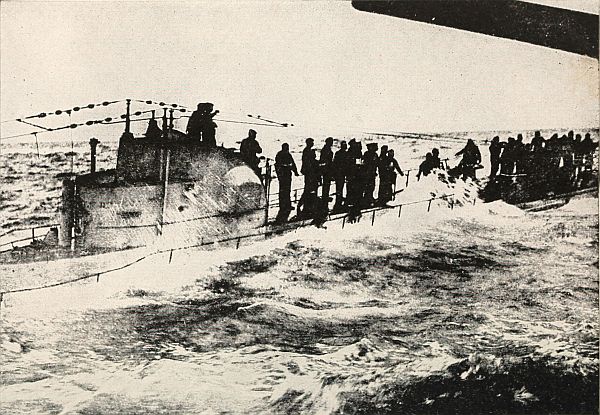
They called upon us formally a way off the
French coast, with two torpedoes. But they were
bad shots, so their visiting cards never arrived
and we continued our course without any further
opportunity of making their acquaintance.
As we neared the coast the water became clotted
up with wreckage—boxes and barrels and floating
planks—yes—and bodies, too. I've never seen a
sight to equal it and I have crossed eight times all
told. But in the beginning of the war Fritz was
pretty active. Never a day passed that we received
less than seven or eight S.O.S. calls. Oh,
Fritz was having it all his own way then. We've
changed all that—rather!
I'll never forget the little French port where
we dropped anchor. Nothing I can ever see in the
years to come—with the exception of the Allied
flags floating over the Kaiser's palace in Berlin—will
equal the thrill I got from watching the first
khaki-clad Yankees marching up that narrow
street to the tune of Yankee Doodle!
I kept wondering who the dickens I was, to be
privileged to witness such a history-making sight!
The townsfolk mobbed us. They cheered us and
hugged us and called down blessings on our heads.
Someone took pity on us and showed us the way
to an inn—a rambling white shallet with a big
American flag hung from its windows. At the
gate, the innkeeper and his plump little wife were
awaiting us with open arms. They asked us if we
would consent to eat "poullet." Consent! We
would have devoured birch bark with a relish had
it been cooked the way Madame Mousequet could
cook!
I have never tasted such chicken or such potatoes.
And while we ate and drank the little lady
fluttered about us, hoping, in voluble French, that
everything suited "the dear officers from the
United States."
They would not take a cent of pay for the feast.
It was, they assured us, "une grande honneur."
Over and over they insisted that we must not think
of spoiling their pleasure by having money pass
between us. What can you do with people like
that?
That night we went to a little cinema theater.
When the lights were turned up and the audience
caught sight of us, they rose in a body and cheered
us. In one of the boxes were a group of French
officers and their wives. One of the officers hurried
around to where we were sitting.
"You must place yourself where all the people
may see you," he insisted. There was no refusing
him. He was like a child, bubbling over with joy
at having us there.
"Come," he pleaded, "let me seat you so that
all may see."
We followed meekly. The ladies in the box
were awaiting us eagerly. They welcomed us with
outstretched hands. And as I looked at those
people who had been through two grilling years
of war, I thanked God I came from a country that
had taken up arms against a beast who was trying
to crush the red poppies beneath his heel.
It was hard to get leave to go up to Paris. Sailings
were uncertain and special permission had to
be obtained, but I made up my mind I'd go. General
Pershing was to be there for the Fourth of
July celebration at the tomb of Lafayette. I knew
that would be a never-to-be-forgotten sight.
I was right. It was a glorious morning and the
thrill of the day was in the air—crowds everywhere—sky
blue and navy blue uniforms rubbing
shoulders with the khaki of our own boys.
Women, many of them in black, hurrying—hurrying
toward the spot where the great Commander-in-Chief
of the American Expeditionary Forces
could be seen.
"Pershing!" Everywhere you heard his name
and an under-current of eager whispers as to
whether there would be a chance to see him or not.
The Fourth of July! Paris! And our General,
the idol of the hour! I tell you it thrilled me clear
down to my heels!
We navy men were let through the crowd and
we were able to view the ceremony at close range.
I have never heard such cheering in my life! It
was Paris' first opportunity to hear our General
speak, and he spoke so simply—so quietly—in the
face of that great ovation that there was not one
among us who could doubt his ability to lead our
men as they had never before been led.
There were to be fireworks that night in honor
of our presence—concerts and speeches and dancing.
Oh, France was showing us that she was glad
we had come, but how glad we were to be there she
can never guess!
I drifted idly with the crowd. I wandered down
to the big station—the Gare de Lyons. What took
me there I scarcely know. Fate, I suppose, because
there were a thousand and one places I
might have gone instead.
The station was full of a bustling mob—uniforms—uniforms
everywhere. A train load of
soldiers had just arrived on leave from the Front.
That was a sight for you, as their eager eyes
lighted on some loved one's face! I tell you, it
kept your heart jumping in your throat to see
them. Some of them were so white and worn and
haggard. Most of them bronzed and wiry, a bit
grimy from the long train trip, with uniforms
faded and sometimes torn. But weariness and
dirt and tears could not hide the spirit that shone
in their eyes as they clasped their wife and little
ones to them.
A young artillery officer came toward me. He
was a handsome man with a bit of a swagger in
spite of his limp. I saw his eyes roving the crowd
restlessly in search of someone. Suddenly he
caught sight of me.
"Ah! An American! What joy! Vive
L'Amerique!" he shouted.
I thanked him. I told him my name and he told
me his. It was Louis du Frere, and he lived at
Faubourg St. Germain. He was just back from
the trenches on a precious leave of seven days.
Wounded? He shrugged. But, yes, fifteen times
so far, and what of that?
I stared at him. Wounded fifteen times and yet
eager to go back! Spirit of France, you are indomitable!
He excused himself as he scanned the crowd.
His sister was to meet him. She was there somewhere.
She never failed him. Ah, yes! He had
found her. . . .
I turned to see a little black-clad figure rush
into his arms and cling to him as though she could
never let him go. He spoke to her gently.
"Angele," he said, "this gentleman is a great
officer of the American navy. Tell him how glad
you are to welcome him to France."
At that she whirled and since then I have never
been able to see a red poppy without thinking of
her. I don't remember what I said in my very
limited French, but her brother broke in to explain
that she had lost her young husband at the battle
of the Marne and he ended up by announcing to
her that I was going to spend the rest of my liberty
as their guest.
I tried to protest, to insist that I had no intention
of thrusting my presence upon them for
eleven days. But he took my refusal with the air
of a hurt child and when Angele joined her pleas
with his, I succumbed. I let du Frere hail a cab
and we all piled in. I gathered up my few possessions
at the hotel and climbed aboard again,
and we rumbled through the streets of Paris toward
St. Germain, Angele clinging to her brother's
arm and listening with a wrapt look on her
face to his gay comments on trench life.
I thought I must be dreaming it all. It was so
like the scene of a play—Paris slipping away from
us, as we rattled across a long bridge, the open
country becoming greener and leafier every instant—the
gay voice of the young officer, the eager
questions of our little old driver, and the poppy-like
girl, with lips parted, drinking in breathlessly
every word her brother uttered.
We stopped before a tiny house, shaded by tall
trees. I saw, gathered before it, a little knot of
people, shading their eyes for a glimpse of the
returning hero.
They pounced upon him, men, women, and
children—all his neighbors, who had awaited his
home coming for heaven only knows how many
hours. They shouted their welcome to him, each
of them clasping him for a minute and claiming
his full attention.
Angele stood looking on, the tears rolling down
her cheeks, even while her lips smiled.
"They love him so," she said softly, as though
to explain it, "he is so brave!"
I think he was, to face that mob.
They followed him in. The table was spread
with every sort of delicacy. Each one of them
had contributed something choice—some dish of
which he was especially fond. He exclaimed over
it all rapturously. He left nothing to be desired in
his eager enthusiasm.
They gave him no time to rest. They poured a
torrent of questions upon him. Questions about
their own brothers and husbands and lovers—questions
concerning warfare—trench life—battles
in which he had fought. And he told them all
he knew until at length Angele scolded them
tenderly and bore him off. Then it was that they
turned upon me as the second best object of interest.
Never in a lifetime could I answer all that they
asked of me. What did our country hope to do?
How many men could she send across at
once? How long did she think the war would
last?
I tell you I was glad to see Angele and Louis
reappear and to follow them to the feast. I was
placed at Angele's right hand—the guest of honor—I
sat down with a sigh of relief as I saw the
tempting spread. Sat down! We were never
down more than an instant before someone would
leap up and propose a standing toast to Pershing
and to Joffre, to President Wilson and to President
Poincairé, to myself, to my navy, to my country!
And the Marseillaise! How they did sing that!
three and four times, shouting the chorus until
the rafters shook!
Then Louis pounded on the table for order.
"The American officer will now sing his National
Anthem," he announced.
There was instant silence, then encouraging applause,
then silence.
"But yes, you will sing it," urged Angele, seeing
my panic.
Now, in the first place, I cannot carry a tune
and in the second place I knew just one verse of
the "Star Spangled Banner"—and I was not over
sure of that one!
I have never felt a shame equal to mine as I
struggled desperately through the first verse of
my country's song! They applauded madly. I
might have been Caruso to judge from the racket
they made.
But Louis was not satisfied.
"Permit me also to sing it for you," he said,
and sing it he did—all three verses of it,—with a
ring to his voice that thrilled me and held me
spellbound. I asked him where he had learned it.
It seems, he modestly explained, an American ambulance
driver had employed his time in the
trenches teaching it to him.
After supper we danced to the music of a string
band. But Louis sat in a corner, surrounded by a
group of older men and I could see they were in
earnest, thrashing out the latest developments at
the Front. That gave me a chance with Angele—or
rather—half a chance, because her every
thought was with her brother.
"He is all the world to me," she said.
She watched over him in spite of himself and
when she concluded he must be tired, she whispered
it to his friends and they began, one by
one, to leave, in spite of his protests. He went
with them to the door, shouting, waving, kissing
his hand. When he came back to us he did look
a bit done up.
"Ah, Angele, it is good to be at home," he said,
and then, as though fearing that might seem a confession
of weakness, he hastened to add, "for a
little time!"
We spent six wonderfully lazy days in the heart
of summer. It was there that I came to know the
poppies which were so like Angele, so radiant, so
graceful—so lovely. I told her once that she put
me in mind of them.
"I am glad," she replied, "because I, too, love
them."
My leave was not up for eleven days all told,
and Louis had persuaded me to stay on at the little
cottage after his return to duty. I did not need
much persuading. It seemed as though I could
never tear myself away from that tiny house
shaded by tall trees.
The night before he left I don't think any of us
slept a wink. The neighbors arrived, laden with
all sorts of dainties—cakes and bread they had
made for him to take back. They brought packages
for their own boys, too, that he cheerfully
promised to distribute. They gave him letters
and a thousand messages, which he repeated
painstakingly after them. He was so gentle with
them, so eager to do as they asked.
He was particularly pleased over a little bunch
of wild flowers a tiny girl had gathered for him,
the flowers were drooping and faded from being
clasped in her hot little hand, but he told her again
and again how much he loved them, until her little
cheeks glowed pink with joy and her eyes shone
like stars.
After they had gone, I stole away and left Angele
alone with him. They sat in the open doorway,
her cheek against his arm, her hand in his.
She was not sad, there was a happy, busy note in
her voice as she chatted to him.
Before he climbed the stairs to bed, he sought
me. I was smoking and thinking, on a little bench
beneath the trees. Louis sat beside me and laid
his hand on my knee.
"Well, my friend, I leave before you. For a
little while we part, is it not so?—then, God willing,
we meet again."
I tried to tell him what my visit had meant to
me. What a place France and her people would
for ever more occupy in my heart. All those
things I struggled to say, but when it comes to
expressing that which lies close to our heart, I find
we are a halting, tongue-tied nation!
Then I spoke of Angele. I wanted him to know
before he left how much I cared for her. I was
afraid he might be displeased, but, instead, he
pumped my hand with joy.
"This is American fashion," he laughed, then
he leaned over and kissed my cheek. "Since you
love a French girl you will have to get used to her
brother's greeting," he said.
I told him I had not spoken to Angele. I had
not dared to. I could not hope she would care
for me.
"But you must speak to-night, before I go," he
shouted. "Let me prepare her first. Oh, but this
is of a great happiness to me!"
And before I could stop him, he hurried away.
After a long silence, while my heart thumped
against my ribs and I felt myself growing hot and
cold by turns, his voice sounded through the darkness.
"Come here, my friend, and see what you can
do to make this child change her mind."
I ran toward him. I saw the flash of Angele's
white gown, but when I reached her side, Louis
had gone. She awaited me. Somehow she looked
like the poppies at twilight, when their petals are
folded. . . .
We were there together so long, that at length
Louis' voice broke in upon us and startled us.
He shouted that he must leave in six hours—that
a brother returning to the Front had some claim
upon his sister's time. Angele flew to his side,
begging him to forgive her selfishness, but he
pinched her cheek and laughed at her, brimming
over with happiness at the romance for which he
claimed he was responsible.
"But you must not take her away until after
the war," he pleaded. "I want her here to greet
me when I come home. I am a selfish brute, I
know, but I would have nothing to return to if my
little sister were gone."
I promised him. I would have promised anything
that night I was so happy. It did not seem,
as I stood in that quiet, leafy garden, with Angele's
hand in mine, that there could be pain and
anguish in the world—that cannons could be roaring
and star shells bursting less than a hundred
miles away!
Louis left at daybreak. We drove to Paris with
him and to the station. It was a gay morning with
a red sun rolling up from the east.
Angele was all smiles and animation, full of
eager plans for his next leave. She submitted to
his teasing with a laugh, but, for all that, her eyes
looked as though they held a world of unshed
tears, and I saw her, once or twice, press her lips
together as though to choke back the sobs.
The station was full of men returning to the
Front. They called eagerly to one another—they
compared packages, and boasted of the good times
they had had. Louis caught my hand and wrung
it. Then he laid Angele's in it.
"She is all I have," he said; "it is fitting I leave
her in the care of our beloved ally."
He kissed her and teased her about capturing an
American in seven days, saluted us smartly and
stalked through the great gate, turning to wave
and smile and kiss his hand.
I never felt such a sense of loss in my life. It
seemed as though the sun had gone out of the day.
"I cannot bear it," Angele whispered, so I took
her away.
We spent the few remaining days of my leave
planning our life after the war. She will not
marry me until then. She and Louis are coming
to the States to live and we three are to be as
happy as the days are long. We will be, too. I
know it.
I have been across seven times since and I have
seen her four of those times in the past year. If
there is any man on earth who wants this war to
end it is I—and the reason is a certain flower-like
girl in France. Good Lord! you don't know what
waiting for her means!
We've got to finish those Germans quickly and
thoroughly so that Louis and Angele and I can
set sail for America. If that is not a reason for
ending this war, find me a better one!
THE END
WHERE THE SOULS
OF MEN ARE
CALLING
The first big love story to come out of the war
zone—founded on fact more strange, more powerful
than fiction.
The author, Lt. Credo Harris, stationed in
France with the International Red Cross, is a
Kentuckian. He just couldn't keep out of it
"Over There." His story starts with the entrance
of America into the war and ends on the
firing line of France. There is charm and skill
in his style which insures keenest interest on the
part of the reader.
What the Critics are saying:
"A story of strong characters blended, it exemplifies
the old maxim that 'truth is stranger than
fiction,' and in this case more powerful."—Buffalo
News.
"One of those books that grip and grip."—Milwaukee
Sentinel.
"A book worth while and a book to recommend."—Louisville
Herald.
"Combines the interest of character study with
a realistic picture of life in the war zone."—Courier
Journal.
"Jeb proves that a coward can become the
bravest of men."—Pittsburgh Chronicle-Telegraph.
Attractively bound in cloth $1.35 net
By All Means Read this Book
Britton Publishing Company New York
Every grown-up will remember the time
when
"Chicken Little"
was a most wonderful tale with which to open
wide the eyes of children.
Many a fond mother will be glad to know of
another "Chicken Little" just brought to light
in handsome book form under the alluring title
Chicken Little Jane
A DELIGHTFUL STORY BY
LILY MUNSELL RITCHIE
Little folk will at once fall in love with this
new "Chicken Little" of the far western prairies—the
same being an affectionate nick-name given
to a dear little girl and always used when she
was very, very good—but when she misbehaved
it was "Jane"!—just Jane!
This book is illustrated and decorated with unusually
attractive pictures by Charles D.
Hubbard. Cloth, $1.25
Britton Publishing Company New York
LAUGH AND LIVE
A WONDERFUL BOOK OF INSPIRATION
By DOUGLAS FAIRBANKS
The Man Who Set the World to Laughing—and
Kept Himself Happy and Well.
Many are the inspirational books that now
abound written around the various phases of
existence, but "Laugh and Live" is a thing apart
from any other. Perhaps it is the author's style
of writing, sort of "hammer and tongs," breezy,
convincing, seeming to come out of real experience.
But the remarkable quality of the book is
that it fascinates the mind the same as a high-class
novel—grips one's faculties from chapter to
chapter. There is no preaching, no "Fatherliness,"
no "Big I" and "Little You" in the text.
It is more like the talk of a widely experienced
comrade back from a voyage. Asked to tell what
he saw in his travels he proceeds to do it
modestly and well.
18 Intimate Pictures
Cloth, $1.00 net. Khaki (Kit Bag Ed.), $1.00 net.
Leather (boxed), $2.00 net. Ooze (boxed),
$2.50 net.
Britton Publishing Company New York
A THOUSAND
WAYS TO PLEASE
A HUSBAND
By LOUISE BENNETT WEAVER
and HELEN COWLES LE CRON
With Decorations in Color By ELIZABETH COLBORNE
A SPLENDID GIFT FOR A BRIDE
This volume is not the usual dull plodding
kitchen cook book made up from "collected"
recipes and enlivened by photographic reproductions
of cakes, pies, roasted turkeys, and tables
set with knives and forks placed "just so."
Rather it is the "life and adventures" of "Bob"
and "Bettina," who sail into the complexities of
housekeeping the moment the wedding journey
is at an end. Bettina's "know-how," plus "Bob's"
good-natured helpfulness, bring about immediate
success to a lively and interesting attempt at
home-building.
Unique—practical—for two people in particular
and small families in general. For economy and
plenty at one and the same time it has no equal.
479 Pages Extra Illustrated $1.50 net
Britton Publishing Company New York
LITTLE STORIES
FROM THE SCREEN
By WILLIAM ADDISON LATHROP
Filling a long-felt want of thousands who desire
to know the methods of the top-notch moving
picture writer, this celebrated photo-dramatist
has sanctioned the use of eighteen of his best
synopses, and one full scenario, representing a
wide range of successful productions participated
in by world-famous stars familiar to millions.
Each Synopsis is accompanied by one or more
actual scenes of the finished play in which twenty-five
screen favorites are pictured in their strongest
acts.
Cloth Highly Illustrated $1.25 net
UNCLE BILL'S LETTERS
TO HIS NIECE
By RAY BROWN
Here's as gay a little gift as any girl could
wish. Bright, sparkling and joyous—letters from
a matter-of-fact old uncle who talks to his young
niece straight from the shoulder, exactly as he
might to a boy.
Uncle Bill gives facts about moonlight, becomes
violent over athletics, taboos snobbery,
takes a fling at heredity, and touches up a few
complexions.
The result is extravagantly and deliciously
funny—Just the Book for an Ingenue.
Cloth Decorative Cover and Jacket 60 cents net
Britton Publishing Company New York
The case of first words of some chapters was changed to match the layout
of the rest of the book.
Page 43, "the" changed to "The" (The old man seemed)
Page 99, double quotation mark removed before single quotation
mark. (put it, 'Jay fame.'") Original read: (put it, "'Jay fame.'")
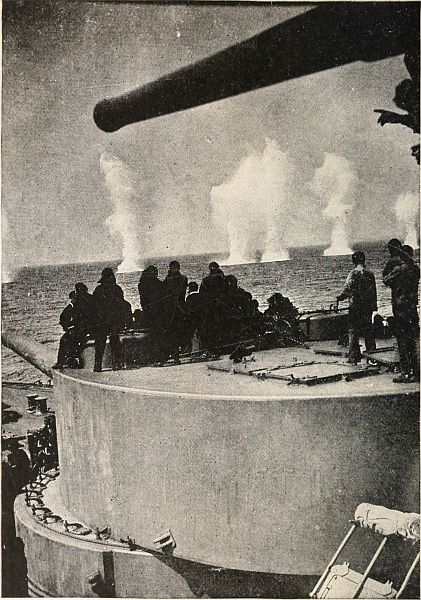 "Only the hits count!"