Larger versions of most illustrations may be seen by right-clicking them
and selecting an option to view them separately, or by double-tapping and/or
stretching them.
Over the Santa Fé Trail, 1857. — I. Captain “Jim Crow” Chiles.
When I was a lad of 12 years of age my father had a
red-headed overseer, good-natured, loquacious and fond of
telling stories, the kind that suited the understanding and
tickled the fancy of a boy. His stories were always related
as being truthful accounts of actual occurrences, although
I suspected they were frequently creatures of his
own imagination. This overseer, a Westerner born and bred,
had driven an ox wagon in a train across the plains to New
Mexico; had made two trips across—in 1847 and 1848—one
extending as far as Chihuahua, in Old Mexico. His observation
was keen, and his memory unexcelled, so that, years
afterwards, he could relate, in minute detail, the events of
every day’s travel, from the beginning to the end of the
journey. I was charmed with his accounts of the Indians
and buffalo, wolves, antelope and prairie dogs.
Reaching the age of 18 in 1857, with indifferent health,
my father acquiesced in my determination to cross the plains
to New Mexico. The doctor said the journey would benefit
my health. Already an expert with a gun or pistol, I had
killed all kinds of game to be found in Missouri, and had
read Gordon Cumming’s book of his hunting exploits in
South Africa, so that I felt as if nothing less than killing
big game, like buffalo and elk, could gratify my sporting
proclivities.
Colonel James Chiles of “Six Mile,” Jackson County,
was a state senator, and while at Jefferson City during
the session of the legislature, my father telling him of my
desire to go out to Santa Fé, the colonel sent me an invitation
to come to his house by the middle of April and go
out with a train belonging to his son. So in the early
spring of 1857 I set out from my home in Saline County,
well mounted and equipped for the journey.
The spring was backward, and when I reached Colonel
Chiles’s house in the middle of April winter was still “lingering
in the lap of spring.” The grass was not good on
the plains until the 10th of May. It was arranged for me
to go out with the train commanded by “Jim Crow,” a son
of Colonel Chiles.
“Jim Crow” was then about twenty-five, not over medium
height, but strong, athletic and wiry, and had a pretty
well established reputation as a fighter among the frontiersmen.
He had killed a lawyer named Moore, who lived at
Leavenworth, in the Noland hotel at Independence. After
the Civil War he killed two other men at Independence,
and he himself was eventually killed in a fight with the
Independence town marshal. But I found “Jim Crow”
a kind and considerate friend, jovial and good natured generally,
but subject to violent fits of anger, and when angry,
a very dangerous man. One night on the “trail,” while
he and I were riding some distance ahead of the train, amid
the solitude of the darkness and the vast plains, the conversation
drifted into a confidential vein. He recalled the
killing of Moore, saying he regretted it beyond measure;
that the affair had haunted him day and night; that he
would willingly give up all that he owned or expected to
acquire to be relieved of the anguish and trouble and remorse
the act had caused him. But he was possessed of the
kind of courage and combativeness which never suggested
the avoidance of a fight then or afterward.
Kansas City was even then, in 1857, an aspiring town.
For a month or two in the spring the levee was covered with
wagons and teams, and sometimes four or five steamboats
were at the wharf discharging freight. General John W.
Reid had recently bought forty acres, the northwest corner
of which is now the intersection of Broadway and Twelfth
street, for $2,000. The land was covered with timber,
which he cut into cord wood and sold to the steamboats for
about enough to pay for the land.
There were no streets, and only one road from the levee,
leaving the river front at Grand avenue, running obliquely
across to Main street and back again to Grand avenue, in
McGee’s addition. Colonel Milton McGee had taken down
his fences and laid off his cornfields into lots.
The work cattle and wagons were collected and a
camp established, about the first of May, on the high,
rolling prairie near the Santa Fé trail, three miles
southwest of Westport. The wagons were heavy, cumbrous
affairs with long deep beds, covered with sheets of
heavy cotton cloth, supported by bows. A man six feet high
could stand erect in one of them, and they were designed
to hold a load of seven or eight thousand pounds of merchandise
each. Those in our train were made by Hiram
Young, a free negro at Independence, and they were considered
as good as any except those with iron axles. The
freight consisted of merchandise for the trade in New Mexico.
Two of the wagons were loaded with imported champagne
for Colonel St. Vrain of Las Vegas and Mora.
There was a shortage of good ox drivers that spring and
Captain “Jim Crow” found it difficult to supply the number
he needed. Twenty-five dollars a month “and found”
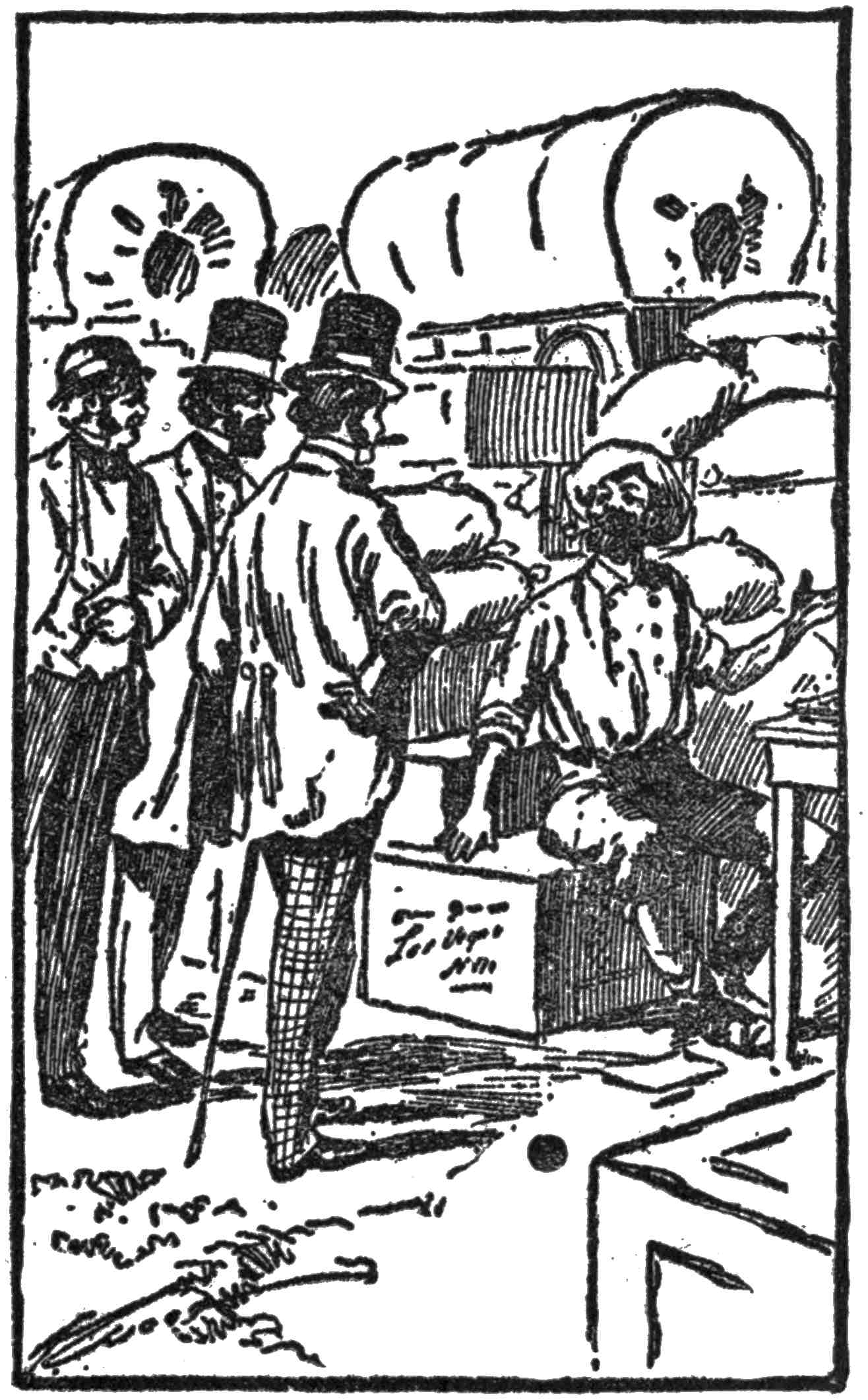
were the wages. One evening, while we were lounging
around the corral, waiting for supper, three men came up
on foot, inquiring for the captain of the train. They were
good looking, well dressed men, two of them wearing silk
hats, but bearing no resemblance to the ordinary ox driver.
They said they were stranded and looking for work. They
proposed to Captain Chiles to hire to him for drivers, while
they disclaimed any knowledge of the calling.
“JIM CROW” CHILES LAUGHED.
“Jim Crow” laughed, and after interrogating them as
to their antecedents, said he would hire them on probation.
“I will take you along,” he said, “and if I find you can
learn to drive cattle before we get to Council Grove, the
last settlement on the road, then I’ll keep you; otherwise
not, and you must look out for yourselves.”
They were invited to supper and assigned to a mess.
One of them was named Whitcom. He hailed from Massachusetts
and had never seen a yoke of oxen in his life, but
he was strong, sturdy and active, and before we reached
New Mexico he was rated the most dextrous driver in the
outfit. Moreover, his team looked better than any in the
train when we reached the end of our journey. Ten years
ago Whitcom was living in Cheyenne, and was one of the
wealthiest cattle raisers in the state of Wyoming.
Another of the three hailed from Cincinnati. He wore
a threadbare suit of broadcloth and a “plug” hat, and was
tall, angular, awkward, slip-shod and slouchy in appearance.
He had been employed in his father’s banking house in
Cincinnati, and was accomplished in penmanship and a
good accountant; but he proved to be utterly unfit for an
ox driver. He could not hold his own among his rough
companions, and became the object of their jeers and derision.
By unanimous consent he was given the name of
“Skeesicks,” and by this name he was known ever
afterwards.
The third of the trio proved to be a fairly good driver,
and is now a prosperous merchant in the state of Montana.
Among the drivers was a young Mexican, Juan, who
had been in the employ of the Chiles brothers for years.
Through him we were enabled to converse with the Kiowas
and Comanches when we reached them. Many of the Indians
could speak or understand Spanish, but could not understand
a word of English. We had men among the
teamsters from Tennessee, Kentucky, Arkansas and Texas.
They soon became known and answered to the name of their
own state. “Tennessee” and “Texas” prided themselves on
the size and weight of their whips, and the loudness of the
noise they could make in popping them.
Young Reece, from Missouri, went out with the train
for his health. He had consumption and hoped the journey
over the plains would be of benefit to him. He was very
tall, being six feet four inches, of large bone and frame,
but thin as a huge skeleton, and had allowed his heavy black
hair to grow until it hung below his shoulders. He was
well off so far as property was concerned, and rode a
splendid dapple gray horse, muscular, tough and graceful,
with handsome mane and tail, which could fairly fly over
the prairie.
II. In Camp, South of Westport.
In the camp, three miles southwest of Westport, we were
detained for a fortnight or more, awaiting the arrival of
our freight at Kansas City. There were twenty-six wagon,
five yoke of oxen to each, carrying about seven thousand
pounds of freight each. There were no tents, so we slept
on the ground, either under a wagon or, if we preferred
it, the broad canopy of heaven.
Captain “Jim Crow” commanded the company, with
Rice as assistant wagonmaster. There was one driver for
each wagon, and a boy of 16, of frontier origin and training,
whose duty it was to drive the “cavayard” or loose
cattle, taken along in case any of the teams should get lame
or unfit for service. “Jim Crow,” immediately on his arrival
at the camp, gave the boy the nickname of “Little
Breeches,” suggested by his very tight-fitting trousers, and
the name, abbreviated to “Little Breech,” stuck to him.
While encamped below Westport I was fortunate in purchasing
a first rate “buffalo horse,” a California “lass horse,”
that had been brought across the plains the previous year.
He proved his excellence afterward, was very fast and would
run up so close to a buffalo that I could sometimes touch
him with the pistol point.
Camped in our vicinity were several corrals of trains
belonging to Mexican merchants, who used mules instead
of oxen, and had lately come up from New Mexico. These
Mexicans subsisted altogether on taos (unbolted) flour, and
dried buffalo meat, while our mess wagon was filled with
side bacon, flour, coffee, sugar, beans and pickles.
I soon got on fair terms of acquaintance with the master
of one of these Spanish trains. He was a successful
buffalo hunter, but I was surprised to find he used a spear
for killing them, instead of a pistol. When a buffalo was
found at a distance from the road or camp he would goad
the animal, until so enraged, it would turn upon and follow
him, and in this manner he would get the game to a
more convenient place for butchering, before finally dispatching
it.
There were no farms fenced up in sight of our camp at
that time, but the prairie was dotted with the houses of
the “squatter sovereigns,” who were “holding down” claims.
On the 10th day of June we yoked up and started on
the long journey. At the outset everybody about the train,
from the captain to the cavayard driver, was filled with good
humor. The weather was perfect, the view of the apparently
boundless prairie exhilarating. The road having been surveyed
and established by the government before the country
was at all occupied, was almost as straight as an arrow
toward the southwest. The wagonmaster would arouse
the men before daylight in the morning and the cattle
would be driven up to the corral, yoked up and hitched to
the wagons by the time the cooks could prepare breakfast,
a cook being assigned to each mess of six or eight men.
Some of the oxen were not well broken to the yoke, and it
was a difficult task at the dim break of day for a green man
to select each steer that belonged to his team in the corral,
where the 250 were crowded together so that their sides
would almost touch.
Once on the road the drive was continued for from
eight to twelve miles, the stops being governed by the convenience
of camping-places, where grass and water could
be found for the cattle. Familiarity with the route was
essential in the wagonmaster, who, riding some distance
ahead, would select the camping-place, and when the train
came up direct the formation of the corral. The cattle
were immediately unyoked and turned loose, herded by two
of the teamsters. Often it was necessary to drive the cattle
a mile or more from the corral in order to find sufficient
grass, that near the road being kept short by the incoming
trains from Mexico and the outgoing trains ahead
of us.
At Council Grove there was a considerable settlement
of Indian traders. There we found assembled a large band
of Kaw Indians, who had just reached there from a buffalo
hunt on the Arkansas. The Kaws were not classed as
“wild” Indians, and I think had been assigned to a reservation
not far off, but when they got off on a hunt their native
savage inclinations made them about as dangerous as
those roaming the plains at will, and whose contact with
the white man was much less frequent.
Beyond the Diamond spring we met two men on horseback,
who were hunting cattle belonging to a train then
corralled some distance ahead. The cattle had been stampeded
by Indians in the night and they had lost fifty head.
The train could not be moved without them. The men had
been in search of them for two days and thought they would
be compelled to offer a reward for them, that being found
necessary sometimes, along the border. The Indians and
“squawmen”—white men married to, or living with, Indian
squaws—would stampede cattle at night, drive them off and
hold them until they ascertained that a reward had been
offered for them. Then they would visit the corral, learn
with seeming regret of the cause of the detention of the
train, declare that they were well acquainted with the surrounding
country and could probably find them and bring
them in, offering to perform this service for so much a
head. After the bargain was struck the cattle would be
delivered as soon as they could be driven from the place of
their secretion. It was not infrequent for a band of Kaws
to strike a wagon master in this way for as much as from
$100 to $500.
Here we learned that Colonel Albert Sidney Johnson, in
command of a considerable force, had moved out from Fort
Scott against the Cheyennes, who were on the warpath up
on the Republican river, in the western part of Kansas, but
we missed seeing the command until months later, on our
homeward journey in September.
III. Buffalo.
As we were drawing near the buffalo range preparations
were made for a chase. The pistols were freshly loaded
and butcher knives sharpened. One morning about 9 o’clock,
on Turkey creek, a branch of the Cottonwood, we came in
sight of buffalo, in a great mass, stretching out over the
prairie as far as the eye could reach, though the topography
of the country enabled us to see for several miles in each
direction. The prairie in front of us was gradually undulating,
but offered no great hindrance to fast riding. Reece
and I were anxious to try our skill, and Captain Chiles
said he would go along to assist in butchering and bringing
up the meat; but, as he was riding a mule, he could
not be expected to take an active part in the chase. Reece
was mounted on his splendid iron gray and I on my trained
buffalo horse, each of us having a pair of Colt’s navy revolvers,
of six chambers in holsters.
We rode slowly until we got within three or four hundred
yards of the edge of the vast herd. Then they began
to run and we followed, gaining on them all the time.
Pressing forward, at the full speed of my horse, I discovered
that the whole band just in front of me were old bulls.
I was so anxious to kill a buffalo that I began shooting at
a very large one, occasionally knocking tufts of hair off his
coat, but apparently having little other effect. However,
after a lively run of perhaps a mile or two he slackened his
pace, and at last stopped still and, turning about, faced
me. I fired the one or two remaining charges of my revolvers,
at a distance of twenty or thirty yards, and thought he
gave evidence of being mortally wounded. After gazing
steadily at me for a few minutes he turned around and
walked off. I followed, but presently he resumed a gallop
in the direction the main herd had gone, soon disappearing
from view over a ridge. So I had made a failure, and
felt a good deal put out, as well as worn out by the fatigue
of fast riding.
Through a vista between the clouds of dust raised by
the buffalo, I got a glimpse of Reece. His horse proved to
be very much afraid of the buffalo and could not be urged
close enough to afford shooting, with any degree of certainty,
with a pistol. Reece held his magnificent horse with
a rein of the bridle in either hand, his head fronting towards
the buffalo, but the frightened animal would turn to
one side, despite the best efforts of his master, fairly flying
around in front of the herd. That was Reece’s first and last
attempt to kill a buffalo on horseback.
I rode back towards the train, soon meeting Captain
Chiles, who greeted me with derisive laughter, but considerately
expressed the hope that I would have better success
upon a second attempt. As we were all very anxious to
get some fresh meat, he suggested that I should lend him
my horse; that he would easily kill one with a double-barrel
shotgun, which he was carrying in front on his saddle. I
readily agreed to this, and mounting on my horse, he put
off and promptly slew a fat, well-grown calf that proved
good eating for us who had lived on bacon for many days.
That afternoon I turned my buffalo horse loose, permitting
him to follow, or be driven along with the cavayard,
in order that he might recuperate from the exhausting
races of the forenoon. The following morning he was
as good as ever, and I resolved to try another chase.
Having received some pertinent instructions from Captain
Chiles, as to the modus operandi of killing buffalo
on horseback at full speed, I mounted and sallied forth
with him, the weather being ideal and the game abundant.
At the left of the road, in sight, thousands of buffalo
were grazing in a vast plain, lower than the ridge down
which we were riding. Opened up in our view was a scope
of country to the southeast of us, a distance of ten miles.
This plain was covered with them, all heading towards the
northwest.
At the outset I was more fortunate than on the previous
day, for when I had gotten up close to them I found in
front of me cows and calves, young things of one or two
years old. Singling out a fat young cow, distinguished by
her glossy coat of hair, I forced my horse right up against
her and brought her down at the second shot. I pulled
rein, stopping my horse as suddenly as was possible at the
breakneck speed at which he was going, and in another
moment the herd had spread out, and I was completely
surrounded by the rushing mass of animals which my attack
had set in motion.
The air was so clouded with dust that I could hardly
see more than twenty yards from where I was standing, near
the carcass of the cow I had killed. There was danger of
being run over by them, but they separated as they approached,
passing on either side of me, a few yards distant.
After a while the rushing crowd thinned, and up rode Captain
Chiles exclaiming: “Why don’t you kill another?”
Fifty yards from us they were rushing by, all in the
same direction. I again dashed into the midst of them,
pressing my horse in pursuit of another young cow. She
shot ahead of everything, increasing her speed so that I
could hardly keep sight of her. While thus running at full
speed my horse struck a calf with his breast, knocking the
calf down flat, and almost throwing himself also. I pulled
up as quickly as possible, turned around and shot the prostrate
calf before it could get up. So I had two dead in, say
twenty minutes. After this day’s experience I had no trouble
in killing all the buffalo we needed for our own consumption.
For a week or ten days they were hardly out of sight.
We found them as far west as Pawnee Rock. All told, I
killed about twenty on the journey out and back. A good
steak, cut from the loin of a buffalo cow, broiled on the
coals with a thin slice of bacon attached to it to improve
its flavor, was “good eating,” and I soon became an accomplished
broiler.
IV. Companions of Voyage.
Before reaching Pawnee Rock we overtook a train of
thirty wagons belonging to the leading freighters of the
West, Majors, Russell & Waddell, with which we traveled to
Fort Union, their freight being consigned to that post. This
train had thirty wagons, built, I believe, in Philadelphia,
with heavy iron axles and spindles, which seemed superior
to any others I had seen on the prairies. Hagan was wagonmaster
and Hines his assistant. The former was a sandy-haired
man, who rode a large bay mule, a drowsy animal
with immense lop ears that moved back and forth as he
walked. This ungainly mule, I found out, in a day or two
afterwards, had his good points. He could run as fast and
get up as close to a buffalo as any horse in either outfit.
Notwithstanding Hagan’s generally uncouth appearance,
he was a man of sterling worth and a capital hand
at killing buffalo. Subsequently we joined in many chases,
and I found him an agreeable companion. On the rear end
of each of the wagons in Hagan’s train there was pasted a set
of printed rules for the government of the employees in
the service of Majors, Russell & Waddell. Both liquor and
profanity were absolutely prohibited, but of the strict enforcement
of the rules I cannot speak.
While riding in advance of the train, in company with
Captain Chiles, we saw our Mexican friend, whose acquaintance
we had formed at Westport, the master of his own
train, galloping toward us, with a buffalo cow following close
behind his horse. As was his habit, he had attacked the
animal with his spear, stabbing her until she became infuriated
so that she turned on him and was following him;
it occurred to me she was pressing him a little too closely
to be agreeable. We rode rapidly toward him, and as we
were drawing near the cow became so exhausted by loss of
blood that she stopped still, when Captain Chiles rode up
and gave her a broadside with his shotgun, which finished
her.
Whenever they found buffalo in plenty the Mexicans
would halt for several days and kill enough to supply their
trainmen. They preserved the meat by cutting it into thin
strips and hanging it on ropes about the corral until it was
dried by the sun. But thus cured, it had a sour and disagreeable
taste to me. The Mexicans would stew it with
quantities of red pepper and devour it with great relish.
As we approached the valley of the Little Arkansas,
where the view of the country was more extensive than any
we had yet seen, there was no limit to the herds of buffalo,
the face of the earth being covered with them. We camped
at noon at the crossing of this stream. The buffalo were
crossing the creek above us, moving westward, in bands
of from twenty-five to a hundred or more. At the crossing
they had a trail cut down through the steep banks of the
stream three or four feet in depth.
But I had had enough of buffalo chasing, except when
we were in need of fresh meat. It was too much like riding
out into the pasture and killing your own domestic cattle.
I found antelope hunting much better sport.
After Walnut creek, the next place of interest was Pawnee
Rock near which many battles between the traders and
the Indians had taken place. This bluff, facing the road
on the right hand side, at a distance, perhaps, of a hundred
yards, was of brown sandstone about fifty feet high, the
bluff end of the ridge extending down to the river bottom.
I climbed up the almost perpendicular face of the elevation,
where I found many names cut in the soft stone—names of
Santa Fé traders who had traveled the trail, among them
that of Colonel M. M. Marmaduke, who crossed to Mexico
as early as 1826, and was afterwards governor of Missouri,
and James H. Lucas, a prominent and wealthy citizen of
St. Louis.
We were not particularly apprehensive of Indian troubles,
although we knew the Cheyennes were turbulent. Elijah
Chiles, a brother of our captain, had been loading goods
at Kansas City when we left—a train of twenty-six wagons
for the Kiowas and Comanches—and was doubtless a
few days’ drive behind us. But we kept on the lookout
day and night; the guard around the cattle was doubled,
and each teamster had a gun of some sort, which he kept
strapped to the wagon bed, loaded and ready for service.
V. Pestiferous Indians.
All the while we knew the Indians could wipe us out
if they were determined to do so. In both trains there were
not above sixty men, while there were, nearby, warriors by
thousands.
A day’s journey beyond Pawnee Rock, we were visited
by a hunting party of fifteen or twenty young Kiowa bucks,
the first real “wild” Indians we had seen. They did not
seem the least wild, however, but uncomfortably “tame,”
and disposed to get very familiar on short acquaintance.
They were evidently out on a lark, and disposed to make us
the objects of their amusement that afternoon.
They scattered up and down the length of both trains,
talking and laughing with the teamsters. Two of them
took particular fancy to my friend Reece, riding on either
side of him, taking hold of his arms and seeming to admire
his long hair and the handsome horse he rode. Reece was
not at all afraid of them and permitted no undue interference
with his person or property.
Reece was no coward. While we were still in the dangerous
region, he would ride for miles ahead of the train,
alone, dismount and lie down to rest or sleep. When I
said to him that he was incurring unnecessary risk of being
killed by the Indians, he remarked that if they did kill
him they could not rob him of much in this world.
Along where we were traveling at the time of the visit
of the Kiowa bucks, the river bottom was as smooth as a
billiard table. Hagan’s train was in the lead of ours a
space of perhaps thirty yards intervening. Hagan and I
were riding abreast at the rear of his train, when suddenly,
two of the young bucks raised up a loud whoop and started
their horses at full speed. Taking a corner of their blankets
in each hand and holding them above their heads so that
they made a flapping sound in the air, they went sweeping
along right against the cattle, almost instantly creating
a stampede, the cattle turning out of the highway making
the big wagons rattle as they went.
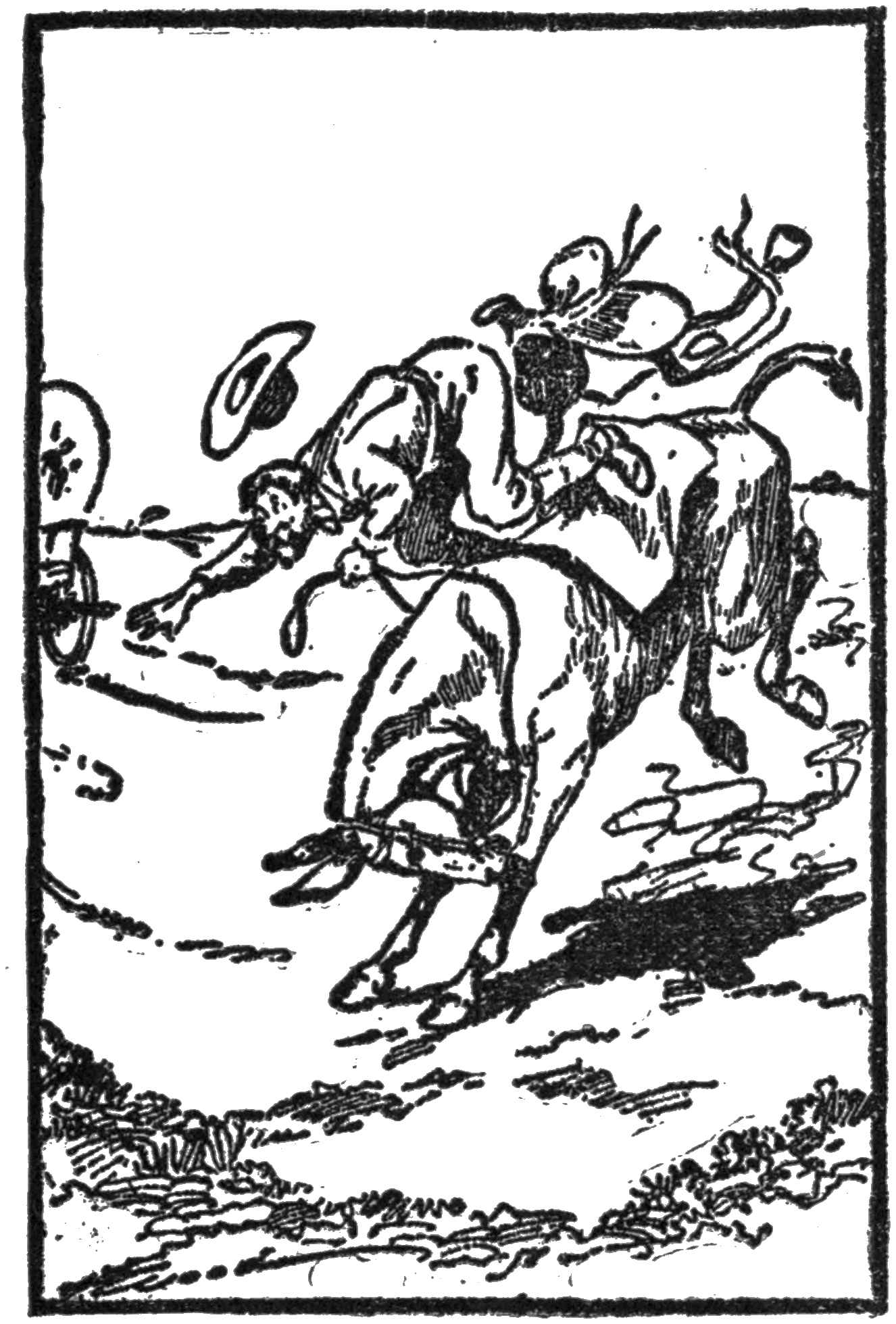
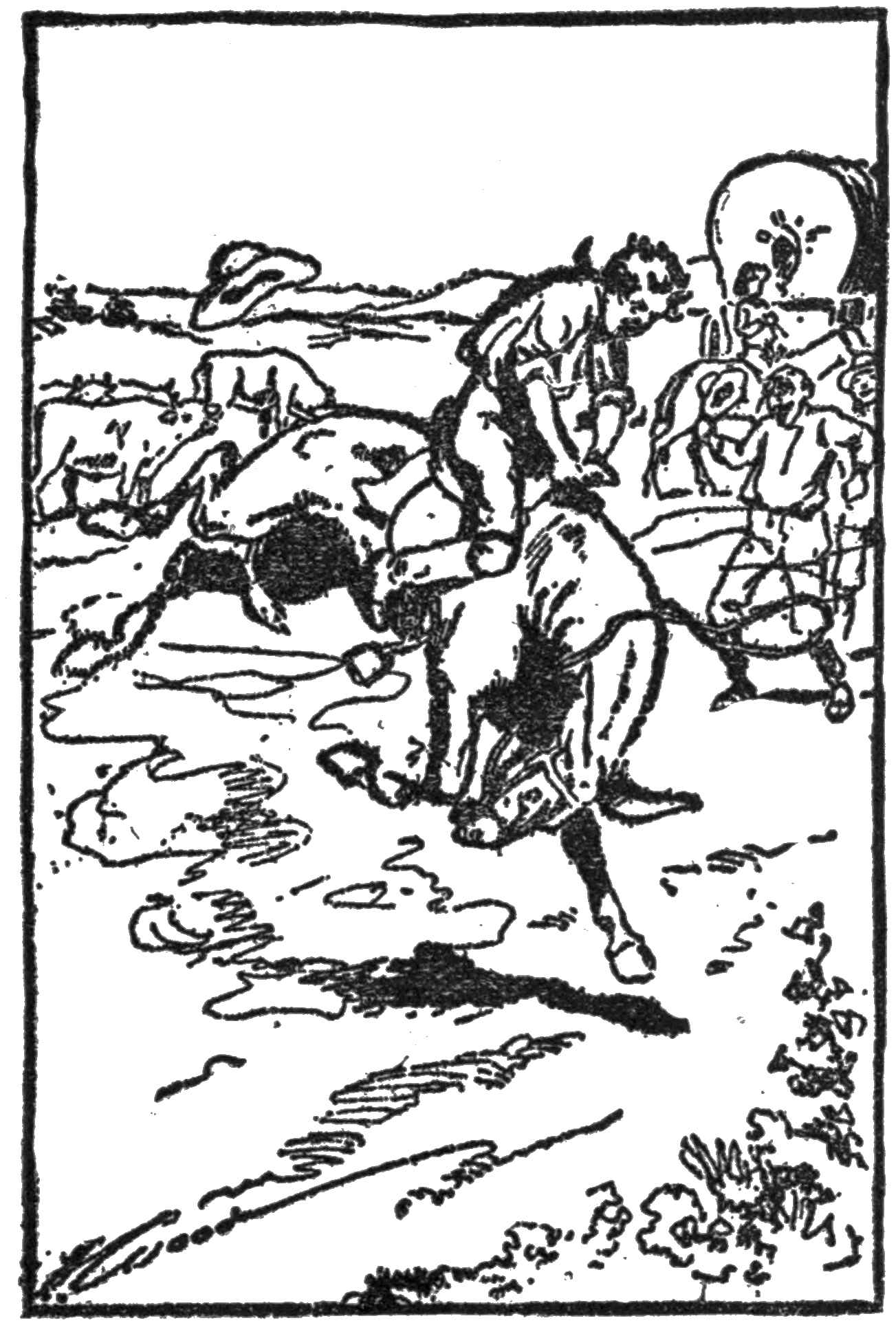
For an instant Hagan sat on his mule stock still, apparently
dumbfounded. In another moment he put spurs
to his mule, intending to head the fleeing cattle. But instead
of running, the mule suddenly “bucked,” throwing
Hagan and his saddle also (the girth breaking) over his
head and landing him in the road, flat on his back. Hagan
got up, pulled himself together and rubbed the dust out of
his eyes, but said nothing, though gifted in the way of eloquent
profanity.
No great harm resulted from the stampede. Some others
of the party of Indians ran ahead and stopped the cattle.
There was no collision of wagons and no damage, but
the affair left an ugly feeling of resentment among the
teamsters toward the Indians. The Indians laughed and
talked about the affair among themselves. Any effort to
punish them was out of the question, the entire tribes of
Kiowas and Comanches being encamped within a day’s
journey above us.
THE MULE SUDDENLY BUCKED.
The Indians kept along with the train all of the afternoon.
Observing my horse and accoutrements, they inquired
through Juan, the Spaniard, if he was fleet and good
for buffalo, and pressed me to go out with them for buffalo
the next day. I would gladly have seen the Indians engaged
in a buffalo chase, but declined the invitation, making such
excuses as I could without expressing any want of confidence
as to their good fellowship. My scalp was intact
and I felt disposed to keep it so.
The Kiowas begged Captain Chiles and Hagan to give
them some flour and sugar, but they refused, knowing that
a donation would be necessary later on, when we should meet
the entire tribes of Kiowas and Comanches encamped above
us, awaiting the arrival of their agent and the train load
of goods for them.
Late in the evening, after we had corralled and the
cooks were preparing to get supper these Indians having
ridden off in the direction of the river, two of them reappeared.
They returned to the camp, each with a bundle
of dry driftwood, picked up on the river bank, which they
threw down near the camp fire. This meant that they
wanted supper, and Captain Chiles gave directions for the
preparation of food for them. The Indians took supper
with us, after which they departed, evidently feeling better
and good naturedly disposed toward us.
That night there was much discussion of the Indian
problem, with which we seemed now confronted. At noon
the next day, as the cattle were being driven into the corral,
another party of young warriors made their appearance
at our camp, and came near involving us in a serious
conflict. The trouble was brought on by the impatient action
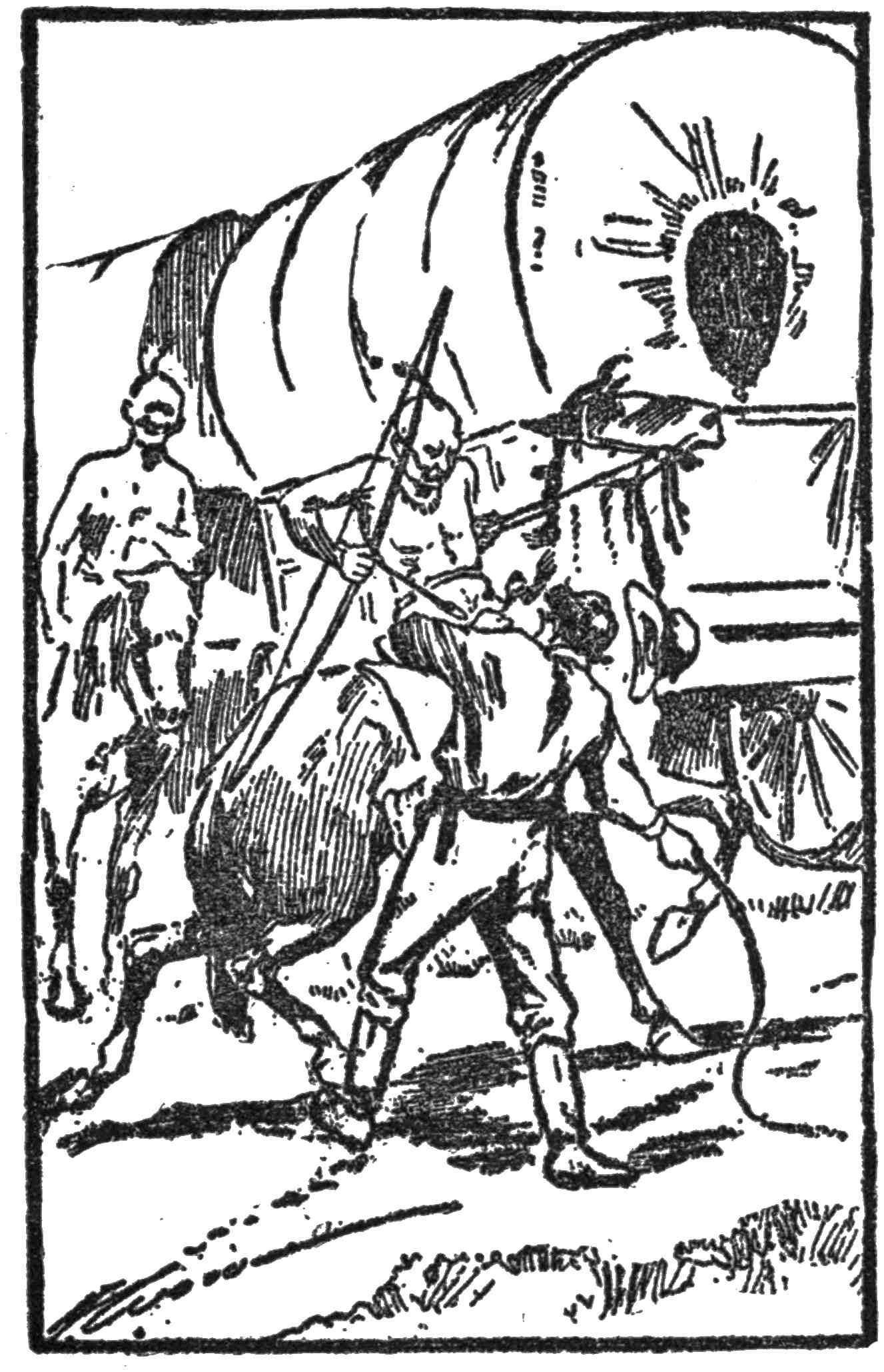
of our assistant wagonmaster, Rice. Four or five
young fellows rode up into the rear entrance of our corral
and were sitting there on their horses looking on at the
yoking of the cattle. They partially blocked up the opening
and interfered with egress of the teams. Rice, coming
up behind them, without warning gave one of their horses
a blow with a heavy blacksnake whip. The horse sprang
forward, nearly unseating the rider, who, as soon as he
could gather up the reins of his bridle, turned upon Rice
in a towering rage, jerked an arrow from its quiver and fixed
it in his bow. Forcing his horse right upon Rice, the Indian
punched him with the point of the arrow until he
knocked his hat off his head. Rice made no effort to resist
the affront and threatened assault, but kept backing out of
the Indian’s reach.
I was standing near by and seized my pistol, thinking
that a fight was imminent. At the height of the excitement,
Captain Chiles made his appearance and commanded
peace, in manner and language that the Indians could understand,
but it required some time and a deal of talk to
get them quieted. They denounced Rice’s conduct as an
insult they were bound to resent, and declared they would
kill Rice sooner or later. Captain Chiles, speaking through
Juan, our Spaniard, told them that if they commenced killing
they would have to kill us all, for we were bound to
stand together when it came to that. After a long wrangle
the Indian said he would be satisfied if allowed to give Rice
a sound flogging with a whip, but Captain Chiles refused.
Finally the Indians seemed to recover their composure, to
some extent, and rode off in the direction of the main
camp.
* * * * *
Somewhere thereabout, in the river bottoms, I saw the
ruins of an old adobe fort. “Old Fort Atkinson,” doubtless
named for and established and built by the command
of Colonel Henry Atkinson of the regular army, with whose
military career I happened to be somewhat familiar. The
remains of the old fort excited my interest, but I do not
recollect to have seen the place mentioned by any of the
numerous accounts that have been written of the Santa
Fé trail.
PUNCHED HIM WITH THE POINT.
The fort was probably built in 1829. At that time a
body of regular troops was sent out on the trail as a protection
to the traders. Colonel Henry Atkinson was ordered
west in 1818 and placed in command of the Ninth
Military department, then comprising the entire country
west of St. Louis, as well as Illinois and Wisconsin, with
headquarters at Fort Bellefontaine, near St. Louis. He
was soon afterward advanced in rank to brigadier general
and held the command at Jefferson barracks until his death
in 1842. The military post at Council Bluffs, Ia., was established
by Colonel Atkinson in 1819, when he and his troops
were transported on the first steamboats ascending the Missouri
river. He served with distinction in the Black Hawk
War, in command of the forces.
VI. At the Kiowa Camp.
The train had got under way the next morning when
the lodges of the Kiowas loomed up in sight of us. The
camp seemed to extend over territory a mile square. The
Indians said the entire tribe was assembled there—chiefs,
warriors, squaws and papooses. Presently we could see
them moving towards us, hundreds of them, on horseback
and on foot, all sorts and sizes, men, women and children,
coming to take a view of the white man and his belongings
as they passed.
Soon we could see also the lodges of the Comanches, appearing
about equal in number, and covering a like extent
of country. The two camps were a mile or more apart.
It had been agreed between the wagonmasters that we
would not make the usual noonday halt that day, but would
drive by the Indian camps and as far beyond as it was possible
for the cattle to stand the travel. We had anticipated
a great throng of Indians, and here they came by the
hundreds!
Some of the “big men” among them had guns or pistols,
but the greater number, in fact almost every one, had
a bow and quiver of arrows slung over his shoulders, even
the children who looked not over ten years old. One chief
wore a complete outfit of blue, with the insignia of a captain
of the United States army, and had a Colt’s revolver,
but nearly all of them were naked to the waist, with a
breech-clout and a sort of kilt of buckskin around the loins,
hanging down nearly to the knees. Some wore moccasins,
while many were barefooted.
The little fellows, nude, save for a breech-clout, had
little bows about a foot long, with arrows of cactus thorn,
with which they would shoot grasshoppers and other insects,
showing astonishing skill. Numbers of the warriors carried
spears, with long handles, glittering in the sunlight
as they rode along, giving the caravan the appearance of a
vast army of Crusaders on the march to the Holy Land.
Captain Chiles, endeavoring to shift the responsibility and
escape the annoyance of the Indians, pointed to Reece, on
his fine horse, and said: “There is the captain; talk to
him. Ask him for what you want.” But they could not
be so easily deceived. It is said that you cannot fool Indians
in this particular; that they never fail to distinguish
the wagonmaster, and appear to select the chief of any crowd
or caravan intuitively.
As we were traveling along the Indians gave frequent
exhibitions of the speed of their horses, running races with
each other, but at a sufficient distance not to frighten or
stampede our cattle. The younger men kept up a continual
chattering and laughing; horse racing seemed their great
amusement. The young fellows of the visit renewed their
invitation, urging me to join them in a buffalo chase, explaining
that the herds were not far off, and expressing a
great desire to see a trial of my buffalo horse in a chase
with theirs. I again declined. The train was continually
moving and would not be stopped to suit my convenience,
and there were other reasons, not unreasonably discreet.
The head men of the tribes, addressing the wagonmasters,
complained that they were in great need of supplies,
owing to the delay in the arrival of their annuities, and
asked a gift from the two trains. The two wagonmasters,
after some demurring, proposed to them that if they, with
all their people, would withdraw from, and cease to follow
the train, and desist from annoying us, after we had corralled,
we would go into camp and give them such supplies
as we could spare.
To this proposition the chiefs agreed. One of the leaders
began talking in a loud voice to the multitude, gradually
riding off from us, the crowd following. Reaching a knoll
which elevated him so that he could overlook them, he dismounted
and proceeded to make a speech. They seemed a
little slow about leaving, the multitude appearing to be not
altogether governed by the leaders, but nearly all finally
withdrew in the direction of their own camp. Driving on
a few hundred yards further, our corrals were formed and
the cattle were driven off some distance for water, while
preparations were made for cooking dinner.
In a little while the chiefs, representing both tribes,
made their appearance at our corral, where the wagonmasters
of both trains had met to hold the diplomatic conference
to determine how much of a gift of supplies they
were expecting from us.
The Indian chiefs dismounted from their horses, walked
into the corral and sat down on the ground, in the semi-circle,
to the number of perhaps a dozen and were soon
joined by the wagonmasters, together with our interpreter
Juan.
Writing now, in the year 1901, solely from memory,
forty-three years since this scene occurred, I am unable to
recollect all that was said, or the names of any of the Indians
who were present and took part in this parley. No
doubt San Tanta, that famous Kiowa chief, was among
them, but I took no notes whatever of this journey, and am
forced now to rely entirely on my memory. I recall that
it was stated that one of the most influential of the Comanche
chiefs who was there was an out-and-out Spaniard or
Mexican, speaking the Indian language as well as anybody,
and was generally known and recognized as among the
meanest, most cruel and blood thirsty of the Comanche
tribe. One of the elder looking Indians produced a big
pipe, filled it with tobacco, lighted it, and after taking a few
puffs himself passed it to the one next to him. Thus the
pipe was passed around to each one in the circle until all
had taken part in the smoke. The Indians were dignified,
discreet and cautious, as appeared to me during the conference,
leaving the impression that our troubles with them
were about to terminate, and this proved to be the fact.
At the close, and as a result of the council, a half-dozen
sacks of flour, half that many sacks of sugar, and a lot of
sides of bacon were brought forth from the mess wagons
and stacked up on the ground, near where the collection of
dignitaries of the prairies were sitting, smoking the pipe
of peace and good fellowship.
I thought the Indians regarded the things we were giving
them, as a sort of tribute we were under obligations to
pay for the privilege of passing through their country unmolested.
Pack mules were brought up, the supplies were loaded on
them and they departed in the direction of the general camp,
those engaged in the conference soon following.
In the evening, before we broke camp, two young bucks
came galloping into the camp. Addressing Captain Chiles,
they said that by instruction of their chief they had come to
return a pair of blankets that had been stolen by one of
the tribe. They threw down the blankets and the captain
called to the men at the mess wagon to give them a cup
of sugar each, saying that it was the first instance in his
life when an Indian had restored stolen property.
VII. To the Cimarron.
Escaping any further delay from Indians or from other
causes, good headway was made by the trains up the Arkansas
until we reached the “lower crossing.” It had been determined
by the wagonmasters that we would cross the river
here, taking the Cimarron route. Although the river was
fordable, yet it was quite tedious and difficult to get the
heavily loaded wagons across the stream, the water being
waist-deep and the bottom uneven.
Neither an ox nor a mule will pull when he gets into
water touching his body. The mule, under such circumstances,
always has a tendency to fall down, and so get
drowned, by becoming entangled in the harness. To meet
this emergency the ox teams were doubled, ten yoke being
hitched to each wagon, and were urged to do their duty by
a half-dozen drivers on each side, wading through the water
beside them.
The greater part of one day was taken up in getting
the wagons across, but it was accomplished without serious
loss. Everything being over, we encamped at the foot of
the hill on the opposite side, and rested a day, in recognition
of the Fourth of July. We fired some shots, and Captain
Chiles brought forth from his trunk some jars of gooseberries,
directing the cooks to make some pies, as an additional
recognition of the national holiday. The gooseberries
were all right, but the pie crust would have given an
ostrich a case of indigestion.
The old Santa Fé trail, from the lower crossing of the
Arkansas, ran southwest to the Cimarron, across a stretch
of country where there was no water for a distance of nearly
sixty miles, if my memory serves me correctly. All the
water casks were filled from the Arkansas river for the use
of the men, but of course there was no means of carrying
water for horse or ox.
The weather was warm and dry, and now we were about
to enter upon the “hornada,” the Spanish word for “dry
stretch.” Intending to drive all night, starting was postponed
until near sundown. Two or three miles from the
Arkansas we apparently reached the general altitude of the
plains over which we trudged during the whole night, with
nothing but the rumbling of the wagons and the occasional
shout of one of the drivers to break the silence of the plain.
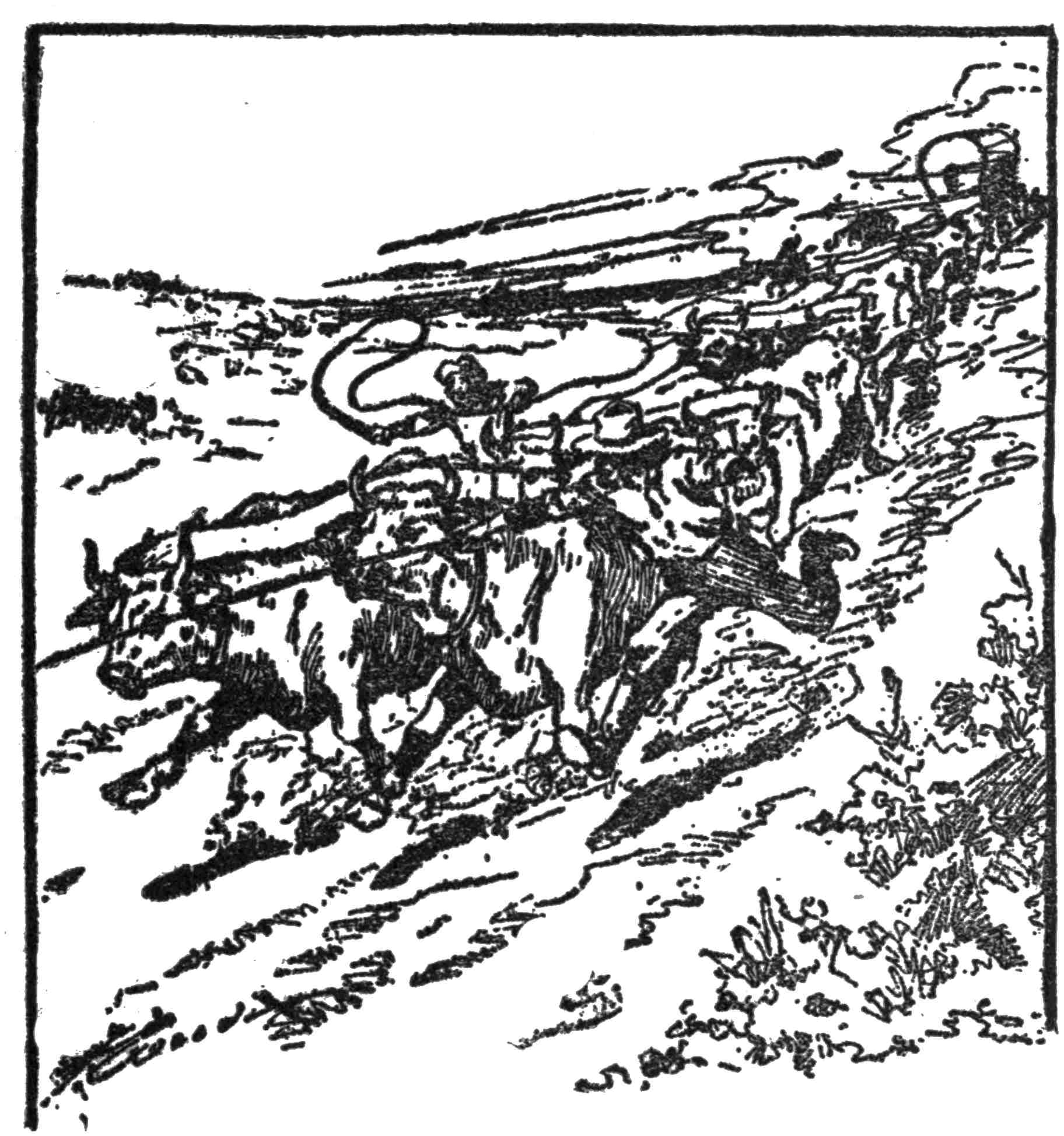
DIFFICULT TO GET THE HEAVILY LOADED WAGONS ACROSS.
It was my first experience of traveling at night, on this
journey. Toward midnight I became so sleepy that I could
hardly sit on my horse, so dismounting, I walked and led
him. Advancing to a point near the head of the trains I
ventured to lie down on the ground to rest, as the trains
were passing at least. Instantly my clothes were perforated
with cactus needles which pricked me severely, and waking
me thoroughly. In the darkness it was with great difficulty
I could get the needles out. Mounting my horse again I
rode some distance in advance of everybody, completely out
of hearing of the trains, and riding thus alone, with nothing
visible but the stars, a feeling of melancholy seized me,
together with a sense of homesickness, with which I had
not hitherto been troubled. Each day’s travel was increasing
the distance between me, my home and my mother, to
whom I was most dearly attached; and here amid the solitude,
darkness and perfect quietude of the vast plains I began
to reflect upon the dangers besetting me, and the uncertainty
of ever returning to my home or seeing my relatives
again.
The approach of morning and the rising of the sun soon
dispelled these forebodings of evil and revived my spirits.
Old Sol, like a ball of fire, emerged from the endless plain
to the east of us, as from the ocean, soon overwhelming us
with a flood of light such as I had never experienced before.
During all that day’s march the heat was intense and the
sunlight almost blinding, the kind of weather that creates
the mirage of the plains. In the distance on either hand,
fine lakes of clear water were seen glistening in the sun,
sometimes appearing circular in shape, surrounded with the
proper shores, the illusion being apparently complete, so
much so that several times during the day I rode some distance
seeking to ascertain if they were really lakes or not.
I found them receding as I approached, and was unable to
get any closer to them than when as a boy I set out to find
the sack of gold at the end of the rainbow.
About midday we passed a great pile of bleached bones
of mules that had been thrown up in a conical shaped heap
by the passing trainmen, in the course of the ten years they
had been lying there. They were the remains of 200 or 300
mules belonging to John S. Jones, a Missourian, a citizen
of Pettis county, whom I knew personally. In 1847, and
for many years afterward, Jones was engaged in freighting
across the plains. In ’47, having obtained a contract from
the government to transport freight for the troops at Santa
Fé, he got a start late in the season, and had only reached
the crossing of the Arkansas when he was overtaken by such
deep snow and severely cold weather as to compel him to
stop and go into quasi-winter quarters. While there, protected
by such barracks for man and beast as could be hastily
constructed, he received orders from the commander of
the troops in New Mexico that he must hurry up with the
supplies, orders of such urgency that they could not be disregarded.
He had a mule train of thirty wagons. Orders
were given to hitch up and start. The weather moderated
the first day, but on the second they encountered a heavy
and cold rain freezing as it fell, and were forced to go into
corral. Intense cold followed and every one of the mules
froze to death, huddling in the corral, during the night.
Years afterwards, through the influence of Colonel Benton
in the Senate and John G. Miller of Missouri in the House
of Representatives an appropriation was made by Congress
of $40,000 to pay Mr. Jones for the loss of his mules.
In the forenoon of the second day from the Arkansas we
reached Sand creek, a tributary of the Cimarron, where we
found a pool of stagnant water, not enough for the oxen,
but sufficient for the trainmen to make coffee with, and
there we camped. A few hours afterwards we struck the
valley of the Cimarron, and, after riding up the bed of the
apparently dry stream, we discovered a pool of clear water.
The cattle were so famished that they ran into it, hitched
to the wagons, their drivers being unable to restrain them,
and it was with considerable difficulty that the wagons were
afterwards pulled out of the mud.
VIII. My First Antelope.
After reaching the Cimarron we began seeing herds of
antelope in the distance. At first I tried “flagging” them.
I had been told that on approaching within two or three
hundred yards of them, concealed from their view behind
an intervening ridge, these animals were possessed of
such inordinate curiosity that they could be enticed to within
gunshot of the hunter by tying a handkerchief on the end
of a stick and elevating it in sight of the antelope, the hunter,
of course, keeping concealed. I made several efforts
at this plan of exciting their curiosity, and while some of
them came toward me at first sight of the flag, their curiosity
seemed counterbalanced by caution or incredulity, and in
no instance could I get one to come near enough for a sure
or safe shot. I then tried a rifle, with which I was also unsuccessful,
not then being able to make a correct estimate
of the distance between me and the antelope, a troublesome
task, only to be acquired by experience and constant practice.
THEIR DRIVERS WERE UNABLE TO RESTRAIN THEM.
The old trail ran along up the valley of the Cimarron
several days’ drive. A singular stream was the Cimarron;
for the most part of the bed of the stream was sand, perfectly
dry, but now and then, every mile or two, we found
a hole of clear good water, except that it was slightly tinctured
with alkali, a brackish, but not unpleasant taste. There
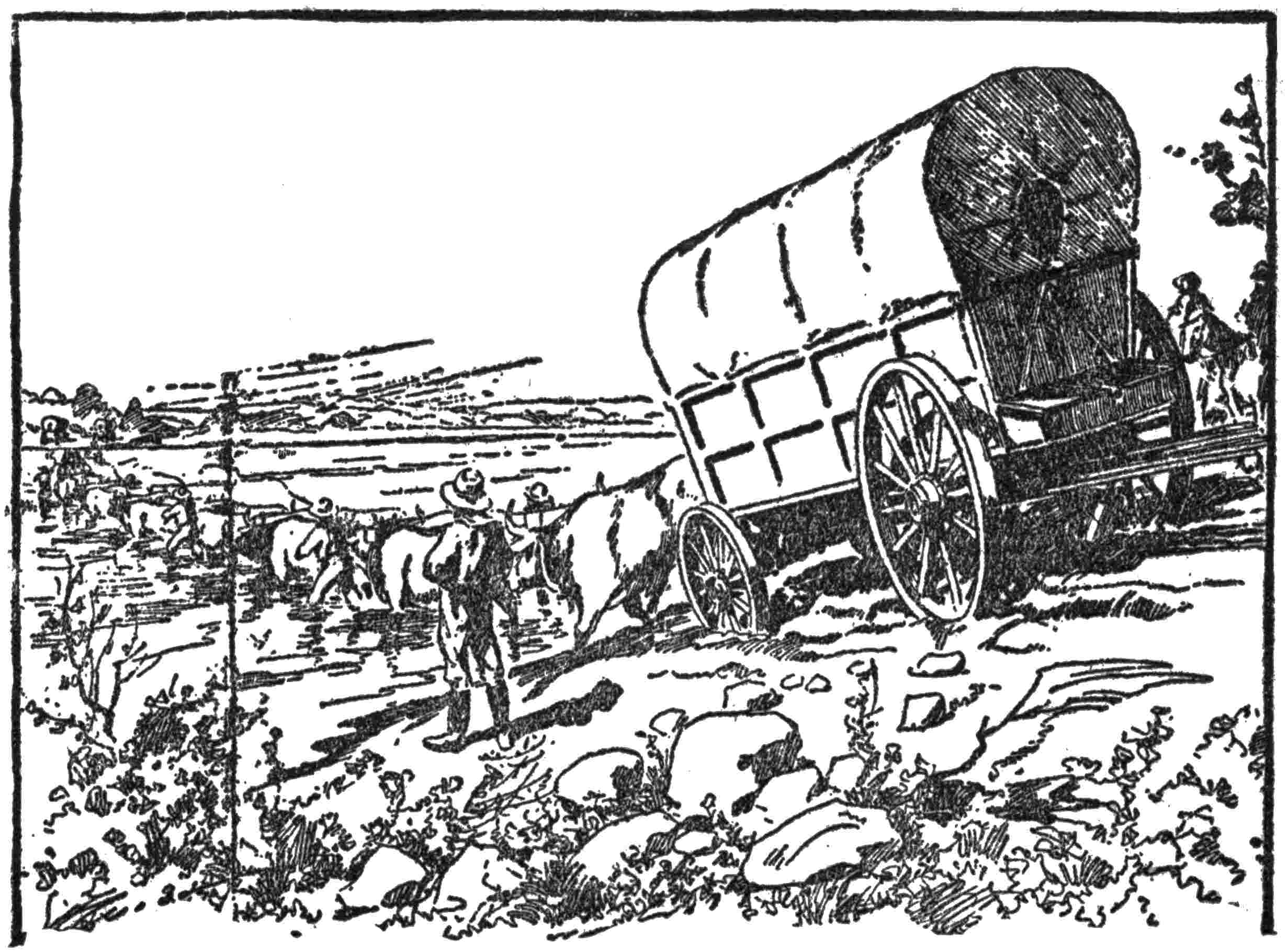
were three fairly good springs along the road near the Cimarron,
designated as the lower, middle and upper spring,
and we camped near each of them as we passed. As we
traveled up the valley squads of antelope could be seen viewing
the train from the heights on either side of the valley.
Captain Chiles had along with him two shotguns, the
smaller he had been using on buffalo, the other, an unusually
large, double barrel, number 8 bore, very long in barrel
and heavy, carrying easily twenty buck shot in each barrel.
Armed with that big gun I would ride in the direction of
the antelope, but at an angle indicating that I would pass
them. Usually when I had gotten within three or four
hundred yards of them they would quietly withdraw from
view behind the ridge, whereat, I would turn the course of
my horse and gallop as fast as I could, keeping the ridge
between them and me until I had gotten within a short distance
of the point of their disappearance. Then dismounting,
I hastily followed them on foot. Often they would be
found to have moved not out of the range of that big gun,
and with it I killed many of them. That was the only
plan of killing antelope by which I gained success. During
this part of the journey we saw many wolves, and of
many varieties, from the little coyote to the great gray
wolf. They were all very shy, however, and difficult to
approach within gun shot.
On the Cimarron we were overtaken by the mail coach,
one of the monthly lines then operated by Waldo & Co. of
Independence, Mo. The coach had left Westport five days
later than our train. The driver, guards and passengers
were all “loaded to the guards” (to use a steamboat phrase)
with guns and pistols.
While the train was under headway one morning Captain
Chiles rode along the length of the train inquiring for
“Skeesicks,” but “Skeesicks” did not answer, and no one
could tell anything about him. The captain ordered the
train stopped and a search to be made of each wagon, but
the searchers failed to find any sign of “Skeesicks.” Further
inquiry developed the fact that he had started out as
one of the guards at midnight to protect the herd of cattle,
they being off a mile or more from the corral, where
grass was found, and no one had seen him since. Captain
Chiles declared that he could not afford to stop for so worthless
a fellow as “Skeesicks,” and thereupon the orders were
given for the train to proceed.
Having traveled ten or twelve miles, a camp was located
at the foot of a mound which overlooked the road we had
been traveling for nearly the whole distance of the morning’s
drive.
At dinner, the propriety of laying by for a day or two,
or long enough to make a proper search for our lost comrade,
was discussed; but the teamsters all realized that no
captain of a ship at sea ever wielded more absolute authority
than Captain Chiles. He could brook no opposition,
and little criticism of his course or conduct. Any disobedience
of his orders he regarded as equal to mutiny and was
punished accordingly. About the entire camp a sullen
silence prevailed. Suddenly some one cried out that an object
could be seen away down the road that might be “Skeesicks,”
but just then, no one could discern whether a man
or a horse or an Indian.
The entire party assembled outside the corral to watch
the approaching object, and after a while our lost “Skeesicks”
walked up, covered with dust and worn out with
fatigue of constant walking for over twelve hours, without
food or water.
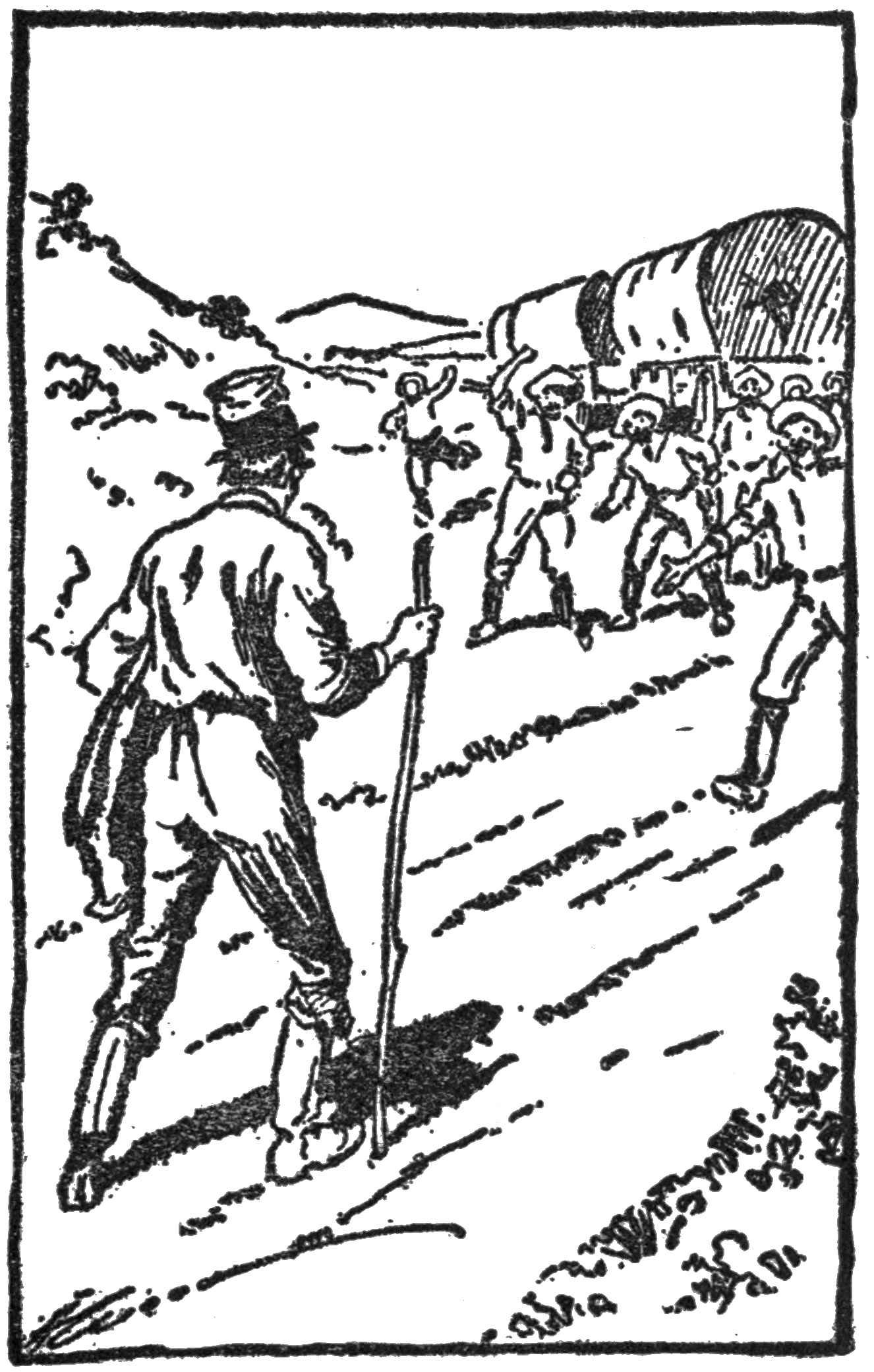
“SKEESICKS” WALKED UP.
He was soon revived by a comforting dinner. He said
he had been aroused at midnight from a sound sleep to assume
his turn as cattle guard, and on his way from the corral
to the herd, he had wandered apart from his companion
guard, soon becoming bewildered and completely lost. He
wandered about during the entire night, not knowing in
what direction he was going, and was all the while afraid
to stop for fear of the wolves that were howling around him
continually. After daylight he accidentally found the road,
and although bewildered, he had sense enough remaining to
follow it to the west, whence he had overtaken us.
As the cattle were being yoked, Captain Chiles called
up “Little Breech” and directed him to get the large cow
bell he had brought along to put on the black steer that
was in the habit of wandering from the herd at night. The
wagonmaster, with the bell in hand, walked up to “Skeesicks,”
who was sitting on a wagon tongue resting his weary
legs, and said, “‘Skeesicks,’ I am determined not to lose you
again, and am going to take no chances.” Then he buckled
the strap attached to the bell around “Skeesick’s” neck.
Turning to “Little Breech” he gave him particular orders
to drive “Skeesicks” in the cavayard and in no event to
allow him to wander away again.
All that afternoon “Skeesicks” plodded along with the
lame cattle in the cavayard, at the rear of the train, the
bell ringing at every step. In the evening, after we had
corralled, he went to Captain Chiles and plaintively beseeched
him to remove the bell. The captain gently unbuckled the
strap, but again charged “Little Breech” to keep his eye on
“Skeesicks” and not permit him to wander from the train.
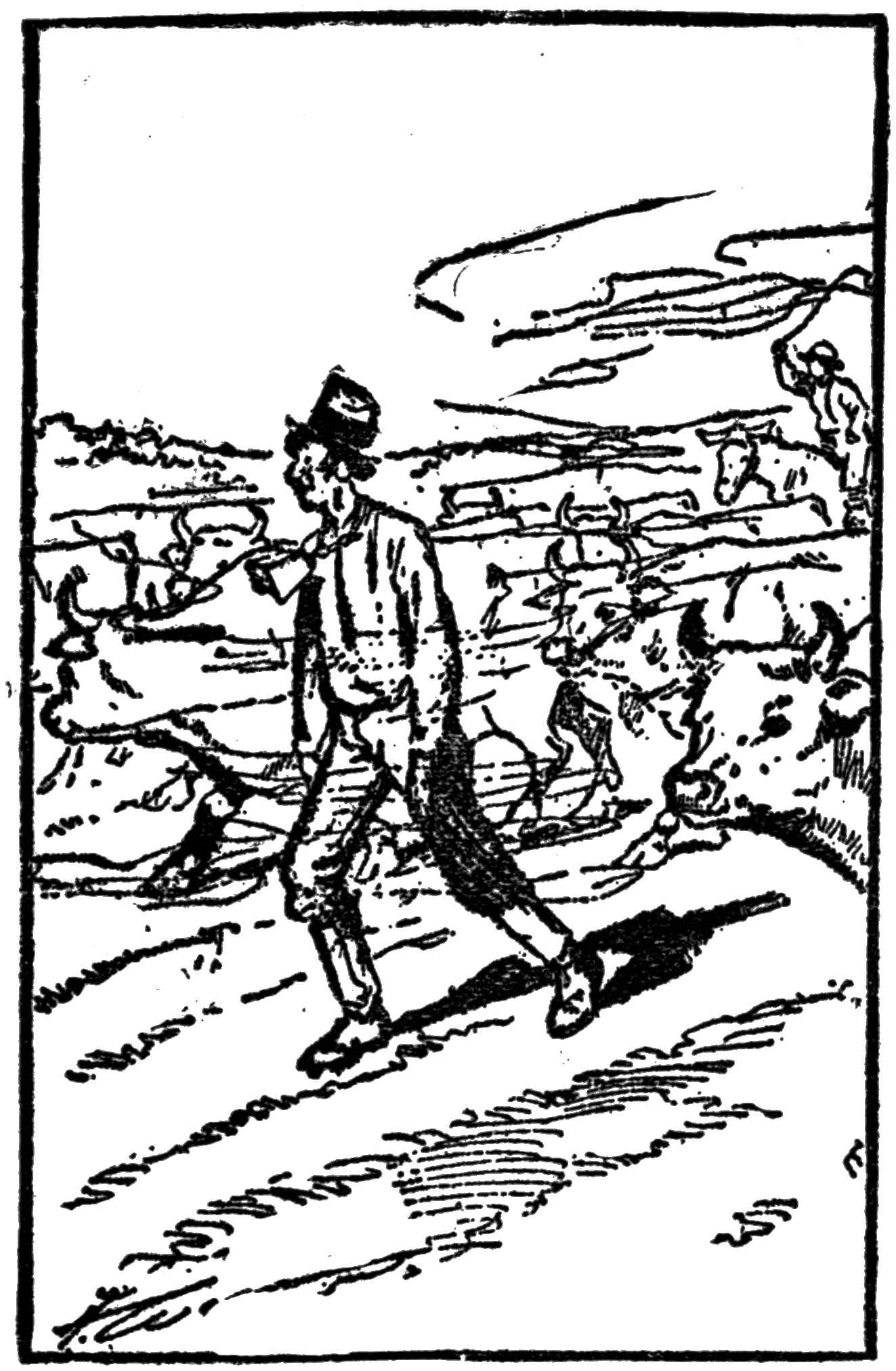
HE PLODDED ALONG WITH THE LAME CATTLE.
IX. A Kicking Gun and a Bucking Mule.
Here for some days we were traversing a continuous
level plain, treeless and trackless, except for the road we
traveled, covered with buffalo grass, then turned a beautiful
straw color by the sun and dry weather, but still affording
excellent pasturage. Not a tree had we seen, none since
we crossed the Arkansas.
We were slowly but regularly leaving behind us the monotonous
plain, to enter upon a region of great natural beauty
and attractiveness. On a beautiful morning after the
train had been moving for a short time, the Rabbit Ear
mounds were seen, peering up in the distance, through the
hazy atmosphere. Yet we were a day’s journey from them.
These twin diminutive sentinels of the Rockies, stationed
here to the left of our road, could not have been more appropriately
named, their resemblance to the ears of a jack-rabbit
being strikingly obvious.
A day or two after passing the Rabbit Ears we were fortunate
in the beauty and attractiveness of the location of our
corral. Immediately west of us the view was limited to a mile
or two, shut off by the bluff rim of a stretch of table-land, rising
perhaps a hundred feet above our level, the face of the
elevation extending north and south, the road we were traveling
passing around the base of its southern extremity.
About midway of the rim of this plateau of table-land there
was a small mound of regular sugar-loaf shape, rising to
perhaps the height of twenty feet, on the top pinnacle of
which stood a single buck antelope looking at the train as
it was starting out just at sunrise. There he stood for some
time stock still gazing at us. The morning was absolutely
glorious, the perfect weather of New Mexico. I determined
to give this solitary buck antelope a trial.
Procuring the big double-barreled shotgun belonging to
Captain Chiles, I mounted my horse, riding in almost the
opposite direction to that in which the train was moving.
The buck held his position until I had ridden nearly opposite
him, my course, leaving him nearly half a mile to the
left, when he suddenly retired behind the mound. Immediately
turning my horse I galloped over the ascending
ground until I got within a hundred yards of the base of
the mound, dismounted quickly, walked rapidly up to it;
then I crawled as quietly as possible nearly to the top.
Peeping around so as to get a view of the opposite side, I
beheld, forty yards from me, that fine buck, looking intently
toward me, with four or five of his companions lying down
near him, so close together that I could almost have covered
them all with the big shotgun.
Holding the gun in the right hand—it was so heavy that
I could scarcely handle it—cocking both barrels, I pushed it
out in front of me, and just as I was in the act of placing
the breech of the gun against my shoulder, but before I had
gotten it fairly in place, off it went, both barrels simultaneously,
sounding like a cannon, and kicking me with such
force as to turn me over and over, rolling me down nearly
to the foot of the mound. The gun struck my face, bruising
it badly, making my nose bleed profusely and stunning
me, but not so badly but that I noticed the bunch of fine
antelope scampering off, frightened, but untouched. My
horse stood quietly where I had left him picketed.
Our real character, “Little Breeches,” antedated the poetical
child of the fancy of Colonel John Hay, introduced to
the public some thirty years ago. Whether this distinguished
gentleman had any knowledge of our cavayard driver,
I do not know, but in truth the two “Little Breeches”
had similar characteristics, both “chawing tebacker” at an
early age, and our “Little Breeches” had the additional accomplishment
of swearing with emphasis, and articulation
unexcelled or unequaled by any of the older and more hardened
“bull-whackers” of our train.
HE JUMPED AND KICKED.
“Little Breech” rode a pony mule, a small animal of
most perfect shape, with activity to correspond. The noon
day camp was breaking up, the cattle were all yoked and
hitched to the wagons. “Little Breech” had mounted his
mule, preparing to round up his cavayard. At the moment
the reins were lying loose on the mule’s neck, while “Little
Breech” had both hands employed in adjusting his belt.
Impulse dictated so, walking towards him unobserved, I
picked up a stick, raised the mule’s tail and gently placed
the stick under it. The mule instantly clasped it tight
with his tail, commencing, before “Little Breech” could seize
the bridle reins, the worst spell of bucking I had witnessed
on the journey. He jumped and kicked and kicked and
jumped for a hundred yards, describing a semi-circle in his
gyrations. I was alarmed, fearing the boy’s neck would
surely be broken. But failing to get hold of the bridle
reins, he clamped the horn of the Spanish saddle, and, retaining
his seat to the end, all the while swearing at me with
as great force as he could command, his volubility being
very much restricted by the prolonged bucking.
X. A Gray Wolf.
It is difficult, if not impossible, to find the derivation of
some of the Spanish or Mexican words and phrases then
in use by the Santa Fé traders. For instance, the word
“cavayard,” I have used and spelled as it was pronounced
by these unlettered plainsmen and as applied by them to the
bunch of loose cattle and horses driven behind the train.
The pure Castilian has undoubtedly suffered many changes
in New Mexico, among the lower classes particularly. The
Spanish words used by these plainsmen had been both Mexicanized
and then Missourianized until so changed and corrupted
as to be hardly recognizable at all. This word “cavayard,”
they declared, was of Spanish origin; if so it must
have been a corruption of “caballar”—pronounced “cavallyar,”
meaning an attendant on horses. The derivation of
the word “hornada,” which we found given to the dry
stretch between the Arkansas and Cimarron is equally
obscure.
Among the teamsters was a Mexican, whose name I have
forgotten. One morning Captain Chiles got up earlier than
usual, at break of day, in fact, and, while waking up the
men he discovered this Mexican beating one of his oxen
severely with bow of the ox yoke. This was a gross violation
of the rules, but when Captain Chiles censured him
in pretty strong language he talked back to him in a threatening
manner. Thereupon the captain, drawing one of the
two navy pistols swinging to a belt around his waist, holding
it in one hand, and with a heavy blacksnake whip in
the other, advanced upon him and proceeded to give him a
severe flogging with the whip. The Mexican was held fast
by the threatening aspects of the navy pistol pointed at him
all the while until he had received a very severe flogging.
The following night the Mexican “skipped out,” and was
never seen by us afterwards, but no doubt made his way to
the settlements of New Mexico, then not more than 200
miles distant.
Hunting game, other than buffalo, along the Santa Fé
trail at that date was, to one attached to a train and dependent
upon its movements, necessarily confined to a narrow
scope of country on either side of the road, within a mile
or two. It was impossible to know at what moment one
might meet with Indians and be attacked by them. At that
time of the year the game was kept back from the highway
by the frequent passage of trains, while a few miles off
from the road there was no trouble to find antelope and
white-tail deer. I was compelled to hunt alone or not at all.
My friend Reece had become too much worn out by the
travel and his continued ill health to take much interest in
hunting, while Captain Chiles was kept busy with his duties
about the train. But I was continually on the lookout
for game; I rarely traveled the road, but would ride a mile
or so from it on one side or the other, always carrying my
holster pistols, and usually, in addition the big shotgun belonging
to Captain Chiles.
My buffalo horse seemed to have a very clear understanding
of travel over the plains, having, as before stated, the
experience of a journey from California to Missouri the
previous year. He seemed to have an instinctive idea of the
locality of the train, even when it was traveling, and often
when riding him a mile or more from the road and completely
out of sight, when given the rein he would instantly
change his course in the proper direction to intercept the
train.
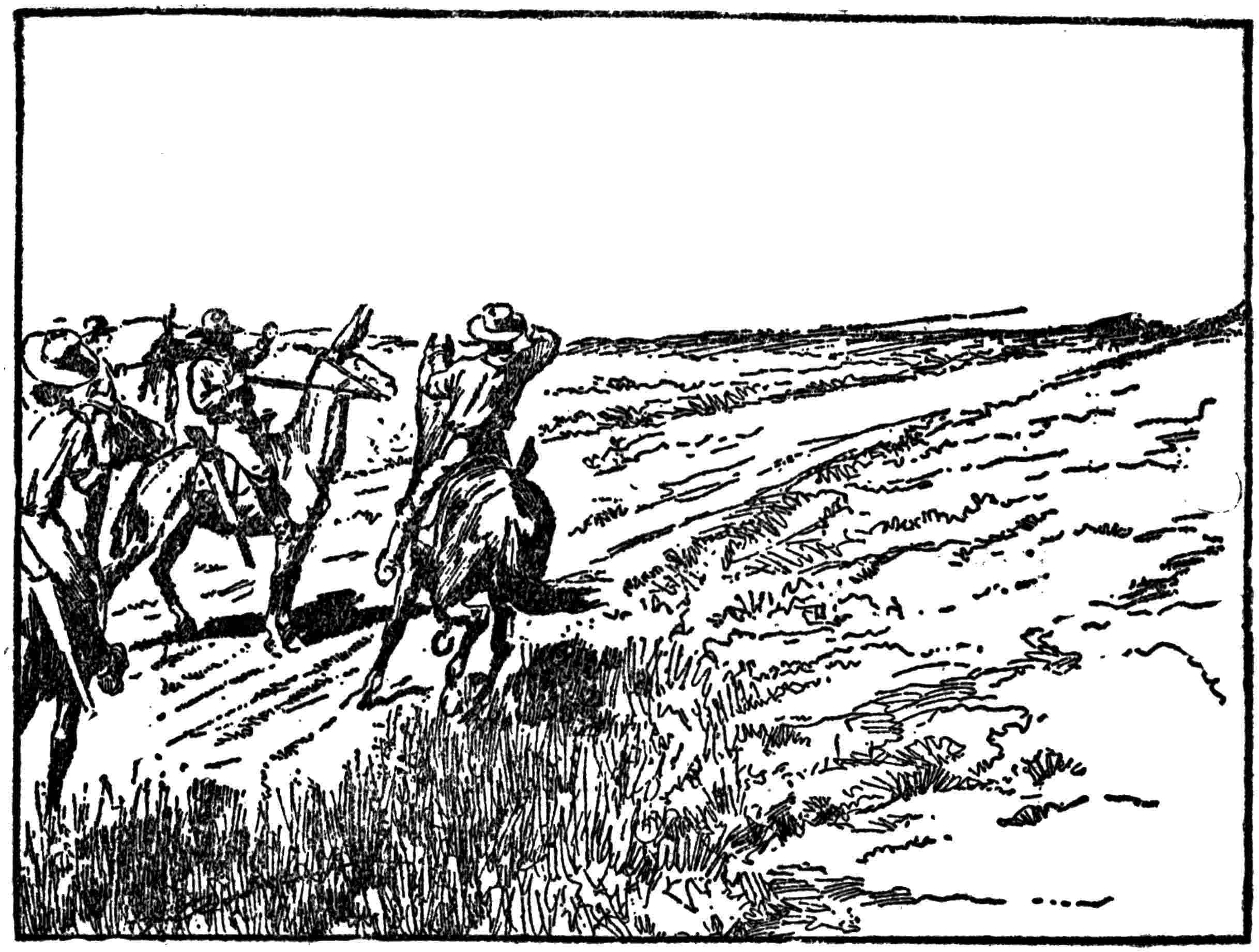
Riding thus alone on one occasion, some distance ahead
of the train, I saw a large gray wolf galloping across my
course, going towards the road. I determined to give him
a chase, and after him I went. The wolf increased his
speed, and, urging my horse to his best, we went flying
across the road 100 yards in front of the train and in full
view of it. As we flew by, the entire company of teamsters
gave us an encouraging whoop, but whether designed for
me or the wolf I was not able to determine. I had followed
the big fellow closely for a mile, emptying at him, if not
in him, the entire twelve chambers of my revolvers. At one
time I got within twenty feet of him, but not having any
ammunition for reloading with me, nor time for recharging
my pistols if I had, he disappeared over the ridge and I
saw nothing more of him.
Many days passed and many weary miles were traveled
of which I have no remembrance whatever and I am only
attempting to relate such adventures as were indelibly impressed
upon my memory, the frosts of forty-three winters
having passed over my head since this journey was made.
I cannot recollect what I thought of the probability of those
vast plains ever being occupied or cultivated as homes for
white people.
Whetstone creek, which the road crossed near the boundary
of New Mexico, was one of the localities of special interest
to me. Back on my father’s farm in Missouri I had
often whetted my pocketknife on a stone belonging to my
old overseer friend who said he had obtained it on this
creek. But none of our trainmen were familiar with the
route or the locality, or could tell me where the whetstone
quarry was to be found, and I was disappointed in not being
able to discover it after making a diligent search for it.
And now the spurs of the Raton mountains loomed up in
the distance ahead of us, a novel and interesting sight to
many of the company, some of whom had never seen any
greater elevation than the big hills of Western Missouri, and
the drivers swore and cracked their whips with renewed vigor
and animation.
XI. Arrival at Las Vegas.
Crossing the Ocata on the dry bed of it we were approaching
Apache hill, on the branch of the road leading to
Fort Union, the ascent of which was quite difficult to heavily
loaded wagons. The hill was barely visible in the distance
and the hour nearly noon when we first came in sight
of it. It was quite hot under the noonday sun and we could
see the white sheets of a train of wagons descending the
hill. Soon afterwards Captain Chiles and I, riding ahead
of our train, met the wagonmaster of this train, a sandy-haired,
red-faced fellow, sullen, morose and non-communicative.
He seemed inclined to pass us without speaking,
but Captain Chiles saluted him, and he halted for a few moments.
The man appeared to be sick, and as Captain Chiles
afterwards said he could scarcely “pull a word out of him
with a log chain.”
The captain asked him, “How is the grass about the
foot of Apache hill?” when he answered, “Well, sir, it’s
damned scase.”
Ten miles before reaching Fort Union we stopped at
a ranch, where we found an abundance of good milk and
butter, kept in a well arranged spring house, supplied with
water by a cold and bold spring running out of the foot of
the mountain. The milk was kept in large open tin pans,
set in a ditch extending around the room, constructed so
as to allow a continual flow of cool water about the pans.
The spring house was built of adobe or sod bricks. This
ranch supplied the fort with milk and butter.
Fort Union had no appearance of a fortified place then;
there was nothing more than substantial and comfortable
barracks, stores and warehouses. But the place had a look
of military precision, neatness and cleanliness about it not
seen elsewhere in New Mexico.
At this place our train was cut in twain; one-half of it,
under the command of Captain Chiles, went on to Mora,
the other half was sent to Las Vegas, in charge of the assistant
wagonmaster, Rice. Reece and I decided to accompany
that part going to Las Vegas.
On the route to Las Vegas we found a large adobe ranch
house, probably a hundred feet square and sixteen feet high,
the solid walls being without openings on the outside, except
two large doors. The ventilation and light were secured
through the openings inside the hollow square. There was
an extensive buckskin tailoring establishment there, where
they were manufacturing quantities of buckskin clothes of
various patterns, and I was surprised at the skill displayed
in making the garments. The clothes were made to fit with
tailor-like precision and exactness. Clothes of buckskin
were generally worn at that time by the inhabitants of New
Mexico, by the natives especially.
As we drew near Las Vegas we noted that the “bottoms”
of the little creek running near the town were cultivated
in corn, with occasional patches of vegetables, the
land uninclosed by fences, but flanked by irrigating ditches
supplying the necessary water, and the crops were looking
remarkably well, although the weather had been dry for
some weeks. We found it necessary to have a close watch
kept on our cattle while we were near these cultivated and
unfenced fields. Las Vegas was a compactly built little
town of probably two or three hundred inhabitants, the
houses for the most part built of adobe bricks or tufts of
sod, with a corral in the rear. The herds of sheep, goats
and burros were driven in about sunset and fastened up for
the night in these corrals, from which they were driven out
early in the morning to graze during the day, under the constant
eye of the herder, who accompanied each band.
We remained one day only at Las Vegas. The wagons
were unloaded, the freight being delivered to the consignees,
and we turned about and started on our homeward journey.
While at Las Vegas Reece purchased three goats, thinking
that their milk would be beneficial to him. They furnished
a bountiful supply of milk, and very rich milk it
was, too, though of a rather strong and disagreeable taste
and odor. He failed, however, to realize any great benefit
from its use, so far as I remember.
Our first noonday camp after we left Las Vegas was
near a ranch, and as we were resting under the shade of the
wagons after dinner, the owner of the ranch, a native New
Mexican, visited us, with a good looking shepherd dog following
him. Reece expressed admiration for this dog,
which, the Mexican declared, was excellently well trained
for herding, easily controlled and a valuable animal in other
respects. After considerable negotiation, the Mexican
agreed to sell the dog to Reece for two plugs of tobacco.
Reece procured a rope, and the Mexican tied the dog to the
rear axle of one of the freight wagons, soon afterward taking
his departure for his ranch a mile or more distant.
Shortly the dog became restless and made efforts to get loose.
The teamsters began to laugh at Reece about the uncertain
character of his newly acquired property, saying
that the Mexican well knew that he could not keep the dog,
and that he would soon make his escape to return home.
Reece declared that he would prevent this at least and went
to a wagon and brought forth a gun. Standing the gun
against the wagon under which the dog was fastened, Reece
resumed his efforts to enjoy a noonday siesta under a neighboring
wagon. He was aroused by one of the drivers, who
shouted to him that his dog was running off in the direction
of his home. The dog had gotten two or three hundred
yards away, ascending a ridge in a gallop when Reece
jumped up, seized the gun, leveled it at the dog and fired.
To his surprise, no less than ours, the dog fell dead.
We rejoined the other part of the train at a camp near
Fort Union, and here in this camp we remained for several
days.
Captain Chiles was desirous of selling a part of the cattle,
as the whole were not needed to convey the empty wagons
on the return journey, and made frequent visits to the
fort in his efforts to dispose of the cattle. One evening he
announced that he had made a sale of about one-half of
the cattle. The following morning a prosperous looking
gentleman of consequential air and mien rode up to our
camp and was introduced as the purchaser of our cattle. He
was riding a fine horse, with saddle and other equipment to
correspond. Among his other attractive features, I can recollect
a large flask of brandy which he carried lashed to the
front of his saddle, the flask being protected by a wicker
jacket. Generous gentleman, as he proved, the first thing
he said after the usual salutation was an invitation to sample
the contents of this flask, and this invitation the common
politeness of the plains prevented us from declining.
We found his brandy excellent, and its effect produced a
lasting remembrance of the personality of the gentleman
himself.
The cattle purchased by him were cut out and separated
from the others. The owner said he intended driving them
to some point in New Mexico, a considerable distance from
there. On inquiring for some hands whom he could employ
to drive them to their destination, one or two were found
in the party who would accept the service offered, and then
some one suggested that a job of this sort would suit “Skeesicks,”
who was still hanging to the train.
“Skeesicks,” with apparent reluctance, accepted the service
and wages offered, and in a few moments afterwards left
us forever. I could not avoid feeling sorry for him, as he
slowly passed from our view, trudging along on foot behind
the herd of cattle. We never heard of him afterwards.
While at this camp a Mexican youth, about 16 years of
age, came to the train and asked permission to accompany
us to the “States.” He was a bright, active boy, able to
understand and speak English in some degree, appearing
immensely pleased when Captain Chiles told him that he
might come along with us if he desired.
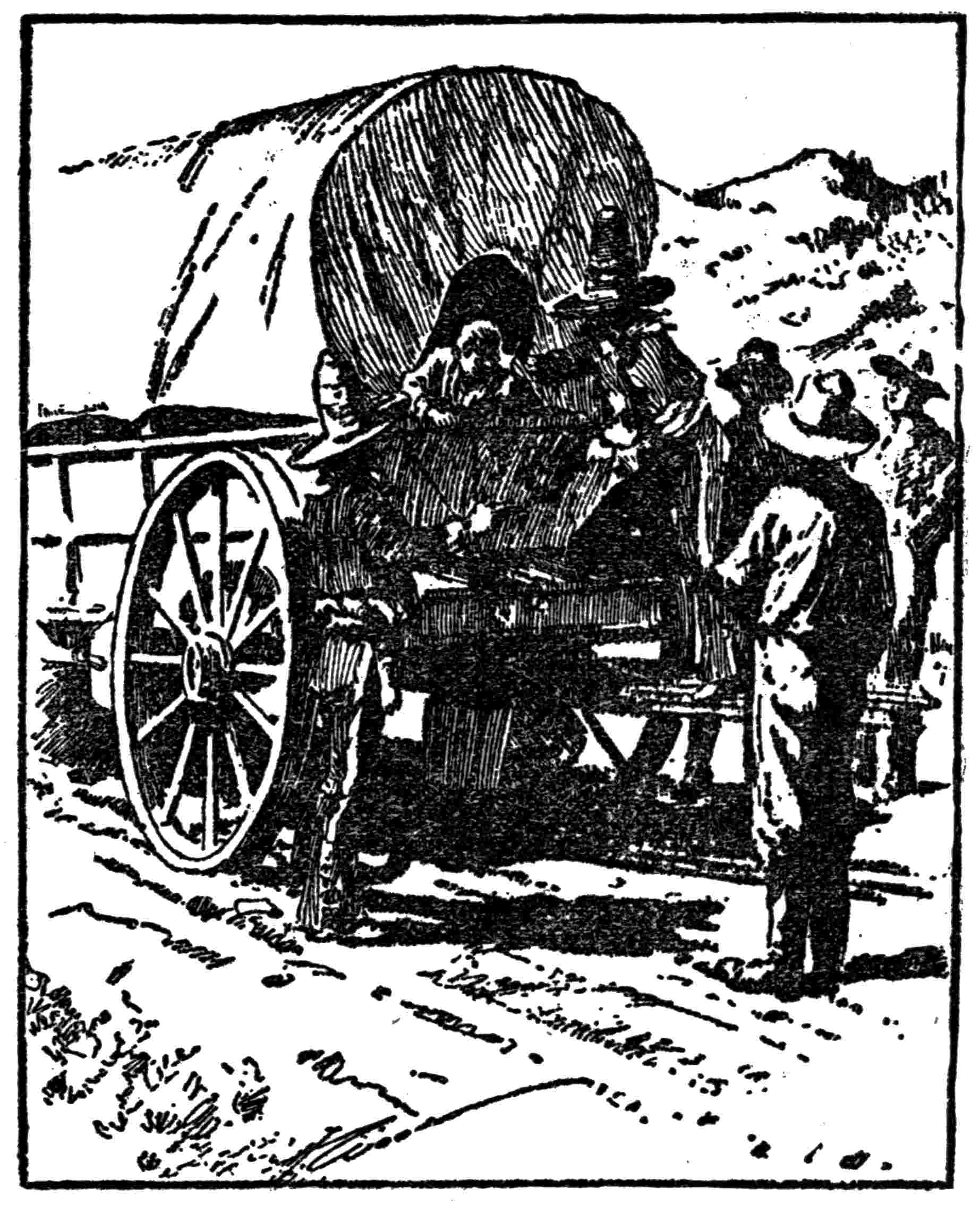
During the night some of the trainmen ascertained that
he was a “peon,” consequently having no right to leave the
territory. When the train started the next morning, at the
suggestion of the men, he secreted himself in one of the
covered wagons. Before noon, however, two horsemen were
seen following us, coming on in a fast gallop. They were
officers of the law, armed with pistols and a writ for the
arrest of the boy. The trainmen pretended to be ignorant
of his presence with the train, but the officers said they
knew he was with the train, demanding of Captain Chiles
that he stop the train so they might search for him. In
order to avoid being subjected to the charge of resisting the
officers, the captain ordered a halt. The officers soon discovered
the boy concealed beneath some bedding, dragged
him out and put him on one of their horses. The poor
boy protested with all his might against being taken back,
crying all the while in a distressing manner, arousing the
feelings of the trainmen until they were about to declare
war on the officers, but Captain Chiles said it would not do
to resist the civil authorities. So the little fellow was carried
back to his condition of slavery or peonage as it was
called by the officers.
THE OFFICERS DRAGGED HIM OUT.
At noon that day our camp was near the base of a mound
of broken rock, perhaps a hundred feet high, rounded to
a sharp pinnacle at its apex. The mound supported hardly
a bit of vegetation on its sides, which were nearly inaccessible.
The goats purchased by Reece had been driven along
in the cavayard, apparently reconciled to their new mode of
life and daily travel. That day, as the wagons were moving
out of corral, Reece missed his goats. I joined him in a
search for them, riding about over the plain, and we had
about reached the conclusion that they had run away. Just
then as the wagons were moving from the corral one of the
teamsters shouted to Reece, “There are your goats!” pointing
to the summit of the steep mound of rock.
Sure enough, there were the three goats, standing in a
row on the topmost rock, looking at us with the utmost satisfaction
and composure. Nothing but a goat could either
ascend or descend the declivity, so Reece and I remained
until they thought proper to come down. This they did in
the course of an hour, when we drove them on, overtaking
the train as it went into camp at nightfall.
XII. In Peril of Indians.
The return journey was for the most part uneventful,
but with empty wagons we could travel more rapidly.
On our reaching the crossing of the Arkansas we found
there a company of dragoons, and the officers informed us
that they had been fighting and chasing the Cheyennes all
summer, having just halted there in following one band of
these Indians to the Arkansas river. They had been forced
to abandon their provision wagons some days before we saw
them, and were almost entirely out of food. The artillery
had also been left behind two or three days’ march down the
Arkansas river. These troops, a part of Colonel Sumner’s
regiment, had had several brushes with the Cheyennes, and
captured a lot of horses from the Indians. The soldiers,
their horses and equipments, gave every evidence of having
undergone a severe campaign, and they came around
our camp begging for something to eat, tobacco and whisky,
much as the Indians were in the habit of doing. But our
ability to relieve their wants was very limited, having with
us only supplies enough for our own party back to the
settlements.
The officers said that it would be hazardous for us to proceed
further, advising our captain to remain until the trains
in our rear could get up, until they had accumulated to at
least one hundred wagons and men, when we would be strong
enough to resist any attack that we were likely to be subjected
to.
Acting on this advice, we remained in camp several days,
until five or six trains had arrived and camped in our immediate
vicinity. The journey was then resumed, our train
taking the lead, all our weapons of defense being put in as
good order as possible. After the trains were under way
the wagonmasters of those behind us, to the number of ten
or a dozen, mounted on horses and mules, would ride ahead
to join Captain Chiles, Reece and myself, thus forming a
lively and agreeable company of companionable men.
As we were thus riding along down the level bottom
of the Arkansas, some distance in advance of the trains
away to our right a mile or more, out near the bank of the
river, where we could see some scattering cottonwood trees,
we observed a smoke rising from a camp fire. Some one
of the party suggested that it was the smoke of the camp
of the artillery company, of which we had been told, so we
rode forward, giving little more attention to the smoke of
the camp fire that went curling upward among the cottonwood.
When we had reached a point about opposite the
smoke there suddenly appeared in our view a company of
some fifty horsemen, riding pell-mell in a fast gallop towards
us. They were yet too far off to be distinctly seen
or for us to tell what manner of men they were. In another
moment, Captain Chiles exclaimed:
“Men, they are Indians! Soldiers don’t ride in that disorderly
manner. Form a line and get out your guns. We
are in for it!”
Instantly all hands obeyed his command, forming a line,
facing the enemy, each of us drawing a pistol. The lead
wagons of our train were just barely visible, probably two
miles from us. When the approaching horsemen saw that
we had formed a line of battle, they instantly drew rein,
slackening their speed to a walk, but kept steadily drawing
nearer us.
“MEN, THEY ARE INDIANS!”
In a few minutes our anxiety was relieved when these
horsemen came near enough for us to see that they were
white men, not Indians, and, after all, they proved to be
the company of artillery, mounted on some Indian horses
that had lately been captured from the Cheyennes. Under
the circumstances it was not at all strange that we had mistaken
them for hostile Indians.
The next morning after this the wagonmasters of these
several trains came forward as usual, and we set out to
travel in advance of the trains, hoping to find buffalo as
we had again reached their accustomed range.
I had the only real good buffalo horse in the company,
but his speed and strength we found considerably lessened
and impaired by the long journey. In discussing the prospects
of finding buffalo, and of killing one for a supply of
fresh meat, which we were all very eager again to get, Hines,
an assistant wagonmaster of one of the trains, suggested to
me that I should use his pair of heavy Colt’s army revolvers,
which, he said, carried a heavier ball and were more effective
in killing buffalo than mine. Although I was somewhat
doubtful, I exchanged with him. We had ridden forward
but a few miles when we descried a herd of some twenty
buffalo, in the distance. The understanding being that I
was to lead off in this chase, I put spurs to my horse, the
others following. There were several young cows in the
band, one of which I selected, and pressed my horse forwards.
In a few moments we were going at a furious rate
of speed, and my prospect of success was good, but just as
I was leaning forward, with pistol in my right hand, in the
act of shooting the cow, the stirrup leather of my saddle
suddenly broke, almost precipitating me headlong to the
ground, but I escaped falling by catching around the horse’s
neck with my left arm; the heavy pistol fell to the ground.
While I was preparing to mend the stirrup leather, having
dismounted for that purpose, the other men of the party
rode up, the buffalo, meanwhile, having run entirely out of
sight.
When I had gotten the stirrup repaired, Captain Chiles,
noticing that I was a good deal shaken up and unnerved by
the occurrence, said that I would better let him have my
horse and pistols, which I readily gave up to him, knowing
that there was no man on the plains who excelled him in
a buffalo chase or one more sure to provide fresh meat. So
he mounted my horse, and I got upon his mule, and we all
started off in the direction the buffalo had gone. We had
by that time reached a section of rolling country on the
“cut-off” across the bend of the Arkansas, lying in great
ridges, with valleys intervening. As we got to the top
of one of these ridges Captain Chiles, who was in front,
exclaimed: “Look yonder at that band of elk!”
There they were, perhaps two hundred of them, grazing in
a valley a mile distant. I immediately claimed my horse,
for I did not want to miss the opportunity of killing an
elk, but the captain merely laughed at me and started down
toward the elk in a gallop. The elk, seeing him, were soon
all in motion, running in a great mass, stirring up a cloud
of dust, soon passing from our view around the point of the
ridge on the farther side of the valley, Captain Chiles following
them closely, the horse at full speed. After they
had gotten out of sight of us we heard the report of his pistol,
two or three times, and our entire party followed in his
wake until we had reached the point, where we thought the
firing had occurred. Finding neither Chiles nor any dead
or wounded elk the men all, except Reece and I, refused to
go further, and turned about towards the road. Reece, who
was riding his big gray horse, and I, on the mule, continued
riding in the direction we supposed Chiles had gone, until
we had ridden perhaps four miles, when I began to feel a
little uneasy, expressing a disinclination to go further, as I
was riding a worn-out, leg-weary mule, with nothing but
a belt pistol in the way of arms, and being in the neighborhood
of hostile Indians. Reece said to me: “You remain
here while I ride to the top of that high mound yonder,”
pointing to a hill a mile farther on. “When I get there,”
he said, “if then I can neither hear nor see anything of
Chiles or the elk I will return here for you.”
Reece rode away. I remained alone for an hour or more—the
danger of the situation made it appear much longer
than it really was, no doubt—and finally I saw Reece and
Chiles coming, greatly to my relief. They were in good
spirits, and as they rode up Chiles said they had killed the
biggest elk that ever ran on the plains, giving me an account
of his capture in detail as we rode back.
XIII. Captain Chiles’ Chase.
When Reece had got to the top of the mound he saw
Captain Chiles, sitting on a horse, holding by a rope a huge
bull elk. The elk stood in the bottom of a deep, narrow
ditch, ten feet deep, with banks almost perpendicular, so
steep that he was unable to get up them or out of the ditch
to assail his captor. Captain Chiles, when he first caught up
with the band of elk, had made an effort to kill one with
the pistols, but for some reason he could only get the pistols
to fire two of the charges, and with these two he only
wounded a cow slightly, not enough to stop her from running.
He kept after the band, all the while trying to get
the revolver to fire, trying every chamber, but with no success.
After he had kept up the chase for two or three miles
the large bull elk, being very fat, got too tired to keep
up with the band, but trotted along behind, in fact, so far
exhausted that Chiles could keep up with him with his horse
in a trot. The captain despaired of being able to stop one
with the pistols, and, finding a small lariat I had brought
from the Kiowas as we went out, on my saddle, used for
picketing my horse, resolved to try the plan of lassoing the
big fellow.
Being an expert in rope throwing, he had little difficulty
in preparing the noose or getting a fastening around the top
prong of one branch of the elk’s great antlers. As soon as
the elk found he was restrained by the rope he turned about
and charged on Captain Chiles with all the power and fury
he could command, and twice or thrice the captain was
forced to cut loose from him in order to escape his assaults.
The rope was long enough to drag on the ground some distance
behind him, so that the captain could recover hold of
it without dismounting, reaching down and picking it up as
the bull trotted away from him. He kept on after him for
some distance, occasionally jerking him back, and worrying
him until he could hardly walk. Coming to the lower
end of the ditch, washed out to a depth of ten feet, at a
point a few yards above, he managed to guide the animal,
bewildered as he was by the heat, together with the violent
and prolonged exercise, into it, leading or driving him along
up the ditch until he got him in between the high banks of it
to a place where the animal could not get at him however
anxious he was to do so.
When Reece arrived, as above related, he found Chiles
sitting there on the horse holding the end of the rope, but
having nothing with which to kill the animal, not even a
pocket pistol. Reece had with him a belt revolver, and, under
the directions of Chiles, he carefully crawled to the edge of
the ditch to within a few feet of the elk’s head and killed
him with a couple of shots in the forehead.
The bull had not been wounded by Chiles, and no one
but a veritable daredevil as he was would have undertaken
the job of lassoing an elk under such circumstances as he
did. But Chiles was a stranger to fear.
Chiles, Reece and I got to the camp about 2 o’clock,
near six miles from where the elk was killed. After dinner
we went out with pack mules and the necessary hatchets
and butcher knives, and two of the drivers, to butcher
the elk. The animal was a splendid specimen of his kind,
supporting a magnificent pair of antlers, fully hardened and
developed, and was fatter than any other animal of the deer
kind I have seen, before or since. We butchered and brought
to camp on the pack mules every part of his carcass, including
the antlers. The latter were brought home to Jackson
county. We feasted on the flesh of the fat elk for several
days, and my recollection is that I never tasted better meat.
The remaining part of the journey was uneventful, the
entire party remaining with the train until we were within
eighty miles of the state line of Missouri. Then, in company
with Captain Chiles, I started, before daylight, to make
a forced march to Westport. We rode forty miles before we
halted for breakfast, obtaining it at a settler’s cabin in the
vicinity of Black Jack, arriving in Westport late in the
evening, in the latter part of September, feeling very willing
to rest once more in a comfortable house and bed.
I saw my friend Reece about a year after he had returned
to his home in Missouri still making a fight for life, but
during the second year he struck his flag and made a final
surrender.
At Westport the drivers were paid off and disbanded,
but I was not present to witness the separation of the company
that had formed a companionship, offensive and defensive,
during this long and tiresome journey across the
plains. Doubtless nearly all of them, in the vernacular of
the Western mountains, have “crossed over the range.”
Lewis & Clark’s Route Retraveled. The Upper Missouri in 1858. — CHAPTER I.
BY
W. B. NAPTON.
In 1858, under existing treaties with the western Indian
tribes, the national Government sent out to them
annually large consignments of merchandise. The superintendent
of Indian affairs, whose office was in St.
Louis, chartered a steamboat to transport these annuities
to all the tribes in the country drained by the Missouri—beginning
with the Omahas and Winnebagoes in
Nebraska and ending with the Blackfoot, at the base
of the Rocky Mountains, around the sources of the Missouri.
Nearly one-half of the cargo of this boat, however,
consisted of the trading merchandise of Frost, Todd
& Company, a fur-trading concern, whose headquarters
were at St. Louis, and whose trading posts were established
along the Missouri from Yankton to Fort Benton.
The whole of the territory of the United States then
north of Nebraska was without any legal name or designation;
at least there were no such territories as Dakota
or Montana shown on the maps. At that time, and
for many years before, a steamboat load of merchandise
was sent up as far as Fort Benton by the American Fur
Company, having its headquarters also in St. Louis, and
controlled mainly by the Chouteaus, to replenish the
stocks of their trading posts along the river. The trade
of these companies was exclusively with the Indians, the
exchange being for buffalo robes, furs of the beaver,
otter, mink, etc., used for making clothes, gloves, etc.
Colonel Redfield, of New York, was the agent for
the Indian tribes along the river from the Omahas in
Nebraska to Fort Union at the mouth of the Yellowstone.
Colonel Vaughn, of St. Joseph, Mo., was agent
for the Blackfoot tribe, and that year had special orders
to take up to his agency, on Sun River, forty miles above
Fort Benton (now Montana), farming implements, horses
and oxen, and to make an effort to teach the tribe the
peaceful art of agriculture. These Blackfoot Indians,
however, regarded agriculture a good deal as it is defined
by our humorous friend, Josh Billings, who defined
it as “an honest way of making a d—md poor living.”
The Indians fully sanctioned and concurred in
this definition. I had received at the hands of Colonel
Vaughn the appointment of attaché to his agency,
pretty nearly a sinecure, but affording transportation
from St. Louis to Fort Benton and back, if I choose
to come back.
The boat was a medium-sized Missouri River packet,
nearly new, with side wheels and powerful engines.
Steamboating on the Missouri had then reached the highest
stage of prosperity. A line of splendidly furnished
and equipped passenger boats ran from St. Louis to St.
Joseph, providing almost every comfort and luxury a
traveler could ask. The table was elegant and the cuisine
excellent, the cabin and state-rooms sumptuously
furnished, and last but not least, there was always a
bar where any kind of liquor could be found by those
who preferred it to Missouri River water. There were
good facilities for card-playing either with or without
money, and no restraint in either case. There was usually
a piano in the cabin, and frequently a fair band of
musicians among the waiters and cabin-boys. These
great passenger-boats ran all night, up and down the
most treacherous and changeable of all the navigable
streams. To be a first-class pilot on the Missouri River
was equivalent to earning the highest wages paid in the
West at that time. The chief pilot of our boat, R. B—,
was of that class. Just before he took service on this
boat he had forfeited a contract for the season at $1,000
a month with the “Morning Star,” a large passenger-packet,
running from St. Louis to St. Joseph, from the
fact that he was on one of his periodical sprees when
she was ready to embark from St. Louis.
After the boat got under way, I spent a great deal
of time in the pilot-house with R. B—, who I found a
man of fair education and considerable culture, a devotee
of Shakespeare, quoting or reciting page after page of
his “Tragedies” without interruption of his duties at the
helm of the boat, a position requiring great courage and
steady nerves. R. B— knew every twist and turn of
the channel of the Missouri from St. Louis to St. Joseph,
knew every bar where the river was either cutting
out its bed or filling it up, knew precisely the location
of every snag protruding above water, and of many that
were invisible except at a low stage of water—in short,
knew at all times, night or day, exactly the position of
the boat and its bearings.
The passengers formed a motley congregation. The
two Indian agents, their clerks and attachés, the agents,
trappers and voyageurs of the fur companies, mostly
Canadian Frenchmen intermixed with Indians; a few,
however, were native Americans, a young English sportsman,
Lace, and his traveling companion from Liverpool,
going up to the mountains to kill big game. A young
gentleman, Mr. Holbrook from New England, who had
just graduated at Harvard and was traveling for health,
Carl Wimar, an artist of St. Louis whose object was to
get pictures of the Indians, and a young man of great
genius and promise in his profession, a captain, two
pilots, two engineers, two cooks, cabin-boys, etc., twenty
regular deck hands and, in addition to these, about seventy-five
stout laboring men to cut wood to supply fuel
for the boat’s furnaces after we had gotten up above
the settlements.
We commenced cutting wood soon after passing Omaha,
although we found occasional piles of wood already
cut on the river bank above Sioux City, Iowa.
There were no female passengers and the boat had
been stripped of carpets, mirrors, etc.
Colonel Redfield was a staid, straight-laced gentleman
from the East, while Colonel Vaughn was a jolly
frolicsome fellow of sixty-five years, who had been
thoroughly enjoying western life among the Indians on
the upper Missouri for many years, and no matter how
late at night the bar was patronized, the following morning,
when one would enquire as to the state of his health,
he would answer with inimitable gusto, “Erect on my
pasterns, bold and vigorous.”
The fur company men were nearly all Canadian
Frenchmen, some of them having a greater or less degree
of Indian blood in their veins. These people had
come down from their trading posts, starting just as
soon as the ice broke up in the river, on keel or flat-boats,
bringing along some furs and peltries, and had
reached St. Louis in time to spend a week or two there.
Having settled with the fur companies at headquarters
in the city, the remainder of their limited contact with
civilization would be spent in seeing the sights of the
city.
These fur traders, trappers and voyageurs formed a
class now extinct in the United States, a remnant of
them yet remaining perhaps in British America. The
boat made no landings except for fuel, until we reached
the reservations of the Omahas and Winnebagoes in
Nebraska.
Not long after embarking from St. Louis, a game
of poker was arranged and started among these trappers
and played on a good-sized round table made especially
for this purpose, such a one as every passenger-boat
on the Missouri River was then provided with. The
game was kept going a great part of the time, until
we reached Fort Union at the mouth of the Yellowstone,
the players having then been thinned out by departure
from the boat at the different forts as we passed up.
These men were all friends or acquaintances of long
standing, and while they played with money, no one
seemed to care particularly about his losses or winnings,
in other words, there were no real gamblers in the party,
the stakes being only such as they could loose without
repining, or which is still more difficult, such as they
could gain without undue exultation. The conversation
between them was really more interesting than the game.
They could all speak English and French and a half-dozen
Indian tongues, making their conversation and
dialect in the poker game singularly interesting.
Pappineau was one of the poker players, and his station
was Fort Berthold. He was a good-natured, vivacious,
volatile Canadian Frenchman, a general favorite,
but not possessing the required level-headedness to play
a good game of poker. His finances were running low
even before he left St. Louis, and in consequence of
this, he found it necessary every few days to withdraw
from the game. His presence and talk were highly appreciated
by the other players, and on these occasions
it was quite in keeping with the existing state of good
fellowship among them to notice someone “stake” Pappineau
with five or ten dollars, without any embarrassing
stipulations for its return, in order that he might
resume his place in the game. On reaching Fort Berthold
Pappineau took pride in bringing his squaw on
board the boat, presenting her to those among us who
were strangers, and he had no reason to be ashamed of
her, as she was one of the best-looking and neatest Indian
women we saw on this journey.
Carl F. Wimar, the gifted St. Louis painter, was
making his first trip up the Missouri to get a look at
the Indians. He was a tall, slim, lithe man of thirty,
a swarthy complexion resembling a Spaniard rather
than a German, quick, active and indefatigable in the
prosecution of his work. When we got to the Indians
he was always on the alert for the striking figures among
them. On reaching the Indians the agent would invite
them to a council, held in the cabin of the boat. On
these occasions Wimar would make pencil sketches of
the assembled Indians, and he did this work with great
rapidity and dexterity. He was also equipped with a
camera and ambrotype materials, and could sometimes
induce the Indians to let him get pictures of this sort,
but usually they were averse to being looked at through
the camera. On one occasion above Fort Pierre while
the boat was tied up swinging around against a bluff
bank about the same height with the guards of the boat,
a great big Indian came creeping up through the willows,
squatting down on the bank within a few yards
of the boat. He was most ornately and elaborately
dressed, completely covered from head to foot with garments
of dressed skins, profusely ornamented with
garniture of beads, fringe, etc., and, as we afterwards
ascertained, was a famous “medicine man.” On his head
an immense bonnet ornamented with feathers, beads,
etc., with a leather strap forming a sort of tail to the
bonnet, strung with circular plates of silver, reaching
down behind almost to the ground when standing erect.
Wimar began preparations for taking his ambrotype,
thinking he might get it unobserved, but as soon as he
began looking through the camera at him the Indian
jumped up, evincing immediately his opposition to the
process, at once drawing an arrow from his quiver, and
by his hostile demonstrations and talk made Wimar
understand that he would not submit. Then Wimar
undertook to show him that he meant no harm whatever,
exhibiting some pictures he had taken of other
Indians, but he seemed unable to understand him and
soon disappeared from view through the willow bushes
lining the river bank.
Carl Frederick Wimar was born in Germany, but
brought to this country by his parents in infancy, and,
at an early age, disclosed his artistic temperament and
talent. Returning to Germany, he studied under the
great painter Luetze, the painter of the celebrated picture
at Washington, of Washington crossing the Delaware,
copies of which are familiar to the public. Wimar
afterwards painted the fresco pictures in the dome of
the rotunda of the St. Louis Court House. I saw him
paint a portrait of Captain Atkinson, a son of General
Atkinson, as we were ascending the river, in the cabin
of the boat, which I thought denoted marked artistic
skill as well as being a faithful likeness of the man.
Poor Wimar died with consumption five years later at
the age of thirty-four, ending all hopes of his attaining
the highest eminence of fame as an artist, that I believe
he must surely have reached had he lived to mature
age. He was naturally an amiable gentleman as
well as a great artist.
Along the Missouri above Omaha, the country is
mostly prairie, with extensive bottoms on one side or
the other, beyond the bottoms rising gradually as it recedes
to the general altitude of perhaps a hundred and
fifty feet back a mile or two from the river, the absence
of timber and gently undulating topography affording
a good panoramic view from the deck of the boat as
she battled upwards against the strong current.
Just below Sioux City, a small town at that time,
our pilot pointed out Floyd’s Bluff, an oval-shaped hill
lying at right angles to the river, its base washed by it,
and into which the river seemed to be cutting and undermining.
On the summit of this bluff we could see
a post and a pile of loose stones, as we supposed placed
there to mark the grave of Sergeant Floyd, the first
American soldier to lose his life in our then newly-acquired
Louisiana Purchase. Sergeant Floyd was one
of the soldiers accompanying Lewis and Clark’s exploring
expedition, who died and was buried on this bluff
as they passed up in 1804, and here in this solitary grave
he had rested more than half a century. Even then, in
1858, there was no house or settlement in sight, and I
remember to this day the melancholy impression in my
youthful mind, from his dying and being buried in the
wilderness so far from friends and relatives. A late
Congress did justice to his memory, performing a graceful
and becoming act in authorizing the erection by the
Secretary of War of a monument at the grave of Sergeant
Floyd, appropriating $5,000 for the purpose.
When the Indians were reached, the boat being
landed, the chiefs would assemble in the main cabin
and a council be held with their agent. The agent
would first address them, his speech being conveyed
through an interpreter connected with the agency. Following
we would have many speeches from the Indians,
many of whom were great speakers, if not orators, forcible
and fluent, speaking without embarrassment. While
these discussions were in progress, the artist Wimar
would avail himself of the opportunity to make pencil
sketches of the most prominent among them.
CHAPTER II.
Fort Randall was the extreme frontier post occupied
by troops. The fort was located on a beautiful site on
the left bank. The boat landing and remaining here
awaited the preparations of an officer, Captain Wessells,
and a squad of soldiers to accompany the Indian agents
as a guard.
The officers’ quarters and barracks occupied two
sides of a quadrangle of about ten acres, forming a
level parade ground of prairie sod, in the center of which
stood a flag-staff and bandstand. In the afternoon a
fine regimental band regaled us with delightful music
that seemed to be enjoyed even by the Indians loafing
around the fort. The officers were exceeding courteous,
showing us everything of interest to be seen about
the post, and when Captain Wessells and his squad of
men, twenty soldiers, were ready to come on board on
our departure, we were heartily and boisterously cheered
by a multitude of officers and soldiers assembled on the
river bank. A lieutenant who had perhaps imbibed too
freely at the bar shouted at the top of his voice, throwing
his hat into the river as the boat floated away.
Our next prominent landing was Fort Pierre, the
main trading post of the great Sioux nation. Here we
found them assembled in force, the entire tribe being
present except one band, that of “Big Head,” awaiting
the arrival of Colonel Redfield, their agent. The
river bottom above the fort was dotted with their lodges
as far as we could see from the hurricane deck of the
boat. The cabin would not accommodate even the
chiefs of this vast assemblage, so the council was held
in the open plain a short distance from the landing.
The chiefs were splendid-looking fellows when they got
together, hardly one among them less than six feet high.
The Sioux then mustered a larger number of stalwart,
fine-looking, bronze-colored men than could be assembled
elsewhere on the continent. They were then subdivided
into eight bands, all present on that occasion
except the band of “Big Head,” the most unfriendly
and hostile of the Sioux. The previous year when Colonel
Vaughn was their agent, Big Head got mad at
him, and while he was speaking, jerked the spectacles
off his nose, declaring that he allowed no man “to look
at him with two pair of eyes.”
The council with the Sioux continued the greater part
of the day with a great flow of Indian eloquence. A
large quantity of goods was brought from the boats and
piled in heaps—enough, it seemed, to stock a large
wholesale house, but, in accepting the goods, the Indians
did not seem to show any pleasure, much less gratitude;
on the contrary, they looked about with their usual indifference
as if they felt they were being put under
obligations not easily discharged. But in truth little of
their talk was understood by me, and less of their actions.
The fur trade at Fort Pierre was more extensive
than at any other point on the river, and both the trading
companies had many employees residing there, and
kept large stocks of goods. Here I made the acquaintance
of two young gentlemen, natives of St. Louis,
members of the forty or four hundred porcelain of that
town, now, however, on duty at the fort directing the
Indian trade, and each supporting two squaws, the mothers
of several children. They seemed in fine health and
spirits, and enjoying life in spite of isolation from refined
society.
As the boat was leaving Fort Pierre, we gained a
passenger that would be a conspicuous person in any
crowd from his unusual good looks. Soon after coming
on board he joined in the poker game, being well known
to all the upper river men. A man of twenty-five years,
tall, well built and remarkably handsome, a quarter-blood
Sioux, his mother being a half-blood, his father
a Frenchman long a resident of the Indian country, and
who had given this son all the advantages of a good
education at some eastern college. He was affable,
agreeable and gentlemanly in his conduct, and I shall
never forget the man although I do not recall his name.
He remained with us only a few days, stopping off at
a trading post some distance above Fort Pierre.
At Fort Pierre we had another addition to our passengers
in the person of Colonel Vaughn’s Indian wife
and children. The colonel, being a widower when appointed
by President Pierce agent for the Sioux, married
(according to the custom of the Indians) a member of
that tribe, and in the early spring she had accompanied
the colonel from the Blackfoot Agency, down the river
on a keel-boat, to Fort Pierre, where she had remained
with some relatives awaiting the colonel’s return. Being
thus identified, Colonel Vaughn’s influence and popularity
with the Indians was greatly increased, and in
fact so thoroughly established that he remained at the
agency on Sun River, Montana, surrounded by Indians,
without a guard and with perfect safety.
A day or two after leaving Fort Pierre the boat was
signalled by Big Head and his band who came approaching
the river from the northeast, across a vast bottom
prairie, and who were conspicuous on account of their
absence at the council at Fort Pierre, and this fact was
construed by the agent and others connected with the
Indians as an indication of his continued unfriendliness
or possible open hostility. The boat was steaming along
against a strong current, but near the shore, when this
band was seen approaching, giving signals for the boat
to land, which the agent immediately ordered. While
the landing was being made, the band, several hundred
in number, had approached within two hundred yards
of the river bank, when they formed an irregular line
and halting, fired towards us a number of guns, the bullets
from which went whistling through the air above
us. For a while it was thought they had attacked us,
but in a few moments it was discovered that this demonstration
of fire arms was intended as a salute for the
agent. The boat having landed, Big Head and his sub-chiefs
and warriors came on board, assembled in the
cabin, where a council was duly organized. Big Head
made a great speech, in which he gave some excuse for
not attending the general council at Fort Pierre, claiming
to be altogether peaceful and friendly, and anxious
to accept the annuities from the great father at Washington.
Big Head was a heavy built ugly Indian unlike
most of his tribe, who were generally tall, well proportioned,
fine-looking fellows.
Singularly enough, no buffalo were seen by us while
ascending the river in 1858. Several years later, in
1865, going up the river to the mines in Montana, we
saw great herds of them along the river for more than
a thousand miles, and killed as many as were needful
to supply the boats with meat. They were frequently
found crossing the river in such numbers as to prevent
navigation of the boat. Occasionally we would approach
them massed under a bluff-bank, after swimming the
river, too steep to allow exit from the water, and here
they would stand or swim around in the water (accumulated
here from the opposite side of the river) exhausted
and apparently bewildered.
Under these circumstances, if we were in need of
meat, the captain would land the boat below them, the
yawl-boat would be lowered, manned with oarsmen, and
a man provided with a rope and butcher-knife, and rowed
up to the heads of the animals as they swam around.
The rope would be tied around the horns, the buffalo
killed with the butcher-knife, the carcass floated down
to the boat, when the hoisting tackle would be attached
to it and lifted aboard, where it was handily skinned and
quartered.
After we passed above that part of the river with
which the pilots were thoroughly acquainted, it was necessary
to tie up at night, and much time was consumed
in cutting wood. The boat was also delayed some time
at Cedar Island, an island covered with a dense grove
of cedar, growing so thick that the trees were void of
branches or knots, forming excellent smooth poles that
were used for various purposes at the trading posts,
and a great quantity of these poles were cut and brought
on board. This was the only island in the river on
which the growth was entirely cedar, and on this island
the Indians procured their lodge-poles.
On this part of the river one could sit on the deck
of the boat and enjoy the vast expanse of country, gradually
sloping from the river to the hills, miles in extent,
generally monotonous to be sure, but sublime in
its vastness and simplicity. Here and there herds of
deer and antelopes and packs of wolves went scampering
off, alarmed by the noise of the boat. There were
two large wolf hounds on board, partly greyhounds, being
sent up to one of the trading posts.
On one occasion while the boat was landed to cut
wood they were taken on shore and turned loose to
chase a large wolf, seen not far off. The dogs put after
him, soon running at full speed, in our view for a mile
or more, overtaking the wolf, but declining to seize him,
not having been yet trained for coursing wolves.
At the Mandan village, on the right bank, just above
the present site of Bismarck, we found the first abode of
Indians having the resemblance of permanency, their
houses being of earth, supported by timbers on the inside,
rounded up like a big potato hill, so as turn the
rain. At this point Lewis and Clark spent the winter
of 1804–5, on their famous journey across the mountains
to the Pacific Ocean. The Rees, some distance
above on the left bank of the river, had houses of similar
construction, all the other tribes having portable
lodges of poles and rawhides.
Forts Berthold, Clark and Union were the main
trading posts above, and at each of these we found numbers
of Indians collected to meet the agents, and at
which we landed of course to hold the usual council and
talk followed by the delivery of their proper share of
the goods provided for them. As we approached nearer
the British possessions the Indians were pretty well supplied
with guns, obtained from the British traders, a
short, smooth bore, cheap-looking affair, but handy
enough for killing buffalo on horseback, while running.
Some of our passengers busied themselves during our
stay at these places in purchasing bows and arrows, pipes,
shields, moccasins, etc., to be preserved as mementoes of
the Indians. The young Englishman, Mr. Lace, was
particularly active in the acquisition of these articles
of Indian make, and so was the barkeeper of the boat,
who acquired a general assortment to take back with
him to St. Louis.
The Indians along the upper Missouri were not then
confined to reservations and, in fact, roamed unrestrained
from the Platte to the North far beyond our boundary
into the British possessions, and from the Mississippi to
the crest of the Rocky Mountains, subsisting mainly upon
the flesh of the buffalo.
The long twilight of this high latitude enabled the
boat to run in clear weather almost if not quite as late
as 10 o’clock, and little time was lost by darkness, and
we were also favored with several magnificent displays
of the Aurora Borealis, exceedingly brilliant, lighting
the entire northern half of the sky for hours at a time.
On reaching the spurs or detached ranges of the
mountains that appear on either side of the river, navigation
was rendered more difficult by the shoals and
rapids over which the boat could hardly have passed
but from the fact that she had been lightened by the
discharge of the greater part of her cargo, at points
below.
In the latter part of June we landed at Fort Benton,
the head of navigation on the Missouri, where the boat
remained several days.
CHAPTER III. — Transcriber’s Notes
Fort Benton was established by the American Fur
Company, I think in the year 1832. That same year the
first steamboat ascended the river to that locality, owned
by the company. When we reached the fort it was in
charge of Alexander Culbertson, a prominent employee
of the fur company. Fifty-four years before this it took
Lewis and Clark nearly a year to make the journey from
St. Louis to the Great Falls, thirty miles above Fort
Benton.
The remainder of the boat’s cargo, including the
work oxen, plows, harrows, etc., intended for the Blackfoot
Agency, was unloaded and the merchandise piled
up on the river bank, a part being stored in the fort,
while arrangements were being made by Colonel Vaughn
for transportation to the Blackfoot Agency, on Sun
River, the supervision of which kept the colonel very
busy for several days.
The long voyage up the Missouri, together with my
experience and observation, gathered along the way,
had convinced me that I would not enjoy spending the
whole winter at the Blackfoot Agency, so I determined
to return on the boat.
Mr. Lace, who had come up with the intention of
going out to the mountains, was so discouraged with the
prospects of hunting under existing conditions, that he
also resolved to return on the boat. There was no way
of his getting back to the States at a later date in that
year, except to float down the river, a mode of traveling
that had no attractions for him. Mr. Holbrook, the
young Harvard graduate, who was traveling merely for
recreation and health, had no intention of remaining,
so the boat was not entirely bereft of passengers.
On meeting Colonel Vaughn seven years afterwards,
when he was living on a ranch not far from Helena,
Montana, he told me of his distressing experience and
narrow escape from death he had encountered in a blizzard
during the winter of 1858–9. While hibernating
quietly and comfortably at the Sun River Agency, a
courier or voyageur, arrived from Fort Benton, bringing
the intelligence that a band of Indians from over
on the Marias River had come in to Fort Benton, who
were in a state of destitution and threatened starvation,
and that it was absolutely necessary for him to visit
the fort and have rations issued to them or they would
starve. He at once made preparations and started on
horseback, accompanied by his interpreter, a Canadian
Frenchman, long a resident of the Indian country. They
started on a morning in February when the weather
was clear and pleasant, with but little snow lying on
the ground, not enough to hide the roadway or render
riding difficult.
At midday the sky became overcast, the clouds
sweeping down from the north, and they were soon
enveloped by a heavy fall of snow, driven and whirled
about by a terrific wind, in fact, the worst kind of a
blizzard. The path was soon covered and the snow so
dense and drifting rapidly soon rendered progress slow
and difficult, the ravines being filled with snow when this
blizzard began. Both Colonel Vaughn and the interpreter
were perfectly acquainted with the route, but
they lost their reckoning even before they were overtaken
by darkness. The blizzard continued unabated
during that night and all the following day, and all this
time they wandered about completely bewildered by
dense snow and severe cold. At last, during the second
night, they were apprised of their locality from the
sound of the Great Falls of the Missouri, and were farther
from Fort Benton than when the snow first struck
them. By this time, both men and horses were nearly
worn out and benumbed with cold. When within hearing
of the falls they stopped under an overhanging rock
which sheltered them from the snow and wind, but
drowsiness set in, the certain precursor of death under
such circumstances, so they rode out again into the
storm, the colonel taking the lead, and kept their horses
moving. Calling to the interpreter he answered not,
and after this the colonel himself lost consciousness,
and while he retained his seat in the saddle, he ceased
to exercise any control over the horse, and the horse
left to his own guidance, carried the colonel back to
the agency, reaching there after daylight, the morning
of the third day, with him almost dead.
The men at the agency went out, lifted him down,
carried him into the house and proceeded to restore
him to life again, eventually their efforts proving successful.
The horse of the interpreter arrived at the agency
before the colonel, and when the colonel had so far regained
his faculties as to be able to talk, he told them
where he had last seen the interpreter near the Great
Falls. Some Indians put off in search of him, and his
body was recovered by them, found sitting erect in the
snow, frozen solidly—almost as solid as the granite boulders
surrounding it.
The stage of water being good, the boat descended
the river rapidly, running twenty miles an hour and
making few landings.
At the Ree village below the mouth of the Yellowstone,
a stop was made to take on a large stock of buffalo
robes, a half day being required to load them, and
in order to hasten the work, twenty or thirty squaws
were hired to aid in transferring the bales of robes
from a warehouse on a hill, two hundred yards perhaps
from the river bank, to the boat. These squaws, although
of comparatively small stature, to the bucks,
would shoulder up or put on top of their heads a bale
of robes, and walk with it, apparently, with ease, laughing
and chattering with their companions as they went.
All the while the bucks were sitting or standing around,
smoking their pipes, looking on with composure and satisfaction.
It did not comport with their notions of dignity
and propriety to engage in any such ignoble work
themselves, in fact the Indian bucks have never yet
been able to appreciate the “nobility” of labor.
Somewhere about Fort Pierre, while the boat was
running, four buffalo bulls were seen grazing quietly in
the bottoms some distance from the river bank. The
captain gave orders for landing the boat immediately.
Tied up to the guards on the lower deck were a couple
of Indian ponies being sent down to some point below,
as a present from some chief, to his friends or relations
(giving presents being a very general custom among
them), and as was stated when the horses were brought
on board, the horses were extra good buffalo horses, fleet
of foot and trained to the chase.
Among the passengers at that time was a solitary
Sioux warrior, going down on a visit, as he said. He
had been with us for a day or two, and it had been whispered
around that he was a bad character where he belonged.
He was athletic and devilish-looking, but there
was little about his person to distinguish him from the
general run of Indian bucks and warriors. He had an
ordinary bow and quiver of arrows slung over his back.
The captain ordered one of the horses brought forward
quickly, and, with the aid of a dozen deck hands,
the horse was put ashore. Just as soon as the buffalo
were seen this Indian volunteered with great alacrity
to go after them, and as yet they were grazing undisturbed.
Having had experience in killing buffalo on horseback
the previous year, on the Santa Fé Trail, I suggested
the propriety of giving the Indian a pair of Colt’s
navy revolvers, which I had used effectively, but he declined
them, signifying by signs that his bow and arrow
would answer the purpose better than the pistols, and
we soon discovered that he was a skillful buffalo hunter.
The moment the horse was on the river bank he mounted
him, bareback, without any trappings whatever save a
short piece of rope tied around the horse’s neck. We
stood on the hurricane deck looking on, and it immediately
became apparent to us that the Indian well understood
the business at hand, needing no instructions
whatever from us. The horse at once showed speed and
activity, the Indian, expertness in riding him, swaying
and guiding him without even using the rope, galloping
off, not towards the buffalo, but down the river bank,
to a point where he had the wind of the game, then
turning towards them, he got right up on them almost
before they started. In a moment he was abreast of
one of them and sent an arrow into its side half its
length. Then the horse, it seemed, of his own will fell
back to the rear, then sprang forward on the opposite
side when a second arrow was shot into the buffalo deep
enough to produce inward bleeding. The animal being
mortally wounded ran only a half-mile when tumbled
down to die. We had an unobstructed view of the
whole proceeding from the hurricane deck of the boat.
A striking performance, demonstrating the prowess of
the Indian. The buffalo was butchered and brought on
board, furnishing fresh meat for several days.
Punctuation, hyphenation, and spelling were made
consistent when a predominant preference was found
in the original book; otherwise they were not changed.
Simple typographical errors were corrected; unbalanced
quotation marks were remedied when the change was
obvious, and otherwise left unbalanced.
Illustrations in this eBook have been positioned
between paragraphs and outside quotations. In versions
of this eBook that support hyperlinks, the page
references in the List of Illustrations lead to the
corresponding illustrations.
Transcriber added the Table of Contents and
the List of Illustrations. Page numbers in
the List of Illustrations match the positions
in this eBook, not the ones in the original book.