Paris, August 13th (Friday).
I have just returned from a unique visit to
the front. This afternoon I flew in an army
aeroplane from Paris to the fighting lines,
skirted these lines for a few kilometres, and
flew back to Paris.
We made the round trip without a break.
I am indebted to the quite exceptional kindness
of the French Foreign Office and of the
French War Office for this flight. No other
civilian has been allowed to ascend in a French
army aeroplane at all, and as for visiting the
front in one, it has apparently been undreamed
of. Poor Needham went up in a British military
aeroplane, but what he saw and felt were
buried with him.
I received definite word yesterday evening
that at four-thirty this afternoon I would find
a military motor at the door of my hotel; that
it would take me to the great aviation station
in the suburbs of Paris, and that at five-thirty
o'clock a double-cylindered battle-plane would
set flight with me.
Everything ran like clockwork. At five
o'clock I was shaking hands with the Captain
of this most important aviation station, and
he was explaining to me just how, day and
night, his aeroplanes guarded Paris from German
air attacks.
At five-thirty o'clock I was struggling into a
heavy leather suit which I put on over my
regular clothes and a heavy padded helmet
which was carefully fastened under my chin
by a buttoned flap and also an elastic band.
A few minutes later I was climbing sinuously
into my seat in the front of the aeroplane while
my pilot wormed his way into his seat a few
feet behind me. A few seconds later the two
great propellers (or rather tractors) began to
flash around. With a snap and a roar the battle-plane
started slowly forward, gained in speed
till we were running along the big field like a
racing automobile, then suddenly the people
standing around dropped away from us as if on
a gigantic express elevator leaving one standing
on the upper floor of a skyscraper, and in
a moment more the earth had become a strange
and placid panorama with which we had no
connection or concern.
On and up, on and up, we flew, headed
straight as an arrow for the closest portion of
the battle-front, ninety kilometres (about fifty-four
miles) away.
As the vast crazy-quilt of numberless shades
of green and brown rolled slowly below us I
had time to pay more attention to my immediate
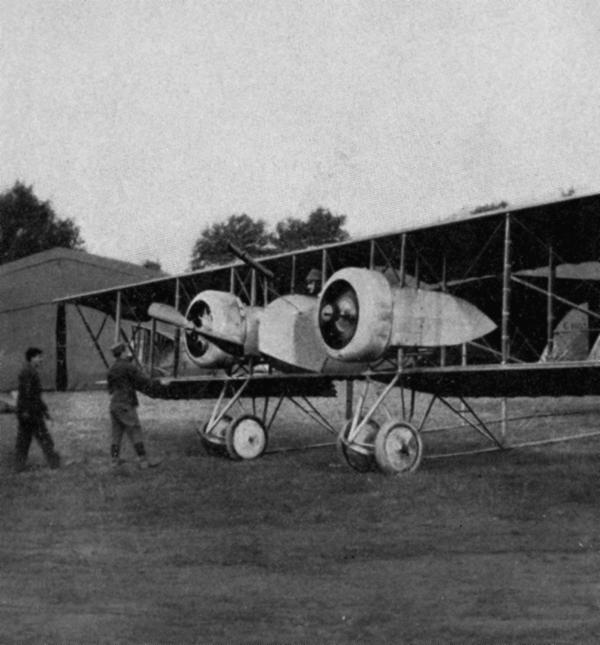
surroundings. I sat in the front, or observer's
seat, of a great new French biplane
which the English call a battle-plane, and the
French call an "avion de chasse," or "hunting
aeroplane." They call their smaller single-motored
machines their "avions de réglage," or
"regulating aeroplanes." But these great biplanes
they fondly call their hunting aeroplanes,
for with them they hunt the Taubes and the
Aviatiks of the enemy, and they tell me that
their enemy usually gives them a wide berth.
I found myself sitting in a little cockpit
strapped to a comfortable seat. A few inches
in front of my nose was the breach of a heavy
machine-gun whose muzzle projected over the
bow of the fuselage. At each side of my seat,
under my elbows, were coiled long belts of
cartridges for the machine-gun. In the floor of
the little cockpit, right in front of my feet,
was a little glass window through which I could
watch the ground passing directly (though
some thousand feet) underneath. Just behind
this window, in the floor under my feet, was a
little metal trap-door. By straddling my feet
I could open this, for the purpose either of
taking vertical photographs or of dropping
bombs. Only the three long, shell-like bombs
which generally hang in straps to the left of
the observer had been removed, as had also the
Winchester rifle which hangs to his right.
I could get an uninterrupted view of the
scenery across a space of about four feet right
ahead. Further to right and left the view
flickered curiously through the lightning-swift
twirling of the propeller-blades. "Don't stretch
your head out in front to either side," had
cautioned the aviation Captain before I left
the earth, "or you would certainly get guillotined."
I craned my neck gingerly round to
look beyond me. In another little cockpit
about four feet aft sat the pilot. I could see
his face peering over the edge through a low
windshield. Past his head on each side I got
a view of the country we were leaving behind.
This happened to be a farewell glimpse of
Paris. It stretched vaguely away, bathed in
the late afternoon sun and yet shrouded in
heavy haze and smoke, a sort of bird's-eye
Whistler.
Now feeling the air becoming distinctly colder,
I looked ahead again. For a time we had
been flying at 1,000 metres. Now we gradually
climbed to 2,000 metres. The outrunners of
the clouds began to drift by in wisps of what
seemed like mist. Below, the earth looked
like the display of a carpet-merchant's dreams.
Square carpets, oblong carpets, long strips of
carpets, carpets of light green, of dark green,
of every intermediate shade of green; carpets
of fawn color and of brown, thin carpets and
carpets of wonderfully thick pile, plain carpets
and carpets with symmetrical designs in light
brown dots (several thousand feet nearer those
dots would have resolved themselves into homely
haycocks).
Now the carpets stopped as we sailed over a
forest of dense dark green with little mirrors
stuck in it, which, when looked at through my
field-glasses, proved to be not the tops of
greenhouses, as I had at first imagined, but
big lakes.
And now the wisps of mist became banks of
fog. As we still climbed on upward through
these white banks the earth could only be
seen in isolated dark patches. Higher and
higher we climbed, till finally the earth was
entirely veiled by the clouds below us. At a
height of 3,000 metres, or 9,900 feet, we straightened
our angle and on an even keel headed
away toward the front. It was a magnificent
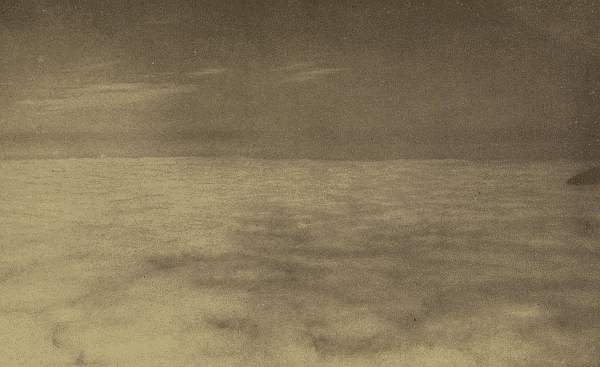
sight. We were flying along in a clear belt
between the lower and the upper clouds. Below
us stretched an unbroken white ocean of
these lower clouds. The sun was just high
enough to shed its slanting beams along the
surface of this snow-white sea. Above us
were the lowering masses of the higher clouds.
Page 6
"BELOW US STRETCHED AN UNBROKEN WHITE OCEAN OF
THESE LOWER CLOUDS"
In this lonely world of our own we flew forward
at 130 kilometres (80 miles approximately)
an hour. The air was very thin and cold, but
for some reason there was no rush of wind
against my face. If I moved my head to right
or left I could feel the wind from either propeller,
but in the middle it was relatively calm.
The air felt very thin to breathe and I had to
swallow constantly to keep clearing my ears
and the tubes back of my nose.
On and on we flew, until finally I felt, instead
of hearing, a violent rapping. Turning
my head, I saw the pilot hammering with his
right fist on the deck between our cockpits to
attract my attention. He grinned amicably
and opened his mouth wide. I could see he was
shouting at me, but could not hear the faintest
sound over the roar of the propellers. He
pointed to the whiteness below us a little to the
right. Then he wrote an imaginary word with
his forefinger on the deck between us. I could
not read it upside down. I opened my leather
coat, and with the cold instantly biting into
my chest, hauled out my notebook and pencil
and stretched them out to him. He shook his
head and indicated that he could not take both
hands away from steering. So I buttoned up
my coat again in some perplexity.
Then, without abruptness, with a certain
sickening majesty, the aeroplane stood on its
head and swooped down onto the surface of the
white sea below us. As it swallowed us we began
to spiral rapidly around as though we were
tobogganing down a giant corkscrew. As we
went on down through this white nothingness
I became very dizzy. The propellers had
slowed 'way down and I thought the engines
had failed, and that we were either falling
10,000 feet or making a forced descent. But
the pilot sat still back above me, so I did
likewise.
Suddenly we spiralled violently down through
the bottom of the cloud into sight of the earth
again. Instantaneously the engines broke into
their old roar and the aeroplane stopped pointing
straight down and assumed a steep slant. If
any one ever heaved a sigh of relief I did it then.
I felt the rapping behind me. Looking
round, I saw the pilot pointing down at the earth,
ahead and to our right. I shook my head.
Then, as we careened downward, he stopped
his motors for a fraction of a second, and in the
sudden deafening silence he shouted out, "The
front!"
Here, if my hopes had materialized, I should
be able to give a most striking picture of a
battle as seen from an aeroplane. But honesty
compels me to say that any one who wants to
get a good clear view of the front had much
better go there on the surface of the earth, and
not through the air.
In the first place, it takes quite a little time
and trouble to discern the lines of opposing
trenches even when you stand on a quiet observation
post with a General painstakingly
pointing and explaining, by the help of landmarks,
just where they run. Here, though we
were now only 1,000 metres (about 3,300 feet)
up, we were racing along the front at 80 miles an
hour, and all my friend the pilot could do was
to point here and there frantically. So among
the maze of white lines I saw running below
me through the hazy atmosphere, some which
I took for trenches were undoubtedly roads;
some which I took for roads were equally undoubtedly
trenches, while only a few, by their
zigzagging, could I unhesitatingly have guaranteed
to have been trenches.
In the next place the roar of the engines totally
drowned out all the reports of the guns
which were going off below us, and the explosions
of the shells, which are such a striking
feature of the front.
To make matters still more undramatic there
was no battle going on at the precise moment
when we shot downward out of the clouds, but
only a rather languid artillery exchange. Even
a regulating aeroplane which was sailing around
directly below us and about half-way down
between us and the earth, correcting the fire
of some batteries, was having an exceptionally
peaceful time of it. We could look
down and see plainly the red, white and blue
circles of France painted on the tops of its
planes, but there were none of the customary
woolly little white clouds of German shrapnel
bursting round it during the few seconds that
it remained in sight.
Furthermore, the guns right below it and
us were so cleverly concealed that they were
quite invisible. The only signs of its being a
front at all were the bursting shells from the
French batteries. These little puffs of smoke
in the hazy distance the pilot spotted
unerringly,
but he had a discouraging time pointing
them out to my unaccustomed eyes as we
raced along.
So this, I fear, is all that any one visiting
the front by aeroplane would have seen this
afternoon. Possibly had we hung around longer
we might have seen more, but the pilot and I
both had important dinner engagements in
Paris, and the sun was getting very low. We
therefore reluctantly swept around and, leaving
the silver band of the Aisne behind us, started
for home.
We kept low, not over 1,000 metres, so that
the landscape was very clear and interesting.
First we passed over the city of Compiègne,
where I had lunched with Dr. Carrel only
three days before to the accompaniment of an
artillery obligato. Then right over the big,
dark green Forest of Compiègne where I tried
but failed to locate a château I had visited
with Mme. Carrel. Then on and on over a
further entrancing exhibit of parti-colored carpet
fitting together at the edges as snugly as
any completed picture-puzzle.
Before long we reached Senlis, where I had
stopped on my way to Compiègne the other
day to take snap-shots of the streets of houses
gutted by the Germans during their brief occupation
before the battle of the Marne. Passing
over Senlis, we dropped lower, so that I
could get a clear bird's-eye view of the havoc.
Then on and on, without incident, till the smoke
of Paris came in sight, and on and on again, till I
looked down through a thousand yards or so of
space on the aviation field from which I had
started just one hour and twenty-five minutes
earlier.
Suddenly the motors stopped, the aeroplane
keeled over onto the tip of its left wing and,
pivoting round on it, we began our dizzy spiral
descent. First on one wing-tip, and then on the
other, we corkscrewed dizzily down. First the
whole surface of the earth would swiftly fly
up, revolving as it came, and slap me on the left
side of the face, then, a fraction of a second
later, the same revolving surface would heave
swiftly up to slap me on the right side of my
face. This double spiral descent is certainly
by all odds the dizziest proceeding that was
ever devised by man.
Finally, with a swoop which I made sure
would carry away most of the chimney-pots of
the suburb, we made a beautiful glide and
alighted on the grass of the aviation field as
smoothly as a canoe launched from a beach
into a quiet lake.
Here one would think our day had ended,
but there was one very vivid thrill left.
As the aeroplane came to a stop a mechanic
came running up, carrying a pneumatic wheel.
He spoke a few sharp words to the pilot, and the
latter asked me to get out quickly, saying that
he would return and explain some of the details
of our flight a little later. So I scrambled out,
the machinist scrambled into my place, carrying
the pneumatic wheel, and with a rattle and
a roar the aeroplane rolled across the field and
leaped into the air again.
I joined some aviation officers and asked
what was the matter. They pointed to a machine
a few thousand feet above us, and explained
that in leaving the ground that machine
had lost one of its pneumatic wheels. The
aviator was ignorant of this, and, unless warned
in time, would, on trying to make his landing,
turn turtle and get killed. My pilot had gone up
to meet him in the upper air and by waving the
wheel at him indicate his predicament, so that
he could land on the left wheel and tail of his
machine.
"Unless he understands before he lands he
is a dead man," said the officer. This really
was a dramatic spectacle—the one aviator
soaring on guard high in the sky in complete
unconsciousness of the death that awaited him;
the other, climbing nearer and nearer, then
circling round and round in narrowing circles.
Finally, the first machine started down.
"He understands," said some one.
"No, he doesn't," said others.
"Get the ambulance ready," ordered the
aviation Captain, and the engine of the motor-ambulance
began to chug with a most sinister
effect.
We all stood perfectly powerless and watched
the machine spiral down. As he made his
glide, men stood in the field waving spare wheels
at him to insure his understanding. But no.
Instead of landing tilted to the left on his sound
wheel and tail, he made his landing leaning
over a little to the right where the wheel was
missing. As it touched the earth the great
machine buried its nose in the ground, its tail
rose and rose till it stood perpendicular, and then
fell forward in a somersault, so that the plane
was lying on its back.
"He's finished. Get the ambulance," ordered
the Captain.
We all started at a run across the field toward
the motionless aeroplane, the motor-ambulance
following close on our heels. As we got
to the wreck a figure crawled out and began to
swear fluently at not having been warned in a
way that a sane man could understand. How
the aviator escaped will always remain a complete
mystery. But his escape made a happy
climax to the thrilling ending of an unforgettable
afternoon.
When the average newspaper-reader
reads the average war correspondent's
excellent stories from the firing-line, his ideas
are probably vague indeed as to how the correspondent
reached that very elastic zone known
as "the front."
He probably pictures the military authorities
extending to the writer a magnificently
sweeping invitation to witness and immortalize
their armies in battle. In his mind's eye he
sees the journalist equipping himself with automobile,
shelter-tent, sleeping-bag, canned food,
medicine-chest and revolver—with everything,
in fact, necessary for the hardships and emergencies
of campaigning. This visionary correspondent
then sallies forth from the luxury
and security of Paris (let us say), sitting by his
chauffeur, military map in hand, directing the
course of his high-powered car to that section
of the front where the General Staff has informed
him that a critical battle is to take place. Arrived
there, he watches an infantry charge capture
the enemy's trenches; then, leaping into
his waiting motor, speeds away to another
portion of the line, which he reaches according
to his schedule, just in time to observe a particularly
interesting bombardment of the enemy's
lines by a battery of heavy artillery.
He is called away after a time by the necessity
of covering several miles more in order to watch
the defenders of a front trench repel an enemy
attack. He may lunch with a General, if he
happens to drop in at headquarters just as
lunch is served, or he may have to share a
soldier's frugal meal in the darkness of a bomb-proof.
After attending an aeroplane duel,
having a chat with the Generalissimo of the armies,
inspecting the consolidation of a few
hundred yards of trenches just taken from the
enemy, watching the explosion of a mine, interviewing
a fresh batch of German prisoners,
with whom a punctured tire almost causes him
to miss his appointment, and observing the
methods employed by the Red Cross in collecting
the wounded under fire, he is overtaken
by night after a busy day, and sleeps
in his shelter-tent before making up his mind
which particular army he will visit the following
day.
It is a thrilling and romantic picture. But
how sadly distant from the truth.
The war correspondent does not buy himself
a motor, because if he did he would not
be allowed to use it. All he buys himself is a
railway ticket. When it comes to motoring, he
is packed with an assortment of fellow-correspondents
into military autos specially assigned
by the army authorities.
He does not buy a shelter-tent or a sleeping-bag,
because at a certain scheduled hour every
evening the staff-officer who has him and his
colleagues in tow will lead him into an excellent
hotel in some large town or other and
assign him to a comfortable bedroom engaged
ahead. He does not buy canned provisions,
because before going to bed the officer buys
him an appetizing dinner, follows it up with a
good breakfast the next morning, and at lunch-time
introduces him to a courteous General, or,
at a pinch, to another hotel-keeper, by one or
the other of whom he is supplied with a prearranged
and excellent lunch.
He does not buy himself a medicine-chest,
because he is always within shouting distance
of enough medical talent to treat a whole city.
He does not buy a revolver, because it would
be gently but firmly taken away from him if
he did.
If he is sensible, he does not even buy himself
binoculars, for the officers by whom he
will find himself uninterruptedly accompanied
will be glad to let him use theirs, and though
he may not look so picturesque without them,
he will be much more comfortable if he has any
hands-and-knees work to do.
Finally, he will not have a word to say as to
where he wants to go or what he wants to see,
for that has all been settled in advance.
It is true that different Generals vary greatly
in the risks that they will allow correspondents
to run with their respective armies. Some feel
that if a correspondent wants to take chances
that is his own affair so long as he does not
unduly endanger the life of a valuable staff-officer
along with his own. Others feel personally
responsible for the safeguarding of visitors,
whether the visitor is willing to take
chances or not.
But these variations merely affect the more
or less dangerous details of the trip, not the
programme as a whole, which is quite rigid.
In the beginning of the war a few men, like
Alexander Powell in Flanders, and Robert
Dunn in the retreat from Mons, were actual
knights-errant of the pen and wandered or
whirled where they pleased, and saw what
happened to come their way.
But on the western front, at least, that is
all dead and gone.
The activities of war correspondents have
been thoroughly regulated, systematized, standardized.
Just what the correspondent is to be
permitted to see at the front is deliberately
considered and arranged in advance. The
authorities decide what fights are fit for him to
see just as painstakingly as chaperons used to
decide what plays were fit for débutantes to
see. He, together with the six or eight other
journalists who are to make up the party, is
placed in the hands of a military duenna who
guards his every move from the time the admirably
organized tour starts, until he is again
safely delivered back in Paris. The precise
duration of the trip, the precise route to be
taken, the precise place at which each meal is
to be eaten, the precise room in the precise
hotel in which each night is to be spent, the
precise General to be met and trench to be
visited, are all inexorably fixed in the schedule
of the trip.
The only phenomena which the general staffs
cannot predetermine are the activities of the
aviators and the course of the enemy's shells
and bullets. Hence, the only spontaneous adventures
in store for correspondents, which may
come unexpectedly, at any moment, are the
whirring of aeroplanes overhead, their shelling
and their duels and the sudden passing or arrival
of enemy projectiles, from tiny bullets up
to enormous "Jack Johnsons."
Even this element of surprise can be
avoided in the case of a small minority of visitors
who I understand prefer to limit their
researches at "the front" to the hospitals,
supply-trains, motor-repair organizations, encampments
of reserves, and similar objects
of interest, which lie some twenty kilometres
behind the trenches and yet really are
sufficiently a part of the front to be known as
its rear.
The front has a second category of visitors
besides the war correspondents of whom I have
been writing—"the distinguished strangers."
These do not come to the front for the purpose
of writing about what they see, and are for this
reason, as well as because of the courtesy
which it is desired to show them, allowed considerably
more latitude, although they, too,
are kept religiously away from any part of the
lines where real trouble is expected.
I myself was fortunate enough to be invited
to visit the French and Belgian fronts in a sort
of dual capacity. Having pledged myself not
to go on to Germany, and to write nothing
about anything that was shown me in confidence,
I was given a special trip, instead
of going with one of the regular "journalists'
parties," which certainly have an unromantic
resemblance to Cook's Tours. I was thus
enabled to visit certain advanced trenches
where larger parties, in the nature of things,
could not go, and was shown things which
had not previously been shown to correspondents.
But the organization of my trip
resembled that of the average correspondents'
tour closely enough to enable me to describe
its details.
In Paris in a rather small room on the second
floor of the Ministry for Foreign Affairs, at a
methodically cluttered writing-table, on which
one of the oddly-shaped French telephones
lapses into occasional silence, sits a slender,
suave, well-groomed Frenchman about forty
years old. He has a glossy dark moustache,
large and pensive dark eyes, a nicely deprecatory
manner, and a beautifully conciliatory
smile. He chats to his visitor in excellent English,
if English be required, and smiles at him
this almost tender smile. He is Monsieur P——,
the war correspondents' Czar. He is the absolute
ruler of their destinies. For it is he who
picks and chooses among their waiting numbers,
and decides to which to accord the privilege
of a place in one of the parties which leave
about every two weeks for a two- or three-day
trip to the front.
When an eager newspaper man has come
over all the way from California, let us say,
for such a trip, has waited in Paris a month or
six weeks for such a trip and has seen colleagues
favored above other men start off with enthusiasm
and return with hauteur from such
a trip, the transcendent importance of Monsieur
P—— in that craving correspondent's
eyes verges on the pitiful.
When you think of this hungry horde of
newspaper men collected from the ends of the
earth on this one assignment, receiving curt
cables and telegrams every few days from their
papers asking where their stories are, all as
suspicious and jealous of each other as prima-donnas,
each trying to "put over a beat" on
the other, and each terrified lest some other
"put over a beat" on him, you can perhaps
imagine that Monsieur P——'s official duties
do not constitute a sinecure.
Behind the back of Monsieur P—— they
grouch; before his face they grovel. They try
on him all the arts and practices of their profession,
from bluff, through blandishments to
supplication. And Monsieur P—— sits and
smiles at them with tender sympathy and gives
them their trips fairly and squarely without
fear or favoritism. The room echoes with
their pleas and protests, the telephone buzzes
with their wheedlings and reproaches; but
Monsieur P—— deals out even-handed justice
among them and never turns a hair. There
is probably not an hour of the day or night
that some war correspondent in any language
from English to Japanese is not calling down
very horrible curses upon this autocrat's head.
And yet they all cherish for him the most sincere
affection and respect.
I myself was fortunate enough to be introduced
to Monsieur P—— within a couple of
hours of reaching Paris, my special trip to
the front having already been arranged for
the following morning. Its machinery was
the same as that of the regular trips. Monsieur
P—— got out an official printed form of
military pass for war correspondents. My
photograph was pasted on its cover. I was
asked to write my signature on the next page,
which was devoted to this trip. There were
several more pages for possible other trips.
On this first page was written the name of
Epernay, the city behind the front to which
I was to go by train the following morning.
It was specified that the trip was to last three
days. The name of the staff-officer who was to
accompany me was written in, and subsequently
his signature was appended. The whole thing
was signed, stamped by Monsieur P——
and handed over to me to carry with me on the
trip, to be handed back to him immediately
upon my return, and to be used again should
I later make other trips.
Then the staff-officer who was to be my
chaperon came in and we were introduced.
In private life he happened to be a prince.
In the army he was at present plain Captain
d'A——. Incidentally, he proved to
be a fine fellow and a very pleasant companion.
Following his instructions, I was at the
railroad station the following morning at eight
o'clock, together with Lincoln Eyre, whom I
had been permitted to invite on the trip.
I presented my military pass to the ticket-seller,
who scrutinized it closely before selling
me a railway ticket to Epernay. It is the rule
in France that correspondents must pay for
their railway tickets themselves, so that the
Government cannot be accused of paying their
way for propagandist purposes. After you
reach the front the military authorities furnish
army motors, and themselves take care of your
meals and bedrooms.
On the train was one of the regular personally
conducted correspondents' caravans, consisting
of about eight correspondents. There were three
Americans, a couple of Frenchmen, a couple of
Scandinavians, and, I think, a Russian. Their
cicerone was a very tall staff-officer who looked
slightly worried by his cosmopolitan responsibilities.
Their party was going on to Verdun.
After a comfortable two-hour trip we got out
at Epernay. There we were met by Captain
F——, a staff-officer belonging to the
General Staff of the 5th Army, which we were
to visit. Thus Captain d'A——, from the
Staff of the Paris War Office, had general responsibility
for the trip, while Captain F——,
who also was to accompany us, was responsible
for the detailed military arrangements during
our stay with the 5th Army.
Captain d'A——'s orderly (who before mobilization
had been the wealthy young proprietor
of a steamship line to South America)
having taken our bags to the hotel, where we
were to return to spend the night, we immediately
started off on our schedule.
The ground plan of my three-day trip was
planned to give me a condensed view of all the
component parts of a French army of five army
corps, or about 200,000 men, from the rear up
to the front trench.
We accordingly began with the Motor Transport
Repair Corps, situated in Epernay, consisting
of 1,000 men and 14 officers, including
3 doctors. It kept in up-to-the-minute running
order the 1,500 motor vehicles of the army
corps which occupied the front 20 miles before
us.
The Captain who showed us around had been
technical supervisor of the Rochet-Schneider
Auto Company and had, together with all the
other mechanical experts, been mobilized directly
into the present work. He answered my
surprise at the number of soldiers employed in
these peaceful labors by explaining that two
soldiers at work in the rear for every
three soldiers fighting was the regular
formula.
Epernay, being the centre of the champagne
industry, most of the military repair garages
had been located in the great wine storehouses.
It was odd to see soldiers repainting grim
wire-cutting autos rubbing elbows with peasant
women busily wrapping gold-foil round the
heads of fat quarts of famous vintages.
"Yes, they work together," smiled the Captain;
"and it is not so incongruous as it looks.
For the champagne was a good ally of ours
during the battle of the Marne. It made
enough casualties among the Boches to have
an appreciable effect on the course of the
battle. When we chased them out of here the
broken bottles looked as though there were
no more champagne left in the world. But as
a matter of fact, so enormous are the quantities
stored hereabouts that the German inroads
were relatively slight."
It was remarkable how much we were able
to crowd into an hour's inspection. Great
meat-lorries, each carrying enough fresh carcasses
to stock a city butcher-shop, secured
ventilation yet guarded their contents against
flies by close-meshed steel netting instead of
solid sides. But to protect the meat from
dust science had had to bow to nature, for to
the netting in its turn were attached pine
boughs which admitted air while excluding
dust more efficiently than any artificial
contrivance. Enormous repair-lorries were each
a perambulating garage fully equipped with
machinery for repairing broken parts or making
new ones. Some of these lorries ran on
their own power. Others were towed along by
a big motor. In either case they made their
own power to run their repair machinery, and
their own brilliant electric light by which to
work at night. They had almost hermetically
sealed curtains to keep the light from leaking
out, for in mobile war they are often called
upon to do their work in sight and range of
the enemy. But the trench warfare has rooted
them to the spot for a weary time.
"But wait!" said the Captain. "When the
advance begins just watch us keep up with the
procession."
There were autos with a steel frame running
from the radiator, overhead to the back seat,
this frame having razor-edged knife-blades attached.
In open warfare while scouting along
strange roads these were useful in shearing
through any wires which the thoughtful foe
might have strung across for the decapitation
of speeding visitors.
There were uninteresting-looking big gray
ammunition-lorries, ambulances, post-offices on
wheels and hundreds of ordinary autos for the
use of officers, messengers, etc.
I was informed that the life of the average car
in active service was very far from being as
short as was popularly supposed. "Why,"
said the Captain, "we have many cars coming
in which have been working hard for
eleven months, and now for the first time are
compelled to come in for repairs."
I noticed with what fastidious care all the
cars were painted and varnished. "Yes, that
is the way we apply psychology to motor-repair
work," chuckled the Captain. "Experience
has taught us that when a soldier is given a
beautifully finished car to run he takes pride
in it. And he not only keeps the outside well
cleaned, which greatly postpones the date when
it must come back to us for doctoring, but he
also bestows much more care on his motor.
So it is not only æstheticism which prompts
that beautiful finish. But talk about æstheticism,
here is a real example of it."
He showed me a car from whose front
lamp-brackets some artist had wrought in iron
two very beautiful palm fronds.
"The man sacrificed much leisure time to
making those branches from sheer love of his
art and of the beautiful. The French people
are like that, Monsieur."
Having eaten a sample of the good bread
and most excellent Irish stew which constitutes
the soldiers' lunch, we returned to the hotel
for our own early lunch. Then I climbed into
one military motor with Captain F——, while
Eyre installed himself in another with Captain
d'A——, and at about 12.30 we started off for
the front of "the front."
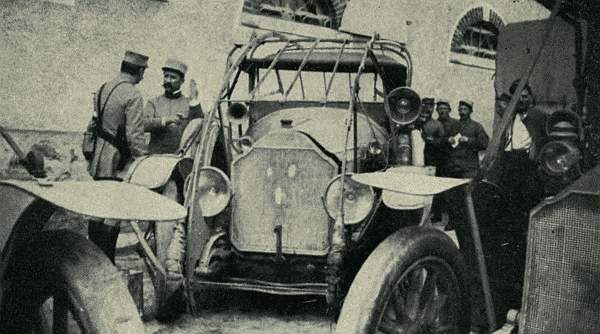
Page 32
"THERE WERE AUTOS WITH ... RAZOR-EDGED KNIFE-BLADES ATTACHED"
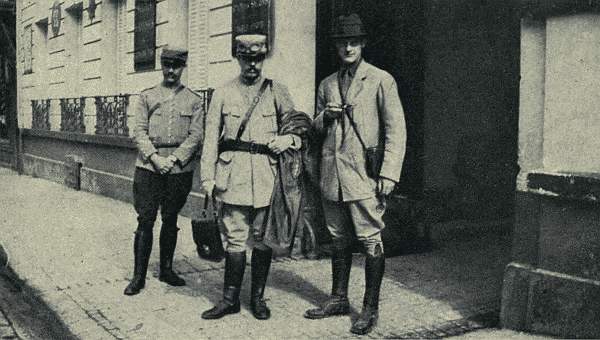
Page 32
CAPTAIN D'A—— AND THE AUTHOR. (STARTING FOR THE
FRONT FROM THE FRONT OF THE HOTEL AT EPERNAY)
We climbed rapidly out of Epernay, up a
long very steep grade, flanked as far as the eye
could reach by vineyards, in which peasant
women, old men and boys were busily harvesting
the raw material for future "Secs," "Extra
drys," and "Bruts." Our bellowing military
motor-siren drove most of the heavy
two-wheeled peasant's carts hastily toward
the gutter to give us passage. Every now and
then some cart's fantastic creakings would
drown our clamor, and then as we finally
forced our way past, the soldier-chauffeur would
launch some terse but terrific imprecations at
the driver. At the end of the ascent we cut
loose along the broad turnpike which ran
through a forest across the top of a wide plateau.
Sprinkled all along the highway were
uniformed "territorials" working at road repair.
"It is of extreme military importance to
keep all these lines of communication in first-class
condition," explained Captain F——.
"It is not so romantic to mend a road as to
mend a trench, but it is just as necessary."
By rights we ought now to have started
our routine of courtesies by calling on General
Franchet d'Esperey, commanding the 5th
Army, the first of whose five army corps we
were about to visit. For the amenities of a trip
to the front require that in theory the stranger
should pay his prearranged respects to all those in
command from the General of the Army, through
the General of the Army Corps, down through
the General of Division, to the Colonel of the
Regiment he happens to be visiting. And
practice in this matter sticks uncommonly close
to theory. Charming though it is to meet these
courteous, highly intelligent and often illustrious
men, it is impossible not to feel that the
amount of time devoted to such visits of
ceremony is quite out of proportion to the
very limited time allowed the average visitor
to the front. It is not the actual ten or fifteen
minutes spent in conversation with these hospitable
gentlemen which eats up the time, but
the fact that meetings with some of the busiest
men in the world are necessarily definite appointments
which must be very punctually
kept. And four or five such appointments in
the course of a day at places scores of miles
apart necessarily tear that day to pieces.
However, General Franchet d'Esperey had
suddenly been called out to an inspection of a
certain part of the front, so we skipped the
engagement which had been made with him,
and motored on to call on the General in command
of the Army Corps with which we found
ourselves. In the salon of a small château we
were introduced, and conversed pleasantly for
a few minutes. Then he assigned one of his
staff-officers to accompany us to an observation
point on the edge of the plateau from
which he could give us a sweeping view of many
miles of the front, and point out the interesting
topographical features and the course of the
trenches.
I was thus simultaneously accompanied by
Captain d'A——, the staff-officer from the
Paris War Office, by Captain F——, the staff-officer
from the 5th Army, and by the staff-officer
of the Army Corps.
Having explained to us the "lay of the
land" and incidentally pointed out to us the
sizable crater of a shell which a few days
earlier had come within twenty yards of putting
a definite end to this particular observation
point, the last officer bade us good-bye. We
climbed back into our motors, and made the
steep, winding descent from the plateau, and
raced over the long, straight road so well known
to motor tourists of peaceful days, which leads
to where in the distance the low roofs of Rheims
can be seen, like some muddy tide washing the
foot of the craglike cathedral. In Rheims,
which the enemy had considerately stopped
shelling an hour or so before our arrival, we
had to go to the headquarters of the Colonel
in Command. He was out, but had left a
Major with instructions to show us to X——,
a village about a kilometre from the outskirts
of Rheims and immediately touching on the
front trenches. We left our motors near the
edge of the city and walked to where down the
street ran a deep narrow ditch lying open,
waiting for its sewer-pipes. "Climb in," said
the Major. "Here's where the communicating
trench begins." In we climbed and were led by
the Major along a zigzag kilometre of trench
until, fifteen minutes later, we climbed out
again in the main street of X——. There the
Major introduced us to the Captain at the moment
in command of the battalion occupying
the village. He became our guide through the
rest of the afternoon, which we spent in the
front trenches, and which is described in the
following chapter.
Thus the War Department from Paris had
notified the General Staff of the 5th Army that
I was to make a three-day visit to that army.
That General Staff had arranged a complete
programme and had notified the staffs of the
various Army Corps which I was to visit. The
first of these Army Corps Staffs had decided
that I was to visit the front before Rheims,
and had so notified the Colonel. The Colonel
had decided which particular portion of the
front I was to visit before Rheims and had so
notified the Captain. And the Captain in turn
had made up his mind which specific trenches
I was to visit, and conducted me through them.
Thus far my programme had been more interesting
but just as rigid as that of any of the
correspondents' tours.
At the end of the afternoon in the trenches
a minor example arose of the advantages which
my special trip conferred.
As we returned to our motors in the outskirts
of Rheims, I told d'A—— how keenly
I wished to see the Rheims Cathedral.
"It is not on the programme," he answered;
"but if you want to see it you certainly shall.
It will get you back to Epernay pretty late, instead
of at the hour arranged for, but that will
not matter."
So we rolled through the streets of Rheims,
where of the 110,000 original population 20,000
still live and carry on their daily life. The
greater part of the city showed no signs whatever
of the constantly repeated bombardments
which it has sustained, save for the blocks on
blocks of houses closed and with windows
boarded up. But when we entered that portion
lying to the east of the cathedral and toward
the enemy, we passed through the fleshless
skeleton of a city. The house walls generally
stood intact, but through the gaping windows
one could see the nothingness that lay behind,
where great shells had plunged downward
through the roof, sweeping the whole interior,
floor by floor, down into the cellar; or where
smaller shells had gutted the interior by fire.
Every now and then we would see a street completely
blocked by a great barrier of rubble,
where a whole house had been plucked out bodily
from between its neighbors by some monstrous
explosion and smashed to pieces on the pavement
as you would smash an egg on the ground.
Then we came out into the great square before
the cathedral, and looked up at its cliff-like
façade.
I heaved a sigh of relief. I seemed to be
looking at the same incredible beauty that I had
looked at just over a year ago, when the world
was still at peace. It is true that half the great
rose window was empty of glass; that here and
there stood statues headless or with chipped
and mutilated limbs. But in the vast profusion
of carvings on the façade these were almost
lost. Gradually, however, the full tragedy
bore in on me.
Have you ever seen an exquisite cameo face
congested by drunkenness or disease so that
it remains but a blurred and subtly bloated
semblance of its former loveliness? If you have,
you will know what has befallen the façade at
Rheims. It stood away from the German guns
so that not a shell hit it. But Fate and inefficiency
left it covered with scaffolding which
caught fire, and the towering blaze licked and
licked so furiously at every sculptured angle,
line and curve that in a few hours all those
keenly chiselled outlines which the centuries
themselves had only faintly mellowed, became
flabby, blunt and indeterminate. One used at
times to gaze at the façade through half-closed
lids, so that no exquisite detail should distract
from the swimming, hazy glory of the whole.
That glory it still possesses, but to those who
knew it in its earlier unmarred splendor it seems
to stand, straining aloft, in patient martyrdom.
A heavy barricade, built at a distance of some
twenty yards, prevented entrance or even a
close approach. As we stood counting the
shrapnel scars on the horse of Jeanne d'Arc,
which ended the myth that this statue had
come through the whole bombardment miraculously
untouched, a little girl approached with a
basket full of pieces of colored glass. These she
offered for sale as fragments of the priceless
stained glass of the cathedral. It required no
expert to see that they were pitifully spurious.
Thus huckstering makes pennies out of tragedy.
We departed silently, and leaving Captain
F—— to return to his headquarters for the
night, we were quickly speeding through the
twilight on our way back to Epernay.
With the 5th French Army, Aug. 3 (via Paris).
On the anniversary of the last day of the
world's peace, the 365th day of the war,
I stood in the darkness of a very advanced front
trench.
A short section where I stood was roofed
and bomb-proofed. Through a row of very
narrow rifle-slits came little beams of daylight
that rested in flecks on the white, chalky back
of the trenches and were thrown up very faintly
against the logs of the trench roof.
Very dimly, I could gradually make out a
narrow plank standing-platform running along
below the slits. A card was tacked to the wooden
frame of each opening, bearing the name of
the particular soldier to whom that opening belonged.
Above each slit hung (or could hang)
its owner's rifle in slings from the roof.
Every few yards, set in little recesses dug
out from the back of the trench, stood fat
bottles. They contained chemicals with which
to soak the soldiers' mouth-coverings if attacked
by poisoned gas.
The trench was nearly empty of men. But
at the loophole nearest me stood the rigid figure
of a soldier. His legs were invisible in the darkness.
His body showed up vaguely. His face
was brilliantly lighted by the thin blade of
light through the rifle-slit. He stood silent and
motionless, his eyes intently focussed out into
the sunlight.
I looked through the next slit, through a
spider's web of barbed wire, between stunted
black posts, across two hundred yards of green
grass and wild flowers, at another tangle of
posts and barbed wire with a narrow furrow of
white chalky soil running along just behind it—the
German trenches.
Not a living thing was in sight in the sunny
loneliness. There was silence except for the
crack, crack, crack of striking bullets from inaudible
German rifles. I looked back at the
face of the "guetteur," the watcher. His eyes,
fixed on the narrow white line, were puckered
with intentness, but his lips were parted in an
easy, good-humored smile, brightening a face
young, clean-cut, alert, calm and very patient.
He seemed to symbolize the spirit of the new
France, the France of endurance, of determination,
of buoyancy, of patience, the stoic France
that can keep silent and motionless, the France
that can stand in the darkness undismayed,
watching and waiting till the moment comes
to leap up and out into the light.
Early that morning, from the window of a
château on the edge of a high plateau, a young
staff-officer had shown me the great plain of
Champagne stretching away to the low hills
on the horizon. Miles away lay Rheims, made
to seem squatty by the cathedral which towered
in its midst.
Across the green fields of the panorama, over
swelling hills, disappearing into dark woods,
reappearing at the other end, I saw two tiny
lines of white like the aimless tracing of a child's
slate-pencil on a slate. They ran on across the
landscape, now drawn boldly forward, now
swerving with indecision, now zigzagging with
perplexity. Sometimes the child's pencil had
slipped and made short little lines at right
angles. Sometimes the pencil had made three
or four short starts parallel with each other before
it finally got under way. Sometimes it had
made a regular little maze of lines. But always
the two white scratchings on the slate were
drawn on and on till, wavering but always
close abreast, the trenches of the two armies
disappeared into the far distance.
Through powerful glasses the officer showed
me little puffs of smoke floating up from the
sunny, silent, peaceful landscape. They were
from the exploding shells. To the right I saw
a high cloud of smoke rising lazily into the air
out of some woods. It was a house in the
German lines fired by French shells. And,
though the little puffs of smoke were only here
and there on the landscape, everywhere I could
see through the glasses the microscopic figures
of peasants working busily in their fields, bringing
in the harvest. Many were soldiers helping
out, but very many were old men, boys and
women. Again the scene seemed symbolical.
Behind the soldier watching in the bomb-proof
were the innumerable tiny plodding figures,
undaunted by the abrupt little puffs of
smoke, doing their patient share toward bringing
in the harvest.
In the château itself as I went down-stairs I
passed a bedroom door with "Seine Koenigliche
Hoheit" written across it in white chalk. The
Duke of Brunswick had slept there at the high
tide of the German advance. His staff had had
their names chalked across various other doors,
but few of them remained.
One by one they were being gradually
scrubbed off. It was explained to me that
these chalk marks were particularly hard to
remove from wooden doors. But with patience
it is being done.
The trip which I was taking to the French
front had been most kindly arranged for me
by the French Government as a special trip
for my particular benefit. It had the advantage
of enabling us to go into portions of the advanced
trenches, where the larger parties could
not go for fear of precipitating shelling by the
Germans.
Our party consisted of a staff-officer from
Paris, a staff-officer from army headquarters,
Lincoln Eyre, whom the authorities had allowed
me to ask along—and myself.
After leaving the château we got into two
elephant-gray army motors with Remington
carbines swung on their dashboards. The military
chauffeurs tore along the road, which was
in easy range of the German artillery, but which
for some reason never was shelled.
As we whirled along we passed a variegated
procession of vehicles. Now a high peasant
cart carrying home the harvest; now a military
motor-cyclist; now a motor-ambulance,
with a pair of white feet showing through the
back, and the wounded man lying on a stretcher
slung from the roof by four straps to reduce
jolts to a minimum; now a motor full of officers
smoking cigarettes; now a cavalryman exercising
an officer's mount.
Finally we stopped about a kilometre from a
little village, which must be nameless. On leaving
our motors we walked a little further along the
road and then climbed down into a trench. This
was about six feet deep and three feet wide, the
bottom and sides of white, chalky soil. We pursued
a serpentine course, but there was method
in its meandering, for a straight vista of trench
leading toward the enemy would be a splendid
hunting-ground for bullets.
We had not gone far when I heard a sound
like a boy cracking a toy whip. "A bullet
striking near us," explained an officer ahead
of me.
I found it almost impossible to tell the difference
between the report of the French guns
and the explosions of German shells. An officer
told me that their time-table nickname for
French gun reports was "départs" (departures),
while that for the German shell explosions was
"arrivées" (arrivals).
Of course if either gun or shell explosion or
both is very near to you you can easily tell
the difference, if there is enough of you left to
tell anything.
We walked on with the toy whip cracking
at every other step and "départs" and "arrivées"
inviting guesswork as to which was
which. We passed soldiers in shirt-sleeves, deepening
and widening a communication trench.
It was rather difficult to squeeze past them,
but this very definitely emphasized the wonderful
terms of discipline, yet the democratic
friendliness, existing between the French officers
and the men. The officers talked to the men
intimately and placed their hands on the men's
shoulders affectionately in squeezing by. The
men answered the officers easily, without restraint,
but all stood at attention and smartly
gave the salute, which they regarded as a dignity
and not a degradation—a marvellous combination
of discipline and democracy.
We finally climbed out of the trench at the
first house of the little village, or rather of what
had been a little village, for it was, on close
view, nothing more than the aftermath of an
earthquake. In actual fact it reminded me
vividly of the walk I had taken through the
remains of Messina after the last great earthquake.
Before entering the village I stood in the road
looking through my field-glasses at a German
war-balloon to my left. "Come along, come
along," shouted one of the officers. "If you
stand there you'll start the Germans shelling.
You're in plain sight of them." Needless to
say I came along.
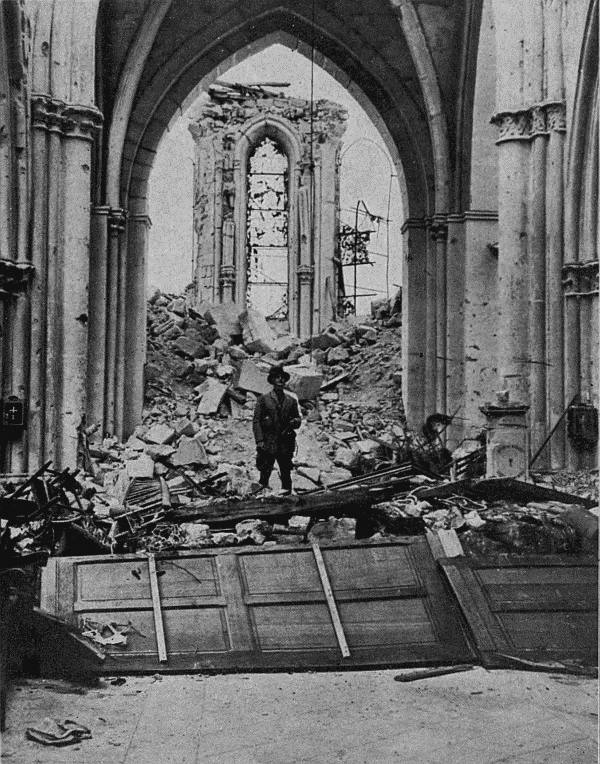
Page 49
"THERE MASS IS STILL HELD EVERY SUNDAY FOR THE BENEFIT
OF THE SIXTEEN INHABITANTS WHO STILL PERSISTED IN
STAYING IN THE VILLAGE"
We walked through the shattered village,
which the Germans shelled religiously every
day, until we came to the remains of a church.
Climbing in over the ruins we saw that there
was one corner where miraculously enough a
few yards of floor and a few yards of roof had
escaped being shelled to pieces. There the
altar had been set with about ten chairs
crowded in front of it. There mass is still
held every Sunday for the benefit of the sixteen
inhabitants who still persisted in staying
in the village.
These must indeed be solemn little services,
for the Germans are far from being Sabbatarians
when it comes to shelling this particular
church.
Going on, we stopped in front of what was
a house for one story and a skeleton from there
up. It looked as if nothing less than a squirrel
could get up to its rooftree, and nothing larger
than a cat could conceal itself behind any of
the shreds and tatters of its roof. Nevertheless,
up there was the observation-post which I
was about to visit. We entered and found
some soldiers cooking meat and potatoes on a
smokeless stove. One of them was amusing
himself prancing around the place on a pair
of child's stilts.
Following instructions, I climbed up a long
ladder, which led to two rafters—the sole survivors
of the second floor. A few planks had
been stretched between these. From them another
ladder ran up to a small patch of attic
floor which, marvellously intact, nestled around
three sides of a brick chimney under the fragment
of the roof. Arrived there, I carefully
lifted a little leather curtain, hung over a hole
in the roof, and squinted cautiously down upon
the German lines.
The French trenches were practically hidden
by the houses of the little village, so that the
first thing I saw was a belt of barbed wire, and
an unostentatious little white line, which marked
the advanced German position. Look as closely
as one could, it was impossible to detect the
slightest movement, yet it was from this innocent-looking
little line that the bullets were
imitating toy whips. I wedged myself into the
chimney to get a view of another side and then
climbed down.
We now left the village and walked into the
open advanced trenches. The most remarkable
thing was their utter desolation. We
walked for a hundred yards at a time, past
scores and scores of rifle-slits, without seeing a
man. An officer explained that troops are not
permitted in the open trenches during the
daytime, to save them needless loss from the shells,
which each side all day long, in a desultory way,
threw into the open trenches of the other.
The men stayed down in the shell-proof shelters
all the day and manned the trenches at
night, when attacks are most feared.
It seemed as if the Germans could easily rush
these trenches before the men could be called
out to meet them, but along the sides of every
trench ran one or two telephone wires. Apparently
one quick order would have these
front trenches lined with men. We came to
one of the points nearest the German lines,
from where the German trenches seemed a mere
stone's-throw. From there French soldiers
used to crawl out and fraternize with the Germans,
between the lines, but that is now forbidden.
We next came through a covered trench
to a covered grenade section. Here a table
stood against the outer wall. It had three lines
of sockets in it, one ahead of the other. The
soldiers fastened grenades to the muzzles of
their rifles, shoved the muzzles up through
the protected slit in the roof, rested the butts
in one of the three sockets, which gave three
different ranges, and pulled the trigger. If
there is a premature explosion they are saved
from its effects by the muzzle being above the
roof.
We continued on into a long section of the
covered front trench, where the rifle-slits have
wires stretched across them about three inches
from the bottom. The soldiers must stick their
rifles out under the wire, which prevents their
overshooting in the night. These covered
trenches are roofed with logs and covered
with two or three feet of earth. They are
proof against ordinary shells, but not against
heavy artillery.
When that starts bombarding, the men climb
down into excavations, fifteen feet below the
level of the trenches, and wait there until the
storm is over.
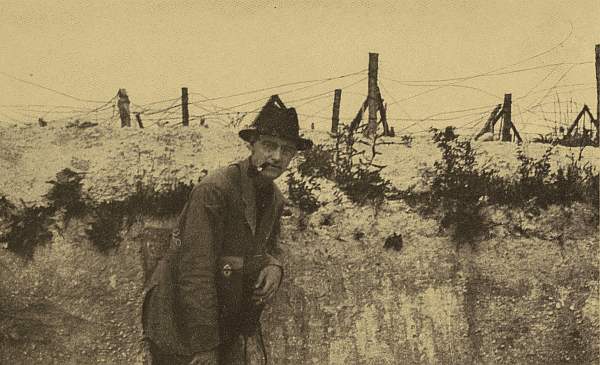
Page 51
THE AUTHOR IN A FRONT TRENCH NEAR RHEIMS.
(THE GERMANS ARE ABOUT THREE HUNDRED YARDS
BEYOND THE WIRE ENTANGLEMENTS)
Soon we came to a black little underground
chamber. An officer gave an order and a brilliant
ray of light shot in through an aperture
in the wall, near the low roof. This aperture
was some three feet from one side to the other,
and only about six or eight inches from top to
bottom. It had been opened by dropping a
hinged steel shutter which was worked by a
wire running over a pulley. The aperture was
just above the surface of the ground outside.
In the little room stood a machine-gun with
its wicked-looking muzzle just flush with the
opening. The gunner showed us how, by
swinging the gun from side to side, he could
play a stream of bullets through the wire
entanglements, a foot or two from the
ground.
At regular intervals we passed watchers,
some standing in the covered trenches gazing
through the slits, some lying out above the open
trenches behind steel shields, and some using
periscopes—all depending on the location of the
trench.
Looking into such a periscope one would
swear that he was looking straight out through
a loophole. There is not the slightest sign of
looking at a reflection in a mirror. We walked
bent double through an extremely long pitch-black
tunnel in an advanced position where
some of the officers themselves had never
been, and then started back through the
open trenches.
At one point a lot of Germans had been
buried. Sometimes a shell explosion does a
ghastly bit of disinterment, but I saw nothing
unpleasant on this occasion. At another point
above the heads of each side of the trench
stood two shattered ammunition-carts. The
Germans shelled this place pertinaciously, believing
that the carts were guns.
At another point we walked under a framework
of wood, covered with barb wire resting
on two transverse timbers stretching across the
top of the trench. A rope hung down from
one of the transverses. If the enemy broke
into the trench the defenders, by pulling this
rope, could drop the barb-wire contrivance into
the trench, thus blocking it.
Finally we got back to the village. I had
asked how the sixteen inhabitants made a living.
An officer replied that they sold eggs and
milk to the troops. I asked out of what they
produced the milk and he replied, "Very certainly
out of a cow." As an answer to my polite
scepticism I was taken to see the cow. We
walked down a little street where I was told that
the Germans were directing most of their shells.
They fortunately were napping while we walked
through. We suddenly turned into a gateway,
and there in the middle of this wreck of a
village was a barnyard with chickens clucking,
a horse tied to the wall, and three cows.
And on a stool by one of the cows sat an
aged woman making the milk hiss down into a
tin pail. There she sat, shells sailing to and
fro over her head, with the "départs" starting
and the "arrivées" bursting. There she
sat and rocked with hearty laughter at the
story of my scepticism, and went on effectively
proving her existence by her cow by the extraction
of that very milk which was sold to the
soldiers. We left the old lady surrounded by
what seemed to her to be all the comforts of
home, and a few steps further were introduced
to the Mayor of X——.
It was a smiling, bland old man who greeted
us most genially. Apparently he had not a
care in the world as he stood courteously making
conversation. It seemed to me that the
humble old woman milking her cow, and the
Mayor entertaining visitors to what was no
longer his village, were further symbols of the
spirit of a nation which was not easily destined
to decadence and downfall. Leaving the Mayor,
we entered the cemetery. There we were looking
at the graves of two German officers, two
French officers and seventy French soldiers
when an "arrivée" burst with a louder report
than we had as yet heard, followed by a deep
noise.
"What's that?" I asked.
An officer replied, "That's the metal fuse
which at the moment of explosion flies off
through the air. You can only hear that when
the explosion is pretty close. You can certainly
say now that you have been under shell fire."
We went back to the end of the village furthest
from the Germans and entered the headquarters
in one of the few houses still in fair
preservation. There the officers in command
of the village opened a bottle of champagne in
our honor and we stood around drinking each
other's health. At that precise moment an
unusually loud salvo of French artillery went
off by way of a salute to the toast.
On the way back through the communicating
trenches, we saw an attempt by the German
guns to bring down a French aviator, who was
flying above us. The latest development of
fire regulation by aviation is that the Captain
of the battery himself goes up in an aeroplane
and sends his corrections on aim down to his
battery by wireless. This Captain had his
four "seventy-fives" hidden near our communication
trench. Every time they went off their
report was so violent that I could not help
jumping.
The battery Captain was sailing around
overhead and the German gunner was letting
drive at him with what looked to us to be
pretty bad shots. I could see the aeroplane
wheeling in the air and hear the distant reports
of the "départs," wait an appreciable
time and then see the burst of white flame
high up in the sky, followed by little puffs of
smoke.
"That's a wretched shot," said I, as one shell
burst over our heads, far behind the aeroplane.
"Yes, a bad shot for an aeroplane, but a
good shot for us," Captain F—— replied.
I was standing with my head away back,
looking straight overhead. "Come, move on,
move on, or you'll catch some of that on your
face," warned Captain d'A——. I obediently
moved on and, sure enough, a couple of seconds
later he picked up a strictly fresh shrapnel
ball which had just fallen into our trench out
of the sky. In the mean time the Captain up
in the air had corrected his guns, so that they
were hitting whatever they were shooting at,
and he sailed away to the rear, while his battery
became really enthusiastic and went off
with a series of tearing crashes, which kept
me jumping all the way to the end of the communicating
trench.
There I climbed out with my ears full of the
"seventy-fives'" violent reports, the distant
explosion of their shells, the distant reports of
the enemy's guns, the "crack, crack, crack"
of the rifle bullets and the occasional sharp
whistling of one overhead.
But my mind was full of the soldier watching
and waiting, of the peasants harvesting between
the smoke puffs, the laughing old woman
milking the cow, of the genial Mayor extending
his ruined hospitality, and of what little
things like these should bring to pass in the
future of France.
The morning after our trip to the front at
Rheims we got up at seven o'clock after a
good night's sleep in the comfortable hotel,
and by shortly after eight were ready to
start.
But here came a hitch in the smoothly running
mechanism.
The evening before, on our run back to
Epernay, Eyre and I had noticed the exhilarating
abandon with which our soldier chauffeur
slung his car along. We supposed that
was the traditional method in which military
cars were run. We christened our driver
"Barney Oldfield" and commented jocosely
on his various close squeaks. We noticed that
Captain d'A——, who in the front trenches
had been absolutely imperturbable, did not
seem wholly at ease, but kept on leaning forward
and muttering, "Mais doucement! doucement!"
through the front window. We thought,
however, that this was mere consideration
on his part for our inexperienced nervous
systems.
On this following morning he declared to us
that our chauffeur was evidently a veritable
maniac besides being an execrable driver, and
that nothing would induce him to ride
behind "Barney Oldfield" again. Shells and
bullets were all in the day's work, but he'd
be switched if he would have his neck quite
superfluously broken by an imbecile like
that.
He therefore, with our cordial approval, had
sent round to the auto-repair department for
a sedater driver. But it was apparently against
the regulations to keep the same car if we
changed chauffeurs, and it was as hard to get
another car in this headquarters of cars as it is
to get fresh milk on a cattle-ranch.
So we fretted politely for the best part
of an hour before the new chauffeur drove up.
This delay haunted us for the rest of the
day.
We motored over the same road we had
covered the day before till we got near Rheims
again. There, at about ten o'clock, we met
Captain F——, who had been cooling his heels
for an hour. I transferred myself into his
motor and we started off to inspect some batteries.
First, of course, we had to present ourselves
to the General in Command of the next Army
Corps which we were to visit. We reached
his headquarters after half an hour's run and
found him an interesting and agreeable man
of the world. He was much upset by the
death the day before of a Lieutenant of engineers.
It appears that this Lieutenant had been
in command of a sap that was being run under
the German trenches in order to explode a
mine. The Germans had counter-sapped, broken
into his tunnel, and exploded a mine there. He
had recklessly crawled down his sap and had
not returned. Then his Colonel crawled down
the little tunnel after him, first taking the precaution
to have a rope tied on to himself.
The soldiers at the French end of the tunnel
paid out the rope till it suddenly stopped.
Then, as there was no more movement, they became
alarmed and, hauling in the rope, dragged
the Colonel back in a senseless condition. The
Lieutenant had reached the neighborhood of
the exploded mine and had been overcome
and killed by the unescaped gases of the explosion.
The Colonel in his turn had been
overcome, but had been hauled out in time to
be revived.
It was strange to see how this loss was taken
to heart by a General who must in the past
months have had to receive reports of deaths
by the thousand.
We motored on and about eleven o'clock
were ushered into the headquarters of the General
of Division whose batteries we wanted to
see.
The other Generals had greeted us in the
luxurious salons of châteaus, sitting near writing-desks
holding a few papers, but without
any token of the military work on which they
were engaged. This General was housed with
his staff in an old shooting-box. The room in
which he welcomed us had large-scale maps on
its walls, and engineering plans on its tables.
The General himself was a splendid type of
French officer, remarkably young, wiry, snappy,
keen as mustard. When the war began he had
been a Lieutenant-Colonel and had gone up
the ladder by leaps and bounds.
He said he would begin by himself taking us
to an observation-point at the top of a high
hill, whence we could follow the whole sweep
of front from about the point where it had
yesterday run out of our sight, on for many
miles to the Aisne and well beyond it.
Up the hill we went at about as fast a walk
as I have ever used on a stiff up-grade. Beside
me, setting the pace, went the General in
his baggy red riding-breeches, his tight-fitting
black tunic, his well-polished black-leather puttees
and shapely boots. As we climbed at top
speed he talked a steady and most interesting
stream. I began to listen for any symptoms
of the pace affecting his breath. But not a bit
of it; on he walked and on he talked. It was
a hot day and the sweat began to drip off of
me in spite of my cool khaki clothes. But the
General in his black-cloth tunic and red breeches
remained as cool as a cucumber. By the time
we legged it over the crest of the hill I would
have been willing to back him in a walking
contest against any one of the twenty thousand
men in his division.
Now we walked along a level path through
woods till we came to an open space on the
hillside.
The General stopped abruptly. "Don't go
further here," he snapped out, "the Germans
might see us through their glasses. They've
got them constantly trained on this hill to try
to locate my observation-post. They have
not struck it yet, though the other day they
happened to drop a shell not far from it which
killed two of my officers."
So we retraced our steps a short distance
and took another path which avoided the open
place on the hillside.
Finally we reached the observation-post,
carefully screened by an artificial bower of
pine boughs. Maps were tacked on a rude
table, while a big telescope stuck its muzzle
surreptitiously out between the boughs.
The young General pointed out the two
white trench lines pursuing each other league
on league across the face of the summer landscape
below us, now abruptly approaching,
now coyly withdrawing from each other in
their deadly courtship. He ran swiftly over
the various features of interest: That white
scar on the slope down yonder was where the
French had recently exploded a great mine
under the Germans. Particularly bloody fighting
had been going on at that point. Those
roofs in the hollow the other side of that little
hill were the village of Bery-au-Bac, which
so frequently appeared in the official communiques
as the scene of desperate attacks. Over
there beyond the canal in that angle between
it and the Aisne for perhaps half a kilometre
there was a complete gap in the trench lines
which were popularly supposed to run uninterruptedly
from the North Sea to the Alps.
Still further over yonder the hostile trenches
approached each other so closely that one of
those houses had one end occupied by the
French and the other by the Germans.
"Over there," said the General with a sweep
of his hand and a shake of his head, "occurred
one of the great misfortunes of the battle of
the Marne. Our troops there had hurled the
Germans back across the Aisne and clear back
over those hills. But the French troops over
here more to the left had had their advance
checked by the retreating Germans. Now
those troops to the right were so far ahead
that they had lost touch with the ones to the
left. Had they been veteran troops they could
easily have manœuvred the backward troops up
into line with themselves, and had they done
this, with the Germans forced back beyond
that line of natural defense, the Craonne plateau
positions would have been turned and there is
no knowing how far the German retreat might
have been compelled to continue. But alas!
they were green troops, and when they had
waited and found that the troops to their left
were not linking up with them they fell back
from their precious territory to form a line
with their fellows. And that is why we are
here to-day."
The General then led the way some little
distance to another underground observation-post
to be used in case of a bombardment.
A flight of steps led down into it. It had
a good many feet of solid earth above it, and
consisted of two rooms with two bunks covered
with pine boughs in one, and two camp cots in
the other for the General himself and his artillery
aide. It was well stored with water and
provisions, and here the General, in case of a sustained
bombardment, could remain in relative
security for days on end, observing the effect
of his own artillery fire or of any infantry attacks
he might direct, and sending his orders
out by telephone. It will probably be asked
how he could do much observing from a
cellar several metres under ground. The answer
is that the second of the two rooms had
a sort of window about a foot high and running
the whole length of the wall, which opened out
through the side of the hill. It was covered
by a heavy steel shutter which could be partly
or entirely swung up by a pulley arrangement,
and through this crack in the hillside the whole
sector lay in perfect view.
Climbing out again, we ventured a hint or two
as to how interested we were in batteries. But
the General himself was intensely interested in
an intricate system of subterranean passages
which his Chief of Engineers was building to
connect up the observation-post with other
points, and he took the very human view that
the technical explanations of the Engineer
which were so absorbing to him must necessarily
be equally enthralling to us.
Finally we started back across the hilltop
toward where my imagination conjured up
serried arrays of great guns frowning at the
enemy.
On the way we stopped to inspect the telephone
central which connected up the observation-posts
with all the batteries behind and
the trenches in front, and for that matter, with
Paris or any other part of France.
In a low log hut, its roof and walls protected
by several feet of sand-bags, a soldier sat at
a large switchboard with a telephone receiver
strapped to his head. As we stood for a moment
watching him a bell tinkled. He stuck
the small peg into one of the multitudinous
little holes.
"Allo! This is Number 15," he said in a low
voice, then listened intently to some message.
"All right," he said at its conclusion. Then
turning half round on his stool he saluted and
reported:
"Mon General, Number 19 reports that a
Boche aeroplane has passed them and is coming
over us."
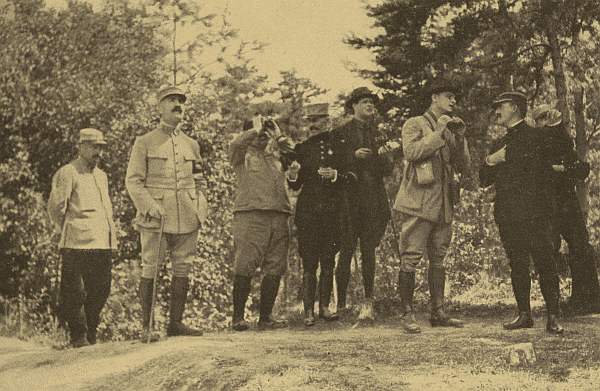
Page 70
"WE WERE COMPLETELY ABSORBED IN WATCHING THE SOFT
LITTLE CLOUDS PLAYFULLY DANCING ALONG AHEAD OF
THE LAZILY DRIFTING AEROPLANE"
"Telephone our guns to fire at him, and warn
Numbers 11 and 12 to prepare for his coming,"
ordered the General, and as the soldier stuck
his pegs in and gave his telephone messages
we hustled out to see the excitement. Sure
enough, we had hardly got out when we heard
a distant whirring, and high up in the air saw
an aeroplane floating our way.
"Keep under the tree! Keep under the
tree!" warned the General sharply. "If he sees
us all standing here, and gets away, he will report
this as an important point and it will rain
'marmites' for days to come."
So he, his staff-officers, Eyre and I grouped
ourselves under a big tree and stared up at the
approaching aeroplane through the gaps in its
branches.
"Whang!" A "soixante-quinze" exploded
violently in the woods close by, and I jumped
equally violently.
"Whang! Whang! Whang!" came three
more shots in extremely close succession.
"You've got a whole battery shooting,
haven't you?" I remarked.
"Oh, no! There is only one gun located just
there. It does not waste time in firing, does
it?" smiled the General. "Our 'soixante-quinze'
field-guns can shoot twenty-five shots a
minute."
Other guns in the immediate neighborhood
took up the chorus, and, looking through our
glasses, we could see little soft white cloudlets
puff into being all around the aeroplane.
But he kept sailing calmly on.
A little further off in the woods came a staccato
rat! tat! tat! tat! tat! like a boy drawing
a stick along a picket fence.
"There goes one of our mitrailleuses at work
on him."
We were completely absorbed in watching
the soft little clouds playfully dancing along
ahead of the lazily drifting aeroplane, when
the General's voice brought us back to earth.
"Come! Come! We must hurry or we shall
be late for lunch. I did not realize how late it
was."
I looked at him in horror. What! Forsake
the sensations of this moment for such a thing
as a lunch! Any one of those gentle little white
puffs might transform the aeroplane into a
hurtling mass of flame. Lunch!
But the General was entirely sincere and very
positive. From his point of view Boche aeroplanes
could be shot at any hour of the day, but
lunch was an event which took place only once
in the twenty-four hours. Lunch was the recognized
symbol of hospitality; aeroplane shellings
decidedly were not.
As we reluctantly followed him through the
woods he may have noticed my disappointment,
for he remarked:
"It is highly improbable that you would see
anything more than you already have seen.
They are very difficult things to hit, you know.
As a matter of fact, we were doing most of our
shooting in front of him rather than at him,
so as to head him back. But he evidently
has his nerve with him, for he has kept right
on and got away from us. Listen! Our
guns have stopped, and there are the guns I
telephoned to at Number 12 taking a shy at
him."
As we hiked along at the General's favorite
pace Captain F—— diffidently suggested:
"And the batteries, mon General, in which
this gentleman was much interested. I suppose
there will be no opportunity to see them?"
"Oh, there is really nothing interesting about
them, as they are not firing to-day. The pieces
are scattered all over the hillside in the woods,
and the crews are having their lunch. But as a
matter of fact our route home takes us right
by one 120-millimetre gun and we can have a
look at that."
Walking down the rear slope of the hill, we
came upon a party of soldiers, apparently out
for a picnic, eating their lunch on a rustic table,
with pine branches over their heads and fragrant
pine needles under their feet.
They jumped to attention.
"Show us the piece," said the General to
their non-commissioned officer.
The groups of soldiers hustled over to a big
object bundled up in tarpaulins, which stood
a few yards off. Stripping off the coverings,
they showed us a heavy field-piece standing on
treadled wheels with its muzzle pointed apparently
aimlessly up the green-wooded hillside
at some clouds which floated in the blue sky
just above the hill-crest.
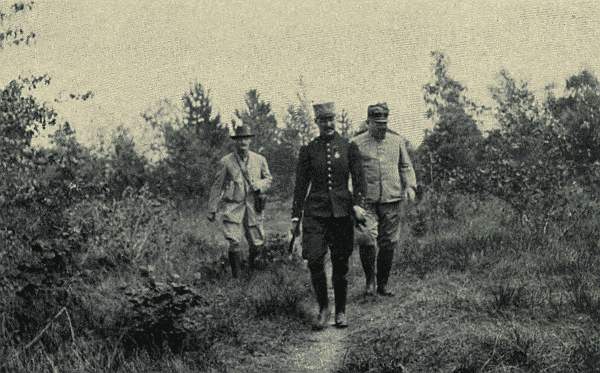
Page 71
"AS WE HIKED ALONG AT THE GENERAL'S FAVORITE PACE"
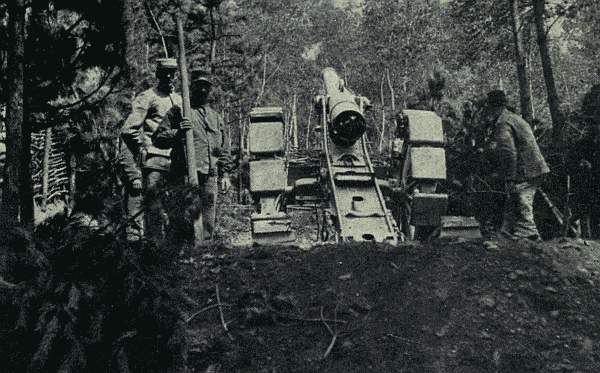
Page 72
"A HEAVY FIELD-PIECE STANDING ON TREADLED WHEELS"
"That gun," explained the General, "is
aimed at the village of ——, about eight kilometres
distant, behind the German lines. Their
reserves have to pass through the village to reach
the front; so whenever we hear that they are
bringing up their reserves we start this gun
shelling that little village. Usually an important
village is shared by several guns, but
that village is the particular property of this
gun.
"Show the gentlemen how it works," he ordered.
The artillerymen leaped into position,
swung open the breach, lifted a heavy shell,
and thrust it into the chamber.
"Careful there; don't shoot it off!" exclaimed
the General, and added to me, "There's no
use damaging our own French villages more
than is indispensable."
As tenderly as a thoroughbred is blanketed
after a race the big gun was bundled up again
by its crew, and, leaving them to resume their
picnicking under the pine-tree, we strode away
to the shooting-box and the lunch.
And a very excellent lunch it was to which
the General, some eight of his staff-officers and
our party of four sat down in the dingy old
dining-room of the shooting-box.
"You certainly mobilized an excellent chef,"
laughed Captain d'A—— as we reached the
entrée.
MENU
du 1º Août 1915
Hors-d'oeuvres
Oeufs pochés à la Rossini
Tournedos grillés à la Bouchère
Pommes frites
Pigeons rotis
Haricots verts à l'anglaise
Crème au chocolat
Compote de pèches
Dessert
With white wine mixed with water to drink
during the lunch, champagne served in the
French fashion with the dessert, and cigars,
coffee and liqueurs to follow, the commissariat
department undoubtedly deserved congratulations.
The conversation was of course not for publication,
but one passage I think I can repeat
without fear of violating confidence.
"Why did not Von Kluck march on Paris
when he had the chance?" I asked the officer
who was sitting on one side of me.
"I will tell you," he replied. "In the 1913
'Kriegsspiel' [great manœuvres] in Germany
the theoretical invasion of France by the attacking
armies was precisely the same advance
as in actual fact they made the following year.
In the maneuvers Von Kluck commanded the
right wing precisely as he did in the actual invasion.
In these maneuvers he came to a point
in his advance where he had to choose between
attacking Paris and swinging past Paris in
pursuit of the enemy. He decided to attack
Paris. The verdict of the board of generals who
were judging the maneuvers contained the
severest kind of arraignment of Von Kluck for
having violated the cardinal principal of German
military strategy by allowing a mere geographical
point to divert him from the one paramount
object of German generalship—the
enemy's army. We actually possess a copy of
this official reprimand, for 'tout s'achête'
(there is nothing that money will not buy), you
know. Now when little over one year later
Von Kluck in actual warfare came face to face
with precisely the same choice of alternatives,
with the previous year's censure still stingingly
fresh in mind, he ignored Paris and followed
the enemy army."
Luncheon over, we bade the splendid young
General and his staff good-bye, and motored
quite a distance to visit one of the French field
hospitals. The wounded, after having first aid
applied in the trenches, were brought here in
ambulances, where their wounds were thoroughly
dressed or operations performed. When there
was a great rush of wounded those capable of
standing the journey were shipped on to base
hospitals as quickly as possible to make room
for the new cases. During the last few months,
however, there had been so little hard fighting
on the section of the front which this hospital
served, that many of the wounded had been
kept there for weeks and some for months.
The big rooms on the ground floor of the large
country house in which the hospital had been
located, had been converted into wards for the
wounded privates, while the bedrooms on the
upper floor were reserved principally for officers.
It was curious to hear the deprecatory tone
in which the Chief Surgeon regretted that he
had no freshly wounded to bandage or operate
on for our benefit. In fact from the front
hospitals to the great base hospitals of Paris
the surgeons are all alike. They cannot keep
a professional note of regret out of their voices
when explaining that very few wounded have
come in of late, nor a professional note of encouragement
when they understand an important
action is soon to be fought which will
again fill their cots with "cases." It would
be an outrage to hold this attitude against
these splendid men. If they had not become
impregnated by their professional point of
view toward the horrors of their work, they
would all long ago have been in madhouses.
Our whole progress through the hospital was
a strange conglomeration of pathos and farce.
For the Surgeon in Command, on our being
introduced to him, stated that he was the
proud possessor of an orderly who spoke the
English tongue "à merveille." Our staff-officers
politely indicated to him that our own French,
though not perhaps up to Comédie Française
standards, was no mean thing, and would
render his explanations entirely comprehensible
to us. But these hints were of no avail. The
accomplishments of his linguistic prodigy must
not be wasted. So the orderly was produced
and turned out to be master of the most grotesquely
unintelligible English that I have ever
listened to.
As we passed between the lines of cots, each
with its still figure huddled under its gray
blanket, as we were followed about by the wondering
gaze of the many eyes which look so
incredibly large in the wasted faces of the
wounded, we had to listen to the explanations
of the Chief Surgeon, and then lend our ears
to the burblings of the orderly exterpreting
them for our benefit. Even when we stood in
the modest little graveyard where those who
had died of their wounds were buried we were
torn between tears and grins by the attentions
of the excellent man whom, I am ashamed to
say, Eyre and I had christened "the pest,"
and by the embarrassed writhings of our staff-officers
who spoke such excellent English that
they thoroughly realized the situation.
Having spent perhaps three-quarters of an
hour in the hospital, which, judged by the somewhat
unexacting French standards, seemed efficiently
run, we departed for the first impromptu
engagement of the day—the studies
of a class in grenade-throwing, which met not
very far from the hospital, and which I have
elsewhere described in detail.
After an hour devoted to this exceedingly
interesting experience, we were whirled away
to a distant appointment with another General
of an Army Corps. He led us to the flat
roof of his headquarters, from which at some
distance he pointed out a third installment of
the trenches continuing from about the point
where they had that morning run out of sight,
and from that point stretching along the Craonne
plateau, nearly to Soissons.
Having terminated a fifteen-minute meeting
with this extremely courteous General, the next
number on our programme was the inspection
of an aviation "esquadrille" or squadron.
On our way, however, we stopped unexpectedly
to look at a most beautiful new
anti-aircraft "seventy-five," a gun numbers of
which the French had just completed and were
bringing to the front. As I was not allowed to
photograph the gun even from a distance and
was enjoined to regard its details as absolutely
confidential, I can only say that, mounted on
its own motor, it could travel along the roads at
forty kilometres an hour; that it could be in action
within one minute and a half after coming
to a stop, and that the way the turning of a
couple of little cranks which a child could whirl
made the heavy muzzle swing, and mount, and
cut figure eights in the air, was something
wholly incredible.
We listened to a technical but most interesting
exposition by the Artillery Captain of the
most up-to-date methods of firing at aeroplanes,
including the progressive and retrogressive systems,
and then sped away to the aviation field
some ten or fifteen kilometres distant. We
found the aviation squadron on a very large
field near the top of a gradually sloping bare
hill, comfortably installed, the machines in
their great hangars, the aviators in their small
tents. The whole organization was especially
adapted for mobility. In one hour, at need,
the field would have left on it not a man, a
stick or a shred of the encampment. Hangars
and tents would be careering along some highroad,
neatly folded in the big aviation lorries
that stood handy, mechanics would be sitting
on the box seats or have their legs dangling
over the tail-boards, while pilots and observers
would waft themselves more comfortably by
air to their new camp site.
The Captain of the "esquadrille" showed us,
with quite pardonable pride, his "avions de
réglage"—planes carrying no bombs or machine-guns,
but equipped with wireless, which
are used to correct the fire of artillery, and his
"avions de chasse" or hunting-planes equipped
with bombs, a machine-gun and a Winchester
carbine. Some of these had the pilot sit behind
and the observer in front operating the machine
gun over the bow. Others had the pilot
in front and the observer behind, in which
case the observer, standing up, operated the
machine-gun over the head of the pilot.
Finally he showed us a splendid new Caudron
biplane having two independent motors
and two traction screws in front, so
that if either motor were put out of
business the plane could continue flying on the
other.
I was so enthusiastic about this machine that
the Aviation Captain turned to me and asked
casually, "Would you perhaps like to go up
and take a 'petite promenade' in the Caudron?"
Would I? It did not take me many fractions
of a second to impress on him that I certainly
would. But here Captain d'A—— demurred.
It was, he said, absolutely forbidden that any
one should go up in army aeroplanes except
aviators on military duty. Those were the
strict army regulations. He was quite right
and entirely justified in his attitude. But
Captain F——, who was a good sport and had
become quite a chum of mine, said, "Oh, let
him go up. After all, the Swiss Military Attaché
went up the other day. I'll take the responsibility."
And as he was in immediate authority
while we remained with the 5th Army, Captain
d'A—— good-naturedly shrugged his shoulders
and let it go at that.
So I hurried down with the Aviation Captain
to his tent to put on a warm aviation suit,
while the Caudron was prepared for our flight.
As we approached his tent, a single-motored
aeroplane took aboard its pilot and observer,
its propellers whirred and roared, and it rolled
casually away up the gradual slope, through
a field of standing grain, till near the hilltop
it took to the air as easily as a bird and spiralled
up toward the low-lying dark clouds.
In the Captain's tent I struggled into a heavy
suit of black fur made like a suit of combination
underwear, legs and body all in one piece, put
on a pair of goggles and a heavily padded helmet,
and emerged to meet the disappointment
of my life. Down pattered some drops of rain,
down spiralled the aeroplane which had just
gone up.
"Too bad," said the Aviation Captain. "I
can't send a machine up in the rain."
I pleaded with my staff-officers to wait here
for an hour to see whether the rain might not
stop. In vain. Even that good sport Captain
F—— was adamant. We could not possibly
wait, because it would completely throw out a
visit to a horse hospital, and an inspection of
an army corps supply-train which were both
unalterably fixed upon our schedule. We were
very late already. We must be off.
Well, then, could we not return early to-morrow
morning to get the flight?
"Malheureusement ça ne peut pas se faire."
(French euphemism for "No.") To-morrow
morning I was slated for a visit to a base hospital
which, including motoring there and motoring
back, would consume most of the morning.
But I would infinitely prefer to go for a
"petite promenade" in the Caudron than to
inspect the most unique base hospital in the
world.
Yes, they could understand that perfectly,
but unfortunately the hospital was among
"the arrangements" and the "petite promenade"
was not. Personally they would throw
the hospital overboard in a minute, but the
matter was beyond their control.
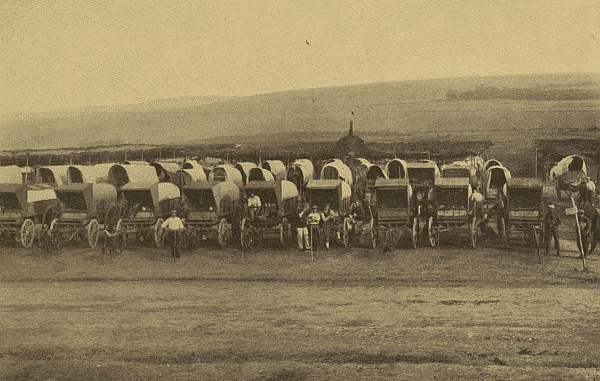
Page 85
PART OF THE ENORMOUS ENCAMPMENT OF SUPPLY-WAGONS,
WHICH CARRY THE COMPLETE SUPPLIES FOR THREE FULL
DAYS FOR ONE ARMY CORPS
So off we went, Captain F—— full of sympathy
and I full of sulks, and at about half past five
visited what under other circumstances would
have been an exceedingly interesting big hospital
full of hundreds of sick and wounded
horses. But I fear I was in no mood to appreciate
the ingenuity and thoroughness with which
the kilometre or more of hospital sheds had been
constructed by the soldiers on a framework of
poles, with wicker-work sides covered with a
sort of adobe, and a sloping roof of thatched
straw with little gables built here and there
for the mere love of beautifying which is apparently
ever present in the French race,
whether at war or peace.
On we went for another long run till we
reached the enormous encampment of supply-wagons,
which carry the complete supplies for
three full days for one army corps. They had
been there since the armies dug themselves in.
"We are not useful now," the Colonel
in Command regretfully confided to me; "for
almost all the supplies reach our armies by
rail. But only wait till the advance begins.
Then we shall show what we can do."
This great encampment which covered some
square miles of countryside had begun as a
bivouac and ended as a town. One walked
down avenues and side streets solidly flanked
by the huts which this army had built itself.
They were all more or less standardized in
building materials—wattled walls covered with
clay, and thatched straw roofs. But there the
uniformity abruptly ended. For these little
houses had not been merely constructed by
builders as they would have been in nearly
any other country. This was France and they
had been conceived by architects. And each
house expressed the original conception of the
soldier-architect who had designed it.
No one who has not walked through this
mushroom town or the many others like it can
imagine the infinite variety of architectural
forms which can be wrought in one-story shacks
of wattle, clay and straw. The pliable wattle
and clay lent themselves to effects which could
not have been possible in stone, brick or wood.
Extraordinary bays and alcoves, never before
dreamed of by the Ecole des Beaux Arts gave
light and shadow to long walls. Bas-relief and
high-relief were done with spirit and often with
fine art in the clay which covered the wattled
walls, the thatched straw of the roofs was
erected into strange gables, dormer windows,
turrets and machicolations. Eccentric, grotesque
many of these experiments unquestionably
were, but they meant on the part of the
tired soldiers hours and days and weeks of
extra and unnecessary work, lavished, not for
their creature comfort, not for their physical
safety, but solely for their artistic satisfaction.
It was twilight when we took our leave and
night had fallen long before we rolled into
Château Thiery, whither Captain d'A——'s
orderly had transported our bags, and where
a very late dinner and comfortable beds were
awaiting us.
With the 5th French Army, Aug. 9.
I have just returned from attending a soldiers'
school of bomb-throwing. The military
authorities permitted my presence as an
exceptional favor, informing me that this is the
first time such a privilege has been accorded
a foreign civilian.
This particular school holds its classes in a
large green field in a peaceful little valley,
within long artillery range of the firing lines.
No German shells, however, have hitherto distracted
the pupils from their rather gruesome
lessons, and I will not endanger their continued
studies by giving a more definite description
of the locality.
This school is attended by privates from
each regiment, who spend four days at their
highly explosive studies. Toward the middle
of the field, about two hundred yards from one
end and about three hundred from the other,
was a section of open trench about twenty
yards long and some four feet deep. This
trench was about the usual three feet in width
except in its centre, where for about five feet
it was recessed back to a width of some six
feet. This was where the French instructor
stood and whirled his arms to throw the bombs.
A couple of feet to the left of this recess was
another recess, covered with a bomb-proof roof
of logs and earth.
Into this the instructor and his pupil sought
refuge from the effects of the bomb explosion.
As the explosion really is surprisingly violent
and takes place at the longest only five seconds
from the time the mechanism of the bomb is
started, and at a maximum distance of thirty
yards, the instructor and any one in the trench
with him have got to be exceedingly spry in
running under the bomb-proof in order to beat
the bomb. There is, too, the danger of a premature
explosion.
To make me feel more entirely at my ease,
they told me that only a few days ago an officer
of explosives brought a Colonel to see one of
these demonstrations in another school, behind
a different part of the line. As they came
to the entrance of the trench the officer politely
made way for the Colonel to enter the trench
first. As the Colonel did so, the bomb exploded
prematurely and killed the Colonel outright.
About twenty yards in front of the trench
was dug a shallow dummy trench to represent
a German target. Some 150 yards further distant
was set up a section of wire entanglements.
We found the 128 soldiers ranged in line a
few yards behind the trench. At its edge I
took my place with the Captain of explosives
and three or four other officers. The infantrymen
lined up two deep behind us.
In the open recess in the trench stood the
non-commissioned officer of engineers, facing
backward toward us. He was the instructor.
At the order of the Captain he placed an innocent-looking
satchel on the trench edge at
his right elbow, plunged a hand into it and
briskly plucked out, one after the other, eight
different varieties of bombs. Picking them
up, one at a time, he gave a terse lecture on
the construction and method of operation of
each.
The bombs were all fully loaded, and the
explosion of any one of them would have sent
a great many of us well on the way to the cemetery.
I noticed in some of the officers, and undoubtedly
in myself, a certain tenseness as
the engineer nonchalantly illustrated within
an inch or two of actuality how a percussion
bomb would explode if brought in contact with
the ground.
In demonstrating the first grenade he adjusted
around his wrist a loop with about eight
inches of cord hanging from it. A heavy two-inch
metal pin was attached to the end of the
cord. Picking up a black spherical bomb
slightly bigger than a baseball, he stuck the pin
lightly into a hole in its side. The bomb was
to be thrown with full force. In flying out of
the hand it pulled itself free from the pin,
causing a friction which ignited the five-second
fuse. The pin of course remained behind,
hanging to the cord, and was promptly stuck
into another bomb. This bomb, being particularly
heavy, could be thrown only fifteen
metres by an average thrower and twenty as a
maximum.
The second bomb was black and pear-shaped.
It had a spring which looked like a nickel shoe-horn
folded back tight against it. The pressure
of the palm against the shoe-horn in throwing it
released the spring and started the fuse, which,
like all the rest, was set at five seconds.
The third bomb was a can of white tin attached
by two wires to a white deal handle.
A nail was stuck into a hole in the can. The
nail was hammered in by a sharp rap against
the ground. ("If you try to knock it in against
the palm of your hand it would hurt," explained
our instructor.) The nail, driven in, started
the fuse.
In the demonstration of this particular bomb
our mentor was quite peculiarly realistic, bringing
it violently down to within what seemed
like the fraction of an inch of the ground.
The fourth bomb was black and round and
was started by scratching the tip of a stiffly
projecting bit of ignitible fuse against a black
band of raspy material worn round the thumb
of the left hand. The fifth bomb was lighted
in a very similar manner against the side of an
ordinary safety-match box. These five were
regular grenades.
The sixth and seventh were incendiary grenades
to set fire to wooden obstructions, etc.
The one, in exploding, scattered the burning
liquid to a distance of a few yards, the other
set fire only to the spot where it burst. These
were both large spherical bombs. Before being
thrown kerosene was poured into them through
a little bunghole, which was then stopped up.
The eighth was an asphyxiating bomb. I
cannot, however, be too careful in emphasizing
the fact that this so-called "asphyxiating"
bomb was not poisonous, like the German asphyxiating
gases, but merely irritated the eyes,
nostrils and throat, so that when thrown into a
German bomb-proof it would force out the occupants.
It left no ill after-effects.
Besides these there were two aerial torpedoes.
One was shot out of an old-fashioned little
mortar propelled by black powder. The other
was bigger and more powerful, had a fin tail
to keep its flight accurate and was fired out
of a complicated little gun. As both this torpedo
and its gun are new inventions, I am not
permitted to give any closer details concerning
them.
The Sergeant of engineers having completed
his little lecture, with himself and his class still
in this world, the soldiers and officers all withdrew
to the end of the field, some 200 yards
behind the trench, and there lay down on their
stomachs. I got into the trench with the engineer,
placing myself to his left in front of the
entrance to the bomb-proof, and the demonstration
in the gentle art of grenade-throwing began.
He took bomb number one, stuck the pin at
the end of the cord firmly into the hole, swung
his arm back and let fly.
Having seen the departure of the bomb, I
ungracefully tumbled into the bomb-proof, with
the engineer a close second. Once there, there
was an appreciable pause. Then came an explosion,
the violence of which really astonished
me. I could distinctly feel the ground shake.
After giving the fragments which had been
hurled our way plenty of time to come down
on the roof, we stepped out into the trench
again. The engineer next picked up bomb
number three with the deal handle, hammered
the nail home with one sharp rap against the
edge of the trench and sent the grenade hurtling
through the air.
The mechanism of the first bomb had not
been put in operation until the bomb started
on its flight. But the fuse of this third bomb
started burning the instant he hammered the
nail in, and was burning while he was whirling
his arm preparatory to letting it fly. As it
thus got a running start on us, we had only
barely time to get under cover before the explosion
took place.
Next came bomb number four. The demonstrator
adjusted the black band round his left
thumb, took the bomb in his right hand and
gave it a scratch.
He evidently had some doubts as to whether
the first scratch had lighted the fuse, because
after glancing at it he proceeded to give it a
second scratch before throwing it.
I need hardly say that I had already made
home base in the bomb-proof and was perfectly
satisfied to watch from there his second effort
to get a light, which was crowned with complete
success.
After watching the way these three bombs
were started and thrown I now wanted to watch
the rest of them explode. So after considerable
discussion between the staff-officer who
had me in charge and the officer of explosives
as to just how much danger there was in the
operation, we moved out of the trench up to the
top of a little rise about fifty yards to the
right, where we ensconced ourselves in some
bushes. The soldiers were all kept at their
original distances of 200 yards behind the trench.
From my new position I got an excellent
view of the engineer whirling his arm and letting
fly; of the heavy black objects rushing
through the air; of the accuracy with which
they hit the dummy trench; of the lazy manner
in which they rolled only two or three feet
along the ground before coming to rest, and of
the treacherous inertia with which each lay apparently
as dead and cold as a piece of coal
dropped by some passing coal-cart, while the
second of time which possibly elapsed seemed
like a minute at the least. Then came an
amazingly instantaneous burst of lead-colored
smoke covering a circle some forty yards in diameter,
accompanied by an explosion of surprising
violence. I could see no flash of fire at all.
Next came the new aerial torpedo fired from
the new gun. (The old little mortar with the
black powder was not used.) The new gun
made practically no report in discharging the
torpedo. It was beautiful to watch the slender
fishlike projectile go sailing in a high and graceful
arc up, up, up, against the sky and then
down, down, down, until it landed just beyond
the wire entanglements. But it really never
did land, for it had a percussion device in its
nose which exploded it on touching ground.
This big torpedo had a reduced charge of explosive
so as not to destroy too much of the
field. Judging by the report of this reduced
charge, the full charge going off must be the
grandfather of all explosions.
Next came the two incendiary bombs. One of
these burst on contact, setting fire to the patch
of grass where it landed. The other had a fuse
which shot out a stream of golden sparks like
fireworks before exploding. This bomb threw
burning liquid in all directions, setting many
fires in the grass for a radius of several yards.
Last came the asphyxiating bomb. It consisted
of a sphere formed by five pieces of perforated
iron held loosely together in a sort of
disjointed shell by a little wire basket. Inside
this openwork ball hung a small glass vessel
full of acid. When the engineer threw the ball
against the ground the five pieces of metal
shell collapsed onto the glass, breaking it and
liberating the acid, which made a wet splash
on the ground. This acid in turn makes a gas
which the French somewhat euphemistically
call "gas timide."
To show that this gas was not poisonous,
like the German gases, we were invited to stand
in a close circle right around the fragments
of the bomb immediately after it had been
thrown, with our heads bent over. We stood
and stood, sniffing away, but could detect no
gas of any kind.
"Ah," said the officer of explosives, "in the
full open air like this our 'gas timide' takes
longer to be noticed, but in an inclosed space
it works very rapidly."
Hardly had he finished speaking when I began
to notice a smell something like wood
alcohol. At the same time my eyes began to
stream with tears, my nose felt as though it
was indulging in one long continuous sneeze,
and I turned hastily away, coughing and sputtering
and wiping my eyes, with an officer on
each side keeping me active company.
"If that's a 'timide' gas," I remarked to one
of the officers as we left the pupils to begin actual
practice, "I'd hate to meet a fierce one."
Headquarters of the Belgian Army,
La Panne, Belgium, Aug. 30.
Yesterday I spent a day with the Belgian
artillery. In the morning at ten o'clock
Commandant L——, who had me in charge,
called for me at the very comfortable seaside
hotel where I am staying. In his military motor
we threaded our way through the streets of the
town. These were jammed with thousands of
Belgian soldiers enjoying their six days of rest
before returning for three days in the front
trenches (followed by six days in reserve and
three days again in the front trenches). A cheerful,
well-fed-looking lot of men they are, not
smart, but husky-looking in their new khaki
uniforms and greatcoats.
"Alas!" an infantry Captain yesterday complained
to me, "they are fine soldiers and have
good uniforms, but we cannot get the men to
look 'chic' in them like the British. Just look
at those caps! They've pulled them and
twisted them about to suit their ideas! Those
caps a few days ago were 'chic' caps! And
now, mon Dieu! look at them!"
However, I confess I was not much interested
in whether these privates were Belgian Beau
Brummels or not. I had come to Flanders not
to inspect them on parade, but to watch them
work on the firing line. There I found them
scrupulously clean, very patient and wholly
courageous, attributes which are more important
than creased trousers, unwrinkled jackets
and well-blocked caps.
Once free from La Panne, our motor made
good time along the country road till we reached
Furnes. There we stopped to take some photographs
of the beautiful old Hôtel de Ville
which the German shells that drop in from
time to time have left practically undamaged.
From Furnes on we took the straight road
to Ypres. The road was for a time quite congested
with ammunition-wagons, ambulances,
supply-lorries, etc. On our left we passed an
encampment of mitrailleuse dog-teams; on our
right a park of British armored motor-cannon.
We passed, too, long lines of trolley-cars
packed with cheerful soldiers being brought
back from the front for their period of rest, and
with others going out to take their places. Thus
the humble street-car has taken its place in
the machinery of war.
Soon we turned into another road which led
us to the village of Lampernisse. Here we
visited and photographed the ruins of the
church. Not very long ago the Germans
dropped a big shell into this church and killed
forty-two chasseurs who were sleeping in it.
They are buried in the graveyard in one big
grave. Subsequently the Germans, believing
that the steeple of the church was being used
for observation purposes, kept on shelling it
till they brought it all down, and incidentally
wrecked what remained of the village.
From here on our movements must be
shrouded in mystery, but ultimately at about
11.45 we reached a humble group of farm
buildings, the headquarters of Colonel D——,
commanding the artillery of the sector. We
found him in a little bomb-proof telephone
central built onto one of the farm buildings.
With a Major and a Captain he was poring over
very large scale maps spread on a table. Behind
him a soldier sat at a telephone switchboard.
From the outside a whole sheaf of telephone
wires ran away, in various directions.
My Commandant presented me to the Colonel
and explained my desire to see some howitzers
in action.
"Perfect!" exclaimed the Colonel genially.
"We have just definitely located a German
blockhouse in their defense system and at two
o'clock this afternoon we are going to destroy
it with one of our 150-millimetre howitzers.
So if you will honor the Villa Beausejour with
your company at lunch you can afterward
watch the howitzer work."
The old farm-house had been euphemistically
christened the Villa Beausejour by the Colonel's
staff.
Inviting me into the bomb-proof, the Colonel
then showed me on one of the large scale maps
the whole lay of the land. Red lines indicated
the Belgian intrenchments, blue lines the German.
In the same way all over the map behind
the red line the Belgian batteries were indicated
in red, while the same held good in blue of those
German batteries which the Belgians had managed
to locate. Some of these latter were
false emplacements. It was only when a little
blue cannon was drawn behind the emplacement
that an actual gun was indicated.
The Colonel pointed out to me on this map
the exact location of the Villa Beausejour, of
the blockhouse which was to be destroyed,
and of the gun which was to destroy it. He
also showed me photographs of the German
positions taken from Belgian aeroplanes. Taking
one of these photographs and comparing
it with a map, he explained to me how the map
showed only one road leading to a certain spot,
while the photograph showed a new second road
leading to the same spot. This indicated the
existence of a concealed battery at that place.
The telephone bell rang. "This is Number
12," answered the soldier-operator. He listened
for a few moments and then told the
Colonel that Headquarters wished him to send
over an officer after lunch to cross-question the
two German prisoners just captured for information
which might be of use to his artillery.
"Tell them I shall do so," replied the Colonel.
As we had another half-hour before lunch, he
deputed one of his officers to take me to a
battery of 75's not far off and incidentally show
me some of the shell-holes made in the neighborhood
by the German "marmites," as the French
and Belgians call the big high-explosive shells.
A brisk walk brought us to the 75's, cleverly
concealed in an artificial wood which had been
transplanted bodily. The Captain in Command
showed me the guns, and also a fine bomb-proof
shelter which he had just completed. It was
very much needed, as, in spite of the artificial
woods, the Germans had roughly located his
battery, and whenever any Belgian 75's in his
neighborhood open up on the enemy they
immediately cut loose on his battery. The
whole surface of the fields for hundreds of
yards around was pockmarked with shell-holes.
He showed me one of his guns where a curious
thing had happened. A couple of days before
a German shell had hit obliquely the steel shield
of this gun and had glanced off through the left
wheel, knocking the spokes out on its way. The
shell had then entered the ammunition-caisson
standing next to the gun, had there burst, hurling
the heavy caisson bodily through the air to
where its wreck landed upside down, and had
not exploded its contents of shells.
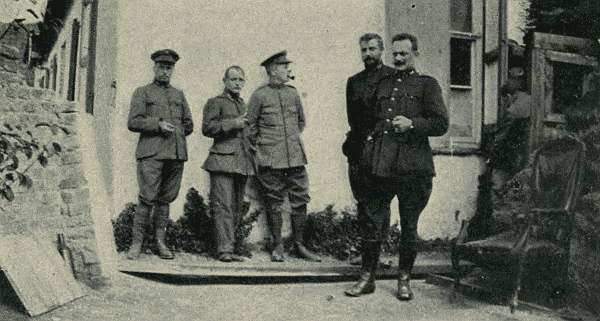
Page 101
"COLONEL D——, COMMANDING THE ARTILLERY OF THE SECTOR"
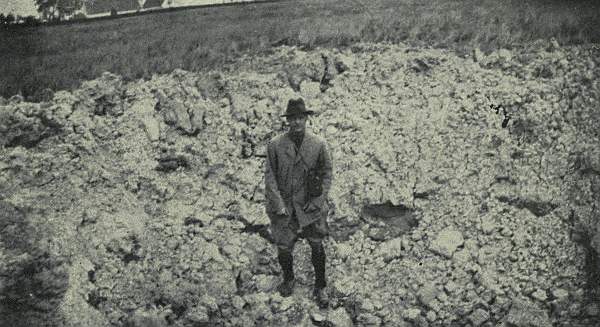
Page 105
THE AUTHOR IN ONE OF THE BIGGEST SHELL-PITS, WHICH WERE
TEN FEET DEEP AND TWENTY FEET IN DIAMETER
After taking photographs of some of the
biggest shell-pits, which were some ten feet
deep and twenty feet in diameter, we returned
to the Villa Beausejour and lunch. We sat
down fourteen to lunch—the Colonel, ten artillery
officers, the Chaplain, my Commandant
and I.
Lunch consisted of potato soup, paté de foie
gras, vegetables, strawberry-jam pie, cheese
and coffee. There was no wine to start with,
but one of the officers soon came in with two
bottles of white wine, which we all mixed with
our mineral-water.
The talk ran mostly on the two German
prisoners.
"I certainly hope we shall be able to find out
from them just where that battery is that has
been giving us all this trouble lately," exclaimed
one officer.
"And those howitzers that I can't locate,"
from another.
"And where that body of troops to the right
sleeps," from a third.
"Perhaps they'll know in which of those
farms the German headquarters are," from a
fourth.
It appeared that the prisoners were from
German Poland. When the Belgian artillery
had the day before driven the German troops
into their bomb-proofs these two had seized the
opportunity to crawl forward out of the trench,
through the wire entanglements, across the open
to a Belgian advanced listening-post, where they
had surrendered. They were now at General
Headquarters and had already given much valuable
information, including the unusually large
number of men who slept during the daytime
in the blockhouse, and the presence in a certain
farm of a number of German officers.
A Captain of a battery of 75's who sat near
me at lunch, was going to tackle the farm-house
that afternoon with his guns. The Captain
in command of my howitzers was not at lunch,
as he was already on his way to his observation-post,
situated at the extreme front, within 270
yards of the blockhouse. From there he was
going to correct the howitzer fire, over some
four kilometres of telephone line connecting
his observation-post with his guns.
A good deal of the talk at lunch was devoted
to anathematizing a certain general-staff officer
who had charge of the uniforming of the army
and, apparently, was bent on changing the
new khaki caps of the officers from the British
shape, which they all liked, to the French shape.
A good story was told to illustrate the amazing
efficiency of the German intelligence department.
One day when the army was being
reuniformed in khaki, a certain regiment of
chasseurs was ordered to leave their trenches
right after dark that night to march to the
rear for the purpose of having their new uniforms
issued to them. An hour or two after
they had received this order the Germans
right opposite them hoisted a great placard
above their trenches. On it was sign-painted:
"Good-bye, brave chasseurs! Run along to
get your new uniforms at seventeen francs fifty
apiece!"
Lunch being finished, my Commandant and
I said good-bye all round and, with detailed
directions, started on a half-hour's walk to find
the howitzer battery. The Chaplain, in khaki,
with an old black umbrella and a long fishing-pole,
came along as far as the first canal. There,
standing on a flat bit of embankment between
two shell-holes, he placidly began to fish.
The artillery, which had been booming in a
desultory way all morning, had of course
stopped during the lunch-hour. For the artillerymen
on both sides certainly keep union
rules in laying off when the time for the dinner-pail
comes round. If the noon whistle blew
they could not be more punctual in dropping
work.
Now, however, the noon-hour was over and the
guns again began to take up their monotonous
bass drumming. For a full half-hour we walked,
first along a deserted wagon-road, then to the
left, along a path by the bank of a canal, past
an artificial hedge here and an artificial grove of
trees there. Some of these had batteries ambushed
in them, others were shams to divert
the attention of the German aviators and the
fire of the German artillery from the real emplacements.
Finally, we came to a tall false hedge made
of withered saplings wired together. In the
lee of this hedge was a low flat roof, perhaps
three feet above the surface of the ground, covered
with a sprinkling of earth and boughs.
Under this we climbed down into a cellar-like
excavation about three feet deep, giving six
feet of head room.
Here I first made the acquaintance of Julia. I
found her standing with her back to me under
the plank shelter, with only her exceedingly
short and retroussé nose sniffling up at the
leaden patch of threatening sky which showed
between the forward edge of the roof and the
top of the high false hedge in front. No one
could well call Julia beautiful, but there was
power in every line and curve of her. She was
a particularly short-muzzled 150-millimetre
heavy field-howitzer, and she had been christened
Julia in chalk letters across the back of
her thick steel shield by the members of her
devoted crew.
On her breech were engraved a crown and
a big "C. I.," for she and her three sisters had
been intended for Carol I., King of Roumania,
before they were bought up by the Belgian Government.
One of the four had exploded through
trying to fire a 155-millimetre shell through
her 150-millimetre bore, but the other three
were doing fine work for their adopted country.
On my way to my appointment with Julia,
we had passed one of her sisters, called "Zoe,"
cowering up against the wall of a very disreputable
old farm-house, hiding her humiliation in
a hole in the ground under a plank roofing and
a false hedge much like Julia's.
Any one who thinks that nowadays he will
see artillery ranged in imposing array, is
doomed to disappointment. The artillery commander
(especially of the heavier guns) goes
around the countryside stealthily hiding one
piece here, surreptitiously slipping another in
there, always selecting the most separate and
inconspicuous locations, much as a woman will
wander around a hotel room stowing her pieces
of jewelry here and there where the burglars will
never think of looking for them. Only the burglars
in the present case are hostile shells that
make holes ten feet deep and twenty feet across.
Julia's crew consisted of a Lieutenant and
eight men. The Lieutenant and seven of the
men were grouped around the breech of the gun
when I arrived. The eighth man squatted to
the left by a field-telephone with the receiver
held to his ear. Commandant L—— introduced
me to the Lieutenant, and then asked
whether his Captain had reached the observation-post.
The Lieutenant had not heard
from him yet, but imagined he must get there
any moment.
It began to rain hard, much to the vexation
of the Commandant, who feared it would hide
the blockhouse from the observer and put an
end to the bombardment.
"Oh! no," said the Lieutenant; "he's only
270 yards distant from it. He'll be able to see
it all right."
On the board floor to the left, between the
telephone and the front wall of the excavation,
were piled twenty-five or thirty wicked-looking
150-millimetre high-explosive shells. They were
conical in shape, about 2½ feet long and 6
inches in diameter, made of steel, with a copper
band around them near the base, and a copper
nose.
I started to lift one of them, and only succeeded
at the second attempt. They weighed
about 110 pounds apiece.
Stacked next to them were a corresponding
number of hollow copper cylinders containing
stiff little cream-colored children's belts, with
eyelet-holes down the middle, coiled neatly inside
them. Some of them had one coil; others
two coils, one on top of the other; others three
coils superimposed. These were the propelling
charges for the shells, and were of three strengths
according as one, two or three of the coils of
cream-colored explosive were put in the copper
shells. They were topped off with a heavy
felt pad which fitted neatly into the cylinder.
Meantime the rain came down in torrents
and began to leak through the thin plank roofing
in little streams which were very hard to
dodge.
The Lieutenant showed us a bomb-proof
which he had just begun to build into the earth
wall of the cellar, behind the stack of shells.
He was going to cover it with a concrete roof,
pile a few feet of earth on top of that, then some
sand-bags, and top the whole off with boulders,
so as to make any shell hitting it explode at
once on the surface, instead of boring half-way
down before exploding. He was doing all this
work with his eight men at night when they
were not handling the gun. During the day
they slept except when, as now, they wanted
to disturb the sleep of the enemy. This
bomb-proof was only meant for refuge
when the Germans began bombarding him.
The men's regular sleeping-quarters were a little
to the rear.
And still the rain came down, the air
became raw and cold, and the little waterfalls
became harder and harder to dodge. But the
man at the telephone squatted patiently by
the wall, and his seven mates chatted placidly
together in incomprehensible Flemish, switching
instantly to French when answering any
question the Lieutenant put to them.
The Lieutenant explained how the gun was
aimed, the sighting device showing a stake in
line with a church steeple; only as there was
nothing to be seen in front of Julia except
an earth bank and ten feet of false hedge, it
stands to reason that stake and steeple were
behind her and appeared, not through a telescope
as I had just stupidly thought, but as a
reflection in a mirror—which is the way all
well-conducted howitzers are aimed.
Finally, after an hour's wait the Lieutenant
rang up his Major on the telephone and asked
whether anything was amiss with the Captain.
No; the Captain was only linking up a new
telephone connection nearly four kilometres in
front of us.
The Lieutenant pointed out a false hedge
some hundred yards behind us.
"That is exceedingly dangerous for us here,"
he explained. "It is much too close to us. It
should be at least 150 yards further removed.
If it draws the German fire, as it is intended to
do, that fire is just as apt to hit us as the false
hedge. It was put up as a protection to another
gun which was off there to the right, but
it's a very uncomfortable thing to have near
us, especially before we have a bomb-proof to
crawl into."
"Ting—aling—aling!" went the telephone
bell. The soldier listened. "The Captain says,
'Are you all ready?'"
"Tell him 'yes'," replied the Lieutenant.
"Aim for 3,750 metres," repeated the soldier
at the telephone.
The Lieutenant and a couple of his men
busied themselves around the sight and elevating
cranks of the gun. Another man removed
a leather cap which had been fitted over
Julia's nose to keep the rain out.
I was busy sticking cotton wool in my ears.
"The Captain says to say when you are
ready and he will give the order to fire."
"All ready," said the Lieutenant, backing
away from Julia and holding a thick white
cord in his hand which ran from her to him.
"All ready," replied the soldier into the telephone.
"Tirez!" ("Fire!") said he a fraction of a
second later.
The Lieutenant's arm gave a jerk, the whole
front of the shelter was a mass of blood-red
flame, there was a bellow of sound, the barrel
of the great gun ran smoothly three feet or so
back into the cellar and then smoothly forward
again. There was a rush of air around my legs.
Almost simultaneously with the report I
heard with one ear the telephonist say, "Coup
parti" ("The shot has left"), while with the
other I listened to the long-drawn wheeze with
which the projectile mounted into the sky on
its mountain-high trajectory. In the second
which had meanwhile elapsed one of the artillerymen
had swung open the breech of the
gun, another had taken out the now empty
copper cylinder and placed it on the floor to
the right of Julia, a third had lifted a new shell
and with the aid of the second had run it into
the breech, and a fourth had slipped in a fresh
copper cylinder containing a full charge of
three of the little cream-colored tape-coils.
Whereupon the first artilleryman had swung
to and locked the breech again.
"In eighteen seconds you should hear the
shell explode," said the Lieutenant, taking his
stand by the telephonist with an open notebook
and pencil in his hands—"15, 16, 17, 18"—I
finished counting. Boom! came the distant
explosion.
A few seconds of silence.
"Plus 3," announced the telephonist, repeating
an order from the distant Captain.
The Lieutenant made an entry in his notebook
and simultaneously rattled off some figures
like a football quarterback. The men
worked over the sights and cranks, while my
Commandant said to me: "That shot was too
far to the right; plus 3 means five three-thousandths
further to the left."
"All ready," said the Lieutenant.
"All ready," repeated the telephonist, and
then:
"Tirez!" and again the twitch of the white
cord, the blood-red flame, the roar, the slow,
easy recoil, the diminishing wheeze, the "Coup
parti," the eighteen seconds' silence, and the
distant boom.
"Plus 4," sang out the telephonist, and
there was a mechanical repetition of operations.
"The observer corrected the first shot about
ten metres to the left, and, finding that was
not enough, corrected the second shot another
fifteen metres to the left. They'll edge along
like that till they reach the blockhouse, destroying
the trench to right of it on the way.
Then, when they've destroyed the blockhouse
completely, if that does not take up all the
day's allowance of shells, they'll expend the
remainder on knocking out the trench to the
left of the blockhouse. To-day's allowance
for Julia is twenty shells, and probably she
will use up most of them on the blockhouse to
make a thorough job of it."
"Tirez!" came the telephonist's voice, and
as the roar was succeeded by silence, my Commandant
exclaimed to me: "Filons!" French
slang for which the American equivalent is,
"Let us beat it!"
As I reluctantly crawled up into the rain
after having shaken hands with the Lieutenant,
my Commandant explained that the Germans
would undoubtedly begin to search the
immediate vicinity with their artillery to try
to silence the gun which was throwing the
"marmites" into them. As we had the provocative
false hedge right behind us and no
bomb-proof to crawl into, I had to agree that
he was prudent.
And so we "beat it" through the downpour,
sliding around in the oily Flemish mud, while
the German guns began to drop whole kitchen-loads
of "marmites" into a poor wrecked village
five hundred yards to our left, from which
they evidently suspected that our shots had
come.
As we slithered along, drenched to the skin,
toward the "Villa Beausejour" and our waiting
motor, we could hear the Captain of 75's
letting off salvo after salvo at the farm-house
of which the prisoners had informed him,
while behind us Julia continued to explode at
half-minute intervals. There was all the difference
in the world between the dry short report
of the big howitzer and the hollower,
sharper, more penetrating explosion of the
75's.
To-day I learned from the Captain of the
75's that his first few volleys had set the
farm-house on fire. A lot of soldiers had come
running to put the fire out. His guns kept on
dropping and scattering these until, with a series
of loud explosions, the whole farm-house had
blown up. It turned out that it was not an
officers' headquarters, but an ammunition store-house.
As to our blockhouse, I understand that
it was completely demolished, though whether
or not it took the whole of Julia's twenty shells
to complete the work I was unable to learn.
Headquarters of the Belgian Army,
La Panne, Aug. 30.
To-day I was given the opportunity of
comparing the trenches of Belgium with
those I had visited in France. It was a very
interesting contrast.
Commandant L——, who still had me in
charge, picked me up at my hotel at 10 o'clock
in the morning. Proceedings were delayed while
I insisted on taking a snap-shot of him in the
nickel-steel skull-cap which he wore inside his
khaki cap.
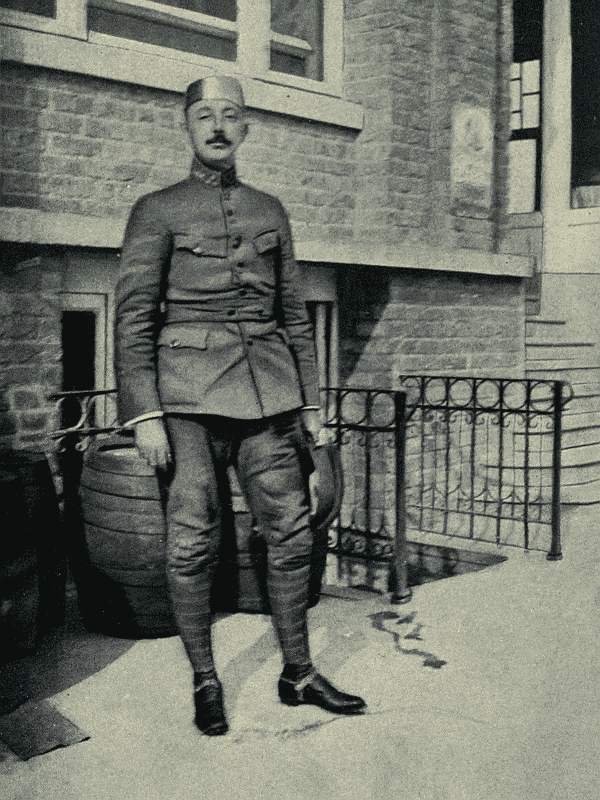
Page 121
COMMANDANT L—— IN THE NICKEL-STEEL SKULL-CAP WHICH
HE WORE INSIDE HIS KHAKI CAP
More and more of the French officers are
wearing these helmets, and he had just ordered
his from Paris. It is an admirable protection,
very tough, not at all heavy, tucked inside the
sweatband of the cap and entirely invisible.
If a bullet hits it straight point-blank it will,
of course, penetrate and carry a piece of the
steel helmet into the wearer's head with it.
But a bullet hitting thus would be fatal anyway.
While if the bullet is spent, or if it hits at an
angle, the helmet will deflect it.
On the way to the trenches we stopped off at
the Belgian aerodrome, where an Aviation Captain
showed and explained to me the details
of the Voisin and Nieuport machines, which
were chiefly used, including the ingenious bomb-dropping
mechanism and the wireless apparatus.
The Belgians certainly deserve the utmost
credit for the way in which they have developed
their air service from nothing at the beginning
of the war to a highly efficient aviation corps.
But for that matter their whole army has been
reorganized on an admirable basis.
One must realize the shattered condition in
which they were swept from Antwerp back to
the very fringe of their country behind the
Yser. One must realize that they are practically
an army without a country. One must
understand that when they get furloughs they
cannot spend them with their families in their
homes, getting comfort and encouragement.
They either stay within sound of the firing or
spend a bleak six days among the strangers of
England or of Northern France. When all this
is considered their material reorganization and
the preservation of their morale in its present
splendid shape is a remarkable achievement.
And let no one forget that if the British
proudly saved the French by their retreat from
Mons (which no one seems likely to be allowed to
forget) it is equally certain that the shattered Belgian
army humbly saved the British on the Yser.
Rolling along the straight highroad to Y—— we
passed the usual congestion of troop-filled
trolley-cars, lorries, ambulances, farm-wagons,
officers' autos and motor-cyclists. Our military
motor was an excellent one, with the one fault
that it seemed extremely difficult for the chauffeur
to shift his gear from neutral into low
speed, and he would frequently get hung up for
several seconds with the car at a standstill till
finally he got his gears in mesh.
At one point we stopped to see an interesting
manifestation of the newly developing art of
war. A giant 12-inch British naval gun was
mounted on a specially designed railroad truck.
It stood on a railway siding, with its ammunition-car
coupled on behind. A kind of crane
stood ready to swing the huge shells from the
ammunition-car to the breech of the gun.
When some object was found worth firing 12-inch
shells at, the engine backed up to the gun-truck
with steam up. The track was cleared.
Then the great gun did its firing at the object,
and forthwith was whisked away one,
five or ten miles down the track out of danger
of the German replies. This is what, officers
seem agreed, will take the place of the antiquated
fixed fortresses—miles of railway loops
and sidings running behind artificial concealments
or in semi-open cuts, with batteries of
heavy fortress guns shuttling to and fro, firing
and changing position constantly.
We motored on till we neared the point
where the Belgian army ends and the French
begins. Here we paid our respects to the
General in command of the division we were
visiting. He promptly asked us to lunch, and
a very good lunch it was: Vegetable soup,
some entrée which I could not identify, shoulder
of mutton with potatoes and beans, cantaloupe,
cheese and black coffee, with a choice between
beer, claret and white wine to drink at lunch,
a glass of champagne at dessert, and liqueurs
with the coffee.
The conversation of the officers turned largely
on what was happening to their friends and
acquaintances in Belgium, about whom they
heard by mail through Switzerland or Holland.
One young countess aroused considerable discussion.
She had been sitting in a street-car
in Brussels with a Belgian friend when a German
officer boarded the car. Her friend bowed to
the officer.
"What! You bow to a pig like that!" cried
the countess. Whereupon the officer had
stopped the car and placed her under arrest.
She had been given her choice between two
months in prison or ten thousand francs' fine,
and had paid the fine.
Certain of the officers held that she had been
unpatriotic in not accepting imprisonment rather
than help the German exchequer. Others
felt she had done enough in insulting the officer
and rebuking her friend. The talk dwelt, too,
on certain other Belgian ladies who had compromised
with their patriotism to the extent of
taking up social relations with the invaders.
From what I heard I feel sorry for these over-hospitable
ladies when the Belgians are once
more masters of their own country.
After lunch I began to feel more and more
impatient to get started for the trenches, but
I had already learned too much of etiquette
at the front to show it. For the officers of all
the armies feel that it is infinitely more important
to prove to you that they can give you
a good cup of coffee and a good cigar than it is
to show you the most beautiful battle that was
ever fought. They are, too, all alike obsessed
with the very human fallacy that the little
ingenuities and contrivances which they have
devised for their personal comfort, safety or
delectation must be of infinitely more absorbing
interest to the visitor than the guns and
the trenches, which to them are such an old
and boring story.
So now we had to admire the way one officer
had had his sleeping-shack wall-papered, how
another had invented some home-made shower-baths,
how a third had had a genuine heavy
wooden bedstead installed instead of a camp
cot.
However, finally we made our adieus and
motored away with full directions from the
General as to how to meet him at 4 o'clock at
an observation-post from which he was to
witness an interesting bombardment. As it was
then a quarter to 3, my hopes of getting into
the trenches began to look slim.
We were now motoring straight toward the
front over a stretch of country which the Germans
had been profusely bombarding. The
road was full of holes where the Belgian blocks
had been torn out by shells. We bumped over
the shallower ones and dodged the deeper ones,
but every now and then the chauffeur would
miscalculate the depth of a hole and the car
would come down on its axle with a prodigious
thump. By shutting one's eyes one could
easily imagine one's self taxicabbing along a
New York side-street.
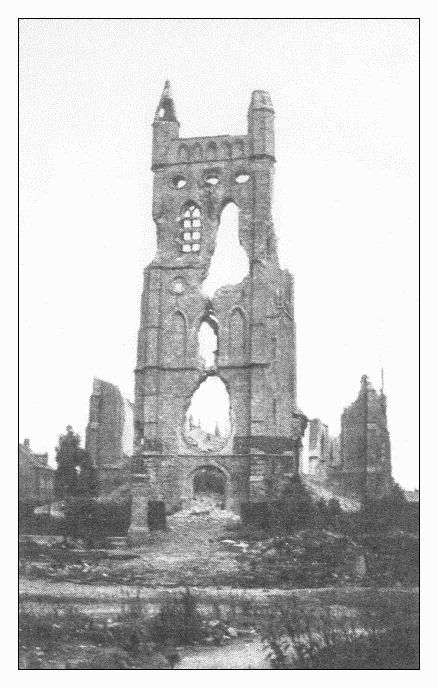
Page 127
"THE CHAUFFEUR REACHED THE
OPEN PLACE BY THE CHURCH"
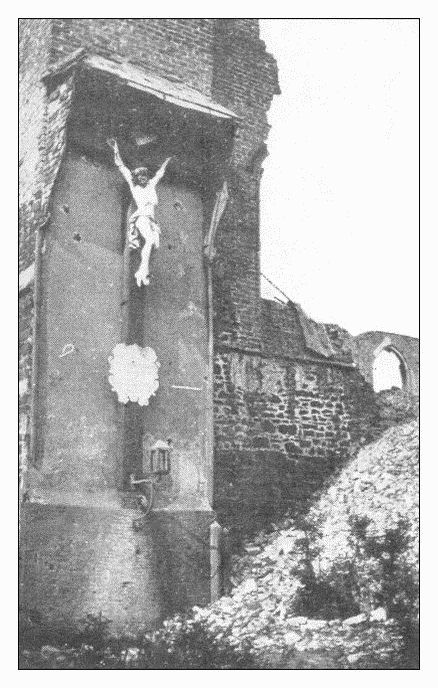
Page 127
ON THE SHATTERED CHURCH HUNG
THIS CRUCIFIX INTACT THOUGH
SURROUNDED BY SHRAPNEL HOLES
The guns had, of course, by now resumed
work after their lunch-time siesta and were
grumbling away at each other in great shape.
Presently we came to a deserted village, which
could be seen from some of the German artillery
positions and which they shelled on the
slightest provocation. The General had particularly
told us to run through the village in
a hurry, especially across the open place around
the church. When we got safely out of the
other end of the place, he had said, we might
leave our motor and sneak back on foot to take
photographs. This having been carefully explained
to the chauffeur, he bumped us swiftly
down the ruined main street, reached the open
place by the church, where he had to turn to
the right, came suddenly on top of a big, deep
shell-hole, just dodged it by slapping on his
emergency, and stood stock-still trying to get
into first speed.
The Commandant cursed and I swore, the
Commandant's orderly sitting next the chauffeur
shook his fist at the chauffeur, and the
chauffeur shook one fist at his gears while with
the other he wrenched and hauled at his lever.
There is no use denying that we were all
equally nervous. Every instant we expected
to see the first of a stream of shells explode near
us. Finally, after the suspense had in reality
lasted not more than six or eight seconds, the
accursed low gear meekly meshed and we
bumped off down the side-street, heaving deep
sighs of relief.
Outside the utterly ruined village we left
our car behind a clump of trees and walked
back to take some photographs of what had
been the church. Then into the motor and on
again till we stopped at the cross-road which
led directly to the front.
Here we left our motor. The rain suddenly
beginning to come down in sheets, we ducked
into a ruined house whose roof some freak of
the shells had allowed to remain quite intact.
We were quickly joined by about fifty infantrymen
who had been working at a reserve line
of intrenchments in the fields outside. Here
we all waited for ten minutes till the rain-squall
stopped.
It may not be a particularly pretty subject,
but I think it well worth stating that that mass
of soldiers, packed into the small inclosed space,
left the air as pure and untainted at the end
of those ten minutes as it had been before they
jammed their way in. I had noticed the same
thing the day before during the two hours that
I had spent by the howitzer with the nine men
of the crew. There is no doubt about it that
even the English—who of course originally invented
and patented personal cleanliness in
this world—will have to scrub exceedingly
hard to keep up with the Belgians.
The rain having stopped, we slipped and
slithered on foot along the byroad till we came
to a prairie-dog village of bomb-proofs with
soldiers' heads popping out of the little openings
and then popping in again. Here we met
a young First Lieutenant, who very kindly offered
to show us the quickest way to the communicating
trench, and off we marched.
At this point we were just about half-way
between the two opposing bodies of artillery.
High in air, right above our heads, the shells
of the two armies, hurtling along in opposite
directions, met and passed each other on their
way. These big projectiles in passing over
us sounded exactly as if they were running
along aerial rails. You could hear them rattling
along these rails, bumping over the rail
joints, banging over switches. It was a perfect
illusion. By closing your eyes you could
have sworn that you were standing under
Brooklyn Bridge hearing the procession of
street-cars, with silenced gongs, roll by at express
speed overhead. First there would be
a distant report, then silence as the shell rose,
and then suddenly it would get on the rails,
rattle up to the top of its grade, coast down
the grade the other side and leave the tracks a
second or two before the final explosion.
Some ten minutes later we were walking
along a broad road, with the noise of exploding
shells getting louder and louder ahead. Then
suddenly a perfect swarm of bullets came chirping
past us.
"Just this little bit of the road is visible from
the German lines," remarked the Lieutenant.
"They are about 500 metres away from us
here."
It must have been comical to see the way in
which the Commandant, his orderly and I did
an Indian war-dance down that road, all three
bent double. The Lieutenant must have caught
the contagion from us, for, as more bullets
came by, zeup! zeup! zeup! he doubled up himself.
In a few seconds, however, he said we
were out of sight again, and so we straightened
up and walked forward proudly erect, although
every little while when some bullets went by
just over our heads we showed distinct tendencies
to collapse anew.
Now we came to the communication trench
and climbed down into it one after the other.
It was very different from the French "boyaux,"
or communicating trenches. Those were dug
a good seven feet deep almost everywhere, and
never less than six feet. So that one could walk
about in them at one's ease without paying
any attention to the bullets that cracked up
above. Only a shell plunging directly into
one of these three feet wide, seven feet deep
ditches could be dangerous.
But the Belgians could not dig down more
than about two and one-half feet at the most
without striking water. That, with an earth
and sod rampart about two feet high, gave a
protection never more than five feet at its
highest and often under four feet in height.
Now, it probably sounds very easy to keep
sheltered while walking along behind four feet
of ditch and parapet, but if any one tries it for
more than five minutes at a time he will know
what a real backache feels like.
This trench, which ran forward in very short
abrupt zigzags, was floored with pieces of wicker-work
to prevent sinking into the mud. The
half-hour's rain had filled long stretches of it
ankle-deep with water.
Crouched double, we waded along in single
file, the Lieutenant, myself, the Commandant
and his orderly. The bullets were striking some
ruined farm buildings close on our left with
sharp cracks. They hit the breastworks with
muffled thuds and passed close over the breastwork
with a kind of buzzing whistle. We
paddled along till suddenly we came to a place
where, for some unaccountable reason, the
trench stopped, renewing itself again perhaps
three or four yards further on. Across the unsheltered
surface of the ground which intervened
ran a slack telephone wire some two feet
above the ground.
"You'd better hurry up across here," remarked
the Lieutenant as he scrambled out of
the trench, took a couple of strides, swung
first one leg and then the other over the telephone
wire, took a couple of strides more and
dropped into the trench beyond.
There is not the slightest question as to the
hurry in which I negotiated this obstacle. Then,
to see what I must have looked like, I turned
to watch the two who were following me. The
Commandant, I must confess, managed to accomplish
the feat in a fashion not wholly destitute
of dignity. But the way his orderly
bounded out of the trench, hurdled the telephone
wire and with one lithe leap descended
upon us in the other trench was a sight for sore
eyes. It certainly must have drawn a chuckle
from the German sharpshooters witnessing it
through their telescopic sights.
A hundred yards or so further on we came to
a halt at an angle in the communication trench
from which could be had a good view of the front.
Lifting my head cautiously till my eyes were
just above the edge of the rampart, I could see
some 250 yards ahead the chocolate-colored
back of the Belgian front trench. For where
the chalky soil of Champagne makes the
trenches there very white in color, the boggy
soil of Belgium is a rich brown.
Beyond the Belgian front trench ran a line
of tall trees; beyond the line of trees again
ran another brown line.
"That's the German front line, I suppose?"
I said to the Lieutenant.
"No, that's their second line you're looking
at. Raise your head a little more, and right
over the top of our front-line trenches you'll
see their front line."
I craned my neck, and, sure enough, another
brown line hove into view apparently only a
few yards ahead of the Belgian front line, with
the usual barbed-wire tangle in front of it.
"That trench is about 100 metres from our
front trench," said the Lieutenant. "The Germans
have got all that barbed wire before
their front trench, but we don't need wire
because we have the Y—— Canal right before
our front trench. Only it flows so close under
the breastworks that you can't see it from
here."
A great cloud of jet-black smoke suddenly
welled up from the Belgian front trench.
"Ah, that's a six-inch bomb they've thrown
into our trench with one of their 'minenwerfer,'"
exclaimed the Lieutenant.
The report of the explosion from where we
stood, not more than 250 metres away, was not
loud.
The artillery was hard at it. Big clouds of
black smoke rose sluggishly by the German
trench where the Belgian high-explosive shells
were bursting. Livelier clouds of white indicated
the shrapnel explosions.
I was craning my neck to see what damage
was being done the German trench when a
whole swarm of bullets struck very close indeed
to my head. The Lieutenant pulled me
down into the trench.
"They shot at you that time, all right!" he
laughed.
"Impossible!" I answered. "I can only
barely see their trench over the top of your
first-line trench, so how could they possibly
see me from there?"
"Ah, but they were not shooting at you from
there. They are up in the tops of some of those
trees," he explained, pointing to the row of
tall, innocent-looking trees. "Their sharpshooters
climb up at night and snipe from there
all day, and those of them whom we do not
locate and kill climb down again the next
night. They have telescopic sights on their
rifles, and these rifles are mounted on little
tripods so that they can fix their aim immovably
on some spot where they think they have
seen a movement; and the next time the movement
comes, ping! Only I don't think they
can use the tripods up in the trees."
At the Lieutenant's suggestion we scattered
down along the trench in case our little crowd
might have been observed from a tree and an
artilleryman might try his luck on us.
Further down the trench where I took my
new stand I went on watching the shells burst,
and listening to the projectiles from the opposing
sides go rattling along their invisible
rails high overhead.
A little off to our right the French 75's were
firing so quickly that I hoped it would develop
into the famous "trommelfeuer" ("drum-roll
fire," as the Germans call it), but it did not.
We had received word that they were going
to fire 400 rounds at some objective whose nature
I did not learn. They certainly were
firing them, and losing no time about it, either.
I could not see their shells burst, as the lines
took a turn just to our right and disappeared
behind some trees.
At the points where the armies of different
nationalities connect they are always scrupulously
careful to inform each other what artillery
work they have in preparation, so that
a sudden violent cannonade on the part of one
army will not alarm the next with the idea that
a German assault is being resisted.
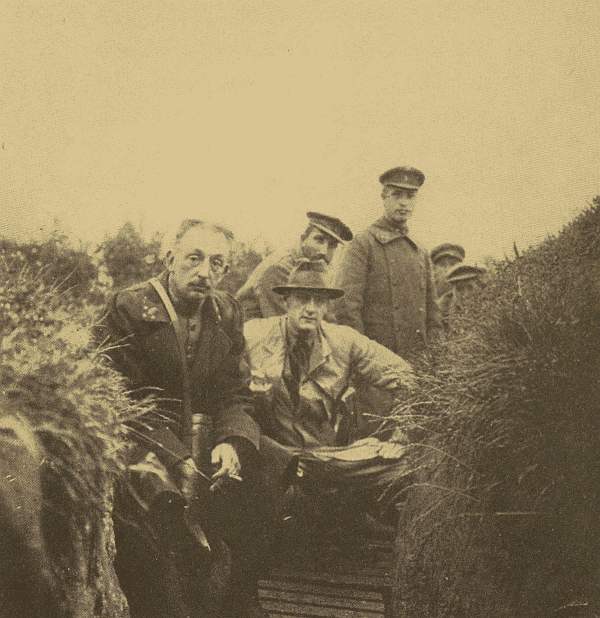
Page 135
UNDER HEAVY FIRE IN A BELGIAN COMMUNICATING-TRENCH.
(THE FIGURE STANDING UPRIGHT JUST BEHIND THE AUTHOR
IS THE LIEUTENANT, WHO STRAIGHTENED UP DURING THE
MOMENT THE SNAPSHOT WAS BEING TAKEN BUT WAS NOT HIT)
It was particularly interesting to watch the
Belgian soldiers, who every few yards squatted
placidly in the trench, short spades and trowels
in hand, busily engaged in digging little pits
about two feet deep in the bottom of the trench,
and then scooping out little channels running
to these pits. These channels would drain the
surrounding yard or two of trench bottom into
the pits, leaving muddy patches where a moment
before three or four inches of water had stood.
There the Belgian soldiers squatted like children
making mud pies at the seashore, and
chatted complacently in Flemish while they
fought the enemy, who was only less hateful
to them than the Germans. A splendid, cool,
nerveless lot of men, doing their work unostentatiously
but efficiently, neither dashing on
the one hand nor dogged on the other, but
gifted with the admirable morale of the imperturbably
matter-of-fact.
Suddenly I heard an exclamation from one
of the soldiers. Looking where he pointed, I
saw, just beyond the Belgian front trench, a
huge column of muddy water standing bolt
upright against the horizon. It stood there
motionless until I began to think it would remain
a permanent fixture in the landscape.
Then it suddenly collapsed. A Belgian shell
falling short had soused down into the Y——
Canal and exploded, sending up this five-story
waterspout.
It seemed a shame not to go forward into the
front trench, but with the Germans lobbing
six-inch bombs in there with their "mine
throwers" and the artillery getting busier all
the time, the Commandant thought it would
be taking too great risks. So we turned and
crouched along back. As we did so, it is worthy
of comment, three German shells struck not
far to our left at not more than half-a-minute
intervals and not one of the three exploded.
It was a striking example of faulty explosives.
We returned by a different trench, so that
we did not have to repeat the acrobatic feat
over the telephone wire. But we had a little
excitement to make up for it, for, as I splashed
along with a most intense crick in my bent
back, one of the German projectiles, which
was apparently running on perfect schedule
along its overhead rails on its way toward the
Belgian artillery, suddenly jumped the track
and came hissing down toward us.
Simultaneously with the crash of the explosion
I saw the men ahead of me passionately
hugging the bottom of the trench, and I found
myself on my knees and elbows, not a whit
behind them in my devotion.
"That was a close one," said Captain L——.
"What was it—a 75?" I asked.
"Seventy-five nothing," he replied; "that was
a 150 millimetre, and it exploded within thirty
metres of your head. There—see for yourself.
If we had not been in the trench that would
have caught us nicely!"
I peeped over the edge of the trench and
there, sure enough, was a big cloud of sooty
black smoke wallowing up from behind some
broken masonry not more than thirty yards off.
"Filons!" ("Let us beat it!") said the Commandant
tersely, and we did.
The great lesson that a visit to England,
France and what remains of Belgium to-day
will teach any one who is willing to be
taught by hard facts and not by wistful visions
is that peace in the near future is quite impossible.
For the only peace, in the conviction
of the Allies, that will end this war is a
peace neither of conciliation nor of compromise,
but a peace whose terms are arbitrarily imposed
by one side and of necessity submitted
to by the other.
That is the end to which the Allies are determined
to fight, whether that end is achieved
by the more merciful method of decisive military
victory or must be gained by the more
terrible pressure of complete financial, industrial
and economic prostration.
Any attempt to abort this object by mediatory
proposals, whether Pontifical or Presidential,
the Allies frankly declare they would
consider an inopportune impertinence.
I have had the privilege of studying the
spirit of the English, the French and the Belgians
at a time when that spirit was being
severely tested—when their fortunes were at
their lowest ebb since the days just before the
battle of the Marne. Their spring advance
had utterly failed to materialize; throughout
the summer they had been held in almost
complete check by the Germans' depleted line.
The Dardanelles had turned out to be a slaughter-house,
with success appearing more and
more precarious, and the only alternative to
success seeming to be disaster.
The starvation of Germany had become a
conceded impossibility. Her dearth of rubber,
copper, cotton, etc., had assumed more and
more the nature of a superable handicap
rather than a decisive crippling. Her financial
situation had already made fools of so many
economic seers that they had become less and
less didactic regarding her impending bankruptcy.
The practical success of allied diplomacy
among the Balkan neutrals had grown to seem
more and more dubious.
Finally, Russia had been so manhandled
that in the opinion of British and French military
authorities with whom I talked it would
take her from one to two years to reorganize
her armies into condition for an effective offensive.
Yet, in spite of all these admitted disadvantages,
I did not meet a single Frenchman, Englishman
or Belgian who was not sincerely
confident of ultimate victory. But only an
ultimate peace could, in their conviction, be
victorious. An immediate peace, or a peace in
the near future, no matter what the German
concessions, would for the Allies be the peace
of defeat.
From Germany must come, not concessions,
but abandonments, or the war, with all its
hideous sacrifices unredeemed, would be a
failure. Such an artificially fabricated peace,
such a compromise between irreconcilable principles,
would be but the prelude, more or less
dragged out, to a fresh conflict.
I have talked to men and women of many
classes, of many degrees of education and of
many grades of intelligence. I found their
views unanimous and their reasons for these
views so constantly the same as finally to seem
almost hackneyed.
I am aware of the existence in England of
such a body of peace propagandists as the
Union of Democratic Control, and in Holland
of some French pacifists, and scattered here
and there of Internationalists. But of all the
men and women with whom I casually talked
there was not one who shared these gentlemen's
views.
Of all the French statements of reasons why
the war must go on, which were iterated and
reiterated to me, the best came from a prince,
a retired naval captain and a little dressmaker.
Unfortunately, they may not be quoted by
name.
The prince said: "After this taste of blood
the world can never remain long at peace
while any powerful nation dedicates itself to
the ideals and instincts of militarism. Germany,
under the guidance of Prussia, is to-day
such a nation. These aims and instincts
have been so thoroughly absorbed by her
people that, even if they sincerely wished to,
these people could not eliminate them inside
of two or three generations. It is ludicrous to
imagine that these characteristics, which have
become nearly if not quite hereditary, could
be negotiated out of them. They must be
subjugated out of the German people."
The naval captain said: "It is a mere matter
of arithmetic. It can be easily demonstrated
that at the end of this war, with its
cost on her shoulders, if France does not immediately
reduce her armaments to a minimum
she is absolutely bound to go bankrupt. Now,
as we cannot conceivably trust any mere promises
of disarmament which Germany might
make, it is obvious that we must go on with
this war until we have reduced her to such a
condition that we can enforce disarmament
upon her, and thus safely enjoy its benefits
ourselves."
The little dressmaker said: "My husband
has been fighting at the front for months. It
would be natural for me to wish the war to
end to-morrow, no matter on what terms, if I
could get my husband back before he is killed.
But I want the war to go on until the 'Boches'
are crushed; otherwise in another ten years or
so there will be a new war, and then they will
come and take away not only my husband,
but my son as well."
In England the same line of reasoning prevailed.
And the fact cannot be too strongly
emphasized that this reasoning did not take
the shape of stock arguments devised by politicians
to bolster up some expedient course
and drilled into the people for parrot-like
repetition. The arguments were the spontaneous
expression of the heartfelt convictions
of all these people.
Intelligent opinion in England ranges between
the two statements made to me, respectively,
by a very famous Tory statesman
and administrator, and by one of the best-known
Liberal statesmen in English public life to-day.
The first of these was terse and to the point:
"It is the greatest mistake for your Government
to feel that the United States can, by remaining
neutral, help to bring the war to a
close. This war will be fought to a point where
no mediation will be possible or needed. No
peace with Germany, signed with a Hohenzollern
in power, would be worth more than
twenty years' peace to the world. To make
Germany's promises binding on her, her people
have got to have a share in her foreign policy,
and that they cannot have under the present
dynasty or system."
The second statement was:
"The best information that I can obtain
from Germany is that, if she wins, the advanced
party, which is in the ascendancy,
plans to erect Poland into a semi-independent
kingdom, contributing to it that portion of
Poland which Germany herself now possesses.
She will annex Belgium, probably a strip of
Northern France, and possibly enough of Holland
to give her command of the mouths of
the Scheldt and Rhine.
"Personally I cannot feel it to be unreasonable
from her point of view that she should
plan to correct a situation where her great
water artery, the Rhine, is bottled up at its
outlet. She will also take all Courland, and
this, too, is not so unreasonable, since the
population is far more German than Russian.
Nevertheless, if such geographical and ethnological
changes as these were accomplished and to
be maintained, who can conceivably imagine that
Germany can afford to modify her militarism?
"My own views as to what the general terms
of peace should be if the Allies win are shared
by men in both England and France whose
opinions will have weight in the peace negotiations.
They are:
"To erect an independent Polish kingdom
or state; to reconstitute Belgium with indemnity;
to hold a plebiscite in Alsace-Lorraine,
taken by a neutral, preferably the United
States, in order to determine to whom
they should belong, and in what proportions; to
dismember Turkey, excepting Anatolia, which,
being strictly Turkish, should be left to the
Turks; to enforce a very large degree of disarmament
upon Germany and Europe; to
leave the German-speaking German Empire
intact. (This talk about the deposition of the
Hohenzollerns as one of the peace terms is
sheer impertinence.)
"Now, you must readily perceive that any
peace made in the near future must conform
or approximate to the German plans which I
have outlined and must involve a continuance
of militarism and a standing incitement to
fresh wars. While a peace on the terms which
we favor, a peace that will perpetuate peace,
must be wrung from a decisively beaten Germany,
and is therefore a long way off. That
is why we shall have to go through a very bad
time of it for some period to come, and why our
ultimate victory will be at least one year, and
possibly two or three years off."
The keenest realization that victory will be
slow, the completest confidence that its certainty
is axiomatic, is to be found in the allied armies.
There, ungrudgingly, they give the Germans
fullest credit for their preparedness, for their
foresight, for their powers of systematic and
sustained labor, for their inventiveness. And
they do not waste their time trying to devise
discrediting substitutes for such words as "ability"
in talking of their Generals, "courageousness"
in talking of their soldiers, and "patriotism"
in talking of their people. It is only
when you get far behind the firing line that
manliness merges into meanness in estimating
the enemy.
Yet these very officers who paid such soldierly
tributes to their antagonists were so
wholly assured of eventual victory that any
scepticism on my part did not irritate them,
but merely moved them to good-natured smiles.
"So far," an English staff-officer remarked
to me, "we English have been bungling amateurs
in the art of war contending against
trained professional specialists. But with a
couple of years' more experience I believe we
shall know as much about it as they do, and
then we shall win."
"In the last analysis, talking from the military
standpoint, this war, like every war, will
be won by men," said a French staff-officer.
"The Germans will not be beaten through lack
of guns or ammunition or machinery or supplies,
but through lack of men. How long by
the aid of mechanics they can postpone the
hour when the lack of men becomes fatal to
them I do not know—one year, two years.
But in the end, with the allied man-power
steadily growing, and the German man-power
steadily lessening, their military collapse is inevitable."
These are typical of a score of similar views
advanced by officers, from Generals down to
subalterns.
In the French army, as they show you their
elaborate machine-shops mounted on motor-lorries
for the repair of all the vehicles in the
transport service, they will say with the most
complete conviction: "This mobility is not
of much importance now, but when we begin
the pursuit of the 'Boches' then they will
come in handy!"
When they show you their great parks of
supply-trains, each carrying three days' complete
provisions for one army corps, they will
tell you earnestly:
"Not much use now when the railroads do
most of the carrying of supplies to the armies,
but wait till the advance begins and then we
shall be useful!"
When they let you examine their wonderful
75's, mounted on an automobile capable of
doing over thirty miles an hour over the road,
and of starting a stream of twenty-five shells a
minute one minute after coming to a standstill,
they will shrug their shoulders and say: "Something
of a waste just now, perhaps, but when
the advance is on they will do wonderful work!"
The advance! The advance! is in all their
minds.
"But when will the advance begin?" you ask
a chalk-powdered infantryman sweating in the
sun-soaked trenches.
"Ah!" he will answer with complete unconcern.
"Not yet, Monsieur. They say next
spring or next summer. But then 'On les
aura!'" ("We'll get them!")
And that unconcern means far more than appears
on the surface. It means that the "poilu"
knows he will have another winter in the
trenches, with all the terrible discomforts that
soldiers dread so much more than they dread
danger. He knows it, and is completely reconciled
to it.
"That was the one thing we feared"—a
French General admitted to me—"the effect
on the men's morale of the certainty that they
would have another winter in the trenches.
But they know it now, and 'ils s'en fichent!'"
(to which the nearest American slang equivalent
would be "they should worry!")
In the amazing New France (which the
French prefer to consider a reincarnated rather
than a transformed France) the people are as
determined as the army. A short time ago,
when the authorities first began to give the
soldiers at the front their "permissions" to go
home for three days, they did so with considerable
apprehension that the home
influence on the soldier might be a disheartening
one.
But, on the contrary, the reunion seemed to
give mutual encouragement. The soldier braced
up the "home folks'" confidence and pride in
the army, and the home folks stimulated the
soldier's confidence and pride in himself. Thus
the experiment has turned out a great success.
The politicians and their fermentations are,
in France, the bugbears of the army officers.
This feeling of aversion and contempt extends,
so far as I could make out, down through the
rank and file. They feel that when a nation
is at death-grips with its enemy even the most
beautiful of democratic theories should be safely
locked away with other luxuries; that the politicians
should confine their activities to voting
the funds necessary for the successful prosecution
of the war, and should leave the conduct
of the war severely alone.
But in France even those politicians who
hanker after a finger in the military pie are
unanimous for seeing the war through to a decisive
victory. They may play politics about
whether the Government should or should not
have been removed from Paris to Bordeaux
last September; they may squabble over whether
General Sarrail is the persecuted military
genius of the war or an incompetent officer
whose removal from Verdun should never have
been sugar-coated by his appointment to Gallipoli;
they may intrigue to oust Millerand
from the War Ministry and try to get together
on Briand for his place; they may stick loyally
to Joffre because an old man who is fond of
fishing is not likely to become an old man on
horseback.
But, whether tirading against the evils of a
bureaucracy or perorating against the iniquities
of the censorship, you will find the politicians
of France, Royalists, Clericals, Conservatives,
Radicals and Socialists with all their subtle
subdivisions, having proved their patriotism
by the greatest sacrifice of which a politician
is capable—having for nigh on ten months
kept silent!—earnestly and honestly working
for their country. They are striving, not for
the quick peace of compromise which would
relegate the silent, efficient soldiers to their
subordinate powers and would restore to themselves
all the prestige of full-throated eloquence,
but for the deferred and definitive peace of
victory, with all the continuance of second-fiddling
to which such a postponement subjects them.
It is indeed fortunate for the alliance that
France—Army, Government and People—is
united in the determination to fight this war
through to its logical conclusion. For France
is apt to be the nation which pays the piper.
England is physically safe behind her fleets,
Russia proper is physically safe behind her distances,
for the German invasion is not apt to go
far beyond her alien provinces of Courland and
Poland.
But France is not at sword's length, but at
dagger's point, with her enemy—one little slip
by any one, from an absent-minded General
down to a sleeping sentinel, and she may become
not a defeated, but a conquered nation.
And this you can see in the faces of the
French to-day. Not anger, not bitterness, not
sadness; neither excitement nor despondency
is in their faces, but a look of hushed and solemn
suspense. It is a nation with straining ears,
with straining eyes, with bated breath, waiting,
waiting.
After leaving the hush of France, England
appears at a disadvantage largely undeserved.
Compared with the atmosphere of strain in
Paris, the atmosphere of London seems one of
relaxation. Contrasted with the breathless
struggle for self-preservation in France, the
British attitude toward the war seems almost
dilettante.
This is unquestionably due in part to the
fact that in England a very literal-minded race
is shipping its soldiers to fight in merely geographical
localities for seemingly abstract principles.
The trouble is that England has the
Channel and France has the imagination. It
is obvious how markedly stronger the combination
would be if Britain were fighting an invader
and France were fighting for a sentiment.
The superficial impression of holiday soldiering
that one gets in England is emphasized
by the British hatred of the dramatic and the
British worship of sport. The British go on
laughing, dining, play-going, dancing, supping;
in fact, frivolling, because they think it would
be melodramatic to forswear these pursuits because
of the war. They go on cricketing, racing,
fishing, shooting, hunting, because they go on
eating, drinking, sleeping and bathing. These
are part of the bodily functions of the Briton.
To any other nation, sport, no matter how
intimate a part of the national life, in certain
emergencies becomes trivial. To say that to an
Englishman would be equivalent to saying that
under any circumstances childbirth or prayer
could be trivial. It is a national characteristic
which must simply be accepted.
The impression made on superficial observers
by these manners and habits of casual unconcern
does England a certain injustice. For as far
as her duties to her allies are concerned she has
undoubtedly gone far beyond her obligations.
As one of her Cabinet members (a man who
may well be her next Prime Minister) put it to
me:
"The best two ways that I know of to prove
one's devotion to a cause are to pay for it and
to die for it. England is voluntarily doing both
in far greater measure than her commitments
call for. When the war started she agreed to
help France on land with an army of 150,000
men. She has now raised an army of 3,000,000
men.
"When the war started she agreed to assume
the naval responsibility of protecting the coast
of France. She has not only done that, and
incidentally driven Germany from the seas, but
she has thrown her ships into the attack on the
Dardanelles and has helped Russia with her
submarines in the Baltic.
"When the war started there was a financial
understanding between England and France.
England has not only carried out her share in
this understanding, but has been instrumental
in the financing of Italy, and stands ready to
assume further similar responsibilities in the
Balkans.
"How any candid mind in the face of such
a record can charge Great Britain with shirking
her share in the war passes my understanding."
There is no doubt about the truth of this.
To get the voluntary gift of three million lives
within one year, to get the voluntary loan of
£600,000,000 in less than one month is probably
an unparalleled achievement. Great Britain
has done far more than her duty to others
called for. And yet the question will not be
smothered: Is she doing all that is called for
by a strong, far-seeing nation's duty to itself?
She has thrown into the scales all the peculiar
assets of a democracy in spontaneous zeal and
voluntary sacrifice. But can a really great
nation in such a crisis as this afford to be the
recipient of only those contributions, no matter
how prodigal, which are spontaneous and voluntary?
Can a really proud nation afford to
base its career at such a time upon the charity
of its citizens? With Russia on the one hand
purging herself of the bureaucratic evils of
absolutism and forcing upon herself the pains
of democratization, with France, on the other
hand, sacrificing for the time her most cherished
principles of republicanism in order to substitute
the efficiency of Authority for the waste
motions of Democracy, can England afford to
remain complacently convinced that she represents
the happy mean between these two
extremes—a mean which needs no modifying?
Can England as a nation continue with admiring
acquiescence to watch the cream of her
manhood spend itself in Flanders and the
Dardanelles; continue with deprecating acquiescence
to watch the skimmed milk of her
manhood preserve itself at home for the sacred
duty of fathering a future generation?
Can England acquiesce placidly in the professional,
the business, the financial sacrifices
generally which so many Englishmen are splendidly
making, and acquiesce plaintively in the
disgusting treason whose guilt was shared
in varying measure by the gouging coal-owners
and the striking coal-miners of Wales?
Can England set out to curb the drunkenness
which in certain parts is crippling her ammunition
production and then sink back into acquiescence
in the temporizing compromise which
taxed drunkenness instead of terminating it?
Can England, in fine, afford to preserve Personal
Liberty at the slightest risk of imperilling
National Liberty?
Perhaps England can. Perhaps England must.
So long as England fulfils and far exceeds
her covenants with her allies it is not a question
for them to answer. It is assuredly not a question
to which any neutral visitor can with
seemliness hazard a solution.
It is not even a question, in my opinion,
which is apt to affect the ultimate outcome of
this particular war.
But it is a question to which on some future
day Macaulay's New Zealander will, with positiveness
and propriety, be in a position to find
the answer.
Transcriber's Note:
Obvious typographical errors have been corrected.
Printer's inconsistencies in the use of accents, hyphens, and punctuation have been retained.
The original spelling has been used except where there was good reason to correct it.
Misprints and misspellings corrected in the text:
"avions de reglage" changed to "avions de réglage" (page 3).
"fusilage" changed to "fuselage" (page 4).
"aviatiks" changed to "Aviatiks" (page 4).
"pilot- spotted" changed to "pilot spotted" (page 10).
"practise" changed to "practice" (page 33).
"departs" changed to '"départs"' (page 57).
"leant themselves" changed to "lent themselves" (page 86).
"scrupulously cleanly" changed to "scrupulously clean" (page 100).
"drommelfeuer" changed to "trommelfeuer" (page 136).
Unusual words:
The word "exterpreting" appears on page 78. It is not a spelling mistake
but neither has an adequate definition been found. From the context in which it is
used it might be an amusing play on the word "interpreting."
Back to top