For obvious reasons I cannot describe the man to whom I applied for
the passport, nor the house in which he lived. While, in view of what
subsequently happened, I would not be very much concerned if he got into
trouble for having dealt with me, I realize that the hardships he had
endured in common with all the other inhabitants of that conquered city
may possibly have distorted his ideas of right and justice, and I shall
not deliberately bring further disaster on him by revealing his identity.
This man—we will call him Huyliger, because that is as unlike his
name as it is mine—was very kind to me on that memorable night when I
aroused him from his sleep and in a few words of explanation told him of
my plight.
He invited me inside, prepared some food for me, and, putting on a
dressing-gown, came and sat by me while I ate, listening with the
greatest interest to the short account I gave him of my adventures.
He could speak English fluently, and he interrupted me several times to
express his sympathy for the sufferings I had endured.
"O'Brien," he said, after I had concluded my story, "I am going to
help you. It may take several days—perhaps as long as two weeks, but
eventually we will provide the means to enable you to get into Holland!"
I thanked him a thousand times and told him that I didn't know how I
could possibly repay him.
"Don't think of that," he replied; "the satisfaction of knowing that I
have aided in placing one more victim of the Huns beyond their power to
harm him will more than repay me for all the risk I shall run in helping
you. You'd better turn in now, O'Brien, and in the morning I'll tell you
what I plan to do."
He showed me to a small room on the second floor, shook hands with me,
and left me to prepare for the first real night's rest I had been able
to take in nearly two months.
As I removed my clothes and noticed that my knees were still swollen to
twice their normal size, that my left ankle was black and blue from the
wrench I had given it when I jumped from the train, and that my ribs
showed through my skin, I realized what a lot I had been through. As a
matter of fact, I could not have weighed more than one hundred and fifty
pounds at that time, whereas I had tipped the scales at one hundred and
ninety when I was with my squadron in France.
I lost no time in getting into bed and still less in getting to sleep.
I don't know what I dreamed of that night, but I had plenty of time to
go through the experiences of my whole life, for when I was aroused by a
knock on the door, and Huyliger came in, in response to my invitation to
enter, he told me that it was nearly noon. I had slept for nearly twelve
hours.
I cannot say that the thought did not run through my head that perhaps,
after all, I was living in a fool's paradise, and that when Huyliger
reappeared it would be with a couple of German soldiers behind him,
but I dismissed such misgivings summarily, realizing that I was doing
Huyliger an injustice to let such things enter my head even for an
instant. I had no right to doubt his sincerity, and it would do me no
good to entertain such suspicions. If he was going to prove treacherous
to me, I was powerless, anyway, to cope with him.
In a few moments my host appeared with a tray containing my breakfast.
I don't suppose I shall ever forget that meal. It consisted of a cup of
coffee—real coffee, not the kind I had had at Courtrai—several slices
of bread, some hot potatoes, and a dish of scrambled eggs.
Every mouthful of that meal tasted like angel-food to me, and Huyliger
sat on the edge of the bed and watched me enjoying the meal, at the same
time outlining the plans he had made for my escape.
In brief, the scheme was to conceal me in a convent until conditions
were ripe for me to make my way to the border. In the mean while I was
to be dressed in the garb of a priest, and when the time came for me to
leave the city I was to pretend that I was a Spanish sailor, because
I could speak a little Spanish, which I had picked up on the coast.
To attempt to play the part of a Belgian would become increasingly
difficult, he pointed out, and would bring inevitable disaster in the
event that I was called upon to speak.
Huyliger said I would be given sufficient money to bribe the German
guards at the Dutch frontier, and he assured me that everything would
work out according to schedule.
"Yours is not the first case, O'Brien, we have handled successfully," he
declared. "Only three weeks ago I heard from an English merchant who had
escaped from a German detention camp and come to me for assistance, and
whom I had been able to get through the lines. His message telling me of
his safe arrival in Rotterdam came to me in an indirect way, of course,
but the fact that the plans we had made carried through without mishap
makes me feel that we ought to be able to do as much for you."
I told Huyliger I was ready to follow his instructions and would do
anything he suggested.
"I want to rejoin my squadron as soon as I possibly can, of course," I
told him, "but I realize that it will take a certain length of time for
you to make the necessary arrangements, and I will be as patient as I
can."
The first thing to do, Huyliger told me, was to prepare a passport. He
had a blank one and it was a comparatively simple matter to fill in the
spaces, using a genuine passport which Huyliger possessed as a sample
of the handwriting of the passport clerk. My occupation was entered as
that of a sailor. My birthplace we gave as Spain, and we put my age at
thirty. As a matter of fact, at that time I could easily have passed for
thirty-five, but we figured that with proper food and a decent place
to sleep in at night I would soon regain my normal appearance and the
passport would have to serve me, perhaps, for several weeks to come.
Filling in the blank spaces on the passport was, as I have said, a
comparatively easy matter, but that did not begin to fill the bill.
Every genuine passport bore an official rubber stamp, something like an
elaborate postmark, and I was at a loss to know how to get over that
difficulty.
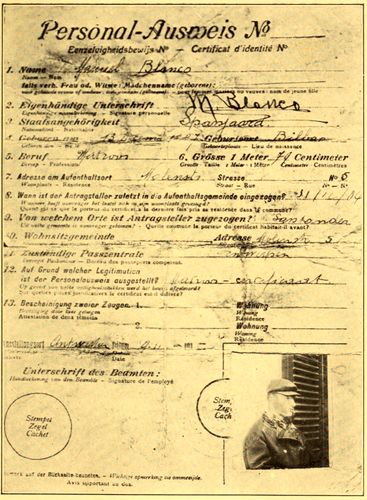
THE FORGED PASSPORT PREPARED IN A BELGIAN CITY TO AID
LIEUTENANT O'BRIEN'S ESCAPE INTO HOLLAND, BUT WHICH WAS NEVER USED
Fortunately, however, Huyliger had half of a rubber stamp which had
evidently been thrown away by the Germans, and he planned to construct
the other half out of the cork from a wine bottle. He was very skilful
with a penknife, and although he spoiled a score or more of corks before
he succeeded in getting anything like the result he was after, the
finished article was far better than our most sanguine expectations.
Indeed, after we had pared it over here and there and removed whatever
imperfections our repeated tests disclosed, we had a stamp which made
an impression so closely resembling the original that, without a
magnifying-glass, we were sure it would have been impossible to tell
that it was a counterfeit.
Huyliger procured a camera and took a photograph of me to paste on the
passport in the place provided for that purpose, and we then had a
passport which was entirely satisfactory to both of us and would, we
hoped, prove equally so to our friends the Huns.
It had taken two days to fix up the passport. In the mean while,
Huyliger informed me that he had changed his plans about the convent,
and that instead he would take me to an empty house where I could remain
in safety until he told me it was advisable for me to proceed to the
frontier.
This was quite agreeable to me, as I had had some misgivings as to the
kind of a priest I would make, and it seemed to me to be safer to remain
aloof from every one in a deserted house than to have to mingle with
people or come in contact with them even with the best of disguises.
That night I accompanied Huyliger to a fashionable section of the city
where the house in which I was to be concealed was located.
This house turned out to be a four-story structure of brick. Huyliger
told me that it had been occupied by a wealthy Belgian before the
war, but since 1914 it had been uninhabited save for the occasional
habitation of some refugee whom Huyliger was befriending.
Huyliger had a key and let me in, but he did not enter the house with
me, stating that he would visit me in the morning.
I explored the place from top to bottom as well as I could without
lights. The house was elaborately furnished, but, of course, the dust
lay a quarter of an inch thick almost everywhere. It was a large house,
containing some twenty rooms. There were two rooms in the basement,
four on the first floor, four on the second, five on the third, and
five on the top. In the days that were to come I was to have plenty of
opportunity to familiarize myself with the contents of that house, but
at the time I did not know it, and I was curious enough to want to know
just what the house contained.
Down in the basement there was a huge pantry, but it was absolutely
bare, except of dust and dirt. A door which evidently led to a
sub-basement attracted my attention, and I thought it might be a good
idea to know just where it led in case it became necessary for me to
elude searchers.
In that cellar I found case after case of choice wine—Huyliger
subsequently told me that there were eighteen hundred bottles of it. I
was so happy at the turn my affairs had taken and in the rosy prospects
which I now entertained that I was half inclined to indulge in a little
celebration then and there. On second thoughts, however, I remembered
the old warning of the folly of shouting before you are well out of
the woods, and I decided that it would be just as well to postpone the
festivities for a while and go to bed instead.
In such an elaborately furnished house I had naturally conjured up ideas
of a wonderfully large bed, with thick hair mattresses, downy quilts,
and big soft pillows. Indeed, I debated for a while which particular
bedroom I should honor with my presence that night. Judge of my
disappointment, therefore, when, after visiting bedroom after bedroom,
I discovered that there wasn't a bed in any one of them that was in a
condition to sleep in. All the mattresses had been removed and the rooms
were absolutely bare of everything in the way of wool, silk, or cotton
fabrics. The Germans had apparently swept the house clean.
There was nothing to do, therefore, but to make myself as comfortable
as I could on the floor, but as I had grown accustomed by this time
to sleeping under far less comfortable conditions I swallowed my
disappointment as cheerfully as I could and lay down for the night.
In the morning Huyliger appeared and brought me some breakfast, and
after I had eaten it he asked me what connections I had in France or
England from whom I could obtain money.
I told him that I banked at Cox & Co., London, and that if he needed any
money I would do anything I could to get it for him, although I did not
know just how such things could be arranged.
"Don't worry about that, O'Brien," he replied. "We'll find a way of
getting at it, all right. What I want to know is how far you are
prepared to go to compensate me for the risks I am taking and for the
service I am rendering you."
The change in the man's attitude stunned me. I could hardly believe my
ears.
"Of course, I shall pay you as well as I can for what you have done,
Huyliger," I replied, trying to conceal as far as possible the
disappointment his demand had occasioned me. "But don't you think that
this is hardly the proper time or occasion to talk of compensation? All
I have on me, as you know, is a few hundred francs, and that, of course,
you are welcome to, and when I get back, if I ever do, I shall not
easily forget the kindness you have shown me. I am sure you need have no
concern about my showing my gratitude in a substantial way."
"That's all right, O'Brien," he insisted, looking at me in a knowing
sort of way. "You may take care of me afterward, and then again you may
not. I'm not satisfied to wait. I want to be taken care of now!"
"Well, what do you want me to do? How much do you expect in the way of
compensation? How can I arrange to get it to you? I am willing to do
anything that is reasonable."
"I want —— pounds!" he replied, and he named a figure that staggered
me. If I had been Lord Kitchener instead of just an ordinary lieutenant
in the R. F. C., he would hardly have asked a larger sum. Perhaps he
thought I was.
"Why, my dear man," I said, smilingly, thinking that perhaps he was
joking, "you don't really mean that, do you?"
"I certainly do, O'Brien, and what is more," he threatened, "I intend to
get every cent I have asked, and you are going to help me get it!"
He pulled out an order calling for the payment to him of the amount he
had mentioned, and demanded that I sign it.
I waved it aside.
"Huyliger," I said, "you have helped me out so far, and perhaps you have
the power to help me further. I appreciate what you have done for me,
although now, I think, I see what your motive was, but I certainly don't
intend to be blackmailed, and I tell you right now that I won't stand
for it!"
"Very well," he said. "It is just as you say. But before you make up
your mind so obstinately I would advise you to think it over. I'll be
back this evening."
My first impulse, after the man had left, was to get out of that house
just as soon as I could. I had the passport he had prepared for me, and
I figured that even without further help from him I could now get to the
border without very much difficulty, and when I got there I would have
to use my own ingenuity to get through.
It was evident, however, that Huyliger still had an idea that I might
change my mind with regard to the payment he had demanded, and I decided
that it would be foolish to do anything until he paid me a second visit.
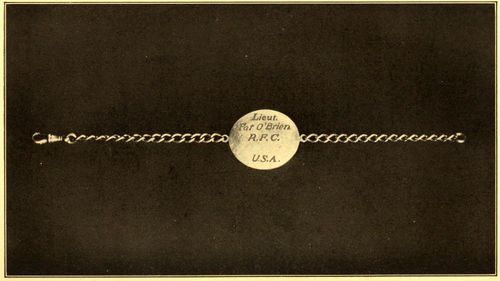
At the beginning of my dealings with Huyliger I had turned over to him
some pictures, papers, and other things that I had on me when I entered
his house, including my identification disk, and I was rather afraid
that he might refuse to return them to me.
All day long I remained in the house without a particle of food other
than the breakfast Huyliger had brought to me. From the windows I
could see plenty to interest me and help pass the time away, but of
my experiences while in that house I shall tell in detail later on,
confining my attention now to a narration of my dealings with Huyliger.
That night he appeared, as he had promised.
"Well, O'Brien," he asked, as he entered the room where I was awaiting
him, "what do you say? Will you sign the order or not?"
It had occurred to me during the day that the amount demanded was so
fabulous that I might have signed the order without any danger of
its ever being paid, but the idea of this man, who had claimed to be
befriending me, endeavoring to make capital out of my plight galled me
so that I was determined not to give in to him, whether I could do so in
safety or not.
"No, Huyliger," I replied. "I have decided to get along as best I can
without any further assistance from you. I shall see that you are
reasonably paid for what you have done, but I will not accept any
further assistance from you at any price, and, what is more, I want
you to return to me at once all the photographs and other papers and
belongings of mine which I turned over to you a day or two ago!"
"I'm sorry about that, O'Brien," he retorted, with a show of apparent
sincerity, "but that is something I cannot do."
"If you don't give me back those papers at once," I replied, hotly, "I
will take steps to get them and damned quick, too!"
"I don't know just what you could do, O'Brien," he declared, coolly,
"but as a matter of fact the papers and pictures you refer to are out of
the country. I could not give them back to you if I wanted to."
Something told me the man was lying.
"See here, Huyliger!" I threatened, advancing toward him, putting my
hand on his shoulder and looking him straight in the eye, "I want those
papers and I want them here before midnight to-night. If I don't get
them, I shall sleep in this place just once more, and then, at eight
o'clock to-morrow morning, I shall go to the German authorities, give
myself up, show them the passport that you fixed up for me, tell them
how I got it, and explain everything!"
Huyliger paled. We had no lights in the house, but we were standing
near a landing at the time and the moonlight was streaming through a
stained-glass window.
The Belgian turned on his heel and started to go down the stairs.
"Mind you," I called after him, "I shall wait for you till the city
clock strikes twelve, and if you don't show up with those papers by that
time, the next time you will see me is when you confront me before the
German authorities! I am a desperate man, Huyliger, and I mean every
word I say!"
He let himself out of the door and I sat on the top stair and wondered
just what he would do. Would he try to steal a march on me and get in
a first word to the authorities, so that my story would be discredited
when I put it to them?
Of course my threat to give myself up to the Huns was a pure bluff.
While I had no desire to lose the papers which Huyliger had, and which
included the map of the last resting-place of my poor chum Raney, I
certainly had no intention of cutting off my nose to spite my chin by
surrendering to the Germans. I would have been shot, as sure as fate,
for, after all I had been able to observe behind the German lines, I
would be regarded as a spy and treated as such.
At the same time I thought I had detected a yellow streak in Huyliger,
and I figured that he would not want to take the risk of my carrying out
my threat, even though he believed there was but a small chance of my
doing so. If I did, he would undoubtedly share my fate, and the pictures
and papers he had of mine were really of no use to him, and I have never
been able to ascertain why it was he wished to retain them unless they
contained something—some information about me—which accounted for his
complete change of attitude toward me in the first place, and he wanted
the papers as evidence to account to his superiors or associates for his
conduct toward me.
When he first told me that the plan of placing me in a convent disguised
as a priest had been abandoned he explained it by saying that the
Cardinal had issued orders to the priests to help no more fugitives,
and I have since wondered whether there was anything in my papers which
had turned him against me and led him to forsake me after all he had
promised to do for me.
For perhaps two hours I sat on that staircase musing about the peculiar
turn in my affairs, when the front door opened and Huyliger ascended
the stairs.
"I have brought you such of your belongings as I still had, O'Brien," he
said, softly. "The rest, as I told you, I cannot give you. They are no
longer in my possession."
I looked through the little bunch he handed me. It included my
identification disk, most of the papers I valued, and perhaps half of
the photographs.
"I don't know what your object is in retaining the rest of my pictures,
Huyliger," I replied, "but, as a matter of fact, the ones that are
missing were only of sentimental value to me, and you are welcome to
them if you want them. We'll call it a heat."
I don't know whether he understood the idiom, but he sat down on the
stairs just below me and cogitated for a few moments.
"O'Brien," he started, finally, "I'm sorry things have gone the way
they have. I feel sorry for you and I would really like to help you. I
don't suppose you will believe me, but the matter of the order which I
asked you to sign was not of my doing. However, we won't go into that.
The proposition was made to you and you turned it down, and that's an
end of it. At the same time, I hate to leave you to your own resources
and I'm going to make one more suggestion to you for your own good. I
have another plan to get you into Holland, and if you will go with me
to another house I will introduce you to a man who I think will be in a
position to help you."
"How many millions of pounds will he want for his trouble?" I asked,
sarcastically.
"You can arrange that when you see him. Will you go?"
I suspected there was something fishy about the proposition, but I felt
that I could take care of myself and decided to see the thing through.
I knew Huyliger would not dare to deliver me to the authorities because
of the fact that I had the telltale passport, which would be his
death-knell as well as my own.
Accordingly I said I would be quite willing to go with him whenever he
was ready, and he suggested that we go the next evening.
I pointed out to him that I was entirely without food and asked him
whether he could not arrange to bring or send me something to eat while
I remained in the house.
"I'm sorry, O'Brien," he replied, "but I'm afraid you'll have to get
along as best you can. When I brought you your breakfast this morning I
took a desperate chance. If I had been discovered by one of the German
soldiers entering this house with food in my possession, I would not
only have paid the penalty myself, but you would have been discovered,
too. It is too dangerous a proposition. Why don't you go out by yourself
and buy your food at the stores? That would give you confidence, and
you'll need plenty of it when you continue your journey to the border."
There was a good deal of truth in what he said, and I really could not
blame him for not wanting to take any chances to help me, in view of the
relations between us.
"Very well," I said; "I've gone without food for many hours at a time
before and I suppose I shall be able to do so again. I shall look for
you to-morrow evening."
The next evening he came and I accompanied him to another house not
very far from the one in which I had been staying and not unlike it in
appearance. It, too, was a substantial dwelling-house which had been
untenanted since the beginning, save perhaps for such occasional visits
as Huyliger and his associates made to it.
Huyliger let himself in and conducted me to a room on the second floor,
where he introduced me to two men. One, I could readily see by the
resemblance, was his own brother. The other was a stranger.
Very briefly they explained to me that they had procured another
passport for me—a genuine one—which would prove far more effective
in helping to get me to the frontier than the counterfeit one they had
manufactured for me.
I think I saw through their game right at the start, but I listened
patiently to what they had to say.
"Of course, you will have to return to us the passport we gave you
before we can give you the real one," said Huyliger's brother.
"I haven't the slightest objection," I replied, "if the new passport is
all you claim for it. Will you let me see it?"
There was considerable hesitation on the part of Huyliger's brother and
the other chap at this.
"Why, I don't think that's necessary at all, Mr. O'Brien," said the
former. "You give us the old passport and we will be very glad to give
you the new one for it. Isn't that fair enough?"
"It may be fair enough, my friends," I retorted, seeing that it was
useless to conceal further the fact that I was fully aware of their
whole plan and why I had been brought to this house. "It may be fair
enough, my friends," I said, "but you will get the passport that I have
here," patting my side and indicating my inside breast pocket, "only off
my dead body!"
I suppose the three of them could have made short work of me then and
there if they had wanted to go the limit, and no one would ever have
been the wiser, but I had gone through so much and I was feeling so mean
toward the whole world just at that moment that I was determined to sell
my life as dearly as possible.
"I have that passport here," I repeated, "and I'm going to keep it. If
you gentlemen think you can take it from me, you are welcome to try!"
To tell the truth, I was spoiling for a fight and I half wished they
would start something. The man who had lived in the house had evidently
been a collector of ancient pottery, for the walls were lined with great
pieces of earthenware which had every earmark of possessing great value.
They certainly possessed great weight. I figured that if the worst came
to the worst that pottery would come in mighty handy. A single blow
with one of those big vases would put a man out as neatly as possible,
and as there was lots of pottery and only three men I believed I had an
excellent chance of holding my own in the combat which I had invited.
I had already picked out in my mind what I was going to use, and I got
up, stood with my back to the wall, and told them that if they ever
figured on getting the passport, then would be their best chance.
Apparently they realized that I meant business and they immediately
began to expostulate at the attitude I was taking.
One of the men spoke excellent English. In fact, he told me that he
could speak five languages, and if he could lie in the others as well I
know he did in my own tongue, he was not only an accomplished linguist,
but a most versatile liar into the bargain.
They argued and expostulated with me for some time.
"My dear fellow," said the linguist, "it is not that we want to deprive
you of the passport. Good Heavens! if it will aid you in getting out
of the country, I wish you could have six just like it. But for our
own protection you owe it to us to proceed on your journey as best you
can without it, because as long as you have it in your possession you
jeopardize our lives, too. Don't you think it is fairer that you should
risk your own safety rather than place the lives of three innocent men
in danger?"
"That may be as it is, my friends," I retorted, as I made my way to the
door, "and I am glad you realize your danger. Keep it in mind, for in
case any of you should happen to feel inclined to notify the German
authorities that I am in this part of the country, think it over before
you do so. Remember always that if the Germans get me, they get the
passport, too, and if they get the passport, your lives won't be worth a
damn! When I tell the history of that clever little piece of pasteboard
I will implicate all three of you, and whomever else is working with
you, and as I am an officer I rather think my word will be taken before
yours. Good night!"
The bluff evidently worked, because I was able to get out of the city
without molestation from the Germans.
I have never seen these men since. I hope I never shall, because I am
afraid I might be tempted to do something for which I might afterward be
sorry.
I do not mean to imply that all Belgians are like this. I had evidently
fallen into the hands of a gang who were endeavoring to make capital
out of the misfortunes of those who were referred to them for help. In
all countries there are bad as well as good, and in a country which
has suffered so much as poor Belgium it is no wonder if some of the
survivors have lost their sense of moral perspective.
I know the average poor peasant in Belgium would divide his scanty
rations with a needy fugitive sooner than a wealthy Belgian would dole
out a morsel from his comparatively well-stocked larder. Perhaps the
poor have less to lose than the rich if their generosity or charity is
discovered by the Huns.
There have been many Belgians shot for helping escaped prisoners and
other fugitives, and it is not to be wondered at that they are willing
to take as few chances as possible. A man with a family, especially,
does not feel justified in helping a stranger when he knows that he and
his whole family may be shot or sent to prison for their pains.
Although I suffered much from the attitude of Huyliger and his
associates, I suppose I ought to hold no grudge against them in view of
the unenviable predicament which they are in themselves.