To measure the growth of wire, with its many
forms and composites, during the last forty
years would be to trace in detail not alone the
progress of science, invention and mechanical
industry, but the myriad conceits that have
come ostensibly to facilitate the process of
living. In the search for new comforts, for
means of avoiding physical exertion, the world
has been littered with novelties, and most of
them depend on wire. Personal life as well as
commerce and industry is interlaced with wire.
With the opening of new countries, the increase
of populations, the flocking of outland people
to the cities and the consequent lack of farm
labor, ingenuity has been more heavily taxed
to find the quick and easy way of doing the
world’s work and keeping food in its mouths.
Wire, so adaptable to the heaviest as well as
the lightest tasks, has labored from year to year
under an increasing demand.
It is not surprising therefore that a company
which in such an impressive way had fixed
itself in recognition as the first exponent of
wire’s usefulness should have grown in this
period from modest commercial stature to a
high place in its field and to the enjoyment of
large production.
THE GROWTH OF THE ROEBLING BUSINESS
When the sons of John A. Roebling took up
control of the business he had established,
about one hundred men were employed and
the product of their industry approximated
$250,000 annually. Just before the beginning
of the war more than eight thousand employees
were engaged in the manufacture of Roebling
products and the value of the output ran far
into the millions. The factory which was so
meagre and so humble in 1848 has spread its
buildings not only over the surrounding acres,
but across what were then neighboring farm
lands until, constrained not alone by the pyramiding
demand for its products but by the
soaring values of the city that had grown up
around it, and of which it had been in some
measure the creator, it went pioneering again,
sixteen years ago, down the Delaware, and
established a new nucleus, which will suffice
for a long period to come.
With the erection of the cables for the
Williamsburg Bridge, the Roebling firm withdrew
from the competitive field of engineering
contracts and concentrated all its energies in
the perfection of its product—wire.
In view of the more distinctly industrial character
of the Roebling enterprise under the later
dispensation, it is of interest that the varied
activities of John A. Roebling, as a scientist, a
master of materials and a peculiarly astute
mind in affairs, have been carried on severally
among his sons and grandsons. Colonel Washington
A. Roebling, the president of the company,
who executed the plans for the Brooklyn
Bridge, is an engineer of well-known ability.
His intimate contact with all the affairs of the
company during such a long period of development,
his kindly and generous support to constructive
achievements, has been a source of
pride and invaluable assistance to the younger
generation of the Roebling fraternity. His two
brothers, Charles and Ferdinand, now dead, were
both intensely active during their lives. Charles
G. Roebling’s talents as a builder of plants and
machinery and an unusual gift of turning out a
product of the highest excellence, were, in a large
measure, the cornerstone for the tremendous
success of the Roebling Company. It was
during the period of his direction that the manufacturing
capacity grew so rapidly.
The simultaneous expansion of the commercial
field was the life work of the other brother,
Ferdinand W. Roebling, who carried the
Roebling products to all corners of the globe.
A clear and far vision, an uncanny ability to go
straight to the point and a keen knowledge of
human nature, were a few of the strong traits of
his mentality. Under his control of financial
and ethical matters the John A. Roebling’s Sons
Company established a worldwide and enviable
reputation for stability and fair dealing.
Ferdinand, although an indulgent father,
brought up his two sons, Karl and Ferdinand, Jr.,
in the old-fashioned way. They were taught
from early boyhood that theirs would be no
bed of roses, that manhood was an estate where
responsibility must be accepted and assumed,
and with this teaching ringing in their ears the
mantle of the presidency of the company fell
upon Karl G. Roebling, and the secretaryship and
treasurership upon the shoulders of Ferdinand W.
Roebling, Jr.
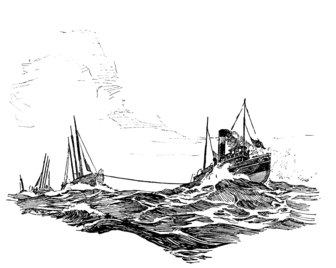
TOWING WITH WIRE ROPE HAWSER
Both sons upon leaving college were given a
rigid training in all branches of the business and
early in their careers exhibited the executive
ability and keen business foresight which their
father had in so large a measure developed.
Karl’s talents lay principally in the gift he had
of drawing from his associates their whole-hearted
fidelity and devotion to the cause of the
Roebling prestige. His death at the early age of
forty-eight was a shock to the industry, and a
great personal loss to those associated with him in
the conduct of the business.
While all of the Roeblings have possessed, in a
great degree, the qualities of leadership, yet
they have always recognized the necessity of
surrounding themselves with a strong organization
capable of carrying on this great industry
after they had ceased their earthly activities.
It was particularly under the regime of Karl
Roebling that the strong foundation was laid
for the present powerful organization—each
department highly specialized and in charge of
experienced well-trained heads, ably aided by a
corps of competent assistants, all functioning
smoothly like a well-balanced machine. Karl
left this as his heritage to the business. He
never did things by halves. His working day
was long and intense, but to one so constituted
it could not be otherwise. During the world
war and its aftermath the added responsibilities
he so cheerfully assumed, contributed largely
toward bringing to an end a life full of early
accomplishments.
Ferdinand W. Roebling, Jr., the remaining
son, now vice-president and treasurer, is an able
engineer. His early training with the company
was entirely in the manufacturing and engineering
side of the business. In more recent years,
however, he has devoted his attention to its financial
affairs. His close contact with his father and
brother, his thorough knowledge of the company’s
policies, have well fitted him to sustain the
Roebling name and all it represents in the
business world.
THE TRENTON PLANT
The main or first plant of the company
centers around the site of the original buildings.
Its structures, yards and tracks cover more
than thirty-five acres of ground about a mile
from the center of the city. The Delaware
and Raritan Canal and the Trenton Division
of the Pennsylvania Railroad pass along its
western boundary and directly before the door
of the offices. The office building was erected
in 1857 by John A. Roebling as a residence
and later, as manufacture crowded in around,
it was given over to business uses. The spur
tracks of the Pennsylvania traverse the company
enclosure.
Nearest to the office building are some of the
structures that Mr. Roebling built in the first
periods of business expansion, among them the
old rope shop, where by methods of his own
devising he strove to meet the growing demands
for rope. Some of the machinery he built is
still in service in production of standard lines,
showing how swiftly and how far, from crude
beginnings, his active mind advanced along the
road to better production, and how efficient
management can prolong the life of a mechanism
that is honestly built in the beginning.
THE BUCKTHORN AND KINKORA PLANTS
The second or Buckthorn plant lies half a
mile farther to the south, also facing the railroad
and the canal.
The third, which was christened Kinkora,
after a neighboring village on the railroad, but
is now Roebling, with a station of its own, is
ten miles farther down the Delaware. All told,
there are probably a hundred buildings in the
three plants, many of them of immense size and
manufacturing capacity.
From the wide diversity of its products, the
men in the Roebling establishment have come
to refer to it as a department store. The problem
therefore of distributing its operations and
keeping track of its large volume of moving
stock and its equipment is a substantial one.
While in some lines there is activity partitioned
among all three plants, in the main the
various divisions of labor are well concentrated.
For the most part the Upper Works, though a
considerable quantity of wire is made there, is
devoted to what is termed “finished product.”
In the same manner the Buckthorn plant,
while turning out some rope in small sizes,
specializes in all forms of insulation and the
manufacture of lead-cased cables.
THE KINKORA PLANT AT ROEBLING
The Kinkora or Roebling establishment,
carrying the production of the subsidiary New
Jersey Wire Cloth Company, making wire netting,
window screens and other forms of wire
cloth, is given over most largely to the making of
steel wire and the fundamental work of wire and
steel production. With the company’s large
acreage at this location, its townsite and the
facility of river transportation as well as rail, with
unlimited water, of which this plant uses more
than is pumped by the city of Trenton itself,
the situation offers large opportunity for expansion
and profitable centralization of operation.
At the present time, while shipments of
wire are made direct from Roebling to manufacturers
who use it in production of their
own commodities, by far the greater part of
the output goes to the other plants to be finished
into rope and specialties.
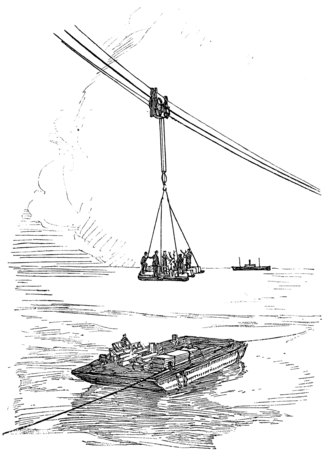
MAKING A CROSSING BY CABLEWAY
Inside the tall palings that enclose the great
mill buildings at Roebling, there is an open
space, broad and long as a drill ground, threaded
by spur tracks and heaped endlessly with stacks
of pig iron and steel-making materials. It
seems as though some giant had dumped there
the salvage of a hundred battlefields. It lies
there sadly rusting under the weather, waiting
the moment when the mills shall stretch forth
hands and hurry it in, rush it like a neophyte
through the fierce initiation of heat and chemistry,
and having changed the very fibre of it
by strange processes, send it singing forth,
shining in great coils, twisted into cords and
cables small and great, bare or insulated,
bronzed or coppered, galvanized or enameled,
huge and bulky or spun to hair-like tenuousness,
to do its work in a busy world.
MAKING WIRE STEEL
Of course, the making of steel is no new
story, but this is wire steel—the high carbon,
the tough, the sinewy, the resilient, that must
carry in itself as it moves along through these
interminable buildings the analytically measured
proportions of this or that, which fit it to
bear up the traffic of a giant bridge or convey
a whisper of telephonic sound or register split
seconds in an Elgin timepiece. It is “pig,”
and ore and “scrap,” but just what kind and
just how much of “scrap” and ore and “pig,”
these are subtle questions. It costs a lot of
time and money sometimes to answer them.
When the thirty-five hundred and odd degrees
of heat in the long rows of open hearth
furnaces have brought this stubborn mixture
to bubbling and seething like a busy kettle of
soup—a workman adding a little manganese
or other ingredient to the broth now and then,
grimy men with long handled steel dippers
take out a few thimblefuls from time to time
and hurry the sample away to the chemist,
who, like a chef, tests the quality and prescribes
the seasoning. By and by it is run off,
from an opening in the bottom of the furnace
into a huge caldron they call a “ladle.” A fifty-ton
crane conveys it down the long, shadowy
building, to halt above a group of tall moulds.
A wizard up in the gloom under the roof moves
it from mould to mould, a few inches at a time,
while the liquid steel is drawn from the bottom
into one after another. The moulds are left to
cool.
BLOOMS
Its history is now begun. It is an ingot—many
ingots—and when removed from the
mould is loaded on steel cars and borne away
on its journey. When in due course the ingot
comes to the “blooming mill” it is fourteen
inches thick each way and five feet long. Heated
again, it is marched up on a steel rollway, also
controlled by a “man higher up,” and into the
hungry jaws of a machine that, after a series of
swallowings, disgorges it at last, shrunken in
sheer humility to a diameter of four inches and
with a very long face—some forty-eight feet
to be exact. And no wonder. In the process
it has been kneaded into a dozen different
phases of flatness and squareness, and put in
a way to profit by the everlasting squeezing
and stretching it is to undergo. Now it is a
bloom.
BILLETS
Again it is passed on, and from some subterranean
blackness you see it rushed out and
up to a sort of guillotine that first cuts off the
flawy ends, where the impurities accumulated
in its ingot state, and sends them to the “scrap”
heap, then lops the bloom as a man saws firewood,
but a great deal faster, into billets varying
from one to four hundred pounds in weight.
They are “billets” now, and at last are counted
the raw material of wire, even after such an
inferno of cooking.
A steel loader gathers them up, carries them
away in bunches and, by a trick of wire pulling,
deposits them on other cars in rows as regular
as the pickets on an old fashioned fence.
THROUGH THE ROLLING MILL
Along with the copper billets they are stacked
in thousands and thousands of tons in the stockyard
outside the doors of the rolling mill, each
in its group according to physical and chemical
character, waiting the next purgatory of change.
One pile is marked for one mission, one for
another, ranging through all the uses wire can
be put to. These piles are forever vanishing,
forever being replaced, as the wide world calls
for wire. They disappear into the darkness of
the mill and they are never billets again.
Marshaled on cars and jammed by hydraulic
force into big reheating furnaces like
a Brobdignagian bakery, fired with fuel gas,
they come out glowing again and start on the
next stage of reduction. The passage through
the rolling mill is a short life and a merry one.
If they were kneaded in the blooming mill it
was a mild experience. Here they are mauled
and manhandled and masticated by swift, continuous
and looping mills that are born with a
huge appetite for the largest billets, and make
rods of great length. Down they go, under the
gripping of relentless fingers that squeeze them
first square, then oval, then square again, and
pass them on, always smaller, toward the
journey’s end. Sometimes it’s half an inch,
sometimes more, according to the needs of
trade.
THE MILE A MINUTE JOURNEY INTO WIRE
Wire goes the whole distance, whisking
along through the murky, half dark mill, up
and down at a mile a minute, like flaming
serpents flirting fiery tails, as the men,
armed with tongs, seize and whip them from
one pair of rolls to another. In they go, around
the grooved repeater and out again to be grabbed
with a motion swift as the dash of a pickerel,
and thrust once more into the next set of rolls.
Always the lightning speed and always the long
tail, red hot and smaller than before, and longer,
playing “snap the whip” down the steel grooves
to the bottom of the “pit,” then straight away
up the incline, a flash of fire in the darkness,
and on from roll to roll. The men who handle
these rods hold their ticklish posts only twenty
or thirty minutes at a time. A straight eight
hour day, if a man came through it alive, would
send him to an asylum with a conviction that
he was great grandson to Medusa. At the
finishing pass where the man stands, a stream
of four rods is going by him continually at lightning
speed, about a mile a minute; hundreds
of tons in twenty-four hours looping the loops
through the rolls and finishing in red coils of
quarter inch, lying innocent and rosy and round
on the metal floor.
To the novice they look like wire; to the
cognoscenti they are only rods, and in order
to be wire some day are hustled off to the cleaning
house and in bunches plunged into a bath
of acid. This takes off the scale the rolling
left on them. But acid in wire steel is like
heresy in the church. It has to be purged away.
This is done by immersion and then by a coating
of lime to neutralize by chemical action whatever
taint may remain. The steel is then baked from
twenty-four to forty-eight hours to remove the
hydrogen.
Wire making has just begun. From this
time on it is a wonder-work to the novice, a
mechanical sleight of hand performance by
which hundreds of shadowy men and other
hundreds of whirling wheels spin the rod down
ever smaller and smaller till what was once a
stodgy four foot billet is perhaps a thousandth
of an inch thick, fifteen odd thousand miles
long, weighs less than a quarter of an ounce
to the mile, and has to be looked for with your
best reading glasses. It is just three times as
fine as the hair on your head.
THE WORK OF THE WIRE DOCTORS
Never think that the tall chimney of a manufacturing
plant tells the story of all that goes
on in its shadow. It isn’t all coarse work. If
you could see the things that are done to a block
of steel, and the brains that are mixed with it, in
the Roebling plant, before it comes out and goes
on its way, they would make you take off your
hat to a piece of wire for the rest of your natural
life. But it isn’t all, what happens to the outside.
There are wire doctors who follow the
changing symptoms of the metal through its
many processes, with diagnostic eye as keen
as any medico’s for traces of typhoid or mumps.
Through all the process there are reheatings
and coolings, at carefully specified temperatures,
to give temper and then to take it away, to
keep the ductility without sacrificing endurance.
It is one business where you simply have
to eat the cake and keep it, too.
There is wet drawn wire and dry drawn wire,
and chemical reasons for drawing wire wet, and
divers ways of drying wet wire to attain certain
conditions; there is lubrication by means of dry
materials as well as oil, and soap suds, funny
things that also act on the material itself in
mysterious ways. But this is no text book.
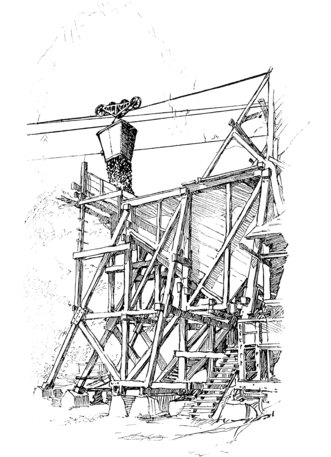
TRAMWAY RUNNING ON WIRE ROPE CABLE DUMPING COAL AT MINE
No thinkable effort is omitted that will help
to make the wire material perfect in quality
and service condition, but the proof of the
pudding in the making of wire is in the Olsen
machines—miraculous things that will smash a
big wire rope or snap a hair of wire and register
to a decimal the breaking strength of each.
There are tests for tensile strength, for torsion
to show how many twists a piece of wire will
stand, and for bending. There are microscopic
tests for molecular condition and men who will
almost tell you from a microscopic section
the maximum service of which the rope made
from a given wire is capable. Any bundle of wire
that doesn’t pass the test for the job on hand
is discarded and used for something else, and
a record of it all is kept with scrupulous care.
Any foot of wire that passes through the shipping
room on the way to market has a clean
bill of health, ample for the use to which it is
destined, and the amount of material that is
scrapped for faults, where work is on stringent
specifications, would be sudden death to a
business that hadn’t a wide range of uses for
product of whatever quality. Fortunately for
the users of high-grade wire the market for the
lower grades is always hungry and crying for
more.
THE WONDER OF DUCTILITY
There are complexities without end in the
making and finishing of wire, but the real
wonder of it lies after all in the initial principle
which the German inventor in Bavaria gave
to the world six hundred years ago—the simple
but even now almost incredible fact that a rod
of cold steel of the hardest quality—plow steel
is the convincing name for it—can be seized
by its sharpened end with a clamp they call a
dog and drawn through a smaller hole, in a still
harder piece of steel, three or four feet until it
can be fastened to a drum, and then be wound
off in miles almost without interruption. It is
a wonder that grows as you watch it and yet
it seems so simple. To see that steel, of tremendous
strength and hardness, drawn through
a tiny hole as if it were molasses candy—and
yet it may have a tensile strength of two or
three hundred thousand pounds to the square
inch.
There is nothing spectacular about the wire
mill where this is done. On long benches the
die-holding appliances are set up and the dies
set into them. The wire—or at first the rod—is
run from a portable bobbin they call a swift,
that stands on the floor, and the wire, after it
has been given the hole, passes to a bobbin
they call a block. Then it is taken on to a still
smaller die and the same process repeated, with
occasional reheatings, until it has the diameter
of a thread.
CUTTING THE DIES
But by and by the time comes when the wire
is so fine it cuts the steel of the die and loses
its rotundity. Then a harder material is needed
and the wire drawer goes the whole figure and
uses a diamond. Cutting the steel dies is a
cunning craft enough, but the expert, who, with
a hair-like drill and a dab of diamond dust can
penetrate a diamond with an opening that will
be regular and measure to a thousandth of an
inch, is a man who would think it no trick at
all to pass a well fed camel through the needle’s
eye.
It would take a larger book than this to tell
all the things that are done in the making of
wire for various uses. In the main, the entire
volume produced either goes to market as wire
of one sort and another, to be applied to its
various objects or for sale, or else it is twisted
into rope, of which the Roebling Company
manufactures four hundred kinds, sizes and
many qualities. The common fence wires are
not among the Roebling specialties, but wire
nettings are manufactured from a soft variety
of basic steel which lends itself to the weaving
process with almost the ease of animal and
vegetable fibres.
THE ENDLESS MANUFACTURES FROM “FLAT WIRE”
The “flat wire,” which has now attained
immense volume of production, is, for the most
part, rolled down from the round, in many
qualities, and shipped as material to the makers
of many things. There are wide, thin, beautiful
ribbons which find their way to the shoestring
factories and are cut and clinched to the
laces as tips. The list of novelties and parts
that are made from various forms and widths
of flat wire is as long as the list of Smiths in a
New York directory. In the novelty shop, which
does a million things, wires are cut and mechanically
bent in hundreds of thousands of shapes,
for clothes hangers, pail ear staples, daubers for
bottles, meat skewers, hog rings, thread guards
for textile machinery, basket fasteners, shackles
for car seals, saddlery parts, Welsbach mantles,
clips and links for bedsprings, wiring for toys
of all descriptions—and so on and on and on.
And all this novelty business is a side line, like
the square and triangular wires that are used
by oil well drillers to keep the sand from getting
into the oil.
The special shapes of high quality wire that
are made to order, to provide hard-wearing parts
for typewriters and many other machines, are
almost without number.
SALVAGING “MILL ENDS”
With the increasing cost of labor and materials
effort has been made to salvage and make use
of “mill ends” of wire, running sometimes to
large quantity, which formerly were accounted
waste. These are now passed through a
straightening machine, which lays them out in
uniform bundles of some ten feet in length,
which again may be cut to shorter lengths for
special purposes. In the buildings where this
is done, at the Upper Plant, are piles of neat
bundles of all shapes and sizes and grades,
which once went to the scrap for reworking but
now are utilized without additional cost.
COPPER WIRE AND COPPER ROPE
Copper wire is manufactured by the Roebling
mills in very large quantities and in many
sizes and forms, principally for electrical use
and for service where water corrosion shortens
the life of steel. The little bond wires that
link the rails of railways to perfect the carriage
of current in the block signal system are mostly
steel, but copper is used at stations and on
sidings where the leakage from standing cars
is apt to contain acids. Copper wire of all
sizes down to the very fine is spooled and sold
for use in arts and manufactures. For marine
uses a deal of copper rope is made, and copper
strand is twisted for lightning rods, the fixtures
and supports of which, in turn, are manufactured
from round and flat steel wire. The
piles of this equipment, waiting shipment in
the Roebling storerooms, give proof that the
satire of the cartoonist and the mockery of the
funny writer cannot destroy an ancient faith.
The telephone and telegraph companies use
uncountable miles of copper wire in line service
and other miles in fine sizes for instrument
coils and divers other functions. Electricity
as an agent would be a halting cripple without
wire. The dynamo would have little more
utility than a washtub. Armatures, frames for
which are formed from flat steel wire, are wound
in the Roebling plant in impressive number.
One of the largest fields for copper is trolley
wires, which are of great size and of many
eccentric shapes.
This is merely a glimpse at the utilities that
go to make up the field for Roebling wire. It
is doubtful if today the company owns a complete
list of the wire it has made for special and
even eccentric purposes, or knows within many
thousands the things that are manufactured
from its wire product after it leaves the shipping room.
COATING AND FINISHING
Use determines much in the finishing of wire,
and of wire rope as well, as not alone concerning
the chemistry of the inside, but the covering
of the outside. Material that is made for
service out of doors, under water or under
ground, to ensure long life needs an exposed
surface more resistant to moisture than the
naked steel. Copper is proof, but the pure
wire is expensive for most uses and where severe
strains are incurred it lacks in strength. Modern
science has been too busy to recover the art of
hardening copper which the ancient Egyptians
lost.
Zinc, in its best application, makes steel wire
weatherproof for many years and the apparently
simple process of galvanizing, the fixing
of a coating of zinc on the steel has multiplied
many fold the utility of steel wire in places
where it could ill be spared. But there is galvanizing
and “galvanizing.” The first is worth
the money it costs.
There are other coated wires, too. The aeroplane
strands and cords are tinned. There is a
bronze enamel, and a copper coating which looks
as if it were applied for protection but is really
the incidental result of a dip in sulphate of
copper, for other purposes in the course of
fabrication. The coating of wires is chiefly done
in the wire works of the Kinkora Mills, though a
galvanizing house is maintained also at the
Upper Works. For wire that is to be made into
galvanized ropes and cords, the galvanic treatment
is given before it goes to be made up.
JOURNEYING THROUGH THE ROEBLING PLANTS
For exercise, a journey through any one of
the Roebling plants, and especially the great
Upper Works, is as good as thirty-six holes of
golf. It is upstairs and downstairs, over an
interminable number of thousands of square
feet, through the mazes of a picture that is
always changing its detail and its rate of speed,
but which is all centered on one idea, to keep
the stream of wire and wire rope, of all sizes,
kinds and colors, moving toward the shipping
room. It all seems so easy in its progress, so
free from friction or any trace of confusion,
that the layman does not stop to consider how
many problems have bobbed up along the way
of production, even of the most modest wires
and rope. Wire is a trade involving intimate
knowledge of many lines of business and manufacture,
since the character of wire required
differs in nearly all.
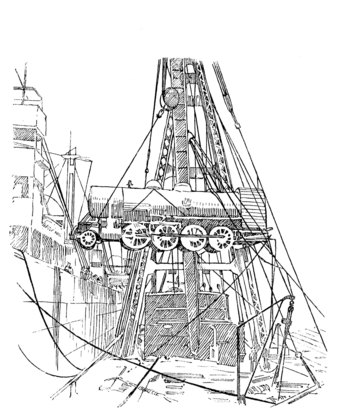
HOISTING FULLY COMPLETED LOCOMOTIVE WITH WIRE ROPE SLING
To the novice, wire is wire. Here he learns
that what is wire for one thing is valueless for
another and wire that looks to the unpracticed
eye as if it were ready for market always has
to undergo a few more processes before it is
up to demands. Wherever, however far, you
travel in this succession of high-roofed, airy
buildings, you come always upon some new
regiment of machines, some new container of
chemical or metal, with a long line of reels unwinding
wire to undergo some additional treatment.
And always moving among the buildings
are cars, big and little, packing wire or
material from one place to another, to feed the
wheels and furnaces. The tonnage from plant
to plant and from house to house in the
Roebling works would make a first-class annual
business for many a modest railroad, even if
it carried nothing else.
INSULATION
But when wire is finished it isn’t always
finished. Since electricity spread itself over the
earth in a million services, insulation in various
forms has come to be almost as important as
the wire itself. Insulation in its more advanced
forms is a complex affair, gauged to accord
with specific conditions and multiplying processes
to secure the maximum of protection,
both from electric current to life and property
and from dampness and abrasion to the wire
itself. In the making of wire screens the wire
men have taken a leaf from the cloth-mill book,
but in weaving a casing of cotton or other
fibre around the wire for insulation the process
is strongly reminiscent of some of the New
England textile mills. Long rows of machines,
black and silent and swift, reaching upward
toward the ceiling, revolving rapidly on an
upright shaft; long arms trailing downward,
with wheels and bobbins like fingers plying
dizzily but swiftly in and out around the wire
which unwinds from its spool and keeps forever
climbing. It is all like a Maypole, and the
bobbins go in and out like children carrying
each its ribbon. As the wire climbs, the whirling
fingers braid around it a coating, tight fitting
and impervious. Sometimes, where double insulation
is required, there are two sets of arms,
one above the other, the upper one putting on
a second covering outside the first, of cotton
of one color or another, or hemp or whatever
else the experimentalists have found best for
the purpose. You wonder how the bellcord in
the railroad train can ever stand the pulling
and jerking and wear and tear it gets. It is
simple. It is just a perfectly made and highly
tinned wire rope, with a double coat of braided
cotton over it. The jacket may wear off in
time, but the Roebling rope inside will never
fail in a lifetime to get the message to the
engineer.
When these snug coverings are finished the
wire for certain uses is taken to another part
of the works where it is unwound once more to
pass through a bath of asphalt compound.
After this process, which leaves a dull, dirty-looking
surface, the spools of treated wire are
put aside for drying, and then a final surfacing
applied. The next journey is to the packing
room.
TELEPHONE CABLES
Insulation is a wide range business. It cases
wire in asbestos to prevent fire from stopping
its work; but perhaps the highest phase is
reached in the great cables of copper wires
used in telephone service. For these the individual
wires are covered with paper of various
colors, which serves not only for protection but
enables men at the opposite ends of a long
cable to pick out unerringly the wires with
which connection is to be made. Colors are few
but possible combinations are many. The
machining of this is more than ever like the
Maypole, with pink and blue and yellow strips
of paper flashing in the shadows. When the wires,
paper covered, are brought together in the
cable, sometimes three or four hundred of them
altogether, the whole goes through the taping
machines, which apply one or two suits of what
may be called “underwear,” for after it has
been covered with two or three different
materials there remains a suit of lead to be
fitted, and this is a big work done deftly.
Who has not seen men in the streets dragging
huge pipes of lead through the open manholes
from big wooden spools? These are the
cables you talk over. They have been papered
and clothed—and tarred and feathered, maybe—and
then encased in lead by a process
that is so easy as to be laughable, and
yet as ingenious as any one thing the wire
miller does. Unrolling slowly from its spool,
the heavy cable moves up to a machine built
strong and four-legged from the floor. In the
mid height of this, a few feet above the floor,
is a square chamber containing molten lead. The
cable passes in at the rear and upward. It
requires some credulity to believe that it is the
movement of the molten lead that carries the
cable along, but in any case when it emerges
from the “box,” through an aperture that trims
the soft metal down to uniformity, it has a solid
lead covering as even as lead pipe, and at the
point of egress cold water playing from just
above cools it. Then it passes on through a
long tank of water for final hardening and is
wound slowly, clean and shining, on the great
spools that are to carry it to market.
Many astonishing things are done in wire
works, but done so swiftly, and smoothly and
in such volume that they look easy. The man
in the street, hurrying about his own business,
never even takes time to wonder to himself
how they are accomplished.


