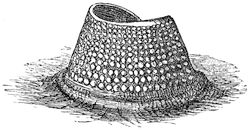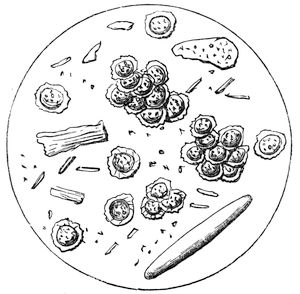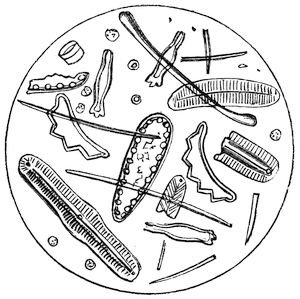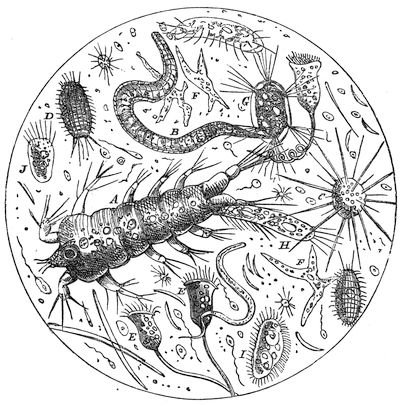
FIG. 1.—ANIMALCULÆ FOUND IN STAGNANT WATER.
| A, Cyclops Quadracornis. | F, Ambœba princeps. |
| B, Anguillula. Fluviatilis. | G, Acineta mystacina. |
| C, Actinophrys. Sol. | H, Oxytrycha. |
| D, Coleps Hirtus. | I, Triophthalamus dorsalis. |
| E, Vorticella. | J, Polyarthra. |
After considering the beautiful covering which a kind Providence has
given to the earth in the form of all sorts of vegetation, it will
be necessary now to consider for what kind of creatures this most
delightful garden was prepared, whether they seek their food in the
air, water, or earth, for all these places are abodes of the vegetable
tribes, and where there is vegetation there are animated beings; for
there is not an animal in existence, but directly or indirectly feeds
upon the vegetable kingdom, from the elephant and rhinoceros which
devour whole plantations, to the minute animalculæ which float in the
air or dwell in every drop of stagnant water, where food in the form
of equally minute algæ is found—each possessed of wonderful organs
and powers suitable to the kind of existence they lead, for God has
often placed life in the most simple as well as complicated forms. Dr.
Mantell says:—
"We have been accustomed to associate the presence of vitality with
bodies possessing various complicated organs for the elaboration and
maintenance of the energies of existence, but here we see perfect
and distinct creations in the condition of globules and cells, which
live and move and have their being, and increase in numbers with a
rapidity so prodigious, and in modes so peculiar, as to startle all our
preconceived notions of animal organisation."
And it is in these Protozoa, the lowest of the animal creation, that
a perfect similarity of condition exists to those of the vegetable
kingdom, they are here upon a level; but arising out of these simple
forms, God has created two sets of types or portraits, the members
of each resembling those below it in some particular, but having
organs which are superior to it; and above these are found members
whose organs are of a still higher order, and so on till the one set
comprises the highest orders of the vegetable, and the other those of
the animal kingdom, in its ranks. But these simple organisms are never
developed so as to resemble those placed above them; they each, whether
high or low, continue to produce their like, for each grade was a
creation of itself and a separate one from God's hands. There have been
writers, who would endeavour to make it appear that God only created
the lowest and most simple germs, and the circumstances which were
necessary to develop them, and then allowed these to act and re-act
until a man or an oak tree at last became the result! Were this the
case, geology would long before this have shown the "small beginnings"
of man; but no! as soon as traces of man's creation are perceived, he
is found as perfectly formed and organised as he is now, there are no
transition stages of man's existence, nor of any other animal. It is
true that the simpler forms of both animal and vegetable existence were
created first, but this was in accordance with the state of the earth's
surface, which was not at first suitable to the requirements of the
higher animals, which were only created when the earth was in a state
suitable to receive them.
But when the surface of the earth was still more developed God created
man. His last and greatest work; and there can be no doubt that God in
His wisdom caused all these changes to precede the creation of man,
that he might lack nothing to confer happiness on him, nor objects to
exercise his faculties upon.
Animals are divided into two great natural families, the Invertebrate
and the Vertebrate, the former having neither spine nor internal
skeleton, the latter having both.
The Invertebrate animals are divided into the following sub-families,
classes, and orders by Dr. William Carpenter.
| Sub-family 1.—Radiata, having Four classes. |
|---|
| 1. Infusoria. |
| 2. Entozoa. |
| | Hydroida | |
| 3. Zoophyta. | Asteroida | 4 Orders. |
| Helianthoida |
| Ascidioda |
| 4. Radiaria. | | Acalephæ | | 2 Orders. |
| Echinodermata |
| Sub-family 2.—Articulata, having Five classes. |
|---|
| 1. Annellata. |
| 2. Cerripeda. |
| 3. Crustacea. |
| | Coleoptera | |
| Orthoptera |
| Neuroptera |
| Hymenoptera |
| 4. Insecta. | Strepsiptera | 9 Orders. |
| Lepidoptera |
| Hemiptera |
| Diptera |
| Aptera |
| 5. Arachnida. |
Sub-family 3.—Mollusca, having Six classes.
| Acephala, or Headless. | Encephala, Having a Head. |
|---|
| 1. Tunicata. | 4. Pteropoda. |
| 2. Brachiopoda. | 5. Gasteropoda. |
| 3. Lamellibranchiata. | 6. Cephalopoda. |
The Infusoria, the first class of the Radiata, comprise all those
microscopic organisms called "Protozoa;" they consist of a membranous
cell with fluid contents, and are very nearly allied to the Protophytes
or lowest vegetable existences. It is still a matter of discussion
amongst physiologists and microscopists as to which kingdom shall claim
certain of them, but, according to Dr. Carpenter, it appears that the
vegetable cell-beings have two envelopes, the inner one albuminous and
the outer one cellulose or starchy, and the following passage occurs
in his treatise on the Microscope (which should be in the hands of all
enquiring minds):—
"The animal cell, in its most complete form, is comparable in most
parts of its structure to that of the plant, but differs from it
in the entire absence of the 'cellulose wall' or of anything that
represents it, the cell-contents being enclosed in only a single
limitary membrane, the chemical composition of which, being albuminous,
indicates its correspondence with the primordial utricle. In its
young state it seems always to contain a semi-fluid plasma, which is
essentially the same as the protoplasm of the plant, save that it
does not include chlorophyll granules, and this may either continue
to occupy its cavity (which is the case in cells whose entire energy
is directed to growth and multiplication) or may give place, either
wholly or in part, to the special product which it may be the function
of the cell to prepare. Like the vegetable cell, that of animals very
commonly multiplies by duplicative sub-division, it also (especially
among Protozoa) may give origin to new cells by the breaking up of its
contents into several particles."
Some of these creatures are so exceedingly minute that hundreds of
millions may be contained in a drop of water. They have no organs of
any kind, but consist of single cells of a soft substance called
"sorcode;" there is no distinction of sexes, and generation takes place
by sub-division, each cell separating into two, and these again into
two more, and so on with marvellous rapidity; this is the usual method
of increase, but occasionally an act of conjugation takes place, two
cells blending into one at the points of contact, the result of which
is a nucleus or cell within the original one. These animated cells
are of all forms, having prolongations which appear to be thrown out
to absorb any particle of organic matter within reach, which then
enters within the soft substance of the animalcule and is digested or
dissolved, such are the Ambœba, the Actinophrys, &c. (see fig. 1);
a step or two higher from these, the very lowest, infusoria
are found to possess the first rudiments of organs in the form of
cilia, which consist of minute elongations having a constant vibratory
motion, for the purpose of causing a current in the water in which they
live and bringing food into their vicinity.
Some very curious and complicated changes take place in the lowest of
the animals, very similar to those in the lowest vegetables; and what
has been called the life-history of these beings, often embraces a
great number of forms before the circle of their metamorphoses comes
round to the starting-point. Some of these phases of existence are
quite different from those going before and after them, and as the
vegetable free-cell at one time is capable of motion, it has long been
mistaken for an active living animalcule (the Protococcus pluvialis,
&c.), and there can be no doubt but that it will be found that many of
the lower forms of animated life described by Ehrenberg and others, and
still considered as such, will prove to be merely different stages of
the metamorphosis of the same protozoon; or it may be not an animal at
all, but a simple vegetable or protophyte.
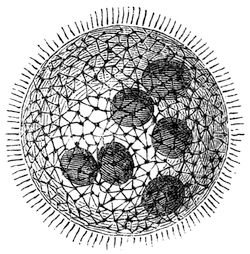
FIG. 2.—VOLVOX GLOBATOR.
Dr. Carpenter says, "It is quite certain that the Desmidiaceæ, like
the confervoid plants in general, grow at the expense of the inorganic
elements which surround them, instead of depending upon other living
beings for their subsistence, and that they decompose carbonic acid and
give off oxygen under the influence of sunlight. They have the power
of generating from these materials the organic compounds which they
require for their own development, and these are such as are formed by
other undoubted protophytes, as is proved by the application of the
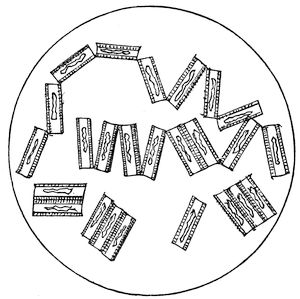
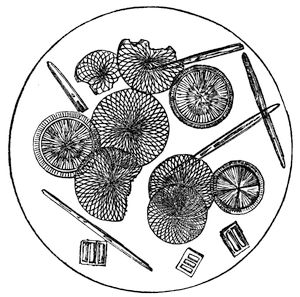
appropriate tests." These "Desmidiaceæ" were long considered to belong
to the animalculæ, as were the "Diatomaceæ," "Volvox globator" (fig.
2), &c.
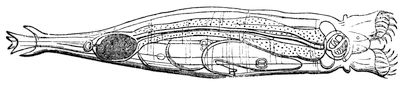
FIG. 3.—WHEEL ANIMALCULE.
Some of the Infusoria, however, have a far higher organisation, such
as the "Rotiferæ," and especially the "wheel animalcule" (fig. 3),
which at one time was supposed, absurdly enough, to possess a living
wheel turning round rapidly on its head! This wheel, however, proved
to be nothing else than a vortex of water produced by rotatory cilia.
This and many other mistakes were owing to the imperfect construction
of the microscopes of that date. These and their fellow animalcules
possess several organs, as a stomach, &c. The protozoa at one time
were supposed to possess a number of stomachs, and were thence called
"poly-gastric infusoria," but it has now been demonstrated that these
beings merely absorb or entangle portions of organic matter into
their substance, and that there are no cysts or stomachs for their
reception. Some of the Infusoria are able to withstand enormous changes
of temperature, without losing their vitality; cold far below freezing
point, and heat equal to boiling water does not destroy them, and they
may be dried in the most complete manner which chemists can devise,
and kept in this dry state for years, and yet, on the application
of moisture, return to life. There is no doubt but every inch of air
contains the germs of some of the Infusoria in a dry state or their
ova, and make up a portion of that fine halo of dust which always
appears in the air when a gleam of sunshine is let into a dark place.
The second class of the Radiata, the Entozoa, are those beings which
inhabit, as parasites, the intestines and other parts of animals. Their
history is very obscure, but there seems to be about twenty varieties
of these creatures, and a great number of animals have their peculiar
Entozoa. The best known in the human subject are the "Ascaris" or
thread-worm, the "Lumbricus Teres" or long-worm, and the "Tænia" or
tape-worm; this last is jointed, and grows to several yards in length.
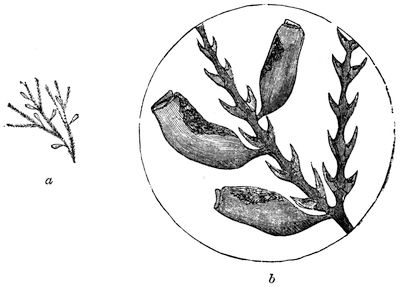
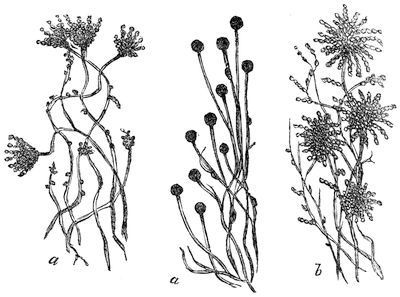
FIG. 4.—SERTULARIA OPERCULATA (a, Natural
size, b, magnified).
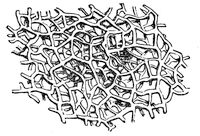
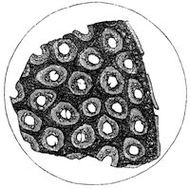
FIG. 5.—FRAGMENT OF SPONGE, MAGNIFIED.
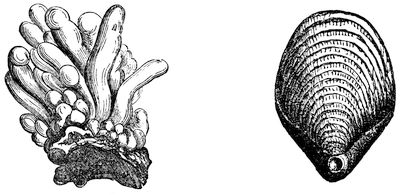
The third class, the Zoophyta, includes four orders. The first of
these, the Hydroida, comprise the Tubularia, Sertularia (fig. 4), and
Sponges (fig. 5); these are minute gelatinous creatures, secreting a
sort of tube in which they dwell. These tubes are congregated into
masses of different forms and colours, and, with other structures
totally different, are erroneously known by the general name of
"sea-weed." The Zoophyte which dwells in these tubes is furnished with
a set of cilia forming a sort of plume. Most of these Hydroida are
phosphorescent, such are those which, scattered about on the surface of
the sea, contribute to that luminosity so frequently seen.
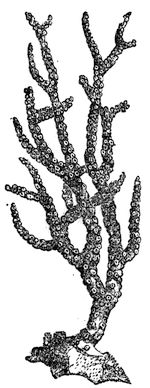
FIG. 6.—GORGONIA GUTTATA (Natural size).
The second order of the Zoophyta, Asteroida, are those which have a
star-like shape; they are congregated into compound structures, forming
what are called sea-fans (Gorgonia, fig. 6). These Gorgonia are of all
colours, and very beautiful; the animals or "polypes" are gelatinous,
and have a gelatinous mass or stalk with branches, strengthened and
supported by a horny centre. This gelatinous mass forms the animal
itself, as well as a sort of common integument connecting the whole
family of many thousands. The Gorgonia or sea-fans usually preserved,
are dry and hard, as the gelatinous covering has so little substance
that, when dried, it forms a rough powdery covering only to the horny
support. This powdery surface, if washed off with a little water
and placed under the microscope, is found to contain and be made up
of spiculæ or crystals of carbonate of lime, of various colours and
beautiful forms (fig. 7); these, when the animal is alive, help to
support its gelatinous frame; the Tubiporæ also belong to this class.
Fig. 8 represents the Organ-coral (Tubipora musica); it is of a bright
red colour, and, when the polypes are living, is a very beautiful
object.
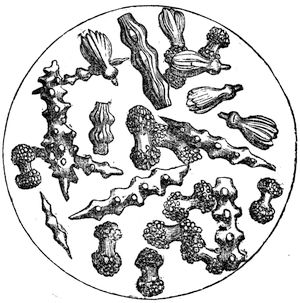
FIG. 7.—SPICULES OF GORGONIA, MAGNIFIED.
The third order of Zoophytes is the Helianthoida, which include the
"Actinia." These Zoophytes are entirely gelatinous, and have beautiful
variations of colour. They throw out tentacles like the petals of
a flower, and form very beautiful objects; they may be seen in the
aquatic vivaria of the Zoological Gardens. To this order of Zoophytes
belong the "corals" or Zoanthoid polypes, which produce the coral
reefs, extending in some cases hundreds of miles. Dr. Baird gives the
following account of them:—
"By far the greater part of the Zoanthoid polypes, as they grow,
deposit in the cellular substance of the flesh of their back an immense
quantity of calcareous matter which enlarges as the animal increases
in size, and, in fact, fills up those portions of the substance of
the animal, which by the growth of new parts are no longer wanted
for its nourishment, and in this manner they form a hard and strong
case, amongst the folds of which they contract themselves so as to be
protected from external injury, and by the same means they form for
themselves a permanent attachment which prevents their being tossed
about by every wave of the element in which they live. The stony
substances so formed are called corals, and their mode of formation
causes them exactly to represent the animal which secretes them. The
upper surface is always furnished with radiating plates, the remains
of the calcareous particles which are deposited in the longitudinal
folds of the stomach. These, in all probability were the constructors
of all the strata of limestone rocks, which form some of our largest
mountains—they were once the beds of seas, and were up-heaved by
internal forces. The Madrepores (fig. 9) are also of this order, and
form the stony matter in the same way. These are of various patterns,
and the beautiful brain-stones in the British Museum are of their
construction."
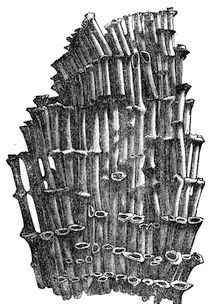
FIG. 8.—TUBIPORA MUSICA.
The fourth order of Zoophytes are the Ascidioida, including formerly
the Flustræ (fig. 10), but of late these have been shown to be closely
allied, if not identical with, the Tunicated Mollusca, and have
received the name of Polyzoa, they will therefore be noticed under that
head.
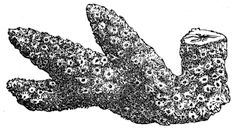
FIG. 9.—CORAL (Madrepora brachiata).
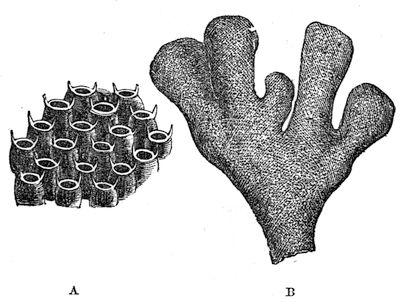
FIG. 10.—SEA MAT (Flustra foliacea), (A,
magnified, B, natural size).
The fourth class of the Radiata, are the Radiaria, including two
orders. The first of these are the Acalephæ; the Medusæ or Jelly-fishes
belong to this order; these creatures float about sometimes in great
numbers, they are transparent and gelatinous, of a hemispherical form,
the flat surface being fringed round with fibres, some of which sting
like nettles if brought into contact with the skin.
The second order of the Radiaria include the Echinodermata or
Sea-hedgehogs, Star-fishes, &c., these are many of them furnished with
a profusion of spines, and hence their name; they are also called
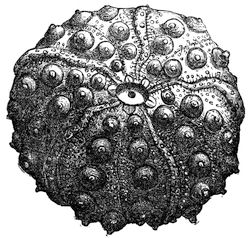
Sea-eggs or Sea-urchins (fig. 11), and are mostly of a conical or
spherical shape, divided into five segments covered with minute holes,
from which project tentaculæ serving as organs of locomotion, touch,
&c., and the surface of the body is covered with shelly spines of
various forms and thicknesses; the mouth is in the centre, and they
feed upon marine productions. The spines, if cut across and ground
thin so as to be transparent, show a most complicated and beautiful
structure when under the microscope (fig. 12).
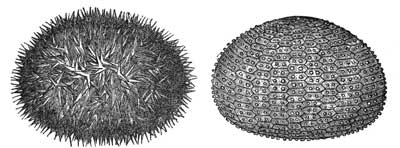
FIG. 11.—SEA-URCHIN (Echinus), WITH AND WITHOUT SPINES.
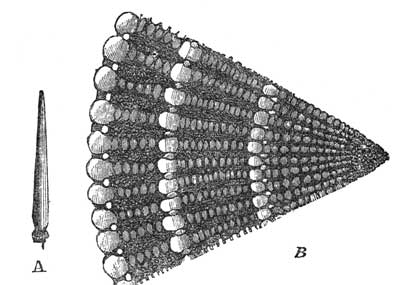
FIG. 12.—SPINE OF ECHINUS (A, natural size, B, a
section magnified).
The Star-fishes are inhabitants of the sea, and have generally five
arms covered beneath with tentaculæ having small suckers at the point,
it is by means of these that they move from place to place; the mouth
is in the centre. They live upon small marine animals, and have the
power of reproducing any of the rays which happen to be broken off; and
if cut into two or more pieces, each will produce a fresh animal. There
is a species of Star-fish, so brittle, that it is quite impossible
to touch it without breaking it, or rather it breaks itself, for it
seems to have the power of casting off its arms at pleasure. These
forms complete the Radiate series of animals, they have nearly all a
somewhat regular radiated form, and some of them are very beautiful,
such as Sertularia, which grow in communities and form many beautiful
branched objects, much resembling sea-weeds and flowers, hence the name
Zoophyte, which means animal flowers.
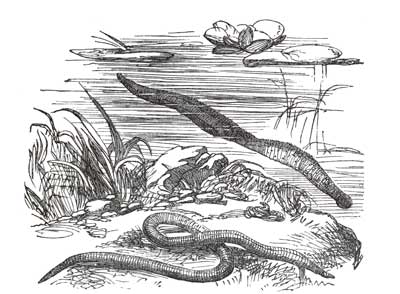
FIG. 13.—EARTH WORM (Lumbricus terrestris), LEECH
(Hirudo medicinale).
The Articulata form the second division of the Invertebrata. It has
five classes, the first of which is the Annellata; in this order are
included the Worms and Leeches (fig. 13), these have no hard covering
but are soft throughout, they are made up of a number of soft rings
which encircle their bodies from one end to the other, and are capable
of being shortened or elongated by the muscles which draw together the
rings (these are placed longitudinally), or by those which contract and
widen them, placed circularly; this enables them to move along, and in
so peculiar a manner that it has received the name of "vermicular," or
worm-like. The most familiar example of this class is the Earth-worm
(Lumbricus terrestris), this lowly creature lives in soft mud and clay
and bores its way into the ground, in doing so it is assisted by a
slimy secretion which covers it, its food consists of earth containing
organic matter, this it swallows constantly and extracts what is fit
for its nourishment ejecting the remainder apparently unaltered; the
curious little heaps of soft dirt which are so often seen in wet
weather on the garden-paths, &c., are formed in this way. The Leech
is another familiar example of the Annellata or Annelidæ, this little
useful creature lives in ponds and stagnant waters, and feeds by
sucking the fluids of other animals (chiefly frogs and fish) with which
it will gorge itself till it is double its original size, it will then
remain (often for months) without food till it is all appropriated,
the process going on very slowly; a full-grown Leech is perhaps twenty
years old, they grow so slowly, (hence it is, that Leeches may be kept
for months after being gorged with blood without any food, and they
will live and be healthy). They are furnished with two suckers, one at
each end, and a mouth with numerous fine teeth placed in a tri-radiate
manner, with which they pierce the skin when about to feed. They move
in the water with great rapidity by a wavy motion of their bodies, but
on solid substances their mode of progression is that of adhering by
the sucker in front, then drawing the other one close up and extending
the body to its full length, taking hold again by the front sucker and
again bringing up the hindermost.
The Cirripeda constitute the second class of the Articulata, which
comprise the "Acorn shells" and "Barnacles" (fig. 14); these little
creatures were formerly described as Molluscs, but are now considered
to be articulate animals, and by some as Crustaceans. Dr. Baird gives
the following description of them:—"The Cirripeds are articulated
animals contained within a hard covering composed of several pieces and
consisting of calcified chitine. The body of the animal is enclosed in
a sac lined with the most delicate membrane of chitine, which in one
group is prolonged into a peduncle and contains the ova; the body is
distinctly articulated and placed with the back downwards."
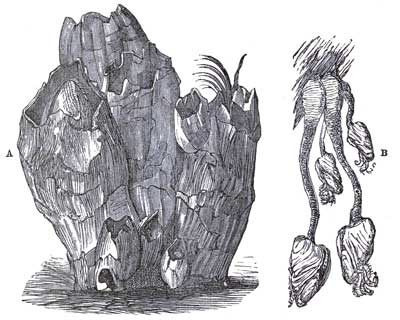
FIG. 14.—A, SEA-ACORNS; B, BARNACLES (Cirripedes).
Dr. Carpenter describes the young of the Cirripedes as not fixed like
the adult creatures, but moving about freely, and only becoming fixed
in the form of the usual acorn shell after undergoing several strange
metamorphoses, during which stages they more resemble the ordinary
Crustaceans than they do in their fixed state.
The Crustacea form the third class of the Articulata, they comprise
animals covered with a hard shell or carapace, like a case made up of
rings, with joints allowing the pieces to move upon each other, except
where several of them are consolidated to form the principal covering.
These rings generally amount to twenty-one in number, some composing
the claws, others the legs, &c. The shell is chiefly made of carbonate
of lime (chalk) held together by animal matter. The greater part of
the Crustacea inhabit the waters, and they cast their shells from time
to time as they grow; the Lobster (Astacus marinus), is a familiar
example, it is found in the sea near rocky shores, and is capable of
rapid motion under the water, darting along (tail foremost) with great
rapidity, it has powerful claws, with one of which (the blunt one)
it holds its food and with the other (the sharp one) cuts it up into
pieces; they have the power of casting off these claws and reproducing
them; they feed upon smaller Crustacea and fish, or any animal matter
they can find. The Cray-fish is another example, it is a sort of
fresh-water Lobster, living in holes (frequently deserted rat holes) in
the banks of rivers; its shell is very rough, but otherwise somewhat
resembles the Lobster. Crabs, Shrimps, and Prawns, are members of this
class (fig. 15).
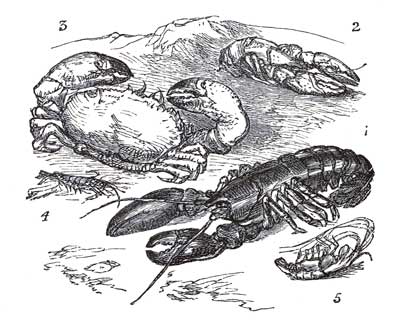
FIG. 15.—CRUSTACEA.
| 1. Lobster (Astacus marinus). | 3. Crab (Cancer pagurus). |
| 2. Cray-fish (Astacus fluviatilis). | 4. Shrimp (Crangou vulgaris). |
| 5. Prawn (Palæmon serratus). |
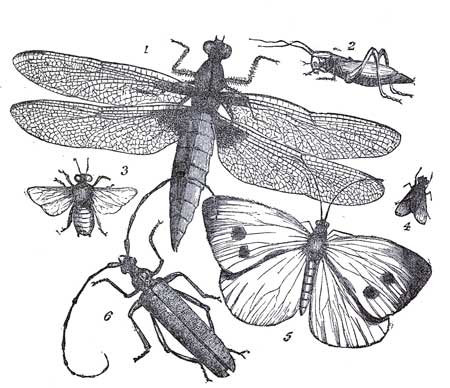
FIG. 16.—INSECTS.
| 1. Dragon-fly (Libellulina depressa). | 4. Fly (Musca domestica). |
| 2. Grasshopper (Gryllus). | 4. Butterfly (Pontia brassicæ). |
| 3. Bee (Apis mellifica). | 6. Musk-beetle (Cerambyx moschatus). |
The Insects form the fourth class of this division, and by far
the most important and numerous. They come to maturity only after
undergoing successive changes from the egg to the perfect animal;
these transformations are amongst the most wonderful things connected
with them. The eggs (some of which are very beautiful) are first
deposited in some safe place, either attached to a leaf or tied up
in a small bundle by silken threads spun by the parent insect, and
in some nutritious substance, so that when it comes to life it may
at once have food; this is sometimes in manure, sometimes in flesh,
and sometimes under the skin of a living animal (few are exempt from
this infliction), where they remain for a time and then come forth as
maggots, caterpillars, &c.; in this state they are called "larvæ,"
these are generally active creatures and eat most voraciously, which
seems to be the principal act of this state of their existence. These
larvæ frequently change their skins as they grow, and at last they
assume the next stage of their life, the pupa or chrysalis state,
which is one generally of complete inactivity; many of these larvæ,
weave themselves a covering of a sort of silk, to defend them while
in the pupa state—such as the Silkworm, whose covering (cocoon) is
the source of all the silk of commerce—others merely place themselves
in a situation of security. The pupa remains dormant for a certain
time, and then becomes the imago or perfect insect (the last state
of its existence), such as a Moth, a Butterfly, a Beetle, &c. These
are of different sexes, and in due time produce a batch of eggs and
then die; these eggs are often incredible in numbers, amounting to
many thousands—fortunately but few escape the watchful eyes of other
insects and of birds who feed upon them.
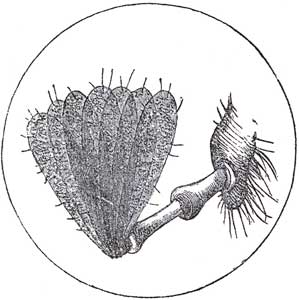
FIG. 17.—ANTENNA OF COCK-CHAFFER
(Melolontha vulgaris).
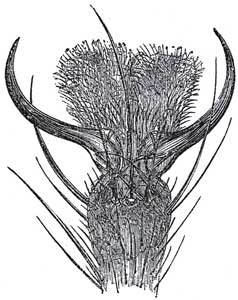
FIG. 18.—FOOT OF FLY, MAGNIFIED.
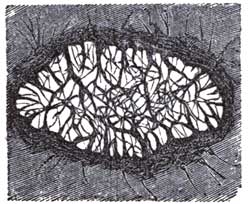
FIG. 19.—SPIRACLE.
Insects have six jointed legs, a pair of antennæ or horns (as they are
called) and generally one or two pairs of wings. The head is joined
to the body by a constricted neck, the part of the body to which it
is joined is called the thorax, and to this is added the posterior
part or abdomen; this part is extremely various in form in different
insects, in some it is round and full, in others long and extended.
The antennæ arise from the head, and are generally composed of eleven
pieces variously disposed; these wonderful organs are possessed of
great sensibility, and they certainly serve to convey information to
the insect, of the nature of one of the special senses; it was formerly
thought to be simply that of touch very much refined, or of smell, but
it is now generally considered to be that of hearing, or a modification
of it. The forms of the antennæ are very various, fig. 17 represents
that of the Cockchaffer (Melolontha vulgaris). The legs proceed from
the thorax, as do the wings, the abdomen giving rise to none of the
extremities; the feet of insects are all pretty much upon the same
model, some being more developed than others, they have a pair of hooks
or claws for catching and clinging to rough surfaces, and a pair of
cushions or pads, covered in some cases with suckers. The foot of the
Fly (fig. 18) is well developed in this particular, enabling it to walk
with perfect ease even on glass or the smoothest surface, and in any
position. Insects do not breathe by lungs or gills, but by means of
branched tubes called "tracheæ," which convey the air to the interior
of the animal. On the surface of these, the blood vessels ramify,
giving out the carbonic acid of the blood and receiving oxygen; the
openings to these air-tubes are arranged along the sides of the body,
and are called "spiracles" (fig. 19). They are curious objects under
the microscope, some of them being closed by a perforated membrane,
others have a sort of sieve or network of fibres, and most of them a
contrivance to catch and exclude minute particles of matter floating in
the air, and thus prevent their entry into the tracheæ. Insects have
two eyes, one on each side of the head, which are of great size, often
forming complete hemispheres; each eye is made up of several thousand
separate eyes or "ocelli," hence they are called compound eyes; these
ocelli are placed closely together, so as to form a sort of honeycomb
arrangement; the appearance of a part of one of these eyes is shown in
fig. 20.
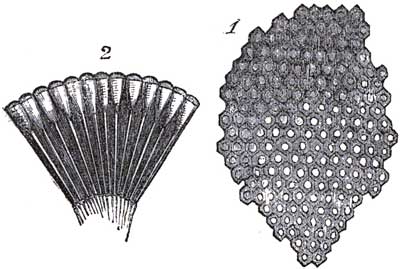
FIG. 20.—COMPOUND EYE.
(1, perpendicular section; 2, surface.)
Insects are amongst the most active of creatures, whether for good or
for evil, and the prodigious rapidity with which they increase under
favourable circumstances would soon cause them to overrun the whole
earth, to the extinction of almost every other creature, were these
circumstances not controlled by an all-wise Providence, who keeps a
constant check upon their progress by causing one insect to feed
upon another, and who has formed almost innumerable other creatures
(including birds, reptiles, and fishes) with instincts which lead them
to feed upon insects in every stage of their development (fish devour
the larvæ of many insects which inhabit the waters during the first
stage of their existence); but it occasionally happens, when some of
these salutary checks upon their increase are withdrawn, that they
multiply with such fearful rapidity as to produce a complete famine,
for they eat up everything before them. Who has not heard of the
plagues of Locusts and the depredations of the White Ants? The swarms
of Locusts in Africa will sometimes cover many hundred square miles of
surface, and in this space not a vestige of any vegetation would remain
after their visit. The description of the prophet Joel is sublime: "The
land is as the garden of Eden before them, and behind them a desolate
wilderness: yea, and nothing shall escape them.... The earth shall
quake before them, the heavens shall tremble: the sun and the moon
shall be dark, and the stars shall withdraw their shining."
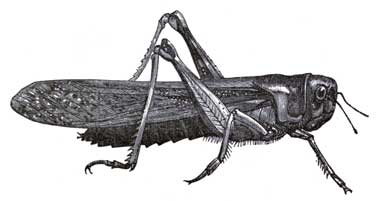
FIG. 21.—LOCUST (Locusta Migratoria).
But it is kindly ordained that these visitations shall only
occasionally take place, and even when they do, terrible as is the
infliction, a benefit in reality outweighing the injury often succeeds;
for the land in these countries is often made almost barren by the
quantities of tangled roots and stubble on the surface of the earth,
which by the destructive powers of these insects is completely removed,
and their manure left in its place, so that the fertility of the ground
is much increased (often tenfold) after their visits.
The thousands of species of insects which exist, render it impossible
in a work like this, even to name them, but under the separate orders
will be given a slight outline of the more important.
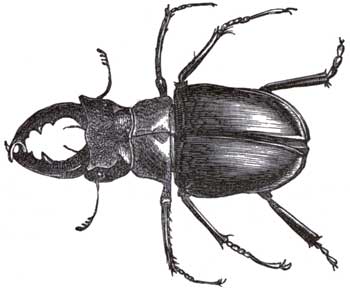
FIG. 22.—THE STAG BEETLE (Lucanus cervus).
Insects are divided, according to the character of their wings, into
nine orders.
1. Coleoptera (Black-winged).
The Coleoptera are those insects generally denominated Beetles, they
have four wings, the two outer of which are not used to fly with, but
as cases to cover and protect the other two; they are called "elytra,"
are horny and firm in texture, and in some cases, as the Diamond Beetle
and Musk Beetle, beautifully ornamented; the under pair of wings fold
transversely so as to pack up under the outer ones, which are shorter.
All Beetles live but one season, both sexes die before winter, leaving
nothing but their eggs to continue the species, the larvæ which come
from these are very destructive, eating most voraciously; for the most
part, Beetles feed on decaying substances such as dung, &c., and are
therefore useful creatures; there are between 40,000 and 50,000 species
of them. Beetles have been called the scavengers of nature, and truly
they are so, for they (with other insects) clear off all dead matter,
whether animal or vegetable; the Geotrupes stercorarius, and others,
dig holes in the ground and bury the excrement which is deposited on
the surface, thus doing a great service to vegetation, taking it down
to nourish the roots of the grass and other plants instead of allowing
it to harden and decompose on the surface. All dead animals are at once
attacked and devoured by insects, and the Beetles play their full share
in this necessary operation.
There are certain Beetles, called Burying Beetles (Necrophorus
vespillo), which remove the earth from under the dead bodies of small
animals, such as birds or mice, till they are beneath the level of the
ground, when they cover them up and deposit their eggs in them; these
bodies form stores of food for the future larvæ.
The Stag Beetle (Lucanus cervus, fig. 22), the Dor Beetle (Geotrupes
stercorarius), the Cockchaffer (Melolontha vulgaris), the Musk Beetle
(Cerambyx moschatus, fig. 16), and the Lady-bird (Coccinella), are
well-known members of this order.
2. Orthoptera (Straight-winged).
The Orthoptera are those insects whose wings fold longitudinally; they
have two pairs, but the anterior pair are horny and serve as wing-cases
to the posterior pair; their food is chiefly vegetable, but to many
of their species any kind is acceptable, as their mouths are suitable
for grinding-up hard substances. The Locusts (Locustidæ, fig. 21),
Grasshoppers (Gryllidæ), Crickets (Achetidæ, fig. 16), and Cockroaches
(Blattidæ), or Black-beetles, as they are sometimes incorrectly called,
belong to this tribe. Their metamorphoses are not so complete as in
many other insects, for they never entirely change their form; the
larva as it leaves the egg has no wings, but otherwise is much like the
parent; it changes its skin several times, which stage is analogous to
the pupa state, after casting it five times and obtaining wings, it
becomes the imago or perfect insect. The ravages of the Locusts are so
well known that little need be said; the following is from Kirby and
Spence's Entomology:—
"Although this animal be not very tremendous for its size, nor very
terrific in its appearance, it is the very same whose ravages have been
the theme of naturalists and historians in all ages, and upon a close
examination you will find it to be peculiarly fitted and furnished for
the execution of its office. It is armed with two pairs of very strong
jaws, the upper terminating in short, and the lower in long teeth,
by which it can both lacerate and grind its food; its stomach is of
extraordinary capacity and powers; its hind legs enable it to leap to a
considerable distance, and its ample vans are calculated to catch the
wind as sails, and so to carry it sometimes over the sea; and although
a single individual can effect but little evil, yet when the entire
surface of a country is covered by them, and every one makes bare the
spot on which it stands, the mischief produced may be as infinite as
their numbers. So well do the Arabians know their power, that they make
a Locust say to Mahomet, 'We are the army of the Great God; we produce
ninety-nine eggs; if the hundred were completed, we should consume the
whole earth and all that is in it.'"
3. Neuroptera (Nerve-winged).
The Neuroptera comprise the Dragon-fly (Libellulina, fig. 16), Ant-lion
(Myrmelion), Caddis-flies (Phryganidæ), and the May-flies (Ephemera);
these insects have wings of a beautiful network structure, as may be
seen in the Dragon-fly, they make their appearance about the middle of
June in the locality of ditches and ponds. The Caddis-fly is noted for
the peculiar case which the larva makes for itself; the larva inhabits
the water and the ease is made of little fragments of wood, shell, and
sand, agglutinated together so as to float; the perfect insect is not
aquatic, and flies away when formed. The May-flies are noted for the
shortness of their existence, the larvæ live in the water, and many
of them are eaten by fishes who are very fond of them, but sufficient
numbers come to the perfect state, to form complete clouds in the air
where the larvæ were, these creatures live but a day, and some of
their species but an hour or two, in the perfect state, they deposit
their eggs in the water, which come to life in the mud at the bottom.
The flight of these fragile beings and their short-lived holiday
festivities are well described by Kirby and Spence:—
"In the beginning of September, for two successive years, I was so
fortunate as to witness a spectacle of this kind, which afforded me
a more sublime gratification than any work or exhibition of art has
power to communicate. The first was in 1811. Taking an evening walk
near my house, when the sun, declining fast towards the horizon,
shone forth without a cloud, the whole atmosphere over and near the
stream swarmed with infinite myriads of Ephemeræ and little gnats of
the genus chironomus, which in the sun-beam appeared as numerous and
more lucid than the drops of rain, as if the heavens were showering
down brilliant gems. Afterwards, in the following year, one Sunday,
a little before sunset, I was enjoying a stroll with a friend at a
greater distance from the river, when in a field by the road-side
the same pleasing scene was renewed, but in a style of still greater
magnificence; for, from some cause in the atmosphere, the insects
at a distance looked much larger than they really were. The choral
dances consisted principally of Ephemeræ, but there were also some
chironomi, the former, however, being most conspicuous, attracted our
chief attention. Alternately rising and falling, in the full beam they
appeared so transparent and glorious, that they scarcely resembled
anything material; they reminded us of angels and glorified spirits
drinking life and joy in the effulgence of the Divine favour. The Bard
of Twickenham, from the terms in which his beautiful description of his
sylphs is conceived in the 'Rape of the Lock' seems to have witnessed
the pleasing scene here described:—
'Some to the sun their insect wings unfold,
Waft on the breeze, or sink in clouds of gold;
Transparent forms, too fine for mortal sight,
Their fluid bodies half dissolved in light;
Loose to the wind their airy garments flew,
Thin glittering textures of the filmy dew,
Dipt in the richest tincture of the skies,
Where light disports in ever mingling dyes,
While every beam new transient colours flings,
Colours that change whene'er they wave their wings.'"
4. Hymenoptera (Membrane-winged).
The Hymenoptera are those insects which have four membraneous wings.
The Bees (Apidæ, fig. 16), Wasps (Vespidæ), the Ants (Formicidæ), and
the Ichneumon Flies (Ichneumonidæ), are the chief tribes of this order.
The Bees, Wasps, and Ants are celebrated for forming societies, more
perfectly arranged and governed than in any other creatures but man.
It is curious that the most perfect instincts (such as approach so
nearly to reason that they almost defy us to make a distinction) should
have been given by the Creator to creatures so far removed from man
in the scale of existence, and so little resembling him in any other
particular. This is one of the stumbling-blocks in the way of those who
wish to have it believed that all animals are progressive from certain
types, which cannot be got over; if such were the case, man would be
most nearly imitated by the Apes, and these again by those most nearly
allied to them, and so on downwards, but here we find a government
almost as perfect as that of the human species—an arrangement of work,
a division of labour, buildings, storehouses, &c.—showing nearly all
the social habits and feelings of man, in creatures who in form and
size have no resemblance to him.
Kirby and Spence, in describing the societies of insects, say:—"But
when we consider the object of these societies, the preservation and
multiplication of the species, and the means by which that object is
attained (the united labours and co-operation of perhaps millions
of individuals), it seems as if they were impelled by passions very
similar to those main-springs of human associations which I have just
enumerated. Desire appears to stimulate them, love to allure them, fear
to alarm them. They want a habitation to reside in and food for their
subsistence. Does not this look as if desire were the operating cause
which induces them to unite their labours to construct the one and
provide the other? Their nest contains a numerous family of helpless
brood. Does not love here seem to urge them to exemplary and fond
attention, and those unremitted and indefatigable exertions manifested
by the whole community for the benefit of these dear objects? Is it
not also evident by their general and singular attachment to their
families, by their mutual caresses, by their feeding each other, by
their sympathy with suffering individuals and endeavours to relieve
them, by their readiness to help those that are in difficulty, and
finally by their sports and assemblies for relaxation? That fear
produces its influences upon them seems no less evident, when we see
them agitated by the approach of enemies, endeavour to repel their
attacks, and to construct works of defence. They appear to have besides
a common language, for they possess the faculty, by significative
gestures and sounds, of communicating their wants and ideas to each
other."
Numerous works have been entirely devoted to the habits and instincts
of Bees and Ants, and very interesting they are, but it would be
impossible to give an intelligible account of them in the small space
allotted in this volume.
The wax of which Bees build their beautiful six-sided cells, and
which is the whole source of all the wax used by men for a variety of
purposes, is secreted in little scales or flakes, between the joints
of the abdomen, from whence the wax-making Bees take it to build the
comb; the cells of the comb are filled with honey, which is obtained
by the Bees (by means of the apparatus shown at fig. 23), from the
nectaries of flowers in the form of nectar, and is converted into honey
in the honey-bag of the Bee, from whence it is discharged into the
cells. Bees also collect the pollen from the flowers they visit, this
adheres to the hairs on the Bee, and is scraped and brushed off, and
collected into two little lots, which the Bee carries on each hind leg,
this pollen is made into bee-bread. By scattering the pollen, flowers
are often fecundated, for there are many plants, the female flowers of
which are separate from the males, and it is only by insects and the
wind, that the females are fecundated, for the Bee, with the pollen
adhering to every part, first visits one flower and then another in
search of nectar.
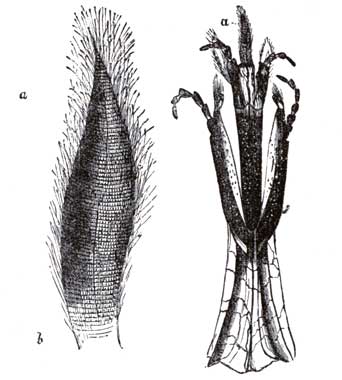
FIG. 23.—HONEY-LAPPING APPARATUS OF WILD
SEA-BEE (Halictus), (a, magnified; a b, more highly
magnified).
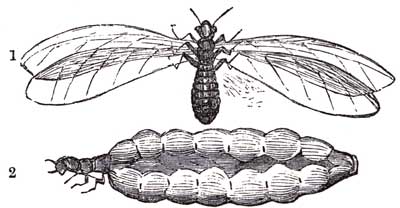
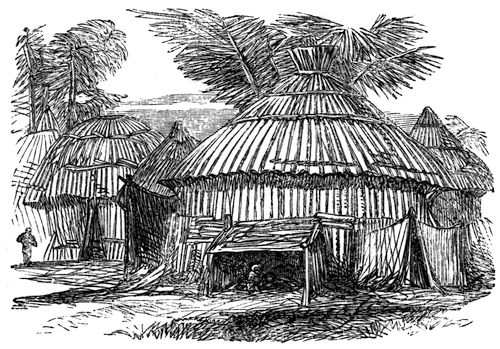
FIG. 24.—WHITE ANTS (1, Winged Female; 2,
Female, distended with eggs).
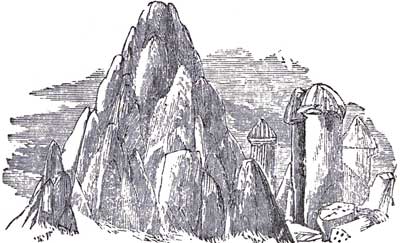
FIG. 25.—NESTS OF WHITE ANTS.
With respect to the Ants, Kirby and Spence give the following account
of the building of their habitations.
"The nest of Formica brunnea is composed wholly of earth, and
consists of a great number of stories, sometimes not fewer than
forty, twenty below the level of the soil, and as many above,
which last, following the slope of the ant-hill, are concentric.
Each story, separately examined, exhibits cavities in the shape of
saloons, narrower apartments, and long galleries which preserve the
communication between both. The arched roofs of the most spacious
rooms are supported by very thin walls, or occasionally by small
pillars and true buttresses; some having only one entrance from
above, others a second, communicating with the lower story; the
main galleries, of which, in some places, several meet in one large
saloon, communicate with other subterranean passages, which are often
carried to the distance of several feet from the hill. These insects
work chiefly after sunset. In building their nest they employ soft
clay only, scraped from its bottom when sufficiently moistened by a
shower, which, far from injuring, consolidates and strengthens their
architecture. Different labourers convey small masses of this ductile
material between their mandibles, and with the same instrument they
spread and mould it to their will, the antennæ accompanying every
movement. They render all firm by pressing the surface lightly with
their fore feet; and however numerous the distinct masses of clay
composing these walls, and though connected by no glutinous material,
they appear when finished, one single layer, well united, consolidated
and smoothed. Having traced the plan of their structure, by placing
here and there the foundations of the pillars and partition-walls,
they add successively new portions; and when the walls of a gallery or
apartment, which are half a line thick, are elevated about half an inch
in height, they join them by springing a flattish arch or roof from one
side to the other. Nothing can be a more interesting spectacle than
one of these cities while building. In one place vertical walls form
the outline, which communicate with different corridors by openings
made in the masonry; in another we see a true saloon, whose vaults
are supported by numerous pillars; and further on are the cross-ways
or squares where several streets meet, and whose roofs, though often
more than two inches across, the Ants are under no difficulty in
constructing, beginning the sides of the arch in the angle formed by
two walls, and extending them by successive layers of clay till they
meet; while crowds of masons arrive from all parts with their particles
of mortar, and work with a regularity, harmony, and activity, which can
never enough be admired. So assiduous are they in their operations,
that they will complete a story with all its saloons, vaulted roofs,
partitions and galleries, in seven or eight hours. If they begin a
story, and for want of moisture are unable to finish it, they pull down
again all the crumbling apartments that are not covered in."
Every one has heard of the destructive as well as constructive
qualities of the "White Ant;" another quotation from Kirby and Spence
will illustrate both.
"When they find their way into houses or warehouses nothing less hard
than metal or glass escapes their ravages; their favourite food,
however, is wood of all kinds, except the Teak, and Ironwood, which
are the only sorts known, that they will not touch; and so infinite
are the multitudes of the assailants, and such is the excellence of
their tools, that all the timber-work of a spacious apartment is often
destroyed by them in a few nights. Exteriorly, however, everything
appears as if untouched; for these wary depredators (and this is what
constitutes the greatest singularity of their history) carry on all
their operations by sap and mine, destroying utterly the inside of
solid substances, and scarcely ever attacking their outside until they
have first concealed it and their operations with a coating of clay.
A general similarity runs through the proceedings of the whole tribe,
but the large African species, called by Smeathman Termes bellicosus,
is the most formidable. These insects live in large clay nests, from
whence they excavate tunnels all round, often to the extent of several
hundred feet; from these they will descend a considerable depth below
the foundation of a house, and rise again through the floors; or,
boring through the posts and supports of the building, enter the roof
and construct their galleries in various directions.
"If a post be a convenient path to the roof, or has any weight to
support, (how they discover it is not easily conjectured), they will
fill it with their mortar, leaving only a track-way for themselves, and
thus, as it were, convert it from wood into stone as hard as many kinds
of freestone. In this manner they soon destroy houses, and sometimes
whole villages, when deserted by their inhabitants, so that in two or
three years not a vestige of them will remain. These insidious insects
are not less expeditious in destroying the wainscoating, shelves,
and other fixtures of a house, than the house itself; with the most
consummate art and skill they eat away the inside of what they attack,
except a few fibres here and there, which exactly suffice to keep the
two sides, or top and bottom, connected, so as to retain the appearance
of solidity after the reality is gone; and all the while they carefully
avoid perforating the surface, unless a book or any other thing that
tempts them should be standing upon it.
"Kœmpfer, speaking of the White Ants of Japan, gives a remarkable
instance of the rapidity with which these miners proceed. Upon rising
one morning he observed that one of their galleries of the thickness of
his little finger had been formed across his table; and upon a further
examination he found that they had bored a passage of that thickness
up one foot of the table, formed a gallery across it, and then pierced
down another foot into the floor; all this was done in the few hours
that intervened between his retiring to rest and his rising."
Most of this order are armed with some weapon of defence. The Bee
and Wasp have each a most formidable sting, with which they are able
to inflict a wound fatal to most insects. The Ants have a peculiar
secretion, consisting of formic acid, which they eject with great
force, and which has a very disagreeable smell. The eggs of Ants when
hatched produce a small grub, which spins itself a sort of cocoon,
and in this state it so much resembles a grain of corn, that it has
been mistaken for it; this error has given rise to the supposition
that Ants store up corn for winter, whereas they never eat corn, but
the care they take of these larvæ, removing them from place to place,
taking them up in their mandibles and running along with them, has been
mistaken for the act of storing away grains of corn.
5. Strepsiptera (Twisted-winged).
This order includes but a few species; Dr. Baird in his Cyclopædia,
gives the following account of them:—
"Certain insects were discovered by Kirby, living parasitic in the
abdomen of some Andrenæ, which at that time were nondescript, and could
not be referred to any existing order. They were afterwards placed
in an order by themselves, which he called Strepsiptera. The larvæ
live in the bodies of Bees, Wasps &c., and the males only undergo a
perfect metamorphosis; the females, even when adult, have neither legs,
wings, nor eyes, but resemble larvæ, and continue to live parasitic in
the bodies of the Hymenopterous insects within which they were born.
The characters are thus taken from the male and consist chiefly in
the structure of the wings. The anterior pair are quite rudimentary,
being transformed into a pair of short, slender, contorted appendages
resembling narrow balancers or halters. The posterior pair are large
and membraneous, their nervures are only longitudinal, so that they are
able to fold them like a fan. They have large globular eyes, with the
facets few, but of comparatively large size."
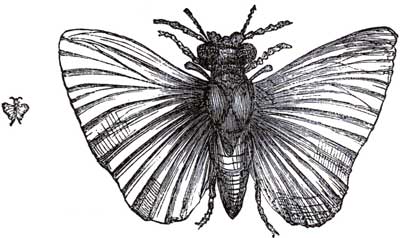
FIG. 26.—STYLOPS ANDRENÆ.
"About ten or twelve species are known, forming a small family,
"Stylopidæ." The genus Stylops may be taken as the type, and contain
such species as have the tarsi with four points and the antennæ with
six."
6. Lepidoptera (Scaly-winged).
This order includes the Butterflies and Moths, they have four wings,
which are large and covered with minute scales, which are for the
most part of a heart or battledore shape, as in fig. 27. The wings of
these insects are many of them beautifully marked and tinged. There
are about 12,000 species, by some divided into "diurnal" (or those
which fly by day), "crepuscular" (or those which fly in the evening),
and "nocturnal" (or those flying by night). The Moths are mostly
crepuscular and nocturnal, while the Butterflies are chiefly diurnal,
but the most usual distinction between the Moth and Butterfly consists
in the form of the antennæ, those of the Moth being feather-shaped,
while those of the Butterfly have a small knob at the end, or, as it
is called, "club-shaped." The Lepidoptera feed upon the nectar of
flowers, for which purpose they are furnished with a long proboscis or
"Haustellium," which is curled up under the head, it consists of two
semi-cylindrical pieces which when placed side by side form a tube, up
which the nectar is drawn by capillary attraction. The metamorphosis
of these insects is complete.
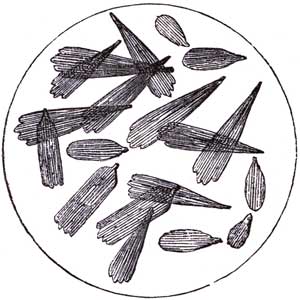
FIG. 27.—SCALES FROM MOTH'S WING
(Magnified).
The Silkworm (Bombyx mori) belongs to this order. It is the most
important of all insects to man, as from it alone all the silk of
commerce is obtained. Its cocoon is of a beautiful yellow colour,
varying in shade from orange to pale straw-colour; the silk of one
cocoon weighs somewhere about three grains; it would therefore, at
this calculation, take 1920 worms to spin one pound. The annual import
of silk into this country alone is about 7,000,000 pounds, it must
therefore take 13,440,000,000 Silkworms to supply us with silk yearly!
The Silkworm feeds almost exclusively on the leaves of the mulberry.
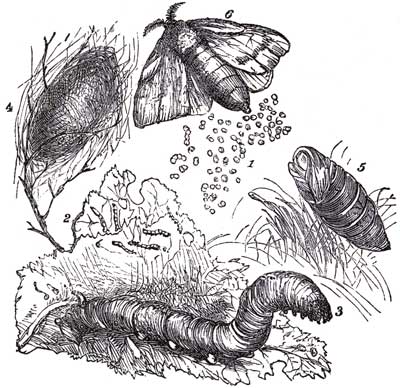
FIG. 28.—THE SILKWORM (Bombyx mori).
1, the
Eggs; 2, the young Silkworms; 3, the full-grown Silkworm; 4, the
Cocoon; 5, the Chrysalis; 6, the Moth.
7. Hemiptera (Half-winged).
The Hemiptera have two pairs of wings, the hindermost small, and
the foremost pair half horny and half membraneous, the base being
horny, and the apex membraneous. They include the Bugs, some of which
are aquatic, as the Water Scorpion (Nepa), and the Water Boatman
(Natonecta), which swims on its back, rowing itself by means of a pair
of long legs, which look like oars; the common bed Bug is also of this
order, although wingless, as are also the Plant Lice (Aphides), which,
however, obtain wings in their perfect state.
8. Diptera (Two-winged).
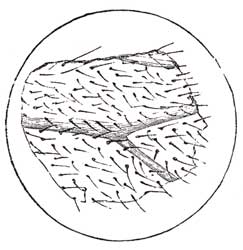
FIG. 29.—PART OF GNAT'S WING, MAGNIFIED.
The Diptera include the common House Fly (fig. 16), Bluebottle Fly,
Gnat, and many others; their wings are like the Neuroptera, but they
have but one pair, the other pair being undeveloped, form little
knobs called "balancers." The wings of Flies are generally covered
with short stout hairs, as seen in fig. 29; the common Fly feeds upon
almost anything, but some of the Diptera feed exclusively on the blood
of other animals; the Gnat (Culex pipiens), of which the Mosquito is
a variety, deposits its egg in the water on any floating substance,
the larva which comes from the egg is aquatic, living with its head
downwards, the end of the abdomen only being above the water, in this
there is a spiracle or breathing orifice, which enables it to take in
the air; the Gnat, when it comes from this larva, stands on its shell
for a moment, and then flies off, for it is not suited to live in the
water; this history of the early stages of its life, accounts for Gnats
being always found in such numbers near pools of water. The Tsetse,
which Dr. Livingstone describes as being so fatal to cattle, is of
this order; he says, "It is well known that the bite of this poisonous
insect is certain death to ox, horse, or dog.... A most remarkable
feature in the bite of the Tsetse is its perfect harmlessness to man
and wild animals, and even calves, so long as they continue to suck the
cows."
9. Aptera (Wingless).
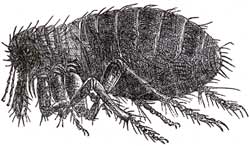
FIG. 30.—FLEA (Pulex irritans)
MAGNIFIED.
To this order belongs the Flea (Pulex irritans), which is furnished
with lancet-shaped weapons, through which it sucks the blood of other
animals, for it is entirely parasitic, and also the "Chigeo" (Pulex
penetrans), which is a troublesome and even dangerous pest in the West
Indies; it penetrates the skin of the feet, and deposits its young
beneath it.
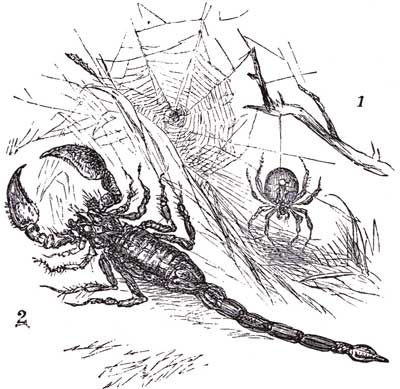
FIG. 31.—ARACHNIDA. 1, Spider (Epeira Diadema);
2, Scorpion (Scorpio).
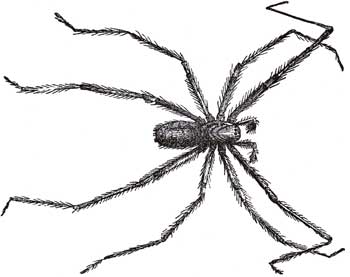
FIG. 32.—LONG-LEGGED HOUSE-SPIDER (Aranæ
domestica).
The last class of the Articulata, the Arachnida, includes the Spiders,
Scorpions, Centipedes, and Millipedes. The Arachnida differ from
insects, in having eight or more legs, more than two eyes, no wings,
and no head; the Spiders have four pairs of legs, and six, eight, or
more, simple eyes, which appear as minute spots on the upper part of
the thorax. Spiders nearly all live by preying upon small insects,
which they catch in several ways, but by far the most general mode is
by constructing a web or net to entangle them; the threads of this
web are made of a fluid glutinous substance, which is secreted within
the abdomen, and which they project from extremely minute orifices,
several of which exist on the point of little projections called
"spinnarets," this liquid dries into a solid thread immediately it
comes into contact with the air; it is extremely strong, and so fine
that several thousand of the single fibres will only make the size of
a human hair. The Garden Spider (Epeira diadema) is often called the
Geometrical Spider, from the regularity of its web. These Spiders will
often place a thread from one spot to another, where it would seem
impossible that they could attach it, such as from the branch of a
tree to the corner of a house twenty feet or more from the ground; it
has never been accurately determined how the Spider does this, and it
is the more difficult to observe, as it is always done in the night,
but it has been supposed that a fine thread is spun, and that the wind
carries it across, when it is strengthened and afterwards made tight.
The Spider (Araneæ domestica) that makes "cobwebs" in the corners of
rooms, is called the Weaving Spider. Some Spiders are called Hunting
Spiders, they do not construct webs, but pounce upon their prey with a
leap; the Mygale avicularis of South America is one of this kind; it is
said that some grow so large that their feet spread out a foot wide.
The Long-legged Spider, often found in our houses, and of which fig. 32
is an exact copy, measures 3½ inches, and is the largest species we
have. There are also aquatic Spiders, which feed upon insects in the
water and dive down for them; their surface being hairy and unctuous,
retains sufficient air to bring them up and prevent them being wetted.
The eyes of Spiders are different from those of other insects; they
appear as simple, shining spots, or "ocelli," and not compound eyes,
having a great many "ocelli" compounded into one. These "ocelli" are
arranged in a group of eight or more, and placed on the upper part of
the thorax, for Spiders have no head, although generally represented
with one. The eggs of Spiders are generally deposited in some sheltered
place, fastened together and partly covered with a net-work of a sort
of yellow silk, very much resembling the cocoon of the Silkworm. The
Scorpion, so terrible in appearance, and in its sting so deadly, and
which is sometimes a foot in length, belongs to this order. It has
eight legs, and a pair of claws like a lobster, the body is lengthened
into a sort of tail, at the end of which is a claw or sting, like the
poison fang of a serpent, with a poison bag at its root; its effects
are often fatal to man, and always so to the insects and other small
animals upon which the Scorpion feeds, its usual mode of killing which,
is to catch them with its claws and then to sting them to death. The
Centipede is a scarcely less frightful creature; in South America and
the West Indies it is sometimes found to grow to eight or ten inches in
length, it is of a long jointed form, with generally twenty-one pairs
of legs, although some have double this number; its bite is much to be
dreaded, as it is poisonous, especially the "Scolopendræ," which have
a poison gland, like the snake; in this country they are very small
indeed, and are generally found in moist places.
The Centipedes and Millipedes are, by some, placed in the class
Arachnida, but by others in a separate class called "Myriopoda,"
divided into two orders, the Chilognatha, which have rounded
cylindrical bodies, and generally more than one pair of legs to each
segment of the body, and the Chilopoda, which have a distinct flattened
head and but one pair of legs to each segment.
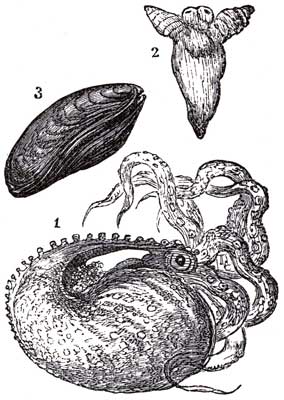
FIG. 33.—MOLLUSCA.
1, Nautilus (Argonauta); 2, Clio Borealis; 3, Mussel (Mytilus edule).
The last of the three great divisions of the Invertebrata is formed
by the Mollusca; it is divided into six classes, (see page 218). The
Mollusca are characterised by having no internal skeleton, nor external
horny case, as in the Articulata; they are rather soft, and either void
of solid covering, or possessed of "shells" composed chiefly of earthy
matter (chalk), and in one or two pieces, called valves, hence the
names, uni-valve and bi-valve; all shells of this description belong to
the Mollusca, some of which have no means of locomotion, as Oysters;
others have a "foot" covered with a muscular expansion, called the
"mantle," by which they glide onwards, as the Snail.
1. The Tunicata have no shell or hard covering, but are of a pretty
firm consistence; they are either fixed to rocks and sea-weeds, or
float about freely, and are either solitary, social, or compound. The
"Ascidians" are united in groups, and are all connected by a common
stalk or "Stolon," from which they grow by buds.
2. The Brachiopoda. These Molluscs are furnished with a pair of
shells, within which the animal lives; one of these shells (the
ventral one) has a small hole in it, close to the hinge, and through
this a long tendinous cord passes, which fixes the creature to some
stone or rock, hence the name Brachiopodous, which means arm-footed.
The young of this Mollusc are not fixed, but float about. The Lingula
has horny shells, and the foot passes out between them; these
creatures were some of the first created, if not the very first; the
shells of Terebratula are found in vast quantities in the oldest
fossiliferous strata.
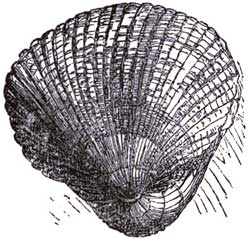
FIG. 34.—COCKLE (Cardium edule).
3. The Lamellibranchiata include a great many of our most ordinary
Mollusca, commonly known as "shell fish." They have a pair of shells,
and are thence called "bivalve." The Oyster (Ostrea edulis), Mussel
(Mytilus edulis), Cockle (Cardium edule), Scallop (Pecten), belong to
this class. Oysters form a considerable article of commerce, thirty
or forty thousand bushels are brought each season to London; they are
dredged up from "beds," where they are found in great quantities. They
spawn in May and June, and are not then good. There is an old and a
well-known saying, that "Oysters are not fit to eat, unless there is
an R in the month," all the names of the months containing an R but
May, June, July, and August. The spawn is collected and placed in
artificial beds, consisting of shallow places or hollows in the sea,
where the tide will not wash them away, and whence they can be easily
removed when sufficiently grown, which is in five or six years; these
creatures have no powers of locomotion, but remain where the tide
washes them; but Scallops, Cockles (fig. 34), and Mussels (fig. 33),
have the power of fixing themselves to any substance they wish, by
means of the "byssus" or beard, which is a tuft of fibres passing out
from between the shells; and it is said, the Scallops have the power
of progression, by suddenly opening and shutting the shells.
4. The Pteropoda are Mollusca which have no shell, or a very thin one;
the Clio borealis (fig. 33), which forms the chief food of the Whale,
is found in great multitudes in the Arctic seas, it swims about by
means of two extensions, similar to wings. The Hyalœa has a small
round transparent shell.
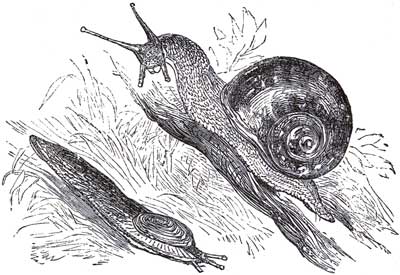
FIG. 35.—SNAIL (Helix aspersa), AND
SLUG (Limax cinerius).
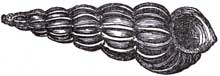
FIG. 36.—WENTLE-TRAP SHELL
(Scalaria).
5. The Gasteropoda are extremely numerous; most of them have univalve
shells, but many of them have none, as the Garden Slug (Limax, fig.
35). The Whelk (Buccinum undatum), Perriwinkle (Littorina littoria),
Garden Snail (Helix aspersa, fig. 35), and the Wentle-trap (Scalaria,
fig. 36), are the most familiar examples of this class. These Mollusca
walk by means of the mantle, which is muscular, and capable of
alternate contraction and expansion; they breathe by means of lungs
on their back beneath the shell, and to which there is an opening in
their side. What are usually called the horns are four in number, two
short and two long; they are tentaculæ, but what is peculiar in them
is the circumstance of having the eyes placed at their ends. These
Mollusca have a sort of valve, which, when they retire into the shell,
closes it like a lid; it is called the "Operculum;" in some cases it
is horny, as in the Perriwinkle, and in others, resembles shell; the
shells of these mollusca are coiled into a spiral, this is caused by
the shell always growing by additions to the edges of the mouth, and
in nearly every case this spiral turns in the same direction that a
screw does, but in a very few it turns in the opposite direction, as
in the "Fusus contrarius."
6. The Cephalopoda include the "Cuttle-Fish," and Nautilus (fig.
33). They are furnished with eight or ten tentacula or arms, which
spring from the head, and which are covered with suckers; the mouth
is in the centre, and these tentacula are used to lay hold of their
prey and convey it to the mouth; they have two perfect eyes, and they
breathe by gills. The Nautilus has a univalve shell, which is of a
very graceful and elegant form; its interior is divided into chambers,
with a syphon running through them, by which the air is exhausted or
compressed so as to cause them to sink or swim; the animal occupies
only the outer chamber; the extinct Ammonite belonged to this class.
It is from the Cuttle-Fish (Sepiæ) that the beautiful dark brown
pigment, known as "sepia," is obtained, and also the material of which
Indian-ink is made.
The Vertebrate animals are those which have a brain and spinal cord
inclosed within a bony case, an internal skeleton, to which are
affixed the muscles, and which is moved by them; they all possess four
extremities, more or less modified in form, with the exception of the
Serpents. They are divided into four classes, Fishes, Reptiles, Birds,
and Mammals.
The Fishes live in water, and are unable to live in the air; they
receive oxygen from the water, but this is received much more slowly
than by air-breathing animals, and as the combination of oxygen with
the carbon of the system gives the elevated temperature of animals, so
in Fishes, the oxygen being received slowly, their temperature rises
but little above the temperature of the water they inhabit; they have
thence received the name of "cold-blooded." Fishes live upon the marine
animals which they capture, the various sea-weeds which grow in the
water, and insects which fall into, or breed there. They have fins
instead of legs, but the two pairs of fins known as "Pectoral" and
"Ventral" are analogues of them, and in a pectoral fin may be found
bones analogous to all the bones of the arm and hand of Man, or the
fore-feet of the other Vertebrata. Fishes urge themselves through the
water chiefly by the action of the tail from side to side, and in those
members which have more extended forms (as Eels), by a wavey motion of
the body itself; and the rapidity with which they swim is such, that
Sharks have been known to go round the ship they are following many
times in a very short space, although it may be sailing at a great
speed before the wind. Fishes are covered with scales, and the head is
united to the body without any constriction which can be considered as
a neck; they are mostly of a form such as can easily pass through the
water, without offering much resistance, and their specific gravity is
so nearly that of water, that, by the compression of a small vessel
filled with air, called the swimming bladder or "sound," they can rise
and sink with little effort. Many tribes of the human family, such as
the Esquimaux and Polynesians, almost live upon Fish, and even in Great
Britain, in fishing districts, it forms a great part of the food of the
inhabitants, and their capture gives employment to thousands.
Fish inhabit all kinds of water, the sea, rivers, and ponds, and many
which live habitually in the sea come into rivers at certain seasons;
and with respect to those which dwell always in the sea, some inhabit
certain tracts only, and confine themselves to them, just as quadrupeds
do to certain localities on the land. It has been a matter of wonder
how the Fish get into ponds formed by the drainage of lands; but most
ponds are supplied by springs which run underground from adjacent
lakes or rivers, or by rills running on the surface, these bring the
ova or eggs, which in favourable situations become hatched. Fish are
exceedingly prolific, the eggs in the roe of a Codfish were estimated
by Lewenhoec, to be upwards of 9,000,000, but not one in a thousand
comes to maturity; there are enemies on all sides to devour them before
they are hatched, and others to attack them afterwards. Some of the
rivers of France have lately been artificially stocked with Fish by
causing the fecundated spawn to be preserved till they are of a bulk
and strength to protect themselves. This was effected by confining
them in tanks floating in the water and perforated with holes, and
afterwards placing them in a part of the river, inclosed both above and
below by means of nets, so as to keep away their enemies—the larger
Fishes.
Fishes were the first of the Vertebrated animals created, and as a
proof of the incorrectness of the doctrine of development, these
first-created Fish were of a class corresponding to the most highly
organised Fishes of the present day.
Fishes are divided into two families: 1, Osseous Fishes (with a bony
skeleton); 2, Cartilaginous Fishes (with a cartilaginious skeleton).
The Osseous Fishes are divided into six Orders:—
1. Acanthopterygii (Thorny-fin).
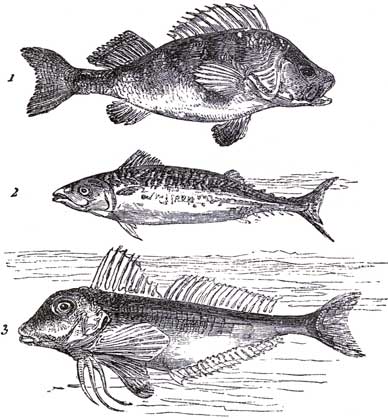
FIG. 37.—1, PERCH (Perca fluviatilis).
2, MACKEREL (Scomber vulgaris). 3, GURNARD
(Trigla Gurnhardus).
The Acanthopterygii include a great number of our ordinary useful
Fishes, as Mackerel, Perch, Tunny, Gurnard, &c. (fig. 37). The Perch
is a good example of this order, the sharp spines on its dorsal fin
being well developed, and dangerous for anglers to handle.
2. Malacopterygii abdominales (Abdominal soft-fin).
The abdominal Malacopterygii include the Pilchard, Herring, Pike (fig.
38), Salmon (fig. 39), Anchovy, Trout, Roach, Chub, Tench, and many
more of the Fish which inhabit our streams and the sea.
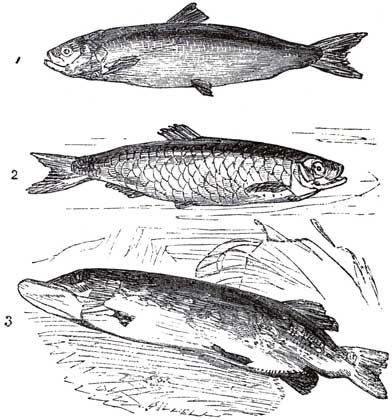
FIG. 38.—PILCHARD (Clupea pilchardis);
2. HERRING (Clupea Harengus); 3, PIKE (Esox Lucius).
The following account of the Salmon, is extracted from Dr. Baird's
Cyclopædia of the Natural Sciences:—"The Salmon is exceedingly
abundant in all the northern oceans. It is found in France, England,
Germany, Bohemia, Switzerland, Scandinavia, Iceland, and Greenland.
It exists also in Labrador and Canada, and down the American coast to
the Connecticut river, in latitude 41½ deg., and either it, or a
species so closely allied as not to be distinguished except by close
comparison, abounds in the Arctic seas washing the northern shores of
the American continent. It does not frequent the rivers falling into
the Mediterranean, and, though it has been stated to be the case, it
does not occur in the Persian Gulf, or the Caspian Sea. In entering
the mouths of rivers in order to spawn, the females are always
observed to precede the males, depositing their ova in little pools
or sort of nests, which they form in the sand at the bottom, for the
males to fecundate. The young grow very rapidly, and at the present
time, the subject of the changes which they undergo in their progress
to maturity is one exciting much interest. When first hatched they
are about an inch in length, and during the first year are called
"Parr." When they remove to the sea, they receive a more brilliant
dress, and then become the "Smolt," varying from four to six inches in
length. After a residence in the sea of from two months to ten weeks,
they revisit the fresh waters, and are then from two-and-a-half to
four pounds' weight, and are called 'grilses' or 'gilses.' During the
ensuing winter they spawn, and are then known as Salmon. Salmon grow
to a large size, full-grown specimens weighing about forty pounds,
though individuals are mentioned which have weighed seventy or even
eighty pounds. Such are now excessively rare, owing to the perfection
of the means of capturing them at the mouths of our rivers, by which
the chances are very greatly against any fish escaping the various
dangers by which it is environed for such a succession of years as is
likely to admit of its attaining to its full dimensions. The power
these fish have in overcoming obstacles to their progress up large
rivers at spawning time is very great; they shoot up rapids with
the velocity of arrows, and clear considerable waterfalls, leaping
a height of ten, twelve, and even as much as twenty feet. The usual
time at which the Salmon leaves the sea is the autumn; it remains in
the rivers during the winter, and returns to the sea, after having
deposited its spawn, in the spring. The fishing of this excellent and
universally admired fish gives employment to many thousands of people,
throughout the whole of the north of Europe. Salmon fisheries, it
has been said, rank next to agriculture. In this country the Scotch
rivers supply by far the greater proportion of the salmon brought to
market. The total value of the Scotch fisheries has been calculated at
£150,000 a year."
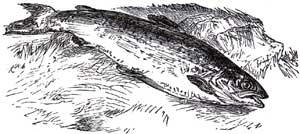
FIG. 39.—THE SALMON (Salmo salar).
Many salmon are caught by stake nets, and also by the practice of
"spearing;" this is a very picturesque sight, as it is conducted by
torchlight.
The Herring (Clupea Harengus) makes its visit to this country about
September, in enormous shoals, extending many miles each way; they
are caught in great quantities and salted in the boats immediately;
when brought on shore they are suspended in the smoke of wood fires,
and become "red herrings." The Herring fisheries are very important,
and afford—like the Salmon fisheries—employment to thousands; the
greatest quantities are caught off the coast of Norway, where it
is calculated about 400,000,000 are taken yearly. A great many are
caught off Lowestoffe, and Wick, in Caithness. The Pilchard (Clupea
pilchardus) is a kind of Herring, and is caught in enormous quantities
off the coasts of Cornwall. The Sprat and Whitebait are species of
"Clupea."
3. Malacopterygii sub-brachiales (Sub-brachial soft fin).
The brachial Malacopterygii include most of the Flat Fish; as the
Turbot, Plaice, Sole, &c. (fig. 40). The Turbot, and Halibut are
caught out in the deep waters, but the Plaice and Flounders, chiefly
in shallows; these fish have one side dark and the other light, and
both eyes are placed on the dark side; they always swim with this
side upwards; in the Turbot this is the left, while in Plaice it is
the right side. The Cod (fig. 40) is also included in this order; it
is a large fish, often weighing forty or fifty pounds, and three or
four feet long; it is chiefly caught in northern regions, the banks
of Newfoundland being the most celebrated for its Cod fisheries, and
supply the London market. These fish are caught by a long line and
hook let down to a great depth.
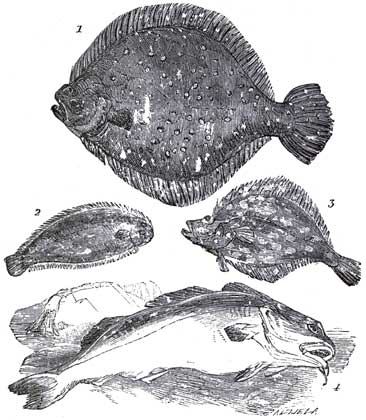
FIG. 40.—1, TURBOT (Rhombus maximus).
2, SOLE (Solea vulgaris). 3, PLAICE (Platessa
communis). 4, COD (Gadus morrhua).
4. Malacopterygii apodes (Footless soft fin).
To this order belong the Eels (fig. 41). They have no abdominal fins,
and are therefore called apodial, or footless; they very much resemble
the serpent in their elongated form; they live chiefly in rivers and
ponds, in the mud of which they obtain worms, &c., upon which they
feed, they have been known to leave the water at night and travel
for some distance in search of worms, frogs, &c. These fish live a
long time after they are removed from the water, and are extremely
tenacious of life; their skins are covered with such fine small scales
that they appear quite smooth, and are extremely slimy. The Conger Eel
is much thicker in proportion than the common Eel, and has a dorsal
fin like a fringe all down the back; it grows to the weight of ninety
or a hundred pounds sometimes. Eels are often caught by thrusting
many-pronged spears (having the spears barbed) into the mud, and the
Eels are brought up sticking between the prongs. The Electrical Eel
(Gymnotus electricus) belongs to this section; it somewhat resembles
a large ordinary Eel four or five feet long, but has a broad ventral
fin running all along its lower part; it is famous for its power of
giving electrical shocks when touched, and seems to have the power of
using this influence at pleasure, but after giving a certain number
of shocks its power becomes exhausted, and it has to remain some time
before it can again give out shocks of any strength; these shocks
are sufficiently strong to prove fatal to small animals, and even
to mules and horses crossing the streams which they frequent, when
a number will attack them at once. This creature is a native of the
rivers and pools of South America, Demerara, &c.; the natives kill
them by driving in a great number of horses, and when the Eels have
exhausted their electrical powers, they are then caught and killed.
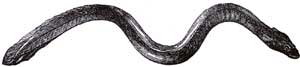
FIG. 41.—THE EEL (Anguilla acutirostris).
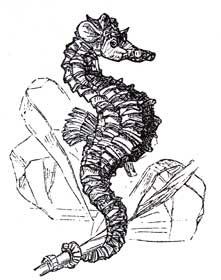
FIG. 42.—HIPPOCAMPUS
(From a dried specimen).
5. Lophobranchi (Tufted gill).
To the Lophobranchi belongs the Pipe-fish (Hippocampus, or Sea-horse,
fig. 42). The following is Dr. Baird's description of these curious
little creatures:—
"Most of these species are straight, but others of the family contract
after death, so as to form a grotesque resemblance to a horse in
miniature. These form the genus Hippocampus, and from their shape are
generally called Sea-horses. Hippocampus brevirostris (the short-nosed
Sea-horse) is occasionally met with on the British coast. It is
from six to ten inches long, the body much compressed, short and
deep; the whole length of the body and tail divided by longitudinal
and transverse ridges, with tubercular points at the angles of the
intersection. The snout is slender, and the tail long, quadrangular,
and terminated in a naked or finless tip. When swimming about, the
Hippocampus maintains a vertical position, but the tail is ready to
grasp whatever meets it in the water; it quickly entwines in any
direction round weeds or other objects, and darts at its prey with
great dexterity."
6. Plectognathi (Plaited jaw).
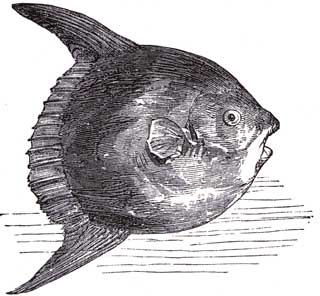
FIG. 43.—THE SUN-FISH (Orthagoriscus).
The Sea Porcupine (Diodon hystrix) belongs to this order. These
Fish are of a peculiar thick rounded form, and occasionally inflate
their stomachs with air, which makes them almost spherical, in which
state they float with the belly upwards, and being covered with
spines, present rather a formidable object to attack; the flesh is
unwholesome, and, it is said, the liver is violently poisonous;
some of the species of this fish are phosphorescent, and from this
appearance they derive the name of Sunfish, as they shine very
brightly in the dark. The short Sunfish (fig. 43) turns round as it
swims; it is very large, sometimes weighing from three to four hundred
pounds. They yield a considerable quantity of oil, for which they are
caught. Their jaws are not divided into teeth, but consist each of a
single piece; they live upon seaweeds and various crustaceans.
The Cartilaginous Fishes are divided into three orders.
1. Sturiones (Sturgeons).
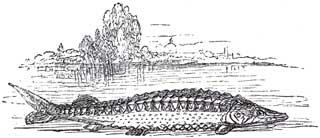
FIG. 44.—THE STURGEON (Accipenser sturio).
Sturgeons (fig. 44) are inhabitants of the northern seas, but are
occasionally found in our rivers. They have rows of bony plates
imbedded in the skin; they sometimes attain the length of twenty feet,
but are usually from six to eight feet long. Isinglass is made of the
swimming bladder of the Sturgeon, and the roe (dried and salted) forms
the "Caviare."
2. Plagiostomi (Wide-mouthed).
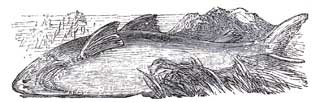
FIG. 45.—THE SHARK (Carcharias vulgaris).
The Plagiostomi comprise the Sharks (fig. 45) and Dog-fishes, a
most voracious tribe; the White Shark often attains the length of
twenty feet. They are terribly famous for their dreadful powers of
destruction, swallowing all that comes before them; they are able to
bite in two, with one snap of their formidable jaws, the body of any
one unfortunate enough to fall in their way; their mouths are armed
with several rows of short spear-shaped teeth; the mouth is placed
a considerable distance under the head, so that when biting they
turn on one side or quite over; they have no gills, but the water
passes through five oblong openings on each side. Sailors hold this
terrible inhabitant of the deep in great detestation, as well they
may, for there are few who have spent many years at sea but can tell
of a friend or messmate who has been mutilated or devoured by the
Sharks. When sailors catch one, it is hauled on deck and killed with
great gusto; the stomach is opened and its contents examined, and it
generally contains some terrible mementoes in the form of buttons,
buckles, &c., the only relics of its victims.
3. Cyclostomi (Round-mouthed).
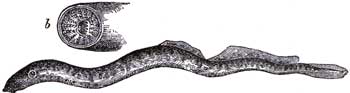
FIG. 46.—THE LAMPREY (Petromyzon fluviatilis)
(b, the sucker).
The Lamprey or Lampern (fig. 46) inhabits both rivers and lakes, and
some species, the sea; it has a round mouth, by which it affixes
itself to rocks, &c., and also to other fish, it is furnished with
teeth on the outer edge, it has no scales, but is covered with a
glutinous skin; in form it much resembles an Eel, and is from twelve
to eighteen inches long. The Lamprey was once very plentiful in the
Thames, and considered a dainty.
These constitute the second class of the Vertebrate animals. They are
divided into four orders.
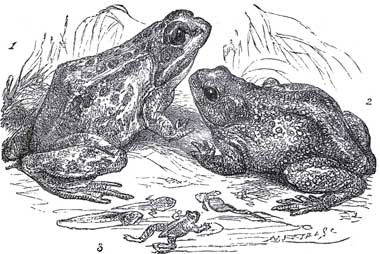
FIG. 47.—1, FROG (Rana temporaria).
2, TOAD (Bufo vulgaris). 3, TADPOLES.
1. Amphibia (double-lived).
By some naturalists a separate class is made out of the Amphibia,
including the Frog kind, Toads, and Newts (fig. 47), which they call
"Batrachia," and which takes a place between Reptiles and Fishes, as
the young of this class have a totally different form from the adult
animal, and much resemble a fish, breathing by gills and having no
legs, but as they become mature the gills are replaced by lungs, and
the legs make their appearance.
The Amphibia have soft skins, which appear to serve as lungs or
gills when they are under the water, extracting the air from it,
and enabling them to remain a long time there without coming up to
breathe; they are partly aquatic, and feed upon insects and other
small creatures, which they capture by darting out the tongue, which
is covered with a glutinous secretion, and drawing it in again
instantly with the insect adhering to it, which they swallow whole.
The Frogs are furnished with webbed feet and swim well; they progress
on land by leaps, their powerful hind legs carrying them to a great
distance. The young of the Amphibia are brought forth as eggs, which
float on the water, and when they first come to life form the curious
little creatures called Tadpoles, having long tails and no feet, and,
as before stated, more resembling Fish than Reptiles. The Toads are
for the most part nocturnal in their habits, living in the daytime in
gardens and holes; they feed upon insects, as do Frogs, and lay their
eggs in the water. The stories of Toads being found alive in rock and
the heart of trees, arise from the following circumstances: Toads
when small will often creep into holes in rocks and hollows in trees,
and in these situations they find abundance of food; being slothful
in their habits, and capable of existing upon but little food, and
abstaining from it a long time, they are apt to remain in their snug
quarters and content themselves with what insects may come to them. In
this way they grow too large to get out of the hole, and live for a
great time in it; when chance discovers them, by the rock being broken
open or the wood of the tree cleft, the opening into which they had
crept is overlooked. The Water Newt (Triton cristatus) inhabits pools
and ditches, and (like the others of this order) is first formed as
a Tadpole; it is of a brown and bright yellow colour, with a crest
down its back and tail, and has the most extraordinary powers of
reproducing any part cut off or removed, such as a leg or the tail.
2. Ophidia (Snake-like order).
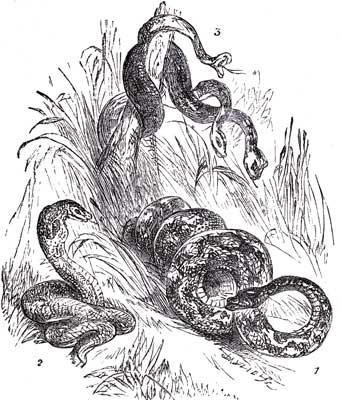
FIG. 48.—1, ROCK SNAKE (Python
molurus); 2, SPECTACLED SNAKE (Cobra de Capello); 3, BOA
CONSTRICTOR.
This includes the Serpents, Boas, and Pythons. These creatures are
peculiar from their long and flexible form, and the absence of legs.
They move by a sinuous winding action, and when about to seize their
prey, make a sudden dart with great rapidity. They are covered with
regular scales, and mottled with different colours; some, as the
Adder and Rattle-snake, are very venomous, the poison is contained
in small glands connected with the poison-fangs, which are two long
pointed teeth, having a groove or small canal leading from the side of
the tooth to the poison-bag, upon which, when they bite, they press,
and inject the poison into the wound while the tooth is in the flesh.
These poison-fangs lie flat down when the creature is not excited, but
are drawn up by muscles, when they are about to spring on anything.
It is a common mistake to think that Serpents have a "sting," arising
from their having a thin, long forked tongue, which they protrude and
retract with great rapidity, and which has been mistaken for a sting;
the greater number of Snakes are not at all venomous. Serpents have no
teeth fit for eating with, but they are used to hold their prey, while
they swallow it, and they serve admirably for this purpose, as each
tooth turns backwards. These creatures have mouths and throats capable
of enormous distension (the lower jaw not being fixed to the upper
one), so that they can swallow their food whole, which they always
do; a Frog or Toad is often swallowed by the common Snake, which is
quite disfigured by it when in its stomach. The Pythons and Boas (fig.
48) are the largest of this class, they kill their prey by coiling
round it, and gradually tightening their folds till it is suffocated
and almost crushed, when it is swallowed; these great creatures will
grow to the length of 30 or 40 feet, and are capable of swallowing
considerable quadrupeds, as Hares, Goats, Deer, &c.; after having
their food, they lie torpid for several days. All Serpents lay eggs,
and the Pythons coil themselves round upon their eggs to protect them;
the Boa-constrictors are inhabitants of America, the Pythons of the
Old World.
3. Sauria (Lizards).
The Sauria include the Crocodiles, Alligators, Skinks, Geckos,
Iguanas, and Lizards; they are carnivorous, the smaller ones feeding
on insects, and the larger members on whatever they can catch. They
have four legs, and are covered with hard rough scales running in
ridges on their backs, they have large strong tails, and their jaws
are furnished with sharp teeth. The Alligator is found in great
numbers in the Mississippi, and is a most formidable creature,
attacking any who may venture into the water. In winter they bury
themselves in the mud and remain there in a torpid state, they are
from 15 to 20 feet long. The Crocodile is a native of Africa and the
West Indies, there are many found in the Nile, it is larger than the
Alligator, reaching often to 30 feet. Dr. Baird gives the following
account of the Alligators and Crocodiles:—
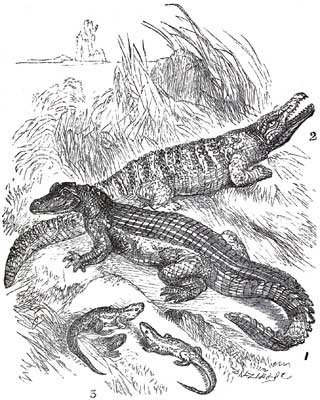
FIG. 49.—1, CROCODILE (Crocodilus
vulgaris);
2, ALLIGATOR (Alligator lucius); 3,
LIZARDS.
"The Alligator (Alligator lucius, fig. 49), a native of
North America and abundant in the Mississippi, is a formidable and
ferocious creature, prodigiously strong, and sometimes reaching the
length of 18 feet. It is provided with numerous sharp teeth, long
tenacious claws, and a powerful tail, a single blow of which is
capable of overturning a canoe. It chiefly preys by night, assembling
in large numbers, besetting the mouth of some retired creek, into
which they have previously driven the fish, and bellowing so loud that
they may be heard at the distance of a mile. It is said to attack men
and quadrupeds whilst bathing or crossing the rivers, and to be more
fierce and voracious then the other species of this sub-family. In
Winter it buries itself in the mud at the bottom of the swamps and
marshes which it inhabits, and continues in a torpid state till Spring.
"The true Crocodiles are natives of Africa, the West Indies, and
America; and the best known species is the Nilotic Crocodile
(Crocodilus vulgaris, fig. 49). This animal is a native of the Senegal
river, of the Niger, and other rivers of Africa, but more particularly
of the Nile in Egypt, where it attains the length of about 30 feet.
The Crocodile was held in great veneration by the ancient Egyptians,
by whom it was known under the name of 'Champsa.' The Crocodiles are
exclusively carnivorous, and are ferocious animals. Their numbers
are, however, kept down by the enemies which surround them. For the
adults, few animals could be their match, but the little Ichneumon
or 'Mongooz' devours their eggs in great numbers while hatching in
the sand; and birds of prey pounce upon their young on quitting their
shell, and before they are able to reach the shore."
4. Testudinata (having a shield).
The Testudinata include the Tortoise, and Turtle kind. They are
remarkable for their horny covering (carapace) which forms a sort of
shell, out of openings in which, their head, tail, and legs protrude;
they have short feet, covered with scales, and no teeth, but the edges
of the maxillary bones are sharp, like the edge of a knife, and they
bite out pieces from vegetable substances with ease. Some of this
class (the Turtles) are residents of the water, and grow to a great
size, weighing fourteen or fifteen hundred pounds, and measuring seven
or eight feet long. Others are much esteemed as food, especially the
green Turtle. Dr. Baird, in his Cyclopædia of the Natural Sciences,
under the article "Chelonia," gives a good description of these
creatures, from which the following is extracted:—
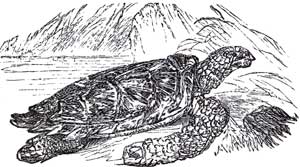
FIG. 50.—TURTLE (Chelonia viridis).
"The Green Turtle (Chelonia viridis, or midas, fig. 50) is five or
six feet long, and weighs from seven to eight hundred pounds. It is
principally found in the Atlantic Ocean, and is often met with seven
or eight hundred leagues from land. They are easily caught when asleep
on the surface of the water, to which they come to breathe. In the
West Indies, the Bahama Islands, and the Island of Ascension, the
capture of Turtles gives employment to many people, and affords food
for thousands.
"The Hawk's-bill Turtle (Caretha imbricata) is a smaller species,
scarcely ever exceeding two hundred pounds' weight, and is a native of
the Atlantic and Indian Oceans. The flesh is not good, but the shells,
which are formed of a considerable number of scales overlapping each
other at their extremities, in the manner of tiles on the roof of a
building, are of great importance as an article of commerce, and are
much superior to that of any other species. It is extensively used in
the manufacture of combs, snuff-boxes, &c., also for inlaying, and
other ornamental work.
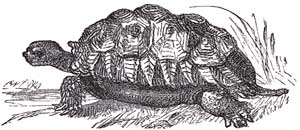
FIG. 51.—TORTOISE (Testudo sulcata).
"In the family of land Tortoises (fig. 51), the feet are
club-shaped, and their habits are terrestrial. The shell is very
solid, thick, ovate, and (in the adult state) covered with horny
concentrically-grooved shields, marked with a permanent areola. They
have a short thick tail, are very slow in their motion, and live upon
vegetables and roots. Most of the species are natives of the warm
regions of the globe, but those that live in colder regions burrow
and sleep during the winter. They are quiet, inoffensive animals,
extremely tenacious of life, and remarkable for longevity. Individuals
are stated upon good authority to have lived upwards of two hundred
years.
"The common Tortoise, or Taragua (Testudo Græca), is a native of
the south of Europe, and almost all the countries bordering on the
Mediterranean; it is found in the islands of the Archipelago, Corsica,
Sardinia, and in Africa, but is thought to be more common in Greece
than elsewhere. It is from six to eight inches long, and weighs about
forty-eight ounces. This species is often brought to this country
and kept in gardens. One was brought to the Archiepiscopal garden at
Lambeth, in the time of Laud, in 1633, where it lived till 1753, owing
its death then, more to neglect than the effects of age."
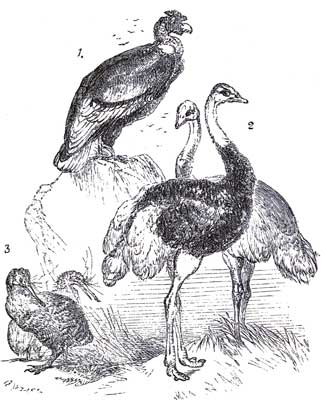
FIG. 52.—1, CONDOR (Sarcoramphus
gryphus); 2, OSTRICH (Struthio camelus); 3, KIWI-KIWI
(Apteryx).
The third class of the Vertebrata, comprises the "Birds," or those
whose young are not born alive, but in the form of eggs; who have
warm blood, and breathe by lungs, the air-cells of which communicate
with the hollow shafts of the bones, (these are full of air instead
of marrow), this gives them lightness, and serves as a reservoir of
air while flying; they have two anterior extremities so modified as
to form wings, and a heart with four cavities; most of them have the
power of flying through the air, and some to a very great height, as
the "Condor" (fig. 52), while in others the wings are rudimentary and
only assist them in running, as in the Ostrich, (fig. 52) Cassowary,
Penguin, &c., while in the "Apteryx" (fig. 52) they are quite absent.
Birds are covered with a peculiar modification of hair known as
feathers; these consist of a central shaft with closely-set diverging
branches, some of which have others branching from them with a serrated
surface, giving them that peculiar metallic brilliancy so well shown
in the feathers of the Humming Bird. Birds are furnished with beaks of
almost every form, to suit their method of feeding, &c., and likewise
feet, sometimes furnished with sharp and powerful talons, at others,
feet suitable to climb with, and again in some they are webbed between
the toes, so as to enable them to swim with great rapidity.
Birds are divided into five orders, as follows:—
1. Raptores (Preying) Eagle, Owl, &c.
2. Insessores (Perching), divided into 4 tribes, viz:—
1. Dentirostres (Tooth bill) Thrush, Butcher-bird.
2. Conirostres (Cone bill) Raven, Crow, Finch.
3. Scansores (Climbing) Parrot, Wood-pecker.
4. Fissirostres (Split bill) King Fisher, Goat-sucker.
3. Rasores (Scraping) Poultry, Pheasants, &c.
4. Grallatores (Wading) Heron, Crane, &c.
5. Natatores (Swimming) Goose, Duck, &c.
1. The Raptores, as the Eagles and Falcons, are furnished with
hooked beaks and strong sharp talons (fig. 53), they prey upon all
small animals, as birds of less strength, rabbits, &c., and some of
them upon fish, as the Osprey, others feed upon dead flesh and offal,
as the Vultures, and are very useful creatures in hot countries, where
they are generally respected, they hover about the towns, feeding
upon almost everything capable of being swallowed; it is not certain
whether these birds detect the presence of food by smell or sight
(both of these senses are possessed by them in perfection), but it is
certain that in the desert, when any animal dies, these birds soon
make their appearance, although a few minutes before not one could be
seen for miles around. The Owls are nocturnal, their plumage is downy,
and their eyes placed so that both shall look forwards, the pupils
close, similarly to a cat's eye, and their vision, like the cats (their
companions among the Mammalia) is extremely sensitive, so that the
expression "as blind as an Owl," has no more sense in it than "as blind
as a Cat" would have; they feed upon rats, mice, insects, &c.
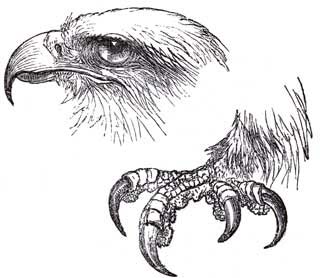
FIG. 53.—BEAK AND TALONS OF EAGLE.
2. The Inessores include some that live by catching insects in
the air while they fly, as the Swallows (fig. 54); these are furnished
with great powers of flight and rapidity of movement; others (the
Scansores) which climb and hold by the branches of trees, feeding upon
nuts and fruit, as the Parrot; others live upon insects, but seek
them in the crevices of old trees and other similar places, as the
Woodpeckers (fig. 54). Some live entirely upon fish (King-fishers),
which they catch from the streams on the banks of which they live. This
order includes all the singing birds, and by far the greater number
of birds of passage; this propensity to migrate is one of the most
wonderful of all the instincts of Birds, the Swallow leaves England
in the Autumn to take up its abode for the Winter in Africa, or the
Islands of the Archipelago, and returns again in the Spring, year after
year, to the same nest; these journeys are accomplished at the rate
of 40 or 50 miles an hour. Pigeons also have the wonderful faculty of
returning home from almost any distance, appearing to know by instinct
the right direction; as, after a turn or two, they take a straight
course to their destination.
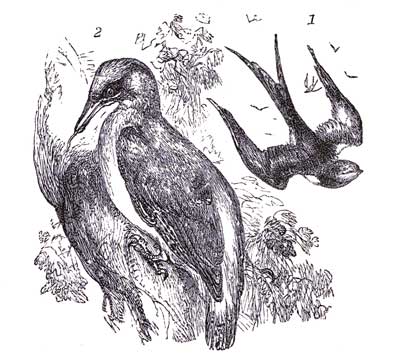
FIG. 54.—1, SWALLOW (Hirundo
rustica); 2, WOODPECKER (Picus viridis).
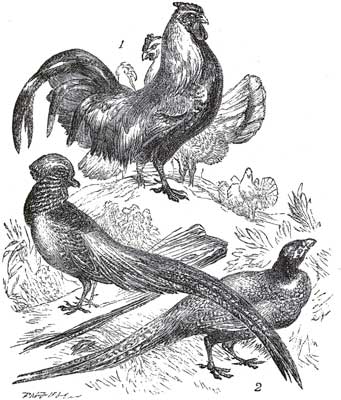
FIG. 55.—1, DORKING FOWLS (Gallus
Domesticus); 2, PHEASANTS (Phasianus colchicus)
3. The Rasores include the common Fowl (fig. 55), Pheasant
(fig. 55), Partridge, Turkey, &c.; they feed principally on grain,
but occasionally on insects and worms, which they scrape up with
their feet; they live chiefly upon the ground, on which they build
their nests, but generally roost on trees. Most of this order supply
excellent food, the Turkey is famous as a Christmas dish, and is often
of a great size; this bird is very plentiful in Central and South
America in a wild state, and often attains a large size, weighing 30
or 40 pounds; the natives have a simple and curious method of catching
these birds, which are extremely shy, never allowing any one to
approach near to them. A sort of cage is built of twigs, large enough
to contain many, and having holes close to the ground all round, of
a size just sufficient to admit a Turkey when its head is bent down;
leading to each of these holes a train of corn is placed, but none
within, the birds coming to pick the corn, follow up the line of corn
with their heads down, till they are within the inclosure, when finding
no more, they raise up their heads and cannot get out, for they have
not the sense to stoop their heads, so as to allow of their exit.
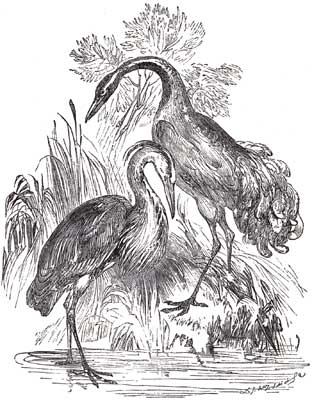
fig. 56.—1, HERON (Ardea cinerea); 2,
CRANE (Megalornis cinerea).
4. The Grallatores include the Herons and Cranes (fig. 56),
which wade into streams and catch fish; these are furnished with long
legs, neck, and beak, and when they have gone into the water as far as
their long legs permit, they stand still and wait with the head resting
on the shoulders and the eyes fixed on the stream, till an unlucky fish
approaches near enough, when with a quick stroke they dart at it, and
catch it; they are very picturesque objects, standing on one leg (as
they commonly do) in some lonely pool or stream.
5. The Natatores, a very large class of Birds, live almost
entirely in the water, they are web-footed and swim beautifully, as
the Swans, Geese, Ducks, &c. (fig 57); these feed in general upon the
vegetation growing in, and on the margin of the water, also on worms,
larvæ, &c.; they have a beautiful mode of rising and flying in a line,
when disturbed from their haunts, and this line is maintained for a
long distance, and is sometimes double like the letter V, one bird
leading and the others following in single file.
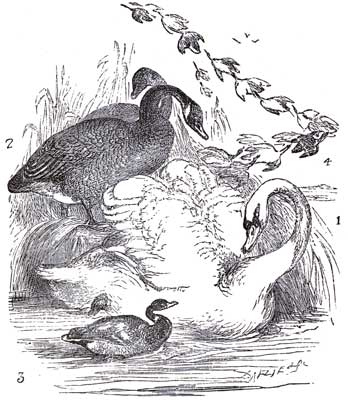
FIG. 57. 1, SWAN (Cygnus mansuetus);
2, GEESE (Anser ferus); 3 and 4, DUCK and WILD
DUCKS (Anas Boschas).
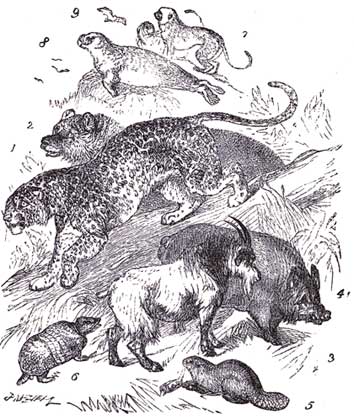
FIG. 58. GROUP OF MAMMALIA.
1, Leopard (Leopardus varius); 2, Bear (Ursus arctos); 3, Goat (Hircus
aegagrus); 4, Boar (Sus scrofa); 5, Beaver (Castor fiber); 6, Armadillo
(Dasypus); 7. Monkeys (Semnopitheci); 8, Seal (Phoca vitulina); 9, Bat
(Plecotus auritus).
This class is divided into twelve orders:—
1. Marsupiata (Pouched) Kangaroo.
2. Monotremata (Having but one vent) Platypus.
3. Rodentia (Gnawing) Beaver, Rabbit.
4. Edentata (Toothless) Anteater.
5. Ruminantia (Chewing) Ox, Deer, Sheep.
6. Pachydermata (Thick skinned) Horse, Elephant.
7. Cetacea (Whale-like) Whale, Porpoise.
8. Carnivora (Flesh-eating) Lion, Tiger.
9. Insectivora (Insect-eating) Mole, Hedgehog.
10. Cheiroptera (Hand-winged) Bat.
11. Quadrumana (Four-handed) Monkey, Ape.
12. Bimana (Two-handed) Man.
These twelve orders of the class "Mammalia," of the division
"Vertebrata," (as their names imply), have their peculiarities, such as
fit them to their modes of life, as, the medium in which they live, the
climate, the food they eat, and the manner of obtaining it. They have
all the five special senses, sight, hearing, smell, taste, and touch,
but very differently developed in respect to power. Yet, as a whole,
they maintain a similitude. They have all internal skeletons, and each
part of this skeleton exists in all, but modified to suit different
purposes. They have all the peculiar attributes of the "Mammalia," such
as suckling their young, being born alive, having four extremities,
warm blood, respiration by lungs, and a heart with two auricles and two
ventricles.
A general description of the anatomy and some of the functions of Man
will be given hereafter, and will apply equally to all the Mammalia;
always bearing in mind that the difference in structure of every
animal, although making it inferior to Man, does not do away with any
of the essential qualities, which constitute it one of the members of
the highest group; for, although immensely inferior to Man, yet the
Mammalia are for the most part greatly superior to all the classes
below it, the capability of being educated, being in itself a vast step
beyond mere instinct, wonderful though this may be, and developed to an
extraordinary degree, as in some of the insects; yet, in these, there
is no possibility of improving it, while in some of the Mammalia, as
the Dog, Horse, Elephant, and Monkey, there is an evident tendency to
progressive improvement when aided by the example and tuition of Man.
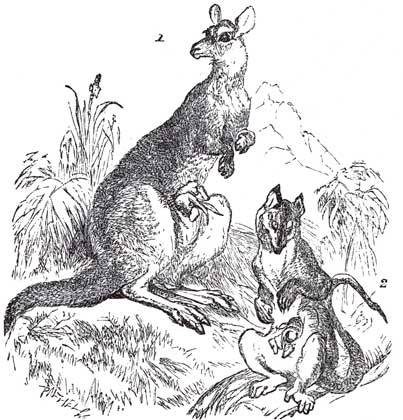
FIG. 59. 1, KANGAROO (Macropas major);
2, OPOSSUM. (Didelphus Virginiana)
1. The Marsupiata include the Kangaroos and Opossums (fig.
59). They are characterised by the possession of a pouch at the lower
part of the abdomen, into which the young enter as soon as born, for
they are born in a very imperfect state, and when in the pouch they
adhere to the teat of the mother, where they remain till more fully
developed. In these animals the hind legs are greatly developed, and
the fore legs but little. They progress by enormous leaps, resting on
the hinder legs and tail, both of which are very strong. They belong
exclusively to Australia, which appears to produce many forms having
peculiarities not met with elsewhere, and among the lowest of their
type; this and the next order appear somewhat to partake of the form of
the Bird, the undeveloped state of the young in the Marsupiata, being
an approach to the egg of the Oviparous animals.
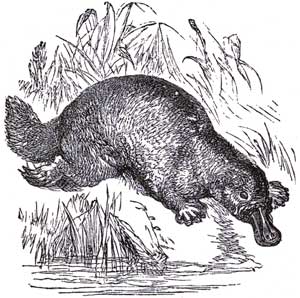
FIG. 60.—PLATYPUS, OR DUCK-BILL
(Ornithorynchus).
2. The Monotremata includes the Duck-bill, called also
"Platypus," and "Ornithorynchus paradoxus," (fig. 60), a most singular
combination of the forms of the mammal and the bird. It has a mouth
resembling the bill of a Duck, and several other peculiarities, which
lead to the consideration of it as one of the connecting links between
the forms of the Mammalia and Birds.
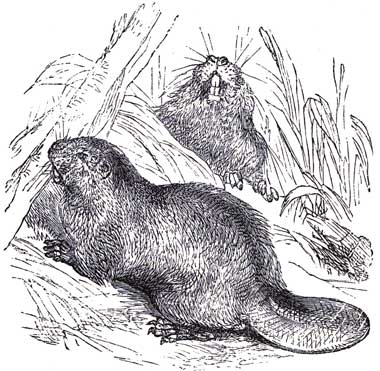
FIG. 61.—BEAVERS (Castor fiber).
3. The Rodentia comprise the Rat, Beaver, Rabbit, Hare,
Mouse, &c. They live upon almost any kind of vegetable matter; the
Rat and Mouse will eat anything they can get. Their incisor teeth are
two in front of each jaw, and are chisel-shaped and very sharp; they
are so constructed that they shall be kept sharp by being used, which
is effected by the hardest part or enamel being in front in a thin
layer, so that it is not so easily worn away as the bony part. If these
animals be fed on soft food, their teeth continue to grow nevertheless,
and protrude from their mouths in a most singular way. The Beaver (fig.
61) is almost aquatic in its habits, it gnaws through the stems of
trees, and uses them to dam up the water of the stream they inhabit,
so as to secure a constant supply. They build houses or huts of wood,
mud, and stones, which they unite in constructing. These houses have
their entrances beneath the water, so that the Beavers dive to enter
them; they have two divisions or rooms in them, and are sufficiently
large to lodge several families. The Rat is too well-known to need
much description. The brown or Norway Rat has only been an inhabitant
of this country about forty years, the black Rat being before that
time the usual house Rat, but it is now almost exterminated, specimens
being very rare. There are several other species of Rats; the best
known is the Water Rat, who burrows in brooks and ditches, and partly
lives in the water. Of the Mouse there are also several species.
Besides the usual house Mouse, there is the wood Mouse, which forms
a magazine of grain and nuts underground for winter store; and the
harvest Mouse, which builds a little round nest between the stalks of
corn. The Squirrel is also of this order. This pretty little creature
lives in the trees, chiefly feeding upon nuts; can leap well, and run
up the branches of trees with surprising agility. The Flying Squirrel
has a broad expansion of skin between the fore and hind legs on each
side, so that when stretched out, they form a sort of parachute; this
enables the creature to leap to a great distance from tree to tree, and
supports it in the air as it goes. The Porcupine (Hystrix cristata), so
celebrated for its quills, which supply a sort of defensive armour, is
of this order.
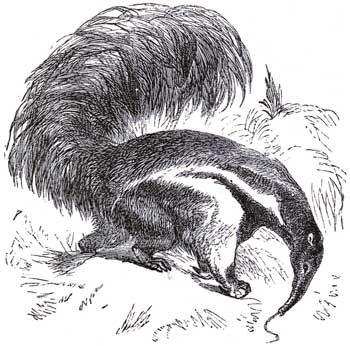
FIG. 62. ANTEATER (Myrmecophaga jubata).
4. The Edentata, or Anteaters, have no teeth, but a peculiarly
shaped tongue, which is covered with viscid mucus, and which they
project and retract with great rapidity, causing the Ants and Termites,
on which they feed, to adhere to it, and be carried into their
mouths. The Great Anteater (Myrmecophaga jubata, fig. 62) is a very
extraordinary animal in appearance; it has an enormously prolonged
nose, and the back is covered with a sort of mane; the tail, also, is
of prodigious size, and very bushy; when this curious animal lies down
to sleep, the long snout is thrust under it, and the tail laid across
the back, the end of the snout projecting behind. In this position, it
would lead anyone to suppose that the head was where the tail really
is, and that when looking at the creature's hinder part, they were
looking at its head; and the sudden reversal of the position of these
parts, when it gets up quickly, is certainly extremely ridiculous.
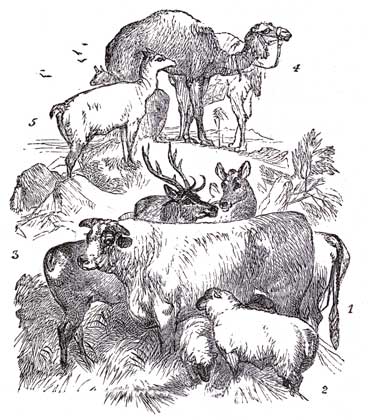
FIG. 63.—GROUP OF RUMINANTS.
1, Ox (Bos taurus); 2, Sheep (Ovis aries); 3, Red Deer (Cervus
elaphus); 4, Camel (Camelus Arabicus); 5, Llama (Pacos).
5. The Ruminantia.—The Ruminating animals (fig. 63) are
those which chew the cud. There are a great many species, and their
members are also very numerous. The Ox, and its varieties, the Buffalo,
Bison, Yak, &c.; the Deer, Antelopes, Gazelles, &c.; the Sheep, Goat,
Giraffe, and Camel, all belong to the Ruminants. These all have hoofs,
cloven into two parts; have no incisor (or front) teeth in the upper
jaw; and are essentially grazing animals. They have stomachs made up
of four compartments; into the first of these (the Rumen) the crude
grass enters, and is afterwards returned to the mouth, and again chewed
at leisure; the molar teeth, or grinders, are flat, and roughened,
so as to effect this purpose; and, that they may not become smooth
by wear, the enamel (or hard part) of the teeth is so disposed in
various layers, that it is always projecting above the bony part, which
wears down first. The Ruminants are gregarious, associating in herds
of enormous numbers. Cumming, describes the herds of Springboks, in
South Africa, as being in countless thousands, continuing to pass for
hours together; and covering the plain as far as the eye could reach.
Cattlin, also, describes the American Bison of the Prairies as being
congregated in the most surprising numbers. Some of the members of this
order are very large and heavy animals. The Cape Buffalo is of enormous
strength, and very fierce when attacked.
Dr. Livingstone, in his Travels in South Africa, speaking of the Lion,
says:—"He seldom attacks full-grown Buffalos; but frequently, when
a Buffalo-calf is caught by him, the cow rushes to the rescue, and a
toss from her often kills him. One we found was killed thus, and on
the Leambye, another, which died near Sesheke, had all the appearance
of having received his death-blow from a Buffalo. It is questionable
if a single Lion ever attacks a full-grown Buffalo; the amount of
roaring heard at night, on occasions when a Buffalo is killed, seems to
indicate there are always more than one Lion engaged in the onslaught."
The Ruminants are the only members of the Mammalia furnished with
horns, and some of these are of enormous size; the Elk, Buffalo, and
Steinbok, are instances. In the Deer tribe they are shed yearly, and
increase in size and in the number of their branches at each fresh
growth. The flesh of the Ruminants forms the chief animal food of Man,
and some tribes of the American aborigines live exclusively on it.
The Camel, next to the Horse, is the most useful beast of burthen. The
Arabs greatly prize these creatures, and from their power of carrying
a supply of water in their stomach, they are very useful in crossing
the desert; their hoofs are also spread out so as to enable them better
to walk on the soft and yielding sand; there are two kinds of Camel,
the Bactrian, with two humps, and the Arabian Camel with but one. The
Dromedary is a small agile breed of the Arabian Camel, celebrated for
its swiftness.
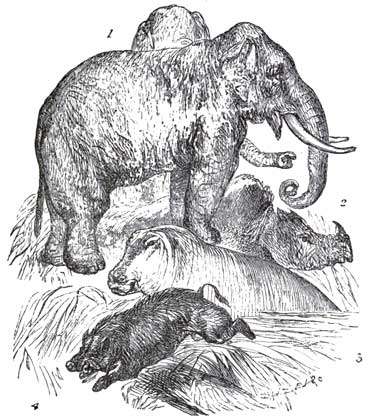
FIG. 64.—PACHYDERMATA.
1, Elephant (Elephas Indicus); 2, Rhinoceros (Rhinoceros unicornis); 3,
Hippopotamus (Hippopotamus amphibius); 4, Wild Boar (Sus scrofa).
6. The Pachydermata or thick-skinned animals (fig.64) include
the Elephant, Rhinoceros, Horse, Ass, and its varieties; Hog, Tapir,
Hippopotamus, &c.; these have many of them a single solid hoof on each
foot, as in the Horse and Ass tribe, others have separate toes clothed
with a hoof, as in the Elephant. In nearly all the Pachydermata there
is a prolongation of the nose or upper lip, the Horse even has some
power of prehension in this part; the Rhinoceros is able to bring the
upper lip into so fine a point as to pick up a crumb, and in the Tapir
there is a considerable prolongation of the nose, while the Elephant
has this part developed into a complete prehensile organ.
The Elephant, Rhinoceros, and Hog are fond of wallowing in the mud,
with which they completely besmear themselves, and seem to derive great
satisfaction therefrom. There are two kinds of Elephants, the Asiatic,
or Indian, and the African, the chief distinction between them is the
size of the ear, that of the African Elephant being of very great size;
there is a very young specimen of this kind in the British Museum, but
a full-grown African Elephant has never been brought to England. The
Elephant is furnished with a pair of enormous tusks proceeding from the
upper jaw, these are composed of solid ivory, and often weigh nearly
a hundred pounds each; with the trunk, the Elephant is able to gather
food in the form of grass and herbage, and put it into its mouth, it
can also draw up a considerable quantity of water, and this being
poured down its throat from the trunk, constitutes its usual mode of
eating and drinking, as the neck is too short for the animal to reach
the ground except by the trunk. The Indian Elephant is much used as a
beast of burthen, and for various other purposes; they are very docile
and sagacious.
The Horse has been subjected to the service of Man from the earliest
records, indeed it is not known when this beautiful animal was first
trained to be his useful servant and companion; he is mentioned, in
the Scriptures, as being subjected to the Bit, and in the sculptures
brought from the ruins of Nineveh by Layard; the Horse is constantly
sculptured, decked in the most gorgeous trappings and driven by reins
and a bit, almost in the same manner as in the present day, and these
sculptures are among the earliest records of Man's hands. There are
several breeds of Horses; the chief are the Arabian (from which stock
proceed our race horses), the Flanders or Cart-horse, and the Sheltie
or Shetland horse. The Horse is nowhere found in a state of nature, yet
many wild Horses graze on the plains of America, but it is known that
these are not native, but proceed from those placed there to graze, and
which have bred and run wild. The Ass is distinguished from the horse
by the tail having short hair on it, except at the extremity, and the
mane being short and upright.
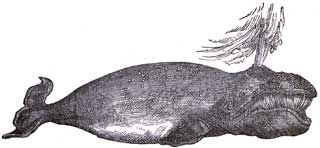
FIG. 65.—WHALE> (Balena mysticetus).
7. The Cetacea, or Whale kind, inhabit chiefly the colder
latitudes, they are entirely aquatic, but breathe air; the Whale,
Narwal, Dolphins, and Porpoises are the chief members.
In Whales (fig. 65) the anterior extremities are so developed as to
form a sort of fin called a "flipper," but in which all the usual
bones of an extremity exist; the posterior extremities are modified so
as to completely resemble the tail of a fish; they have smooth skins
devoid of hair. All these tribes have a considerable thickness of fat
or blubber (as it is called) beneath their skin; this protects them
from the cold, for most of these creatures live in the very coldest
climates, the oily matters acting as a non-conductor; it is for the
oil yielded by this blubber that they are chiefly caught. The Cachelot
or Sperm-whale (Phyceter macrocephalus) also yields spermaceti, which
crystallizes from the oily matter contained in its head, and the
Greenland-whale yields baleen or whale-bone, which is a substance
forming a sort of sieve in the mouth, through which they draw the sea
water and catch all it may contain for food, this consists of all small
fish, but principally a small mollusc called the "Clio Borealis," which
inhabits the northern seas in great numbers; a whole shoal of these is
taken in by the Whale at a draught. The Whale often measures 60 or 70
feet in length, and the Razor-back Whale sometimes 100; a large Whale
will yield 20 tuns of oil. The Narwal or Sea Unicorn is from 20 to 30
feet long; it has but one tooth, which is developed to a prodigious
length, and projects in front in a straight line like a sort of horn,
there are however sometimes two of these, one being always much larger
than the other; this horn is 8 or 10 feet long, perfectly straight
and twisted, it is used by the animal to break the ice so that it may
breathe, and also to spear and capture fish, on which the Narwal lives.
This horn produces beautiful ivory.
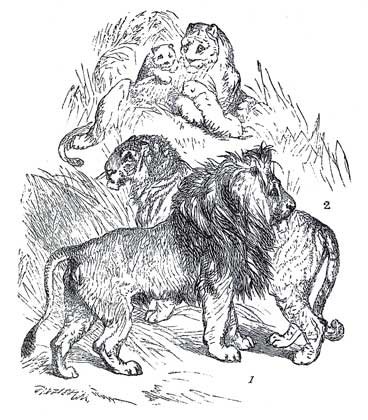
FIG. 67.—CARNIVORA.
Lion (Leo Barberus); 2, Tiger (Tigris regalis).
8. The Carnivora, or Flesh-eaters (fig. 67), include the
Feline tribe, as the Lion, Tiger, Jaguar (fig. 68), Leopard, &c.; the
Canine, as the Hyena, Wolf, Jackal, Dog, Fox, &c., the Ursine, which
includes the Bears, and the Phocine, including the Seal kind. The
Feline tribe are formed to spring upon, hold, and rend other animals
which they kill for food, and have teeth and claws suitable to this
purpose, and great activity and strength to enable them to contend
with, and overcome their prey. They are, for the most part, nocturnal
in their habits, seldom seeking their prey but in the night, and then
mostly frequenting the drinking-places where other animals come for
water. They attack by gradually stalking after the animal, getting
nearer and nearer, till at last a well-directed spring brings them
on to it at once. That these animals may better surprise their prey,
they have eyes so extremely sensitive to light that they can see well
when it would appear to Man to be quite dark, hence the saying, "cats
can see in the dark." The Iris (or coloured part of the eyes) in this
tribe is made so as to close up into a slit (1, fig. 66), and thus
exclude the light of the day to a great extent, which would otherwise
be too powerful, and injure the extreme sensibility of their vision.
Their claws (2, fig. 66) are made to retract by a tendon, so as to keep
their points from being worn by walking. This accounts for the silent,
stealthy tread of the domestic cat; it enables them to creep quietly
upon their prey, and at the moment they are about to seize them, the
claws are extended. The pointed or flesh-teeth of the Carnivora are
greatly developed, and are very sharp. Their molars (3, fig. 66) are
pointed, and suitable to the food they are intended to masticate. The
tongue of the feline tribe is very rough, and is used to rasp off the
flesh from bones. When closely examined, the surface of their tongues
present a series of horny hooks, all bending in one direction, and
forming a sort of rasp.
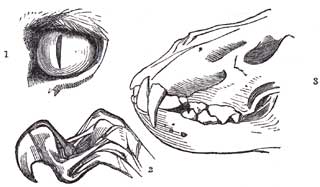
FIG. 66.—1, EYE OF LION. 2, CLAW. 3, TEETH.
The Lion is usually placed at the head of this race, but it is
questionable whether he is so powerful as the Bengal Tiger, and combats
between the two, generally give the mastery to the Tiger.
Dr. Livingstone, in his description of the Lion, takes off a good deal
of the poetical nobility and imaginary superiority with which the Lion
has been commonly invested. The following selections will show what
are Dr. Livingstone's impressions from personal experience:—"When a
Lion is met in the day-time, a circumstance by no means unfrequent
to travellers in these parts, if preconceived notions do not lead
them to expect something very 'noble' or 'majestic,' they will see
merely an animal somewhat larger than the biggest Dog they ever saw,
and partaking very strongly of the canine features. When encountered
in the day-time the Lion stands a second or two gazing, then turns
slowly round and walks as slowly away for a dozen paces, looking over
his shoulder, then begins to trot, and when he thinks himself out of
sight bounds off like a greyhound. By day, as a rule, there is not the
smallest danger of Lions which are not molested attacking Man, nor even
on a clear, moonlight night, except at the breeding-time.
"So general, however, is the sense of security on moonlight nights
that we seldom tied up our Oxen, but let them lie loose by the wagons;
while, on a dark, rainy night, if a Lion is in the neighbourhood, he is
almost sure to venture to kill an Ox. His approach is always stealthy,
and the least appearance of a trap is enough to cause him to refrain
from making the last spring.
"Lions never go near any Elephants, except the calves, which, when
young, are sometimes torn by them. Every living thing retires before
the lordly Elephant, yet a full-grown one would fall an easier prey
than the Rhinoceros. The Lion rushes off at the mere sight of the
latter beast."
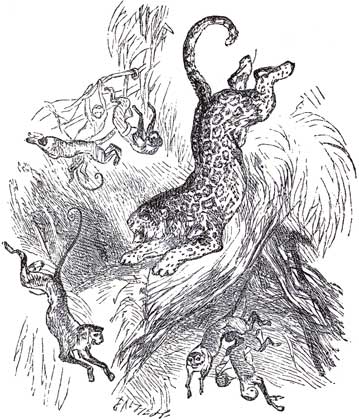
FIG. 68.—JAGUAR (Leopardus onca).
The Bengal or Royal Tiger is the largest of the Feline tribe, being
generally 8 feet long and 4 high. It is, however, often found much
larger. It would appear from the most correct accounts that the Lion
is hardly a match for this formidable creature. The Tiger is as
beautiful as dreadful; its colour is of a bright orange-buff, with
white face and under parts, the back and legs being beautifully striped
with black. The Tiger has no mane, but is of a sleek, graceful make,
though terribly powerful. It inhabits India chiefly, and will prowl
for hundreds of miles by the sides of rivers, secreting itself in the
jungle and sleeping by day. Sometimes traces of a Tiger will be seen
in the locality of villages or towns, and stray Sheep or Bullocks
disappear from time to time, but it will destroy any human being who
unluckily approaches its haunts, and having once tasted human blood,
appears afterwards to prefer this kind of food to all others, and will
pick out a cow-herd in preference to the cattle he is driving; in all
probability this preference is really owing to the ease with which
the capture can be made; and the small resistance Man is capable of
offering; be this as it may, the Tiger having once destroyed a man is
called a "man-eater," and a reward is offered for his head; when this
occurs near any of the stations of the East India Company, the officers
generally make it a point to sally forth and endeavour to capture this
terrific beast; this they do on foot, as it is impossible to depend
on any Horse, their natural fear of the Tiger being so great that all
Horses either shy, or at once retreat. The officers, armed with guns,
take with them a number of natives, who with long canes beat the
jungle and generally start out the monster, at whom there are a few
deadly rifles pointed, which invariably bring him at once to the ground.
The largest of this tribe inhabiting the New World, is the Puma or
Cougar, which is much inferior to the Lion both in size and strength,
although very fierce and dangerous, it is of a pale drab colour
inclining to grey; it climbs trees and stretches itself along their
branches, waiting for some unlucky animal to pass, when it drops
quietly upon its shoulders and quickly destroys it. The Leopard tribe
includes several varieties, as the Jaguar, Panther, Ounce, Ocelot,
&c., they are all more or less spotted with black, and possess all the
ferocity and much of the strength of the nobler species of their tribe,
the smallest of them being more than a match for a man without weapons.
The Canine tribe of the Carnivora includes Dogs, Wolves, Jackalls, and
Foxes. The Dogs are greatly altered from their wild nature by being
domesticated, resembling in their wild state a small Wolf; the Dog in
its domesticated state is too well known to need any description here.
The Jackals and Wolves generally hunt in packs, and devour all kinds
of offal, flesh and bones, which their strong jaws and teeth appear to
crush and break up without difficulty.
The Bears form the next tribe, these are often very large animals; the
Grisly Bear of the Rocky Mountains (Damis ferox) is the largest of
the Brown Bears, it often measures eight feet long and is extremely
powerful, the Brown Bear (Ursus arctos) is smaller, but still a
powerful animal, the Polar Bear (Thalarctos maratimus) is white and is
the largest of all the Bears, measuring eight or nine feet long, it is
coated with long shaggy hair, and even its feet are clothed with hair
underneath, that it may not slip on the ice, and to defend it from the
cold; this Bear is found in the Arctic Regions among the ice, and feeds
upon Fish and other marine animals. Bears in general are carnivorous,
but eat many other kinds of food; they are very fond of honey, and
are never contented if they smell it, until they get at it, for this
purpose they will often gnaw a hole in a tree and thrust in their
head. Advantage is taken of this predilection to entrap the animal, the
natives of the Rocky Mountains often baiting Bear traps with honey.
The Seals and Walrus (fig. 69) form the next, or Phocine tribe; they
are amphibious, and feed chiefly on Fish, inhabiting the colder regions
of the North; their hinder extremities are but little developed, and
serve the purposes of a tail. They are covered with a close fur,
and the canine teeth of the Walrus are so largely developed in the
upper jaw as to form tusks, by means of which they hook on and attach
themselves to the blocks of ice.
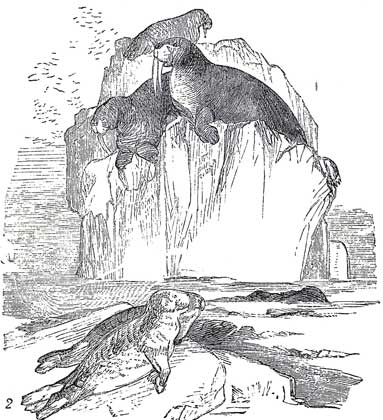
FIG. 69.—WALRUS (Trichicus rosmarus);
SEAL (Phoca vitulina).
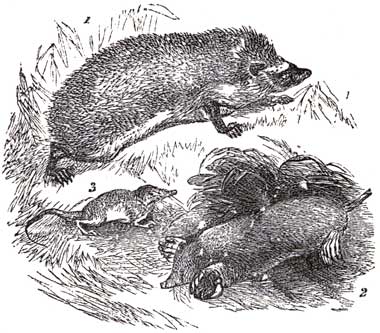
FIG. 70.—INSECTIVORA.
1, Hedgehog (Erinaceus Europæus); 2, Mole (Talpa Europæus); 3,
Shrew-mouse (Sorex araneus).
9. The Insectivora, such as the Mole, Hedgehog, and
Shrew-mouse, (fig. 70), live entirely on insects, the Mole burrows for
them in the earth, and the fore paws are so made as to dig out and
throw the earth behind it, and it burrows in this way with the greatest
rapidity. As it is nearly always beneath the surface of the earth, and
consequently in the dark, so a sense of vision is not required, it is
therefore blind, but the senses of touch and smell, being very acute
enable it to find its food. The Hedgehog and Shrew-mouse are furnished
with pointed noses, with which they dig up the earth in search of
insects, and when found they devour them with amazing rapidity. The
Hedgehog has the power of rolling itself up into a ball and defying the
attacks of almost anything, for its bristles are so stiff and sharp
that they prick like thorns, and make a capital defensive armour; the
Hedgehog is eaten by many, especially by the Gipsies, who esteem it a
dainty.
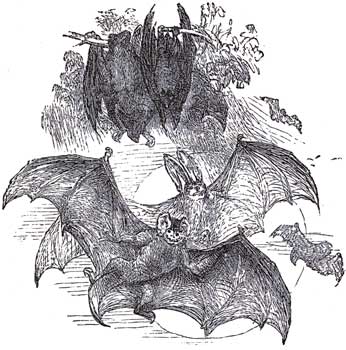
FIG. 71.—BATS (Plecotus auritus).
10. The Cheiroptera (Bat tribe, fig. 71), have fore feet so
modified as to serve as wings, with which they fly with tolerable
swiftness, producing a peculiar flapping sound. These wings are formed
by a membrane which is stretched out between the fingers, which are
exceedingly elongated, and which reaches from the fore feet to the
hind feet. The Bat tribe all feed upon insects, especially moths;
they rest in the day time head downwards, clinging to rough places by
means of the claws of their hind feet, coming out at night to seek
their food; their sight, which is very quick, enabling them to see
their prey when almost dark. Some of the larger species of this tribe,
inhabiting America, are called Vampire Bats, they live by sucking the
blood of various animals, such as cattle and horses, thereby inflicting
dangerous wounds.
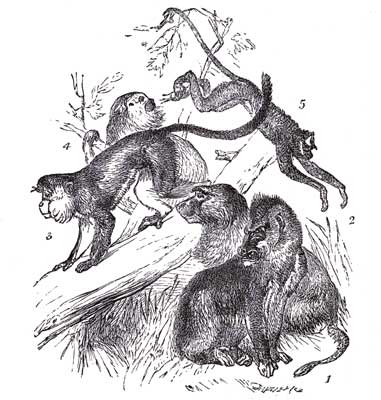
FIG. 72.—QUADRUMANA.
Baboons.—1. Mandrill (Papio maimon); 2. Chacma (Chacma Porcarius).
Monkeys.—3. Mona (Cercopithecus mona); 4. Howler (Mycetes); 5.
Spider (Ateles).
11. The Quadrumana (fig. 72), so called from their hind and
fore feet both having thumbs, and being developed into hands, includes
the Monkeys; they may be divided into two tribes, those inhabiting
the Old World (Simiidæ), and those inhabiting the New (Cebidæ),
these include what were formerly called Apes, Baboons, &c. These
animals approach the most nearly to the form of the human being, the
Chimpanzee being considered the nearest in formation to Man; there are,
however, many very broad distinctions between the two, especially in
the foot and head. The Quadrumana are very clever, but their actions
seem to have more meaning in them than they in reality possess, owing
to the resemblance of these creatures to the human being. There
are many surprising accounts of these beings, such as their arming
themselves with sticks and stones to defend themselves; but no act of
reason has ever yet been perceived in them, nor any tendency towards
improvement, except that which has been given them by Man. "The Monkey
who had seen the world," and went home and taught his companions, is
a fable in both senses of the word. The Monkey tribe are formed to
pass their lives in the trees among the branches, their hands being
formed to suit this kind of life. None of them walk well, but when
they are among the branches, swinging themselves from bough to bough,
few creatures are more active; their food is fruit and nuts of all
kinds. The Chimpanzee, certainly, is the nearest approach to Man in
the lower animals, and walks better in an upright position than does
the Ourang-outang, whose whole life is spent in the trees, while the
Chimpanzee often inhabits holes in the earth and rocks. In the "Penny
Cyclopædia" is the following account of one, by Captain Payne:—
"It shook hands with some of the sailors, but refused its hand with
marks of anger to others, without any apparent cause. It speedily,
however, became familiar with the crew, except one boy, to whom it was
never reconciled. When the seamen's mess was brought on deck it was
a constant attendant, would go round and embrace each person, while
it uttered loud yells, and then seat itself among them to share the
repast."
Some of the Monkey tribe (the Spider-monkeys) have the power of holding
fast with the end of the tail; it, in fact, forms a sort of hand,
and they swing from the boughs by it, and it is said that several
will attach themselves in this way, forming a long chain, and swing
themselves from the topmost bough of a tree when they wish to cross a
stream, the lowest catching hold of the boughs on the opposite side,
and the uppermost of them letting go his hold, they are all thus
conveyed across.
12. Bimana (two-handed). This order includes Man alone. Man
has been placed in a separate class, and not as the first order of
the Mammalia, but, as will be presently noticed, although he has many
attributes which no other animal has, yet in bodily construction, and
all the functions of his material part, he so nearly resembles the
other orders of his class that it is deemed better to place him at
their head under the designation of "two-handed;" although indeed he is
the only animal who can be said to possess hands, properly so called,
for those of the Monkey tribe are so imperfectly developed that they
have but little claim to the name.
In his circulation, respiration, digestion, &c., Man exactly resembles
the other Mammalia, also in the organs of locomotion and special sense,
modified slightly in form; but to these purely animal attributes, he
has superadded faculties which raise him above them, and show him to
be the last and most perfect of God's creatures, one step further, in
fact, than any other living being; and it is a curious circumstance,
and one showing the accuracy of detail, with which the Mosaic account
of Creation in the Bible abounds, that this very superiority is not
only mentioned in many ways, but recorded as the result of a special
act of God over and above his formation as an ordinary animal, in
which state he was created, for we find the words, "and breathed into
his nostrils the breath of life, and man became a living soul,"
this especial act was not performed for any other being which God had
created, of which it is stated simply "male and female created He them."
Man is possessed of sentiments (or those feelings which prompt him to
believe in, look forward to, and hope for a higher state of existence,
than that which he enjoys here) which none of the lower animals
have, and of reason in place of instinct. There is certainly a vast
difference between the two, although many would have us believe the
one is the same as the other, but of a higher order; instinct causes
its possessor to act from innate impulse without consciousness of the
result, while reason points out "the why and the wherefore." Man is
conscious of his own identity, this is also peculiar to him; moreover,
all the performances of man can be improved by practice, none of the
instincts can, but are as perfect at first as at last; the Bee makes
the comb, and the Bird the nest, as well the first time as the last,
and although the higher animals, as the Dog, Horse, Elephant, &c., can
be taught to perform various clever and useful acts, yet it is by
Man's instrumentality and not by their own powers; in fact there is not
an animal which left to itself has the slightest power within itself
of deviating one iota from those peculiar instincts which were given
it by God. But Man at every effort rises higher than he was before,
till he arrives at such a knowledge of the great works and designs
of his Creator that he bows his head in awe and admiration of the
wonders permitted to appear to his comprehension. With respect to his
bodily structure, Man undoubtedly stands first in the race of beings,
although, in some particulars, such as the acuteness of the senses, he
may be inferior to some.
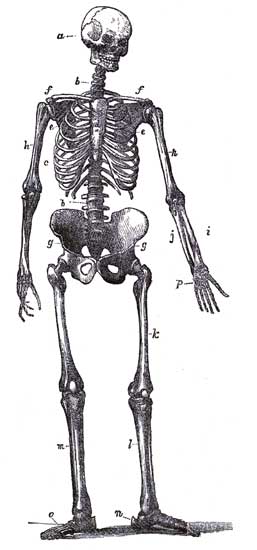
FIG. 73.—THE HUMAN SKELETON.
a. Skull.
b. b. Vertebral column or Spine.
c. Ribs.
d. Sternum or Chest bone.
e. e. Scapulæ or Blade bones.
f. f. Clavicles or Collar bones.
g. g. Pelvic or Hip bones.
h. h. Humeri or Arm bones.
i. Radius }
} Bones of fore-arm.
j. Ulna }
k. Femur or Thigh bone.
l. Tibia or Large bone of leg.
m. Fibula or Small bone of leg.
n. Calcaneum or Heel bone.
o. Tarsal bones or Bones of the
foot.
p. Carpal bones or Bones of the
wrists.
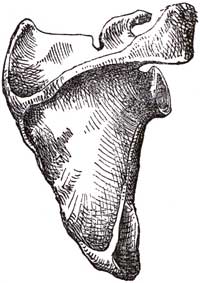
FIG. 74.—FLAT BONE (Scapula).
The Human frame consists of a skeleton (fig. 73) formed of hard
and unyielding bone, having joints to admit of motion in certain
directions; this skeleton performs certain great and important offices,
it forms strong boundaries or protecting cases for most of the vital
parts, so as to shield them from external violence, such as the brain
and spinal cord, the lungs, heart, &c., it also furnishes a series of
levers to be acted on by the muscles, for the purposes of motion, and a
firm support for the soft parts of the system. The skeleton is divided
into the head, trunk, and extremities; the head is again divided into
cranium and face; the trunk is divided into spine, thorax, and pelvis;
the extremities into the upper and lower, the upper consisting of arm,
fore-arm, and hand; the lower of thigh, leg, and foot. The bones are
divided into "flat bones" (fig. 74) and "long bones" (fig. 75), the
flat bones (as a general rule) form the boundaries of the cavities, and
the long bones the levers.
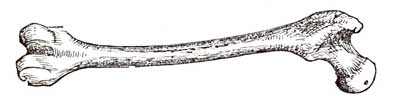
FIG. 75.—LONG BONE (Femur).
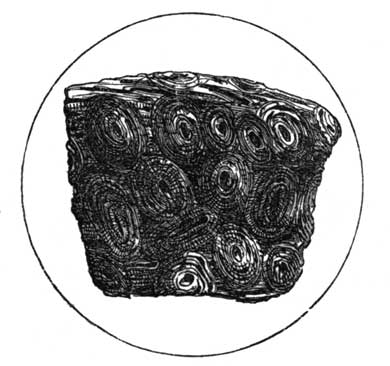
FIG. 76.—SECTION OF BONE, MAGNIFIED.
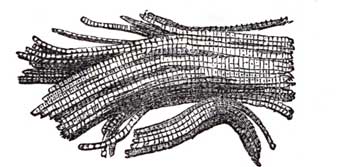
FIG. 77.—FIBRILS OF VOLUNTARY MUSCLE, MAGNIFIED.
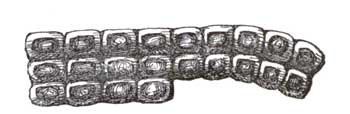
FIG. 78.—THE SAME, MORE HIGHLY MAGNIFIED.
The bones consist of earthy matter, chiefly phosphate of lime, held
together by a sort of cartilage, and arranged in fine scales or plates
forming interstices or cells (fig. 76), these are large in the centre
of the bone so as to make it nearly (and in some instances quite)
hollow, and very small at the surface, so as to make it there nearly
solid; this arrangement is found to be the very best to secure strength
and lightness, together with a very slight degree of flexibility. The
general form of a long bone is that of a shaft, having an enlargement
at either extremity, the shaft is generally curved slightly so as to
give elasticity, and is more solid than the ends, which are expanded to
give size and firmness to the joints, and porous to keep them light;
the shaft is small and close in its texture, that there may be plenty
of room for the muscles which lie on and cover it. The skeleton then,
consists of bony cases which enclose the viscera, a series of levers
covered with, and moved by the muscles, and the whole forming a solid
framework to support the soft parts. All the various motions of the
body, from the winking of the eyelid and the wonderfully adjusted
motions of the eye itself—which are so accurate, that a certain
perceptible motion is required to look alternately at one side and
the other of a pin's head—to the most powerful stroke of the arm, are
performed by the contraction of the muscles. But there are several
actions which would at first appear to be produced by elongation
instead of contraction, such as the protrusion of the tongue, the
winking of the eyelids, and the closure of the lips; but the first of
these is produced by the contraction of a muscle which is attached at
one extremity to the under part of the root of the tongue, and at the
other to the inner part of the lower jaw, which, when it contracts,
draws the whole tongue forwards, causing a part of it to protrude;
the eyelids and lips are closed by circular muscles surrounding them,
which, by contraction, draw together those parts.
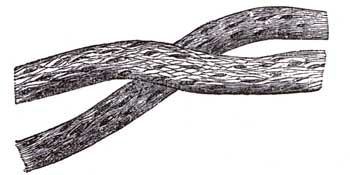
FIG. 79.—INVOLUNTARY MUSCULAR FIBRE.
FIG. 80.—HEAD OF AN INFANT.
The muscles form the flesh of an animal, or that part which is of a red
colour, and which is called lean (in contra-distinction to fat), they
are composed of fibres, each fibre made up of a number of fibrils, and
the whole bound up together by means of a fine membrane, called areolar
tissue. Each of these fibrils consists of a number of cells pressed
closely together and having a peculiar bearded appearance (figs. 77,
78). It is by the sudden approximation and flattening of these cells
that the muscle is shortened during contraction, but the contraction
of each fibril is only for an instant, and then a relaxation and
elongation of the cells takes place, which is followed by a second
contraction, and so on. Now, the way in which a muscle keeps in a state
of permanent contraction is this: the various fibrils or strings of
cells relieve each other instead of all contracting and all relaxing
together, and in this way a part only of the fibrils are in a state
of contraction at any given time, while the others are relaxed, and
as one begins to relax another contracts, and so keeps up a state of
contraction in the muscle up to a certain point, when the contractions
become gradually more feeble, and finally cease altogether; the muscle
is then exhausted, but, if allowed to rest awhile, it again obtains its
contractile power. This peculiar contractile power is a physical one,
and exists for a short time after death, that is, until its perfect
structure is altered by the beginning of decomposition; and what is a
curious fact, the muscles of a dead body stimulated to contraction by
pricking or galvanism, will tire and again obtain their contractility
by rest, just as in the living body. The nature of the stimulus which
causes the muscles to contract during life is not known; but, whatever
it may be, it is conveyed from the spinal cord and brain, through the
medium of a set of nerves, called the "motor nerves," or nerves of
motion, to the muscles, to every fibre of which they are distributed.
There is, however, another set of nerves which have nothing to do
with motion, although exactly similar in appearance and generally
associated and bound up in the same sheath with them; these are the
nerves of sensation. They take their origin from every part possessed
of sensibility or feeling—more especially the skin—and convey every
impression of feeling to the brain. The muscles are not all under the
control of the will, for the muscles of the heart, bowels, &c. are
quite out of our control. Those which are subservient to our will are
called "voluntary" muscles, or the "muscles of animal life," while
those out of the control of the will, are the "involuntary" muscles,
or "muscles of organic life" (fig. 79). These last have a structure
different to the voluntary muscles, being composed of flattened fibres
containing granules and overlapping each other. The tendons are the
cord-like extremities of the muscles which connect them to the bones;
they are fibrous and slightly elastic, flexible, and exceedingly
strong; while moist they have a splendent appearance, somewhat like
mother-of-pearl.
The ligaments are the strong fibrous bands which connect the bones
together. Cartilages are substances of a white colour, smooth in
their texture, and not very flexible; they are connected to the
bones which they sometimes serve to prolong, and are themselves often
converted into bone in old people, by the deposition of earthy matter
within their structure, in fact, they may be considered as bone in an
undeveloped state; for, in the infant, many parts are cartilaginous,
which, in the adult, are bony; such as the ends of the long bones, the
bones of the nose, &c.
FIG. 81.—HEAD OF AN ADULT.
With respect to the development of the form of the human body, there
are two chief conditions which influence it, namely, age and sex. With
respect to age, the proportional magnitudes of the different parts,
early and late in life, vary very considerably. In the infant (fig.
80) the hand is by far the most completely developed (in size), next to
this the abdomen, then the chest and upper extremities, and, finally,
the lower extremities. In the adult (fig. 81), the largest measurement
is round the chest and shoulders, but in the infant it is round the
head; in the adult the lower extremities weigh one half of the whole
body, but in the infant not one quarter. The infantile face has many
peculiarities, so also has the face of old age (fig. 82). In the infant
the lower part of the face is but little developed, the lower jaw
is small, the chin scarcely at all prominent, and the distance from
the nose to the chin very short, owing to the absence of the teeth,
or (when formed) their smallness. The bones of the nose are scarcely
formed, and this organ has therefore no bridge, properly so called;
the nostrils are small, the lower part of the forehead small, smooth,
and rounded, and the arches of the eyebrows but little prominent. The
cheek-bones are small, and so are the bony arches which join them to
the temples; the cheeks are full of fat, and the angles of the jaws
rounded. In middle age the lower part of the forehead becomes more
fully developed, the bony edges which support the eyebrows project
and overhang the eyes, the bridge of the nose and the nostrils become
more fully formed, the space from the nose to the chin is greater,
the teeth cause the lips to be pushed more forward, the lower jaw is
larger, and the cheek-bones show more plainly. In old age the whole
upper part of the face becomes more marked, the nose and eyebrows still
more prominent, the cheeks hollow from absorption of the fat, the space
from the nose to the chin (as in infancy) shortens from loss of teeth,
but the chin, being more fully formed, projects as the jaw rises to
fill the space occupied by the teeth. The angles of the jaw are also
very sharp and square, the eyes sunk in the head, and the whole skin
of the face loosened and wrinkled from loss of substance beneath. With
respect to sex, in the Male the facial bones are more fully formed,
the shoulders broader and higher, the collar-bones longer and more
curved, the chest wider, the hips narrower, and the legs longer, and
every bone has its processes or markings more fully developed, and is
more contorted from the action of the muscles, which are larger and
more powerful than in the Female. In the Female (fig. 83) there is a
greater deposition of fat, and, in many other respects, a tendency to
a child-like conformation.
FIG. 82—HEAD OF AN OLD MAN.
The body is everywhere covered by a common integument called the skin,
beneath which is a layer of areolar and adipose tissue, which last has
its cells filled with fat, which during life is in a liquid or oily
state; this serves to protect the parts beneath both from cold and
violence, fills up the hollows and irregularities between the muscles,
and gives the body a more rounded and graceful appearance.
FIG. 83.—HEAD OF A FEMALE.
Man, in common with all the higher animals, is possessed of the five
"special senses," namely, sight, smell, hearing, touch, and taste, the
organs of which are the eyes, nose, ears, skin, and mouth; but these
are developed in very different degrees in different animals.
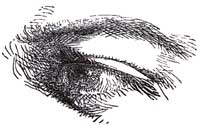
FIG. 84.—FRONT VIEW OF EYE.
Sight is the sense by which we take cognisance of those external
objects which either give out or reflect light. The eye (fig. 84) is
an optical instrument of great beauty and perfection, and by its help
an image of everything we look at is produced in miniature on the
expanded optic nerve called the "retina," as an image is produced in
the "camera," which instrument is made in imitation of the eye; this
image by some unknown power is perceived by the mind, and produces
the sense of vision. By the sense of sight we recognise all forms,
colours, and gradations of light and shade, and also (assisted by the
experience gained by the sense of touch) the qualities of surface, such
as roughness, smoothness, &c.; for instance, we know by touch that a
piece of glass is smooth, that a piece of velvet has a different kind
of smoothness, &c., and the mode in which these surfaces reflect the
light, teaches us to recognise them so that we could predict from touch
what appearance an object would have, or by the look how it would
feel. Our knowledge of the solidity of bodies is known to the sense of
sight by (unconsciously) looking at them with each eye alternately,
so as to see to a certain extent round them, or somewhat on either
side alternately. By this fact the principle of the stereoscope is
explained, the pictures looked at through it, consist of two views
of the same object, taken at points of sight a short distance apart
(corresponding to the distance between the eyes) and they give us, when
steadily looked at, the same result that real objects do when looked
at with each eye, alternately. It is a curious fact, but one which has
been clearly demonstrated by optical experiments, that the picture
represented on the "retina" is inverted, but from habit we refer things
to their natural position, and how naturally and easily this is done,
may be ascertained by holding the head down close to the floor, and
looking at objects through one's legs, in this position they are all
inverted; but we naturally make ourselves satisfied that they are still
as they were before, so that they really do not appear to be inverted.
The impression formed by objects upon the retina is not immediately
destroyed upon their removal, but remains for an instant permanent;
this gives rise to a great many curious phenomena, among which the
most familiar is the circle of light produced by the rapid evolution
of any luminous body, as the red-hot end of a stick. This is also
shown by a toy, called the "Thaumatrope," which consists of a piece of
card having a small wire attached to the upper part by which it may be
turned rapidly round by the thumb and finger. On one side of the card
is painted an object, such as a parrot, and on the other a cage; when
the card is turned round, first the bird and then the cage is presented
to the eye, but the image of the one has not left the eye before the
other is presented to it, and the result is the uniform appearance on
both sides of a parrot in a cage.
The structure of the eyes in Man and the higher animals is very nearly
alike, so that the same description will serve for both, but those of
insects and the lower orders of animated beings are very different.
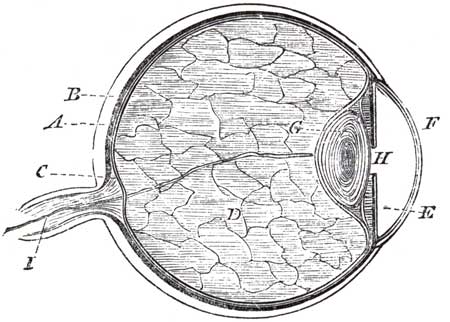
FIG. 85.—SECTION OF HUMAN EYE.
| A. Sclerotic. | D. Vitreous humour. | G. Crystalline lens. |
| B. Choroid. | E. Aqueous humour. | H. Pupil. |
| C. Retina. | F. Cornea. | I. Optic nerve. |
The eye consists of various humours of different densities enclosed
in membranes (fig. 85); the human eye is spherical for the posterior
four-fifths of its circumference, but the front part projects a little,
being formed of part of a smaller sphere. The globe of the eye, all
but this front part, is enclosed in a firm fibrous coat called the
"sclerotic," within which is a membrane full of blood-vessels called
the "choroid," this on its inner side is covered with a black substance
called the "black pigment," and within this (lining the ball) is the
nervous coat or retina, it is the optic nerve so expanded as to form
a lining to the membranes of the ball of the eye for the greater part
of its extent. The ball of the eye is filled with a transparent fluid,
somewhat glutinous, called the "vitreous humour;" stretched across the
front part of the ball of the eye is a membrane having a round hole in
its centre, called the "iris," coated (like the choroid) with black
pigment on its back surface; this membrane (the iris) is the coloured
part of the eye, and its transparency or opacity determines the colour
of the eye. The pupil is the hole in its centre, it looks black because
the black pigment which covers the inside of the ball of the eye (for
the retina is transparent) is seen through it; behind the iris and in
front of the vitreous humour, is the crystalline lens, it is just the
shape of a very thick lens, but is more convex behind than in front, it
is quite transparent, and of a density almost approaching to solidity.
The front fifth of the ball of the eye is covered in by a dense
transparent substance called the cornea, of the form of a watch-glass
and quite transparent, between this and the crystalline lens there is
a small space called the anterior chamber, filled with a clear watery
fluid called the aqueous humour. The eye is moved by six muscles, four
straight and two oblique, these turn it in every direction with the
greatest accuracy; the front of the eye is defended by the eyelids,
which by winking and being moistened by the tears, keep the eye always
moist and free from dust.
The eyes of insects and several other classes of animals are called
compound eyes, and the image they produce must resemble objects
depicted in mosaic, or made up of small spots of distinct colours; they
consist of hundreds of small tubes, radiating and forming part of a
sphere on each side of the head, each of these tubes admits the light
from objects at which they point. Some of the animals still lower in
the scale have simple spots of transparent membrane with an expansion
of optic nerve beneath them; in such creatures the power of vision is
probably limited to distinguishing light from darkness.
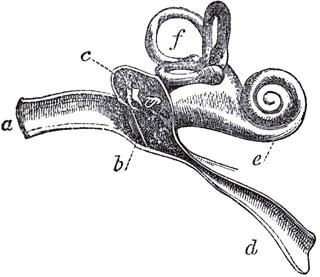
FIG. 86.—SECTION OF THE HUMAN EAR.
a, external opening; b, tympanum; c, small bones;
d, Eustachian
tube; e, cochlea; f, semicircular canals.
Hearing.—Sound is conveyed to the mind by the vibration of air, and
this vibration is communicated to a membrane within the ear, called the
"tympanum;" this is in connection (by means of three minute bones) with
the expanded auditory nerve, which ramifies within the "vestibule,"
which is filled with a fluid, so that the vibrations of the air are
thus communicated to the nerve of hearing (fig. 86).
Smell.—The interior of the nose is lined by a fine moist membrane,
on which the olfactory nerve is distributed. The cause of odour is
quite unknown; though, as most volatile substances are odorous, it is
supposed to be some volatile matter which comes in contact with the
olfactory nerve, or nerve of smelling. The quantity given off in some
instances must be exceedingly small, for one grain of musk placed on a
piece of glass will give out scent for months, and at the end of that
time weigh still one grain. Some animals, as Dogs and Birds of prey,
have this sense so acute that it serves them instead of almost every
other; the Vulture will scent carrion miles away, and the Dog will
track his master by the power of scent.
Taste.—The sense of taste resides chiefly in the tongue, but to
some extent in the palate or roof of the mouth; it appears to be a
modified sense of smell, combined with common sensation or touch, and
is much diminished by loss of smell.
Touch, next to sight, is the most important of the senses. The whole
skin possesses this sense, but in some parts far more than others, the
finger-ends being the most perfectly endowed with it; and in the lower
animals the parts which are used as prehensile organs, are in them the
most acutely sensitive to touch, as the end of the proboscis in the
Elephant, and the lips of most other quadrupeds. In the Feline tribe,
the smellers or hairs from the side of the face, appear to be true
organs of touch, and enable them to feel their way in the dark. By the
sense of touch we are informed of the amount of resistance of matter
(and consequently its weight), of hardness, smoothness, roughness, and
other qualities of surface, and by the amount of extension of the hand
to reach them of their distance from us, and also of the form and size
of things.
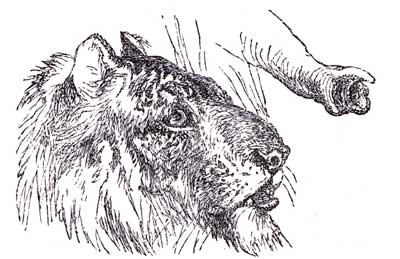
FIG. 87.—TIGER'S HEAD AND ELEPHANT'S TRUNK.
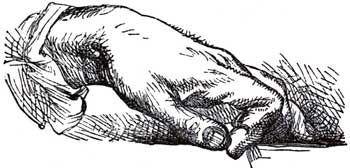
FIG. 88.—HUMAN HAND.
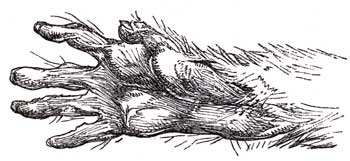
FIG. 89.—MONKEY'S HAND.
The human hand is the most perfect organ of prehension possessed by any
animal, for although Monkeys have hands, yet these are so imperfect as
to serve chiefly for clinging to, and climbing amongst the branches,
they cannot take any small substance between the thumb and finger,
while the human hand, besides enabling its possessor to grasp firmly
with all the fingers and thumb, each can individually be approximated
to the thumb so as to hold the very smallest substance, and as Man is
so constituted that he can stand firmly on his feet, his hands can
be solely appropriated to the acts of prehension. It has been said
that Man owes much of his superiority to the lower animals, to the
possession of hands which can take, examine, and compare everything
within his reach; but it seems more probable that these hands have
been given him because he, only, has the faculties of examining and
comparing. The Lion and Tiger would be no better off, had they Man's
hands instead of their feet with claws—probably much worse.
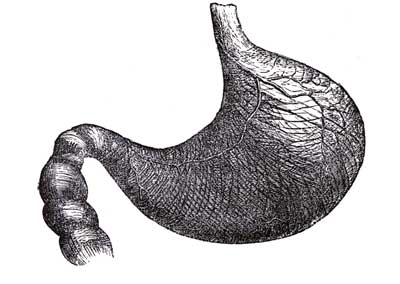
FIG. 90.—HUMAN STOMACH.
Animals do not feed upon unorganised matter, as do vegetables, but
merely appropriate to their own use those organic principles which are
ready formed in the vegetable or animal, such as albumen, fibrine,
starch, gum, sugar, &c., and assimilate them into their substance.
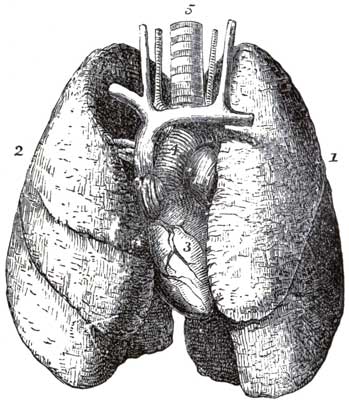
FIG. 91.—LUNGS, HEART, AND LARGE VESSELS.
1 and 2, Right and left Lungs; 3, Heart; 4, Aorta; 5, Trachea.
When food enters the mouth of an animal it there meets with a fluid
(the saliva) which is capable of converting starchy matters into
sugar, thus rendering this aliment (which is presented in a state of a
nature quite insoluble at the heat of the stomach) not only soluble,
but nutritious. This ensalivation takes place while the food is being
masticated; when in the stomach (fig. 90) it meets with the "gastric
juice," a fluid capable of dissolving both fibrine and albumen (the
two other chief aliments), even when coagulated; thus all kinds of
food when they have been a short time in the stomach are reduced to
a liquid, and so far fitted to enter the system. The stomach is a
membraneous bag, communicating at the upper orifice with the mouth,
and at the lower with the intestines; its internal (mucous) coat is
smooth, and contains many absorbents; its outer coat is muscular, and
capable of contraction, so as to roll together its contents, thus
bringing every portion into contact with the gastric juice; this mass
of dissolved food has received the name of "chyme." By admixture
with the bile (a fluid excreted by the liver) and other juices, it
separates (like curds and whey) into a liquid and partially solid
matter; the liquid part is like milk, and is called "chyle," and it
is taken up by absorbent vessels, by "endosmose," a peculiar power
which membranes have of allowing liquids to pass through them when
there is a more dense liquid on the other side (as described in the
experiment at page 123, "Vegetable Kingdom,"), and, passing through
the vessels called "lacteals," is mixed there with the impure blood
as it is about to be returned to the heart, and from thence to the
lungs, where impurities are got rid of in the form of carbonic acid.
The lungs (fig. 91), in performing this office, expose the
blood (contained in thousands of minute blood-vessels) to the air
which enters the windpipe at every inspiration or breath, the windpipe
divides into two, and these each into two more (the bronchial tubes),
and so on until they are no larger than a hair; at the end of each tube
is a little "air-cell," on the membraneous walls of which the vessels
containing the blood are distributed as a network. The blood when it
enters the lungs is of a dark purple or blackish colour, and is loaded
with carbonic acid; this blood is received by the heart from the great
veins, which pour it into the right auricle, this contracting, sends
it into the right ventricle, which, in turn, sends it through the
pulmonary arteries into the lungs; while there, it is exposed in the
network of vessels which ramify on the walls of the air-cells; another
process of endosmose takes place, and the carbonic acid passes through
the walls of the vessels into the air-tubes, and escapes by the breath;
at the same time that this carbonic acid is cast off, an equal bulk
of oxygen is absorbed from the air, so that the air which enters the
lungs, and that which passes out, are the same in bulk—plus watery
vapour—although what enters is pure air, and what is expelled, is
loaded with carbonic acid. The blood, having exchanged carbonic acid
for oxygen, is now altered from a black to a bright scarlet colour,
and is in a condition to be circulated through the system. On leaving
the lungs by the "pulmonary veins," it enters the left auricle of the
heart, and passes from thence to the left ventricle, which is very
powerful, and forces it by compression upwards into the "aorta" (the
first great artery), and thence through the other arteries, which
divide, and become smaller and smaller until it arrives at every
part of the body, forming a network of fine vessels which are called
capillaries; so perfectly are these vessels distributed, that it is
almost impossible to cut or prick any part of the body without wounding
one of them, and thereby drawing blood. When these capillaries have
supplied this pure blood to repair and renovate every part of the
system, and received for the new material, that which is worn out or
spoiled, they urge it onwards to where they unite into small veins,
and, as these continue to unite, they form large trunks, and pour the
blood, now black and impure, into the right auricle of the heart,
together with the fresh material (chyle) derived from the food, again
to be sent through the lungs and purified for fresh circulation. This
description applies as well to the other Mammalia as it does to Man,
for these classes do not differ from Man in their physical structure,
except in form and size, and the alteration in the proportion of the
various parts to adapt each to its peculiar purpose.
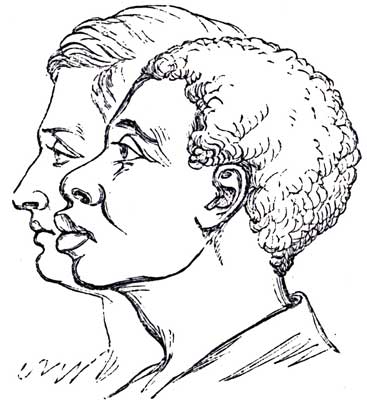
EUROPEAN AND NEGRO.
Man is, without doubt, the only animal possessed of reflective
and reasoning faculties, and the possession of these has raised him
immeasurably above all the rest. He has also physical capabilities
suitable to a dominant being whose race is destined to people the
earth in every part. Were his constitution formed like that of the
Chimpanzee or the Ourang, he could only live in the very hottest of
climates; but it is found that Man is healthy and happy through ranges
of temperature, which would prove fatal to most other animals. In
the frigid regions of the north, the Laplander enjoys many comforts
which he fancies could never be obtained in any other latitude, and
the Bushman of Africa, following the wild animals of that region, and
needing no covering to shield him from the burning rays of the sun,
deems his lot the happiest that can be. The human race are gradually
increasing in number, and there is scarcely a spot capable of being
inhabited at all, but they are found there; and, wherever Man comes,
the wild animals of the region retire or become entirely extinct,
excepting those which serve him as food, such as the Ruminants.
The difference between the highest of the lower animals and Man, is so
distinct, that no more need be said about it; but among men themselves,
there is a great difference; between the European, and the Negro or the
Hottentot, there is a vast distinction, but the most simple would at
once say they are both men, and possessed of the essential qualities
of men; and there can be no doubt that all men of every kind form
one species. This is a point pretty well settled among all who have
written on the subject; and indeed, great as the difference is among
men, it is not half so great as that which exists between the Bull-dog
and Italian Greyhound, and yet they are both dogs; or between the
Race-horse and the Dray-horse, and yet who is there can doubt of these
both being of the same species.
Blumenbach made out five varieties—namely, 1, Caucasian; 2, Mongolian;
3, American; 4, Malay; 5, Ethiopian or Negro. Pickering2 describes
eleven varieties, and arranges them as follows:—
| WHITE. | | BLACKISH-BROWN. |
| 1. | Arabian. | 6. | Papuan. |
| 2. | Abyssinian. | 7. | Negrillo. |
| | 8. | Indian or Telingan. |
| BROWN. | 9. | Ethiopian. |
| 3. | Mongolian. | | BLACK. |
| 4. | Hottentot. | 10. | Australian. |
| 5. | Malay. | 11. | Negro. |
In this arrangement the "Arabian" corresponds with the "Caucasian"
of Blumenbach; both names are given from the supposed country of
the original members of the race; the appellation "European," used
by Dr. Latham is, however, a much more appropriate one than either,
both the Caucasian and Arabian being now limited to the inhabitants
of the localities from which their names were derived. The Arabian,
Caucasian, or European family occupy the chief part of Western Europe,
the British Isles, and the United States of America, and is fast
spreading in other parts of the American Continent and in Australia. It
is characterised by a fair complexion, arched nose, ruddy cheeks, thin
lips, and the frequency of blue eyes and light hair. Its members are at
this present time the highest and most civilised classes in the world,
being further advanced in religion, arts, sciences, and literature;
also their capacity for enterprise and speculation, and their love of
novelty, is far beyond that of any other variety of the human race;
anything new that offers the smallest chance of being beneficial is
at once adopted by them and carried out. This is, perhaps, the great
secret of their advancement, for the other most numerous variety of
the human family, and which exceeds the European in numbers (the
Mongolian), has but little capacity for change of any kind, in fact,
appears to admire and adhere to those matters only, which have the most
undoubted stamp of antiquity—such a mode of feeling especially obtains
among the Chinese. Dr. Latham divides the European family into—
| 1. The Basks. | 4. The Greeks and Latins. |
| 2. The Skiptar. | 5. The Sarmatians. |
| 3. The Kelts. | 6. The Germans. |
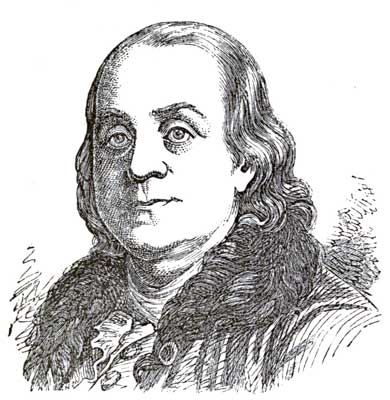
EUROPEAN.
The Basks appear to have been the original inhabitants of
Spain and Portugal, which have abandoned their former habitation and
now dwell in the mountains of Navarre and Gascony, just as the American
Indians may be supposed to dwell at some future time in the Rocky
Mountains.
The Skiptar are the inhabitants of Albania, much resembling in
personal appearance the Turks and Sclavonians, but having a language
derived from a different source. The following is a description of the
Albanian, from the "Penny Cyclopædia:"—
"The Albanians are about five feet and a half high, muscular and
straight in their persons. Their activity, and the tight girdles which
they wear, render them small round the loins; they have full broad
chests, long necks, long oval faces with prominent cheek bones, and
flat raised foreheads, arched eyebrows, blue or hazel (rarely quite
black) lively eyes, thin straight noses, thin but open nostrils, and
small mouths furnished with good teeth. Their complexions are white in
youth, but become tinged a dusky hue in old age."
The Kelts (or Celts) were the former inhabitants of both
France and England, they are now to be found chiefly in Ireland and the
Highlands of Scotland, and are called Gaelic Celts; the English are a
mixture of these with Saxon and German, but still retain a good deal of
the blood of the Celts; in Wales the Celts are derived from the ancient
British branch. The English retain more of the Germanic language, while
the Welsh retain most of the original British; the French are Celtic
mixed with Roman, and have therefore a great admixture of Latin in
their language. The Kelts appear to have been a race above the usual
height, with red or light hair, ruddy complexion, and of a fierce and
impetuous disposition.
The Greeks and Latins.—Of this stock, the
inhabitants of Italy and Greece are the purest descendants, but it is
extended with more or less contamination to Spain and the Danubian
Principalities. Italy was probably the original seat of both races.
The Sarmatians.—This stock inhabits Russia, Poland, Bohemia,
Hungary, and Servia, all speaking the Sclavonic languages.
The Germans.—This race inhabits Germany, Holland, Denmark,
Sweden, and Norway, and its immediate branch the English, forming the
Anglo-Saxon family, are extended to America, Canada, Australia, and
other parts of the world by colonisation.
Dr. Pickering calls the European race Arabian, and makes it extend
through the whole of Europe, India, Arabia, and the northern parts of
Africa, believing all these to have been derived from the same stock,
and forming variations of the same family. The language spoken by the
Europeans of all classes has been called Indo-European, hence Pickering
classes with them the Hebrews, Armenians, Parsees, and many more, all
derived from a stock supposed to have migrated from Asia into Europe
and Africa.
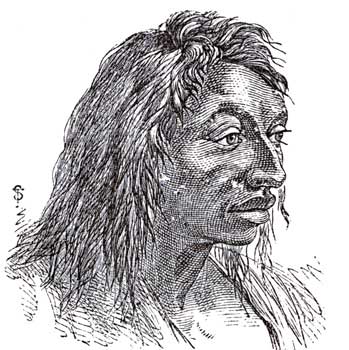
ABYSSINIAN.
The Abyssinian.—This race inhabits the table lands of
Abyssinia, and its extension into the interior. Dr. Pickering thus
describes the appearance of three individuals of this race whom he met
at Singapore—
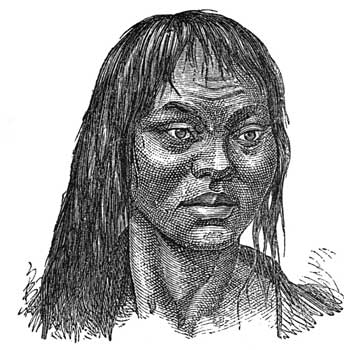
MONGOLIAN.
"The hair was much alike in all three, and was crisped and fine,
neither coarse enough nor in sufficient quantity to form a resisting
mass. The beard of one individual was in pellets absolutely like the
close wool of the Negro, but the prominence of nose, greater even
than usually occurs in the white race, bore sufficient testimony to
his purity of descent. The second individual had the face very much
elongated, but the nose was not particularly prominent. The third had
a straighter beard, which was black and grey in regular stripes. The
complexion was the same in all three, and though very light, was by no
means of a sickly hue, and indeed these persons might readily have been
passed in the streets as belonging to the white race."
ESQUIMAUX.
The Mongolian race, according to Pickering, includes the
inhabitants of part of China and all the north-eastern parts of Asia,
also the aborigines of North and South America, with the exception
of a tract of land on the south-western coast, including what is now
California, and part of the United States. This race is probably
the most numerous in the world. The complexion of the Mongolian is
decidedly yellowish brown, but rather pale withal (it is well seen in
the Chinese); the head is flattened from before to behind, and expanded
from side to side, so that in some well-marked cases the head is as
broad as it is long, the eyes are drawn upwards at the outer angles,
and appear wide apart, from the inner angle, being but little prolonged
inwards, the cheek-bones are prominent; the eyes black, and the hair
black and straight. The best specimens of this family are the Tartars
and Chinese. The Chinese are highly skilful in most of the useful arts,
especially in agriculture. Their history extends very far back, and
probably the longest series of recorded events in existence, being
continuous for a period of about 4,000 years, during the whole of which
time they have been in a state of civilisation nearly the same as they
are at the present time.
The aboriginal tribes of America belong to this family. Dr. Latham
derives their origin from the Esquimaux (or Eskemo), and their
migration from north-eastern Asia, Kamschatka, and the Aleutian
Islands, to the eastern or Pacific shores of America.
The Chinese and Tartars are of a decidedly yellow tint. The Americans
are of a dark copper-coloured hue, hence their designation "Red
Indians."
AMERICAN INDIAN.
HOTTENTOT FEMALE.
The Hottentot. This race inhabits the south of Africa, and
parts extending thence into the interior; they are of a yellowish-brown
complexion, small in stature, with hair consisting of small black
knobs of a crisp sort of wool, separated from each other in such a way
that the skin of the head may be distinctly seen between them. They
are strictly nomadic, scarcely ever remaining in any fixed spot, but
following the animals they hunt and kill for food, upon the flesh of
which, with a few roots, they live.
Dr. Livingstone denies that they are very small in stature; speaking of
the Bushmen, a tribe of the Hottentot family, he says:—"They are the
only real nomads in the country, they never cultivate the soil, nor
rear any domestic animals, save wretched dogs; they are so intimately
acquainted with the habits of the game, that they follow them in their
migrations from place to place, and prey upon them, and thus prove as
complete a check upon their inordinate increase as the other carnivora.
The chief subsistence of the Bushmen is the flesh of game, but that is
eked out by what the women collect of roots, beans, or fruits of the
desert."
MALAY.
The Malay family are a coast-dwelling people, delighting in
the water, and never found very far removed from it; they inhabit the
southernmost coast of China, from Siam southwards, and all the adjacent
islands. They are of a dark rich brown colour, with straight, coarse,
black hair and scanty beard, which in some is quite wanting. Some of
the members of this family are above the usual standard of height, such
as the Polynesians and Tahitians. The moral character of the Malays,
generally speaking, is of an inferior order. They are a race differing
much, in some respects, from the Negro and Red Indian, being of
peculiarly active temperaments; they exhibit considerable intellectual
capacity, and are an ingenious people. It is extremely probable, from
the fact of their being found in islands surrounded by others in the
hands of the Ethiopic race, that they have pushed out the less active
variety, and, in short, annihilated them; and it is likely that they
will in turn suffer extinction at the hands of a superior variety, or a
variety rendered superior by civilisation.
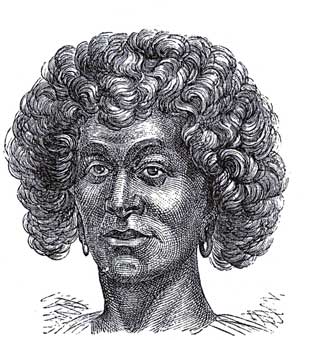
PAPUAN.
The Papuan race inhabit the Feejee Islands and the coasts of
New Guinea; they are almost black, with a rough skin and thick woolly
hair, which grows much longer than in the Negro, and which they wear
curled up so as to form a resisting mass, and no bad protection against
the blow from a club (their national weapon). Their height is above the
average of Europeans. Fish and yams are their chief food.
The Negrillo are nearly black in colour, short in stature,
with projecting jaws and thick woolly hair, the nose not so flat as the
Negro, nor the lips so thick; they inhabit the interior of New Guinea
and a few islands in its locality, of which they appear to have been
the aborigines, the central parts only being occupied by them; the
coasts are inhabited by the Papuan and Malay races, who have driven the
Negrillo aborigines from their former abode to the central mountains.
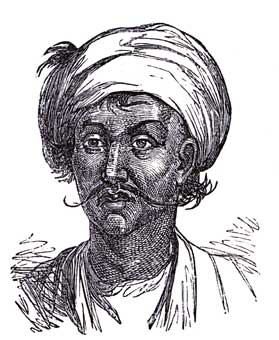
HINDOO.
The Indian or Telingan race inhabit the whole of
Hindostan, and parts of Persia. The complexion is much the same as in
the two preceding races (Negrillo and Papuan), and is so decidedly
darker than in the Malayan, that by common consent it is called black,
although, on comparison, the two differ widely from that of the unmixed
Negro. The greater part of Hindostan is, however, inhabited by a mixed
race, partly Persian, partly Arabian.
Pickering describes them as follows:—"The features approximated very
closely to those of the White race, but in general the mouth appeared
to be wider, the nose rather less prominent, and the lips sensibly
thicker. The profile was less vertical than in the surrounding Malays,
the lower part of the face projecting with a regular arch, as in the
Mongolian, and there was a further correspondence with the latter race
in the frequent instances of the arched nose. The beard occurred more
frequently, and was more copious than in the Malay race; the hair was
straight and fine, and I have never seen it any other colour than
black."
The Ethiopians inhabit the central and north-east part of
Africa, Nubia, and the upper districts of the Nile. They are black, but
their features are not far removed from the European, except in the
fulness of the lips, and they are in some cases extremely handsome.
The hair is black and crisp, but not completely woolly, and grows
sufficiently long to be plaited, which is the usual mode in which it is
worn by the females of this race.
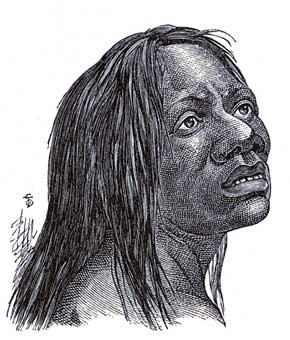
AUSTRALIAN.
The Australians.—The natives of Australia are quite black,
and have the nose and mouth very wide; the lips are thick, but not so
much so as in the Negro; the hair is black and curly, but not woolly;
the eyes are very small, deeply set, black, and keen; the lower part
of the face does not project like that of the Negro. These make a wide
distinction between the two races, although they have been confounded
with each other.
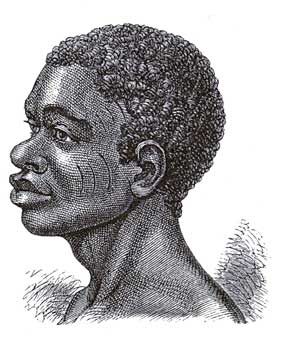
NEGRO.
The Negro.—This race appears to differ from the European
more than any other. The skin of the Negro is quite black and shining,
the hair black, closely crisped into a sort of wool, and never growing
to any great length; they have but little beard, the nose is flat and
broad, and the lips very thick and protruding, as is also the whole
lower part of the face; the front teeth also project outwards, and the
whole contour of the face and head is backwards, forming a gradually
receding outline. They inhabit the interior and eastern parts of Africa
conjointly with the Hottentot.
The preceding is a slight outline of the various races of men which
inhabit the earth; their numbers are in the gross somewhere about a
thousand millions, and it has been computed as follows, bearing in mind
that these numbers are but a rude approximation to truth:—
| European | 350,000,000 |
| Mongolian | 400,000,000 |
| Malay | 100,000,000 |
| Telingan | 80,000,000 |
| Negro | 50,000,000 |
| Ethiopian | 10,000,000 |
| Abyssinian | 30,000,000 |
| Papuan | 3,000,000 |
| Negrillo | 3,000,000 |
| Australian | 500,000 |
| Hottentot | 500,000 |
In examining the various tribes of animated nature, there is one great
fact which impresses itself irresistibly upon our minds, namely, that
they all form the handiwork of one Creator, and His Autograph is
stamped everywhere. His care is also shown in the way in which animals
are made to feed on all kinds of organic matters, and on each other;
this has been the means of economising all the nutriment which exists
on the earth, for, although it may not always be apparent, yet there
is not a scrap or crumb ever wasted in nature; not a decayed leaf or
blade of grass, not a leg of a fly, nor the wing of a gnat, nor any
part or portion of organic matter, from the smallest animalcule to the
huge carcass of the dead elephant, or the trunk of the giant pine tree
which the hurricane has uprooted, but forms a feast for some of the
smaller tribes of animated beings there placed by Providence to eat
it. Millions of these, after devouring the waste-matters of organic
existence, whether embedded in the soil or elsewhere (not accessible
to larger creatures), themselves form the food for creatures of larger
growth, as birds, fishes, &c.; these again form the food of Man, so that
"Nothing is wasted."
THE END.
Cloth, Gilt, Price Five Shillings.
UNIFORM WITH "OUTLINES OF CREATION."
THE
BOY'S BOOK
OF
INDUSTRIAL INFORMATION.
By ELISHA NOYCE.
AUTHOR OF "OUTLINES OF CREATION."
ILLUSTRATED WITH THREE HUNDRED AND SIXTY-FIVE ENGRAVINGS, BY
THE BROTHERS DALZIEL.
OPINIONS OF THE PRESS.
Examiner, July 3. 1858.
"This book contains a brief and very clear summary of information for
young readers upon the natural products used in the arts, and the arts
by which they are converted to Man's use. It tells the main facts
that relate to every manufacture, and describes the various kinds
of apparatus and machinery—chains, cranks, valves, wheels, steam
and other engines, fire-arms, stills, thermometers and barometers,
ploughs, thrashing-machines, &c., as well as the more notable kinds
of engineering work. To make the brief descriptions as effectual as
full ones, they are very freely illustrated with good woodcuts by the
Brothers Dalziel. Whatever is described is shown not only by plans
and diagrams, but frequently also by little pictures that are very
interesting and effective. The illustrations, we should add, are not
copies of copies, but new and direct sketches from the things they
represent. Among efforts to produce cheap volumes of useful information
for the young, we account this one of the most successful."
Art Journal, August.
"This is just the book to place in the hands of an intelligent boy or
girl—for why should the useful information it contains be limited to
sex?—who desires to know something about those things from which so
much of his comfort and enjoyment is derived. Every youth in Prussia,
whatever be his condition—the prince and the peasant alike—is,
we believe, compelled by the laws which apply in that country to
education, to learn some trade or handicraft. Mr. Noyce's book will
serve to initiate every boy in the United Kingdom who reads it, into
the theoretical art and mystery of the material and manufacturing
world. He divides his teachings into six sections, under the respective
heads of Natural Products, Manufactured Products, Products of Skilled
Labour, Arts and Trade Processes, Apparatus and Machinery, and
Engineering Works, bringing into notice more than one hundred and
fifty different subjects. The explanations and descriptions are, as
they should be, simple and untechnical, as far as possible; concise,
yet sufficiently demonstrative; a multum in parvo, to which Messrs.
Dalziel's clear and well-executed engravings give great additional
value. Such a volume is worth a hundred story-books as a present to the
juveniles."
Illustrated London News, July 3.
"This work, by Elisha Noyce, with 365 illustrations by the Brothers
Dalziel, is calculated to do much good. The object is not only to
please, but to instruct; and, although written ostensibly for the
young, it may be read with advantage by all who desire to possess a
knowledge of things in everyday use. The information throughout is
conveyed in a clear and understandable form; this, combined with its
pictures on every page, is well calculated to make the mind familiar
with many objects that as a rule have hitherto been but imperfectly
realised to the young. The book is admirably adapted to assist those
who are about to make choice of an occupation, and this of itself
would make it a welcome addition to the numerous works written for
the information and guidance of the rising generation. The book is
published by Ward and Lock."
Dispatch, July 4.
There is really a great deal to recommend this book to the attention
of the public as one especially adapted for the entertainment and the
instruction of the young. The subjects themselves embrace the whole
arcana of the material universe, the mineral and vegetable products of
the earth, their properties, manufacture, and varied convertibility to
the service and uses of man. Three hundred and sixty-five first-class
engravings, from the pencils of the Brothers Dalziel, and most of these
being illustrative of the finished machinery of Woolwich Arsenal,
and drawn by permission of the authorities, add to the value of the
matter incorporated in these pages, while in almost all other forms the
industrial arts, with their varied apparatus and machinery, are ably
and fully described. It is a true "Boy's Book," and merits the amplest
circulation possible for it to attain.
Daily Telegraph, July 20.
The title of Mr. Noyce's book sufficiently explains its object, and
we have only to say that it answers its purpose. It is clearly and
amusingly written, and embraces a large variety of useful subjects,
which it treats in a full, though, at the same time, a concise manner.
The book is illustrated with three hundred and sixty-five excellent
engravings by the Brothers Dalziel.
Leeds Times, July 31.
The author's object in the elegant-looking issue before us, as
described by himself, is to convey to the youthful reader a knowledge
of the materials, processes, and apparatus made use of in the various
examples of industry and skill constantly before our eyes. No
fewer than 365 wood-cuts by the Brothers Dalziel are appropriately
interspersed with the letterpress, thus enabling the reader to clearly
understand what otherwise would of necessity, in some cases, be almost
incomprehensible. The work is clearly and ably written, and even the
intelligent adult must possess a large fund of general knowledge who
can truthfully affirm that he has derived no information from its pages.
Norfolk News, Aug. 7.
The title of "The Boy's Book" has been applied to more than one, two,
or three subjects; but to none more appropriately than to this, which
is really and truly "The Boy's Book of Useful Knowledge." The author
has observed the happy medium of saying neither too little nor too
much—of neither wearying the patience of his young readers by long and
needless details, nor of disappointing their curiosity by unnecessarily
brief and insufficient descriptions. If we are not greatly mistaken,
the book will soon become a general favorite with the young, and we
should strongly recommend it as a text-book of general information to
Educational establishments. It is beautifully got up, and its value is
considerably enhanced by the superior wood engravings of the Brothers
Dalziel, which speak the language of explanation as plainly to the eye
as does the letterpress to the understanding.
LONDON: WARD & LOCK, 158, FLEET STREET.
Transcriber's Notes
Variations in spelling, punctuation and hyphenation have been retained
except in obvious cases of typographical errors which have been silently corrected.