We have now presented a theory of the weather, which accounts for many
prominent phenomena, a few of which we shall enumerate. It is an
observed fact, that in all great storms electrical action is more or
less violent, and that without this element it seems impossible to
explain the velocity of the wind in the tornado, its limited track, and
the formation of large masses of ice or hail in the upper regions of the
atmosphere. It is also an observed fact, that the barometer is in
continued motion, which can only be legitimately referred to a change in
the weight of the atmospheric column. This we have explained as due to
atmospheric waves, caused by the greater velocity of rotation of the
external ether, as well as to the action of the three great vortices.
These causes, however, only partially produce the effect—the greater
portion of the daily oscillations is produced by the action of the great
radial stream of the solar vortex, as we shall presently explain. It is
an observed fact, that, although the storm is frequently violent,
according to the depression of the barometer, it is not always so.
According to the theory, the storm will be violent, ceteris paribus,
on a line of low barometer, but may still be violent, when the contrary
obtains. Another fact is the disturbance of the magnetic needle during a
storm. Storms are also preceded generally by a rise in the thermometer,
and succeeded by a fall; also by a fall in the barometer, and succeded
by a rise. It is also well known, that hurricanes are unknown at the
equator, and probably at the poles also. At all events, they are rare in
lat. 80°, and, according to Capt. Scoresby, storms are there frequently
raging to the south, while above, there is clear sky and fine weather,
with a stiff breeze from the northward. The greater violence of storms
in those regions where the magnetic intensity is greater in the same
latitude, the probable connection of peculiarities in the electric state
of the atmosphere with earthquakes, and the indications of the latter
afforded by the magnet; the preponderance of westerly winds at a great
elevation in every latitude on the globe visited by man; and the
frequent superposition of warm layers of air above cold ones at those
elevations, are all facts worthy of note. And the connection of cirrus
clouds with storms, as well as with the aurora, indicates that the
producing cause is external to the atmosphere, and gradually penetrates
below. The theory fully explains this, and is confirmed by the fantastic
wreathings and rapid formation of these clouds in straight lines of a
hundred miles and upwards. But time would fail us in pointing out a
tithe of the phenomena, traceable to the same cause, which keeps our
atmosphere in a perpetual state of change, and we shall only advert to
one more peculiarity of the theory. It places meteorology on a
mathematical basis, and explains why it is that a storm may be raging at
one place, while in another, not very remote, the weather may be fine,
and yet be dependent on the position of the moon.
That the moon has exerted an influence on the weather has been the
popular creed from time immemorial; but, ignorant of the mode in which
this influence was exerted, men have often been found who have fostered
the popular belief for their own vanity or advantage; and, on the other
hand, philosophers have assailed it more by ridicule than by argument,
as a relic of a barbarian age. Not so with all; for we believe we are
not wrong in stating, that the celebrated Olbers compared the moon’s
positions with the weather for fifty years, before he gave his verdict
against it. He found the average amount of rain at the perigee about
equal to the amount at the apogee, as much at the full as at the change,
and no difference at the quadratures. But this fact does not throw a
feather in the scale by which this theory is weighed. Popular opinions,
of remote origin, have almost always some foundation in fact, and it is
not much more wise to reject them, than to receive them. The Baron Von
Humboldt—a man possessing that rare ingredient of learning, a practical
common sense—observes: “That arrogant spirit of incredulity which
rejects facts, without attempting to investigate them, is, in some
cases, more injurious than an unquestioning credulity.”[22] If a popular
belief or prejudice be absurd, its traditional preservation for a
thousand years or more may very well account for the absurdity.
The present system of astronomy still retains the motley garniture of
the celestial sphere, as handed down from the most remote antiquity; and
granting that ages of ignorance and superstition have involved the
history of the different constellations in a chaos of contradictory
traditions, there is no doubt at the foundation some seeds of truth
which may even yet emerge from the rubbish of fable, and bear fruit most
precious. That the zodial[23] signs are significant records of something
worthy of being preserved, is prejudice to deny; and we must be allowed
to regard the Gorgons and Hydras of the skies as interesting problems
yet unsolved, as well as to consider that the belief in lunar influence
is a fragment of a true system of natural philosophy which has become
more and more debased in postdiluvian times. Amongst those who have not
summarily ignored the influence of the moon, is Toaldo, a Spanish
physicist, who endeavored to show the connection between the recurrence
of warm and cold seasons, and the semi-revolution of the lunar nodes and
apogee, and proposed six of those periods, or about fifty-four years, as
the cycle in which the changes of the weather would run through their
course. According to the present theory, it is not likely such a cycle
will ever be discovered. There are too many secular, as well as periodic
influences combining, to produce the effect; and the times are too
incommensurable. Lately, Mr. Glaisher has presented a paper to the Royal
Society, giving about fourteen years from observation. Others have
lately attempted to connect the changes of the seasons with the solar
spots, as well as with the variations of the magnetism of the earth, but
without any marked result.
It may, however, be urged, that if the sidereal period of the moon be
approximately a cycle of change, it would have been detected long ago.
One reason why this has been so long concealed, is the high latitude of
the observers. Spain, Italy, and Turkey, are better situated than other
European countries; but the scientific nations lie further north; and
from these the law has gone forth to regulate more southern lands. In
the United States, particularly in the great plains of the west, the
weather can be better compared; not only on account of the latitude
being more favorable, but also on account of the greater magnetic
intensity of the western hemisphere.
It must also be remembered that there are in latitude 40°, five or six
distinct passages of the disturbing cause in one sidereal period of the
moon. If two of these periods are drawn closer together by the change of
the elements, the interval between two others must necessarily be
increased. Besides, the effect produced is not always the same, for
reasons already adverted to. One vortex may be more violent one month,
or for a few days in one month, while another may be more active the
next. It may also happen that for several successive passages, the
passage shall be central in one latitude, while two or three degrees
north or south, another place shall be passed by. In different months
and in different years, as well as in different seasons of the year, the
energy of the ether may be augmented or diminished. But it may be said,
that, supposing the theory true, if its indications are so uncertain, it
is of little value. By no means. It is true there are many things to be
inquired into; but it is a great thing in this science to be able to
take the first step in the right direction,—to find even the key of
the portal. It is a great stride to be able to say, a storm may happen
at such a time, but cannot happen at another; that a storm, when raging,
will go in this direction, rather than in that; that it will be central
here, and less violent yonder; and when we consider its bearing on
astronomical and other science, it is difficult to exaggerate its value
to the world at large.
Again, it may be said that rain, and cloudy days, and fresh breezes, and
even strong winds, sometimes occur, when the vortices do not pass
centrally. This is true; yet only indicating that where the vortices are
central, an unusual disturbance is taking place. But there is another
cause, which was purposely omitted in considering the prominent features
of the theory, in order not to encumber the question with secondary
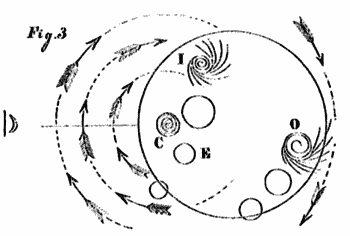
influences. By referring to Fig. 3, section 1, we see that the lateral
vortices of the globe are continually passing off to the southward, in
the northern hemisphere, in a succession of dimples, and continually
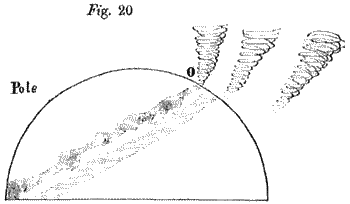
reforming. We will now represent this mode of action in profile, as it
actually occurs in the illustration we have used.
The vortex passing off from O, (Fig. 20,) although it does not actually
reach the surface of the atmosphere, affects the equilibrium of the
ether, and, for a short distance from the parent vortex, may cause an
ascensional movement of the air. If to this is conjoined a northerly
wind from the vortex, a band of clouds will be produced, and perhaps
rain; but violent storms never occur in the intervals, except as a
steady gale, caused by the violence of a distant storm. Thus, it will
frequently be noticed that these vortices are flanked by bands of
clouds, which pass southward, although the individual clouds may be
moving eastward. Hence, instead of disproving the theory, they offer
strong evidence of its truth; and could we view the earth from the moon
with a telescope, we should no doubt see her beautifully belted.
But it may be again asked, why should not the weather be the same
generally, in the same latitude, if this theory be true? If the earth
were a globe of level land, or altogether of water, no doubt it would be
similar; but it must be remembered, that both land and water are very
unequally distributed: that the land is of varying extent and
elevation—here a vast plain, far removed from the ocean, and there a
mountain chain, interposing a barrier to the free course of the
atmospheric currents; sometimes penetrating in full width into the
frigid zone, and again dwindling to a few miles under the equator. One
very important distinction is also to be remarked, in the superficial
area of the different zones, reckoning from the equator, and taking the
hemisphere as 100 parts:
| Frigid |
zone |
8 |
parts. |
| Temperate |
" |
52 |
" |
| Torrid |
" |
40 |
" |
For as the time of rotation in every latitude is the same, the area to
be disturbed in the same time, is less in high latitudes, and there a
greater similarity will obtain, ceteris paribus. In lower latitudes,
where both land and water stretch away for thousands of miles, it is not
wonderful that great differences should exist in the electrical and
hygrometric state of the air.
The summer of many countries is always dry—California for instance. In
winter, in the same country, the rains are apparently incessant. This of
course depends on the power of the sun, in diverting the great annual
currents of the atmosphere. As long as the dry north-west trade sets
down the coast of California, the circumstances are not favorable for
giving full development to the action of the vortices. When the trade
wind ceases, and the prevailing winds come from the south, loaded with
vapor, the vortices produce storms of any magnitude; but (and we speak
from two years’ observation) the passages of the vortices are as
distinctly marked there in winter time, as they are in the eastern
States; and in summer time, also, they are very perceptible. The same
remark applies to Mediterranean countries, particularly to Syria and
Asia Minor; although the author’s opportunity for observing lasted only
from April to December, during one season. If we are told it never rains
on the coast of Peru, or in Upper Egypt, it does not seriously militate
against the theory. The cause is local, and the Samiel and the sand
storm of the desert, is but another phase of the question, explicable on
the same general principles. From the preceding remarks it will be seen,
that in order to foretell the character of particular days, a previous
knowledge of the weather at that particular place, and for some
considerable time, is requisite; and hence the difficulty of laying down
general rules, until the theory is more fully understood.
We now come to the causes which are auxiliary and interfering. It is
natural that we should regard the sun as the first and most influential
of these causes, as being the source of that variation in the
temperature of the globe, which alternately clothes the colder regions
in snow and verdure. The heat of the sun undoubtedly causes the ether of
the lower atmosphere to ascend, not by diminution of its specific
gravity; for it has no ponderosity; but precisely by increase of
tension, due to increase of motion. This aids the ascensional movement
of the air, and therefore, when a vortex is in conjunction with the sun,
its action is increased—the greatest effect being produced when the
vortex comes to the meridian a little before the sun. This has a
tendency to make the period of action to appear dependent on the phases
of the moon, which being the most palpable of all the moon’s variations,
has been naturally regarded by mankind as the true cause of the
changes of the weather. Thus Virgil in his Georgics, speaking of the
moon’s influence and its signs:
“Sin ortu in quarto (Namque is certissimus auctor)
Pura, nec obtusis per cœlum cornibus ibit;
Totus et ille dies, et qui nascentur ab illo,
Exactum ad mensem, pluviâ ventisque carebunt.”
Hence, also, in the present day we hear sailors speak of the full and
change, or the quartering of the moon, in connection with a gale at sea;
thus showing, at least, their faith in the influence of the phenomenon.
Yet it is actually the case, at certain times, that in about latitude
40° and 41°, the storms appear about a week apart.
There is some reason, also, to suspect, that there is a difference of
temperature on opposite sides of the sun. As the synodical rotation is
nearly identical with the siderent period of the moon, this would
require about forty-four years to run its course, so as to bring the
phenomena to exact coincidence again. Since these observations were
made, it is understood that Sig. Secchi has determined that the
equatorial regions of the sun are hotter than his polar regions. It may
be owing to this fact, that we have inferred a necessity for a change,
whose period is a multiple of the sun’s synodical rotation, but it is
worthy of examination by those who possess the necessary conveniences.
Another period which must influence the character of different years,
depends on the conjunction of the perigee of the lunar orbit with the
node. Taking the mean direct motion of the moon’s perigee, and the mean
retrograde motion of the node, we find that it takes six years and one
day nearly from conjunction to conjunction. Now, from the principles
laid down, it follows, that when the perigee of the orbit is due north,
and the ascending node in Aries, that the vortices of the earth will
attain their greatest north latitude; and when these conditions are
reversed, the vortices will reach their highest limit in the lowest
latitude. This will materially affect the temperature of the polar
regions. In the following table, we have calculated the times of the
conjunctions of the apogee and pole of the orbit, taking the mean
motions. It may be convenient to refer to by-and-bye, remembering that
when the conjunction takes place due south, the vortices reach the
highest, but when due north, the vortices in the northern hemisphere
have their lowest upper limit:
Conjunction of Apogee and Pole of
Orbit.[24]
| Year. |
Month and Day. |
Longitude. |
| 1804, |
April |
18th, |
220° |
| 1810, |
" |
17th, |
104° |
| 1816, |
" |
16th, |
348° |
| 1822, |
" |
15th, |
232° |
| 1828, |
" |
14th, |
116° |
| 1834, |
" |
12th, |
360° |
| 1840, |
" |
11th, |
244° |
| 1846, |
" |
10th, |
128° |
| 1852, |
" |
9th, |
12° |
| 1858, |
" |
8th, |
255° |
| 1864, |
" |
7th, |
139° |
| 1870, |
" |
6th, |
23° |
| 1876, |
" |
5th, |
267° |
By this we see that the vortices have never attained their highest limit
during the present century, but that in 1858 their range will be in a
tolerable high latitude, and still higher in 1876—neglecting the
eccentricity of the orbit.
A very potent influence is also due to the heliocentric longitude of the
sun, in determining the character of any given year. Let us explain:
The moon’s inertia forces the earth from the mechanical centre of the
terral system, but is never able to force her clear from the central
axis. With the sun it is different. He possesses many satellites
(planets). Jupiter alone, from his great mass and distance, is able to
displace the whole body of the sun. If other planets conspire at the
same side, the centre of the sun may be displaced a million of miles
from the mechanical centre of the solar system. Considering this centre,
therefore, as the centre of an imaginary sun, from which heliocentric
longitudes are reckoned, the longitude of the real sun will vary with
the positions of the great planets of the system. Now, although this
systematic longitude will not be exactly similar to the heliocentric
longitude reckoned from the sun’s centre, yet, for the purposes
intended, it will correspond sufficiently, and we shall speak of the
longitude of the sun as if we reckoned heliocentric longitudes from the
mechanical centre of the system. When we come to consider the solar
spots, we shall enter into this more fully. In the following diagram we
shall be able to perceive a cause for variation of seasons in a given
year, as well as for the general character of that year.
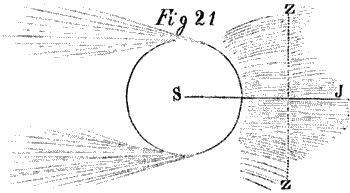
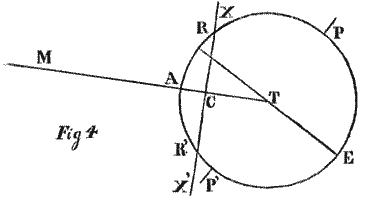
Let S represent the centre of the sun, and the circle a vertical section
of the sun, cutting; through the centre,—SJ being in the equatorial
plane of the vortex, of which ZZ′ represents the axis. As the ether
descends the poles or axis at Z, it is met by the current down the
opposite pole, and is thence deflected in radii along the equatorial
plane to J. But on the side S, the ether is opposed by the body of the
sun; its direction is consequently changed, and cross currents are
produced, assuming it as a principle, that the ethereal fluid is
permeable by other currents of similar matter, and that it tends always
to move in right lines. This granted, it is evident that, in passing the
sun, the quick moving ether forms a conical shell, (the sun being at the
apex,) so that the strongest current of ether is in this conical shell,
or at the surface of this conical space. As the plane of the ecliptic is
not much inclined to the sun’s equator, and this last probably not much
inclined to the plane of the vortex, should the earth have the same
heliocentric longitude at the time, (or nearly the same,) she would
be in an eddy, as respects the radial stream, and be protected from its
full force by the body of the sun.
Now, the ether comes down the axis with the temperature of space, and
may possibly derive a little additional temperature in passing over
the body of the sun; so that in this position the earth is protected
from the chilling influence of the radial stream, by being protected by
the body of the sun. And although, from the immense velocity of the
ether, it cannot derive much additional temperature, there may still be
an appreciable difference, due to this cause.
It is the chilling influence of the ethereal stream which originated the
idea among philosophers, of frigorific impressions, darted from a clear
sky. In some years the sun will be nearly in the centre of the system;
in other years the axis of the vortex will not come near the sun. And as
the sun’s longitude may vary through the entire circle, it may happen
that the earth’s longitude shall coincide in winter or summer, or spring
or autumn. When, however, the earth emerges from the protection of the
sun, and enters the conical shell, considered as a space of considerable
depth, she will again be exposed to the full force of the radial stream,
rendered more active by the previous deflection, and by the numerous
cross currents pervading it; so that a mild and calm winter may be
succeeded by a cold and stormy spring. The present season, (1853) the
earth’s longitude coincided with the sun’s longitude in about 135°, and
consequently was in the conical space spoken of, during February and
March; but the radius vector of the sun’s centre, being then less
than 300,000 miles, the protection was not as complete as it is
sometimes. Still, the general fineness of these months was remarkable;
yet in April and May, when the earth became again exposed to the action
of the solar stream, the effect was to retard the spring, and disappoint
the prognostications of the weather-wise. In applying these principles,
we must consider the effect in those latitudes which are more readily
affected,—that is, in the temperate zone, midway between the two
extreme zones of heat and cold.
In 1837 and 1838, the longitude of the sun’s centre corresponded with
the earth’s, in August and September, when there was neither rain nor
electrical excitement; and consequently those seasons were sickly over
the whole country. Now, there is another cause which renders the months
of August, September, and October, deficient in electrical energy, and
consequently more prone to be sickly. If, therefore, the two causes
unite their influence, the autumnal months will be more sickly at those
times. This last cause, however, only affects the northern latitudes
in autumn, and consequently, ceteris paribus, the autumnal months
should not be so proverbially sickly in the southern hemisphere. This
is, however, only suggestive.
Again, in 1843, the winter was very mild in January and February; but in
March it turned cold and stormy, and continued through April. In this
year the longitude of the sun was nearly the same as in 1853,—the two
longitudes of the earth and sun corresponding about the last of January;
but in March, the earth forsook the comparative calm produced by the
sun’s position, and hence the greater cold.[25]
Thus it appears at every step we take, that the different members of the
solar system do indeed belong to the same family, whose least motions
have their influence on the rest. Who could have anticipated that the
position of Jupiter in his orbit had anything to do with the health of
this remote planet, or with the mildness of its seasons? In this we have
a clue to the origin of that astrological jargon about planetary aspects
being propitious or malign. Philosophers are even yet too prone to wrap
themselves in their mantle of academic lore, and despise the knowledge
of the ancients, while there is reason to believe that the world once
possessed a true insight into the structure of the solar system. As war
became the occupation of mankind, under the despotic rule of ambition,
so truth retired, and ignorance seizing upon her treasures, has so
mutilated and defaced them, that their original beauty no longer
appears. Let us hope that the dawn of a better day is approaching.
There is yet another cause (just alluded to) which modifies the action
of the vortices.
We have shown that, if the periodic times of the planets are
approximately equal to the periodic times of the contiguous parts of the
solar vortex, the density of the ether is directly as the square roots
of the distances from the centre. As the earth is at her perihelion
about the first of January, the density of the surrounding ether is then
less than in other parts of the orbit; consequently, if we suppose that
there is a continual tendency to equilibrium, the ether of space must
press inwards, during the time between the perihelion and aphelion,
(i.e. from January to July,) lowering the temperature and increasing
the electrical action of those months. As the distance from the sun is
most rapidly augmenting about the first of April, and the effective
power of the sun’s radiation is most rapidly increasing in May; by
combining the two we shall find, that about the first of May we shall
have considerable electrical action, and cold weather. This explains
also, in part, the prevalent tradition of certain days in May being very
cold.[26] When the earth leaves the aphelion, a reaction takes place,
being most rapid in September. There is then an escape of ether from
the earth, which keeps up the temperature, and causes these months to be
sickly, from the negative electrical state of the atmosphere. In the
southern hemisphere, the effects in the same season will be reversed,
which may partly account for the greater degree of cold in that
hemisphere, and for accelerating the approach of both summer and winter,
while in the north they were both retarded.
We must now advert to another cause, which of all others is probably the
most important, at least to the other members of the solar system.
In every part of the solar vortex the ether is continually pressing
outwards. We are not now speaking of the radial stream, but of the
slower spiral motion of the ether around the axis of the vortex, whose
centrifugal force is bearing the whole body of the ether outwards, thus
rarefying the central parts, and thus giving rise to the polar influx,
from which arises the radial stream. This may be made more intelligible,
by reflecting that the polar current is comparatively dense ether, and
that the length of the axis of the vortex prevents this influx current
coming in sufficient quantities to restore an equilibrium in the density
of the medium. Yet, what does come down the poles, is distributed
rapidly along the equatorial plane, leaving the space still rarefied.
Now we perceive, that in order for the radial stream to continue in
action, requires the whole medium of the vortex to be also moving
outward; it is therefore continually condensed as it proceeds. This
condensation necessarily converts much of the specific heat of the ether
into sensible heat; so that the temperature of the medium is
continually increasing, as the distance from the sun increases.
When we contemplate the solar system as the emanation of one Great Mind,
we naturally seek for evidence of the wisdom of a supreme intelligence
in all the arrangements of that system. But, however humbly and
reverently we may speak of these arrangements, we can scarcely avoid the
wish, that the planetary distances had been differently arranged, if
Newton’s doctrine be true, that space is a vacuum, and that the heat of
a planet, is inversely as the squares of the distances from the sun.
For, to speak of the temperature of space, except as dependent on this
law, is one of those many incomprehensible inconsistencies with which
philosophers are chargeable. If the Newtonian philosophy is literally
true, space has no temperature, and the surface heat of the planet
Neptune is nearly 1,000 times less than on our own globe. Again, on
Mercury it is seven times greater, which heat would scorch and consume
every organic substance on the earth, and speedily envelope the boiling
ocean in a shroud of impermeable vapor. Granting even that space may not
be a vacuum, and yet the law of gravitation be true, we may still be
allowed to consider both Saturn and Uranus and Neptune, as inhospitable
abodes for intelligent creatures; and, seeing the immensity of room in
the system, there is no reason why these planets might not have been
permitted to revolve nearer the great source of light and life and
cheering emanations. To suggest the resources of Omnipotence is no
argument. He has surrounded us with analogies which are seen, by which
we may attain a knowledge of those which are not seen; and we have every
reason to suppose that the great Author of nature is not indifferent to
the aspects under which his works reveal him unto his creatures. Yet
there is (on the above hypothesis) an apparent want of harmony in the
planetary distances; and if frail mortality may be permitted to speak
out, an explanation is needed to obviate this seeming anomaly in the
economy of the world. The more we learn of the physical arrangements of
the universe, the more do they correspond with our experience of the
nice adaptation of the means to the end which obtains in our own globe,
and we can only judge of other planets by the analogies around us. Here,
there, are extremes of temperature it is true: it is necessary there
should be, and we can see and understand the necessity in all such
cases, and how they conduce to the general average of good. But,
astronomers can give no reason why it is necessary that some planets of
our system should be placed so remote that the sun is frittered down to
a star, whose heatless light is but a mockery to those frigid realms.
Now, according to this theory, the temperature of Neptune may be far
more uniform and conducive to life than that of our own globe. The
chilling influence of the solar stream at that planet being nearly null,
and the temperature of the surrounding space far greater. So also
Mercury, instead of being the burning planet of the schools, may suffer
the most from cold.
The planet Mars is generally considered, of all the members of the
system, most nearly to resemble our own world. The telescope not only
reveals seas and continents, but the snowy circles round his poles,
which appear to increase and diminish, as his winter is beginning or
ending. This planet’s ecliptic is similar to our own in inclination or
obliquity, his distance, also, is far greater, and his winter longer;
yet, for all this, his snow zones are less than on our own globe. This
anomalous fact has, we believe, never been noticed before; but it is
explicable on the theory, and therefore confirms it. Mars has no
satellite, and therefore his centre will be coincident with the centre
of the marsial vortex. There will be no lateral vortices to derange
his atmosphere, and if the axis of his vortex coincides also with the
axis of the planet, the central vortex will be continually over the
poles, and there will be no storms on the planet Mars. A capital fact
connected with this, is the want of belts, as in Jupiter and Saturn; for
these planets have satellites, and if they are not massive enough, the
belts may be produced by an obliquity in the axis of the Jovial and
Saturnial vortices. If Mars had an aurora like the earth, it is fair to
presume the telescope would ere this have shown it. He is, therefore, in
equilibrium. In applying this reasoning to the earth, we perceive that a
certain influence is due to the difference of temperature of the
ethereal medium surrounding the earth, at perihelion and aphelion, being
least at the former, and greatest at the latter.
As a modifying and interfering cause in the action of the vortices, we
must mention the great natural currents of the atmosphere, due to the
earth’s rotation.
It is considered that the sun is the principal cause of these great
currents. By elevating the surface atmosphere of the equator, a lateral
current is induced from the north and south; but on account of the
enlarging circles of latitude, their direction tends more from the
north-east and south-east. These currents are usually called the trades.
Without disputing the correctness of this, it may be doubted whether the
whole effect is due to the sun. As this principle affects the ocean
likewise, it is necessary to look into it; and in order to simplify the
question, we will first suppose our globe covered entirely by the ocean,
without any protuberant land.
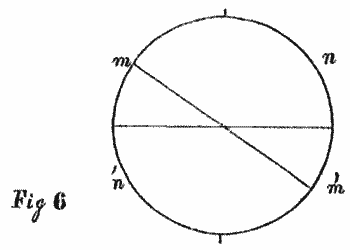
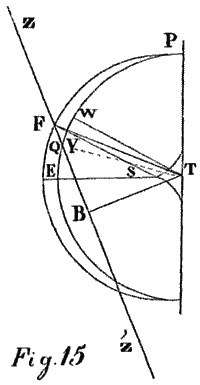
Let us assign a uniform depth of ten miles to this ocean. In the Fig.
following, the two circles will represent the surface and bottom of the
ocean respectively. The axis of rotation is thus represented by the line
PP′. Let us consider two particles of water at m and n, as feeling the
influence of this rotation; they will, of course, be both urged towards
the equator by the axifugal force. Now, every particle in the ocean
being also urged by the same force, it might be supposed that after a
protuberant mass of water had accumulated at the equator EE′, the whole
ocean would be in equilibrium. This would not follow. The particle at m is urged by a greater force than n; consequently the particle at n is
overborne by the pressure at m. Considering both in the same direction,
yet the particle at n must give way, and move in the opposite direction.
Just as the heaviest scale of the balance bears up the lightest,
although both gravitate towards the same point. This is so self-evident
that it would seem unnecessary to dwell upon it, had not the scientific
world decided that the rotation of the earth can cause no currents
either in the atmosphere or in the ocean.
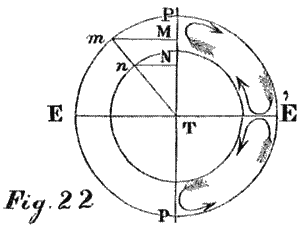
The axifugal forces of the two particles m and n are directly as the
lines Mm and Nn, and if the gravitating forces were also as the radii Tm
and Tn, no motion would be produced. Admitting even the Newtonian law to
be rigidly exact, the earth cannot be considered a homogeneous globe,
but, on the contrary, the density of the central parts must be nearly
thirty times greater than the density of the surface of the ocean. The
ratio of the gravitating forces of these two particles is, therefore,
less than the ratio of their respective radii, and the axifugal tendency
of the particle at n is more than proportionally restrained by the
central gravitation; and hence m will move towards the equator, and n towards the poles, as represented in the Fig.
It is on account of the overwhelming momentum of the surface waters of
the South Pacific over the North, that the Pacific, at Panama, stands
six or seven feet higher than the Atlantic. We shall again allude to
this interesting fact.
According to newspaper reports of a lecture, delivered in New York, by
Lieut. Maury, U. S. N., this gentleman endeavors to explain the currents
of the ocean, by referring them to evaporation in the tropics. The vapor
leaves the salt of the water behind, and thus, by continual
accumulation, the specific gravity of the tropical waters is greater
than that of the superficial waters nearer the poles; the lighter
water, therefore, passes towards the equator, and the heavier water
below, towards the poles. If this be a correct statement of that
gentleman’s theory, fidelity to our standards compels us to question the
soundness of the conclusion. The mere fact of the surface water of the
ocean being lighter than that of the bottom, cannot on any known
principles of science cause any movement of the surface waters towards
the equator. When such an acute and practical physicist is driven, by
the palpability of the fact that the polar waters are continually
tending towards the equator, to seek the cause in the tropical
evaporation, it shows that the dogma, which teaches that rotation can
produce no motion, is unsound.
Sir John Herschel, in speaking of the solar spots, says: “We may also
observe that the tranquillity of the sun’s polar, as compared with his
equatorial regions (if his spots be really atmospheric), cannot be
accounted for by its rotation on its axis only, but must arise from some
cause external to the sun, as we see the belts of Jupiter and Saturn and
our trade winds arise from a cause external to these planets combining
itself with their rotations, which alone (and he lays an emphasis on
the word) can produce no motions when once the form of equilibrium is
attained.”
With respect to the origin of the solar spots, we have no disposition to
question the conclusion; but, as regards the principle laid down, that
rotation can produce no motions when once the form of equilibrium is
attained, we must unequivocally dispute it. If our atmosphere were of
uniform density, the rotation of the earth would cause no current such
as we have described; with our atmosphere as it is, the result will be
different. The momenta of two portions of matter are the products of
their inertiæ by their motions, and, in the present case, we must take
the inertiæ of equal spaces. A cubic inch of air at the surface, and at
three miles above the surface, is as 2 to 1; but their centrifugal
velocity varies only as the radii of the respective spheres, or as 1320
to 1321. In the polar regions, therefore, the momentum of the surface
air preponderates, and, in this case, the surface current is towards
the equator, and the upper current towards the poles. When, however, the
centrifugal velocity is considerably increased in a lower latitude, and
the curvature of the surface becomes more and more inclined to the
direction of that resolved part of the centrifugal force, which is
always from the axis, the surface layers will evince a tendency to
leave the surface, and an intermingling will then take place in the
space between latitude 70° and 50°, or in latitude 60°. As this layer is
continually urged on in the same direction by the surface layer of
latitudes above 60°, the upper layer now becomes a current setting
towards the equator, and, consequently, the back current occupies the
surface. Now, considering that the rarefying action of the sun is
elevating the air under the equator, there must necessarily be an upper
current from the equator to the poles; so that if we conceive the two
currents to meet about latitude 30°, there will be a second
intermingling, and the current from the poles will again occupy the
surface. Thus, we regard a part of the effect of the trades to the
rotation of the earth, which is the chief impelling power at the poles,
as the sun is at the equator; and the latitudes 60° and 30° will be
marked by some especial phenomena of temperature, and other
meteorological features which do actually obtain. These would be much
more marked if the irregular configuration of land and sea, the
existence of mountain chains, and the different heating power of
different latitudes, owing to the unequal distribution of the land, did
not interfere; and the currents of the air (disregarding the deflection
east and west) might then be represented by a treble link or loop, whose
nodes would vary but little from latitudes 30° and 60°. As it is, it
has, no doubt, its influence, although unimportant, when compared with
the disturbing action of the ethereal vortices.
There is another phenomenon due to the action of the radial stream,
which has given much trouble to the physicist, and which has yet never
been explained. This is the horary oscillations of the atmospheric
pressure which, in some countries are so regular that the time of day
may be ascertained by the height of the barometer. According to
Humboldt, the regularity of the ebb and flow in the torrid regions of
America, is undisturbed by storms or earthquake. It is supposed that the
maxima occur at 9 A. M. and 10 ½ P. M., and the minima at 4 A. M. and
4 ¼ P. M. From the morning minimum to the morning maximum is,
therefore, five hours; from the evening minimum to the evening maximum
is 6 ¼ hours; from the evening maximum to the morning minimum is 5 ½
hours, and from the morning maximum to the evening minimum is 7 ¼
hours. Again, these oscillations are greatest at the equator, and
diminish with the increase of latitude.
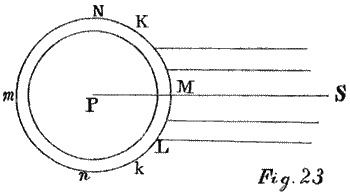
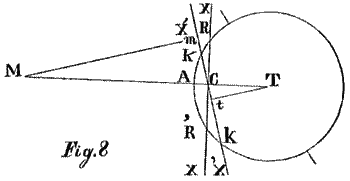
If we suppose the earth’s axis perpendicular to the plane of the vortex,
and P the pole in the above figure, and SP the line joining the centre
of the earth and sun, M and m will represent the points in the earth’s
equator where it is midday and midnight respectively. The solar stream
penetrates the terral vortex; and strikes the earth’s atmosphere along
the lines parallel to SP. The direct effect would be to pile up the
atmosphere at N and n; and therefore, were the earth at rest, the
maximum would be at 6 A. M. and 6 P. M., and the minimum at midday and
midnight; but the earth rotating from N towards M, carries along the
accumulated atmosphere, being more sluggish in its motions than the
producing cause, which cause is still exercised to force it back to N.
From this cause the maximum is now found at K. For a like reason the
minimum at M would be found at L, but on account of the motion of the
earth being now in the same direction as the solar stream, the minimum
is found still more in advance at k; so that, according to the theory,
the interval between the morning maximum and the evening maximum, should
be greater than the interval between the evening maximum and the morning
maximum; and so it is, the first being 13 ½ hours and the last 10 ½
hours. The morning minimum should also be less marked than the evening
minimum, and this also is a fact. The effect also should be greater in
the tropics than in high latitudes, which again also obtains; being 1.32
French lines at the equator, and only 0.18 at latitude 70°. Had the
earth no obliquity, the effect would be as the squares of the cosines of
the latitude; but the ratio is diminished by the inclination of the
axis. But there are other variations of the barometer of longer period,
apparently depending on the phases of the moon, but which cannot be
reconciled to the attracting power of the moon as an atmospheric tide;
and Arago concluded that they were due to some special cause, of which
the nature and mode of action are unknown. Perhaps this theory will
obviate the difficulty, as although the central vortex comes to the
meridian at the same time as the moon, its effect will be different on
the inferior meridian to what it is on the superior one; whereas the
moon’s attraction should be the same on both. That the passage of a
vortex over or near a particular place should affect the barometer, is
too obvious to need explanation, and therefore we may say that the
theory will explain all those varieties both small and great, which have
caused so much speculation for the last fifty years.
In applying the theory to the magnetism of the earth, we must bear in
mind that the earth is probably magnetic by induction, and not in virtue
of its own specific action. The rotation of the surrounding ether, and
the consequent production of a radial stream, calls the ether into
motion within the earth’s interior, as well as on the surface; but it
does not follow that the ether shall also enter the earth at its poles
and escape at its equator, for the obliquity of the vortex would
interfere with this result. It is sufficient that this does occur in the
terral vortex immediately surrounding the earth. From late experiments
it is pretty well established that the axial direction of the needle,
(and of other bodies also,) is due to peculiar internal arrangement in
laminæ or layers, the existence of which is favorable to the passage of
the magnetic current.
According to the experiments[27] of Dr. Tyndal, it is found that the
magnetism of a body is strongest along the line of greatest density. As,
therefore, the laminæ of bodies may be considered planes of pressure,
when these planes are suspended horizontally, the directive force is
greatest, and the longest diameter of the body sets axial. On the other
hand, when the body was suspended so that the laminæ were vertical, the
longest diameter set equatorial. Now, we know that the crust of the
earth is composed of laminæ, just as the piece of shale in Doctor
Tyndal’s experiments, and that these layers are disposed horizontally.
And whatever force originally arranged the land and water on our globe,
it is evident that the continents are longest from north to south, and
therefore correspond to the natural direction of the magnetic force.
In consequence of the intrinsic difficulties of this question, and the
mystery yet attaching to it, we may be permitted to enter a little more
minutely into it, and jointly consider other questions of interest, that
will enable us to refer the principal phenomena of terrestrial magnetism
to our theory.
We have before adverted to the discrepancies in the earth’s compression,
as determined by the pendulum, and also to the uncertainty of the moon’s
mass, as deduced from the nutation of the earth’s axis. It is also
suspected that the southern hemisphere is more compressed than the
northern; and other phenomena also point out the inadequacy of the law
of gravitation, to account for the figure of the earth.
From the invariability of the axis of rotation, we must conclude that
whatever form is the true form, it is one of equilibrium. In casting our
eyes over the map of the world, we perceive that the surface is very
unequally divided into land and sea; and that the land is very unequally
arranged, both north and south, and east and west. If we compare the
northern and southern hemisphere, we find the land to the water about 3
to 1. If we take the Pacific portion, and consider the north end of New
Zealand as a centre, we can describe a great circle taking in one half
the globe, which shall not include one-tenth of the whole land. Yet the
average height of the remaining nine-tenths, above the level of the sea,
is nearly 1,000 feet. Call this nine-tenths nearly equal to one-fourth
of the whole surface, and the protuberant land in the hemisphere,
opposite the South Pacific, amounts to 1 ⁄ 30,000 part of the whole mass
of the earth, or about 1 ⁄ 700 of the mass of the moon. Again, the mean
density of the earth is about 5 ½—water being unity,—and the mean
density of the surface land is only about half this: but three-fourths
of the whole surface is water. Hence, we see that the materials of the
interior of the earth must be either metallic or very compressible. To
assign a metallic nucleus to the earth, is repugnant to analogy; and it
is not rendered even probable by facts, as we find volcanic emissions to
contain no heavier elements than the sedimentary layers. Besides, there
are indications of a gradual increase of density downwards, such as
would arise from the compressibility of the layers. Seeing, therefore,
the equilibrium of the whole mass, and the consequent hydrostatic
balance of the land in the sea,—seeing also the small compressibility
of the solid portions, and the great compressibility of the fluid, the
inference is legitimate that the whole is hydrostatically balanced, and
that our globe is a globe of water, with an intermediate shell of land,
specifically lighter than the fluid in which it is suspended. Where this
shell is of great thickness, it penetrates to greater depths, and
attains to greater elevations above the surface of the aqueous globe;
where it is less thick, it is found below the surface, and forms the
bottom of the upper ocean. Recent soundings give much greater depths to
some parts of the ocean, than the most elevated land upon the globe.
Captain Denham, of H. B. M. ship Herald, lately sounded in 37° south and
37° west, and found bottom at 7,706 fathoms, or about nine English
miles.
As the interior portions of our globe are totally unknown, and the
compressibility of water is well established, it is just as sane to
consider water the most abundant element of nature, as solid land. The
great question to ask is, whether there may not be other phenomena
incompatible with this supposition? It is plain that the permanency of
terrestrial latitudes and longitudes would be unaffected by the
conditions we have supposed. Would the precession of the equinoxes be
also unaffected? Mr. Hopkins has entered into such an investigation, and
concludes: “Upon the whole, then, we may venture to assert that the
minimum thickness of the crust of the globe, which can be deemed
consistent with the observed amount of precession, cannot be less than
one-fourth or one-fifth of the radius of the earth.”These
investigations were made on the hypothesis of the interior fluidity
being caused by the fusion of the central portions of a solid globe; but
it is evident that the analytical result would be the same if these
central parts were water, inclosed by an irregularly-spherical shell of
land. Nor would the result be affected, if we considered certain
portions of the interior of this solid shell to be in a state of fusion,
as no doubt is the case.
May not the uncertainty of the mass of the moon, be owing to the fact
that this shell is not so rigidly compacted but that it may yield a
little to external force, and thus also account for the tides in the
Pacific groups, rather obeying the centrifugal force due to the orbit
velocity of the earth, than the attraction of the moon?
Since the days of Hipparchus the sidereal day has not diminished by the
hundredth part of a second; and, consequently, seeing that the
contraction of the mass must be limited by the time of rotation, it is
inferred that the earth has not lost 1 ⁄ 508th of one degree of heat since
that time. This conclusion, sound as it is, is scarcely credible, when
we reflect on the constant radiation into a space 60° below zero. Admit
that the globe is a globe of water, whose average temperature is the
temperature it receives from the sun, and the difficulty vanishes at
once. Its diameter will be invariable, and the only effect of the
cooling of the solid parts will be to immerse them deeper in the water,
to change the relative level of the sea without changing its volume.
This is no puerile argument when rightly considered; but there is
another phenomenon which, if fairly weighed, will also conduct us to the
same views.
It is now a fact uncontroverted, that the sea does actually change its
level, or rather, that the elevation of continents is not only apparent
but real. The whole coast of Sweden and Finland is rising at the present
day at the rate of four feet in a century, while on the south a contrary
effect is produced. Various hypotheses have been formed concerning this
interesting fact. Yet from the indications of geology, it must have been
an universal phenomenon in the early ages of the world, in order to
account for the emersion of sedimentary deposits from the fluid which
deposited them. May not internal fires be yet spreading, and the
continents expanding instead of contracting? And may there not be an
inequality in this process, so as necessarily to immerse in one
direction nearly as much as to elevate in another? One fact is certain,
the elements are scattering the materials of the land along its Oceanic
coasts, which of itself must produce a very minute effect in disturbing
the hydrostatic balance; but a more efficient agent is the earthquake
and volcano.
The upheaving of tracts of land by earthquakes, as on the coast of Chili
would thus be satisfactorily explained, by attributing a certain
resistance due to cohesion or friction preventing a gradual change of
level, but producing it suddenly by the jar of the earthquakes. May we
not inquire also, whether the facility with which the earth seems moved
by this destructive agent, does not point to the same solution as the
irregularity of the figure of the earth?
This is a subject on which it is allowable to speculate, especially if
any light can be thereby thrown on the still more mysterious source of
terrestrial magnetism. It is for such a purpose that we have permitted
ourselves to digress from that subject. In this connection we also may
acknowledge our indebtedness to the sacred volume for the first germ of
this theory of the weather.
Believing in the authenticity of the Mosaic history of the deluge, the
author found it difficult to refer that event to other than natural
causes, called into action by the operation of other causes, and all
simultaneous with the going forth of the fiat of Omnipotence. Thus
reasoning, he was led to regard the deluge as a physical phenomenon
inviting solution, and as a promising exponent to the climatology of
the early world. He looked upon the bow of promise, as the autograph of
the Creator, the signature to a solemn bond, upon which the eye of man
had never before rested. But if there was no rainbow before the deluge,
there was no rain; and following up this clue, he was not only enabled
to solve the problem, but also led to the true cause, which produces the
principal commotions in our atmosphere.
Science boasts of being the handmaid of religion; yet there are names of
note in her ranks who have labored rather to invest this phenomenon with
the mantle of fable, and to force it into collision with the records
graven on the rocky pages of geognosy. But the world is ever prone to be
captivated by the brilliancy of misapplied talents, instead of weighing
merit by its zeal in reconciling the teachings of those things which are
seen, with those which are revealed.
If our globe be constituted as we suppose, the land might experience
repeated submersions, without involving the necessity of any great
departure from established laws. And we might refer to the historical
record of one of these, with all the minute particulars as positive
data, imposing on us the necessity of admitting that the solid parts of
the globe are hydrostatically balanced in the sea. But, modern science
is not always correctly defined when called the pursuit of truth, nor
human learning the means of discovering it.
If we could divest ourselves of this prejudice, we should have a ready
solution of the difficulty presented by the earth having two north
magnetic poles, and probably two also in the south. For, by regarding
the old and new continents as two distinct masses of land whose bases
are separated by 6,000 miles of water, we recognize two great magnets,
dependent, however, for their magnetism, on the rotation of the terral
vortex.
This is no place to enter into a lengthy discussion of such a difficult
subject as magnetism, but we may be allowed to enter a protest against
the current theory of electro-magnetism, viz.: that a force is generated
by a galvanic current at right angles to the producing cause, which is
contrary to the fundamental principles of mechanics. We may conceive
that a current is induced from or to the surrounding space by the
rarefaction or condensation attending the transmission of such a current
along a wire, and that rotation should follow, just as a bent pipe full
of small holes at the lower end, and immersed in water as a syphon, will
generate a vorticose motion in the water; but mere juxtaposition,
without participation and communication with the general current, is
irrational, and, therefore, not true.
We have always regarded a magnetic needle as a part of the great natural
magnet, the earth; that its north pole actually points to the north, and
its south pole to the south; and, being free to move, it is affected by
the circular motion of the surrounding ether, and by every motion by
which the ether is directed. If there was any attraction between the
earth and the needle, opposite poles would be presented, but it is not
so—the force is merely directive.
Let us now see whether we cannot assign an adequate cause for the
secular and periodic variations in the inclination and declination of
the needle. These have been generally referred to changes of
temperature, as in fact, also, the magnetism of the earth is sometimes
ascribed to galvanic or electric currents, called forth by a daily
change of temperature. Our theory gives a totally different explanation
of these variations.
In the northern hemisphere, the north point of the needle moves from
east to west in the morning from about 8 ½ A. M. to 1 ½ P. M., and
returns to its mean position about 10 P. M. It then passes over to the
east, and again returns to its mean position about 8 or 9 A. M. The
analogy of this motion, with the horary changes in the barometer,
indicate a common origin. Humboldt, in the instructions he drew up for
the Antarctic Expedition under Sir James Ross, says: “The phenomena
of periodical variations depend manifestly on the action of solar
heat, operating probably through the medium of thermo electric currents
induced on the earth’s surface. Beyond this rude guess, however,
nothing is yet known of their physical cause. It is even still a
matter of speculation whether the solar influence be a principal or only
a subordinate cause.” That the sun may exert a modifying influence on
the phenomenon is not unlikely, but that he cannot be the principal
cause, is evident from the following considerations. These horary
variations of the magnetic needle are as great at the bottom of deep
mines far removed from solar influence, as on the surface. They are as
great, ceteris paribus on a small island in the midst of the ocean, as
in the interior of continents, where the heating power of the surface is
vastly greater. They are extremely regular, so that between the tropics,
according to the sagacious Humboldt, “the time of the day may be known
by the direction of the needle, as well as by the height of the
barometer.”
But what is the cause of these variations? This question is the most
difficult of all physical problems, and we shall only aim at indicating
the causes which are yet perhaps too intricately involved to afford a
positive numerical determination. Admitting the existence of two
principal solid masses whose general direction is from south to north,
and that these masses are more susceptible of permeation by the ethereal
fluid than the waters in which they are suspended, we have a general
solution of the position of the magnetic poles, and of the isogonic,
isoclinic, and isodynamic lines. Considering, too, that the southern
poles of these masses are the points of ingress, and the northern poles
the points of egress, it is easily understood that the ethereal medium
having the temperature of space, will cause the southern hemisphere to
be colder than the northern, and also that the magnetic poles will be
the poles of maximum cold, and the centres respected by the isothermal
and isogeothermal lines.
The general direction of the magnetism of the earth may be considered as
the controlling influence, therefore, in determining the position of the
magnetic needle; but there are other causes which, to some extent, will
modify the result. That half of the globe turned away from the sun will
partake of the density of the ether at that distance, which is greater
than on the side next the sun; the magnetic intensity ought, therefore,
to be greater in the night than in the day. The poles of the great
terrestrial magnets, or even the position of a magnetic needle on the
surface, are continually placed by the earth’s rotation in a different
relation to the axes of the terral vortex, and the tangential current,
which is continually circulating around the globe, has its inclination
to a given meridian in a perpetual state of change. If we conceive that
there is a tendency to force the needle at right angles to this current,
we shall have an influence which varies during the day, during the year,
and during the time occupied by a complete revolution of the node. The
principal effect, however, of the horary variation of the needle is due
to the radial stream of the sun, which not only penetrates the
atmosphere, but also the solid crust of the earth. Its principal
influence is, however, an indirect influence, as we shall endeavor to
explain.
No fact in the science of electro-magnetism is, perhaps, better
established than the disposition of an ethereal current to place itself
at right angles to the magnetic meridian, and conversely, when the
current is not free to move, to place the needle at right angles to the
current. Now, the terrestrial magnet or magnets, may be considered to be
surrounded by a body of ether in rotation, which, in the earth, on its
surface, and for some distance from the surface, is made to conform to
the general rule, that is, to circulate at right angles to the magnetic
meridian. Outside this again, the ether more and more conforms to the
position of the axis of the vortex, and this position varying, it must
exert some influence on the surface currents, and, therefore, change
in some degree the position of the magnetic meridian. The radial stream
comes from the sun in parallel lines, and strikes the globe and its
superficial ethereal envelope just as we have shown its action on the
atmosphere; but in this last case the magnetic equator is not a great
circle, neither can we suppose its effects to be an accumulation of a
fluid which is imponderable at points 90° from the plane passing through
the centre of the earth and sun, and coincident with the plane of the
central meridian, and a depressing effect on that meridian. Its precise
influence must be, from the nature of the cause, to deflect the circular
current towards the poles, in places less than 90° from the meridian,
and a contrary effect must be produced in places greater than 90° from
the meridian. Let us assume, for argument’s sake, that the magnetic
poles of the earth correspond to the poles of rotation, the parallels of
latitude will, therefore, represent the ethereal currents circulating
around the globe. Now, at sunrise, the radial stream of the solar vortex
is tangential to the surface, and, therefore, can produce no change in
these currents. As the sun ascends say about 8 or 9 A. M., the radial
stream striking only the surface of the earth perpendicularly in that
place where the sun is vertical (which we will suppose at the equator),
streams off on every side, as the meridians do from the pole, and the
circles of latitude (that is the ethereal currents) being parallel to
the equator, they are met by the radial stream obliquely, and deflected
towards either pole. By this deflection they are no longer at right
angles to the meridians. But, from the principle of reaction above
noticed, the magnetic meridians will place themselves at right angles to
the current, or, in other words, the magnetic pole will change its
position on the surface of the earth with respect to that particular
place. But, in other parts of the world, the meridians are in opposite
phases at the same instant of absolute time; therefore, the magnetic
poles are not points, but wide areas enclosing the magnetic poles of all
the countries under the sun. As this conforms to observation, it is
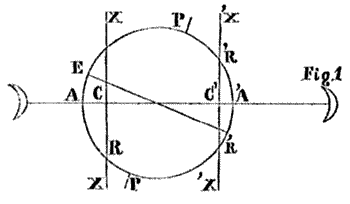
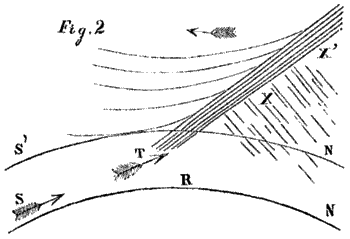
worthy our especial attention, and may be understood by the subjoined
figure, in which the oblique curves represent the course of the
tangential current in the different positions of the sun, the parallel
lines representing the solar radial stream.
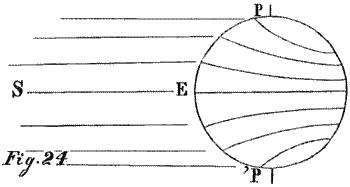
As the sun gains altitude the action of the radial stream is at a
greater and greater angle to the circular currents, and attains its
maximum at noon, still acting, however, after noon; but seeing that the
circular current possesses a force of re-action, that is, that the
magnetism of the earth is ever striving to bring these currents to their
natural direction, an hour or two after noon, the currents tend again to
the equator, and the maximum deflection is passed, and finally ceases a
few hours after sunset. Now let us attend to what is going on on the
opposite side of the world. The radial stream passing over the polar
regions, now produces a contrary effect; the ethereal atmosphere of the
great magnet is accumulated on the farthest side from the sun, by the
action of the radial stream passing over the polar region, the parallel
currents are now bent towards the equator, being at a maximum in places
where it is an hour or two past midnight. Before they were concave to
the equator, and now they are convex; the magnetic meridian is therefore
deflected the contrary way to what it was in the day time, by the same
principle of reaction. After the maximum, say at 4 A. M., the deflection
gradually ceases, and the magnetic meridian returns to its mean position
at 8 or 9 A. M. These times, however, of maximum and minimum, must vary
with the time of the year, or with the declination of the sun, with the
position of the moon in her orbit, with the perigee of the orbit, and
with the place of the ascending node; there are also minor influences
which have an effect, which present instrumental means cannot render
appreciable.
What says observation? The needle declines from its mean position in the
whole northern hemisphere to the westward, from about 8.30 A. M., until
1.30 P. M.; it then gradually returns to its mean position by 10 A. M.
After 10 P. M., it passes over to the eastward, and attains its maximum
deflection about three or four hours after midnight, and is found again
at its mean position about 9 A. M. Now, this is precisely the direction
of the deviation of the magnetic meridian, the needle therefore only
follows the meridian, or still continues to point to the temporary
magnetic pole. And although we have assumed, for the sake of simplicity,
that the mean magnetic pole corresponds to the pole of rotation; in
truth there are two magnetic poles, neither of which correspond; yet
still the general effect will be the same, although the numerical
verification will be rendered more difficult.
In the southern hemisphere the effect is the reverse, (this southern
hemisphere, however, must be considered separated from the northern by
the magnetic equator, and not by the geographical one,) the needle
declines to the eastward in the morning, and goes through the same
changes, substituting east for west, and west for east. Does observation
decide this to be to be a fact also? Most decidedly it does; and this
alone may be considered a positive demonstration, that the theory which
explains it is true. The contrary deflection of the needle in the
northern and southern hemisphere may be formally proclaimed as utterly
beyond the reach of the common theory of magnetism to explain. This
difficulty arises from considering the needle as the disturbed body
instead of the earth; and also from the fact that the effect of solar
heat must be common to needles in both hemispheres, and act upon similar
poles, and consequently the deflection must be in the same direction.
But a still more capital feature is presented by the discovery of
Colonel Sabine, that the deflection is in contrary directions at the
Cape of Good Hope, at the epoch of the two equinoxes. This arises from
the great angle made by the magnetic meridian at this place, with the
terrestrial meridian—the variation being by Barlow’s tables, 30° to the
westward. The sun varies in declination 47° throughout the year. At the
southern solstice, therefore the radial stream strikes the circular
current on the southern side, and deflects it towards the equator,
rendering the declination to the westward in the morning; but at the
northern solstice the radial stream strikes the current on its northern
side, and the deflection is eastward in the morning. And the vicinity of
the Cape of Good Hope is, perhaps, the only part of the world where this
anomaly will obtain; as it is necessary not only that the declination
shall be considerable, but also that the latitude shall not be very
great.
Observation also determines that the amount of the horary variation
increases with the latitude. Near the equator, according to Humboldt, it
scarcely amounts to three or four minutes, whilst it is from thirteen to
fourteen minutes in the middle of Europe. The theory explains this also;
for as the circles recede from the equator, the angles made by their
planes with the direction of the radial stream increases, and hence the
force of deflection is greater, and the effect is proportioned to the
cause. We have also a satisfactory explanation of the fact that there
has not yet been discovered a line of no variation of horary
declination as we might reasonably anticipate from the fact that the
declinations are in contrary directions in the northern and southern
hemisphere. This is owing to the ever-varying declination of the sun.
There would be such a line, no doubt, if the axis of the earth were
perpendicular to the plane of the orbit, and the magnetic pole coincided
with the pole of rotation: for then the equator would be such a line.
But there are also irregular fluctuations in the direction of the
magnetic needle. These depend on the moon, and are caused by the passage
of the vortices over or near to the place of observation. The action of
these vortices is proved to be of variable force, whether arising from
atmospheric conditions, or due to an increased activity of the ethereal
medium throughout the whole system, is at present immaterial. They do
vary, and sometimes the passage of a vortex will deflect the needle a
whole degree. At other times, there are magnetic storms extending over a
great part of the earth’s surface; but there is reason to suppose, that
the extent of these storms has been over estimated. Thus, on the 25th of
September, 1841, a magnetic storm was observed in Toronto, and at the
same time there was one felt at the Cape of Good Hope. There is no great
mystery in this. If we suppose the axis of the central vortex, for
instance, to have passed Toronto in latitude 43° 33′ north, in ordinary
positions of the moon, in her orbit, the southern portion of the axis
would be in 33° or 34° south latitude, and consequently would have
passed near the Cape of Good Hope on the same night. Now, we certainly
could not expect the northern portion of the vortex to be intensely
active, without the southern portion being in the same state of
activity. That this is the true explanation is proved by magnetic storms
in the same hemisphere being comparatively limited in extent; as,
according to Gauss and Weber, magnetic storms which were simultaneously
felt from Sicily to Upsala, did not extend from Upsala to Alten. Still
it would not be wonderful if they were felt over a vast area of
thousands of miles as a consequence of great disturbance in the
elasticity of the ether in the terral vortex; as the solid earth must be
permeable to all its motions, and thus be explicable on the general
principles we have advanced.
But besides these variations which we have mentioned, there are changes
steadily going on, by which the isodynamic, isogonic and isoclinic lines
are permanently displaced on the surface of our planet. These must be
attributed to changes of temperature in the interior of the globe, and
to the direction in the progress of subterranean fires, which it may
also be expected will change the isogeothermal lines. But there are
changes, which although of long period, are yet periodic, one of which
is obviously due to the revolution of the lunar nodes in eighteen and a
half years, and the revolution of the apogee in nine years. The first is
continually changing the obliquity of the axis of the vortex, and they
both tend to limit the vortices in their extreme latitudes; but the
planet Jupiter has an indirect influence, which is probably equal, if
not greater, than the action of the moon, in changing the magnetic
declination.
From the investigations of Lamont, it would appear, that the period of
the variations of magnetic declination is about 10⅓ years, while,
more recently, R. Wolfe has suggested the connection between this
variation and the solar spots, and assigns a period of 11.11 years, and
remarks, that it “corresponds more exactly with the variations in
magnetic declination than the period of 10⅓ years established by
Lamont. The magnetic variations accompany the solar spots, not only in
their regular changes, but even in their minor irregularities: this
latter fact is itself sufficient to prove definitely the important
relations between them.”[28]
As the planet Jupiter exerts the greatest influence on the sun, in
forcing the centre from the mechanical centre of the system, the
longitude of the sun will in a great measure depend on the position of
this planet; and, in consequence, the sun will generally revolve around
this centre in a period nearly equal to the period of Jupiter. The
sidereal period of Jupiter is about twelve years, but the action of the
other planets tend to shorten this period (at least, that has been the
effect for the last twenty or thirty years), and bring it nearly to the
period assigned by M. Wolfe to the variations in the magnetic
declinations. As this has its influence on the radial stream, and the
radial stream on the declination, we see at once the connection between
them. When we come to a consideration of the solar spots, we shall
exhibit this influence more fully.
Let us now examine another phenomenon. The Aurora Borealis has been
generally considered to be in some way connected with the magnetism of
the earth, and with the position of the magnetic pole. It is certain
that the appearance of this meteor does affect the needle in a way not
to be mistaken, and (although not invariably) the vertex of the luminous
arch will usually conform to the magnetic meridian. Yet (and this is
worthy of attention), the observations made in the North Polar
Expeditions[29] “appear to prove, that in the immediate vicinity of the
magnetic pole the development of light is not in the least degree more
intense or frequent than at some distance from it.” In fact, as the
American magnetic pole is, as stated, in latitude 73°, the central
vortex will seldom reach so high, and, consequently, the aurora ought
at such times to be more frequent in a lower latitude. In a late work by
M. de la Rive, this gentleman expresses the opinion, that the cause of
the aurora is not due to a radiation of polar magnetism, but to a purely
electrical action.[30] His explanation, however, is not so satisfactory
as his opinion. Now, we have examined numerous cases of auroral
displays, and never yet found one which could not be legitimately
referred to the action of ethereal vortices. Generally, the aurora will
not be visible, when the upper surface of the atmosphere of that
latitude in which the vortex is known to be (reckoning in the direction
of the magnetic meridian) is below the horizon, which shows that the
brightest portion is in the atmosphere. In latitude 41° even, it may
show itself when the vortex is three days north, more frequently when
one or two days north; but when the vortex passes centrally, or south,
it rarely is seen, and this is the only difficulty in explaining it by
the theory. But, when we reflect that the ether shoots out in straight
lines, and at an angle corresponding to the magnetic dip, we are at no
loss to perceive the reason of this. If each minute line composing the
light were seen endwise, it would be invisible; if there were millions
such in the same position, they could add nothing to the general effect;
but, when viewed sideways, the case would be different, there would be a
continued reduplication of ray upon ray, until in the range of some
hundreds of miles an effect might be produced amounting to any degree of
intensity on record. Now, this is the case when the aurora is
immediately overhead, it will be invisible to those below, but may be
seen by persons a hundred miles south; so, also, when it is to the
south, it is too oblique to the line of vision to be seen, especially as
all the rays to the northward of the observer can contribute nothing to
increase the effect. That it is of the nature of rays very much
diffused, can hardly be doubted; and, therefore, if only of a few miles
in depth, its impressions are too faint to be sensible. By referring to
the record of the weather in the second section of this work, an auroral
display will be found on July 12th, the central vortex having passed a
little to the northward the same evening, and the next day passing south
descending. On that occasion the author saw an inclined column, in
profile, due east, and between himself and a line of bluffs and timber,
about eight miles distant; And, he has not any doubt that the mass of
rays began where he stood. As in a shower, every drop, passing through a
conical surface, whose axis passes through the sun and through the eye,
contributes to form the apparently distant rainbow.
The altitude of this meteor has been much exaggerated, especially of
those rings or luminous arches, which are often detached completely from
the luminous bank. On the 24th of May, a bright aurora was visible at
Ottawa, but the author’s attention was engrossed by the most brilliant
arch of light he had ever seen. It was all the time south of the zenith,
and had no visible connection with the aurora north. At 9 hours, 59 minutes, 30 seconds mean solar time, Arcturus was in the exact centre of
the band, at which time it was very bright, and full 7° wide. At the
same time, Prof. G. W. Wheeler observed the aurora in Perryville, in the
State of Missouri, only 1° of longitude to the westward, but did not see
the arch.[31] The difference of latitude between the two places being 3° 30′, and the weather, as he states, clear and still, there is only one
reason why he did not see the arch: it must have been too low, and had
become merged in the bank of light. At the time mentioned, the altitude
of Arcturus was 68° 30′, and, as Prof. Wheeler assigns only 10° as the
altitude of the bank, the maximum elevation of the arch, on the
supposition of its composing a part of the bank, was 43 miles. At
Perryville, the bank and streamers had disappeared at 10 o’clock. At
Ottawa, the arch or bow disappeared at 10 h. 5 m., differing only the
fraction of a minute from the time at Perryville; but, the bank was
still visible, but low and faint, the greatest altitude having been over
30°. To show the rapid fluctuations in width and position of this bow,
we will add a few of the minutes taken at the time with great care, in
hopes some other observer had been equally precise. When first seen,
there were three luminous patches, or elongated clouds of light; one in
Leo, one in Bootes, and another in Ophinchus, all in line. This was
about 9h. 15m. The times following are correct to 30 seconds:
| 9h. |
42m. |
30s. |
Bow complete; south edge 2° north of Arcturus. |
| 9h. |
45m. |
30s. |
Northern edge diffuse south; edge bright, and well defined;
10° wide in zenith; north edge on Alphacca. |
| 9h. |
47m. |
30s. |
South edge 5° north of Arcturus; north edge close to Cor.
Caroli. |
| 9h. |
53m. |
30s. |
Eastern half composed of four detached bands shingling
over each other. |
| 0h. |
58m. |
30s. |
Arcturus on south; bow narrower. |
| 9h. |
59m. |
30s. |
Arcturus in the middle of the band; very bright and regular in
outline, and widest at the zenith. |
| 10h. |
0m. |
30s. |
Arcturus on northern edge; north side better defined than the
southern. |
| 10h. |
2m. |
0s. |
Arcturus 1° north; very bright. |
| 10h. |
2m. |
30s. |
Gamma and Delta Leonis, northern edge. |
| 10h. |
3m. |
0s. |
Regulus on southern age; getting faint. |
| 10h. |
5m. |
0s. |
Fast fading away. |
| 10h. |
5m. |
30s. |
Scarcely visible; bank in north faint. |
This aurora was due to the inner vortex ascending, whose period was at
this time 28 days.
There are several circumstances to be observed in this case. The bow
brightened and faded simultaneously with the aurora, and respected the
vertex of the auroral bank, being apparently concentric with it. The
bow, therefore, depends on the same cause, but differs from the aurora
in being limited to the surface of the atmosphere in which the vortex
has produced a wave to the southward of its central path, as may be
understood by inspecting Fig. 2, Sec. 1,—the figure representing the
polar current of the central vortex. On the 29th of May, 1840,[32] the
author saw a similar phenomenon, at the same time of night, and passing
over the same stars southward until it reached within 5° of Jupiter and
Saturn, to which it was parallel. This atmospheric wave offers a greater
resistance to the passage of the ether: hence the light. On this account
it is, also, that when the passage of a vortex is attended by an auroral
display there will be no thunder-storm. There may be an increase of
wind; but the atmosphere at such times is too dry to make a violent
storm, and there is a silent restoration of the equilibrium, by the
ether passing through the dry atmosphere, without meeting any
condensable vapor, and becoming luminous on account of the greater
resistance of the air when unmixed with vapor. We thus see also the
connection between the aurora and the linear cirri, and we have a
triumphant explanation of the fact, that when the observer is north of
the northern limit of the vortices, he sees the aurora to the south and
not to the north; for, to see it to the northward, he would have to see
it in the same latitude as it appears in the south, and, consequently,
have to see across twice the complement of the latitude. We thus see,
also, why the temperature falls after an aurora; for, the passage of
electricity in any shape, must have this effect on account of the great
specific caloric of this fluid. We see, also, why the aurora should be
more frequent where the magnetic intensity is greatest and be
consequently invisible at the equator, and why the magnetic needle is so
sensibly affected at the time of its occurrence. We may, perhaps, here
be allowed to allude to another phenomenon connected with terrestrial
magnetism and electricity.
The awful and destructive concussions which sometimes are produced at
great depths beneath the surface of the soil, would seem to indicate
that no force but that of electricity is adequate to account for the
almost instantaneous desolation of wide tracts of the earth’s surface.
But we do not mean to say that the action of the terral vortices,
combined with the internal conditions of our planet, is the only cause;
although it is far from improbable that the same activity of the ether,
which generates through these vortices, the full fury of the hurricane
in the tropics, may be simultaneously accompanied by a subterranean
storm. And physicists are too rash to reject the evidence on which the
connection of the phenomena rests.
In the extract given by Colonel Reid, in his “Law of Storms,” from Sir
George Rodney’s official report of the great hurricane of 1780, it is
stated, that, “Nothing but an earthquake could have occasioned the
foundations of the strongest buildings to be rent; and I am convinced
that the violence of the wind must have prevented the inhabitants from
feeling the earthquake which certainly attended the storm.”[33] Again,
in the Savannah-la-Mar hurricane, which occurred the same year and
month, the Annual Register, published at Jamaica, states, that at the
same time, “a smart shock of an earthquake was felt.” The general
serenity of equatorial regions is due to the fact that they are beyond
the limit of the vortices, as in Peru, where neither rain nor lightning
nor storm is ever seen. Thunder and rain, without storms, however, are
common in other tropical countries, also out of the reach of the
vortices. But even in those parts, (as the Antilles,) lying in the track
of these vortices, the weather is not as frequently disturbed as in
higher latitudes. The storms of the Antilles, when they do occur,
however, are fearful beyond any conception, showing the presence of some
cause, auxiliary to the ordinary disturbing action of the vortices,
which, when simultaneously occurring, adds tremendously to their force.
That earthquakes are preceded sometimes by a peculiar haziness and
oppressiveness, similar to that which sometimes precedes a storm, is a
current opinion in volcanic countries. And Humboldt, who doubts the
connection, has to confess that sudden changes of weather have
succeeded violent earthquakes, and that “during the great earthquake
of Cumana, he found the inclination of the needle was diminished 48′.”
He also mentions the simultaneous occurrence of shocks, from
earthquakes, and a clap of thunder, and the agitation of the
electrometer during the earthquake, which lasted from the 2d of April to
the 17th of May, 1808; but concluding that “these indications presented
by clouds, by modifications of atmospheric electricity, or by calms,
cannot be regarded as generally or necessarily connected with
earthquakes, since in Peru, Canada, and Italy, earthquakes are observed,
along with the purest and clearest skies, and with the freshest land and
sea breezes. But if no meteorological phenomena indicates the coming
earthquake, either on the morning of the shock or a few days previously,
the influence of certain periods of the year, (the vernal and autumnal
equinoxes,) the commencement of the rainy season in the tropics, after
long drought, cannot be overlooked, even though the genetic connection
of meteorological processes, with those going on in the interior of our
globe, is still enveloped in obscurity.”[34]
It is at the equinoxes that the earth changes her distances from the sun
most rapidly, and whether she is passing from her perihelion or from
her aphelion, the density of the ether externally is changing in the
subduplicate ratio of these distances and consequently at these times
there will be the greatest disturbance of the electric equilibrium. How
far our views of the internal structure of our globe, (considered along
a diameter as a solid crust, then a fused mass separated from the lower
ocean by another solid crust, and separated from a similar arrangement
on the opposite side by an interposed mass of water, perhaps also
possessing a solid nucleus,) may affect this question, is difficult to
say; but that the agent is electric, appears highly probable; and very
recently it has been discovered, by M. Ratio Menton, that a piece of
iron, suspended by attraction to a magnet, will fall on the approach of
an earthquake; thus indicating that the power of the magnet is
temporarily weakened by the action of some disturbing force.