PART I: Pre-Hispanic
IT is a unique truth that to trace the origin of Mexican popular art as
it exists today, it is necessary to consult first the archaeologists and scientists.
In this country the past is interwoven visibly with the present,
living and potent. The latter day life of the native is an anachronism.
To account for him, archaeology and ethnology must combine in what
appears to be an ill-rewarded search for beginnings. It is not possible to
settle the question of the ancient races of Mexico, to close the book and
pronounce clearly on a dead civilization, as in other countries where the
earth is giving up her entombed cities.
The descendants of the early Mexicans have survived the buried
temples of their culture and are here, almost pure in strain, spiritually
remote, stubbornly individual after centuries of alien domination.
They have given way before foreign conquest with reservations.
They outwardly conformed to a religion imposed upon them, and
mingled ancient significances with its new rituals.
They patiently wrought in the arts after the design of the strangers,
and continued thereby an almost unbroken record of their own racial
soul. Here is an art, almost unknown in the world today, a survival
from internal wars, conquests, many fusions; an actual thing of full
breathing vitality and meaning. Always the foreign influences have
been assimilated and transformed slowly into something incorruptibly
Mexican, personal to the race.
The first concern of the scientist is to discover the origin, the first
impulse of the artist is to apprehend the spirit. If the artist has more
nearly achieved his aim, it is maybe because his task is simpler. He
perceives and accepts the fundamental kinship of all human beings on
the plane of natural emotion.
They are agreed in this essential: the problem of the native is the
problem of Mexico today. His future is invaluable, and must be
secured. Modern sentiment of humanity and economic wisdom alike
declare that the Indio has in the life of today his rights, his uses and his
destiny.
For this it is necessary to arrive at an understanding of him. The
one approach to such an eventuality is by way of comprehending first his
contribution to society ... and his contribution is beauty. A strange
thing, sufficiently marvelous, of miraculous import. While we are
attempting to explain him, he fulfills himself in his desert silences,
unaware that he is enigma.
Scientific theory regarding the origin of the Mexican is at once less
sure and more dogmatic than the artistic. One may say with all high
regard to the devoted and serious research of the students and historians
of Mexico, that each man has an individual theory, compounded
of many fallible ingredients. He is committed to faith in his
works with an intensity once the property of religious fanaticism. This
Sphynx of countries, which for every fragment of authentic history
yields two riddles, is an enormous field of travail for the enthusiast
who will die in defense of his facts. Each of them proves his contention
by his own illumined faith, defended by his carefully gathered and
rigidly arranged group of theories beginning where all theories of
origins must begin: on hypothesis.
This lends to their conclusions that quality of fantasy, of speculation
and myth creativeness that has always marked the ideas of man pitiably
eager to explain himself to himself, to open eternity with the key of his
human imagination. But their work has this permanent value: they
have brought out of the earth records in stone, unaccountable things
in the main, but lasting documents for further study.
A certain student will tell you there were five successive civilizations
in Mexico; it is true he has collected five curiously unrelated types of
masks and faces modelled in clay from several cities and from varying
depths. The doubter may go to these cities and dig them out for
himself.
Another declares, and will show you charts to make it clear, that only
two distinct types of culture existed here: the Maya and the Nahoa,
so-called. Still others maintain that the races of ancient Mexico derived
from the Chinese in the very dawn of time, and would raise the
Atlantis to make a footpath for the migratory tribes across the sea.
This last body of believers is almost large enough to found a school of
archeology and ethnology of its own.
They point to slant eyes, to anatomical character, to a gold colored
skin surviving in the several tribes, in the Otomis, in the Mixtecas, in
the early Maya. In effect, their contention is based on religious faith;
it is not possible that in old time there were rival gods, each creating
after his own fashion. The obscure monotheism in the soul of modern
man declares the early man in the valley of Anahuac must be in some
way blood brother to the human beings cradled in Mother Asia.
They seek to account for this common Asiatic origin by comparison
of hieroglyphics, motifs of design, by feature and customs and dress.
They restore that vanished pathway of islands across the sea, which, if
they did not form a complete bridge, created channels narrow enough
for peoples to navigate them in small boats. This was, they admit, in
the dawn; if they came so early as that, their kinship with the east is a
remote thing, a mere sharing of common humanity.
Analogies founded on comparisons so general have proved misleading.
Those individuals who have studied origins in Egypt first find in the
Mexican culture startling resemblances to the architecture and art
motifs of the Early Egyptians. Scientists declare that virtually every
culture of ancient Europe and Asia reveal some circuitous kinship with
the inhabitants of Mexico.
These resemblances appertain to the humanity of all races. The
fixed dates of the Mexican culture vary from the Glacial epoch of the
extremists to the five centuries B. C. of the conservatives. Science is
hopelessly divided in point of time; but whatever the period of their
emergence into civilization, they followed the natural process of growth.
They may have been parallel with the same development in Europe and
Asia, or they may have progressed in a slower rhythm, governed by
different climatic conditions and their insurmountable isolation from the
rest of the world.
In important details they differ entirely. These differences give significance
and depth to their culture. The resemblances are casual.
A study of early design, for example, shows us that circles and wavy
lines, labyrinths, swastikas and angles existed as basic motives among
those peoples whom we are accustomed to call primitive. I submit that
they existed as the simple universal expressions of emotions and perceptions
that animated the awakening soul of man, the natural idiom of
primary understanding. The individual use of these perceptions were
developed differently by the growth of human personality limited and
directed by its environment.
A child of today, fragrant of civilization that he is, yet sees his world
first with the eyes of innocence. He draws by instinct a straight line.
A wavy line is water, a round circle serves variously to express his
feelings for a flower, a head, a moon. He draws these things because
they are the first planes and outlines the human eye apprehends.
In his terrors the child is primitive man. He fears flood, fire, lightning,
the mysterious and awful portents of nature. He creates superstitions
about his birth, his emotions, his sex. I submit that these
instinctive gropings make all men akin, and that they derive from within
the individual. A race in China and a race in Mexico, emerging into
the adolescence of civilization, would do similar things because those are
the things all the men in the world did in the beginning.
Since conclusions as to the history of the early races of Mexico must
be based on choice of sources of information guided by personal faith
and judgment, I have contrived the following mosaic of selected theories
and data from many writers, offering it not as dogma, but merely as
one possible combination on which to base further study.
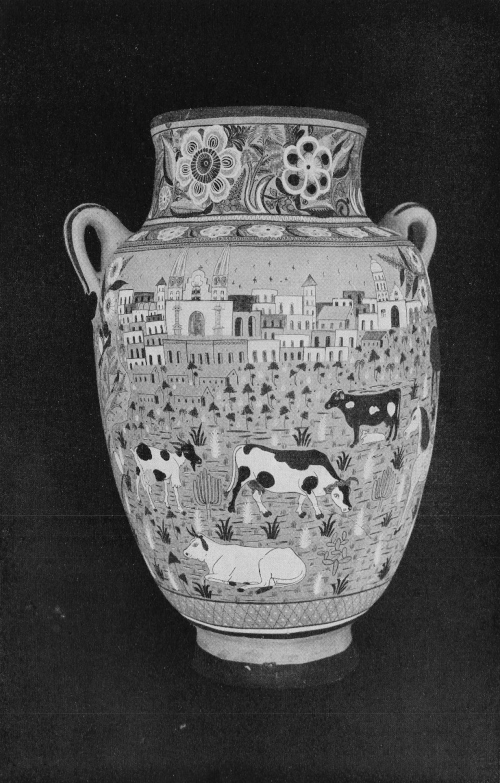
Decorated Clay Jar—Tonalá, Jalisco
THREE distinct race-groups formed the early civilizations of Mexico:
the Otomí, the Maya and the Nahoa. Of these the Otomí is believed
to have been the oldest, the most migratory and warlike. Their
exact rôle in the history of primitive Mexico is so ill defined it would not
be profitable to attempt even the most nebulous outline here.
Of the Mayas much is surmised. They came probably from North
America in a migration that covered several centuries. The year of
Our Lord 162 is the date assigned for the beginning of this pilgrimage
of a race.
At the close of the second century following, they were settled in
Yucatan, with territories including parts of Chiapas and Tabasco, possessed
of a splendid culture that dominated Honduras, Guatemala, Peru,
parts of North and Central America.
The Nahoa influence at about the same period embraced nearly all
the valley of Anahuac, the central mesa of Mexico. At the time of
the Conquest, the Mayas had long since vanished, while the Nahoa civilization
had reached its final growth about the year 1400, and was in
a gradual decline. The Aztecs, a migratory and aggressive tribe who
came to the valley of Anahuac about the end of the thirteenth century,
were responsible for the breaking down of the gentler Nahoa culture.
The Aztecs assimilated the Nahoa arts as the Romans did those of the
Greeks, adding the vigor and solidity of their military organization to
the body of Nahoa culture, investing the arts of the decaying peoples
with a harsher outline.
The true foundation of Mexican art is, however, a combination of
these two primary cultures, the Maya and the Nahoa. Throughout the
states of Oaxaca and Jalisco today, this influence is still astonishingly
pure and powerful.
They were at first two totally different types of art. The practical
difference was in method. All Maya stone carving was in bas-relief,
marked by a finished nervous style and exquisite detail of design. The
Nahoa sculpture was three dimensional, less fantastic, bolder in execution.
The spiritual differences were expressed as freely: the Maya was
devotional and religious, the Nahoa vividly objective and personal.
If it is not possible to fix dates and descents with certainty, we have
unlimited opportunity to study the remains of their architecture and
kindred art forms, the infallible signs whereby we may discover the
temper and intellectual level of a race.
In this study, the important fact to consider is a psychological one.
The early peoples of Mexico were dominated by the idea and practice
of religion. In every tribe, at every stage of their racial progress and
decay, faith in their gods was the compelling impulse of their lives.
Priests were the guardians of the national spirit, the instructors of the
young, the final authorities who governed the people in all matters of
moral conduct even to the smallest personal details of daily living.
Among the Aztecs even to the early part of the sixteenth century there
were thirteen principal deities, and more than two hundred inferior gods.
They ranked in importance from the War God Huitzilopotchli to the
humble little household deity charged with the responsibility of bringing
daily good fortune and happiness to the family under whose roof he was
a guest.
Five thousand priests waited on the will of these gods, serving at altars
which reflected their holiest ideal of beauty, in temples set stone upon
stone by the hands of unquestioning faith.
The nature of any art is determined by the medium of expression.
The medium of the early Mexican was stone. If they had song and
poetry and musical instruments, there is little to record that they were
considered as important forms. A few songs have survived, notably
those of the last Emperor of Texcoco, but he was comparatively of
modern times. The Nahoas made picture writing and carved panels to
tell of their wars, their feasts, their games, their victories and religious
ceremonies. They expressed themselves primarily in sculpture as the
Celts did in great songs and legends. The old Irish people were like the
Jews in this: they describe their gods and praise them in words. The
Mexicans carved the images of their deities in stone, and left them for
us to see and touch and wonder at, and to make our own legends about
them.
From this concern, this preoccupation with the will of the gods, there
sprang a strange and terrible beauty, destined to remain as the sole record
of a splendid race. The sculpture, the architecture, the decorations of the
Nahoas and Mayas are symbols of the racial mind, and that mind was,
above all, religious.
In the simplicity of the attitudes of these images, we understand that
the worship of the Mexican was a completely honest thing. Keeping
their gods alive and appeased was the difficult work of men bent on surviving
in a world filled with hostile forces. They shared this fear of the
unknown with all races of men fated to experiment with the incalculable
mysteries for the first time, with no guide except human curiosity, no
weapon except human valor.
The cruelties of their faith, so much discussed and theorised about,
were then only the cruelties shared with a terror-stricken world of men.
They would have discovered, finally, that the sun would rise even
though no victim was sacrificed on their altars. Not hatred of humanity,
but love of their gods prompted them to their ritual sacrifices. The
intimate and precious possession of life was the ideal offering to their
gods for the well-being of the race. The merely physical cruelties were
incidental and necessary. Moral cruelty was unknown. It came later
in other races, through different dogmas, with the decadence of the
religious spirit.
With this in mind, we will examine their sculptured images.
The Maya civilization was the most advanced and important of all
the old social structures of Mexico. They seem to have vanished mysteriously
at the height of their beauty, for a sustained perfection of form
marks their art from the first known example to the end.
The early bas-relief panels in the temples at Palenque, of which the
best known are the tablets of the Foliated Cross, are sophisticated and
delicate in design. The later image of Chac-Mool (called first the Maya
Bacchus, now identified as the Tiger King) is as restrained, as classic
and cool in modelling as only a race old in culture, or young and
supremely innocent, can produce. But always it is civilized—the exaggerations
of savagery are unknown.
The Nahoas followed a more natural process, upbuilding to a pinnacle
of beauty and declining into over-ripeness.
To a fantastic degree they possessed the grotesque sense at once the
property of very primitive and very decadent minds. In art, we begin
with distortions of beauty and we end with them. But the grotesqueries
differ in precisely the degree of separation between innocence and decaying
wisdom.
In their sculpture we encounter these several phases of development.
We find at first an innocent, artless animality, the crude efforts of a child
to portray the human form, the shapes of beasts and birds and imaginary
creatures, done with particularity and frankness.
The gods are monsters, the modelled portraits of men are masks
with holes gouged to represent eyes and mouths. The figures squat with
enormous hands dangling between knees upraised in the primitive seated
position.
A period followed in which the Nahoas produced a caste of builders
and artists so advanced their generic name has been mistakenly applied
to the entire nation: the Toltecs. They created stylised, chaste and
lovely images in crystal, in jade and in stone. The architecture of this
period was massive, with an abundance of bas-relief carving in stone,
more severe in design than that of the Mayas, and of great depth in cutting.
The Toltecs had no iron nor steel tools for this work; they used
only tempered copper and the flint-like volcanic glass called obsidian.
In this epoch began the growth of a desire and necessity for beauty
not wholly religious in meaning. Purely decorative objects sold in the
public markets took the form of carved amulets meant more for adornments
than to ward off evil; masks for festivals, beads of jade and jadeite
skilfully cut and polished, jewels of gold and copper, girdles and headdresses,
all came into use for the sake of their own beauty rather than
because of religious symbolism.
Human portraits in stone and clay, many of them gorgeously colored
have been found in profusion in every buried city of ancient Mexico.
In the middle period of the Nahoa culture an aristocratic and civilized
beauty marks these faces modelled clearly and delicately under splendid
headdresses. Balance and proportion, sanity and graciousness mark
the work of this epoch. It was the high point of Nahoa culture. The
century was that of Our Lord 1200, yet it all seems as far away as the
Flood itself. The Nahoa heroes of that time, the later poet King of
Texcoco, seem to be one with the spacious myths of antiquity, akin to
Dana and Pan and the warriors Homer sung. Mexico was the final
stronghold of the great pagan gods, and even to the very day of the
beginning of the Conquest there still clings about them the atmosphere
of legendary remoteness.
A familiar flavor of the miraculous is in the religious accounts of
the later times, as recorded by the first Spanish priests. Whether these
are authentic myths, or a corruption of them due to the decline of the
race at the time of the Spanish invasion, or imperfect translations by the
historians new to the Mexican languages, we cannot be certain.
The myth of the god Quetzalcoatl, who was once a man, and became
the culture deity of the Nahoas, runs like this: Chimalma, a holy
woman of the Nahoas, swallowed a small stone of jadeite, and later was
delivered of a son, conceived thus immaculately, who was very wise and
good and gentle from his childhood. When he grew up, he taught the
people the wisdom and beauty of holy living, besides the crafts or weaving
and metal work, and the sowing of the fields. He incurred the
wrath of the wicked among his people, and went away by the sea in a
skiff of magic serpent skins. For this reason he has become associated
in a mysterious, half-spoken legend, with the waves of the sea, and with
a feathered serpent: In what way it is impossible to discover from the
endless versions I have read. He vowed to the people that he would
return, and charged them to receive him as a god at his second coming.
This legend so influenced the minds of the Nahoas, and later the
Aztecs, it opened the way for that tragic and mistaken reception of
Cortés and his soldiers, who came by way of the sea in the precise manner
Quetzalcoatl had foretold.
Another legend concerned with the immaculate mortal conception of
Immortals is told of Huitzolopotchli, the god of war, who wears on his
left foot the feathers of the humming bird. His mother saw rolling
before her in the wind a bundle of brightly colored feathers. She
placed them in her bosom, and a short while after discovered herself to
be pregnant of a god. He was born full grown, with war dress and
shield and helmet of green plumes.
This may or may not be an authentic Mexican myth. But the legend
of the creation of man is unique, original, austere as a Nahoa god in
stone, unmarred by evidences of modern revision. A young god stood in
the valley of Anahuac, near a place now called Acolman, and shot an
arrow of obsidian toward the noonday sun. It soared and descended,
and when it touched the earth, it sprang up again a living man. Though
it may be told in two lines, it is the most innocent and splendid legend
I have found in any mythology.
It is above all a happy legend. There is no death nor sin in it. Man
is created in a blaze of light, his being compounded of sun warmth and
clean arrow point, touching earth and receiving there the divine essential
energy of life. Not even among the Norse peoples have I found a legend
more epically simple and great than this.
This version of creation gives us a glimpse of another soul than the
dark and ritualistic one discovered in the old codices representing sacrifices,
and in the tales told by the Spaniards. We have become habited
to think of these people as being always a stern and terrible race, fixed
and immalleable of soul as their idols, with ponderous headdresses crushing
their frowning brows.
Those headdresses were contrived of paper and plumes and flowers,
and the wearers of them loved color as the Israelites loved perfumes
and spices. Their houses and robes, their votive cups, their temples and
their gods were all splashed with the most vivid hues. Examine any
insignificant clay figure today, recovered from the earth, not yet broken
from its mold, and you find it brilliant with stains, sulphurous reds
and yellows, burning blues and greens. This use of color is found alike
in the remains of Atzcapotzalco, in Teotihuacán near the Pyramides, in
Yucatán, and in the Tarascan figurines of terra cotta, found in Cheran.
Strange designs of animals, flowers and birds give life and rhythm to
color in vases and flowers and pots.
In the arts of dyeing, the Nahoas surpassed the others. They had
mineral and vegetable and animal color, and after the Conquest their
dye secrets became very valuable to the world.
Their special discovery was a small insect which yielded a fine quality
of purple and red dye, now called cochineal. A thick lusterless white
made from calcined stones was also originated by the Nahoas, and is
still used by the Mexicans in decorating certain kinds of pottery. We
shall see how their use of primary color has survived in other ways also.
Engels and other scientists have been pleased to classify the early
peoples of Mexico as semi-barbarous because of their lack of domestic
animals, I believe they have overlooked the essential fact: they had no
beasts of burden nor domesticated milk-giving animals because such beasts
were not indigenous here. Their habit was to make pets of small creatures,
chiefly monkeys, a species of diminutive leopard called ocelotl,
and that strange breed of hairless dog, the ixchuintli, of which it is
recorded they could not bark until taught the art by imported European
dogs.
It is true that here devolved on human beings that burden of physical
labor shared between man and beasts in other lands. But the attitude
of the Mexicans toward animals and slaves was that of a race abreast
with the civilization of their epoch. Men were not more enslaved for
this lack of beasts than they were in countries that possessed both species
of burden-bearing animals.
Their system of measuring time was original and distinctive. We
have the symmetrical and beautiful Calendar stone of the Aztecs as enduring
testimony to the perfection of their calculations. When the
Spaniards arrived in Mexico, they discovered that the Aztec Calendar
was only five hours late by the sun, while the Christian Calendar of
Pope Leo the Great failed of precision by eleven days. Prescott gives
an exact account of their measurement of time:
“... The Aztecs adjusted their civil year by the solar. They
divided it into eighteen months of twenty days each. Both months and
days were expressed by peculiar hieroglyphics, those of the former intimating
the season of the year, like the French months at the period of
the Revolution, Five complementary days, as in Egypt, were added
to make up the full number of three hundred sixty-five. They belonged
to no month, and were regarded as peculiarly unlucky. A month
was divided into four weeks, of five days each, on the last of
which was the public fair or market day. This arrangement, different
from that of the nations of the Old Continent, has the advantage of
giving an equal number of days to each month, and of comprehending
entire weeks, without a fraction, both in the months and in the year.
“As the year is composed of nearly six hours more than three hundred
and sixty-five days, there still remains an excess, which, like other
nations who have framed a calendar, they provided for by intercalation;
not indeed, every fourth year, as the Europeans, but at longer intervals,
like some of the Asiatics. They waited until the expiration of fifty-two
vague years, when they interposed twelve days, or rather, twelve and
a half, this being the number that had fallen in arrear. Had they inserted
thirteen, it would have been too much, since the annual excess
over three hundred sixty-five is about eleven minutes less than six
hours....” (Conquest of Mexico: Prescott: Vol. I, Page 73.)
They had, in a word, calculated with such minute precision that more
than five centuries must elapse before the loss of an entire day.
Their system of numerals has been explained by Rivas Palacio in contrast
to the Hindu and Aryan systems. Whereas, in the latter methods
of computation, the essential numeral is five, and the perfect number
100, in the Nahoa system (which served all Mexico) the essential
numeral was four, and the perfect number was eighty, arrived at thus:
four plus one equals five; five times four equals twenty; and twenty
times four equals eighty.
Their religious symbolism is equally distinct. Though the Nahoas
employed characters similar to those of the Asiatics and Aryans, they
differed in spirit. Their sign of the cross, for example, found designed
on the walls of temples, or carved in stone, was their symbol of the four
cardinal points of the compass; more simply still, of the four winds of
heaven.
Various explanations have been offered of this mystical sign. Religious
writers have woven legends of primitive saints, who were even prophesied
in Revelations, who came to Mexico in the early Christian era.
Scientists have sought to identify it with its phallic significance in the
secret rituals of primitive peoples.
Their great feathered serpent was likewise free from the secret meaning
of other ancients, and was a familiar symbol of godhead. The serpent
and the sun are mysteriously related in Mexican mythology,
probably with some distant association of ideas between the life-giving
sun and fruitfulness, but there is no definite surviving legend explaining
these things.
Their social customs were marked by one tremendously important
difference from the world of their time. The position of women was
that of a completely civilized race. The legal or religious bondage of
women was unknown. They served with honor as priestesses, and had
a responsible share in the education of the children. Every evidence is
that they enjoyed a cleanly human equality in society utterly foreign
to the ideals that governed the relations between men and women of the
European and Asiatic races.
Their sense of rhythm in design was, and remains, unique. The
basis of Greek design, for example, is the crossed line. There existed
no crossed line in all Maya or Nahoa art. Even to this day it does not
appear in the pure designs used by the Mexican craftsmen. When it is
used at all, it is foreign, added since the sixteenth century.
Their line of beauty is the bold flaring circle, the uninterrupted whirling
of a leaf in the wind. This is why a design on a Guadalajara jug
today gives the impression of one unbroken harmonious line from top to
bottom.
In architecture, they had no arch, that fundamental outline in all construction
of Europe and the Orient. A square topped portal, or two
beams contrived to form a shallow inverted angle, was their conception
of a doorway. A pointed arch without a keystone was to them an ideal
expression of beauty. In this method perfect examples exist in the ruins
of Mitla and Chichen Itzá, of which the arch of Labnáh, in Yucatán,
is the most beautiful.
As we have seen, these peoples resembled their human brothers in all
elemental ideals. Students and scientists pronounce on the vessels of
aragonite, the cloudy Mexican onyx, found in the Isle of Sacrificios, near
Vera Cruz. They say they are Greek in feeling and line. They say
the Maya art is Babylonish; that the headdresses of the old Nahoas are
Egyptian; that the character writing on the walls of the Pyramides in
Teotihuacán are Chinese....
All these things do veritably have a surface resemblance to the art
creations of all races. But in their profound, racial significance they
were spontaneous and original. In nothing more than their early arts
do they resolve themselves into a people whose developed psychology
followed patterns unknown to both Europe and Asia.
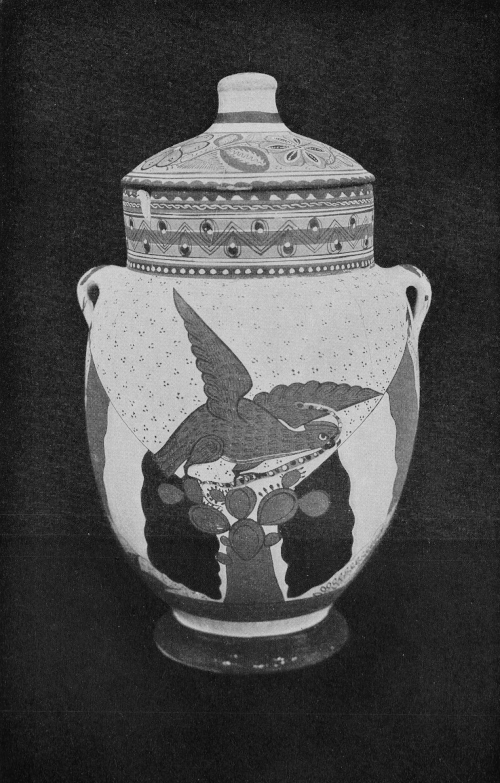
Jardinier Talavera—City of Puebla
Colonial Art
PART II.
WHEN the Spaniards came to Mexico in the year 1519, the Mayas
had long since abandoned their splendid cities and were building no
others of like beauty. The Pyramides at Teotihuacán were mounds of
earth which the strangers regarded incuriously as natural hills. Nahoa
civilization had reached its height two centuries before and declined with
the death of the poet King Nezahualcoyotl of Texcoco. From thence it
was gradually absorbed by the Aztec dynasty, and the city of Tenochtitlan
became the center of wealth, power and culture of the race.
The Zapotecas and Mixtecas, ancient allies, occupied the present state
of Oaxaca; they were divided in language, the customs and arts that once
were one had diverged slightly, the Zapotecas toward the Aztec, the
Mixtecas toward the Maya. Though both nations possessed the richest
languages and picture writing in Mexico at this time, the Mixtecas were
superior in civilized arts. They were settled in the South and West of
the state, a gentle and tranquil people given to cultural development.
The Zapotecas were objective, warlike, militaristic; they helped the
Mixtecas to conquer the Isthmus of Tehuantepec, and held their ground
by force of arms. In spite of this, it is the Mixteca spirit in art that
survives in the state of Oaxaca today.
It was with the newer, intensely warlike Aztec in the city of Tenochtilán
that the invaders were to deal. The Conqueror has always the
first word. Centuries must elapse before the defeated peoples can find
a hearing for themselves. According to the Spanish writers, they found
here a race curiously civilized, but atrociously savage in war; lovers of
beauty, worshippers of mystical gods, in spiritual and physical bondage
to a religion founded on ritual sacrifice. Nearly all of the historians
that followed accepted without question the Spanish point of view that
the benefits of civilization had been righteously bestowed upon barbarians
by the bitter charity of the sword. Having achieved a substitution
by force of their ideals over those of the Mexican, they rested in
arrogant certainty of their right to impose their own half-developed
culture, derived from a mixture of Europe and the Orient, upon a people
whose blood was pure, and whose culture was grown evenly in one soil.
There ensued a collision of antipathies shocking to the imagination.
It must have been as if two alien planets struck and fused. The story
has been told many times, by makers of legends, by later historians groping
among confused and conflicting legends. Yet they somehow achieve
unity when considered as a whole. It seems that only a day elapses
between that half-legendary ancient world of the Nahoa and the Maya,
to the founding of New Spain that suddenly identifies Mexico with the
modern world.
One steps from the half light of the centuries before the Conquest
into the year 1519, and thereafter we have a record of events insufficient,
fragmentary, but comparatively clear. However obscured with personal
and religious and political motives, distorted occasionally with belief in
the miraculous, seen through the eyes of prejudices incomprehensible to
us now, since we are bound by different prejudices, the story still has
form and outline; it lends itself to the truth.
After the shock of conquest there began the making of a new nation
in Mexico, a slow series of rebirths, a gradual absorption of colors and
fibres from many sources; Mexico became New Spain, a nation torn
from its old gods and inborn visions, thereafter to take on the forms of
faith of the conqueror, the laws of an alien world, the customs of
strangers.
Teocallis were razed, and churches set over the places where they had
been. New arts were added to the old, and were amalgamated with
them. These arts came by way of the Spanish crown, but they were
borrowed from the greater and older nations of France and Italy....
The Mexican arts amazed and delighted the strangers, who praised
them in their chronicles—those extravagant documents that are such
curious blendings of religious fervor, curiosity, appreciation and rapacity—and
long descriptions of the native crafts remain as the pleasantest
stories brought out of that dolorous period.
They tell of the goldsmiths of Azcapotzalco, who wrought in gold
and silver filigree, chains and necklaces and earrings and bracelets,
in feathery and lace-like designs as minute and painstaking as those of
the Chinese. It is as different from Chinese filigree as the Chinese is
distinct from the Neapolitan silver work. The potters of Cholula were
then renowned for making vases in a form resembling the classical
Greek urn, but decorated with designs in that thick, vivid, unmixed
paint they invented and used so perfectly.
The painters of Texcoco, the mat makers of Quautitlán, the stone
cutters from Tenajocan, all brought their wares to the markets of the
throne city of the Aztecs. The florists of Xochimilco fashioned flowers
into decorative shapes with a long patience of execution which is still
the most remarkable thing about the flower arrangement of the Mexican.
Plume work, a special craft developed by these people to the dignity
of a fine art, was then in its fullest beauty. Entire mantles were contrived
of feathers woven in color compositions and patterns intricate as
tapestry. On their simple hand looms they wove exquisite cloth in cotton
and a finely spun fibre made from the maguey or henequen plant. Garments
and curtains were made of this material, as well as their breast-plates,
tightly woven and quilted, a stout and durable armor against
their own weapons, but not, as Prescott reminds us, proof against the
musketry of the Spaniards.
Temples and houses were ablaze with light and color, curtained with
woven feathers and dyed cloth, their temples adorned with carved panels
and the images of their gods. Even while they praised the beauty of the
new country and its social structure, the fanaticism that accompanied the
spirit of conquest conspired in the minds of the Spaniards, and prompted
them to blot out invaluable records and monuments. They were not
interested in the subtleties of research among peoples whom they considered
merely as advanced savages, inhabiting a rich and desirable territory.
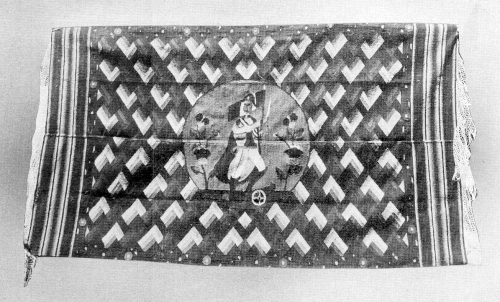
Serape (Woolen Blanket), San Miguel Allende, Hidalgo
Their purpose was to exterminate the rebellious, establish the church
and the power of Spain, and to amass wealth for the Spanish crown.
Art was left to grow or perish of itself.
Silently, ceaselessly, the Mexican spirit renewed and expressed itself
in the making of beauty. It ran like a dark flood of dreams into all
channels of Colonial life. It stained every idea, every physical manifestation
of the slowly changing Mexican race.
The churches were the first and most important imported expressions
of art in New Spain. They were designed, in the main, by Italian and
French architects, built and decorated by native artists. Whereupon
strangely they are Mexican; because an Aztec ground the colors and
executed the designs, and carved the wood and the stone, and made the
tiles for the domed roofs. His inalienable beauty-wisdom had the final
triumph.
Writers of that period are accustomed to declare that civilization
progressed in Mexico more rapidly within the first eighty years of the
Spanish occupation than in any other country of North America or
Europe during the same period.
It is true that they brought their crafts, taught them to the natives,
utilized and commercialized them with modern practical thoroughness.
A book was printed for the first time in Mexico City in 1536. The
printer was Juan Paoli from Brescia, Italy. He was brought here to
publish ecclesiastical works, and his press flourished. The first University
in America was founded by the Jesuits in Mexico City in the year
1533, a building now used as a Preparatory School to the National
University.
Weaving and ceramics were developed rapidly. In Puebla and
Oaxaca splendid silks and wools were woven from raw materials got
from the markets of Asia, and exported in great quantities. Wool was
introduced in Mexico by the Spaniards, and took the place of the fine
hair of rabbits, and plumage which the Aztecs had hitherto used for
weaving warm garments.
An immediate and perfect use was found by the native for the more
substantial wool of the sheep. He wove serapes and rugs in orderly,
geometric patterns after the old style, that gave to them a classical permanence
of value. The first ones were sober and dark, but gradually
they grew into brilliance, with designs of birds and flowers and stylised
figures of animals.
They developed a genius for leatherwork, especially in saddle making,
a craft essentially Spanish, since the Mexicans had no horses previous
to the Conquest. Under their hands, the saddle and all appurtenances
of horsemanship became elaborated beyond anything known in Spain,
and today the Mexican saddle is a marvel of costly workmanship in
tooled leather and chased silver.
The characteristic Mexican faculty to imitation of design and method,
combined with an entirely alien feeling for color and execution brought
about a subtle shifting of surface expression. His ability to adapt and
use strange forms, under curious conditions, was the foundation for his
new art, destined to become racial and genuinely expressive.
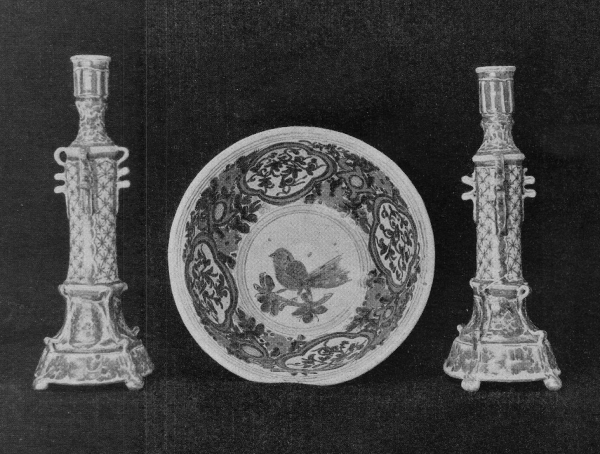
Candle Sticks and Plate—Talavera Ware—Puebla
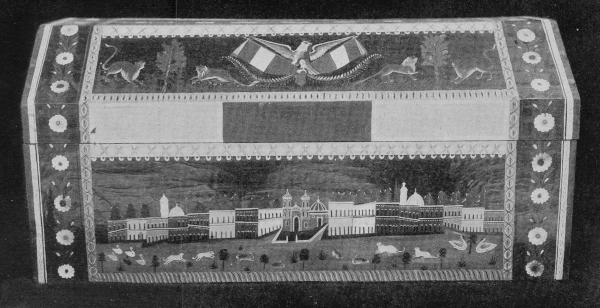
Decorated Wooden Box—Olinalá, Guerrero
The primary use of his imitative faculty was commercial. The native,
out of his soul’s necessity, made his wares first things of beauty. But
he must also use them, and sell them. They must be beautiful and useful
objects, not costly, for the use of an impoverished people. In a very
limited way, they worked in bronze, silver, gold and stone, but mostly
they wrought in clay and wood. They transposed and recreated everything
that came to their notice, from whatever source and in whatever
material it might appear.
Out of the influences that surrounded them they selected those things
most in accord with their own ideals of beauty, those designs not too
violently opposed to their own conception of form, in effect those patterns
that resembled their own previously accepted motifs. For three
centuries the Mexican was influenced by art expressions from Spain,
through Spain from the Moors, from the Orient; from Japan, Persia,
the Philippines, above all, China.
The results are happily still apparent in designs wherein are commingled,
in a strange harmony, pomegranates, lacy leaves from Spain,
peacocks from Persia and mandarins from China, traced on jicaras, bowls
and pots. In the Puebla pottery of that period, and on the painted and
lacquered chests, knights on horseback, ladies in enormous skirts, birds as
large as the trees they perch in, strange animals from the weird other-worlds
of the Oriental imagination, foregather amiably with an effect
of loveliness.
That sense of the grotesque which we have noticed took hold of these
foreign emblems. In the religious sculpture executed by the first Christianized
Mexicans, distorted Aztec Christs bleed from wounds, not the
legendary sacred five, but from as many as a human form can support
and still be recognizable. In Manú, Yucatán, there exists an outdoor
shrine, a cross roughly hewn from stone, and the hanging figure is
wholly Aztec, resembling images found in the older ruins.
The grotesqueries began changing in form, but they were still distinct,
still quite other in feeling than the demons and gargoyles of
Europe, far removed from the squat, sly humor of the Chinese figures.
Those sixteenth century merchant crafts plying between China and
Mexico brought not only merchandise, but ideas. Lacquer, black and
red, and blue porcelain jars were left here by the sailors, and immediately
the Mexican began making boxes lacquered in all colors, encrusted,
or painted in flat designs over the smooth foundation.
In Puebla, then a newly founded city, the making of a certain kind
of pottery became the chief industry. The first Potter’s Guild in New
Spain was chartered there: an organization of pure Indian and Spanish
craftsmen, with a strict clause declaring that no negro or person of
mixed blood could be a member. Puebla Talavera ware was during
the sixteenth and seventeenth centuries a synonym for excellent pottery.
The story of Puebla pottery has happily been written, and serves as
an example of the methods used by the Spaniards in introducing their
crafts and arts to the Mexican. Puebla de los Angeles was founded
about the year 1532, and the first account of the new industry centered
there was given by Fray Geronimo de Mendieta in his “Historia Ecclesiastica
Indiana.” I quote from the translation given in “Maiolica of
Mexico” by Edwin Atlee Barber:
“After they (the Mexicans) became Christians and saw our images
from Flanders and Italy, there is no altar ornaments or image, however
beautiful it may be, that they will not reproduce and imitate. There
were artisans in pottery and vessels for eating and drinking purposes,
and these were very well made although the workmen did not know
how to glaze them. But they soon learned from the first craftsman who
came over from Spain in spite of all he could do to guard and hide the
secret from them. And finally this may be understood as a general rule,
that nearly all the curious and beautiful works of every class of trades
and arts are now (1596) being carried forward in the Indies (at least
in New Spain or Mexico) are being done and finished by the Indians.”
Who this ungenerous craftsman was no one seems to remember. But
sometime within the first half century of the new regime, it is certain
that a small group of friars from a Dominican monastery in Talavera
de los Reyes (Spain) came out to join their brethren in Puebla and
instructed the natives in the making of the famous Talavera ware. This
pottery had its first inspiration from Persia through the Moors, and later
from China: transplanted to Mexico, it followed the same line of development
until the end of the seventeenth century, when the Italian
influence crept in, and changed small details of design and color.
The Mexicans absorbed everything, and grew slowly away from their
teachers. The transition in this particular instance was slow. Almost
two hundred years elapsed before the Puebla ware became a completely
Mexican thing. Gradually, the flowers and foliage became bolder, the
designs were taken from native plants; the blue coloring became heavier,
the patterns were raised in high relief, and the tattooed effect now so
familiar came into popularity. The shapes reverted slightly to the primitive,
and from simple blue and white the native potters used their own
varied and exuberant schemes of color. A Puebla bowl now often
rivals a batea (wooden painted tray) from Tehuantepec for gayety and
vividness.
The history of Puebla tile is not so well known, but they probably
date from about 1550. They were called Azulejos, from a word meaning
blue, and were at first literally blue tiles. They changed in character
rapidly, and were for two hundred years a most characteristic form of
decoration for houses and chapels, fountains and patio pavements. In
many old houses there are large panels relating legends in the manner
of European tapestry, picturing episodes in the lives of saints and warriors,
or used simply as decorative motifs filled with birds and animals
and figures imitating the Aztec designs.
Until the beginning of the nineteenth century these tiles were used
lavishly all over Mexico. The most famous examples of tile work are
the Casa de los Azulejos in Mexico City, the Holy Well in the Chapel
at Guadalupe, the Tepozotlan Convent in the State of Mexico, and several
churches in Guanajuato, especially the exquisite small church called
La Compaña, as well as the Church of San Francisco de Acatepec near
Puebla.
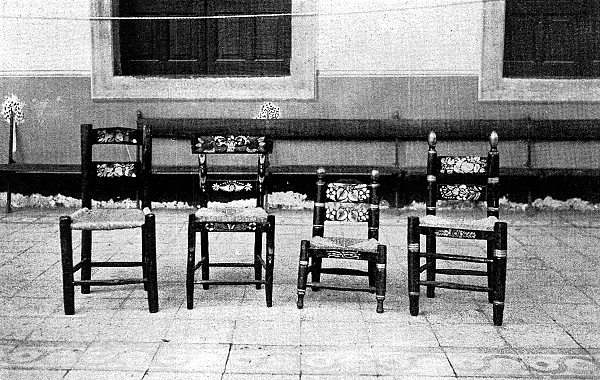
Decorated Chairs—City of Aguascalientes
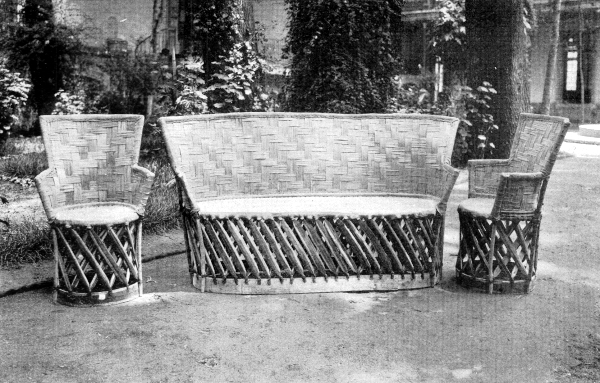
Equipales (Leather, Wood and Bamboo)—Jamay, Jalisco
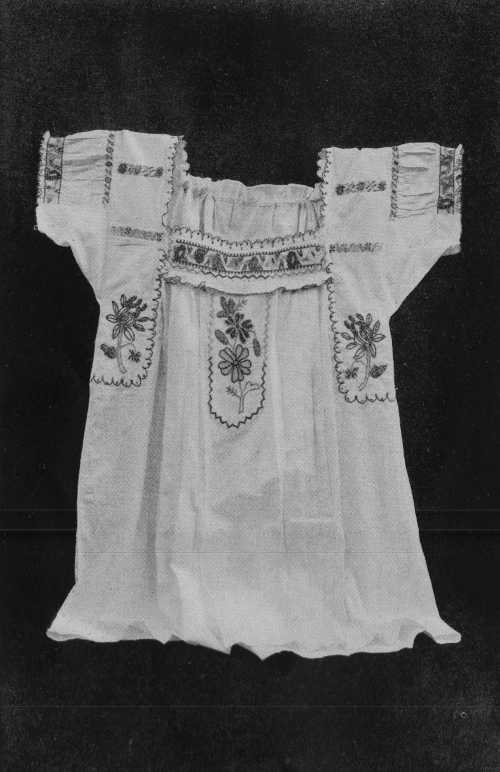
Bead Work Child’s Dress—Puebla
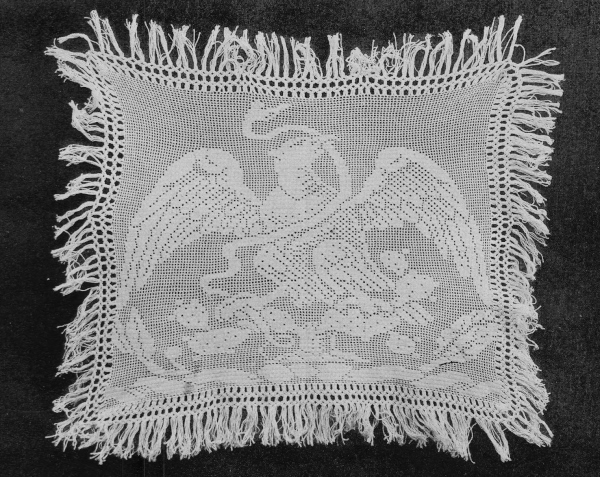
Thread Lace—San Luis Potosi
The imported forms of architecture became, in the hands of the
Mexicans, a separate creation. The early churches of Mexico are full
of this Aztec strength and heaviness. Even roses and Cupids and
emasculated saints become virile and significant—they are not the roses
and saints and Cupids of Spain. Later, the Mexican-born Spaniards
who designed in all the arts, guided by some vague tradition of classical
proportion, produced merely another Barrocco style, coincidental with
a similar decadence in the old country. But whereas in Europe two
white and civilized forms merged and decayed, in Mexico the fusion
was Spanish and Indian: and Mexican Barrocco, “the Churrigueresco,”
amazingly genuine and alive, is the curious result.
The only vivid and quick artistic impulse of this country grew in the
soul of the native. The Spanish artist who maintained the foreign traditions
painted merely after the style of his own country, imitating
without adapting, lacking inspiration of his own, growing each generation
farther away from his sources, until at the close of the eighteenth
century the so-called aristocratic art was a puerile childish copy of the
European seventeenth century manner.
Aside from this academic school, however, a national spirit was developing
among the Mexican-born Spaniards, and a tremendously increasing
class of Spanish-Indios who were genuinely Mexican in feeling. During
the later Colonial times, they called themselves Mexicans and followed
native customs as a patriotic duty. This period was fruitful in the production
of the native crafts. Everybody made use of the rugs and bateas
and serapes, the painted boxes and furniture, the saddles and potteries.
They adopted a highly individualized native costume entirely Spanish
in design, called the Charro. It was usually made of finely dressed
leather, embroidered in silver and colors. The hats and saddles designed
to complete this horseman’s equipment were splendid and very costly.
The dresses for the women, especially the country costumes, were of
gaily dyed silks weighted with bead embroideries and native lace. The
most beautiful of these dresses originated in Puebla and was called the
China Poblana. It has latterly passed into disuse, but is still seen during
fiestas and in the Mexican theatre. As early as 1840 Madame Calderon
de la Barca noticed that it was no longer used by ladies of the better
society—a pity, for it is most graciously feminine and becoming.
After the Independence of Mexico from Spain was established, the
national psychology shifted, and it became once more the fashion to
imitate Europe. All architecture and aristocratic art since 1825 degenerated
into the European manner, and that manner mostly second rate
French. The epoch of Maximilian completed the havoc, with wholesale
importations of French furnishings and styles at the lowest period of
taste known since the decadence of Greece. Mexican art disappeared
from popularity, a thing admired only by students and collectors, and
used only by the Indio.
During these changes, political and social, the native has remained
racially and spiritually static. In common with all peasantry, he derived
his ideas from the fine arts—not only the imported and foreign arts,
but from his own magnificent traditions, filtered them through his own
understanding, translated them into his common speech: the result is a
thing of superb beauty and strength. He grew each generation a step
further away from the object he had imitated—like the Mexican-born
Spaniard who copied the methods of Spain—but with this difference,
that the native added always more and more of his own feeling and
psychic reaction, until at once the thing was his own, an interpretation
of beauty, national, personal—even more, absolutely individual.
For he works after his own fashion, and creates each smallest object
as a unique thing, and does nothing twice alike. Each object has its own
incorruptible character, even to the pattern on the jug in which he
draws his water, the serape which serves him both as cloak and bed.
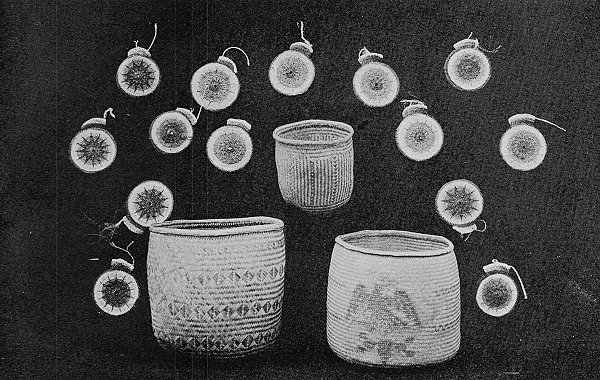
Baskets and Coin Purses, Palm Leaf and Hemp—Oaxaca
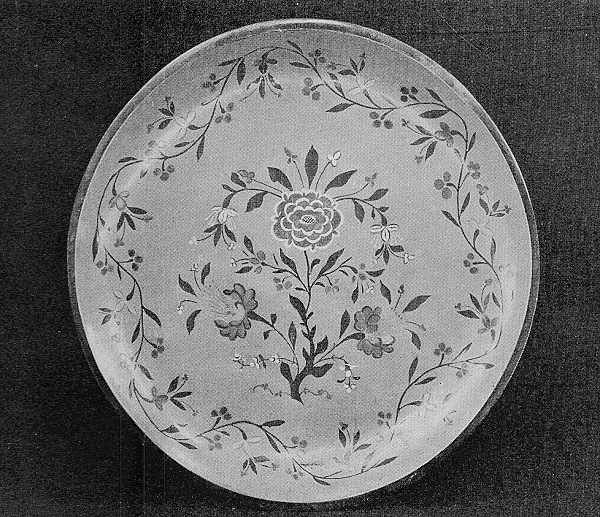
Lacquered Wooden Tray—Patzcuaro, Michoacan
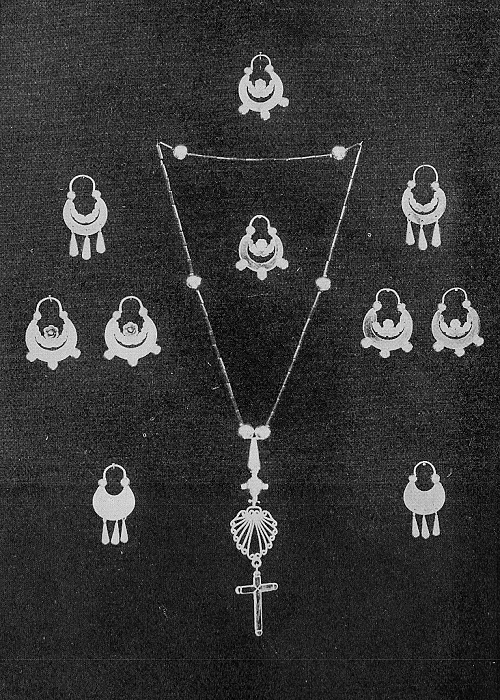
Silver Necklace and Ear Rings—Michoacan
PART III: The Present
THERE is virtually no bibliography of Mexican modern art. The
student will have difficulty in finding definite essays, either on the
history or the meaning of this vivid and natural expression of a race.
From time to time individual writers have included a casual chapter on
general culture in their political and psychological studies of Mexico;
and the special departments of ceramics and architecture have been dealt
with attentively by authorities in these subjects, in a limited number of
handbooks that never reach general circulation.
Unfortunately, those few artists who have attempted either definition
or criticism of the wide field of Mexican art have remained within the
enclosure of an academic tradition. This is in a special manner true of
the Mexican writers and painters of the past century, whose ideals and
technique were formed by the Spanish or Italian, or worst of all, the
French schools.
This is the rigid attitude of those who have written in English, at all
events: They maintain, almost to a man, that Mexican art began well
under the foreign influences, but that it is now degenerated into a mere
meaningless peasant art.
They seem inexplicably to have missed the point. A peasant art: this
is precisely what it is, what it should be. The alien, aristocratic influence
was a catastrophe that threatened the vitals of the Mexican race, and
diverted its natural expression to strange, superficial methods over a long
period. Yet, once released, and only a little maimed, it settled back to
its calm level, and persisted after its own way.
It is not possible successfully to comprehend Mexican art from any
other angle. Seen thus, harmoniously adjusted to its native background
and its history, we discover it to be an invaluable, eloquent thing. There
is in it the earthy aroma of a frankly peasant effluvium. It is filled with
a rude and healthful vigor, renewing itself from its own sources. Above
all, there is no self-consciousness, no sophisticated striving after simplicity.
The artists are one with a people simple as nature is simple: that is to
say, direct and savage, beautiful and terrible, full of harshness and love,
divinely gentle, appallingly honest.
No folk art is ever wholly satisfactory to those who love smooth surfaces
and artificial symmetry. They cannot approach a living thing
that grows as a tree grows, thrusting up from its roots and saps, knots
and fruits and tormented branches, without an uneasy feeling that it
should be refined a little for art’s sake.
Yet the fineness is there, not only in feeling, but in countless small
delicate objects: in woven baskets fit to nest an ant, in lacquered gourds
smooth as enamel, in necklaces of filigree gold. Countess Evelyn
Martinengo Cesaresco, in her essays in “The Study of Folk Songs,”
understood this perfectly when she wrote: “... no touch is so
light and sure as that of the artificer untaught in our own sense—the
man or woman who produces the intricate filigree, the highly wrought
silver, the wood carving, the embroidery, the lace, the knitted wool
rivaling the spider’s web, the shawl with whose weft and woof a human
life is interwoven.”
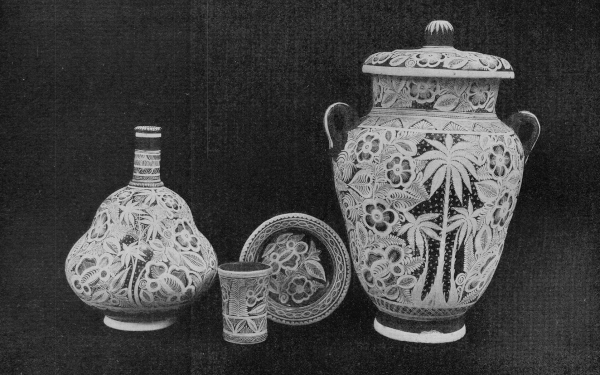
Decorated Clay Pieces—Tonalá, Jalisco
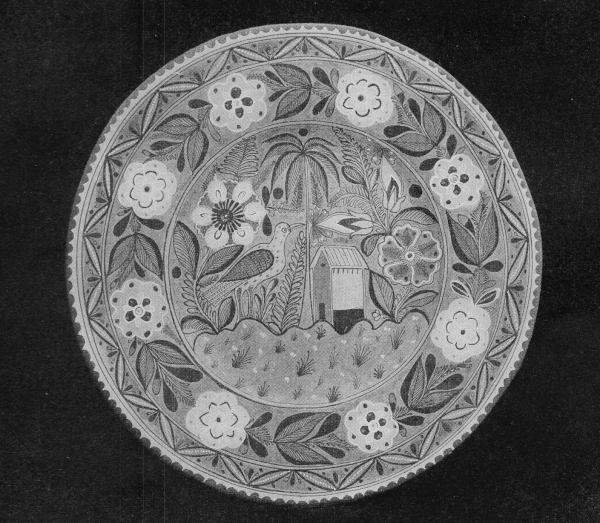
Decorated Clay Plate—Tonalá, Jalisco
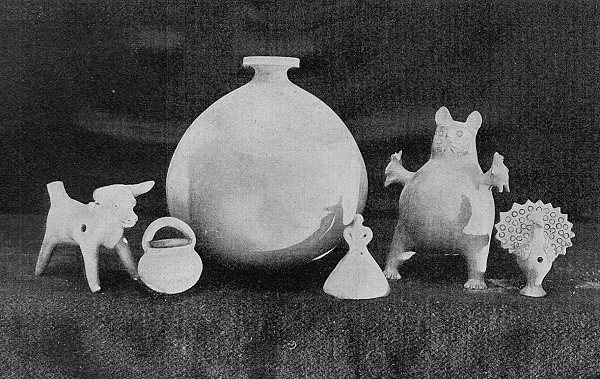
Grey Clay—Asompa, Oaxaca
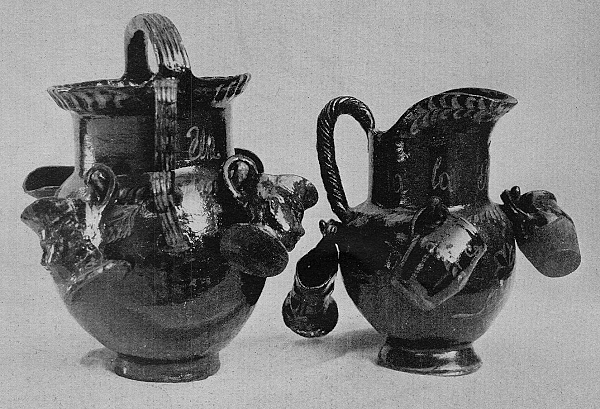
Jars and Cups—Texcoco
From this viewpoint, then, we must consider the Mexican arts and
crafts as they are, having outworn or assimilated their foreign influences.
If they seem a trifle endangered by modern contacts, however remote
these may be, let us keep in mind that they have always been, not only
a record of the racial unfoldment, but a personal diary, if you will, of
the craftsman himself.
This accounts for the objective precision of that pictured account the
Mexican left to us, of the first Spaniards: there they are, seen by implacably
honest eyes, those helmeted conquerors on horseback, those wide
skirted, stiff waisted ladies with monstrous coiffures, those imported
dogs and incredible household furnishings. Painted chests and wooden
trays of that period silently point to the ugliness of our kind of civilization
as beheld by the civilized of another race and ethical code.
Today it is the same. I saw a classically formed pot from Tonalá,
fresh from the potter’s kiln, a masterpiece of design and glaze. One
side was covered with figures done in the old style—ancient Mexican
hunters drawing their bows against fantastic animals, all leaping through
forests such as one is accustomed to see only in dreams.
The reverse side was even more interesting, for it bore the detailed
drawing of an automobile, of outmoded fashion, brimming with men
wearing foreign hats, hastening down the streets of an Oaxaca village—the
potter’s own village, no doubt, and this a first impression of the
only automobile he had ever seen. Viewed through his amazed eyes,
it is more mad and strange than all his warriors and animals and forests.
No doubt that most of us would think it in lamentable taste. It warns
us, too, that if the artist were removed from his fructifying contact
with his mother earth, condemned daily to touch instead the mechanics
and artifices of modern progress, he might succumb, as do the aristocratic
arts, each in turn, to the overwhelming forces of a world turned dizzyingly
by a machine. But where the civilized arts, so-called, may root
themselves in another imported and cultivated soil, where the individual
artist may triumph by the strength of his unique genius, the peasant
workman may have none of these resources. In his own earth—his
native tradition, are his strength and his happiness.
The Mexican has a name for his home place. He calls it his “earth.”
(Mi Tierra.) He means literally the very spot where he was born,
and where his mother nursed him, is his own. There he belongs, and
there he will return inevitably, no matter how far he goes away, nor
how long he must stay in foreign places. His life is bound to this
beloved earth: gray-brown, fertile, spread unevenly as a tired man
asleep, obscure and humble and filled with richness, compounded of all
the stains and tints of fruits and flowers and irridescent stones.
In this village where he was born, the Mexican sits with his family
and his neighbors, making household wares for himself, and for the
near-by markets. Today, they make pottery and serapes in Guadalajara,
in Oaxaca and in Texcoco; lacquered gourds and painted trays in Olinalá
and Uruapan, chairs and tables in several parts of the states of Jalisco
and Michoacań, saddles and charros and rebosos in Puebla and Guanajuato
and Zacatecas.
Each community has its own particular craft, and not even the smallest
painted box or clay figure but bears plainly the stamp of the place where
it was made, by some unmistakable character of decoration or form, in
color or material.
We have seen that the early Mexican art was formed and ruled by
the idea of religion. Later it overflowed into profane life as well, and
became a personal, intensely human thing. But the forms had solidified,
and during the later years of the Aztec dynasty, design assumed almost
the rigidity of hieroglyphic writing, dogmatic and inelastic as the final
stage of Egyptian art.
The inflood of foreign elements during four centuries, disastrous as
it was in many ways, possessed one merit: it diffused and softened this
dogmatic quality, and restored Mexican design to its early freedom and
pliancy. Today, those ancient sacred and mystic shapes survive, but as
decoration merely. They have lost their symbolism, and have become
pure design. But they have not the haphazard, meaningless air of patterns
invented merely for the sake of their cleverness; the dignity of
their great origin saves them from superficial smartness. For example,
the ritual cornflower is woven again and again into the reed fibre baskets
and mats, in the traditional colors, blue and green; but the weaver
cannot tell you why he does it in that certain way, or why, indeed, he
uses the design at all.

WEAVING AND CERAMICS, wood carving and embroidery, these natural
crafts of the peasant, are now the most perfectly developed and eloquent
of the Mexican arts. There are many variations of method and style,
depending on the climate, the characteristic woods or clays of the regions,
the conditions of life of the workers; while the ultimate decisive factors
are the special social customs and needs of each tribe.
Changing levels of merit divide the work of the individual artists,
certainly, but it is not an overstatement to say that every village in the
states of Jalisco, Oaxaca, and Puebla has its guild of craftsmen devoted
to some special art, and within this circle there will be smaller guilds
composed of entire families who have the secret of extraordinary skill
in some chosen craft.
But all of them share ideas, intuitions and human habits; they understand
each other. There is no groping for motives, no divided faith:
they love their past with that uncritical, unquestioning devotion which
is beyond logic and above reason.
Order and precision they know by heart. Instinctive obedience to the
changeless laws of nature, strait fidelity to their own inner sense of fitness
mark all they do. Without analysis they can perceive and design all
the infinite harmony that is in a flower, a flying bird. Looms and wheels
and edged tools are the same, their uses unchanged. By these means
they have achieved innocently, without premeditation, the perfect speech
of their hearts.
Of late, the Mexican students, writers, painters, the vivid group which
makes up the National University life, has discovered anew the principles
of design in this neglected native art. They have realized that in those
undeciphered characters on temple walls is buried the history of the lost
races of Mexico. With admirable humility they have set themselves,
unreservedly, to the task of re-discovery, free of pre-conceived theories,
not committed to faith in the obvious. The submerged period which
preceded this revival, when no one remembered the native artist, did
not bring about a decadence, or failure of creative energy as would occur
to any art or industry depending for its life on a changeable public
taste. The Indio labored as before, with the inspirations and materials
that were his, rejecting and disposing and adding where he chose, completing
his destined task in quiet certainty that it was good, whether the
world remembered him, or forgot.
THE STATE OF OAXACA is the very source of traditional folk art in
Mexico. It is true that the pottery of Jalisco is more complex and
mobile. But with this single exception, all things made by the Zapotec
and Mixtec peoples have a deeper, more personal value. It may be because
they, themselves, have retained their languages and laws: more perfectly
than the others.
The atmosphere of the tiny villages in this state is not old world in
the ordinary sense. It blows mysteriously from the very ancient world,
a time immeasurably removed from us. It is caught and held, however
precariously, in the spirits of a race which preserves its past realities,
surging with warm life, a quiver of living nerves, flowing and changing
of itself within its own limitations.
This will all pass in time: even now is passing, maybe. But there is
no sign of it yet, and it will disappear utterly only with the race itself.
The tiny pueblos have a look of relaxed and unresisting permanence.
The inhabitants have invested their surroundings with their own deep
and slow moving rhythm of life. The rows of flat-topped houses lean
together securely, the silent streets, cobbled or floored with earth, are
clean and wide. Their open markets are centers not only of commerce,
but of social exchange. Their manner would be good manner anywhere,
they walk splendidly: they are those who rest on a sense of friendly and
eternal kinship with each other, with their native earth, and with their
destiny.
The serape they wear is the classic garment of the Mexican Indio, once
used in many ways, woven of cotton, of rabbit fur, draped as a mantle,
cloak alike of the nobility and of the poor. Now it is a simple square
of woven wool, depending for beauty on design and color rather than
material. Each Oaxaca village has a guild of weavers, under the authority
of a master weaver. The best workman is their most important
citizen, and his disciples, after learning their craft, unless they can surpass
him, usually remain as simple weavers in the group. They work
slowly, and every serape is individual in design, woven from wool they
card and spin and dye themselves.
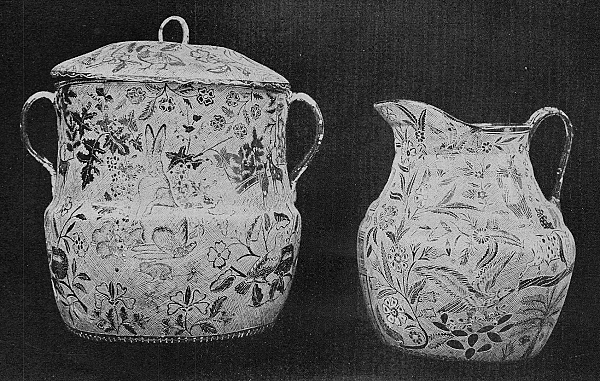
Glazed Clay Ware—Tonalá, Jalisco
These garments are woven music: songs and legendary figures and
the dreams of the weaver go into them. A sombre brown or black serape
will be suddenly joyous with tight little nosegays of green and red and
yellow flowers, precisely the shape and tints of the bouquets sold in the
flower markets. A serape of scarlet and black will bear an angular,
stylised horse’s head, in hues unknown to that animal. Figures of Aztec
warriors taken from the ancient codices, bringing to mind the later figures
of Egypt, and the mythical cepactli, after all merely a tiger with
bared teeth, are among the favorite designs used by the Oaxaca weaver
with endless variations.
One man, master weaver of a certain small Zapotec pueblo, makes a
smaller, simpler serape, woven lightly of fine spun wool, almost as pliable
as velvet, and very delicate in design. On a foundation of white
or gray or brown he weaves narrow bands of color in the ends, scatters
small geometrical designs loosely over the surface, with a double line of
the same pattern in the center. The wearer slips his head through the
straight opening where the seam is left unjoined, and this delicate
wreath encircles his shoulders.
It is not fantastic. It is simple and touching, it belongs to the wearer
as he belongs to the land about him. He seems not merely in sympathy
with the trees and hedges of cactus and the gray road, he literally is
one with these.
The women make their chemises of cotton, embroidered in colored
beads, or smocked at neck and sleeve ends in heavy blue or scarlet threads.
The beaded chemises, meant to be worn on days of fiesta, swing loosely,
weighted with the strips of glittering tinted glass grains, a classical
rounded band at the shoulder releasing the soft brown arms and necks
in a line of tender beauty.
Second to the pottery of Guadalajara, the earthenware most prized
by the Mexican is the thick yellow pottery made in the Tonalá village.
It is of common baked clay (loza vidriada), very gay in coloring and
varied in shapes. On a foundation of deep cream the stains are splashed
on with an effect of casualness, in orange, in vivid blue, and green with
occasional touches of brown. At first glance it appears to have been
blurred, or “blotted” on, as their phrase has it, but immediately the eye
perceives the outlines of birds and butterflies and flowers, very fantastic
and charming.
The glaze of this ware is thick and clear, but brittle. It flakes off
easily, carrying the pattern with it. But for all its evanescent character,
it is most appealing: the pots and bowls and platters spread in small
booths in the sunshine resemble a Mexican garden in full bloom.
There are other kinds of ware in the northern part of the state. Simple
vessels of white clay are molded without the wheel, and left
unadorned. The shapes are primitive, the jugs with tiny ears, the flat,
round water jug with a thin spout and a round handle at the top, and
the cups tall as vases, with straight edges. Black clay, engraved and
glazed in the natural color, is also made here, and is very attractive.
One village specializes in small toys of black clay, money banks for
children, and whistles in the shapes of animals. The grotesque sense is
perfect in these, the distorted little figures possessing a sardonic quality
of humor. But it is a grotesquerie still uninfluenced by the Oriental
or the Western idea of comedy.
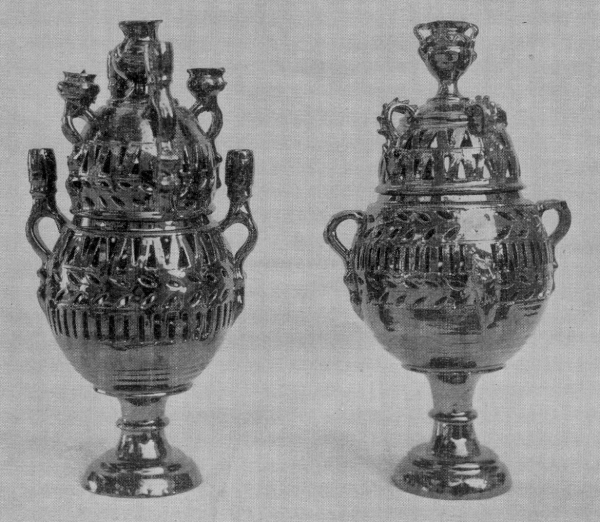
Clay Incense Burners—City of Puebla
This portion of Oaxaca is peopled largely by the Zapotecas, and their
objective temper is expressed by the things they make: knives and swords
of a special kind of finely tempered steel come from here. The handles
are of wood or bone sharply carved, and engraved inscriptions, usually
of a sinister or slightly Rabelaisian humor, run thinly along the nervous,
pliable blades. “Do not unsheathe me without reason, nor fail to draw
me through fear,” says one. “I am the Peace,” announces another.
And still another identifies itself thus: “I am not the friend of cowards,
nor the servant of the timid.”
Here also we find a certain type of charro, the national riding costume
of the ranchero, in which the Spanish love of magnificence is projected
in terms of silver and gold embroidery, and hand tooled leather.
The wide brimmed hats of heavy felt are weighted with borders of
flowers and leaves, and great cords of metal thread knotted and hung
with tassels depend from the inside of the crown. But the charro has
its own place in the Mexican arts, Our present interest is with the
pottery and weaving.
GUADALAJARA POTTERY has an older and more truly national history
than the better known Puebla ware. But it has come into esteem only
of late years, being rather overshadowed by the more obvious qualities
of the imported Talavera style of ceramics. The Talavera has its own
place, and a definite value, but it is considered even today as a modern
importation by the makers of the older kinds of ware.
All the ancient city of Guadalajara is, in effect, a huge pottery. The
state of Jalisco (of which Guadalajara is the capital) is indeed second
only to Oaxaca in its devotion to the folk arts. Many smaller villages
near the capital are given to this work, Tonalá being the leader. The
most perfect pottery in Mexico is made by the guild in this tiny community.
The inhabitants have been potters from the beginning of their
history. When the Spaniards found them, Tonolá was the capital of a
kingdom of the same name, and its potteries were famous. There are
now only about five hundred people in the town, whose sole industry is
the making of earthenware.
In idyllic peace and simplicity the villagers sit before their door steps
or under the trees, or in their tiny clean houses with their open doors,
decorating jars and jugs. They make, even more beautifully than the
potters of Guadalajara, who invented the style, those splendid water jars
and pots covered with fine tracery of design in white and delicate shades
on a pearl gray ground.
They have created a type of ware even more interesting, though less
subtle: a hard baked clay covered over with designs in white and brown.
They superimpose a fine pattern of thick white paint on the dark copper
red surface, and glaze it as hard as glass. It is extraordinary in effect,
and they say, very difficult to make. Though it is the custom for the artist
to sign his work, this type of pot is a veritable scroll of records. Infallibly
it is not only signed, but dated, with the name of the village, and it
is further dedicated to some individual, or christened with a name. It
has, more than any other pottery of the Mexican, the faults, the imperfections,
the unevenness of the handiwork of a human being who is “untaught
in our own sense”—but it has this priceless value of the human
sentiment, a loved thing created for its own sake. One comes to love
better than any other thing in the native arts these brown humble bits of
clay, done so exquisitely, so gently, so irregularly.
The potters of the city of Guadalajara have many ways of making
beautiful things, but two types of their ware are of superior quality.
They are fortunate in the quality of their clay: it is smooth, resilient and
easy to stain. The old-fashioned potter puts a thin clear glaze over the
design, which was very fragile. They cover the entire surface with nets
of brush work too intricate to accept at a glance. The eye must follow
patiently, unravelling that precise, unhurried mesh that never breaks nor
interrupts itself. There are in them the full bodied gold of pumpkins,
the glossy green of foliage, the tints of mangoes, of poppies, of bougainvillaea
blooms, woven together with slender markings of gray.
The newer style is more brusque, not so precious, the big flaring leaves
are applied with broad stroke in one color, usually, on a ground of clay-red,
ochre, sage green, or dull black with gray all unglazed, slightly
rough to the touch. Yet this very slight, almost imperceptible, relief offers
a fine depth of perspective.
The painter manages to convey, in this method, without shading or
foreshortening, a foreground, a middle distance, a far distance. There
are strange rhythms of loveliness in them: the darkness of forests, the
curve of boughs laden with uncanny fruits, the sophistication of pointed
fern fronds minutely accented as filagree; or brilliant with dyes and stains
in color associations strange to us, full of gayety, balanced with shadow.
They offer the paradox of gorgeousness balanced by restraint, an exuberant
yet disciplined spirit, in which elements apparently unrelated are reduced
to a simple and profound harmony.
After the Oaxaca and Guadalajara ware, the Puebla Talavera seems
always a trifle naïve, rather lacking in imagination. But it has its perrenial
charm of blue-and-white, the Chinese inspiration—filtered through from
Spain, absorbing the sturdiness and solidity of Holland blue-and-white on
the way. We have seen that the Puebla Mexican did not long confine
himself to the original colors. Today, all colors go into the tea pots
and plate and flower vases of the thick, hard glazed ware. It is the most
utilitarian of all the Mexican pottery, being near akin to a coarse and
porous porcelain, or stone china.
Mexican artists have recently discovered that the Puebla ware lends
itself to the use of their designs, and many of them have plates and jars
for their collections made in the Puebla potteries, done in the old manner,
and often in precise reproduction of the early examples. The tile work is
very popular, and the individual with a taste for design may draw his own
patterns for the tiles to be used in his house, in mantels, for fountains, or
wall panels.
Many of the older tiled churches have fallen into decay, and are being
restored with tiles that are such exact copies of the original, it is difficult
to distinguish the old from the new. When the famous Casa de los Azulejos
(House of Tiles, in Avenue Francisco I. Madero, Mexico City)
was restored a few years since, it was necessary to add an entire new
wall where the new street of Cinco de Mayo was cut through; the tiles
were made in Puebla, in the same pottery and by the same methods as the
original ones made in the seventeenth century, and the reproductions are
so perfect only the connoisseur can detect the difference. Close examination
shows that the old glaze was more clear and even, the blue is deeper,
the clay is softer. The ware has deteriorated in quality by these shades
of decline.
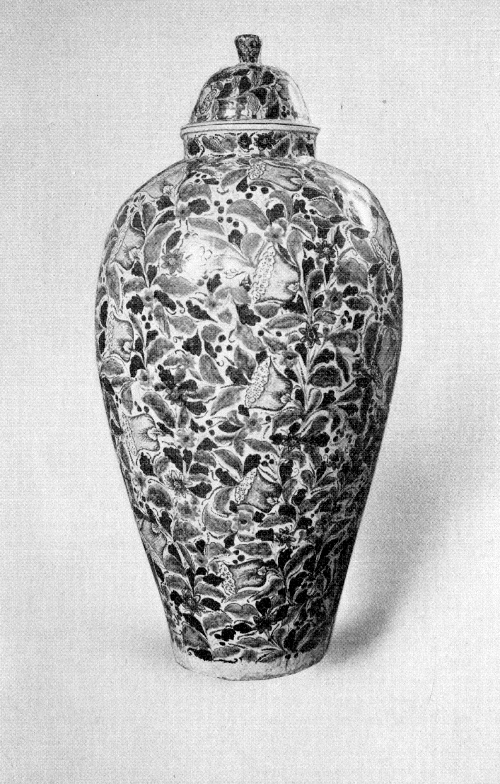
The two large tibores, great jars standing six feet or more in height,
brought from Puebla for this present exhibition, are unusually splendid
examples of the Talavera ware at its present best. One is developed in
the blue and white, an ordered confusion of fleet winged birds and swift
footed animals. The glaze is exceptionally fine. The other is in colors,
a happy blending of yellow and green, of fruits and leaves. They are
masterpieces of the Puebla method, prophetic of a renewed interest in
making this ware the thing of beauty it once was.
THERE ARE MANY other kinds of earthenware in Mexico. Every region
produces its special type of clay household vessels, made of the clay
about the village doorways, and each has the merits of honesty and simplicity.
It is not always artistic, judged even by the most liberal standard,
but it has the profound appeal of ardent human expression.
In Cuernavaca, one of the most beautiful of the smaller cities, they
make good use of their light red clay, almost a pale coral color, in
molding bottles and jars without painted surfaces, but inlaid nicely with
bits of half precious stones.
From Metepec near Mexico and Quiroga, a village of Michoacan,
comes a very distinctive and curious sort of pottery. It is glazed in
glossy black, decorated with vivid flowers, streaked with silver or gilt
paint. It is gay and frivolous in effect, of no special importance except
for its nonchalant prettiness. Set among a group of sedate Guadalajara
bottles, or the sober plain gray and black pots from Teotihuacán or
Texcoco, a Quiroga pitcher will decidedly convey the effect of a bright-skirted
dancer in a company of Quaker ladies.
The “loza” from Texcoco is quite primitive, the very rudiments of
earthenware, unpainted, often of a noble beauty of form. The specialty
of the Texcocan is weaving, and he makes a serape that appeals
to a discreet taste. Blue is his color, and on this ground he weaves his
simple designs in black, white, or gray. The rugs are usually large and
very heavy. The wool is more coarsely spun, which makes the Texcoco
serape valuable for use as floor rugs. They are not so original or full
of splendid associations as the serapes of Oaxaca, nor are they proof
against rain and made for horsemen to wear in bitter weather, as are
many of those woven in Guadalajara. But they have their soft enduring
charm, a civilized restraint in tone, that makes them exceedingly
livable.
AFTER ALL, it is useless to attempt a rigid classification of the arts of
Mexico, or to draw definitive boundaries beyond those here set down.
For bits of loveliness spring up here and there, unexpectedly, like the
sudden clumps of sweet blooming small flowers along a Mexican lane.
For example, take those adorable little wax figures, dressed in the
national costumes, made of real fabric stiffened with wax, that you see
in the shops, or in the small booths called the “puestos” set along the
borders of city parks at Easter and Christmas and other feast days
... they are made in the suburbs of Mexico City, and so far as
I was able to discover, they are not made anywhere else. Their variety
is endless: patient little mothers carrying their babies on their backs,
cradled in their rebosos: men bending under panniers of fruit: children
dancing, men strumming guitars, girls and men mounted on splendid
rearing horses, wearing the China Poblana, and the Charro. They are
so delicately tinted, so fresh and lifelike, they seem veritable living people,
seen through the reverse lens of a field glass.
The skirts of la China Poblana fly discreetly, as she curbs her mettlesome
horse, glimpsing lace petticoats whose ruffles are fixed in billowing
flight, real thread lace, waxed to maintain those spontaneous looking
folds. Her knee curves easily over the horn of the saddle, her smiling
face is always turned toward the caballero who rides beside her, gorgeous
in his riding dress of tooled and embroidered buckskin.
From a village called Santa Cruz de los Monos (literally, Holy Cross
of the Monkeys) in the state of Jalisco, comes another kind of small
image, but made of clay and painted, of these types beloved in the popular
imagination. There are mounted ladies and gentlemen, young
country lads and girls dancing the Jarabe, a favorite folk dance seen at
its best and most joyous in this part of the country. They also make
fruits of painted clay, while the waxen fruits, perfect even to the bruised
spots, the broken twig, are made only in Mexico City. Madame Calderon
de la Barca, wife of the Spanish minister to Mexico in 1840,
exclaimed with delight over the artfulness of these fruits, declaring herself
completely deceived by their realism. They are deceptively luscious
indeed.
This aspiration after a perfect realism, a complete statement of the
thing they see, is the essence of their arts, the key to the racial temperament.
I am reminded of a certain man, in the tiny puebla of San
Esteban Titzatlań, who carves walking sticks.
This man sits every day before his house, on the hard naked earth,
behind his enclosure of organa cactus, and makes every sort of walking
stick from the heavy cudgel of defense to the airy wand a man might
add to his costume as pure decoration.
He works with a small sharpened knife on saplings of various native
woods, dried and polished to the color of ivory. He carves designs
in high relief on these wands, sometimes almost the entire length of
them, after the fashion of the things he knows: lizards and beetles and
cacti, eagles and dogs and leaves and men wearing charros. Each stick
is a chapter in his life’s experience, a record of what he has seen and
felt. Sometimes he is more than a month in carving a single stick.
When he finishes it, he sets it aside and begins another. Carving sticks,
beautifully, painstakingly, endlessly, is his vocation and his pastime. He
sells them occasionally, at prices which elevate them to the dignity of
gifts. He works with a preoccupation entirely untainted by any knowledge
of popular taste, and utterly refuses to teach any one else the technique
of his carving. This is characteristic of the Mexican peasant
artist. He guards jealously his working formulas.
Master potters have been known to create certain designs, to perfect
an excellent glaze, and to teach them only to a carefully selected group
of disciples, or more often, not to teach them at all. Several years ago
a painter of boxes in Michoacań who had discovered a superb method
of fixing his colors, died without revealing his secret, and left only a
few examples of his work.
In Oaxaca there is a woman who makes a curious little incense burner,
not particularly beautiful but intensely individual, rare in shape and
violent in coloring. She instructs her daughters as they grow up in
the method of making these burners, but the art remains strictly in her
family, and no one else would even presume to inquire into her technique,
nor to imitate her work.
The city of Aguascalientes contributes a wide assortment of crafts,
the natives there being more versatile, if less classical in spirit, than in
any other region.
Rather sophisticated tastes demand, in Aguascalientes, chairs made
by hand, all painted in green and yellow and blue, or else lacquered in
black and decorated with gilded flowers. The seats are made of woven
rushes, or of maguey cords, woven stoutly in red, green, blue or white.
Tiny chairs for children will be charmingly adorned with birds and animals,
small flower wreaths, naive and old fashioned as fairy book
pictures.
Wall cupboards with shelves for books and pottery are also made in
this style, quite often being painted in a sulphur yellow, the back panel
carved at the top not infrequently with birds amiably touching beaks,
a favorite device in wood carving with the Guanajuato cabinet maker.
A wool garment called the tilma is much worn here. It is a smaller
and lighter weight serape, of wool of fine spun henequen fibre. They
are cheerful in hue, fit for the bright soft weather of this region. On
such a tilma was imprinted the miraculous image of the Virgin of Guadalupe,
now the patroness of Mexico, which may be seen at her shrine at
Villa de Guadalupe near Mexico City.
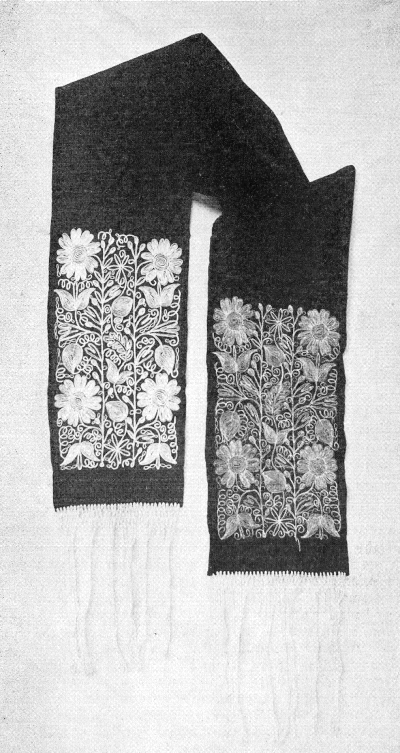
Embroidered Waist Band—Tehuantepec
There is, in all, a progressive modern air about the arts of Aguascalientes,
mingled with a native quaintness; their most dignified art is
lace making. Needle lace, as it is called, and the drawn linen lace, were
derived from Italy in the seventeenth century. The women work marvels
with their fine needles and linen thread on their smoothly woven
linen, making table cloths and napkins, curtains and old-fashioned counterpanes,
handkerchiefs, and lingerie for brides. The work has that
remote and unworldly beauty of convent needle craft, and serves much
the same uses. No Mexican bride, at least in the country, would forego
a chest of this linen and lace for her new household.
Italy contributed also the small square shawl of embroidered silk in
white or pale colors, adorned in the corners with thread lace. They
are called chalinas, and are much worn by the young girls on haciendas.
A few years ago they were worn also by the beautiful ladies of the cities,
chiefly in Guadalajara, where the women are noted for their splendid
hair. They wore these filmy mantles instead of hats, allowing them
to slip lightly about the shoulders, thereby revealing the most carefully
dressed heads in the Republic.
Aguascalientes has a rival guild of needle workers in the small town
of Silao, near by. Here also they make those painted chairs and wall
cupboards; and here they excel in the ancient art of mat and basket
weaving from reeds and palms. The petate, the pliable mat used as a
bed, or as curtains before doorways, even as wall partitions in the houses
constructed of woven palm withes, is here at its glorified best. There
are pure white ones, bleached like flax, with maybe only the national
escutcheon, the eagle and cactus and serpent, in the center; or more
thickly woven ones with diagonal stripes in many shades. Some of them
rival a Quiroga pot in brilliancy, though this is more often found in the
basketry. Whatever the shape, whether flat, made into halves that slip
one over the other like a pocketbook, or round and handled like a flower
jar, there is always in these baskets a shocking juxtaposition of color,
yaw and unrelieved. Often one sees in a single basket, red and rose and
orange, with sulphur yellow and cobalt blue, without even the relief of
a white line dividing them.
We have noted how this use of violent, unshaded pigment gives an
effect of depth, of actual penetration, to the surfaces of pottery. In the
painted boxes and chests from Michoacań, the lacquered gourds and
bateas from Tehuantepec, whether encrusted or painted, this use is carried
to the ultimate possibility. The result of this flat opaque unmixed
color is to give an amazing clarity and sweetness of tone, where it is
used with artistic discretion. On these chests and jicaras, also, the
schemes of color are very ardent, but more ruled by the associations
we are accustomed to accept: blue and clear red, orange and green, gray
and black and rose, with bands of silver. They take on a delightful tone
of mellowness with age. When new they are as irresponsibly brilliant
as Russian embroideries.
In the Isthmus of Tehuantepec, these fragile seeming gourds are used
daily for carrying fruit and vegetables, or water. The smaller ones serve
as water dippers, and for chocolate. The chocolate will be beaten to a
froth with a beautifully carved whip called a molinillo (little mill),
sometimes inlaid with bits of jade or bone. The Tehuantepec woman
wears, more often than not, a strange, flaring headdress of starched
and pleated white lace, which rays out from her face like the coif of a
sister of charity. But there is nothing nun-like about this enchanting
dress of la Tehuana. She is given to all the vanities, from her perfectly
arranged head to her embroidered short blouse with its short sleeves
and low cut neck, to the rustling lace-trimmed and embroidered skirt,
to her very feet, lightly bound in thin sandals or satin slippers with
ribbon bow knots, embroidered on the straps.
Her jewelry is the airy gold and silver filagree, akin to that of China
and Naples, but distinct from either, since it was an old art before
either the Chinese or the Italians came to Mexico. The huge ear rings
of the women, their necklaces, the splendid rosaries and crosses, the very
auras of the saints are contrived of this delicate web-like gold. Their
pins and combs, rings and bracelets are also of spun and filagree silver,
set with jade and turquoise, or more rarely, with opals.
In Yucatan, the Mayas defeat their tropical heat with lightly spun
fabrics, thin silks, pale colored, fine embroideries. Here, they import
their cloths, and their embroidery is a comparatively recent imitation of
the Chinese, which lessens the value of their contribution to Mexican
arts. However, there is a certain charm to the curious satin shoes and
thonged sandals of the women, with their sharply upcurved pointed toes
and high heels. Their most unique and interesting work is done with
henequen fibre weaving. They make hammocks, used instead of beds,
of henequen (sisal) thread, in which they sleep suspended in air, cool as a
spider in his web.
In the more temperate states, Jalisco, for example, we find serapes
of moderate weight, furniture designed for comfortable living in a fairly
equable climate, such as those cowhide easy-chairs, bound together with
thongs of undressed cowhide or buckskin, known as “equipales.”
Stretched on stout wooden frames, the hide left in its natural color,
they are much used in the country, and are meant to withstand hard
usage.
The ceñidores, long narrow bands used as belts, woven in rigid figures
in bright colors, are made in many districts, though they are used
almost exclusively among the rural Indios. The reboso, that indispensable
article of attire among Mexican women, is also made in every part
of Mexico, though the finer ones come from two places only: Santa
Maria, in the state of San Luis Potosi, and Tenancingo, state of Mexico.
The reboso is a long scarf, woven commonly in two colors, one the
warp, the other the woof, so that it appears to be one shade except in the
fringe, where the different colored threads will be woven alternately
and knotted into an effect of square blocks of contrasting shade. For
the poor, blue cotton is the favorite. The handsomest ones, made in
Santa Maria, are of raw silk, in delicate tones of jade green, pale yellow,
ashy violet, gray, and rose. The flat spun thread weaves into a
very supple, sinuous length of silk, with a silvery shimmer, or over-gleam,
like the shine of a snake skin. Dr. Atl has touchingly described
its use among the poor, in his monograph on “The Popular Arts of
Mexico:” “... With the reboso the women of the village cover
themselves. It does not only serve as a head covering, or when crossed
over the breast, as a simple adornment, but it is also the provisional
cradle of the poor children, the handkerchief with which the women dry
their tears, the improvised basket in which the Indios carry their vegetables
to the market, the cover of the infant who sleeps tranquilly beside
the working mother. When it is twisted and placed on the feminine
head it serves as a seat for the filled fruit basket which, skilfully balanced,
is thus carried through the streets; or when extended, makes a
shelter for the kettle of tamales in the angle of a street....”
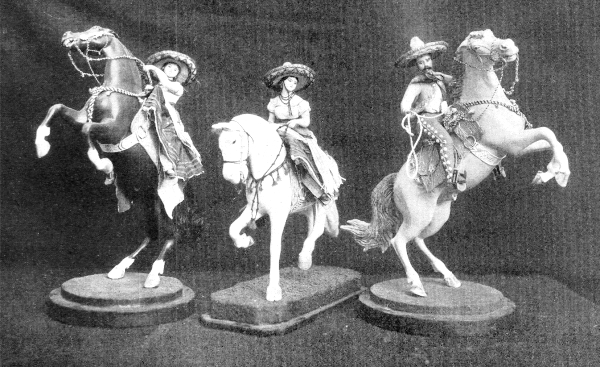
Wax Figures—City of Mexico
In its more luxurious aspect, it is used among the ladies of the haciendas,
and is an important part of the riding costume, being folded about
the hips, over the knees, adding its weight to the flying skirts of the
rider. It was originally a Spanish garment, but its shape and uses have
vastly changed. It is the familiar garment of many classes of women,
even among the bourgeoisie, where it takes the form of softly fringed
black silk or thin woolen nun’s veiling.
EL CHARRO! He is the beau ideal of the romantic imagination in
Mexico. He is the symbol of her old society, her truly Mexican old
society, not the eternally foreign-souled Spanish grandee, but of the
Spanish who were Mexican-born in their love of the country, who were
genuinely native to the soil, to the struggles, to the dreams and aspirations
of their country. Some of these had Indian blood, and in them
the new patriotism burned with the ardor that quickens new nations,
and is the clean animating force that welds a race indissolubly from the
beginning.
The development of the charro, the national dress of Mexico today,
is a little history of Spain in Mexico. The Spaniards brought horses, and
with them prodigious saddles, high pommelled, of leather and metal, with
ponderous stirrups, leg guards of leather, and high chair-backs. This is
the present shape of the Mexican saddle—La Silla, the chair of the horseman—often
for the ranchero the only chair he knows day upon day, as he
goes about his affairs on the cattle pastures and enormous cultivated areas
of the haciendas.
From the Spaniard also he developed the dress itself, the short jacket,
the tight trousers strapped under the boots, the wide sash fringed and
knotted at the side. The great wide brimmed hats were designed for protection
from the sun: it was the caballero’s own manner of wearing them
that made of them the most dashing and devil-may-care fashion of headgear
ever devised by man.
Because of the necessity for country life in Mexico, the horse became
the most important of all their domestic animals. Man must spend his
life in the saddle in pursuit of either business or pleasure. The horse, the
saddle, the accouterments of horsemanship became objects of care, of
costly and expert attention. In this way it became a symbol of the national
life and customs after the conquest. It is today worn with pride
as the distinctive dress of the country, the mark of a special patriotic
devotion. Members of old country families, and certain distinguished
persons make a point of appearing in the charro on all occasions of holiday
and festal costume, notably in the paseo in the park of Chapultepec on
Sunday morning, when the President, the members of the Cabinet, and
Mexican society and officialdom in general drive slowly back and fourth
on the Grand Avenue, under the shadow of Chapultepec Castle.
In the country the charro is not a ceremonial dress, but the ordinary
habit of the man on horseback. Here it appears in all its variations, from
the humble suit of tough blue drill ornamented with black bone buttons,
to the splendor of hand-dressed buckskin in chamois color embroidered
in spun silver and scarlet.
The charro indeed is subject to all the caprices of taste of the individual
in respect of material and color combinations: it is in the cut and the
design and placing of decoration that do not change. They are made by
Mexican leather workers and embroiderers in small towns, each one catering
to the local taste. In Salamanca, state of Guanajuato, they band
cream-colored buckskin with tooled leather flowers of golden brown;
they make for this jacket a waistcoat of golden brown buckskin, with gold
embroidery, and trousers to match the waistcoat. A hat of brown beaver
or felt, very peaked in the crown, will be weighted with gold flowers and
a long cord with gold thread tassels ... gloves and boots, a whip of
light tan leather, with gold or tooled leather head, a wide smooth leather
belt with gold buckles, and a flowing gold-colored tie, will add the small
final touches to a theatrically beautiful and impressive dress. In Salamanca
also they have the habit of cutting strips of thin leather into complicated
designs and stitching them on flat, to resemble braiding.
The town of Jerez, in the state of Zacatecas, has a famous guild of
leather workers who make the finest possible quality of softly dressed
buckskin; exquisite metal embroideries come from this place also. The
finest hats come from Puebla or Guadalajara, being distinguished by their
slightly tilted crown and deeply rolling brim. Aguascalientes contributes
charros embroidered in thick brightly dyed thread, mingled with
silver. In this region there is a taste for trousers and jacket of contrasting
shades and materials. Charros of black cloth or leather, embroidered in
silver or colors, are very much worn. Gauntlets have flaring wrists,
fringed and stitched.
Like the manufacture of saddles and stirrups, this craft is somewhat
modernized, since the demand is so wide and the buyers are drawn from
every class and section of Mexico. But still the charro “shop” is apt to
consist of one master workman and his apprentice, usually his son, and
one or two employees.
Stirrups and saddles are made in several towns, but Amozoc, Puebla,
Andeleon in Guanajuato is easily in the lead. Here they make great saddles
of soft firm leather, delicately tooled as a lady’s pocketbook. They
embroider saddle flaps in shining threads of spun silver, and make saddle
horns of carved wood or bone mounted in silver. There is no way
of generalizing them in descriptive terms since every saddle is unique,
with small details of decoration, the treatment of the leather, the pattern
and method of tooling, the use of colors. They are finished with rings
and stirrups of dark polished blue steel, encrusted with gold or silver
flowers, gleaming like great jewels—a horseman’s dream of stirrups!
The saddle flaps, the bridles, even splendid blankets of chamois colored
buckskin or fine wool are bordered with banded designs of flowers in
leather, are weighted with this lovely metal work and gay silk thread
flowers.
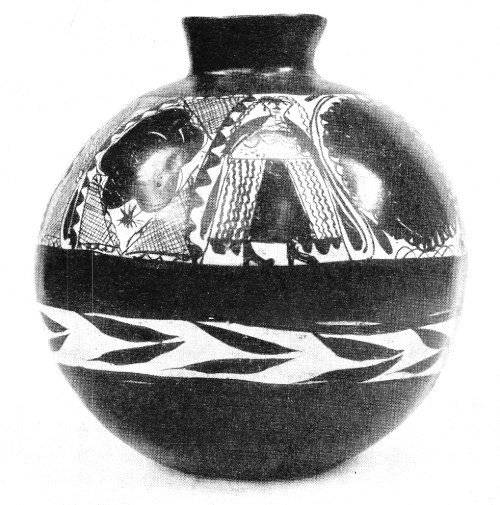
Clay Water Jar—Michoacan
Bridles of woven horse hair, hard as iron and pliable as wool, drip
with prodigious tassels in red and blue and green. Less magnificent ones
of maguey fibre are quite as durable and colorful. The designs are
woven the full length of the reins, the head pieces are joined with buttons
of bone, representing bull’s heads, or rosettes of metal or leather. To the
final touch, it ts all splendidly and perfectly made. Saddle cinches, lassoing
gloves (strange mitten-like affairs, with fingers joined loosely to
the body of the glove with light leather thongs for the sake of ease at the
knuckles), lassoing ropes of maguey fibre, with tasselled noose ends: in
everything there is a brilliant taste, a sense of beauty, a handsome abandon
to their ideal of gallant living, that is deeply characteristic of the Mexican
people.
ONE IS LOATH to leave a subject on which there is so much left unsaid
... but it was not my intention, indeed, it was not within my province,
to write a complete analysis and history of so complex a subject as
the Mexican Popular Arts.
My aim is to present to you, in its human aspects, this profound and
touching expression of a very old race, surviving and persisting in its devotion
to ancient laws with a steadfastness that is anachronism in this
fluctuating age. These pages will perhaps help to explain many things to
those who will see, for the first time, examples of this art extending over
a period of at least fifteen centuries. In doing this, the aim of this short
study will have been fulfilled.
FINIS
This book was published in Los Angeles, Calif.,
U. S. A., by Young & McCallister, Inc.
being completed November 10, 1922.
Backcover
Transcriber’s Notes:
Variations in spelling and hyphenation are retained.
Perceived typographical errors have been changed.