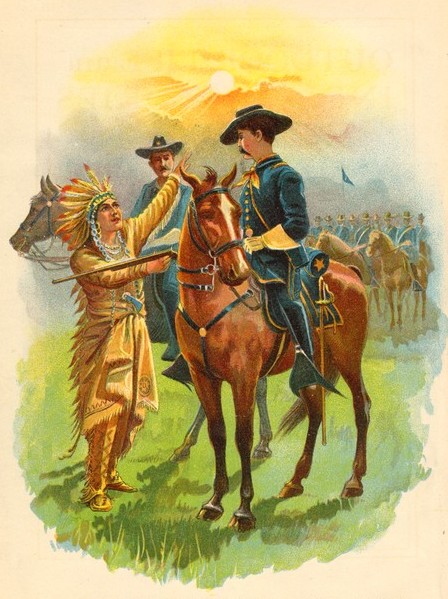
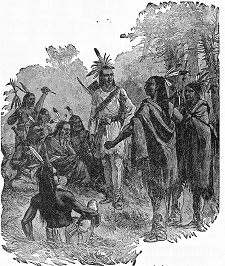
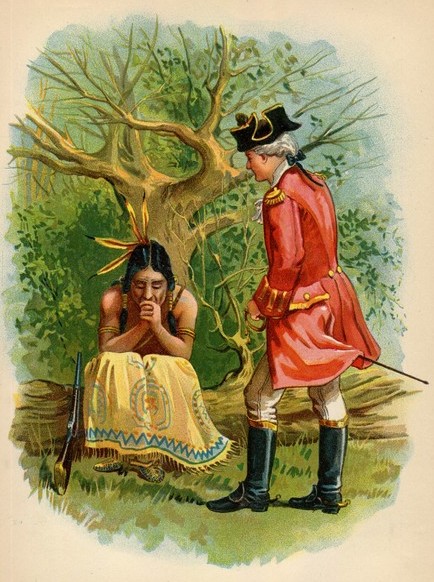
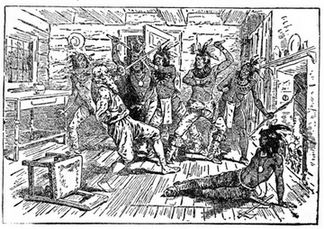
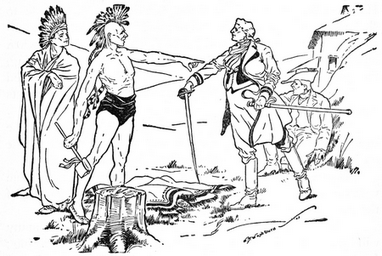
"FROM WHERE THE SUN NOW STANDS, I FIGHT NO MORE
AGAINST THE WHITE MAN."
MAKING OPEN AIR LIFE
ATTRACTIVE TO YOUNG AMERICANS
BY TELLING THEM ALL ABOUT WOODCRAFT, SIGNS AND
SIGNALING, THE STARS, FISHING, CAMPING, CAMP COOKING,
HOW TO TIE KNOTS AND HOW TO MAKE FIRE WITHOUT
MATCHES, AND MANY OTHER FASCINATING OPEN
AIR PURSUITS
——ALSO——
STORIES OF NOTED HUNTERS AND SCOUTS
GREAT INDIANS AND WARRIORS, INCLUDING DANIEL
BOONE, KIT CARSON, GENERAL CUSTER, PONTIAC,
TECUMSEH, KING PHILIP, BLACK HAWK, BRANDT, SITTING
BULL, AND A HOST OF OTHERS WHOSE NAMES
ARE FAMOUS
ALL OF THEM TRUE AND INTERESTING
BY EDWARD S. ELLIS
Author of the Celebrated "Ellis Books" of Adventure,
"The Deerfoot Series," "Youth's History of the United
States," Etc., Etc.
PROFUSELY ILLUSTRATED
WITH LITHOGRAPH COLOR PLATES, HALF-TONE
ENGRAVINGS AND LINE DRAWINGS
What boy can resist the call of the woods, the desire
to know the forest and its furred and feathered inhabitants,
the fish, the insects, the plants? But to gather
this knowledge in safety the boy must first learn the ways
of the woods, the life of the camper, how to cook and
find his way by the stars, how to tie knots and what to
do in case of accident, the language of signs and the
secrets of the trail. There is no better way to do this
than to study the methods of the Indians, the most expert
woodsmen the world has known. At their call the forest
produced food, drink, clothes, ornaments and all the necessities
of life. Let us see how they managed this.
THE CAMP
Making a Camp
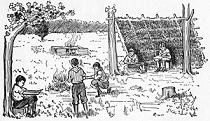
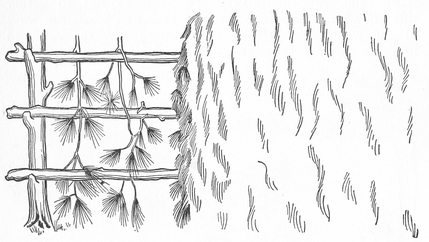
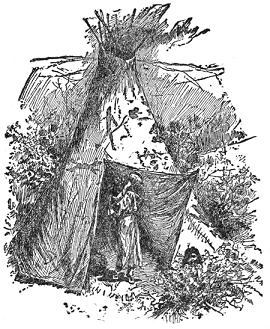
METHOD OF THATCHING A LEAN-TO
The first thing to be considered on going into the forest
is the camp where the night is to be spent. In choosing a
place for this see that there is fresh water, wood for the fire
and brush-wood for building a "lean-to," or hut, at hand. It
is well to build on a dry, level place, with just enough slope
to the ground to insure the water running away in case of
rain. The Indians used to live in huts thatched with brush-wood,
and these are best made by building what is known
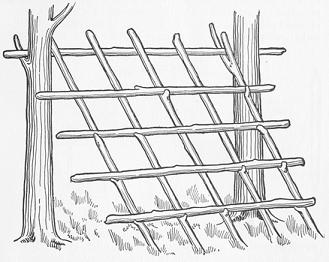
as a "lean-to." Look for two trees standing from eight to
ten feet apart on your camping place, with branches from
six to eight feet above the ground. By placing a pole from
one tree to the other in the crotches and leaning other poles
against this one, brush-wood can be woven in to form a very
good roof. Branches of the balsam or hemlock are best for
this purpose, and the needles should point down. It is well
to collect as many soft, thick tips of trees of this character
as possible, both for the thatching and to make the beds.
Cover the floor of the "lean-to" with these tips thickly and
lay the rubber blankets on top, rubber side down. Be sure
to make the head of your bed toward the inside and away
from the opening. You will find that this makes a very
comfortable bed.
HOW TO BUILD A LEAN-TO
How to Make Fire Without Matches
In olden times, before the Indians had matches, and even
before they had the flint and steel that our grandfathers used
for making fire, they used rubbing-sticks. Many people have
tried to make fire in this manner, but few have succeeded.
As a matter of fact, it is not a very difficult thing to do if
you know how, as the Indians did. In fact, they grew so
expert that they could make fire almost as quickly as we can
strike a match. The easiest and surest method of doing this
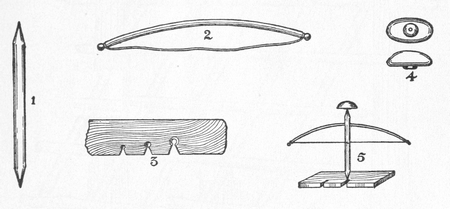
is to use the bow-drill. The tools necessary consist of a bow,
or bent stick, about two feet long, with a stout leather cord
attached to each end. The drill consists of a straight piece
of wood pointed at each end. One end of this rests in a drill-socket,
which is simply a piece of wood with a small notch
in it for the top of the fire-drill. This piece of wood is held
in the hand, while the other end of the fire-drill is placed in
the fire-board. This consists of a thin piece of wood with
small pits cut about half an inch from the edge, and with a
notch extending from the edge into the middle of the pit. The
leather thong is given a single turn about the fire-drill and
then by drawing the bow backward and forward the drill is
caused to rotate very rapidly in the fire-board. After a short
while the dust which comes out of the notch grows hot and
becomes a glowing coal, which can be easily ignited into a
blazing fire.
THE FIRE-DRILL
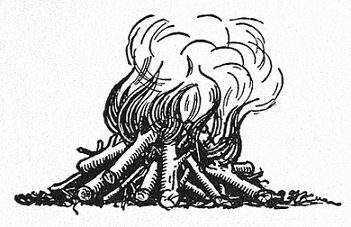
There are many ways of building a camp fire, but the
Indian's way is the best. The Indians always used to laugh
at the white men because they said that they built such a big
fire they could not get near it, while the Indian built a little
fire and could get close to it. The fire must be built systematically.
First, get dry, small dead branches, twigs, fir
branches and other inflammable material and place these
loosely on the ground, being sure that the air can draw under
and upward through the mass. Next place some heavier
sticks in the form of a pyramid with the tops of the sticks
close together, and so on, until
you have built the camp
fire to the required size.
HOW TO BUILD A FIRE
Take
every care to prevent the
spreading of the fire, and do
not build it too close to the
tent or to inflammable pine
trees. There is always danger
of starting a disastrous
forest fire by carelessness with
a small camp fire. Remember that it is criminal to leave a burning
fire, and always to put the fire out with water or earth. If
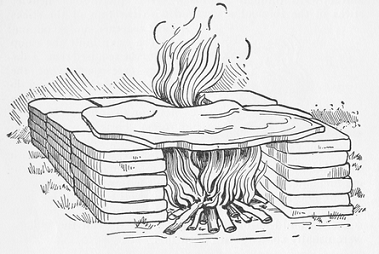
the fire is to be used for cooking, it is well to confine the heat
between two large logs, or, if baking is to be done on it, it
is best to build an oven with large stones. But the Indians
were usually content with open fire.
How to Get Pure Water
A very necessary item for the camp is pure water. If
this cannot be obtained from a nearby spring which has
good, clear water, or from a clean stream, it is possible to
filter it in the same way that the Indians did. They had a
way of purifying water from a pond or swamp by digging a
hole about one foot across and down about six inches below
the water level, a few feet from the pond. After it was
filled with water they baled it out quickly, repeating the
baling process about three times. After the third baling the
hole would fill with filtered water.
A STONE OVEN
If there is a stream at hand large enough to swim in,
it is well to remember that if you work your hands and kick
your feet you can stay above water for some time, even with
your clothes on. Do not make the mistake of going into the
water too soon after eating, for cramps are apt to result,
causing a serious accident. The Indians have a method of
protecting themselves from cramps. Coming to a bathing
pool, the Indian swimmer, before entering the water, vigorously
rubs the pit of his stomach with the dry palm of his
hand. This rubbing probably takes a minute; then he
dashes cold water all over his stomach, and continues the
rubbing for another minute; and after that he is ready for
his plunge.
How to Cook in Camp
The problems of the camp cook are not nearly so great
as they seem at first glance. The essential thing is to select
your cooking equipment and supplies wisely and learn a few
simple recipes in advance. An excellent cooking kit for a
long outing is composed of the following utensils: One 12-inch
frying pan, one coffee pot, one 6-quart pail, one can
opener, six air-tight canisters for coffee, tea, sugar, salt, etc.,
a knife, fork, teaspoon, tablespoon, plate, bowl and cup for
each person in the party. All of these may be nested in a
12-quart pail, which will be found useful in many ways
about the camp. If only a short hike is to be taken, however,
a much smaller kit may be taken. An ideal kit for this
purpose is used by the United States Army and may be
obtained from outfitters or army stores anywhere. This consists
of a frying pan and plate which can be locked together
by the handle of the frying pan to form a baker. In this a
knife, fork and spoon can be carried. With the addition of
a canteen and large tin cup, this kit can be made to perform
wonders in the cooking line on a trip of several days' duration.
For a longer trip the larger kit is recommended.
The supplies to be taken along depend upon the tastes
of the campers, the length of the trip and the convenience
of transportation. Of course, if the trip is to be made by
water it is easier to manage a greater weight than would
be the case if it must be carried, a point to be kept in mind
in selecting the supplies.
For a trip of about one week the following supplies
are advised in quantities to suit the number of people in the
party: Coffee, tea, sugar, salt, pepper, condensed milk (unsweetened),
lard, bacon, flour, baking soda, bread and potatoes.
This list can be enlarged to advantage by the addition of a
ham, butter (if it can be kept cool), pickles, jam and additional
vegetables, but it is well to keep the outfit down to
the lowest point consistent with comfort. Eggs should be
taken if it is possible to carry them safely. They are now
sold in packages which will stand moderately rough handling.
Remember that a bed of hot coals is best for cooking, and use
dry wood if possible to avoid the smoke. The following
recipes will be found easy and practical. Others may be added
as the cook grows more expert.
COFFEE
Use 1 tablespoonful of ground coffee for each cup to be
made. For five people put 5 tablespoonfuls in pot, add ½
cup cold water and mix with the coffee. Add 4 cups of boiling
water and bring to a boil, letting it boil one minute, then add
½ cup of cold water and set near fire where it will keep hot
but not boil.
TEA
Use 2 teaspoonfuls of tea to 4 cups of boiling water. Put
tea in pot and pour boiling water over it. Never boil tea, but
stand in a warm place for five minutes to draw before serving.
BACON
Very useful on account of its fat which can be used to
fry fish, potatoes, etc. Slice the bacon thin and put in frying
pan. Fry over hot fire until crisp, turning the slices over with
a fork from time to time.
POTATOES (BOILED)
Fill pail with water, wash and peel potatoes, boil until
tender, take out of water and keep warm until served.
POTATOES (FRIED)
Put 1 teaspoonful of lard in hot frying pan or use fat
left over from frying bacon. Peel and slice potatoes. Fry
over hot fire.
FRIED FISH
Split the fish down the belly, clean, scale and cut off head
and tail. Spread open and fry with lard or bacon fat in hot
frying pan.
All of the above can be cooked easily and quickly in camp.
It is recommended that bread be taken along, but if it is desired
to cook this and other more complicated dishes, one of the
many handy cook books on the market should be carried.
How to Make a Bow and Arrow
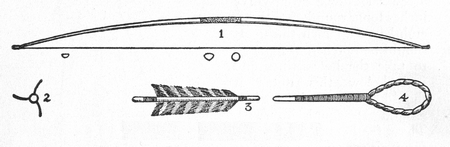
HOW TO MAKE A BOW AND ARROW
In early days the Indian did not have the modern hunting
rifle, and was compelled to use bow and arrow in the chase.
It is well for the modern boy to understand this weapon, for
it can be made with ease and much good fun can be had with
it. The Indian bow was short, because, though less efficient,
it was easier to carry than a long one, yet it did not lack power.
We hear that many times Indians shot so hard that their arrows
appeared on the far side of the animal, but the long bow,
such as was used by the old English archers or bowmen, was
much the more powerful. To make the bow take a perfectly
sound, straight, well-seasoned stick of about your own height
and mark off a space as wide as your hand in the middle for
a handle. This space should be left round and about an inch
thick. The balance of the stick should be shaved down flat
on one side for the front and rounded on the other for the back
until it is about one inch wide and three-fourths of an inch
thick near the handle, tapering to about half that at the ends,
which are then notched for the cord. Next put on the cord
and bend it until it is about five inches from the bow at the
center. If one end bends more than the other shave the other
end until it becomes even.
HOW TO SHOOT A BOW
AND ARROW
After it is trimmed down to your strength finish it with sand-paper.
The best woods to
use are apple, black walnut,
slippery elm, mountain ash
or hickory.
More difficult to make
than the bow is the arrow.
The Indians made arrows of
reeds and of straight shoots
of arrow-wood or of elder,
but we make better arrows
out of hickory or ash. The
arrow should be twenty-five
inches long, round, and three-eighths
of an inch thick. It
should be notched at one end
to take the bow-string, and
just below this notch it
should have three feathers set
around at equal intervals.
These feathers are best made
from either turkey or goose
wings. With a sharp knife
cut a strip of the midrib on
which is the vein of the
feather; make three pieces,
each two to three inches long.
The Indians used to leave the
midrib projecting at each
end, and by these lash the
feathers to the arrow without gluing, but it is easier to glue
them and the arrows fly better. Indian arrow-heads were made
of sharp flints or pieces of stone lashed to the arrow-heads, but
the best way to make them now is like the ferrule of an umbrella,
as this keeps the shaft from splitting. After this the
arrow should be painted, both to keep it from warping and to
make it easier to find in the forest by its bright color.
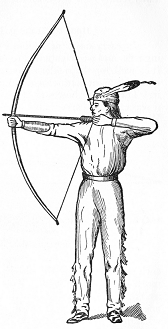
After the bow and arrows are made one must learn to
shoot with them. It is well to begin with the target close at
hand, and gradually increase the distance as the archer becomes
more expert. The Indians generally used their bows at short
range so that it was easy to hit the mark, and considered rapid
firing more important. In their competitions the prize was
given to him who should have the most arrows in the air at
once, and it has been said that their record was eight.
How to Read Signs and Signals
The Indians are very expert at using signs to give messages
to one another. These signs are made in many ways
and vary with the different tribes. Some of those best known
are: Shaking a blanket, which means "I want to talk to you."
Holding up a knife or other weapon means "war" or "I am
ready to fight." Holding up a tree branch, "I want to make
peace." Holding up a pole horizontally with both hands on
it, "I have found something." Blazes or marks on trees are
widely used to communicate messages. A simple blaze or
small section of bark cut from a tree is often used to indicate
a path through the forest, and if you are going through dense
woods and must come back the same way or others are to follow
you it is well to use this method of marking the way. Other
well-known Indian signs are the water signs. A circle cut in
the bark with an arrow-head pointing directly down and three
waved lines within the circle means "Good water here." A
similar circle with the arrow-head pointing to one side but
below the center means "Good water not far in this direction."
If the arrow-head is above the center it means "Good water
a long way off in this direction." An arrow alone indicates
"Go in this direction." An arrow with a rectangular
mark on the end means "A letter is concealed three steps
in this direction." A cross means "Do not use this path." A
circle with a small circle inside, "I have gone home." In
addition to the permanent signs the Indians are very expert
at "making smoke talk." A fire is built from damp wood which
will give off a thick smoke. By holding a blanket over the
fire the smoke is caused to rise in short and long puffs which
can be made to spell out a message. At night the light of the
fire can be made to serve the same purpose. As it is not always
convenient to build a fire and the "smoke talk" is not easy
to handle it is much better to use a flag and the wig-wag system.
First of all it is necessary to memorize the signal code
which is given below. The numbers are made by the signal
man standing in one position with three motions. Let the
signal man stand facing the signal station with which it is
desired to communicate with the flag-staff carrying a small
square flag held vertically in his hands. A white flag about
two and a half feet square with a red square in the center is
a good design, but the size depends somewhat on the distance
between stations. At night a lantern on a pole or a torch can
be used on the same system. To make the first motion ("one"
or "1") move the flag as you stand facing the other station
to the right and down to the level of your waist, returning
it immediately to the vertical position. The second motion
("two" or "2") is the same to the left of the sender. The third
motion ("three" or "3") is downward directly in front of the
sender and immediately back to the vertical position. Remember
that numbers which occur in a message must be spelled
to avoid confusion. In sending a message make a slight pause
between each letter and if a mistake is made signal 3 followed
by 12, 12, 3, and then begin the incorrect word again.
THE WIG-WAG CODE
ALPHABET
A
22
J
1122
S
212
B
2112
K
2121
T
2
C
121
L
221
U
112
D
222
M
1221
V
1222
E
12
N
11
W
1121
F
2221
O
21
X
2122
G
2211
P
1212
Y
111
H
122
Q
1211
Z
2222
I
1
R
211
tion
1112
NUMERALS
1
1111
6
2211
2
2222
7
1222
3
1112
8
2111
4
2221
9
1221
5
1122
0
2112
CONVENTIONAL SIGNALS
End of word
3
Repeat after (word),
End of sentence
33
121, 121, 3,
End of message
333
22, 3 (word)
XX3
beginning or end of
Repeat last word,
numerals.
121, 121, 33
I understand
22, 22, 3
Repeat last message,
Cease signalling,
121, 121, 121, 333
22, 22, 22, 333
Move to right
211, 211, 3
Signal faster
2212, 3
Move to left
221, 221, 3
ABBREVIATIONS
a
after
n
not
ur
your
b
before
r
are
w
word
c
can
t
the
wi
with
h
have
u
you
y
yes
How to Tie Knots
Every boy is familiar with rope and its uses, but not every
one is able to handle it to the best advantage. In camping
and fishing, and particularly in any sport that has to do with
the water, a knowledge of how to tie knots is of the greatest
value and interest. Often one's very life depends on a knot
holding.
A good knot has three qualities, it must be easy and quick
to tie, it must hold fast when pulled tight and must be easy to
untie. There are a number of knots which meet these requirements
but are adapted to different uses. To learn the
various knots which follow take a section of flexible rope about
four feet long and three-eighths of an inch in diameter. To
keep the ends from fraying it is necessary to "whip" or bind
them with twine. To do this make a loop in the twine and
lay on the rope end so that the closed end of the loop projects
just over the end of the rope. Begin wrapping with the long
end of the twine at a point about an inch from the end of the
rope, over the loop and toward the end. When you reach the
end of the rope pass the free end of the twine through the loop
and pull the other end of the twine.
This will
pull the free end under the wrapping and secure it.
Cut off both ends close to the wrapping. To understand the
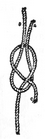
directions remember that: 1. The Standing-part
is the long unused portion of the rope
upon which the work is done.
2. The Bight
is the loop formed whenever the rope is
turned back upon itself; and 3. The End
is the part used in tying the knots.
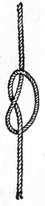
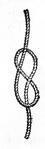
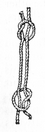
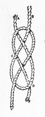
The two primary knots are the "overhand"
and the "figure-of-eight," which must
be learned first of all as a basis.
THE OVERHAND KNOT
Beginning with the position shown in the preceding
diagram back the end around the standing-part and up
through the bight, drawing it tight.
THE FIGURE-OF-EIGHT KNOT
Make a bight as before. Then lead the end around
back of the standing-part and down through the bight.
The following knots are chiefly based upon these and
can be easily learned by careful study of the diagrams.
With practice considerable speed can be obtained, but
it is best to "make haste slowly."
THE SQUARE OR REEF KNOT
This is the commonest
knot for tying two ropes together.
It will not slip or jam if
properly tied and is easy to untie.
THE FALSE REEF KNOT OR GRANNY.
If the ends are not properly crossed
in making the reef knot the granny
results, a bad and insecure knot.
THE SHEET BEND OR WEAVER'S KNOT
A knot much used by sailors in bending (tying)
the sheet to the clew of the sail and in tying two rope
ends together. Make a bight with one rope A, B, then
pass the end C, of other rope up through and around
the entire bight and bend it under its own standing-part.
THE BOWLINE
One of the most useful of all knots.
It forms a loop that will neither jam nor slip and
is the only knot which will not cut itself under
heavy tension. It is much used on shipboard and
in rigging when a loop is desired. To tie the knot,
form a small loop on the standing-part leaving the
end long enough for the size of the loop required.
Pass the end up through the bight around the
standing-part and down through the bight again.
To tighten hold the loop in position and pull the standing-part.
It is important that the knot should be held firmly in one position
while tying for it is apt to slip before it is tightened. To
join two sections together by this knot, tie a bowline in one end,
then with the other end form the small loop, then pass
the end through the loop of the first bowline and complete
the knot. This method should always be used in
joining kite cord to prevent cutting.
THE HALTER, SLIP OR RUNNING KNOT
First form a bight and then tie an overhand
knot around the standing-part. An improvement in
this knot for a halter knot is made by forming the
overhand knot with a loop in the end which is
pulled through. By pulling the end the knot is
readily released.
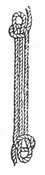
THE SHEEPSHANK
This knot is used to shorten a rope. Take up the
amount of rope to be shortened and make a half hitch
around each bend as shown. If the knot is to be permanent
the ends above each half hitch should be lashed.
THE CLOVE HITCH
A useful knot for quick tying and easy release.
It is used in making fast the bow line of a boat in
coming into a wharf, in lashing poles together, etc.
Hold the standing-part in the left hand and pass
the rope around the pole or stake; cross the standing-part,
making a second turn around the pole,
and pass the end under the last turn. In making
a boat fast, form a bight with the end beneath,
throw this over the top of the pile or mooring stake. Form
another bight with the end on top, turn this over and throw
over pile, pulling end together. This is a very secure knot
which can be tied with the greatest rapidity.
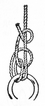
THE FISHERMAN'S BEND
A useful knot for use on board a yacht. Take
two turns around a spar or ring, then a half hitch
around the standing-part and through the turns on
the rings and another half hitch above it around the
standing-part.
THE TIMBER HITCH
Much used in logging operations in
hauling logs. Pass the end of the rope around the
timber. Then lead it around its standing-part and
bring it back to make several turns on its own part.
The strain will make it hold securely.
THE DOUBLE HALF HITCH
A knot which is easy to tie and will
not slip. A neat job may be had by lashing
the end to the standing-part after the knot is
drawn tight.
THE BECKET HITCH
Useful in fishing to bend a cord or line
to a heavier cord or rope. The method is
shown.
THE FISHERMAN'S KNOT
Used chiefly in tying gut. It is easy to tie
and can be readily untied by pulling the two
short ends. The ropes are laid alongside each other
and with each end an overhand knot is made around
the standing-part of the other. Pull the standing-parts
to tighten.
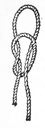
CARRICK BEND
A knot which is used principally in joining
hawsers for towing or heavy duty hoisting. Turn the
end of one rope A over its standing-part B to
form a loop. Pass the end of the other rope
across the bight thus formed back of the
standing-part B, over the end A, then under
the bight at C, passing it over its own standing-part
and under the bight again at D.
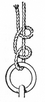
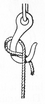
BLACKWALL HITCH
Used to secure a rope to a hook. The standing
part when hauled tight holds the end firmly.
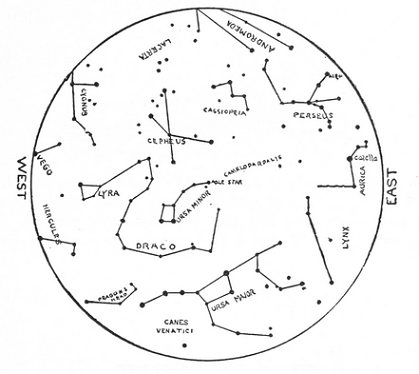
How to Find Your Way by the Stars
It is very important that those who frequent the forest
should be sufficiently familiar with the stars to be able to tell
their way by them. Often a compass is lost or damaged or there
is not enough light to see the landmarks. At such a time a
knowledge of how to find the Pole star is invaluable for, to the
experienced woodsman, a glimpse of this star is equivalent to
consulting a compass. It is really the most important of the
stars we see, although not a very bright one, because it marks
the North at all times and is fixed in its place, while all the other
stars seem to swing around it once in each twenty-four hours,
which makes it impracticable to use them for guidance. The
Dipper or Great Bear is well known to all American boys on
account of the size, peculiar shape and brilliancy of this
group, and the fact that it never sets in this latitude. This
group always points out the Pole star or Polaris, which is about
in a line with the stars (Alpha and Beta) which form the outside
of the Dipper at a distance about three and a half times as
great as the space separating these two stars. This star always
points out the North. If the imaginary line between Alpha
and Beta and Polaris is continued about the same distance
beyond Polaris it will meet Cassiopeia, five stars in the shape
of a W, which, like the Great Bear, is always seen in our latitude.
With these directions it should be always easy to locate
Polaris.
THE CIRCUMPOLAR CIRCLE
What to Do in Case of Accident
DROWNING
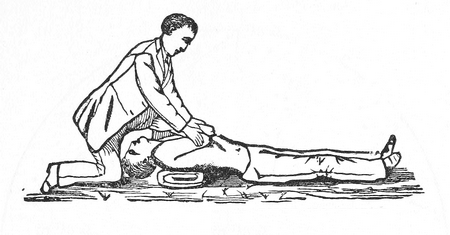
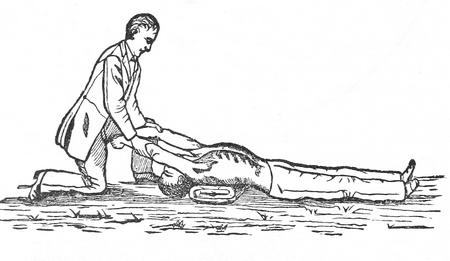
1. Loosen clothing, if any. 2. Empty lungs of water by
laying body on its stomach and lifting it by the middle so that
the head hangs down. Jerk the body a few times. 3. Pull
tongue forward, using handkerchief, or pin with string, if
necessary. 4. Imitate motion of respiration by alternately
compressing and expanding the lower ribs, about twenty times a
minute. Alternately raising and lowering the arms from the
sides up above the head will stimulate the action of the lungs.
Let it be done gently but persistently. 5. Apply warmth and
friction to extremities. 6. By holding tongue forward, closing
the nostrils, and pressing the "Adam's apple" back (so as to
close entrance to stomach), direct inflation may be tried. Take
a deep breath and breathe it forcibly into the mouth of patient,
compress the chest to expel the air, and repeat the operation.
7. Don't give up! People have been saved after hours of
patient, vigorous effort. 8. When breathing begins, get patient
into a warm bed, give warm drinks, or spirits in teaspoonfuls,
fresh air, and quiet.
ARTIFICIAL RESPIRATION—FIRST MOVEMENT
ARTIFICIAL RESPIRATION—SECOND MOVEMENT
BURNS AND SCALDS
Cover with cooking soda, and lay wet cloths over it.
Whites of eggs and olive oil. Olive oil or linseed oil, plain or
mixed with chalk or whiting. Sweet or olive oil and limewater.
LIGHTNING
Dash cold water over a person struck.
SUNSTROKE
Loosen clothing. Get patient into shade and apply ice-cold
water to head. Keep head in elevated position.
MAD DOG OR SNAKE BITE
Tie cord tight above wound. Suck the wound and cauterize
with caustic or white-hot iron at once, or cut out adjoining
parts with a sharp knife. Give stimulants, as whiskey, brandy,
etc.
STINGS OF VENOMOUS INSECTS, ETC.
Apply weak ammonia, oil, salt water, or iodine.
FAINTING
Place flat on back; allow fresh air, and sprinkle with water.
Place head lower than rest of body.
TESTS OF DEATH
Hold mirror to mouth. If living, moisture will gather.
Push pin into flesh. If dead the hole will remain, if alive it
will close up. Place fingers in front of a strong light. If alive,
they will appear red; if dead, black or dark. If a person is
dead decomposition is almost sure to set in after 72 hours have
elapsed. If it does not, then there is room for investigation
by the physician. Do not permit burial of dead until certain
indication of death is apparent.
CINDERS IN THE EYE
Roll soft paper up like a lamplighter, and wet the tip to
remove, or use a medicine dropper to draw out. Rub the other
eye.
FIRE IN ONE'S CLOTHING
Don't run—especially not downstairs or out-of-doors.
Roll on carpet or wrap in woolen rug or blanket. Keep the
head down, so as not to inhale flame.
FIRE FROM KEROSENE
Don't use water, it will spread the flames. Dirt, sand,
or flour is the best extinguisher, or smother with woolen rug,
table-cloth, or carpet.
SUFFOCATION FROM INHALING ILLUMINATING GAS
Get into the fresh air as soon as possible and lie down.
Keep warm. Take ammonia—twenty drops to a tumbler of
water, at frequent intervals; also, two to four drops tincture of
nux vomica every hour or two for five or six hours.
ANTIDOTES FOR POISONS
First. Send for a physician.
Second. Induce vomiting, by tickling throat with feather
or finger. Drink hot water or strong mustard and water. Swallow
sweet oil or whites of eggs.
Acids are antidotes for alkalies, and vice versa.
RULES IN CASE OF FIRE
Crawl on the floor. The clearest air is the lowest in the
room. Cover head with woolen wrap, wet if possible. Cut
holes for the eyes. Don't get excited.
Familiarize yourself with the location of hall windows
and natural escapes. Learn the location of exits to roofs of
adjoining buildings. Learn the position of all stairways, particularly
the top landing and scuttle to the roof. Should you
hear cry of "fire," and columns of smoke fill the rooms, above
all keep cool. Keep the doors of rooms shut. Open windows
from the top. Wet a towel, stuff it in the mouth, breathe
through it instead of nose, so as not to inhale smoke. Stand at
windows and get benefit of outside air. If room fills with smoke
keep close to floor and crawl along by the wall to the window.
Do not jump unless the blaze behind is scorching you. Do
not even then if the firemen with scaling ladders are coming up
the building or are near. Never go to the roof, unless as a last
resort and you know there is escape from it to adjoining buildings.
In big buildings fire always goes to the top. Do not jump
through flame within a building without first covering the head
with a blanket or heavy clothing and gauging the distance.
Don't get excited; try to recall the means of exit, and if any
firemen are in sight, don't jump.
If the doors of each apartment, especially in the lower part
of the house, were closed every night before the occupants retired
there would not be such a rapid spread of flames.
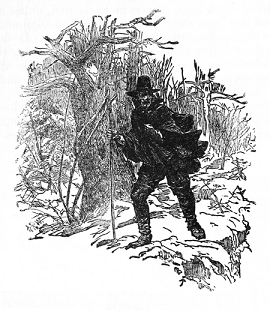
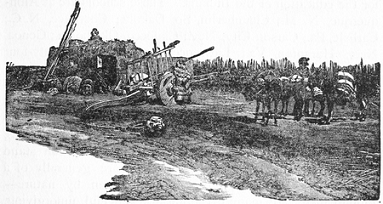
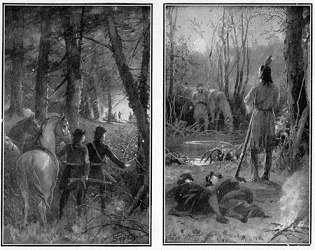
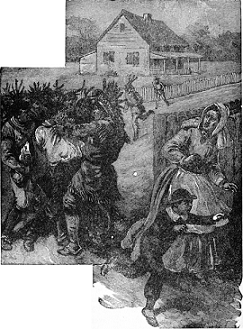
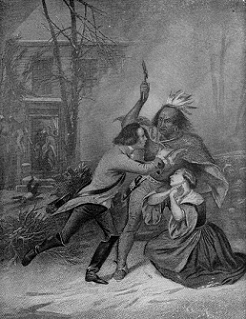
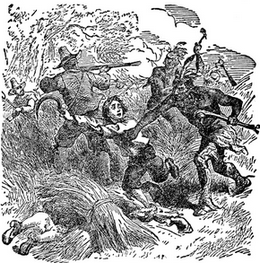
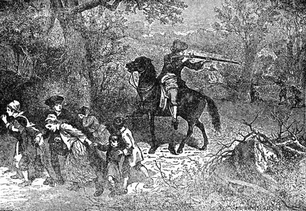
A SETTLER FLEEING FROM THE INDIANS
THE ORIGINAL AMERICANS
Indian always attracts attention. I have
no doubt that all the boys and girls who
read these pages have seen one or more
Indians. You do not have to go to the
mountains and prairies of the West to
meet these "original Americans," for
they live among us; many of them attend
schools of their own in different parts of
the country, and some of them are engaged in business. For
years past the football club of the Indian School at Carlisle,
Pennsylvania, has ranked among the best, as more than one
of our colleges have found to their cost. A full-blooded
Indian was a member of General Grant's staff, and was
present at the surrender of General Lee at Appomattox.
Where did these red people come from? Nobody knows
any more than he knows where or when the first human being
appeared on this earth. There have been a good many
guesses—for they are little more—to tell how the Indians
came to be on this continent. Some have thought they are
descendants of the Lost Tribes of Israel, who passed across
Bering Strait from Asia, and, in the course of centuries, spread
over and peopled both North and South America. Why their
color changed to the well-known copper tint must have been
due to the climate, though it is hard to understand why
other persons should become yellow, brown or black. Then,
too, a learned man once said there was no reason why the
Indians might not have crossed Bering Strait from the other
way, and peopled the Eastern Hemisphere. No doubt we
shall have to wait a long time before learning all about the
origin of man.
You hardly need be told how these red people got their
name. Christopher Columbus, when he caught sight of land,
after sailing so many weeks to the westward over the Atlantic,
thought it was a part of the Indies. So, quite naturally, he
called the natives Indians, and the name will never be changed.
You have heard of the Mound Builders, and many of
you have seen some of the vast piles of earth which they
heaped up hundreds of years ago. Ohio has ten thousand
such mounds, and one near St. Louis covers eight acres. For
a long while, it was believed that the Mound Builders were a
race different from the Indians, who in the course of time gave
place to them. This is a mistake. They belonged to the
same race, and when Columbus discovered America, the
Mound Builders were working like beavers in many parts of
the country.
I am quite sure that you boys and girls, when reading or
thinking about the Indians, have believed they were dying off,
and the day would come when there would not be one of
them left in America. No doubt you have felt sad over the
thought (I remember when I was a little fellow how I shed
a tear, and sniffed and hoped a few of them wouldn't die till
I had become a man and gained a chance of seeing them.)
This mistake is one of the most curious of which I know.
There are to-day as many Indians in this country as there
were four hundred years ago. The last census of the tribes in
Canada shows a slight increase. True, some tribes have been
destroyed, but others have grown in number. There are
more Iroquois or "Six Nation" Indians now than during the
Revolution. When the end of all things comes, and the
white men of this country are called to be judged, plenty of
red men will be among them. They are in the United States
to stay, and stay they will as long as the white man remains.
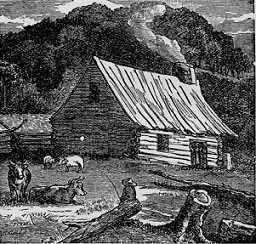
AN OLD INDIAN FARM-HOUSE
At the opening of the twentieth century, the Indian
population of the United States was more than 270,000. This
did not include Alaska, and is a clear increase during the
preceding ten years. More than a third of the Indians wear
civilized dress, and a half of this third know how to read.
Nearly a half of all the Indians are on "reservations" or
at schools. The five civilized tribes, and their members in
round numbers are: Cherokees, 30,000; Chickasaws, 7,000;
Choctaws, 15,000; Creeks, 15,000; Seminoles, 2,500. They
have fine schools, churches, banks, newspapers, factories and
all the luxuries of modern life, with a system of government
copied after our own.
More than a million dollars is spent every year by our
government for the support of the various schools formed
for the education of the Indians. These schools are at Albuquerque,
N. M.; Chamberlin, So. Dakota; Cherokee, N. C.;
Carlisle, Pa.; Carson City, Nev.; Chilocco, Oklahoma; Genoa,
Neb.; Hampton, Va.; Lawrence, Kansas; and twenty-four
other places.
You know that while the color of the Indians shows different
shades, it is so similar that, leaving out the Eskimos,
it is certain all of them had the same origin. The "pure-bloods"
have coarse black hair, black eyes, high cheek bones,
and not much muscular development, but they can stand
a wonderful amount of fatigue. They are generally of a
melancholy disposition, brooding and sullen by nature—though
there are many exceptions—revengeful, unforgiving,
treacherous, and yet they do not forget favors or kindnesses
shown to them. The fact that from the day the first white
man set foot on this continent he has abused the Indians, had
much to do with the hatred shown by them toward these
invaders from across the ocean.
Now, when you bear in mind that a good many tribes
number only a few hundreds; that four hundred languages
and two thousand dialects are used by the natives of North
and South America, you will see how hard it is to classify
them. Yet it is said the members of each tribe can be
recognized. A good many systems have been used in
classifying the Indians, but the best is that which divides
them as follows:
The Panis-Arapahoe family, including the Panis or Pawnees,
the Arapahoes and the Jetans, called Comanches by the
Spanish.
COURTSHIP AMONG THE INDIANS
The Columbian family, including the tribes in the North-west,
of which the principal are the Snake or Flatheads, and
the Shoshones.
The Sioux-Osage family, in which are found the powerful
and numerous Sioux or Dakotas, the Assiniboines, who
live in alliance with the Chippewas, the Mandans and the
Osages.
The Mobile-Natchez, or Floridian family. This is
composed of six independent branches, each divided into several
tribes, including the five civilized ones already referred to.
The Algonquin, Huron (Wyandot) and Iroquois family.
The first two named are residents of Canada, while many of
the Iroquois live in Central New York.
The Lenape family include the Shawanoes, Kickapoos,
Sacs, Foxes, Illinois, Pottawatomies, Winnebagoes, Delawares
or Lenni-Lenape, Mohicans, Chippewas, and several
others. The Apaches forming the most terrible of all Indian
tribes, belong to the Mexican family.
The Indians knew nothing of firearms until they saw
them in the hands of the white men. Like the ancient barbarians
of other countries, they made use of the primitive bow
and arrow, spear, tomahawk, knife and club. Swine, sheep,
cows and horses were unknown until brought across the
ocean by white men. America, in turn, gave tobacco to the
Old World. The warrior lolled in his wigwam or tepee,
smoking his pipe, while his squaw scratched the earth and
raised maize and a few vegetables. Now and then the head
of the household wandered into the woods to hunt for game,
or to fish in the streams. His delight, however, was in going
on the "war-path," and in slaying those of his own race, who
belonged to another tribe. Through the gloomy depths of
the forest, where only his trained eye could trace the prints
of the moccasin, he tracked his enemy, braving storm, heat,
cold, fatigue, starvation, and every kind of hardship, for the
chance of stealing upon the sleeper, or catching him off his
guard. Burying his knife in his breast, or driving his deadly
arrow into the heart of his enemy, he wrenched the scalp from
his crown, and with a shout of triumph, hurried back to his
own people, with the shocking proof of his bravery. The
members of the tribe who thus lost one of their number did
not rest, so long as there was hope of revenge. Thus the
fierce warfare went on, just as if these dusky people were
civilized, or belonged to some of the "feudists" in certain
parts of our country.
Among the many thousands of Indians there have
appeared from time to time, numerous men of striking mental
ability. They have had some of the most eloquent of orators,
while others have shown marked military skill. Brought into
contact with the white people, they have sometimes surpassed
the Caucasian in real genius. In tracing the history and
development of our country, we meet proofs of such skill
and ability on the part of the Indians, and in the pages that
follow we shall give attention to the most interesting
instances, whose truth cannot be questioned.
CHAPTER I
THE ORIGINAL
EMPERORS OF VIRGINIA
POWHATAN AND OPECANCANOUGH
The first permanent settlement made
in the original thirteen States was at Jamestown,
Virginia, by the English in the spring
of 1607. The settlers were at once brought
in contact with two famous Indians, to
whom we must now give attention.
The London Company, formed for the
planting of colonies in the New World,
sent three ships across the ocean in the month of December,
1606. They carried one hundred and five men, but no
women, and were in charge of Captain Christopher Newport.
They sailed up the Chesapeake Bay, and were charmed by
the soft breezes, the fragrant wild flowers and the beautiful
scenery. They halted at a peninsula (now an island), about
fifty miles from the mouth of the James, so named in honor
of their king, and began putting up cabins. Thus Jamestown
was founded on the 13th of May, 1607.
At that time the country from the Allegheny to the
ocean, and from the southern James to the Patuxent River,
was inhabited by three families of Indians, each composed of
a number of tribes. With two of them we have nothing to do.
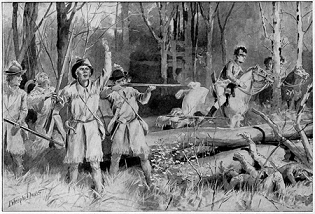
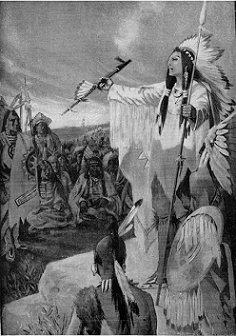
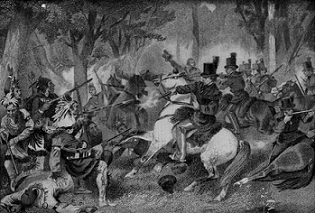
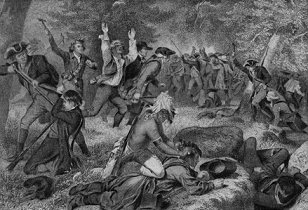
THE INDIANS DEFEATED AT FALLEN TIMBERS. This was one of the most memorable battles ever fought
with the Indians.
It broke their power and gave supremacy to the whites.
August 20, 1794.
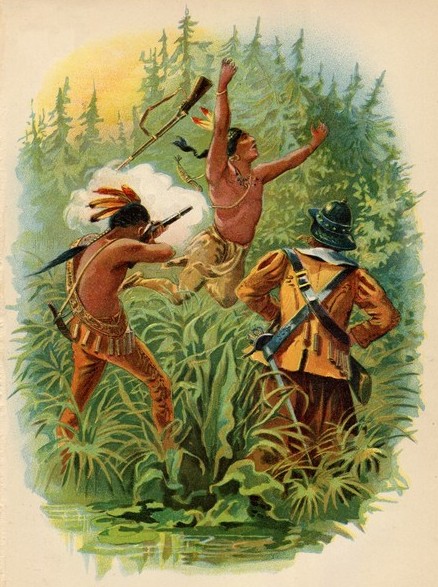
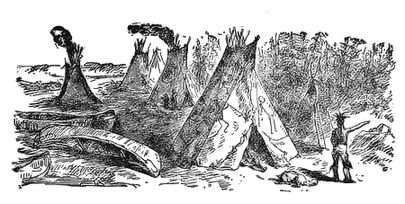
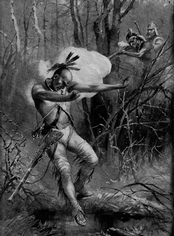
SURPRISING AN INDIAN CAMP.
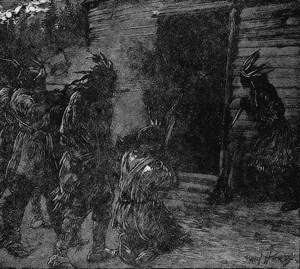
THE FAITHFUL INDIAN GUARD.
The Powhatans lived in the lowland region, reaching
from the Carolinas on the south to the Patuxent on the north,
and between the sea to the falls of the rivers. They had more
tribes than either of the other families, ten being between the
Potomac and the Rappahannock; five between the Rappahannock
and the York; eight between the York and James; and
five between the James and the Carolinas.
The Powhatan League was one of the most powerful on
the continent and occupied what is now Henrico county, on
the shores of the James, and about two days' journey from
Jamestown.
You will see that the head of this league or confederacy
ruled over thousands of warriors, most of whom he had conquered
and compelled to accept him as sovereign, whose
will the bravest under-chief dared not dispute. In order to
give him his proper importance, historians generally refer to
him as "Emperor," a title which it would seem was proper.
He is known as Powhatan, which is the same as his special
tribe, or rather as his chief seat or capital. This old town had
a dozen houses which stood a short distance below the present
city of Richmond, on the banks of the river. Fronting it were
three islets.
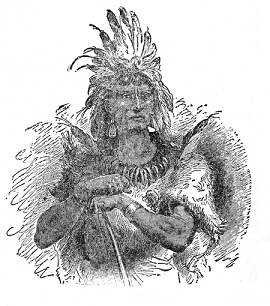
At the time of the settlement of Jamestown, Powhatan
was about sixty years old. He was gaunt and tall, and as
vigorous in body and mind as a man of half his years, and
the gray hair, which was plentifully sprinkled through the
black locks, gave a majesty to his looks. His head-dress was
made of a mass of feathers, and his robe of state was of raccoon
skins. The wooden bench or form upon which he was
accustomed to sit, might be taken as a throne, and his reign
over many tribes, most of whom he had conquered, gave a
certain fitness to the name of emperor. It should be noted
that never did his son follow to the throne, but instead his
brothers, then his sisters, and then the heirs of the oldest
sister, all in turn were to inherit power.
Powhatan usually kept two-score of his bravest warriors
as a body-guard about him, but when he learned of the coming
of the pale faces to the mouth of the river, he made the
number two hundred. He had favorite places where he
passed the different seasons, a fashion that was often followed
by the Indian chiefs in New England.
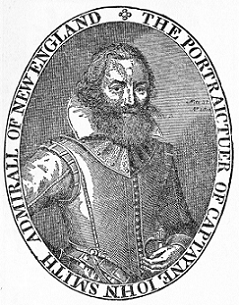
The settlement of Jamestown brings forward the name
of the most remarkable pioneer connected with our early history,
Captain John Smith, the "Father of Virginia." Could
we believe one-half that this man told about himself, we
should have to admit that he was one of the greatest heroes
in history. He was a great boaster, and many of the things
he told were simple invention. More than one of the most
daring exploits that he claimed to have performed in the Old
World have been proved impossible. None the less, Captain
John Smith was brave, enterprising, unselfish, tactful, industrious
and far-seeing, and but for him Jamestown would have
perished from the earth within a few months after building the
first cabins. Enough of him is known to prove that he was
not only the founder, but the saviour of Jamestown.
Smith was a native of Lincolnshire, England, and when
he reached Virginia, was not thirty years old. He had a
powerful physique, and did not hide his disgust with the "gentlemen"
of the colony, who thought themselves too good to
work. He gave them the choice of working or starving, and
he set the good example of toiling as hard as any of them.
The settlers with whom he came did not reach Virginia until
the planting season was over, and, before long, all were suffering
for food. The only thing left to do was to get it from the
Indians, and Smith set out to do so. But the red men knew
of the needs of the pale faces, and despised them therefor
Smith tried to get them to sell, but they refused, or at
the most would give but a handful of corn for a gun or a
sword. Seeing no other means left, Smith and his men
opened fire on the churlish fellows, drove them into the
woods, and marching into their village, carried a good supply
of corn back to Jamestown.
For many years after the discovery of America, it was
thought that it was only a narrow strip of land, and that a
short journey to the westward would take one to the South
Sea on the other side. As late as 1609, when Henry Hudson
sailed up the stream named for him, it was in the belief
that he had not far to go to reach that vast body of water. Captain
Smith was ordered to explore the streams in the neighborhood
of Jamestown. In obedience to this command, he set
out to learn the sources of the Chickahominy. He went up
that stream until the waters became too shallow to allow the
barge to go farther, when he stepped with two of his men
and two friendly Indians into a canoe and paddled away. He
told those left in the boat to stay in the middle of the stream,
and forbade them to approach either bank until he came back.
But he had not been gone long, when those that remained
became tired of sitting motionless in the barge, knowing that
their leader could not join them for many hours, and mayhap
not for two or three days. Peering into the woods and listening,
they saw and heard nothing to cause fear. So after
talking for a little time, they paddled to shore and stepped
out on land. They had hardly done so, when they were
attacked by Indians and one killed, the others escaping with
great difficulty. The news they took back to Jamestown
made every one believe they would never again see Smith or
his companions.
Meanwhile, the pioneer was pushing his way into the
wilderness, with no thought of what had befallen the men left
behind in the barge. The light canoe was just buoyant
enough to float himself and friends, and they paddled up the
narrowing stream with all possible care. The day was wearing
away, and, since they had no food, Smith decided to hunt
for wild fowl. Landing, he went forward alone, never dreaming
that Opecancanough with a large body of warriors was
tracking him through the woods. This chief came upon the
two Englishmen while they were asleep and killed both. Then
they hurried after Smith, who they knew could not be far away.
When the pioneer caught sight of the dusky figures flitting
among the trees, firing their arrows and pressing towards
him, he tried to retreat to his canoe, but soon saw that he
would be cut off. He seized one of his Indian companions
and swung him round in front, as a shield. The pursuers did
not wish to harm a member of their own race, and Smith
found for a time that the novel armor served him well. As
fast as he could load his gun he fired into the swarm of warriors,
who were so close together that he did not miss. He
wounded a number and said he killed three, which may be
true.
The doughty pioneer could give no attention to his feet,
since he dared not take his eyes off his pursuers. He was
slowly falling back, and hopeful of getting away, when he
stepped into a marshy place into which he immediately sank
above his knees. Even when in this plight, the Indians were
afraid to lay hands on him. They would steal forward and
then scramble in a panic for the shelter of the tree trunks,
afraid he was about to fire his terrible gun at them.
Smith struggled hard to free himself from the mire, but
with every effort only sank deeper. The weather was cold,
and, seeing that he must perish if he staid where he was, he
set free his human shield and flung away his weapons. He
expected to be killed at once, but the captors drew him out
of the mud and led him back to the place where the two Englishmen
had been slain, and where a fire was kindled. The
warmth of this brought back his vigor and hopefulness, and
seeing no disposition to do him immediate harm, he asked
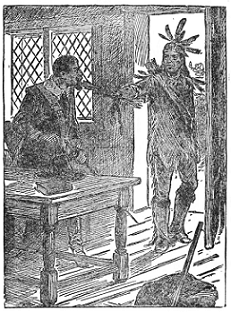
for their chief. The famous Opecancanough came forward.
The captive handed him a small compass. The chief took it
in his hand while his warriors gathered around and all studied
the odd-looking instrument with deep interest. The darting
about of the tiny needle filled them with wonder, and for the
moment no one thought of doing the white man any harm.
Smith says that through the compass he made clear to
the Indians the roundness of the globe, the spheres of the
sun, moon and stars, the revolution of the earth on its axis,
the immensity of the land and sea, the diversity of the nations,
the antipodes, "and many other such like matters, so that all
stood amazed with admiration!" And yet how are we to
believe that, unable as he was to speak the Indian language,
Smith "explained" these strange things to the Indians, or
that they could have gained any idea of his meaning! Such
a feat was surely beyond his power.
The compass, however, was to serve a good purpose, for
when the warriors had tied Smith to a tree and were about to
fire their arrows at him, Opecancanough held up the curious
instrument and they stopped. The captive was taken to the
home of Powhatan, on York River, and well treated. Indeed,
he was fed so much that he began to suspect they were fattening
him in order that he might make a fine meal for them.
The capture of the leader of the colony sharpened the
appetites of the Indians for greater deeds, and they got ready
to destroy Jamestown. They tried by every means they
could think of to get Smith to help them, promising him
much land and the finest of their women as wives. Nothing
could lead Smith to turn against his own countrymen, and
he tried to show his captors that their plan was hopeless.
Smith then did a slight thing of itself, which filled the Indians
with wonder. Taking a blank leaf from his pocket book,
he wrote upon it a brief account of the plot, and asked his
friends to send him a number of articles which he named, and
which he promised the Indians they could get by taking the
slip of paper to Jamestown. The messengers made the journey
in the face of severe weather, and brought back the
things which Smith had promised. How he managed thus
to talk with his friends many miles away, was a mystery
which the native mind could not grasp.
Since the red men had to give up their plan of capturing
Jamestown, they tried to impress him with their own greatness.
He was taken from place to place, among the different
tribes, and finally brought back to Opecancanough. He was
feasted again, the Indians looking upon him as a sort of god.
He was next led into the presence of the mighty Powhatan,
where, after a time, it was decided to put him to death.
This brings us to the incident which is the most famous
in the history of Captain John Smith. He says his head was
laid upon two large stones and the warriors were about to
beat out his brains, when Pocahontas, the favorite daughter
of Powhatan, and not more than ten or twelve years old,
threw her arms around the prisoner's neck, and prayed her
father to spare him. He could not refuse the pleadings of
his loved child.
Whether such an incident ever took place will never be
known. While it is not impossible, many doubt its truth. It
seems to have been an afterthought of the grim boaster, for
years passed without anyone hearing a reference of it, and it
was not until the death of Pocahontas that Captain Smith
told how he had passed through such a strange experience.
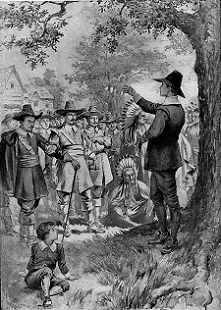
POCAHONTAS SAVING THE LIFE OF JOHN SMITH
Powhatan seemed to think that since he had spared
the life of the Englishman, the latter should be turned to
account. He made him help in forming bows and arrows,
moccasins, robes and copper trinkets. A son of the chieftain
became friendly to Smith, and did him many kindnesses
during his captivity. The Englishman rapidly learned the
tongue of his captors, and this knowledge afterwards proved
of great help to him. Finally he was sent back to Jamestown.
The guard who went with him were treated with great kindness,
and a number of presents were sent through them to
Powhatan. This seems to have won the friendship of the
old chief, who sent his daughter Pocahontas every few days
to the settlement with food, where it was sorely needed.
Everything would have gone well but for the foolish course
of Captain Newport, who soon after arrived from a voyage to
England. He gave Powhatan so many presents, that the
emperor was puffed up with his own importance, and refused
to part with any of his goods without being paid five or six
times their value. When Newport had offered about all he
had to offer, Powhatan sneeringly gave only two or three
bushels of corn in return. Then it was that Smith proved
himself as shrewd as the chieftain. He managed, as if by
accident, to let Powhatan see a number of shining beads of
blue glass. The chief's eye was caught, and he asked for
them. Smith said they were of great value, and only worn
by great kings. This fired the envy of the chief, who was
determined to own them, for who had a better right than he
to wear the jewels of a mighty monarch? With much seeming
unwillingness, Smith parted with the beads for more than
two hundred bushels of corn.
Powhatan began to fear that the continual coming of
new emigrants meant danger to himself and people. He
began plotting to massacre the settlers, but the prompt vigor
of Smith scared him, and he sent Pocahontas to Jamestown
with a message that the evil plot was due to some of his fiery
chiefs. Smith, who had taken several prisoners, thereupon
released them, and all remained tranquil for a time.
Captain Newport's silly course with Powhatan came to a
head in the autumn of 1608, when he arrived again from
England, just after Smith had been elected governor of the
colony. Newport brought a gilded crown for Powhatan, and
had the whole programme arranged for his coronation. At
the same time settlers were to offer to aid Powhatan against
a tribe with which he was at war. When this message was
sent to him, the haughty old leader told the English that
since he was a king he would not go to Jamestown, and as for
the offered help, he did not wish it, as he knew how to manage
his own affairs.
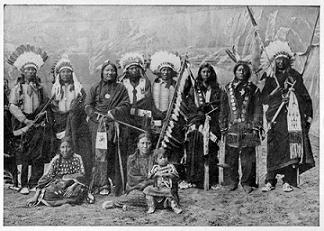
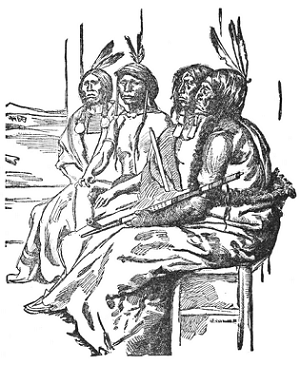
A GROUP OF INDIAN CHIEFS AND THEIR WIVES VISITING THE PRESIDENT AT WASHINGTON.
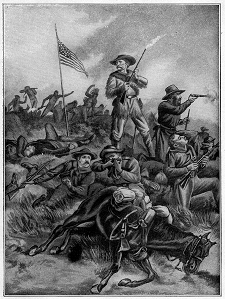
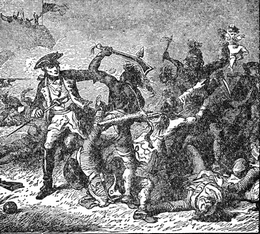
GENERAL CUSTER'S LAST CHARGE.
The Battle of the Little Big Horn Run, fought in 1876, by General Custer, in command of United
States troops against the Sioux Indians, resulted in the entire destruction of the troops and their
brave commander. It was the last great battle with the Indians in America.
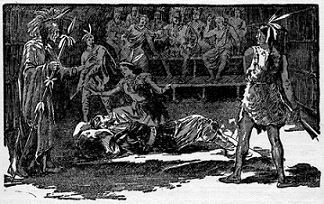
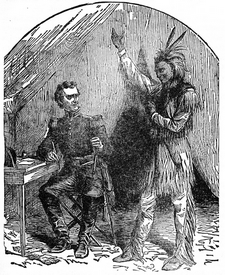
OPECANCANOUGH IN CAPTIVITY
Among the emigrants who came over with Newport were
three Germans, who believed because of the woful state of the
colony that it could not last much longer. They gave their
views to Powhatan, and were
base enough to offer to help
him in putting all the English
to death. The old chief
fell in with the plan, and
agreed that the first step necessary
was to "remove" Captain
Smith. Powhatan tried
many tricks to get him in his
power, but that wise man outwitted
him every time. The
chief warned his warriors that
if they failed to kill Smith he
would have them slain. About this time a strange accident
brought safety to the sturdy governor. One of Powhatan's
men had by some means got hold of a quantity of
gunpowder, which he told his friends he could handle as well
as the whites themselves. Several gathered round to watch
him, when the stuff suddenly blew up and killed the Indian
and two of his companions. Powhatan and the others were
terrified, and filled with a desire for peace. They brought
back many stolen articles, and, in 1609, sent half their crop of
corn to the settlers. About this time, Captain Smith was so
shockingly burned by the burning of his powder bags, that he
went to England for surgical aid and never returned to Virginia.
It should be added that of the three wicked Germans,
one died miserably, and the others were slain by order
of Powhatan, because of their deception.
The colonists told the chief that Smith was dead, but he
would not believe it, and some time later sent one of his
chiefs, Tomocomo, to England, to learn what had become of
him. Tomocomo was also ordered to find out all he could
about the country, and to learn how many white people were
there. The faithful servant began his duty by carrying a long
stick into which he cut a notch every time he met a stranger.
Needless to say that this means of taking the census proved
a failure. When he came back to Virginia and Powhatan
asked as to the population on the other side of the deep water,
Tomocomo made his famous answer: "Count the stars in
the sky, the leaves on the trees, and the sand upon the seashore,
for such is the number of people in England."
Powhatan had many broils with the English, but it is
only just to say the fault lay more often with the latter than
with him. The most shameful of all outrages was that of
Captain Argall, who while cruising up the James, invited
Pocahontas to visit his ship under the escort of a squaw that
had been bribed to betray her. Argall made Pocahontas a
prisoner, and took her to Jamestown. He believed Powhatan
would hasten to ransom her for a large amount of corn which
the settlement needed, but the enraged parent hastily prepared
to go to war. During these evil days, John Rolfe and the
dusky maiden fell in love with each other, and were married
in the quaint old chapel at Jamestown in the month of April,
1613. This pleasing event made Powhatan the friend of the
white man and as such he died five years later.
We recall that Pocahontas and her husband visited England
in 1616. She received much attention from the court
and the leading people of the kingdom, but when about to
sail for her native land fell ill and died. She left an infant
son Thomas, who was educated in London by his uncle
Henry Rolfe.
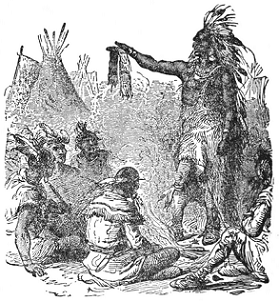
AN INDIAN EMPEROR'S DECLARATION OF WAR
He
settled in Virginia
after reaching manhood,
became
wealthy, and was
one of the foremost
members of the
colony. His only
daughter married
Colonel Robert
Bolling; their son,
Major John Bolling,
was the father
of a number of
children. One of
the daughters married
Colonel Richard
Randolph, who
was the ancestor of
the famous John
Randolph of Roanoke,—a
fact of
which he was always very proud. Thus the blood of Pocahontas
flows to-day in some of the leading families of the Old
Dominion.
Now, no one would think the life of Captain John Smith
complete without the story of Pocahontas. Its romance lends
it a pleasing interest, despite the doubt that must always
linger as to its truth. But have you ever heard that his life
was saved by another Indian maiden, and that a different
section of the country produced its Pocahontas to serve her
merciful purpose? The story is a sad one, because the
beautiful and heroic girl was killed as you shall hear.
AN OLD PRINT OF CAPTAIN SMITH
In the month of
March, 1905, Robert
H. Gardiner, of Bangor,
Maine, in rummaging
through
some old papers
bearing upon the
early history of Kennebec
River, found
proof that in the
summer of 1614
Smith sailed up the
river to the chief village
of the Cabassas
tribe of Indians,
which stood on the
present site of Gardiner.
The daughter
of the chief, Saboois
by name, so
liked the manner and looks of Smith, that she formed a
strong attachment for him. He was so interested with
important matters, however, that he gave no encouragement
to her. The visit to the chief was very friendly, but when
Smith was about to leave, one of his lieutenants, named
Hunt, headed a mutiny, and, with several others, set out on a
new expedition, taking several of the Cabassas tribe with him
as captives. Not knowing of the division of the party, the
chief called his warriors together, and started in pursuit of
Smith, with the resolve to destroy the white men for the outrage
of which he believed all were equally guilty.
Knowing the danger of Captain Smith and his friends,
Saboois ran ahead and warned them. She overtook the party
just as they had encamped for the night a few miles down
the river. The chief and his warriors were close behind, and,
at the moment the Cabassas maiden flung her arms around
Captain Smith, a shower of arrows poured into the camp.
One of these pierced the girl's breast, while shielding the captain,
who was thereby saved at the cost of the life of his
devoted friend.
The horrified chief stopped hostilities. This gave Smith
the chance to explain that it was the mutineers who had kidnapped
his people. The Indians carried the body of Saboois
back to their village, and sorrowfully laid it away near what
is now Randolph churchyard, and then started in pursuit of
Hunt and his party. They were overtaken and all slain near
Norridgewock, after which the rescued captives returned home
with their countrymen.
CHAPTER II
THE GREAT CONSPIRACY
A WILY CHIEFTAIN AND HIS SECRET
The great emperor Opecancanough, of
whom we have already told you, hated the
whites even more than his brother Powhatan.
He was a warrior of rare skill, much the
superior in all respects to Opitchapan, the
successor of Powhatan. Before the death of
the latter, Opecancanough secured the title of
king over the free tribe of the Chickahominy.
This chief was never a friend of the whites. He had several
quarrels with them, and had not been king long when
he began plotting to destroy the settlements. One cannot
help admiring the cunning and skill displayed by this arch
enemy of the English. He formed his plans with such secrecy
that not a hint of them reached the settlers before the hour of
the outbreak. Two days before the date of the massacre, a
party of Indians guided several Englishmen through the
woods, and sent one of their youths to live among the white
men, that he might learn their language. A messenger who
visited the chief was treated with the utmost kindness, and
told that peace with the white man should last as long as the
stars held their places in the sky. The settlers lent their boats
to the Indians who paddled to and fro as they chose. More than
one pioneer who had been fixed upon as a victim, sat with the
dusky assassins at his table on the morning of the massacre.
The awful blow fell on March 22, 1622, with the suddenness
of a lightning bolt from the blue sky. The warriors
seemed to spring from the ground. Neither sex, nor old
age, nor prattling infant was spared. The toilers in the fields
were shot down, women and children tomahawked, and in the
space of one hour, three hundred and forty-seven victims lay
stretched in death. Among these were six members of the
council and many of the leading people. The number of
plantations was reduced from eighty to six.
The massacre raged up and down the James, and all the
settlements would have been destroyed, but for the warning
of a Christian Indian, Chanco, who was able to make known
the peril in time for some of the people to save themselves.
White men can become as savage as Indians when their rage
is aroused. The summer months were spent in strengthening
the fortifications and in preparing for a campaign
against the Indians. Every man and boy able to handle
a gun was drilled in its use. So deadly was the general
temper that time was not taken for the planting of more than
half a crop. When everything was ready, the settlers took the
field, and began hunting down the savages as if they were so
many rabid dogs. No mercy was shown to any one. They
were followed far into the gloomy forests and shot wherever
sight was gained of them. Finally, the whites seemed to
grow weary, and sent word to the Indians that they were
now ready to forgive and make peace with them. Under this
pledge the warriors came forward, but the moment they were
within the power of the settlers, the latter assailed them
without mercy. This treachery was without excuse. For a
long time it was believed that Opecancanough was among the
slain, but such was not the fact, as the settlers were doomed
to learn to their cost.
Now comes one of the most awful scenes in all the great
story of American history. The seasons came and went
and all was serene and peaceful, so far as the keenest scouts
among the settlers could learn. Men passed to and fro in
the native villages, trusting themselves for days with the
savages, who could have wrought their will with them; they
were received by the grim Opecancanough himself, who told
of his sorrow that his chiefs and warriors had ever forgotten
their friendship for the pale faces, and he assured them
that no such wrong could ever occur again; the Indians
visited Jamestown and the different settlements, just as they
had done years before, without the slightest distrust on the
part of their hosts.
Opecancanough was past three-score and ten when the
massacre of 1622 took place. His athletic figure yielded
slowly to the passing years, the black strands that dangled
about his shoulders were whitened by the snows of many
winters, and the coppery countenance became seamed with
wrinkles. He stepped across the four-score mark, and finally
ten more years were added to his great age, with slight weakening
of his vigor and strength.
And all through the circling years, this wonderful chieftain
was completing his plans for another massacre of the
people that had come across the ocean to steal away the hunting
grounds of the red men. Deep in the gloomy depths of
the wilderness, he and his chiefs met, where no white man
ever saw them, and whispered their plans to one another.
Every dusky breast was thrilled by the hope that has nerved
myriads of Indians from the hour that the white men began
building their cabins on American soil; it was that of destroying
root and branch these invaders of their homes.
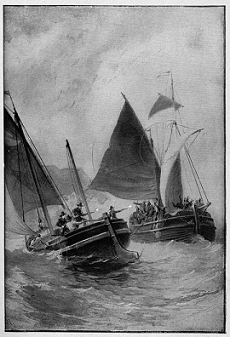
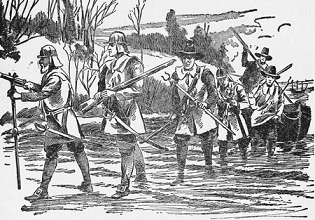
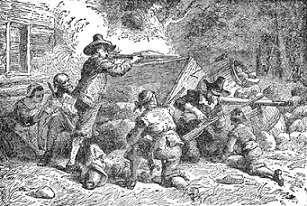
INDIANS MAKE POOR SAILORS. During the Pequod war a boat was captured by the Indians. They tried to sail it and defend it with
guns, but as seamen they were failures. The boat was re-captured by the brave
colonists and the Indian's slain.
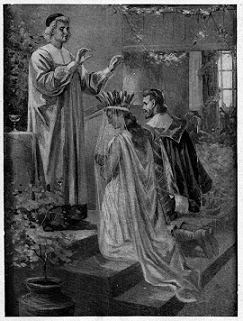
MARRIAGE OF AN INDIAN PRINCESS. Pocahontas, the daughter of Powhattan, who saved
Captain Smith's life, had a very romantic career.
She afterward married John Rolfe and went to
England to live. She never returned to America.
The chiefs and warriors did not need to be told by
Opecancanough that they were staking everything on this single
attempt. They had failed by the narrowest chance in
1622, and could not afford to fail again. The secret must be
kept, and the wonder of it is that it was kept for twenty-two
years. Not a whisper reached the ears of the settlers, nor
did any one seem to feel the first throb of misgiving. Through
the spring blossoming of flowers, the sultry fervor of summer,
the whirling snow and ice of winter, the plotters continued to
gather in the twilight depths of the woods, guarded by vigilant
sentinels, whom the most cunning scout could not pass,
and they talked and smoked their pipes and shook their heads
and brought their dreadful plot to perfection. Warriors and
chiefs died, and, as we know, the great leader of them all
steadily approached the age of a century, but still the blow
was withheld, for all was not ready. Incredible as it may
seem, Opecancanough was nearly a hundred years old when
he gave the order to attack the settlements. By this time, his
iron frame had become so feeble that he could not walk. His
warriors carried him on a litter, that he might lead in the
assault that should not leave a white man or woman on the
soil of Virginia.
One cause for fixing upon April 18, 1644, for the attack
was the state of affairs at Jamestown. The chief kept himself
informed, and he knew of the bitter quarrels that were raging
there. Revolts had broken out, and the condition of the people
invited the long postponed assault. Opecancanough
sent his swiftest runners to the distant tribes of the confederacy
which he had built up during the many years that had flown since the first massacre.
AN INDIAN COUNCIL OF WAR
He meant to lead in person
the five nearest tribes, while the more remote ones were
placed under the command of
their different chiefs. Thus, by
a simple plan, the hundreds of
savages from the mouth of the
Chesapeake to the
sources of the principal
rivers which flow
into it, were joined into a compact force, easily handled without
confusion. This fearful horde was to be hurled against
the settlements at the same hour, and there could be no turning
back after the first tomahawk had fallen.
There was no warning as before. The thunderbolts
struck the whole line of settlements at the same hour and
almost at the same moment.
Owing to the turmoil of those times, we have no reliable
account of the great massacre in Virginia in 1644, but five
hundred people fell victims to the ferocity of the Indians, who
raged up and down the James for two days. Many were carried
into captivity, while cabins, crops, farming implements,
and all manner of property were destroyed. The fleetest of
foot escaped in some instances, and made haste to Jamestown,
which flew to arms. All who were able to handle a
weapon were called, and every twentieth man was placed
under the immediate command of Governor Berkeley, who
hurried his preparations for marching into the Indian country,
every soldier as resolute as he to destroy those who were
making such awful havoc among the plantations.
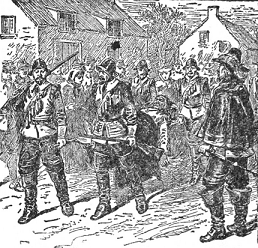
Berkeley, afterwards known as the tyrannical Governor
of Virginia, was a young man at that time, and a good military
officer. When he led his body of picked horsemen
against the Indians, he resolved to keep up the warfare until
he captured the leader himself. He pushed the pursuit with
all vigor and finally ran Opecancanough down, and made
him prisoner. Like the Roman conquerors, he brought him
as a token of his triumph to his capital, but it is to be said to
the credit of Berkeley that he treated his royal captive with
the respect due to his fame and prowess. He placed him in
proper quarters, and set a guard about the building to keep
back those who might wish to gaze upon the distinguished
prisoner.
The condition of Opecancanough at this time was pitiful.
He was barely able to raise an arm or a foot, and became so
feeble that when he wished to make use of his eyes, some one
had to lift the lids for him. Still he kept to a striking degree his
kingly dignity. Hearing confusion one day about his prison,
he had his eyes opened for him, and noticed a number of persons
peering into the room. He sent for Governor Berkeley
and said, reproachfully, "Had it been my fortune to make
you prisoner, I would not have exposed you as a show to my
people."
The Governor gave strict orders to save the captive from
all annoyance. Struck by the vitality of the chief, he thought
of sending him to England, not only as proof of the prowess
of the ruler of Virginia, but as evidence of the good qualities
of the climate, which many visitors had said was bad.
This plan, however, was defeated by the cruelty of one
of the guards. Thinking upon the ruin and death that had
been wrought by Opecancanough, he raised his musket one
day and sent a bullet through the body of the prisoner. Thus
died the most remarkable Indian connected with the early
history of Virginia. His influence over his countrymen was
greater than Powhatan's had ever been. His complaint was
that the whites were fast taking all the hunting lands from
the Indians, and that the overthrow and ruin of the latter
could be prevented only by the massacre of the invaders. In
this attempt, like many leaders of his race, he failed, and comparative
peace followed his death for many years.
CHAPTER III
ADVENTURES IN NEW ENGLAND
THE INDIANS AND THE PILGRIMS
OU have all heard of the hardy Pilgrim Fathers.
The Pilgrims landed at Plymouth, Massachusetts,
in 1620. Several wooden huts were built, ground
marked off, and the company divided into nineteen
families. Thus was made the first permanent settlement
in New England, several former attempts having ended in
failure. Those early pioneers, who were a sturdy, God-fearing
people, had a rough time of it from the beginning, and before
spring came, one half of them had died, Governor Carver
passing away in April.
A great surprise came to the little band of settlers one
day in March, when an Indian walked out of the woods and
came toward them. Although the weather was cold, his only
clothing was a band of leather about the waist to which a
fringe hung. He strode boldly forward, and, when he saw
the looks of astonishment, called out:
"Welcome, Englishmen! Welcome, Englishmen!"
The first thought that came to the settlers was wonder as
to how this native had learned their language. His name was
Samoset, and he had picked up a few words from the English
fishermen on the coast of Maine. Because of the chilly
air, one of the men brought out a horseman's coat and flung
it over the shoulders of their visitor. He wished to talk and
to tell the white men all that could interest them. By means
of the few English words he knew, and by signs he succeeded
quite well. He felt at home, and ate and drank all that
was set before him. He said that he lived at a place
called Pawtuxet, but a few years before all the men and
women had died of a dreadful plague. It was afterwards
found that Samoset
told the truth.
GOVERNOR WINSLOW
SOLDIER AND STATESMAN
The dusky caller
was more eager to
stay with the Englishmen
than they were
willing to have him as
a guest. They bade
him good-bye as night
drew on, but he chose
to remain with them,
leaving Plymouth the
next day to go to Massasoit,
of whom he had
spoken several times.
He said Massasoit
was a great sachem,
who would come in a
few days to barter
beaver skins with the
white settlers and to pay his respects to them.
On the following Sunday, Samoset was on hand again.
He brought with him five warriors as tall and pleasing in
their looks as himself. He had been told that he and his companions
must not come into the settlement with their weapons.
Accordingly, they left their bows and arrows some
distance from town. They were treated well, but the settlers
would not trade with them because it was Sunday. When
the five left, Samoset claimed he was ill, and stayed at Plymouth
for three days. In fact, he had formed a stronger liking
for the colonists than they had for him. The visitors had
promised to come again to barter, and they kept their promise.
The most important news, however, brought by them was
that Massasoit, their great sagamore or chief, was only a
short distance off, awaiting the chance for an introduction to
the white men. An hour later the chief with sixty of his followers
appeared on the crest of a hill not far away.
The settlers distrusted the meaning of the visit of so
large a body. It might be they meant to massacre the whites,
and were using their usual trickery to gain an advantage over
them. Among the colonists was an Indian named Squanto,
who had been kidnapped several years before, and kept for
some time in England, where he learned to speak the language.
He was now sent to Massasoit to ask the wishes of the sagamore.
The reply was a request for one of the Englishmen
to come out and have a talk with him. Edward Winslow
did so, and gave a number of trinkets to the great chieftain,
who showed childish delight over the presents. Through
Squanto, Winslow told Massasoit that the King of England
sent him words of peace and love, and that the Governor of
Plymouth wished to make a treaty of friendship with him.
When the speechmaking was over, Massasoit left Winslow
with the warriors as a hostage, while he and twenty of his
men, leaving their weapons behind, walked forward for a talk
with the governor. They were conducted to a house not
then finished, where Governor Carver welcomed them and
ordered refreshments, of which all partook. "Strong water"
was a part of the dinner. It was new to the Indians, but
they were pleased with the fiery stuff, of which they drank
enough for its effects to show. The natives became quite
merry, and it is to be feared that the Puritans reached a mellow
mood. Be that as it may, no more favorable time could
have been chosen for agreeing upon a treaty, and the important
fact is that Massasoit made one treaty with the English
which was kept sacred for more than fifty years.
It will help to understand the early history of New England,
if we remember that the Indians of that section consisted
at that time of five confederacies, or leagues, of different numbers
and strength. The Pawtuckets lived mainly in southern
New Hampshire; the Massachusetts around the bay of that
name; the Pequots in eastern Connecticut; the Narragansetts
to the east of the Pequots, Rhode Island and the other small
islands in the neighborhood being within their territory, while
the Pokanokets, more generally known as Wampanoags,
embraced portions of Plymouth and Barnstable, and a good
deal of the country between the Pawtucket tribes and the
Massachusetts, with a part of present Bristol county, Rhode
Island. The Wampanoags numbered nine tribes, each governed
by its own sagamore, and all subject to Massasoit,
the grand sachem, who generally lived near Mount Hope.
Governor Carver died a few weeks after the signing of the
treaty named, and was succeeded by William Bradford,
who held the office for many years. To him, more than
to any one person, is due the success of the first colonies
planted in New England. The most striking tribute to the
greatness of Massasoit lies in the fact that while it was a rule
among his race that the foremost warriors attained their fame
through personal courage and deeds, yet he was a man of
peace. But he held the numerous tribes together without
war, and ruled over a larger dominion and a more numerous
people than Powhatan, Opecancanough, Pontiac or Tecumseh.
True, the last two held full sway at certain times, but it was
for purposes of war only.
HIAWATHA, FOUNDER OF THE IROQUOIS LEAGUE. The Iroquois League was composed of the Mohawk, Oneida,
Onondaga, Cayuga, Seneca and Tuscarora nations, who founded in
the New York wilderness a barbaric republic, with bonds of union that
might serve in many respects as a model for civilized nations of to-day.
THE INDIANS LISTEN TO A MISSIONARY. The Indians often visited the colonists and listened to the
traveling missionary, but only a few converts were made among
the red men during the seventeenth and eighteenth centuries.
It will be recalled that Powhatan had several homes.
The same was true of Massasoit, though his principal home
was at Mount Hope. Governor Bradford had hardly come
into office when he sent an agent to Massasoit to confirm the
treaty made with Carver, to procure seed corn and to explore
the country. Massasoit did as requested, and a piece of better
fortune could not have come to New England. Plymouth
and her neighbors for a long time were so weak, and their
sufferings from disease and hardship so severe, that a union
of the Indian confederacies would have swept them from the
earth. The feebleness of the colonists could not be hidden
from the Indians, but Massasoit checked the enmity of the
surrounding tribes, and by uniting with Roger Williams in
1637, the other red men were kept from joining the Pequots
in their war against the colonists. Thus more than once,
and through many years, this great man really saved the settlements
from destruction.
There are few American Indians whose fame is not
wholly due to their military skill. Many were great orators,
and not a few showed noble traits of character. The case of
Massasoit, therefore, is the more remarkable, for no man not
gifted by nature with fine ability and tact, could have held
peace for so long a time among the fierce tribes, not only
under his direct rule, but that belonged to the confederacies
surrounding his own people. Soon after the signing of the
treaty, one of Massasoit's sachems tried to start a rebellion
against his sovereign. With the help of the bold Miles
Standish, the scheme was brought to naught, and the example
of Massasoit led nine other sachems to come to Plymouth
and sign a treaty of submission to the English king.
MILES STANDISH AND HIS SOLDIERS ENTERING THE
INDIAN COUNTRY
In 1623, news reached Plymouth that the great sachem
was mortally ill. Governor Bradford sent at once two of his
people and a friendly Indian to the chief, who was found
near death. No doubt he would have soon passed away, but
for the prompt action of his white friends, who gave him
cordials and took such measures that he was soon restored to
rugged health, and lived many years afterwards. Massasoit
was very grateful all his life for this kindness. He told his
visitors of a plot that was on foot among the Massachusetts
tribe and several others to massacre the English settlers at
Wessagusset. He urged that sharp measures be taken against
the plotters, and Captain Standish did so with such vigor
that the evil men were terrified, many of them killed, and the
peril ended.
In 1632, Massasoit was set upon by a party of Narragansetts,
and fled for his life to an English house near at
hand. As soon as news of his danger reached Plymouth,
Captain Standish with a small armed force was sent to aid the
brave chief in his danger. It did not take the "man that never
feared" very long to scatter the Narragansetts and to rescue
the good friend of the English from his great danger.
MASSASOIT VISITING THE GOVERNOR
As Massasoit
grew in years, he
united his oldest
son with him in
the government
of the people. In
the autumn of
1639, the two
came into open
court at Plymouth
with the
request that the
treaty of 1621
should continue
unbroken. Not only that, but the two chiefs made new
pledges which gave the colony a first claim to the Pokanoket
lands. The exact date of Massasoit's death is not known,
but it was probably soon after 1660. That he was one of the
best friends the white men ever had they were soon to learn
in the most alarming manner.
More than one neighbor of Massasoit was famous at this
same time. Next in power to the Wampanoag confederacy
was that of the Narragansetts, who, it will be remembered
inhabited a large part of the territory which afterward became
Rhode Island, including all the islands in the bay named for
them. The Sagamores of a portion of Long Island, Block
Island and Niantic were also under their sway. They had
more than two thousand warriors, one-half of whom owned
firearms and knew how to use them. They had long been
enemies of the Pequots on the west and the Wampanoags on
the north.
The chief sachem during the days of Massasoit was Canonicus,
who after a time joined his nephew Miantonomah
with him in the government of his tribes. This was probably
due to the youth and wisdom of his relative. When Roger
Williams was driven out of Salem because of his too plain
preaching, he fled to the country of Canonicus. The chief,
although a little distant at first, received him kindly, and gave
him a large tract of land, which Williams divided among
those who followed him into exile. Thus the city of Providence
was founded and the settlement of Rhode Island
begun.
This friendship on the part of Canonicus was the more
notable because he disliked the English from the first. As
early at 1622, he was determined to attack them, and sent a
messenger to Plymouth with a bundle of arrows wrapped
about with a rattlesnake skin. This was a challenge to war,
and Governor Bradford could not mistake its meaning. He
snatched up the rattlesnake covering, flung aside the arrows,
and stuffed the skin full of gunpowder and bullets. He ordered
the messenger to tell his chief that if the white ruler had a
vessel, he would not wait for Canonicus to come to Plymouth
to fight him, but would seek him out and give him all he wished
of war. The chief was invited to come to Plymouth at once
and start the fighting. The bold message had its effect.
Canonicus decided to leave the white men for the present
alone. It was Canonicus who led the attack on Massasoit in
1632, when he had to flee to an English house and Captain
Miles Standish hurried to his rescue.
In 1636, the Pequots formed a conspiracy to slay all the
English in their country. As a first step, they asked Canonicus
and Miantonomah to make a treaty of peace with them,
and to join in the war against the settlements. The temptation
was a peculiar one to the Narragansett leaders. They
had now the chance of striking a blow at their old enemies,
the Pequots, or of joining with them against the English.
Their inclination was to make common cause against the
white men. Roger Williams was living among the Narragansetts
when the Pequot messengers came to Canonicus,
and he used all his powers to keep the chief out of the alliance.
The Pequots were enraged and would have killed him
had they dared, but Canonicus was a true friend of the exile,
and they were afraid to offend the chief. Finally, he yielded
to the prayers of Williams, and refused those of the Pequots,
who entered upon the campaign alone, and, as a consequence,
suffered destruction at the hands of the colonists. In this
dreadful work the whites had the help of several hundred
Narragansetts.
Another great Indian leader now appears on the stage.
He was Uncas, who was born a Pequot, and was one of more
than a score of the leaders of that unfortunate nation. During
some domestic troubles, he rebelled against his sachem and
became the head of a strong "Schism." This was just before
the opening of the Pequot war. The territories of the Pequots
were divided, and the part known as "Mohegan" fell to Uncas,
who aided the English in their overthrow of the Pequots.
It is said that he felt pity for the dreadful misfortunes
of his old friends
and neighbors,
and, in more
than one instance,
did what
he could to shield
them from the fury of
their conquerors.
Moreover, he gave protection
to a number of
settlements, Norwich
being one of the towns
thus favored.
A PEQUOT MASSACRE
In 1638, the magistrates at Hartford asked Uncas and
Miantonomah to come thither and agree upon the division of
the two hundred Pequot captives (not including women and
children). In the division eighty went to the Narragansett
chief, twenty to a neighboring chief, while a hundred were
turned over to Uncas. He and Miantonomah had long been
jealous of each other, the feeling being strong on the part of
the Narragansett. The two leaders pledged themselves to
peace, but their mutual hatred was too deep for either to keep
the letter or spirit of the agreement. Miantonomah was ambitious,
and wished to become ruler of all the New England
Indians. Uncas belonged to the branch with which the Narragansetts
had always been at enmity, and the Narragansett
leader determined to kill him on the first chance, believing
that the way would thus be opened for a union of all the
tribes against the English.
The first attempt to slay Uncas was made in the spring
of 1643. The criminal caused only a slight wound, when he
fled to the Narragansetts, telling every one he had slain Uncas.
Learning after a time his mistake, he said that Uncas had
made the wound himself and then told the story of the Pequot
shooting him. A probing of the affair by the authorities at
Boston removed all doubt of the guilt of the man who had
been delivered to the court by Miantonomah himself. This
chief removed all suspicion of his part in the matter, and the
prisoner having been turned over to him at his request, he
slew him with his own hand.
Almost at the same time, a sachem on the Connecticut
killed a leading Mohegan, and, waylaying Uncas, shot several
arrows at him. Uncas complained to the governor and court
of the colony, who tried without success to settle the affair.
The criminal refused to express regret, and insisted that Uncas
should fight him. Uncas accepted the challenge and invaded
the territory of the other to whom he gave a severe defeat.
There seems little doubt that Miantonomah prompted both of
these attempts at assassination. The baffled sachem was an
ally, and the Narragansett set on foot a campaign against
Uncas, hoping to strike his blow before the Mohegan could
prepare for it. The spies of Uncas warned him of his danger,
and he hurriedly gathered several hundred warriors to meet
the invaders that were twice as numerous.
In order to save his villages the Mohegan marched out
several miles toward the Narragansetts. When they were face
to face, he called to Miantonomah.
"You have a good many brave warriors, so have I; it
is a pity that these men should lose their lives because of a
quarrel that is only between you and me; if you are as much
of a man as you claim to be, you will come forward, and we
will fight it out between ourselves; if you slay me, my men
shall be yours; if I slay you, your men shall be mine."
This challenge was not only a brave one, but it was cunning,
for, if accepted, it would make the conflict equal by
holding it to two leaders. Rather it would give Uncas a
marked advantage, since he was of unusual size and strength.
Miantonomah was too wise to throw away his opportunity.
"My warriors have come a long distance to fight," he
replied, "and they shall not go home without a fight."
It was the answer that Uncas expected and for which he
was ready. The words were hardly spoken, when Uncas
dropped like a flash to the ground. At the same instant his
men launched a shower of arrows over his body, uttered a
series of shouts, and rushed like a whirlwind upon the Narragansetts.
The assault was so sudden that the invaders were thrown
into a panic, with the whooping Mohegans at their heels. No
mercy was shown, and the Narragansetts were cut down like
frightened sheep. Miantonomah could not rally his warriors,
and joined in the headlong flight. He was soon overtaken,
but the pursuers left him to Uncas, who quickly came up and
seized him by the arm. Believing nothing could save him,
the hapless chief stopped short and sat down without speaking
a word. Uncas gave a signal which brought a number
of his men to the spot. The prisoner continued sullen with
downcast eyes and would not make any reply to the taunts
of Uncas.
"If I were your prisoner," said he, "I should have
begged for life; are you too proud to ask a like favor of me?"
Miantonomah was too proud to beg for mercy. Uncas
spared his life for the time and took him to his village as a
proof of his triumph. He then conducted his prisoner before
the governor and magistrates at Hartford, and asked them
what he should do with him.
This act put the authorities in a delicate situation. There
was no war between them and the Narragansetts, and they
did not wish to interfere in the quarrel. They therefore
turned the problem over to the Commissioners of the United
Colonies, who were to meet in September. By this time,
Miantonomah had regained speech, and, knowing he would
be safer as a prisoner of the English than of his rival, begged
that he might remain in custody at Hartford. Uncas was
willing, but insisted that he should be held as his prisoner.
The Commissioners tackled the question. They declared
that it had been proved that Miantonomah had made several
attempts against the life of Uncas; that he had set on foot a
general plot among the Indian tribes for the destruction of
the colonies, and, still further, that he had urged the Mohawks
to join in such a plot, and that they were already within a
short distance of the English settlements, and only awaiting
the release of the Narragansett sachem to unite with him in
the attack. They condemned him to death at the hands of
Uncas, who was urged to make it merciful, and not torture
his captive. It was ordered that the execution should take
place in the presence of "certain discreet English persons,"
and the Hartford government was to provide Uncas with
sufficient forces to protect him against all his enemies.
These directions were carried out. Uncas went to Hartford,
received his prisoner, and conducted him to the spot
where he had been captured. Hardly had the party arrived,
when a Mohegan, directly behind Miantonomah, killed him
with a single blow of his tomahawk.
It is only fair to add that historians have never agreed
as to the real character of Uncas and Miantonomah. The
incidents just related would seem to make Uncas the better
of the two, but some think he was simply the more crafty and
cunning, and that the Narragansett sachem was innocent of
the attempts made against the life of the Mohegan leader, as
well as of the charge of urging the Mohawks to join him in a
war against the English. It is impossible at this late day to
settle the dispute as to the honor of Miantonomah, but we
must quote the tribute of Stephen Hopkins, who was governor
of Rhode Island for nine years, and a signer of the Declaration
of Independence:
"This was the end of Miantonomah, the most potent
Indian prince the people of New England had ever any concern
with, and this was the reward he received for assisting
them seven years before, in their war with the Pequots."
The death of Miantonomah took place in 1643. News
of what had been done was sent to Canonicus. He was then
an old man, well beyond fourscore, and greatly broken in
spirit by the loss of a favorite son. He signed a deed in
April, 1644, by which he subjected himself and his lands to
King Charles I. of England. He had lost all desire for war,
and was in no condition to punish the last sad blow that had
been dealt him. He died just before the middle of the seventeenth
century, when he must have been nearly or quite
ninety years old.
Uncas lived for several years after the close of King
Philip's war. He was crafty and treacherous, and the English
bore more from him than they would have borne from any
one else, because of their wish to hold him as an ally.
Despite the halo which some writers have thrown about his
memory, it is impossible to believe he was as truthful, high-minded
and honorable as many less noted members of his
race.
CHAPTER IV
THE UNCROWNING OF A KING
PHILIP'S ADVENTURES AND DEATH
MEDICINE MAN
When Massasoit, the friend "tried
and true," of the English, died, he left
two sons,—possibly more, but only
two figure on the pages of history.
The oldest was Moanam, or Wamsutta,
and the second Metacomet,
the former being heir to the chieftaincy
of the Wampanoags. Before
the father died, he brought his two
sons into the open court at Plymouth,
and asked that each be
given a Christian name, in token
of his wish that the good understanding with the colonists
should continue unbroken. The elder was, therefore, called
Alexander, and the second Philip. You will note the classical
character of these names, as they were thus given in memory
of the famous heroes of ancient times.
It was not long before Alexander was in trouble with the
English. Rumors reached the governor and council that he
was plotting with the Narragansetts for a war against the
whites. The record says that such good proof of the truth
of these reports reached the authorities that they ordered
Alexander to appear before them and make explanation.
Because he did not do so at once, an armed force was sent in
July, 1662, to bring him to Plymouth. He was arrested with
a number of his armed followers, and being ill, asked leave
to visit his home. He was allowed to do so, and died on
the way. One of our leading historians says the suspicions
of the English had no real cause, and their course toward
Alexander was unjust to the last degree. He may have been
innocent, or he may have been guilty.
Be that as it may, the death of Alexander, on the threshold
of his reign, was bad from every aspect. Philip declared
that his brother had been poisoned at the hands of the English.
Many of his people believed the charge, and it was
whispered by more than one white man. Possibly it was
true, though we cannot think so.
The result of the elder brother's death was to bring
Philip to the "throne" of the Wampanoags. He ranks as one
of the greatest Indians in history. He was wise, eloquent,
far-seeing, brave, resourceful, chivalrous at times, merciless at
others, and a leader of remarkable ability. Resentful as he
felt towards the English, he saw the madness of a war against
them, by his tribe alone, though they welcomed him with
ardor to the chieftaincy. Following the example of his father
and brother, he went before the court at Plymouth, and
renewed the league that had lasted for so many years.
DEATH OF KING PHILIP.
It was a long time before a ripple of trouble came
between Philip and the whites. The latter kept stealing the
ground in his neighborhood, until the day came when he
could not reach his home at Mount Hope from any direction
without crossing the property claimed by some colonist. He
was angered, and complained to the authorities. He was
answered by the charge that he was secretly training his men
for war. Instead of going to court, the chief invited the officers
to meet him for a talk. They did so at Taunton. Philip
denied that he had any thoughts of harm to the whites, but
said his warriors were preparing for defence against the Narragansetts.
The whites kept to their charge, and he finally
owned that there was truth in what they said. He was quite
meek, and signed a pledge of friendship, and promised to
turn over the arms of his warriors to the authorities.
This conference was held in the month of April, 1671.
Beyond all doubt, Philip's submission was only a pretence in
order to gain time. He had been accused of such designs
again and again, until, as he said to one of his friends, he
could not make the English believe he was their friend, and
he might as well become their enemy. There must have been
warrant on the part of the whites for doubting his truth, for
after-events proved that he was plotting not only at that time,
but had been laying his far-reaching plans for months.
It has been said that New England, during its early
colonial days, had five powerful Indian confederacies. While
the Wampanoags could not put more than a thousand warriors
in the field, the united tribes could muster twenty-five
thousand. What a resistless army they would form, if they
would combine to destroy the pale faces that had come across
the great water to steal their hunting grounds! King Philip's
dream was to bring about such a union, and he now bent all
his energies to the task.
The Wampanoag leader saw the necessity of care, time,
and thoroughness in his preparations. It would be the height
of rashness to strike before everything was ready. He held
back the impatience of his followers, and was slowly moulding
his grand scheme into form, but when fully a year was needed
in which to perfect it, the war was brought on by an unexpected
event.
GROUP OF INDIAN CHIEFS
As a result of the self-sacrificing labors of Eliot, the missionary
among the Indians, many of these people had been
turned from their evil ways and become Christians. One of
those professing conversion
was John Sassamon,
who had been partly educated
at Cambridge, and
served as school-teacher
at Natick. He
was cunning and
artful, and became
interpreter
or secretary to
Philip, who could
not read or write
English. In this
situation he
acted as a spy
upon the chieftain,
and betrayed
all the
secrets he could
gather to the authorities.
Philip
discovered his treachery and determined to put him to
death, but, knowing he was certain to be charged with
the crime, it was carried out by three others, who no doubt
were hired by Philip himself. In the month of January,
1675, the body of Sassamon was found under the ice in a
pond near Middleborough, with such marks of violence as
to show he had been murdered before being thrust into
the water. Three Indians were charged with the crime,
one being a close friend of Philip, and all were hanged on
evidence which in these days would not have been admitted
in court.
Philip with good reason believed that the authorities
would try to get hold of him, and, if they did so, he too
would be executed as an "accessory before the act." He
had not yet brought about the vast union of tribes that was
under way, but he made up his mind to wait no longer. The
squaws and children of the Wampanoags were sent to the
Narragansetts, and the warriors stripped for the fray.
New England shuddered at what she saw was coming.
The 24th of June, 1675, was appointed a day of fasting and
prayer that the awful peril might pass by. The people gathered
in their churches, and never were more fervent appeals
sent to heaven than on that sultry Sunday in early summer,
more than two hundred years ago. At the end of the services
at Swansea, the people were walking quietly homeward, nearly
every one talking of the dreadful danger that threatened, when
without the slightest warning, a party of Indians hiding in
the woods, fired upon them. One man fell dead, and several
were wounded. Two others started on a run for a surgeon,
but had gone only a few rods, when they were shot down.
A general rush was made for the blockhouse or fort, and
others were slain. The Wampanoags were very active, and
in the course of a few minutes had several buildings in
flames. Before the whites could rally, they dashed into the
woods and were gone. The attack at Swansea was the opening
of King Philip's War.
The chieftain pressed the war "all along the line." Taunton,
Namaskat, Dartmouth and other towns were attacked,
and many lives lost and buildings burned. The settlements
were so placed as to be much exposed in this method of warfare.
They were far apart, the homes separated by no little
space, and with slight means of defence. As a rule, each settlement
had one large building, called a fort, specially
intended for such danger. Corn and supplies were kept in
these rude defences, into which the people rushed upon the
first appearance of peril. The Indians showed no mercy, and
old age, lusty
manhood, feeble
woman and helpless
infancy went
down before the
tomahawk and
scalping knife.
There was no
saying where the
next blow would
be struck. In
the gloomy
depths of the
forest, on the
shores of the
lonely river, in
the open,—everywhere, the warriors dashed like so many
tigers savagely athirst for human blood.
A STRONGHOLD OF THE INDIANS From an Old Print
The war was kept for a time within the Plymouth colony.
Rhode Island tried to keep out of it, but could not. Several
settlers were killed at Tiverton, and a number of buildings
were burned on the outskirts of Providence. In the middle
of July, Captain Hutchinson entered the Narragansett country
with an armed force, and made a treaty of peace with that
tribe. This cut off one of the strongest supports on which
Philip had counted, but did not check his ardor. Being hard
pressed at Pocasset, he and his son took refuge in a swamp.
The whites decided to surround it and starve him out with his
followers. They hurriedly enclosed the place on every side,
only to learn after a time that the chief and nearly all his men
had stolen out in the darkness and got away. Finding that
they had gone to the country of the Nipmucks, Captain
Hutchinson, at the head of a company of horse, hurried thither
to prevent their joining Philip. But the chief had already
won them over, as they had shown by killing five people at
Mendon. Hutchinson fell into an ambuscade and lost sixteen
of his men, the leader being among the killed. The
survivors hurried to Brookfield and warned the people of
their danger. They were about a hundred in number, and
knowing the Indians would soon come, they swarmed into
the only stone structure in the place, carrying with them a
few such articles as they could snatch up, and taking no time
to add to the slight stock of provisions already stored there.
Hardly had they crowded the refuge when the whooping
warriors dashed into the settlement, firing their rifles, and
using the torch with a vigor that soon set every building in
flames except the fort itself. All this destruction, however,
could avail nothing so long as the people themselves were
not reached. Unless the roof of the stone structure was fired,
the defenders were safe, and were sure to fight to the last.
Could they have been certain of mercy, they would have surrendered,
but every one knew what fate awaited him, if the
hostiles once gained the upper hand. The grim pioneers
were on the alert at every window and loophole, and the first
warrior who tried to steal forward, torch in hand, was riddled
by the deadly marksman. By and by, the attempt was
repeated with more caution, but the dusky miscreant could
not get near enough without showing himself for an instant,
and that instant was his last. Then the Indians grew more
careful in their movements.
THE INDIAN'S CUNNING In the hunt for game or in an attack upon an enemy the Indian
always has been noted for his cunning. Crouching on a limb of a
forest tree he waits, without the slightest movement, for hours
the approach of his game or enemy and picks him off with unerring
aim when his victim least suspects the nearness of danger.
And yet every person in the fort knew he was doomed
unless help arrived. The arrows tipped with burning tow,
which circled over in the air and struck the roof with a thud,
plainly heard within, did not hold at first, but by and by some
of them clung, and little twists of smoke appeared. These
were put out by the watchful garrison, but the time was sure
to come when their enemies must succeed.
The one thing necessary was for a swift runner to steal
out of the building and gain a start upon the hostiles. The
first one who made the attempt was captured, and a few minutes
later the shouting savages were seen kicking his head to
and fro as if it were a football. After a time, another man
managed to get outside, but he was seen, and had barely time
to scramble back through the door held open a few inches
against such a failure. A third effort ended the same way,
and then for the time the plan was given up, though plenty of
volunteers were ready to make the dash whenever their friends
thought there was the slightest chance of success.
With the coming of darkness, the peril of the settlers
increased. Each side had grown more cautious. Knowing
that every attempt to reach the fort would be met with death,
the Indians refrained from the venture. Burning arrows
curved through the air, but the roof was kept safe. At a late
hour, the full moon rose above the tree tops and showed a
startling danger. During the darkness, the Nipmucks had
gathered a large mass of leaves, twigs, and dry branches and
silently heaped them against one end of the building. When
the defenders first saw the mass, smoke was rising from it.
Showing that the torch had done its work. Unless the fire
was quickly put out, nothing could save the whites from the
most frightful of deaths.
Suddenly a half-dozen men dashed through the door
drawn softly inward, and leaping upon the burning stuff,
kicked and flung it in all directions. The Nipmucks ran up
to tomahawk them, but their friends were watching and picked
them off with thrilling skill. Those who did not fall, fled, and
they and their companions opened fire on the daring life-savers.
But the work was over in a few minutes, and they
leaped back into the building without one having received so
much as a scratch.
The incident was repeated soon after with exactly the
same results, the brave band scattering the burning mass and
getting safely back under the unerring rifles of their comrades.
But, best of all, in the confusion, one of the fleetest runners
among the whites succeeded in dodging into the woods unnoticed,
and sped like a deer for Boston, thirty miles away.
The Nipmucks kept up their attacks through the rest of
the night, the next day and the night which followed that.
It seems a miracle how the defenders held out for so many
hours. The men took turns in snatching a few minutes'
sleep and swallowing a mouthful of food, but not for one
minute were they off their guard. The roof caught fire again
and again, but holes were cut through the shingles, and water
dashed upon the twists of flame, until after a time the charred,
jagged openings showed in almost every square yard of surface,
presenting a most desperate appearance.
On the third day, the Nipmucks piled a wagon frame
with hemp, flax, wood and hay, set fire to it and backed it up
against the house. By keeping it between them and the garrison,
they were shielded against the rifles of the defenders,
who, without the power of harming one of them, saw with
despairing hearts the blazing mass surge against the end of
the building, and the smoke pour through windows and
loopholes in a stifling cloud.
There was no way of rushing out and dragging the blazing
stuff away, for before the lumbering vehicle could be
budged, the hostiles would destroy the whites. Among the
men, women and children, there was not one who saw a ray
of hope or the faintest chance of escape.
And yet every one was saved! At the critical moment,
the windows of heaven were opened, and the rains descended
so that the flames were put out, and all the stuff so wetted
that it could not be kindled again.
But it looked as if the saving of the poor defenders was
only for a time, since the Nipmucks had but to press their
siege to bring success. But throughout the hours of the first
night and a part of the day, the runner who dodged unseen
into the surrounding woods was speeding toward Boston.
He reached the town and found Major Simon Willard, a
veteran of three-score and ten, as eager as the most youthful
officer to rush to the rescue of Brookfield. Leaping into the
saddle, he led fifty horsemen at a gallop for the settlement.
They swooped down like a cyclone, just as night was closing
in, and attacked the Nipmucks with the utmost fury. Back
and forth dashed the horsemen, shouting, striking and crushing
down whenever a chance offered. The few who were
quick enough to leap into the woods and get away left fourscore
stretched lifeless on the ground, many of whom had
fallen under the guns of the garrison.
King Philip's war was marked by more than one strange
incident. One of these occurred a few days after the saving
of Brookfield. The people in Hadley were at church, when
they were attacked by a large body of Indians. The preacher,
as many a one had done before him, bounded down from the
pulpit and was among the first to rush outside and catch up
one of the guns stacked there, and to lead in the defense.
The assault was so sudden and fierce that it was impossible
to rally all the people from their panic. The cool-headed
hurried the women and children into the church, or rather
compelled them to stay
there, while the men
strove to beat back
the hostiles.
AN INDIAN WIGWAM
It quickly became
clear that the day was
lost unless the brave
but scattered men, each
of whom was fighting
on his own hook, could
have a leader, who
would bring order out
of the wild chaos. Suddenly
the leader appeared,
and not one
of the amazed people
could tell where he
came from. He was
tall, with a long, flowing white beard, and carried a sword in
one hand. Swinging it over his head, he shouted his commands
in the ringing tones of a trumpet, and with wonderful
quickness brought order and confidence where all had been
confusion in the leaderless defense.
Placing himself at their head, he led a charge which scattered
the Indians like chaff. Then, when all danger had
gone, the strange deliverer vanished as strangely as he had
appeared. He had come, he had acted, and now he was gone.
Many believed he was more than a human being,—one
sent by heaven to save them in their peril. But he was as
much flesh and blood as those whom he had rescued, being
no other than General Goffe, who had fled with another comrade
from England, for having been one of the judges who
sentenced Charles I. to the scaffold. When the son of the
executed king came to the throne, after the death of Cromwell,
and the passing away of the Commonwealth, Charles II.
ordered the death of all those who had condemned his father.
Goffe and Whalley fled to the American colonies, and though
search was made for them, their friends kept them hidden,
and they were never arrested. General Goffe was hiding in
the house of one of these friends at Hadley at the time of the
Indian attack. Peeping out, he saw the dreadful danger,
caught up his sword and rushed to the defence. When all
danger was over, he quietly went back to his hiding place,
and lived a number of years afterward.
On the same day that Hadley was attacked, the Indians
burned several houses and barns at Deerfield, and some weeks
afterward Northfield was almost destroyed, a dozen settlers
being slain. Captain Richard Beers hurried from Watertown
with thirty-six men to the relief of Northfield, but in a fight
on the road lost twenty of his troop. Beers retreated to a
hill and fought until his ammunition was spent. Then he
being killed, the others fled. The garrison at Northfield was
saved by the arrival of one hundred men who went with the
troops to Hadley.
About the middle of September, Captain Lathrop left
Beverly with nearly a hundred men to bring in the corn, grain
and valuable articles at Deerfield. In his command were "the
very flower of Essex county," eighteen of them belonging to
Deerfield. They finished threshing the grain, loaded it into
wagons, and started for Hadley on the morning of the 18th.
They had seen no signs of Indians, and halted near a small
brook to rest. The weather was sultry, and they were tempted
by the abundance of luscious grapes growing near. Leaving
their weapons in the wagons, they began plucking and eating
the fruit, but a large force of Indians had been stealthily following
them all night, and now rushed upon them with such
fury that only seven out of the whole number escaped.
Captain Mosely was scouting with seventy men, and,
hearing the firing knew what it meant. He galloped in all
haste to the place and attacked the Indians, but they are
believed to have been under the command of Philip himself,
and rallied and drove Mosely in turn. Then another force of
English and friendly Mohegans appeared, and the Indians
were driven off with the loss of nearly a hundred men. The
waters of the little stream ran red that day, and it has ever
since been known by the name of "Bloody Brook."
By this time the success of Philip had alarmed all New
England. He kept drawing allies to his side, and it was soon
learned that the powerful Narragansetts were about to join
him. It was necessary, therefore, to strike a crushing blow at
this ally. If they could be overthrown, little hope would be
left to Philip, while, on the other hand, failure would be disastrous
beyond measure to the greater part of New England.
The campaign must be pushed with a vigor that would destroy
Philip and his allies.
Massachusetts, Connecticut and Plymouth placed fifteen
hundred armed men in the field, nearly one-half of whom
were furnished by Massachusetts. To these were joined one
hundred and fifty Mohegans, but they gave little help in the
campaign that followed. Governor Josiah Winslow commanded
this large body of troops.
The Narragansetts, to the number of more than three
thousand, were gathered in an immense swamp at South
Kingston, Rhode Island. Philip was there and meant to stay
through the winter. The stronghold was one of the largest
of its kind ever known on this continent, including fully five
hundred wigwams, and covering three or four acres in the
form of an island, which was surrounded by strong palisades
on every side. The only path leading to the fort was a narrow
footbridge of logs. Here enough food was collected to
last the multitude of Indians until spring. The weather was
very cold, and snow lay to the depth of two or three feet on
the level. In these circumstances, the Narragansetts did not
believe they were in any danger of molestation.
It was a difficult and dangerous task that the soldiers
had laid out for themselves, for the Indians could be counted
upon to make a desperate resistance, and there were enough
of them behind those intrenchments to give their assailants
all and quite possibly more than they could do.
The soldiers were so ill-supplied with food that, despite
the bad weather, they dared not wait. From a captured prisoner,
Governor Winslow had learned of the single approach
to the stronghold. The footbridge was so narrow that two
men could not walk abreast. The first arrivals started on a
run across the support, but were shot down the moment they
came within range. Others took their places only to fall in
turn. When six captains and a large number of privates had
been swept away, those behind them fell back, and it looked
as if the whole force was checked.
But Captain Mosely, whom a singular good fortune
seemed always to attend, had managed by some means to get
within the fort at the rear with a handful of men, and all were
fighting hand to hand against overwhelming odds. Their
shouts brought others to their side, and by almost superhuman
efforts, the Indians were driven from their main stronghold.
Men, women and children ran in terror from wigwam
to wigwam, chased by men as merciless as they, who spared
none. In the assault at the rear, Captain Benjamin Church
was wounded three
times. He kept on
fighting, and wished
to save the wigwams
with their valuable supplies,
but the torch was
applied, and the immense
stronghold became
a roaring conflagration.
INDIAN VILLAGE ENCLOSED
WITH PALISADES
Driven into the
open, the Indians fought
with the same fierce
bravery as at first, and
inflicted great loss upon
the troops. But they
were forced from the
fort, which was now in possession of their enemies. Of the
Indians, more than seven hundred were slain, while eighty
of the English were killed and a hundred and fifty wounded.
Captain Church and Governor Winslow wished to stay
in the stronghold, since it was the place where the wounded
could have proper attention, but the surgeon and Captain
Mosely opposed, believing the warriors would return to the
attack and drive them out. Their advice was followed,
and, as a consequence, many of the wounded, who otherwise
might have been saved, died before reaching the end of the
dismal march of eighteen miles.
Among the prisoners was the head sachem of the Narragansetts,
who, because he had violated his treaty with the
whites, was put to death. The providential arrival of a vessel
from Boston with supplies was all that saved the survivors
from perishing of starvation.
This crushing blow to the Narragansetts would have
ended the war had Philip been among the captured or slain,
but he escaped and became more active than ever. He fled
with most of the defeated warriors to the Nipmuck country,
and made a visit to the Mohawks of New York, whom he
strove to persuade to join him in the uprising against the
English, but they refused, and the Wampanoag orator roused
the Indians elsewhere. In the course of a month, the war
was raging over an area of three hundred miles. Settlers
who lived beyond the confines of villages were attacked, generally
in the dead of night, and often when the weather was
bitterly cold or a violent storm raged. They fought bravely,
but few thus assailed escaped. Husband and wife, and, perhaps
one or two of the larger children, joined in defending
the home that was doomed from the first. The helpless ones
were often tortured, and in other instances, were carried off to
a captivity to which a quiet death would have been merciful.
Warwick and Providence, in Rhode Island, narrowly escaped
being laid in ashes, and Medford, Weymouth, Groton, Lancaster,
and Marlborough—all in Massachusetts—were burned.
The Indians were so successful that they grew more
daring. As if to show their contempt for the English, a body
went to the deserted fields at Greenfield and began planting
corn, showing thereby that they expected to harvest it.
Captain William Turner, some twenty miles away, was so
indignant over the "nerve" of these redskins, that he resolved
to teach them a lesson. He gathered more than a hundred
troopers, and rode so hard that he reached Deerfield before
daylight on the morning of May 10.
The attack was a surprise to the warriors, who fled to
their canoes in such fright that they forgot to take their paddles,
and many were swept over the falls. They were assailed
so determinedly that more than two hundred were slain. Sad
to say, however, the great advantage thus gained was worse
than thrown away. Another force of hostiles was in the neighborhood,
and unexpectedly attacked the English. Somehow
or other, the rumor spread among the whites that their enemies
were under the lead of Philip himself. When there was not
the least doubt of destroying the Indians, the troopers were
seized with a panic and fled in headlong confusion. The
enemy, much less in number, pursued them for several miles,
and killed one-third of the English, including Captain Turner
himself. This sad affair gave its name to Turner Falls.
Despite the many successes of the Indians, they were
doomed to failure in the end. The English far outnumbered
all the warriors Philip could bring into the field, and they
were better disciplined and more capable than the dusky
natives. The defeats of the latter became so numerous that
the seat of war shifted from Massachusetts southward to Connecticut
and Rhode Island. Knowing that the quickest road
to peace was by pressing the war vigorously, Massachusetts
passed a rigid law for the impressment of soldiers, and Captain
Church, who had recovered from his wounds received in
the swamp fight at Kingston, gave the hostiles no rest. He
shrewdly scared a number of Philip's allies into leaving his
cause and coming to the side of the English. Even among
the Indians were many who saw the certain overthrow of
Philip and the triumph of the English. When assured that
none of these would be punished if they abandoned the chieftain,
and warned that if they did not do so very soon, they
would suffer the vengeance of the authorities, a large number
made haste to accept the offer. Then, at the right moment,
Massachusetts made known that she would pardon every
Indian who laid down his arms within two weeks. So many
took advantage of this offer, that the uprising received a fatal
blow, and the danger to the English was past.
But Philip was not among those who cringed. He probably
knew that although his warriors might be forgiven by
the English, no pardon awaited him. A white man can be as
fiendish as any savage, and that too without trying very hard,
and many of those who preached the Gospel of love and forgiveness,
were yearning for a chance to wreak vengeance
upon the barbarian.
And yet Philip must have seen for a long time that he
was waging a hopeless war. Since the longer he fought the
more bitter would become the anger of the English against
him, the question naturally arises, "Why then did he continue
to fight?" To this, the answer is that such is Indian
nature, and such the spirit of the warrior.
Ere long he became a fugitive, harried night and day.
He was often obliged to flee in desperate haste, and make
the quickest possible change of quarters. Some of his escapes
could not have been narrower. One day, in a furious skirmish,
a soldier recognized an Indian as the uncle of Philip,
because of which he leveled his musket and shot him down,
and yet the warrior at the side of the victim, who was spared
and whose identity was unsuspected, was Philip himself. He
cut off his hair, stained his face, and changed his clothes, so
that many of his acquaintances failed to identify him. This
stratagem saved the sachem more than once from the English,
who were trying to run him to earth.
When everything was going wrong, one of his men ventured
to suggest to him, that he should try to make terms
with the whites. The chief whirled like lightning, his face
aflame with fury, and
brained the insolent
warrior. But the victim
had a brother, who
bided his time, and
then made the sachem
pay dearly for his ferocious
cruelty.
AN INDIAN CHIEF'S WIFE
Philip was devotedly
attached to his
wife and only son. He
stealthily made his way
to their home at
Mount Hope, with a
few of his faithful followers.
His presence
was betrayed to his
enemies, who suddenly
descended upon
him. Philip escaped
by a hair's breadth, but his wife and boy were carried off
prisoners. The authorities at Plymouth solemnly debated
over the question as to what should be done with these captives.
Some favored putting them to death, but it was finally
agreed to sell them as slaves. This was done, as in the case
of many others, and they were sent to the Bermudas.
Captain Church was bent upon capturing or killing
Philip. Many times he was close upon him, and it is quite
likely the two saw each other more than once, but the royal
fugitive was saved by the disguise named. His warriors kept
steadily falling away from him, and he was harassed by that
torturing of all doubts—the distrust of the loyalty of those
that remained at his side. He must have asked himself many
a time, as he looked into the stern, painted faces, whether all
were true, or whether some of them were not planning his
betrayal while they professed friendship.
One day an Indian hurriedly entered the camp of Captain
Church at Tiverton. He was the brother of the man
who had been slain by Philip for daring to suggest that he
should make peace with the English. The hour for his
revenge had come. He told Church that Philip and a few of
his warriors were on a piece of land at the southern end of the
swamp, near the base of Mount Hope. Church questioned the
runner closely, and was satisfied he was telling the truth. He
was familiar with the place and he knew the description given
by his informant was correct.
No time was lost. Church had quite a number of men
whom he hurried to the swamp. He placed them so as to
surround it, and then ordered several of his best scouts to go
within and rout out the fugitive. Philip was such an expert
in woodcraft, and slept so lightly, that the men knew he was
sure to discover their approach before they could get a sight
of him in the tangled fastnesses.
Such proved the fact. The chieftain heard the stealthy
footsteps, and, catching up his gun, rushed with a swift, noiseless
tread along one of the faintly marked paths. Near the
outlet he came upon a white man and an Indian. The soldier
leveled his musket and pulled trigger, but the weapon
flashed in the pan. The Indian took careful aim at Philip, as
he was running toward him, and sent a bullet through his
heart. The chieftain fell forward on his hands and face into
the mud and water, his gun flying from his hands. Thus
passed away one of the greatest American Indians that ever
lived—great in strategy, great in perseverance.
It is worth noting that the Indian who fired the fatal
shot was Alderman, brother of the victim of Philip's anger.
The gun barrel which carried the bullet may be seen to-day
in the Historical Museum at Plymouth.
THE OLD INDIAN HOUSE AT DEERFIELD,
MASS., TAKEN DOWN IN 1848.
CHAPTER V
A MAN OF MARK AMONG THE
DELAWARES
STORY OF TAMMANY, WHITE EYES AND
CAPTAIN PIPE
AMMANY was the most famous of the Delaware
Indian chiefs. He died toward the close of the
eighteenth century. His reputation is that of a
mighty warrior, a lofty patriot, and the greatest
statesman ever born among his people. Such were his perfections
that his countrymen believed he talked with the
Great Spirit. In 1776, when Colonel George Morgan, of
Princeton, New Jersey, was sent to the western Indians
by Congress, he was so liked by the Delawares that they
called him "Tammany," "in honor and remembrance of their
ancient chief, and as the greatest mark of respect which they
could show to that gentleman, who they said had the same
address, affability and meekness as their honored chief."
When the first whites visited this country, the Lenni-Lenapes
or Delaware Indians, one of the most important
members of the Algonquin family, occupied the valleys of the
Delaware and Schuykill. They were so powerful that they
impressed themselves upon all the tribes from the Hudson to
the Chesapeake. This power lasted till the rise of the Iroquois,
or Six Nations of New York, the greatest confederation
that ever existed among the American race. It soon crushed
the Delawares, who lost in a sense their independence. At
an assemblage near Lancaster, in 1774, the Iroquois forbade
the Delawares to sell their lands without the permission of
their masters, who even called them "squaws," and looked
upon them with undisguised contempt.
About the middle of the eighteenth century, the Delawares
removed to the banks of the Susquehanna. They
learned the principles of non-resistance from William Penn
and the missionary Zinzendorf, for which they suffered much
at the hands of the English and the Iroquois. The former
charged that they were under French influence, while the Iroquois,
angered at their neutrality, despoiled them without
mercy and expressed contempt for the tribe.
The Delawares produced two remarkable chiefs, of opposing
views. One wanted peace, and the other wished war.
Each had hundreds of friends, and the tribe was broken up
by quarrels, which often resulted in bloodshed.
The leader of the peace party had a hard Indian name,
but was dubbed "Captain White Eyes" by the Americans.
Whether this was due to any peculiarity of his organs of
vision, we have not been able to learn. It may have been on
account of his peace principles, which were as open as those
of the Friends. He was the leading chief of the Turtle clan
in Ohio, and his bitterest enemies never denied his lofty
honor, pure life, and unselfish patriotism.
When the Revolution broke out, the British authorities
used every effort to win the Delawares over to their side.
Congress strove equally hard to hold them neutral. Thus
two opposing factions faced each other. White Eyes was
the sleepless champion of peace, and Captain Pipe of war to
the knife. Both had ingenuity, tact, and strong will. Captain
Pipe, on his part, could count upon the natural, revengeful
temper of his countrymen. They had many wrongs to
brood over, and the Indian dearly loves war. White Eyes
admitted the wrongs his people had suffered, but insisted that
the true interests of the Delawares forbade them to take the
side of either of the opponents. If they did, they were sure to
suffer, and many of their bravest men would be slain. There
was no difference between the British and Americans; one
was as likely to prove as good or ill a neighbor as the other.
It followed that the Delawares in breaking apart joined
one or the other of the warring champions. They lost sight
of the principles at stake, and identified themselves with the
leaders. The Delaware tribe had passed under the sway of
two great sachems or "bosses." Which was to prevail?
White Eyes gave many proofs of his personal courage.
When war became certain, he and several of his tribe went
to Pittsburg to meet in conference a number of Senecas, members
of the Iroquois or Six Nations and resolute allies of the
British. White Eyes boldly opposed their designs, and used
such biting words that the Senecas were angered. They told
him he was the last one to prate of independent action by his
tribe, when every one knew they had been made women by
the Iroquois. White Eyes scornfully faced the chief who
uttered this insult, and replied:
"I know you look upon us as a conquered nation; as
your inferiors; as women, made such by you. You say you
have placed hoes in our hands and ordered us to dig and
plant for you, and that we shall wear petticoats. But look at
me! Am I not a full-grown man and am I not in the dress
of a warrior! Do I not carry a musket the same as you? And
(waving his hand toward the Allegheny) all that is mine!"
These were daring words, and greatly disturbed many of
his own warriors who believed the fiery Senecas would revenge
themselves upon White Eyes and his friends. They sent
word to the Iroquois that they did not think like White Eyes,
and that they would not stay by his side. Captain Pipe had
much to do with this cowardly action. He and White Eyes
set to work with more resolution than ever, and each had varying
success.
AN INDIAN FAMILY
White Eyes' message to the Wyandots at Sandusky
was insultingly
answered by notice to
the Delawares to hold
themselves ready to take
the war path with them
against the Americans.
He visited a portion of
the same tribe at Detroit.
They refused to receive
his peace belts except in
the presence of the British
governor. When the
proffer was made before
him, he snatched the
belts from the hands of
the chief, cut them to
pieces, and threw them to the ground in a high rage.
"And you," he said, turning angrily upon White Eyes,
"if you value your life, will leave here within half an hour!"
This remarkable man was often in imminent peril from
his own people. Passion ran high, and among the friends
of Captain Pipe were many who would have assassinated
White Eyes had they not lacked the courage. It is hard
to understand how he escaped, and how he retained his
influence over so many fiery warriors. Early in 1778, a number
of Tories from Pittsburg came among the Indians with
word that the Americans were hurrying against them, and
their only hope of escape was to begin war without delay.
These rumors threw the Delawares into a panic, and for
several days White Eyes could do nothing to stay the rising
tide. When he was able to soothe them to some extent, he
called a council to which he said he was satisfied that the
reports were lies, and it would never do for his warriors to
make a mistake in such a matter. He, therefore, asked them
to do nothing for ten days. This would give time to learn
the facts. The cunning Pipe also called a council. He gave
out the impression that he knew the whole truth, and he called
upon his countrymen to declare that man an enemy to the
nation who did anything to prevent their taking up arms
against the American people.
White Eyes parried this blow by saying that if the Delawares
were determined to go upon the war path, he would go
with them. "I have done what I could for peace," he said,
"but if you choose to believe these lying vagabonds, you
shall not go without me! And I shall not follow; I shall
place myself at your head and none shall fight harder than I;
I shall be the first to fall, for I do not wish to survive my
nation; I will not live to mourn the destruction of a people
who deserved a better fate."
This appeal was overpowering. The council, with more
enthusiasm than such a body generally shows, declared that
they would wait the ten days, while others said with equal
emphasis that they would never fight the Americans unless
led by White Eyes.
The baffled Pipe and his friends worked more determinedly
than ever, and with such success that after several
days, many of the Delawares began preparations for war
White Eyes was warned that if he interfered again, he would
be killed. Nine days had passed without a single fact appearing
to disprove the rumors of the coming of the Americans.
It looked as if nothing could calm the rising war spirit.
Providentially, at this juncture, the German missionary
Heckewelder, who had arrived among the Christian Delawares,
not far from the village of White Eyes, learned of the
crisis, and made haste
to the settlement.
A PIONEER'S CABIN
His
coming drew wide attention,
and the warriors
flocked thither
from all points, anxious
to learn the errand that
had brought the white
man thither.
The missionary
and White Eyes had
always been friends, but
the chief now scowled
at him and refused to
take his offered hand.
Heckewelder was amazed, but quickly read the meaning of
the rebuff. Pipe had his spies in the crowd watching everything.
If White Eyes welcomed the missionary, it would show
that he had been invited to come, and that the whole affair
was a scheme to throw dust in the eyes of the Delawares. If
the chief showed a distrust, it would tell the contrary story.
Heckewelder demanded the reason of the chief's churlish
action. He answered:
"I will tell you. If what has been told us is true, we
have not a single friend among the Americans; therefore, we
are the enemies of every white man and can look upon you
as coming to us only to put us off our guard that our enemies
may take us by surprise."
Heckewelder strongly denied the charge, declaring that
if he was not the friend of the Delawares, he never would have
come among them. White Eyes fixed his piercing gaze upon
the missionary, and in the hush that fell upon the throng, asked:
"Will you tell me the truth as to what I shall ask you?"
"I always strive to speak the truth and I shall not
deceive you," was the reply.
"We are told that the American armies have been cut
to pieces, that General Washington has been killed, that there
is no more Congress, and that those that have not already
been hanged will be taken to England and hanged by the king,
that all the country beyond the mountains is in possession of
the English, and the few thousand Americans who have
escaped are gathered on this side of the mountains to kill us
and our women and children. Now, tell me the truth; are
all or any of these things true?"
With all the solemnity he could command, the visitor
replied that there was not a word of truth in the rumors that
had been brought to the Delawares. The Americans had not
been defeated, Washington was unharmed, the cause of patriotism
was making the best of progress, and he carried with
him the proof that one of the greatest of the British armies
had surrendered to the Americans only a few months before.
Heckewelder then unfolded and displayed a newspaper which
told of the capture of General Burgoyne and his troops. Then
the visitor added that he had with him also the friendly messages
which the Americans wished him to deliver to the Delawares
as a sign of their good will.
MASSACRE AT FORT MIMMS. This fort in Alabama was attacked by eight hundred Creek warriors,
August 30, 1813, led by the noted half-breed and Chief Weathersford.
The fort held five hundred soldiers, men, women and children, but
being taken by surprise, over two hundred people were scalped.
DEATH OF TECUMSEH THE GREAT INDIAN CHIEF. Tecumseh was one of the most famous chiefs and Indian warriors of
the eighteenth century. He organized many expeditions against the
whites but lost his life at the Battle of the Thames, October 5, 1813.
He was an ally of the British in the War of 1812.
Every warrior present knew that the visitor was a man
of truth, and his words caused a sensation. White Eyes
seized the "psychological moment," and, turning to the assemblage,
asked whether they should listen to the words of those
who had always been their friends. The warriors replied
as one voice that they would. Accordingly, the drum was
beaten and the whole body moved to the council house, where
friendly addresses were spoken. When they were finished,
White Eyes stepped forward and offered his hand to Heckewelder,
saying: "You are welcome, my brother," and the others
did likewise.
It was a triumph. Captain Pipe was silent, and soon
after, his spies brought him word that everything told by the
white men was true. White Eyes sent his runners to the
Shawnees, where the Tories had already gone to stir up
enmity against the Americans, and the messengers did their
work well. Never was a more complete victory gained by
diplomat, statesman, or military leader.
Ever anxious for peace, White Eyes made a visit to Pittsburg
in the winter of 1779-80, to talk with the Indian agent. He
went with General McIntosh to the country of the Tuscaroras,
where a fort was to be built for the protection of the neutral
Indians, but, sad to say, he took the smallpox and died.
The death of the great and good chief caused profound
grief not only among the Delawares, but with other tribes.
One of the truest friends the American Indians ever knew had
gone to his final hunting grounds.
White Eyes being out of the way, Captain Pipe naturally
gained control of his people. He fought on the side of
the British, and at times showed a high sense of honor and
chivalry. He is believed to have died about the year 1820.
CHAPTER VI
THE GREATEST OF INDIAN
CONSPIRATORS
PONTIAC, CHIEF OF THE OTTAWAS
We are now to learn of
another great American Indian,—one
who ranks beside
King Philip and Tecumseh,
and whose career stamped
itself upon the history of the
frontier. This native leader
was Pontiac, chief of the
Ottawas.
Down to the opening of
the last half of the eighteenth
century, England and France
were the leading rivals in
colonizing America. The
English planted their settlements
along the coast, while
the vast territory to the westward
remained a wilderness, trodden only by the red men and
wild beasts. France settled Canada, but, while doing so, she
dreamed of founding a mighty empire, reaching from the Great
Lakes to the Gulf of Mexico. She sent her surveyors into the
Mississippi Valley, and they buried leaden plates at different
points to let every one know that the country belonged to the
King of France. They also built forts to the number of sixty
or more throughout that vast region, leaving no doubt that
they meant to hold it if necessary by force of arms.
French trappers, hunters and explorers began pushing
eastward into the valley of the Ohio. At the same time some
of the English pressed westward. These pioneers of two civilizations
met in the gloomy solitudes, and fighting and
bloodshed followed. Neither would yield, and war was certain
to come. You know that the building of Fort Le Bœuf,
in the far northwest corner of Pennsylvania, was looked upon
by Virginia as an invasion of her territory, and Governor Dinwiddie
sent a messenger, named George Washington, with
a letter protesting against the act. The gallant young Virginian
came back with word from the French officer that he
not only meant to stay there, but would drive out every Englishman
who showed himself in the country which belonged
to the King of France.
The French and Indian War followed, ending with the
triumph of England. France gave up every foot of soil she
had held on the Western Hemisphere, except a little fishing
station or two, and agreed to turn over all the western posts
to her conqueror. It was this change of masters that brought
Pontiac forward and caused one of the greatest crises in the
history of that region.
A short time after the surrender of Quebec, General Amherst
sent an armed force to the leading post, Detroit, to
receive its submission, and that of the other forts on the frontier.
This body was under the command of Major Robert
Rogers of New Hampshire, who had acted a prominent
part in the war, and who gained still greater fame (though
unfortunately it was afterward tarnished) in the Revolution
at the head of his famous Rangers.
Major Rogers coasted along southern Lake Erie late in the
autumn of 1760. For a time the weather was crisp and
pleasant, but when near the site of the present city of Cleveland,
a cold, dismal storm broke, and the party put ashore
and went into camp until the skies should clear. While resting,
a score of Ottawa Indians visited the camp. They were
led by a chief of striking appearance, whose identity Rogers
suspected the moment he saw him. The officer had had dealings
with red men, and none knew better than he how to treat
with them. He showed the visitors every courtesy, and put
on a meekness which it is safe to say he was far from feeling.
He had heard of Pontiac, who now stood before him, and
knew him to be one of the foremost of his race. The veteran
meant to win his good will, if such a thing were possible.
Pontiac asked by what right these white soldiers dared
to enter the country which belonged to him. Rogers explained
that the war which had been going on for several years (and
in which the great chief had played so honorable a part) was
now ended by the victory of the English over the French.
Rogers was on his way to Detroit to tell the news to the
French commandant there, who would give up the post to
the English, as soon as he learned the truth. There was no
way of getting to Detroit except by passing through the country
of the mighty Pontiac; he assured the great and good
chief that no harm should be done to any of his people; he
hoped he would not take offence, for the visitors would go
back to their homes as soon as their task was over. Meanwhile
he begged Pontiac to accept a few slight tokens of the good
will of their Father across the water.
Rogers won Pontiac's good will by his flattery and
presents, and the chief told the visitors that so long as they
acted rightly, no harm would befall them from his warriors.
So Rogers and his party embarked in their whale boats once
more, and in due time reached Detroit. The news they carried
thither proved bitter medicine to the French commandant,
and for a time he refused to swallow it, but there was no
help for it, and in the end he
submitted with the best grace
possible.
ON THE WARPATH
Few of the scowling
Indians gathered round grasped
the full meaning of this surrender.
They could not understand
how it was that a force
so much larger than the English
could yield to them. Another
mystery was, why, after the
French had submitted and laid
down their arms, the English
did not put every one to death.
That was the fashion among
the red men, with whom mercy
is a failing of which few are
guilty at any time.
There was one, however,
in the dusky swarm who understood
it all. "Because the English have conquered the
French everywhere else," thought Pontiac, "those that are
here are compelled to yield. The English will now become
the masters of the Indians, and we have much more reason
to hate them than we have to hate the French."
The words of the Ottawa were true. The French from
the first were wiser than their rivals in dealing with the red
men. Naturally, therefore, the latter were generally the allies
of the French in the wars between the two nations. Believing
that the new masters would act cruelly—and there was
good ground for such belief—Pontiac formed his great conspiracy.
Like King Philip, three-quarters of a century before,
his plan was to unite all the tribes he could reach into a confederation
for keeping Detroit and all the western posts in the
hands of the French, who had treated them better than the
English. It was a plot of magnitude.
In the formation of this conspiracy, Pontiac had the aid,
to a certain extent, of the French themselves. They were
soured because of their defeat, and many of the officers could
not justify France in thus throwing away a continent. They
were sure that with the help of the Indians, it could have been
held against their rivals. Such, also, was the unshakable belief
of Pontiac. But he went farther than his white friends. He
was certain that although some of the forts had been given
up, they could be retaken from the English and turned over
again to the French. In reaching this belief, the Ottawa
forgot the laws of civilized warfare. He reasoned as an Indian.
Like King Philip also, he understood the necessity of
thorough preparation. The plot would be ruined by impatience
or by a blow delivered too soon. Weeks and months,
and possibly years, were necessary to bring his plans to a
head. He would not require the time taken by Opecancanough,
but he meant to use all that was needed.
Pontiac's plan in brief was that the blow at all the western
posts should be struck on the same day. Thus there would
be no time for the forts to send warning to one another, or to
give mutual help. Indeed, these forest garrisons were as a
rule so weak that they were sure to have all they could do,
after being warned of their danger, to defend themselves.
Pontiac set grimly to work. He held under his direct
control the Ottawas, Ojibwas and Pottawatomies,—all powerful
tribes, who could be counted upon to do his will. But he
needed many more warriors, and he set out to gain them. He
plotted and schemed for nearly two years before sending his
ambassadors to the more distant tribes. To each he gave as
his credentials a tomahawk painted red, and a wampum war
belt.
THE WAMPUM OF PEACE BELT
Active and ceaseless as was the chieftain, he could not do
more than a fraction of
the work alone. It
was necessary to travel
hundreds of miles
through the trackless
wilderness, often in the
depth of winter, or
when the floods descended
and the hurricanes
uprooted the
forest trees. But while
he was forever planning,
his faithful ambassadors
were busy,
and so perfect was the
work done by him and
them, that every tribe between the Ottawa and Lower Mississippi
was visited, and many were won to the support of
the iron-willed chieftain.
Sir William Johnson held the Six Nations in New York
in a tight grasp. He suddenly found Pontiac's messengers
among them and doing dangerous work; but he was a warm
friend of the English, as he proved when the Revolution
broke out, and he succeeded in keeping his warlike wards
from going to the support of the Ottawa leader, excepting
only the fierce Senecas, who pledged the ambassadors that
when Pontiac called them, they would be ready to fight
against the English. He fixed upon May 7, 1763, as the day
when the general attack should be made upon all the forest
garrisons covering a wide area.
Now, every one must see the impossibility of keeping
secret this far-reaching conspiracy. The situation was different
from that of Opecancanough in Virginia. That hoary
leader of the Powhatans was able to do all his plotting in the
depths of the woods, and his objective point was the settlements
along the James. Pontiac's area of operations covered
thousands of square miles; some of the tribes to whom he
appealed were unfriendly to him, and the score and more of
forts were widely separated. Here and there, the commandants,
or those under them, had made warm friends of the red
men, who could be counted upon to give them notice of any
danger. It was impossible, therefore, to keep the plot secret
during the two years it was coming to a head; the wonder is
that it did not become generally known much earlier than
was actually the fact.
The records of all wars with savages betray a strange
blindness on the part of the whites to the signs of danger
around them. This blindness may be due to their unwillingness
to believe ill of those who have acted well for a long time, but
none the less, it is hard to understand why it should deceive
those who ought to be the last ones in the world to be caught
off their guard in such surroundings.
Ensign Holmes had charge of the small garrison at Fort
Miama, where Fort Wayne, Indiana, now stands. One day,
an Indian of the neighborhood, who had shown a strong
liking for the officer, came to him with the war belt that had
been brought to his tribe by one of Pontiac's messengers. The
Ensign's suspicions were roused, and he questioned his dusky
friend closely. He revealed the whole plot.
THE INDIAN MASSACRE IN WYOMING VALLEY, PENNSYLVANIA. On July 3, 1778, Major Butler, commanding a force of Indians, British
and Tories, descended upon the beautiful Wyoming Valley, in Pennsylvania,
to dispossess the Continentals. The Indians could not be restrained and
a brutal massacre of men, women and children followedthe battle.
CHIEF BRANDT AND HIS INDIANS MASSACRE THE SETTLERS. Cherry Valley, New York, was the scene of a sudden attack by the Indians
in 1778, when women and children were murdered in presence of their
husbands and fathers.
Holmes sent the war belt to Major Gladwyn, commandant
at Detroit, with a letter telling all that he had learned,
and asking him to send the news to General Amherst. Mischief
was in the air, and precautions could not be taken too
soon. Gladwyn, as requested, sent a runner to Amherst, bearing
a letter which told what Ensign Holmes thought he had
found out.
OLD WAY OF BROILING FISH From the Original Drawing in the British
Museum, made by John White in 1585.
The major took
pains to add that he did not
credit the story and was sure
there was no danger! It was
the same old blunder that
has been made times without
number, and doubtless
will continue to be made to
the end of all things.
Our interest for the
present is with Pontiac. Ten
days before the date fixed for
the general uprising and attack,
he called his warriors together some miles from the fort,
and made them a fiery address which aroused them to hurricane
ardor. He had chosen as the special object of their attention,
Detroit itself. He was allowed to come and go unquestioned,
and had used the chance to study every point connected with
the fort,—every weak and strong spot. This town was laid
out in the form of a square, enclosed on every side by a high
palisade, with a wooden bastion at every corner. Upon these
bastions several small pieces of artillery were mounted, and
there were blockhouses over the gateway. The dwellings,
about a hundred in number, were of wood, that would burn
furiously if the torch were once applied. The garrison numbered
a hundred and twenty men, and a third more could
bear arms if necessary.
The watchful Pontiac had seen that Major Gladwyn was
unsuspicious of his danger, and therefore had taken no precautions.
It would seem that the capture and destruction of
Detroit would prove as easy as "rolling off a log."
The chieftain explained his plan, which had the merit of
simplicity, if of nothing else. He would call upon Major
Gladwyn with a number of his chiefs and picked warriors, and
make the usual Indian address, professing eternal friendship
to the white man. At a certain point in his speech, he would
present the officer with a wampum belt, but, in doing so,
would hold it in a reversed position.
This was to be the signal. The moment it was given,
each Indian was to whip out from under his blanket, his gun,
whose barrel had been shortened, and make an assault. The
Ottawas on the outside would also attack upon hearing the
firing, and it looked as if nothing could save the garrison.
Such most likely would have been the result, had not
an Indian woman revealed the whole plot to Major Gladwyn
the evening before. He had made every preparation, as
Pontiac himself saw the moment he passed through the gate
at the head of his sixty warriors. What furious chagrin must
have gnawed at his heart when he saw the defeat of his plans!
Still, with wonderful self-control, he kept an outward appearance
of calmness, greeted Gladwyn with a smile, and placing
his party in the form of a semi-circle in front of the officer's
quarters, began his speech.
Gladwyn knew what the signal was to be. He kept his
eyes upon the black orbs of the chieftain, who looked straight
into his face. The critical moment came, when, the Ottawa
decided after all to give the signal and stake everything upon
the result; but the watchful Gladwyn read his purpose, and
suddenly raised his hand. He and each of his officers drew
their swords, the clicks of the gunlocks were heard in the
hush, and the soldiers leveled their muskets at the visitors.
Pontiac handed the wampum belt in proper form, and the
tense situation was lifted for the time.
OUTSIDE THE GARRISON GATES
Pontiac handed the wampum belt in proper form, and the
tense situation was lifted for the time.
But Gladwyn was angry. He replied that the friendship
of which the chief talked depended wholly upon him. So
long as he and his people acted with honesty, they would be
well treated, but if they proved unworthy, they should suffer.
He left it to the chief himself to decide upon his course.
Pontiac still hoped to deceive the English commandant.
He repeated his words of good will, saying that as evil birds
had sung in the ears of his great ally, he would prove to him
by his deeds that he should not listen to them. This sort of
talk was kept up until Gladwyn lost patience, and gave orders
that neither Pontiac nor his warriors should be allowed again
to enter the gate.
Unsuspicious of anything of the kind, the chief appeared
with a number of his men at the gate soon afterward, and was
instantly ordered by the guard to keep away, unless he chose
to come alone. The rebuff threw Pontiac into a rage. He
saw it was useless to keep up the farce any longer, and threw
all disguise aside. He dashed off at the head of his indignant
warriors with whoops of defiance. They fired their guns at
the garrison, who replied without effect, and ran to the house
of an old English woman and her two sons, whom they tomahawked,
and whose scalps they swung aloft in sight of the
garrison. Then they sped to Hog Island, where an old sergeant
lived, and slew him. The war had begun.
Pontiac had planned that attacks should be made on the
same day upon all the British posts on the Lakes,—St. Joseph,
Ouiantenon, Green Bay, Michilimackinac, Detroit, the Maumee,
and the Sandusky, as well as the forts of Niagara,
Presque Isle, Le Bœuf, Venango and Pittsburg. It was a far-reaching
conspiracy, and, if successful, would have been the
severest blow that could be dealt the frontier. Before giving
the history of the siege of Detroit, let us glance at the fate of
one other of the forest garrisons.
Michilimackinac (Mackinaw) stood, as we know, on the
south side of the strait of the same name, between Lakes
Huron and Michigan. It was there the traders gathered on
their journey to and from Montreal, and it was one of the
most important posts in the West. It had about thirty families
in as many different houses, and the garrison numbered
nearly a hundred men. Its capture was left to the Chippewas,
who were aided by the Sacs. They formed a cunning
plan, which was kept secret from the garrison. It was to engage
in a game of Indian ball, like lacrosse. Two posts were set up
a long distance apart, and the ball was laid on the ground
midway between them. The parties placed at the ends strove
to bat the ball towards the opposite post, whose defenders
tried equally hard to send the sphere into the other's territory.
Like all games of this character a great deal of excitement
is developed, and it was this fact upon which the Indians
counted to surprise the garrison.
The men gathered outside on the broad plain to watch
the contestants, and soon caught their ardor. They saw the
ball roll back and forth, chased by the shouting players, and
they joined in the cheers over the skill shown by them. More
than three hundred brawny warriors were in the sport running
to and fro, striking strong, quick blows with their bats, tumbling
over one another, and acting for all the world like so
many football players. For that which followed we are
indebted to a trader named Alexander Henry, who was at
Mackinaw at the time.
In the midst of the exciting scene, some one struck the ball
a hard blow. It rose high in air, and circling over, dropped
inside the pickets of the fort. It was the most natural thing
in the world for the players to dash headlong after it, and the
officers and soldiers who were looking on suspected nothing
when they saw the panting horde swarm through the gates and
inside the stockades.
The knocking of the ball over the pickets was not an
accident, but had been agreed upon beforehand. It was the
trick by which the Indians gained a fatal advantage without
rousing the distrust of their victims. In a twinkling the players
turned from the ball, and drawing their hidden weapons,
attacked the garrison. They cut down and scalped the Englishmen,
who were taken so by surprise that no defence could
be offered. It was a heartrending massacre.
Henry was not among those who were watching the
game, but was in a room in one of the houses, writing letters
to send to Montreal by a trader who was about to leave the
post in his canoe. Hearing the unusual racket outside, he
rose from his chair and looked out of the window. A horrifying
sight met his gaze. He saw his countrymen falling
on every hand, the Indians slaying and scalping them without
mercy. On the outskirts of the slayers and victims, stood a
number of Canadian villagers calmly looking on, as if they
felt no special interest in the awful tragedy.
Henry saw his own peril, and the thought came to him
that the only place of possible safety was in one of the houses
of the Canadians. It would not do to stay where he was, for
the Indians had already begun searching the dwellings of the
English for more victims. Bounding down stairs, he dashed
out of the rear, and climbed a low fence which divided his
yard from that of his next door neighbor, who was a Canadian.
Plunging into the rear of the house, he saw the Canadian
and members of his family gathered at the front and
watching the fearful deeds from the windows.
Henry appealed to the man to give him shelter until the
outburst had spent itself. If he would hide him for the time,
the trader would be safe, for the Indians did not offer any
harm to the Canadians. The neighbor looked at Henry for a
moment, and then coolly saying he could do nothing for him,
shrugged his shoulders and turned back to view the dreadful
scenes in front of his dwelling.
THE SETTLERS' DEFENCE
In this moment of despair, a Pawnee woman, a servant
of the family, beckoned to Henry to follow her. He passed
softly through the door, and, on the outside, she opened
another door, whispering that it led to the garret where he
should hide himself. He quickly did so, and she, keeping at
his heels, locked the upper door behind him, and came
down stairs, taking the key with her. The room was so
loosely built that the fugitive could peer through between the
cracks and watch the massacre on the open plain in front.
While he was doing so, several of the savages, seeing that no
more victims were left, ran to the building in which the
trader was hiding. He peered through the crevices in the
floor, and heard the visitors ask the head of the house whether
any Englishmen were inside.
"I do not know of any," replied the Canadian, speaking
the truth, for he had not seen what his servant did. "If you
have any doubts, search for yourselves."
Acting on the hint, the warriors went up the stairs, and
who shall picture the feelings of the poor man, when he heard
their footsteps and the next moment their hands trying the
door? The absence of the key caused delay, which he quickly
turned to account. In the corner of the room was a heap of
birch vessels used in making maple sugar. He crawled under
these, covering himself as best he could.
He had barely time to do so, when four Indians, covered
with the blood of their victims, stalked into the room. They
walked about the garret, peering here and there, one of them
coming so close that the trembling white man could have
touched his moccasin. But the twilight of the room (it had
no windows) and the dark clothing of Henry helped him, and
the Indians went down stairs without finding him. In the
end, he made his escape, as has been stated, and we are
indebted to him for the story of the fall of Mackinaw.
CHAPTER VII
A BESIEGED GARRISON
THE ATTACK ON DETROIT
ET us now return to Detroit. Its experience is
without a parallel in the history of our country.
Never before was a town of importance held in
a state of siege for more than a year by Indians.
That such a remarkable thing took place was due to the genius
of the master mind, who held the turbulent savages to their
work, when the task of waiting is the most distasteful that can
befall their race. Pontiac had to foresee the means of providing
his forces with food, and he did it. He was the first
American savage—so far as we have been able to learn—who
gave promissory notes for the supplies he had to take from
the neutral French residents outside of Detroit. Whenever
he did this, he handed a memorandum of what had been
taken, marked on the inside of a piece of bark, to which was
added his totum, the sign of an otter. Moreover, this
aboriginal financier redeemed every one of those notes,
thereby setting a good example to his white brethren.
The Ottawa, upon being refused admittance within the
stockade, had thrown aside all pretence of friendship or neutrality,
and pressed his designs with a skill that even the
defenders admired. The red skins crouched behind outbuildings,
stumps and earth, and opened a hot fire which lasted
for several hours. The garrison replied as best they could,
but little injury was done on either side. Finally, a cannon
was loaded to the muzzle with red hot slugs, and the bits of
iron when discharged, set fire to the principal outbuildings.
As the savages scampered for cover, the garrison picked off a
number of the most conspicuous.
Naturally the Indians made many attempts to burn the
fort and other defences. If the flames were once fairly started,
nothing could stay them, but the vigilance of the garrison
night and day defeated every effort of this nature. Days and
weeks passed without any marked change in the situation.
The defenders held out grimly and the besiegers did not
loose their grip. The supply of provisions began to run low,
and, but for the help of the Canadians on the other side of the
river, the garrison, who had long been on short rations, must
have suffered for food. These friends came over at night, for
had Pontiac known what they were doing, he would have
stopped their practices and punished them.
At the wharf near the fort lay two schooners, which gave
much help in fighting off the besiegers. The critical situation
of Detroit had become known to the authorities, who were
expected to send reinforcements and supplies to the post by
way of Lake Erie. These were so slow in coming, that Major
Gladwyn sent one of the vessels to hasten them. Several
days later, the lookout at Detroit called out the glad tidings
that the supply boats were in sight. When all faces were
glowing with expectation, an alarming thing was seen. In
one of the boats, a white man was desperately fighting with
an Indian. In each craft were a number of warriors, who
were lying down, in order to reach the fort undiscovered. In
fact, all the boats with their supplies had been captured by the
redskins. It was a clever ruse.
The schooner which had been sent to hurry the boats
missed them, and sailed on to Niagara, while the relief expedition
had coasted Lake Erie to the mouth of Detroit River.
At that place they landed and were making camp, when they
were attacked by a force of Wyandots, who killed many and
took sixty prisoners. Two boats escaped with forty men, in
one of which was Lieutenant Cuyler, in charge of the company.
They made their way back to Niagara, while the prisoners
were compelled to row to Detroit.
Meanwhile, a second expedition was fitted out at Niagara,
and sailed in the schooner that had been sent thither by Major
Gladwyn. She reached the Detroit River, but while still
some miles below the fort, the wind died out and she dropped
anchor. Every one on board was aware of their peril. The
banks were lined with warriors, who would not let such a
golden opportunity pass. It was about midnight, that a large
number of canoes put out from the shores, and silently
approached the schooner. The watchful crew allowed them
to come within a few rods, when a broadside of grape and a
volley of musket balls killed and wounded nearly two-score.
The others leaped overboard or rowed frantically to land, and
the next morning the vessel made her way to the wharf below
the fort, much to the chagrin of the red men.
The presence of the two vessels was intolerable to Pontiac.
He made several fire rafts, piled them with brush, set
them ablaze and started them down stream. But the white
men were looking for such an attempt, and by their quickness
steered the flaming craft harmlessly past the schooners. Pontiac
repeated the effort, but without success, and then gave
it up as useless strategy.
As the weeks and months passed, without anything being
done, many of the Indians grew tired of the siege. The
Pottawatomies and Wyandots proposed peace and exchanged
prisoners with Major Gladwyn, who placed little faith in the
promise of the savages. Pontiac, however, held his Ottawas
and Ojibwas as strongly in hand as ever.
In the latter part of July, twenty-two barges, containing
two hundred and eighty men, in charge of Major Dalzell,
entered the Detroit River. A fog hung over the stream, and
when the boats were opposite the Wyandot and Pottawatomie
village, they received a fire which killed and wounded several
men. It will be remembered that these were the tribes that
had made an agreement of peace with Major Gladwyn only a
few days before. They were partly punished by the return
volleys of the reinforcements, which brought down a number
of Indians and scattered the others in a headlong panic.
The arrival of such a large body of friends raised the
hopes of the defenders to the highest point. Major Dalzell
himself was ardent, and declared it a disgrace to submit longer
to such a state of affairs. The idea of so large a force of
white men being cooped up in the defences by a horde of
painted Indians, was too much to be borne. He insisted
upon attacking the besiegers, not doubting for a moment that
he would send the whole lot flying. Major Gladwyn understood
the situation better than his friend, and shook his head.
He could not share the confidence of the officer. But Dalzell
still urged, and finally, Gladwyn, against his own judgment,
gave his consent to the plan for ending the siege of Detroit.
Just as the first streakings of day were beginning to show
in the east, two hundred and fifty men moved out of the fort,
and stole like so many phantoms through the forest, toward
Pontiac's encampment. They kept along shore, while two
bateaux, each with a swivel gun at its bow, held their places
abreast of the soldiers. The expedition would have been
successful, and a crushing blow given, had not the scheme
become known to some of the Canadians, who revealed it to
the Ottawa chief. He had time to make his preparations
which he did thoroughly.
"WHO IS THERE TO MOURN FOR LOGAN? NOT ONE."
The soldiers moved forward, every heart beating high with
hope. Not an Indian was seen until they reached the bridge
spanning Parent's Creek. Then the hundreds of crouching
warriors opened fire.
Half the advance guard
fell, when Dalzell, as
the only means of saving
the remainder, ordered
a retreat. In the
confusion, the soldiers
were surrounded by
the Indians. When it
looked as if not one
could escape, Major
Rogers, with a number
of men as brave as himself,
took possession of
a house swarming with
fugitives, and defeated
every assault, while the
troops were fighting their way back to the fort. The bateaux
aided Rogers by their fire, and he and his little company
succeeded in reaching the post. The English loss was fifty-nine
killed and wounded. Major Dalzell was slain while
trying to save a wounded sergeant. This sad affair has
passed into history as the battle of Bloody Ridge.
AN INDIAN APOLLO
The disaster cast gloom over the garrison and the survivors.
While the force that remained felt able to hold out,
the besiegers were greatly elated. Many of the Indians who
were on the point of going to their homes, gained new ardor
in their support to Pontiac and his cause. They were certain
to retain this enthusiasm for a long time.
On the night of August 4, a sloop arrived in sight of
the fort with despatches from Niagara. The crew numbered
barely a score, and the slackness of the wind forced the captain
to drop anchor before he could reach a point of safety.
Unfortunately, too, the night was very dark, so that an attack
by their enemies was one of the certainties.
Sure enough, two hundred warriors stole forward in the
gloom which allowed them to reach the sloop before they
were seen. When discovered they were swarming over the
gunwales at the bow, stern and sides. The crew fought with
the energy of desperation, but could not withstand the furious
assault. Seeing that all was lost, the mate shouted to one of
the sailors to fire the magazine, that in their own destruction
they might kill many of their enemies. Now, it so happened
that among the Indians were several who knew enough English
to understand the command, and they repeated it to the
others. On the instant, every one leaped overboard, diving,
swimming and struggling with frantic haste to save himself.
With the loss of the captain and several of the crew, the sloop
soon after reached Detroit.
By and by, impatience and discontent again spread
among the Indians. That race in certain circumstances displays
the perfection of patience, but not often does it do so in
military operations. An Indian is eager for results, and when
they are slow in coming, he loses interest in the affair itself,
whatever it may be. Cold weather was at hand, and about
the middle of October, all the tribes, except the Ottawas, sent
messengers to Major Gladwyn with a request for peace. He
replied that he had not power to make peace, but would agree
to a truce. They consented, and the officer made the best
use of the time to gather food and supplies for consumption
during the coming winter.
Pontiac saw signs of dissatisfaction among his own tribe,
but his iron will still held his warriors well in hand. The
crushing blow came near the close of October in a message
from the French commandant at Fort Chartres, on the Mississippi.
He told Pontiac that peace had been made between
France and England, and gave him clearly to understand
that he could expect no help from the French in the continuance
of his causeless warfare.
Even then the resolute leader did not yield. He left the
vicinity of Detroit with a number of his sub-chiefs and warriors,
and visited the Maumee country, where he used all his
eloquence and logic to draw these tribes into the war. He
met with some success, but it was slight. The French commandant
did more than notify him of the close of hostilities.
He sent messengers with wampum belts and calumets to the
principal tribes between the Ohio and the lakes, warning them
to have nothing to do with Pontiac and his scheme, which
was highly displeasing to the French. Finally, representatives
of the leading tribes met Sir William Johnson at
Oswego, and signed a treaty of peace and friendship with the
English. Among those who took part in the important proceedings
was Pontiac, once the great sachem of the Ottawas.
Pontiac returned to his own country, and was believed
to be a good friend of the English, who it is said, gave him
a pension, though this is not certain. His inclinations were
to help the Americans in the Revolution, but he was held
back by General Hamilton at Detroit. While attending
an Indian council, the chief was watched by a spy for the
English who had become suspicious of him. Pontiac had
grown fond of "fire water," and while under its influence, he
betrayed his enmity to the English. Because of this he was
treacherously killed by the spy, who had been bribed to do
the deed by a trader. Thus Philip and Pontiac, two of the
foremost of American Indians, were each slain by one of his
own race.
SAVED BY THE SPIDER'S WEB
CHAPTER VIII
A GOOD INDIAN
LITTLE CARPENTER, THE CHEROKEE
The great cavalry
leader, General
Sheridan, once said
that the only good
Indian was a dead one.
It is unfortunate that
the amicable relations
of William Penn and the Indians could not have been more
lasting and more widespread. Often the latter, with their
savage instincts, were to blame for the feeling of hatred
existing. But, on the other hand, many a red man has set
a noble example to those who oppressed him. Such an
Indian was Attakullakulla, a name so hard to pronounce, that
we shall use the one by which he was known among the
whites. This is Little Carpenter, who was a Cherokee chief,
born early in the eighteenth century. Like White Eyes, of
whom we have told, he was always opposed by a war party,
at whose head was Occonostota, or the Great Warrior.
The Cherokees made a treaty with the English in 1730,
and were their friends for a quarter of a century. Then on
the eve of the great struggle between England and France
for the ownership of America, French agents succeeded in
causing a division of feeling among the Cherokees. English
messengers strove to win them to their side, and a grand
council was called by the tribe to decide what they should do.
Everything was going in favor of the English, when the
council was thrown into wild rage by the news that a party of
their tribe which had visited the French on the Ohio, had
been massacred by Virginians, while on their way back. So
fierce was the anger of the Cherokee members of the council
that they would have killed every English agent present, but
for Little Carpenter, who managed to save them with great
difficulty after an exciting harangue.
The Cherokees had given much help to the English
expedition against Fort Du Quesne, but on their return, when
the worn horses gave out, they left some of them by the way-side
on the frontiers of Virginia, and took others that belonged
to the people whose homes they were passing. This brought
an attack upon them, in which two-score warriors were shot
down. This crime was partly due to the fact that, after Braddock's
massacre, Virginia offered a bounty for Indian scalps.
Thus the white men where impelled by two powerful motives,—indignation
over the theft of their property, and an avarice
that did not stop at the call of mercy. It proved to be the
sowing of the wind and the reaping of the whirlwind.
Little Carpenter would not have been an Indian had not
his soul been stirred by this fearful crime. After he had
warned the agents of their danger and safely hidden them, he
turned to his warriors, his whole frame shaking with anger:
"Let us make war at once," he said, "and never bury
the hatchet till our countrymen have been avenged. We
cannot violate our faith or the laws of hospitality by staining
our hands with the blood of those now in our power. They
came to us as brothers, and have no blame for what evil men
have done. Let them carry back the belts of wampum and
then let us take up the hatchet and not rest till all these
murderers have been destroyed."
The man hated above all others by Great Warrior and
the Cherokees was Captain Coitmore.
WILLIAM PENN TREATING
WITH THE INDIANS
He was the commandant
at Fort George,
had placed the ironed
prisoners in their
wretched quarters,
and treated them
with brutality. The
continued confinement
of the hostages
enraged the Indians
who laid siege to
Fort George. It did
not take Great Warrior
long to learn he
could make no impression
on it, and
he gave up his design for
another, more subtle one.
He hid a number of his
bucks in a dense cane-brake
at the river side, and sent a
squaw, who was well known
at the garrison, to the captain,
with a request that he
would come to the water where the chief was waiting to tell
him important news. Captain Coitmore was rash enough to
accept the invitation and went to the place named with two of
his officers as companions. He soon saw Great Warrior standing
on the other side of the Savannah with a bridle in his
hand. This was to give color to his statement that he was
going to Charleston to secure the release of the Cherokees
held as hostages. As the distance was great, he hoped to be
able to obtain a horse.
As he said this, the chief turned about and swung the
bridle over his head. The act was the signal to his hidden
men, who instantly fired at the three officers. The captain
was killed and his companions wounded. The garrison
immediately started to put all the hostages in irons, they
having been released a short time before. They resisted
fiercely, killing one of the soldiers and wounding several.
The prisoners expected their comrades outside to come to
their help, but that was beyond their power, and the troops
completed their crime by putting every one of the imprisoned
hostages remorselessly to death.
By a strange fatality the victims were related to nearly
all the principal families among the Cherokees, who were
driven to a frenzy against the whites. Great Warrior became
as determined in his hostility as was ever Pontiac or Philip,
while Little Carpenter, as grieved and angry as he, still saw
that a war would only add to the sufferings of his people. He
strove to keep them from taking the war path, but it was in
vain. He stood almost alone. The scenes that followed
were such as have spread woe and desolation times without
number along the frontier.
The truth was driven home at last upon the Cherokees
that only one way of escaping destruction was left to them:
that was to make peace with the whites on the best terms
they could get. When the force reached Fort George, twenty
chiefs begged a meeting with the colonel. The proud Great
Warrior was not with them, for he would have died before
asking mercy of the invaders, but Little Carpenter was at the
head of the party. He was known to the commandant who
received him and his companions with fitting honors, and
accepted the statement that he spoke for his whole people.
Addressing the officer, Little Carpenter said:
"You live at the water side and are in light. We are in
darkness, but hope that all will yet be clear. I have been
going about all the time doing good, and though I am tired,
yet I come to see what can be done for my people who are
in great distress."
At this point the chief handed over the belts of wampum
which he had brought from the different towns as prayers for
peace. "As to what has happened," continued Little Carpenter,
"I believe it has been ordered by our Father above.
We are of a different color from the white people. They are
superior to us. But one God is father of us all, and we hope
what is past will be forgotten. God made all people. There
is not a day that some are not coming into and others going
out of the world. The Great King told me the path should
never be crocked, but open for every one to pass and repass.
As we all live in one land, I hope we shall all love as one
people."
Anxious as the Cherokees were for peace, and strongly
as Little Carpenter had striven from the first to bring it about,
it must not be thought that he was lacking in personal or
moral courage. None but the bravest of men would have
dared to withstand the terrible Great Warrior and the large
majority of his tribe, as this chief did again and again. So at
the present time, when the English leader of the expedition
stated terms on which he would give peace to the Indians,
Little Carpenter rejected one condition: that was the surrender
of four Cherokees, specially noted for their cruelties,
and their execution in front of the camp.
The chief closed his lips and shook his head. The
colonel persisted. It was the only condition over which
there was any hitch.
"I will insist," continued the officer; "take a day to
think it over; you and all your people have asked for peace;
these four men deserve death, and you ought not to let a
little matter like that stand in the way."
On the day following, the colonel asked Little Carpenter
for his decision.
"I gave it yesterday," he replied.
The officer was vexed at what he considered the stubbornness
of the chief, and refused to yield to him. The most
to which he could consent was that Little Carpenter should
make the long journey to Charleston and lay the matter before
the governor. Little Carpenter traveled the hundreds of
miles through wilderness and solitudes, and explained his
errand to the governor.
By this time, South Carolina had an executive of sense.
He knew all about Little Carpenter. He considered him
the finest type of his race, whose conduct from the first was
highly honorable. He had never been known to ask an
unreasonable thing, and the governor no sooner understood
what he wished, than he assured him it should be granted.
Then Little Carpenter made another request:
"We wish that Captain John Stewart shall be made
Indian agent in our nation. All the Indians love him and
none of us will ever feel uneasiness while he is with us."
"It shall be as you wish," replied the governor, and
the pleased chief, having obtained all, and indeed more than
he expected to obtain, arose to set out on the long journey
homeward through the wilds.
CHAPTER IX
A MIGHTY MINGO CHIEFTAIN
LOGAN, THE ORATOR AND WARRIOR
HE Mingo chieftain known as Logan, had a fame
which reached the other side of the Atlantic; he
was the author of perhaps the best known
speech ever delivered by one of his race, and
his life was marked by a pathos that must touch every heart.
Logan was a chief like his father, but lived most of his
life in the West, probably at Sandusky, or on a branch of the
Scioto. A number of his warriors made their homes at these
places. Why, if this chief was an Iroquois, is he called a
Mingo? The explanation lies in the fact that the two words
mean the same. The Iroquois are sometimes spoken of as
the Mingoes, Menwes or Maquas.
Logan, although one of the bravest of men, always loved
peace above war. Throughout the dark years before and
during the plotting of Pontiac, he took no part except that of
peacemaker. In time he became a most bitter enemy of the
white race and if ever an Indian had good reason for such
enmity, he was Logan.
In the spring of 1774, several white explorers in the
Ohio country said they had been robbed by Indians of a number
of horses, though it is by no means certain that such was
the fact, or that, if the theft took place, that the thieves were
not white men. Be that as it may, the explorers claimed
that the Indians should be taught a lesson that would prevent
any more outrages of that nature.
The infamous Colonel Michael Cresap gathered a party
of men as evil as himself, the members coming together on
the site of the present city of Wheeling, West Virginia.
Learning that some Indians were near at hand, Cresap made
ready to attack them. The question of their guilt or innocence
was of no concern to him. He knew he had enough
men to defeat the small company, and that was all he cared
to know before acting.
As if to help in the fearful crime, a canoe was seen coming
from the other shore. It contained one warrior and several
women and children. Hiding themselves, Cresap and his
companions waited till the party had landed, and then each
picked out his victim. When the guns were fired, not a
single man, woman or child escaped. All these people
belonged to the family of Logan, known far and near as the
"friend of the white man."
This fearful outrage against the red man brought on a
war in which occurred one of the most remarkable battles
between the two races that has ever been fought in our history.
The event, for some reason, has not attracted the
attention it deserves.
Logan was changed from a warm, unselfish friend of the
white people into their bitter enemy, and who can blame him?
In July, 1774, he left his home with only eight warriors.
Instead of attacking the settlements on the Ohio, where
everybody expected the first blow would fall, he passed them
by and made his way to the Muskingum, where nobody
dreamed of danger.
THE INDIANS FRIENDLY TO WILLIAM PENN. The fairness, justice and generosity of William Penn in buying
from the Indians their lands and privileges, secured for him
and his settlers protection not enjoyed by the other colonists.
DEATH OF THE INDIAN KING PHILIP. This famous Indian chief was for many years friendly with the
whites, but finally united the Indians in a final effort to drive
away the invaders. He was killed by an Indian enemy in 1675.
The first white men seen were three who were pulling flax
in a field. One of them was shot down, and the others taken as
prisoners. They traveled a long distance through the forest to
the Indian village, where it was ordered that the captives
should run the gantlet. This, as you may know, consists of
the unarmed person dashing between two rows of his captors,
standing a few feet from each other, all armed with clubs or
knives, with which they strike at the unfortunate as he speeds
forward and tries to dodge the cruel blows. If he succeeds
in reaching the extremity of the double line, he is sometimes
spared or allowed to make a break for liberty. But the ordeal
is so dreadful, that not one in a hundred survives it.
Logan did not like any kind of torture, and he told one
of the captives how he could escape many of the blows aimed
at him. The man failed, however, and the Indians condemned
him to be burned to death at the stake. Logan
pleaded for his life, and, when it was refused, he cut the cords
and caused his adoption into an Indian family.
The Shawnees and Delawares had suffered many wrongs
and outrages, and they now joined in the war against the
whites. The Virginia Legislature was in session when the
news reached that body, and Governor Dunmore ordered
the preparation of three thousand men to march against the
Indians. One-half of this force, under the command of General
Andrew Lewis, was to march to the mouth of the Kanawha,
while the governor was to lead the other half to a point
on the Ohio, in order to strike the Indian towns between the
two. The movement of Lewis was to draw off the main body
of warriors, leaving the way open for the governor. Having
destroyed the towns, he was then to form a junction with
General Lewis at Point Pleasant, subsequent action of the
army to be guided by circumstances.
General Lewis with eleven hundred men began his march
on the 11th of September for Point Pleasant, distant one
hundred and sixty miles on the Great Kanawha. The whole
distance led through a wilderness without trails, but the force
had a veteran scout of the frontier to guide them over the best
route. They reached their destination on the last day of the
month, and formed an intrenched camp. Lewis waited for
more than a week for the coming of Dunmore, but he did not
arrive, and the officer was in a quandary. The action of
Governor Dunmore laid him open to the gravest charges.
The various explanations of his conduct will be referred to
presently.
On the morning of October 10, while General Lewis
was still wondering and perplexed over his failure to hear
from Governor Dunmore, a white man came to him with a
startling story. While he and a companion were hunting
deer, they ran upon a camp of a numerous body of Indians
in their war paint. They fired upon the hunters and killed
one, the other escaping with great difficulty by fleet running.
The news brought by this messenger left no doubt that
a large force of red men were hurrying to attack the soldiers.
It is said that General Lewis coolly lit his pipe and smoked
for several minutes while reflecting upon the situation. He
then ordered his brother, Colonel Charles Lewis, and another
officer of similar rank, to reconnoitre the approaching enemy,
while the commander arranged to support them. The two
regiments had gone barely a fourth of a mile, when they met
the Indians, advancing to the attack.
It was early in the morning and the battle opened immediately.
The Virginians had not forgotten the lesson of Braddock's
defeat, and fought in the same fashion as their opponents,
taking advantage of the trees, bushes, roughness of the
ground, and every object that afforded protection. The conflict
was long and desperate. The uniform of Colonel Lewis
drew the attention of the warriors, and he soon fell mortally
wounded. The Indians speedily proved their superiority and
put the soldiers to flight, after having shot down a large
number. In the crisis of the disorderly retreat, when a general
massacre was imminent, reinforcements arrived and, by
their firmness, checked the pursuit and compelled the Indians
in turn to take refuge behind a breastwork of logs and bush,
which they had been wise enough to prepare for such a check.
AN UNEXPECTED ATTACK
The redskins displayed rare military skill, for the breastwork
alluded to extended clean across a neck of land from
river to river. They had placed men on both sides of the
stream, so that if the Virginians were defeated, not one
of them would have been able to save himself. It is claimed
that the battle which followed was the most hotly contested
of any ever fought between white and red men. The Indians
did not scramble for the breastwork, but gave way, foot by
foot, as may be said, contesting the ground with an obstinacy
that more than once made the issue doubtful. Colonel Lewis
having fallen, his brother officer, Colonel Fleming, was twice
wounded, but kept his command and animated others by his
coolness and daring. When the reinforcements arrived at the
critical moment, the tide was turned, but Colonel Field, who
was leading them was killed, and Colonel Fleming, already
twice hurt, was shot through the lungs, but still refused to
give place to any other officer.
Behind that blazing breastwork were fifteen hundred
brave warriors, of the Shawanoe, Delaware, Mingo, Wyandot,
and Cayuga tribes, under the lead of Logan, Cornstalk,
Red Eagle, and other famous chiefs. Cornstalk was the
head sachem, and the attacking soldiers heard his ringing
commands many times above the din of battle. When he
saw one of his frightened men trying to run away, he sent his
tomahawk in his brain. He dashed from side to side of the
long line, cheering all by his example. The battle lasted
from morning until late in the afternoon,—something, as has
been said, unknown in similar circumstances, and still the
Indians held their ground, despite the repeated and desperate
charges of the soldiers.
General Lewis became intensely anxious. He was distressed
at the sight of the number of his men who fell at
every rush. He saw that the Indians must be routed before
night, or the Virginians were almost sure to suffer disastrous
defeat. He sent three companies, who, favored by the forest,
reached the rear of the enemy unobserved. Then they
dashed to the attack. The warriors did not believe they
were a part of the force they had been fighting for hours,
but thought they were reinforcements and that the Indians'
only safety lay in instant flight. Just as the sun was setting
they retreated across the Ohio and made for their towns
along that river.
A BLOODY MASSACRE
The loss of the
soldiers included nine
officers and about fifty
privates, with nearly
a hundred wounded.
That of the Indians is
not known, but it is
not likely it exceeded
that of the whites.
Judging by those
who were killed and
wounded, the circumstances,
and the
length of the conflict,
the battle of Point
Pleasant, in the autumn of 1774, seems to justify the claim
that it was the hardest fought one that ever took place between
the American and Caucasian races.
It has been said that grave suspicion was caused by the
course of Governor Dunmore. He set out with the purpose
of attacking the rear of the Indians and coöperating with
General Lewis, and yet such could not have been his real
intention, for he was seventy-five miles distant, and coöperation
was out of the question. In the many attempts to
explain his course, it was said he meant to sacrifice General
Lewis and his men in order to add to his own reputation.
Such a theory is absurd, however, for he would have been
denounced for his treachery, instead of being praised. Others
have thought that he felt the justice of the Indians' cause, and
tried to bring peace with the least destruction and harm to
them. To us, the more reasonable theory is, that Governor
Dunmore saw, as every one else saw, that the colonies were
on the verge of rebellion against England, and he was very
anxious to keep the goodwill of the Indians, with a view to
bringing them to the side of the mother country. You
know he did all he could to befriend England, and was
rebuked by Patrick Henry and other patriots for too much
activity against their interests, when war was about to open.
After burying his dead, General Lewis withdrew agreeably
to the commands of Governor Dunmore. The latter
advanced to within a few miles of the leading Indian town on
the Chillicothe, for the purpose of treating with the tribes,
from whom he had already received requests to do so. The
meetings were marked with distrust on both sides. Cornstalk,
in an indignant speech, laid the whole blame of the war
upon the whites, due mainly to the murder of Logan's family.
Governor Dunmore showed much tact, and, in the end, secured
the pledges of the leading chiefs to the peace he sought.
Among the sachems who signed the treaty the name of
Logan did not appear, nor would he go to the conference.
Lord Dunmore was so anxious to obtain his name that he
sent a special messenger to the cabin of the Mingo, a long
distance away in the woods. When this messenger explained
his business to Logan, the latter led him a little way from his
cabin, and the two sat down beside each other on a fallen
tree. The sachem gave his assent to the treaty, and in doing
so, uttered that memorable speech, which will live as long as
man can admire eloquence, pathos and truth:
"I appeal to any white man to say, if he ever entered
Logan's cabin hungry, and he gave him not meat; if ever he
came cold and naked, and he clothed him not.
"During the course of the long, bloody war, Logan
remained idle in his cabin, an advocate of peace. Such was
my love for the whites, that my countrymen pointed as they
passed and said, 'Logan is the friend of the white man.'
"I had even thought to have lived with you, but for the
injuries of one man. Colonel Cresap, the last spring, in cold
blood, and unprovoked, murdered all the relatives of Logan,
not even sparing my women and children.
"There runs not a drop of my blood in the veins of any
living creature. This called on me for revenge. I have
sought it. I have killed many. I have fully glutted my vengeance.
For my country, I rejoice at the beams of peace.
But do not harbor a thought that mine is the joy of fear.
Logan never felt fear. He will not turn on his heel to save
his life. Who is there to mourn for Logan? Not one."
CHAPTER X
AN INDIAN DEMOSTHENES
RED JACKET, THE SENECA
A SENECA WARRIOR
RED JACKET was the greatest
orator ever born to the American
race. President Jefferson said of
the words quoted at the close of the
preceding chapter: "I may challenge
the whole orations of Demosthenes
and Cicero, and of any more
eminent orator, if Europe has furnished
more eminent, to produce a
single passage superior to the
speech of Logan." Yet that speech
is the only notable one which, so
far as we know, was ever made by
the famous sachem, who afterwards
died of strong drink. But Red
Jacket delivered many that will live.
His eloquence at times reached the loftiest flights; his sarcasm
and irony were unequalled, and the effect of his wonderful
addresses was surpassed by no orator of ancient or modern
times. He was never a noted warrior, and when he was once
asked as to his exploits in the field, he replied: "A warrior!
I am an Orator; I was born an Orator!"
The Indian name of Red Jacket, like most Indian names, is variously spelled, the most common being Sagoyewatha.
He was chief of the Senecas, had white blood in his veins,
and was born about the middle of the eighteenth century.
We know comparatively little of the military career of
Red Jacket. It is certain that he fought with his tribe against
the Americans during the Revolution, and was their enemy
in the troublous times that followed in the West. He was
never a great warrior or leader, and although he displayed
bravery at times, he was surpassed in that respect by many
of his people, who won less fame than he. It has even been
charged more than once that the Seneca sachem showed a
timidity amounting almost to cowardice,—a crime unpardonable
with his race, and which would have brought disgrace to
him but for his marvelous eloquence.
Red Jacket's one ambition was to become the greatest
orator of his race, and as has been already stated, he gained
that honor. The poet Halleck declared he possessed:
"The monarch mind—the mystery of commanding— The godlike power—the art Napoleon, Of winning, fettering, moulding, wielding, banding, The heart of millions, till they move like one."
INDIAN CONQUERING THE WILD HORSE. THE INDIAN ARCHER.
THE INDIAN SCOUT. INDIANS SHOOTING THE RAPIDS.
As proof of the oratorical genius of the chief, an incident
may be related. In the spring of 1821, an Indian, belonging
to his tribe, died of a mysterious disease. Several
circumstances were so strange that the woman who attended
him in his last hours was accused of being a witch. According
to the laws of the nation, she was doomed to death, just as
was formerly the rule among the most civilized nations, and
especially in New England. The chief appointed to execute
her did so without hesitation. The whites were so outraged
and indignant, that they arrested the man and threw him into
prison. Among the witnesses was Red Jacket. Neither he
nor the criminal himself denied the charge, but they pleaded
that it was justified by a law in force from time immemorial.
The chief had eyes of wonderfully piercing power. While on
the witness stand, he suddenly called out in a voice that rang
like a trumpet through the court room:
A HURRIED FLIGHT
What! Do you denounce us as fools and bigots,
because we still continue to believe that which you yourselves
believed two centuries ago? Your divines have thundered
this doctrine from the pulpit, your judges have pronounced
it from the bench, your courts of justice have sanctioned it
with the formalities of law, and you would now punish our
unfortunate brother for adherence to the superstition of his
fathers!
"Go to Salem! Look at the records of your government,
and you will find hundreds executed for the very crime
which has called forth the sentence of condemnation upon
this woman, and drawn down the arm of vengeance on her.
What have our brothers done more than the rulers of your
people have done? And what crime has this man committed
by executing, in a summary way, the laws of his country, and
the commands of his God?"
The prisoner was set free.
As has been hinted, Red Jacket became addicted to the
use of liquor, as his years increased. He indulged at times
to such an extent that even his own people felt scandalized.
It was impossible that such an aggressive leader should not
make enemies. More than one of his acts offended members
of his tribe. Conscious of his own mental superiority, he left
no doubt of the estimation in which he held others. He was
not always tactful, and the attention paid to him by whites
roused much jealousy. After plotting together, these enemies
formed a plan for taking his chieftaincy from him in the
autumn of 1827, they "impeached" him. A series of charges
were brought against the orator, embracing about all the
crimes a man is capable of committing. Had Red Jacket
been guilty of a tenth of them, he deserved hanging. It was
his drinking habits which really brought the issue to a head.
The charges were signed by twenty-six leading Senecas who
declared Red Jacket deposed.
But the fiery old orator was not the one tamely to submit
to such injustice. Knowing that it was useless to appeal to
his own particular tribe, he appealed to the Six Nations themselves,
and, within a month of his deposition, the chiefs representing
all the different tribes assembled in Grand Council, at
the upper council house of the Seneca reservation.
The hearing was conducted with dignity. The charges
were read and the action of the Seneca council stated. After
several speeches, Red Jacket rose to his feet with all his former
kingly majesty. He was old and his bad habits had wrought
havoc with the once iron frame, but his eye had lost none of
its fire, his voice none of its persuasive power, and for the
occasion he was Red Jacket, the supreme orator.
His address was cunning, convincing and resistless. He
swept every obstacle like chaff from before him. Even his
enemies were thrilled by his eloquence. His victory was
absolute. He was restored to his former rank and held it
to the end.
Red Jacket's intemperate habits hastened his death, which
took place in his own cabin, near Buffalo, in the month of
January, 1830. The voice of the matchless orator, the "Last
of the Senecas," was never to be heard again.
CHAPTER XI
LITTLE TURTLE
FIRST AN ENEMY, THEN A FRIEND
T the close of the Revolution, the boundaries of
the United States were the Mississippi River on
the west, the St. Lawrence and Great Lakes on
the north, and the thirty-first parallel on the
south. But for the famous expedition of Captain George
Rogers Clark in 1778, the western boundary would have been
the Allegheny Mountains. Clark was an elder brother of
Captain William Clark, who, with Captain Merriwether Lewis,
made his memorable journey across the continent to the
Pacific, a quarter of a century later.
The opening of the vast region to the west of the old
original thirteen States set flowing a tide of emigration into
the new and inviting territory. The stream poured steadily
year after year, but was often checked by the enmity of the
Indian tribes, who claimed the country as their own, and
resisted the inroads of the white men. Exposed cabins and
small settlements were burned, and the inhabitants slain,
while the stream of flatboats going down the Ohio had to run
the gauntlet of the redskins along the shores. Although the
craft had bullet-proof sides, even those, in many instances,
failed to save them from destruction.
The most active leader of the Indians in their fights with
the military forces sent thither to bring them to terms, was
Little Turtle, or Michiniqua, a Miami chief, of great ability.
Although his father was also a chief, Little Turtle won his
rank at an early age by his skill and bravery. Every attempt
having failed to bring peace to the frontier, President Washington
sent a powerful military force into the region. It was
under the command of General Josiah Harmar, who had
served well through the Revolution, and was commander-in-chief
of the United States army from 1789 to 1792. He
marched from old Fort Washington, the site of Cincinnati, in
1790, at the head of three hundred and twenty regulars, to
whom more than a thousand militia were soon afterward
added. Six hundred Kentucky troops, led by Colonel Hardin,
pushed in advance, and, finding the Indian villages deserted,
destroyed them, after which a part of his force was sent in
pursuit of the savages. They had not gone far when they
met a body of warriors, under the command of Little Turtle.
The latter attacked the whites so furiously that over fifty
were quickly killed, and the militia fled in headlong panic.
General Harmar laid waste the only remaining Indian village
in the neighborhood, and returned to Fort Washington. He
determined to try again. Halting within a few miles of Chillicothe,
he ordered Colonel Hardin to hunt out the Indians,
and give them battle. Little Turtle was quite willing to
be found, and again under his lead, the redskins fought
with such daring that a hundred and fifty of the regulars
and militia, including several leading officers, were killed.
Although the survivors fled, General Harmar claimed a victory.
The only ground for this claim was that the Turtle
lost so many of his men, that he permitted the soldiers to
retreat unmolested.
The result of these disasters was bad indeed. The
Indians became so bold in their raids that a reign of terror
spread along the western border. The situation was so grave
that Congress ordered the organization of a force for the punishment
of the savages. In addition to several forts and
garrisons, this army numbered fully two thousand men, under
the command of General Arthur St. Clair, governor of the
Northwest Territory. Before he set out on his campaign,
President Washington called him to Philadelphia and warned
him to guard against a surprise by the Indians. "They have
a leader of great
ability in Little
Turtle," said he,
"and have proved
more than once
that they will
fight with bravery.
Remember,
my words:
Beware of a surprise!"
LITTLE TURTLE'S BATTLE-AXE
General St.
Clair left the nation's capitol
with
the words of the
President ringing
in his ears, and went directly to Fort Washington, arriving
there in the middle of May, 1791. Various causes delayed the
campaign, which began early in September, one year after the
defeat of General Harmar. Fort Hamilton was built on the
Miami in the country of Turtle, and Fort Jefferson forty miles
farther on. Leaving a garrison in each, the army advanced,
but its strength was reduced by desertions to fourteen hundred
effectives. The militia were dissatisfied and unreliable.
Early in November, St. Clair made his camp on high
ground, within fifteen miles of the Miami villages. The
militia, to the number of three hundred, crossed a creek and
halted on the first elevation a quarter of a mile beyond the
main body. While forming their camp, Little Turtle attacked
them. The militia immediately broke in a wild panic. Without
attempting any fight, most of them flung away their guns, the
warriors at their heels, and cutting them down as they ran.
The Indians pursued them all the way to the main body and
then attacked it. The soldiers fought heroically, and drove
back their enemies several times, but the charges were repeated
under the direction of the Turtle, with a boldness rarely
shown by his race. The end of it all was another crushing
disaster, in which the troops lost thirty-eight officers and
about eight hundred men. Many of the wounded suffered
shocking barbarities. Thus, out of a total of fourteen hundred,
nearly seventy per cent. were slain or disabled.
In this woful affair, the opposing forces were equal—the
Indians being perhaps a trifle the greater in number—and
the credit of the victory by the red men is therefore the more
marked. The horde was commanded by Little Turtle, and
although there is no way of knowing his loss, it was certainly
less than that of the whites. Years afterward, the chief
declared that only nine of his warriors were killed, but the
number was probably fifty or sixty.
Nothing could have been more complete than the panic of
the soldiers. General Butler, second in command, was killed;
the camp and artillery were abandoned, because not a horse was
left alive to draw off the cannon, and the panting fugitives continued
to throw away their guns and accoutrements long after
the pursuit ceased. They did not halt until they reached Fort
Jefferson, twenty-nine miles from the scene of the massacre.
Personally no one could have shown more bravery than
General St. Clair. His clothing was pierced eight times by
bullets, three horses were killed under him, and he strove
with all the power and authority at his command to check the
flight and rally the troops; but terrified men are as uncontrollable
as so many thirsting buffaloes in their rush for water.
Washington was of a serene temperament, and very
rarely did he give way to anger. We know, however, of two
occasions in which his rage overmastered him. One of these
was at Monmouth Court House, on that flaming day in June,
1778, when he came face to face with General Charles Lee,
leading a retreat of a part of the patriot forces, and the other
was when the news reached him of the disaster to St. Clair
and his army. He stormed up and down his room, his passion
so terrible, that none of his attendants dare address him.
"Right there!" he thundered, pointing at a chair, "he
sat, and the last words I said to him were a warning against
the very thing that has happened; there can be no excuse for
such atrocious, horrible blundering."
One of the noblest attributes of the noblest of men was
his disposition to do right, and to be just to every one. When
the tempest of emotion had passed, and his natural calm
returned, he added:
"I will not condemn him too harshly until I have heard
his story from his own lips."
In due time, St. Clair presented himself before Washington,
timid and fearful as to his reception. He was quickly
set at ease, however, and the President kindly but earnestly
questioned him. Despite the bad light in which the officer
appeared, he had something to say in his own defence, and
was entitled to a hearing. The regulars in his command
were reliable, but most of the militia proved themselves worse
than useless, for the example of their panic, which no one
could check, had its disastrous effect upon their braver comrades
as well.
Washington, however, made sure that the next general
sent to the West was one who would not repeat the blunders
of the others. He named that daring veteran "Mad
Anthony" Wayne, and no officer could surpass him in the
qualities required to overcome the hostiles, who had grown
bolder than ever.
General Wayne began his campaign with the resolution
to do the work thoroughly. He was eager to meet the hostiles,
but was too wise to do so until every preparation was
made. After entering the Indian country he did not neglect
the slightest precaution. In the autumn of 1793, he built
Fort Recovery on the site of St. Clair's defeat, followed by
the erection of Fort Defiance, at the junction of the Miami
and the Au Glaize. The next summer he began his march
with two thousand regulars and eleven hundred mounted
Kentucky militia. He entered the hostile section by a new
and roundabout route, hoping to deceive Little Turtle as to
his real line of march, but that wily chief was not misled.
Despite his fighting mood, Wayne did not give up hope
of securing peace without a battle with the Indians. He
thought that when they knew of the strong force marching
against them, they would see the folly of resisting it. Learning
that the redskins were in camp near the rapids of the
Miami, he decided to send a messenger to them with peace
proposals.
Now, while the office of a messenger to a civilized army
brings no personal danger, it is otherwise when he visits an
Indian force. Those people have no respect for a flag of
truce, and have an unpleasant habit of killing visitors whom
they do not like, when they present themselves with the white
emblem fluttering over their heads. Among Wayne's troops
was a man who had lived for several years with the
Indians, who could speak their language, and knew all about
them. When Wayne asked him to take his message to Little
Turtle, he shook his head. He said the Indians were set
upon war, that no argument or proposals could change that
determination, and the chances were a hundred to one that
they would kill him as soon as he appeared before them.
THE UNSUSPECTING
WHEELWRIGHT
Wayne told him he might have any escort he chose, and
that he would hold eight
prisoners then in his
hands, as hostages. He
was to warn the chiefs
that if they did any harm
to the messenger, or if he
did not return to Wayne
at the end of three days,
every one of the eight
captives would be put to
death at once.
The soldier finally
consented to go, taking one man and a squaw with him as
his companions, instead of an armed escort, which he knew
would be very dangerous to him. He started one afternoon
and reached the Indian camp the next morning, without his
approach being observed, until he was among the hostiles.
The moment he displayed his flag, and said he was a messenger,
he was met on all sides with shouts, "Kill him! Kill
the spy!" He explained matters in their own language, and
instead of slaying him, the redskins told him he was their
prisoner. He then gave the rest of his message, telling about
the letter of General Wayne, and warning them that if he
was held longer than the next day, all the eight Indians in
camp would be put to death at sunset.
This language had its effect. The visitor was set free
after a few hours, and took back a message to General
Wayne to the effect that if he would stay where he was for
ten days, and would then send the same messenger to them,
they would treat with him, but if he made any advance with
his army, he would be attacked.
It should be said in this place that the only wise one
among the Indian chiefs was Little Turtle. He opposed a
battle with the American army. He reminded his associates
that they had made many attempts to surprise the commander,
but had not done so in a single instance; there were
more "Long Knives" than had ever before entered their
country, and they were led by their best general. In such
circumstances, defeat at their hands was more than likely.
One of the chiefs replied to these wise words by taunting
the Turtle with cowardice. The leader was enraged enough
to brain the sachem, but he mastered his anger, and said
nothing; it was decided that the battle should be given on
the morrow and he was ready.
On his way to camp, the messenger met General Wayne
and his army. That officer was so certain of the answer to
his message that he decided not to wait any longer. He
reached the Miami Rapids on August 18th, near the enemy's
camp, and threw up fortifications. He was on the march
again by the 20th, using all care against surprise. A few
hours later, his advance scouts were fired upon, and Wayne
formed his line of battle and advanced in three columns.
Little Turtle had posted his men with his usual skill, a
rocky bank of the river being on the left, and had cut down
a large number of trees in his front, so as to make the cavalry
useless. The warriors were formed in three lines, within supporting
distance of one another, with a front fully a mile and
a half long.
It is not necessary to describe this historical battle, which
was conducted with such skill by Wayne that in a brief time
the whole force of hostiles were routed in headlong flight.
They were shot down and pursued until they took refuge
under the guns of Fort Maumee, a British post. When the
commandant of this warned Wayne to cease slaying the warriors,
the American replied that he would do as he saw fit,
and, if the British officer was not pleased therewith, he might
bring his garrison outside and he would serve them in the
same way as the Indians.
Seven tribes were represented in this battle,—the Shawnoes,
Miamis, Pottawatomies, Chippewas, Delawares, Ottawas
and Senecas. One year later, the treaty of Greenville was
signed, twelve tribes giving their written assent to its terms,
which ceded twenty-five thousand square miles of territory to
the United States in the present States of Indiana and Michigan,
in addition to sixteen tracts, including lands and forts.
The Indians who agreed to this cession were paid twenty
thousand dollars in presents and promised an annual allowance
of ten thousand dollars. The peace thus secured lasted,
with slight interruption, until the breaking out of the war of
1812, some years after.
Among those who accepted the treaty of Greenville were
Little Turtle and Tecumseh (of whom we shall learn presently).
They never left any doubt of the sincerity of their pledge,
though the Turtle, like Red Jacket and others, raised a good
deal of enmity among his own people, because of the respect
the whites showed him, and the self-evident fact that the
sachem had more wisdom than any or all of their own chiefs.
The Americans built him a comfortable home on Eel River,
a few miles from Fort Wayne, and he made his home there.
He showed such a preference for civilized life that our Indian
agents were ordered to see that he never wanted for anything
necessary to his comfort. He made several visits to Philadelphia,
and to Washington, when the seat of the national government
was removed to the latter city. In every case he
received marked attention, and became a general favorite. The
famous French traveler and scholar, Count Volney, sought
out Little Turtle in Philadelphia, in 1797, and with the aid
given him by the chief, formed a vocabulary of his language,
copies of which are still well preserved.
Volney, who became quite fond of Little Turtle, asked
him one day why he did not live in Philadelphia, instead of in
his cabin on the Wabash. The chief replied: "I admit that
on the whole you have the advantage over us, but here I am
deaf and dumb. I do not talk your language; I can neither
hear nor make myself heard. When I walk through the
streets, I see every person in his shop employed at something.
One makes shoes, another makes hats, a third sells cloth, and
every one lives by his labor. I say to myself, 'Which of
all these things can you do?' Not one. I can make a bow
or an arrow, catch fish, kill game and go to war; but none
of these is of any good here. To learn what is done here
would require a long time. Old age comes on; I should be
a piece of furniture useless to my nation, useless to the whites,
and useless to myself; I must return to my own country."
CHAPTER XII
WARRIOR AND KNIGHT
BUCKONGAHELAS, THE DELAWARE CHIEF
MONG the leading chiefs who took part in the
decisive battle at Maumee Rapids, when General
Wayne smashed the Indian confederacy, was
Buckongahelas, a sachem of the Delaware tribe.
He was an orator of ability and a military leader of skill, with
a humanity not often shown by one of his race. He took
the side of the British until his attitude was changed by a
certain incident, soon to be related.
No missionaries toiled more faithfully among the red
men than the Moravians, who suffered every kind of persecution,
facing privations, trials, tortures, and the most painful
of deaths in order to bring the children of the forest to a
knowledge of the true faith. They met with much success,
and founded a number of missions, where scores of red men
proved by their lives their belief in the religion professed by
the white men. Thriving settlements were founded by the
Moravian missionaries. These people, by their gentle ways,
often suffered from their own race, while others, like Buckongahelas,
treated them with kindness and respect, even though
he did not believe in their principles.
It cannot be denied that our forefathers on the frontier
were often frightfully misused by the Indians. Many atrocities
were too dreadful to be described. The winter of 1782
was marked by a number of cruelties at the hands of the Sandusky
Indians. In revenge, a band of nearly a hundred
men gathered on the frontier of Pennsylvania, and, led by
Colonel David Williamson, marched against the Christian
Indians at Gnadenhutten, a missionary settlement. Friendly
messengers were sent to warn them of their danger, but, sad
to say, they arrived too late. In March, 1782, ninety-six
men, women and children, while singing hymns and praying,
were slain by this company of white men, not one of whom
ever was punished for the crime.
A few months before this awful crime, two Christian
Indians of Gnadenhutten went out into the woods to look for
some estray horses. They had not gone far, when they met
a chieftain at the head of eighty warriors. The Christians
were made prisoners without explanation. Then the band
took a roundabout course through the forest, until near the
settlement, when they went into a secret camp, keeping the
captives lest they should escape and give the alarm. Early
the next morning, the town was surrounded so that none
could leave, and the leader of the war party shouted to the
frightened people that they must give up their chief and principal
councillors, either alive or dead.
The leader named the men he wanted and was determined
to have, but the Christians replied that it chanced that
every one was absent, having gone to Pittsburg some days
before. The visitors searched each house from attic to cellar,
and found they had been told the truth. Then the chief
ordered that the leading men remaining in Gnadenhutten and
Salem should appear before him to hear what he had to say.
When they had assembled, he spoke:
"Friends, listen to what I say. You see a great and
powerful nation divided. The father (the King) has called
on his Indian children to help him in punishing his children,
the Americans, who have become stubborn and will not obey
him. Friends, often has the father been obliged to settle and
make amends for the wrongs and mischiefs done to us, by his
evil children, yet these children do not grow any better!
They remain the same and will remain the same so long as
there is left any land of which they can rob us. Listen to
me and hear what I have to say. I have come to bid you
arise and go with me to a safe place. I will take you to a
country (the Miami), where your fields shall yield you abundant
crops and where your cattle shall find plenty of pasture;
where there is much game; where your women and children,
together with yourselves, will live in peace and safety; where
no Long Knife" (meaning the sword and bayonet of the colonists)
"shall ever disturb you. Nay; I will live between you
and them, and not even allow them to frighten you. There
you can worship your God without fear. Here where you
live you cannot do so. Think on what I have said to you
and believe that if you stay where you are, very soon the
Long Knives will talk to you with fine words, and while they
are talking they will kill you all."
The chief who uttered this warning was Buckongahelas,
and he was honest in his wish to take the gentle people with
him, to where they would escape the danger to which he
knew they were exposed. They thanked him but declined
his offer, believing that their principles and goodly lives were
so well known that no one would harm them. The chief
then asked that those who wished to leave should be allowed
to do so. This was agreed to and a few left. How true the
words of the good man were was proven soon after when the
massacre named occurred!
Buckongahelas next went to Salem. The following
account is by Heckewelder who was present:
"The Christian Indians," said the chieftain, "were a
happy people and he would never trouble them on account of
their not joining in the war. Indeed they could not with propriety
join in wars, without first renouncing praying," (meaning
Christianity). "And every Indian, or body of Indians,
had a right to chose for themselves, whom they should serve.
For him, he had hired himself to his father, the king of England,
for the purpose of fighting his refractory children, the
Long Knives, whilst his friends and relations, the Christian
Indians, had hired themselves to the Great Spirit, solely for
the purpose of performing prayers," (meaning attending to
religion). "He added that both were right in their way,
though both employments could not be connected together.
And only yesterday they were told, while at Gnadenhutten,
that God had instructed all Christian people to love their
enemies, and even to pray for them. These words, he said,
were written in the large book that contained the words and
commandments of God! Now, how would it appear, were
we to compel our friends, who love and pray for their enemies
to fight against them—compel them to act contrary to what
they believe to be right—force them to do that by which they
would incur the displeasure of the Great Spirit, and bring his
wrath upon them? It would be as wrong in him to compel
the Christian Indians to quit praying and to turn out and
kill people, as it would be in them to compel him to lay fighting
aside, and turn to praying only."
Did Indian or white man ever utter nobler sentiments?
Buckongahelas was not a Christian, and he claimed the right
belonging to every one, to think for himself and to form his
own judgment, but he did that which many, who may profess
the same principles, are unable to do; he accepted just as
fully the right of every one else to do the same. He complimented
the principles of the Christians, for he respected them
and, as has been already said, his only wish was to befriend
and save them from the cruelty of the white man. He knew
better than they that no trust could be placed in those of the
other race, and sad indeed was it for the Moravian Christians
that they did not act upon his own counsel.
Before entering Salem, the chief made all his warriors
leave their guns behind, so as not to alarm their hosts.
A FIGHT AT ODDS
When ready to
leave, he turned
and addressed
the assembled
Christians thanking
them for their
hospitality, and
assuring them
that they could
always depend
upon his steadfast
friendship.
The following incident will illustrate a peculiar phase of
the character of this remarkable man:
One of the most noted scouts connected with Colonel
Brodhead's army, and afterward with Harmar, St. Clair and
Wayne, was an Irishman named Murphy. He was a rollicking
fellow, with all the wit and waggery of his people, brave to
the last degree, and a master of woodcraft. Some of the exploits
with which he is credited sound incredible. No Indian could
follow a shadowy trail through the woods more truly, and few
were his equal in resources and quickness to see the right
thing to do in a crisis. He was tall, bony, homely of feature,
with a shock of fiery red hair and a freckled countenance.
With many, his greatest gift was his fleetness of foot. In all
the races in which he engaged he never met his superior.
Simon Kenton, who, in his prime, could run like a deer, said
Murphy was able to lead every one else.
This point became well known to the Indians, and many
of them put forth their utmost efforts to capture him. Aware
of the valuable help he gave to the whites, they would have
given much to lay hands on him. He had slain and scalped
(sad to say that barbarous practice was not confined to the red
men) some of their most noted warriors, and there would have
been general rejoicing among all the tribes could the means
be found to check his destroying career.
Well, disaster came to Murphy at last. He had a hard
fight with three Delawares, one summer afternoon, in the
depths of the wilderness. He shot one, wounded the second,
and would have gotten away as usual, but at the critical
moment, a score of bucks arrived on the spot, surrounded
and made him prisoner. When the grinning captors closed
about him, Murphy threw up his hands and asked them to be
considerate as he had wrenched his ankle, and was barely able
to stand. His appeal was useless, for they beat him unmercifully,
and forced him to keep pace with them, though he
limped so badly that at times he actually hopped forward on
one foot. But the plucky fellow gritted his teeth, bore their
blows unflinchingly, and, seemingly more dead than alive,
finally reached the Delaware villages, where his coming caused
great excitement and rejoicing.
It was early in the afternoon, and a discussion immediately
took place as to how the prize should be disposed of.
The majority favored burning him at the stake; but Buckongahelas
had stopped that inhuman practice, and would not
listen to anything of the kind. Other savage pleasantries
were suggested, all of which the chief vetoed, in several cases
being backed by some of the leaders. Finally, some one
proposed that the captive should run the gauntlet.
The grim fiendishness of this will be understood when
the lameness of poor Murphy is remembered. All through
the talk, he was standing in the background on one foot, his
rugged face twitching with the pain he could not keep back.
Buckongahelas would have interfered, had he not known
that it was useless. There was a point beyond which he
could not hold his warriors. He had denied them their favorite
pastime, and even he could not say that they should
be robbed of every form of amusement. There was not a
warrior among the howling throng who did not know the
scout who had wrought them so much evil, and upon whom
they had tried so long to lay hands. The chieftain nodded
his consent to their proposal.
Murphy was familiar enough with the Delaware tongue
to understand the decision that had been reached. He was
too sensible to protest and silently nerved himself for the
dreaded ordeal soon to come.
The Delawares made their preparations with the enthusiasm
of so many boys, while those who were not to take
part chuckled with delight. The persecutors formed in two
rows, facing each other, with hardly a dozen feet of space
between. In each row were twenty-eight warriors and squaws,
separated by slightly less distance. The arrangement was
meant to give each one just enough room to swing his or her
arms with freedom.
Thus, as will be seen, Murphy was doomed to run over
a path nearly a hundred yards in length, and between two
rows of persecutors, all eagerly waiting for him to come nigh
enough for them to reach him with the clubs in their itching
hands. They had laid their guns aside, and every one
was armed with a heavy stick, which he meant to bring down
with a vicious energy that would hurl the poor fellow to the
ground, if the implement once reached its mark.
Behind these rows of exultant redskins were grouped
the other members of the tribe, to the extent of several hundred.
Barbarous as were the warriors, the squaws were worse,
if that was possible, and the dancing children were as eager
as their elders to see the white man pounded to death.
One of the Delawares took Murphy by the arm and led
him to the head of the line. He limped so heavily that he
barely touched the ground with the tip of one foot. He was
seen to shut his lips and shake his head, as if to force back
his suffering and to brace himself for the trial before him.
But he did not utter a word; it was useless.
At the head of the line on his right, was stationed a warrior
whom he recognized as one of his captors and his chief
persecutor. He was large and inclined to corpulency, but
his painted face was ugly to the last degree. He had struck
the captive on the way to the village, and had subjected him
to many indignities. Now he took a place which gave him
the first chance to reach the helpless prisoner, and there can
be no doubt that he meant to leave no work to be done by
the others in the lines.
Murphy looked down the long path, and, like many
situations of danger, spat on his palms and rubbed them
together, as if the action gave more nerve and strength to
him. All were waiting, shifting about and toying with their
clubs, impatient for the amusement to open. Buckongahelas
stood several rods to the rear of one of the lines, well beyond
it, watching proceedings. He did not add to the turmoil,
but with his arms folded over his massive chest, studied the
prisoner, regarding whom he held a singular suspicion which
he kept to himself.
Suddenly Murphy gathered his energies for the test. He
leaned forward with his left foot advanced, and most of his
weight resting on it, after the manner of the professional runner.
This largely relieved the other ankle of the weight of
his body. With his arms crooked at the elbows and held
close to his sides, he suddenly lowered his head and shot
forward as if propelled from a cannon.
The instant he did so, the suspicion of Buckongahelas
became certainty. All trace of lameness vanished! Both
legs were as sound as ever, and had been from the first.
But Hercules himself could not have run the length of
those lines, between the rows of tormentors, and Murphy had
never a thought of trying anything of the kind. With a quick
turn to the right, and, when going at the height of his great
speed, the top of his head struck his chief tormentor in the
stomach, with an impact like that of a catapult. The life was
almost knocked from his body, as he went over on his back,
his moccasins kicking the air. Like a cat, Murphy leaped
over the form, and with a burst of his wonderful fleetness,
dashed for the nearest point in the woods.
This took him towards the spot where Buckongahelas
was standing. The chief could have headed him off without
trouble, but, instead of doing so, he stepped aside to make
way for him. The confusion caused by the captive's break
for freedom gave him the very chance needed. Among the
spectators were many who had guns in their hands and several
fired wildly at the fugitive, but the majority of the men who
formed the double line, sped after him, with a view of recapture,
and the carrying out of their amusement so suddenly
interrupted by his escape.
In a few seconds, Murphy was among the trees and going
with the speed of the wind. It was impossible to gain a fair
shot at him, when it was seen that he was rapidly increasing
the distance between him and his pursuers. Sooner than
would be supposed, he was beyond danger, and the next day
rejoined his friends.
Some years later, when peace had come to the frontier,
Murphy and Buckongahelas met at one of the forts, and, in
the course of their talk, the incident just told was recalled.
Both laughed over the remembrance, and the chief told the
scout that he suspected from the first that his lameness was
a pretence, and he thought it strange that none of the warriors
shared his belief.
"I was glad when you got away," said the Delaware.
"I observed that ye stepped aside to give me room to
pass, without losing any time in doing the same," said the
grinning Irishman; "I knowed ye was my friend, which is
why I headed toward yersilf."
When the league of Indians was defeated by General
Wayne at Maumee Rapids, they fled for refuge to the British
post near at hand. The commandant had promised them
that, if they were repelled, he would give them shelter. But
Wayne frightened him, and he closed the gates against the
fugitives, and allowed many to be cut down.
Buckongahelas was so angered by this breach of faith
that his principles changed. He refused longer to trust the
English, for whom he had bravely fought, became the warm
friend of the Americans, and urged his countrymen to do the
same. He had all the qualifications of a great hero.
A FAMOUS MOHAWK CHIEF
ADVENTURES OF BRANDT, THE HALF-BREED
OLONEL JOSEPH BRANDT, whose Indian
name was Thayendenaga, was a chieftain of the
Mohawk tribe. He was in fact a half-breed, who
lived and acted so like the red men that few are
aware of his mongrel blood. He was born about 1745, and
was placed by Sir William Johnson in a school at Lebanon,
Connecticut, where he received a fair education. On the eve
of the Revolution, he went to England, was presented to King
George III. and attracted much notice. A peculiar trait of
Brandt was that he always managed to draw much attention
to himself. He formed a strong liking for the English, and
made up his mind to do all he could for them in the war that
was about to open. He was given a colonel's commission in
the British army on the frontiers, and soon after returned to
America to link his name with some of the most shameful
events in the West. Associated with Brandt were two Tories
who were worse miscreants than he; these were John Butler
and Walter his son, who lived a few miles from Johnstown,
in New York, which was the home of Brandt.
Brandt acted as the secretary of Colonel Guy Johnson,
son-in-law of Sir William Johnson, who died in 1774. When
Guy Johnson, alarmed for his own safety, fled to Canada,
Brandt and the two Butlers went with him. There, where
they were safe, they hatched their plots for injuring the Americans.
Brandt soon fell out with Johnson, and he and the Butlers
returned to New York.
In order clearly to understand the events that follow, we
must glance at the status of the struggle of the colonies for independence.
England formed a plan in 1777, for crushing the
uprising by means of the most formidable campaign that had
yet been set on foot. This was to send Burgoyne, with his large
army from Canada, and open communication between that
province and the city of New York, thereby cutting off New
England from the rest of the colonies. If this plan could be
carried out, Burgoyne's powerful army would be forced like a
stupendous wedge between the two sections, and a fatal blow
given to the struggle for liberty.
This campaign provided for the advance of Burgoyne to
Albany, where he was to meet a large force sent up the Hudson
from New York. This is not the place to describe the
failure of the important movement, ending in the capture of
Burgoyne and his whole army.
A part of this great scheme was that Colonel Barry St.
Leger was to go up the St. Lawrence to Lake Ontario, and
thence to Albany by the Mohawk River. His command was
composed mostly of Tories and Indians, and Brandt and the
Butlers were with him. Early in June, Brandt gathered his
Mohawks together and made ready to strike a blow for the
English. General Nicholas Herkimer in command of the
Tryon County militia, was ordered to check Brandt. He set
out to relieve Fort Stanwix (also called Fort Schuyler), which
was besieged by a large number of British, Canadians, Tories
and Indians. Most of these marched to meet Herkimer, of
whose approach they had learned.
While marching in loose order through the woods at
Oriskany, near Utica, Herkimer's militia were ambushed by
the Tories and Indians. They were thrown into a panic and
a large number shot down. A bullet killed Herkimer's horse
and mortally wounded him. He propped himself on the
ground with his back against a tree, lit his pipe and continued
to give orders. The reports of the guns of a body of
troops that had hurried out of the fort to the relief of the militia,
alarmed the Indians who fled, the Tories quickly following
them. General Herkimer was carried
to his home, where he soon died from
the effects of the wound.
COLONEL JOSEPH BRANDT
The relief of Fort Stanwix was
brought about by a curious piece of
strategy. Schuyler, in command at
the time of the campaign against Burgoyne,
could hardly spare a man, and
yet, unless relief was sent, the fort
must fall. His officers opposed, for
the reason named, and the angry
Schuyler asked for some leader to volunteer.
Benedict Arnold promptly
offered, and at the head of eight hundred
men, hastened toward the endangered
post. Brave as was Arnold, he could not shut his eyes
to the fact that his force could not compare in number with the
Tories and Indians, and was more likely to fail than to succeed.
Reaching German Flats he found that one of the prisoners
held by the Americans was a half-witted Tory, who had
been condemned to death for some fault. He was hardly
responsible for his acts, but was scared almost to death, and
his mother was in an agony of distress over his fate. She
sank on her knees before Arnold and prayed him to save her
son. The officer consented on the single condition that the
youth should do a certain thing for him. The joyous mother
and boy declared that he had only to tell them what it was
and it should be done.
"It is simple," explained Arnold, "you and a friendly
Oneida Indian are to go to the camp of St. Leger and make
him believe my force is twice as great as his, and that if he
waits where he is, I shall kill them all."
The youth eagerly said he would do all that was required,
and the plan was soon formed. Several bullets were fired
through his clothes, and he dashed off as fast as he could speed
through the woods. When he reached the enemy's camp a few
miles away, he was so exhausted that he could hardly stand.
Asked to explain what it all meant, he said he had just escaped
from the Americans by the narrowest means possible, and as
proof he showed the many bullet holes in his clothing.
Hardly was this explanation made when the Oneida ran
in from another direction, with the same startling story.
"The Americans are like the leaves on the trees," he said;
"They will soon be here!"
It was enough. The terrified Indians broke in a wild
flight for safer quarters, despite the efforts of their officers to
check them. Inasmuch as they made up most of the force of
the besiegers, the soldiers had nothing to do but follow them
and thus the siege of Fort Stanwix was raised.
It seems strange that it did not occur to the underwitted
Tory that, after reaching the camp of the besiegers, he might
as well have told the truth, since he was beyond the reach of
Arnold; but that officer probably gave him such a scare that
it took him a long time to get over it. And it is likely the
American commander played upon his fears regarding the
safety of his mother, in case he betrayed his trust.
The next event in which Brandt figures is the tragedy
at Wyoming, which occurred in the following July. Congress
had been warned that a large force was gathering at Niagara
for the purpose of desolating the frontiers of New York, Pennsylvania
and Virginia, but that body had so much other business
on hand it gave no attention to the appeal.
In the month of July, 1778, a Tory and Indian force to
the number of sixteen hundred, marched against the lovely
settlement.
AN OLD CHRISTIAN INDIAN
The people took refuge
in a structure known as "Forty
Fort," while the old men, boys,
and a few veteran soldiers, who
were home on furlough, ranged
themselves for action.
Although the invaders were
three times as numerous as the
patriots, the latter had a fair chance
of success in an open fight, for they
were quite well armed, were led by
good officers, and had the strongest
inspiration that can come to men
placed in their situation; they were
about to fight, not for themselves
alone, but for their wives and children. Before the opening of
the battle, strong spirits were distributed among the defenders,
and truth compels us to say that a number indulged too freely,—so
much so that it helped in the defeat of the patriots. They
were steadily gaining ground when an order was misunderstood
and confusion followed. At that critical moment, the
Indians made a charge, hopeless panic followed, and the historical
Wyoming massacre began. Under a solemn pledge
that no one should be harmed, the fort was surrendered:
nearly all the garrison, as well as the women and children,
perished by the tomahawk.
Some of the settlers were too wise to trust their lives to
the plighted word of a Tory or Indian, and plunged into the
forests on their way to the settlements of the Upper Delaware.
Many sank down and died in the dismal solitudes which have
ever since borne the name of the "Shades of Death." A few
succeeded in reaching Stroudsburg and other points, but the
awful woe suffered by Wyoming in the early days of July,
1778, will give the place a sad distinction so long as the
history of our country is chronicled.
It was only four months later, that a body of seven hundred,
most of whom were under Brandt, set out for Cherry
Valley. Colonel Ichabod Alden was in command of this post,
and was blamable for what followed. He was warned of the
approach of Brandt and his men, and the settlers asked for
shelter in the fort. He replied that he did not believe the
danger was serious, and would send out scouts that would
keep him informed of the movements of the enemy. The
principal of these scouts found the November weather so
chilly, that, after going a little way they kindled a fire, lay
down and went to sleep. Brandt's scouts were drawn to the
spot by the light, and captured every one of the men, who
were compelled to give exact information of the fort and
settlement. In the cold mist of the morning the enemy
approached the post. Among the first victims was Colonel
Alden, who was quartered outside the fort. The latter
repelled several attacks, and the assailants took their departure
with about forty prisoners, while fully as many had been put
to death or mortally wounded.
When peace came and the independence of the United
States was secured, Colonel Brandt did what he could to
prevent hostilities by the Indians on the southern and western
frontier. Much trouble resulted from the failure properly to
fix the boundary between the United States and the Indian
tribes. Brandt urged making the Ohio and the Muskingum
such boundary, and, declared that, unless it was done, the
Indians would go to war. He even said he would join them,
but this must have been in the nature of intimidation, for
though the red men took up the hatchet again, Brandt was
at no time with them.
The king of England did not forget the services of his
ally. He gave him a fine tract of land on the western side
of Lake Ontario, where he made his home and lived after the
English fashion. He had married a half-breed woman in the
winter of 1779, by whom he had several children. She
remained more of an Indian, however, than a white woman,
and refused to conform to civilized life. After her husband's
death (November 24, 1807), she removed to Grand River and
spent the remainder of her days in a wigwam, taking some of
her children with her and leaving others at their former home.
A remarkable piece of work by Brandt was the translation
of John's Gospel and the Book of Common Prayer into
the Mohawk language. Copies of these works may be found
in the library of Harvard University.
A CHIEFTAIN ON THE WARPATH
ADVENTURES OF TECUMSEH, THE SHAWANOE
ECUMSEH was an eloquent orator and a brilliant
military leader. He was appointed a brigadier-general
in the British army, and few or none of
the English officers were his equal in all that
goes to make a successful leader of men. He was a knightly
foe, who never, so far as known, permitted the abuse of prisoners.
Whilst yet in his teens and on the war path, he fought
against the cruel practice and more than once forcibly prevented
it. No man kept a promise more honorably than he.
He was brave and self-restrained, and in many respects set
an example for those who professed higher things.
A remarkable fact about Tecumseh is that he was born
one of triplets. This was probably in 1770, his birthplace
being on the Scioto, not far from Chillicothe. He is authority
for the statement that his mother was a Cherokee, who was
taken prisoner during the war between that tribe and the
Shawanoes and was adopted by the latter. His father was
one of the foremost warriors among his people.
When the flatboats going down the Ohio had to run the
gauntlet of the hostile Indians along the shores, the youthful
Tecumseh was among those who were most active in the
attacks. It is said that while he was still a boy, he saw the
torture of a white prisoner at the hands of his captors, and
was so shocked that he vowed he would do all he could to break
up the practice, and, as has been said, he kept his pledge.
Tecumseh was one of the hardest fighters at the battle
of Maumee Rapids, where General Wayne smashed the Indian
confederacy. He accepted the treaty of Greenville, and honorably
lived up to its terms. Settling among his people, he
became a hunter and fisherman, and seemed to think no more
of warfare. The unharmed white man who met him in the
depths of the forest had no cause to fear. Instead, the Shawanoe
was ready to give him the help he might need, and
would share the last pound of venison with him. The story
is told of Tecumseh that he once entered the home of a white
friend to spend the evening, the two having formed a liking
for each other. The caller found another white man present—a
stranger, to whom he was introduced. He gravely shook
hands with the visitor, and sat down in a chair on the other
side of the broad hearth.
Tecumseh must have been noted as a warrior even at
that time, for when his name was spoken, the other caller
plainly showed his fear. It was evident that he was much
afraid of the Shawanoe, who was quick to note the fact. With
a meaning glance at his friend, he began talking about the
imaginary scalping expeditions from which he had just returned,
and said he was anxious to add a few more ghastly trophies to
his collection. This was kept up until the poor fellow was pale
and trembling with fright. Then Tecumseh walked over to his
chair, placed his hand on his shoulder and said, soothingly:
"Don't be scared; Tecumseh will not hurt you." The
hearty laugh of the host showed the visitor that he had been
made the victim of a joke by the Shawanoe chieftain.
Tecumseh must have given a great deal of thought, while
still a youth, to his race and to the many injustices which it
had suffered. The problem to him was as to how these
wrongs could be righted, or rather, since many of them were
beyond righting, how further wrongs could be stopped.
Never did any one see more clearly than he, the full force of
the truth that in union lies strength. The Indians were weak
because, instead of uniting, they fought one another, and
thereby invited their conquest by the invaders of their country.
How different would have been the story had the red
men stood together when the first European crossed the ocean!
Now, it must not be thought that this native genius was
nerved by the ambition of Philip or Pontiac. The former
dreamed of and strove for a confederacy that would destroy
all the English settlements. When, at that distant day, these
settlements were scattered and weak, he had good reason to
believe he would succeed. As we know, his plot was sprung
before he was ready, and Philip could not bring about the full
union of the New England tribes.
The day for doing that had passed when the chieftain of
the Ottawas came upon the stage of action. He tried to bring
about an alliance with France and to destroy the western
posts that had been turned over to England. He did capture
a number, but failed because France would have nothing to
do with him or his plans.
Tecumseh also believed that when war broke out between
England and the United States, the former had a good chance
of success. This belief he shared with the mother country herself,
else she never would have begun the struggle. The Shawanoe
knew that if the western tribes united to resist the Americans,
they would get much better terms than if they fought
separately. He bent all his energies to that difficult task.
History proves that when such an effort is set on foot,
war is certain to follow. Such is the record of the past, for
if union is strength, it must give that confidence which results
in deeds. The activity of Tecumseh made Governor Harrison
and the authorities in the West uneasy. What could be
finer than the retort of the redoubtable Shawanoe, when it
was asked of him:
"Why are you trying to bring about a union of the different
Indian tribes?"
"For the same reason that you have brought about a
union of your colonies; we never objected to that, and what
business is it of yours what we do among ourselves?
A RIVER ENCOUNTER
Besides,
it is necessary
that we should
unite to save us
from the scoundrels
among the
white men."
We have no
authentic record
of the opinion expressed
in reply
to these memorable
words. Probably none was given.
The bringing together in friendship of the tribes who had
been enemies for centuries was a herculean task. It called
into play all the matchless abilities of Tecumseh. Even he
could not succeed in every instance, though it is certain
none could have done so well.
In this work, the Shawanoe chieftain used the two most
powerful levers that can affect the Indian mind—superstition
and eloquence. The Prophet was the spokesman of the
former. He claimed to have had direct dealings with the
Great Spirit and to utter his will. Many of his professions
were grotesque to the last degree, and it may have been for
that very reason that he gained hundreds of converts. Like
some of the false prophets of modern days, he drew a mongrel
set of disciples around him, who could be neither shamed
nor argued out of their foolishness.
Tecumseh professed to believe in the supernatural power
of his brother, and his example brought over many others.
The master hand of the warrior could be seen in the labors
of The Prophet, who began preaching about 1804. Some of
his doctrines were good. He insisted that there must be a
complete change in the conduct of the red children of the
Great Spirit. They must quit copying the dress and manner
of the white people; especially must they give up the
use of ardent spirits, and all Indians must show by their lives
that they were brothers and sisters. While there was impressive
truth in his words about the long, happy, peaceful lives
of their forefathers, such a reminder did not improve their
feelings toward those who had brought about this change.
Tecumseh gave strong support to his brother in his mission.
In some cases chiefs who opposed them were put to
death, generally on the charge of witchcraft; in other instances,
their power was taken away. While The Prophet gave all
his efforts to preaching the new gospel, Tecumseh himself
made a tour among the different tribes, winning many warriors
and leaders to his views. That he had the encouragement
of the English in this crusade cannot be denied. They
saw as clearly as he that war was coming.
Now as to the real dispute between Tecumseh and the
Americans; the Shawanoe insisted that no single tribe had
the legal or moral right to sell to our government the lands
which it might chance to occupy. Such right lay in all
the tribes, whose consent was necessary in order to make
such sale binding. Several large cessions had already been
made and treaties signed in which these terms had been
violated. Tecumseh declared that these lands belonged to
the whole Indian population, that such fact should be admitted
by our government and the sales cancelled, the transfer
still depending upon the consent of all the tribes.
It will be seen that this view could not be accepted by
our government, for if it were, there never could be any real
sales, and everything that had already taken place in that
respect went for nothing.
Governor Harrison of Vincennes had a delicate and hard
task before him. It has been said that his government would
never allow him to accept the views of Tecumseh, and he saw
the time had come for plain words. He reminded the chieftain
that when the white people came to take this continent,
they found the Miamis occupying all the country on the
Wabash, but the Shawanoes at that time lived in Georgia,
from which they were driven by the Creeks. The lands had
been bought from the Miamis, who were the first and real
owners of it, and the only ones having a clear right to sell
the lands. It was untrue to say that all the Indian tribes
formed one nation, for if such had been the intention of the
Great Spirit he would have given them the same language to
speak, instead of so many different ones. The Miamis had
thought it best for their interest to sell a part of their lands,
thereby securing another annuity and the Shawanoes had no
right to come from a distant country and compel the Miamis
to do as the Shawanoes wished them to do.
The governor having taken his seat, the interpreter began
explaining to Tecumseh what had been said by him. Before
he was through, and as soon as the chieftain caught the gist
of the words, he sprang to his feet in anger and exclaimed,
"It is false!" His warriors leaped from the grass on which
they had been sitting, and grasped their weapons. Believing
he was about to be attacked, the governor drew his sword
and stood ready to defend himself. He was surrounded by
more of his own people than there were Indians present, but
they were unarmed. They snatched up stones and clubs
ready to make the best fight they could. Major Floyd, standing
near the governor drew his dirk, and a Methodist minister
ran to the governor's house, and, catching up a gun, placed
himself in the doorway to defend the family. One of the
chiefs close to the governor, cocked his pistol which he had
already primed, saying, that Tecumseh had threatened his life,
because he signed the treaty and sale of the disputed land.
Governor Harrison told the interpreter to say to Tecumseh
that he would have nothing more to do with him. He was
ordered to leave, but, instead of doing so, he remained in the
neighborhood with his chiefs until the next morning, when
he sent an apology to the executive, pledging himself that
nothing of the kind should occur again. Harrison accepted
his explanation, and met him a second time. On this occasion,
Tecumseh was dignified and courteous, but it was evident
that he was under strong emotion. Having no new
argument to offer, the plain question was put to him whether
he intended to oppose the survey of the newly-bought territory.
He replied that he would cling to the old boundary.
The leading chiefs with him rose to their feet, one after
another, and gave notice that they would stand by Tecumseh.
The governor promised the Shawanoe that his words should
be told to the President, but he added that it would be useless,
for the land would never be given up.
Governor Harrison, hoping he could do something in a
private talk, went with his interpreter to the tent of Tecumseh.
He was received kindly and the two conversed for a long
time, each strongly urging his views upon the other. The
chieftain said he would much rather be a friend of the United
States than an enemy. He knew that war between them and
England would soon come, and he would greatly prefer to
fight on the side of the Americans. He would do so, if his
views regarding the lands were accepted.
TECUMSEH DEFIES GENERAL HARRISON
"I repeat what I said that that will never be done, and
it would be wrong in me to hold out any hope for you in that
respect," replied the governor.
"Well, as the great chief in Washington is to settle the
question, I hope the Great Spirit will put some sense in his
head. But he is so far off he will never be harmed by the
war; he can sit down and feast and drink his wine while you
and I fight it out."
"Is it your determination to make war if your terms are
refused?"
"It is," replied Tecumseh; "nor will I give rest to my
feet, till I have united all the red men in a like resolution."
The unusual fact about these talks was the frankness
with which Tecumseh gave his views. He never made the
slightest effort to hide his intentions, nor would he utter any
promise which he did not mean to keep. He and Governor
Harrison had several interviews, but it was impossible to
shake the resolution of the Shawanoe. At one of the councils,
he turned to rest himself, after finishing his speech, when
he saw that no chair had been placed for him. Apologizing,
the governor had one hastily brought, and as it was handed
to the chief, the interpreter said: "Your father requests
you to take a chair."
"My father," replied Tecumseh, with dignity, "the
sun is my father, and the earth is my mother; I will repose
on her bosom," and he seated himself upon the ground.
Harrison finally gave over his attempt to change the
views or resolution of Tecumseh. Before the final parting of
the two, the governor said to him:
"We shall soon be fighting each other; a good many
will be killed on both sides, and there will be much suffering;
I ask you to agree with me, Tecumseh, that there shall be no
capturing of women and children by your warriors, and no torture
or ill treatment of such men as you may take prisoners."
"Tecumseh has never ill treated his prisoners, nor has it
ever been done in his presence," was the answer of the chieftain;
"why do you ask me to do that which you know I
will be sure to do without the asking."
Harrison pleaded his anxiety, and thanked Tecumseh for
his pledge, which he knew would be strictly kept.
The declaration of the chief that he would give his feet
no rest until he united all the red men was carried out. His
travels and labors were prodigious. During the year 1811,
he visited numerous tribes west of the Mississippi, and about
Lakes Superior and Huron, not once, but several times,
thrilling all by his eloquence and winning hundreds to his
side. Regarding this tour, the following incident is authentic,
though since it must have been a coincidence, it certainly
was one of the most remarkable ever known.
While making one of his appeals to the Creeks, Tecumseh
lost patience with their coldness. He shouted angrily:
"When I go back to my people, I will stamp the ground
and the earth shall shake!"
It was just about time for the chieftain to reach his
towns to the north, when the New Madrid earthquake took
place, the severest phenomenon of the kind which up to that
time our country had ever known. When the Creeks felt the
ground rocking under their feet, they ran from their tepees
shouting in terror:
"Tecumseh has got home! Tecumseh has got home!"
While the chieftain was absent on this tour, The Prophet
was busy with his magic. He made the wildest prophecies,
and hundreds of his superstitious countrymen believed that,
as he claimed, he was in direct communion with the Great
Spirit. The Prophet told them the Indians should soon be
given back their former hunting grounds and all the pale
faces should be driven into the sea. Fired by these promises,
the fanatical warriors gathered around The Prophet and began
committing outrages upon the whites. The government could
not refuse to go to the protection of its citizens. A small
force of regulars and militia was brought together at Vincennes,
the capital, and placed under the command of
Governor Harrison, who was given a free hand to do all he
might think necessary.
No better officer could have been chosen. United to his
fine military talent, he had a thorough knowledge of Indian
character, and was safe against any such blunders as had been
committed by St. Clair, Harmar and others. Marching into
the Indian country, he encamped, early in November, within
nine miles of The Prophet's town. The redskins did not disturb
him, and he pushed three miles further. He sent forward
his interpreters, but the Indians refused to have anything
to do with them.
Certain that treachery was intended, the governor moved
with the utmost care. He was pleased when he was not
attacked on the way to the town, which he reached without
the firing of a shot. Still the Indians refused to receive or
make any replies to the calls of his interpreters. Harrison
formed his line of battle and was advancing upon the town,
when several messengers of The Prophet appeared. An interview
was held, in which they asked that no attack should be
made before the morrow, when the principal chiefs would
visit Harrison with proposals for peace.
That officer was not deceived. The men slept on their
arms, the guards were strengthened, and nothing was neglected
that could prevent surprise. Every officer and private
knew just what to do, in the event of an attack, and it maybe
doubted whether there was a soldier in the army who did not
feel sure such an attack would soon be made.
Just as it was growing light, on the morning of November
7, 1811, the Indians made a furious charge upon the camp. The
fight was one of the most desperate in the history of our frontier.
But for the preparation, the coolness and bravery, and
the fine generalship of commander and officers, all the force
would have been destroyed. As it was, the Americans lost
sixty-two killed and one hundred and twenty-five wounded,
among whom were some of the bravest officers. The loss of
the Indians was about one hundred and fifty. They were
routed and driven headlong from the field.
While the battle was raging, The Prophet stood on a
neighboring hill, keeping up his frenzied performance.
A SHAWANOE CHIEFTAIN
He shouted to the warriors
that victory was certain,
and none of the enemy's
bullets could hurt them.
Told that his people
were falling, he urged
the others to keep on
fighting, declared all
would come out right
and sang his war songs
louder than ever; but
when the final overthrow
took place, The
Prophet led in the flight.
He was soon left alone
by his men, who lost
faith in his claims. Two
days later, Governor
Harrison laid the town and surrounding settlements in ashes,
sending the hostiles scurrying in every direction, after which
he returned to Vincennes.
The victory of Harrison could not have been more complete.
It won the admiration of his countrymen, and had
more than anything else to do with his nomination and election
to the presidency of the United States. Nearly thirty
years later, the cry of "Tippecanoe and Tyler too," swept
the country like wildfire, and roused an ardor the like of
which had never been seen before.
As we know, Tecumseh was absent on his "stumping
tour" when the battle of Tippecanoe was fought. It was
contrary to his orders, and overturned all his plans. When
he came back and learned what had been done, his rage was
fearful. He seized his brother by his long hair, and almost
shook his head off, declaring that he deserved death and he
was tempted to inflict it.
Tecumseh gave his eloquence and energies to rallying
the different tribes, after they had fallen away through the
blundering of The Prophet. He visited them all again, and
won not hundreds but thousands to his standard. With these,
he entered the service of the British when war broke out
between England and our country. Hardly a battle took
place in the West, down to the death of the Shawanoe, in
which he did not act a creditable part. His military ability
was so notable that he was made a brigadier general, and, as
has been said, there was no white officer of that rank who was
his superior, if indeed any one was his equal. When asked
one day to give an idea of the face of the country through
which they were marching, he took a piece of elm bark, laid
it on the ground, with a heavy stone on each corner to hold
it flat, and with the point of his hunting knife, traced a map,
which the English engineers declared could not be surpassed
by any of their number.
One day General Proctor was sitting on his horse calmly
watching a number of Indians that were maltreating several
American prisoners. Although claiming to be civilized and
guided by the rules of honorable warfare, the commander smiled,
as if the sight was as pleasing to him as to the dusky persecutors.
In the midst of the cruel pastime the sound of a galloping
horse was heard, and the animal was reined up on his
haunches within a few feet of the general. At the same instant
Tecumseh leaped from his back to the ground, grasped the
principal tormentor by the throat, hurled him backward a
dozen feet, struck another a blow that almost fractured his
skull, and with his face flaming with passion, whipped out his
hunting knife, and shouted that he would kill the first one
who laid hands on another prisoner.
Turning to General Proctor, he demanded with angry
voice and flashing eyes:
"What do you mean by permitting such things?"
"Sir, your warriors cannot be restrained," was the reply.
With burning scorn, Tecumseh said:
"You are not fit to command; go home and put on petticoats!"
Commodore Perry won his great victory over the British
fleet on Lake Erie, September 10, 1813. Had he failed, it
was the plan of the British army in the West to invade Ohio.
If he won, General Harrison meant to invade Canada. As
soon as he learned of the victory, told to him by Perry's message,
"We have met the enemy and they are ours," he lost
no time in invading Canada. He embarked at Sandusky
Bay, September 27, and landed near Malden. Proctor
retreated to Sandwich with the Americans closely pressing him.
Instead of giving battle, the British commander kept up his
retreat to the Thames.
Tecumseh, with a large force of Indians, was with Proctor.
He was angered over the cowardice of the British
officer. The chief saw many good positions given up without
a struggle, and did not hide his disgust. Going to the general
he protested.
"Our fleet has gone out," said the Shawanoe; "we
know they have fought; we have heard the great guns, but
we know nothing of what has happened to our father with
one arm. (This was an allusion to Commodore Barclay, who
went into the battle of Lake Erie with only one arm and came
out without that.) Our ships have gone one way, and we
are much astonished to see our father tying up everything
and preparing to run the other way, without letting his red
children know what his intentions are. You always told us
you would never draw your feet off British ground. But
now, father, we see you are drawing back, and we are sorry
to see our father doing so without seeing the enemy. We
must compare our father's conduct to a fat dog, that carries
its tail upon its back, but when frightened, it drops it between
its legs and runs off.
"Father, listen!—The Americans have not yet defeated
us by land, neither are we sure they have done so by water;
we therefore wish to remain here and fight our enemy, should
they make their appearance. If they defeat us, we will then
retreat with our father.
"Father!—You have got the arms and ammunition
which our great father sent for his red children. If you have
any idea of going away, give them to us and you may go and
welcome. Our lives are in the hands of the Great Spirit.
We are determined to defend our lands, and if it be his will,
we wish to leave our bones upon them."
This speech referred to the retreat from Malden. Tecumseh
reluctantly gave his assent to a still further withdrawal,
but he warned Proctor that if he did not stop retreating and
fight, he would call off his warriors and have nothing to do
with him. The British leader was forced to give battle at the
Moravian Town on the Thames. He and Tecumseh chose
the battle ground, the Shawanoe having the most to say about
it. He showed Proctor how he could protect one flank with
the river and the other with a swamp.
The battle of the Thames October 5, was another brilliant
victory for the Americans under General Harrison.
Proctor and a few others escaped by starting early in their
flight. With this exception, the whole British force became
prisoners.
KIT CARSON
Tecumseh never thought of retreating or surrendering,
but, at the head of
his fifteen hundred warriors,
he held the American army
in check for a long time.
He soon received a severe
wound in the arm, but paid
no attention to it, and
fought on with as much
bravery as ever. His wonderful
voice rose above the
roar of battle, and nerved
the arms of his warriors,
but suddenly it ceased, and
it quickly became known
that Tecumseh had fallen.
A panic instantly spread among the Indians, who broke into
headlong flight in all directions.
A strange dispute raged for years as to who it was that
killed Tecumseh. Although it was never settled, it is generally
believed that it was Colonel Richard M. Johnson of
Kentucky, afterward Vice-President of the United States.
While the identity of Tecumseh's slayer may be uncertain,
there is no doubt that, whoever he was, he closed the career
of the "greatest American Indian that ever lived."
ADVENTURES OF WEATHERFORD
CHIEF OF THE CREEK CONFEDERACY
LIVING at the time of Tecumseh,
was a chief of strong ability, though
inferior to the great Shawanoe in the
nobler qualities. He was Weatherford,
the Creek leader, whose name recalls
one of the most terrible incidents in
the history of the frontier.
It will be remembered that Tecumseh
visited the Creeks, and when his
burning appeals failed to rouse his
listeners as he expected, he declared in
his impatience that when he got home
he would stamp the ground and it should shake. His return
was followed by the historical New Madrid earthquake.
But for the fatal blunder of The Prophet, in bringing on
the battle of Tippecanoe, while Tecumseh was absent, the
Creeks as a body would have joined the confederacy. As it
was, the younger warriors were swept off their feet by the
Shawanoe's eloquence, though many of the elders urged
them to keep out of the war that was sure to bring suffering
and disaster to them.
Withal, in the face of bad traits, Weatherford was brave,
eloquent and tactful. He required a strong occasion to rouse
him to bursts of oratory, and he was too wise to cheapen his
gifts by speaking too often. His wisdom was the admiration
of the old, while his vices made him the idol of the young
and vicious. He was tall, straight, well-proportioned, with
pleasing features; and the impression of any one looking
upon him for the first time was favorable. He was avaricious
and took for himself one of the finest tracts of land belonging
to the tribe among whom he made his home. To sum up,
he was the corner-stone of the Creek confederacy.
The Creeks and Seminoles, living within the limits of
Florida, began a series of outrages against the white settlements
at the opening of the War of 1812. Numerous runaway
slaves took refuge in the swamps and morasses where
they were welcomed by the Indians and were safe against pursuit
and recovery by their former masters. These negroes intermarried
with the Indians and the mongrel population was of
the most degraded character. Their forays became so harassing,
that the militia of the Southwest were called out, and
marched against the savages. A large number of the inhabitants
fled to Fort Mimms, a stockade on Lake Tonsas, Alabama.
Knowing the peril to which these refugees were
exposed, Governor Claiborne sent one hundred and seventy-five
volunteers to its defence, and placed them under the
command of Major Beasley. In his anxiety the governor
visited the fort, and tried to impress Beasley with the imminence
of the danger to which all were exposed.
"I look upon it as almost certain you will be attacked;
Weatherford is one of the most daring leaders the Indians
have ever had; his spies are watching you at this moment, as
they have been doing from the first; nothing that you can do
will escape him; if you give him the first encouragement, he
will massacre everyone of you."
The officer assured the governor that he would be vigilant,
but the fear of the executive was not removed. Fort Early
was the farthest advanced in the Indian country, and he went
thither with his escort to impress the same watchfulness upon
the garrison there. While on the road, he wrote a letter to
Major Beasley, warning him again of his peril, and reminding
him that the life of every one of the women and children who
had fled to the post was in his keeping.
One would suppose that after these appeals Major Beasley,
figuratively speaking, never would have closed his eyes;
but that officer was one of those who, when placed in a critical
situation, seem to be smitten with blindness. Several negroes
had been sent up the Alabama by their masters to procure
corn. The Indians captured three, but one managed to escape.
He ran to Fort Mimms, and told the Major that the Indians
were marching against the post. The commandant looked
calmly at the panting servant, the picture of terror, and smiled.
He couldn't believe the negro had any cause for his panic.
The next day several white men came to the fort with word
that a large force of Indians were in the neighborhood, and
every sign pointed to an attack. The officer was not so foolish
as wholly to disregard this news, though he could not
believe the danger was serious. That which followed seems
incredible. Three negroes, a day or two later, hurried to the
post, and told Major Beasley that, while looking for cattle
in the woods, they had met a large party of prowling Indians.
The officer sent out several scouts to look for them. They
came back saying they had not found a single redskin, whereupon,
Major Beasley had the principal negro whipped for
spreading falsehoods. The next day the same negro discovered
a large number of warriors stealing through the woods
toward the fort. Not caring to earn another reward such as
he had received for telling the truth in the former instance, he
wisely decided to hold his peace.
Not long afterward, Weatherford, at the head of fifteen
hundred warriors, crossed an open field and came within thirty
paces of the fort on a bright summer morning (August 30,
1813), before his approach was discovered. To complete the
criminal idiocy of the commandant and his officers, the gates
were open and unguarded. Before they could be closed, the
horde swarmed through and attacked the garrison. Of the
defenders, nearly one-half were old men, women and children.
The soldiers fought as men do who know no quarter
will be given, and who are aware of the awful fate of those
dependent upon them, in case of the failure to repel their
assailants. It is not necessary to dwell upon the particulars
of this dreadful affair. Every officer died fighting. The women
and children took refuge in the blockhouse, to which the Creeks
applied the torch, and all perished. The wounded Major
Beasley was one of those who breathed his last in the flames.
Nearly three hundred were in Fort Mimms, of whom only
seventeen escaped, and most of these were wounded.
This massacre sent a thrill of horror and wrath throughout
the country. Tennessee set aside three hundred thousand
dollars, and placed five thousand men under command of
General Andrew Jackson, with orders to punish the Creeks.
It is worth noting that "Old Hickory" at that time was not
fully recovered from a wound received in a duel, and among
the volunteers under him were the eccentric Davy Crockett,
killed more than twenty years later at the Alamo, and "Sam"
Houston, who won the independence of Texas at San Jacinto,
shortly after the death of Crockett, and his comrades at the
fort in San Antonio.
On the march, Jackson's men rebelled because they were
reduced to the point of starvation, and saw no hope of getting
a mouthful of food if they remained. The stern old hero of
New Orleans crushed the mutiny, and lived upon acorns, and
sometimes was unable to obtain even these. It was not the
only time that that remarkable man, single-handed, conquered
a thousand men by the strength of his will.
It is not our province to give a history of the Creek
War, marked as it was by many shocking occurrences on both
sides. White men, in the intense anger caused by the outrages
of the Indians, often equalled them in cruelty. There
were numerous skirmishes, battles and defeats of the hostiles,
whose spirits, however, remained unbroken, until the delivery
of the crushing blow at the Great Horseshoe Bend of the
Tallapoosa River, in the State of Alabama. The Creeks had
been beaten so many times that they determined to make
their final stand at this point, and to stake everything on a
single battle. Their camp was fortified with a skill that recalled
the fort of the Narragansetts during King Philip's war, it being
so built that the only way to carry it was by storm. Behind
these rough intrenchments crouched a thousand warriors,
ready to fight to the death.
General Jackson had been eager from the first to get the
hostiles together like this, so that when he struck his blow, it
should be effective. So long as only a few were slain here and
there, no real effect upon the campaign itself followed. He
was as resolute to reach the hostiles as they were to have him
come within reach of them.
Early on the forenoon of March 27, 1814, General Coffee,
with a force of regulars, and a number of friendly Indians,
crossed the river two miles below the encampment and stationed
his men so as to cut off the retreat of the enemy. A
number of spies paddled in canoes to the end of the bend, and
fired several buildings. Pressing on, they attacked the breastworks,
but did not make much of an impression.
WEATHERFORD AND GENERAL JACKSON
Meanwhile, the rest of the American army was impatiently
awaiting their opportunity. When Jackson, as eager
as they, had placed his troops in position, he sent forward a
flag of truce, with an interpreter to summon Weatherford to
surrender. The moment the flag came within range, the
Creeks fired upon it. The bearer hurried back with a report
of his inhospitable reception.
The battle which opened lasted for five hours, and was
fought with the fierceness that marked the great Swamp Fight
in New England, more than a hundred years before. The
triumph of the Americans was overwhelming. They had
twenty-five killed and more than a hundred wounded, while
the loss of the Creeks reached the fearful total of six hundred,
besides two hundred and fifty women and children prisoners.
The blow was one of the most crushing ever delivered in
the history of Indian warfare.
None of the Creeks was so blind as not to see that the
only escape from utter destruction was by making peace on
the best terms possible, with the whites. Chiefs and warriors
began coming into the American camp and offering their submission.
Whenever they did so, the eagle-eyed Jackson
scanned each dusky face, and asked the name of the leader
before him. He wanted to secure Weatherford, and left no
doubt of his purpose to shoot him for the horrible crime of
Fort Mimms. He was willing to accept the surrender of any
and all chiefs, with the one exception of the arch-fiend, who
had placed himself outside the pale of civilized warfare.
But Weatherford did not appear. He may have been
too proud to surrender, but it is as likely he feared to put
himself in the power of the stern leader of the Americans.
Afraid the Creek sachem would not appear, and determined
to get him, Jackson told several chiefs that he would accept
their submission, but, before doing so, they must prove their
earnestness by bringing Weatherford to him, securely bound.
When these chiefs, at Jackson's command, went to
Weatherford with the message, he replied:
"I shall never be delivered to him bound a captive."
Some time later General Jackson was busy with certain
papers, when a tall, fine looking Indian stalked into his tent.
"I am Weatherford," said he; "I am the chief who commanded
at Fort Mimms; I have come to ask peace for my
people."
"I am surprised that you should appear in my presence,"
replied the general, studying the visitor from head to foot;
"I know of your wicked conduct at Fort Mimms, for which
you deserve death; my orders were that you should not be
seen here until you were bound; had that been done, I should
have known how to deal with you."
"You can still do that; am I not in your power? Can you
not do with me as you choose? I am a soldier; I have done
your people all the harm I could; I should have done them
more harm, but I could not; I have fought you bravely, and
if I had an army I should still fight you; I would contend to
the last; but I cannot fight without warriors, for they have
been taken from me. My people are gone; you have left but
few of them; I can only weep for them that are gone."
Jackson was the man to admire boldness in another.
His visitor had disarmed him by his bold surrender, knowing,
as Jackson was sure he knew, his anger toward him. He
looked admiringly at the tall, magnificent fellow and said:
"I will take no advantage over you, scoundrel though
you are! If I should serve you as you ought to be served,
even your own people would say I did right. You showed
no mercy to poor women and children at Fort Mimms, when
they had not harmed a hair in the head of you or yours, and
could not defend themselves. But, as I said, I will take
no advantage over you. You may walk out of this camp
unharmed; you may place yourself at the head of your war
party and fight us; but I warn you that if you are captured,
you shall receive no quarter. Your people can save themselves
only by unconditional submission."
Standing erect, the chief looked into the face of the stern,
military leader, and without a tremor, replied:
"You know it is safe to address such words to me.
There was a time, not long ago, when I should have known
how to answer you; once I had a choice, but there is none
left to me now. There does not remain even to me a hope.
I could once animate my warriors to battle, but I cannot animate
the dead. My warriors can no longer hear the voice
which has nerved their arms so many times. Their bones are
scattered at Talladega, Tallushatches, Emuckfau, and Tohopeka
(the Indian name of Horseshoe Bend).
"I have not surrendered myself without thought. While
there was a single chance of success, I never left my post nor
begged for peace, for I did not want it. Weatherford does
not fear to meet any white man. But my people are gone,
and my prayer is not for myself but for my nation. I look
back with deep sorrow, and wish to avert deeper calamities
that threaten to come upon my people. If I had been left to
contend with the Georgia army, I should have raised my corn
on one bank of the river, and fought them on the other. But
your people have destroyed my nation. You are a brave
man. I rely upon your generosity. You will exact no terms
of a conquered people, but such as it is right they should
accede to. Whatever they may be, it would now be madness
and folly to oppose them. If they are opposed, you shall find
me among the sternest enforcers of obedience. Those who
still hold out can be influenced by nothing but a mean spirit
of revenge. To this they must not, and shall not sacrifice the
last remnant of their country. You have told our nation
where we might go and be safe. This is good talk, and they
ought to listen to it. They shall listen to it!"
This fine speech produced the effect intended. General
Jackson declined to accept Weatherford as a prisoner of war,
and he strode out of the American camp as proudly as he
had entered it, and kept the pledge made to his conqueror.
NORTHERN INDIAN TOTEM POLES
CHAPTER XIII
FIGHTING AGAINST FATE
BLACK HAWK AND HIS WAR
LACK HAWK was born on Rock River, in
Illinois, about the year 1767. When only fifteen
years old he took the scalp of an enemy and
soon gained so much fame on the war path,
that he became one of the foremost of leaders, and often
headed parties of his people against other tribes. It was claimed
by the majority of the chiefs and sachems of the Sacs and
Foxes that the treaty made with Governor Harrison in 1804,
by which their lands east of the Mississippi were sold, was
executed on the part of the Indians by a few chiefs, who had
no authority of the nation to whom the act was unknown
until some time later. When, therefore, the Americans built
a fort on the Mississippi, the Indians were angry and tried to
cut off the garrison.
When Illinois became a State, in 1818, hundreds of emigrants
flocked thither. They came so fast that their settlements
surrounded the territory occupied by the Sacs and
Foxes. Trouble is sure to come when such a state of affairs
exists. The Indians looked upon the white people as intruders—as
they certainly were—while the new comers were anxious
to be rid of their unwelcome neighbors, and did all they could
to make their situation uncomfortable. They thought that by
doing this, they would force the Indians to "pull up stakes"
and go elsewhere. But the true owners stayed where they
were. When they were absent on a hunt, the settlers tore
down the fences and turned the Indians' cattle into their cornfields,
whose crops were trampled and destroyed. In 1827,
during another absence of the warriors and their families,
some miscreants set fire to their village and nearly fifty houses
were laid in ashes.
AN INDIAN CATTLE RAID
Two months after these events, General Atkinson entered
the Winnebago country with a military force and captured the
chief and six Winnebagoes who were thrown into prison until
they could be tried. The chief died in jail. After a long time
four were found guilty and two acquitted, the former being
sentenced to be hanged. Black Hawk was accused of being
one of the party who fired on the keel boats, but was set free
for lack of evidence. Not long afterward, when all danger
was past, he confessed that he was guilty as charged.
Several shameful acts against the Indians were perpetrated
by the whites about this time. In one instance several settlers,
claiming that they had been ill-used, fell upon Black
Hawk and beat him unmercifully. The indignity, added to
other wrongs, led him to determine upon war against the
whites. He had been promised help by other tribes, but
when he called upon them, nearly all refused to give the
slightest aid. He convinced Keokuk that he had made a
great mistake in parting with the lands, and that chief promised
to do what he could to get them back. Black Hawk said
he would let the whites have all the valuable lead mines, on
condition that they were allowed to stay in their village and
till their cornfields, where, according to tradition, one of their
villages had stood for nearly two centuries.
So sure were the Sacs that their wishes would be
granted, that they went on their usual fall hunt in 1830.
When they came back, they found that the whites had moved
in, and taken possession of every wigwam and lodge. The
Sacs were upon the banks of the Mississippi, without shelter
for their squaws and children. No wonder that they felt the
wrong was beyond bearing.
The chiefs decided to take possession of their village.
The whites were alarmed when the blanketed warriors and
their families stalked in among them and made themselves at
home. It was evident that any attempt to oust the rightful
owners would cause bloodshed; so the settlers said they
would stay and work and plant in partnership. This was
done, but the situation of the Indians was made almost intolerable.
The whites took care that they had the best land, and
they treated their dusky neighbors with brutal harshness,
insulting them on every pretext, and, in one instance at least,
they beat a young man so badly that he died of his injuries.
It was to be expected in some cases the Indians would give
great provocation, but nothing could excuse the wholesale
stealing of their village and land. The chiefs, knowing how
closely they were watched, and that the intruders were anxious
for an excuse for calling upon the authorities, told their
people in no circumstances to be the first to commit a
hostile act against the intruders.
The Sacs were notified that their lands had been sold,
and they must not again set foot on the eastern side of the
river. We have shown that they disregarded the warning,
and Black Hawk and his band did not hesitate to declare they
meant to stay. The settlers appealed to the governor of Illinois,
who, asserting that the State had been invaded by hostile
Indians, called out seven hundred militia to protect the citizens.
He requested General Gaines, commanding the western
department, to coöperate with him. That officer summoned
a strong force of regulars and went to the region in dispute.
Under date of June 2d, 1831, the general made the following
interesting statement:
"I have visited the Rock River villages, with a view to
ascertain the localities, and, as far as possible, the disposition
of the Indians. They confirm me in the opinion I had previously
formed, that, whatever may be their feelings of hostility,
they are resolved to abstain from the use of their tomahawks
and firearms except in self-defence. But I am resolved to
abstain from firing a shot without some bloodshed, or some
manifest attempt to shed blood, on the part of the Indians. I
have already induced one-third of them to cross the Mississippi
to their own land. The residue, however, say, as the
friendly chiefs report, that they will never move; and what is
very uncommon, their women urge their hostile husbands to
fight rather than to move and thus abandon their homes."
General Gaines awaited the arrival of the militia. They
appeared about a week later. Knowing what was to be
expected from them, if they were once let loose, the Indians
immediately moved across the Mississippi, and the army took
possession of the Sac village without the firing of a shot. A
treaty was signed, but it was without permanent effect, for
before the close of the year, both parties violated it.
Being in a starving condition, a number of Sacs secretly
recrossed the river, and stole some of their own corn. Matters
remained in an unsettled condition, and in the following
spring, General Atkinson, at the head of a regiment of regulars,
set out for the Upper Mississippi. At his approach Black
Hawk and his party left their camp, and went up Rock River.
He expected to be joined by the Pottawatomies, Winnebagoes
and Kickapoos, but they wisely kept out of the fighting,
when they knew a disastrous end was certain.
Black Hawk moved leisurely up stream, and on the way
was overtaken by several expresses from General Atkinson,
ordering him to return. In every instance the chief sent back
a defiant answer, and kept on. Instead of pursuing, General
Atkinson halted at Dixon's Ferry, and waited for the reinforcements
that were on the way. He was pleased to find, however,
that quite a strong military force had already arrived at
the place before his advent.
Having decided upon a reconnaissance, Major Silliman
at the head of two hundred and seventy men, moved cautiously
toward the hostiles. Black Hawk sent three messengers
with a flag of truce to invite the officer to a conference.
Instead of accepting the invitation or respecting the flag, the
major made prisoners of the bearers. Not understanding why
they did not return, Black Hawk sent five other messengers
after them. They were fired upon and two killed, the others
escaping by running. Thus the Sacs were receiving valuable
lessons in civilized warfare.
As soon as the chief learned of the outrage, he prepared
to ambush the advancing company, although their number
was more than double that of the Indians. The effort succeeded
so well, that the soldiers were driven back in disorderly
flight with the loss of a dozen men.
The war having begun was carried on in the usual barbarous
fashion of the border. The Sacs were too wise to meet
the troops in open battle, but attacked exposed places, when
there was no thought of their coming. Scores of dreadful
outrages took place, and in more than one instance, the white
men proved as cruel in their methods as the Indians themselves
ever were.
The state of affairs grew so intolerable, that General Scott
was ordered to the frontier with nine companies of artillery.
The same number of companies were also sent thither from
the Lakes, and two companies from another point. It was
wise to launch a strong enough force against Black Hawk to
make sure of crushing him and his hostiles. However, General
Scott's companies were soon attacked by the cholera
and terribly decimated.
It is interesting to record the names of two persons who
figured in the Black Hawk War, on the side of the Americans.
One was a tall, ungainly captain of Illinois, who was
registered as Abraham Lincoln. The United States officer
who mustered him and the soldiers into the service of the
country was Jefferson Davis.
Black Hawk had gathered a thousand warriors, with whom
he awaited General Atkinson at a point between Rock and
Wisconsin rivers. When he saw that the troops outnumbered
his bucks almost two to one, he retreated, and, though General
Atkinson strove hard, he could not bring the chief to a
stand. Seeing that his force was too bulky to escape together,
Black Hawk approached the Mississippi above the mouth of
the Wisconsin. Most of the women and children went down
the river in canoes. Several were drowned, and nearly all the
others fell into the hands of the whites.
When the main body under Black Hawk reached the
bank of the river, they were alarmed by the sight of the steamboat
Warrior, which seemed to be waiting for them. Most
of the Indians were in a starving condition, and the sufferings
of the women and children were so pitiful that Black Hawk,
seeing the hopelessness of keeping up the struggle, decided
to surrender. He sent a body of his warriors to the edge of
the stream, bearing a flag of truce. The troops were not
wholly blamable for thinking this was a ruse to lure them to
land, for the trick was used many times during our border
troubles. Black Hawk always said he honestly meant to surrender.
Be the truth as it may, the steamer opened with a
six-pounder. More than a score of Indians were slain,
besides a large number wounded, while not a man was killed
on the steamboat.
In the latter part of July, General Atkinson, with sixteen
hundred men, crossed to the north side of the Wisconsin at
Helena, and pressed on with the purpose of hitting the Indian
trail. He made a forced march, and, four nights later, an old
Sac was met who told him the Indians had gone to the Mississippi
which they meant to cross the next day. The horses
and men were so tired that General Atkinson was forced to
rest for several hours.
Before the Sacs were able to reach the river, they were
overtaken, and the fight that followed and lasted for several
hours was more of a massacre than a battle. While the Americans
lost only twenty-seven men, that of the Indians was
ten times as great. Black Hawk escaped by the narrowest
chance with the remnant of his force.
This battle was the finishing stroke to the Black Hawk
War. The Sioux and Winnebagoes kept continually bringing
in prisoners, and General Atkinson asked Keokuk to send
messengers to demand the surrender of Black Hawk and the
remainder of the hostiles, and to deliver the chief, alive or
dead, within an appointed time.
Black Hawk, with a few friends, took refuge at the Winnebago
village of Prairie la Cross. Worn out, depressed and
hopeless, he told the chief he was ready to surrender to the
whites, and they were welcome to do what they chose with
him; he would not make the least objection if they decided
to put him to death. The squaws made him a dress of white
deerskin, and clothed in this, he walked voluntarily to Prairie
du Chien, with the two Winnebagoes who had been sent after
him. About midday, August 27, 1833, he and his companion,
better known as The Prophet (no relative of course of
Tecumseh), walked into Prairie du Chien Fort and gave
themselves up as prisoners of war.
When Black Hawk surrendered to the commander, he
waited for one of his companions to speak, and gave close
attention to the reply of the officer. All eyes being turned
upon the chieftain, he said:
"You have taken me prisoner with all my warriors. I
am much grieved, for I expected, if I did not defeat you, to
hold out much longer, and give you more trouble before I
surrendered. I tried hard to bring you into ambush, but your
last general understands Indian fighting. The first one was
not so wise. When I saw I could not beat you by Indian
fighting, I determined to rush on you, and fight you face to
face. I fought hard. But your guns were well aimed. The
bullets flew like birds in the air, and whizzed by our ears like
the wind through the trees in winter.
"Black Hawk is a true Indian, and disdains to cry like
a woman. He feels for his wife, his children and friends.
He does not care for himself. He cares for his nation and
the Indians. They will suffer. He laments their fate. The
white men do not scalp the dead; but they do worse—they
poison the heart; it is not pure with them. His countrymen
will not be scalped, but they will, in a few years, become like
the white men, so that you cannot trust them, and there must
be, as in the white settlements, nearly as many officers as
men, to take care of them and keep them in order.
"Farewell, my nation! Black Hawk tried to save you
and avenge your wrongs. He drank the blood of some of
the whites. He has been taken prisoner, and his plans are
stopped. He can do no more. He is near his end. His
sun is setting, and he will rise no more. Farewell to Black
Hawk!"
There was no thought, however, of putting the chief or
any of his companions to death. The prisoners and their
guard were taken by steamboat down the river to Jefferson
Barracks. Black Hawk, The Prophet, eleven head men or
chiefs of the Sacs and Foxes, and some fifty warriors composed
the party. Upon their arrival all were put in irons.
By a treaty made with the Sacs and Foxes, a short time after,
they ceded five million acres of land, containing much valuable
lead deposits, to the United States. At the same time,
the Winnebagoes surrendered four millions six hundred thousand
acres of equally good land to our government. In
addition to an annuity for thirty years, the payment of the debts
of the tribes, and a supply of provisions, a reservation of forty
square miles on the Iowa River was given to Keokuk and his
band for their loyalty during the troubles now happily brought
to an end. Black Hawk, his two sons, and seven of the principal
warriors, were to be held as hostages at the pleasure of
the President of the United States.
Black Hawk now entered upon the experience which
gave him his real reputation as an orator. His war against
the settlements had drawn more attention and raised more
interest throughout the country than many wars of greater magnitude
before or since, and, wherever he went, he was a notable
personage. In the month of April, 1833, the chief and
his companions arrived in Washington, and had an interview
with President Jackson. Each had heard of the other, and
the salutation of the chieftain when presented to the foremost
citizen of the United States, was: "I am a man and you are
another!"
Old Hickory received his visitor kindly, but, as was his
custom, used plain words. He told him that a number of
articles of dress which had been prepared would be speedily
given to him, and the chief was at liberty to distribute them
as he thought best. The President added that the party must
leave at once for Fort Monroe, and be content to remain there
until he gave them permission to return to their homes. Their
stay would depend upon the conduct of their people. When
the terms of the treaty had been complied with, and the distant
warriors showed a friendly spirit, the chiefs and their
friends would be set free. The President assured them that
they need feel no uneasiness about their women and children,
for they would be shielded from all harm at the hands of
the Sioux and the Menominies. He meant to compel the
different tribes to live at peace with one another, and, when
he became sure that everything would remain quiet, the
prisoners would be sent to their homes.
It is worth noting that among all the curiosities shown
to these visitors, they were more interested in the portraits of
the Indian chiefs in the War Department than in anything
else. They seemed never to weary of standing in front of
the paintings, and gazing upon the features of those of their
own race, whose fame had come down to them in tradition,
and whose deeds and oratory had filled even civilized brethren
with admiration for their heroic qualities.
The Indians arrived at Fort Monroe in the latter part of
April. None was put in irons, and all were treated with
kindness. Few indeed could feel any emotion other than
sympathy for those men who had suffered so much from a
people that claimed a higher civilization and professed the
gentle teachings of Christianity. Although the cage in which
they were kept was a gilded one, it was none the less a
prison, and they sighed for the free air of the prairies and
mountains. The welcome order arrived in about five weeks,
and they left by steamboat for Baltimore. Naturally they
attracted great interest at all points where they stopped, and
their tour through the northern cities was, to use a common
expression, an "ovation." We Americans are famous for
our "speeches" and "addresses" which are ready on the
slightest provocation. Most of those directed at Black Hawk
were of a wishy-washy character, that could bear no comparison
with the sturdy, sententious eloquence of the natural
orator. The best one of the lot was made by Hon. John A.
Graham, at a reception given to the red men in New York.
"Brothers," said he, "open your ears. You are brave
men. You have fought like tigers, but in a bad cause. We
have conquered you. We are sorry, last year, that you raised
the tomahawk against us; but we believe you did not know
us then as you do now.
SHAWANOH,
THE UTE CHIEF
We think that in time to
come, you will be wise,
and that we shall be
friends forever. You see
that we are a great people,
numerous as the
flowers of the field, as the
shells on the seashore, or
the fish in the sea. We
put one hand on the
eastern, and, at the same
time, the other on the
western ocean. We all
act together. Sometimes
our great men talk loud
and long at our council
fires, but if you shed one
drop of white men's
blood, our young warriors,
as thick as stars of
the night, will leap on
board our great boats,
which fly on the waves,
and over the lakes, swift
as the eagle of the air,
then penetrate the woods,
make the big guns thunder,
and the whole heavens red with the flames of the
dwellings of their enemies.
"Brothers, the President made you a great talk. He has
but one mouth. That one has sounded the sentiments of all
the people. Listen to what he has said to you. Write it on
your memories. It is good, very good.
"Black Hawk, take these jewels, a pair of topaz ear rings,
beautifully set in gold, for your wife or daughter, as a token
of friendship, keeping always in mind that women and children
are the favorites of the Great Spirit. These jewels are
from an old man, whose head is whitened by the snows of
seventy winters; an old man, who has thrown down the bow,
put off the sword, and now stands leaning on his staff, awaiting
the command of the Great Spirit.
"Look around you; see all these mighty people; then
go to your homes, and open your arms to receive your families.
Tell them to bury the hatchet, to make bright the chain of
friendship, to love the white men and to live in peace with
them, as long as the rivers run into the sea, and the sun rises
and sets. If you do so, you will be happy. You will then
insure the prosperity of unborn generations of your tribes,
who will go hand in hand with the sons of the white men,
and all shall be blessed by the Great Spirit. Peace and
happiness, by the blessing of the Great Spirit, attend you!
Farewell!"
The grim countenance of the old chief showed the pleasure
he felt, as the well-chosen words were interpreted to him.
His mouth expanded into a smile, when the pretty present
was handed to him, and he was told for whom it was intended.
"Brother," said he, in reply, "we like your talk. We
will be friends. We like the white people; they are very
kind to us. We shall not forget it. Your counsel is good;
we shall attend to it. Your valuable present shall go to my
squaw. It pleases me very much. We shall always be friends."
In the month of August, 1813, a peculiar battle was
fought near Fort George, by several hundred volunteers and
Indians, the latter supported by two hundred English regulars.
The Americans surprised the British and Indian camp
at daybreak, killed seventy-five and took a number of prisoners.
The singular feature of the fight was that the Seneca
Indians, who were with the Americans, decoyed their brethren
on the British side into an ambush by a series of signals which
the others thought were made by friends. Among the chiefs
who led the warriors were Red Jacket, of whom we have
learned, and Captain Pollard, whose Indian name was Karlundawana.
He was now an aged chieftain of the Senecas,
held in high respect not only by them, but by the whites, to
whom he had always been a loyal friend.
Black Hawk arrived in Buffalo in the latter part of June,
and on the afternoon of the next day, paid a visit to the
Senecas, who had gathered in their council house to give them
welcome. Captain Pollard was their spokesman, and taking
the hand of Black Hawk, he welcomed in a few fitting words,
telling him of the pleasure it gave him and his people to
greet the great chief of the Sacs and Foxes. Then, with
touching earnestness, he urged his visitors to go to their
homes with peaceable minds toward the whites; to cultivate
the earth, and to think no more of war, which was certain at
all times to bring evil and suffering upon them.
Black Hawk's native sense, coupled with what he had
seen for himself, of the resources and power of the United
States, could not fail to convince him of the truth of the
words of the Seneca chieftain. He meant what he said:
"Our aged brother of the Senecas, who has spoken to
us, has spoken the words of a good and wise man. We are
strangers to each other, though we have the same color, and
the same Great Spirit made us all, and gave us this country
together. Brothers, we have seen how great a people the
whites are. They are very rich and very strong. It is folly
for us to fight with them. We shall go home with much knowledge.
For myself, I shall advise my people to be quiet and
live like good men. The advice which you gave us, brother,
is very good, and we tell you now that we mean to walk the
straight path in the future, and to content ourselves with what
we have and with cultivating our lands."
A marked but perhaps natural change in the feelings of
the white people showed itself as the Indians drew near
Detroit, for they were then entering a section where the inhabitants
could not forget the injuries they had suffered from
these redskins. While they offered no violence, they scowled
at them. Insulting remarks were made in their hearing, and
several men, more impulsive than their fellows, burned Black
Hawk and his companions in effigy.
It will be remembered that the Menominies and Winnebagoes
had always been enemies of the Sacs and Foxes.
They made savage war against them during the late hostilities,
and it was a couple of Winnebagoes who brought the chief
to the camp as a prisoner. From Green Bay, the route of
the party was through the country of these people, and the
danger of an attack by them was thought to be so great, that
a strong guard of troops escorted the returning captives to
Chicago, which at that time was little more than a frontier post.
Naturally, Black Hawk and his companions seemed
depressed when they drew near the scene of the late stormy
events in their lives. They saw the lands they loved in the
possession of the invaders, and the homes that once had been
theirs in ashes and ruins. But their dejection showed only in
their faces. None uttered a word of complaint.
Fort Armstrong, on Rock Island, had been selected as
the place where the Indians were to be made fully free, with
liberty to go whither they chose and do what they pleased, so
long as they did not injure the white people. When their old
comrades came in with news of the families of those who had
been separated so long from them, the spirits of all rose, and
as the numerous presents were distributed, every one was
happy, as might be expected.
The bitterest cup of which Black Hawk had to drink was
now pressed to his lips. He and Keokuk had headed two
warring factions of the Sacs. But for the aid given by the
white men to his rival, Black Hawk was sure he would have
triumphed; but that rival was more cunning than he, in that he
took the side of those who were mightier than the two together.
He had conquered, and was now the sole head of the Sac
nation. Black Hawk must meet him, and submit to the
crowning shame of all. There was no help for it.
Keokuk was absent on a buffalo hunt when Black Hawk
reached Fort Armstrong, but he and a number of his warriors
came in the following day. It did not add to Black Hawk's
peace of mind to see his rival's breast covered with medals
presented to him by the people who had despoiled both. But
Keokuk could afford to be genial, and when he saw the other
he advanced toward him.
"The Great Spirit has sent our brother back; let us
shake hands in friendship."
Black Hawk silently returned the pressure, and looked
in the face of Keokuk with a world of pathos in his gloomy
features. As he still remained silent, too depressed to find
words, Keokuk began asking him questions about his journey
home. Then pipes were brought out, and all smoked
and chatted for an hour or more. A more formal reception
took place on the morrow, when Keokuk returned and the
grand council was held. There was some friction during the
speaking, in which the commandant of the fort took part, but
in the end all was made smooth, and Black Hawk finally left
for his wigwam, with expressions of good will toward all,
including the chief who had supplanted him.
Black Hawk died October 3, 1838, and his funeral was
attended by hundreds of whites as well as Indians. He was
buried at his request in a sitting posture, with his cane between
his knees and grasped in his hands. His bones were stolen
and found a year later in the possession of a surgeon of
Quincy, Illinois. Governor Lucas of Iowa compelled their
restoration to the friends of the dead chieftain.
THE EARLY RAILROAD
IN INDIAN COUNTRY
CHAPTER XIV
THE HERO OF THE EVERGLADES
OSCEOLA AND THE SEMINOLE WAR
HE first treaty of Payne's Landing, which was
signed in May, 1832, required the Seminoles to
give up all their lands in Florida and to go
west of the Mississippi. Only seven chiefs
signed the treaty for their people, nearly all of whom were
bitterly opposed to it. In their rage they killed two signers,
and replaced them with a bitter enemy of the project. One
of the indignant chiefs, when asked to give his views of the
Treaty of Payne's Landing, strode to the table where the
paper lay, hunting knife in hand, and exclaimed:
"That is my opinion!"
As he spoke, he brought down the knife with such force
that the point passed through the paper and the top of the
table on which it lay. The chief who did this startling thing
was Osceola, the most famous leader of the Seminoles.
Did you ever hear of a war that was caused by the dispute
over the meaning of a single pronoun? Such was the
Seminole War, one of the most long drawn out and trying
in the history of our country.
In the treaty referred to the removal of the tribe west of
the Mississippi was made conditional. It said, "Should they be
satisfied with the character of the country." Who was meant
by "they?" President Jackson insisted that it was the seven
signers of the treaty (of whom two were killed), while the
Seminoles were as firm in arguing that it referred to the whole
tribe, whose opinion was to be formed after their agents had
examined the region and made their report. Candor forces
us to say that the red men had the better of the argument.
Nor need it be denied that wrong pressure was brought to
bear on the consenting chiefs. They were paid to misrepresent
the wishes of their people, and, like their civilized brethren,
were open to such base inducements.
As the time drew near for removal, it became clear that
the Seminoles had no intention of going. General Wiley
Thompson, the agent, called the real Indian chiefs together
in October, 1834, and talked pointedly, impressing upon them
the firm resolve of the government to make them obey the
terms of the treaty. The dusky leaders were not scared, and
told him the whole business was a fraud, and they would
never accept it. The most outspoken of the chiefs was Osceola.
The conference having adjourned without result, was
again called some time later, to hear the message of President
Jackson, which was as direct as that sturdy man knew how to
make his words. It was useless; the chiefs knew they had
been cheated and remained defiant. What specially angered
Osceola was that some of them, upon whom he had counted
for support, were won over by the agent. This was done no
doubt through the corrupt means that had convinced those
who reported favorably on the country selected for their new
homes beyond the Mississippi. He accused General Thompson
of unfairness. The quarrel became so heated that the
agent had Osceola put in irons. He was kept over night and
a part of two days, finally gaining his release by promising
General Thompson to sign the treaty, and use his influence
to persuade the other chiefs to do the same.
"THAT IS MY OPINION!"
Osceola was a half-breed, and this submission was simply
a ruse to gain his freedom. His heart burned with rage,
and he yearned for the chance to strike him who had put the
crowning shame upon him. As might have been expected,
the mongrel was hardly free of the camp when the outrages
were renewed with more ferocity than ever. He killed one
of the friendly chiefs, and then the Seminoles left all their
towns, and took their families far into the gloomy swamps,
beyond reach of the white men. The remarkable thing about
this removal was that it was done with such skill that not the
slightest sign showed where the fugitives had gone. The
most skillful scouts of the American army tried for weeks to
trace their hiding place, but in not a single instance did they
succeed. The feat was marvelous, nothing of the kind having
been known before or since.
The government could no longer shut its eyes to the
fact that it had a serious war on its hands. Unless protection
was quickly given to the inhabitants of Florida, most of them
would be massacred. The Seminoles were in dead earnest.
General Clinch had charge of Fort King, and would have
been doomed had not Major Dade reached him with reinforcements.
On the day before Christmas, 1835, Dade, with one
hundred men and eight officers, and a fieldpiece, marched
against the hostiles. They advanced without hindrance for
several days, when they were attacked by a large force of
Indians and mongrels. Almost the first man to fall was
Major Dade, but the other officers and men went down around
him like tenpins. Under Captain Gardener, the Indians
were finally repelled. It was known, however, that they
would soon return, and the soldiers began hastily throwing up
intrenchments. They were working desperately, when the
Indians attacked again. Captain Gardener and many others
were quickly killed. An attempt was made to bring the field-piece
into action, but the Seminoles and negroes shot down
every one who tried to serve it. When all the officers and
two-thirds of the men had been slain, the ammunition of the
survivors gave out, and the enemy rushed upon them. Only
three men, by feigning death, escaped to the woods after the
departure of the assailants.
The massacre of Major Dade and his command caused
as profound emotion throughout the country as that of Custer
and his men nearly a half century later.
It is believed, though it is not certain, that Osceola was
the leader in this terrible affair. If so, he did another thing,
which, in its way, was equally startling. His enmity toward
General Thompson, who had put him in irons, was intense.
On the same day that the Dade massacre took place, Thompson
was dining in a house within a short distance of Fort
King. Seated at the table with him were several gentlemen;
and, as the day was unusually warm, even for that latitude,
the sashes were raised. In the midst of the meal, and while
all were chatting and laughing, a volley came through the
windows, and Osceola, at the head of a party of Seminoles,
dashed into the room with tomahawks upraised. Five guests
leaped out of the windows, and, running at headlong speed,
reached the fort. The others made for a hummock near by,
but were shot down on the way. Five in all, including General
Thompson, were killed. The cook, a negro woman, hid
behind a barrel and was not noticed. Those who fell were
scalped, and Osceola, uttering his well-known defiant cry,
made off with his companions, before the garrison at the fort
could interfere.
The famous mongrel was the head and front of the rebellion.
A force of seven hundred men, while crossing the
Ouithlacoochee River, were attacked by him, and in an hour's
fight, the Americans suffered a loss of sixty-three killed and
wounded, though they inflicted a greater loss upon their
assailants. During this struggle, Osceola was recognized
many times by the soldiers. He wore a red belt and several
long, stained eagle feathers in his hair. He would stand
behind a tree, while reloading his rifle, after which he would
step out into full view and fire with a deliberate aim. He
was seen to level his gun at General Clinch several times, but
fortunately that officer, who rashly exposed himself, was
unharmed, though his clothing was pierced by one of the bullets
of the Seminole chieftain.
In more than one instance a whole platoon fired at
Osceola. The bark was seen to fly from the tree behind
which he crouched, and once he was hit, but the wound was
slight and did not bother him. Not until a squad of Americans
were almost upon him, did he break for new cover,
which he safely reached amid a storm of bullets whistling
about him. The valor of the Americans saved them from a
more fearful massacre than that of Major Dade's command.
It was a long time before the United States awoke to the
difficult task on its hands, in bringing the Seminoles of Florida
to terms. It seemed incredible that such an insignificant
tribe could withstand the armed forces sent against them, but,
by-and-by, more than one alarming fact came to light. Some
of the Creeks of Georgia were stealing across the border and
joining the hostiles; the stream of runaway slaves into those
gloomy swamps increased in extent, and white desperadoes
were doing the same thing, out of pure wantonness. Furthermore,
the Seminoles had the great advantage of fully
knowing the wild region. They could strike their lightning-like
blows, and, if too closely pressed, take refuge in the dismal
solitudes, whither the white soldiers could not follow
them. The warriors and negroes were relieved of all anxiety
about their families, for, as has been said, the veteran scouts
could not find any of them in hiding. This left the husbands
and sons at liberty to fight without thought for the safety of
those dependent upon them.
As proof of the singular nature of the war, a few instances
may be named. While the sloop Pilot was sailing up the
Halifax River, it was attacked by Indians and would have
been captured had the Seminoles been better marksmen. General
Gaines, while marching from Tampa for the Indian country,
with a large force was fired upon several times, and his
losses, which were not great, included a lieutenant of United
States dragoons, while the general himself was wounded. It
seemed as if the end of the war was put off in more than one
instance, by some incident, slight of itself, but enough to cause
misunderstanding. The whites had good reason to suspect
the honesty of the Indians, and the latter were equally distrustful—and
it must be confessed that ground was sometimes
given for such distrust—of the honor of the white men.
Thus early in March, 1836, Osceola headed a party which met
one of General Gaines' staff officers under a flag of truce, and
sent word that he and his warriors were tired of fighting, and
wished to make peace. General Gaines made the unwise
answer that it mattered nothing to him whether the hostiles
wanted peace or not, a large force would soon be on the
ground, and every Indian taken with arms in his hands would
be shot. Osceola answered this message by saying that the
chiefs would hold a council and send their reply before the
close of the day. General Gaines told them that if they would
stop fighting, go south of the Ouithlacoochee River, and come
to a council when told to do so by the United States Commissioners,
no harm should befall them.
Osceola agreed to this, but had hardly done so, when
General Clinch, with several hundred armed men appeared
near them. He had just arrived with supplies for the army,
and had no other thought in mind, but Osceola believed the
whole thing was a trap, and he and his warriors dashed into
the woods in precipitous flight.
General Scott now took command in Florida. Fighting
went on all through the summer, with no real advantage to
either side. The Seminoles met with several successes, but
when cool weather came again, no actual gain had been made
by the Americans. Congress had to grant funds to save many
of the settlers from starvation. The whole country became
impatient. Again and again, reports were printed that the
final blow to the revolt had been given and peace was secured
at last; but, hardly was this news read when it was followed
by tidings of some startling success of the hostiles. If any
of the readers of these pages are old enough to remember the
Seminole War, they will recall those trying months and years
with their "hope long deferred."
In September, 1836, a hatless man dashed into Jacksonville,
with the report that his home, only seven miles away,
was attacked by Indians. Volunteers hurried to the relief of
the besieged, who, it was found, had been able to hold off
their assailants; but several neighbors had been slain and
their houses burned.
The Creeks and Seminoles, considered as tribes, had
long been enemies. In fact, one cause of the anger of the
latter over the Treaty of Payne's Landing was that it located
the Seminoles near the former in Indian Territory. Two
Creek chiefs with nearly a thousand warriors, now joined the
United States forces. This was "fighting fire with fire," and
many saw in it the certainty that the war must soon be
brought to a close.
But the aimless fighting went on. The Seminoles
showed marked valor, and succeeded in defeating the soldiers
with severe losses. General Jessup having declined to take
chief command in Florida, Governor Call did so, sure of soon
forcing the Seminoles to sue for peace. He did all that was
possible, and it amounted to nothing. Then the Secretary of
War ordered General Jessup to take command again. He did
so, and set the main army in motion, in January, 1837.
Great was the relief of that officer, when he received proposals
of peace from the Seminoles. They kept straggling in
until, before the close of May, three thousand, among whom
were many women and children, were gathered at one of the
posts on Lake Monroe. Rations were issued to them, and
among the chiefs was Osceola himself. More than that, he
had eaten at the table of General Barney, and slept in his
tent. He and all the chiefs said over and over again, that
they had made up their minds to offer no further opposition
to their removal to the new lands beyond the Mississippi.
General Jessup breathed easier, for he was surely warranted in
believing the end was at hand.
Twenty-four transports lay at Tampa to take away the
Indians; but when the day came for them to embark, not a
warrior, squaw or papoose was to be seen. All had taken to
the woods again in obedience to the command of Osceola. It
is hard to understand why he did this thing. Could it be in
obedience to a waggish disposition? Did he wish to humiliate
General Jessup, and through him the American army? Or
did he seek a few good meals for his people, and more
knowledge for himself of the plans of his enemies?
The whole war was not marked by a more provoking
occurrence. A large party of the army was prostrated by
sickness, and many had been given furlough, so that the
strength of our forces in Florida was less than it had been
for a long time. The Seminoles were greatly heartened by
the trick, and became more daring than ever. The Territory
of Florida was swept by a reign of terror, and the conquest of
the redskins seemed farther off than ever.
What could be more natural than that General Jessup
should be filled with hot resentment against Osceola, the
cause of his humiliation? He resolved never to trust him
again, and to relax no effort to kill or make him prisoner.
In the month of October, 1837, a message came to Fort
Peyton from Osceola to the effect that he was a short distance
away and desired an interview with General Hernandez. He
asked General Jessup to come out and talk with him. Instead
of replying, that officer ordered one of his lieutenants to lure
Osceola and his companions into the fort, and then make
them prisoners. But the Seminole was too wily to be trapped
and declined the invitation.
General Hernandez was now sent with two hundred and
fifty men to hold a parley with the Seminoles, and the lieutenant
was told to report whether the answers of the Indians
were satisfactory. He came back after a short time with word
that they were not. Jessup then ordered Major Ashby to seize
the whole party, and this, too, despite the fact that the meeting
was under a flag of truce.
It was so done. Seventy-five Indians, including Osceola,
were made prisoners under the white flag, and without the
firing of a gun, October 23, 1837, and the act was accepted
by our government.
While the deed must ever remain a blot upon our honor,
it is only fair to name some of the circumstances that were
urged in excuse. The Seminoles themselves had repeatedly
violated flags of truce, and were so treacherous that they had
placed themselves outside the pale of civilized warfare. Furthermore,
there was every reason to doubt the honesty of
Osceola and his brother chiefs. They had made the same
professions before, for no reason except to gain time. Finally,
there was every cause to believe that his capture and that of
the prominent leaders would either end, or hasten the end, of
the war, and prevent the shedding of a great deal of innocent
blood through the termination of hostilities.
These arguments named may be accepted as a partial
excuse for the act of General Jessup, though it cannot be
justified. All the abuse he had suffered before was as nothing
compared to that now heaped upon his head, but he had
probably become used to that sort of thing, and believed that
when peace speedily followed, those who blamed him would
speak words of praise. But peace did not come, and the
war dragged on for
year after year.
OSCEOLA, THE SEMINOLE
Osceola and his
brother prisoners were
sent to St. Augustine.
The leader was soon
after removed to Fort
Moultrie, in Charleston
harbor. His heart
was broken, his spirit
crushed, and he pined
away and died within
the following year.
That he possessed
courage and much
strength of character
cannot be denied,
though in no respect
was he the equal of
several leaders of his
race who have been
named in these pages in the true stories that have been told.
We have said so much about the Seminole War that it
is well to sum up its history. It has been stated that the
capture of Osceola and many leading chiefs failed to bring the
struggle to an end, as nearly every one believed it would do.
General Zachary Taylor succeeded General Jessup in command,
and marched from Fort Gardener at the close of the year,
1837. "Rough and Ready" became President of the United
States something more than ten years later, because of the
fine record he made in our war with Mexico. In his biographies,
much notice was given to the battle of Lake Okeechobee,
which was fought on that body of water. It was the
conflict of the war with the Seminoles. The issue more than
once was doubtful, but in the end the Americans drove the
enemy from the field. The loss of the soldiers was twenty-eight
killed and a hundred and eleven wounded. Four companies
had every officer, with one exception, killed.
The rough handling which the Indians received made
them more wary than before about risking a battle in the
open. The affrays were too numerous to be recorded. In
one case, General Jessup was badly hurt, and had ten men
killed and thirty wounded. Convinced by this time that it
was impossible to drive out the Seminoles from Florida, he
wrote to the Secretary of War advising that a certain part of
the Territory be set apart for them. The Secretary gave no
attention to the suggestion.
Finally, after all methods, including the violation of the
flag of truce, had failed, a novel plan was tried. General
Jessup proposed that bloodhounds should be used to run
down the Indians, who hitherto had found refuge in the
swamps. General Taylor and the administration approved
the scheme, it being declared that the dogs were to be used
for no other purpose than to track the redskins. Despite the
storm of protests raised throughout the country, thirty-three
hounds were imported from Cuba, and five Spaniards were
hired to handle them, the cost of the venture being several
thousand dollars.
High hopes were felt of the success of this plan, but, to
the dismay of its authors, the canines having been trained to
track negroes, refused to take the scent of an Indian. By
urging, several were made to follow the scent, but the
results were more discouraging than in the case of the others.
The red men waited in the woods till the savage brutes came
up to them, when they made friends with them and used the
dogs to trail the owners themselves!
General Taylor was relieved by General McComb in
April, 1838. He succeeded in getting a few of the Seminoles,
who came in with their families, to consent to be shipped to
the lands set apart for them beyond the Mississippi. After
coddling several scores of prisoners, he sent them back to
their brethren under their promise to try to persuade the others
to move, but no results followed.
Not only were scores of settlers slain, but many small
companies of soldiers were cut off. General Armistead succeeded
to the command in 1840. He roused some hope by
his kindly policy. He had a number of chiefs brought from
Indian Territory, taking care to select those who had strongly
opposed at first the removal thither, but had changed their
views, and sent them among the hostiles. Whether they really
tried to convince the discontented ones of their error or not,
is uncertain. But though several meetings were held, the
hostiles refused to listen, fled to the woods and swamps, and
renewed the war with the old-time ferocity.
General Armistead, in his disappointment, wrote to the
Secretary of War:
"Thus have ended all our well-grounded hopes of bringing
the war to a close by pacific measures. Confident in the
resources of the country, the enemy will hold out to the last,
and can never be induced to come in again. Immediately
upon the withdrawal of the Indians, orders were transmitted
to commanders of the various regiments to put their troops
in motion, and before this reaches you there will be scouting
in every direction."
And now, at last the right man came forward in the person
of General William J. Worth, who took military charge
in Florida in the spring of 1841. During the summer months,
he sent parties of men who made their way far into the
swamps to the islands, where the Seminoles had planted the
crops on which they depended for support during the winter.
These were destroyed, and a bright chief was brought as a
prisoner to Tampa. He listened to the arguments of General
Worth, and was impressed by them. The general invited
him to select five of his fellow prisoners, and they were returned
to the camp of the hostiles, with word that if they did not
come in and surrender by a certain date to be fixed by the
chief himself, he and all his fellow captives should be hanged.
This message did the work. The fierce heroes who had
defied the United States for so many years, knew that they
would starve if they stayed in their retreats and that their
leading chief and others would have to die unless the surrender
was made. So the barefooted, emaciated Seminoles,
negroes and mongrels, and their ragged women and children,
stalked out of the regions of twilight and gloom, handed over
their flintlocks, joined the procession beyond the Mississippi,
and the Seminole War came to an end.
CHAPTER XV
SITTING BULL, THE MEDICINE MAN
THE LAST GREAT INDIAN UPRISING
N a slight elevation in a western town across
which the gusty wind was sweeping, sat a stolid,
glum-looking Indian, slowly writing his autograph
on slips of paper and handing them out
to the amused persons in front of him. The thrifty red man
charged a dollar and a half for each signature, and was
doing a thriving business. Not the ghost of a smile lit up
the wrinkled, iron countenance, though now and then he
grunted, which might have meant pleasure over his profits,
or possibly disgust that he had not charged a higher tariff.
He never made any mistake against himself in changing the
bills passed over to him.
A plump, military man of short, stocky build, in civilian
suit, with big mustaches, and looking for fun in everything,
bought one of his autographs. A glance at the round pleasing
face showed that he was General Philip H. Sheridan, while
the man standing on his left, with close-cropped sandy beard,
and smoking a black cigar, was a still more famous American.
General Sheridan studied the awkward signature for a
minute or two, and then turning to his friend at his elbow,
who was doing the same with his autograph, said:
"Grant, I'll be hanged if the old fraud doesn't write a
better hand than you."
General Grant turned his bit of paper over several times,
held it away and then quite close to his face, as though
interested only in the scrawl, then removed his cigar and
with a shadowy smile, replied to his old comrade:
"I don't see that you've any cause for boasting, Sheridan."
The little group that were listening to the couple laughed,
for Grant, Sherman and Sheridan never came together without
chaffing one another. Besides the illustrious heroes
named, there were Carl Schurz, W. M. Evarts, fully a score of
United States Senators and Congressmen, and several British
noblemen, as well as German professors, railway magnates
and journalists.
This is a reproduction of one of the aboriginal autographs:
You will have no difficulty in reading the signature,
which is that of a Sioux "medicine man," who, a few years
ago was perhaps the most notable of his race. Sitting Bull
was born in Dakota, in 1837. He inherited a deep hatred of
the white people, and the tribe to which he belonged is to-day
the most powerful on this continent. It can put five thousand
bucks or more in the field, and every one of them
would prove himself a sturdy fighter.
A bloody outbreak of the Sioux in Minnesota took place
in the summer of 1862. We were in the throes of our Civil
War at that time. The crimes of the Indians were of the
most horrible nature, but the military force sent thither,
together with the volunteers steadily drove the hostiles to the
wall and captured a large number. Thirty-seven of the
leaders were tried by a military commission and found
guilty of such fearful outrages that they were hanged.
Sitting Bull, the Sioux chief, was not frightened by this
exhibition of a nation's
anger.
GENERAL CROOK'S APACHE GUIDE
He was then
a young warrior, but he
gathered about him a
large number of Indians,
who had been
friendly to the whites.
In 1874, they attacked
the Crows and drove
them from their reservation.
Notice was
sent to him by the Interior
Department, to
remove with his band
by January 31, 1876.
Sitting Bull paid no
attention to the order,
and the business was
put in the hands of
the War Department.
General Crook destroyed
the village of
Crazy Horse in the following March, but the severity of the
weather compelled a halt in military movements.
The discovery of gold in the Black Hills led to an invasion
of the section by emigrants. The section belonged by
treaty to the Sioux, and the authorities warned all white
people to keep away. No heed was given to the notice, and the
enraged Sioux left their own reservation and began to plunder
and massacre the people of Wyoming and Montana. Generals
Terry and Cook, with a strong force of regulars moved
into the region of the Upper Yellowstone, and drove Sitting
Bull with several thousand hostiles toward the Big Horn
Mountains and the river. Generals Custer and Reno with the
Seventh Cavalry set out to locate the Indians. They found their
camp, three miles in length, on the left bank of the Little Big
Horn River. Custer sent Reno with three companies to attack
the rear, and without waiting for support, charged the Sioux.
Not a soldier came out of the charge alive. Fifteen
officers, including two brothers and a nephew of Custer, and
two hundred and thirty-two men were overwhelmed and
massacred by the hostiles. It was one of the most awful
disasters in our frontier history, but the fault lay with the
dashing, headlong Custer himself.
When news of the calamity reached Fort Leavenworth,
General Nelson P. Miles was ordered to the scene with the
Fifth Infantry. Certain that a large number of the Indians
were not far off, General Miles moved down the left bank of
the Yellowstone. On the way, he came upon the following
note, fastened on a stick thrust into the ground, where it had
been left by an Indian runner several days before:
"Yellowstone.
"I want to know what you are doing traveling on this road.
You scare all the buffalo away. I want to hunt in this place. I want
you to turn back from here. If you don't I will fight you again. I
want you to leave what you have got here and turn back from here.
"I am your friend,
"Sitting Bull.
"I mean all the rations you have got and some powder. Wish
you would write as soon as you can."
Instead of writing, as requested, General Miles started
after Sitting Bull, and overtook him near one of the branches
of the Yellowstone. The two leaders met under a flag of
truce and the talk was sharp. Sitting Bull was not in chief
command of the Sioux at the Custer massacre, but he was
present and took part. The thought of accepting orders from
this dusky miscreant was beyond bearing, and General Miles,
notable for his self-restraint, said to the grim chieftain:
"I am going to drive you out or you are going to drive
me out."
AN INDIAN AGENCY
Filled
with rage,
Sitting Bull
strode back
to his bucks,
and, knowing
that all
negotiation
was at an
end, General
Miles attacked
him with such vigor that the Sioux were driven
into wild flight, with the loss of a large number of warriors.
General Miles, who had long before proved himself one of
the finest of soldiers, pushed the pursuit so resolutely that
the Sioux leaped from their ponies, and, leaving everything,
scattered among the hills. General Miles was anxious to
capture Sitting Bull, the chief marplot, and he pressed the
pursuit for fifty miles, but the Sioux leader kept out of his way.
It may as well be said at this point, that Sitting Bull proved
that he was lacking in personal courage. He and several
other chiefs managed to break away from the main body and
thus saved themselves.
Knowing the need of running down Sitting Bull, General
Miles reorganized his forces in the camp on Tongue River,
and again started in pursuit of the Sioux medicine man. A
fall of snow hid the trail. The cold grew intense. General
Miles kept his scouts busy, and early in January, the camp of
the hostiles was located. It numbered about two hundred
lodges, and was attacked with such spirit that the horde was
driven headlong across the Missouri. Another assault a fortnight
later resulted in the capture of most of the camp equipage
of the Indians. Sitting Bull kept pushing northward
until he believed he was beyond reach of the tireless Miles.
This proved true for the time, for the snow was so deep that
it was impossible for the cavalry to make headway; but when
spring began melting the snow and ice, the chieftain knew he
was liable to be pounced upon at any hour by the officers and
men who would not be baffled. So he clinched his safety by
crossing the line into Canada. So long as he stayed there,
our troops could not disturb him. The fervent hope was that
he would stay there, for if he returned to his own country,
trouble was sure to follow. He knew better than to misbehave
himself while in Canada, where the mounted police
looked after the law-breakers.
You have read more than one account in the previous
pages of great uprisings and conspiracies on the part of the
Indians of our country. Some of them threatened large sections,
and at times many cities and towns were imperilled by
these plottings and border wars. It seems hard, therefore, to
believe that the closing years of the nineteenth century saw
the gravest danger of that nature through which we have ever
passed. Yet such is the fact. An uprising might have been
started by the discharge of a single gun, or the rash act of
one private soldier, and once kindled, it would have swept
like a cyclone from Canada to Mexico, causing the deaths of
thousands and the loss of millions of dollars worth of property.
It need not be repeated that the cause of this fearful state
of affairs was the injustice of white men and the shameless
treatment of the Indians by our government. It is not necessary
to give particulars, but I will illustrate the fact by a
single incident, which is a
type of scores of others.
BUFFALO BILL
It once became certain
that an agent at one of the
Sioux agencies had swindled
the Indians and our
government to the extent
of eighty thousand dollars.
The offence was so flagrant
that a committee was sent
from Washington to look
into the matter. A friend
of the agent notified him
of his danger. He bribed
one of his interpreters to
meet the committee at a
point where they had to take a stage to ride to the agency.
This cunning fellow did so without a hint of his purpose. It
did not take him long to make friends with the visitors. They
were pleased to learn that he was familiar with Indian
affairs, and still more pleased to find that he could speak the
Sioux tongue. They proposed that he should act as interpreter.
He agreed, and the bargain was closed by the payment
to him of fifty dollars. The man carried out his contract
with his dishonest employer. The Indians poured their grievance
into his ears and he listened gravely, nodding his head
as if in sympathy. Then turning to the waiting members of
the committee, he changed those complaints into praise of the
faithful labors of the thieving agent. He took care that his
face did not betray the truth to either party. The committee,
little dreaming of the trick, went back to Washington, wondering
how the unjust reports had been spread concerning
the model employé of the government.
The inhabitants of Dakota (not then divided into the two
present States) wished to open a highway through the Sioux
reservation, and have it settled by white men. The work
would have been of advantage to the Indians themselves. It
was not hard to make them see this fact, and they seemed
willing to sell their lands. All they wanted was that they
should not be cheated, and if they had not been cheated, they
never would have raised a hand against the United States.
Negotiations went on for several years, until at last a new
Commission, of which General Crook was chairman, persuaded
the Sioux to sign a treaty by which they gave up about
11,000,000 acres of their reservation, reducing it one-half.
The chiefs signed their names with misgiving. They had
seen so much deception that they had grown suspicious, even
though they were argued with by a leading military officer—a
class who are always more honest than civilians.
We hear of the Messiah craze about this time. It was
the strange belief that the Great Spirit was soon coming to
destroy the white people, and to give back the lands they had
stolen from the Indians. The faith spread like wildfire, and
seemed to rob nearly all the Sioux tribe of their senses. The
bucks quickly reached that state of frenzy in which they were
eager to attack the whites.
To Sitting Bull this was the golden opportunity for which
he had been waiting for years. He could turn the fanaticism
of his people to his own account, and he determined to do so.
He sent out his runners to the different branches of the Sioux.
They made numerous converts everywhere. The heart of the
old, brooding pagan must have glowed when he saw everything
working out as he wished it to work. Very soon he
would be able to launch his warriors against the settlements
and agencies, and spread desolation and death among
those whom he hated with
unspeakable hatred.
SITTING BULL
The camp of Sitting
Bull was about forty miles
southeast of the Pine Ridge
Agency. In December, 1890,
General Ruger telegraphed
from St. Paul to Colonel
Drum, commandant at Fort
Yates, ordering him to arrest
the chief. General Ruger
wished to have the military
and civil officers join in the
act, but the agent believed
less friction would follow if the matter was placed in the
hands of the Indian police. These men, as the name shows
are Indians. They are the sole agents of the Interior Department
for the enforcement of its regulations, and for preserving
the peace. They are taken from the best men, physically
and mentally, and, though their pay is moderate, they
have done fine service, and shown a bravery in many
instances, which none of our own race could surpass.
The arrest of Sitting Bull was certain to cause excitement
among his people, and would perhaps be attended by violence.
The plan was carefully guarded, and a time was selected,
when most of the Indians would be at the agency drawing
their rations. The delay would have been greater, had it not
been learned that the chief was preparing to leave the reservation,
and unless the authorities acted promptly, would soon
be beyond reach.
Forty Indian police galloped toward the camp of the
famous medicine man, followed at some distance by two troops
of cavalry and a force of infantry. When within a few miles,
these bodies united and halted. The plan was that the soldiers
should station themselves some two miles from the camp,
where they would be within call, should the police need their
help. Then the Indian police rode forward at an easy pace.
When they reached his tent, Sitting Bull was in bed.
He was roused and told that he was under arrest. He did
not resist (you will remember he was lacking in personal
courage) and would have submitted quietly but for his son,
Crow Foot, a bright fellow of seventeen years. He was provoked
by the meekness of his father. "You are very brave,"
he said, "when there is no danger, but when the police come
you are a child."
Roused by the taunt, Sitting Bull began fighting, and
called to his friends to come to his help. One of these caught
up a gun and added his shouts. The next minute the battle
was on, and raged viciously for some minutes. The hostiles
were twice as numerous as the police, and though the latter
fought heroically, they quickly found themselves in serious
danger. Several were shot down, and the outlook was doubtful,
when one of them galloped to the top of the nearest hill
and signalled to the cavalry, who dashed forward on a dead
run. A few minutes later, they opened with their Hotchkiss
and Gatling guns and dispersed the hostiles.
In this affray, five of the police were killed, including the
lieutenant in command. Of the hostiles, seven were shot,
besides Sitting Bull, who was slain by the lieutenant a moment
before his own death. In addition to these, Crow Foot, the
son of the chief, was drawn out from hiding and killed by
the police who were enraged because of the losses they had
suffered. This was apparently not justified even in war.
The days now came, when, as I have stated, a spark
would have kindled the conflagration that would have raged
from Canada to the Gulf; but General Miles took charge, just
before the battle at Wounded Knee, and he acted with such
admirable skill, that his success was perfect. The hostiles
were coaxed to come forward and surrender, and this was
done with such tact, that they soon showed signs of obeying.
For days they edged up foot by foot. Sometimes the bucks
revolted, for they were bent on war, and many a time it
seemed that nothing less than a miracle could prevent a terrific
outbreak. On the morning of January 15, the immense
horde came in, gave up their guns, and made submission.
To show the strength of this body, it may be said that
the procession was four miles long and very nearly six thousand
Indians were in line. Actual count made the number
of lodges seven hundred and thirty-two. Army officers
believed the whole number was fully eleven thousand. One
needs only to think of what such a host—larger than any had
supposed—when reinforced by the thousands from other
tribes, would have done if they had once taken the war path
against the United States.
Our account of the great Indian uprising of 1890-91
would be incomplete without a few words concerning one of
the most prominent leaders of that revolt. He was Red
Cloud, who became head chief of the entire Sioux tribe. Considerably
older than Sitting Bull, he fiercely opposed every
change in the customs of his people which the government
agents tried to bring about. He was the leader in the councils,
and, when the outbreak came, he caught up his Winchester
and proved himself a force with which the military arm
had to reckon. In December, 1866, he and two thousand
Sioux ambushed Colonel Fetterman and ninety of his men
near Fort Phil Kearney. He was deposed in 1876 by General
Crook, who made Spotted Tail his successor. This chief was
killed by Crow Dog, and the way thus opened for Sitting Bull.
When the storm-cloud passed, Red Cloud openly opposed
the scheme of allotting lands to the Indians, and making the
red men support themselves by farming and cattle raising.
He lived for many years in a two-story frame dwelling, which
the government built for him near the agency at Pine Ridge,
but refused to take his allotment of land, insisting that our
government owed the Sioux a living without compelling them
to work. The proud old chief said he would starve before
he would accept a piece of land and toil like a squaw. So
bitter was his feeling against the white man that he would
never learn a word of our language.
Transciber's Notes:
Variations in spelling, punctuation, and hyphenation have been
retained; typographical errors have been silently corrected.