GARIBALDI had been remaining quietly at Caserta when, on the 24th, he
received a message from Cialdini inviting him to cross the river and be
in readiness to co-operate in a general action, which might possibly be
brought on the next day. A bridge had to be thrown over the Volturno,
but at five the following morning he crossed with five thousand men. He
found that a strong Neapolitan force had fallen back, in the direction
of Gaeta, on the previous evening. Missori was sent on with the guides
to reconnoitre, and at Teano found the escort of the Neapolitan general,
who had gone on to hold a conference with Cialdini. At five in the
evening Garibaldi advanced eight miles farther in that direction, and
bivouacked in the open air for the night. Scarcely had he resumed his
march, at daybreak the next morning, when he met the advance-guard of
the Piedmontese. The force marched off the road and encamped while
Garibaldi and his staff rode on to meet the king and his general.
The latter was first encountered, and the heartiest greeting was
exchanged between him and Garibaldi, for they were old friends. They
then rode together to meet Victor Emmanuel, whose greeting with
Garibaldi was extremely cordial. They rode together till the afternoon;
Garibaldi went with his column to Calvi, and on the 28th retired to
Caserta. On the news reaching Naples, Frank, who by this time had almost
recovered, drove to Santa Lucia. The Piedmontese and Garibaldians had
now taken up their position on the south side of Capua, the former
occupying their old positions at Santa Maria and Sant’Angelo, while the
Piedmontese occupied the ground between the former town and La Forresta;
the Piedmontese general, Delia Rocca, being in command of the whole. The
troops were at once set to work to construct batteries, and a strong
chain of outposts was pushed forward to within five hundred yards of the
fortifications, to check the frequent sorties made by the Neapolitans.
The latter were still resolute, and several fierce fights took place. At
four o’clock in the afternoon of November 1st the batteries opened fire,
and the guns of the fortress replied vigorously, the bombardment being
maintained until dark. Preparations were made for an assault on the
following morning. In the evening, however, the Swiss general, Du
Cornet, sent in to capitulate, and his surrender was accepted on the
condition that he and his garrison should be allowed to march out with
the honours of war. Frank and the professor had driven early that
morning from Santa Lucia, and had taken up their post high up on Mount
Tifata, whence they could obtain a view of the city and surrounding
country.
They drove back when the bombardment ceased. Early the next morning they
set out again, and, meeting an officer, were informed that Capua had
surrendered. Signor Forli had two days previously gone down to Caserta
and seen Garibaldi, and had asked him to give Frank a letter of
introduction to General Cialdini, requesting him to allow him to enter
with the first party to search the prisons of Capua.
“That I will do right willingly,” Garibaldi said. “Indeed, as I rode
with him two days ago, we naturally talked over the past; and I
mentioned to him that I in no small degree owed the success of my
expedition to the large sum of money sent to me by Madame Percival, the
wife of the gentleman whose murder by brigands had created so much stir
two and a half years ago. He remembered the circumstances perfectly; and
I told him that her son had accompanied me throughout, and had greatly
distinguished himself, even among the gallant men who accompanied me. I
mentioned to him that he had still hopes that his father had not been
murdered, and might be found in a Neapolitan prison, and gave him his
reason for hoping that he might yet be found in Capua. I need not,
therefore, write a long letter.”
The general at once sat down and wrote a note to Cialdini, introducing
Frank to him, and asking that he might be nominated to accompany the
officer charged with the duty of examining the prisons of Capua. As
soon, therefore, as they learned that the garrison had capitulated,
Signor Forli and Frank drove to La Fortuna, where Cialdini’s
headquarters were. Frank sent in his card and Garibaldi’s letter, and
after waiting a few minutes was shown into his room.
“I am glad to see you, Captain Percival,” the governor said warmly.
“Garibaldi was speaking to me of you in the highest terms, and
interested me much in the quest you are making for your father. A party
of our troops will enter the town to take possession of the magazines,
and see that order is maintained until the evacuation of the town by the
garrison, which will indeed commence this afternoon. I shall myself be
entering in a couple of hours’ time; and the best way will be for you to
ride in with me. I will provide you with a horse; and it will save time
and relieve you of your anxiety if I send an officer with you to the
prisons, ordering that you shall at once have every facility given you
for ascertaining whether your father is among those confined there.”
“I thank you greatly, general,” Frank said. “I will not trouble you
about the horse, but will, with your permission, drive in in the
carriage I have outside. My mother’s father, whom I found in prison at
Reggio, is with me; and should I be happy enough to find my father, we
can then take him away at once.”
“Very well, we will arrange it so. Colonel Pasta, please write out an
order to the governor of the state prisons in Capua to offer every
facility to Captain Percival to visit the jails and inspect the
prisoners, with power to liberate his father at once should he find him
there. It will save trouble altogether if, when we enter the town, you
at once ride with his carriage to the prisons, and see that this order
is complied with. You will also, before you set out, give orders to the
officer commanding the escort to allow the carriage to follow him.
“I heartily wish you success in your search,” he said, turning to Frank,
and again shook him warmly by the hand.
Signor Forli was much pleased when Frank told him the result of his
interview. “However, my dear Frank,” he said, “I pray you not to allow
yourself to be buoyed up with any strong hope: if you do you may only be
bitterly disappointed. You must remember, too, that even should we not
find him here, we may discover him at Gaeta.”
“I will try not to let myself hope too much,” Frank replied; “but at the
same time I own that the description you obtained of one of the
prisoners sent on here from Naples has given me a strong hope that it is
my father. Should it not be so, I will not despair altogether, but will
look forward to the search at Gaeta. If that does not succeed I fear
that it will be no good to hope any longer, for all the prisons south of
Naples have been opened long before now, and had my father been confined
in one of them, I feel sure that, if able, he would at once have made
his way to Naples to see Garibaldi, and obtain from him funds to enable
him to return home.”
Leaving the carriage, they endeavoured to obtain some food, for they had
only taken some coffee and milk and a piece of bread before starting.
They found it, however, almost impossible to do so—everything in the
place had been eaten up; but after some search they succeeded in getting
a bottle of wine and a small piece of bread at one of the cafés. Having
taken this, they went back to the carriage, and sat there until they saw
the general and his staff come out from headquarters and mount. Just as
they were starting, an officer rode up to the carriage.
“I have orders, sir, to permit you to follow in rear of the escort, and
to enter the city with them. Will you please drive on at once?”
An hour later they entered Capua. Shortly before an Italian brigade had
marched in, placed guards at the gates and all the public buildings, and
relieved the Neapolitan sentries on the ramparts. Cialdini dismounted at
the palace of the governor, and ten minutes later Colonel Pasto rode up
to the carriage. He was accompanied by a gentleman on foot, who
introduced himself to Signor Forli as a member of the Municipal body,
and, taking a seat, directed the driver to the state prison, Colonel
Pasto riding by the side of the carriage. When they arrived at the gate,
where two of the bersaglieri were on guard, they alighted, and Colonel
Pasto knocked at the gate, which was at once opened.
“I wish to see the governor of the jail,” he said.
The warder at once led the way to the governor’s residence, followed by
the colonel, Frank, and Signor Forli. The governor bowed, with evident
trouble in his face, as they entered.
“This officer,” the colonel said, “is the bearer of an order from
General Cialdini, to search the prison thoroughly for the person of
Captain Percival, a British subject, believed to be confined here, and
to free him at once if he is so. I also require a full list of all
prisoners confined here, with a statement of the charges on which they
have been imprisoned. To-morrow the place will be searched from top to
bottom, and all prisoners—I believe that no criminals are confined
here—will be released.”
“I have no such person as Captain Percival here,” the official said
humbly.
“Not under that name, perhaps,” Frank said. “I demand, sir, in the first
place, to see the four prisoners who were brought here from Naples on
the 5th or 6th of September. If Captain Percival is not one of the four,
though I am convinced that he is so, I will postpone a general search
until I make it with the Royal officials to-morrow.”
The governor looked somewhat surprised at the knowledge possessed by the
young officer; however, he only said, “I will take you to them at once,
sir; they are together, and, as you will see, comfortably lodged.”
“I can believe that they are so at present,” Frank said sternly, “and
have been, perhaps, for the past twenty-four hours”; for he felt sure
that as soon as it was known that the general was about to capitulate,
all the prisoners from the lower dungeons would be hastily removed to
better quarters.
“I will accompany you so far, Captain Percival,” Colonel Pasto said,
“in order that I may inform General Cialdini if you have met with
success in your search.”
Led by the governor, they left the apartment, entered the prison itself,
and followed him down several corridors. One of the warders, by his
orders, followed him with a bunch of keys. Frank was very pale, his face
was set, and he was evidently trying to nerve himself to bear
disappointment. Signor Forli walked with his hand on his shoulder, as if
to assure him of his sympathy, and to aid him to support joy or
disappointment. Colonel Pasto, deeply interested in the drama, walked a
pace or two behind them. At last the turnkey stopped before a door,
inserted a key in the lock, and opened it. The governor entered, with
the words, “These are the four prisoners, sir.”
Frank paused for a moment, took a long breath, and then entered. Three
men were lying on pallet-beds; the fourth, who had been seated, rose as
they entered. It was on him that Frank’s eyes first fell, and then
paused in doubt: the man’s hair was long and streaked with grey, he wore
long whiskers, beard and moustache, his face was very white and his
figure somewhat bent. He was very thin, and his eyes seemed unnaturally
large in the drawn, haggard face. As his eyes fell upon the uniforms of
the Piedmontese and Garibaldian officers, he held out his arms and cried
hoarsely: “I was right, then; we heard the firing yesterday, and knew
that the town was attacked, and when we were taken from our foul
dungeons and brought up here, I felt sure that deliverance was at hand.
Ah, Forli,” he broke off, as his eyes fell on the professor, “this is
all that was wanted to complete my joy. You too are rescued!” and
bursting into tears he sank back upon his pallet and covered his face
with his thin hands.

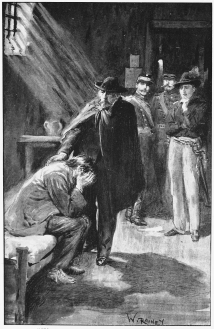
“HE WENT UP TO PERCIVAL AND PUT HIS HAND ON HIS
SHOULDER”
The professor laid his hand on Frank’s shoulder, as the latter was about
to dart forward.
“Stay a minute or two, lad,” he whispered—“it may be too much for him,”
and he went up to Percival and put his hand on his shoulder. “It is a
joyful occasion indeed, Leonard,” he said. “You are free. Save for the
Papal States and Venice, all Italy is free. I have other good news for
you. Muriel, your boy and my wife are all well, and will soon be able to
rejoin you.”
“A minute, Forli—give me a minute,” Captain Percival said, in a low
voice. “I should not have broken down thus. It is almost too much,
coming all at once, after so long a time of waiting.”
Two of the other prisoners had half risen at Signor Forli’s words; the
other was too weak to do more than turn his face towards them.
“The news is true, gentlemen,” Colonel Pasto said. “To-morrow, you and
all within this prison will be free men. Capua has surrendered, and we
have but just entered the town. As there are still nine thousand of the
Neapolitan troops here, there are many arrangements to be made, and we
must find some place for you all until you can be sent to your homes. It
is impossible to search the jails until to-morrow, but you need not
regard yourselves any longer as prisoners. I have orders from General
Cialdini to the governor here, that you shall in the meantime be well
and plentifully fed, so as to prepare you for leaving this place.
“You hear, sir,” he said, turning to the governor. “You will procure,
regardless of expense, every luxury possible, with a proper supply of
good wine; and see that all have a thoroughly good meal this afternoon,
and another this evening. I request that you will, without delay, have
every prisoner informed of what has happened, and that he will to-morrow
be released.”
“I will see that it is done, colonel,” the governor said. “I will at
once give the necessary orders.
“Perhaps it will be better, sir,” he went on, speaking to Signor Forli,
“that your friend should take something before he leaves. I have
pleasure in placing my private room at your disposal, and will order
some refreshment to be served there immediately.”
Captain Percival now rose to his feet with an effort. “I am afraid I
shall have to be carried, Forli,” he said, with an attempt at a smile.
“I was able to walk across the room this morning, but your news has, for
the present, demolished what little strength I had left.”
“You had better sit down, Captain Percival,” the colonel said. “The
governor will doubtless send some men with a stretcher at once, and I
need hardly assure you how great a pleasure it has been to me to be
employed on so successful a mission. I shall tell General Cialdini that
you have been found.” And so saying, after shaking hands with Captain
Percival and the other prisoners, he left the room with the governor.
Frank also went outside, as, seeing how weak his father was, he quite
recognised the wisdom of Signor Forli’s advice that he should not be
told too much at once; and, indeed, he felt that he could no longer
suppress his own emotions. Leaning against the wall in the passage, he
cried like a child.
Assisted by Signor Forli, Percival went round and shook hands with the
other three prisoners.
“I was right, you see,” he said: “I told you last night, when we were
all brought up here, that our deliverance was at hand, but I hardly
thought that it could be so near. Soon you too will see your friends,
from whom you have been kept a much longer time than I have.
“We have only met once before,” he said to the professor, “when nearly
two months ago we were all brought out and placed in a vehicle together,
and driven here. On the way we told each other what our real names were,
and the addresses of our friends, so that if by some miracle one of us
should issue alive from our horrible dungeons, we might let the friends
of the others know how and where they had died. Thank God, we shall now
all be bearers of good news.”
“I fear that I shall never be so,” the weakest of them said, feebly.
“Do not think that,” Signor Forli said cheerfully: “good food, fresh
air, and, more than all, freedom, will do wonders for you. I, like
yourselves, have been a special prisoner in a fortress for upwards of
three years, and you see me now as strong and as well as I was when I
entered it. Make up your mind that you will get well and cheat these
tyrants, who had thought to kill you by inches.”
Four of the jailors now entered; one of them carried a stretcher,
another had a bottle of excellent wine and four large glasses, which he
filled and handed to the prisoners.
“This is the first taste of freedom,” one said, as he emptied his glass.
“There, friend,” he went on, as one of the jailors partly lifted the
sick man and placed the glass to his lips, “that is your first step
towards health and strength. I can feel it already tingling in my veins,
which years ago a glass of pure spirit would hardly have done. No, we
will take no more now,” he said, as one of the men was about to refill
his glass. “Leave it here; another glass now would intoxicate me, after
five years on water alone and starvation diet.”
Captain Percival was now placed on the stretcher and carried out; Frank
fell in with Signor Forli as he followed the party. “Unless you are
going to tell him soon,” he said, “I must go; I cannot stand it, being
so close to him.”
“I will tell him as soon as we are alone,” the professor said: “he has
calmed down, and that glass of wine will do him a world of good.”
On arriving at the governor’s room, Captain Percival was placed in an
easy chair, and the jailors left. Frank went to the window and looked
out.
“I can hardly believe that it is not all a dream, Forli. The strangest
part is that, while I had hoped to open your prison doors, you have
opened mine.”
“You are wrong, Leonard: the same person who opened my doors has opened
yours; as you set out to find me, so another set out to find us both.”
Captain Percival looked at him wonderingly.
“Of whom are you speaking, Forli? My head is not very clear at present.
But who could have been looking for us both? You don’t mean Garibaldi?”
“No, no, Leonard; truly he has opened the doors to all prisoners, but he
was not searching for any one in particular. When I tell you that Muriel
sent out to Garibaldi the sum that you had put aside for that purpose,
and that she and my wife had never altogether lost hope that you and I
were both still alive, whom should she send out with it, and to search
for you, but——”
“You don’t mean Frank? You cannot mean him: he is only a boy at school.”
“He is nearly seventeen now, and there are hundreds of younger lads who,
like him, have done their duty as men. Yes, it is Frank. I would not
tell you at first; one shock was enough at a time. Frank, my boy, you
have your reward at last.”
Frank turned and ran towards his father. The latter rose from his seat.
“My boy, my dear lad!” he cried, as he held out his arms, “this is too
much happiness!”
It was some minutes before either father or son could speak coherently;
and fortunately, just as Frank placed his father in the chair, one of
the attendants brought in a basin of clear soup, two cutlets, an
omelette, and a bottle of wine, saying that the governor had sent them
from his own table, with his compliments.
Captain Percival smiled faintly when the man left the room.
“It is my last meal in prison, and if it had been sent to me a week ago
I should have declined to eat it, for I should have made sure that it
was poisoned; however, as it is, I will take it with thankfulness.”
“Yes, and you must eat as much as you can,” Forli said. “You have got a
drive before you: we shall take you straight up to Santa Lucia, where we
have rooms; the mountain air has done wonders for Frank, who has had a
touch of these marsh fevers. It would be difficult to find a place in
Capua now, so the sooner you are out of it the better.”
Captain Percival took a mouthful or two of soup and then stopped.
“That won’t do, Leonard—that won’t do; you really must make an effort.
Do it in Italian fashion: pour a glass of wine into it; if you will take
that, I will let you off the meat.”
“I could not touch it whether you let me off or not. I have not touched
meat for two years and a half, and I shall be some time taking to it
again.”
He finished the soup, and then, upon the insistence of Signor Forli,
took some of the omelette.
“Now,” the latter said, “we will be off. When we came in here, we told
the driver to find some place where he could take the horses out and
feed them, and then come here and wait for us. I suppose we must get
somebody to let us out of the prison.”
Frank rang the bell. When the attendant came in, he said, “Please tell
the governor that we are now leaving, and that we shall be obliged if he
would send down an official to the gate to let us out.”
The governor himself came in two minutes later; the gate was close by
the entrance to his house; and Signor Forli said,—“I will go out first,
sir, and fetch our carriage round, if you will be good enough to give
orders that the gate is to be kept open until I return, and to order the
warder there to allow Captain Percival to pass out with us.” Ten minutes
later they were on their way. Captain Percival would not be laid on a
stretcher again, but leaning upon his father-in-law and son, was able to
walk to the carriage.
“I have a flask of brandy-and-water in my pocket, Leonard, and if you
feel faint you must take a little.”
Very few words were spoken on the journey. Frank sat by the side of his
father and held his hand in his own, and it was not long before Captain
Percival fell asleep. The excitement of the past thirty-six hours had
for a time given him a fictitious strength; and now the sense of
happiness and of freedom, aided, no doubt, by the unaccustomed meal and
the wine he had taken, took the natural effect, and after trying in vain
to question Frank as to what had taken place, he dozed off.
“That is the best thing for him,” Signor Forli said in low tones, when
he saw that Captain Percival was asleep, “I hope he will not wake up
till we arrive at Santa Lucia. He has borne it better than I expected.
It has, of course, pulled him down a great deal more than it did me. A
strong and active man must naturally feel solitary confinement much more
than one who seldom takes any exercise beyond half an hour’s walk in the
streets of London; who is, moreover, something of a philosopher, and who
can conjure up at will from his brain many of his intimate friends. I
have no doubt he will sleep soundly to-night, and I trust—though of
this I do not feel quite sure—that he will be a different man in the
morning. Of course it may be the other way, and that when the effect of
the excitement has passed off he will need a great deal of careful
nursing before he begins to gain strength. At any rate, I shall go into
Naples to-morrow and send a telegram to your mother, and tell her to
come over with my wife at once. It would be of no use going down to
Caserta; the wires will be so fully occupied by the military and royal
telegrams that there will be little chance of a private message getting
through. They are sure to start directly they get my message, and may be
here in three or four days. I shall advise them to come viâ Marseilles;
for, as the train service is sure to be upset, they might be a good deal
longer coming by land, besides the annoyance of long detentions and
crowded trains; for you may be sure that there will be a rush from the
north to come down to witness the king’s entrance into Naples.”
“I think that will be a very good plan indeed,” Frank agreed; “and the
knowledge that they are coming will, I should think, do a great deal of
good to my father.”
Darkness had fallen long before they reached Santa Lucia. The village
was still full of soldiers. As he leapt out from the carriage Frank
called to four of them standing near to help in carrying his father
upstairs; and so soundly was Captain Percival sleeping, that this was
managed and he was laid on the bed without his fairly waking, though he
half opened his eyes and murmured something that Frank could not catch.
“We will not try to take his things off,” Signor Forli said, “but just
throw a blanket lightly over him now. I will remain here while you go
down and get some supper. You had better stay in the room with him all
night; there is no getting hold of another bed, but——”
“I shall do just as well without a bed,” Frank said; “since I landed at
Marsala I have hardly slept in one; besides, I don’t fancy that I shall
sleep much, anyhow. I have plenty to think about and to thank God for,
and if my father moves I shall be at his bedside in a moment. It is
likely enough that he will not have the least idea where he is.”
“Quite so, Frank. When you come up from supper bring an extra candle
with you: you had better keep a light burning all night.”
Captain Percival, however, did not wake up until it was broad daylight.
He looked round in a bewildered way until his eyes rested upon Frank,
who was seated close to his bedside.
“That settles it,” he said with a smile, holding out his hand to him. “I
could not make out where I was. I remember leaving Capua in a carriage,
and nothing more; I must have slept like a log, as you got me out of the
carriage and up here without my waking.”
“I think it was the professor’s fault chiefly, father, in making you
take that second glass of wine in your soup. You see you were altogether
unaccustomed to it, and being so weak, that and all the excitement
naturally overpowered you. However, I think it a capital thing that it
did. You had twelve hours’ good sleep, and you look all the better for
it. I will tell Signor Forli you are awake. He has peeped in three or
four times to see how you are going on.”
He went out for a minute, and a little later the professor came in with
a large cup of hot milk.
“You are looking fifty per cent. better, Leonard,” he said. “You had
better begin by drinking this, and then I should recommend you to get
rid of those rags you have on, and to have a good wash. I am going into
Naples, and will bring you some clothes. You certainly could not get
into my coat, but I will lend you a shirt, and that is all that you will
want, for you had better lie in bed to-day and listen to Frank’s account
of his adventures, having a nap occasionally when you feel tired, and
taking as much soup as you can get down, with perhaps a slice of
chicken.”
“What are you going to Naples for?”
“I am going to send the good news to Muriel, and to tell her and my wife
to come over at once and help you to build up your strength again. I
won’t say come over to nurse you, for I think you can do without
that,—all you want is building up.”
Before he started the professor showed them the telegram he had written
out.
“It is rather long,” he said, “but a pound or two one way or the other
makes little difference.” It ran: “Prepare yourself for good news, and
don’t read farther till you have done so. Thank God, Frank’s search has
been successful. I dared not tell you when I last wrote that I had found
a clue, lest it should only give rise to false hopes. However, it led
us to our goal. Leonard is recovered and free. He is weak, but needs
nothing but good food and your presence. Start with Annetta at once;
come straight to Marseilles and take the first steamer to Naples. You
will find us at the Hotel d’Italie, where I shall have rooms ready for
you.”
After Signor Forli left, Frank told the story of his adventures bit by
bit, insisting upon his father taking rest and food three or four times.
The professor returned late in the evening. “I have got rooms at the
hotel,” he said; “and it is lucky that I did not put off going down till
to-morrow, for telegrams are coming in from all parts of Italy to secure
accommodation. However, fortunately there were still some good rooms
left when I arrived there, and I need not say that I did not haggle over
terms, outrageous as they were on the strength of the coming crowd. Your
father is going on all right, I hope?”
“Very well indeed, I think. I only talked for about half an hour at a
time; he has slept a good deal, and he has eaten well, his voice is
stronger, and there is a little colour in his cheeks; he was terribly
white before.”
“That was from being kept in the dark, Frank, as much as from illness.”
They went upstairs together. “I hear a good account of you, Leonard,”
the professor said, “so I will give you what I have in my pocket, which
I should otherwise have kept till to-morrow morning.” He took out a
piece of thin paper, handed it to Captain Percival, and held the candle
close, so that he should read the contents. It was but a few words, but
it took some time in the reading, for the invalid’s eyes were blinded
with tears. When he had read it, he dropped it on the coverlet and put
his hands over his face, while the bed shook with his deep sobs. Frank
took up the paper and ran his eye over it.
“The good God be praised for all His mercies! Oh, my husband, I can say
no more now. Mother and I start to-night for Marseilles.—Your most
happy and loving wife.”
Two days later the party left for Naples. That morning Garibaldi, to
whom Frank had sent a message on the morning after his return from
Capua, drove up to Santa Lucia to see his old friend.
“I am almost as pleased, Percival,” he said, after a silent hand-grip
had been exchanged, “to have freed you as I am to have freed Italy, a
matter in which the money your wife sent me in your name had no slight
share. You have reason to be proud of your son: he has shown throughout
the expedition a courage and coolness equal to that of any of my
veterans. He captured the first Neapolitan standard that was taken, and
has rendered me innumerable services as my aide-de-camp. You are looking
better than I expected.”
“I should be an ungrateful brute, if I were not getting better, after
all my son has gone through to rescue me, and the feeding up that I have
had since I came here.”
“You must have suffered intensely, Percival?”
“It has been pretty hard. I have all the time been in solitary
confinement in filthy holes, where scarce a ray of daylight penetrated.
I have had nothing but either the blackest of bread or roasted maize to
eat, but I have been kept up throughout by the conviction that ere very
long there must be an upheaval: things could not go on as they were. I
knew that my own letters had excited a general feeling of horror at the
accounts of the dungeons in which political prisoners were confined, and
I determined to make the best of matters. A year ago—at least, I
suppose that it is about a year, for I have lost count of time—a fresh
hope was given me, when one of my jailors, who was at heart a good
fellow, and occasionally ventured to say a few words to me, told me that
the Sardinians, with the help of France, had recovered Lombardy from
Austria, and that Tuscany and other Papal States had all revolted and
joined Sardinia. That gave me fresh hope and courage. I felt that things
could not long remain so, and that the south would soon follow the
example of the north. I felt sure that you had borne your part in the
struggle with the Austrians, and that, just as you headed the Roman
insurrection, you would certainly throw yourself heart and soul into a
rising in the south. I hear now, from my son, that in fact the whole has
been entirely your work.”
“I have done what I could,” Garibaldi said, “and well have I been
rewarded by the gratitude of the people. But I see already that the
jealousy of the Piedmontese is carrying them beyond all
bounds, and that I shall soon be back in Caprera. But that matters not:
I shall be happy in the thought that I have earned the gratitude of all
Italy, and that the work I have done can never be undone. The king is a
brave and gallant gentleman, but he is prejudiced by the lies of the men
round him, who cannot forgive me for having done what should have been
their work. It is a pity, but it matters but little. I fought for the
cause and not for myself, and my only regret is that my brave companions
should suffer by the jealousy and ill-humour of a handful of miserables.
I shall be in Naples in a few days, and hope to find a still further
improvement in your condition.”
The long drive to Naples had no ill effect whatever, and Captain
Percival was able to walk from the carriage up to his room, leaning
upon Frank’s arm. They learned that it would be two days before the next
steamer from Marseilles arrived, and these were passed by Captain
Percival in the carriage, driving slowly backwards and forwards along
the promenade by the sea, sometimes halting for an hour or two, while he
got out and walked for a time, and then sat down on a seat, enjoying
intensely the balmy air and the lovely view. He was now able to dispense
altogether with Frank’s assistance. His hair had been cut short, and his
face clean-shaved with the exception of his moustache, for, as he said,
“he hardly knew his own face with all that hair on, and he wanted his
wife to see him again as he was when he left her.” His cheeks were still
very thin and hollow, but the sun and sea air had removed the deadly
pallor, and the five days of good feeding had already softened the
sharpness of the outlines of his face.
On the day when the steamer was due he remained down at the sea until
she was sighted. Then he returned to the hotel with Signor Forli,
leaving Frank to meet the ladies when they landed and to bring them up
to the hotel. Garibaldi had run down to Naples on the previous day, and
spent some hours in endeavouring to smooth matters between the
contending factions, and had given Frank an order to the officers of the
custom-house to pass the baggage of Signora Forli and Mrs. Percival
unopened. The greeting between Frank and his mother and the Signora was
a rapturous one. Not many words were spoken, for both ladies were so
greatly affected that they hurried at once into the carriage. Frank saw
the small amount of baggage that they had brought handed up, and then
jumped in.
“How is he looking?” Mrs. Percival asked anxiously.
“Of course he is looking thin, mother. He was very weak when we found
him, five days ago; but he has picked up a good deal since then, and in
another fortnight he will be walking about with you just as of old.”
“You are looking thin yourself, Frank—very thin. My father mentioned in
his letter that you had had a touch of fever.”
“Yes, it was rather a sharp touch; but, as you see, I am all right now,
though I have not yet returned to duty. I was able to take a part in the
battle of Volturno, but collapsed after it was over.”
“And your grandfather has not changed much, you said?” the Signora
asked.
“He has borne it marvellously,” Frank said. “As I told you in my letter,
he has kept himself up by going through all the authors he knew by
heart. You know what a marvellous memory he has, and of course that
helped him immensely. Of all the prisoners we have released, there was
not one who was so well and strong as he was. I really don’t think that
you will find any change in him since you saw him last—except that, of
course, his hair is rather greyer. Father is a good deal greyer, mother.
I think that, perhaps, it is the result of there being so little light
in the places where he has been kept. Here is the hotel. Now I will take
you up to them, and will leave you there while I come down and see after
your traps. I should doubt whether any English ladies ever arrived at
Naples before with so little luggage.”
He spoke cheerfully, for both his mother and the Signora were so much
agitated that he was afraid of their breaking down before they got
upstairs. On reaching the door he opened it, and, closing it quickly
behind him, went away. It was a quarter of an hour before he returned to
the room. All had now recovered from the effects of their first
meeting.
“We have already settled, Frank, that we will start for home at once.
Your grandfather says that he has ascertained that a steamer will leave
to-morrow for England; and we mean to go all the way by sea. It will do
your father good, and you too, for your grandfather says the doctor told
him that, although you have got rid of the fever altogether, you need
change to set you up thoroughly, and that a sea voyage would be the best
thing for you. And, as we are all good sailors, it will be the
pleasantest way as well as the best. Fortunately your work is done here.
The fighting is over, and even if it were not, you have done your share.
You have not told us much about that in your letters, but Garibaldi
spoke of you in the highest terms to your father; and your grandfather
learned, from some of your comrades, what you really did at Calatafimi
and Palermo.”
“I did just what the others did, mother, and was luckier than most of
them, though I was laid up there for a month with the wound I got; but I
don’t see how I could start to-morrow without leave, and, at any rate,
without thanking Garibaldi for his kindness.”
“Well, then, you must run over to Caserta and see him this evening. The
railway is open, is it not? It is only a run of half an hour or so.”
“Very well, mother, I will do that; and very likely he will be over in
the morning. He comes here nearly every day, and if he had not intended
doing so to-morrow, I am sure he would come, if only to see you and the
signora, and to say good-bye to father and the professor. About what
time does the steamer start?”
“At one o’clock.”
“Oh, that will leave plenty of time; the general is always up at three
in the morning.”
Frank was not mistaken: at eight o’clock Garibaldi arrived at the hotel
and spent half an hour with them. He delighted Mrs. Percival by the
manner in which he spoke of Frank, saying that no one had distinguished
himself more during the campaign.
The voyage to England was pleasant and uneventful, and by the time they
arrived at home, Captain Percival was almost himself again, while Frank
had entirely shaken off the effects of his illness. It had been agreed
that he should not return to Harrow; six months of campaigning had
ill-fitted him for the restrictions of school life, and it was arranged
that he should be prepared for Cambridge by a private tutor. He finally
passed creditably, though not brilliantly, through the University. He
and his family had the pleasure of meeting Garibaldi when the latter
paid a visit to London, four years after the close of the campaign; and
the general, in spite of his many engagements, spent one quiet evening
with his friends at Cadogan Place.
Four years later Frank married, and his father settled upon him his
country estate, to which, since his return to England, he had seldom
gone down, for, although his general health was good, he never
sufficiently recovered from the effects of his imprisonment to be strong
enough again to take part in field sports. He lived, however, to a good
old age, and it is not very long since he and his wife died within a few
days of each other. The professor and Signora Forli had left them
fifteen years before.
THE END.
| Typographical errors corrected by the etext transcriber: |
|---|
| the enemey=> the enemey {pg 140} |
| who assuredy=> who assuredy {pg 192} |
| guerillas=> guerrillas {pg 203} |
| the the entrance=> the entrance {pg 244} |
| fictitous=> fictitous {pg 342} |


