Some minutes later he heard her stirring in the house. The sun grows hot early
on the plains in midsummer. Rock had planted himself on the porch steps, in
the shade, debating his next move. Should he ride on about his business?
Logically, yes. He had a definite task to perform. It was time he set about
it. He was on the ground. This was only an incident, a happening by the way.
Yet his mind was full of this woman and child, alone on a ranch in the
wilderness. The girl had said there were no other men. But this ranch and
equipment spelled men and stock. It was more than the cabin of a settler
striving for a foothold and security in a virgin land. A woman with a
three-year-old baby had no business alone on a ranch in this waste, without a
man in the background.
That problem—which was more a state of feeling than a problem, Rock knew—was
solved for him in unexpected fashion. He rose at last and entered the house,
specifically to ask her if there was anything else he could do before he
departed.
The girl had the child in a high chair and was giving the youngster her
breakfast. Silently she poured a cup of coffee and handed it to Rock. When he
drank it she said:
“Come outside. I want to talk to you.”
Rock followed her to the porch.
“You told me last night you were a stock hand in search of occupation. Do you
want to go to work for me?”
Rock liked her directness. His mind was quick to grasp possibilities. Work to
Rock meant activity on the range He was next door to the Maltese Cross. Two
birds had been killed before with one stone. Still, he wasn’t fond of
mysteries that involved sudden death. He liked to know where he was going when
he took a new trail.
“I’d as soon ride range here as anywhere,” he said. “It’s immaterial to me who
I work for, so long as it’s my kind of work.”
“Are you one of these stock hands that considers it beneath his dignity to
work for any outfit with less than ten thousand head of cattle?” she asked,
with a comical note of asperity.
“Well, no,” he laughed. “Hardly so finicky as that. If you’ve got a rider’s
job for me, consider me on the pay roll. Only, I’d like to know, if I’m going
to work for you, whether I’m likely to find myself being buried some morning
at sunrise—and why?”
“Wait a minute,” she said. She turned back into the house. In a second she was
back with a hat on and two shiny tin pails.
“Come down to the stable with me, and we’ll talk this over while I milk. I was
in such a state last night that I forgot the cows. Will you saddle up and
bring them in out of the pasture?”
Rock drove two amiable-looking red cows from the far end of a small pasture to
the corral. The girl tied both to the fence and sat down beside one on a low
stool.
“Can you milk?” she asked, with the faintest shadow of a smile.
“Never did,” he answered truthfully.
“It’s considered woman’s work, I suppose,” she replied. “But even the wild and
woolly cowboy, I notice, likes real milk and cream and butter. I don’t want
you to milk cows, though. I’m not running a dairy. I have about eight hundred
cattle scattered around here.”
“Your ranch outfit looks like about eight thousand,” Rock remarked.
“We had more than eight thousand when we came here,” she said. “That is why
the house is big and the stable. My father drove three trail herds in here
from the Pecos. But we lost most of them.”
“Oh, I see,” Rock commented.
“So, as I said, I have about eight hundred cattle on the range. I have a rider
with the Maltese Cross round-up. I need another rider on the ranch.”
“But if you keep a rep with the Cross,” Rock interpolated, “does it matter if
your stock does scatter considerable? The outfit would brand the calves and
ship your beef as long as you supply a man and a string of horses.”
“Yes and no,” she said. “I see you know range work. I suppose what you say is
true. Only I have reasons for handling cattle in my own way. But that’s all
beside the point. What you want to know is whether you’ll be expected to step
into a dead man’s boots and take the risk of getting shot for some reason or
other, isn’t it?”
“Yes,” Rock admitted. “I have no hankering to inherit a private war along with
a forty-dollar job.”
“It’ll be fifty if you work for me,” she said. “There may be a risk. Not if
you can be around here and work for me, without getting sentimental and
jealous. That was what got Doc killed, I believe. I’m sure it was.”
Perhaps Rock looked his curiosity and surprise. The girl stood up. She had
worked, as she talked, and finished milking the first cow.
“I had better explain a little,” she said calmly. “As I said, four years ago
we came in here with nearly nine thousand cattle and a dozen riders in our
outfit. I was eighteen then. I had just finished school. Our first winter here
was a bad one—a terrible winter of hard frost and deep snow and storms. In
the spring a round-up out two months gathered less than five hundred cattle in
our brand. Betty was born that winter, and mamma died. The next summer a horse
fell on my father, injured his back, so that he was a helpless cripple for
nearly a year. Then he died. He left all there was to me and Betty. I have
full control of everything until she comes of age. So I have managed here ever
since. Mostly with one man, sometimes with two.”
So that was that. The dead man was a range rider, not a husband, and the baby
was a sister. She was a level-headed, plucky girl to run a shoe-string outfit
by herself. Yet he suspected that in this man’s country, men would make it
easy for this capable and determined young person. Rock’s interest quickened.
“Wonder you didn’t sell out and go back to your folk,” he suggested.
“I have none—at least none that I care much about,” she replied. “And how
much would I get for five or six hundred cattle? A few thousand dollars. The
ranch isn’t salable. Who would pay money for a ranch, when land and water can
be had anywhere for taking? Why should I sell out? I know cattle. This is a
new country, a good range. We may not have another hard winter in a lifetime.
It just happened. The old trappers and the Indians never saw a winter like
that. Every four years my cattle will double. After a while it will make Betty
and me independent. Why should I sell out? What would I do? Go to some town
and be a clerk in a store?”
The vehemence in her voice made Rock smile.
“Oh, you got the right idea,” he admitted. “You’re working on the same
principle that has built up every big outfit in the country. Only, it’s sort
of unexpected in a woman no bigger than a minute.”
“Please understand me clearly,” she said, with a peremptory note in her
curiously musical voice. “I don’t need any sympathy from anybody. I know what
I’m doing, and I’m doing very well here. I want any one who works for me to
work on exactly the same basis as he would work for any cow outfit. I don’t
want any of this ‘That’s all right, little girl, we’ll see you through,’
business. That’s mostly what got Doc Martin killed, I suspect. Every man who
works for me gets the idea that he’s in love with me.”
“Why blame ’em for that?” Rock interrupted.
“It embarrasses me. I’ve fired two or three for getting mushy. I don’t want
that sort of thing. Do you think you can ride for me without getting
sentimental—without presently getting the attitude that it’s your duty and
privilege to protect me from every man in the country except yourself?”
Rock’s amused smile faded.
“Miss—— I don’t think I got your name.” He stopped.
“Nona Parke. The baby’s name is Betty,” she supplied promptly.
“Well, then, Miss Parke,” Rock said a little stiffly, “I can assure you that
if I do draw wages from you I’ll try to earn them without making a bid either
for your gratitude or your affection.”
Nona Parke’s gray eyes rested on his for a second with cool appraisement.
“You talk like a man with some sense. If you can handle horses and cattle the
way you handle the English language, you ought to be useful.”
“You’re getting too personal,” Rock said rudely. “Tell me about this shooting.
That’s what I want to know before I decide whether I want to make myself the
same kind of a target. I have ambitions to live and do well in the world,
myself.”
“Now you’re getting offended,” she reproached. “And I’m only trying to be
frank and have things understood. You can’t imagine what a nuisance men can be
sometimes. Doc worked for me ever since dad died. He was a good man. But he
persisted in wanting to love me. I let him go once and then took him on again.
He promised to behave himself. But he wouldn’t. He was jealous. He couldn’t
bear other men coming here to see me. He stirred up trouble for himself with
Elmer Duffy, the boss of the Seventy Seven outfit. I am fairly sure that Elmer
shot Doc yesterday afternoon.”
She said this reluctantly, but with an earnestness that convinced Rock she
really believed it. To him it seemed rather simple. He had seen men quarrel
over women before.
“Elmer, I suppose, is a victim, too,” Rock commented. “Was he inclined to be
jealous of a good-looking fellow like Doc Martin being in your company all the
time?”
“Yes; that’s about it.” She sighed. “It sounds horrid, but it’s true. I’m
quite sure Duffy was a little afraid of Doc. Doc had a quick temper, and he
was supposed to be rather deadly. I don’t know how he got that reputation,
because I never knew of him having trouble with anybody in this country.”
“And you think they met and shot it out around the bend?” Rock queried.
“No.” She replied soberly. “I think Doc was ambushed. There was only one shot.
He had been mean and arbitrary with Elmer Duffy the last time they met. In
fact, he threatened him and told him never to set foot on this ranch when I
was here alone.”
“Listen, Miss Parke,” Rock said positively. “I know something about Elmer
Duffy, myself. I’ll confess that I don’t like his style with men very much. I
don’t know what it would be like with women. Elmer belongs to a family that
walks roughshod over people when they feel like it. But I don’t think he would
lay for your man and bushwhack him.”
“I tell you simply what I believe,” she said gravely. “I don’t know. There is
no proof. I wouldn’t breathe this to any one. I only say it to you because I’m
asking you to work for me. I don’t know that I would even tell you, if you
didn’t look so much like Doc that you could easily be taken for him. If you
ride for me, you may fall heir to whatever bad blood did exist between him
and Elmer Duffy. If Doc hadn’t made an issue of me with this man he would
still be alive. I don’t want to be a bone of contention. I won’t be. I like
men well enough until they get too friendly. If a man works for me, he’s
working for me, and that’s all there is to it. So now you know all about it.
And I do need a rider to take Doc’s place.”
“It was very inconsiderate of him to get himself killed off when you needed
him.” Rock couldn’t forbear the ironic note. “Riders can’t always be picked up
in this country just when you want ’em.”
“You’re brutal.” Nona drew herself up, and her eyes filled. “I liked Doc. He
was nice. He was loyal. It made me sick to see him die like that. It made me
feel guilty, because I was partly the cause. But I can’t help it that I’m a
woman. Can’t you understand? I’m not a callous beast.”
And Rock knew she was not. He knew he had hurt her with that thrust.
“Well, I’ll guarantee not to afflict you with my admiration if I feel any,” he
smiled. “And it’s a cowpuncher’s nature to be loyal to the people he works
for. If I ever lock horns with Elmer Duffy, it won’t be for the reason you say
your man, Doc, did. No. And I like the looks of this country. I’d sort of like
to linger on this range for a while. So there doesn’t seem to be any reason
why I shouldn’t work for you.”
“All right,” she answered composedly. “If you’ll bunch those horses that are
in the pasture, I’ll show you what ones to saddle. I want you to go down the
river with me after I’ve milked this other cow.”
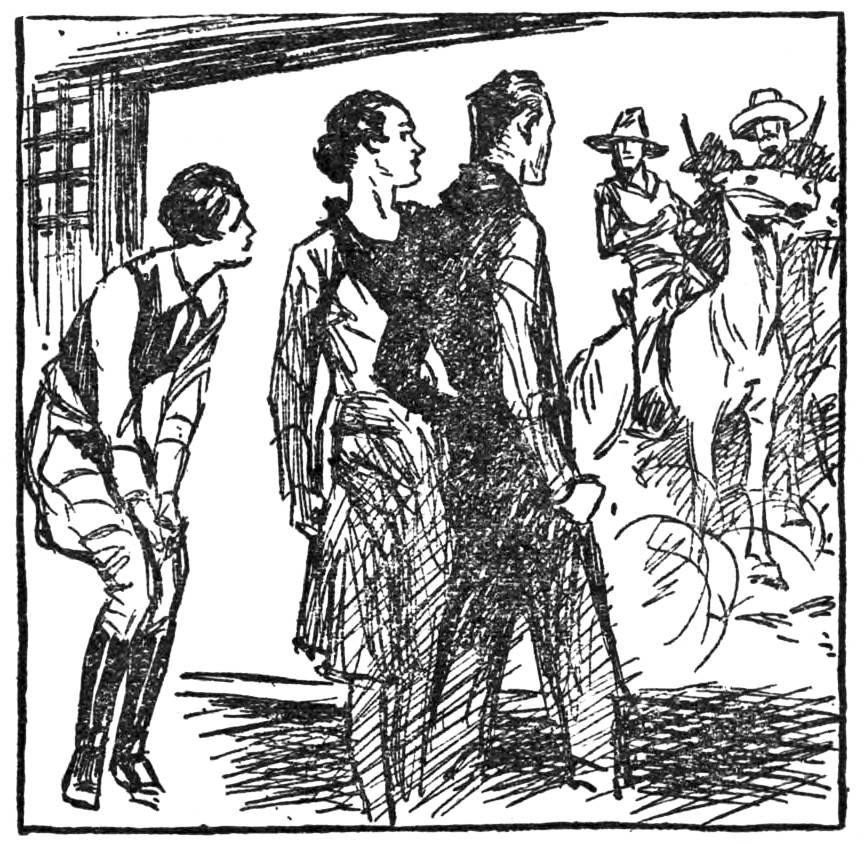
While Rock gathered a few horses out of the pasture, he saw a rider cross the
flat. The milch cows were in a small corral. Rock bunched the horses in a
larger one and walked through the stable to where Nona finished her
dairymaid’s task. From the door he saw that the man was Elmer Duffy. Rock’s
mind worked fast. He was bound to encounter Duffy some time, and it might as
well be now. Duffy’s business was with Nona Parke, not with him. But Rock
cared nothing for that. He remembered that he had killed this man’s brother.
He was going to live for a time in Duffy’s immediate neighborhood. If Duffy
had taken Mark’s death to heart and brooded over it, Rock wanted to know and
be ready for what might follow.
But he was hardly prepared for what did happen. He walked straight toward
Duffy. The man’s back was toward him. He was talking to Nona. She was just
rising from her stool. Duffy was in no way excited. His tone was the habitual
slow drawl of the native Texan.
Then Rock spoke.
“Hello, Duffy,” said he.
Duffy wheeled. His arms hung by his sides. There wasn’t the faintest twitch of
the fingers hanging a little below his gun belt, nor any quick lighting of his
slaty eyes, nor the frowning recognition Rock half expected. True, recognition
impended in the man’s attitude. And he was wary—wary without being hostile.
“Hellow, Doc,” he answered evenly.
“Doc!” A ripple of sardonic amusement stirred in Rock. Duffy thought he faced
Nona Parke’s dead rider. Rock stood perfectly still for a second or two. The
man’s eyes never left his.
“You didn’t expect to see me, did you?” Rock asked.
Surely his voice would establish his identity. Duffy had been in daily contact
with Rock Holloway for two months on trail and had known him casually the
season earlier. But he didn’t know him now. His words proved that.
“Why, I reckoned I might,” he answered, “seein’ I rode in here. You didn’t
expect me to take what you said serious, did you?”
Rock had a retentive memory.
“About you keeping off this ranch?”
Duffy nodded. Rock could understand his watchfulness.
“Shucks! I’ve changed my mind about caring a whoop whether you come here,
there, or the other place,” Rock said slowly, “so long as you act white. But
there’s something I do want to tell you, Duffy. Up the river yesterday
somebody took a pot shot at me. Nona heard it.”
He looked at her. For a second her face was a study. Would she play up to his
lead? Rock didn’t know himself precisely why he did this, except that
instinctively he took the opening Duffy gave him.
But her words came with sharp emphasis. Her wits were nimble.
“I heard the shot. I didn’t see who fired.”
“I don’t like to be shot at from ambush,” Rock said pointedly.
“You say I’d do that? Did do that?”
A rising inflection put an edge in Duffy’s tone. The tan of his long, homely
face went a brick red.
“I didn’t say so. I said I don’t like to be shot at from ambush.”
Duffy stared at him for a second or two.
“Lissen, Doc Martin.” His tone was flat—squeezed dry of all feeling. “You
don’t like me. You’ve been kinda high-handed with me more’n once. I don’t
suffer with admiration for you, myself. But I’ll tell you this: if I want you,
I’ll take you with an even break. I’m no bushwhacker. If somebody shot at you,
an’ you think it was me, you got another think comin’. When I shoot at you,
I’ll be lookin’ you in the eye.”
“I’m inclined to take your word for that, Duffy,” Rock said coolly. “If you
say you didn’t, we’ll let it go at that.”
“The way you’ve acted with me the last few months,” said Duffy, growing
querulous, “I’d as soon shoot it out with you as not. I’m tellin’ you
straight, Martin, but it’s up to you to make the break. I don’t hunt
trouble.”
“Nor do I,” Rock assured him truthfully.
“You musta changed your ways mighty sudden, then,” Duffy retorted.
Rock grinned amiably.
“I have,” said he. “I’ve sort of convinced myself I’ve been barking up the
wrong tree, Elmer. I aim to change my ways. Don’t know whether for better or
worse. But if you don’t go gunnin’ for me, I certainly don’t hanker to pick a
fuss with you.”
Duffy eyed him doubtfully. He turned to the girl.
“Do you reckon he means what he says?”
“He always does, so far as I know,” she told him shortly.
“Well, we might as well let it go at that,” Duffy finally said. “Sounds
reasonable.”
“All right. Let her go as she lays.” Rock closed the conversation abruptly by
turning on his heel. He walked back through the stable, into the larger
corral, where he perched himself on the top rail. He looked down on the sleek
backs of Nona Parke’s saddle stock, but his mind was wholly on the amazing
fact that he had practically committed himself to a dead man’s identity.
He watched Duffy walk up to the house with Nona, carrying the two pails of
milk, saw him stand at the door and talk for a minute. Then he came back,
swung into his saddle, and rode around the stable end. Rock tightened up a
little. The girl had been a restraining influence. Now, perhaps Duffy would
have more to say or do. Long ago Rock had privately estimated Elmer Duffy as
the most dangerous of the Duffy quartet, chiefly because he was tenacious of
an idea or a grievance and inclined to be moody. But he only looked up at Rock
and said:
“You kinda got me goin’. Martin. You’ve changed your tune a heap. You
recollect what you told me last time we talked?”
Rock nodded, with only a hazy idea of what he was supposed to have said.
“Let’s get down to cases,” Duffy persisted. “Do I understand that you’ve
changed your idea that you got a license to close-herd this girl of Parke’s,
any time another man acts like he wanted to speak to her?”
Rock sifted tobacco into a paper.
“I don’t know as I like your way of putting it,” he said, with a pretense at
being sullen. “But she’s convinced me she aims to be a free agent. It’s
nothing to me who she talks to, from now on. I don’t claim no special
privileges no more. She’s made it clear that she’s able to look out for
herself, as far as men are concerned.”
Duffy ironed out the smile that started to overspread his face.
“It don’t look to me,” he said thoughtfully, “like any man’s got the inside
track with that girl. She sure don’t favor nobody that I know of. So you were
just naturally buildin’ up trouble for yourself, takin’ the stand you did.”
“I guess so,” Rock admitted indifferently. “Anyway, I got something else
besides her on my mind, now. I’d sure like to find out who tried to pot me
yesterday, Duffy. I’d make him hard to catch.”
“Don’t know as I blame you,” Duffy remarked. “But don’t you never think it was
me, Doc. I’ve done told you where I stand. So long.”
Yes, Duffy had made it clear enough where he stood. Still, somebody had shot
Doc Martin. Rock was still pondering on that problem when Nona came back from
the house. She had changed into a pair of overalls and leather chaps. She wore
a beautifully made pair of tan riding boots. She looked like a slim, capable
boy, with her dark hair tucked out of sight under a felt hat.
“What on earth did you do that for?” she demanded irritably.
“Do what for?” Rock affected ignorance.
“Let him think you were Doc Martin?”
“Well, he was so darned sure of it, for one thing,” Rock answered
thoughtfully. “It struck me as a good chance to feel around and find out if he
did take that crack at Doc. I don’t believe he did. Also, I think I’ve
convinced him that I’m going—as Doc Martin—to mind my own business so far as
you’re concerned.”
“I noticed how you managed to create that impression,” Nona admitted. “You
were very—very——”
“Adroit,” Rock suggested dryly.
“That’s the word.” She smiled.
“You certainly have——”
“I meant to be,” Rock interrupted, frowning. “I value my scalp, and I never
like to scrap over nothing.”
He looked intently at her.
“See here: If people around here persist in taking me for Doc Martin, why not
let it go at that?” he suggested.
“Why do you want to pass for him?” she demanded. “Are you on the dodge for
something?”
Rock shook his head. He didn’t want to explain to her the possibility of Elmer
Duffy starting a blood feud with him over Mark’s death. He had disarmed Duffy,
he thought, in his rôle of Doc Martin, no longer jealously hostile toward any
ambitious male who came wooing Nona Parke. And Rock was quite willing to
chance some unknown enemy of the dead rider. Pity and wonder had stirred in
his breast when he looked at his double stretched on the bed, and when he
helped to bury him. He had a sense of outrage in a man being murdered from
ambush. He was puzzled about that shooting—curious about the how and why.
“No,” he said. “I have told you my name, and where I came from. I have nothing
to hide. Just the same, I have a notion to play Doc Martin for a while. I
might find out who killed him. Duffy didn’t.”
“Perhaps not. I’d hate to believe it. And, still, I don’t know. It’s just a
feeling. If Elmer Duffy didn’t shoot Doc, I can’t imagine who would. Doc never
quarreled with any one else around here that I know about, and I think that I
would know if he had.”
“Sometimes,” Rock said, and he was thinking of himself when he spoke, “things
that are a long way behind a man crop up. Queer things happen in the cow
country. Well, what about it? Do you want to keep it dark about Doc being shot
and let me play his hand for a while? Or shall I announce myself to Elmer
Duffy and everybody else who takes me for Doc Martin?”
“Suit yourself,” she said. “You will be taking your own chances.”
“On what?”
“On whatever happens.”
“Oh, well, I don’t mind taking a sporting chance now and then.” Rock swung
lightly off the fence. “What’s the program now, Miss Parke?”
“Rope that sorrel for me and that chunky bay for yourself,” she said crisply.
“And catch me that black pony.”
Nona saddled her horse as soon as Rock, and she had him saddle the small black
horse with an extra rig in the stable. They rode to the house. The girl swung
down, darted in, and came out with a cushion, which she fastened across the
fork of her saddle. Then she called Betty, and that chubby person toddled
forth.
Nona put her on the cushion and swung up to her seat. The child, all smiles
for Rock, rode easily within the protection of her sister’s arm. The extra
horse trotted at the end of Rock’s lead rope, as they set off down the valley.
“Didn’t she see him?” Rock muttered. “How come she takes me for him?”
Nona shook her head. “I left her shut in the house when we made that ride
yesterday. You can see she takes you for granted.”
Betty undoubtedly did. She prattled away, calling him “Doc.”
“I don’t like to leave her alone much,” Nona explained. “That’s why we’ve got
this extra cayuse. There’s a half-breed family lives down river a few miles.
One of the girls has been nurse for Betty most all the last year. She’s been
away for a while, and I’ve got to get her back. I’ve carried this child
hundreds of miles like this, but it’s too hard on her and on me. I’ve got to
be free to ride when I need to.”
Rock nodded comprehension. He had been wondering how she managed with the
baby.
They traversed long river flats, gray with sage, heavily grassed here and
there, spotted with natural meadows of blue-joint hay. Meadow larks caroled.
In the still pools, where foaming riffles ended, wild ducks mothered flapping
broods. Gray and brown buffalo birds haunted the berry thickets and fluttered
out at their approach. Except for this wild life, the bottoms were deserted.
Few cattle grazed in those valleys, so hotly scrutinized by a brassy sun. They
kept to high ground and cooler airs. And, just as Rock was beginning to wonder
if his day’s ride should consist of acting solely as Nona’s escort, she pulled
up and pointed to a wide-mouthed draw, opening into the Marias from the north.
“Ride up that about six or eight miles, then swing west, and circle back to
the ranch,” she said. “My brand is a TL, same as on your horse. Left rib on
cattle. Make a sort of rough estimate of how many you see. You ought to get in
about two or three o’clock. I’ll have some dinner cooked.”