Jack Hillman was a newspaper carrier before breakfast,
a school-boy after breakfast, and his mother’s
right-hand man generally.
On the morning of this story, Jack had finished his
newspaper route—all but three papers. It was about
six o’clock and daylight was just breaking through the
dampness and fog. The place was a quiet back street
of three-story houses.
As Jack passed the third house from the end of the
row, he happened to glance at the cellar window. A
thin wisp of smoke-like vapor was slipping out between
the sash and the frame of the window.
“It must be fog or steam,” thought Jack to himself.
He watched it a moment, and then ran to the window.
It came out in a thicker volume. Quickly he stooped
down and put his nose into it.
“It’s smoke! It’s smoke!” he cried, and peered in.
The whole cellar was full of smoke.
Jack looked up and down the quiet street. No one
was in sight. Something must be done quickly. He
ran up the steps of the house, pounded on the door
with his fist and pushed the bell button; but no one
answered.
Then he ran down the middle of the street and began
to cry:
Fire! Fire! Fire!
By this time the smoke was pouring out of the cellar
window thicker than ever.
A man put his head out of a door half way up the
block. Jack ran to him and pointed back to the smoke.
Just then he remembered the red fire-alarm box on
the next corner. In his excitement he did not think
about telephoning.
“You get the people up!” cried Jack to the man.
“I’ll turn in the alarm!” And he ran as he had never
run before.
It seemed miles to the alarm box; but, as a matter of
fact, he was not more than two minutes in reaching it.
Jack had never turned in an alarm, but he had often
read the directions beside the little square of glass on
the red alarm box
To give alarm
break glass
open door
pull hook down once
and let go.
Jack looked about for a stone to break the glass; but
there was no loose stone in that smooth-paved street.
Using his elbow for a hammer, as he had often done
before, he struck the glass a sharp blow.
Crash went the thin glass to the pavement, and the
little handle was in reach. Grasping it firmly, Jack
turned it to the right and the red door flew open.
Inside he saw a long curved slot and a knob or hook at
the top of it, and the directions:
“Pull the hook all the way down and let go.”
For a moment Jack was frightened. Perhaps there
wasn’t any fire after all, and to turn in a false alarm
was against the law. Hesitating, he looked about for
help; but the street was empty.
“But the house is on fire; I saw it; I know it,” he
said to himself.
Trembling with excitement, Jack pulled the hook
to the bottom of the slot and let go:
Instantly the bell began to ring: Ting-a-ling! Ting-a-ling-a-ling!
Hurrah—the alarm was in!
Again, Jack looked up and down the street. To his
relief, he saw his friend the policeman on the beat,
about a block away, hurrying towards him.
Quickly Jack told his story. “Good work, Jack,
good work! You stay right here and direct the firemen
where to go;” and the policeman vanished around the
corner on a run to the fire.
Still the bell in the box was ringing merrily, but no
firemen were to be seen. “Will they never come?”
thought Jack. It seemed hours to wait. Clang!
clang! a little red automobile came dashing down the
street. As a matter of fact, it was just three minutes
since Jack had “pulled the box.”
Jack knew the man in the car—one of his heroes,
the battalion chief. Right behind came engine
number 29, smoking and puffing, and hosecart number
21, and ladder-truck number 12, crowded with men.
The clanging gongs echoing through the quiet street
sounded like sweet music to the anxious boy.
“Right around the corner, Seventh and Poplar!”
shouted Jack, pointing the way and not waiting for the
question.
“Seventh and Poplar! Seventh and Poplar!” he
cried, as they dashed by; and then, his duty done, he
ran after them.
When Jack arrived, breathless and panting right
after the firemen, he saw that the fire was spreading
so rapidly that the whole house was in danger. The
cellar was blazing and smoke was pouring out of the
first and second story windows.
On the order to “search the house,” three firemen
broke the door open and rushed in to search for
the occupants and bring them to safety. As they
entered, a thick volume of smoke came pouring out.
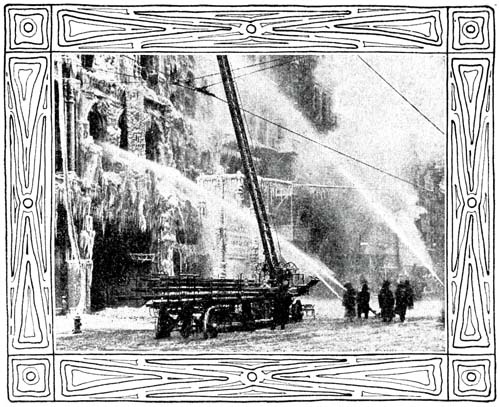
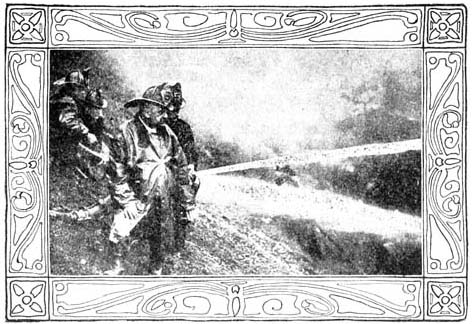
Already the hosemen were shooting great streams of
water into the cellar. The chief in command was
giving his orders in a quick, cool voice, the men obeying
them almost before they were issued. There was no
confusion; every man knew exactly what to do and
did it.
“Is there anybody in the house?” inquired Jack
eagerly of the man who lived half way up the block.
“I hardly think so; I pounded the door and shouted
with all my might until the firemen came, but could
not make anybody hear. Nobody seems to know
whether the family is home or not,” he replied.
Just then the chief cried, “Look out! here comes
Jim!” Through the flames and the stream of water
one of the firemen dashed out, his clothing afire with
sparks, and his coat tightly wrapped over something in
his arms. He would have fallen had not the chief
caught him.
Quickly the men smothered the fire on his clothing.
Then he opened his coat. Inside was a plump baby,
safe and clean in its little nightgown, just as it came
out of its crib.
How the crowd cheered when they saw it! A woman
broke through the fire lines. The brave fireman
quickly placed the rescued baby in her arms and
started for the doorway again; but the chief grasped
him by the arm.
“You can’t go back, Jim! Stay here!” he ordered.
“There are a woman and two children in there; let
me go!” cried Jim, pulling away from the chief.
“Shorty and Charlie can take care of them. You
stay here!” commanded the chief. His practiced eye
told him that no man, however brave, could go in
through that blazing doorway and come out again alive.
The chief anxiously scanned the upper windows for
signs of the two men who were inside, heroically fighting
their way with the woman and children to the upper
floors for safety.
Suddenly a whole third-story window was wrenched
out with a crash of broken glass.
“There they are! There they are!” shouted the crowd.
Charlie was leaning out of the window, and beside
him a woman was waving her arms wildly and shrieking,
“Help! Help! Help!”
“Make a rescue!” ordered the chief.
“Rescue!” repeated the firemen.
Already the laddermen had their long three-story
ladder standing erect in the air; and almost before its
top swung against the window-sill a ladderman was
nimbly running up, hand over hand, and a second man
was following him.
Charlie could be seen lifting a small boy out of the
window into the arms of the first ladderman, who
quickly carried him down to safety, while the crowd
hurrahed.
Now those who could see well had an interesting
exhibit of one way in which a fireman carries a person
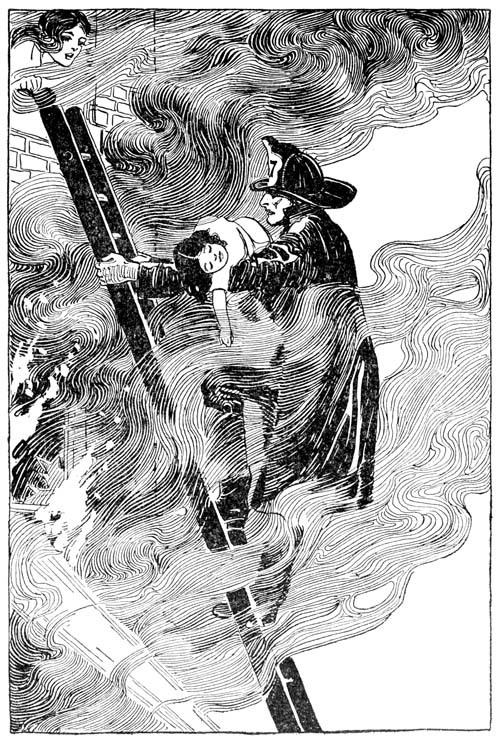
down a ladder. The second ladderman grasped firmly
each upright of the ladder, while Charlie lifted out a
twelve-year-old girl and laid her across the life-saver’s
bent arms.
Carefully he began to descend with his burden, step
by step, while the mother watched fearfully out of the
window, and the people below held their breath.
In less time than it takes to tell it, he reached the
bottom. The people shouted in relief, and a voice
cried, “All the children are saved! Hurrah!”
As the fireman again quickly ascended the ladder,
the woman was seen to topple over. She had fainted
when she knew that the children were safe.
In a few seconds the ladderman stood at the top, his
arms bent and braced as before. Quickly Charlie laid
across them a long bundle. It was the unconscious
mother wrapped in a blanket. Swiftly, yet cautiously
he came down.
It is no easy task to carry a heavy woman down a
three-story ladder, with smoke blinding the eyes and
fire scorching the face and hands. But the life-saver on
the ladder does not think of that. His only thought
is to save life and to put out the fire.
Soon the ladderman reached the ground and tender
hands relieved him of his charge.
“Where’s Shorty?” asked the chief of the man who
had just come down.
Carefully He Began To Descend
“He’s ‘all in’; lying up there on the floor unconscious.
Charlie is ready to keel over, too,” he replied.
“I’ll bring Shorty down,” cried Dick, a fireman who
heard the chief’s question.
As he sprang up the ladder the chief shouted up after
him, “Tell Charlie to come down, Dick!”
Meanwhile, the smoke began to pour out of the
rescue window at the top of the ladder, and the fire
was creeping slowly up through the wooden floors, in
spite of the heroic efforts of the fire-fighters. Charlie
had disappeared from the window. There was not a
second to lose.
As Shorty’s rescuer reached the top of the ladder,
the watchers saw him jump through the smoke into
the window. In a moment, he was seen pushing
Charlie toward the ladder and urging him to go down;
but Charlie wouldn’t budge.
“He won’t come down without Shorty,” muttered a
fireman.
“Come down, Charlie! Come down!” shouted up
the chief, using his hands as a trumpet.
Obeying orders, Charlie climbed out of the window
on to the ladder and began slowly and painfully to
descend, like a man in a daze. The smoke and flames
poured out of the windows and scorched his flesh and
clothing, while the firemen below played a stream of
water between him and the wall for protection, and
shouted words of encouragement.
His comrades reached up for him as he neared the
bottom; and it is well they did, for brave Charlie could
stand no more and fell unconscious into their arms.
They carried him to a safe place and used first-aid
treatment.
Now the citizens outside the fire lines were to see
what their firemen were capable of in an emergency;
a thrilling deed that takes strength, courage, presence
of mind and all the qualities of true manhood to perform—the
rescue of Shorty.
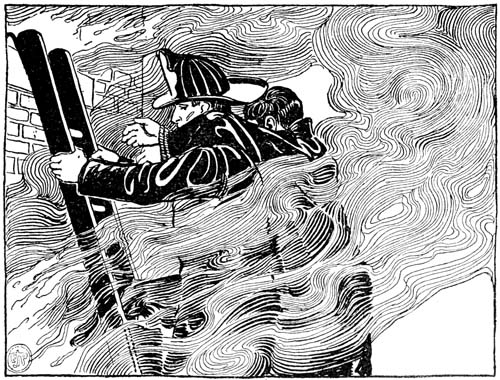
Through the smoke they saw Dick climb out of the
window on to the ladder—but not alone. Hanging
suspended over Dick’s back was the unconscious
Shorty, his arms around Dick’s neck, with wrists
securely tied in front.
In this manner Dick began to descend, rung by
rung, bearing his heavy load. The wicked flames
shot out from the windows, and the suffocating smoke
almost hid the men from view. Breathless, the people
watched them on the slender ladder, high in the air,
surrounded by smoke and flame, one man unconscious,
a dead weight on the other man’s back.
The only sounds heard were the crackling of the
flames and the swish of the water as it played and
sizzled on the fire. Then the silence was broken by a
great crash—one of the floors had fallen in.
But Dick came quickly down, lower and lower,
nearer and nearer to safety. What if his hands and
face were scorching and his clothes catching fire, his
heart did not flinch. To save life—that is the fireman’s
first duty, and well was Dick performing it.
But Dick was not thinking of that; he had only
one thought—to get Shorty to the foot of the ladder
and safely off his back.
A few steps more and the deed was done.
Upstretched hands supported him; his feet touched
the ground—Shorty was saved.
Then the people cheered and cheered again; and
well they might, for they had witnessed a thing that
makes every heart beat high with pride—the speedy
rescue of lives by heroes who freely risk their own in
the performance of duty.
By this time the efforts of the firemen began to tell;
the water began to conquer the flames, the fire was soon
under control, and the danger was over.
The chief, who now had time to look about him,
spied Jack at the fire line.
“Come here,” he called.
Jack came running, proud to be thus singled out.
“Hello,” he said, “you are the boy who turned in the
alarm, aren’t you?”
“Yes, sir,” replied Jack.
“Go to school?”
“Yes, sir.”
“Good work, my boy, good work! Come around to
the fire station and see me after school today.”
“Thank you, sir,” said Jack.
For the first time since the excitement began, Jack
realized that he still had three papers under his arm
undelivered. These he delivered quickly, and ran
home to tell his mother all about the fire.