How different it is with the Newboys, now, where I have an
entrée—(having indeed had the honour in former days to give lessons to
both the ladies)—and where such a quack as Pinkney would never be
allowed to enter! A merrier house the whole quarter cannot furnish. It
is there you meet people of all ranks and degrees, not only from our
quarter but from the rest of the town. It is there that our great man,
the Right Honourable Lord Comandine, came up and spoke to me in so
encouraging a manner that I hope to be invited to one of his lordship’s
excellent dinners (of which I shall not fail to give a very flattering
description) before the season is over. It is there you find yourself
talking to statesmen, poets, and artists—not sham poets like Bulbul, or
quack artists like that Pinkney—but to the best members of all society.
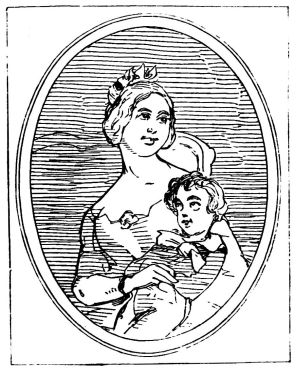
It is there I made the sketch in the frontispiece while Miss
Chesterforth was singing a deep-toned tragic ballad, and her mother
scowling behind her. What a buzz and clack and chatter there was in the
room to be sure! When Miss Chesterforth sings everybody begins to talk.
Hicks and old Fogy were on Ireland; Bass was roaring into old Pump’s
ears (or into his horn rather) about the Navigation Laws; I was engaged
talking to the charming Mrs. Short; while Charley Bonham (a mere prig,
in whom I am surprised that the women can see anything) was pouring out
his fulsome rhapsodies in the ears of Diana White. Lovely, lovely Diana
White! were it not for three or four other engagements, I know a heart
that would suit you to a T.
Newboy’s I pronounce to be the jolliest house in the street. He has only
of late had a rush of prosperity, and turned Parliament man; for his
distant cousin, of the ancient house of Newboy of ——shire dying,
Fred—then making believe to practice at the bar, and living with the
utmost modesty in Gray’s Inn Road—found himself master of a fortune,
and a great house in the country, of which getting tired, as in the
course of nature he should, he came up to London, and took that fine
mansion in our Gardens. He represents Mumborough in Parliament, a seat
which has been time out of mind occupied by a Newboy.
Though he does not speak, being a great deal too rich, sensible, and
lazy, he somehow occupies himself with reading blue books, and indeed
talks a great deal too much good sense of late over his dinner-table,
where there is always a cover for the present writer.
He falls asleep pretty assiduously too after that meal—a practice which
I can well pardon in him—for, between ourselves, his wife, Maria
Newboy, and his sister, Clarissa, are the loveliest and kindest of their
sex, and I would rather hear their innocent prattle, and lively talk
about their neighbours, than the best wisdom from the wisest man that
ever wore a beard.
Like a wise and good man he leaves the question of his household
entirely to the woman. They like going to the play. They like going to
Greenwich. They like coming to a party at bachelor’s hall. They are up
to all sorts of fun, in a word; in which taste the good-natured Newboy
acquiesces, provided he is left to follow his own.
It was only on the 17th of the month that, having had the honour to dine
at the house, when, after dinner, which took place at eight, we left
Newboy to his blue books, and went up stairs and sang a little to the
guitar afterwards—it was only on the 17th December, the night of Lady
Sowerby’s party, that the following dialogue took place in the boudoir,
whither Newboy, blue books in hand, had ascended.
He was curled up with his House of Commons boots on his wife’s
arm-chair, reading his eternal blue books, when Mrs. N. entered from her
apartment, dressed for the evening.
Mrs. N.—Frederic, wont you come?
Mr. N.—Where?
Mrs. N.—To Lady Sowerby’s.
Mr. N.—I’d rather go to the black hole in Calcutta. Besides, this
Sanitary Report is really the most interesting—[he begins to read.]
Mrs. N. (piqued)—Well; Mr. Titmarsh will go with us.
Mr. N.—Will he? I wish him joy!
At this puncture Miss Clarissa Newboy enters in a pink paletôt, trimmed
with swansdown—looking like an angel—and we exchange glances of—what
shall I say?—of sympathy on both parts, and consummate rapture on mine.
But this is by-play.
Mrs. N.—Good night, Frederic. I think we shall be late.
Mr. N.—You won’t wake me, I daresay; and you don’t expect a public
man to sit up.
Mrs. N.—It’s not you, it’s the servants. Cocker sleeps very heavily.
The maids are best in bed, and are all ill with the influenza. I say,
Frederic dear, don’t you think you had better give me YOUR CHUBB KEY?
This astonishing proposal, which violates every recognised law of
society—this demand which alters all the existing state of things—this
fact of a woman asking for a door-key, struck me with a terror which I
cannot describe, and impressed me with the fact of the vast progress of
Our Street. The door-key! What would our grandmother, who dwelt in this
place when it was a rustic suburb, think of its condition now, when
husbands stay at home, and wives go abroad with the latch-key?
The evening at Lady Sowerby’s was the most delicious we have spent for
long, long days.
Thus it will be seen that everybody of any consideration in Our Street
takes a line. Mrs. Minimy (34) takes the homœopathic line, and has
soirées of doctors of that faith. Lady Pocklington takes the
capitalist line; and those stupid and splendid dinners of hers are
devoured by loan-contractors, and railroad princes. Mrs. Trimmer (38)
comes out in the scientific line, and indulges us in rational evenings,
where history is the lightest subject admitted, and geology and the
sanitary condition of the metropolis form the general themes of
conversation. Mrs. Brumby plays finely on the bassoon, and has evenings
dedicated to Sebastian Bach, and enlivened with Handel. At Mrs.
Maskleyn’s they are mad for charades and theatricals.
They performed last Christmas in a French piece, by Alexandre Dumas, I
believe—“La Duchesse de Montefiasco,” of which I forget the plot, but
everybody was in love with everybody else’s wife, except the hero, Don
Alonzo, who was ardently attached to the Duchess, who turned out to be
his grandmother. The piece was translated by Lord Fiddle-faddle, Tom
Bulbul
being the Don Alonzo; and Mrs. Roland Calidore (who never misses an
opportunity of acting in a piece in which she can let down her hair) was
the Duchess.
Alonzo.
You know how well he loves you, and you wonder
To see Alonzo suffer, Cunegunda?—
Ask if the chamois suffer when they feel
Plunged in their panting sides the hunter’s steel?
Or when the soaring heron or eagle proud,
Pierced by my shaft, comes tumbling from the cloud,
Ask if the royal birds no anguish know,
The victims of Alonzo’s twanging bow?
Then ask him if he suffers—him who dies,
Pierced by the poisoned glance that glitters from your eyes!
[He staggers from the effect of the poison.
The Duchess.
Alonzo loves—Alonzo loves! and whom?
His grandmother! O hide me gracious tomb!
[Her Grace faints away.
Such acting as Tom Bulbul’s I never saw. Tom lisps atrociously, and
uttered the passage, “You athk me if I thuffer,” in the most absurd way.
Miss Clapperclaw says he acted pretty well, and that I only joke about
him because I am envious, and wanted to act a part myself.—I envious
indeed!
But of all the assemblies, feastings, junkettings, déjeunes, soirées,
conversaziones, dinner-parties, in Our Street, I know of none pleasanter
than the banquets at Tom Fairfax’s; one of which this enormous
provision-consumer gives seven times a-week. He lives in one of the
little houses of the old Waddilove Street quarter, built long before
Pocklington Square and Pocklington Gardens and the Pocklington family
itself had made their appearance in this world.
Tom, though he has a small income, and lives in a small house, yet sits
down one of a party of twelve to dinner every day of his life; these
twelve consisting of Mrs. Fairfax, the nine Misses Fairfax, and Master
Thomas Fairfax—the son and heir to twopence-halfpenny a-year.
It is awkward just now to go and beg pot-luck from such a family as
this; because, though a guest is always welcome, we are thirteen at
table—an unlucky number, it is said. This evil is only temporary, and
will be remedied presently, when the family will be thirteen without
the occasional guest, to judge from all appearances.
Early in the morning Mrs. Fairfax rises, and cuts bread and butter from
six o’clock till eight; during which time the nursery operations upon
the nine little graces are going on. We only see a half dozen of them at
this present moment, and in the present authentic picture, the remainder
dwindling off upon little chairs by their mamma.
The two on either side of Fairfax are twins—awarded to him by singular
good fortune; and he only knows Nancy from Fanny
by having a piece of tape round the former’s arm. There is no need to
give you the catalogue of the others. She, in the pinafore in front, is
Elizabeth, goddaughter to Miss Clapperclaw, who has been very kind to
the whole family; that young lady with the ringlets is engaged by the
most solemn ties to the present writer, and it is agreed that we are to
be married as soon as she is as tall as my stick.
If his wife has to rise early to cut the bread and butter, I warrant
Fairfax must be up betimes to earn it. He is a clerk in a Government
Office; to which duty he trudges daily, refusing even twopenny
omnibuses. Every time he goes to the shoemaker’s he has to order eleven
pairs of shoes, and so can’t afford to spare his own. He teaches the
children Latin every morning, and is already thinking when Tom shall he
inducted into that language. He works in his garden for an hour before
breakfast. His work over by three o’clock, he tramps home at four, and
exchanges his dapper coat for that dressing-gown in which he appears
before you,—a ragged but honourable garment in which he stood
(unconsciously) to the present designer.
Which is the best, his old coat or Sir John’s bran new one? Which is the
most comfortable and becoming, Mrs. Fairfax’s black velvet gown, (which
she has worn at the Pocklington Square parties these twelve years, and
in which I protest she looks like a queen), or that new robe which the
milliner has has just brought home to Mrs. Bumpsher’s, and into which
she will squeeze herself on Christmas day?
Miss Clapperclaw says that we are all so charmingly contented with
ourselves that not one of us would change with his neighbour; and so,
rich and poor, high and low, one person is about as happy as another in
Our Street.