Wherein Captain Galligasken describes in brief Detail the Siege of
Petersburg and Richmond, and attends the illustrious Soldier to the End
of the Campaign at Appomattox Court House.
In my limited space, it would be impossible for me to do anything more
than indicate the principal movements of the army. The details are so
cumbrous and complicated that they would require a whole volume, and
they are not necessary to my purpose in illustrating the character of
General Grant.
Doubtless General Lee was aware of the movements of the Union army,
for a body of troops, numbering over a hundred thousand, could hardly
have been spirited through a hostile region without some tidings of its
operations reaching him. But the transfer was made so skilfully and
expeditiously that it was practically a surprise. Probably Lee expected
to find Grant battering away at his intrenchments at some point between
the Chickahominy and the James; but he must have been astonished when
he heard of him fifty-five miles distant, menacing his lines on the
south side of Richmond.
General Butler, with the army of the James, was at Bermuda Hundred, on
the river. He had been directed to capture Petersburg while it was
feebly defended. He had made the attempt, but it had failed. He had
strongly fortified his position, and kept a rebel force in front of
him, thus in part answering the ends for which he had been sent to the
south side.
General Lee, finding that Grant was menacing Richmond from a new
quarter, hurried his army through the city to confront him in his
new position. On the arrival of Grant at Butler's encampment, he
immediately sent out another force for the capture of Petersburg, which
was an exceedingly important point, covering the railroad connections
with the south. The rebels in the intrenchments in front of Butler
hastened to the defence of the exposed city, and the vacated works were
occupied by Union troops, but they were eventually driven back. The
army was drawn up around Petersburg, where the enemy was very strongly
intrenched in three lines of works. A vigorous and determined assault
was made, but without gaining anything more than a temporary advantage.
Burnside got near enough with his black brigades to throw a few shells
into Petersburg, but after a bloody conflict he was forced back. The
effort was faithfully made, and continued through three days; but the
works were invulnerable.
At this point Grant fixed his gripe upon the two cities of Richmond and
Petersburg. By his hard fighting he had secured favorable positions to
commence his siege operations, which were vigorously followed up till
the final event.
Phil Sheridan had been sent off on another raid to destroy the Virginia
Central Railroad, and to unite with Hunter, by whom Sigel had been
superseded, after his defeat by Breckinridge. He succeeded fully in the
first part of his purpose, but could not find Hunter, who had been sent
down through the Shenandoah Valley to strike Lynchburg. Twelve miles
from Staunton, he encountered Jones's command, fought, and defeated
it, taking fifteen hundred prisoners. Hunter united the expeditions of
Crook and Averill with his own, and marched upon Lynchburg; but Lee had
reënforced its garrison, and he was compelled to retreat, which he did
by the way of West Virginia, thus placing his troops out of the field
at a time when they were very much needed. This army had been relied
upon by Grant to keep back a rebel approach up the Shenandoah Valley
towards Washington, while he had coiled the army of the Potomac around
Lee's forces south of the James, so that there was no danger of the
main body again menacing the national capital.
It makes me even now groan in spirit to recall the failures of Grant's
subordinates who were removed from the immediate sphere of his
influence; but when I think how charitable the lieutenant general was
to them, it is not meet that I should complain. These short comings
were galling and vexatious to him, imperilling the mighty plans he
had so laboriously built up; but he behaved like a Christian in every
disappointment and trial.
Several cavalry raids were organized, which inflicted severe injuries
upon the enemy's communications south of Petersburg. The celebrated
mine was sprung on the 30th of July, which blew up one of the most
important of the rebel forts, involving a battery and the greater part
of a regiment in its destruction; but the result, which had promised
so well, realized nothing but disaster. As soon as Lee discovered that
Hunter was retreating through West Virginia, he sent Jubal Early,
with a picked force of twenty-five thousand men, down the Shenandoah
Valley, to threaten Washington, and to capture it, if practicable,
hoping thus to distract the attention of Grant, and cause him to relax
the "anaconda" gripe in which he held the rebel army. This army swept
fiercely down the valley, and driving the small Union force in the
vicinity before it, crossed the Potomac. Strong bodies of cavalry,
under Mosby, rushed through Maryland, plundering Hagerstown and
Frederick City, robbing the stores, and extorting money from the people
to save their houses from being burned. They destroyed a portion of the
Baltimore and Ohio Railroad, and threatened Baltimore and Washington.
General Wallace gathered a force of eight thousand men, and attempted
to dispute the passage of Early's army; but as the enemy were three to
his one, he was compelled to fall back, though he fought a sharp battle
before doing so. Washington and Baltimore were now greatly alarmed, and
the citizens were called to arms. The enemy came within five miles of
the capital. Grant sent the Sixth Corps, under Wright, and a portion
of the Nineteenth, which had just arrived from New Orleans, for its
protection. There was some heavy skirmishing near the capital, but the
rebels soon retired. Wright was ordered to follow them; and, having
overtaken Early, a smart engagement ensued, in which the enemy was
defeated.
The Shenandoah region gave the lieutenant general a great deal of
trouble. He found that Early had no intention of returning to Richmond,
but had established himself in the valley; was gathering the rich
harvests there, and sending large supplies to the rebel capital. He
visited Hunter in person, and gave him particular instructions to
follow Early, and to destroy all supplies; but finding Hunter willing
to be relieved, he soon after assigned Sheridan to the Middle Military
Division, which included all this section, and all the troops in
Washington and its vicinity. The bold cavalryman was not only the most
dashing officer in the army, but one of the best and most skilful
generals. He soon brought order and harmony out of the confusion and
complications which had so disturbed the general-in-chief. Grant
cautioned him at first to avoid a general engagement, fearful, in case
of defeat, of exposing Maryland, Pennsylvania, and the capital to new
incursions.
Sheridan was full of fight, and saw his way clearly to a national
victory; but he was too good a soldier to disobey his orders. Grant was
willing to give the desired permission, but, not fully understanding
the situation, or the views of his subordinate, he made a second visit
to the Middle Division, and had an interview with Sheridan at his
headquarters, near Harper's Ferry. High as his opinion had before been
of the dashing soldier, the lieutenant general seems to have received a
new revelation of his character and purposes on this occasion, as his
enlarged sphere brought out his capacities; and he found it necessary
to give him only that brief and singularly expressive order, "Go in!"
Grant adds that he never found it necessary to visit Sheridan again
before giving him orders.
Sheridan "went in"! He promptly attacked Early, fought him all day, and
beat him thoroughly. The enemy lost five guns, fifteen battle flags,
and five thousand prisoners. Not satisfied with this splendid result,
he pursued the defeated foe up the valley, till the latter made a
stand at Fisher's Hill. Here Sheridan "went in" again, routed Early,
drove him from his position, scattering portions of his force among
the mountains. Leisurely returning, he posted himself at Cedar Creek
to rest his troops after their hard marching and fighting. Here, while
Sheridan was absent at Winchester, his army was surprised and badly
beaten. The guns were captured, portions of the force routed, and the
whole compelled to retreat.
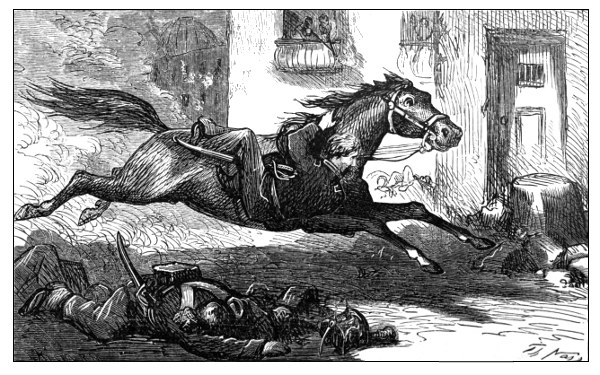
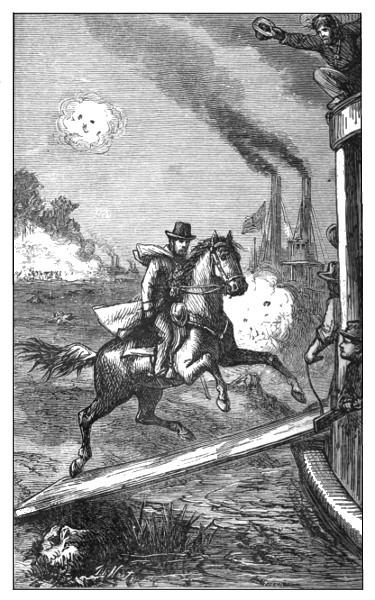
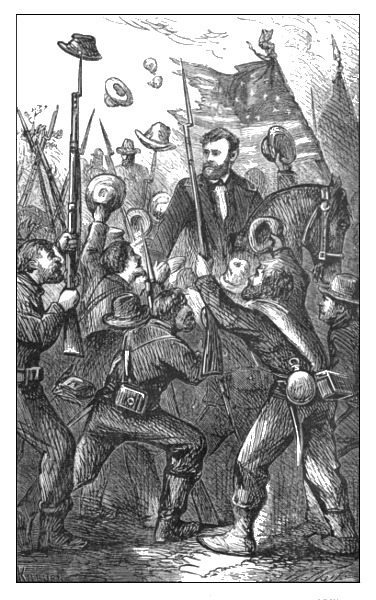
Sheridan was twenty miles from the scene of action; but hearing the
distant booming of the guns, he mounted his good horse, and dashed away
at a furious speed, and, in the midst of the rout, appeared upon the
lost field, his charger reeking with foam. Dashing along the broken
lines, then in retreat, he swung his hat in air, shouting furiously
to the troops, "Face the other way, boys! We are going back." The
stragglers began to rally at this startling presence on the field; and
pushing to the main body, he electrified the army with his glorious
spirit. "Boys, this would not have happened if I had been here," he
called; "we are going back." Dashing here and there like a meteor among
the troops, he re-formed the lines, and made his dispositions for a
renewal of the battle. Before the arrangements were quite completed the
rebels came down upon the lines again for a fresh and overwhelming
assault. This time the onslaught was boldly and successfully resisted;
and Sheridan, taking advantage of a momentary reeling of the enemy,
charged upon them with infantry and cavalry, broke their lines, and
thoroughly routed them. All that the rebels had was captured, including
the guns and camp equipage which they had taken in the morning.
Sheridan, by his personal presence, by his magnetic influence, and
by his unsurpassed military skill, had wrested victory from defeat.
The one man had fought the battle, and had won it. For his brilliant
achievement, he was made a major general in the regular army, in the
place of General McClellan, who resigned to go into politics. Grant
ordered one hundred guns to be fired from each of the armies around
Petersburg in honor of Sheridan's victory. "Turning what bade fair to
be a disaster into a glorious victory," said the lieutenant general,
"stamps Sheridan—what I have always thought him—one of the ablest of
generals."
Sheridan's victory also stamps Grant as the ablest of generals; for in
the selection of his pet he displayed a knowledge of human character
and a keen perception of the adaptation of means to ends, the want of
which had caused so many other generals to fail. My friend Pollard
is made especially mad by this episode in the Shenandoah Valley. He
is particularly disgusted with the singular story of "the sudden
apparition of General Sheridan on a black horse flecked with foam,"
though in the same chapter in which he alludes to the incident, he
tells a story himself which would have made Baron Munchausen tremble
for his reputation.
Sheridan's exploits in the valley, and his destruction of the rebel
supplies, put an end to Confederate operations in that quarter.
Washington was not menaced again, and the Sixth Corps was sent back
to Petersburg to resume its place in the line of investment. The army
of the Potomac was still battering away with its siege works at the
rebel fortifications. It had extended its line around Petersburg, and
destroyed twenty miles of the Weldon Railroad. There was no rest for
the troops in the trenches. Every day brought its labors and its battle
on a larger or a smaller scale. The sharp-shooters were picking off
any man who showed his head above the breastworks. It was ceaseless
toil and ceaseless vigilance. Grant was everywhere, on the watch for an
opportunity to take advantage of any favoring circumstances. The winter
came, and the lieutenant general did not desert the army to engage in
the festivities or the excitements of the capital. He still kept his
gaze firmly fixed on the prize which would end the Rebellion.
While the general-in-chief had been "hammering" away at the rebel
army in Virginia, Sherman, under his direction, had been striking
heavy blows at the South. He had fought and flanked his way down to
Atlanta, carrying dismay and desolation before his victorious banners.
The series of disasters which attended the operations of Johnston
caused his removal from the command, Hood taking his place. The "great
flanker" punished him even worse than his predecessor, and Hood went
into Tennessee, with an army of fifty thousand men, to overwhelm
Thomas; but this veteran almost wiped him out, and drove him to the
south, with the loss of half his force and more than half his guns and
munitions. Farragut thundered into Mobile Bay with his squadron, and,
having defeated or sunk the rebel fleet, captured all the forts which
covered Mobile. During the winter, Fort Fisher fell, and Wilmington
dropped quietly into the hands of the Union forces. To crown the
disasters of the Confederacy, Sherman made his grand march to the sea,
mowing a wide swath on his passage, and leaving desolation and ruin in
his path.
The Confederacy was on its last legs in the spring of 1865, though Lee
still held his lines at Petersburg and Richmond. Jeff. Davis was still
confident, though his general declared that he was no longer able to
make a good fight. Some attempts to negotiate a peace were made, but
they failed because the rebels still wanted terms which a conqueror
might have asked. Grant had long ago demonstrated that the Confederacy
was nothing but a "shell," and it had been broken in a hundred places.
Still the rebels held out wherever they had a foot of ground whereon
to stand. Still they prated about the "last ditch," and looked
confidently, even up to the time of the final disaster, to foreign
interference, or to some miraculous interposition of circumstances.
Sherman continued his march, captured Savannah, caused the evacuation
of Charleston, and occupied Columbia. Johnston was gathering an army in
North Carolina for the purpose of overwhelming him. Grant feared that
Lee would desert Richmond, and seek to join the forces of Johnston.
Indeed, he had been partly moved by this consideration in the selection
of the south side of the James as his field of operations. Richmond,
without the rebel army which for four long years had been defending it,
would be a showy, but not a substantial prize.
President Lincoln went down to City Point, and visited the national
army in its several positions, as well to inform himself practically
of the situation as to encourage the soldiers who had so long and so
valiantly struggled for the salvation of the nation. The preparations
for the final campaign were completed, and the army was to move on the
29th of March; but four days before this time arrived, Lee made his
last struggle to escape the gripe of Grant's anaconda, and to realize
the indefinite circumstance which was to clear up the horizon of
Southern prospects. He massed his troops, and made an impetuous assault
on Fort Steadman. The attack was so sudden and violent, that for the
moment it was a success, and the rebels were in full possession of the
redoubt. But the Union guns were immediately pointed at the work, and a
terrible fire poured in upon the enemy. The infantry charged upon the
rebels in the fort, now cut off from their retreat, and two thousand of
them were compelled to surrender. President Lincoln had been invited
to review the troops; but from a hill he was permitted to behold
the recapture of the fort, which suited him better, as a spectacle.
A general attack was ordered, and the Union line dashed gallantly
forward, capturing the enemy's picket line, which they were unable to
recover.
About this time Sherman, whose army was at Goldsboro', made a hasty
visit to City Point, where he had a consultation with the president,
Grant, Meade, and Sheridan, and plans were matured to prevent a
junction between Lee and Johnston. The lieutenant general's "hammering"
process was now bringing forth its proper fruit in the rebel ranks.
Deserters and stragglers from them were thicker than snow-flakes at
Christmas. They had learned what Grant was. They had found that he was
a fighting general, and they were not willing to be sacrificed to the
Moloch of the South, battling for what was already a "Lost Cause." It
was confidently believed that Lee was more intent upon the problem of
retiring with his army than on that of longer protecting Richmond. His
movement upon Fort Steadman was doubtless intended to facilitate his
escape.
Grant had no idea of permitting his wily foe to "retire." He was more
desirous of capturing the rebel army than of taking Richmond. On the
29th of March—the day appointed for the grand movement—Sheridan was
sent out to Dinwiddie Court House, south-west of Petersburg. The left
of the main army had been advanced so that Grant's line extended from
the Appomattox, below Petersburg, to Dinwiddie. Grant himself was at
Gravelly Run, between Sheridan and the left of the main body, watching
coolly, but with the most intense anxiety, the development of his
programme. Sheridan, in spite of the heavy rains which had rendered
the roads impassable for wagons, floundered through the mud with his
cavalry to Five Forks, where the enemy was in force. Warren, with the
Fifth Corps, extended his lines nearly up to the same point.
Sheridan "went in" with his usual impetuosity, and seized Five Forks.
The enemy made a desperate attack upon Warren, and forced him back for
a time, though he soon recovered from the shock and held his own. The
enemy then turned upon Sheridan, occupying an isolated position, and
compelled him slowly to fall back; and he retreated upon Dinwiddie,
instead of upon the main line, thus compelling the rebels in their
pursuit to extend their line—a piece of strategy which called forth
the warmest commendations of his commander. Grant, solicitous for his
safety, sent two divisions of the Fifth Corps to Sheridan, who with
this aid attacked the rebels on his front, and drove them back to Five
Forks again.
At this point the Confederates were in heavy force; but Sheridan made
his dispositions with remarkable skill, hurried up the Fifth Corps, and
with his cavalry executed a brilliant manœuvre, by which the battle
was won, the rebels routed, and six thousand prisoners captured. By
this bold and skilful movement, so admirably executed by Sheridan, the
right of the rebel line was turned. In support of this operation on the
left, Grant ordered a heavy bombardment to be kept up during the entire
night of April 1, the day on which Sheridan had fought this decisive
action, and at four o'clock the next morning (Sunday) a combined
assault was made with perfect success, which was followed up till the
enemy broke from his lines, and fled from the lost field, following the
road along the south bank of the Appomattox.
Richmond and Petersburg were lost to the rebels!
No tidings of these terrific conflicts had reached Richmond. The people
still believed, as Jeff. Davis had taught them, that Richmond could
hold out for twenty years before any force operating against it. Lee
sent a message to the obstinate "president" of the Confederacy that
the battle was lost, and that the army must flee from its strongholds.
The despatch was handed to Davis while he was at church. He read it,
hastily rose, and went out. He was ghastly pale, and his face revealed
the disaster to all who saw it. He was alarmed for his personal safety,
and perhaps trembled in view of the halter that hung to the allegorical
"sour apple tree," which had been celebrated in song all over the
loyal land. Taking a train to the south, he left Richmond, which he
was to enter again only as an indicted traitor. That night the city
was evacuated in hot haste and set on fire by its late defenders,
disappointed and desperate at the grand finale of Rebellion. General
Weitzel entered and took possession the next morning. The flag of the
redeemed Union waved triumphantly over the capital of Virginia.
Grant was not looking after Richmond just now. I do not know that he
made any mention of the place in his documents, but in his despatch
to Sherman, on the 5th of April, he says, "Rebel armies are now the
only strategic points to strike at." Acting on this view, he ordered
the most vigorous pursuit of Lee. Sheridan was sent forward with his
cavalry, and the Sixth Corps, now temporarily under his command. He
continued to "hammer" whenever an opportunity offered. At Sailor's
Creek he struck the enemy a heavy blow, which resulted in the capture
of sixteen guns, four hundred wagons, and seven thousand prisoners.
The pursuit then became a hunt. Lee had lost his supplies, or had
been cut off from them. On his arrival at Amelia Court House, he was
compelled to halt, to rest his men, and gather up food for their
support from the country. This delay afforded the Union cavalry time to
get ahead of him and destroy the Danville Railroad, his chosen means of
retreat to effect a junction with Johnston.
The whole army of the Potomac was concentrated at Jettersville to
attack Lee at Amelia, but he had fled, now bent upon reaching the
mountains beyond Lynchburg. The pursuit was hurried up, Confederate
supply trains captured, and the enemy reduced to desperate straits.
Their sufferings were intensely severe, hundreds of them dropping with
sheer exhaustion, for the want of rest and food, while the majority
were no longer able to carry their muskets. Crossing the river, Lee had
dragged his weary way to Appomattox Court House. On the night of April
6, a number of his officers informally met, and agreed that surrender
was all that was left to the miserable army, worn out, starved, and
thinned by wholesale desertion. One of them informed Lee of their
conclusion; but whatever he thought, he did not adopt their suggestion.
The excellent Pollard does not hesitate to hint that Grant was a
"butcher;" but it is acknowledged that Lee had no hope of the campaign
in which he had engaged a week before, and had only persisted in
fighting to please Davis. He waived his own opinion, and fought those
bloody battles from Petersburg to Sailor's Creek, when he was satisfied
there was no hope. What was he but a "butcher"? Is he not responsible
for every life sacrificed at his order after he knew that the strife
was hopeless? Lee was a skilful soldier, and if we could wipe out the
fact that he was a traitor, that he fought against the government which
had educated him to support it, and which he had sworn to defend; if
we could forget that his influence might have removed the stains of
Andersonville, Belle Island, and other rebel prisons from the annals
of the miserable Confederacy; if he had ceased to shed blood when
his conscience assured him treason could no longer flourish upon the
sacrifice,—we might hold him up as a hero. As it is, he deserves the
infamy he has won.
It was left for Grant to obey the promptings of humanity—for the
"butcher" to make the overtures to stay the further useless flow of
blood.