THE ride from Melun to Barbizon and through the Forest of Fontainebleau
was a pilgrimage within a pilgrimage. Like Christian, we were tempted to
desert the straight course, and, like him, we yielded. We turned out of
our sentimental way to see M. Millet’s house for pleasure.—To be
strictly truthful, I must add that another good reason for going by
Barbizon was the knowledge that the pavé of the national road only
comes to an end at Fontainebleau, together with our eagerness to be out
of the train and riding again as soon as possible.—By following the
Chailly and Barbizon road to the Forest we could have our desire and
spare the tricycle.
It considerately cleared with the early afternoon, and the cloud masses,
now white and soft, drifted apart, to leave blue spaces between.—We had
a shower or two, but so light we were not wet; and presently the sun
coming out set the rain-drops on the bushes and heather by the wayside
to glittering.
Not far from Melun we met four bicyclers. Much has been said about the
“freemasonry of the wheel.” There is a pleasant suggestion of
good-fellowship in the expression, but I think it merely means that
cyclers, who abroad will speak to any other cycler who gives them the
chance, at home ignore all but friends and acquaintances. At least this
is the definition which French, like English, riders practically
accept.—Of the four near Melun, two wheeled by as if they did not see
us, and the third tried not to smile. The fourth, however, wished us a
Bon jour, but it was scarcely disinterested. It turned out he had just
ordered a Rotarie from Bordeaux, and wanted to know some thing of the
system of our tandem.——
In how many ways could it be used, for example? and what time could we
make on it?
—The freemasonry in his case only carried him over level ground. At the
foot of the first hill he left us.
We were in a humour for fault-finding. The luggage-carrier, of course,
was to blame. Like Christian, we were punished for going out of our way,
I suppose. Certain it is that before long we stood still, as he did, and
wotted not what to do.—If the blacksmith at Beaumont had been a little
more serious in his work, the accident in Paris might not have happened;
or indeed, to go back to the beginning of the evil, if Humber & Co. had
only known as much as they think they know about their own business, we
should not have found ourselves half-way to Chailly with the
luggage-carrier hanging on by one screw.—We managed to keep it in place
after a fashion; but there was no riding fast, and I do not believe in
the whole course of our journey we ever sighted a town so joyously as we
did Chailly, lying “dustily slumbering in the plain.”
In our struggles we had pulled off a strap, and I went to the
harness-maker’s to see if it could there be re-fastened, while J——
knocked at the blacksmith’s. For five minutes no one answered; and then
at last an old woman, clean and neat as her village, opened the door,
and made quite a show of briskness by asking what I wanted. She said of
course the matter could be attended to. But when I represented I must
have it done at once——
“My dear Madam, it is impossible,” she said. “The workmen have been
gone two days, and I cannot tell when they will return.”
—At the blacksmith’s J——’s knocks summoned only two children, who
stared as if nothing was more unlooked for at the shop than a
customer.—Our needs were urgent, and it was useless to attempt to make
them understand. J—— went boldly in, and helped himself to wire and a
nail.—While he was blacksmithing for himself their mother came out and
bade him take whatever he wanted. The workmen had been away a week, and
she did not know when they would be back again.—That workmen should
leave Chailly to find something to do did not seem surprising. The only
wonder was they should think it worth their while to stay there at
all.—As we stood in front of the shop, J—— mending the
luggage-carrier with an energy I am sure had never gone to the operation
before, a little diligence carrying a young lady and an artist in Tam o’
Shanter—there was no mistaking his trade—passed with a great jingling
of bells. But even it failed to awake Chailly from its slumbers.
The blacksmith’s wife refused to take any money for the wire and
nail.—However, J—— insisting on making some payment, the woman told
him he could give sous to the children. I have never seen anything to
equal her honesty. When she found that two of her neighbour’s little
girls had come in for a share of the profits, she forced them to
relinquish it, while she would not allow her own children to keep more
than two sous a-piece. Nothing we could say could alter her resolution,
and with Spartan-like heroism she seized the extra sous and thrust them
into J——’s hand.
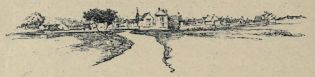
After experiencing these things, we rode out on the great plain of
Barbizon. It would be affectation to pretend we did not at once think
and speak of Millet. Was it not partly to see his house and country we
had come this way? His fields, with here and there scattered grey
boulders, and in the middle distance a cluster of trees, stretched from
either side of the road to the far low horizon, the beauty of their
monotony being but accentuated by the afternoon’s soft cloud-shadows. It
seemed to us a bright, broad prospect, though I suppose we should have
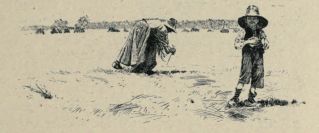
found it full of infinite sadness.—There was not much pathos in near
cabbage-patches glowing and shining in two o’clock sunlight, and we
could not believe the weariness of the peasants to be quite genuine.
Their melancholy seemed less hopelessness, than consciousness of their
duty to pose as pathetic features in the landscape.—Even an old woman,
a real Millet, with sabots and handkerchief turban, and a bundle of
grass on her back, stopped on her homeward way to strike a weary
attitude on a stone heap by the wayside the minute she saw J——’s
sketch-book.—The peasants of Barbizon have not served an apprenticeship
as models for nothing. They have learned to realise their sufferings,
and to make the most of them.——
“Now I know,” said J——, putting up his sketch-book, “if I were to tell
her to put her arms or her legs or head in another position, she would
say, ‘Mais non, Monsieur, it was thus I posed for Monsieur Millet,’
or Monsieur somebody else. Bah! it’s all a fashion!”
—The old woman, disappointed, got up and walked onwards, to be speedily
out-distanced by us.
But J——, as is his habit when he once “gets going,” went on.——
“How’s a picture painted here nowadays any way? Nothing could be
simpler. First you get your model;—she’s most probably stood for
hundreds of other men, and knows more about the business than you do
yourself; your master tells you how to pose her; you put her in a
cabbage-patch or kitchen prepared for the purpose, like those in
Chailly, for example; paint the background as carefully as you know how,
and your picture’s made. It’s easier to learn how to paint than to find
motives for yourself; so follow as closely as possible in other men’s
steps; choose the simplest subjects you can; above all, be in the
fashion. There are as good subjects at home as in Barbizon for Americans
who would but go and look for them.”
—By this time, fortunately, we were in Barbizon, and the necessity of
evolving a French sentence with which to ask his way brought J——’s
lecture to an end.—There could be no doubt that the village was the
headquarters for artists. Here and there and everywhere, among the low
grey gabled houses, were studios; and scarcely were we in the village
street before we found an exhibition of pictures.—It has been recorded
that already Barbizon’s artistic popularity is waning, and that even its
secondary lights have deserted it. We were convinced of its decline when
we saw that several of the studios were for rent, and confirmed in this
conviction by a visit to the Exhibition. It was a shade worse than a
Royal Academy, and at a first glance appeared to be a collection of
fireworks. On a close examination the fireworks resolved themselves into
green trees sprawling against patches of vivid blue sky, and flaming
yellow flowers growing in rank luxuriance in low-toned plains.—There
were one or two Millets, of course; but what would Millet himself have
said to them? It is only fair to add that a few small unpretending
canvases were not without merit.
From what we saw in Barbizon, I do not think it improbable that in
another generation there will not be an artist in the village, and that
Millet will have been forgotten by the villagers.—Though his family
still live there, the children of the place seem to know nothing of his
greatness. The first boys of whom we asked the way to the house,
pointed vaguely down the long winding street, and thought, but were not
quite sure, we should find it if we kept straight on. After we left the
Exhibition, other boys whom we questioned declared they had never heard
the name of Millet; and when we refused to let them off so easily, told
us we must go back in the very direction from which we had come. No, we
insisted, it was not there.——
“Ah!” they thought, “Monsieur must mean Monsieur Millet le
charbonnier.”
—Such is fame at home!
Finally, after many explanations on our part, and conversation with
unseen elders behind a garden wall on theirs, a man near by explained
just where the Maison Millet was.
A few steps farther on we reached it. As, I suppose, many other pilgrims
have done, we sat a while on the shady stone seat opposite. A rather
abrupt turn just there hid the road as it wound towards the forest. But
we could look back some distance down the long village street, at the
low houses and high garden walls.—The famous Maison Millet, built
right on the road, grey, with brown moss-grown roof, did not differ from
the other peasant cottages. Even the one large window,
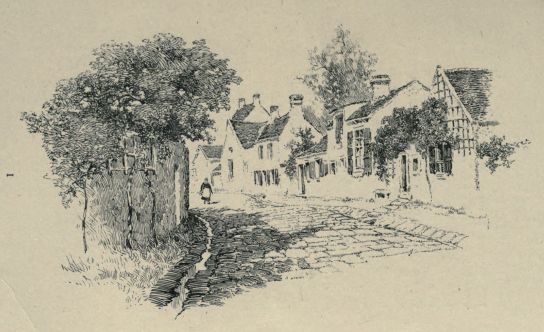
extending almost the entire height of the house, was scarcely a mark of
distinction in studio-crowded Barbizon; just as, probably, during
Millet’s lifetime, his poverty and troubles, and failure to make both
ends meet, were matters of course among the hard-working villagers.—And
yet this humble cottage is already better known and honoured as a place
of pilgrimage in the artistic world, than the palaces that crown Campden
Hill and cluster around Palace Gate, Kensington; even as the works that
came from it will be remembered when the pictures painted within the
palace-studios have long since been forgotten.—We did not ask to go
into the house. I believe visitors are admitted; but it seems almost
cruel to treat it as a mere museum for curious tourists, while the
Millet family is still in charge. So we rested in the pleasant shade,
looking over to the unassuming grey cottage where one or two
plaster-casts showed through the window, the branches of a tall tree
waved over the chimney, and an elder-bush, beneath the weight of its
berries, bent far over the garden wall, on the other side of which
Millet so often walked and stood to watch the west and the setting
sun.—No one was to be seen but two or three children, who examined the
tricycle as they talked in whispers. But we could hear near voices and
the clatter of dishes. And then the wind would come in great gusts from
over the forest, shaking down the leaves on its way, and drowning all
other noises.
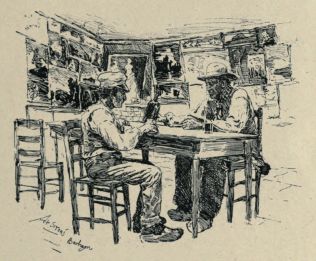
We felt the great contrast when we went from the little house where life
was always sad, to Siron’s, “that excellent artist’s barrack, managed
upon easy principles.”—Its cheerfulness was proclaimed by its large
sign representing a jolly landlord holding a pig’s head on a dish, while
a young lady and gentleman, apparently in an ecstasy of content at the
prospect of a good meal, lay prostrate before it, one on either side,
and an appreciative dog sniffed at it from the foreground.—It seemed
more eloquent in its way than the sign before the other village inn,
whereon a young lady sat at her easel, and two or three young men peeped
over her shoulder, and he who painted it for his dinner was no poor
artist in one sense of the word.
Often enough at Siron’s, as at the Maison Millet, there has been the
difficulty of making both ends meet. But at the inn it has been turned
into comedy rather than tragedy, and if money has not been forthcoming
at once, Siron has been willing to wait, knowing that it would in the
end.—Men of other professions, if they lived together in communities,
as artists often do, could hardly show so fair a record. For all the
talk and definitions of so-called Bohemianism, an artist is never in
debt longer than he can help.—It would be fortunate for tradespeople if
the same could be said of all men.
A waiter in a dress-coat, which was certainly not what we had come to
Barbizon to see, showed us into the “high inn-chamber panelled” with
sketches, where we took great pleasure in noting that the best were by
Americans.—We next ordered groseille, for which it was our privilege
to pay double the price asked elsewhere. I hope the charges for artists
living in Barbizon are not the same as those for an artist passing
through, disguised as a tricycler.—But Siron’s, with its elegant waiter
and prices, and its Exhibition open to the public, was not the Siron’s
we had expected. We had thought to find a true artists’ inn, like
certain Venetian and Florentine dens we knew of;—we had come instead to
a show for the tourist.—And indeed all Barbizon, with its picture
galleries and studios to let, and posing peasants, seemed no better than
a convenient stopping-place, to which drivers from Fontainebleau could
bring travellers, and allow them to spend their francs for the benefit
of Barbizonians.—Thus, from Millet’s misery the people have reaped a
golden harvest.
Stranger still is the fact, that the country where Millet could see but
suffering humanity, with a forest or open landscape in harmony with it,
is now recommended as a place in which to learn mirth and vivacious
contentment.—Millet’s portion in Barbizon was headache and heartache,
so that now and then, in his despair, he cried out to his friends that,
physically and morally, he was going down hill. Over the way at Siron’s
other men stayed on in the village, because near the forest they were
sure of physical and moral good health, air, light, perfumes, and the
shapes of things concording for them in happy harmony.——
“There is no place,” says Mr. Stevenson, “where the young are more
gladly conscious of their youth, or the old better contented with their
age.”