With colored Frontispiece and 371 Illustrations,
chiefly photographed from Life by
the Author. American Nature Series. New
York: Henry Holt and Company. 8vo.
$3.50 net.
THE LOG OF THE SUN
A Chronicle of Nature’s Year. With fifty-two
full-page illustrations by Walter King
Stone, and numerous Vignettes and photographs
from Life. New York: Henry Holt
and Company. 8vo., full gilt. $6.00 net.
TWO BIRD-LOVERS IN MEXICO
Illustrated with photographs from Life
taken by the Author. Boston: Houghton
Mifflin Company. 8vo. $3.00 net.
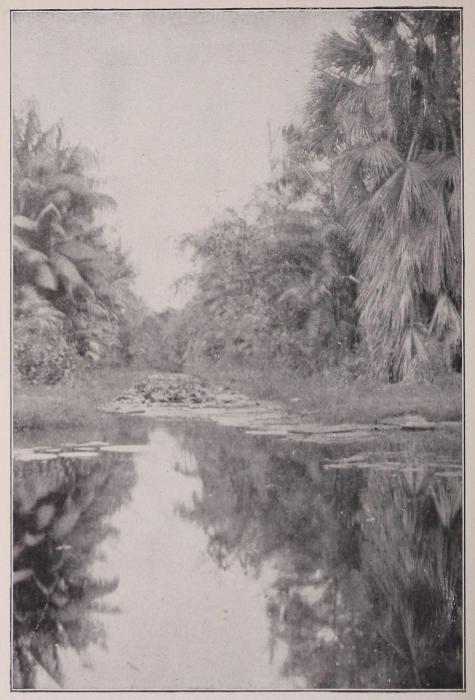
OUR SEARCH FOR A WILDERNESS
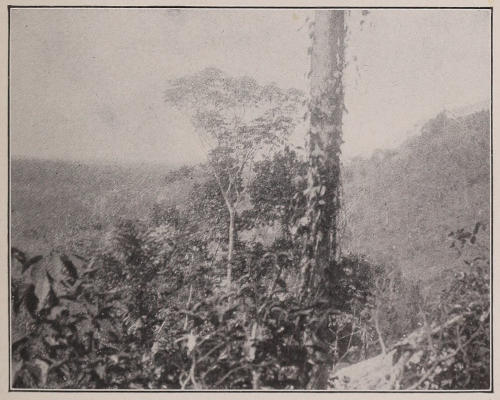
(Frontispiece)
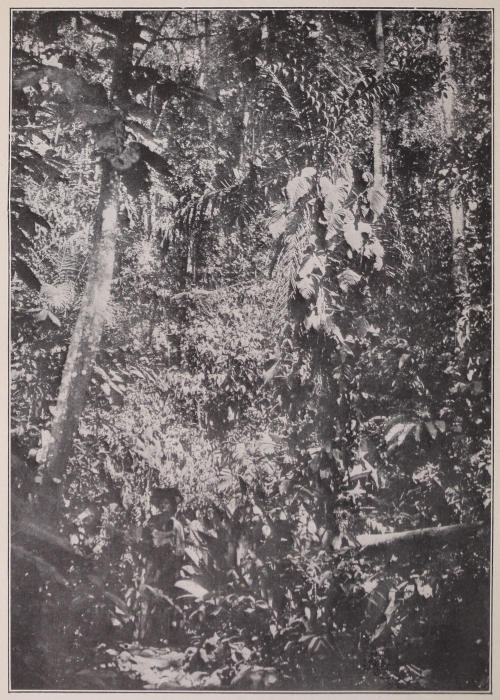
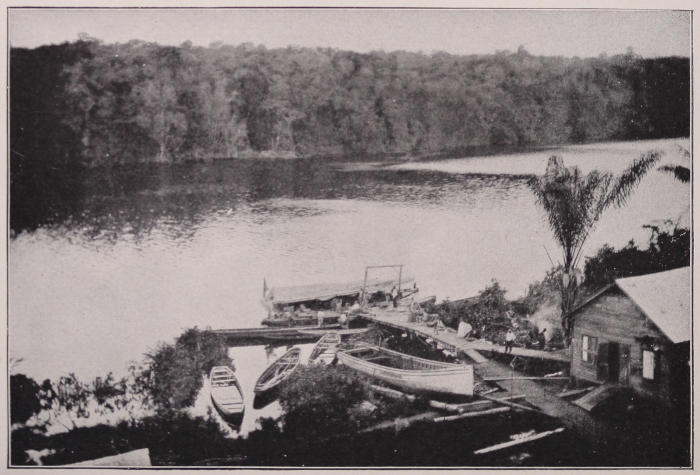
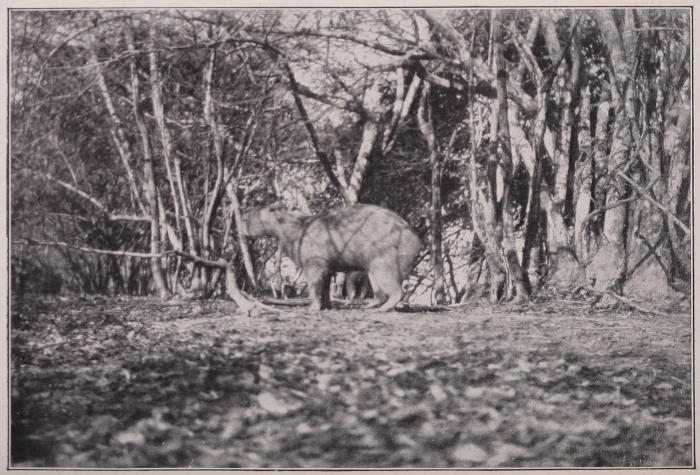
In the South American Wilderness.
OUR SEARCH FOR A
WILDERNESS
AN ACCOUNT OF TWO ORNITHOLOGICAL EXPEDITIONS
TO VENEZUELA AND TO BRITISH GUIANA
BY
MARY BLAIR BEEBE AND
C. WILLIAM BEEBE Curator of Ornithology in the New York Zoölogical Park; Fellow of the
New York Academy of Sciences; Member of the American
Ornithologists’ Union and Corresponding
Member of the London
Zoölogical Society
ILLUSTRATED WITH PHOTOGRAPHS FROM LIFE
TAKEN BY THE AUTHORS
NEW YORK
HENRY HOLT AND COMPANY 1910
Copyright, 1910,
by
HENRY HOLT AND COMPANY
Published April, 1910
Stanhope Press
F. H. GILSON COMPANY
BOSTON, U.S.A.
To Judge and Mrs. ROGER A. PRYOR
With the deepest affection and admiration
of
their Granddaughter MARY BLAIR BEEBE
and of C. WILLIAM BEEBE
PREFACE. — Part I. — Part II.
In the following pages we have set down the tale of two
searches for a wilderness. These two private expeditions
were undertaken for the purpose of learning something about
the birds and other wild creatures of countries further south
than any we had yet visited. Both trips were successful;
for the regions we explored were wilderness wonderlands,—full
of beauty, abounding in the romance which ever enhances
wild creatures and wild men, and they were part
of the great zoölogical “dark continent” which we hope to
devote our lives to studying.
On our first search the collecting of live birds was incidental,
although we brought back forty specimens of fourteen
species.
On the second search, however, we took with us an
assistant, Mr. Lee S. Crandall. By his assiduity in trapping
and in arousing the interest of native coolie and black boys,
he assembled a splendid collection of almost three hundred
living birds of fifty-one species. These we brought to the
New York Zoölogical Park, where no less than thirty-three
species were new to the collection. In addition many small
mammals and reptiles were collected.
We left New York on February 22d, 1908, on the Royal
Mail Steamship “Trent,” and after touching at Jamaica,
Colon, Savanilla and La Guayra, we disembarked at Port
of Spain, Trinidad, on March 9th. Leaving this port in a
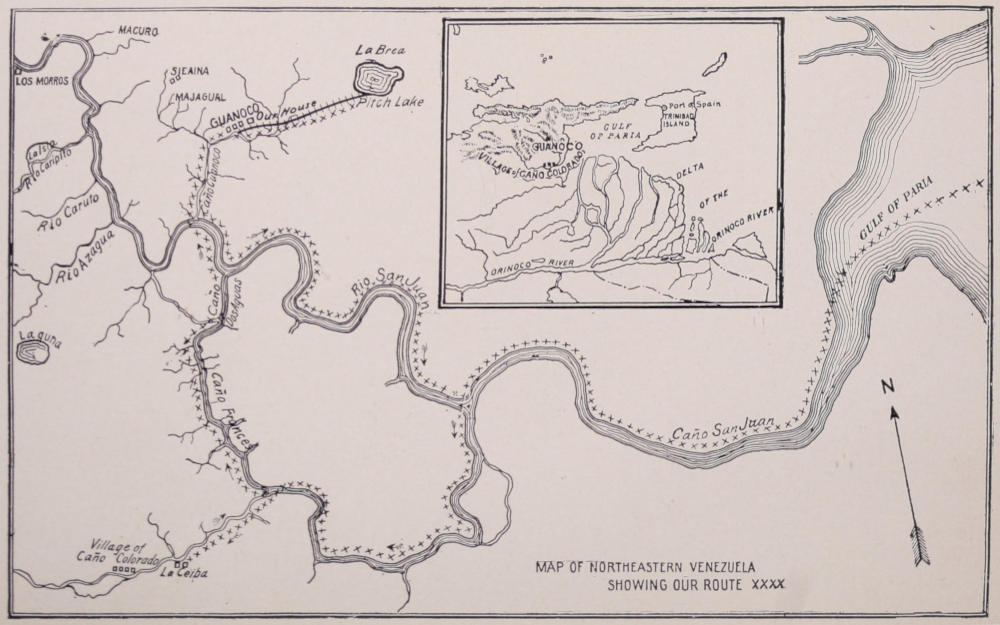
Venezuelan sloop we cruised among the caños north of the
Orinoco Delta, and explored the country about the Venezuelan
Pitch Lake—La Brea.
To Mr. Eugene André of Trinidad, we are deeply indebted
for a hundred kindnesses which did much to make
our trip a success. We wish also to express gratitude to
Mr. Mole, Mr. Anduse and especially to the late Mr. Ellis
Grell.
On the 15th of February, 1909, we sailed from New York
on the Steamship “Coppename” of the Royal Dutch West
Indian Mail, and with only a single stop—Barbadoes—reached
Georgetown, British Guiana, on the 24th of the
same month.
In British Guiana we made three expeditions; two as
the guests of Mr. and Mrs. Gaylord Wilshire, having
as our objective points two gold mines in the midst of
the wilderness, the first at Hoorie in the northwest, the
second on the Little Aremu in central Guiana. On these
expeditions we were spared all the usual annoyances of
transportation; food and servants and everything at the
mines were put at our service to facilitate our study of the
nature life of the country. The third trip to the savanna
region further south was made at the invitation of Mr. and
Mrs. Lindley Vinton, two Americans living in Georgetown,
who placed their home at our disposal while we remained
in Georgetown.
During our entire stay in British Guiana we received
unfailing courtesy and kindness,—from the Governor,
Sir Frederick Hodgson, down to the great black hospitable
wilderness police. Professor J. B. Harrison allowed us to
use the old aviaries at the Botanical Gardens, and with
Mr. James Rodway of the Georgetown Museum and
Mr. B. Howell Jones, extended to us all the courtesies in
his power.
For figures 97, 98, 108, 144, and 158 we are indebted to
Dr. Hiram Bingham, and figures 83, 109, 130, and 131 are
from photographs belonging to the New York Zoölogical
Society and were taken by Mr. E. R. Sanborn. All the
others were taken by ourselves with a Graflex Camera and
27-inch Goerz lens, and a pocket Kodak, both 4 by 5 in
size.
The first two chapters appeared in their original form in
“Harper’s Monthly Magazine,” and the third chapter in
“Recreation.”
Our thanks are due to Dr. William T. Hornaday, Director
of the New York Zoölogical Park, for the leave of absence
which made possible these expeditions.
Three appendices have been added. The first is a
classified list of the birds, with their scientific names, which
are mentioned in the book; by no means a complete list
of those observed. Reference to it is facilitated by the
superior numbers affixed throughout the text to the names
of the birds. The second appendix gives the native Guianan
names of the commoner species of birds. The third is a list
of the insects observed at Hoorie which have been identified
up to the present time.
Wherever in this volume it has seemed best for any reason
that certain chapters should be written by one of the authors
alone, the writer’s name has been given at the head of the
chapter. In all chapters not thus designated the authors
have collaborated.
One day late in March, just as the tropical sun was
sinking from view, our barefooted Spanish crew pulled
up anchor from the muddy bottom of Port of Spain’s harbor.
Slowly the sails filled, and the spray began to fly from
the bow as we steered straight into the crimson path of the
sunset. Behind us the lofty Trinidad ranges glowed softly;
great velvety peaks and ridges, purpled by distance, gilded
by the last rays of day. Then the twilight passed swiftly
as if the sun had been quenched by the waters which covered
its face; the mountains became merged into the darkness
of the sky, and the city of busy life behind us melted
into a linear constellation of twinkling lights.
We had chartered a little sloop of twenty-one tons, the
“Josefa Jacinta” (Ho-say’fah Hah-seen’tah) manned by a
captain, a cook and a crew of three. At her masthead
flew the flag of Venezuela. With a month’s provisions in
the hold and all the varied paraphernalia of a naturalist,
we were headed for the northern part of the Orinoco delta
in search of the primitive wilderness of which we had
dreamed.
Jamaica, Colon, Savanilla, La Guayra had passed in quick
succession, and we were surprised to find Trinidad the most
modern and wide-awake of all. The well-appointed hotels,
the trolleys, electric lights, museums, and newspapers of
Port of Spain, the wireless station even now flashing its
aërial messages from yonder peak,—all boded ill for our
search for primeval conditions. Was there no spot left on
earth, we wondered, which could truthfully be called an
untrodden wilderness!—jungles untouched by axe or fire,
where guns had not replaced bows and arrows; where the
creatures of the wilderness were tame through unfamiliarity
with human beings!
The Southern Cross rose and straightened its arms; the
Pole Star hung low in the north. As the night wore on, an
ugly sea arose and half buried our little craft in foam and
spray. A cross-wind disputed our advance and the strong
tide drove us out of our course. But our captain had navigated
these waters for more than half a century, and we had
no fears.
The following day was as wild as the night, and no living
thing appeared in sky or sea, save a host of milky jelly-fish
(Stomolophus meleagris). They kept below the surface, and
seemed to suffer no damage from the roughness of the water.
In an area of a square yard we counted twenty, and for hour
after hour we passed through vast masses of them, extending
to the farthest waves visible on either hand and as deep
down as our eyes could penetrate—myriads upon myriads
of these lowly beings, each vibrating with life, and yet unable
to guide its course against the tide, or to do aught but
pulsate slowly along.
Later in the day, although the water grew less rough, the
whole company sank lower in the muddy depths—muddy,
because the brown waters of the great Orinoco hold sway
over all this gulf and scatter out at sea the sediment washed
from the banks far inland.
Finally the storm passed and we saw a blue cloud to the
north, hinting of the great mountain ranges of the Spanish
Main. Ahead, a low green mist along the horizon told us
we were nearing shore. This became more and more distinct
until we could make out individual trees. By noon we
had left the tumultuous waters of the Gulf of Paria, and were
floating quietly on a broad stream between two majestic
walls of green; we had entered our wilderness, and the silence
and beauty of our reception seemed all the more vivid after
the noise and turbulence of the wind and water behind us.
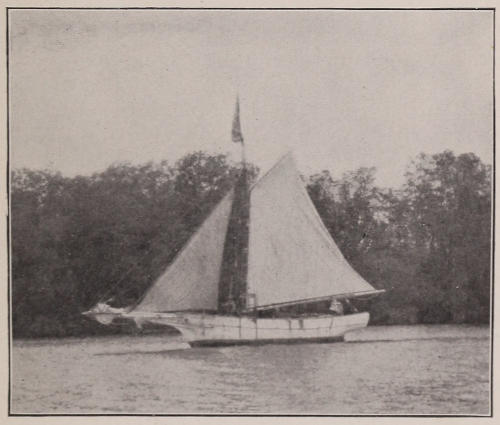
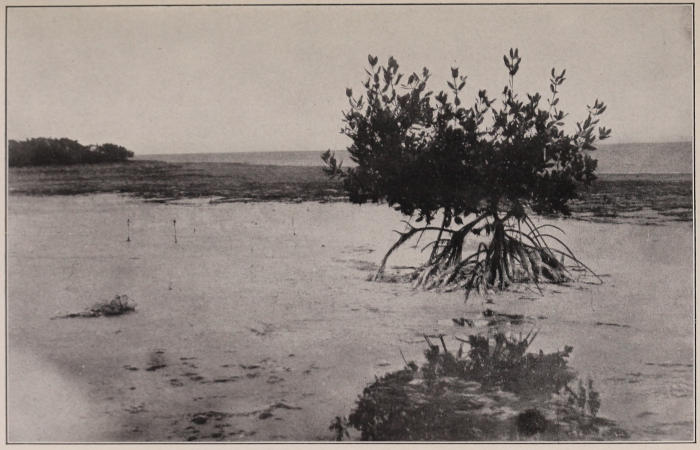
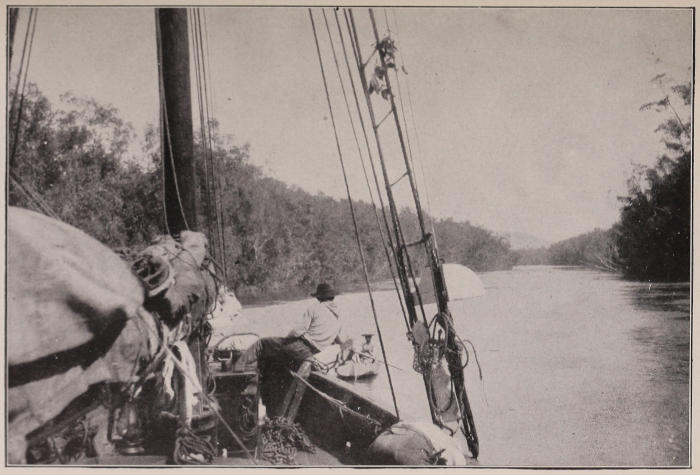
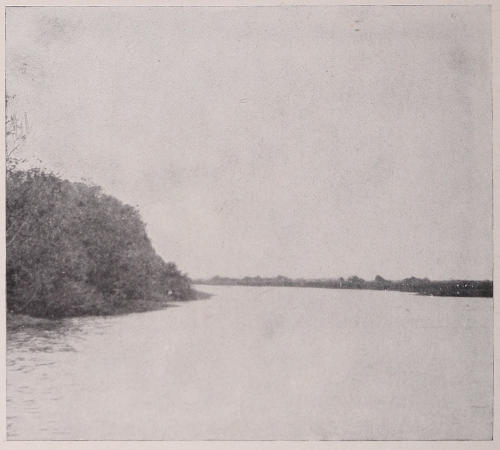
Fig. 2. Our Sloop entering the Mangroves.
Our first impression was of a vast solitude. It was midday,
and the tide was almost at its height. With limp sails
we drifted silently onward, not a sound of life coming from
the green depths about us. We skirted the mangroves
along the south bank, moving more and more slowly, until
at last we rested motionless on the water, between the blazing
sky overhead and the muddy depths beneath. The tide had
reached its highest, and, like the living creatures of the
jungle, rested in the midday heat. The captain gave a gruff
order in Spanish, and the anchor splashed into the water,
dragging the chain after with a sudden roar and jangle which
echoed from shore to shore—jarring the silence as would a
shriek of pain in a cathedral.
A chatter came from the mangroves near at hand, and
high up among the dense foliage we saw the first life of the
continent—a wistful little human face gazing out at us,
a capuchin monkey striving with wrinkled brows to make
out what we were. At his call two others came and looked;
then, as our sail came down with a rattle of halyards, the
trio fled through the branches with all the speed which four
hands and a tail could lend.
We spent the afternoon in getting our floating home ready
for use. No more waves would be encountered, so everything
was unlashed. Stereo-glasses, camera-plates, and ammunition
were placed ready to hand; the galley stove was
moved far forward, and a mosquito-proof tent of netting was
erected under the tarpaulin in the stern.
The sun had sunk low in the west when we saw a long,
narrow dug-out canoe coming downstream. An Indian
woman and her baby were crouched in the bow, while in the
stern a naked Indian paddled swiftly and silently. His skin
shone like coppery bronze in the sunlight, his long black hair
was bound back from his face by a thong of hide. In front
of him rested a bow and arrows and a long fish-spear. Silently
he approached and in silence he passed—unheeding our
salutations.
Fig. 3. Scarlet Ibises in Flight.
One more beauty of this wild wonderland was vouchsafed
us before night fell. We had been disappointed in the birds.
Where were the myriads of water-fowl of which we had
heard? We had seen nothing—not a single feather. But
now the scene slowly changed. The tide was falling
rapidly, swirling and eddying past the boat, and the roots
of the mangroves began to protrude, their long stems shining
black until the water dried from them. Mud-flats appeared,
and suddenly, without warning, a living flame passed us—and
we had seen our first Scarlet Ibis27.[A]
Past the dark green background of mangrove foliage the
magnificent bird flew swiftly—flaming with a brilliance
which shamed any pigment of human art. Blood red,
intensest vermilion, deepest scarlet—all fail to hint of the
living color of the bird. Before we could recover from our
delight a flock of twenty followed, flying close together, with
bills and feet scarlet like the plumage. They swerved from
their path and alighted on the mud close to the mangroves,
and began feeding at once. Then a trio of snowy-white
Egrets32 with trailing plumes floated overhead; others appeared
above the tops of the trees; a host of tiny Sandpipers skimmed
the surface of the water and scurried over the flats. Great
Cocoi Herons31 swept majestically into view; Curlews and
Plover18 assembled in myriads, lining the mud-flats at the
water’s edge, while here and there, like jets of flame against
the mud, walked the vermilion Ibises. Terns14 with great
yellow bills flew about the sloop, and Skimmers17 ploughed
the surface of the tide in endless furrows. Macaws61 began
to pass, shrieking as they flew, two and two together—and
then night closed quickly over all. From the zenith the sun
had looked down upon a stream as quiet as death; it sank
upon a scene full of the animation of a myriad forms of life.
As dusk settled down and hid the shore from our eyes,
another sense was aroused, and to our ears came the sounds
of night in these tropical jungles—a thousand cries, moans,
crashes; all mysterious—unexplainable. In time we became
so accustomed to them that we could distinguish repetitions
and details, but this first night brought only a confused
chorus of delightful mystery, now broken by a moment of
silence, now rising to an awe-inspiring climax. One sound
only remained clear in our memory, often repeated, now
uttered in lower, now in higher tones—a terrible choking
sigh. It might have been the last death gasp of some
great monkey, or the pitiful utterance of hopelessness of a
madman.
With the turn of the tide we raised anchor and drifted
through the night—mile after mile for six hours, and then
anchored again. And thus it was that we came to our
wilderness.
Not until we had been in the mangrove jungle for many
days did we begin to realize its vastness, its mystery, its
primeval character. Just four hundred and ten years ago
Christopher Columbus sailed through the gulf we had left
and gazed on the dark forest in the heart of which we
now were. Throughout the whole extent of the mangrove
wilderness we found no hint that conditions were not as
they were in 1498.
One of the most astonishing things about the mangrove
forest is the apparent diversity of its plant life. Until one
actually comes within reach of trunk and leaves it is impossible
to believe that all this forest is composed of a single
species of plant. The foliage of some of the trees is light, of
others dark; here stands a clump of pale beechlike trunks,
there a dark, rough-barked individual is seen. The manner
of growth of the young and old trees is so different that a
confusion of mingled trees, shrubs, and vines seems to confront
one. But everywhere the mangrove reigns supreme.
It is the only vegetable growth which can gain a footing in
this world of salt water. In fact, it makes its own footing,
entangling and holding mud and débris about its stems, and
ever blindly reaching out dangling roots, like the legs of
gigantic spiders.
Far out on the tip of a lofty branch a mangrove seed will
germinate, before it falls assuming the appearance of a
loaded club from eight to fifteen inches in length. One day
it lets go and drops like a plummet into the soft mud, where
it sticks upright. Soon the tide rises, and if there is too
strong a current the young plant is swept away, to perish
far out at sea; but if it can maintain its hold, roots soon
spring out, and the ideal of the mangrove is realized, the
purpose for which all this interesting phenomena is intended:
the forest has gained a few yards, and mud and leaves will
soon choke out the intervening water.
The mangroves have still another method of gaining new
territory. Aërial roots are thrown out from branches high
in air, swinging downward and outward with a curve which
sometimes wins three or four yards ahead. Like hawsers
thrown from a vessel to a wharf these roots clutch at the mud
beneath, but where the current runs swiftly they swing and
dangle in vain, until they have grown so heavy that they
touch bottom some distance downstream. We made use of
these dangling roots as anchors for our canoe, bending the
elastic unattached end upward and springing it over the
gunwale.
Throughout all this great region there is not a foot of solid
ground. In one place we pushed a tall shoot some eight feet
in height straight down through the mud, and it went out of
sight. A man falling on this mud, out of reach of aid, would
vanish as in a quick-sand. So the wild creatures of the
mangroves must either swim, fly, or climb. No terrestrial
beings can exist there. We once selected a favorable place,
and for fifty yards made our way over the roots and branches
before exhaustion and an impassable gap of mud and water
stopped all progress. As never before we realized how safe
from man are the denizens of these strange swamps. Monkeys
fled swiftly before us, birds rose and flew overhead,
while we painfully crept and pulled ourselves along over the
slippery stems.
Fig. 4. Young Mangrove Plants.
More wonderful even than the coral polyps are these mangroves,
for by this plant alone all this region has been rescued
from the sea and built up into land. In future years, as the
mud banks become higher and are fertilized by the ever-falling
leaves, other growths will appear, and finally the coast
of the continent will be thus extended by many scores of
miles of fertile soil.
A network of narrow channels stretches through this
wilderness and allowed us to explore the far interior in our
shallow curiara or dug-out. Thus we spent days and weeks
in search of the creatures which lived in this land of a single
tree, and here we learned how delightful the climate of such
a region can be. Every night we slept under blankets, and
during the day the temperature ranged from 66° at five and
six o’clock in the morning to about 86° at noon, although we
were within nine degrees of the equator.[B] One could paddle
all day with more comfort than on a hot summer day in the
north. By day mosquitoes were generally absent, and only a
few biting flies reminded us of the “terrible insect scourges”
of the tropics. Life was delightfully new and strange, with
the spice of danger ever attendant upon the exploration of
unknown lands.
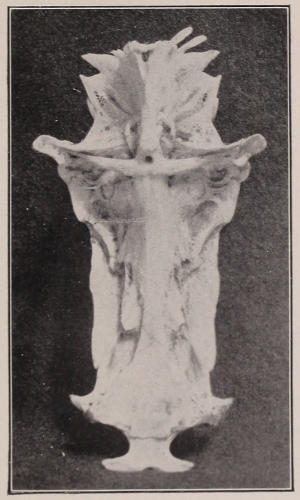
Fig. 5. The Crucifix in the Catfish.
The fishes attracted our attention from the first. When
we came on deck before sunrise for a plunge, our little vessel
would be surrounded by hosts of catfish (Pseudaucheniplerus
nodosus) all, like our sloop, headed upstream against the tide.
They would bite indifferently at bait, a bit of cloth, or a bare
hook, and were delicious eating. On the bottom our hooks
would sometimes be taken by great fierce-whiskered cats,
bedecked with long streamers, which gave no end of trouble
before they were quieted. They were pale yellow, and the
head and back were encased in bone; Maestro—the cook—called
them the crucifix fish, and later showed us why. On
the under surface of the bony armor is a large cross with a
halo about it just above the arms. The crew never caught
one of these fish without making the sign of the cross in their
right palm.
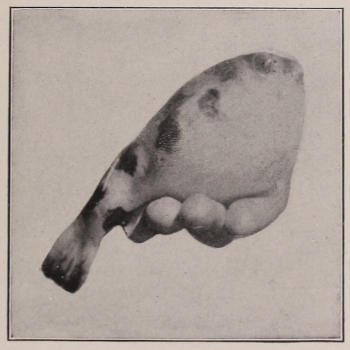
When the tide was half down the funniest of puff-fishes
(Calomesus psittacus), or tambourines as the Captain called
them, would take our bait. They were from three to five
inches long, white below, and pale greenish above crossed
by seven black bands, the first across the mouth and the
seventh at the tip of the caudal fin. There was also a black
patch at the base of the pectoral fins. The iris was bright
lemon yellow. When gently scratched on the lower parts,
or sometimes even when just lifted from the water they
would swell up into a round ball. They were covered with
short, stiff bristles which stood on end when the fish was inflated,
and their comical appearance was increased by the four
rodent-like incisor teeth in the front of the mouth. When
thus inflated with air they were helpless for a time, and if
thrown back, floated belly upward at the mercy of the wind
and current, until they were able to collapse to normal size.
On one of our first excursions among the mangroves in our
small canoe we made a most interesting discovery. Here
and there, sprawled out on the mud-flats, were small crocodiles,
and occasionally a large one would rush off into the
water at our approach. Hugging the edge of the tide where
the ripples lapped back and forth on the black ooze were many
other living creatures. For a long time we could not make
them out, but finally, drifting silently upon a whole school,
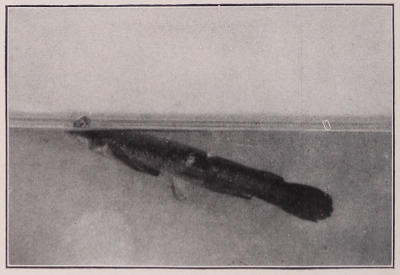
we knew them for four-eyed fish (Anableps anableps)—strange
creatures which we had hoped to see.
Fig. 6. Parrot Puff-fish.
We came to a tiny bayou, shaped like a bottle, from which
four Little Blue Herons34 flew as we approached. We placed
our dug-out corklike athwart the mouth and anchored with
our crossed paddles. The air was warm, bees hummed
about the tiny four-parted flowers of the mangroves, and a
great blue morpho butterfly flapped past, mirrored in the
water beneath. Then came tragedy—never far off in this
land of superabundant life. A small clay-colored crocodile
made a sudden rush at a ripple, and a quartet of four-eyes
shot from the water in frantic fear. One was slower than the
rest, and the fierce jaws of the diminutive reptile just grazed
him. Another fell back downward in the ooze, and in a
twinkling was caught and dragged into the depths. No
wonder the poor little four-eyes are ever on the lookout for
danger and spend most of their time where they merge with
the ripples along the shore, when such enemies are on the
watch for them!
A whir of wings sounded, and a Kingfisher69 alighted within
arm’s reach. But such a Kingfisher!—the veriest mite, clad
in a robe of brilliant emerald and orange. So small was he
that it seemed as if the tiniest of minnows must choke him.
He seemed to be of the same opinion, for while we watched
him he caught only the insects which passed him in mid-air
or which were floating on the water.
Fig. 7. Four-eyed Fish.
By far the most numerous, and in their way the most
interesting of the mangroves’ inhabitants, were the crabs.
There were untold millions of them, all small, all active and
keen of vision. If we sat quietly, they would appear from
everywhere, peeping out like little gnomes from their perches
on the mangroves, forever playing their noiseless little fiddles.
These tiny tree-folk not only played, but danced. Let us
picture a scene constantly enacted, so close to us that we
could all but touch the performers. Two crabs approach
each other, now fiddling vigorously, now waving their diminutive
pincers back and forth over their heads as a ballet-dancer
waves her arms. They move never in straight lines,
but sideways, now running back a few steps, now forward,
until at last they meet, and each grasping the other’s claws,
raises them aloft, and then for five minutes they circle about
in most ludicrous imitation of a waltz. All this usually takes
place on the lower surface of a mangrove trunk, the inverted
position apparently making no less secure the footing of the
little dancers. We could not decide whether this performance
was in the nature of courtship or just pure play.
What we did discover concerning the lives of these crabs
was full of interest. Hundreds of the smallest-sized ones
lived in holes in the mud, and when the tide went down they
came out and ran about—intent on some all-important business
of their little existence. Another class of larger individuals
had their holes near the roots of the mangroves, one
(rarely two) good-sized crab apparently taking possession of
each root. Here he disported himself, running up and down,
from the water into the air with no change in speed, and here,
strangest of all, he grew to resemble his home root. There
was as great diversity among the roots as among the larger
trunks—whitish, black, mottled, and all intervening shades.
It was a fact, of which we had hundreds of daily proofs, that
the crabs were so like their particular root that often we could
not detect the quiescent crustacean when within a foot of our
faces.
There was one group of five black roots forming a rough
circle about a single mottled root. As we approached, a
crab ran down each stalk into the water, and as we peered
down and saw them go into their holes, we could at a glance
tell the mottled crab from the five black ones. Even the roots
which were as yet a foot or more above the bottom mud
each had their occupant, which thus had to swim upward
from his hole before he could grasp his swaying perch.
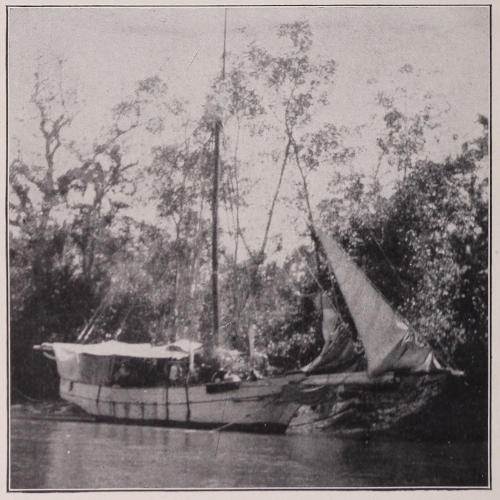
Fig. 8. Our Floating Home at La Ceiba.
A third class of crabs lived among the higher trunks and
branches of the mangroves, and, except where there was
a highroad of some large trunk dipping into the water, these
less fortunate fellows had to scamper in frantic haste up the
roots of their larger brethren. The indignant owner would
rush at the trespasser with uplifted pincers, sometimes forcing
him to leap for his life. Where an unusually large tree
was frequented by many crabs, their carapaces bore a close
resemblance to its pattern and hue, but among these more
aërial and roving crabs the mimicry was, on the whole, less
striking than among the sedentary class. In the latter, protective
coloration was carried to a greater degree of perfection
than I have ever seen it elsewhere. These were loath to
leave their roots and swim, preferring to run swiftly down until
they reached the mud. This habit made it easy to catch them,
merely by taking the end of the root aboard and shaking it,
when the unsuspecting crab would rush down in all haste into
a pail or jar held at the bottom.
They have many enemies, not only among fish, reptiles, and
birds, but even some of the mammals, such as opossums and
monkeys, catch and devour them in large numbers. We
saw a beautiful Hawk,54 bright chestnut in color, with a pale
creamy head and black throat, dashing at them and skilfully
catching the unfortunate crabs in one outstretched
foot.
Scores of other beings of still more lowly degree swarmed
about us, but as the tide lapped out of our little bayou, the
four-eyes again attracted our attention. They began to get
restless, swimming back and forth and shuffling over the mud,
until at last in desperation at the ebbing of their element, they
made a dash to get past us into the open water of the caño.
Some dived, but so buoyant are they that they can scarcely
stay below a second, and soon popped up on the surface again.
Others scrambled, rolled, and squirmed along over the ooze on
each side of us, many making good progress and escaping.
We caught several and placed them in an aquarium for study.
When hard pressed in deep water these curious fish progress
by a series of leaps—up on their tail end and down again,
up and down again, describing a series of curves and making
very fast time.
When examined closely we see that these fish have only two
eyes, but these are divided in such a way that there appear
to be double that number. There are two distinct pupils, one
elevated above the head like the eyes of a frog, the other
separated by a band of tissue and below the water-line. So
when the fish floats in its normal position at the surface the
upper pupils, fitted for vision in the air, watch for danger
above, while the lower pair keeps a submarine lookout for
insect food and aquatic enemies.
Monkeys are perfectly at home in this land of branches,
the ever-cautious capuchins and now and then a long-limbed
spider monkey swinging through the trees with as easy a
motion as the flight of a bird. Biggest of all are the great
red howlers, who keep to the deeper, more narrow channels,
and in the evening and again at dawn send their voices to the
farthest limits of the mangroves. They do not howl, they
roar, and the sound is perfectly suited to such a wilderness
as this. Before the first signs of day light up the east, a low,
soft moaning comes through the forest, like the forewarning
of a storm through pine trees. This gains in volume and
depth until it becomes a roar. It is no wind now, nor like
anything one ever hears in the north; it is a deep, grating,
rumbling roar—a voice of the tropics; a hint of the long-past
ages when speech was yet unformed. We grew to love the
rhythm of this wild music, and it will always be for us the
memory-awakening sound of the tropical wilderness.
The wealth of life in this region was evident when we
began to explore a river flowing down from the highlands
in the far-distant interior of Venezuela. One could spend
a year here and not begin to exhaust the wonders on every
hand.
With every high tide the Captain would pull up anchor and
shift our craft a little upstream, until at last our keel touched
bottom and we could go no farther. We anchored firmly
and buoyed ourselves by ropes to the nearest trees so as to
keep on an even keel. This, our home for a time, was in a
little bight of the Guarapiche (War-ah-pee’chy) River, where
two tumbled-down, long deserted Indian huts still retained
the name of La Ceiba. We were so close to the left bank
that at low tide we could walk ashore on oars laid down
over the mud. Here the birds came and fed and bathed,
here the howling monkeys roared over our very heads and
Macaws swung and shrieked at us.
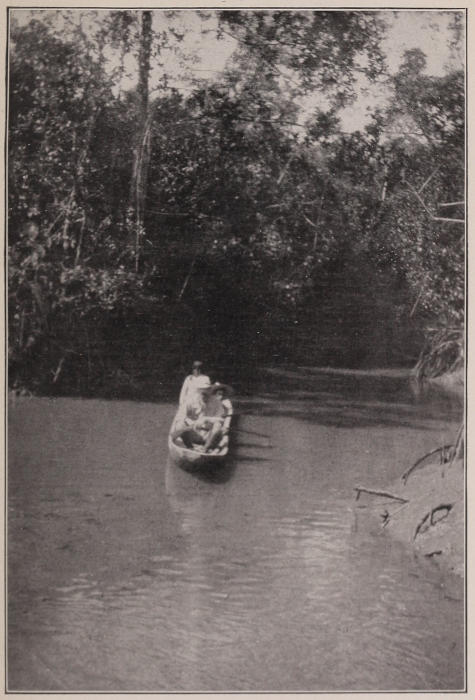
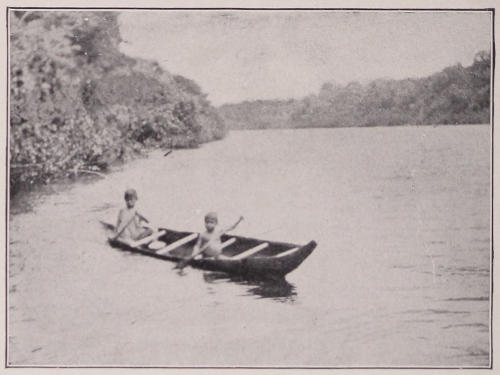
Fig. 9. Exploring the Caños in a Dug-out.
One night, during a heavy downpour of rain, we were suddenly
awakened by a medley of cries, imprecations, shrieks and
yells. Flashing the strong electric bulb we saw through the
sheets of rain a very large curiara run afoul of our shore line;
piled high with luggage, with several screaming women
perched high on the bundles and boxes. Four pigs, tied feet
upward, swelled the chorus in their fear of a watery grave and
four men told us what they thought of us in the present and
where they hoped we would spend the future centuries until
the world’s end. Our Captain was out of his hammock in a
moment and in tremendous basso profundo he silenced all,
save the pigs, and rapidly gave directions to our crew to row
upstream against the swirling current, clear the curiara and
shift it outside the danger zone. Between breaths, he incidentally
described minutely to the terrified natives what he
knew would be the ultimate fate of such fools as tried to
descend a river on the wrong side. It was a miracle that the
whole outfit did not overturn—a narrow dug-out, measuring
about twenty feet in length by two in width, striking full
force against a rope in the blackness of the storm.
Early in the morning the roaring of the monkeys would
awaken us, and after a hasty breakfast we would start out in
our little boat. At this time everything is dripping and
fresh with dew, and there is a bite and tang in the air which
reminds us of Canadian dawns. It is still dusk, and the
lines of mangroves on either side show only as black walls.
For some minutes hardly a sound breaks the stillness except
the distant roars and the drip, drip of our paddles. Then a
sudden splashing and breaking of branches shows that we
are discovered by a pair or more of capybaras (Hydrochoerus
capybara), those enormous rodents which would pass as
guinea pigs in Gulliver’s land of giants. Now an overhanging
branch drenches us as we brush against it, and as it is
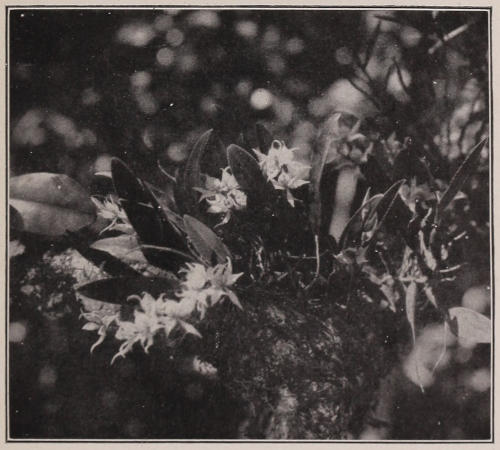
pushed aside a whole armful of orchids comes away, the
pure white blossoms (Epidendrum fragrans) filling the caño
with their sweetness. Now the delicate foliage of a palm is
silhouetted for a moment against the brightening eastern sky,
and a mass of great convolvulus blossoms shines out from
the shore. By this we know that we are not many miles
from dry ground, and other growths are already beginning to
dispute the dominance of the mangroves.
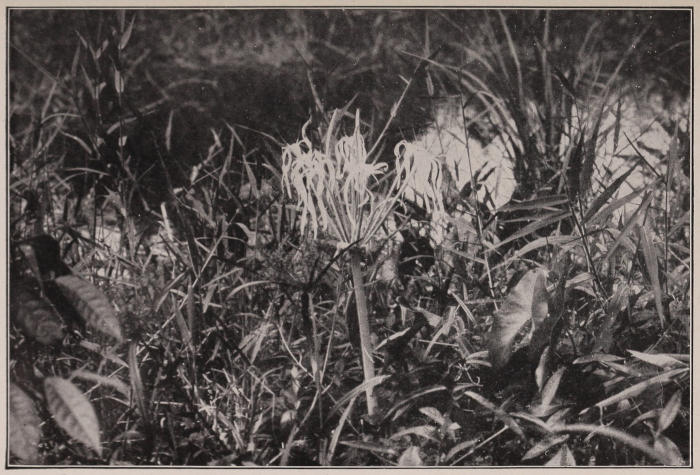
Fig. 10. White Orchids.
Silence again, to be broken by one of the most remarkable
and startling outbursts of sound which any living creature
in the world can utter. A series of unconnected sighs,
shrieks, screams, and metallic trumpet-like notes suddenly
breaking forth apparently within thirty feet, is surely excuse
enough for being startled. The hubbub ceases as abruptly
as it began; then again it breaks out, now seeming to come
from all directions, even from overhead. The author of all
this is the Chachalaca7—a bird not larger than a common
fowl, but with a longer tail. It spends most of its time on
the ground or among the lower branches of the trees in the
swamps. It was seldom that we caught sight of one, but we
shall never forget the first time we heard their diabolical
chorus.
The sun’s rays now light up the narrow path of water ahead
of us, and a thousand creatures seem to awaken and give
voice at once. Two splendid Yellow and Blue Macaws61 fly
high overhead, their screams softened by the distance; a
flock of great white-billed, Red-crested Woodpeckers88 drum
and call; from the bank comes the rolling cry of the Tinamou
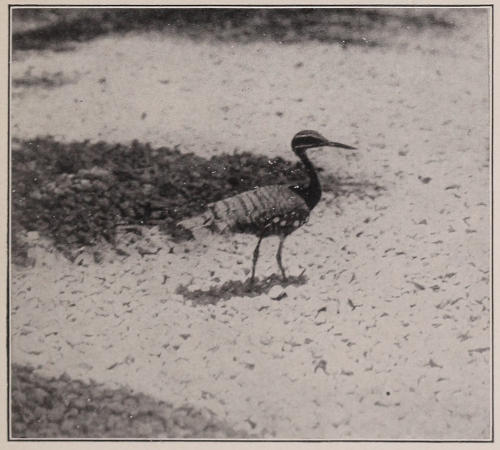
and the sweet, penetrating double note of the Sun-bittern24;
Hummingbirds squeak in their flight as they shake
the dew-drops from the orchids above us; squirrels with fur
of orange and gray scramble through the branches, fleeing
before the little capuchin monkeys. Then, one after another,
three splendid Swallow-tailed Kites58 dash past us at full
speed, brushing the surface of the water and floating upward
again.
Swallows,119 emerald and white, catch the flies which hover
near us; a big yellow-breasted Flycatcher alights for a moment
on the bow of our boat—and a tropical day is fairly begun.
These and a hundred other creatures about us bathe, sing,
and seek their food during the fresh hours of early morning.
Then, as the sun rises higher and its heat draws a hush over
all, the notes of the birds die away, leaving the insect vocalists
supreme. Butterflies click here and there, a loud humming
tells of huge wasps winging their way on murderous missions,
but above all rises the chant of the cicadas. The commonest
of these grinds out harsh, reverberating tones—whir-r-r-r-r-r!
wh-r-r! wh-r-r! wh-r-r! wh-r-r! rolling the r’s in the first
utterance for a minute or more, then ending in a series of
short, abrupt whirs.
Then another cicada, a giant species, sends his call through
the jungle; he has two strings to his bow, one a half-note
higher than the other, and on these he plays for five minutes
at a time. It is Chinese music to the very tone. Sometimes
his tune ends in a rising shriek, and we know that one
of the big blue wasps has descended on him and stabbed him
in the midst of his love-song.
Fig. 11. Sun-bittern.
The day wears on, and even the cicadas become quiet.
The sun is overhead and the air full of tropical heat. In the
shade it is always comfortable, and in the full glare of the sun
one perspires so freely that the heat is hardly felt.
As we paddle lazily along, a great Tegu Lizard (Teius
nigropunctatas) scrambles slowly along the bank; now crawling
over a muddy expanse, now taking to the water to avoid a
bushy tangle, folding back his legs and swimming with long
graceful sweeps of his tail. As we watch him he leaps at
several little crabs and catches them before they can escape
into their holes.
We eat our luncheon in the shade of a clay bank, the first
hint of dry land we have seen along the caño, and here we
watch the little crocodiles basking in the sun and the crabs
scuttling over the mud. A bird of iridescent green and
orange swoops down to our very faces, and hangs swinging
in a loop of a tiny liana on the face of the bank. The next
instant it vanishes into the earth, darting into a hole hardly
larger than the crab-holes around it. We have found the
home of a Jacamar.86 At the end of the short tunnel are
four round white eggs laid on the bare clay.
While examining the nest we hear at our very feet the
terrible night noise—the muffled choking sigh which has
come to us every night since we entered the mangrove wilderness.
We are standing in our narrow dug-out, which the
least movement will overturn, and for an instant it is indeed
a question whether we can control ourselves enough to keep
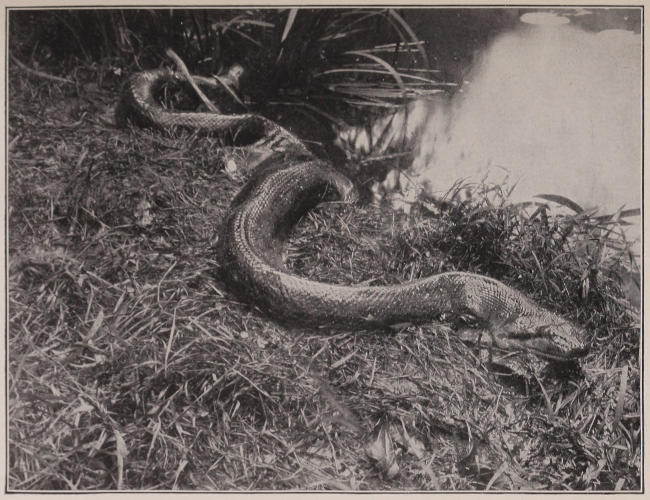
it from filling. Now the mystery solves itself as a large
anaconda (Eunectes murinus) nine or ten feet long, slowly
winds out from a hole in the bank beneath the surface of
the water and slips into the depths of the muddy current.
Then the tide laps a little lower, and a big bubble of air,
caught in the entrance of the serpent’s lair, frees itself with
a sudden gasping sob. When the tide is rising or falling
over these large openings in the mud, the air escapes from
time to time with the terrifying sound which has so long
puzzled us. Our mysterious nocturnal creature is thus
explained away in the prosaic light of day.
Fig. 12. Solution of the Mangrove Mystery—an Anaconda.
An hour later as our dug-out rounds a sharp bend in the
caño, there comes to our ears a series of rasping cries—hoarse
and creaking as of unoiled wheels. The glasses show
a flock of large, brown, fowl-like birds in a clump of bushes
overhanging the water. Their barred wings and tall, delicate
crests tell us that they are the bird of all others which we had
hoped to see and study. We are floating within a hundred
feet of a flock of Hoatzins11—the strange reptile-like, living
fossils which are found only in this part of the world, and
which are closely related to no other living bird.
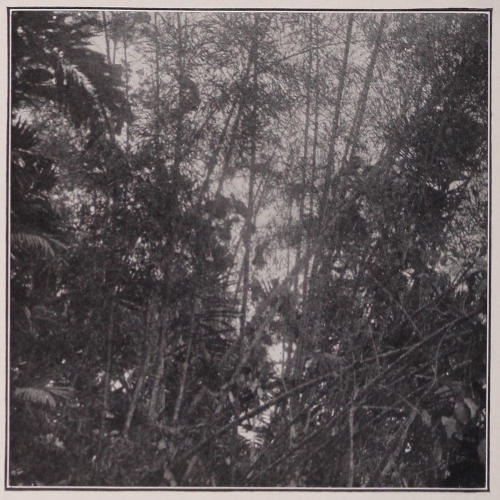
Fig. 13. Hoatzins in the Bamboos on the Guarapiche.
As we draw near, the birds flutter through the foliage as if
their wings were broken. We find that this is their usual
mode of progression, and for a most interesting reason.
Soon after the young Hoatzins are hatched and while yet
unfledged they are able to leave the nest and climb about the
branches, and in this they are greatly aided by the use of the
wings as arms and hands. The three fingers of the wing are
each armed with a reptile-like claw, and at the approach of
danger the birds climb actively about like squirrels or lizards.
It has usually been thought that when they grow up they
lose all these reptilian habits and behave as conventional feathered
bipeds should. But we find that while, of course, the
fingers are deeply hidden beneath the long flight-feathers of
the wing, yet these very feathers are often used, fingerlike, in
forcing aside thick vines, the birds thus clambering and pushing
their way along.
It was with the keenest delight of the pioneer and discoverer
that we watched these rare creatures. Although
they do not nest until July and August, yet we found them in
the very trees and bushes which held the remains of last year’s
nests, thus revealing their sedentary life during the rest of
the year. And day after day and week after week we learned
to know that they would be found in this or that tree and
nowhere else; they were veritable feathered sloths. They
fed chiefly upon leaves, but fish also entered into the bill of
fare of at least one individual.
We shot two, one for the skin and the other for the skeleton,
and we found the plumage in a very worn and ragged condition,
the wing feathers especially so, where the branches and
leaves had rubbed and worn away the barbs. Throughout
the noonday heat these birds were always to be found in the
foliage overhanging the water, ready when disturbed to flop
and thrash a few yards through the mangroves and bamboos.
After many days of pure delight, our note-books filled and
our photographic plates more than half gone, we decided to
see something of the Venezuelan dry land. We would go on
and on until we had left the mangroves with all their unpeopled
mystery behind us, and see what new surprises the
villages of the Guarauno (War-ah-oo’no) Indians and the
jungles of the foot-hills would afford.
At nine o’clock one night, when the stars alone cast a faint
weird light over everything, we sent two of the crew ahead
in the rowboat to keep our bow straight, and then began a
long night of noiseless drifting with the tide. It was a night
to remain forever in our memory. The men relieved their
monotonous towing with strange wailing chants; on each side
the mangroves slipped past, black and menacing; invisible
creatures snorted and splashed in sudden terror as we
rounded each turn; great fireflies burned on the trees and were
reflected in the water, and to our ears came the roars of the
four-handed folk, the calls and screams of night birds, the
metallic clinks of insects, and ever the gasps and chokings
of the serpents’ burrows—hardly less sinister now that we
had solved their mystery.
Throughout all the night we passed up one caño, down
another, past miles and miles of black foliage, all alike to us,
almost indistinguishable in the starlight, yet early next morning
as we rose to rout the cloud of mosquitoes about our
head nets, the captain said in his soft Spanish tongue, “The
mountains of my country should be in sight ahead.” And,
indeed, an hour later, as the day dawned, we could discern
the blue haze in the north which marked the high land out.
Toucans, big Muscovy Ducks43 and Snakebirds48 flew past
us; great brown Woodpeckers and flights of Parrakeets swung
across the caño; dolphins played around us, but we heeded
them little, all eager to press on and see the new land.
So we sat far up in the bow and watched the mountains take
form and the palms upon them become ever more distinct.
From a land of mystery untrodden by man, we were soon to
come upon a bit of land so prized by man that nations had
almost gone to war over it—La Brea (Bray’ah) the strange
lake of pitch hidden in the heart of the forest, with its strange
birds and fish and animals; lying on the borderland between
the foot-hills of the northern Andes and the world of mangroves
which for many days had held us so safely in its heart.
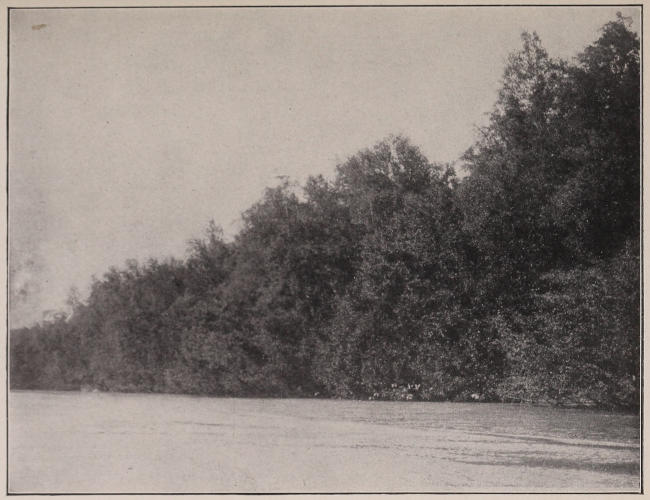
Fig. 14. First Glimpse of the Venezuelan Mountains.
CHAPTER II. THE LAKE OF PITCH.
Heretofore we had sailed and paddled through a
land of mangroves and water, where, with the exception
of one or two tiny muddy islets in the forest, there was
no solid ground. One day the last of innumerable turns of
a narrow caño brought our sloop in sight of real earth—the
first dry land of eastern Venezuela. A rough wooden wharf
supporting a narrow-gauge line of rails appeared, and beyond
rose a steep hill, dotted here and there with little thatched
huts, each clinging to a niche scooped out of the clay. We
were at the village of Guanoco (Wah-no’co), the shipping
point of the pitch lake. A few steps beyond the last hut and
one was in the primeval forest—so limited is man’s influence
in this region of rapidly growing plants.
For five miles the little toy rails zigzagged their uneven way
through the jungle. On one side was swamp, into which one
could penetrate but a short distance before encountering the
advance-guard of the mangroves, the front of the vast host
which stretched eastward mile after mile to the sea. West
of the track the land rose ten or twenty feet in many places,
but even where level it soon lost its swampy character. At
the end of the line the strange pitch lake itself appeared
as a great plain, on the borderland between low swamps and
the foot-hills of the mountains. This was our tramping-ground,
and we found it a veritable wonderland of birds and
beasts and flowers.
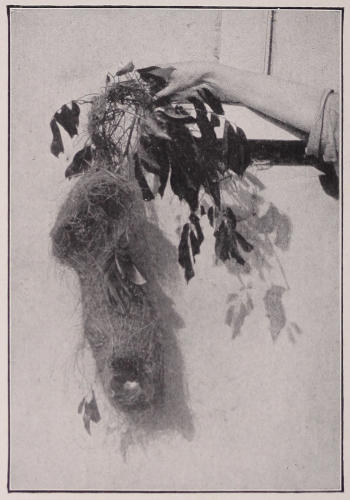
Fig. 15. Colony of 150 Cassiques’ Nests in One Tree.
One of the first things which attracted our attention were the
Orioles or Cassiques151—great black and yellow beauties with
long whitish beaks and an infinitely varied vocabulary. In
the north our eyes are gladdened by the sight of a single pair
of Orioles flying about their nest in the elm; here in a single tree
there were sometimes over one hundred and fifty inhabited
nests, most of which were two feet or more in length. The
more we watched these birds the more interesting they
became. They showed a real intelligence in the selection of
a site for their nests. Monkeys, tree-snakes, opossums, and
other bird-eating creatures were abundant hereabouts, and
for a colony of these conspicuous birds to conceal their nests
successfully would be impossible. So their homes are swung
out in full view of all. But one or two precautions are always
taken. Either the birds choose a solitary tree which fairly
overhangs some thatched hut, or else the colony is clustered
close about one of the great wasps’ nests which are seen here
and there high up among the branches of the forest.
Fig. 16. Nest and Eggs of Yellow-backed Cassique.
Observe the Extra Shelter Roof. The lower opening was made to show
the egg chamber.
The Indians and native Venezuelans never trouble the
birds, which have been quick to realize and take advantage
of this fact, and weave their nests and care for their young
almost within arm’s reach of the thatched roofs. No monkey
dares venture here, and the mongrel dogs keep off all
the small nocturnal carnivores.
But a colony of Cassiques which chooses to live in the
jungle itself would have short shrift, were it not for the
strange communal guardianship of the wasps. These insects
are usually large and venomous, and one sting would be
enough to kill a bird; indeed, a severe fever often ensues
when a man has been stung by half a dozen. So the birds
must in some way be immune to the attacks of the wasps.
Perhaps their wonderfully complete armor of feathers, scales,
and horny beak accounts for this, while their quickness of
vision and of action enables them to save their eyelids—their
one unprotected spot. Although the Cassiques cannot
have learned from experience of the terrible wounds which
the wasps can inflict, yet they are keenly alive to the advantages
to be derived from close association with them.
The wasp’s nest is built far out on the tip of the limb of
some forest tree, and the long pendent homes of the Cassiques
are placed close to it, sometimes eight or ten on the same
branch, and others on neighboring limbs, so near that the
homes of insects and birds rattle against each other when
the wind blows.
One such community was placed rather near the ground,
where we could watch the inhabitants closely. Frequently
when one or two of the big birds returned to their nests with
a rush and a headlong plunge into the entrance, the whole
branch shook violently. Yet the wasps showed no excitement
or alarm; their subdued buzzing did not rise in tone.
But when I reached up and moved the branch gently downward,
the angry hum which came forth sent me into the underbrush
in haste. From a safe distance I could see the wasps
circling about in quick spurts which meant trouble to any
intruder, while the excited Cassiques squeaked and screamed
their loudest. Whether the slight motion I gave to the
branch was unusual enough to arouse the insects, or whether
they took their cue from the cries and actions of the alarmed
birds, I cannot say.
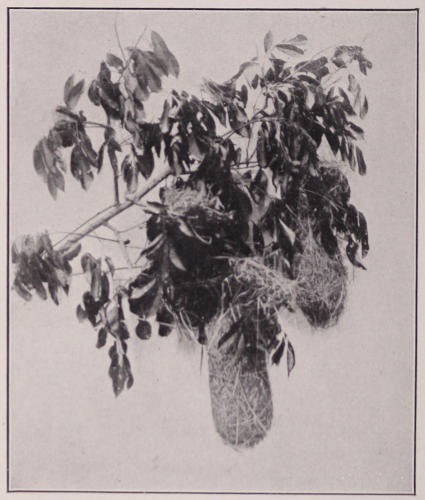
The nests are beautifully woven, of very tough palm leaf
shreds and grass stems, in shape like tall vases, bulging
at the bottom to give room for the eggs and young birds,
and with an entrance at the side near the top. We found
still another instance of the unusual ability of these birds
to adapt themselves to changing conditions. Those nests
which were already deserted or with young ready to fly had
simple rounded tops arching over to protect the entrance
from the sun; but in the nests which were in process of construction,
now at the beginning of the rainy season in early
April, there appeared an additional chamber with a dense
roof of thatch, in which one of the parents, the male at least
in one case, passed the nights, safe from the torrents of
sudden rain.
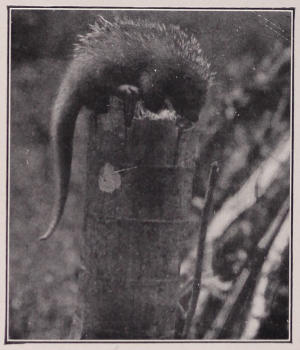
Fig. 17. Venezuelan Tree Porcupine.
Another larger species of Cassique,150 dull green in color,
built solitary nests, three feet or more in length, but seldom
near the homes of men or wasps. Here and there in the
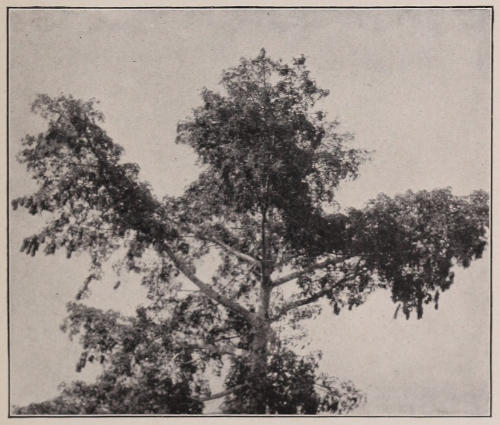
jungle some lofty tree raised its huge white bole free of vine
and liana, and smooth as a marble column, towering far
above all its fellows; and out on the very tip of one of its
swaying branches the nest was woven—safe from all tree-climbing
enemies. The notes of these birds were like deep
resonant cowbells, ringing through the jungle, clear and
metallic.
During our stay in the village of Guanoco we had abundant
opportunity to observe the relations of a tiny hamlet like
this to the great world of primeval nature all around. The
jungle pressed close, instantly filling any neglected corner
with a tangle of vines and shrubs, ever ready to sweep over
all and reforest the little clearings about the huts.
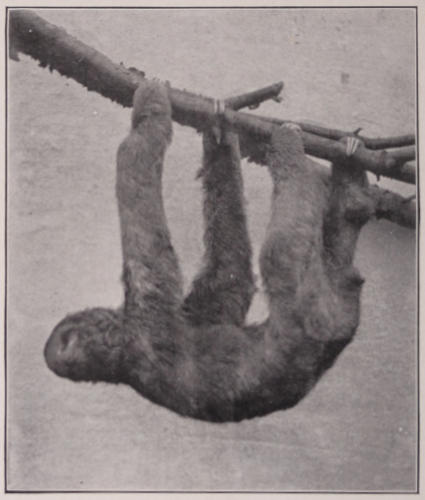
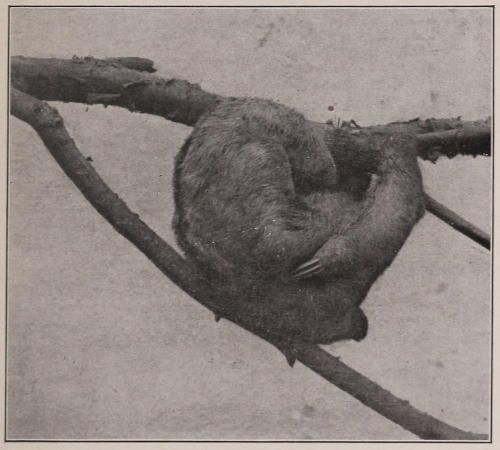
Sloths were rare near the village, as it had long been a
favorite Sunday amusement to go out and bring in one or
more of these defenceless creatures for dinner. But tree
porcupines (Sphingurus prehensilis), with bare, prehensile
tails and faces like little manatees, were common, as were
those gentle little creatures of the night, kinkajous (Cercoleptes
caudivolvulus), or “couchi-couchis” as the Indians
call them. Catching porcupines and sloths is about as
exciting sport as picking blackberries; the porcupine being
too confident in its battery of spines to attempt to escape;
the sloth relying with pathetic faith on its wonderful resemblance
to a bunch of moss or leaves.
The “English Sparrows” of the village were beautiful
olive-green Palm Tanagers144 and great sulphur-breasted
Flycatchers102 which shrieked Kiss-ka-dee! at you as you
passed by. The French in Trinidad tell you that the bird
says Qu’est-ce-qu’il-dit? but the Spaniard, true to his poetic
temperament, says, “No, Señor, el pájaro dice ‘Cristofué!’”
which seemed especially appropriate at this Easter
season.
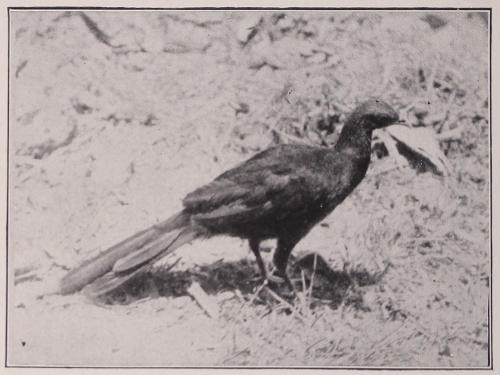
Every day one or two wild Chachalacas7 would fly from
the jungle to an open space near one of the huts and feed
fearlessly with the chickens for an hour or longer.
Fig. 18. Wild Chachalaca near a Guanoco Hut.
To our northern minds the most remarkable thing was the
innumerable variety of all forms of life. Seldom did we find
many individuals of any one species, but always there was a
constantly changing panorama. We would make a careful
list of birds seen near our house, noting certain ones for
future study, and the following day scarcely one of these
would be visible, but in their place birds of strange form and
colors. The same was true of the insects and the result
was as bewildering as it was fascinating. Our habits of
observation had all to be changed. Except when birds were
actually nesting, we could never be sure of seeing the same
species twice, although there was never any doubt that each
day would add many new forms to our lists.
Though we tramped for miles along the narrow Indian
trails and spent many days in swamps and dark jungles, yet
we were troubled scarcely at all with noxious insects. “Jiggers”
there were in moderate numbers but one could “collect”
more in one day in Virginia than in a month here at this
season. During our entire stay we saw only about three
or four minute ticks, while mosquitoes were absent, except
at night. If we dug in rotten logs, we were sure to unearth
centipedes and scorpions, many of them,—but otherwise we
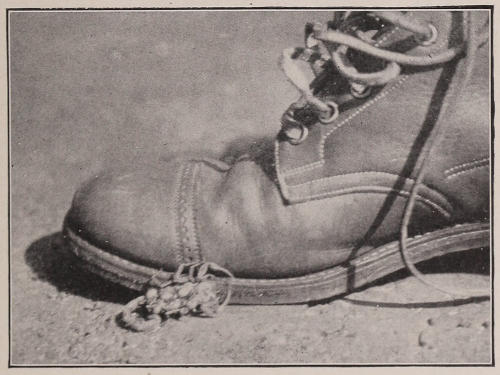
rarely saw them. Once, indeed, a mother scorpion (Centrurus
margaritatus) with half a hundred young ones on her
back was discovered in a shoe, bringing to mind the old
nursery rhyme.
Fig. 19. Scorpion and its Young taken from Milady’s Shoe.
We found that much of the jungle was almost impenetrable,
and on one of our first excursions we were fortunate
enough to find a means of making the birds come to us from
the deeper recesses of the forest. As we left the doorway, a
silent little shadow fitted into the pommerosa tree in front of
us, and soon among the glossy leaves came a sound which we
had heard day and night, but the author of which had thus
far evaded us. It is impossible to put into words, but it may
be imitated by a monotone whistle, of about four notes to the
second, of A above middle C. The glasses showed a mite of a
Pygmy Owl60 glaring at us with wide yellow eyes, and firmly
clutching a dead bird, half as large as himself. Later, when
standing at the edge of an impenetrable tangle of thorny
vines and vainly trying to discover what bird was singing in
loud, ringing tones within it, we thought of the fierce little
owl, and concealing ourselves, gave the call of Glaucidium.
The effect was instantaneous; the song near us ceased, and
with angry cries a pair of beautiful Black-capped Mocking-thrushes126
flew almost overhead. Black-tailed Euphonias139
and Grassfinches followed, Bananaquits137 whirred about us,
and within a few minutes thirty or forty birds had testified
to the hatred in which the little Owl is held.
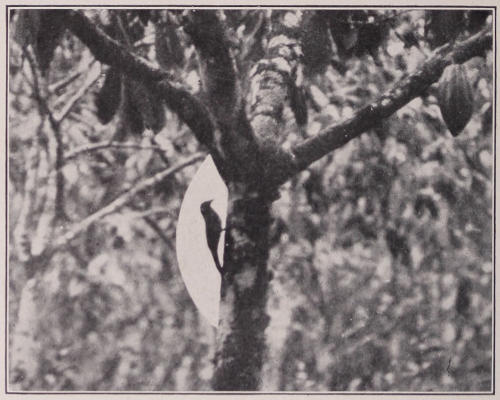
A great surprise to our northern eyes was the Yellow Woodpecker,90
not uncommon here, and clad in bright yellow
plumage from crest to tail. It was very conspicuous in
flight, but when it alighted, merged with the lichened bark
and spots of sunlight. One bird was very tame and frequented
a tree close by our window.
One of our first walks led us through a narrow valley or
gorge to the westward, shaded by ranks of tall palms and
with isolated banana and cocoa plants, hinting of native
Indian clearings long since overwhelmed by the luxuriant
jungle growth. Wasps and other Hymenoptera outnumbered
other insects at this season, and one could have collected
scores of different species in a few hours. A few
Heliconia butterflies drifted across our path, and now and
then a giant morpho shot past like a meteor of iridescent blue.
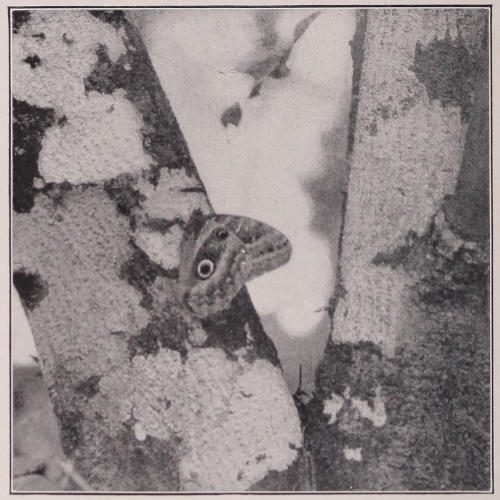
Other great butterflies (Caligo ilioneus) were iridescent blue
and brown above, while the under sides of their wings were
mottled and with a great eye-spot on each of the hind wings,
which gives them the name of the owl butterfly. But however
much, in an insect cabinet, the expanded reverse of the wings
suggests the face of an owl, the spot, as we observed it in the
forest, seemed rather to render the insect invisible. These
great fellows would shoot up to a lichen-covered trunk and
drop lightly upon it, and unless one’s eyes had followed
closely, the butterfly vanished like magic. Creeping up to
one we secured its picture, the mottlings on its wings merging
it with the lichens, and its owl-eyes becoming the painted
facsimiles of darkened knotholes, or of little atoll-like fungus
rings.
Fig. 20. Yellow Woodpecker.
One is constantly impressed by the abundance and variety
of these protective adaptations. Instead of one’s eyes becoming
more accustomed and trained in detecting these deceptions,
the puzzles increase, and one becomes suspicious of
everything. Every few minutes we are halted by a curled
leaf which resembles some great caterpillar, or by a partly
decayed fruit which may prove to be a curiously marked
beetle. Many of these are such exact counterparts that we
have to touch them to undeceive ourselves. After seeing some
bats hung in the shadows between the buttressed bases of
great trees, we imagine them in every patch of moss or dried
leaves.
Fig. 21. Owl Butterfly on Cocoa Bark.
The resemblance to inanimate objects is never violated and
often remarkably heightened by the little creatures of fur,
feather, scale or armor of chitin. The bats never alight in a
close compact mass, but each isolated, with its wings partly
spread, and often extended irregularly, one webbed hand
higher or farther out than the other, thus presenting a dull,
irregular outline, at which we should never have looked
twice, had not the little beasties become frightened and
flown. A butterfly (Peridromia feronia), mottled and pearly
on the upper side, snaps clicking to a lichened trunk and
alights head downward with wings flat. Beneath they are
white and conspicuous. The inverted position allows the
hinder wings to be pressed flat to the surface of the bark,
while the slight shadow caused by the prominence of the
body in front is thus below and invisible. Another, brilliant
red on the upper side and irregularly marked below, never
alights, as far as our experience went, except on some
lichened trunk. In this case however the wings were held
tightly together, and the insect always in a head downward
position. The insect took to wing so quickly that only a
hint of the red was visible.
We never could tell what new form of protective resemblance
would next come under our notice. Here and there
in the woods we found trees which had fallen in a clear space
and had torn out their roots in the fall, forming a great bank
of earth and mould, held together by the network of root
fibres. Hanging suspended by slender root tendrils were
many small pellets of earth slowly swaying and disintegrating.
We found that some of these were not mere accidents of
inorganic forces, but were the nests of a small mud wasp
made in a roughly circular form and moulded to one of the
many rootlets.
Lizards perhaps more than any other group of backboned
animals become part and parcel of their surroundings in form
and color. We sometimes found dull gray and green fellows
on the trunks of trees or the ends of half rotten logs, which
almost defied the efforts of the eye to disentangle them from
the lichens and moss amid which they clung. When one of
these did move it was with such celerity that the eye unconsciously
swept onward, impelled by momentum, and overshot
the spot where it stopped. Then another careful search
was necessary to rediscover
the reptile.
Fig. 22. Lizard Alert on Trunk of Tree.
This same glade was the
favorite haunt of two kinds of
small Manakins, the Gold-headed108
and the White-breasted.111
The former was
a mite of a bird, barely four
inches in length, jet-black as
to body and wings, but with
a cap of gold pulled down
over his head and ears. If
his eyes were black and beady
like those of his near relatives,
the harmony of his head-dress
would be disturbed, so Dame
Nature has sifted the gold
over his eyes as well, and the
yellow irides are almost invisible
among the feathers. Such
coloring renders him part of
his beloved gorge. If he sits
in the shade his body vanishes
and his head is naught but a
spot of sunshine; if his perch is in sunlight, the tiny, headless
body conveys no hint of a living bird.
His cousin, the White-breasted, is black and white and the
four outer feathers of the wing are very narrow and curved.
These are the strings upon which he plays an æolian song
of love, for every time he takes to flight a loud humming sound
is produced. The females are dull olive in color but easily
recognizable by their orange feet and legs. Sometimes three
suitors would buzz and hum together about one of these
sombre little ladies in the gloom of the gorge.
Fig. 23. The Same Lizard a Moment Later, Obliterated by
Change of Position.
The rotten trees and palm stubs were filled with interesting
insects; big black palm weevils (Rhyncophorus palmatum)
an inch and a half long, and huge brown cockroaches three
inches from head to wing-tip (Blaberus trapezoideus). With
a machete we cut open one log, which was like bread in
consistency, and found two centipedes, three scorpions, one
of them a whip scorpion, a huge beetle larva, a small snake,
with a faint band about its neck (Homalocranium melanocephalum)
and most interesting of all, a Peripatus.
Perhaps the reader here wonders to himself what a Peripatus
is, and it is a pity that this most important creature has
no common name. We may call it a worm-like caterpillar
or a caterpillar-like worm, for its claim to fame rests upon
its position as a so-called missing link. We know that in
long ages past the ancestor of the butterflies, beetles, wasps,
spiders and crabs was a worm-like creature, primitive in
structure and in no way hinting of the beautiful organisms
which were to be evolved in succeeding epochs. Hiding
away from light, in the warm moisture of decaying wood, the
little Peripatus has lived on and on, age after age, with little
apparent change, until we find it to-day combining the simpler
characters of the lowly worms with those of the vastly higher
caterpillars.
The Peripatus which we unearthed, or rather unlogged,
was of a rich, dark reddish hue. It was caterpillar-like in
general appearance, but not divided into segments, while the
number of its very simple feet and its method of progression
brought to mind the millipedes. The long, slender antennæ
were constantly in motion, changing and extending, feeling
about and retracting.
Glancing at the leaf of a low shrub, we saw what we supposed
to be two bits of dried, rolled-up leaf entangled in a
strand of spider web and being whirled about by the wind.
When we saw that this motion continued after the breeze had
died down, we became interested. We discovered that the
two objects were tineid moths of a dark pearl color, waltzing
about with the most graceful and airy motion imaginable.
With closed wings they whirled round and round by means
of their legs alone, and, most remarkably, both going in the
same direction, although this was frequently changed, the
reversal being almost instantaneous and without an instant’s
loss of the smoothness of the rhythm. Now and then their
circles overlapped, but at the first danger of collision the
tiny dervishes both retreated without stopping their dance.
Presently one flew away, and the other shifted to another leaf
near by, and recommenced his waltz alone. It was a surprise
to find these little winged millers in the rôle of graceful
dancers. The reason of it remained a mystery.
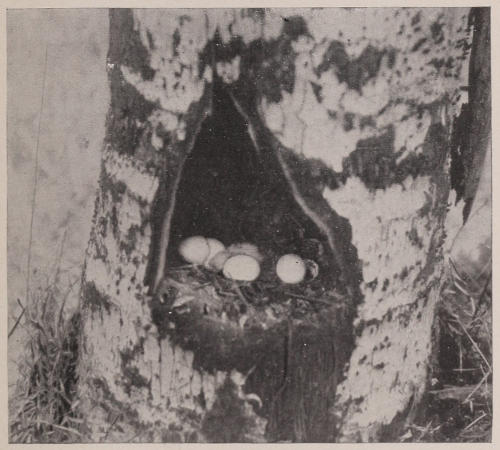
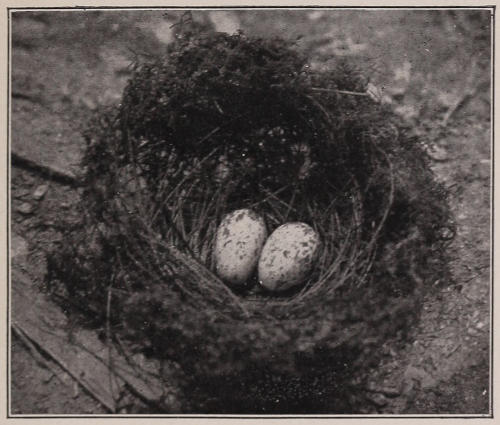
Fig. 24. Nest and Eggs of Great Blue Tinamou.
These incidents are quoted as some among the myriad
interesting doings of the little folk which we observed in the
heart of these great jungles. As we walked on, virgin forest
surrounded us, with great trees centuries old, chained and
netted together by miles upon miles of lianas. Now and
then we entered a clear glade festooned by a maze of ropes
and cables, with here and there a lofty monkey-ladder leading
upward by a wavy series of narrow steps. The cicadas
filled the air with the oriental droning of their song, and a
big Red-crested Woodpecker88 called loudly from a half-rotted,
vine-choked tree. From the undergrowth came a
soft rolling trill, a crescendo of power and sweetness, and
when our Indian carrier whispered, “Gallina del monte,” we
knew we were listening to the call of a Great Blue Tinamou1—one
of those strange birds looking like brown, tailless fowls, but
of so generalized a type that they form in many ways a link
between the ostrich-like forms and the rest of the bird world.
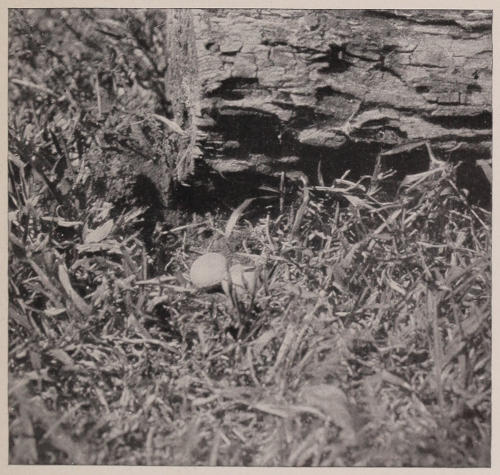
The bird which was calling soon became silent, but creeping
slowly along we were fortunate enough to discover its nest
on a bit of sunny turf near the end of a log in a partially overgrown
clearing. All the delights of bird-nesting seemed consummated
the moment we caught sight of the two wonderful
eggs before us. The nest was merely a hollow scratched in
the grass, but the sun was reflected from two shining spheres
of metallic greenish blue, like two huge turquoises polished
as by the wheel of a lapidary. Never were such eggs; they
seemed of hard burnished metal, more akin to the stones
lying about them than to the organic world, and yet, even as
we looked, there appeared a tiny fracture, and in a few
minutes the beak of a Tinamou chick had broken through to
the outer air. The glistening cradle of stone would soon
fall apart and give to the tropical world another life—one
more mote among the millions upon millions about us.
Now and then we would come across a huge low mound,
clear of undergrowth, dotted with holes from which well-trodden
paths led off in every direction. Some of these were
six inches in width, so that we could easily walk in them.
A twig poked down the holes and twisted about would come
up covered with angry ants, great brownish-black fellows
with a grip like a bulldog. Even this simile fails, for these
insects will allow their heads to be pulled off before they
will let go.
Everywhere the ants attracted our attention; huge black
giants (Neoponera commutata), which seemed never to have
anything to do but parade slowly up and down the trunks of
trees; and the ever-busy parasol-ants, hustling along in single
file, waving their green banners and clinging faithfully to
them while falling down terrific precipices three or four
inches deep. We dug into their nests and found their fungi
gardens, one part of which would be freshly planted with
neat black balls of chewed-up green leaves, while in another
part the fungus was well grown—a meshwork of gray strands
whose fruit was ready to be plucked and eaten.
The hunting-ants (Eciton) surpassed all the others in
interest. Day after day we would come across their great
armies, and we spent many hours of keen enjoyment watching
their advance. We had read of their appearance and
habits; we had heard them compared to Goths and hordes
of savages, but no description prepares one for the actual
sight. We watched in particular one large army which
carried on its operations only a short distance from our
house.
Long before we came within sight of the ants themselves
their presence would be heralded by the flock of birds which
kept just in advance, feeding upon the insects which flew
up from the van of the ant legions. In one such assemblage
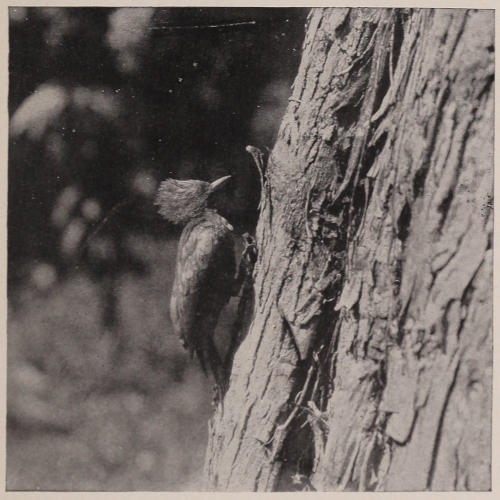
most of the birds were Woodhewers, big, cinnamon-colored,
creeper-like birds which hitched up the tree trunks and now
and then swooped down to the ground, snatched an insect
and swung back to the trunk. This flock of birds showed
other methods of feeding; Hummingbirds appeared from
nowhere, dashed down to a tiny insect and vanished into
space; Anis80 blundered along, looking as if their wings and
tails were too loosely attached for use; Ant-birds crept low
through the bushes and carried their prey to a twig to eat;
two American Redstarts128b and several Tyrant Flycatchers
caught their prey by a sudden dart and a snap of the beak.
One species in particular, the Streaked Flycatcher,105 was
always attendant on the ants and always fearless, watching
us and yet never missing a chance to snap up a passing
insect.
Fig. 25. Woodhewer clinging to the Trunk of a Tree.
As we drew nearer, a strange rustling sound reached our
ears, like the regular pattering of raindrops, and before we
knew it we were standing in the midst of thousands of active
ants, whose rushing and scrambling about over the dead
leaves caused the loud rustling. In a few seconds twenty
or thirty ants had climbed upon and above our shoes, and
their sharp, nipping bites sent us in haste to the flanks of the
army, where we freed ourselves from the fierce creatures.
These ants are not large, varying from a fifth to a third of
an inch in length, dark in color, with lighter red abdomens.
Until one becomes accustomed to these scenes of carnage
the sight is really terrible, especially when one lies down
flat and takes an ant’s-eye view of the field of battle. Yet
such is the fierceness and savage fury on one side and hopeless
terror or frantic efforts to escape on the part of the victims
that it needs but little imagination to stir deeply one’s sympathies.
Fig. 26. Streaked Flycatcher.
In place of the steady advance of a well-drilled army, presenting
a solid front of serried ranks, the formation of the
hunting-ants may be compared to an innumerable host of
cavalry scouts who quarter the ground in every direction,
the whole army slowly advancing and including new territory
in the scene of operations. Frequent flurries or louder
rustlings follow the discovery and the subsequent terrible
struggle of some quarry of noble size—a huge beetle or
mighty lizard.
One fact impressed us from the first: every creature aroused
by the ants seemed to know instinctively of the awful danger.
Whether through odor or sight or sound, the alarm always
carried its full meaning. Insects which ordinarily would escape
the collecting net by a single quick motion, here dashed
away with such terror that they often flew against our clothes
or a tree, and were hurled to the ground. Lizards took
shelter under our shoes or shot off like streaks of light for
many yards. Our presence and that of the predatory birds
was disregarded in the efforts to avoid the danger which
generations of inherited experience had made the most vivid
in life.
Insects which usually feigned death as a means of escape,
when disturbed by these ants used all the motor organs
given them by nature to flee from the dreaded foe. Escape
seemed to be the result of accident with all wingless creatures,
even with those possessing good eyesight, for the first blind
terrified rush as often carried them to certain death in the
thickest of the host as it did to safety in the van or on one
side of the ant army. Even wings were not a surety of
escape. Twice I saw moths arise heavily from their hiding-places
with a half-dozen of the little fiends clinging to their
legs and wings. One was snapped up, ants and all, by a
big Flycatcher, and the other fell among the quartermaster’s
brigade in the rear, where every ant within reach dropped his
load and hurled himself upon the newcomer.
Here and there one might observe good-sized balls of ants
rolling about, and in the centre would be some hard-cased
beetle or other insect, who gave up only after killing and
maiming a score of his assailants.
We dropped five big black ants into the midst of the
marauders, and witnessed a combat as thrilling as the contest
between the Greeks and Persians. Four of the insects
alighted on a small rounded stone over which three hunting-ants
were scurrying. Without hesitation the black giants
fell upon the brown warriors and tore them limb from limb,
with the loss of only half a leg. This is not a very serious handicap,
when one has five and a half robust limbs left! The
fifth big fellow dropped upon a mass of ants piled like football-players
upon a struggling scorpion, whose sting was
lashing the air in vain. The big ant started another ripple
upon this pool of death, which soon smoothed away, leaving
no recognizable trace of him. But the quartet of big-jawed
fellows on their rock citadel fought successfully and well. No
ant which crept to the top ever lived to return for help. The
four flew at him like wolves and bit him to death. Soon a
ring of hunting-ants formed around the stone, all motionless
except for a frantic twiddling of antennæ. They were apparently
excited by the smell of the blood of their dead fellows,
and only rarely did one venture now and then to scale the
summit. When we left, two hours afterward, the army had
passed, and left the stone and its four doughty defenders, who
showed no immediate intention of leaving their fortress.
The ground over which the hunting-ants passed was
absolutely bare of life, and, contrary to the rule in human
armies, it was among the camp-followers and foragers that
the most perfect discipline reigned. In the rear of the main
army were lines upon lines of ants laden with the spoils:
legs, bodies, and heads of insects and spiders, bits of scaly
skin of lizard or turtle, joints of centipedes and scorpions,
and here and there a piece of ragged but gaudy butterfly-wing
borne aloft like the captured standard of some opposing
force.
We followed three lines of supply-carriers and found that
they converged on some sheltered hollow in a tree or under a
boulder or root. Here were massed countless hordes of ants
clinging together like a swarm of bees. In the centre were
the queen, eggs, and young of these nomadic savages, resting
thus temporarily until the far-distant scouts should report
another shelter, when the whole community would shift to
the new home, farther along on the line of march.
The army in which we were especially interested seemed
to be carrying on their hunting in a rough circle about the
temporary home, and perhaps this is a common habit. Certain
ants apparently serve some function of direction or
means of communication, for they keep to one place for a
half hour at a time and twiddle their antennæ with every ant
which approaches.
It was when the hunting-ants discovered the nests of other
species of ants that warfare, true to its name, was waged.
One could watch as from a balloon, mimic Waterloos and
Gettysburgs, and sad to relate, in the case of inoffensive
species, plunder, murder, and abduction by the wholesale.
After studying the ways of these merciless creatures, we could
seldom walk through the quiet, sunlit jungle, with blossoming
orchids everywhere overhead and the songs of birds and
pleasant hum of insects in our ears, without thinking of the
tragedies without number ever going on around us.
Used as we were only to the small lightning bugs of our
northern summer nights, the big luminous elater beetles (Pyrophorus
sp.) were ever of interest. The two thoracic lights
are placed on the outer posterior edges and give out a pale
greenish glow of great intensity. We could easily see to read
and write by their light, and by placing a half dozen of these
insects in a glass we could use them instead of our electric
flash.
When we examined them carefully we were surprised to
find that there was another area of illumination on the abdomen,
below and just behind the insertion of the third pair
of legs. When fully illuminated this area was brilliant and
of a figure ∞ shape. The light however was radically different
from that of the thorax, being yellowish, and candle-like,
giving an illusory impression of an opening from the
incandescent interior of the insect. When the insect settles
to rest the only visible illumination is from the pair of
thoracic lights, but in flight the abdominal searchlight comes
into play, burning brightly with a strong yellowish glare quite
different from the green thoracic lights.
As we lay at night half asleep we would sometimes be
awakened by the droning of one or two big elaters, whose
intermittent flashes would illumine the whole room. More
than once we had to capture the intruders with the butterfly
net and banish them before we could get any sleep.
We chloroformed two of these luminous beetles and pinned
them in an insect box. Two evenings afterward when we
had occasion to add more insects, the box was opened and to
our surprise the little lanterns were still aglow and hardly
less brilliant than when the insects were alive. They had
been dead forty-eight hours and yet their light still shone
ghostly white, lighting up the other insects in the box.
One evening we found a tiny wire worm, the larva of some
small species of elater, which was highly phosphorescent.
Although only about one-half of an inch in length, the whole
head, the posterior segment and a spot on the side of each of
the others was bright. Watched as it moved smoothly and
rapidly along, it reminded us of a ship passing at a distance
at night with the lights streaming from the port-holes.
Our trips to the pitch lake on the early morning engine
will never be forgotten. A warning toot from the diminutive
whistle hurries us through our breakfast, and we hasten to the
track and see our cameras and guns loaded on one of the
little square wooden “empties.” We mount the wood-filled
tender of the engine, which with many complaining creaks
and jolts get under way, backing slowly around the curve
which hides the last sign of civilization and buries us in the
jungle.
For nearly twenty years these little toy engines have bustled
and elbowed their way over the snaky rails, until the jungle
and its people have come to look upon this narrow winding
steel path as part of the general order of things. The underbrush
creeps close, and only the constant whipping of the
engines and cars beats down the growth between the rails.
Fig. 27. The Jungle Railroad.
As we start, the last bats of night dash into the dark
jungle, and their diurnal prototypes, a flock of graceful Palm
Swifts,71 swoop about overhead. To our ears there comes
the finalé of the morning chorus of distant red howlers and
the first deep-toned boilings of the giant Cassiques.
All along the line, beasts and birds show their lack of fear
of the rumbling cars. A party of chattering little monkeys
sit and gibber at us and rub their dew-drenched fur. Their
parents and great-grandparents had found nothing to fear
in this strange thing which, five times each day, crawls back
and forth on its narrow trail, and why should they do more
than look and wonder? As we come in sight of the muddy
banks of the little river, a great Parrot shrieks in derision at
us from the top of a dead stub by the track, executing slow
somersaults for our benefit. Instinctively we look for a
chain on its leg and a food cup near by! A splash draws
our eyes downward, and from a maelstrom of muddy water
shoots a villainous sting ray. A school of little staring four-eyes
skips over the water, and near the swampy, farther
bank, a sprawling half-grown crocodile watches us—as
quiet as a stranded log.
Fig. 28. Spider Lilies near Pitch Lake.
The air blows cool and damp on our faces, and we long
for the keen power of scent of a dog. Even to our dull
nostrils every turn of the road is full of interest. A swamp,
thickly starred with dainty spider-lilies, comes into view,
and we inhale draughts of sweetest incense; Easter Sunday
is at hand, and the very wilderness reminds us of it.
With every breath of air the great palm leaves flick myriads
of drops to the underbrush below, with a sound as of heavy
rain. The trunks are black and soaked, and there is not a
dry frond for miles. A sudden curve brings another loop
of the river into view, with a foreground of scuttling crabs
and mangrove seedlings. Here a wave of coarse, salty,
marsh smell fills our lungs—not stagnant, but redolent of
the distant sea; the smell that makes one’s blood leap. The
next quarter-mile is covered with lilies again. From their
perfume we enter a zone of recently cut grass—and the
incense brings to mind northern hay-fields and the sweet-grass
baskets of the Indians. What new pains and pleasures
would be ours could we possess the power of scent of some
of the “lower” animals!
Temperate succeed tropical vistas; we see what at first
appears to be a grove of young chestnuts rising from rhododendrons
and guinea-grass. A Spotted Sandpiper22 heightens
the illusion, and the picture is complete when a familiar milk-weed
butterfly floats by and alights on a red and yellow
tansy. But just then a Macaw shrieks from a near-by tree—the
road-bed turns and reveals a tangle of palms and scarlet
heliconias—a monkey climbs up a leaf large enough to
shelter half a hundred of his kind. Strange palm fruits come
into view, some like enormous clusters or bunches of grapes—each
fruit as large as an orange; or again a huge feathery,
dependent frond of dust-brown blossom and fruit protected
by an overhanging spathe like a huge umbrella.
Fig. 29. La Brea—The Lake of Pitch.
The jungle never gives up the struggle against the invading
rails. Beneath the cars the constant friction only dwarfs
the growth, and we find here miniature plants blooming,
fruiting, and scattering seed; plants which elsewhere reach a
height of five or six feet. It is an interesting case of quick
adaptation to unfavorable conditions.
The vegetation presses on every inch of the track, striving
ever to close up the long scar through the heart of the forest,
and only by systematic cutting is the way kept open. The
advance of the jungle host is most interesting. Thirty feet
from the rails the growth is primeval, a dense mass of entangled
and interlaced vines, shrubs, palms, and giant trees,
the boles of the latter shooting up and up through the mass
and bursting into bloom high overhead. Nearer the track
we find a phalanx of green banners and the wonderfully
brilliant red and yellow flower stalks of the quick-growing
heliconias. In front are the rough scouts, the real advance-guard
of strong, thorny vines growing in close entanglement—a
living chevaux-de-frise, inconspicuous and yet offering
the greatest resistance. Under this shelter the larger but
slower-growing components of the jungle take root and
gather vigor, until, if not cut out with the hardest labor,
they soon rear their heads from their nursery of vines and
brambles, and the shining rails vanish from view.
All the creatures of the forest cross and recross the track
freely, even in front of an approaching train. Water-fowl,
Sun-bitterns24 and the weird-voiced Trumpeters25 walk up
and down, and flocks of Seedeaters132 drift here and there,
gleaning seed from between the rails. The Trumpeters were
a great surprise to us, as this is the first instance of their
being found north of the Orinoco River. One day we see
the leaves part, and a long, low-shouldered reddish form
slouches across before us, without even a glance at us, and
we know it for the first South American puma (Felis
concolor) which we have seen. Another “red lion,” as
the natives called it, with two cubs, was seen not long
before.
Only the sloth is barred. He comes close to the endless
swath; he wanders from tree to tree up and down, peering dully
out across the track, but he cannot cross. The twenty-foot
treeless embankment is as impregnable to him as a sheer
wall of rock. With a weird cry he turns back and starts in
another direction through the branches.
Fig. 30. The Fatal “Mother of the Lake.”
We reach the lake long before the dew is dried and before
the freshness of the dawn is dissipated. Hurrying over the
planks and the temporary rails laid for the workman’s hand-cars,
we push on a half-mile or more to the southward, where
nothing hints of man’s proximity. To the north and west
are irregular peaks running off into a blue and misty range—the
foot-hills of the Spanish Main. To the south the high
woods are close to us and tower high overhead, but even
with the eye of yonder lofty, soaring Vulture we could see no
mountains in that direction—nothing but flat, green miles
of mangroves, stretching to the horizon over the immense
delta of the Orinoco. The pitch lake itself is surrounded on
all sides by dense forests, the front ranks of which are made
up of the marvellously tall and graceful moriche palms.
There is one oasis in this pitchy expanse—Parrot Island it
may be called. To this shelter, guarded on all sides by soft,
quaking pitch, Amazon Parrots come at dusk by hundreds,
roosting there until the next morning.
Fig. 31. White-headed Chimachima Hawk and Eta Palm.
Near the northern edge is the “mother of the lake,” just
above the deep-hidden source of supply, where the pitch is
always soft, and where no vegetation grows. It is a veritable
pool of death, and nothing can enter it and live. The lizards
and heavy-bodied insects which scamper over the rim are
often clogged and drawn down to death. A jaguar, leaping
after a Jacana, slipped in shortly before we came and made
a terrible fight for life. Half blinded, its struggles carried
it only farther outward, but fortunately the end came mercifully
soon.
Fig. 32. Amazon Parrot Roost, Pitch Lake.
All the rest of the lake is a varied expanse of black pitch
bubbles, short grass, clumps of fern and sedge, with occasional
isolated palms. Flowers of many kinds and colors spring
from the heart of the raw pitch itself. Jacanas23 rise before
us with loud cries and flashing wings of gold. One may
walk over the lake at will, morning and evening, but in the
heat of midday, in many places, one’s shoes sink quickly
unless one keeps constantly on the move.
White is not a very common color in nature, and yet here,
in striking contrast with the inky blackness of the pitch, most
of the birds show large patches of this color. In the distance
are always to be seen Snowy Egrets33 and immature
Blue Herons34—spots of purest white, while near at hand,
absurdly tame, a big hawk forever soars slowly about or
perches on some great frond of a tall palm. It is a White-headed
Chimachima Hawk56 with plumage of white, save for
back, wings, and tail.
Fig. 33. The Home of the Amazon Parrot in the Middle of
Pitch Lake.
The two most abundant small birds are chiefly white in
color. Both are Flycatchers, one with white head and neck—White-headed
Marsh Flycatcher98—perching in the reeds
and making fierce sallies after passing insects, while even
more beautiful and conspicuous are the little terrestrial
Flycatchers—White-shouldered Ground Flycatchers97 or
“Cotton Birds”—which scurry along the ground over
pitch and fallen logs. Their tails continually wag from side
to side, and they come within a few feet of us, uttering low
inquiring notes: pit! pit! They too are clad in white, except
for back, nape, wings, and tail.
Amazon Parrot at Entrance of Nest.
Fig. 34. Fifteen feet away. Fig. 35. Ten feet away.
We follow one about, watching it through the ground-glass
of the camera, when we blunder into a thicket of dry,
crackling twigs. A sudden rustling sound draws our attention,
and we look up and find ourselves within a few feet of a
dry palm stub. Around the roughened stringy bark peers a
green head with wide, yellow eyes, and we stiffen into
immobility. The position is anything but comfortable;
thorns are scratching us, flies are tickling our faces, but we
dare not move. After five minutes, which seem hours, the
big Yellow-fronted Amazon Parrot64 withdraws, and we hear
a scuttling within the stub. Silently and with the greatest
caution we step backward, and after a rest we arrange our
plan of attack.
Fig. 36. Amazon Parrot about to take Flight.
These birds usually nest in hollows in the tops of the tallest,
most inaccessible trees, and this is a golden opportunity—one
in a lifetime—for a photograph of a Parrot at
home.
Fig. 37. Eggs and Young of Amazon Parrot in the Nest.
The entrance is rectangular, about three by six inches, and
some five feet above the ground. Painfully I pick my way
to the side of the stub, and bracing myself, focus on that spot
of black on the trunk. Then Milady rustles the weeds in the
rear of the stub. Again a rustling, and on the ground-glass of
my Graflex flashes the green head. Snap! I have her! and
with the slowest of motions I change plates. While she is
engrossed with the disturber in the rear I advance a step and
get another picture. Then screwing up my speed-button, I
push slowly forward, and just as she is about to hurl herself
from the stub I secure a third photograph. Off she goes to
the nearest palms, shrieking at the top of her lungs, and is
joined by her mate.
We cut a hole in the trunk near the ground, and there find
the nest of the parrot. Three white eggs, one of which is
pipped, and a young bird just hatched reward us, all resting
on a bed of chips. The diminutive polly is scantily clothed
with white down, and while in the shade lies motionless.
When a ray of warm sunlight strikes it the little fellow becomes
uneasy and crawls and tumbles about until it escapes
from the unwelcome heat. During its activity it keeps up a
continuous, low, raucous cry like the mew of a catbird. Far
out on the expanse of black pitch—six feet in the depth of
this dark cavity!—this little squawking mite surely had a
strange babyhood to fit it for its future life in the sunlight
among the palms.
It was the Yellow-fronted Amazon Parrot,64 a common
species with dealers everywhere, but we shall never see
one in a cage, uttering inane requests for crackers, without
thinking of the interesting family we discovered at the pitch
lake.
We found strange fish in the pools of water scattered over
the lake. Some must have wriggled their way over dry land
for some distance to get there. There were round, sunfish-like
fellows (Aequidens) and others, long and slender, with
wicked-looking teeth (Hoplias malabaricus). Most curious
of all were the Loricates or armored catfish, with a double
row of large overlapping scales enclosing their body from
head to tail. Like the Hoatzins among the birds, these fish
are strange relics of the past, preserved almost unchanged
from the ancient fossil Devonian forms.
Fish from the Pools in Pitch Lake.
Fig. 38.Aequidens Sp.
Fig. 39.Hoplias Malabaricus.
Days passed like hours in this wonderland, and the
time for returning to civilization came all too soon. The
strange living beings which filled jungle and air and water,
made us long for the leisure of months instead of weeks,
in which to study all the infinite variety of life which
surrounded us.
Our last view of Venezuela was like the first—a panorama
of silent, majestic green walls, guarding a stream of brilliant
copper; every one of the untold myriads of beating hearts
beyond the walls resting silent in the noonday heat, waiting
for the coolness of evening to awaken them to activity. To
some it would bring song and happiness with nest and mate,
to some combat, to others death.
CHAPTER III. A WOMAN’S EXPERIENCES IN VENEZUELA. ( By Mary Blair Beebe. )
The doings of the creatures in fur, feathers and scales
kept us keenly interested from morning to night, yet in
our wilderness search there were many unnatural history
experiences—some disagreeable, others thrilling—but all so
wholly delightful in their charm of strangeness to the woman
who enjoyed them that the picture of our wilderness seems
incomplete without them.
Life on board a Venezuelan sloop is quite unlike any other
experience in the world. Neither the woman who sits under
the awning of a luxurious yacht nor her more adventurous
sister who sails her own catboat over turbulent waters can
form any idea of the daily life aboard such a craft.
The night we set forth in our tiny sloop from the Island of
Trinidad, headed for an unexplored part of the Orinoco
delta, it was hard to realize that we were at last bound for
South America, the land of our dreams. As you know we
were, for the present, owners of a sloop flying the Venezuelan
flag and manned by five men, of whom only the
Captain knew a word of English. The charm of exploration
and adventure laid a spell upon us both—El Señor Naturalista
and me—and we watched in silence the sunset sky
and the dim receding shores of Trinidad.
But there was a certain stern reality about that first night
aboard the “Josefa Jacinta” that soon broke in upon our
reveries. When we descended to the tiny cabin to unpack,
the sloop had begun to pitch heavily and we set ourselves to
solve the problems of unstable equilibrium, which constantly
shifting angles of 30° to 40° presented in both floor and walls.
By courtesy we called our domicile a cabin, and we found
that it would hold two people—at a pinch!
Fig. 40. Our Sloop at Guanoco.
We unearthed our unused pneumatic mattresses and
rigged up our gilded foot pump. For fifteen minutes W——
worked, then the mate was called and took a hand. Were we
on a sinking ship and manning the pumps for our lives,
greater exertions could not have been made, and the reward
was a thin film of air within the rubber bed. Then we unscrewed
the decorative but useless contrivance, and W——
began to blow. This proved effective, and in a few minutes
we had placed the soft, air-filled cushions in our respective
bunks. We dubbed these bunks catacombs at once, for the
tiny niches into which we later crept were more like the
vaults of a tomb than aught else.
I doubt if either of us will ever forget that first night. Beneath
the flooring and behind the planked sides of the vessel
was a mysterious underworld, densely populated by rats of
most sportive disposition. How they managed to live there
we never discovered, for we neither caught sight of one
throughout the voyage, nor were we ever troubled by raids on
biscuits or other edibles.
There seemed to be some kind of a running track extending
around the hidden depths of the sloop. A race would start
near the stern, the contestants tearing around W——’s bunk;
then the footfalls would die out toward the bow to become
audible almost at once on my side—a medley of sound indicating
a mob of invisible rushing creatures, galloping down
a mysterious homestretch. For some time we expected the
goal of each race to be some part of ourselves or our luggage,
but the “heat” would invariably end on the under side of the
partition within a few inches of my ear, and then would follow
a general mêlée and fight, punctuated with shrill squeaks
and squeals and vicious blows and sounds of tumbling, rolling
bodies. Were we in the mood we might have learned much
of rat vocabulary. But we did not then know that these
strenuous rodents never penetrated to the upper portions of
the sloop and this uncertainty kept alive our interest in their
manœuvers throughout the night.
Silence was unknown during this first night, and while the
rats were resting, other things occupied our minds and kept
away ennui—and sleep. The gurgle and splash of bilge
water was a steady accompaniment of the pitch and toss of the
sloop, while now and then a sinister trickling came to our ears.
We called up to the captain and inquired about it, and were
assured that it was “only a leak!” He had looked for it many
times, but could not locate it. This gave us food for thought,
besides adding decidedly to the slowness of the ticking of the
watch marking the passage of the hours of darkness. I lay
in my berth as long as I could endure it; dreaming now and
then of being buried alive, then rising with a start and striking
my head against the coffin lid of my catacomb. At last I
abandoned it for the floor of the cabin, sloping and under
five feet in total length though it was. I found it was better
to be huddled in a forlorn little bundle on the floor than in
that hole which by no stretch of the imagination could be
called a berth.
Overhead the crew worked fitfully all night long. I could
move the hatch curtain, look up and see the sturdy old
Captain with his hand on the rudder—a picture which was
to become familiar to us through many nights. What a
picturesque old figure he was—rugged and stern, yet as
gentle and courteous as any gentleman of the old school—and
bearing his three-score and eight years with wonderful
vigor. Now and then his deep voice would rise above the
roar of wind and waves in hoarse commands in Spanish to
the crew. Then he would push the rudder hard up, the
boom would swing over with a jerk which made the whole
sloop tremble and a wave would wash over the deck and
send a trickle of cold drops down upon my face. Smothered
exclamations from the crew and the sound of their bare feet
splashing along the deck would end the audible part of the
manœuvre. Then I would shift to meet the new angle of the
floor and wait for the next race of the rats.
Now and then the Captain would reach behind the hatch
curtain for his watch and examine its dripping face by the
light of the candle in the compass box. “Faltan las cinco á
la una,” he would mutter, and I knew that midnight had
passed and that somewhere in our wake, morning was on its
way to end this night of nights. The tempest increased and
tossed our sloop like a flying leaf. Sometimes it seemed as
if we never would right ourselves after heeling far over into
the depths. But the calm face of our helmsman dispelled
all uneasiness, and I lay staring into the darkness, feeling
myself the veriest atom amid this fierce tumult.
To this moment I cannot tell how long it took us to get from
Trinidad to Venezuela across that awful Gulf of Paria. To
me it seemed an endless space of time—day succeeding
night—with choppy seas, ominous noises in the pitching cabin,
hot sleepy hours on deck in the shade of the sail, with the great
green waves forever rolling after and breaking partly over us.
By the Captain’s reckoning, however, it was the noon of only
the second day which revealed the distant shore, and soon we
forgot all the discomforts of the past hours in the wonderful
beauty of the scene before us—the still, brassy waters and
the rich green mangroves.
Entering the wide Caño San Juan we dropped anchor in
the lee of a solitary guard ship, a poor derelict, a rusty and
worn-out freighter, whose last days were to be spent here in
the calm waters at the edge of the mangrove forest. Our
little sloop was soon over-run with young custom-house
officials from the guard ship, curious but courteous, and far
more appreciative of the stiff rounds of rum which our Captain
willingly served to them under our direction, than of
our gilt-sealed letters of introduction.
If we would but take their photographs on board the “Pontón,”
they would row us close along the shore while we waited
for the “fulling tide,” as the Captain called it. Of course we
agreed. Shouldering their rusty muskets they stood in a row
to be photographed,—young inexperienced boys, whose
idle days on the derelict were spent in drinking, smoking
cigarettes and lying in hammocks playing the mandolin,
watching for the rare sloop or schooner which might enter
Venezuela by this desolate and unfrequented caño.
We promised to send them the pictures; but Captain Truxillo
said afterwards with a sad shake of his head that they
would have lost their positions long before the pictures could
reach them. No one ever stayed long; there was always
someone to carry reports to Castro of treachery and plotting,
and there would be new faces on the “Pontón,” to stay a little
while and then to disappear like their predecessors.
Fig. 41. Venezuelan Soldiers on the “Pontón” Guard Ship.
Now for many days the sloop was our home, and the innumerable
gleaming caños of the delta our highways. By day
we explored the mangroves in our curiara or dug-out, and by
night we slept the dreamless sleep of healthful outdoor life,
safe from the persecution of the humming Anopheles outside
our netting on the after deck. When midday heat or
sudden rain drove the wild creatures from our view I
studied our motley crew and found them a never-failing
source of entertainment.
The tally of the crew must begin with Filo, the mate, a
huge black creole, speaking Spanish besides his own strange
vernacular; then there were two sailors from the Island of
Margarita, and Antonio, cook by profession, admitting some
Dutch blood, but of unknown extraction and decidedly uncertain
disposition. The cook on board a Venezuelan craft
is always given the respectful title of Maestro (Mai’stro), so
Maestro he always was to us. Maestro as an individual was
an interesting psychological study. Although he probably
never heard of such a thing as a labor union, yet he was the
embodied spirit of one. He declared, in terms that left no
possibility of misunderstanding, that he was cook, not sailor,
and that he would do nothing but cook. He would cook
cheerfully over a stove that smoked like Dante’s Inferno,
but when called upon in an emergency to help hoist a sail,
he would fly into a violent torrent of angry Spanish. Later
when the temper had spent itself he would often go and do
what was asked of him. I have seen many high tempers,
but never one that quite equalled Maestro’s. There were
times when he would draw his huge cutlass or machete on the
Captain. For a long time these were all false alarms, but at
last Maestro threatened once too often and so seriously that
he was discharged on the spot, and left marooned in a little
Indian village with no means of returning to Trinidad. But
this was at the end of our voyage.
Maestro in his patched and faded shirt, with sleeves rolled
to the elbow, still more patched trousers rolled to the knee,
bare as to feet, a crownless hat on one side of his head, an
ancient and odoriferous pipe hanging from his mouth, a big
machete at his side, in the capacity of cook would make the
most shiftless housekeeper gasp with horror. I often wondered
why he so persistently declared himself cocinero, not
marinero, for he could hardly have been a greater failure in any
calling than he was in that of chef. Among the most valued
of my memories are some mental pictures of Maestro, which,
while I live, I can never manage to forget.
Fig. 42. Captain Truxillo paddling us up the Guarapiche
past Caño Colorado.
I often shut my eyes and see him with streaming eyes
stirring some fearful concoction over the little stove; or again
on his knees mixing dough for the leaden dumplings to be
boiled in the pig-tail stew which appeared at every meal. We
so often wished we had brought graham flour. White flour
does show the dirt so! Still another picture is Maestro
washing the table-cloth. This was a piece of oilcloth, originally
white, and Maestro’s method of washing it was to spread
it on the deck, pour water over it, dance upon it in his bare
feet, to the accompaniment of some weird chant, and finally
hang it on the rail to dry! No doubt after this proceeding he
felt as self satisfied as the most pompous and well-trained
English butler.
In justice, I must say that Maestro did make one or two
edible dishes; he could boil the native vegetables, yam,
tania and kuch-kuch and he made very good cornmeal mush.
Then after a long, happy day on the caños we were always
hungry, and happiness and honest hunger overlook a multitude
of sins. Besides, whatever was lacking in Maestro’s bill
of fare was compensated by the dried soups, cocoa, crackers
and preserves from our own stores. So we managed one way
or another to keep the wolf from the door, or perhaps more
appropriately I should say, the crocodile from the companionway.
As in two weeks the crew had consumed provisions planned
by the Captain to last a month, the Captain purchased a hundred
pounds of beef from a dug-out full of Indians which
passed us one day on the river. This Maestro salted plentifully
and then hung up in the sun to cure. Long strips of it
were suspended from the rigging, from the boom, and over the
railing, and whole entomological collections buzzed noisily
about them. For a few days we felt as though we were
living in a butcher’s shop; and a butcher’s shop in a
tropical climate is a thing to be avoided. At first we were
inclined to resent this impromptu meat market. It was
not only disagreeable but it was in the way. Then came
the thought—suppose it were fish; and we were so grateful
to be spared that, that we cheerfully submitted to a sloop
draped with strips of meat, as a house is festooned with smilax
at Christmas. As long as the larder was low the Captain had
known no peace of mind for fear his crew would desert us
and the sloop. So the purchase of such a delicacy as meat
was a successful piece of strategy.
With all their faults, there is among the Venezuelans, as
among the Mexicans, a certain chivalry toward women; and
so I never felt the least alarm at being left alone on the
sloop with the crew, while the Captain and my husband went
off up the river. The great dusky Creole mate would put my
stool in a shady spot, and, figuratively, lay himself at my feet
to serve me, and Maestro—even pugnacious Maestro—would
weave wonderful baskets for me of the roots of the mangrove;
baskets in nests of twelve, each fitting snugly within
the other and all gayly dyed with the Venezuelan colors, the
pigments being extracted from the leaves or stems of unknown
wild plants.
Fig. 43. Sunset in the Mangrove Wilderness.
The time passed all too quickly with each day spent on the
Guarapiche river—a gleaming stage, with a setting of green
trees, brilliant flowers and fragrant orchids, and an ever-changing
plot with ever-changing actors. Of them all, man
was the least important. There were populous villages of
Hoatzins and great wandering tribes of Scarlet Ibises and
Plovers; Herons, much occupied with their unsocial and
taciturn calling as fishermen, stood silent and solitary in
secluded pools. With all this wild life the river teemed. It
was only with the rising and falling of the tide that man
entered upon the scene; and so quietly, so much a part of
nature, that one hardly felt any difference between him and
the forest folk. In a silently, swiftly moving curiara he would
glide under the shadows of the overhanging mangroves.
Sometimes the curiara would be a merchant vessel, laden
with ollas, fruit, etc., with its destination Maturin, many
miles away in the interior. Again its only occupant was a
fisherman, as silent as the Herons themselves. Like a Heron
also he would station himself near a shady pool, and sit all
day, motionless save for the changing of bait or the pulling
in of a fish. With the turning of the tide the line would be
drawn up, the fish covered with cool green leaves and the
curiara would move away, the bronze figure of its owner
skilfully guiding it up the winding river.
Fig. 44. The Silent Savages.
Occasionally the fisherman was accompanied by his squaw,
hardly to be distinguished from him, and in the bow there
was often the little naked figure of a child playing with a mite
of a tame monkey, or both sound asleep with their arms
wrapped about each other. All that these simple folk ask
of life is one fish to eat, another with which to buy cassava
and a yard of cotton cloth.
In the brief tropical twilight we would hastily make preparations
for the night, spreading our air-beds on deck,
hanging over them a white mosquito canopy and putting our
electric flashlight and revolver at hand. After the first two
nights we had abandoned the cabin, which had added to its
other discomforts the fact that all the mosquitoes of the
caño had selected it as their abode. Never were nights
more beautiful than those which we spent on the deck of that
little sloop, and never was sleep more dreamless and peaceful.
In the darkness of early evening, before the moon rose, we
would sit on deck munching sugar-cane while the Captain
told us many a tale of his young days, when he was the
prosperous owner of a schooner twice the size of the “Josefa
Jacinta” and when smuggling brought adventure and yellow
gold in abundance. He was full of legend and superstition.
He told us of aged men and women, both among the Indians
and the Spaniards, who he declared can by a peculiar whistle
call together all the snakes in the vicinity and then by incantations
so hypnotize them that they can be handled with
impunity. The owner of a hacienda will sometimes employ
one of these charmers to call together the snakes, which can
then be killed. The performers themselves, however, will
never harm a snake. He told many a story of black magic
arts, in which he firmly believed, of sending to one’s enemies
scourges of rats or deadly diseases or departed spirits
to make life unendurable.
Fig. 45. Guarauno Indians coming to trade at Caño Colorado.
Finally the crew would roll up in their blankets in the bow,
the Captain would disappear beneath his mosquitaro, which
would tremble and quake in the moonlight until he lay quiet
in his hammock. We would creep beneath our tent of
netting to write up the last notes of the day or to listen to
the sounds of the night. From the bow would come a low
murmur of voices in some weird chanting song until the
Captain roared out for all hands to go to sleep. But he would
not practice what he preached for he always talked himself
to sleep, sometimes in English, or in Spanish or again in
Creole, while now and then he would mingle all three.
By day one would not have suspected Filo, the mate, of
being a person of romance; but under the spell of the tropical
moonlight he would often tell stories to the crew; stories in
which the heroine was always “Muy preciosa, muy joven,
muy linda,”—very charming, very young and very beautiful.
She would set difficult tasks for her many lovers, and her
favored suitor would be the one who most bravely bore himself
under the tests. I remember one tale to which the crew
listened with awe; in which one of the lovers was to lie all
night in the cathedral, stiff and still like a corpse; another
was to go to the same cathedral on the same night dressed
in winding sheets like a ghost; another was to represent the
angel of death, while a fourth impersonated the devil; and a
fifth was sent as an ordinary man. Of course none of them
were to know of the others having been sent by the fair
heroine of the story; and of course the fortunate lover was
the one who showed no terror and passed the night quietly
in the church, returning in the morning to claim his bride.
The story had its dramatic situations and Filo made the
most of them. Even Maestro was moved to utter a low
“Dios mio!” at the description of the entrance of the ghost,
the angel of death and finally the devil; at which the poor
corpse, who had been shaking with fear through it all, started
up and fled in terror.
Filo’s story lost nothing in his telling and the superstitious
crew went very soberly to rest that night. W—— and I lay,
as we so often did, staring wonderingly out into the night,—the
marvellous tropical night.
It was all like a dream; the shining water of the caño, the
deep, mysterious forest growing down to the water’s edge, the
cries of unknown birds and beasts, the impressive southern
cross and the extraordinary brilliancy of the moonlight shining
down upon the tiny deck of the “Josefa Jacinta,” and
upon us and the sleeping forms of its dusky crew.
We were sometimes awakened in the night by a sudden
bright light in our faces. It was Maestro making a fire, in
which operation he used alarming quantities of kerosene, to
prepare the midnight repast for the crew, who whenever they
woke in the night would call loudly “Maestro—café!”
Fig. 46. Guarauno Squaws and Child with Monkey.
Again the sound of an unusually heavy downpour of tropical
rain on the tarpaulin overhead would waken us, and I
would occasionally discover that my feet were in a puddle of
water. A shifting of beds to prevent our being drowned
while we slept would invariably result in our feet being
higher than our heads, and because of the horde of mosquitoes
which found their way in while the beds were being
moved, the rest of that night would be sleepless.
With the dawn came the roar of the howling monkeys;
a dainty Tigana24 picked its way among the mud-flats; a flock
of Hervidores80—which being translated means “boilers,”
an appellation perhaps suggested by the notes of these black
Cuckoos—bubbled away as cheerily as a bright kettle on a
breakfast table. And with these sounds of the dawn all our
troubles of the night were forgotten.
After weeks of solitude in the mangrove jungles our prow
was headed inland and a long night of silent drifting with
the tide brought us to the mouth of the Guanoco River. Here
the Captain and the unruly crew at dawn had their usual
heated argument as to the management of the boat, with the
result that they nearly ran her aground—one of the many
narrow escapes which had happened so often as to create
but little interest on our part.
Guanoco was a river of bends, around each one of which
the Captain assured us we would see the village. But it was
twilight before we turned the final bend and saw picturesque
Guanoco at the hour of vespertino—a hill rising steep and
blue, with the silvery river at its foot and a cluster of little
thatched huts perched one above another on the hillside.
It was delightful to feel solid ground under one’s feet
again and we could hardly get over our accustomed walk of
“three steps and over-board.”
Here in our wilderness we found an unexpected home.
Through the kindness of our cordial friends in Trinidad—Mr.
Eugene André and Mr. Ellis Grell—we had letters to
the men in charge of the pitch lake at Guanoco and it was to
this great lake that the tiny settlement of Guanoco owed its
being.
As soon as we reached the wharf, a young Venezuelan
came on board, introducing himself as Señor Bernardo
Lugo y Escobar,—one of the officials of the Pitch Lake
Company, and explaining that Mr. Grell had written him
that we might possibly come to Guanoco and that we were
to be entertained at the headquarters for as long as we chose
to stay. Mr. Lugo was most urgent in his hospitality and I
knew well of what the sloop dinner would consist. Maestro
and I would hold a perfectly futile consultation in which we
would decide upon the only possible menu—funche (which is
the Venezuelan name for cornmeal mush), dried pea soup and
cocoa. I must explain that the lack of variety in our larder
was due to the fact that we had expected to be able to supplement
our canned goods with fresh fish and game, both of
which proved difficult to obtain, the latter because of the
impossibility in this vast swamp of ever finding the game
after it was shot. The experience taught us the useful
lesson which every camper and explorer learns sooner or later,
sometimes alas! too late—never to depend upon the game of
the country, but always to plan your provisions as if game did
not exist. Then when one gets it, it comes as an unexpected
luxury.
But to return to my visions of a good dinner in the preparation
of which I had no part or responsibility. Perhaps there
would also be the luxury of a real bath. I was roused from
these attractive reflections by the voice of the Captain politely
refusing Mr. Lugo’s invitation for the night, and saying that
we would not go ashore until the next day. Whereupon
I diplomatically remarked in English,—that Mr. Lugo
might not understand,—that I thought Mr. Lugo’s feelings
would be hurt if we refused, and as long as we were to go the
next day and there was nothing to be gained by spending
the night on the sloop, why not gratify him by going at once.
And so it came about that in a few minutes more we were at
“Headquarters.” As the house was quite invisible from the
water, we had imagined that we were to go to one of the
thatched huts which we had seen from the river.
To our surprise, around the base of the hill we found
ourselves going up a pretty palm bordered walk which led to
a low, massive, fort-like building.
Fig. 47. Pitch Lake, showing freshly dug pit filled with water;
an older pit filled with soft pitch, both surrounded by the
hard surface pitch.
In the broad open hall were comfortable rocking chairs,
in striking contrast to the sloop on which we had taken turns
sitting on the one stool which the little craft possessed. In
the patio was a table laid for dinner—with a big black
Trinidad negro bringing in steaming dishes.
There is no hospitality anywhere quite equal to that of the
wilderness. Your host does not arrange your visit from the
Saturday to the Monday, fitting you in between a multitude
of other engagements. A wilderness welcome is as genial and
inevitable as the tropical sunshine. Your visit is an event—a
mile-stone in the long road of lonely months of exile—months
which sometimes lengthen into years. Our very
interesting friend Mr. Eugene André of Trinidad told us
that on one of his many orchid-hunting expeditions he had
chanced to land at a certain God-forsaken little port on the
west coast of Colombia. Mr. André had wondered why
the fare to this port from Panama should be $30—while the
return passage was $100. The problem was solved after he
had seen the port—desolate, barren, inaccessible and fever
and insect ridden—one might be induced to pay $30 to get
there provided one knew not what manner of place it was.
But to get away—one would pay any sum and gladly. So
it is that the little coastwise steamboat company calmly
demands $100 to return the unfortunate traveller to Panama—and
gets it.
At this forlorn spot there were stationed two young men, I
forget now in what capacity, who for many months had not
seen an intelligent human being. Into the empty monotony
of their lives, Mr. André appeared. It mattered not to those
lonely young men who he was, nor where he came from.
His welcome was—“Stay with us. Stay a year—or ten
years. We know all about each other. We’ve talked about
everything until there is nothing left to say—we even know
how much sugar we each like in our tea and who our great
grandmothers were, and who we think wrote Shakespeare’s
plays;—and we are so bored and so glad to see a new face.”
Thus it is that everywhere in the South American wilderness
the English-speaking stranger is made welcome by
his kind, and we found Guanoco no exception to this rule.
The pretty Spanish greeting is—“The house is yours”
and during our stay at the Pitch Lake, the headquarters became
really ours. We were given the best room; the servants
were put at our disposal: and best of all we were perfectly
free to come and go as we pleased; and with everything done
to facilitate our work. All this we owed also to the instructions
of Mr. Ellis Grell, who was then financing the Pitch
Lake Company and to the kindness of Mr. Lynch and Mr.
Stoute, two young West Indians employed by the company.
Fig. 48. Digging out the Black, Waxlike Pitch.
We were tired that first night at Guanoco. The night
before had been a hard one—sailing all night long, with
the boom swinging back and forth and making impossible
the hanging of our mosquito nets. All through the night the
Captain and his crew worked. Down the narrow river the
Captain skilfully guided the sloop in the darkness of a moonless
night, following the line of the trees against the sky to
mark the channel. His commanding old voice rang from
stern to bow, the orders being there repeated by the mate
to the sailors who were towing us, and who paused in the
wild melody which they chanted through that wonderful night,
to listen and obey. It was a difficult and dangerous task—the
guiding of that sloop down so narrow and winding a river:
and even the unruly crew were obedient that night, rendering
the homage which in time of danger the ignorant unconsciously
yield to a superior intelligence.
When we wondered at the Captain’s confidence, he replied
in his deep voice, “Ah yes!—but I am old here and I know
these caños as I do my house.” And indeed here the curtain
had risen upon his life and here it was likely to fall at the
end of the last act.
When finally quite exhausted we had laid down upon the
deck to sleep, it was to fall into so profound a slumber that
the mosquitoes devoured us unmolested, in spite of our head
nets which proved insufficient protection.
So it was that on that first night at Guanoco we were very
tired. I sat lazily rocking in the cool evening breeze,
anointing my irritating bites with Tango, a preparation
dependent upon faith cure for its healing properties—and
listening to the desultory talk of the young men. The conversation
was desultory, however, only so long as the Venezuelan
element of the household was present. On this occasion
that element was represented by the young Mr. Lugo who
had met us at the wharf. After he had gone out on some
errand the story of Pitch Lake was poured into our interested
ears. It was a story of intrigue and revolution and
treason quite worthy of some mediæval court. First there
was the passive Venezuelan possession; then the active, enterprising,
money-making reign of the North American; having
as its natural result the jealousy of Castro, his oppression
and injustice to the American Company; their rebellion,
in which they aided a great revolution against Castro; his
revenge being to seize the property and put it in charge of
Venezuelans. Then came the departure of the American
Company, which had done so much to develop the Pitch
Lake, followed by the arrival of the Venezuelans appointed
by the Government—men who knew just about as much
about managing a great Pitch Lake as they did about guiding
an aëroplane. We were told of the time long before the
advent of the Lugo family—when for weeks it was necessary
to live always on the alert, with revolver ever ready for defence;
when the very men with whom one sat down at table were
capable of attempting to poison the food, in order to free
themselves of English-speaking men, who might perhaps
witness some ugly deed of treachery or defalcation.
This is the very long story in a nutshell. We began then to
understand why the house was so fort-like in structure. It
had been built to withstand assault. Only a few months
before our visit it had been attacked by a party of Revolutionists
who hoped to find money in the company safe; and
five men had been killed and several injured.
This thrilling tale was told in the emotionless matter-of-fact
way in which one might describe the moves in a game
of chess.
From the moment our sloop sailed out of the harbor of
Port of Spain the memory of the old familiar every-day world
had seemed to grow dimmer and dimmer. Was it possible
that there really was such a place as New York City, with
its clanging street-cars, its trains and subways and elevated
roads thronged with people, en masse all as much alike as an
army of ants? At that very hour the New York Theatres
were pouring their gay crowds into the brilliantly lighted
streets. How far away it all seemed, down there in the great
primeval forest of another continent! We walked out under
the stars to the edge of the forest, black and mysterious,
teeming with the hidden life, which we were so eager to
study. Our world, for the present, was this forest wilderness,
stretching unbroken for mile upon mile, with only the
twinkling lights of Guanoco to remind us of human habitations.
I dreamed that night of being stabbed in the back by
a howling monkey, while the safe of the Pitch Lake Company
was broken into by a band of shrieking Macaws!
On the morning after our arrival at Guanoco we sorrowfully
said good-by to the “Josefa Jacinta.” As we watched her
sail away we consoled ourselves by planning another and a
longer trip on her—a trip which never took place. Looking
back after almost two years I realize that life can bring me
few experiences more full of interest and charm than those
days on a little Venezuelan sloop exploring the mysterious
untrodden mangroves! “How could you enjoy it?” I am
often asked: but the trifling discomforts were all in the day’s
work and more than compensated by the beauty and freedom
and wonder of it all. They served to make us know
that it was not all a dream.
Fig. 49. Loading Pitch on the Hand Cars.
Our days at Guanoco began early and were full to overflowing
of interest and of work. In the heat of midday we
pressed flowers, skinned birds and wrote up our journals,
but in spite of being so busy, we found time to get a little
into the atmosphere of the human life.
Here is the daily program at the lake of pitch,—this little
outpost of humanity, deep hidden in the tropical jungle. At
daybreak the group of sheds and thatched huts gives up a
horde of Trinidadian negroes; great black fellows, giants in
strength, children in mind. Amid a perfect medley of
excitement and uproar, breakfast is prepared. We hear
sounds which must mean at least the violent death of several,
and as one listens to the shrieks and groans, the imagination
easily supplies the terrible blows and struggles. But
a closer look only shows one of these great children down on
his knees, calling on everything which occurs to him or
enters his vision to witness that he did not steal the sixpence
from Napoleon, of which some one has accused him, perhaps
in jest.
Yet all this is calmness compared to the later rush for the
best cars to use in the day’s work. It would delight a Sophomore’s
heart to see the mêlée. But somehow all is straightened
out and off go the hand trucks, crawling along the
rickety rails out over the lake, like beads sliding along a string.
Here a car has reached the end of the line. The negro
selects a place fairly clear of vegetation, takes his broad adze,
and shears away the upper few inches of roots and mould.
Then with deep swift strokes he outlines a big chunk of the
shiny black gum, cuts it loose, and carries it on his head to
his car. So malleable is the pitch that by the time he has half
filled the little iron truck the pitch has settled down and
filled all interstices. He trundles back the car and dumps it
into one of the larger wooden trucks which will take it to
Guanoco. He now receives a check which is redeemable
for fifteen cents and the first link in the commercialization
of the pitch is finished. Along the wavering line of temporary
rails over which the hand-cars are pushed back and
forth, are dozens of grave-like holes. Those nearer the railroad
end are smooth-edged and filled with soft pitch on which
as yet no vegetation has taken root. Farther along they are
filled with water, and still farther we find them in the process
of being excavated.
Fig. 50. Mangrove Wilderness from the High Land at Guanoco.
The men dig down until they have reached a depth of five
or six feet, and then start in a new place. The hole is filled
by the first rain; water-bugs fly to the little pool, frogs
lay their eggs in it, queer fish wriggle their way to it and
for a brief space it supports a considerable aquatic life.
Then new soft pitch begins to ooze up and in a few more
weeks the plug of viscid black gum has reached the level of
the ground and the scar is soon healed over by a thin growth
of grass.
In the rainy season the holes fill at once with water,
and indeed the whole plain is immersed to the depth of
a foot or more; then the men have to work up to their
waists in water, chopping beneath the surface, prying the
pieces loose with their toes and tearing the chunks off by
taking long breaths and reaching far down for a few seconds
at a time.
When we cross our asphalt streets and smell the tarry odor
and feel its softness under a mid-summer’s sun, let us think
of the strange lake in the tropical wilderness.
The table talk at “Headquarters,” was often most amusing.
Torrents of Spanish eloquence and gesticulations kept
our English ears ever on the alert to follow the meaning,
and our sense of humor ever under strict control to preserve
well-bred gravity when such statements were made as
“Venezuela leads not only all the South American countries,
but all those of North America as well, in literature,
art, science and commerce. When our General Blank
went to New York the greatest ovation ever paid any
general in the world was given him. New York remained
amazed!”
Once only did I look amused and I have never quite
recovered from my mortification at thus disgracing myself.
Whatever the faults of the Spaniard may be, he never smiles
when he is not intended to; not even at the laughable mistakes
which we foreigners make when we are learning his
beautiful language. I try to say in extenuation of my
unseemly mirth that the Spaniard has no sense of humor
and that we should very much prefer having him laugh at
our mistakes and letting us correct them. But all to no purpose.
I know that I did not behave like a well conducted
Venezolana, and nothing can alter that fact.
The three Venezuelans had been put in charge of the
Pitch Lake,—because their “Sister’s husband’s niece”
had power in the court of Castro. Among their regular
duties they included singing airs from the operas, reading
Don Quixote and the Caracas newspapers and playing
dominos.
Fig. 51. Inhabitants of Guanoco assembled for a Dance.
They had provided themselves with elaborate costumes for
the rôle; they carried big revolvers and wore huge green and
white cork helmets, khaki riding clothes, puttees, spurs, and
carried riding whips. There was not a horse within fifty
miles! No horse, even had there been one, could penetrate
the tiny forest trails about Guanoco.
In the dancing sunlight and shadows and the orchid-fragrant
air it was hard to picture spilt blood and intrigue and
treachery, and harder still to prophesy the sad times that were
to come upon Guanoco. Yet while we were there the air
teemed with revolutionary rumors. The Jefe civil, as the
chief magistrate was called, was off day after day investigating
first one suspicion and then another, returning utterly
spent with the exhaustion of unresting days and nights upon
the trail. Revolutionists had attempted to land guns on the
near-by coast. There had been a skirmish and several men
had been killed.
All the available guns and ammunition were gotten together
and every night the doors were barred securely; for what the
revolutionists chiefly needed was money, and should there be
an uprising in northeastern Venezuela, the Pitch Lake headquarters
would be the first point of attack. It was in charge
of Castro sympathizers, there might be large sums of money
in the Company’s safe and it was practically unprotected.
In the meantime diplomatic relations between our United
States and Venezuela had been severed and one morning a
United States battleship was discovered lying quietly in the
harbor of La Guayra. The numbers of la Constitucional—a
month old when they reached us—were beginning to talk
of war and to boast of the ease with which Venezuela would
erase the United States of America from the face of the
globe. Bitter things were said about the sister republic in
the north. And there we were living on the bone of contention
itself.
It was about this time that I began to see the advisability of
being more than ordinarily civil; and so it happened that I
was led into playing cards for the first and only time for
money and that on a Sunday! We had been working almost
incessantly and I had begun to feel that, even if it was to
Mr. Grell that we were indebted for the hospitality, it was
not quite nice for us to appear only at “feeding time,” particularly
as our long days out of doors gave us such appalling
appetites. So on this occasion when I was asked to make a
fourth at cards, I saw no way out of it. Moreover, the battleship
lay in the harbor of La Guayra, and my countrymen
were in sad disfavor in Venezuela. W—— had ignominiously
deserted and gone to bed, so there was only one sleepy little
woman left to uphold the honor of a great nation!
The game was “Siete y media,”—“seven and a half.” I
forget the rules now. I only remember that they seemed very
intricate as explained to me in Spanish. Fortunately for me,
the stakes were low, for I steadily lost all the time. “Grano
por grano la gallina come,” quoted Mr. Lugo,—“grain by
grain the hen eats.”
Later he remarked how he hated to win from the señorita—but
the señorita observed that he hated it much as the famous
walrus wept for the oysters while—
“... he sorted out
Those of the largest size,
Holding his pocket-handkerchief
Before his streaming eyes.”
I was wofully tired and sleepy. I did not at all know the
etiquette of gambling! And I thought the loser must not be a
“quitter”—even if the extent of her losses was only “dos
reales,” or twenty-five cents. So I played on until at midnight
the game was declared over.
It is well that virtue is its own reward, as it has no other,
for I was told the next morning by a husband who had had
a perfectly good night’s sleep—that I was a very foolish
person indeed to sit up playing cards with those men, and
that the loser could always stop: it was the winner who must
not propose it.
Fig. 52. A Palm-sheath Rocking Toy.
The negroes from the Pitch Lake always came down on
Saturday nights and serenaded us with wild Creole airs, and
at the sound of the quaterns and violins huge hairy tarantulas
would come forth from their hiding-places in our rooms and
creep briskly here and there over walls and floor. We were
greatly interested in this effect of the vibrations of sound, but
we never bothered the great creatures in their strange “tarentelles,”
and they paid no attention to us. The venomous
effect of the bites of all these eight or hundred-legged beings
is greatly exaggerated, and there is absolutely no serious danger
to a healthy person with good red blood in his veins; in
some of the half-starved, rum-drinking natives the scratch of
a pin would induce blood-poisoning.
Labor was easily secured in Guanoco. The morning after
our arrival we expressed a wish to employ a boy to act as
attendant, carrying camera, gun, butterfly net, etc., when we
went on our long tramps. One of the young men at headquarters
went to the door and called “muchacho,” and at
once a small boy appeared. I should have judged his age
to be between eleven and twelve; but he himself did not
know. He said his grandmother was “keeping his age.” A
charming idea is that Venezuelan custom of having some
responsible member of the family keep all the ages. Think
of being able to say truthfully that you really do not know how
old you are! But then a Venezuelan woman never confesses
to more than twenty-seven, no matter what may have been the
flight of time.
Our small servant’s name proved to be Maximiliano Romero,
and with supreme self possession, boldly spitting to the
right and left, he professed himself willing to enter our service.
Like a true Venezuelan he used expectoration to punctuate all
his remarks. What a quaint little figure he was, topped by
a huge straw hat with a high peaked crown; the hat the work
of the little brown hands of Max himself, for he was a hat-maker
by profession. His face was alert but very grave.
He rarely smiled, but when he did it was in no half-hearted
way, but with an abandon of childish glee. I found myself
devoting a good deal of valuable time to trying to bring into
being that charming smile of Maximiliano’s. One never
knew just what would touch the right chord. Once he went
off into gales of merriment at the escape of a lizard which we
were trying to photograph. He always saw the funny side
of our mishaps.
Fig. 53. Sheath in
Fig. 52, covering the Flower of a Palm.
Max showed plainly in what esteem he held naturalists.
The first day he went out with us he was neatly dressed in
dark blue jeans. When he appeared on the second morning
we did not recognize him. A small ragamuffin stood before
us, stamping like a pony to drive away the flies, which hovered
about his ankles. His clothes were a mass of rags—it was
impossible to say what had been the original color or material.
Max had taken our measure and decided that people
who tramped through the “bush” as we did were not worthy
of anything better than rags.
Sometimes in the jungle we would meet Indian women
who, living far in the interior, were on their way to Guanoco
to buy machetes, fish-hooks and other articles of civilization.
They would always stop and make friends with us, with child-like
curiosity asking where we came from, and why we
wanted birds and lizards and butterflies, and murmuring the
words dear to every woman’s heart in all lands, “Que jovencita!”
which literally translated is “What a young little
thing!” Very simple-hearted are these poor Indian women
and so hard are their lives that at a very early age do they
cease to be jovencita.
We would often meet the wandering tribes of Guarauno
Indians, who live nearly always upon the march, carrying
all their worldly possessions upon their backs and sleeping
wherever night happens to find them. They very rarely
knew even a word of Spanish and shunned any intercourse
with strangers, scorning the inventions of civilization and
using the poisoned arrows of their ancestors.
One Sunday morning one of the laborers at the near-by
Pitch Lake, bearing the pious name of José de Jesus Zamoro,
came into headquarters to invite us to a dance that afternoon
at his house. The house of Zamoro had nothing particularly
to recommend it as a ballroom; for the floor was of dirt, the
ceiling low and the walls windowless. But it was crowded;
the air stifling and the dancers dripping with perspiration.
The music was wild and strange, the man who shook the
maracas—an instrument consisting of two gourds filled with
dried seeds which is shaken in time to the music—often
breaking into a weird song, making up the words as he went
along, with some joke about each dancer. As the songster’s
zeal waxed high he described himself as being so great that
“where he stood the earth trembled.”
Between dances the ladies’ last partners were supposed to
take them into the next room where drinks were for sale.
This was the explanation of Zamoro’s zeal for dances: music
and dance hall were free, but a substantial profit came from
the drinks.
The ball gowns had but one beauty—that of originality.
There was always an unfortunate hiatus between bodices
and skirts, which was partly concealed by the long straight
black hair which hung down the backs of the women. The
shoes were in a piteous condition, never the right size, very
seldom mates and not infrequently both were for the same
foot. But all the skirts had trains and all ears bore ear-rings.
We were told that these women often danced all day and all
night, until they became perfectly dazed, their feet moving
mechanically in time to the music of the national dance—the
joropa, which is a cross between a clog dance and a waltz.
We saw dancing the women whose curiara had so narrowly
escaped a fatal collision with our sloop in the Guarapiche.
The Captain had said they were leaving Maturin “to operate
some speculation in Guanoco—perhaps even to find husbands.”
And here among so many men, for the population
of Guanoco was chiefly composed of men employed at the
lake, surely there was hope, even for adventuresses so black
and uncouth as these. Here also we met one of Guanoco’s
most amusing characters, a big black Trinidad negro. He
was full of the superiority of one who had seen the world;
for he had once been to England as stateroom steward on one
of the big steamers. He now dropped his h’s, called his wife
“Lady Mackáy” and on Sundays wore a monocle.
It was twilight as we walked home through the little settlement.
At one of the huts two little naked babies were playing
“rock-a-by” in the great curved sheaths which protect the
blossom of the moriche, or eta palm. At another a child
came out and sang a little Spanish song for us—all about
her sins and the confession she must make to the priest, the
refrain being “Mi penetencia! mi penetencia!” and she sang
it with her small hands clasped and her head devoutly bowed.
A few coins made the wee penitent superlatively happy. Her
mother must have taught her the song, for in Guanoco there
was no priest, no school, no doctor. The two young West
Indians at headquarters (neither much more than twenty
years old) officiated at all funerals, being Catholic or Protestant,
in Spanish or English, as the case demanded. They
prescribed for all diseases, from the prevalent fever to the
woman who was suffering greatly but could give no more
definite description of her trouble than that she had a “pain
that walked.”
Fig. 54. Priestless Chapel at Guanoco.
I could never understand the fever so common at Guanoco:
for I never knew a place more free from mosquitoes and from
insects of every description. We were continually in the sun
and often in the rain, yet we both kept in perfect health.
The women of the village had converted a small open shed
into a chapel, with an altar, on which were all the offerings
they could make, a few candles, some bits of gilt paper and
tinsel, a rude wooden cross and a wretched little chromo of
the Virgin. Here, as we passed, we saw the women kneeling,
for where else could they take their troubles!
At last our Venezuelan experiences were a thing of the past,
and we were homeward bound, leaving behind us the dear
delightful never-know-what’s-going-to-happen life; and realizing,
as our ship cut her way through the countless “knots”
of dashing waves, that as Maximiliano had said with a shake
of his head, when we laughingly asked him if he did not want
to go with us, “esta tan léjos”—it is so far!
Much has happened at Guanoco since the days of our
visit.
Very soon after our departure, Castro fearing the smouldering
revolutionary plots in Trinidad, ordered all the ports of
eastern Venezuela closed. Later came the deadly bubonic
plague sealing for many months all the ports of the unfortunate
country. Then indeed trouble descended upon poor
little Guanoco. It was an essentially non-agricultural part
of the country. The one industry had been the digging of
pitch, the company’s boat plying between Guanoco and Trinidad
having brought all necessary supplies. Now with all
communication cut off the people were in a piteous condition.
Fig. 55. Guarauno Indian Papoose.
In the revolution of the Wheel of Fate—which whirls so
rapidly in Venezuela,—the Lugo family had been deposed
and a new Venezuelan administrator appointed in their
place. Having known the Lugos, I like to think that they
would have been less heartless than their successor, who, so
the report goes, sold what supplies there were to the starving
people at cruelly exorbitant prices.
No matter how much one may love Nature, one cannot
help feeling how unmoved she is in the face of suffering.
Human beings might starve and sicken and die at Guanoco,
but the sunshine would be just as warm and glowing and the
wind in the palm trees just as musical as ever.
With the cutting off of communication between Venezuela
and Trinidad, Captain Truxillo’s occupation was gone.
The “Josefa Jacinta” no longer plied busily back and forth
between Port of Spain and Maturin, driving a brisk trade in
hammocks, groceries and hides; and so at last she passed
from the possession of Captain Truxillo to that of some more
prosperous trader who could afford to wait for the reopening
of commerce.
For a year our old Captain watched his little vessel guided
out of the harbor of Port of Spain, with a strange hand at
the helm, and a strange voice in command. Then one day
she sailed away never to return—but to be run aground and
lost on a desolate and lonely part of the Venezuelan coast.
What became of her new Captain and crew we never heard.
We knew only that the “Josefa Jacinta” was lost, and that
we could never sail her again, except on dream caños in a
phantom wilderness.
PART II OUR SECOND SEARCH BRITISH GUIANA
Fig. 56. Map of our
Three Expeditions into British Guiana.
CHAPTER IV. GEORGETOWN.
Another year has slipped past and again we are
southward bound, toward that Mecca—the tropics—which
never ceases to call us. The time is the fifteenth of
February, 1909; the place, the Royal Dutch Mail Steamship
“Coppename.”
Nine days out from New York at three o’clock in the
morning we are roused suddenly from sleep by a gentle
roaring in our ears. When we have gained partial consciousness
we realize it is the basso-profundo whisper of good Captain
Haasnoot summoning us to the bridge. We ask no
questions for we have learned that the voice of the genial
Dutchman means something worth while, whether it is
raised in a thunderous roar of “Hofmeister!” or as now in
gentler accents. Wrapped in flapping blankets, we climb
the steep ladder to the bridge, there to enjoy for half an hour
a most wonderful display of phosphorescence—even excelling
that often visible in the Bay of Fundy. The Captain in all
his world-wide sea-faring has never seen anything to equal it.
We are only a short distance off the shore of British
Guiana and the ocean is thick with sediment from the rivers.
The sky is overcast and no light comes from the moon and
stars, and yet the whole sea is plainly visible. The horizon
glows with a dull, yellow flare against the jet black sky, and
the myriad foam-caps shimmer as with brighter flames.
The quenching of these in the opaque water gives a vivid
impression of an enormous conflagration half hidden behind
billows of smoke.
At day-break Georgetown is in sight—a low, flat line of
wharfs, with a background of galvanized tin roofs and tall
bending palm trees. Never was a fairyland set in so prosaic
a frame!
With what mingled feelings our little ship’s family lean on
the rail and scan the shore! To some the thought comes of
the miracles of yellow gold and precious stones hidden deep
beneath the primitive forests; to other sea-weary travellers
the stability of the shore appeals most; while we two watch
for the first hint of bird life. Our desire is gratified before
that of any of the others, for over the water there comes the
first morning call of the great yellow Tyrant101—Kis-ka-dee!
bringing a hundred memories of the tropics.
As we steam slowly up to the wharf a small flock of Gray-breasted
Martins122 twitters above our heads, a Black Vulture51
swings over the tin roofs, the jubilant song of a Guiana
House Wren124 reaches our ear, and our Second Search has
begun.
To those who seek for wildernesses there is not much of
interest in Georgetown, save the museum and the botanical
garden. Yet there is no doubt that the city is one of the
most attractive in the tropics, and when the inhabitants are
aroused to a sense of the opportunities which they are throwing
away, it will become a famous tourist resort; awakening
the country to new life and bringing shekels to the coffers
of its merchants. Hotels and mosquitoes are the two keys
to the situation—the one to be acquired, the other banished.
When this is done, the many popular winter resorts will
be hard put to it to retain their lucrative migrants from
the North. The inhabitants of Georgetown have one
regrettable failing—an unreasoning fear and dread of
their own country. They cling to their narrow strip of
coastal territory, where they work and play, live and die,
many of them without ever having been five miles away
from the sea. The majority of the inhabitants of French
Guiana are convicts, chained for life to their prisons; here
the good people of British Guiana bind themselves with
imaginary bonds and picture their wonderful land as teeming
with serpents and heaven-knows-what other terrors.
Fig. 57. Street in Georgetown.
Another unfortunate failing is the firm conviction of some of
the influential citizens that there is no truth in the mosquito
theory as a cause of malaria and yellow fever.
A distinguished English scientist, recently sent to investigate
yellow fever in Barbados and British Guiana, was
holding up as an example to the citizens of Georgetown the
Barbadian custom of keeping fishes in their water cisterns;
explaining that the fishes devoured the mosquito larvæ and
thus kept down the number of mosquitoes. A Barbadian
who chanced to be in the audience interrupted the scientist
by saying, “Oh, but that is not the reason they put fishes
in the cisterns. It is to make sure the water has not been
poisoned by some enemy”!
Until the mosquito is exterminated in Georgetown the
tourist will prefer to go elsewhere, even though that be to a
less beautiful spot.
Fig. 58. Kiskadee Tyrant Flycatcher.
We were advised to spend all our time in Georgetown, where
we might drink pink swizzles (than which no worse medicine
exists!) or read in the cool library, or study the natural history
of the country impaled on pins or stuffed with cotton (both
of which are improving occupations but can be done quite
as well in New York). Every moment spent in streets of
human making seemed sacrilege when the real wilderness—the
wilderness of Waterton, of Schomburgk and of im Thurn—beckoned
to us just beyond.
Armed with proper letters of introduction and travelling
in the name of science, one is treated with all courtesy by
Guiana officials. The customs give no trouble, save that
one pays a deposit of twelve per cent on cameras, guns and
cartridges.
We were glad to find that the most difficult privilege to
obtain is a permit to collect birds, and the very stringent
laws in this respect are an honor to the Governor and his
colonial officials.[C] Thanks to the absence of the plume and
general millinery hunter, the game hog and the wholesale
collector, birds are abundant and tame. We were in the
colony just two months and shot only about one hundred
specimens, all of which were secured because of some special
interest. We brought home some two hundred and eighty
live birds which are now housed in the New York Zoölogical
Park.
Once off the single wharf-lined, business street of Georgetown,
one is instantly struck by the beauty of the place.
Green trees, flowering vines and shrubs are everywhere, half
hiding the ugly, tropical architecture. The streets are all
wide, some with gravel walks down the centre, shaded with
the graceful saman trees; others with central trenches filled
with the beautiful Victoria regia—here a native.
Two species of big Tyrant Flycatchers 101, 103 are the English
Sparrows of the city and White-breasted Robins,128
Palm 144 and Silver-beak146 Tanagers perch on the limbs of
trees at one’s very window.
Although we are anxious to start on our first expedition
into the “bush,” as the primeval forests of the interior
are called, yet a week passes very pleasantly in the city
itself.
The street life is a passing pageant, full of interest and of
the charm of novelty for the Northerner. Carriages roll
past in which sit very correctly dressed and typical English
women; still others are filled with creoles, some to all appearances
perfectly white, others in which the infusion of negro
blood is very apparent. Many of the creole women have a
certain languid beauty and a good deal of grace and self-possession.
The passing of the liveried carriage of the
Governor causes a ripple of excitement. It is five o’clock,
the fashionable hour for driving, and all these equipages
are bound for the sea-wall, where the occupants sit and
listen to an excellent band, enjoy the sea breeze and chat with
their neighbors about the all-important happenings of the
social set of Georgetown; while the pale-faced children dig
in the sand or run shrieking with glee from an incoming
wave, just as do their rosy contemporaries of the North.
Another picture is the coolie in his loose, white garments
and turban and his sinewy, bare, brown legs. He gazes at
you as calmly and as unmoved as though you were not.
Even the lowest coolie bears about him this unconscious dignity
of an ancient race and a civilization that was old when
we were but beginning.
Fig. 59. Coolie Woman and Negress.
The coolie women make a vivid spot of color in our
pageant—like some glowing tropical flower. Many of them
are beautiful in feature and all are graceful in bearing.
There never were women who so perfectly understood the
art of walking. They swing along erect and lithe with a
springing step and perfect coördination of every muscle.
Their heavy bracelets and anklets tinkle musically as they
move; their gay red and yellow and blue scarfs flutter in the
breeze. The poise of their bodies reflects the perfect calm
and repose of their smooth, brown faces.
What an antithesis they are to the ponderous old black
women who are striding along, with bedraggled skirts gathered
up in a roll around their massive waists. They are
untidy and slatternly in dress, heavy and awkward in movement
in comparison with the straight, slim, coolie women.
They are full of loud laughter and talk and song. At every
street corner they gather in friendly, jovial groups, while the
coolie women are strangely silent and reserved. No wonder
that these two races so hate and scorn one another, for in
temperament they are as far apart as the poles!
The British Guiana blacks were to us an unending source
of interest and amusement. They were always courteous
and kindly and most original. Even when swearing at each
other their manner was always polite and each anathema
ended with a civil “Suh!” Their dialect was at first very
difficult to understand, but when our ears became familiar
with it we found it singularly attractive. All the a’s are
broad, even in such words as bad and man; while the intonation
is indescribable, the verbs in a sentence being always
emphasized and given a slight rising inflection, as for example,
“I have been to Berbice.” An interrogation is often
not at all indicated by the form of a question, but merely by
the rising inflection, as—“These are nice?” The general
effect of their speech is a very musical and distinctive intonation.
Always the irrepressible spirit of the black rises serenely
above all the vicissitudes of life. A black woman from
Arakaka was sentenced to a month in jail. Upon her return
she was welcomed by a crowd of friends, all eager to hear
something of that mysterious jail, to which none of them
were sure they might not some day go. To their questions
“How was it? how was it?” the heroine of the occasion
replied with great dignity, “Me chile, dey see I was a lady
an’ dey didn’ give me de same work as de other prisoners.”
Later, on a trip down the river, the same woman, meeting
the magistrate who had sentenced her, proudly remarked,
“Now I travel by meself”; her only previous experience in
travelling having been under the escort of the police!
Many of the blacks have far advanced cases of elephantiasis.
In a five minutes’ walk one will see a half dozen
examples of this deadly disease; but it takes more than elephantiasis
or jail to sadden the volatile spirits of the negro!
Fig. 60. The Georgetown Sea-wall.
Cosmopolitan as is the street pageant of Georgetown, it is,
however, not so much so as that of Port of Spain. The coolies
are even more numerous there than here, and in addition to
the same sort of English and negro life, there is also an
American, Spanish and French element. One hears on all
sides the pretty French patois, and the musical Spanish of the
South American is a constant delight. This large Spanish
and French population make Port of Spain a decidedly
Catholic city, and priests and nuns in unfamiliar garbs are
always a part of the picture.
It is very hard for us Northerners to realize that the course
of a tropical day is much the same the year around. Here is
a Georgetown day as we found it in February. At 5.30 A.M.
it is still dark and the only sound is an occasional raucous
crow from chanticleer. Soon a subdued murmur of sound is
heard and this remains unchanged in volume for some time.
Then the sunrise gun booms in the distance; a Kiskadee
shrieks just outside our window; a score of others answer
him; church chimes ring out; noisy coolie carts rattle past;
negroes sing, dogs bark; an excellent brass band strikes up a
two-step and amid all this pandemonium of sound the sun
literally leaps above the horizon and instantly fills the world
with brilliant color. The scene changes like magic; there
is no dawn or dusk, night gives place to day without
intermission. The temperature morning and evening is
about 76°.
Woven amid all the harsh cries of Kiskadees and Tanagers
is heard the sweet warbling of the little House Wrens,
reminding us of our singers of the North, and bubbling over
with the same crisp, vocal vitality which we hear in early
Spring in our own country.
Like the morning, the tropical day itself is one of extremes.
The morning dawns fresh and bracing; until nine o’clock one
walks briskly, breathes deeply and can hardly realize that he
is at sea-level within seven degrees of the equator. It is April
and May in the calendar of one’s feelings. Then for an hour
or two June reigns, and finally from eleven to five o’clock in
the afternoon it is hot, sultry August. In the shade, however,
it is always comfortable. From three o’clock on we experience
the coolness of October and until darkness shuts suddenly
down about half-past six—like the snuffing out of
a candle—the temperature is perfect. The nights are delightfully
cool. Mosquitoes are bad only in the houses and
at night one’s net is a protection. The humidity is high but
it is far more bearable than that of a summer in New York
City, contrary to our usual idea of the tropics.
The manner of rain in the tropics is peculiar: the atmosphere
may be ablaze with brilliant sunshine, when a slight
haze appears in the air and suddenly one realizes that a
fine gentle rain is falling. This may cease as imperceptibly
as it began, or increase to a terrific downpour—to give
place perhaps a few minutes later to the clear tropic glare
again.
Before taking leave of Georgetown we must mention the
three chief points of attraction. The sea-wall comes first
and, as we have said, a most pleasant custom of the natives
is to drive there in late afternoon and sit in their carriages.
The concrete break-water is of vital importance to the town
itself as a portion of the streets are below sea-level. The
broad summit forms a mile or more of promenade, with a
sandy beach on one side, lapped with waves which strive ever
to break, but cannot because of the thick sediment which they
hold in suspense. On the other side a double row of tall,
graceful palms adds a touch of tropical beauty.
The residences near the sea-wall are the coolest and most
pleasant in the town and are practically free from mosquitoes.
We spent more than one delightful evening in the garden at
Kitty Villa as the guests of our charming American friends,
Mr. and Mrs. Howell. From the open, veranda-like rooms
one may watch the Yellow Orioles,159 the Brown-breasted
Pygmy Grosbeaks,129 the Anis and Kiskadees going to roost.
Just before dusk scores of the small Black Vultures51 appear,
flying singly, or in twos and threes low over the trees and palms
westward to some general roost. About this time the bats
and the lightning bugs arrive, large numbers of very tiny bats
hawking about after insects, and several large fruit-eaters
with wings spreading almost two feet across. These haunt
the fruit-laden sapadillo trees, and as the method of feeding of
these curious creatures does not seem to be generally known
we watch it with interest. One of the big fellows flits here
and there, nipping first one fruit and then another. At last
when a sweet or fully ripe one is found, the bat swoops up
to it, alights head downward, and half enveloping it with
his wings, bites away frantically for two or three seconds
and then dashes off. This is repeated until darkness
settles down, but never does the wary bat linger over his
feast.
In the north the sight of a single bat darting along on its
eccentric way is not uncommon, but here we were soon to
become accustomed to the sight of scores, some pursuing
insects, or feeding on fruits, or waiting and watching for a
chance to drink the blood of men and animals. More than
twenty-five species have been found here within a few miles
of the coast. Small Owls and nocturnal insectivorous
birds are somewhat rare, and thus the bats have few foes
and little competition in their aërial life.
Late in the evening as we drive slowly homeward from the
sea-wall we discover another interesting microcosm of the
tropics. The road is well lighted with arc-lamps—sources
of irresistible attraction to numberless insects, many of which
drop stunned to the earth beneath. Some genius among the
Georgetown toads has discovered this fact and passed the
word along, until now one finds a circle of expectant amphibians
squatted beneath each arc-light, with eyes and hopes
lifted to the shining globe overhead. Now and then an unfortunate
insect falls within the magic circle, when a toad leaps
lazily forward and devours the morsel with one lightning-like
flick of the tongue. Many of these toads (Bufo agua) are
enormous fellows, a good hatful, standing full eight inches
from their pudgy toes to their staring eyes, all comical,
dignified, fat and sluggish, barely hopping aside in time to
avoid the horse and carriage.
Fig. 61.
To a visiting naturalist the
museum is the place of greatest
interest, and although the animals
and birds are faded and
poorly mounted, yet they are
representative of the fauna of
the country and are hence of great
value in accustoming one’s eyes
to the strange forms of life.
The present Curator, Mr. James
Rodway, did everything in his
power to aid us, and we are indebted
to him for many kindnesses.
Although he is primarily
a botanist, entomology occupies his attention at present,
and the supply of species of the various orders of
insects living in this region seems well-nigh inexhaustible.
Mr. Rodway is a good example of the healthfulness of
British Guiana, for he has lived there thirty-nine years and
has been ill only one day. He accounts for this by his teetotalism,
but perhaps the next person we meet will inform us
that a half dozen swizzles a day are absolutely necessary to
keep the breath of life within the body!
Fig. 62.
The Botanical Gardens, under
the able direction of Prof.
J. B. Harrison, are a great
credit to the colony. With
beautiful vistas of palms and
ornamental shrubs they combine
smooth expanses of green
lawns—a rare feature in a
tropical landscape. Ponds and
ditches are filled with Victoria
regia and lotus, save one where
a number of manatees keep the aquatic vegetation cropped
close. A wonderful palm was in blossom at the time of
our visit—a Taliput with a mass of bloom twelve feet
in height which had begun to flower the month before.
Governor Hodgson and Prof. Harrison gave us the freedom
of the garden and placed at our disposal five circular
aviaries which proved of inestimable value in housing the
living birds which we were able to secure.
Fig. 63. Victoria Regia in the Botanical Gardens.
Here Mr. Lee S. Crandall, our assistant, made his trapping
headquarters after our return from our first inland expedition
and here we spent many afternoons among the fields and bypaths.
We soon found that bird-trapping in the tropics is a task
beset by many difficulties. The extreme heat between the
hours of ten and four o’clock make even the “tackiest”
lime nearly as thin as water, and hardly capable of holding
even the diminutive “doctor-bird” as the natives call the
Hummingbirds. The call-birds, which are confined in very
small cages, or cribs, cannot endure the high temperature
under these conditions, and soon succumb if left out in
the sun. Operations, therefore, must be confined to the
few hours immediately following sunrise, and preceding
sunset.
Another feature, very trying to the bird-catcher, is the
habit which most of the birds have of going singly or in pairs.
A few of the Ictcrine birds, such as the Yellow-headed Blackbird,154
Cowbird,153 Little Boat-tailed Grackle,160 and most
of the Cassiques, feed usually in flocks, sometimes of great
size. In the deep bush of the interior it is the habit of birds
of many species to search together for food, following a set
route, and keeping closely to their time schedule. But ordinary
call-birds and “set-ups” are not for these.
Fig. 64. Lotus in Blossom.
This gregarious habit among widely varying birds is,
however, at times, a great aid to the trapper. A cage containing
a Yellow-bellied Calliste142 was one day placed in
a tree about twenty feet high, and limed twigs arranged
on neighboring branches. In two hours in the morning,
two specimens of the same species, three Blue Tanagers,143
two Black-faced Callistes,141 two Toua-touas or Brown-breasted
Pygmy Grosbeaks,129 and one Yellow Oriole159 were
taken. The various species of Tanagers and Orioles are
much more gregarious in feeding habits than the Finches,
hence the variety caught. The Toua-touas were purely
accidental visitors. The Finches can rarely be taken by a
call-bird not of the same species.
The black or coolie boy who makes his living at catching
birds at “tuppence” each, sets out at daylight with his two
or three call-birds in their cribs, arranged on a stick. Arrived
at some secluded spot, where he has heard the song of an
intended victim, he sets his call-birds on upright sticks of
two or three feet in length and places on the top of each
cage a strong wire, heavily smeared with the gum of the
sapadillo. This wire is very carefully twisted so that it cannot
by any possibility become loosened. This is, of course,
contrary to the ethics of all good bird-catchers, for if the bird
falls to the ground with its stick, it is much more certain to
be secured, and less liable to injure itself. However, this is
British Guiana.
Having made his “set-up,” the youth steals softly back
and conceals himself a short distance away. As soon as
left to themselves, the birds, if they be experienced, commence
their song. Soon, an answering call is heard. Instantly
the decoys cease their song, and send forth their
sharp call-notes. Soon the curious stranger appears, perhaps
a fine adult male, full of eagerness for a battle. If this
be the case the songs are again resumed, and the climax of
the concert is almost certain to be the capture of the challenger.
If the visitor be a coy female, the seductive call-notes
are continued, and, though the time required may be greater,
she is nearly as certain to be captured. Callow youngsters
out for their first exploring trip, are of course the easiest
victims. But when the trapper has taken a bird or two
from this locality he must move on or give up for the day,
for he will take no more.
Fig. 65. Taliput Palm in Blossom.
The trapping methods of these people are, of course,
very primitive. They know nothing of clap-nets; they laugh
at the idea of catching birds with an Owl, as practised
successfully in the North. A black boy will bend his
gummed wire securely on a likely twig, and lie all day on
his back in the shade, hoping that a bird may light on it.
Birds to whose capture they are not equal are very apt to
be “licked”—stunned by a bullet from a sling-shot—and
foisted on the unwary purchaser. These unfortunates, of
course, rarely live more than a day or two.
No regard is shown for nesting birds or nestlings. Cassiques
and Orioles are captured by adjusting a string about
the mouth of the long pendulous nest, and closing it tightly
when the bird has entered to hover its eggs. In two instances,
a black boy was seen to capture the female from her nest, by
creeping up and dropping his hat over her.
Some use is made of primitive trap-cages, which are
baited with plantain or sliced mangoes. Tanagers or
“sackies” and various Orioles are taken in this manner.
These simple people have, of course, no knowledge whatever
of proper food for insectivorous or frugivorous birds.
Various fruits, preferably plantain, are used, and it is truly
surprising how long some individuals will survive on this
too acid food. Mr. Howie King, Government Agent of the
Northwest District, actually kept a specimen of the Yellow
Oriole159 for over seven years on a strictly fruit diet!
Birds and other creatures were very abundant and tame
in the Botanical Gardens. Guiana Green Herons38 or
“Shypooks” as the coolies call them, Spur-winged Jacanas23
and Gallinules13 walked here and there, the latter leading
their dark-hued young over the Regia pads. Small crocodiles
basked half out of the water, none over three feet in
length, as abundant as turtles in a northern mill-pond.
Several huge water buffalo, imported from the East Indies,
looked strangely out of place in this hemisphere. Butterflies
were scarce although a great variety of flowers were in
profusion everywhere.
Fig. 66. Canal of the Crocodiles.
April seems to be the height of the breeding season for
many birds. In one tree we found two wasps’ nests, and
nests with eggs or young of the following six species of birds;
the Red-winged Ground Dove,9 the Great101 and Lesser103
Kiskadees, White-shouldered Ground Fly-catcher or “Cotton-bird,”97
Gray Tody-flycatcher or “Pipitoori”99 and Cinereus
Becard.114
Chestnut Cuckoos of two species,77, 78 all four Kiskadees,101, 103, 104, 106
Caracaras,53 Black-faced Tanagers or
“Bucktown Sackies,”141 Woodhewers, Elanias100 and other
Flycatchers are a few among many birds which we were
sure of seeing on every walk, while Anis, both great79 and
small80 were everywhere.
The Botanical Gardens are ideal for experimental botanical
work and sugar cane in scores of varieties is being kept under
observation. It is hard to believe that the delicate grass
which we see springing up in the ditched fields will grow
into the lofty and waving stalks of sugar cane. It is exceedingly
variable and should afford excellent material
for experimental study. The original yellow-stalked cane
develops red and purple streaks in many combinations, due
apparently to difference in soils. Cane sent to Louisiana will,
within twelve years, produce much larger nodes owing to the
plant having to fruit in six months instead of eleven or
twelve. The stalk, however, does not gain correspondingly
in diameter; so there is no increase in sugar capacity. Tropical
plants can in many cases adapt themselves to shorter,
northern summers, but temperate perennials soon die in the
tropics from exhaustion, lacking their annual period of rest.
The climatic conditions along the coast of British Guiana
are peculiar, in that they simulate conditions usually existing
at an altitude of two or three thousand feet. One result of
this is seen in the flourishing tree-ferns planted in the Botanical
Gardens.
Insects were not particularly abundant in Georgetown,
that is, for a tropical country. One day Mr. Rodway, with
his accustomed kindness, brought us two very interesting
chrysalids of the swallow-tailed butterfly, Papilio polydamus,
illustrating the remarkable color variation in this species.
Both were found in his yard, a few feet from each other, one
suspended among green leaves and the other on a wooden
stairway which was painted a brick-red. One of the chrysalids
was leaf-green in color while the other was brown with
brick-red trimmings!
Fig. 67. Young Elania Flycatchers.
There was one remarkable exception to the scarcity of
insects in Georgetown. Late in February, a moth-like
Homopterus insect, Poeciloptera phalaenoides, was present in
enormous numbers on the Saman trees which line many of
the streets. The largest individuals had wings almost an
inch in length of a light cream color, covered for about half
their expanse with two masses of black dots. These were
the males. The females were wingless and their bodies were
covered with a long dense cottony secretion. The eggs and
larvæ which lined thousands of the twigs were also protected
by this white material. One could hardly walk
without crushing these insects, so numerous were they.
The only birds we observed feeding on them were Anis and
domestic fowls.
The middle of April found these insects as abundant as
ever, still hatching in myriads, but by the 22d of the month
the broods on the main streets seemed to be diminishing,
although the hordes infesting the trees at the entrance of the
Botanical Gardens were on the increase. Noticing that there
seemed to be interesting nodes of variation in the number
and patterns of the dots on the wings of the males, we set
a Coolie boy to gathering them for future study and he soon
had a thousand or more in a jar of alcohol.
CHAPTER V. STEAMER AND LAUNCH TO HOORIE CREEK.
When we left New York we had planned to go up the
Demerara River from Georgetown and spend our time
on the Essequibo and Potaro. We had the good fortune,
however, to take the same steamer with Mr. and Mrs. Gaylord
Wilshire who were paying their annual visit to their two
large gold concessions. The previous year they had travelled
over many of the larger rivers and when we heard their glowing
accounts of the northern and western wilderness compared
to the rather thinned out “bush” and more travelled
route of the Demerara, and were asked to join their party in
going first to the Hoorie Mine in the northwest and then to
the Aremu Mine in central Guiana, we hesitated not a moment.
We left the Georgetown stelling, or wharf, at noon on
March 2d, on the little steamer “Mazaruni” for the long
coastwise trip to Morawhanna. Leaving the harbor flock
of Laughing Gulls16 behind, we steered straight out to sea
for several hours before turning to the northwest. The
water all along the coast is very shallow and is so filled
with sediment that even in a heavy gale the waves break
but little. We passed the mouth of the Essequibo, thirty-five
miles in width, with the two great islands, Wakenaam
and Leguan, fairly in the centre of the mouth. The night
was rough and windy and the little tub rolled wildly.
At five o’clock next morning we were steaming slowly
between two walls of green which brought vividly to mind
our Venezuelan trip of last year. A few other plants were
intermingled with the mangroves, but the solid ranks of the
latter were unbroken. The colors were as wonderful as
ever; the rich dark green on either hand, bright copper
beneath and azure above. A few hours later we entered
Mora Passage and here palms began to rear their heads over
the other foliage. The air was cool and bracing, we breathed
deeply and watched for the first signs of life. A half dozen
Muscovy Ducks43 swung past, the giant master of the flock
in the lead, their white wing mirrors flashing as they flew.
Two Amazon Parrots rose ahead of us and the shore was
alive with tiny white moths fluttering over the water.
Morawhanna is within five miles of the Venezuela boundary,
and politically is important as being the chief Government
Station for the Northwest District, and being the
entrance post for the gold fields of this region. As we tied
up to the primitive wharf, Indians in their dug-outs or wood-skins
appeared in numbers, bringing fish, rubber and other
things for trade to the little Chinese store. Morawhanna itself
consists of a straggling line of thatched huts extending
irregularly along the bank and inland between the marshy
spots.
A short walk on shore showed the inhabitants to be Indians,
blacks and half-breeds. Birds were abundant, especially
Yellow-bellied Callistes,142 Honey Creepers, Tanagers, and
the four commoner species of Kiskadee Tyrants101, 103, 104, 106.
A large Skimmer17 flew past the boat and later we saw
several flocks.
We expected to meet the launch from the Hoorie Mine, but
as it had not yet arrived, we boarded the steamer again and
went on with it to the end of its route at Mount Everard.
We left Morawhanna at half-past ten in the morning and
reached our destination five hours later. Although all this
country is low and marshy, yet the White Mangrove and the
Courida, or Red Mangrove, here give place to a variegated
forest growth, and we soon saw our first Mora trees,—huge
we thought them, but to be dwarfed by the inland giants of
our succeeding expeditions. The walls of vegetation were
seventy or eighty feet in height, draped by vines, while dead
branches protruded here and there from the water near shore.
Many Snake-birds48 were perched on these snags, from
which they dropped silently into the water at our approach
and swam off with body immersed.
Fig. 68. Typical Indian House at Morawhanna.
Blue-and-Yellow Macaws61 were common—always as
usual in multiples of two. We observed them a half dozen
times in different reaches of the river, four in the first group,
then eight, two, six, four and two. A trio of American
Egrets32 kept flying ahead of us for several miles, hemmed
in by the lofty walls of foliage, alighting now and then and
waiting for the steamer. At last when only ten yards distant
they rose and floated over our heads.
Once a splendid Guiana Crested Eagle57 flew past and
alighted on a dead tree, and twice we saw small colonies
of Yellow151 and Red-backed152 Cassiques nesting in isolated
Mora trees out in the water; a new method of protection on
the part of these intelligent birds. At occasional intervals a
nesting pair of White-throated Kingbirds106 was seen, but
no other of the Tyrants which are so common about houses
in this region. The event of the day came when we caught
a flash of white from a Buzzard floating high overhead and
our stereos showed a King Vulture50 circling slowly around,
craning his wattled head down at us as he drifted past. We
had never expected to see this bird near the coast and
indeed we saw no others during our entire stay in Guiana.
As we steamed past a wind-break we caught a momentary
glimpse of two wee naked Indian children paddling away
in a wood-skin while behind them their bronze-skinned
parents watched us silently.
Mount Everard lies about fifty miles from Morawhanna
up the Barima River and consists of a ramshackle hotel and
several logies—the latter being mere open sheds from whose
rafters hammocks may be hung. The whole country hereabouts
is low, except at this point where two small conical
hills arise—one on each side of the river—bearing the high-sounding
names of Mounts Everard and Terminus. The
forest has been partly cleared from these and we attempted to
explore the neighboring country. We soon gave it up as the
underbrush was too thick, and even when we forced a way
through it there was no footing but muddy water. Cowpaths
led over the “mounts” which seemed to be composed
of red, sticky clay. Half way up Mount Everard we found
an enormous terrestrial ants’ nest, some fifteen feet across,
bare of vegetation and with well-marked roads, four to six
inches wide, leading out into the jungle. A little prodding
with a stick brought out scores of huge-jawed soldiers
(Atta cephalotes).
Fig. 69. Three Year Olds at Home in their Wood-skin.
The most interesting birds were the well-named Magpie
Tanagers which flashed past now and then. The long, graduated
tail, the glossy black and white plumage and the conspicuous
white iris mark this as one of the most striking of
the Tanagers. The call-note was loud and harsh but the
tones of those we saw in captivity and of one individual which
we brought back alive were pleasant and modulated.
Euphonias, Blue,143 Palm,144 and Silver-beak146 Tanagers
and Red-underwing Doves10 were all nesting close to the
settlement, while in a good-sized tree whose branches were
brushing against the “hotel” windows were some hundred
nests of Cassiques—the Red152 and the Yellow-backed151 in
about equal numbers. When the two were seen fighting,
the Red-backed seemed invariably to have the better of it.
The natives here think the different colors mark the two
sexes.
Fig. 70. Mount Everard.
Just before sunset the wharf at Mount Everard began to
show signs of life. All day it had been deserted, a few small
flat-bottomed boats, which we came later to know by the
native name of ballyhoos, being moored idly against the dock;
but now as the day drew to a close, groups of Indians and
negroes gathered. We hung over the railing of our boat and
watched them as lazily and as curiously as they watched us.
Then the quiet air was rent with a medley of grunts and
squeals and brays, the cries and shouts of human beings
rising above all the other sounds, as a large party of men
appeared escorting one scrawny cow, one lean but energetic
hog, and finally one donkey, in whose being was concentrated
all the stubbornness to which his race is heir. The problem was
to load these beasts into one of the waiting ballyhoos. The
ballyhoo was small, the current was moving it to and fro, and
the cow and the donkey and the hog were not minded to go
a-voyaging. As the negro always talks to his beast of burden
as though it were his intellectual and social equal, so in this
case the men approached the animals with all manner of
reasonable argument, explaining where they were going and
the importance of an early start and appealing to all that was
noble and estimable, emphasizing everything with a choice
selection of expletives combined with physical force. Finally
after pushing and prodding the ill-fated cow they succeeded
in half shoving, half throwing it into the boat. After many
struggles the loudly indignant hog followed. When at last
the donkey had been safely embarked we wondered if that
little craft would ever reach its destination, with so heavy and
protesting a load: when to our surprise the big black, who had
been most vociferous and active in the recent mêlée, wiped
his dripping forehead and stood calling “Possengers! Possengers!
all aboad”! with as grand an air as though he
were the chief steward on a great ocean liner. The “possengers”
proved to be half a dozen buxom negresses, who
with many a coy glance and feminine shriek of terror
allowed the big black proprietor to help them from the dock
to the boat, now rocking violently beneath the restless feet
of the animals.
Finally the ballyhoo moved slowly up stream, bound for a
distant mine in the far interior, and another boat laden with
bananas followed. An Indian paddled swiftly past in his
wood-skin. Then darkness fell as suddenly as the dropping
of a stage curtain; and we turned away from the river drama
back to our life on board the “Mazaruni.”
While awaiting the dinner bell we slung our hammocks
along the deck, that through the meal we might know that
they were swinging gently in the velvet night air, all ready for
our comfortably tired selves.
The night was clear and the blacks worked for several
hours in the moonlight, unloading cargo. Not a mosquito
came to mar the beauty of the night. Indeed the natives said
they were never troublesome here at Mount Everard. In our
hammocks as we rocked to sleep we thought drowsily of the
dear Venezuelan wilderness of last year. We were so glad
to be sleeping again in the open under the canopy of the
southern sky. At last we felt that we were on the threshold
of another wilderness.
At four o’clock in the morning we awoke and heard far off
through the jungle, the old, familiar howling of the red
“baboons.” About five a rooster crowed on board and was
answered by several on shore, and this seemed to awaken a
black who began singing from his hammock in a logie, when
a score of others took up the wild refrain and kept it up
until daylight. With the sudden rush of light came the distant
bubbling of Twa-twas, those little thick-billed pygmy
Grosbeaks,130 and the cackling hubbub of the Cassique
colony.
Returning to Morawhanna we were made welcome at the
home of Mr. Howie King the Government Agent, while
waiting for our Hoorie launch. The government house is
well built and belonged formerly to Sir Everard im Thurn. It
is surrounded by a garden which must once have been magnificent
and which Mr. King is attempting to restore, clearing
away the undergrowth which has long overrun the beautiful
shrubs and flowering plants. The house is built on the
extreme southern end of a great island which extends in a
northwest direction for about fifty miles far into Venezuela
territory, Mora Passage lying between it and Morawhanna
proper. Flowers were abundant, attracting many insects
and these in turn birds of a score or more species. Kiskadees
were nesting in low Bois Immortelle trees, Yellow-backed
Cassiques or Bunyahs, in a great saman overhanging the
house; while in the garden were Seed-eaters of several kinds,
together with Blue and Palm Tanagers and the beautiful
Moriche Orioles.158 Guiana House Wrens124 were nesting
indoors on the ceiling rafters and under the deep eaves of the
half veranda, half sitting-room was a beautiful pendent nest
of the Feather-toed Swift71 composed entirely of feathery seed
plumes. It was a straight symmetrical column about three
inches in diameter and fourteen inches long, suspended from
the palm thatch, not half a foot from a hanging, open-comb
wasps’ nest. The upper ten inches of the nest was built and
occupied just six months ago in September, and a brood of
two young were reared. Now the birds had returned and were
preparing to nest again, having already added four inches
of pure white seed-plumes, easily distinguished from the older,
browner, weathered portion. They came to the nest every
hour with a beakful of plumes and pressed them into position
while fluttering in mid air, evidently utilizing their saliva as a
cementing substance. In the interims between their visits,
Hummingbirds,—sometimes two at once—came and filched
nesting material from the lower end, fraying it out very
appreciably. Their nests were attached to the lesser stems of
a dense clump of bamboo in the garden.
This Swift was common on all the Guiana rivers, hawking
with Swallows over the water. Seen on the wing it
appears glossy black with a white throat and collar.
Fig. 71. Sir Everard im Thurn’s House at Morawhanna.
It was the height of the season of courtship of the Palm
Tanagers144 and they were noisy and bold. A caged female
proved to be a source of great attraction and several
wild ones kept coming to the cage. We trapped two
and they made themselves at home within a few minutes.
There was considerable variation, some being gray, almost
a bluish gray, while in others the green was strongly
dominant.
The chickens and ducks were taken by two kinds of opossums,
one, large, ill-smelling and living in the bamboos, and
the other very small and rat-like. Game was abundant here
and tapirs, Tinamous and Guans were shot for food. The
mudflats were inhabited by a host of crabs; most of them
exactly like our little fiddlers, while others were larger and
blue or yellow in color.
Sand-flies and mosquitoes were present in small numbers,
the latter troublesome enough for hammock nets at night, but
the worst pest hereabouts was the bête-rouge which abounded
in the grass both at Mount Everard and here. Nowhere
else did we suffer so much from the fiendish little beasts.
Like sea-sickness or an earthquake, bête-rouge is a great
leveller of mankind, like a common disaster doing more to
make men “free and equal” than all the constitutions and
doctrines ever signed. In a bête-rouge infested region the
conversation is sooner or later sure to turn upon the subject
of these little red mites. Everyone you meet has his or
her particular pet remedy to prescribe. The subject under
discussion may be the coolie immigration laws, or the proper
scientific name for some species of orchid or who is to be
the next Governor—but some sharp-eyed fellow sufferer is
certain to detect the guilty look upon one’s face which translated
into words would be “My ankles are devoured by bête-rouge!”
and then the assembled company begins to discuss
the topic of really vital interest.
We tried all the remedies—Scrubb’s ammonia, dry soap,
wet salt, wet soda, alcohol, resinol ointment, chloroform
camphor,—to little purpose beyond very temporary relief.
Finally we reached the stage when good manners were thrown
to the winds and every victim scratched at will, despite the
fact that it eventually aggravated the trouble. There was
developed an individuality in the method so that at long
distances we were able to recognize one another by the
characteristic motions of discomfort!
Then came the discovery of crab-oil, which is an ounce of
prevention and not a cure. Rubbed on before going out, no
sane bête-rouge will attack you. Crab-oil is made of the nut
of the crab-wood tree and it is greasy and sticky and has a
disagreeable, rancid odor, which is very lasting. One of us
hinted that it was a question whether the remedy were not
worse than the disease. She even objected to having bottles
of crab-oil rolled for safety in packing, in her very limited
supply of clothing. She was promptly pronounced “finnicky”
by her “better half” who was righteously indignant
and surprised at discovering so unexpected a quality in her.
But then he, more than anyone else, was afflicted with bête-rouge;
and so could not be expected to see anything at all
objectionable in the odor of the crab-oil to which he owed so
much relief. It does unquestionably give relief. Well protected
with crab-oil one can bid defiance to the annoying little
pests, which an old gentleman whom we chanced to meet in
our travels persistently and seriously called “bête noir,”
under the delusion that that was their proper and very
appropriate name.
Mr. King’s garden was a constant source of interest because
of the flowers, the insects and the birds. In the top
of a dead shrub a good-sized yellow flowered orchid had
been tied. This, during the last rainy season, had evidently
dropped seeds, some of which had clung to the branches
beneath and then sprouted. When we saw them, there
were twenty or more of these diminutive orchids scattered
over the shrub, each with four tiny clinging rootlets, a three-parted
leaflet and in the centre one blossom as big as the
entire plant, the whole not larger than a shilling.
Two large species of lizards lived in the garden, the common
iguana which climbed the trees and fed on leaves and buds,
and another, called locally Salapenta (Teius nigro punctatus),
which included carrion, chicks and even fish in its bill of fare.
They would now and then dive into a small pond and appear
with a small fish in their jaws.
The last evening of our stay at Mr. King’s we spent sitting
on the wharf looking out over Mora Passage. The ripples
died from the wake of the steamer as she vanished around
a bend on her way back to Georgetown. A cool refreshing
breeze blew toward us as the sun’s light faded and a dense
flock of more than a hundred Amazon Parrots flew overhead.
Our shadows changed from sharp black outlines thrown on
the water before us to faint gray shapes, moon-cast on the
crab-wood boards behind.
The tangle of palms and liana-draped trees across the
Passage became more indistinct and the brilliant moonlight
lit up the swirling brown current. An Indian boy
passed silently in a narrow curiara. We were his friends—we
had given him sixpence and he was off to the little store
amid the low thatched huts a few hundred yards down the
river, which marked Morawhanna. We knew him only as
Frederick, for no white person would ever be told his real
name—that of some animal or bird—as such disclosure
is against all Indian custom, from the fear of thereby giving
others evil power over them. He gave us a quick, shy,
half smile, and then all light died from his Mongolian features
and he peered sternly into the darkness ahead. Well had he
need of fear and caution. We may be sure his purchases
were made stealthily and his quick return was certain, for
death watched for him in a hundred places.
Fig. 72. Palm Tanager.
The day before, he had testified against three of his tribe—the
Caribs—for the murder of his father, and now the stern
hand of English justice had closed and the chief murderer
was eating his heart out somewhere in a cell beyond the
bend of the river. No more could Frederick mingle with his
tribe, and on his knees and in tears he had begged Mr. King
to keep him and shelter him on the Government Island.
The vendetta would follow him through life and it was
almost certain he would be killed sooner or later.
The calm of the evening was perfect, undisturbed by all
this hidden tragedy. When the moon was well clear of
the trees, some great frog hidden in the swamp began his
rhythmical kronk! kronk! kronk! and tiny bats dashed about,
splashing the surface of the water as they drank or snatched
floating insects.
The yap! yap! of a passing but invisible Skimmer came
faintly, and the throbbing roll of a second kind of frog rumbled
out of the dusk across the river. The moonlight became
ever stronger and now a Kiskadee called sleepily from his
great untidy nest in the distant village. A sharp whip-lash
of sound came to our ears and we knew that a
Parauque70 had awakened from his diurnal slumber. An
answering cry sounded near at hand in the garden and we
could distinguish the two connected tones. The splash of
paddles announced the return of the rest of our party as an
Indian woman began a droning song from the fire before
her hut a few yards away.
Impatient as we were to get into the real “bush,” the
days at Morawhanna were delightful. From Mr. King we
learned a great deal about England’s government of this
out-of-the-world colony. We were especially interested in
the protection of the indentured coolie. In the first place
the coolie labor market is never allowed to become over-crowded.
Each employer sends in an order for the exact
number of workmen which he requires, so that the supply
brought over is never greater than the demand. The coolie
gets free passage from India to South America, and is
guaranteed work at a minimum wage of a shilling a day,
including his food. On his arrival the immigration agent
assigns him to a certain estate, where his term of indenture
is five years, his wage being increased as his capacity for work
becomes greater. During his term of service he can leave
the estate only by permission, and he must never be found
at large without his pass book.
At the end of five years the coolie is free to work where he
pleases, or to take up a grant of land of his own. After five
years more of residence he may return to India free of charge
if he so wishes. As the coolie is very thrifty and can live
on threepence a day, his menu being rice and water, at the
expiration of his ten years, in addition to having earned his
living and supported his family, he has often saved up as
much as two thousand dollars.
Throughout his term of indenture the English government
looks after him. He always has good medical care free, and
the law watches over him with scrupulous vigilance, seeing
that he is justly treated by his employer, and that no advantage
is taken of his ignorance and inexperience. When the
coolie leaves India he, of course, loses caste, but as they all fall
proportionately, each moving down one in the social scale,
a proper balance is preserved. The coolie returning to India,
however, finds himself a disgraced outcast. To regain his
position in society he must pay large sums of money to the
priests; and so it is that he returns to his native land only
to be robbed of his hard-earned savings, often returning to
South America as a re-indentured man, to start life again.
In order to discourage his return to India, the government
offers him the money equivalent to his return passage. Many
of the coolies take advantage of this and make South America
their permanent home, taking up grants of their own and
living in greater peace and prosperity than would ever have
been possible for them in India.
The population of Morawhanna is composed of coolies,
Indians and blacks, who look to the magistrate as a sort of
all powerful father to whom they bring troubles of every
conceivable kind.
As we were sitting at breakfast one day an aged coolie man
was seen hanging around the door. He must see Mr. King
on a most important matter, which proved to be a delicate
one indeed. His wife had fallen in love with another man and
what was he to do? Such troubles are very common among
the coolies. Instead of avenging himself upon the man who
dared to alienate his wife’s affections, the coolie invariably
murders his wife, the favorite method being to chop her up
“particularly small.”
In this instance the wife was young and good looking, and
her grievance was that her husband expected her to assume
the entire support of him and his family, and she declared
she would rather die than go back to him. The only solution
of the problem was to hurry the woman off on the afternoon
boat to Georgetown, in order to save her from murder
and her husband from execution.
They are all very fond of bringing their wrongs into court.
An irate Indian woman will appear, bringing a charge against
the dressmaker who has made her wedding dress too short.
Dress of any description is the most recent of acquisitions
with the Indian woman, but having acquired it she intends
that her wedding gown shall fulfill all the requirements of
Dame Fashion, so far as she knows them.
The gown in question has been brought into court as
incontrovertible evidence. Should she not put it on and
prove to the magistrate, who cries in despair that he knows
nothing of the proper length of wedding gowns and calls
in another dressmaker for expert opinion. The two dressmakers
stand together and the case is dismissed. This is
quoted to show the infinite patience with which the magistrate
treats each case, however trivial.
The commissioner of health brings a charge against a coolie
man, on the ground that he has allowed the drains near his
hut to become clogged and so endangered the Public Health.
Mr. King reads the indictment in impressive, magisterial
tones, accusing the offender of having permitted his drains
to become foul. Foul is evidently the one word which conveys
any meaning to the coolie, who exclaims in a tone of
relief that he has never kept any “fowls”! In British
Guiana the arm of the law must have a sense of humor as well
as of justice!
We often wondered what was going on behind the impassive
face of little Frederick. Did he live in constant terror
or did he sometimes forget it all in the light-hearted pleasure
of a child? The man convicted of his father’s murder was a
peaiman—or medicine man, who is held in great awe and
reverence by his tribe. So Frederick’s betrayal was doubly
criminal in the eyes of the superstitious Indians.
Frederick had been brought down to Morawhanna at
Christmas—a little naked savage knowing not a word of
English. When at a loss for a word he always fell back
upon the civil “Sir” which Mr. King had taught him. As
white women were rare in Morawhanna he had never learned
the feminine of “Sir.” It was very amusing to see him serving
at table, going all around asking with great dignity,
“What will you have, Suh?” regardless of the sex of the guest.
Mr. King had taught him to knock before entering a room.
He was childishly delighted with the new accomplishment
and knocked on both entering and leaving the room. We
discovered that he had spent our sixpence on a belt which
it seems was the desire of his heart—already so sophisticated!
The dazed stoicism of the convicted Indian was infinitely
pathetic to us. This terrible thing called the Law is so
incomprehensible to him. He cannot understand it. When
a convicted comrade is taken down to Georgetown to execution,
his friends and family realize only that he has gone
away in a boat to some mysterious place from which he never
returns. As far as the moral effect of an execution is concerned,
there is none.
Fig. 73. Frederick, the Carib Indian Boy.
Into the absolutely natural life of the Indian, with the
simple and perfectly comprehended tribal laws, has come so
much that is confusing;—the new religion, the relations of
the laborer to the employer, the wearing of clothes and the
strange and powerful law. The Indian is a creature of
the present moment, instantly acting upon every desire,
working when he wishes to work, and quietly dropping
all work and departing when he so desires. What can
he—the creature of Nature—know of all this puzzling
civilization?
At noon on March 6th we embarked on the three days’
tent-boat journey from Morawhanna to Hoorie Mine. A
thirty-foot launch was the motor power and alongside this
the big tent-boat was lashed, while several Indians hitched
their wood-skins behind as boys hitch sleds to a passing
sleigh.
The baggage was stored fore and aft and, perched on a pile
in the bow, we prepared for our first real day of observation
along the rivers of the Northwest. We retraced our way
northward through Mora Passage, frightening as we went,
a flock of seven Scarlet Ibises.27 They kept close together
and were evidently a single family, as two were in fully
adult plumage, while the others were only three quarters
grown, and feathered wholly in brown and white.
About three o’clock in the afternoon we reached the Waini
River, but instead of turning toward the mouth and the
open ocean which we could see to the northwest, we steered
eastward up stream. Although the outlet of several large
rivers, the Waini, in its lower reaches, is little more than a
great salt water tidal inlet, or caño.
At Mora Passage the Waini is about two miles wide and
through the choppy waters of the falling tide we steered
straight across to the north shore. Between the waters of
this river and the ocean extends a long narrow strip of marshy
mangrove, for at least forty miles. Both the White and the
Red Mangrove are found here, the latter predominating, and
this is the breeding sanctuary of the hosts of birds which haunt
the mud-flats at low tide and fill the trees with a gorgeous
display of color when the feeding grounds are covered at
high tide.
For the next three hours we were enchanted by a constantly
changing panorama of bird life, which in extent and variety
can seldom be equalled elsewhere.
While crossing the Waini several Swallow-tailed Kites58
soared screaming overhead, occasionally swooping past for a
nearer look at us. As we skirted the great mangrove forest,
birds flew up ahead, few at first but in constantly increasing
numbers, until several hundred were in sight at once. They
showed little fear and were apparently content to vibrate
slowly along between launch and shore, accompanying us for
fifteen or twenty miles.
By far the greater number were Little Blue Herons,34 the
pure white immature and the slaty blue adults being equally
numerous. The latter were very inconspicuous among the
foliage, while the former stood out like marble statues against
green velvet. The coloring showed great asymmetrical variation,
and one young bird with a single blue feather in the
right wing was so tame that it kept almost abreast of our
flotilla. The irregularity of moult resulted in most remarkable
patterns, as in several birds, each of which had one white
and one bluish wing.
Half a dozen Yellow-crowned Night Herons36 were seen
and twenty or thirty of the ill-named Louisianas.35 A few
Great-billed Terns14 accompanied the herons and later in the
afternoon we began flushing Snowy Egrets33 in ever increasing
numbers. No American Egrets were seen. All along the
coast were small flocks of Scarlet Ibises,27 from three to
thirty in number, and in an hour we had driven together no
less than four hundred. The majority were full plumaged
birds clad in burning vermilion, but many were young in
moult. We secured a young female in an interesting condition
of moult. In the stomach were found the two chelæ
or claws of a small crustacean, each about one-third of an
inch in length. The wings were wholly of the immature
brown, except for one tiny under-edge covert in the right
wing. The back, lower breast and under tail-coverts were
fairly scarlet and active moult was in progress on the head
and neck.
We know that in captivity these birds fade out, usually in
a single moult, from the most vivid scarlet to a pale salmon
hue, but as to the cause we are still in the dark. The same
is true of American Flamingos and Spoonbills. During this
trip we made certain of a fact which helps slightly to clear
this problem—this being that Scarlet Ibises fade as quickly
and completely when in captivity in their native country as in
the north. This is confirmed by many birds kept formerly
in Georgetown and also on the Island of Marajo at the mouth
of the Amazon.
We have noticed an interesting fact in regard to this fading
out of birds in captivity. Whether the salmon tints appear
in the first moult, or more gradually in several, the lesser
wing-coverts and the upper and under tail-coverts are the
last to loose the scarlet color, retaining it sometimes for five
or six years. These feathers in the nearly related but pale
Roseate Spoonbill are those which are normally scarlet, and
this resemblance may be more than a coincidence.
About four o’clock we were surprised to see a large black
and white bird with long gray beak and red legs fly up from
a mud-flat ahead and swing outward and around us. The
glasses showed a Maguari Stork29 in full breeding color; even
the red caruncles around the eye and the long, filmy neck
feathers being visible. We had never expected to see the
bird away from the pampas of the interior and the sight of
the splendid Stork was most exciting. It is almost as large
as the Jabiru, white with black wings, scapulars and tail and
is one of the most picturesque of the larger waders.
We have had a pair of these birds alive for some time and
have observed a curious thing about the tail. The real tail-feathers
are forked, swallow-like, while the intervening space
is filled up with the long, stiff under tail-coverts. In flight
the whole are spread, making a parti-colored fan of some
eighteen feathers instead of the usual six pairs. These under
tail-coverts are a full inch longer than the regular tail feathers
and seem to be usurping their function.
Two old friends of northern waters appeared in small
numbers, Ospreys59 circling about high in the air with now
and then a meteor-like dive, while Spotted Sandpipers22
looped from one headland to another ahead of us.
At half-past four in the afternoon we had our first sight of
the great flocks of birds which seem characteristic of this
season. Quite high in air, clear of the tops of the tallest
trees we saw a black cloud of birds approaching. We soon
made them out to be Greater Anis,79 or as the natives called
them “Big Witch” or “Jumbie Birds.” When first seen
they were in a dense, compact mass headed straight toward us.
Their flight was uniform, each bird giving three to six
flaps and then sailing ahead for several seconds. Hundreds
doing this at once made the sight a most striking one, while
it was enhanced by their long, wedge-shaped tails, high arched
beaks, bright yellow eyes, and the iridescence of their dark
plumage as the slanting rays of the sun struck them. We
counted up to a thousand in the van and then gave up—there
were at the very least four thousand birds in the flock.
The approach of the puffing launch and our great escort
of Ibises and Herons disconcerted them and the entire company
broke up, most of them descending, turning on their
course and fleeing ahead of us for several miles. Their
mode of flight changed completely, the birds flying close to
the water, barely skimming its surface and swinging up every
few yards to alight on a low branch.
A piece of wood thrown among a mass of them would cause
great dismay, and they dashed down into the nearest foliage
as if a Hawk had appeared. Little by little they drifted past,
flying rapidly near shore, and continuing in the direction which
they had originally chosen. A few of the birds were moulting,
but by far the greater number were in perfect plumage.
The flock had the appearance of being on some sort of
migration rather than assembling at a nightly roost. About
Georgetown and the settlements and clearings in general,
this Greater Ani was much rarer then the small Smooth-billed
species,80 twenty of the latter being seen to one of
the former. These aberrant Cuckoos are most interesting
birds and several females are said to combine, building a
single hollow nest of sticks in which the eggs are hatched.
Hardly had the last Ani passed out of sight when a second
cloud of birds appeared far ahead, and before we had approached
near enough to identify them a shrill chorus came
to our ears; a horde of Blue-headed Parrots65 were on their
way up the coast. They behaved in much the same way
as the Anis, but were more numerous: an estimate far below
the truth gave eight thousand. Closely massed though most
of them were, yet the eternal two and two formation of the
tribe of Parrots was never lost, and even when the vanguard,
terrified by our puffing launch, wheeled and dashed back
through the ranks behind, each Parrot flew always close to
its mate. Once later on, when only a few scores were left
near us, we saw several perched in a bare tree close to a
Hawk, like a Sparrow Hawk in size, but neither species paid
any attention to the other’s presence.
The Parrots screamed unceasingly and near the main body
the noise was terrific—a shrill deafening roar, as from a
dozen factory whistles. Until long after dark they flew
back and forth around us, sometimes attempting to alight
in a tree and falling from branch to branch almost to the
water, before securing a foot or beak-hold. For several
hours perfect pandemonium reigned around us.
Whether these two phenomena of flocking birds indicated
merely a nightly roosting habit or an actual, more or less
local migration, they were of the greatest interest, and
spectacular in the extreme. Our opinion inclines decidedly
toward the latter theory, as they both differed greatly from
the regular roosting flights which we observed elsewhere.
Long after dark, about nine o’clock, in the faint light
of the cloud-dimmed moon, we caught glimpses of occasional
ghostly forms flitting silently past, and when we flashed our
powerful electric light upon them, the feathered ghosts would
emit frightened squawks; revealed as Snowy Egrets or young
Blue Herons. Here and there among the mangroves, large
lightning bugs flashed. At last we rolled up in our blankets
and slept on the thwarts, to dream of the unnumbered legions
of Anis and Parrots far off behind us in the blackness of the
mangrove jungle.
In a soft steady rain we steamed all next morning up the
Waini, seeing few signs of life, except three Toucans which
flew across at Barrimani Police Station. At noon we reached
Farnum’s at the junction of the Waini and Barama rivers.
Mr. and Mrs. Farnum live in a small house perched on the
very summit of a symmetrically rounded hill—the first
elevation we had seen in this flat region. There is a tiny
store at the foot of the hill, and a saw-mill, and in the
grass of the clearing, bête-rouge lie in patient wait for the
passer-by. Mrs. Farnum told us that “Hummingbirds”
flew into the peaked roof of the house almost every day and
died. The natives call by this name all the species of Honey
Creepers, and a Yellow-winged136 male was picked up from
the floor during our visit.
Fig. 74. Our Tent-boat on the Barama River.
We found later that this was such a common occurrence
that in almost all the houses there were instruments for
getting rid of the bewildered, fluttering birds. The more
cruel used only a long stick with which the birds were struck
down, but the more humanely inclined had nets on the end
of long poles. As many as seven Honey Creepers are occasionally
entrapped at one time. They do not seem to know
how to fly toward light and liberty after getting up among
the dark rafters.
The fauna of this exceedingly marshy region was different
from that higher up. Agoutis and pacas are abundant but
capybaras do not come this side of Barramanni Police Station.
Deer and peccaries are very rare. Jaguars are unknown
but ocelots are occasionally found, a young one having been
killed under the house at Christmas. It lived in a burrow
and took a chicken each night until it was killed.
Many fish were seen playing about the tent-boat as it
was tied to the wharf, and among others were scores of small
pipe-fish. Mr. Crandall caught a small round sun-fish-like
form, brilliantly colored and with a most wicked looking
set of triangular teeth. As he was about to take the fish
off the hook it deliberately twisted itself in the direction of
his hand and bit his finger, taking a piece out with one snip
of its four razor-like incisors. This was our introduction
to the famous Perai or Carib Fish (Serrasalmo scapularis)
which seems to fear nothing, man, crocodile or fish, and a
school of which can disable any creature in a very short time.
At this point we left the Waini and turned off into the
Barama. We had followed the Waini day and night for
about sixty miles, until, from a stream of two miles or more
in width, it had narrowed to little more then one hundred
yards.
We left Farnum’s at three in the afternoon and steamed
slowly up the Barama for twelve hours, tying up to the bank
from three to seven in the early morning. We slept but
little, for the strange wonderland which opened up before us.
At nine o’clock the full moon rose and the beauty of the
wilderness became indescribable. In the north—along the
rivers of the Canadian forest—the spruces and firs are
clean-trunked, tapering to tall, isolated, symmetrical summits.
Here the very opposite conditions exist; solid massive
walls of black foliage, with almost never a glimpse of trunk
and bark. Most characteristic are the long, slender bush-ropes
or lianas. In the forest they are thick, gnarled and
knotted; there we get the vivid feeling of serpentine struggles
in the terribly slow but none the less remorseless striving for
light and air, but along the rivers the lianas are pendent
threads or cables—straight as plummets and often a hundred
feet in length. These give a decorative aspect to the scene
unlike any other type of forest—temperate or northern.
In the moonlight the appearance of the walls of foliage
is like painted scenery. Their blackness and impenetrability
give a feeling of flatness and the summit outlines are crudely
regular. The dominant sound at night along the Barama
was a sweet tinkling as of tiny bells, all in unison and harmony,
but with a range of at least four half-tones. The
tree-toads clinging here and there to leaves and flowers
throughout the jungle fill this whole region with the melody
of their chimes; striking the minutes as if with a thousand
tiny anvils, and only too often leading some enemy to their
hiding places.
We woke at early dusk and climbing out upon the bow
of the tent-boat watched the coming of the tropical day.
The medley of fairy bells was still bravely ringing, but as the
dawn approached, the little nocturnal musicians ceased
tolling and the chorus died out with a few faint, final tinkles.
Six o’clock, and the sunshine upon the tree-tops brought a
burst of sound from the Woodhewers, a succession of twelve
to twenty loud, ringing tones in a rapidly descending scale—Canyon
Wren-like and taken up continuously from far and
near. The very tang and crispness of the early dawn
seemed to inspire the quality of their notes.
As soon as it was light, Swallows were seen in numbers,
small, dark steel-blue in color with a striking band of white
across the breast. These beautiful Banded Swallows118
kept at first to two levels in the air; close to the water, fairly
skimming its surface, and high up above the tallest trees—marking
I suppose the early morning distribution of gnats
and other insects. Most delicate and fairy-like they appeared
when perched on some great orchid-hung dead branch protruding
from the water.
Fig. 75. Indian Boys in Dug-out.
We can find no adjectives to express the beauty and calm
of the cool, early morning on these tropical rivers. Myriads—untold
myriads—of leaves and branches surround us like
the lofty walls of a canyon. We have used the words wall in
this connection many times and no other word seems to be so
suitable. All sense of flatness is lost in the light of the dawn;
and instead we see these living walls now as infinitely softened;
but still the eye cannot penetrate the intricate tangle. Not a
breath of air stirs the smallest leaf. It is like the fairy river
of an enchanted country—all Nature quiet and resting—with
only the brown current ever slipping silently past, here
and there foam-flecked or bearing some tiny aquatic plant
with its rosette of downy leaves.
Then,—the lush tropical nature rushing ever to extremes—comes
a deluge of virile life upon the scene. A great fish
leaps far upward, shattering the surface, pursued by a fierce,
brown-coated otter, almost as large as a man. A half dozen
green Parrots throb screaming past in pairs; two big Red-breasted
King-fishers67 spring from their perch and come
leaping toward us through the air, suddenly wheeling up
almost in a somersault and down like two meteors into the
water.
We leave our bushy moorings at last and keep on up the
river with the tide, passing the English mission of Father
Carey-Elwis, which, like Farnum’s, is built on a hill, isolated
amid the great expanse of flat marshy jungle. A dozen
little naked Indian lads shriek in sheer excitement and rush
down to the water’s edge to watch us pass, peering fearfully
out from behind trees like little gnomes.
From here on butterflies became very abundant; many
large Yellows and Oranges and Morphos of two kinds, one
altogether iridescent blue, the other blue and black. As
the little vocal messages of the tree-frogs are carried far and
wide through the jungle at night, so in the sunshine the
morphos, like heliographs of azure, flash silently from bend
to bend of the river. Conspicuous among the great Mora
and Purple-heart trees were the white-barked Silk Cottons.
Large yellow tubular blossoms and masses of purple pea
blooms tint the trees here and there.
The Indians along the river were catching two kinds of
fish; one a silvery mullet about six inches long called Bashew,
and a catfish of the same size. The latter was most formidable
in appearance but actually harmless. Four slender
barbels of medium size depended from the lower jaw, while
two pigmented ones extended forward from the upper jaw
and were so long that when pressed back they reached to
the tail.
Rain fell irregularly during the day, but so gently and so
softly that we hardly knew when it began and when it ended.
It never chilled but rather refreshed. About noon a third
migrational flocking of birds was noticed; seventy-two large
South American Black Hawks55 circling slowly around,
setting their wings after a while and sailing off to the west
as one bird.
The action and reaction among the vegetation was often as
striking as among more active organisms. Where parasitic
aërial roots had descended seventy or eighty feet and touched
the water near shore, vines had somehow managed to reach
out and throw a tendril about the roots, take hold and climb
circle upon circle to the top. The palm trees alone of all the
forest growth seemed universally free from parasitic plants
and climbing vines.
Above the mission, coincident with the increase of butterflies
and the appearance of occasional sand-banks, palm
trees disappeared without apparent reason. The river narrowed
as we ascended until it was only fifty yards across and
the bends increased in angle and number. Now and then
we passed a cut-off when the stream had cut through one of
its own bends and made a new bed for itself.
A small opening in the wall of verdure was hailed as Hoorie
Creek and, dropping behind the launch, we were towed a
mile or more up its tortuous length, now and then running
aground or rather “atree,” as it was only thirty feet wide and
as sinuous as a serpent. We tied fast to a big overhanging
tree which marked the end of our journey by water and, all
excitement, leaped ashore.
CHAPTER VI. A GOLD MINE IN THE WILDERNESS. — LIFE ABOUT THE BUNGALOW. — A DAY IN THE JUNGLE NEAR HOORIE. — THE DROWNED FOREST. — THE CITY OF THE CASSIQUES. — NIGHT LIFE.
We loaded our tin canisters, clothing bags, guns and
cameras on a cart which was waiting and set out along
the bush trail, three and a half miles to the gold mine. The
trail led through a great swampy forest with a clear brook
occasionally crossing it, and for the sake of the wagon which
had to transport all supplies, it was corduroyed in the worst
places with small saplings or quartered trunks. We had all
donned cheap tennis shoes which proved on this and all later
occasions to be perfect footwear for the tropics. The rubber
soles allow one to obtain sure footing in slippery places and a
wetting matters nothing. If one walks far enough the shoes
dry on one’s feet, or at camp a new pair may be slipped on in
a moment and next day the old ones are none the worse for
the soaking. Here snake-proof and water-proof shoes are as
useless as they are uncomfortable.
It was amusing to see how quickly the regard for mud and
water left even those of our party who were taking their first
dip into the real “bush.” For the first few yards all picked
their way carefully. There was even a pair of storm rubbers
leaving its checkered print on the forest mould! Then some
one stepped on the loose end of a corduroy sapling which
rose in air and fell with a sharp spat. Everyone dodged the
shower of mud and straightway went over ankles in water.
The cool fluid trickled between our toes and we all laughed
with relief. The rubbers found an early grave in the mud-hole
and we all strode happily along, wishing we had a hundred
eyes, to see all that was going on around and above us.
Fig. 76. Crossing a Stream on the Hoorie Jungle Road.
A perfect medley of calls and cries came from the tree-tops
high overhead as we tramped along. In places the trees
were magnificent, looking like a maze of columns in some
great cathedral, roofed over with a lofty dome of foliage.
On this first walk the final impression was of a host of
strange sights and sounds, a few of which we were able
to disentangle on succeeding days. We had poured over
Waterton, Schomburgk and Bates but we realized anew the
utter futility of trying to reconstruct with pen and ink the
grandeur and beauty, and forever and always the mystery,
of a tropical forest.
Then from the heart of the wilderness we came suddenly
upon man’s handiwork; the tiny, twenty acre clearing of
the gold mine. On the outskirts of the forest were the frail,
frond-roofed shelters which marked the homes of the Indians
and the rough mud and thatch huts of the black laborers. A
dam was thrown across the narrow valley and on the rim of
the jungle lake thus made, was the powerful electric engine.
This great thing of vibrating wheels and pistons seemed
strangely out of place in the wilderness. As we watched, it
seemed to take on a semblance of dull life. Stolid-faced,
naked Indians fed it vast quantities of cord wood, and in return
it sucked up a great pipeful of water from the lake. The
pipe lay quietly on trestles, winding up and around a low
hill out of sight, giving no hint of the terrific rush of water
within.
Following the pipe line we turn a sudden corner on the
hill-top and the heart of the clearing lies at our feet. At the
end of the pipe, far below, a man stands, barely able to guide
and shift the mighty spout of water which gushes forth.
Half the hill has been torn away by the irresistible stream,
which shoots upward in a majestic column and dashes with
a roar against the cliff of clay and rubble. The ever-widening
gorge which the water has eaten into the hill glows in
the sunlight with bright-colored strata. On each side the
red clay is dominant, while between runs the strip of pale
gray which holds the precious nuggets.
Fig. 77. The Wilderness Trail.
It is an ochreous clay carrying free gold. The rock is
in place and perfectly decomposed to a depth of seventy-five
or one hundred feet. This decomposition is the result of
the constant infiltration of warm rains carrying carbonic
acid and humous acids from the rapidly decaying tropical
vegetation. Through the clay are scattered nodules of impure
limonite.
In a tumbling, falling mass the muddy water washes back
upon its path, confined in a trough under the pipe, and as it
goes it gives up its yellow burden. As the grains and nuggets
drop to the bottom they touch the mercury and behold! to
the eye they are no longer gold but silver!
As we had been impressed by the grandeur of the forest,
so we now began to see the romance of the wonderful gold
deep hidden beneath the centuries of jungle growth. Gold,
which we had known only in form of coin or ring, now
assumed a new beauty and meaning. Here, amid the great
trees, the beautiful birds and insects, the Indians as yet
unspoiled by civilization, one could thoroughly enjoy such
“money-making.” One hears of gold mines all one’s life,
but until one actually sees the metal taken from its resting
place where it has laid since the earth was young, the word
means but little.
Beyond the golden gorge with the roaring “little giant”
ever filling it with spray, was a second hill topped with the
bungalow which we were to call home. Beyond this the
jungle began again.
After a delicious shower-bath we slung our hammocks on
the veranda and sat on the hillside in the moonlight for an
hour or more, watching the night shift at work, one or two
men guiding the stream beneath flickering arc-lights, others
puddling the down rushing torrent. Just beneath us in the
dark shadow of a bush lay the coolie night watchman, with
the inscrutable face of his race, keeping watch over the long,
snaky flume, at the bottom of which the quicksilver was
ever engulfing the precious metal.
Later we slept the dreamless hammock sleep of the tropics,
lulled by the dull droning roar of the water dashing against
the clay—a sound which echoed through the jungle and
gained in volume until we drowsily knew we were listening to
the howling of the red baboons. Even this invasion of man
merged harmoniously with the sounds of the wilderness.
We remained at Hoorie just seven days—only long enough
to begin to look beneath the surface and realize what a
veritable wonderland it was for scientist or nature lover.
On the last day of our stay we wrote in our journal;
“Hoorie is a perfect health resort; temperature good[D]; no
mosquitoes; food excellent; splendid place for laboratory
work; interesting insect life superabundant; birds and lizards
abundant; snakes rare; perai, electric eels and manatees
in the creek; peccary, deer, red howlers, armadillos, sloths
and ant-eaters within short distance of bungalow.” What
more could be asked?
The bungalow was a well-built house with wide veranda,
perched on the cleared summit of a low hill sloping
evenly in all directions; the thick bush and shrubby undergrowth
beginning about one hundred feet down the hillside.
We shall not attempt to describe or even mention the many
varieties of creatures which haunted the clearing, but leaving
these for our scientific reports, we shall speak only of those
which are especially interesting.
When one enters a vast forested wilderness such as this,
and makes a good-sized clearing, the inmates of the forest
are bound to be affected. The most timid ones flee at the
first stroke of the axe; others, swayed by curiosity, return
again and again to watch the interlopers. A third class,
learning somehow of the new settlement, come post haste
and make themselves at home. These are chiefly birds,
which, seldom or never found living in the heart of the jungle,
are as keen as Vultures to spy out a new clearing. They
must follow the canoes and trail, else it is impossible to
imagine how they learn of new outposts—whether a simple
Indian hammock shelter and cassava field, or a great commercial
undertaking such as this gold mine.
To begin with the birds, the Hoorie clearing possessed
two pairs of Blue,143 three pairs of Palm,144 and five pairs of
Silverbeak146 Tanagers, besides six Blue-backed Seedeaters.131
None of these are forest birds and all nest in brushy places.
The Blue Tanagers are clad in delicate, varying shades of
pale blue; the Palm Tanagers in dull olive green, but both
make up in noisy sibilant cries what they lack in color. The
Silverbeaks are beautiful, shading from rich wine color to
black, and with conspicuous silvery blue beaks. The little
Seedeaters were the most familiar birds about the bungalow,
coming to the steps to feed on fallen seeds.
One of the first things which caught our eye were several
brilliantly iridescent green birds, insect-catching, among the
brush near the house. These were Paradise Jacamars,85
and they had their homes in the clay banks of the rivulets,
deep buried in the narrow valleys which abounded in the
forest.
Each bird had two or more favorite twigs. When bug-hunting
flagged at one post they flew with a long swoop to the
second point of vantage. Our assistant, Crandall, observing
this, laid a limed twig across the lookout perch and in a short
time had caught two male birds. Their mates called loudly
for a time, then disappeared. Before night both had returned
with new mates, which we left in peace.
Fig. 78. Engine House and Flume of Hoorie Gold Mine.
They were tame and allowed us to approach within eight
or ten feet before flying to their alternate perches. Their
feet are small and weak and they have a hunched up look
as they perch in wait, turning the head rapidly in every
direction and now and then swooping like a flash after some
tiny insect, engulfing it with a loud snap of the mandibles.
Their call-note is a sharp, repeated pip! pip! pip! pip!
These birds welcome the clearing, as it means an increased
supply of insect food. They learn the value even of the
opening made by the fall of a single tree deep in the jungle,
and here and elsewhere we noticed that a single pair of Jacamars
would keep busy day after day in the patch of sunlight
let in by the death of some forest giant. Jacamars
form a rather compact group of some twenty species; in
habit like Flycatchers; in appearance and nest like Kingfishers,
but in structure more closely related to Toucans and
Woodpeckers.
Even in the short time which we spent at Hoorie we learned
to expect a regular daily movement on the part of many of
the birds. Early each morning a flock of about a dozen
splendid Jays worked slowly around the edge of the clearing,
at last disappearing behind the bungalow into the woods.
In the north this would not be an unusual sight, but it must
be remembered that members of the Jay family, like the
Wood Warblers, are rarely seen in the tropics. Crows and
Ravens are entirely absent from South America, and but two
species of Jays find their way into British Guiana.
Our Hoorie birds were Lavender Jays161 and although so
far from the home of their family they were no whit the less
Jay-like. They constantly hailed each other with a varied
vocabulary of harsh cries and calls, and now and then held
a morsel of food between the toes and pounded it vigorously.
They flapped but seldom, passing with short sailing flights
from branch to branch not far from the ground.
At night they returned rather more rapidly—less absorbed
in feeding—probably to some roosting place of which they
alone knew. With them, night and morning, were a few
Red-backed Bunyahs or Cassiques,152 early nesters from the
colony at the dam, of which more anon. The two species
seemed to associate closely, although it was evident that it
was the Bunyahs which had taken up with the sturdy pioneers
from the North.
A short distance away from the bungalow a huge Mora
stood in the forest looking down on all the trees around.
The lightning bolt which had torn off its bark and killed it,
had also consumed its dense clothing of parasitic vines and
bush-ropes. So now it stood with naked, clean wood high
above the sea of foliage, and within a day after our arrival we
had christened it the Toucan Mora.
In the evening, about on the stroke of seven, the first comers
would arrive—a trio of Black-banded Aracaris84 which
alight and preen their feathers. These may remain quiet for
about twenty minutes, but more often take to flight at the
approach of a screaming flock of eight or ten Mealy Amazon
Parrots63 which scatter over the branches. But the other
species of Toucans are now awake and soon the Parrots are
in turn driven off, and four or five big-billed fellows usurp
the dead Mora and sun themselves or call loudly to the Vultures
swinging high overhead. There are two species of these
larger Toucans, the Red-billed81 and the Sulphur and White-breasted,82
and they seem to live together amicably, but war
with the small Aracaris. The notes of the Red-billed Toucans
are like the yapping of a puppy, uttered in pairs and differing
slightly, thus, yap! yip! yap! yip! The great mandibles
are opened and thrown upward at each utterance. The
brilliant white-breasted birds call loudly kiok! kiok! in a high,
shrill tone very unlike that of their fellows.
Morning and evening the Toucans and Parrots pass,
always alighting on the dead Mora, while during the day we
detect them deep in the jungle, feeding in the tops of the
trees and sending down to us their calls, yap!, kiok! or
squawk! as the case may be.
Fig. 79. The “Little Giant” at Work.
A fourth species, the Red-breasted Toucan83 was occasionally
seen high in the tree tops. These birds had two distinct
utterances, one a frog-like croak, and the other a double-toned
shrill cry, the two tones being B and B# above middle C.
Early in the evenings, about six o’clock, all the Banded Swallows118
of the surrounding region passed overhead in a dense
flock, two or three hundred in all, soaring with a steady, half-sailing
flight very different from the dashing swoops which
carry them over the lake when feeding during the day. Now
they are headed northward to some safe roosting place and
with no thought of passing gnats. The myriads of graceful,
glossy blue forms, each crossed on the breast with a band of
white, made a most beautiful sight. In the morning their
return flight was by twos and threes, with rapid darts here and
there. Hunger now permitted no dressing of ranks or close
formation. During the day none were to be seen about the
bungalow, but only on the lake or along the creek bed. The
unfortunate gnats which hummed in the bungalow clearing
were attended to by the little Feather-toed Palm Swifts,71
which were most abundant.
Among the hosts of smaller birds which haunted the tree-tops
at the edge of the clearing, the Black-faced Green Grosbeaks135
were especially noticeable. In color they reminded
one of immature male Orchard Orioles, being yellowish
green with black throat and face. They fed morning and
evening on the reddish berries of a great vine which ripened
its fruit in the tree-tops, and here their song was repeated
over and over, a rattling buzz, like the rapid stroke of a
stick along the palings of a fence, followed by three liquid,
whip-like notes, thus:
The buzz part of the song also
did duty as the call-note.
Once or twice each day we would be treated to a glimpse
of the wonderful Pompadour Cotingas.116 A flock of four
male birds would flash overhead and swing up to some lofty
perch, wary, silent, but of exquisite color. The whole body
was of a brilliant reddish purple—rich wine color—with
wings of purest white. Silhouetted against the blue sky
as they were perched close together, they might have been
Starlings or Blackbirds as far as color went, but when they
all shot off into the air and showed up against the green
leaves they fairly blazed—the yellow eyes, the scintillating
purple plumage, and the dazzling white wings. The last
flash of the wings before they were folded out of sight was a
most efficient protection as it seemed to hold the vision, so
that several moments elapsed before the perching bird itself
could be located.
The sombre, ashy females were not observed; certainly
they never joined in the flights with the quartet of males.
In the latter sex, a half dozen or more of the greater wing
coverts are stiffened and the webs curved around almost into
little tubes. We know practically nothing of the wild habits
of the Pompadour Cotinga but a most remarkable thing about
the color is that, by the application of a little heat, it turns
from deep reddish purple to pale yellow. It is rather interesting
to compare this with the changing of the Purple
Finch from rose-red to yellowish in captivity. The Chatterers
or Cotingas form one of the most interesting tropical
families of birds, and we lost no opportunity of studying
closely all which we observed. At Hoorie, beside the Pompadour
Cotingas we saw the Black-tailed Tityra.113 In Mexico
we had seen a closely related species and here again were the
strange “Frog-birds,” with a little more black on the cap
and tail.
We first observed a pair near the colony of Red-backed
Bunyahs in the creek bed, but as we were leaving the bungalow
for the last time, our farewell was made all the harder
by discovering that the Tityras had begun to nest in a small
dead stub standing alone in the centre of the vegetable garden
and not twenty yards from the bungalow.
The birds were having a hard time of it, carrying stiff, four-inch
twigs into a three-inch hole, but they were succeeding,
showing that they knew better than to hold the twig by the
centre. The whole head to below the eyes and including the
upper nape was black, while the bare skin of the face and the
basal two-thirds of the beak were bright red. The male was
uniformly pale bluish white, while his mate was distinguished
by many rather faint streaks of black on the breast,
sides, and under parts. Both birds alternated in carrying
the nesting material and in arranging it, remaining silent
as long as we watched them. The nesting stub was about
six inches in diameter and the hole thirty feet above the
ground.
Fig. 80. Carib Hunter and His Children at Hoorie.
These birds lack the bright hues of most of their relatives,
but have the family trait of possessing some queer trick of
plumage. While the first flight feather of the wing is perfectly
normal, measuring about three and a half inches in length, the
second is a mere parody of a feather, tapering to a point and
reaching a length of less than two inches. Only the true
lover of birds will realize what an effort it took to tear ourselves
away from this pair of birds, whose eggs and young
appear to be as yet undescribed.
Two Marail Guans6 and a Trumpeter25 were interesting inmates
of the hen-yard and made no effort to escape, although
they were full-winged and had the run of the clearing. The
Trumpeter went to roost each night at 5.30 as punctually as
if he had a watch under his wing. He slept standing on one
leg, resting on the first joints of his front toes, his head
drawn back behind his wing.
Often on our walks we would come across an Indian hut,
so hidden away in the depths of the dense forest that its
discovery was merely a matter of chance. Most of these
huts consisted simply of four poles covered by the rudest
sort of a palm-thatched roof. The house furnishing was as
primitive as the house itself—a hammock for each member
of the family; varying in size in proportion to that of their
owners, like the chairs of the historic nursery characters—the
“Three Bears.” One or two calabashes or gourds,
several hand-woven baskets of cassava bread, some strips of
dried fish and a smoky fire completed the picture.
Fig. 81. Three Generations of Carib Indians.
The entire domestic life of these Indian establishments
went on perfectly openly and quite unaffected by our curious
scrutiny. We rarely saw the Indian men at home; they
were off hunting, or fishing, or perhaps employed by the
mine as woodcutters. The women were always busy, cooking,
planting cassava, spinning cotton, weaving hammocks
and baskets and bead aprons, necklaces and bracelets. We
could never resist the temptation to stop and make friends
with them. The gift of a cigarette won their hearts and we
invariably found them very gentle and kindly. Their costumes
were extraordinary. Those who had been presented
with the garments of civilization proudly wore them, though
they were nothing more than short, loose slips. But the
majority wore their native dress—consisting chiefly of beads;
certainly far more healthful and suitable for them than the
unaccustomed clothing given them by the missionaries. The
children were lovable little pieces of bronze, very smooth
and glossy. They would often come softly up and slip their
small hands in ours, looking up at us with shy wonder.
In one of the huts we watched with amusement the wee-est
of Indian girls trying to drive away a huge rooster who was
pervading the hut. The child could not have been more than
two years old—but she was already thoroughly feminine,
waving her small arms valiantly at the intruder and then
running away terrified to bury her head in her mother’s
hammock, until she could summon courage for another
attack upon the enemy.
As time went on and news of our arrival spread, Indians
from huts far distant in the forest made expeditions to come
and look at us; as curious about us as was the small boy
living up on the Essequibo River who saved up his “bits”
and took a long journey down the river to see a horse. He
had heard that there were such creatures but he wished
to investigate for himself. So tours were made to see us and
we were inspected by wondering eyes to whom white women
were as strange as were horses to the little “bush” lad.
Fig. 82. Mr. Wilshire and Crandall with Dead Bushmaster.
Fig. 83. The Terrible Bushmaster.
One day at the bungalow we found a group of Indian
children gathered about the door of the modern bathroom
which Mr. Wilshire had had fitted up. It was all a great
puzzle to the little dwellers in the forest. To amuse them
we took them in and turned on and off the shower bath, trying
to explain what it was, but all to no purpose. To them
a bath meant “me wash skin in river”; while the shower-bath
was merely an interesting scientific phenomenon—the
mysterious white beings were making rain at their own will!
We were disappointed at not getting more photographs of
the Indians. Their prejudice against being photographed
is a deep-rooted superstition. They feel that it gives you a
superhuman power over them. Indians often ran like deer
through the woods when we pointed the camera at them
and it was only by passing around candy to those who came
to the bungalow and so diverting their attention from the
dreaded camera, that we secured any pictures at all.
We encountered but one poisonous serpent, and that one
by proxy. A big bushmaster or couanacouchi, all but dead,
was brought to the house one day by an Indian who had
speared it. It had been found coiled up on the forest leaves
and was so like them in color that the Indian had nearly
trod upon it. Although we searched thoroughly we could
never find a second specimen.
The region about Hoorie consists chiefly of small but
steep hills, some isolated with a few hundred yards of flat
land about them, others close together and separated by
deep, narrow valleys with running water at the bottom. All
drain into Hoorie Creek which from the mine clearing runs
in a fairly straight direction through flat, marshy land to the
Barama River up which we had come. The whole country
is, of course, completely covered with a thick forest, of good-sized
trees, which are heavily draped with vines and parasitic
plants, although these are not dense enough to shut out the
sunlight. Thus in many places a heavy undergrowth is
found, making it difficult to get about, while the steep ascents
and equally precipitous descents into the numerous intersecting
valleys make extended exploration an arduous task,
especially in the directions away from Hoorie Creek. But
in this land of superabundant life, one needs but a short
walk to fill one’s note-book with interesting facts. Let us
spend a day in the jungle.
In light marching order, with glasses and note-books only,
we started out in the direction of the great pit of golden gravel,
and finding Nasua, the coolie, we persuaded him to pan a
few shovelfuls of earth from the surface of the ground within
reach of the spray of the water spouting up towards us.
It was fascinating to watch his slender deft fingers and
his skilful manipulation of the gold pan. Filling it to overflowing
with gray or red clay, he half sank it beneath the
surface of a little pool and began rocking and turning it.
Soon the large pebbles were all eliminated and only a muddy
sediment left. This was washed and revolved until there
seemed nothing but clear water, when as the last dirt was
flowed over the rim there came the flash of the golden grains.
Pressing his fingers on these, the pan was reversed for a
moment, and then dipping his finger tips in the clear water of
our glass vial the yellow grains sank swiftly to the bottom.
Sometimes only a half penny’s worth would reward us, while
again as much as a shilling’s value would be shown.
Passing over the ridge we saw before us a deep and very
narrow valley with precipitous sides, down which we slid and
crawled, hanging on to vines and saplings to break our descent.
At the bottom we found an interesting advance in the
evolution of gold mining over the simplest form of gold panning.
Two blacks were operating a “Long Tom,” which in
mining vernacular is the name for a six by two, heavy, coarse,
metal sieve set obliquely in the channel of a small brook.
The gold-bearing gravel and clay is shovelled into it and puddled
with a hoe, and the gold settles to the bottom to be later
panned. Thus division of labor enters in—one black
shovelling while his partner puddles. We asked them how
much they were getting out and, as usual, they said “almost
nothing,” or a few shillings’ worth at the most! This was
to avoid any danger of their tiny holdings being considered
too valuable and taken away from them. Mr. Wilshire took
a pan here on another day and unearthed a tiny nugget,
worth perhaps two shillings, much to the blacks’ discomfiture,
who hastened to explain that such an opulent
find was indeed rare. The poor fellows at best make little
enough and it was pitiful to see the tiny packets of gold dust
which they brought to the company’s store at the end of the
week to exchange for food or credit checks. The universal
Guianan name for this type of independent miner is “pork-knocker,”
the explanation being that by knocking the rocks
to pieces, they find just enough gold to procure the pork upon
which they live.
Fig. 84. Panning Gold.
They are allowed to work on side streams near the large
mining operations, their total taking of gold being relatively
insignificant, while they sometimes locate valuable deposits
in the course of their wanderings. They are a jolly, happy-go-lucky
type, apparently careless of their luck and invariably
optimistic of the future.
A naturalist would find it difficult to keep his attention
fixed on “Pan” or “Long Tom” in this narrow glade, for
great iridescent blue morpho butterflies are floating about
everywhere among the lights and shadows. From some tall
trees a continual shower of whirling objects are falling, some
white, others purple. Catching one we find it to be a narrow
petaled, five parted, star-like blossom (Petræa arborea),
weighted by a slender stem. When thrown up into the air
they revolve like horizontal pin-wheels, falling slowly and
forming a most remarkable rain of color. Forcing our
way up the opposite slope and on through the underbrush
we come out on the corduroy road half a mile from the
mine.
As a corduroy sapling turns and splashes the water under
foot, a cloud of orange and white butterflies arises and
scatters through the woods. Suddenly through the warm
damp stillness there rings out a piercing, three-syllabled cry,
which was to become for us the vocal spirit of the Guiana
wilderness. Day after day we heard it wherever the unbroken
primeval forest reigned, but never near the haunts of
man. This, with the roar of the red baboon and the celestial
theme of the Quadrille Bird, forms the trilogy most cherished
in our memory of all the Guiana sounds.
We are listening to the call of the Gold or Greenheart
Bird,115 another member of the Cotingas or Chatterers,
which is as remarkable for its voice as it is lacking in brilliant
colors. Loud as the call is, it is very ventriloquil and difficult
to locate. When directly beneath the sound it seems to
come from the tops of the highest trees, a hundred feet up,
whereas in all probability the bird is not more than twenty-five
feet above our heads. It sits motionless but the violence
of its utterance makes the whole branch vibrate. We soon
learn that to search and find the bird directly is impossible,
but by letting the eyes take in as large a field as possible,
the vibration from the vocal effort is easily discernible.
The male Goldbird is uniformly ashy or slate-colored,
slightly darker above, very Solitaire-like both in color and
size. The female is distinguished by a shade of rufous on the
wing-coverts and the tips of the flight feathers. With such
coloring it is not strange that the bird becomes invisible amid
the dark shadows of the lower branches.
The natives know this bird as the Pe-pe-yo from its call,
and Goldbird from the fact that all pork-knockers believe
it is never found far from deposits of gold; while the theory
that it usually utters its call from a greenheart tree accounts
for its third name.
Its note is typical of our American tropics, where highly
developed song is rare, but single loud, metallic or liquid
syllables are the rule. The bird has two introductory
phrases which heretofore seem to have escaped the notice of
observers. Indeed, until one noticed the invariable sequence
of the two sets of notes, it would never be suspected that they
proceeded from the same bird. The introductory phrases
are low and muffled and yet have considerable carrying power.
They possess the indescribable vibrating chord-like quality
of the Veery’s song which defies all description. Musically
they may be written thus:
Almost instantly follow the three notes of the call or song.
They are of tremendous strength and exceedingly liquid and
piercing. The nearest imitation is to whistle the syllables
wheé! wheé! o! as loudly as possible. We never tire of
listening. The bird overhead calls so loudly that our ears
tingle; another answers, then a third and a fourth, far away
in the dim recesses of the forest.
Many miles inland near the wonderful plateau of Roraima
lives another species of Goldbird, similar to ours except for
a bright rosy pink collar around the neck. We saw nothing
of this beautiful Cotinga, but one of the Goldbirds which we
secured had a distinct but irregular collar of rufous, hinting
of a not distant relationship.
A short distance along the corduroy road we came upon a
half dozen naked Indians cutting away underbush, preparatory
to making a new road bed. It was a delight to watch
their sinewy bodies bend and strain, moving here and there
through the thorns and sharp twigs with never a scratch.
They came across many curious creatures among the rotting
trunks and leaf mould, and when they learned we were interested,
they would tie their captives with liana threads, or
imprison them in clever leaf boxes, and save them for us.
The most weird looking of these were gigantic whip scorpions
or pedipalp spiders (Admetus pumilio) like brobdignagian
daddy-long-legs, which crawled painfully about on their
slender legs and never showed an inclination to bite. They
were of great size, stretching some eight and a half inches
across. The three hinder pairs of legs were normal and used
for walking, while the fourth pair was attenuated and functioned
as feelers—the “whips”—measuring full ten inches
in length. The jaws were most terrible organs, three inches
long, dove-tailed with wicked spines, while the tips ended in
villainous fangs.
Fig. 85. Whip Scorpion or Pedipalp Spider.
A few hundred yards farther we came to a small clearing
where the squaws were cooking dinner. The houses of these
happy people are of the simplest construction. Four poles
support a roof covered with loose palm thatch, open on all
sides. The hammocks are hung beneath this and an open
fire is built in the centre. The Guiana Indians are unequalled
exponents of the simple life.
In the deep jungle we are constantly impressed with the
straightness of all the trunks. The lianas and bush-ropes
may be scalloped or spiral, or with a multitude of little steps
like the Monkey Ladder, and still easily reach the life-giving
light high overhead. But the trees can afford no bends or
curves or gnarly trunks; they rise like temple columns.
Cell must be on cell, each to aid in the life race upward.
There are seldom high winds here in this great calm hot-house.
Everywhere between the great trunks—whitish
in the Crabwood, smoothed and noded in the Congo Pump,
and deeply fluted in the Paddlewoods—between all these
mast-like forms, are draped the slender ratline threads and
cables of the aërial rigging.
We seat ourselves on a prostrate trunk free of scorpions,
at one side of the corduroy road, and watch and listen.
Beside us on a tiny, dull red Mora sprout, eating voraciously
is a caterpillar, branched and rebranched with a maze of
nettle-hairs, while near it is another—a fuzzy fellow—who
gives us one of the most unexpected surprises of the whole
trip. As we first see him he is palest lavender in color,
covered with long straight hairs, longer than those of our
familiar black and brown woolly bear caterpillar of the north.
Five minutes later we look again and see a third caterpillar—or
no, it is the second one, but remarkably changed—a creature
flat and immovable, covered with a score of recurved
pink tufts of curled hair. The caterpillar chameleon has
flattened his longer pelage of lavender into a thin line of
prostrate down, bringing into view the recurved pink tufts,
and thus has become an entirely different object, both as
to shape, color and pattern. There must be a special set of
muscles controlling these hairs. Even if a bird had appetite
to digest such an unsavory hirsute object, it would well be
dismayed at the transformation.
Everywhere we observe examples of protective form or
coloration. On the under side of a branch in front of us
are what appear to be many tufts of blackish moss—until
we brush against some of it and a few of the tufts resolve
into dense bunches of caterpillars. Others which we touch
on purpose to see if they be caterpillars or not, deceive us
doubly by retaining their vegetable character.
On the ground at our feet are scattered seed sheaths which
have fallen from the branches high overhead. There are
myriads of them. Suddenly one takes legs to itself and
moves and only after examining it closely do we know it for
a beautiful brown elater, a beetle (Semiotus ligneus) embossed
with pale ivory—a perfect living counterpart of the arboreal
seed sheaths strewn all about. Words completely fail to
give an idea of the wonder and delight of having one’s senses
set at naught by these devices of nature. After being taken
in by several, we imagine we see them everywhere in innocent
leaves or bit of lichens!
Many travellers—Wallace and Bates among them—speak
often of the scarcity of flowers in the tropics, but here
at Hoorie and on our later expeditions we were hardly ever out
of sight of blossoms. A few feet behind us, as we sit on the log,
are two Solomon-seal-like plants (Castus sp.) eighteen inches
high, with the stem and leaves growing in a wide ascending
spiral—making one revolution throughout its course. A sheaf
of flower heads appears at the top of the plant with a single
white open flower, giving forth the sweetest perfume. Bell-shaped,
it is formed by a single sweeping petal, the edges
apposed along the summit, and the mouth rimmed with the
finest hair-like fringe. The slit in the upper part is protected
by a second narrow petal recurved at the tip, showing the
heart within. Such a blossom would be a splendid addition
to our conservatories, and a vast harvest awaits the grower
of tropical plants other than orchids.
Now, the morning half gone, rain falls—a gentle mist,
light as dew, refreshing and pleasant.
Fig. 86. A Jungle Blossom.
Through the drops to the blossom comes a great morpho
butterfly of blue tinsel, soon followed by a big yellow papilio.
A tiny white butterfly, bordered with black, dashes up and
attacks the papilio with fury, driving it away, as a Kingbird
vanquishes a Hawk.
Just as we are about to arise, a Goldbird calls in the
distance and then without warning a beautiful song rings
out close at hand—six or eight clear descending notes like
the early morning chant of the Woodhewer, but even more
liquid, running together at the last into a maze of warbling
which continues for eight or ten seconds—then ceases, and
the liquid notes form an exquisite finalé of a trio of sweet
phrases. The singer is invisible; we never learn what it is,
but it deserves a place near the head of the songsters even
of temperate climes. As we walk along, Toucans and other
birds fly high overhead with whirring beats of their drenched
wings. Woodhewers loop from trunk to trunk and peer at us
as we pass, while Ant-birds fly here and there. In all our
tramps through thick jungles, these two latter families are
in the majority, the former hitching up the trunks like brown
Woodpeckers of various sizes, the latter simulating Wrens,
Warblers and Sparrows in action and often in voice.
One, a White-shouldered Pygmy Ant-bird,91 now flits ahead
of us, tiny as a Wren, slate-colored, with white dots on
the lesser coverts of the wings and a dotted bar across the
wings. The flanks and under wings are white and although
ordinarily concealed, yet the little fellow flirts his wings every
second, thus flashing out the color, and making himself most
conspicuous. His call-note is low and inarticulate, but he
occasionally lisps a pleasing little song; chu! chu! chúwee!
We enter a deep narrow gully, our feet sinking deep in moss
and mould, trip over a hidden root and, looking back, see
a magnificent rhinoceros beetle which we have disturbed,
feebly kicking his six legs in the air. In these deep valleys
the air is saturated with reeking odors—woody, spicy and
mouldy and altogether delightful. Moss grows on the
stems of the plants like wide radiating fans of delicate green
lace. In these places we find the commonest palms which
grow near Hoorie—stemless, with fronds springing fern-like
from the ground.
Leaving the vicinity of the trail we start out through the
heart of the jungle, keeping by compass in a general northwest
direction. Here the trees increase in size and grow
almost thirty feet apart, the intervening space being filled
with lesser growth, parasitic lianas and huge ferns eight to
twelve feet in height, tree-ferns in size but not in mode of
growth.
The rain now increases and we plod happily along
drenched to the skin, giving ourselves up to the delight of a
walk in a tropical downpour. Serenely oblivious of pools and
dripping branches, we trudge along until finally a tacuba
over a creek breaks with our weight and we splash in up to
our waists. Indeed we had long ago become accustomed to
such drenchings, for during our stay at Hoorie the days were
alternate sunshine and shower. In starting out for a long
tramp we never thought of taking any protection against the
rain. The only thing to be shielded was the precious camera.
What matters a wetting when one is perfectly dressed for
whatever may happen!
A word must be said here from the woman’s point of
view about the costume which was adopted as being absolutely
suited to the bush life. In the first place it was light—so
light that one never felt the burden of a single superfluous
ounce of weight, and when thus freed from the drag of heavy
clothing one would come in unfatigued from tramps which
would have been impossible for a woman in orthodox dress,
no matter how short the skirt. But in the light khaki
knickerbockers, loose negligee shirts of scotch flannel or
fibrous cellular cloth, stockings and tennis shoes and a water-proof
felt hat, one was ready for anything. If soaked by a
sudden downpour, a few minute’s walk in the sun would dry
one; if walking difficult tacubas, or clambering over huge
fallen trees, of which there were any number throughout the
forest, or climbing precipitous and slippery hills one was
never hampered by unsuitable dress.
Of course there are many wildernesses where it is unnecessary
for a woman to wear knickerbockers and where there is no
reason why she should defy public prejudice by doing so;
but the woman who attempts to tramp through the South
American jungle will find that safety and comfort make
them absolutely essential.
One realized as never before with what handicaps woman
has tried to follow the footsteps of man; with the result that
physical exhaustion has robbed her of all the joys of life in
the open.
Returning to our day in the jungle; we tramped silently
over the sodden ground, now and then sending some
panic-stricken Macaw or Parrot screeching from its roost.
After an hour the rain ceased and the sun shone brightly, but
where we were, many yards beneath the vast mat of tree-top
foliage, only single spots and splashes of light broke the solid
shadows. For a long distance we trod silently on deep
mould and moss, and not a sound of beast or bird broke the
stillness. As we crossed a swirling creek on the trunk of a
mighty fallen tree, something fluttered ahead. We could
not see what it was. Closer we came and still the object
remained indistinct; we seemed to see a butterfly and yet it
appeared impossible. At last we marked it down on a
fern frond and crept up until our eyes were within two feet.
Nothing was visible but the graceful lacery of the frond,
until a slanting beam of sunlight struck it and there, close
before us, was the ghost of a butterfly! It spread fully three
inches but was wholly transparent save for three tiny spots
of azure near the edge of the hind wings (Haetera piera).
As we looked, it drifted to a double-headed flower of scarlet,
and when it alighted, the scarlet of the flower and the green
of the leaf were as distinct as if seen through thin mica,
while the faint gray haze of the insect’s wings were marked
only by the indistinct veination. The appearance of this
ghostly butterfly amid the silence and awe-inspiring stillness
of the reeking jungle was most impressive.
Then came an interruption, so sudden and unrelenting
that it seemed to reach to the very heart of nature. A Red
“Baboon” raised his voice less than fifty yards away, and
even the leaves seemed to tremble with the violence of the
outburst of sound. A long, deep, rasping, vibrating roar,
followed by a guttural inhalation hardly less powerful. After
a dozen connected roars and inbreathings the sound descended
to a slow crescendo, almost died away and then
broke out with renewed force.
We crept swiftly toward the sound, treading as softly as
possible and soon, in a high bulletwood, we saw three of the
big red monkeys. The male passed on out of sight, and
the second, a medium-sized animal, followed. The third
was a mother with her baby clinging tightly to her back.
She climbed slowly, showing her rich light golden red fur
and beard, while the arms and legs of her dark-furred
baby were revealed as lines of darker color around her
body.
Twenty minutes later we stalked another roaring male, and
found four in this troop. We saw two of the females giving
voice with the leader, shrill falsettos which became audible
only during the less deafening inspiration.
We tried to think of a simile for the voice of this monkey
and could only recur to that which always came to mind—the
roar of wind, ushering in a cyclone or terrific gale. And
yet there was ever present to the ear the feeling of something
living—as if mingled with the elemental roar was the howl
of a male jaguar. No sound ever affected us quite as this;
seeming always to prestige some unnamed danger. While
it lasted, the sense of peace which had been inspired by the
calmness and silence of the jungle gave place to a hidden
portent of evil. Yet we loved it, and the savage delight
which we took in this and other wilderness sounds made
our pulses leap.
At the engine house a ten foot dam had been thrown across
the Hoorie Creek bed, and the apparently slight cause had
brought about wide reaching effects; this slight raising of the
water throwing back the creek in many directions. One
could hardly call it a lake as there was no wide body of water,
and yet it had a shore line of more than ten miles, reaching
out a long finger-like extension up every side valley. The
original creek was only a few feet wide and the jungle grew
down to the very bank. So now the trees were deep under
water.
All which were below the new level were dead, standing
like an array of tall bare ghosts compared to the luxuriant
forest all about. When on a rise of ground, one could trace
the course of the lake by the lines of naked branches. And
when steering one’s canoe between the leafless trunks, the
effect was most startling. The sunlight came through in a
way different from any tropical forest. Every leaf had
fallen, leaving the trees as bare as in a northern winter and
stripping the vines and bush-ropes, but the condition of the
parasites and air-plants was most interesting. All those
which were truly parasitic, living on the life-sap of their
hosts, were of course also dead, but the orchids and other
air-plants were flourishing—showing as large tufts or
sprays of light green here and there. In places the branches
had a beaded effect, so numerous and yet so isolated were
the epiphytes.
We drifted silently along, by the impetus of a touch of the
paddle on a passing trunk. Orchids were in blossom, and
ferns, mosses and lichens ran riot in orange, brown and
ivory patches on the tree-trunks. Muricots and the fierce
perai were abundant here, and now and then some fish
broke water, throwing rings of light into the shadowy places.
Spiders, ants and a host of other wingless insects were
crawling on many of the trunks, made captive by the flood.
Their inability to walk on the water was evident when we
knocked some of them off, so they must have lived on their
island trees for the last year, the time of existence of the
dam. The spiders were legion in species, hardly two alike,
from minute ones, shaped like nothing else under heaven,
with relatively enormous hooks and thorns on their brightly
colored abdomens, to giant tarantulas, who stood up and
threatened us before beating a dignified retreat.
Fig. 87. The Drowned Forest.
The increase of water had attracted many water-loving
birds, and great Rufous Kingfishers67 swung past us, strong-winged,
beautiful birds, carrying on their business of life
in a virile, unhesitating way. Between the trunks flashed
the White-banded Swallows118 now hovering before a trunk
and snatching a spider, now dipping at full speed for a
floating gnat. A hollow rattling drew our attention upward,
and there, gazing intently down at us, was a splendid Woodpecker—the
Guiana Ivory-bill,89 close kin to our Ivory-bill
of the Florida swamps. Imagine a big Woodpecker with
dark brown back, wings and tail, while the long erect crest,
head, neck and breast are bright scarlet, shading into rich
rufous on the under parts! Such a beauty looked down at
us, and then without sign of fear dived into a hole.
The Indians, passing several times a day, with loads of
cord wood in their ballyhoos or flat-bottomed boats, were
familiar with the Woodpecker and asserted that the bird
had no mate. It was a male and although we visited the
place several times no female ever appeared. The dead tree
which held the nest was called Aramaca by the Indians, and
was about a foot and a half in diameter, with the entrance
not less than sixty feet above the water. A living tree like
it on the bank near by had obtuse entire leaves and large,
brown, slightly curved pods. The trunk was rotten, especially
at the water line, and as it could not have remained
standing much longer, we decided to investigate the home
of this little-known bird.
We hailed the first Indians who appeared and set them to
work felling the tree. The Woodpecker flew out at the
first stroke of the axe, and remained close by, showing little
fear or anxiety. We landed and the Indians made the
trunk fall in our direction. It struck the water with a terrific
splash, breaking into several lengths, and finally coming to
rest with the hole upward. Running out along the floating
log we found that the nest contained a single bird, with no
trace of addled eggs or other young. The opening was a
circle, four inches in diameter, and the cavity fourteen inches
deep. The young bird was about five days old, featherless
and downless, but the sprouting feather tracts were very
distinct.
On the edge of the branches of the lower mandible, about
three-quarters of the way to their base, were two round, white
knobs or warts, and a large white patch like an abnormally
large egg-tooth was at the tip of each mandible. These
structures were undoubtedly direction marks for aiding the
parent in finding the mouth of the young bird in the darkness
of the nest chamber. When the mouth was open they formed
the four corners, with the throat cavity in the centre.
A most remarkable collection of creatures gathered on the
upper side of their wrecked tree, tenants of the bark and wood
for the last year. Two small green-headed lizards made
flying leaps and escaped ashore. But marooned for life were
several species of bark beetles (Nyctobates giganteus and
Paxillus leachii), a huge boring beetle, and spiders galore.
We noticed a slight disturbance among the bits of floating
bark and pith, and scooped up a most wonderful creature—a
true bug, perfectly flat, with the sides of its body drawn out
into irregular flat serrations, while in color it was the very
essence of lichened bark or dead leaf. Placed on a piece of
wood it instantly drew in its legs and clung tightly. If it
had not been frightened by the water we could have handled
it a dozen times without knowing it was an insect.
A few yards away a pair of Mealy Amazon Parrots63 were
shrieking and flying restlessly about a great Mora tree,
but we could not discover their nest. On our way home a
dainty Blue Honey Creeper136a alighted on the bow of our
canoe; rich deep blue except for wings, tail and throat which
were black. The feet and legs were clear yellow, showing
most conspicuously against the plumage.
A pair of Great Green Cassiques150 had swung their
four-foot pendent nest from the tallest limb of a tree standing
in the water, and we spent ten minutes watching the male
court his mate. As he uttered his incoherent medley of
liquid cowbell-like notes, he bent his neck, thrusting his head
far downward and forward, and at the same time throwing
both wings forward and around in a semicircle. As this
curious action was completed, the vocal utterance came to a
close and the performance was over. The early stages in the
evolution of such a courtship may be observed in our common
Cowbird of the north, and a further developed stage in the
little Guiana Cowbird.
On the first day of our arrival, even before we came in
sight of the clearing, we heard the cries of the splendid big
Orioles or Cassiques, known all over Guiana as Bunyahs.
In the creek bed below the dam, but within the radius of the
clearing, stood a medium sized tree and among its branches a
colony of Scarlet-backed Cassiques152 were flying back and
forth from their nests.
We made a mental note of them at the time but passed on
without giving them more than a glance. Later near the
bungalow we occasionally saw them in small numbers
associating, as we have already stated, with the Lavender
Jays.161
As we wished to take a number of young Cassiques back to
New York with us and to study the colony as thoroughly as
we could in the space of a week’s time, we started out early
one morning for the Cassiques’ tree. The long pendent
nests were all seventy feet or more from the ground. Taking
the rusty climbing irons from their case, we recalled vividly
the last time they had been in use—a cold June day in Nova
Scotia, when the nesting hole of a Three-toed Woodpecker
had been the goal. How different were these tropical
surroundings!
Bravely the start up the tree was made; jab and pull, jab
and pull, while the straps pressed in on ankle and knee,
giving that peculiar sensation that cannot be described, but
which every climbing naturalist knows so well. Ten,
twenty, thirty feet were scaled, and then one’s hand on the
opposite side of the trunk broke through some tiny earthen
tunnels, and, like many an unfortunate telegraph-line-man,
struck a live wire. At least, the sensation was very much the
same, only the electric shocks were here progressive, and
when they had reached the elbow, they were seen to be a
numerous and enthusiastically defensive horde of ants. At
one end a pair of jaws gave a firm point of leverage and
attachment, whereby the insect could secure a footing while
operating the sting from the opposite end of his anatomy.
There have been martyrs to science as well as religion, but
much as one might desire to look into those nests only forty
feet above, it may be doubted if any man could have controlled
his feelings and coördinated his muscles sufficiently
to continue the ascent. The details of the descent were hazy;
an exceedingly rough trunk seemed to shoot upward through
one’s embrace until the ground was reached and the Cassiques
screamed their delight.
They had seen many of the four-handed folk foiled in a
similar manner, and now this new enemy, who scaled the
trunk with two hands and two spurs was equally baffled by
the tiny allies of the birds!
But study the colony we must, and selecting a line of soft,
springy underbrush, we had an Indian drop the tree on it
A cloud of screaming Cassiques followed it to earth, scattering
only as we ran up and began to gather the young birds. Out
of the first nest there rushed a lizard about a foot in length,
brown, with head and fore-legs bright green. He scurried
like a streak of light across the red tailings, the speed sending
him up on his hind legs, so that his track was bipedal.
Fig. 88. Nests of Red-backed Cassiques.
Before we describe the condition of the colony as we found
it when we reached the fallen tree, it will be interesting to
record its early history as far as we know it. This was the
first year of this colony of Cassiques, as last year there were
none nearer the clearing than the mouth of Hoorie Creek,
three and one-half miles away, where in a tree, overhanging
the house of a black, a colony has been in existence for two
years. Three months ago, in January, one Scarlet-backed
Cassique was observed in the clearing at the mine, but it
soon vanished. Within a few days, however, a number of
these birds appeared, perhaps guided by the solitary scout.
They set to work at once, establishing their new colony in
the tree which we had cut down. So at the time we began
to study this colony, it could not have been older than three
months.
The tree stood alone in the centre of the tailings from
the gold washing and 20 or 30 feet away from all the surrounding
trees. The finely sifted sediment of the tailings
had broadened out the water of the creek bed so that it
flowed delta-like on both sides of the tree. With their
characteristic intelligence, the Cassiques had taken advantage
of this unusual condition, and were thus guarded from
enemies, by the water, by the isolation from other trees
and by the far more formidable stinging ants which probably
for many years had had their home on the trunk of the tree.
The little bird city as we found it contained 39 homes;
three-quarters of which were on one branch, 70 feet from
the ground, while 10 were suspended from a smaller branch,
a few feet lower down. Of the 39 nests, 4 were only half
finished, while 10 were empty, having been already used
and deserted this season. The others may be divided as
follows:
One nest contained an addled egg; white with brownish
spots chiefly at the larger end.
One nest had one egg containing a week old embryo.
Two nests each had a skeleton of a well grown young
bird; one of which had been caught about the neck, and the
other about the legs by fine flexible tendrils which had caused
their deaths.
There were altogether 28 young birds: 9 full-fledged, 16
with feathers just appearing, while 3 were recently hatched.
They were distributed as follows:
14
nests contained
1
young bird.
7
nests contained
2
young birds.
The special distribution was as follows:
Number and Condition of Young.
Number of Nests.
2 well-fledged young in
2 nests.
1 well-fledged young in
5 nests.
2 partly fledged young in
4 nests.
1 partly fledged young in
8 nests.
2 newly hatched birds in
1 nest.
1 newly hatched bird in
1 nest.
The nests were typically Cassique-like, made of stout rootlets
and grasses, while at the lower end was a cup-shaped
lining of very fine grass and root hairs, forming a soft bedding.
The nests varied from thirteen to eighteen inches in length,
and all but five had an upper roosting chamber, built on
above the entrance. These five were built directly beneath
a group of others, and the bases of the ones above served as
protecting roofs. This was a most interesting adaptation to
varying conditions. Just before felling the tree we noticed in
several instances that both parents shared in the work of
bringing food to the young ones. Almost all of the young
were uninjured by the fall of the tree. Three were thrown
out of the nests and these we chloroformed in order to
find what their food had been. The stomach of one was
crammed with white seeds of two kinds; one nearly round
and about as large as the head of a pin, while the others
were longer, perhaps one-third of an inch in length. Mingled
with these seeds were remains of numerous insects; beetles,
grasshoppers and caterpillars. The two other birds, which
were younger, and almost bare of feathers, had received chiefly
animal food, as follows:—
1. A three-inch, smooth caterpillar, medium sized spider,
many small bugs, and a mass of berry seeds.
2. Several one-inch cut-worms; spider; small iridescent
beetle; yellow butterfly; a few berry seeds.
The young birds were almost without down, the adult
plumage being outlined very shortly after hatching. In a
bird of only four or five days the dull orange or yellowish
color of the rump feathers shows plainly. When these
break through their sheaths, the color is a dull rose; becoming
redder as the feathers increase in length, but not attaining
the brilliant scarlet of the parent birds until the succeeding
moult. When full grown, these birds measure about ten
inches in length and are glossy black in color, save only for
the brilliant scarlet rump. The bill is a conspicuous greenish
white, while the feet are black. The eyes of the nestling
are dark hazel in color, while in the old birds the iris is of
a most beautiful greenish blue.
The voice of the very young birds is a shrill incessant peep!
peep! when they are gaping for food, but the half-fledged
youngsters utter solitary harsher notes under the same
conditions. The five fully fledged birds had learned what
fear was and instead of feeding, crouched down at the bottom
of the artificial nest which Mr. Crandall made for them.
But hunger overcame fear and before night all had taken
food. We kept an Indian busy gathering a berry or fruit
which looked, tasted and smelled much like a miniature
tomato. The leaves of this low plant are large, deeply
incised and studded above and below with numerous thorns.
The plant is from three to six feet in height, is abundant in
the clearing, and forms the favorite vegetable food of the
Cassiques. In addition to this, the young birds had a few
mealworms and ants’ eggs from our small store, and all the
soft insects which our Indian could capture. After two full
days of grasshopper catching, the pride of the noble red-man
began to feel itself injured, and additional inducements in
the way of tobacco were needed to sustain his interest in his
orthopterous pursuits.
On the following day the oldest of the young Cassiques
flew feebly to a low perch and nothing could induce him to
return to his fellows again. He uttered isolated call-notes,
which however, at the approach of food, merged at once into
the baby scream.
We had carried the young Cassiques a third of a mile
to the veranda of the bungalow, where they were put out of
sight and sound of their parents; yet early next morning
four Cassiques had discovered their offspring and were
flying back and forth close to the house carrying food in
their beaks. In an hour no fewer than twenty Cassiques had
collected, and on placing the young out in a low tree, the
parents came at once and fed them.
One bird which we watched carefully brought masses of
caterpillars which it inserted within the wide mouth of the
young. Although the young birds were mixed up, five or
six of the same size being placed together in one artificial
nest, yet there was no question about recognition on the part
of the old birds. At least there was no reckless undirected
feeding; certain young were fed by certain adults.
The second day after we had taken the young birds, no
Cassiques came to feed them, and we found the reason was
that the entire flock had begun to found a new colony in the
very nearest tree to the one we had cut down, about twenty
feet away. This too was isolated and protected both by
shallow water and by the vicious tunneling ants.
Some of the new nests must have been started the day
before, as the roost chambers were complete and in several the
top of the nest itself was finished. The rains had been rather
heavy for a few days and may have influenced the early building
of the shelters above the nest. To the three or four inches
of nest the birds were bringing beakfuls of fibres, both sexes
working energetically. We were glad to know that our
wholesale destruction of the first colony site had wrought no
permanent change. At the rate the birds were building, the
second colony would be in a flourishing state in another two
weeks.
These Red-backed Cassiques152 together with their near
relatives the Yellow-backs153 are most interesting birds, and
a careful study of the growth and daily routine of a colony
would yield most valuable results. They seem to trust more
to the presence of man as a protection against enemies than
to the guardianship of wasps, but both methods are to be
found. We traced these birds all the way up the Barama,
and from what we could learn, none were found higher up,
the colony at Hoorie Mine being the farthest outpost.
Owing to our brief stay and the difficulty of exploration in
this hilly and densely underwooded country, we gained little
thorough knowledge of the vertebrate fauna hereabouts.
The phase of tropical life which, during the week of our stay,
was most striking, was the wonderful host of insects attracted
by the electric lights in the evening. The bungalow contained
four large rooms, two on each side of a wide central passage,
extending through the house—a kind of interior veranda,
open front and back. This was the dining room, where
every day we feasted upon delicious dishes of peccary, tinamou,
curassow and paca, or “bush-hog,” “maam,” “powie”
and “labba,” as we learned to call them in the vernacular.
Here during the evening meal, after the lights were turned
on, came legions of the most curious, the most beautiful
winged creatures imaginable. We all turned entomologists
and never tired of admiring the wonderful colors, and bizarre
shapes which night after night were revealed in never-ending
array. The first night Crandall sent up an excited call of
“Get a vial! Get a vial!” and this became our vesper slogan.
From the yard, or veranda, or room, or kitchen hut, would
come the call from some of our party, “Get a vial!” and the
one nearest the array of bottles in the improvised laboratory
would hasten to the aid of the discoverer, who would probably
be found with eyes glued to some strange creature and
blindly reaching out behind for the approaching vial, in
which to capture his prize.
There were few insects of very small size and many indeed
were gigantic, as judged by our standards of the north.
None were unpleasant and they seldom attempted suicide
in soup or cocoa. They were content to flutter a moment
about the electric globe and drop quietly to the white table-cloth.
Praying mantises, or “rar-hosses” as our southern
negroes call them, would whirr in and climb awkwardly over
the bouquets of flowers, swaying from side to side and now
and then reaching out for some passing insect, with a sudden
unflexing of those murderous, deceptive fore-legs. One which
flew on the table was a new species, which has been named
Stagmomantis hoorie.[E] If exercise during meals is good
for one’s digestion then we were hygienic in the extreme,
for twenty times in succession we would have to go to the
veranda laboratory to chloroform our captives.
The second evening, although a heavy rain was falling, a
bewildering number of moths, mostly small but of exquisite
patterns, dashed in between the drops. There were almost
never two alike; indeed among one hundred species captured
on two evenings, there were but two duplicates.
It is folly to try to describe with any exactness the beauty,
even of the commonest, plainest insect, and how much more
impossible to convey an accurate idea of these tropical beauties.
Think of a sapling near an electric light covered with
fifty or sixty exquisite moon moths (Thysania agrippina)—pale
creamy white, banded and looped with lines of brown—none
less than nine inches in spread of wing and many
reaching an even foot across.
The hawk-moths that came to our table were all different,
all beautiful; one a study in pale yellow; another variegated
green with blended purples and red (Argeus labruscae) on
the hinder wings. This one too bore on its eyes the long shaft
of a pollen stalk from some night flowering orchid.
Then a moth would come, recalling somewhat the Promethea
and Polyphemus of our childhood’s collecting, but
with great transparent mirrors in the centre of the wings
(Attacus [Hesperia] erycina); next, two as different as possible
but which we learned later were sexes of the same species
(Dirphia tarquinia)—the female, large, plain brown with a
forked streak of light across the fore-wings: her mate a full
third smaller with rosy hind-wings and fore-wings frosted
white, save for two conspicuous circles at the fork of his white
lightning.
On the third evening there were fewer moths, but many
more beetles and grasshopper-like insects. Green was the
predominating color among the moths this evening—from
palest yellow-green to darkest bottle-green. In some the
green had a border sending ray-like lines across all four wings.
Yellow and white were the colors almost always present in
combination with the green, the yellow being usually confined
to the hinder wings. A stain of gold was sometimes
laid over the green, and in one beauty the green seemed to
have been spattered at hazard over a milky-white surface.
This proved to be a female of a species known only from a
single male (Racheolopha nivetacta) the female proving to
be twice as large as her mate.
Instead of burying the insects in envelopes or mounting
them in the orthodox way with the fore-wings raised unnaturally
until the hind edge is at right angles to the body, we
merely supported the wings, and allowed them to dry in the
natural position. By doing this we usually lost sight of part
of the hinder wing, but we gained the true relation of the
spots and patterns on the fore-wings to those on the thorax
and the result was in many instances surprising. For example,
when spread, the fore-wings of one tiny moth (Pronola
fraterna) showed two meaningless black spots forming
each one-third of a circle. When closed naturally, these
united with the black abdomen to form a perfect black circle
stamped upon a mat of velvety cream color.
All words are inadequate to describe these exquisite creatures;
one with the lightning flash of gold across its cloudy
background; another, enscribed with Chinese hieroglyphics;
a third of lavender, yellow and russet mosaics set about large
transparent windows of opalescent blue.[F] One of the most
exquisite was a little moth (Chrysocestis fimbriaria) spreading
less than an inch, with wings of iridescent mother-of-pearl
rimmed with dull golden, on which was set a score of embossed
beads of the most brilliant gilt, flashing as no gem ever flashed.
If one could spend a season here studying the motions alone
of these insects, it would well repay him. One moth, iridescent
with a broad border of black (Eudioptis hyalinata),
curled the abdomen straight up into the air, and separated its
extremity into a wide-spread tuft of hairs. These radiated
like the tentacles of a sea anemone, and when the whole was
waved about, it looked like some strange crawling caterpillar,
holding its head high above the prostrate wings of the moth.
The last evening, as if to make our departure still harder,
the insects increased in number. Walking sticks five and
six inches in length skimmed through the air, their bodies,
legs and wings dark in color and ornamented with irregular
scales and projections, until their resemblance to a jagged-barked
twig was perfection. If this species were represented
by thousands of individuals in its haunts, birds or four-footed
enemies would soon learn to detect even such an exact counterfeit,
and the protective value would be lost. But in the
tropics the infinite variety is the key-note to success in protective
adaptation. On the table-cloth at one time would be
perfect green leaves (katydid-like orthopters), green leaves
with large worm-eaten defects or spottings (some of the
mantises) and many brown, lichened leaves and twigs
(moths and walking sticks). Even if two of the same species
appeared at once, the chances were that one would be much
the larger and of an entirely different shade with a distinct
individual pattern of mimic defects.
Big owl moths (Hyperchiria liberia, H. nausica, Automeria
cinctistriga and others) alternated with tree-hoppers
of all sizes with branched and rebranched horns rising from
their thoraxes (Hemiptycha [Umbonia] spinosa and others).
The prize of one evening was a grasshopper (Pterochroya
ocellata) which came in on the sleeve of the coolie butler.
It had alighted on the white cloth as he crossed the yard
between the kitchen and the house. Its wide, jagged fore-wings
met closely above the back, forming a half green, half
brown leaf, complete even to the mid and side ribs. On the
hind wings were what we could merely guess were either
sexual ornaments or warning markings, visible only in flight.
The ground color of these translucent wings was a finely
mottled yellow and brown, while painted on the pleated surface
were two eye-spots like those upon the feathers of a
Peacock-pheasant, a dark velvety shaded portion with a
delicately shaded ocellus at one edge.
The last insect captured was a tree-hopper as big as a
cicada, mottled and marbled on the fore-wings, and stained
scarlet on the hinder.
In Appendix C, pages 397, 398, I have added a list of a
few of the moths and Orthoptera collected on the dining
table at Hoorie, which have been identified.
CHAPTER VII. THROUGH THE COASTAL WILDERNESS WITH INDIANS AND CANOE.
The most interesting observation we made on the launch
trip from Hoorie Creek down the Barama River, was of
a flocking of more than two hundred big green Cassiques150
the birds of the liquid cow-bell notes, which passed low overhead
with a roar of cackling voices, and a loud whistling of
wings, bound for some safe roosting place—still another
species to exhibit this common roosting habit.
We found Farnum’s deserted, the family having gone
down to Georgetown, so we took possession of the empty
house; swinging our hammocks on the porch and watching
the sun sink over the river, with the dark forest beyond,
growing ever darker. As we had been told that there were
no mosquitoes, we had not hung our hammock nets, and the
droning hum of these miserable pests kept us awake for hours.
From across the river came the discontinuous, labored puffs
of an overloaded freight train pulling up a grade. Now
and then the wheels would slip and four or five chugs would
come in quick succession. One could imagine the heavy
trail of smoke and sparks, the shining rails and the long
line of heavy, slowly moving cars—then the sound ceased,
and far down the river another frog took up the chugging.
Now and then the voice of a red “baboon” came to our
ears; and continually the mosquitoes “zooned” and on the
floor below our hammocks the dog whined unceasingly as
he scratched his bête rouge. When we opened our eyes,
lightning bugs of several candle-power flashed above us in
the thatch of the porch, and by their light we could see big
tarantulas dragging their prey here and there, seeming ready
to drop with fatigue at any moment. All the sounds of the
wilderness are lulling, save that of mosquitoes when one is
netless. Many times that night we wished ourselves back
in the boat.
We had heard that there was a coast-wise way of returning
to Georgetown; threading little-known rivers and creeks in
a small canoe. The idea of exploring those charming little
creeks at which all through the journey we had looked with
longing, was fascinating to us, and we owe this realization of
our dreams to Mrs. Wilshire, who planned the trip and gave
it to us as a surprise. This proved to be the most wonderful
canoe voyage which any of us had ever taken. For five days
we were paddled, portaged, towed and pushed through a
wonderland abounding in rarely beautiful birds, butterflies
and orchids. We slept at night under our tiny tarpaulin, or
invaded, and were made welcome at little isolated Indian
missions. Our pen falters at the thought of attempting to
give any idea of the wonders of that trip, but day by day we
set down our impressions as best we could and here are some
of them.
It was almost noon on the 16th of March before we had
our men, luggage and canoe in readiness to start. Pushing
off we said good-by to the rest of the party; including Crandall
and his precious cargo of Red-backed Cassiques and
other live birds. They were to return via Morawhanna and
the “Mazaruni” direct to Georgetown.
We secured a little canoe, or ballyhoo, about fifteen feet
long, with a tarpaulin stretched over the centre. In the
bow were four Indian paddlers, two men and two boys,
while in the stern as steersman and paddler was a splendidly
built Carib Indian, Marciano, chief of the Hoorie woodmen.
Fig. 89. Barama River from Farnum’s House.
Amidships was piled our luggage and we distributed ourselves
over and around the clothing bags and larder boxes.
Mr. and Mrs. Wilshire and we two composed the list of
passengers, and the unceasing pleasure of those five days
was a good test of mutual congeniality and adaptability to
“bush-travel.”
The stroke adopted by our Indians was a peculiar one, which
we were to hear all day and often throughout the night, for
these men of the wilderness, short and stocky in build,
seemed tireless, and hour after hour they would keep hard at
work, sometimes for as much as thirty-six hours at a stretch,
with only a brief nap or two.
The Indian paddle rhythm set by little Pedro, the younger
boy in the bow, accentuated every other stroke, the tempo of
the strokes becoming more and more rapid, until, when further
speed was impossible, one stroke was suddenly omitted, and
the gap thus formed marked the new slow tempo, which in
turn, in the course of fifteen to twenty strokes of the paddle,
would work up to a climax and the former rhythm begin
again. All kept perfect time, the new change not being
inaugurated on any exact stroke, but the others seeming to
know instinctively when it would come. Whether they were
eating, talking or looking behind them it was the same, all
changed as one man.
Two or three hours after starting, we made a landing in
order that the Indians could cook their breakfast, invariably
composed of a combination of pork, dried fish, rice and
cassava. This menu was varied only when one or more of
the ingredients happened not to be procurable. Sometimes
for many days the Guiana Indians worked hard upon nothing
but cassava. The jungle was thick about the little clearing
which they made for a fire, and word passed rapidly along
the lines of parasol ants that manna was available in the
form of rice and bread crumbs. A few minutes after a bit
of food was thrown down it would mysteriously take legs to
itself and begin to walk away, the motor power being myriads
of these interesting insects. Big-headed soldiers patrolled
all along the winding trail of foragers, troubling no one unless
they were disturbed or the workers attacked. Several
species of orchids, Brassias and others unknown to us, were
in blossom all about us.
On we went again, becoming more and more delighted
with our method of travel. There was no puffing, smelly
kerosene engine, no clatter of many tongues; and we were
close to the water with nothing overhead between us and
the sky, or the overhanging branches. The typical river
birds paid little attention to our silent craft; and we were
able to watch Giant Kingfishers,67 Guiana Cormorants,47
Snake-birds,48 Parrakeets and Swallows at close range.
In sheltered places along the bank our canoe pushed
through unbroken masses of the floating rosettes of leaves,
known as the Shell Flower (Pistia stratiodes). The leaves are
shell-shaped, thick, strongly ribbed and light velvety green
in color, covered with a coat of short, dense hairs which
repel the water so that when pushed beneath the surface the
plant bobs up as dry as before. Thousands of these little
plants become detached from their sheltered bays and are
carried out to sea where they decay and disappear. Small
Water Hyacinths were less common.
The river was full from recent rains in the interior, and
in some places for several hundred yards the surface was
thickly covered with innumerable small yellow blossoms
splashed with scarlet at their hearts, while every now and then
a large purple pea-blossom would be seen. These had
doubtless fallen from the tree-tops where the river was
narrower and the vines and branches overhung the stream.
Many insects were carried down afloat on the blossoms and
now and then a great hairy tarantula would appear, with
each of his eight feet in a blossom, trying to keep his balance
until he could reach solid ground again.
Fig. 90. Scene on the Barrabarra.
Agami Herons,39 beautiful in their plumage of glossy
green, chestnut and blue, were standing here and there in
the shallows snatching the insects from the petals as they
floated past.
At four o’clock in the afternoon we left the Barramanni
River which had averaged about two hundred feet in width,
and entered the charming little Biara, which was only about
sixty feet from shore to shore. Here the vegetation was very
dense, water lilies in hundreds with curious, serrated leaves
and a profusion of the sweetest of flowers. We were paddling
through literally a river of water-lilies. Clavillina
blooms hung low over our faces; wild cocoa pods showed
rich brown among the foliage. Mucka-mucka with its great
heart-shaped leaves was everywhere, a plant which on a
later trip was to interest us as forming the food of the Hoatzin.
The air was filled with the sweet penetrating calls of the
Goldbirds115 and Woodhewers and now and then the puppy-like
yaps of Toucans.81 Pendent nests were numerous, built
so far out over the water that we could touch them as we
passed, thus safe from marauding monkey and opossum.
The stream was dotted with islets, varying from a few
inches to as many yards in circumference, crowded with
ferns and graceful sedges, all perfectly reflected in the mirror-like
water. One such islet of the smallest size was crowned
with a single-petalled, white calla lily, surrounded by a host
of tiny purple orchid blossoms; a square foot of perfect
beauty and perfume set in the ebony water. Seldom were
we out of sight of flowering orchid, vine, bush or tree.
Orchids were in the ascendant and our tarpaulin brushed
against long Golden Showers, graceful shoots of Cattleyas
and curious green Spider Orchids.
There seems to be no autumn in this land, and death comes
only to single leaves, while the variegated scarlet and yellow
hues of new sprouting foliage made brilliant every bend of
the stream. The Moriche or Eta Palm is dominant here
and the vegetation of these lesser streams is dense and bushy,—intimate
and delightful, rather than grand and awe-inspiring
as along the forest rim of the Barama.
Toucans and Ant-birds darted across the water ahead
of us; tree-ferns stretched out their graceful fronds and
sifted their pollen down upon us. The bird songs of this
region are not long and elaborate, but there was no dearth of
most delightful, liquid phrases, usually loud and penetrating.
Six songs, all wholly unlike one another, reached us that day,
all unknown, mysterious. We steered close to the bank and
picked a wild cocoa pod but found it unripe and the beans
had only a raw aroma. Two long-snouted weevils crawled
from the heart of the pod, one of the myriad hidden forms
of life of this wonderland.
Fig. 91. Wake of a Manatee swimming up River.
Now and then we passed a little open grassy savanna
where the water was no longer brown, but a clear black from
the steeping of the decaying vegetation.
In many places the water leaves showed where manatees
had been browsing, and occasionally we caught sight of the
huge ungainly creatures, as they swam slowly up stream or
nosed the vegetation along the bank.
All this and much else we passed in an hour, and at five
o’clock entered a third stream—the Barrabarra. The whole
country hereabouts is swampy, so when at dark we stopped
for our evening meal we did not land but rested quietly
among the lily pads. The Indians ate, as they did everything
else, silently, with only now and then some low guttural
ejaculation.
Fig. 92. Manatee browsing close to the Bank.
We flashed our powerful electric light upon the lily pads
and found that the water was full of active life. Scores of
little fishes were resting motionless in the thin film of water
covering the lily leaves, some with the basal half of the body
and two lines up and down from the eyes, black. Marciano
called them Salaver. In addition to other very slender fish,
there were numbers of little fresh-water prawns shooting
about among the maze of fanwort beneath the pads. The
glint of strange shapes came to us—tiny Cyclops and others
which the human eye was powerless to name without a
microscope. We sat in the darkness listening to the sounds
of the swampy jungle. Not a mosquito hummed, and the
frogs eclipsed all other, lesser noises, calling in basso and
treble, with tinkling bells and a clear ringing chime like the
æolian singing of a telegraph wire.
Marciano climbed back to his seat in the stern, gave an
order and the paddles pushed sluggishly through the pads,
carrying fear and tumult to thousands of little aquatic lives.
The next four hours we shall never forget as long as we live.
On and on we went through the pitchy darkness, guided
solely by the light of the little bow lantern. The bush ropes
ahead stood out in sharp silhouette like giant serpents coiled
in mid-air across our path. The night seemed to press
in on our tiny atom of life. The shadows of the waving
arms of the paddlers were thrown on the foliage behind
the boat, looking like some huge spider-like thing forever
following it. The sheets and drops of water thrown up by
the Indians gleamed like molten silver.
The open savannas increased in size and extended farther on
each side than the shaft of electric light could carry. Great
tufts of pampas grass towered high above our heads, drooping
gracefully outward in all directions. The channel narrowed
and the lily blossoms increased until the water was thickly
studded with them. Their odor hung heavy on the air and
when one of the blossoms itself was smelled, the perfume was
as sweet and as overpowering as chloroform. During the
day they had been all but odorless. For miles we pushed
through the tangle of water plants; in places the men having
to drag and push the boat over the reeds and grasses, crushing
scores of spider lilies with the keel. This is the back-water
divide between the rivers which flow northward into the
Waini and those which flow to the south. During the dry
season this route becomes impassable.
Fig. 93. Manatee taking in Air and about to dive.
Later we came to open pond-like spaces and here we found
another species of water lily with a smaller flower and a
smooth-edged leaf with maroon colored under side. Owls,
large moths and bats occasionally flitted across the field of
light.
It was half-past ten at night when Marciano told us that
we were turning into the Morooka River. We were to follow
this river down to the very sea, but here it was barely distinguishable
as a narrow channel through the grass and reeds.
Another hour passed and several dark forms loomed up in
the dim light of our lantern, and when we reached them we
found that they were boats tied to a rough sort of landing.
We climbed out and stumbled sleepily about, getting the
cramped feeling out of our bodies. Then when the Indians
had tied up the boat and slung our hammock bags over their
backs, we followed them up the long avenue of lofty cocoanut
palms which stretched down to the water’s edge. We felt
our way slowly in the darkness, walking stiffly and uncertainly
after the cramped position in which we had been
compelled to sit for so many hours.
At last Marciano held high his lantern and we saw towering
before us a huge white cross. Instinctively we all paused
reverently. Whatever one’s faith may be, it is impossible to
come thus upon the symbol of a great and ancient church,
standing in the midst of a vast and primeval wilderness,
without a feeling of awe and reverence. There in the teeming
ceaseless life of the wilderness was the mystery of
creation: and there stood the white cross, a symbol of man’s
attempt to solve the tremendous problem of creation and
immortality.
Fig. 94. A Vista of the Biara.
The light revealed a crude little church with an adjoining
building standing behind the cross. To this other building
the Indians led us. We knocked gently, then harder, then
pounded. No response! Half a dozen dogs gathered and
howled mournfully. At last finding a side door ajar, we
entered a spacious room, part dining-room, part school-room,
with a loom and a half-finished Indian hammock in one corner.
We called and shouted, we pounded on the floor and
walls, and at last from the distance—upstairs—came an
answering roar. Down to us came the jolliest priest we ever
hope to meet. Two strange men and women had invaded
his castle at midnight, routing him out of well-earned rest,
and yet his welcome was as warm as though we were expected
friends. Our jovial host furnished us with lights, and gave
us permission to sling our hammocks from the rafters of the
great school-room. About one o’clock in the morning we
rolled into our swinging couches completely tired out. But
sleep was not to be had at once. An ominous gritting squeak
was heard, then another, and our faces were softly fanned by
invisible wings. “Vampires!” came the exclamation from
the furthermost hammock. “Never mind them,” answered
a sleepy voice from Mr. Wilshire’s hammock; “doctors say
bleeding is healthful!” The scientist echoed his sentiments
but in vain. We had to dive down into the clothing bags and
pull out the hammock nets. Now these articles are somewhat
difficult to adjust under the best of conditions and this
night they were perversity itself.
We found that in the packing at Hoorie, the nets had
become mixed and two were of an unknown pattern, with
apparently no entrance hole except at the ends. A hammock
net is shaped like a buttoned up coat with the hammock
running through the sleeve portions. It is an acrobatic feat
not soon to be forgotten, when one is dead tired and in the
dark, and has to enter his net by climbing up to the end of
the hammock rope and sliding down through a small, long
shute of netting! It was two in the morning before we were
settled, and as we finally dropped asleep a score of fierce
little demon faces were squeaking and gibbering at us.
At six o’clock the following morning we were awakened
by a dozen little naked Indian boys flitting silently about,
peering at us like tiny copper elves, or like human incarnations
of the bats which had hovered about us during the night.
Going outdoors in the dusk we heard a perfect medley of
bird notes, Wrens, Thrushes, Tanagers, Seedeaters, all giving
voice at once, while from the farther end of the cocoanut walk
came a chorus from a colony of Yellow-backed Cassiques.151
We saw the mission cat teasing something and took from her
a tiny oppossum with fur of richest brown, and no larger
than a mouse. The little creature was unhurt, but played
’possum until it recovered from its fear when it made itself at
home in a small suitcase.
Fig. 95. Father Gillett and his Indian Boys.
When our jolly priest appeared to wish us good-morning,
the little Indian lads bowed their bronze figures reverently and
kissed his hand. Some of them busied themselves weaving
a hammock, while others set the table and later served us at
breakfast. Our priest was like the genial monk of a mediæval
story. He was delightful with his tribe of small Indian
boys, ordering them about in a great voice but with his eyes
beaming with affection for them. “Man alive!” he would
shout, “bring the finger-bowls!” And to our amazement,
the wee naked valet not only knew what finger-bowls were,
but actually produced them, passing them around the table
with colossal dignity.
“That man’s a linguist,” the Father added; “he speaks
English, Spanish and several Indian dialects.”
The good Father’s heart was overflowing with kindness
toward every living thing. He could not even bear to see
his cat waiting hungrily for her breakfast, but ordered his
small butler at once to give her some milk.
We wondered why the Father’s Indian boys had such
straight, slim, well-proportioned figures, instead of the unwieldy
“cassava-stomachs” so characteristic of the little
savage Indians. With a twinkle in his eye the Father told
us that his first step in converting the small Indian lad to
Christianity was a huge dose of castor oil; then regular hours
and regular meals of nourishing food, instead of allowing
them to munch cassava all day. Then one might proceed
by teaching them the doctrine, and always a useful trade,
while after that was achieved there was plenty of time for a
more literary education, if the individual warranted it. He
had reason to be proud of his method, for in all our travels
we never met a missionary whose works “spoke louder”
than those of Father Gillett; for the most successful and
worthy Indians in the colony had been trained by him.
Some of them had become excellent engineers, others priests
and still others had learned good trades.
After breakfast the Father took us through the chapel,
followed by his dusky little tribe, all crossing themselves
piously before the altar. He showed us with pride the
decorations of the altar and the ceiling, all the work of himself
and his little Indians. The ceiling represented the dome
of heaven, bright blue, and dotted with a multitude of white
stars.
Fig. 96. Tropical Luxuriance.
When we called our little Pedro, the youngest of our Indian
paddlers, to tell Marciano that we were ready, Father
Gillett’s eyes filled with tears and he said, “Is your name
Pedro? I lost a lovely Pedro. He died of fever last Easter.
I did not know I could miss him so much. He used to talk
to me. He was not like other Indian boys. He loved to
talk.” Then turning to us he added simply, “It is a lonely
life sometimes, you know.”
We were told that white women had never before passed
through that part of British Guiana. So unexpectedly did
we arrive at midnight, and so early did we depart next morning
that perhaps our visit seems as unreal to the good Father
as it sometimes does to us—like a very vivid dream which we
can never forget. He loaded us with gifts of cocoanuts and
fruit and in the fresh coolness of early morning we again set
forth on our journey.
Just as we were paddling away, the Father ordered all his
small boys into the water for their regular morning swim.
Head first they went, splashing about as gayly as a school
of strange copper-colored fish.
We found as we went on that the Marooka changed
rapidly in character. It was no wider but the water lilies
and pampas grass disappeared and a softer, finer grass
covered the marsh, dotted with a host of purple and yellow
flowers rising from some aquatic plant. Isolated trees became
more numerous, and great Woodpeckers, resembling
our splendid Ivory-bills, looped here and there. Swallow-tailed
Kites58 dipped and soared and Kiskadees101 shrieked
near the occasional huts of the Indians.
At noon we lunched on erbswurst and jam at a Protestant
Mission—Warramuri—where a small colony of Red-backed
Cassiques were established. A school of about fifty
Indian children were studying and reciting at the top of
their lungs.
Fig. 97. Capybara on the Bank of a Stream. (Photo by Bingham.)
We left in an hour and from here on the Marooka widened
and consequently lost somewhat in interest. The low elevation
on which the English Mission is built is composed
wholly of fine white sand, and beyond this mangroves began
to appear and the foliage became less diversified.
We landed for an hour at a small cocoanut plantation and
found a most ingenious method of improving time and space
until the main crops should yield. Rice was planted in long
narrow trenches which are flooded twice a day. Between
these trenches the young cocoanut palms are placed, and in
the spaces separating the palms, cassava and coffee are
grown, while between them in turn and around the edge of
the trenches were plantain and tania. The catch crops are
thus made to pay for the price of the land and labor. Land—virgin
forest—can be empoldered and ditched for $35
an acre. The first year’s two rice crops will repay this and
continue to do so for five years, when the cocoanuts will yield
a regular income for fifty or sixty years. This, at least, is the
calculation of the agriculturist.
Deer, peccaries and capybara are found on this little
clearing, and we saw several of the latter animals running
about among the underbrush on the bank. Mealy Amazon
Parrots63 were nesting in an inaccessible stub. Ant-birds
of several species were by far the most abundant birds.
Everywhere the undergrowth was flaming with sharp-pointed
scarlet blossoms on long stalks which a native called Wild
Plantains.
Below the plantation, mangroves composed the only vegetation
visible along the banks of the river, and before long
our canoe began to rise and fall with the swell of the sea.
For days the smell of the damp tropical marshes had filled
the air, and now we sniffed eagerly at the invigorating salt
breeze. We lowered the tarpaulin, tied everything fast and
prepared bailers under the direction of Marciano.
At last, rounding a curve of the river we came in sight
of the sea—a vast stretch of turbulent brown water. A
Cocoi Heron31 and an American Egret32 flew away with protesting
croaks, and we began to pitch and toss as we turned
south, beyond the outermost sprawling mangrove roots.
We had been warned on no account to make this part of
the trip with other than full-blooded Indian paddlers, and
when we saw the need for steady, skilful work, we were indeed
glad that we had Marciano and his good crew. The
waves were too muddy to break, but they rolled high over
the low rail of our canoe and we were soon soaked through
and had to bail steadily to keep the frail craft from filling.
In the midst of all the excitement three splendid Flamingos42
flew overhead, one close behind the other, necks and legs
extended to the full. We watched them until our eyes ached,
and then a dash of several quarts of salt, muddy water in our
faces, brought us suddenly back to grim reality. After we
had paddled three or four miles, we entered the broad mouth
of the Pomeroon, turned close in along shore and finding a
sheltered bight, waited for the turning of the tide and to
give our Indians a much-needed rest. The heavily laden
canoe had given them a hard paddle against wind and tide,
and we were to travel onward throughout all the night.
As dusk settled down a Frigate-bird49 swooped past, followed
by a large flock of several hundred Boat-billed Herons37
croaking like their relatives the Night Herons, and on their
way doubtless from some roosting place to their nocturnal
feeding grounds; for as they reached the water they scattered,
some going up the river, others along the shore.
From the east, straight across the whole width of the
Pomeroon came another great flocking, a host of Mealy
Amazon Parrots63 flying as usual two and two close together—by
hundreds and by thousands. They turned
south along our bank and flew inland, and were joined,
almost over the spot where our canoe was moored, by
another great multitude of their kind, coming steadily down
the coast. At the very lowest estimate there were eight or
ten thousand parrots. Once and only once we saw a solitary
individual unaccompanied by a mate. While still in
view he attempted to attach himself to a pair of birds, whereupon
both dashed at the unfortunate intruder and drove
him headlong out of sight below the level of the branches.
It is indeed a serious thing to lose one’s mate if one is a
parrot! To be a widow or a widower is to be an outcast.
At ten minutes past six the parrots vanished in the dusk
and true to its name a “six o’clock bee,” a species of large
cicada, sent out its shrill whistle from the mangrove to
which our canoe was tied. Here for the first time since
we left Farnum’s we encountered mosquitoes and sand flies,
but oil of tar did much to discourage them. It is a curious
fact that although the prevailing wind blows in the direction
from which we had come, yet these troublesome insects are
said never to pass beyond the line of the Pomeroon’s mouth.
After an hour of paddling we stopped for a supply of
water at a tiny Portuguese store built on piles, and going by
the name of Poc-a-poo. It was a weird little place with
rows of tiny shelves on which were bottles of lemon soda
which was remarkably good, and an assortment of ribbons,
knives and paddles for trade with the Indians. We purchased
some well-made Carib Indian baskets and, stumbling
over a caged Guan6 or Maroodie as they called it,
ordered it sent to Georgetown, where it appeared the following
week and is now a contented inmate of the New
York Zoölogical Park.
At nine o’clock we started on our all-night paddle up the
Pomeroon. Like most tropical nights near the sea the air
was chilly. We rolled up in our blankets, and anointed our
faces with the tar oil. The scientist chose as his night’s
couch one of the long sloping side seats. The slope was
only a fraction of a degree, but gravity and drowsiness would
invariably cause the downfall of the occupant of the seat,
much to the disturbance of the canoe’s equilibrium.
Fig. 98. South American Thatched House, and Nests of
Green Cassiques. (Photo by Bingham.)
As we lay and listened to the strange rhythm of the paddles,
and watched the brown current swash past the side of
the boat, we thought of all the exciting scenes this river and
this coast had witnessed:—the ill-fated search for El Dorado
by Sir Walter Raleigh; then the capture and recapture of the
colony no less than three times by Dutch and British. Later
came a period of great prosperity when hundreds of sugar
plantations yielded great profits to their owners and the social
life was as gay as that of our old Virginia. Then followed the
ruin of the sugar industry, bands of run-away slaves taking
to the wilderness; and now to-day, the chimneys of the old
mills are often the only marks of former civilization which
the jungle has not obliterated.
We skirted the mangroves for hours and saw nothing but
an endless succession of those weird stilted plants, while
scores of four-eyed fish skipped and slithered over the mud,
or dashed across our bow, attracted by the glow of our lantern.
In the electric light they looked pale and ghostly
against the black mud.
At midnight we passed a light which showed the location
of Marlborough Police Station. Two hours later we heard
weird music from a tom-tom and a four-toned fife or flute.
Crude as it was, it had a wild melody and the syncopated,
or “rag,” time was perfect. We could see the hut near the
water and hear the shouts of the dancers as we passed down
the centre of the river. We were hailed by a canoe of half-drunken
negroes who put off and wished to accompany us
up the river. Marciano gave a low command and one of
the Indians muffled the lantern; then all swung together in
a new rhythm—the full-speed paddle-rhythm of the Caribs—and
we fairly flew through the water. After every five
minutes spurt our crew rested for a few seconds to locate our
unwelcome pursuers. At first they cursed us and paddled
furiously, but their tipsy efforts were no match for our lithe
red-men and the negroes soon dropped out of sight and
hearing.
There was no moon but throughout all the night whenever
we awoke, the southern cross gleamed brilliantly down
at us, and almost in the zenith Orion stood ever poised in his
gigantic stride. As usual frogs and toads furnished most
of the nocturnal music, and we spent an hour or more in
classifying the various utterances. Among them was the
Telegraph Toad who spoke in a regular make-and-break
Morse code, sending his wireless messages to his mate.
Another, heard more rarely, was what we called the Wing-beat
Frog. This species gave out a muffled throbbing roar
like the hurried wing-beats of a Swan in full flight. It would
last for five seconds, to be answered instantly by another
across the river.
From the wonderland of the narrow Biara, we had come
out upon the boundless expanse of the ocean, passing thence
to this splendid river a half mile across. But we had far
from finished the experiences and variety of this ever-to-be
remembered trip.
At daybreak we pushed through a tangled mass of lilies
and water hyacinths into a tiny caño or creek, and in a
soft rain, while the tired Indians slept beneath protecting
palm leaves, we cooked erbswurst and cocoa. The morning
chorus was infinitely sweet, from flocks of invisible songsters,
a trembling descending chord of three notes, rising
at the end in a plaintive, questioning way.
At eight o’clock we went on again, the Indians apparently
perfectly rested after their two hours’ sleep. The Pomeroon
narrowed to about a hundred yards, mangroves disappeared
and mucka-mucka with its oblong, pineapple-like fruit,
took their place. Flowers were abundant,—white convolvulus;
wild sorrel, pink with deep carollas; large yellow blossoms
with scarlet hearts, and many other varieties. Four-eyed
fish were still common and Great Rufous Cuckoos,77
Lesser Kiskadees103 and Swallow-tailed Kites58 were building
nests.
Fig. 99. Miles of Lilies.
At Pickersgill Police Station we stopped for lunch. These
posts are the sole representatives of law and order in the
wilderness, and here the semi-military organization of negro
police have their quarters. Most of them are men of unusually
large size, and in disposition they are pleasant and
obliging. They never failed to do their best to make us comfortable.
The duty of these men is varied. Besides being
responsible for the good conduct of the inhabitants of their
districts, they keep account of shipments and all passing
boats and passengers, and stand ready to run down, or rather
paddle down, fugitives from justice. At each post are little
rooms reserved for travellers, and here any strangers with
proper credentials are at liberty to swing their hammocks and
make themselves at home. The sergeant had just trapped
a half dozen pretty blue and yellow Violet Euphonia Tanagers140
in a mango tree near the station. The usual colony
of Yellow-backed Cassiques151 was deserted at the time of
our visit, but had been occupied twice during the last year.
Lying half in the water in front of the house was an anaconda
fifteen feet long which had just been shot. We purchased
thirty bananas for fourpence, and with fried bananas and
bacon, the unfailing and never cloying erbswurst, jam,
educator crackers and lime squash, we had a meal fit for the
gods.
At this point we left the Pomeroon and turned up the
Harlipiaka for two hours, then into the last real river of our
trip, the Tapakuma. This river was only about seventy-five
feet wide and with vegetation neither grand nor very luxuriant,
principally eta palms and mucka-mucka. Wild cocoa
and clavillina blossoms were everywhere and numerous Lesser
Kiskadees103 were building. Many small, deserted estates
appeared as the river grew narrower, and morpho butterflies
and Silver-beak Tanagers146 haunted the half-overgrown
ruins. Catching sight of a snake on an overhanging branch,
we persuaded Marciano to steer close to it, but as we reached
out to seize it, our Indian’s fears overcame him and he swung
out quickly, the serpent making its escape into the water.
It was a harmless species about five feet long, and yellow-brown
in color. With the exception of the dead anaconda,
it was the only snake we had seen on our trip. When we
commented on this, Marciano relieved his feelings in two
words, “Me glad!”
It was dead high tide, although the water was fresh—backed
up by the salt tide farther down. The surface
seemed to be covered with rubbish, and at first glance it
looked as unsavoury as the water in a New York ferry slip!
But when we examined it, the flotsam proved to be composed
of a host of various nuts and seeds, many of which were
beginning to send out roots and leaflets. They were of all
shapes and sizes—from large flat disk-like pods and round
vegetable-ivory nuts, to smaller ones covered with corrugated
husks, fluted or polished like metal.
The river became still more narrow, and twisted and turned
to every point of the compass. Flowers were abundant and
we noted at least twenty species with large and conspicuous
blooms. A blue-bell blossom was especially characteristic
of the Tapakuma, growing up from the water six to thirty
inches. There were few lilies and the predominating tree
was one with sensitive foliage, which went to sleep in the
late afternoon. Several species of orchids in full flower were
common, and from one branch we pulled into the canoe a
string of a dozen plants of a most fragrant white orchid—Epidendrum
nocturnum. The whole region was very different
from that of the Biara but no less interesting.
Just before sunset we came to the fairyland of Tapakuma
Lake. We had zigzagged through many miles of tortuous
channels, with copper-colored Indian hunters passing us now
and then, silently in their small canoes. At last we came
to a portage—a gentle slope up which our canoe was
dragged, over the divide and into the great grassy expanse
of water savanna, in the centre of which is the dark deep
lake.
We walked a few yards into the woods to see some “falls”
which turned out to be only a moderately foamy rapid, and
on the way we disturbed a large troop of monkeys which
limbed off slowly through the branches; and then hurried
back to our boat, for we were still far from Anna Regina,
where we planned to spend the night.
On and on we went, the darkness settling quickly down.
A new Castanet Frog raised its voice. This was really
remarkable—a syncopated Oriental rhythm, clicking musically,
and held by one frog for only a minute or two when
another instantly took up the little tune. This shifting of
place, the music sounding first here, then farther on, made
it seem as if some invisible dancer were swiftly whirling over
the reeds and tules. One could hear the clicking of the castanets
and the tinkling of anklets, and the thought was made
more vivid as a bejewelled coolie woman passed us in a long
narrow dug-out, paddled swiftly by her husband.
The water was very high and a wide new channel among the
grasses so confused Marciano that we paddled for an hour
before we realized that we were lost. We changed direction
and guided ourselves by the stars, passing some dense grass
through which we had to push laboriously. At last Marciano
sent a clear, penetrating call through the night and the coolie
answered, far ahead and to the left. We called twice after
that and then came into a canal, and soon were alongside
two canoes blocked by a lock. We would have as soon expected
to find a motor car here in the wilderness as a canal
lock, but nevertheless there was a canal lock with no one to
operate it. By our combined efforts we opened it, passed
through and found ourselves surrounded by miles of sugar-cane
fields. We had entered the back door, as it were, of the
great sugar plantation of Anna Regina, one of the few which
are still in operation. We were on the home stretch and the
Indian boys towed us the remaining distance, running at full
speed, tumbling head over heels into the water; and forgetting
for once their usual Indian stolidness, they giggled and chattered
as if they were out for a lark, instead of having paddled a
heavily laden canoe on thirty-six hour stretches!
Fig. 100. The Road to Suddie.
At midnight we reached the end of the canal, and a hundred
yards up a road we found the Anna Regina police station.
The guard turned out, cleared away the judge’s bench and
witness box in the courtroom and laid blankets for us on the
benches, as there were no rafters for our hammock ropes.
Our Indians would not come near the dreaded prison house,
but left our baggage at the entrance. They said good-by as
they were to start back at once. We had grown to have a
real affection for these simple men and boys, and found them
the best of travelling companions, silent, courteous and
wonderful workers. May the time come when Marciano
will again pilot us through that beautiful region to which no
pen or camera can do the slightest justice!
The following morning after a walk through the neighboring
coolie village of Henrietta, where we purchased some
Yellow-bellied Callistes142 and other birds, we secured a
carriage, with a horse and a mule as motor power, and drove
to Suddie, taking the steamer thence down the Essequibo
River to Georgetown.
CHAPTER VIII. THE WATER TRAIL FROM GEORGETOWN TO AREMU.
We allowed ourselves only forty-eight hours in Georgetown
to unpack our specimens and prepare for our
second expedition into the “bush.” This time we were
to leave the coast and strike straight inland, passing up the
Essequibo River to Bartica, thence via the Mazaruni and
Cuyuni to the Aremu and the Little Aremu rivers. Near
the head-waters of this last stream was the gold mine which
marked our journey’s end, deep within the wilderness.
On the morning of March 23d, we left Georgetown on one
of Sproston’s steamers en route for Bartica. A pair of Gray-breasted
Martins122 accompanied us, and we found that they
were nesting in an angle between two beams of the main
deck covering. Young birds were in the nest, so the Martins
must have accompanied the steamer on many of the alternate
day trips between Georgetown and Bartica. Not only this
but the river boat exchanges routes every two weeks with
her sister steamer which is plying on the outside northwest
route to Morawhanna, the fortnightly change from fresh to
salt water doing away with all need for keel cleaning. So
these birds had started their nest while the boat was making
her sea trips. During much of the time we were on the boats
the birds kept flying out to each side over the water in pursuit
of insects for their brood. They sometimes went far
ahead or out of sight a half mile to shore.
After entering the wide estuary mouth of the Essequibo
we passed Leguan and Hog islands, each over ten miles in
length, while above these a succession of smaller islands
appeared. The river is about three miles in width, fringed
with mangroves, and we saw no life on shore save occasional
Cocoi Herons31 feeding on the flats.
Fig. 101. Gray-breasted Martins nesting on the Steamer.
The Essequibo is the largest river in the colony and rises
in the extreme south, somewhere in the Acarai Mountains
near the equator, some six hundred miles inland. Like all
the great rivers of this region it is navigable by steamers for
only a short distance, rapids and cataracts barring the way
about fifty miles above the mouth. The first great tributary
is the Mazaruni, entering from the southwest and touching
with its uttermost head-waters the very base of that
mysterious lofty plateau, Roraima, on the borders of
Brazil.
We landed at the very apex of the point of land between
the Essequibo and Mazaruni rivers,—the village of Bartica
or Bartica Grove. It is a most dilapidated place, half in
ruins, a single street of miserable houses filled with blacks
and coolies.
We were invited to spend the night at the house of an
Englishman, Mr. Withers, enjoying again the unfailing
hospitality of the wilderness. In a launch we proceeded
three miles up the Mazaruni, and climbing a steep hill,
denuded of its forest, we turned and revelled in the magnificent
view. A small, heavily-wooded island in the foreground
broke the surface of the shining waters, and beyond, the two
mighty rivers rolled ceaselessly, joining their floods with
hardly a ripple. Directly across, on the opposite shore of
the Mazaruni, the picturesque white buildings of the penal
colony could be seen, looking more like the hotels and cottages
of some watering place than like prisons. If one must be
imprisoned for life there are few places one would prefer
to this!
An American company had obtained a concession of some
seven thousand acres for the purpose of raising sisel hemp,
and Mr. Withers was in charge of this important undertaking.
His home, on the crest of the hill, overlooked the
surrounding rolling country, six hundred acres of which had
already been cleared during the preceding nine months and
planted in the valuable fibre plant. Here again we found a
most ingenious system of catch crops, peanuts, castor beans
and corn, surrounding but not interfering with the slower
growing sisel. Their success was yet to be proven.
A careful study of the effect on animal and plant life of
this clearing away of the forest would yield much of interest.
Many sloths with young were caught when the trees were
being felled, and Goldbirds, Woodhewers, Parrots and other
forest birds had now retired some distance from the clearing.
The antlers of two deer shot here were simple spikes. Insects
of all kinds had greatly increased, and caterpillars of strange
shapes and colors were legion in number and doing their
best to undo the labor of the agriculturists. Insect-eating
birds of certain types had increased enormously, and Gray-breasted
Martins,122 Barn121 and Variegated119 Swallows filled
the air, while Kiskadee Tyrants of three species,101, 103, 104
other Flycatchers, House Wrens,124 Seedeaters, Hummingbirds
and Honey Creepers were abundant, swooping over the open
fields, snatching insects from the air, or leaves, or ground,
according to the method of hunting of each species. The
Honey Creepers136a were continually getting into trouble here
as elsewhere in the darkened upper roof space of the house,
and many had to be caught and liberated daily.
Fig. 102. Coolies and their Wives fishing in the Essequibo.
Small snakes and toads are also said to have increased, due
doubtless to the increase of insect food, but the abundance
of agoutis or acouris was unfortunately only too evidently
due to the supply of succulent vegetables.
This evening the regular afternoon wind continued until
late, and it was too cool to walk about without a coat. The
wind sounded anything but tropical, howling around the
eaves of the house like a northern blizzard. The moon rose
about nine o’clock—a great flat-sided ball of orange,
lighting up the pale bare fields but throwing all the jungle
into blackest shadow. Soon the light became stronger and
the two southern crosses paled from view, the false one
higher up, kite like, and the vera cruz, low and resting on its
side.
“Sproston’s” is a company which controls many of the
steamer and launch lines of the colony, and gives remarkably
good as well as reasonable service. When the day comes
that the tourist learns of the beauties of this country, the
transportation lines will become of immense value. Now
they depend principally on the many American concessions
and other interests for freight, and upon pork-knockers and
bovianders for passengers.
At nine o’clock on the following morning, travelling again
on one of Sproston’s launches, we left Mr. Withers and
proceeded up the Mazaruni, in about an hour reaching the
point of its confluence with the Cuyuni. This was as beautiful
as the junction of the Essequibo and the Mazaruni which
we had left. Turning up the Cuyuni we went on and on
through a region of indescribable beauty. The noble river
spreads out in a wide smooth expanse,—a tropical Hudson
with palisades of trees. It is very shallow and when the
water is low there is little but tide at this point. Hence
mangroves are dominant, becoming, however, smaller and
less numerous as we proceeded. At eleven o’clock we
reached the beautiful falls at Lower Camaria Landing and
went ashore to find a delicious breakfast prepared for us
by the genial and hospitable Mr. French and served by his
aged man-servant, who was christened Swan, but who was
familiarly known throughout the colony as “French’s Boy.”
Fig. 103. Falls at Lower Camaria.
At Camaria a series of all but impassable rapids and
falls occurs, and a portage of three and a half miles is necessary.
A well-made sandy wagon trail points the way, rising
gradually and then slowly descending again. At the top of
the rise the sand is of the finest and whitest quality. Butterflies
were extremely abundant along this wood road, a dozen
splendid blue Morphos being sometimes in sight at once.
One interesting species of butterfly (Castina licus) was
very common, flying along ahead of us with short spurts
and alighting on bare twigs, just within the shadow of the
jungle. They were dark brownish above, tinted with dull
orange and green and with four broad streaks of white across
the wings. They were perfectly protected in the positions of
rest which they chose on small bare twigs, the brown merging
invisibly with the dark recesses of the undergrowth beyond,
while the white markings exactly simulated a white orchid
blossom, sprouting, as so many of them do, from a leafless
stem. As the mule cart passed laden with our luggage, we
seized the Graflex camera and secured the accompanying
photograph. In spite of their protective colors and mode
of resting, the wings of almost all had been nipped by birds,
and we saw one fall a victim to a Flycatcher. The characteristic
birds of this trail were Swallow-tailed Kites58 and
Yellow-bellied Trogons,76 the former soaring overhead every
few minutes and the latter dashing from cluster to cluster of
berries.
In the middle of the afternoon our walk brought us to
Upper Camaria, where we were again on the bank of the
Cuyuni. Here, tied to a gigantic Mora tree, a second launch
awaited us, and from here to our second night’s stopping
place at Matope we stopped only once, at Tiger Island, to
take a few “pork-knockers” on board. Although there were
only three small, hut-like houses here, there was the invariable
colony of Yellow-backed Cassiques.151
The tide was blocked by the succession of falls and rapids,
and so at Upper Camaria the whole character of the vegetation
was changed. Mangroves had vanished and in their
place were mucka-mucka and other aquatic growths, backed
by the solid walls of trees and vines.
Fig. 104. A Butterfly mimicking an Orchid.
Snakebirds48 were perched in solitary state at frequent
intervals along the banks,—silent, sinister looking, craning
their necks out at us and either dropping quietly into the
water and sinking from view or flapping heavily upward.
Ordinarily their flight is very pelican-like; six or eight flaps,
then a short scale, but when they once reach a high altitude,
they soar most gracefully with set wings, first in a wide, slow
circle, then with a sudden straight rush, then a circle and so
on, all apparently without a single wing beat. When thus high
in air they have a most peculiar arrow-shaped appearance;
thin sharp beak, slender neck and body, and broad, fan-shaped
tail.
Fig. 105. Fresh-water Flying Fish.
While the launch was puffing slowly along we saw one
of the most unexpected sights of the trip—a fresh-water
flying fish Carnegiella strigatus. It did not leave the surface
entirely but skimmed steadily along in a straight line
with the tip of the deep keel of the abdomen just cutting the
surface. It was small, not more than two inches long, and
of the greatest interest to us at that time, as we did not then
know that such a thing as a fresh-water flying fish existed.
To see a silvery little form break from the mirror-like surface
of the river and go skimming off through the air left us amazed.
These fish were silvery in color, marked with irregular
black markings, with long, wing like pectoral fins and a
remarkably deep keel, like the keel of a racing yacht.
As we went on, the walls of foliage became higher and more
dense, stretching up, far up above our heads, until the topmost
branches were from one hundred to one hundred and twenty-five
feet above the water. Majestic vistas opened out ahead
of us, and now and then great solid banks of flowers hung like
huge tapestries upon the foliage walls. One white flower with
a plume-like tuft of long slender stamens, filled whole bends
of the river with its sweet perfume and formed aërial banks
of bloom fifty feet square. We saw here for the first time
the Green River Ibises26 looking dull black in the sunlight.
They were of the same size as Scarlet Ibises but with a
shorter tail, and flapped more slowly in flight.
Fig. 106. Salt-water Flying Fish.
Just before dusk we reached the house of the government
agent of this district, Mr. Nicholson, and were made welcome
at his little home in the heart of the wilderness. The house
is on a steep bluff of red clay, changing to yellow near the
water and commanding a fine view up and down the river.
Below, the river is smooth and shining, while a quarter of
a mile above the house a mass of tumbling white water blocks
further progress and marks the second portage.
In the yard near the house one passes through a cluster of
young fruit trees and here two small colonies of Yellow
backed Cassiques151 had located, clustering their pendent
nests almost within arm’s reach about two big nests of stinging
ants. At dusk several hundred Smooth-billed Anis80
dropped into a clump of bamboo and with much racket and
squabbling settled for the night.
Fig. 107. Cuyuni River.
This region is wholly undisturbed, the few “pork-knockers”
and Indians who pass keeping entirely to the river. Mr.
Nicholson told us that Capybaras (Hydrochoerus capybara)
came every night and raided the vegetable garden, and we had
good evidence of this. Pushing through the bush a short
distance downstream at dusk, we saw a small herd of these
creatures appear and distribute themselves over the banks.
Some waded along the shallows, or swam out and dived, to
come up with a mouthful of algæ. Others climbed the clay
slope and disappeared into the jungle. They seemed like
reincarnations of some of the great unwieldy prehistoric
beasts—restorations of those bones by which alone we
know of their existence in past ages. It was too dark to
photograph these giant rodents, but by the kindness of
Dr. Bingham we are able to show several splendid photographs
of Capybaras, taken in their haunts.
Fig. 108. A Herd of Eight Capybaras, Six Adult and Two Young.
Notice the Snout of a Crocodile in the Water on the Left.
(Photo by Bingham.)
The Indian hunter at Matope finds abundance of game
within a mile of the house; two kinds of deer, tapir, peccary,
and of course Curassows and Guans. Trumpeters25 are often
heard from the house but are considered too tough for food.
We talked, chiefly by signs, with the Arowak Indian
hunter who had just come in with a Bush-hog or Peccary
(Dicotyles tajacu). As soon as the animal is killed, the gland
on the lower back is cut out, a piece of skin being removed
about four by eight inches. If this is not done immediately,
the flesh will become musky and unfit to eat. The hunter
was familiar with the rare White-lipped Peccary (Dicotyles
labiatus), which he described as larger than the common kind
and going in small families of two to five individuals. This
was a dangerous animal, and more than once he had been
treed by them, whereas the Common Peccary was timid and
harmless except when wounded or cornered.
Mr. Nicholson had recently seen a full-grown Great
Anteater (Myrmecophaga jubata) swimming the river, and
curiously enough we later witnessed a similar performance
where the banks were about a third of a mile apart.
The creature was making fair headway, although drifting
rapidly, and was completely immersed save for the elongated
snout and head, and the upper part of the bushy tail,
which waggled frantically with the efforts the anteater was
making.
Mr. Nicholson promised to obtain some living Trumpeters
for us and later kept his word by sending one to New York
a few months after we left. There are gold diggings near
here which were worked by the Dutch in 1625. In the earlier
days of the English occupancy, gold smuggling was an every-day
occurrence at Bartica, and Mr. Nicholson had to take
extraordinary precautions to guard against it. He would
scrape a line under the keel of a boat from stem to stern, by
this means often discovering hidden bags of gold. Many a
coopful of innocent looking fowls, brought down by the
“pork-knockers,” were slain by the government inspectors
and found to have their crops and gizzards filled with the
precious yellow grain. Cartridges were a favorite means of
smuggling, the powder being removed and replaced with
gold. There is no longer any attempt at smuggling now as
it does not pay.
Fig. 109. Great Anteater. (Photo by Sanborn.)
Vampires (Desmodus rufus) are so abundant at Matope
that every evening one of the servants collects the chair
cushions on the veranda and packs them under an upturned
chair. Otherwise, the dogs, bitten while sleeping on
these cushions, would ruin them with their blood. We swung
our hammocks on the veranda and kept one light burning,
and although the bats squeaked shrilly throughout the night,
none of us were bitten.
Early next morning we packed up and set out, and in a
few minutes a launch landed us at the foot of the falls. This
portage was only about a hundred yards in length, bringing
us to Perseverance Landing. Here were several tent-boats,
most of them filled with “pork-knockers.” We stored our
luggage in the one reserved for us and climbed into a tent
ballyhoo with ten paddlers in addition to the bowman and
steersman—all big, powerful, piratical looking blacks, except
the steersman, who was an Indian. Now came the most
exciting part of our trip, passing up the series of rapids which
filled the whole bed of the river. It took us until noon to
pass them. A smooth expanse of water would indicate depth
sufficient to float a steamer. Then a bar of granite would
appear, rising on shore into huge boulders and forming a
series of foaming, tumbling waves across the river. In such
a place there were numerous small islands and the width
increased greatly, while the water everywhere was shallow,
with channels ramifying here and there.
As we approached one of these rapids the bowman stood
up and the men braced themselves for the tremendous exertion.
Starting with a slow, steady stroke, this became
quicker and quicker as the white water was reached, then
the bowman, using his long paddle lever-like against the
thwart, held the ballyhoo steady, while the men drove her
through the swirling water. The current became stronger
and stronger, the canoe seemed to slow down, be stationary,
even to slide back a foot or two. Then the great black backs,
glistening with perspiration, would twist and bend in a final
effort and the boat would shoot forward into the quiet
eddy at the foot of the rapid, with the water swirling past
on each side.
Fig. 110. A Tacuba on the Cuyuni.
Fig. 111. Rapids on the Cuyuni.
Fig. 112. Rushing the Boat into the Rapids.
Fig. 113. Warping the Boat through the Lower Whirlpools.
Now, at a word from the steersman, the blacks tumbled
overboard, hastily getting out heavy rope cables, which one
or two of the most powerful took in their teeth or tied around
their waists and carried to some projecting rock as far ahead
as possible. After they had fought their way up to the rock
they tied the rope securely and now all hands took hold,
some of the rope, others of the boat, and pushed and pulled
her up through the boiling torrent.
In one or two cases it was possible to zigzag up through
the less formidable shallows. After a particularly difficult
piece of paddling we would rest in some backwater for a few
minutes and have time to look about us. Every snag held
its complement of vampires which took to wing only when
we were very close. Solitary Sandpipers21 and Parauques70
were abundant, the latter apparently nesting on the numerous
little sand-bars, and swooping near the boat or swinging
up to a bare branch where they perched lengthwise and
watched us with half-shut eyes.
The rocky islets were covered with the low Water Guava
(Psidium fluviatile), and the rocks which are usually covered
with shallow water or those within reach of the falls were
studded with thousands of little starry flowers. In other
places masses of delicate pink blossoms raised their heads
above the shining mat of green submerged leaves which
fairly carpeted the pools. The beds of pink, green and
white amid the pools reminded us strongly of the many-colored
sponges, hydroids and anemones in a tidal pool of
the Bay of Fundy or a reef off a Florida Key. These aquatic
flowers, far out from shore, gave forth a sweet perfume
attracting flies, bees and even butterflies, which flitted through
the mist, just clearing the foaming water.
Fig. 114. A Rest midway up the Rapids.
Now and then small reddish-brown crocodiles were seen
sunning themselves on the sand-bars. One, not more than
three feet in length, paid no attention to the revolver shots
which threw up the water close to him. The little flying
fish became more numerous as we went on, skimming here
and there in the smooth pools. Twice we saw one dash at
an insect, once a large bee and the second time a butterfly,
but they were less successful in their insect hunting than
the Swallows—both the Banded118 and the Variegated119—which
swooped across our bow. Whenever we went close to
a bank we saw multitudes of a new flower, with its graceful
rebarbed stamens, looking like the falling lines of sparks
from a rocket.
We lunched to-day on a splendid outcropping of rock on
the left bank, after chasing into the cracks some big and
remarkably colored tarantulas, with light red bodies and
dark legs.
One of the most delightful surprises on this trip was the boat
songs of the blacks. How we wished afterwards that we had
written down the words and music at the time. One melody
remains clear in our memory:
The words of the songs were delightful. One never-ending
refrain imparted the original and thrilling information that
“A long time ago is a veree long time.”
Another song was the Stevedore’s Shantée. Then all
would break out in a wild harmony.
“Dat citee hotel is de place wha I dwell,
Fare thee well—fare thee well—my citee hotel,
My citee hotel—my citee hotel.”
The one of which we never tired was all about “Salina—mya
dear,” and we made the men sing it over and over until
they were breathless.
Like all negroes they were full of spirits and childish humor.
Their paddling was splendid but terribly wasteful of strength,
as at the end of each stroke they gave a strong upward jerk,
sending a shower of drops into the air. Our luggage ballyhoo
was sometimes abreast of us across the river and when the
sunlight was reflected from the eight circles of water thrown
into the air at each stroke, the sight was a beautiful one.
When we returned several weeks later, the shooting of
these rapids was as exciting as had been the ascent. There
was no slow difficult paddling or dragging up of the ballyhoo,
but a swift shooting downward, giving fleeting views of tall
walls of verdure, innumerable islets, great smooth-faced rocks
around which our canoe slid, perilously close, her keel sometimes
scraping the algæ on the bottom. We shot here and
there from side to side of the river, back and forth, guided by
the stolid-faced Indian in the bow. Now and then we would
turn completely around in order to keep to a deep channel
which bent on itself at an acute angle. Then a moment’s
breathing in slack water before the men gave way again,
either to hold back with all their might or to put every ounce
of strength into their work to keep the boat steady in her
course, as we ran parallel to a double line of seething,
trembling waves, to enter which would have been instant
destruction.
We would pass by a half dozen smooth-looking false channels,
to enter the single safe one, perhaps far across under
the lee of the opposite shore. A pilot not acquainted with
every foot of the way would have overturned us instantly.
The Indian would head our bow into the roughest part of
the water apparently in sheer foolhardiness, but always the
waves broke under us and tossed us like a chip over the
jagged rocks. A cross current in the maelstrom would tear
our bow out of its course, and at a cry from the steersman, all
ten backs would bend as one and fairly lift the boat back
into her course. As before, Macaws shrieked overhead,
Cocoi Herons31 stood watching us like statues and the little
living fish rose from our bow and ploughed their furrows to
right and left. But all passed as a swiftly-moving kaleidoscope,
as instantaneous side-lights upon the great white
tumbling mass of water which ever boiled and surged about us.
At noon of the day of our ascent we entered the Big Aremu
River, a side tributary of the Cuyuni not more than a hundred
feet wide, and an hour later we grounded at Aremu Landing.
Here we said good-by to Sproston’s launch and paddlers, and
from here on were transported by Mr. Wilshire’s own men
and boats. We slung our hammocks that night in an open-work,
thatched and wattled house, the company’s storehouse,
after a delicious swim in the cool water.
No insects came about the vampire-discouraging lantern
at night and no evening choruses of birds were heard
except a family of Red-billed Toucans.81 The iridescent
rough-backed green beetles, known to jewelry makers as
Brazilian Beetles (Mesomphalia discors), were abundant
on a vine near the house.
As on our former expedition on the rivers of the northwest
we found that as the streams became smaller, their interest
increased. The Cuyuni is awe-inspiring and grand beyond
words, but the banks of the Aremu, closing in little by little
as we ascended, brought us into more intimate contact with
the creatures of jungle and forest.
We started up the stream in an open ballyhoo of smaller
size, at first with paddles, but changing to poles when the
water became shallower. Snags, or tacubas as is the more
euphonious native name, became abundant and sometimes
stretched far out over our heads. Flying fish skimmed in all
directions and vampires (Desmodus rufus) in scores flew from
the dead branches projecting from the water. They choose
a small-sized one, say two inches in diameter, and alight, one
below the other, with heads raised, watching us. Like little
animated sun-dials they revolve on their perches as the sun
passes over, keeping the wood between them and the bright
light. Many of the snags had bits of dead leaves and other
débris clinging to them, brought down and lodged by the last
freshet, and it was not until we almost put our hand on
them and the bats flew, that we could tell whether we were
looking at a cluster of vampires or dead leaves. There were
hundreds throughout the course of the river, so it is a wide-spread
diurnal roosting habit of these fierce little creatures.
The blacks in this part of the country call the vampires
“Dr. Blairs,” after a certain colonial doctor of the olden
times whose favorite method of treatment was blood-letting.
Swallows in the early morning filled the air above the river
with a cloud of rapidly moving forms. Orchids in full bloom
were abundant, long shoots of Golden Showers, the sweet
Epidendrum odoratum and many others unknown to us, all
drenched with dew and filling the river canyon with fragrance.
Three species of Kingfishers676869 and big Yellow-bellied
Trogons76 appeared now and then. The trees were taller
than any we had yet seen, many of the moras and cumacas
being much over a hundred feet from base to top.
Fig. 116. Shooting the Rapids at Full Speed.
At noon we stopped for breakfast in a primeval forest with
rather thin underbrush. Many small scarab beetles (Canthon
semiopacus) were resting in the hollows of leaves with
their branched antennæ raised, waiting apparently for some
hint of an odor which should summon them to their mission
of life—the depositing of their eggs in decaying flesh. Spinning
through the aisles made by the giant columns of tree-trunks,
were curious translucent pin-wheels, and not until
we captured one in the butterfly net did we realize we were
looking at the same attenuated forest dragon-flies (Mecistogaster
sp.) which had deceived us so completely five years
ago in Mexico.[G] The movement of the long, narrow wings,
with the spot of white at the tips was, to the eye, a circular
revolving whirl, with the needle-sized body trailing
behind. The white spots revolved rapidly, while the rest
of the wings became a mere gray haze. These weird creatures,
apparently so ethereal and fragile, were hunting for
spiders, and their method was regular and methodical.
From under leaves or from the heart of widespread webs,
good-sized spiders were snatched. A momentary juggling
with the strong legs, a single nip and the spider minus its
abdomen dropped to the mould, while the dragon-fly alighted
and sucked the juices of its victim. If we drew near one of
these spiders on its web, it instantly darted away, sliding
down a silken cable to the ground or dashing into some
crevice, but the approach of the hovering dragon-fly, although
rather deliberate, was unheeded, the spider remaining
quiet until snatched from its place.
On a tiny jungle creek we alarmed several large, blunt-nosed
brown lizards, with low dorsal crests, which ran up
into the branches to escape us. In this respect they differed
from the big iguanas which always dropped with a
resounding splash into the water at our approach.
Near some wild plum trees whose fruit was ripe, we found
tracks of deer, agoutis and some of the smaller cats. The
fruit was yellow and oblong in shape with a large stone, and
tasted the way a tonca bean smells—bitter and yet sweet—a
strange concentrated essence of the tropics which excited
one, in that it differed so completely from the taste of any
other fruit.
Morphos became more abundant from this point on.
Some were wholly iridescent blue above—a blinding, flashing
mirror of azure; others were crossed by a broad band of
black, while in a third species the blue was reduced to a
narrow bar down the centre of the wing. Great yellow
swallow-tailed butterflies and exquisite smaller ones flew
about us. The crocodiles of the Aremu were all small, none
over three feet, and were all black in color.
Fig. 117. A Wilderness Passion Flower—Simitú.
As we went on we were impressed with the amount of work
which had been necessary to open up this river for the passage
of ballyhoos laden with mine machinery. Six months
ago it had been impassable, except for small Indian canoes,
and these had often to be dragged ashore and around obstructions.
Now the little channel had been opened, and although
for the most part completely overhung with interlacing vines
and branches, yet our ballyhoo wound in and out around the
tacubas with but little hindrance. The cost of opening it
had been more than $15,000. Huge tree-trunks had to be
sawn through, but even then, the wood of many species
having greater specific gravity than water, the trunks would
sink to the bottom like stones, offering a greater obstruction
than before. Dynamite was then used to clear them from
the bed of the stream.
In the early afternoon, a beautiful dull-red passion flower
on a climbing vine became common, and we found that its
fruit was edible and called by the natives Simitú. Although
apparently so much at home here, this plant, known as the
Water Lemon (Passiflora laurifolia), is really an escape from
cultivation.
The river twisted and turned in every direction and the
banks were four to eight feet in height with sloping bars of
sand on the inside bends. Palms were rather scarce, their
place, in appearance at least, being taken by the tall, slender
Congo pump trees with deeply serrated rosettes of leaves.
Tree-ferns appeared in ever increasing numbers and stretched
their graceful fronds from the banks far out over our heads.
During midday, silence filled these river glades, both birds
and insects resting quietly in the heat, and the only sound was
the regular scraping of the poles against the sides of the
ballyhoo. The heat was not oppressive except in the glaring
sunshine on the water, but such exposure was rare in
these deeply forested recesses. We had had no rain thus
far and the temperature of the mornings and evenings was
delightfully cool. At night we could scarcely keep warm
rolled in a hammock in a thick blanket. Unpleasant insects
were entirely absent, and yet we were travelling in the heart
of a tropical wilderness, which most of us have pictured as
a sizzling, steaming hot-house, teeming with venomous reptiles
and stinging bugs of all descriptions.
Fig. 118. Our Camp on the Aremu River.
About three o’clock, the Goldbirds115 began calling and
some other species with a single loud whistle. A Cormorant
rose with heavy wing-beats ahead of us, and when we flushed
it the second time we shot it. It was the little Guiana Cormorant47
only twenty-eight inches in length, with eyes of dull
green. A deer broke away from the bank at the sound of
the shot and dashed off.
That night we made camp in the jungle. A skeleton
shelter roof of poles was thrown up, over which was stretched
a tarpaulin, coming to within six or seven feet of the ground
all around. Then a double row of stout stakes was driven
into the leaf mould along each side and the hammocks slung
from them. They were springy, and one swung not only
sideways but with a slight end for end motion that made
every movement easy.
While we were making camp we were hailed by a passing
ballyhoo, the occupant of which proved to be Mr. Fowler,
the head of the Colony Department of Lands and Mines,
who had been at the mine on a tour of inspection and was
now on his way back to Georgetown. Hospitable Mrs.
Wilshire at once invited him to come over from his camping
place farther downstream and dine with us. A dinner party
in the “bush!” We all shared the feeling of festivity. The
men hastily constructed a table of the trunks of young saplings,
while the rest of the party hung lighted lanterns from
the overhanging branches. Directly in front of the camp
was a tall, straight Copa tree draped with long hanging bush
ropes dangling from the lowest branches, seventy or eighty
feet up the trunk. The base sent out thin, far-reaching
buttresses, the intervals between which formed natural seats
and closets for our guns and bags. Mr. Fowler’s Indian
hunter brought in several Curassows which we added to the
Cormorant for dinner. Mr. Fowler had seen a Bush-master
(Lachesis mutus) a few hundred yards upstream, the first
poisonous snake of which we had heard on this trip. We
had a merry dinner, Mr. Fowler telling us many an interesting
story of his early days in the colony.
Fig. 119. Poling under Tacubas on the Little Aremu.
The jungle around our camp was alive with sound all night—frogs
chiefly; the wing-beating fellows, the heavily loaded
freight engines, the bleating calves and a new kind which
raised its loud and continuous voice in choking roars. One’s
imagination pictured death struggles between man-like monkeys
and other creatures, the qualities of human and bestial
voices were so blended in this utterance. Vampires flew
about back and forth under our shelter but none bit us. So
strange and wonderful was this night in the “bush” that
for many hours sleep was impossible.
Early next morning a light rain fell for an hour and through
it we photographed our night’s camp. As the sun shone
dimly through the mist a chorus arose—Woodhewers, Parrots,
Macaws and in the distance the ever thrilling moan of
the red “baboons.”
The last black pushed off with his pole about eight o’clock
and we settled ourselves for our last day of river travel.
The stream became narrower and more diversified, in places
being not more than twenty-five feet from bank to bank,
then spreading out to twice that width with strange keel-like
sharp rocks projecting from its surface. We elbowed
our way through a perfect maze of dovetailed tacubas and
slanting tree-trunks, which we went around or rubbed along
or scraped over. Sometimes we all had to crouch flat down
to the level of the gunwale to pass under a low trunk, or
again even to climb out on to the log and down into the
ballyhoo on the other side. Now and then a pole would
be wrenched from a negro’s hand as the current or impetus
of the boat twisted it to one side, or the man himself would
be flicked overboard amid roars of laughter from his mates,
who, when he climbed dripping on board again, would inquire
the cause for the sudden desertion of his post.
Fig. 120. Tree-ferns on the Little Aremu.
These tacubas, which are really fallen trees, are the most
apparent danger in the jungle, although the chances of
accident from them are very slight. Along the bank were
many slanting trees, bound sooner or later to give way. On
our return journey down the Aremu we passed, or rather
scraped under, a huge trunk which completely spanned the
creek. It must have fallen about two days before and we
had to push through a perfect tangle of orchids and lianas.
Tree-ferns twelve feet high draped the banks; spiders of
weird shapes dropped upon us, buoyed up by their long
silken cables; brush-tipped aërial roots dangling at the ends
of plummet lines fifty feet long were drawn from stem to
stern of the boat and across the pages of our journals as we
wrote.
Half an hour after starting we discovered a Three-toed
Sloth (Choloepus) high up in a tree almost over the water.
Mr. Howell shot the creature and we found it to be of
large size, with long reddish-brown hair. The face, expressionless
as it always is in these animals, had small eyes of a
warm hazel color. Later we had it cooked and found it
quite palatable.
In many of these tropical growths the new or first leaf-shoots
are pale or brilliant red, this holding good in the case
of the giant moras, several trees with locust-like foliage, and
even the flat, leaf-vines, Monstera or shingle plants, crawling
up the trunks. One small tree with entire leaves and covered
with sweet-scented tassel-shaped flowers, had at least half
its foliage of a pale yellow-green. This is the spring of this
region in so far as such a region of never ending warmth and
moisture may be said to have a spring. On every hand
flowers were in abundance. All were unknown to us, but
most were of large size and varied odor and color. All the
tales of the rarity of flowers in the tropics had not fitted in
with our experiences.
Fig. 121. A Sloth in Action.
In the course of three bends of the river, during some
fifteen minutes’ observation, we observed the following in
masses of sufficient size to catch the eye far off and add a
decided color tone to the spot where they grew: purple pea-blooms
in wisteria-like bunches; falling-star white flowers;
pink two-petalled ground flowers in dense clumps; spider
lilies, the large kind; red passion flowers; white tubular
blooms; five-parted purple star-shaped flowers; wild cotton,
in enormous masses of bloom, resembling clematis and as
fragrant; long thin racemes of very fragrant, dull greenish
white flowers; brush-like purple blooms, white at the base,
growing sessile on the trunks, with an edible fruit, which
the blacks call “Waika.”
This list is exclusive of all the many inconspicuous flowers
and all orchids, which were seldom out of sight. Its value
lies only in giving the faintest of hints of the wonderful beauty
of these jungle water trails.
Fig. 122. A Sloth Asleep.
On these upper reaches of the stream the two water birds
most in evidence were Tiger Bitterns40 and Great Rufous
Kingfishers.67 One could write pages trying to describe a
single vista of this beautiful region and yet give only a hint
of its charm. In one place a mighty loop of a lofty bush
rope or monkey ladder with ornate woody frills decorating
the edges, hangs swaying high in air across the stream.
Several other giant vines have caught hold and have wormed
their way in serpentine folds along the first great swing. In
the spaces between these huge living cables, seeds and parasitic
plants have taken root and grown, filling up the network
with their aërial bulbs and in turn furnishing rootholds
for an innumerable variety of flowers, ferns, orchids, mosses
and lichens. The mosses are long and fan-shaped like some
species of coral, and the lichens are red, pink, gray and
white. The whole forms, high over our heads, an enormous
hanging garden which no human ingenuity could
duplicate.
Two hours after starting we reached the place called Two
Mouths and turned into the Little Aremu. In no place is
this stream more than twenty-five feet wide, with low, sloping
sandy or clay banks facing steep ones, first on the right, then
on the left side, according to the bend of the stream and the
force of the current. As we went along a splendid male
Crested Curassow4 flew up and was shot, to be added to
our menu. Before we came in sight it was clucking softly.
A splash around a bend, and sharp claw and toe marks
showed where a capybara (Hydrochoerus capybara) had
just entered the water, and from here on we found such
tracks common on every sandy bank.
We were amused at our steersman’s occasional orders to
the crew. In places where the current was swift and poling
was very difficult he would shout in a most woful and despairing
voice “O Lord!”, giving us quite a start. We eventually
found that he was intending this ejaculation for “Pole-hard!”
Fig. 123. Where only Otters and Fish can pass.
Black-shelled mollusks were common on submerged logs,
and on the banks above the water line were scores of curious
spiders and insects, while dragon-flies of a half dozen or more
species darted swiftly about. Throughout the morning we
were never out of hearing of the hammering of Woodpeckers,
or the cooing of Doves or the laughing, descending scales of
Woodhewers. The Chinese music of the cicadas came
to our ears, a sound which recalled vividly the forests of
Venezuela.
The water was now at a medium level, but after heavy
rains when it is high, all the great tacubas six feet above our
heads are submerged and much of the land along the river
banks becomes a swamp.
Farther upstream when the water became very shallow
and the stream narrowed to twelve or fifteen feet, some of us
left the ballyhoo in order to make the work of the blacks
easier, and took to the trail. After a fifteen minutes’ walk
we saw the glimmer of sunshine through the trees and knew
that we had reached the gold mine of the Little Aremu.
CHAPTER IX. JUNGLE LIFE AT AREMU. SOME PAGES FROM MY DIARY. ( By C. William Beebe. )
Even more to the Gold Mine of Aremu than to Hoorie is
the application “island” or “oasis” in the jungle, appropriate.
The clearing is about twenty acres in extent, approximately
circular, with the magnificent forest trees crowding
densely to the very edge. The bungalow and mine shaft
are on the summit of a symmetrical hill, which slopes evenly
and steeply down on all sides. The hill is about a hundred
feet in height and yet the trees far down at the foot tower
high above it.
The concession includes about seven and a half square
miles, and in many places where the rock outcrops, well
paying deposits of gold are visible. At Aremu there is a
soft quartz ledge about eight feet wide running almost
vertically and rich in gold. Often the metal is visible and a
small lens shows the yellow crystals encrusting the white
matrix.
The first day at Aremu we went down in the mining
bucket, two and two—each clinging to the wire cable and
balancing the opposite person. Down and down went the
swaying bucket, slowly revolving—the heat and sunshine
of the upper air replaced by the cool darkness—damp and
chilly with rich earthen, clayey smells. Eighty-five feet
below the surface the four leads began, one a hundred feet
along the vein. This consists of a ferrugineous gold-bearing
quartz, somewhat decomposed by the dissolving out of
several of its constituents. The candles shed a flickering
light on the slimy, dripping walls and for a few moments one
felt completely confused—so hard was it to stand there
shivering and yet realize that a few yards overhead was
brilliant tropical light and sunshine, gaudy birds and butterflies.
One seemed in a wholly different world.
Fig. 124. Aremu Gold Mine, showing Bungalow and Mine Shaft.
But though forever buried in dripping darkness, there were
as bright colors here as in the living creatures above ground.
Each side of the quartz vein ran an endless series of beautifully
stratified, decomposed, talc-like clays; purest white,
orange, slate-colored, pink, blue, yellow and brown—one
hue succeeding another like some strange fossil rainbow.
Outside near the bottom of the hill, two gaping holes
showed where the blacks who discovered the gold years
ago worked the ledge by hand—leaving even in their
tailings enough gold to make it well worth working over.
Now electric stamps, run by great boilers, do the work, all
brought up the Little Aremu bit by bit, with the greatest
labor, at seasons of high water.
Here as at Hoorie a few pork-knockers were allowed to
locate their diminutive claims and glean what superficial
metal they could from surface deposits. A mile away to
the west was a large outcropping known as “England” and
here four or five blacks were working. On each Saturday
night they would bring their little packets of gold to the store
to receive credit checks or receipts. Once as we were crouching
in the jungle watching some “cushie” or parasol ants,
two of these black pork-knockers passed within a yard without
seeing us, each with his little bundle of worldly belongings
on his head, topped by a wooden gold pan.
I have mentioned panning as the most primitive method of
mining, next to which comes the “Long Tom.” At “England”
we found a third advance—a method of breaking up
partly decomposed gold-bearing quartz. A deep narrow pit
showed where the material was found, shovelfuls being
thrown up on two successive ledges before it reached the
surface. It was then carried to an open thatched roof beneath
which was a primitive, two-man power stamp. This
was nothing but a gigantic hammer made of two logs, the hammer
part covered with metal, and the handle hung in a socket,
so that the centre of gravity lay toward the head. Two men,
balancing themselves by clinging to uprights, stepped in
unison on the tip of the handle, their combined weight depressing
it and raising the head; then stepping off suddenly
the hammer came down with great force on a pile of broken
gold-quartz, fed into a hardened hollow beneath it. This
mining enterprise required no less than five men, and they
were taking out about $1.20 each a day.
Comparing the division of labor among men with that
among cells, we may liken the single “pork-knocker” to an
Amoeba, where a single man and a single cell perform all
the necessary functions; the Long Tom with two men is like
the simpler sponges—where one set of cells secretes the
skeleton of spicules, giving shape to the whole, and another
set lashes the water and absorbs the tiny bits of food. The
crusher with its five men, each performing his individual
labor, corresponds to some slightly higher organism—a
jelly-fish or anemone,—while the electrically run stamps,
employing several score of men, is like the complex cell
machinery of a beetle or butterfly.
The Aremu Mine clearing had been in existence only about
six months, and the trees which were felled had been sawed up
or burnt so that there was no such abundance of wood-loving
insects as at Hoorie. At night a few Longicorn beetles would
appear and buzz about, but almost no moths. In fact during
our whole stay only one moth of large size was seen. One
small species of moth, with wings of a general rusty-red,
a light line along the front margin and spreading only an
inch, appeared in numbers on the evening of April 2d.
The following day we saw many of the Gray-rumped Swifts
snatching them from the bushes in the clearing. I brought
a single specimen back and found it was a species new to
science, which has been named Capnodes albicosta.[H]
Fig. 125. Descending the Shaft.
Walking sticks and mantises were more abundant. Some
of the former had well-developed wings on which they
whirred about the bungalow; others had none at all or
reduced to a scale-like vestige. In an individual of a third
group the wings, while perfect, were pitiful affairs, mere
mockeries of pinions, barely an inch in extent, while the
body of the insect was almost five inches in length. When
thrown into the air the poor “stick” expanded his wings to
the fullest but wholly in vain. There was just sufficient
spread of wing to act as a parachute and allow him to scale
safely to the ground.
Fig. 126. Walking Stick Insect.
We watched him several days and never tired of his peculiar
walk, swaying from side to side. Often when at rest
the front pair of legs would be extended parallel with the
antennæ, along the anterior line of the body, making the
imitation twig eight inches over all (Fig. 126).
As we walked through the jungle wood roads close to the
clearing, large forest dragon-flies, small tiger beetles (Odontochila
confusa, O. cayennensis and O. lacordairei) and a few
yellow-spotted Heliconias were the most noticeable insects.
One or two of the giant metallic Buprestid beetles (Euchroma
goliath) were sure to be seen flying about the fallen trees,
and our Indian hunter invariably made a dash at them, and
as invariably missed the active, alert creatures.
Passing by a great mora stump in the clearing, our attention
was attracted one day by a large caterpillar hanging
dangling about two feet from the ground, squirming and
wriggling vigorously. We ran up and saw a most interesting
sight. Through a hole, about three quarters of an inch in
diameter, protruded one of the claws of a good-sized scorpion.
These villainous pincers had a secure grip on two of the long
head spines of the caterpillar, which was dangling helplessly.
As the latter wriggled, the scorpion made attempt after attempt
to draw its victim inside the hole, a most absurd thing,
as from tip to tip of spines the caterpillar measured almost
two inches across. After watching this tableau I caught
the scorpion’s claw in a pair of pliers, drew him out, and,
Milady holding him up with the caterpillar, I photographed
them together.
The caterpillar was a most gorgeous creature; pale green,
fading into yellowish at the posterior edge of each segment,
while the movable joints were dark brown. On the seven
posterior segments there were six rows of branched spines,
the stalks pale orange and the branches pale blue—the
three colors, green, orange and blue, making a most harmonious
combination. On the anterior five segments there
were two additional rows of spines, small ones, low down on
the sides. The eight spines on the head segment pointed
forward, projecting beyond the head. The longest spines
were on the second, third and caudal segment and were
over three quarters of an inch. All the blue branchlets
ended in a dark, tiny needle point, and they stung like nettles
as we found when we accidentally touched some.
I had never heard of a contest between two such creatures,
and should think the scorpion must have been hard put to it
for food, to make frantic attempts to secure such a prickly
mouthful.
Fig. 127. Scorpion and Caterpillar after their Battle.
South of the bungalow, scrubby bush had been allowed
to grow up and here was a scattering of non-forest birds;
three pairs of Silver-beak Tanagers146 and a pair of Seed-eaters.131
Gray-rumped Swifts72 coursed over the clearing
and Toucans, Macaws and Orange-headed Vultures52 were
occasionally seen from the bungalow, while a pair of splendid
Red-crested Woodpeckers88 hammered the trunks and
leaped from tree to tree all through the day.
In the clearing itself we saw little of mammalian life, although
we dined daily on all the bush meat from bush-pig
to acourie. The whitened bones of an ocelot lay in perfect
arrangement at the edge of the clearing fifty yards from the
bungalow, picked clean by ants but for some unaccountable
reason untouched by Vultures. The animal had been shot
at night, chicken stealing.
At daybreak the red howlers came to the edge of the
clearing and awakened us from our slumbers by their wonderfully
weird chant.
Jaguars were not seen or heard, except one reported by
the mail carrier who runs between Aremu and Perseverance
Landing. Some years ago an Indian near here found a litter
of jaguar cubs containing two normally colored and one
black individual. The latter was purchased by a colonist
and sent to the London Zoo.
A dull-colored, harmless snake, four feet long, with two rows
of keeled scales along the back, was the only serpent we found
in or near the clearing. Lizards were everywhere and one
very large iguana inhabited a bit of wood-road, but evaded all
our efforts to add him to our mess pot.
The Amphibians alone in this region would well repay
months of study. Our brief visit gave us only a glimpse of
them. The commonest frog in the jungle near the clearing
was a medium sized, dark-bodied one (Dendrobates trivittatus)
with green legs and two pale green bands, one running around
the front edge of the head, back over the eyes and down the
sides of the body; the second line being beneath the first.
The under parts were covered with blue lines and mottlings.
The first half dozen seen were normal in appearance, but
then one was encountered which instantly drew my attention.
A closer look showed that the back of the animal was covered
with a solid mass of living tadpoles, each over half an inch
in length. When I urged him into a jar, two tadpoles were
scraped off and wriggled vigorously. When put into water
they sank to the bottom and made no attempt to swim,
although the tail fins were well developed and there was as
yet no trace of limbs.
I kept this frog in a box with wet earth and a puddle of
water, and two days later half the tadpoles had left his back
and were swimming strongly in the muddy water. They were
attached to the back of their parent only by their sucking
disks, and the object of the strange association seemed only
temporary and not intended to last until the tadpoles became
adult. They would probably drop off and swim away one
by one when their father entered some forest pool. This
species of frog was very active and capable of remarkably
long jumps.
As I shall mention later, the sharp eyes of my Indian hunter
spied a most remarkable frog in the jungle one day, which I
brought home in my pocket. Its scheme of protective form
and color was perfect—the hue of dried leaves and withered
mosses, with deeply serrated sides and a high irregular ridge
over each eye. I placed it among some dried leaves and
tried to focus on it with my Graflex, but could not find it.
Then I stooped down and although the frog had not moved
and I knew the square yard within which it was resting, it
took me a full minute before I located it, and optically disentangled
it from its surroundings. I have never seen such a
case of complete dissolution and disappearance. When I
alarmed it, the frog closed its eyes—thus obliterating the
dark spots of its irides, and then little by little opened them
again.
Every evening at half past five o’clock we would troop down
to the stream and swim and paddle about on the sand bars
in the half day—half moonlight. The water was cool and
refreshing and the temperature of the air invigorating at this
hour, and to lie on one’s back and look up at the lofty moras
and other trees stretching their branches fifty yards or more
overhead was a sensation never to be forgotten.
We spent ten days at the Aremu Mine, and it speaks well
for the working possibilities of this region that I was able
to rise at five o’clock in the morning and with intervals only
for meals, keep up steady work—exploring, photographing
and skinning until ten o’clock at night, when usually the
last skin would be rolled up or the last note written. I would
then tumble, happy and dead tired, into bed and know nothing
until the low signal of our Indian hunter summoned me in
the dusk of the following morning. I worked harder than
I ought to have done even in our northern countries and yet
felt no ill effects.
What impressed me chiefly in regard to the birds of this
region was, first the abundance, and second, the great variety.
In the course of the ten days of our stay, we identified 80
species of birds, and observed at least a full two hundred more
which we were unable to classify except as to family or genus.
Wishing to study the birds alive I refrained from shooting as
much as possible and chose to make this expedition rather
one of preparation in learning what tropical wood-craft I
could from an excellent Indian hunter, than of gathering a
collection and thereby a lengthy list of mere names. When,
sometime in the future, we return to this splendid field of
study and spend months in careful observation of some
such limited region, we may hope to add something of real
value to our knowledge of the ecology of these most interesting
forms of tropical life. We have the results of the
collector, par-excellence, in our museum cases of thousands
of tropical bird-skins. Now let us learn something of the
environment and life history of the living birds themselves.
Fig. 128. Milady and the Giant Mora Tree.
It is against my rule to write in diary form, but owing to
the limited time we spent at Aremu and the series of events,
some of which extended over two or three days, I have
made an exception in this case and will put down a few of
the incidents of jungle life in the order in which I observed
them. Far from giving all the observations made here on
birds and other creatures, I have included only those of
greatest interest, which will convey an idea of the conditions
of life here as compared to those in our northern woods and
forests.
March 28th.—Leaving the house before noon I crossed
the Little Aremu by a foot bridge, at the western edge of the
clearing. The stream here flows gently and smoothly; it is
from one to four feet deep, and ten to fifteen feet wide.
Following it upstream, one is stopped within a few yards by
a perfect tangle and maze of interlocked vines and trunks
showing what it was like lower down before the hand of
man hewed and blasted a free channel. The forest about
the mine clearing is probably near the extreme, even of
tropical growth. One feels absolutely dwarfed as one gazes
up—far up, at the lofty branches, where birds like tiny
insects are flying about, in a world by themselves. The
trunks are clean, hard and straight as marble columns and
the undergrowth is thin, giving access in almost any direction,
yet dense enough to harbor many species of birds and
animals.
Turning south along a wood road, I started on my first
tramp into the jungle. It was the hottest part of the day,
but there was all the difference in the world between sun and
shade, and here in the recesses of the forest it was pleasantly
cool, and birds and insects were abundant.
One of the first sounds which came to my ears was a loud,
intermittent rustling among the dried leaves, marked now
and then by a low grunt. Crawling up quietly behind a
great mossy log, I peered over and was surprised to find
that I had been stalking a huge tortoise. I certainly might
reasonably have expected to see a mammal instead of a reptile,
as our tortoises of the north are not in the habit of
attracting our attention by their vocal efforts. This was a
South American Tortoise (Testudo tabulata) of the largest
size, not far from two feet in length, and he was busy rooting
in the ground for some small nuts which had fallen in great
quantities from the tree overhead and settled among the
débris of the leaf mould. The shell of the tortoise was high
and arched, dark brown in color with a bright yellow centre
in each shield. There were two deep abrasions on the shell,
apparently caused by the teeth of some carnivore.
These tortoises were very common and we had many delicious
soups and stews made of their meat. They were,
however, heavy and awkward to carry and we never bothered
to bring them home unless on the return journey and near
the clearing. In one individual we found eight eggs about to
be deposited.
My wood road led up a gentle incline down which logs had
been skidded, and after a half mile it merged gradually into
the jungle. At the last sign of the axe I sat down on a fallen
trunk and quietly waited. Three Blue Honey Creepers136a—two
males and one green female,—dashed here and there
in the branches close overhead. They uttered sharp cheeps,
until the males flew at each other and began fighting furiously—ascending
for fifty feet in a whirling spiral of hazy
blue and black, and then clinching and falling to earth,
where they clung together claw to claw, and pecked viciously
and in silence, their beautiful plumage disheveled and broken.
The lady—heartless cause of all this terrible strife—cheeped
in low tones overhead and nonchalantly plucked invisible
dainties from the undersides of leaves. I took a step toward
the combatants and they separated and vanished, the lady,
be it noted, following swiftly in their wake.
Close upon this melodrama came a fairy Manakin, black
with a conspicuous white chin. I never saw another and
cannot identify it, distinctly marked though it was. Through
the forest came the low belling of Green Cassiques;150 then
no sound save the drowsy hum of insects high overhead.
The most frequent noise came from falling leaves, twigs and
branches—yes, leaves, for “gently as a falling leaf” in this
tropic world might mean, “like the stroke of a sledge hammer!”
The realization comes again, as a yellow leaf eddies
past my seat, that autumn is distributed throughout the whole
year, while the freshly opening pink and reddish shoots on
every hand show that spring is never absent.
Fig. 129. Aërial Roots of Bush-rope.
I observed something circling about in an opening to my
left and on examining it found a peculiar flat cake-like wasp
nest, with the solitary pair of owners (Polybia sp.) on the rim.
It was attached to the extremity of a long, slender bush-thread
dangling from a great distance above. There was
not a breath of air and the secret of the circling motion—the
nest moving irregularly in an ellipse of about ten feet—was
not solved until with my glasses I made out a small
monkey—a marmoset apparently—clinging to a branch
near where the bush-thread started. The little creature had
found some store of food in a hollow or crevice of the bark.
To get his hand in, he was compelled to push aside the dangling
curtain of aërial root-threads, and this occasional motion
was enough to send the end, far below, sailing around in a
large circle.
As I resumed my seat, a great beetle, like a polished emerald,
alighted close beside me,—not heavy and blundering,
like a June-bug or scarab, but nervous, flicking its wings
wasp-like, ready at an instant’s alarm to whirr away as swiftly
as light. A beautifully marked Longicorn beetle buzzed
past and alighted ten feet up a sapling, leaving me eying it
enviously, atremble with all my boyhood’s collecting ardor.
Heliconias sailed slowly past and one of the beautiful transparent
jungle butterflies alighted at my feet, with only a few
dots of azure revealing the position of the wings. White and
yellow butterflies floated high in air, where a hundred kinds
of flowers flashed out among the green foliage.
Lizards were abundant in this little clearing, slipping along
fallen trees with sudden rushes and halts, or tearing madly
after each other with loud rustlings through the fallen leaves.
Some were beautifully colored, splashed with blue, orange and
green; while other dark ones had a network of delicate light
lines crossing the back, cutting the creatures up into likenesses
of small lichened leaves.
When the sun shone out brightly, two or three minute
midges danced before my eyes—otherwise I was free from
the “insect scourges” of the tropics!
The trees on this and all later days constantly drew from
us exclamations of delight. They were magnificent, awe-inspiring,
and if I could think of any stronger word of appreciation
I should apply it at once to them. Their immensity
and apparent age made one reflect upon the transiency of
animal and human existence. Even the long-lived Parrots
and Macaws perching on their branches seemed like may-flies
of a day compared with these giants of the jungle, which
had watched century upon century pass.
As I looked at the circle of trees bordering the clearing—a
clearing which itself was the result of the felling of only one
such giant—the great variety of trees was at once noticeable.
Near relatives—brothers and sisters, or fathers and sons—could
not exist within each other’s shadow. So it was that
a dozen kinds were visible from my seat. One splendid
fellow sent up a perfectly rounded grayish column, one
hundred and fifty feet or more, propped with a single great
fox-colored buttress, sweeping gracefully out from the weaker
side of the ground hold of the trunk, like the train of a court
lady’s dress.
Another column was round but deeply fluted, the trunk
being rimmed with a succession of scallops, while in a third
tree known as Paddle-wood, this was carried to an extreme,
the trunk being little more than the point of juncture of a
dozen thin blade-like sheets of wood. The whole was of a
beautiful leaden-gray color.
The moras were the biggest and tallest trees within sight,
and sent out huge buttresses, twenty feet in all directions
with space between them for a good-sized room. The impression
of security was perfect—it seemed as if the strongest
of winds could never overcome such a reinforced structure.
Hearing near at hand the strange cicada whirr! which we
have described in a previous chapter (page 23), I watched
for the insect and soon traced the sound to a very large
cicada high up on the trunk of a tree. Wishing to identify
it and lacking other means of getting it, I backed away
some distance and brought it down with a 22 calibre shot
cartridge. It is a remarkable country indeed where one goes
gunning for bugs! And not only this, but I only winged my
game! one pellet of lead breaking the main vein of the right
wing, bringing the insect to the ground where it buzzed and
flopped about until I caught and chloroformed it.
It was a beautiful species almost three inches in length
with transparent wings marbled with wavy black markings,
and with the thorax and abdomen ornamented with tufts of
golden and brown hair (Cicada grossa).
Keeping to the left through the open underbrush I intersected
another wood road, then swung around and at last
entered the clearing from the southeast. Hearing a rustling
I suspected another tortoise, and was about to pass on when
I saw leaves and twigs flying into the air behind a log.
Creeping from tree to tree I saw that the commotion was
made by a trio of Ant-thrushes or, as I prefer to call them,
Antbirds. They took the leaves and leaf mould in their
beaks and threw them over their backs, all three working
side by side, covering a width of about two feet. They were
Woodcock Antbirds,93 reminding one, in the general tone of
coloration of the upper parts, of that bird. The chin and
throat were black bordered with white which extended up
the sides of the neck and forward over the eyes. The tail
was short and often held erect over the back, while the strong
legs and feet proclaimed them terrestrial rather than arboreal.
When flying or excited, a row of white spots flashed out from
all the wing feathers save the first two primaries, but when
the wings were closed only buff markings were visible. Now
and then two of the birds would spy some morsel of food at
the same instant and a tussel would ensue. With angry scolding
cries the two contestants would strike at each other with
their beaks, with wings wide spread and the elongated feathers
of the back raised and parted, exposing the conspicuous white
base of the plumes, almost like a rosette. These white
stars were very conspicuous amid the dark shadows of the
forest floor, vanishing instantly when the wings were lowered.
This color was not visible in flight. Many of the species of
this group of birds have a similar concealed dorsal spot, and
it must serve some definite purpose. When the matter of
dispute was devoured or had crawled away into safety, the
quarrel was at once forgotten and the birds began scratching
peacefully side by side as before.
A short distance beyond I encountered what I found
later was the most common assemblage of birds to be
found in this region—a flock of Antbirds and Woodhewers,
with a few other species, such as Flycatchers and
Tanagers. One could not take even a short walk in the
forest hereabouts without observing several such flocks,
numbering from a dozen to fifty or more individuals.
The Antbirds comprise a family, Formicariidae, of which
more than two hundred and fifty species are known.
They are rather generalized passerine birds, which are found
only in the tropical forests of northern South America.
Inconspicuous in color and retiring in habits it is only when
one becomes familiar with these tropical jungles that one
realizes how numerous these birds really are. Their notes
are usually uttered only at intervals and are often difficult
to locate. They creep silently among the lower branches
or, as we have seen, search the ground for the insects which
form their food. The name Ant-thrush is rather a misnomer,
for they are not Thrushes, and while they are always
attendant upon the swarms of hunting ants yet they seldom
feed upon the ants themselves, but on the insects stirred up
by the ferocious insects.
We know but little about the nesting habits of these birds,
and we were unable to locate a nest during our brief stay although
we knew that several were breeding near the clearing.
Like most other tropical families, Antbirds have been
compelled by competition to specialize, and we find some
Shrike-like in habits as well as appearance; others resembling
the long-legged Pittas of the East Indies, while the majority
parallel Wrens, Warblers or Thrushes.
The Woodhewers of the well-named family Dendrocolaptidae,
or Tree-chisellers, form with the Antbirds a considerable
percentage of the smaller forest birds of this
region. There are not far from three hundred forms of
these birds, all of dull colors—rufous or brown tones prevailing.
Woodhewers in the main parallel the Woodpeckers, and
especially the Brown Creepers, in their method of obtaining
food. Their claws and feet are strong, the legs short, and
the tail feathers in the majority of species are stiff and spine-like.
They hitch up the trunks of trees, finding their food
in the chinks and crevices of bark, but not boring into the
wood like Woodpeckers. While the stiff tails show that all
have probably descended from tree-creeping ancestors, some
Woodhewers have deserted the trunks and have become
Warbler-like in haunt and habit. Such a one is the Cinnamon
Spine-tail94 or “Rootie” (p. 379). In the tropical forest
however, Woodhewers differ but little in their method of
locomotion, and one or more of these fox-colored birds hitching
up a great trunk is one of the commonest sights. There
is remarkable adaptiveness in the bills, some being stout and
blunt, others long and curved.
The notes of these birds are, with the calls of the Toucans
and Cotingas, among those most frequently heard. In the
early morning especially, the sweet descending scales of single
notes from various parts of the forest forms a feature which
is seldom lacking.
Just before I reached the clearing I flushed two labbas
or pacas (Coelogenys paca) which ran squealing almost from
under my feet. These are rodents, looking like giant
Guinea-pigs about two feet in length, with brown fur spotted
with white. Their flesh is the most delicate of all the “bush
meat.”
Mr. Howell followed my tracks later in the afternoon and
brought home a Tamandua, or Lesser Anteater (Tamandua
tetradactyla), which he shot in a tree. This creature is rather
sloth like in color and in development of its claws, but its
tail is prehensile, and nothing more unlike could be
imagined than the heads of the two animals, that of the
sloth short, round and blunt; the anteater’s long, slim and
pointed.
March 29th.—We had an excellent illustration this morning
of how easily one can get a totally wrong idea of the animal
and bird life of a tropical forest. Nine of us started out along
a faint trail used by black “pork-knockers,” which, after several
miles of twisting and turning, led to an outcropping of
gold, known as “England,” all on Mr. Wilshire’s concession.
Throughout the whole tramp, although we lagged behind,
we noted not a single bird or animal of interest save for
a scattering of Toucans and Parrots. Every living creature
fled before us or remained hidden. One might thus tramp
across a continent and report the tropics to be barren of life,
except in the tree-tops. Not only this, but the few birds
which flew over or were otherwise seen momentarily were
without exception brilliantly colored, and this would help to
sustain the wide-spread impression that tropical birds are
invariably of bright plumage, which is very untrue. There
are really more dull-colored than brilliant birds in the
tropics.
Fig. 130. Tamandua. (Photo. by Sanborn.)
At last I slip aside, let my companions go on, and make a
detour to the left of the trail. Here in the heart of the jungle
I discover an overgrown clearing with the skeleton of a hut
in the centre. The ruin itself is a thing of exquisite beauty,
the half-decayed uprights and roof saplings being interlaced
and overhung with vines, the brilliant scarlet, poppy-like
passion flowers crowning all. From the blossoms comes a
busy hum of insects, in sharp contrast to the silence of the
trail along which we have come. In the virgin forest there
is ever sharp contrast. Brilliant bits of sunlight alternate
with blackest shadow; deathly silence is broken by the ear-piercing
call of the Goldbird; the dull earthy smell of the
mould is suddenly permeated by the rare sweet incense of
some blossom or the penetrating musk of an animal or some
huge hemipterous insect.
In a clearing—even a deserted one like this and only a
few yards in extent—all is toned down. The odors are
diffused and difficult to analyze; the droning of bees alternates
only with the sharper whirr of a Hummingbird’s wings,
either the brown White-eyebrowed one,73 or the beauty with
long sweeping tail.75 The Rufous-breasted Hummingbirds74
are abundant here and have quite a sweet song, a trill of
twelve or fifteen notes, slow at first but rapidly increasing and
ascending.
The half hidden framework of the hut with the collapsed
shelf and table, tell of man’s past presence; so do the papaw,
sugar-cane and banana run riot; and suddenly we hear the
sweet rollicking song of a little House Wren,124 man’s follower,
filling the deserted glade with sweetness; probably
hoping that soon he will return and reclaim this fast vanishing
oasis. For when the trees and vines—already reaching
up over the papaw and bananas—close densely in, as they
surely will, the jungle will become sovereign again, and
then the pair of tiny birds will flee. Not for them are the
dark silences, the tall sombre trunks. Their jubilant little
souls crave light and companionship. Many of the birds of
the tropical jungle have sweet single notes and calls—but
most have harsh primitive voices. All are characterized by
a solemnity or plaintiveness of tone, and none that I can
recall have the joyful theme which fills the song of this little
pioneer from more civilized regions; a song which is out
of place away from mankind. Their sweetness has touched
the heart of the native Guianans, who call these Wrens
God-birds.
It is nine o’clock, cloudy and cool, and I am sitting near
the old hut and write on a trunk fallen across the trail. A
shuffling of feet comes to my ears and soon a good-sized opossum,
but smaller than ours of the north, trots swiftly toward
me. Not until he gets within arm’s reach does he realize
that something is wrong. I sit as immovable as stone and
he puts a grimy little hand on the very edge of this journal.
His nose works furiously, his rat-like beady eyes fairly bulge.
Then he turns, just as I grab at his tail, but his hind claws
scratch my arm so severely that I loose him, and he flees back
on his trail—rolling awkwardly along but making remarkably
good time. He was probably on his way home after an
early morning’s hunt. Thus the jungle folk have already
begun to close in on this deserted clearing.
An hour later as I am kneeling quietly some six feet from
the log, busy liberating a beautiful little butterfly from the
tangle of a spider’s web, I am surprised to see the same
opossum trot past. I know him because he has a kink
in one ear. To see what the little fellow would do I leap
toward him, but he has encountered me once and come to no
harm, so he will not be turned back again. Instead of dodging
me, the opossum only increases his speed, crosses the
log, drops out of sight among the bushes, snorts twice to
himself, and is swallowed up forever by the dark jungle.
This log is apparently his regular highway, and he chooses
to risk my apparently fierce onslaught and to run over the
opened journal, bag, hat and gun, rather than change to a
new path along another tree trunk a few feet farther along
the trail.
We mortals sometimes have faint hints of coming events,
and as I was leaving the clearing I instinctively kept all my
senses on the alert. I had proceeded only a few yards into
the jungle when some of the sweetest flute-like notes I have
ever heard came from a patch of underbrush ahead. What
could it be! I knew that no human being could whistle
like that, and when they were repeated I realized how coarse
any flute would sound in comparison. Nothing in this world
but a bird could utter such wonderful notes. My memory
recalled descriptions of the Quadrille-bird125 and I knew I
was at last listening to it.
Our northern ravines have their Hermit Thrush; the canyons
of Mexico are transfigured by the melody of the Solitaire
and here in the deepest, darkest jungles in the world arises
the spirit of the forest in song—the hymn of the Necklaced
Jungle Wren. Dropping everything which would impede
my progress, I crawled slowly and silently over the soft mould
until I was close to the patch of thick brush. Then I waited
and prayed, and the gods of the Naturalist were good, and a
little brown form flitted up to a low branch and from the
feathered throat came the incomparable tones of the fairy
flute. The bird sang a phrase (I) of six to ten notes at a time.
This was repeated several times, when an entirely new theme
(II) was begun, which was given only once, then a third (III)
and fourth were tried. Each note was distinct, and of the
sweetest, most silvery character imaginable. In all but two
phrases the invariable end consisted of two notes exactly an
octave apart, the last like an ethereal harmonic. Twice the
tones were loud and penetrating, twice they came so faintly
that one’s ear could hardly disentangle them from the silence.
Birds with scale-like songs are far from uncommon: in
the north the Field Sparrow; in Mexico the Canyon Wren;
here the Woodhewers, but this was wholly new, phrase after
phrase each differing from the preceding. How I longed
for a phonograph! I scrawled a staff on a bit of paper and
pin-pricked the notes where they seemed to come and reproduce
them here. But what a parody they are, be they
whistled or played!
The Necklaced Jungle Wren,125 or Quadrille-bird as the
natives know it, is a true Wren barely four inches in length,
brown above, with a black collar spangled with white. The
face, throat and breast are rich rufous, with the lower parts
pale brown. This is the singer. The song no man may
describe!
A small deer sprang up at my left, and I had walked some
distance in that direction when I suddenly realized that I had
missed the trail, and had been following an imaginary opening
through the jungle. On closer examination this proved
to be a deer trail leading to a small spring of clear water. I
will never forget the first thought of terror at being lost in
this endless forest. In one direction a few miles away lay
the bungalow; in the opposite direction one might wander
for weeks without meeting even an Indian. As this thought
came I espied a little scarab beetle resting in the hollow of
a leaf, who, as I looked, climbed slowly to the rim, wriggled
his antennæ and took to wing. What a wonderful power of
scent it was which was directing him straight as a magnet,
to some far distant bit of decaying flesh, and with what marvellous
vision the Vulture high overhead spied me and hung
for a moment watching me through a break in the foliage!
How dull and inefficient seemed all my organs of sense in
such a crisis as this. For a few moments I devoted myself
to discovering which was north, and from which direction
I had come. The cloudy sky and the sameness of all the
vistas through the jungle completely foiled me, and I had to
give it up and ignominiously unravel my puzzle deliberately
and unromantically. I stuck my long-handled butterfly
net in the ground and began to describe circles about it—widening
them gradually, until on the third round I intersected
the trail and went on my way.
The danger of being lost is by no means an imaginary one,
and even with a compass it is sometimes difficult to retrace
one’s tracks. The Indians themselves have to guard against
becoming confused when in a new region. Before I reached
the main trail, and met the returning party, I saw a number
of the exquisite White-capped Manakins,109 clad in shining
black save for their snowy caps. Their flight, unlike their
white-breasted cousins which we met in Venezuela, was
noiseless. They were far from silent however, twanging
their little vocal chords in an apology for a song—a wheezy,
grasshopper-like buzz. The females were silent, sombre
little beings—dull olive green above, with a grayish cap
and paler below.
After lunch at one o’clock in the afternoon, I started out
again and climbed to the summit of a densely forested hill,
southeast of the mine clearing. The tree-tops were filled
with birds and not for a moment was I entirely out of sight
or sound of one or more species. A few yards from the clearing
I followed up an excited cackling and found a pair of
splendid Red-crested Woodpeckers.88 They had a nest in
a tall dead stub and were trying to dislodge an iguana which
was steadily crawling up a neighboring branch. A moment
after I came into sight one of them struck the lizard with
its wings, whereupon the iguana reared up and lunged with
open mouth, the birds then ceasing their attack upon the
inoffensive saurian.
Fig. 131. Agouti. (Photo by Sanborn.)
What splendid birds the Woodpeckers are—strong, active,
full of vitality and enthusiasm over life. These were big fellows,
black above, variegated on shoulders and head with
white; thickly barred below and with a long crest of blazing
scarlet. They spent much of their time near the bungalow,
and when they drummed steadily their scarlet head-plumes
seemed a living flaming haze.
Near the summit of the hill a tall Silverballi had been felled
and sawed by hand into boards. This had made a small
clearing like the one I visited yesterday. The trees were
filled with many species of birds attracted by the abundant
insect life, some of which I knew and made notes upon,
while most were unknown to me. A group of tiny feathered
beings was busy catching midges near the top of one of the
highest trees, their sharp cheeps! coming faintly down to me.
Hopeless of ever observing them at closer range, I secured
one and found it to be a Buff-tailed Tyrantlet.107 This waif
of the upper air was less than three and a half inches in length
with rather unusual coloring, the fore part of the body gray,
the back, wings, lower breast and tail rufous. Its claim to
the Flycatcher family was proved by the broad beak and
remarkably long bristles. One must have an aëroplane or,
more practically, an observing station in the tree-tops to study
these and a hundred other interesting birds at close range.
With a couple of hundred spikes as a ladder, I intend some
day to make one of these mighty trees give up many of its
secrets.
As I was about to seat myself on the ground beyond the
clearing, a big Guan5 or Maroodie, as we learned to call it
here, arose with a loud cackling cry and a rush of wings.
Simultaneously a dark-colored animal slipped into a hole
freshly excavated some twenty feet away.
I lay prone, waiting for some other unexpected manifestation
of life, but all was quiet. Then I prepared to watch for
the reappearance of the unknown burrowing creature, and
pressed my face close among the ferns where I could just see
the entrance. A minute passed and directly across my line
of vision, a few inches away from my face, crawled, as rapidly
as it could move, a very large caterpillar almost four inches
in length. Never have I seen a more remarkable looking
one. Its ground color was a peculiar dark wine-red or purple,
like the plumage of the Pompadour Cotinga. From the
sides of the back projected brush-like tufts of red and black
hair, while a continuous line of dense golden hair extended
out from the body just above the feet. Over six segments
was drawn a pale yellow pattern of the most delicate lace-like
markings, a dainty network different on each segment.
Altogether it was a wondrous creature and entirely put the
burrowing mammal out of mind.
I carried it to our improvised laboratory on the veranda
of the bungalow, but it refused food of all description, and
day by day became smaller in size and duller in color. Instead
of dying, it transformed one night into a large, beautiful
chrysalid, yellow-green with a pale bloom over the surface.
It was an inch and a half in length, thick-set in the centre
and tapering rapidly. The joint between the fifth and sixth
segments was hinged and the terminal portion would swing
vigorously from side to side. The spiracle on the sixth
segment was cream colored and much longer than the others,
while the bottom of the chrysalid ended in two short, brownish
spines. Seventeen days later in Georgetown, a beautiful
orange-shaded Morpho butterfly emerged. I looked it up
in a curious old volume, “The Insects of Suriname” by
Madame Merriam, written many years ago, and found it was
a rare insect, Morpho metellus, light orange on the fore-wings,
shading toward the body into pale green and on the hinder
wings to velvety black. From tip to tip it spreads six inches.
On this tramp I heard at least a dozen unusually loud or
musical calls and whistles, new to me, which I could not trace
to their authors. In one case, however, I was successful.
Creeping up to a low, thick patch of brush, a splendid scarlet
bird flew out and alighted twenty yards away, again giving
utterance to its characteristic loud whistle. To-day I was
contented with listening and watching, but later I secured
the bird as I could not otherwise identify it. It was what I
have christened the Black-headed Scarlet Grosbeak,134 differing
from the description of this species in being 8⅜ instead of
7½ inches in length. It was scarlet below, dull red above,
with a scarlet necklace and a jet black head and throat. A
yellowish female showed herself for only a moment. The
whistle was loud and penetrating, but sweet in quality. The
first theme had three distinct phrases which may be represented
thus:
The second consisted of three scales, the first ascending one
being more abrupt than the succeeding ones, thus:
When the first bird ceased, another took up the whistle as
long as I remained near the place. What splendid birds
these would be in an aviary, striking both in color and notes.
The nest, eggs and young, as is the case with so many South
American birds, are unknown.
Goldbirds115 were calling all through the woods, and
when one paid close attention, considerable variation was
apparent in their notes. One individual uttered the wheé!
wheé! o! twice in quick succession with the two introductory
phrases (videpage 189) only before the first call. This was
repeated three times and then the bird reverted to the usual
single utterance. On my way home two agoutis sprang up
before me and I secured one for the general mess.
CHAPTER X. JUNGLE LIFE AT AREMU. SOME PAGES FROM MY DIARY ( continued ). ( By C. William Beebe. )
For our supply of meat we depended altogether upon
the efforts of an Indian hunter who made daily excursions
from the clearing after game, and who never failed to
come back heavily laden with some one of eight or ten
varieties of edible birds or mammals. He was an Arrawak,
going by the name of Francis, his real Indian name being of
course never revealed. Like most of the Indians we met,
he was quiet, serious and taciturn, but I had the good fortune
early to win his approbation and to satisfy him that, while my
hunting clothes were no match for his copper-colored skin
in stalking animals, yet I could manage to get through the
woods without any great noise or bustle. The only personal
information I could obtain from him was that he was born on
the upper Mazaruni, had a brother and two sisters and was
“’bout four hand” (twenty) years old. He got fifty cents a
day and his food for hunting and slept in a tiny hammock
swung beneath the bungalow floor. The Indian hunter at
Hoorie was paid sixty-eight cents a day without rations.
Francis and I had some interesting tramps together and
one of my most enjoyable memories of these great tropical
jungles is of this little red-man, short, well-built, muscular and
absolutely tireless. I found him to be a great help in searching
for certain rare birds and animals, and I learned a good
deal of jungle craft from him. As one example among many
things, I noticed that he never stepped on a log or fallen tree,
and it was not until I had crashed through and hurt my ankle
on one which had been undermined by ants that I realized how
excellent a rule this was. A log of apparently the hardest
wood might be but a shell thin as paper. The facility with
which Francis found his way about in rain as well as sunshine
was a puzzle, until by careful watching I found he was constantly
making new trails by breaking, in the direction of the
trail, tiny twigs, the leaves of which were of a slightly different
color beneath. Such a mark every fifteen or twenty feet
was almost a hopeless clue for me at first, although ultimately
I learned to discover them more readily. As the breaking
made no noise and was accomplished by the least motion of
the hand, it was long before I detected it. When I went out
alone I chose to leave a “blaze” every ten feet!
March 30th.—At daybreak we started out on our first
tramp, I with camera, bag, gun and glasses. Half a mile
from the clearing I cached the camera and bag, the pace being
such that I could not keep up while carrying them. I have
hunted in Canada and elsewhere with first-rate guides and
backwoodsmen, but this was a very different matter. From
the moment we entered the jungle the whole demeanor of
Francis was changed. He walked like a cat and never for a
moment relaxed his vigilance, and therein he differed from a
white man, who would unconsciously relax when he thought
game was still some distance away. His figure slipped silently
on ahead of me, flowing under trunks, passing around the
densest clumps of underbrush, while I followed and imitated
as best I could, learning every minute more than I had ever
known of the art of effacing oneself in the wilderness. Every
step was made carefully and the entire field of view ahead
swept, and every significant sound noted. A branch would
fall with a series of resounding crashes and the Indian would
apparently not hear it, while a cracking twig or a low rustle
which I could scarcely detect would lead him off in an entirely
new direction, not necessarily toward the sound, but often
to flank it or get to leeward of it. During the first two or
three hours we would give our whole attention to hunting,
but when the day’s supply was provided, we then stalked the
birds and wild creatures and watched them, as closely as we
could.
Our first tramp was in a general south or southeast direction,
passing over a succession of hills, five in all, three of
which were high and quite steep, but all of about the same
diameter with regular slopes and flat, narrow valleys. These
were mostly swampy, or if dry had a stream flowing slowly
along the middle. Agoutis were abundant in such places and
we could always depend on obtaining them when desired.
As we left the bungalow I had laughingly asked Mrs.
Wilshire what meat she desired for dinner and she said
“Venison.” So when I told Francis, in the broken English
which we must use in talking to these Indians, that we must
get deer, he nodded and disdained the agoutis. If I had
said, “Francis, we must be sure to get deer to-day in preference
to other game,” he would have understood not a
word. But “Shoot-um deer, eh? no accourie, no labba, no
maipurie,” outlined the day’s work perfectly in his mind. I
was rather reluctant to use this um! ugh! language at first;
it savored too much of theatrical Indian dialect or of
“penny dreadful” wild-west jargon, but it soon became
perfectly natural and was really necessary.
After a half-hour’s walk Francis motioned me to take the
greatest care, and pressed my shoulder lower until I was
almost on my knees while we slowly crept around a great
mora trunk. He pointed steadily ahead, but after a three-minute
scrutiny I could discern not a sign of life. Then he
raised his gun and fired, and set loose a half dozen feathered
bombs, or so it sounded as a flock of nearly full-grown
Guiana Crested Tinamou2 arose with a roar. I secured
one with a quick snap shot and we tied up the brace of birds
with a slender tough bush-thread. Fastening head, feet and
wings together, the Indian tied them ingeniously around his
waist, the birds hanging down behind out of the way.
At the sound of the guns three tiny male Purple-throated
Euphonias138 clad in purple jackets, yellow caps and waistcoats,
came down to see what the noise was about. They
were ridiculously tame and sang their simple chattering song
in our very faces.
In the fourth valley we found a perfect maze of agouti
tracks mingled with the fresh imprint of a tapir’s feet.
Francis showed me the spot where he had shot one of these
“bush-cows” the week before. A few yards beyond we
found a deer’s track and in some way the Indian seemed
to know that the animal was close at hand. We crawled
silently for twenty or thirty yards through a shallow creek,
then separated and crept along the slope, one on each side.
A sudden rustling of vines came from a bend in the stream
and we both caught sight of the bright rufous flanks of a deer.
We secured it and then for some reason Francis remained
perfectly quiet for five minutes while a delightful bit of
wilderness life appeared close to me.
The smoke from my gun was still clinging to the great fern
fronds overhead, when a second deer, a doe, walked fearlessly
past along the opposite slope, stopping to nibble at a leaf
now and then, and at last vanished in the underbrush. I
was about to climb down to the deer we had shot when I
heard a splash and a weak little bleat, and, looking at a pool
ahead, there I spied the tiniest of fawns standing in the
shallows, looking full at me, and now then splashing the
water.
I whistled and the little thing started toward me fearlessly,
standing knee-deep in the water, its tiny rufous form decorated
with three lines of spots, every one of which was perfectly
reflected in the water. Suddenly with a snort and a stamp the
mother took one leap over a bush, her eyes staring in terror
at me, then turned and vanished. In some way she had
infused the spirit of fear into her offspring, for with a bleat
which was almost a shriek the little fellow galloped madly,
awkwardly after her, tripping every few steps as he turned
his head to see if this awful thing was pursuing. I never
saw such an instantaneous change from confidence to fear
in any creature. The most remarkable thing was that the
mother and fawn had not taken fright at the roar of the guns
in their very ears. The very loudness and proximity must
have had a numbing effect on the organs of hearing. I
found that Francis had seen the second deer after shooting at
the first, and had lain flat while she walked so near him, that,
as he showed me by her tracks, he could have reached out
his hand and touched her as she passed.
We know but little of the deer of this region, and I took
some notes on this first Savanna Deer (Odocoileus savannarum)
which we obtained for the mess. It was a male
without horns, and of a uniform rich rufous above with
grayish-brown head, and the legs up to the hock mouse-color.
The tip and under side of the tail and inner thighs
were white, while the rufous color was continuous around
the breast and belly. The deer stood 24½ inches high at the
shoulder and weighed 70 pounds. It had been feeding on
leaves and on a great number of seeds of the Kakaralli tree,
much like the mora. The seeds look like nutmeg in the
mace, and two grow in each husk.
The skill and rapidity with which Francis prepared the
animal for carrying was remarkable. He removed eight-foot
strips of bark from a small tree which he called Mahoo
and stripped off the tough pliable inner layer. With this he
bound the legs and head together, then tied a broad band of
bark about the body leaving it loose at the top. I hoisted up
the deer and he put his arms and shoulders through the
tied legs as if it had been a pack bag and slipped the loose
band of bark across his forehead, like the tump-lines of the
Canadian Indians.
A gentle cool breeze was blowing down the narrow valley
and the blood from cleaning the animal had not been exposed
five minutes when a line of burying beetles and yellow wasps
began coming up-wind to the feast. Such a summons calls
them far and wide from their vantage points on leaves and
branches, where we see them so frequently in walking through
the jungle. Before fifteen minutes had passed, an Orange-headed
Vulture52 appeared soaring over the little opening
in ever lessening circles. He too had responded, but as
much by sight as by scent, to the welcome meal.
On the way home we frightened a group of large weasel-like
creatures which we found to be Tayras (Galictis barbara)
or, as the natives call them, Hackas. Seven ran rapidly
away snarling and I secured one. They had been feeding
on big grubs which they had nosed out among the dead
leaves, a rather remarkable occupation for creatures of the
fierce Mustelidæ family. The fur was dark-brown with a
white spot on the breast, while the tail was long and bushy.
Before we reached the clearing a Quadrille Bird125 sang
to us from the heart of a tangled swamp, a new theme differing
from any I had heard:
During the four mile walk to the clearing there was hardly
a minute when we were out of sight or sound of birds. Big
Blue Tinamou1 and Jacupeba Guans5 boomed up before
us; Woodpeckers and Manakins of several species called
and flew here and there, while we passed flock after flock
of Antbirds, Woodhewers, Flycatchers and Tanagers. One
bird which I secured, the Wallace Olive Manakin,112 was altogether
of a dull olive, with none of the brilliant color patches
of its congeners. When I went to pick up the specimen I
saw a curious jointed band lying across it and found a six-inch
centipede on the bird. The Manakin must have fallen
across the path of the Myriapod as it was crawling over the
jungle floor. While wrapping up this bird, a flock of tiny
Brown-fronted Jungle Vireos128a flew close to us, uttering a
song like a diminutive alarm clock, Whirrrrrrrrrrr-chee!
Whirrrrrrrrrrrrrr-chee! Francis shot one, which was hardly more
than four inches in length, olive-green above, paler below.
Those who think that all tropical birds are brightly colored
should see the great number of species of sober little fellows
like these.
March 31st.—Francis and I started out in a light rain
at daybreak in search of Trumpeters and howling monkeys.
The cook was well supplied with meat so we did not intend
to bother with game. With the help of Goeldi’s plates of
Brazilian birds and much crude attempt at sketching I had
taught Francis what creatures I wished especially to see.
About three hundred yards from the clearing Francis
pointed out a beautiful nest of a White-throated Robin127
made of green, growing moss, and placed close to the trunk
of a tree, about six feet from the ground. We marked the
spot and went on, but a day or two later I returned and
examined it more carefully. This Thrush is olive brown
above, pale below with a streaked chin and throat like our
northern Robin. Its most characteristic mark, however, is a
patch of pure white on the upper breast, which flashes out
like a star among the shadows of the jungle. The parent was
shy and would slip off at my approach, but return as silently
if I walked away for a minute. When I prepared to photograph
the nest she thought something was seriously wrong
and voiced her alarm with a sharp cut! cut! When I focussed
close to her home, her anger got the better of her and she
scolded me roundly with harsh notes, repeated in phrases of
seven, chack-chack-chack-chack-chack-chack-chack!
Fig. 132. Nest and Eggs of White-throated Robin.
The nest touched the trunk of the tree, but rested on a
loop of a two-inch bush rope or liana, which swung against
the bark, binding one tree to another. Just below was a
fungoid excrescence larger than the nest itself. The nest
was a double one, the new one being built directly on the
older. The latter was composed of dry dead moss, while the
new one was fresh and green. There were two eggs, pale
blue-green, thickly spotted with brown of various shades,
much more densely at the larger end.
We found this Robin was a common breeder hereabouts
and discovered four other nests, all within a half mile of
the clearing, yet all in deep jungle. The parents differed
radically in their actions; two allowing us to inspect their
treasures without fear, while two others became terrified
if we approached within twenty feet of their nest.
To return to our Trumpeter and howling monkey hunt;
it rained much of the morning, but for the most part only
a drizzle. Francis said that wet weather made bad hunting
except for deer and bush-cow or tapir, chiefly because
the continual noise made by the falling rain-drops made
it difficult to hear the rustlings of birds and animals.
I thoroughly enjoyed this new aspect of the jungle world.
As usual small birds were fairly abundant, of which apparently
99 per cent. were Antbirds or Woodhewers. The
most common Antbird in the valleys was the Scaly-backed,
slate-colored except for the feathers of the back, wings
and tail which were black tipped with white. At one place
two dozen of these little birds must have been in sight, uttering
sharp, snapping calls, and clinging, like Marsh Wrens,
to upright stems in the low underbrush.
Every now and then we came across a good-sized hole
with fresh earth thrown out at the entrance. Francis said
that this was made by a “Yāsee” and he recognized an
armadillo when I drew it.
Suddenly the rain came down in sheets, and streamed
through the dense foliage. Francis gave me his gun, ran to
a tooroo palm, a species which has no stem but sends its
leaves, fern-like, from a base level with the earth. He cut
off five stalks with as many blows of his knife, brought them
to me and stuck them upright in the fork of a low branch.
We stood under them for half an hour and never a drop
came through, although three inches out in any direction
the rain was falling in torrents. It was a wonderful example
of a waterproof shelter put up in about thirty seconds. Can
we blame these Indians for a general lack of industry, when
game is as easy to obtain as we found it, and when one
may build a house in a half a minute with a few knife
strokes!
During the entire downpour we saw only a Long-tailed
Hummingbird75 which unconcernedly searched the undersides
of leaves for insects. Francis said its nest was hung
on the side of the tip of a tooroo frond. A fluted tree of
large size near us he called ballicusan, saying it was used
for making paddles like ruruli. A section
would look something like this:
Fig. 133. Section of Paddle-wood Tree.
The folds when cut off are so thin that
a very little additional shaping forms them
into blades.
As we were walking along after the
shower, several twigs fell on us, which
would have been unnoticed by me, as
leaves and even branches are continually
dropping in these forests. But Francis
looked up at once and whispering “Baboon” pointed
to where a great male red howler (Mycetes seniculus)
was walking slowly along a branch overhead. A carefully
aimed shot brought it to earth, stone dead. It
was a magnificent specimen weighing just twenty pounds
and the hyoid bone protruded like an exaggerated Adam’s
apple.[I]
These howling monkeys are of course not really baboons,
as these latter monkeys live only in the Old World and
have short tails; while the howlers are members of the
American family Cebidæ.
They are of a low type of intelligence and will not live
long in captivity, being morose and sullen, very unlike other
smaller South American primates. The hyoid bones in the
throat are enlarged to form a great thin-walled bony
drum, which is the chief instrument in the production of
their wonderful voice.
There were two females and a smaller male in this party,
but I got no clear sight of the others after I shot the old one.
As in the case of the deer, tiny burying beetles began coming
within two minutes after the blood of the baboon had been
splashed on the leaves. We had walked for ten or fifteen
minutes after shooting the monkey when we heard an infantile
roar from the remaining male. This the old one would
never have allowed, so we had an interesting example of the
almost immediate usurping of the leadership by a young
animal, at the death of presumably its parent.
Francis had remarkable eyesight, and when he once realized
that I was interested in small birds and other objects
he would silently point out everything in our path. In this
way I found a remarkable frog which was so protected by
its color and markings that I should never have discovered it
by myself. I have mentioned it before as being of good
size, earthern brown in color, with a tall, thin leaf-like ridge
on the head over each eye and a row of light-grey tubercles
like fringe down each side of the body. From the tip of the
nose to the tail extended a narrow, pale bluish line and externally
there seemed to be almost no differentiation between
head and body.
I heard Red-billed Toucans81 calling in a high tree and
stalking them, succeeded in shooting two, both males, one
younger than the other. The coloring of their beaks was
wonderfully brilliant and variegated. Their notes were of
the Robin-song type, Phéo-pha! although the resemblance to
a puppy’s voice was also strong. They had been feeding on
seeds with a pinkish pulp which Francis called suluwafaddy.
There were three Toucans in this group and when the first
old bird was shot the others returned and called continuously
and loudly. The third also came back to the same tree and
I found that this was the adult female.
In this case as always, I did not take the life of a living
creature without some good reason: for sport, never—but
either as food, or as in this instance as the only way to solve
a problem of scientific interest. I had noticed trios of Toucans
in many places and wondered whether the third bird
was an extra female or young. On the following day I
observed no fewer than five separate trios of Toucans of two
species, and now that I knew the dull-colored upper tail-coverts
were a clue to the young bird of the year, my high
power stereo glasses showed me a single young in each instance.
We know practically nothing of the nesting habits of this
group except from vague accounts. So it is certain that in
this region the rule is that only one young bird is reared
to maturity.
The loud hollow whirring of the wings of these birds often
drew our eyes up to the tree-tops and we had many opportunities
of watching them feed. The commonest way was
for them to creep out as far as they dared to the branch
tips and then crane their necks and bills to reach the fruit.
But often they adopted a more spectacular method. A trio
would beat heavily into a berry-laden tree and perch quietly
a few moments, looking carefully in all directions for danger,
overhead for hawks and eagles, beneath and around for
monkeys, opossums and snakes. Then one would launch
out, make a flying leap at a pendent cluster of fruit, clutch
it frantically with its feet, and dangle and sway for ten seconds
at a time—reaching out the while and filling its bill with
the berries. Then when the bird dropped exhausted to a
branch below, it would swallow what it had gathered.
After shooting the Toucans I leaned my gun against a
patch of black moss on a tree trunk. To my astonishment
the moss whirled outward and back, and then I saw it was a
host of caterpillars crowded as densely as they could be in
a patch three feet high and forming a semicircle about the
six-inch trunk. They were covered with black, branched,
stinging hairs, with two longer tufted ones on the segments
near the head. As Francis said, “Um wurrum’s hairs bite
hard!”
I began experimenting with their reaction motions. I
found that any sst sound or hiss, the snapping of fingers,
whistling, hand clapping, or pounding on the metal or wood
of my gun, caused absolutely no response on the part of the
caterpillars. No matter how close to the creatures or how
loud or sudden was the sound, unless they were touched they
did not move. On the contrary, any utterance of such sounds
as bis!bow!bing!buzz! even when so low as hardly to rise
above a whisper, caused every caterpillar of the many hundreds
to react as one. The head with the long tufted appendage
was jerked quickly backward, then down, and on the
edges of the mass from side to side. Those in the centre,
because of their position, had only the up and down flick.
The effect as a whole was indescribable. An inconspicuous
growth of moss was transformed like a flash into a seething,
rearing mass of waving caterpillars. A suggestion, altogether
theoretical, is that the reaction to the buzzy sounds may
hint that the chief danger feared by these caterpillars is
the fatal buzz of the wings of the ichneumon fly.
This evening we added baboon and bill-bird to our venison,
and were surprised to find the former tender and by no
means devoid of taste. The Toucans were tough, but more
than one of us came back for a second helping of “howler”—in
spite of the cannibalistic chaff with which we were
regaled!
Fig. 134. Phonetic Caterpillars.
The rain had increased in amount successively during the
last three days and to-night a new sound was added to our
nocturnal chorus—the Bubbling or Gurgling Frogs, which,
by the score, vented their joyful emotions in energetic gulps
from the jungle at the edge of the clearing.
April 1st.—Having missed finding Trumpeters yesterday,
Francis promised them for to-day and we took a long tramp
full of incident as usual. We circled to the north, swinging
around beyond the first two valleys and then turning and
describing a second curve intersecting the first. Two of the
Jungle Wrens or Quadrille Birds125 sang their incomparable
strains, each with a theme of its own. The first had two
phrases which it uttered alternately, thus;
There is absolutely no other bird song with which to compare
it. The timbre, when heard at a distance, is that of the
Wood Thrush quality—sweet, liquid and altogether ethereal.
But the distinctness of the notes and their remarkably intricate
trios and gradations are wholly unique. Three or four
large species of Antbirds ran rapidly here and there, holding
their short tails erect and jerking them frequently, thus
presenting a decidedly ralline appearance.
We saw several Little Tinamous3 in the course of the
day, one of which I shot. When the cook cleaned it in the
evening, he found an egg about to be laid. Several days
later a short distance from the clearing, a bird of this species
was flushed from a slight hollow between the buttresses of a
mora. The following day when the bird flew from the same
spot it was found that an egg had been deposited. It was of
a burnished purple color and was 35 × 45 mm. in size. Although
we knew that the egg had been laid less than twenty-four
hours before, yet it contained an embryo corresponding
to a four day chick. This fact, in the case of these generalized
birds, may have some significance when we remember the
advanced state of embryonic development characterizing the
newly laid eggs of many reptiles.
After an hour or more of the most careful stalking in a
low swampy valley, we heard the unmistakable thunderings
of Trumpeters25 or Warracabras, and my blood leaped in
response. Long before I could hear them, Francis had
distinguished the low booming note amid all the other jungle
sounds. I had studied specimens for months in the north and
had searched in vain for any definite account of their habits.
And now, although the briefness of my stay would permit of
almost no chance for real investigation, yet here at any rate
were the birds themselves in their native haunts. At last we
flushed two which flew down from their perch with a sudden
whirr of wings and ran swiftly out of sight. As they flew
they uttered the familiar Chack! chack!
These interesting birds have no near relations, but form
a Sub-order by themselves. They run very swiftly but seldom
use their wings, and although they swim quite well,
rivers of any size are never crossed. Large flocks are sometimes
met with, but the birds travel more often in small
parties. They feed on the ground and roost in the tall trees.
The voice has many variations but the sound from which the
name is derived is very loud and sonorous, and can be heard
at a great distance. Trumpeters are very common pets
among the Indians, to whom they become greatly attached,
and although given full liberty in the midst of the dense bush
they never attempt to return to their former homes. When
standing upright, the Trumpeter reaches a height of from
18 to 20 inches. The head and neck are black and covered
with soft velvety feathers, about a quarter of an inch in length,
and slightly recurved. On the upper part of the breast and
the lower part of the neck a purplish iridescence appears on
the feathers while the rest of the plumage is entirely black,
with the exception of a brownish band across the back, and
the grayish plume-like secondaries. The tail is very soft
and does not exceed four inches in length and is indeed
hidden by the wing feathers.
I made careful inquiry concerning the nesting of the
Common Trumpeter. So-called biographers have credited
it with nesting on the ground or in a hole high up a tree; of
laying from two to ten or more eggs, which in the words of the
describers are white, dirty-white, or green!
I questioned Francis at various times and could never
get him to vary his answers. He said that the Trumpeter
nested in the hollow of a tree and laid three, four or five
white eggs.
On another occasion I questioned the Indian who hunted
for Mr. Nicholson at Matope and he said the Warracabra
builds a nest of leaves well up in a tree and lays five white
eggs.
While waiting for the Trumpeters we heard the strange
Bare-headed Cotinga117 or Calf-bird. The note has been
compared to the lowing of a cow, but to me it seemed much
more musical resembling the humming of a goblet when
one’s moistened finger is rubbed around the rim. The
bird is yellowish brown with a bare head and keeps to the
tops of the trees. It is not shy however and can easily be
approached and watched with the glass.
The most interesting discovery I made to-day was the
elaborate courtship and challenge performance of the Crested
Curassow.4 In a low bit of valley with thick underbrush
we put up a deer which dashed off before we could catch
more than a glimpse of it. It was followed by two agoutis,
one of which we gathered in for dinner. The note of alarm
of these rodents is a loud nasal Wăăăăh! Then Francis
clutched my arm and by listening intently I could just hear a
faint low mumbling. It might have been a bumble bee a few
feet away, but the Indian pointed to the east and said “Powies—Warracabras!
Me go shootum labba.” Which very
plainly meant that there were Curassows and Trumpeters
near me and that he would leave me to stalk and study them,
while he went to secure a toothsome paca for dinner.
I cached my gun, in fact everything but my glasses, and
began creeping as silently as possible down the course of
the little valley. Francis, quietly amused, smiled as I tied
my handkerchief tenderfoot fashion to my gun; expressing
quite as much as a multitude of chaffing remarks could have
done.
First Phase of Curassow Strutting, a Slow Walk with Raised Tail.
Fig. 135. Rear view. Fig. 136. Side view.
Foot by foot I pushed through or crawled under fallen
trees and tangled vines and tree-ferns, close to the hot steaming
forest mould, with the low distant booming becoming
ever more distinct. The ventriloquial quality completely
deceived me, and long after I thought to see the performer I
went on and on for many yards. At last I turned to the
south to gain the shelter of a great fallen tree which had
begun to merge its rotten wood with the débris of the jungle
floor. I shall never forget pushing aside a mass of beautiful
green orchids and slipping into a great hollow made by a
second tree which had fallen athwart the first. Just beyond
were three Crested Curassows,4 a male and two females,
the latter busy scratching among the dead leaves, while
the male was devoting himself to a most remarkable performance.[J]
The splendid bird walks slowly up and down the clear
space which he has chosen. The entire body is tilted far
forward, the breast low and the wings pointing down in
front, the wrist portion, or shoulder as it is often wrongly
called, dropping almost to the ground. The wing tips lie flat
upon the back, and the tail is raised, while the head is held
high, almost touching the back and tips of the wings. The
tail, carrying out the line of the back, points straight upward,
and the white belly, flanks and especially the under tail-coverts
are fluffed out to their greatest extent, forming a most
conspicuous white mark against the black of the remaining
plumage. (Fig. 135.)
Second Phase of Curassow Strutting.
Fig. 137. Standing with Pebble in Beak, striking the Head against
the Back.
Now from a tree near by comes a low penetrating moan
or muffled boom. The bird in front of me at once changes
his whole demeanor. He continues his walking but it
assumes more of a mincing character, uttering all the
while several notes, like low but shrill squeaks or gurgles,
mingled with snorts and snores, all rather subdued. These
seem rather hit or miss, there being no regular sequence or
similarity of the utterances. Several times these sounds are
interrupted by the bird stopping, appearing to pick up
something, and then to dash its head violently against its
back, producing a low champing sound which seems to
excite the females, who otherwise are wholly indifferent.
Try as I may I can make nothing of this action, and later it
is an indiscreet, impatient movement of mine at such a
juncture that ultimately frightens the birds and ends my
observations. I was delighted therefore when observing the
Curassow in the north to see the bird repeatedly pick up pebbles
or a feather or twig and champ them in its bill just as
the wild bird did. The clicking sound resulted only when a
hard object was picked up, but the dull thuds were made
by the skull of the bird striking violently against its dorsal
vertebræ, the object it had picked up being held meanwhile
in its bill. (Fig. 137.)
The wild Curassow soon drops whatever it has picked up
and claps its wings together seven or eight times over its
back, making a loud slapping sound. It then turns its back
on its rival in the tree, plucks nervously at the wings, right
and left, for a full minute or longer, and then reaches convulsively
forward several times, with its head and neck, the
bill being wide open, gulping in a great quantity of air. Its
abdominal air-sacs swell, its wings are lowered and rounded
out until the bird appears half as large again as usual. Thus
it stands, half squatting with lowered head and tail, and
within a period of five to ten seconds utters usually four notes
of the deepest and most penetrating character. Now that I
am within a few yards, they sound no louder than when several
hundred yards away. The exertion put forth shows this
vocal effort to be a strenuous one, and at the second performance
the tones are rather low and confused. But the normal
utterance, this climax of the whole challenge, is as follows:
This may be imitated by anyone with a deep bass voice by
humming the syllables Um, um, um-um-um, to the notes
as I have written them.
During this period the actor, as observed in the captive
specimen, seems almost in a trance, standing with half closed
eyes, oblivious even of a hand resting on the feathers of his
back, and the recovery is slow, the bird seeming dazed for a
short time.
As I lay concealed in the Guiana forest, the whole performance
was repeated five times in twelve minutes, the
Curassow appearing most excited after it had finished the
challenge call. It frequently ran to the hens and walked
about them, while the captive bird which I observed paid no
attention to the hens, but showed off to human visitors and
devoted himself to attacks upon their footwear.
Third Phase of Curassow Strutting.
Fig. 138. Back turned, Wings lowered, Air-sacs inflated, uttering
the penetrating Challenge Call.
No part of the performance was ever omitted. Invariably
he turned his back on his rival or observer, invariably he
first walked and snorted, then champed and clapped his
wings, and finally sent out his challenge. As I have said, one
may closely imitate this call, and the birds, as I learned on
another occasion, will respond to repeated calls and come
within shooting distance.
Taken altogether, the performance was a most delightful
insight into the lives of these little known birds, and the
complexity and intricate succession of the various maneuvres
was remarkable. As I have said, at one of the pebble champing
periods I become so interested that I made a noise and the
three birds rose at once and whirred away, while I retraced
my steps. I returned as carefully as possible and encountered
a troup of small monkeys which passed close overhead,
sending down a rain of dead twigs. They apparently have
the habit of breaking off twigs when they are progressing
leisurely, as I observed this same unnecessary amount of
falling twigs and branches on several other occasions. When
thus engaged they make a great racket, uttering now and
then plaintive, inarticulate sounds. When once they spy
you beneath them a sudden chorus arises like the greatly
exaggerated swearing of a red squirrel, and off they go
rapidly, silently, with not a sound of breaking branches.
Finding a good point of vantage not far from my gun and
bag, I waited for Francis, squatting—coolie fashion—out
of respect to the bête rouge which were numerous and enthusiastic
at this point! I sat there five minutes and not a
moment was devoid of interest. I accidentally snapped a
stick, and like an electric spark came a sharp zizz! at my
very elbow. I jumped as if an electric shock had indeed
accompanied it, and then broke another stick. Again the
zizz! snapped in answer, and close to my resting place I
discovered a “Six o’clock Bee,” as the natives call these
giant cicadas (Cicada grossa). Like the Curassow, he was
on the qui vive for rivals and ready with his challenge. As
often as I snapped a stick, he whirred out an answer.
A pair of Blue-and-yellow Macaws61 screamed. When
heard in the distance, all harshness is eliminated from
their voices, and an extremely human quality of sound is
acquired, as of one person calling in a high tone to another.
A Green Cassique150 whirred overhead, tolled his cow-bell
and strutted with slow elaborateness. Suddenly a pair of
Trumpeters25 came into view, but saw me at the same instant,
and with loud chacks! fled in all haste. Going on to
our meeting place I almost stepped on Francis, who had
been, quietly watching me and resting after having returned
with a load of game.
We struck the broken twig trail on which we secured the
old howling monkey yesterday, and a few hundred yards
from the spot we heard the young male roaring. He had
improved wonderfully on his falsetto yell of yesterday, and
except for a general weakness of volume and an occasional
break and tendency to get out of breath, he made a good
showing in the vocal gymnastics of his race. Twice after
this we ran across the youngster and each time he was howling,
but entirely alone. He had not yet secured a mate and his
mother and aunt had apparently deserted him upon his
assumption of leadership!
A half-hour’s walk close to the clearing this afternoon
revealed birds everywhere in flocks, passing leisurely. Small
Woodpeckers were tapping, Woodhewers picking and prying,
Antbirds peering under leaves and twigs, and the Flycatchers
audibly snapping up insects in mid-air. The jungle
was filled with dee-dee-dees, chirps, chacks, low mewings
and whistles, while a rain of falling leaves, ripe berries, dead
twigs and bits of bark marked the progress of the flocks. I
shot a number of birds which were new to me, one of which
I could not find until after ten minutes’ search. When I
discovered it, a line of ants five yards long had formed and
it was covered with their bodies. So swiftly do tropical
scavengers work!
I secured a Wedge-billed Pygmy Woodhewer96 with its
single young one, which must have left the nest that very
day. Curiously enough, the latter perched as often as it
clung to the tree-trunks, and keeping this in mind I found
that the measurements of the two birds were very interesting.
There was almost no difference between the length of the
wings and beaks of parent and young, but the tail of the
young bird was only 1⁷⁄₁₆ inches in length as compared with
4¾ inches in the adult. From this it appears that the climbing
habit is not developed as early in the young Woodhewer
as in Woodpeckers, in which it seems instinctive from
the first.
Resting my camera for a moment against the buttress of
a giant mora, a small brown bird flew out and I recognized
another Wedge-billed Pygmy Woodhewer.96 It flew to a
sapling and peered at me around the side. When I did not
move away it came nearer and voiced its disapproval by a
five-syllabled cry, chik-chik-chik-chik-chik! This made me
suspicious and peering down a narrow crevice formed by a
deep fold in the buttress I caught a glint of white, and finally
made out three eggs, one of which seemed to be freshly broken.
A safer or cosier place could not be imagined. The crevice
was eighteen inches deep and only two inches wide, with the
opening of the fold almost closed by a small dangling bush
rope. The nest itself was only two feet above the ground.
The eggs were pure white and were laid on a thin net-work
of rootlets and fibres resting on the black mould which had
collected in the crevice. The following day it took me two
hours of hard work, cutting and sawing, to reach the nest,
and when Milady spooned up nest and eggs, four good-sized
scorpions came with them, unpleasant guests I should think!
There were two eggs in the nest and a broken one on the
ground outside which the parent had removed the night
before. This egg had probably been broken by the hurried
flight of the parent on the preceding day. The eggs were a
broad oval in shape, dull white and both measured 20 by
16 mm.
Four other pairs of birds were nesting on this side of the
clearing, Yellow-winged Honey Creepers,136 Jungle Wrens,125
two pair of White-throated Robins,127 and a Guiana Quail
or Douraquara.8 This last I found wholly by accident as I
was watching a dragon-fly which had been injured by a small
Flycatcher. Good-sized pieces were bitten out of the two
hind wings and one of the others was doubled and broken.
Yet the brave little insect was far from giving up and managed
to fly slowly, albeit with a heavy slant to one side, the loose
wing making a whizzing sound as it vibrated. I followed
to see its ultimate fate. As it passed the end of a log a green
lizard leaped from a leaf and seized the unfortunate insect
in mid-air, thus typifying the anlaga of bird flight. The
lizard fell full length upon a rounded pile of dead leaves and
like a bomb there shot forth the whirring form of the Quail,
which scaled off between the trees.
We found the Douraquara8 had rocketted from a tunnel
about a foot in length, made of twigs and dead leaves, which
led to a round hidden nest cavity containing four white eggs,
one of which was broken. On the following day the Quail
had removed all trace of broken egg and shell. So completely
was the nest a part of the jungle floor that never
except by accident would we have discovered it.
Day after day, on every tramp we took we were more and
more impressed with the myriad examples of protective form
and coloration. As I have said before, it is the immense
variety rather than the exactness of detail which makes these
resemblances so effective. I became so confused at times that
repeatedly I would net a falling leaf or blossom or even fire
at an imaginary bird, or on the other hand fail altogether to
notice some rare bird or insect until I passed on some distance
and happened to turn around. For instance, while walking
along I saw something drift down and catch on a leaf. I
thought to myself, this is surely an insect, although a most
remarkable mimic. Then I bent over and examined it
closely, lifting the branch close to my eyes, and decided it
was nothing but a dead leaf, half curled and shrivelled up.
As I turned away I swooped at it idly with my net and lo!
it took to flight and cost me several yards of hard pursuit
before I secured it again. The irregularity of its wings,
their leaf-brown color edged with a line of yellow, and the
remarkable drifting flight in full sunshine, all helped to deceive
me. It was a moth, Gonodonta pyrgo.
The Goldbirds,115 although the size of large Thrushes, are
absolutely indistinguishable in their garb of dull brown in
the shadowy mid-forest, neither descending to the ground nor
ascending to the sun-lit tree-tops.
Almost as common as the piercing wheé! wheé! o! of the
Goldbirds was a less loud but penetrating Chuckle-de-deé!
which we heard almost as soon as we entered the shadows
of the jungle. Three days of intermittent search passed
before we discovered the author of this omnipresent sound.
The note seemed to come from the tree-tops and we unconsciously
held in mind a bird at least the size of the Goldbird.
Imagine our surprise when, after searching the branches with
aching necks, we finally detected the bird in the very act,
finding it perched only about ten feet above our heads.
It was a veritable mite of a bird, the Golden-crowned Manakin110
clad in forest green with a tiny crown spot of yellow.
From head to tail he measured less than three inches, and of
all the marvels which we have encountered in our travels
the most remarkable was how such a tiny creature, considerably
smaller than our Ruby-crowned Kinglet, could
produce such a tremendous volume of sound. His Chuckle-de-deé!
can easily be heard a hundred yards away through
dense forest.
Once identified it was an easy matter to locate these little
Manakins. They loved the deep, damper parts of the woods
and were ridiculously tame, perching quietly and calling
continuously when one walked around within arm’s reach.
We discovered the nest of one of these birds a short distance
from the mine clearing in a sapling about seven feet from the
ground, a very frail affair suspended in the fork of a branch.
It was merely a thin cup of fine bush threads and rootlets,
while two or three small leaves were fastened to the bottom
with strands of cobweb. One could see through it anywhere.
It was only 1¾ inches across and ¾ of an inch deep
inside the cup.
The bird was on the nest and refused to leave until we
lifted her off and photographed her. Then she flew and
chuckle-de-deed with all her little power!
Fig. 139. Golden-crowned Manakin lifted from Nest.
While insects were far from rare in the jungle itself, they
were present in myriads in the little fallen-tree clearings.
Blue Morphos flashed in and out of the thickets, while white-spotted,
clicking ones, snapped back and forth. In the
darker recesses the transparent Ghost Butterflies flew
silently and almost invisibly, while Heliconias threaded the
vines. Giant bees buzzed past now and then. One which
I caught was an inch and a half long with tremendously
thick and hairy hind legs, an orange collar across the front
of the thorax and an equally broad band of yellow on the
abdomen (Centis americana).
Fig. 140. Young Dusky Parrots.
Among the most interesting birds which we found nesting
were Dusky Parrots.66 About one hundred yards from the
clearing we observed two red-breasted Parrots fly from a
hole about forty feet up in a tall dead kakeralli tree. We
watched the tree, morning and afternoon for several days,
often for an hour at a time, but neither saw nor heard anything
of the birds. Fearing that we had been deceived in thinking
they were nesting we had a black cut down the tree, but no
sooner had the dust settled from the débris of rotten wood
than a chorus of raucous cries arose, and four young Parrots,
nearly fledged, were gathered into a hat.
The quartet showed an interesting sequence of growth,
there being several days’ difference between each one. The
youngest was clad only in quill-like blood feathers; number
two had the scapulars, part of the crown, the breast and a
half inch of the tail feathers out of the sheath. Number three
was pretty well feathered except for face, throat, under
wings and sides, while number four was to all intents and
purposes a real Parrot! The way in which the old birds kept
hidden was remarkable.
One day Milady and I started out with only the lay of the
land and a compass for guide and walked straight toward
that unknown region lying to the northwest. A whole
chapter could be written of our observations on that single
tramp, but I shall keep our notes for a future work on the
natural history of this region and add to this already too
lengthy account only a few paragraphs.
We saw many Lavender Jays161 restless and numerous,
yet curious to know what manner of beings we were. Their
alarm note Keeeow! accompanied us for a long distance.
Later in the morning we spent some time watching a dense
line of parasol ants. They were as gay as Fifth Avenue on
Easter Sunday, being laden with the purple and white blossoms
of some forest tree. The broad wavering banners
interspersed with those insects which bore stamens and
pistils lance-like, presented a most humanly comical appearance.
The tiny creatures are so serious and in such a hurry
and yet look so tipsy and political, that one never tires of
watching them.
Fig. 141. Early Morning in the Wilderness.
Black clouds and a high wind overtook us and we walked
rapidly on, looking for some sort of shelter, he were lucky
enough to discover a huge tree, hollow, even to the centre
of the buttresses and this we made our headquarters during
the storm. From each of four natural windows we watched
the jungle life during the rain. A small patch of the black
caterpillars was near by on a light-barked tree, all reacting
or not according to whether we ejaculated sst! or buzz! As
before they were very conspicuous and made no attempt at
concealment, although at a distance they resembled a black
knot-hole on the trunk. But their rôle was evidently to
depend on their threatening actions and their even more
reliable stinging hairs.
Fig. 142. Indian Hunter bringing in a Peccary.
On the very floor of our shelter a tragedy was enacted. A
small wasp (Notogonia sp.) less than an inch in length with
a splash of gilt on thorax and head, dashed upon a brown
cricket (Gryllus argentinus) more than twice its size, and stung
it. Then the wasp left its prey and ran off about eight inches
to a round hole which it had excavated in the black wood
mould. Back to the cricket again it came, turned it right
side up, seized it by the head and began to drag it along.
Although I can hardly credit the wasp with the conscious
intention, yet its sting had certainly been delivered in exactly
the right spot. The whole cricket was paralyzed except
for the two front pair of legs. The motor nerves of these
were unaffected and they kept up a convulsive pulling and
pushing which aided the wasp greatly in its difficult task.
Indeed the wasp did little but straddle its prey and steer, while
the cricket pushed itself along.
Just before the latter disappeared still kicking into the
hole, the wasp stung it again and laid a small curved white
egg on one of the hind legs of the cricket. The hole was just
the right bore to admit the body of the victim and was six
inches deep.
As soon as the sun came out, huge metallic Buprestid
beetles boomed about the trunk and the Woodhewers began
their sweet scale-songs, and close over our heads a tiny
Golden-crowned Manakin110 joined in with his Chuckle-de-deé!,
the effort almost lifting him from his perch.
In offering these notes on the jungle life about the Aremu
clearing, I have purposely refrained from classifying them, as
I wished the reader to realize how, in this region of superabundant
life, events crowd in upon one—insect, bird,
flower, animal—without apparent rhyme or reason. Yet they
really pass in splendid sequence, the key to which lies in the
ultimate relation of each to the other. Some day, if we do not
delay until the destroying hand of man is laid over this whole
region, we may hope partially to disentangle the web. Then,
instead of a seeming tangle of unconnected events, all will be
seen in their real perspective: The flower adapted to the
insect; the insect hiding from this or that enemy; the bird
showing off its beauties to its mate, or searching for its
particular food. These things can never be learned in a
museum or zoölogical park, or by naming a million more
species of organisms. We must ourselves live among the
creatures of the jungle, and watch them day after day,
hoping for the clue as to the why—the everlasting why of
form and color, action and life.
CHAPTER XI. THE LIFE OF THE ABARY SAVANNAS. ( By C. William Beebe ).
We had made two successful expeditions into the jungle
or “bush” of Guiana, and now our third and last trip
was to be in the open savanna region in the eastern portion of
the Colony, near the coast. The first resident American to
welcome us to British Guiana was Mr. Lindley Vinton who,
with Mrs. Vinton, did all in their power to make our stay
in Georgetown a pleasant one. Their house was made our
home and certainly no strangers in a strange land were ever
made more welcome than were we.
Mr. Vinton is a living refutation of the statement that
continued residence in the tropics invariably results in loss
of energy, for seldom, even in our own virile country, can one
find a man more full of vitality. At the time of our visit
he was interested in several large concessions, one of which
was a rice growing proposition on the Abary River.
When he promised “Canje Pheasants,” or Hoatzins11 in
his back yard, and thousands of Ducks flying past every day,
we smiled as we remembered the Hoatzins in the depths of the
Venezuelan mangroves. But, exaggerated as we believed
his enthusiastic reports to be, we were glad indeed to accept
his invitation to spend a week at the bungalow on the rice
plantation. We ultimately found that he had actually
understated the conditions of bird life on the Abary!
On April 12th, Milady and I took the funny little compartment
train for Abary Bridge, or, as our ticket read, Belladrum,
which we reached at 9.30 after a two hours’ slow ride.
The land along the coast is all flat savanna, dotted for
the first half of the journey with tumbled down coolie huts
and tiny dyked fields of pale green young rice. Later for
some distance these give place to large groves of cocoanuts.
On the left, stretch the seawall dykes, relics of Dutch industry,
perfected by the English.
Throughout the entire journey, hundreds, sometimes
thousands of birds were in sight, often for several miles in
succession; but as exactly similar scenes were later visible
and at closer range on our up-river trip, I will not repeat
myself.
The train was stopped for our benefit at the bridge across
the so-called Abary River, which proved to be a little stream
only about a hundred and twenty-five feet wide. Loading
our luggage and ourselves into a fussy little launch we
chugged up-river for three hours.
Along the right bank—the leeward—for most of the distance,
grew an irregular fringe of bushes and low trees. Beyond,
almost to the horizon, stretched the vast savanna,
covered with reeds, rushes and tall coarse grass, each a pure
culture in its place of occurrence.
Scattered over this great expanse were myriads of birds
of many species, the only other visible living creatures being
a small herd of half-wild cattle here and there.
Fig. 143. American Egret on the Abary River Savanna.
For the first few miles two species predominated—as they
had almost all the way from Georgetown—the Little Yellow-headed154
and the Red-breasted Blackbirds.155 Few more
beautiful sights can be imagined than a cloud of these birds
rising ahead of the train or launch, and scattering far and
wide over and through the reeds. The general color of both
is a rich black, which itself contrasts strongly with the green
of the savanna. But when we add to this the brilliant yellow
head and neck of the former and the scarlet throats,
breasts and wing edges of the latter, the color scheme is one
which is never forgotten. The two species would rise in
distinct flocks, perhaps six or eight hundred of each, flow up
and over the tall grass in two living waves of scarlet and gold,
and then intermingle, the rain of red and yellow sparks being
gradually quenched by the green expanse, as the birds settled
among the shelter of the reeds. Of course these flocks
were composed only of those individuals close to the track or
the river bank. How many myriads were scattered over the
savanna we shall never know. We must have flushed a great
many thousand of these two species in the course of the day,
and scattered among them were a few Guiana Meadow
larks157 looking much like our northern birds.
Every few dozen yards over the savanna, a tall white figure
stood motionless, silently watching us—American Egrets32
distributed for their day’s fishing, hundreds dotting the marsh,
each solitary, statuesque. Among them was a sprinkling of
Wood Ibises28 and beautiful Cocoi Herons.31 These latter
were much shyer than the others and all within a hundred
yards of us would take to flight as we passed, leaving their
more fearless comrade-fishers in full possession.
All these Herons soon became a common sight, and we
swept mile after mile of savanna with our glasses, seeing nothing
but the white birds dotted everywhere. At last we were
rewarded, and a giant white Stork came into sight, towering
above the Herons, with black head and neck, and the sun
reflected from the distended scarlet skin of the lower neck.
The bill had the faintest of tilts upward and we knew we
were looking for the first time at a living Jabiru,30 the biggest
and perhaps the rarest wading bird of our continent. It
stands fully five feet in height and the spread of the wings is
about eight feet.
Soon another appeared a half mile farther on, and a third,
and before our journey’s end we had seen at least a dozen
of these splendid birds. We have but one or two meagre
descriptions of its nesting and I therefore have included
among the illustrations a most interesting one taken by Dr.
Bingham, showing a Jabiru on its nest together with its
two half-grown young. These birds do not nest on the
Guiana savanna but retire at the rainy season far into
the interior.
Fig. 144. Nest and Young of Jabiru. (Photo by Bingham.)
Spur-winged Jacanas23 in loud cackling pairs were everywhere,
showing conspicuously against the green reeds—dark
chocolate when at rest and flashing pale yellow in flight.
Guiana Cormorants47 and Snakebirds48 rose or dived ahead
of the launch, twenty of the former taking refuge in one small
tree as we passed.
Hawks were abundant and one of the most numerous was
the Cream-headed Hawk,54 which soared low over the savanna
or perched on the shrubs along the bank. Small birds
showed no fear of it, often alighting in the same tree. From
almost every bush along the river bank little Guiana Green
Herons38 flew up from their nests, built close to the surface
of the water. These herons “froze” like Bitterns when
they alighted, standing motionless with the bills at an angle
of 45°. Along the railroad they were semi-domesticated,
flying fearlessly in and out of the coolie yards, and snatching
bits of food from the very door-ways of the huts.
About eleven o’clock, on rounding a sharp turn in the
river, we saw what appeared to be great expanses of burnt
marsh. On and on we went and at last we realized that we
were looking at vast phalanxes of Ducks. Suddenly, without
warning, a living sheet of birds rolled up from the ground,
hung a moment, then gained momentum and wheeled upward.
Thousands began to rise at once, until for fifty or a hundred
yards on each side of the river, there was an almost
unbroken wave of birds, flying upward and backward.
From this mass of life, giving forth a medley of shrill whistles
which soon deepened into a perfect roar of wings, single lines
of ducks detached themselves, shooting out in all directions,
passing up and across the river, or right and left out over the
savanna. They were Gray-necked Tree-ducks45 with a plentiful
scattering of the Rufous44 and a very few White-faced.46
The great curving wave never ceased for a moment as we
approached, but widened and thickened and wheeled over
and behind us until the sky was pitted with their bodies.
I took picture after picture with my Graflex, the ground
glass reflecting a myriad of swiftly moving forms.
Then the Ducks which had first arisen, having flown in a
great circle over the savanna, returned, and intersecting the
newly arisen host, formed a crisscrossing maze which carpeted
the heavens with a close warp and woof of living birds. Even
in Mexico, where we had watched the vast flocks of Ducks
and Geese on Lake Chapala, there was nothing to equal
this. The Ducks looked dark against the sunlight but
whenever they veered, the white wing-bands flashed like
mirrors.
Fig. 145. Gray-necked Tree-ducks rising From the Savanna.
We counted the birds in one short line near us and found
there were four hundred and twenty individuals. No one
could count those in even one of the flocks but there must
have been at least twenty thousand in the first phalanx we
encountered.
As we passed on, many hundreds settled again on their
feeding grounds, where nothing was visible of them save a
myriad heads and necks, stretched high and watching us
curiously. As many others however flew far away, the dense
matted flocks fraying out into long single or double lines,
some of which must have been a half mile in length.
In this region these birds are Tree-ducks only in name, as
later in the year hundreds of eggs will be found scattered over
the savanna, and sooner or later the flocks will dissolve into
pairs, each to nest on some low hummock in the marsh.
These Ducks never settle on the open water of the river
on account of the many dangers swimming beneath, of which
more anon. They sleep and feed and nest among the thick
growth of reeds and grass of the savanna itself.
After passing the second main body of Tree-ducks we
now and then heard a louder whistle of wings, and a
family flock of four or five great black Muscovy Ducks43
would rush past; the leader, the drake, being almost twice
the size of the members of his harum.
Small birds were not much in evidence from the launch,
although Anis80 were abundant, fluttering awkwardly among
the bushes, and the big Kiskadees101 were nesting about every
hundred yards. This was the first time in the Colony that we
had seen these latter birds nesting away from human habitations,
so this open savanna region would appear to be their
natural home, while the other yellow Tyrants frequent
wooded river banks.
At one o’clock we came in sight of a barn-like shelter in
which was housed a huge steam traction plough, and radiating
out across the savanna were the lines of dykes which
marked the great fields intended for rice planting.
Fig. 146. Our Bungalow on Abary Island.
A few minutes more of steaming brought us to a landing
place on a small island, with the bungalow in the centre.
This islet and in fact this whole region has an interesting
history. All this savanna was once a densely wooded jungle
of mora trees, eta palms and other growth. In 1837 a drought
occurred of such extent that all the vegetation—trees, palms
and underbrush—became dry as chips. The inevitable followed
and a fire started in some way which swept this whole
region, reaching in places even to the Demerara. Then floods
came, broke through the loosened barrier of tangled roots, and
infiltrated through the soil. Grass and reeds took the place
of the great moras, and now, almost to the horizon, stretches
the flat, open expanse of marsh. Indeed it is only to the west
that trees are visible, where two miles away “eta bush”
begins. In the tops of these palms the black Muscovy
Ducks make their homes, feeding out on the marsh and bringing
down their young—so it is reported—in their beaks.
Sixty years ago or thereabouts, many runaway slaves fled
into the interior, most of them hiding in the recesses of the
“bush” or high woods. These lived either with the Indians,
in many cases intermarrying with them, or founded settlements
by themselves. Some of these unfortunate blacks, however,
made their way up the Abary and when they had come thus far—eighteen
miles—finding no habitable land they set to work
to make an island.
In the midst of this then (as practically now) unexplored
region, these desperate men toiled at the black muck of the
river edge, scooped it up and packed it on the foundation
of reeds until a more or less dry island of about five acres had
been formed. Here to-day we found a low mound of rich
black mould, with nine good-sized isolated trees, several
cocoanut palms and a few bananas. Corn planted here
grows with wonderful rapidity.
The long occupancy and numerous inhabitants of the
islet is attested by the thousands of pieces of pottery with
which the ground is covered. On some I found a rude
attempt at decoration, and the shape of the rims and handles
were much like the primitive African art of to-day. There
was probably a low hummock or mound as the nucleus for
the island, and four or five feet beneath the surface several
Indian stone axes have been unearthed—telling of still earlier
human habitation—perhaps in the days of the jungle.
Here we had planned to spend a week, but were prevented
by an accident from remaining more than three days, but
even in the short space of thirty-six hours of daylight we
learned much of the life on and about this islet.
Our two other trips had been to tiny islands of cleared
ground in the midst of a sea of the densest jungle; here we
were marooned in the shade of a little isolated group of trees
on a diminutive hillock of earth, bounded in all directions by
an impenetrable marsh. If one so much as took a single
step from the island, it was into three feet or more of water
and tangled reeds, too dense to push a boat through. During
the rainy season boats can be poled through, and at the
dry season firmer footing is possible, but our visit was at a
time betwixt and between. I have made a small rough plan
of our domain on the Abary, Fig. 147.
The river was at this point only about seventy-five feet
in width, flowing almost due south. As we ascended it, a
narrow inlet became visible in the right bank, which led into
a good-sized lagoon about as wide as the river, which had
probably been formed by the excavation of the marsh. This
lagoon bounded the north and part of the east sides of the
island. The prevailing wind was from the east and this
probably accounted for the line of small trees and bushes
being almost altogether on the western bank.
We were welcomed at the bungalow by Mr. Harry, the
young American engineer in charge, who, without the ornate
phrases of Spanish hospitality, but in the simple American
manner, put the bungalow and everything at the plantation
at our disposal.
Fig. 147. Map of Abary Island.
Nothing more different from what we encountered in the
bush can be imagined. There, no sunlight save what sifts
down through the tall trees; here, a blaze of light from
horizon to horizon: there, hosts of living creatures, but as a
rule single individuals of a species or in pairs; here, unnumbered
hosts in flocks of many thousands of the same species.
It was a wonderland guarded by stern guardians; teeming
with life on land, in the air and in the water. Not a moment
of the day, or for that matter, of the night was free from sight
or sound of some of these interesting creatures.
Fig. 148. Abary River, showing High Growth on West Bank.
First as to the guardians. The sun we found to be a most
terrible menace on the quiet open waters, and an exposure
of an hour would have resulted in most painful blisters, and
these in the tropics are of more serious moment than in the
north. With broad-brimmed hats, however, there was no
danger.
Fig. 149. Spider Lily near Abary Island.
The day, even out on the marsh itself, was comparatively
free from insects, but at 5.30 a few mosquitoes appear. By
6 o’clock one would call them numerous, and between 6.30
and 7.30 they are legion and ferocious. One cannot sit
still unprotected for a moment at a time. After 7.30 they
all disappear, especially when there is a light wind, but at
nine o’clock they are present in full numbers again. We
slept the first night, or rather lay down, on cots with nets.
The mosquitoes, or most of them, could apparently easily
make their way through the mesh, but when swollen with
blood failed to escape again. We slept but little, kept awake
by the biting and humming of the wretches.
From daybreak when we arose until about nine o’clock
sand flies held high revel, biting severely, after which all the
insect pests vanished and one could decide to postpone
suicide until the coming night! After this however we
used close cloth nets, which defeated the efforts of the
mosquitoes.
We found so much to interest us on and in the immediate
vicinity of the islet that we made no extended trips either up
or down the river. In the three days we lived there we
observed the following fifty species of birds, nineteen of
which (marked with asterisks) were nesting on the islet or
within a few yards of it:
Red-underwing Dove (Leptoptila rufaxilla).
* Hoatzin (Opisthocomus hoazin).
* Wood Rail (Aramides cayana).
Purple Gallinule (Ionornis martinica).
Great-billed Tern (Phaëthusa magnirostris).
Eye-browed Tern (Sterna superciliaris).
* Jacana (Jacana jacana).
Wood Ibis (Tantalus loculator).
Jabiru (Mycteria americana).
Cocoi Heron (Ardea cocoi).
American Egret (Herodias egretta).
* Guiana Green Heron (Butorides striata).
Horned Screamer (Palamedea cornuta).
Muscovy Duck (Cairina moschata).
Rufous Tree-duck (Dendrocygna fulva).
Gray-necked Tree-duck (Dendrocygna discolor).
Guiana Cormorant (Phalacrocorax vigua).
Snakebird (Plotus anhinga).
Black Vulture (Catharista urubu).
Yellow-headed Vulture (Catharista urubitinga).
Caracara (Polyborus cheriway).
South American Blue Hawk (Geranospizias caerulescens).
* South American Black Hawk (Urubitinga urubitinga).
Little Yellow-headed Blackbird (Agelaius icterocephalus).
Red-breasted Blackbird (Leistes militaris).
Meadow Lark (Sturnella magna meridionalis).
* Yellow Oriole (Icterus xanthornus).
Little Boat-tailed (Guiana) Grackle (Quiscalus lugubris).
The most interesting of all were the Hoatzins,11 whose
raucous squawks brought vividly to our minds the mangrove
swamps of Venezuela where we had studied them last year.
Fig. 150. Nest of a Hoatzin in the mucka-mucka
on which these Birds feed.
As I have said the east bank of the river is for the most
part clear of growth, save for the reeds and grasses of the
savanna. Along the western bank is a dense shrubby or
bushy line of vegetation; occasionally rising to a height of
twenty or thirty feet or again appearing only two or three
yards above the reeds beyond. The brush grows altogether
in the water and consists chiefly of a species of tall Arum,
or mucka-mucka, as the natives call it, frequently bound
together by a tangle of delicate vines. Here and there is a
low, light-barked tree-like growth. This narrow ribbon of
aquatic growth was the home of the Hoatzins, and from one
year’s end to another they may be found along the same
reaches of the river. In general, their habits did not differ
from those of the birds which we observed in Venezuela.
Throughout the heat of midday no sight or sound revealed
the presence of the birds, but as the afternoon wore on a
single raucous squawk would be heard in the distance, and
we knew the Hoatzins were astir.
Fig. 151. The Author Photographing Hoatzins.
Directly in front, between the bungalow and the river, as
may be seen from my diagram (Fig. 147), the brush had been
cut away on either hand for a distance of about sixty yards.
Every evening from 4.30 to 5.30 P.M., the Hoatzins gathered
on the extreme northern end of this wide break in their line
of thickets, until sometimes twenty-five or thirty birds were
in sight at once. Some would fly down to the low branches
and begin to tear off pieces of the young tender shoots of the
mucka-mucka. With much noise and flapping of wings,
several made their way to a single bare branch which projected
out over the cleared marsh. The first bird would
make many false starts, crouching and then losing heart,
but the next on the branch, getting impatient, at last nudged
him a bit, and at last he launched out into the air. With
rather slow wing beats, but working apparently with all his
power, he spanned the wide extent of cleared brush, then the
ten feet of water, then fifteen yards more of stumps, and with
a final effort he clutched a branch—and his goal was reached!
After several minutes of breathlessness he continued on his
way out of sight into the depth of the brush. The second
Hoatzin would then essay the feat, but fail ignominiously and
fall midway, coming down all of a heap among the stumps.
Here a rest was taken, and for five or ten minutes the bird
would feed quietly. Then a second flight carried it back to
the starting point or to the end of the open space.
Sometimes when the birds alighted and clutched a twig,
they would be so exhausted that they toppled over and hung
upside down for a moment.
Watching the Hoatzins carefully with stereos for several
evenings in succession we came to know and distinguish
individual birds. Two, one of which had a broken feather in
the right wing, and the other a two-inch short central tail
feather, were excellent flyers and, taking their leaping start
from the high branch, never failed to make their goal, going
the whole distance and alighting easily. All of the others
had to rest and one which was moulting a feather in each
wing could achieve only about ten yards. This one fell one
evening into the water at the second relay flight, and half
flopped, half swam ashore.
One evening a Hoatzin flew toward us and alighted near
some hens on the ground, but took wing almost instantly
back to his brush-wood. A day or two before we came one
of the birds had used a beam of the porch as a perch.
This general movement occurred at both sunrise and sunset
and was always as thorough and noisy as we found it the
first evening of our stay. For months, we were told, it had
been kept up as regularly as clockwork.
Fig. 152. (A) Female Hoatzin flushed from her Nest; the Male
Bird approaching.
In the morning as the sun grew hotter the birds became
quiet and finally disappeared, not to be heard or seen again
until afternoon. They spend the heat of the day sitting on
their nests or perched on branches in the cooler, deeper
recesses of their linear jungle.
Fig. 153. (B) Female Hoatzin in the same Position, the Male having
flown nearer.
The last view of them in the morning, as the heat became
intense, or late in the evening, usually revealed them squatted
on the branches in pairs close together. On moonlight
nights however they were active and noisy, and came into
the open to feed. The habit of crouching or settling down on
the perch is very common with the Hoatzins, and it may
be due to the weakness of the feet and toes. I am inclined
however to consider it in connection with the general awkwardness
in alighting and climbing, as a hint of the unadaptability
of the large feet to the small size of the twigs and
branches among which they live. Inexplicable though it may
appear, the Hoatzin—although evidently unchanged in many
respects through long epochs—yet is far from being perfectly
adapted to its present environment. It has a severe
struggle for existence, and the least increase of any foe or
obstacle would result in its extinction.
At the time of our arrival the Hoatzins had just begun to
nest. They were utilizing old nests which, although so
apparently flimsy in construction, yet were remarkably cohesive.
The nests are almost indistinguishable from those of
the “Chows” or Guiana Green Herons which were built in
the same situations. The latter were usually low over the
water, while the Hoatzins’ were higher, from five to twelve
feet above the surface of the marsh. The twigs were longer
and more tightly interlaced in the Hoatzin’s nest, and while
the nests of the Heron crumbled when lifted from the crotch,
the others remained intact. The Hoatzins placed their
nests in crotches of the tree-like growths, or more rarely
supported by several branched mucka-mucka stems. Both
sexes aided in the building as we observed two birds collecting
and weaving the twigs. Three sets of eggs which came
under our observation numbered respectively 2, 3, and 4.
From what information I could gather, two seems to be the
usual number.
The eggs are rather variable in shape. One which I
have, from the Orinoco, is elliptical, while my Abary specimens
are oval. The ground color is creamy white. The entire
surface is marked with small irregularly shaped dots and
spots of reddish brown, inclining to be more abundant at
the large end. The brown pigment deposited early in the
oviduct is covered by a thin layer of lime and thereby given
a lavender hue. The size averages 1.8 by 1.3 inches.
Hoatzins seem to be very free from enemies, although
from year to year their numbers remain about the same.
The waters beneath them are inhabited by numbers of otters,
crocodiles, anacondas and voracious fish, so that death lies
that way. They seem also to fear some predatory bird, for
whenever a harmless Caracara Hawk53 skimmed low over
the branches on the lookout for lizards, the Hoatzins always
tumbled pell mell into the shelter of the thick foliage below.
Fig. 154. (C) Male Hoatzin alarmed and about to take Flight.
We found that the best time to approach and photograph
the birds was during their siesta. As we paddled along the
bank they scrambled from their perches or nests up to the
bare branches overhead, calling hoarsely to one another.
Pushing aside the dense growth of Arums and vines, we
worked our canoe as far as possible into the heart of the
bush, to the foot of some good-sized tree perhaps a foot in diameter.
Stepping from the boat to the lowest limb, Milady
would hand me the big Graflex with the unwieldy but
necessary 27-inch lens, and I began my painful ascent.
At first all was easy going, but as I ascended I broke off
numerous dead twigs and from the broken stub of each
issued a horde of black stinging ants. These hastened my
ascent and at last I made my way out on the swaying upper
branches. (Fig. 151.) From here I had a fairly clear view
of the surrounding bush and if I worked rapidly I could
secure three or four pictures before the Hoatzins took flight
and hid amid the foliage.
Fig. 155. (D) Female Hoatzin crouching to avoid Observation.
Of all my pictures that of Fig. 157 is the prize. We
came upon a flock of Hoatzins late in the afternoon and were
fortunate enough to get into a clear space and to photograph
eleven on the same plate; the confused mass near the centre
of the picture containing four individuals. Fig. 148 shows
the character of the country where we found the Hoatzins on
Abary River, with the line of dense growth on one side and
the level savanna on the other.
A study of an individual pair of birds is given in Figs. 152
to 156, and the actions of these two birds were so typical of
Hoatzins that an account of them will apply to the species in
general. I made these photographs from a boat, standing
on the thwarts while Milady guided it through the brush.
We flushed the female from her nest (marked by a circle
in Fig. 150) and she flew to a branch some eight feet higher
(Fig. 152). The male then appeared from a tree beyond
(centre of Fig. 152). We remained perfectly quiet, and the
next photograph shows her tail-on, looking about, while the
male, who has flown nearer, is watching us suspiciously.
Fig. 154 shows the male on another perch, still more alarmed,
and a moment later he thrashed his way out of sight.
Meanwhile the female had rediscovered us and crouched
down (Fig. 155) hoping to avoid observation, but as we
pushed closer to the nest, she rose on her perch, spread tail
and wings to the widest (Fig. 156), her scarlet eyes flashing,
and uttering a last despairing hiss, launched out for a few
yards. At this moment, as may be seen in the same picture,
a second pair of birds left their nest in the next clump
of undergrowth and raised their discordant notes in protest
at our intrusion.
The assertion which we made last year—Milady having
been the first to observe it—that Hoatzins use their primaries
as fingers, in the same way that the chicks and partly
grown young use their wing claws, has been received with
some doubt, and I am glad to offer a photograph (Fig. 156)
as evidence. In the right wing of the Hoatzin, the thumb
feathers are plainly visible, with their inner edges fretted
away, while the first six primaries also show signs of severe
wear, such as would be expected from the rough usage to
which they are put.
Attention is called to the apparent immobility of the crest,
which is as fully erect in the crouching Hoatzin (Fig. 155) as
in the same bird a minute or two later, alert and about to fly
(Fig. 156).
Thus it was that we took the first photographs ever made
of these most interesting birds.
Fig. 156. (E) Female Hoatzin taking flight, with wings fully
spread; a second pair of birds leaving their nest, in the background.
Insects were abundant on the island and if we had taken
time we could have made an interesting collection. Three
species of bright Orange butterflies were numerous (Euptoieta
hegesia, Colaenis phaerusa and the familiar Red Silver-wing,
Agraulis vanillae, of our northern fields), and with these were
also a White (Pieris monuste) and a Yellow (Callidryas statira).
The three commonest dragon-flies were Diastatops tincta,
Erythrodiplax umbrata and E. peruviana.
There were two pairs of Black-capped Mocking-thrushes126
on the island and they afforded us much amusement. They
are true cousins of the Catbird and Mockingbird, and from
their actions would almost seem to have a strain of Chat blood!
A pair lived in each of the brush clumps a and b (Fig. 147) and
hour after hour would sit calling and answering each other.
One pair (the two birds sitting close to each other) would
shout in unison powie! powie! powie! rapidly a dozen times
in succession. The other pair responded week! week! week!
week! as often and as rapidly. At each enunciation the
half-spread tails of the respective pair of birds wagged violently
from side to side, exactly as if pulled with a string.
As the utterances of each of the two birds were synchronous,
the wagging was always in perfect time, but sometimes
the “strings” got crossed with this effect (a); or this (b);
but almost every time the movement was in unison thus
(c); or thus (d). These active, interesting birds have in
addition an elaborate song, uttered singly, which these
individuals were practising but which we had heard fully
developed at La Brea in Venezuela.
Fig. 157. Flock of Eleven Hoatzins.
Purple Gallinules13 and Cayenne Wood Rails12 were
seen every day but were not abundant. A pair of the latter
were nesting near the island and well merited their native
name of Killicow, screaming a confused chorus of syllables
resembling these for five minutes at a stretch every morning.
Among the smaller marsh birds, Jacanas23 easily held
first place, both in numbers and in action and voice, day
and night. About every half hour through the day a group
of these birds would set up a wild and frantic clacking,
sounding as if a dozen hens were being pursued and had
about given up all hope of escape. This was usually caused
by the appearance of a crocodile, large or small, from beneath
the lily pads. All the Jacanas within sight would gather at
once and dance excitedly about on the surrounding pads
until the pestered reptile sank again into the muddy waters.
Several times we saw trios of these birds in play or combat,
each holding the wings spread low and in front, ready to
strike with the sharp spurs or to protect their own body by
the buttress of feathers. They are very graceful in all their
motions, holding the wings straight upward for a few seconds
after alighting.
This being practically a treeless region, the birds were of
necessity either terrestrial, aquatic or aërial, and the latter
formed a not inconsiderable percentage. Terns were one
of the most picturesque features of the savanna, flying over
and around the island in small flocks, the large Great-billed
fellows14 with black caps and wings, and the tiny Eye-browed
species15 reminding one of our Least Tern. Both
beat back and forth, or hung fluttering over the lagoon,
and now and then dropped plummet-like after a small
fish.
The Swallows were legion—six species in all, forever swooping
over the marsh or snatching sips of river water as they
flew. The Variegated119 were the most beautiful, and we
welcomed as old friends Barn121 and Tree Swallows,120
whose twittering forms brought our northern autumn
marshes vividly to mind. Many Flycatchers and Seed-eaters
were nesting close by, while the beautiful Orioles159
clung to their pendent nests over the water, and a House
Wren124 divided his time between inspecting his brood in a
hollow stub at the foot of the bungalow steps, and singing
his heart out, from the roof. The little “Rooties” or
Cinnamon Spine-tails94—absurdly Wren-like but in reality
Woodhewers which have deserted tree-trunks for reeds—showed
us their homes, concealed in great untidy balls of
twigs. As they flit here and there through the bushes and
grasses, they let off a sound like a miniature rattle.
The mornings and evenings, here as elsewhere in the
tropics, are the periods of greatest activity among birds and
other creatures. In the afternoon, before the Hoatzins
began to gather, great tarpon would play in the river, the
shower of drops scattered by their leaps sparkling like silver
in the slanting rays of the sun. The few in the lagoon are
of small size, but tarpon in the Abary reach a weight of
185 pounds. A swirling in the shallows near the landing shows
where an anaconda (Eunectes murinus) is stirring after his
day’s rest. His mate, ten feet long, has just been shot after
having helped herself to the bungalow chickens—one each
night for a week, and serpent number two (whose size our
Arrawak Indian squaw cook places at a fabulous thirty feet
or more!) must soon pay the same penalty unless he changes
his diet.
Fig. 158. Crocodiles on a South American River Bank. (Photo by Bingham.)
Toward dusk all the Swallows of the world—or so it
appears—fly past in loose bands or singly, northward
toward the eta bush to roost, hundreds and thousands of
them—Red-breasted,123 Banded,118 Barn,121 Variegated119 and
Tree120 Swallows with scores of the Gray-breasted Martins.122
Then the fishers of the savanna appear, looking
whiter and more ghostly than ever, against the dark
clouds; flock after flock flapping silently over: a score of
Egrets32 in an irregular line, then a dozen more smaller
troops; Wood Ibises28 higher up and beating heavily, then—and
our pulses quicken—a half dozen great Jabirus30—slowly
throbbing toward the sunset. The Ducks prefer the
river, and above the fluid tide a living river of birds sets upstream,
hosts passing until long after dark. We paddle in
the early dusk to mid-stream and the whistling stream of
Ducks curves gracefully upward, descending again when
beyond us. As we go up or down river, we find the bend
always overhead; when we leave the river, the host resumes
its horizontal flow again. Faintly from behind the house,
from the edge of the distant eta bush itself, comes in the
evenings a low sound, gaining in volume until the syllables
may be framed to human speech—Mo-hóo-ca! Mo-hóo-ca!
and we are listening to the evening call of the Horned
Screamer,41 a bird known to us only from books.
The night sounds from the lagoon are full of mystery.
Sea-cows souse and roll in the river and apparently at the
very landing. Otters play and cough and utter gasping
sighs which make one’s flesh creep until we learn what they
are. The legend of the Warracabra Tigers, which Waterton
and all after him recount, may well have had its origin
in these great river mammals, who are noisy, fearless and
sometimes reach a length of six feet. A beautiful skin which
I brought home measures five and a half feet from nose to
tip of tail. Water-haas, or capybaras, probably add their
share to the confusion, but the major part of the medley is
due to crocodiles, who wait until night before beginning
their active, noisy business of life, which, be it concerned
with food, mate or play, requires a vast deal of splashing
and bellowing. This latter is a deep abrupt roaring like
the final roars of a lion’s cadence. An eight-foot crocodile
was shot in the lagoon a few days before, or rather shot
at, as the beast seemed to be none the worse.
Fig. 159. Lagoon between Abary Island and River.
Small wonder that, when we consider snakes, crocodiles,
otters and voracious fishes, that the gentle Vicissi Ducks
prefer the safer vegetation of the marsh itself! The real
birds of night were few—but with voices weird and awesome,
in perfect harmony with this unpeopled waste. A
pair of Parauque-like beings who in uttering liquid accents
reiterated their names, mingled with the ever tragic toned
questioning of another Goatsucker, pleading with us to end
his agonized uncertainty—Whó-are-yoú? Whó-are-yoú?
Early on the morning of our last day, April 15th, I awoke
and peered out through the dimness of my muslin hammock
net to catch the first hint of dawn. The east soon became
lighter and the warp and woof of the cloth softened and disguised
the scene which stretched before me from the edge
of the veranda. As I lay there half awake, I seemed to see
great towering moras, with their masses of dependent parasites,
stretching high into the air. This passed, and the
savanna became more distinct—the whistle of Ducks’
wings overhead was almost incessant, with now and then the
note of a Hoatzin. Dull thuds indicating some one at labor
behind the bungalow and the sound of low negro voices
added to the imagery and I seemed to be with the black men
three score years before, laboring at their island, fighting disease
and starvation—harassed by heat, insects and reptiles;
ever on the watch for their pursuing masters while the orange
headed Vultures soared overhead, waiting for their turn
which sooner or later would come.
A bit of comedy broke in upon my dream—the voices of
the negroes from their hammocks at the other end of the porch
became audible for a moment.
“Wont you tak’ a drink of sompfin to interact de cold?”
“No tanks, ah doesn’t stimulate.”
Fig. 160. Young Spur-winged Jacana.
Parting my hammock net, I found my vision of jungle
growth had been prompted by a great bank of black cloud,
out of which the sun leaped at that instant and lighted up
the beautiful green and blue of savanna and river. Little
Green Herons38 were fishing at the water’s edge and a
Jacana23 was leading her brood of three small chicks within
a few feet of my hammock, down to a causeway of trembling
lily pads. The youngsters were very tiny, clad in gray
with a large black mark on the nape. Even in comparison
with their mother their toes were of enormous length.
They kept at her very heels and when she stopped for a
moment crept beneath her wings. But at this concentration
of weight the water would begin to trickle over the rim of
the fragile pads and the mother would hurry on, flashing out
the yellow of her wings every few steps, perhaps as a signal
to her brood.
Why every chick is not snapped up by hungry crocodiles or
other aquatic ogres is a mystery. Every morning this and
several other bands, all of three, would thread their way
across the lagoon to the reeds beyond.
After breakfast about 8 o’clock, while I was reconnoitering
for the best place to begin trapping the Hoatzins, as we
wished to take some home alive, tragedy came, sudden and
unexpected. A single pitiful cry brought me back to the
house in an instant, and there was Milady, who but a
moment before had been happily planning with Crandall
about preparations for trapping, lying with a broken wrist.
A hammock in which she had seated herself for an instant
had come untied and given way and it was a miracle that
the seven foot drop backward to the ground had resulted
in only one broken bone. Game little lady, her first words
were, “Oh! we can’t get the Hoatzins”!
The remainder of that 15th of April will ever be a misty
dream in my mind. We bandied no words as to the value
of Hoatzins in particular, or the whole world of science in
general, versus Milady’s hurt, but without confusion quickly
organized our plan of action. I had the best corps of helpers
one could want; Mr. and Mrs. Vinton, Crandall and Harry.
One of us constantly dropped cold water on the injury,
another threw together all our belongings; others worked
like Trojans to assemble the launch engines, which had been
taken apart for cleaning. In two hours we were on the
throbbing little boat, passing the Hoatzins and hosts of
Ducks with unseeing eyes.
Then two hours later at the railroad bridge came a quick
run to the nearest telegraph office, where a sympathetic,
300 pound negro “mammy” presided over the instrument
and wept copiously for the “po’ lil’ lady,” while she clicked
out an urgent message for a special train. She said “Ah am
too sorry for to heah dat bad news,” and when our procession
drew up at her little house to wait for the train she called
out to Milady the comforting information that “In der midst
of life we are in death!” This greatly amused the sufferer,
and we settled ourselves for the long wait. As long as one
has something to do, any helpful work, to keep one’s hands
or mind busy, it is an easy matter to control one’s feelings
in a critical emergency. But when one must wait quietly
for hours, the long period of inaction is maddening. We
tramped up and down the track, telephoning every few
minutes to locate the progress of the special along the line.
Then Crandall spied a big yellow-tailed snake (Herpetodryas
carinatus) crossing the track. Here was an excuse for working
off surplus steam, and we both made a dash for it. Crandall
caught it by the tail as it was disappearing into the brush
and we had an exciting ten minutes getting it unharmed into a
snake bag, the active creature succeeding in biting us twice
before we muffled it. Visitors to the Reptile House of our
Zoölogical Park little imagine, when gazing at this handsome
creature, what a relief to our tense nerves its capture meant.
At last the special came in sight and we set out on the
wildest of rides to Georgetown. Having seen Milady in a
doze on a sofa in the train, Crandall and I climbed up to the
railed-in roof of the car and, with the wind beating down
our very eyelids, watched the narrow escapes of dogs, cows,
donkeys and coolies, from the track at the approach of this
unlooked for train. The yellow and scarlet Blackbirds
blew up like chaff on either hand. Egrets, Ibises and Jabirus
watched in amazement from afar, or flew hurriedly off at the
long drawn-out siren whistle, which hardly ceased across the
whole country.
We met the single afternoon train, side-tracked to let us
pass, and then had an open road to Georgetown. Slowing
down, we passed through the station, on through the streets,
to within a half block of Mr. Vinton’s house.
Here good Dr. Law took charge and, ten hours after the
accident, fitted the shattered bone so skilfully that hardly a
trace remains of the bad colleus fracture. The patient had
no temperature at the time of the operation, the only ill
effect being a short, sharp attack of malaria. I cite all these
details chiefly to show the falsity of most of the universal
slanders on a tropical climate.
Nine days afterward on April 24th, we sailed from Georgetown,
homesick with desire to remain longer in this wonderland.
The three short expeditions we had made, served only
to whet our eagerness to search deeper beneath the surface,
and glean some of the more fundamental secrets which
Nature still hides from us. But we had fulfilled the bush-proverb;
we had “eaten of labba meat and drunk of river
water” and we know in our hearts that some day we shall
return.
Meanwhile the thought of that vast continent, as yet
almost untouched by real scientific research; the supreme
joy of learning, of discovering, of adding our tiny facts to the
foundation of the everlasting why of the universe; all this
makes life for us—Milady and me—one never-ending
delight.
FOOTNOTES
[A] The superior figures following the names of birds throughout the
volume refer to a list of their scientific names given for identification in
Appendix A.
[B] Actual temperatures (Fahrenheit) taken in the mangrove forest on
board the sloop are as follows:
March 30th—
5.30
A.M.
66°
9.30
86°
11.30
86°
1.30
P.M.
86°
7.00
78°
March 31st—
5.30
A.M.
71°
6.30
72°
April 1st—
6.00
A.M.
73°
10.00
80°
2.00
P.M.
85°
6.00
80°
April 2nd—
5.30
A.M.
69°
7.30
77°
[C] In looking over the laws of the colony I found the following Wild
Birds’ Protection Ordinance. I have added the explanatory names in
parentheses. (C. W. B.)
List of Wild Birds absolutely protected.
Black Witch (Ani)
Campanero (Bell Bird)
Carrion Crow (Vulture)
Cassique
Cock-of-the-Rock
Cotinga
Crane (Heron)
Creeper (Woodhewer)
Egret
Flycatcher
Gauldin (Heron)
Goatsucker
Grass Bird
Ground Dove
Jacamar
Hawk
Heron
Hummingbird
Hutu (Motmot)
Kingfisher
Kite
Macaw
Manakin
Martin
Owl
Parroquet
Qu’est-ce qu’il dit (Kiskadee)
Shrike
Sun Bird (Sun Bittern)
Sparrow
Swallow
Tanager
Thrush
Toucan
Trogan
Troupial
Woodpecker
Wren
Vulture
List of Wild Birds protected from April 1st to Sept. 1st.
Bittern
Curlew
Curri-curri (Scarlet Ibis)
Douraquara (Partridge)
Dove (other than Ground Dove)
Ibis
Hanaqua (Chachalaca)
Maam (Tinamou)
Maroudi (Guan)
Negro-cop (Jabiru)
Parrot
Pigeon
Plover
Powis (Curassow)
Quail
Snipe
Spur-wing (Jacana)
Trumpet-bird
Wild Duck
[D] The average daily temperature during our stay was as follows:
[F] Both of these moths proved to be new to science, both as to species
and genus and have been named respectively Hositea gynaecia and Zaevius
calocore. Zoölogica, Vol. 1, No. 4.
[I] The color of the back and sides was a light gold, shading into dark
maroon or red on the head, tail and limbs. The skin of the face, ears,
palms and scantily haired under parts was dark slate. The eyes were hazel
brown. The total length was 50½ inches, 25 of which consisted of the tail.
The bare prehensile portion along the lower side of the tail extended 11½
inches backward from the tip. The forearm and hand was 16 inches long;
the hind leg 18 inches. The hair of the beard was 1¾ inches long. The
Monkey had been feeding on leaves and some kind of fruit with stones like
cherry pits.
[J] There were several intervening branches, and two or three links in the
performance were not clear until I returned north.
Col. Anthony R. Kuser has most kindly put his splendid aviaries at
Bernardsville, New Jersey, at my disposal for scientific investigation, and here,
for a month or more after our return, a male Curassow would go through this
whole performance for the benefit of anyone who would watch him. After
the various “stunts” had been performed, he would fly at the feet of the
observer and, wrapping his wings about one’s shoes, would peck savagely
at the shoestrings. From this and other indications I decided that the performance
is more in the nature of a challenge than a courtship display.
APPENDIX A. Classified List of Birds Mentioned in this Volume.
Little Boat-tailed Grackle—Quiscalus lugubris Swains.
CORVIDAE.
161.
Lavender Jay—Cyanocorax cayanus (Linn.).
APPENDIX B. Native Guianan Names of Birds.
Great Blue Tinamou—Maam.
Little Tinamou—Little Maam.
Curassow—Powis.
Guan—Maroodi.
Guiana Quail—Duraquara.
Chachalaca—Hanaqua.
Hoatzin—Canje Pheasant.
Purple Gallinule—Coot.
Guiana Wood Rail—Killicow.
Spur-winged Jacana—Spur-wing.
Skimmer—Scissor-bill.
Sun Bittern—Sun-bird.
Trumpeter—Warracabra.
Scarlet Ibis—Curri-curri.
Jabiru—Negrocop.
Wood Ibis—Nigger Head.
Tiger Bittern—Tiger-bird.
Herons—Chow or Shypook.
Cocoi Heron—Crane.
Horned Screamer—Mohuca.
Gray-necked Tree-duck—Vicissi.
Snake-bird—Ducklar.
Black Vulture—Carrion Crow.
Orange-headed Vulture—Governor Carrion Crow.
Caracara—Hen Hawk.
Owls—Night Owl.
Spectrum Parrakeet—Kissi-kissi.
Motmot—Hutu.
Hummingbirds—Doctor-birds.
Four-winged Cuckoo—Wife-sick.
Great Ani—Jumby-bird.
Smooth-billed Ani—Old Witch.
Toucan—Bill-bird.
Checked Ant-thrush—Dominique or Check-bird.
Cinnamon Spinetail—Rootie.
Bell-bird—Campanero.
Gold-bird—Greenheart-bird—Pĭ-pī-yŏ.
Cinereus Becard—Woodpecker.
White-shouldered Ground Flycatcher—Cotton-bird.
Southern Scissor-tailed Flycatcher—Scissor-tail.
Guiana Kiskadee Tyrant—Kiskadee.
White-throated King-bird—Madeira or Gray Kiskadee.
White-headed Marsh Flycatcher—Parson-bird.
Cinereus Tody-flycatcher—Pipitoorie.
Yellow-breasted Elanea Flycatcher—Muff-bird or Muffin.
Guiana House Wren—God- or Guard-bird.
Necklaced Jungle Wren—Quadrille Bird.
White-throated Robin—Thrush.
Yellow Warbler—Bastard Canary.
Brown-breasted Pygmy Grosbeak—Toua-toua.
Thick-billed Pygmy Grosbeak—Twa-twa.
Blue-backed Seedeater—Blue-back.
Pygmy Seedeater—Fire-red.
Crown-headed Seedeater—Crown-head.
Plain-headed Seedeater—Plain-head.
Lineated Seedeater—Ring-neck.
Pee-zing Grassquit—Pee-zing.
Honey Creepers—Hummingbirds.
Yellow-bellied Calliste—Goldfinch.
Black-faced Calliste—Bucktown Sackie.
Violet Euphonia—Bucktown Canary.
Blue Tanager—Blue Sackie.
Palm Tanager—Cocoanut Sackie.
Silver-beak Tanager—Cashew Sackie.
White-lined Tanager—Black-sage Sackie.
Olive Saltator—Tom-pitcher.
Little Boat-tail Grackle—Black-bird.
Guiana Cowbird—Corn-bird.
Black Parasitic Cassique—Rice-bird.
Yellow-backed Cassique—Yellow Bunyah or Mockingbird.
Red-backed Cassique—Red Bunyah.
Red-breasted Blackbird—Robin Red-breast.
Little Yellow-headed Blackbird—Yellow-head.
Moriche Oriole—Cadoorie.
Yellow Oriole—Yellow Plantain Bird.
Guiana Meadowlark—Savannah Starling.
APPENDIX C. — ALPHABETICAL LIST OF HOORIE ORTHOPTERA. — NEW SPECIES OF MANTIS. — ALPHABETICAL LIST OF HOORIE MOTHS. — NEW SPECIES OF HOORIE MOTHS. — NEW GENERA AND NEW SPECIES OF HOORIE MOTHS.
Acontista perspicua
Anaulecomara furcata
Colpolopha obsoluta
Creoxylus spinosus
Enopterna surinamensis
Gryllotalpa hexadactyla
Moncheca nigricauda
Posidippus degeeri
Prisopus flabelliformis
Pseudophasma phthisicus
Pterochroza ocellata
Schistocerca flavofasciata
Vates lobata
Stagmomantis hoorie Caudell
Anacraga citrina
Anthocroca cuneifera
Apatelodes pandarioides
Apela divisa
Argeus labruscae
Argyrostoma nitidisquama
Attacus erycina
Automeris cinctistriga
Automolis semirosea
Azelina gammaria
Ballantiophona gibbiferata
Baeotarcha coemaroalis
Berberodes simplex
Capnodes subrutilans
Carthara ennomoides
Chrysocestis fimbriaria
Claphe braganza
Claphe mediana
Claphe morens
Claphe namora
Coenipeta bibitrix
Colla gaudialis
Dasygnia meterythra
Desmia funeralis
Dichromapteryx dimidiata
Dirphia tarquinia
Drepanodes agrionaria
Dyasia viviana
Eudioptis hyalinata
Epicepsis gnoma
Euagra collestina
Euclea cippus
Gonodonta pyrgo
Gonopinea albilunalis
Hadena regressa
Hylesia inficita
Hyperchiria liberia
Hyperchiria nausica
Ingura circularia
Iza rufigrisea
Lepasta conspicua
Letis occidua
Leucinodes elegantalis
Lysana plexa
Maerodes columbalis
Malocanpa Eugenia
Melese castrena
Neritos coccinea
Neritos phaeoplaza
Olceclostera mira
Olceclostera satellitia
Orthogramma rufotibia
Pamea notata
Peosina helima
Phyllodonta cajanuma
Prepiella radicans
Pronola fraterna
Prumala ilus
Racheolopha confluaria
Racheolopha nivetacta
Racheolopha pallida
Racheolopha sarptaria
Racheospila intensa
Rifargia apella
Rolepa cuprea
Rosema zelica
Samea ebulealis
Samea gealis
Scolecocampa liburna
Stericta abrupta
Stericta multicolor
Stictoptera
Tachyphyle acuta
Tanasphysa adornatalis
Thysania agrippina
Tosale velutina
Trosea ignicornis
Urga parallela
Vipsophobetron marinna
Acropteryx opulenta
Dyar
Capnodes albicosta
”
Claphe laudissima
”
Emarginea empyra
”
Eois costalis
”
Hadena niphetodes
”
Hemipecten cleptes
”
Hylesia indurata
”
Illice biota
”
Ischnurges bicoloralis
”
Macalla pallidomedia
”
Neophaenis aedemon
”
Paracraga amianta
”
Rifargia phanerostigma
”
Saccopleura lycealis
”
Thermesia dorsilinea
”
Trosia nigripes
”
Zatrephes cardytera
”
Dichocrocopsis—Dichocrocopsis maculiferalis Dyar
Hositea—Hositea gynaecia Dyar
Incarcha—Incarcha aporalis Dyar
Minacragides—Minacragides arnacis Dyar
Thyonoea—Thyonaea dremma Dyar
Zaevius—Zaevius calocore Dyar
The Photographs and descriptions of these new genera and species
have been published in Zoölogica, Vol. 1, No. 4.
INDEX.
Illustrations are indicated by page numbers in Italic.