We can afford only one fad in war time, and that fad is
to be farming. It will be useless for little William Corning
Smith, aged 12, of Kankakee, Illinois, to stick his little spade
into his back yard before his admiring parent. Individual,
unorganized work on land not properly prepared for agriculture
may be worse than useless; it may be wasteful.
Random efforts not coördinated in a general scheme for the
utilization of school children in large units will be foolish,
misdirected effort. State, county, and even national organization
are required to make available this latent power.
Purely isolated effort will be fruitless, both as aids to the
nation and education for the child. Organized work will
bring the greater moral advantages of developing the power
of concentration along with the interest in national and community
service. It will evoke an esprit de corps which may
be capitalized for national use and shift the usual interest in
gangs and athletics, both normal and natural, to work which
opens the way to loyal industrial educational training.8
This was written by John Dewey early in the
spring of 1917 in a message addressed to the principals
and teachers of America on how school
children may be so organized for farm service as to
Aid the nation;
Increase the food supply of the country in war time and
during a world-wide shortage of food;
Conscript the national enthusiasm for athletics to national
usefulness;
Assure a vigorous and healthy rising generation;
Reap the advantage of organized effort with its moral and
educational results;
Develop constructive patriotism.
As may be gathered, Dewey's idea was not only
to organize the rural and village children for farm
work but also to send the city children into the
country in camps and tent colonies. He said
further that the plan was not a dream and that
it could be done.
A friend in writing to me of his attempts in
Massachusetts to make the dream a reality said,
"It is like nailing a jellyfish to a board." Referring
to the difficulty of obtaining competent boys,
on the one hand, and of convincing farmers of the
value of city-boy labor, on the other, he further
stated that it was a difficult proposition to sell
something we did not have to somebody who did
not want it.
Few, if any, of us knew very much of the experience,
in this direction, of England, France, and
Germany. To be sure, we had heard that France
had attempted in a large way to use children at
farm labor, but had given it up and had replaced
them with old men, women, and partially crippled
returned soldiers; and we knew that with the alarm
of the scarcity of labor and the diminishing number
of the world's acres under cultivation England and
Germany had called upon women and boys below
military age to help meet the needs of the situation.
But we in America did not realize, to quote Dewey
again, "that we could enlist the school children in this
work in such a manner that they could serve with
results as beneficial to themselves as to the nation."
Before considering in some detail the idea of
using agricultural labor of children in America (and
it is a subject worthy of elaboration, for even if
the war closes to-morrow, we shall be short of farm
labor for many years—perhaps always), let us see
what England and Germany have done to utilize
school children for farm work.
In England many of the boys of 14 to 16 in
the public schools have volunteered for vacation
and holiday agricultural work in hoeing, planting,
and harvesting; some of this was gratuitous labor,
these boys coming from the prosperous classes
and therefore being able to give their services.
In July, 1916, the Education Board published
a report showing the number of children excused
from attendance at school for the purpose of agricultural
employment in England and Wales on
May 31, 1916. The total number so excused was
15,753, of which number 546 were between the
ages of 11 and 12; 8018 between 12 and 13; 5521
between 13 and 14, and of the remaining 1668
cases the ages were between 12 and 14. Figures
quoted relate solely to agricultural employment
and do not show the full extent of withdrawals
from school. They also relate to withdrawals of
children who are not qualified for total exemption
under the law. The report also states that "the
board has no information as to the number of
children who have been excused from school attendance
for purposes of industrial employment or
employment other than agriculture."
Early in 1917 several of the county education
committees formulated plans for using the labor of
children who were to be excused only for holidays,
special periods, and part times, the general sentiment
being, even in the emergency, that no more
children must be permanently excused for agricultural
or industrial employment. These schemes
are worthy of attention as endeavors to retain
children in school, at the same time modifying
the arrangement of the educational requirements
to allow them to perform farm and garden work.
The Education Committee for the Lindsay division of
Lincolnshire considered, at a meeting held on April 13, 1917,
the desirability of taking steps to secure that the school
holidays this year are fixed at such times as will enable the
children to be of most assistance to the farmers, and it was
resolved that the finance committee should be requested to
consider the preparation of a scheme enabling managers to
amend the school time-tables in such a way as will give the
maximum of opportunity for the older children to work on
the land during the spring and summer.... They further
considered...that in view of the present emergency and the
need of additional labor, especially in agricultural work, the
board will give favorable considerations to proposals for
extended or additional holidays in rural areas under certain
conditions. Two schemes were presented, setting forth alternative
methods which managers might be authorized to
adopt by which advantage can be taken of the concessions of
the board, as follows: (1) A scheme to give a number up to
eighty additional afternoons on which the older children can
be employed on the land, managers to be informed that a
school year of not less than 320 attendances will be accepted
as fulfilling the requirements of the board, instead of a
minimum of 400 as heretofore. On up to eighty days, older
children, above prescribed age, may be released at noon for
employment on the land, whilst the school will be open as
usual for the younger children, and their attendance recorded,
though not in the official register. (2) A scheme to allow
up to eight weeks extra during which the older children
may be employed on the land, managers to be informed of
the number of attendances required as in scheme one. Older
children, above a prescribed age, who are to be employed
on the land, need not attend school for a period up to eight
weeks in addition to the ordinary holidays. The school will
be kept open as usual during such weeks for the younger
children, and those attending will have their attendance
recorded, but not in the official register. Under either
scheme it will be necessary for the managers to fix the
period or periods for the year during which the scheme
would be in operation, and in some of the larger rural
schools it might be possible to release a teacher as well as
the older children.
At a meeting held on April 27 it was resolved to issue the
schemes to the managers, impressing upon them the fact that
the one object is to secure increased production of food.9
At Grimsby a committee was appointed to consider
the employment of children on gardens, allowing
an acre plot to each school, and 25 children,
under a teacher, to work in cultivating it. All
these children are required to attend school in the
morning, and the consent of their parents must be
obtained by them before they are permitted to
begin afternoon work. Since, as in Lincolnshire,
the aim of the work is increased food production,
the crops derived from the cultivation of the land
acquired by the town are to be divided among
teachers and scholars engaged in the work.
In Hull, also, the Educational Committee, besides
encouraging work in school gardens, has authorized
the labor of schoolboys in cultivating spare land in
various places as a substitute for their usual manual
training in the school shops.
In Hertfordshire there are school gardens for the
production of potatoes, parsnips, beets, and onions,
with school instruction in gardening given the
pupils. During the period for planting there is a
schedule of half-time attendance. In Bradford the
successful vegetable gardening is correlated with
the school work in nature study, composition, arithmetic,
and drawing, and emphasis is placed on the
educational value of the productive work.
It is difficult for America to see the food crisis as
do the nations which are near the exhaustion point.
While everyone must deplore the wholesale excusing
of children to work without supervision, we
ought to watch with interest all schemes which
will increase production and yet will keep younger
children in school for full time and will permit those
older to work part time. This part-time work should
be confined to the years of 14 to 18, except possibly
in the case of work in the school garden, where
younger children may labor for short periods.
The appeal of Neville Chamberlain, the Director-general
of National Service, in the spring of 1917,
for volunteers from such boys as were able to
make the sacrifice, connects the need for agricultural
labor with the necessity for providing proper supervision
of the boys. His plan for utilizing the labor
of English schoolboys has many features similar to
devices employed in Massachusetts, New York, and
New Jersey.
It is well understood that an abundant supply of labor
for the land during the coming summer months is an urgent
national necessity. Many schemes have already been organized
for the employment of soldiers, women, and prisoners
of war, but it is desirable to form a reserve of labor so
organized as to be available at short notice. For this
reserve I turn to the boys at our public and other secondary
schools. During the last two years many of them have
given valuable help in hoeing, harvesting, and timber cutting,
and at the present crisis I confidently hope that all
for whom it is possible will make their services available
both in summer holidays and, if necessary, during the
coming term. I have accepted the offer of the Cavendish
Association to place at my disposal their organization,
which will act in conjunction with a committee—representative
of schools and masters—having its headquarters
at St. Ermin's, and working under the director of the agricultural
section of this department. Full particulars of the
arrangements and procedure will shortly be issued by the
committee. The main points are as follows:
(1) The age of the boys permitted to volunteer should
not be below 16 except in the cases where the school
authorities consider boys of 15 sufficiently strong to undertake
the necessary work. (2) The boys will be organized in
squads of varying sizes, each in charge of a master or other
responsible person. (3) It is proposed that during term
time the period of continuous whole-time service should not
exceed two weeks. Every effort will be made to find work
for schoolboy volunteers in the neighborhood of the school,
but if the work lies at some distance from the school, railway
fares will be paid and careful provision will be made
for board and lodging. No boy will be expected to volunteer
for service during term whose school work is of immediate
importance; for example, a boy who is preparing for
a scholarship examination. I recognize that this part of the
scheme may present some difficulties to all but the large
public schools, but I hope that some of the larger state-aided
secondary schools may be able to join in it. Before
doing so, however, they should communicate with the Board
of Education. (4) In the holidays they will work for not
less than three or four weeks, and it is hoped that, if necessary,
they may have leave of absence from school until the
end of September. (5) The whole working hours will be
carefully proportioned to the average strength of each squad,
and the wages adjusted accordingly. If the total sum
earned does not meet the cost of living, the deficit will
under special conditions be made up.
I trust that when the call for boys' help comes, parents
will recognize its urgency and will not hesitate to allow
their sons to render this service for their country.
In Germany there has been a systematic contribution
from schools to agriculture since March,
1915. Authority was given to the respective school
officials to grant the necessary leave of absence
to older children for farm and garden cultivation.
With the increasing need of securing a sufficient
supply of food for the nation, excuses of pupils from
school increased. An additional service of pupils
was required by an order issued on May 15, 1917,
relative to combating fruit and vegetable pests.
Looking forward to future scarcity, Germany, with
the help of the teaching staff and government
leaflets, next enlisted school children in the work
of collecting field and forest edible products. Children
were engaged in the work of gleaning, and
in the summer of 1915 the gleanings amounted to
approximately $50,000, the greater part of which
was turned over to the Red Cross as the children's
contribution. In the summer and autumn of 1915
the children aided, too, in gathering fruits. During
the following winter the schools gave instruction
in the substitution of fruit products for fat and proteid.
These were pointed lessons both in frugality
and in public spirit.
Additional requirement of the children's services
was made when the continued scarcity of fats made
it imperative to conserve acorns, horse-chestnuts,
and seeds containing oil, the gathering of which
was impossible without the aid of school children.
An order of August 21, 1916, authorized the employment
of children to take part in the extraction
from trees in the state forests of resin needed chiefly
for the paper industry; and in the same season
children were called upon to engage in the collection
of kernels of cherries, plums, and apricots in
enormous quantities for oil extraction.
The school administrators and teachers of America
knew little, if anything, of the farm-placement
ventures of European countries. But they were
told most emphatically in the spring of 1917 that
the military force was but one factor in national
organization, and that the ultimate decision as to
victory might well be with the farmer. So in
American fashion we started at it; New Jersey
with its "junior industrial army," Massachusetts
with its bronze-badged boy farmers, and New
York with its "farm cadets."
We all thought we were original, and perhaps
we were; and yet it is certainly not new for schoolboys
to work outside the school session when of
proper age. Whether for the father or a neighborhood
employer, boys 14 and over have worked
in stores and gardens, in summer hotels, in offices,
garages, and manufacturing plants. Nor is it unusual,
for that matter, to have the outside work
coördinated with the school and receiving due credit
in the curriculum. The coöperative high-school
and vocational courses in many cities—Fitchburg,
Beverly, Providence, Hartford, Indianapolis, Chicago,
and New York—are well known to those who are
familiar with the extension and coöperative efforts
of our vocational schools.
Furthermore we are familiar with the two types
of camps: the adult-labor and the recreation camp.
The work camp is much the older, dating back
to the building of railroads and the opening of
lumber districts. In the past decade the recreation
summer camps have become a potent factor in
secondary-school life, making a complement of
the school year's work by laying stress on the
physical development of outdoor woodland and
country experiences. Some of these camps, while
primarily recreational, have had courses in manual
training, college preparation, arts and crafts, and
languages, yet so clearly is their play nature of
chief importance that no one thinks of them as
work camps.
Now the farm-cadet movement involves the farm
labor of the schoolboy, who is sent out and credited
for his work by his school and is added to a camp
life where in a squad of his fellow schoolboys he
is looked after by an appointed leader as if in
a Y.M.C.A. camp. Thus we have, out of familiar
ingredients, a new compound, bringing into relation
the boy, the parent, the supervisor, the employer,
and the school.
This agricultural movement in connection with
the schools had its inception at the Philadelphia
meeting of the Eastern Arts and Manual Training
Teachers' Association early in 1917. At once three
Eastern states—Massachusetts, New Jersey, and
New York—began to formulate plans for its operation.10
For it was not to be the simple expedient
of excusing boys from school to work on farms, as
has been the practice in many localities, but a plan
whereby the boy was to be retained in the school
system, substituting in his course during a portion
of the year agricultural work for the academic and
vocational studies of the regular curriculum.
In analyzing the problem it was found that
there were three types of boys to be considered:
(1) the boy in a farming district, who could be
employed on the farm of his father or a neighbor;
(2) the boy in a town near an agricultural center,
who could be employed within a radius of a few
miles of his home and school; (3) the boy from
a city, who would have to be sent to distant farms
and whose welfare would not be in the charge of
his school principal and parents. The case of the
first boy is very simple; the second is also easy
of solution; but if the third boy is to be used,
there will need to be a carefully worked-out plan
for his placement, record of work, accommodations,
and general welfare. It is for the third boy that
the camp must be established, where he will be
looked after by a responsible person who will see
that he has the proper tent, board, work, and
sanitary arrangements.
The plans of the different states for utilizing
boy power, while aiming toward the one desirable
end of increasing our food production, have differed
widely in detail, owing to the variation in
the compulsory-attendance laws, to the latitude
exercised in some states in excusing boys prematurely,
and to the varying degrees of investigation
of placement, record of work, and supervision.
All states agree in giving the boy who is excused
for farm work credit in his school work. Canada,
too, excuses boys over 14 for farm work, allowing
them full school credit for three months' labor.
While it may be urged that it is not pedagogically
sound to give credit in one subject for the work
in another, a way out of the difficulty might be
found in a rearrangement of the school year and
vacations in districts where there is a large percentage
of excused boys; or special classes could
be devised for these boys when they return to
school. In the large high schools shorter intensive
courses could be included in the program so that
the boy who was preparing for college would not
lose his work in such subjects as English, history,
and mathematics. In the case of language and
science there must be a loss which it is difficult
to repair. If the present conditions persist, administrative
ingenuity can solve the question of work
and credits. It is not one of the serious aspects of
the problem, provided always that there is no release
of children below the compulsory-attendance age.
In Massachusetts the work of mobilizing schoolboys
for farm labor was in charge of the state's
Committee on Public Safety. Their principles in
acting were as follows:
Mobilize the schoolboys; keep those under 16 at home to
work on home, school, and community gardens; enlist the
high-school boys between 16 and 18, too young for military
or naval service, but old enough to render real service; move
them where farm labor is needed; make them understand
that enlistment for farm service is in all ways as patriotic
as any other service for the nation's defense.
With the appointment of a subcommittee to formulate
the detailed scheme of placement and supervision,
having Frank V. Thompson, Assistant
Superintendent of the Boston schools, as chairman,
the plan for the coöperation of schools with
agriculture is, for boys 16 and over, as follows:
1. (a) The farm-labor service is to be recognized
by a bronze badge containing the seal of the commonwealth
and inscribed "The Nation's Service" and
"Food Production." (b) An honorable discharge,
similar to a discharge from the army, containing the
signature of the governor, will be issued to boys
who successfully complete their service on farms.
(c) Tufts, Boston University, Massachusetts Institute
of Technology, and Massachusetts Agricultural
College have agreed to give a trial term or year to
such candidates as present an honorable discharge,
without further entrance requirements, provided
their school work was satisfactory up to the time
of leaving and the principal so recommends.
2. The existing school organization is used to
conduct the enterprise. For each 25 boys enlisted
a supervisor is appointed, a male teacher of strong
ability in the local school,—in towns where there
are several supervisors, either the superintendent
of schools or the principal of the high school.
A general head supervisor in charge of the state
work has an office in the Statehouse. Each local
head supervisor and each supervisor of 25 boys
receives the same sum ($100), the money being
obtained from a local contingent fund, from an
additional appropriation, or by subscription.
3. The minimum wage of the boys is fixed thus:
first week, no wages, but allowance of $2 for expenses
etc.; thereafter (a) boy living on farm, not less
than $4 a week and board, (b) boy living at home,
not less than $6 a week. Six days constitute a week.
4. The enlistment card and the issuance of
honorable discharge are controlled by the general
head supervisor (Committee on Public Safety).
5. The enrollment for the period of May 1 to
October 1 is made by the boy, with the parents'
consent and the school physician's endorsement.
When the boy is enlisted, a numbered badge is
lent to him, for which he signs a receipt; it is
to be returned in case of unsatisfactory conduct
or service. He receives full credit for the year's
school work.
6. Inspection of the physical and moral conditions
of the place of employment, the choosing of
the boys from enrollment lists, and seeing that
both boys and farmers are satisfied, are part of the
work of the appointed supervisors.
7. Camps for the boys, when local conditions
require, are established under the direction of the
medical expert for the State Board of Labor and
Industries. An expert on camps has supervision
of the work of the executive committee in standardizing
and inspecting camps and obtaining the
equipment, layout, and food supplies.
With the coöperation of farm bureaus thousands
of circulars and labor-contract forms were sent to
Massachusetts farmers. By June 16, 1917, there
were camps established at 18 points, and arrangements
completed to employ 500 to 600 boys from
these camps. In addition there were at least 500
other boys released from school to work on home
farms, or living in farmers' homes.
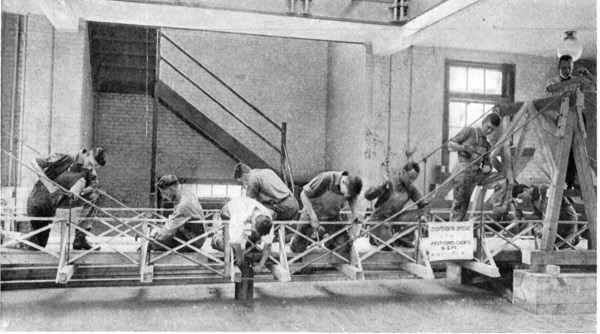
An interesting feature of the Massachusetts
scheme was the working out of camp plans by the
drafting students in the Newton Technical High
School, with detailed equipment of dining tent with
wooden-horse tables; sleeping tent with double-deck
bunk; latrine; cook shack; etc.
In its system for handling the supply of boy
labor, the state requires the farmer to sign a definite
application blank for the amount of boy labor
which he requires. It is understood that while
the boys are enlisted for the entire period up to
October 1, the farmer may take those boys for
long or short periods of not less than a week in
duration, to begin or end at any time, as the
farmer's necessity requires. This application made
by the farmer is also an agreement to pay the
wages stipulated by the Committee on Public Safety
and also to employ the boy on rainy as well as
fair days, using his services on rainy days under
cover if possible. Further agreement is made, in
case the boy is unsatisfactory, to give him one
week's notice or one week's pay, providing him
with a statement in writing of the reason for his
discharge. Whenever, in the opinion of the local
supervisor, the conditions of living or of labor are
not satisfactory, the boy may be withdrawn without
prejudice to him. These arrangements insure that
there shall be a coöperative responsibility of farmer
and state in caring for the boy.
In establishing the camps in Massachusetts the
money to start the work was chiefly supplied by
individuals. In the case of the New Bedford contingent
in Coonamesett camp, on an estate of
11,000 acres, the boys were housed in militia tents,
lent by the state,—two boys to a tent. For their
tent furnishings the boys supplied whatever they
needed. A mess house—a rough board building
75 feet long by 17 feet wide, providing eating
quarters for the boys and at one end a cook room—was
in part erected by the New Bedford Industrial
School boys, working under the direction of an
experienced carpenter. The laying of the 2500 feet
of pipe to carry water to the camp was also the
work of the same school. The catering for the
boys was under the direction of an experienced
woman and two Japanese cooks. In the morning
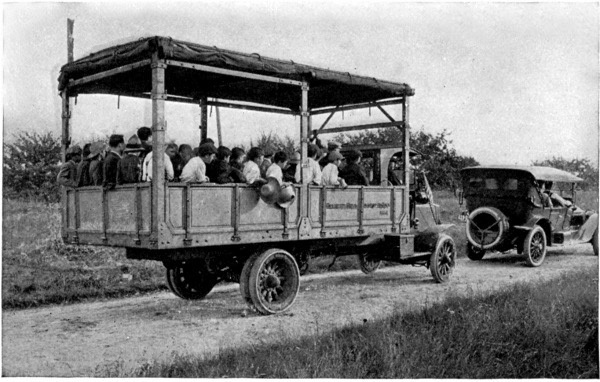
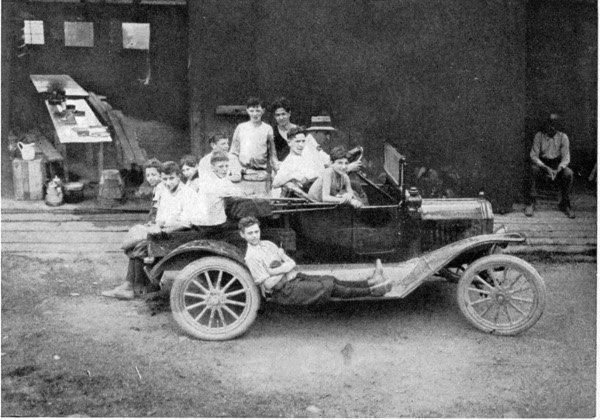
the boys started for the various farms, those at a
distance being called for by an auto truck. In this
camp, for an eight-hour day and a six-day week
each boy received a maximum wage of $4 a week
and board, the weekly payment in charge of the
supervisor. The camp was fortunate in having as
its directors the city superintendent of schools and
a physical instructor, the latter living in the camp.
In New York the placing of boys on farms has
been the joint work of the Food Supply Commission,
the State Education Department, and the
State Military Training Commission. While younger
boys have been released for agricultural work by
other agencies, the state placement by the commission
is concerned only with the boys of military
training age—16 to 19. One of the first actions
of the latter commission was to divide the state
into 6 military-training zones: New York City (including
Manhattan, Bronx, and Richmond); Long
Island, including Brooklyn; Hudson Valley, with
center at Albany; East Central, at Syracuse; West
Central, at Rochester; and Western, at Buffalo.
Next, a description was obtained of the character
of the work in each zone. For example, the Hudson
Valley Zone as far as Albany requires labor in
harvesting small fruits and general farm work,
while the West Central Zone work is that of muck
farming, large-fruit farming, and general farming.
Each zone center has its individual office through
which placements are made. Meetings were held
the latter part of April by zone supervisors and
farm-bureau managers, and attended by farmers'
and fruit growers' associations who stated what
they needed and what they would contribute in
wages and housing for boy workers.
The inducements for enlisting offered by the state
to boys released from school work were the chevron
given by the Military Training Commission, to be
awarded after thirty days' satisfactory work; the
military-training-equivalent value of the service; and
the promise of proper pay and care by the employer.
As to credits, so important in the New York
system, farm cadets were permitted to take the
Regents' examinations though the course lacked a
few weeks of completion, the time requirement being
waived in their case. Any pupil in the schools
of the state who enlisted for military service
(this applied to the colleges) or who rendered
satisfactory agricultural service was credited with
the work of the term without examination, on the
certificate of the school that his work up to the
time of enlistment was satisfactory.
New York is an agricultural state, with a great
variety of kinds of farming and many districts
remote from centers of the supply of labor. The
agricultural census, to which reference was made
in Chapter II, supplied data for determining the
districts where and when labor was most needed
and where schoolboys could be most useful. For
example, in Orleans County, in the Western Zone,
the demand varied from 163 laborers needed early
in May to 1521 needed in October, an indication
that there was really more reason for excusing boys
in October than in May for work in peach- and
apple-harvesting districts.11 Conspicuous among the
types of New York farms where labor was sought
were the great fruit farms, such as the Sodus Fruit
Farm, with a house on the shore of Lake Ontario
able to accommodate 100 boys, where it was planned
to harvest the entire peach and apple crop with
schoolboy labor; the vast tracts owned by the
canning companies, with thousands of acres of
tomatoes, beans, and corn under cultivation; and
the farms such as those in the South Lima district,
where there was muck farming and where the
work included the cultivating, sorting, and packing
of onions, lettuce, celery, and spinach. Calls
were sometimes made upon the state for as many
as 1500 boys to assist in harvesting. It was therefore
necessary for the state to work on a large
and definitely planned scale.
Naturally the first boys to be placed were those
residing in or near farming districts. When, however,
the supply of these boys was exhausted, the
call came, even from remote districts, for city boys.
In these cases the problem of transportation becomes
serious, as well as the housing and care of
the boy in the new environment, where association
with other help is apt to be harmful.
The following description of a New York State
camp is offered not only because it has proved to
be highly successful but also because it affords
an excellent illustration of the "farm-working, or
labor-distributing, camp," which is defined in the
chapter following.
It was called The Erasmus Hall High School
(New York City) Potato Growers' Association, and
was organized by F. A. Rexford, a teacher who is
much interested in agriculture and in boys.
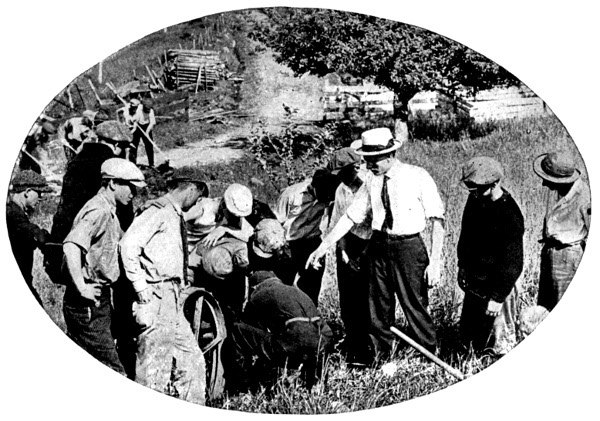
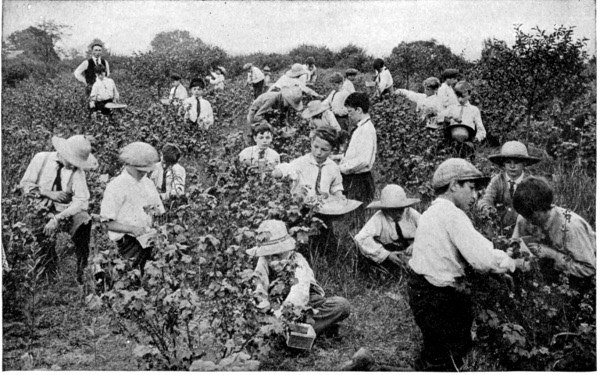
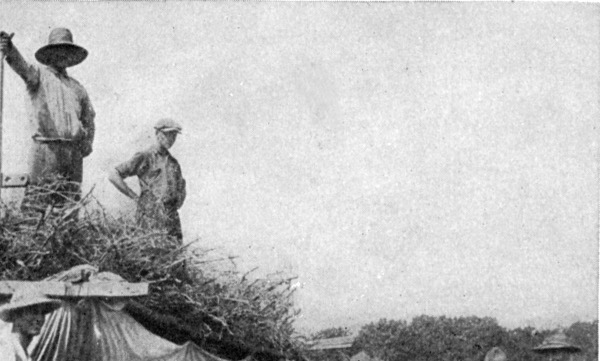
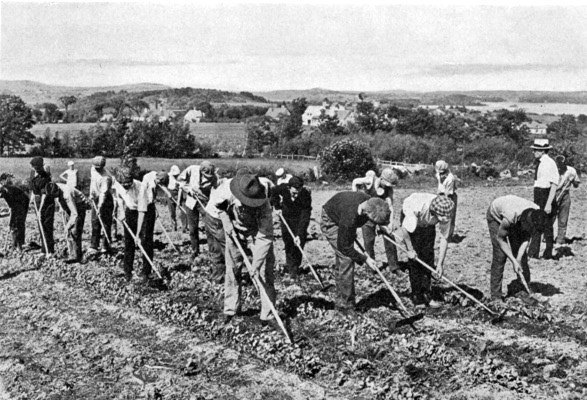
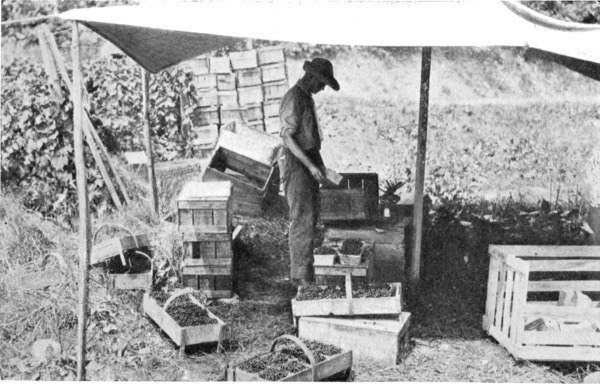
Working and living in the berry fields. One of twenty-five camps in the
Highlands of New York State.
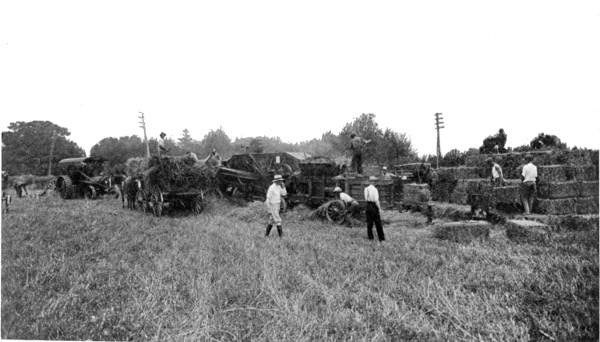
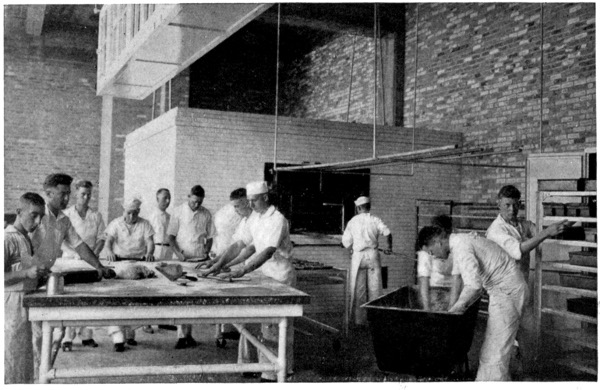
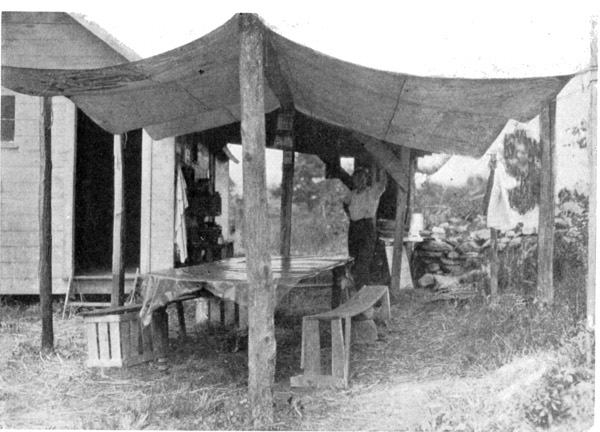
Agriculture on a Western basis brings lessons in organization, coöperation,
and economy to Eastern boys. City boys working on a large farm near
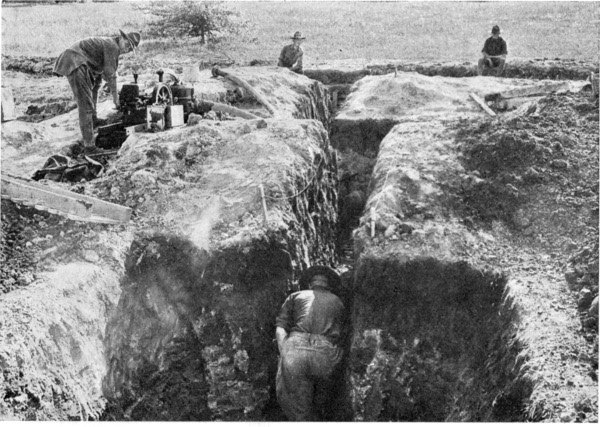
Phoenixville, Pennsylvania.
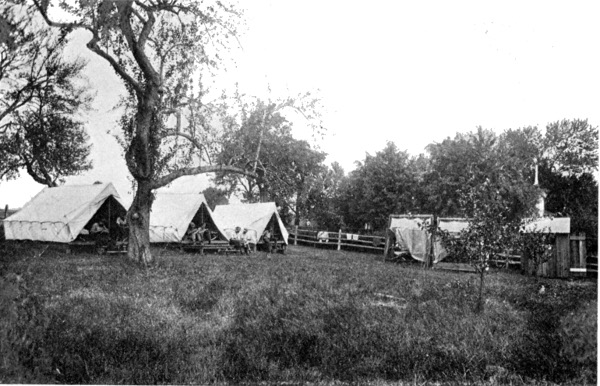
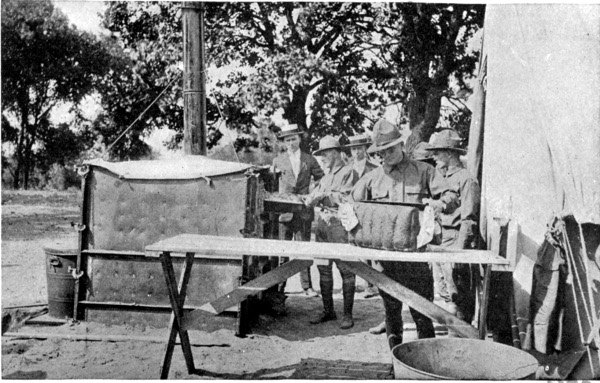
Employing able-bodied boys of city high schools for farm production may
become permanent. It may lead to the development of country annexes to
our city schools. Camp near Phoenixville, Pennsylvania.
The object of the association, which was formed
in the school, was originally fourfold: (1) to teach
the farmer that the alert city boy can and will
perform agricultural tasks; (2) to increase the food
supply; (3) to relieve the help situation by organizing
a group of boys to work by the hour or
day, and to recruit boys to work by the month
for individual farmers under supervision; (4) to fit
boys for military service if needed.
Ten boys from the school left New York on
May 5, each armed with the money necessary to
pay such expenses as carfare, food, laundry, rent of
an acre of land, seed potatoes, phosphate, team hire,
and spraying materials. They went to Mr. Rexford's
farm, located up-state. The New York Tribune contributed
some money, and one of the teachers in
the school advanced $60 for the boys to grow
potatoes for him. Some frail boys, whose parents
wanted them to go for their health, were refused.
At first the farmers were skeptical. The boys,
however, went to work on the land which they
had rented from Rexford. In a week they began
to attract attention and farmers began to hire
them. Rexford knew some of these farmers by
reputation. He believed that men who cannot
keep their own boys at home cannot succeed with
boys from the city. He was in the habit of having
a straight talk with the employing farmers, telling
them that the boys must be treated squarely.
A large milk-distributing corporation offered to
take every one of his boys, but he argued that it
could afford to hire men and did not need boys,
as did the farmers who could not obtain other help.
It is evident that large farmers have capital and
backing, while it is the individual farmer struggling
with hard conditions who must have help.
Most of the boys who are with farmers by the
month come back to the main camp every Sunday
morning for physical examination, general assembly,
and to go to church. This coming back to the
camp keeps before them the idea of a camp for
farm cadets. They return to their work Sunday
night. For those boys who go out by the week
the teacher makes an arrangement whereby the
farmer brings them back to the camp on Saturday
night and comes for them the following night.
The people in the community in which the camp
is located have established a nonsectarian church
in an old cheese factory which has been purchased
for $200. Occasionally a minister from a near-by
town comes and speaks.
The camp has a professional cook, who was
obtained from a college fraternity, and the boys
pay pro rata. The first expense was about $2.50
a week for each boy, but prosperity has provided
means for the boys to spend more.
All vegetables which the boys raised and which
they did not use on the table were canned by
the cook and Mrs. Rexford, and they will be used
in the early part of next year, before the fresh
vegetables are available.
Local store men have coöperated in giving the
lowest prices, feeling that otherwise the trade of the
camp would go to the city, and therefore choosing
the opportunity of large business with aggregate
large receipts on small profit.
Breakfast consists of fruit, cereal or eggs, and
milk, cocoa, or postum, and sometimes corn bread
or griddle cakes. The boys carry a cold lunch
with them, consisting of a pail of cold cocoa;
four good thick sandwiches of peanut butter, meat,
or jam; a piece of frosted cake; and a banana.
Sometimes they take a pot of jam, which is disposed
of by the group. For dinner they have a roast
or steak; potatoes and other ordinary vegetables
(beans, peas, lettuce, carrots); shortcake or pie or
pudding; cocoa, postum, or milk.
The boys take care of their own beds, wash
the dishes, and keep the place clean.
They have a study hour every evening from
eight until nine, and the same is true of the boys
placed out with farmers. One boy, going to
Princeton in the fall, kept up his studies and took
the Regents' examinations at the country school,
passing them with as good a mark as he would
have obtained at his home school.
After drill on Sunday morning the boys at
camp have a baseball game. They have had
entertainments for the benefit of the Red Cross.
In the group at camp are the gold-medal orator
of the school, two excellent pianists, four mandolin
players, and a whistler. All the boys are
good singers.
Rexford's application blank asked for the weight,
age, previous experience in farming, church preference,
and habits as to smoking.
The teacher had the coöperation of the farm
bureau. The farmers wrote to the bureau for help;
Mr. Rexford and the farm-bureau manager went
to each farmer, looked over the situation, and if
everything was satisfactory, furnished the workers.
Mr. Rexford will not leave boys on any farm
without proper supervision. He visits the boys
once every week, neither the farmer nor the boy
knowing when he is coming.
At first no wage scale was set, the arrangement
being that the farmer should pay what the
boy was worth. If he was worth nothing, then it
was all right, and the boy ought to be the first one
to know it. However, most of the boys started
at 20 cents an hour; soon this was raised to 25
cents, and now the pay is 30 cents.
Most of the farmers in the vicinity had never
done any spraying. They now apply to Mr. Rexford
when they want such work done and he sends out
two boys and horses and his own spraying outfit.
The work is done at a cost to the farmer of
about 70 cents per acre for spraying potatoes, in
addition to the material; that is, 25 cents per acre
for each boy's work and 20 cents expense on the
spraying outfit, for nozzles etc.
There was no illness among the boys during the
summer, not even colds. Sometimes the boys got
wet through, but came home, took a dip in a hole
in the creek, and followed it by a good rub.
Meanwhile quite a number of New York City
men teachers under the leadership of two camp
supervisors, H. W. Millspaugh and H. J. McCreary,
and acting under the authority of the Board of
Education, started out "to sell something they did
not have to somebody who did not want it." But
these men had the courage of their convictions
and the results of their work (over twenty camps
in two counties) give ample evidence of the success
of their venture.
Imagine the surprise of the fruit growers of the
counties named when they received the following
circular letter:
It is proposed to bring a large number of boys from the
high schools of New York City to pick fruit in the fruit
belt of Orange and Ulster counties. In carrying out this
plan it will be necessary to have the full coöperation of
fruit growers, school authorities, parents, health authorities,
and others. The part of the fruit grower will be roughly
as follows:
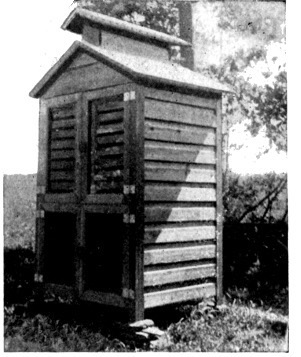
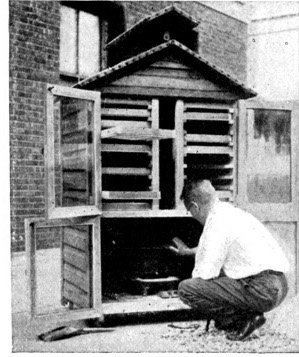
He will provide housing facilities, stove, fuel, refrigeration,
either by ice box, cellar, or spring, convenient water
supply, toilet facilities satisfactory to the board of health,
straw for mattresses, cooking utensils, working conditions that
will enable the average boy to earn a respectable wage, and
a sympathetic attitude toward the comfort and health of the
boys.
Each boy will provide his carfare to and from the fruit
section, provide his own knife, fork, cup, plate, spoon, wash
basin, tick for mattress, pillow, blankets, etc., and pay for
his food and cooking. Boys will mess in groups of 12 to
25 or even more. Each group will have a capable boy cook
and in camps of over 20, two boys. The first boy will receive
$4 a week besides his meals, the second boy $2.50 a
week and may earn some more by picking fruit. A teacher
supervisor will supervise one large or two or three small
camps and advise as to preparation of food, buy supplies,
and act as camp director.
Regarding cooking outfit to be supplied by the fruit
grower, it may be said that all except stove and ice box can
be purchased new for about $10. It is desirable that these
be ordered by the camp director, who will judge the size and
kind and take advantage of wholesale rates. An oil stove
and oven is recommended unless a suitable stove is on hand.
Inexperienced boy cooks cannot be expected to satisfy a
score or more of hungry boys with equipment discarded by
the skilled housewife.
It is further understood that these boys will not work on
Sunday nor will they be located on farms where farm help
is not treated with consideration.
An illustration of a "concentration and training
camp" is that established by the state of Maine.
This state, in coöperation with the state Young
Men's Christian Association, developed a state
camp for the purpose of enlisting and training
boys and young men to supply the extra demand
for farm labor made necessary through the increased-acreage
propaganda. The boys were organized
under the title of "The Junior Volunteers
of Maine." They were virtually farm soldiers of
the state, and were sworn to obey all rules of the
camp before and after leaving it for the farms on
which they were placed.
The boys are sent out in squads to work in
different sections of the state, as opportunity may
offer, under the direction of competent adult leaders.
These leaders have full charge of the boys until
they return to the mobilization camp.
When a boy comes to the camp he is examined
for his moral and physical qualifications, and then
is assigned to a company and to a tent. The
adjutant general provides necessary tents, uniforms,
and camp utensils. The boy is instructed with
others in the squad how to pitch a tent and pack
camp utensils, and he is also given lessons in
sanitation and the elements of military drill. He
has a lecture every day given by a professor of
the state agricultural college. He also works on
the Y.M.C.A. farm, which is being used for this
purpose, and is taught the use of machinery, and
how to manage and care for horses, sharpen tools,
and milk cows.
It is not claimed that a week of this sort of
training makes the boy a finished farmer, but it
does go a long way in that preliminary education
so essential to farm-mindedness. By the time
the boy gets to the farmer he is in excellent
shape to understand the orders of his employer.
In the words of the director of the camp, "He is
ready to begin actual service as a trained novice."
Before the boy is admitted to the camp a
searching examination is made into his character
and antecedents, and some responsible person
must answer certain confidential questions relative
to the boy's physical, mental, and social habits.
After the boy is admitted to the camp he takes
an oath in which he states that he will serve as
a junior volunteer for farm service in Maine until
the last day of October, unless sooner released by
the governor of the state of Maine.
A charge is made on the farmer of $1 a day for
each of the six working days, and it is expected
that if the boys show themselves worthy of more,
the farmer will recognize this and make a satisfactory
adjustment with the leader. In addition
to the minimum charge of $1 a day the farmer
is required to furnish board. As a rule, however,
the boys sleep in near-by tents with their leaders.
The farmer is not required to pay transportation
or other charges.
The farmer's agreement is with the state and not
with the boy, as the scheme works on the basis that
the young men have been engaged by the state for
farm service and as employees of the state receive
their pay through the regular state channels.
On the first of July more than 450 boys had been
trained and sent out to various points in the state.
The following letter from the director-general
of the camp gives in a word his experience with
these boys:
We feel that this movement can be justified from any
one of a half-dozen standpoints. We are taking city boys
and in a few weeks giving them a few carefully selected
fundamental principles relating to practical farm activities,
which has enabled them to go out to the farms under our
leaders and give satisfaction. We have not had a single
complete failure yet. Only 3 boys out of 600 employed
for the season have been changed because they could not
fill the requirements. The way these city boys have taken
hold of farm work has been wonderfully gratifying. In
connection with this training, we are conducting our camp
along lines similar to camps of National Guardsmen. The
whole organization is nearly identical with the regular army
camps. While the training is not so extensive, the boys
are given the fundamentals in correct form. The spirit
and general training at the camp will be of great value if
any of these boys are ever called into the service.
Another important possibility, and from my experience
with city boys, a probability, is that some of these boys will
become sufficiently interested in agriculture to choose it as
a vocation, while others will choose it later in life as an
avocation, because of this experience.
Another mobilization camp of the "labor-distribution"
type, with some training features, was that
of the Long Island Food Reserve Battalion. This
organization was initiated by the Nassau County
Y.M.C.A. and supported financially and morally
by the Long Island Railroad, the state agricultural
school at Farmingdale, and by local residents.
A detailed description is unnecessary. There were
6 camps under this organization scattered over
the island, in each camp 48 boys under a supervisor,
a military instructor, and squad leaders (1 squad
leader to approximately every 7 boys). The last
camp was developed at the state school of agriculture
with a group of 96 boys working in two
shifts, one beginning at 6 A.M. and stopping at
12 noon; the other beginning at 12 noon and stopping
at 6 P.M. A regular course of agricultural
instruction was carried on at all the camps. Lectures
have been given in entomology, farm chemistry,
and marketing. During the first month of the
first camp it was difficult to place the boys. The
idea was not well received by the farmers, who
claimed that the presence of boys would "demoralize"
their regular help, and that the boys would
not recognize the different vegetables and would
hoe out corn as quickly as they would pigweed.
(One boy in a New York State camp did carefully
hoe out and pull up every corn plant for a half-day,
leaving weeds.)
During the height of the season these same
farmers were driving to the camps and offering from
$2 to $2.50 a day for the same boys that they had
laughed at hiring for $1.25 a day at the beginning
of the installation of the camps.
The "flying-squadron" idea is unique. An auto
truck, with a trailer for tentage and supplies, is
always ready to respond with its load of boys to an
emergency call to save some particular crop. The
group composing this squadron is made up of
"hand-picked" boys who are qualifying for squad-leader
positions.
An example of a camp which was conducted in
such a manner that the boys lost the minimum of
school work is that of the Bushwick (Brooklyn,
New York), High School "Camp Squire" near
Hicksville, Long Island. The organization of this
camp is interesting, not so much because it was
established with the purpose of making it self-supporting,
but rather because it provided definite
opportunities for continuing with school studies.
The initial amount of about $175 was subscribed
by teachers, and the tent and mess house, intended
formerly for harvesters, was lent by the farmer on
whose grounds the camp was placed. The leader
of this camp, a teacher in the same school from
which the boys were recruited, planned, after the
schools opened in September, a day of work and
study, coaching the boys in their school subjects,
so that with at least three hours of study per day
the boys were enabled to keep up with their
classes while at work harvesting until the middle
of October. In this, as in other successful camps,
the boys formed a unit organization before going
to camp, and had the advantage of a sympathetic
instructor of academic and agricultural experience
to enforce voluntary school discipline. The boys
were paid 20 to 25 cents an hour, working for
neighboring farmers from 7 A.M. to 3 P.M. The
rest of the day was divided into silent study, consultation,
and recreation hours. It is expected that
this camp, which will doubtless be permanent, will
become self-supporting in its second or third year
and the initial outlay will be returned.
The farm-camp idea is here to stay. Of that we
are sure. The purely recreational camp is a thing
of the past. The days of the purely work camp of
ten to twelve hours a day ought to be over. Work,
play, and study in the future will be brought together
in the summer time as effectively as during
the so-called "regular" season. Next year, and in
the years after, we shall organize this work around
some educational ideal and not merely around a
necessity for food-production. The two are by no
means incompatible.
This year we have learned "how not to do it,"
as one camp leader put it. In some instances the
boys went home with less money than they had
at the start. In brief they paid the farmer for the
privilege of picking berries. Particularly in berry
picking there was much piece work, and such may
carry with it nearly all the evils that it does in the
factory. Mr. Keller, a thoughtful leader of a New
York camp, says in this connection: "Judging the
fair wage from the earnings of the expert is manifestly
unfair. It means that the average boy must
be speeded up beyond his point of endurance, or
that he must receive less than a living wage. The
possibilities of speeding up are limited, and so
the alternative is longer hours."
Furthermore it is necessary for the government,
state or national, to take a hand in the distribution
and the sale of farm products. It made me
sick at heart, on a trip of inspection to 25 camps,
to see hundreds of boys at work picking berries
under the hot sun in a service supposedly patriotic,
and then to see the same berries, which had been
sold by the growers at a price not much above that
of other years, resold to the consumer at double
the price of other years,—and always with the
remark: "You know labor is scarce this year, and
the farmers cannot get help." The result of it all
has been that the consumer, for whom the work
was done, has been disregarded.
From the point of view of social reconstruction,
education, food production, and conservation only
the surface has been scratched. The state must take
the initiative, assuring the consumer a moderate
price for the product, and the farmer, the dealer,
and the boy a fair return for their service.
The boy is not merely a labor unit in the conservation
of food. He is the essential feature of an
educational program. The experience of the past
summer proves that with centralization, organization,
and an educational vision as fundamental sub-divisions
of a far-sighted state policy the placing
of boy labor on farms could become a valuable and
permanent by-product of the war.