Larger versions of most illustrations may be seen by right-clicking them
and selecting an option to view them separately, or by double-tapping and/or
stretching them.
Other notes will be found near the end of this eBook.
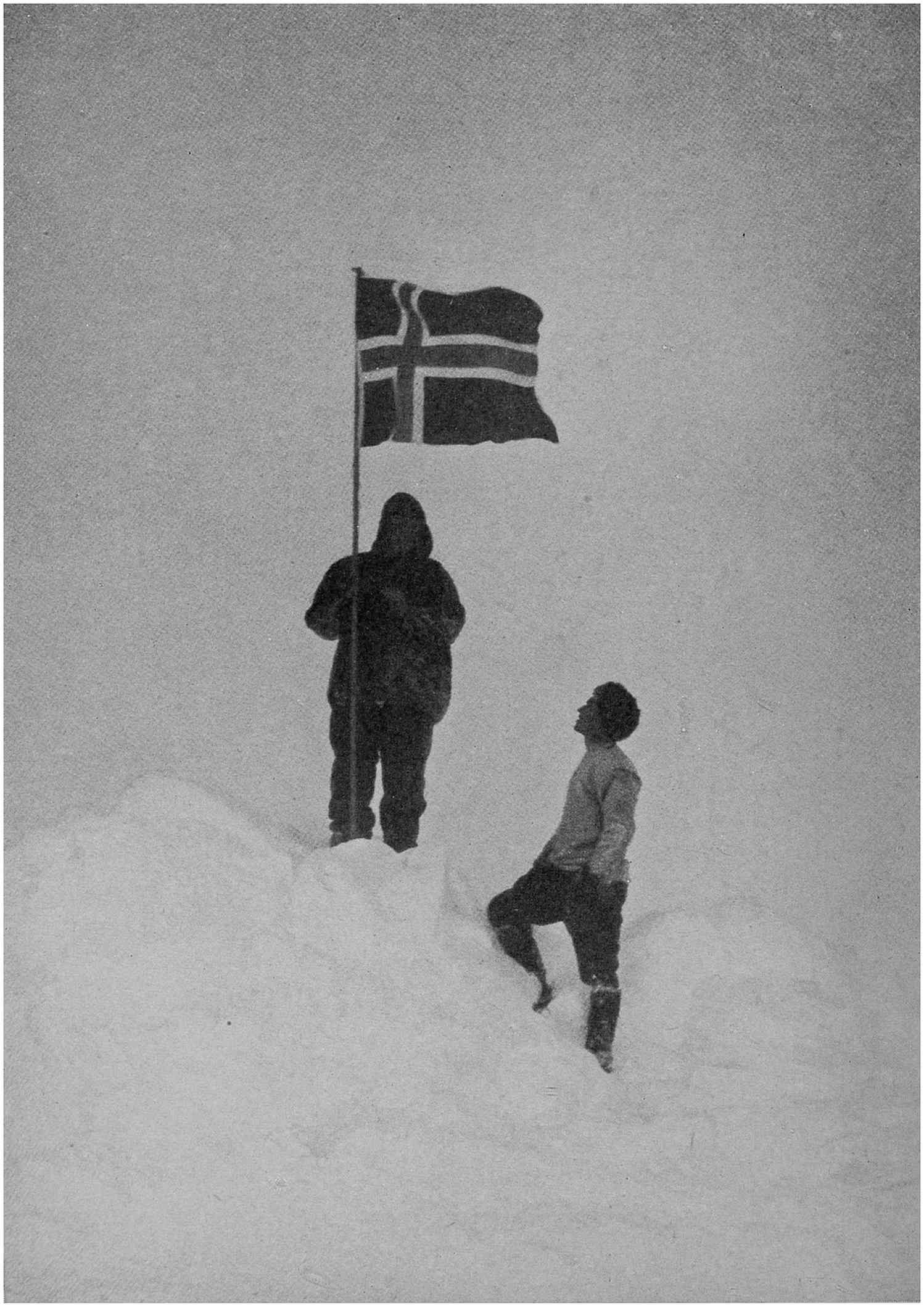
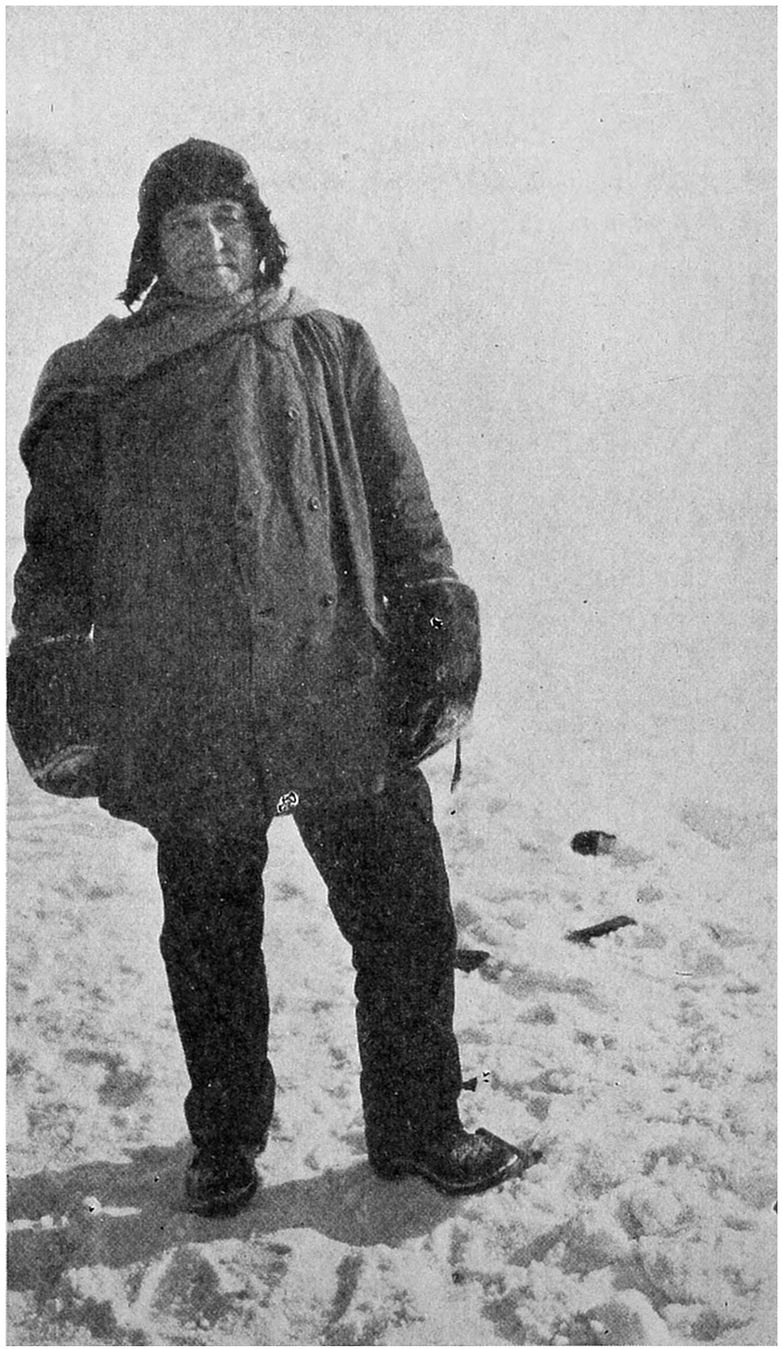
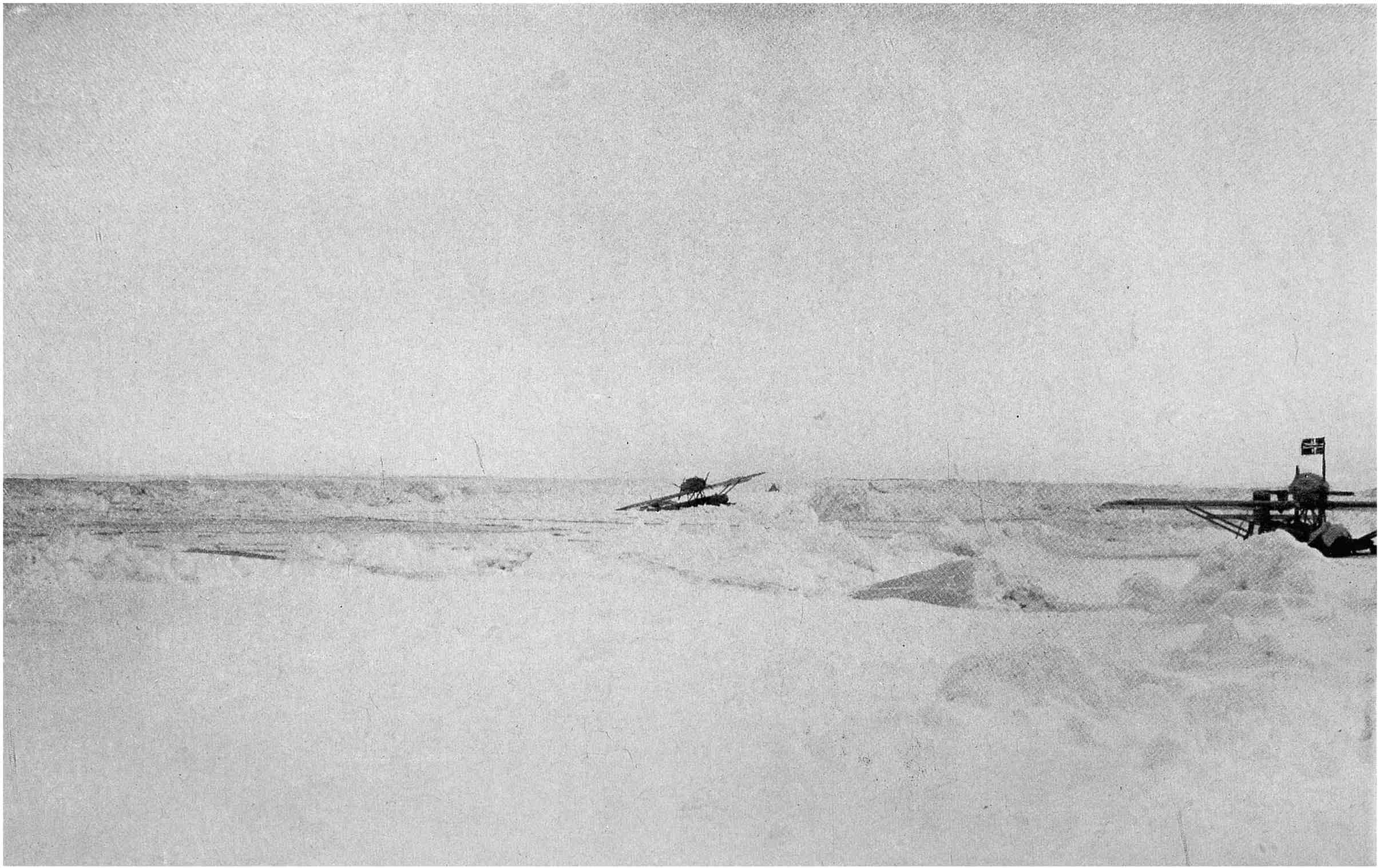
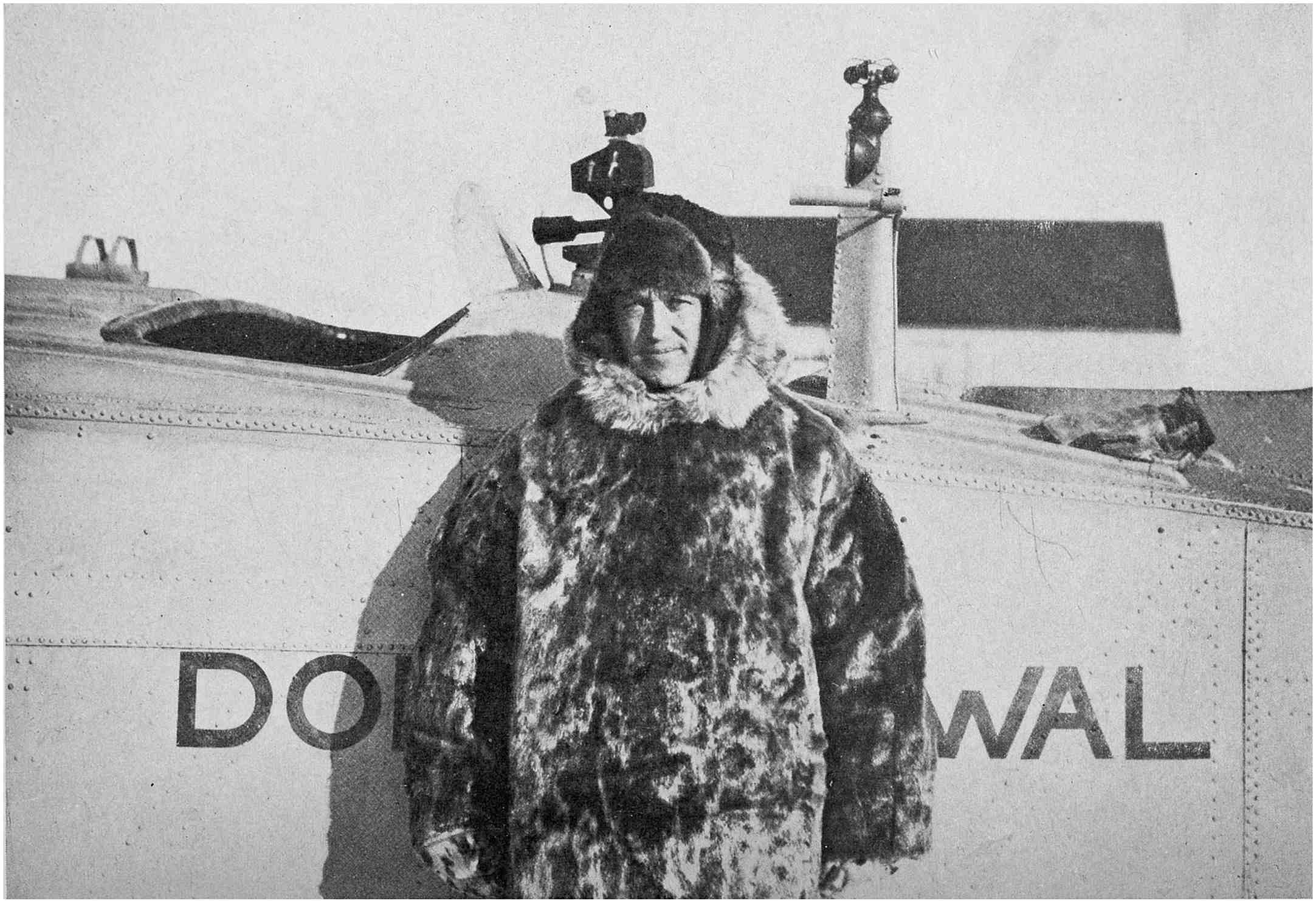
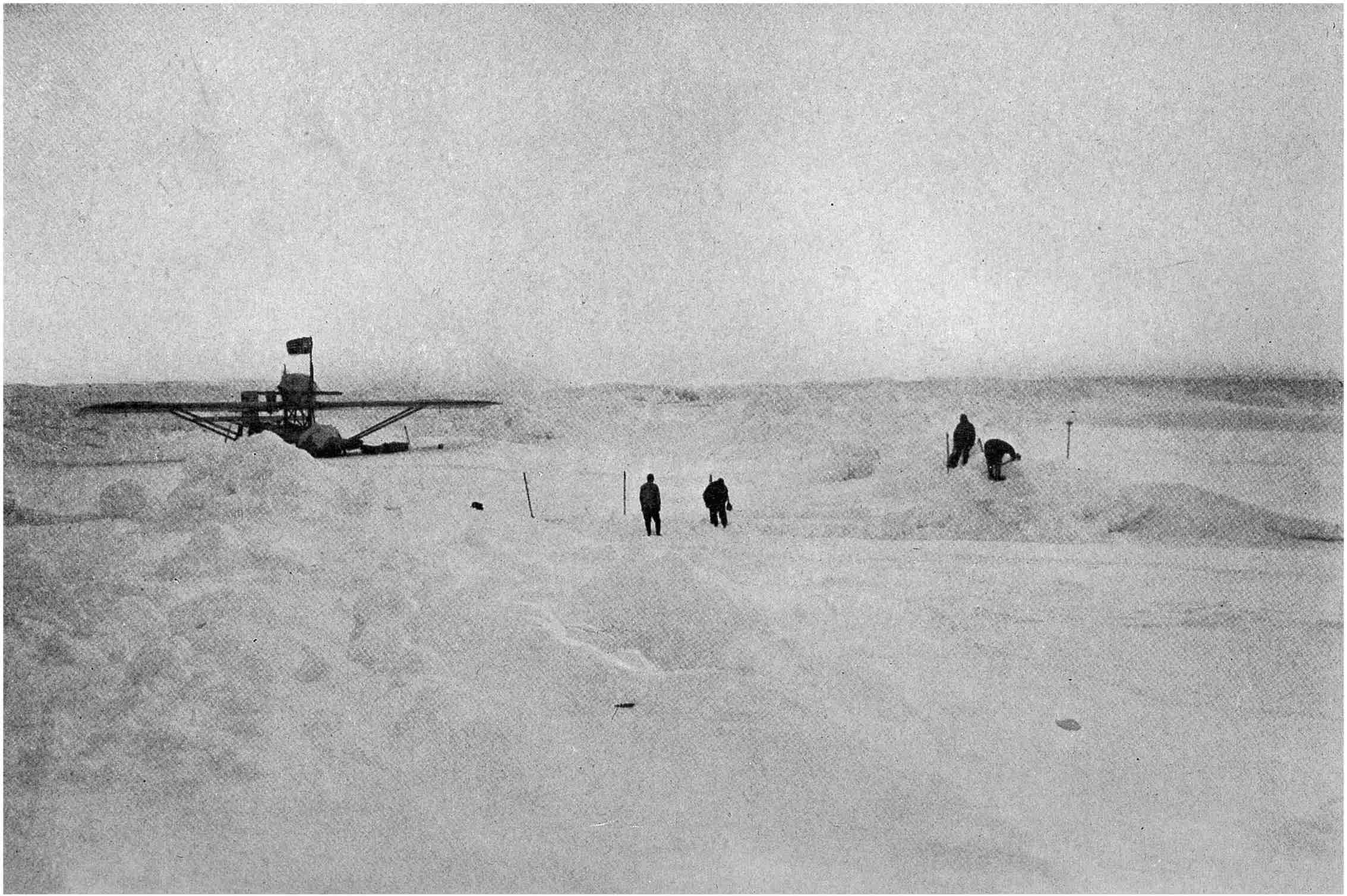
BEFORE WE LEFT WE PLANTED OUR NORWEGIAN FLAG
OUR
POLAR FLIGHT The Amundsen-Ellsworth Polar Flight
BY
ROALD AMUNDSEN
LINCOLN ELLSWORTH
AND
OTHER MEMBERS OF THE EXPEDITION
ILLUSTRATED FROM PHOTOGRAPHS
TAKEN ON THE EXPEDITION
NEW YORK
DODD, MEAD AND COMPANY 1925
Copyright, 1925, By DODD, MEAD AND COMPANY, Inc.
PRINTED IN THE U. S. A. BY The Quinn & Boden Company
BOOK MANUFACTURERS RAHWAY NEW JERSEY
LIST OF ILLUSTRATIONS — Part I THE EXPEDITION By Roald Amundsen — THROUGH THE AIR TO 88° NORTH — Provisions — Rucksack — Equipment Principally for the Machines — Part II THE AMUNDSEN-ELLSWORTH POLAR FLIGHT By Lincoln Ellsworth — THE AMUNDSEN-ELLSWORTH POLAR FLIGHT — Part III THE NAVIGATOR’S TASK By Lieut. Hjalmar Riiser-Larsen — THE NAVIGATOR’S TASK — Why We Chose the Dornier-Wal Type — Measures Against the Cold — Spare Parts — Instruments — Navigation — Soundings — Variations — List of “Mutual Belongings for Flying Boat Equipment” — The Transport of the Machines from Italy to Spitzbergen — In King’s Bay — Part IV REPORT ABOUT N 24 FROM THE START UNTIL WE JOINED N 25 AND ITS CREW ON THE 26TH MAY By L. Dietrichson — REPORT ABOUT N 24 FROM THE START UNTIL WE JOINED N 25 AND ITS CREW ON THE 26TH MAY — Part V WHILST WE WAIT LEAVES FROM THE DIARY OF FREDRIK RAMM From May 21st to June 18th — WHILST WE WAIT LEAVES FROM THE DIARY OF FREDRIK RAMM From May 21st to June 18th — Later — Virgo-havn between Danskeöen and Amsterdamöen. Friday, May 22nd — Virgo-havn. Thursday, May 23rd — Virgo-havn. Sunday, May 24th — Virgo-havn. Monday, May 25th — South Gate between Danskeöen and Spitzbergen’s Mainland. Tuesday, May 26th — Virgo-havn. Wednesday, May 27th — Virgo-havn. Thursday, 28th May. 5:15 P.M. — Virgo-havn. 29th of May — Ny-Aalesund, King’s Bay. 30th of May — Ny-Aalesund, King’s Bay. Sunday, May 31st — Virgo-havn. Monday, 1st June — Virgo-havn. Tuesday, June 2nd — Virgo-havn. Wednesday, June 3rd — Virgo-havn. Thursday, June 4th — Virgo-havn. Friday, June 5th. — “Hobby” Saturday, 6th June — “Hobby.” Sunday June 7th — “Hobby.” Monday, June 8th — Virgo-havn. Tuesday, June 9th — Danskeöen. Wednesday, June 10th — Danskeöen. Thursday, June 11th — Danskeöen. Friday, June 12th — Danskeöen. Saturday, June 13th — Danskeöen. Sunday, June 14th — Danskeöen. Monday, June 15th — Ny-Aalesund. King’s Bay. Tuesday, June 16th — Ny-Aalesund. Wednesday, June 17th — Ny-Aalesund. King’s Bay. Thursday, June 18th — Oslo. July 1st — Part VI THE WEATHER By Jakob Bjerkens — THE WEATHER — Observations from eight o’clock in the morning — Observations from two o’clock in the afternoon — Observations from seven o’clock — Transcriber’s Notes
Before We Left We Planted our Norwegian Flag Frontispiece
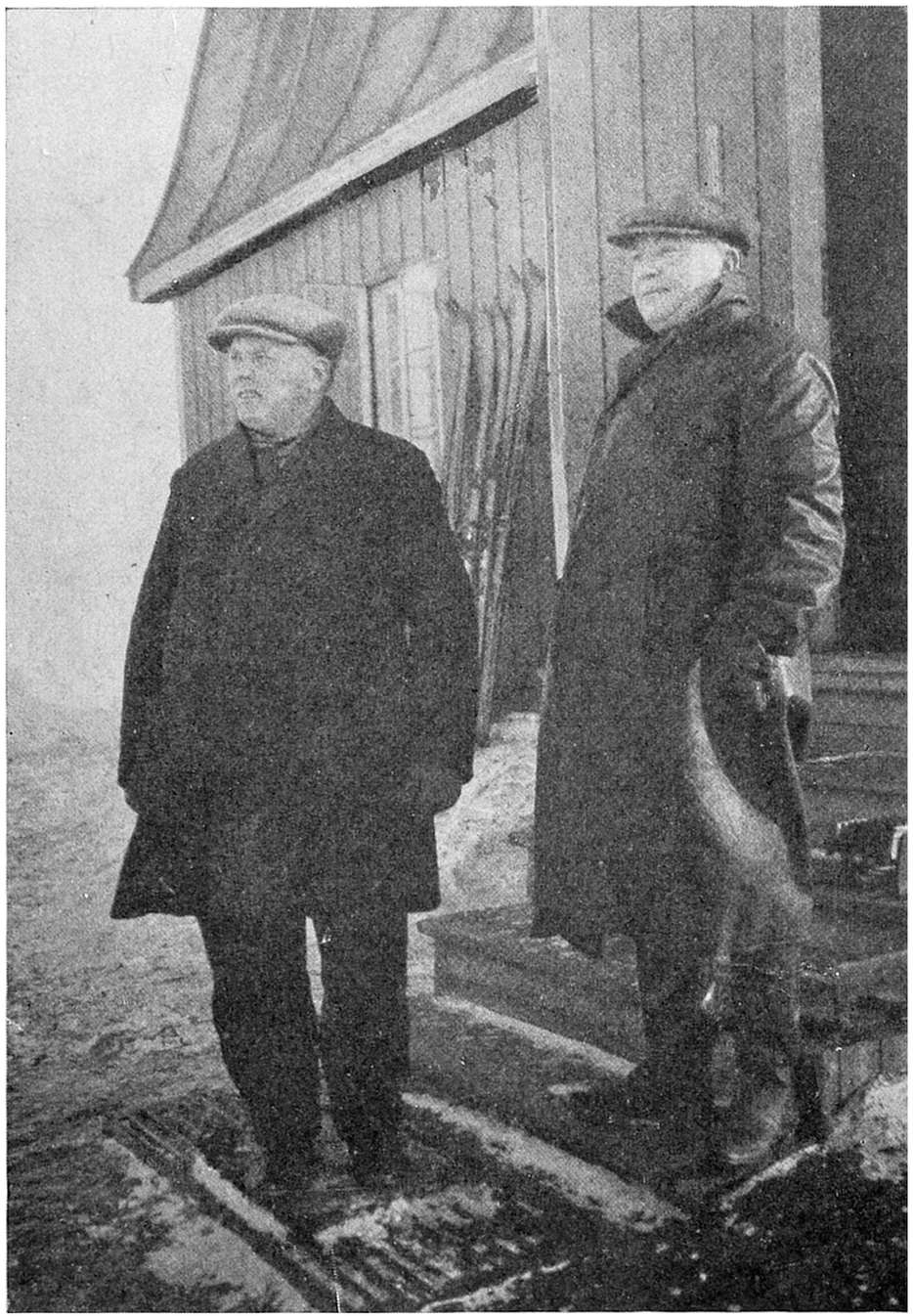
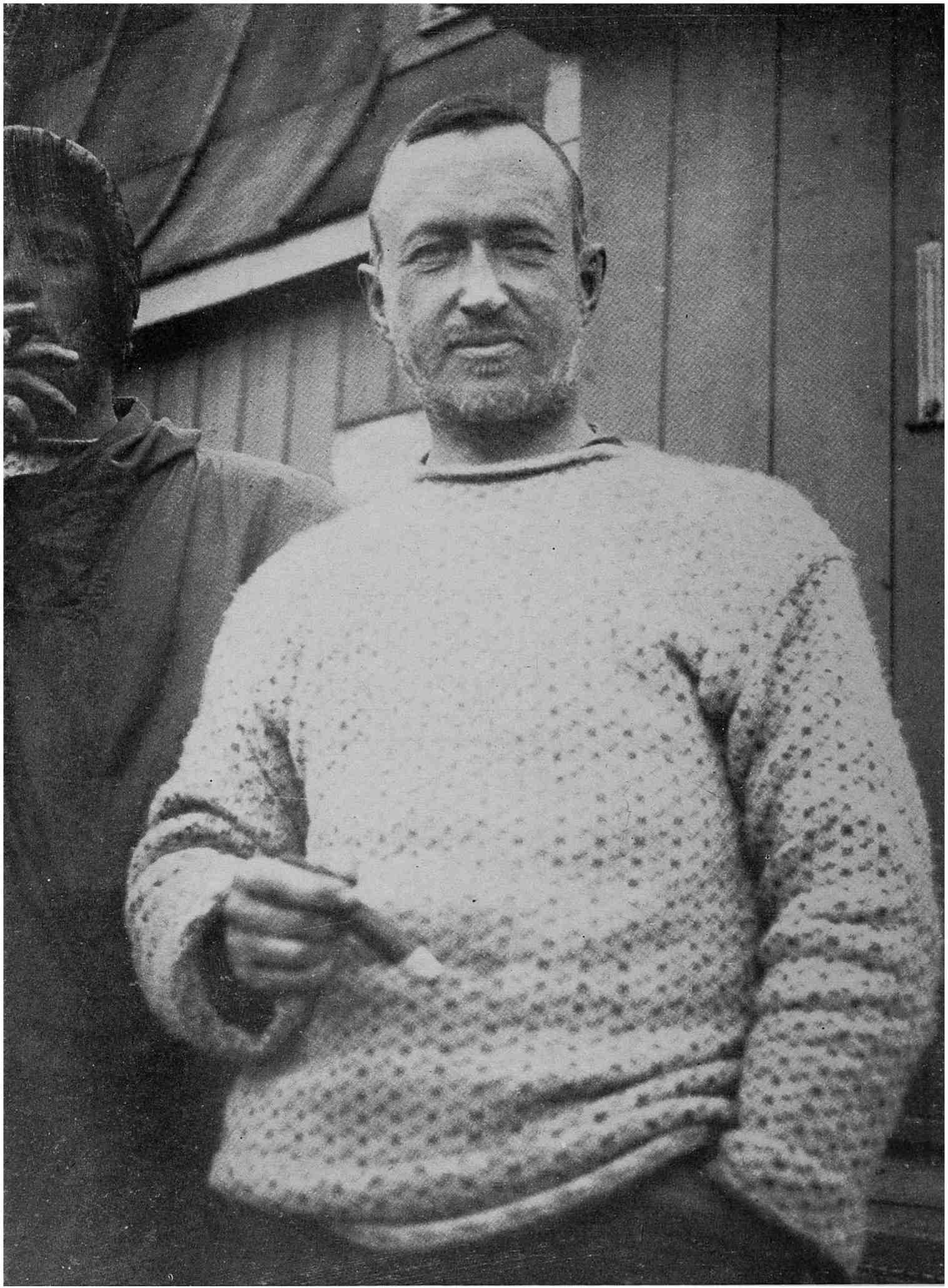
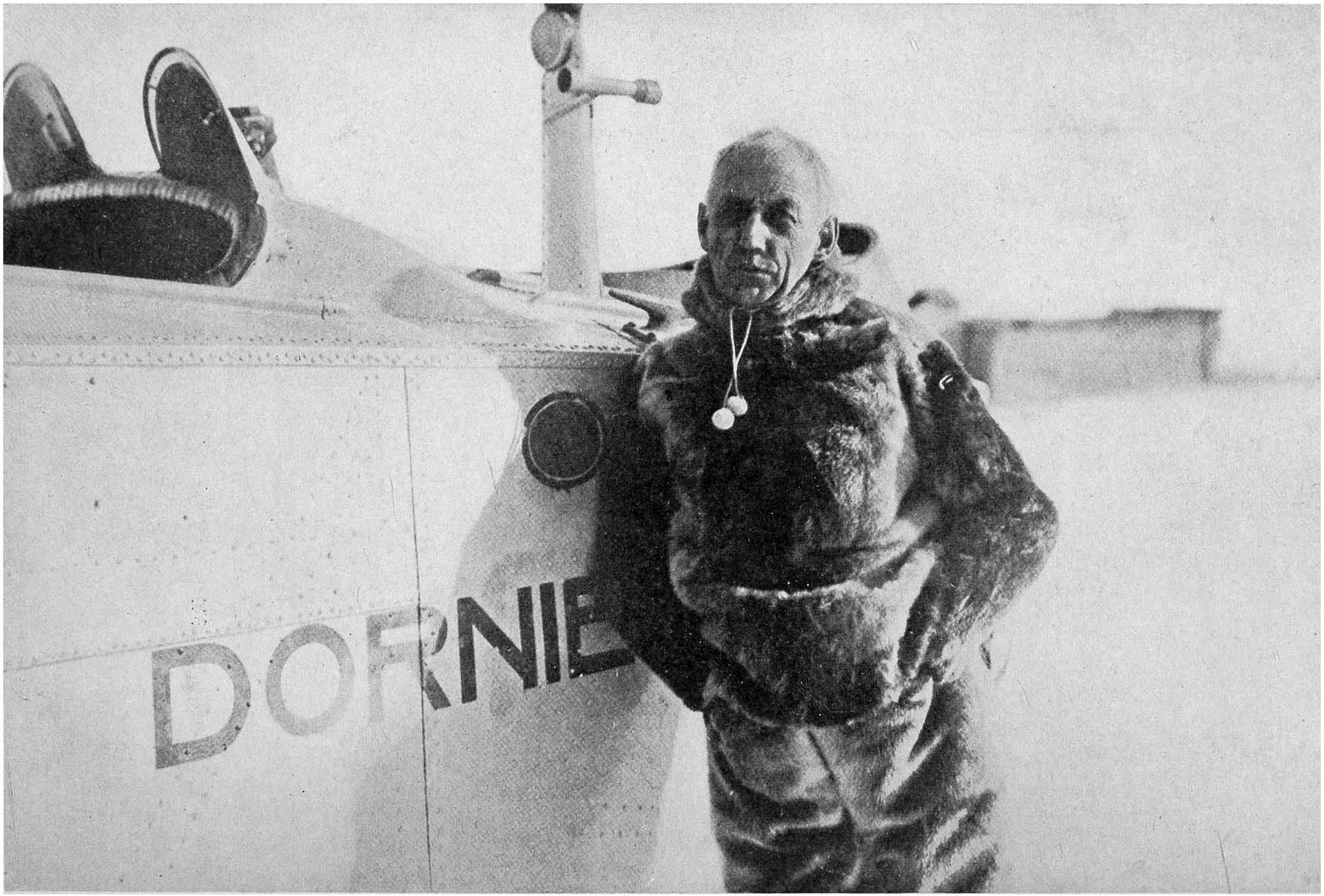
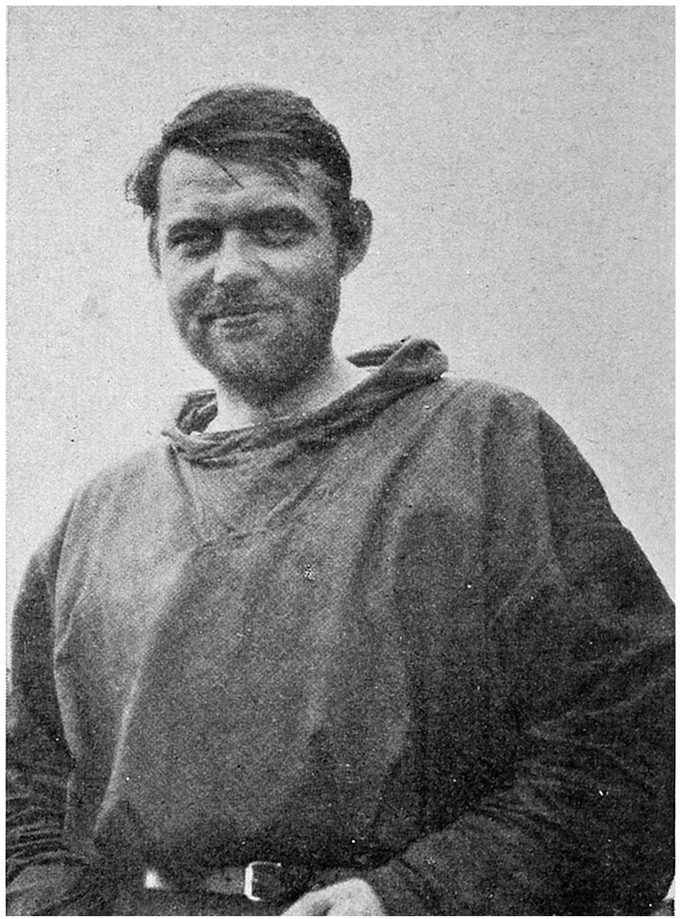
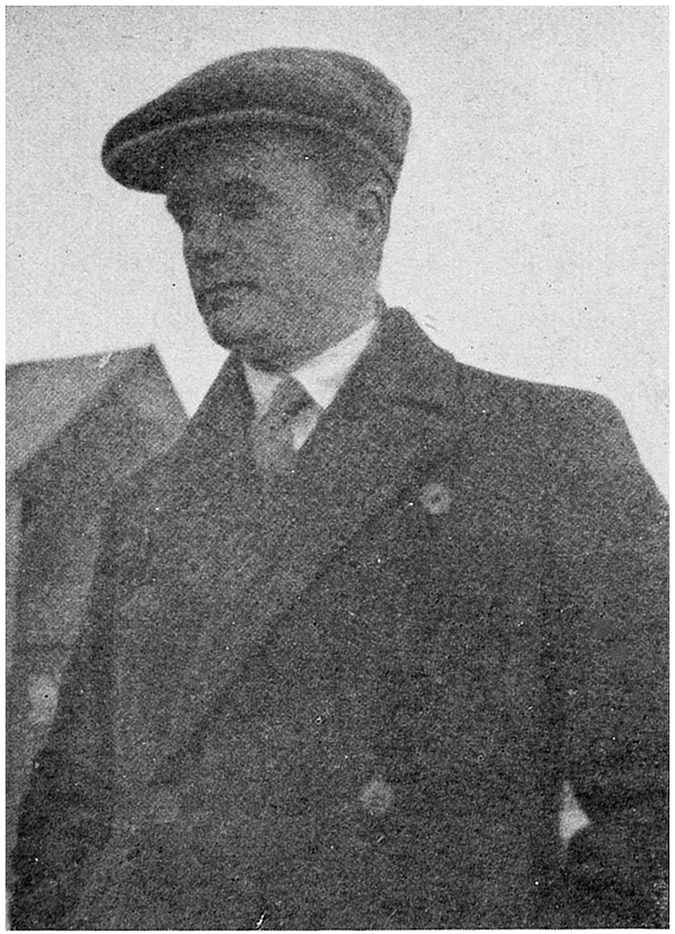
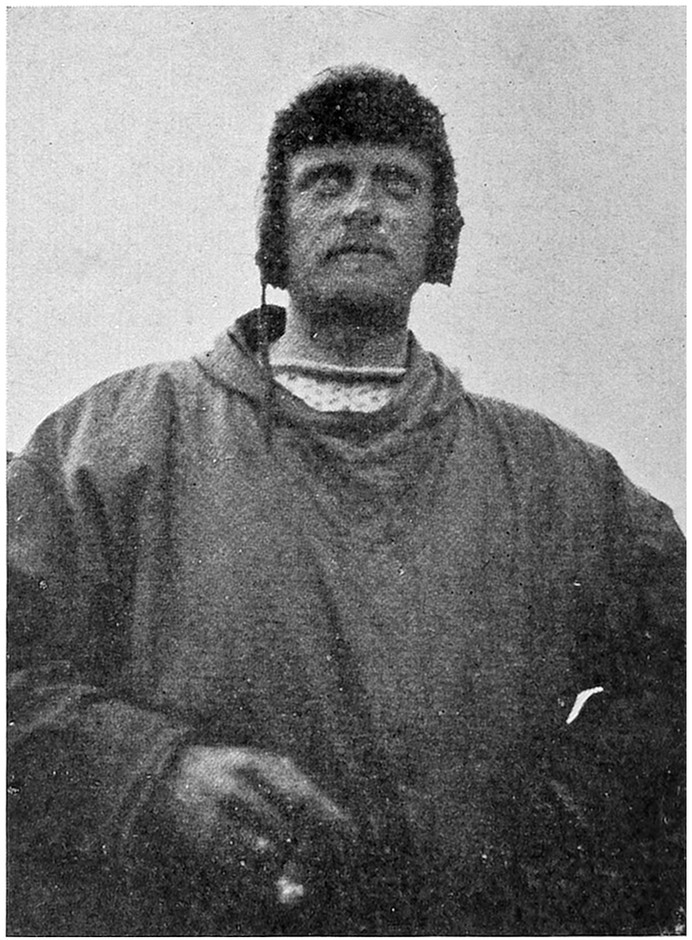
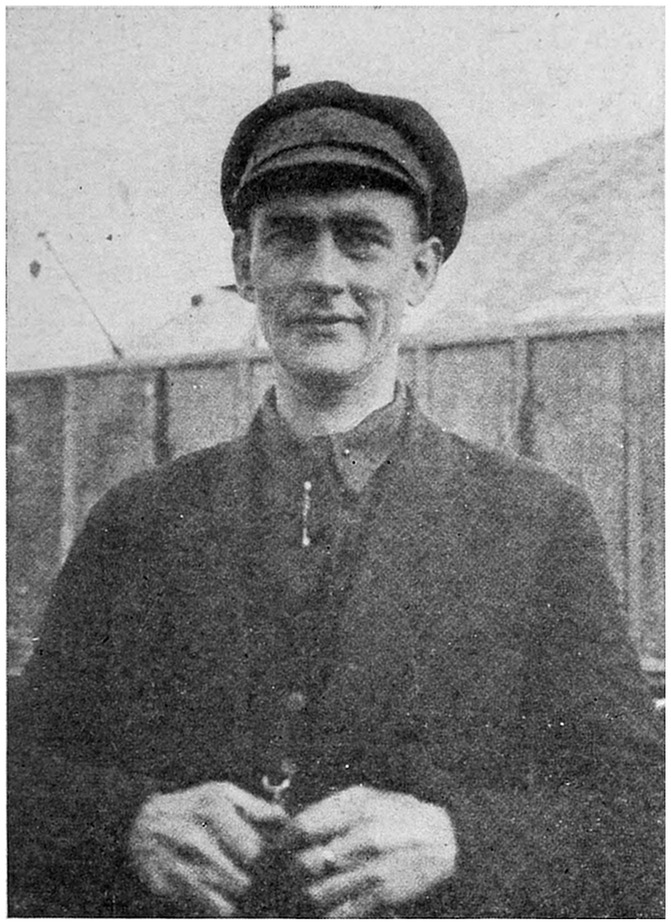
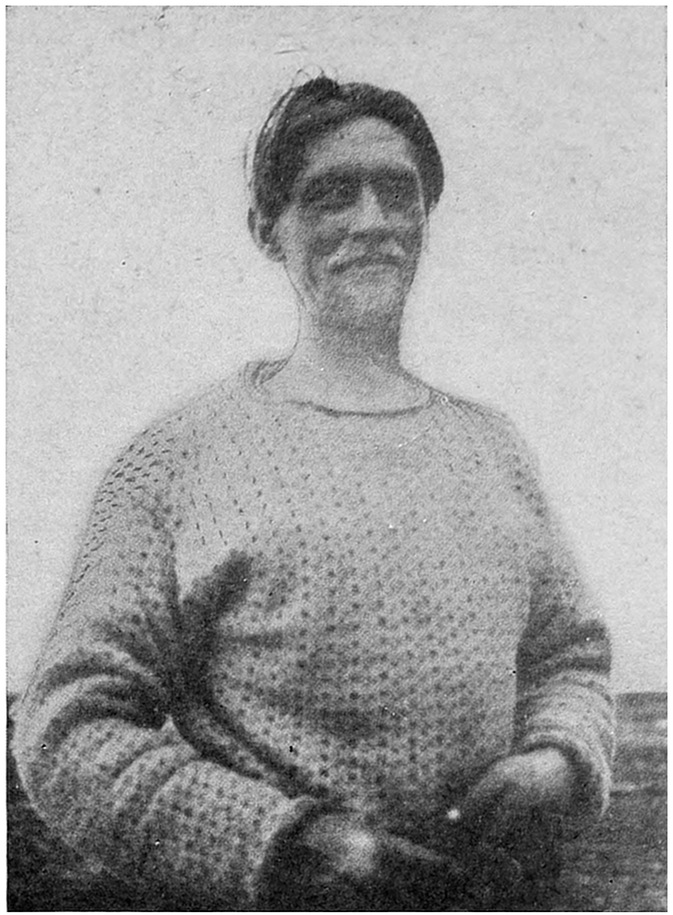
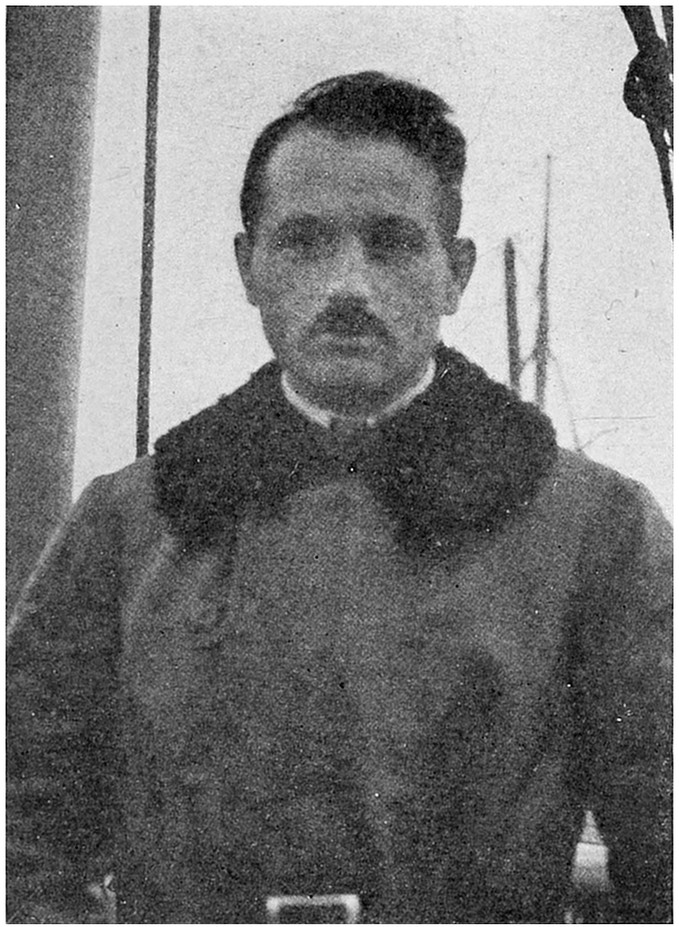
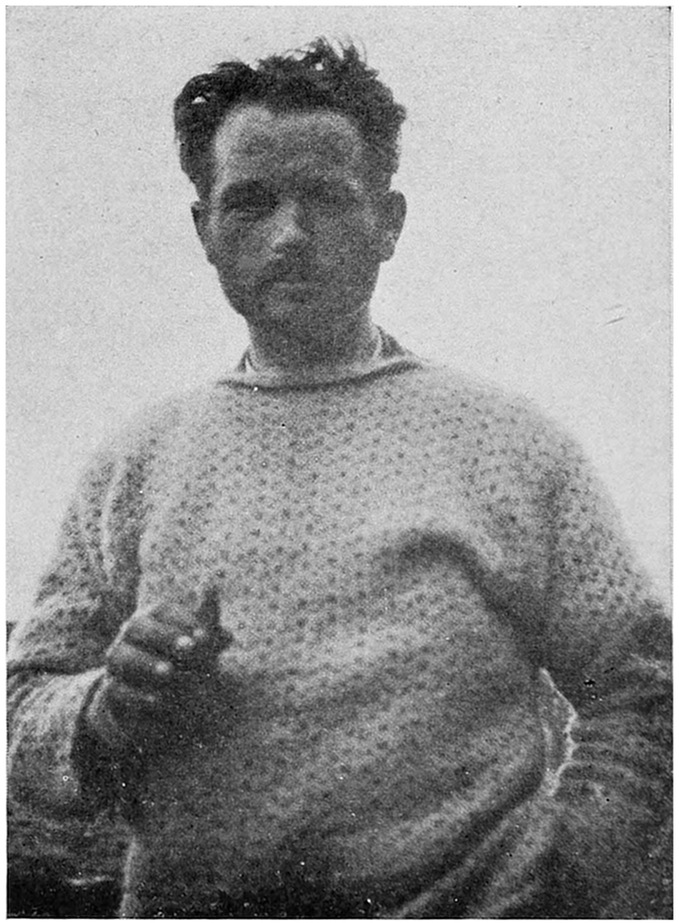
LINCOLN ELLSWORTHTHE DIRECTORS OF THE KING’S BAY COAL COMPANY,
MESSRS. BRANDAL AND KNUTSENSAILMAKER RÖNNE
The day the brothers Wright rose and flew the
curtain went up on a new era in the history of mankind.
Many were certain that they could see great
possibilities opening up for mankind in general, and
particularly for them in their own branch of work,
but few, I think, saw such possibilities of making a
full and complete change in his work as the Polar explorer.
What he has tried for years to accomplish
would now be possible for him to achieve in a very
short space of time. Century after century had he
worked with his primitive means, the dog—the sledge.
Day after day he had exerted himself with all his
craft, all his intelligence, and all his will, yet had only
covered a few miles over the vast ice desert. What
courage, what tenacity, had been shown in the fight
against cold, hunger and hardships. What a brilliant
example of sacrifice and self-denial. Year after year
shut up in a tiny little ship, surrounded by the same
people, equipped with only the most necessary things,
he had worked up to this time through the greatest of
difficulties, through the hardest tests—cold and darkness.
And now, all at once, in one moment, the whole
of this was to be changed. Cold and darkness should
be dispersed becoming warmth and light instead; for
the complete and troublesome journey should be
changed now to a speedy flight. In truth the possibilities
were great. No rationing, no hunger or thirst—only
a short flight. As in a dream, seen as a far-away
possibility, there was ignited that day a small
spark which should quickly blaze up to a mighty fire
and in the course of a few years become one of our
most important means of communication. Emerging
from its swaddling-clothes, flying freed itself and
went into its cradle when Bleriot flew across the
Channel. It was then speedily led by the world’s war
through its childhood where it (developing with the
years—slowly or quickly who can say?) was led into
youth—into manhood! What the possibilities would
become it was difficult to say, but one had to be satisfied
with what was there—flying’s childhood. The
young inexperienced birds leaving their nests show us
an example. Some will hurt their wings, others will
break them altogether, but, it is just as certain that,
just as they do, so will mankind also succeed in reaching
his goal in the world of flying.
As I learned of Bleriot’s flight, I knew at once that
the time had come to think of using the air to help the
Polar expeditions. Certainly human power and skill
had overcome and conquered vast tracts of this mighty
unknown whiteness, but enormous tracts remained
unexplored—tracts which now could be reached from
the air. My thoughts turned especially to the enormous
area in the Arctic which until now had withstood
every attempt. Certainly Nansen, the Duke
of the Abruzzi, and Peary had drawn lines through
the unknown doing great and brilliant work, but
colossal and unknown tracts still lay in front of them
unexplored. Should we have had to continue exploration
in the same old manner we should have had
to wait many years before our knowledge had become
complete. If one had used the word “impossible”
it seems absolutely reasonable to have used it
in connection with the exploration of this immense
ice desert; but it seems that the word “impossible”
has been scratched out of the dictionary of mankind.
How often have we seen the impossible made possible!
What was impossible yesterday is an easy
matter to-day. Bleriot’s flight across the Channel
showed me the conquering of the impossible. When
I, in the year 1909, equipped the “Fram” for a trip
to the Arctic, I had a conference with one of the most
esteemed aviators of the day. He declared himself
as willing to go with me. But it never came off, a
fact which probably was for the best, as in the case
of both parties it was put off on economical grounds.
I mention this in order to draw attention to the fact
that the idea of exploring the Polar regions from the
air is not a recent plan. I have been attacked from
many sides because I have “stolen” the plans of others;
this seems to me childish and scarcely worth talking
about, but many people take childish things for
grim earnest if they have not a closer knowledge of
the circumstances. Therefore, these few words.
In 1914 I managed to get sufficient means to buy
my first aeroplane for use in Arctic exploration. As
an independent means of transport in those vast
tracts it certainly could not be used where all circumstances
seemed to be against it, but, in conjunction
with a mother-ship, would be of invaluable service.
It was therefore my intention to take it on
board the “Fram,” which at that time was ready to
begin its journey north, and there to use it in the
best possible way. What immense areas would it not
be possible to observe in an Arctic trip if one only
was able to rise a few thousand yards? By what I
had seen of the ice I was certain one could always
find flat places to rise from and to land on. But
later experience showed me that it takes an aviator
to express an opinion about landing conditions amidst
Polar ice, and not an Arctic explorer. What the
second considers to be a flat plateau can be absolutely
useless in the opinion of the first.
My first aeroplane was a Farman biplane mounted
on skis. We scarcely could have got any benefit from
this. Later years’ experience shows me that. The
war broke out in the meantime and put a stop to
that part of my program. But then, as so often later
in life, I experienced the fact that an apparent obstacle
often had the opposite effect. Flying technique
at that time took enormous steps forward; the
child shot up, grew, and learned to move on its own
account.
In 1921 the world’s record for the longest sojourn
in the air reached about twenty-seven hours on a
Junker machine in America. It was a monoplane,
built entirely of aluminum, and therefore specially
suitable for working in the Polar regions. Sun, cold,
snow, and rain would not hurt it. I was living at
that time in Seattle, Washington, where “Maud” lay,
being equipped for a new journey north. As soon
as that news reached me my decision was made. Such
a machine I must have at all costs. With such an
apparatus the impossible would become almost possible.
The door to the Unknown seemed to me to be
opening, but my hopes were dashed and the door remained
locked for many years still. The machine at
last was obtained and Lieutenant Omdal appointed to
be its pilot. In May, 1922, we decided, as soon as
we had learned to know the machine, to fly from the
works in New York over America to Seattle. The
engine failed as we were over the town of Marion in
Pennsylvania, and we had to make an irritating
forced landing in the Oil Fields. The machine was
entirely ruined; a new one was hastily ordered, sent
through America by rail just in time to be taken on
board the “Maud.” Simultaneously the well-known
American Curtis Aeroplane Factory put at our disposal
a small reconnoitring machine. Therefore, as
the “Maud” sailed in 1922 she was completely
equipped, not only for a trip through the ice, but also
for exploration from the air. The Curtis machine
should be used for reconnoitring and accompany
“Maud” all the time. I promised myself endless results
from it. Whilst “Maud” went on right into the
ice and explored sea, ice and air, Omdal and I went
ashore at Wainright on Alaska’s north coast from
whence we intended to trek as far as possible into the
unknown territory to the north of that Coast, but
everything went to pieces. On account of the stormy
summer and autumn Omdal and I could not leave
the place as arranged, but must build a house and
spend the winter there.
In May, 1923, we were ready for flight, but already
on our first trial flight the Junker broke the
whole of its underpart in landing and became so damaged
that all hope of repairing it had to be abandoned.
Thus we gathered no experience. Things
went somewhat better however with the little machine
on board the “Maud.” A wireless telegram announced
that it had been twice in the air with Odd
Dahl as pilot and Wisting as observer, but it was
crushed in the second landing. So far as I understand
these two flights had not been of long duration;
therefore it was scarcely possible to have studied
anything of the immense area. It is, however,
certain that these two were the first to fly over the
actual drift ice. Thus we hear from them, for the
first time, of the great difficulties which flying in this
district presents. It was impossible from the air to
determine the condition of the ice they said; it appeared
to be absolutely flat, but it was quite different
as results showed. The prospects now were not
any brighter. On my return to Seattle I had only
my two empty hands and a ruined aeroplane which
nobody would have. I did not, however, give up, but
continued to work in order to get a new equipment.
Nineteen twenty-four passed, up till now, without
luck. In September of the same year I went to the
Norsk Luftseiladsforeningen (Aero Club of Norway)
and proposed that they should work with me; I was
received with open arms. Whilst they should try to
do what they could at home I should travel to America
to see what I could do there. I had already held
some lectures on the subject, and sat one morning
in my hotel deeply engrossed in reckoning out how
long it would take me with my earnings to pay my
creditors and start a new flight. The result was not
heartening. I found out that if nothing unforseen
happened I should be clear by the time I was 110
years old! But see, the unexpected did happen just
then. The telephone rang and a voice said, “Are you
Captain Amundsen?” (They always called me Captain
Amundsen in America, but as all the negro conductors
receive the same honor it does not make me
proud.) “Yes, I am.” “Well,” continued the voice,
“I am Lincoln Ellsworth.” That was how I became
acquainted with the man to whom I should later owe
so very, very much. The Luftseiladsforeningen (The
Aero Club) will certainly agree with me when I say
that without his assistance the expedition could hardly
have taken place. It is not my intention by this to
belittle the great and excellent work which the Club
did; in deep thankfulness will I always remember
the names of the three members of the Board with
whom I came into direct touch: the president, Dr.
Rolf Thommesen, and the two members, Dr. Ræstad
and Major Swerre. Thanks to their energetic
work, together with the State’s kindly aid, the expedition
was soon ready to start. During my stay in
America all the winter, the entire organizing of the
work fell on these gentlemen, but the technical part
of the arrangements fell on First Lieutenant of the
Royal Norwegian Navy—Hjalmar Riiser-Larsen.
Hjalmar Riiser-Larsen had already taken part in
the spring attempt to get the expedition going, so he
was quite familiar with everything. It was therefore
both with gladness and with trust that I was
able to telegraph to him $85,000—James W. Ellsworth’s
gift—begging him to order the two seaplanes.
From this moment Riiser-Larsen got permission for
leave and was able to give himself up entirely to the
expedition. As a flying man he is so well known by
every person in the land that it is superfluous and
stupid to mention more. But he has dozens of other
notable qualities which I need not enumerate and
which made him specially qualified to fill his difficult
post. With such an assistant a difficult trip becomes
for the leader a pleasant and light effort.
He was assisted in his work by First Naval
Lieutenant Leif Dietrichson and Flight Lieutenant
Oskar Omdal. Both these gentlemen had been in the
spring fiasco and thus knew all the details. It is quite
unnecessary to talk about Dietrichson. His skill as
a flyer is recognized by all. His bravery and resolution
will stand out clearly later in this record. With
his light outlook on life, his glad smile, and happy nature,
he was an invaluable comrade on the flight.
Omdal is known. If things went with him or against
him it was all the same. Nothing seemed to depress
him. He stood beside me in my two unhappy attempts
in 1923 and 1924, and you can believe that it
took a real man to show courage and keenness in a
third attempt, but Omdal did not disappoint me. “So
long as you don’t give in,” he said to me, “you shall
always find me ready.” He is a marvelous being; he
seems to have several limbs more than the rest of us.
He moves slicker and thinks quicker. It is impossible
to depress him. With three such men I knew that
the technical part of the expedition was in the very
best hands. The objective of the expedition was to
trek in, as far as possible, over the unknown stretch
between Spitzbergen and the Pole in order to find
out what is there, or what isn’t there. It was not only
to substantiate evidence of land, but to make a
geographical research. This substantiation was as
equally important as learning the composition of the
land. From Nansen’s, the Duke of the Abruzzi’s,
and Peary’s discoveries we had certainly good reason
to believe that no land existed in that part of the
Arctic Ocean, but our knowledge must be built on
certainties, not on beliefs. Modern exploration insists
on certainties. How miserably our maps have
suffered in this district just on account of “beliefs.”
Land has been put down instead of ocean, ocean instead
of land, all on account of these same “beliefs.”
More accidents have been caused by this than one
would think; many people have lost their lives.
Apart from this we hoped to be able to make a
number of meteorological observations which, even
although they would not bring us many rich scientific
results, would still give us interesting enlightenment.
In the end we hoped, as at first, to harvest
great and rich experiences which could be, to us and
to others, of the greatest help when we once should
be ready to start for the long arranged flight from
Spitzbergen to Alaska. I lay special weight on the
fact that I hope our experiences will be found of use
by others. I do not belong to that class of explorer
who believes that the North Pole is a place for himself
alone. My outlook shows that I have an absolutely
opposite disposition; “the more the better,”
say I. Rather, let all of us be at the same time at the
same place. Nothing stimulates like competition,
nothing encourages exploration more. How would
it appear if, for example, a man made public his intention
to fly across the Polar regions, but for some
unforeseen reasons could not accomplish it? Should
every one therefore stay away from the place so long
as the first one was alive? It seems to me an absurdity
which is little in keeping with the sporting spirit
one would expect to reign in these regions. “He who
comes first to the mill gets his grist first milled,” says
an old proverb. I hope to be able to make an attempt
to fly from Spitzbergen to Alaska next summer.
I must not, however, declare this to be my private
ground, but I wish, on the contrary, that many
will go there too. All the experience which I have
stands at their disposal.
The trend of a wireless telegram from Dr. Sverdrup
on the “Maud” in the summer of 1924 intimated
that large tracts of land were not likely to be found
north of Alaska. This theory he has based after careful
tide observations. I have great faith in Sverdrup;
I have never met a cleverer man than he, in his own
line, but I feel absolutely certain that he will agree
with me that one should go further in and explore
the place. Without having actually seen it one cannot
substantiate the evidence.
Our hope to get right along to the Pole was very
small, for that our radius of action was too limited.
Apart from that I had not any great interest in reaching
the Pole, as I had always regarded Peary as
being the first on the spot. Our objective was only,
therefore, to cover the great distance by flying over
it and over the great area we were exploring.
On the 9th April all the long and many preparations
were finished, and we left Tromsö at five in the
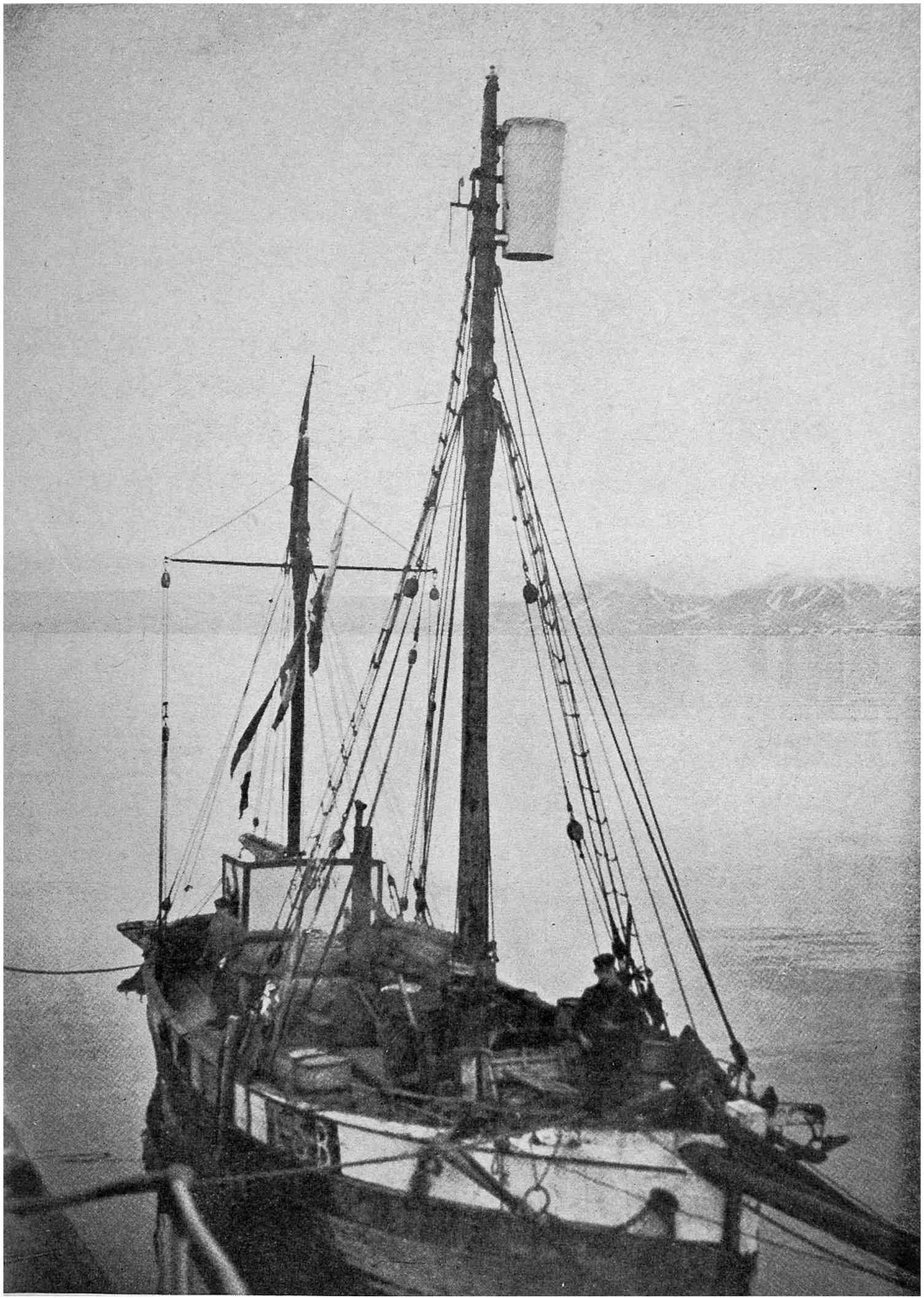
morning. The expedition had two ships. The motor
ship “Hobby,” which should bring the two seaplanes
up to Spitzbergen, and the Navy’s transport ship
“Fram” which the State had placed at our disposal
for the undertaking. On board the “Hobby” were
Riiser-Larsen, Dietrichson, Omdal, Berge, the photographer,
and the Rolls-Royce mechanic Green.
On board the “Fram”—Captain Hagerup, the second
in command Lieut. Torkeldsen, ice-pilot Ness,
Dr. Matheson, Director of the Pisaverkene Schulte-Frohlinde
with two mechanics Feucht and Zinsmayer,
the journalists Ramm and Wharton, the meteorologist
Dr. Bjerknes, the guide Calwagen, also Devold,
the cook Olsen, Sailmaker Rönne, Horgen, the chemist
Zapffe, Lincoln Ellsworth and myself. This may
appear almost unbelievable, but that part of the journey
was regarded by us as one of the most anxious.
It was still early in the year and the fairway between
Norway and Spitzbergen was anything but safe for
two smacks like ours. The “Fram” is a midsummer
boat, intended for an ice-free sea, sunny and calm.
But in the month of April one must not reckon with
these three factors. One would be much cleverer to
expect lots of ice, no sun, and heavy storms, and for
that “Fram” is not a suitable ship. “Hobby” was
more of an ice-ship and would in general plow her
way as well as any other, but this was an extraordinary
occasion. The tremendous cases which the flying
boats were packed in had no other place to lie but
on deck and in consequence of this “Hobby” became
in very truth not much of a sea ship. The ubiquitous
prophet had foretold her death and her sinking, and
I must say that I was almost inclined to agree with
him when I saw the big boxes lifted in the air. After
leaving Tromsö “Hobby” had already given up trying
to be a boat; she looked like a mass of gigantic
cases which was wandering along over the sea.
The arrangements were that both ships should keep
together in order to be of mutual assistance and cheer.
It is always comforting in the loneliness of the sea
to be cheered by the near presence of another ship;
assistance too we might both have need of.
It was a dark unpleasant night as we left Tromsö—wet
and black. A foreign film photographer, who
accompanied us to Spitzbergen, showed his spirit by
operating his camera under all conditions and
filming for all he was worth. (Had he wished to
take a film of a dark night he must in very truth have
been lucky.) Just outside Skaarö Sound we got into
tremendous snow-storms and the meteorologists at
the same time announced that the storm center was in
the west. I decided along with the “Fram’s” captain,
Hagerup, that it would be advisable to go into
Skaarö Sound, anchor there and wait. The meteorologists
thought that the bad weather would be of
short duration. We signaled to “Hobby”: “We shall
anchor at Skaarö,” after which we steered towards
land. We lost “Hobby” in a snow shower. At 11:45
A.M. we anchored and expected “Hobby” to arrive
soon. Frequent blasts amidst thick snowfalls made
the atmosphere impenetrable. We waited in vain for
our comrade.
At four o’clock P.M. the storm center passed and
we set off again. We passed close to Fugleö, peering
and glancing into all the creeks and inlets looking
for “Hobby,” but there was nothing to be seen. We
understood, therefore, that she must have mis-read
our signal and steered in a direct course for Björneöen.
In spite of the officers’ and the men’s unchanging
kindness and willingness, the journey was not altogether
pleasant. We were packed as tightly together
as it was in any way possible to pack human beings,
and then as the boat began to roll, so the air got
thicker and thicker—I refer to the inside air—and
what under normal conditions would have been perpendicularly
hanging things, such as towels, coats,
etc., all stood right out from the wall in such a way
that people began to feel themselves a little uncomfortable—I
say uncomfortable, for nobody would
ever be sea-sick! Now I have been at sea for over
thirty years, but I have yet to meet the person who
will admit to being sea-sick. Oh, no, not at all! Sea-sick?
Far from it: only a little uncomfortable in the
stomach or the head. In my diary I believe I have
written that there were a number of sea-sick people
on board, but I ask all the people to excuse me if I
have been mistaken! I am also so very frank in my
diary that I remark that I, too, am not so sure of
myself, but that remark was presumably only meant
for my private eye. The night of the 10th was particularly
unpleasant: Zapffe, Ellsworth and I lay in
the dining-room. Zapffe reclined in a corner of the
sofa looking very pale, but insisting that he had never
felt better in his life. Ellsworth and I lay in our
sleeping-bags and, should I judge from the sounds
and movements I heard and saw, I should be bold
enough to say that we were in the same condition of
well-being as Zapffe. Everything that could tear itself
free did it, the chairs in particular appeared to
have taken full possession of the dining saloon; the
tricks they performed during the night were absolutely
unbelievable. Now and again they performed
alone, now and again they united and performed in
troops. They had also been joined by a box of cigars
which fell down and performed with them, and I can
remember how these cigars flew round our ears. In
spite of his paleness Zapffe had not lost his good-humor.
“I thought I was in Havana,” came calm
and dry from him as the first cargo of cigars struck
him. I asked him if he would not be satisfied with
Bremen, but that he would not agree to at all. In
the pantry, which lay beside the saloon, there seemed
to be a veritable and forcible jazz band now playing.
Which instrument was being used at the moment was
not quite clear to me, but in every case a zinc bucket
was certainly doing its best. The rolling calmed
down on the following day and most of the “souls”
showed themselves on deck, with a pale sleepy look
in their faces. I asked one who seemed in a bad way
if he had been sea-sick, but I should never have done
that. With cold scorn he replied that he had never
felt such a thing in his life. What he felt half a
minute later when a sudden roll landed him between
two boxes and deprived him of the last part of his
breakfast I don’t know. Certainly not sea-sick!
It is astonishing to notice how people’s interests
can change in one moment. Yesterday we went
round Tromsö and not the finest drug store, or the
most tempting grocery shop, or the best set-out shoemaker’s
window would have made us turn our heads
to look at them. But this afternoon one of the members
of the expedition had opened a box, which he
had kept standing on the afterdeck, apparently with
a view to taking something out. In a second he was
surrounded by a curious crowd. The object of interest
felt himself particularly flattered by so much
notice being taken of him and he took out one thing
after another. First came a tube of tooth paste. All
necks were stretched, each one longer than the other,
to get a sight of the wonderful thing. After that
came a tablet of chocolate. What comments this
brought forth I am unable to say as my point of
observation was so far away. Certain is it, however,
that the interest in the chocolate was quite intense.
A pair of shoes came next. Had they been new and
fine, I could have understood it. But that anybody
could show any interest in these old, worn, down-trodden
shoes is to me unbelievable. A snow storm
closed the entertainment.
Word came that Björneöen was free from ice and
we could approach without fear of meeting any. At
four o’clock in the morning of the 11th we passed
the island’s most southerly point. We had built on
the possibility of seeing “Hobby” there, but in vain.
We sent Björneöen a wireless and asked them to keep
a lookout for “Hobby” and to inform us immediately
if they sighted her. Simultaneously we telegraphed
to King’s Bay and asked them for information regarding
the ice conditions there. Beside the island
we ran into a southeasterly wind, which during the
day developed into a fresh breeze. At five o’clock
in the afternoon we came into small ice, but, steering
a westerly course, got quickly clear of it. On the
12th we passed through some fields of mush and quite
small ice. The “Fram” is far from being an ideal
ship for ice navigation, but so well did Captain Hagerup
and Ice Pilot Ness guide us through in such a
careful and comfortable manner that they earned
our fullest appreciation. A less worthy man could
have sent a boat such as “Fram” to the bottom in
much less ice than we passed through. The atmosphere
was impenetrable during most of the day. At
ten o’clock in the evening—in a little clear glow—land
was discernible. It was Quade Hoock in King’s
Bay. At two o’clock we arrived at the edge of the
ice and moored fast to it. The “Knut Skaaluren,” a
little steamboat which had brought the two Directors,
Brandal and Knutsen, here, lay there already.
King’s Bay had been free from ice the whole winter.
Only in the last two days had the ice acquired
a temperature of -26°c. We naturally regarded
this as a great misfortune as it seemed that we should
be prevented from getting in to the Coal Company’s
quay where we were to begin the unloading of our
boats. So far from being a misfortune this proved itself
later to be our first and greatest piece of luck,
that King’s Bay was icebound.
At ten o’clock in the morning I went ashore in
order to pay the Directors a visit to see what they
could do for us. The distance from where we had
moored the “Fram” up to the quayside was a good
three miles; there was a lot of water on the
ice, dark and mushy. It was not easy to see Ny
Aalesund, which was snow covered. But the moment
I arrived at the quay and climbed from the ice
a hand was stretched out giving me a warm handshake
and a cheery welcome. It was Director M.
Knutsen who, with the Company’s other Director,
was to show us the most glorious hospitality during
the whole of our long stay in King’s Bay. I may
as well say it now as later, that without these practical
men’s assistance we could scarcely have brought
our arrangements to completion as they eventually
were.
It was soon fixed up that all who were participating
in the expedition should come ashore and stay
there where room must be found for them. “Where
there is room in the heart there is room in the house,”
they said. Nothing greater than the “heart room” of
Knutsen and Brandal could any one ever wish to
find.
Now there was a matter which weighed on my
mind—depressing me in a high degree. Where was
“Hobby”? I went on board the “Fram” at eventide
and walked up and down on the deck. It was
about seven o’clock at eventide when Horgen came up
to me and said that he saw something which stood high
above the ice, and according to his opinion only
“Hobby” could present such an appearance. Up
with the glasses! Yes!—quite right, there came a
heavy-looking box rustling and crushing through the
ice. “Hobby” itself I could not see even now, but
I could see that there was life on board. Every one ran
around and shouted, “‘Hobby’ comes!” “‘Hobby’
comes!” In a second all hands were called on deck
and to the accompaniment of ringing hurrahs
“Hobby” lay by the side of the ice. All was well on
board. The first part of the journey was over. Our
boats were safely in King’s Bay. Honor where
honor is due and it should be given to the expedition’s
airmen, Captain Holm, Pilot Johannesen and the
whole of “Hobby’s” crew. It was no small act of seamanship
which they had accomplished.
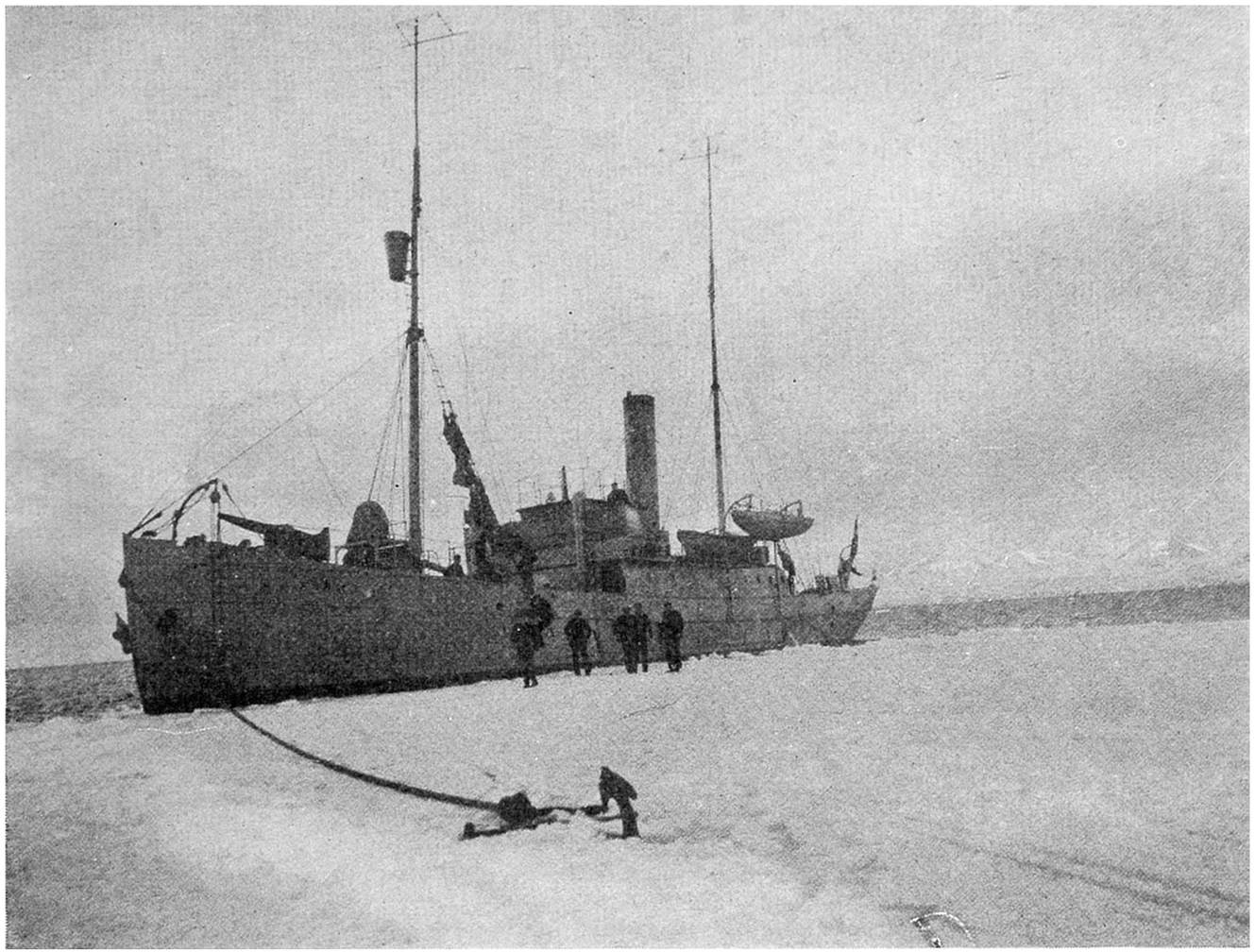
“FRAM” MOORED TO THE ICE AT THE EDGE OF KING’S BAYUNLOADING
The next day was very wintry—sea fog with a
temperature -10°. We took advantage of this for
the members of the expedition to flit ashore and make
themselves at home in the Coal Company’s station.
The airmen—Riiser-Larsen, Dietrichson, Horgen,
Omdal, in company with Ellsworth and Ramm—got
their cozy little house. Zapffe and I were quartered
in the Directors’ house and the others in the
hospital. The sailing-boat workshop was cleared and
prepared as a dining-room. This was baptized “the
salon.” Here the scepter was waved by our steward,
purser, chemist, and purveyor of entertainment.
Yes, dear steward, you won all hearts with your glad,
happy spirit. To me you were an invaluable and
priceless aid with your dutiful and conscientious
work.
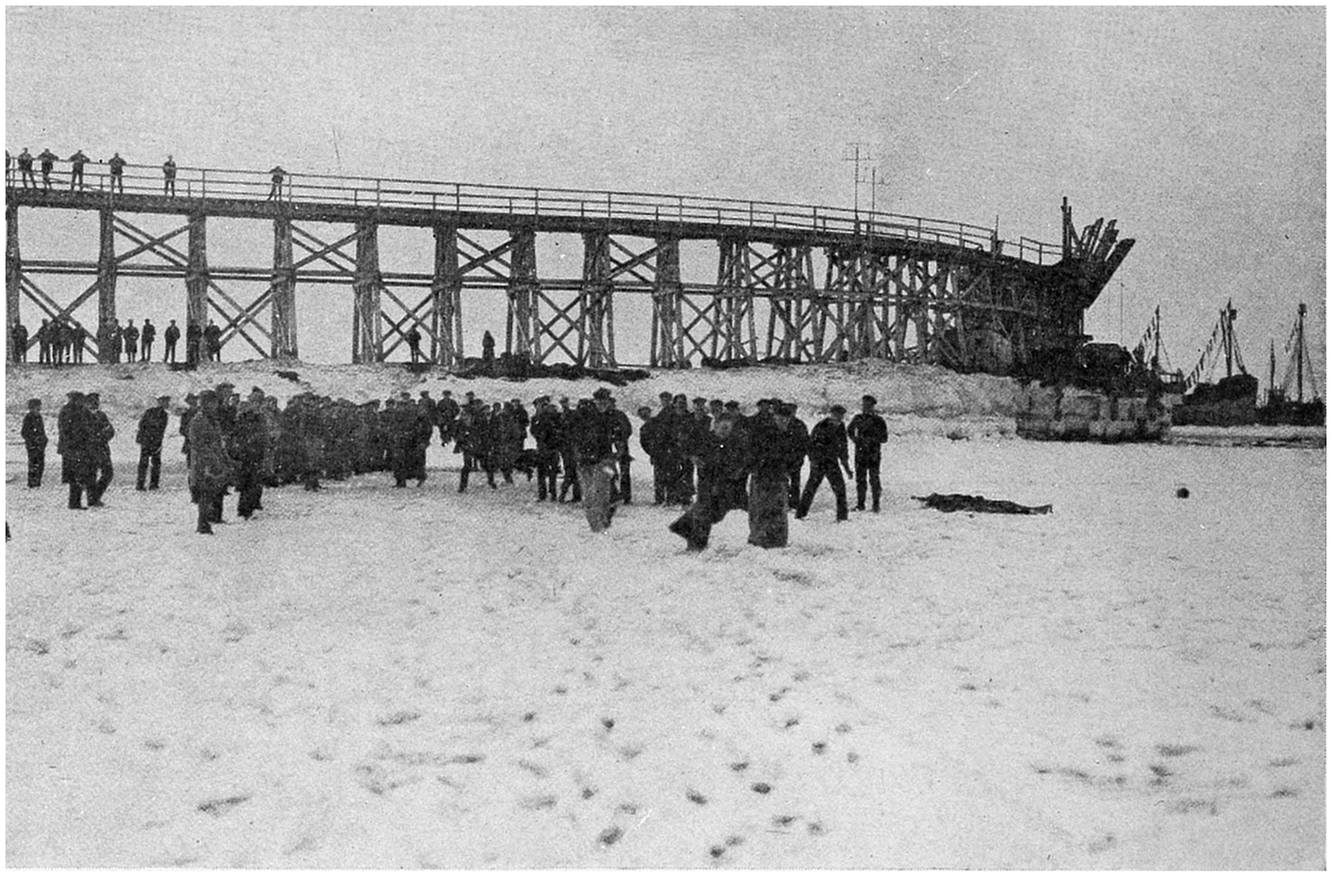
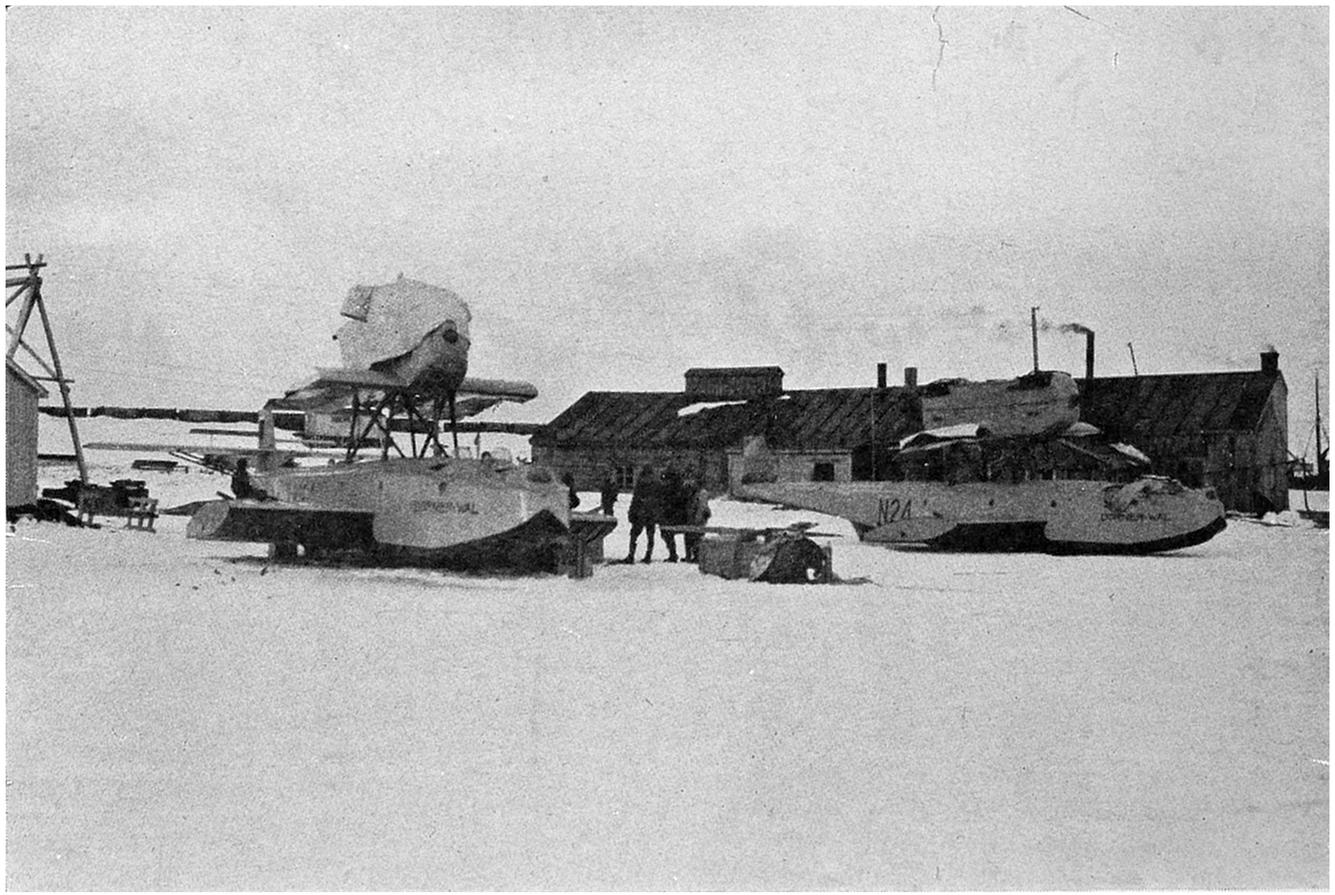
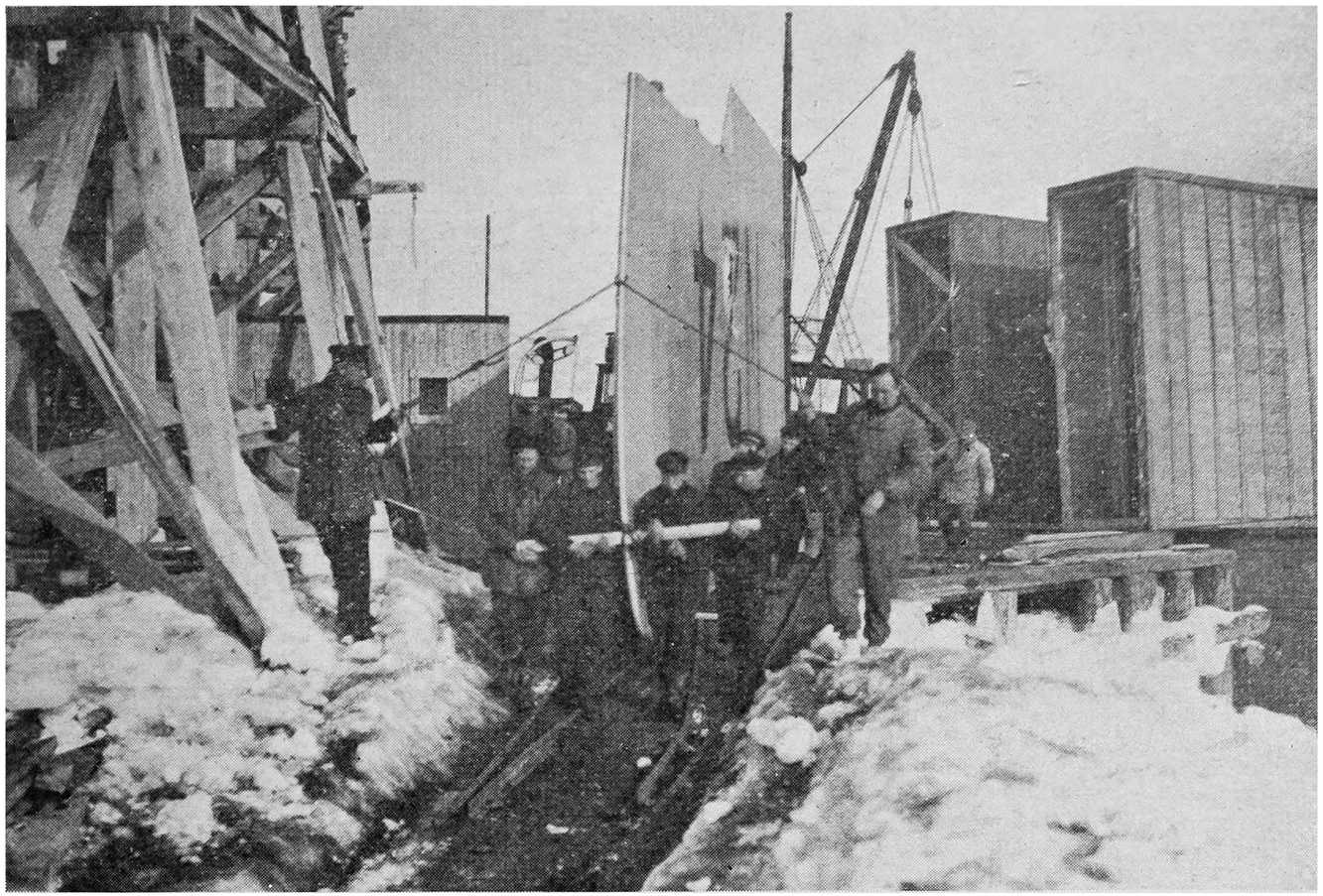
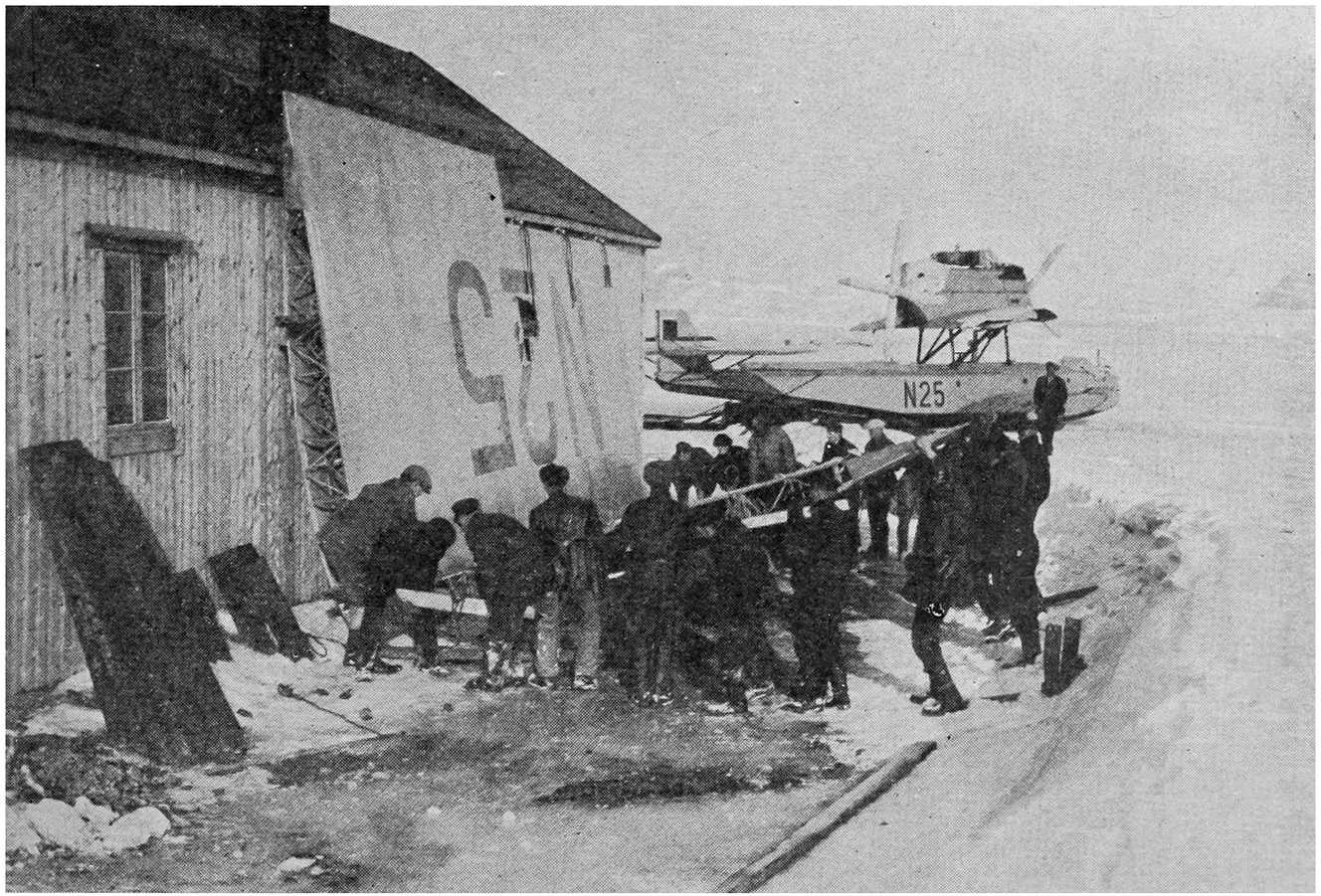
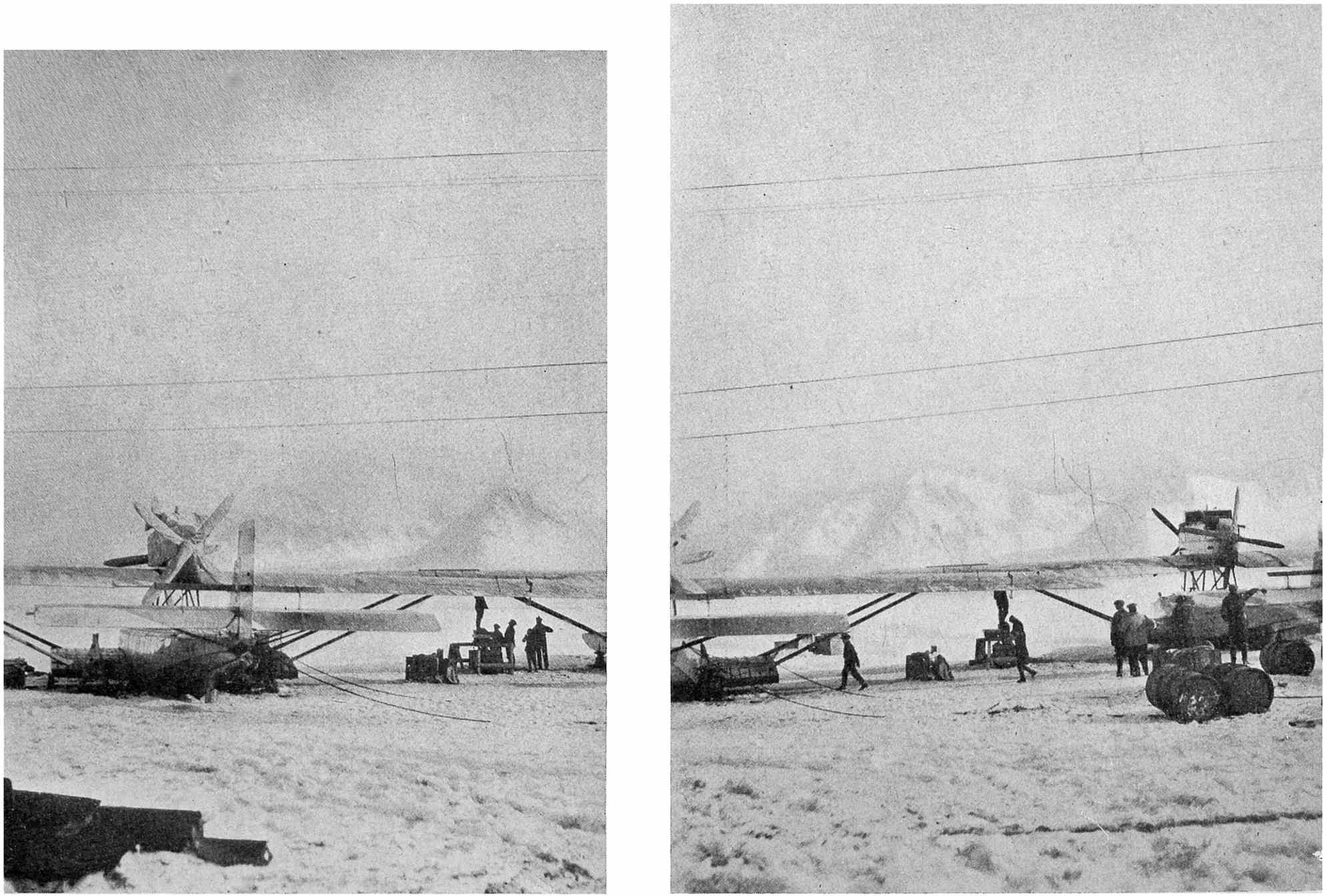
THE GAMES ON MAY 17THTHE PLANES WERE PUT TOGETHER NEAR THE COAL COMPANY’S
WORKSHOPS
The newly frozen ice, which prevented us from
approaching the quay, might have become embarrassing
had not Captain Jensen of the “Skaaluren,” on
the 15th April, become tired of waiting and decided
to make an attempt to force it. The attempt was
crowned with success in the highest degree. Never,
I believe, had the “Skaaluren” been so absolutely
astonished at herself. She broke through very
quickly and lay a short time afterwards by the quay.
“Fram” and “Hobby” followed behind her in line,
and by the evening we all lay alongside the quay.
There we had a northerly breeze of about -13° c.—Mid-winter!
By the following day every one was fully occupied
taking our belongings ashore. Riiser-Larsen organized
the work with the frequent assistance of his comrades
and the officers from the “Hobby.” At this
point I would like to hand out a few compliments
to the crew of the “Fram.” When and where they
could help, they were always at hand. Quick, skillful,
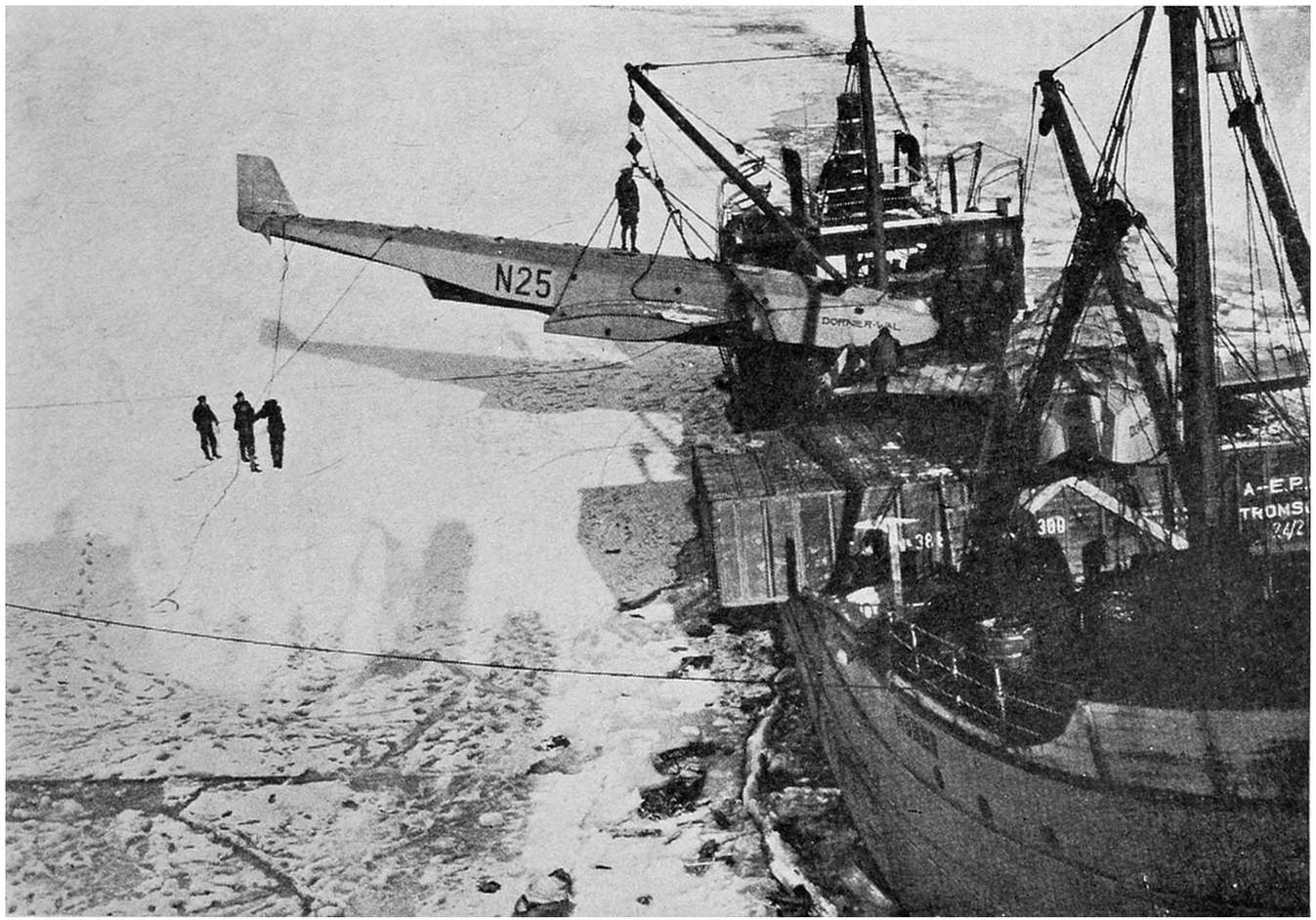
and willing at all times. Fortunately the ice
here was so strong that one could discharge the seaplanes
on to it. This was a great help and lightened
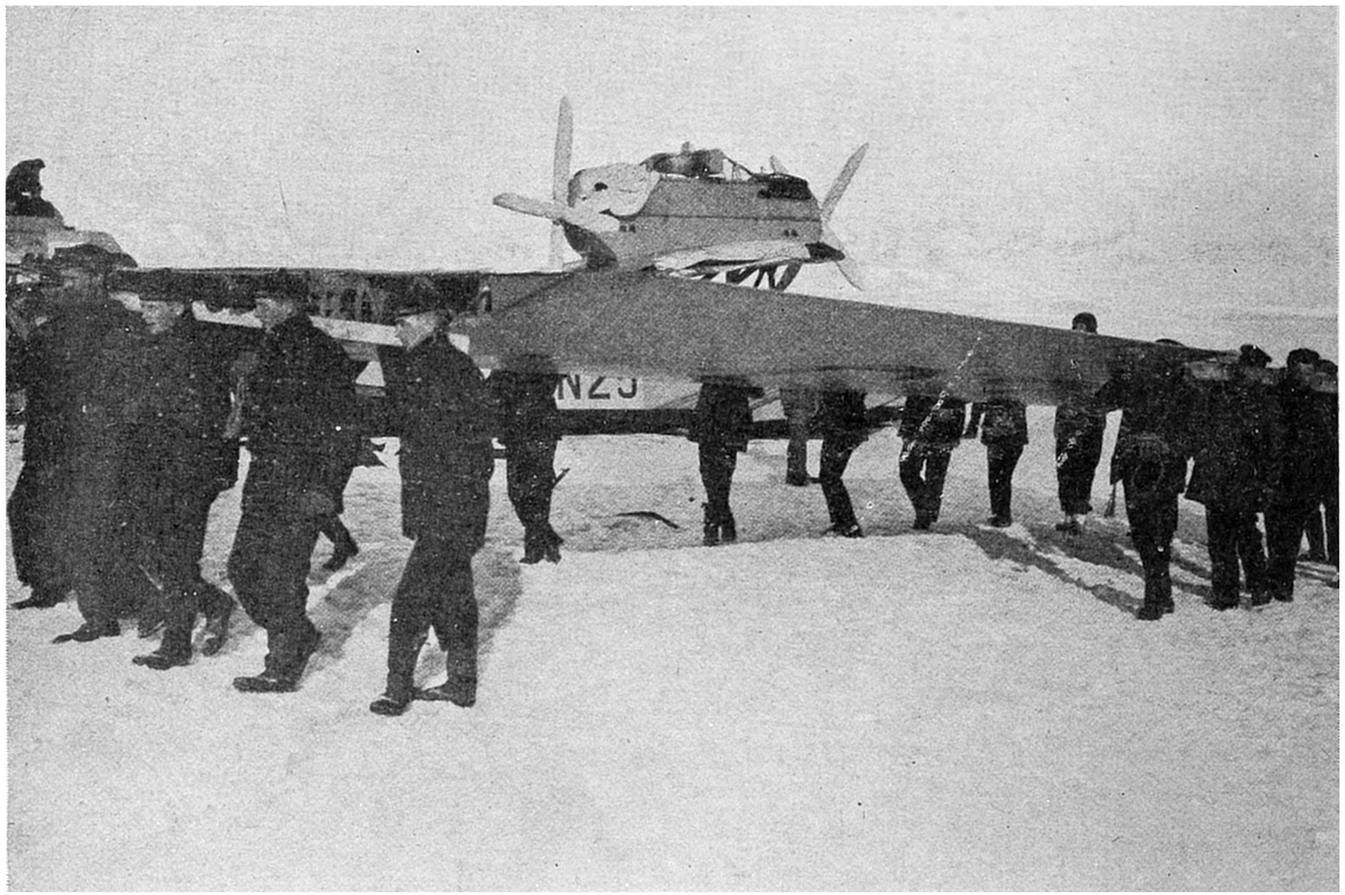
the work considerably. Everybody at the same time
hauled them along a natural slide towards land and
placed them outside the station-workshop, where all
the necessary help was obtainable. Director Schulte-Frohlinde
from the Pisa Works, with his two mechanics,
Feucht and Zinsmayer, along with Omdal
and the Rolls-Royce mechanic, Green, who had got
the very worst jobs, remained in charge. In spite of
snow and cold they continued “hard at it” from morning
until evening without any one ever hearing them
grumble once; but they were men of steel!
It was gratifying to see how the machines grew
from day to day. Frohlinde believed that he could
have them completed by the 2nd of May, and it very
nearly proved so. There was another duty which
had to be carried out each day under the same difficult
conditions and with the same unabated energy.
This was the weather report service. No matter how
it blew, no matter how it snowed, nor how bitterly
cold it was, Bjerknes and Calwagen were always
“on the go.” Nothing seemed to tire these two young
scientists and the expedition owes them the greatest
gratitude for their splendid work. They were assisted
in their work by Devold, who was principally
employed receiving messages from the numerous stations
in Europe, Canada, Alaska, and Siberia. The
weather report service is still in its swaddling clothes,
but there is no doubt that in time it will become a
strong factor in our progress. Already we could see
the benefit to be derived from this particular service
by any expedition whether it should go north, south,
east or west.
Others of our “most occupied men” were the photographer
Berge, and the journalist Ramm. The
first of these two could always be seen with his camera
in his hand and his tripod on his shoulder. He
was everywhere. One could not even blow his nose
without Berge being there to immortalize the event.
Ramm kept the world advised of the expedition’s
progress; if we did anything, it was immediately telegraphed.
If we did not do anything, it was likewise
immediately telegraphed. His strongest competitors
were the meteorologists; not that they were giving
news to the world’s press in competition with
Ramm. No, they did not do that, but they were in
frequent use of the wireless. Between the two parties
there arose a burning question as to which was
the more important—the weather reports or the news
reports. The meteorologists voted for the weather,
Ramm for the news. And so it remained. Dr.
Matheson acted as the “Fram’s” and the expedition’s
doctor. As a doctor he fortunately did not get much
to do, but it seemed safe and comforting to know
that he was near if anything should happen.
I now come to the expedition’s most occupied man.
That was my old traveling companion from the
“Fram” and the “Maud” trips, Sailmaker Rönne.
Since he first joined my service for the “Fram” expedition
in 1910—fifteen years ago—any weakening
in his work was undiscernible by me. In view of
what he did on this trip one could only come to the
conclusion that he had improved. He was the first
man up every single morning, and in full swing long
before any one else. But it was quite necessary for
him to do this if he was to complete in good time all
the little orders which came streaming in to him every
day in large numbers. At one moment he was sewing
shoes, soon afterwards trousers, then tents and
sleeping bags. He worked at the boats and made
the sledges ship-shape. His strongest forte was to
bring along with him everything that other people
had forgotten. If anything was missing any one
could be absolutely sure that Rönne would be able
to help him out of the difficulty. His greatest service
at this time was that during the flight to the
North he gave me a long knife made from an old
bayonet which was to prove our best ice-tool. It was
during our last dinner in the “salon” that he came
to me and honored me with the knife. I had a splendid
clasp-knife already, but accepted his gift in order
not to offend him. I intended to lay it away in one
or other of my lockers as it was too big to carry
about. But how it happened I cannot say—the knife
appeared in my rucksack and was of invaluable use
to us later. Ton after ton of ice has been shifted by
my comrades and myself with this same knife. When
I travel next time I shall have at least a dozen with
me.
Our cook, Einer Olsen, could prepare a rum omelette—now,
I must not let my tongue run away with
me—just as well as any chef in the best hotel of any
seaside resort, and that is not saying enough. Apart
from this he absolutely astonished us with what he
called “gateau danoise” (Olsen was a linguist). I
sought in vain, from the point of view of a baker, to
analyze this confection, but without success. The
nearest I can describe it is a cross between a
cream bun and a “gateau de mille feuilles.” He got
up still earlier in the morning than Rönne and thus
deprived him of his record-breaking honor.
Our stay in King’s Bay began really with the baptism
of the “salon.” That was on Sunday April
19th. The furniture of the “salon” was quite different
from what it originally had been. Its contents
were composed of a long board and four trestles. In
addition to this, and on account of the shortage of
room elsewhere, it was necessary for the “salon” to
house the pantry. This stood beside the entrance.
A little gramophone supplied us with all the jazz we
desired. In addition to this it could play music!
But what was missing in the way of furniture in the
“salon” was made up for by the culinary masterpieces.
And here competition was strengthened by originality.
Yes, there were even a few who risked saying
that.... No, I won’t repeat it, as one says so many
things. On the evening of the christening there were
twenty-six people round the table. I see by my diary
that the number was “legion,” but my diary has to be
discreet, so it keeps silent about the rest.
There is nothing particular to relate about the days
which followed. One followed the other just exactly
as ordained by the almanac. Some (yes, the most)
were beautifully sunny and beautifully colored from
the magnificent glaciers. Others were overshadowed
with fog and snow. The day in the week which we
looked forward to with the most pleasure was not
Sunday, as you might be inclined to believe, but Friday.
Every Friday at 5:30 P.M. there was a steam
bath; a proper, really good steam bath. There was
nothing mean about the heat in this as we had coal
all around us, wherever we went, and wherever we
stood. It was far meaner as regards the quantity of
water, but we did not bother about that. The bath
was naturally very popular. In the morning the ladies
had their turn; in the afternoon the Directors
with their staff along with the members of the expedition.
Saturday was bath day for the miners.
Over and above this a very important piece of work
had to be done in these days: i.e., getting the provisions
and equipment ready for the flight. In case it
should interest anybody, I will here repeat my list
exactly as it appeared:
Salt Beef
400 gr.
per man per day
Chocolate
250 gr.
„
Biscuits
125 gr.
„
Dried milk
100 gr.
„
Malted milk
125 gr.
„
Total
1000 gr.
kg.
1 change, diary, compass, matches tinder, housewife,
snow glasses, cup & spoon, pipe & tobacco, linen
thread, sail-cloth gloves, 1 pr. ski-shoes, 1 long knife,
1 pr. skis, 2 staves, 1 pole, 1 sleeping-bag
1 boat, 1 sledge, 1 tent, 1 medicine case, 1 Primus,
petroleum, reserve belts, 1 Meta cooking stove with
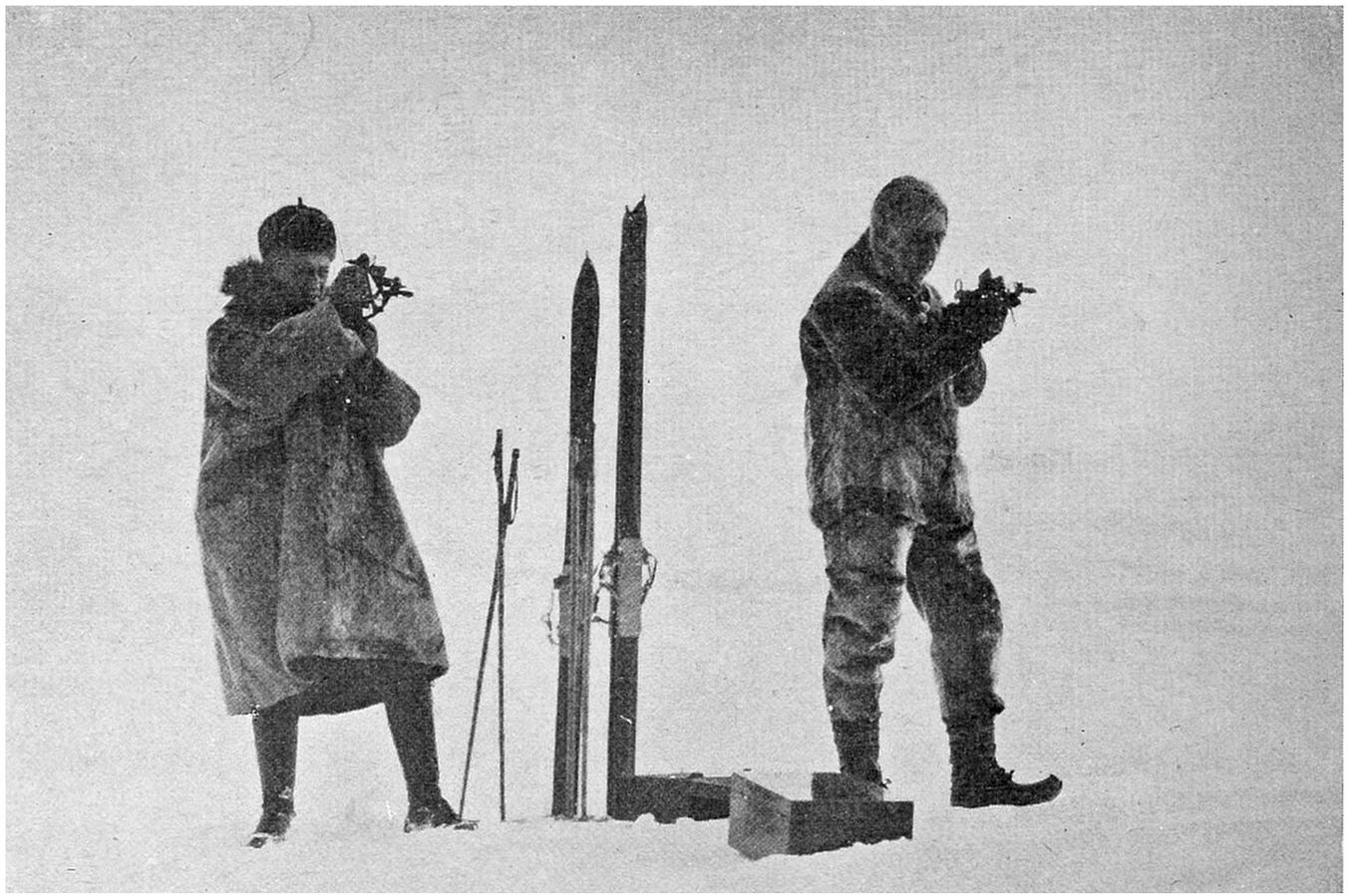
plates, 2 sextants, 1 level, navigating equipment, six
small and 4 large smoke bombs, 1 cooking pot, motor
spare parts, tools, 2 snow shovels, 1 ice anchor, 1 log,
1 sun compass, 1 pair of glasses, ten plugs, meteorological
instruments, 1 shot gun, 1 rifle, 400 cartridges,
Colt revolver, 25 shots, senna grass, benzine pump,
hose and bucket, camera, films and plates, soldering
lamp.
* * * * *
On the 29th of April the “Fram” attempted to go
to Green Harbour to fetch and take the mail. However,
she did not get far before the ice stopped her.
By dinner time the next day she had returned.
Ellsworth and I now went every day to the wireless
station in order to take the time signal from the
Eiffel Tower so that we might check our watches.
We had each three watches for use on the flight.
Fortunately they never went wrong. We checked
the time signals for fourteen days before our departure
and thus we were absolutely certain of the correctness
of our watches.
On the 4th of May, a strange restless and unsettling
sort of day, we began to long for the moment
when we could leave. The meteorologists announced
that that particular morning would be a fine opportunity
to go and we were not long in replying, “All
is ready.” “Fram” and “Hobby” got orders to make
ready to sail northwards and all hands were called on
deck to help to get everything in order. In the meantime
a northeasterly wind sprang up and retarded the
mechanics from completing the final little “finishing-off”
touches. We were therefore compelled to
put off our intended start until the weather improved.
In the meantime the boats made ready and on the
next evening—May 5th—“Fram” and “Hobby”
steered northwards in order to reconnoiter round the
Danske Öen to see if they could find a good place for
us to start off from on the ice. That evening we had
-18° c. No work could be done. On the 6th we received
a wireless from the “Fram” from South Gate
which announced that the weather was very uncertain
and that we ought to wait. They announced also that
they had found no suitable starting place on the ice.
The ice all around was uneven and banked up and
consequently useless for our purpose.
After the machines were ready to start we saw
clearly that the maximum weight of 2,600 kg., which
the factory said we could carry, was going to be considerably
increased. We could see that if we had
to make the flight we must at least carry 3,000 kg.—perhaps
more. The two, Riiser-Larsen and Dietrichson,
thought that it would be quite possible to rise
with this from the ice. Director Schulte-Frohlinde
doubted the possibility of this. The two former, however,
had great experience in rising from the ice and
my trust in them was complete. To rise from the
water with this weight would hardly have been possible.
On the eighth evening “Hobby” came back
announcing that the ice conditions were bad, the
weather was stormy and the temperature as low
as -23° c.
We decided, therefore, to wait some time hoping
for an improvement in the weather and a more reasonable
temperature.
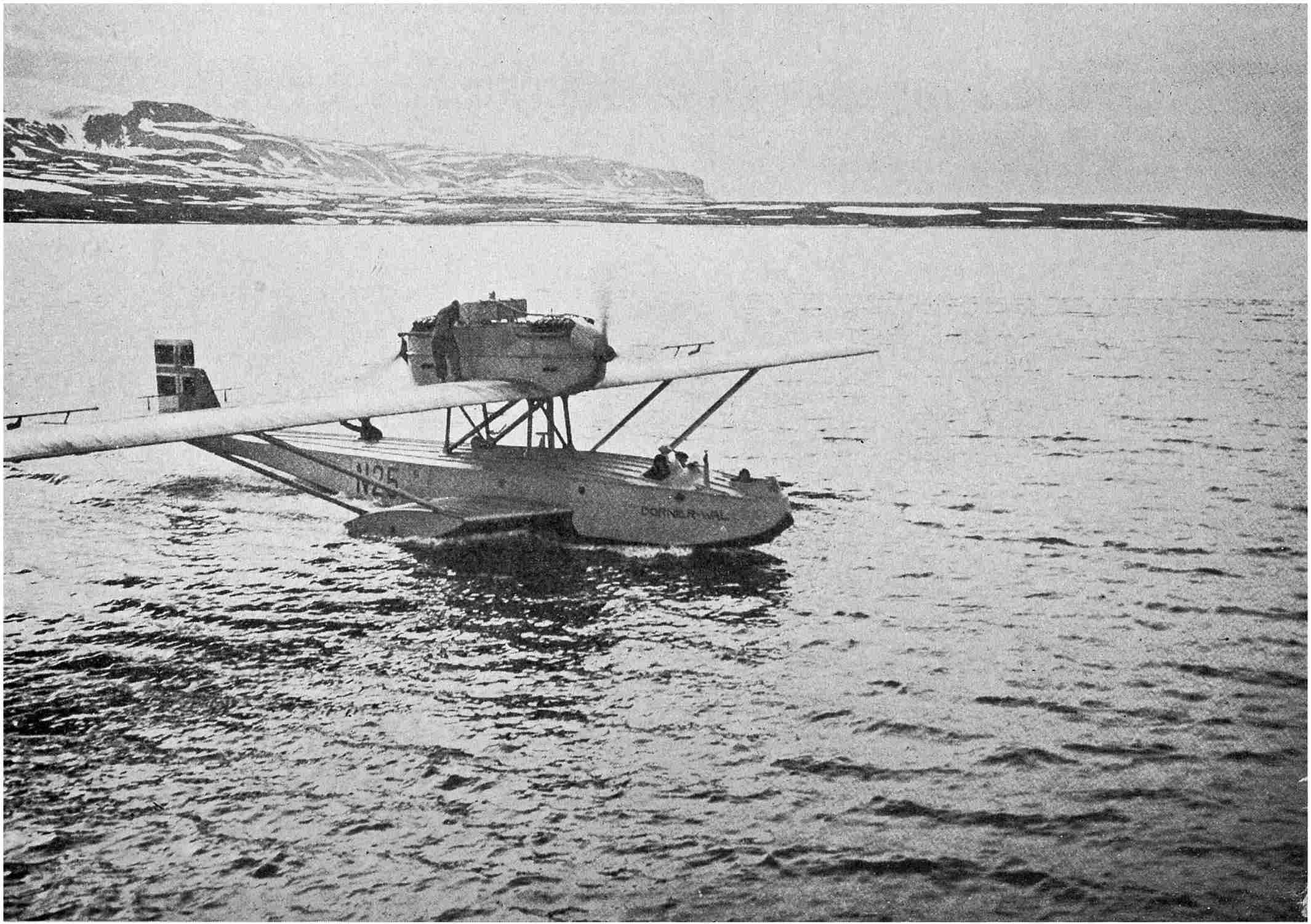
On the 9th N 25 left its “cradle” on Spitzbergen
for the first time and made a few trial runs on the
ice. Everything went well and the pilot was very
satisfied. On the morning of the 11th “Fram” returned,
thus finishing this part. Now we were all
ready to make use of the first opportunity which the
meteorologists should advise. The temperature rose
quickly and steadily and in the days that followed it
was quite clear that spring was coming.
The 17th of May dawned and was spent exactly as
it should have been. A salute in the morning, Olympic
games, and a gala dinner in the evening in the
“salon.” On the 18th Dr. Bjerknes announced that
the prospects were so good that we should hold ourselves
ready for a flight at short notice. We were
ready. The weather on the 19th was still not exactly
as the prophet wished it to be. In the meantime,
however, we made “all clear” and got the machines
down to a definite starting place where one could
slide down a grade direct on to the fjord ice. Local
bad weather on the 20th prevented us from starting.
The filling of the petrol tanks was finished and by
eventide we were absolutely ready.
As I, on the morning of the 20th of May, stuck my
nose out of the window I realized at once, without
further confirmation from our weather prophets, that
our day had arrived. It was brilliant summer
weather with a tiny breeze blowing from the fjord,
exactly what the pilot wished for. The starting time
was fixed for four P.M. The sun was in a favorable
position for our sun compass and gave us the greatest
aid on our flight. Even at breakfast time we could
notice that there was a little excitement in the camp.
Many of the members of the expedition, who otherwise
would still have been invisible during the time
I usually took my breakfast, had in this case already
breakfasted and disappeared. It was unnecessary to
send a messenger round to say the day had arrived.
Every one was making his preparations for departure
and the different members could be seen with hands
full of private belongings disappear beside the machines
and return empty-handed. Each of these little
journeys brought more weight and by the time the
last pin was fastened we were carrying a load of 3,100
kg., or about 500 kg. more than we were supposed
to carry. Director Frohlinde had always insisted in
his opinion that we ought to make some trial trips.
The airmen said, “No.” As the differences of opinions
will be disentangled later on I shall not say more
about this here. All the morning a crowd of people
were crossing over to the starting place. Everybody
who could be there was on the spot. Dinner was taken
in the “salon” and if some one had come in by chance
he would have noticed something unusual going on.
The only guests we had in the “salon” were six
Thermos flasks, set up ready for the road. These
contained chocolate; beside them were our only provisions
for the flight, and the box of Mrs. Clausen’s
good oatcakes. The only person who disturbed the
dinner’s quiet and friendly course was the steward,
who thought he ought to wish his comrades a good
journey and thank them for assembling there. Thus
was the last dinner at an end and the “salon” again
took on its old form as the Coal Company’s sailboat
works. “Sic transit gloria mundi.”
As I left my good and comfortable quarters in the
house of the Director, his good-natured housekeeper
Berta stood there with two packets, which she held
out to me. “There is one for each machine,” she said.
“Just a little ‘snack’ for the journey.” Oh, Berta,
could you but see how gladly and with what warm
thanks in our hearts we took the delicious sandwiches
and eggs carefully and slowly from the packages,
eating them with pleasure, as our last civilized meal
for a long time to come,—you would certainly be
overjoyed!
At three o’clock in the afternoon we were all gathered
beside the machines. As I have already remarked—one
is never ready. Director Frohlinde
went round and looked carefully at everything.
Green, the Rolls-Royce mechanic, listened first to the
one and then to the other of the motors. At four
o’clock all four motors were warming up. It was a
sign for all of us that our hour was almost there.
Both sun compasses, which had been set at four
o’clock, started going—and the motors started humming.
Whilst we put on our heavy flying clothes the
two flying men and observers did likewise, wearing
similar garments—thick underclothes of wool with
leather on top. The point which I personally had always
been afraid of during a flight was the condition
of my legs. The tremendous speed, which necessarily
causes a strong draught and lowers the temperature,
puts our shoes naturally to a very strong test. It was
not often that my experience proved of actual use to
me, but this time I really did get some good out of it.
On my earlier journeys it had often been necessary
for me to stand hour after hour as observer. When
the temperature was below -50° c. and -60° c.,
which often happened, one must have very special
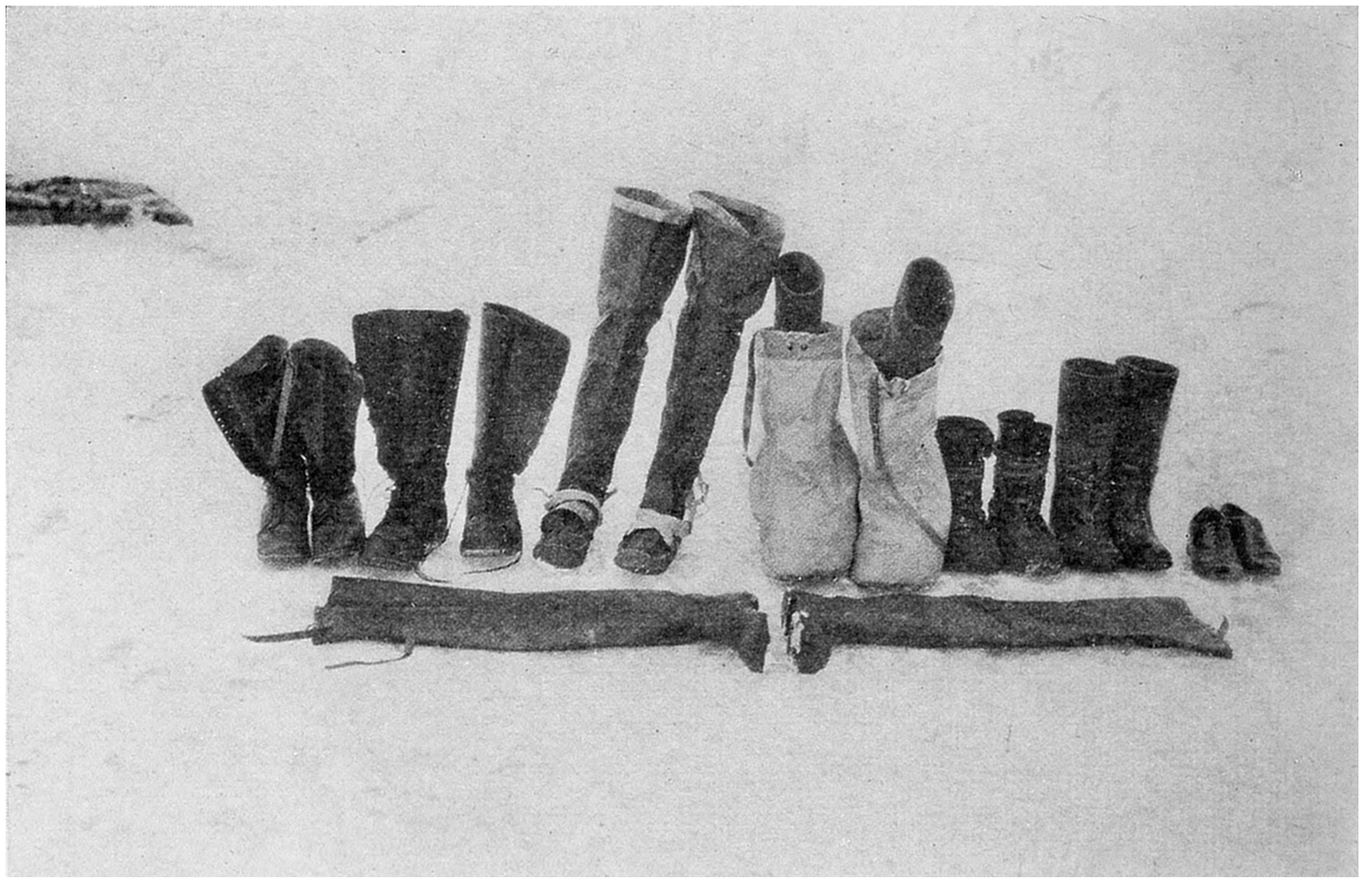
footwear. I found out then that one ought to have
good warm footwear on, preferably loose leather
stockings and leather shoes (such as the Eskimos
wear), and in addition to this the feet should be put
into enormous canvas shoes filled with senna grass,
which forms a complete lining to the shoes and
renders protection to the feet. That time years ago
we had taken no Eskimo shoes, but used felt shoes
with a pair of thin stockings and above these we wore
gigantic canvas shoes filled with large quantities of
senna grass. The result was brilliant. Not only did
we not freeze, but one or two grumbled because they
were too warm. The pilots wore thick leather gloves
which gave complete protection to their hands. Personally
I wore only an old pair of woolen gloves as I
had to write continually. The mechanics were not
so heavily clad, as they were continually on the move,
passing between the petrol store and the motor, and
for this reason they had to be lightly clad. As soon
as we were dressed the various members took their
places. Ellsworth and I were in the observation
seats. Riiser-Larsen and Dietrichson were in the
pilots’ seats and the two mechanics, Feucht and Omdal,
were beside the motors. My place was in the
observation seat of N 25, which lay forward. In the
seat behind me—the pilot’s seat—was Riiser-Larsen
and in the petrol store behind him was Feucht. In
N 24 the arrangements were the same for Ellsworth,
Dietrichson, Omdal. Feucht, who had accompanied
Director Schulte-Frohlinde from Pisa, was
only taken on as a member of the expedition a few
days before the start; he had up to that time remained
in the Factory’s service. He is a German by birth
and had been employed by the Factory for a long
time, being considered an exceptionally capable mechanic
which will be proved here later. Every one
was now ready to say good-by and a long queue
passed by the machines. Mention of the photographer
must not be forgotten, either, in this connection.
Whilst we waited the motors continued to run and
the clock went round to five. Before the two planes
got away the following orders were sent out: (1) The
command of the remaining part of the expedition
should be taken over by Captain Hagerup of the
“Fram.” (2) In fourteen days from the start the expedition’s
return by flying-machine might be expected.
“Fram” and “Hobby” should remain together
in the fairway by the Danske Öen so long as
it was possible to see the North Coast. Should the
light diminish “Hobby” must steer towards the east
as far as conditions allowed, but not east of Verlegen
Hook. (3) After fourteen days had passed
“Hobby” was in any event to steer eastwards if possible
as far as Nordkap. After collaborating with
“Fram” they were to take up the work of patrolling
as near the edge of the ice as possible, both ships
keeping a sharp lookout. (4) From the 16th to the
19th of May “Fram” shall remain in King’s Bay for
boiler-survey. (5) The ships (if necessary “Hobby”
doing this alone should “Fram” have gone back
earlier) shall remain by the north coast of Spitzbergen
and continue patrolling for six weeks counting
from the start; “Hobby” going afterwards to
King’s Bay to collect the remaining material to be
delivered at Tromsö, where it will be sent back in accordance
with special instructions here enclosed.
The despatching will be attended to by the chemist
Zapffe. (6) When “Fram” goes to King’s Bay for
boiler survey it will give those members of the expedition
who wish it the opportunity to accompany
the boat to King’s Bay in order to travel home by the
first opportunity. (From here Horgen, Ramm and
Berge are the first to return when both boats definitely
set off.)
First Lieutenant E. Horgen, who was engaged as
the expedition’s reserve airman (after he had obtained
permission from the Norwegian American
Line, where he was first mate), became the expedition’s
leader on board the “Hobby.” The services
Horgen rendered us were many and valuable. I
would have liked so much to have granted his great
wish to fly northwards with us, but there was no room.
Next time I hope to see Horgen an active participator
in the flight. He belongs absolutely to the type
which I have always sought for, calm, resolute, and
afraid of nothing. As a flyer Horgen is now counted
among the best.
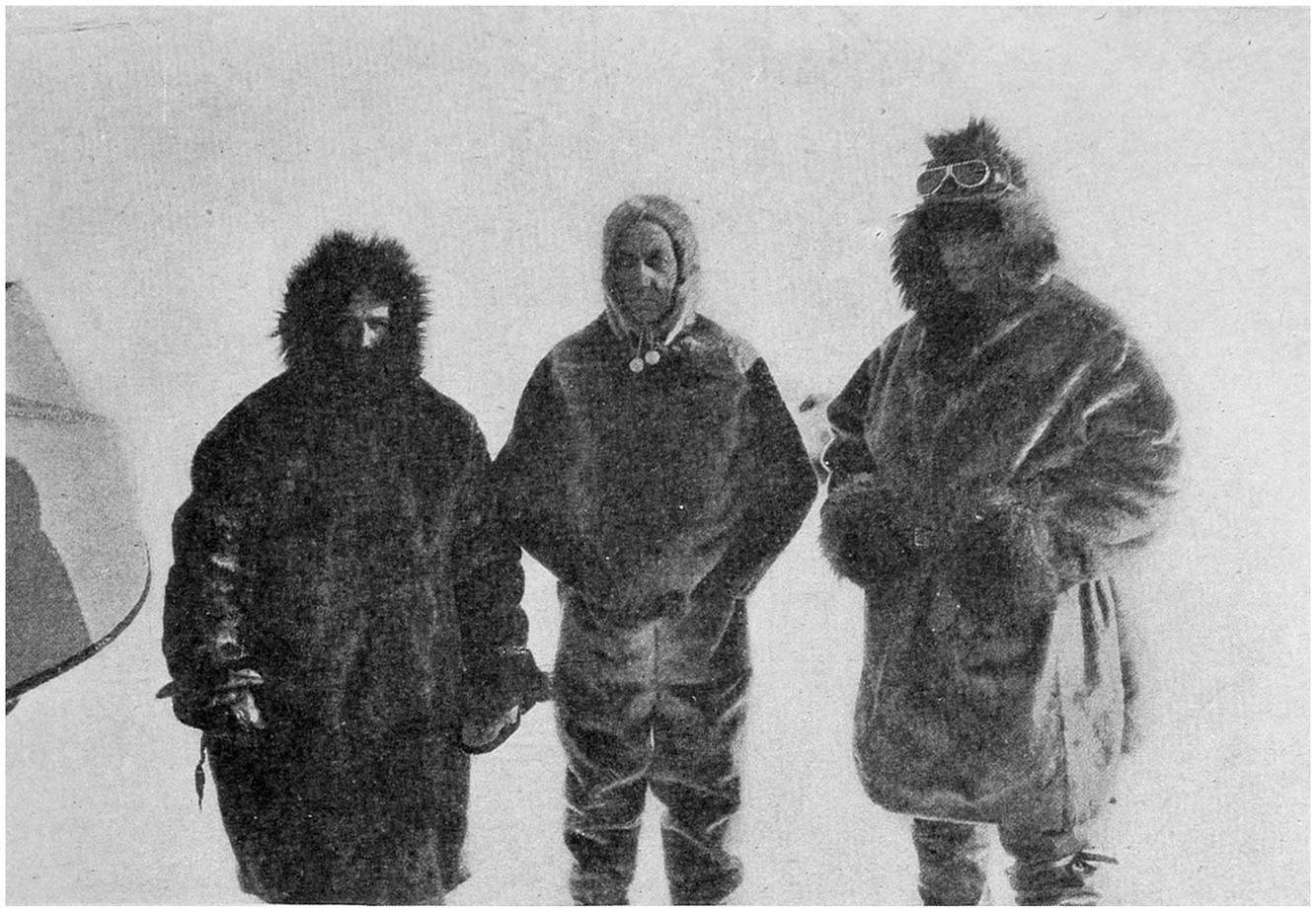
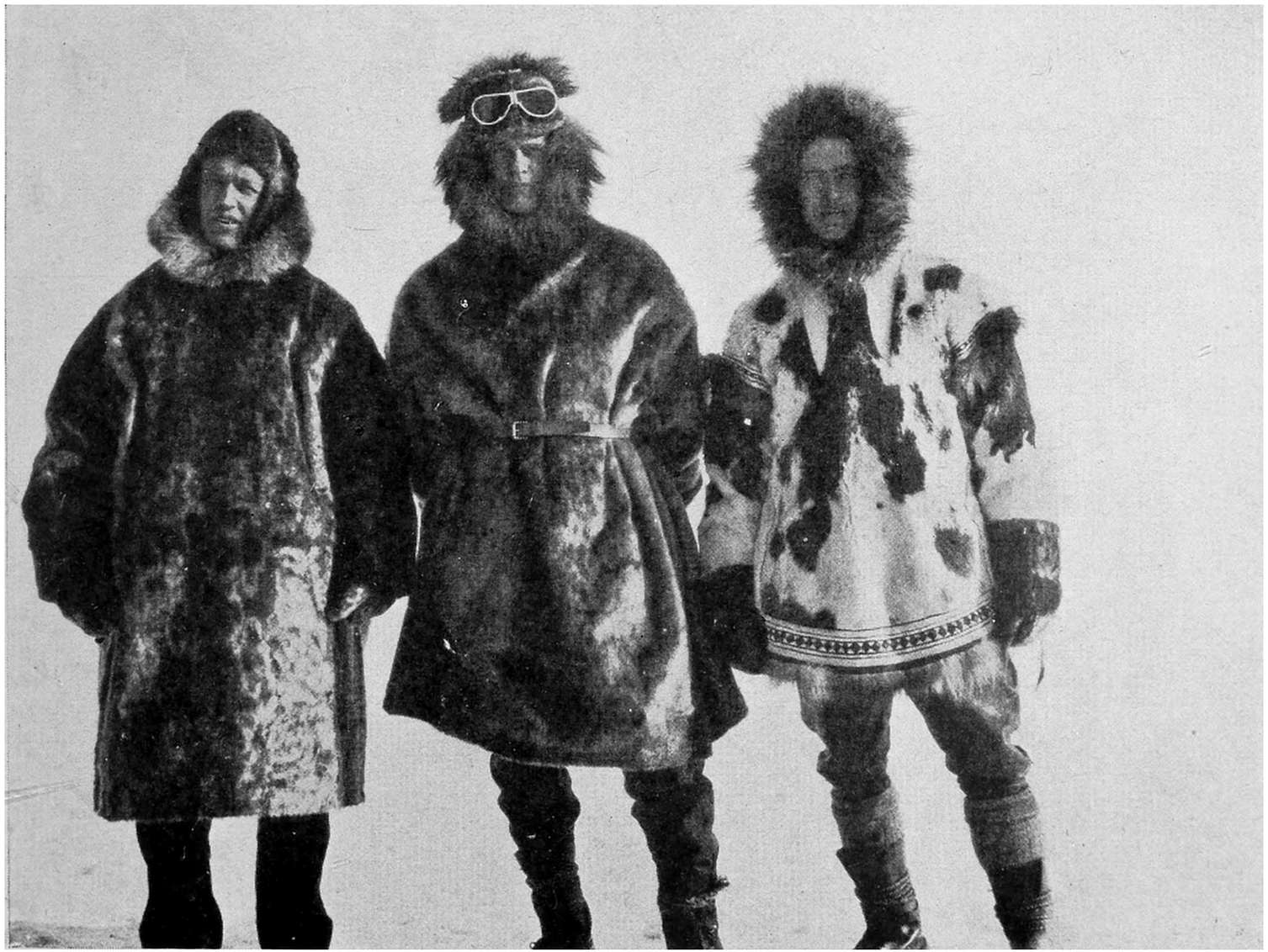
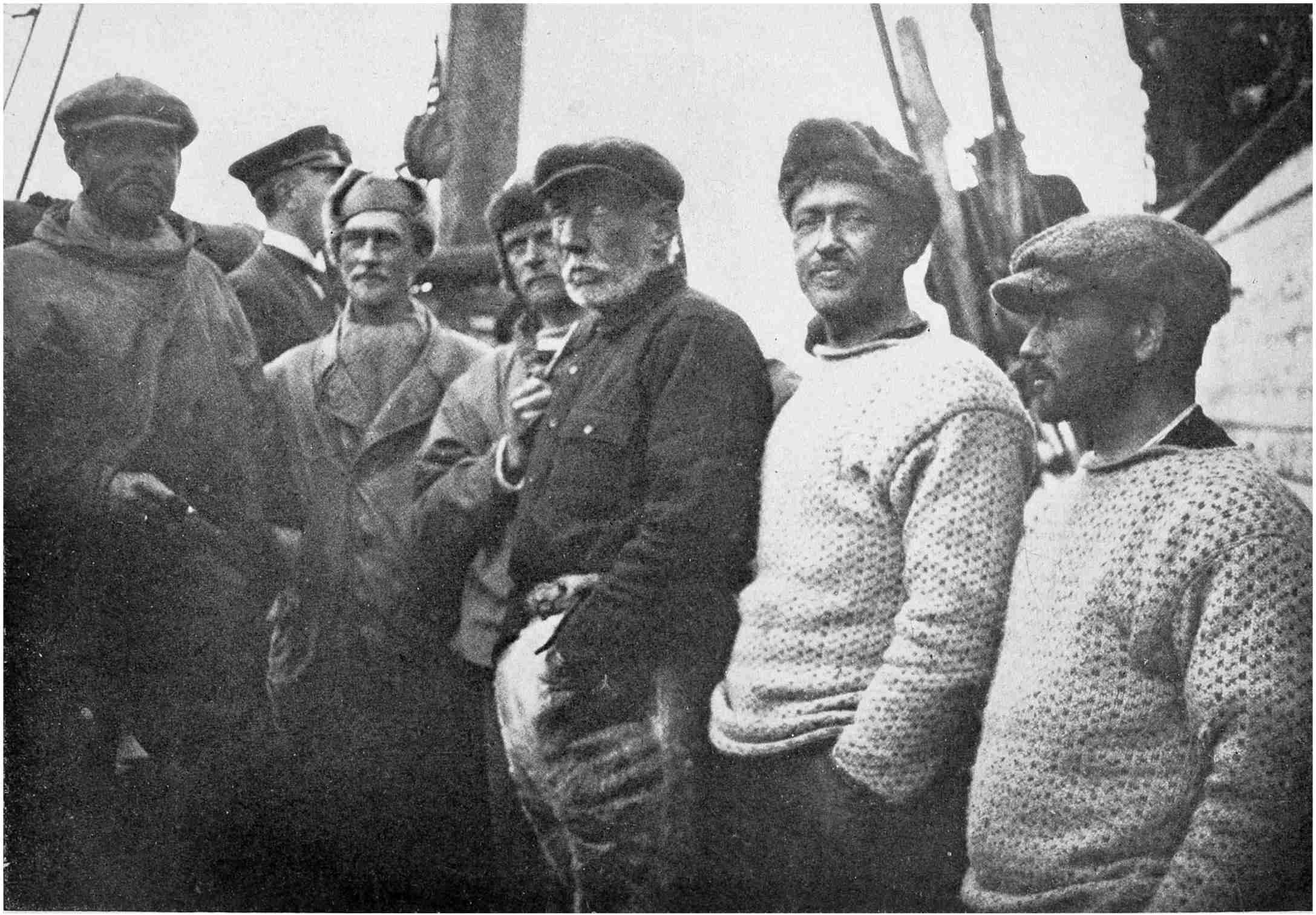
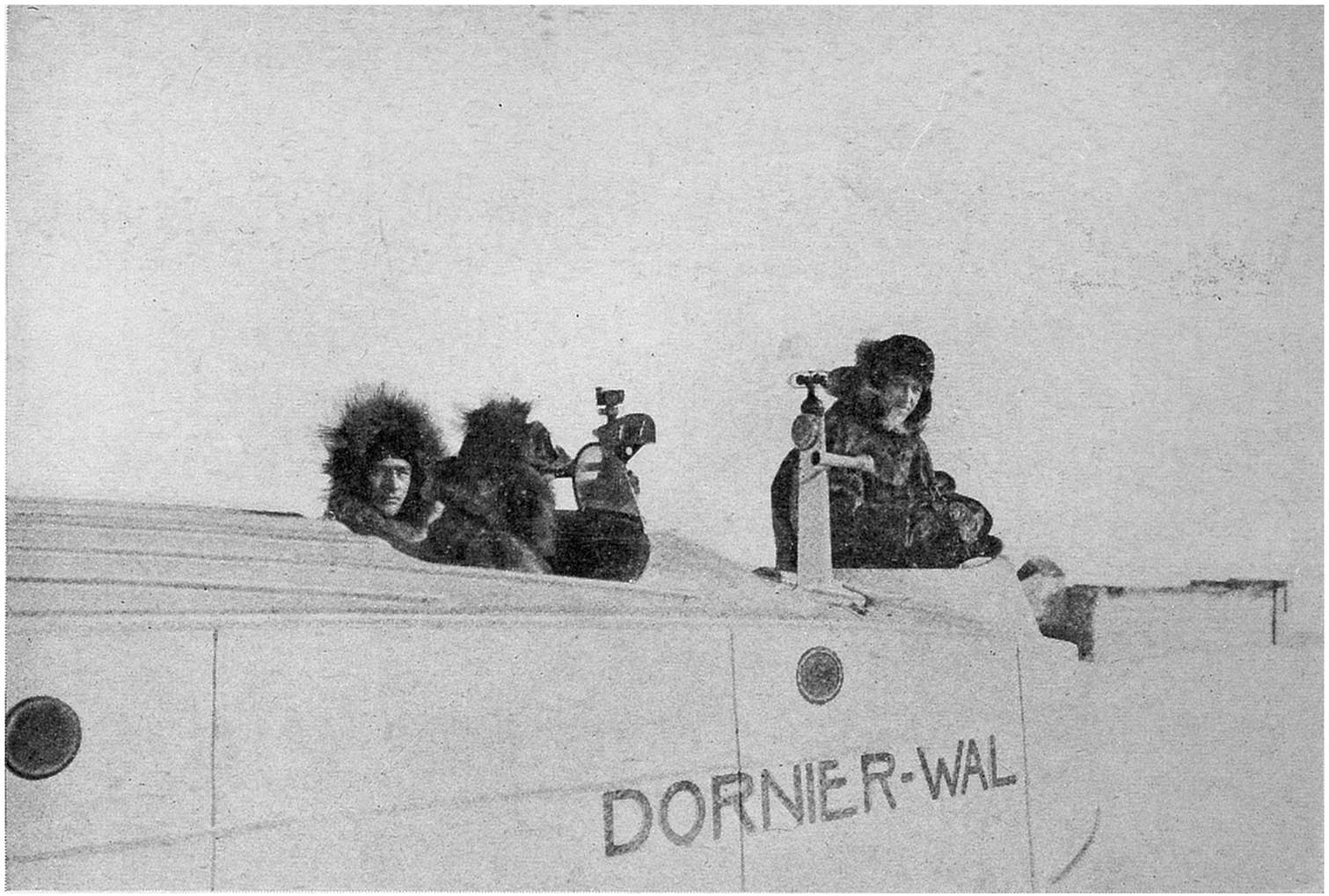
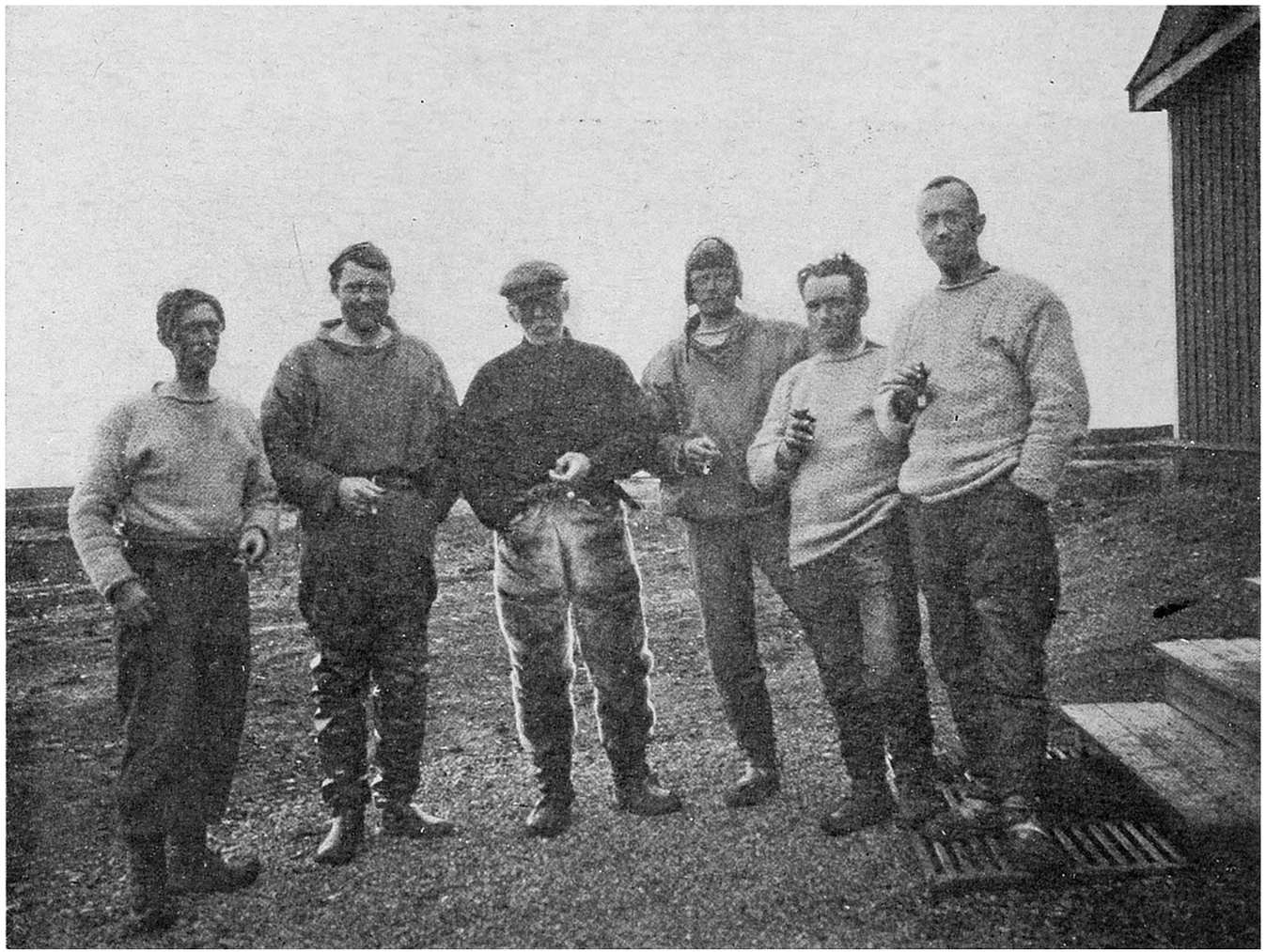
THE CREW OF N 25
LEFT TO RIGHT: RIISER-LARSEN, AMUNDSEN, FEUCHT
THE CREW OF N 24
ELLSWORTH, DIETRICHSON, OMDAL
It was now ten minutes past five. The motors were
quite warm and Green nodded approvingly. His
smile expressed complete satisfaction. A last handshake
from Director Knutsen and then good-by.
The motor was running at top speed as N 25 trembled
and shook. The plan was that our machine should
make the first start and try if possible to start
out over the fjord with the wind in order to glide and
swing at a low altitude between the fjord boundaries.
If this were not successful we were to set our course
direct against the wind, towards King’s Bay Glacier.
It was also agreed that the machines should try to
keep together during the entire flight. What the one
did the other should do afterwards. One last pull
and then N 25 was free and glided gracefully down
the slide on to the frozen fjord. The trip was started.
“Welcome back to-morrow,” was the last I heard as
with tremendous speed—1,800 revolutions a minute—it
set off towards the starting place in the middle
of the fjord. There we noticed all at once that the
ice was bending right over and the water surging up.
In a second the machine was across the fjord heading
straight for the glacier and making 2,000 revolutions.
This was one of the most anxious moments. Could
the machine bear the tremendous excess weight or
must we stop and lighten it? The pilot sat at the
wheel. Had he been seated at the breakfast table
he could scarcely have looked less concerned. As
the speed still continued, and we were nearing the
glacier at a mighty rate, the pilot’s coolness seemed
greater than ever. His mouth was the only indication
of his resolution and determination. We went
over the ice like a hurricane. The speed continued and
continued; then suddenly the miracle happened.
With a mighty pull the machine raised itself from
the earth. We were in the air. The master stroke
was accomplished. It seemed to me after the breathless
anxiety that I at last heard a light Ah! which
grew into a ringing shout of joy.
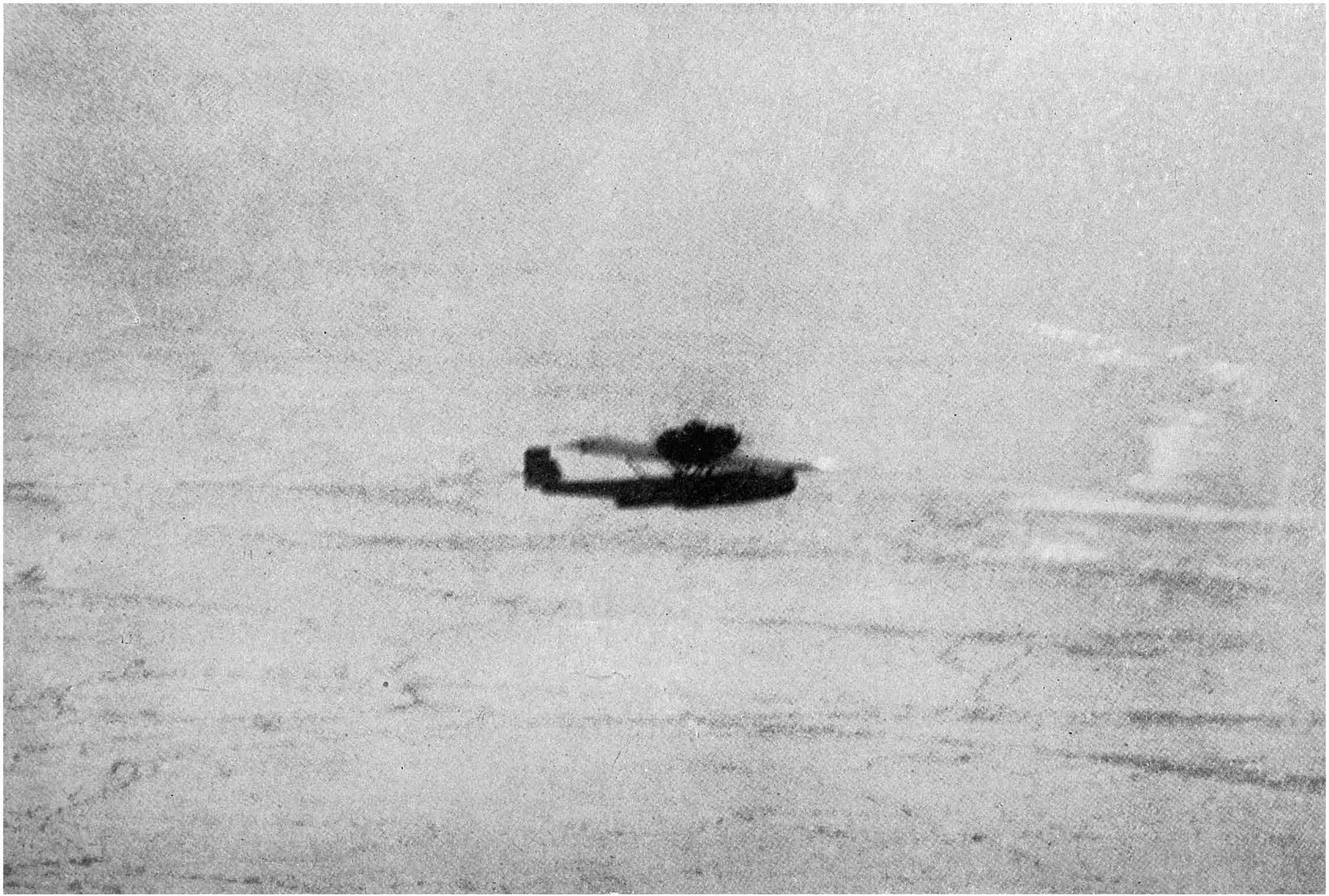
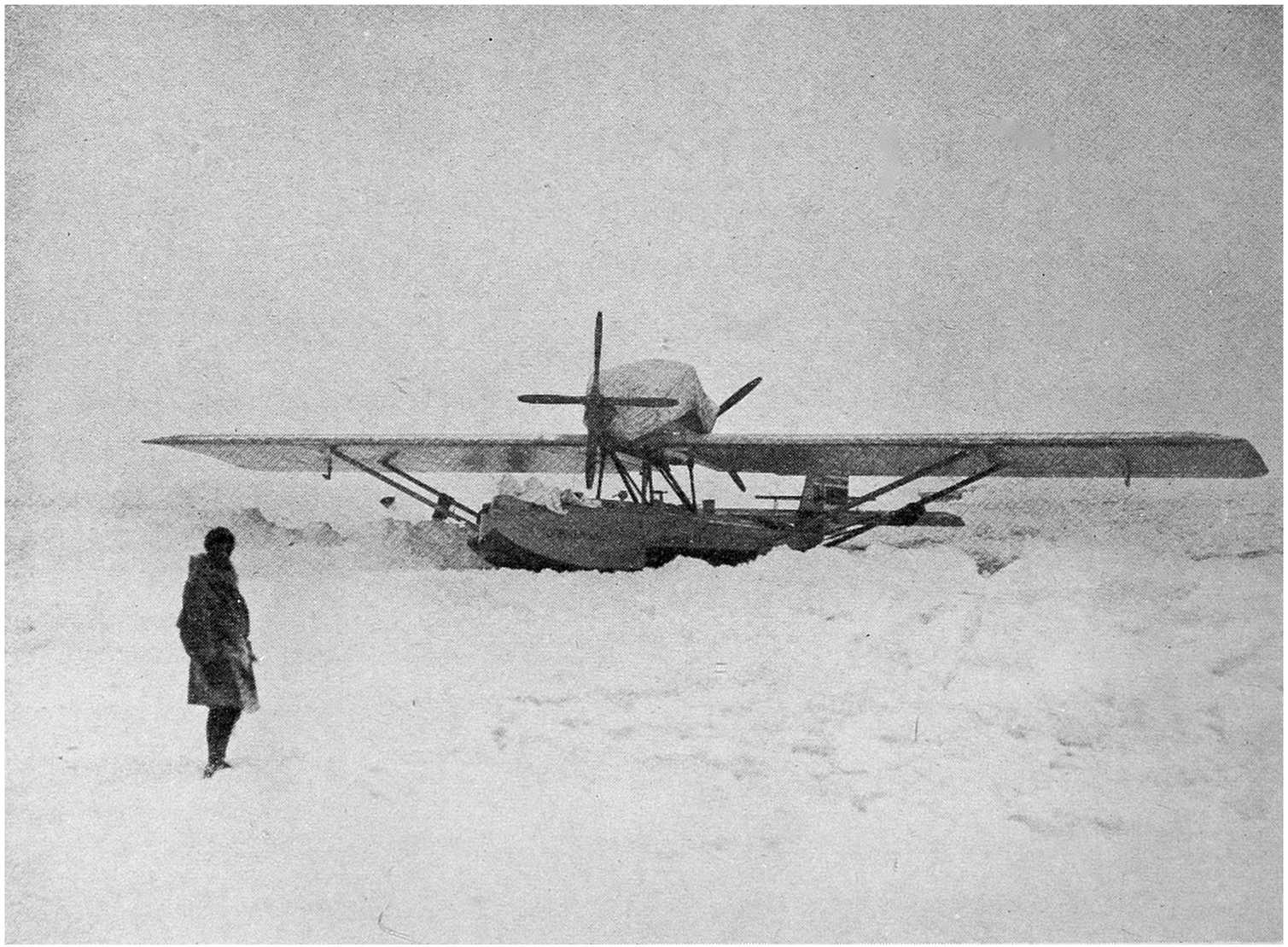
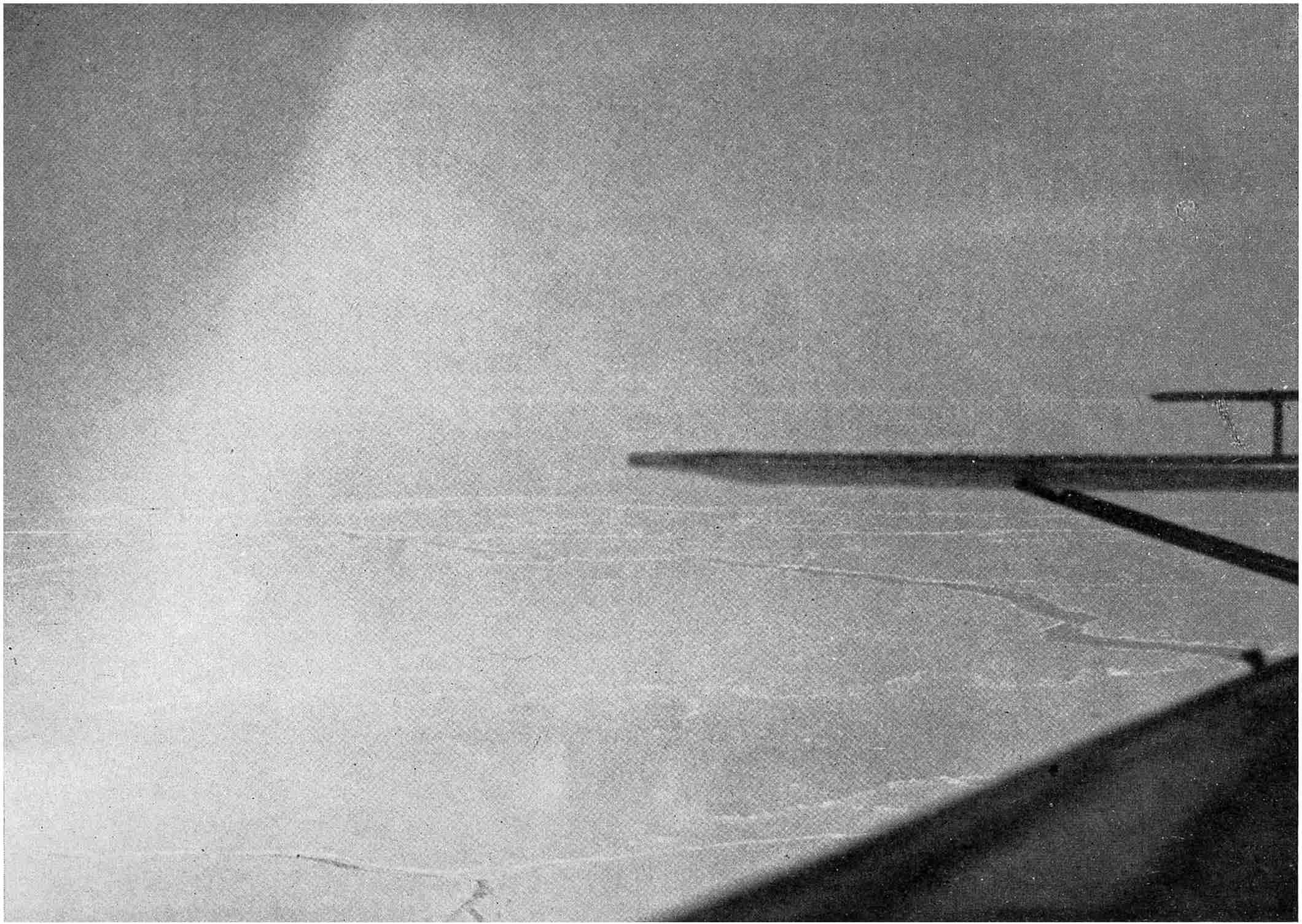
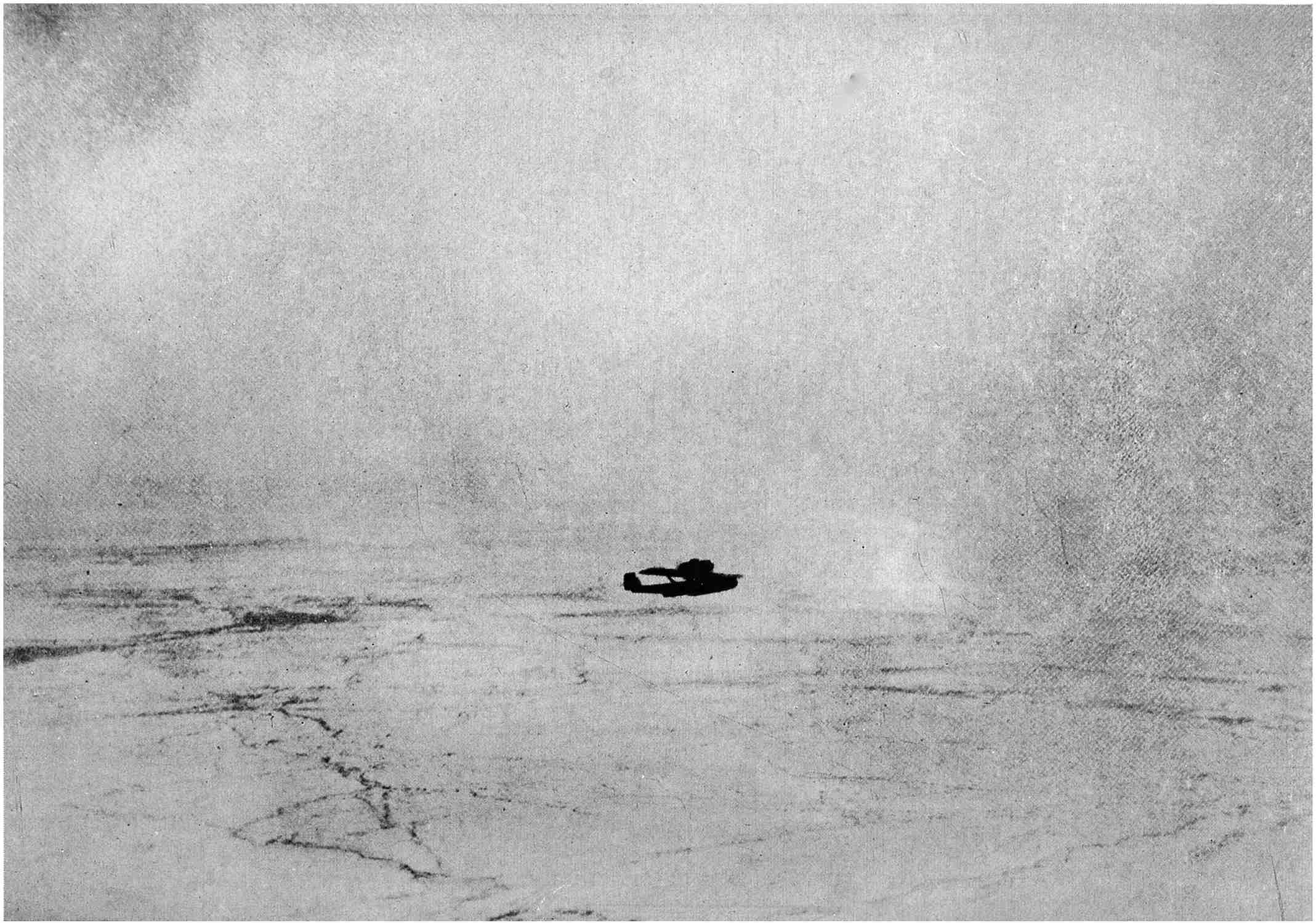
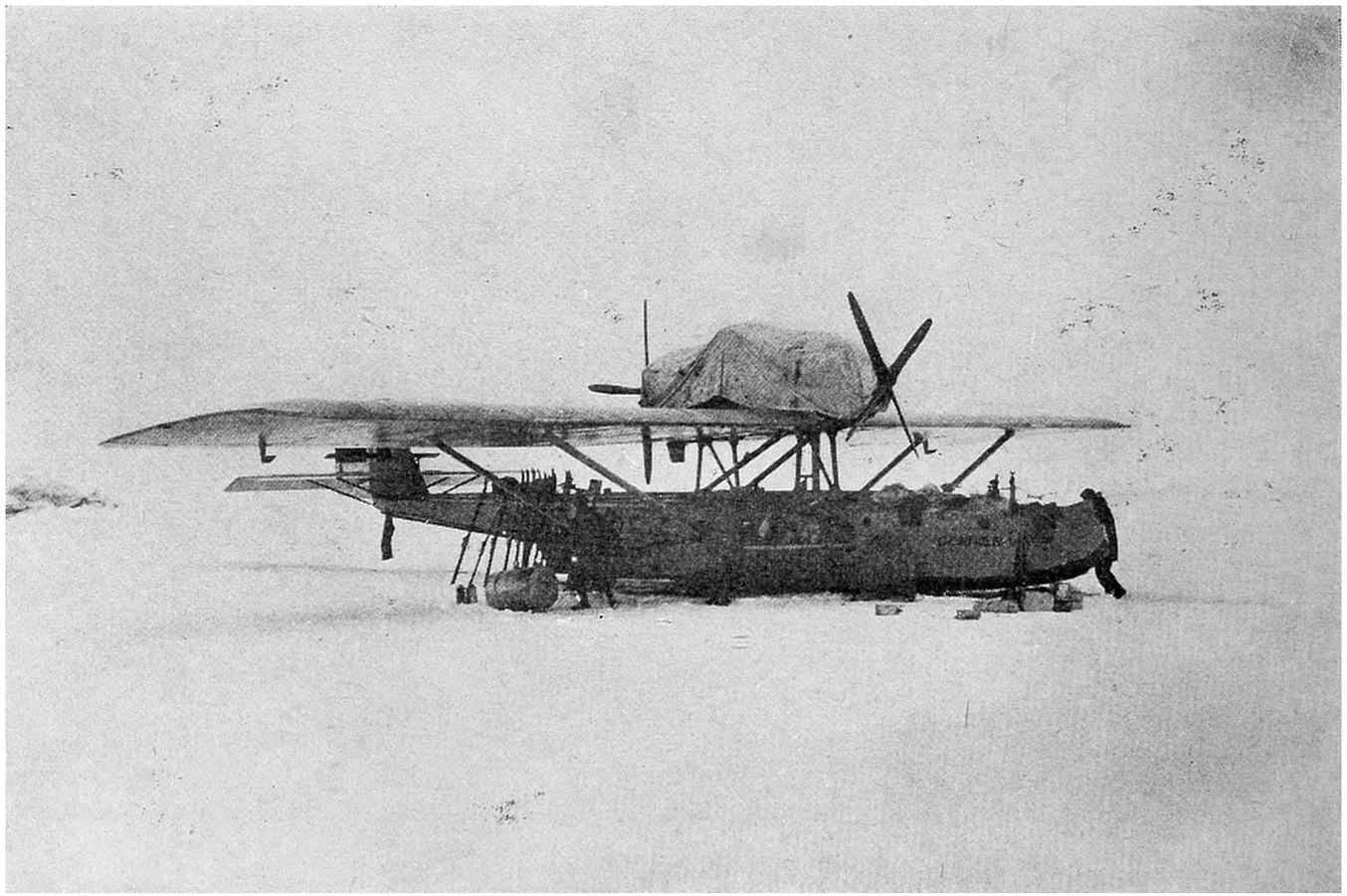
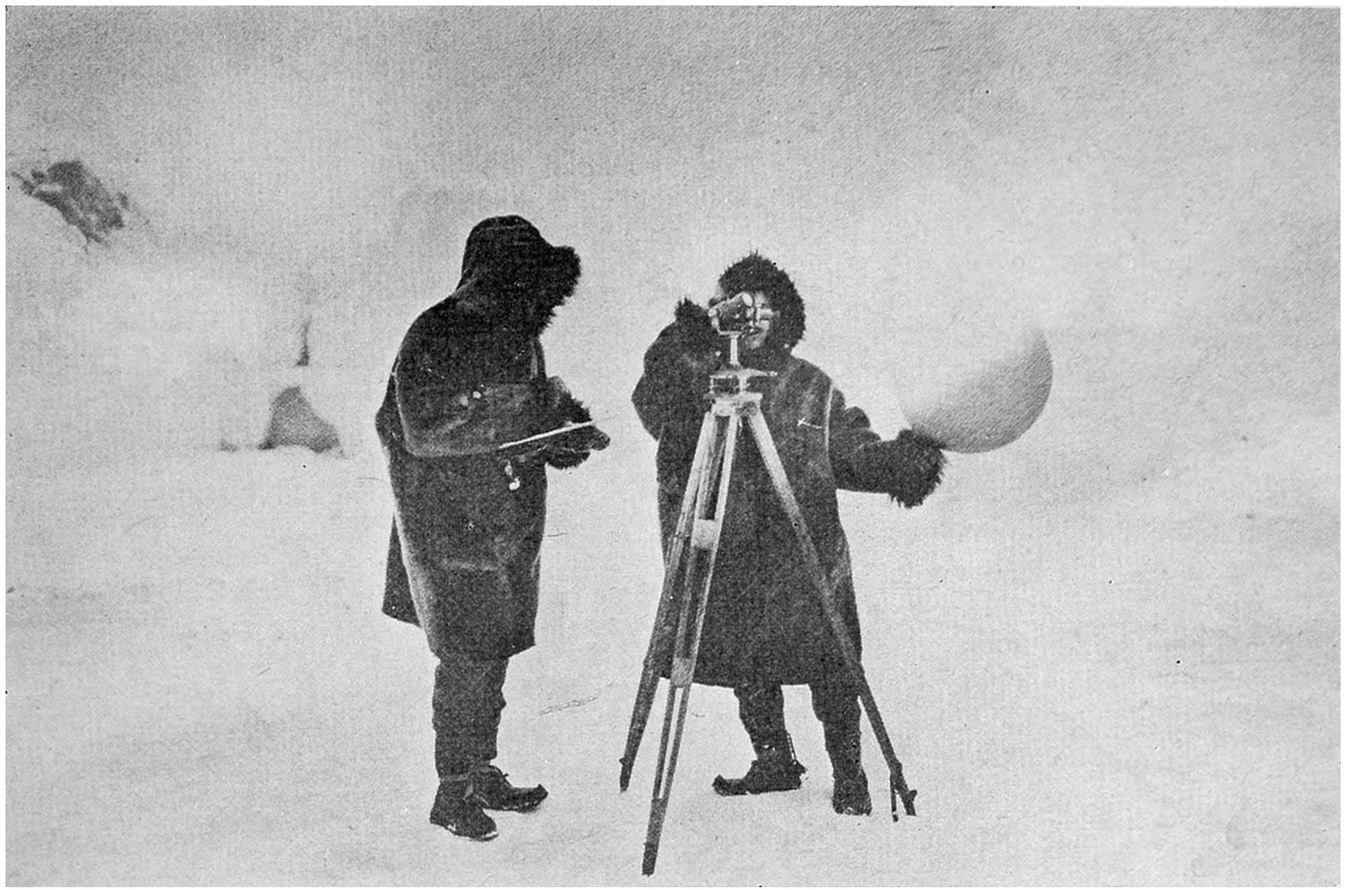
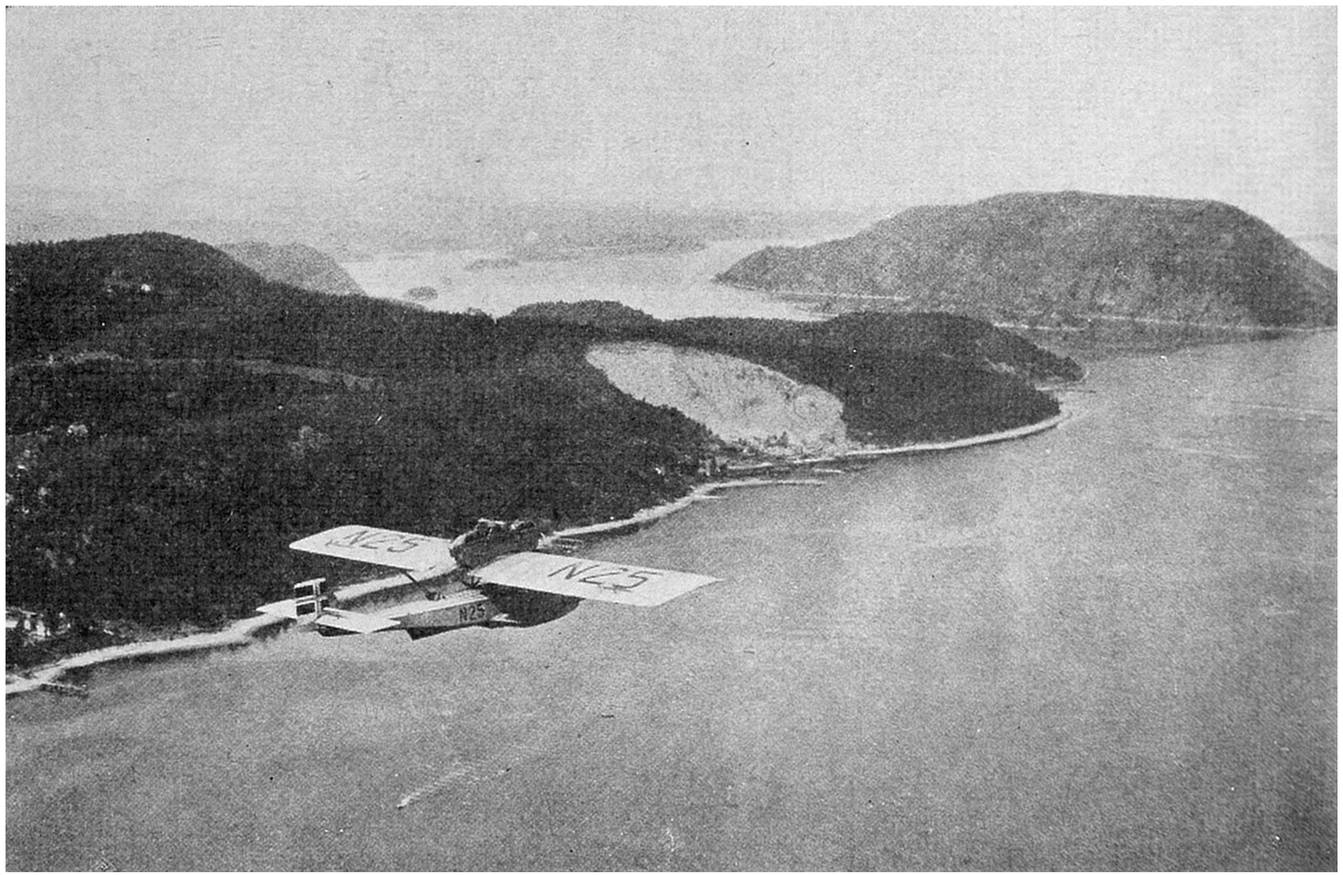
PHOTOGRAPH OF AMUNDSEN’S MACHINE TAKEN FROM ELLSWORTH’S WHILE IN FLIGHT, SHORTLY BEFORE LANDING
AND WITHIN 250 MILES OF THE POLE
After this calmness again took possession of the
man who had performed this master stroke, and it
left him no more during the whole trip. Feucht was
always going up and down between the tank compartment
and the motor; his duty was to keep the pilot
advised of everything: how the engine worked: how
much petrol had been used, etc. All seemed in the
finest order and Feucht announced, “All clear.” Before
we rose I had tried to get my things in order as
the space was limited and my belongings numerous.
Over Cape Mitra we had already risen to 400 m.
and everything beneath us seemed exceedingly small.
Time after time I turned round and looked for the
other machine, but never managed to discern it.
Therefore we turned our plane completely round,
flying back to look for N 24. One never knew what
might have happened. It was possible that something
had struck it as it tried to rise. The ice might
have broken, or its load might have been too heavy
for it. Suddenly something blazed in the sun; it glittered
like gold. It was the sun playing on N 24’s
wings. There it came in full flight to meet us.
Everything seemed to be in order. Had I known
then what I know now, I should have held my breath
for a moment and taken off my hat to the man who
sat at the wheel. But more about that later. Then
the machine turned its nose again towards the north,
and the two enormous birds started their flight together
towards the “Unknown.”
My feelings at that moment were one whirl of
burning gratitude. I gave a bow and a grateful
glance to the man sitting behind me who had accomplished
this brilliant master stroke—a warm silent
thank-you to those who had just joined us; a thank-you
so deep and so heartfelt to my five comrades, who
have all willingly placed their lives upon the scales—a
thank-you because the heavy yoke was at last lifted
from my shoulders (the disdainful scorn which I had
been forced to feel so many times during the last year
of constant misfortune had disappeared for ever).
Even if we fell right down now where we were this
proof of our earnestness could nevermore be taken
away.
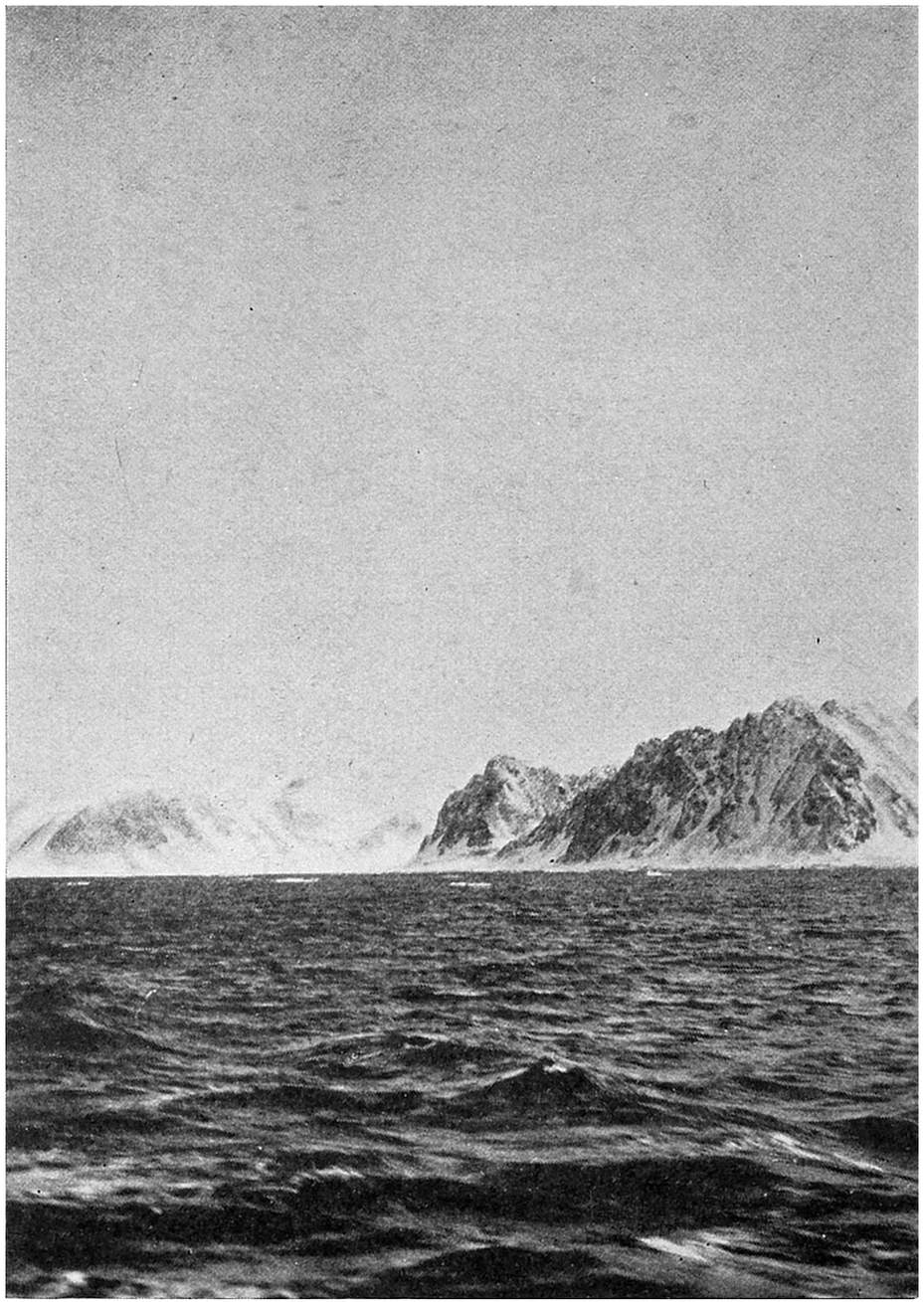
We passed quickly over the northwest coast of
Spitzbergen, where the sea below us was entirely free
from ice. Then we reached Magdalena Bay, the
South Gate with the Moss Islands, and then came
the Danske Öen. I knew them all again from my
trip with Gjoa in 1901. After an hour’s flight we
were level with the Amsterdam Islands. Here we
met most unpleasant weather. Fog as thick as porridge.
First it came densely, thickeningly, from the
northeast—then thicker—thicker. The pilot rose
higher and we were flying above the woolen blanket.
The other machine accompanied us at a somewhat
lower altitude. Here I saw the strangest optical illusion
I have ever seen and nothing seems to me to have
ever equaled it in beauty. Directly pictured in the
fog I could see a complete reflection of our own machine
surrounded by a halo of all the spectrum’s
colors. The sight was miraculously beautiful and
original.
We took our bearings from the Amsterdam
Islands and steered north for Taakeheimen. Here
the fog came down quite unexpectedly. We had not
looked for it so quickly, nor such a big stretch of it;
it was certainly not local, but a field of colossal dimensions
lay before us. For two complete hours we flew
over it; a stretch of fully 200 kilometers. Occasionally
we passed over a little break or hole in it, but
never big enough to give me an opportunity to take
my bearings. These holes were of great interest.
Through them I got an idea of the territory below.
The sea here was filled with small ice with water
amongst it. These conditions continued to 82° n.
and I am certain that a vessel with any power at all
could have navigated it. A little after eight o’clock
it began suddenly to clear and in a second the fog disappeared
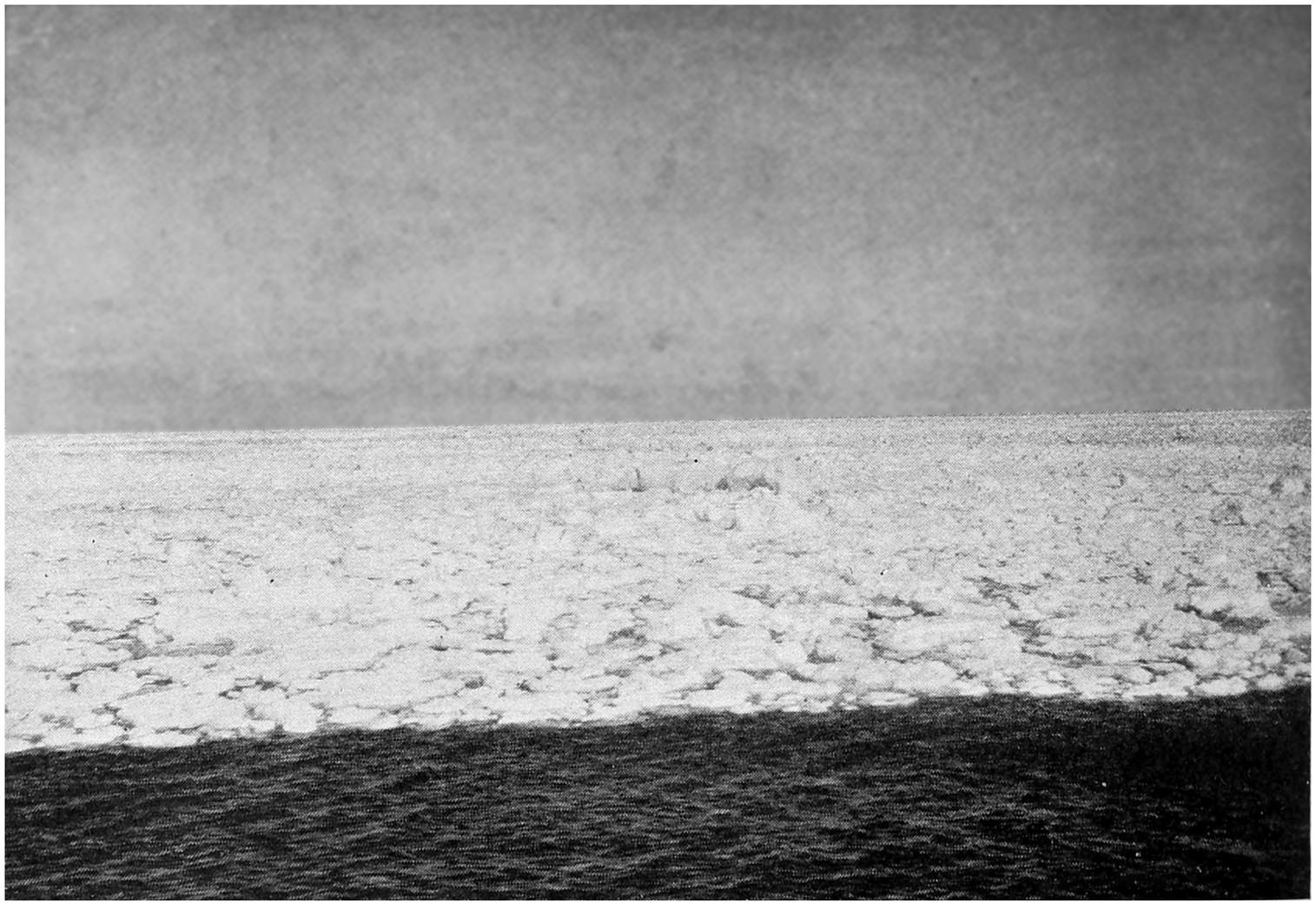
as though charmed. And there below us
and in front of us lay the great shining plain of the
notorious pack-ice. “How many misfortunes have
you been responsible for during the passage of years,
you vast ‘Whiteness’? What have you not seen in the
way of need and misery? And you have also met
those who set their foot upon your neck and brought
you to your knees. Can you remember Nansen and
Johansen? Can you remember the Duke of the
Abruzzi? Can you remember Peary? Can you remember
how they crossed over you and how you put
obstacles in their way? But they brought you to your
knees. You must respect these heroes. But what
have you done with the numbers who sought to free
themselves from your embrace in vain? What have
you done with the many proud ships which were
steered direct towards your heart never to be seen
again? What have you done with them I ask? No
clew, no sign—only the vast white waste.”
Quite naturally an airman’s thoughts turn towards
a landing place. Should his motor fail and he has no
place to land, he is indeed in a bad way. But no
matter where we looked there was not the sign of a
landing place. So far as we could see the ice looked
like a number of furrows, stretched out without
rhyme or reason, and between the furrows rose a high
stone fence. Conditions however were unusual, the
fence took up more room than the plowed field. Had
the field been even and flat it would not have appeared
so strange, but a flat part simply did not exist.
The plow seemed to have been everywhere between
stones and stubble. A little brook was also there, but
so small that one could have jumped over it anywhere.
A more monotonous territory it had never been my
lot to see. Not the slightest change. Had I not been
engaged in making many kinds of observations and
notes it is certain that the uniformity of the outlook
and the monotony of the engine’s hum would have
sent me to sleep, but fortunately my task kept me
awake. Riiser-Larsen confessed to me later that he
had had a little snooze. I can understand that as he
had monotonous work to do.
The mean temperature during the flight had been
-13 °c. N 24 kept beside us with no thought of
separating. I tried continually to take the sun but
unsuccessfully. The sun was all right, but the horizon
was useless. Our plane level was fastened to the
sextant (a bulb sextant, of American make). We
had used it several times at a trial in King’s Bay, but
the results were most unsatisfactory, so much so that
we had stopped using it. Therefore I was left to use
whatever nature placed at my disposal. But nature
was not obliging. There was no horizon. Sky and
ice blended into one.
Two hours after I had taken soundings at the Amsterdam
Islands I got an opportunity to calculate
our speed and the deviation. What had happened in
two hours? It was exceedingly difficult to say. If
one does not get an opportunity to calculate speed
and the deviation it is naturally difficult to know the
direction of the wind when one comes flying at a speed
of 150 kilometers. It was quite clear as we came out
of the fog with a few high cirri in the east. About
ten o’clock a fine mist crept up from the north, but
too high and fine to annoy one. The sun was not
quite visible, but from the sun’s position and the compass’s
variations it was quite clear that we were well
over to the west. There was therefore nothing else to
do but to steer eastwards. I have never seen anything
more deserted and forlorn; at least I thought
we might see a bear or anything to break the monotony
a little, but no,—absolutely nothing living.
Had I been sure of this condition before, I would
have taken a flea with me in order to have life near.
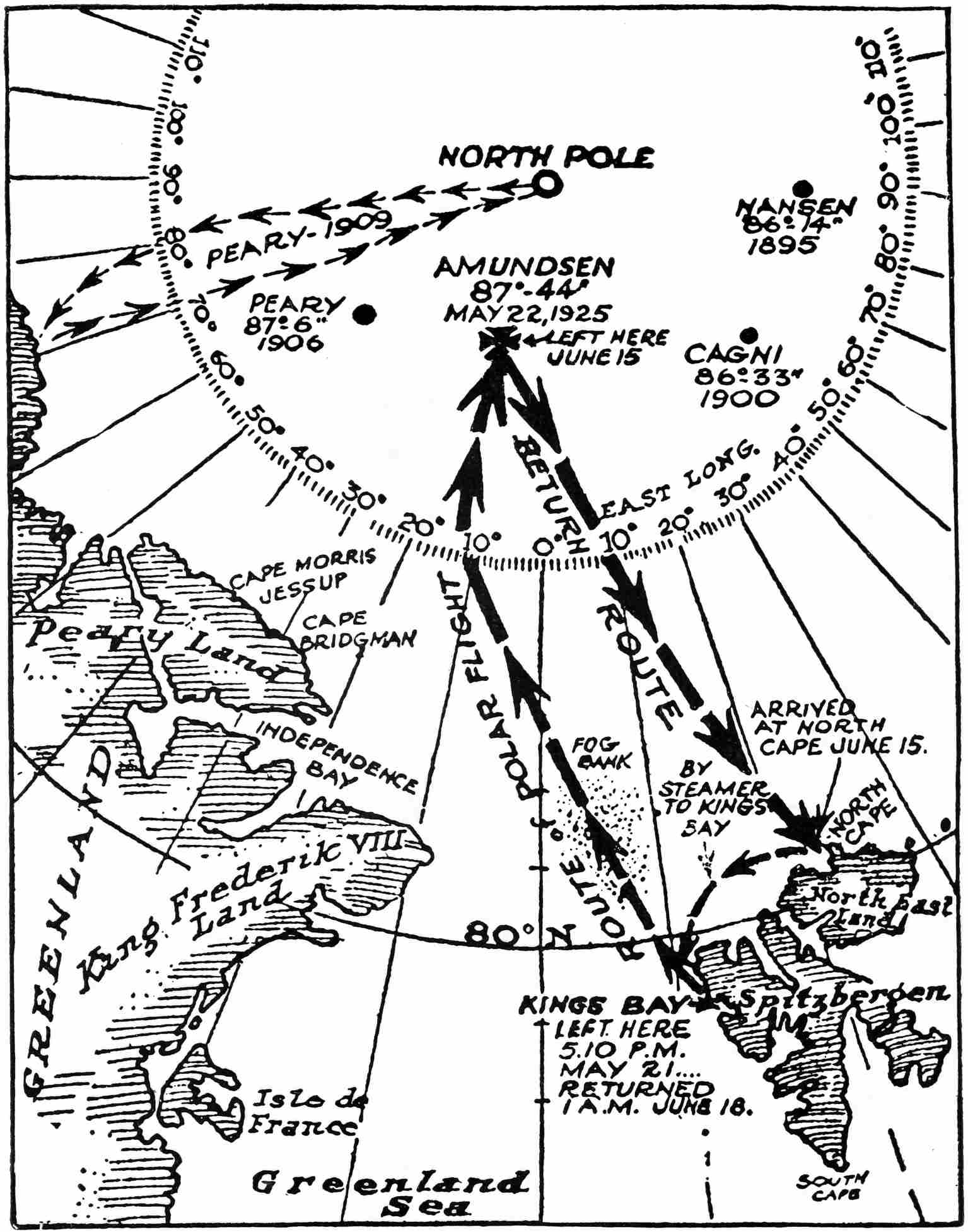
At five o’clock on the morning of the 22nd we came
to the first waterway. It was not a small brook but
a big dam with arms stretching in different directions.
It offered our first possibility of finding a landing
place. According to our bearings we should now be
88° N. lat., but with regard to longitude we were quite
confused. That we were westerly was certain, but
where? Feucht announced here that half the benzine
was used so it became necessary to look for a landing
place. Our intention was, therefore, to descend, take
the necessary observations, and act in the best way
according to the conditions. The question now was
where should we land? Naturally a landing on the
water would have been safest, so far as the landing
was concerned, but there was always the fear that the
ice could close in and crush us before we were able to
rise again. We decided unanimously that if it were
possible we should land on the ice. In order to observe
the territory as conveniently as possible we descended
in big spirals. During these maneuvers the aft
motor began to misfire and changed the whole situation.
Instead of choosing a place now we would
have to take what offered. The machine was much too
heavy to remain in the air with one motor. A forced
landing became necessary. At this low altitude we
could not reach the main dam, but had to be satisfied
with the nearest arm. It was not particularly inviting—full
of slush and small ice. But we had no
choice. Under such conditions it was worth much
to have a cool unruffled pilot who never lost his self-possession,
but even in flight was able to make a clear
decision and act accordingly. The slightest wobbling
and the game would have been lost. The arm was
just wide enough for the machine so it was not so
dangerous. Every clump of ice could have torn it
through; the danger lay in the high icebergs which
lay at each side. It took a master to guide the
machine in between these and save the wings. We
landed squat in the slush and here arose the most
difficult problem any airman could have to solve. It
was a piece of luck for us that we landed in the slush,
for that slowed down our speed somewhat. But on
the other hand it reduced the boat’s maneuvering
powers. We were passing a small iceberg on the
right. The machine turned to the left with the result
that the wings stroked the top of the iceberg and
loose snow was whirled in the air. Here we zig-zagged
along in a manner which was most impressive
and alarming. Can we clear it? The anxiety was
great for those who were only spectators; it seemed
not to have the slightest effect on the pilot; he was
quite cool and calm. When I say we cleared the iceberg
by two millimeters it is no exaggeration. I expected
every moment to see the left wing destroyed.
The speed now slackened in the thick slush and we
stopped at the end of the arm—nose up against the
iceberg. It was again a question of millimeters. A
little more speed and the nose would have been stove
in.
So far so good. We had still our lives—what did
this place look like? The arm ended in a little pool
surrounded by high icebergs and with nose against
this we lay with our tail towards the entrance. We
hopped out on the ice and looked around. What was
to be done? Only one thing. To try and get out as
quickly as possible. Should the ice freeze together
we were sentenced to death in five minutes. What
was necessary now was to turn the machine round
180°. I must say we put all our force into the work
and tried in different ways, but all in vain. The slush
and small ice stuck fast to the boat and it lay as if in
glue. If we managed to free the boat a few inches
the slush went with it. If we got rid of that the boat
fell back into its old position, and then so did the
slush. Oh, how we struggled and strove. But after
the space of a few hours we had to put that plan aside
and take on another. But first we must find out
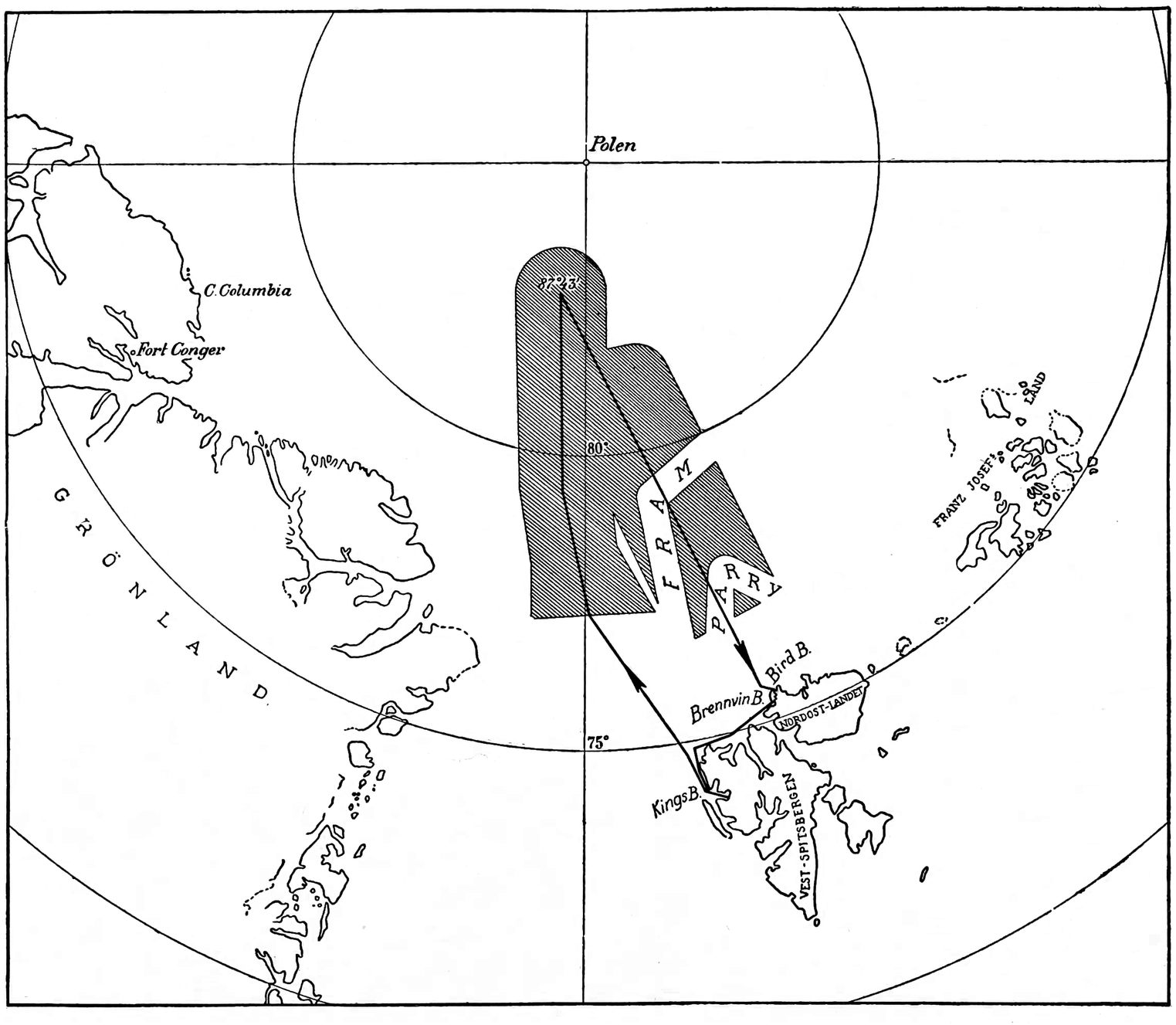
where we were. Our observations gave 87° 43′ N. lat.
and 10° 20′ L. Our presumption that there was a
westerly current proved to be correct.
At eight o’clock A.M. we decided we had earned a
little food and rest. But before we could gratify this
need there were two things to be done. First to take
all the provisions and equipment on to the big ice,
in case the ice should begin to screw. Also we must
look around to see if our comrades on N 24 were in
sight. The small quantity of provisions that we had
were shifted onto the ice in a few minutes, and then
we set off with glasses to take observations from the
top of the highest iceberg. We thought we had
heard a shot after we had landed, but we were not
certain. There are so many noises like shots amongst
the ice. The last I saw of N 24 just before our landing
was that it was flying very low on the other side
of the dam. If I was right we must look for it in a
southerly direction, but everywhere we looked there
was nothing to be seen. The mist now lay somewhat
lower than when we landed and a few snowflakes
came whirling along. The temperature was about
-15° c. I had never looked upon our machine before
as a dwelling but that must be done now. It was
divided into five rooms. The first, the observer’s
room, was too small for occupation. No. 2, the pilot’s
place, offered the best sleeping room for one or two
men. No. 3, the petrol store, was full of tanks and
could not be used. Room No. 4 was the best of them
and we decided to make it a dining room and sleeping
room. It was four meters long diminishing in width
towards the tail. I assume that the builder had
never thought of it as a dining room when he
built it, but certain it is that it seemed absolutely prepared
for that purpose. At all times our Primus
apparatus got a good position here. Room No. 5 lay
right in the tail and you entered it through a round
door in the wall. It was long, small, and dark, as it
had no window. As a bedroom for one man it might
have been used had it not been for the ribs which converged
tightly here. In the dining room we set our
Primus going and soon had our first meal of chocolate
and biscuits. It was comfortable in here so long
as we could keep it warm and this was easy in the
beginning while we still trusted and hoped that our
stay should be short. We had brought with us some
small petrol apparatus called Therm’x and with
these we kept the temperature fine and high.
I cannot pass by our friend Therm’x without giving
him a good word. How it is constructed I cannot
say and it will not interest many. But what will interest
most people is the fact that with one liter of
petrol this apparatus will give out considerable heat
for twelve hours. In addition to this it is absolutely
fireproof. It gives a glowing heat, but burns without
a flame. You could pour petrol over it whilst it functioned,
yet nothing would result except smoke and
an unpleasant smell. For a trip like ours where we
were surrounded by benzine it was a priceless possession.
Add to this its astonishing economy and it is
not necessary to say more. Two Therm’xs made each
room quite cozy, but as events will show even Therm’x
had afterwards to be used sparingly and our cozy
corners were cozy no longer. Riiser-Larsen, unselfish
as ever, took up his quarters in the tail. How he managed
to bear four weeks in it puzzles me. He must
still have five blue stripes exactly like the five tail
ribs! Feucht had his place in the dining room, and
I mine in the pilot’s room. We did not rest long at
first, for at ten o’clock we were in full swing again.
We tried once more to turn the machine round, but
soon gave it up for another plan, namely, to get the
machine into safety as quickly as possible, for without
any warning the fissure might close up and crush
us like a nut between nut-crackers. To guard against
this we decided to place it on top of the iceberg which
lay beside us. It seemed a hopeless task at first, but
it meant much. Firstly, part of the iceberg must
come down, for a slide to be made. “But however
could we accomplish that task?” asked one. Yes, that
is the question. When we left we had 500 kilos too
much on board and therefore must deny ourselves
many things. To carry with us a number of ice tools,
which we might never need, was out of the question.
We had only calculated with landing on, and rising
from, suitable ice. No one had dreamed of the present
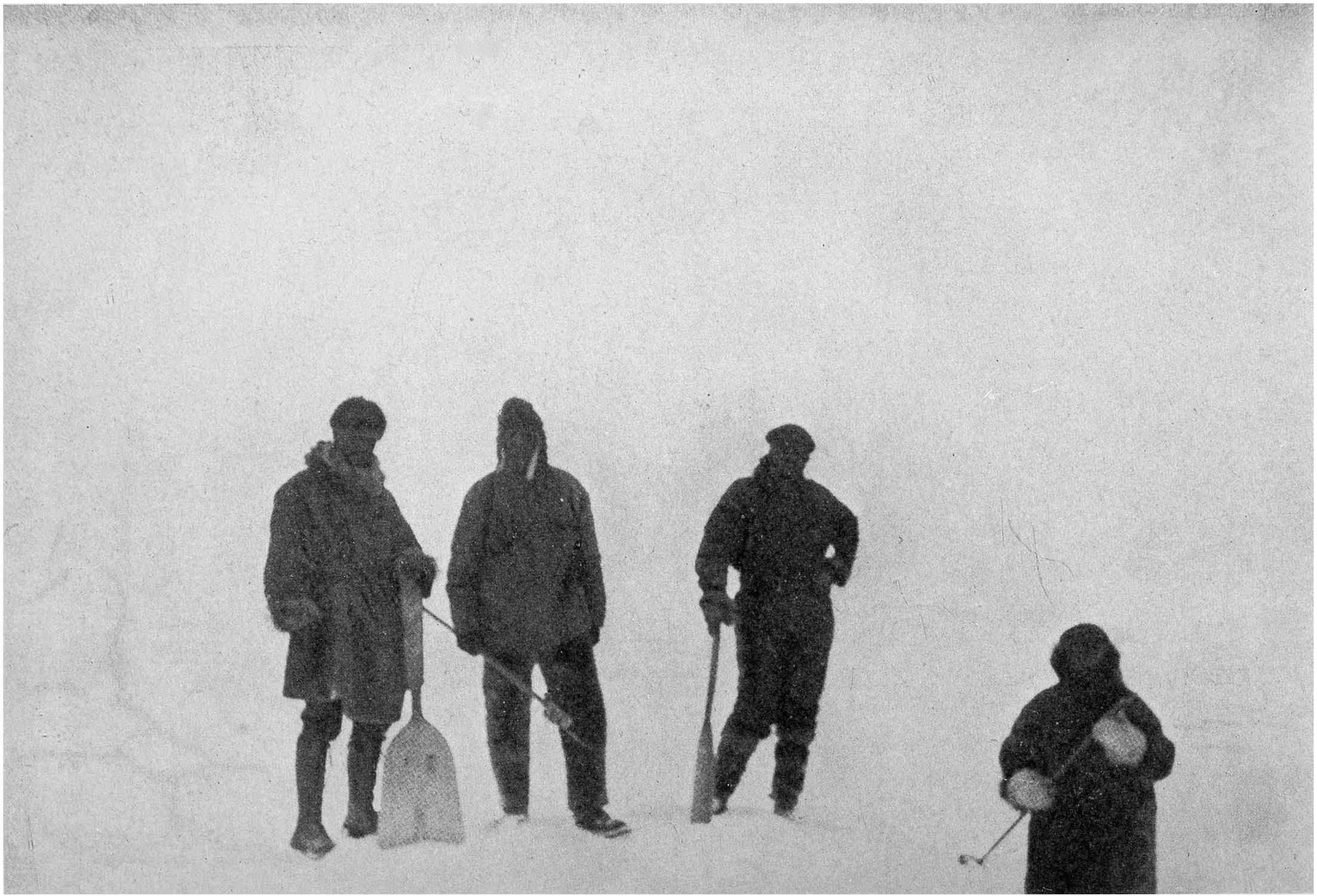
situation. We looked at our available tools: three
slip knives, one big knife, one ax, one ice-anchor,
which in time of need could be used as a pick. It is
unbelievable what people can do when they are driven
to it. There was only one way to get the machine
into safety—and for that the iceberg must come
down and be leveled and it would appear that we
only had our fingers to do it with. Wholly inexperienced
in work of this kind, we were rather clumsy in
the beginning, but we were willing and incredibly persevering
and were lucky enough to get the better of
the situation. Later we managed to level an iceberg
in a fabulously short time, but at present we were unused
to the work and it went slowly. From time to
time during our work we went up to the top of the
machine, or to the top of an iceberg, and looked
around to find the others. Anything might have
happened in such a morass, and at lunch time we discussed
the various probabilities. Had they made a
bad landing? Had they decided that it was hopeless
to land in this chaos?
The next day we got ready to march to Cape
Columbia. The sledge was secured and put ready so
that we, with the shortest possible warning, could set
off if the ice should close in and crush the machine.
Our provisions were sufficient to last for a month giving
1 kilo per man per day. As soon as we saw our
situation was serious we began quickly to take less
and in a short time our ration was reduced to 300
grammes per day. It was naturally too little for any
length of time, but for a shorter period would suffice.
We all felt very weak after the first day, but it appeared
that we could get used to it. We got noticeably
thinner, tightening our belts every day. My
belt, which had often been too tight in King’s Bay,
was now too slack even when worn outside my thick
leather clothes. Our sleeping equipment consisted of
one light reindeer skin bag, only designed for summer
use. Most of us grumbled at the cold in the beginning,
as the temperature remained about -10° c.,
but one must have practice in using a sleeping bag,
and one must understand it in order to pass in it
what turns out to be a warm balmy night, while another
person without experience freezes. It is necessary
to take plenty of time and to work oneself right
down to the bottom when getting into a sleeping bag,
for one can often see people who have no knowledge
of these things, only halfway wriggled in, and naturally
they pass an uncomfortable night.
On the 23rd we were able to cross the new frozen
ice into the pool. We were early at work that day
and kept on hacking at the slide. During a little interval
I took the glasses, climbed to the top of the
machine in order to look round after N 24. Who can
describe my pleasure as I, almost with the first
glance, observed it? South-west, on the other side of
the great dam, there it lay looking quite cheeky. A
little to the left stood the tent. And still a little
further away, on the top of a high iceberg, a flag.
This was pleasant news for my comrades and in haste
we hoisted our flag. Anxiously I followed progress
through my glasses to see if they were observing us.
Yes, right enough, in a few moments I saw signs of
life. They sprang to the flag, caught hold of it and in
a few moments we had a means of communication, as
fortunately our two pilots were practiced signalers.
The distance between us was too great for semaphoring,
so we had to use the Morse system. Apart from
the fact that it took a little longer, everything went
splendidly. Dietrichson announced that his machine
on leaving King’s Bay had started an ugly leak, but
that he had hoped all the same to be able to manage.
We could tell them that our machine was absolutely
undamaged. No further announcements were made.
We went on with our work on the slide all day.
WHEN THE TWO PLANES WERE NEAR EACH OTHER
The 24th was given up to the same work. Most of
the ice was as hard as flint and it took us a long time
to work through it. In the afternoon I discovered
suddenly through my glasses that there was an unusual
stir on the other side. I could see them jumping
backwards and forwards, preparing to do something
or other. An hour later they put skis on; slung
two heavy packages on their backs and set off towards
us. It was just what I had wished to happen,
though I had not expressed my wish so long as they
were working at their machine. If they were able,
by some means, to get their boat clear for a start, I
naturally had no desire to hinder them. We could
well have done with their assistance in our work of
saving our machine, but, so long as they had their
own work to do, we could not ask for help. I watched
them anxiously through the glasses, noting their mode
of approach through the icebergs (let me make it
clear that they had very heavy packages on their
backs), and I did not like the direction they took.
They set their course directly towards the new frozen
ice in the dam and I doubted its solidity. Certainly
the ice in the little fissure was strong enough, but the
ice on the great dam was a different matter. I held
my breath as they descended from the old ice towards
the new. Things could go wrong and prove fatal.
Fortunately they were sufficiently foresighted to stay
on the old ice; to my relief they kept to it, coming
straight across and throwing off their packages. I
thought they were going to rest a few moments, but
was pleasantly surprised when they produced two
flags and started semaphoring. It was not long before
Riiser-Larsen was also on the job and the conversation
started. They told us that they could not
get their machine clear away alone and asked if they
should come over and join us. As they apparently
intended to cross the new ice, we hastily answered that
it was better for them to turn back and consider matters
a little, arranging to continue semaphoring the
next morning at ten o’clock. With a sigh of relief I
saw them go on to the old ice again.
A NEW LEAD OPENING IN THE ICEGETTING READY FOR A FRESH START
On May 25th we managed to get our machine onto
the slide so that the heavy end lay on the old ice.
This was a great advantage, as any screwing which
might take place would only push us higher up into
complete safety. At ten o’clock the next morning
we semaphored again. Dietrichson announced that
conditions were better over there. In reply we asked
them if they were finished with their work to come
and help us. I would rather have seen them set off
immediately, but such a course would have hindered
their own work. While we chatted a big seal head
suddenly appeared from a little fissure. I was astonished.
Seals in 88° N. Lat. I had not expected to find.
With a satisfied feeling we drank our chocolate that
evening. Our condition was much better. If we
were not in absolute safety, we still had found a way
to work clear. Our stay on the waterway had been
a nightmare. High icebergs grinned down on us the
whole time.
The 26th was a busy day. It dawned overshadowed;
with a temperature of -10° c. The ice on
both sides of the great dam had been moving a good
deal during the night and both machines were driven
nearer each other. We could thus quite easily see
everything that happened in the other camp. We
worked as usual on the slide and hoped in course of
the day to raise the machine absolutely. At three
P.M. there was great excitement on the other side and
we thought at once that they were crossing to us.
The great dam had become considerably smaller during
the night; we looked at the old ice with large
round eyes as we saw the people from N 24 coming
round it towards us. We thought that they would
have a dreary march of several hours, so we got on
with our work in the meantime.
Who can describe my surprise when some one suddenly
said, “Look, there they are!” Twenty minutes
after leaving their resting place they had nearly
reached us. Two hundred yards away we could see
them working their way between the icebergs. We
knew, however, that they could not come straight
over, as there was a little fissure lying between us and
them. Riiser-Larsen and I left our work, took the
canvas boat, and went to meet them. We had
scarcely set the boat on the water when Riiser-Larsen
got into it to cross and fetch one of the advancing
party. As he broke his way through the thin ice, I
stood on the old ice and waited, when I was alarmed
by a ringing shriek; a shriek which went to my marrow
and made my hair stand up on end. It was followed
by a number of cries, each one more alarming
and terrifying than the last. I had not the slightest
doubt but that a drama of the most horrible kind was
being played on the other side of the iceberg. A man
was in danger of drowning. There I must stand and
listen to it without being able to raise a finger to help
him. The situation seemed hopeless. The dying
cries got less and I thought to myself, “Yes, now all
is over. How many of them and who?” Just then
came a head from the back of the iceberg. “Fortunately
all three are not drowned.” One appeared and
then another one joined him; then all three were
there. To say I was glad is a mild expression. The
two first shook themselves like dogs, but the third
conducted himself normally. Riiser-Larsen carried
them quickly over the fissure. Dietrichson and Omdal
were wet to the skin, but Ellsworth was dry. We
got them quickly on board the boat and their wet
clothes were changed for dry ones.
To burn in the Primus stove, I had been clever
enough to bring spirits of wine with me, and smiled
slyly to myself over my farsightedness. As they arrived
their teeth chattered so that they could not
speak, a fact which was quite understandable, as falling
into icy water and having to remain in a temperature
of -10° c. for ten minutes afterwards, while a
fresh little breeze is blowing, is enough to freeze one’s
marrow. A dram of 97 p. c. possibly saved them
from unpleasant consequences. A cup of steaming
chocolate performed wonders, but it took twenty minutes
to get ready, while the dram was ready at once.
The work at eventide was stopped and we gathered in
the little dining room to hear each others’ news. As
the three left their camp at three P.M. with their packages
of forty kilos weight, they had fastened lifebelts
on and put skis on their feet without fastening the
lashings. When they found that the old ice was difficult
to negotiate on account of small open cracks, they
decided it would be better to link hands and cross the
new ice. The result was better than one might have
expected and they got safely near to the old ice. But
that lay on our side, and in such a condition that
they preferred to continue on the new ice. Omdal
went first, then Dietrichson, and last Ellsworth. The
first to break through was Dietrichson, in fact one
could hardly use the word “break,” as “sink” suits the
situation better. The slush is very treacherous, it disappears
underneath without a sound. When Dietrichson
fell through he quite reasonably gave a loud
cry and Omdal turned round to see what was
wrong. In the same moment he himself fell through,
and both lay there. Without a thought and with
brilliant presence of mind Ellsworth rushed to them,
pulled Dietrichson out and together they ran to Omdal.
It was in the last moment that they reached him,
loosened his rucksack, and hauled him out. He had
stuck his nails into the ice and held on with the greatest
desperation, but it did not help him much as the
current carried his legs under the ice and threatened
to draw him under if help had not come to him in the
last moment. Lincoln Ellsworth was later decorated
with the Medal for Bravery by H. M. the King and
no one who wears it has earned it more bravely. There
is no doubt that by his action he saved the whole expedition
as later experience showed us; for without
the power of six men the N 25 could never have got
home.
And now we got Dietrichson’s story of his departure
from King’s Bay; notwithstanding the fact that
he knew a large part of the bonnet had been torn open
he decided to continue the flight in order not to restrain
N 25, which was already in the air. He thought
it was better to risk life than to stop the trip. I know
there are people who will shrug their shoulders and
say “Idiotic.” I take off my hat and say, “Courage—splendid,
brilliant, indomitable Courage. Oh! if only
we had a number of such men.”
When N 24 saw us land they prepared to follow
suit, but as Dietrichson knew that the water would
surge in as soon as he came down, he sought a landing
place on the old ice whence he thought he could
raise his machine. To land on it he found was impossible,
but he managed to land half on the old
ice and thereby saved the situation. A quantity of
the material they carried got wet and everything
was hung out to dry. It sounds strange to speak of
drying things in -10° c., but when they were hung
on the dark gray wall of the machine they did not
take long. From this moment all six of us took up
quarters on board the N 25. Dietrichson and Omdal
went into the mess with Feucht, Ellsworth in the pilot’s
room with me. It was not a wonderful place
that we had, but in 80 °N. Lat. one is not so particular.
The three in the mess must each evening lay
skis on the floor in order to have something to lie on.
On the 24th of May the six of us finished the work
of bringing the machine into safety. How lightly
and pleasantly it went, now that we were all together.
The thought of what might have happened to the
others had often proved detrimental to progress.
Now we worked on amidst laughter and song and no
one could have believed that we were prisoners in
Nature’s most solid prison. In the beginning we
three had only had one goal before us, namely, to raise
N 25 onto the nearest solid ice. The slide was ready,
but until the others joined us we had not managed to
raise the machine. Now we broadened our plans arranging
to bring the machine to a floe which we
had examined and discovered to be safe and solid.
In order to reach it it was necessary to get the
machine across an intermediate floe. To do this we
found it would be necessary to negotiate some small
icebergs and unevenesses, and to fill up two ditches or
trenches two meters wide. Our first work therefore
was to get the machine on the slide. What we three
had found difficult was easy for six men to accomplish;
it was not only the addition of physical power,
but also the knowledge that we were re-united, and it
seemed that nothing could stop us as the machine
glided out on the first floe. We were all pleased and
satisfied. We believed we could make great progress
in this frame of mind. How hopeless much of this
work appeared to be when we started, but self-confidence
and unity quickly changed the prospects.
Riiser-Larsen was a builder of bridges and roads.
He seemed to have done no other kind of work in all
his life than what he was doing now. The two holes
were filled up, the whole place was evened out, and
at 8 P.M. to the sound of loud hurrahs we glided
on the thick solid floe where we felt absolutely safe,
or as safe as we could. Casting the lead the following
day gave us 3,750 meters. Adding to this the fact
that we had reached 88° 30 N. Lat. when we landed
I believe that we confirmed Peary’s observations
that no land exists in the northern sector of the
Arctic Ocean. But this cannot be absolutely decided
until some one flies over. The evening of the
29th the dam closed considerably and the distance
now between the two boats could scarcely be more
than 1 kilo as the crow flies. In the evening Dietrichson,
Ellsworth, Feucht and Omdal went over to see
if it would be possible to bring petrol back with them,
but the ice was moving and they had to make a long
detour to get back again. They tried to bring one
petrol can with them, but were forced to leave it on
the ice. “As soon as we have got two cans of petrol
here,” said I in my diary, “we shall start for Spitzbergen.
By our bearings we can take it for granted
that the territory from here to the Pole is just the
same—drift-ice and again drift-ice. And what
should we do there? Substantiate the existence
of land. But what is in that? Nothing—it is not
worth while. But—perhaps it will be possible to
find a place to rise from here. The prospects are
not too good but conditions can change quickly.”
The next day passed and we succeeded in bringing
the petrol in safety to our own floe. Later at eventide
Dietrichson and Omdal crossed to N 24 to bring
back most of the provisions and equipment which had
been left there. The temperature was rising steadily,
and was now about -6° c. By the 1st of June we
had let the new frozen ice get an opportunity to set
and become strong enough for a track. That day we
tested its thickness and found that it was eight inches
(solid enough for our purpose). As soon as we discovered
this condition we started to level the track;
it was not so easy as one might think. Although the
new frozen ice was fine and level in long stretches
there were places where the old ice had taken the
liberty of mingling with the new and upsetting conditions
entirely. Here the floe was on the slant, with
ditches and unevenesses, which gave us much hard
work, but it was necessary to get the machine down
from the height above to the new ice. For this
a slide was necessary. It is difficult to calculate how
much we hacked away and how much we filled in, before
we completed the work, but it was many tons of
ice and snow. By twilight we had finished the track
and the slide.
Early the next day we prepared to make ready.
Everything must be in good order. Everything must
have its place and be properly secured. When we
rise nothing must be faulty. By 2:15 P.M. the engine
was warm and ready to start. Riiser-Larsen was in
the pilot’s seat, Feucht beside the motor. We four
others stood by, ready to either push off or haul in the
seaplane just as circumstances demanded. Here
began a new task—to maneuver the seaplane amidst
deep loose snow. When I call this work wearisome
I think I have used the right term. While at first
the work was particularly heavy, later, when we had
had more practice, it was easier, but the whole time
it was “weary.” Our first attempt was unsuccessful
as the thin ice could not carry us. We broke through
almost at once, breaking the ice on the greater part
of the area. The track was about 500 yards long
ending in old screw ice. As we had neared the end
of this we turned the machine round preparatory to
starting in the opposite direction in the pool which
we had broken up. But, as it is said, “the traveler
meets many obstacles,” and I think this applies particularly
to any one who lands with a flying machine
amidst the Polar ice. Hardly had we swung the seaplane
round than thick fog descended like a wall.
We could scarcely see from fore to aft, far less think
of flying through the fog at a speed of 110 kilometers.
“Therefore, my friend, cover yourself with patience,—the
explorer’s indispensable salve.” We arranged
to watch and to sleep—it was ten o’clock.
Feucht was keeping watch; he passed the time in
pushing the machine backwards and forwards in the
mushy water to prevent it from being frozen in. I
got quite used to the crackling noise of the ice breaking
against the sides and in the end I slept to this
music. I had slept for an hour, I think, when I was
suddenly awakened by a terrific shout—“Come out,
every one, the ice is closing in!” I knew that Riiser-Larsen’s
voice and tone were not to be mistrusted.
Here was danger ahead. There were cracklings and
smashings all around and I expected every moment
to see the sides stove in like a concertina. In a rush
Ellsworth and I dived for our shoes, the only things
we took off during our stay amongst the ice. When
I say “in a rush” it is only relatively speaking. For
a rush was impossible in our circumstances. The
pilot’s room offered good sleeping accommodation for
two people if they went to bed quietly and carefully.
There were so many uprights, struts, and pipes that
our bedroom had the appearance of a birdcage.
The making of a miscalculated movement landed
one against a pipe or a strut, sometimes both. In
addition to this one could not stand at full height.
To speak of a rush under such conditions is therefore
stupid. The sight which met us when we put
our heads through the trap-door was interesting, but
not altogether inviting. It was interesting to note
how much four desperate men can straighten out.
The pool we had made was now covered with ice in
the center of which N 25 was stuck. The pressure
was tremendous and a catastrophe seemed unavoidable.
Gathering all his strength, Riiser-Larsen sprang
like a tiger. He jumped high in the air in order to
land anywhere on the ice which jammed the seaplane.
The result was always the same. The ice
broke under him without resistance. Omdal had got
hold of a tool (I don’t know which one) and helped
his comrade splendidly with its aid. Larsen pushed
for all he was worth against the seaplane’s nose and
tried to free it from the ice pressure. By this united
work they managed to loosen the machine about 45°
and thereby lighten the pressure against the sides.
In the meantime Ellsworth and I were occupied in
putting the provisions and equipment on the old ice.
We were masters of the situation at last, but it was
a near thing that time.
To return to our old quarters was unthinkable, so
we looked round for a safe place somewhere else.
We lay in a favorable position for crossing to N 24
and decided it might be wise to pursue this
course. There was a possibility that we might reach
it by way of the new ice, but this seemed unlikely
after our last experience. However we would try
our best to get over because it would be an advantage
to be able to use N 24’s petrol without transporting
it. Moreover it appeared that conditions across
there were calmer and offered a safer resting place.
That this was not the case we shall see later.
Thus we began again to hack and to level and by
breakfast time the track was finished. Exactly as
though we ourselves had dispersed it the fog lifted,
and we could soon start. This reminds me of an
amusing occurrence, amusing for others, but not
exactly for me. On account of the small accommodation
in the machines it was necessary for us always to
move about in tabloid form, bent, drawn together and
compact. The result of this was cramp, sometimes
in the legs, in the thighs, in the stomach, in the back.
These attacks came on at the most inopportune moments
and the martyr was a never-failing object of
general amusement. Everything was ready that
morning for departure and I suddenly remembered
my glasses which I had forgotten in the mess and
which I now rushed to fetch. But it was a mistaken
move on my part. My first hasty jerk gave me
cramp in both thighs with the result that I could not
move from the spot. I heard titters and giggles and
notwithstanding the infernal pain I could not do otherwise
than join in the general amusement.
The second start was not more fortunate than the
first. The ice broke all the way and N 25 became
famous as an icebreaker. One good result came from
it, however, namely, that we got near to the other
machine. That presented a sad appearance as it lay
there lonely and forlorn with one wing high in the
air, and the other down on the ice. They had been
lucky enough to get its nose up on to a grade of the
old ice floe, but the tail lay right out in the ice.
The conditions here seemed quite promising. We
had an open waterway about 400 meters long with
fine new ice quite near. The third attempt to start
was undertaken the same afternoon but without result.
We decided to join up the waterway and the
new ice. It was possible that the great speed one
could attain on the waterway would carry one up onto
the ice and if that happened there was a big chance
of rising in the air as the track would then have become
about 700 meters long. At 2 A.M. on the 4th
June we started the work, continuing all day. As by
eventide we had got the track finished, down came the
fog and prevented us from starting. A little later
the ice got rather lively, beginning to screw during
the night. Fortunately it was only the new-frozen
ice, but even it was eight inches thick. There were
pipings and singings all round us as the ice jammed
against the machine. The methods and tools we now
used were most original. Dietrichson armed himself
with a four-yard-long aluminium pole with which he
did wonderful work. Omdal used the film camera
tripod, which was very heavy, ending in three iron-bound
points. Every blow therefore was trebled and
was most effective. Riiser-Larsen was the only one
who had brought rubber boots with him; these reached
to his waist. As the ice encroached it was met by
ringing blows. The battle against it continued the
whole night and by morning we could once again
look back upon a conquest. Meantime the old ice
had crept up nearer to us. It now appeared as
though the “Sphinx” was taking aim at us; this was
an ugly forbidding iceberg, formed in the shape of
the Sphinx. The movements of the ice had caused
the sides of the waterway to set together and our
starting place was ruined again. The fog lay thick
on the 5th of June while fine rain was falling. The
ice cracked and piped as though it would draw our
attention to the fact that it still existed. Now what
should one do?
With his usual energy Riiser-Larsen had gone for
a walk that afternoon amongst the icebergs accompanied
by Omdal; they wished to see if they could find
another place which could be converted into a starting
place. They had already turned round to return
home, as the fog was preventing them from seeing
anything, when suddenly it lifted and there they
stood in the center of the only plain which could be
used. This was 500 meters square and not too uneven
to be made level by a little work and patience.
They came back happy and full of hope and shouted
to the “Sphinx”: “You may be amused and smile
even when others despair—even when the position is
hopeless we still sing with pleasure aha! aha! aha!
Things are improving day by day.”
The “Sphinx” frowned! It did not like this!
COLLECTING SNOW BLOCKS FOR A RUN-WAY
The way to the plain which the two men had found
was both long and difficult, but we lived under conditions
where difficulties frightened us no more.
First of all the machine must be driven there—about
300 meters through new ice to a high old plain. Here
we would have to hack out a slide to drive the machine
up. From here the road crossed over to the
Thermopylæ Pass, which was formed by two moderately
sized icebergs, and ended in a three-yards-wide
ditch over which the machine must be negotiated
on to the next plain. On the other side one
could see the last obstacle which must be overcome
in the form of an old crack about five yards wide
with sides formed of high icebergs and loose snow—rotten
conditions to work in. Early on the morning
of the 6th the work was started. After breakfast we
took all our tools and attacked the old ice where the
grade should be built. In order to get to this spot
we had to pass round a corner which took us out of
sight of N 25. Under general circumstances one
would not have left the machine unattended, but conditions
were otherwise than general and we had no
man we could spare. Singing “In Swinemunde
träumt man im Sand,” the popular melody associated
with our comfortable days in Spitzbergen, we
used our knives, axes, and ice-anchor to the best advantage,
and fragments of ice flew in all directions.
It is with pride and joy that I look back on these
days, joy because I worked in company with such
men, proud because our task was accomplished. Let
me say quite frankly and honestly that I often regarded
the situation as hopeless and impossible. Ice-walls
upon ice-walls raised themselves up and had to
be removed from our course; an unfathomable gulf
seemed to yawn before us threatening to stop our
progress. It had to be bridged by cheeky heroes who,
never grumbling, tackled the most hopeless tasks
with laughter and with song.
TRYING OUT OUR BULB SEXTANTSFAST IN THE ICE
At 1 P.M. we went on board for soup. The ice was
then calm. The “Sphinx” lay in the same position.
Oh! how good the thick pemmican soup tasted! Five
hours’ hard work on a cup of chocolate and three
small oatcakes gives one a good appetite. At 4 P.M.
Dietrichson went on board to fetch something, and
on his return remarked that it seemed to him that the
old ice was approaching the seaplane. Now, he, during
the last days, had suffered a little from snow
blindness and we thought accordingly he had made a
mistake. It was indeed a mistake. We should have
gone at once and looked into the matter. One
must however remember that every second is
precious and that we grudged stopping work. At
7 P.M. we went on board to eat our three biscuits.
The sight which then met us would have
filled the bravest heart with despair. The great pack
had approached the seaplane to within some meters.
The “Sphinx” seemed to bow and chuckle with
amusement. Now it would have us! But it had
laughed too soon. The six men that it now looked
upon were not the same six who some days ago had
arrived through the air from a place full of life’s
comforts; the six now were hardened by obstacles,
weariness and hunger, and they feared nothing on
earth, not even the “Sphinx.” “Hurrah! heroes.
Hurrah for home and all we hold dear. The devil
take the ‘Sphinx.’” And so the work began and
in its performance we got more self-confident than
ever before, as we managed to turn the heavy machine
round in the course of a few minutes. What
task each person specially performed it is difficult to
say, but it was a Herculean task. We lay down, we
pulled, we toiled, we scratched. “You shall go
round!” Before we realized it there it was, turned
180° and the course set for the new slide. The
“Sphinx” hung its head and looked sad; but the next
day it lay exactly on the spot where N 25 had lain.
During this performance N 24 was pushed on to the
plain beside which it had lain. Still a little more leveling
and the slide was ready. To shouts of joy the
machine, in the evening at eleven o’clock, was driven
over the track and stopped exactly beside the Thermopylæ
Pass. To-morrow there would not be much
to be done.
The 7th of June. Norway’s Day! At home they
would be wearing light summer clothes and enjoying
life, while flags flew over the whole land from the
North Cape to Neset. But don’t think that we forgot
this day. No! From the N 25’s highest point
our silk flag flew and our thoughts—oh! don’t let
us think at all of them!
The side of the pass was formed by two gigantic
icebergs which would have to be more than half cut
down before the wings could pass over and the great
ditch had to be filled up with ton after ton of snow.
But the 7th of June is a good day to work for
homesick folk. The knives are driven with greater
certainty, the axes swung with greater power, and
in a remarkably short time the ice giants dwindled to
dwarfs. We experienced a very exciting episode on
this occasion. While Riiser-Larsen drove the machine
over the snow glacier Dietrichson went past and
did not get out of the way. At the last moment he
threw himself down flat on the ground and the tail-skid
passed so near to him that I could not see daylight
between. It was in the words’ fullest meaning
a narrow escape. “I saw you all right,” remarked
the pilot later. “But I could not stop in the middle
of the bridge.” That his words were true was
proved by looking back and noting that the bridge
was no longer there. It was a delightful feeling to
sit on a “flynder” and rush across the snow plains.
It was not often we got the satisfaction, as we usually
had to stand by ready to push or haul the machine
over the snow. But this intermediate plain was
hard and the pilot could manage to steer with the
wheel. And thus we stood before the last ditch which
had to be filled and leveled. It took us six hours before
it was finished and the machine landed in safety
on the big plain. It had been thawing the whole day
and was uncomfortably warm for working, but one
could always throw some clothes off. We were not
so particular about our appearance.
The 8th of June brought us fog and half a degree of
heat. It drizzled the whole time and we were exceptionally
uncomfortable. We were now faced by another
hard task, namely, turning the machine round
in the deep wet snow. We were unused to this work
and consequently were fairly clumsy. In addition to
this we had to decrease our daily rations from 300 to
250 grammes, insufficient to keep up our strength.
Our work in the deep wet snow of this plain was
wearying. More wearying than ever before. Do you
remember, comrades, how we made the turning platform?
You will scarcely have forgotten that? The
machine had to be driven up to the starting place and
then swung round 180° to face the right direction.
The snow as already said was deep and wet, and any
turning of the machine under these conditions was
hardly possible. What should we do now? There
was only one thing to be done, namely, to dig down
to the ice and turn the machine on that. The snow
here was from two to three feet deep and every spadeful
was a heavy weight to lift, particularly as we used
the big shovels. We cleared a circular place with
a diameter of fifteen meters. That got the name
“turning-table.” Had we solved our problem by
this you might have forgotten the turning-table by
now, but when we tried to turn the machine, we
found that the skids caught in the ice and stopped the
whole progress. Again we were faced with the question—“What
shall we do?” And some one was struck
by a bright idea—to lay a snow-skate underneath.
We all agreed the idea was good, but to accomplish
it was not easy. We must lift the machine and it
weighed four and one-half tons. But even that did
not frighten us. It was not to a great height that
we had to lift it—just about two centimeters, but only
five men were available while the sixth must place
the snow-skate underneath. Never mind, come on,
my heroes. Lay your shoulders to the wheel and lift.
And then five backs are bent in unison, and one!
two! three!—we had got it up on the snow-skate at
last. We continued working steadily, regardless of
time’s flight, from 4 A.M. on the 8th of June to
4 A.M. the next day. During that time starting place
No. 5 was worked on, tried, and approved. The fog
lay thick and heavy while the drizzle continued all
day on the 9th, but Riiser-Larsen insisted that the
track should be completed. Think now what a problem
we had before us when we started to work that
morning. A track—500 meters long—twelve meters
broad—should be made in wet snow three feet in
depth. The snow cleared away from the track
must be thrown at least six yards away from each
side so that it should not get in the way of the
machine. We had lived on 250 grammes daily for
several days so you will not be astonished when I say
that by evening we were absolutely worn out. I
watched, with wonder, the two giants who wielded
the shovels all day. We others did what we could,
but our work was trifling compared to theirs. On
the 11th we set to again after breakfast, but we could
not keep up this strenuous work; an observer would
have noticed at once that he had a number of worn-out
people before him. The clang of the spades got
slower, the rest-intervals longer and longer till in the
end we stood quite still and stared at each other. It
seemed an impossibility to get the snow shoveled
aside in a reasonable time. Whilst we stood discussing
it, Omdal walked up and down in the snow. It
was only a chance that he did so, but a chance which
brought about important results. “See,” he shouted
suddenly, “this is what we can do instead of shoveling.”
The place where he had trekked was quite hard
and with a little frost would give a splendid surface.
In the afternoon we started our great trek. Foot by
foot of the track of soft wet snow was trodden into a
solid road. It was still thawing, but we knew that if
it turned frosty it would become a perfect track—and
it was only natural to expect that frost would come.
To make the surface even we had to remove long and
high stretches of ice-formation containing tons upon
tons of ice. On the 14th of June as we laid down
our tools I don’t think I exaggerate when I say that
all in all we had removed 500 tons of ice and snow.
That day we made two starts, 6 and 7, but the foundation
was still too soft as we had had no constant
frost. Certainly the temperature that day had been
as low as -12° c., but then it rose immediately after
to 0° again. It was impossible to get up sufficient
speed to rise, the machine sank down into the snow,
and in a number of places dragged the whole of the
underlying snow with it. Now will it freeze or not?
The 15th of June was fixed as the latest day for
our next attempt to start. If that was not successful
we must collaborate and decide what could be done.
There were not many courses to choose. Either
we must desert the machine and attempt to reach the
nearest land, or we must stay where we were and
hope for an opportunity to rise in the air. We had
performed the miracle of leaving Spitzbergen with
one month’s provisions, and yet after four weeks had
passed we found we had provisions for six weeks.
We could thus hold out until the 1st of August. In
my lifetime I have often been faced by situations
where I found it difficult to decide on the right course
of action, but to choose in this case with any degree of
certainty was more difficult than the making of
any previous decision. The first alternative—to set
off in search of land—appeared to me to be the most
sensible as, should our provisions run out, it was possible
further south that we might find edible animal
life. In addition this plan had the great advantage
that it would occupy our thoughts with the work we
had ahead. Against this plan the fact of our modest
equipment and our probably weakened condition
must be weighed. When I privately considered these
two alternatives I always came to the conclusion that
to look for land was the most sensible, but as soon
as I decided on this course a voice whispered in my
ear: “Are you mad, Boy? Will you leave a complete
and good machine, filled with petrol, and go
down into the high broken ice where you know you
may perish miserably? A waterway may open up
before you to-morrow and then you will be home in
eight hours’ time.” Will any one blame me for my
indecision when I found it so difficult to choose.
On the evening of the 14th we unloaded everything
on the ice except the most necessary, and that
we placed in a canvas boat. We kept sufficient petrol
and oil for eight hours, one canvas boat, two shotguns,
six sleeping bags, one tent, cooking utensils and
provisions for a few weeks. Even our splendid ski-shoes
had to be set aside as they were too heavy. Of
our clothes we only kept what we could not do without.
All told it amounted to about 300 kg.
On the 15th of June we had a temperature of
-3° c. with a little breeze from the southeast, just
the very wind we required. The track was frozen
fine and hard during the night, but the sky was not
too promising—low-lying clouds—but what in all the
world did we care about the sky! The thickest fog
would not have kept us back. In this light the track
was very difficult to see; small black objects were
therefore placed at each side so that the pilot would
be certain to make no mistake. A little too much to
one side or the other could be fatal. At 9:30 P.M.
everything was clear and ready for a start. The
solar-compasses and the engines started. They were
three-quarters warmed up. I cast a last glance over
the track and walked along it to pass the time. It
ran from northeast towards southeast. A few yards
in front of the machine there was a small crack across
the ice. It was only a few inches wide, but there it
was, and at any moment it might open and separate
the little corner we stood upon from all the rest. For
the distance of 100 meters the track rose quite gradually
in order to become level. Two hundred meters
away, on the floe’s southeast end, there also lay a
crack right across, but this was of a much more serious
nature, and had caused us many uneasy moments.
It was about two feet wide and filled with water and
mush. This seemed to show that it was connected
with the sea and could give us a few unpleasant surprises
sooner or later. Should this crack widen and
tear away 200 meters of our track, the latter would
be entirely ruined. The floe ended in a three-foot
broad water-lane; on the other side of it, direct in the
line of the track, lay a flat forty-meter long plain,
which one will understand was far from ideal, but
absolutely the best which the place could offer us. At
10:30 everything was in order. In the pilot’s seat
sat Riiser-Larsen, behind him Dietrichson and I, in
the petrol tank Omdal and Feucht, and Ellsworth in
the mess. Dietrichson was to navigate us homewards
and should really have taken his place in the observer’s
seat in front of the pilot. But as that was too
exposed in view of the nature of the task we were
undertaking, his place was allotted further back at
the start. This was undeniably a most anxious moment.
As soon as the machine began to glide one
could notice a great difference from the day before.
The hasty forward glide was not to be mistaken.
One hundred meters off, we started at top-speed,
2,000 revolutions a minute. It trembled and shook,
shivered and piped. It was as though N 25 understood
the situation. It was as though the whole of
its energy had been gathered for one last and decisive
spring from the floe’s southern edge. Now—or
never.
We rushed over the three-meter wide crack, dashed
down from the forty-meter broad floe and then?
Was it possible? Yes, indeed! The scraping noise
stopped, only the humming of the motor could be
heard. At last we were in flight. A smile and a nod
and Dietrichson disappeared into the observation
compartment.
And now started the flight which will take its place
amongst the most supreme in flying’s history. An
850-kilometer flight with death as the nearest neighbor.
One must remember that we had thrown practically
everything away from us. Even though we
had managed by a miracle to get away with our lives,
after a forced landing, still our days were numbered.
The sky was low and for two hours we were compelled
to fly at a height of fifty meters. It was interesting
to observe the ice conditions, so we eased
down. We believed that in different places we observed
from the sky we could distinguish open water
all around us. But it was not the case. Not a drop
was to be seen anywhere, nothing but ice in a chaotic
jumble all around. It was interesting also to see that
the floe, which from first to last had given us freedom,
was the only floe within a radius of many miles
which could have been of any use to us. N 24
got a farewell wave and was lost to sight for
ever. Everything worked excellently, the engines
went like sewing machines and gave us unqualified
confidence. Both solar-compasses ticked and worked,
and we knew that if only the sun would appear, they
would be of invaluable assistance to us. The speedometers
were placed. By the wheel sat the pilot,
cool and confident as always. In the navigating compartment
was a man I trusted absolutely, and by the
engines two men who knew their work perfectly.
Ellsworth spent his time making geographical observations
and photographs. I myself managed to
get what was impossible on the journey north, a
splendid opportunity to study the whole flight. The
course was set towards Spitzbergen’s north coastland,
around Nord Kap. In the two first hours we
steered by the magnetic compass. This had been considered
an impossibility, hitherto, so far north, but
the result was excellent. When the sun broke
through after two hours and shone direct on the solar-compass,
it showed us how exactly we had steered.
For three hours the atmosphere had been clear, but
now it turned to thick fog. We rose to a height of
200 meters, flying over it in brilliant sunshine. Here
we derived much benefit from the solar-compasses
and were able to compare their readings with the magnetic-compass.
We had fog for an hour and then it
cleared again. The condition of the ice was as on
the northern trip, small floes, with icebergs on all
sides. There was apparently no system in its formation;
everything was a jumble. There was more
open water than on the northern tour, but no waterways,
only basins.
In 82° N. Lat. the fog descended again. The pilot
tried for some time to fly under it, and this was a
flight which would have delighted people who seek
nerve-splitting thrills. The fog came lower and lower
till at last it stretched right over the icebergs. With a
speed of about 120 miles at a low altitude one gets a
new impression of flying. With a rush we passed over
the top of the icebergs one after the other. At a great
height one does not notice the terrific speed. One is,
on the contrary, astonished how slowly one appears
to be traveling. Several times icebergs peeped up directly
under us, so close in fact that I thought, “We
shall never clear that one!” But the next moment
we were across it. There could not have been more
than a hair’s breadth to spare. At last the conditions
became impossible; fog and ice blended into one.
We could see nothing. There was another matter as
well which was of special weight, namely, the nearness
of Spitzbergen. Should we fly into the high
cliff walls with a speed of 120 kilometers there would
not be much left of us. There was only one thing to
do—to fly over the fog and that was exactly what
the pilot decided to do.
Up 100 meters high—and we were above the fog
in brilliant sunshine. It was observable soon that the
fog was thinning, it began to lift more and more in
big masses, and soon we could see territory under it.
It was not inviting; nothing but small ice with a
little water. When I speak of the impossible
landing conditions it is only to show that to land
here would have meant certain death. Such a landing
would have crushed the machine and sent it to
the bottom. The fog lifted steadily and soon disappeared
entirely. It was a fresh southerly breeze
which brought about this welcome change. The fog
had lain thickest in the south, but now that began to
move away as well. Large sections of it tore themselves
away from the great mass and disappeared in
small driving clouds. Where was Spitzbergen? Had
we steered so mistakenly that we had flown to the side
of it? It was quite possible. One had no experience
in the navigation of the air in these regions. Over
and over again the general opinion of the magnetic
compass’s uselessness in this district came back to my
mind as I sat there. The solar-compass had—as soon
as we got the sun—shown a reading in agreement
with the magnetic compass, but it was set at ——?
At what? If only I knew! There was probably no
ground for anxiety, yet I felt dubious. We ought
to see land by now. We had not enough petrol to
last long—and still no land. Then suddenly a big
heavy fog-cloud tore itself away and rose slowly, disclosing
a high glittering hill-top. There was scarcely
any doubt. It must be Spitzbergen. To the north
lay some islands. They coincided with Syvöene and
the land stretched out in a westerly direction. But
even if it were not Spitzbergen, it was still land—good,
solid land. From the islands there stretched
a dark strip northwards. It was water—the great
open sea. Oh! what a delightful feeling—sea and
land and no more ice. Our course lay southwards, but
to get more quickly away from the ugly conditions
beneath us, the course was set westwards and downwards
to the open sea. It was more than a clever
move on the part of the pilot—it was refreshing to
see how instinct came to his aid—because the controls
were showing signs of wear. It is enough to say before
we had got right across the sea the controls
jammed and an immediate landing was necessary.
The wind blew with a cold blast from what we learned
later was Hinlopen Strait and the sea was high and
rough. The forced landing was accomplished with all
the assurance and experience which always distinguished
our pilot. We left our places and all went aft
in order to allow the nose to lift as high as possible.
The pilot was the only one left forward. He flew most
carefully, guiding the boat and maneuvering it
against the highest waves, which were of tremendous
dimensions. We who were aft kept warm and dry,
but it was a different matter for the man at the wheel.
Time after time the waves lashed over him, wetting
him to the skin in a few minutes. It was not “spray”
which we shipped when the waves broke over us. Unused
as I was to maneuvers of this kind I expected
every moment to see the bottom stove in. It was
seven in the evening when the forced landing was accomplished,
and it was not until eight that we reached
land. It was a fairly shoal bay we entered and
the landing places it offered us were not of the best.
We found a sloping side of the coast ice where we
could climb ashore. The wind now died away and the
sun shone on the heavy stones which lay on the beach.
Here and there a little fresh rill ran between them
singing as it descended from the hillsides. The sweet
voices of birds fitted in with our gentle mood of eventide
and inspired in us a feeling of solemnity. There
was no need to look for a church wherein to praise
God the Almighty and offer up to Him our burning
thanks. Here was a spot amidst His own wonderful
nature. The sea lay smooth and calm with here
and there tremendous pieces of ice protruding from
the water. The whole scene made an ineradicable impression
on us which we shall never forget. The
plane was moored to a large piece of ice so that it
swung free, and all of us went ashore. There were
two things which it was necessary for us to do in our
own interests. First to discover our whereabouts
and then to have a little food. The chocolate and
the three biscuits we had taken at 8 A.M. no longer
satisfied us. While Dietrichson “took the sun” the
rest of us got the meal ready—a repetition of breakfast.
How good it tasted! How fine it was to jump
about among the big rocks! We became children
again. All around lay driftwood which we could
use for firing if we remained here any time. The
ninety liters of petrol which we had must be used
sparingly.
Omdal, who had been our cook during the whole
trip, wished to set the Primus going, as there
was still a little drop of petrol left in it, and he was
busy with it when suddenly Riiser-Larsen shouted,
“There is a ship.” And truly there in the east round
the nearest point came a little cutter, gliding along.
Had misfortune earlier been our lot luck seemed now
to overwhelm us. It was now 9 P.M. and Dietrichson
had just completed his observations. We found that
we were exactly at Nord Kap on Nordostland, the
very spot we had steered for in the morning. Thus
the flight was a master-stroke on the part of the man
who directed the machine, while the navigator shares
the distinction with him. It was a splendid deed!
But—the little cutter had changed her course and apparently
had not noticed us. She moved quickly
and was probably fitted with a motor engine.
What should we do? What should we do to
communicate with it? “Nothing easier,” said the
flying-men. “Just sit tight and you shall see.” In
a second everything was brought on board the plane,
the motor started and we rushed over the sea stopping
exactly beside the cutter. It was the cutter
“Sjöliv” of Balsfjord—Captain Nils Wollan. A
jolly-boat was lowered and with two men rowed
across to us. They seemed in doubt as to who we
could be, dirty and bearded as we were. But when
I turned slightly round I exposed my profile—and
they knew us at once. Would they tow us down to
King’s Bay as our petrol was almost done? They
would be delighted to do this, in fact Wollan would
have certainly towed us to China if we had asked him,
so glad was he to see us, so beaming with kindness
and goodwill. We had a rope attached to N 25 and
we all went on board the “Sjöliv.” There for the first
time we felt that the expedition was finished. Quietly
and calmly we shook hands with each other—it was a
handshake that said much. We were received by all
the crew with hearty welcome and shown down to the
cabins. While this part of the ship was not exactly a
ballroom, the cabins on “Sjöliv”—2 × 2 meters—compared
with what we had had in the last four weeks,
were roomy and comfortable. These good people
cleared out of them absolutely and handed over the
whole place to us. In the two broad bunks
four of us were able to sleep, while two found
berths in the men’s quarters. “Will you have coffee?”
was the first question. Would we! Yes, certainly,
and as quickly as possible with a smoke thrown in.
We had been tobaccoless for the last days and now
were longing for a smoke. The first coffee was not an
unqualified success; the coffee pot was set on the fire
to warm and, on a mighty roll the cutter gave, it flew
straight onto Riiser-Larsen’s back. He was thus the
first to get coffee, but if he appreciated the honor,
his language expressed a totally different opinion.
They apologized to us for the egg pancake and the
seal-flesh which comprised the next course, but apologies
were unnecessary. All the food disappeared as
though a whirlwind had passed over the table—and
this, despite the fact that we had decided to eat sparingly
after our long restriction.
The towing of N 25 proceeded satisfactorily in the
beginning, but during the night a southerly breeze
came up blowing directly down from the hills. The
waves increased steadily and as we steered westwards
towards Hinlopen Strait we decided that we must
turn landwards and anchor. We only got to bed at
5:30 A.M., after traversing an endless number of
roods.
At eleven o’clock the next morning we were up
again. It was blowing a gale and we lay badly. We
decided therefore that we should go into the nearest
bay to find a calm and safe harborage for N 25, let it
remain there while we went on to King’s Bay for assistance,
return for the seaplane and fly it down. The
nearest harbor was Brandy Bay. We looked at each
other as much as to say, “Can we really permit ourselves
to enter a place with such a name?” The ice
here lay at the bottom of the Bay and we towed the
machine safely through it. At 8 P.M. we steered
for King’s Bay. It was a windy passage through
Hinlopen Strait. The sea was high and rough and
the “Sjöliv” enjoyed herself royally. If our feelings
agreed with hers, I should not like to say. On the
17th we sailed along Spitzbergen’s north coast in summer
sunshine and warmth. We passed a few vessels
and asked if they had seen “Hobby”—but “No, they
had not.”
As we passed Virgo-havn we hoisted all our flags
and the little “Sjöliv” was in gala attire. We wanted
to honor the memory of the man who, for the first
time, sought to reach the Pole through the air—Salomon
August Andrëe. Was there any one in the
world who had more right to honor the memory of this
man than we six who stood here looking over the place
from which he set out on his sad expedition. I
scarcely think so. We lowered our flag and continued.
At 11 P.M. we rounded Cape Mitra and there lay
King’s Bay before us. It was a wonderful sensation
to sail back through the Bay and see all the old well-known
places again. The ice had vanished, melted
by the sunshine as loon and auk gamboled in its rays.
Anxiety was rife among us as we sailed in as to whether
“Hobby” was here or not? The skipper looked out,
came back and announced that “Hobby” was not here;
only a coal-boat lay by the quay. As we approached
one or other of us went continually to look out; suddenly
some one cried, “Yes, there is ‘Hobby.’ And another
boat lies there also, but I can’t distinguish which
it is.” Our relief was great. There lay “Hobby” and
many of our dear friends were near. “Hullo,” some
one cried from above, “the other boat is the Heimdal.’”
“No, you must be mad. What would the
‘Heimdal’ be doing here?” answered another. We had
not the slightest idea what awaited us. Nearer and
nearer we approached. “Shall we raise the flag?” said
the skipper. “No,” I answered, “there is no reason to
do so.” But a little later some one said, “Surely we
must greet the naval flag.” “Yes, naturally. I have
forgotten my good manners on the trip,” I had to
admit. So up went the flag and the “Sjöliv” approached
the quay. We continually had our glasses
directed on the ships ahead; suddenly some one exclaimed,
“Good gracious, two flying machines are
lying there.” And, true enough, there lay two Hansa-Brandenburgers
ready for flight. Surely they were
destined for a North Coast charting survey, as that
had been discussed last year. Yes, that seemed quite
possible! That we were the reason for all this excitement
never entered our minds. We came on nearer
and nearer. We could now see that they were beginning
to direct glasses on us from the Coast, showing
interest in the little cutter. As we sailed in one of
our people who saw a comrade on board the “Hobby”
shouted, “Hullo, Finn, how is everything at home?”
That was the signal for great excitement. We saw
them run round each other in jubilation, shouting and
gesticulating. What in the world was the reason for
all this? Soon we were to know. The motor stopped
and the “Sjöliv” sailed up alongside “Hobby.”
MEMBERS OF THE EXPEDITION ARRIVING AT KING’S BAY
The reception we received will never be forgotten,
not even when other things fill our thoughts. Our
friends wept, they took hold of us, they looked at us
with unbelieving glance—“But, Great God, is it you?”
They simply did not realize that we had returned.
But they explained how they had waited and waited,
insisting that they had never given us up, while in their
hearts they knew they had. And suddenly there we
stood among them—the dead returned to life. No
wonder that the reaction was great. Not one sensible
word was said during the first half hour. There stood
all our dear old friends: Captain Hagerup, Lieutenant
Horgen, Zapffe, Ramm, Berge, etc. They looked
so happy. And there were the dear fellows who
had been sent to our relief: Captain Blom of the
“Heimdal” and First Lieutenant F. Lutzow-Holm
with the air fleet.
ROALD AMUNDSEN AND LINCOLN ELLSWORTH AT THE RECEPTION BY THE
KING OF NORWAY
The last to come down, not because he wished to
be late, but because it took him a long time to traverse
the road from the Director’s house, was our dear host,
Stakkars Knutsen. He had run so fast that he had
to stand for a time to regain his breath. It was a
warm reunion. Among all who had missed us in
that time there was scarcely anybody whom our absence
had made more uneasy. Late and early, we
were told, he had scanned the horizon looking for us.
Never had we been out of his thoughts. Big, strong
man as he was, he had the warmest and softest of
hearts. No wonder then that the meeting with Knutsen
was regarded as an outstandingly important incident.
We had to be photographed from all sides, although
a record would appear on the plate of a month’s
whiskers and dirt. In an hour both would have vanished.
And so we set off to our old King’s Bay quarters
where we had passed unforgettable days before
our departure. It was like a delightful dream to see
it again. Every day as we had sat in our little mess
on N 25 taking our humble meal, it was remarked on
every side, “Oh! if only we were back at Knutsen’s.”
And now we were there. We felt we
wanted to pinch ourselves and ask, “Is this really possible?
Can you really eat as many biscuits as you
wish?” There was no time to shave and wash first.
No! Berta had now taken command, and we should
first and foremost have food. As we stepped into the
room, cheering broke out. The Station welcomed us
back, and never has our National Anthem sounded
finer than it did as we stood in the little square room
listening to the tones of what is our dearest hymn.
I believe there was not one dry eye in the company.
“Gud sygne dig landet vaart. Vi gir dig med
glede alt.”
On the next day about three or four o’clock the
steam bath was ready and a change was effected; hair
and whiskers disappeared. We were all very thin, but
we noticed it now more distinctly. It looked as
though Riiser-Larsen could have put his collar twice
round his neck—the same size collar which had
even been tight for him when he set out for the
north.
What time we went to bed that night I really cannot
say, but I do know that when I came out next
morning and looked around, one of the finest sights
met me, making an ineradicable impression. On the
flagstaff, right before the house, waved our big, beautiful
National flag in a light summer breeze. The sun
was blazing down and the glaciers around shone like
silver in its rays. All seemed to be in festal dress.
The hills blushed with the finest little flowers, and the
birds twittered and sang. In the harbor lay the
boats fully be-flagged. Yes! it was almost necessary
to pinch myself to see if I was really awake. It
seemed more like a fable.
On June 20th at 2 A.M. the “Heimdal” left the Bay
with flying-men, mechanics, and photographer on
board. They were off to Brandy Bay to fetch the
machine. At eight next evening they were back with
the apparatus in good order. We were dining when
they arrived, but the hum of the motor brought us all
to our feet. There she came gliding elegantly along
and landed immediately afterwards. Now we got a
holiday which we all keenly appreciated. It reminded
me of my happy days when I could lie in idleness
in the country and get fat! Hundreds of telegrams
streamed in daily from all corners of the world.
The King and Queen were first to send a greeting:
“The Queen and I wish you and your companions
welcome back. I thank you for your enterprise and
that you have again brought honor to Norway.
Haakon R.” The Crown Prince’s followed immediately
after. Then came the Storthing, the Government,
the Universities, all the towns, a number of districts
and clubs and all the foreign Legations. Telegrams
from abroad also poured in with congratulations—one
from the English King, the German
President, the Geographic and Scientific Associations,
among others. Those were hard days for the telegraphers
here in the north, but they were unusually
smart. The telegraph service on board the “Fram”
and the “Heimdal” gave us invaluable assistance. In
addition to this the King’s Bay Coal Company’s telegrapher,
Herr Hagenis, worked at high pressure all
the time.
On June 23rd “Hobby” left us to return to her
home—Tromsö. It was like losing an old friend, for
we had been so glad to have with us all these clever,
splendid people, who went with her; Ramm and
Berge accompanied them.
St. Hans’ Eve was celebrated with due ceremony,—bonfire,
song and dance. The Coal Company’s
chartered boat “Albr. W. Selmer,” which came into
the station on the 21st of June, was finished by the
25th with loading coal and took on board (the same
afternoon) N 25 and the Navy’s two Hansa-Brandenburgers.
They were shipped as they lay on the water—N 25
forward and the two others aft. The “Albr.
W. Selmer” was suddenly turned into something
which looked like a cross between fish and fowl. The
planes were stretched out at both sides, and must have
offered a most unusual sight to any ship meeting her.
“Selmer” was an old boat, but quite able to take
the whole expedition south. Furthermore, she had
sufficient room to carry the machines quite easily and
could house all the members. Captain Aasgard, her
captain, and his officers made room for us with customary
Norwegian hospitality and kindness and we
of the expedition had the whole of the ship’s after-part
given over to us. Thus we had the officers’ quarters
and saloon. It was hard to say good-by to Knutsen
and King’s Bay. We shall always hold as one of
our dearest memories the wonderful hospitality and
kindly care which was shown to us there on our return.
At eleven o’clock the “Selmer” left King’s Bay in
glorious weather. The midnight sun stood high in
the heavens and the hills around were brightly illumined.
From the “Heimdal” we heard the sounds of
them playing “Ja vi elker” and from the Station’s
height cheers broke out. The flags were dipped—one
last farewell and the Station disappears—our dear
home—behind us. We were ten passengers: Captain
Hagerup, Lieuts. Riiser-Larsen, Dietrichson, Horgen,
Lutzow-Holm, Omdal, Zapffe, Feucht, Ellsworth
and myself. It was an unforgettable holiday—and
festal journey. The intention was that we should
sail down outside the Islands all the way, anchoring
at Lang-Grunnen, from whence we should enter Horten.
This, however, was altered as time passed. We
met a heavy swell coming from the east, making it
dangerous for our machines. We must therefore
“hug the coast” as quickly as possible, and at 11 A.M.,
June 29th, we passed Fugleö. Telegrams continued
to come in such numbers that the ship’s second mate,
who was also radio-telegrapher, was overworked.
Near Tromsö we were overhauled by the S.S. “Richard
With,” belonging to the Vesteraalske Steamship
Company. As it passed, it hoisted its flags and broke
out into loud cheers, as all on board waved and
shouted. This was the first greeting we had had of
this kind. Unexpectedly as it came it absolutely overwhelmed
us. It was a delightful greeting and will
never be forgotten. Now we had an idea what
awaited us elsewhere and as we saw the tremendous
preparations in Tromsö Sound we were prepared.
Out shot two large flag-bedecked ships full of festal-clad
jubilant people. A little further forward we saw
our old friend “Hobby” so gayly decorated and so
laden with people that she took our breath away.
Speeches were made, songs were sung and people
cheered. The passage through Tromsö Sound was
triumphant—a proof of the warm-hearted hospitality
characteristic of the people. The wonderful summer
weather continued all the time and our journey along
the coast was like a trip through Dreamland. Our
beautiful flag was to be seen everywhere and greeted
us with the same glowing warmth. Fir trees and
birches were dressed in their most lovely green reminding
us of Fairyland as we glided past. Here
and there lay solitary little fishing-boats and I felt
many times a lump in my throat when their sunburnt
men stood up, raised their hats and sent us their
“Welcome Home.” It was a calm but deep welcome
which, in contrast to other more demonstrative greetings,
filled us with emotion.
Outside Kristiansand we received our first welcome
from the air. It was the Fleet and the Army
greeting us. Four Hansa-Brandenburgers circled
round us once and then disappeared.
On the afternoon of July 4th we passed Færder
and entered Oslo-Fjord and were met with jubilant
crowds by air and by sea. At Fuglehuk we encountered
one of the most affecting scenes which we
had lived through all the time, the meeting between
the flying-men and their wives. The companion
ladder was lowered, all heads were bared, and the
two women, who had borne the hardest part of the
expedition, climbed on board. If I only had command
of all the world’s flags I would dip them in
honor, if I only had all the world’s guns I would fire
them all, to give these brave women a reception worthy
of an Empress, for as such I regarded them.
At eleven o’clock at night we sailed into Horten’s
Quay. Any attempt to describe this would be in
vain. It was like the Arabian Nights. I was happy
to go ashore at Horten, for in the past I had harvested
so much good there that I was deeply grateful
to this place. Not one of my expeditions had
ever set out without the Norwegian Navy playing a
great part; this last one being indebted in an
overwhelming degree. It was through the Norwegian
Navy’s Air Service that this last trip was really made
possible. Thanks to their liberal granting of necessary
permission, thanks to their giving us clever men;
thanks to them again it was possible to set off on our
enterprise.
Thus came the day—the great, the unforgettable
day—the 5th of July, 1925. Summer favored us in
its fullest glory. Who can describe the feelings which
rose within us as we of the N 25 flew in, over the flag-bedecked
capital, where thousands upon thousands of
people stood rejoicing? Who can describe the sights
that met us as we descended to the water surrounded
by thousands of boats? The reception on the
quay? The triumphant procession through the
streets? The reception at the Castle? And then, like
a shining crown set upon the whole, their Majesties’
dinner at the Castle. All belongs to remembrance—the
undying memory of the best in a lifetime.
So long as the human ear can hark back to the
breaking of waves over deep seas; so long as the human
eye can follow the gleam of the Northern Lights
over the silent snow fields; then so long, no doubt, will
the lure of the unknown draw restless souls into those
great Arctic wastes.
I sit here about to set down a brief record of our
late Polar experience, and I stop to try to recall when
it was that my imagination was first captured by the
lure of the Arctic. I must have been very young, because
I cannot now recall when first it was. Doubtless
somewhere in my ancestry there was a restless
wanderer with an unappeasable desire to attain the
furthest north. And, not attaining it, he passed it on
with other sins and virtues to torment his descendants.
The large blank spaces surrounding the North Pole
have been a challenge to the daring since charts first
were made. For nearly four generations that mysterious
plain has been the ultimate quest of numberless
adventurers.
Before this adventure of ours explorers had depended
upon ships and dogs. Andrée and Wellmann
planned to reach the Pole with balloons, but theirs
were hardly more than plans. Andrée met with disaster
soon after leaving Spitzbergen. Wellmann’s expedition
never left the ground.
What days they were—those ship and dog days!
What small returns came to those men for their vast
spending of energy and toil and gold! I am filled
with admiration for the courage and the hardihood of
the men who cut adrift from civilization and set out
with dogs or on foot over the tractless ice fields of the
Far North. All honor to them! Yet now what utter
neglect it seems of the resources of modern science!
No doubt the men who have been through it best
realize what a hopeless, heart-breaking quest it was.
Peary’s land base at Camp Columbia was only 413
miles from the Pole; yet it took him twenty-three
years to traverse that 413 miles.
LINCOLN ELLSWORTH AND N 24 JUST BEFORE THE START
Curiously enough, Peary was the first man with
whom I ever discussed the matter of using an airplane
for polar work. That was shortly before his death,
and he was enthusiastic about the project. Eight
years later, in 1924, Captain Amundsen arrived in
New York. He had already announced his belief
that the Polar Sea could be crossed in a plane, and for
those eight years my mind had not freed itself of the
idea. We had a long talk and, as the result, I brought
Amundsen and my father together. My father, too,
became enthusiastic and agreed to buy us two flying
boats. Thus the adventure began.
THE POLAR SEA FROM THE SKY
The island of Spitzbergen, lying just halfway between
Norway and the North Pole, is ideally situated
to serve as a base for Polar exploration. Besides its
nearness to the Pole—ten degrees, or 600 nautical
miles—a warm current, an offshoot of the Gulf
Stream, follows along the western and northern
coasts of the island, and has the effect of producing
ice-free waters at the highest latitude in the world.
These were the principal reasons which prompted
Captain Amundsen and myself to choose Spitzbergen
as a base for our aeroplane flight to the Pole.
We wanted to be on the ground early in the spring
and to make our flight before the summer fogs
should enshroud the Polar pack and hide from view
any possible landing place beneath us, for it was our
intention to descend at the Pole for observations.
From April 19th to August 24th (127 days) the sun
never sets in the latitude of King’s Bay, Spitzbergen,
where we had established our base. Here one may
find growing during the long summer days 110 distinct
species of flowering plants and grasses. But
from October 26th to February 17th is another story;
the long Arctic winter is at hand and the sun never
shows above the horizon. Many houses have been
built along the Spitzbergen coast during the last
twenty years by mining companies who annually ship
about 300,000 tons of coal, and King’s Bay boasts of
being the most northerly habitation in the world.
May 21st, 1925, was the day we had long awaited,
when, with our two Dornier-Wal flying boats we are
ready to take off from the ice at King’s Bay to start
into the Unknown. We are carrying 7,800 pounds
of dead weight in each plane. As this is 1,200 pounds
above the estimated maximum lift, we are compelled
to leave behind our radio equipment, which would
mean an additional 300 pounds. Our provisions are
sufficient to last one month, at the rate of two pounds
per day per man. The daily ration list per man is:
Pemmican
400
gr.
Milk Chocolate
250
„
Oatmeal Biscuits
125
„
Powdered Milk
100
„
Malted Milk Tablets
125
„
At 4:15 P.M. all is ready for the start. The 450
H. P. Rolls-Royce motors are turned over for warming
up. At five o’clock the full horse power is turned
on. We move. The N 25 has Captain Amundsen as
navigator. Riiser-Larsen is his pilot, and Feucht
mechanic. I am navigator of N 24, with Dietrichson
for pilot, and Omdal my mechanic. Six men in all.
The first two hours of our flight, after leaving Amsterdam
Islands, we ran into a heavy bank of fog and
rose 1,000 meters to clear it. This ascent was glorified
by as beautiful a natural phenomenon as I have
ever seen. Looking down into the mist, we saw a
double halo in the middle of which the sun cast a perfect
shadow of our plane. Evanescent and phantom-like,
these two multicolored halos beckoned us enticingly
into the Unknown. I recalled the ancient
legend which says that the rainbow is a token that
man shall not perish by water. The fog lasted until
midway between latitudes eighty-two and eighty-three.
Through rifts in the mist we caught glimpses
of the open sea. This lasted for an hour; then, after
another hour, the ocean showed, strewn with small ice
floes, which indicated the fringe of the Polar pack.
Then, to quote Captain Amundsen, “suddenly the
mist disappeared and the entire panorama of Polar
ice stretched away before our eyes—the most spectacular
sheet of snow and ice ever seen by man from
an aerial perspective.” From our altitude we could
overlook sixty or seventy miles in any direction. The
far-flung expanse was strikingly beautiful in its simplicity.
There was nothing to break the deadly
monotony of snow and ice but a network of narrow
cracks, or “leads,” which scarred this white surface
and was the only indication to an aerial observer of
the ceaseless movement of the Polar pack. We had
crossed the threshold into the Unknown! I was
thrilled at the thought that never before had man lost
himself with such speed—75 miles per hour—into unknown
space. The silence of ages was now being
broken for the first time by the roar of our motors.
We were but gnats in an immense void. We had lost
all contacts with civilization. Time and distance suddenly
seemed to count for nothing. What lay ahead
was all that mattered now.
“Something hidden. Go and find it.
Go and look behind the Ranges—
Something lost behind the Ranges,
Lost and waiting for you. Go!”
On we sped for eight hours, till the sun had shifted
from the west to a point directly ahead of us. By
all rights we should now be at the Pole, for our dead
reckoning shows that we have traveled just one thousand
kilometers (six hundred miles), at seventy-five
miles per hour, but shortly after leaving Amsterdam
Islands we had run into a heavy northeast wind, which
had been steadily driving us westward. Our fuel
supply was now about half exhausted, and at this
juncture, strangely enough, just ahead of us was the
first open lead of water that was large enough for an
aeroplane to land in that we had encountered on our
whole journey north. There was nothing left now
but to descend for observations to learn where we
were. As Captain Amundsen’s plane started to circle
for a landing, his rear motor backfired and
stopped, so that he finally disappeared among a lot
of ice hummocks, with only one motor going.
This was at 1 A.M. on the morning of May 22nd.
The lead ran east and west, meeting our course at
right angles. It was an awful-looking hole. We circled
for about ten minutes, looking for enough open
water to land in. The lead was choked up with a
chaotic mass of floating ice floes, and it looked as if
some one had started to dynamite the ice pack. Ice
blocks standing on edge or piled high on top of one
another, hummocks and pressure-ridges, was all that
greeted our eyes. It was like trying to land in the
Grand Canyon.
We came down in a little lagoon among the ice-floes,
taxied over to a huge ice-cake, and, anchoring
our plane to it, jumped out with our sextant and artificial
horizon to find out where we were. Not knowing
what to expect, I carried my rifle, but after our
long flight I was a bit unsteady on my legs, tumbled
down into the deep snow, and choked up the barrel.
Our eyes were bloodshot and we were almost stone-deaf
after listening to the unceasing roar of our motors
for eight hours, and the stillness seemed intensified.
Looking around on landing, I had the feeling that
nothing but death could be at home in this part of the
world and that there could not possibly be any life in
such an environment, when I was surprised to see a
seal pop up his head beside the plane. I am sure he
was as surprised as we were, for he raised himself
half out of the water to inspect us and seemed not at
all afraid to approach, as he came almost up to us.
We had no thought of taking his life, for we expected
to be off and on our way again towards the Pole after
our observation. His curiosity satisfied, he disappeared,
and we never saw another sign of life in those
waters during our entire stay in the ice.
Our observations showed that we had come down in
Lat. 87° 44′ N., Long. 10° 20′ West. As our flight
meridian was 12° East, where we landed was, therefore,
22° 20′ off our course. This westerly drift had
cost us nearly a degree in latitude and enough extra
fuel to have carried us to the Pole. As it was, we
were just 136 nautical miles from it. At the altitude
at which we had been flying just before descending,
our visible horizon was forty-six miles; which means
that we had been able to see ahead as far as Lat.
88° 30′ N., or to within just ninety miles of the North
Pole. We had left civilization, and eight hours later
we were able to view the earth within ninety miles of
the goal that it had taken Peary twenty-three years
to reach. Truly “the efforts of one generation may
become the commonplace of the next.”
When we had finished taking our observation, we
began to wonder where N 25 was. We crawled up on
all the high hummocks near by and with our field-glasses
searched the horizon. Dietrichson remarked
that perhaps Amundsen had gone on to the Pole. “It
would be just like him,” he said. It was not until
noon, however, of the 22nd that we spotted them from
an especially high hill of ice. The N 25 lay with her
nose pointing into the air at an angle of forty-five degrees,
among a lot of rough hummocks and against a
huge cake of old blue Arctic ice about forty feet
thick, three miles away. It was a rough-looking
country, and the position of the N 25 was terrible to
behold. To us it looked as though she had crashed
into this ice.
We of the N 24 were not in too good shape where
we were. We had torn the nails loose on the bottom
of our plane, when we took off from King’s Bay, so
that she was leaking badly; in fact, the water was now
above the bottom of the petrol tanks. Also, our forward
motor was disabled. In short, we were badly
wrecked. Things looked so hopeless to us at that
moment that it seemed as though the impossible
would have to happen ever to get us out. No words
so well express our mental attitude at that time as
the following lines of Swinburne’s:
“From hopes cut down across a world of fears,
We gaze with eyes too passionate for tears,
Where Faith abides, though Hope be put to flight.”
That first day, while Dietrichson and I had tried to
reach the N 25, Omdal had been trying to repair the
motor. We dragged our canvas canoe up over hummocks
and tumbled into icy crevasses until we were
thoroughly exhausted. The snow was over two to
three feet deep all over the ice, and we floundered
through it, never knowing what we were going to step
on next. Twice Dietrichson went down between the
floes and only by hanging onto the canoe was he able
to save himself from sinking. After half a mile
of this we were forced to give up and return.
We pitched our tent on top of the ice floe, moved
all our equipment out of the plane into it, and tried
to make ourselves as comfortable as possible. But
there was no sleep for us and very little rest during
the next five days. Omdal was continually working
on the motor, while Dietrichson and I took turns at
the pump. Only by the most incessant pumping were
we able to keep the water down below the gasoline
tanks.
Although we had located the N 25, they did not see
us till the afternoon of the second day, which was
May 23rd. We had taken the small inflated balloons,
which the meteorologist had given us with which to
obtain data regarding the upper air strata, and after
tying pieces of flannel to them set them loose. We
hoped that the wind would drift them over to N 25
and so indicate to them in which direction to look for
us. But the wind blew them in the wrong direction,
or else they drifted too low and got tangled up in the
rough ice.
Through all that first day the wind was blowing
from the north and we could see quite a few patches
of open water. On the second day the wind shifted
to the south and the ice began to close in on us. It was
as though we were in the grasp of a gigantic claw that
was slowly but surely contracting. We had a feeling
that soon we would be crushed.
On the third day, May 24th, the temperature was
-11.5 c., and we had trouble with our pump freezing.
The two planes were now slowly drifting together,
and we established a line of communication, so that
we knew each other’s positions pretty well. It is
tedious work, semaphoring, for it requires two men:
one with the flag, and the other with a pair of field-glasses
to read the signals. It took us a whole hour
merely to signal our positions, after which we must
wait for their return signals and then reply to them.
On this day, after an exchange of signals, we decided
to try to reach Amundsen. We packed our canvas
canoe, put it on our sledge, and started across
what looked to us like mountainous hummocks. After
only going a few hundred yards we had to give up.
The labor was too exhausting. With no sleep for three
days, and only liquid food, our strength was not what
it should have been. Leaving our canvas canoe, we
now made up our packs of fifty pounds each, and
pushed on. We may or we may not return to our
plane again.
According to my diary we traveled the first two
miles in two hours and fifteen minutes, when we came
upon a large lead that separated us from the N 25
and which we could see no way to cross. We talked
to them by signal and they advised our returning. So,
after a seven-hour trip, we returned to our sinking
plane, having covered perhaps five and one half miles
in about the same length of time it had taken us to
fly from Spitzbergen to Lat. 87.44. Arriving at our
plane, we pitched camp again and cooked a heavy
pemmican soup over our Primus stove. Dietrichson
gave us a surprise by producing a small tin of George
Washington coffee. We took some of the pure alcohol
carried for the Primus stove and put it into the
coffee, and with pipes lighted felt more or less happy.
As we smoked in silence, each with his own
thoughts, Dietrichson suddenly clasped his hands to
his eyes, exclaiming: “Something is the matter with
my eyes!” He was snow-blind, but never having experienced
this before, did not know what had happened
to him. We had been careful to wear our
snow-glasses during most of the journey, but perhaps
not quite careful enough. After bandaging Dietrichson’s
eyes, Omdal and I put him to bed and then
continued with our smoking and thoughts. It seems
strange, when I think back now, that during those
days nothing that happened greatly surprised us.
Everything that happened was accepted as part of
the day’s work. This is an interesting sidelight on
man’s adaptability to his environment.
All our energies were now being bent in getting the
N 24 up onto the ice floe, for we knew she would be
crushed if we left her in the lead. The whole cake we
were on was only about 200 meters in diameter, and
there was only one level stretch on it of eighty meters.
It was laborious work for Dietrichson and myself to
try to clear the soggy wet snow, for all we had to
work with was one clumsy home-made wooden
shovel and our ice-anchor. As I would loosen the
snow by picking at it with the anchor, Dietrichson
would shovel it away.
Looking through our glasses at N 25, we could see
the propellers going, and Amundsen pulling up and
down on the wings, trying to loosen the plane from
the ice, but she did not budge. On the morning of
May 26th, Amundsen signaled to us that if we couldn’t
save our plane to come over and help them. We had
so far succeeded in getting the nose of our plane up
onto the ice-cake, but with only one engine working
it was impossible to do more. Anyway, she was safe
now from sinking, but not from being crushed, should
the ice press in on her. During the five days of our
separation the ice had so shifted that the two planes
were now plainly in sight of each other and only half
a mile apart. During all that time the ice had been
in continual movement, so that now all the heavy ice
had moved out from between the two camps. We
signaled to the N 25 that we were coming, and making
up loads of eighty pounds per man, we started
across the freshly frozen lead that separated us from
our companions. We were well aware of the chances
we were taking, crossing this new ice, but we saw no
other alternative. We must get over to N 25 with
all possible speed if we were ever to get back again
to civilization.
With our feet shoved loosely into our skis, for we
never fastened them on here for fear of getting
tangled up, should we fall into the sea, we shuffled
along, slowly feeling our way over the thin ice. Omdal
was in the lead, myself and Dietrichson—who
had recovered from his slight attack of snowblindness
the next day—following in that order. Suddenly I
heard Dietrichson yelling behind me, and before I
knew what it was all about Omdal ahead of me cried
out also and disappeared as though the ice beneath
him had suddenly opened and swallowed him. The
ice under me started to sag, and I quickly jumped
sideways to avoid the same fate that had overtaken my
companions. There just happened to be some old ice
beside me and that was what saved me. Lying down
on my stomach, partly on this ledge of old ice, and
partly out on the new ice, I reached the skis out and
pulled Dietrichson over to where I could grab his
pack and partly pull him out onto the firmer ice,
where he lay panting and exhausted. Then I turned
my attention to Omdal. Only his pallid face showed
above the water. It is strange, when I think that both
these Norwegians had been conversing almost wholly
in their native tongue, that Omdal was now crying
in English, “I’m gone! I’m gone!”—and he was
almost gone too. The only thing that kept him from
going way under was the fact that he kept digging
his fingers into the ice. I reached him just in
time to pull him over to the firmer ice. I reached him
just before he sank and held him by his pack until
Dietrichson could crawl over to me and hold him up,
while I cut off the pack. It took all the remaining
strength of the two of us to drag Omdal up onto the
old ice.
Our companions could not reach us, neither could
they see us, as a few old ice hummocks of great size
stood directly in front of N 25. They could do nothing
but listen to the agonizing cries of their fellow-men
in distress. We finally succeeded in getting over
to our companions, who gave us dry clothes and hot
chocolate, and we were soon all right again, except for
Omdal’s swollen and lacerated hands. Both men
had lost their skis. In view of the probability of being
forced to tramp to Greenland, four hundred miles
away, the loss of these skis seemed a calamity.
I was surprised at the change only five days had
wrought in Captain Amundsen. He seemed to me
to have aged ten years. We now joined with our companions
in the work of freeing the N 25 from her precarious
position. As stated before, when Captain
Amundsen’s plane had started to come down into the
lead, his rear motor back-fired, and he was forced to
land with only one motor working, which accounted
for the position which we now found N 25 in. She
lay half on and half off an ice floe; her nose was up
on the cake and her tail down in the sea. Coming
down thus had reduced her speed and saved her from
crashing into the cake of old blue ice, which was directly
ahead. It seemed amazing that whereas five
days ago the N 25 had found enough open water to
land in, now there was not enough to be seen anywhere
sufficient to launch a rowboat in. She was
tightly locked in the grip of the shifting ice.
N 25 ABOVE THE POLAR PACK JUST BEFORE LANDING AT 87° 44′
A most orderly routine was being enforced at
Amundsen’s camp. Regular hours for everything—to
work, sleep, eat, smoke and talk; no need to warn
these men, as so many explorers had been compelled
to do, not to give one another the story of their lives,
lest boredom come. These Norwegians have their
long periods of silence in which the glance of an eye
or the movement of a hand takes the place of conversation.
This, no doubt, accounts for the wonderful
harmony that existed during the whole twenty-five
days of our imprisonment in the ice. One might expect
confusion and disorganization under the conditions
confronting us. But it was just the reverse.
We did everything as if we had oceans of time in
which to do it. It was this calm, cool, and unhurried
way of doing things which kept our spirits up and
eventually got us out of a desperate situation. No
one ever got depressed or blue.
N 24 AND OUR ARCTIC HOME
We elected Omdal our cook. Although we felt
better nourished and stronger after our noon cup of
pemmican broth, it was always our morning and evening
cup of chocolate that we looked forward to most.
How warming and cheering that hot draught was!
Captain Amundsen remarked that the only time we
were happy up there was when either the hot chocolate
was going down our throats, or else when we
were rolled up in our reindeer sleeping bags. The
rest of the time we were more or less miserable, but
never do I remember a time when we ever lost faith!
The after-compartment of our plane—a gaunt hole—served
as kitchen, dining-room and sleeping-quarters,
but it was draughty and uncomfortable, and it seemed
always a relief to get out into the open again after
our meals. The cold duralumin metal overhead
was coated with hoarfrost which turned into a steady
drip as the heat from our little Primus stove, together
with that from our steaming chocolate, started
to warm up the cabin. Feucht always sat opposite
me—I say sat, but he squatted—we all squatted on
the bottom of the plane with our chocolate on our
knees. I remember how I used to covertly watch him
eating his three oatmeal wafers and drinking his
chocolate. I always tried to hold mine back so as not
to finish before him. I had the strange illusion that if I
finished first it was because he was getting more to eat
than I. I particularly recall one occasion, two weeks
later, after we had cut our rations in half, when I purposely
hid my last biscuit in the folds of my parka,
and the satisfaction it gave me to draw it out and eat
it after Feucht had laid his cup aside. It was the stirring
of those primitive instincts which, hidden beneath
the veneer of our civilization, lie ever ready to
assert themselves upon reversion to primitive conditions.
We smoked a pipe apiece of tobacco after each
meal, but unfortunately we had taken only a few
days’ supply of smoking stuff. When that went, we
had to resort to Riiser-Larsen’s private stock of rank,
black chewing twist. It took a real hero to smoke
that tobacco after moistening it so as to make it burn
slower and thus hold out longer. It always gave us
violent hiccoughs.
We were compelled to give up our civilized habits
of washing or changing our clothes. It was too cold
to undress, and we could not spare the fuel to heat
any water after our necessary cooking was done.
During all our stay in the ice I never saw Captain
Amundsen take a drink of water. I was always
thirsty after the pemmican, and when I called for
water, he said he could not understand how I could
drink so much water.
Captain Amundsen and I slept together in the
pilot’s cockpit, which we covered over with canvas to
darken it at night. I was never able to get used to
the monotony of continuous daylight and found it
very wearing. With the exception of Riiser-Larsen
the rest of the men slept on their skis stretched across
the rear-compartment to keep them off the metal bottom.
Riiser-Larsen had the tail all to himself, into
which he was compelled to crawl on hands and knees.
It took us a whole day to construct a slip and work
our plane up onto the ice-cake. The work was exhausting
on our slim rations, and, besides, we had only
the crudest of implements with which to work: three
wooden shovels, a two-pound pocket safety-ax, and
an ice anchor. Through hopeless necessity we lashed
our sheath-knives to the end of our ski-sticks, with
which we slashed at the ice. It is remarkable, when
one considers the scant diet and the work we accomplished
with these implements! Captain Amundsen
conservatively estimates that we moved three hundred
tons of ice during the twenty-five days of our imprisonment
up there in order to free our plane.
The floe we were on measured 300 meters in diameter,
but we needed a 400-meter course from which to
take off. Our best chance, of course, would be to take
off in open water, but the wind continued to blow
from the south, and the south wind did not make for
open water.
Riiser-Larsen was tireless in his search for an ice
floe of the right dimensions. While the rest of us
were relaxing, he was generally to be seen on the skyline
searching with that tireless energy that was so
characteristic of him. Silent and resourceful, he was
the rock on which we were building our hopes.
The incessant toil went on. On May 28th the N 25
was safe from the screwing of the pack-ice. On this
day we took two soundings, which gave us a depth of
3,750 meters (12,375 feet) of the Polar Sea. This
depth corresponds almost exactly to the altitude of
Mont Blanc above the village of Chamonix. Up to
this time our only thought had been to free the plane
and continue on to the Pole, but now, facing the facts
as they confronted us, it seemed inadvisable to consider
anything else but a return to Spitzbergen. The
thermometer during these days registered between
-9° c. and -11° c.
On May 29th Dietrichson, Omdal and I, by a circuitous
route, were able to reach the N 24 with our
canvas canoe and sledge. We must get the remaining
gasoline and provisions. Our only hope of reaching
Spitzbergen lay in salvaging this fuel from the
N 24. We cut out one of the empty tanks, filled it
from one of the fresh ones, loaded it in our canoe, put
the canoe on the sledge and started back. And now
we found that a large lead had opened up behind us,
over which we were barely able to get across ourselves,
so we had to leave the tank and supplies on the
further side over night. The next day the lead had
closed again and Dietrichson and Omdal succeeded
in getting the gasoline over. The light sledge got
slightly broken among the rough hummocks, which
was an additional catastrophe, in view of the probability
of having to walk to Greenland.
We now had 245 liters additional fuel,—1,500 liters
altogether,—or a margin of 300 liters on which to
make Spitzbergen, provided we could get off immediately.
On May 31st an inventory of our provisions
showed that we had on hand:
285
half-pound cakes of pemmican,
300
cakes of chocolate,
3
ordinary cracker-tins of oatmeal biscuits,
3
20-lb. sacks of powdered milk,
3
sausages, 12 lbs. each,
42
condensed milk tins of Horlick’s Malted Milk Tablets,
25
liters of kerosene for our Primus stove (we later used motor fuel for cooking).
Our observations for Latitude and Longitude this
day showed our position to be 87.32 N. and 7.30 W.
It meant that the whole pack had been steadily drifting
southeast since our arrival. It was at least some
consolation to know that we were slowly but surely
drifting south, where we knew there was game. How
we should have liked to have had that seal we saw the
first day! We had seen no life of any description
since, neither in the water nor in the air, not even a
track on the snow to show that there was another living
thing in these latitudes but ourselves. It is a
land of misery and death.
With a view to working the longest possible time
in an attempt to get the N 25 clear, and at the same
time have sufficient provisions left with which to reach
Greenland, Captain Amundsen felt that it was
necessary to cut down our daily rations to 300 grams
per man, or just one half pound per man per day.
This amounted to one-half the ration that Peary fed
his dogs a day on his journey to the Pole. By thus
reducing our rations, he figured that our provisions
would last for two months longer.
Captain Amundsen now set June 15th as the date
upon which a definite decision must be arrived at.
On that date something must be done; so a vote was
taken, each man having the option of either starting
on foot for Greenland on that date, or else sticking
by the plane with the hope of open water coming while
watching the food dwindle. There was much divided
opinion. It seemed absurd to consider starting out on
a long tramp when right by our side was 640 horsepower
lying idle, which could take us back to civilization
within eight hours. Captain Amundsen was for
staying by the plane. He said that with the coming
of summer the leads would open. Riiser-Larsen said
he would start walking on June 15th. Feucht said
he would not walk a foot and that he would stick by
the motors. Omdal said he would do what the majority
did, and I said I would prefer to wait until
June 14th before making a decision.
My own mind was pretty well made up that if I
ever succeeded in traveling 100 miles towards Greenland
on foot, I would be doing well. Yet sitting
down by the plane and watching the last of the food
go was a thing that ran counter to my every impulse.
I agreed with Captain Amundsen that I should much
prefer to “finish it” on my feet. I think that all really
believed that in our worn-out condition, carrying
thirty pounds on our backs and dragging a canvas
canoe along with which to cross open leads,
none of us would be able to reach the Greenland
coast.
Most of our doubt regarding the tramp to Greenland,
of course, came from our not knowing just how
far the bad country that we were in extended. Climb
up as high as we could, we were never able to see
the end of it. Whether it extended to Greenland or
not was the question, and that was what made it so
hard for us to decide what course to take.
After our evening cup of chocolate Captain
Amundsen and I generally would put on our skis
and take a few turns around the ice floe we were on
before turning into our sleeping-bags. I usually
asked him on these occasions what he thought of the
situation. His reply was that things looked pretty
bad, but he was quick to add that it had always been
his experience in life that when things were blackest,
there was generally light ahead.
On May 31st there was eight inches of ice in the
lead on the far side of the floe we were on. We decided
to try a take-off on this new ice. From our ice-cake
down into the lead there was a six-foot drop,
so that it was necessary to construct a slip upon which
to get our plane down into the lead. We built this
slip in accordance with standard road-making principles—first
heavy blocks of ice, then filling in on top
with smaller pieces, and then tiny lumps and loose
snow, on top of which we spread a layer of loose
snow which froze into a smooth surface. It took us
two days to build this slip and to level off the ice
ahead for 500 meters.
At this time we had established regular nightly
patrols, each man taking his turn at patrolling all
night around and around the ice floe, on his skis, looking
for open water. The mental strain during this
period was terrific, for we never knew when the cake
we were on might break beneath us.
On June 2nd, at 5 P.M., we decided that our slip
was worthy a trial. We started up the motors and
taxied across the floe and down the slip, but we had
built our slip too steep, and, therefore, not having
enough speed, the plane simply sagged through the
ice and for 1,000 meters we merely plowed through
it. We shut off the motors and prepared to spend
the night in the lead.
At midnight I was awakened by Captain Amundsen
yelling that the plane was being crushed. I
could plainly hear the pressure against the metal
sides. We lost no time in getting everything out onto
some solid ice near by, and by working the plane up
and down permitted the incoming ice to close in beneath
her from both sides. It was a narrow escape.
We had expected the plane to be crushed like an eggshell.
Riiser-Larsen’s only comment after the screwing
stopped was, “Another chapter to be added to
our book!” Before morning our first heavy fog set
in. The Arctic summer was upon us. From then on
the fog hung like a pall over us and for the remainder
of our stay in the Arctic we were never free from
it, although we were always able to see the rim of
the sun through it and knew that above it the sky
was clear and the sun shining brightly, but we could
not rise into it. With the coming of the fogs the
temperature rose to freezing.
We were gradually working our way over towards
where the N 24 was lying. During the day we would
level off a new course, but there was not sufficient
wind in which to rise, and as usual our heavily loaded
plane broke through the thin ice,—
“Trailing like a wounded duck, working out her soul.
Felt her lift and felt her sag, betted when she’d break;
Wondered every time she raced if she’d stand the shock.”
The N 25 started leaking so badly from the pressure
she received the other night that Captain
Amundsen and I were obliged to pitch our tent on the
floe upon which the N 24 was resting. We were wondering
how much more she could stand. N 24 still
lay with her nose on the ice floe, as we left her, but
she had now listed sideways, so that the tip of one
wing was firmly imbedded in the freshly frozen ice
around her. During the past few days the ice had
been freezing in from both sides, forming a long, narrow
lane in front of N 24, but parts of this lane have
bent into a curve. It was a narrow, crooked passage,
but Riiser-Larsen felt that it offered one more opportunity
for a take-off. He taxied N 25 forward,
narrowly escaping an accident. As he slowed up to
negotiate the curve, the nose broke through the ice
with the reduced speed. The plane suddenly stopped
and lifted its tail into the air. We jumped out and
hacked away the ice until the plane settled on an even
keel. We dared not remain where we were because the
main body of the pack was fast closing in upon us
from both sides.
At two o’clock the next morning we commenced
work on an extension of our previous course and continued
on throughout the day and on into the following
night. It was a tremendous task, as the ice was
covered with tightly frozen lumps, old pressure-ridges
of uptilted ice cakes. Hacking away with our short-handled
pocket-ax and ice anchor was such back-breaking
work that we were compelled to work on our
knees most of the time. The sweat was rolling down
my face and blurred my snow-glasses, so that I was
compelled to take them off for a couple of hours. I
paid the penalty by becoming snow-blind in one eye.
Dietrichson was not so fortunate. He was badly attacked
in both eyes, and had to lie in the tent in his
sleeping-bag for two days with his eyes bandaged
and suffering acutely from the intense inflammation.
We awoke on the morning of June 5th, tired and
stiff, to look upon the level track we had so frantically
labored to prepare, but saw in its place a jumbled
mass of upturned ice blocks. With the destruction
of our fourth course our position was now desperate.
But we would hang on till the 15th, when the vital decision
would have to be made as to whether or not we
should abandon N 25 and make for the Greenland
coast while there were yet sufficient provisions left.
But we had come here on wings, and I know we all
felt only wings could take us back to civilization. If
we could only find a floe of sufficient area from which
to take off. That was our difficulty.
In the early morning of June 6th Riiser-Larsen
and Omdal started out into the heavy fog with the
grim determination of men who find themselves in
desperate straits, to search for what seemed to us all
the unattainable. We saw no more of them till evening.
Out of the fog they came, and we knew by
their faces, before they uttered a word, that they had
good news. Yes, they had found a floe! They had
been searching through the fog, stumbling through
the rough country. Suddenly the sun broke through
and lit up one end of a floe, as Riiser-Larsen puts
it, which became our salvation. It was a half mile
off, and it would be necessary to build a slip to get
out of the lead and bridge two ice cakes before reaching
the desired floe.
The main body of the pack was now only ten yards
away. Immediately behind the N 25 a huge ice wall
was advancing slowly, inch by inch, and fifteen minutes
after we started the motors the solid ice closed
in over the spot where our plane had lain. We were
saved.
We worked our way slowly up to where we meant
to build the slip, using a saw to cut out the ice ahead
where it was too heavy for the plane to break
through. After six hours of steady toil we had constructed
our slip and had the plane safe up on floe
No. 1. That night of June 6th we slept well, after
the extra cup of chocolate that was allowed us to
celebrate our narrow escape.
The next morning began the most stupendous task
we had yet undertaken: cutting a passage through a
huge pressure-ridge,—an ice wall fifteen feet thick
which separated floe No. 1 from floe No. 2,—and
then bridging between floe No. 1 and floe No. 2 two
chasms fifteen feet wide and ten feet deep, separating
the two floes from one another. In our weakened
condition this was a hard task, but we finished it by
the end of the second day. Crossing the bridges between
the floes was exciting work. The sustaining
capacity of such ice blocks as we could manage to
transport and lay in the water could not be great.
The heavier blocks which we used for a foundation
were floated into place in the sea and left to freeze—as
we hoped they would—into a solid mass during
the night. When the time came, we must cross at
full speed, if we were not to sink into the sea, and
then instantly stop on the other side, because we had
taken no time to level ahead, so great was our fear
that the ice floes might drift apart during the operation
of bridging. We made the passages safely and
were at last upon the big floe. In order to take advantage
of the south wind, which had continued to
blow ever since the day of our landing, we leveled a
course across the shortest diameter of this cake, which
offered only 300 meters for a take-off. But before we
completed our work the wind died down. Nevertheless
we made a try, but merely bumped over it and
stopped just short of the open lead ahead. Our prospects
did not look good. The southerly winds had
made the deep snow soft and soggy. But it was a relief
to know that we were out of the leads, with our
plane safe from the screwing of the pack-ice.
It was June 9th, and now began the long grind of
constructing a course upon which our final hopes must
rest. If we failed there was nothing left. My diary
shows the following entry for June 10th:—“The days
go by. For the first time I am beginning to wonder
if we must make the great sacrifice for our great adventure.
The future looks so hopeless. Summer is
on. The snows are getting too soft to travel over and
the leads won’t open in this continually shifting ice.”
Riiser-Larsen looked the ground over and decided
that we must remove the two and a half feet of snow
right down to the solid ice and level a track twelve
meters wide and four hundred meters long. It was a
heartbreaking task to remove this wet summer snow
with only our clumsy wooden shovels. It must be
thrown clear an additional six meters to either side,
so as not to interfere with the wing stretch. After
but a few shovelfuls we stood weak and panting gazing
disheartened at the labor ahead.
One problem was how to taxi our plane through
the wet snow and get it headed in the right direction.
We dug down to the blue ice, and now we were confronted
with a new difficulty. The moist fog, which
came over us immediately, melted the ice as soon as it
was exposed. We found that by working our skis underneath
the plane we were able finally to get her to
turn, but after splitting a pair of skis we decided to
take no more chances that way. In desperation we
now tried stamping down the snow with our feet and
found that it served the purpose admirably. By the
end of our first day of shoveling down to the blue
ice, we had succeeded in clearing a distance of only
forty meters, while with the new method we were
able to make one hundred meters per day. We
adopted a regular system in stamping down this
snow. Each man marked out a square of his own,
and it was up to him to stamp down every inch in
this area. We figured that at this rate we would have
completed our course in five days.
During the first day’s work we saw our first sign
of animal life since the seal popped his head up out
of the lead where we first landed. Somebody looked
up from his work of shoveling snow to see a little
auk flying through the fog overhead. It came out
of the north and was headed northwest. Next day
two weary geese flopped down beside the plane.
They must have thought that dark object looming
up through the fog in all that expanse of desolate
white looked friendly. They seemed an easy mark
for Dietrichson, but the rich prize was too much for
his nerves and he missed. The two geese ran over
the snow a long distance as if they did not seem
anxious to take wing again. They too came from the
north and disappeared into the northwest. We wondered
if there could be land in that direction. It was
an interesting speculation.
On the 14th our course was finished. Then Riiser-Larsen
paced it again and was surprised to find that
instead of four hundred meters it was five hundred.
When he informed Amundsen of this fact, the Captain
was quick to remark that one million dollars
couldn’t buy that extra hundred meters from him,
and we all agreed that it was priceless. And so it
proved to be.
ELLSWORTH, AMUNDSEN, LARSEN AND FEUCHT WITH THE IMPLEMENTS WITH WHICH THEY MOVED 300
TONS OF ICE
On the evening of the 14th, after our chocolate,
and with a southerly wind still blowing—this was a
tail-wind on this course and of no help to us—we decided
to make a try. But we only bumped along and
the plane made no effort to rise. What we needed
to get off with was a speed of 100 kilometers per
hour. During all our previous attempts to take off,
forty kilometers had been the best we could do. On
this trial we got up to sixty, and Riiser-Larsen was
hopeful. It was characteristic of the man to turn
in his seat as we jumped out and remark to me: “I
hope you are not disappointed, Ellsworth. We’ll do
better next time.” That calm, dispassionate man
was ever the embodiment of hope.
LINCOLN ELLSWORTH AFTER THE TRIP
That night it was my watch all night. Around
and around the ice-cake I shuffled, with my feet thrust
loosely into the ski straps and a rifle slung over my
shoulder, on the alert for open water. Then, too, we
were always afraid that the ice-cake might break beneath
us. It was badly crevassed in places. Many
times during that night, on my patrol, I watched
Riiser-Larsen draw himself up out of the manhole
in the top of the plane to see how the wind was
blowing. During the night the wind had shifted from
the south and in the morning a light breeze was blowing
from the north. This was the second time during
our twenty-five days in the ice that the wind had
blown from the north. We had landed with a north
wind—but were we to get away with a north wind?
That was the question. The temperature during the
night was -1.5° c. and the snow surface was crisp and
hard in the morning. We now were forced to dump
everything that we could spare. We left one of our
canvas canoes, rifles, cameras, field-glasses; we even
discarded sealskin parkas and heavy ski-boots, replacing
them with moccasins. All we dare retain was
half of our provisions, one canvas canoe, a shotgun
and one hundred rounds of ammunition.
Then we all climbed into the plane and Riiser-Larsen
started up. Dietrichson was to navigate. The plane
began to move! After bumping for four hundred
meters the plane actually lifted in the last hundred
meters. When I could feel the plane lifting beneath
me I was happy, but we had had so many cruel disappointments
during the past twenty-five days that
our minds were in a state where we could feel neither
great elation nor great suffering. Captain Amundsen
had taken his seat beside Riiser-Larsen, and I got
into the tail.
For two hours we had to fly through the thick fog,
being unable either to get above or below it. During
all this time we flew slowly, with a magnetic compass,
a thing heretofore considered to be an impossibility
in the Arctic. Dietrichson dropped down for drift
observations as frequently as possible. The fogs
hung so low that we were compelled to fly close to the
ice, at one time skimming over it at a height of but
one hundred feet. Finally we were able to rise above
the fog and were again able to use our “Sun Compass.”
Southward we flew! Homeward we flew! One
hour—two hours—four, six hours. Then Feucht
yelled back to me in the tail, “Land!” I replied,
“Spitzbergen?”—“No Spitzbergen, no Spitzbergen!”
yells back Feucht in his broken English. So I made
up my mind that it must be Franz-Josefs-Land.
Anyway, it was land, and that meant everything!
Our rationing regulations were now off, and we all
started to munch chocolate and biscuits.
For an hour Riiser-Larsen had noticed that the
stabilization rudders were becoming more and more
difficult to operate. Finally they failed to work completely
and we were forced down on the open sea, just
after having safely passed the edge of the Polar pack.
We landed in the sea, after flying just eight hours,
with barely ninety liters of gasoline in our tanks, one
half hour’s fuel supply. The sea was rough, and we
were forced to go below and cover up the man-holes,
for the waves broke over the plane.
I had eaten seven cakes of chocolate when Feucht
yelled, “Land ahead!” But I was now desperately
ill and cared little what land it was so long as it was
just land. After thirty-five minutes of taxi-ing
through the rough sea, we reached the coast.
In we came—“in the wash of the wind-whipped
tide.”
“Overloaded, undermanned, meant to founder, we
Euchred God Almighty’s storm, bluffed the Eternal Sea!”
How good the solid land looked! We threw ourselves
down on a large rock, face upward to the sun,
till we remembered that we had better take an observation
and know for sure where we were.
It seems remarkable, when I think about it now,
how many narrow escapes we really had. Again and
again it looked like either life or death, but something
always just turned up to help us out. Captain
Amundsen’s answer was, “You can call it luck if
you want, but I don’t believe it.”
We got out our sextant and found that one of our
position lines cut through the latitude of Spitzbergen.
While we were waiting to take our second observation
for an intersection, three hours later, some one
yelled, “A sail!”—and there, heading out to sea, was
a little sealer. We shouted after them and put up
our flag, but they did not see us, and so we jumped
into our plane and with what fuel we had left taxied
out to them. They were after a wounded walrus that
they had shot seven times in the head, otherwise they
would have been gone long before. They were overjoyed
to see us. We tried to tow the plane, but there
was too much headwind, so we beached her in Brandy
Bay, North Cape, North-East-Land, Spitzbergen,
one hundred miles east of our starting point at King’s
Bay.
We slept continuously during the three days in the
sealer, only waking to devour the delicious seal meat
steaks smothered in onions and the eider-duck egg
omelets prepared for us.
The homage that was accorded us upon our return
to civilization will ever remain the most cherished
memory of our trip. We took steamer from King’s
Bay for Norway on June 25th, after putting our
plane on board, and nine days later arrived at Horten,
the Norwegian Naval Base, not far from Oslo.
On July 5th, with the stage all set, we flew N 25
into Oslo. It was difficult to realize that we were in
the same plane that had so recently been battling in
the midst of the Arctic ice. Good old N 25! We
dropped down into the Fjord amid a pandemonium
of frantically shrieking river craft and taxied on
through the wildly waving and cheering throngs, past
thirteen fully manned British battleships, and as I listened
to the booming of the salute from the Fort and
looked ahead at the great silent expectant mass of
humanity that waited to greet us, I was overcome
with emotion and the tears rolled down my face. At
that moment I felt paid in full for all that I had
gone through.
“The Air Club has fixed up contracts with the
publishers of several countries for a book of at least
seventy thousand words. Therefore you must write
several thousand. Come and stay with me so that you
can work in peace.” Such were Amundsen’s orders
immediately we stepped ashore in Oslo.
The manuscript of the entire 70,000 words should
be delivered by the 10th of August. In view of the
big task of arranging charts and pictorial matter,
there would not be much time to spare, so we had
to get down to it as quickly as possible.
There were also many other things to be done in
the meantime. The expedition’s cinema film had to
be cut and run off—run off again, and recut, as the
cinema owners wanted to “fit in” three shows daily
at 5 P.M., 7 P.M. and 9 P.M. It would take fifteen
minutes to clear the theater, to ventilate it, and let
the next audience get seated, therefore the run of the
film must not exceed one hour and three-quarters.
At first it took two and a half hours even without the
caption lines. Berge continued cutting, and the film
got shorter daily. The worst task was to arrange the
sequence of the scenes. They were far from being in
chronological order, but after a time it began to present
a better picture of the expedition’s course—a picture
which gave a calm straightforward story—a calendar
of daily episodes. The caption lines, too, required
writing, as they could not create themselves.
While we were busy with all this work we had also
to attend to the returning of the expedition’s unused
stores to the suppliers. Much of this had been bought
conditionally so that we could return everything
we had not used. The ever-helpful Omdal, who never
seemed to have enough to do, took charge of this part
of the work. The more I left to him the better
pleased he was. I asked him often in those days if
he would not like to be released to go home. “So
long as I can be of use to the expedition there is no
hurry,” was his reply. At last on August 1st he set
off to his home in Kristiansand, which he had been
longing for. But I am sure he would have been quite
happy about it if I, even then, had said to him that he
could not get off.
That’s the sort of man Omdal is!
In the meantime the post-bag was filled with requests
for information regarding the instruments and
other equipment we had used on the trip. Lantern
slides for lectures had to be got ready and advertising
matter sent to our business managers.
Thus the days passed and the dreadful 10th of
August got nearer, so threateningly that at last
to-day I had to take the bull by the horns and go to
Amundsen for further particulars.
Now I sit here experiencing the same feelings as
in my schooldays, when I used to put off writing Norwegian
composition so long that I had to do it during
the games’ interval.
The first thing I shall render an account of is—
As the expense of using airships was prohibitive,
we could only consider the employment of flying-machines.
The choice of type depended upon the
idea we could form of the landing conditions among
the ice. The highest authority in the “world of polar-exploration,”
and many others who had hunted and
fished Greenland’s east coast for many years, all contended
that there would be many suitable landing
places on the numerous big flat ice-floes, and also
that we should find water-lanes where the seaplanes
could land. Some voices were raised against these
contentions but as they were only “voices” we didn’t
lay much weight on their opinion, though, as was
proved later, these latter were right,—but that is a
different matter. We regarded it at that time as certain
that we should find plenty of big-enough landing
places. Accordingly we based our plans, on making
an expedition which could land to carry out observations
and which would be of considerably more
value than an exploration expedition which would
only fly over the ice. An expedition thus equipped
would be safer, as a forced landing might have to be
made at any time. We decided therefore to use two
machines, which would allow the expedition to continue
with one plane if the other had to make a forced
landing on account of irreparable engine trouble. In
a forced landing, too, the machine might be damaged,
as there would not be the same opportunity to
find a suitable landing-place, as in the case of a voluntary
landing. It is also certain that it would
double the chances of reaching the goal ahead to set
off with two machines rather than with only one,—always,
of course, banking on the probability of good
opportunities for landing being found.
On the other hand, if such opportunities for landing
did not offer, the use of two machines would halve
the chances of success, as the risk of engine trouble
where two are concerned is naturally double what it
would be if only one machine were employed. The
arrangements, therefore, were, that both seaplanes’
crews should keep together.
When we made our forced landing on the ice we
were convinced that there were no suitable landing
places to be found up there, and in consequence we
decided that we would only use one seaplane for the
homeward flight. We spent some days at first getting
both machines ready for a start, because starting
conditions were so difficult, that it was an advantage
to hold one machine in reserve in case the other should
get damaged in attempting to get away; but we discovered
that it would take the six of us to tackle the
work in each case, so we chose the machine which
was in the best condition and therefore safest for the
homeward flight.
The reason why I have gone into so many details
regarding this side of our plans and our conduct of
the expedition, is that we have been publicly criticized
“because we flew with two machines over a
stretch of territory that offered no landing possibilities,
and thus we took a double risk of engine trouble.”
This is putting a wrong construction on it.
The reason that we continued our northward flight
after we had reached 83°, and, being free of the fog,
saw that there were only bad chances of landing,
was because we naturally had a goal to reach and we
thought conditions would improve further north.
Back to the choice of type! In clear weather, especially
in sunshine, one can see from overhead unevennesses
on a place, even when one cannot be certain
that all is clear, as the snow may have “covered-in”
some banks of drift-ice. If the weather is
hazy, even a voluntary landing is a matter of chance,
for it is impossible to see even the biggest undulations
in the snow.
There are three kinds of under-carriages to choose
from—skis, floats, or flying boats. If one has chosen
skis or floats, and should strike against a projection
with them, tearing off the under part, the machine will
turn over, and a continuation of the flight with the
same machine will be impossible.
A flying boat on the contrary has fewer sidewise
projections (which means that it would be less exposed
to the danger of being damaged by unevennesses)
and, furthermore, it will not capsize so quickly.
If one has also ordered it of durable aluminium it will
afford the uttermost safety. Where a big strain
would tear the bottom of a wooden boat (making
reparation impossible or at least very difficult in the
conditions prevailing up there) under the same strain
durable aluminium would only suffer some denting
which could be straightened out again if it proved
sufficient to hinder progress. Aluminium does not
break easily.
There were also other reasons that counted in making
the choice of a type of boat. Should one have the
intention of rising from deep snow, the burden (of
the boat or the machine’s under-carriage) lying on
the snow must not be greater than a certain weight on
the flat, namely, 600 kilograms per square meter.
As our machine would average a weight of six tons
it was a simple matter to calculate that we must lie
on an area of at least ten square yards, and even then
it would be bearing the maximum weight. Thus, a
ski-attachment would be particularly heavy, and the
floats would have to be unnecessarily large if the bottom’s
lines were to satisfy the seamanlike desire “to
rise from the water.”
After making these calculations we were never in
doubt, but decided that we should choose a flying boat
built of durable aluminium. With regard to ski-machines,
we should gain a further advantage in being
able to land in, or rise from, possible water-lanes,
while in a wooden boat a collision with ice in the
water-lanes presented a smaller risk.
The point now was to find the right dur-aluminium
boat as Dornier was not the only builder of such
boats. If one wishes to rise from loose snow it is not
only the flat-weight which counts, but it is distinctly
necessary that the bottom lines of the boat must
be so designed that no power shall be lost by the unnecessary
pushing aside of snow when gliding forward.
There was thus only one type of boat which
satisfied our demands and that was Dornier-Wal.
Dornier-Wal has furthermore a distinct advantage
which we first became aware of up in the ice regions.
It has not got wing-floats to afford the necessary stability
on the water, but for this purpose—as shown
in the illustration—has attached at each side of the
propeller a big “flyndre.” During our start from the
water-lane the boat sank through the new ice and a
part of the weight fell on the “flyndres.” In this way
we were able to go to the assistance of N 25 in the
capacity of an ice-breaker and help it out of several
critical situations. Had there been floats on the
wings, too great a weight would naturally have fallen
on these, and we should have been unable to avoid
damage.
From the above it can be seen that there was nothing
else for it but to choose Dornier-Wal for our
flight even though it might have been handicapped by
certain failings. I cannot at present mention one
single failing, but it had numerous advantages. The
best of these in my estimation is the fact that it is
fitted with Rolls-Royce twin-engines (Eagle IX). I
should scarcely have agreed to undertake a flight of
this kind without a Rolls-Royce. It is not a matter
of “chance” that made Dornier fix Rolls-Royce engines
to his Wal type: it would have been bad policy
to put anything but the very best engines in a flying-machine
of the “Wal’s” high standard.
CAPTAIN ROALD AMUNDSEN, JUST BEFORE THE TAKE-OFF FROM SPITZBERGEN
It will also be noticed from the illustrations that
the “Wal” is fitted with two engines and that these
are placed immediately behind each other—one pulls
and one pushes—thus the aft propeller turns contrariwise
to the fore propeller, each rotating in its
own way. The wonderfully effective qualities which
are thus attained, in conjunction with the suitable
lines and ingenious “wing-frontage,” make it possible
for a weight equal to that of the machine
itself to be lifted. As we started from King’s Bay
we had a load of 3,100 kilograms, while the “Wal”
itself weighs 3,300 kilograms—yet the machine rose
with such ease from the ice that I am sure we
could have taken an additional 200 kilograms on
board. This very fact seemed most apparent during
the hardships we underwent in the ice regions, when
we thought longingly of how many boxes of biscuits
or how much tobacco we might safely have brought
with us. We always closed these ruminations by a
unanimous agreement that it was a good thing we had
carried no more with us than we actually had brought,
for a heavier load might have demanded more revolutions
from the engine.
JUST BEFORE THE TAKE-OFFOUR FOOTGEAR
The fact that the “Wal” had twin-engines gave us
greater confidence in it. In view of the situation of
each engine it is possible with a “Wal” to fly with
one engine alone, with a heavy load on board, much
more easily than if the engines had been placed by
each wing, as they are in many other twin-motor machines.
With a light load on board a “Wal” can
rise quite easily from the water with one engine
alone.
Our machine was built by “S. A. I. di Construzioni
Mecchaniche i Marina di Pisa” with only a few
unimportant differences from the usual Dornier-Wal.
We owe a deep debt of gratitude to the factory’s
technical director, Herr Schulte-Frohlinde, for
the great interest he showed in our expedition. The
director accompanied us to Spitzbergen and superintended
the setting up of the machines. In all he
spent three months of his valuable time on us. We,
who otherwise would have been taken up with this
work, could now (while the work of mounting was
proceeding) give ourselves up to the completion of
other tasks.
We also owe much gratitude to the Rolls-Royce
factory. They sent five men to Marina di Pisa to
introduce certain new improvements and inventions
which they had hardly had time to “try out,” and
they also sent Mr. Green with us to Spitzbergen.
Mr. Green superintended all the trial flights and
cared for the engines as though they were his “darlings.”
As he (after his final inspection on the 21st
of May) smiled and nodded in answer to my request
to be told if all was in order, I set off at full speed
feeling just as safe as if I were only going to cross
the waters of the fjord.
The oil-tank on a Dornier-Wal stands with one of
its sides outside the engine-gondola’s wall. This side
is furnished with cooling-ribs for cooling off the oil.
On our machine the tank was designed right into the
engine’s gondola and therefore any cooling off was
unnecessary. In addition to this capsules were built
over the motors so that the heat from the engines
could be kept in the gondolas without cooling down
like the temperature outside. All the pipes were
bound many times round with linen strappings.
Certain pipes had the inner layer of bindings of felt.
This provision was made both as a means of isolation
from the cold and to prevent “burst pipes.” Experience
here in Norway and in other lands shows us that
most motor trouble on a long flight originates in one
or other of the pipes. The motor conducts itself well
generally. Truly I have seldom, if ever, seen a motor-construction
so free from vibration as on our machines
and therefore there was little possibility of
burst pipes. As a safety measure, all the same, I regard
such binding as necessary. To the cooling water
we added 4% pure glycerine and thus had a mixture
which would not have frozen before we had -17° c.
and we did not have such a low temperature up in the
ice regions. All the same we took the precaution of
tapping the water down on to one of the petrol tanks
whenever it was not necessary to be ready to start at
a moment’s notice. By a special contrivance we could
pump the water direct from the tank into the radiator
again. We generally started the engine first, then
pumped the water up. I should like to explain why.
The lower part of the intake-pipe was encompassed
by a water-cap through which a smaller quantity of
the cooling water is led for the purpose of warming
the pipe. When the propeller starts to turn, petrol
begins to flow, lowering the temperature in the petrol
pipe considerably below atmospheric temperature.
The walls of the water-cap take on the same low temperature
immediately. If the cooling mixture at this
time stands at a temperature which is barely a few
degrees above water’s freezing point, one runs the
great risk of there being so much freezing that the
exhaust of the cap will be blocked. If this occurs
the cap will in one moment become a solid block of
ice, causing the sides to burst in consequence. Should
one, on the contrary, start the engine first and fill
up, the cooling water will thus, in its passage through
the cylinders, be so warmed when it reaches the cap
that this calamity will be avoided.
As indicated above, we do not tap the water when
we must be ready for an immediate start. In order
to keep the temperature in the motor gondola so high
that nothing should freeze, and the engines at the
same time should be absolutely ready for a start, we
used the Therm-X apparatus. This is the first time
I have learned that this apparatus bears this amusing
name; hitherto I believed it was called “Thermix.”
(That is what we called it up in the ice and that
is what we are going to call it henceforth!) This
apparatus was constructed specially for us by the
Société Lyonnaise des Chauds Catalytiques, and was
made in a size and form suitable for placing under
the engines or under the oil-tanks. Their manner
of action was, otherwise, exactly the same as the ordinary
Thermix apparatus. We had six apparatus
in each gondola and could thus, in a short time, raise
the temperature to 35° above atmospheric temperature.
In the early days “up in the ice” we took the
Thermix apparatus down in the mess when the cooling
water was tapped off. They warmed the place
up so well that we found it really pleasant and comfortable.
In the evening when we separated to go
to bed, we divided the apparatus amongst us in the
three sleeping compartments, and there we slept in
a little Paradise (as compared with the later times)
when of necessity we had to economize, even in the
small quantity of petrol which they used. There we
hung our frequently soaking-wet socks, goat’s-hair
socks and shoes, directly over the apparatus to dry.
I remember still how comfortable it was to put on
the warm dry footwear in the morning. During the
time that we were not able to use the Thermix apparatus
we had to lay our stockings on our chests
when we went to bed in the evening—a not too comfortable
proceeding. The high temperature we were
able to keep up in the body of the plane when we had
the apparatus going prevented the machine from
freezing fast in the ice. There was always a tiny little
puddle outside the body of the machine.
In order to be able to warm up the motor and the
oil with the help of this apparatus, it was necessary
that we should start the engine, screw out the sparking
plugs in each cylinder, warm it up well, and set
it ready for starting again. This prevented moisture
gathering on the plugs. To help to get the petrol
warm we ran along the petrol pipes with a large
soldering-lamp to help to make the petrol flow easily.
On account of these preparations we never had starting
difficulties; the engines started at once.
In case the petrol might be thick and slow in flowing
we had brought with us a quantity of naphtha
with which to spray the cylinders. We never needed,
however, to make use of it.
The radiator was equipped with blinds, with which
we could regulate the radiation. They were of untold
benefit to us. When the blinds were fully barred,
it took much less time to warm up the motors before
attempting to start. We used thus less petrol for
warming up. To get the greatest possible power out
of the engines we could, by regulation of the blinds,
keep the temperature almost at boiling point at the
start, damping down later by opening the blinds
wider.
That the compasses were filled with pure spirit,
and not with the spirit mixture, was of course a necessity.
The same referred to the levels and the
water levels. Even though oil might not have frozen
in the event of our having had an oil level, it would
in any case have acted too slowly in the cold atmosphere.
Moreover all the movable parts of our instruments,
which were designated for use in the cold
regions, were smeared with a special kind of oil which
had been tested in a temperature of -40° c.
In my portion of the book I must make special
mention of the pilot’s rig-out. For flying in a cold
temperature it is of the greatest importance that the
pilot, who must sit still the whole time, should be
warm and appropriately clad. It is easy to find the
most beautiful heavy leather suits which can withstand
every attack of cold and frost, but it is not so
easy to find garments which are appropriate for all
circumstances. Even though the pilot has to sit still
he must have freedom to move about without his
clothes handicapping him. They must in all respects
be easy and pliable. What is most important is that
they should be absolutely suitable for any work which
may be needed before the start. I shall try to explain
why a little more intimately. There will always
be one thing or another to be done immediately
before a start is made, and as far as we were concerned
we might have to land to take observations
at any time, and start off again immediately afterwards.
If during such a landing we kept on all our
flying clothes as we moved about the ice, we should
quickly become much too warm; our underclothes
would become clammy, causing us to shiver when we
should once again rise in the air. Had we only one
heavy outer set of clothes, and we took it off for any
reason, we should risk taking severe cold, and would
start flying again thoroughly chilled. Our outer
clothes were therefore arranged in several plies so
that without waste of time we could take them off or
put them on again to suit the temperature, according
to whether our work was strenuous or not. Our
undergarments were presented to us by the Norske
Tricotagefabrikanters Forening. They were made
after we had had a conference with one of the manufacturers,
H. Meyer Jun. Next the skin we wore a
quite thin woolen vest and a pair of pants of the
same material. On the top of these we had a pair
of heavy pants and a vest of Iceland wool. Then
long trousers, and a jumper, with a woolen helmet to
pull over the head. Rönne had made these suits
which were of a thin comfortable wind-proof cloth (a
present from A/S William Schmidt, Oslo). This
was our working kit and also our skiing rig-out intended
to be worn should we eventually have to set
out on a march to reach land.
The flying suits were composed of a roomy jacket
and long trousers of thin pliable leather with camel
hair outside. The leather suits were presented to us
by the Sporting Outfitters, S. Adam, Berlin. On the
top of these we wore a sealskin “anorak” (Eskimo
jacket with peaked hood). This outfit was made absolutely
to accord with the demand of the aforedescribed
conditions.
On our heads we had a leather-lined flying-helmet.
Should this not afford sufficient warmth, we could
draw the anorak’s hood over our heads. In order to
have glasses which would be suitable for any possible
condition we had taken with us a pair of ordinary
spectacles with clear glass. At the side of the pilot’s
seat hung a pair of goggles and a pair of sun-glasses;
also a mask with which one could cover the greater
part of the face. However, as we sat well protected
behind the wind-screen, we were never required to use
the mask. I might mention in conjunction with all
this that we took advantage of the opportunity to discard
shaving from the first day.
Round our necks we wore a big woolen scarf, and
on our hands a pair of specially made gloves of double
pig-skin, with wool both inside and out. Over
these we drew a pair of gloves of thin wind-proof
material, which went right up to the elbow, where
they could be drawn up and tied. Roald Amundsen
will have told you all about the footwear, but in conclusion
I should like to point out that any one could
fly in this kit daily in the most severe cold.
Progress is distressingly slow in this account of
mine. To-day is the 3rd of August and up till now
I have only written 4,000 words. That is scarcely
1,000 words per day. I shall have to triple my speed
and push forward if I am to finish with my task in
time.
As I sit and fag over the work of writing, and get
irritated over the difficulties which present themselves,
I comfort myself by repeating the words of
an English admiral: “Good writers are generally
rotten officers.”
I see moreover from to-day’s newspapers that they
wish me to be a member of a new North Pole expedition
next summer. In view of what I am going
through at the present moment I almost believe I
shall “decline with thanks.”
Spare parts for the machines and engines presented
an important consideration. Spitzbergen lay
so far away from the factories which had made the
material that we could not have any missing parts
sent after us. So, as far as the engines were concerned,
we decided to draw up a list of the spare
parts which we should most likely need. As an engine
is made up of so many different parts the best
things to do seemed to me to order one complete reserve
engine. We should thereby have the certainty
that in every event we should have at hand one reserve
part for the complete engine no matter which
part should suddenly be required. (By chance we
came to need a reserve part which we never had
thought about!)
“Rolls-Royce” also made up a list of the parts
which they thought we might need more than one of,
and thus we got an extraordinarily fine equipment.
We had in all engine spare parts to a value of 38,000
kronen. We should not have been able to get this
equipment had not the Rolls-Royce people shown us
the great consideration of agreeing to take back
everything which we had no use for. We were in a
position similar to most expeditions, and had great
financial difficulties to cope with. I mention this as
every one here at home seemed to think that Ellsworth’s
gift of 85,000 kronen would suffice for our
needs. But that was not the case. The two flying
machines together cost $82,000, and on these alone
the money was almost all spent. When the expedition’s
accounts are toted up I believed that they
will show a sum of at least $100,000 in excess
of Ellsworth’s gift—and that, even after we had
pinched and spared on every side. Against this we
can reckon with a certain income from stamps (this
cannot at present be estimated), and the expedition
will also have an income from newspapers, films, lectures
and this book, all of which combined should
cover the debt of this necessary $100,000. The
essential part of the expenses all came before the
start, but any income only accrued some time after
our return. The position at Christmas time last year
appeared very unpromising, and the outlook seemed
hopeless. The till had long been empty. Yet orders
must be placed if everything was to be ready in good
time, and everything had to be paid in ready cash.
Bills streamed in, followed by demands for payment
whenever they were not settled at once. But where
were we to get the money? It is satisfactory to look
back, now that everything has been accomplished, but
it was far from pleasant at the time. Our private
household bills got very, very old,—so hard-up were
we!
Dr. Ræstad, who had the financial management of
the undertaking, worked on through these conditions
quietly and calmly, and he was lucky in being able
to carry through a task which probably no one else
could have accomplished. Thanks to him we were
able in April this year to have everything collected
in Tromsö, ready for our departure for Spitzbergen,
so that after looking through our equipment we were
able to say, “There isn’t one thing missing.”
Up till now only the returns from the newspapers
have come in. We have therefore an alarmingly
large overdraft at the bank. As the account is so
overdrawn we have still difficulties to face, and must
therefore set about the fulfillment of our many obligations.
We can now look forward to a time when
our income will be sufficient to pay off our overdraft,
and leave a balance, which will be used for the realization
of Roald Amundsen’s old plans.
It is on that account that I have taken this opportunity
to write about the financial side of the expedition.
There are a number of people who think that
we have become rich folk. How often have I not
been congratulated—not only because I have come
back with my life, but also because I have returned
as a millionaire. Probably the films shown in this
connection have given this impression. But people
should realize that we are at the mercy of the big film
companies who fix the price. If we ourselves had
cinema theaters stretching through the world’s towns,
then could Roald Amundsen set out to-day on the
realization of his wonderful plan: the exploration of
the sea between the Pole and Alaska.
* * * * *
Back to the matter which I am really discussing.
The same goodwill met us in Marina di Pisa when
Director Schulte-Frohlinde himself made out the list
of spare parts, assuring us (by giving the matter his
own personal attention) that we should have with
us every article necessary for the flying boats’ requirements.
The bill for these spare parts ran up to
about 28,000 kronen.
During his preparations for his earlier flight Roald
Amundsen was struck with the idea of using a sun-compass,
and arranged with “Goerz Optische Werke”
to construct such an instrument. The firm met his
suggestions in the most friendly manner, and the result
was our invaluable solar-compasses. The principle
of these is as follows:
The sun’s reflection is cast through a periscope
down onto a dull disc directly in front of the pilot.
By the side of the instrument there is a clock which
can be coupled to a cogwheel on the periscope. The
clock is constructed so that it can swing the periscope
round 360° in the average time that it takes the sun
to perform a similar movement. By the aid of a graduated
scale on the periscope, which can be placed at a
certain angle, one can set it in agreement with the flying-boat’s
nose. Should I, for example, start exactly
at midday, I should set the periscope so that it points
direct astern. Exactly at twelve o’clock I attach the
clock to the instrument. Should the seaplane now by
chance face the north, I would see a little reflection of
the sun in the center of the dull disc which is marked
by a cross. The periscope will now follow the sun’s
course so that the reflection will always be in the
center of the disc as long as the seaplane continues
the same course.
Should it be set working at another time, it would
be calculated from the angle of the sun, at that moment
when the clock is set going. The clock is always
regulated according to Greenwich time (or any other
recognized time), but the longitudinal distance must
be taken into account, and in the same manner the
angle must deviate away from the meridian beneath
if one does not desire to steer parallel with it. On the
top of the periscope there is a screw with an inner
part, where an adjustment can be made according to
the declination on that day. The solar-compass is
mounted on a base on which can be made corrections
for eventual latitudinal changes. The periscope’s
axis must always stand parallel with the earth’s axis.
A change in the upward tilt of the machine must also
be reckoned with.
The lenses in the periscope are constructed to give
a radius of 10°; that is to say, if the sun’s reflection appears
in the disc’s outer edge, one can allow 10° before
it disappears in the other outer edge. If one has
set the solar-compass for a flight directly north, one
will continue in the right direction so long as the flying
machine has no deflection. In order to detect such
deflections we had a combined speedometer and deviation
measure which was also given to us free of charge
by Goerz. Amundsen attended to these on the northward
journey—Dietrichson on the southward. They
both speak of them with high praise. Their uses are
shortly as follows: Inside the instrument, on a move-able
ring, is fastened a diametrical wire. One looks
through the instrument down to the ground below
or to the ice, and adjusts the wire the longitudinal
way of the ship, then pays attention to the objects
passing aftwards under the plane (icebergs, for example),
noting whether they follow the direct line of the
wire or deviate to the side. Should there be a deviation,
one knows that they are not following the direct
course in which the nose is pointing, so it has to be set
at an angle allowing for the deviation. The wire
must be drawn to the side quite slowly until one finds
that the objects which one can notice now follow the
line of the wire exactly. This points now in the direction
one comes from, and the wire’s angle, compared
with the boat’s nose, can be read directly in the
instrument. That gives the angle of deviation.
TAKING THE WINGS OUT OF THEIR BOXESSETTING UP THE WINGS
One can also leave the wire as it is, and turn the
whole instrument instead. The angle of deviation is to
be read on the instrument’s base. This is the easiest
way, as it allows one to get on quickly with measuring
the speed. Having calculated the deviation, it is not
correct to steer against the wind allowing only a corresponding
number of degrees, or it will be found
that there is still a deviation, though not so great as
before. To correct it it would have to be measured,
then some steering would have to be done, then it
would have to be measured again and so on, before it
could be regulated. It is, therefore, better to come
to a quick and exact result by quickly taking the speed
measure. This is done with the same instrument,
by watching an object pass between four points of the
scale, as the machine goes over it. The pilot continues
to fly in a steady course during the entire observations.
The navigator sets a stop clock going when an
object passes the scale at an angle of 45°, and he
stops the clock when the object passes zero, as it will
then be centrally under the machine. The altitude
above the under-lying territory is read on the altimeter,
and by aid of this and the stop clock’s indications
it is possible to calculate correctly the speed
over the ground-distance covered. We have now got
the following particulars: The speed through the air
which the speedometer shows and which is called the
air-speed,—the steering course through the air which
we will call the air-course,—the speed over the ground
which we will call the ground-speed and last the deviation’s
angle. These calculations have to be worked
out in conjunction with each other on a calculating
machine, showing in a second what steering-course
shall be adopted under the existing wind conditions,
to carry the plane in the desired direction. In addition
to this there is a gratis enlightenment, showing
the exact direction and strength of the wind at that
altitude.
MOUNTING THE WINGSTHE LAST MEETING BEFORE THE FLIGHT
The pilot announces if a new course shall be
steered. If he steers according to the solar-compass,
the navigator adjusts the solar-compass by turning
the periscope a corresponding number of degrees.
So long as one need not fly over clouds or fog all
goes well. With steadiness it is possible to control
the course over the ground and steer the plane
straight to the Pole by territorial navigation. During
the two first hours, after we had passed Spitzbergen’s
north coast, we had thick fog under us and
got no drift observations. As soon as we could get
these the solar-compass was corrected. We had, however,
in the meantime deviated so far westwards that
the indicator pointed well over to the west side of the
Pole. One must pay particular attention to the fact
that the solar-compass only indicates a northward direction
so long as one is on the same meridian which
the compass was adjusted to. If one has deviated to
the side and continues to steer according to the solar-compass,
one will set a course directly parallel with
the meridian for which the compass was adjusted
when starting. For a new adjustment of the compass,
so that it points towards the Pole, one must in
every case take the bearings. Both during the northward
journey, and during the homeward flight, the
solar-compasses were of the utmost benefit to us.
Without these and depending only on the magnetic
compasses we should have been very much less confident.
The selection of our magnetic compasses was
only settled after we had studied the various types
most analytically, paying particular attention to the
conditions which they would have to answer to in the
Arctic Ocean.
I should like here to mention a common mistake
founded on a popular idea, that the Magnetic Pole
lies at the North Pole. The globe is a great magnet
which has two magnetic points, a North Pole and a
South Pole, and fortunately the Magnetic Poles do
not lie in the same places as the geographical poles.
The earth’s magnetic North Pole, which draws towards
itself the compasses’ North, lies on the north
coast of Canada about 70° N. and 95° W. long. In
general this is called for convenience the magnetic
North Pole. Its position, as is well known, was verified
by Roald Amundsen during the Gjoa expedition.
Looking at the map, it will be discovered that the
magnetic pole lies about an equal length from the
geographical North Pole as from Spitzbergen. Therefore
it stands to reason that the compass which can be
used in Spitzbergen can therefore be used in the fairway
from there to the Pole. The one thing which
might cause us moments of misgiving was the magnitude
of the compass’s variations in the district we
wished to reach. (There is little data resulting from
exact observation to give us the reason of these variations.)
During a visit to Bedford, Dietrichson and I discussed
this part of the enterprise with one of my English
airman friends, Captain Johnstone, and we are
most grateful for the assistance he gave us. The result
of the discussion was that we chose a steering
compass as well as a standard compass of an up-to-date
type made by the firm of Hughes & Son, London.
These compasses are made to repel movement,
and to bring the needle slowly back to its correct position
without the slightest oscillation either to the right
or left. In the Arctic Sea, where the horizontal component
of the earth’s magnetism is proportionately
weak, it must always take time for the needle to swing
back into position as it is so strongly repelled by existing
conditions. But we preferred this to one with a
lengthy oscillation and a big swing backwards and
forwards. Steering compasses of the above kind are
eminently suitable on account of a special construction
which it will take too long to describe here. The
standard compass was excellent. The magnetic condition
in the navigation compartment was also ideal.
The deviation’s coefficiency was shown by the readings
we took to be so trifling that we could consider
our compasses free from deviation. Just before leaving
Spitzbergen we had one of the German Ludoph-compasses
sent to us, with a request for us to give it
a trial. I placed it in the pilot’s compartment of N 25,
where it proved itself to be an excellent compass. If
the machine heeled over the dial also took a certain
tilt and the vertical component of the earth’s magnetism
caused considerable oscillation as the natural result
of its great attraction. Whilst the Ludoph-compass
oscillated somewhat, the other took some time to
swing back, making it impossible for me to say which
I preferred. I steered with both of them, controlling
the one by the other. During the homeward flight I
continually steered by the magnetic compasses, and
had no difficulty so long as I could have a “Landmark”
ahead. During the fog it was not such an easy
matter.
A/G Gyrorector, Berlin, kindly placed at our disposal
a gyroscopic apparatus for each machine—as a
loan. This instrument commended itself to me and is
the best I have seen hitherto for flying in fog or darkness.
The rising and tilting indicator was of use to
me during the whole flight. The conditions, however,
were such that I did not have to make great use of
the direction indicator, beyond the fact that on the
northward flight I experimented with it in case we
should find it necessary at some time to make a forced
landing in the fog. The arrangement between the
two planes was that at all costs, if we should pass
through fog, not to get separated from each other.
At the close of the homeward journey, as mentioned
elsewhere, we flew into such thick fog that I could
have made use of the direction indicator. We flew,
however, so low there that the whole time I had to
keep my eye glued to the ice beneath and in front of
us.
We had ordered a wireless installation for N 24,
but went without it as it was not ready in time. It
was the only thing we went off without. We never
missed it. I might mention here that we had laid
down a principle not to wait at all for any belated
goods.
After seeing that many different suppliers, at home
as well as abroad, should despatch the goods in time
to reach Tromsö, to be loaded by a certain date, I got
endless notices to say the goods would be belated and
that we must put off our flight some days. The answer
was always the same: “We shall go without
goods if they have not arrived.” The result was, except
in the case of the wireless, that everything was
delivered in good time. Had we once started to put
off our departure we should have had constant delays.
It will perhaps interest those readers who have a
knowledge of navigation to hear a little more about
Sverdrup of the “Maud’s” cleverly calculated but
simple methods of navigation in the Arctic Sea. I
repeat word by word Sverdrup’s own well-known description:
“One single measuring of the sun’s altitude shows
that one stands on one particular spot, in a small circle
whose center is the point, where at that moment
the sun has reached its zenith, the radius of which is
90° h. (h. indicates the measured height of the sun).
This circle shall be called a local circle.”
In order to find the meridian the sun would be in
at the exact moment of observation one must read a
clock, the agreement of which with Greenwich mean
time (G.M.T.) is known. An almanac gives the time
level to be added to, or subtracted from, G.M.T.—giving
Greenwich true time (G.T.T.). The sun
would then be over that meridian, the latitudinal difference
of which from Greenwich is equal to the time
taken for a clock to strike, according to G.T.T., and
would be in its zenith over the point, the breadth of
which is equal to the sun’s declination.
Taking an observation of the sun’s altitude, with a
simultaneous noting of the clock’s striking, can be
done most rationally by describing a tangent from a
local circle in the neighborhood of the place where
one believes oneself to be. Such a tangent should be
called a local line. In the neighborhood of the Pole it
is easy to find local lines without scientific calculations.
The meridian the sun is in can be found directly
one has calculated the clock’s stroke by G.T.T.
The local circle cuts the meridian in the distance
h—d from the Pole, where d signifies the sun’s declination.
This cutting-point we will call the local
circle’s Pole point. If the difference h—d is positive,
this point will be on the same side of the Pole as
the sun, should it be negative it will be on the opposite
side. A line dropped on the meridian which the
sun is in, through the local circle’s Pole point, describes
a tangent from the local circle. We will call
this tangent the “Pole tangent.” At a distance from
the Pole point equal to 5° of latitude, the Pole point
will represent the local circle with sufficient exactitude,
and can be considered as a local line. But if the
distance increases, the tangent’s divergence from the
circle will be noticeable. Sverdrup explains how, by
an easy method, one can calculate the corrections
which have to be made, should one find oneself within
the above-mentioned limits from the Pole. During
our observations in the ice region we were always
within the limit, and had therefore no need for corrections.
The method is of course particularly simple
and sufficiently exact because there is so little difference
between the hour-angle and azimuth. I here
give a table of our observations on the night of the
22nd immediately after landing:
Clock readings:
3 h 23′ 3″
Error
-1 h 0′ 19″
G.M.T.
2 h 22′ 44″
Time level
+ 3′ 33″
G.T.T.
2 h 25′ 17″
Converted into degrees:
36° 3′
Sun’s lower rim from the imaginary horizon measured
35° 58′ 2″
Half of this
17° 59′
Mistakes:
0
Corrections
+ 13′
Sun’s center correct altitude
18° 12′
Sun’s declination
20° 15′ 4″
h—d:
- 2° 3′ 4″
Converted into nautical miles
123.4
On a chart we drew a line representing Greenwich
meridian, and a point on that was selected as the
North Pole. The angle 36° 3′ was set from north to
east and the sun’s meridian drawn through the North
Pole. From the last named point towards the southwest
we marked out 123.4 nautical miles, as the h—d
was negative we drew the local line straight up to the
sun’s meridian.
Hereby we had the line on which we stood, and
must wait until the sun had changed its position to
complete our calculations. The cutting point between
the local lines would give our position.
According to G.T.T. 5 h 47′ we took an observation
in the morning which gave h—d by -33 nautical
miles. These observation lines were constructed
on the same chart, and the cutting point gave us our
position 87° 47′ N. lat. and 13° W. long.
Some days later we used these data as examples
and re-calculated the same observations according to
the method of St. Hilaire, and thereby found that
our landing point lay on N. lat. 87° 43′ 2″ and W.
long. 10° 19′ 5″.
After our return our observations were again re-calculated
according to absolutely exact astronomical
formula by Cand. mag. R. Wesöe, under the guidance
of Professor Schroeter. According to their calculations
the most northerly point turned out to be N. lat.
87° 43′ and W. long. 10° 37′, the very spot where we
had our first camp. During reconnoitering we went
further north, but without taking observations. In
addition to this Cand. mag. Wesöe calculated the
positions as follows. I herewith give four:
1925.
22/5
N. lat.
87° 43′
Long. W.
10° 37′
28/5
„
87° 32′
„ „
10° 54′ 6
29/5
„
87° 31′ 8
„ „
8° 3′ 9
12/6
„
87° 33′ 3
„ „
8° 32′ 6
These positions give an idea of the drift of the ice
easterly and southerly.
We could see that it would be a matter of great
and special interest if we could take soundings where
we landed, and, discussing it fully, we came to the
conclusion that we ought to be able to get sounding
materials with a reasonable weight. We got into
communication with the Behm Echolot Factory in
Kiel, and all our difficulties were immediately brushed
aside. After I had been to Kiel and talked over the
matter with Herr Behm an excellent apparatus was
made and placed gratis at our disposal. (As there
were great depths in the district where we were to
land, it was not necessary to take the depth to the
nearest meter, but we could make an approximate
registration. The weight of the whole sounding
equipment, with cartridges for a number of charges,
was cut down to a few kilograms. There was therefore
no obstacle in the way of our taking it with us
in the flying machine—and we could also have
taken it with us even had we had to make a march
towards land.)
The principle was simply as follows. A watertight
microphone was sunk about four meters down in
the water of a crack in the ice. The microphone was
attached by a line to an ordinary head-microphone,
which the observer wore. At a distance of twenty-five
to fifty meters from the observer a little charge
was sunk under the surface which contained ten grams
of trinol and was provided with a detonator. The
charge was exploded by an electric spark. The observer
set a stop-clock going when he heard the explosion,
stopping it as soon as he heard the echo from
the sea bottom.
On May 28th we took two soundings immediately
after each other, and in both cases the stop-clock’s
time proved to be five seconds. As sound travels in
sea-water at the rate of 1,500 meters per second, the
distance from the surface down to the bottom and up
to the surface again is equal to 7,500 meters, and
thus the sea’s depth is at this place half the amount,
namely, 3,750 meters. The echo was quite sharp and
not to be misunderstood. Therefore during a later
drift, as we did not move far from the place where
we had taken the first sounding, we took no more.
We wished to reserve the spare charges for a possible
march.
For the exact “taking of the sun” the standard
compass was equipped with a special finder, in the
same way, as there were water-levels on the compasses.
The compass was placed in the best position,
where it would be as far away as possible from every
object likely to influence it. Observations were taken
on the 23rd and 29th of May, with the results respectively,
39° 5′ and 30° westerly variation. This is about
5° more variation than the chart allows. These observations
proved to be of great use to us when we
started the homeward flight. By calculating with
these variations in arranging our starting course we
found we had achieved an important measure.
* * * * *
I will now briefly give particulars of our further
equipment.
Photographic materials and binoculars, etc., were
given to us by Goerz, the cinematograph appartus was
a gift from the “Hahn Aktiengesellschaft für Optik
& Mechanik,” Berlin. The films and plates for the
camera, also the cinema films, were given to us in generous
numbers by the “Goerz Photochemische
Werke,” Berlin. It is quite unnecessary to mention
that all the things given to us by these firms were of
first class material and everything functioned to our
greatest satisfaction, giving excellent results in spite
of the difficult conditions. Our snow glasses were a
present from the firm, Optikus, Oslo, and were specially
made for us. They could not have been better.
When I count them as amongst the most important
part of our outfit, I have good grounds for doing so.
Any one wishing to choose glasses, and looking
through the different types, will find that there is a
tremendous difference between them both as regards
suitability of color and other things.
There is a small detail which I should like to mention
in this connection. Many flying-men will have
gone through the same experience as I and realized
how unpleasant it is to fly towards the sun when it is
at a low altitude, for, blinded by the sharp light, it is
difficult to see the instruments, and in many ways it
causes a continuous strain. As a deterrent we had
small aluminium screens, made in the same shape as
the wind screen. These could be fixed as desired. At
10 P.M. on the northward journey the sun was so
dazzling that I placed the screen in position, leaving it
there until at 1 A.M. I began to look out for a landing
place, when I pushed the screen back, feeling satisfied
with its utility.
From the ski-factory, “Johansen and Nilsen A/S.,
Fin Schiander,” we received the present of the most
beautiful skiing equipment that any one could wish
for—skis with staves, and ski-sledges. On the old
ice the snow lay so deep that without the skis we
should have sunk in well over the knees. Had we to
cross the water-lane to fetch provisions and petrol
from N 24, we were forced in many places to cross
new ice, which was in such bad condition that it would
not have borne us unless we had worn skis. For
transport we made use of the ski-sledges. The transport
of the 200 kg. heavy petrol cans over the ice was,
for the sledges, a hard test which they successfully
passed. (It was with intention that we did not spare
the sledges from the greatest strain during these
transportations. We learned, therefore, by experience
what we could safely expose them to, in the
event of a possible march towards land, during which
we would have to avoid all possible loss of time,
caused by having suddenly to unstrap the sledges if
we had to cross over icebergs.) Had the sledges been
affected adversely by these tests, we had the means
at hand for repairing them. It would have been
much worse if they had failed us during the march.
The sledges, moreover, were made with a wide surface
so that the canvas boats could stand in an unfolded
position, “all clear” to be put into the water-lane
in the shortest possible time that necessity might
demand. As the boats in this position had to be protected
against jagged ice on the icebergs, we would
have had to cut aluminium plates away from the flying
boats’ bottoms before we left—using them as a
protecting screen for the canvas boats.
The reins and harness were made by Rönne, designed
in such a way that they could be placed both
on the hips and on the shoulders.
We took for our cooking needs two kinds of
stoves; namely, the Meta apparatus and the ordinary
Primus. When I say ordinary Primus, it is not quite
correct. It was really extraordinary so far as quality
and utility go. The Meta apparatus, with plates, was
a gift from the factory’s Norwegian representatives,
the Brothers Klundbye, Oslo, in the same way as the
Primus was a gift from the Christiania Glasmagasin,
Oslo.
The Meta apparatus was used by us for cooking
during the time when we were divided into two camps,
but afterwards, when we were re-united (making six
in all), we found it more convenient to use the
Primus.
In the way of weapons each flying boat had one
gun for big game, one shot-gun for fowl, and a Colt
pistol. The last named we had taken in case of a
chance visitor coming to the tent in the form of a
polar bear; the pistol was also a lighter weapon to
handle than a gun. We had seen on landing that
there was animal life in this district, so the guard always
carried a pistol on his nightly round. Polar bears
are not quite such friendly creatures as people are
inclined to believe, and so far north as we were they
would most certainly be of an exceedingly hungry
type. However, during the whole expedition we did
not see a single one.
It was fortunate that we had taken pistols with us,
for we found that all our heaviest things had to be
jettisoned to lighten the load, and we came to the conclusion
that if the worst came to the worst, after letting
the heavy guns go, we at least had the pistols left.
THE EDGE OF THE POLAR ICE PACK
We had two kinds of smoke bombs with us. A
smaller kind for throwing out onto the snow immediately
before landing to show us the direction of the
wind. A larger type had been brought for the following
purpose: We thought there might be a possibility
of one machine having to make a forced landing
and that the other might have to search for it
while trying, at the same time, to find a suitable landing
place. To aid the crews in finding each other
these smoke bombs were really intended. As we had
to economize in every gram of weight, we had to
keep the weight of these bombs so small that they
proved hardly big enough for our needs. We used a
bomb the first day on board N 25 when we did not
know where N 24 was. The wind, however, was so
strong that the smoke lay in a long strip over the
snow plains. Had the weather been calm we might
have had a more helpful result.
OUR LAST HOPE FOR A TAKE-OFF, FIVE PREVIOUS ATTEMPTS HAVING FAILED
People will no doubt say that we should have tested
these bombs before leaving, and had they proved too
light, we should have ordered others of the necessary
weight. This was, in the first place, our intention, but
the order we gave for new bombs was unproductive,
and it was only owing to the great kindness of
the firm, J. P. Eisfeld Silberhütte (who undertook
in the course of a few days to make our
bombs and deliver them to us), that we had them at
all. I should have felt very uncomfortable if I had
started on a flight of this kind without bombs to determine
the exact direction of the wind in case we
might have to make a forced landing in difficult circumstances.
There has been a lot of talk about the possibility
of using aniline for marking the snow, and I should
like to express an opinion on the question. We had
discussed the possibility of being short of petrol during
the return flight to Spitzbergen, and that we
might have to land and take all the petrol into one
machine and continue the journey with that one only.
If the abandoned machine did not lie too far to the
north, we would return later to fetch it. In order to
make it easier to find it our intention was at certain
distances from the machine to make a number of
marks by throwing out quantities of aniline at certain
spaces apart to mark the course of our continued
flight to Spitzbergen. Last winter we made a
number of experiments by throwing out large quantities
of the powder at intervals from a flying machine,
but got no satisfactory results. During our
stay in Spitzbergen we experimented with marking
the snow by scattering powder out by hand. The result
of this test was that if the snow was damp or quite
wet the effect was successful. If, on the contrary,
there was frost and the snow was dry no sign remained
to aid us. The aniline powder requires damp,
therefore, before it can fulfill the purpose of marking
a track. As we might expect to find these conditions
further south in the Arctic Sea, and as we thought of
the possibility of making such marks during the return
journey, we took with us a small quantity of
aniline. In connection with this we are indebted to
the Badische Soda & Anilinfabrik for the interest
which they and their firm’s representative, Erik Berrum
(who gave us the idea), took in the experiment.
Our ice-anchors were made by the factory in Marina
di Pisa according to Amundsen’s designs. We
had at that time, however, no idea that these would be
considered later to be our best tool for hacking the
hard ice. As ice-anchors they were also particularly
effective. It happened that during the worst of the
drifting we had to fasten the flying-boat to hold it
safe from the encroaching ice. When the ice edges
were almost setting together it was not so difficult
to hold the nose direct against the pressure. The
trend, however, changed in the shortest space of time
so that the one ice-border “set” in an angle directly
frozen into the other, both pressing together sideways
and overlapping like the teeth of a ruminating cow.
This was where we found it difficult to raise the boat.
The footwear presented an important side of our
rig-out. It might happen that we should have to make
a march of many hundred kilometers back again. We
were prepared to find that there would be deep mush
on the ice, as it was the warmest time of summer, and
we would often have to take off our skis for the purpose
of clambering over the icebergs and ice-banks.
Skiing boots were therefore needed, knee-high, with
watertight legs. The long legs made the boots very
heavy for anything but skiing, for which they proved
they were admirably suited when we tried them in
Spitzbergen. For ordinary wear, when we should be
resting, in a district where skis would not be of use,
each man had an extra pair of boots. We therefore
took with us to Spitzbergen many different kinds of
footwear, so that each man could choose those which
he considered would suit him best. (If a man has
had the opportunity of choosing his footwear, he will
find them much easier to wear when on a long march
and exposed to hardship.)
In order that we might have the opportunity to
form an opinion of our own we obtained samples of
every suitable type. In the accompanying photograph
there is a complete row of the different kinds.
From the left it will be seen that we had long-legged
boots—skiing boots (fashioned like the Norwegian
“lauparstövler”). These we could either choose
or reject. The next in the row are a pair of long-legged
kamikker, of which we had a considerable
choice as also some with shorter legs. By the side of
these, stand boots designed for flying and they are
the kind which Roald Amundsen has described. Beside
these you will see a pair of Laplander’s boots
and a pair of Canadian lumber-man’s boots. In the
foreground lie a pair of long rubber boots.
When I asked Ramm to take a photograph of this
miscellaneous footgear which—“we required at Spitzbergen”—he,
like the humorist he is, could not let
such an opportunity pass without a joke, and therefore
placed on the extreme right a pair of dancing
shoes!
The result of the selection was that Amundsen,
Omdal and Feucht chose Laplanders’ boots; the two
latter because this type of boot was practical when
they had to climb from the motor gondola to the tank
compartment. Ellsworth and Dietrichson chose
short-legged kamikker, whilst I took the long-legged
rubber boots. As every one, during and after the
flight, was particularly well pleased, and praised his
own selection in loud tones, it goes without saying
that the original purpose of individual selection was
thus attained.
In accordance with the request of Rolls-Royce, we
used Shell Aero-petrol, and Wakefield’s Castrol R.
oil. We cannot speak too highly of both. The fact
that N 25’s engine always started instantly on the
many occasions when we had to free the flying boat
from the clutch of the ice, without the use of naphtha,
is a credit which Feucht and Rolls-Royce must share
with the petrol.
I come now to our provisions. There are many
people who do not know what pemmican is, so I shall
tell them about it shortly here. Pemmican is not a
bird, as several people have asked me, nor has it
anything to do with a pelican. The preparation of
it is as follows: Beef is dried in the lowest possible
temperature in such a manner that it shall not lose
its tastiness. It is then ground to powder. This
powder is mixed with dried pulverized vegetables.
The whole is mixed together in melted fat, filled into
molds and allowed to set. That this is nutritious fare
is shown by the fact that five kilograms of beef make
only one kilogram of beef powder. Our pemmican
was a gift from the Danish Wine and Conserves Factory.
It was analyzed by Professor Torup and was
found to be in excellent condition. By cooking it
with water, the pemmican will make either soup or a
kind of porridge, or something between the two like
gruel. Eighty grams of pemmican per man made a
most delicious cup of soup. In the ice regions pemmican
tastes equally good in its uncooked state. The
little extra ration of forty grams which we got during
the last days for the evening meal we ate like bread
with our cup of chocolate.
The Freia Chocolate Factory made our chocolate
according to a special recipe and presented us with
it. We were, however, unable to follow the factory’s
directions, which, inscribed upon the packet, informed
us that we should use 125 grams (one tablet)
to half a liter of water. We used a third part of
a tablet to 400 grams of water, and it seemed to
us most excellent chocolate. As we later had to reduce
our bread ration from five oatcakes, we balanced
it by adding Molico dried milk to the chocolate
(a gift from the Norwegian Milk Factories). Even
now as I write I see again the scene which was enacted
each morning. We came creeping out of our sleeping
bags, tumbled to our places in the mess, then sat
and shuddered in our clothes as though to dispel the
cold, while we rubbed our hands together. The Primus
stoves’ kindly glow was warm and pleasant;
we bent nearer to them, anxiously looking into the
chocolate pan to see if it would not soon begin to bubble
and steam. Soon it would bubble up in the middle,
and a delightful steam rising from the little pan,
came streaming out into the tiny room and enveloped
us. We closed the trap doors to keep the warmth
in the mess. The three small breakfast biscuits were
passed round to each man; the cups were filled and
sent after them; six pairs of hands clasped themselves
involuntarily round the six cups. (I can still feel the
warmth circulating from my hands up into my arms.)
Faces were bent over the cups to be warmed by the
rising steam, while hungry mouths cautiously and
gratefully drank in the chocolate, which heated the
body as it glided downwards. After this we started to
talk.
Many readers will be asking themselves the question,
“Didn’t they take any coffee with them?” No,
we had no coffee with us, and even if we had had it,
it would not have been touched so long as any chocolate
remained. We five “new-beginners in the ice,”
were almost ready to say when we came back that we
should never have anything but chocolate for breakfast.
We did say it in fact, but Amundsen only
smiled and reminded us that the moment we boarded
the “Sjöliv,” on the evening of June 15th, it was difficult
for us to wait until the coffee was poured into
the cups.
The oatcakes were also specially made and supplied
by Sætre Kjæksfabrik, Oslo. In addition to
the specified biscuit ration we should have taken with
us, Director Knutsen gave us a box of “Fru
Clausen’s cakes” for each machine. How grateful we
were later for these! Not only were the cakes delicious,
but they helped us to continue our long and
tedious work, and augmented our rations in such a
way that we were provisioned for some time longer,
thereby postponing the possible need of our setting
off on a march to Greenland, which we should have
had to do had we failed to start the machine.
In addition to this, Amundsen’s good friend, Mr.
Horlick, had sent us to Spitzbergen a supply of Horlick’s
malted milk (malted milk in tablet form).
When we felt a little weak we took ten of these tablets
per man per day. The intention was that we
should take one at a time at equal intervals during
the day’s course. I began by taking one as I crept
into my sleeping bag in the evening. In a few days
I had got so used to these tablets that I had to get
out of my sleeping bag to fetch another one. This
course became burdensome, so I placed the box beside
me. Soon I found that I had to take five or six
of them before I could stop. They tasted like good
sweetmeats, and the next step was to take the box
into my sleeping bag with me because I found it too
tiresome to crawl halfway in and out every time I
wanted to reach a tablet. The result was that I could
sleep peacefully for the rest of the night. At that
time if one of us was on guard all night, he got an
extra ration of ten malted milk tablets, and could
make a warm drink with them which we called “a cup
of tea” because it looked like tea with milk in it and
because it had a similar taste. We placed an incalculable
value on these tablets and felt how greatly
they strengthened us.
Our full ration list comprised the following:
Per Man
Pemmican 400 grams per day. For 30 days
12.00 kg.
Chocolate 2 tablets each 125 grams
7.50 „
Oatcakes 125 grams per day (12 cakes)
3.75 „
Molico dried milk 100 grams per day
3.00 „
Malted milk 125 grams per day
3.75 „
In all per man for 30 days
30.00 kg.
The list of our additional equipment per man:
Rucksack, which held a change of underclothes
(comprising woolen vests, drawers, pair of stockings,
a pair of goat’s-hair socks). Matches in a waterproof
bag. Automatic lighter. Housewife. A cup
and a spoon. One can. Tobacco. Pipe. Diary.
Telescope and all small personal belongings.
In footwear we had ski boots and a pair of boots of
our own selection.
One pair of skis, two staves, one set of reins.
Every man should have a clasp knife.
One canvas boat.
One sledge.
One medicine chest.
One tent.
Reserve ski straps.
Reserve pig-skin reins for sledges.
One Primus with cooking vessel (large).
One box, reserve screws, etc., for Primus.
Thirty liters petroleum.
Meta cooking vessel with case of plates.
One kilogram Dubbin.
Sail-cloth gloves, syringes, large nails and sail thread.
One sextant.
One pocket sextant (for sledge journey).
One spirit level.
One chart ruler.
Navigation tables.
One log-book.
Pair of compasses.
Two T squares.
Pencils.
Binoculars.
Six large and four small smoke-bombs.
Smoke-bomb pistol.
One leeway measure.
One solar compass.
One shot gun with 200 cartridges.
One rifle with 200 cartridges.
One Colt pistol with fifty cartridges.
One electric pocket lamp.
Motor reserve parts.
Motor tools.
One ax.
One snow shovel.
One rucksack.
Ropes.
One ice anchor.
One reserve ski pole.
One petrol bucket.
One petrol funnel.
One oil funnel.
One kilogram aniline.
One half sack senna grass.
Ski Dubbin.
Three pilot balloons.
Three pairs of snow-shoes.
On account of weight we were debarred from taking
any reserve ski equipment with us. In the event
of our requiring new ski parts before the end of a
march, the sledges were arranged with a lower part
like skis, which could be detached and rigged out as
skis with reserve strappings. The idea was that towards
the end of such a march everything could, in
the event of trouble, be put onto one sledge, leaving
the other free for us to dismantle and use. Should
any misfortune occur at the beginning of the journey,
we would be in a much worse position. For such an
eventuality we took snow-shoes with us.
Of these we took a generous number as they
weighed so little. Strange to say we did meet with a
misfortune. Dietrichson lost both his skis; and one
of Omdal’s, which he kicked off, fell through the ice,
disappeared in the water, and was carried away by
the current.
With the weight divided equally between the two
machines we had the following load:
One large and one smaller cinematograph apparatus.
Six hundred meter film.
Two cameras with films and plates.
One petrol pump with long hose.
Behm sounding apparatus with charges.
Arctic maps.
* * * * *
The next thing I am going to write about is:—
The name of the ship broker, Axel B. Lorentzen,
should be inscribed at the beginning of this section of
my story in large capital letters. Without his help
I don’t know how things would have gone. The work
we first set about was to find a means of conveying
our large machine cases and all our extra equipment
from Norway to Spitzbergen. Considering the time
of year it was necessary that we should have a ship
which could cope with the ice conditions. Should we
charter any other kind we would risk incalculable delay.
Out of the six large crates the engine-cases must
in every event find room in the hold. It was out of
the question for these to be stowed on deck. Lorentzen
got for us the “blueprints” of ship after ship,
and I sat at home for hours studying the plans and
working out the dimensions of the cases and the
hatches. In the end we got a sketch of “Hobby,”
just when I had almost given up the idea of ever being
able to get the motor cases down into the hold,
for it seemed that the only way would be to take the
engine gondolas out of the crates, and at least stow
them safely in the hold. In the case of “Hobby,”
from the figures given, it appeared that the crates
could just be passed through the hatches and lowered.
Our joy was great. The four other crates could be
stowed on deck, so we chartered “Hobby” to be taken
over on the 5th of April.
We had believed that it would be an absolutely
simple matter to get the machines home to Norway
from Italy, but we had miscalculated. We learnt
this very quickly! The regular lines went to ten or
twelve different ports taking on board parcels here
and parcels there. Therefore this means of transport
was of no use to us. A Dutch line offered to take
the machines for 50 per cent of the ordinary freight
to Amsterdam. This was very tempting, but we
should be under the necessity of transporting them
to Rotterdam in order to join the ore-boat leaving for
Narvik. We also tried other ways, but without result.
Then came Lorentzen one day and brushed all our
troubles aside by saying, “All we need to do is to arrange
something for ourselves.”
He calculated that if a boat of the size of the usual
coal-boat, sailing from England to the Mediterranean,
could carry our wing cases and propellers on
deck, taking the engine cases and extras in the hold,
there would be sufficient space left for the boat to
carry 200 tons of salt. Thus he calculated that the
round tour—England, Mediterranean, Norway
(West Coast) (even after allowing for the unloading
of the coal and the journey to Sicily for the salt)—would
only leave a reasonable sum to be paid by us
for our goods’ transport,—namely, the difference in
freight,—to which cost we agreed.
The next move was to examine plans of boats which
were “in position” (so far as jargon goes I became a
perfect shipping man!), and to find out if the holds
were big enough to take our wing cases and propellers,
or if they could get protected positions on
deck. The crossing of the Bay of Biscay had also to
be taken into consideration.
At last there was a suitable boat on the market,
namely, the S. S. “Vaga,” in charge of Captain Eriksen.
The boat was “due Liverpool,” at a suitable date,
and belonged to the Norwegian-Russian Shipping
Company. They took the freight without haggling,
and showed extreme willingness to assist us in every
respect.
In the middle of January Dietrichson went to
Marina di Pisa and made a trial flight with N 24.
Omdal went to Pisa after he had spent some time at
the Rolls-Royce Factory. Dietrichson returned
home in the middle of February, but Omdal remained
behind to make a wider study of the machines,
and to accompany them and all our belongings,
on the S. S. “Vaga,” on the voyage to Norway.
I myself went down to Marina di Pisa in February
and made a trial flight with N 25. Just before the
end of my stay there Amundsen returned from
America and joined me. And thus our lengthy conferences
by correspondence came to an end, and matters
could at last be arranged by word of mouth.
DISEMBARKING FROM THESjolivAT KING’S BAY
Following a speedy journey home, word went
round that our extensive outfit should be sent at once
by the different suppliers to Tromsö. In the days
which followed cases and crates bearing our address
could be seen being transported to us on most of
Northern Europe’s routes of communication; goods
even came from over the Atlantic, while Oslo, Bergen,
and Trondhjem were the critical points. The
Storthing consented to supply the means to allow the
naval boat “Fram” to be placed at our disposal, and
thus a large quantity of the goods arriving at Oslo
was re-directed to Horten so that we could save the
extra carriage. I learned in those days to set great
value on the telephone, regarding it as a marvelous
institution. Indeed I felt I had not valued it sufficiently,
for the Oslo exchange appeared to be
working day and night. Roald Amundsen, for instance,
would ring me before eight o’clock in the
morning to give me the day’s orders. At that hour
Amundsen had already breakfasted and was ready
to begin his day, whereas I had hardly finished with
the night.
MEMBERS OF THE EXPEDITION AFTER THEIR FIRST DINNER ASHOREOUR FIRST SOLID CAMP
There was not the slightest use in trying to turn
round for another little five-minute snooze, for immediately
after eight Dr. Ræstad would come on
with his orders. I was therefore very impressed by
the earliness of the hour at which the Doctor started
his day, but it was not very long before I learned just
exactly what attire he was in when he rang! (The
last remark, to use a flying expression, was a “side-slip.”)
Back to the spot where I began to glide.
None of our goods were delayed anywhere, not
even the tiniest little case. And for this we owe
much gratitude to the Railway Goods Managers, the
Bergen Steamship Company’s Despatch Managers,
and the Nordenfeld Steamship Company’s Despatch
Managers in Trondhjem, and also Einer Sundbye of
Oslo, and to Horten’s Quay.
In Tromsö our “Goods Manager,” Zapffe, collected
and stored everything. When we checked our
lists everything was in order.
We should have taken over “Hobby” on the 30th
of March. At that date it lay at the shipyard without
cylinders in the engine, but by Tuesday the engines
were in order. When, however, the boat should
have proceeded to the quayside to begin loading, the
engines refused to turn the propeller round. The explanation
was that they had changed the propeller for
a new one which was too large. The boat went back
into dock and was fitted again with its old propeller.
Fortunately the S. S. “Vaga” was belated on account
of stormy weather. This delay, therefore, did not
inconvenience us. As there were no cranes in Tromsö
we had had to order the S. S. “Vaga” to Narvik.
During Wednesday, the 1st of April, “Hobby”
finished loading everything which should go into the
hold, and we left at night for Narvik, arriving Thursday
evening. On Friday, April the 3rd, “Vaga” arrived
at 6 A.M. The cases were undamaged to our
great joy. The “Vaga” had indeed had bad weather
on several occasions during the journey, but Captain
Eriksen forgot the interests of his owners and
steamed slowly on account of our goods.
By Friday afternoon we had all our cases ashore
and on the railway to be run along under the cranes,
and the loading of S. S. “Hobby” began. The cases
with the reserve parts went down into the hold.
The engine cases should also have gone down into
the hold, but we found that my measurements were
for the outer edge of the hatches instead of for the
actual dimensions of the opening. The cases would
not go down, not even when we tried them on the slant.
We took the engine gondolas out of the cases, thus
dividing them in two, and placed the first part down
in the hold, with the second part stowed on top of it.
On Thursday we had one case stowed away in the
large hold and speedily set about building a foundation
for the wing cases, which should lie on top of that
hatch. The aft mast stood a foot further forward in
one sketch than it did in reality, therefore we could
not get sufficient room to lay the wing cases behind
each other alongships. This was a bad business.
Either we must lay the cases across the decks where
they would stretch out one and one-half meters each
side, or we must charter an additional ship. I approached
a Shipping Company, which had a small
boat lying at Narvik, but as they wanted 20,000
kronen to carry one wing case to Spitzbergen, I had
no choice left in the matter but to carry on as well as
possible with S. S. “Hobby.”
During Sunday night the whole expedition nearly
came to a sudden end. A hurricane of tremendous
force suddenly arose. The wing cases and the propellers,
alongside the engine cases, stood directly in the
wind on a railway wagon on a branch line near by.
The watchman called for help and ran to the rescue,
assisted by the despatching staff, and in a short time
they managed to get the cases securely fastened to the
railway wagon, which in turn they secured to the quay.
Just as they finished, the wagon which held the engine
cases decided to set off on its own account, and
tore away, driven by the wind, at the very moment
when the brake was released inadvertently by some
one during the course of operations. Fortunately,
in the center of the quay it collided with a shed and
came to a full stop by running into a stack of timber.
Had the watchman not called for help immediately,
undoubtedly some of the cases would have been blown
out to sea. The wind got stronger and stronger during
the time that people were busy securing the cases,
and they all had to move with the greatest caution to
prevent themselves being blown off the quay. The
explanation of this strong wind lies, I believe, with
the high hills which surround the harbor.
Several ore-boats drifted off in the dock and were
damaged. As it continued to blow all Sunday we
had to discontinue loading. During Monday we got
the second engine case and both wing crates on board.
Those which were loaded aft we had managed to
place alongships, but we decided to lay the forward
ones crosswise on the deck, well forward, where they
(on account of the curve in the boat’s build) lay
higher and out of line of any waves which the boat
might ship and which would leave her decks awash.
On Thursday, the 7th, by midday both propellers
were on board, stowed above the wing cases. It was
a long, tedious piece of work, but the main point was
that everything went well. S. S. “Hobby’s” deck
cargo looked alarmingly high and when one realized
that our course lay amongst the ice, it made one apprehensive.
For my part, when I thought of what a
bill for damages would mean to us—the sacrifice of
the expedition for that year—it was little wonder
that I trembled. There were plenty of people to
utter cautions, but “Hobby’s” captain (Captain
Holm) and the ice pilot Johansen both said things
would be all right “if only luck went with us.”
The top weight was not alarming, but it was an
anxious moment all the same when we saw the deck
cargo piled so high. As soon as we got away from
the quay and got up a little speed, we put the rudder
hard over to see if the boat was specially “tender.”
S. S. “Hobby” listed over considerably less than I
had expected. I trusted we should have only a small
swell before we reached Tjellsund, but fortunately
we found smooth water. In view of what we learned
later we have great reason to be glad of this, for had
we had an example there of “Hobby’s” rolling abilities,
we should certainly never have assailed the ice
conditions ahead. We should certainly have chartered
the extra ship which I mentioned and would
have had 20,000 kronen bigger debt to-day.
We arrived at Tromsö on Wednesday, the 9th, at
9 A.M. It was a great day for us all, and for me
especially. Roald Amundsen and the other members
of the expedition had arrived. S. S. “Fram” was
there as well. For the first time we were all gathered
together. I felt so confident when Amundsen took
over the direct leadership, that I went off to do a little
business of my own.
During the day Amundsen went through the whole
outfit, and everything which had been ordered in
Tromsö was placed on board. The entire day was
given up to work and it was late at night when we began
to make ready for sea. All questions in connection
with transport insurance were attended to with
the greatest of skill and of kindness by my friend,
Herr R. Wesmann.
In Narvik, during the loading, I had stepped inadvertently
on a nail which had penetrated my right
foot. The day in Tromsö therefore proved a very
hard one, as I suffered extreme pain with every step
I took. The worst part of my affliction, however,
was that so many people showed their sympathy with
me by relating all the dreadful things which had happened
to this acquaintance or to that one who had
had a similar accident, and they threatened me with
blood-poisoning or something equally unpleasant.
Blood-poisoning would have rendered me useless for
flying and I swore to myself that I would go right
round the old boat many times in future without trying
to take a near cut in rubber-soled shoes along a
plank or something similar, running the risk of treading
on another nail.
A newspaper suddenly made the discovery that
Thursday was the expedition’s lucky day, as we
started from Spitzbergen on a Thursday and came
back with the “Sjöliv” on a Thursday! I can supplement
these facts by adding that some of us traveled
home on a Thursday and the expedition left Tromsö
on a Thursday, which was also a day full of fateful
happenings during the entire course of the expedition.
On the morning of Thursday in Easter week at
five o’clock we left Tromsö with “Fram” just ahead
of us. On board S. S. “Hobby” we were busy fastening
the last lashings to the deck-cargo, until 7
A.M., when I went to bed. At 9:30 I was awakened
suddenly by some one shouting, “‘Fram’ is signaling.”
Expecting something of the kind to happen,
I had gone to bed fully dressed, and was therefore
prepared to rush on deck almost before my eyes were
opened. A man on board the “Fram” was semaphoring
... I signaled that I was ready, and the communications
started. I had just received the words
“We are going to ...” when the “Fram’s” rudder
was put hard over, and the rest of the sentence was
lost by the aftermast swinging round in my line of
vision, cutting off the signaler and his message from
view. He missed my “repeat” signal probably because
I had not taken my flag with me in the hurry, and was
only replying with my arms. He must apparently
have seen something which he took for confirmation
that his signals had been understood, for he hopped
away seemingly quite satisfied and the “Fram” continued
on her way. If “Hobby” had had her steam
whistle in readiness I would at once have blown the
“repeat” blast, but it would have been necessary to
have got in touch with the engine-room first in order
to get air into the whistle. I gave it up, therefore,
and came to the conclusion that the “Fram” had no
more serious intentions than merely to maneuver. I
had heard something about a good landmark on the
other side of the fairway, and thought thus that they
were making a deviation from the usual course.
Knowing that the “Fram,” with her greater speed,
could soon overhaul us again, we continued straight
on to prevent delay. S. S. “Fram” in the meantime
hurried across the fjord and, as it turned westwards
out of its course, I knew it had some special move in
view. We turned as quickly as possible, following
behind with all possible speed, but it was too late and
“Fram” disappeared in the distance. We believed it
would appear again westward of Fugleö and stood
by in the hope of meeting it.
We had not been long in the open sea before we met
heavy weather. How the “Hobby” rolled! The wing-cases
which lay across the decks were dipped in the
water at each side. I carefully surveyed the various
lashings to see that none were working loose as the
boat tossed and rolled. It was midday and a heavy
sea was striking us abeam. Soon I noticed that the
securing-ropes of the forward case had slackened, and
it was sliding a couple of feet backwards and forwards
as “Hobby” continued rolling. We “hove to,”
therefore, until we managed to fix the cases with new
lashings.
The situation was unpleasant. The “Fram” was
not to be seen, and it had the meteorologists on board
and would thus get weather reports. I would have
given anything I possessed to have learned whether
the weather would get better or worse. I gravely
considered the advisability of turning back, but this
proceeding would have meant giving up the idea of
“Hobby” carrying everything to Spitzbergen, as the
ice-pilot’s only hope was that we would find better
weather to get through the ice at this time of year
with our high deck cargo. Much valuable time
would be lost if we had to go in search of an auxiliary
ship, remove some of the heavy cases from the
“Hobby” and re-load them on the new boat. On the
other hand the welfare of the whole expedition was at
stake, and my thoughts turned to Amundsen. Had
the cases only contained ordinary goods, the sea could
gladly have had them, but they contained our flying
machines! When we “hove to” to secure the lashings
I noticed how much steadier S. S. “Hobby”
lay on the waves and decided that we could
perform the same tactics again at any moment
if things got too bad. The Meteorological Institute
had promised us good weather so we decided to continue
in the present position for a little while even
after the cases were secured, until we should see if
conditions were likely to improve. Another thought
came to me when things were at their worst. Just
before leaving Oslo I had been called before the Admiralty,
and it was pointed out to me that they had
doubts about sending the “Fram” amongst the ice at
that time of year—not on account of the vessel itself,
but on account of the crew. I replied that “Fram”
and “Hobby” should always remain together so that
“Hobby” would always be at hand to render any
necessary assistance. Simultaneously we got a message
from “Hobby’s” brokers to say they were very
doubtful whether the Board of Trade would permit
“Hobby” to leave with a deck-cargo—not on account
of the vessel, but on account of the crew. I calmed
them down by assuring them that “Fram” and
“Hobby” should remain together so that “Fram”
could go to “Hobby’s” assistance if necessary.
Tragic as the situation was, I could not help smiling,
for both vessels instead of being able to help each
other had enough to do to look after themselves.
It seemed to me in one respect that it was a good
thing the “Fram” was out of our immediate neighborhood,
as it would have been dreadful for Amundsen
to see how frightfully we rolled from side to side,
without being himself on board with us to know that
in all the “happenings” we remained masters of the
situation.
Between Thursday night and Friday morning the
weather improved—the wind had lowered, but there
still remained a heavy swell on the water. If the
“Hobby” got a little off the right course now and
again, she was steered round with a tremendous pull
which brought me flying on deck to see how things
were going. Thus there was little sleep the whole
night, certainly never more than an hour at a time.
On Thursday morning we passed Björnöen to the
westward without seeing the island, as there was a
thick fog. Here we passed the first ice, which was
typical pancake-ice.
During the day a southeasterly wind came up and
increased later to a stiff breeze. So long as the sea
was moderately calm, we did not mind, as the wind
was blowing direct aft, and we were making good
speed. By midday the sea had become so rough and
the wind so strong that we were faced by the same
dilemma which has faced many a seaman before us.
How long could we carry on without having to
“heave to”? We altered our course a little in order
to get as quickly into the ice as possible by way of
Sydkap. We knew that if we could only get along
in that direction we would be sure to find smooth
water, so we continued on that course and made fair
progress. If the sea should get too rough, so that we
could no longer keep going, it might be too late to
“heave to,” for during that maneuver we might steer
into the wind, getting the heavy seas abeam, and there
was every possibility of our losing our deck cargo.
If, therefore, we were going to steer into the wind, it
would be advisable to do it in good time.
Occasionally “Hobby” rocked heavily when a
heavy sea caught it astern. We rolled violently, not
nicely and comfortably, but with heavy violent heaves
so that the lashings cut into the planks which lay between
them and the corners of the cases. During one
of these heaves the man at the wheel was thrown
across the wheel, against the rail, at the lee side of the
bridge. He hurt himself pretty badly, and was unable
to work for some time. The mate’s comforting
remark was that conditions might be much worse
when we got nearer to the banks. I was more afraid
than I have ever been before in my life, and I hope
sincerely that I shall never get into a similar position
again. It was not my life I feared losing, for there
was meantime no danger of this. It was the deck
cargo’s fate about which I was concerned, namely,
the flying machines. If the cases had been filled with
gold they would have been heartily welcome to go
overboard, but we must at all costs keep the flying-machines
safe and sound. The expedition must not
be put off this year. I felt thankful again in my heart
that the ships had got separated, for “Fram” could
have given us no help. Those on board that vessel
could only have stood as helpless spectators.
During the evening of Easter Saturday the wind
stopped increasing, and in the course of the night died
down somewhat. On Easter Sunday evening we got
into the ice and calculated that we were almost in a
direct line with Spitzbergen. Under ordinary circumstances
the proper thing to do would have been
to steer northwest into free water until we were
level with King’s Bay. Meantime there was a
considerable swell, which now came from the southwest.
The fog still surrounded us, coming thicker
from the southwest. But the ice meant smooth water
for us and safety for the deck cargo. We were, therefore,
in no doubt what to do. Hoping that we might
be able to keep on a clear water-course, we proceeded
through the ice towards the land. Little by little, as
we got further in, the swell decreased, and at last almost
calmed down. How heartily I blessed that ice.
At eleven o’clock we could not risk going any further,
as we could no longer see anything ahead. “Hobby”
was brought into some compact ice, and we “laid to”
for the night.
Even if we should still encounter difficulties in
finding our way to King’s Bay, and if the fog should
not lift, at least we were now safe for some hours, so
I went to my bunk and slept like a log as soon as my
head touched the pillow. Six A.M. we were under way
again. The fog was still as thick as ever. During
the trip we had not taken any observations, apart
from the “noon observation” on the day before
Easter. But even this was uncertain, as the horizon
was hardly visible on account of haze. We therefore
did not care to go nearer to the land, but steered along
it as well as the clearings in the ice permitted. Our
course therefore varied between northeast and northwest.
When we thought we were abreast of King’s
Bay, we steered right in towards the land and got
ready to “cast the lead.” We could now see far
enough ahead to stop in good time when necessary.
Then it seemed suddenly as if a curtain had been
raised right abreast of us to starboard, and in pale
clear sunshine we could see the northerly point of
Prince Charles Foreland. Holm and Johansen can
with good reason be proud of their calculations and
navigating. We had kept the right course, steamed
full speed and now we sailed right out into the radiant
sunshine. Behind us lay the fog like a high gray
wall. It was “död dam stille” as we say, and ahead
lay King’s Bay. How glad we were. We just
looked at each other and smiled as we heaved deep
sighs of relief. What a wonderful sensation! We
were there! Nothing could now impede the progress
of the expedition. How annoyed all the skeptics
would be. They would have no reason now to walk
through the streets and shout: “I was right. I told
you so!” There was a strong feeling of thankfulness,
mingled with our satisfaction, that we had been able
to get through all right and bring happiness to
Amundsen.
We were not long in getting shaved and letting
our faces make the acquaintance of fresh water again.
Then we went up on deck to see whether “Fram” had
arrived. The burning question during the trip had
of course been, “Where can ‘Fram’ be?” We had
also laid wagers and held various opinions about this,
but I believe we forgot these in our joy.
Yes, there she was right up against the ice-edge.
“Hobby” had still to force her way through an ice-belt,
which was fairly clear, but yet progress seemed
to be terribly slow. We were overcome by our own
feelings, which seemed to shout the words, “Here we
are and everything is all right!” At last we were
through, and right up to the edge of the ice. We noticed
that things became lively on the “Fram.” I went
forward onto the deck-cargo and waved my cap to
show that everything was all right. My challenge
brought instant response. Ringing cheers reached
us. Naval flags were dipped confirming our supposition
that they had been anxious about us. When
“Hobby” put its nose into the ice-edge we were all
on the forecastle. Amundsen came towards us with
a broad smile on his face. We knew and understood
how pleased he was, and all our anxiety and the terrible
strain on our nervous system were soon forgotten.
The remainder of my report will nearly be an
illustrated book accompanied by a little text in order
to avoid what Amundsen has already written in his
account.
PREPARING THE PLANES, AT SPITZBERGEN, FOR THEIR ARCTIC FLIGHTTHE LAST VIEW OF SPITZBERGEN
It was a disappointment that the ice stretched so
far out. On the ships’ arrival it was so thick that none
of them could break it. The next day, however, on
account of the mild weather, the ice got so brittle that
“Knut Skaaluren” (although with difficulty) managed
to break up a channel for us all. As the “Skaaluren”
had a good deal of cargo to discharge
“Hobby” could not get to the quay for several days.
It was a disappointment, but turned out to be a piece
of good luck. I had thought about rigging up some
booms (which we had on board) to the crane on the
upper deck in order to discharge our large cases onto
the quay. We had no time to wait until “Skaaluren”
was finished, so we had to take our chance
with “Hobby’s” own derricks and winches. The last
were not specially suitable for lifting heavy pieces.
They were electrical ones and could go full speed one
way or the other. This would mean stopping with a
nasty wrench. In order to reduce this we rigged up
some tackle instead of leaving the single wire.
EDGE OF THE POLAR PACK. THE EXPEDITION FLEW 100 MILES OVER
THIS BEFORE REACHING SOLID ICE
When I said that the disappointment turned out
to be a piece of good fortune, I meant that on account
of these circumstances we saved a lot of time by using
“Hobby’s” own gear and discharging right onto the
ice without loss of time.
In order to reduce the weight of the bodies of the
machines we first of all took off the packing.
As the forward derrick could not swing the boats’
bodies clear of the wing cases, which stretched over
the railings, we had to take both boats’ bodies in the
after derrick. N 25, which stood aft, was lifted first
and swung out. It came nicely down onto the ice
and N 24 followed.
The aft case with the wings was then turned so that
it lay right across the railings. Both cases were put
on end so that we could get at the hatches. The motor
gondolas were then lifted up and put into their
places.
In the meantime the “Fram’s” boys hacked a glide
from the fjord ice to the land and the boats’ bodies
were pulled along and taken straight to the place
which had been chosen for their mounting.
Our assistance for the mounting of them could not
have been better. On the one side a mechanical
workshop and on the other a smithy, and a big room
which was put at our disposal. Here we had benches
with vices, etc.
For getting the wings ashore we had to get to the
quay under all circumstances, but there was no hurry
now, as we had plenty to do in getting the motors
ready. It was not just the most comfortable temperature
to work in. Now and again one could see
war-dances being performed round the warming-pan.
In the meantime “Fram’s” boys cut the ice up
round about the quay and kept the water channels
open so that the ships could change places more
easily.
Just when we had finished our work with the motors,
“Skaaluren” left the quay and “Hobby” came
into her place. The wing-cases were just lying at the
same height as the quay, so that everything considered,
it was easy work to get them ashore. Luckily
we had no wind that day, so conditions permitted us
to carry the cases on end, which was necessary on account
of the space.
Under the guidance of Schulte-Frohlinde we
started immediately to mount N 24, and soon it began
to look more like a flying machine.
When taking N 24’s wings ashore, we had a good
deal of wind. It was therefore not easy to get them
ashore on end. After landing them we had to carry
them in a horizontal position.
We could not wait for calm weather, as the meteorologists
predicted a long period of fresh breezes. The
bringing ashore of the machines was carried through
without the slightest damage to the material, nor had
any damage taken place during the long transport
from Marina di Pisa to King’s Bay. All of us therefore
had good reason to feel pleased that day.
Whilst Schulte-Frohlinde, Feucht and Zinsmayer
completed the mounting, Green and Omdal continued
their work with the motor and completed it by
putting on the propellers.
After everything had been tried and tested and
proved to be in splendid order, there arose the burning
question, which had been in my mind for the last
half year, namely, how would the machines run
on the snow? Exactly in front of the mounting
place were any number of suitable spots where we
could make a trial on level snow, so I made the first
test on May 9th. The boat, as was only natural,
stuck fast at first, but got free quite easily with a
strong pull. It was a delightful sensation to realize
how easily it glided along. Had it sunk heavily down
into the snow and stuck there, matters would have
looked less bright for us.
Flying boats of this size had never been tried on
snow before, but we built on our own belief in its being
possible; had it not been so we should have been
in an unpleasant position.
From the day we gathered all our material together,
our program went according to date, and
in the beginning of May we were all in readiness to
set off in the second half of the month if conditions
permitted.
That day was for me, therefore, a great day in the
expedition’s course, and every one will understand my
feeling of joy when after testing the machine I was
able to announce to Amundsen, “We are clear to
start the moment our leader says the word!”
I am sitting in the South in real, tropical, summer
heat. Outside my windows roses of all colors are
blooming, and the air is positively saturated with the
perfume of flowers. Beyond the harbor, as far as
the eye can see, the water is like a mirror, clear and inviting.
I have to write a few words regarding our experience
on the polar flight. The events seem so far, so
far away, that it appears almost as a dream. The
present is a reality. It reminds me of the days when,
up in the ice desert, we had a similar if not quite so
strong a feeling that the glorious days which we had
spent with Director Knutsen in King’s Bay were
mere fantasies.
Meantime my diary with its few daily notes lies
before me, and with the help of these I hope I can
manage to give a correct description of the events
which I am trying to depict. I may add that I am
principally concerned in giving a correct narration of
the actual happenings, and nothing is further from
my thoughts than literary ambition.
I will start by quoting my notes of the 21st May:
“Easterly breeze, clear weather, excellent conditions
for starting. Hope that the great day has now come.
Try to start with 3,100 kilo weight, but am prepared
to have to reduce same.”
This was written on the morning of the 21st and
my hope was to be realized. Meteorologists predicted
good weather conditions in the polar basin and the
plane was loaded and ready. In the afternoon the
members of the expedition, accompanied by friends
and the people of King’s Bay, went out to the plane.
The lashings received final touches, instruments were
placed in position, and engines were started. In the
half hour during which the engines warmed up we
said good-by to friends and acquaintances, and we
placed special value on the good wish, “God bless your
trip,” which we received from the miners’ representatives
and the crew of the “Fram.” Our tireless
friend, Director Knutsen, gave us practical proof of
his kindness by handing us, when we were on board,
a parcel of sandwiches, cold meat and hard-boiled eggs
as well as a box of excellent oatcakes baked by Fru
Director Clausen of Aalesund. As transpired later,
these provisions came in exceedingly handy.
At last both planes were ready. Omdal reported
that the engines were all right, and Ellsworth was
ready with his navigating and meteorological instruments.
N 25 was lying with its nose facing the fjord,
where the start was to be made. N 24, somewhat
further in, lay parallel with the beach in order to escape
the air pressure and the snow spray from N 25’s
propeller. The latter plane at last slid down the
hacked-out glide onto the ice, and N 24 proceeded
in a half circle in order to follow down the same track.
Meantime it was no easy task to raise the heavily
laden plane 90°. At the same time as the engines
pulled the plane slowly forward something snapped
through the pressure on the tail. But there were
plenty of willing hands—too many in fact. Above
the humming of the engine I suddenly heard a noise
which sounded to me as if a row of rivets in the bottom
had sprung. Meantime the plane was in starting
position. The people were quickly waved aside, and
we glided down on the ice in the track of N 25. Director
Schulte-Frohlinde from the Pisa Works had
undoubtedly heard a suspicious noise when the rivets
burst (that could be seen by the concerned look
on his face) although the noise probably sounded
worse in the plane than outside. I presume he
calmed down when we continued on our way, but I
smiled to myself at the sight of his sudden shock. As
far as I was concerned the occurrence was quite clear.
I knew that some of the rivets were out, although I
could not judge how many. But I took it for granted
that it would not place any special difficulties in the
way of our landing or starting, even on the water,
after we had lightened the plane by over 1,000 kg. of
petrol and oil on the way up to the Pole. Added to
this was the chance that we might possibly land and
start from the ice, where the leakage would not matter.
On the other hand, repairs would have delayed
the start indefinitely; then again we might have periods
when, impatiently waiting to start, every minute
of the day we would look concernedly at the weather
conditions becoming foggier and foggier and delaying
us. My all-engrossing thought was: “Now or
never.” And thus we carried on.
The arrangement was that N 25 should start first.
There was a slight breeze from the end of the fjord,
but in order to prevent a turning of 180° with the
heavy-laden plane, we decided to try first to make a
start beyond the fjord. We therefore stopped in the
middle of the ice and started to put our flying suits
on, which we did not want to don until the last minute
in order not to get too warm before starting.
Suddenly we saw N 25 gliding landwards and flying
past us with both engines working at full power with
constantly increasing speed. It was clear immediately
that the start would be successful. I did not
get time to see more nor to put on snow-glasses and
gloves, for the ice began to sink more and more under
the plane’s weight. There was already a foot of
water on the ice round about us, and at the same
time Omdal informed us that the water was also rising
inside fairly rapidly. These conditions coming
all at once made it imperative to act, and a few seconds
later I had given N 24’s 720-horsepower full
scope. It looked as if the plane spent a little
time in consideration, then started slowly to glide
ahead, the water on the ice disappeared, and quicker
and quicker we drove over the lightly snow-covered
ice-plain. It seemed as if the high glacier at the end
of the fjord was coming to meet us at a dangerous
speed. But a glance at the speedometer showed a
steady, regularly increasing speed which had a completely
calming effect. As the indicator showed 110
kilometers per hour I thought that the plane could
rise, but in order to make quite certain, I waited until
the indicator showed 120 kilometers before I let it
rise slowly.
It was an inspiring feeling to be in the air at last.
The fascinating expedition had at last begun. The
time of preparation was over.
Our admiration for the plane’s ability knew no
bounds. As mentioned before we were quite prepared
to face the necessity of having to jettison a part
of the load, namely petrol. According to the contract
the plane was only bound to carry 2,500 kilos
weight, but we got away all right with 3,100 kilos.
As we learned later, the starting track was 1,400 meters
long, but if necessity had demanded it could have
been considerably shorter.
As soon as the nose of N 24 had been slowly and
carefully steered round outside the fjord, I started to
look out for N 25. It is surprising how difficult it
often is to discover a plane in the air from another
one. But at last I saw it, and apparently on board
N 25 they were also on the lookout for us. All the
circumstances which could possibly arise had been
thoroughly discussed before starting and the main
thing was, if possible, to keep together. Written orders
were therefore not necessary, and only one written
order was issued as a guide in case we should be
separated, and it read as follows:
“In case the two planes and their crews should lose
contact with one another, N 24 and its crew shall
continue operations under Lieutenant Dietrichson’s
leadership as agreed. Lieutenant Dietrichson has
the right in the name of His Majesty the King of
Norway to take possession of any land that may be
discovered.”
As we then glided northwards along the west coast
of Spitzbergen past the seven glaciers and further
past Dansköen and Amsterdamöen, it was certainly
our mutual wish that luck would favor us so that
we should never lose sight of one another. This wish
was strengthened when early in the course of the
flight thick clouds and fog met us, forcing us to rise
to about 1,000 meters, where we found the sky beautiful,
blue and sunny, whilst the fog lay below us
like a blanket stretching out northwards as far as the
eye could see.
The arrangement was that the flight up to the
north coast should be considered as a trial flight, and
that both planes should return to King’s Bay if everything
was not going on all right; but if the contrary
was the case, to continue. With a feeling of relief I
saw that N 25 continued its course northwards, so
that everything on board there must be in order. But
shortly afterwards I noticed by the cooling-gauge
that the temperature of the water had risen alarmingly.
Omdal, always practical, had been prudent
enough to fix a bell from my compartment to the
petrol-store and to the engine-gondolas, and as soon
as I had pressed the button Omdal was beside me. I
pointed to the thermometer, which was steadily rising,
and Omdal disappeared aft again like a rocket.
He is a phenomenon in wriggling round the engines,
where (to use a mild phrase) space is scarce. I
glanced aft and saw that the radiator blinds were not
quite open, but even after they had been opened wide,
the temperature continued to rise. The indicator had
passed 100° and I felt sure that we would have to
make a forced landing. Through small holes in the
fog we could see the drift ice below us where a landing
would certainly mean a wrecked plane. The temperature
rose higher and the last I saw was that it
indicated 115°, when the thermometer burst and my
hopes sank to zero. I rang again for Omdal, but a
little time elapsed before he came, and I judged that
he was busy. Meantime I was astonished to see that
the engines still went as well as ever. I had throttled
them down to 1,600 revolutions, but expected to hear
a crack any minute; and how goes it with the forward
motor? The two engines had a common radiator, but
the thermometer showed the temperature of the water
after it passed the aft-motor, so there was still a hope
for the forward one. The radiator gauge for this
motor was, however, fixed in the engine gondolas out
of the pilot’s control. After what in my anxiety
seemed to be several minutes, Omdal appeared again,
and when I asked him what was the matter replied
that everything was all right. I knew anyway that
the expression “all right” was (to say the least of it)
an exaggeration, in view of the fact that I had seen
the temperature rise to over 115°. But at the same
time I knew that the engines worked with a regular
hum, and if anybody could manage to keep them
going it was Omdal. I therefore hoped to keep in
the air by very careful flying. As minute after minute
passed, without catastrophe, my confidence
rose.
Side by side these two gigantic birds flew northwards
towards the unknown, cold, inhospitable polar
regions, which for centuries have been the scene of so
many men’s cravings and strugglings, where so many
defeats have been borne after unbearable sufferings,
privations and vain endeavors, and where also a few
mighty victories have been won.
One could not avoid thinking about the difference
between our present journey and the previous expedition.
Roald Amundsen thought of the new element—the
air as the connecting link—making use of
it for the first time in polar exploration (if one excludes
the congenial Swedish explorer Andre’s trial
with his balloon in 1897, the result of which has been
lost to the world’s records). Would the world gather
new knowledge from our experiences? How far it
would benefit depended, in my opinion, on the landing
possibilities. If we should be lucky in finding
suitable landing-places, at not too lengthy distances
apart, our undertaking would certainly succeed. If
the opposite should be the case, the chances would of
course be small. But just the question of landing-places
gave an element of uncertainty to our expedition.
The presumptuous “specialists” gave distinctly
opposite opinions regarding the conditions of the
water-lanes of the ice regions. All these opinions
showed one common result, namely, that we could not
depend upon any of them. Nobody had so far observed
the conditions from a flying-man’s point of
view. This we were quite clear about, but we depended
upon the material at our disposal, namely,
our flying-boats, which, if the worst should happen,
ought to be able to take us back home without our
making a landing.
I believe we all sat there thinking how previous
expeditions had advanced laboriously, kilometer after
kilometer, had climbed over high icebergs and passed
water-lanes during exciting marches which lasted
days, sometimes their path was blocked by waterways
which must be crossed with the aid of the frail equipment
which the explorers could carry with them. In
contrast to this we were now, three men in each plane,
steering, with slight touches and very little work,
these flying boats, which not only carried us but
also our equipment high over all obstacles with a
speed of some kilometers per minute. Frithjof Nansen
mentions several times in his reports about his
and Johansen’s journey towards the North Pole that
he wished he had wings in order to pass the countless
icebergs. The dream has become true. As long
as we can remain in the air the icebergs cannot hinder
us.
But to return to the business of our flight. The
fog extended further north than we expected, and
although this did not interfere with our flying, it interfered
with the deviation and speed observations—a
matter which was very annoying.
THESjoliv,
THE SEALER THAT PICKED THEM UP
Mr. Ellsworth told me later that he had been very
impressed by the flight over the fog-belt. Wherever
our plane threw a shadow on the fog-belt below, a
double halo in all the colors of the rainbow appeared,
and in the midst of this the silhouette of N 24 could
be seen quite clearly. This phenomenon accompanied
us all the time we were over the fog-belt and was
very impressive. Roald Amundsen had observed the
same thing in connection with the flight of N 25.
AT BRANDY BAY, NORTH-EAST LAND, ON THE WAY HOME
Just after we had passed 82° north the fog disappeared
and we continued to fly over these boundless
icefields, which stretched monotonously as far as the
eye could see. We flew at different heights, varying
from 1,000 to 3,000 meters.
The ice looked quite different to what I expected.
Instead of the big kilometer-long ice plain, we saw
ice plains which through cracks or bergs had been divided
into small irregular pieces, where it was impossible
to land. And open water-lanes! These were
reduced to quite small snakelike cracks, following a
winding course on which it was also impossible to
land. As far as I was concerned, I consoled myself
with the belief that probably once we came nearer our
goal, we should find the ice plains a little larger and
evener. But hour after hour passed without the conditions
below us changing to any noticeable degree.
Notwithstanding this and in spite of the fact that
our second engine had been exposed to extraordinary
strain, I still felt quite safe. The regular beat of
our two Rolls-Royce engines, which never varied in
the slightest, and which might well be considered
the height of perfection in British workmanship and
exactitude, gave one confidence. And it was a necessary
factor. Every flying man will understand this.
One question which always cropped up whenever
the North Pole flight was discussed was in regard to
the cold, which one thought would be found unbearable
by the crew. Let me say at once that it did not
bother us in the least. Even in the case of the pilot,
who is so closely tied to his place, it proved to be of
no great discomfort. This of course was on account
of the carefulness with which we selected our kit,
thanks to the long experience of our leaders in the
polar regions. I was rather afraid about my hands
and feet, but the clothes, which are described in another
part of this book, stood the test splendidly.
Meantime one hour after another passed and we
had soon made a flight of eight hours duration. Reckoning
on a speed of 140 kilometers per hour, that
ought to have brought us directly into the neighborhood
of the Pole. Our position now depended solely
on how strong the wind had been blowing against us,
or in other words, what ground speed we had made.
But what was to be done? Landing places were still
not to be found. Omdal came forward to me and
shook his head for once, pointing to the icefields below
us.
Then we suddenly saw—for the first time since
we went above the fog-belts at Spitzbergen—the sun
playing on blue water, which was rippling under
the influence of a slight breeze. We could hardly believe
our eyes. N 25 changed its course down
towards the tempting water and started slowly to
descend. We followed. The water-lane was apparently
large enough to land on, but was divided into
several portions by icebergs and banks of snow and
ice. It was hopeless to land on the ice round about
and it presented an increasingly worse appearance
the lower we got. I saw N 25 land in an arm, or,
speaking correctly, in a branch of the waterway,
where as far as I could see there was very little room.
I came to the conclusion, in any case, that there was
only room for one plane, and therefore I flew round a
little, and landed on an ideal place a little to the
south, in a fine little lake. With slow speed we proceeded
on to the biggest ice-floe we could see, and secured
N 24 there. I noticed that the aft motor
stopped of its own accord as soon as I had throttled
it down.
The first surprise we met with, as soon as we arrived
on the ice, was a big seal which, inquisitive as
usual, put its head out and looked enquiringly over
us. I am not sure who was more surprised, we or it.
Never had we heard about animal existence so far
north, and the seal had certainly never seen a flying
machine before, either there or further south.
We of course went ashore immediately in order to
look for N 25 and its crew. I had taken note of the
direction of their landing place, and thought we
would be about three-quarters of a mile away from
them. The sight that met us when we climbed the
highest ice-clump was just as depressing as it was
surprising. No sign of N 25. As far as the eye
could see there was nothing but ice, and ice again,
on all sides, except in the direction of the water-lane
from whence we had come. And what ice! Not large—not
even small—plains of ice, but hills of it, and
long high icebanks which impeded the view on all
sides. We had seen from above quite plainly that
landing-places on the ice were very poor, but what we
saw now affected us overwhelmingly and surprisingly.
We shuddered involuntarily, and yet at the
same time we were gripped by a sense of the wildness
and beauty.
But we must get to work. We must find N 25,
so out came the glasses. After having eagerly
looked for a little while, we discovered the end of
a propeller and a wing sticking out over an iceberg.
We estimated the distance to be three-quarters
to one mile, and decided to walk across to that
spot as soon as we had eaten a little. Personally
I had not tasted anything (wet or dry) and had not
missed it. But now I had developed an appetite and
Director Knutsen’s sandwiches were more than welcome.
Omdal immediately got busy with his beloved
engines, Ellsworth sacrificed himself to the studying
of the meteorological conditions, while I quickly
“took the sun,” which showed that we were about 87°
50′ north.
It appeared to us that the plane lay safe and sound
and Ellsworth and I decided to walk across to N 25.
We expected that by walking along by the water-lane
we would be able to cover the distance in one and
a half hours, and for safety’s sake took the canvas
boat along with us. We did not bother about provisions
or anything else. Before we started we hoisted
our brave Norwegian flag on the top of the iceberg.
Ellsworth and I set out most confidently, but
reaped our first bitter experience of marching on the
polar ice. It looked difficult to get along, but it
proved to be still more so. We climbed up and down
icebergs, carrying our canvas boat, of which we had
to take the utmost care so that no sharp piece of ice
should tear a hole in it. Soon we had to use the boat
as a bridge in order to cross a small crack filled
up with broken ice and mush—or as an aid to fighting
our way through thin new ice in somewhat broader
ditches. At last we got full use of the boat in a broad
water-lane, where we paddled along a good distance.
Now and again we got sight of N 25 above the icebergs
as we approached. Suddenly we saw the propeller
moving. We were therefore certain that the
crew and also the plane were “all right,” and as the
new ice was completely blocking our course, we decided
to return to N 24. With the same toil (and
after we had tumbled into the water several times)
we returned tired and fagged out.
Omdal awaited us with steaming chocolate and it
tasted excellent. Whilst we had been away he had
discovered that several exhaust pipes of the aft engine
had become clogged, so they had to be exchanged
for spares. He expected that the work would take
two or three days. Meantime the ice started to close
in round the plane, which we therefore decided to
turn round with the nose pointed out of the water-lane
so that, if necessary, we could leave by only
using the “fore” engine.
It was easier said than done because, first of all,
the ice had to be broken round about the flying machine,
and more than once we got thoroughly
drenched. But after three hours’ work the plane was
in the desired position. The question now was
whether the crew of N 25 had seen us. We presumed
they had seen our flag, but of course this was
not certain. If everything was in good order, they
would start off to join us as soon as they had been
able to take careful observations. Anyway we were
sure that they would see us when they started out, and
so we climbed a little higher than we already were.
We had nothing else to do but to put our engines in
order as quickly as possible, to be ready at the earliest
moment. We therefore put our tent up “on
the land” of the ice-plain, and took the necessary mess
requisites and sleeping bags with us. In addition we
also armed ourselves with a gun and revolver, in case
we should be surprised by a polar bear. A seal we
had already seen, and a bear might also be lurking
about. Omdal was to work solely on the motor,
helped if necessary by Ellsworth and myself, whilst
we had to do the cooking, take observations, keep a
lookout and now and again pump the boat free of
water. The leakage proved to be less than I expected,
but still large enough to make us prefer to
stick to our tent. This was quite small and light,
made of thin aeroplane cloth. The bottom was of
the same material. It was quite snug and warm when
the Primus stove was lit, but when the snow underneath
started to melt, on account of the heat in the
tent, it got damp on the floor. We were of course
entirely cut off from wood, leaves or branches of
trees.
At midday—still on the 22nd—the sky got overcast
and we could no longer see N 25. With our
lack of experience in the ice regions Ellsworth and
I had the impression that we were quite safe where
we were. Omdal, who had some experience from his
sojourn in Alaska, was not quite so calm about it, but
thought that the new ice where we lay would in any
case act as a protection against possible drift ice.
In the afternoon the weather cleared again for
about an hour and it seemed to us that we could see
the top of N 25 again. Later the sky was overcast
with threatening snow squalls. It was clear that the
ice was constantly on the move. Meantime the water-lane
was so broad that we were not afraid of it closing
in. What concerned us most was the uncertainty
about N 25 and its crew. We reasoned out and
imagined every possible theory. If everything was
all right, they would of course fly down to join us
in this place, where they could land without difficulty.
If the machine had been hopelessly damaged, they
would come on foot over the ice to us. We ruminated
thus, because it seemed to us that they must
have seen our flag, and, as meantime we saw nothing
of them, we presumed that they had some necessary
repairs to effect.
The whole night, until the morning of the 23rd of
May, we had snow—with bad visibility. Omdal
worked at the motors while Ellsworth and I pumped.
The leakage appeared to be getting gradually worse.
We had a northerly breeze and about -10° c.
At midday the weather cleared and the sun shone
out from a clear sky. In the course of the day I
was able to make two good observations, although the
spirit level which Ellsworth had brought with him
was too small and besides was of a very unsuitable
construction. I had already pointed this out at Spitzbergen,
but there was no opportunity of getting a
new one. I must admit that I was disappointed with
the result of our observations. I had believed that we
were considerably nearer the Pole. The others
thought the same. Judging by the flying and our
speed through the air, we must have had a very strong
wind current against us. At that time, however, we
did not doubt that we could continue northwards as
soon as the motors were in working order again.
At midday we saw N 25 again. It had drifted
nearer to us, and we noticed that tarpaulins had been
put over the motor-gondolas and that the flag was
flying over it. If only the weather would remain
clear now, they ought to be able to see us. We tried
several times to attract their attention by using
smoke-bombs, and now and again we fired a gun.
The part of the water-lane where we were encamped
froze up more and more, a condition which
rather pleased us as we expected that we would soon
be able to make a start from the ice.
In the afternoon we at last noticed that N 25 must
have observed us because we noticed a flag being
waved backwards and forwards. This was the customary
sign used in the Navy for starting flag-signaling.
I was not slow in taking up the challenge,
and soon a connection was established. The distance
was so long that we had to use glasses, and as these
had to be dried continuously the signaling took some
time. At last we got the following message: “We
are frozen in twenty meters from the water-lane—working
in order to get free. If your position hopeless
come to us, bring food, axes, deflection instruments,
engine O.K.” We replied: “Expect we can
start on the ice from here, but are leaking badly,
therefore longer sojourn on the water impossible.”
I think few can imagine what relief it was to us
to have established signal-communication with each
other. I immediately gave a grateful thought to
Riiser-Larsen and to my naval education.
The whole night, until the morning of the 24th of
May, we had a fresh breeze with drifting snow, the
temperature being -11° to -12°. It was bitterly
cold in the tent and the wind was blowing right
through it. The sleeping-bags were very excellent,
but really only meant for summer use. We had the
“Thermix” heating apparatus with us. It was really
extraordinarily good, but, as we had hardly any
petrol to spare, we did without the comfort of a heated
tent. On our flight northwards we had been exceedingly
economical regarding the consumption of petrol,
and we therefore still had half a drum more than
half our original quantity. But one could not tell
how much might be required for our return journey.
In the course of the day (24th of May) the whole
fjord was frozen over. The leakage in the boat got
continually worse, and thus we were quite pleased to
see the ice freezing round our machine as it would
form a resting place for the wings, and would prevent
the machine sinking further, even if we should
stop pumping-work, which took up much time and
prevented us from performing other necessary tasks.
During the course of the afternoon Omdal finished
changing the exhaust ventilators, and we thought
that the motors were now all ready. The fact that
they would not start in the severe cold, and especially
in the strong wind which hindered the warming of
the motors, did not concern us greatly. Spring was
on the way, and the temperature would soon rise.
The movements of the ice, however, disturbed us
very much. We had the feeling that the icebergs on
the other side of the water-lane had come somewhat
nearer, and the whole “landscape” seemed to change
from time to time. In order to be on the safe side
we decided to put all our provisions and outfit ashore.
We started this immediately, and in the course of the
forenoon everything was on the ice-plain near the
tent.
Gradually the ice began to encroach more and
more. To our joy we noticed that the two machines
got nearer together, and we decided to try and get
into communication with N 25. We were anxious
to find out their position in order to discuss things
with our leader, the only one with experience of drift
ice, and the only one who could judge the situation.
On account of the uncertain conditions we did not
want to leave more of our equipment behind than was
absolutely necessary. We tried first of all to put our
canvas boat (loaded with provisions, etc.) on the ski-sledge.
This was the course we should have to adopt
if for one reason or another we had to march southwards.
After a few hundred meters of toil, fighting
our way amongst the icebergs, we realized that it
would be quite impossible to get along in a reasonable
time, handicapped by this outfit, so we therefore took
only the most necessary things in our knapsacks. All
the same it amounted to forty kg. each, and with
this on our backs we started off on our skis. We
toiled forward over high icebergs and ice-clumps,
and crossed the most fantastic and uneven territory,
where skis of course could not be used. Therefore
we carried them again, and jumped over the water-lanes
or crossed the new ice which moved under our
weight. This was very exciting and tiring and I admired
the progress made by Ellsworth, who is not a
skiing man. (In addition to his many excellent
qualities he is also a true sportsman.) Omdal’s Alaskan
experiences also came in handy. He was very
clever in finding the easiest and safest passages, and
we progressed without accident. N 25 was getting
nearer and nearer with every minute’s march. After
we had traveled about half the distance a long water-lane
covered with very thin new ice stopped our progress.
It was right across our path, about a quarter
of a mile broad, and reached as far as the eye could
see. On the other side lay N 25. We were so near
that Riiser-Larsen and I could signal to each other
without difficulty and without using glasses. We received
word that they considered it impossible for us
to get across, and we had nothing else to do but to
go back the way we had come. Before leaving we
arranged that we should signal to each other the next
day at ten o’clock Greenwich mean time.
After seven hours’ toil we were back again at N 24.
It was lying just as we had left it and all three of
us went to “bed.” It was bitterly cold, but we got the
first decent sleep since we had left Spitzbergen. We
had gradually got more accustomed to the use of
sleeping-bags; it required a good deal of practice to
get down into them with the thick clothes we had to
wear, for while sleeping we had to be clad in as many
clothes as possible.
The 25th of May dawned with the same hopeless
overcast sky as before. Now and again we had heavy
snowdrifts. The temperature was about -10° c.
After having tried in vain to start the aft motor,
Omdal worked some time at the engine, but still
it would not start. At 10 A.M. they signaled from
N 25 that it appeared as if we could now manage
to get to them if laden only with small packages and
taking extreme care. We replied that we first wanted
to try our engines and endeavor to get N 24 on to
the ice-plain beside the tent, where it would be quite
safe under any circumstances. We therefore started
to prepare a slide over which we could push the machine.
Whilst busy with this we received a further
communication from N 25 that they required help
as soon as we were ready to give it. We replied that
we now expected an early result, and that we then
would cross at the first opportunity in order to help
them.
Meantime the aft engine was out of order and remained
so. Compression was poor and Omdal poured
buckets of warm oil on the valves, lighting all the
Thermix apparatus and setting them in the motor
gondola in the hope that the engine might start. The
water-lane where we had landed was now nearly
closed, and the icebergs on the other side were encroaching
nearer so that the situation was not particularly
bright. Until now we had lived only for
lunch and dinner, eating the traveling provisions
which Director Knutsen had given us and taking a
cup of chocolate as well. For dinner we had a cup
of pemmican soup, but instead of using one and three-quarter
tablets per man, which was the original calculated
ration, we only used two tablets altogether. In
order to be on the safe side we started rationing the
biscuits by allowing each man six biscuits served in
threes, twice a day, although none of us expected
then that we should remain here for weeks.
After a hard day’s work we sat again in the tent
enjoying a pipe of tobacco after our evening meal,
when I started to blink as my eyes suddenly began to
smart. At first I thought it was the smoke, but the
smarting did not stop; it got worse and worse. Tears
flowed slowly and scaldingly. There could be no
doubt about it. I had become snow-blind. It had come
on me without any warning. We had had an overcast
sky and snow most of the time, but it had never
dawned on me to use snow-glasses. It seemed therefore
that I would have to lie like a wreck for a few
days, and I admit it now seemed to me that the situation
was fairly precarious. I did the only things possible,
namely, to get into my sleeping-bag and shut
my eyes. Notwithstanding the pain and the trepidation,
nature craved its right after the last day’s toil
and mental strain, and I slept soundly. Late in the
forenoon the following day I wakened somewhat confused
in my head. To my great joy I could open my
eyes. I noticed that it was twelve o’clock, but whether
day or night I did not know. The other two slept,
but as Ellsworth awakened at that moment, I learned
that it must be midday, as he had crept into his sleeping-bag
about 11 P.M. and had slept a long time. My
eyes pained a little, but I could see all right, and I
put on my spectacles immediately. We had a quiet
meal and then arose the question of how to start
the engine. We worked and worked, but there
was no result. Probably it had been so warm that
the valves must have got jammed, and it would take
Omdal a week to take the cylinders off and put things
right. After this discovery there was only one thing
to do. We must secure the machine in the best possible
way and try to get across to N 25. We presumed
that with united efforts, we could have it ready
for flight in the course of a few days, and then Feucht
could remain with Omdal and help him to get the aft
motor going.
AMUNDSEN—BEFORE THE TRIPAMUNDSEN—AFTER
ELLSWORTH—BEFOREELLSWORTH—AFTER
We started the first motor, therefore, and with the
help of this got the machine as far as possible up the
slip. Ellsworth and Omdal worked like heroes in
order to turn the machine, whilst I worked the engine.
But what could three men do with such a heavy
machine? We got it well up onto the ice-floe so
that only the after-end and part of the propeller remained
in the water-lane. It could not sink now in
any case, and the new ice outside would in all probability
prevent the drift-ice from getting near it while
we were away. We considered under the circumstances
that it was lying in as safe a position as possible,
and we got ready to go across to N 25. The
ice in the water-lane did not look very safe and N 25
had drifted somewhat nearer. We lightened our
packs, but they still weighed forty kg. It was impossible
to know beforehand how long the trip would
take us. First there was one thing and then another
which we thought we ought to have with us. Off we
went right across the water-lane, although it presented
such an uncanny appearance. Omdal led. I
followed, and then came Ellsworth. As soon as we
had to leave the new ice, it was a case of climbing
up and down high icebergs, where in addition to other
things we had to carry our skis. We remained as
near as possible to the edge of the water-lane, and
everything went well until we were near the other
machine. We were already going to start boasting,
as we had no idea of any danger, when I suddenly
found myself immersed in water up to my neck.
I noticed that my skis had disappeared, but my knapsack,
which weighed forty kg., was very embarrassing.
I shouted loudly as soon as I fell through, and Omdal
quickly turned round. I had hardly seen his face
when he also disappeared like magic. There we both
were. I managed to get my gun up over the ice,
which had broken several times under my hands. I
got a good firm hold and remained as quiet as possible
because I knew that Ellsworth would soon be
with me—unless he also tumbled in. The current was
strong and pulled my legs up in front of me under
the ice so that my boot-tops actually touched it. To
get out by my own efforts with the heavy knapsack
was hopeless. I was not going to risk losing my
knapsack, before I knew how it stood with Ellsworth.
Omdal called for assistance in the hope that
the crew of N 25 would come and help. In a little
while Ellsworth, who had saved himself by getting
out of the water-lane, came to my rescue. He came
creeping along, and handed me a ski, which I got hold
of, and by its help I wriggled along to the edge of
the firm ice. In a second I managed to slip off my
knapsack and its precious contents, and got it onto
the ice, and I scrambled up after it with Ellsworth’s
help. Then Ellsworth dashed off to Omdal, who was
getting weaker and weaker. I stumbled to my
legs and ran as quickly as my tired condition allowed
me. Omdal was so exhausted that it was exceedingly
difficult to get him out. I got my knife and cut the
straps of his knapsack, whilst Ellsworth held him up,
and with our joint efforts we at last got him safely
onto the land. He could not stand on his legs. We
had both had a narrow escape, and we have to thank
Ellsworth’s self-possession and quickness that we escaped
with our lives. The honor which he received
later—the gold medal for bravery—pleased Omdal
and myself as much as it pleased him. It was well
earned.
RIISER-LARSEN—BEFORERIISER-LARSEN—AFTER
DIETRICHSON—BEFOREDIETRICHSON—AFTER
Our foresight in unstrapping the laces of the skis
and putting our boots loosely into the ski-shoes,
putting on our air-filled lifebelts was what made
it possible to save us at all. How we blessed this, our
own farsightedness! By way of curiosity I may mention
that Riiser-Larsen and I bought the lifebelts in
Bodö just as we were on the point of starting. A
man came on board and announced himself as the
manufacturer of the lifebelt “Tethys.” He brought
a sample which appealed to us, and so we ordered
six belts. It is strange how life is full of chance actions
which lead to fateful results.
About forty minutes after the accident we reached
the N 24. We received a hearty reception, and
as Omdal and I got a good drop of spirit and some
dry clothes, we soon started talking. Answers to innumerable
questions tripped off our tongues. I can
well remember that I said, “I am glad to see you
again,” when I pressed Roald Amundsen’s hand. It
is a saying which generally does not mean much, but
I believe Amundsen understood. These few words,
and still more the handshake, were an expression of
joy at being again with our beloved leader, whose insight,
experience and great capability, in conjunction
with his untiring energy, overcame all difficulties. I
have the impression that Amundsen’s few words to me,
“same here” (“i like maate”), were just as sincere.
All three of us from N 24 had arrived with a whole
skin, and we could report that the machine in the
meantime at least was safe, and, with our combined efforts,
could be got ready to start in a few days’ time.
N 25’s position was such that only our united
strength could save it from its precarious situation.
It had made a forced landing and was lying worse
than N 24, but both its motors were in working
order. If the machines had by chance separated instead
of coming close together we would probably
not have been able to get into contact with one another
and one crew, unless reënforced by the other,
could hardly have managed to start its machine alone.
Even now, although we were six men all told, it
seemed to us something of a riddle how we, with our
primitive implements, should manage to get the machine
onto the great ice-plain, which was our goal.
But in this difficulty our leader’s wide experience and
inventive mind was put to its full use. It became apparent
that if six men are working on a matter of life
and death they can accomplish the unbelievable.
Most of us soon knew that our only salvation lay in
getting one or both machines in a good position to
start. A march southwards would (no matter which
way we chose) have very little chance of success.
Our work and our mode of life in the weeks which
followed are described in another chapter, so I shall
only add that we were disappointed in our hopes of
being able to get N 24 ready as soon as we had finished
with N 25. Instead we had weeks of strenuous
work to get N 25 into readiness for flight. It was
absolutely a game of “cat and mouse,” but it was a
game in which life and death were the stakes.
The thought of leaving our machine there behind
us, in the ice, was very bitter at first. But as time
passed and we saw the difficulties we had to contend
with on every side, the bitterness gradually got less
and less—especially when we found that it would be
necessary to use N 24’s supply of petrol to augment
the other supply for the homeward flight and for the
various attempts to start which had to be made before
N 25 finally got clear away.
I might mention too that the absence of landing
places made it seem advisable for the return journey
to be accomplished with one machine. The risk of
having to make a forced landing would thus only be
half as great, and the forced landing of one of the
machines would have meant a catastrophe for the
whole expedition. (I personally did not share this
opinion, for in spite of the misfortune to the aft engines
my trust in both of these was great, as they
had gone like clockwork during the entire northward
flight.) Circumstances however settled the question
of choice, and as we at last, on the 15th of June,
found ourselves in our right element again, it was
only a passing thought which we gave to our dear
N 24 as it disappeared behind us in the fog.
Ny-Aalesund, King’s Bay. Thursday, 21st May.
Now they have gone! The daring journey has
started! At five o’clock in the afternoon Amundsen,
Riiser-Larsen and Feucht were on board N 25, Ellsworth,
Dietrichson and Omdal on N 24, and we began
to say farewell. Each one shook hands and received a
nod of courage from all who should remain behind.
To speak was impossible because of the noise from the
four engines, which had all been working for a couple
of hours, making such a din that our very words appeared
to be torn in pieces and thrown into the snow
spray which was whirled up by the propellers. At
5:15 N 25 glides out on to the ice. We are astonished,
for there is no signal. Riiser-Larsen simply lets his
engine out; the propeller whirs and the machine
glides down from the strand onto the ice. The forward
movement continues, and before we realize what
is happening, the machine is gliding over the snow-clad
plain and swings out onto the ice, suddenly giving
a mighty swerve right round, and with continued
speed rushes forward. One second—or is it a minute?—before
Dietrichson’s machine follows? It disappears
onto the ice in a cloud of snow making us wonder
whether we are standing on our heads or our heels!
But what is this?
N 24 remains absolutely still on the plain, and
where is N 25? There! A little gray fleck on the
ice traveling towards the foot of the glacier. Will
they have to lighten it? No! now it is in the air! No!
Yes! Yes, it is! Just the fraction of a second passes,
and we know that the start is successful in spite of
the heavy load. We shout “Hurrah” as we see the
space between the ice and the gray machine increasing
and increasing till at last, there, high above the
iceberg, and with the sky for a background, they
swing round and set their course direct across the
fjord. N 24 remains quite still. We cannot understand
why and are about to cross over to make inquiries.
But almost before we start the machine rises
high into the clear blue sky and follows N 25 far out
over the fjord. The two machines, so far as we can
judge, are about 300 to 400 meters high, with N 25 a
few hundred meters in front of N 24. We hear the
even humming of the engines, echoing quite clearly
on account of the high hills on the fjord’s opposite
side—the noise decreases, ’tis now only like the humming
of a fly. We follow the machines through
binoculars, clearly seeing the propellers, the motor
gondolas, the wings, and even the heads of the observers
and pilots. Their speed must be 150 kilometers
per hour. The two machines get smaller and
smaller—the hum of the motors fainter and fainter.
At last they have disappeared altogether. We look
at the clock, they had left according to program
and are in the air at 5:22—seven minutes after N 25
glided down onto the ice—both flying boats out of
sight! Seven minutes.... It might almost have
been seven hours. So much has happened.
We remained standing as though suddenly realizing
the difference in the work of those six on board
the machines and ourselves. Till now we have all appeared
to be actual members of the expedition. We
have felt that there was no great difference in our desires
to reach a common goal. We have lived under
the same roof, fed in the same mess, have shared the
same work, but now the others have gone, and we
have become the land party again! The six ought
to return after a few days’ absence and we should
again be part of the expedition. But the few hours
which have passed since 5:15 this afternoon have
opened a tremendous gulf between us. The six may
now be fighting for their very lives, while we hang
around here exactly as we did yesterday, the day before,
and every other day in the six weeks we have
been in Ny-Aalesund. We have suddenly become
superfluous! Until this afternoon we had tasks to
perform, but from now we can only wait, just like
all the rest of the world, for the six who have gone—and
we know that we can give them no more help
than any one else can. We have become passive.
The humming of the motors can still be heard in
our dreams; in fact the whole occurrence appears only
as a dream. Could it have really been we who saw
them off? We, who are now packing up and getting
ready to go on board the “Fram” and the “Hobby,”
which lie ready by the quay to set off northwards to
Danskeöen. The landscape is unchanged. The sun
still shines high in the light blue polar sky, making
the glacier scintillate with lovely colors. But the
six have gone! At the end of the fjord’s north side
lies Cape Mitra—that pointed corner which is one of
the best landmarks in the world.
During the evening meal on board the “Fram” we
talk of nothing but the start. We listen with pride
to Schulte-Frohlinde’s praise regarding the pilots’
management of the two heavy machines. He says
no one could have done it better, and we agree with
him unanimously, although we don’t know the difference
between a sporting and a bombarding machine.
He has walked across the ice and examined the trails,
and noted that the ice was broken into small pieces
at the spot where Dietrichson stuck, and the same was
the case in a 200–300 meter length along Riiser-Larsen’s
track before he had been able to rise. The
starting track was about 1,400 meters long, and
Schulte-Frohlinde says that the trail gets less and
less until towards its end it might only have been
marked in the snow with one’s little finger.
For the first two hours after the machines had disappeared
we scanned the heavens with our binoculars
as, before starting, Amundsen had told Captain
Hagerup of the “Fram” that if everything should not
be in order, the machines would return again; and if
one machine had had to make a forced landing, the
other would fly back to King’s Bay and warn the
ships to go quickly to their aid. It is seven o’clock.
It is now eight, and no machine is to be seen, so now
we know that all is well. Eleven o’clock, and
“Fram’s” bunkers are well filled; the ship leaves the
quay. Half an hour later, when “Hobby” is ready,
we steer out of the fjord. We pass Cape Mitra, steering
past the seven glaciers. So far as we can see
northwards, it appears to be clear. The sea lies calm
as a mirror. There is hardly any swell, and for the
first time in the open sea we are all at the same moment
free from seasickness. Westward above the
horizon lies a low cloudbank. We ask Bjerknes and
Calwagen what it can be; can this gray cloud-mass
threaten danger to the airmen? No! It can’t do
that, for it is only the dispersing fog which has hung
over King’s Bay during the last days, and which was
blown away by the northeast wind, making a start
possible. During the night we passed drift-ice. We
all stand on the bridge looking northwards every second.
Here we pass along the Coast over which the two
machines flew this afternoon.
“The small hours begin to grow.” We bless the
“Fram’s” steward, who brings us coffee, and we go to
our bunks. “Fram” is no passenger boat, but we are
quite happy to sleep wherever we can find a comfortable
spot.
For the rest of the night and the early morning
hours “Fram” steers northwards, along the glacier
coast. At 6:30 we enter South Gate Sound, between
Danskeöen and Spitzbergen’s mainland, where we lie
until midday. “Hobby” continues northwards, sailing
round Amsterdamöen towards Norskeöene to
study the ice conditions, returning to fetch “Fram”
after the inspection. And now the two ships steer
towards Virgo-havn, and we drop our anchor at three
o’clock in the afternoon. The entire time on both
ships we have kept a sharp lookout from the bridge,
carefully searching the horizon westward and northward
for any sign of life. It might have been possible
that both boats, on account of motor trouble, had
been forced to land, and they might be lying anywhere
waiting for the ships. But on land we saw
nothing but stones, snow and ice, and to westward
only the long stretch of gray water broken here and
there by white drift ice.
What a desert!... Local partisanship in Ny-Aalesund
is right when it maintains that King’s Bay
is the best spot in Spitzbergen. The sound is narrow
and closed-in. The cliffs rise sheer from the sea, snow
covers them, there is hardly the sight of a stone to
break the whiteness. But there is an abundance of
birds, auks, and little auks, black guillemots, sea-gulls,
etc., filling the air with their screaming and
chattering. They are a host in themselves. If we
were only tourists, and if we had nothing else to do
but to wait for the six to return, we could relieve the
monotony by watching them. But we have got to
keep a sharp lookout in the direction in which the
two machines may return. What if we do see them?—It
is the whole subject of our conversation. Bjerknes
and Calwagen work out and discuss the meteorological
conditions, studying their chart’s mystic signs and
wondrous curves which we others cannot understand.
Now it is evening and another day has passed since
the start. They may return to-day. We prick our
ears at every sound and if we are not on deck we rush
out and scan the horizon towards Amsterdamöen’s
west point. The ordinary sounds of life on board ship
keep us in a state of nervous tension, for the churning
of the propeller and the humming of the engines
can easily be mistaken for a returning plane.
Is there no watchman on deck? Is there any need
for us to fly out to see what is the matter simply because
the steward drops a knife on his pantry floor?
No, no, but the watchman is only human and may
be sleeping.
Perhaps to-morrow? Or Sunday? At the latest
Monday—four days after the start—they must return!
We really cannot seriously expect them back to-day.
We all know that when they land they must
make observations: the place where they camp must be
exactly noted: the sea depth must be measured; and
they may even have to go on foot, or on skis, for the
last little stretch. According to the reports of the
meteorologists the weather would seem to afford them
no reason to shorten their stay, so we must possess
our souls in patience.
OMDAL—-BEFOREOMDAL—AFTER
FEUCHT—BEFOREFEUCHT—AFTER
A change in the weather! When we went to
bed at two this morning the weather was still clear.
The fog-bank which lay to the west from the time we
left King’s Bay was stretched out over the sky. The
meteorologists were very anxious about it. Northwards
things did not look quite so bad. Returning
from the polar basin, the airmen would be able to find
landmarks in the high cliffs of Spitzbergen. A few
fleecy clouds were moving towards the southwest
above Amsterdamöen and did not present a very
threatening appearance. But in these early morning
hours the picture has totally changed. The watchman
tells us that between three and four o’clock it
turned thick and hazy. From all corners the fog
closed in, and drifting snow filled the air, so that it
was impossible to see the tops of the island’s cliffs.
The swell in the sound tells us that it is only a sea
storm. In accordance with the instructions given by
Amundsen, “Hobby” sets off to inspect the ice border
at nine o’clock. Under the leadership of First Lieutenant
Horgen the boat is to sail as far north as possible,
keeping eastwards, but not sailing further in that
direction than Yerlegen Hook. At 11 P.M. “Hobby”
returns after sailing as far north of Norskeöene as
possible, where the ice was such that a journey further
eastwards would have been attended by grave
risk, therefore, the boat turned back at Biscayer
Hook, returning through the sound between the
Norskeöene. Horgen, Johansen and Holm arrive
after the trip on board the “Fram.” They have seen
nothing of the flying machines and they tell us that
the ice conditions eastward are bad. Tightly packed
drift-ice lies as far as the eye can see, but the weather
was lighter there than down here in the south, and
visibility appeared to be much better for maneuvering
with flying machines. We play bridge the whole
evening. We continue playing for two complete
days. Waiting has shown us that we cannot bring
the flying machines back simply by staring our eyes
out of our heads, gazing at Vest Pynt for the first
sight of the heavy gray propellers. The weather has
improved a little; the driving snow has stopped; the
fog has thinned a little this afternoon; and the sun
suddenly breaks through.
THE EXPLORERS, AT OSLO, RETURNING FROM A SHORT VISIT TO THE ROYAL CASTLE
The weather is considerably better to-day. The
meteorologists tell us that the weather in the polar
regions appears to be good, and there is no ground
for us to be worried about the fate of the flyers. It
is now over three days since they left. Even the most
phlegmatic on board the two ships are waiting every
moment to see them return. We discuss every possibility;
we think of every difficulty, and still come to
no conclusion as to what is keeping them. We are
no longer excited, the thrill of the first days has
changed to a numb resignation. As each hour passes
we seem to see more clearly what a dangerous task
our six comrades have undertaken. Several of us begin
to think of all the dreadful things which might
or might not have occurred, but we do not put our
thoughts into words.
The fourth day passes like the rest. On board
“Hobby” they have had their first false alarm.
Amundsen’s old friend, sailmaker Rönne from Horten,
insisted yesterday evening that he saw two flying
machines appear from the north in full flight. He
declared with certainty that he had followed them
with his eyes the whole way as they came from behind
Danskeöen through the fjord, until they were lost behind
Amsterdamöen’s west point. The others on
board thought this seemed unlikely and almost impossible.
Why in all the world should they fly in that direction?
Had it been southwards one might have understood
it, but Rönne stuck to his point: and so certain
was he that the others on board heard of nothing else,
and consequently came across to “Fram” to tell us
about it, relating how they had shown Rönne a flock
of gray geese flying in the same direction which he
insisted the aeroplanes had taken, making him admit
that he had been mistaken. We have had a similar
occurrence on board the “Fram.” It was five o’clock.
The watchman stood on the bridge, keeping a sharp
lookout towards Vest Pynt, when suddenly he stood
still as though nailed to the deck. He shaded his eyes
with his hand and gazed over the sea directly into the
stream of silver which the sun was casting over the
water. He picked up his binoculars....
What is it?
Another took up his glasses. There, at the spot
where sea and sky met, a gray-black object could be
seen rocking on the water. Something seemed to extend
from each side of it, which could easily have been
the wings of a flying machine. None of us really believed
that it was one of the gray seaplanes we were
waiting for. But all the same we fetched Captain
Hagerup and told him what we had seen. He shook
his head, but in spite of his doubt he went up the
steps of his bridge much quicker than usual, where,
looking through his glasses, he discovered that the
gray mass was nothing but an ice-floe, which, aided
by a little phantasy, appeared like an approaching
aeroplane. It is so easy to be mistaken. Afterwards
when we see gray spots on the horizon we shall know
that it is either a flock of geese on their way to their
nests on the cliffs or that it is a curiously formed ice-floe.
Such occurrences give us a little variation in the
monotony of our waiting. We have now got used to
the noises on the ship, the churning of the propeller,
the noise of the pump and of the engines, and pay no
attention to any of them. But once we hear a deep
humming sound from the coast and think it is the
throbbing note we are waiting for. It is only the
waves beating against the land as they wash up the
broken ice, shivering it again into a thousand pieces.
But all the same we stand on the deck with half-opened
mouths and hands behind our ears listening
to the sound.
The First Engineer of the “Fram” told the Captain
yesterday evening that our fresh-water tanks
were in bad condition. To get the tanks filled at
Virgo-havn was not possible, so we would have to go
down to Magdalena Bay on the mainland’s northwest
point, and fill the tanks with ice from an iceberg we
had noticed standing high and dry in the Bay as we
passed northwards. It was a long business. The
“Fram” was steered towards the iceberg and the crew
hacked away large lumps of ice which were sent flying
down from the top of the ice-hill direct into the
ship’s tanks. It was afternoon before the tanks were
full, and a shooting party which had landed returned
on board, bringing with them two seals which they had
shot. So we weighed our anchor and sailed away
from the iceberg into brilliant sunshine over a glassy
sea, turning our course towards South Gate where we
have now arrived and shall remain for the night.
This evening we have had a long discussion as to
whether it is right to follow Amundsen’s instructions
“to the letter” during the waiting period. His orders
are quite clear. “For a period of fourteen days after
the start ‘Fram’ and ‘Hobby’ shall lie in the fairway
by Danskeöen whilst the weather is clear. Should
some become hazy ‘Fram’ shall continue standing-by,
but ‘Hobby’ shall go north to reconnoiter the ice border
and patrol eastward, but not to pass Verlegen
Hook.” The ships up till now have done this:
“Hobby” has been out several times, but when the
weather remains clear, and visibility is good, both vessels
lie at anchor as now at Virgo-havn. Meanwhile
the days are passing: it is now five days since the start,
and many of us think that “Hobby,” even in clear
weather, ought to patrol the edge of the ice the whole
time. How can we tell what has happened? The flying
machines may have started homewards, and there
is a possibility that they are short of petrol, and may
have had to land in the open sea, which “Hobby”
speaks of as lying between the ice edge and Spitzbergen’s
north coast—they may be stranded there
waiting for a helping hand to be stretched out to
them.
On the other hand Amundsen has worded his instructions
quite clearly. He knows exactly where he
can find the ships when he returns, and he will wish to
have them in the place, where he has given them instructions
to await him. We decide that so long as
there are no weighty grounds for disobeying these
orders we shall follow them.
We shall remain here at South Gate till to-morrow;
then “Fram” will cross northwards to Virgo-havn,
where “Hobby” awaits us.... And it is not impossible
that when we arrive in the morning, we shall see
two flying-boats lying by the vessel’s side. For five
days have passed! Our confidence is a little less assured.
Doubts slowly develop into words. But we
keep telling each other that we do not need to fear
for the safety of our six comrades.
The discussions carried us on until 1 A.M. We
have walked a little on deck before we turn in, and,
standing there, get a little illustration of how quickly
the ice conditions can change. When “Fram” anchored
we could see the snow-clad fjord ice lying flat
and solid as far into the Bay as the eye could reach,
but now the tide has turned, breaking the ice and
carrying it in a steady stream of irregular lumps
through the fjord and out to sea. They are driving
past as quickly as a boat can row and ice-pilot Ness
is watching them thoughtfully. “We shall probably
have to move out of here before the night is over,” he
says. “For the first of the lumps are already congregated
at the side of the ship.”
Ness is right. We are hardly in bed before we hear
a scraping noise alongside, and we notice that the
plates are sensitive to the pressure as the drift ice
turns against the ship. But we turn over and sleep
all the same on our mattresses on the saloon floor. At
three o’clock we rush on deck. We have the steering
gear right over our heads and can hear how it is working.
There is a noise of the tramping of sea-boots,
and the engine-room telegraph keeps insistently
ringing.
Should it be....
We had forgotten about the ice after we had gone
to rest some hours ago, and now it lies tightly packed
around the whole vessel. The bay, which was free of
ice when we anchored, is now covered with drift-ice,
and in all circumstances Captain Hagerup has decided
that he must leave South Gate at once and make
for Virgo-havn. We arrive there during the day and
find “Hobby” exactly where we had left it yesterday
morning, but no flying machines are to be seen.
“Fram’s” wireless operator tells us that America is
sending out pessimistic messages as they think, after
six days have passed without news, that something
must have happened to the expedition. As he tells
us this view down in the mess, a shock passes through
us. We feel that it is not only we who await the expedition,
but there are millions and millions in the
five Continents who are longing to hear how much
further, between the known and the unknown areas,
the boundary has been moved northward as the result
of human enterprise’s latest move in the eternal search
for knowledge. In the few words of the American
message we get certain proof that all who have longed
to do the same things which Amundsen, Dietrichson,
Ellsworth, Feucht, Omdal and Riiser-Larsen actually
set out to accomplish fear that the journey to the
Pole will end in sacrifice. And the fear which we
have all sought to hide now rises up in us, that six
struggles against death are being fought out somewhere
between 80° and 90° N. lat. The anxiety and
excitement of the outer world reflects on us, and the
first uncomfortable thoughts are thoroughly discussed
by us, until little by little they are dispelled. Hardly
a week has passed since they left, and if we trust
Amundsen’s own word, there is no need to fear until
fourteen days have elapsed since the 21st May.
It is now a week since we saw the two machines
fly from King’s Bay and disappear in the distance in
the direction of Cape Mitra. The hope which we
journalists entertained of announcing their return a
week from the start has gone. The meteorologists
have summed up the weather conditions of the last
seven days with a result which calms us.
When they started there must have been a good
weather area over the Arctic Sea, with its center not
far away from the actual Pole-point. During the entire
flight the machines, therefore, have probably met
only the lightest winds and clear weather. In the
days immediately following the start the high pressure
area was menaced by a depression from the
North American coast and by a bad weather area
which passed northeast from Russia to Siberia’s
northern coast. There must have been a light breeze
blowing in the direction of Spitzbergen, but any serious
change in the weather is hardly likely to have
taken place. From the 25th of May (Monday) the
Siberian bad weather center passed eastwards, whilst
that from Alaska passed towards Greenland. Between
these two bad weather centers there always lay
a high pressure area with its center at the Pole-point.
These conditions continue; therefore, from the meteorological
deductions, we can come to the conclusion
that good weather has existed up till now, over
the ground covered by the expedition. The confidence
of the scientists braces us all up. We remember
also the words which the airmen said before they
left—especially a remark of Riiser-Larsen’s to the
meteorologists, as he looked over the cliffs and saw
the thick snow showers driving through the air,
“Only provide us with twelve hours good weather and
we shall reach the Pole. We don’t need any more to
get there, but if necessary we can spend fourteen days
on the homeward trip.”
These words we repeat to each other over and over
again, and comfort ourselves with the knowledge of
the excellence of the machines and their crews, and the
recollection that they warned us that in bad weather
they might only return after an absence of fourteen
days. Yet it seems strange that they should be so
long away when, so far as we can judge, the weather
has been favorable. When Amundsen made his rush
to the South Pole he could only stay to make observations
for three days, as he had to trek back again
and food allowance was limited. In this case, however,
he can return to his base in eight, ten, or twelve
hours so why should he jeopardize the benefit to the
world’s scientific knowledge by leaving his point of
observation before necessity demanded? If they have
found land up there, they will wish to make maps—to
photograph it—to measure it—a week will soon
go by. But—but—but—this little word comes up
every time we try to find a reason for the delay—and
yet it is absurd to give up hope so soon.
This evening a council of war has been held on
board the “Fram.” An announcement has arrived
from the Norwegian Luftseiladsforeningen that they
are planning a reconnoitering expedition. Two naval
hydroplanes are to be sent north to help in the patroling
of the ice borders. Captain Hagerup, First Lieutenant
Horgen, Shipper Johansen, and First Mate
Astrup Holm are to send word at once if such machines
will be of any use. To give an answer of this
kind is difficult, for the ice this year lies with a broad
belt of drifting ice screwing in shoals in front of the
solid ice border. Thus the hydroplanes could not negotiate
this obstacle to any great distance. Should
they themselves have to make a forced landing any
distance from the open sea, both they and their crews
would be lost. On the other hand, they would be able
to fly over the entire area of the fairway north of
Spitzbergen in a few hours, a distance which it would
take several days for ships to cruise over, and thus
they would make the patroling much more effective.
Our answer was based on this latter consideration.
To-day it is eight days since they started, and we
enter a new phase in our waiting time. Until to-day
none of us have gone far away from the ships. The
American journalist, James B. Wharton, who is with
us, the film photographer, Paul Berge, and I had not
set our feet out of the ship. We have always waited
in the expectation of seeing the machines at any moment
appear from behind Amsterdamöen. We have
lain fully clad on our mattresses, ready to set the wireless
working broadcasting the news. Berge’s film
camera has stood on its three legs on the bridge ready
to turn out hundreds of yards of film. We have always
kept a boat ready at “Fram’s” side so that we
could row across to the flying machines the moment
they landed, and every night before we went to rest
we instructed the watchman on deck that he must
waken us the first moment he heard anything. But
this evening as the telegraph station from the coast
asked if they should keep open all night with extra
supervision, I had answered that it was no longer necessary.
As these words were broadcast from the
little wireless compartment, it seemed as though we
had sent a telegram to a waiting world that showed
them that even we had begun to doubt. The same
doubt is felt now by almost every one on the two
boats. The possibility of seeing them come flying
back is gradually diminishing. We still believe, but
to-morrow our confidence will be less. We feel that
on the 9th day from the start we shall give up hope.
To-day it is decided that to-morrow “Fram” shall go
down to Ny-Aalesund, partly for coaling reasons,
partly to take away those members of the expedition
who wish to take advantage of the opportunity to go
down to Advent Bay, whence a coal steamer can carry
them to Norway. When we shall see our comrades
carried southwards while we are left behind, we shall
enter into an anxious period of waiting which will
seem unending.
Is the weather going to change after all? Last
night it turned cloudy and before long snow began to
fall thicker and faster. The atmosphere became absolutely
impenetrable, and “Hobby” was sent to
patrol the ice-border. The meteorologists think that
the bad weather and invisibility is traveling across
the polar basin from the northern ice, and that fog
will probably cover the area up to 85° N. This gives
us grounds to believe that the machines will not return
to-day, for if the airmen have observed approaching
fog, they will not risk flying through it for
the fear of being separated. “Fram” sets out in the
evening to King’s Bay.
We arrived here this morning. The journey down
past the seven glaciers was like an adventure. As
we left the Sound between Amsterdamöen and Danskeöen
we saw the high snow-clad hills of Prince Karl’s
Foreland—they were 100 kilometers away and
blended into the clear evening air in the distance like
a white veil. We followed the coast till we arrived
opposite Seal Bay, and were able to observe the whole
time how the light of the midnight sun illuminated the
hills of the mainland with a rosy glow, so it was long
before we sought our bunks. We passed the seven
glaciers one by one, which lie along the coast, making
it impossible to land anywhere between Cape Mitra
and Magdalena Bay—for the dark brown cliffs lying
between each glacier rise sheer from the sea, and here
also the fairway is dangerous. Far out, as we are, from
the coast we can see the waves break over the ground,
although the sea is so calm and the swell hardly
perceptible, while “Fram” rarely gives a single roll.
During the trip downwards we had coffee in company
with our comrades who should now leave us. It
was the last meal on board that we should have together
for some time, yet the final cup had to be
quickly swallowed as those who were leaving us had
many things to pack. Bjerknes and Calwagen gathered
their meteorological instruments together—and
the Amundsen-Ellsworth Expedition’s weather service
came to an end. The last report they made
showed us that the weather in the polar basin had not
got much worse. The depression from the North Atlantic
was delayed.
We are now opposite the center glacier and can see
all seven. One of the expedition’s humorists asks us
if we can tell him which two of the glaciers have the
greatest distance between them.
He is full of glee when we make him answer his
own question and he replies with the words, “The
distance is naturally greatest between the first and
the seventh!”
We stand on the afterdeck and earnestly ask the
Dornier-Wal factory’s representative if it is not possible
that one of the flying machines has dashed down
during the flight and crashed, and that the other has
probably got damaged in landing to go to its assistance.
“Nothing is impossible,” says Schulte-Frohlinde,
“but the chance that one machine has crashed
during the flight is even less than that ‘Fram’ at the
present moment should suddenly break her back. And
one must never forget that skilled airmen are piloting
N 24 and 25, making an accident highly improbable.”
We are now nearing Cape Mitra and turn in for
the night. As we wake this morning we find we have
arrived at the coaling quay of Ny-Aalesund. Formerly
we stayed in this little thriving mining town for
six weeks ere we left it nine days ago, yet we have to
look long at everything before we recognize the place,
for while we have been away the sun and wind have altered
its appearance and left their mark on it in every
direction. The ice which had lain beside the quay to a
thickness of eight or ten inches was now only mush; the
rest had been carried away to sea by the currents and
the tide. On the other side of the fjord the fairway is
clear and open, reaching to the foot of the glacier and
on the Ny-Aalesund side the ice has become so thin
that it will hardly bear the weight of a man. The track
which the flying machines had glided over is now clear
of ice and people ashore tell us that it was not many
days after the start before the ice broke up entirely.
We have hardly finished breakfast on board when
the expedition’s good friend, Director Knutsen,
comes on board to hear the news. We have not much
to tell him, but what we relate never shakes his confidence
in the least that the six will return to Ny-Aalesund,
and that this tiny outpost of civilization
shall see the beginning of their triumphal procession
southwards. He declares further that so long as he
is on the spot everything shall be ready to receive
them, or to minister to their needs, and the table shall
be spread within half an hour of their setting foot in
Ny-Aalesund. Greetings shall thunder out and every
flag the town possesses shall be flown mast-high.
Everything is ready! Just let them arrive! His confidence
inflects us, and by the time we sit at the luncheon
table we all take a brighter view of the situation.
And this, although it is Saturday, nine days after the
start—the day we should have begun to doubt in
earnest.
This evening the first of the party, who arrived
here on Easter Day (April 13th) with the expedition,
set off southwards. To-day is Whitsunday; seven
weeks have passed since “Fram” and “Hobby” sailed
to the ice border—five kilometers in front of the quay
where “Fram” now lies. It is a bitterly cold day—the
air raw, and a biting wind stinging one’s face and
blowing through even the thickest clothes. During
the entire day we have had a clear blue sky which acts
as a background to the three mountains, Nora, Svea
and Dana, the peculiar formation of which in the
strangely clear atmosphere makes them appear to be
only a stone’s throw away and not thirty kilometers
from the spot where we stand on the quay.
Towards the entrance to the fjord we see a long
heavy smoke cloud; it is the farewell greeting from the
icebreaker “Pasvik,” which is carrying our comrades
away.
There were originally twenty members in the expedition
which came to help Amundsen. He and five
others flew into the unknown on the 21st of May.
Here again in Spitzbergen are Horgen, the chemist
Zapffe, the film photographer Berge, the journalist
Wharton, the stewart Einer Olsen, and I. On board
the “Pasvik” are Director Schulte-Frohlinde, Dr.
Matheson, Dr. Phil. Bjerknes, the meteorologist Calwagen,
sail-maker Rönne, the engineer Green, the
mechanic Zinsmayer, and the meteorological telegraphist
Devoid, sailing southwards.
The twenty of us were not gathered together for
so very many weeks, but it is not the duration of time
which determines good feeling amongst men. The
occurrence through which we have lived has bound us
together with mutual memories so exalted that even
if we should never meet again there will always be a
Freemasonry amongst us. We saw six men in two
heavy gray machines place themselves in the hands of
Fate, a fate more relentless, more unknown, than
Columbus and Vasco da Gama encountered. If we
should meet each other under different conditions we
should never be at a loss for a subject of conversation,
for we could always fall back on the eternal, “Do
you remember ...?” by way of an opening.
For the last time we all dined together with Director
Knutsen to-day. A feeling of depression lay over
us all in spite of our host’s sturdy optimism. We
should soon be parted, and no longer could we hope
in each other’s company to witness the great home-coming.
As Dr. Matheson thanked Herr Knutsen
in a little speech for all his kindly hospitality, we are
not ashamed to admit that we were weak enough to
have lumps in our throats. As we sat there we heard
the shriek of the “Pasvik’s” siren. Two hours afterwards
all the baggage, many hundreds of photographs,
and 2,000 meters of film taken in the north were put
on board the icebreaker. We exchanged handshakes
and greetings. The “Pasvik” drew off from the quay;
there was a waving of handkerchiefs and scarfs ...
and the last we heard from those on board was the remark
of Schulte-Frohlinde: “Don’t come southwards
before you have Amundsen and his five companions
with you.”
The “Pasvik” had brought several mail-bags for the
expedition from Green Harbour. Some were for the
land party and some for those who had left. There
were private letters for every one of us, and several
were addressed to “Roald Amundsen, The North
Pole,” from all corners of the earth. There was a
large pile of newspapers from different lands in which
we read with great interest comments on our plans
for the flight and the progress of our work before the
machines started.
We left Ny-Aalesund in the evening yesterday,
and arrived here again this morning after a fine trip
along the coast past the seven glaciers, to which we
bowed as though they were old acquaintances.
“Hobby” lay in the bay—alone! We have given up
hope of seeing the machines again. Whether we see
our six comrades again is a subject I dare not think
about. There are two possibilities: Either both machines
have been damaged hopelessly in a landing on
the ice, and their crews have set off on foot to Cape
Columbia in Grant’s Land, west of Greenland’s north
point, or the petrol supply came to an end on the return
journey and they are now probably trying to
cross the drift ice towards Syöene north of Northeastland.
If they have done this it is possible that
one of the vessels may catch sight of them when they
begin patrolling the ice border next Thursday—the
fourteenth day from the start. We take the charts
from the boxes and study the long route over which
they will have to pass to reach Cape Columbia, and
therefrom down to Thule on the north coast of Greenland.
It is a distance of 1,600 kilometers to walk and
to row, so we know that if the machines have been
damaged in the landing, we shall not see our comrades
again till 1926. The canvas boats they have
taken with them are so small that there is no possibility
of them being used for a crossing between
Greenland and Grant’s Land over the Kennedy Channel,
if the ice has broken up, which it generally does in
the month of July—and there is no chance of them
reaching Cape Columbia before the end of June.
Therefrom they would have to go down to Fort Conger
in Discovery Harbour, from whence they must
cross the Kennedy Channel (a march of several
weeks).
If they are on the way to Spitzbergen and are
crossing eastwards to Northeastland, it will also take
many weeks, but there is the chance that they may
meet with one or other of the seal hunters, who trek
northwards and eastwards at this period of the year—or
they may trek down the coast and in the late summer
surprise us by appearing in Ny-Aalesund or Advent
Bay. Under these conditions we, on board the
vessels, feel that we are more superfluous than ever.
We think with envy of our comrades who set off on
board the “Pasvik” southwards to Norway—to summer,
with green-clad mountain sides, and birds singing
in the woods—to warmth, and to a land where one
day sleeps before another is born—in light and in
darkness. Yet here we must remain for another four
weeks amidst snow and ice, sleeping in uncomfortable
bunks, and tramping the same deck planks in a pale
unwavering light which saps the remaining calmness
from one’s nerves. We have grown to hate the midnight
sun; it gives light pale as a white-washed hospital
ward, yet so strong that it is difficult to bear.
Through the smallest holes and cracks in the port-hole
curtains, it pours in like Röntgen rays, and burns
one’s very soul and eyes. It has the same effect
whether it is day or whether it is what we, from force
of habit, call night; either the sun shines from a blue
sky or gray clouds scurrying before a bitter nor’-easter
hide that same sun, which in the south is making
the grass grow and the birds sing love-songs from
the tops of the beech trees.
I wonder if the others have the same thoughts.
Now that the strain of the early expectation is over
and that a waiting period, which I believe cannot
bring a solution to the situation, has started, the entire
work of patrolling and reconnoitering from air
and sea has become so colorless—colorless and monotonous
as the sea and the cold naked hills, with their
glaciers and their snow-drifts in the dales. The deck
planks are being worn down by incessant tramping.
We wait first for breakfast, then for lunch, and then
for our evening meal. We say the same things, look
at the same views, and we play cards. I get the same
cards always and lose consistently. And this is only
the first day. On Thursday, three days hence, we are
to begin patrolling in earnest.
Our water supply is very low. To take ice on
board is impracticable. Down in the dark tanks the
water only keeps a few degrees of heat, the ice melts
so slowly that in the after-tank large lumps are still
lying unmelted, since we put them in the tanks at
Magdalena Bay. In a handbook of Spitzbergen,
which is found in the ship’s library, Captain Hagerup
discovers that at Seal Bay there is a small lake which
never freezes to its lowest depth. Perhaps we can get
water there. The motor boat is lowered, we take out
guns and ammunition and accompany Hagerup and
the ice-pilot shore wards. Seal flesh is not altogether
a luxury, but it is at least fresh meat, and the steward
on board has shown us that auk can taste like ptarmigan
when the gravy is made with cream and butter.
We push off, and the little trip to Seal Bay seems
almost as exciting for us as the reading of a thrilling
novel, for it is such a welcome change. The boat can
approach quite near to land, where “Fram” cannot
steer, as there are many sand-banks and rocks, unmarked
on the charts. Lying in the sound just before
we swing round and down the coast to the open
sea is a little island no larger than the floor of an ordinary-sized
room, ten or fifteen meters from Danskeöen.
It is three or four meters high and has a skull-cap
of snow, on which is perched a large sea-gull looking
down at us. The bird is so glistening white that
the snow appears like a gray shadowed background
for the heavy bird. As we approach it flies upwards
with long sweeping wings, and with a hoarse scream
disappears seawards. From the boat we can see on
the top of the snow-cap a green egg which is lying
there.
There is a history attached to this little island—sad
as are so many of these fateful stories of the north.
One winter before Wellman set off in his balloon he
had his big balloon shed ready, and in another of his
houses which stands there were stored provisions for
a long period. He had engaged two watchmen to
look after his belongings. They spent the time trapping
foxes which at that time were to be found on
Danskeöen in great numbers. The two watchmen
(Björvik and Johnsen they were called) wished one
day to go out to the little island. The sound between
it and the land is ten to fifteen meters broad. It was
in the month of May Johnsen went a little in advance
of Björvik, who suddenly saw his comrade disappear
through the ice. Johnsen called for help, but before
Björvik could get to him the ice broke up entirely
round the spot where he was, and the stream carried
him away under the ice while Björvik could only stand
helplessly by and look on. He lived there alone afterwards
for a long time before a ship arrived from Norway.
For the greater part of the time he sat by a
signaling post and stared out over the sea. He kept
a diary of his life there: “It is the second time I have
had to see a good comrade die here in the north,” he
writes, “but this is worse than it is in Franz Joseph
Land; I must pull myself together and find something
or other to do.” His remark applies to a time
when he had lived ten years ago on the above mentioned
island, when he and a man from the “Fram”
named Bentzon spent the winter there. Bentzon got
scurvy and died. So that his corpse should not be
eaten by bears or foxes, Björvik kept it in the little hut
beside him for several months before a vessel came
and carried him and the dead man away to Norway.
Whilst this is being related, we steer out of the
sound. We round Danskeöen’s northwest point
and turn down the coast past several 400 to 500 meter-high
cliffs rising directly out of the sea. The waves
toss the motor boat up and down and wash over us. We
send a shot towards the cliffs; the echo reverberates
and thousands of auks fly out. We pick up our fowling
pieces and aim at the birds which fly past in a
whirling flock, and we anticipate having auk for
lunch. But we miss our mark, for motor boats are
not built with the idea of their being a shooting
ground for auk! We get proof of this when a shot
aimed at two birds falls directly into the sea sending
the spray flying. The non-sporting men in the boat
rub their hands with joy when they see the birds escape
from the bloodthirsty marksmen. Occasionally
we shoot a brace of puffins; the small black and white
birds with red parrot beaks always lie rocking on the
waves, and are an easy prey. They are clumsy flyers
and never try to escape until it is too late.
We turn into Seal Bay, and as we enter, the rolling
ceases, for there is a sandbank which acts as a breakwater,
and beyond it the water lies like a mirror. It
is so clear that we can see the fine white sand at the
bottom, where the seaweed waves above in the gentle
current. Here we are able to note that the water in
the neighborhood of Spitzbergen must indeed have
become warmer in recent years, for scarcely ten years
ago it was a rare thing to see seaweed growing so far
north. Now it can be found on the sea bottom of all
the bays where current conditions are favorable.
We go ashore and try to break the ice on the lake.
We hack and hack, but never get through. If this lake
is not frozen solid it is at any rate frozen to such a
depth that we shall require other tools to get through
the ice. As we return to the motor boat, Captain
Hagerup points to a little hillock saying: “That is
where we found the bodies of two meteorologists who
drifted here in an open boat from Quade Hook on
the way to King’s Bay and lay here two months,
where they slowly starved and froze to death.”
We return to the “Fram” at 6 P.M. It seems to us
that we have as much to tell those on board as though
we had been away three weeks instead of only three
hours. The sportsmen too receive grateful thanks
for bringing auk with them, “which taste nearly as
good as ptarmigan.”
A telegram awaits us on board saying that MacMillan
is to start his expedition on the 20th of June
from Boston to search for Amundsen and his companions,
north of Cape Columbia. We comment on
this. If the ice conditions in the north are favorable,
he can be in Etah with his ships and flying machines
by the end of the month or the beginning of July, and
by sending his flying machines northwards from there
he can probably sight our airmen if they are walking
towards Grant’s Land.
And why should they not have proceeded so far?
The account which Peary has given of the ice conditions
between the Pole and Grant’s Land show that it
is even and flat so that a long day’s march is possible.
His accounts are backed up by the trappers, who describe
the condition of the ice as it drifts towards
Greenland’s east coast. There great floes can be
seen, many kilometers long and without the slightest
mooring. We recall to memory what Amundsen said
to Ellsworth one day when we walked on ice as flat
as a floor: “Landing places like these are numerous
where we are going.” Now we know that even if the
machines have been damaged in landing, the airmen
will still be able to walk many miles a day on the ice
until they see land ahead.
And we reason further: even if one or two men
have been so hurt in an unfortunate landing that they
must be helped by the others, the sledges are not so
heavy but that they can be pulled along, for all of
them have the will and the strength to get home. The
more we discuss the point, the more sure we are that
there is a chance of the MacMillan expedition joining
up with our six. How astonished they will be to hear
of all the plans which have been made to search for
them, for they count on no help whatever (certainly
not from Norway, for they understood that they had
received all the help they could from there when the
State aided the actual expedition). Twelve days since
they left us!—in two days “Fram” and “Hobby”
must begin to patrol the ice border.
The weather during the last days has been clear
with good visibility, and the airmen would have found
no difficulty in steering for Spitzbergen, as the high
mountains must have been discernible for several hundreds
of kilometers, from the height at which the aeroplanes
would be flying.
But to-day there is a change. When we came on
deck at 9 A.M. we found a real polar fog around us;
heavy, raw and forbiddingly gray it lay over the
“Fram.” The smoke could not rise, and soot fell
everywhere. Every breath filled our lungs with
grime instead of the usual sparkling air. Although
we only lay 200 yards from land we could not see it.
When it was at its worst we could only just catch a
glimpse of “Hobby’s” clumsy hull, which lay just
ahead. Our spirits were not so heavy as the fog; even
the crew found something to keep them interested.
This evening a telegram arrives to say that America
is forming a Committee to arrange a search for
Amundsen in the neighborhood of Cape Columbia.
They are collecting the necessary funds. A brother-in-law
of Ellsworth’s is a member of the Committee.
Now the fourteen days have passed during which
we should lie here in the fairway, according to
Amundsen’s orders, and wait for the airmen. The
“Fram” should now continue a course westwards
from the northern coast of Norskeöene, as the boat is
not constructed for ice navigation; “Hobby,” on the
other hand, is built of wood and has a strong ice-bow
of solid oak, and can safely follow a course eastwards
along the ice border, probably being able to reach
Northeastland. As soon as “Fram” has got her tanks
filled (which should be by to-morrow evening), the
patrolling shall begin. We shall remain here in the
north till the 2nd of July—six weeks from the start
(that is the limit Amundsen fixed for the airmen to
return to Spitzbergen on foot or in the small canvas
boats), after which the last members of the Amundsen-Ellsworth
expedition were to set off southwards.
This afternoon we live through an occurrence which
smacks of sensation. The fog had lifted and there
was only a slight thickness remaining on the high
points of Spitzbergen’s mainland, the rest had been
blown to sea by a fresh breeze. Now visibility is good.
We have just drunk our coffee and come on deck, and
we suddenly notice a little boat rowing towards us.
Instinctively we lift our binoculars. There are two
men in the boat, which lies deep in the water. Apparently
it is one of “Hobby’s” “seal-boats” which has
probably been out and caught a number of seals. The
boat approaches, rows past our ship, and lies by the
side of a little hut on the beach at Danskeöen. This
hut was built by a Scottish scientist, and is called
Pike’s House, after him. The two men land and
empty the boat of its load. We realize that they are
two trappers whom “Hobby” has met in the course of
her patrolling near Norskeöene, where they have remained
since autumn trapping bears and foxes. In a
short time they come on board to learn if they can
possibly find a ship to carry them southwards.
With true Polar hospitality we invite them to have
coffee with us and tell them the news from the outer
world which they have not been in touch with since
September. They listen with the same interest to our
news as we do to their tales of the life of a trapper in
the polar night. They have kept diaries and have
made notes of wind and weather.
We borrow their diaries and read their accounts of
the weather about the time of the start. They have
made the following notes: May 18th. Calm, air very
thick -3° c. 19th May. Fresh easterly wind, cloudy
air, -4° c. 20th May. Slight northeast wind, atmosphere
thick, a little snow, -3° c. Afternoon. Fresh
easterly wind, snow. Evening. Easterly, snow,
-5° c.
Thus we arrive at the starting day, which gave us
the brilliant weather the airmen were waiting for, and
which the meteorologists believe continued straight to
the Pole.
In the diary the notes were: May 21st. Fresh,
north east, atmosphere thick, and snow, -7° c. Evening,
weather conditions the same -8° c. On the following
day, May 22nd, when “Fram” and “Hobby”
came northwards, they had noted clear weather in
their diaries. These trappers’ diaries give us a new
subject for conversation. If their observations are
correct our airmen must have flown into thick fog opposite
Danskeöen and Amsterdamöen. Supposing
they followed a northward course after passing Amsterdamöen,
it is not likely that the weather could
have changed extensively between there and Norskeöene,
especially with such a wind blowing as the
diaries describe. We discuss it from every point of
view and arrive at the only possible result. Around
Spitzbergen’s northwest point and the islands immediately
near it there has been a local storm on the day
of the start. The airmen could not have missed seeing
it, and the fact that they have continued northwards
in spite of it, is because they have seen clear
weather ahead in the polar basin, where they could
make use of their sun compasses and deviation
measures for navigating. The trappers are of the
same opinion—one of them has spent many winters
in Spitzbergen, and tells us that the weather conditions
there are often quite different to what they are
a little further south. The two trappers row away to
their hut, where they intend to live until “Fram” goes
southwards to coal, when they will accompany us in
order to join a coal-boat from Ny-Aalesund to carry
them to one or other Norwegian port. They will sell
the two polar bear skins and thirty fox skins from
their winter’s trapping and will live on the proceeds
for a few months in Norway, then return to Spitzbergen
again when they wish to gather a fresh harvest.
In the evening we hold a council of war in
“Fram’s” mess regarding the patrolling, and we arrange
exactly which parts of the fairway each boat
shall cruise over. The first trip is to begin to-morrow,
Friday, June 5th, continuing until June 9th,
when at eight o’clock on that day “Hobby” and
“Fram” shall be back in Virgo-havn again. There is
a little difficulty about the fact that “Hobby” is not
fitted with wireless, and for this reason we have made
the first cruise of so short a duration, as word may
come at any moment which would do away with the
necessity for further patrolling.
Hardly any of us believe that there is a chance of
our picking up the airmen. With such good flying
machines there is hardly any doubt but that they must
have reached the Pole before they had to land.
Therefore we conclude that any accident can only
have taken place where they have landed at the Pole
point. It will, thus, be a shorter distance to Cape
Columbia than to Northeastland, especially taking
into consideration the fact that the going is easier over
the flat ice towards the American coast than scrambling
over the screw-ice north of Spitzbergen. From
what the airmen said before they left it was their intention
to return to Cape Columbia, and we had often
noticed in King’s Bay during the conversation that
Amundsen himself always counted on the possibility
of coming home on foot. Every small item of the
equipment which could be required on a march was
gone through most carefully by Amundsen himself
and tested and examined over and over again. He
thought of everything, but when we remember what a
small space the entire equipment for a march took up
in the two machines it seems impossible that six men
could have had enough material to keep life and soul
together and get clear away. But Amundsen has experience
from former years....
The first part of the waiting period is over. The
thought of the last fourteen days arouses a chaos of
memories and sensations. The last lunch in the mess
on the starting day, three or four hours before they
left, seems to be as far away as a childhood’s memory.
We sat round the long table talking as usual, when
suddenly the six men got up, saying: “It is time we
put on our flying clothes,” and the whole occurrence
appeared so natural to us all that many of us remained
to drink an additional cup of the extra fine
coffee which the steward had made for the occasion.
And thus they started, and we passed impatient
days of anxious waiting to see them return. And
now we can hardly understand our first great confidence.
It seems to me quite impossible that for ten
or fourteen days I could have believed in their home-coming
with a certainty as firm as that of the six
themselves. But should a miracle happen on the other
hand, and we should suddenly see them flying towards
us, and hear the thrumming of their engines, it would
seem to be the most natural thing that could take
place.
The “Fram’s” crew have continued filling the
water-tanks to-day. They fill the lifeboats with fresh
water ice and the motor-boats tow them to the ship’s
side, where they empty bucket after bucket into the
tanks. They are finished by 5 P.M. and they are ready
to sail northwards.
The weather prospects are good. The frost is over
for this year and one can see the bare patches amongst
the snow growing bigger and bigger, as it melts and
runs away down the hillside in several little brooks,
which increase in size as they descend, carrying gravel
and sand right out to sea. A wide stretch in front
of the beach is muddy and thick in rainbow sections
with one part gray, another brown, turning into red
or yellow, according to the color of the mud which the
hill stream has carried with it. The weather is mild
and we no longer require our mittens and leather hats.
When we take a little walk ashore, we have not gone
far up the hill before perspiration breaks out on us.
This barren Virgo-havn which we came to a fort-night
ago and which seemed so deserted has now
awakened to life. Even unaccustomed eyes can see
how the birds are preparing for the joys of family
life. The capercailzies, which were arriving in flocks
when we first came, are now settling down in pairs,—the
dark brown hen flies seawards with a crooning
note, followed by her mate. With a splash they
alight on the water by the side of the island, where
they land, and together search like two every-day citizens
for a suitable nesting place. A flock of little
auks flies throughout the day round a high hilltop
which rises from the beach. Their wings fill the air
with a whirring noise, and their squawking nearly
deafens us as we pass near their nests, for they are
apprehensive of our intentions. Large plundering
sea-mews swirl around overhead in the hope of espying
an egg.
Yes! spring is really here, taking hold of this island,
where conditions of life are so poor that only a great
thaw gives anything a chance to grow.
The last boat-load of water has been towed to the
side of the “Fram”: the whistle recalls those of us
who are ashore, and we see that the vessel is ready to
leave. Everything on deck is secured and fast. The
photographer Berge, Wharton and I shall go eastwards
with “Hobby” towards Northeastland, where
the chances of meeting the six are greatest. We pack
all our belongings together and row towards
“Hobby,” as “Fram” is to leave in half an hour’s
time.
At 6 P.M. to-day “Fram” steamed off and disappeared
along Amsterdamöen’s east coast. “Hobby”
made ready for sailing and at eight o’clock we followed.
To begin with we kept to the same course as
“Fram.” The weather was not of the best. Visibility
was fairly good, but the sky was covered with gray,
low-lying clouds, while the air was damp and heavy.
A nor’-easter made our position on deck anything but
comfortable, but the mere fact that we were moving
engendered a satisfactory feeling and we sat up late
into the night. Leaving Virgo-havn we got a good
chance to study, on Spitzbergen’s mainland, how the
glaciers here in the north have diminished in recent
years. In one of the dales we can see the remainder
of a glacier which not so many years ago reached right
down to the sea. Now there is hardly a small ice
hillock left of it. The neighboring glaciers have also
shrunk and no longer fill the dales as they did formerly.
We remember what our friends in King’s
Bay told us, that the large glaciers in the Bay have
moved 1,500–2,000 meters further out than they were
ten years ago, when the coal miners first started to
work. During the trip through the sound we are
accompanied part of the way by a young seal, which
unconcernedly swims by the side of the vessel regarding
us curiously with black shining eyes. Our sporting
instincts awaken—we have no intention of shooting
a young seal, but the sight of it reminds us that
there will be plenty of sport further north, where at
this time of year seals are plentiful. It is not impossible
that we may also bag a polar bear or two.
“Hobby” in the meantime has passed Singing-Bird
Island, which could hardly have borne a more fitting
name. Town dwellers who are on board the vessel,
to whom fifty or sixty sparrows appear as a crowd of
birds, have always listened with skepticism to the tales
told of flocks of birds so dense that they obliterate the
sun. As we pass the Island we get a proof that these
tales have not been exaggerated. I admit that there
was no sun to obliterate, but round the high Island
we can see flocks of auk flying in such numbers that
they look like big black thunder clouds driving before
the wind. We turn into the sound, passing Norskeöene
and lose sight of Amsterdamöen’s double-peaked
top. In a small opening between Singing-Bird
Island and Cloven-Cliff Island we catch sight of
“Fram.” It is lying still, and it would appear that
the officers on board have begun their hydrographic
work. They are quickly lost to sight as we pass
Outer-Norskeöene, where we see thousands of capercailzies
flying backwards and forwards.
When we return after three or four days’ absence
we shall be able to gather enough eggs to last us a lifetime.
The island is famed amongst trappers as being
one of the best nesting places on Spitzbergen. It is
almost as good as Moss Island at the entrance to
South Gate and Dunn Island outside Horn Sound.
Through the glasses we can see that the capercailzies
are busy building their nests—the most fortunate of
them have found places to build in the crannies of the
broken ice heaps. Coming out of the sound, we have
the whole polar sea lying in front of us. Up till now
fate has provided that we should only see the water
calm and in sunshine. (Although we had a storm
crossing from Tromsö to King’s Bay it is so long ago
that we have forgotten it.) Now we get raw, cold
and stormy weather. The sea is not blue and pleasant-looking,
but gray and heavy as lead. The waves toss
the ship about, and we have to hold fast to anything
near us to prevent ourselves being slung overboard,
whilst from the pantry we hear kitchen utensils and
cooking pots crashing about accompanied by the
steward’s high-pitched curses. We don’t see much
ice! Here and there a small floe or a patch of mush
rocks past on the waves, strengthening the impression
that this deserted sea stretches to the world’s end.
During a sea journey in the south, even if land is not
to be seen, one knows that in a few hours a strip of
coast line will appear—and behind that coast line
there is land, with people and life and new things to
see, to hear, and to learn, which gives the journey a
purpose! But this sea! It stretches northwards and
northwards. The heavy lead-gray mass of water is
never broken by a bit of smiling coast, with green-clad
mountain sides or high hills, but goes on in
an endless monotony of drifting ice. As it lies
before us now it has no charm; it only repels with its
cold indifference. We prefer not to look at it, and
go down into the little saloon, where we who have
come to the “Fram” are delighted to find that here
also they have the praiseworthy habit of serving coffee
at night whilst the ship is at sea. We go to bed
at ten o’clock, after which the engines stop and
“Hobby” lies drifting through the night (it is just as
well to spare our fuel). As we settled down for the
night “Hobby” lay a little northwest of Mofföen,
almost directly north of Welcome Point in Reindeerland.
When we wakened about ten in the morning, we
still lay drifting, for towards morning a heavy fog had
descended and it was useless to try to proceed. It
would be impossible to see our course, and to get a
sight of the airmen was equally out of the question in
such density. The fog we experienced in Virgo-havn
some days ago was nothing compared to this,
which seemed like a mass of thick wool enveloping us.
There was no rest for the eye, no gap in the foggy
curtain. How long will it last? People who know
the conditions here shrug their shoulders.... There
is nothing to be done but to remain where we are.
There is a little snow shower which does not improve
matters. Should the weather remain like this, it seems
to us that a reconnoitering expedition will have to be
sent to search for us as well.
We go down, throw ourselves on our mattresses
and sleep!
An hour or two after lunch time and the fog has
lifted a little. We can see several ship-lengths ahead,
and above it is distinctly clearer; the sun is still
shining behind it all. A few ice-floes pass out of the
density and we follow them gladly with our eyes as
they serve to break the awful monotony. A small
breeze begins to blow, bringing us the same feelings
which come to a prisoner when he hears the key turn
in the lock of his prison door, opening it for him. The
fog disappears like magic before the wind and as
we stand on deck we hear a voice shout something
which makes us all stare excitedly at a large ice-floe
to starboard:
Polar bear!
Where?
There, on the top of the floe!
Right enough, there before us with the dispersing
fog as a background the bear stands like a yellow
shadow. In less than a second we have got the seal-boat
out on the water; sportsmen and photographers
all tumble in, in company with their guns and their
oars, so that five men lie in a mixed heap at the bottom
of the boat. It is not long before the oarsmen are in
their places and bearing down towards the ice-floe
where the polar bear is sending foam flecks flying over
its shoulder. It is a few hundred yards away—nearer
and nearer we approach and see the bear more and
more distinctly. It is three or four years old, and
those of us who have never seen the polar bear living
in its natural surroundings are delighted to see it
disporting itself on the floe. It has not yet noticed
the boat approaching. Contented to play with the
top of an ice-clump, it stands up on its hind legs, striking
it with a fore paw, and sending the snowflakes
flying around it. Then it turns a somersault, lies on
its back and waves its four legs in the air, jumps up
and starts to play “peek-a-boo” with itself round the
ice-clump. We are close up to it ... twenty meters,
ten meters.... Still it does not see us, for it is lying
behind the clump. We round it, and just when we
are five meters away the bear hears the splash of the
oars. It rises up on its hind legs, stands like a statue
for a second, gazes at us doubtfully, then turns round
and rushes away in a heavy gallop over the floe, sending
the snow flying in all directions. From the other
side of the floe we hear a splash; it has jumped into
the sea to try and save itself by swimming....
The three oarsmen bend their backs; we round the
floe and see the bear swimming towards “Hobby.” It
is a thrilling moment! Here are three strong men
rowing until the boat trembles under their exertions:
while the perspiration runs from them, the distance
between boat and bear increases, and we believe for a
moment that it will be able to get away by reaching
an ice-floe on the other side of the vessel. Should it
manage to get there, it has a good chance of saving
its skin. But the poor beast cannot keep up this great
speed for long; it swims more and more slowly and,
catching sight of “Hobby,” decides to change its
course towards a smaller floe onto which it jumps,
gallops over it and slips into the sea on the other side.
Our boat gains on it now with every stroke of the oars,
and we can hear its heavy breathing. A little later we
are close up to the bear; it lifts its head and gives a
terrified glance at the boat, then turns towards
“Hobby” and tries to cast itself underneath while
Berge stands filming on the deck. We are three
meters from the vessel’s side. The bear turns its tired
shiny eyes towards the boat, opens its large mouth
and gives a hoarse roar. An oar is stretched towards
it which it bites into splinters.
There is a shot. The bear is hit in the neck. A
stream of blood welters out, coloring the water and
the bear’s own skin with crimson. The heavy body
gives a mighty lurch and with its last ounce of
strength attempts to dive, and we can see when it is
in the water how it tries with its powerful claws to
get deeper down. But its strength gives out, and,
turning on its back, it gives out a series of terrible
roars. A shot in the chest and now it lies still beside
the crimson-dyed water. We cut a hole in its neck
and drag it across the ice-floe, where we proceed to
skin it. They watch us from the ship and, putting a
boat out, row across to where we are skinning the
bear—an operation which is being filmed and photographed.
“Hobby’s” dog Sally accompanies them;
she is a mongrel resembling a fox terrier and has the
name of every canine breed included in her pedigree.
The little animal snuffles around the bear and is
finally photographed, by her proud owner, sitting on
its back. We take the bear-skin on board, also the
gall bladder, the contents of which, according to Arctic
traditions, constitute a cure for gout when mixed
with an equal quantity of brandy.
Safely on board again and we feel like new men.
We forget that only an hour ago we cursed the Arctic
seas and everything connected with them, whilst we
only longed for sunshine and for warmth—for flowers
and leafy trees, and for the songs of woodland birds
on a summer evening. But now it is changed; we are
no longer merely passengers on board, we have become
part of the actual life of the ice regions. We at
last begin to understand how it is possible for people,
year after year, to leave their summer homes and set
off to journey amongst ice and snowfields here in the
north—not only is it a possibility, but a necessity—for
this region possesses a power which draws back to
it those who have once visited it. The fog has now vanished,
and in the distance we can see Spitzbergen’s
coast quite clearly from Norskeöene in the west, to
Verlegen Hook in the east. Northwards and eastwards
the sea is almost free of ice, while a number of
cracks break pieces off the unending ice-plains. We
hear an order given to set the engines going, and we,
who in the fever of the chase after the bear have almost
forgotten the reason we are here, are called back
to a world of reality by the first thrum of the motor-engines.
“Hobby” is soon steering towards the northeast,
making for the most northerly of the Seven
Islands. This afternoon the weather has got clearer,
and soon after 7 P.M. we enter into the first belt of
drift-ice. We understand more and more the charm
of life in these high latitudes. The sea is blue, the sky
is blue, and jolly little waves are washing over the
small ice-floes, while each ripple (under the influence
of a northeast breeze) is tipped with foam which glistens
in the glorious sunshine, making all on board feel
well pleased with the world at large. We pass one
large iceberg after another, heavy, stranded icebergs,
which stand thirty, forty or fifty meters above the surface
of the sea. They are eight or nine times deeper
than the part which we can see, and stand on the sea
bottom until such a time as sun and wind leave their
mark on them to such an extent that they overbalance
and drift off southwards. We ask if it is possible for
“Hobby” to sail close up to them so that we can get
good photographs, but Captain Johansen says “No.”
He has experience in this matter and knows that an
iceberg, which at the moment is lying quite still, can
suddenly topple,—and although “Hobby” is a very
strong ship, she could hardly stand being struck by
such a colossus. As we pass a heavy flat ice-floe, we
see an interesting sight. The waves are swaying it
with a regular rhythm, and spouting up from its very
center there is a large column of water which rises
twenty to twenty-five meters into the air. The explanation
of this strange spring is simple enough. A
caprice of nature has formed a hole in the floe, and
as the waves rock it, the water presses through the
hole with such force that the floe becomes a floating
fountain.
We never tire of standing on the deck watching
the drift-ice, which has a charm for any one who is
observing it for the first time, even as it has for “old
hands” in the northern regions. Against the sides of
the great icebergs waves are breaking, just as they
do against the island reefs of the Norwegian coast.
The drifting pieces of ice have ever-changing forms.
During a thaw, sea, sun, and wind turn them into
shapes more weird and fantastic than even a sculptor
could do. “Hobby” passes every possible kind of
fabulous animal; we see extraordinary buildings, and
twisted, stiffened trees; profiles of dead and living
people whom we recognize; Gothic and Grecian pillars;
floating models in a variety sufficient for a complete
generation of artists and sculptors. From the
floating ice we can see dangerous projections which
are often many yards below the sea’s surface—projections
which, should they come in contact with a
steamer’s hull, might be as fateful as striking a rock.
While we pass through the belt of drift ice we have
a watchman continually on the lookout for these projections—with
a wave of the hand he warns the man
at the wheel each time it is necessary to change our
course; thus we do not follow a straight line, and if
we drew a plan of the course we pursue it would resemble
an arabesque.
We pass out of the belt of drift-ice and after a
half hour’s duration are in a sea that is clear of ice.
Looking back upon the belt we have just left, we
notice that it appears like a white strip between sea
and sky. Southwards through the hazy air we see
Spitzbergen’s cliffs, and westwards we can just
glimpse the coast of Northeastland and the ice which
covers it. Straight ahead new masses of ice begin to
appear on the horizon. Is it another belt of drift-ice,
or is it the border of the polar ice? We can only answer
this question in an hour’s time, and we shall then
know how soon “Hobby” can begin the first patrolling
operations.
It was only drift ice. We cross it in the same
manner as we crossed the former belt and continue
northeastwards till late evening. The unbelievable
happens! On the eastern horizon one island after
another appears—and we have proof that in the beginning
of June “Hobby” has managed without difficulty
to break right through to the Seven Islands,
which, in a year of bad ice conditions, can only be approached
in the late summer, and in very bad years
cannot be approached at all. Last year at St. Hans’
time it was hopeless to try and pass Moffenöen. Thus
the conditions change from year to year with a capriciousness,
the factors of which scientists are beginning
to understand at last.
At midnight we are in 80° 45´ N. lat., 18° 15´ E.
long., and we cease operations for the night, lying
fifty yards from the border of the polar ice, which
stretches northwards and eastwards as far as we can
see through our binoculars.
Our awakening to-day was dramatic. Half asleep,
we lay for some time in our bunks as we heard and
felt bump after bump on the ship’s hull, so that in
spite of its strong timbers it trembled under the force.
When we were wide awake, even the greatest landlubbers
amongst us were aware that the bumping
came from the bottom and not from the sides, but
before we had time to utter an opinion about the occurrence,
we saw the skipper, who had been taking a
well-earned sleep after his strenuous work, disappear
from his cabin with his trousers in his hand. We
stretched ourselves and turned over in our beds, for
any help we could give would be worthless, and
therefore we settled down for another little snooze.
The bumping continued and from the bridge we
heard orders called in language which might have been
couched in more parliamentary form. A noise like a
storm issued from the engine room; they were trying
at all costs to get the engines to work. We scrambled
into our clothes and went up on deck, where we saw
immediately the cause of the uproar, and the reason
why the Captain was shouting out hoarse orders,
while he still stood with his trousers in his hand.
“Hobby” was lying “far in,” amongst the drift ice,
and it was necessary to get out of it as quickly as possible,
otherwise we might stick there for a much
longer period than we should care to do. We also
saw at a glance the cause of the bumping. A tremendous
block of ice which lay close to the “Hobby”
had a long projection under water—of such large dimensions
that it stretched right under the vessel, and
was visible at the other side knocking against an ice-floe
which was crushing in on the side of the boat.
Every time the floe heaved it struck the projection
and drove it against the ship. The situation was not
one of imminent danger, but it could become so at
any moment, and we longed to hear the throbbing
sound which would tell us the engines had
started....
At last our wish was gratified and a start was made.
Gently and carefully “Hobby” glided over the “ice-projection”
which, by way of a farewell greeting as we
got free of it, gave us a heavy double bump. We heaved
a sigh of relief all round and the captain at last had
leisure to put on his trousers. We were not right out
of our trouble, however, as we had still 200–300 meters
of ice to get through before we reached a clear water-course,
but after a good deal of maneuvering we got
through and steered eastwards. It seemed to us at
first that the ice lay in a straight line to Ross Island
(the most northerly of the Seven Islands), but after
we patrolled its edge for an hour we found there was
a large bay at the middle island and from the deck we
could already see that the boundary between the loose
“screw-ice” and the solid ice continued eastward to
North Cape in Northeastland. It appeared as
though the solid ice lay in a curve starting from a
point within the bay and stretching northeast from
Seven Islands, where we then lay.
The engine stopped, and “Hobby” “lay to.” The
sea was still and not even the smallest puff of wind
ruffled its surface. We were far away from the great
“ocean-highways” at a spot where neither the charts
nor the northern seamen on board could give us much
information. New charts had to be drawn according
to photographs and descriptions (for exact measurements
and observations can never be taken), nor can
much reliance be placed in the existing charts, for
good ones of this district are scarce. The seal-boats
which sail these waters get through, guided by the
wits of their skippers, who mostly possess the explorer’s
sense of direction. The landscape is different
in this part to that of the coast lying westward.
There the hills are high and jagged, a condition which
rightly caused the Dutchmen to call the island-group
“Spitzbergen” (spits, point; bergen, hills) when they
discovered it in 1596.
Here the hills are lower, more rounded,—sloping
evenly towards the sea and ending in long tongues of
rock which stretch out from the coast. The Seven
Islands have a formation which is characteristic of the
whole district; they rise right up from the sea 200–300
meters high. One of them—the chart calls it Nelson
Island—presents the appearance of the façade of
l’Eglise de Notre Dame of Paris. We wished to call
it Cathedral Island, but several people said the Island
had been called after Admiral Nelson so we decided
to let it keep its name.
We lay on the deck in the grateful warmth of the
sun, while the captain stood with his glasses ranging
the entire landscape for a sight of the airmen. He
has traveled the polar seas for twenty-five years; his
father, uncles and grandfather have done the same before
him, for he belongs to a race, found frequently in
Northern Norway, which has wrested its living from
the ice regions. The other evening as we sat in the
cabin and studied the Arctic charts, we noticed a little
spot called Lonely Island lying beyond the Taimur
Peninsula in Siberia, and in parentheses under its
name stood the name “Johannessen 1878.” It turned
out to be the uncle of our Captain, Kristian Johannessen.
He had sailed round Novoje Semlia before any
one else and had been with our skipper’s father many
times on the polar expeditions of the Swede Nordenskiöld.
He has a history of northern custom and tradition
behind him, for his people have often left their work
of trapping if they believed that there was some geographical
secret to be unraveled or some new road
to be opened up. The Hammerfest skipper, Elling
Carlsen, came into this neighborhood where we are
now lying with a little vessel in 1863 in order to follow
his calling as a trapper. As the fairway northwards
appeared to be free from ice, he did not turn
back the way he had come. He steered eastwards,
sailed round Northeastland, and set his course southwards
towards Norway, passing Giles Land, Barentsöen
and Hopen. For such enterprise (in days when
ice-boats only had sails) he got a well-deserved reward
from the Royal Geographical Society in London.
How much this skipper’s experience has helped in
our present expedition it would be difficult to say, but
certain it is that many an explorer has been aided considerably
by this man’s discoveries and by his accounts
of conditions in districts hitherto unexplored and unknown.
Polar explorers have always worked in company
with the trappers in the Arctic—and Nansen,
Sverdrup and Amundsen all made their first expedition
in a seal-boat. Can one not regard their enterprise
as a continuation of the work done by brave
skippers in earlier days who took advantage of every
opportunity which offered?
Nothing is to be seen of the airmen. On an ice-floe
near the coast Johannessen notices that a number
of seals are lying sleeping and sunning themselves.
The seal-boat has been hanging on its derricks since
the bear-hunt, so we quickly lower it and some of our
party row towards the floe. They have to row very
quietly (and have not gone far from the side of the
vessel when we on board can no longer hear the sound
of the rowlocks) for the slightest noise will waken the
seals, which are light sleepers, and once awake they
will flop into the sea and dive. Through our glasses
we follow the progress of the boat. They crouch over
their oars, and we can see nothing but their heads over
the side of the boat as with long steady strokes they
approach the ice-floe. The seals lie in such a position
that if they are to be shot the boat will have to round
the floe. At last they are within shooting range and
the man with the gun rises noiselessly and takes
aim. All the same the seal wakens, lifts its head and
looks at him. It amazedly catches sight of the boat
and we can see it draw itself together for a plunge
into the sea. But it has been a good shot, and the
fear that the animal would escape is groundless, for
it remains lying on the outer edge of the floe with only
its head lying in the water. The boat then draws
alongside and the boys jump onto the ice, stick a hook
into the heavy, slippery skin and haul the animal into
a more favorable position. The shot has struck it
behind the ear, killing it instantly. In a few moments
the big heavy body is skinned, several pounds of seal-flesh
are cut off and all carried on board the boat.
Then the men row on to where the next seal lies on a
floe some hundred meters away. Hardly has the boat
rowed off when the remains of the dead animal are
being fought over by flocks of sea-gulls and sea-mews.
They tear the remainder of the fat and flesh into
pieces, swallowing one big lump after another, until
there is not one morsel to be found. But, even then,
they cannot leave the place, as they have become so
heavy it is impossible for them to fly.
An hour after the boat returns with four seal-skins
as their “bag,” also provision for the larder:
“Fresh meat this evening, Steward!”
Then the engines start again and “Hobby” continues
southwards along the coast. About 10 P.M. we
“lay to” for the night, slightly to the northeast of
Lavöen outside Brandy Bay. The seal-boat rows
out once more as the crew wish to make the little extra
money which a night’s seal-hunting will bring them.
From the deck we watch them row away between the
ice-floes. We hope it will not turn out for these three
men on board the little boat as it did for the three
others who once landed east of Spitzbergen and went
inland to search for eggs and eiderdown on the Tusindöene.
We heard of them from a seal-skipper whom
we met in King’s Bay. “They took with them only
a hook in a small lifeboat, and hardly had they landed
when the drift-ice closed in between the island and the
vessel, which lay some hundreds of meters away. The
fog descended around them and everything disappeared
in its density. The three men decided to wait.
They waited eight days before the fog cleared. They
turned the ship’s boat over them to give them shelter
from snow and wind, while they lived on eggs and uncooked
birds, for any available fuel was too wet to use.
When the fog lifted the vessel had disappeared, and
they had no other way to save themselves but to cross
over the ice-floes in their little boat towards the mainland-coast
round South Cape, and nineteen days
afterwards they arrived thin and emaciated, but otherwise
in good condition, at the Swedish coal-fields in
Bellsund. From there they were able to get a coal-boat
to Tromsö. Arriving home, they found that
their vessel had not returned, however, as it had remained
to search for Kristian and his companions,
and when it arrived several days after their return
it was flying its flag half-mast, causing Kristian, who
stood on the quay, to burst out in loud laughter as he
shouted, ‘Hullo, father, what have you done with the
top of the flag cord?’
The weather is still calm, and the seal-boat does not
row very far away from the vessel. One could not
imagine a calmer night. The barren landscape is as
still as death. The only noise that we can hear is an
occasional clang from the boat when an oar strikes the
ice. The echo of it rolls from cliff to cliff along the
coast. The sky is cloudless, but the atmosphere is
hazy, so that the sun, which blazes high in the north,
appears distant and unreal. The cliffs with their icy
crests are reflected in the water. We hang over the
side and gaze upon it all. It would be delightful if
only we knew that the six airmen were safe. It is
Riiser-Larsen’s birthday. We remember a remark
of his early in May, “Now we must really start so
that I can spend my birthday at home in Norway.”
There is not a great difference between night and
day up here. When we went on deck in the morning
the sun was shining from another part of the sky, otherwise
everything was as before. The birds, after
having taken two hours’ rest at midnight, were also
full of activity. Auks in dress-coats and white shirts
are still in full flight and whizz in flocks upon flocks
from the land to the open sea in order to catch food.
Black guillemots and little auks fly madly away, their
direction being determined by the higher air currents.
Sea gulls rest on their wings and keep moving round
and round the boat, waiting for the steward to heave
the contents of the rubbish bin overboard. They
hover untiringly, hour after hour, though now and
then one hears a beat of their wings when they have
to change from one air-current to another. During
the night a seal-boat has come along—it lies some
hundreds of meters away from us and we pass alongside
of it. We row up to it and explain “Hobby’s”
mission up here—the captain promises to keep a good
lookout for our airmen and also to warn any other
“sealers” he may possibly get into touch with. No
doubt there will be plenty of them up here as the conditions
for making good catches are specially promising
this year. (We can already see the mast-tops of
another boat appearing on the horizon.) We also request
the captain to warn those trappers who spend
the winter in the huts along the north coast, if some
of them by chance should visit him. He promises this,
and as a farewell gift gets some packages of tobacco,
because his supply is low, for his boat has been a long
time at sea.
“Hobby” moves off; the course is set northwards to
the ice-edge; we shall steer past it westwards until
we reach a point north of Norskeöene. The trip back
to Virgo-havn on Danskeöen has started. After a
few hours we near the ice-edge again, directly west of
Ross-öen, and proceed along it: little by little Syvöene
and Northeastland disappear in the horizon and
we see no more land. Northwards is only ice and the
edge stretches westward as far as we can see. We
continue our course past it at a distance of 50–100
meters. A fresh breeze is blowing from the southward,
which produces white crests on the waves—it
must have been blowing the whole of the previous
day, because during the course of the day we notice
that the belts of drift-ice, which we passed through on
the way up, have disappeared. The wind has driven
them northwards and pressed them into the edge of
the pack-ice.
On the trip along the ice-edge we help the crew in
“blubbering” the sealskins. During the work Wharton
makes a strange discovery. The crew he is working
with had, during the war, served on the western
front in the same American division to which he had
belonged.
Having finished with the “blubbering,” we see another
polar bear. It is standing on a high ice shoal
at the extreme edge. We put a boat out and row
towards it, climb ashore, and try to get within shooting
range. Slowly we approach from shoal to shoal.
In the excitement we fire from too long a range; the
bullet passes the bear, which becomes alarmed, and,
looking like a yellow-white streak on the drift-ice, it
jumps from one shoal to another and speedily disappears
from sight. Shall we leave it in peace or shall
we try to find it again? We climb an iceberg and
sight the bear through the glasses some hundred
meters further ahead. One of the shots we fired after
it when it sprang away must have injured it, for it
appears to be lame on one side. It is not running any
longer, but jogs along slowly over the ice. We follow
it with glasses. Then it stops, and we see it lying
down at the foot of a big iceberg about a kilometer
from us. We speculate what to do. To proceed
across the pack-ice is impossible. Most of the shoals
lying at the outside are not sufficiently large to bear
the weight of a man, and between the bigger pieces
there are either big cracks or wide openings filled with
mush and small lumps of ice.
If we have to get hold of the bear we must pull the
boat along with us, push it over the shoals and row
where we can. We look at each other and come to a
quick decision. It will mean hard work! One man
goes forward with the boat-hook, which has to be
hooked into the shoals so that the boat can be hauled
along; two men push with the oars, and two men
jump now and again onto the shoals to help to push
the boat over the mush. But they have to be nimble-footed,
because many of the shoals they trust themselves
on are not big enough to carry them and sink
immediately. Then it is a question of getting on
board again before they get too wet. (Now and then
they are not quick enough.) In such a manner we
get slowly along. The bear is still lying at the same
spot. At last we get into gun-range and shoot. It
jumps up, we shoot again, it collapses and we run
towards it and fire a mortal shot. We skin it and
take the skin with us to the boat, which we have left
in a clearing between two shoals. Then we sit down to
enjoy a few moments’ rest which is very necessary. It
took us one and one-half hours in the snow to cover
one kilometer from the ice-edge to the bear, and we
are wet through, partly from perspiration and partly
from sea water.
Then we press on again. The same toil on the return
journey has to be gone through and about three
hours after having left the “Hobby” we are on board
again. They had been a little anxious when they noticed
how far we had ventured onto the ice, because
a fog-bank was approaching from the south. We had
not noticed it in the excitement of hunting the bear.
Barely half an hour after we are safely on board, the
fog gets so thick that we only proceed at half speed
along the ice-edge, which we can just catch a glimpse
of fifty to sixty meters away from the ship. We are
exactly north of the “worst-weather-corner” in Svalbard:
Hinlopen Strait (between Spitzbergen and
Northeastland), where there is always fog or wind at
sea. The fog-belt we have got into is not very extensive.
After an hour’s steaming we are out of it;
we get clear weather again, but the sky is still a little
overcast. We continue full speed along the ice-edge.
Throughout the evening we discuss the result of the
trip. The experts on board are unanimous in the
opinion that if the airmen get to Svalbard, the only
place where one could expect to find them would be
Northeastland, and the greatest chance of picking
them up, if they get near land, would be on the east
side of Syvöen and Nordkap, where the distance from
the solid ice to the land is shortest and where the belt
of pack-ice is smallest. It is practically impossible
that they, with their primitive outfit and scanty remaining
provisions, can manage to trek westwards to
the ice-edge here, and if they should succeed, their
position would be infinitely more difficult than further
east. How broad the belt of pack-ice in front of the
solid ice may be is of course a matter we cannot judge.
But right away from Syvöen we can see it stretching
as far as our glasses can range, namely, about fifteen
kilometers. The further westward one goes the
broader the belt probably gets. Seeing we took one
and one-half hours to cover a bare kilometer when we
chased the bear, although we had good assistance in
having the boat to help us and nothing to carry, it
would take a much longer time for the airmen to force
their way forward over a similar distance. They
would have to carry a burdensome pack, and the small
canvas boats are far too fragile to carry the heavy
packages when being pulled through the ice. If, notwithstanding
all this, they manage to get westwards
to the ice-edge, they will have to go along to Northeastland,
because from the edge of the ice to the north
coast of Spitzbergen there is an open sea channel to
a breadth of about 100 kilometers, and to try and row
across this in canvas boats means certain death.
We are further agreed that if flying-machines
come northwards in order to take part in reconnoitering,
they would be of most service if they chose
Lavöen, on the west coast of Northeastland, as a basis
for their operations. Therefrom they can fly westwards
and eastwards as far over the ice as is considered
justifiable.
We proceed the whole night, steering along the ice-edge,
which north of Moffenöen bends southwards and
at 80° 14′ bends again westwards. During the night
the watchman on the bridge has seen four bears on
the ice. Almost due north of Norskeöene we left the
ice-edge and set our course for the islands.
We lie a few hours in the sound between the Islands
to collect eggs, and then continue down to
Virgo-havn, where we arrive about half-past seven.
“Fram” is not here, but inside the hut—Pike’s House—is
a message from Captain Hagerup, also the following
telegram dated Oslo, June 6th, from the Aero-Club:
“Decided last night establish safety polar-flyers following
places Spitzbergen East Greenland West
Greenland Cape Columbia, stop. At Spitzbergen it
is considered that the two vessels and two aeroplanes
are sufficient but will warn Norwegian seal-hunting
vessels, search also Eastside Spitzbergen, East Greenland
in all probability by French explorer Charcot
with Ritmester Isachsen stop Approaching committee
New York to take over work at Northeast Greenland
and Cape Columbia.”
In the message from Captain Hagerup of the
“Fram” to First-Lieutenant Horgen he informed us
that orders had arrived from the Commanding Admiral
that the ship was to go to Advent Bay to coal,
and meet the two flying boats which were on the way
northwards from Horten with a collier. “Fram” had
gone southwards last night, and if she had not returned
to Virgo-havn by Tuesday, June 16th, at
8 A.M., “Hobby” was to go down to King’s Bay again.
In the meantime “Hobby” was to go northwards and
eastwards on a new reconnoitering trip. As there was
a possibility that “Fram” might arrive before
“Hobby” returned from its other reconnoitering trip
we journalists were to go ashore at Danskeöen, and
wait for four or five days in Pike’s House until
“Hobby” or “Fram” should return.
We are living here now! “Hobby” went north at
4 P.M. and we have established ourselves as well as
possible in the little hut. During the few days we
have been with “Hobby” it has practically turned to
summer here. Snow lies only on the high hillsides
and in occasional heavy layers here and there in the
bottom of the valleys. Otherwise the fields are bare—to
says “fields,” by the way, is not to use the right
expression, because the whole of Danskeöen is one
complete heap of stones! In course of time water
and ice have burst the sides of the hills into pieces,
and it is only the very steepest of the precipices which
are not covered with loose stones. We hear the water
trickling everywhere, deep down between the stones,
which lie so loosely that we have to be more than careful
in climbing over them. To-day it has rained for
the first time during our stay in Spitzbergen. It is
nice and homely to sit in the hut and listen to the rain
lashing against the glass windowpanes, and to watch
it splashing onto the ground outside.
During the night whilst we slept we were aroused
by a rustling outside. Wharton (who having met so
many bears had the feeling that we might meet some
here) wakened me with a hard dig in the ribs, shouting:
“Load your gun. Polar bear outside.” It was,
however, only three hunters who had spent the winter
on the east side of Spitzbergen in a little arm of Hinlopen
Strait, called Lommebukten (or Pocket Bay).
They had rowed the long distance round the north
coast in a little boat which was deeply laden with fox-skins,
the remainder of their provisions, and all the
outfit they had used during the winter. The use of
their boat afforded us a great deal of pleasure. We
rowed about auk-shooting in the forenoon, and later
we went out in it round the islets collecting fresh
eggs.
There we were received by eider-duck and gulls,
kittiwakes, sea-swallows and geese, which flew up in
thousands from the nests, chirping, whistling and
shrieking as they in desperation swooped down over
the heads of the robbers of their nests, flapping their
wings about our eyes. We hit out at them with our
caps, but did not allow ourselves to be frightened back
to our boat again. Nest after nest has to be looked
into—it is principally the nest of the eider-duck we
care about. There are about five or six eggs in each
and a handful of down. We are not actual robbers for
we leave one egg in each nest and a little bit of down
so that the hen will continue to lay—she will come
back and bustle about till the nest is all right again.
(If we removed all the eggs and the down, the hen
would desert the nest.) Egg and down collecting is
not a pleasant occupation from the point of view of
smell.
When we get to within about ten to fifteen meters
from the nest, the male bird starts to cry “Oi-oi-oi-oi-e,”
while the hen sits close over her eggs. She sits
immovable, only a blink now and again of her black
eyes betrays that she is watching us. (Will she manage
to deceive us into believing that her nest is a moss-covered
stone?) But like all menfolk the male bird
is frightened at the bottom of his heart. We only
take two or three steps towards the nest when he
rises up and sets noisily out towards the sea. The
deserted hen follows. But at the last moment when
she rises she makes one final frantic effort to save her
eggs. Had we not been coarsened by our stay up
here she might have succeeded in saving them, but as
it is, we plunder the nest.
It has stopped raining. White clouds drive across
the blue sky and it is warm in the sun. The air is
fresh and mild; to lie here now on the island is like
being in the fields at home in Norway in the summertime.
We have plenty to do in the hut. Roasting, cooking
and making coffee the whole day, but we have
plenty of time to look at the remains of André and
Wellmann’s expedition equipment, which lies spread
about in the valley where the hut stands. They are
not just small things. The apparatus they used to
make the gas for filling the balloon, which is lost forever,
and the airship, which fell down immediately
after the start, lie in a heap, rusted and weather-stained
during the passage of time. Heaps of cases
filled with filings, damaged acid-balloons and heaps
of timber from the collapsed balloon sheds lie spread
about. On the lids of the packing cases we can still
read the half-blurred addresses. In Wellmann’s
house the stonework is still standing practically untouched,
and there is a kitchen range which looks
much better than the old trumpery one we have in our
hut. The other part of the house has disappeared—until
some years ago it was still there, but then it was
stolen (in the true sense of the word). An enterprising
skipper who had bagged no seal that year
pulled it down and took all the timber on board, covering
his expenses for the trip (and even more than
that) by selling it all to one of the collieries.
The northwest corner of Spitzbergen is, on the
whole, one of the most classical parts in the history
of Arctic expeditions. The first expedition which
started from here for the North Pole was a British
one. Two men-of-war passed here in 1773, but they
did not get further north than 80° 36′ when the ice
forced them south again. On board one of these was
Nelson as midshipman, and during this trip he was
not far from being killed by a polar bear. In the following
decades several attempts were made to get
northwards from Spitzbergen, but all the experiences
which these expeditions showed was that it was impossible
to reach the great goal from this side by sailing
ship. The ice stretched too far down, and the current
turned the boats southwards as soon as they had
got well amongst the ice, so that maneuvering was difficult.
For a long time no attempt was made—the
next was André and Wellmann’s. It was left to
Fridtjof Nansen to show the way to the North
Pole, with the “Fram.” This last-named boat when
it came out of the ice in 1896 passed Virgo-havn steering
southwards to Norway. That summer André
was on Danskeöen waiting anxiously for a favorable
wind to allow him to start his balloon trip, but it did
not take place that year and it was only in the following
summer that he got away.
Weather fine, calm and clear with slightly blurred
sky.
Same as yesterday.
About four o’clock “Hobby” returns from the second
trip. It has had a spell of drizzly weather, has
rolled a lot and has seen nothing of the airmen. Ice
was about the same as on the first trip; north of Syvöen
it had successfully forced its way right up to 81°.
“Fram” has not yet got back. If it is not here by
8 A.M. to-morrow “Hobby” will go to King’s Bay.
“Hobby” arrived here at 4 P.M. after a good trip
along the coast past the seven glaciers. A fresh wind
blew, and now and then the vessel took a little water
on deck. During our stay up north great things have
happened. There is a telegram for us from Advent
Bay telling us that two naval flying-boats have arrived
with a collier from Horten. “Fram,” which has
to be taken over by a scientific expedition, has gone
southwards to Norway, and the naval patrol-boat
“Heimdal” will be the flying-boats’ mother-ship. We
communicated immediately by wireless with “Heimdal,”
which had also arrived at Advent Bay. The flying-boats
are on the water and can start whenever
the weather conditions permit. We have put out
buoys at places where they can moor, but we advise
“Heimdal” that it is blowing so hard here that the
start must be delayed until the wind abates.
When we wakened in the morning the weather was
good for flying. The sky blue, clear and high, the
fjord ruffled a little by a slight breeze from the east,
First-Lieutenant Horgen informed the airmen in Advent
Bay that everything was all right for their reception
here, and we received word that they had set
off immediately on receipt of Horgen’s message.
That was at 9:35. A little after eleven o’clock we
expected them, and we had hardly begun to look for
them over the entrance to the fjord when we heard
their engines in the distance. Soon afterwards we
saw them appear like two small specks 1,200–1,500
meters up in the air over the flat tongue of land at
Quade Hook. A few minutes after F 18, piloted by
First Lieutenant Lutzow-Holm, and F 22, piloted by
First Lieutenant Styr, landed and moored by the
buoys. We were naturally very pleased to see the
boats and the airmen, but our pleasure was mixed
with sadness. To-morrow, Thursday, 18th of June,
it will be four weeks since N 24 and N 25 started.
That day the weather was just as fine and ideal for
flying as to-day.
In company with the newly arrived airmen we got
by the starting place, which is quite free from snow.
On the beach still lay some of the petrol cans from
which we filled the tanks of the two machines the
night before they started. We ask about the news
from the south, and then we tell them what has happened
up here. It seems that the opinions at home
are the same as up here—nobody thinks that the six
will be able now to come flying back; every one is of
the opinion that most likely the machines have got
damaged through landing in the ice region and that
the airmen are now on their way to Cape Columbia.
But as there is a possibility that the six may be on the
way to the north coast of Spitzbergen, it is thought
that the expedition which has arrived here must be
sent there to search for them.
“Heimdal” arrived at 8 P.M. to-day. Captain Hagerup
is on board and is now to lead the expedition.
He has not got special instructions how long “Heimdal,”
“Hobby” and the two flying-boats shall patrol,
but probably we shall still be here for two more weeks.
On Thursday, 2nd July, “the six weeks from the
start” are up—the time limit which Amundsen laid
down in his instructions for patrolling the ice-edge.
Plans for the coming fourteen days are being made,
and in accordance with the experience which “Hobby”
has garnered on the two trips, it is agreed that Lavöen
by the West coast of Northeastland is the best base
for the two flying boats to operate from, and it is settled
that the two vessels shall go northwards to
Danskeöen at midnight. They will be there to-morrow
8–9 A.M., and the flyers are to follow.
The uniformed officers and the naval armaments
remind us of a world from which we have been cut off
for the last six weeks, and they have a stranger and
more unfamiliar effect on us than one might have expected
in such a short time. We have had a taste of
both winter and spring up here and now we are experiencing
the short summer of the Arctic regions.
Our thoughts go back to the start—to the long weeks
preceding it in Ny-Aalesund, and to the still longer
weeks we have spent in the ice area since the six departed.
We have seen men whom we (until they disappeared
outside the fjord in two gray flying-machines)
considered as ordinary mortals, but who are
now regarded by us as something apart, since the
light of adventure started to shine over them. Shall
we see them again? We put the matter out of our
minds, but the thought returns to us again and again.
It is even stronger to-day than it has been recently
because “Heimdal” and the flying-boats are lying
here,—actual proof that the world at large is possessed
by the same doubts and the same fears as we
are.
We also think about all the types of humanity we
have met in this frozen northern area. People who
wrest their living from the ice. In milder climes they
could earn more and live under better conditions, but
the “unknown,” the danger, the ice and the love of
adventure all call to them just as they called the six.
With modest outfits and simple means they answered
the call and set off to the sound of the enthusiastic
jubilation of mankind: a jubilation that has turned
into doubt and fear. But now an expedition fitted
out with all the aid that science can offer is to look for
the explorers or at least to try and find trace of them.
We have dined with the newly arrived flying-men
and the officers of the “Heimdal” at Director Knutsen’s
to-day. We were in the same room where we had
been so often with those six, and where only two or
three weeks ago we had said good-by to those comrades
of ours who had first traveled south. Our host,
who at that time had been very optimistic, tries to
buoy us up with hope. But we notice that he himself
is no longer confident, doubt has entered into his optimism.
It has taken longer to come to him than to the
rest of us, but it has come in spite of himself, all the
same. Conversation drags. Here we sit—more than
fifteen men—all different in mind and character, and
all following different occupations, and we are trying
to find a theme that will interest us all. But there are
long intervals, because our thoughts are all on the one
subject, which we do not want to mention. One after
another goes down to the ships, which will soon carry
us north again, where we are to wait for the end of the
fourteen days when we can return to Norway. That
will be a sign to the waiting world that all hope of
finding the six in these regions has been given up.
(Spitzbergen will then glide away out of our consciousness.)
The last guests left Director Knutsen’s at 1 A.M.
and went on board. “Heimdal” was under steam and
ready to start. In a few minutes the third and last
period of the reconnoitering was to begin. We approach
the quay and can see the tops of the masts over
the crown of a little hill. People from the mining
village, who are not used to any great excitement,
stand “en masse” on the high loading-pier. We are
right down below them and only forty to fifty meters
away from them. Then the great thing happens!
A man comes tearing along the loading-pier towards
the shore. He waves his hands to us, bends over the
side of the railings and shouts: “Amundsen has arrived.”
Then he dashes on and his voice is hoarse and
rough. “Only a drunken man can make such a bad
joke,” we say to each other, and continue on our way
for another four or five steps.
What can be taking place?
People on the pier are waving their hats. We hear
hurrahs and shouts and see a new vessel lying alongside
the quay. We know immediately that they have
come. We dash along the short distance so that the
mud splashes over us whilst the cheers from down
below increase. We spring on board the “Heimdal,”
which lies nearest the quay, then onto the “Hobby,”
which is lying outside.
Lord! it is true!
From “Hobby’s” rail we look down upon the deck
of a small sealer which lies alongside. There they are,
all six! Amundsen, Dietrichson, Ellsworth, Feucht,
Omdal, Riiser-Larsen, dirty and grimy, but living
and safe and sound, surrounded by workers and seamen,
a motley crowd who shout hurrah, clap their
hands and carry them shoulder high. We jump down
on to the overfilled deck, we cry and we laugh, we pat
their cheeks, we embrace them and words fail us. Not
a sensible word could be spoken. Surely it can’t be
true! We must be dreaming! Is it really they?
We reflect about matters a little, and then Director
Knutsen takes them up to his house. The rooms are
filled both by invited and uninvited guests who suddenly
begin to sing “Ja vi elsker.” Little by little we
get to know what has happened to them. We don’t
learn much to begin with.
We learn enough, however, to understand why they
seem to have two different mentalities. A present one
which sees and understands all that happens around
about them,—and a past which is part of their life in
the north, and which will not leave them for a long
time to come. They get food, a hot bath and a bed
with fresh white sheets. In the course of the day their
long four-weeks-old whiskers disappear.
The people who were at the quay when the motorboat
“Sjoliv” arrived tell us about the unbelievable
moment when they realized who it was who stood on
the vessel’s deck. When it had become known in Ny-Aalesund
that “Heimdal” and “Hobby” were to go
northwards to Danskeöen at midnight, many people
collected in the twilight on the quay in order to watch
the departure. The midnight sun, which stood high
in the sky over the hills on the other side of the fjord,
shone through a light cloud bank. At the mouth of
the fjord was a little cloud-belt and the people noticed
how a little sea-boat came in through the evening
haze. Nobody took special notice of it or showed
special delight, as they all thought it was one of the
many vessels which in the course of the summer call
in at Ny-Aalesund to get coal and water. People
watched indifferently remarking only that it seemed
to carry an unusually big crew for such a small vessel.
Forward stand some heavily fur-clad men who wave
their arms towards the land. The vessel approaches
quickly. Then somebody shouts: “It’s Amundsen!”
At the same moment everybody knows it. Cheers
are given. The six on the foredeck wave shorewards
and the vessel berths alongside the “Hobby.” All six
are with us, safe and sound. A few minutes later the
quay is black with people. One would have thought
that the inhabitants of Ny-Aalesund had slept with
their clothes on, for in a second the “Sjoliv’s” deck is
filled with people who go mad with joy.
This morning I arrived home. I now read through
my diary of the trip and understand little of the
whole. All that happened during the first hours on
the deck of that little polar seal-boat is like a fog in
my mind. The whole seems so far away. If I shut
my eyes and try to charm those fourteen days back I
feel bewildered in mind and in spirit.
For now we all stood there beside them—beside the
six.
We looked into their faces, which bore signs of all
they had suffered and gone through, and then we
asked them to tell us about the four weeks of hope and
doubt.
All power of thought seemed to leave us and our
souls were filled with feelings both boundless and indescribable.
Could this be on account of the pleasure
of seeing our comrades again?
Or have our souls been touched by the Unknown
Being to whom all turn in moments of trouble when
things have to be settled which are beyond human
power?
This part does not contain any scientific accounts
of the meteorological observations undertaken by the
expedition in King’s Bay, during the flight or during
the twenty-four days’ stay in 87° 43′—this will be
left for the scientific journals to publish. I shall only
give here a characterization of the “polar-weather”
as it was during 1925 and what was done in order to
determine the best date for the start.
What kind of weather conditions must the flyers
have for their journey towards the Pole?
First of all there must be no fog at the place where
they have to land. Even if there is only a fog-belt
extending a few meters above the ground, a landing
is impossible and a “forced-landing” would almost
certainly end in a catastrophe.
Further, the flyers must avoid passing through
thick snow. The two flying-machines might easily
lose sight of each other, and if, in order to keep in
contact with each other, they should fly close together,
there is always the danger of a collision.
An overcast sky without rainfall is also useless. At
least it must clear now and again sufficiently to make
it possible to navigate by the sun. It is of course
known that steering by the magnetic compass is very
uncertain so far north, as the extent of the deviations
in the Arctic is not sufficiently known.
Luckily so much is known about the weather in
the polar ice region that it is possible to choose in
advance the most suitable time of year for a polar
flight. First of all, Nansen’s expedition by the
“Fram” in 1893–1896 has given us this knowledge
about the polar weather. During almost the entire
time of their drift across the Arctic observations were
made nearly every two hours in the course of the day,
so that a singularly rich stock of information exists.
The observations have been thoroughly gone through
by the late Professor H. Mohn, so that we have got
them set out now in a most perspicuous form. Both
the observers’ and Professor Mohn’s calculations are
published in the work, “The Norwegian North Polar
Expedition XVII Meteorology.”
THE TWO METEOROLOGISTSN 25 ON THE WAY TO OSLO
I am going to cite some figures from this book
which give a clear reply to the question, Which time
of the year is the best for flying to the Pole?
In the three years which the drift lasted the approximate
number of clear days per month were:
In January
14
„ February
12
„ March
9
„ April
8
„ May
7
„ June
0
„ July
0
„ August
0
„ September
0
„ October
4
„ November
11
„ December
15
Thus in midwinter (December and January)
nearly half of each month is composed of clear days,
but the number quickly declines towards the summer
and there are none in the four months from June to
September. It happens, of course, that in the summer
time the sun breaks through the sky at some time
of the day, but even that is not very often. June had
on an average twenty-six overcast days, July twenty-seven,
August twenty-four, and September twenty-seven
days.
ROUTE OF THE AMUNDSEN-ELLSWORTH FLIGHT
As might be expected, downpours are much more
frequent in the gray summer months than in the other
part of the year. The number of days with rainfall
were, on an average, as follows:
In January
11
„ February
11
„ March
13
„ April
13
„ May
20
„ June
20
„ July
21
„ August
19
„ September
22
„ October
14
„ November
9
„ December
9
Therefore one can count that two-thirds of all the
days from May to September have rain or snow-falls.
In the winter time, on the other hand, only one-third
of the days have downpours.
Fog—the flyer’s worst enemy—also collects during
the summer half of the year. Foggy days on an
average were:
In January
0
„ February
0
„ March
2
„ April
1
„ May
2
„ June
10
„ July
20
„ August
16
„ September
10
„ October
4
„ November
1
„ December
0
One is therefore pretty sure to be without fog until
May, but from June to September it is general.
First, in October the fog begins to get less and then
disappears altogether in the middle of winter.
It appears quite clearly from the “Fram” observations
that only the dark period of the year has somewhat
stable weather conditions, with a clear sky.
During the light period of the year the weather is
gray and thick.
These conditions are as unfavorable as possible for
all flying expeditions towards the Pole. The good
weather during the winter—October to March—cannot
be taken advantage of on account of the darkness,
and it is necessary to be satisfied with the much
more unfavorable weather during the lighter period
of the year.
Luckily there is, however, an intermediate condition
of weather, when the light is still there, but the
summer’s gray weather has not yet set in properly.
April with its eight clear weather days, seventeen
days without downpours, and only one foggy day
ought to offer the best conditions for flying. Only
one has to remember that when flying over a longer
distance the chances of getting into ugly weather are
much greater than one would imagine from the impression
given by the figures. In a distance of an
extent equaling that from Spitzbergen to the Pole,
during a good month such as April, one will in most
cases have to pass through a bad and good weather-zone.
In April, too, one has to reckon with severe
cold. “Fram” had a temperature as low as -38° 4 c.
in the month of April and even at the end of that
month it can go down to -29° c. If it is, therefore,
one’s intention to fly on a day of good weather, it is
necessary to be well protected against the severe cold.
In 1925 the polar flight could not be undertaken as
early as April. Notwithstanding the fact that the
journey from Norway was undertaken before the
real opening of the shipping season, and that the
preparations in King’s Bay proceeded quickly and according
to program, our machines were not ready to
start until the beginning of May. An earlier start
might well have been possible if the previous winter
had been spent in Spitzbergen.
It was the business of the meteorologists to determine
which was the best day in the month of May for
the start. With “Fram’s” experiences before us the
prospects of finding a good starting day were not
very rosy. In May, 1896, when “Fram” was about
halfway between Spitzbergen and the Pole, there
were twenty-five days with rainfall, and only three
days at the beginning of the month had clear weather.
Should May, 1925, turn out just as bad as May, 1896,
the polar flight would take place under very risky
meteorological conditions.
What resources were now at our disposal to determine
what kind of weather was expected? First were
the telegrams from the stations in the neighborhood,
indicating the kind of weather which was approaching.
This system is commonly used by all meteorological
institutions which have something to do with weather
reports, and it was therefore only natural that this
should be made use of for the polar flight. One can,
however, know beforehand that to make weather forecasts
at Spitzbergen is much more difficult than at
other places where it has been tried before. For instance,
Southern Europe is covered by a network of
telegraph stations which can report the approaching
weather. But in Spitzbergen it is not so easy. The
network of European stations certainly give reports
of every condition approaching from the south, but
no telegraphic weather reports can be obtained from
the west, north, or east. There are, therefore, many
situations where the meteorologists, notwithstanding
all the aid, can give no reply to the question: “What
will the weather be like to-morrow?”
And that is the case in Spitzbergen. But the polar
flight had to be undertaken from there, and had to
extend more than 1,000 kilometers above unknown
regions in unknown weather conditions! How could
any one guarantee good weather for the whole distance?
I know that many meteorologists would reply to
such a question that this is beyond science. To prophesy
what the weather will be like near the Pole is pure
guesswork. As now and again stress has been put
upon this view in the press, may I be permitted to defend
the foolhardiness I showed by venturing to tackle
this problem? I admit that it is very often quite
impossible to say what the weather will be like on the
way from Spitzbergen to the Pole, and still less possible
to predict how it is likely to turn out in a day or
two’s time. But meteorology allows us to determine
by indirect conclusions whether the prospects of good
weather are bright or whether the situation is too
risky. That these weather forecasts are based on very
weak foundations, and therefore can easily turn out
wrong, was known by the airmen from the first hour.
Still they preferred to follow the advice science could
give, even if it was often vaguely formulated and
given with all sorts of provisos.
The plan was not to risk a flight in any case
through fog and thick snow, where the aeroplanes
would certainly lose sight of each other, but to turn
back if the weather should begin to look too threatening.
It would then be the meteorologists’ problem to
find another occasion when it would be again worth
while to try and see whether in a renewed attempt the
way to the Pole would be clear.
For several years the exchange of meteorological
weather reports had been broadcast by wireless
so that everybody who had a receiving apparatus
could make free use of the same. “Fram’s” receiving
apparatus was of the latest type and worked very
well, even receiving meteorological messages from
countries very far distant. Mr. Devoid attended to
the receiving of nearly all the weather reports—a job
he was well acquainted with, through his position as
assistant at the Geophysical Institute at Tromsö. It
can safely be said that we could not have got a better
man for the handling of all the radio weather news
which came to hand. He was untiring in trying to
pick up and read communications which were very
weak, coming from far distant stations, and it was,
thanks to him, that the weather forecasting station at
King’s Bay was able to work with nearly the same
full range of meteorological observations as any
southern weather forecasting station.
The meteorological despatches are broadcast by
international agreement and, with one single apparatus,
one can receive accounts of observations
from the whole of Europe, North America and North
Asia. That has been made possible by the various
countries all having come to an agreement, in which
they have arranged to send despatches following each
other closely according to a prearranged time-table.
On the “Fram” we regularly received the following
despatches:
A.M.
4:30
Stavanger (repetition of Annapolis U.S.A.)
7:00
London (English observations at 2 A.M.)
8:12
Tromsö (+ polar station Jan Mayen, Björnöya)
8:20
Königswusterhausen (Germany)
8:25
Haapsalu (Estland)
8:35
Lyngby (Denmark)
8:40
Karlsborg (Sweden)
8:50
Oslo (Norway)
9:00
London (England and Faroe Islands)
9:15
Grudziadz (Poland)
9:20
Paris (France, Switzerland, Belgium, Holland)
9:30
Sandhamn (Finland)
9:35
Budapest (Hungary)
9:40
London (ships’ observations)
9:50
London (collected messages)
10:00
Tromsö (collected messages)
10:15
Dietskoje Selo (Russia)
10:30
Vardo (North Russia)
10:40
Paris (collected messages)
11:45
Oslo (Norwegian observations 11 o’clock)
11:50
London (English observations 11 o’clock)
12:00
Dietskoje Selo (Russia and Siberia)
P.M.
2:12
Tromsö (+ polar station Jan Mayen, Björnöya)
2:20
Königswusterhausen (Germany)
2:35
Lyngby (Denmark)
2:40
Karlsborg (Sweden)
2:50
Oslo (Norway)
3:00
London (England and Faroe Islands)
3:15
Grudziadz (Poland)
3:20
Paris (France, Switzerland, Belgium, Holland)
3:30
Sandhamn (Finland)
3:50
London (collected messages)
4:00
Tromsö (collected messages)
5:00
Paris (collected messages)
5:45
Oslo (Norwegian observations 5 o’clock)
5:50
London (English observations 5 o’clock)
6:30
Stavanger (repetition of Annapolis, U.S.A.)
P.M.
7:12
Tromsö (+ polar station Jan Mayen, Björnöya)
7:20
Königswusterhausen (Germany)
7:35
Lyngby (Denmark)
7:40
Karlsborg (Sweden)
7:50
Oslo (Norway)
8:00
London (England and Faroe Islands)
8:15
Grudziadz (Poland)
8:20
Paris (France, Switzerland, Belgium, Holland)
8:30
Sandhamn (Finland)
8:40
London (ships’ observations)
8:50
Tromsö (collected messages)
9:15
Haapsalu (Estland)
10:00
Paris (collected messages)
As will be observed Mr. Devold had a lengthy time-table
each day—Sunday as well as week day. The
despatches which arrived during the night and the
early morning were received by the ship’s own operators,
who besides had, as part of their duty, to attend
to the expedition’s very large press correspondence
when not attending to the meteorological telegrams.
Nearly all the north, west and middle European
states are represented in the list. Observations from
those countries, the despatch stations of which one
could not hear direct (for instance certain south and
east European), were received indirectly through the
“collected messages” from London and Paris, which
give extracts of all the observations from the whole
of Europe.
Special mention should be given to the despatches
which were sent out specially for the expedition.
First come the extra observations which the U. S. A.
started broadcasting from Alaska, Canada, and the
United States. These formed a very important addition
to the general meteorological observations which
America usually sent out for European use. It was
especially important for us to get the complete observations
from Alaska—the nearest inhabited land—on
the other side of the Pole. The whole of this extensive
observation material was supplied gratis by the
United States of America Weather Bureau, and telegraphed
free of charge by the U. S. A. Naval Station,
Annapolis. It gives me great pleasure to mention
the tremendous assistance which the United
States gave us in this connection, and I herewith offer
them the expedition’s grateful thanks.
Despatches from Annapolis were received by the
Stavanger station, which repeated them to the
“Fram.” This was also done free of charge. The
Norwegian telegraph authorities also showed their
goodwill to the expedition by instructing Vardeo
Radio Station to receive despatches from North Russian
and North Siberian stations and repeat same to
the “Fram,” which hardly could have got them direct.
I must also mention the help the radio station in
Green Harbour gave us by assisting in receiving messages
and forecasts during the critical days just before
the start.
The Geophysical Institute at Tromsö, which is the
central station for the weather-forecastings for North
Norway, sent from its radio station, three times
daily, the Norwegian observation material.
The institute in Tromsö also deserves thanks for
all the assistance it has given to the expedition by
sending out weather forecasts from the moment the
trip was planned, and whilst we made our preparations
in the winter 1924–5. It was a great help to be
able to sometimes consult the nearest meteorological
neighbors in the south, who had many years’ experience
in the Arctic Sea’s meteorological readings. I
will specially mention a telegram we received from
Director Krogness a few days before the start which
informed us that his analysis suggested that a period
of stable weather conditions was now approaching.
This was of great assistance when the starting day
had to be fixed.
When the whole apparatus was in working order
we could receive meteorological despatches from
nearly all the stations. The network of stations is
closest in Europe, so close that we often saved work
by making a choice of stations. Asia and America
have not such a close net, but even here it is possible
to draw a weather chart which is largely correct.
THE COURSE OF THE SHIPS ON WATCH, “FRAM” AND “HOBBY,” DURING THE COURSE OF THE EXPEDITION
The dotted area indicates the pack ice.
Furthermore, in the English, French and Norwegian
despatches there were a certain number of observations
from ships in the Atlantic, which in themselves
formed a bridge between the American and
European stations. The whole station system therefore
formed an almost complete circle round the polar
regions, with the exception of Northeast Siberia,
where telegraphic communications are still bad, and
this of course makes a wide gap.
THE DOTTED AREA, ABOUT 12,000 SQUARE MILES, SHOWS THE TERRITORY
EXPLORED BY THE FLIGHT EXPEDITION
The point now was (with the assistance of this net
of stations round the Arctic regions) to control an
account of conditions moving inside the polar area,
and thereby draw conclusions as to what the weather
might be like along the flight route. With this in
view the weather chart for the whole region was
drawn twice a day. Besides this, two charts were
prepared daily showing the reports of the European
net of stations, so that the weather conditions were
being calculated every six hours.
The drawing up of the weather charts took place
in one of “Fram’s” afterholds, which (with this end
in view) had been prepared as a “weather forecast
salon.” There was not overmuch room for all the
charts, instruments and other apparatus which had to
be kept there, especially as the hold also served the
purpose of an office for Dr. Matheson, the expedition’s
doctor. But with goodwill from both sides it
worked smoothly the whole time, combining the
weather forecasting with the doctor’s practice in the
same room.
After the weather forecasting was properly established
I often had the pleasure of receiving visits
from the members of the expedition who were housed
on land. During the quiet periods when nothing special
was being accomplished, our two journalists were
frequent visitors. In lieu of something better to do,
they wrote about the weather, simply because it is always
possible to say something regarding this subject.
As the time for starting approached, Captain
Amundsen and the other polar flyers often visited me
in order to see what the prospects were. During the
times that “Fram” was not lying in safe harborage
Captain Hagerup was constantly in communication
with the weather-forecasting station in order to ascertain
in good time whether wind was approaching
which might drive the drift-ice towards us. On the
whole I could not complain about the amount of
faith that was placed in the weather forecasts, but it
was often necessary to reduce this trust by reminding
every one how little we really knew.
All the outside observations were made by the
meteorologist, Calwagen, Manager of the Meteorological
Observatory in Bergen. His duties were so
numerous that they deserve a whole chapter in this
report, but as it has so far been impossible to make
any preparation of the observations, Mr. Calwagen’s
calculations must be reserved for later publication in
scientific journals. With Mr. Calwagen’s permission
I shall only mention here that part of his activity
which was of direct use in the weather forecasts.
In order that nothing which happened concerning the
weather conditions should pass us unnoticed, Mr. Calwagen
made observations as far as possible each hour
of the day, continuing until late at night. These observations
included wind, sky, cloud movements, cloud
structure, cloud altitude, rainfall, atmospheric visibility,
atmospheric temperature and dampness, the
readings of the barometer, etc. Further we had
brought with us a case of self-registering instruments
for measuring the atmospheric temperature and the
dampness. Inside were two barographs—one in the
ship’s instruments’ compartment, and one in the
weather-forecast compartment, which both gave information
about the changes in the air pressure.
As often as we got rid of the low clouds, Mr. Calwagen
sent up the pilot balloons for observing the
wind’s direction and strength. These observations
were of the greatest value for judging the weather
conditions, and I will therefore mention them in
a few words here. The observations took place as
follows: A colored rubber balloon is filled with water
gas until it is one-half meter in diameter. One weighs
its buoyancy and thereby knows the speed with which
it will rise into the air. After the balloon has been
sent up it is observed through glasses which have
graduated scales for calculating necessary horizontal
and vertical adjustments—this is called a theodolite.
The theodolite’s indications are read and noted each
half minute whilst the balloon rises. Afterwards it is
possible to reconstruct the course which the balloon
has followed, and to ascertain hereby the course of the
wind at the different heights.
It was not always easy to find a suitable place to
set up the theodolite. On board the “Fram” it very
often happened that the balloon after some minutes
got behind the ship’s masts or funnel, and thereby was
lost from view. On the ice in the fjord it was generally
possible to find a good spot with the exception of the
days when there was a heavy swell on the water outside,
which also set the fjord ice making slight undulating
movements, and which were disturbing enough
when it was a question of reading one-tenth of a
degree on the theodolite. Near Danskeöen, where
there was no useful fjord ice, Mr. Calwagen had to be
rowed ashore for each pilot observation in order to
have firm ground below the theodolite. Generally he
chose the little islet “Likholmen,” where he could sit
and have an uninterrupted view on all sides. When
the “Fram” went out to get fresh water-ice from an
iceberg which had got aground, Mr. Calwagen was
there immediately and set his apparatus up on the
iceberg. This is probably the first time that pilot balloon
observations have been made from an iceberg.
With the execution of all these pilot balloon observations,
under conditions which were continually
changing and often difficult,* Mr. Calwagen had to
use all his care and all his skill. It can certainly be said
that he made use of every possibility imaginable in
order to collect data which might be helpful in supplementing
the expedition’s weather forecasts.
* After having sent in this report, the sad news had just been received
that Mr. Calwagen has been killed in a flying accident at Kjeller, near
Oslo, on the 10th of August, 1925. Immediately after arriving home
from Spitzbergen he commenced to work on that branch which he was
the first to start in Norway, namely, the reading of the atmospheric
conditions by self-registering instruments installed in aeroplanes. In
the course of the last year he has personally taken part in many flights
in order to complete the registering-dials of the instruments from his
own observations. The accident happened during such a flight, just
when he was engaged in collecting observations for determining the
atmospheric belts.
All who were with the expedition will no doubt remember Mr. Calwagen
as a practical man, helpful, impulsive, bubbling over with merriment,
capable but at the same time possessed of a modesty which was
the natural result of his noble altruistic nature. We all feel very
grieved at such a man’s death.
When it was necessary to have two men for the
pilot balloon ascents, Mr. Calwagen got excellent assistance
from ice-pilot Ness, who, according to what
he himself said, was only too glad to be employed a
little on such an occupation during the long hours in
which “Fram” lay idle, not giving him enough to
do.
Altogether sixty-two pilot balloons were sent up between
the 15th of April and the 29th of May. It was
possible to follow one of them through glasses to a
height of 10,500 meters. This, however, was only
possible because there was very little wind all the way
up. Generally the wind was so strong that the balloon
was lost sight of at a much lower height.
It will lead us too far into scientific spheres to describe
all the methods used in determining the
weather conditions from weather-charts and from observations
which were made. I shall have to content
myself by just mentioning the main principles which
must be taken into consideration when choosing the
starting day.
It is the general experience that the regions which
have low air pressure mostly have cloudy weather and
rainfall, whilst places with high air pressure have fine
weather with a clear sky. The point was therefore to
avoid conditions where a depression was moving towards
the Pole.
In order to be pretty safe from bad weather it was
necessary to choose a high pressure condition. Further,
the high pressure would have to lie north of
Spitzbergen so that the aeroplanes should not fly out
of good weather directly into bad on the way north.
A high pressure condition over the Pole would necessarily
bring with it northeasterly winds and cold
weather in Spitzbergen. This northeasterly wind
would (at West Spitzbergen) be an off-shore wind
and therefore would signify clear weather. Along
the north coast of Spitzbergen the weather would be
more doubtful, with a northeast wind which would
cause the air to rise up against the hills and form
clouds. But these cloud-masses on the north coast
would very often only stretch out over a limited area
which the flyers could pass in a short time, preferably
by flying over the clouds.
One has the best guarantee for stable weather conditions
when the pilot balloons show that northeast
winds are not only to be found on the ground but also
higher up. One knows then that the high pressure
condition around the Pole will reach high up in the atmosphere
and is not just a low formation which could
be swept away by the first attack of a storm center
from elsewhere.
The first high pressure condition in May occurred
on the 4th, just when the aeroplanes were finished
mounting. This favorable condition did not last long.
The low pressure over North Norway increased and
passed northeast (along the dotted line on the chart)
by pushing the polar high pressure aside towards
Greenland. Before the final preparations were finished
on the 8th of May the low pressure had got so
near the Pole that it was not advisable to start.
A period of drizzly weather followed now when it
was impossible to do anything else but wait. The
wind was mostly between west and south, and the
sky was overcast and we often had snow showers.
Only now and again it cleared for half a day, but
never long enough that there could be a question of
starting. This state of affairs lasted until the 18th of
May, when a change took place. A heavy storm center,
which passed Björnöya, turned the wind easterly
at Spitzbergen, and behind the bad weather a high
pressure region appeared which moved from Labrador
via Greenland towards the Pole. The wind was
still too strong, and it was not quite clear at Spitzbergen,
but there were good prospects that the next
few days would bring good weather conditions for the
flight. The planes were therefore made ready to start
at short notice.
We had still to wait three days before the weather
was as it ought to be. The high pressure region
had spread itself long ago over the Arctic Sea,
and the bad weather which passed Björnöya had
moved to North Siberia, but right up to the morning
of the 21st we had dull weather with snow now and
again in King’s Bay. The reason was a slight local
depression which had remained persistently over the
warm current which the Gulf Stream sends along the
west coast of Spitzbergen. On the 21st there was, for
the first time, sufficient easterly wind to drive the
snowy weather out to sea, so that from midday on
we had radiant sunshine and a cloudless sky.
At last the condition had arrived for which we had
waited so long, the first useful condition since the
planes had been ready to start. It had to be used, especially
as the season was getting on towards the end
of May and the danger of fog was increasing each
day.
So far we had not seen any fog at Spitzbergen and
if one had not had the knowledge about polar fogs
which “Fram’s” observations, 1893–6, had given us, it
would have been tempting enough to wait longer. It
was still pretty cold, -9° c. in King’s Bay on the 21st
of May and at the Pole one might risk calculating
that the temperature would be down to -15° c. Both
for the planes and the crews it would have been better
and more comfortable to have had a more summery
temperature. But of two evils choose the lesser.
As soon as the summer arrives in North Europe,
North Siberia, Alaska and North Canada, fog starts
to reign over the polar sea. Each air current above
the Arctic, no matter from which direction it comes,
will bring with it warm air, which is exposed to
a lowering of the temperature on contact with the
polar ice. This cooling of the warm air which contains
a great deal of dampness causes fog. This formation
takes place quite independently regardless of
whether there is high or low pressure. Even the best
high pressure condition in the summer, might therefore
be useless for flying. During the high pressure
one will certainly be free from the clouds
which produce snow and rain, and the flight
can take place in radiant sunshine, but fog, even if it
only reaches twenty meters up from the ground, will
make a landing impossible.
Fog of that kind was very unlikely on the 21st, in
fact, one might say the possibility of its existence was
quite excluded. The northeast wind on that day was
so cold (-9° c.) that it must have come from the very
central regions of the polar ice, and it is hardly probable
that on its way to Spitzbergen it should have
been exposed to the further lowering of temperature,
which would have been necessary to produce fog.
All these observations led to the following result:
“Conditions to-day are as favorable as can be expected
so late in the summer. It was not without nervousness
that I advised the airmen of this result on the morning
of the 21st—never have I given a weather forecast
with such a heavy sense of responsibility. It was
almost weighing me down with its fateful importance,
but on the other hand it was bracing to note how
the airmen arrived at their much more responsible decision:
“We start to-day.”
And it was so! The last reports which were received
at midday did not show any change for the
worse, so there was not the slightest reason for
calling off the start. The sky grew clearer continually;
Mr. Calwagen had the opportunity of following
the ascension of a pilot balloon with binoculars
to a height of 4,000 meters. It showed a northeasterly
wind, apart from the lowest belt, where the
wind blew southeast from King’s Bay. The northeast
wind high up had a speed of between eighteen
to twenty kilometers per hour. Therefore if this
strength should continue throughout the eight hours
of the flight towards the Pole, it would give the planes
a deviation of 130–160 kilometers. So much petrol
was to be kept in reserve that the last stretch could
also be flown, especially if one could reckon on the
wind being with the planes throughout the flight homeward.
Mr. Calwagen wrote down the results of the
pilot’s calculations and handed them over to Captain
Amundsen to assist him in the work of navigation.
Herewith the task of the meteorologists was ended,
and in the last unforgettable minutes we all stood as
spectators, filled with admiration for the six brave
men who smilingly said good-by as if they were just
going on an everyday flying-trip. Not long afterwards
both machines were out of sight in the bright
blue sky flying in the direction of Cape Mitra.
* * * * *
Forty-five days later the polar flyers are home in
Oslo again and Captain Amundsen and Ellsworth’s
meteorological notes are handed over to us. We read
them through with excitement. They contain news
from that part of the world which otherwise is out of
the meteorologists reach. They give him something
to think about—especially after he has dared to predict
what kind of weather the polar flyers were likely
to meet in the unknown.
We start with the reports referring to the very beginning
of the flight from King’s Bay and see what
the meteorological notes tell us.
After flying along the coast and passing the seven
glaciers, the flyers find Danskeöen’s and Amsterdamöen’s
hills enveloped in fog which continues northwards
as far as the eye can see. What can this have
been caused by?
I cannot judge by personal examination because
when twelve hours later we ourselves arrived up at
Danskeöen on board the “Fram” there was not a sign
of fog to be seen. But I am inclined to believe that
the fog has been composed of a layer of certain low-lying
clouds, which had often been seen by us at the
beginning of May while we were lying in Syd Gat
waiting for suitable weather for the expedition’s start.
These clouds will often just form suddenly when a
cold wind blows from the polar ice towards the open
sea. The moment the air arrives over the first water-lanes
or open sea it gets heated from below. The
heated layer rises above and whilst ascending forms
clouds. Other colder parts of the air then come into
contact with the water, get heated and rise also forming
clouds, etc. According to the observations which
we had occasion to make at Danskeöen in the beginning
of May, the lower surface of these clouds is about
200 meters from the ground. Below this there is generally
a thick mist of fine snow which reduces atmospheric
visibility and will certainly be very disturbing
for flying. Luckily these clouds do not reach
to any great height, seldom over 1,000 meters, so that
one can easily fly above them. Besides, one can count
on their not forming further north than where one
finds open water channels of fairly large dimensions.
It is therefore not too risky to undertake a flight
above the cloud-belt towards clearer weather farther
north.
The polar flyers took this risk, and quite rightly too.
After two hours’ flight from Danskeöen going northwards
there were no clouds, and on the remainder of
the flight there was nothing that obscured the view
over the polar ice.
The expedition has here made a meteorological
reconnaissance of great importance to all later flying
explorations in the Arctic.
If a cold wind blows from the Pole one must reckon
with the formation of a low cloud belt over the wider
water channels, even if it is cloudless nearer the
Pole. These clouds will form at all seasons of the
year, but perhaps mostly in the colder periods, when
the difference in temperature between ice and sea is
greatest.
The landing took place in a light wind, therefore
probably near to the center of the high pressure region,
which covers the Arctic Sea. On the way into
the high pressure region the wind, however, must have
been considerably stronger as is shown by the very
considerable deviation of 250 kilometers on an eight
hours’ flight. In the middle period of the flight it must
therefore have been thirty kilometers per hour, which
is considerably more than the pilot observations over
King’s Bay had shown, namely, twenty kilometers per
hour. The aeroplanes must have flown, therefore,
through a zone with strong northeasterly winds blowing
north of Spitzbergen, and then later come into
calmer wind conditions nearer the Pole.
This raises the question: Could one not have found
a day with a gentler wind blowing, when the deviation
would have been less and the Pole might have been
reached? Probably the next day, 22nd of May, would
have been better as far as wind was concerned. Mr.
Calwagen measured the speed that day at Danskeöen,
finding an east wind blowing three kilometers per
hour at a height of 500 meters. This wind would
only have brought a deviation of about 100 kilometers.
But according to Amundsen’s observation
reports there was, on the same day, a little northerly
breeze at the landing place at 87° 43′, which means
that a contrary wind was also blowing on that day
over the district nearest to the Pole. And what was
worse, on the 22nd May there was no longer clear
weather near the Pole.
The observations were as follows: During the last
two hours of the flight slight high clouds had begun
to appear, but not so dense that they could prevent
the taking of solar observations immediately after
landing. The next day the clear weather was gone
and solid gray cloud layers covered the whole sky. It
was the polar summer weather which had started, just
as we calculated it would from the “Fram” expedition’s
observations. And it did not improve during
the following days; the 23rd, 24th and 25th were all
gray-weather days, certainly without rainfall, but also
without sunshine. A northerly breeze was blowing
on the 22nd, 23rd and 24th, but it got calmer on the
25th.
The big high-pressure region which we had over the
Arctic Sea on the starting day continued, and the
polar flyers must have been very near the high pressure
center as they now had calm weather. As far as
could be seen everything looked favorable, and whilst
we were lying and waiting at Danskeöen in radiant
sunshine, the whole day long, I personally thought
that this good weather would certainly stretch right
up to the Pole. But here the expedition’s observations
have taught us something else, that in the best of
weather conditions there is gray weather at the Pole
when the year is so far advanced as the end of May.
This is also one of the new meteorological results
which this expedition has brought to light—in regard
to the “Fram’s” expedition it happened that they did
not meet any high pressure regions at the end of May.
There were a few occasions when the clouds broke
up at 87° 42′; for instance, the 29th of May
“dawned with sunshine from an almost quite clear
sky.” But this was only a sign that worse weather
was approaching. In the night, between the 28th and
29th, snow had passed Spitzbergen on the way north.
It reached the polar flyers on the 30th in their camp
87° 43′. The clearing on the 29th was therefore just
a passing phenomenon, and if the aeroplanes had
started that day southwards they would after a few
hours’ flight have got right into a heavy snowfall.
These clearings, before the large wandering snow-masses,
are well known in lower latitudes. It is, however,
interesting for meteorologists to find that the
same rules also apply to the weather conditions at the
Pole.
Now follows a period of prevailing southerly and
southeasterly winds which cause the temperature to
rise quickly. On the coldest day, the 24th of May,
there had been -12.5° c., but at the end of the month
we already had +7° c. and on the 7th of June the temperature
was up to 0°. This enormously quick change
from winter to “summer temperature” is typical of
the polar conditions.
“Spring” does not last “month’s,” as in the lower
latitudes—it is finished in a few weeks’ time.
From the 7th of June onwards the temperature did
not rise much; it remained about 0°. Sometimes a
little over, sometimes a little under. One can say that
0° is the characteristic summer temperature of the
Arctic region. Warmer air than 0° is very often carried
there from lower latitudes, but this gets cooled
down immediately through contact with the ice, and
gets a temperature of about 0°. As mentioned before,
it is this cooling down which is responsible for
the fog because it causes the air’s moisture to condense.
The first fog, which extended right down to
the ground, was observed on the 2nd of June; the next
was on the 8th of June, and thereafter happened
fairly often, so in the end whole days free of fog were
exceptions.
Luckily on the 15th of June, when the starting
place was ready, there was sufficient visibility for them
to start and to find their way out of their “Foggy”
home.
THE END
Punctuation, hyphenation, and spelling were made
consistent when a predominant preference was found
in the original book; otherwise they were not changed.
Simple typographical errors were corrected; unbalanced
quotation marks were remedied when the change was
obvious, and otherwise left unbalanced.
Illustrations in this eBook have been positioned
between paragraphs and outside quotations. In versions
of this eBook that support hyperlinks, the page
references in the List of Illustrations lead to the
corresponding illustrations.
The table on page 175 was printed in a way that was difficult to
understand, so its appearance in this eBook may be incorrect.
Page 249: “we reached the N 24” was printed that
way, but the narrative suggests that it should be
“N 25”.